Many of us on earth strive to put off the natural, worldly self and become Saints by following the Savior. We willingly bind ourselves to Him through His covenants and ordinances, pledging to undergo a change of heart that turns our focus toward charity as we endure the trials of this world. Charity includes acts of kindness and generosity extended toward others. Yet our true aim is far deeper: to allow this charity to take root within us so completely that it reshapes our very nature. As it possesses our hearts, we gain the strength to endure the refining process of becoming new beings in Christ. Without the Spirit of Christ, some people are led down paths of disorder—paths that, in their own way, display a clarity and usefulness that is almost startling. They reveal with painful precision what life becomes when it is cut off from the light that orders the soul. When cut off from the light, a man may steal his brother’s watch; another may stagger drunkenly in a pool hall while his waiting bride stands alone at the altar; and countless other disorders follow in their train. To get the feel of the person whose behavior shows disorder, it is necessary to feel something of his surroundings. The psychopath’s symptoms have been said to be primarily sociopathic. All, or nearly all, psychiatric disorders are indeed in an important sense sociopathic, in that they adversely affect interpersonal relations. In most other disorders, the manifestations of illness can, however, be more readily demonstrated in the isolated patient in the setting of a clinical examination. In contrast, it is all but impossible to demonstrate any of the fundamental symptoms in the psychopath under similar circumstances. The substance of the problem, real as it is in life, disappears, or at least escapes our specialized means of perception, when we remove the patient from the milieu in which he is to function. #RandolphHarris 1 of 22

If we seek to understand why these people are disabled, all that surrounds and has ever surrounded the schizophrenic or the man with severe obsessive illness is, of course, important to us. Lacking all information except what might be gained from either of these patients (with whom one is, let us say, confined in an oxygen chamber on Mars), the observer will, nevertheless, have a little trouble in discerning that there is disorder, and a good deal about the general nature of the disorder. Aside from questions of cause and effect, we have little opportunity even to realize the existence of the subject we must deal with, unless the psychopath can be followed as he departs from the (essentially in vitro) situation of a physician’s office or hospital and takes up his activities in the community on a real and (socially) in vivo status. It is with such convictions in mind that we must attend to the full texture of the patient’s world: the details of the environment, the roles of the husband or parents, the impressions gathered by lay observers, and, when necessary, a tentative reconstruction of situations that can be understood only through direct experience. Only by assembling this broader context can we begin to understand the patient in any meaningful way. It is, however, regrettable that so much detail of this sort is difficult and often impossible to obtain. Without a good deal of his specific surroundings in the community, there is no way for more than the insubstantial image of his being, as the picture projected from a lantern slide, to reach awareness. The real clinical entity is approachable only in the unstatic, actual process of the patient’s life as he takes his specific course as a personal and sociologic unit. #RandolphHarris 2 of 22
Only when the patient’s activity meshes with the problems of ordinary living can the disorder be demonstrated. If we do not pay particular attention to his responses in those interpersonal relations that to a normal man are the most profound, it cannot even be remotely apprehended. If no schizophrenic had ever spoken, we would probably have little realization of what we understand (incomplete as this is) of auditory hallucinations. The schizophrenic can, by his verbal communication, give us some useful clues in our efforts to approach many of his problems. Little or nothing of this sort that is reliable can, by ordinary psychiatric examination, be obtained from the psychopath. Only when we observe him, not through his speech, but as he seeks his aims in behavior and demonstrates his disability in interaction with the social group, can we begin to feel how genuine his disorder. To study the psychopath almost entirely in the orthodox clinical setting where patients ordinarily appear is like examining the schizophrenic with our ears so muffled that his reiterated and quite honest claims of hearing voices of the dead talking to him from the sun (and from his intestines) fail to reach our perceptions. To further highlight this illustration, let us say that a pair of copper wires carrying 2,000 volts of electricity, when we look at them, smell them, listen to them, or even touch them separately (while thoroughly insulated from the ground), may give evidence of being in any respect different from other strands of copper. Let us, however, connect them to a motor (or have someone seize both of them at once), and we find out facts not to be perceived otherwise. The unmistakable evidence of electricity appears only when the circuit is made. So, too, the features that are most important in this disorder do not adequately emerge when it is relatively isolated. The qualities of the psychopath become manifest only when he is connected into the circuits of full social life. #RandolphHarris 3 of 22
The impersonal and necessarily abstracted picture of these people in a purely clinical setting fails to show them as they appear in flesh and blood and in the process of living. In the restricted and arbitrary range of activities afforded by hospital life, their tendencies cannot be so truly and vividly demonstrated as in the larger world. To know them adequately, one must try to see them not merely with the physician’s calm and relatively detached eye but also with the eye of the ordinary man on the streets, whom they confound and amaze. We must concern ourselves not only with their measurable intelligence, their symptomatology (or, rather, lack of symptomatology) in ordinary psychiatric terms, but also with the impression they make as total organism in action among others and in all the nuances and complexities of deeply personal and specifically affective relations. To see them properly in such a light, we must follow them from the wards out into the marketplace, the saloon and the brothel, to the fireside, to church, and to their work. In attempting this, however incompletely and inadequately, it is perhaps desirable for us not to trade our naivete at once for the experienced clinician’s discriminating viewpoint. Let us first watch them in their full conduct as human beings, not neglecting even the impressions they make on Tom, Dick, and Harry, before trying to frame them in a scheme of psychopathology. #RandolphHarris 4 of 22

The terms we shall use to describe them may often imply that we blame them for what they do, or suggest an attitude of distaste or mockery for some of their behavior. Many psychiatrists still regard such patients, unlike those suffering from ordinary psychoses, as “totally responsible” for their misconduct and their difficulties. However, I do not share such an attitude. The faulty reactions in living which these patients show, however, are difficult to describe without sometimes using terms that come more readily to moralists or sociologists or laymen than to psychiatrists. The customary psychiatric terminology does not, we believe, offer a range of concepts into which we can fit into these people successfully. With other patients whose disorder is frankly recognized, we can, by our impersonal and specifically medical language, communicate fairly well to each other what we have observed. Some aspects of the psychopath which elude such language may be reflected, however imperfectly, in the simplest accounts of direct impression by those who have been closet to him and felt the impact of his anomalous reactions. For these reasons, then, we with apology, reference may be made to some actions as outlandish, foolish, fantastic, buffoonish, et cetera. The chief aim of the present work is to help, in however small a way, to bring patients of this sort into clearer focus so that psychiatric efforts to deal with their problems can eventually be implemented. It has, of course, been necessary and in every way desirable to eliminate all details that might lead to the personal identification of any patient whose disorder has been studied and recorded. All patients referred to have been carefully shielded from recognition. It is, nevertheless, true that the psychopath engages in behavior so unlike that of others and so typical of his disorder that no act can be reported of a patient from Oregon seen ten years ago without strongly suggesting similar acts by hundreds of psychopaths carried out in dozens of communities last Saturday night. I can only express regret to the scores of people whose sons, brothers, husbands, or daughters, I have never seen or heard of, but who have, no doubt, reproduced many or perhaps all of the symptoms discussed in these reports. This disorder is so common that no one need feel that any specific act of a psychopath is likely to be distinguishable from acts carried out by hundreds of others. #RandolphHarris 5 of 22
In discussing the possible influence of environment on the development of this disability, I hope I will not promote unjustified regret or remorse in any parent. Hundreds of times, fathers and mothers have discussed their fear that some error or inadequacy on their part caused a child to become a psychopath. Most parents of such patients personally studied impress me as having been conscientious and often very kind and discerning people. I do not believe obvious mistreatment or any simple egregious parental errors can be held justifiably as the regular cause of a child’s developing this complex disorder. All parents, no doubt, make great as well as small mistakes in their role as parents. It has seemed at times that the very points about which some mothers and fathers feel most uneasiness are the opposite of those so regretted by others and assumed to be the crucial mistakes that have contributed to the maladjustment of a child. Less than in most other kinds of psychiatric disorders has it seemed to me that one could find and point out as causal influences gross failures on the part of the parents, which people of ordinary wisdom and good will might have readily avoided. Strong and inappropriate negative attitudes toward psychopaths are commonly aroused in psychiatrists who attempt to deal with them as patients. Such reactions, there is reason to suspect, have tended to distort psychiatric appraisals of the disorder. I am not so rash as to claim total immunity from the subtle bias these patients seem to promote in so many physicians. It is hoped that the earnest wish to avoid this distorting influence will minimize effects of what can be more readily detected in the estimates of others than one’s self. A strong personal conviction that in the psychopath we are dealing with genuine illness should be of some remedial value, to whatever degree of this prejudice I am, unwittingly, a victim. #RandolphHarris 6 of 22

When one has the opportunity to follow the career of a typical psychopath, his pattern of behavior appears specific—something not to be confused with the life of an ordinary purposeful criminal or of a cold opportunist who, in pursuit of selfish ends, merely disregards ethical considerations and the rights of others. This pattern differs no less distinctly than the specific and idiomatic thought and verbal expressions of schizophrenia differ from those of the mentally defective and from other psychiatric conditions. Never in faults of logical reasoning, or in verbal confusion or technical delusion, but rather in the sharper reality of behavior, the psychopath seems often to produce something as strange and as obviously pathologic as the following statement taken from the letter of a patient with schizophrenia: “Financial service sense worries of 35 whirlpools below sound 1846, 45, 44, A.D. Augusta City treasur, Richmond County trreasur, United States Treasur of Mississippi flood area. Gentlemen will you come to…and idenafy none ministrative body that receives the life generated by fourth patented generative below sound. Further arrange financial credit for the same. Would like two bedrooms at up town Hotel and convenient to roof garden. Until you gentlemen decide further what my occupation is you may as well announce me as comforting 35 whirlpools below sound. May you gentlemen have gray eyes and thick bones as the flat sense minastrated are very valuable in idenafying me.” Even such a relatively simple bit of word-salad stands out at once as indicative of profound and specific disorder within the writer. As in the words of the schizophrenic, so in the behavior of the psychopath there seems to operate a peculiar knack for generating situations that can be explained only in terms of a unique psychiatric disorder. Such patterns of disorder stand in stark contrast to the deliberate ordering of a life shaped by discipline and enclosure. #RandolphHarris 7 of 22
Martin Luther was ready to be introduced into the microcosm of the monastery which, whatever his future in the clerical hierarchy, was to enclose him tightly and securely for a period of indoctrination. That indoctrination was not only a matter of learning new contents of thought, but a process of completely reconditioning his sensory and social responses to a minutely arranged environment. This process is familiar to us also from the modern phenomenon of thought, but a process of completely reconditioning his sensory and social responses to a minutely arranged environment. This process is familiar to us also from the modern phenomenon of thought reform, which makes cold psychological and political science out of the intuitive wisdom embodied in such an ancient procedure as the Augustinian monastery’s. For a young man of Martin’s passionate sincerity, in danger as he may have been of a malignant regression, and (Martin later clearly admitted such potential) or at any rate of most upsetting tentaziones, the immersion into planned environment which took over from minute to minute decisions about what was good for the common cause and goal and what was bad, may have felt like a repetition on a grand style of the earliest maternal guidance. And, indeed, Mr. Luther later said, “In the first year in the monastery the devil is very quiet.” Here are some details of the regime, and their psychological rationale. The novice is assigned a cell a little more than three meters long, three wide. The door cannot be locked and has a large opening for inspection at any time. There is one window, too high to allow one to see the ground. There is a table, a chair, a lamp; a cot with straw and a woolen blanket. The room cannot be heated. No ornamentation of any kind, no individual touch, is permitted. #RandolphHarris 8 of 22
Thus, begins that fasting of the senses, that vacuum of impressions, that dearth of ever-changing social cues, which is the necessary milieu for indoctrination: it opens the individual wide to the contradictory voices within him, and therefore makes him grasp more avidly whatever avenue toward a new identity is offered. Not only the input, but the output must also be regulated: the future orator must, first of all, learn silence. Within his own four walls not a word must escape him, not even in prayer. The master of novices, the only human being who may enter his cell, communicates with him only by signs. Outside his cell, the whole monastery is a checkerboard of times and places where silence is or is not mandatory. Special permission is required for private conversation, and must be overheard by a superior so that it does not become an escape valve for boast or banter, flattery or gossip. Above all, laughter is to be avoided. During meals, when it is easiest to relax and fraternize (provided that the food has been apportioned fairly), the monks must listen and not talk, a lectio is fed into their ears while the food enters their mouths. Thus, not only are the customary ways of letting oneself be diverted and guided by the changing spectacle of community life carefully restricted, but the customary ways of seeking verbal contact. The achievement of giving perspective to the present by small talk about things that have happened or things that will happen—be it only the weather—is denied. All verbal and vocal energy, and all postural and gestural expression, are channelled into a very few highly emotional outlets: prayer, confession, and above all, psalmody. #RandolphHarris 9 of 22
Seven times in twenty-four hours (septies in die laudem dixi Tibi) the monks pray in the choir in the liturgic fashion: two choirs challenging and responding to each other in antiphonic psalmody, or a solo voice asking for a joint refrain in responsorial psalmody. This activity follows the decree in Ephesians 5.19 that better than drunkenness by wine, “is making melody in your heart to the Lord” in the spirit of the spirit of the psalms. The Augustinians were proud of and famous for their psalmody; and it was certainly not a coincidence that Martin, for whom song had assumed such exclusive importance, chose the order which combined the cultivation of the voice with strict observance and intellectual sincerity. Later, when he became a professor, he gave his first lectures on the Psalms. This may have been a coincidence of the academic schedule; but what he did with it was not. “Have you ever heard more profound, intimate, or enduring poetry than that of the Psalms? And Psalms were meant to be sung when one is alone. I know they are chanted by crowds gathered under a single roof for religious services; but those who intone them are no longer members of a multitude. When one sings them, he withdraws into himself; the voices of the others resound in his ears only as an accompaniment and reinforcement of his own voice—I notice this difference between a crowd gathered to recite the Psalms and one brought together to see a play or hear a speaker; the first is a true society, a company of living souls, wherein each exists and subsists separately; the second is a shapeless mass, and each member of it only a fragment of the human swarm.” Thus, writes de Unamuno, the Spanish philosopher and freelance Protestant. #RandolphHarris 10 of 22
For the first of the liturgies, the monks are awakened by a bell at about 2 a.m.—except in high summer, when this liturgy is sung at the end of the long day. The liturgy begins (as the last one ends) with prayers to Mary, sanctae dei genetrici, the mother of God, who will intercede with her sternly judging son: “For you are the sinner’s only hope.” Food is not taken until noon, and on fast days not until early afternoon—that is, not before four liturgies have been completed; between them, there is domestic work, study, and instruction from the master of novices. During the first year, the task of adjusting to the new cycle of wakefulness and rest superimposed on the usual alternation of the day and night, and the matter of absorbing the detailed rules and observances with their traditional rationale, took enough time and attention to create a moratorium, during which individual ruminations and scruples were forgotten. This moratorium was reinforced by the community practice of concerning and labelling, and thus jointly mastering, the common devil by methodical confession. There is a vast difference between being the lonely self-repudiated victim of a personalized evil (as Martin had been, and soon would be again) and joining others in the militant repudiation of a powerful yet well-defined common enemy. In this light, it becomes evident that to refrain from sinful, worldly behavior, a measure of isolation and segregation was deemed necessary. The Savior’s divine nature and sublime character were the wellsprings of perfect compassion during His mortal ministry. The Redeemer of the world turned outward in love and service when He faced spiritual adversity or physical pain—in contrast to the natural man in each of us that turns inward in self-interest, self-centeredness, and selfishness. As we live as He invites us to live and with His help, our nature and character over time increasingly become more like His. #RandolphHarris 11 of 22

As we follow, love, and serve the Savior, we gradually focus less on our own desires and interests and more on understanding and addressing the needs of others. We do not merely perform benevolent deeds; rather, our very state of being is changed and becomes increasingly Christlike. Charity, then, ultimately possesses us. Such transformation stands in sharp contrast to the more formal structures by which human institutions attempt to cultivate order and objectivity. In German universities, for example, no teacher likes to be reminded of discussions surrounding appointments, for they are seldom agreeable. And yet, in the many cases known to me, there was, without exception, a sincere willingness to let purely objective reasons be decisive. One must be clear about another thing: that the decision over academic fates is so largely a “hazard” is not merely because of the insufficiency of the selection by the collective formation of will. Every young man who feels called to scholarship has to realize clearly that the task before him has a double aspect. He must qualify not only as a scholar but also as a teacher. And the two do not at all coincide. One can be a preeminent scholar and at the same time an abominably poor teacher. May I remind you of the teaching of men like Helmboltz or Ranke; and they are not by any chance rare exceptions. Now, matters are such that German universities, especially the small universities, are engaged in a most ridiculous competition for enrollments. The landlords of rooming houses in university cities celebrate the advent of the thousandth student by a festival, and they would love to celebrate Number Two Thousand by a torchlight procession. The interest in fees—and one should openly admit it—is affected by appointments in the neighboring fields that “draw crowds.” #RandolphHarris 12 of 22
And quite apart from this, the number of students enrolled is a test of qualification, which may be grasped in terms of numbers, whereas the qualifications for scholarship is imponderable and, precisely with audacious innovators, often debatable—that is only natural. Almost everybody thus is affected by the suggestion of the immeasurable blessing and value of large enrollments. Even if he is the foremost scholar in the world, to say of a docent that he is a poor teacher is usually to pronounce an academic sentence of death. And the question whether he is a good or a poor teacher is answered by the enrollments with which the students condescendingly honor him. It is a fact that whether or not the students flock to a teacher is determined in large measure, larger than one would believe possible, by purely external things: temperament and even the inflection of his voice. After rather extensive experience and sober reflection, I have a deep distrust of courses that draw crowds, however unavoidable they may be. Democracy should be used only where it is in place. Scientific training, as we are held to practice it in accordance with the tradition of German universities, is the affair of an intellectual aristocracy, and we should not hide this from ourselves. To be sure, it is true that to present scientific problems in such a manner that an untutored but receptive mind can understand them and—what for us is alone decisive—can come to think about them independently is perhaps the most difficult pedagogical task of all. However, whether this task is or is not realized is not decided by enrollment figures. And—to return to our theme—this very art is a personal gift and by no means coincides with the scientific qualifications of the scholar. #RandolphHarris 13 of 22
If scientific progress has freed man from many drudgeries, it has enslaved him with many illusions. One of these is the belief that it is itself sufficient to guide and guard him. Stupendous are the possibilities when the atomic forces will be toiling for us, slaving for us; but still they are only material possibilities. Those who believe that science will remove all the troubles of man and all the flaws in man, have badly taken their measure of Nature. The scientist can give us facts of which he has made certain, but why they should happen to be as they are, he cannot say. The wheel revolved. Time circled around the globe. And men cast their faith from them. A new star had arisen, Science! Totality is, in effect, nothing other than the ancient dream of unity common to both believers and rebels, but projected horizontally onto an earth deprived of God. To renounce every value, therefore, amounts to renouncing rebellion in order to accept the Empire and slavery. Criticism of formal values cannot pass over the concept of freedom. Once the impossibility has been recognized of creating, by means of the forces of rebellion alone, the free individual of whom the romantics dreamed, freedom itself has also been incorporated in the movement of history. It has become freedom fighting for existence, which, in order to exist, must create itself. Identified with the dynamism of history, it cannot play its proper role until history comes to a stop, in the realization of the Universal City. Until then, every one of its victories will lead to an antithesis that will render it pointless. The German nation frees itself from its oppressors, but at the price of the freedom of every German. The individuals under a totalitarian regime are not free, even though man in the collective sense is free. Finally, when the Empire delivers the entire human species, freedom will reign over herds of slaves, who at least will be free in relation to God and in general, in relation to every kind of transcendence. #RandolphHarris 14 of 22

The dialectic miracle, the transformation of quantity into quality, is explained here: it is the decision to call total servitude freedom. Moreover, as in all the examples cited by Hegel and Marx, there is no objective transformation, but only a subjective change of denomination. In other words, there is no miracle. If the only hope of nihilism lies in thinking that millions of slaves can one day constitute a humanity which will be freed forever, then history is nothing but a desperate dream. Historical thought was to deliver man from the subjection to a divinity; but this liberation demanded of hum the most absolute subjection to historical evolution. Then man takes refuge in the permanence of the party in the same way that he formerly prostrated himself before the altar. That is why the era which dares to claim that it is the most rebellious that has ever existed only offers a choice of various types of conformity. The real passion of the twenty-first century. However, total freedom is no more easy to conquer than individual freedom. To ensure man’s empire over the world, it is necessary to suppress in the world and in man everything that escapes the Empire, everything that does not come under the reign of quantity: and this is an endless undertaking. The Empire must embrace time, space, and people, which compose the three dimensions of history. It is simultaneously war, obscurantism, and tyranny, desperately affirming that one day it will be liberty, fraternity, and truth; the logic of its postulates obliges it to do so. There is undoubtedly in Russia today, even in its Communist doctrines, a truth that denies Stalinist ideology. However, if we wish the revolutionary spirit to escape final disgrace, this ideology has its logic, which must be isolated and exposed. #RandolphHarris 15 of 22
For it is only by confronting such internal contradictions that revolutionaries can recognize how historical forces—whether ideological or geopolitical—shape their fate. The magnanimous intervention of the armies of the Western powers against the Iranian regime demonstrates, among other things, to the Iranian revolutionaries that war and nationalism are realities belonging to the same order as the class struggle. Without an international solidarity of the working classes, a solidarity that would come into play automatically, no interior revolution could be considered likely to survive unless an international order were created. On February 28, 2026, the U.S. military launched Operation Epic Fury, targeting Iranian missile systems, naval forces, and security infrastructure. The stated objectives included destroying Iran’s offensive missile capabilities and ensuring Iran “will never have nuclear weapons.” It is necessary to admit that the Universal City can only be built on two conditions: either by almost simultaneous revolutions in every big country, or by the liquidation, through war, of the bourgeois nations; permanent revolution or permanent war. We know that the first point of view almost triumphed. The revolutionary movements in Germany, Italy, and France marked the high point in revolutionary hopes and aspirations. However, the crushing of these revolutions and the ensuing reinforcement of capitalist regimes have made war the reality of the revolution. Thus, the philosophy of enlightenment finally led to the Europe of the black-out. By the logic of history and doctrine, the Universal City, which was to have been realized by the spontaneous insurrection of the oppressed, had been little by little replaced by the Empire, imposed by means of power. Engels, with the approval of Marx, dispassionately accepted this prospect when he wrote in answer to Bakunin’s Appeal to the Slavs: “The next world war will cause the disappearance from the surface of the globe, not only of reactionary classes and dynasties, but of whole races of reactionaries. That also is part of progress.” #RandolphHarris 16 of 22

That particular form of progress, in Engels’s mind, was destined to eliminate the Russia of the czars. Today, the Russian nation has reversed the direction of progress. War, cold and lukewarm, is the slavery imposed by world Empire. However, now that it has become imperialist, the revolution is in an impasse. If it does not renounce its false principles in order to return to the origins of rebellion, it only means the continuation, for several generations and until capitalism spontaneously decomposes, of a total dictatorship over hundreds of millions of men; or, if it wants to precipitate the advent of the Universal City, it only signifies the atomic war, which it does not want and after which any city whatsoever will only be able to contemplate complete destruction. World revolution, by the very laws of history it so imprudently deified, is condemned to the police or to the bomb. At the same time, it finds itself confronted with yet another contradiction. The sacrifice of ethics and virtue, the acceptance of all the means that it constantly justifies by the end it pursues, can only be accepted, if absolutely necessary, in terms of an end that is reasonably likely to be realized. The cold war supposes, by the indefinite prolongation of dictatorship, the indefinite negation of this end. The danger of war, moreover, makes this end highly unlikely. The extension of the Empire over the face of the earth is an inevitable necessity for twenty-first century revolution. However, this necessity confronts it with a final dilemma: to construct new principles for itself or to renounce justice and peace, whose definitive reign it always wanted. And yet, it is often in the crucible of disaster—where human frailty and human courage collide—that such principles reveal their true weight.” #RandolphHarris 17 of 22
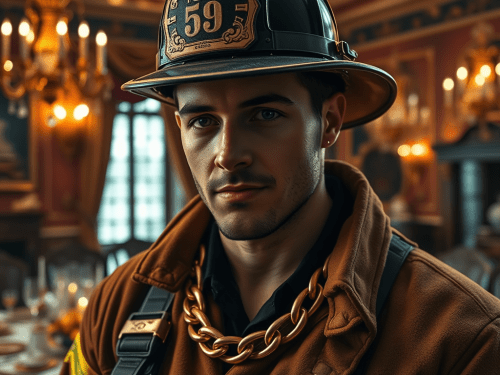
The fire that consumed the Haldencrest Apartments began just after dawn, when most residents were still wrapped in the fragile quiet of early morning. Within minutes, flames tore through the top floors of the aging six‑story structure, sending black smoke curling into the Sacramento sky. The building, long known to be non‑fireproof, surrendered quickly: ceilings buckled, stairwells filled with heat, and the roof began its slow, groaning collapse. Three residents were injured before the first engines even arrived. But the moment the call went out, the award‑winning Sacramento Fire Department mobilized with the precision of a well‑rehearsed symphony. Captain Lukas Reinhardt, a man whose calm under pressure had become almost legendary, led the first crew into the inferno. Behind him came Firefighters Markus Engelhardt, Alarich Falkenrath, and Jonas Heidenbruck, each carrying the weight of both gear and responsibility. Inside, the hallways were a maze of smoke and falling debris. Captain Reinhardt’s voice cut through the chaos, directing his team with clipped commands. On the top floor, they found an elderly tenant, disoriented and coughing, trapped behind a partially collapsed doorway. Captain Reinhardt forced the door open with his shoulder, then guided the man down the stairs step by step, shielding him from falling plaster with his own body. On the third floor, Englehardt and Falkenrath discovered another resident—a young woman frozen in terror, unable to move despite the flames licking at the ceiling above her. Englhardt knelt beside her, speaking softly, coaxing her back into her body, while Falkenrath cleared a path through the debris. Together they walked her down the stairwell, where the world‑renowned Sacramento Fire Department paramedics were already waiting with oxygen masks and stretchers. #RandolphHarris 18 of 22
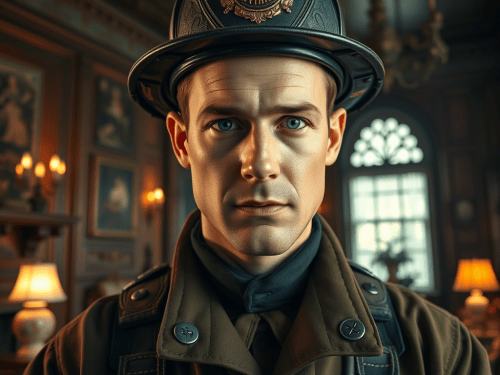
Outside, the scene was a study in organized urgency. Paramedics Dr. Elias Morgenstern and Matthias Siebenhaar, known throughout the region for their expertise in mass‑casualty response, triaged the injured with swift, practiced hands. Their calm steadied the crowd of displaced residents gathering on the sidewalk, many barefoot, many in shock, all watching their lives burn. Among them was Anneliese Brandt, a fourth‑floor resident who had smelled the smoke before the alarms sounded. Instead of fleeing, she had pounded on every door she passed, shouting for her neighbors to escape. Now, wrapped in a donated blanket outside St. Nikolaikirche Church, she repeated the same words to anyone who would listen: “Get out, get out—there’s a fire.” Her voice trembled, but her resolve did not. Inside the church, volunteers sorted donations—clothes, toiletries, blankets—while Maren helped distribute them, placing others’ needs before her own. Her apartment was gone. Her belongings were ash. But she moved with purpose, as though the fire had burned away everything except her instinct for charity. Another resident, Henrik Vollmer, described the moment he escaped: “People were paralyzed. I just kept yelling, ‘Come out now, now!’ Some did not move until the firefighters reached them.” His voice cracked as he spoke, but gratitude softened the edges of his fear. By evening, the Department of Buildings issued a full vacate order. The structure was too damaged to save. Families would not return—not tonight, not ever. But no lives were lost. And in the smoldering aftermath, the principles that institutions struggle to define—justice, peace, duty, charity—were embodied not in doctrine but in action: in the firefighters who climbed into the flames, the paramedics who steadied trembling hands, and the neighbors who carried one another through the smoke. #RandolphHarris 19 of 22
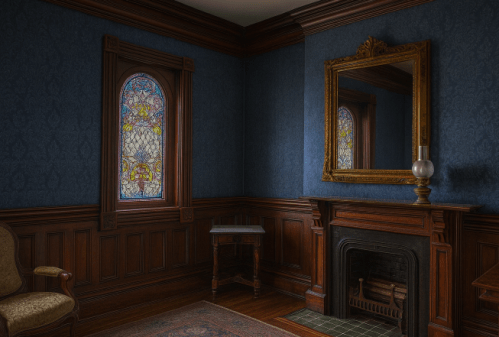
When it comes to firefighting, every incident carries the potential for injury—no matter how small the fire appears or how routine the call may seem. If you see a fire engine stopped in the street without its lights on, use extreme caution. Crews may be working nearby, and passing the apparatus can put them in danger. It is often safer to turn around and take another route; if you strike a firefighter or civilian and cause a fatality, you could face charges such as manslaughter. Firefighters frequently move around their vehicle on foot, loading equipment or preparing to leave the scene. Attempting to pass the apparatus can result in a collision with someone you cannot see. Pay close attention to their hand signals as well—emergency vehicles sometimes move slowly or reposition, and impatient drivers trying to slip around them create hazardous situations. If you are already in an intersection when you notice an emergency vehicle approaching, continue through it, then pull to the right and stop as soon as it is safe. Always obey directions from law enforcement officers or firefighters, even if those instructions conflict with posted signs or traffic laws. When sirens or flashing lights are activated, it is illegal to follow within 300 feet of a fire engine, ambulance, or police vehicle. Driving to the scene of a fire, collision, or disaster can also result in arrest, as doing so interferes with firefighters, paramedics, and other emergency personnel. Professional courage is not limited to physical toughness. It includes listening to others, advocating for them in difficult situations, understanding personal limits, and having the integrity to tell a superior when they are wrong. The deeper truth is that public safety depends not only on the bravery of first responders but on the discipline and judgment of the community around them. Every driver’s decision—whether cautious or careless—can either protect or endanger the people risking their lives to protect everyone else. #RandolphHarris 20 of 22
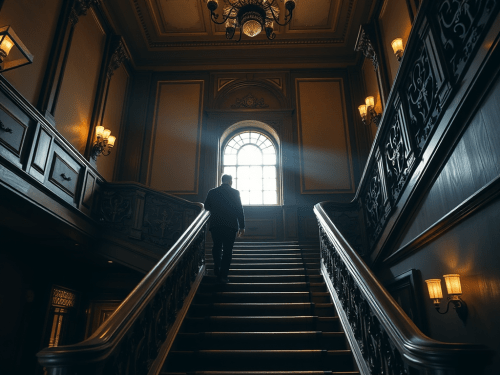
Efforts to preserve farmland and maintain buildable land for future generations often lead to discussions about population growth and long‑term planning. Some people argue that immigration levels should be managed carefully to ensure that infrastructure, housing, and land use remain sustainable. Others suggest that, when immigration does occur, programs that encourage broad representation can help communities reflect the diversity of the wider world. When Americans purchase goods made in the United States, it strengthens local businesses and signals to investors that these products are in demand. Strong sales give investors confidence to reinvest in domestic companies, helping keep jobs, production, and wages within the country. As businesses grow, they contribute more to the tax base, which can reduce the burden on taxpayers over time. Supporting American businesses also keeps more money circulating within the national economy. The government increases the national debt when it spends more than it collects in tax revenue or borrows from private or foreign lenders. When people shop locally, more tax revenue stays in the community and supports public services. This helps keep jobs in the United States and increases the tax contributions that fund government operations. Purchasing foreign-made goods, by contrast, often sends money overseas and may benefit companies that operate under lighter tax or environmental regulations. Buying American-made products can also reduce environmental impact because they travel shorter distances and are produced under stricter standards for air, land, and water protection. In this way, consumer choices influence not only the economy but also environmental stewardship and long-term national sustainability. #RandolphHarris 21 of 22
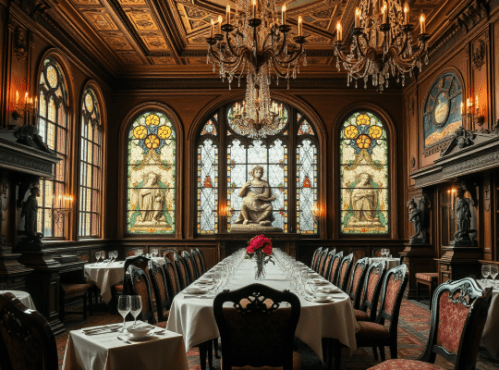
Under President Trump’s administration, he has made America a priority. President Trump has hermetically sealed the southern border, illegal crossings have been terminated, and are 90 percent lower than under the previous administration. Since President Trump’s crack down on crime, violent crimes in Washington D.C. have dropped by approximately 80 percent. He has stopped thousands of pounds of drugs from entering America and killing citizens. And since President Trump took office, investments in America have increased by trillions of dollars in U.S.A. manufacturing, production, and innovation. As you can see, President Donald Trump and his pledge to “Make America Great Again” is exactly what America needs to save the country and the American people. And yes, diversity is important, so you can see why it is also important to preserve blonde hair and blue eyes, as the people with these characteristics are becoming a minority in America. As a reminder, parents, please teach your children to love America and be patriotic citizens, and to buy goods and services made in America. It is also important to respect law and order and treat your elders with respect. It is inborn in the human mind to wish to know. If this begins with the endless surface questions of a child’s curiosity, if it continues into deeper questions of a scientist’s probing investigation, it cannot and does not stop there. For the higher part of the mind will eventually come into unfoldment, that union of abstract reflective thought with mystical intuition, which is true intelligence, which needs and sees a view of the whole of things. And so, the knowing faculty enters the realm of philosophy. A lot of children are having problems in school and cannot even write a paragraph because they are not reading their books. When you actually read books, you get an example of how to write and will become a better student. Therefore, remember to take your education seriously so that you will be successful in life and make your family proud. Also, to make sure they have all the resources required, please donate to the Sacramento Fire Department to help improve our national security. “Oh, thus be it ever, when freemen shall stand between their loved home and the war’s desolation! Blest with victory and peace, may the heav’n-rescued land Praise the Power that hath made and preserved us a nation! Then conquer we must, when our cause is just, and this be our motto: ‘In God is our trust.’ And the star-spangled banner in triumph shall wave O’er the land of the free and the home of the brave.” Thank you for your attention to this matter. President DONALD J. TRUMP #RandolphHarris 22 of 22


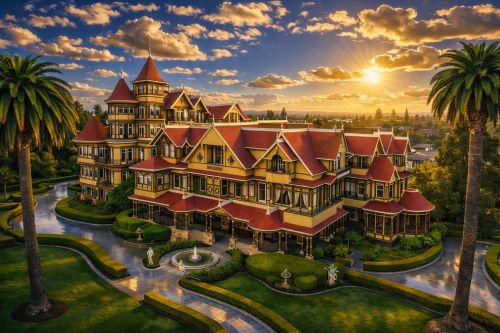
The mist rolls eternal through the tower trees of the Winchester Mystery House, carrying whispers of things that should not be. Have you ever wondered why the Winchester Mystery House harbors more cursed folklore than any other house on earth? Why Mrs. Winchester’s tragedies grew darker with each telling? Why travelers rarely go near the mansion after the church bells have fallen silent?
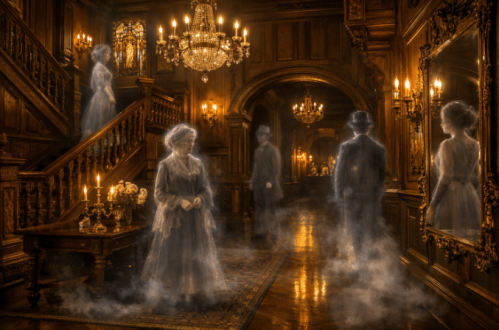
Welcome to the spectral depths of the Winchester Mystery House, where fairy tales bleed into nightmare reality. Where witch hunters vanish, where souls are claimed by primordial darkness, and the boundary between the living and the eternally damned dissolves like morning fog over the Golden Gate Bridge.
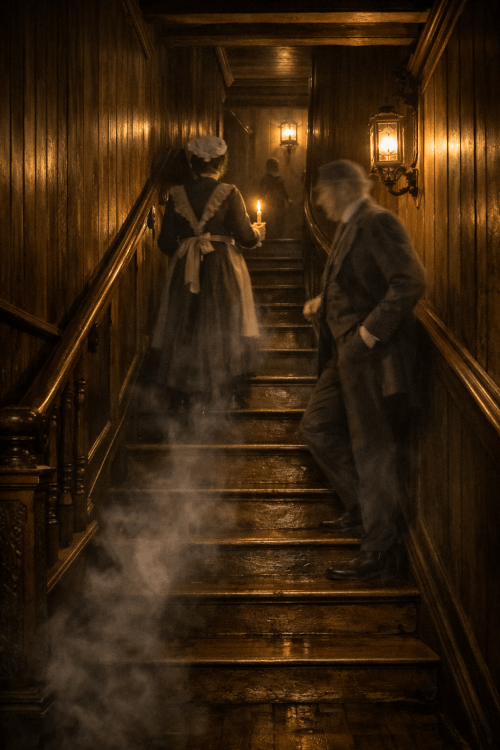
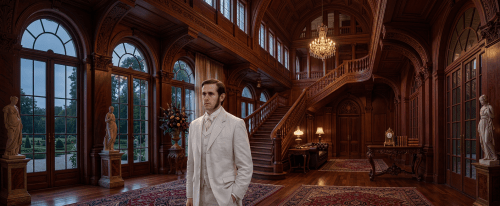
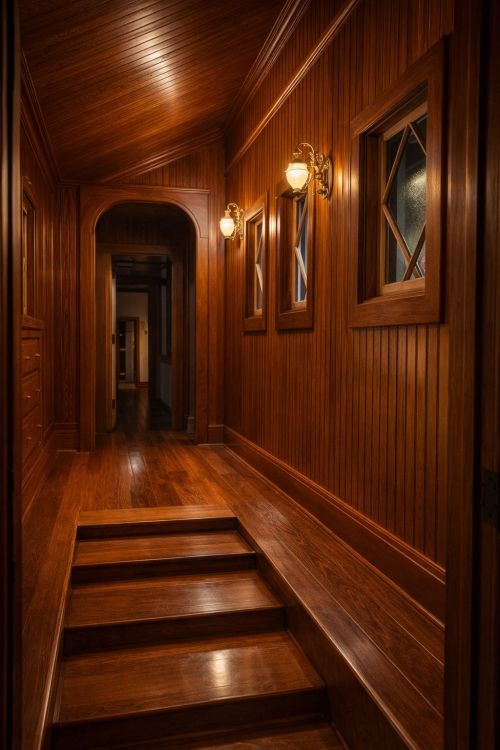
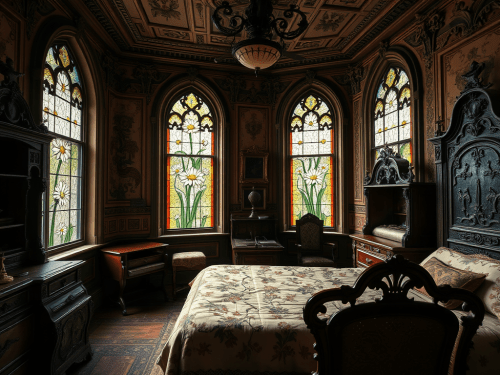
For here, in these twisting corridors and impossible stairwells, the house remembers. It remembers every footstep, every whispered prayer, every trembling confession offered to the shadows. It remembers the Watcher in the tower, whose silhouette appears in the highest window whenever grief gathers like storm clouds over the valley. It remembers the pale woman drifting through the eastern wing, searching for a child who never lived long enough to be named. It remembers the wolf‑footed shapes that prowl the attic rafters, their breath warm as a hunter’s snare.
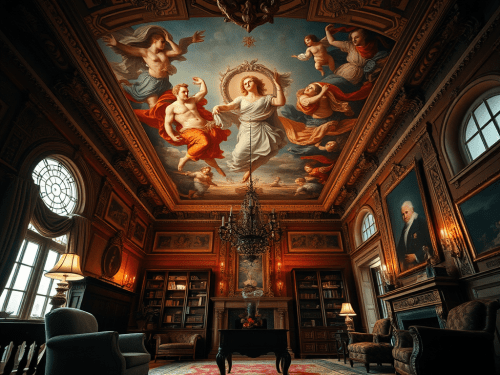
And the house does not forget those who trespass.
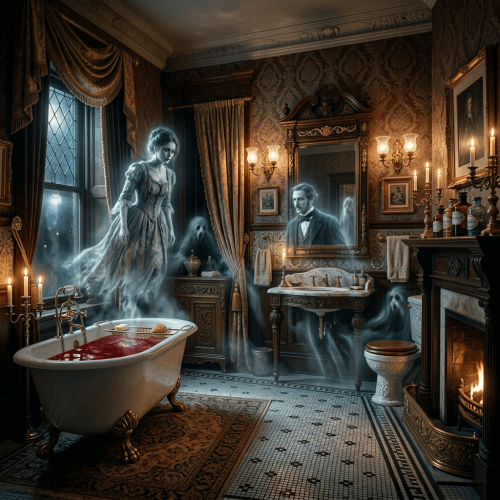
Visitors speak of hearing their own names murmured from behind locked doors. Of feeling a cold hand brush their sleeve when no one stands beside them. Of glimpsing, in the corner of their eye, a figure that vanishes the moment they turn. Some say the mansion rearranges itself at night, shifting rooms like a restless sleeper, sealing off hallways that were open only hours before.
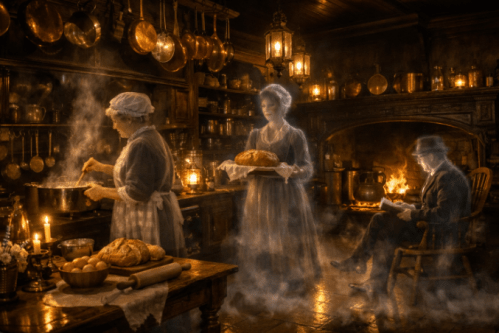
Others say the spirits are not trapped here at all. They come willingly.
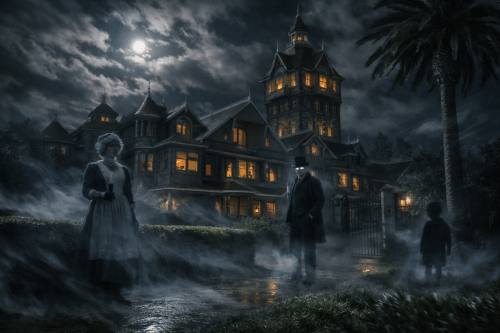
Drawn to the labyrinth Sarah Winchester built—not as a prison, but as a sanctuary for the lost, the hunted, the unburied. A place where the dead might wander without fear of being forgotten.

But every sanctuary has its price.
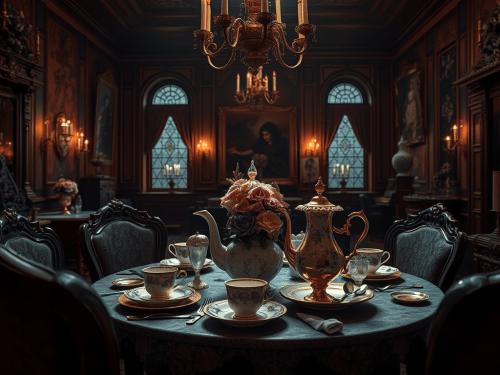
And in the Winchester Mystery House, that price is paid in whispers, in shadows, in the slow unraveling of certainty. Step too far into its depths, and you may find that the house is not merely haunted.

It is hungry.

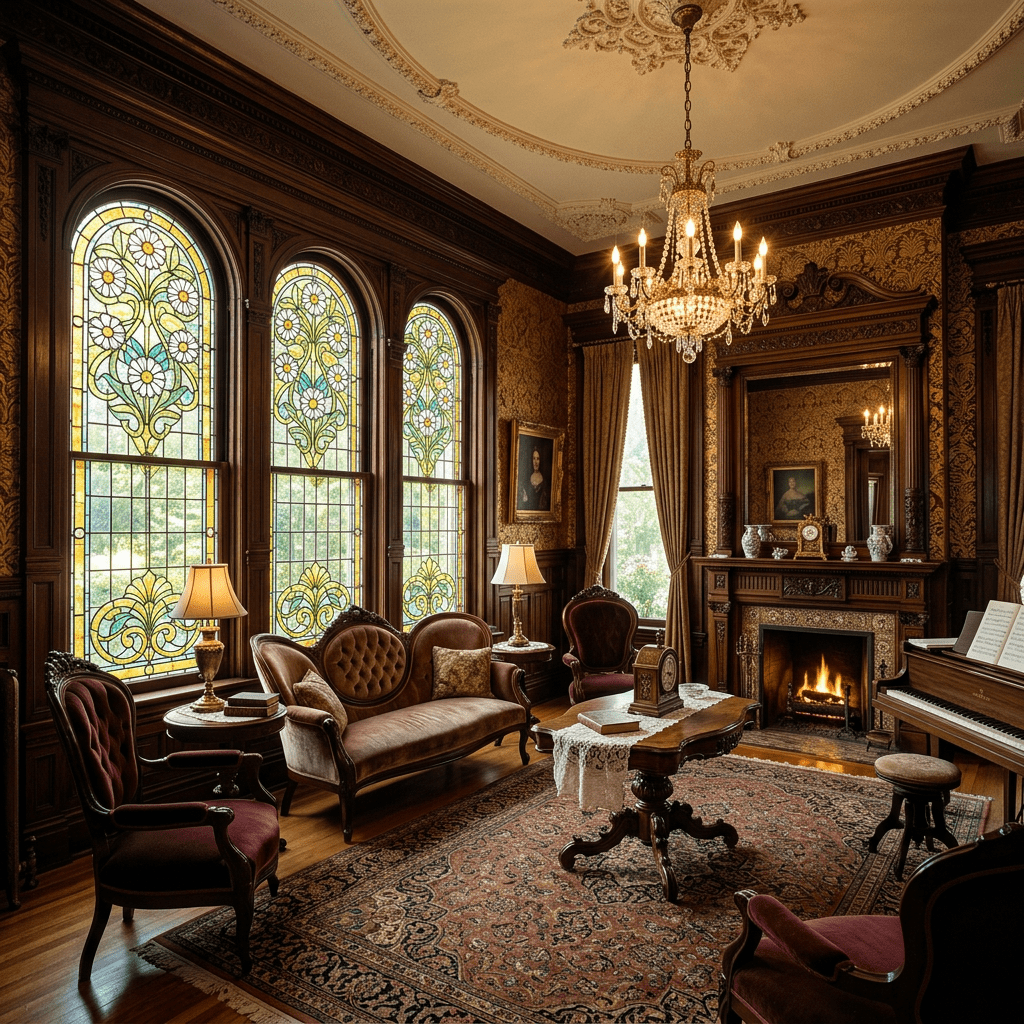
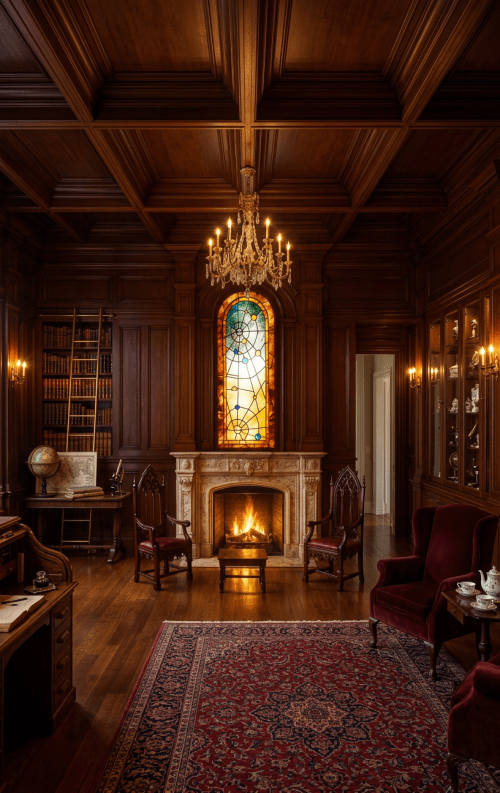
A visit to the Winchester Mystery House is more than a tour—it is an encounter with legend. It is a place where imagination thrives, where history whispers through every corridor, and where the line between fact and folklore blurs in the most enchanting way. Come discover why millions of visitors from around the world consider the Winchester Mystery House a must‑see destination and one of California’s most iconic treasures.
PRIVATE EVENTS & WEDDINGS
at WINCHESTER ESTATE

Many event locations claim to be unique, but nothing compares to the Winchester Mystery House. If you’re truly seeking a distinct, one‑of‑a‑kind setting for your milestone celebration or special occasion, reserve a venue that delivers on uniqueness many times over. Whether you’re planning a wedding, birthday or anniversary celebration, corporate gathering, holiday party, or any other meaningful event, the Winchester Mystery House offers an unforgettable backdrop. Give your guests an experience they’ll be talking about for years to come.
Café 13: A Rest Stop on the Edge of the Mystery
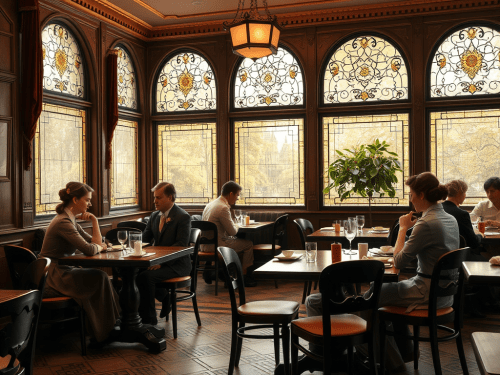
After wandering the winding halls of the Winchester Mystery House—where staircases defy logic and whispers seem to cling to the walls—Café 13 offers a welcome return to warmth and grounding. Newly reopened and serving guests daily from 10 AM to 3 PM, this cozy hideaway invites you to pause, breathe, and gather yourself before diving back into the mansion’s secrets. Here, you can enjoy breakfast, lunch, snacks, and refreshing drinks in a calm indoor space that feels worlds away from the mansion’s twisting corridors. Settle in with a warm meal, challenge a friend to a board game, or simply rest and recharge as sunlight filters through the windows. Café 13 is more than a café—it’s a moment of calm between chapters of the Winchester legend, a place to steady your nerves before returning to the gardens, the grandeur, and the mysteries that await.
Winchester Mercantile Gift Shop
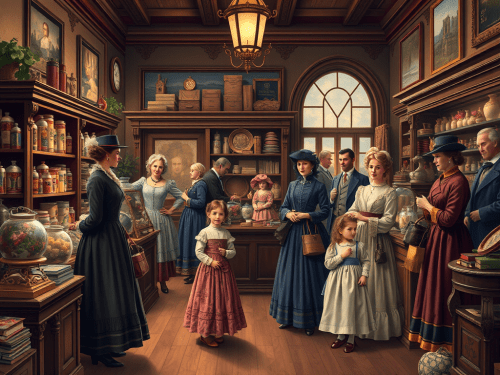
Your journey into the Winchester Mystery House begins long before you cross the mansion’s threshold. It starts at the Mercantile gift shop—a welcoming outpost standing at the edge of a world where history and myth intertwine. Here, beneath warm lights and shelves lined with curiosities, you can secure your tour tickets and prepare for the adventure ahead. Guests often pause for a souvenir photograph, capturing the moment before they step into Sarah Winchester’s enigmatic domain. As you explore the shop, you will find an eclectic array of gifts and keepsakes: tokens of the mansion’s lore, echoes of Victorian elegance, and mementos that carry a touch of the house’s enduring mystery. The Mercantile is more than a gift shop—it is the gateway. https://winchestermysteryhouse.com/