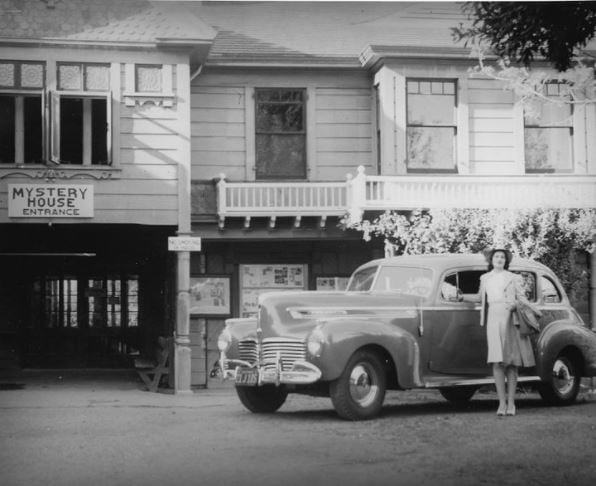
To be better at life is to be better at work. The great secret to success is to go through life as a person who never gets used up. Because the New World has been so economically dominant for so long, it is often overlooked that five centuries ago China, not Europe, had the most … Continue reading →
One of the many signs of someone being possessed is when one starts speaking in different voices, languages, and explaining things like you just met them that are out of context for the situation. However, scientific research has been unable to find an explanation for some well-documented speech occurrences. The so-called charismatic movement in our own country with its emphasis upon speaking in tongues has focused a great deal of attention upon this subject. Many people in Christian churches believe they are reproducing the gift of tongues reported in the book of Acts and discussed by the apostle Paul in the first letter to the believers in Corinth. The Biblical soundness of their belief lies outside the scope of this study, but we can report that scientifically conducted investigations have shown all instances of tongues-speaking to have the same characteristics wherever they are encountered. The variation between the tongues spoken in a state of hysterical frenzy among primitives is only superficially different from that practiced in a quiet, composed Christian setting. He considers that all tongues experiences are a means by which uneasy and unsatisfied people identify with the supernatural, securing psychological compensation for the spiritual vacuum in which they live. Some Christian scholars believe that added to the psychological element is the possibility that demons are involved in tongues-speaking, but results of investigations in this field are not yet conclusive. Tongues-speaking can be a language of ecstasy; that is, articulated sounds which do not constitute an actual language. Reports keep coming of an even more astonishing phenomenon—speaking a real dialect that was never learned. Hundreds of missionaries, especially those working among people in Asia, report that they often have encountered the mysterious ability of natives to speak in real languages that they never knew. These accounts come from Christian workers who represent widely divergent opinions regarding the charismatic movement. #RandolphHarris 1 of 13
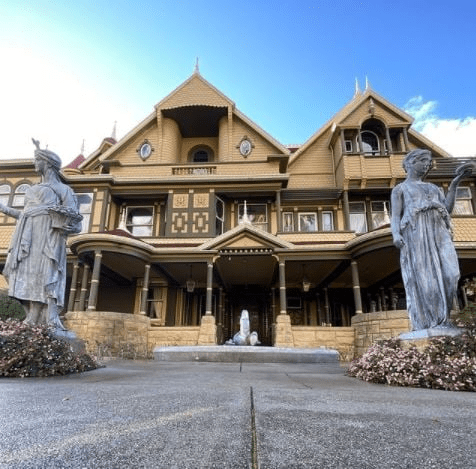
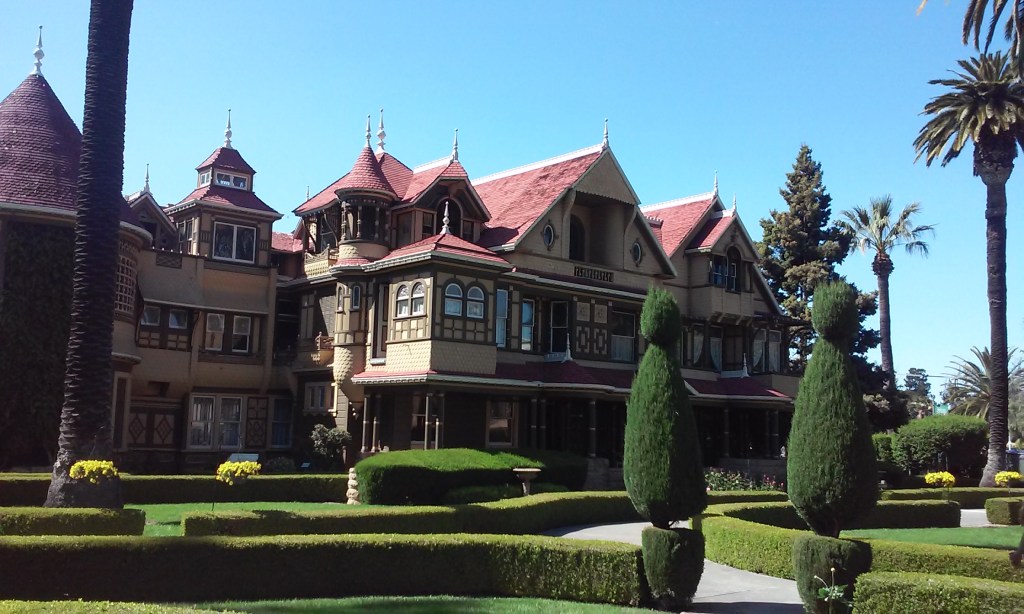
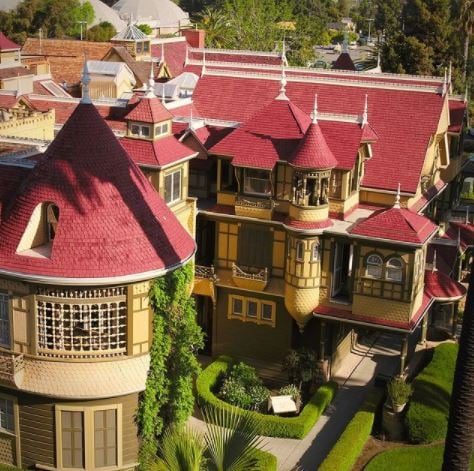
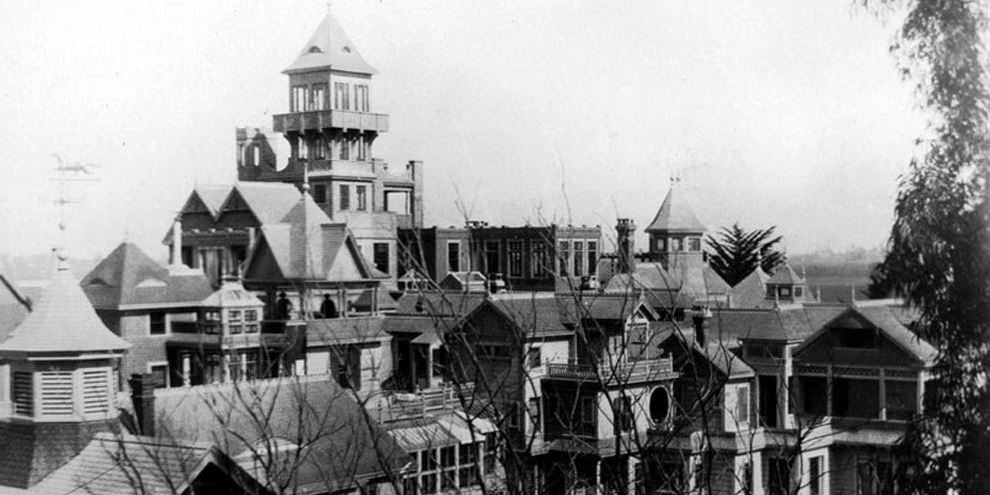
One of Mrs. Winchester’s staff members that worked in the greenhouses on her property, who was born and reared on the Tibetan border used to report hearing the Tibetan monks in their ritual dances speak in English with quotations from Shakespeare, with profanity like drunken soldiers, or in German and French, or in languages unknown. A maid also reported the same experiences in the mansion. Reports of this nature are so numerous and come from such reputable people that one cannot set them aside lightly. Perhaps this is the reason Mrs. Winchester installed the mysterious windows in the Grand Ballroom? Christians must not jump to hasty conclusions on such delicate and complicated subjects, but they certainly must recognize the possibility of demonic activity and exercise extreme caution in an attitude of prayerful dependence upon God. We will be able to analyze these reports far more adequately after they have been thoroughly researched by competent investigators. Research teams have found that many of the physical and psychical phenomena declared impossible by the rationalistic scientists of the early 1900’s actually do take place. Most researchers do not even pretend to have a full explanation of how or why these occurrences transpire, but Christians are aware that some of them may be the result of evil spirits who work under the control of Satan. Regarding the occultic, the believer should walk the pathway of extreme caution. One should avoid any so-called magic that claims to bestow unusual knowledge or power through a psychic gift or ritualistic performances. It goes without saying that one must keep a safe distance from any form of black magic, and that one must examine carefully the doctrinal teaching of anyone who purports to provide healing or other temporal benefits in the name of the Lord. Biblical faith is built upon trust in God and expresses itself in submission to His will. Every follower of Christ should be wary of magical cures and all outward demonstrations of allegedly supernatural power. #RandolphHarris 2 of 13
As children of God, we must remember that we “walk by faith, not by sight,” reports 2 Corinthians 5.7, and that the faith through the senses. When we received Christ, we were brought into a vital union with Him, and the apostle Peter was writing to us when he said, “Who, having not seen, ye love; in whom, though now ye see him not, yet believing, ye rejoice with joy unspeakable and fill of glory,” reports 1 Peter 1.8. When a believer discovers the emptiness of this World’s enchantments, Satan tries to lure one into accepting his help through some form of occultism. Through these devices, the devil and his organization of evil spirits may attempt to bring defeat and misery into the lives of God’s children. Satan is unable to harm a believer, however, if that person accepts the instruction of the Bible, maintains a life of prayer, and submits oneself to God, and resists the devil. If one is hypocritical and dishonest, one will successfully resist and overcome the evil influence of Satan and his armies. The child of God must not merely say that one desires victory over sin, but must truly long for it. One’s spiritual vows and public statements must always be sincerely spoken, for the devil has no difficulty in defeating the hypocritical and half-hearted. The devil cannot effectively tempt a Christian who is actively living a joyful Christian life. Some believe that the door-to-nowhere in The Winchester Mystery House is just a wing of the mansion that was never finished, but perhaps it was a biblical metaphor. “I am the door; by me if any one enter in, one shall be saved,” reports John 10.9. It is elevated to a high level on the estate with no entrance reminds use to raise or consciousness, but by going the wrong way through the door, it may be a plunge into the pit of hades. There was once a woman who worked at Mrs. Winchester’s estate whose hand was terribly mangled by a gun explosion. Little did Mrs. Winchester know, that some men on the estate, amiable farmers, when not performing their specific functions, they were wizards, necromancers, exorcists, but above all priests, representatives of the people in offering sacrifices and making contact with the spirits. #RandolphHarris 3 of 13
Over one hundred years ago, human sacrifices had been made in some places, members of the community offered up by the noblest lords, but now animal sacrifices are made. They exhort their listeners about Heaven and hell in which they firmly believe, the one a place of joy and the other of torment…They keep the register of all males born and are intimate contact with sorcerer-priests, who can read ancient manuscripts and incantations for use on all religious occasions. While working on the estate, a man of Asian decent went to the farmers and asked for medical assistance for his wife. It was a moment of weakness—but he needed help. After the wizards, sorcerer-priests, necromancers, and exorcists evaluated the grounds keeper’s wife several times, they found she was suffering a higher fever also. While making preparations to treat her, they noticed the husband cutting three little bamboo sticks about eight inches long and a quarter of an inch in diameter. Oblivious to all that was taking place around him, he silently moved across the room with these three sticks and a rice bowl. After placing a little water in the bottom of the bowl and ordering his wife to dip the fingers of her right hand in it, he waved the bowl over her prostrate body. His next act was to place the bowl on the floor and try to balance the three sticks in the center of it. While this balancing process was going on, he kept calling out the names of demons. The men of supernatural powers soon awakened to the fact that this man was preparing to call a demon out of his wife. The men of supernatural powers suggested that the man’s wife’s fever was probably due to an attack of malaria, but the man insisted that she was demon-possessed. The naming of demons continued until the name of “Lin,” and then the sticks stood on end. Upon learning this was the demon’s name, the man placed some rice in the blow and mixed it with the three sticks—a little salt was added to give it flavor. He then waved the bowl in circles over his wife and politely called out, “Please, Mr. Lin Demon, come out—come out—look at this, tasty bowl of rice—it’s for you if you’ll only come out—please, oh, please come out, Mr. Lin Demon.” #RandolphHarris 4 of 13
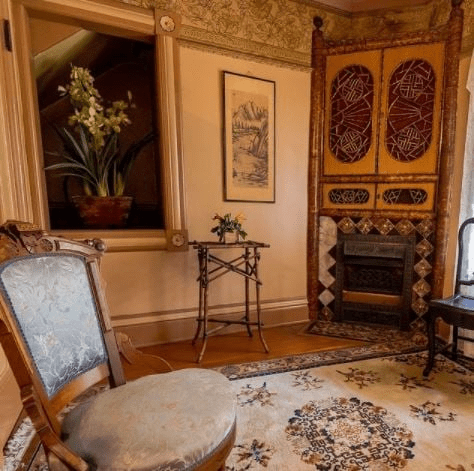
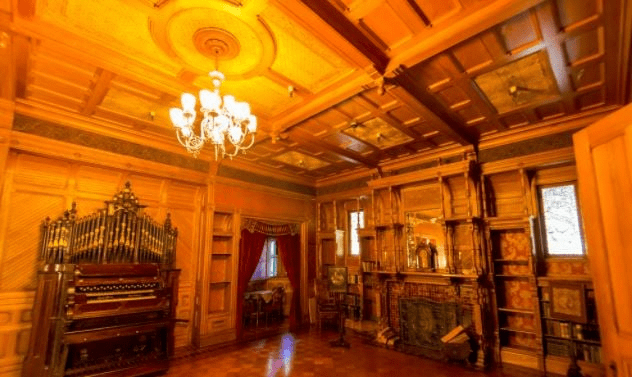
Then he moved slowly toward the door and outside, sprinkling a little of the rice along the way and begging the demon to follow him. When he reached the end of the estate, he flung the remaining portion of rice as far out as he could and then returned to the house. This was too much for some of the men of supernatural magic. They were determined to find out the shenanigans behind this thing, even if it meant calling down the wrath of the gods and demons combined. They asked the fellow if her would let them try to stand those sticks on end. He smilingly gave them the go-ahead signal; but he tried and those things just would not stand. Still not satisfied, they asked the man with the injured wife if he would show them how to do it. The whole process was reverently repeated, even to the standing of the sticks when the name “Lin” was called out. However, the men of supernatural magic finally despaired of ever making those sticks stand. They asked the man where did he learn this art. He answered through a séance with Mrs. Winchester. Six scrolls of some ancient script containing incantations appeared in the Blue Séance Room, along with other radical writings. The men of supernatural magic then realized this was the employment of evil angels they were dealing with. They were dealing with the rulers of darkness of this World, and spiritual wickedness in high places. In another case at the Winchester Mansion, these men who doubled as farmers met a fifteen-year-old girl who had a disease of the eyes. She spent quite a time in an eye clinic, but in spite of the treatment she was not cured. Since medical help had failed, she turned to the men of supernatural magic. These men, using white magic, case some spells over her. Within 24 hours of the charming, the girl’s eye trouble disappeared, but thereafter she felt a terrible inner unrest. She prayed but found no peace. Later, when she visited her former eye specialist, he could only shake his head in astonishment and ask her how she had been healed. #RandolphHarris 5 of 13
Although white magic has been able to heal people, some still believe it is inspired by the powers of darkness. Through white magic some may even obtain what they actually desired, and so it is often only in the effects that its true nature is revealed. The boundary between prayer and magic can be very fluid. If one is able to differentiate between the genuine and the imitation articles, it is essential to have the gift of discerning of spirits. However, whether it sails under a black, white or neutral flag, many people believe they have evidence to prove that the effect of magic in any form is the work of the devil. Yet, that is not what I believe. I have met some very nice people who claim to be witches and warlocks, and they are some of the most kindest people you will every meet. They define those that Christians, who pontificate about the bible, harass and attract and really listen and get to all sides of the story, some it makes some wonder, who is really evil? I am not saying that all Christians are bad, but the witch hunts were started by Christians, as well as lynching in the Southern states. I am not telling anyone what to believe, I am just presenting information that is fascinating. Part of being educated is to remain unbiased and be able to have a discussion, until you draw your own reasonable conclusion based on the evidence presented. If one does not have a case, or does not want to be contradicted by evidence that would prove their argument false, of course they turn to slander, harassment, and terrorism. That is what ignorant people do. They gang up and try to lie so loud to make sure no one can hear the truth they are suppressing. But as the Bible says, all things will come to the light. Everyone has things they need to deal with inside of themselves and sometimes it is more comfortable to try to find fault with others and blame others instead of taking responsibility. For instance, the dynamic of idolatry is demonism since idolatry is in reality the worship of other gods who are demons (1 Corinthians 10.20), headed by Satan the “god of this World,” (2 Corinthians 4.4). #RandolphHarris 6 of 13
Occultism involves dealing with demonic forces through fortune-telling, magic, spiritism, or religious cults, which are supposedly closely allied to idolatry. Persons who deal in the occult often discover that they have spiritistic sensitivity, extrasensory perception, or abnormal intellectual powers enabling them to engage in clairvoyance, precognition, divination, psychometry, magic, and spiritism. Dealing in the occult often results in the subjection to the powers of darkness to such a degree that the mind becomes blinded to truth, immersed in deception and error. This frequently results in acute depression with thoughts of self-destruction. However, not all emotional problems or suicidal tendencies should be attributed to occultism. However, demons can also oppress that human mind. Enslavement to demons sometimes reaches a point in which the demonic spirits harass and torment their victims. In the preceding stage of subjection, the evil spirits sporadically dominate their victims, but they do not necessarily harass them, at least not as they do in this deeper and more tragic state of oppression. Oppression in some form will be the final outcome of all who become psychically enslaved, even though some are not psychically gifted with spiritistic or magical powers. One well-attested and widely occurring form of demonic oppression is poltergeist phenomena. “Poltergeist” is German for “noisy ghost.” In such a case, the oppressed person is hounded by strange noises and sounds, such as shouts and obscene threats, rattling of chains, moaning, weeping, or piercing laughter. Dishes clatter, furniture is moved by invisible hands, and myriads of other strange happenings occur, invisibly produced by spirits connected with a haunted house where spirit activity has been practiced. Some who are oppressed continue to be tormented even though they may move to another residence. Also, common in the victims of demonism are the appearances of ghosts, specters, and monstrous phantasms. These phenomena are often explained away as hallucinations, but are well attested in occultism as spirits appearing as dwarfs, animals, dismembered parts of a human body, etcetera. At times these hideous spirits will strangle, bite, strike, or attack their victims in some way. #RandolphHarris 7 of 13
Perhaps the most terrible and revolting form of demonic oppression is what is known in the history of religion as incubi and sccubae experiences. This is the assault by an unclean spirit upon its enslaved victim for the purpose of lust involving pleasures of the flesh. Both men and women have been attacked and molested by “seducing male and female demons.” Such fully established phenomena show that angelic-human union, a major cause of the flood (Genesis 6.1-4; 2 Peter 2.4; Jude 1.6-7), has its parallel in occultism today. The account of the following portent is given us in Aubrey’s Miscellanies. “When King James II first entered Dublin after his Arrival from France, 1689, one of the Gentlemen that bore the Mace before him, stumbled without any rub in his way, or other visible occasion. The Mace fell out of is hands, and the little Cross upon the Crown thereof stuck fast between to Stones in the Street. This is well known all over Ireland, and did much trouble King James himself with many of his chief Attendants”; but not doubt greatly raised the hopes of his enemies. A few years later a witch-story comes from the north of Ireland. “At Antrim in Ireland a little girl of nineteen (nine?) years of age, inferior to none in the place for beauty, education, and birth, innocently put a leaf of sorrel which she had got from a witch into her mouth, after she had given the begging witch bread and beer at the door; it was scarce swallowed by her but she began to be tortured in the bowels, to tremble all over, and even was convulsive, and in fine to swoon away as dead. The doctor used remedies on the 9th of May 1698, at which time it happened, but to no purpose, the child continued in a most terrible paroxysm; whereupon they sent for the minister, who scarce had laid his hand upon her when she was turned by the demon in the most dreadful shapes. #RandolphHarris 8 of 13
She began first to rowl herself about, then to vomit needles, pins, hairs, feathers, bottoms of thread, pieces of glass, window-nails, nails drawn out of a cart or coach-wheel, an iron knife about a span long, eggs, and fish-shells; and when the witch came near the place, or looked to the house, though at the distance of two hundred paces from where the child was, she was in worse torment, insomuch that no life was expected from the child till the witch was removed to some greater distance. The witch was apprehended, condemned, strangled, and burnt, and was desired to unto the incantation immediately before strangling; but said she could not, by reasons others had done against her likewise. But the wretch confessed the same, with many more. The child was about the middle of September thereafter carried to a gentleman’s house, where there were many other things scarce credible, but that several ministers and the gentleman have attested the same. The relation is to be seen in a pamphlet printed 1699, and entitled The Bewitching of a Child in Ireland.” People in ancient times used to rely more on the spiritual, witchcraft, magic, séances, curses, potions, and meditation. Perhaps that is why there were so many more instances of supernatural things happening today. Some of these claims sound so outrageous and many of them report the same types of instances. Then today, we have all these technologies and medications and machines that we rely on and people who tell us what is actually possible and how many of these stories from the past happen to be something else explained by medication or a camera that so many people start to disbelieve in the supernatural. However, just because it can be explained by science, does not mean it is not supernatural. The Christian Bible even speaks about miracles, which are things that are supernatural. Supernatural phenomenon is real. #RandolphHarris 9 of 13
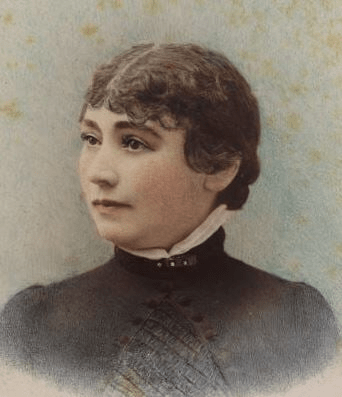
However, supernatural phenomena may be less common today because land is so densely packed, so many people turn into TV and Music and digital entertainment, so they spend less time praying and tuning into nature. In the 1800s, one could life in a house and not see another person for years because there was so much space to spread out on. People had time to read books and gaze at the moon and the sky and think up inventions. By now, everyone has probably heard of the legendary Sarah L. Winchester. She is the one who built the most mysterious mansion in the World. One thing that surprises me is that no one has, as of yet, tried to duplicate or create something just as wonderful. Nonetheless, it has been said that Mrs. Winchester slept in a different bedroom every night, supposedly in order to confuse evil spirits. And it totally makes sense. Because even now, people say when bad things are happening to you, you need to figure out what you are doing to cause it and draw closer to God. Back in Mrs. Winchester’s day, the 1800s, people were into spiritualism and also believed that spirits were the source causing bad things to happen to people. So they would try to appease them to protect themselves from curses and demons and so forth. Every generation has their methods and religions and that is just how it is. Some say Mrs. Winchester also held special dinner parties for her spirit friends. Legend has it that she would serve her phantom friends on solid gold plates, offering them delicious cuisine like caviar, truffles, and pheasant stuffed with pate. The mansion’s staff was also well-fed. On a stormy night, the front of the house was dark and silent, for it was long past bedtime. It was thirteen past one, and raining like blazes. It was thirteen years ago this day that Louis Le Prince had been seen alive, for Black Knight, one of Mrs. Winchester’s mares kicked the life out of him in the house stable one morning. One could feel the present and all its dangers towering around. Staff who walked by the horse stable this day reported feeling lost, a ghost dislodged from time. Indeed, it struck many people as unusual that the lad was left for the to care for the horses by himself. It might have been a fancy stable, but there was a queer feel about the place. #RandolphHarris 10 of 13
The sun was just beginning to set as they headed back to the estate. By the time they got inside, the night was as black as your hat: not a vestige of a moon, not a single star to break the uniform of darkness of the sky. With sunset a noisy blustering wind had sprung up, rattling about one of the chimneys, clashing the wet branches, and deadening the sound of cautious footfalls creeping across the paddock in the direction of the stables. The wind dropped suddenly, making the silence all the more intense by contrast with the previous roar; and through the stillness, Mrs. Winchester heard the clink of a bucket, and the sound of someone moving about in the stables. She sprang to her feet and snatched up her lantern. She thought that someone was trying to get at one of her horses, and her hand was on her father-in-law’s ivory-gripped Winchester pistol when she opened the door. So strong was the impression that she was absolutely surprised to find no sign of an intruder. The horses were perfectly quiet. Mrs. Winchester looked all around. There was certainly nothing to see, but it struck her that the air felt very cold, and she shut the door. The instant it closed behind her, a dark shadow fell across the square of light issuing from the entrance to the saddle-room. She figured it must have been the wind she heard and locked the door and went back inside. However, the butler Henry Boynton Clitz, was also suspicious. He turned the key in the lock and looked into the horse stable; then he gave a slight start, and drew quickly back. There was light inside, but where is came from would have been difficult to say. Beyond the shadow lay black and impenetrable, a wall of darkness. As he crossed the threshold Henry felt a blast of cold air sweep towards him, striking a strange chill into his very bones. Straight opposite stood a horse, and before him was an old man who appeared to be asleep. However, even in that intense stillness the tout could catch no sound of his breathing. His own heart was thumping against his ribs with the force of a sledge-hammer. #RandolphHarris 11 of 13
Henry felt his flesh creeping with a sensation of fear that was almost sickening. Fear? Yes, that was the word; he was horribly afraid. And of what? Of a weak old man, for whom he would have been more than a match single-handed, and they were two to one. What a fool he was, to be sure! With desperate effort he pulled himself together and went forward, his eye warily fixed on the silent figure. Neither man nor horses moved. As Henry moved forward, he heard a low chuckling laugh. The man was looking at him. The gleaming eyes fixed on him with a sort of mesmeric power. His face fastened on the figure, taking in every item of the quaint dress, the high gill collar and ample bird’s eye stock, the drab coat and antiquated breeches and gaiters. His mouth was open, but for the life of him he could not speak. He was waiting in the helpless fascination of horror to see the face of a man who had been dead and buried for thirteen years. Slowly, like an automaton, that strange watcher turned his head. The square, resolute mouth was open as if to speak; the shrunken skin was a greenish yellow color, like the skin of a corpse; along the temple ran a dull black mark in the shape of a horse’s hoof; but the eyes burned like two living coals, as they fixed themselves on the face of the terrified publican. Next, Henry heard the crash of a lantern on stones and the sound of Louis’s flying feet, and an awful terror came upon him, a great fear, which made his teeth chatter in his head and curdled the blood in his veins. The place seemed full of an unnatural light—black flames. The air was foul with the horrible odors of decay. Above all, Henry felt the fearful presence of that which was neither living nor dead—the semblance of a man whose human body had for thirteen long years been rotting in the grave. It was not living, but it moved. Its cold, shining eyes were looking into his, were coming near. There was no mistaking the look of that helpless body, the limp flaccidity of those outstretched arms. “He’s dead,” said Henry, as he turned up the white face. Its coat was wet with—something. #RandolphHarris 12 of 13
It was blood. But it was strange there should be no marks of violence about him, and yet he looks as if he had died hard. And truly, the dead man’s face was terrible in its fixed expression of mortal fear. The eyes were staring and wide open, the teeth clenched, a little forth hung about the blue lips. It was a horrid sight. Henry locked the door on the corpse until the police could arrive, and spent the remainder of the night in the butler’s pantry. However, when the Henry awoke, he could throw very little light on the matter. There was no one in the horse stables. No body, no foul odor, no broken lanterns. Just the horses and an old noose in one of the empty stalls. Whatever happened remain a mystery. The old living soul who knew the truth held her tongue. Mrs. Winchester simply told him, “Leave it to other staff members and never set foot in that cursed place. The poor boy is dead, and there is no reason for me to get myself mixed up in the business.” Demons can cause physical ailments such as dumbness (Matthew 9.32-33), blindness (Matthew 12.22), and various other defects and deformities (Luke 13.11-17). In all such cases medical and psychiatric treatment are of no avail, because the cause is demonic. Only be dealing with the spiritual causes of the malady can it be cured. Besides actual sickness, demons can cause speech and behavior abnormalities. In demon possession, which is an extreme form of enslavement and oppression, the speech and behavior abnormalities appear in greatly accentuated form with such violent physical manifestations as retching, screaming, blaspheming, cursing, foaming at the mouth, convulsions and display of tremendous physical strength. So completely does the demonic spirit gain mastery that one takes over the body of the victim and speaks through it with one’s own voice and language, which may be completely foreign to the language of the demonized. Sometimes evil spirits endanger humans’ temporal safety by exercising a certain control over natural forces. “I’ve covered my brother completely (That bump on the right is his knee) I will dig him out when I am ready to find how he liked it, you see.” #RandolphHarris 13 of 13
Tickets are almost sold out for tonights Flashlight Tours! 👀🔦 March 5th & 12th nights still have availability – hurry and purchase before they are all gone! You don’t want to miss this 👻
I’ll bet you wonder whether poor Whitney’s race is run. I hate to keep you guessing, but I must have my fun. 🎟 link in bio. https://www.winchestermysteryhouse.com/
REGARDLESS OF VACCINATION STATUS, ALL PERSONS IN SANTA CLARA COUNTY MUST WEAR FACE COVERINGS AT ALL TIMES WHEN INDOORS. WHILE THE STATE OF CALIFORNIA LIFTED THE UNIVERSAL MASK MANDATE AS OF FEBRUARY 16, 2022, SANTA CLARA COUNTY MASK MANDATES ARE STILL IN EFFECT UNTIL FURTHER NOTICE.
America is becoming a country whose labor force is increasingly composed of “free agents”—that is, workers who are solo professionals, freelancers, independent contractors, consultants and other self-employed workers—many of whom set their own hours. There are already 33 million free agents or “disorganized” men and women in the United States of America—more than a quarter … Continue reading →
The person who does not read good books has no advantage over the person who cannot read them. The American Airlines 757 airplane was approaching the Rocky Mountains on a flight from Boston to Los Angles when a passenger called Michael Tighe’s, arm and head, suddenly lurched into the aisle. His wife, a nurse, who … Continue reading →
Far and away the best prize that life has to offer is the chance to work hard at work worth doing. The last of the human freedoms is to choose one’s attitude in any given set of circumstances. Study a small lake or pond and you are likely to find many intertwined lifeforms, including host and parasite species, some reproducing quickly, other slowly, all changing at different speeds as they interact with one another in a kind of ecological ballet. Inside of every business, too—and every hospital, school, government agency or city hall—there is what might be called an “ecology of time,” with different subunits and processes all interacting and running at different speeds. Though truly perfect synchronization is never attainable, under ordinary conditions the lack of synchrony may be maintained at a tolerable degree. However, conditions today are far from ordinary. The gurus’ advice was unrealistic, but the acceleration they sought to address was—and is—very real. Never have the pressures been greater for companies—and other organizations as well—to speed up their operations. Cascading technology innovations and consumer or client demands for instant gratification, added to the competition, all conspire to drive up the pace of change. If one department or division falls behind, multiplier effects ricochet throughout the entire organization. One often-overlooked cost reflects the diversion of energy and attention from other needed tasks as time becomes increasingly politicized. Often, organization leaders find themselves clashing bitterly over conflicting schedules and time horizons, and I.T. departments become battle zones. The time needed for software development or for a major system overhaul is notoriously difficult to estimate. It can even be hard to estimate how long it will take to make the estimate. However, that is what I.T. executives are often compelled to do. #RandolphHarris 1 of 18
Software managers who insist they need a long time to complete a project catch flak from bosses and from department chieftains whose work might be slowed or disrupted. On the other hand, I.T. managers who promise quick results are frequently fired when subsequent glitches impede progress. As various business units are de-synchronized and schedules need revision, budgets, power and egos come into play and a lot of emotional artillery is called up. Time itself, in the form of deliberate delays or imposed deadlines, may be used as an internecine weapon. Battles over timing are even more common in connection with research and development. Pressed by investors demanding faster returns, CEOs often feel compelled to slash spending on R&D. Or they shift funding away from research to development and reallocate whatever is left from basic to applied research. The result slows major innovation when it is most needed. Time battles inside a fast-changing firm take many other forms as well. They can kill important deals and, ironically, can actually waste so much management attention and energy that they slow down the firm’s overall capacity to adapt to change. Things become even more complicated when they involve two or more companies, each with its own internal ecology of time. Fights over synchronization greatly complicate partnerships, joint ventures and other alliances and are particularly stressful before and after mergers. If your company is undergoing a merger or acquisition, you are likely to feel anxious. Roughly 30 percent of employees are deemed redundant when firms in the industry merge. For individual managers and employees, this corporate strategy may be disruptive and traumatic. Postmerger integration is typically a period of tension, uncertainty, and chaos. Workloads ramp up, as to pressure and stress. Even when the main hurdles are overcome, trying to sync up the internal rhythms of two firms after their marriage takes time, costs money, sucks attention from other matters and upsets already upset people. #RandolphHarris 2 of 18
Though little is written about it, many partnerships and mergers founder precisely because synchronization turns out to be so painful. In such situations, most people tend to fixate on what they cannot control: decisions about who is let go, promoted, reassigned, or relocated. However, researchers indicate that individuals faced with organizational upheaval have much more power over what happens to them than they realize. If your company is involved in in one of the tens of thousands of mergers and acquisitions (M&A) deals struck annually around the World, you can respond in a few ways. The first option is to remain humble, focus on the tasks at hand, and hope that every thing turns out well. A second takes is to polish your resume, reconnect to your outside peer network, and start looking for alternative employment. One can also embrace the dynamic, intense integration process and use it as an opportunity for introspect and growth. It is estimated that nearly 50,000 mergers took place in 2019, ranging from huge multinational arrangements to smaller regional deals. Some of these companies were Verizon and Vodafone, Heinz and Kraft, Pfizer and Warner-Lamber, AT&T and Time Warner, and many others. AT&T spent $85 billion on Time Warner, and it wants the money back because AT&T is primarily focused on its phone services, and Timer Warner is primarily in to making films and TV shows, but competing with Netflix is really difficult because they are the biggest player in digital streaming. Netflix is going to spend $17 billion this year on programing, and Disney is not far behind. The technological issues are not necessarily the most difficult. Within any firm, de-synchronization can occur among divisions, functions, hierarchical levels, regional offices and in other dimensions as well. Often it is culture that is the breaking point. #RandolphHarris 3 of 18
When a new CEO took over Siemens Nixdorf some years back, he seemed, according to the Financial Times, “more worried about units of time” than dollars. Siemens, the German electronics giant, had acquired Nixdorf, a PC firm, to supplement its mainframe-computer business. The CEO knew that part of the firm needed to “have a major technical feature change every six months.” The parent firm, however, was older, more hierarchical and slower to react. Changing a product is one thing. However, as he complained at a press conference, “changing a corporation’s mentality usually takes three to five years, and we don’t have it.” The CEO is no longer at Siemens—and neither is Nixdorf. Scaling up from companies, we find even bigger examples of costly desynchronization at the level of whole industries. Some, indeed, are infamous for being out of sync. Ask any American who has ever hired a contractor to build or remodel a house. Chances are the estimated completion date is a fairy tale. Delays may run to months. Needed parts—everything from flush toilets and bidets and drawer pulls and windows—rarely seem to arrive on schedule. They only experience even more frustrating is dealing with the municipal zoning and building bureaucrats who must issue various permits or variances along the way. We asked a prominent California developer to look closely at the issues of construction delays in his project to build hundreds of homes in a high-tech center. “I was shocked,” the not-easily-shockable contractor told us on the promise of anonymity. Including land,our houses cost between $358,000 to $600,000 to build. They should take 120 days to complete. However, we have had houses take as much as 180 days. That means 60 days of extra interest on a $150,000 to $300,000 loan. So that is going to be an extra $1,190 to $2,381 per house—more, of course, if interest rates go up. And that is just in actual construction—it does not begin to include costs of delays in permitting, environmental approvals, failure of the utilities to install the electrical, gas and water lines on schedule. #RandolphHarris 4 of 18
Subcontractors do not show up on time. Sinks arrive that are defective—they have to go back and we wait for replacements. If the subs are delayed, they want more money on the next contract to build in protection against lost time. Add up all the other expenses. How about property taxes? How about management fees? I pay a management firm to oversee the project. Their bill runs up. What if buyers cancel because of the delays? I had my accountant quantify the known cost of construction time glitches. I run an extremely tight ship. And yet, at least on this project, they add up to almost 4 percent of the cost of a house. Bigger firms might be able to cut that somewhat. But if I were just a private person, building one house, for myself, delays are even more expensive percentagewise. All that lost time adds up to a penalty—a kind of time tax on every project. From 2019 to 2022, despite the impact of COVID-19, new residential construction in the United States of America is expected to have increased by 33 percent, which is equivalent to 182 billion U.S. dollars. This increase mostly stems from single-family housing, as well as home improvements—additions, alternations and major replacements. Single-family houses being built also increased, but not as much. The value of new residential construction in the United States of American is expected to increase to $729.89 billion in 2023, $757.83 billion in 2024, and $798.14 billion in 2025, a 3 to 5 percent “time tax”—the overall cost of wasteful, never-on-time, de-synchronized operations—would run into the $23-$38 billion range annually. At say, $216,000 a unit, that is roughly what it might cost to provide more than 1.4 million homes or apartments for low-income Americans every decade. That could make a dent in the problem of homelessness. However, a more cost-effective system would be a federal voucher program which allows them to rent and buy in the private market, would reduce the amount of money spent to maintain and staff these properties. #RandolphHarris 5 of 18
However, that is only the amount for the residential end of the housing industry. Its erratic, costly performance in turn reflects (or causes) desynchronization among its supplier industries and labour pool as well. Shortages of drywall, insulation, skilled carpenters and the like are common. Track this all the way down the chain, and the cost must swell significantly. If housing is a skinhole of unsynchronized operations, what needs to be said about a very different example—America’s giant defense industry? Here are major firms making everything from the highest of high-tech communications gear, satellites and weapons systems to relatively simple products like shirts and boots. It is an industry perennially attacked by Congress for cost overruns, waste and inefficiency. Its seven-hundred-dollar hammer or toilet seat—whether apocryphal or not—has become a national symbol of scandalous waste. However, it is worth noticing that de-synchronization in an industry may sometimes be partially imposed on it from outside. And that is the case here. Thus, to prevent corruption and maximize efficiency, the U.S. Defense Department’s procurement processes, many of them mandated by Congress, are so byzantine, so complex, and aggravating, that many sensible firms refuse even to bid for a Pentagon contract. Worse yet, those firms that do undertake defense work often find themselves caught in a steel cage largely constructed by Congress itself. An editor of Armed Forces Journal International once summed it up in a single, hard-to-forget sentence: “Faced with a twenty-year threat,” he wrote, “government responds with a fifteen-year program in a five-year defense plan, managed by three-year personnel funded with single-year appropriations.” We have seen the de-synchronization effect within individual firms, groups of firms and whole industries. However, de-synchronization occurs on an even larger scale when two related industries develop at different speeds. #RandolphHarris 6 of 18
The rise of the personal computer (PC) from the 1970s on was marked by a kind of technological pas de deux as Microsoft launched bigger and more powerful versions of its Windows software for PC, and Intel successively developed the faster and more powerful chips needed to support them. For years, the two symbiotic companies were referred to in the media as though they were a single firm called “Wintel.” The synchronization, imperfect as it was at times, powered the phenomenal spread of the PC Worldwide. In sharp contrast, however, the closely linked computer and communications industries have more then once found themselves without a dance partner. No ballet here. In the United States of America, the rise of the computer industry throughout the last half century has been wild, wooly, and unregulated. Computer makers were frequently frustrated by far slower rates of change in the tightly and confusingly overregulated telecom industry. As the basic technologies of these two industries converged, their rates of change diverged. According to many analysts, advances in chips, computers, and related fields could have come even faster but for this discrepancy. Similarly—and more interestingly—in recent years the development of networks trailed far behind increases in the speed of computer chips. By 2005, however, this de-synchronization went into reverse. We simply do not know the aggregate costs of the de-synchronization effect at the level of firms and industries, but we can only imagine how much greater the effects are when we look at de-synchronization in whole sectors of an economy in the age of revolutionary wealth. Now, when Minoru Naito, a small-business owner, decided to celebrate his daughter’s birthday at a posh sushi restaurant in Tokyo, it was on a Saturday. He went to a nearby Automated Teller Machines (ATM and also still called the “Versatell” by some) to withdraw some cash. However, it was 6.00 p.m. and the machine had shutdown at 5.00. Hence, no sushi that evening. #RandolphHarris 7 of 18
The fact that banks used to close their ATMs so early was, in the words of Nihon Keizai Shimbu, Japan’s Wall Street Journal, “particularly striking because more retail stores in Japan are operating around the clock.” In short, the banking sector was out of sync with developments in the retail sector of Japan’s economy. Faced with competition from foreign banks and securities firms that did offer twenty-four-hour services, the relatively small Tokyo Sowa Bank eventually opened the first “twenty-four-hour” ATMs at a Japanese bank (never mind that they initially closed down at 10.00 p.m.). It was not until 2003 that one of Japan’s major banks, UFJ, followed suit. Closing the gap between shopping hours and banking hours requires new I.T. systems. That normally means ditching or upgrading older, so-called legacy I.T., piece by piece, program by program. And that cannot be done without altering the timing of data flows, accounting procedures, work schedules, reports and other matters, spending some work units up but necessarily leaving others to lag temporarily. Every new computer, software operating system, application or change in a network inescapably changes the tempo, rhythms and synchronization levels in the organization. In Japan, too, one man’s synchronization is another’s de-synchronization. Moreover, it can legitimately be argued that disparities in rates of change open countless opportunities for entrepreneurial synchronizers who, by synchronizing some functions or organizations, create new disparities elsewhere. The problems of synchrony are becoming more, not less, difficult because, as during the industrial revolution, we are once more transforming the way humans work, play and think in the time dimension. We are profoundly altering the way we deal with the deep fundamental of time. Until we understand time’s relationships to wealth creation, we will never free ourselves of today’s crushing time pressures—or huge unneeded costs. #RandolphHarris 8 of 18
Let us next talk about marriage and so-called “animal” functions of the social animal. Everyone agrees that an important condition for the troubles of growing up is the troubles between the parents at home, brutal quarrels and drunkenness, coldness, one or the other or both parents getting away as often as possible and being withdrawn while present, and marriages breaking up. The most common popular, and mayoral, prescription for delinquency is “more parental supervision.” In the usual circumstances this would likely increase the tension and the trouble, but be that as it may: the question remains, how? how to have reasonable supervision when the marriages do not have the problem children. (The frequent recommendation to fine or jail the parents is a lulu.) I do not think the public spokesmen are serious. For powerful and well-known modern reasons, some of them inevitable, the institution of marriage itself, as we have known it for several hundred years, cannot work simply any longer, and is very often the direct cause of intense suffering. Urbanism, the economic independence of women, contraception, relaxing the inhibitions against unmarried and extramarital sexuality, these are inevitable. A dispassionate observer of modern marriage might sensibly propose. Forget it; think up some other form of mating and child care. The pastor of a large church in an ordinary Midwestern town told me that, in his observation, not one marriage in twenty was worthwhile; many were positively damaging to the children. If very many marriages could simply let themselves dissolve after a few years, the partners would suddenly become brighter, rosier, and younger. However, of course, in this field there are no dispassionate observers. We are all in the toils of jealousy of our own complexes, and few f us can tolerate loneliness and the feeling of being abandoned. Nor do we have any other formula for a secure intimacy, companionship, and brining up children. This is not a newsy story. It is kept in mind by the Mayor of New York whose canned voice says every night on the radio that parents who are not affectionately supervising the children are failing in responsibility? #RandolphHarris 9 of 18
Has the Mayor not seen an harassed mother hysterically and unmercifully whacking a three-year-old in the sand pile? Does he think it is some different parent he is now appealing to? (I heard one mother scream, “I ask you only one simple thing, to obey me!”) “Most of the children we see [in King’s County Domestic Relations Court] have been so seriously damaged by their environment that they need 24-hour-a-day corrective treatment. I will say unequivocally that most of the children we see should be separated from their parents for their own health and welfare.” (Dr. J.M. Fries.) Outraged women demand chaste men to lessen the double standard. Legions of Victorian men accepted and honored the code of premarital celibacy, but many spoiled and randy young blades saw no need to repress their intimate longings. When women of their own class refused to succumb, they found a vulnerable and cooperative woman elsewhere. She was, perhaps, a domestic servant that a higher-ranked young man could force himself on, or the shop girl he paid or flattered for a few minutes of extracurricular pleasure. At one time or another in his life, she was likely the “public stew,” the lady of the evening whom that compromised servant or shop girl might eventually be forced to become. To desperate, reckless, or ruined women, the calling of the streets was irresistible. It supplemented that pittance they earned elsewhere at their day jobs. Henry Mayhew, an investigative journalist and author whose expose of London’s seething, suffering labouring class in the mid-nineteenth century continues to shock, discovered, for instance, that a seamstress who stitched together moleskin trouser could earn five shillings and sixpence a week, scarcely enough to survive, if she worked sixteen hours daily. When work was slack, she could either starve or “go a bad way” and sell her most valuable possession. Because so many women were struggling to survive by needlework, lacemaking, and other trades, with occasional forays into become women of the evening, the competition was ferocious. #RandolphHarris 10 of 18
As a result, incomes remained law, arrests and imprisonment common, and their unhealthy bodies were susceptible to illnesses. Some managed to support themselves through pleasures of the flesh alone, and a few lucky and clever ones did better—they parlayed their amorous skills into marriage. “Why shouldn’t we?” inquired one confident woman of the evening. “We are pretty, dress well, we can talk and insinuate ourselves into the hearts of men by appealing to their passions and their senses.” However, in the last half of the nineteenth century, illnesses double standard became the concern of reformers of every ilk. In earlier centuries, and despite alarm, only inconsequential numbers of deaths were attributed to the so-called French pox, as syphilis was called in England. In London, according to the Bills of Mortality, it struck down eleven victims in 1813, eighty-six in 1817, and only nineteen and fourteen in 1818 and 1819. Women of the evening and their clients, and those secondarily infected, endured nasty and debilitating symptoms, but doctors could provide effective treatment and restore most patients to health. For centuries, illnesses related to pleasures of the flesh were seen as a disturbing problem rather than a critical one. In 1864, a drastic change occurred, after horrified medical officers reported that some of these illnesses affected up to 30 percent of the troops in British garrison towns, including many ports. The military capacity of the nation was called into question. In panicky attempts to stamp out or at least control these illnesses among soldiers and sailors, Parliament passes a serious of Contagious Diseases Acts between 1864 and 1869. These Acts authorized police in towns with substantial military installations to seize any suspected women of the evening and force them to submit to a gynecological exam every two weeks. Infected women (but not men) could be confined to a hospital for up to nine months. #RandolphHarris 11 of 18
The object was to diminish infections related to pleasures of the flesh by controlling women of the evening, but the real effect was a witch hunt, to persecute thousands of women, active in pleasures of the flesh or not. Any woman out alone in public without a reasonable excuse was a target. Girls without homes were routinely hauled off and painfully examined, and one widow afterward committed suicide. Women plucky enough to resist were charged in police court, where it was their word against that of a plainclothes government spy. Furthermore, women of the evening not their clients were charged in criminal court. “What think you of sending a wench to Bridewell [prison], and doing nothing to the fellow that debauched her, tho’ sometimes the first is single, and the other married?” demanded one opponent of the double standard. Until the passage of the Contagious Diseases Act, being a woman of the evening and its underlying moral duplicity had had mainly muted challengers. The Acts, embodying the worst features of the double standard, provoked sustained and widespread protest. One group of critics proposed a novel solution, that men stop being unchaste. Chastity in men? How preposterous, given their naturally lecherous natures and irrepressible intimate impulses! (This would have a surprised the ancient Aztecs, Chinese, Greeks, and a few million other people who “knew” that women were the culprits when it came to intimate desires.) And yet, if men couple only get a grip on themselves (but absolutely not with int masturbator handshake tht so distressed the Male Purity contingent) and just tell themselves, “No!” This at least was the thinking of the Church of England Purity Society, as well as thousands of feminist activities in late-Victorian England. The Purity Society was formed at the instigation of Jane Ellice Hopkins, a lifelong celibate dedicated to ending the degradation of women through being a woman of the evening by the novel expedient of reforming men’s bad behaviour. #RandolphHarris 12 of 18
Hopkins also worked with young women at risk for becoming women of the evening, providing counseling, clothes, lodging, and a job registry with real jobs rather than fake come-on ads that duped gullible, desperate, and unemployed girls into servitude as harlots. Men’s chastity leagues, Hopkins declared, should be developed to deal with the “real cause” of rampant solicitation and moral decay—that pesky double standard. “What I crave,” she wrote, is to instill in wayward men “a good, strong passionate sense of the pitifulness of degrading women, inflicting a curse which they do not share with so much as their little finger.” These men indulge, then return to their “jolly” lives and friends, their “pleasant” homes and their careers, their “power of marrying” intact. Behind them, in the debris of the flings in intimate passions, are their female victims, destined to lives as social outcasts, barred forever from the safety and comforts of marriage and motherhood. The women might be infected with a “hideous” disease and could expect only “a degraded life and [then to] die a Godless, Christless, hopeless death.” After Hopkins exposed the Anglican Church’s complacency and tacit complicity in upholding the double standard, the Church was shamed into creating its Purity Society. Its pledge cards, signed by hundreds of men and strikingly reminiscent of today’s Promise Keepers, listed five obligations: to respect all women and defend them from wrong; to reject indecent language and jokes; to maintain purity and chastity equally for men and women; to proselytize these principles; and to maintain personal purity. Hopkins hated solicitation and blamed men for driving women, consumed by “disease, degradation, curses, drink, despair,” into it. “Ay, I know that it is often the woman who tempts; these poor creatures must tempt or starve. However that does not touch the broad issues, that it is men who endow the degradation of women; it is men, who make the demand, create the supply.” And thunderingly, “Is it fair for you men, who can compel a fair wage for your work, to sit in judgment on her, and say it is her fault?” #RandolphHarris 13 of 18
Hopkins’s dream for starving out (rather than institutionalizing) solicitation consisted of three kinds of coexisting municipal societies: male purity leagues to inspire men to learn self-control; vigilante committees to see that they did and to prosecute those who failed; and women’s associations to work directly with at-risk girls. Hopkins’s was as radical a proposal as others. Each individual man provoked into feeling his guilt could be induced to take responsibility for his actions and stop sinning. Another group to which Hopkins belonged, the Moral Reform Union, founded in 1881, rejected the double standard and accepted as a principle that men and would should abide by the same morality. They were convinced that both could be chaste and denounced as a blasphemous fiction the age-old endorsement premise that solicitation was essential for a few to ensure moral purity in the majority. What the Union members wanted was quite simply virtue and rectitude in men. The Contagious Diseases Acts were, the Union said, inequitable laws based on the double standard and its outrageous hypothesis that a group of bought women was necessary to the smooth functioning of a society. Decades of sustained outrage against this monstrous assumption and their Acts themselves produced their suspension in 1883 and their repeal three years later. Feminist purists rejoiced, but their rapture was modified by the reality that solicitation continued to thrive as a nightmarish degradation of womanhood. If she was with child, the seduced maid was still kicked out onto the street. The women of the evening caught solicitating was still locked up in jail. The battle against The Contagious Disease Acts had been won, but not the greater ward against solicitation and the double standard. The moral purists attacked the issue from several angles. One was to stamp out the notion that men’s intimate desires were too urgent to curb. #RandolphHarris 14 of 18
For centuries, ever since women crazed with intentions of pleasures of the flesh had been erased from the moral lexicon and replaced by men crazed with intentions of pleasures of the flesh, this unstoppable male urge had justified women of the evening and other intimate abuses. If it could be exposed for what it was—an unscientific fabrication—then self-control would take on new possibilities as men (and women) learned to regard male intimate passions as a normal physical trait, akin to any other hunger. A man who overpowered a vulnerable woman by subterfuge or muscles would be judged as reprobate as one who stuffed food into his mouth before the grace or snatched cutlets from other people’s plates. As one suffragette put it, “The man or woman who is incapable of self-control (in pleasures of the flesh) should be walking about on four legs, and not on two, because lack of self-control is incompatible with human nature.” The other myth to be combated was that celibacy weakened the male physiology, for ironically, while millions of men worried about the loss of even one drop of vital force, others anxiously observed their caste private area for signs of atrophy. The medical establishment was also coming around, and some physicians admitted publicly that modern scientific thought ran counter to a persistent superstition that chastity was physical harmful to men. (Even today the old heresy limps on, as some men and some women weight celibacy against the mantra, “If you do not use it, you will lose it.”) The moral purity movement holds for its members that chastity in vulnerable young women was a right that self-indulgent men imperiled. Chastity in men, on the other hand, was a proud, moral measures of self-control and constituted the best possible protection against male sexual abuse against women. Conscious of danger in its depth around the World, truth is accompanied by great power. It cannot be separated from its sayer. The truth is like electricity, which is so useful a servant of man but so dangerous when not rightly treated, which may save life or destroy it altogether. When humans become insensitive to the sacredness within oneself, one is lost. #RandolphHarris 15 of 18
It is a sin to deny the Power from which one’s body draws its life, one’s mind its consciousness and intelligence, one’s soul its very existence. It invites punishment, which comes through being left alone with the opposing force in Nature, with its physical, intellectual, psychical and subtle forces, unguided by the intuitive and unprotected by the divine. Humans then try to live by their own light alone. One fails, stumbles, falls, and suffers. This is one’s position today and that is why there is a World-crisis of stupendous proportions. This is one’s hour of real need. This is when one must turn, as in Christian Biblical history, to one’s true Deliverer. Every other way out except this one is closing for one. There is no doubt that effective community programs can help people with schizophrenia recover. However, fewer than half of all the people who need them receive appropriate community mental health services. What are the consequences of inadequate community treatment? What happens to person with schizophrenia whose communities do not provide the services they need and whose families cannot afford private treatment at all; many other spend short time in a state hospital or semihospital and then are discharged prematurely, often without adequate follow up treatment. Many of the people with schizophrenia return to their family and receive medication and perhaps emotion and financial support, but little else in this way of treatment. Around 8 percent enter an alternative institution such as a nursing home or rest home, where they receive only custodial care and medication. As many as 18 percent are placed in privately run residences where supervision is provided by untrained individuals—foster homes (small or large), boardinghouses, congregate care homes, and similar facilities. These residences vary greatly in quality. Some of them are legitimate “bed care” facilities, providing three meals a day, medication reminders, and at least a small degree of staff supervision. However, many fail to offer these minimal services. #RandolphHarris 16 of 18
Another 31 percent of people with schizophrenia live in totally unsupervised settings. Some of these individuals are equal to the challenge of living alone, support themselves effectively, and maintain nicely furnished apartments. However, many cannot really function independently and wind up in a rundown single-room occupancy hotel (SROs) or rooming houses, often located in inner-city neighbourhoods. They may live in conditions that are substandard and unsafe. The following newspaper account from the mid-1980s describes the kinds of conditions that continue in many locations today: Hundreds of mentally ill patients throughout Sacramento County are being packed into aging hotels and homes that are little better than slums, according to health officials, who say that appalling living conditions virtually ensure patients will skin deeper into insanity. Many of the buildings contain the stuff of nightmares. Piles of trash and cockroaches, feces, urine and vomit litter the floors. Half-naked men wander purposelessly through hallways, and doors swing open into hot and fetid rooms where other, gazing vacantly at the ceiling, lie neglected on dirt cots. Men and women gamble, drink, use drugs, play amplified music daily and make the community members feel sacred and threatened. In one instance, [the state Department of Health and Rehabilitative Services] released patients to a building run by a landlord who three years earlier lost his state license to operate public housing because of its life-threatening conditions. The landlord did not apply for a license for his latest building. He bought a home and used plywood sheets to divine the coral rock house into 12-foot by 14-foot boxes and then told HRS worker he would take in the mentally ill. Each of the boxes, strung along trash-strewn passagesways in the two-story house, contains a narrow bed, a fan and a chest of drawers. Hot meal containers and plastic forks fill waste bins. Most of the boxes also contained people whose bed sores attest to hours spend in bed, staring at a paint-chipped wall a foot from his pillow. #RandolphHarris 17 of 18
Most of the residents in poorly supervised or unsupervised settings survive on government disability payments, and many spend their days wandering through neighbourhood streets. Thus it is sometimes said that people with schizophrenia are now “dumped” in the community, just as they were once “warehoused” in institutions. Finally, a great number of people with schizophrenia have become homeless. There are nearly 600,000 homeless people in the United States of America, and approximately 33 percent have a severe mental disorder, commonly schizophrenia. Many such persons have been released from hospitals. Others are young adults who were never hospitalized in the first place. Another 235,000 or more people with severe mental disorders end up in prisons because their disorders have led them to break the law. Certainly deinstitutionalization and the community mental health movement have failed these individuals. And if they are able to return to hospital life, many report actually feeling relieved. Let us pray for everyone in our community and Worldwide that they will feel the love of God and be freed from all affliction and suffering and be welcomed into a loving home where they feel safe and loved and can experience a life of abundance and gain promotion on the job. To pray is to try to experience the reality of God, to feel the purity and exaltation that comes from being near Him, and to give to our souls that serenity and peace which neither Worldly success nor Worldly failure, which neither the love of life, nor the fear of death, can disturb. O Lord, I have set Thee always before me, indeed Thou art at my right hand; I shall not stumble. Thou art my Lord, I have no good but in Thee. Thou makest me to know the path of life; in Thy presence is fullness of joy. Whom have I in Heaven but Thee? And on Earth I desire none else. When my heart and my flesh fail, Thou art my strength and my portion forever. Spring, Summer, Autumn, Winter—birth, growth, fading, death—the cycles of life turn, and we turn with them. Ideas are born, projects are consummated, plans prove impractical and pass away. We fall in love, we suffer loss; we give birth, we grow old. We are renewed, we are reborn, even as we decay and die. Our psychic energies are renewed in their deepest sources by this participation in the cycles of change within the natural World. #RandolphHarris 18 of 18
Our Meadows Residence 1 home has an outdoor space that’s equal to our indoor space! Entertaining is effortless, and our guests never fail to be impressed.
We’re so glad we chose the #PlumasRanch community!
How simple it is to see that all the worry in the World cannot control the future. Leaders set aside a portion of each day (even if it is only a matter of minutes) for quiet time devoted to prayer, meditation, imaging, or just daydreaming. Learn to value your time alone—when you value something you … Continue reading →
No one has yet fully realized the wealth of sympathy, kindness, and generosity hidden in the soul by God. The human mind is fascinating. A young officer working on a ship wrote that he would awaken during the night and discover himself under an undesirable physical and mental condition. He seemed to be clearly in … Continue reading →
In the beginning there were the laws and the particles. The laws caused the particles to aggregate to form atoms of a limited number of types and properties and the atoms to fit together in specific molecular configurations. In the atmosphere of the primordial Earth the basic sources of energy—radioactivity, ultraviolet radiation, electric discharge, and … Continue reading →
Some authorities in the field of parapsychology speak of “natural” or “neutral” magic. They use this term to describe phenomena which cannot be fully explained scientifically, but which take place without reference to either God or the devil. In the realm of the physical are the inexplicable feats usually associated with spirits. Objects of furniture and people sometimes mysteriously leave the ground and appear to float through the air. These occurrences are called “levitations.” In close relationship to levitations is “telekinesis,” a phenomenon which takes place when a psychically gifted person apparently moves objects by concentrating on them. A few years ago, most scientifically minded people were convinced that such demonstrations were accomplished by the use of clever mechanical devices, but in many instances intensive scientific tests and checks have not uncovered any evidence of trickery. As a result, students in this field simply affirm that no one knows how these things take place. Another phenomenon closely allied to levitations and telekinesis is called “apport.” Solid objects which disappear from a room are found an instant later in a location hundreds of miles away. Parapsychologists conjecture that the physical matter dissolves into pure energy and thus is able to pass through closed walls. No serious student who has investigated these occurrences denies that they actually take place, but a great deal of research and careful study must be done to gain a full understanding of levitations, telekinesis, and apports. Ever since Einstein, no true scientist can say that such phenomena are an impossibility. While it could be that natural forces will be found to account for some of these amazing occurrences, it is also like that evil spirits play a part in many instances. Another enigma in the realm of the physical is the fact that in Europe some people diagnose and treat severe physical diseases through the magical use of a rod and pendulum. The pendulum is set in motion over the patient’s body to find the cause of the illness, and then magic is used to bring about healing. #RandolphHarris 1 of 17
No doubt the people who use this method often fail to help the patient, and undoubtedly a large percentage of the healings are only psychosomatic. Investigators generally agree, however, that in some instances the rod and the pendulum method appears to bring amazing results. An explanation for how this method works has not yet been found. Some parapsychologists have concluded that the area of the body that is ill undergoes a disturbance in “body electricity,” and that the pendulum in some mysterious way detects this variation from the norm. Not all researcher agree with this theory, however, and most of them at present simply acknowledge that they do not understand how the pendulum works. Christians who have investigated this phenomenon are convinced that to some degree that it belongs to the realm of the occultic, and that it should be avoided. An exhaustive listing and discussion of all the physical phenomena that may be classified as magic are impossible in a work of this nature. However, let us take time to look at one more example. The Chinses practice of acupuncture, which comes from ancient times, is receiving much publicity of late. Some of America’s top medical men and biologists have watched Chinese doctors perform major surgery using this needle treatment as the anesthesia. In addition, doctors of dozens of countries have reported that with acupuncture they are successfully treating people with ulcers, colitis, rheumatism, arthritis, asthma, eczema, hypertension, diabetes, urinary tract infections, anxiety, and even some cases of blindness and deafness. The scientific World is at an utter loss to explain how acupuncture works. The Chinese say that our bodies contain two “life forces” know as Yin and Yang, and that the insertion and manipulation of the needles in any one of several hundred specific points interrupts the flow of one element or increases the flow of the other to correct any malfunction and restore well-being. Exponents of acupuncture generally agree that it is completely ineffective in healing fractures, curing cancer, overcoming infectious diseases, or repairing organs that have been severely damaged. #RandolphHarris 2 of 17
These limitations suggest that even though acupuncture is “magical” in that it cannot be explained in terms of scientific knowledge, it should not be classified as occultic. Remember, we have no right to assert dogmatically that phenomena of this nature are necessarily the result of miraculous activity on the part of either God or the devil. Christians should be careful to avoid making assertions that cannot be substantiated. Strange manifestations often take place in the realm of the psychical. We already have referred to visions, trance-speaking, automatic writing, materializations, and apparitions in our discussion of spiritism. This latter phenomenon can be distinguished from hallucinations because large groups of people have reported seeing apparitions of ghost. Some even have been photographed. When looking at claims from both Christian and unbelievers, one realizes that all the reports of mysterious physically forced intimate assaults and frightful specters cannot be lightly set aside as the product of overwrought imaginations or of tricksters. Christians who have studied in this field are convinced that at least in some of the cases the work of evil spirits can be detected, but again we must acknowledge that we do not at the present times know exactly how to account for all such phenomena. The same admission must be made regarding extra-sensory perception in general. Research in this field by outstanding scholars like Professors J. B. Rhine, originally of Duke University, indicates that some people are able to perceive facts through a so-called “sixth sense,” and that others have the ability to transfer their thoughts without using the usual methods of communication. The mere possession of this “sixth sense,” however, does not account for all the incidents involving Extra Sensory Perception (ESP) encountered by researchers. Parapsychologists are forced to acknowledge that an element of mystery exists bordering on the supernatural, for they have produced strong documentary evidence for astounding events that baffle the mind. Hundreds of people who were interviewed told of having vivid dreams in which they “saw” in the most minute details and with absolute accuracy what was happening to a friend or loved one at the very moment the incident was taking place, sometimes thousands of miles away. #RandolphHarris 3 of 17
The skeptical scientists at TheWinchester Mystery House, realizing that a real World of invisible spiritual beings does exist, knows it is at least possible that they are involved in hidden communications, and in the communication of telepathy. In general, our doctors understand nothing of magically based hypnosis because it is an occult practice. While normal hypnosis as practised by the medical World may be harmless, hypnosis used in conjunction with magic is can be dangerous, and may be a burden to the patient concerned. A second elementary form of magic may be found in the area of mental suggestion. We mean by this a transmission of mental or emotional forces over a distance. To further illustrate this, we must consider the case of a young psychologist, who wanted to qualify as a university lecturer. He specialized in hypnosis, though it was not the normal type of hypnosis but rather mental suggestion. He looked for a sensitive subject for his experiments and found one in the secretary of his boss. She was of nervous debility and easily influenced. Without asking, he attempted to put her to sleep. He would sit down about three or four yards away, either in the same room or a neighbouring one, and then concentrate on her. She would find that her arms would suddenly become limp. A tremendous tiredness would come over her. She would have to fight with all her strength to avoid falling asleep. These experiments were continued over a period of time with the girl always resisting them. During this time the girl gradually developed psychic disturbances. She consulted a psychiatrist. When he heard of the suggestive experiments, he told her that they would not do her any good, as he already known about the experiments of the young psychologist. The girl, having been the subject of these experiments for a considerable period of time, has since experienced strange paralytic symptoms and is now only capable of doing part-time work. In another instance, a Catholic woman regularly went to confession. As time went on, she gradually became psychically and suggestively dependent on the priest. Every time he said the mass she would fall to the ground and injure herself, and it was always her face. This happened even when she was 20 miles away and she could be quite oblivious to the fact he was taking a service. #RandolphHarris 4 of 17
The strange dependence became an unbearable burden to the woman. In her distress she began to pray earnestly, and she went to a Protestant minister for counselling. Through faith, she found a Christian as a personal Saviour. The attacks immediately vanished. The woman then left the Catholic church. Another is example is, when for several years, a craftsman indulged in black magic. He was chiefly concerned with the influencing of other people through his magic, and he also belonged to a magic circle which itself conducted unusual experiments. His first victim was a sensitive young lady. He brought her under his control to such an extent that she sacrificed both her money and her body to him. After this initial success, he looked for other victims. He continued to be successful with his experiments, and he finally found a young lady who regularly handed over her monthly pay-cheque to him. For this reason, he lived with her until finally her parents reported the matter to the police. A third elementary form of magic is magically based magnetism or mesmerism. Magnetism, together with hypnosis and suggestion, can be magically intensified. This next illustration refers to this fact. For our first example of this, we will turn to Dr. Trampler, a lawyer who was originally a student of Groening, but who later ceased to hold the same ideas. Dr. Trampler has outlined his methods of healing in a book Gesundung durch den Geist (Healing through the Spirit). His most fanatical followers are women. I have seen in counselling people that his healing powers are not beneficial, but are instead a burden to those treated. Two instances have been cited to indicate this. Firstly, a woman visited Dr. Trampler in Munich. He was successful in treating her backaches. In the course of the treatment he had made her hold her fingers up in the air as if they were antennae for cosmic powers, so he said. On returning home she found that organically she had been healed, but since then her spiritual life was held in check. She, like do many others, now found it impossible to pray and she felt as though there was an impenetrable wall between herself and God. #RandolphHarris 5 of 17
In another instance, a Christian woman who came to me for counselling had visited Dr. Trampler in ignorance. While sitting in his office, she had prayed. Finally when the other patients had been treated and it was her turn, Dr. Trampler came over to her. She had felt a strange fear come upon her and had prayed all the more. The doctor had then said to her, “I can’t do anything for you.” Since these healers often camouflage and garnish their activities with religious phrases, the terrible nature of their powers is often unrecognized. In Baden, I gained the acquaintance of a man who had been an unqualified medical doctor. In answer to my question regarding his healing ability, he answered, “Natural healing magnetism can enable you to heal about to patients daily. The power is by then used up and no one has to be recharged or refilled. People who treat more than two patients a day are either fakes, or they are plugged into the devil.” By this he meant that such people would actually be using magic in their practice. Here is another example of this both frequent yet confusing camouflage. A friend of mine, a Christian teacher, was being treated by a mesmerizer who was himself supposed to be a Christian. At least he attended a church. To make sure, the teacher asked the mesmerizer, “You don’t use demonic forces, do you?” The man replied, “Why not? Demonic powers are good. Demons are here to help us.” The teacher decided not to continue with the treatment! He was afraid of self-proclaimed demi-god practitioners. Having outlined these elementary aspects of magic, we will now go on to the more basic and principle forms. One can learn to differentiate between three main forms of magic: black magic which uses demonic forces, white magic which is allegedly promoted by the power of God, and neutral magic which is supposed to rely solely on ordinary forces of nature. It is a good idea to divide magic into three forms, but the same cannot be said of the definitions. Christian pastoral work reveals a completely different picture to one to these forms concerning neutral and white magic. Firs, however, some examples of black magic. #RandolphHarris 6 of 17
A minister informed me that the whole of his congregation had been infected by occultism. As an example, he told me of the healing of a 20-year-old girl through magic. Because of an attack of polio, the girl had had a leg shortened. She had been in the hospital for a long time and then been released as incurable. The girl and her mother were very depressed. In this state they had finally sought to the help of a man who practised black magic. This man sold them a mandrake root—for about $65! The root, which in some ways resembled a human figure, according to his directions had to be nursed by the girls as if it were a child. She had to wash it, feed it and put it to bed as if it were really alive. The magician then told the girl to pray and repeat vindictive psalms or songs, and to write them out and sleep with them under her pillow. Next he went on to tell her to stick two knives into the wall above her bed and to put two more knives under the pillow. In spite of this strange treatment the girl discovered that her leg began to grow longer. Finally she was healed, but afterwards she developed serious psychic disturbances. She then went to her minister, but he could give her no advice. The girl could no longer pray. When she tried to clasp her hands together, they were torn apart. On attempting to read the Bible she was assaulted with blasphemous thoughts. Fearing the loss of her own sanity, the girl gave both the mandrake root and an amulet which she had also received to the minister. Now she lived in the fear that the magician would revenge himself, and her leg, though it had been healed, returned again to its former state. In another example, during a mission in Toggenburg a farmer came and told me of some unhappy results of black magic charming. His boy had contracted polio. The doctor was called in too late and the boy remained paralysed. Since the farmer had wanted his son to be healthy no matter what the cost, he tried everything. Finally he went to the notorious magician Hugentobler in Peterzell. This man healed the boy with the help of black magic and his paralysis disappeared completely. #RandolphHarris 7 of 17
For several years everything went well, but when the son was 16 years old the father found him in the stable dying from a cut carotid artery. This happened quite out the blue. They boy had previously shown no signs of unhappiness. On his son, however, the father found an amulet from Hugentobler. Opening the leather pouch, he took out a small piece of paper with the inscription, “This soul belongs to the devil.” This was proof enough that Hugentobler had used black magic on the boy. The devil wants you to profess your faith in Christ with your mount, but for your action to contradict Christianity. The devil has power, but will usually leave you worse off. White magic is even more wide-spread then black magic. Many Christian groups practise this form of magic oblivious to its demonic character. White magic is a fulfillment of the words of Paul in 2 Corinthians 11.14, that even Satan disguises himself as an angel of light. White magic is black magic under a religious disguise. Here are a few examples. A missionary to the Jewish people in North Africa by the name of Samuels, reported one of their magic customs. When one of their children is ill they take a towel, tie a knot in it and say, “In the name of the God of Abraham, Isaac and Jacob, be released from your sickness.” They then unite the knot and the child gets well. This piece of magic charming is a counterpart to black magic. A woman form Bukowina told us that her relatives could heal any type of disease in both animals and human beings merely through using white magic charms. By adding the words “In the name of the Father, Son and Holy Ghost” to the spell the sickness would disappear. In spite of a family tradition of church-going, the various spells and charms had been handed down in the family for several generations. Both the woman and her daughter suffer from nervous disturbances. It was for this reason that she had sought the counsel of a minister. Her condition improved after the minister had prayed with her and later she became a convinced Christian. In another illustration, the owner of a certain farm hanged himself in his house. According to the popular belief of the villagers the man continued to hunt the place of his death. #RandolphHarris 8 of 17
The relatives were advised to sweep out the whole house repeating the words, “In the name of the Father, Son and Holy Ghost.” After this the man’s ghost would no longer trouble them. The relatives followed this unusual advice, but afterwards the farmer’s wife was troubled by a strange feeling of unrest. Satan’s main occupation is opposition to God’s will. The name “Satan,” given Lucifer after his fall, means “adversary”—God’s adversary (Job 1.6; Matthew 13.39), and man’s especially when loves and serves God (Zechariah 3.1; 1 Peter 5.8). It was the intrusion of Satan’s will against the divine will that introduced sin into a sinless Universe and transformed “Lucifer” (Lightbearer) into “Satan” (Opposer). Satan’s rebellion fixed the pattern of satanic and demonic attitude as opposition to God and exaltation of self. This demonic strategy was evident in Cain’s murder of Abel (Genesis 4.8) and in Herod’s slaughter of the innocents (Matthew 2.16). The evil one was seeking to slay the promised seed of the woman (Genesis 3.15) to prevent the incarnation of the Saviour of the World, who would eventually seal the doom of Satan and the demons in Gehenna (Revelation 20.10-15). When the Lord Jesus began his public ministry, Satan appeared in person to tempt him (Matthew 4.1-11). Christ’s ministry on Earth provoked an outburst of demonic activity. Demonic power incited Judas to betray Jesus, Peter to deny him (Luke 22.3, 31), and the leaders of the Jewish nation to reject and crucify him. The powers of darkness appear in early Church history as recorded in Acts (Acts 4.25-26, 5.3; 8.9; 13.6-13; 16.16-18; 19.11-20, etcetera). The opposition of Satan and his demons can be discerned in every era of church history. The unseen forces of evil will increase their activity in the latter times (1 Timothy 4.1; Revelations 9.1-21), culminating in the demon-inspired debacle at Armageddon (Revelation 16.13-14), will the kingdom of righteousness and peace supplant the present satanic World system (1 John 2.17). #RandolphHarris 9 of 17
Many mental and emotional illnesses are, of course, due to natural causes, such as overwork, tension, fatigue, malnutrition, organic diseases, etcetera. Such disorders can be treated effectively by a physician, neurologist, psychologist, or psychiatrist. Demonic spirits may have little or nothing to do with such disorders of the mind. The causes are purely natural and may be corrected by purely natural means. This is not surprising since the Creator has placed the creation and his creatures under the normal operation of the laws of cause and effect. Since the supernatural exists and does interact with the natural World, the truly scientific investigator must take this into consideration. Prayer and faith can heal the mind and body supernaturally, just as medicine and rest can do it naturally. By the same token, unbelief and sin can harm body and mind as a result of demonic bondage. Demons can influence the mind. Bondage to demonic forces can be of varying degrees, as can yieldedness to God and control by the Holy Spirit. The Bible clearly teaches that man exposed himself to evil powers through the all (Genesis 3.15; 2 Corinthians 4.4; Colossians 1.13; Ephesians 6.10-20). Some unsaved people who live a balanced moral life are only mildly influenced by demonic spirits, while others, who flout God’s moral laws, are several influenced to the point of subjection. Other are so dominated that they are oppressed and tormented, and some are completely possessed by evil spirits. When mental and emotional disturbances are due almost entirely to natural causes, medical and psychological care can be very successful. However, when demonic influence, however slight, is at work, complete healing can only be achieved with the help of God through Christ. Successful therapy could be used is all psychologist, psychiatrists, counselors, and physicians were Christian with a knowledge of the gospel of deliverance from sin and Satan. When demonic influence is mild, it is almost impossible to distinguish between natural and supernatural causes. Only treatment that deals with the full gamut of causes will solve all the problems and insure a full cure. Parapsychology, which deals with extraordinary phenomena, will never fully understand these cases, much less effect deliverance, until the demonic factor is recognized and dealt with accordingly. #RandolphHarris 10 of 17
It is often said that Irishmen succeed best out of Ireland; those qualities they possess, which fail to ripen and come to maturity in the lethargic atmosphere of the Green Isle, where nothing matters very much provided public opinion is not run counter to, become factors of history under the sunshine and storm of countries where more ample scope is given for the full development of pugnacity, industry, or state-craft. At any rate, from the days of Duns Scotus and St. Columbanus down to the present, Irishmen have filled, and still fill, position of the highest importance in every part of the globe as friends of kings, leaders of armies, or preachers of the Truth—of such every Irishman, be his creed or politics what they may, is justly proud. To the lengthy and varied list of honours and offices may be added (in one instance at least) the item of witchcraft. He the unhappy creature, whose tale is related below, remained in her native land, she would most probably have ended her day in happy oblivion as a poor old woman, in no way distinguishable from hundreds of others in like position; as it was, she attained unenviable notoriety as a powerful witch, and was almost certainly the means of starting the outbreak at Salem. Incidentally the story is of interest as showing that at this time there were some Irish-speaking people in Boston, Massachusetts USA. Shortly after the date of its colonisation the State of Massachusetts became remarkable for its cases of witchcraft; several persons were tried, and some were hanged, for this crime. However, at the time about which we are writing there was in Boston a distinguished family of puritanical ministers named Mather. The father, Increase Mather, is to be identified with the person of that name who was Commonwealth “minister of the Gospel” at Magherafelt in Ireland in 1656; his more famous son, Cotton, was a most firm believer in all the possibilities of witchcraft. #RandolphHarris 11 of 17
Mrs. Glover, whose miserable husband before he died had sometimes complained of her, that she was undoubtedly a witch, and that wherever his head was laid, she would quickly arrive unto the punishments due to such a one. Mrs. Glover was accused of coming down her neighbour’s chimney to remind her of her death sentence. She also had the ability to make people have fits, make them deaf, sometimes dumb, and sometimes blind, and often all of this at one. Their tongues would be drawn down their throats, and then pulled out upon their chins, to a prodigious length. Their mounts were forced open to such a wideness, that their jaws were out of joint; and anon clap together again, with a force like a spring-lock; ant the like would happen to their shoulder blades, their Elbows and hand wrists, and several of their joints. She would cause their necks to be broken, so that their neckbone would seem dissolved unto them that felt after it, and yet on the sudden it would become again so stiff, that there as on stirring of their heads; yea, their heads would be twisted almost round. And if the main force of their friend at any time obstructed a dangerous motion which they seemed upon, they would roar exceedingly. Eventually Mrs. Glover was hanged. Mrs. Glover may be considered the first cause for the witch trials, for if the case of the Goodwin children she afflicted had not occurred at Boston, it is more than probably the village of Salem would never have been plagued as it was. Demonism is expressed in many forms. We have tended to think of it as far away in time or miles from our generation in the United States of America, but there is increasing evidence that this is not the case. I must tell you of one of our experienced in TheWinchester Mystery House. Sarah Winchester had some women over to her mansion for a séance. The maid Agnus had returned from her day off on the following morning; she became possessed of an evil spirit. The minute Agnus saw Mrs. Winchester and her friends, she ran away. People had to hold her down to calm her. The sang “Onward Christian Soldiers,” then four of them prayed, claiming her deliverance on the basis of Christ’s victory over Satan on Calvary. #RandolphHarris 12 of 17
The séance women laid hands on her and commanded the evil spirit to leave, saying he had not right to stay in the body of one who believed in Jesus. Agnus had believed over a year ago, but her husband had taken a concubine and she was brokenhearted. In her deep sorrow, self-pity, and worry she reopened old areas to the devil. Once she cried out loudly: “I have been here thirteen years—do you think I am going to leave now?” Later her voice shrilled: “I hate Jesus; I will not leave.” Her facial expressions were terrible, hard, and angry. She tried many times to bang her head on the floor, and once she darted to a corner of the room and grabbed Mrs. Winchester’s parasol and struck her head with it. Hours passed and there seemed to be no change in her. Mrs. Winchester felt she could not remain much longer, as she had promised to go out visiting. As she was debating about what to do, Mrs. Winchester moved closer to Angus and began talking to her about Jesus Christ, telling her how He could alone comfort her and satisfy her heart. She listened and Mrs. Winchester saw tears in her eyes. Angus told Mrs. Winchester, “Jesus Christ loves me, and I love Him, too, and He longs to help me.” She continued to talk along this line and she sat up. Mrs. Winchester finally told her why she thought the evil spirit had gotten in, that her worry and self-pity were sins. She thoroughly aggressed and admitted her hated of her husband and his concubine, which Mrs. Winchester told her was sin, too. She talked freely, admitting her faith was weak. Mrs. Winchester and her friends prayed for Agnus for several days. Just when the evil spirit left, they did not know, but you could imagine the great joy that filed their hearts to see her set free from that awful, wicked, noisy spirit. Mrs. Winchester was so happy. Mrs. Winchester was known for her beautiful mansion. It was certainly a place to see in the late 1880s. Mrs. Winchester, heiress to the Winchester rifle fortune, spent the last half of her life and $5,500,000.00 (2022 inflation adjusted $151,599,411.76) building a gorgeous house that was at its height 9 stories, 500 rooms, and 65,000 square feet, Today it is an astonishing, what I call, Grand Queen Anne Victorian of 4 stories, 160 rooms, and an estimated 25,000 square feet. #RandolphHarris 13 of 17
Partly because of the mansion seclusion, partly by reason of its extreme beauty, partly, it may be, because the owner was more than charming and gracious in her pressing hospitality, The Winchester Mansion, which is now called TheWinchester Mystery House, had an element of the poetic, almost magical. The warm light of the spring sunset swept across the estate, lying golden and mellow on the luxuriant growth of prune, fig, orange, lemon, and peach trees, and fantastic palm trees, emerald green lawns, exotic flowers, giant topiary, statues, fountains, gazabos, and other Victorian cottages lead up to the path of the 760-acre mansion. Against the gold sunset, it was hardly to be wondered at that one should slip into a mood of visionary enjoyment, looking for a time on the whole thing as the misty phantasm of a summer dream. Carpenters worked around the clock building and rebuilding room after room, as the spirits—or her fancy—directed. The house was furnished with the finest materials and was a showcase of Victorian elegance and taste. This paradise of art and colour, was a bewilderment of architects. The Winchester Mansion was truly a dream of delight. It was a paradise, an epitome of all that was beautiful. The mansion was like a vision out of a fairy tale. And in the evening, the sunset seen from the observation tower was like watching the blue sapphire sea turn a lovely amethyst, rose, violet in shadow. Seen in the hot summer months, Mrs. Winchester’s exquisite home was like looking at the most gorgeous emerald glittering from a distance. From the balcony of the fourth flood, one can smell the roses and jasmine all around. Llanada Villa, as Mrs. Winchester called it was a light of the Beatific Vision. It was so unreal, so phantasmal, that one was not surprised it held secrets. It was said that the mansion was haunted. Yes, that is just it. The Winchester Mansion is really haunted. However, what is there to be afraid of. People rarely see ghosts and no one sees them more than once. Yet, this mansion is said to be haunted by legions of spirits. After Mrs. Winchester went to Heaven, her favourite niece, Marian “Daisy” Marriot stayed in the mansion for a few months. #RandolphHarris 14 of 17
There was a story about the ghost of Mrs. Winchester in this royal house. She was supposedly imprisoned in this palace. Notice the beautiful iron-wrought grilles at the windows. The haunted region of the mansion, was striving to communicate with Daisy. Legend has it that Mrs. Winchester was imprisoned in one of the witch’s caps. How, was never known. It was when Daisy was in possession of this house that the ghost started to appear to her. She did not fancy real ghosts, however. One night, when the stars were not visible in the sky; low, thunderous clouds, massed at the head of the valley, were sweeping over so close that they seemed to brush the palm trees on the estate. To the south and the east the storm-clouds had shut down almost to sea, leaving a space of black sky where the moon in its last quarter was rising just to the left of the mansion—raining a black silhouette against it. They blue lightning flashed almost incessantly, and through the fitful darkness cam the sound of the bell tower, which could be heard across the valley, the rushing torrent below, and the full roar of the approaching rain, with a deep organ point of solemn thunder through it all. Daisy believed that Mrs. Winchester’s unquiet soul, sent out this story of eternity. Vivid lightning, the crowding of Mrs. Winchester and the shivering anticipation of Daisey’s possible visitation made sleep quite out of the question. Then, an hour and thirteen minutes after midnight, came a sudden vivid flash of lightening, and, as Daisy’s razzled and dazzled eyes began to regain the power of sight, she saw as plainly as in life—a tall figure, in a silky white dress, with long flowing hair. In another flash, the beautiful apparition looked at her long and earnestly. She was beautiful —more beautiful than one had supposed possible, her deep, passionate eyes very tender and pitiful in their pleading, beseeching glance. Daisy was hardly frightened, or even startled, but lay looking steadily at her as she stood in the beating lightning. Then she breathed, rather than articulated, with a voice that almost brought Daisy to tears, so infinitely sad and sorrowful was it, “I cannot sleep!” and the liquid eyes grew more pitiful and questioning as bright tears fell from them down the pale glowing face. #RandolphHarris 15 of 17
The apparition began to move slowly towards the door, its eyes fixed on Daisy’s with a look that was weary and almost agonized. Daisy learned from the bed and stood waiting. A look of utter gratitude swept over the face, and turning, the figure passed through the doorway. Out into the shadow of the corridor in moved, like a drift of pallid storm cloud, and Daisy followed, all natural and instinctive fear or nervousness quite blotted out by the part she felt she was to play in giving rest to a tortured soul. The corridors were velvet black; but the pale figure floated before her always, an unerring guide, now but a thin mist on the utter night, now white and clear in the bluish lightening through some window or doorway. Down the stairway into the lower hall of the second floor, where the stained-glass windows in the flared into sudden clearness under the fitful lightening, out into the silent cloister. It was very dark. Daisy stumbled along the solid mahogany floor. She guided herself by a hand on the gelled linseed Lincrusta-Walton wallpaper. Then a sudden blaze of fierce lightning, and vivid light allowed her to see the face with a look of overwhelming desire, of beseeching pathos, that had choked Daisy’s throat with an involuntary sob when she first saw Mrs. Winchester. And she heard the sorrowful words again, “I cannot sleep,” come from the impenetrable darkness. And when the lightning came again, the beautiful white figure was gone. She wondered around the mansion, searching in vain for Mrs. Winchester. She tired the door-to-nowhere when Mrs. Winchester vanished: it was locked. It was found at last. The smooth surface of the plaster on the white wall. There was a rough space, approximately the shape of the other windows in the tower, not plastered like the rest of the wall, but showing the place where a stained-glass window was covered up through its thick coatings of whitewash. Daisy began scraping away at the solid wall. Under the coatings of plaster appeared an entrance to a secret room and it led her over a vertical joint between firm, masonry work. She began digging out the mortar around the stone. With much work it detached. #RandolphHarris 16 of 17
Darkness within, yet beyond question there was a cavity there, not a solid wall; and with infinite care she removed all the stones. Still the hole was too small to admit enough light from the dimly illuminated cell. With a chisel, she pried at the sides of a large block of masonry, perhaps thirteen stone in size. It moved, and with seemingly superhuman strength, Daisy softly slid it from its bed. Suddenly a cry, a cry like that of a frighted woman—terrible. Framed by the jagged opening of the stone, hardly seem in the dim light, was a face, an ivory image, more beautiful than any antique bust, but drawn and distorted by unspeakable agony; the lovely mouth was smiling; the eyes were cast upward; and below, slim calcified hands crossed on the chest. Torture and agony visible in every tense muscle. Daisy stood there, breathless, staring at the sight, fascinated, bewitched, sad. So this was the mystery. With fiendish ingenuity, the rigid ecclesiastics had blocked up the window, then forced the beautiful creature to stand in the alcove, while with remorseless hands and iron hearts they had shut her into a living tomb to gain access to her land. With all that, it was necessary to find Mrs. Winchester so her soul could rest. Prayers were said that night for her soul. The next day the alcove was again walled up. Demons can subject the mind and the body. Demon subjection is one step beyond demon influence. When the moral law of God is persistently and flagrantly disregarded, demon influence may merge into demon subjection. The cursed then becomes the slave of the demon. Many have also become slaves because of illicit lust, perhaps goaded on by vile spirit that master their victims and drive them on to moral ruin. Those who nurse hate and revenge may find that a superhuman power takes over, impelling them to murder. Those who covet become slaves of greed. Those who persistently lie may become enslaved by evil spirit of falsehood until they are incapable of telling the truth. Persistent sin against the second table of the moral law regulating humans conduct towards humans (Exodus 20.13-17) opens the door to demon power than can derange a living soul’s mind, weaken one’s will, alienate one’s affections, and disturb one’s emotions. “Beware of sibling rivalry! At least said my grandmother. Which must explain, I do suppose, what happened to my little brother.” #RandolphHarris 17 of 17
Our discussion to this point has led us to essentially the following picture of how cell differentiation occurs in plants and animals. As the fertilized egg cell undertakes mitosis—dividing first into 2 cells, then into 4, then 8, and so on—slight differences in the chemical conditions in the several cells cause corresponding slight affect the … Continue reading →
At the center of marriage stands the union of body and mind between the spouses. Because this union’s significance extends beyond the couple themselves, the…
Some wonder whether humanity can ever recover the original innocence attributed to Adam and Eve — a state of unbroken trust, unmediated experience, and harmony…