Randolph Harris II International Institute

Nature’s Stillness or Environmental Quietness Chooses Dusk, Dawn or Midnight

Far and away the best prize that life has to offer is the chance to work hard at work worth doing. The last of the human freedoms is to choose one’s attitude in any given set of circumstances. Study a small lake or pond and you are likely to find many intertwined lifeforms, including host and parasite species, some reproducing quickly, other slowly, all changing at different speeds as they interact with one another in a kind of ecological ballet. Inside of every business, too—and every hospital, school, government agency or city hall—there is what might be called an “ecology of time,” with different subunits and processes all interacting and running at different speeds. Though truly perfect synchronization is never attainable, under ordinary conditions the lack of synchrony may be maintained at a tolerable degree. However, conditions today are far from ordinary. The gurus’ advice was unrealistic, but the acceleration they sought to address was—and is—very real. Never have the pressures been greater for companies—and other organizations as well—to speed up their operations. Cascading technology innovations and consumer or client demands for instant gratification, added to the competition, all conspire to drive up the pace of change. If one department or division falls behind, multiplier effects ricochet throughout the entire organization. One often-overlooked cost reflects the diversion of energy and attention from other needed tasks as time becomes increasingly politicized. Often, organization leaders find themselves clashing bitterly over conflicting schedules and time horizons, and I.T. departments become battle zones. The time needed for software development or for a major system overhaul is notoriously difficult to estimate. It can even be hard to estimate how long it will take to make the estimate. However, that is what I.T. executives are often compelled to do. #RandolphHarris 1 of 18

Software managers who insist they need a long time to complete a project catch flak from bosses and from department chieftains whose work might be slowed or disrupted. On the other hand, I.T. managers who promise quick results are frequently fired when subsequent glitches impede progress. As various business units are de-synchronized and schedules need revision, budgets, power and egos come into play and a lot of emotional artillery is called up. Time itself, in the form of deliberate delays or imposed deadlines, may be used as an internecine weapon. Battles over timing are even more common in connection with research and development. Pressed by investors demanding faster returns, CEOs often feel compelled to slash spending on R&D. Or they shift funding away from research to development and reallocate whatever is left from basic to applied research. The result slows major innovation when it is most needed. Time battles inside a fast-changing firm take many other forms as well. They can kill important deals and, ironically, can actually waste so much management attention and energy that they slow down the firm’s overall capacity to adapt to change. Things become even more complicated when they involve two or more companies, each with its own internal ecology of time. Fights over synchronization greatly complicate partnerships, joint ventures and other alliances and are particularly stressful before and after mergers. If your company is undergoing a merger or acquisition, you are likely to feel anxious. Roughly 30 percent of employees are deemed redundant when firms in the industry merge. For individual managers and employees, this corporate strategy may be disruptive and traumatic. Postmerger integration is typically a period of tension, uncertainty, and chaos. Workloads ramp up, as to pressure and stress. Even when the main hurdles are overcome, trying to sync up the internal rhythms of two firms after their marriage takes time, costs money, sucks attention from other matters and upsets already upset people. #RandolphHarris 2 of 18

Though little is written about it, many partnerships and mergers founder precisely because synchronization turns out to be so painful. In such situations, most people tend to fixate on what they cannot control: decisions about who is let go, promoted, reassigned, or relocated. However, researchers indicate that individuals faced with organizational upheaval have much more power over what happens to them than they realize. If your company is involved in in one of the tens of thousands of mergers and acquisitions (M&A) deals struck annually around the World, you can respond in a few ways. The first option is to remain humble, focus on the tasks at hand, and hope that every thing turns out well. A second takes is to polish your resume, reconnect to your outside peer network, and start looking for alternative employment. One can also embrace the dynamic, intense integration process and use it as an opportunity for introspect and growth. It is estimated that nearly 50,000 mergers took place in 2019, ranging from huge multinational arrangements to smaller regional deals. Some of these companies were Verizon and Vodafone, Heinz and Kraft, Pfizer and Warner-Lamber, AT&T and Time Warner, and many others. AT&T spent $85 billion on Time Warner, and it wants the money back because AT&T is primarily focused on its phone services, and Timer Warner is primarily in to making films and TV shows, but competing with Netflix is really difficult because they are the biggest player in digital streaming. Netflix is going to spend $17 billion this year on programing, and Disney is not far behind. The technological issues are not necessarily the most difficult. Within any firm, de-synchronization can occur among divisions, functions, hierarchical levels, regional offices and in other dimensions as well. Often it is culture that is the breaking point. #RandolphHarris 3 of 18

 When a new CEO took over Siemens Nixdorf some years back, he seemed, according to the Financial Times, “more worried about units of time” than dollars. Siemens, the German electronics giant, had acquired Nixdorf, a PC firm, to supplement its mainframe-computer business. The CEO knew that part of the firm needed to “have a major technical feature change every six months.” The parent firm, however, was older, more hierarchical and slower to react. Changing a product is one thing. However, as he complained at a press conference, “changing a corporation’s mentality usually takes three to five years, and we don’t have it.” The CEO is no longer at Siemens—and neither is Nixdorf. Scaling up from companies, we find even bigger examples of costly desynchronization at the level of whole industries. Some, indeed, are infamous for being out of sync. Ask any American who has ever hired a contractor to build or remodel a house. Chances are the estimated completion date is a fairy tale. Delays may run to months. Needed parts—everything from flush toilets and bidets and drawer pulls and windows—rarely seem to arrive on schedule. They only experience even more frustrating is dealing with the municipal zoning and building bureaucrats who must issue various permits or variances along the way. We asked a prominent California developer to look closely at the issues of construction delays in his project to build hundreds of homes in a high-tech center. “I was shocked,” the not-easily-shockable contractor told us on the promise of anonymity. Including land, our houses cost between $358,000 to $600,000 to build. They should take 120 days to complete. However, we have had houses take as much as 180 days. That means 60 days of extra interest on a $150,000 to $300,000 loan. So that is going to be an extra $1,190 to $2,381 per house—more, of course, if interest rates go up. And that is just in actual construction—it does not begin to include costs of delays in permitting, environmental approvals, failure of the utilities to install the electrical, gas and water lines on schedule. #RandolphHarris 4 of 18

Subcontractors do not show up on time. Sinks arrive that are defective—they have to go back and we wait for replacements. If the subs are delayed, they want more money on the next contract to build in protection against lost time. Add up all the other expenses. How about property taxes? How about management fees? I pay a management firm to oversee the project. Their bill runs up. What if buyers cancel because of the delays? I had my accountant quantify the known cost of construction time glitches. I run an extremely tight ship. And yet, at least on this project, they add up to almost 4 percent of the cost of a house. Bigger firms might be able to cut that somewhat. But if I were just a private person, building one house, for myself, delays are even more expensive percentagewise. All that lost time adds up to a penalty—a kind of time tax on every project. From 2019 to 2022, despite the impact of COVID-19, new residential construction in the United States of America is expected to have increased by 33 percent, which is equivalent to 182 billion U.S. dollars. This increase mostly stems from single-family housing, as well as home improvements—additions, alternations and major replacements. Single-family houses being built also increased, but not as much. The value of new residential construction in the United States of American is expected to increase to $729.89 billion in 2023, $757.83 billion in 2024, and $798.14 billion in 2025, a 3 to 5 percent “time tax”—the overall cost of wasteful, never-on-time, de-synchronized operations—would run into the $23-$38 billion range annually. At say, $216,000 a unit, that is roughly what it might cost to provide more than 1.4 million homes or apartments for low-income Americans every decade. That could make a dent in the problem of homelessness. However, a more cost-effective system would be a federal voucher program which allows them to rent and buy in the private market, would reduce the amount of money spent to maintain and staff these properties. #RandolphHarris 5 of 18

However, that is only the amount for the residential end of the housing industry. Its erratic, costly performance in turn reflects (or causes) desynchronization among its supplier industries and labour pool as well. Shortages of drywall, insulation, skilled carpenters and the like are common. Track this all the way down the chain, and the cost must swell significantly. If housing is a skinhole of unsynchronized operations, what needs to be said about a very different example—America’s giant defense industry? Here are major firms making everything from the highest of high-tech communications gear, satellites and weapons systems to relatively simple products like shirts and boots. It is an industry perennially attacked by Congress for cost overruns, waste and inefficiency. Its seven-hundred-dollar hammer or toilet seat—whether apocryphal or not—has become a national symbol of scandalous waste. However, it is worth noticing that de-synchronization in an industry may sometimes be partially imposed on it from outside. And that is the case here. Thus, to prevent corruption and maximize efficiency, the U.S. Defense Department’s procurement processes, many of them mandated by Congress, are so byzantine, so complex, and aggravating, that many sensible firms refuse even to bid for a Pentagon contract. Worse yet, those firms that do undertake defense work often find themselves caught in a steel cage largely constructed by Congress itself. An editor of Armed Forces Journal International once summed it up in a single, hard-to-forget sentence: “Faced with a twenty-year threat,” he wrote, “government responds with a fifteen-year program in a five-year defense plan, managed by three-year personnel funded with single-year appropriations.” We have seen the de-synchronization effect within individual firms, groups of firms and whole industries. However, de-synchronization occurs on an even larger scale when two related industries develop at different speeds. #RandolphHarris 6 of 18

The rise of the personal computer (PC) from the 1970s on was marked by a kind of technological pas de deux as Microsoft launched bigger and more powerful versions of its Windows software for PC, and Intel successively developed the faster and more powerful chips needed to support them. For years, the two symbiotic companies were referred to in the media as though they were a single firm called “Wintel.” The synchronization, imperfect as it was at times, powered the phenomenal spread of the PC Worldwide. In sharp contrast, however, the closely linked computer and communications industries have more then once found themselves without a dance partner. No ballet here. In the United States of America, the rise of the computer industry throughout the last half century has been wild, wooly, and unregulated. Computer makers were frequently frustrated by far slower rates of change in the tightly and confusingly overregulated telecom industry. As the basic technologies of these two industries converged, their rates of change diverged. According to many analysts, advances in chips, computers, and related fields could have come even faster but for this discrepancy. Similarly—and more interestingly—in recent years the development of networks trailed far behind increases in the speed of computer chips. By 2005, however, this de-synchronization went into reverse. We simply do not know the aggregate costs of the de-synchronization effect at the level of firms and industries, but we can only imagine how much greater the effects are when we look at de-synchronization in whole sectors of an economy in the age of revolutionary wealth. Now, when Minoru Naito, a small-business owner, decided to celebrate his daughter’s birthday at a posh sushi restaurant in Tokyo, it was on a Saturday. He went to a nearby Automated Teller Machines (ATM and also still called the “Versatell” by some) to withdraw some cash. However, it was 6.00 p.m. and the machine had shutdown at 5.00. Hence, no sushi that evening. #RandolphHarris 7 of 18

The fact that banks used to close their ATMs so early was, in the words of Nihon Keizai Shimbu, Japan’s Wall Street Journal, “particularly striking because more retail stores in Japan are operating around the clock.” In short, the banking sector was out of sync with developments in the retail sector of Japan’s economy. Faced with competition from foreign banks and securities firms that did offer twenty-four-hour services, the relatively small Tokyo Sowa Bank eventually opened the first “twenty-four-hour” ATMs at a Japanese bank (never mind that they initially closed down at 10.00 p.m.). It was not until 2003 that one of Japan’s major banks, UFJ, followed suit. Closing the gap between shopping hours and banking hours requires new I.T. systems. That normally means ditching or upgrading older, so-called legacy I.T., piece by piece, program by program. And that cannot be done without altering the timing of data flows, accounting procedures, work schedules, reports and other matters, spending some work units up but necessarily leaving others to lag temporarily. Every new computer, software operating system, application or change in a network inescapably changes the tempo, rhythms and synchronization levels in the organization. In Japan, too, one man’s synchronization is another’s de-synchronization. Moreover, it can legitimately be argued that disparities in rates of change open countless opportunities for entrepreneurial synchronizers who, by synchronizing some functions or organizations, create new disparities elsewhere. The problems of synchrony are becoming more, not less, difficult because, as during the industrial revolution, we are once more transforming the way humans work, play and think in the time dimension. We are profoundly altering the way we deal with the deep fundamental of time. Until we understand time’s relationships to wealth creation, we will never free ourselves of today’s crushing time pressures—or huge unneeded costs. #RandolphHarris 8 of 18

Let us next talk about marriage and so-called “animal” functions of the social animal. Everyone agrees that an important condition for the troubles of growing up is the troubles between the parents at home, brutal quarrels and drunkenness, coldness, one or the other or both parents getting away as often as possible and being withdrawn while present, and marriages breaking up. The most common popular, and mayoral, prescription for delinquency is “more parental supervision.” In the usual circumstances this would likely increase the tension and the trouble, but be that as it may: the question remains, how? how to have reasonable supervision when the marriages do not have the problem children. (The frequent recommendation to fine or jail the parents is a lulu.) I do not think the public spokesmen are serious. For powerful and well-known modern reasons, some of them inevitable, the institution of marriage itself, as we have known it for several hundred years, cannot work simply any longer, and is very often the direct cause of intense suffering. Urbanism, the economic independence of women, contraception, relaxing the inhibitions against unmarried and extramarital sexuality, these are inevitable. A dispassionate observer of modern marriage might sensibly propose. Forget it; think up some other form of mating and child care. The pastor of a large church in an ordinary Midwestern town told me that, in his observation, not one marriage in twenty was worthwhile; many were positively damaging to the children. If very many marriages could simply let themselves dissolve after a few years, the partners would suddenly become brighter, rosier, and younger. However, of course, in this field there are no dispassionate observers. We are all in the toils of jealousy of our own complexes, and few f us can tolerate loneliness and the feeling of being abandoned. Nor do we have any other formula for a secure intimacy, companionship, and brining up children. This is not a newsy story. It is kept in mind by the Mayor of New York whose canned voice says every night on the radio that parents who are not affectionately supervising the children are failing in responsibility? #RandolphHarris 9 of 18

Has the Mayor not seen an harassed mother hysterically and unmercifully whacking a three-year-old in the sand pile? Does he think it is some different parent he is now appealing to? (I heard one mother scream, “I ask you only one simple thing, to obey me!”) “Most of the children we see [in King’s County Domestic Relations Court] have been so seriously damaged by their environment that they need 24-hour-a-day corrective treatment. I will say unequivocally that most of the children we see should be separated from their parents for their own health and welfare.” (Dr. J.M. Fries.) Outraged women demand chaste men to lessen the double standard. Legions of Victorian men accepted and honored the code of premarital celibacy, but many spoiled and randy young blades saw no need to repress their intimate longings. When women of their own class refused to succumb, they found a vulnerable and cooperative woman elsewhere. She was, perhaps, a domestic servant that a higher-ranked young man could force himself on, or the shop girl he paid or flattered for a few minutes of extracurricular pleasure. At one time or another in his life, she was likely the “public stew,” the lady of the evening whom that compromised servant or shop girl might eventually be forced to become. To desperate, reckless, or ruined women, the calling of the streets was irresistible. It supplemented that pittance they earned elsewhere at their day jobs. Henry Mayhew, an investigative journalist and author whose expose of London’s seething, suffering labouring class in the mid-nineteenth century continues to shock, discovered, for instance, that a seamstress who stitched together moleskin trouser could earn five shillings and sixpence a week, scarcely enough to survive, if she worked sixteen hours daily. When work was slack, she could either starve or “go a bad way” and sell her most valuable possession. Because so many women were struggling to survive by needlework, lacemaking, and other trades, with occasional forays into become women of the evening, the competition was ferocious. #RandolphHarris 10 of 18

As a result, incomes remained law, arrests and imprisonment common, and their unhealthy bodies were susceptible to illnesses. Some managed to support themselves through pleasures of the flesh alone, and a few lucky and clever ones did better—they parlayed their amorous skills into marriage. “Why shouldn’t we?” inquired one confident woman of the evening. “We are pretty, dress well, we can talk and insinuate ourselves into the hearts of men by appealing to their passions and their senses.” However, in the last half of the nineteenth century, illnesses double standard became the concern of reformers of every ilk. In earlier centuries, and despite alarm, only inconsequential numbers of deaths were attributed to the so-called French pox, as syphilis was called in England. In London, according to the Bills of Mortality, it struck down eleven victims in 1813, eighty-six in 1817, and only nineteen and fourteen in 1818 and 1819. Women of the evening and their clients, and those secondarily infected, endured nasty and debilitating symptoms, but doctors could provide effective treatment and restore most patients to health. For centuries, illnesses related to pleasures of the flesh were seen as a disturbing problem rather than a critical one. In 1864, a drastic change occurred, after horrified medical officers reported that some of these illnesses affected up to 30 percent of the troops in British garrison towns, including many ports. The military capacity of the nation was called into question. In panicky attempts to stamp out or at least control these illnesses among soldiers and sailors, Parliament passes a serious of Contagious Diseases Acts between 1864 and 1869. These Acts authorized police in towns with substantial military installations to seize any suspected women of the evening and force them to submit to a gynecological exam every two weeks. Infected women (but not men) could be confined to a hospital for up to nine months. #RandolphHarris 11 of 18

The object was to diminish infections related to pleasures of the flesh by controlling women of the evening, but the real effect was a witch hunt, to persecute thousands of women, active in pleasures of the flesh or not. Any woman out alone in public without a reasonable excuse was a target. Girls without homes were routinely hauled off and painfully examined, and one widow afterward committed suicide. Women plucky enough to resist were charged in police court, where it was their word against that of a plainclothes government spy. Furthermore, women of the evening not their clients were charged in criminal court. “What think you of sending a wench to Bridewell [prison], and doing nothing to the fellow that debauched her, tho’ sometimes the first is single, and the other married?” demanded one opponent of the double standard. Until the passage of the Contagious Diseases Act, being a woman of the evening and its underlying moral duplicity had had mainly muted challengers. The Acts, embodying the worst features of the double standard, provoked sustained and widespread protest. One group of critics proposed a novel solution, that men stop being unchaste. Chastity in men? How preposterous, given their naturally lecherous natures and irrepressible intimate impulses! (This would have a surprised the ancient Aztecs, Chinese, Greeks, and a few million other people who “knew” that women were the culprits when it came to intimate desires.) And yet, if men couple only get a grip on themselves (but absolutely not with int masturbator handshake tht so distressed the Male Purity contingent) and just tell themselves, “No!” This at least was the thinking of the Church of England Purity Society, as well as thousands of feminist activities in late-Victorian England. The Purity Society was formed at the instigation of Jane Ellice Hopkins, a lifelong celibate dedicated to ending the degradation of women through being a woman of the evening by the novel expedient of reforming men’s bad behaviour. #RandolphHarris 12 of 18

Hopkins also worked with young women at risk for becoming women of the evening, providing counseling, clothes, lodging, and a job registry with real jobs rather than fake come-on ads that duped gullible, desperate, and unemployed girls into servitude as harlots. Men’s chastity leagues, Hopkins declared, should be developed to deal with the “real cause” of rampant solicitation and moral decay—that pesky double standard. “What I crave,” she wrote, is to instill in wayward men “a good, strong passionate sense of the pitifulness of degrading women, inflicting a curse which they do not share with so much as their little finger.” These men indulge, then return to their “jolly” lives and friends, their “pleasant” homes and their careers, their “power of marrying” intact. Behind them, in the debris of the flings in intimate passions, are their female victims, destined to lives as social outcasts, barred forever from the safety and comforts of marriage and motherhood. The women might be infected with a “hideous” disease and could expect only “a degraded life and [then to] die a Godless, Christless, hopeless death.” After Hopkins exposed the Anglican Church’s complacency and tacit complicity in upholding the double standard, the Church was shamed into creating its Purity Society. Its pledge cards, signed by hundreds of men and strikingly reminiscent of today’s Promise Keepers, listed five obligations: to respect all women and defend them from wrong; to reject indecent language and jokes; to maintain purity and chastity equally for men and women; to proselytize these principles; and to maintain personal purity. Hopkins hated solicitation and blamed men for driving women, consumed by “disease, degradation, curses, drink, despair,” into it. “Ay, I know that it is often the woman who tempts; these poor creatures must tempt or starve. However that does not touch the broad issues, that it is men who endow the degradation of women; it is men, who make the demand, create the supply.” And thunderingly, “Is it fair for you men, who can compel a fair wage for your work, to sit in judgment on her, and say it is her fault?” #RandolphHarris 13 of 18

Hopkins’s dream for starving out (rather than institutionalizing) solicitation consisted of three kinds of coexisting municipal societies: male purity leagues to inspire men to learn self-control; vigilante committees to see that they did and to prosecute those who failed; and women’s associations to work directly with at-risk girls. Hopkins’s was as radical a proposal as others. Each individual man provoked into feeling his guilt could be induced to take responsibility for his actions and stop sinning. Another group to which Hopkins belonged, the Moral Reform Union, founded in 1881, rejected the double standard and accepted as a principle that men and would should abide by the same morality. They were convinced that both could be chaste and denounced as a blasphemous fiction the age-old endorsement premise that solicitation was essential for a few to ensure moral purity in the majority. What the Union members wanted was quite simply virtue and rectitude in men. The Contagious Diseases Acts were, the Union said, inequitable laws based on the double standard and its outrageous hypothesis that a group of bought women was necessary to the smooth functioning of a society. Decades of sustained outrage against this monstrous assumption and their Acts themselves produced their suspension in 1883 and their repeal three years later. Feminist purists rejoiced, but their rapture was modified by the reality that solicitation continued to thrive as a nightmarish degradation of womanhood.  If she was with child, the seduced maid was still kicked out onto the street. The women of the evening caught solicitating was still locked up in jail. The battle against The Contagious Disease Acts had been won, but not the greater ward against solicitation and the double standard. The moral purists attacked the issue from several angles. One was to stamp out the notion that men’s intimate desires were too urgent to curb. #RandolphHarris 14 of 18

For centuries, ever since women crazed with intentions of pleasures of the flesh had been erased from the moral lexicon and replaced by men crazed with intentions of pleasures of the flesh, this unstoppable male urge had justified women of the evening and other intimate abuses. If it could be exposed for what it was—an unscientific fabrication—then self-control would take on new possibilities as men (and women) learned to regard male intimate passions as a normal physical trait, akin to any other hunger. A man who overpowered a vulnerable woman by subterfuge or muscles would be judged as reprobate as one who stuffed food into his mouth before the grace or snatched cutlets from other people’s plates. As one suffragette put it, “The man or woman who is incapable of self-control (in pleasures of the flesh) should be walking about on four legs, and not on two, because lack of self-control is incompatible with human nature.” The other myth to be combated was that celibacy weakened the male physiology, for ironically, while millions of men worried about the loss of even one drop of vital force, others anxiously observed their caste private area for signs of atrophy. The medical establishment was also coming around, and some physicians admitted publicly that modern scientific thought ran counter to a persistent superstition that chastity was physical harmful to men. (Even today the old heresy limps on, as some men and some women weight celibacy against the mantra, “If you do not use it, you will lose it.”)  The moral purity movement holds for its members that chastity in vulnerable young women was a right that self-indulgent men imperiled. Chastity in men, on the other hand, was a proud, moral measures of self-control and constituted the best possible protection against male sexual abuse against women. Conscious of danger in its depth around the World, truth is accompanied by great power. It cannot be separated from its sayer. The truth is like electricity, which is so useful a servant of man but so dangerous when not rightly treated, which may save life or destroy it altogether. When humans become insensitive to the sacredness within oneself, one is lost. #RandolphHarris 15 of 18

It is a sin to deny the Power from which one’s body draws its life, one’s mind its consciousness and intelligence, one’s soul its very existence. It invites punishment, which comes through being left alone with the opposing force in Nature, with its physical, intellectual, psychical and subtle forces, unguided by the intuitive and unprotected by the divine. Humans then try to live by their own light alone. One fails, stumbles, falls, and suffers. This is one’s position today and that is why there is a World-crisis of stupendous proportions. This is one’s hour of real need. This is when one must turn, as in Christian Biblical history, to one’s true Deliverer. Every other way out except this one is closing for one. There is no doubt that effective community programs can help people with schizophrenia recover. However, fewer than half of all the people who need them receive appropriate community mental health services. What are the consequences of inadequate community treatment? What happens to person with schizophrenia whose communities do not provide the services they need and whose families cannot afford private treatment at all; many other spend short time in a state hospital or semihospital and then are discharged prematurely, often without adequate follow up treatment. Many of the people with schizophrenia return to their family and receive medication and perhaps emotion and financial support, but little else in this way of treatment. Around 8 percent enter an alternative institution such as a nursing home or rest home, where they receive only custodial care and medication. As many as 18 percent are placed in privately run residences where supervision is provided by untrained individuals—foster homes (small or large), boardinghouses, congregate care homes, and similar facilities. These residences vary greatly in quality. Some of them are legitimate “bed care” facilities, providing three meals a day, medication reminders, and at least a small degree of staff supervision. However, many fail to offer these minimal services. #RandolphHarris 16 of 18

Another 31 percent of people with schizophrenia live in totally unsupervised settings. Some of these individuals are equal to the challenge of living alone, support themselves effectively, and maintain nicely furnished apartments. However, many cannot really function independently and wind up in a rundown single-room occupancy hotel (SROs) or rooming houses, often located in inner-city neighbourhoods. They may live in conditions that are substandard and unsafe. The following newspaper account from the mid-1980s describes the kinds of conditions that continue in many locations today: Hundreds of mentally ill patients throughout Sacramento County are being packed into aging hotels and homes that are little better than slums, according to health officials, who say that appalling living conditions virtually ensure patients will skin deeper into insanity. Many of the buildings contain the stuff of nightmares. Piles of trash and cockroaches, feces, urine and vomit litter the floors. Half-naked men wander purposelessly through hallways, and doors swing open into hot and fetid rooms where other, gazing vacantly at the ceiling, lie neglected on dirt cots. Men and women gamble, drink, use drugs, play amplified music daily and make the community members feel sacred and threatened. In one instance, [the state Department of Health and Rehabilitative Services] released patients to a building run by a landlord who three years earlier lost his state license to operate public housing because of its life-threatening conditions. The landlord did not apply for a license for his latest building. He bought a home and used plywood sheets to divine the coral rock house into 12-foot by 14-foot boxes and then told HRS worker he would take in the mentally ill. Each of the boxes, strung along trash-strewn passagesways in the two-story house, contains a narrow bed, a fan and a chest of drawers. Hot meal containers and plastic forks fill waste bins. Most of the boxes also contained people whose bed sores attest to hours spend in bed, staring at a paint-chipped wall a foot from his pillow. #RandolphHarris 17 of 18

Most of the residents in poorly supervised or unsupervised settings survive on government disability payments, and many spend their days wandering through neighbourhood streets. Thus it is sometimes said that people with schizophrenia are now “dumped” in the community, just as they were once “warehoused” in institutions. Finally, a great number of people with schizophrenia have become homeless. There are nearly 600,000 homeless people in the United States of America, and approximately 33 percent have a severe mental disorder, commonly schizophrenia. Many such persons have been released from hospitals. Others are young adults who were never hospitalized in the first place. Another 235,000 or more people with severe mental disorders end up in prisons because their disorders have led them to break the law. Certainly deinstitutionalization and the community mental health movement have failed these individuals. And if they are able to return to hospital life, many report actually feeling relieved. Let us pray for everyone in our community and Worldwide that they will feel the love of God and be freed from all affliction and suffering and be welcomed into a loving home where they feel safe and loved and can experience a life of abundance and gain promotion on the job. To pray is to try to experience the reality of God, to feel the purity and exaltation that comes from being near Him, and to give to our souls that serenity and peace which neither Worldly success nor Worldly failure, which neither the love of life, nor the fear of death, can disturb. O Lord, I have set Thee always before me, indeed Thou art at my right hand; I shall not stumble. Thou art my Lord, I have no good but in Thee. Thou makest me to know the path of life; in Thy presence is fullness of joy. Whom have I in Heaven but Thee? And on Earth I desire none else. When my heart and my flesh fail, Thou art my strength and my portion forever. Spring, Summer, Autumn, Winter—birth, growth, fading, death—the cycles of life turn, and we turn with them. Ideas are born, projects are consummated, plans prove impractical and pass away. We fall in love, we suffer loss; we give birth, we grow old. We are renewed, we are reborn, even as we decay and die. Our psychic energies are renewed in their deepest sources by this participation in the cycles of change within the natural World. #RandolphHarris 18 of 18

Cresleigh Homes

Our Meadows Residence 1 home has an outdoor space that’s equal to our indoor space! Entertaining is effortless, and our guests never fail to be impressed.

We’re so glad we chose the #PlumasRanch community!


#CresleighHomes

No More Cold Eggs–Societies for the Reformation of Morals

How simple it is to see that all the worry in the World cannot control the future. Leaders set aside a portion of each day (even if it is only a matter of minutes) for quiet time devoted to prayer, meditation, imaging, or just daydreaming. Learn to value your time alone—when you value something you … Continue reading
Who Would Keep a Cow of their Own that Can Have a Quart of Milk for a Penny?

No one has yet fully realized the wealth of sympathy, kindness, and generosity hidden in the soul by God. The human mind is fascinating. A young officer working on a ship wrote that he would awaken during the night and discover himself under an undesirable physical and mental condition. He seemed to be clearly in … Continue reading

Speaking of Human Experience, Let Us Consider the Idea of Equality

In the beginning there were the laws and the particles. The laws caused the particles to aggregate to form atoms of a limited number of types and properties and the atoms to fit together in specific molecular configurations. In the atmosphere of the primordial Earth the basic sources of energy—radioactivity, ultraviolet radiation, electric discharge, and … Continue reading

You Don’t Use Demonic Forces, Do You?

Some authorities in the field of parapsychology speak of “natural” or “neutral” magic. They use this term to describe phenomena which cannot be fully explained scientifically, but which take place without reference to either God or the devil. In the realm of the physical are the inexplicable feats usually associated with spirits. Objects of furniture and people sometimes mysteriously leave the ground and appear to float through the air. These occurrences are called “levitations.” In close relationship to levitations is “telekinesis,” a phenomenon which takes place when a psychically gifted person apparently moves objects by concentrating on them. A few years ago, most scientifically minded people were convinced that such demonstrations were accomplished by the use of clever mechanical devices, but in many instances intensive scientific tests and checks have not uncovered any evidence of trickery. As a result, students in this field simply affirm that no one knows how these things take place. Another phenomenon closely allied to levitations and telekinesis is called “apport.” Solid objects which disappear from a room are found an instant later in a location hundreds of miles away. Parapsychologists conjecture that the physical matter dissolves into pure energy and thus is able to pass through closed walls. No serious student who has investigated these occurrences denies that they actually take place, but a great deal of research and careful study must be done to gain a full understanding of levitations, telekinesis, and apports. Ever since Einstein, no true scientist can say that such phenomena are an impossibility. While it could be that natural forces will be found to account for some of these amazing occurrences, it is also like that evil spirits play a part in many instances. Another enigma in the realm of the physical is the fact that in Europe some people diagnose and treat severe physical diseases through the magical use of a rod and pendulum. The pendulum is set in motion over the patient’s body to find the cause of the illness, and then magic is used to bring about healing. #RandolphHarris 1 of 17

No doubt the people who use this method often fail to help the patient, and undoubtedly a large percentage of the healings are only psychosomatic. Investigators generally agree, however, that in some instances the rod and the pendulum method appears to bring amazing results. An explanation for how this method works has not yet been found. Some parapsychologists have concluded that the area of the body that is ill undergoes a disturbance in “body electricity,” and that the pendulum in some mysterious way detects this variation from the norm. Not all researcher agree with this theory, however, and most of them at present simply acknowledge that they do not understand how the pendulum works. Christians who have investigated this phenomenon are convinced that to some degree that it belongs to the realm of the occultic, and that it should be avoided. An exhaustive listing and discussion of all the physical phenomena that may be classified as magic are impossible in a work of this nature. However, let us take time to look at one more example. The Chinses practice of acupuncture, which comes from ancient times, is receiving much publicity of late. Some of America’s top medical men and biologists have watched Chinese doctors perform major surgery using this needle treatment as the anesthesia. In addition, doctors of dozens of countries have reported that with acupuncture they are successfully treating people with ulcers, colitis, rheumatism, arthritis, asthma, eczema, hypertension, diabetes, urinary tract infections, anxiety, and even some cases of blindness and deafness. The scientific World is at an utter loss to explain how acupuncture works. The Chinese say that our bodies contain two “life forces” know as Yin and Yang, and that the insertion and manipulation of the needles in any one of several hundred specific points interrupts the flow of one element or increases the flow of the other to correct any malfunction and restore well-being. Exponents of acupuncture generally agree that it is completely ineffective in healing fractures, curing cancer, overcoming infectious diseases, or repairing organs that have been severely damaged. #RandolphHarris 2 of 17

 These limitations suggest that even though acupuncture is “magical” in that it cannot be explained in terms of scientific knowledge, it should not be classified as occultic. Remember, we have no right to assert dogmatically that phenomena of this nature are necessarily the result of miraculous activity on the part of either God or the devil. Christians should be careful to avoid making assertions that cannot be substantiated. Strange manifestations often take place in the realm of the psychical. We already have referred to visions, trance-speaking, automatic writing, materializations, and apparitions in our discussion of spiritism. This latter phenomenon can be distinguished from hallucinations because large groups of people have reported seeing apparitions of ghost. Some even have been photographed. When looking at claims from both Christian and unbelievers, one realizes that all the reports of mysterious physically forced intimate assaults and frightful specters cannot be lightly set aside as the product of overwrought imaginations or of tricksters. Christians who have studied in this field are convinced that at least in some of the cases the work of evil spirits can be detected, but again we must acknowledge that we do not at the present times know exactly how to account for all such phenomena. The same admission must be made regarding extra-sensory perception in general. Research in this field by outstanding scholars like Professors J. B. Rhine, originally of Duke University, indicates that some people are able to perceive facts through a so-called “sixth sense,” and that others have the ability to transfer their thoughts without using the usual methods of communication. The mere possession of this “sixth sense,” however, does not account for all the incidents involving Extra Sensory Perception (ESP) encountered by researchers.  Parapsychologists are forced to acknowledge that an element of mystery exists bordering on the supernatural, for they have produced strong documentary evidence for astounding events that baffle the mind. Hundreds of people who were interviewed told of having vivid dreams in which they “saw” in the most minute details and with absolute accuracy what was happening to a friend or loved one at the very moment the incident was taking place, sometimes thousands of miles away. #RandolphHarris 3 of 17

The skeptical scientists at The Winchester Mystery House, realizing that a real World of invisible spiritual beings does exist, knows it is at least possible that they are involved in hidden communications, and in the communication of telepathy. In general, our doctors understand nothing of magically based hypnosis because it is an occult practice. While normal hypnosis as practised by the medical World may be harmless, hypnosis used in conjunction with magic is can be dangerous, and may be a burden to the patient concerned. A second elementary form of magic may be found in the area of mental suggestion. We mean by this a transmission of mental or emotional forces over a distance. To further illustrate this, we must consider the case of a young psychologist, who wanted to qualify as a university lecturer. He specialized in hypnosis, though it was not the normal type of hypnosis but rather mental suggestion. He looked for a sensitive subject for his experiments and found one in the secretary of his boss. She was of nervous debility and easily influenced. Without asking, he attempted to put her to sleep. He would sit down about three or four yards away, either in the same room or a neighbouring one, and then concentrate on her. She would find that her arms would suddenly become limp. A tremendous tiredness would come over her. She would have to fight with all her strength to avoid falling asleep. These experiments were continued over a period of time with the girl always resisting them. During this time the girl gradually developed psychic disturbances. She consulted a psychiatrist. When he heard of the suggestive experiments, he told her that they would not do her any good, as he already known about the experiments of the young psychologist. The girl, having been the subject of these experiments for a considerable period of time, has since experienced strange paralytic symptoms and is now only capable of doing part-time work. In another instance, a Catholic woman regularly went to confession. As time went on, she gradually became psychically and suggestively dependent on the priest. Every time he said the mass she would fall to the ground and injure herself, and it was always her face. This happened even when she was 20 miles away and she could be quite oblivious to the fact he was taking a service. #RandolphHarris 4 of 17

The strange dependence became an unbearable burden to the woman. In her distress she began to pray earnestly, and she went to a Protestant minister for counselling. Through faith, she found a Christian as a personal Saviour. The attacks immediately vanished. The woman then left the Catholic church. Another is example is, when for several years, a craftsman indulged in black magic. He was chiefly concerned with the influencing of other people through his magic, and he also belonged to a magic circle which itself conducted unusual experiments. His first victim was a sensitive young lady. He brought her under his control to such an extent that she sacrificed both her money and her body to him. After this initial success, he looked for other victims. He continued to be successful with his experiments, and he finally found a young lady who regularly handed over her monthly pay-cheque to him. For this reason, he lived with her until finally her parents reported the matter to the police. A third elementary form of magic is magically based magnetism or mesmerism. Magnetism, together with hypnosis and suggestion, can be magically intensified. This next illustration refers to this fact. For our first example of this, we will turn to Dr. Trampler, a lawyer who was originally a student of Groening, but who later ceased to hold the same ideas. Dr. Trampler has outlined his methods of healing in a book Gesundung durch den Geist (Healing through the Spirit). His most fanatical followers are women. I have seen in counselling people that his healing powers are not beneficial, but are instead a burden to those treated. Two instances have been cited to indicate this. Firstly, a woman visited Dr. Trampler in Munich. He was successful in treating her backaches. In the course of the treatment he had made her hold her fingers up in the air as if they were antennae for cosmic powers, so he said. On returning home she found that organically she had been healed, but since then her spiritual life was held in check. She, like do many others, now found it impossible to pray and she felt as though there was an impenetrable wall between herself and God. #RandolphHarris 5 of 17

In another instance, a Christian woman who came to me for counselling had visited Dr. Trampler in ignorance. While sitting in his office, she had prayed. Finally when the other patients had been treated and it was her turn, Dr. Trampler came over to her. She had felt a strange fear come upon her and had prayed all the more. The doctor had then said to her, “I can’t do anything for you.” Since these healers often camouflage and garnish their activities with religious phrases, the terrible nature of their powers is often unrecognized. In Baden, I gained the acquaintance of a man who had been an unqualified medical doctor. In answer to my question regarding his healing ability, he answered, “Natural healing magnetism can enable you to heal about to patients daily. The power is by then used up and no one has to be recharged or refilled. People who treat more than two patients a day are either fakes, or they are plugged into the devil.” By this he meant that such people would actually be using magic in their practice. Here is another example of this both frequent yet confusing camouflage. A friend of mine, a Christian teacher, was being treated by a mesmerizer who was himself supposed to be a Christian. At least he attended a church. To make sure, the teacher asked the mesmerizer, “You don’t use demonic forces, do you?” The man replied, “Why not? Demonic powers are good. Demons are here to help us.” The teacher decided not to continue with the treatment! He was afraid of self-proclaimed demi-god practitioners. Having outlined these elementary aspects of magic, we will now go on to the more basic and principle forms. One can learn to differentiate between three main forms of magic: black magic which uses demonic forces, white magic which is allegedly promoted by the power of God, and neutral magic which is supposed to rely solely on ordinary forces of nature. It is a good idea to divide magic into three forms, but the same cannot be said of the definitions. Christian pastoral work reveals a completely different picture to one to these forms concerning neutral and white magic. Firs, however, some examples of black magic. #RandolphHarris 6 of 17

A minister informed me that the whole of his congregation had been infected by occultism. As an example, he told me of the healing of a 20-year-old girl through magic. Because of an attack of polio, the girl had had a leg shortened. She had been in the hospital for a long time and then been released as incurable. The girl and her mother were very depressed. In this state they had finally sought to the help of a man who practised black magic. This man sold them a mandrake root—for about $65! The root, which in some ways resembled a human figure, according to his directions had to be nursed by the girls as if it were a child. She had to wash it, feed it and put it to bed as if it were really alive. The magician then told the girl to pray and repeat vindictive psalms or songs, and to write them out and sleep with them under her pillow. Next he went on to tell her to stick two knives into the wall above her bed and to put two more knives under the pillow. In spite of this strange treatment the girl discovered that her leg began to grow longer. Finally she was healed, but afterwards she developed serious psychic disturbances. She then went to her minister, but he could give her no advice. The girl could no longer pray. When she tried to clasp her hands together, they were torn apart. On attempting to read the Bible she was assaulted with blasphemous thoughts. Fearing the loss of her own sanity, the girl gave both the mandrake root and an amulet which she had also received to the minister. Now she lived in the fear that the magician would revenge himself, and her leg, though it had been healed, returned again to its former state. In another example, during a mission in Toggenburg a farmer came and told me of some unhappy results of black magic charming. His boy had contracted polio. The doctor was called in too late and the boy remained paralysed. Since the farmer had wanted his son to be healthy no matter what the cost, he tried everything. Finally he went to the notorious magician Hugentobler in Peterzell. This man healed the boy with the help of black magic and his paralysis disappeared completely. #RandolphHarris 7 of 17

For several years everything went well, but when the son was 16 years old the father found him in the stable dying from a cut carotid artery. This happened quite out the blue. They boy had previously shown no signs of unhappiness. On his son, however, the father found an amulet from Hugentobler. Opening the leather pouch, he took out a small piece of paper with the inscription, “This soul belongs to the devil.” This was proof enough that Hugentobler had used black magic on the boy. The devil wants you to profess your faith in Christ with your mount, but for your action to contradict Christianity. The devil has power, but will usually leave you worse off. White magic is even more wide-spread then black magic. Many Christian groups practise this form of magic oblivious to its demonic character. White magic is a fulfillment of the words of Paul in 2 Corinthians 11.14, that even Satan disguises himself as an angel of light. White magic is black magic under a religious disguise. Here are a few examples. A missionary to the Jewish people in North Africa by the name of Samuels, reported one of their magic customs. When one of their children is ill they take a towel, tie a knot in it and say, “In the name of the God of Abraham, Isaac and Jacob, be released from your sickness.” They then unite the knot and the child gets well. This piece of magic charming is a counterpart to black magic. A woman form Bukowina told us that her relatives could heal any type of disease in both animals and human beings merely through using white magic charms. By adding the words “In the name of the Father, Son and Holy Ghost” to the spell the sickness would disappear. In spite of a family tradition of church-going, the various spells and charms had been handed down in the family for several generations. Both the woman and her daughter suffer from nervous disturbances. It was for this reason that she had sought the counsel of a minister. Her condition improved after the minister had prayed with her and later she became a convinced Christian. In another illustration, the owner of a certain farm hanged himself in his house. According to the popular belief of the villagers the man continued to hunt the place of his death. #RandolphHarris 8 of 17

The relatives were advised to sweep out the whole house repeating the words, “In the name of the Father, Son and Holy Ghost.” After this the man’s ghost would no longer trouble them. The relatives followed this unusual advice, but afterwards the farmer’s wife was troubled by a strange feeling of unrest. Satan’s main occupation is opposition to God’s will. The name “Satan,” given Lucifer after his fall, means “adversary”—God’s adversary (Job 1.6; Matthew 13.39), and man’s especially when loves and serves God (Zechariah 3.1; 1 Peter 5.8). It was the intrusion of Satan’s will against the divine will that introduced sin into a sinless Universe and transformed “Lucifer” (Lightbearer) into “Satan” (Opposer). Satan’s rebellion fixed the pattern of satanic and demonic attitude as opposition to God and exaltation of self. This demonic strategy was evident in Cain’s murder of Abel (Genesis 4.8) and in Herod’s slaughter of the innocents (Matthew 2.16). The evil one was seeking to slay the promised seed of the woman (Genesis 3.15) to prevent the incarnation of the Saviour of the World, who would eventually seal the doom of Satan and the demons in Gehenna (Revelation 20.10-15). When the Lord Jesus began his public ministry, Satan appeared in person to tempt him (Matthew 4.1-11). Christ’s ministry on Earth provoked an outburst of demonic activity. Demonic power incited Judas to betray Jesus, Peter to deny him (Luke 22.3, 31), and the leaders of the Jewish nation to reject and crucify him. The powers of darkness appear in early Church history as recorded in Acts (Acts 4.25-26, 5.3; 8.9; 13.6-13; 16.16-18; 19.11-20, etcetera). The opposition of Satan and his demons can be discerned in every era of church history. The unseen forces of evil will increase their activity in the latter times (1 Timothy 4.1; Revelations 9.1-21), culminating in the demon-inspired debacle at Armageddon (Revelation 16.13-14), will the kingdom of righteousness and peace supplant the present satanic World system (1 John 2.17). #RandolphHarris 9 of 17

Many mental and emotional illnesses are, of course, due to natural causes, such as overwork, tension, fatigue, malnutrition, organic diseases, etcetera. Such disorders can be treated effectively by a physician, neurologist, psychologist, or psychiatrist. Demonic spirits may have little or nothing to do with such disorders of the mind. The causes are purely natural and may be corrected by purely natural means. This is not surprising since the Creator has placed the creation and his creatures under the normal operation of the laws of cause and effect. Since the supernatural exists and does interact with the natural World, the truly scientific investigator must take this into consideration. Prayer and faith can heal the mind and body supernaturally, just as medicine and rest can do it naturally. By the same token, unbelief and sin can harm body and mind as a result of demonic bondage. Demons can influence the mind. Bondage to demonic forces can be of varying degrees, as can yieldedness to God and control by the Holy Spirit. The Bible clearly teaches that man exposed himself to evil powers through the all (Genesis 3.15; 2 Corinthians 4.4; Colossians 1.13; Ephesians 6.10-20). Some unsaved people who live a balanced moral life are only mildly influenced by demonic spirits, while others, who flout God’s moral laws, are several influenced to the point of subjection. Other are so dominated that they are oppressed and tormented, and some are completely possessed by evil spirits. When mental and emotional disturbances are due almost entirely to natural causes, medical and psychological care can be very successful. However, when demonic influence, however slight, is at work, complete healing can only be achieved with the help of God through Christ. Successful therapy could be used is all psychologist, psychiatrists, counselors, and physicians were Christian with a knowledge of the gospel of deliverance from sin and Satan. When demonic influence is mild, it is almost impossible to distinguish between natural and supernatural causes. Only treatment that deals with the full gamut of causes will solve all the problems and insure a full cure. Parapsychology, which deals with extraordinary phenomena, will never fully understand these cases, much less effect deliverance, until the demonic factor is recognized and dealt with accordingly.  #RandolphHarris 10 of 17

It is often said that Irishmen succeed best out of Ireland; those qualities they possess, which fail to ripen and come to maturity in the lethargic atmosphere of the Green Isle, where nothing matters very much provided public opinion is not run counter to, become factors of history under the sunshine and storm of countries where more ample scope is given for the full development of pugnacity, industry, or state-craft. At any rate, from the days of Duns Scotus and St. Columbanus down to the present, Irishmen have filled, and still fill, position of the highest importance in every part of the globe as friends of kings, leaders of armies, or preachers of the Truth—of such every Irishman, be his creed or politics what they may, is justly proud. To the lengthy and varied list of honours and offices may be added (in one instance at least) the item of witchcraft. He the unhappy creature, whose tale is related below, remained in her native land, she would most probably have ended her day in happy oblivion as a poor old woman, in no way distinguishable from hundreds of others in like position; as it was, she attained unenviable notoriety as a powerful witch, and was almost certainly the means of starting the outbreak at Salem. Incidentally the story is of interest as showing that at this time there were some Irish-speaking people in Boston, Massachusetts USA. Shortly after the date of its colonisation the State of Massachusetts became remarkable for its cases of witchcraft; several persons were tried, and some were hanged, for this crime. However, at the time about which we are writing there was in Boston a distinguished family of puritanical ministers named Mather. The father, Increase Mather, is to be identified with the person of that name who was Commonwealth “minister of the Gospel” at Magherafelt in Ireland in 1656; his more famous son, Cotton, was a most firm believer in all the possibilities of witchcraft.  #RandolphHarris 11 of 17

Mrs. Glover, whose miserable husband before he died had sometimes complained of her, that she was undoubtedly a witch, and that wherever his head was laid, she would quickly arrive unto the punishments due to such a one. Mrs. Glover was accused of coming down her neighbour’s chimney to remind her of her death sentence. She also had the ability to make people have fits, make them deaf, sometimes dumb, and sometimes blind, and often all of this at one. Their tongues would be drawn down their throats, and then pulled out upon their chins, to a prodigious length. Their mounts were forced open to such a wideness, that their jaws were out of joint; and anon clap together again, with a force like a spring-lock; ant the like would happen to their shoulder blades, their Elbows and hand wrists, and several of their joints. She would cause their necks to be broken, so that their neckbone would seem dissolved unto them that felt after it, and yet on the sudden it would become again so stiff, that there as on stirring of their heads; yea, their heads would be twisted almost round. And if the main force of their friend at any time obstructed a dangerous motion which they seemed upon, they would roar exceedingly. Eventually Mrs. Glover was hanged. Mrs. Glover may be considered the first cause for the witch trials, for if the case of the Goodwin children she afflicted had not occurred at Boston, it is more than probably the village of Salem would never have been plagued as it was. Demonism is expressed in many forms. We have tended to think of it as far away in time or miles from our generation in the United States of America, but there is increasing evidence that this is not the case. I must tell you of one of our experienced in The Winchester Mystery House. Sarah Winchester had some women over to her mansion for a séance. The maid Agnus had returned from her day off on the following morning; she became possessed of an evil spirit. The minute Agnus saw Mrs. Winchester and her friends, she ran away. People had to hold her down to calm her.  The sang “Onward Christian Soldiers,” then four of them prayed, claiming her deliverance on the basis of Christ’s victory over Satan on Calvary. #RandolphHarris 12 of 17

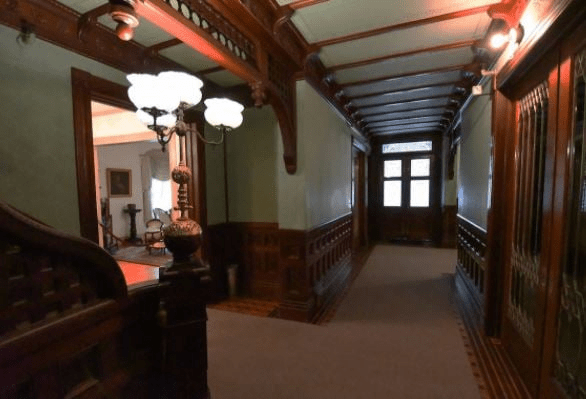
The séance women laid hands on her and commanded the evil spirit to leave, saying he had not right to stay in the body of one who believed in Jesus. Agnus had believed over a year ago, but her husband had taken a concubine and she was brokenhearted. In her deep sorrow, self-pity, and worry she reopened old areas to the devil. Once she cried out loudly: “I have been here thirteen years—do you think I am going to leave now?” Later her voice shrilled: “I hate Jesus; I will not leave.” Her facial expressions were terrible, hard, and angry. She tried many times to bang her head on the floor, and once she darted to a corner of the room and grabbed Mrs. Winchester’s parasol and struck her head with it. Hours passed and there seemed to be no change in her. Mrs. Winchester felt she could not remain much longer, as she had promised to go out visiting. As she was debating about what to do, Mrs. Winchester moved closer to Angus and began talking to her about Jesus Christ, telling her how He could alone comfort her and satisfy her heart. She listened and Mrs. Winchester saw tears in her eyes. Angus told Mrs. Winchester, “Jesus Christ loves me, and I love Him, too, and He longs to help me.” She continued to talk along this line and she sat up. Mrs. Winchester finally told her why she thought the evil spirit had gotten in, that her worry and self-pity were sins. She thoroughly aggressed and admitted her hated of her husband and his concubine, which Mrs. Winchester told her was sin, too. She talked freely, admitting her faith was weak. Mrs. Winchester and her friends prayed for Agnus for several days. Just when the evil spirit left, they did not know, but you could imagine the great joy that filed their hearts to see her set free from that awful, wicked, noisy spirit. Mrs. Winchester was so happy. Mrs. Winchester was known for her beautiful mansion. It was certainly a place to see in the late 1880s. Mrs. Winchester, heiress to the Winchester rifle fortune, spent the last half of her life and $5,500,000.00 (2022 inflation adjusted $151,599,411.76) building a gorgeous house that was at its height 9 stories, 500 rooms, and 65,000 square feet, Today it is an astonishing, what I call, Grand Queen Anne Victorian of 4 stories, 160 rooms, and an estimated 25,000 square feet. #RandolphHarris 13 of 17

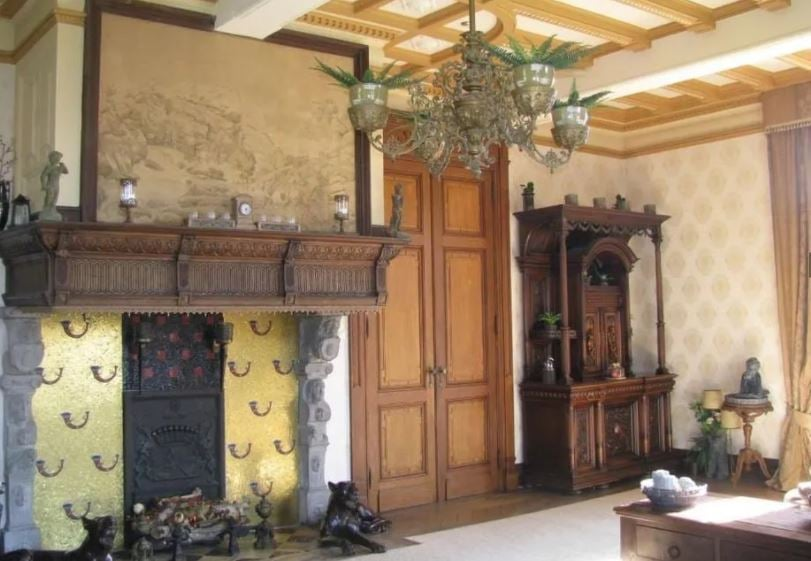
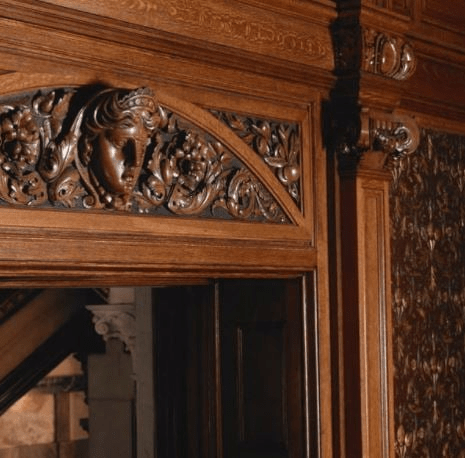
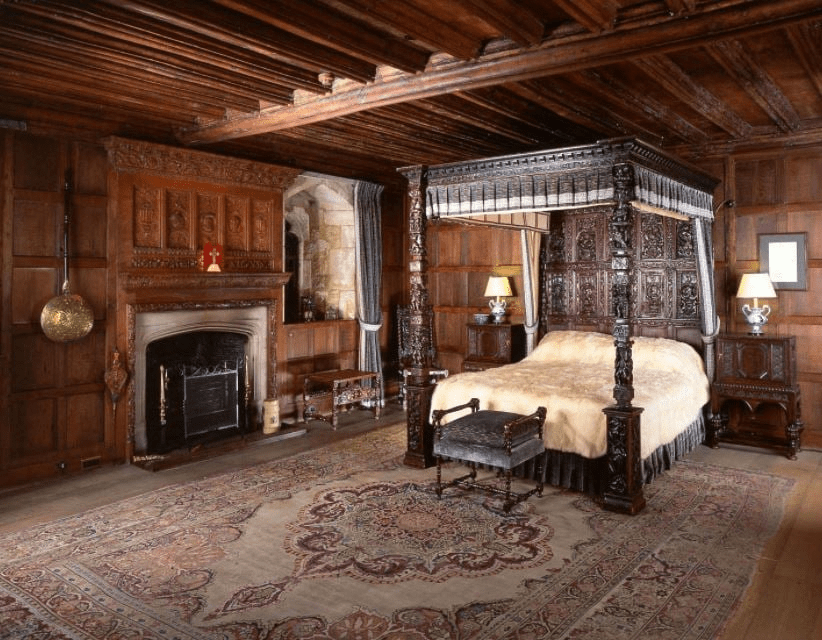
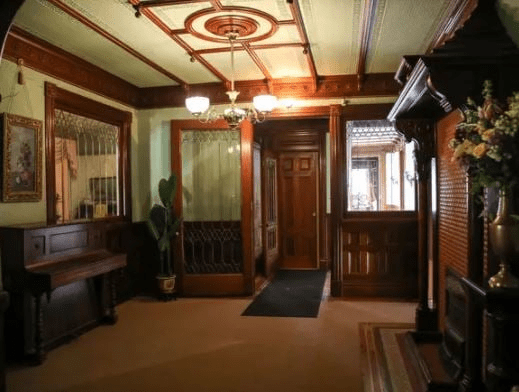
Partly because of the mansion seclusion, partly by reason of its extreme beauty, partly, it may be, because the owner was more than charming and gracious in her pressing hospitality, The Winchester Mansion, which is now called The Winchester Mystery House, had an element of the poetic, almost magical. The warm light of the spring sunset swept across the estate, lying golden and mellow on the luxuriant growth of prune, fig, orange, lemon, and peach trees, and fantastic palm trees, emerald green lawns, exotic flowers, giant topiary, statues, fountains, gazabos, and other Victorian cottages lead up to the path of the 760-acre mansion. Against the gold sunset, it was hardly to be wondered at that one should slip into a mood of visionary enjoyment, looking for a time on the whole thing as the misty phantasm of a summer dream. Carpenters worked around the clock building and rebuilding room after room, as the spirits—or her fancy—directed. The house was furnished with the finest materials and was a showcase of Victorian elegance and taste. This paradise of art and colour, was a bewilderment of architects. The Winchester Mansion was truly a dream of delight. It was a paradise, an epitome of all that was beautiful. The mansion was like a vision out of a fairy tale. And in the evening, the sunset seen from the observation tower was like watching the blue sapphire sea turn a lovely amethyst, rose, violet in shadow. Seen in the hot summer months, Mrs. Winchester’s exquisite home was like looking at the most gorgeous emerald glittering from a distance. From the balcony of the fourth flood, one can smell the roses and jasmine all around. Llanada Villa, as Mrs. Winchester called it was a light of the Beatific Vision. It was so unreal, so phantasmal, that one was not surprised it held secrets. It was said that the mansion was haunted. Yes, that is just it. The Winchester Mansion is really haunted. However, what is there to be afraid of. People rarely see ghosts and no one sees them more than once. Yet, this mansion is said to be haunted by legions of spirits. After Mrs. Winchester went to Heaven, her favourite niece, Marian “Daisy” Marriot stayed in the mansion for a few months. #RandolphHarris 14 of 17

There was a story about the ghost of Mrs. Winchester in this royal house. She was supposedly imprisoned in this palace. Notice the beautiful iron-wrought grilles at the windows. The haunted region of the mansion, was striving to communicate with Daisy. Legend has it that Mrs. Winchester was imprisoned in one of the witch’s caps. How, was never known. It was when Daisy was in possession of this house that the ghost started to appear to her. She did not fancy real ghosts, however. One night, when the stars were not visible in the sky; low, thunderous clouds, massed at the head of the valley, were sweeping over so close that they seemed to brush the palm trees on the estate. To the south and the east the storm-clouds had shut down almost to sea, leaving a space of black sky where the moon in its last quarter was rising just to the left of the mansion—raining a black silhouette against it. They blue lightning flashed almost incessantly, and through the fitful darkness cam the sound of the bell tower, which could be heard across the valley, the rushing torrent below, and the full roar of the approaching rain, with a deep organ point of solemn thunder through it all. Daisy believed that Mrs. Winchester’s unquiet soul, sent out this story of eternity. Vivid lightning, the crowding of Mrs. Winchester and the shivering anticipation of Daisey’s possible visitation made sleep quite out of the question. Then, an hour and thirteen minutes after midnight, came a sudden vivid flash of lightening, and, as Daisy’s razzled and dazzled eyes began to regain the power of sight, she saw as plainly as in life—a tall figure, in a silky white dress, with long flowing hair. In another flash, the beautiful apparition looked at her long and earnestly. She was beautiful —more beautiful than one had supposed possible, her deep, passionate eyes very tender and pitiful in their pleading, beseeching glance. Daisy was hardly frightened, or even startled, but lay looking steadily at her as she stood in the beating lightning. Then she breathed, rather than articulated, with a voice that almost brought Daisy to tears, so infinitely sad and sorrowful was it, “I cannot sleep!” and the liquid eyes grew more pitiful and questioning as bright tears fell from them down the pale glowing face. #RandolphHarris 15 of 17

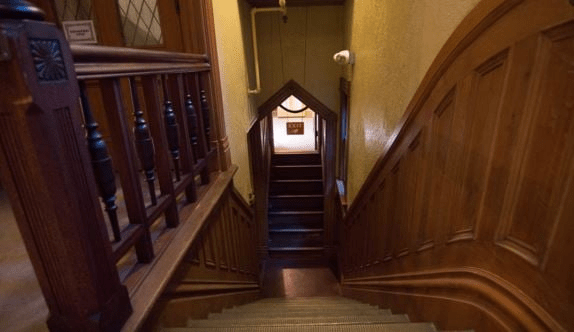
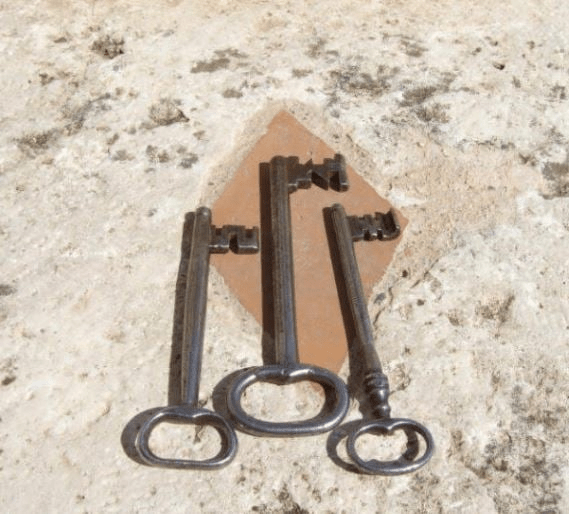
The apparition began to move slowly towards the door, its eyes fixed on Daisy’s with a look that was weary and almost agonized. Daisy learned from the bed and stood waiting. A look of utter gratitude swept over the face, and turning, the figure passed through the doorway. Out into the shadow of the corridor in moved, like a drift of pallid storm cloud, and Daisy followed, all natural and instinctive fear or nervousness quite blotted out by the part she felt she was to play in giving rest to a tortured soul. The corridors were velvet black; but the pale figure floated before her always, an unerring guide, now but a thin mist on the utter night, now white and clear in the bluish lightening through some window or doorway. Down the stairway into the lower hall of the second floor, where the stained-glass windows in the flared into sudden clearness under the fitful lightening, out into the silent cloister. It was very dark. Daisy stumbled along the solid mahogany floor. She guided herself by a hand on the gelled linseed Lincrusta-Walton wallpaper. Then a sudden blaze of fierce lightning, and vivid light allowed her to see the face with a look of overwhelming desire, of beseeching pathos, that had choked Daisy’s throat with an involuntary sob when she first saw Mrs. Winchester. And she heard the sorrowful words again, “I cannot sleep,” come from the impenetrable darkness. And when the lightning came again, the beautiful white figure was gone. She wondered around the mansion, searching in vain for Mrs. Winchester. She tired the door-to-nowhere when Mrs. Winchester vanished: it was locked. It was found at last. The smooth surface of the plaster on the white wall. There was a rough space, approximately the shape of the other windows in the tower, not plastered like the rest of the wall, but showing the place where a stained-glass window was covered up through its thick coatings of whitewash. Daisy began scraping away at the solid wall. Under the coatings of plaster appeared an entrance to a secret room and it led her over a vertical joint between firm, masonry work. She began digging out the mortar around the stone. With much work it detached. #RandolphHarris 16 of 17

Darkness within, yet beyond question there was a cavity there, not a solid wall; and with infinite care she removed all the stones. Still the hole was too small to admit enough light from the dimly illuminated cell. With a chisel, she pried at the sides of a large block of masonry, perhaps thirteen stone in size. It moved, and with seemingly superhuman strength, Daisy softly slid it from its bed. Suddenly a cry, a cry like that of a frighted woman—terrible. Framed by the jagged opening of the stone, hardly seem in the dim light, was a face, an ivory image, more beautiful than any antique bust, but drawn and distorted by unspeakable agony; the lovely mouth was smiling; the eyes were cast upward; and below, slim calcified hands crossed on the chest. Torture and agony visible in every tense muscle. Daisy stood there, breathless, staring at the sight, fascinated, bewitched, sad. So this was the mystery. With fiendish ingenuity, the rigid ecclesiastics had blocked up the window, then forced the beautiful creature to stand in the alcove, while with remorseless hands and iron hearts they had shut her into a living tomb to gain access to her land. With all that, it was necessary to find Mrs. Winchester so her soul could rest. Prayers were said that night for her soul. The next day the alcove was again walled up. Demons can subject the mind and the body. Demon subjection is one step beyond demon influence. When the moral law of God is persistently and flagrantly disregarded, demon influence may merge into demon subjection. The cursed then becomes the slave of the demon. Many have also become slaves because of illicit lust, perhaps goaded on by vile spirit that master their victims and drive them on to moral ruin. Those who nurse hate and revenge may find that a superhuman power takes over, impelling them to murder. Those who covet become slaves of greed. Those who persistently lie may become enslaved by evil spirit of falsehood until they are incapable of telling the truth. Persistent sin against the second table of the moral law regulating humans conduct towards humans (Exodus 20.13-17) opens the door to demon power than can derange a living soul’s mind, weaken one’s will, alienate one’s affections, and disturb one’s emotions. “Beware of sibling rivalry! At least said my grandmother. Which must explain, I do suppose, what happened to my little brother.” #RandolphHarris 17 of 17


Winchester Mystery House

Fabulous photo op outside The Winchester Mystery House circa 1940s 💁🏻‍♀️

🎟 link in bio. https://www.winchestermysteryhouse.com/

Battle Between Scientists and the Press to Control How the World Found Out

Our discussion to this point has led us to essentially the following picture of how cell differentiation occurs in plants and animals. As the fertilized egg cell undertakes mitosis—dividing first into 2 cells, then into 4, then 8, and so on—slight differences in the chemical conditions in the several cells cause corresponding slight affect the … Continue reading

Was the Fairy-Tale Transformation of Cinderella’s Footmen so Far-Fetched?

Cells provide structure and function for all living things, from microorganisms to humans. Scientists consider them the smallest form of life. Cells house the biological machinery that makes proteins, chemicals, and signals responsible for everything that happens inside our bodies. Knowing that all living things are made up of cells allows us to understand how … Continue reading

That was Heinous Crime–Do Not Waste Granny’s Delicious Chess Pie Like that!

Various scientists around the World are trying to build cells from scratch. Marileen Dogterom has been piecing together a cytoskeleton in the Netherlands. Kate Adamala is attaching receptors to a lipid bilayer in Minnesota. And Tetsuya Yomo built RNA that can evolve like the real thing in Japan. However, by and large they have been independently working on different cell parts. Now, a growing number of collaborations are melding these efforts together and speeding progress toward an audacious goal: building a living cell out of non-living molecules. A cell constructed from the ground up would let researchers better test drugs, enable bioengineers to build the next generation of cellular machines, and help biologists answer the fundamental questions: What does it mean to be alive? The efforts to find out is driving toward a common purpose: constructing organisms that have some properties of cells, such as the ability to divide and pass on information to their offspring. Scientists can also customize these new creations, building cells to do things that might not occur in nature. Perhaps most interestingly, they might build something that meets our definition of “alive” but looks nothing like existing cells—perhaps it has a different information storage molecule than DNA, or it is enclosed not by lipids but by proteins. Creating and studying such a thing might help answer the basic question of what it means for something to be alive. Researcher J. Craig Venter Institute announced that they had created a minimal bacterial cell—a Mycoplasma bacteria that contained just enough genes to stay alive. That number is 473. Cut one more gene off, and the bacteria will not work properly. Add an extra gene, and not the bacteria is carrying unnecessary baggage. However, at the time of the study’s publication, the scientists only knew the function that 324 those genes actually served. The remaining 149 did something to keep the cell chugging along, but scientists do not know what. #RandolphHarris 1 of 19

May be an image of car and road

As cellular chemistry became more and more complex, requiring increasing numbers of different enzymes to direct the many separate metabolic reactions on which life depended, the problem of ensuring that the individuals of each generation received a complete complement of the corresponding types of DNA molecules must have become more and more critical. It seems unlikely that modern cells, with their survival requiring the successful completion of complex reaction sequences depending on thousands of different enzymes, could ever have developed if a way had not been found to pass DNA along from parent to offspring in an orderly manner. Fortunately, orderly procedures were possible and evolution succeeded in finding one. All the principles governing continuity of general characteristics withing species and inheritance of detailed characteristics by individual derive from the nature of the particular procedure that is now universally employed by living organisms for the precise handling of DNA. The processes we are about to consider occur in the nucleus. With a small exception, to be discussed later, that is where all the DNA of the cell resides. In very primitive organisms such as bacteria, in which a definite nucleus/cytoplasm boundary is hard to detect, there is still a localized nuclear region within which the processes in question take place. The key to the modern genetic protection mechanism is packaging. Within the nucleus the thousands of different DNA molecules do not simply mill around, each performing its functions of self-replication and manufacture of complementary RNA molecules independently of the rest. Instead, the DNA molecules carry, a big step further, the long-chain structural concept that led to their own formation. They themselves hook together end to end, thereby forming nucleic acid “strands”—giant giant molecules composed of individual DNA components, each of which is already a giant molecule because of its own linking together of hundreds or thousands of nucleotides. #RandolphHarris 2 of 19

May be an image of furniture and living room

In the cell of a complex organism there may be thousands of different DNA molecules strung together to form each such gigantic array. All of such strands or arrays possessing the same configuration of DNA molecules then line up side by side, along with some protein material about whose function we shall later speculate. The resulting package is called a chromosome. (Evidence suggests that, in most cells, there are only few copies—perhaps only one—of each type of giant giant molecule. However, certain special cells, such as those in the salivary gland of the fruit fly, develop giant chromosomes containing thousands of times as much DNA as the average cell. In such special cases the chromosome appears to be a bundle of thousands of parallel and identical strands of DNA.) The separate types of DNA molecules that compose the chromosome are called genes. Higher organisms package many more different genes in each chromosome than do lower organisms, in order to carry the book of instructions that directs the complex chemistry of the cell. Frequently there are also more chromosomes. Thus only 8 chromosomes are found in the nuclei of fruit-fly cells, 46 in those human cells. Each stand of a chromosome acts partly as if it were a single molecular entity, partly like a loose aggregation of separate molecules. It reproduces itself as a unit—each ordered array of DNA molecules begets another similarly ordered array of the same types of DNA molecules. On the other hand, the individual DNA molecules seem able to perform their chores of manufacturing messenger RNA independently of one another. However, in the movement of DNA from the nucleus of an old cell to that of a new one, during cell division, again unit action occurs: the separate DNA molecules are evidently tied together tightly enough that only completely strands participate in the migration. It is, of course, cell division (mitosis) that plays for modern organisms the same kind of reproduction role that plays for modern organisms that same kind of reproduction role that was once played by the physical forces of wind and wave as they broke into smaller pieces the primitive coacervates. #RandolphHarris 3 of 19

May be an image of furniture and living room

Nowadays, however, it is the chemical state of the cell, rather than the physical conditions of the environment, that sets into motion the reproduction process. For example, it is possible that the complex interrelated chemical activities of mitosis are triggered by the approach to some built-in limit by the amount of DNA in the nucleus. Certain it is that, between successive divisions of a growing cell, the amount of nuclear DNA doubles. Whatever may be the initiator of the processes of mitosis, the events that take place are known to every student of elementary biology. They are featured by a doubling of each of the chromosomes, a dissolution of the nuclear membrane, and an orderly migration of the two resulting sets of chromosomes to opposite sides of the cell. This is followed by a pinching together of the walls of the extended cell to form two separate cellular units and finally by the reestablishment of nuclear membranes to contain the chromosomal material. The result is two cells instead of one, each possessing approximately half of the original cytoplasmic material and a set of nuclear DNA molecules identical with that with which the parent cell started life. However, we have explicitly localized these DNA packaging and distribution mechanisms in the nucleus. And references have been made to the fact that not quite all of the DNA of the cell is confined in the nucleus. The time has come to explain thee references and to examine whether the existence and properties of the nonnuclear DNA can be accommodated in our picture of the DNA protection mechanisms. The nonnuclear DNA—of an amount totaling a very few percent of that located in the nucleus—is found in some of the organelles of the cytoplasm. Mitochondria contain a small amount of DNA; so do chloroplasts, the chlorophyl-containing inclusions that perform photosynthesis in green plants. And this DNA clearly carries out genetic functions. This is been proved by experiments in which mutations were induced in the DNA of the cytoplasmic organelles by microbeams of ultraviolet radiation so directed as to miss the nucleus; physically abnormal organelles were then observed to occur in all subsequent descendants of the irradiated cell—showing that the undamaged nuclear DNA did not provide the structural specifications involved. #RandolphHarris 4 of 19

May be an image of furniture and kitchen

Further elaboration of the details of the nonnuclear genetic mechanisms, which is under way today in a number of research laboratories, is clearly of great scientific importance. The discoveries already made render it untenable to attribute all of the genetic control of an organism to the nucleus, as was once done. However, there is as yet no evidence calling for other major changes in the picture we have drawn of the genetic mechanism. For the experimental results are compatible with the hypothesis that the nucleic acid/enzyme processes related to the small amount of DNA of the organelles are just like those related to the much larger amount of DNA in the nucleus. The organelle DNA appears to manufacture messenger RNA which assembles corresponding enzymes. And, during mitosis, not only does the nucleus of the cell divide but so also do the organelles we are considering. It seems likely, too, that there are chromosomal mechanisms within the organelles that cause their genetic material to be accurately apportioned between parent and offspring, just as in the case of the nucleus. Thus, while it is interesting to speculate about the course of evolutionary development that has withheld from the nucleus of modern cells, there is as yet no indication that the anomaly of nonnuclear DNA requires any other major revision in our basic concepts pertaining to the genetic mechanisms. Whether we have in mind the nuclear or the nonnuclear DNA packaging arrangements, it is clear that their net effect is to remove most of the element of chance from the basic mechanism of genetics. The precise propagation of DNA molecules from one generation of cells to the next results in similar precision in the chemical and physical nature of the progeny. A splitting amoeba process more amoebae, a paramecium more paramecia, a human cell more human cells. Even though the environmental conditions within which the new generations develop differ somewhat from those which nourished their parents—in temperature, chemical composition of the surrounding fluids, and so on—the relatively tight control over the specific cellular chemical processes exercised by the powerful protein enzymes, which in turn owe their creation to the specific roster of DNA molecules in the chromosomes, results in the remarkable continuity of species characteristics that features modern living forms. #RandolphHarris 5 of 19

May be an image of 1 person

A final comment about what may seem to be a curious inconsistency in one aspect of our argument would appear to be in order. We have just expressed admiration for the effectiveness of the chromosomal mechanisms in preventing change in the nature of the vital DNA material in going from one generation to another. And yet, only a few days ago or so, our sympathies seemed quite different. For the development of our theories then we emphasized the existence of mechanisms capable of causing accidental changes in the ingredients responsible for the structure and metabolism of our organisms. We even went so far as to postulate the presence in the primordial seas of a small quantity of “nucleotide-linking catalyst” that encouraged the accidental formation of nucleic acid molecules of increased length and complexity. We could in addition have expressed satisfaction with the knowledge that thermal collisions and radioactive particles are also capable of causing mutations in the structure of nucleic acid molecules. Is our earlier emphasis on change consistent with our later emphasis on genetic stability? Fortunately, it is not too difficult to reconcile these apparently incompatible points of view. During the era of preanimate coacervates, when extensive refinement in structure and metabolism was necessary before anything like living organisms could exist, there was obviously a premium on “mutagenic agents.” This led not only to a corresponding emphasis in our literary treatment but probably also, by the normal economics of the evolutionary processes, to a relative abundance of such agents in the primordial seas. However, after eons of the trial-and-error refinement of the properties of organisms, a time must ultimately have come when random change in their properties was so much more likely to be harmful than helpful to the species that the advantage would all have been on the side of a combination of environment and organisms leading to relatively low rates of mutation in the hereditary mechanisms. #RandolphHarris 6 of 19

May be an image of furniture and kitchen

Natural selection would then not only have brought to prominence such techniques for protection of the property-determining ingredients as we have just considered in connection with the nuclear DNA but might even have acted to diminish the abundance in the environment of some of the mutagenic agents. For example, if in certain regions primitive organisms were spilling into the seas such a quantity of nucleotide-linking catalyst as to lead to an undesirably high rate of mutation in the properties of most other organisms in the vicinity, there would have been a tendency for the main line of evolutionary development to be retarded in such regions; the result would ultimately have been the starving out of the undesirable mutagen-producing species as the course of evolution in remoter regions accelerated the proliferation of more modern strains. Whether such developments occurred to slow down the rate of mutation or whether it was always slow (with the extensive accomplishments of evolution attribute only to the great time periods available), it is certain that today the combination of environment and organism seem usually to emphasize stability rather than change. When modern cells successively divine and send some of their precious DNA to guide the construction of new individuals, we expect the DNA that each new individual ultimately sends on to its progeny to be identical with that which it received, and we are rarely disappointed. It is likely that, on the average, each individua DNA molecule duplicates itself 100,000 or more times without the change of even a single atom in the thousands of which it is composed. Changes do occur occasionally, to be sure; if they did not, evolutionary development would be impossible. However, in terms of the few dozen or few thousand years over which the human species makes most of its observations, the protection provided to the large majority of the DNA by its nuclear environment and the precision of the mitotic distribution mechanisms, together with the relative scarcity of mutagenic agents, now contributes a remarkable degree of stability to the structure and metabolism of living organisms. #RandolphHarris 7 of 19

May be an image of table and indoor

The sophisticated membrane properties of the modern cell, the ribosomal and mitochondrial structures, the nucleic acid/enzyme mechanisms, the chromosomal/mitosis processes—these and other features have been achieved at a tremendous cost of time and painstaking trial-and-error experiment. It is fortunate that the natural forces of evolution operate in such a way as to require convincing evidence of superiority before novel processes are allowed to replace such tried-and-true structural and metabolic principles. Looking ahead, does bullying qualify as a national crisis? Bullying is an unacceptable behaviour that adults and students have a responsibility to stop. Most people think of bullying as teasing someone and make lighthearted jokes about an individual. However, it is a blanket term to downplay serious crimes. Bullying and cyberbullying can become a crime if you: physically assault someone, vandalize property, harass someone especially if the harassment is based on gender or racism. Furthermore, violent threats, death threats, obscene and harassing phone calls and texts are also criminal acts. The list goes on to include explicit photos of an adult or minor used to extort the person, or sharing these photos with other, stalking someone, committing hate crimes, taking a photo of someone in a place where they expect privacy, and extortion. Do not think these acts are not a crime. The Secret Service released a report examining the dozens of school shooting that have taken place across the United States of America since 1997. It found that bullying was a factor in two-thirds of them. In some cases, the shooters had been bullies; much more often, they had been the victims of bullying. A survey released by the Kaiser Family Foundation and Nickelodeon asked a national sample of children aged 8 to 15 what issues in school concerned them most, and all age groups pointed to teasing and bullying as “big problems” that ranked higher than racism, deadly illnesses, and peer pressure. Reports such as these have elevated bullying from a narrow concern that is best dealt with by students themselves (or perhaps by the teachers and parents of those directly involved) to wide speared problems that requires the attention of school-level programs and statewide policies. #RandolphHarris 8 of 19

May be an image of 1 person

A recent study found that a full 30 percent of American students are involved in moderate or frequent bullying—11 percent have been victims, 13 percent have been bullies, and percent have been both. Other studies report even higher results. When you sit down to talk to someone who has been a victim of noted death threats, felony assault and vandalizing, stalking, and trespassing never says, “So you are being bullied.” That is totally making the situation seem like someone has just been teased by children on the playground. However, when someone in a political position is hit in the face with a pie, it suddenly becomes a very serious problem and is called “assault,” no bullying, or “just horsing around.” In 2016, when Sean Thompson walked up to the defunct mayor of Sacramento, Kevin Johnson, and hit him in the face with a pie. The Johnson then tackled Thompson, then punched him more than half a dozen times until his face looked like a “bloody pulp.” Sean Thompson hit Kevin Johnson with a pie because he put more than half a billion dollars into the King’s arena, instead of projects that could actually help people in the community. Sacramento then charged Sean Thompson with many believe was the stiffest potential penalty a pie-thrower has ever received: felony assault and misdemeanor battery, with a bail of $100,000. Many believe the punishment was unconstitutional. However, when you look into Kevin Johnson, many may wonder why he got away with so much when he was far more than a bully, then rewarded by becoming mayor, where he racked up more crimes that as of yet, have still gone unpunished? Imagine if the shoe was on the other foot and a European American mayor had responded to a young African American male the same way. The World would have been outraged. While the issue of equality is important, African Americans do not want to be perceived as aggressive victims. The issue is equal rights under the law for all. #RandolphHarris 9 of 19

May be an image of kitchen

How easy can it be for clinicians to identify which children will turn dangerously violent if indeed 33 percent of all children have experienced bullying? One thing to keep in mind about self-defense, is often times it is, in many cases, better to walk away from the situation because it may not go the way you think it will. Certain people, and those in certain positions get more leeway when it comes to how they react to “bullying.” However, keep in mind, when it comes to self-defense, you will need to prove you had a reasonable belief that you were in imminent danger of suffering harm or death, you have reasonable belief that using force was necessary to prevent such harm, and you used an amount of force that was necessary to stop that threat. Because if some person hits you in the face with a pie, and you beat them to a bloody pulp, you might actually go to jail for that because that is called excessive force. How can we rid ourselves of a problem as pervasive as this? Short of raising kinds in isolation chambers…bullying behaviours can never be eliminated entirely from the sustained hazing ritual knows as growing up. Remember bullying and the force you use to defend yourself can be considered a criminal act. Think about it, is assault or a hate crime worth being sent to jail for? Is being mean and cruel and hurting other people worth running their life and yours? Next time you think it is funny to hurt someone in person or online, think carefully about the consequences. You may think it is funny at first, but think about how much fun it would be for you to be spending time in jail! Think about how being in jail could prevent you from attending college, having a great career? Think about having a criminal record for the rest of your life, which could even impact who is willing to marry you, rent to you, or hire you for a job. Think about how funny you think it is when you bully others. However, if you go to jail, think about how others will feel about you. None of these things would be too much fun…would they? #RandolphHarris 10 of 19

May be an image of furniture and living room

Equal to some businessmen, some of our government and public spokesmen have a knack for debasing the noble and making the excellent trivial. The current disease is to make Cold War capital out of everything, no matter what. We cannot dedicate a building of William Carson’s of Sarah Winchester’s in California without criticism for being so beautiful and creative. This type of criticism is tasteless; the matter becomes serious when our freedoms are involved. Many civil rights leaders and organized friends of culture keep repeating freedom of speech, freedom of culture. (You would think that we did not have our own means of censoring, by commercial selections and by swamping.) However, many Americans are facing Cold War censorship, not only have they been forced to wear masks, and get two and three vaccinations, there is also talk out of Washing about having Americans receive a COVID vaccine every year. In addition, many people had to shut down their businesses and stay locked in their homes during the pandemic. The concern is that this sort of treatment could turn into tyranny. This resulted in an inconceivable loss of revenue and tourists. Such behaviour is inconceivable by Americans. We are not at Cold War with the American Dream of working hard will afford you a nice lifestyle. However, tyranny is patriotically disastrous; it teaches that our spokesmen and women are not earnest; they pick and choose when to stand up from freedom of thought. How then can a boy be proud? (But to be sure, we have little such freedom, compared with the British, for our mass media are not, like their, open to fundamental controversy. It is not surprising, therefore, that for English Angry Young Men an important topic is their outraged patriotism, whereas our Beats do not care about that.) Racial antipathy leading to actual violence is not limited to humans, although it is only the less evolved humans who resort to it. In the tropics one sees black ants fighting the red ones, mutilating and even ending the lives of one another. #RandolphHarris 11 of 19

May be an image of furniture and living room

The final tragedy of Humans: that they let themselves go along with destructive forces which in the end could gravely injure the whole species, when they could go alone with the constructive ones. This fleshly body, in which we live and move and have our being, has, through pleasures of the flesh and sport, become a cult to the modern World. We fall in our millions, prostrate votaries at its shrine, forgetful that its quick growth is followed by quick decay, that our idol is doomed to crumble. Too many moments of highest enthusiasm on the part of youth are often reserved for the new religion—sport. A whole theology has been built up around the strokes of a bat and the throws of a ball; hard hitters are now canonized as saints. One who throws one’s ball far enough may yet send oneself, with it, to the new Heavenly America! And as far as pleasures of the flesh, the passions and emotions of the young are deliberately stimulated by the arts of literature, journalism, cinema, and advertising just at the age when they ought to be disciplined. How little humans collectively learn from the past is show by every textbook of history, which teems with constant repetitions of the ugliest passions. The Worldwide condition of human mass, its hates, ignorance, and violence, brings despair to many a thoughtful mind. Violence is a destructive force which in the end and when excessive destroys even itself. Among the negative emotions we must include prejudice and bias. The negative emotions include arrogance and vanity, cowardice and moral weakness. All the negative thoughts and feelings show a misuse of mental power. Temptations and beguilements, illusions and deceptions, beset the path of ordinary life just as they do the inner life of the quest. However, in the latter case they may also assume a subtler form. Here there are telepathic, psychic, spiritualistic, and neurotic possibilities. There are times when a person is more vulnerable to attack by negative thought than at other times. In great emotional excitement, anger, or passion of any kind, we are most susceptible. #RandolphHarris 12 of 19

May be an image of 1 person and indoor

Yet, there are three great types of life and thought representing three different solutions of the problem of ethics in historical change: first, the static supranaturalistic solution, represented by the Roman Catholic church and expressed in the ethics of Thomas Aquinas; second, the dynamic-naturalistic solution, represented by the National Socialist movement and expressed in the ethics of the philosophers of life; third, the rationalistic-progressive solution, represented by Anglo-Saxon common sense expressed in the ethics of the philosophers of reasons. With tremendous psychological power the static supranaturalistic solution maintains the eternal and immovable character of the ethical norms and commands. Philosophy and theology co-operate in this direction. The World is conceived as a system of eternal structures, preformed in the divine mind, which are substance and essence of everything and which establish the norms and laws for a human’s personal and social practice. Philosophy discovers these structures and laws, and revelation confirms and amends them. Revelation adds some superstructures of its own that are new and higher laws, but equally eternal and immovable. Both the natural and the supranatural together form a hierarchy of powers and values that control nature and are supposed to control human activities. The church, itself a hierarchical system, teaches this system, educates for it, fights for its political realization, and defends it against new systems. However, in so doing the church cannot disregard the actual situation and historical changes. The church must adapt its ethical system to new problems and new demands. The Catholic church has been able to do just this, admirably, for centuries, and the living authority of the Pope is still a marvelous instrument for achieving adaptations without losing its immovable basis. Nevertheless, it is obvious that the Catholic church did not fully succeed in dealing with the presuppositions and demands of the bourgeois era. Protestantism and the Enlightenment created new systems of ethics standing in opposition to the supposedly eternal system of the medieval church. #RandolphHarris 13 of 19

May be an image of furniture and living room

And when the church tried to proceed with the stream of the rising bourgeoisies, as, for example, in the moral preachings of seventeenth- and eighteenth-century Jesuitism and in the teachings of nineteenth-century modernism, either it lost its seriousness and authority or it gave the unhappy impression of rearguard action in which every position is defended as long as possible and then surrendered. And the important utterances of the Holy See during the nineteenth century concerning social and political problems presuppose, in order to be applicable, the unbroken unity and authority of the Christian church, which no longer exist. Therefore, they did not at all influence the spirit of modern ethics and the direction of bourgeois society. The price paid by the static supranaturalistic answer to our question has been the loss of a determining influence on the changing World of the last centuries. The opposite solution, represented by national socialism, was prepared for in two main ways—by the Continental vitalistic philosophy and by Angelo-American positivism and pragmatism, the latter being only a different form of the vitalistic philosophy. National Socialism has used and abused philosophical motives of the Continental philosophy of live, especially of Nietzsche, Pareto, and Sorel. Philosophy must express life in its changing forms and trends. Truth, according to Nietzsche, is that lie which is useful for particular species of being. Values are produced and withdrawn in the dynamic process of life—biologically speaking, by the strongest kind of living beings; sociologically speaking, by the strongest kind of living beings; sociologically speaking, by the new elite; and politically speaking, by the eruptive violence of a revolutionary group. Change, being the chief character of life, is also the chief character of ethics. There are no independent norms above life, no criteria by which power can be judged, no standards for a good life. Good life is strong life, or violent life, of the life of a ruling aristocracy, or the life of conquering race. This implies that the individual, instead of being guided by the ethical norms that are manifest in one’s conscience, is obliged to merge one’s conscious with the group conscience. #RandolphHarris 14 of 19

May be an image of furniture and bedroom

One must co-ordinate one’s standards with the group standards, as represented by the leaders of the group. The dynamic-naturalistic type of answer to the question of ethics in a changing World has a primitive-tribal character. It is, historically speaking, at the same time the most recent and the most ancient of all solutions of the ethical problem. Now a quantum leap, from reasoned dedications about the general principles governing the behaviour of long-vanished societies to three real societies: traditional and modern China, ancient Greece, and several nations in today’s Muslim Middle East, all demanding bribes preserve their virginity for their husbands. For long periods of history, the Chinese increased the chances of maintaining large-scale chastity by crippling little girls’ feet so that, as nubile woman, they could barely hobble from room to room, much less down past the garden gate to indulge in pleasures of the flesh adventures. Nonetheless, some unmarried women—maimed and unmaimed—were unchaste. Of these, many concealed the fact or got caught by their families or were publicly exposed—for example when the bridegroom feld from the wedding chamber, bleating about having married a “wing-broken bird.” How did these lapses occur? In the usual way, and sometimes, even women with bound feet defined probability and were wanton, willful, or seduced. These unmaidenly maidens felt no spiritual guilt, for their deed had no religious connotations—as females, after all, they were considered lesser beings than males. However, they had violated China’s pervasive principle of yin and yang, the essential harmony that governed society. Those who were caught dreaded the consequences, for the price of unchastity was dishonour for the entire family. They had defiled the national culture of mianiz, honouring one’s family’s prestige. For women, a peccadillo in pleasures of the flesh was costly in other ways. It was difficult or impossible to find a husband for sullied women except by subterfuge—passing her off as a virgin. And if a man agreed to accept a nonvirgin, he would not send his bride’s family the expensive gifts they could otherwise have expected five or six times a year. #RandolphHarris 15 of 19

May be an image of furniture and bedroom

In China today, the old values have not disappeared, though communism and modernity have modified culture expectations. However, female virginity is still very crucial to a love relationship. For chaste bride’s, the groom’s family often paid a large price forth the wedding. However, sometimes weddings are just an economic affair. As in China, celibacy in ancient Greece was also a uniquely female virtue. As we have seen, the Greeks did not value celibacy, but their daughters had to remain virginal. Because they regarded girls as lustful, early marriages seemed sensible—less time for brides to succumb to temptation. Sometimes, however, marriage did not come soon enough. If she was caught, the young woman was in terrible trouble. Fathers were obligated to obliterate all reminders of such shameful daughters from the household. Selling them selves into slavery was a common solution. One Athenian official took more drastic action: he fed his “ruined” daughter to a starved horse. Why not? By her unchastity, the girl had rendered herself a nonentity whose worthless body might as well sate another sort of bestial hunger. It was, of course, natural for a young woman whose secret lover had actually cause her to be with child to fight with the wiliness of desperation against her dreadful fate. The most common ploy was to swear the pearl inside was holy and that one of the gods had done this to her. Any girl (Parthenos) who managed to pull this off—and a few did—was not merely saved but was afterward treated as someone protected by divine immunity. After all, punishing a Parthenos, whom a god rather than a moral man had made unchaste, would inevitably provoke divine retribution. Palestinian Muslims are reminiscent of the ancient Greeks in their fanatical concern about premarital virginity. If they even suspect a girl has been unchaste, then brothers and fathers’ storm into action, terminating their own sists and daughters in sacrifice rituals. Often, these are disguised as accidents by burning the body. This usually happens to one woman a week. “They feel that women should take care to be a virgin when married, and not sleep around,” said Suheir Azzonuni Mashi, director of the Women’s Affairs Technical Committee in Ramallah, West Bank. #RandolphHarris 16 of 19

May be an image of indoor

Now, moving on to the economy. The dream of a perfectly synchronized, machinelike society tantalized many of the “modernizers” who influenced the industrial age. The object was to create a state and a society that ran with the efficiency of a machine: every bureaucracy acting as one, every individual moving in lockstep. However, human beings and human societies are, in fact, open systems. Messy and imperfect. In our lives and in our societies, regions of chaos and chance alternate with, and give rise to, regions of temporary stability. We need both. Stability and synchronization provide the degree of predictability we need to function as individuals in social groups and especially in the economy. Without some stability and time coordination, life is reduced to oppression by anarchy and chance. However, what happens when instability and de-synchronization take over? Despite decades of bloodshed and internal suppression, the United States of American never complete the enforcement of the Civil Rights Act of 1866.  In modern times, many people fear that COVID and high inflation could lead to the middle class being frequently being reduced to eating nothing but potatoes and cabbage. And that we will wander through ghostly supermarkets with virtually empty shelves. Some can envision in their mind’s eye the few jars of gray, moldy pastas that are on sale. And the freezing old woman standing on the steps of public buildings trying to sell a single ballpoint pen or a potholder—their only possession. Fearing a total economic breakdown, they very social order on which the country depends on will dissolve, and along with it any pretense of synchronized efficiency. Imagine is no knew when, or even if, promised products will arrive. Picture instead of just-in-time, American enterprises running on not-on-time. During a trip, one may be prevented from flying to New York from California as scheduled, forced to take a midnight train instead because, one was tole, no one is sure whether aviation gas will arrive in time for flight #RandolphHarris 17 of 19

May be an image of furniture and indoor

People fear hungering for things to work, for predictability, for someone—as the Italian dictator Mussolini once put it—“to make the trains to run on time.” However, societies need more than just trains that run on time. They need institutions that run on time and law enforcement which does their jobs and listens to citizens before things snowball into an avalanche. What happens, however, when one institution runs at such high speeds that it leaves society’s other vital institutions miles behind? No one can answer this question scientifically. The hard data are not there. Nevertheless, it is revealing to see what is happening to key institutions in America, where the race in the twenty-first-century economy is, at least for now, most advanced. What follows, then, is a first sketch, purely conjectural and surely controversial, that may help not just business leaders and government policy makers, but all of us as we try to cope with rapid change. And while we use the United States of America as the example, the implications are international. Let us focus, then on rates of change. Start with a mind’s-eye image of a freeway. At its side a police officer sits astride a motorcycle, pointing a radar gun at the road. On the highway are BMWs, each representing a major institution in America. Each BMW travels at a speed that matches that institution’s actual rate of change. Tomorrow we will look more into this equation. Grey Wolf, we are sending you to the Great God. Please tell Him that we, who invented forgiveness do not forgive; that we, who speak of trust can not trust; that we, who invoke faith would not believe. I write as though you could read. However, I know you understand. When you have left the forests and tundras and no longer lave your sinewy trails with the snows, tell Him that you were made on a different day. Your howls of bewilderment will echo with the mountain winds. And your songs will join those of the whales. Please tell Him for me, “Forgive them Father for they know not what they do.” #RandolphHarris 18 of 19

May be an image of indoor

There may be those who feel that they can live quite happily without either religious discipline or communion with God. However, they are grave error. The restlessness which characterizes us, the confusion which has come on our times, the increasing percentage of neuroses among us, and the general unhappiness of all of us in the midst of the greatest affluence the World has yet seen, has come upon us primarily because of the lack of that sense of communion with God which made our forefathers happy in spite of their poverty and their physical suffering. We relearned to interpret the symptoms of weariness and hunger, cry when bedtime or mealtime comes, and yet refuse either to go to bed or take their food. Living in a gilded palace, as it were, we are still miserable, for we are essentially orphans, having lost that most precious of all values in life, the sense of the Fatherhood of God. The feeling of deprivation grows sharper and more poignant, instead of less severe, as we grow older. The time comes to each of us when the burdens of life seem far too heavy to carry, when the brightness of youth begins to fade, and we notice the lengthening shadows which presage our end. More than ever then do we become homesick; homesick, not for our houses or for our countries, but homesick for the Universal Parent of all of us, for that deep affection which is the heart of the Universe itself, for the mercy of God; yet a wall of iron has been placed between us and Him, and we cannot find Him. What greater good can a human achieve, either for oneself or for the World, than to contribute one’s effort to piercing this wall and bring the Father and the children once more into loving communion with one another! Also, the about the national security risk racist against fellow Americans is. You are all American and if you use racism to suppress other Americas and keep them from advancing, it is a loss to the economy, it is a loss of tax revenue, and it is a loss of skill that may keep America number one. Remember, China has a population of 1.4 billion and America only has 3.25 million. Therefore, every American who can work needs to be allowed to work so they can innovate and keep the country strong. Politicians should address racism as a threat to national security. You do not have to welcome people you do not like into your homes, but it is important to respect the United States Constitution and give everyone equal opportunity. #RandolphHarris 19 of 19

May be an image of furniture and outdoors

Cresleigh Homes

May be an image of outdoors

Live in luxury like you have always wanted to in a Cresleigh Home. These thoughtfully designed floor plans allow you to customize your home with added features and upgrades.

May be an image of furniture and indoor

Enter on the first level to find a stunning open concept kitchen, dining room and great room where you’ll spend much of your fun time. 

May be an image of furniture

In the still of the night, I held my Cresleigh Home tight, ‘cause I love you so. Promise I will never let my Cresleigh Home go.

May be an image of furniture and living room

I the still of the night, I remember that night in May, the stars were bright above. I’ll hope and I’ll pray to keep your precious love.

“The more I live in this Cresleigh community, the more I realize that it’s such a caring community. It’s much more than welcoming and friendly. It’s a place where people are respectful.”

That’s what it means to be part of a friendly community.
#CresleighHomes

Why is there Never Any Happy News?

May be an image of outdoors

Evolution has been able to create the advanced structure and metabolism of modern organisms. Biological evolution is the change in inherited traits over successive generations in populations of organisms. Adaptation is a key evolutionary process in which variation in the fitness of traits and species are adjusted by natural selection to become better suited for survival in specific ecological habitats. The environment acts to promote evolution through changes in development. Therefore, determining how developmental changes are mediated is critical for understanding the mechanisms of evolution. In our early speculation about the primitive coacervates, before the nucleic acid mechanism appeared upon the scene, we pictured the development of a number of cell-like characteristic. The external membrane, which made an individual out of a modern cell, was such a characteristic. Another consisted of solid inclusions such as microsomes, on the surface of which certain kinds of chemical reactions might take place more rapidly. And we had no difficulty, in terms of the primitive mechanisms alone, in accounting for the existence of fluid-containing regions within the coacervates shielded by their own membranes from the chemical influence of the surrounding material. To the space-varying chemistry permitted by such complex structures, we were even able to add time-varying chemistry by postulating suitable combinations of membrane selectivity and reactions time lags. We have seen how the appearance of nucleic acid provided a powerful new line of evolutionary development. In the past, we have devised an imaginary course of natural history capable of refining the first fumbling architectural inclinations of nucleic acid into the remarkable precise and effective control properties of the modern nucleic acid/enzyme apparatus. In this way, our discussion has bridged the gap between primitive coacervates and modern cells with respect to the basic metabolic mechanisms underlying the control of growth and reproduction. #RandolphHarris 1 of 18

May be an image of 1 person, car and road

However, we should not allow our recent preoccupation with development of the genetic mechanisms to blind us to the fact that other refinements of the primitive mechanisms were also necessary if modern cells were to evolve from the coacervates. Let us consider two or three examples of these less spectacular, but nonetheless important, refinements that characterize living cells today. First, consider the properties of membranes. The physical laws that had to be obeyed by large-molecular-weight material in water would sometimes result in the formation of a semipermeable membrane enclosing the coacervate. In the ensuing treatment extensive use was made of the selectivity of such membrane—their confining effect on large molecules but relative permeability to small ones, for example. In general, the ability of an enclosing membrane to sustain substantially different chemical reactions in contiguous regions and to permit the interpenetration of selected products of these reactions is fundamental to the life process. Therefore, it might be imagined that the economic of natural selection would have caused today’s membranes to have much more highly developed properties than those of the primitive progenitors of cellular life. And indeed this is true, although it is true in a somewhat curious way. Apparently, just as in the case of the nucleic acid/enzyme apparatus, the processes of natural selection have discovered one basic structure that is superior to all others; for electron microscope observations have revealed that all cell membranes have essentially the same two-dimensional arrangement of protein and lipid material. However, this does not mean that the permeability properties are the same for all cells. The important differences needed to meet the metabolic requirements of different cell species are the same for all cells. The important differences needed to meet the metabolic requirements of different cell species are produced by means of enzymes of special class called permeases. #RandolphHarris 2 of 18

May be an image of furniture and indoor

Different varieties of permease can cause the standard membrane to pass or block the passage of different kinds of molecules. The combination of a suitable permease and the membrane also frequently results in one-way permeability, in which molecules of a certain kind will pass through the membrane in one direction but not in the other, even though they have to oppose a strong concentration gradient in their migration. It is easy to see how valuable this property can be in permitting a cell to extract selected ingredients from the surrounding fluids and concentrate them internally. Another example of a detail of cell structure that must certainly have undergone extensive evolutionary refinement consists of the solid inclusions in the cytoplasm—the microsomes—that we have seen play such an important role in the nucleic acid control of protein formation. By a combination of electron microscope and chemical techniques, it is clear that “working parts” of the microsomes consist of a myriad of very small subparticles, or ribosomes, that are densely distributed over the surface of the much larger microsomal particles. Each ribosome is of about the right size to support a single molecule of messenger RNA while it engages in its process of multiple marriage with the amino-acid-conveying transfer RNA molecules. In addition, these ribosomes have been found to possess a special chemical composition that presumably contributes to their mission. They themselves contain RNA, mixed in about equal proportions with protein. Apparently, this ribosomal RNA does not perform any control function of the kind that we have come to expect of nucleic acid. Instead, its binding with protein appears only to provide a surface with properties favourable to the attachment of the messenger RNA molecules that do participate in the control activities. Incidentally, studies of the ribosomal processes have led to the conclusion that the lie of the messenger RNA molecule is frequently a short one after it has stretched out on the ribosomal surface. In bacteria, at least, it last for only two or three minutes before it breaks up and its fragments float away. (However, some messenger RNA, especially in cells of higher organisms, persist for much longer periods.) #RandolphHarris 3 of 18

May be an image of furniture and kitchen

Experiments employing radioactive tracer elements, by means of which determinations can be made of the time intervals involved in the capture of amino acid segments by transfer RNA and these subsequent assembly of the segments into protein molecules under the guidance of messenger RNA, have shown that in two or three minutes only a few protein molecules can be constructed Thus, the formation of enzymes under the guidance of the nucleic acid mechanisms can be a very active process, with messenger RNA continually being manufactured by the DNA molecules and the ribosomes continually receiving newly arriving messenger molecules and then recleansing their surfaces after a small amount of protein-construction activity. It is only because every cell contains hundreds of microsomal particles each covered with thousands of ribosomes that this seemingly inefficient process can produce adequate numbers of protein molecules to sustain life. Modern cells contain a number of different types of inclusions in addition to ribosomes. Some possess such complexity of structure and function that they are called organelles, or “small organs.” Organelles are specialized structures that perform various jobs inside cells. In the same way organs, such as the heart, liver, stomach, and kidneys, serve specific functions to keep an organism alive, organelles serve specific functions to keep a cell alive. The mitochondria constitute an important kind of organelle. They are rod-shaped and about one three-thousandths of an inch long. There are perhaps 2,000 of them distributed throughout an average cell. Each tiny mitochondrion is a complete processing plant that takes in a standardized raw material—the sugar glucose—and puts out, in addition to by-products, and energy-rich chemical—adensoine triphosphate (ATP). More than a dozen separate chemical reactions are involved in this transformation, and each reaction is catalyzed by a different enzyme. The mitochondrion must store all these enzymes as well as the intermediate products in a structure that permits the continuous assembly-line manufacture of its end product ATP. #RandolphHarris 4 of 18

May be an image of kitchen

ATP, sometimes called a coenzyme, differs from the nucleotide adenylic acid only in its possession of three phosphate groups instead of one. It is by all odds the most important source of chemical energy in present-day organisms. No modern cell could survive without it. And the origin of this vital ingredient is the complex chain of reactions, many of the steps of which are identical for man and dandelion, that continuously take pace in the mitochondria. One of the most conspicuous structural features of modern organisms is the cell nucleus. In terms of our previous discussion, it is easy to regard the nuclear structure as a straightforward example of the kind of “drop within a drop” development that we postulated for the later stages of coacervate evolution. Nevertheless, it seems likely that the kind of nucleus we now know, with its clear-cut membrane separating certain internal structures and organelles from others of quite different kinds in the surrounding cytoplasmic fluid, is a relatively late development. For bacteria and a few other primitive organisms do not have well-developed nuclear membranes, although they frequently exhibit other inclusions and organelles of a considerable degree of sophistication. In short, modern cells differ from primitive coacervates not just in their possession of the power genetic mechanisms but also in their incorporation of other features of a degree of sophistication and refinement unheard of in bygone days. There is no reason for this to be surprising, in view of the inevitable ubiquity of the evolutionary effects on which all biological progress is based. However, it seemed worthwhile to call explicit attention to these other developments before proceeding to a consideration of what must be some fairly late evolutionary development related, once again, to the genetic mechanisms. Four our treatment of the modern cell, cursory though it is intended to be, would yet be unjustifiably incomplete if it failed to describe some of the techniques employed today to hold together and protect the all-important book of instructions contained in the DNA molecules for directing the chemical activities in the organism. Specifically, we must examine the properties of modern cells that minimize the effects of chance on the architectural activities of the nucleic acid control mechanisms. #RandolphHarris 5 of 18

May be an image of kitchen

The problem we must consider is not fundamentally different from one which we encountered in connection with the reproduction of the early coacervates. When one of our primitive bags of chemicals broke up, we saw that the ability of any one of the resulting smaller droplets to support a chain of chemical reactions similar to that which had been responsible for the growth of the parent depended on whether chance provided that smaller droplet with an adequately representative inventory of ingredients. If so, the new individua could survive and grow; if not, death ensured. The development of the genetic mechanisms would have modified the problem of viable heredity, but would not have eliminated it. In particular, as DNA molecules assumed control of the chemistry of the cell by means of the powerful enzymes they generated, the survivability of an offspring of an adult individual would have become less dependent on the chance incorporation in the offspring of many of the ingredients normally found in the parent; the strong directing influence of the enzymes would have quickly made up for any initial imbalance in the proportions of most of the vital juices. However, nothing could have made up for the absence of an important enzyme resulting from the accidental failure of one of the generating DNA molecules to be captured by the offspring when the adult broke up into smaller pieces. This discussion so far has demonstrated how DNA is perhaps the most famous biological molecule; it is present in all forms of life on Earth. virtually every cell in your body contains DNA of the genetic code that makes you. DNA carries the instructions for the development, growth, reproduction, and functioning of life. Differences in the genetic code are the reason why one person has brown eyes rather than green, why some people are susceptible to certain diseases, why birds only have two wings, and why giraffes have long necks. However, we will continue more of this interesting topic in future reports. #RandolphHarris 6 of 18

When it comes to the past, it is not wrong to look back if we understand the purpose for doing so. The Lord wants us to learn from our mistakes. However, we can learn from them only by keeping them in perspective and not dwelling on them. We fall into a deep pit of discouragement if we continually dwell on past mistakes. This is particularly true of sins. We can also become discouraged by blaming ourselves for sins we did not commit. For example, victims of abuse often feel responsible somehow for the abuse they received. They sometimes even feel guilty for having survived the abuse. In the same way, those who have been victimized by the sins of others continue to be victims if they blame themselves and dwell on the past. Healing comes when they seek the Lord’s help to rise above the sorrow and turn their pain into a blessing. Sometimes the fear of the consequence of confessing a sin keeps people living in the past. Some people even spend a lifetime trying to recreate the past. This relates to a most confusing psychological phenomenon called “repetition compulsion.” In repetition compulsion, a person repeats a traumatic event or its circumstances over and over again. This includes reenacting the event or putting oneself in situations where the event seems likely to happen again. Many people who are stuck in the past, regardless of if it was a trauma or their “heyday,” expose themselves to people or places they are stuck on, so they can create reminiscent scenes of the original situation. These behavioural reenactments are rarely consciously understood to be related to earlier life experiences. Humans seek comfort in what is familiar and predictable—even if this means repeatedly harassing and stalking people who want nothing to do with them, nor the past. Through these behaviours, individuals believe they are recreating history and changing the outcome, thereby gaining mastery over what they could not control in the past. When one re-enacts scenarios from the past, it involves the hope that this time they will get it right. #RandolphHarris 7 of 18

May be an image of furniture and living room

Consciously or unconsciously, some believe they are omnipotent in other individual’s lives and they have the power to satisfy them, by trying to make the past the present. Compulsive repetition of the past, especially if the person you are focusing on had a bad experience with you, or has not talked to you in decades, may not be the best idea. Social media is there and it is virtually easy to contact anyone you want. Sometimes it is best to let others reaching out to you, especially if you are fixated on the past. Their lives may have changed, they may not be interested in the past, or they may be in a situation where they are not willing to reconnect with the past or even may not want new friends. Compulsive repetition of fantasies may provide a temporary sense of mastery or even pleasure (but ultimately leads to chronic feelings of helplessness and a sense of being bad and out of control). Change, even when healthy, feels foreign and scary. When we consider that all patterns of behaviour contain ulterior gains, we can better understand the cycle of repetition. It is important to note that the motivation to not change is not necessarily an action that brings happiness, relief or other beneficial emotions. Sometimes people revert back to familiarity because the outcome is predictable. To venture into uncharted waters is to invite intolerable anxiety. Tragically, some people remain so preoccupied with the past that they are not able to develop meaningful life experiences. This fixation often results in difficulties with assimilating subsequent experiences, almost as if their emotional development has stopped at a certain point. Perhaps some people may benefit more from therapy than obsessively trying to recreate the past. Often times, people even forget who they are and make believe they are the person they traumatized. To recover rationality after being irrational, to recover normal life, is a great thing. A variety of insight therapies, from cognitive to psychodynamic, may be used in cases of schizophrenia. Such approaches may be offered in individual or group formats. Studies suggest that the particular orientations of insight therapists are often less important than their levels of experience with schizophrenia. In addition, the therapist who are most successful tend to be those who take an active role, setting limits, expressing opinions, challenging patients’ statements, providing guidance, displaying empathy, and gaining trust. #RandolphHarris 8 of 18

May be an image of furniture and living room

The area of patriotism is intermediate between childhood and adulthood. We must understand it carefully or we play into the hands of fools and rogues who have done our country plenty of damage. To what can we correctly attach the adjective “American”? Well, America is supposed to be a “slice of Heaven,” where everyone has a beautiful house, fancy cars, a high paying job, and two kids. Being American meant to have security, safety, material wealth, excellent health, religion, be proud of your country, well educated and innovative, and a successful career. American was supposed to mean all the good God made and none of the bad stuff. During the 1950s, the economy boomed, and many Americans enjoyed material comfort. The American Dream because a reality. By 1956, the majority of Americans no longer held blue-collar, or industrial, jobs. Instead more people worked in higher-paid, white-collar positions—clerical, managerial, or professional occupations. Unlike blue-collar workers, who manufactured goods for sale, white-collar workers tended to perform services in fields like sales, advertising, insurance, and communications. Though achieving job security did take a psychological toll on some Americans who resented having to repress their own personalities, it also enabled people to provide their families with the so-called good things in life. Most Americans worked in cities, but fewer and fewer of them lived there. New highways and the availability of affordable automobiles and gasoline made commuting possible. By the early 1960s, every large city in the United States of America was surrounded by suburbs. Of the 13 million new homes built in the 1950s, 85 percent were built in the suburbs. For many people, the suburbs embodied the American Dream of an affordable single-family house, good schools, a safe, healthy environment for children, and congenial neighbours just like themselves. #RandolphHarris 9 of 18

May be an image of furniture and bedroom

In between, there is an American landscape, as American primary and secondary education, an American classlessness, and American Constitution, and Anglo-American language, and American kind of enterprising. That is, just where a child ventures from home and grows up through adolescence, the great environment becomes one’s scene, and this is American, a characteristic geography and history, place and community. It is just in growing up that a patriotic opportunity is essential. It is just this opportunity that, for ingenuous youth, is corrupted. And so it is hard to grow up. Let us be quite clear what this American landscape and community is. 95 percent of U.S. teens have their own mobile device, nearly 64 percent of teens have televisions, 93 percent of teens go online, 69 percent of teens have their own computer, 63 percent of teen Internet users go online every day. The average teen in American spends $2,150 per year. That is 42 million teens in America spending their money on a variety of products. And the average American dad spends $9,486 annually per kid, while the typical American mom spends just $8,789. So, annually, teens are spending $90.3 billion of their own money. That is just a little bit less than the $90.4 billion quarterly net income of TFC Financial, or more than the $76 billon net income of Alphabet Inc. On the high end, parents spend $752 billion on their teens, which is slightly less than the $800 billion Microsoft is worth. The teenage market is tremendously powerful. Perhaps that is why advertisers spend more than $12 billion per year to razzle-dazzle promotional stunts (right) to reach the youth market. If parents have any idea of organized revolt, it is already too late. Teenage spending is so important that such action would send quivers through the entire national economy. This is a description of the landscape. There are just a few examples of fundamental that lie beneath the “fundamentals.” And they are even more important than they may seem because they form a system. Thus, changes in the deep fundamental interact with one another. Moreover, the limited examples cited so far are just that—limited. A fuller list would surely include others—energy, the environment and family structure, for example—all changing at high speed, all shaking the ground under the more superficial, everyday fundamentals. #RandolphHarris 10 of 18

May be an image of 1 person, rose, prairie gentian and indoor

Many of the deep fundamentals have received scrutiny from time to time. For example, in 2020, the relationship between the biosphere and wealth creation once again became the center of global concern and controversy. By contrast, several of the deep fundamentals most relevant to revolutionary wealthy have, in fact, received scant attention. That, therefore takes us on a journey to strange, largely unknown territory to probe three of the fastest-changing, most powerful and most fascinating of all the deep and fundamentals today—three will that without question shape the future of wealth. The countries with the key economics in today’s World—the United States of America, Japan, China and the European Union—are all heading for a crisis that none of them wants, that few political leaders are ready for and that will set limits on future economic advance. This looming crisis is a direct result of the “de-synchronization effect,” an example of how we mindlessly deal with one of the deepest of all the deep fundamentals: Time. Nations all over the World today are struggling at different rates of speed to build advance economies. What most business, political and civil leader have not yet clearly understood is a simple fact: An advanced economy needs an advanced society, for every economy is a product of the society in which it is embedded and is dependent on its key institutions. If a country manages to speed up its economic advance but leaves its key institutions behind, it will eventually limit its potential to create wealth. Call it the Law of Congruence. Feudal institutions everywhere obstructed industrial advance. In the same way, today’s industrial-age bureaucracies are slowing the move toward a more advanced, knowledge-based system for creating wealth. This is true of Japan’s Okurasho (its Ministry of Finance) and other government bureaucracies. It is true of China’s state-owned enterprises and of France’s ingrown, elitist ministries and universities. It is also true of the United States of America. In all these countries, key public institutions are out of step with the whirlwind of change that surrounds them. #RandolphHarris 11 of 18

May be an image of furniture and bedroom

Nowhere has this been more evident than in the inability of the U.S. Securities and Exchange Commission to cope with the skyrocketing speed and complexity of the private-sector financial institutions it is supposed to regulate. In the great Enron scandal, in the illegal mutual-fund machinations that directly involved time and timing, and in case after case of overcreative accounting, regulators were left in the dust by the accelerated manipulations of less than honourable companies. This was matched elsewhere by the striking failure of U.S. intelligence agencies to shift quickly enough from a focus on Cold-War targets to anti-terrorism capabilities—leaving the door open to the horror of 9/11. More recently, the impact of de-synchronization was dramatized by the embarrassing, tragic ineptitude of governmental responses to COVID-19 in 2022, when the president Biden admitted he had “no national plan,” and while prices are rising substantially, he refuses to help those who truly need help.  Everywhere, as we will see later, attempts to change or replace an industrial-era agency spark resistance from its traditional beneficiaries and their allies. This resistance creates, or at least contributes to, drastically uneven rates of change. Which helps explain why so many of our primary institutions are dysfunctional—out of sync with the accelerative pace that a knowledge-based economy demands. Today’s governments, in brief, have a severe problem with time itself. Nonetheless, many think there is too much criticism abroad today, too little affirmation. Millions of humans think and live largely on negatives. It is because all humanity is approaching the threshold of a new era, a better era, that all the devils of the old era put forth their fiercest efforts, whilst there is yet a little time, to degrade human character, to drag it down into the hades of the worst forces and emotions—hate, envy, aggressiveness, and brutality. If there is physical pollution in the atmosphere, the water, and the Earth, there is another kind in humans, a moral depravity and mental baseness not less repellent. If there is so much friction, violence, and tension in the World, it is only because so many individual persons themselves are inwardly experiencing these things. #RandolphHarris 12 of 18

May be an image of kitchen

People fill the World’s aura with bad thought which, if sustained, prolonged, and strong enough, break out on the physical level into undesirable or evil happenings. If there is so little real peace in the World, it is only because there is so little real peace in the individuals who live in the World. Their thinking, their emotions, and their passions have affected the mental atmosphere of the World. The most violent selfish passions and the most aggressive of emotional urges abound in this decade only because they have been brought up to the surface the better to attack and curb them. Just as association with a master throws the disciple’s virtues and vices to the surface, so contact with the higher forces being released in the World brings both great evil and great spirituality to the surface. The evil, in disciple’s as in humanity’s case, must manifest itself so that it may not lurk untouched but may be got at, grappled with, and eventually destroyed. Let us not misunderstand appearances, therefore. Since last century, things have been getting worse only to get better. Today most people feel frustrated, restless, and discontented. They search for happiness here and there, in this thing of that thing, through one person or another, or by moving from excitement to sensation. All this is their unconscious reaction to the new spiritual forces arising in their midst and destined to be vigorously active in a couple of hundred years. Today humanity has already largely lost faith in itself, doubts its goodness, worries about its future, and is bewildered about its present. Compulsive fears and corrosive anxieties, enfeebling doubts and neurotic complexes trouble the minds of so many millions in our age, as thwarted hopes and enchaining environments depress their hearts. Idealism presses them to become servants of Good; passion distorted into destructive violence deceives them into becoming servants of Evil. The thoughts which have gestated unspoken in humans’ minds and the feelings which have fermented unexpressed in their hearts have been and are being thrown up to the surface through the upheavals of our times, externalized, as it were, in their events. #RandolphHarris 13 of 18

May be an image of kitchen

Humanity did not come into its present grievous situation by chance. The whole picture of thoughts and their consequences, passions and their evils, acts and their effects, must be seen under the light of immutable Universal Law. The policy of fear and suspicion has not brought peace nearer; but, on the contrary, pushed it father away. We live in a World which, today, is populated with too many insane humans, too many unbalanced maladjusted persons. However, because they re not actually raving and jumping so as easily to be identified for what they are, this seldom is understood. This leaves many to wonder, when and where was the concept of celibacy first articulated? Did it originate as an actualized Christian instrument later adopted by ambitious hunters and warriors? Or was it fries imposed on people to guarantee their purity for those they would later breed with? The story of celibacy, in the guise of virginity and chastity, is shrouded in the mists of eons past. Though the hunger to know too urgent to dismiss, we can only suckle it on pap distilled from prehistoric gleanings, glimpses, and guesses and hope that some true nourishment seeps in Myriad pieces of data confirm the near-universal subordination of woman from the earliest times. Despite consoling myths about great matriarchies, it is a rare society where women are equal to men. One study of over eight hundred societies reveals how overwhelming males dominate leadership positions, including their kinship groups. Enormous China, with the World’s largest population, typifies humankind’s perspective. China has traditionally stifled women, and even today in its rural areas, woman have a 40 percent higher suicide rate than men because, they, too, undervalue their lives. The mechanics of this process of universal submission can only be guessed at. What is certain is that, unlike hunter/gatherers and horticulturists, most stable agricultural societies base social continuity and internal stability largely of female celibacy—virginity in girls, chastity and fidelity in wives—the best guarantee for successful genetic transfer. #RandolphHarris 14 of 18

May be an image of 1 person, standing and outdoors

This rule’s rare exceptions underlie its universality. The male virgins of Papua New Guinea’s tiny Enga culture are prime examples of the infrequency of the phenomenon of compulsory male virginity. Conversely, a few cultures value fertility so gratefully that their men refuse to waste themselves on women who have not provided themselves by bearing a child. As we shall, see, these, too, are anomalies. Less rare is the societal standards that accepts or even expects premarital pleasures of the flesh with the intended spouse, with pregnancy followed swiftly by marriage. A European example is eighteenth-century Georgian England, where in rural perishes—the overwhelming majority—illegitimate births not followed by marriage were a mere 1.5 percent of births in the early seventeenth century, 3 percent in 1750, and still only 6 percent in 1810. However, births within seven months of marriage—though conception was prior to it—were 10.2 percent of first births from 1650 to 1699, 25.5 percent a century later, and by the nineteenth century, over 30 percent. Clearly, in most cases, premarital pleasures of the flesh were acceptable with the intended mate and pregnancy precipitated the actual marriage ceremony. However, many societies that tolerate a lack of chastity among lower-ranking women demand premarital virginity of women of higher status. This class element is complex. It operates partly to reinforce more stringent moral standards on members of its female elite, thereby emphasizing their superior moral worth. Paradoxically, the opposite is often true for its males, who are permitted or even encouraged to indulge in experimentation with pleasures of the flesh. A second major reason for valuing chastity is moral or religious. As humankind evolved, so did belief systems, and we have already seen how spiritual values deal with pleasures of the flesh and govern its expression. Celibacy, one such manifestation, has its advocates and practitioners such as widows and shamans, or priests.  Except in isolated communities, it is only selectively practiced; after all, wholesale enforcement would be collective genetic suicide. Virginity in brides, however, is the religious ideal of the great majority of societies. #RandolphHarris 15 of 18

May be an image of furniture and kitchen

The third and perhaps the driving force behind this policy is economic. In many societies, a wealthy man’s daughter used to be his chattel and, as such, a vehicle for distributing his land and other holdings through a dowry or for acquiring property through a bride price. Chastity, as evidence of the pure and pristine nature of the goods, was at the forefront of qualities necessary in the bride-as-merchandise. Here is a brief breakdown of the most important consideration underlying this fixation on virginity. First, the bride’s chaste maidenhood carries several important guarantees for her Husband: that the child she conceives—least the first one—will be his; that she is not to dishonour him by allowing another man to take her maidenhead and have intimate knowledge of her body; that by refraining from pleasures of the flesh, she has demonstrated the likelihood of marital fidelity; tht by obeying the dictates of her relatives, her culture, and/or her religion, she has proved she is dutiful and likely to submit as well to her husbands authority; and that by coming to her husband unburdened by a child, her dowry and future labour will be devoted exclusively to the new family he and she have just founded. The bride’s family and in-laws also benefit, because her virginity enables her family to negotiate favourable marriage terms; she has shamed neither her own nor her husband’s family by acquiring a bad reputation; and she has not violated her religion’s strictures against premarital pleasures of the flesh, bringing down on her family’s head the wrath of offended deities. For a combination of these reasons, defloration has developed an almost mystical significance. Its imperatives override the urgent stirrings of awakening young bodies and impose chastity. This despite the fact that chastity runs counter to the human female’s evolution as a creature unique in her capacity for seasonless, round-the-clock copulation. This is why, of course, most societies that insists on maidenly virginity tacitly acknowledge that it is unnatural. They do this variously. They devise stringent methods to enforce it—foot-binding and female genital mutilation are examples. They inculcate the principle of virginity into their youth or preach it as a religious tent. They punish the unchaste, often severely. They marry girls off when they are still too young to be lustful. #RandolphHarris 16 of 18

May be an image of indoor

Lastly, they reward virgins and/or their families. Young women who sacrifice immediate, intimate pleasure may gain considerable economic payback: husbands who will support them, who may even pay—to their families—a hefty bride price for the virtuous young bride. This trade-off has its ironic dimensions. The indefatigable intimate passions that virgins must suppress was part of an evolutionary strategy to attract the strongest, most productive males. Now women must achieve the same goal by repressing their intimate passions, tantalizing prospective mates to purchase it for the price of a marriage vow. (As late as 1981, when the British royal family calculatingly selected an appropriate consort for the heir to the throne, they let the World know that the teenage Diana Spencer’s vaunted virginity was one of her most important qualifications.) This social construct places an enormous responsibility on a woman’s shoulders. If, in a single weak or willful moment, she surrenders to her physical nature, she can destroy her future or shame her family. We are now living in a historical period, characterized by a radical and revolutionary transformation of one historical era into another. Nobody can doubt this fact seriously, and nobody who has even a minimum of historical understanding would do so after what has occurred during recent years. We are in the midst of a World revolution affecting every section of human existence, forcing upon us a new interpretation of life and the World. What about ethics in this connection? Does it represent a realm above change? It is superhistorical in its foundation, its values, and its commands? Or does it follow the stream of historical becoming, and will it be transformed as rapidly as the other realms of life are transformed in our days? If the latter be true, what authority, what power of shaping human life remains in it? Can the unconditional claim with which every moral demand imposes itself on human conscience be maintained if the contents of the demand are different in every period of history? However, if the former be the case—if ethics constitutes a real above history, immovable and unconcerned by historical change—how can it influence man, living in history and transformed by history? Would it not remain a strange body within the context of human experience, separated from it in untouchable remoteness, perhaps worthy of awe but without actual influence on the life-process? #RandolphHarris 17 of 18

May be an image of 2 people, people standing and outdoors

Truth twisted into service of the lower purposes or even the evil forces must be carefully inspected, analyzed, and lastly corrected or rejected. The kings of the Earth did not believe, nor did any of the inhabitants of the Earth, that the oppressor and enemy could enter the gates of America. [But this happened] because the sins of her [false] prophets and the iniquities of her priests, who shed the blood of the just and righteous in the midst of her. [The false prophets and priests] wandered [staggering] in the streets as if blind; they had so polluted themselves with blood it was not [lawful] for men to touch their garments. We must preserve nature and the human soul. You are the last whale, washed up on a far beach. The waves are pushing against you. Your brothers and sisters are gone. You cannot breathe. Small children are throwing rocks and laughing, climb onto your body. You die alone, your ears full of wid. You are the last buffalo. The sun is setting over the plains. You stand alone, enormous, heavy with fur, lovely. You are tired of running, tired of running. All of your friends have gone. It seems even the Earth has turned against you. There is not one to say goodbye. You rest, listening to the wind. When the time is right, the spirit of the wolf returns. The pastures of the wilderness overflow, and the hills are girded with joy and transmuted into spiritual force to start a new current of creative power. Several feel the benefits too. Spirits are revived and cures depression. There is a stimulation and awakening influencing the whole person. The meadows are clothed with flocks; the valleys also are covered over with corn; they shout for joy, yea, they sing. Our garners are filled to overflowing with all manner of store; our flocks increase by thousands in our fields. There is no attack and no enslavement, and no cry of distress in the broad places. Blessed be the Lord for the precious gifts of Heaven; for the precious gifts of the Earth, and the fullness thereof; praise the Lord. May the Lord give us of His abundance, and establish the work of our hands. #RandolphHarris 18 of 18

May be an image of tree and grass

Cresleigh Homes

May be an image of outdoors

A bedroom with a statement wall is on our list of must-haves…good thing we’ve got the space in our new home at Brighton Station Residence 2. 👌

May be an image of furniture and bedroom

Wait until we show you the kitchen – complete with quartz countertops and a giant island!

May be an image of kitchen

This single story home boats an ideal layout with 2,427 square feet, of thoughtfully designed living space, three bedrooms, three bathrooms, and a three car garage.

May be an image of 1 person, standing and text

The great room is spacious and its open floor plan allows all parts of the home to flow.

May be an image of furniture and living room

The Owner’s suite nestled away from the secondary bedrooms allowing for maximum privacy, yet still accessible. https://cresleigh.com/brighton-station/residence-2/

May be an image of tree and outdoors

#CresleighHomes
#CresleighRanch

Life is Very Short When You Look Back and Realize How Long You Spent Not Living Your Dreams

May be an image of outdoors and tree

One of the interesting things that has happened in extant genetic codes is the discoveries that have to do with the degeneracy of the genetic code—the existence of several different sequences of bases in the messenger RNA molecule that can cause the same amino acid segment to be incorporated in the protein under construction. For example, the evidence strongly suggests that the amino acid arginine can be evoked by any one of three messenger RNA triplets CGC, AGA, and UCG. The related inference also appears to be correct: that three different types of transfer RNA molecule, each capable of carrying the amino acid arginine, correspond to these three messenger RNA triplets. Such degeneracy in the code is compatible with the fact that 4 X 4 X 4, or 64, different messenger or transfer RNA triplet combinations can be made of the 4 bases of the nucleic acid molecule, whereas only 20 amino acids must be specified by the various combinations. The evidence to this point suggests that every one of the 64 possible combinations may ultimately be found to be “meaningful” in the sense of specifying one or another of the 20 amino acid constituents of the end-product protein molecules. It should be noted that this kind of degeneracy does not lead to ambiguity in the genetic code. To be sure, it means that messenger RNA molecules with different base sequences can govern the production of the same kind of protein. And the existence of such alternative “words” within the genetic language suggests that different species of organisms may employ somewhat different dialects in the nuclear books of instruction with which they control their cellular chemistry. Nevertheless, the code could still be universal in the sense that a given messenger RNA molecule, if capable at all of operating the genetic mechanisms of different types of foreign organisms, would always produce the same kind of protein molecules. #RandolphHarris 1 of 21

May be an image of car and road

Not only did Bonner’s successful crossbreeding of the genetic mechanisms of pea plants and E. coli cell-free extracts in experiments with synthetic messenger RNA has provided further confirming evidence. While much less work has been done with mammalian than with bacterial components, it has at least been established that the messenger RNA triplets that evoke specific amino acids in the finally fabricated protein molecules are the same for mammalian as for bacterial systems in the case of the half-dozen kinds of messenger nucleic acid that have been tested. In general, while making allowance for some degree of variation from species to species in the details of the genetic mechanisms, biochemists today are confident that the genetic code has essentially been “broken”—that they are on the point of being able to line up every possible messenger RNA triplet with a particular amino acid in the resulting protein molecule. However, the specific sequence of amino acid segments in the manufactured protein molecules determine their catalytic properties and therefore controls the specific set of chemical reactions that take place in the cell. Therefore, the solution of the genetic code in this way implies the ultimate ability of the scientist to “read” the molecules of messenger RNA (or the nuclear DNA which produces them) and thereby learn the properties of the cell whose metabolism they control—whether the cell is to have the properties of pea plant or intestinal bacillus, for example. Inasmuch as the higher organisms, including humans, are believed to employ the same system of genetic control (plus a few complications yet to be treated), the implications of this work are that one day the biochemists are now able to determine the colour of eyes and shape of the nose of a yet-to-be-developed human individual by analysis of the structure of the nucleic acid molecules in the cells of the embryo! #RandolphHarris 2 of 21

May be an image of kitchen

Before we move on to some of the additional complexities that characterize the structure and metabolism of higher organisms, we should make sure that we understand how the discussion how all of this information contributes to our basic thesis as to the purely physical origins of life. The experimental evidence reported here can only strengthen our faith in the soundness of our nonvitalistic philosophy; for strong support for the thesis of the fundamentally physical nature of the life processes is provided by the success of the biochemists in extracting from living cells the pertinent nucleic acid/enzyme apparatus and in stimulating it to perform its architectural functions by means of the addition of nucleic acid from other organisms. Ans the successful employment of human-made chemicals for this purpose even verges on the dramatic in its demonstration of the workability of our physical explanations. Not even the evidence for the similarity of the principal features of the genetic mechanisms in all forms of life is particularly disturbing. To be sure, this might at first glance appear to be more reconcilable with the vitalistic view of the supernatural purposiveness of life than with the materialistic view that everything has happened as the result of the blindly probabilistic physical laws of the Universe. However, there is really no great problem in imagining evolutionary developments that could have led to a considerable degree of ultimate standardization in the nucleic acid/enzyme mechanisms. And such evidence of variety as the degeneracy of the genetic code, with the accompanying implication of divergence from species to species in some of the details of the genetic mechanism, seems comfortably consistent with our views of the normal consequences of the evolutionary process. #RandolphHarris 3 of 21

May be an image of kitchen

As we address ourselves to some of the further complexities that characterize modern higher organisms, we shall find that our considerations will continue to be intimately involved with the genetic mechanisms that have occupied so much of our attention to this point. We shall not be able to escape being enormously impressed by their overriding power and importance in the phenomena of life. While evolution is clearly the great technique employed by nature for developing its biological novelties, we shall find it easy to conclude that the genetic mechanisms may constitute the most ingenious and important invention yet achieved by the use of that technique. Now, looking ahead. Did you know that your DNA determines your reaction to caffeine? Caffeine is widely consumed in foods and beverages and is also used for a variety of medical purposes. Despite its widespread use, relatively little is understood regarding how genetics affects consumption, acute response, or the long-term effects of caffeine. Twin studies find the heritability of caffeine-related traits to range between 0.36 and 0.58. Analysis of poly-substance use shows that predisposition to caffeine use is highly specific to caffeine itself and shares little common disposition to use of other substances. Genome association studies link variations in adenosine and dopamine receptors to caffeine-induced anxiety and sleep disturbances. Polymorphism in the metabolic enzyme cytochrome P-450 is associated with risk of myocardial infraction in caffeine users. Modeling based on twin studies reveals that genetics plays a role in individual variability in caffeine consumption and in the direct effects of caffeine. Both pharmacodynamic and pharmacokinetic polymorphisms have been linked to variation in response to caffeine. These studies may help guide future research in the role of genetics in modulating the acute and chronic effects of caffeine. #RandolphHarris 4 of 21

May be an image of kitchen

Caffeine is the World’s most widely used stimulant. Nearly 90 percent of adults in the United States of America alone consume an estimated 30 million pounds of this psychoactive substance annually. It is the most consumed psychoactive substance in the World.  Seventy-five percent of this caffeine is taken in the form of coffee (from the coffee bean); the rest is consumed in tea (from the tea leaf), cola (from the kola nut), chocolate (from the cocoa bean), and numerous prescription and over-the-counter medications, such as Excedrin. Caffeine’s popularity Worldwide can be attributed to its ability to promote wakefulness, enhance mood and cognition, and produce stimulatory effects. It is used clinically to treat premature neonatal apnea and as an analgesic adjuvant. Around 99 percent of ingested caffeine is absorbed by the body and reaches its peak concentration with an hour. It acts as a stimulant of the central nervous system, again producing a release of the neurotransmitters dopamine, serotonin, and norepinephrine in the brain. Thus it increases arousal, mild euphoria, alertness, enhanced cognitive performance and motor activity and reduces fatigue. It also disrupts the performance of motor tasks and may interfere with sleep. Finally, it increases the rate of breathing and gastric acid secretions in the stomach. More than two to three cups of brewed coffee (250 milligrams of caffeine) can produce caffeine intoxication, which may include such symptoms as restlessness, nervousness, anxiety, stomach disturbances, twitching, and increased heart rate. Grand mal seizures and fatal respiratory failure or circulatory failure can occur at doses greater than 10 grams of caffeine (about 100 cups of coffee), but there is a decreased risk in neurodegenerative disorders. Many people who suddenly stop or cutback on their usual intake of caffeine experience withdrawal symptoms—even some individuals whose regular consumption is low (two and a half cups of coffee daily or seven cans of cola). #RandolphHarris 5 of 21

May be an image of furniture and living room

It is likely that several factors contribute to individual differences in responses to caffeine, including demographic and environmental factors such as age, other drug use, circadian factors, and sleep hygiene. One important source of variability that has received some attention in the recent year is genetic predisposition. There is growing evidence that individual differences in caffeine response or caffeine consumption are related to genetic factors. Genetic factors may influence responses to caffeine directly, by altering acute or chronic reactions to the drug, or indirectly, by affecting other psychological or physiological processes that are related to the drug effect, such as sensitivity to anxiety, rewarding and reinforcing effects of substances in general, or related personality traits. Finally, genes can also alter the body’s adaptive responses to long-term caffeine use. The biological mechanisms of these possible sources of variation likely involve interactions at multiple sites. One study had adult subjects consume their usual caffeine-filled drinks and foods for two days, then abstain from such foods for two days while taking actual caffeine pills. More subjects experienced headaches (52 percent), depression (11 percent), anxiety (8 percent), and fatigue (8 percent) during the two-day placebo period then during the caffeine periods. In addition, subjects reported using more unauthorized medications (13 percent) and performed experimental tasks more slowly during the placebo period than during the caffeine periods. Genetic contribution to caffeine consumption changes through different stages in life. It appears that genetic contribution becomes more pronounced throughout adolescence and then stabilized during adulthood. Researchers found that genetics influence individual sensitivity to caffeine toxicity, tolerance, and withdrawal in female twins. On average the woman reported slightly higher level of caffeine-induced insomnia and greater sleep disturbances in general health than men. #RandolphHarris 6 of 21

May be an image of 1 person, standing, outdoors and palm trees

Epidemiological studies indicate that smokers drink more coffee than nonsmokers, but it is not clear whether these associations are related to genetic factors or to drug interactions, social conditioning, or other variables. One approach to solving this question is to correlate the use of caffeine to other drugs and using the common pathway model and mapping the genetic contribution to a common joint use factor and substance-specific factors. Using this technique, researchers found that the heritability for coffee use overlapped with that of nicotine and alcohol, though 0.72 of the total heritability was specific to caffeine, which was considerably higher than that for nicotine and alcohol. Investigators often assess caffeine’s impact by measuring coffee consumption, yet coffee also contains other chemicals that may be dangerous to one’s health. Thus, although some studies hint at links between caffeine and cancer (particularly pancreatic cancer), the evidence is not conclusive. Similarly, studies demonstrating correlations between caffeine and heart rhythm irregularities (arrhythmias) or high cholesterol levels are not fully reliable. Caffeine does, however, appear to cause at least a slight increase in blood pressure over time in regular users and a larger but short-lived increase during the first few days of consumption by new users. As public awareness of these possible health risks has increased, caffeine consumption has declined. Around half of Americans now drink coffee daily, whereas 80 percent did so in 1983. Heavier caffeine users appear to be more influenced by genetics than lighter caffeine users. People who tend to consume more alcohol also tend to drink more coffee. Genetic association studies have been used to identify specific genes that are responsible for the heritable components of these caffeine-related traits. Caffeine and its metabolites belong to the methylxanthine class, which are structurally similar to cyclic nucleotides, and interact with cyclic nucleotide phosphodiesterases. #RandolphHarris 7 of 21

May be an image of furniture and living room

Caffeine is absorbed rapidly and completely from the gastrointestinal tract. It is metabolized by cytochrome P-450 enzymes, which represent the rate-limiting step for plasma clearance, and its elimination follows first-order kinetics. P-450 1A2, which is coded for by gene CYP1A2, is the primary isoenzyme responsible for the demethylation of caffeine into dimethylxanthine metabolites paraxanthine, theobromine, and theophylline. Each of these metabolites is subjected to further demethylation into monimethylxanthines. Variation in the CYP1A2 activity, both within and between individuals, represents a major source of variability in pharmaco-kinetics of caffeine. The clearance of caffeine can vary to up to 40-fold within and between individuals. Notable exogeneous factors that affect clearance include numerous drugs, medications, and smoking status, as well as caffeine itself. Endogenous factors include pregnancy, ethnicity, and genetics. Asian and African populations, for instance, appear to metabolize caffeine at slower rate than Caucasians. Genetic variations in a number of neurotransmitter functions could influence responses to caffeine. Because 10 grams of caffeine can be fatal, the substance is classified as a medical poison. The greatest danger for most of us is not that our aim is too high and we will miss it, but that it is too low and we will reach it. A leader is someone who has the capacity to create a compelling vision that takes people to a new place. In 1783 Washington sent a circular letter to the States, describing the situation of the new nations as he saw it. “We have equal occasion to felicitate ourselves,” he said, “on the lot which Providence has assigned to us, whether we view it in a natural, a political, or moral point of light.” #RandolphHarris 8 of 21

May be an image of 1 person and standing

He pointed to the natural resources of the new nation, its independence and freedom, the Age of Reason during which it had come of age, an age of “the free cultivation of letters, the unbounded extension of commerce, the progressive refinement of manners, the growing liberality of sentiment, and above all the pure and benign light of Revelation….if these citizens,” he concluded, “should not be completely free and happy, the fault will be certainly their own. Such is our situation and such are our prospects.” It is hard to read these sentences without agitation and tears, for they are simply true and simply patriotic. In the next generations, almost to our own times, patriotic rhetoric did not cease to sound, more pompously and falsely, but never without a core of truth. There was always something special in the American destiny to be proud of. In 1825 it was the broad democracy. In 1850 it was the magnificent spread and settlement from coast to coast. In 1875, the material progress, the cable and the Pacific railroad, the building of modern industrialism. In 1900, America was the melting pot, the asylum of the poor and the oppressed. In our century, the patriotic rhetoric began to be unbelievable—not by accident, for foreign wars (1898 and 1917) are incompatible with reasonable rhetoric. In recent decades there has been almost a surcease of such speech. Even references to the American Way, free enterprise, high production, and the economy of abundance have finally died out, because they call up the idea of tail fins and TV commercials. Highbrow journalists mention the American Way with scorn. Our case is astounding. For the first time in recorded history, the mention of country, community, place has lost its power to animate. Nobody but a scoundrel even tries it. Our rejection of false patriotism is, of course, itself a badge of honour. However, the positive loss is tragic and I cannot resign myself to it. #RandolphHarris 9 of 21

May be an image of furniture and living room

A man has only one life and if during it he has no great environment, no community, he has been irreparably robbed of a human right. This loss is damaging especially in growing up, for it deprives outgoing growth, which begins with weaning from Mother and walking out of the house, of the chance of entering upon a great and honourable scene to develop in. Culture is, first of all, city and patriotic culture. Patriotism is the culture, we come with a fatal emptiness to the humane culture of science, art, humanity and God; and this emptiness results in the best people not turning back, like Plato’s philosopher who has emerged from the cave, to serve their country. Many of the best Americans have a strong philanthropic and local community zeal, yet it would seem odd for somebody nowadays to put himself to a big and hard task just to serve his country, to make her better, and be proud of that. Young people aspire mightily to appearances on television and other kinds of notoriety, but I doubt that many now thing of being honoured by a statue in the park and winning “immortal” fame, the fame of big culture. Let me make the same point by analyzing a remarkable proposition of Otto Jespersen, the grammarian. He shows that, contrary to expectation, a child does not learn his mother tongue at home from his mother and immediate family, he does not pick up their accent. The accent, vocabulary, syntax, and styles that form his speech are learned from his first peer groups, outside the home. Jespersen does not explain it, but the psychology seems evident. Speech occurs at the stage of the developing of the “I,” it is a forming of the image of the self, it is a self-appointment to one’s ideal and putting on its uniform. Changes occur as we appoint ourselves to one peer group after another. #RandolphHarris 10 of 21

May be an image of 2 people, people standing and outdoors

At certain stage a lad appoints himself or commits himself to a band of friends and puts on its jargon, jacket, tattoo, and masculine ring on the fourth finger of the left hand. If he is insecure and disturbed, this conformity is a cowering protection and the band is a delinquent gang, but in every case it is also, we see by the blazon, an achievement. And one way in which the Governor of California does not take the juveniles seriously, when he speaks of giving them a sense of belonging, is that he does not offer an ideal that promises equal manliness. He has none to offer. It is tragic when there is no great adult peer group to meet growth. Consider the case of an artist, my own case. To have simple and sounding language, rather than merely the lovely colloquialism of Sherwood Anderson or William Carlos Williams, it is necessary to believe in the great national culture of one’s people. Our popular culture does not warrant the belief, even to make the sacrifice that Virgil made when he sadly gave up his best vision because strife-torn Rome needed a national poet. True, an artist can then jump to the international and universal, for a mankind and God do not let him down (mankind is the fellow on one’s own block), but this is at the loss of pomp and glitter, of the glancing present. Without a patriotic peer group, it is impossible to have the brilliance of Handel, the material grandeur of Venice. With us the style of the big bright sensation belongs to cheap musical dramas on Broadway. Now, an analogy to the “triumphant conscience,” as developed by Luther personally as well as theologically, appeared in the enthusiastic philosophy of Giordano Bruno. The moral conscience is overcome by the “heroic affect” toward the Universe and the surrender to its infinity and inexhaustible creativity. Participation in the creativity of life universal liberates the moral conscience, the bad as well as the good. Humans, standing in the center of being, are bound to transform life as it is into higher life. #RandolphHarris 11 of 21

May be an image of furniture and bedroom

These living souls take upon themselves the tragic consequences, connected with the destructive side of finite creativity, and must not try to escape them for the sake of a good moral conscience. While in Bruno the transmoral conscience is based on a mystical naturalism, Nietzsche’s transmoralism is a consequence of his dramatic-tragic naturalism. Nietzsche belongs to those empiricists who have tried to analyze the genesis of moral conscience in such a way that its autonomy is destroyed—Hobbes and Helvetius, on the ground of a materialistic metaphysics; Mandeville and Bentham, on the ground of a utilitarian psychology; Dr. Darwin and Dr. Freud, on the ground of an evolutionary naturalism—all have denied any objective validity to the voice of conscience, according to their rejection of any universal natural (rational) law. Nietzsche carried these ideas further, as the title and the content of Genealogy of Morals shows. He says, “The bad conscience is a sickness, but it is a sickness as pregnancy is one.” It is a creative sickness. Humankind had to be domesticated, and this has been done by its conquerors and ruling classes. It was in the interest of these classes to suppress by sever punishments the natural instincts of aggressiveness, will to power, destruction, cruelty, revolution. They succeeded in suppressing these trends. However, they did not succeed in eradicating them. So the aggressive instincts became internalized and transformed into self-destructive tendencies. Humans have turned against themselves in self-punishment; they are separated from their innocent terrestrial past from which they had derived strength, joy, and creativity. However, humans cannot prevent their instincts from remaining alive. They require permanent acts of suppression, the result of which is the bad conscience, a great thing in human evolution, an ugly thing if compared with humanities real aim. #RandolphHarris 12 of 21

May be an image of 2 people, people standing and footwear

Nietzsche described this aim in terms which remind one of Luther’s descriptions of the transmoral conscience: “Once in a stronger period than our morbid, desperate present, one must appear, the man of the great love and the great contempt, the creative spirit who does now allow his driving strength to be turned to a transcendent World.” Nietzsche call him the man “who is strong through wars and victories, who needs conquest, adventure, danger, even pain.” The man is “beyond good and evil” in the moral sense. At the same time, he is good in the metaphysical (or mystical) sense that he is in unity with life universal. He has a transmoral conscience, not on the basis of a paradoxical unity with God (such as Luther has), but on the basis of an enthusiastic unity with life in its creative and destructive power. Recent “existential” philosophy has developed a doctrine of transmoral conscience that follows the general lines of Luther, Bruno, and Nietzsche. Heidegger, the main representative of existential philosophy, says, “The call of conscience has the character of the demand that humans in their finitude actualize their genuine potentialities, and this means an appeal to become guilty.” Conscience summons us to ourselves, calling us back from the talk of the market and the conventional behaviour of the masses. It has no special demands; it speaks to us in the “mode of silence.” It tells us only to act and to become guilty by acting, for every action is unscrupulous. One who acts experiences the call of conscience and, at the same time, has the experience of contradicting one’s conscience, of being guilty. “Existence as such is guilty.” Only self-deception can give a good moral conscience, since it is impossible not to act and since every action implies guilt. We must act, and the attitude in which we can act is “resoluteness.” Resoluteness transcends the moral conscience, its arguments and prohibitions. #RandolphHarris 13 of 21

May be an image of furniture and bedroom

The good, transmoral conscience consists in the acceptance of the bad, moral conscience,which is unavoidable whenever decisions are made and acts are performed. The way from Luther’s to Heidegger’s idea of a transmoral conscience was a dangerous one. “Transmoral” can mean the re-establishment of morality from a point below morality. The empiricists from Hobbes to Dr. Freud have analyzed moral conscience, but they have not destroyed it. Either they were dependent in their concrete ethics on Anglo-Saxon common sense; or they identified utility with the social conventions of a well-established bourgeoisie; or they cultivated a high sense of conscientiousness, in scientific honesty as well as in the fulfillment of duties; or they did not dare, unconsciously or consciously, to draw the radical moral consequences of their dissolution of the conscience. In Nietzsche and Heidegger none of these inhibitions is left. However, it is not without some justification that these names are connected with the antimoral movements of fascism or national socialism. Even Luther has been linked with them, as have Machiavelli and Bruno. This raises the questions: is the idea of a transmoral conscience tenable? Or is it so dangerous that it cannot be maintained? However, if the idea must be dismissed, religion as well as analytic psychotherapy would also have to be dismissed. For in both of them, the moral conscience is transcendent—in religion by the acceptance of the divine grace that breaks through the realm of law and creates a joyful conscience, and in-depth psychology by the acceptance of one’s own conflicts when looking at them and suffering under their ugliness without an attempt to suppress them and to hide them from oneself. Indeed, it is impossible not to transcend the moral conscience because it is impossible to unite a sensitive and good conscience. Those who have a sensitive conscience cannot escape the question of the transmoral conscience. The moral conscience drives beyond the sphere in which it is valid to the sphere from which it must receive its conditional validity. #RandolphHarris 14 of 21

May be an image of indoor

The celibacy movement was rather interesting. The “silent strike,” with its contingent of proud spinsters, generated an inevitable backlash. This came in the form of gender discrimination. Scientists started to expressed the biological differences been men and women. Havelock Ellis said that, “women’s special sphere is the bearing and the rearing of children, with the care of human life in the home. Man’s primary sphere remains the exploration of life outside the home, in industry and inventions and the cultivation of the arts.” With this observation of the status quo cloaked in scientific garb, Ellis proceeded to extrapolate conclusions. One was the ideal the relations involving pleasures of the flesh would be between male dominance and female submissiveness. Another was that the ideal female, a paragon of Motherhood, was very definitely not a spinster, a word that in Ellis’s writings elaborated on the nasty connotations our century has inherited from his. Like so many Motherhood aficionados, Ellis claimed and was credited with a feminist agenda: surely praising the wonderful work of mothers must be women-positive. In Ellis’s case, this seemed irrefutable, for he also preached the novel idea that women should, indeed must, enjoy pleasures of the flesh. No more lying rigid, clenching fists, and teeth, enduring bimonthly intimate invasion by obliterating it with thoughts of England and the empire. (Ironically, Ellis himself had earlier lost an adored lover because he failed to reach a “proud status” during romantic interlude. His predilection in pleasures of the flesh was to observe the other species using the water closet, which stemmed from his unforgettable boyhood experience of watching his mother relieve herself of fluid in the garden.) #RandolphHarris 15 of 21

May be an image of furniture and indoor

Ellis’s espousal of the great Motherhood or, in Germany, Mutterschutz, movement particularly explains his enormous influence. From the 1800s onward, fewer children were born but infant mortality soared. Physical exams revealed the poor condition of many schoolchildren, and military recruits were rejected at a high rate for a plethora of disabilities. Something was wrong—at least, these authorities now knew something was wrong—and the solution seemed to be a nation of Super Moms who would reverse the physical decline. In Ellis’s words, these women would undertake the “regeneration of the race” and the “evolution of a supermankind.” Women, too bought into the Motherhood ideal. Some felt it validated the roles they had chosen or that had been chose for them. Others were persuaded that this form of biology was scientific truth and so believed the conclusions its thinkers so convincingly reported. These conclusions clashed with feminist beliefs, particularly the silent strike, the voluntary spinsters’ movement in which women took control of their lives by refusing to surrender their rights to husbands. Censuring spinster became the keynote of antifeminist attacks. One Motherhood proponent, herself a woman, decried spinsters with an analogy to a beehive, in which infertile workers were like “surplus woman” who refused or had no opportunity to marry.  Since the workers bee’s poisoned sting required the egg laying tube, spinsters who relinquished “the power of life” would, by definition, gain possession of “the stinging weapon of death.” Another male antifeminist spoke in alarmist terms of eventual civil war between wives and spinsters, “the waste products of our female population.” In Modern Woman and How to Manager Her, another male writer called spinsters “man-condemning, man-hating…women who are ‘independent of men,’ a motely host, pathetic in their defiance of the first principle of Nature, but of no serious account in the biological sense.” He even proposed polygamy as a solution to “spinsterhood, and the right to live one’s life—the supreme consummation of a large number of revolutionary British women.” #RandolphHarris 16 of 21

May be an image of 1 person and standing

In later years, charges of women who lonely loved other women and frigidity, both caused or worsened by spinsterhood, bolstered the attacks on single, independent women. Given that British women outnumbered men by 2 million, this was heavy artillery indeed. The women were acknowledged—negatively—as the prime movers behind reforms for all species, human and animal. The “fanaticism and crankiness” of these dangerous virgins, charged virulent antifeminist Charlotte Haldane, impelled them to espouse “freak science, freak religions, and freak philanthropy,” and to embrace wholeheartedly such contemptible crusades as antivisection, the bane of England’s scientific advancement, dogs’ homes and cats’ homes, missionary endeavors, and “‘Kill-joy’ propaganda.” Furthermore, “enough is known [about the psychological effects of permanent virginity],” Haldane opined, “to make us aware that in entrusted responsibility towards individuals and the State to elderly virgins we may be acting unwisely.” Women and loved other women, styled “intermediate women,” were even more problematic. They should be allowed only inferior jobs because as educators or nurses or doctors, “intermediate women may do an enormous amount of harm.” In the manipulative hands of the “anatomy biologists” and their unlikely Motherhood allies, the celibacy that women seeking independence had once embraced with such delight and firm purpose was now portrayed as sullied and suspicious, a witch’s mantel for freaky madwomen or a masquerade for reviled women who love women. Society still demanded virgin brides, but their virginity was their supreme offering to a husband who would maneuver them through the rest of their life. Aging girls—women—who failed to contract a marriage were pitied, but self-styled spinsters with agendas, no matter how noble and important, were condemned in vitriolic terms, their brand of feminism repudiated as antisocial and unworthy of any regard but the most evil eye. Their celibacy had become as loathsome as its object: women’s independence and personal fulfillment. #RandolphHarris 17 of 21

May be an image of kitchen

With so many people in the World today whose outlook is negative, whose emotions are twisted and thinking is warped, it is more needful to stand firm in one’s own spot of optimistic thinking that ever. Whoever doubts the truth of this message, thereby deprives oneself of its benefits. However, this is equally true of the believer who fears its truth. If the future holds distress and suffering, blows and disasters, it is to be met with courage sought and asked from the higher self. According to our faith, it will be given us. It is not a question of what we like or prefer to believe. It is a question of accepting quietly, or else defying vainly, the chose of events and the trend of destiny. If catastrophe and obliteration threaten humanity and if the individual is hopeless when confronted by them, it is logical to conclude that although humanity might not be able to save itself, the individual can save oneself from these disasters if one believes that inner salvation is at least a possibility where outer salvation is not. Yes, you and I can save ourselves from within even when we cannot save ourselves from without. That at least is a better lot than the one of the humans who can save oneself neither from within nor from without and puts one’s faith in political action alone. For politics is merely a system of human bargaining actuated by self-seeking. It can invoke the assistance of no higher power because it does not rise higher than this self-seeking interest itself. However, the individual is free to life oneself above this sordid plane and therefore one is in a position to invite the attention and assistance of higher powers. One who consciously inhabits reality will live independent of the mutations of fate, the catastrophes of history, and the crises of an epoch in dissolution. Even in crisis of war, where danger or even death is lurking, philosophy reveals its immense practicability. For the philosopher can meet them with the utter calmness, effective capacity, and resolute heroism with which one’s studies, reflection, disciplines, and ideals have formed one’s character. #RandolphHarris 18 of 21

May be an image of 1 person and standing

Amid the surging tides of postwar chaos, one sets the example and shows the value of philosophic principles by standing firm as a rock. Just as one kept cool in the very midst of global conflagration, so one now keeps clear-sighted amid the gloom of its dusty aftermath. In the very midst of World confusion, one becomes a little oasis of strength and peace, wisdom and certitude, calm and holiness. If one has to live in a chaotic disordered environment, the sad heritage of war, one still lives one’s own constructive ordered pattern of existence. The very example of such a human keeping steady and balanced thus silently helps some others who are bewildered or aimless. Now, when considering American capitalism, there are a few things we should keep in mind. According to Adam Smith, “Labour was the first, price, the original purchase—money that was paid for all things. It was not by gold or by silver, but by labour, that all wealth of the World was originally purchased.” It many come as a surprise that, until field of labour was replaced by factory work, few of our ancestors ever held a job. This surely was not because they were rich. Most were wretchedly poor. They did not hold jobs because the “job,” in today’s sense of formally committed work in return for stipulated pay, had not yet been invented. Like the steam engine and other industrial innovations, jobs and wage labour became widespread only during the last three centuries. Work itself was transferred from outdoors to indoors, or schedules set no longer by sunrise and sunset but by the punch clock. Most payments came in the form of wages based on hours worked. Indeed, these arrangements essentially define the term job. However, the job is only one way of packaging work. And as the latest, knowledge-based wealth systems unfold, we are moving toward a future in which, as we will see, more people “work” but fewer hold “jobs.” #RandolphHarris 19 of 21

May be an image of furniture and bedroom

It will drastically alter labour relations, human resources departments, legislation and the overall labour market how the offices of employment are conducted in the future. It is bad news for trade unions as we know them. The deep fundamental of work is changing more profoundly than at any time since the industrial revolution. Division of labour, like work itself, traces back to hunting and gathering, when the division was mainly based on gender. However, here, too, we are approaching a turning point. Ever hear of a “metallurgy and failure analysis litigation consultant” or a “post-harvest horticulturalist”? Neither have most of us. (The latter is the superspecialist who determine such things as how many microscopic holes are needed to admit oxygen into the plastic bag that holds vegetables in the supermarket.) Adam Smith in 1776 called the division of labour the source of “the greatest improvement in the productive powers of labour.” And this has been true ever since. However, the more refined and specialized tasks become, the harder and more expensive it becomes to integrate them—especially in an innovation-driven competitive economy. At some point, the costs of integration may exceed the value of such superspecialization. Moreover, narrowly focused specialists may be good at incremental innovation. However, breakthrough innovation is often the product of temporary teams whose members cross disciplinary boundaries—at a time when breakthroughs in every field are, in fact, blurring those very boundaries. And this is not just a matter for scientists and researchers. The new wealth system demands a complete shake-up in the way increasingly temporary skill sets are organized for increasingly temporary purposes throughout the economy. Nothing is more deeply fundamental to the creation of wealthy. Now only are work and the division of labour changing, but income distribution itself—the “who gets what?”—may be heading, over the long term, toward truly revolutionary change. #RandolphHarris 20 of 21

May be an image of 1 person

The temple of the animals has fallen into disrepair. The pad of feet has faded. The panthers flee the shadows of the day. Tired, I recall the animals of last year: the altars of the bear, tribunals of the ape, solitudes of elephantine gloom, rare zebra-stripped retreats, prophecies of dog, sanctuaries of the pygmy deer. Were there rituals I had forgotten? Animal calls to which those animal voices replied, called and called until that jungle stirred. Were there voices that I heard? Love was the very animal made his lair, slept out his winter in my heart. Did he seek my hear or ever sleep there? I have seen the animals depart, forgotten their voices, or barely remembered—like that last speech when the company goes or the beloved face that the heart knows, forgets and knows—I have heard the dying footsteps of fall. The sound has faded, but lingers here. Ah, bitterly I recall animals of last year. Thine, O Lord, is the greatness and the power, and the glory and the victory and the majesty; all that is in the Heaven and in the Earth is Thine; Thine is the kingdom, O Lord, and Thou art exalted above all. Both riches and honour come from Thee, and Thou rulest over all; in Thy hand is power and might, and in Thy hand it is to make great, and to give strength unto all. Therefore, our God, we thank Thee, and praise Thy glorious name. O give thanks unto the Lord who alone doeth great wonders; His lovingkindness endureth forever. Sing unto the Lord with thanksgiving; sing praise upon the harp unto our God; He covereth the Heavens with clouds, He prepareth rain for the Earth, and maketh the mountains to be green with grass. He maketh your borders peaceful, He giveth you the fat of the wheat in plenty. He is good to the Earth, and watereth her with His rivers that are full of water. He maketh the Earth soft with showers, and blesseth the growth thereof. He crowneth the year with His goodness, and showereth the Earth with rich bounty. #RandolpHarris 21 of 21

May be an image of grass

Cresleigh Homes

Stand-out style meets convenience with airy living spaces for sparkling entertainment. 

May be an image of furniture and kitchen

This Valentines Day, we can’t let the holiday pass by without sharing our love for our new address at Mills Station Residence 1. Amazing home; amazing view; amazing life! 💖💖💖

May be an image of furniture and living room

#CresleighHomes
#CresleighRanch