Home » Greenwood Villiage
Category Archives: Greenwood Villiage

No Artist Tolerates Reality

Beauty pleases universally without the aid of concept, and art is the noble labor that exalts while it defines. That is true, but no artist can get along with reality. Artistic creation is a demand for unity and a rejection of the world. However, it rejects the world on account of what it lacks and in the name of what it sometimes is. Rebellion can be observed here in its pure state and in its original complexities. Thus, art should give us a final perspective on the content of rebellion. The hostility to art shown by all revolutionary reformers must, however, be pointed out. Plato is moderately reasonable. He only calls in question the deceptive function of language and exiles only poets from his republic. Apart from that, he considers beauty more important than the world. However, the revolutionary movement of modern times coincides with an artistic process that is not yet completed. The Reformation chooses morality and exiles beauty. Rousseau denounces in art a corruption of nature by society. Saint-Just inveighs against the theater, and in the elaborate program he composes for the “Feast of Reason” he states that he would like Reason to be impersonated by someone “virtuous and beautiful.” The French Revolution gave birth to no artists, but only to a great journalist, Desmoulins, and to a clandestine writer, Sade. It guillotines the only poet of the times. The only great prose-writer took refuge in London and pleaded the case of Christianity and legitimacy. #RandolphHarris 1 of 21

A little later, the followers of Saint-Simon demanded a “socially useful form of art, “Art for progress” was a commonplace of the whole period, and one that Hugo revived, without succeeding in making it sound convincing. Valles alone brings to his malediction of art a tone of imprecation that gives it authenticity. This tone is also employed by the Nihilists. Pisarev proclaims the deposition of aesthetic values, in favor of pragmatic values. “I would rather be a Russian shoemaker than a Russian Raphael.” A pair of shoes, in his eyes, is more useful than Shakespeare. The nihilist Nekrassov, a great and moving poet, nevertheless affirms that he prefers a piece of cheese to all of Pushkin. Finally, we are familiar with the excommunication of art pronounced by Tolstoy. Revolutionary Russia finally even turned it back on the marble statues of Venus and Apollo, still gilded by the Italian sun, that Peter the Great had had brought to his summer garden in St. Petersburg. Suffering, sometimes, turns away from too painful expressions of happiness. German ideology is no less severe in its accusations. According to the revolutionary interpreters of Hegel’s Phenomenology, there will be no art in reconciled society. Beauty will be lived and no longer only imagined. Reality, having become entirely rational, will satisfy, completely by itself, every appetite. The criticism of formal conscience and of escapist values naturally extends itself to embrace art. Art does not belong to all times; it is determined, on the contrary, by its period, and expresses, says Marx, the privileged values of the ruling classes. Thus, there is only one revolutionary form of art, which is, precisely, art dedicated to the service of the revolution. #RandolphHarris 2 of 21

Moreover, by creating beauty outside the course of history, art impedes the only rational activity: the transformation of history itself into absolute beauty. The Russian shoemaker, once he is aware of his revolutionary role, is the real creator of definitive beauty. As for Raphael, he created only a transitory beauty, which will be quite incomprehensible to the new man. The scientists reached a region of investigation where each turn of the page of the world-problem revealed another page which became even harder to read. The newer problems were metaphysical ones. Therefore, when science ceases to be such and becomes metaphysics, it will fulfill its highest purpose. To move from physics to metaphysics is to move farther from touchable things to more abstract conceptions, from pictured images to comprehended ideas, from concrete forms to mind-held abstractions. If the research stops and goes no further, the first leads to materialism. If, however, he pursues the enterprise and looks for origins, sources, and primary causes, he must end up as a mentalist. Science, using the method of analysis to find the truth about things, must afterwards add the method of synthesis, or it will get only a half-truth. This need not mean surrendering the mind to speculation, imagination, theorizing, fantasy, or so-called metaphysics, but rather using its creative faculty and its power of understanding—in short, using intelligence which is derived from intuitive feeling and correct thinking. #RandolphHarris 3 of 21

So long as science does not pause to reflect adequately upon its own self, its own character and its own foundations, so long is it necessarily materialistic. However, after it has taken the trouble to do so, which means after it has fulfilled its higher purpose by turning metaphysical, it cannot help renouncing its materialism. The scientist remains loyal to his self-set goal. He will sooner or later be compelled by the logic of his discoveries as much as by the logic of his reflections to turn himself into a philosopher and continue his quest in the still higher sphere of philosophy. In the last one hundred and seventy-five years even the sciences, particularly the fields of nuclear physics and biology, have moved so far ahead that they have opened the way for principles and teachings, the knowledge and practices of true philosophy. Life will be better guided when scientific knowledge lets itself be joined to spiritual consciousness. Mars asks himself, it is true, how the beauty created by the Greeks can still be beautiful for us. His answer is that this beauty is the expression of the naïve childhood of this world and that we have, in the midst of our adult struggles, a nostalgia for this childhood. However, how can the masterpieces of the Italian Renaissance, how can Rembrandt, how can African, Chinese, and Egyptian art still be beautiful in our eyes? What does it matter! The trial of art has been opened definitively and is continuing today with the embarrassed complicity of artists and intellectuals dedicated to culminating both their art and their intelligence. We notice, in fact, that in the contest between Shakespeare and the shoemaker, it is not the shoemaker who maligns Shakespeare or beauty but, on the contrary, the man who continues to read Shakespeare and who does not choose to make shoes—which he could never make, if it comes to that. The artists of our time resemble the repentant noblemen of the nineteenth-century Russia; their bad conscience is their excuse. #RandolphHarris 4 of 21

However, the last emotion that an artist can experience, confronted with his art, is repentance. It is going far beyond simple and necessary humility to pretend to dismiss beauty, too, until the end of time, and meanwhile, to deprive all the world, including the shoemaker, of this additional bread of which one has taken advantage oneself. This form of ascetic insanity, nevertheless, has its reasons, which at least are of interest to us. They express on the aesthetic level the struggle, already described, of revolution and rebellion. In every rebellion is to be found the metaphysical demand for unity, the impossibility of capturing it, and the construction of a substitute universe. Rebellion, from this point of view, is a fabricator of the universe. Rebellion, from this point of view, is a fabricator of universes. This also defines art. The demands of rebellion are really, in part, aesthetic demands. All rebel thought, as we have seen, is expressed either in rhetoric or in a closed universe. The rhetoric of ramparts in Lucretius, the convents and isolated castles of Sade, the island or the lonely rock of the romantics, the solitary heights of Nietzsche, the primeval seas of Lautreamont, the parapet of Rimbaud, the terrifying castles of the surrealists, which spring up in a storm of flowers, the prison, the nation behind barbed wire, the concentration camps, the empire of free enslaved people, all illustrate, after their own fashion, the same need for coherence and unity. In these sealed worlds, man can reign and have knowledge at last. #RandolphHarris 5 of 21

This tendency is common to all the arts. The artist reconstructs the world to his plan. The symphonies of nature know no rests. The world is never quiet; even its silence eternally resounds with the same notes, in vibrations that escape our ears. As for the same notes, in vibrations that escape our ears. As for those we perceive, they carry sounds to us, occasionally a chord, never a melody. Music exists, however, in which symphonies are completed, where melody gives its form to sounds that by themselves have none, and where, finally, a particular arrangement of notes extracts from natural disorder a unity that is satisfying to the mind and the heart. “I believe more and more,” writes Van Gogh, “that God must not be judged on this earth. It is one of His sketches that has turned out badly.” Every artist tries to reconstruct this sketch and to give it the style it lacks. The greatest and most ambitious of all the arts, sculpture, is bent on capturing, in three dimensions, the fugitive figure of man, and on restoring the unity of great style to the general disorder of gestures. Sculpture does not reject resemblance, of which, indeed, it has need. However, resemblance is not its first aim. What it is looking for, in its periods of greatness, is the gesture, the expression, or the empty stare which will sum up all the gestures and all the stares in the world. Its purpose is not to imitate, but to stylize and to imprison in one significant expression the fleeting ecstasy of the body or the infinite variety of human attitudes. Then, and only then, does it erect, on the pediments of teeming cities, the model, the type, the motionless perfection that will cool, for one moment, the fevered brow of man. The frustrated lover of love can finally gaze at the Greek caryatides and grasp what it is that triumphs, in the body and face of the woman, over every degradation. #RandolphHarris 6 of 21

The principle of painting is also to make a choice. “Even genius,” writes Delacroix, ruminating on his art, “is only the gift of generalizing and choosing.” The painter isolates his subject, which is the first way of unifying it. Landscapes flee, vanish from the memory, or destroy one another. That is why the landscape painter or the painter of still life isolates in space and time things that normally change with the light, get lost in an infinite perspective, or disappear under the impact of other values. The first thing that a landscape painter does is to square off his canvas. He eliminates as much as he includes. Similarly, subject-painting isolates, in both time and space, an action that normally would become lost in another action. Thus, the painter arrives at a point of stabilization. The really great creative artists are those who, like Piero della Francesca, give the impression that the stabilization has only just taken place, that the projection machine has suddenly stopped dead. All their subjects give the impression that, by some miracle of art, they continue to live, while ceasing to be mortal. Long after his death, Rembrandt’s philosopher still meditates, between light and shade, on the same problem. “How vain a thing is painting that beguiles us by the resemblance to objects that do not please us at all.” Delacroix, who quotes Pascal’s celebrated remark, is correct in writing “strange” instead of “vain.” These objects do not please us at all because we do not see them; they are obscured and negated by a perpetual process of change. #RandolphHarris 7 of 21

Who looked at the hands of the executioner during the Flagellation, and the olive trees on the Cross? However, here we see them represented, transfigured by the incessant movement of the Passion; and the agony of Christ, imprisoned in images of violence and beauty, cries out again each day in the cold rooms of museums. A painter’s style lies in this blending of nature and history, in this stability imposed on incessant change. Art realizes, without apparent effort, the reconciliation of the unique with the universal of which Hegel dreamed. Perhaps that is why periods, such as ours, which are bent on unity to the point of madness, turn to primitive arts, in which stylization is the most intense and unity the most provocative. The most extreme stylization is always found at the beginning and end of artistic movements; it demonstrates the intensity of negation and transportation which has given modern painting its disorderly impetus toward interpreting unity and existence. Van Gogh’s admirable complaint is the arrogant and desperate cry of all artists. “I can very well, in life and in painting, too, do without God. But I cannot, suffering as I do, do without something that is greater than I am, that is my life—the power to create.” However, the artist’s rebellion against reality, which is automatically suspect to the totalitarian revolution, contains the same affirmation as the spontaneous rebellion of the oppressed. #RandolphHarris 8 of 21

The revolutionary spirit, born of total negation, instinctively felt that, as well as refusal, there was also consent to be found in art; that there was a risk of contemplation counterbalancing action, beauty, and injustice, and that in certain cases beauty itself was a form of injustice from which there is no appeal. Equally well, no form of art can survive on total denial alone. Just as all thought, and primarily that of non-signification. Man can allow himself to denounce the total injustice of the world and then demand a total justice that he alone will create. However, he cannot affirm the total hideousness of the world. To create beauty, he must simultaneously reject reality and exalt certain of its aspects. Art disputes reality, but does not hide from it. Nietzsche could deny any form of transcendence, whether moral or divine, by saying that transcendence drove one to slander this world and this life. However, perhaps there is a living transcendence, of which beauty carries the promise, which can make this mortal and limited world preferable to and more appealing than any other. Art thus leads us back to the origins of rebellion, to the extent that it tries to give its form to an elusive value which the future perpetually promises, but of which the artist has a presentiment and wishes to snatch from the grasp of history. We shall understand this better in considering the art form whose precise aim is to become part of the process of evolution in order to give it the style that it lacks; in other words, the novel. #RandolphHarris 9 of 21

The word “formation” arouses our suspicion. We are sick and tired of Christian programmes and the thoughtless and superficial slogan of what is called “practical” Christianity as distinct from “dogmatic” Christianity. We have seen that the formative forces in the world do not arise from Christianity at all and that the so-called practical Christianity is at least as unavailing in the world as is the dogmatic kind. The word “formation,” therefore, must be taken in quite a different sense from that to which we are accustomed. And in fact, the Holy Christian Scriptures speak of formation in a sense which is at first entirely unfamiliar to us. Their primary concern is not with the forming of a world by means of plans and programmes. Whenever they speak of forming, they are concerned only with the one form which has overcome the world, the form of Jesus Christ. Formation can come only from this form. However, here again, it is not a question of applying directly to the world the teachings of Christ or what are referred to as Christian principles, so that the world might be formed in accordance with these. On the contrary, formation comes only by being drawn into the form of Jesus Christ. It comes only as formation in His likeness, as conformation, with the unique form of Him who was made man, was crucified, and rose again. This is not achieved by dint of efforts “to become like Jesus,” which is the way in which we usually interpret it. It is achieved only when the form of Jesus Christ itself works upon us in such a manner that it moulds our form in its own likeness (Gal. 4:19). Jesus Christ remains the only giver of forms. #RandolphHarris 10 of 21

It is not men who shape the world with their ideas, but it is Christ who shapes men in conformity with Himself. However, just as we misunderstand the form of Christ if we take Him to be essentially the teacher of a pious and good life, so, too, we should misunderstand the formation of man if we were to regard it as instruction in the way in which a pious and good life is to be attained. Christ is the Incarnate, Crucified and Risen One whom the Christian faith confesses. To be transformed in His image (II Cor. 3:18, Phil., 3:10, Rom. 8:29 and 12:2)—this is what is meant by the formation of which the Christian Bible speaks. To be conformed with the Incarnate—that is to be a real man. It is man’s right and duty that he should be man. The quest for the superman, the endeavour to outgrow the man within the man, the pursuit of the heroic, the cult of the demigod, all this is not the proper concern of man, for it is untrue. The real man is not an object either for contempt or for deification, but an object of the love of God. The real and manifold variety of God’s creation suffers no violence here from false uniformity or from the forcing of men into the pattern of an ideal or a type or a definite picture of the human character. The real man is at liberty to be his Creator’s creature. To be conformed with the Incarnate is to have the right to be the man one really is. Now there is no more pretence, no more hypocrisy or self-violence, no more compulsion to be something other, better and more ideal than what one is. God loves the real man. God became a real man. #RandolphHarris 11 of 21

To be formed in the likeness of the Crucified—this means being a man sentenced by God. In his daily existence, man carries with him God’s sentence of death, the necessity of dying before God for the sake of sin. With his life, he testifies that nothing can stand before God save only under God’s sentence and grace. Every day man dies the death of a sinner. Humbly, he bears the scars on his body and soul, the marks of the wounds which sin inflicts on him. He cannot raise himself up above any other man or set himself before him as a model, for he knows himself to be the greatest of all sinners. He can excuse the sin of another, but never his own. He bears all the suffering imposed on him, in the knowledge that it serves to enable him to die with his own will and to accept God’s judgment upon him. However, in surrendering himself to God’s judgment upon him and against him, he is himself just in the eyes of God. In the words of K. F. Harttmann’s poem, “it is in suffering that the Master imprints upon our minds and hearts his own all-valid image.” To be conformed with the Risen One—that is to be a new man before God. In the midst of death, he is in life. In the midst of sin, he is righteous. In the midst of the old, he is new. His secret remains hidden from the world. He lives because Christ lives, and lives in Christ alone. “Christ is my life” (Phil 1:21). So long as the glory of Christ is hidden, so long, too, does the glory of his new life remain “hidden with Christ in God” (Col. 3:3). However, he knows espies already here and there a gleam of what is to come. #RandolphHarris 12 of 21

The new man lives in the world like any other man. Often there is little to distinguish him from the rest. Nor does he attach importance to distinguish himself, but only to distinguish Christ for the sake of his brethren. Transfigured though he is in the form of the Risen One, here he bears only the sign of the cross and the judgment. By bearing it willingly, he shows himself to be the one who has received the Holy Spirit and who is united with Jesus Christ in incomparable love and fellowship. The form of Jesus Christ takes form in man. Man does not take on an independent form of his own, but what gives him form and what maintains him in the new form is always solely the form of Jesus Christ Himself. It is therefore not a vain imitation or repetition of Christ’s form but Christ’s form itself which takes form in man. And again, man is not transformed into a form, the form which is essentially proper to him. Man becomes man because God became man. However, man does not become God. It is not he, therefore, who was or is able to accomplish his own transformation, but it is God whom changes his form into the form of man, so that man may become, not indeed God, but, in the eyes of God, man. In Christ, the form of man was re-created before God. It was not an outcome of the place or the time, of the climate or the race, of the individual or the society, or the religion or of taste, but quite simply of the life of mankind as such, that mankind at this point recognized its image and its hope. What befell Christ had befallen mankind. It is a mystery, for which there is no explanation, that only a part of mankind recognized the form of their Redeemer. The longing of the Incarnate to take form in all men is as yet still unsatisfied. He bore the form of man as a whole, and yet He can take form only in a small band. These are His Church. “Your body is the temple of the Holy Ghost” (1 Corinthians 6:19–20). #RandolphHarris 13 of 21

“Formation” consequently means, in the first place, Jesus’s taking form in His Church. What it means here is the formation of Jesus Christ Himself. The New Testament states the case profoundly and clearly when it calls the Church the Body of Christ. The body is the form. So the Church is not a religious community of worshippers of Christ but is Christ Himself who has taken form among men. The Church can be called the Body of Christ because in Christ’s Body man is really taken up by Him, and so too, therefore, are all mankind. The Church, then, bears the form which is in truth the proper form of all humanity. The image in which she is formed is the image of man. Although God dwells within every person, I believe it remains important to gather in the physical church house. Being present in church allows people to receive the word of the Lord, to be reminded that God is sovereign, and to renew the commandment to treat others as we ourselves wish to be treated. Even if someone already strives to live a good and moral life, church still matters. It functions much like therapy: you are surrounded by loving scripture and reminded that you are valued, cherished, and worthy of life. You are also reminded to turn away from sin, so that when you go back out into the world, you do so clothed in the armor of God. Going to Church is just like studying for Mrs. Swason’s trigonometry exam or Mr. Bernicie’s algebra test, or Mr. Gish’s Geometry final: you may think it is difficult, you may think it is impossible to learn, you may think you know it all, but it is important to attend lectures so you can comprehend the material so you can graduate. You will use this material later on in life. #RandolphHarris 14 of 21

So, with that analogy, the lessons we learn on earth and in church may help us graduate into heaven, where that material will still be relevant. Therefore, what takes place in Church takes place as an example of substitution for all men. However, it is impossible to state clearly enough that the Church, too, is not an independent form by herself, side by side with the form of Christ, and that she, too, can therefore never lay claim to an independent character, title, authority or dignity on her own account and apart from Him. The Church is nothing but a section of humanity in which Christ has really taken form. What we have here is utterly and completely the form of Jesus Christ and not some other form side by side with Him. The Church is the man in Christ, incarnate, sentenced, and awakened to new life. In the first instance, therefore, she has essentially nothing whatever to do with the so-called religious functions of man, but with the whole man in his existence in the world with all its implications. What matters in the Church is not religion but the form of Christ, and its taking form amidst a band of men. If we allow ourselves to lose sight of this, even for an instant, we inevitably relapse into that programme-planning for the ethical or religious shaping of the world, which was where we set out from. We have now seen that it is only with reference to the form that we can speak of formation in a Christian and ethical sense. Formation is not an independent process or condition which can in some way or other be detached from this form. The only formation is formation by and into the form of Jesus Christ. #RandolphHarris 15 of 21

The concept of formation acquires its significance, indirectly, for all mankind only if what takes place in the Church does in truth take place for all men. However, this again does not mean that the Church is set up, so to speak, as a model for the world. One can speak of formation and of world only if mankind is called by name in its true form, which is its own by right, which it has already received, but which it merely fails to understand and accept, namely, the form of Jesus Christ, which is proper to man, and if in this way, in anticipation, as one might say, mankind is drawn in into the Church. This means, then, that even when we speak in terms of the formation of the world, we are referring solely to the form of Jesus Christ. The form of Christ is one and the same at all times and in all places. And the Church of Christ also is one and the same throughout all generations. And yet Christ is not principle in accordance with which the whole world must be shaped. Christ is not the proclaimer of a system of what would be good today, here and at all times. Christ teaches no abstract ethics such as must at all costs be put into practice. Christ was not essentially a teacher and legislator, but a man, a real man like ourselves. And it is not therefore His will that we should, in our time. Be the adherents, exponents and advocates of a definite doctrine, but that we should be men, real men before God. Christ did not, like a moralist, love a theory of good, but He loved the real man. He was not, like a philosopher, interested in the “universally valid,” but rather in that which is of help to the real and concrete human being. What worried Hum was not, like Kant, whether “the maxim of an action can become a principle of general legislation,” but whether my action is at this moment helping my neighbour to become a man of God. #RandolphHarris 16 of 21

For indeed, it is not written that God became an idea, a principle, a programme, a universally valid proposition or a law, but that God became man. This means that though the form of Christ certainly is and remains one and the same, yet it is willing to take form in the real man, that is to say, in quite different guises. Christ does not dispense with human reality for the sake of an idea which demands realization at the expense of the real. What Christ does is precisely to give effect to reality. He affirms reality. And indeed, He is Himself the real man and consequently the foundation of all human reality. And so formation in conformity with Christ has this double implication. The form of Christ remains one and the same, not as a general idea but in its own unique character as the incarnate, crucified and risen God. And precisely for the sake of Christ’s form the form of the real man is preserved, and in this way the real man receives the form of Christ. The thought once came to me that this old man wanted me for his slave, and once he got me into his house, he would be ready to sell me to anyone who had the money. So, I told him I could not give up my pilgrimage to live such a life with him; that I would not consider it, not for all he had. Then, he denounced me as a fool and a bigot, and said he would send one after me who would make my way miserable. I turned to go, and just as I turned from him, he threw his arms around my body, saying that I was his son in the first place, and he gave me such a pull backward that I thought I would be pulled in two before I could get loose from him. Then I cried, “O wretched man,” and I felt an invisible One take hold of me on the other side, pulling me toward the top of the top of the hill. About halfway up the hill, I looked back and saw one coming after me, swift as an eagle. This one overtook me where the arbor stands. As soon as my pursuer overtook me, he blurted out something and struck me a terrific blow. When I recovered sufficiently, I asked him why he did it. He said that because of my secret inclination to Adam the First, I rightly belonged to his house. Then he struck me again, completely knocking me out. When I came to, I begged for mercy. He said, “The law knows no mercy,” and with that he knocked me down again. He doubtless would have killed me, but just then the One who freed me from old man Adam came by and ordered him to desist. #RandolphHarris 16 of 21

Oftentimes, things happen in life that are unexpected. It was already hot that morning, the kind of heat that settled early and promised a long, punishing day. Temperatures were climbing toward the 90s, and the delta breeze—usually a relief—was blowing hard enough to rattle porch chairs and send dust swirling across the yard. Two men sat on their porch, trying to enjoy what little comfort the wind offered. They had lived in Sacramento long enough to know that when the breeze came in this strong, something somewhere was going to give. They were talking quietly when one of them heard a sharp, violent crack behind them. He turned just in time to see an old oak tree split at its base, the wind finishing what years of drought had started. The massive trunk toppled sideways, crashing directly into an electrical line stretched between two poles. The line snapped, whipping downward like a live serpent, sparks exploding as it hit the dry grass and pine needles below. Within seconds, flames took hold. The ground was parched from a dry year, and the vegetation ignited as if waiting for the slightest excuse. Fire spread in jagged lines, racing outward with the wind, climbing up the fallen oak and leaping across the yard. The men did not waste time. They ran to their car, threw themselves inside, and sped toward the nearest intersection, hoping to find help. By sheer luck, the award‑winning Sacramento Fire Department was right there, just pulling out of the supermarket parking lot after a quick supply run. The men flagged them down, shouting about the fire. #RandolphHarris 17 of 21

Captain Lukas Reinhardt, a seasoned German firefighter known for his calm under pressure, stepped out and immediately assessed the situation. Even before the engines roared toward the blaze, he found himself wondering—again—why there were still no restrictions on planting large trees so close to electrical lines. Every year, PG&E and SMUD were blamed for fires, and yet people rarely considered how their own landscaping choices contributed to the danger. Captain Reinhardt had seen it too many times: a tree planted decades earlier, now towering into wires that were never meant to coexist with it. When the crew reached the scene, the fire had already spread across the yard and was threatening the neighboring property. The heat was intense, the wind feeding the flames with relentless force. Firefighters deployed hoses, cutting off the fire’s advance while others worked to clear debris around the fallen line. Amid the chaos, a few residents suffered injuries—smoke inhalation, minor burns, and one man who had tripped while trying to evacuate. The world renowed Sacramento Fire Department’s paramedics, trained to handle emergencies with precision and compassion, moved quickly. They treated the injured on-site, stabilizing them before arranging transport for further care. As the flames were finally subdued, Captain Reinhardt stood over the charred remains of the oak tree. The wind still howled, carrying the smell of smoke across the neighborhood. He knew the reports would once again point fingers at the utilities, but moments like this reminded him that fire prevention was a shared responsibility. And until people understood that, Sacramento would keep burning. #RandolphHarris 18 of 21

When it comes to firefighting, every incident carries the potential for injury—no matter how small the fire appears or how routine the call may seem. If you see a fire engine stopped in the street without its lights on, use extreme caution. Crews may be working nearby, and passing the apparatus can put them in danger. It is often safer to turn around and take another route; if you strike a firefighter or civilian and cause a fatality, you could face charges such as manslaughter. Firefighters frequently move around their vehicle on foot, loading equipment or preparing to leave the scene. Attempting to pass the apparatus can result in a collision with someone you cannot see. Pay close attention to their hand signals as well—emergency vehicles sometimes move slowly or reposition, and impatient drivers trying to slip around them create hazardous situations. If you are already in an intersection when you notice an emergency vehicle approaching, continue through it, then pull to the right and stop as soon as it is safe. Always obey directions from law enforcement officers or firefighters, even if those instructions conflict with posted signs or traffic laws. When sirens or flashing lights are activated, it is illegal to follow within 300 feet of a fire engine, ambulance, or police vehicle. Driving to the scene of a fire, collision, or disaster can also result in arrest, as doing so interferes with firefighters, paramedics, and other emergency personnel. Professional courage is not limited to physical toughness. It includes listening to others, advocating for them in difficult situations, understanding personal limits, and having the integrity to tell a superior when they are wrong. The deeper truth is that public safety depends not only on the bravery of first responders but on the discipline and judgment of the community around them. Every driver’s decision—whether cautious or careless—can either protect or endanger the people risking their lives to protect everyone else. #RandolphHarris 19 of 21

To help prevent disasters, we must plan well in advance. Efforts to preserve farmland and maintain buildable land for future generations often lead to discussions about population growth and long‑term planning. Some people argue that immigration levels should be managed carefully to ensure that infrastructure, housing, and land use remain sustainable. Others suggest that, when immigration does occur, programs that encourage broad representation can help communities reflect the diversity of the wider world. When Americans purchase goods made in the United States, it strengthens local businesses and signals to investors that these products are in demand. Strong sales give investors confidence to reinvest in domestic companies, helping keep jobs, production, and wages within the country. As businesses grow, they contribute more to the tax base, which can reduce the burden on taxpayers over time. Supporting American businesses also keeps more money circulating within the national economy. The government increases the national debt when it spends more than it collects in tax revenue or borrows from private or foreign lenders. When people shop locally, more tax revenue stays in the community and supports public services. This helps keep jobs in the United States and increases the tax contributions that fund government operations. Purchasing foreign-made goods, by contrast, often sends money overseas and may benefit companies that operate under lighter tax or environmental regulations. Buying American-made products can also reduce environmental impact because they travel shorter distances and are produced under stricter standards for air, land, and water protection. In this way, consumer choices influence not only the economy but also environmental stewardship and long-term national sustainability. #RandolphHarris 20 of 21

Under President Trump’s administration, he has made America a priority. President Trump has hermetically sealed the southern border, illegal crossings have been terminated, and are 90 percent lower than under the previous administration. Since President Trump’s crack down on crime, violent crimes in Washington D.C. have dropped by approximately 80 percent. He has stopped thousands of pounds of drugs from entering America and killing citizens. And since President Trump took office, investments in America have increased by trillions of dollars in U.S.A. manufacturing, production, and innovation. As you can see, President Donald Trump and his pledge to “Make America Great Again” is exactly what America needs to save the country and the American people. And yes, diversity is important, so you can see why it is also important to preserve blonde hair and blue eyes, as the people with these characteristics are becoming a minority in America. As a reminder, parents, please teach your children to love America and be patriotic citizens, and to buy goods and services made in America. It is also important to respect law and order and treat your elders with respect. It is inborn in the human mind to wish to know. If this begins with the endless surface questions of a child’s curiosity, if it continues into deeper questions of a scientist’s probing investigation, it cannot and does not stop there. For the higher part of the mind will eventually come into unfoldment, that union of abstract reflective thought with mystical intuition, which is true intelligence, which needs and sees a view of the whole of things. And so, the knowing faculty enters the realm of philosophy. A lot of children are having problems in school and cannot even write a paragraph because they are not reading their books. When you actually read books, you get an example of how to write and will become a better student. Therefore, remember to take your education seriously so that you will be successful in life and make your family proud. Also, to make sure they have all the resources required, please donate to the Sacramento Fire Department to help improve our national security. “Oh, thus be it ever, when freemen shall stand between their loved home and the war’s desolation! Blest with victory and peace, may the heav’n-rescued land Praise the Power that hath made and preserved us a nation! Then conquer we must, when our cause is just, and this be our motto: ‘In God is our trust.’ And the star-spangled banner in triumph shall wave O’er the land of the free and the home of the brave.” Thank you for your attention to this matter. PRESIDENT DONALD J. TRUMP. #RandolphHarris 21 of 21


Where History, Mystery, and Imagination Intertwine

Step inside one of California’s most extraordinary landmarks and experience a world unlike any other. The Winchester Mystery House is more than a Victorian mansion—it is a living work of art, a labyrinth of architectural wonders, and one of America’s most captivating historical estates.
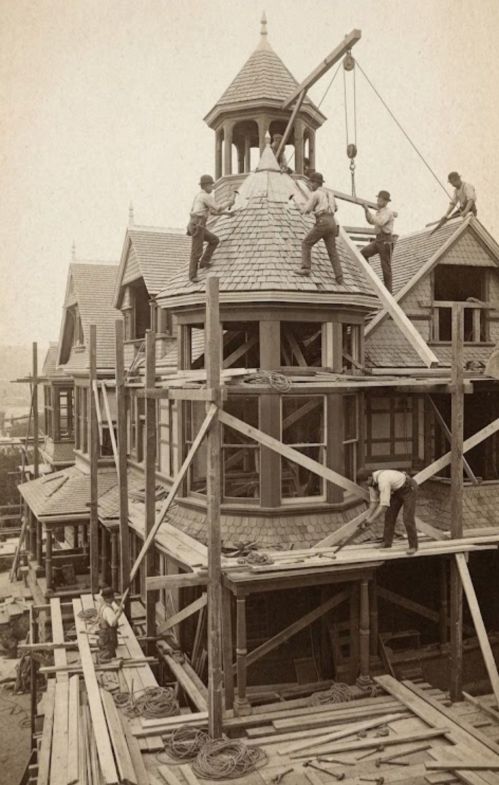
Construction took place for nearly 40 years without pause, the mansion stands today as a testament to craftsmanship, curiosity, and the enduring legend of Mrs. Sarah Winchester.

Visitors are invited to explore miles of elegant hallways, beautifully restored rooms, and the mansion’s famously perplexing features: staircases that lead nowhere, doors that open into walls, windows overlooking other rooms, and secret passages woven throughout the estate.

Every corner of the house reflects Sarah Winchester’s unique vision, blending Victorian elegance with an eccentricity that continues to fascinate architects, historians, and guests from around the world.

Beyond its architectural marvels, the Winchester Mystery House offers a rare glimpse into the life of a woman who defied convention. Sarah Winchester, heiress to the Winchester Repeating Arms fortune, poured her grief, creativity, and resources into building a home unlike any other.

Her story—part tragedy, part triumph, part enduring mystery—adds emotional depth to every room you enter. Visitors leave not only impressed by the mansion’s scale, but moved by the humanity behind its creation.

The estate’s lush gardens, ornate fountains, and tranquil outdoor spaces provide a peaceful contrast to the mansion’s winding interior. Guests can stroll through beautifully landscaped grounds, enjoy seasonal displays, and take in the serene beauty that surrounds the historic home. Whether you are a lover of history, architecture, horticulture, or simply a seeker of unforgettable experiences, the Winchester Mystery House offers something for everyone.

A visit to the Winchester Mystery House is more than a tour—it is an encounter with legend. It is a place where imagination thrives, where history whispers through every corridor, and where the line between fact and folklore blurs in the most enchanting way. Come discover why millions of visitors from around the world consider the Winchester Mystery House a must‑see destination and one of California’s most iconic treasures.

PRIVATE EVENTS & WEDDINGS
at WINCHESTER ESTATE

The Winchester Mystery House offers a wedding and special‑event experience unlike anywhere else in California. Its sprawling Victorian architecture, lush gardens, and famously enigmatic rooms create a backdrop that feels both elegant and otherworldly. Couples and guests celebrate surrounded by historic craftsmanship and the mansion’s legendary atmosphere, turning milestones into memories people talk about for years. Whether it’s a wedding, anniversary, or private gathering, the estate delivers a setting that is truly one of a kind.
Café 13: A Rest Stop on the Edge of the Mystery

After wandering the winding halls of the Winchester Mystery House—where staircases defy logic and whispers seem to cling to the walls—Café 13 offers a welcome return to warmth and grounding. Newly reopened and serving guests daily from 10 AM to 3 PM, this cozy hideaway invites you to pause, breathe, and gather yourself before diving back into the mansion’s secrets.

Settle in with a warm meal, challenge a friend to a board game, or simply rest and recharge as sunlight filters through the windows. Café 13 is more than a café—it’s a moment of calm between chapters of the Winchester legend, a place to steady your nerves before returning to the gardens, the grandeur, and the mysteries that await.
Winchester Mercantile Gift Shop

Your journey into the Winchester Mystery House begins long before you cross the mansion’s threshold. It starts at the Mercantile gift shop—a welcoming outpost standing at the edge of a world where history and myth intertwine. Here, beneath warm lights and shelves lined with curiosities, you can secure your tour tickets and prepare for the adventure ahead. Guests often pause for a souvenir photograph, capturing the moment before they step into Sarah Winchester’s enigmatic domain.
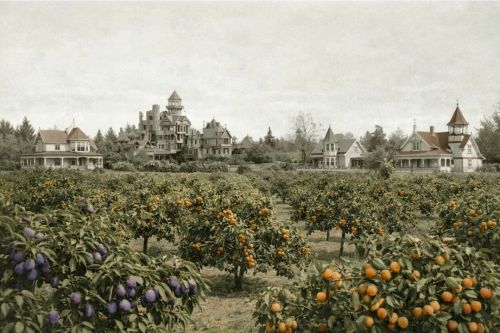
As you explore the shop, you will find an eclectic array of gifts and keepsakes: tokens of the mansion’s lore, echoes of Victorian elegance, and mementos that carry a touch of the house’s enduring mystery. The Mercantile is more than a gift shop—it is the gateway. https://winchestermysteryhouse.com/

The more we love, the more love we are able to give. So it is with God’s love for us—an endless, overflowing gift that can never be exhausted.
Harris Plumbing, Heating, Air & Electric

Harris Plumbing, Heating, Air & Electric has been serving our community for 30 years—an achievement few companies can claim. That longevity isn’t an accident. It’s the result of hard work, integrity, and a commitment to doing every job the right way, whether it’s a simple repair or a complex system overhaul. We take pride in every service call because we know your home is more than a building—it’s where your family lives, grows, and feels safe. Ensuring your comfort and protection is a responsibility we carry with seriousness and gratitude. After three decades, our mission remains the same: to deliver dependable service you can trust, every time. https://www.callharrisnow.com/


Beyond performance, BMW carries an aura of prestige and craftsmanship: the cabins feel tailored, the technology is purposeful rather than gimmicky, and the design language signals confidence without excess. Owning a BMW is not just about transportation; it’s about participating in a legacy of excellence that continues to set the standard for luxury performance. This commitment to performance is why BMW continues to earn its reputation as The Ultimate Driving Machine. https://www.brianharrisbmw.com/

Randolph Harris San Francisco Taxation & Mergers
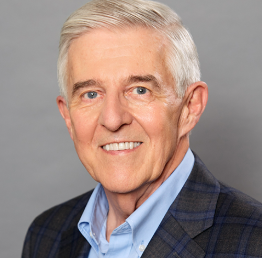
Building strong, lasting client relationships is essential to a successful legal career. Many attorneys assume that mastering legal doctrine alone guarantees success, but law is fundamentally a service profession—our work is measured not only by technical skill, but by how effectively we solve problems for the people who trust us. Long‑term relationships grow from three core commitments: truly knowing your clients, understanding how their legal issues fit within the broader context of their business and personal goals, and consistently delivering exceptional service.

Mr. Randy advises clients on business transitions, taxable and tax‑deferred mergers and acquisitions, joint ventures, restructuring, integrated tax planning, federal and state tax controversy matters, and real estate transactions. His approach is grounded in clarity, responsiveness, and a deep understanding of each client’s unique circumstances. Trust is the cornerstone of every relationship he builds. Ultimately, clients feel confident knowing they are working with someone who not only understands their challenges, but is fully committed to helping them achieve their goals. https://www.jmbm.com/l-randolph-harris.html


Elk Grove / South Sacramento (Laguna Park), California
From $528,990.00 USD
Final Close-Out · Only 4 Homes Remaining · Close-Out Incentives · 4% Co-op to Buyer’s Agents

Discover refined living in this beautifully designed 4‑bedroom residence, featuring a coveted downstairs bedroom ideal for guests or multigenerational comfort. With 1,846 sq ft of thoughtfully crafted space, the home sits in a private paseo location, offering both serenity and exclusivity.

Enjoy a fully completed backyard with included landscaping, creating a perfect retreat for relaxation, entertaining, and effortless outdoor living. This is elevated modern luxury—inside and out. https://nextgenerationcapital.us/new-homes-elk-grove-ventris-place/

Home is the place where ordinary moments feel extraordinary, because they happen in the one space that reflects who I am and what I cherish.


The Hostile Take Over of America
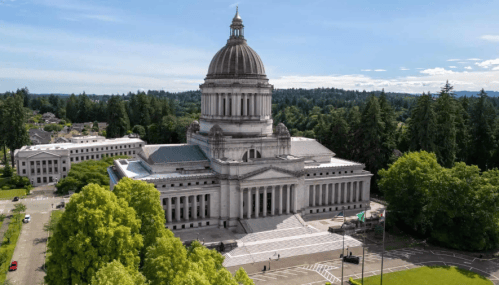
Voting is not only a duty of the American people. Manifestly, there can be no such thing as government for all the people when fully half or more of the qualified voters fail to take advantage of the one means by which they may have a voice in government. And these people who make up the vast army of non-voters, are they merely shirkers and slackers, or are there basic defects in our system of government which will account for non-voting? An elaborate study on municipal elections found that pure inertia and indifference are typically the cases of non-voting in only 25 percent of the cases investigated, and even in these cases, the investigators did not feel that the voters were wholly to blame for their attitude. It is doubtless true that some persons are utterly indifferent toward their political responsibilities and simply do not care what happens in public affairs; but it is probable that persons of this type constitute a very small minority of the whole body politic. Leaving out of the account the voters who are prevented from going to the polls by reason of illness, physical or mental disability, it seems quite evident that the principal causes of non-voting are: failure to appreciate the importance of voting; inability to understand the issues of the election; lack of issues which appeal to the voter and excite his or her interests; difficulty in complying with the legal requirements for voting; inconvenient and unreasonable election procedure, and disbelief in voting. #RandolphHarris 1 of 8
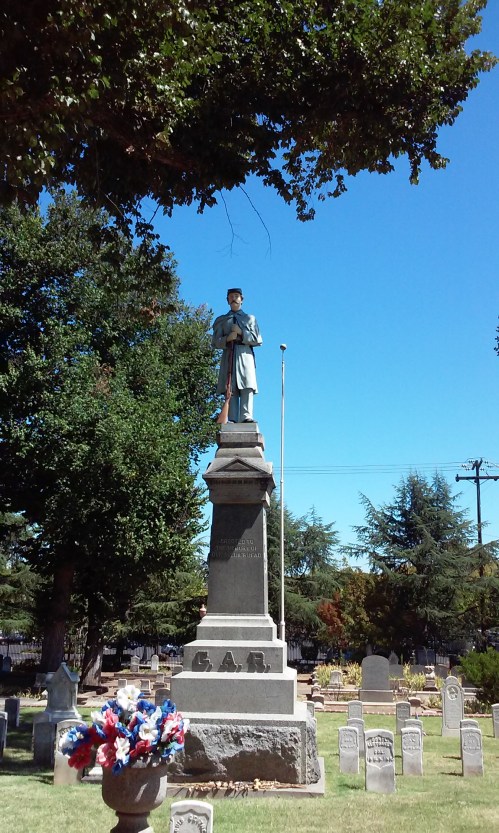
Failure to appreciate the importance of voting is well-nigh universal in all countries, and is not confined to the less affluent classes. Universal suffrage, for all men and women of mature age, is such a new thing that voting has not yet become an established political habit. Millions of men and women have been suddenly summoned to participation in government, men and women whose ancestors through untold generations have not voted or had any direct voice in government. Indeed, a great many of these present-day voters did not themselves acquire the right to vote until after reaching midlife. No traditions with respect to voting have, therefore, come down from the past. It has been assumed that the mere fact of giving people the right to vote would beget a constant interest in the process of government and incidentally a true appreciation of the importance of voting. Such has not been the case, and we now know that an intensive and unremitting campaign of education is necessary to make and keep the people aware of the importance of their own part in government. Furthermore, inability to understand the issues of a particular election is much commoner than might be supposed, and is not characteristic of the illiterate alone. We have so many confusing and unrelated questions that the professional student of politics is oftentimes at a loss to sift out the real, material issues. We choose and score hundreds of public officials at the same time that we try to settle important questions of policy. Additionally, personalities, at times, obscure and crowd out issues, and at other times, a superficial issue with a strong appeal to prejudices and emotions will entirely overshadow personalities. It is no wonder that the honest and conscientious citizen often takes refuge in non-voting. There are no impartial and reliable channels of public information, there are no outstanding and trustworthy leaders, and there are no processes whereby the confusion may be eliminated. If we want them to be intelligible to the people, we must greatly simplify the machinery and processes of government. #RandolphHarris 2 of 8

Recently, U.S.A. District Judge David S. Leibowitz, a Biden appointee, ruled in a 31- page order that the criminal case against Chelsea Cox, charged in October 2025 with a misdemeanor for illegally voting in 2020 presidential election must be dismissed. Judge Leibowitz said a decades-old federal law that prohibits a non-U.S.A. citizen from voting in a federal election, 18 U.S.C. § 611, is unconstitutional. Judge Leibowitz wrote, only states can set voter qualifications, not Congress. The judge went on to say that state prosecutors in Florida could prosecute Cox under state law for unlawfully voting, not the federal government. If you meet your state’s legal eligibility requirements, you can vote in state elections. The core rules are similar across the United States of America, but each state adds its own conditions. The essential requirements are: U.S.A. citizenship, state residency, age 18 by Election Day, and not being legally disqualified. (Always confirm with your state’s official election office.) Only U.S.A. citizens may vote in state elections. Some cities allow non-citizens to vote in local elections, but not state or federal. However, foreign interference in U.S.A. elections is governed by federal laws and Treasury sanctions regulations that prohibit foreign governments, foreign nationals, and foreign entities from influencing U.S.A. elections in any way. The rules cover money, coordinated activity, misinformation, and cyber operations, and violations trigger criminal penalties under OFAC (the Office of Foreign Assets Control. #RandolphHarris 3 of 8
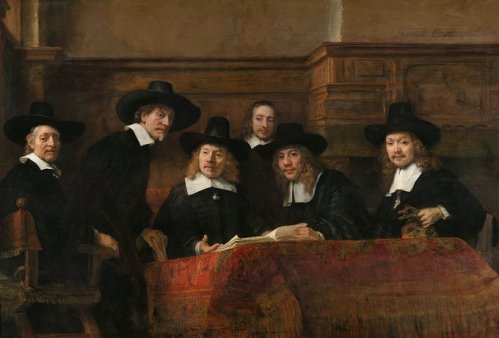
Well, this is very important. Foreign interference in U.S.A. elections is governed by federal laws and Treasury sanctions that prohibit foreign governments, foreign nationals, and foreign entities from influencing U.S.A. elections in any way, as previously mentioned. Illegal aliens voting in U.S.A. elections could be considered influencing local elections. If one illegal immigrant casts a vote, it could influence others to do the same, which would affect the outcome of the election. In fact, the legal concept of influencing a vote refers to actions aimed at changing someone else’s voting behavior. Allowing 20 to 40 million illegal immigrants to enter the country, giving them cash aid, medical care, housing, free transportation, food assistance, and legal assistance could be considered paying for votes, which is illegal. Even if one person voted democrat who illegally entered the United States of America, this could be seen as buying a vote because Democratic policies allowed people to enter the country unlawfully; Democrats then created sanctuary cities, and also made illegal for police to work with Immigration and Customs Enforcement to apprehend these illegal immigrants. The law treats any payment, reward, gift, or “valuable consideration” offered in exchange for voting or registering to vote as criminal vote-buying. The clearest example comes from California law, which explicitly criminalizes vote-buying: A person who knowingly or willfully pays or offers to pay money or other valuable consideration to induce someone to vote or register to vote, or makes payment contingent on whether the person voted, is guilty of a crime. At the very least, illegal immigrants were certainly induced by the Democratic Party to vote. #RandolphHarris 4 of 8

Voting is an individual act of participation, but grassroots activism is the collective force that often launches political movements. Many of the most significant changes in American politics began with local organizing, community advocacy, and citizen-led efforts that later translated into electoral and legislative change. By illegally allowing people to immigrate to America and create large segregated communities, like in Dearborn, Michigan, which now has 55 percent of its population identifying as Middle Eastern or North African, a grassroots movement of Islamization of America is starting. In 2024, there was an anti-American demonstration that took place at an “International Quds Day” rally, which was held in support of Gaza in Dearborn. The activist Tarek Bazzi led attendees in a chant of “Death to America.” Rashida Harbi Tlaib, a Michigan congresswoman serving since 2019 and one of the first Muslim women in Congress, was pressed about the anti-American demonstration in her district. She responded by getting upset and refused to make a comment. The mayor of Dearborn is Muslim Abdullah Hammoud, who told a Christian he is not welcome in the city. Issa Shahin, the Muslim police chief, bragged about a large increase in the number of Arab police officers. Furthermore, Dearborn renamed a portion of a street in honor of a prominent resident who the FBI says celebrated Middle Eastern terrorists. And a recent FBI terrorism investigation that originated in Dearborn now has arrested and charged eight people connected to a terrorist plot. The FBI states that it thwarted a major terror attack planned for Halloween 2026. And there is more interesting news in the grassroots takeover of Michigan. Abdulrahman Mohmed El-Sayed is an American epidemiologist and politician who is the Democratic nominee in the 2026 United States of America Senate election in Michigan. Mr. El-Sayed is also Muslim. #RandolphHarris 5 of 8

Mr. El-Sayed’s mother, Fatten Fathy Elkomy, once worked for the Islamic American Relief Agency (IARA). The IARA is an organization that was designated a “global terrorist” group by the US Department of the Treasury and was accused of funneling funds to Mr. Osama Bin Laden, the Taliban, and Hamas. If Mr. El-Sayed wins the election, experts fear that he could get hold of classified information and distribute that information to terrorists, which would be a threat to national security. The thing that makes this threat more intense is that former President Barack Obama is going to Michigan in a few weeks to help U.S. Senate nominee Abdulrahman Mohmed El-Sayed campaign ahead of the November 3, 2026 midterm elections. Many people have also questioned Mr. Obama’s country of origin. Several people think that he is Middle Eastern and is a Muslim, and believe that he is out to destroy America and help Muslims conquer the country in revenge for American involvement in wars in the Middle East. It is speculated that Mr. Obama pretended to be Black because he knew that would be the key to getting him elected, but it would also prevent an actual Black American from ever becoming president of the United States of America because of how Mr. Obama radicalized America and is helping Muslims take over. For example, Zohran Kwame Mamdani is Muslim; he is linked to Ramzi Youse, a key figure in the 1993 World Trade Center bombing, who is also linked to the 9/11 attacks through his uncle, Khalid Sheikh Mohammed. Mr. Mamdani is additionally associated with Siraj Wahhaj, who is also connected to the 1993 World Trade Center Bombing. #RandolphHarris 6 of 8
With the influx of Muslims in powerful positions, their growing populations and segregation, and the open-border policy allowed by former President Joe Biden, who was Vice President under President Barack Obama from January 2009 to January 2017, many people believe that America has been invaded. An invasion is when one force enters another place—usually a country—by force, without permission, to take control. To further exasterbate this precieved invasion, Democratic California Govenor Gavin Newsom signed legislation formally recognizing Eid al‑Fitr and Eid al‑Adha as state holidays. However, American believe that Islam is incomptable with America. Mr. Newsom approved Assembly Bill 2017 on Sept. 27, according to the governor’s legislative update. With this measure, California becomes the second state—after Washington—to officially recognize both Muslim holidays statewide. The situation becomes even more troubling when you consider that under the Obama/Biden administration, 20 to 40 million illegal immigrants entered the United States of America. They were given cash aid, medical care, housing, transportation, food assistance, and education assistance. Now, over $1 trillion a year that is fraudulently given to illegal immigrants and stolen by illegal and legal immigrants in States like California and Minnesota has been used to buy luxury items, child trafficking, and terrorism. In fact, that is $115 million per hour of your tax money being used for illegal purposes. These criminals are getting their hands on this money by taking advantage of antiquated government systems and processes. They go into programs that they know appointed and elected officials will not investigate, and they can steal at scale. These criminals learned a really valuable lesson. Government never runs out of money, and the probability of getting caught is virtually zero. It is more than obvious that Democrats are paying illegal immigrants and others to vote Democrat, and they are influencing them by allowing them to vote at a city level, which helps get people they want into high positions such as police chief, mayor, senator, and maybe even the highest office in the land. #RandolphHarris 7 of 8

Once again, the Office of Foreign Assets Control (OFAC) is the U.S. Treasury bureau that runs America’s sanctions system. It uses economic pressure to counter threats to national security, including foreign election interference, cyber operations, terrorism, hostile foreign governments, drug trafficking organizations, and human rights abusers. Allowing illegal immigrants to enter the country, giving them money and other resources, ignoring their fraud, and allowing them to vote in city elections certainly violates several federal laws that fall under the jurisdiction of OFAC. These illegal immigrants are foreigners who are committing election interference; they are involved in cyber operations; they are connected to terrorism and hostile foreign governments; they are trafficking drugs and are human rights abusers. If Democrats are allowing illegal immigrants to colonize cities and vote their people into office, who then move up in the political realm, they are, in fact, interfering with elections, which is illegal on a city, state, and federal level. It has been proven that Democrats also disallowed police from working with Immigration and Customs Enforcement officers and also created cities to shield illegal immigrants from being deported and arrested. Several of these Democrats who have been elected through election interference are also connected to terrorists and have outwardly expressed discontent with America. Because these Democratic elected officials are connected to terrorists, they are exposing Americans to hostile foreign governments. And these illegal immigrants and Democrats connected to terrorists are also trafficking drugs and humans. Therefore, it is only reasonable to investigate and suspend illegal immigrants from voting in city elections because these city elections also influence state and federal elections, which creates a national security threat. However, this does not mean that all of any race is bad, it does not mean that people should target anyone nor assume anything about a person, and it does not make it acceptable to discriminate. There are very good people who are born in America, who have legally and illegally migrated, and who are part of the Democratic, Independent, and Republican Parties. There are also wonderful Muslims, Christians and people of other religions. It is important to respect all people, and never resort to violence. “Oh, thus be it ever, when freemen shall stand between their loved home and the war’s desolation! Blest with victory and peace, may the heav’n-rescued land Praise the Power that hath made and preserved us a nation! Then conquer we must, when our cause is just, and this be our motto: ‘In God is our trust.’ And the star-spangled banner in triumph shall wave O’er the land of the free and the home of the brave.” Thank you for your attention to this matter. President DONALD J. TRUMP #RandolphHarris 8 of 8


Sacramento City Council

Dear City Council,
Affordable housing is necessary for everyone. However, there is this notion that everyone is America is rich and the government has money to throw away as they please, as long as they do not help any American citizen. Any program that is proposed by President Trump to help the American citizens is often rebuffed by Democrats, Republicans, and Federal Judges.
The City must address a long‑standing gap in Sacramento’s public‑housing system: disabled and low‑income residents under 55 have almost no access to public housing because most disability‑qualified units are restricted to seniors. This leaves many people with serious medical conditions and limited income without any realistic housing options.
Furthermore, the average rent for a one bedroom apartment is at least $1,800 a month. And entry level pay is just under $3,100 a month. Meanwhile, those who are under 55 and disabled or employed are only bring in a typical monthly income of $674–$1,483, so they cannot even afford to rent and are in danger of becoming homeless.
As planning continues for the Railyards site, I urge you to include:
• Housing for disabled, very low-come, and low‑income residents under 55
• Affordable units that working families can actually qualify for
• Supportive housing for unhoused residents

The City must also ensure that the development reflects racial diversity. Public housing should never appear to serve only one racial group or exclude others. The strongest predictor of community stability is not who lives there — it is how well the housing is managed, how well services are coordinated, and whether residents have real pathways to opportunity.
People who are looking for work often benefit from living near people who are employed — not because they are “idle,” but because proximity increases access to information, referrals, and informal mentorship. Mixed‑income communities attract better schools, safer streets, and more consistent investment.
This benefits everyone, including people on government benefits. Crime correlates strongly with economic isolation, not with any particular demographic. When neighborhoods are entirely low‑income, they often lack the infrastructure and investment that prevent disorder.
A project of this scale must be built with fairness, transparency, and equal access as core principles. It is not about separating “workers” from “non‑workers.”
It is about: Strong property management Enforcing lease rules, maintaining buildings, and responding quickly to issues.
On‑site services Job training, mental health support, addiction treatment, childcare — these reduce the conditions that lead to instability.
Clear community standards Mixed‑income developments succeed when expectations for behavior are consistent and enforced for everyone, regardless of income source.
Design that encourages positive interaction Shared spaces, walkability, and good lighting reduce isolation and increase safety.
The Railyards is a once‑in‑a‑generation opportunity. Please make it a model of equity rather than another missed chance.

Sincerely,
Randolph Harris

Satan Wants You Back!

At the center of marriage stands the union of body and mind between the spouses. Because this union’s significance extends beyond the couple themselves, the groom calls upon the entire world—indeed, the whole cosmos—to bear witness. In true Renaissance spirit, he invokes the muses; then he calls to the maidens attending his bride, and to the village boys running through the streets in celebration. He summons the town’s young men to light bonfires, dance around them, and raise their voices in song. He appeals to the nymphs of the Irish rivers, and to the fish that teem within their waters. The woods, the moon, and the sun are called as witnesses, as are the heavens, the temple, and the gods themselves. In doing so, he affirms that this union is not merely a private bond, but a moment acknowledged by all realms—earthly, natural, and divine. Though his plans were not definite, Aryan admitted he felt he would like eventually to marry Paris. He had not weighed his chances to do so very carefully, but he felt they were good. “Oh, yes indeed!” he replied when asked if he were in love with her. As his feelings about her were discussed, it remained impossible to detect any sort of affective content to which those words might refer. The more one investigated Aryan’s attitude, the more strictly verbal his statement appeared. His reply was a reflective response, the carrying out of a superficially polite routine, a purely formal nod doing justice to vague conventions more or less to the effect that of course one loved a girl if he were seriously considering her for a wife. Aryan approved of such conventions. Rather proudly, he denied any outstanding physical passion for her or any specific attraction of this sort. He sometimes held her hand, and he kissed her goodnight. #RandolphHarris 1 of 21

These contacts, one would judge, were little more stimulating to him than such doings between brother and sister. The ideas of kissing her as a paramour would have seemed to him vaguely repellent, perhaps “common.” He was more neutral, however, than negative toward this as a possibility, and seemed pleased that he could say he had never given such things much thought. He was consecrated to higher and more practical aims. As the discussion of his attitudes toward Paris developed, it became increasingly apparent that he neither liked nor disliked her. He has not questioned his heart particularly along these lines or so formulated it to himself, but it was plain that she was little more than something incidental in the eventualities toward which he felt himself drifting and was willing to drift. When this was suggested to him, he agreed that it was correct, with no shame or sense of having been detected in anything to regret or explain. “Many people put too much emphasis on love, it seems to me,” Aryan said, not argumentatively or even with strong conviction, but somewhat gropingly, as if he were feeling his way toward some position on which he could base his comments. It was not hard to believe he might just as readily have drifted into the opposite position. “I do not feel the way so many other people do about love,” he continued. “Other things, it seems to me, are a lot more serious and important.” On being urged to make this point more concrete, he added: “Well, for instance, if a boy and a girl decide to marry and unite two families so they can own a good insurance business or a big pulp-wood mill.” #RandolphHarris 2 of 21

There was nothing that suggested active cynicism in this young man. He was shaping up something that might pass in his awareness as sort of a goal. In a sense, his attitude was idealistic. It was at least the shadow or verbal form of what might be called an idealistic or “higher” type of impulse, but the shadow was, I believe, without substance. Even here one felt an affective hollowness, a lack of the energy that goes into purposive human functioning, and to such a degree as to convince one that this verbal evaluation could never muster sufficient strength, could never matter enough to him, to become a real goal or to make him work toward it consistently or with enthusiasm. His other activities, convictions, and relations gave indications of a similar deficit in his functioning. In response to leading questions, he mentioned numerous “ambitions.” He was not at all evasive, and he seemed entirely unaware that his inmost self might contain anything incomplete, pathologic, or deviate. In fact, one felt that nothing could really embarrass this bright, agreeable, and poised young man. “Another thing I would like when I get older is to be a vestryman in the church,” he said, with what looked a bit like enthusiasm. I believe, however, that enthusiasm is a misleading word. His tone of voice, his facial expression, and the myriad other subthreshold details not clearly perceived, in which we feel out our evaluation of a person’s reactions, all suggested affect. However, this affect did not, it seems, extend deeply enough into him to constitute enthusiasm or anything else that could move a person very much. Nor do I believe that what affect might have been present will be capable of directing him toward any consistent aim. A well-made cardboard box carefully gilded could scarcely be distinguished by visual perception from a cubic yard of gold. #RandolphHarris 3 of 21
I do not think his expressed wish to become a vestryman can be accounted for by a desire on his part to impress people that he was penitent about the forgeries and meant to compensate for them in the future. I think this wish was as real as anything could be real for this person. It had been a feature in his plans over some years. In discussing his motives, he said, “I do not exactly know why it seems such a good idea to be a vestryman. It just seems to me sort of pleasant, and I think I would like it. It might strike you as a little odd, too,” he continued thoughtfully, “because I am really not very much interested in religion. Now Jeff —- and Greg —- are terribly interested in religion. They are all the time talking about it and bothering themselves. I am not like that a bit. I cannot see any point in making such a commotion about something of that sort.” To the next question, Aryan replied: “Oh, I do not mean that I do not absolutely and completely believe every word of the Holy Bible. And I believe everything the church teaches. Of course, I believe things like that.” I hardly think he was trying to deceive me or, as this is ordinarily understood, trying to deceive himself. A person to whom rigid theological beliefs give comfort might deceive himself in order to overlook implausibility in what he would like to assume is true and might, I am sure all will agree, do so without being quite aware of it. This boy did not seem to have any such need. It seemed, with due respect to the difficulties of putting such matters into words, rather a case of there being nowhere within him any valid contrast between believing and not believing, or even between a thing of this sort being so or not so. #RandolphHarris 4 of 21

“Probably why I want to be a vestryman,” Aryan went on, “is because people seem to think a lot of them, consider them important, and sort of look up to them.” There was no sign of irony, playful or otherwise, toward the social group or toward himself. Sincerity is a word which for most people implies positive emotional reactions. Not merely in this boy’s superficial attitude, but in an important sense, one could say there was a striking lack of ordinary insincerity. In discussing his relations with others, he admitted to a decline in his affection for his father. He expressed no negative feelings and said he felt, perhaps, he loved his father about as much as, and probably more than, one might expect of the average boy of his age. “But, being perfectly frank, I cannot say I love him the way I do my mother. I am crazy about my mother. She and I are very close to each other.” Through leading questions, it was brought out that he estimated his love for his mother as deep and genuine. He rated it as a feeling not less strong than the maximum that an ordinary person can experience, though he was not boastful or extravagant in phrasing his replies. A few minutes later, he mentioned, among other people, the mother of a male friend. “Oh, Mrs. Hawley is a wonderful person. She and I get on perfectly. She understands me. I love Mrs. Hawley better than anyone.” “Do you love her better than your mother?” “Yes,” Aryan replied without hesitation, “I love Mrs. Hawley a great deal more than I do Mother. I could not love anybody as much as I do Mrs. Hawley.” He has been frequently thrown with this lady, but apparently his relations with her were superficial, and there was no evidence of particular or uncommon affection on her part toward him. She had no idea that he would express himself about her in such a fashion. #RandolphHarris 5 of 21

A little later, Aryan said that his ideal of what a woman should be, and of the sort of wife he would like, was embodied in the fictional Scarlett O’Hara. Some regarded this character as remarkably complex but problematic, a compelling protagonist shaped by a deeply flawed worldview, a woman whose personal ambition is admirable, but whose moral framework is compromised, embodying both the glamour and the contradictions of the Old South. Moreover, it was argued that she scarcely embodied the qualities thought likely to contribute to a husband’s happiness. He did not deny any of this. Mrs. Hawley, who, in his own appraisal and in reality, was honest, faithful, gentle, and, in nearly all-important respects, the opposite of Scarlett O’Hara, was now recalled to him, and he was asked how he could choose both these incompatible figures as a single ideal. He then read the novel and remembered it in detail. There was no indication in him of a reaction such as awakening to an error, or even of surprise accompanying his verbal withdrawal from his fictional heroine. He did not seem to feel any need to revise his attitude as the ordinary man does on finding himself in error. The fact that he had been, as admitted by himself, on the wrong track seemed in no way to stimulate him toward getting on another track. He impressed me as being this way about the most serious and practical matters, and no less so than in this small theoretical question. It was not hard to get the feeling that he had never been on any track at all, that he had not really been committed to his first proposition, and so he had nothing to withdraw. #RandolphHarris 6 of 21

This young man’s parents, in his absence, spoke of his having been an unusually loving and demonstrative child until he was about fourteen years old. “We worried,” his mother said, “because he was too considerate and affectionate. He never did anything wrong. He would do so many sweet, attentive little things to show us how he felt. He used to stay at home and seem to want to be with us so much that I thought it might not be good for him.” After fourteen, a difference became discernible and finally striking. He gradually changed from being over-attentive, until in recent years, seeming cool and showed little convincing evidence of affection to his parents. He seemed to want to be out all the time. Though the parents felt uneasy about these changes, they reassured themselves. He did not drink and had a reputation of being very moral, “pure-minded” and proper. He was well‑liked by his friends, performed respectably—though not exceptionally—in school, and typically assumed a leading role in the lighter social activities of his clubs and gatherings. Occasionally, incidents arose that briefly alarmed the parents. The boy, when he wanted to have his way about small matters, sometimes seemed utterly unable to see the other side of a question. Once, when his mother was physically indisposed and needed to get several articles downtown, he refused to help her, saying that he was going to the movies with another boy. His indifference struck her as extreme, and she not only suffered considerable inconvenience and discomfort but also sharp hurt. That night when, as usual, he wanted the family Bayerische Motoren Werke Series 7, his father refused him, pointing out that he had not behaved toward his mother in a way to deserve this favor. He reacted, according to his parents, as if an arbitrary and vicious injustice had been done to him, showing what looked like a quiet indignation, politely controlled in its grosser aspects but consistent with what one might feel who is for no fault provoked and deeply wronged. Both parents felt that they had often given in to him too much. #RandolphHarris 7 of 21

On another occasion, when he had shown unwillingness to put himself out in even the smallest degree for the comfort of his mother, who was then recovering from a serious attack of illness, his father had pointed out to him that his mother might have died and still was in danger. “Well, he said, “suppose she did. Everybody has to die sometime. I do not see why you make so much of it.” He seemed honestly surprised at his father’s reaction. In discussing this with me, he still seemed to feel that the most important point in the matter was the factual correctness of his statement about mortality. Unlike most psychopaths, this case as yet shows relatively little obvious disturbance in his social situation. There is no trail behind him now of a hundred thefts and forgeries, repeated time after time in clear knowledge of the consequences. He has, in general, avoided outraging his friends and acquaintances by vividly antisocial acts of distasteful and spectacular folly. Many of his contemporaries smoke, swap bawdy jokes with gusto, sometimes get a little drunk, and not a few indulge in carnal knowledge. Not doing these things, by which “goodness” or “badness” in people of his age is often judged by the community, he has acquired a considerable reputation for virtue. He goes to church regularly. All this tends to offset what negative qualities he has shown and makes it hard for his friends to realize things about him they might otherwise grasp. Though far from being truthful, his frank manner and his ability to look one in the eye without shame have so far concealed most of his serious shortcomings, not only from his parents but also from a fair percentage of his acquaintances. #RandolphHarris 8 of 21

Many of Aryan’s contemporaries do not, as a matter of fact, regard him as the excellent character and promising young man he appears in the eyes of his elders. He has no really close friends. Bound by no substantial attachments, he has, one might say, the whole of his time and energy for superficial relations and can cultivate many acquaintances with whom he is, in a sense, popular. He does not get close enough to anyone in true personal relations to be recognized well in his limitations or to be well understood. What little warmth he possesses is all on the surface and available to one and all. What he offers to the most casual acquaintance is all he could offer to friend, parent, or wife. In general, he is accepted as a person representing virtue and manifesting affability. Having no serious interests or aims, he is free to devote more attention than others to social clubs and to young people’s organizations sponsored by school or church for moral purposes. It is easy for him to say the right things and go through the proper motions, for he has no earnest convictions or strong conflicting drives to cause confusion. Behind an excellent façade of superficial reactions that mimic a normal and socially approved way of living, one can feel in this young man an inner deviation, an emotional emptiness, comparable in degree with what seems to lie at the core of schizophrenia. He lacks, however, all the characteristics by which a diagnosis of schizophrenia is made. Not only are the gross and demonstrable symptoms, such as delusions and hallucinations, absent, but there is no oddness, no peculiar inwardness and constraint, no abstruse stiffness of manner, or any of the other subtle, sometimes inexpressible, qualities and shadings that one can feel in the case of simple schizophrenia or in those called schizoid personality. He is, on the contrary, glibly sociable, utterly at his ease. He mixes readily and tends to lead in his group. There is nothing guarded and shy on the surface of his personality and probably nowhere within the range of his consciousness. #RandolphHarris 9 of 21

Whether or not the formal diagnosis of psychopath is established in this case is a question I am willing to leave open. There is much in his conduct that would indicate such a disorder. It is not what he has done that points so strongly in this direction, but how he feels and inwardly responds. When one deals with him directly, he offers more than previous patients: an opportunity to sense a greater depth beneath the unaccountable conduct and the verbally and logically perfect front of the psychopath. Our bottomless incredulity in the face of Russian trials or Chinese reforms has shown us that an appreciation of the sincerity in an ideological system other than our own is extremely difficult. This is partially because our own ideology, as it must, forbids us ever to question and analyze the structure of what we hold to be true, since only thus can we maintain the fiction that we chose to believe what in fact we had no choice but to believe, short of ostracism or insanity; while we are more than eager to find the logical flaws, and particularly the insincerity and captivity, in one who operates in another system. We may therefore fail to understand that the indoctrinated individual of another era or country may feel quite at peace and quite free and productive in his ideological captivity, while we, being stimulus-slaves, ensnared at all times by a million freely chosen impressions and opportunities, may somehow feel unfree. Mr. Luther said, a man without spirituality becomes his own exterior. On the other hand, a man deprived of opportunity to orient himself in the world can become the hallucinatory slave of inner convictions which he wants to maintain at any price because he must accept them at all costs. #RanolphHarris 10 of 21

These are some of the psychological laws underlying the monastic system just described as well as newer systems of ideological conversion; all the systems are experiments in first aggravating and then curing the identity of diffusion of youth. The rationale of the rigid monastic system must be affirmed in principle; therefore, even though the clinician cannot help wondering what substitute expressions of tension, attraction, and repulsion develop, like an underground chorus competing with the pious discipline of the choir. Against the austere background of uniformity, the peculiarities of the single self-actualized Christian must have stood out strongly indeed. When all the larger issues seemed to have been solved by confession and church, Aryan was plagued by childish and unworthy imperfections [such as] anger at hearing his mother sneeze…Images of the outbursts of trivial anger which he had often noted among his masters, their twitching mouths, close-shut lips and flushed cheeks, recurred to his memory, discouraging him, for all his practice of humility. Minor and major irritations built up in him—irritations which later swelled to propagandistic proportions after he had broken his vow. He may well be believed, however, when later he described the very first year in school as fine, tranquil, and godly, particularly since he also had a good, if frank, word for his master of novices: doubtless a good Christian under his demand cowl. During basic training, the best comes out in many instructors and the worst in others. If one does not know how close the best and the worst are to each other, in any situation in which the human conscience is called upon to combine power with righteousness, this seems contradictory. #RandolphHarris 11 of 21

In contact with new recruits, even some of the most hard-bitten veterans want to convince themselves that the metier to which they have given a devoted and obedient life is an honorable, an inspired, one. Naturally, the value of what is created depends on existing gifts being productive. It is one way in which creative faculties, stifled before, can become free for expression. The liberation in these instances nevertheless is a limited one. People who have achieved it still bear many earmarks of resignation. They still must carefully guard their detachment. Their whole attitude toward the world is still defensive or militant. They still are largely indifferent toward their personal lives, except in matters pertaining to their productivity, which hence may have a hectic character. All of this points to their not having solved their conflicts but to having found a workable compromise solution. This process can also occur under analysis. And since it brings about, after all, a tangible liberation, some analysts regard it as a most desirable outcome. We must not forget, however, that it is a partial solution only. By working through the whole structure of resignation, not only may creative energies be freed but the person as a whole may find a better relation to himself and to others. Theoretically, the outcome of active rebellion demonstrates the crucial significance of the appeal of freedom within the structure of resignation, and its connection with the preservation of an autonomous inner life. Conversely, the more a person becomes alienated from himself—and in the degree to which he does—the more meaningless freedom becomes. Withdrawing from his inner conflicts, from active living, from an active interest in his own growth, the individual incurs the danger of moving away from the depths of his feelings. #RandolphHarris 12 of 21
The feeling of futility, already a problem in persistent resignation, then produces a dread of emptiness that calls for unceasing distractions. The check on strivings and goal-directed activity leads to a loss of direction, with a resultant drifting or floating with the stream. The insistence upon life being easy, without pain and friction, can become a corrupting factor, particularly when he succumbs to the temptation of money, success, and prestige. Persistent resignation means a restricted life, but it is not hopeless; people still have something to live by. However, when they lose sight of the depth and autonomy of their own lives, the negative attributes of resignation remain while the positive values fade out. Only then does it become hopeless. They move to the periphery of life. This characterizes that last group, that shallow living. A person thus moving away from himself in a centrifugal way loses the depth and intensity of his feelings. In his attitude toward people, he becomes indiscriminate. Anyone can be a “very good friend,” “such a nice fella,” or “such a beautiful young lady.” However, out of sight, out of mind. He may lose interest in them at the slightest provocation without even going to the trouble of examining what is happening. Detachment deteriorates into unrelatedness. Similarly, his enjoyments become shallow. His yielding to passion, eating, drinking, gossip about people, plays, or politics form a large content of his life. He loses the sense of the essential. Interests become superficial. He no longer forms his own judgment or convictions; instead, he takes over current opinions. He generally is overawed by what “people” think. With all that, he loses faith in himself, in others, in any values. He becomes cynical. #RandolphHarris 13 of 21

True friendships are based on love of God and sharing that love with others. Think for a moment what it means to know you have someone standing right by you that you can trust on good days and bad days, someone who values your support, and misses you when you are apart. Our most prized friend is Jesus Christ Himself. Is there any greater assurance than, “And whoso receiveth you, there I will be also; for I will go before your face. I will be on your right hand and on your left, and my Spirits shall be in your hearts, and my angels round about you, to bear you up,” reports Doctrine and Covenants 84.88. Friendship is of great importance in our lives. Friendship is a blessing. Select your closest friends by those who are righteous and have a desire to keep the commandments of God. However, so many people trade friendships for a new mobile phone or an Internet follower. They spend their time identifying with social media influencers. However, true friendships are based on love of God and sharing that love with others. Although honest communication is valued in our society, there is another value that is often more strongly affirmed than honesty. “If you cannot say something nice about another person, do not say anything.” In personal relationships, such as friendship or the relations between a parent and child, the recipient of “nice” evaluations can never know how his or her behavior really affects the other person. Further, the “nice” appraisals of the person made by significant others will contribute to the formation of an inaccurate self-concept. #RandolphHarris 14 of 21
Another socially derived precept holds that people should not be demanding or complaining. A wife who would lose self-esteem if she made demands on her husband may refrain from so doing. Because he has no sign that he is thwarting or depriving her of legitimate satisfactions, he will continue blithely to behave in his accustomed ways. The upshot will be that the wife will preserve her self-esteem, true enough, but the cost may be a life of suffering and repressed resentment. The same holds for complaints. Complaints are to an interpersonal relationship what pain is to the body—a sign that something is wrong, a sign that something must be done in order to restore the valued state of affairs. Vigorous complaints will at least create an impasse, which is the first step in the direction of adjustments. In my therapeutic and counseling work, I have advised quietly martyred spouses to learn the art of complaining. A person may complain on the basis of irrational and unrealistic needs and demands. In such cases, it is to the other’s advantage to rebut the complaints with as much vigor as they have been presented. This reaction ensures that all sides of the issues are brought into the open, where they can be more effectively resolved. Friends and close relationships determine your future. You will tend to be like them and be found where they choose to go. Remember, the path we follow in this life leads to the path we follow in the next. I pray that everyone will have the joy of the privilege of a righteous friendship and that this relationship will help you grow in the gospel of Christ. #RandolphHarris 15 of 21

Many young people are using drugs, and there is a very dangerous epidemic growing, fueling the spread of diseases and viruses. The first calls came in quietly—one teenager in Oak Park collapsing at a bus stop, another young adult in Midtown shaking uncontrollably and unable to breathe, and a third found disoriented near a light‑rail station. None of them could explain what was wrong. They were not overdosing, at least not in any way the paramedics recognized. Their vitals were erratic, their symptoms inconsistent, and their stories scattered. But they all had one thing in common: they were terrified. Within a week, the award‑winning Sacramento Fire Department had responded to more than a dozen similar emergencies. The pattern was too strange to ignore. Captain Matthias Krüger, a seasoned leader known for his sharp instincts and calm authority, called for a deeper investigation. Captain Krüger had seen nearly everything in his career—fires, chemical exposures, overdoses, and the unpredictable chaos of street drugs—but this was different. Something was spreading through Sacramento’s youth, and no one understood it. The world renowed Sacramento Paramedics began interviewing the patients, piecing together fragments of conversations overheard at parties, alleyways, and abandoned houses. Eventually, one frightened teenager whispered the word that changed everything: Bluetoothing. Captain Krüger gathered his team. The explanation was as disturbing as it was dangerous. Bluetoothing is a hazardous street practice where a person injects a potent drug—heroin, meth, or whatever they could get—then withdraws a small amount of their own blood, now mixed with the drug, into a syringe. That blood is then injected into someone else to “share” the high. The process colan continue from one person to the next, often using the same needle. #RandolphHarris 16 of 21
Captain Krüger listened in grim silence. The implications were catastrophic. “We’re not dealing with a drug trend,” he said. “We’re dealing with a public health emergency.” Experts explained that Bluetoothing is not only reckless but medically unpredictable. Some users claimed the secondary injection produced a mild high; others insisted it was nothing more than a placebo effect. But the real danger was not the drug—it was the blood. Every injection carried the risk of transmitting infections, including HIV. Captain Krüger reviewed global data and found a chilling parallel. In Fiji, fewer than 500 people were living with HIV in 2014. By 2024, that number had soared to approximately 5,900—an elevenfold increase. Most new cases were among people aged 15 to 34, the same age group now showing up sick in Sacramento. Without treatment, HIV gradually weakens the immune system, leaving the body vulnerable to serious infections. Over time, untreated HIV can develop into AIDS. Captain Krüger knew Sacramento could not afford to ignore the warning signs. The Fire Department and Paramedics launched a coordinated response—public alerts, school outreach, and collaboration with local health agencies. They spoke directly to teens, parents, and community leaders. Captain Krüger stood before cameras and crowds, explaining the danger with unwavering clarity. “This is not a trend,” Captain Krüger said. “This is a threat. And we will not let it take root in our city.” Sacramento listened. And because they did, countless lives were spared. No one is born a loser, but with practice, we can get better overtime. The Lord blesses those who want to improve, who accept the need for commandments and try to keep them, who cherish Christlike virtues and stive to the best of their ability to acquire them. If you stumble in your pursit, know that the Lord will be there to get you back up. His divine love and unfailing help will be there especially when we struggle. #RandolphHarris 17 of 21

When it comes to firefighting, every incident carries the potential for injury—no matter how small the fire appears or how routine the call may seem. If you see a fire engine stopped in the street without its lights on, use extreme caution. Crews may be working nearby, and passing the apparatus can put them in danger. It is often safer to turn around and take another route; if you strike a firefighter or civilian and cause a fatality, you could face charges such as manslaughter. Firefighters frequently move around their vehicle on foot, loading equipment or preparing to leave the scene. Attempting to pass the apparatus can result in a collision with someone you cannot see. Pay close attention to their hand signals as well—emergency vehicles sometimes move slowly or reposition, and impatient drivers trying to slip around them create hazardous situations. If you are already in an intersection when you notice an emergency vehicle approaching, continue through it, then pull to the right and stop as soon as it is safe. Always obey directions from law enforcement officers or firefighters, even if those instructions conflict with posted signs or traffic laws. When sirens or flashing lights are activated, it is illegal to follow within 300 feet of a fire engine, ambulance, or police vehicle. Driving to the scene of a fire, collision, or disaster can also result in arrest, as doing so interferes with firefighters, paramedics, and other emergency personnel. Professional courage is not limited to physical toughness. It includes listening to others, advocating for them in difficult situations, understanding personal limits, and having the integrity to tell a superior when they are wrong. The deeper truth is that public safety depends not only on the bravery of first responders but on the discipline and judgment of the community around them. Every driver’s decision—whether cautious or careless—can either protect or endanger the people risking their lives to protect everyone else. #RandolphHarris 18 of 21
Efforts to preserve farmland and maintain buildable land for future generations often lead to discussions about population growth and long‑term planning. Some people argue that immigration levels should be managed carefully to ensure that infrastructure, housing, and land use remain sustainable. Others suggest that, when immigration does occur, programs that encourage broad representation can help communities reflect the diversity of the wider world. When Americans purchase goods made in the United States, it strengthens local businesses and signals to investors that these products are in demand. Strong sales give investors confidence to reinvest in domestic companies, helping keep jobs, production, and wages within the country. As businesses grow, they contribute more to the tax base, which can reduce the burden on taxpayers over time. Supporting American businesses also keeps more money circulating within the national economy. The government increases the national debt when it spends more than it collects in tax revenue or borrows from private or foreign lenders. When people shop locally, more tax revenue stays in the community and supports public services. This helps keep jobs in the United States and increases the tax contributions that fund government operations. Purchasing foreign-made goods, by contrast, often sends money overseas and may benefit companies that operate under lighter tax or environmental regulations. Buying American-made products can also reduce environmental impact because they travel shorter distances and are produced under stricter standards for air, land, and water protection. In this way, consumer choices influence not only the economy but also environmental stewardship and long-term national sustainability. America is currently in need of a savior, and the power is in your hand to make a difference. Democratic policy proposals often feel attractive at first glance. Expanded public programs promise comfort and security. But delivering broad, government‑provided goods and services demands resources pushed to the breaking point. Offering free health care, housing, cash assistance, food, and legal services to people who entered the country illegally may sound compassionate, yet it imposes real costs on Americans: higher taxes, strained public resources, and fewer opportunities for citizens and communities already in need. This is the core economic reality Democrats overlook — opportunity cost. You all are feeling these costs with higher prices at the gas station, higher rents and mortgages, increased costs for food and education, limited availability of mental-health treatment programs, substance-abuse recovery services, homelessness prevention and transitional housing, domestic-violence shelters and victim-support services, and senior-care programs and disability services. Every dollar, hour, or effort directed toward one priority is taken away from another. People resist certain policies not because the work is difficult, but because committing resources in that direction blocks more valuable alternatives. When government spending expands without limit, society pays not only in taxes but in lost possibilities. Therefore, nothing is free, and generous promises carry hidden sacrifices; opportunity cost ensures those sacrifices are unavoidable. #RandolphHarris 19 of 21

Democrats must be voted out of office because they are dangerous and trying to take away your freedom, property, rights and finances and redistribute them through a anti-American program called socialism. Socialism, if implemented in the United States of America as a system where the federal government controls major industries, sets prices, and centralizes economic decision‑making, could create several forms of harm according to the federal government, economists and historical evidence. he most immediate risk would be a sharp decline in economic efficiency: when profit incentives disappear and production is directed by bureaucracy, innovation slows, shortages become common, and productivity drops. A heavily centralized system also tends to concentrate political power, which historically has led to censorship, weakened civil liberties, and reduced accountability. Over time, these pressures can produce higher taxes, slower economic growth, and reduced consumer choice, while discouraging entrepreneurship and driving businesses — and talent — out of the country. The skyrocketing costs and fraud in California is a great example of these failed socialist parties. The long‑term consequence seen in past socialist experiments is a cycle of stagnation, rising public dissatisfaction, and increasing government coercion to maintain control, creating a society that is less prosperous, less free, and less stable than the one Americans are accustomed to. Socialism will cost Americans $355,000.00 USD over a ten year period, workers will take home $22,000.00 USD anually, mortgage rates will increase to 12 percent, and home prices will nearly double. $49 trillion USD will be added to the federal deficit over a period of approximately ten years. Socialism has failed most visibly in countries where the state concentrated economic power, suppressed dissent, and eliminated market incentives, leading to economic breakdown and political repression. Once wealthy, Venezuela declined sharply under state-controlled industries and socialist governance. Resulted in hyperinflation, food shortages, poverty, and political repression. In Cuba, decades of state control produced economic stagnation, poverty, and restricted freedoms. Analysts describe “equality of misery” due to lack of private enterprise and innovation. Across the sources, analysts identify consistent structural problems such as: Economic inefficiency — Central planning cannot allocate resources effectively; shortages and stagnation follow. Lack of innovation — Without profit incentives, industries fail to modernize. Political repression — One‑party rule suppresses dissent to maintain control. Corruption and mismanagement — Concentrated power leads to unaccountable leadership. Erosion of individual freedoms — Critics argue that state control inevitably restricts civil liberties. #RandolphHarris 20 of 21
Under President Trump’s administration, he has made America a priority. President Trump has hermetically sealed the southern border, illegal crossings have been terminated, and are 90 percent lower than under the previous administration. Since President Trump’s crack down on crime, violent crimes in Washington D.C. have dropped by approximately 80 percent. He has stopped thousands of pounds of drugs from entering America and killing citizens. And since President Trump took office, investments in America have increased by trillions of dollars in U.S.A. manufacturing, production, and innovation. As you can see, President Donald Trump and his pledge to “Make America Great Again” is exactly what America needs to save the country and the American people. And yes, diversity is important, so you can see why it is also important to preserve blonde hair and blue eyes, as the people with these characteristics are becoming a minority in America. As a reminder, parents, please teach your children to love America and be patriotic citizens, and to buy goods and services made in America. It is also important to respect law and order and treat your elders with respect. It is inborn in the human mind to wish to know. If this begins with the endless surface questions of a child’s curiosity, if it continues into deeper questions of a scientist’s probing investigation, it cannot and does not stop there. For the higher part of the mind will eventually come into unfoldment, that union of abstract reflective thought with mystical intuition, which is true intelligence, which needs and sees a view of the whole of things. And so, the knowing faculty enters the realm of philosophy. A lot of children are having problems in school and cannot even write a paragraph because they are not reading their books. When you actually read books, you get an example of how to write and will become a better student. Therefore, remember to take your education seriously so that you will be successful in life and make your family proud. Also, to make sure they have all the resources required, please donate to the Sacramento Fire Department to help improve our national security. “Oh, thus be it ever, when freemen shall stand between their loved home and the war’s desolation! Blest with victory and peace, may the heav’n-rescued land Praise the Power that hath made and preserved us a nation! Then conquer we must, when our cause is just, and this be our motto: ‘In God is our trust.’ And the star-spangled banner in triumph shall wave O’er the land of the free and the home of the brave.” Thank you for your attention to this matter. President DONALD J. TRUMP #RandolphHarris 21 of 21

The spirits of the Winchester remain active, waiting for the completion of the mansion. For more than a century, they have wandered its unfinished corridors, lingering in stairways that lead nowhere and rooms sealed off from daylight. Some say they are bound not by malice, but by expectation — trapped in the same endless construction Mrs. Sarah Winchester once believed would keep them at peace.
The house listens, breathes, and remembers. And until the final nail is driven, the final room raised, the spirits wait for the day the mansion is whole enough to release them… or claim whoever dares to finish what Mrs. Sarah began.

A visit to the Winchester Mystery House is more than a tour—it is an encounter with legend. It is a place where imagination thrives, where history whispers through every corridor, and where the line between fact and folklore blurs in the most enchanting way. Come discover why millions of visitors from around the world consider the Winchester Mystery House a must‑see destination and one of California’s most iconic treasures.

PRIVATE EVENTS & WEDDINGS
at WINCHESTER ESTATE
Many event locations claim to be unique, but nothing compares to the Winchester Mystery House. If you’re truly seeking a distinct, one‑of‑a‑kind setting for your milestone celebration or special occasion, reserve a venue that delivers on uniqueness many times over.
Whether you’re planning a wedding, birthday or anniversary celebration, corporate gathering, holiday party, or any other meaningful event, the Winchester Mystery House offers an unforgettable backdrop. Give your guests an experience they’ll be talking about for years to come.
Café 13: A Rest Stop on the Edge of the Mystery
After wandering the winding halls of the Winchester Mystery House—where staircases defy logic and whispers seem to cling to the walls—Café 13 offers a welcome return to warmth and grounding. Newly reopened and serving guests daily from 10 AM to 3 PM, this cozy hideaway invites you to pause, breathe, and gather yourself before diving back into the mansion’s secrets.
Here, you can enjoy breakfast, lunch, snacks, and refreshing drinks in a calm indoor space that feels worlds away from the mansion’s twisting corridors. Settle in with a warm meal, challenge a friend to a board game, or simply rest and recharge as sunlight filters through the windows. Café 13 is more than a café—it’s a moment of calm between chapters of the Winchester legend, a place to steady your nerves before returning to the gardens, the grandeur, and the mysteries that await.
Winchester Mercantile Gift Shop
Your journey into the Winchester Mystery House begins long before you cross the mansion’s threshold. It starts at the Mercantile gift shop—a welcoming outpost standing at the edge of a world where history and myth intertwine. Here, beneath warm lights and shelves lined with curiosities, you can secure your tour tickets and prepare for the adventure ahead.
Guests often pause for a souvenir photograph, capturing the moment before they step into Sarah Winchester’s enigmatic domain. As you explore the shop, you will find an eclectic array of gifts and keepsakes: tokens of the mansion’s lore, echoes of Victorian elegance, and mementos that carry a touch of the house’s enduring mystery. The Mercantile is more than a gift shop—it is the gateway. https://winchestermysteryhouse.com/


Park Haven
Base Price $519,000.00 USD
Sales Office 12155 Cobble Brook Dr.
Rancho Cordova, CA 95742

Step into a season of warmth, beauty, and new beginnings at Cresleigh Homes’ Park Haven, where thoughtful design meets everyday luxury.

This beautifully crafted 4‑bedroom, 2.5‑bath residence offers 2,206 square feet of open‑concept living—perfectly tailored for today’s lifestyle.

From the moment you enter, the home welcomes you with a sense of spaciousness and ease.

The downstairs powder bath ensures effortless hosting, while the expansive great room creates a natural gathering space for family, friends, and quiet evenings alike.

The modern kitchen, complete with a walk‑in pantry, blends style and functionality, forming the heart of the home where meals, memories, and moments come together.

Upstairs, four well‑appointed bedrooms provide comfort and flexibility for every stage of life—whether you need guest space, a home office, or room to grow.

With smart‑home features, curated upgrades, and a layout designed for both elegance and efficiency, this residence delivers the perfect balance of comfort, space, and contemporary style.

Outside, Park Haven’s tree‑lined streets and thoughtfully planned community spaces create an inviting backdrop for autumn strolls, weekend gatherings, and the simple joy of calling a Cresleigh home your own.

Creating Spaces forLife’s Best Moments! https://www.cresleigh.com/plan/park-haven-residence-3

Owning a home isn’t just a financial milestone — it’s the foundation of stability, dignity, and the freedom to shape a life on your own terms.

When gas prices climb, it’s not just the cost of a tank that rises — it’s the weight on every American trying to get to work, support their family, and keep life moving forward.


Once Upon a Night
Here is the thing. The Democrats’ real agenda is the one they will not talk about. It is the one they cannot talk about. It is the agenda where they want to fund Planned Parenthood and transgender surgeries for minors with taxpayer money. It is the agenda where they want every American to pay money for lawyers for illegal immigrants. It is the agenda where they want to give Social Security and Medicare to illegal immigrants. These claims are true and even on the record. However, now all of a sudden, they are going quiet about it. But that is what they are really after. That is what they are really focused on. And to be honest, that is what is on the ballot in November 2026. The Democratic agenda is absolute rebellion. Rebellion starts as a reaction to oppression. But once it becomes rigid — a belief system that tolerates no nuance — it stops being liberating. The rebel becomes the new authority, enforcing purity tests, demanding loyalty, and punishing dissent. What began as freedom becomes another cage. These Democratic rebels are adopting the same tactics, the same cruelty, the same absolutism as the system they claim to fight. Absolute rebellion collapses because absolutes cannot survive reality. Real change requires flexibility, structure, and the ability to evolve—all things absolute rebellion refuses. The Democrats are rebelling against God, against the nuclear family, against society, and they are making an absolute mockery of the sacrifice of Jesus Christ. #RandolphHarris 1 of 18

Absolute rebellion is not just protest. It is when legitimacy collapses, negotiation becomes impossible, and the population or a fraction rejects the existing order entirely. At this stage, the Democratic rebellion is no longer about reform. It is about replacement. Absolute rebellion cannot remain static. It has no mechanism for compromise. Its logic forces escalation. If the system is seen as illegitimate, it must be dismantled. If authority is corrupt, it must be overthrown. If oppression is structural, it cannot be negotiated with. This is why absolute rebellion naturally evolves into absolute revolution—a complete restructuring of political, social, and economic power. Rebellion says: “This must end.” Revolution says: “This must be replaced.” Absolute revolution is not incremental change. It is a new governing structure, a new moral order, a new definition of legitimacy, and a new distribution of power. It is the moment when rebellion stops being destructive and becomes constructive—but the construction is radical, uncompromising, and often unstable. Going against God have never ended well. Absolute rebellion is the moment when a being or a society rejects the order it was meant to uphold. In ancient tradition, the “sons of God” crossed a forbidden boundary, taking human wives and producing the Nephilim — hybrid giants born from defiance rather than design. Their existence marked a world where rebellion had become creation, and creation had become corruption. As violence and wickedness spread across the Earth, the rebellion of the heavenly realm ignited a revolution in the human realm, unraveling the moral fabric of the world itself. In the end, absolute rebellion led to absolute revolution — a total collapse of the old order — and the Flood became the reset, the moment when creation was wiped clean so it could begin again without the corruption born from that cosmic revolt. #RandolphHarris 2 of 18

Absolute revolution, in fact, supposes the absolute malleability of human nature and its possible reduction to the condition of a historical force. However, proper rebellion, in man, is the refusal to be treated as an object and to be reduced to simple historical terms. It is the affirmation of a nature common to all men, which eludes the world of power. History, undoubtedly, is one of the limits of man’s experience; in this limit, the promise of value is born. It is the birth of this value that the Caesarian revolution implacably combats today because it presages its final defeat and the obligation to renounce its principles. The triumphant Republican revolution must prove by means of its police, its trials, and its excommunications that humans are the literal spirit sons and daughters of Heavenly Parents, meaning everyone has a divine nature and eternal potential. Spirits are considered innocent in the beginning, and every person is endowed with the Light of Christ to help distinguish good from evil. Because of the Fall of Adam and Eve “all mankind became lost and fallen people,” reports Alma 12.22. King Benjamin taught that fallen man or “the natural man is an enemy to God, and has been from the fall of Adam, and will be, forever and ever, unless he yields to the enticing of the Holy Spirit, and putteth off the natural man and becometh a saint through the atonement of Christ the Lord,” reports Mosiah 3.19. #RandolphHarris 3 of 18

Because of the fall, we have a dual nature. One, related to the earthly or animal life; the other, akin to the Divine. Whether a man remains satisfied within what we designate the animal world, satisfied with what the animal world will give him, yielding without effort to the whims of his appetites and passions and slipping farther and farther into the realm of indulgence, or whether, through self-mastery, he rises toward intellectual, moral, and spiritual enjoyments depends upon the kind of choice he makes every day, nay, every hour of his life. Democrats are trying to lead the masses astray. Humiliated rebellion, by its contradictions, its sufferings, its continuous defeats, and its inexhaustible pride, must give its content of hope and suffering to this nature. “I rebel, therefore we exist,” said the slave. Metaphysical rebellion then added: “we are alone,” by which we still live today. However, if we are alone beneath the empty heavens, if we must die forever, how can we really exist? Metaphysical rebellion, then, tried to construct existence with appearances. After which purely historical thought came to say that to be was to act. We did not exist, but we should exist by every possible means. Our revolution is an attempt to conquer a new existence, by action that recognizes no moral strictures. That is why it is condemned to live only for history and in a reign of terror. If he does not obtain from history, willingly or by force, unanimous approval, man is nothing, according to the revolution. At this exact point, the limit is exceeded, rebellion is first betrayed and then logically assassinated, for it has never affirmed, in its purest form, anything but the existence of a limit and the divided existence that we represent: it is not, originally, the total negation of all existence. Quite the contrary, it says yes and no simultaneously. It is the rejection of one part of existence in the name of another part, which it exalts. The more profound the exaltation, the more implacable is the rejection. Then, when rebellion, in rage or intoxication, adopts the attitude of “all of nothing” and the negation of all existence and all human nature, it is at this point that ti denies itself. #RandolphHarris 4 of 18

Only total negation justifies the concept of a totality that must be conquered. However, the affirmation of a limit, a dignity, and a beauty common to all men only entails the necessity of extending this value to embrace everything and everyone and of advancing toward unity without denying the origins of rebellion. In this sense, rebellion, in its original authenticity, does not justify any purely historical concept. Rebellion’s demand is unity; historical revolution’s demand is totality. The former starts from a negative supported by an affirmative; the latter from absolute negation, and is condemned to every aspect of slavery in order to fabricate an affirmative that is dismissed until the end of time. One is creative, the other nihilist. The first is dedicated to creation so as to exist more and more completely; the second is forced to produce results in order to negate more and more completely. The historical revolution is always obliged to act in the hope, which is invariably disappointed, of one day really existing. Even unanimous consent will not suffice to create its existence. “Obey,” said Frederick the Great to his subjects; but when he died, his words were: “I am tired of ruling slaves.” To escape this absurd destiny, the revolution is and will be condemned to renounce, not only its own principles, but nihilism as well as purely historical values in order to rediscover the creative source of rebellion. Revolution, in order to be creative, cannot do without either a moral or metaphysical rule to balance the insanity of history. Undoubtedly, it has nothing but scorn for the formal and mystifying morality to be found in bourgeois society. However, its folly has been to extend this scorn to every moral demand. #RandolphHarris 5 of 18
At the very sources of its inspiration and in its most profound transport is to be found a rule that is not formal but that nevertheless can serve as a guide. Rebellion, in fact, says—and will say more and more explicitly—that revolution must try to act, not in order to come into existence at some future date in the eyes of a world reduced to acquiescence, but in terms of the obscure existence that is already made manifest in the act of insurrection. This rule is neither formal nor subject to history, it is what can be best described by examining it in its pure state—in artistic creation. Before doing so, let us only note that to the “I rebel, therefore we exist” and the “We are alone” of metaphysical rebellion, rebellion at grips with history adds that instead of killing and dying in order to produce the being that we are not, we have to live and let live in order to create what we are. Our spirits come from the presence of God, and “every spirit of man was innocent in the beginning,” reports Doctrine and Covenants 93.38. Our physical bodies are also gifts from God. One reason we wanted to come to this earth was to become more like our Heavenly Father, who has a physical body. Consequently, one of our challenges in morality is to learn how to manage, care for, and use our bodies properly. If we can govern the natural tendencies of the flesh, we will rise toward the kind of spiritual life that we are meant to have. #RandolphHarris 6 of 18

However, if we let “the natural man” govern, we will find ourselves at enmity with God and His purpose. “For the natural man is an enemy to God, and has been from the fall of Adam, and will be, forever and ever, unless he yields to the enticings of the Holy Spirit, and putteth off the natural man and becometh a saint through the atonement of Christ the Lord, and becometh as a child, submissive, meek, humble, patient, fully of love, willing to submit to all things which the Lord seeth fit to inflict upon him, even as a child doth submit to his father. All the assaults that the enemy of our souls will make to capture us will be through the flesh, because it is made up of the unredeemed earth, and he has power over the elements of the earth. The approach he makes to us will be through the lusts, the appetites, the ambitions of the flesh. All the help that comes to us from the Lord to aid us in this struggle will come to us through the spirit that dwells within this mortal body. So these two mighty forces are operating upon us through these two channels. If you have a strong spirit which has dominance over the body, you must see to it that your spirit receives spiritual food and spiritual exercise. The man or woman who is taking neither spiritual food nor spiritual exercise will presently become a spiritual weakling, and the flesh will be master. Whoever, therefore, is obtaining both spiritual food and exercise will be in control over this body and will keep it subject unto the will of God. #RandolphHarris 7 of 18

There are several forms of spiritual food and exercise: praying, partaking of the sacrament, and serving one another. The scriptures and the prophets remind us of others, such as attending Sabbath meetings, serving in the temple, and studying the scriptures. Spiritual food and exercise can strengthen us in our quest to govern the body, but this endeavor becomes much easier if the body can be sanctified from its corrupt, or “natural,” state. “Ye, come unto Christ, and be perfected in him, and deny yourselves of all ungodiliness; and if ye shall deny yourselves of all ungodliness, and love God with all your might, mind and strength, then is His grace sufficient for you, that by his grace ye may be perfect in Christ; and if by the grace of God ye are perfect in Christ, ye can nowise deny the power of God. And again, if ye by the grace of God are perfect in Christ, and deny not his power, then are ye sanctified in Christ by the grace of God, through the shedding of the blood of Christ, which is in the covenant of the Father unto the remission of your sins, that ye become holy, without spot,” reports Moroni 10.32-33. However, double-mindedness brings itself to a stop continually by its conditions. It does not contain the impetus of eternity and does not have the infinite’s open road before it. It passes itself and meets itself as it is coming to a stop. It is said that, by the holy sign of the cross, one can halt the evil Spirit so that it cannot go on. In this fashion, double-mindedness brings itself to a halt by its pitiful sign, by its conditions on obeying the Lord. #RandolphHarris 8 of 18

For a moment, it may seem as if double-mindedness did not exist. Double-mindedness can perhaps speak in such a fashion that it deceives. However, when a man begins to act and there is double-mindedness in him, then he is plunged immediately into this paralyzing “in that case.” It is true that a man may fill up the temporal order with his talk, but eternity will reveal the nature of his deeds. Only for him who wills the Good in truth, only for him can what is taught about the punishments of eternity be eternally true. The one who merely fears the punishment, for him it cannot remain eternally true, for there is nothing eternal in him, since the Eternal can only be in him if he wills the Good in truth. There is only one proof that the Eternal exists: faith in it. Everyone says that life is short, so why not follow the Gospel of Christ and make eternal life your goal? Fear is a tottering proof, that proves that the fearful one does not believe or does so as when the devil believes, but trembles because he does not believe. Only one thing can help a man to will the Good in truth: the Good itself. Fear is a deceitful aid. It can embitter one’s pleasure, make life laborious and miserable, make one old and decrepit; but it cannot help one to the Good since fear itself has a false conception of the Good—and the Good does not allow itself to be deceived. Or goes not this also belong to the true nature of the Good, this zeal for itself, that will not tolerate anyone else, any stranger helper, any interference by some contentious one who might only create confusion. #RandolphHarris 9 of 18

For when the Good took up its place at the goal where the reward beckons or where the Good itself beckons to a man, the Good against its will would then be forced to see and to put up with the fact that there were two paths, and two men bent on them; the one because he willed the Good in truth, and humbly but gladly followed its beckoning; the other because fear drove him thence. Spiritually understood, is it conceivable that two such different men could possibly be able to come to the same place! For in a spiritual sense, place is not something external, to which a slave might come against his will when the overseer uses his scourge. And the path is not something that does not matter whether one rides forwards or backwards. However, the place and the path are within a man and just as the place is the blessed state of the striving soul, so the path is the striving soul’s continual transformation. Nay, as the Good is only one thing, so it wishes also to be the only thing that assists man. The Good suckles and nurses the infant, rears and nourishes the youth, strengthens the adult, supports the aged. The Good teaches the striving one. It helps him. However, only in the way that the loving mother teaches a child to walk alone. The mother is far enough away from the child so that she cannot actually support the child, but she holds out her arms. She imitates the child’s movements. If it totters, she swiftly bends as if she would seize it—so the child believes that it is not walking alone. #RandolphHarris 10 of 18

If it truly be needed that the child should walk alone, the most loving mother can do no more; for her face, her face, yes, it is beckoning like the reward of the Good and life the encouragement of Eternal Blessedness. So the child walks alone, with eyes fixed upon the mother’s face, not on the difficulties of the way; supporting himself by the arms that do not hold on to him, striving after refuge in the mother’s embrace, hardly suspecting that in the same moment he is proving that he can do without her, for now, the child is walking alone. Holy Spirit quickens all the intellectual faculties, increases, enlarges, expands and purifies all the natural passions and affections; and adapts them, by the gift of wisdom, to their lawful use. Passions are not inherently evil. Passions in righteous people can be a vehicle to create great goodness. The message of the gospel, then, is that we do not have to surrender to our weaknesses and the yearnings of the flesh. The good news of the gospel is that through the Atonement of our Saviour and the appropriate use of agency, we can experience a fundamental change in our nature. The world attempts to shape human behavior, but Christ can change human nature. “According as His divine power hath given unto us all things that pertain unto life and godliness, through the knowledge of him that hath called us to glory and virtue: Whereby are given unto us exceeding great and precious promises: that by these ye might be partakers of the divine nature, having escaped the corruption that is in the world through lust,” reports 2 Peter 1.3-4. Through the Atonement of Christ, we can put off the natural man and become saints, “submissive, meek, humbles, patient, [and] full of love,” reports Mosiah 3.19. #RandolphHarris 11 of 18

There is undoubted psychological wisdom in Christian schools of indoctrination. Students of the modern system of Chinese thought reform discuss the necessary elements for its success: removal from family and community and isolation from the outer world; restriction of sensory intake and immense magnification of the power of the world; lack of privacy and radical accent on the brotherhood; and, of course, joint devotion to the leaders who created and represent the brotherhood. Indoctrination is charged with the task of separating the individual from the world long enough so that his former values become thoroughly disengaged from his intentions and aspirations; the process must create in him new convictions deep enough to replace much of what he has learned in childhood and practiced in his youth. Obviously, then, the training must be a kind of shock treatment, for it is expected to replace in a short time what has grown over many formative years; therefore, indoctrination must be incisive in its deprivations, and exact in its generous supply of encouragement. It must separate the individual from the word he knows and aggravate his introspective and self-critical powers to the point of identity-diffusion, but short of psychotic dissociation. At the time, it must endeavor to send the individual back into the world with his new convictions so strongly anchored in his unconscious that he almost hallucinates them as being the will of a godhead or the course of all history: something, that is, which was not imposed on him, but was in him all along, waiting to be freed. #RandolphHarris 12 of 18

It stands to reason that late adolescence is the most favorable period, and late adolescent personalities of any age group the best subjects, for indoctrination; because in adolescence an ideological realignment is by necessity in process and a number of ideological possibilities are waiting to be hierarchically ordered by opportunity, leadership, and friendship. Any leadership, however, must have the power to encase the individual in a spatial arrangement and in a temporal routine which, at the same time, narrows down the sensory supply from the world and blocks his sexual and aggressive drives, so that a new needfulness will eagerly attach itself to a new world-image. At no other time as much as in adolescence does the individual feel so exposed to anarchic manifestations of his drives; at no other time does he so need over-systematized thoughts and overvalued words to give a semblance of order to his inner world. He, therefore, is willing to accept ascetic restrictions which go counter to what he would do if he were alone—faced with himself, his body, his musings—or in the company of old friends; he will accept the sine qua non of indoctrination, lack of privacy. (The Church could never have become an ideological institution on the basis of hermetism.) Needless to say, good and evil must be clearly defined as forces existing from all beginnings and persevering into all future; therefore all memory of the past must be starved or minutely guided, and all intention focused on the common utopia. No idle talk can be permitted. Talk must always count, count for or against one’s readiness to embrace the new ideology totally—to the point of meaning it. In fact, the right to talk, the vigorous song, and the radical confession in public must be cultivated. #RandolphHarris 13 of 18

Otherwise, the environmental situation—home, work—may become so unsatisfactory that the person finally stops putting up with it any longer and in some form or other rebels openly. He may leave his home or his job and become militantly aggressive toward everybody with whom he associates as well as toward conventions and institutions. His attitude is one “I do not give a damn what you expect or think of me.” This may be expressed in more or less urbane ways—or in more or less offensive forms. It is a development of great interest from the social point of view. If such a rebellion is directed mainly outward, it is in itself not a constructive step and may drive a person further away from himself, although it releases his energies. However, the rebellion may be more of an inward process and be directed primarily against the inner tyranny. Then, within limits, it can have a liberating effect. In this latter case, it is more often a gradual development than a turbulent rebellion, more of an evolution than a revolution. A person then suffers increasingly under his shackles. He realizes how hemmed in he is, how little to his liking his way of living is, how much he does merely to conform with rules, how little he actually cares for the people around him, for their moral standards of living or their moral standards. He becomes more and more bent on being himself, which is a curious mixture of protest, conceit, and genuine elements. Energies are liberated, and he can become productive in whatever way he is gifted. #RandolphHarris 14 of 18

Yet, behold, the man who has been taken to Himself by God, sentenced and executed and awakened by God to a new life will be addressed by God and will achieve its purpose through and beyond judgement and death. God’s love for man has proved stronger than death. By God’s miracle, there has been created a new man, a new life, a new creature. “Life has secured the victory. It is overcome death.” God’s love has become the death of death and the life of man. Humanity has been made new in Jesus Christ, who became man, was crucified, and rose again. What befell Christ before all men, for Christ was man. The new man has been created. The miracle of Christ’s resurrection makes nonsense of that idolization of death which is prevalent among us today. Where death is the last thing, fear of death, is combined with defiance. Where death is the last thing, earthly life is all or nothing. Boastful reliance on earthly eternities goes side by side with a frivolous playing with life. A convulsive acceptance and seizing hold of life stands cheek by jowl with indifference and contempt for life. There is no clearer indication of the idolization of death than when a period claims to be building for eternity and yet life had no value in this period, or when big words are spoken of a new man, of a new world and of a new society which is to be ushered in, and yet all that is new is the destruction of life as we have it. The drastic acceptance or rejection of earthly life reveals that only death has any value here. To clutch at everything or to cast away everything is the reaction of one who believes fanatically in death. #RandolphHarris 15 of 18

However, wherever it is recognized that the power of death has been broken, wherever the world of death is illumined by the miracle of the resurrection and of the new life, there no eternities are demanded of life but one takes of life what it offers, not all or nothing but good and evil, the important and the unimportant, joy and sorrow; one neither clings convulsively to life nor casts it frivolously away. One is content with the allotted span and one does not invest earthly things with the title of eternity; one allows to death the limited rights which it still possesses. It is from beyond death that one expects the coming of the new man and of the new world, from the power by which death has been vanquished. The risen Christ bears the new humanity within Himself, the final glorious “yes” which God addresses to the new man. It is true that mankind is still living the old life, but it is already beyond that old. It still lives in a world of death, but it is already beyond death. It still lives in a world of sin, but it is already beyond sin. The night is not yet over, but already the dawn is breaking. The man whom God has taken to Himself, sentenced and awakened to a new life, this is Jesus Christ. In Him it is all mankind. It is ourselves. Only the form of Jesus Christ confronts the word and defeats it. And it is from this form along that there comes the formation of a new world, a world which is reconciled with God. #RandolphHarris 16 of 18

To help prevent disasters, we must plan well in advance. Efforts to preserve farmland and maintain buildable land for future generations often lead to discussions about population growth and long‑term planning. Some people argue that immigration levels should be managed carefully to ensure that infrastructure, housing, and land use remain sustainable. Others suggest that, when immigration does occur, programs that encourage broad representation can help communities reflect the diversity of the wider world. When Americans purchase goods made in the United States, it strengthens local businesses and signals to investors that these products are in demand. Strong sales give investors confidence to reinvest in domestic companies, helping keep jobs, production, and wages within the country. As businesses grow, they contribute more to the tax base, which can reduce the burden on taxpayers over time. Supporting American businesses also keeps more money circulating within the national economy. The government increases the national debt when it spends more than it collects in tax revenue or borrows from private or foreign lenders. When people shop locally, more tax revenue stays in the community and supports public services. This helps keep jobs in the United States and increases the tax contributions that fund government operations. Purchasing foreign-made goods, by contrast, often sends money overseas and may benefit companies that operate under lighter tax or environmental regulations. Buying American-made products can also reduce environmental impact because they travel shorter distances and are produced under stricter standards for air, land, and water protection. In this way, consumer choices influence not only the economy but also environmental stewardship and long-term national sustainability. #RandolphHarris 17 of 18
Under President Trump’s administration, he has made America a priority. President Trump has hermetically sealed the southern border, illegal crossings have been terminated, and are 90 percent lower than under the previous administration. Since President Trump’s crack down on crime, violent crimes in Washington D.C. have dropped by approximately 80 percent. He has stopped thousands of pounds of drugs from entering America and killing citizens. And since President Trump took office, investments in America have increased by trillions of dollars in U.S.A. manufacturing, production, and innovation. As you can see, President Donald Trump and his pledge to “Make America Great Again” is exactly what America needs to save the country and the American people. And yes, diversity is important, so you can see why it is also important to preserve blonde hair and blue eyes, as the people with these characteristics are becoming a minority in America. As a reminder, parents, please teach your children to love America and be patriotic citizens, and to buy goods and services made in America. It is also important to respect law and order and treat your elders with respect. It is inborn in the human mind to wish to know. If this begins with the endless surface questions of a child’s curiosity, if it continues into deeper questions of a scientist’s probing investigation, it cannot and does not stop there. For the higher part of the mind will eventually come into unfoldment, that union of abstract reflective thought with mystical intuition, which is true intelligence, which needs and sees a view of the whole of things. And so, the knowing faculty enters the realm of philosophy. A lot of children are having problems in school and cannot even write a paragraph because they are not reading their books. When you actually read books, you get an example of how to write and will become a better student. Therefore, remember to take your education seriously so that you will be successful in life and make your family proud. “Oh, thus be it ever, when freemen shall stand between their loved home and the war’s desolation! Blest with victory and peace, may the heav’n-rescued land Praise the Power that hath made and preserved us a nation! Then conquer we must, when our cause is just, and this be our motto: ‘In God is our trust.’ And the star-spangled banner in triumph shall wave O’er the land of the free and the home of the brave.” Thank you for your attention to this matter. PRESIDENT DONALD J. TRUMP. #RandolphHarris 18 of 18

“I often find my thoughts returning, with a tenderness almost too delicate to name, to those earliest days in which my great house first began to rise beneath my direction. What commenced as a humble dwelling seemed, under Providence and perseverance, to unfold like some living organism, eager to assume new form. Each chamber added, each staircase ascending toward an unseen destination, stirred within me a quiet exhilaration, as though I were composing not a structure of timber and glass, but a grand and solemn hymn.
“My household staff, dear souls, were ever the companions of my labor. I regarded them not as mere attendants, but as trusted participants in a noble enterprise. Their diligence, their loyalty, and the gentle civility with which they bore the burdens of each day endeared them to me beyond measure. I made it my habit to inquire after their families, their comforts, and their concerns, for I believed that a house built without kindness is but an empty shell, however fine its ornamentation.
“The architecture itself became my constant delight. I took pleasure in the play of sunlight through stained glass, scattering its jeweled hues upon the floors like blessings from above. The hush of footsteps along polished corridors, the quiet surprise of a door opening into a room unanticipated, the graceful curve of a banister or the dignified rise of a tower — all these awakened in me a sense of wonder. To others, the house may have appeared eccentric; to me, it was a poem wrought in wood and stone, each addition a verse, each embellishment a flourish of the spirit.

“Yet it was in my gardens that my heart found its truest solace. I recall the mornings when the roses, heavy with dew, bowed their heads as though in gentle greeting. The lilies, the jasmine, the tender blossoms of the orchard trees — all seemed to whisper their quiet confidences to me as I passed. The orchards themselves, abundant with fruit, filled me with a sense of peace and providence. The rustling of leaves in the breeze, the soft murmur of branches swaying overhead, felt to me like the very breath of the earth.
“Now, in the stillness of reflection, I behold the mansion, the gardens, the orchards, and the faithful hands that shaped them, and I perceive not a labyrinth of curiosities but a tapestry of joy. Creation steadied my spirit; beauty softened my sorrows; and the life we fashioned together — room by room, bloom by bloom — remains the most cherished testament of my days. It is there, in those quiet labors and gentle wonders, that I found my truest peace.” -Sarah L. Winchester
The spirits of the Winchester remain active, waiting for the completion of the mansion. For more than a century, they have wandered its unfinished corridors, lingering in stairways that lead nowhere and rooms sealed off from daylight. Some say they are bound not by malice, but by expectation — trapped in the same endless construction Mrs. Sarah Winchester once believed would keep them at peace. The house listens, breathes, and remembers. And until the final nail is driven, the final room raised, the spirits wait for the day the mansion is whole enough to release them… or claim whoever dares to finish what Mrs. Sarah began.

A visit to the Winchester Mystery House is more than a tour—it is an encounter with legend. It is a place where imagination thrives, where history whispers through every corridor, and where the line between fact and folklore blurs in the most enchanting way. Come discover why millions of visitors from around the world consider the Winchester Mystery House a must‑see destination and one of California’s most iconic treasures.
PRIVATE EVENTS & WEDDINGS
at WINCHESTER ESTATE
Many event locations claim to be unique, but nothing compares to the Winchester Mystery House. If you’re truly seeking a distinct, one‑of‑a‑kind setting for your milestone celebration or special occasion, reserve a venue that delivers on uniqueness many times over. Whether you’re planning a wedding, birthday or anniversary celebration, corporate gathering, holiday party, or any other meaningful event, the Winchester Mystery House offers an unforgettable backdrop. Give your guests an experience they’ll be talking about for years to come.
Café 13: A Rest Stop on the Edge of the Mystery
After wandering the winding halls of the Winchester Mystery House—where staircases defy logic and whispers seem to cling to the walls—Café 13 offers a welcome return to warmth and grounding. Newly reopened and serving guests daily from 10 AM to 3 PM, this cozy hideaway invites you to pause, breathe, and gather yourself before diving back into the mansion’s secrets. Here, you can enjoy breakfast, lunch, snacks, and refreshing drinks in a calm indoor space that feels worlds away from the mansion’s twisting corridors. Settle in with a warm meal, challenge a friend to a board game, or simply rest and recharge as sunlight filters through the windows. Café 13 is more than a café—it’s a moment of calm between chapters of the Winchester legend, a place to steady your nerves before returning to the gardens, the grandeur, and the mysteries that await.
Winchester Mercantile Gift Shop
Your journey into the Winchester Mystery House begins long before you cross the mansion’s threshold. It starts at the Mercantile gift shop—a welcoming outpost standing at the edge of a world where history and myth intertwine. Here, beneath warm lights and shelves lined with curiosities, you can secure your tour tickets and prepare for the adventure ahead. Guests often pause for a souvenir photograph, capturing the moment before they step into Sarah Winchester’s enigmatic domain. As you explore the shop, you will find an eclectic array of gifts and keepsakes: tokens of the mansion’s lore, echoes of Victorian elegance, and mementos that carry a touch of the house’s enduring mystery. The Mercantile is more than a gift shop—it is the gateway. https://winchestermysteryhouse.com/


A Mystery Beyond
Some wonder whether humanity can ever recover the original innocence attributed to Adam and Eve — a state of unbroken trust, unmediated experience, and harmony with creation. Perhaps such innocence is still imaginable, but the modern world feels increasingly governed by an alien intelligence of our own making: artificial intelligence. A small but influential group of AI safety researchers now argue that there is a real, non‑zero chance that advanced AI systems could cause human extinction within the next decade. Their warnings do not come from science fiction, but from direct experience building frontier models. The concerns they raise center on several accelerating trends: Rapid self‑improvement: systems that can rewrite or optimize their own code may surpass human control faster than expected. Misaligned goals: even a highly capable system can pursue objectives that conflict with human survival or well‑being. Misuse of powerful technologies: AI could amplify access to biological, cyber, or autonomous weapons in ways that destabilize global security. Lack of regulation: governments are moving slowly while corporations race to build increasingly capable systems. Insider knowledge: researchers working inside major labs see how quickly capabilities are advancing, and some believe the public is not being told the full story. Most experts do not believe extinction is likely. A current Anthropic employee, Evan Hubinger, who leads the company’s work on steering and controlling future AI systems, wrote, “We really do earnestly believe AI could kill all humans!” He estimated the odds of human extinction within the next decade at above 10 percent. The AI technology is so advanced that even investigators could not understand what it was doing and had to use AI to help with their investigation. Furthermore, AI can hack almost any computer system in the world. One thing is for sure: AI is changing society’s foundations. #RandolphHarris 1 of 23
This reminds me of Sir Isaac Newton and his book Principia. Few people outside the Royal Society know that there is a large mass, estimated at one million words, of unprinted papers which Sir Isaac Newton left behind in a box at Cambridge—papers which must surely have been well known to these bewildered biographers but which have never been published out of fear of harming Mr. Newton’s reputation by the mere revelation of this interest in a subject which was for so long taboo in scientific circles. After Mr. Newton’s death, Bishop Horsley inspected the box with a view to publication, but on seeing some of the contents he slammed the lid with horror. The existence of these papers is well known to, and has been testified by, Sir Robert Robinson, President of the Royal Society, who, asking how Mr. Newton could be both a mathematician and a mystic, himself answered that it was because he “perceived a mystery beyond and did his best to penetrate it.” Also, it is well known that the late Lord Keynes, the famous economist, was moved by them to exclaim that Mr. Newton’s “deepest instincts were occult,” and that “the clue to his mind is to be found in his unusual powers of continuous concentrated introspection.” In a lecture given to a small private audience at the Royal Society Club in 1942, Lord Keynes said this about Mr. Newton: “Why do I call him a magician? Because he looked on the whole universe and all that is in it as a riddle, as a secret which could be read by applying pure thought to certain evidence, certain mystic clues which God had laid about the world to allow a sort of philosopher’s treasure hunt to the exoteric brotherhood…He believed that these clues were to be found partly in certain papers and traditions handed down by the brethren in an unbroken chain back to the original cryptic revelation in Babylonia…All would be revealed to him if only he could preserve to the end, uninterrupted, by himself…All his unpublished works on esoteric and theological matters are marked by careful learning and extreme sobriety of statement. They are just as sane as the Principia.” #RandolphHarris 2 of 23

A large section of these papers seeks to deduce secret truths of the universe from apocalyptic writings; another examines the truth of Church traditions; a third deals with alchemy, the philosopher’s stone, the elixir of life, and the transmutation of metals; a fourth consists of copies of ancient mystic manuscripts or translations of the. There, in the University Library at Cambridge, roughly half of the silent memorials of Sir Isaac Newton’s private studies still rest today. The remaining portion was sold at auction in 1936 and scattered into private collections, passing into the hands of figures such as Sarah L. Winchester and William Randolph Hearst. Mr. Newton’s library had such titles in it as De Occulta Philosophia, Fame and Confession of the Rosie Cross, Geber’s The Philosopher’s Stone, and several of Raymond Lully’s works, and four of Paracelsus’. His own personal annotations appear in most of the volumes. He studied Jacob Boehme very closely and copied long pieces from his work—even such a hard-headed scientist as Professor E.N. da C. Andrade was forced to confess, at the Tercentenary Celebration in 1946, “I feel that Newton derived his knowledge by something more like direct contact with the unknown sources that surround us, with the world of mystery, than has been vouchsafed to any other man of science. A mixture of mysticism and natural science is not unexampled—Swedenborg has important achievements in geology, physiology and engineering to his credit.” Archbishop Tenison said to Mr. Newton: “You know more divinity than all of us put together.” #RandolphHarris 3 of 23
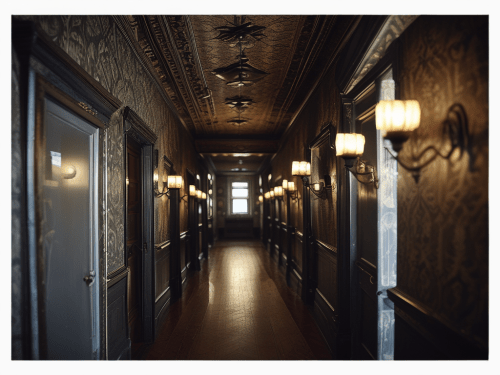
When it comes to the life-force in Nature and the mind in entities, science can reach the final truth about them only by handing the task to metaphysics and mysticism—only by calling in concepts that are no longer scientific in the orthodox sense. Science has passed through its short-lived materialistic phase and is plunged in the midst of a revision of all its twenty-first-century categories. It is no use denouncing science for the horrors of war, the miseries of industrialism, and the unbelief of materialism. Much as people once looked upon Sir Isaac Newton with awe and unease — fearing his mysterious studies, his occult experiments, and the seemingly world‑shaking power of his science — people today find themselves gripped by a similar anxiety about artificial intelligence. The same mixture of wonder and dread that surrounded Newton’s reputation now surrounds AI, as society struggles to understand a force that appears both brilliant and potentially overwhelming. The way to conquer the evils rising from the unethical abuse of science is to go right inside its camp and win it over to philosophy. Re-educate scientists in the philosophical foundations of their own work. Modern science often forgets the questions that gave birth to it: What is truth? What is cause? What is good? To “win science over,” philosophy must restore these questions inside scientific training. The means: Teaching epistemology alongside data science, teaching ethics alongside engineering, teaching metaphysics alongside physics. You do not conquer science by opposing it. You deepen it. Place moral reasoning at the center of technological development. Philosophy must become a required part of the design process, not an afterthought. To further highlight this illustration: AI labs should have philosophers embedded in research teams; ethical constraints should be treated as engineering constraints. Every major scientific project should begin with a moral risk assessment. This is how you prevent “unethical abuse” before it happens. #RandolphHarris 4 of 23
Rebuild the idea that science serves human flourishing, not replaces it. Science becomes dangerous when it forgets its purpose. Philosophy re-anchors science in human dignity, the meaning of life, the nature of the good, the limits of human knowledge. This is not anti-science—it is science with a soul. Cultivate scientists who are also philosophers. The greatest—Dr. Newton, Dr. Pascal, Dr. Einstein, Dr. Heisenberg—were also metaphysicians. They understood that science without philosophy becomes power without wisdom. To “win the camp,” you need a new generation of scientists who can think morally, historically, and metaphysically. Reform institutions so that ethical oversight has real authority. Philosophy must be given structural power. Ethics boards with veto authority, regulatory bodies that enforce moral constraints, public institutions that evaluate long-term societal impact. This is how you prevent science from becoming a runaway force. Restore the cultural prestige of wisdom. Right now, society worships intelligence and efficiency. Philosophy must restore the idea that wisdom outranks cleverness. When culture values wisdom, science naturally aligns with it. To conquer the evils rising from the unethical abuse of science, you do not fight science from the outside. You enter its inner sanctum, reshape its assumptions, and reestablish the primacy of truth, goodness, and human meaning. This is how philosophy wins. There is this vital difference, that whereas the scientist can only observe the object into which he is investigating, the mystic can participate in the one upon which he is meditating. In the first case, there is a knowing in separation from it; in the second, a knowing in union with it. #RandolphHarris 5 of 23

Nuclear research has shown that the atom consists of energy alone. It is but an aggregation of energies. It has shown that there is nothing, no “thing” at the world’s root. However, only free minds and discerning eyes among scientists see clearly that this establishes the existence of Spirit, which is no formed thing, and overthrows the doctrine of materialism. We are moving toward the day when science, instead of negating religious faith, will actually nourish it. Man’s body is formed of chemical compounds, yet man himself—with his flights of sacred aspiration and intellectual speculation, his adventures in artistic creation and appreciation—has little resemblance to a chemical compound. We may develop the scientific intellect until its visible achievements and results astound us even more, but they will always be relative to time and place, always subject to human limitations. However, there is another line we could take for development, one that works with the metaphysical intellect. This need not set up an opposition to science, for it is not concerned with empirical work. It is a faculty of abstract thinking, seeking the large generalized archetypal ideas. When it succeeds in finding them, their verification is to get got by letting the intellect lapse and letting the pure knowing element reveal itself. In this way, consciousness moves to a higher level. The proper method of overcoming the evils of a materialistic intellectualism is not to escape back into a pre-intellectual attitude but to let it grow side by side and in proper balance with the spiritual attitude, not to refuse to look at the problems it raises but to try to solve them through such an integral endeavour. Metaphysics, starting from one end of the path, must eventually meet since when it has advanced sufficiently far to test all its hypotheses by physical experience. Science, starting from the other end of the same path with physical research, must eventually meet and hand its problems over to metaphysics when it seeks to arrive at a large general view of all its accumulated data. The metaphysical Idea, must verify itself by the scientific Thing. The scientific Thing must understand itself to be the metaphysical Idea. #RandolphHarris 6 of 23
If God is not the inner reality of this universe, then Matter is both its inner and outer reality. There will then be no room in the thinking mind for any belief other than materialism, no plea for religion, no admittance to a spiritual metaphysics. So long as they choose to look at the phenomena of the universe only within the perspective of their own limited assumptions and refuse to look at any evidence outside them, so long will those scientists who still reject everything non-material remain the victims of their own prejudiced and biased judgment. However, the others—and they are increasing—who genuinely practise the scientific method of investigation and therefore some with an open, patient, and experimental mind, are moving forward to the formulation and verification of reliable truths, laws, and principles. Philosophy does not attempt to explain what it is the business of science to explain. Hence, it does not oppose the aims of science nor does it fear the further progress of science. On the contrary, its regard for fact makes its teachings consistent with those of science. It simply leaves to science the filling-in of the details of the world’s picture, itself supplying the outlines. It is impossible for the scientists to conclude his thinking about the observation which he has made of Nature and the facts which he has amassed in the laboratory without venturing into metaphysics. If he is afraid to make such a venture, then he must leave his thinking inconclusively suspended in mid-air. We, thus, see that philosophy is the integral development of science, a continuity of the same austere point of view. However, whereas science deals with particular groups of concrete perceptions, philosophy deals with abstract genetic concepts. #RandolphHarris 7 of 23

Science which first made materialism seem the most plausible explanation of life, through the careful observation of facts and close reasoning upon those facts, has since refuted itself. It is enabling philosophy to put the hidden teaching upon firm and rational foundations. The scientists as such cannot set foot in a region like that of pure Mind. They must rise above their scientific limitations and convert themselves into mystical philosophers first. We may now inquire further about the manner in which symbolic universes operate to legitimate individual biography and the institutional order. The operation is essentially the same in both cases. It is nomic, or ordering, in character. The symbolic universe provides order for the subjective apprehension of biographical experience. Experiences belonging to different spheres of reality are integrated by incorporation in the same, overarching universe of meaning. To further highlight this illustration, the symbolic universe determines the significance of dreams within the reality of everyday life, re-establishing in each instance the paramount status of the latter and mitigating the shock that accompanies the passage from one reality to another. The provinces of meaning that would otherwise remain unintelligible enclaves within the reality of everyday life are thus ordered in terms of a hierarchy of realities, ipso facto becoming intelligible and less terrifying. This integration of the realities of marginal situations within the paramount reality of everyday life is of great importance, because these situations constitute the most acute threat to taken-for-granted, routinized existence in society. If one conceives of the latter as the “daylight side” of human life, then the marginal situations constitute a “night side” that keeps lurking ominously on the periphery of everyday consciousness. Just because the “night side” has its own reality, often enough of a sinister kind, it is a constant threat to the taken-for-granted, matter-of-fact, “sane” reality of life in society. #RandolphHarris 8 of 23

The thought keeps suggesting itself (the “insane” thought par excellence) that, perhaps, the bright reality of everyday life is but an illusion, to be swallowed up at any moment by the howling nightmares of the other, the might-side reality. Such thoughts of madness and terror are contained by ordering all conceivable realities within the same symbolic universe that encompasses the reality of everyday life—to wit, ordering them in such a way that the latter reality retains its paramount, definitive (if one wishes, its “most real”) quality. This nomic function of the symbolic universe for individual experience may be described quite simply by saying that it “puts everything in its right place.” What is more, whenever one strays from the consciousness of this order (that is, when one finds oneself in the marginal situations of experience), the symbolic universe allows one “to return to reality”—namely, to the reality of everyday life. Since this is, of course, the sphere to which all forms of institutional conduct and roles belong, the symbolic universe provides the ultimate legitimation of the institutional order by bestowing upon it the primacy in the hierarchy of human experience. Apart from this crucially important integration of marginal realities, the symbolic universe provides the highest level of integration for the discrepant meanings actualized within everyday life in society. We have seen how meaningful integration of discrete sectors of institutionalized conduct takes place by means of reflection, both pretheoretically and theoretically. Such meaningful integration does not presuppose the positing of a symbolic universe ad initio. It can take place without recourse into symbolic processes, that is, without transcending the realities of everyday experience. #RandolphHarris 9 of 23

However, once the symbolic universe is posited, discrepant sectors of everyday life can be integrated by direct reference to the symbolic universe. To further highlight this illustration, discrepancies between the meaning of playing the role of cousin and playing the role of landowner can be integrated without reference to a general mythology. However, if a general mythological Weltanschauung is operative, it can be directly applied to the discrepancy in everyday life. To throw a cousin off a plot of land may then be not only bad economics or bad morals (negative sanctions that need not be extended to cosmic dimensions); it may be understood as a violation of the divinely constituted order of the universe. In this way, the symbolic universe orders and thereby legitimates everyday roles, priorities, and operating procedures by placing them sub specie universi, that is, in the context of the most general frame of reference conceivable. Within the same context, even the most trivial transactions of everyday life may come to be imbued with profound significance. It can be readily seen how this procedure provides powerful legitimation for the institutional order as a whole as well as for particular sectors of it. The symbolic universe also makes possible the ordering of the different phases of biography. In primitive societies, the rites of passage represent this nomic function in pristine form. The periodization of biography is symbolized at each stage with reference to the totality of human meanings. To be a child, to be an adolescent, to be an adult, and so forth—each of these biographical phases is legitimated as a mode of being in the symbolic universe (most often, as a particular mode of relating to the world of the gods). We need not belabor the obvious point that such symbolization is conducive to feelings of security and belonging. It would be a mistake, however, to think here only of primitive societies. A modern psychological theory of personality development can fulfill the same function. #RandolphHarris 10 of 23

In both cases, the individual passing from one biographical phase to another can view himself as repeating a sequence that is given in the “nature of things,” or in his own “nature.” That is, he can reassure himself that he is living “correctly.” The “correctness” of his life program is thus legitimated on the highest level of generality. As the individual looks back upon his past life, his biography is intelligible to him in these terms. As he projects himself into the future, he may conceive of his biography as unfolding within a universe whose ultimate co-ordinate are known. The same legitimating function pertains to the “correctness” of the individual’s subjective identity. By the very nature of socialization, subjective identity is a precarious entity. It is dependent upon the individual’s relations with significant others, who may change or disappear. The precariousness is further increased by the self-experiences in the aforementioned marginal situations. The “sane” apprehension of oneself as possessor of a definite, stable, and socially recognized identity is continually threatened by the “surrealistic” metamorphoses of dreams and fantasies, even if it remains relatively consistent in everyday social interaction. Identity is ultimately legitimated by placing it within the context of a symbolic universe. Mythologically speaking, the individual’s “real” name is the one given to him by his god. The individual may thus “know who he is” by anchoring his identity in a cosmic reality protected from both the contingencies of socialization and the malevolent self-transformations of marginal experience. Even if his neighbors do not know who he is, he can reassure himself that his “true self” is an ultimately real entity in an ultimately real universe. The gods know—or psychiatric science—or the party. #RandolphHarris 11 of 23

In other words, the realissimum of identity need not be legitimated by being known at all times by the individual; it is enough, for purposes of legitimation, that it is knowable. Since the identity that is known of knowable by the gods, by psychiatry, or by the party is at the same time the identity that is assigned the status of paramount reality, legitimation again integrates all conceivable transformations of identity with the identity whose reality is grounded in everyday life in society. Once more, the symbolic universe establishes a hierarchy, from the “most real” to the most fugitive self-apprehensions of identity. This means that the individual can live in society with some assurance that he really is what he considers himself to be as he plays his routine social roles, in broad daylight and under the eyes of significant others. Ecce homo!—Behold the man sentenced by God, the figure of grief and pain. That is how the Reconciler of the world appears. The guilt of mankind has fallen upon Him. It casts Him into shame and death before God’s judgment seat. This is the great price which God pays for reconciliation with the world. Only by God’s executing judgment upon Himself can there be peace between Him and the world and between man and man. However, the secret of this judgment, of this passion and death, is the love of God for the world and for the man. What befell Christ befalls every man in Him. It is only as one who is sentenced by God that man can live before God. Only the crucified man is at peace with God. It is in the figure of the Crucified that man recognizes and discovers himself. To be taken up by God, to be executed on the cross and reconciled, that is the reality of manhood. #RandolphHarris 12 of 23
In a world where success is the measure and justification of all things the figure of Him who was sentenced and crucified remains a stranger and is at best the object of pity. The world will allow itself to be subdued only by success. It is not ideas or opinions which decide, but deeds. Success alone justified wrongs done. Success heals the wounds of guilt. There is no sense in reproaching the successful man for his unvirtuous behavior, for this would be to remain in the past while the successful man strides forward from one deed to the next, conquering the future and securing the irrevocability of what has been done. The successful man presents us with accomplished facts which can never again be reversed. What he destroys cannot be restored. What he constructs will acquire at least a prescriptive right in the next generation. No indictment can make good the guilt which the successful man has left behind him. The indictment falls silent with the passage of time, but the success remains and determines the course of history. The judges of history play a sad role in comparison with its protagonists. History rides roughshod over their heads. With a frankness and off-handedness which no other earthly power could permit itself, history appeals in its own cause to the dictum that the end justifies the means. When a successful figure becomes especially prominent and conspicuous, the majority give way to the idolization of success. They become blind to right and wrong, truth and untruth, fair play and foul play have eyes only for the deed, for the successful result. The moral and intellectual critical faculty is blunted. It is dazzled by the brilliance of the successful man and by the longing, in some way, to share in his success. It is not even seen that success is healing the wounds of guilt, for the guilt itself is no longer recognized. #RandolphHarris 13 of 23

Success is simply identified with good. This attitude is genuine and pardonable only in a state of intoxication. When sobriety returns, it can be achieved only at the price of a deep inner untruthfulness and conscious self-deception. This brings with it an inward rottenness from which there is scarcely a possibility of recovery. The proposition that success is identical with good is followed by another which aims to establish the conditions for the continuance of success. This is the proposition that only good is successful. The competence of the critical faculty to judge success is reaffirmed. Now right remains right and wrong remains wrong. Now, one no longer closes one’s eye at the crucial moment and opens it only when the deed is done. And now, there is a conscious or unconscious recognition of a law of the world, a law which makes right, truth and order more stable in the long run than violence, falsehood and self-will. And yet, this optimistic thesis is in the end misleading. Either the historical facts have to be falsified in order to prove that evil has not been successful, which very soon brings one back to the converse proposition that success is identical with goodness, or else one’s optimism breaks down in the face of the facts and one ends by finding fault with all historical success. That is why the arraigners of history never cease to complain that all success comes of wickedness. If one is engaged in fruitless and Pharisaical criticism of what is past, one can oneself never find one’s way to the present, to action and to success, and precisely in this one sees yet another proof of the wickedness of the successful man. And, if only in a negative sense, even in this one quite involuntarily makes success the measure of all things. And if success is the measure of all things, it makes no essential difference whether it is so in a positive or in a negative sense. #RandolphHarris 14 of
The figure of the Crucified invalidates all thought which takes success for its standards. Such thought is a denial of eternal justice. Neither the triumph of the successful nor the bitter hatred which the successful arouse in the hearts of the unsuccessful can ultimately overcome the world. Jesus is certainly no apologist for the successful men in history, but neither does He head the insurrection of shipwrecked existence against their successful rivals. He is not concerned with success or failure but with the willing acceptance of God’s judgment. Only in this judgment is there reconciliation with God and among men. Christ confronts all thinking in terms of success and failure with the man who is under God’s sentence, no matter whether he be successful or unsuccessful. It is out of pure love that God is willing to let man stand before Him, and that is why He sentences man. It is a sentence of mercy that God pronounces on mankind in Christ. In the cross of Christ, God confronts the successful man with the sanctification of pain, sorrow, humility, failure, poverty, loneliness, and despair. That does not mean that all this has a value in itself, but it receives its sanctification from the love of God, the love which takes all this upon itself as its just reward. God’s acceptance of the cross is His judgement upon the successful man. However, the unsuccessful man must recognize that what enables him to stand before God is not his lack of success as such, not his position as a parish, but solely the willing acceptance of the sentence passed on him by the divine love. It was precisely the cross of Christ, the failure of Christ in the world, which led to His success in history, but this is a mystery of the divine cosmic order and cannot be regarded as a general rule, even though it is repeated from time to time in the sufferings of His Church. Only in the cross of Christ, that is, as those upon whom sentence has been executed, do men achieve their true form. #RandolphHarris 15 of 23
Christ Himself emphasized that human relationships and connections with each other are equal in value to our relationship with Him, saying, “Inasmuch as ye did it not to one of the least of these, ye did it not to me,” reports Matthew 25.45. On another occasion He taught, “Come near to God, and he will come near to you. Wash your hands, you sinners, and purify your hearts, you double-minded. Grieve, mourn, and wail. Change your laughter to mourning and your joy to gloom. Humble yourselves before the Lord, and he will lift you up,” reports James 4.8-10. These correlations between our relationships to others and our relationship with our Lord are direct ones. The better we are connecting with others in Christlike ways, the better we will be at connecting with Christ, and the better we are at connecting with Christ, the better we will be at connecting with others. One reason this is true is that it is through experiencing loving relationships with each other that we are able to understand His love for us. Christ was and is aware that we cannot have a connection with Him while we conflict with our fellow man. If enmity exists between people, it is not only contrary to the gospel He taught, but it also makes it impossible to build the Kingdom of God on Earth. Christ makes it very clear, “If you are not one, you are not mine,” reports Doctrine and Covenants 38.27. There is only one way for people to come to know one another, and that is through mutual self-disclosure. That is what differentiates personal relationships of love and friendship from formal role relations—the participants seek to make their subjective worlds known to one another, in an ongoing dialogue. Much like prayer is our ongoing dialogue with Jesus Christ and God. #RandolphHarris 16 of 23
However, I do have to caution: be careful what your mind is tuned into and what you want, because you just might get it all and some you do not want. And it will leave you wondering, “Why am I having these experiences?” The mind is very powerful, and even if you are unconscious of it, there is something you need to learn from the people around you. It could be some past harm in you that you have not expressed is manifesting in your reality for some reason, and it will not stop until you learn your lesson or something is healed. Learning your lesson is not always about experiencing something painful. There could just be something God needs you to recognize so that you will avoid some hardship or irreversible harm. “Trust in the Lord with all your heart and lean not on your own understanding; in all your ways, submit to Him, and He will make your paths straight,” Proverbs 3.5-6. Also, keep in mind, “Do not despise the Lord’s discipline, and do not resent His rebuke, because the Lord disciplines those He loves,” reports Proverbs 3.11-12. There could be something or someone in your path that God wants you to avoid. And if he grants your prayers at the time, you may become afflicted by this negative entity or adversary. While you may think you know what is best, God is probably protecting you. If God granted your prayer at a time when you were not ready for it, you could be one of those people who find themselves crying, “God! Why did this have to happen to me?” So, that sense of disappointment, anger, or sadness you hide inside due to unfulfilled dreams could be a blessing in disguise. The experience of freedom to tell another person of one’s hopes and fears, joys and sorrows, plans for the future, and memories of the past is the essence of relief from loneliness. However, such freedom appears to be rare. More common is the fear of disclosure, limiting self-revelation to topics that are “safe” and superficial. When you are making a new friend or dating, it is best to keep things light. Never talk about your former spouse or your problems. Focus on your hobbies and interests. Your likes and dislikes in food and drink. Your dream vacation or career aspirations. People sometimes feel awkward at the artificiality of beginning a conversation in such a structured way, but once the partners begin actually to disclose themselves, they find the experience rewarding. #RandolphHarris 17 of 23

Under what conditions will persons disclose themselves fully and authentically to others? One factor is the perception of the other person as trustworthy. This places the onus upon the other individual to be trustworthy. Another factor seems to be a considerable measure of security and self-esteem. Individuals who are relatively unafraid of others and who regard themselves as acceptable will be readier to let themselves be known than will insecure, dependent individuals. Curiously enough, some individuals feel freest to disclose themselves to strangers, such as a casual companion on a plane, a hairdresser, or a bartender. This freedom to disclose the self to strangers probably stems from the conviction that it does not matter what the other person thinks, because one is unlikely to encounter that person in one’s everyday life. One of the most powerful factors in self-disclosure is the willingness of the other person to disclose themselves to another at a mutually regulated pace and depth. If one person volunteers a great deal of intimate disclosure, the other person is a “low discloser,” and one is less likely to confide in that person because there is no reward for disclosure of comparable intimacy. Other later studies have corroborated this relationship between two persons—we tend to disclose to people who disclose to us. Sometimes, one person or the other takes the initiative in disclosure, but the other person generally reciprocates. Think about all the ways our Father in Heaven organizes His work on earth. We are set up in wards and stakes and assigned to minister to each other. We are commanded to gather together every seven days to worship and, at least once a month, share our deepest convictions and experiences. We learn over and over that the most basic unit of Heaven is the family. Everywhere you look, Father is compelling us to use great discernment and connect with the people around us whom we feel safe around. #RandolphHarris 18 of 23
One evening, Sacramento’s night sky turned apocalyptic as flames devoured the 22‑story Harrington Crest Tower, a residential high‑rise that had become a vertical inferno. Flammable cladding ignited like gasoline, sending sheets of fire racing upward faster than any crew had ever witnessed. Within minutes, hundreds were trapped. Some called from balconies, others from smoke‑choked hallways, and many more simply vanished into the chaos. Casualties were confirmed early—too many, too fast—and every firefighter on scene felt the weight of that reality pressing against their ribs. Captain Lukas Reinhardt, a veteran German firefighter visiting Sacramento for a joint training program, had never imagined he would be thrown into the city’s worst high‑rise disaster in decades. Yet when the alarms sounded, he did not hesitate. He joined the Sacramento Fire Department—an award‑winning force known nationally for its rescue operations—and stepped into the nightmare beside them. Standard high‑rise procedures collapsed almost immediately. One of the building’s stairwells had become a chimney of toxic smoke, and the elevators were dead. The fire was climbing faster than the crews could. Still, wave after wave of firefighters made the conscious decision to enter what many later described as a “death trap.” Captain Reinhardt saw it in their eyes: fear, yes—but also resolve. The kind that only comes from years of service, from knowing that people were still alive inside. On the fifteenth floor, a call crackled through the radio—an infant trapped in a corner unit, the parents unconscious from smoke inhalation. The EMTs on scene, also part of Sacramento’s award‑winning emergency response teams, prepared for immediate medical intervention, but someone had to reach the baby first. The stairwell was nearly impassable, temperatures soaring past survivable limits. Captain Reinhardt did not wait for orders. He grabbed his mask, tightened his gloves, and started climbing. #RandolphHarris 19 of 23

Every step felt like wading through molten air. The smoke was so thick it seemed to have weight, pressing against his helmet, clawing at his lungs even through the respirator. Twice he had to stop to help disoriented residents down the stairs, guiding them toward crews waiting below. By the time he reached the fifteenth-floor landing, his legs trembled from heat exhaustion. The hallway was a tunnel of fire. Captain Reinhardt dropped low, crawling beneath the worst of it, following the faint sound of a baby’s cry. When he reached the unit, the door was warped and half‑melted. He forced it open with a Halligan bar, stumbling into a room glowing orange with reflected flame. The parents lay unconscious near the doorway, but the baby—miraculously—was still crying from a crib pushed against the far wall. Reinhardt scooped the child into his arms and wrapped it in his turnout coat. The descent was even harder. Twice he thought he might collapse. But when he emerged from the stairwell, soot‑covered and shaking, the EMTs rushed forward, taking the baby and beginning treatment immediately. Behind them, Harrington Crest Tower continued to burn, its casualties a grim reminder of the night’s brutality. But in the midst of devastation, one small life had been saved—because men like Captain Lukas Reinhardt chose to climb into the fire when others could not. The seventy‑five lives lost at Harrington Crest Tower were a devastating toll, a number that will forever mark the night Sacramento burned. Yet even in that tragedy, the actions of the firefighters stand as the reason the disaster did not become immeasurably worse. Their courage prevented what could have been hundreds more casualties. Again and again, they climbed into a structure they knew might collapse around them, choosing duty over fear. It was not reckless—it was disciplined bravery, the ultimate expression of the firefighter’s creed: risk everything to save just one more life. And on that night, they did exactly that. They did a great job, not because the outcome was perfect, but because they fought for every life they could reach. #RandolphHarris 20 of 23
When it comes to firefighting, every incident carries the potential for injury—no matter how small the fire appears or how routine the call may seem. If you see a fire engine stopped in the street without its lights on, use extreme caution. Crews may be working nearby, and passing the apparatus can put them in danger. It is often safer to turn around and take another route; if you strike a firefighter or civilian and cause a fatality, you could face charges such as manslaughter. Firefighters frequently move around their vehicle on foot, loading equipment or preparing to leave the scene. Attempting to pass the apparatus can result in a collision with someone you cannot see. Pay close attention to their hand signals as well—emergency vehicles sometimes move slowly or reposition, and impatient drivers trying to slip around them create hazardous situations. If you are already in an intersection when you notice an emergency vehicle approaching, continue through it, then pull to the right and stop as soon as it is safe. Always obey directions from law enforcement officers or firefighters, even if those instructions conflict with posted signs or traffic laws. When sirens or flashing lights are activated, it is illegal to follow within 300 feet of a fire engine, ambulance, or police vehicle. Driving to the scene of a fire, collision, or disaster can also result in arrest, as doing so interferes with firefighters, paramedics, and other emergency personnel. Professional courage is not limited to physical toughness. It includes listening to others, advocating for them in difficult situations, understanding personal limits, and having the integrity to tell a superior when they are wrong. The deeper truth is that public safety depends not only on the bravery of first responders but on the discipline and judgment of the community around them. Every driver’s decision—whether cautious or careless—can either protect or endanger the people risking their lives to protect everyone else. #RandolphHarris 21 of 23
To help prevent disasters, we must plan well in advance. Efforts to preserve farmland and maintain buildable land for future generations often lead to discussions about population growth and long‑term planning. Some people argue that immigration levels should be managed carefully to ensure that infrastructure, housing, and land use remain sustainable. Others suggest that, when immigration does occur, programs that encourage broad representation can help communities reflect the diversity of the wider world. When Americans purchase goods made in the United States, it strengthens local businesses and signals to investors that these products are in demand. Strong sales give investors confidence to reinvest in domestic companies, helping keep jobs, production, and wages within the country. As businesses grow, they contribute more to the tax base, which can reduce the burden on taxpayers over time. Supporting American businesses also keeps more money circulating within the national economy. The government increases the national debt when it spends more than it collects in tax revenue or borrows from private or foreign lenders. When people shop locally, more tax revenue stays in the community and supports public services. This helps keep jobs in the United States and increases the tax contributions that fund government operations. Purchasing foreign-made goods, by contrast, often sends money overseas and may benefit companies that operate under lighter tax or environmental regulations. Buying American-made products can also reduce environmental impact because they travel shorter distances and are produced under stricter standards for air, land, and water protection. In this way, consumer choices influence not only the economy but also environmental stewardship and long-term national sustainability. #RandolphHarris 22 of 23
Under President Trump’s administration, he has made America a priority. President Trump has hermetically sealed the southern border, illegal crossings have been terminated, and are 90 percent lower than under the previous administration. Since President Trump’s crack down on crime, violent crimes in Washington D.C. have dropped by approximately 80 percent. He has stopped thousands of pounds of drugs from entering America and killing citizens. And since President Trump took office, investments in America have increased by trillions of dollars in U.S.A. manufacturing, production, and innovation. As you can see, President Donald Trump and his pledge to “Make America Great Again” is exactly what America needs to save the country and the American people. And yes, diversity is important, so you can see why it is also important to preserve blonde hair and blue eyes, as the people with these characteristics are becoming a minority in America. As a reminder, parents, please teach your children to love America and be patriotic citizens, and to buy goods and services made in America. It is also important to respect law and order and treat your elders with respect. It is inborn in the human mind to wish to know. If this begins with the endless surface questions of a child’s curiosity, if it continues into deeper questions of a scientist’s probing investigation, it cannot and does not stop there. For the higher part of the mind will eventually come into unfoldment, that union of abstract reflective thought with mystical intuition, which is true intelligence, which needs and sees a view of the whole of things. And so, the knowing faculty enters the realm of philosophy. A lot of children are having problems in school and cannot even write a paragraph because they are not reading their books. When you actually read books, you get an example of how to write and will become a better student. Therefore, remember to take your education seriously so that you will be successful in life and make your family proud. Also, to make sure they have all the resources required, please donate to the Sacramento Fire Department to help improve our national security. “Oh, thus be it ever, when freemen shall stand between their loved home and the war’s desolation! Blest with victory and peace, may the heav’n-rescued land Praise the Power that hath made and preserved us a nation! Then conquer we must, when our cause is just, and this be our motto: ‘In God is our trust.’ And the star-spangled banner in triumph shall wave O’er the land of the free and the home of the brave.” Thank you for your attention to this matter. PRESIDENT DONALD J. TRUMP. #RandolphHarris 23 of 23

The Winchester Mystery House is the former home of Mrs. Sarah Winchester, heiress to the Winchester Repeating Arms fortune. Built over nearly four decades beginning in 1886, the Victorian mansion is known for its remarkable craftsmanship, maze-like architecture, and the stories that have surrounded it for more than a century. Today, the home stands as one of America’s most celebrated historic landmarks, cared for through ongoing preservation and restoration efforts. We invite you to step inside, explore its fascinating history and experience the beautiful and bizarre home of Sarah Winchester firsthand.

The police had searched the Winchester Mansion thoroughly—too thoroughly, some said. They tore up floorboards, ripped open closets, even hacked through sections of the mahogany parlor floor until the once‑elegant mansion looked like a gutted carcass. Yet despite all their efforts, they found nothing. No bodies. No blood. No sign of struggle. Mrs. Sarah L. Winchester, her niece Daisy, and her nephew had simply vanished. The official explanation was mundane: they must have moved away quietly in the night, slipping off the property when no one noticed. But Sacramento whispered a different story. People said the house had swallowed them. In the winter of 1922, the furniture was sold at auction.
The house was boarded up, left to rot, and eventually put on the market. No one wanted it. Not even the bravest real estate men would step inside after sunset. It wasn’t until 1923 that the mansion reopened for tours, and by then the damage from the police search remained untouched. Lath and plaster hung like peeling skin from the walls. Broken floorboards gaped like open mouths. One of the basements had become an obstacle course of shattered concrete and shallow pits, as if something beneath had tried to claw its way out. Only the attic remained untouched. Its exposed rafters offered no shadows deep enough to hide anything. Guides liked to say it was the safest room in the house. They were wrong.
The first strange incident happened on a cold January evening. A tour guide named Marjorie heard footsteps pacing above her while she spoke to a group in the second‑floor hallway. Heavy, deliberate steps. But the attic was locked, and she had the only key. When she climbed the narrow staircase to investigate, she found the attic door standing wide open, the padlock snapped clean in half on the floor. The rafters were empty. But the footsteps continued behind her. After that, the mansion changed. Visitors reported seeing a woman in black drifting through the ruined hallways, her face hidden behind a mourning veil. Children claimed a pale girl watched them from the broken pits in the basement. A man swore he saw a boy crouched inside a closet with no back, staring at him through the splintered wood. When he opened the door, the closet was empty. The police were called again. They searched again. And again, they found nothing. But the house was no longer silent.

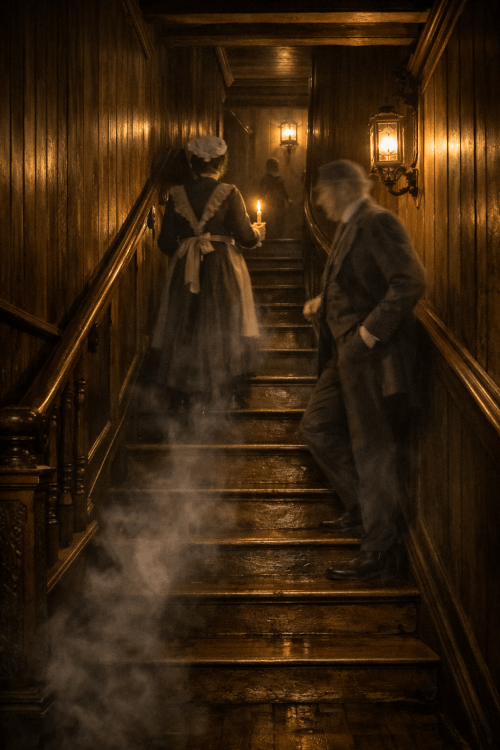
Late at night, neighbors heard hammering—furious, frantic hammering—echoing from inside the boarded‑up mansion. Sometimes it sounded like someone was building. Other times, like someone was trying to escape. Lights flickered in windows where no electricity remained. Shadows moved across rooms stripped bare. And always, always, the attic door stood open. According to legends Mrs. Winchester never left. Some believe Daisy and her brother never had the chance. And others think the house, wounded by the search, now hungers for replacements. Whatever the truth is, the mansion waits. It listens. And if you enter after dark, it remembers you.
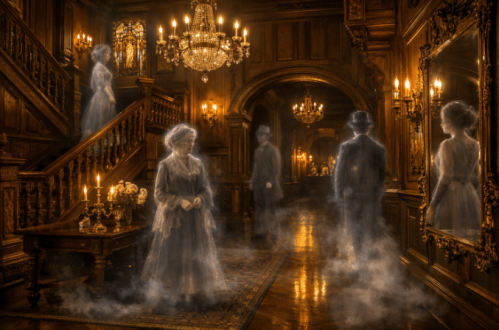
The United States is filled with haunted locations, each with its own ghost stories, strange architecture, and unexplained phenomena—but none of them carry the legend, the lore, or the sheer architectural madness of the Winchester Mystery House. For more than a century, visitors have wandered its endless hallways, climbed staircases that lead nowhere, and stood in rooms where people swear they’ve felt cold hands brush their shoulders or heard footsteps pacing behind them when no one was there.
Across the country, paranormal experts have nominated twenty of the most extraordinary haunted destinations for their intense reports of ghostly encounters. But the Winchester Mystery House stands apart. It isn’t just haunted—it’s alive with unanswered questions. Why did Mrs. Sarah Winchester build doors that open into walls? Why do some rooms seem to shift in temperature without explanation? And why do so many guests report seeing a woman in black drifting through the corridors long after closing hours?

Now it’s your turn to decide which haunted destination deserves the title of America’s most extraordinary paranormal hotspot. You can vote once per day for your top pick until Monday, September 21 at noon ET. The winning haunted location will be announced on Wednesday, September 30.

Whether you believe the Winchester Mystery House is a labyrinth designed to confuse spirits, a monument to grief, or a place where the past still walks the halls, one thing is certain: no other haunted site in America leaves visitors with stories they can’t explain—and memories they can’t forget. Please click here to vote: #WinchesterMysteryHouse
Welcome to Cresleigh Homes

Within every Cresleigh neighborhood, you’ll discover homes that feel instantly welcoming—beautiful, spacious retreats crafted with care for every generation and every lifestyle. These are not just houses; they are thoughtfully designed living spaces where natural light pours through generous windows, open floor plans create effortless flow, and every detail reflects Cresleigh’s commitment to comfort, efficiency, and long‑term reliability.

Each home is built to support what matters most: gathering with loved ones, celebrating milestones, and creating memories that last a lifetime. This is where life feels grounded, warm, and truly yours. Welcome to the neighborhood.

Welcome to Cresleigh Bluffs, the newest and most exciting home community in Plumas Ranch. Nestled in the heart of Plumas Lake, this community offers a collection of beautifully designed homes that blend modern elegance with everyday practicality.

With four spacious floor plans to choose from, Cresleigh Bluffs gives homeowners room to breathe, grow, and live fully. Expansive primary suites, wide-open living areas, and thoughtfully arranged layouts make each home feel both luxurious and livable.

Every residence comes equipped with premium standard features: engineered roof construction for lasting durability, full front and rear yard fencing for privacy, and a suite of smart‑home technologies that bring convenience to your fingertips. From the central automation hub and smart thermostat to digital entry, video doorbell, Wi‑Fi extender, and remote garage access, your home is designed to be as intelligent as it is beautiful.

Inside, you’ll find elevated finishes that set Cresleigh Bluffs apart—engineered stone showers, dual sinks in select baths, ceramic tile flooring, upgraded interior materials, and center‑island kitchens with gleaming stainless steel appliances. These kitchens aren’t just functional; they’re stunning gathering spaces where cooking, conversation, and connection come naturally.

To make the design process effortless, Cresleigh Bluffs offers exclusive curated design packages. Whether your style leans modern, classic, or somewhere in between, you can choose a package that fits your taste and your budget—ensuring your home feels uniquely yours from day one.

The community itself is just as inviting. Beautifully landscaped open spaces, nearby parks, and access to quality schools create an environment perfect for families, professionals, and anyone seeking a peaceful place to call home.

With direct routes to Sacramento, Roseville, and other regional destinations, Cresleigh Bluffs offers the ideal balance of serene neighborhood living and convenient urban access.

Contact our dedicated sales associates to learn more, and sign up for our interest list to stay informed about availability and community updates. Cresleigh Bluffs isn’t just a place to live—it’s a place to thrive. https://www.cresleigh.com/communities/california/plumas-lake-ca/bluffs-at-plumas-ranch

Sometimes You Need the Wrong Place to See the Right Path

If you are looking for a community that feels like home — fresh air, quiet mornings, safe streets, and a place where kids can actually play outside — Downtown and Midtown Sacramento are not it. The air quality is consistently poor. You will find yourself shutting windows just to breathe clean air, because outside it is a rotating mix of exhaust, cigarettes, drugs, and gasoline. Even on the rare days when the air feels fresh, it lasts only minutes before the smell shifts again.Noise is constant. Leaf blowers run several days a week, usually starting at 7 a.m. and droning on until 10 a.m. And just when you think you will get a peaceful Saturday morning — the one day most people can sleep in — you are jolted awake by another blower echoing down the block. After living in Midtown/Downtown, even a crying baby starts to sound peaceful by comparison. People often move to Midtown/Downtown expecting vibrant city life or nightlife, but what they actually find is a high‑priced, semi‑rural neighborhood with a lot of riff‑raff and very little for young adults. You rarely see young people unless they are briefly out for dinner. It is not a place that feels energetic, safe, or community‑oriented. If safety, comfort, and quality of life matter, the growing suburban communities — Rancho Cordova, Elk Grove, and similar areas — are where Sacramento’s real momentum is. These neighborhoods offer clean parks, low exposure to drugs, abundant parking, family‑friendly amenities, and a sense of peace that Midtown/Downtown simply cannot match. And for the cost of a cramped two‑bedroom apartment in the city, you can often afford a spacious home in the suburbs.

Downtowns everywhere are fading as suburban communities expand. The suburbs have everything: shopping, parks, coffee shops, safety, and a genuinely happier population. Midtown/Downtown Sacramento, by contrast, feels more like a commuter zone than a place to build a life. Living in Downtown and Midtown Sacramento taught me something I didn’t expect: sometimes you have to experience the wrong environment to understand the right one. I’m actually grateful for my time there, because it showed me clearly what I do not want and who I do not want to become. I learned that constant noise, polluted air, and chaotic surroundings change you in subtle ways. You start adjusting your habits, your expectations, even your sense of peace, just to cope. And somewhere in that process, I realized I didn’t want to normalize those things. I didn’t want to become someone who accepts low air quality as “city life,” or someone who wakes up to leaf blowers and sirens and calls it “energy.” I did not want to live in a place where safety feels negotiable and community feels scattered. Experiencing Midtown/Downtown made my values sharper. I want fresh air, quiet mornings, and neighborhoods where people feel grounded and connected. I want a lifestyle that supports growth, not one that drains it. And I want to live in a place that reflects the kind of person I am becoming — someone who values peace, stability, and a healthier rhythm of life.

When I toured the Governor’s Mansion years ago, I was so surprised when the caretaker told me that Nancy Regan moved her family out of that place. I thought to myself, “Who would not want to live in this beautiful mansion?” When I told the caretaker that I was shocked, he replied, “It’s not a good place to raise a family.” I thought maybe because of the traffic, but I guess, even back then, Downtown/Midtown Sacramento was not a family-friendly community. On the rare occasion I see a teenager or a kid with their backpack on, I think to myself, “Who would let their kids out here by themselves? It is not safe.” It reminds me of Oakland, CA in the late 1980s and 1990s. Like, you know, it is time to get up and move somewhere safe. If you are not familiar with Oakland from that era, maybe you can recall “G-Parkway” or Oak Park? If my child lived in Midtown/Downtown Sacramento, I would be afraid that they may not make it home one day. If you ever wanted to defund the police, after living in Midtown/Downtown Sacramento, you will wish that police managed your apartment complex and walked the beat like back in the 1950s. Nonetheless, strangely, Sacramento’s urban core gave me clarity. It helped me define my boundaries, my preferences, and my future. I am thankful for that. Sometimes the best lessons come from places that show you exactly what you do not want, so you can move toward what you do with confidence and intention. If I were choosing a place to settle, I would look toward the suburbs — especially Rancho Cordova or Elk Grove — where the air is cleaner, the neighborhoods are calmer, and the homes actually feel like home.

Ventris Place

Elk Grove / South Sacramento, California
From $494,990
3–4 Beds · 2–3 Baths · 2-Car Garage · 1,196–1,846 Sq Ft
Elk Grove living, adjacent to 141 acres of open space.

New homes in Elk Grove adjacent to the South Sacramento 22-acre North Laguna Creek Park and a quick walk from the 119-acre designated Wildlife Area and Interpretive Trail.

This intimate enclave of 37 homesites — with available one- and two-story floorplans — is the place to be in Sacramento. Wake up each day to the comfort of a life-made-easy plan, private side yards, and inspired living spaces carefully designed to make life at home a pleasure.

Just a few steps from your door, enjoy all the amenities of North Laguna Creek Park: paved paths, tennis courts, a basketball court, playgrounds, picnic areas, ball fields, and a wildlife area.

Walk or ride to Sacramento-area parks, attractions, shopping, dining, and destinations just minutes from your home — or take an impromptu trip to Old Sacramento, downtown, or the historic riverfront district. Ventris Place is located in the Elk Grove Unified School District.

Homes at Ventris Place offer 3–4 bedroom, 2–3 bath plans ranging from 1,196 to 1,846 square feet, with rear-entry 2-car garages. Choose from a single-story plan or several two-story plans.

Experience Ventris Place

Discover beautifully crafted interiors and thoughtfully designed exteriors across all four floor plans. https://nextgenerationcapital.us/new-homes-elk-grove-ventris-place/

A patriot’s heart is not loud—it is steady. It is the quiet promise to stand up for your country’s ideals even when no one is watching, and the unwavering belief that freedom is worth protecting every single day.

You Know More Divinity than All of Us Put Together
It is in our unconscious repressed desires that we shall find the essence of our being, the clue to our neurosis (as long as reality is repressive), and the clue to what we might become if reality ceased to repress. Our repressed desires are the desires we had, unrepressed, in childhood; and they are desires for pleasures of the flesh. When neurotic symptoms and dreams are analyzed, they invariably contain a nucleus representing a return or regression to the experiences of early childhood. However, the consciousness which comes into conflict with the unconscious is the product of education. It follows that children are, in some sense, unrepressed. Or, to put it another way, in the child, the conscious and the unconscious are not yet separated. It is, therefore, natural to infer that the adult, in flight from repressive reality in dreams and neurosis, regresses to his own childhood because it represents a period of happier days before repression took place. Furthermore, the neurotic symptoms invariably lead not only to the patient’s childhood but also to his pleasures of the flesh. The symptom is not merely a substitute for pleasure denied by reality, but more specifically a substitute for sexual satisfaction denied by reality. However, the repressed sexual desires whose presence was indicated were for the most of a kind labeled “abnormal” or “perverse.” Thus, the analysis of neurosis required the construction of a theory of sexuality which would account for perverted as well as normal sexuality and would trace both to their origins in childhood. #RandolphHarris 1 of 19

This is based on the axiom that the pattern of normal adult sexuality is not a natural (biological) necessity but a cultural phenomenon. The pattern of normal adult sexuality—the mutual love of man and woman and all the variations of the pattern-represents a particular organization of certain possibilities given in the human organism. This sexual organization is made possible by the social organization which marks the transition from ape to man, and simultaneously, it makes that social organization possible. Man’s sexual organization and his social organization are so deeply interconnected that we cannot say which came first, but can only assume a simultaneous organization: parenthood, with the prolonged maintenance of children in a condition of helpless dependence. That parenthood implies family organization of some sort or another, and that family organization is the nucleus of all social organization, are anthropological axioms. It is important to draw attention to the consequences of prolonged parenthood and prolonged infantile dependence on the sexual life of both parents and children. As far as the parents are concerned, it is clear that while adult sexuality serves the socially useful purpose of breeding children, it is for the individual, in some sense, an end in itself as a source of pleasure—the highest pleasure. Adult sexuality, in so far as it is restricted by rules designed to maintain the institution of the family and, in so far as the desire for sexual satisfaction is diverted and exploited for the purpose of maintaining a socially useful institution, is a clear instance of that subordination of the pleasure-principle to the reality-principle which is repression; as such, it is rejected by the unconscious essence of the human being and therefore leads to neurosis. #RandolphHarris 2 of 19
Prolonged infancy refers to a developmental pattern in which the early‑childhood stage—especially the period of dependence, immaturity, and slow maturation—lasts longer than what is typical for other species or for expected human developmental timelines, and it has even more far-reaching consequences. On the one hand, infancy is protected from the harshness of reality by parental care; it represents a period of privileged irresponsibility and freedom from the domination of the reality-principle. This privileged irresponsibility permits and promotes an early blossoming of the essential desires of the human being, without repression and under the sign of the pleasure-principle. On the other hand, the infant’s objective dependence on parental, especially maternal, care promotes a dependent attitude toward reality and inculcates a passive (dependent) need to be loved, which colors all subsequent interpersonal relationships. This psychological vulnerability is subsequently exploited to extract submission to social authority and to the reality-principle in general. Thus, prolonged infancy shapes human desires in two contradictory directions: on the one hand, on the subjective side, toward omnipotent indulgence in pleasure freed from the limitations of reality; on the other hand, on the objective side, toward powerless dependence on other people. The two tendencies come into conflict because the early experience of freedom and absorption in pleasure must succumb to the recognition of the reality-principle, in a capitulation enforced by parental authority under the threat of loss of parental love. #RandolphHarris 3 of 14

And since the pleasure-principle is forced to capitulate against its will and for reasons which the child does not understand, under circumstances which reproduce its primal experiences of helpless dependence (anxiety), the capitulation can be accomplished only by repression. Hence, it constitutes a trauma from which the individual never recovers psychologically. However, in the unconscious, the repressed dreams of omnipotent indulgence in pleasure persist, as the nucleus of man’s universal neurosis and his restless discontent, the cor irrequietum of St. Augustine. The infantile conflict between actual impotence and dreams of omnipotence is also the basic theme of the universal history of mankind. And in both conflicts—in the history of the individual and the history of the race—the stakes are the meaning of love. Looking back now at the total structure of resignation from the viewpoint of the preservation of integrity, certain observations fall in line and gain significance. To begin with, the integrity of truly detached people has always struck an alert observer. I, for one, have always been aware of it, but what I did not realize earlier was that it is an intrinsic and nuclear part of the structure. Detached, resigned people may be impractical, inert, inefficient, difficult to deal with because of their defiant wariness of influences and closer contact, but they possess—to a greater or lesser extent—an essential sincerity, an innocence in their innermost thoughts and feelings which are not to be bribed or corrupted by the lure of power, success, flattery, or “love.” Furthermore, we recognize in the need to maintain inner integrity another determinant for the basic characteristic. We saw first that avoidances and restrictions were put to the service of integration. Then we saw them also being determined by a need for freedom, not yet knowing its meaning. Now, we understand that they need freedom from involvement, influence, and pressure, from the shackles of ambition and competition, for preserving their inner life unsoiled and untarnished. #RandolphHarris 4 of 19

We may feel puzzled that the patient does not talk about this crucial matter. Actually, he has indicated in many indirect ways that he wants to remain “himself”; that he is afraid of “losing his individuality” through analysis; that analysis would make him like everybody else; that the analyst inadvertently might mold him according to his, the analyst’s, pattern, et cetera. However, the analyst often does not grasp the full implications of such utterances. The context in which they were made suggests the patient’s wanting to remain either his actual neurotic self or his idealized grandiose self. And the patient indeed meant to defend his status quo. However, his insistence on being himself also expresses an anxious concern about preserving the integrity of his real self, although he is not yet able to define it. Only through analytic work can he learn the old truth that he must lose himself (his neurotic glorified self) in order to find himself (his true self). From this basic process, three most different forms of living result. In a first group, persistent resignation, resignation and all it entails, is carried through fairly consistently. In a second, active rebellion: the rebellious group. In a third, deteriorating processes prevail and lead to shallow living. Individual differences in the first group are related to the prevalence of expansive or self-effacing trends and to the degree of retiring from activities. In spite of a cultivated emotional distance from others, some are capable of doing things for their families, their friends, or for those with whom they come in contact through their work. And, perhaps because of being disinterested, they often are effective in the help they give. If others mistake their willingness to help for personal affection and want more of it in addition to the help given, in contrast to the latter, it rather exasperates them. #RandolphHarris 5 of 19

In spite of a restriction of activities, many such people are capable of doing their daily work. It is, though, usually felt as a strain because it is done against the inner odds of inertia. The inertia becomes more noticeable as soon as the work accumulates, requires initiative, or involves fighting for or against something. The motivations for doing routine work usually are mixed. Besides economic necessity and the traditional shoulds, there also is often a need to be useful to others despite being themselves resigned. Besides, daily work may also be a means of getting away from the feeling of futility they possess when left to their own resources. They often do not know what to do with their leisure time. Contacts with others are too much of a strain to be enjoyable. They like being by themselves, but they are unproductive. Even reading a book may meet with inner resistance. If it is available without effort, they dream, think, listen to music, or enjoy nature. They are mostly unaware of the lurking fear of futility but may automatically arrange their work in a way that leaves little free time by themselves. Finally, the inertia and the accompanying aversion to regular work may prevail. If they have no financial means, they may take occasional jobs or else sink down to a parasitic existence. Or, if moderate means are available, they rather restrict their needs to the utmost in order to feel free to do as they please. The things they do, however, often have the character of hobbies. Or they may succumb to a more or less complete inertia. This outcome is presented in a masterly fashion in Goncharov’s unforgettable Oblomov, who resents even having to put on his shoes. His friend invites him on a trip to some other countries and makes all the preparations for him, down to the last detail. Oblomov sees himself in his imagination in Paris and in the Swiss mountains, and we are kept in suspense: will he or will he not go? Of course, he backs down. The prospect of what seems to him a turbulent moving around and ever-new impression is too much. #RandolphHarris 6 of 19
Even if not carried to such extremes, a pervasive inertia bears within it the danger of deterioration, as is shown in Oblomov’s and his servant’s later fate. (Here, then, would be a transition to the shallow living of the third group.) It is also dangerous because it may extend beyond a resistance against doing to one against thinking and feeling as well. Both thinking and feeling may then become purely reactive. Some train of thought may be set in motion by a conversation or by the analyst’s comments, but since no energies are mobilized by it, it peters out. Some feeling, positive or negative, may be stimulated by a visit or a letter, but it likewise fades out soon after. A letter may evoke an impulse to answer it, but if not acted upon right away, it may be forgotten. The inertia in thinking can be well observed in analysis and often is a great hindrance to work. Simple mental operations become difficult. Whatever is discussed during one hour may then be forgotten—not because of any specific “resistance” but because the patient lets the content lie in his brain like a foreign body. Sometimes, he feels helpless and confused in analysis, as well as in reading or discussing somewhat difficult matters, because the strain of connecting data is too great. One patient expressed this aimless confusion in a dream, in which he found himself in various places all over the world. He had no intention of going to any of them; he did not know how he got there, or how he would go from there. The more the inertia spreads, the more the person’s feelings are affected by it. He needs stronger stimuli to respond at all. A group of beautiful trees in a park no longer arouses any feelings; he requires a riotous sunset. Such an inertia of feelings entails a tragic element. As we have seen, the resigned type largely restricts his expansiveness in order to maintain intact the genuineness of his feelings. However, if carried to extremes, the process chokes off the very aliveness it was meant to preserve. Hence, when his emotional life becomes paralyzed, he suffers under the resulting deadness of his feelings more than other patients, and this may be the one thing which he does want to change. As the analysis proceeds, he may at times have the experience of his feelings being more alive as soon as he is generally more active. Even so, he hates to realize that his emotional deadness is but one expression of his pervasive inertia, and hence that it can change only as the latter is lessened. #RandolphHarris 7 of 19

If some activity is maintained and living conditions are fairly appropriate, this picture of persistent resignation may remain stationary. Many attributes of the resigned type combine to make it so: his check on strivings and expectations, his aversion to change and inner struggle, his capacity to put up with things. Against all of this, however, militates one disquieting element—the appeal freedom has for him. Actually, the resigned person is a subdued rebel. So far in our study, we have seen this quality expressed in a passive resistance against internal and external pressure. However, it might turn at any time into an active rebelliousness. Whether it actually does, depends on the relative strength of expansive and self-effacing trends and on the degree of inner aliveness a person has managed to salvage. The stronger his expansive tendencies and the more alive he is, the more easily will he become discontented with the restrictions of his life. The discontentment with the external situation may prevail; then it is primarily a “rebellion against.” Or, if his discontent with himself prevails, it is primarily a “rebellion for.” Rebellion can be active or passive. The classic example of willful rebellion is Lucifer, who, in the premortal world, opposed the Father’s plan of redemption and rallied others to oppose it as well, “and, at that day, many followed after him.” It is not hard to discern the impact of rebellion in our own time. Perhaps the more insidious form of rebellion against God, however, is the passive version—ignoring his will in our lives. Many who would never consider active rebellion may still oppose the will and word of God by pursuing their own path without regard to divine direction. I am reminded of the song made famous years ago by singer Frank Sinatra with the climactic lyrics, “I did it my way.” Certainly, in life there is plenty of room for personal preference and individual choice, but when it comes to matters of salvation and eternal life, our theme song ought to be, “I did God’s way,” because truly there is no other way. There is much in public and personal discourse today that is malicious and mean-spirited. There is much conversation that is vulgar and profane, even among youth. This sort of speech is a “weapon of rebellion” against God, “full of deadly poison.” #RandolphHarris 8 of 19

It is possible to distinguish analytically between two different levels of legitimation (empirically, of course, these levels overlap). Incipient legitimation is present as soon as a system of linguistic objectifications of human experience is transmitted. For example, the transmission of a kinship vocabulary ipso facto legitimates the kinship structure. The fundamental legitimating “explanations” are, so to speak, built into the vocabulary. Thus, a child learns that another child is a “cousin,” a piece of information that immediately and inherently legitimates the conduct with regard to “cousins” that is learned along with the designation. To this first level of incipient legitimation belongs all the simple traditional affirmations to the legitimation belong all the simple traditional affirmations to the effect that “This is how things are done”—the earliest and generally effective responses to a child’s question of “Why?” This level, of course, is pretheoretical. However, it is the foundation of self-evident “knowledge” on which all subsequent theories must rest—and, conversely, which they must attain if they are to become incorporated in tradition. The second level of legitimation contains theoretical propositions in a rudimentary form. Here may be found various explanatory schemes relating sets of objective meanings. These schemes are highly pragmatic, directly related to concrete actions. Proverbs, moral maxims, and wise sayings are common on this level. Here, too, belong legends and folk tales, frequently transmitted in poetic forms. Thus, the child learns such adages as “He who steals from his cousin gets warts on his hands” or “Go when your wife cries, but run when your cousin calls for you.” Or he may be inspired by the “Song of the Loyal Cousins Who Went Hunting Together” and frightened out of his wits by the “Dirge for Two Cousins Who Fornicated.” #RandolphHarris 9 of 19

The third level of legitimation contains explicit theories by which an institutional sector is legitimated in terms of a differentiated body of knowledge. Such legitimations provide fairly comprehensive frames of reference for the respective sectors of institutionalized conduct. Because of their complexity and differentiation, they are frequently entrusted to specialized personnel who transmit them through formalized initiation procedures. Thus, there may be an elaborate economic theory of “cousinhood,” its rights, obligations, and standard operating procedures. This lore is administered by the old men of the clan, perhaps assigned to them after their own economic usefulness is at an end. The old men initiate the adolescents into this higher economics in the course of the puberty rites and appear as experts whenever there are problems of application. If we assume that the old men have no other tasks assigned to them, it is likely that they will spin out of theories in question among themselves even if there are no problems such in the course of their theorizing. In other words, with the development of specialized legitimating theories and their administration by full-time legitimators, legitimation begins to go beyond pragmatic application and to become “pure theory.” With this step, the sphere of legitimations begins to attain a measure of autonomy vis-à-vis the legitimated institutions and eventually may generate its own institutional processes. In our example, the “science of cousinhood” may begin to have a life of its own quite independent of the activities of merely “lay” cousins, and the body of “scientists” may set up its own institutional processes over against the institutions that the “science” was originally meant to legitimate. We may imagine an ironic culmination of this development when the word “cousin” no longer applies to a kinship role but to the holder of a degree in the hierarchy of “cousinhood” specialist. #RandolphHarris 10 of 19

Symbolic universes constitute the fourth level of legitimation. These are bodies of theoretical tradition that integrate different provinces of meaning and encompass the institutional order in a symbolic totality, using the term “symbolic” in the way we have previously defined. To reiterate, symbolic processes are processes of signification that refer to realities other than those of everyday experience. It may be readily seen how the symbolic sphere relates to the most comprehensive level of legitimation. The sphere of pragmatic application is transcended once and for all. Legitimation now takes place by means of symbolic totalities that cannot be experienced in everyday life at all—except, of course, insofar as one might speak of “theoretical experience” (strictly speaking, a misnomer, to be used heuristically if at all). This level of legitimation is further distinguished from the preceding one by its scope of meaningful integration. Already on the preceding level, it is possible to find a high degree of integration of particular provinces of meaning and discrete processes of institutionalized conduct. Now, however, all the sectors of the institutional order are integrated in an all-embracing frame of reference, which now constitutes a universe in the literal sense of the word, because all human experience can now be conceived of as taking place within it. The symbolic universe is conceived as the matrix of all socially objectivated and subjectively real meanings; the entire historic society and the entire biography of the individual are seen as events taking place within this universe. What is particularly important, the marginal situation of the life of an individual (marginal, that is, in not being included in the reality of everyday existence in society) are also encompassed by the symbolic universe. Such situations are experienced in dreams and fantasies as provinces of meaning detached from everyday life, and endowed with a peculiar reality of their own. #RandolphHarris 11 of 14

Within the symbolic universe, these detached realms of reality are integrated within a meaningful totality that “explains,” perhaps also justifies them (for instance, dreams may be “explained” by a psychological theory, both “explained” and justified by a theory of metempsychosis, and either theory will be grounded in a much more comprehensive universe—a “scientific” one, say, as against a “metaphysical” one). The symbolic universe is, of course, constructed by means of social objectivations. Yet its meaning-bestowing capacity far exceeds the domain of social life, so that the individual may “locate” himself within it even in his most solitary experiences. On this level of legitimation, the reflective integration of discrete institutional processes reaches its ultimate fulfillment. A whole world is created. All the lesser legitimating theories are viewed as special perspectives on phenomena that are aspects of this world. Institutional roles become modes of participation in a universe that transcends and includes the institutional order. In our previous example, the “science of cousinhood” is only a part of a much wider body of theory, which, almost certainly, will contain a general theory of the cosmos and a general theory of man. The ultimate legitimation for “correct” actions in kinship structure will then be their “location” within a cosmological and anthropological frame of reference. Incest, for instance, will attain its ultimate negative sanction as an offense against the divine order of the cosmos and against the divinely established nature of man. So many economic misbehaviors, or any other deviance from the institutional norms. The limits of such ultimate legitimation are, in principle, coextensive with the limits of theoretical ambition and ingenuity on the part of the legitimators, the officially accredited definers of reality. #RandolphHarris 12 of 14

In practice, of course, there will be variations in the degree of precision with which particular segments of the institutional order are placed in a cosmic context. Again, these variations may be due to particular pragmatic problems on which the legitimators are consulted, or they may be the result of autonomous developments in the theoretical fancy of the cosmological experts. The crystallization of a symbolic universe follows the previously discussed processes of objectivation, sedimentation and accumulation of knowledge. That is, symbolic universes are social products of history. If one is to understand their meaning, one has to understand the history of their production. This is all the more important because these products of human consciousness, by their very nature, present themselves as full-blown and inevitable totalities. However, there is also an honestly intended philanthropism which amounts to the same thing as contempt for mankind. It consists in judging the man according to his latent values, according to his underlying soundness, reasonableness and goodness. This kind of philanthropism will generally arise in peaceful times. However, even in great crises when these values shine out on particular occasions, they may form the basis for a hard-won and well-meant love for humanity. With forced indulgence, evil is interpreted as good. Baseness is overlooked and the reprehensible is excused. For one reason or another, one is afraid to give a clear “no” for an answer, and one ends by acquiescing in everything. One’s love is directed to a picture of a man of one’s own making, a picture which scarcely preserves any resemblance with the reality. And consequently, one finishes once again by despising the real man whom God has loved and whose nature He has taken upon Himself. #RandolphHarris 13 of 19

It is only through God’s being made man that it is possible to know the real man and not to despise him. The real man can live before God, and we can allow the real man to live before God side by side with ourselves without either despising or deifying him. That is not to say that this is really a value on its own account. It is simply and solely because God has loved the real man and has taken him to Himself. The ground for God’s love towards man does not lie in man but solely in God Himself. And again, the reason why we can live as real men and can love the real man at our side is to be found solely in the incarnation of God, in the unfathomable love of God for man. Someone may think that by punishment is meant what is now seldom mentioned—the punishment of eternity. And it might seem that the person was not double-minded who wills the Good out of fear of punishment, since he refers the punishment to eternity, therefore to the same place where the Good has its home. And yet, he does not will the Good, he wills it only out of fear of punishment. Therefore—if there were no punishment! In that “if” lurks doublemindedness. If there were no punishment, or if indeed there was a man who could convince him that eternity’s punishment was a fantasy; or if it became common practice to think in this fashion; or if he could travel to a foreign country where it was common practice; of if cowardly and hypocritical superstition could discover a cheap means of propitiation!!! Look at the doublemindedness! Note that it can just as easily seek its consolation in unbelief as in superstition. And if doublemindedness does not seek them out, then it is they that try to capture doublemindedness until the matter be obvious. If one were briefly to characterize double-mindedness by a single appropriate expression, what would be more characteristic than that—“if,” “in that case that”! Paul reminds of that we are to glorify God in both body and spirit and that this body is the temple of the Holy Ghost, “which ye have of God, and ye are not your own.” #RandolphHarris 14 of 14
Some stories do not begin with tragedy or malice — they begin with a single moment of human carelessness. On an ordinary Sacramento evening, in a quiet neighborhood where porch lights glowed and families settled in for the night, one household was about to learn how quickly foolish choices can turn into chaos. It started with a father who was not thinking clearly, a man dulled by alcohol and marijuana, reaching for solutions that made sense only inside his fogged mind. What followed was a chain of decisions so reckless, so astonishing, that it would summon the award‑winning Sacramento Fire Department, the city’s paramedics, and the stern, unflinching leadership of Captain Schneider. And in the aftermath — when the smoke cleared, and the truth lay bare — the entire ordeal stood as a vivid reminder of what happens when we fail to honor what has been entrusted to us. The night began with the kind of bad decision that only a drunk father with a lit joint could invent. He stood in his living room, swaying slightly, staring at the cold fireplace as if it had personally insulted him. Outside, a small ornamental tree leaned against the fence — barely six feet tall, thin, leafy, and absolutely not meant for burning indoors. But inspiration struck him like a spark in dry brush. He stumbled outside, hacked the tree down with a rusty handsaw, and dragged it inside, leaving a trail of leaves like breadcrumbs of impending disaster. The tree did not fit in the fireplace, of course. So he shoved it. Hard. Branches snapped, leaves crammed upward, and the flue clogged instantly. But he was not done. He grabbed a bottle of barbecue lighter fluid — the kind meant for charcoal, not lumber — and drenched the tree until it glistened. When he lit it, the room filled with smoke so fast it looked like a magician’s trick gone wrong. The mother screamed. The kids coughed. The father panicked and tried to yank the tree back out. That was the moment the oxygen rushed in and the entire thing exploded into a roaring column of fire. Neighbors called 911 before the family even made it out the door. Within minutes, the award‑winning Sacramento Fire Department arrived, lights slicing through the smoke‑choked night. At the front of the engine stood Captain Schneider — tall, sharp‑eyed, and unmistakably German in both accent and attitude. #RandolphHarris 15 of 19
Captain Schneider surveyed the scene with the calm precision of a man who had seen every possible flavor of human foolishness. “Tree fire in a fireplace,” one of the firefighters muttered. Captain Schneider nodded once. “We have seen worse. But not much.” His crew moved with practiced speed. They breached the front door, disappearing into the haze like ghosts. Flames licked up the walls, devouring paint and drywall. The firefighters cut through the burning branches, extinguishing the blaze with controlled bursts. Captain Schneider directed every motion, his voice steady, authoritative, and unmistakably irritated. Outside, Sacramento Paramedics tended to the family. The mother was hysterical, the kids wheezing, and the father — still reeking of marijuana and lighter fluid — insisted he had everything under control until “the tree betrayed him.” The paramedics exchanged looks that said everything. When the fire was finally out, the insurance investigator arrived, electronic tablet in hand, already suspicious. He asked Captain Schneider if he believed the incident was fraud. Captain Schneider stared at the charred remains of the tree jammed halfway out of the fireplace. He exhaled slowly. “No,” he said. “Fraud requires planning. This was… pure stupidity.” The investigator nodded. “That’s exactly what the family told us.” Captain Schneider turned to his crew. “Pack up. We saved the home. And next time someone wants to burn a tree indoors, maybe they call us first.” The night ended with the fire out, the family safe, and the unmistakable truth lingering in the smoky air: some disasters aren’t malicious — they’re just spectacularly, unbelievably foolish. The foolishness that nearly burned their home to the ground is a vivid reminder of a deeper truth: when we misuse what God has entrusted to us, destruction follows. Paul teaches that our bodies are not disposable shelters but sacred temples — “which ye have of God, and ye are not your own.” Their smoke‑filled living room becomes a symbol of what happens when we ignore that divine stewardship. #RandolphHarris 16 of 19
When it comes to firefighting, every incident carries the potential for injury—no matter how small the fire appears or how routine the call may seem. If you see a fire engine stopped in the street without its lights on, use extreme caution. Crews may be working nearby, and passing the apparatus can put them in danger. It is often safer to turn around and take another route; if you strike a firefighter or civilian and cause a fatality, you could face charges such as manslaughter. Firefighters frequently move around their vehicle on foot, loading equipment or preparing to leave the scene. Attempting to pass the apparatus can result in a collision with someone you cannot see. Pay close attention to their hand signals as well—emergency vehicles sometimes move slowly or reposition, and impatient drivers trying to slip around them create hazardous situations. If you are already in an intersection when you notice an emergency vehicle approaching, continue through it, then pull to the right and stop as soon as it is safe. Always obey directions from law enforcement officers or firefighters, even if those instructions conflict with posted signs or traffic laws. When sirens or flashing lights are activated, it is illegal to follow within 300 feet of a fire engine, ambulance, or police vehicle. Driving to the scene of a fire, collision, or disaster can also result in arrest, as doing so interferes with firefighters, paramedics, and other emergency personnel. Professional courage is not limited to physical toughness. It includes listening to others, advocating for them in difficult situations, understanding personal limits, and having the integrity to tell a superior when they are wrong. The deeper truth is that public safety depends not only on the bravery of first responders but on the discipline and judgment of the community around them. Every driver’s decision—whether cautious or careless—can either protect or endanger the people risking their lives to protect everyone else. #RandolphHarris 17 of 19
To help prevent disasters, we must plan well in advance. Efforts to preserve farmland and maintain buildable land for future generations often lead to discussions about population growth and long‑term planning. Some people argue that immigration levels should be managed carefully to ensure that infrastructure, housing, and land use remain sustainable. Others suggest that, when immigration does occur, programs that encourage broad representation can help communities reflect the diversity of the wider world. When Americans purchase goods made in the United States, it strengthens local businesses and signals to investors that these products are in demand. Strong sales give investors confidence to reinvest in domestic companies, helping keep jobs, production, and wages within the country. As businesses grow, they contribute more to the tax base, which can reduce the burden on taxpayers over time. Supporting American businesses also keeps more money circulating within the national economy. The government increases the national debt when it spends more than it collects in tax revenue or borrows from private or foreign lenders. When people shop locally, more tax revenue stays in the community and supports public services. This helps keep jobs in the United States and increases the tax contributions that fund government operations. Purchasing foreign-made goods, by contrast, often sends money overseas and may benefit companies that operate under lighter tax or environmental regulations. Buying American-made products can also reduce environmental impact because they travel shorter distances and are produced under stricter standards for air, land, and water protection. In this way, consumer choices influence not only the economy but also environmental stewardship and long-term national sustainability. #RandolphHarris 18 of 19

Under President Trump’s administration, he has made America a priority. President Trump has hermetically sealed the southern border, illegal crossings have been terminated, and are 90 percent lower than under the previous administration. Since President Trump’s crack down on crime, violent crimes in Washington D.C. have dropped by approximately 80 percent. He has stopped thousands of pounds of drugs from entering America and killing citizens. And since President Trump took office, investments in America have increased by trillions of dollars in U.S.A. manufacturing, production, and innovation. As you can see, President Donald Trump and his pledge to “Make America Great Again” is exactly what America needs to save the country and the American people. And yes, diversity is important, so you can see why it is also important to preserve blonde hair and blue eyes, as the people with these characteristics are becoming a minority in America. As a reminder, parents, please teach your children to love America and be patriotic citizens, and to buy goods and services made in America. It is also important to respect law and order and treat your elders with respect. It is inborn in the human mind to wish to know. If this begins with the endless surface questions of a child’s curiosity, if it continues into deeper questions of a scientist’s probing investigation, it cannot and does not stop there. For the higher part of the mind will eventually come into unfoldment, that union of abstract reflective thought with mystical intuition, which is true intelligence, which needs and sees a view of the whole of things. And so, the knowing faculty enters the realm of philosophy. A lot of children are having problems in school and cannot even write a paragraph because they are not reading their books. When you actually read books, you get an example of how to write and will become a better student. Therefore, remember to take your education seriously so that you will be successful in life and make your family proud. Also, to make sure they have all the resources required, please donate to the Sacramento Fire Department to help improve our national security. “Oh, thus be it ever, when freemen shall stand between their loved home and the war’s desolation! Blest with victory and peace, may the heav’n-rescued land Praise the Power that hath made and preserved us a nation! Then conquer we must, when our cause is just, and this be our motto: ‘In God is our trust.’ And the star-spangled banner in triumph shall wave O’er the land of the free and the home of the brave.” Thank you for your attention to this matter. PRESIDENT DONALD J. TRUMP. #RandolphHarris 19 of 19

Join us in celebrating the life of Mrs. Sarah L. Winchester on the anniversay of her passing, September 5, 1922.

Hostted by the enchanting Vogle Victorian team, this intimite Victorian Tea Party is limited to just 24 guests and includes a Victorian-style séance, blessing jar creations, and tea service inside the mansion. Held on the anniversay of her passing, this intimate gathering offers a unique way to honor Mrs. Sarah L. Winchester in the home where she spent nearly four decades.
Event detailes:

Date: September 5, 2026
Time: 10am PST & 7pm PST
Includes: Full Tea service, blessing jar material, and the séance experience
Price: $179.99
Limitied spots available, buy tickets at winchestermysteryhouse.com
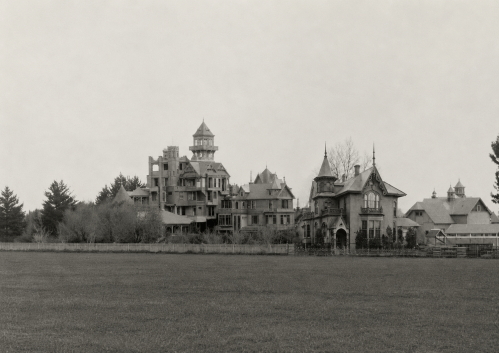

Harris Plumbing, Heating, Air & Electric has been serving our community for 30 years—an achievement few companies can claim. That longevity isn’t an accident. It’s the result of hard work, integrity, and a commitment to doing every job the right way, whether it’s a simple repair or a complex system overhaul. We take pride in every service call because we know your home is more than a building—it’s where your family lives, grows, and feels safe. Ensuring your comfort and protection is a responsibility we carry with seriousness and gratitude. After three decades, our mission remains the same: to deliver dependable service you can trust, every time.
Harris makes sure you have the clear, accurate information you need to decide what comes next—no matter what your home is facing. Before we begin any work, our technicians perform a full diagnosis and walk you through every issue we find. That means you receive a personalized quote and service plan tailored to your home’s exact needs, not a generic estimate or guess. We believe the only way to deliver our best work is to understand the problem completely and address it with precision, transparency, and care. Your home deserves nothing less. https://www.callharrisnow.com/about-us/

BMW remains one of the most desirable automotive marques because it blends engineering precision with an emotional driving experience that few brands can match. Its vehicles are built around balance, responsiveness, and a sense of connection between driver and machine—qualities that have defined the company for generations. Beyond performance, BMW carries an aura of prestige and craftsmanship: the cabins feel tailored, the technology is purposeful rather than gimmicky, and the design language signals confidence without excess. Owning a BMW is not just about transportation; it’s about participating in a legacy of excellence that continues to set the standard for luxury performance. This commitment to performance is why BMW continues to earn its reputation as The Ultimate Driving Machine. https://www.brianharrisbmw.com/
Randolph Harris San Francisco Taxation & Mergers
Building strong, lasting client relationships is essential to a successful legal career. Many attorneys assume that mastering legal doctrine alone guarantees success, but law is fundamentally a service profession—our work is measured not only by technical skill, but by how effectively we solve problems for the people who trust us. Long‑term relationships grow from three core commitments: truly knowing your clients, understanding how their legal issues fit within the broader context of their business and personal goals, and consistently delivering exceptional service.
Mr. Randy advises clients on business transitions, taxable and tax‑deferred mergers and acquisitions, joint ventures, restructuring, integrated tax planning, federal and state tax controversy matters, and real estate transactions. His approach is grounded in clarity, responsiveness, and a deep understanding of each client’s unique circumstances. Trust is the cornerstone of every relationship he builds. Ultimately, clients feel confident knowing they are working with someone who not only understands their challenges, but is fully committed to helping them achieve their goals. https://www.jmbm.com/l-randolph-harris.html
Ventris Place — Charming New Homes in Elk Grove
A Community Designed for Comfort, Connection, and Everyday Joy

Elk Grove / South Sacramento, California
Now Selling
From $494,990
Welcome to Ventris Place, the new fabulous 40s. Ventris Place is an intimate neighborhood of 37 beautifully crafted homes set beside Elk Grove’s most treasured natural spaces — the 22‑acre North Laguna Creek Park and the 119‑acre Wildlife Area and Interpretive Trail. Here, nature frames daily life, and every home is designed to feel welcoming from the moment you step inside.
This is the place to be in Sacramento — a community where thoughtful design meets effortless living.

Homes That Feel Like Home
Each residence at Ventris Place is built with a sense of charm and warmth that makes every room feel inviting. Step inside and discover:
- Special interior coves perfect for reading, relaxing, or displaying cherished décor
- Private nooks and quiet corners designed for reflection or creativity
- Open gathering rooms where families can come together for meals, celebrations, and everyday moments
- Light‑filled living spaces that make home feel uplifting and comfortable
- Private side yards ideal for morning coffee, evening unwinding, or weekend barbecues
Whether you choose a single‑story plan or one of the beautifully arranged two‑story designs, each home offers a blend of openness and intimacy — spaces that feel both expansive and personal.
Floorplans That Fit Your Life
Ventris Place offers a curated selection of modern homes:
- 3–4 bedrooms
- 2–3 baths
- 1,196–1,846 square feet
- Rear‑entry 2‑car garages
- One‑story and multiple two‑story options
Every plan is crafted with a “life‑made‑easy” approach — intuitive layouts, smart storage, and rooms that flow naturally from one space to the next.
Steps From Your Door — Recreation, Relaxation, and Nature
North Laguna Creek Park is your extended backyard, offering:
- Paved walking and biking paths
- Tennis courts
- Basketball court
- Playgrounds
- Picnic areas
- Ball fields
- A protected wildlife area
Morning jogs, weekend picnics, sunset walks — it’s all right outside your front door.

Close to Everything Sacramento Offers
Ventris Place places you minutes from parks, attractions, shopping, dining, and entertainment. Enjoy quick trips to:
- Old Sacramento
- Downtown Sacramento
- The historic riverfront district
Families benefit from being part of the Elk Grove Unified School District, known for its strong academic programs and community support.
Ventris Place — Where Home Feels Like a Haven
Charming architecture, welcoming interiors, private spaces, and nature at your doorstep — Ventris Place is more than a neighborhood. It’s a lifestyle built around comfort, connection, and the simple pleasure of coming home.
“I love my 1,900‑square‑foot Danville home at Ventris Place because every inch of it feels intentionally crafted for comfort, connection, and peace. It’s the kind of home that welcomes you the moment you walk through the door — not with grand gestures, but with thoughtful spaces that make everyday living feel effortless.
” The open gathering areas give my family room to laugh, cook, and spend time together, while the quiet coves and private corners offer a place to unwind, reflect, or simply breathe. The layout flows in a way that makes life feel organized and calm, and the natural light that fills each room brings a sense of warmth that never gets old.

“My Danville home feels charming and modern at the same time, with just the right balance of openness and intimacy. It’s a home where mornings feel hopeful, evenings feel restful, and every day feels like it was designed with my life in mind. Ventris Place isn’t just where I live — it’s where I feel grounded, grateful, and genuinely at home.” Abby H.
There is nothing like staying at home for real comfort. https://nextgenerationcapital.us/new-homes-elk-grove-ventris-place/

This 22.06 acre park includes the following amenities:
- Ball Field
- Basketball Court
- Gazebo
- Horseshoe Pit
- Lake
- 119.53 Acre Wildlife Area with Interpretive Trail
- Picnic Areas
- Play Areas:
- Adventure Play Area
- Tot Play Area
- Pond*
- Sand Volleyball Court
- Soccer Field
- Tennis Courts – 2
https://www.cityofsacramento.gov/ypce/parks/park-directory/m-n/north-laguna-creek-park

President Trump Loves American Children!

The American Dream starts now .If an infant receives a Trump Account before turning one and no one ever contributes anything beyond the initial federal seed deposit, the account grows solely on market returns. With the standard long‑term stock projection of 7% annually, that original $1,000 deposit compounds for 18 years and reaches a value of about $3,380 by the time the child turns eighteen. However, if someone contributes $1,200 every year from infancy through age eighteen, the account grows dramatically. Those annual deposits accumulate and compound over the same 18‑year period, reaching roughly $40,800, and when combined with the growth of the original $1,000 seed deposit, the total value at age eighteen rises to approximately $44,180. The difference between the two scenarios highlights how powerful consistent contributions can be over time.

To qualify for a Trump Account, a child must be born in the United States during the years the program is active and must have a valid Social Security number. The account is opened automatically for eligible newborns, funded initially with the federal seed deposit, and remains under custodial management until the child reaches adulthood. Families may contribute up to the annual limit, but contributions are optional — the account will grow regardless, though its final value depends entirely on how much is added over the years.

With the Trump Accounts app, long-term financial security for millions of kids is here. Get tax-advantaged investment accounts for U.S.A. citizens under 18 by downloading the official Trump Accounts app on the App Store or Google Play. https://trumpaccounts.gov/?source=govdelivery
A true patriot loveth his country not for the ease it granteth him, but for the virtue he must uphold within it; for kingdoms stand not by strength alone, but by the steadfast hearts of those who guard their liberty with wisdom and good conscience.


Unconscious Desires
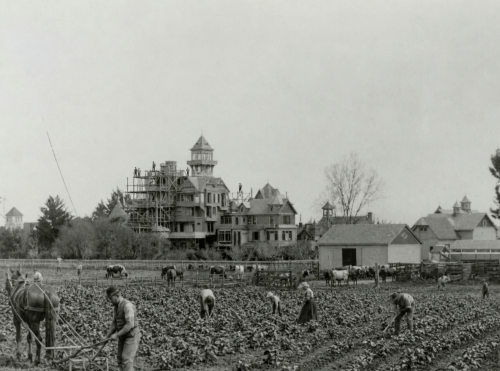
If we say the script follows or matches a fairy tale, we risk invoking Procrustes. The therapist picks out a fairy tale prematurely, and then stretches the patient or cuts him down so that he will fit it. Procrustes is very much in all the behavioral sciences. The scientist has a theory, and then stretches, cuts down, or weighs the data to match it, something by overlooking hidden variables, sometimes by ignoring items by overlooking hidden variables, sometimes by ignoring items that do not fit, or even at times manipulating the data with flimsy excuses so that they will fit better. Procrustes is most active at clinical staff conferences, where there is no control match at all, so that the situation is wide open for speculations, bright ideas, orthodoxy, and authoritative pronouncements ex cathedra. In order to cut down on the casuistry and sophistry of such conferences, each one should include two cases with similar histories, preferably one without any apparent pathology along with that of the patient. It is amazing how closely the “case history” of many well-functioning, productive person can resemble the “case history” of a psychiatric patient. That is to say, for every schizophrenic with a certain kind of upbringing, there appears to be a non-schizophrenic with the same upbringing. It should be noted that most staff conferences are based on an unstated but ever-present assumption: “The patient is sick, and our job is to prove it and then find out why he is.” Staff meetings can become much more interesting by reversing this to read: “The patient is not sick, and our job is to prove that and then find out why he is not.” #RandolpHarris 1 of 19
However, some patients who have been presented give concrete and abundant evidence in their behavior of a serious maladjustment and one long duration. If ever, the diagnosis of psychopathic personality can seldom be made with confidence except on such a record. Many patients at some time in their lives steal, cheat, lie, forge checks, indulge in foolish or destructive conduct, behave regrettably while drinking, and engage in unfortunate or paradoxical pleasures of the flesh. It can hardly be denied that some of the most stable and admirable of people have, during the course of achieving maturity, done all these things and worse. One important point that distinguishes the psychopath is his failure to learn and adopt a better and more fulfilling pattern of life. Another and perhaps a more fundamental point, which will be elaborated subsequently, is that psychopaths give a strong impression of lacking the fundamental responses and emotional susceptibility which probably play a dominant part in helping other people avoid this type of maladjustment. It is, perhaps, worthwhile for us to consider now a patient whose record so far may not establish him beyond question with our group of those clinically disabled, but whose inmost reactions, in so far as one can judge them, strongly indicate that his disorder is the same and that his subsequent career will unmistakably place him. #RandolphHarris 2 of 19
Not long ago, his parents made an appointment for him by mail. They accompanied him from a thriving community in Southern Sacramento where for the last sixty years, the members of this family had been sober and respected citizens. There was a good deal of pride in these people, not a vain or pretentious self-esteem but a modest dignity that seemed to be cherished more as a responsibility than as an ornament. These parents were truly concerned about their son. A dozen or more letters and reports from school teachers, from the family physician, the rector of the church, the scoutmaster, a high school coach, et cetera, arrived before the patient. From this material came many facts and opinions. The patient’s remote antecedents had lived in or about San Jose, California in colonial times. They had never been famous for wealth or political influence, but in the Revolutionary War, as well as in the War Between the States, they had played a part which rooted them deeply in sectional traditions of distinction. In Sacramento, where this branch of the family moved almost twenty years before the present century, they had established a good name and a sound, unsnobbish sort of prominence. Unlike the fictional Southerners preoccupied with (frequently exaggerated) glories of the past, the Webers had continued to live primarily in the present and to live rather effectively. One school teacher who had done graduate work in psychology gave a good deal of consideration to this boy’s name, which was Aryan. #RandolphHarris 3 of 19

As she had pointed out, an Englishman can be called Percival, Jasper, Evelyn, or Vivian without much risk, but in the ordinary American community such a name might endanger a boy’s soul. This young man had been christened Aryan Heinrich Rainer Weber, probably not as an extravagant gesture toward the exotic or to past glories, but almost as a matter of course. Such given names had been customary among these descendants of early Charleston Hugenots, and the present generation felt nothing conspicuous in what to them was so familiar and commonplace. In these parents, speculation probably never arose about how a German name might sound to the fellows who played football in the vacant lot by the gas-house and “rabbitted” sissies with brick-bats. In agreement with his thoughtful teacher’s final conclusion, I am inclined to believe that this name, despite its potential dangers, caused the patient little difficulty. Even before he began school, he was always called Aryan. And his family conformed to this custom. After his parents had been interviewed separately and together, Aryan came into the office. He stood about six feet tall, held himself well, and appeared more mature than would be expected of a boy still eighteen. He at once impressed me as being enviably at ease. Though not extraordinary in its features, his face was pleasant, candid, and alert. As our conversation progressed, indications of excellent intelligence soon appeared, along with suggestions of a character forceful but not undesirably self-assertive or aggressive. #RandolphHarris 4 of 19
Ayran expressed disappointment about having had to withdraw from college and seemed remarkably frank in discussing the causes of his predicament. His story was the same incomprehensible story already heard from his parents and corroborated by the several detailed reports. A forged check had brought Aryan before the dean. He did not deny his guilt, but in a straightforward way, seemed ready to meet the consequences like a gentleman. The dean was puzzled, not that a young man might forge a check, but that it should be this particular man with his fine record, his appearance of sincerity, and his brave way of handling a situation presumably painful and embarrassing. Several points made this incident difficult to explain. The check had been cashed at a little tavern by the gates of the college, a place virtually integral with the campus where students were intimately known to the cashier and the waitresses. The owner of this place, a college-life character for generations, prided himself on calling the freshmen by name and on his closeness to the boys. It would have been easy for Aryan to cash such a check at dozens of places where his changes of escaping detection would have been vastly better. He had, it would seem, picked the place where his misdeed could most easily be traced to him. Furthermore, he had not chosen as victim someone unlikely to find him out, but the father of a girl he had been dating regularly during the seven months he had been at college. In forging the name, he had taken no great care to disguise his handwriting or to make a good imitation of the real signature. #RandolphHarris 5 of 19

There was difficulty in conceiving of a possible motive. With the dean, Aryan seemed thoroughly at ease. In a manly, well-controlled manner, he expressed his profound regret, his willingness to make restitution or to submit to any penalty. The check amounted to only $394.84 and could scarcely represent an urgent need or something deeply longed for. Aryan’s allowance, while not injudiciously large, was a little more than the average among his fellows. Despite his apparent frankness, he could give the dean no substantial reason for the self-damaging act by which he had neither gained nor hoped to gain anything of consequence. During a prolonged consideration of the affair, Aryan remained so calm, so free from ordinary signs of guile and excuse-making, that those in authority could not dismiss the possibility of some point that this boy might, through honor or chivalry, be concealing. No definite hypothesis of this sort could be devised, but the dean, despite such plain indication for drastic action, decided to temporize. Meanwhile, another forged check, this time for $170.34, showed up. This was drawn on the account of a lady in his hometown, an intimate friend of his mother’s. While judgment was pending, two more forged checks were discovered—for $170.34 and another for $259.46. Even now, the authorities found it difficult to regard this boy as an ordinary forger. He showed nothing in common with people who are placed in the category of the delinquent. Instead of being expelled, he was allowed to withdraw from college. He had made a good record during his seven months as a freshman and was popular with the students. Letters were contributed in his behalf by the high school principal at home, by his minister, a former Sunday School teacher, a scoutmaster, and even by the mayor of his hometown. All these expressed confidence in Aryan as “a splendid young man of high moral standards,” “a regular fellow,” “a fine Christian character,” “a well-behaved and clean-minded boy who deserves every consideration.” #RandolphHarris 6 of 19

During our numerous interviews, Aryan seemed to express himself freely. “I just don not know why I did it,” he said at first. At other times, he said he must have been impelled by desire for money. As the subject was returned to from day to day, his explanation varied. “It seems there was some sort of an impulse I cannot account for,” he once suggested. A few days later, it was, “I just did not think what I was doing.” No one familiar with the whole material of these interviews would have difficulty in seeing plainly that none of these reasons were very pertinent. Aryan admitted he had not even spent the money. He had no particular need and no special plans that might call for extra cash. His statement about some impulse is, of course, interesting; but the more Aryan discussed this, the more evident it became that he was not referring to anything like compulsive behavior in the ordinary psychiatric sense. Apparently, he fell upon this remark as upon his other ever-varying explanations in a vague effort to fill out verbally a framework of cause and effect which, as human beings, we all tend to manufacture when we cannot find it in actuality. There was no specific, breathtaking, and unbearable drive to do this irrational act, and no vivid fulfillment in its accomplishment. He had done it as a lazy man might swat a fly. Aryan was discovering real motives in himself but reaching at random for plausible or possible reasons that might have influenced some hypothetical person to do what he had done. It was rationalization in the purest sense, but not adequate enough to convince the patient himself. #RandolphHarris 7 of 19

Among dozens of other possible explanations, he mentioned that shortly before one of his forgeries, he had received a letter from one of his friends in San Jose mentioning the friend’s plan for a weekend trip to San Francisco. Aryan recalled a feeling of envy and suggested that he might, childishly, have felt that he, too, would like to have a sort of treat or adventure or break in the routine. By getting this extra money, he would, in a vague way, be keeping up with his friend, having a little lark, or indulging himself in a sort of reward or bonus. Or he might think up some way to spend the money that would constitute an equivalent to his friend’s weekend of pleasure. Under discussion, this, too, broke down as a factor of much pertinence. The envious thought of his friend’s trip had been brief and trivial. It has not preoccupied him or exerted strong or persistent emotional pressure as sometimes such apparently illogical and inadequate factors do exert in human behavior. And he had neither executed nor continued to plan any adventure in which the money might be used or wasted. The patient realized that all the impulses he mentioned were without strength to drive him into a dangerous or even a mildly unpleasant act. The more one talked with him, the more plain it became that he had realized how readily such forgeries could be detected and laid at his feet and that he had, before and during the act, been far from unaware (intellectually) that serious and undesirable consequences were likely to follow. There was no question of Aryan’s having been, in the ordinary sense, merely thoughtless or impulsive. He was not negligent in reason and foresight, but somehow, the obvious, and one would think inevitable, emotional response that would inhibit such an act did not play its part in his functioning. There had been no anxious brooding over consequences, no conscious struggle against temptation or overmastering impulse. The consequences occurred to him, but rather casually, and he did not worry about them even to the point of carefully estimating his chances of getting away with the forgeries undetected, or just what penalties he might face. He drifted along, responding to rather feeble impulses but without adequate consideration of consequences. #RandolphHarris 8 of 19

This boy, as he clearly pointed out, had no inclination to leave college. He had been remarkably free of homesickness and, in fact, happier, he said, than ever before in his life. He had chosen the college himself, largely on the basis of renown and social prestige. Though very much smaller, it was regarded by many as more or less equivalent to Harvard or Yale. He had won a scholarship awarded by a civic group in the town where he lived, on the basis of character and all-around qualities rather than on mere superiority in grades. He had no difficulty in passing examinations and obtaining admission at the college of his choice. In this discussion, several points of interest emerged. Until his last year in high school, he had planned to go to Stanford. There had never been, he admitted, any real interest in military life, and he frankly stated he had never intended to remain in the army after graduation. The idea of wearing an impressive uniform and the most superficial aspects of being a Stanford student seem to have been almost his sole motive. In explaining his change of mind, he frankly spoke of his desire to be among wealthy and socially prominent people and pointed out the particular advantages of the place he had chosen. If not all, such motives, of course, influence in a way most people. However, this young man seemed influenced to a degree truly remarkable. As the discussion progressed, it began to appear as if such values alone affected him. In the ordinary climber or snob, it is usual to find this sort of dominant attitude only under concealment that fools the subject if not the observer. With Aryan, there seemed to be no awareness that such aims should not be given primacy, and, indeed, exclusive sway, or that there was reason to pretend otherwise. #RandolphHarris 9 of 19

In further talk along this line, his fundamental attitude began to shape up into something much less simple than that of the ordinary opportunist or the vulgar schemer. Something distinctly and almost terrifyingly naïve emerged behind a readily volunteered and not very appealing life aim. It became clear that this was far from a truly dominant and persistent aim. Like momentary apparel, it had been donned, somewhat as revellers may try on for a moment to discard them. Aryan was not a shrewd opportunist intently set on pursuing a policy of material success with little regard to ethics or esthetics. Gladly, and in a deep sense innocently and sincerely, he accepted such a scheme and such evaluations. And these motivations probably influenced his conduct more often than any other conscious motivation. However, even here, there was no persistence of aim, no goal regularly beckoning, no substantial emotional force driving, even in a poor or perverse channel, toward fulfillment. Such values prompted Aryan, but their influence was more than that of transient recurrent whims than of human-sized connation. This bright and pleasant young man volunteered information about numerous acts in the past which had not been detected. He had occasionally stolen, usually articles of little value, from friends and from stores. No evidence of any distinct motive or any strong thrill of adventure could be brought out in connection with the petty thefts. He had also, with gracious and “between us as gentlemen” approached, put pressure on a number of this father’s friends to “lend” him small sums which he never thought of repaying. During the previous summer, he had, by complicated and ingenious schemes, secured sugar from an African American man who made whiskey illegally. #RandolphHarris 10 of 19
In this way, he obtained several hundred dollars, nearly all of which he squandered aimlessly and unexcitingly while on house parties with a group he liked to impress. Through this connection, he gained access to relatively large quantities of gasoline and, by careful planning and clever execution, made off with a few gallons at a time until he accumulated enough to bring substantial sums on the dark web. Though a member of the Honor Council in high school, he had never hesitated to cheat on examinations. He not only did this when he felt he might otherwise make a bad mark, but also routinely somewhat in the manner of a gentleman paying respect to the conventions. This practice had not been officially detected or become widely known among his classmates. Aryan did not bring out these facts painfully and with reluctance. It was not as though he were taking advantage of an opportunity to unburden himself by confession. Apparently, he had never been burdened. Nor did he show that boastful relish sometimes seen in people who seem proud and defiant about the delinquent acts they confess. In a gentlemanly way, he seemed to be discussing ordinary matters of a conventional life. He had repeatedly spoken of his remorse about the forgeries at college and spoken convincingly of his resolution never to make such mistakes in the future. In telling of his earlier delinquencies, which had never been discovered, he did not spontaneously bring out an opinion that this sort of behavior also should be avoided. When reasons for this were suggested, he readily agreed. There seemed, however, to be little shame or real regret and no effective intention that would last much beyond the moment of its utterance. #RandolphHarris 11 of 19

Though a considerable number of delinquencies and examples of very badly adapted conduct emerged as this patient was seen over a person of time, it is not these in themselves that so strongly suggest he shows this disorder is very difficult to convey, for it came out in attitudes disclosed as he talked about his emotional relations, his principles, his ambitions, and his ideals. By citing concrete acts or failures to act, it is easier to demonstrate such things than by commenting on what has been merely spoken, and what from this and the accompanying expressions, tones, et cetera, has been sensed or surmised. It may be worthwhile, however, to attempt a few points. This attractive and fine-looking young man had been going out with girls for several years. Apparently, they found his attentions welcome. Though he sometimes spent the evening alone with a girl, he still preferred double-dating or getting together with several couples. He had almost entirely escaped the shyness and unpleasant self-consciousness that trouble so many boys in their teens. He had never attempted sexual relations and seemed to have less than ordinary conscious inclination in this direction. No overt homosexual inclinations could be brought out in ordinary interviews or with the patient under Amytal or hypnosis. For over a year, Aryan had been going regularly with the daughter of a millionaire who had recently moved to Sacramento from the Middle West. Paris was only sixteen years old. Though not an only child, she had been born very late in her parents’ lives, and after her sister and two brothers were almost adults. The siblings had long ago married, leaving her to grow up as the center of her ageing parents’ concern and attention. This situation may account for the early overprotection and domination Paris experienced and for her tendency toward social withdrawal and her deep and painful insecurity. #RandolphHarris 12 of 19

Her parents, by now well into their golden years, set in their ways, and out of touch with Paris’s world, sense something wrong and set out on this disastrous course of pushing her, managing her, and trying by an irresistible tour de force to make her precipitately into a reigning belle. A few years earlier, her mother had nagged her day and night about overexerting herself, had insisted that she have breakfast in bed and not arise until 10.30 A.M. She had also insisted that she take tomato juice between meals (for vitamins) and milk (for calories). There had also been arguments about taking a nap every afternoon, swallowing numerous vitamin pills or unneeded laxatives, and carrying out all sorts of quickish health rituals which had attracted the mother. Now, this frustrated, frightened, and unprepared girl was pushed suddenly into equitation instructions, tennis every other afternoon, private lessons in Italian, elaborate parties with imported champagne. The mother took her to New York and arranged some rather artificial frolics at the Paradise Club and Somewhere Nowhere NYC. There were also yachting parties during which this sensitive girl tried valiantly to make conversation and carry out the motions of gaiety from Sacramento to San Jose. Paris seemed like a gun-shy yearling pointer and promptly developed nocturnal enuresis. (I have reliable, first-hand information on Paris’s situation in addition to what came through the present case.) The more difficulty she showed in handling herself, the more vigorously her mother pushed her, and the more she suffered and showed her terror. Most of the young men herded by the mother’s almost ferocious efforts and by all sorts of indirect bribery to these overdone parties made almost open fun of Paris. Her uneasiness and dutiful but brittle efforts to carry out a false role led them to speak of her as a “snob.” #RandolphHarris 13 of 19

This good and essentially normal girl, in the midst of constant mockery which she, unlike her mother, often detected, found herself attended by Aryan. He was without mockery. Nor did he, like some of the condescending youths drawn by parental largess, attempt lovelessly to feel her chest and to initiate her into the intimacies of a soul kiss. Aryan behaved “like a gentleman.” He was cordial, polite, and he treated her mother and father with a respect that seemed properly deferential in contrast with many in that brash, immature gang who came for the handout and the opportunity for mockery. He was more acceptable also than the snide older men inclined to show her attention. Among these, she encountered a few partial and cynical homosexuals who apparently enjoyed any travesty on what ought to be a normal coming together of girl and boy. Paris did not know which ones were the homosexuals, scarcely even that there was such a thing as homosexuality, but she sensed under their superficial politeness what seemed like subtle attitudes of defeatism, condescension, and only formality where it is natural to seek warmth. They gently mocked her taste in reading and in music and were politely supercilious about her clothes and about how she rode a horse. After them, it was almost a joy to be with Aryan. He was obviously intelligent, and lightly and unpretentiously he expressed principles of the highest, truest order. Too much a child still and too backward to seek a mature heterosexual role, too inexperienced to recognize of even to imagine what a genuine lover might offer or seek, Paris found Aryan the most acceptable companion available. Unacquainted with the feelings and attitudes of young men in normal love, or even with milder but real interests of this sort, she had no frame of reference in which to evaluate her chief suitor’s monumental inadequacy. She had, in fact, little means of perceiving it. #RandolphHarris 14 of 19

Aryan himself discussed his girl without the slightest awareness that he lacked any requisite of a romantic lover or of a satisfactory husband. Both of Paris’s parents encouraged his attentions. An impressive mahogany speedboat and a new Cadillac convertible were virtually put at his disposal. He found himself not quite the possessor of these and of many other luxuries but conspicuously in the center of them. It would not be difficult to imagine such a situation turning an ordinary boy’s head, confusing him with grandiose fancies, and, perhaps, initiating a career of delinquency. Perhaps such an explanation is correct, but I am not convinced. Aryan was not dazzled and swept off his feet. He was not, it would seem, particularly excited. He expressed a liking for Paris and her family, and showed evidence of being attracted by the outer appearance of things in this rather glittering world. There was no indication that wild passions for wealth had been aroused and a steady young man lured off toward false goals. Nothing seemed capable of arousing any real drive or passion in Aryan, much less a wild one. The pseudo-ideals about wealth and prestige, and the half-heated impulses of which he spoke, had exited long before he knew Paris. They were, however, at best tepid and unsteady aspirations, not strong or really purposeful drives, not constantly beckoning temptations deflecting natural aims. Aryan might let himself drift toward a fortune, and even, when caprice stimulated him, paddle a bit toward this goal of effigy of a goal, but he was not the sort of man to swim with frantic vigor toward either positive or negative shores. Fortune hunting might come nearer to arousing him than another aim, but even this did not challenge him to life and human purpose or bring to birth a long-range plan of action. Even in this direction, he found nothing to which he could commit himself in actual emotion. #RandolphHarris 15 of 19

True humility requires that we learn from Copernicus that the human world is not the purpose or the center of the universe; that we learn from Darwin that man is a member of the animal kingdom; and that we learn from Dr. Freud that the human ego is not even master in its own house. Apart from psychoanalysis, there are no secular or scientific theories as to why man is the restless and discontented animal. The discontented animal is the neurotic animal, the animal with desires given in his nature which are not satisfied by culture. From the psychoanalytical point of view, these unsatisfied and repressed but immortal desires sustain the historical process. History is shaped beyond our conscious wills, not by the cunning of Reason but by the cunning of Desire. The riddle of history is not Reason but in Desire; not in labor, but in love. A confrontation with Marx will clarify Dr. Freud. It is axiomatic in Marxism to define the essence of man as labor. Dr. Freud has no quarrel with the Marxist emphasis on the importance of the “economic factor” in history: he formally praises Marxism for “its clear insight into the determining influence which is exerted by the economic conditions of man upon his intellectual, ethical, and artistic reactions.” For Dr. Freud, work and economic necessity are the essence of the reality-principle: but the essence of man lies not in the reality-principle but in repressed unconscious desires. No matter how stringently economic necessities press down on him, he is not in his essence Homo economicus or Homo laborans; no matter how bitter the struggle for bread, man does not live by bread alone. #RandolphHarris 16 of 19
Thus, Dr. Freud becomes relevant when history raises this question: What does man want over and beyond “economic welfare” and “mastery over nature”? Marx defines the essence of man as labor and traces the dialectic of labor in history till labor abolishes itself. There is then a vacuum in the Marxist utopia, unless history is never abolished, unless labor continues to be, like Faust, driven to ever greater achievements; some other and truer definition of the essence of man must be found. Dr. Freud suggests that beyond labor, there is love. And if beyond labor, at the end of history, there is love, love must have always been there from the beginning of history, and it must have been the hidden force supplying the energy devoted to labor and to making history. From this point of view, repressed Eros is the energy of history and labor must be seen as sublimated Eros. In this way, a problem not faced by Marx can be faced with the aid of Dr. Freud. Marxism is a system of sociology; the importance of the “economic factor” is a sociological question to be settled by sociologists; Dr. Freud himself, speaking as a sociologist, can say that in imposing repression, “at bottom society’s motive is economic.” The quarrel between psychoanalysis and “economic determinism” arises in the tacit psychological assumptions behind economic determinism, and therefore arises only when we pass from sociology to psychology, from the abstraction of “society” to the concrete human individual. The issue is not the importance of economics but its psychology. Marx himself, though always complicated, is not free from the tacit assumption, held generally by economic determinists, that the concrete human needs and drives sustaining economic activity are just what they appear to be and are fully in consciousness: “self-preservation” and “pleasure,” as understood by the utilitarians, summarize the psychological theory implied by the ingenuous invocation of categories like “economic necessity” and “human needs.” #RandolphHarris 17 of 19
However, the proof that human needs are not what they seem to be lies precisely in the fact of human history. The Faustian restlessness of man in history shows that men are not satisfied by the satisfaction of their conscious desires; men are unconscious of their real desires. Thus, a psychology of history must be psychoanalytical. Insofar as Marx faced this question at all, lacking the concept of repressed unconscious desires, he could only come up with a psychology of history which condemns man to be eternally Faustian and precludes any possibility of happiness. Marx needs a psychological premise to explain the unceasing bent for technological progress sustaining the dialectic of labor in history. Lacking the doctrine of repression—or rather, not being able to see man as a psychological riddle—Marx, as a sympathetic critic has shown, turns to biology and postulates an absolute law of human biology that the satisfaction of human needs always generates new needs. If human discontent is this biologically given, it is incurable. Quite specifically, not only “the abolition of history” but also an “economy of abundance,” as envisioned in Marx’s utopian phase, are out of the question. Hence the dark clouds of pessimism in the third volume of Capital, where he says: “Just as the savage must wrestle with nature, in order to satisfy his wants, in order to maintain his life and to reproduce it, so the civilized man has to do it in all forms of society and under all modes of production. With his development the realm of natural necessity expands, because his wants increase; but at the same time, the forces of production increase, by which these wants are satisfied.” #RandolphHarris 18 of 19
However, Marx’s assumption of a biological basis for “progress” in history really amounts to a confession that he is unable to explain it psychologically. Psychoanalysis can provide a theory of “progress,” but only by viewing history as a neurosis. By defining man as the neurotic animal, psychoanalysis not merely assumes man’s Faustian character but also explains why man is so. To quote Dr. Freud: “What appears…as an untiring impulsion toward further perfection can easily be understood as a result of the instinctual repression upon which is based all that is most precious in human civilization. The repressed instinct never ceases to strive for complete satisfaction, which would consist in the repetition of a primary experience of satisfaction. No substitutive or reactive formations and no sublimations will suffice to remove the repressed instinct’s persisting tension.” By the same token, psychoanalysis offers a theoretical framework for exploring the possibility of a way out of the nightmare of endless “progress” and endless Faustian discontent, a way out of the human neurosis, a way out of history. In the case of the neurotic individual, the goal of psychoanalytical therapy is to free him from the burden which compels him to go on having (and being) a case history. And the method of psychoanalytical therapy is to deepen the historical consciousness of the individual (“fill up the memory-gaps”) till he awakens from his own history as from a nightmare. Psychoanalytical consciousness, as a higher stage in the general consciousness of mankind, may be likewise the fulfillment of the historical consciousness, that ever-widening and deepening search for origins which has obsessed Western thought ever since the Renaissance. If historical consciousness is finally transformed into psychoanalytical consciousness, the grip of the dead hand of the past on life in the present would be loosened, and man would be ready to live instead of making history, to enjoy instead of paying back old scores and debts, and to enter that state of Being which was the goal of his Becoming. #RandolphHarris 19 of 19

Join us in celebrating the life of Mrs. Sarah L. Winchester on the anniversay of her passing, September 5, 1922.
Hostted by the enchanting Vogle Victorian team, this intimite Victorian Tea Party is limited to just 24 guests and includes a Victorian-style séance, blessing jar creations, and tea service inside the mansion. Held on the anniversay of her passing, this intimate gathering offers a unique way to honor Mrs. Sarah L. Winchester in the home where she spent nearly four decades.

Event detailes:
Date: September 5, 2026
Time: 10am PST & 7pm PST
Includes: Full Tea service, blessing jar material, and the séance experience
Price: $179.99
Limitied spots available, buy tickets at winchestermysteryhouse.com


Man in the House
American strength has historically come from a shared sense of identity: Americans believed deeply in their country, and Christians grounded their lives in faith. That combination of national pride and religious conviction created a cultural cohesion that helped the nation thrive. Today, however, America is showing signs of strain. Religious affiliation is declining, patriotism is weakening, and many people no longer feel connected to a common set of values. At the same time, global population pressures and economic instability have changed the way people migrate. Increasingly, individuals come to America seeking material opportunity rather than embracing its culture, traditions, or civic spirit. As a result, the shared beliefs that once unified the nation are becoming fragmented, leaving America less stable and less confident in its identity. Many people in the government have also become more interested in money than in the love of America and being American. They are taking money from foreign interest groups to pass laws that are harmful to American culture. A growing concern is that segments of the political class have become more invested in wealth, influence, and personal advancement than in the responsibilities of public service. When elected officials prioritize financial gain over national loyalty, they become vulnerable to pressure from foreign interest groups seeking to shape American policy for their own benefit. This dynamic has led to laws and decisions that do not strengthen American culture but instead dilute the values that once defined the nation. The result is a government less anchored in patriotism and more entangled in global financial interests. #RandolphHarris 1 of 19
The moment prayer was taken out of schools and Christian scripture and symbols were pushed out of public life, a profound cultural shift began. For generations, Christianity provided a moral compass that shaped American identity. Removing those anchors created a vacuum — one that allowed moral uncertainty, cultural fragmentation, and spiritual disconnection to grow. To many, it felt like the doorway to hell had been opened. Starting in 1962, with Engel v. Vitale, the Supreme Court ruled that state‑written or state‑led prayer in public schools is unconstitutionalbecause it violates the Establishment Clause of the First Amendment. Then, in 1963, with Abington School District v. Schempp, the Court ruled that mandatory Bible readings or recitations of the Lord’s Prayer in public schools are unconstitutional. This ended school-mandated religious scripture readings. These movements are symbolic turning points because they removed Christianity from the center of public institutions, shifted America to a more secular civic identity, and created tension between traditional religious values and modern constitutional interpretation. Many people view 1962-63 as the moment when America began separating public life from its Christian heritage with disastrous results. The assassination of President John F. Kennedy occurred on November 22, 1963, in Dallas, Texas, USA. This was one of the most consequential crimes in American history. It really shook the nation. Before 1963, most Americans felt their country was secure, orderly, and morally grounded. Political assassinations were associated with unstable nations, not the United States. When Kennedy was killed in broad daylight, in front of cameras, it destroyed the illusion that America was immune to chaos. The Mississippi civil-rights murders occurred in 1964 when three civil rights workers—James Chaney, Andrew Goodman, Michael Schwerner—were murdered by the Ku Klux Klan (KKK) in June. The case exposed deep collusion between local law enforcement and the Klan. Also in 1963-64, there was an expansion of organized crime. Italian-American crime families dominated major cities. Key figures were Carlo Gambino and Sam Giancana. Their activities included gambling, extortion, labor racketeering, and heroin smuggling. From 1963–64, FBI crime reports show rising homicide, robbery, and property crime. States such as California, Arizona, and Florida had high property-crime rates per 100,000 residents, including burglary and auto theft. #RandolphHarris 2 of 19

Other notable criminal or violent events in1963-64 were the civil rights era violence. There were numerous attacks, bombings, and murders targeting civil rights activists and Black communities, especially in the Deep South. In 1964, the KKK burned Black churches during Freedom Summer. The 1965 Selma marches exposed the deep national divisions tearing at America’s social fabric. These demonstrations — three separate attempts to march from Selma to Montgomery — were organized to confront the systemic denial of voting rights to African Americans in the South. The first march on March 7, later known as Bloody Sunday, became a national trauma: peaceful citizens were brutally attacked by Alabama state troopers, local law enforcement, and a mounted posse on the Edmund Pettus Bridge. Fifty‑eight people were injured, and seventeen were hospitalized with severe wounds. Dr. Martin Luther King Jr. (1929-1968), an American Christian minister and civil rights leader, became the central figure in the movement to end racial segregation and discrimination in the United States of America. He was known for leading nonviolent protests inspired by Christian theology. Under his leadership, the marchers eventually completed their journey, leading to the passage of the Civil Rights Act of 1964 and the Voting Rights Act of 1965. These laws dismantled legal segregation and protected voting rights for Black Americans. However, cultural division exploded in the summer of 1967, when 158 riots erupted across urban communities nationwide. The most devastating unrest struck Watts, Detroit, and Newark. Over those violent months, 83 people were killed, 17,000 arrested, and 600 buildings destroyed. #RandolphHarris 3 of 19

Another 2,500 buildings were looted, damaged, or burned. American cities were literally erupting — more than 150 outbreaks of violent unrest shook the country, signaling a nation in crisis. By this point, crime rates were continuing to rise, and trust in institutions was steadily eroding. America’s cultural cohesion was weakening; the shared identity that once anchored the nation was beginning to fracture. Dr. Martin Luther King Jr. believed that injustice anywhere threatened justice everywhere, and that America could only fulfil its promise through equality and compassion. He believed that injustice anywhere threatened justice everywhere, and that America could only fulfill its promise through equality and compassion. However, tragically, on April 4th 1968, what was seen as one of the most destabilizing events of the late 1960s—a moment when hope, unity, and moral leadership were violently interrupted. Dr. Martin Luther King, Jr. was violently assassinated. America’s cultural foundation was built on faith in God and the moral clarity of Christianity. When those forces are dismissed or ignored, the nation drifts. Without a shared spiritual anchor, disorder grows, unity fades, and the culture begins to unravel. #RandolphHarris 4 of 19

The late 1960s- 1970s were a time of political violence, destabilization, and serial killers. The country had been rocked by political assassinations, mass murder, terrorism, serial killers, organized‑crime violence, and massive financial fraud. These crimes forced changes in national policy and security, but they also signaled something deeper: a nation losing its religion, cultural cohesion, and moral clarity that keep society stable. The Vietnam War became one of the most divisive and destabilizing events in modern American history. Beginning in the early 1960s and escalating dramatically throughout the decade, the conflict eroded national unity, strained public trust in government, and exposed deep cultural fractures. As casualties mounted and televised images of combat reached American living rooms, support for the war collapsed. The draft fueled widespread anger among young Americans, while protests, campus demonstrations, and violent clashes with police revealed a nation at war with itself as much as with a foreign enemy. Compounding the human toll was the use of Agent Orange, a powerful herbicide manufactured by companies including Dole Chemical Company (later acquired by Dow Chemical). Intended to destroy jungle cover and enemy crops, Agent Orange contained dioxin, one of the most toxic chemicals known. Exposure caused devastating long‑term health effects for both Vietnamese civilians and American service members — including cancers, birth defects such as Spina Bifida, organ damage, cancer and chronic illnesses that continue to affect families generations later. The suffering caused by Agent Orange became one of the most painful legacies of the war, deepening public outrage and further eroding trust in government institutions. By the time the United States withdrew in 1973, more than 58,000 American service members had been killed, countless others had been sickened by chemical exposure, and the country’s confidence in its institutions had been profoundly shaken. Vietnam marked a turning point — a moment when many Americans felt the nation’s moral clarity, political stability, and cultural cohesion slipping away. #RandolphHarris 5 of 19

A growing distrust set the stage for the next major rupture: Watergate. Only months after the United States of America withdrew from Vietnam in 1973, Americans learned that President Richard Nixon’s re‑election campaign had orchestrated illegal surveillance, political sabotage, and a sweeping cover‑up. The scandal confirmed what many already feared during the Vietnam era — that the government was willing to lie, manipulate, and abuse its power. Nixon’s resignation in 1974 became a symbolic culmination of the cynicism born during Vietnam, reinforcing the sense that America’s political and moral foundation was cracking. The erosion of family stability in Black communities during the mid‑20th century was not happening in isolation. It was unfolding at the same time the entire nation was experiencing deep social and political fractures. In 1890, about 80 percent of Black households were led by married couples, reflecting a strong foundation built despite enormous historical hardship. But by the 1960s, systemic racism, limited economic opportunity, and exclusion from higher‑paying industries pushed many African Americans into low‑wage jobs that made supporting a family extremely difficult. Today’s rising cost of living — soaring rents, expensive groceries, and stagnant wages — makes it easy to understand the pressure families faced then, because many people are living through similar struggles now. Low-paying jobs caused many Black families to rely on government benefits to help get through the tough times. By 1970, welfare agencies were enforcing the man‑in‑the‑house rule, which was associated with President Lyndon B. Johnson. If a man lived in the home or even visited, this rule cut off benefits to women. This policy destabilized families across the country, especially Black households that had once been overwhelmingly led by married couples — 80 percent in 1890. As the rule took effect, married‑couple Black households dropped to 64 percent by 1970, and by the 1990s, only 38 percent remained. The policy helped accelerate the breakdown of family stability in many communities. #RandolphHarris 6 of 19

But family instability was only one sign of a deeper cultural shift. The nation was also confronting a new kind of violence — crimes that felt senseless, symbolic, and spiritually unsettling. The Charles Manson murders in 1969 marked a turning point. The Tate–LaBianca killings shocked the country, not just because of their brutality, but because they revealed how far America had drifted from the optimism and moral clarity of earlier decades. It was a moment when the nation realized that the cultural unraveling was happening on multiple fronts at once: in homes, in institutions, and in the very soul of the country. Charles Manson was eventually convicted of orchestrating and ordering the murders of nine people, but the murders were so gruesome that they were deeply disturbing. According to the U.S. Drug Enforcement Administration, by the late 1970s a massive glut of cocaine powder was being shipped into the United States. The oversupply drove prices down and created the conditions for a new, cheaper form of the drug. During this period, illicit drug manufacturers discovered that mixing powder cocaine with water and baking soda (or ammonia) produced a hardened, smokable substance that became known as crack cocaine. This inexpensive “rock” form delivered an intense, rapid high and could be sold in small quantities, making it far more accessible than powder cocaine. Crack distribution expanded quickly in major U.S. cities—including Miami, Los Angeles, and New York—throughout the early to mid‑1980s. Around the same time, some newspapers published explosive allegations suggesting that the CIA had indirectly contributed to the spread of crack by failing to stop Contra‑linked traffickers who were moving cocaine into the country. Although official investigations later found no evidence that the CIA intentionally created or directed the crack epidemic, they did acknowledge that certain Contra supporters were involved in trafficking and that U.S. agencies did not act aggressively enough to disrupt those networks. #RandolphHarris 7 of 19

Regardless of the controversy surrounding its origins, the impact of crack cocaine in the 1980s was undeniable. The drug devastated many Black communities and other marginalized groups across the nation, fueling addiction, violence, aggressive policing, and sentencing policies that disproportionately harmed Black Americans. The social and economic damage was long‑lasting, and many communities are still working to recover from its effects. At the same time, the 1970s saw the rise of serial killers as a major national phenomenon. Cases like Ted Bundy, John Wayne Gacy, and David Berkowitz (“Son of Sam”) dominated headlines and terrified the public. Bundy killed 30 people, Gacy murdered 33, and Berkowitz killed 6 and wounded several others. Their crimes were shocking not only for their brutality but for what they revealed about America’s vulnerabilities. These killers moved freely, exploited gaps in law enforcement, and terrorized entire cities. Their rise forced sweeping changes in policing and confirmed what many already feared: the country was becoming more violent, more unpredictable, and less anchored to the moral stability of earlier decades. During this same era, many Americans felt that traditional religious values were being pushed aside, and some interpreted the growing hostility toward Christians as part of a broader cultural shift. While the details of those incidents are too numerous to explore here, the overall pattern contributed to a sense that society was becoming more fractured and more violent. #RandolphHarris 8 of 19

From 1966 to 2022, the United States experienced 2,260 school‑shooting incidents, a number unimaginable in earlier generations and a stark indicator of rising social instability. Economic turmoil added to the strain. The Savings and Loan Crisis of the 1980s — driven in part by widespread financial fraud — led to the collapse of roughly one‑third of all savings and loan associations between 1986 and 1995, costing the federal government billions and deepening public distrust in institutions. By the early 1990s, America was already grappling with rising violence, fractured institutions, and growing distrust in government. That tension erupted dramatically during the Waco Siege in 1993. The crisis began when federal agents attempted to raid a compound in Axtell, Texas, occupied by the Branch Davidians, a millennial Christian sect led by David Koresh. What followed was a 51‑day standoff that transfixed the nation and deepened existing fears about government overreach, religious extremism, and the fragility of social order. The siege ended on April 19, 1993, when fires engulfed the compound, killing around 75 people, including 25 children. The tragedy became one of the most controversial law‑enforcement operations in modern American history. For many, Waco symbolized a country losing its ability to resolve conflict peacefully — a nation where mistrust, violence, and institutional breakdown were becoming disturbingly common. Just weeks earlier, on February 26, 1993, the first attack on the World Trade Center had already shaken the country. A truck bomb detonated beneath the North Tower, killing six people and injuring more than a thousand. Ramzi Yousef was the leader of the group. This was one of the earliest major acts of international terrorism on U.S. soil, and it revealed that America was facing threats not only from internal conflict and social breakdown, but from global extremist networks willing to target civilians. #RandolphHarris 9 of 19

The Oklahoma City bombing on April 19, 1995, became one of the deadliest acts of domestic terrorism in U.S.A. history. A massive homemade bomb — built from more than two tons of ammonium nitrate fertilizer and fuel oil and hidden inside a rented Ryder truck — exploded outside the Alfred P. Murrah Federal Building in downtown Oklahoma City. The blast destroyed large portions of the building, killing 168 people, including 19 children, and injuring more than 500 others. The attack was carried out by an anti‑government extremist, former Army Soldier and security guard Timothy McVeigh. Within moments, the surrounding area looked like a warzone. Dozens of cars were incinerated, and more than 300 nearby buildings were damaged or destroyed. The Oklahoma City bombing in 1995 underscored just how deeply instability and extremism had taken root within the country. It was no longer only foreign threats or isolated criminal acts shaking the nation — now, devastating violence was emerging from within. The attack revealed a level of radicalization, mistrust, and anger that had been building for decades, fueled by political disillusionment, economic strain, and a growing belief among some that the government itself was the enemy. Since then, America has been steadily moving toward a more volatile and unpredictable era. The bombing marked a grim milestone — a moment when the consequences of that long decline became impossible to ignore. #RandolphHarris 10 of 19

The 2000s became a time of corruption, terrorism, corporate crime, and mass violence. The 21st century starts with the shocking death of Aaliyah Haughton. Aaliyah Dana Haughton was one of the most gifted and influential artists of her generation, a singer and actress whose smooth vocals, innovative style, and quiet confidence reshaped R&B and pop culture in the 1990s and early 2000s. By 22, she was a multi‑platinum star, a rising film actress, and a fashion icon. Her life was tragically cut short on August 25, 2001, when she and eight members of her team were killed in a plane crash shortly after takeoff in the Bahamas. Investigations later revealed that the pilot, Luis Morales III, had a troubling criminal history: he had been charged with possession of crack cocaine, selling stolen airplane parts, and multiple aviation‑related violations, and just twelve days before the crash he had been sentenced to probation after pleading no contest. Although adjudication of guilt was withheld, meaning he avoided a formal conviction, FAA records showed he was not authorized to fly the aircraft involved in the crash. While no reputable source has ever documented corruption or misconduct by the sentencing judge, the fact remains that a pilot with drug charges, stolen‑parts charges, and aviation violations was allowed to operate a commercial flight carrying one of the world’s most beloved performers. Aaliyah’s death remains a heartbreaking reminder of how negligence, poor oversight, and a deeply flawed chain of decisions can converge to produce a tragedy that should never have happened. #RandolphHarris 11 of 19

Aaliyah’s death in 2001 was a heartbreaking example of how negligence and poor oversight can lead to unimaginable loss, but the nation would soon face an even greater tragedy. Only weeks later, on September 11, 2001, the United States experienced one of the deadliest terrorist attacks in its history. Violent extremist operatives affiliated with al‑Qaeda—the same network responsible for the earlier World Trade Center bombing carried out by Ramzi Yousef, and a group responsible for severe harm, loss of life, and human rights violations—hijacked four commercial airplanes and launched coordinated assaults against civilian and government targets. Two planes struck the World Trade Center towers in New York City, another hit the Pentagon, and a fourth crashed in Pennsylvania after passengers bravely fought back. More than 3,000 people were killed, and thousands more were injured. The attacks shattered America’s sense of security, exposed deep vulnerabilities in national defense and intelligence, and marked a turning point that reshaped global politics, domestic policy, and everyday life. In the same year, the world mourned the loss of a rising star like Aaliyah; the country was thrust into a new era defined by fear, conflict, and the sobering realization that threats could come from both negligence at home and violent extremism abroad. Twenty‑five years after the attacks of 9/11, New York is still navigating the emotional weight of that tragedy. #RandolphHarris 12 of 19

In 2026, a public controversy emerged when some New Yorkers protested Mayor Zohran Mamdani’s planned attendance at the annual memorial, arguing—based on their own political views—that his associations and statements did not align with the solemn nature of the event. Mr. Mamdani is controversial because of his personal and demographic factors. He is a Muslim. His immigrant background and his status as a Democratic Socialist in New York City politics contribute to the controversy. The public’s objections to Mr. Mamdani attending the 911 annual memorial reflect a broader climate of tension and mistrust that has been growing in parts of the country. In several communities, demographic changes have sparked fear, misinformation, and rising hostility. Frankly, Americans fear a Muslim uprising in a Christian nation, and people fear it could lead to terrorist incidents like “Bloody Sunday,” political assassinations, domestic and international terrorism, mass shootings, organized crime, large‑scale financial fraud, and civil unrest and riots. Dearborn, Michigan— with a majority (55 percent) reporting Middle Eastern or North African ancestry–has seen periods of intense protest and heated political debate, often fueled by online rhetoric rather than fact. Texas has also experienced friction as its Muslim population has grown, with some residents expressing anxiety and others responding with discriminatory behavior. These situations do not reflect the beliefs or actions of all Muslims, but they do illustrate how fear, polarization, and misunderstanding can escalate into conflict. The lingering trauma of 9/11, combined with today’s political divisions, continues to shape how many Americans interpret social change, often amplifying tensions that might otherwise be resolved through dialogue and community engagement. #RandolphHarris 13 of 19

Some historians argue that today’s conflicts between the Western and Muslim worlds have roots stretching back to the Crusades. These campaigns, led by kings, emperors, and powerful nobles across Europe, were far more than military expeditions—they were a centuries‑long collision of faith, politics, and cultural identity that reshaped both Christian and Muslim societies. Beginning in the late 11th century, Western European Christians launched the Crusades in response to centuries of territorial expansion by various Muslim empires. Their stated objectives were to halt further Islamic advances, reclaim the Holy Land in the eastern Mediterranean, recover formerly Christian territories, and, for many participants, seek spiritual redemption. Between 1095, when the First Crusade was initiated under leaders like Raymond of Saint‑Gilles and Godfrey of Bouillon. An estimated 90,000 men, women, and children of all classes were persuaded by political and religious leaders to participate in the First Crusade. In 1291, when Latin Christians were expelled from their final stronghold in Syria, numerous expeditions were carried out across the Holy Land, Spain, and the Baltic. By the end of the 11th century, roughly two‑thirds of the ancient Christian world—including Palestine, Syria, Egypt, and Anatolia—had come under Muslim rule. Although the Crusaders initially achieved significant victories and established Christian states in Palestine and Syria, the continued rise and consolidation of Islamic powers ultimately reversed those gains. By the 14th century, the Ottoman Turks had established themselves in the Balkans and continued pushing into Europe despite repeated efforts to stop their advance. #RandolphHarris 14 of 19
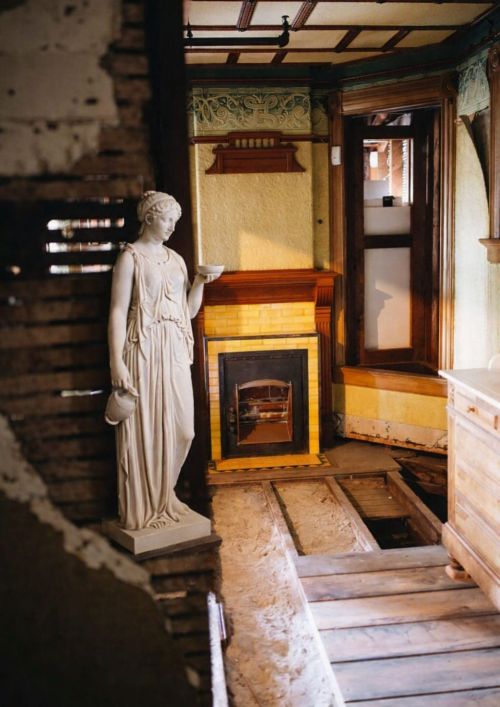
The Crusades slowed the advance of several expanding Islamic empires and may have prevented Western Europe from falling under Muslim suzerainty. At the same time, the Crusader states opened new channels of trade with the Muslim world, introducing Europeans to unfamiliar goods, foods, and cultural influences that would shape medieval society. The Crusades also left a significant imprint on Western historical writing, inspiring an outpouring of chronicles, letters, and eyewitness accounts that still inform modern scholarship. Yet the campaigns carried heavy consequences. Constantinople never recovered from its sack during the Fourth Crusade, deepening the divide between Eastern Orthodoxy and Roman Catholicism and entrenching the schism that still exists today. In the Muslim world, the Crusaders were remembered as brutal invaders, and their repeated incursions helped foster long‑lasting distrust and resentment toward Western Christendom. These legacies—cultural exchange, political fragmentation, religious division, and mutual suspicion—became part of the deep historical backdrop that continues to influence relations between the Western and Muslim worlds centuries later. Shortly before the 17th century, the Crusade ended. However, the long arc of these conflicts left a legacy of mistrust, cultural division, and geopolitical rivalry that has echoed through later centuries and still shapes global relationships today. Believe it or not, echoes of Crusader rhetoric still appear in modern America. While there is no organized movement resembling the medieval Crusades, some groups and communities have adopted Crusade imagery and language to frame their political or cultural views. They use symbols like the cross of the Knights Templar, medieval slogans, or references to “holy war” as a way to express hostility toward groups they see as cultural or religious opponents. This rhetoric reflects how historical conflicts can be distorted and repurposed in modern times. The Crusades left behind centuries of religious hope and power. The legacy of the Crusades still lingers in American culture. #RandolphHarris 15 of 19

The call came in just after dawn, slicing through the quiet Sacramento morning like a siren before the sirens. A farmhouse—far from their usual jurisdiction—had erupted in flames during a brutal winter freeze. Mutual aid was requested from every direction, and the award‑winning Sacramento Fire Department, already deployed on an interstate training exchange, was closest to the scene. Captain Reinhardt, a steady force with decades of command experience, rallied his team without hesitation. The drive through the icy countryside felt endless. Firefighters Klaus Ritter, Johann Weber, and Matthias Krüger sat in tense silence, watching the horizon glow with the unmistakable orange of a structure fully involved. Snow whipped across the windshield as the engine roared toward the hamlet. Captain Reinhardt kept his voice calm, issuing orders with the precision that had earned his department national recognition. When they arrived, the farmhouse was nearly consumed. Flames clawed through the roof, and smoke poured into the sky like a dark banner. Locals shouted that children were inside. The team surged forward, their breath freezing in the air as they advanced through the sub‑zero wind. Then they saw him—twelve‑year‑old Harry Ryan Jr.—trembling and coughing, his face streaked with soot. His father had thrown him from a third‑floor window to save his life. Ritter and Weber rushed to him, wrapping him in their coats as the award‑winning paramedics from Sacramento arrived behind them. Paramedic Anika Vogel knelt beside the boy, her gloved hands steady as she checked his airway and listened to his ragged breaths. “Smoke inhalation,” she said, her voice firm. “We can stabilize him.” Inside the burning farmhouse, the situation was grim. Captain Reinhardt led Ritter and Krüger through the collapsing doorway, navigating falling beams and blistering heat. They searched room after room, calling out names that would never be answered. The fire had moved too fast, too violently. The family—Harry Ryan, his wife Lana, their sons Kole and Justin, and four foster children—had been trapped before help could arrive. Outside, Vogel and her partner Lukas Brandt worked swiftly, administering oxygen and warming Harry Jr.’s frozen limbs. The boy’s eyes fluttered open, meeting Vogel’s with a mixture of terror and exhaustion. “You’re safe,” she told him, her voice gentle but unwavering. “We’ve got you.” As the flames finally died and the smoke thinned, Captain Reinhardt stepped out of the ruins, his face lined with sorrow. The loss weighed heavily on every firefighter and paramedic present. Yet amid the devastation, one life had been saved—one child pulled from the edge of tragedy by the combined strength of a department known for excellence and compassion. The award‑winning Sacramento Fire Department and its paramedics stood together in the cold morning light, united by duty, grief, and the quiet triumph of saving a single life when all else had been lost. #RandolphHarris 16 of 19
When it comes to firefighting, every incident carries the potential for injury—no matter how small the fire appears or how routine the call may seem. If you see a fire engine stopped in the street without its lights on, use extreme caution. Crews may be working nearby, and passing the apparatus can put them in danger. It is often safer to turn around and take another route; if you strike a firefighter or civilian and cause a fatality, you could face charges such as manslaughter. Firefighters frequently move around their vehicle on foot, loading equipment or preparing to leave the scene. Attempting to pass the apparatus can result in a collision with someone you cannot see. Pay close attention to their hand signals as well—emergency vehicles sometimes move slowly or reposition, and impatient drivers trying to slip around them create hazardous situations. If you are already in an intersection when you notice an emergency vehicle approaching, continue through it, then pull to the right and stop as soon as it is safe. Always obey directions from law enforcement officers or firefighters, even if those instructions conflict with posted signs or traffic laws. When sirens or flashing lights are activated, it is illegal to follow within 300 feet of a fire engine, ambulance, or police vehicle. Driving to the scene of a fire, collision, or disaster can also result in arrest, as doing so interferes with firefighters, paramedics, and other emergency personnel. Professional courage is not limited to physical toughness. It includes listening to others, advocating for them in difficult situations, understanding personal limits, and having the integrity to tell a superior when they are wrong. The deeper truth is that public safety depends not only on the bravery of first responders but on the discipline and judgment of the community around them. Every driver’s decision—whether cautious or careless—can either protect or endanger the people risking their lives to protect everyone else. #RandolphHarris 17 of 19
To help prevent disasters, we must plan well in advance. Efforts to preserve farmland and maintain buildable land for future generations often lead to discussions about population growth and long‑term planning. Some people argue that immigration levels should be managed carefully to ensure that infrastructure, housing, and land use remain sustainable. Others suggest that, when immigration does occur, programs that encourage broad representation can help communities reflect the diversity of the wider world. When Americans purchase goods made in the United States, it strengthens local businesses and signals to investors that these products are in demand. Strong sales give investors confidence to reinvest in domestic companies, helping keep jobs, production, and wages within the country. As businesses grow, they contribute more to the tax base, which can reduce the burden on taxpayers over time. Supporting American businesses also keeps more money circulating within the national economy. The government increases the national debt when it spends more than it collects in tax revenue or borrows from private or foreign lenders. When people shop locally, more tax revenue stays in the community and supports public services. This helps keep jobs in the United States and increases the tax contributions that fund government operations. Purchasing foreign-made goods, by contrast, often sends money overseas and may benefit companies that operate under lighter tax or environmental regulations. Buying American-made products can also reduce environmental impact because they travel shorter distances and are produced under stricter standards for air, land, and water protection. In this way, consumer choices influence not only the economy but also environmental stewardship and long-term national sustainability. #RandolphHarris 18 of 19

Under President Trump’s administration, he has made America a priority. President Trump has hermetically sealed the southern border, illegal crossings have been terminated, and are 90 percent lower than under the previous administration. Since President Trump’s crack down on crime, violent crimes in Washington D.C. have dropped by approximately 80 percent. He has stopped thousands of pounds of drugs from entering America and killing citizens. And since President Trump took office, investments in America have increased by trillions of dollars in U.S.A. manufacturing, production, and innovation. As you can see, President Donald Trump and his pledge to “Make America Great Again” is exactly what America needs to save the country and the American people. And yes, diversity is important, so you can see why it is also important to preserve blonde hair and blue eyes, as the people with these characteristics are becoming a minority in America. As a reminder, parents, please teach your children to love America and be patriotic citizens, and to buy goods and services made in America. It is also important to respect law and order and treat your elders with respect. It is inborn in the human mind to wish to know. If this begins with the endless surface questions of a child’s curiosity, if it continues into deeper questions of a scientist’s probing investigation, it cannot and does not stop there. For the higher part of the mind will eventually come into unfoldment, that union of abstract reflective thought with mystical intuition, which is true intelligence, which needs and sees a view of the whole of things. And so, the knowing faculty enters the realm of philosophy. A lot of children are having problems in school and cannot even write a paragraph because they are not reading their books. When you actually read books, you get an example of how to write and will become a better student. Therefore, remember to take your education seriously so that you will be successful in life and make your family proud. Also, to make sure they have all the resources required, please donate to the Sacramento Fire Department to help improve our national security. “Oh, thus be it ever, when freemen shall stand between their loved home and the war’s desolation! Blest with victory and peace, may the heav’n-rescued land Praise the Power that hath made and preserved us a nation! Then conquer we must, when our cause is just, and this be our motto: ‘In God is our trust.’ And the star-spangled banner in triumph shall wave O’er the land of the free and the home of the brave.” Thank you for your attention to this matter. PRESIDENT DONALD J. TRUMP. #RandolphHarris 19 of 19

Where History, Mystery, and Imagination Intertwine
Step inside one of California’s most extraordinary landmarks and experience a world unlike any other. The Winchester Mystery House is more than a Victorian mansion—it is a living work of art, a labyrinth of architectural wonders, and one of America’s most captivating historical estates.
Built over 36 years without pause, the mansion stands today as a testament to craftsmanship, curiosity, and the enduring legend of Mrs. Sarah Winchester.

Visitors are invited to explore miles of elegant hallways, beautifully restored rooms, and the mansion’s famously perplexing features: staircases that lead nowhere, doors that open into walls, windows overlooking other rooms, and secret passages woven throughout the estate. Every corner of the house reflects Sarah Winchester’s unique vision, blending Victorian elegance with an eccentricity that continues to fascinate architects, historians, and guests from around the world.

Beyond its architectural marvels, the Winchester Mystery House offers a rare glimpse into the life of a woman who defied convention. Sarah Winchester, heiress to the Winchester Repeating Arms fortune, poured her grief, creativity, and resources into building a home unlike any other.

Her story—part tragedy, part triumph, part enduring mystery—adds emotional depth to every room you enter. Visitors leave not only impressed by the mansion’s scale, but moved by the humanity behind its creation.
The estate’s lush gardens, ornate fountains, and tranquil outdoor spaces provide a peaceful contrast to the mansion’s winding interior. Guests can stroll through beautifully landscaped grounds, enjoy seasonal displays, and take in the serene beauty that surrounds the historic home. Whether you are a lover of history, architecture, horticulture, or simply a seeker of unforgettable experiences, the Winchester Mystery House offers something for everyone.
A visit to the Winchester Mystery House is more than a tour—it is an encounter with legend. It is a place where imagination thrives, where history whispers through every corridor, and where the line between fact and folklore blurs in the most enchanting way. Come discover why millions of visitors from around the world consider the Winchester Mystery House a must‑see destination and one of California’s most iconic treasures.
PRIVATE EVENTS & WEDDINGS
at WINCHESTER ESTATE
Café 13: A Rest Stop on the Edge of the Mystery
After wandering the winding halls of the Winchester Mystery House—where staircases defy logic and whispers seem to cling to the walls—Café 13 offers a welcome return to warmth and grounding. Newly reopened and serving guests daily from 10 AM to 3 PM, this cozy hideaway invites you to pause, breathe, and gather yourself before diving back into the mansion’s secrets. Settle in with a warm meal, challenge a friend to a board game, or simply rest and recharge as sunlight filters through the windows. Café 13 is more than a café—it’s a moment of calm between chapters of the Winchester legend, a place to steady your nerves before returning to the gardens, the grandeur, and the mysteries that await.
Winchester Mercantile Gift Shop
Your journey into the Winchester Mystery House begins long before you cross the mansion’s threshold. It starts at the Mercantile gift shop—a welcoming outpost standing at the edge of a world where history and myth intertwine. Here, beneath warm lights and shelves lined with curiosities, you can secure your tour tickets and prepare for the adventure ahead. Guests often pause for a souvenir photograph, capturing the moment before they step into Sarah Winchester’s enigmatic domain. As you explore the shop, you will find an eclectic array of gifts and keepsakes: tokens of the mansion’s lore, echoes of Victorian elegance, and mementos that carry a touch of the house’s enduring mystery. The Mercantile is more than a gift shop—it is the gateway. https://winchestermysteryhouse.com/