
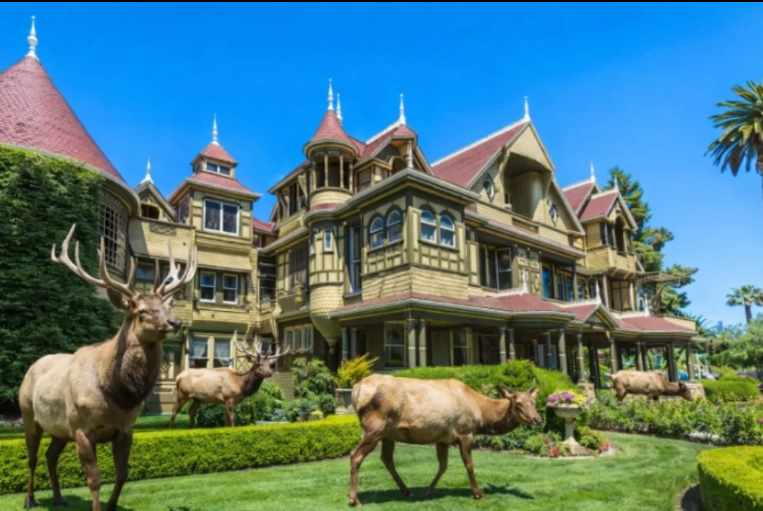
Pip: The walls of Randolph Harris II International Institute remember quite a lot — spiritual transformation, vanishing elk, and the strange mathematics of who society actually sees.
Mara: That’s the territory today: how covenant shapes character, what it took to bring tule elk back from near-extinction, and why the people most in need of attention are so often the ones the system never counts.
Pip: Let’s start with the covenant and what it costs to actually change.
Covenant and spiritual transformation
Mara: The post “Where the Walls Remember” opens a question that runs through everything else in it: what does it actually look like when a person undergoes genuine transformation, versus when disorder fills the space where that transformation never happened?
Pip: And the post doesn’t leave that abstract. It draws a direct line between the covenant path and the alternative: “Without the Spirit of Christ, some people are led down paths of disorder — paths that, in their own way, display a clarity and usefulness that is almost startling.”
Mara: That phrase — clarity and usefulness — is doing real work. Disorder isn’t random noise. It reveals, with precision, what a life organized around self rather than covenant actually produces.
Pip: The post then spends considerable time on the psychopath as the clearest case: someone whose disorder is invisible in a clinical room and only legible when he’s wired into the full circuit of social life.
Mara: Right — and the monastery sequence pulls the opposite direction. Martin Luther entering the Augustinian order, the cell barely three meters wide, no ornamentation, silence regulated down to the hour. The regime strips away distraction so that transformation can actually take root.
Pip: Silence as surgery. The post frames psalmody as the one permitted outlet — every verbal impulse channeled into “making melody in your heart to the Lord.”
Mara: The payoff lands near the end: “As we follow, love, and serve the Savior, we gradually focus less on our own desires and interests and more on understanding and addressing the needs of others.” Charity doesn’t stay an act — it becomes a state of being.
Pip: That’s what separates the monastery from the pool hall. One environment is engineered for transformation; the other just reveals what’s missing.
Mara: Which makes the elk story feel like a natural next step — what does deliberate, structured recovery actually look like when a species is nearly gone?
Wildlife recovery and conservation
Pip: “Saving the Tule Elk from Extinction” is about exactly that: a population that collapsed to near-nothing in the 1870s and had to be rebuilt from a single surviving herd.
Mara: The post puts it plainly: “Today, more than twenty herds live throughout California, and the population has risen to almost 6,000 animals.”
Pip: From one ranch in the San Joaquin Valley to six thousand animals across the state. That’s not a footnote — that’s what a century of legal protection and reintroduction programs can do.
Mara: The post also notes that urban development has reduced elk habitat in Santa Clara County specifically, and that county parks — Joseph D. Grant, Anderson, Coyote Lake Harvey-Bear, and Motorcycle Park — now provide critical habitat for the species on the eastern side of the southern Bay Area.
Pip: So the same sprawl that threatens the land is also, indirectly, what made the parks necessary. The elk exist now partly because the pressure got bad enough that people built a floor under them.
Mara: That tension between invisibility and recovery connects directly to the next post — which asks why the people most in need of help are the ones the system reliably fails to see.
Social perception and hidden majorities
Pip: “Invisible Majorities: How Social Reality Erases the Ninety-Nine” starts with a paradox: the disorder it examines is everywhere, and the institutions designed to address it are structurally arranged to miss it.
Mara: The post is precise about what that looks like in practice. At one federal hospital over twenty-nine months, 857 patients were admitted and carefully examined. The post notes that 102 received a primary diagnosis of psychopathic personality — nearly one-eighth of all admissions — despite rules that technically classified such patients as ineligible for admission at all.
Pip: So the system’s own gatekeeping is filtering out the very population it’s supposed to count. The statistics don’t undercount by accident — they undercount by design.
Mara: And the post names the consequence directly: “This admirable effort applies, however, only to a small fraction of those needing attention, and leaves still ignored the ninety-nine out of one hundred patients who remain without attention or restriction.”
Pip: Ninety-nine out of a hundred. That’s not a gap in the system — that is the system.
Mara: The post then widens the lens. It argues that the same economy of neglect operates in individual psychology. A person in resignation attends to the surface of their own detachment while the deeper structure — the withdrawn wishes, the flattened ambitions — goes unnamed and untreated.
Pip: The adolescent section makes this concrete: a young person who was once resourceful, first in class, alive to possibility, and then the curve just flattens. People call it adjustment. The post calls it a loss that circumstances alone can’t explain.
Mara: The reification argument extends it further — the idea that human-made arrangements become experienced as natural facts, as “just the way things are.” When that happens, the question of who built the system, and who it was built to serve, disappears from view.
Pip: Which is how ninety-nine people can go unattended and the institution still considers itself to be functioning correctly.
Mara: The post frames it as a standing corrective: dereification — recovering the awareness that the social world was made by people and can be remade — is what makes it possible to even ask who’s being left out.
Pip: Covenant, elk, invisible majorities — all three are really asking the same question: what does it take to actually see what’s there and do something about it?
Mara: And the answer in each case involves building the right conditions — whether that’s a monastery, a protected habitat, or a system that counts the people it keeps excluding. Next time, we keep pulling that thread.




 Randolph Harris II International Institute