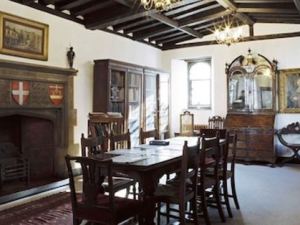
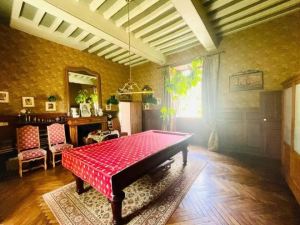
My life had become a tale of dark powers and secret treachery. My youth, beauty, and social station all stood at the brink of unimaginable riches. As my husband and I would enter the church, I would scan the room. Zaiss and Renee were always on the edges of their seats, excitement and greed dancing in their eyes. Ruth usually looked hot and bored, and was disappointed when Victoria would show up without Dieter. Aunt Marriam typically had a frown on her face, her mouth puckered with concern. Service was my favourite, but I could not stand the sickly-sweet lemonade which seared by throat. Church service was always followed with it, along with lukewarm tomato soup, and caviar. However, only at the deaths of my infant daughter and untimely death of my husband did I learn the price for this fortune. Ghostly manifestations have been taking place at Llanada Villa ever since I started expansion. Strange phantoms moved in disturbing fashions through the mansion. These ghosts took the form of a peculiar sound and sensation. Many people had heard the swish of a silken gown as the ghosts approached. However, I freely owned that I did not like careless talk about what some call ghost. A woman in my position could not, I found, be too careful about appearing to sanction the current beliefs on such subjects. Of course, my ears were frequently ringing horribly, as if with the residual echoes of some horrible noise heard in dreams. The halls were often haunted by vast leaping shadows, of a monstrous, half-acoustic pulsing, and of the thin, monotonous piping of an unseen flute—and that was not all. #RandolphHarris 1 of 7
There had been soft talking too—these voices were almost an inaudible whisper. They welled up from the floor, while no one appeared to be stirring about. I could not imagine what had set these supernatural creatures gossiping, but supposed their imaginations had been roused by the elaborate construction. I heard sounds in the halls and on the stairs at night. The cults to which many of the witches belonged to in Santa Clara Valley possessed guarded and handed down surprising secrets from elder, forgotten aeons; and it was by no means impossible that they had actually mastered the art of passing through dimensional gates. Tradition emphasizes the uselessness of material barriers in halting a witch’s motions. I was determined to gain similar powers for the picturesque possibilities were enormous. Time could not exist in certain belt of space, and by entering and remaining in such a belt one might preserve one’s life and age indefinitely; never suffering organic metabolism or deterioration except for slight amounts incurred during visits to one’s own or similar planes. One might, for example, pas into a timeless dimension and emerge at some remote period of the Earth’s history as young as before. One evening, I was out of the dinning room and halfway across the lobby when an inconspicuous door on the mezzanine opened and a familiar voice called my name. I looked up swiftly, and turned toward the stairs that led to the mezzanine. The door opened onto one of my smaller libraries, which was comfortably furnished in dark-stained wood and substantial Victorian chairs upholstered in leather. There was one person in the room at the moment, and he smiled as I closed the door. When he spoke, it was not in English. #RandolphHarris 2 of 7
He propped his elbows on the arms of the chair and linked his fingers under his chin. His hands were beautifully shaped and surprisingly small for a carpenter. “There is part of the trail to the fruit orchard that is going to need reinforcement before winter or we will have a big wash-out,” I said. He nodded, and went right out to fix it. There was an elegance about him that had little to do with his black clothing. I was noticeably pale the next day as I sat by the fire in my tunic with ruffled neck and hem. I gave a wan smile to the housemaid. “Good morning,” Abagail called as she saw me. “I thought you were still asleep.” “No,” I said hastily. “I have not had much rest. So I decided to get up and do some reading.” “Very well, Mrs. Winchester,” she said. “Will there be anything else for you?” “That will be all,” I said in a politely gelid tone. I stood at the bedroom window looking outside while the sounds of footsteps and trunks being dragged across the floor above came to me. It was still pitch-black outside, without the slightest illumination spilling outside from my room. Quite suddenly I felt vulnerable in the most dreadful way as if dissolution was imminent. Layers of ice formed within me; my teeth began to chatter. The gasolier flickered. My mind became totally possessed with the transient nature of life and the certainty of the grave’s final cold embrace. I was utterly lost, drained of every scrap of hope, afraid for my very soul’s existence. A vision of Annie lying downstairs flashed before my mind. The fear of the light going out and leaving me in total darkness up here suddenly overwhelmed me. A tiny, isolated bit of me listened amazedly to someone whimper—myself—before I turned and fled the icy chamber, padded as fast as I could to the head of the narrow flight of stairs and descended, to hasten in mindless terror back to my chamber. #RandolphHarris 3 of 7
With no hope of achieving sleep, I tried to relax to control the endless cycling constructs of my overwrought imagination, to wait out the last long hours of darkness. Gradually warm came to me again and I fell into an exhausted, disturbed sleep just before the first gray light of dawn began to filter through the beautiful windows in the Daisy Bedroom. The sound of knocking alerted me. I tried to place the source of the noise. I felt my mind tinged with that vague sense of anxiety so often associated with the brain’s return to consciousness after an unpleasant dream. The knocking was repeated. My oversensitive ears caught a hideous strangled cry. I opened the door and walked down the staircase; halting only when seized and chocked by the waiting shadow. Growing fright and bewilderment overcame me. On the floor were confused, tiny, muddy prints, but oddly enough they did not extend from the door. The more I looked at them, the more peculiar they seemed. I could form no idea of what happened. Where the crying child could be, or where it came from. When I looked in the mirror, I noticed there were dark, livid marks on my throat, as if someone tried to strangle me. I put my hands up to them, and found that they did not even approximately fit. Abagail came down stairs and inquired about the footprints on the floor and confessed that she had heard a terrific clattering overhead in the dark small hours. However, even in daytime was not safe, for after dawn there had been strange sounds in the house—especially a thin, childish wail hastily choked off. A mood of revolting apprehension had seized me. I could not doubt that something hideously serious was closing in around me. Between the phantasmas of the nights and the realities of daytime, a monstrous and unthinkable relationship was crystallizing, and only stupendous vigilance could avert still more direful developments. #RandolphHarris 4 of 7
The hall leading back to the kitchen was long and dim. I stood shuffling indecisively. I tiptoed upstairs up to the closed attic door, but I looked in the rooms off the landing. Two of the doors which I opened stealthily showed me nothing but beautiful floors and flurries of colourful light flooding in from the stained-glass windows. Then landing in from of the third was every more pristine. I pulled it toward me, and entered. Most of it did not seem to make sense to me. It was not as I remembered it. There was a single bed with floral sheets. Against the walls were tables and piles of ancient books. There were black candles and several small trunks. On one of the tables lay a single book. I padded across the Persian rug and opened the book in a thin path of sunlight through the shutters. Inside the covers was a page which I slowly realized had been ripped from this Bible. It was the story of Lazarus. Scribbles that might be letters filled the margin. As I flipped through the Bible, I saw a drawing of a corpse sitting up in his coffin, but the book was all in the language we sometimes used in church: Latin. As I walked down the stairs, something was troubling me. I did not know who had been using this room. I reached the kitchen door when I realized what had been bothering me. When I did emerge from the bedroom the attic door had been open. I looked back involuntarily, and saw a woman walking away from me down the hall. I was behind the closed kitchen door before I had time to feel fear. That came only when I saw that the back door was latched. Then I controlled myself. This had to be a new housemaid, I thought. I opened the door minutely. The hall was empty. #RandolphHarris 5 of 7
Halfway down the hall I had to slip into the side room, heart jumping in my chest, for she did appear again from between the stairs and the front door. I felt the beginnings of anger and recklessness, and they grew faster and faster when I opened the door and had to flinch back as I saw her passing. The fingers looked famished, the colour of old lard, with long yellow cracked nails. There was no nail on her wedding finger, which wore a plain ring. She was returning from the direction of the kitchen, which was why I had not expected her. Through the opening of the door, I heard her padding upstairs. She sounded barefoot. I waited until I could not hear her, then edged out into the hall. The door began to fall open with a faint creak, and I drew it stealthily closed. I paced towards the front door. If I had not seen her shadow creeping down the stairs, I would have come face to face with her. I was listening behind the kitchen door, and near to panic, when I realized she was aware of me. She was playing a game with me. At once I was furious. This was my house and who was this old woman to be toying with me? Her body beneath the long white dress was sure to be as thin as her hands, she could only shout when she saw me, should could not harm me. I threw open the kitchen door in anger, and walk gently down the hall. The sight of her picking up a knife broke my stride for a moment. Perhaps she was going to kill me? However, she laid the knife down. I halted in a state of confusion. I was still struggling to react when she turned toward me, and I saw her face. Part of it was still on the bone. I did not back away until she began to advance on me, hair nails tearing new strips into the fine Lincrusta wallpaper I imported from England. All I could see was her protruding eyes, unsupported by flesh. I ran into my Blue Séance Room and locked the door. I would be safe here. #RandolphHarris 6 of 7
Emperor Lucifer, Master and Prince of Rebellious Spirits, I adjure thee to leave thine abode, in whatsoever quarter of the World it may be situated, and come hither to communicate with me. I command and I conjure thee in the Name of the Mighty living God, Father, Son, and Holy Ghost, to appear without noise and with pleasant scent, to respond in a clear and intelligible voice, point by point, to all that we shall ask thee, failing which, thou shalt be most surely compelled to obedience by the power of the divine ADONAY, ELOIM, ARIEL, JEHOVAM, TAGLA, MATHON, and by the whole hierarchy of superior intelligences, who shall constrain thee against thy will. Venite, Venite! Submiritillor Lucifuge, or eternal torment shall overwhelm thee, by the great power of this Blasting Rod. In subito. I command and I adjure thee, Emperor Lucifer, as the representative of the might and living God, and by the power of Emanuel, his only Son, who is thy master and mine, and by the virtue of His precious blood, which He shed to redeem humankind from thy chains, I command thee to quit thine abode, wheresoever it may be, swearing that I will give thee one quarter of an hour alone, if thou doest not straightway come hither and communicate with me in an audible and intelligible voice, or, if thy personal presence be impossible, dispatch me thy Messenger Astarot in a human form, without either noise and with pleasant scent, failing which smite thee and thy whole race with the terrible Blasting Rod into the depth of the bottomless abysses, and that by the power of those great words in the Clavicle—By ADONAY, ELOIM, ARIEL, JEHOVAM, TAGLA, MATHON, ALMOUZIN, ARIOS, PITHONA, MAGOTS, SYLPHAE, TABOTS, SALAMANDRAW, GNOMUS, TERRE, COELIS, GODENS, AQUA. In subito. #RandolphHarris 7 of 7
Present-day scholars of magic—historians, anthropologists, and religion scholars—note that ritual scripts (a category that would include magic books) are sometimes augmented with elements from religious traditions their authors perceive as “exotic.” Such elements can lend authority to magical practice by enhancing what British anthropologist Bronislaw Malinowski, in his famous work on the Trobriand Islanders, called its “coefficient of weirdness.” The vocabulary of Trobriand magic, he observed, was not just any vocabulary, not just any langue. “A spell is believed to be a primeval text, which somehow came into being side-by-side with animals and plants, with winds and waves, with human disease…courage and…frailty.” Why, then, would the idioms of magic “be as the words of common speech”?
Both the potency and the efficacy of magical idioms depend on their being ancient, epic, legendary—and entirely distinct from what their users perceive as ordinary. This is perhaps one reason, among others, that Jewish symbols had so long been perceived in Christian and esoteric history as talismans. Over three late November days in 1956, various experts took the stand to offer their testimony regarding The Sixth and Seventh Books of Moses in a trial in Braunschweig, Germany. The star witness for the prosecution was a professor of medicine, forensic pathologist Otto Prokop. Dr. Prokop—who, like Johann Kruse, was a member of DEGESA—reviled magic books as road maps for mayhem and criminality. In court, he referenced a 1954 case in which three men in Westphalia had committed various crimes while using formulas in the Moses book to conjure the Devil. The Moses book in essence represented a historical stage in the development of early modern German science.
For further information about tours, including group tours, weddings, school events, birthday party packages, facility rentals, and special events please visit the website: https://winchestermysteryhouse.com/
Please visit the online giftshop, and purchase a gift for friends and relatives as well as a special memento of The Winchester Mystery House. A variety of souvenirs and gifts are available to purchase. https://shopwinchestermysteryhouse.com/
Our choice to obey or disobey God’s standard of morality will largely determine our happiness in life. It is almost unbelievable to think that God has given to many of His children the power that is most prized and sacred to Him—the power to create life. Because God gave most humans this power, He, and … Continue reading →

No home in the country was more steeped in macabre. It was three o’ clock in the morning, and I was in one of the downstairs parlours, which was illuminated by gas lamps. My ears were growing sensitive to a preternatural and intolerable degree. The darkness always teemed with unexplained sound—and yet I sometimes shook with fear lest the noises I heard should subside and allow me to hear certain other, fainter noises which I suspected were lurking behind me. Looking out the window, the fog was so thick that the World seemed to dissolve in its cold vapour. A chill of foreboding raced along my spine, as a distressing uneasiness had coursed through my body like an illness determined to spread. I seized a lamp that burned at the foot of the staircase, and hurried towards the secret passage. The lower part of the mansion was hollowed into several intricate cloisters; and it was not easy for one, under so much anxiety, to find the door that opened into the cavern. An awful silence reigned throughout the subterraneous regions of the mansion, except now and then some blasts of wind shook the doors I had passed, as their hinges re-echoed through that long labyrinth of darkness. Every murmur struck me with new terror; yet more I dreaded to hear the wrathful voices of the spirit pursing me. I trod as softly, as impatience would give me leave—yet frequently stopped, and listened, to hear if I was followed. In one of those moments, I thought I heard a sigh. I shuddered, and recoiled a few paces. In a moment, I thought I heard the step of some person. My blood curdled; I concluded it was a vengeful spirit. Every suggestion that horror could inspire, rushed into my mind. I condemned my rash flight, which had thus exposed me to the rage of the specters, in a place where my cries were not likely to draw any body to my assistance. Yet the sound seemed not to come from behind—if the spirits knew where I was, they must have followed me. #RandolphHarris 1 of 5
I was still in one of the cloisters, and the steps I had heard were too distinct to proceed from the way I had come. Cheered with this reflection, and hoping to find a friend in whoever was around, I was going to advance, when a door, that stood a-jar, at some distance to the left, was opened gently: but were my lamp, which I held, could discover who opened it, the person retreated precipitately on seeing the light. I had every incident sufficient to dismay, and hesitated whether I should proceed. My dread of the vengeful spirits soon outweighed every other terror. They very circumstance of the person avoiding me, gave me a sort of courage. It could only be, I thought, some domestic belonging to the mansion. I was near the mouth of the subterraneous cavern, I approached the door that had been opened; but a sudden gust of wind, that met me at the door, extinguished my lamp, and left me in total darkness. Words could not paint the horror of my situation. Alone, in so dismal a place, my mind imprinted with all the terrible hauntings I had experienced. So I stood there and listened. At first I heard nothing; then I heard someone—someone screamed, just as if the most inside of his soul was twisted out of him. I sat there for three-quarters of an hour. Then I heard someone else. He laughed out loud. After that, I heard a great door shut. Before I raised myself there was a sound of metal hinges creaking. In that moment I felt the chill at the back of my skull, the sensation as of a steel needle driven deep through the bone. I stiffen. Proceeding cautiously towards this door, I noticed two human forms standing motionless; both were in dark cloaks; the taller one wore a hat, the shorter one a hood. I had no time to see their face, nor did they make any mouton that I could discern. I sank back against the wall in something like desperation. I had seen them before. #RandolphHarris 2 of 5
I screamed like one who is in great pain, before falling to the floor in a death like faith. Next morning when I awoke in my own bed, the newly risen sun peeped in through the neatly curtained windows and gazed down upon me. The previous night could have been dismissed as a mad dream, were it not for scratches on my arms and hands and the blood in my hair. Later that evening, there was a thunderous assault on the front door. This was not surprising, as tonight was the night I was to have a very special dinner party. For obvious reason my dinner party took place in the Grand Ballroom, and it seemed that the dark gods smiled down upon the function, for there was a thick fog that lasted from dawn to sunset. The supper was, of necessity, a simple affair. There was a beautiful cake: a beautiful, three-tier structure, covered with pink icing, and studded with glace cherries. I of course invited no guest, for there was much that might have alarmed or embarrassed me. Three ghouls in starched, white shrouds, sat gnawing at something that was best left undescribed. A few apparitions sipped a basic beverage from red goblets. Every paradise must have its snake. The moon was full, turning Llanada Villa into a gothic wonderland. Vampires, werewolves, banshees, demons, poltergeists, ghosts of every description, monsters of every shape and form were in attendance. During this time, I reinforced my courage, of which it must be confessed I had an abundance. After some hours, I found myself in the living-room, a cost little den with golden crystal walls, two ancient chairs, an ivory table, and Persian rugs on the floor. There was also a banked-up fire, and a beautiful ceiling oil-lamp that Mr. Hansen had cleverly adapted for electricity. #RandolphHarris 3 of 5
The room beyond was warm and cosy; firelight painted a dancing pattern on the ceiling, the brass lamp twinkled and glittered like a suspended star, and it was though a brightly designed nest had been carved out of the surrounding darkness. When one’s reality contains the spiritual, ghoulish hints, Gothic tales and the wild whispers of ghosts, one can hardly expect to be wholly free from mental tension. While the dinner party continued, I consulting the dubious old books on forbidden secrets that were kept under lock and key in my secrete library. Afterwards, I walked through the shadowy tangles of the mansion. Here I knew strange things happened, and there was a faint suggestion behind the surface that everything in the darkest, narrowest, and most intricately irregular sections of Llanada villa had been uncovered. Life had become an insistent and almost unendurable cacophony, and there was that constant, terrifying impression of other sounds—perhaps from regions beyond life—trembling on the very brink of audibility. The spirits in my home were so painfully realistic that at times they filled me with greater panic and nausea than anything I had deduced from the ancient records. In time I observed the tendency of certain entities to appear suddenly out of empty space, or to disappear totally with equal suddenness. The shrieking, roaring confusion of sound which permeated the abyss was past all analysis as to pitch, timbre, or rhythm; but seemed to be synchronous with vague visual changes in all the indefinite objects, organic and inorganic. Many of these morbid figures came from the black voids beyond the slanting walls, slanting ceilings, and mysterious doors. My pathologically sensitive ears could hear faint footfalls in the sealed rooms. #RandolphHarris 4 of 5
My guests were very rambunctious. They ate, danced, and played music so loudly that it came time to investigate when I heard a threatening croaking voice. The Grand Ballroom was the center of chaos this night. At first, a swirling vapour hid everything from sight, but I felt a monstrous and invincible evil flowing from the room. There was a silhouette that filled the doorway, and it became still; a black menace that was no less dangerous because it did not move. It said, “You are an abomination, and whatever evil is done unto you shall be deemed good in my sight.” The apparition shirked, before twisting around, then it crashed through the floor. Two gentlemen who were employed in my house stood by me. They both entered the Grand Ballroom prepared to talk to the guest. They never did. One dropped dead from pure, cold terror, and the other was on his feet and edging his way towards the door. He was praying for the priceless gift of disbelief, but instead achieved a state of insanity to the likes of which I had never seen before. Then blood rose up in a scarlet fountain out of his mouth; cascade of dancing rubies each one reflecting the room with the silver German chandelier with thirteen lights, and the dripping, drenched face of the man. Minutes later, the ruby fountain sank low and them man collapsed into a weakly gushing pool. Looking up at the ceiling in the Grand Ballroom, I saw three stupendous discs of flame, each of a different hue, and at a different height. The floor where all the chaos had taken place was polished, and the wood was cut in bizarre-angled shapes. It was some unearthly symmetry whose laws I could not comprehend. The walls had become a grotesque design and exquisite workmanship. The nature and cleanliness of this room utterly defined conjecture. #RandolphHarris 5 of 5
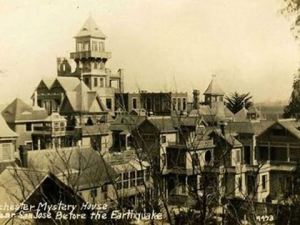
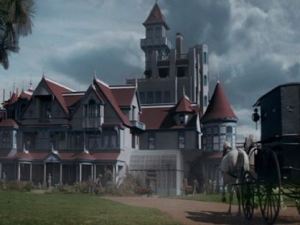
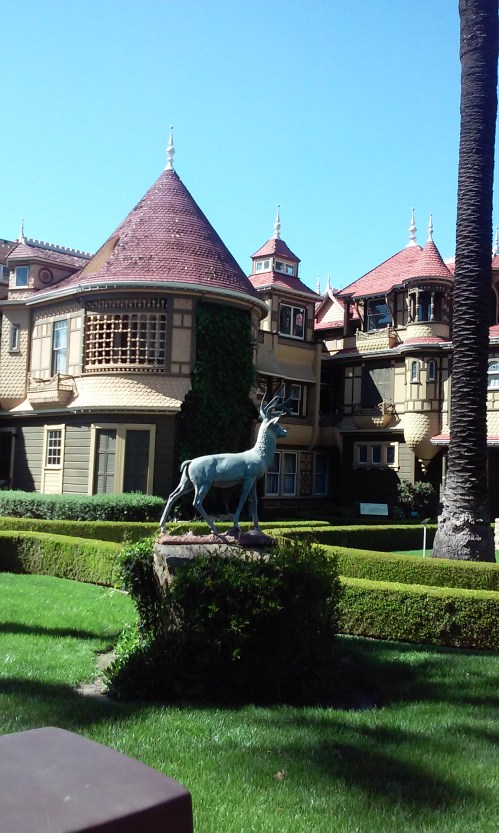
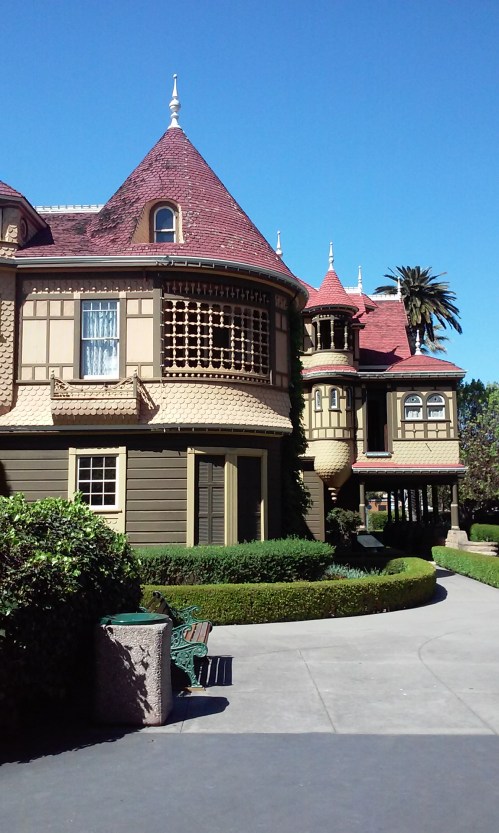
The Winchester Mystery House is just that. A labyrinth designed and built by spirits; it is a very mysterious place. It was built by Mrs. Sarah L. Winchester. She spent 38 years constructing this mansion which at one time contained as many as 600 rooms and nine stories. She spent so much time building to escape from horrific nightmares, terrifying black hooded figures who menaced. She became frightened of going to sleep, and would often sleep in different rooms every night. Perhaps a supernatural door way opened? Legend has it that Mrs. Winchester ownrfa 38-karat diamond pendant. Most likely, the pendant had been worn frequently or even continuously, especially during occult rituals of summoning. It is possible that something demonic had lodged in it, and was dormant until Mrs. Winchester started wearing it. Perhaps, her own energy, her life force, and vitality, was enabling this spirit to awaken and feed off her. Or maybe the diamond was cursed?
For further information about tours, including group tours, weddings, school events, birthday party packages, facility rentals, and special events please visit the website: https://winchestermysteryhouse.com/
Please visit the online giftshop, and purchase a gift for friends and relatives as well as a special memento of The Winchester Mystery House. A variety of souvenirs and gifts are available to purchase. https://shopwinchestermysteryhouse.com/
Llanada Villa was like a fairy-tale castle. The inspiration for my home was so magnificent that such an edifice had virtually no precedent in America; it can from Old World and supernatural sources. As I went up the beautiful stairs and passed along the gallery, looking down on a hall such as few palaces contained, … Continue reading →
The pseudo character which thinking can assume is better known than the same phenomenon in the sphere of willing and feeling. There is a difference between genuine thinking and pseudo thinking. Let u suppose we are on an island where there are fishermen and summer guest from the city. We want to know what kind of weather we are to expect and ask a fisherman and two of the city people, who we know have all listened to the weather forecast on the radio. The fisherman, with his long experience and concern with this problem of weather, will start thinking, assuming that he had not as yet made up his mind before we asked him. Knowing what the direction of the wind, temperature, humidity, and so on mean as a basis for weather forecast, he will weigh the different factors according to their respective significance and come to a more or less definite judgment. He will probably remember the radio forecast and quote it as supporting or contradicting his own opinion; if it is contradictory, he may be particularly careful in weighting the reasons for his opinion; but, and this is the essential point, it is his opinion, the result of his thinking, which he tells us. The first of the two city summer guests is a man who, when we ask him his opinion, knows that he does not understand much about the weather nor does he feel any compulsion to understand anything about it. He merely replies, “I cannot judge. All I know is that the radio forecast is thus and thus.” The other man who we ask is of a different type. He believes that he knows a great deal about the weather, although actually he knows little about it. #RandolphHarris 1 of 20
This man is the kind of person who feels that he must be able to answer every. He thinks for a minute and then tells us “his” opinion, which in fact is identical with the radio forecast. We ask him for his reasons and he tells us that on account of wind direction, temperature, and so on, he had some to his conclusion. This man’s behaviour as seen from the outside is the same as the fisherman’s. Yet, if we analyze it more closely, it becomes evident that he had heard the radio forecast and has accepted it. Feeling compelled, however, to have his own opinion about it, he forgets that he is simply repeating somebody else’s authoritative opinion, and he believes that this opinion is one that he arrived at through his own thinking. He imagines that the reasons he gives us preceded his opinion, but if we examine these reasons we see that they could not possibly have led him to any conclusion about the weather if her had not formed an opinion beforehand. They are actually only pseudo reasons which have the function of making his opinion appear to be the result of his own thinking. He has the illusion of having arrived at an opinion of his own, but in reality he has merely adopted an authority’s opinion without being aware of this process. It could very well be that he is right about the weather and the fisherman wrong, but in the event it would not be “his” opinion which would be right, although the fisherman would be really mistaken in “his own” opinion. If we study people’s opinions about certain subjects, for instance, politics, the same phenomenon can be observed. #RandolphHarris 2 of 20
To test this theory, as an average newspaper reader what he or she thinks about a certain political question. One will give you as “his” or “her” opinion a more or less exact account of what one has read, and yet—and this is the essential point—one believes that what he or she is saying is the result of one’s own thinking. If one lives in a small community where political opinions are handed down from father to son, “his own” opinion may be governed far more than he would for a moment believe by the lingering authority of a strict parent. Another reader’s opinion may be the outcome of a moment’s embarrassment, the fear of being thought uniformed, and hence the “thought” is essentially a front and not the result of a natural combination of experience, desire, and knowledge. The same phenomenon is to be found in aesthetic judgment. The average person who goes to a museum and looks at a picture by a famous painter, say Rembrandt, judges it to be a beautiful and impressive picture. If we analyze his or her judgement, we find that one does not have any particular inner response to the picture but thinks it is beautiful because one knows that one is supposed to think it is beautiful. The same phenomenon is evident with regard to the act of perception itself. Many persons looking at a famous bit of scenery actually reproduce the pictures they have seen of it numerous times, say on postal cards, and while believing “they” see the scenery, they have these pictures before their eyes. #RandolphHarris 3 of 20
Or, in experiencing an accident which occurs in their presence, witnesses see or hear the situation in terms of the newspaper report they anticipate. As a matter of fact, for many people an experience which they have had, an artistic performance or a political meeting they have attended, becomes real to them only after they have read about it in the newspaper. The suppression of critical thinking usually starts early. A five-year-old girl, for instance, may recognize the insincerity of her mother, either by subtly realizing that, while the mother is always talking of love and friendliness, she is actually cold and egotistical, or in a cruder way by noticing that her mother is having an affair with another man while constantly emphasizing her high moral standards. The child feels the discrepancy. Her sense of justice and truth is hurt, and yet, being dependent on the mother who would not allow any kind of criticism and, let us say, having a weak father on whom she cannot rely, the child is forced to suppress her critical insight. Very soon she will no longer notice the mother’s insincerity or unfaithfulness. She will lose the ability to think critically since it seems to be both hopeless and dangerous to keep it alive. On the other hand, the child is impressed by the pattern of having to believe that her mother is sincere and decent and that the marriage of the parents is a happy one, and she will be ready to accept this idea as if it were he own. In all of these illustrations of pseudo thinking, the problem is whether the thought is the result of one’s own thinking, that is, of one’s own activity; the problem is not whether of not the contents of the thought are right. #RandolphHarris 4 of 20
As has been already suggested in the case of the fisherman making a weather forecast, “his” thought may even be wrong, and that of the man who only repeats the thought put into him may be right. The pseudo thinking may also be perfectly logical and rational. Its pseudo character does not necessarily appear in illogical elements. This can be studied in rationalizations which tend to explain an action or a feeling on rational and realistic grounds, although it I actually determined by irrational and subjective factors. The rationalization may be in contradiction to facts or to the rules of logical thinking. However, frequently it will be logical and rational in itself; then its irrationality lies only in the fact that it is not the real motive of the action which it pretends to have caused. An example of irrational rationalization is brought forward in a well-known joke. A person who had borrowed a glass jar from a neighbour had broken it, and on being asked to return it, answered, “In the first place, I have already returned it to you; in the second place, I never borrowed it from you; and in the third place, it was already broken when you have it to me.” We have an example of “rational” rationalization when person, A, who finds himself in a situation of economic distress, asks a relative of his, B, to lend him a sum of money. B declines and says that he does so because by lending money he could only support A’s inclinations to be irresponsible and to lean on others for support. #RandolphHarris 5 of 20
Now this reasoning may be perfectly sound, but it would nevertheless be a rationalization because B had not wanted to let A have the money in any event, and although he believes himself to be motivated by concern for A’s welfare he is actually motivated by his own stinginess. We cannot learn, therefore, whether we are dealing with a rationalization merely by determining the logicality of a person’s statement as such, but we must also take into account the psychological motivations operating in a person. The decisive point is not what is thought but how it is thought. The thought that is the result of active thinking is always new and original; original, not necessarily in the sense that others have not thought it before, but always in the sense that the person who thinks has used thinking as a tool to discover something new in the World outside or inside of himself or herself. Rationalizations are essentially lacking this quality of discovering and uncovering; they only confirm the emotional prejudice existing in oneself. Rationalizing is not a tool for penetration of reality but a post-factum attempts to harmonize one’s own wishes with existing reality. With feeling as with thinking, one must distinguish between a genuine feeling, which originates in ourselves, and a pseudo feeling, which is really not our own although we believe it to be. Let us choose an example from everyday life which is typical of the pseudo character of our feelings in contact with other. We observe a man who is attending a party. He is gay, he laughs, makes friendly conversation, and all in all seems to be quite happy and contented. #RandolphHarris 6 of 20
On taking his leave, he has a friendly smile while saying how much he enjoyed the evening. The door closes behind him—and this is the moment when we watch him carefully. A sudden change is noticed in his face. The smile has disappeared; of course, that is to be expected since he is now alone and has nothing or nobody with him to evoke a smile. However, the change is more than just a disappearance of the smile. There appears on his face an expression of deep sadness, almost of desperation. This expression probably stays only for a few seconds, and then the face assumes the usual masklike expression; the man gets into his car, thinks about the evening, wonders whether or not he made a good impression, and feels that he did. However, was “he” happy and gay during the party? Was the brief expression of sadness and desperation we observed on his face only a momentary of no great significance? It is almost impossible to decide the question without knowing more of this man. There is no incident, however, which may provide the clue for understanding what his gaiety meant. Human beings have many ascertainable ways to find unity. Humans can find unity by trying to regress to the animal stage, by doing away with what is specifically human (reason and love), by being a slave or a slave driver, by transforming oneself into a thing, or else by developing one’s specific human powers to such an extent that one finds a new unity with one’s fellow humans and with nature by becoming a free human—free not only from chains but free to make the development of all one’s existence to one’s own productive effort. #RandolphHarris 7of 20
Humans have an innate “drive for progress,” but one is driven by the need to solve one’s existential contradiction, which arises again at every new level of development. This contradiction—or, in other words, humans’ different and contradictory possibilities—constitutes one’s essence. It can be said without exaggeration that never was the knowledge of the great ideas produced by the human race as widespread in the World as it is today, and never were these ideas less effective than they are today. The ideas of Mr. Plato and Mr. Aristotle, of the prophets of Mr. Christ, of Mr. Spinoza, and Mr. Kant, are known to millions among the educated classes in Europe and America. They are taught at thousands of institutions of higher learning, and some of them are preached in the churches of all denominations everywhere. And all this in a World which follows the principles of unrestricted egotism, which breeds hysterical nationalism, and which is preparing for an insane mass slaughter. How can one explain this discrepancy? Ideas do not influence humans deeply when they are only taught as ideas and thoughts. Usually, when presented in such a way, they change other ideas; new thoughts take the place of old thoughts; new words take the place of old words. However, all that has happened is a change in concepts and words. Why should it be different? It is exceedingly difficult for a human to be moved by ideas, and to gras a truth. In order to do that, one needs to overcome deep-seated resistances of inertia, fear of being wrong, or of straying away from the heard. #RandolphHarris 8 of 20
Just to become acquainted with other ideas is not enough, even though these ideas is not enough, even though these ideas in themselves are right and potent. However, ideas do have an effect on humans if it is personified by the teacher, if the idea appears in the flesh. If a human expresses the idea of humanity and is humble, then those who listen to one will understand what humility is. They will not only understand, but they will believe that one is talking about a reality, and not just voicing words. The same holds true for all ideas which a human, a philosopher, or a religious teacher may try to convey. Those who announce ideas—and not necessarily new ones—and at the same time live them we may call prophets. The Old Testament prophets did precisely that: they announced the idea that humans had to find an answer to one’s existence, and that this answer was the development of one’s reason, of one’s love; and they taught that humility and justice were inseparably connected with love and reason. They lived what they preached. They did not seek power, but avoided it. Not even the power of being a prophet. They were not impressed by might, and they spoke the truth even if this led them to imprisonment, ostracism or death. They were not humans who set themselves apart and waited to see what would happen. They responded to their fellow human because they felt responsible. What happened to others happened to them. Humanity was not outside, but within them. Precisely because they saw the truth they felt the responsibility to tell it; they did not threaten, but they showed the alternatives with which humans were confronted. #RandolphHarris 9 of 20
It is not that a prophet wishes to be a prophet; in fact, only the false ones have the ambition to become prophets. One’s becoming a prophet is simple enough, because the alternatives which one sees are simple enough. The prophet Amos expressed this idea very succinctly: “The lion has roared, who will not be afraid. God has spoken, who will not be a prophet.” The phrase “God has spoken” here means simply that the choice has become unmistakably clear. There can be no more doubt. There can be no more evasion. Hence the human who feels responsible has no choice but to become a prophet, whether one has been herding sheep, tending one’s vineyards, or developing and teaching ideas. It is the function of the prophet to show reality, to show alternatives and to protest; it is one’s function to call loudly, to awake humans from their customary half-slumber. It is the historical situation which makes prophets, not the wish of some humans to be prophets. Any nations have had their prophets. The Buddha lived his teachings; Mr. Christ appeared in the flesh; Mr. Socrates dies according to his ideas; Mr. Spinoza lived them. And they made a deep imprint on the human race precisely because their idea was manifested in the flesh in each one of them. According to the leaders of the Soviet Union, the “Union of Socialist Soviet Republics” is socialist not only in name but in fact. Already in 1936 Mr. Stalin proclaimed “the complete victor of the socialist system in all sphere of the national economy,” and at the present time Russian ideology claims that Russia is realizing communism. (Characterized by Mr. Marx’s famous statement: “From each according to his capacities, to each according to his needs.”) #RandolphHarris 10 of 20
The question of the socialist character of Russia can be decided only by making a comparison between Mr. Marx’s vision of socialism and the reality of the Soviet system. What rationale did the Soviet leaders from Mr. Stalin to Mr. Khruschev have for calling their system socialism? They make this claim essentially on the basis of their definition of Marxist socialism, in which two factors are considered decisive for a socialist society: the “socialization of the means of production” and a planned economy. However, Socialism is in the sense of Mr. Marx or, for that matter, in the sense of Mr. Owen, Mr. Hess, Mr. Fourier, Mr. Proudhon, et cetera, can not be defined in this way. What was the essence of Mr. Marx’s thought and of Marxist socialism? It is bewildering how Mr. Marx’s theory is falsified and vilified not only by the ignorant, but also by many who should and could know better. A Robert L. Heilbroner has put it so well: our public newspapers and books “obscure the fact that the literature of socialist protest is one of the most moving and morally searching of all chronicles of human hope and despair. To dismiss the literature unread, to vilify it without the faintest conception of what it represents, is not only shocking but dangerously stupid.” The very beginning of an understanding of Mr. Marx is blocked by one of the most widespread and completely erroneous cliches, that of Mr. Marx’s “materialism.” This materialism is supposed to mean that the main motivation in man is his wish for material gain, as against spiritual, moral or religious values. #RandolphHarris 11 of 20
While it is rather paradoxical that those who attack Mr. Marx for this alleged materialism defend capitalism against socialism with the claim that only a monetary incentive can be a sufficiently strong motivation for humans to give their bet, the fact is that Mr. Marx’s theory is precisely the opposite of this alleged materialism. One’s main criticism of capitalism was that it is a system that put a premium on selfish and materialistic motivations, and his concept of socialism was that of a society that favours humans who are much instead of having much. Mr. Marx’s historical materialism never speaks of the economic factor as a psychological motivation, but as a socio-economic condition that leads to a certain practice of life and this shapes the character of humans. His difference with Mr. Hegel’s idealism (idealism and materialism are philosophical terms and have nothing to do with ideal versus materialistic motivation, as any high school student should know), lies in the fact that “…we do not set out from what men imagine, conceive, in order to arrive at men in the flesh. We set out from real, active men and on the basis of their real life process we demonstrate the development of the ideological reflexes and echoes of the life process.” Or, as he put it elsewhere: “As individuals express their life, so they are. What they are, therefore, coincides with their production. Both with what they produce and with how they produce. The nature of individuals thus depends on the material conditions determining their production.” #RandolphHarris 12 of 20
Mr. Marx’s discovery was that the practice of life, as it is determined by the economic systems, determines the feeling and thinking of the people involved. According to this view, a certain system may be conducive to the development of materialistic strivings; another system may lead to the preponderance of ascetic tendencies. The word “anarchy” is often used in the sense of complete chaos or disorganization, but M. Hirshleifer argues for a more subtle distinction. He used the word “amorphy” for the chaotic scramble for resources that are not owned or protected by anyone, or in other words, for cases of failure to solve common resource-pool problems. By contrast, anarchy is interference competition; people attempt to sequester resources (assets property rights) and to defend these resources (provide private protection) from others’ attempts at predation or theft. The equilibrium of an anarchic game of aggression and defense can exhibit spontaneous order. For the administrators of an agency, the appraisal of the planning process offers the opportunity for self-conscious accumulation of skill and know-how, of tried and tested techniques of action. If appropriately publicized, annual reports offer one of the most reliable means of communicating information to a clientele and quickening its involvement and support of the agency. Through unflinching reports, an agency can get the confidence of the public. The perspective derived from its annual appraisals gives balance and wisdom to day-by-day decisions on policy and personnel. Periodicity itself is a security-giving organization of work, and reports contribute to periodicity. #RandolphHarris 13 of 20
Like interim reporting, and supplementing it, annual reporting helps a worker in an organization to visualize one’s place in the whole, to assist in co-ordinating one’s work with that of others with less requirement of supervision. It strengthens discipline of members of a group by each other, instead of by supervision, and thereby can accentuate the morale of personnel. By facilitating adoption by working groups of quotas and schedules as personal commitments, annual reporting like interim reporting adds appreciably to the motivation and sense of responsibility among personnel. By causing reflection upon the method employed by an agency in achieving its results, the systematic backward look at how far they have come encourages personnel to ingenuity in devising new methods to economize effort and resources. Since the annual report, unlike interim types of reporting, goes out to the public of the agency, the mere existence of annual reports tends to increase the consciousness by personnel of their responsibilities toward clientele, and invites a sense of identification with clientele. Least these claims for the virtues of annual reporting seem too unrealistic, let note be made of the nuisance and imposition that report-writing becomes to administrators when conceived as mere record-keeping. Interim reporting especially can easily register as a pro forma duty, whose principal function is to interrupt and distract ongoing activity. Interim reporting, however should principally apply intramurally to agency personnel, and be for them not only a report to other but a means of exhibiting to themselves, in a graphic and economical way, jut how they are doing in the execution of their interlocking quotas and schedules. #RandolphHarris 14 of 20
Annual reporting, on the other hand, suffers more from under- than from overdoing—not so much in the sense of quantity as in the sense of profundity of retrospection. Unless it achieves the degree of detachment, of withdrawal from action, which permits basic and imaginative reconsideration of what the activity is all about, its result is undoubtedly stultification instead of simulation. However, reporting itself, like agency programs, benefits from inclusion within the scope of regular review; if it is working poorly, it deserves improvement, not rejection. With regard to clientele, annual reports, when properly exploited, also function to bring about identification. Thorough reporting provides the factions among the clientele at once with non-hearsay material for criticism and appreciation of an agency’s operation, and for defending it against its opponents. The public is going on to evaluate an agency anyway, but when the clientele feels itself a party to the formulation and revision of agency programs, their judgments are more likely to be responsible, sound, and fair; their own overt participation in execution, more vigorous and effective. The reporting of success enhances the appetite for more success, especially when the reaching of goals is not only matter-of-factly reported but given ceremonial recognition in meetings of personnel and clientele, exempli gratis, awards made to leaders and outstanding performers by the voluntary associations among the clientele. Finally, there is another group for whom annual reports perform an extremely valuable function. That is the planners in similar agencies elsewhere, the professionals and technical specialist who, in fashioning proposals, must draw upon as much relevant prior experiences as possible. #RandolphHarris 15 of 20
Each instance of planning is in a sense a pilot projector for similar ventures by others confronted with matching problems. And if the experience of planning is to be made available to others, the ideal form for its communication is adequate annual reports. Like the journals of scientific societies, the annual reports of planning agencies, as they come to be prepared by professional standards, develop as the media for the more repaid evolution of planning technology through its sharing. Very much like the duty of the scientist to publish one’s findings, it has become the obligation of planners to make known the assessments of their own experience in return for sharing the findings of others. Planning of the piecemeal, democratic character which we have outlined above is not a dream of the future. It is a fait accompli on the American scene, and our model is already descriptive of the operation of hundreds if not thousands of family agencies. Yet though many agencies perform these phases without explicit formulation of what they are doing, they may find it helpful to unify and clarify their activities as they examine themselves from this point of view. That is, the model of the planning process which we have sketched offers itself as a standard for the evaluation of the practice of any action agency, whether it already conceives of itself as practicing planning or not. And to evaluate is already to commence to plan, for one cannot assign a value to anything, including past experience itself, save by reference to its potential role in future action. It is, however, the task and prerogative of each family agency itself to judge its own proper degree and quality of planning. To attempt to usurp such functions would be futile as well as inconsistent with what has already been said about outside experts. #RandolphHarris 16 of 20
The notion of planning is comparable to embarking upon an endless journey. Any existing ways can be improved. Development is cumulative, one cycle of change leads to another. Planning therefore implies a sociology, a psychology, a philosophy. It is at once a theory of social organization and of social change, of motivation and personality formation, or valuation and metaphysics. Some of these implications, though not explorable further here, become visible in part as we note how another phase of one cycle of planning merges into the first phase of the next. By considering in a matter-of-fact way each previous cycle, as well as its current situation, a group can voluntarily and advisedly alter its existing procedures. Culture and social organization then become cumulatively the self-conscious product of rational intent. The group is freed from those bounds of necessity which were only necessary because they were thought to be so. This does not mean that the lessons of the past are discarded or ignored. It means that according to circumstances, what is worthy is conserved, and what is not is changed. No church can be founded on a protest, yet Protestantism became a church…The inner dilemma of Protestantism lies in this, that it must protest against every religious or cultural realization which seeks to be intrinsically valid, but that it needs such realization if it is to be able to make its protest in any meaningful way. By the power of what reality does the Protestant principle exercise its criticism? There must be such a reality, since the Protestant principle is not mere negation. The ultimate answer is the New Being manifest in Jesus as the Christ. #RandolphHarris 17 of 20
The basis of the solution is rooted in the axiom that the negative can live only from the positive, that negation must build upon affirmation. Thus, protest can exist only within a Gestalt to which it belongs, Gestalt being understood as the total structure of living reality, a structure which includes both form and negation of form, a Yes and a No. This union of protest and creation we call “the Gestalt of grace.” Grace as a reality grace as embodied in a structure, goes against the Protestant grain, for it sounds perilously similar to the Roman Catholic teaching which supposedly objectifies grace. And the objectification of grace opens the door to a whole legion of Catholic doctrines such as a sacred hierarchy, an infallible ecclesiastical authority, and the system of automatic sacraments. Many Protestants would consider a Gestalt of grace a betrayal of the essence of Protestantism. However, the jargon of Reformation controversy should not be allowed to obscure the theological facts, that the choice is not simply between the Roman Catholic objectification of grace and a completely structureless Protestant grace. There is a third possibility which is clearly seen in the Protestant notion of faith. Faith is in man, but not from man. Consequently, Protestantism can assert that grace appears through a living Gestalt which remains in itself what it is, while the Protestant protest prohibits the appearance of grace through finite forms from becoming an identification of grace with finite forms. Granted that the Gestalt of grace embraces both the positive and the negative, where is the protest voiced. In the secular World, of course. #RandolphHarris 18 of 20
For according to the Protestant principle, grace cannot be tied down to any particular form, not even to a religious form. History shows that nonreligious, even anti-religious, movements can express a religious protest more effectively than religion itself. Consequently, Protestantism stands in a special relationship to secularism, a relationship which by its very nature, demands a secular reality. It demands a concrete protest against the sacred sphere and against ecclesiastical pride, a protest that is incorporated in secularism. Protestant secularism is a necessary element of Protestant realization. The formative power of Protestantism is always tested by its relation to the secular World. If Protestantism surrenders to secularism, it ceases to be a Gestalt of grace. If it retires from secularism, it ceases to be Protestant, namely, a Gestalt that includes within it the protest against itself. As guidance, the believer should understand that when there is no action in one’s spirit, there is no use for the brain at all, but the spirit does not always speak. There are times when it should be left in abeyance. In all guidance the mind decides the course of action—not only from the feeling in the spirit but by the light in the mind. In coming to a decision, the deciding is an act of mind and will, based upon either the mental process of reasoning or the sense of the spirit, or both, id est: Decision by mental process, reasoning, or decision by sense of the spirit, id est, moment impelling; drawing or restraint; spirit as if “dead”—no response; contraction of spirit; openness of spirit; fullness of spirit; compression of spirit; burden on spirit; wrestling in spirit; resisting in spirit. #RandolphHarris 19 of 20
God have three ways of communicating His will to humans. By vision to the mind, which is very rare; understanding by the mind; and consciousness to the spirit, that is, by light to the mind and consciousness in spirit. In true guidance, spirit and mind are of one accord, and the intelligence is not in rebellion against the leading in the spirit—as it is so often in counterfeit guidance by evil spirits, when the human is compelled to act in obedience to what one thinks is of God, supernaturally given, and fears to disobey. This all refers to guidance from the subjective standpoint, but it must be emphasized in addition that all true guidance from God is in harmony with the Scriptures. The “understanding” of the will of God by the mind depends upon the mind being saturated with the knowledge of the written Word: and true “consciousness in the spirit” depends upon its union with Mr. Christ through the indwelling Spirit of God. The mind should never be dropped into abeyance. The human spirit can be influences by the mind, therefore the believer should keep one’s mind in purity, and unbiased, as well as having an unbiased will. I pledge allegiance to Flag of the United States of America, and to the Republic, for which it stands, One Nation, Under God, Indivisible, with Liberty and Justice for All. Woe until them that call evil “good,” and good “evil,” that turn darkness into light, and light into darkness. Seek justice, relieve the oppressed, protect the fatherless, defend the case of the widow. The Sacramento Fire Department has been proudly serving the community since 1851. Currently, they are not receiving all of their resources, and it would be greatly appreciated if you could donate to the Sacramento Fire Department, so they can help keep the community safe. #RandolphHarris 20 of 20
These trophy properties are built in highly coveted communities that provide peace, security, and privacy. Get started today by telling us what you’re wanting and we can schedule an initial consultation. https://millhavenhomes.com/
The task of appraisal always to some degree involved the technical problem of modifying and applying indices of progress, and there is no end to the improvements that can be made in this process. The task of index construction, however, is only part of the larger activity of evaluation. Are the indices applied actually valid. … Continue reading →
On a moonless night, deep in the majestic fields of Llanada Villa, far out in the pasture, where the cattle were grazing in peace, the howl of the wind whistled through the trees as the light in the distance broke through the darkness. As I stood around the crackling fire, the room went dead silent. I could not shake the feeling that there was a malevolent force lurking in the background, biding its time, waiting for the opportunity to strike. It was a great puzzle to me where it could have stood. Chilling memories started to resurface. I ventured deeper into my home, searching for clues and signs of the morbid presence. The air grew colder, and a faint whisper echoed, “You have chosen a dangerous path.” Shadows from the chambers came alive, coalescing into sinister forms. One malevolent force pass through the wall. It was an utterly grotesque and nightmarish creature. It snarled and lunged at me. I looked drowsily about the hall. It was curious that it looked unusually wider, but seemed to contract in length and had grown proportionately higher. This suffocating and wicked force almost overwhelmed me. However, I channeled my inner fortitude against this fierce creature and it recoiled into a wavering form. The other horrors intensified their haunting, pouring every ounce of their will into spreading darkness and fear. An ancient evil had been awakened from the depths of hell, vowing to make me pay for meddling with demonic forces that had laid dormant for centuries. There was superstition of this Babylonish farm house when I purchased it. A legend that there was a nasty entity on the loose weaking havoc. When I purchased the farmhouse, there was a curious stillness—even lifelessness—to this area. As the house and barn came into view, it seemed that a black pall hung overhead. The property was made in 1560, and the former owner practiced secret and wicked arts, and had sold his soul to Satan. #RandolphHarris 1 of 5
As I arrived at the 13th room on the second floor, work of some kind was evidently going on inside it, for as I neared the door I could hear footsteps and voices, or a voice within. During the few seconds in which I halted to make sure of the number, the footsteps ceased, seemingly very near the door, and I was a little startled at hearing a quick hissing breathing as of a person in strong excitement. This was vexatious. I walked on passed this room, afraid of what could be on the other side of the door. As I opened the door to another room, the light from the gasolier was behind me, and I could see my own shadow clearly cast on a dead wall. Quickly slamming the door and looking suspiciously about, there was no question of the presence. Just then, a very hard blow struck on my breast which caused great pain in my stomach and amazement in my head. However, I caught sight of no person near me. I walked half a mile across my mansion from the aforesaid room, I was taken speechless for some short time. My chambermaid did ask me several questions and desired me that if I could not speak I should hold up my hand, which I did. And immediately I could speak as well as ever. Walking up to the third floor, there I received another blow on my breast which caused much pain, so that I fell to the floor. And when I did come to my feet, to my understanding I saw a woman coming towards me, but did not know who it was. The chambermaid could not see her. After that, I went to the Daisy Bedroom without any further molestation, but after I laid in bed, I was pinched and nipped by something invisible for some time. To say I looked alarmed is a gross understatement. It seemed impossible to account for such a disrespectful act. I was as terrified as I would have been if confronted by a man-eating tiger. My house was now invaded by shadows that slid along the walls and floor, even the ceiling, and then disappeared Sometimes they were blobs, sometimes they had vaguely human shapes. Sometime they slid into cupboards and closets. #RandolphHarris 2 of 5
The next morning, I had the carpenters open a passageway into the thirteenth room on the second floor. A could of dust dispersed and settled, the carpenters were able to peer inside and see the content. “They found,” says Mr. Hasen, “below it a rounded hollow place in the floor, wherein were two or three bodies had plainly been smothered by smoke; and, what is to me more curious, at the side of this den, against the wall, was crouching the anatomy or skeleton of a human being, with the skin dried upon the bones, having some remains of black hair, which was pronounced by those that examined it to be undoubtedly the body of a woman, and clearly dead for a period of forty years.” The parlour concealed behind the dead wall had a very nice paper on the walls, bright pink lamps, a well stuffed sofa and matching armchairs, a low, walnut table, some valuable oil on canvas paintings and a fireplace. There were also some peculiar items: a small black cast iron cauldron, large black iron candlesticks covered in wax drippings and other curious objects. Seeking reassurance that nothing was disturbed, I have the men repair the dead wall, and took this as a sign that I was expanding the east wing of the mansion too much, and needed to work on the south. Mr. Hansen added in an undertone, “No need to worry.” “Have you supped lately?” I asked Mr. Hansen. “I have a nice piece of ham in the icehouse, and I can have the cook fry that with eggs, in no time at all.” “That’s very kind of you Mrs. Winchester, but really…” “Mr. Hasen, let him to a little cooking for you,” I pleaded. “He does not get much opportunity.” “If you’re sure it will be no trouble,” Mr. Hansen replied. “Trouble!” I said. “You take it easy and have a meal with a glass of something rich.” Mr. Hansen and his crew departed from the kitchen. I was left alone with an embarrassing interest on my hands. This was followed by two weeks of thick fog—so thick no one could see in front of their faces. It delayed construction on the exterior of my home for a bit. #RandolphHarris 3 of 5
The wind gusted outside, thudded against the door and the windows like something trying to break in. What uncertainty there may be in apparitions I know not. The wind came shrieking in, eddying drafts of icy air. I could see sharp and threatening shadows around the room. Night pressed through the windows. I felt very alone in the World. For a moment I was suspended in a trance-like state, and then vigorously gained a clear head. The shrieking rose again for two or three seconds, then fell back to a muted whine. I kept on standing on the landing, chills racing up and down my back, listening to that black wind scream and scream around me. Feeling the cold sharp edge of it cut into my bare flesh, cut straight to the bone. Just like the blade of a knife. Then the thing happened. A voice was rising to a thin treble scream, when suddenly it was shut off with an almost mechanical click. I half fancied that some obscure telepathic wave of mental force was impeding on me. I felt, infinitely more horrible. A face appeared beside me and it was twisted almost unrecognizably for a moment, while through the whole body there passed a shivering motion—as if all the bones, organs, muscles, nerves, and glands were readjusting themselves to a radically different posture, set of stresses, and general personality. Just where the supreme horror lay, I could not for my life tell; yet there swept over me such a swamping wave of sickness and repulsion—such a freezing, petrifying sense of utter alienage and abnormality—that my grasp of consciousness grew feeble and uncertain. The figure beside me seemed less like a human being. It was ore like some monstrous intrusion from the pits of hell—some damnable, utterly accursed focus of unknow and malign satanic forces. I had faltered only a moment, but before another moment was over my, I was sure this was spectral evidence. It was terrible real and convincing. Someone must have appealed to the doctrine of that Devil and caused him to appear. But who could have been trafficking with the Devil? #RandolphHarris 4 of 5
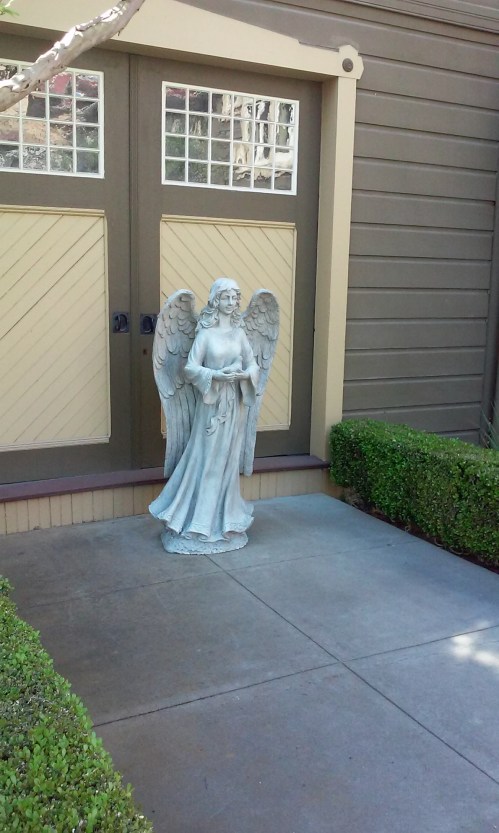
The dusk was now very thick, so I could not see much of his face. The blaze of his eyes, though, was phenomenal; and I knew that this apparition was now in a queerly energized state. I felt heavier and heavier. My home was filled with nightmarish beings and hideous monsters, and blood-drenched landscapes. The being did not speak, and in my inexplicable horror I was glad he did not. As the room started to clean, in the lights of the gasolier, I saw his firmly set mouth, and shivered at the his soulless eyes, which look beyond time. There was certainly something unnatural and diabolic in them, and I felt the sinister element all the more because of the wild ravings I had been hearing in my home for weeks. This man was a stranger—an intrusion of some sort from the black abyss in the thirteenth room. He did not speak until the room grew dark, and when he did, his voice seemed utterly unfamiliar. It was deep, firm, and very decisive, while its accent and pronunciation were rather disturbing. There was something grim, basic, pervasive and extremely evil in his tone. “I hope you’ll forget my attacks, Mrs. Winchester,” he was saying. “I guess you can excuse such things. I’m enormously grateful, of course, for being invited into your home. I hall take a rest from now on—you probably wont’s see me for some time, and you needn’t blame your servants for disturbing me.” This was a bit queer, but it is very simple. There were certain Indian relics in the dark abyss in that room. Standing stones, a sword and several small knives with queer markings etched on the blades, tarnished and pitted silver goblets, pieces of white chalk, and chunks of incense that had lost most of their scent. Also, a marble statue of a fierce looking angel wielding a shield and sword, and stepping on the head of what looked like a demon. With every moment my feeling of elusive cosmic horror increased, till at length I was in a virtual delirium. The next two months were full of rumours, people spoke of seeing devils more and more in my home with a new energized state. I felt an infinitely deep horror which I could not explain. #RandolphHarris 5 of 5
Over the years, Mrs. Sarah L. Winchester has become one of the best-loved figures in architecture and in the paranormal World. People who walk by on the sidewalks always gawked at the mansion. Some star, some laugh, some comment on how beautiful it is, other make rude jokes, and few glance and flee in horror. Every night when The Winchester Mystery House is closed, tour guides often report that they have seen shadows slinking into the house. As one tour guided was leaving the living room, he saw a darting green movement from the corner of his eye. It was a vague shape about three feet tall. With it a feeling of nausea swept over him, and passed. He assumed it was a trick of light, and something he had eaten at lunch had upset his stomach. As he was opening the door to leave, as though an ice pick had been stabbed in his brain, a voice whispered, “I don’t like plants, and I don’t like you.” The voice was so startling that it made him stagger back. He put his hand to the side of his head. “Where did that come from?” he wondered. After that, however, he avoided spending time in the front parlor.
Whenever he had to pass through it, he hurried along. Always, a fog-like shape darted out of view. The room remained cold after that, colder than the rest of the house. It had a forbidding atmosphere, as though a hostile presence had taken over. While giving a tour, the guests gazes fell on the painting hanging from the wall, some thought it was of Mrs. Winchester and froze, looks of uncertainty and astonishment on their faces. One woman rubbed her arms as though cold. The tour guide then said, “I have a great idea, why don’t we move into the Grand Ballroom, one of the best-preserved rooms in the house?” As they gathered up, the tour guide saw the green blob, then it disappeared. The tour guide emphasized that he was not in the habit of engaging in flights of fancy and did not wish to be regarded as one with mediumistic powers who regularly received supernatural visitations; nor was he suffering from any problems of the nervous system that would make his susceptible to delusions. Later, he also stressed the point that he had been in perfect health on the night of the materialization and had not been suffering from weariness nor fatigue. The ghost, he added, did not appear wispy or cloaked in a traditional sheet. The figure appeared lifelike, natural, and so solid that it had blocked light from the fireplace. After the aforementioned experience, there was no question in his mind that ghost do exist. However, the fireplaces have not been used in over 100 years.
For further information about tours, including group tours, weddings, school events, birthday party packages, facility rentals, and special events please visit the website: https://winchestermysteryhouse.com/
Please visit the online giftshop, and purchase a gift for friends and relatives as well as a special memento of The Winchester Mystery House. A variety of souvenirs and gifts are available to purchase. https://shopwinchestermysteryhouse.com/
Exceptional people should not be hindered by bureaucratic laws, especially not when on the streets, there are people in the shadow economy trading tinfoil balls for outrageous prices. Obviously, dysfunction is happening not only because of corruption, but due to a lack of resources to investigate and properly remediate the problems. Because of this, dysfunction … Continue reading →
Destructiveness is different from the sado-masochistic strivings since it aims not at active or passive symbiosis but at elimination of its object. However, it, too, is rooted in the unbearableness of individual powerlessness and isolation. I can escape the feeling of my own powerlessness in comparison with the World outside of myself by destroying it. … Continue reading →
My arrival to the Santa Clara Valley was truly a sensational event. The villagers were so thrilled by the dramatic entrance of a millionairess that I had to take detours to elude the crowds and journalists, jumping over garden railings and slipping through stables to get in my mansion. They were dying to see the … Continue reading →
A mental disorder has been taking place, reflecting not only individual psychological strain but also the broader social and environmental forces that shape mental health.…
People often assume that sharing a physical environment means sharing a psychological or social reality. Yet this is one of the great illusions of modern…