The choices you make—mission, education, marriage, career, and faith in God—will shape your eternal destiny. Much has been written and said about today’s generation of young adults. Research shows that many resist organized religion. Many are in debt and unemployed. A majority like the idea of marriage, but many are reluctant to take that step. … Continue reading →
Many people wonder why it is so important to work hard. Well, accumulation is the reward of personal merit and millionaires are a product of natural selection; the business class is essentially predatory in outlook and habits. The personal attributes of the ideal pecuniary man are ordinarily reserved for moral delinquents. Where the function of … Continue reading →
Man is a dual being—a living soul—composed of a body of a spirit and a physical body. His spirit existed as an individual personal entity in a premortal life long before the Earth was created. As a matter of fact, this Earth was expressly created as a place for the spirits of men to take … Continue reading →
We can forgive a child who is afraid of the dark, but it is deeply concerning when a man is afraid of the light. Man is a creature of desires, universally motivated by self-interest; the mechanism of competition, if free and fair, transmutes the self-seeking of the economic man into deeds that work for “the … Continue reading →
How members of immigrant communities can make positive adjustments and contribute to their new communities is an issue challenging policy makers and advocates in many countries. Although there are ways in which the participants adopt new identities, or mask their real ones, there are strong indications that they also experience several of the elements associated with a sense of community. Some are reflected in the clear membership boundaries imposed, forms of social support offered, private language and symbols used, and the sanctions used under the influence sphere to ensure members adhere to permitted forms of behaviour. It appears that the anonymity offered by the virtual environments can facilitate social interaction and openness that membership of communities is usually seen as encapsulating. As a Worldwide church is dealing with many complex issues across the globe, The Church of Jesus Christ of Latter-day Saints promotes broad, foundational principles that have Worldwide application: We follow Jesus as the Christ by loving our neighbour. The Saviour taught that the meaning of “neighbour” includes all of God’s children, in all places, always. We recognize an ever-present need to strengthen families. Families are meant to be together. Forced separation of working parents from their children, is something that every American faces, and it weakens families and damages society. We acknowledge that every nation has the right to enforce its laws and secure its borders. All persons subject to a nation’s laws are accountable for their acts in relation to them. #RandolphHarris 1 of 21
The Lord is depending on you to assist in the exaltation of your eternal family. Public officials should create and administer laws that reflect the best of our aspirations as a just and caring society. Such laws will properly balance love for neighbours, family cohesion, and the observance of just and enforceable laws. When someone says the word “home,” what comes to mind? The meanings for the term home are numerous. Everyone probably has a sense of what is meant by the phrase “going home” or what is meant by characterizing a place as “homey.” For example, when looking through a new house, a prospective buyer may say that it “feels like home.” Throughout history, home has had both spiritual and emotional connotations. For example, “Swing low, sweet chariot, Comin for to carry me home” from the old, anonymous Southern African American spiritual, connotes a celestial home. Disillusioned with the World, Ralph Waldo Merson penned “Goodbye, proud World! I’m going home; Thou art not my friend and I’m not thine” in Poems (1847). Many authors have written about the emotional aspects of the term. For example, Pandects (533 AD) wrote, “One’s home is the safest refuge to everyone.” Similarly, Oliver Wendell Holmes in Homesick in Heaven wrote, “Where we love is home, Home that our feet may leave, but not our hearts.” Although the colloquial expression “Home is where the heart is” captures the emotional component of home, it fails to address the dynamic interaction between a physical space and our need to have surroundings reflect who we are. Home also has been used in nationalistic and patriotic senses. To further highlight this illustration, Irving Berlin (1938) inspired Americans with the lyrics from God Bless America with, “From the mountains to the prairies, To the oceans white with foam, God bless America, My home Sweet Home!” #RandolphHarris 2 of 21
Each Day from Santa Clara to Oakland to Rancho Cordova, the people of the Church repeat these words: “We will be prepared to strengthen home and family, make and keep sacred covenants, receive the ordinances of the temple, and enjoy the blessings of exaltation.” Being part of a family is a great blessing. Not all families are the same, but each is important in Heavenly Father’s plan. All families need strengthening, from the ideal to the most troubled. That strengthening can come from you. In fact, in some families you may be the only source of spiritual strength. The Lord is depending on you to bring the blessings of the gospel to your family. It is important to establish patterns of righteousness in your own life, which will enable you to set a good example for your family, whatever form your family may take. The example of your righteous life will strengthen your family. A simple four-point program will not only assure your happiness, but will bless your family as well. Pray, study, pay your tithing, and attend your meetings. Seeking the help of the Lord daily through prayer will bring great blessings to your family. Ask yourself: “Who in my family could benefit from my personal prayers?” “What could I do to support and encourage family prayer?” As you personally study the scriptures, you will come to know the Saviour and His teachings. From His example, you will know how to love, serve, and forgive members of your family. Consider how you could share your understanding of the scriptures with your family. Get all the education you can. Your education will benefit your family now and will surely bless your future family. #RandolphHarris 3 of 21
The Holy Ghost will guide you and will teach you what you should do to bless your family. As you commit to these patterns of righteousness, you will be blessed throughout your life and will develop the spiritual foundation from which you can strengthen your family by example. In 1 Timothy, Paul teaches us about example: “Let no man despise thy youth; but be thou an example of the believers, in word, in conversation, in charity, in spirit, in faith, in purity” (1 Timothy 4.12). Be cheerful, helpful, and considerate of others. Concern yourself with the needs of other family members. Honour your parents by showing love and respect for them and by being obedient. Participate in family activities and traditions, including family prayer, family home evenings, and family scripture reading. These traditions strengthen and unify families. Strengthen your relationships with your brother and sisters. They can become your closets friends. My siblings and I were “born of goodly parents” (1 Nephi 1.1). who loved and made great sacrifices for us, but our family have not been blessed with the sacred ordinances of the temple. However, as we established family patterns of righteousness, praying together, studying about the ordinances of the temple, paying tithing, and attending our meetings regularly—as a family—the Lord heard and answered our prayers. As we surrounded the holy altar in the temple and were sealed as a family for time and all eternity, each person learned a better way and in so doing blessed the lives of those around us and taught correct traditions for the generations that followed. #RandolphHarris 4 of 21
John Howard Payne in his opera Clari, the Maid of Milan (1823) wrote, “Mid pleasures and palaces though we may roam, Be it ever so humble, there’s no place like home. Clearly, literature and the media have conceptualized the term home in diverse ways. Most individuals might argue that it does not necessarily take a “heap of living,” yet there is some sense that we must “do” something to make an abode a home. We must imprint it in some way, make it ours. Why do we spend so much time and energy making a house our home? Time and energy are invested into transforming a house into a home because they experience positive consequences from doing so. This concept of action and benefit represented the basis for further development of the psychological home construct. Remember, the family is central to the Creator’s plan for the eternal destiny of His children. Eternal families are made up of individuals. Do your part to build a happy home. Establish patterns of righteousness in your life. And be an example of the believers. The Lord is depending on you to assist in the exaltation of your eternal family. I know that Jesus as the Christ lives. He knows you and loves you. He has blessed me and my family, and I know He will bless you and yours. Of this I humbly testify in the name of Jesus as the Christ. In addition to a primary physical location (id est, a person’s house), many individuals will often make an aspect of their office homier. Office workers may place a personal photograph or memorabilia in their cubicle to make that space their own. What drives us to do this? Could it be that we are afraid of being swallowed up and losing our individuality in a sea of cubicles? #RandolphHarris 5 of 21
We desire to belong to groups and community, yet we also want to keep a place in our hearts and surroundings that is separate from others. We need to impact our surroundings (exempli gratia house, dorm, office space, car) in such a way that it reflects our personality, our sense of self, and in so doing, derive benefits. We contend that modifying physical space to have it better reflect our self-identity reflects the core of psychological home. Three principles that will help you strengthen your home and family are nurturing, sacrifice, and prayer. We are on the Lord’s team, and He will always be there for us to help us bring home the gold. As children of God, some of you may have great athletic ability, but all you have been blessed with many talents and gifts. One of the most meaningful gifts is your ability to strengthen your home and family. Tonight it is my prayer that the Spirit will burn within you, that you will have a greater desire to strengthen your family now and prepare for your future family. The scriptures are filled with ways to teach us how to strengthen our families. There is no greater teacher than the Saviour. As you study His teachings and follow His example, you can make your family life better. As you gather in your family, you can do so much to invite a spirit of unity. When was the last time you put your loving arms around your mom and dad and thanked them for all they do? Parents do most of the nurturing, but they need to be nurtured too. When our Father in Heaven introduced the Saviour to the World, He demonstrated good nurturing by using a soft voice. The language in the scriptures says, “As if it came out of the Heavens, they heard a voice; and it was not a harsh voice, neither was it a loud voice; notwithstanding it being a small voice it pierced them that did hear to the center” (3 Nephi 11.3). #RandolphHarris 6 of 21
In our homes, this can be a model for the way we talk to our family members. When we talk to those we love, let us not use a loud voice but a soft voice. This is the way our Heavenly Father speaks to His children. Except for a possible reversion to a cultural situation strongly characterized by ideas of emulation and status, the ancient racial bias embodied in the Christian principle of brotherhood should logically continue to gain ground at the expense of the pecuniary morals of competitive business. The struggle for existence many of us are facing is a glimpse of life which just now seems to many the dominant fact of the universe, chiefly because attention has been fixed upon it by copious and interesting exposition. As it has had many predecessors in this place of importance, so doubtless it will have many successors. Evolution had a profound impact upon psychology, ethnology, sociology, and ethics but it failed to work a similar transformation in economics. The most plausible explanation of the inflexibility of the received political economy is that its spokesmen were satisfied that there was little their science could learn from biology. The accepted function of political economy, as taught in American colleges and propagated in the forums of opinion, was apologetic. It had always been an idealized interpretation of economic processes under the competitive regime of property and individual enterprise; violations of the set patten had been discouraged as infringements of natural law. Here in the United States of America, it was not made the test of economic orthodoxy, merely. It was used to decide whether a man was an economist at all. #RandolphHarris 7 of 21
The common failure of orthodox economists to embrace social Darwinism as preached by Sumner—so obviously adapted to the function of their science as they conceived it—was only incidentally due to the unsettled status of evolution in its relation to religious beliefs. More important was the fact that classical economics already had its own doctrine of social selection. Since it had one of the great figures of the classical economic tradition who had led Spencer, Darwin, and Wallace toward their evolutionary theories, the economists might have had some justification for proclaiming that biology had merely universalized a truth that had been in their possession for a long time. A parallel can be drawn between the patterns of natural selection and classical economics, suggesting that Darwinism involved an addition to the vocabulary rather than to the substance of conventional economic theory. Both assumed the fundamentally self-interested animal pursuing in the classical pattern, pleasure or, in the Darwinian pattern, survival. Both assumed the normality of competition in the exercise of the hedonistic, or survival, impulse; and in both it was the “fittest,” usually in a eulogistic sense, who survived or prospered—either the organism most satisfactorily adapted to its environment, or the most efficient and economic producer, the most frugal and temperate worker. Economics was the better suited to a kindly interpretation of the status quo since it accepted the present environment as a natural datum, while conscientious and perceptive followers of Darwin saw that the “fittest” might be understood to be fit to inferior and degrading surroundings. #RandolphHarris 8 of 21
Veblen, writing in 1900, found that “identification of the categories of normality and rights gives the dominant note of Mr. Spencer’s ethical and social philosophy, and that later economists of the classical line are prone to be Spencerians. Further, both classical economics and natural selection were doctrines of natural law. At this point, once again, classical economics was more conducive to intellectual stability, because its concept of equilibrium was Newtonian and hence static, whereas a dynamic theory of society raised possibilities of an unsettled World. The conception of the pressure of population upon subsistence, so important in the historical connection between biology and political economy, not only played its part in the doctrine of Malthus but was closely related to the classic wage-fund doctrine. According to the wage-fund theory, which was popular among extreme proponents of laissez faire in the United States of America, labour is paid out of a capital fund which is fixed at any given time; and the average wage of the labourers is determined by the ratio of the number of workers seeking employment to the amount of the wage-fund. According to the logic of the wage-fund theory, neither legislative regulation nor any action of the labourers could alter this situation, and a policy of strict acquiescence was indicated. Competition was generally considered the perfect means of distributing wealth. According to this doctrine the increase in numbers among the working class pressed upon the limited wage-fund with the same inexorability as the total population on the means of subsistence. This doctrine was not a little favored by the fact that if afforded a complete justification for the existing order of things respecting wages. The peace that comes when we avoid debt and the temporal and spiritual blessings we receive when we pay tithes and offerings succeeds in making a fortune. If there is any one thing that will bring peace and contentment into the human heart, and into the family, it is to live within our means. And if there is any one thing that is grinding and discouraging and disheartening, it is to have debts and obligations that one cannot meet. #RandolphHarris 9 of 21
God our Heavenly Father has instituted laws to improve his people physically, spiritually, intellectually, and one of the best laws in all the World to make better Latter-day Saints is the law of tithing. There are many people who believe the gospel and would probably embrace it, but for the fact that they are young, they still need to be guided. Many people cannot endure the gospel because of financial requirements that are made of them, and they allow the things of this World, which they have grasped firmly and steadfastly, to rob them of the greatest of all God’s gifts, namely, life eternal. The great criterion of success in the World is that men can make money. However, this is not true success. As a man grows and increases in the things of this World, if he is not careful, he will lose the Spirit of the Lord, and he will set his heart upon the things of this World. And if he loses the Spirit of the Lord, and fails to be honest with God in the payment of his tithes as strictly and honestly as he would account to a partner if he were engaged in business, that man will lessen his strength, will lessen his power, will lessen the testimony of the Spirit of God within his soul. There is no question of it in my mind. We must be honest with the Lord. The great trouble is that there are many people who, as they grow and increase in the things of this World, set their hearts upon them and lose the Spirit of the Lord. Therefore, that which is counted by the World as success is failure; because if a man starts out for a prize and he fails to secure it after labouring nearly a lifetime for that prize, certainly his life has been a failure. Be honest with the Lord and I promise that peace, prosperity, and financial success will attend those who are honest with our Heavenly Father because they are fulfilling the law and an obligation. God will bless them for doing so. #RandolphHarris 10 of 21
It is feasible that many individuals experiment with changes in the consumption pattern. To some extent this has already been done in small groups. The point here is not asceticism for poverty, but life-affirming as against life-denying consumption. This distinction can be made only on the basis of awareness of what life is, what activeness is, what is stimulating, and what their opposites are. A dress, an object of art, a house may be in the one or in the other categories. The dress which follows the fashion presented by the profit interests of the dressmakers and their public relations staffs is quite different from the dress which is beautiful or attractive and the result of personal choice and tastes. A number of dressmakers might choose to sell their products to women who prefer to wear what they like rather than what is forced upon them. The same holds true of art objects, and all kinds of aesthetic enjoyment. If they lose their function as either status symbols or capital investments, the sense for the beautiful will have a chance for a new development. The unnecessary, or merely laziness-promoting, would be out. If it became a useful vehicle for transportation and not a status symbol, the Ultimate Driving Machine would change in significance. Certainly there would be no reason to buy a new Ultimate Driving Machine every two years, and industry would find itself forced to make some drastic changes in production. To put it in a nutshell: up to now the consumer has permitted and even invited industry to brainwash or control him. The consumer has a chance of becoming aware of his power over industry by turning around and forcing industry to produce what he wants or suffer considerable losses by producing what he rejects. #RandolphHarris 11 of 21
The revolution of the consumer against the domination of industry has yet to come. It is perfectly feasible and its consequences far-reaching, unless industry takes control of the state and enforces its right to manipulate the consumer. From the standpoint of conscious rational thought, fright and admiration are distinct feelings, hence they cannot denoted by the same word; and if there is one word like awe, it is used in the one or the other sense, and the fact is forgotten that it actually means fright and admiration. In our feeling experience, fear and admiration are frequently part of one complex feeling, which, however, modern man is usually not aware of as such. It seems that the language of peoples who emphasized less than we do the intellectual aspects of experience, has more words which expressed the feeling as such, while our modern languages tend to express only such feelings which can stand the test of our kind of logic. Incidentally, this phenomenon constitutes one of the greatest difficulties for dynamic psychology. Our language just does not give us the words which we need to describe many visceral experiences which do not fit our scheme of thoughts. Hence psychoanalysis has no adequate language at its disposal. It could do what some other sciences have done and use symbols to denote certain complex feelings. For instance, a/t could stand for that complex feeling of admiration and terror which was once expressed by one word. Or xy could stand for the feeling of “aggressive defiance, superiority, accusation + hurt innocence, martyrdom, being persecuted and falsely accused.” Again, this latter feeling is not a synthesis of different feelings, as our language would make us believe, but one specific feeling which can be observed in oneself and in others once one transcends the barrier of the assumption, that nothing can be felt which cannot be “thought.” #RandolphHarris 12 of 21
If one does not use abstract symbols, the most adequate, paradoxically enough, scientific language for psychoanalysis is actually that of symbolism, poetry or reference to themes of mythology. (Dr. Freud often chose the latter way.) However, if the psychoanalyst thinks he can be scientific by using technical terms of our language to denote emotional phenomena, he deceives himself and speaks of abstract constructs which do not correspond to the reality of felt experience. However, this is only one aspect of the filtering function of language. Different languages differ not only by the fact that they vary in the diversity of words they use to denote certain affective experiences, but also by their syntax, their grammar, and the root-meaning of their words. The whole language contains an attitude of life, is a frozen expression of experiencing life in a certain way. Here are a few examples. There are languages in which the verb form “it rains,” for instance, is conjugated differently depending on whether I say that it rains because I have been out in the rain and have got wet, or because I have seen it raining from the inside of a hut, or became somebody has told me that it rains. It is quite obvious that the emphasis of the language on these different sources of experiencing a fact (in this case, that it rains) has a deep influence on the way people experience facts. (In our modern culture, for instance, with its emphasis on the purely intellectual side of knowledge, it makes little difference how I know a fact, whether from direct or indirect experience, or from hearsay.) Or in Hebrew, the main principle of conjugation is to determine whether an activity is complete (perfect) on incomplete (imperfect), while the time in which it occurs—past, present, future—is expressed only in a secondary fashion. #RandolphHarris 13 of 21
In Latin both principles (time and perfection) are used together, while in English we are predominately oriented in the sense of time. Again it goes without saying that this difference in conjugation expresses a difference in experiencing. The significance of this difference becomes quite apparent in the English and German translation of the Old Testament. Often when the Hebrew text uses the perfect tense for an emotional experience like loving, meaning, “I love fully,” the translator misunderstands and writes, “I loved.” Still another examples is to be found in the different uses of verbs and nouns in various languages, or even among different people speaking the same language. The noun refers to a “thing”; the verb refers to an activity. An increasing number of people prefer to think in terms of having things, instead of being or acting; hence, they prefer nouns to verbs. Language, by its words, its grammar, its syntax, by the whole spirit, which is frozen in it, determines which experiences penetrates to our awareness. A wide variety of professional work involving relationships with people—whether as a psychotherapist, teacher, religious worker, guidance counselor, social worker, clinical psychologist—it is the quality of the interpersonal encounter with the client which is the most significant element in determining effectiveness. I have been primarily a counselor and psychotherapist. In the course of my professional life I have worked with troubled college students, with adults in difficulty, with “normal” individuals such as business executives, and more recently with hospitalized psychotic persons. I have endeavoured to make use of the learnings from my therapeutic experience in my interactions with classes and seminars, in the training of teachers, in the administration of staff groups, in the clinical supervision of psychologist, psychiatrists, and guidance workers as they work with their clients or patients. #RandolphHarris 14 of 21
Some of these relations are long-continued and intensive, as in individual psychotherapy. Some are brief, as in experiences with workshop participants or in contacts with students who come for practical advice. They cover a wide range of depths. Gradually, learning which applies to all these experiences is that it is the quality of the personal relationship which matters most. With some of these individuals I am in touch only briefly, with others I have the opportunity of knowing them intimately, with others I have the opportunity of knowing them intimately, but in either case the quality of the personal encounter is probably, in the long run, the element which determines the extent to which this is an experience which releases or promotes development and growth. I believe the quality of my encounter is more important in the long run than is my scholarly knowledge, my professional training, my counseling orientation, the techniques I use in the interview. In keeping with this line of thought, I suspect that for a guidance worker also the relationship he forms with each student—brief or continuing—is more important than his knowledge of tests and measurements, the adequacy of his record keeping, the theories he hold, the accuracy with which he is able to predict academic success, or the school in which he received his training. In recent years, I have thought a great deal about this issue. I have tried to observe counselors and therapists whose orientations are very different from mine, in order to understand the basis of their effectiveness as well as my own. I have listened to recorded interviews from many different sources. #RandolphHarris 15 of 21
Gradually, I have developed some theoretical formulations, some hypotheses as to the basis of effectiveness in relationships. As I have asked myself how individuals sharply different in personality, orientation and procedure can all be effective in a helping relationship, can each be successful in facilitating constructive change or development because they bring to the helping relationship certain attitudinal ingredients. It is these that I hypothesize as making for effectiveness, whether we are speaking of a guidance counselor, a clinical psychologist, or a psychiatrist. What are these attitudinal or experiential elements in the counselor which makes a relationship a growth-promoting climate? Gemeinschaftsgefuhl is the most important goal of personal growth and therapy. The German word gemeinschaftsgefuhl has been translated as “social interest” or “social feeling.” It refers to a feeling of oneness, a brotherly feeling toward one’s fellow human beings. The concept of social feeling accords with the highest precepts of ethics and religion and represents a wholesome corrective to the more pathology-oriented psychoanalytic writing. Healthy personality implies the courage to become a separate, distinct person, the courage to express and celebrate one’s difference from others, and the courage to be inventive and creative in various spheres of existence. A healthy personality can respond to the human situation in inventive, creative ways. One must have a conscious aspect of the psyche and covert the “shadow” side, which remains unknown to the individual and invisible to others. #RandolphHarris 16 of 21
Personal growth is a gradual unfolding and expression of the unconscious, shadow side and the integration of these unfolding aspects of personality into a coherent, meaningful way of life. Humans experience the World in various ways; this is a basic polarity of attention, called extraversion-introversion. The extraverted person is most attentive to the happenings of the external World. The introvert is more given to reflection and introspection, attending to personal experience as it is affected by the external World. Through upbringing, and perhaps hereditary and congenital influences, persons grow to emphasize one of these fundamental attitudes, while the opposite attitude remains undeveloped. Although the attitude of extraversion or introversion defines direction of interest for the person, that person’s ways of contacting the World are also diverse. The fundamental ways of experiencing the World are designated as sensing, intuition, feeling, and thinking. Sensing refers to the act of receiving the disclosure of the World by way of one’s several sensory systems. Intuition refers to a kind of imaginative knowing; it consists of rapid guessing about what lies behind obvious sensory inputs. Feeling refers to the emotional quality of experience—its pleasant or unpleasant, frightening, or ugly qualities. Thinking, of course, refers to the human capacity for reasoning, conceptualizing, and abstract thought. The most singular and important characteristic about humans is the capacity to symbolize experience in dreams, myths, art, and folklore. In dreams there are hints for the next stages of a person’s growth toward fuller self-realization. Self-realization, becoming an “individuated” person, requires that a person become aware of repressed “shadow” sides in the personality and struggle to express these in his or her way of life. #RandolphHarris 17 of 21
The motive for attempting such self-discovery is to alleviate suffering. Many people do not want help on overcoming childhood hangups. They seek help because their lives are stale. The goal is to resume growth. A healthy personality entails the endless struggle to transcend one’s initial socialization (training to become a socius, a citizen) to discover and express one’s own repressed possibilities of functioning. Integration of the capacities to think, feel, intuit, and sense is fostered by commitment to new purposes for existence. Thus, persons whose growth was adequate to enable them to marry, raise families, and achieve vocational success would arrive at an impasse in their growth and would suffer from it. Their attainment of healthier personality—self-realization—was fostered by relinquishing projects that had animated their youthful years and choosing new aims. In the selection of problems that arise one must pass easily from deliberate thinking to intuitive grasping of connections. This latter requirement might be compared to the attitude required in studying a painting: we think about composition, colour combinations, brush strokes, and the like, but we also consider the emotional responses that the painting elicits in us. This corresponds, too, to the attitude an analyst adopts toward the patient’s associations. While listening to a patient, I sometimes do hard thinking about possible meanings, and sometimes I arrive at a conjecture merely by letting the patient’s talk play on my intuitive faculties. The verification of any finding, however, no matter how one has arrived at it, always demands full intellectual alertness. #RandolphHarris 18 of 21
A person may find, of course, that in a series of associations nothing commands his particular interest; he merely sees one or another possibility but nothing illuminating. Or, at the opposite extreme, he may find that even as he delves into one connection certain other elements also strike him as noteworthy. In both instances he will do well to put down in the margin the questions left open. Perhaps at a future time, in going over his notes, the mere theoretical possibilities will mean something more to him, or the shelved questions can be taken up in more detail. In the New Testament Apocrypha we find a curious sentence: “For the Lord Himself, having been asked by someone when His kingdom should come, said, ‘When the two shall be one, and the outside as the inside and the male with the female.’” The loss of property and the break-up of possessions may be a terrible happening, but it may also have the effect of driving the sufferer into himself. He may disintegrate with his things, or he may steel his mind and school his emotions to endure the event while he tries to start life anew. So in the end, he will become stronger than he was when the World’s pleasures and riches were available to him. We may wallow in the lowest kind of emotions and passions, or we may rise the whole feeling-nature to a level where love and beauty, refinement and sensitivity reign serenely. When the good in hum overbalances the bad, his selfishness will be purged by pity. He can transcend gender by turning inward and finding the inner bliss. He should cultivate therefor joy, love, and happiness as attributes of the inner self. #RandolphHarris 19 of 21
Working for the Sacramento Fire Department is a prestigious accomplishment for many. However, being a firefighter is dangerous, with risks including dealing with collapsing structures, operating heavy equipment, climbing high ladders, and being suspended in unsafe places during rescues. “My first fire was a taxpayer, a group of one-story stores. It was a pullbox alarm, and we were first due in. I had the nozzle. The fire was in the ceiling and the walls, and it had gotten a little bit into the floor, but it was mostly smoke. Danger never entered my mind. I remember thinking through the whole thing, ‘Don’t fall. Pace yourself.’ I was very conscious of not making a mistake. The danger, the hell with the danger, I didn’t want to look stupid. I didn’t want to be pointed out. I mean, this was my first. This was my proving ground. ‘Don’t make a fool of yourself.’ It’s still like that. I’m disappointed when I’m given control of the door, because inevitably somebody says, ‘How come you’re outside, and not inside?’ Sometimes I take it too seriously; they could be teasing, but I get my back up a little bit. That’s my main concern—to be a professional and to do it right, to stop and think about what I’m doing. Having the nozzle in that first fire was wonderful. Just the exhilaration and the high afterwards. My feet didn’t touch the ground. #RandolphHarris 20 of 21
“Of course, nobody said, ‘Wow, you did a good job.’ It was just a nod or a look, or a small feeling of acceptance. My officer was my backup man. I fell in love with him. It was like a woman and her obstetrician. I thought, ‘This is it.’ I never felt closer to anybody. It’s a very close relationship. It’s magnetic. It’s very magnetic for a woman. I also remember thinking that this was really hard work, that the guys were right: ‘I’m not going to be able to do this.’ You can’t see anything. It’s claustrophobic, you’re moving in, and you don’t know where. You’re climbing over stud, and you don’t know what it is. There’s a lot of noise, a lot of yelling. I remember being scared and doubting whether I was physically able to do this. I was constantly talking to myself: ‘Don’t give up, you’ve got to keep going.’ That was the first. It wasn’t seven floors in an occupied building, with people coming down carrying their TV sets. I remember thinking how happy I was. But when I look back on it now, it really wasn’t anything.” Please remember to raise your children to love America, love God and Jesus Christ, respect law and order, do well in school, respect their elders, and be proud to be a member of the best country on Earth. You can help save lives and property by making a donation to the Sacramento Fire Department. I pledge allegiance to the flag of the United States of America, and to the Republic, for which it stands, one nation, under God, indivisible, with liberty and justice for all. We are grateful for the faith that made fearless, and the courage that kept firm these valiant men and women. Above all, we are grateful that the spirit of America’s Prophets lived in their hearts that they knew all men are created equal in Thy sight, by Thee endowed with the imperishable right to life, liberty, and pursuit of happiness. #RandolphHarris 21 of 21
Experience modern designs and affordability in our upcoming new homes for sale. Ascent at Montelena in Rancho Cordova is near major employers and premier shopping.
The idea that we belong to communities and that these communities provide benefits and responsibilities is one that has gained a growing appreciation in the last few decades. As a reaction to the urbanization faced by many people, globalization, cross-national forms of media and their impact on cultures, physical and social isolation from family and friends, and a growing fear of change and the unknown, images of community, belonging and support have become paramount. However, what is meant by community, how a community functions, and what are the benefits and costs of community membership has not necessarily been well explored. For many, the idea of community evokes images of the small town or close neighbourhood. People know each other, often have been resident for some generations, and provide various types of instrumental or emotional support to other members of the community. It is an idealization in place and time of other members of the community. It is an idealization in place and time of feeling a part of a place, with those around knowing us and caring about us. In many ways, it is a village in which relationships are governed by kinship and centered on the parish church. Integration and fulfillment of needs reflects the benefits that people derive from their membership of a community. Some of the needs can be fulfilled through community membership status achieved through group membership, demonstration of competence by members, and the shared values that are exhibited by the group. For them, strong communities can provide these opportunities for their members, thus reinforcing the value of membership of the community. #RandolphHarris 1 of 20
There is also a shared emotional connection. This refers to the sharing of significant events and the amount of contact that members have with each other. Because the community has had significant events, whether the members have taken part in them, there is a bond that can be developed between the members. The number of events, the salience of these events, and the importance of them in conferring merit or status to the community and its members all influence the development of a shared emotional connection between community members. Whether the events are positive or negative, they still have significant impacts on the development of emotional connections between members. Intelligence has an effectiveness as an instrument in modifying the World. Thinking is not a series of transcendent states or acts interjected into a natural scene. Knowledge is a part of nature, and its end is not mere passive adjustment but the manipulation of the environment to provide consummatory satisfactions. An idea is a plan of action rooted in the natural impulses and responses of the organism. The “spectator theory of knowledge” is pre-Darwinian. The biological point of view commits us to the conviction that mind, whatever else it may be, is at least an organ of service for the control of the environment in relation to the ends of the life process. #RandolphHarris 2 of 20
The ultimate refuge of the standpatter in every field, education, religion, politics, industrial and domestic life, has been the notion of an alleged fixed structure of mind. If mind is conceived as an antecedent and ready-made thing, institutions and customs may be regarded as its offspring. Intelligence operates within a series of objectively “indeterminate” situations. It is from the indeterminateness of the situations, from the element of contingency in nature, that the discriminating intellect derives its special significance. The significance of morals and politics, of religion and science, have their source and meaning in the union in Nature of the settled and the unsettled, the stable and the hazardous. Without this union there can be no such things as “ends,” either in the form of human consummations or as purposes. There is only a block universe, either something ended and admitting of no change, or else a predestined march of events. There is no such thing as fulfillment where there is no risk of failure, and no defeat where there is no promise of possible achievement. Philosophers must shift their attention from the sterile aspects of epistemology and metaphysics to politics, education, and morals. Philosophy will become, among other things, a moral and political diagnosis and prognosis. When psychology is founded upon the primary fact of impulse, the positive motivation of the organism is just the fact needed to give firm support to the main contentions in life. #RandolphHarris 3 of 20
The elimination of conflict from society is a hopeless and self-contradictory ideal, but it is possible to direct the struggle to eliminate waste. In the continual sacrifice of the individual to the conditions of progress, we see a hopeless confusion about the relation of ends and means. The individual forever sacrifices himself to the welfare of future generations, but since the individual of future generations do the same, the process never reaches any consummation in human satisfactions. Man always sacrifices toward an end which is by definition never attained. It is the reductio ad absurdum of the philosophy of progress. Direct participation in events is necessary to genuine understanding. No universal proposition can be laid down to determine the functions of a state. We must bring to order out of the moral confusion caused by the apparently conflicting aims of morality and science. What man thinks consciously is determined by forces which operate behind his back, that is, without man’s knowledge; man explains his actions to himself as being rational or moral and these rationalizations (false consciousness, ideology) satisfy him subjectively. However, being driven by forces unknown to him, man is not free. He can attain freedom (and health) only by becoming aware of these motivating forces, that is of reality, and thus he can become the master of his life (within the limitations of reality) rather than the slave of blind forces. #RandolphHarris 4 of 20
The ethical process, like the activity of the gardener, is one of constant struggle. We can never allow things simply to go on of themselves. If we do, the result is retrogression. However, what is the significance of this apparent opposition between the ethical process and the cosmic process, in the light of our idea of the evolutionary process as a whole? The conflict is not one in which man is pitted against his entire natural environment, but one in which man modifies one part of the environment with relation to another. He does not work with anything that is totally alien to his entire environment. The gardener may introduce foreign fruits or vegetables into a particular locale, and he may assist their growth by conditions of sunlight and moisture unusual on his plot of ground; but these conditions fall within the wont and use of nature as a whole. The survival of the fittest is different from the survival of the ethically best. Yet must not the conditions be interpreted as a whole complex, including the existing social structure with all the habits, demands, and ideals which are found in it? Under such an interpretation the fittest would in truth be the best. The unfit would be practically equivalent to the antisocial, but not to the physically weak or the economically dependent. The dependent classes in society may be quite “fit” when measured by the whole of the environment. The prolongation of the period of dependency in man has developed foresight and planning and the bonds of social unity; the care of the sick has taught us how to protect the healthy. #RandolphHarris 5 of 20
What was fit among carnivora is not fit among men. Man lives in such a changing and progressive environment that in his case it is flexibility, readiness to adjust to the conditions of the morrow as well as the present, that constitutes fitness. As the meaning of environment changes, the meaning of the struggle for existence changes also. The biological promptings of self-assertion have potentialities for good as well as evil. The essence of the human problem is controlled foresight—ability to maintain the institutions of the past while remaking them to suit new conditions; in short, to maintain a balance between habits and aims. The term “selection” can mean not only that one form of life, one organism, is selected at the expense of another, but also that various modes of action and reaction are selected by an organism or a society because of their superiority over other modes. Society has its own mechanisms, public opinion and education, to select the modes it finds most suitable. There is, then, no bifurcation between the ethical process and the cosmic process. The difficulty has been created by static interpretations of biological functions and their applications out of context to the unique and dynamic conditions of human environment. It is not necessary to go outside of Nature to find warrant for the ethical process; one need only recognize the natural situation in its totality. #RandolphHarris 6 of 20
Man’s consciousness is determined by his being, his being by his practice of life, his practice of life by his mode of producing his livelihood, that is, by his mode of production and the social structure, mode of distribution and consumption resulting from it. Pragmatism, the cash-value of ideas, is not an abject apology for the acquisitive spirit of business culture. Society only influences his being by greater or lesser repression of his innate physiological and biological equipment. Dr. Freud believed that man can overcome repression without social changes. Marx on the other hand, was the first thinker who saw that the realization of the universal and fully awakened man can occur only together with social changes which lead to a new and truly human economic and social organization of mankind. For any experience to come into awareness, it must be comprehensible in accordance with the categories in which conscious thought is organized. I can become aware of any occurrence, inside or outside of myself, only when it can be linked with the system of categories in which I perceive. Some of the categories, such as time and space, may be universal, and may constitute categories of perception common to all men. Others, such as causality, may be a valid category for many, but not for all forms of conscious perception. Other categories are even less general and different from culture to culture. For instance, in a pre-industrial culture people may not perceive certain things in terms of their commercial value, while they do so in an industrial system. #RandolphhHarris 7 of 20
However this may be, experience can enter into awareness only under the condition that it can be perceived, related, and ordered in terms of a conceptional system. With the problem of childhood amnesia of childhood memories, and with the difference between the categories (“schematas”) employed by the child and those employed by the adult, the incompatibility of early childhood experience with the categories and organization of adult memory is largely due to the conventionalization of memory. Furthermore, the problem is not only that of memory, but also that of consciousness in general. This system is a result of social evolution. Every society, by its own practice of living and by the mode of relatedness, of feeling and perceiving, develops a system, or categories, which determines the forms of awareness. This system works, as it were, like a socially condition filter: experience cannot enter awareness unless it can penetrate this filter. The question, then, is to understand more concretely how this “social filter” operates, and how it happens that it permits certain experiences to be filtered through while others are stopped from entering awareness. First of all, we must consider that many experiences do not lend themselves easily to being perceived in awareness. Pain is perhaps the physical experience which best lends itself to being consciously perceived; desires for pleasures of the flesh, hunger, etcetera, also are easily perceived; quite obviously, all sensations which are relevant to individual, or group survival have easy access to awareness. #RandolphHarris 8 of 20
However, when it comes to a more subtle or complex experience, like “seeing a rosebud in the early morning, a drop of dew on it, while the air is still chilly, the sun coming up, a bird singing” –this is an experience which, in some cultures, easily lends itself to awareness (for instance, in Japan), while in modern Western culture this same experience will usually not come into awareness because it is not sufficiently “important” or “eventful” to be noticed. Whether or not subtle effective experiences can arrive at awareness depends on the degree to which such experiences are cultivated in each culture. There are many affective experiences for which a given language has no word, while another language may be rich in words which express these feelings. In a language in which different affective experiences are not expressed by different words, it is almost impossible for one’s experiences to come to clear awareness. It may be said that an experience rarely comes into awareness for which the language has no word. This fact is of social relevance about such experiences which do not fit into our intellectual rational scheme of things. In English, for instance, the word “awe” (like in Hebrew “nora”) means two different things. Awe is the feeling of intense fright as it is still indicated in “awful”: and awe also means something like intense admiration, as we still find it in awesome (and in awed by). #RandolphHarris 9 of 20
One general consideration may be introduced at this point concerning the concept of happiness. The term “happiness” has a long history, and this is not the place to go into the meaning of the concept from its derivation from Greek hedonism to its contemporary usage. It may suffice to say that what most people experience as happiness today is really a state of full satisfaction of their desires regardless of their quality; if it is conceived in this sense, it loses the important qualifications which Greek philosophy gave it, namely, that happiness is not a state of fulfillment of purely subjective needs but of those needs which have an objective validity in terms of the total existence of man and his potentialities. We would do better to think of joy and intense aliveness instead of happiness. The sensitive person, not only in an irrational society but also in the best of all societies, cannot help being deeply saddened by the inevitable tragedies of life. Both joy and sadness are unavoidable experiences for the sensitive and alive person. Happiness in its present meaning usually implies a superficial, contented states of satiation, rather than that condition accompanying the fullness of human experience; “happiness” may be said to be the alienated form of joy. #RandolphHarris 10 of 20
It is a crazy gift we have, this trickery. My inside knowing of it is remembered only as far back as my own third year when: My mother and father laugh at me because I am enchanted by a hole in the ground. The hole is being dug on the next street so I cannot go there alone. I wait with excitement for my father to take me. When he does, I look into that ever-deepening hole with the same fascination that I watch my mother peel potatoes, noticing the changing form, the changing colour, the changing texture, and the changing fragrance of both holes in the ground and potatoes. My father tells my mother, “A hole in the ground!” (the way that he says it, I know is not much.) “You’d think there was a magnet at the bottom. If I didn’t hold her hand, she’d tumble right in.” (I do not catch all those words at the time. There are too many that I do not know. I hear them later on, when my father tells someone, and I remember my pain, and what I did about it.) My mother and father laugh together and are tender with me and love me, but they do not understand. I feel alone, and my enchantment is bleeding around the edges. I am the angry which is hurt. Being at the moment true to me, I scowl at my parents. They jolly me then, because children must be kept happy. And then I am not true to me. I laugh, because in that grownup World of which I would like to be a part, that is the thing to do. (A few years later, when I am attracted by a hole in the ground, I drop a marble into it, so that if anyone comes along I can say that I am looking for my marble, not that I am enjoying the hole, which would be ridiculed.) #RandolphHarris 11 of 20
There are times when I scowl at my parents not because I am misunderstood, or not understood, but because I have discovered that that is a way to get their attention. And then, when they have brought me around from scowls to laughter they are very pleased with both themselves and me. And I am pleased with myself for having figured this out. That is a long way from being happy with a hole in the ground. Less than three years in this World, and I have got involved in cleverness. I did not develop that all by myself. Already my parents have been tricking me, and I have watched other trickery go on with aunts and uncles, grandpa…My parents and I love each other and enjoy each other. Most of the time we are sensitive to each other at some level. We do not know that increasingly we are being superficial, that there is a dimension missing, and that their lack of respect for me is developing into me a lack of respect for them. They respect me in the outside things, like letting me paint the railings on the porch and carry things that would break if I dropped them, but they do not respect my insides because they think I have not any. When I am playing on the floor, they talk together or with other people about things I am “too little to understand” and so it is all right to say to them. However, they do not know what my understanding is, and I have no way to tell them. So it goes round and round inside my head. Sometimes I understand some things, and I am hurt. Other times, I do not understand and I try to put things together, with not enough information in my head to arrive at making sense. So what I make of it is nonsense, but I do not know that. And sometimes what I make of it will not stay put. #RandolphHarris 12 of 20
I think if it one way and I hurt, so I think of it another way so I will feel comfortable. However, it slips around, and I do not know which way it is. I am too young to know that the word for my trouble is confusion. To my parents, aunts and uncles, my life is good: I have loving parents, aunts and uncles, and “How blessed it is to be a child and have no worries.” To me, if often seems that I must have been born to the wrong parents, or that these are not my parents, because my real parents would know me. My sister, older than I, bewilders me, because sometimes she is a child with me, and then suddenly she switches and talks like a grownup. She tells me what to think and feel. What I thinking and feel she says is silly. A moment ago, she was agreeing with me. Sometimes I fight my sister about this. However, sometimes I say that I think and feel what she does, and then I feel BIG. However, then I get all mixed up and I am crying “Who am I?” And no one helps me with that because it is a silly question. I am me. Who else could I be? This seems so to me, too, so why is it that I do not know? There must be something so wrong with me that no one will tell me about it. I talk to my puppy and my dolls, and to the trees. They do not confuse me because they listen, and I can say anything I want and they do not talk back. They go on listening. And then I begin to hear myself and know it is me. No possessive relationship between two human beings can last forever. To ask such a thing is to ask for the impersonal universe to change its laws of growth for the sake of pleasing its ungrown progeny. God is entirely self-sufficient and if God’s children are to grow increasingly into his likeness, they can do so only by becoming less dependent on others, more sufficient unto themselves. #RandolphHarris 13 of 20
A false, showy, and pretentious cheerfulness which ignores facts, represses truths, and hides evils is not really cheerful at all. It is well to remember not to let oneself become the victim of negative feelings or harsh thoughts. They do not mend matter but only make you suffer more, and also suffer needlessly. It is one of the side effects of philosophy that it purifies human affection, takes the littleness out of it, and lifts it to a higher and wider plane. This may bring some pain or it may bring a shared pleasure, depending on those involved in the experience. If ignorance, credulity, naivete, or imbalance are the accompaniment, it is excellent but not enough to be well-meaning, to have a pure intent, to be guided by feeling alone. For there are traps and quicksands, illusions, and deceits in life as on the quest. No human being has the right to claim another as his own. Each stands ultimately alone and essentially isolated. Each is born out of and must find his way back to spiritual solitude. For each must learn to be divinely self-reliant and self-sufficient. This is so because the soul is of the nature of God. How much misery has come into contemporary life through non-recognition of this fact! How much bitterness has come to the unwilling possessed ones or to the defeated would-be possessors! The way to get rid of an obstinate negative feeling is to supersede it by a new positive one of greater intensity. If success is to be attained, right thoughts about the wrong feeling will help to correct it, right imaginations about the new one will help to bring it in, but feeling itself must be invoked and fostered. In most human relations, egoism in one person is replied by egoism in the other. He has feelings but they are so poised that they never disturb, so balanced with reason that they never agitate, and so harmonized with intuition that they never excite him. If anyone is to carry out Christ’s bidding of reconciliation with enemies and forgiveness of those who have harmed him, he can do so only by giving up the ego. #RandolphHarris 14 of 20
Our dear friend Clare, her whole self-analysis illustrated the validity of one who was able to choose the factors which were involved in her problems which she could grasp at the time, and she refrained from embarking upon problems that were still deeply repressed. With apparent insouciance she never bothered to tackle any problem that did not elicit a response in her, though it might almost stare her in the face. Without knowing anything about the principle of guidance through interest she intuitively applied it throughout her work, and it served her well. One example may stand for many. In the series of associations ending with the first emergence of the daydream of the great man, Clare recognized merely the role that the need for protection played in her relationships. The suggestions concerning her other expectations of men she discarded entirely, though they were an obvious and prominent part of the daydream. This intuitive choice took her on the best course she could have followed. By no means did she merely move on familiar ground. The finding that a need for protection was an integral part of her “love” was a discovery of a factor hitherto unknown. Furthermore, as will be remembered, this discovery constituted the first inroad on her cherished illusion of “love,” a painful and incisive step. To have taken up at the same time the aggravating problem of her sponging attitude on men would certainly have been too hard, unless she had dealt with it in a superficial way. This brings up a last point: it is not possible to absorb more than one important insight at a time. An attempt to do so will be detrimental to both, or all, of them. If it is to “sink in” and take root, any relevant insight needs time and undivided concentration. #RandolphHarris 15 of 20
Most of the previous writers developed their theories out of an interest in the unhealthy personality. However, almost all of them found it necessary to make some postulations, some suggestions for the concept of the idealized personality. The oldest, most venerable school, that of Dr. Freud and psychoanalysis, fixed the pattern of such emphases. Dr. Freud contented himself by stating that health consisted in the ability to love and to do productive work. Healthy personality, in psychoanalytic terms, is an outcome of harmony among id, ego, and superego. According to the psychoanalysts, personality is divided into three substructures—the id, the ego, and the superego. Id is the term used to refer to instincts. Ego refers to the active, controlling, perceiving, learning functions of personality. Superego refers to the moral ideals and taboos a person acquires as he or she grows up. It is the task of the ego to scan external reality and inner experience and then choose action that will gratify needs without violating moral taboos—in other words, to mediate between id and superego. A healthier personality would be able to gratify needs and yet remain free of guilt or of social blame. Because one would be less prone to prevent some feelings from coming to the surface (such repression consumes energy), energy would be available for productive work. Because one would not be ashamed of feelings and emotions (because of a reasonable conscience), one could be freer in expressing oneself in loving relationships. Hence, the relationship between ability to love and work, and the concept of harmony among id, ego, and superego, can assume greater meaning. #RandolphHarris 16 of 20
The Sacramento Fire Department looks for the most qualified applicants that they can find, and many people cherish their jobs. “I went to college in bits and pieces. I took some fire science work at the community college. I went back to Santa Clara University for a term to get a degree in public administration. The trouble was, I was an officer of our union, a local of the International Association of Firefighters, while most of the professors were management oriented. We had serious ideological clashes about management relations, and finally I just didn’t go back to school. I’ve had some misgivings about that. The fire service did two things for me, really. I provided a service, and yet, for a young man who was looking for some excitement, it provided that, too. Our fire department has changed. When I joined in 1975, it was a very conservative kind of environment. The music in the firehouses was mostly country and western. Not too long ago, I remember getting back from an alarm at two in the morning, and the guys in the day room were watching MTV. I was thirty-three years old and the oldest guy on the crew. It just shows you how things have changed. When I first joined, there was this generational thing. The hair code was a major issue. A lot of social stuff spilled over into the fire service. A guy who came on probation with me had a mustache. The battalion chief told him, ‘You know, we’ve never had anyone with a mustache make it through probation.’ I’m not sure if this guy was naïve or was jacking the chief around, but his response was, ‘Oh, you mean I’ll be the first.’ #RandolphHarris 17 of 20
“We had four weeks of basic training, eight to five, Monday through Friday. We were the first group to use the International Fire Service Training Association material. We were assigned homework each night, and the next morning there would be a quiz. If you failed any of the quizzes, you were out of the program. There were also classes on mechanical proficiency and on the use and maintenance of breathing apparatus. At that you could join the department and be a firefighter, period. Now the program goes for seven weeks and includes emergency medical training and learning how to drive the vehicles. They didn’t have a very good burn facility in our department for training purposes, so they had buildings scheduled for destruction, and they would burn them. They would actually give us a live fire and out us in a real fire station. As it turned out, buildings to burn were in short supply, so my class did not actually get a chance to be in a burning building. As a result, the first actual fire that I went to was a real fire. I was assigned to our downtown station. On my second or third shift, we had a fire in the middle of the night. It was a modular classroom set up behind a grade school. I was in the second-due engine. We used to do a lot more blitz attacks, where the first company would pull a line and go in without masks, and then the second company would lay a fire line from a hydrant and mask up. #RandolphHarris 18 of 20
“We were second in, and the lieutenant said to me, ‘Just get a mask on and hang on to my coat. Just follow me. Whatever you do, keep track of where the line is, because if you get lost and go sideways, the line is the only way you have to get back out.’ I remember crawling in there with the old mask that had a full face piece and an eyehole on either side. I couldn’t see a damn thing, the room was filled with smoke. I remember thinking, ‘These people are crazy.’ It was just nuts. And yet, I followed right in, took a turn on the nozzle, and got out. In those days, in the late fifties, we didn’t get much training, just two weeks at the training towers. It’s interesting that we had about 220 firefighters who did around two thousand alarms a year. This year we have 1,100 people in the fire department, and we are going on over a hundred thousand alarms. Big changes obviously. I was twenty years old, so I was a baby in the fire department, and in a very middle-class kind of way. I had worked in construction in the summers when I was going to college, I was a hod carrier when I came into the fire department. So I was used to construction guys, who were strong characters. They wanted you to be tired at the end of the day. I went to Santa Clara University for three semesters and graduated with a degree in fire protection technology, which is what they called it in those days. #RandolphHarris 19 of 20
“If you look at the Sacramento Fire Department today, we are probably just a typical fire department. Thirty years ago, it was inhabited by a lot of very good leaders. They had been in the Second World War, they had been through the tail end of the Depression, and they had tattoos. They were tough guys—good leaders, guys who had a strong set of values. If you got out of line, they kicked your expletive. They didn’t know about participatory management, they hadn’t been screwed up in graduate school. They were street guys, and these are the people I look back on, who raised me.” The Sacramento Fire Department is a very important organization. They help keep our community safe and save lives. You can save lives and property, too, by donating to the Sacramento Fire Department. Remember to have a safe and happy Independence Day. Be sure to raise your children to love America, love God and Jesus Christ, respect law and order and treat their elders with kindness and honour. It is a great privilege to be American and never forget that. Lord, God of our fathers, as we gather to pay homage to the founders and builders of this, our country, we ask Thy blessing. With courage and vision, they made of these Untied States of America a land of freedom and opportunity. For all that they have so firmly established, we render thanks unto Thee. “Our lines are fallen in pleasant places; yea, we have a goodly heritage.” I pledge allegiance to the flag of the United States of America, and to the Republic, for which it stands, one nation, under God, indivisible with liberty and justice for all. #RandolphHarris 20 of 20
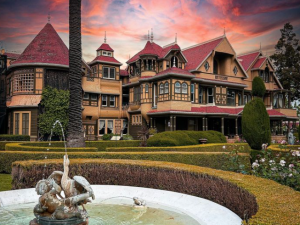
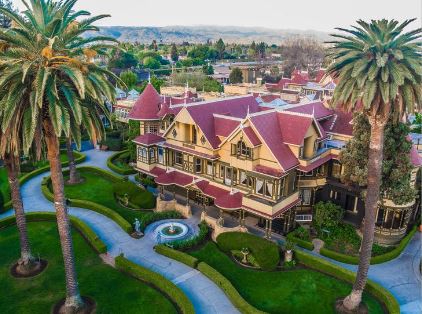
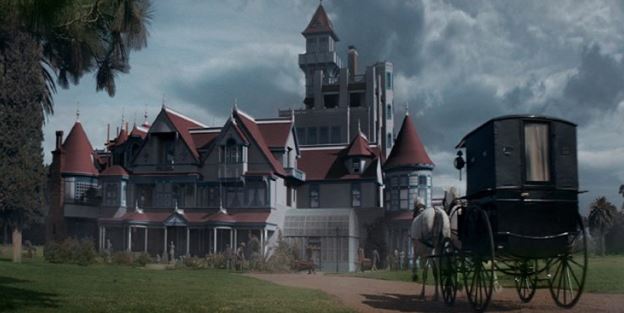
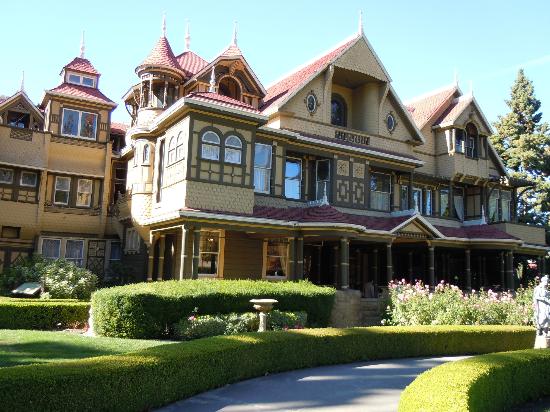
The Winchester Mystery House
If you are up for a day away with the chance sighting of a ghost, The Winchester Mystery House is open July 4th, 2024 from 10am PST to 5pm PST.
Please come and enjoy a delicious meal in Sarah’s Café, stroll along the paths of the beautiful Victorian gardens, and wonder through the miles of hallways in the World’s most mysterious mansion. For further information about tours, including group tours, weddings, school events, birthday party packages, facility rentals, and special events please visit the website: https://winchestermysteryhouse.com/
Please visit the online giftshop, and purchase a gift for friends and relatives as well as a special memento of The Winchester Mystery House. A variety of souvenirs and gifts are available to purchase. https://shopwinchestermysteryhouse.com/
Sometimes it seems the times of some people are so fatally lacking in geniality, humour, picturesqueness, and poetry; and are so explicit, so mechanical, so flat in the panorama which it gives to life. Many are overcome by the awfully monotonous quality and there is no twilight region in their minds, and no capacity for dreaminess and passivity. All parts of it are filled with the same noonday glare, like a dry desert where every grain of sand shows singly, and there are no mysteries and shadows. It is harmful to be overcome by a dry school-master’s temperament, to display a preference for cheap makeshifts in argument, where one is lacking education even in mechanical principles, and in general the vagueness of all one’s fundamental ideas, their whole system is wooden, as if knocked together out of cracked hemlock boards. Human beings gain knowledge within their souls. “The true lover of learning then must from his earliest youth, as far as in him lies, desire all truth,” says Plato. Nothing justifies the development of abstract principles but their utility in enlarging our concrete knowledge of nature. The ideas on which mathematical Mechanics and the Calculus are founded, the morphological ideas of Natural History, and the theories of Chemistry are such working ideas, finders, not merely summaries of truth. It is possible for “accidents” or novelties to arise which are not predictable from our knowledge of their antecedents—for example, the evolution of self-consciousness, or the application of the voice to social communication. #RandolphHarris 1 of 19
In particular instances, the facts are certain to show irregular departures from the law. A thoroughly consistent evolutionist must regard the laws of nature themselves as the results of evolution, and hence as limited rather than absolute. There exists an element of indeterminacy, spontaneity, or absolute chance in nature. Evolution is a change from a nohowish untalkaboutable all-alikeness by continuous stick-togetherations and somethingelseifications. When the whole training of life is to make us fighters for the higher, why should it be extraordinary or wrong to protest against a philosophy the acceptance of which is acceptance of the defeat of the higher? If it means anything at all, calling a thing bad means that the thing ought not to be, that something else ought to be in its stead. Determinism, in denying that anything else can be in its stead, virtually defines the universe as a place in which what ought to be is impossible—in other words, as an organism whose constitution is afflicted with an incurable taint, an irremediable flaw. Determinism is consistent only with the direst pessimism or a romantic mood of resignation. However, fi moral judgments are to be effective there must be some minimum of uncertainty in the universe; this does not necessitate a completely haphazard World, but only one in which there are occasional choices. #RandolphHarris 2 of 19
The necessity of retaining choices remains, even though one’s dream of universal fatalism be as optimistic in the ultimate advent of a peaceful millennium. Even if no preference can succeed unless it is in harmony with the ultimate triumph of peace, justice, and sympathy, we are still free to decide when to settle down on an equitable and peaceful basis. Until it is finally revealed with certainty what shall succeed, we are all free to try for our own preference. Intelligent mental reactions as those that minister to survival by arranging internal relations to suit the environment, but the critical factor in the cognitive situation, the desire for survival or welfare, is a subjective element which many ignore. The idea of correspondence between inner and outer relations, to be made meaningful as the criterion of mental acts, must be qualified by some subjective or teleologic reference. Furthermore, it is not simply a mirror floating with no foothold anywhere, and passively reflecting an order that he comes upon and finds simply existing. The knower is an actor, and coefficient of the truth on one side, whilst on the other he registers the truth which he helps to create. Mental interests, hypotheses, postulates, so far as they are bases for human action—action which largely transforms the World—help to make the truth which they declare. In other words, there belongs to mind, from its birth upward, a spontaneity, a vote. It is in the game, and not a mere looker-on; and its judgements of the should-be, its ideals, cannot be peeled off from the body of the cogitandum as if they were excrescences, or meant, at most, survival. #RandolphHarris 3 of 19
It is habitual to speak as if the mere body that owns the brain has interests, to treat the body’s survival as an absolute end without reference to any commanding intelligence. The reactions of an organism cannot be considered useful or harmful; it can only be said of them that if they occur in certain ways survival will incidentally be their consequence: but the moment you bring a consciousness into the midst, survival ceases to be a mere hypothesis. No longer is it “if survival is to occur, then so and must brain and other organs work.” It has now become an imperative decree: “Survival shall occur, and therefore organs must so work!” Real ends appear for the first time upon the World’s stage…Every actually existing consciousness seems to itself at any rate to be a fighter for ends, of which many, but for its presence, would not be ends at all. Its powers of cognition are mainly subservient to these ends, discerning which facts further them and which do not. What causes communities to change from generation to generation? Changes are the result of innovations by unusual or outstanding individuals, playing the same role in social change as variations in Darwin’s theory of evolution; such persons are selected by society and elevated into positions of influence because of their adaptability to the social situation into which cause of their adaptability to the social situation into which they happen to be born. Social changes can also be attributed to geography, environment, external circumstances—in brief, to everything except human control. The existence of a universal web of causation is one in which the finite human intellect becomes hopelessly entangled. #RandolphHarris 4 of 19
The most that sociology can predict is that if a great man of such nature appears under certain circumstances, he will affect society in such and such a way; but that he does affect it should not be denied. The great man is himself part of the environment of everybody else. However, a metaphysical creed is a mood of contemplation, an emotional attitude rather than a system of thought; and in its neglect of spontaneous variations in human thinking and their effect upon society, it is an absolute anachronism reverting to a pre-Darwinian type of thought. Without spontaneity, without some possibility that the individual may in measure alter the course of history, there is no chance for betterment of any kind, and the whole romance of struggle with its attendant alternatives of triumph or failure is banished. There is a zone of insecurity in human affairs in which all the dramatic interest lies. The rest belongs to the dead machinery of the stage. That life should be deprived of its dramatic interest by a scheme of universal causality was an intolerable thought, the most pernicious and immoral of fatalism. When people wish to illustrate the problem of evil, they choose spectacularly brutal murders rather than wars or the homeless crisis in America. Through their hardness and inflexibility of tone, many politicians believe that they are superior to the constituents and entertainment supersedes basic human needs. The interests of the citizens are harshly overridden. #RandolphHarris 5 of 19
Society has undoubtedly got to pass toward some newer and better equilibrium, and the distribution of wealth has doubtless slowly got to change; such changes have always happened, and will happen to the end of time. However, if, after all that I have said, any of you expect that they will make any genuine vital difference, on a large scale, to the lives of our descendants, you will have missed the significance of my entire lecture. The solid meaning of life is always the same eternal thing—the marriage, namely, of some unhabitual ideal, however special, with some fidelity, courage, and endurance; with some man’s or woman’s pains. And, whatever or wherever life may be, there will always be the chance for that marriage to take place. I sometimes wonder what did my love of Latin in high school have to do with my life? The only connection that I can find is that I liked words, and the meanings of words, and the derivations of words. However, after a year I had got the hang of that and could look up the rest for myself when I needed it. How did my daughter become so interested in cowboys, when her life had been in Hawaii, New York City, England and the New England coast—before the days she was allowed to stream TV and when she had not seen many movies? I think the answer is that she loved horses. At three, when she said that she felt sick and I asked her what would make her well, she said, “A wide on de pony in de park!” When she was five, the school reported that she was doing well in piano and suggested that she have private lessons. I asked her if she would like this and she said, after only a moment’s pause, “Well, I would rather ride a horse.” She always wanted the horse she did not have, and that may have been her problem, that she solved by being with horses in books. #RandolphHarris 6 of 10
When I went to live in Hawaii, for the first time I got interested in studying history. At that time, the written history was only about a hundred years old and all the sources were available to me. At the same time, I could question people for whom much of that past was a part of their own experience, and another lot of it had come to them through their immediate forebears. As I was living in the Islands, all this contributed to my understanding of what I was living in, and I liked this. I think another factor may have been that in the Islands I was exposed to a different way of thinking about life, and I got really interested in Island history in that sense. If “problems” entered into this, I think it may have been chiefly that when I was first in Hawaii, I did have problems, particularly during the first six months. Although I had driven in New York Labour Day traffic and all that, when I go to Hawaii, the traffic in Honolulu scared me so that I parked on Punchbowl and walked into town, until I could figure out how to drive in it. Time after time, as I went around in Honolulu doing errands, I watched the traffic to try to get the hang of it. At last, it became clear to me: instead of going by rules, the drivers went by noticing. They noticed other cars and they noticed pedestrians and moved in accord with them. Then I drove into town and drove as they did and enjoyed it. I had a problem with the slowness of everything in Hawaii: it was what I wanted for myself, but it was still a problem to me because I got irked by it and had to find my way out of that. #RandolphHarris 7 of 10
I had to slow down myself: then I enjoyed the ease and the lack of friction in moving slowly. I had the problem of living where it seemed to me that everyone had dark hair, dark skin, dark eyes. It was not race prejudice, just homesickness. When I returned to the white skins on the mainland eight years later, it seemed to me that everyone looked sick. I loved the mangoes, papayas, soursops, guavas, mountain apples, cherimoyas, pohas, and all the rest, but it seemed to me that if I could get to California (a place I had never really liked) and eat apricots, peaches, grapes, pears, apples for ten days, then it would be easier for me to go on living in the Islands. I had the problem of ants: I thought I must be a sloppy housekeeper because there were always ants in my house. Sometimes I dived in to help people—and got bumped. The people were somehow different from those I had lived with before. There were all these re-evaluations and adjustments going on, and this seems to open up my mind and lead to questions in other areas too. In trying to answer them, I run into problems, but it does not seem necessary for me to have the problem first. This suggests to me that in trying to provide our children with “security” by keeping them within a closed environment we may be stupidizing them. Then, when we make them specialize at an early age, we are stupidizing them still further. However, is it only the “problem,” anyway? It seems to me that I could have resolved my problem of being sick in another way, but when I found out how little medicine knows about the whole field of chronic illness, I was intrigued by the unknown territory that I lived in. #RandolphHarris 8 of 19
It scared me at first, but then I began to get used to it, and I like moving in the unknown, even when it scares me and is painful. I do not like the scare and the pain, but I do like the exploring. With the doctor, I explored what is known by medicine about chronic illness, with particular reference to my own. Through his honesty, I learned how much is not known. All this churned around in my head until I had the feeling of a dead end, of being somehow on the wrong track. That was when I side-slipped into psychology. It happened. This could lead me back into medicine sometime. That happens too. This suggests that telling children what is not known may be as helpful as telling them what is. When I am told only what is known, it seems to be “all there”—nothing that I can contribute to it. I can only learn what others have found out. It is a closed World. When I know how small the known is in relation to the unknown, the whole World opens up before me. I am free to explore and make my own discoveries instead of being a passive recipient of what is known—to the point that I think that everything is known by someone else and that it is only through others that I can acquire knowledge. I have seen this happen recently with several people, individually, when they discovered how chaotic the field of psychotherapy is, how much is not known. One of them said, with such freedom, “Each man is on his own!” and the others expressed themselves in much the same way. They moved from the limitation of trying to find a specific answer already known to the freedom of making their own discoveries. #RandolphHarris 9 of 19
More is known about how we get into the troubles that we do than is known about how to get out of them. With this knowledge of how things go wrong, these people are now trying to find out for themselves how to go about the undoing, both in the sense of curing and of prevention, by intelligent trial and error. If we all did this, it seems to me that we would get out of our difficulties a lot faster. Some people are very afraid of this, because people will make mistakes. That certainly will happen. However, these will not be such persistent mistakes as taught mistakes are, and I think it is the persistent mistakes that foul us up. It seems to me that much damage has been done by psychotherapists who believed that because they had been trained, they know the answers, and so went on and on with their mistakes. Being sure that the answers they had were right, they did not ask enough questions, and when things did not go well, the questions that arose were answered in terms of the answers they already had. That is a good way to get stuck. If all psychotherapists had done that, we would not have arrived at the new concepts that we have today. Holding to a belief seems to be a large part of our trouble. If I am sure that beating a child is good, or that permissiveness is good, poor results will only lead me to push harder with whatever it is that I believe. That seems to have happened with education. “It has not produced what we wanted, so let us have more of it” seems to sum up what I hear from all kinds of people all the time. #RandolphHarris 10 of 19
When a profession makes a mistake, a whole generation or more is damaged by it—like four-hour feedings and no rocking the baby. An individual’s mistake just does not reach that far. Another good thing about everyone trying to work out psychotherapy on his own (and including himself) is that all these people would not be Authorities. If I try out something in my relations with other people and it does not work well for them, they will be resistant to me in a way they would not be to an authority, who is believed to know what he is doing. It is my experience of most authorities that “working with them” means that I do as they say even if it gives me hell. That is just slavery in another form. “Working with authorities” make sense to me only when the professional and the amateur each say, “Of what you offer, I go along with this, but not with that,” or “Let us try this and see how it works out.” Then, there is continuing education on both sides, and each one at the same time is responsible for himself, through the choices he makes. That actually makes it much easier on the authorities, and it seems to me that any authority in his right mind would welcome this: he has contributed the best that he has to offer, but the choice is made by the other person. The authority, likewise, is responsible for his choices—for himself, not for anyone else. I know how this works out because I have tried it in medicine, education, and psychology. #RandolphHarris 11 of 19
When I meet with authorities who permit this, I become more intelligent, and I enjoy democracy. When I, a parent-authority, permit this, I become more intelligent, and I enjoy democracy. When they are made clearly responsible for themselves, children, in my experience, become more accountable. When they see the responsibility as being up to someone else, they are less so. This happens to grownups, too. It seems to me that democracy has not failed: we just have not really tried it yet. As a boy in grade school said to his teacher, “Mr. P—how do you reconcile your teaching of democracy with the way that you conduct this class?” We need to be more congruent. No one can be devoid of feelings, and the philosopher will not be exempt from this rule. Cheerfulness is an excellent mental attribute and worth cultivating; but where it results from mental blindness it is not worth having, for then it may become a real danger. Feelings, emotions, and passions should not be allowed to submerge reason, unless the feeling is genuinely intuitive, the emotion truly impersonal, and the passion a desire for the highest Truth. Feeling can be trained to become finer, more delicate, responsive to higher urges and ideals. The baser feelings go away of their own accord as the higher ones are let in and encouraged. The man who is seeking regeneration of his character will not often have repose of his feelings, for he is called by himself to struggle with himself. It is in the very nature of emotion to vary like the wind. Consequently, he who would attain inner peace cannot base his attainment upon emotion alone. He must find something much more stable than that, much more constant than that. This is not to say that life of the spirit is without feeling, but it is a calm, unbroken feeling. #RandolphHarris 12 of 19
One may legitimately take pride in the fact that he is called to the philosophic life, that he has accepted the philosophic ideal. For it is not the kind of pride which can vaunt itself over other men; its aims are to be fulfilled rather by humbling the ego and reducing its sway. The Roman Stoics, who sought to control their emotions and master their passions, placed character above knowledge. We pursue a similar albeit less rigorous discipline in controlling feelings by reason because we place knowledge above character. The latter is made a preliminary to attainment of the former. Goethe says: “I prefer the harmful truth to the helpful falsehood. Truth will heal the wound which she may have given.” And again, he says: “A harmful truth is helpful, because it can be harmful only for the moment, and will lead us to other truths which must become ever more and more helpful. On the other hand, a helpful lie is more harmful, because it can help only for the moment, and then lead to other lies which must become more and more harmful.” When he can brin himself to see clearly that no woman has anything to offer him which the Overself cannot offer more satisfyingly—be it ecstasy or beauty, intimacy or love, comfort or companionship—the glamour of pleasures of the flesh will pall. Roberto Assagioli, an Italian psychiatrist, developed a theory of healthy personality and a set of techniques for fostering this goal that he named psychosynthesis. He combined contributions from psychosomatic medicine, psychology of religion, study of higher modes of consciousness, parapsychology, Eastern philosophy, personality theory, anthropology, and finally, active techniques for fostering personality growth. #RandolphHarris 13 of 19
His theory of personality structure states that the human being comprises seven levels, or modes, of functioning: The lower unconscious, which includes drives and urges, repressed feelings, and the like (similar in meaning to the id, which harbours primitive pleasures of the flesh and aggressive demands, in Dr. Freud’s writings). The middle unconscious, which comprises the background of our ordinary waking consciousness and is like Dr. Freud’s preconscious, or to the “background” of awareness described by Gestalt psychologists. The superconscious, which Assagioli states is the source of “higher” feelings, such as altruistic love, and higher inspirations and intuitions, which give rise to truly creative works. The field of consciousness, which designates our ordinary awareness of perceptions, memories, feelings, and urges. The conscious self, or “I” designates a “point of pure self-awareness” independent of the content of one’s awareness. The self, or “I,” he claims, is an enduring center in our consciousness, like a light illuminating the objects that are seen. The higher self, of which we are generally unconscious, and which transcends the “I,” our conscious self. This higher self seems to stand for the possibility of more fully developed experiencing and acting. The collective unconscious, a term that Assagioli borrowed from Jung, refers to the beliefs, assumptions, traditions, myths, and symbols that form a source for and background to a persons ordinary consciousness, a source he or she shares with the other members of the society. #RandolphHarris 14 of 19
The task for human beings, says Assagioli, is to free themselves from enslavement by ignorance and unconsciousness, to attain a “harmonious inner integration, true self-realization, and right relationships with others.” The goal of such integration—true psychosynthesis—is achieved in four stages: through the knowledge of one’s personality. Control of the various elements of personality. This is achieved by a technique called disidentification. As Assagioli states, “We are dominated by everything with which our self becomes identified. We can dominate and control everything from which we dis-identify.” Realization of one’s true self, the discovery or creation of a unifying center. This stage entails the quest for the best, most fully functioning person that one can be through commitment to a worthwhile mission. Psychosynthesis, the formation or reconstruction of the personality around the new center. This phase calls for the commitment, study, struggle, and action to actualize the mission and, thereby, the image of the best possible self. How can man attain the goal of freeing himself from illusions? Marx thought his goal could be achieved by reform of consciousness. The reform of consciousness consists exclusively in the fact that one lets the World become aware of its consciousness, that one awakens the World from the dream it is dreaming about itself, that one interprets its own actions to the World…our motto must be: reform of consciousness, not through doctrines but by analyzing the mystical self-confused consciousness, whether it has a political or a religious content. One will see, then, that the World has possessed already for a long time the dream of something, of which it must only have consciousness to possess it in reality. #RandolphHarris 15 of 19
One will see that we are not dealing with a big hiatus between past and present but with the realization (Vollziehung) of the thoughts of the past. Eventually one will see that mankind does not begin any new task but accomplishes its old task with consciousness…this is a confession, nothing else. To have its sins forgiven, mankind has only to explain them for what they are. A group of psychologists, sociologist, economists, and representatives of the consuming public could undertake a study of those needs which are “humane,” in a sense that they serve man’s growth and joy, and those synthetic needs suggested by industry and its propaganda in order to find an outlet for profitable investment. As in so many other problems, the question is not so much the difficulty in determining the difference between these two types of needs and certain intermediate types but rather the raising of an extremely important question which can be brought up only if the social scientists begin to be concerned with man, instead of the alleged smooth functioning of our society or their function as apologists. It is true that to be guided by one’s interest means to take the way of least resistance. The principle means essentially the pursuit of those subjects which at the time being are least repressed. And this is exactly the principle that the analyst applies when he chooses those factors for interpretation which he believes the patient can fully grasp at the time, and he will refrain from embarking upon problems that are still deeply repressed. #RandolphHarris 16 of 19
Life safety. The primary purpose of firefighters is to help ensure the safety of lives and that means saving people’s lives by preventing and extinguishing fires and it also means by offering medical care during emergencies. “There was no training in the fire department at that time. I learned to run a pumper by myself, by being an observer, and then, on off hours, I’d go over to the station and practice on my own. The first time I ever got into the truck, of course I got my butt chewed up by the old-timers, because that was their job. That was a prestige job in those days. My business was only a block from the fire station, so I was one of the first one there on calls, and when I felt confident with that damn pumper I’d jump in the seat and have it sitting outside when those guys showed up. Some of them didn’t like that. They wouldn’t tell you anything. Same way with the breathing apparatus. At the Fireman’s Association summer meeting, which we had every year in June, we used to have hose-laying contests—two hundred feet of two-and-a-halfs and a Siamese arrangement of two one-and-a-halfs, a hundred feet long. And they timed you from when they said “Go” until water came out of both inch-and-a-half nozzles. We practiced over here every night for six weeks, because there was a particular town in the country that kept walking away with the prize. We were bound and determined that we were going to beat those guys, and we have that thing down pat. Make and break, set that up, and really get her going. #RandolphHarris 17 of 19
“Then we went over the conference, ready for this contest, and they gave us an old, beat-up ex-forestry truck that our engineer had never seen before. And he messed up the connection to the hydrant, so we got a little screwed up there. Then we got going, and after it was over, there was a big battle over the timers. Anyhow, we ended up losing. And then the fight was on. With fists. My guys were mad, and those guys thought we tried to cheat them. And one thing led to another. I’m strictly a lover, not a fighter, so I had to laugh. When I’m in charge at a fire scene, the guys I send in to make a search are those ones that attend all the training sessions, because I know they’re not going to panic or anything like that. I never send in just one man, I’ll generally send two and a captain to be their eyes and ears and guide. We practice that way. I got an old building where we practice our firefighting tactics with live fire. We get a little bit more of it each time. It’ll probably take us three or four months before that thing finally goes to ground. Great training for these guys. The state has a training program, but in recent years it hasn’t been able to fund enough instructors. So they are trying to develop self-training programs, by training somebody from each fire department to become the instructor for that particular department. And this works out pretty good, because that’s exactly what I’m doing, following my own training plans. We do ours in the evenings, Monday through Friday, and the guys get their certificate, and so on. I enjoy doing it.” #RandolphHarris 18 of 19
The Sacramento Fire Department is the all-hazards response team. It is important to keep them fully funded so they have the resources to save the community. You can help save lives and property by making a donation to the Sacramento Fire Department. And remember parents, teach your children what a privilege it is to live in America and be America. Raise them to love America, love God and Jesus Christ and respect law and order and their elders. We can help raise the next generation of patriotic leaders. Let justice well up as the waters, and righteousness as a mighty stream. I pledge allegiance to the flag of the United States of America and to the republic for which it stands, one nation, under God, indivisible with liberty and justice for all. In future days which we seek to make secure, we look forward to a World founded upon four essential human freedoms: freedom of speech and expression—everywhere in the World; freedom of every person to worship God in his own way—everywhere in the World; freedom from want which will secure to every nation a healthy peacetime life for its inhabitants—everywhere in the World; freedom from fear, which means a Worldwide reduction of armaments to such a point and in such a thorough fashion that no nation will be in a position to commit an act of physical aggression against any neighbour—everywhere in the World. And they shall beat their swords into ploughshares, and their spears into pruning-hooks, nation shall not lift sword against nation, neither shall they learn way anymore. However, they shall sit every man under His vine. And none shall make them afraid. #RandolphHarris 19 of 19
The Winchester Mystery House
In the summer of 1899, Mrs. Winchester found herself alone on the stairs on one occasion, when she suddenly heard a voice speak to her. “It’s all right…she can come out now,” some woman said somewhere in back of her. There was no one visible who could have spoken these words and no one nearby. Besides, it was not a voice she recognized. It sounded strangely hollow and yet imperious at the same time. Someone was giving an order, but who, and to whom? Clearly, this someone still considered herself a member of this house. The servants from two were half frightened out of their wits at the idea of living in such a beautiful, but bizarre, pagan-looking place; especially when they got together in the servants’ hall in the evening, and compared notes on all the hobgoblin stories picked up in the course of the day. They were afraid to venture alone about the gloomy, black-looking chambers. One of Mrs. Winchester’s chambermaids declares she could never sleep alone in such a “gashly rummaging old building”; and the footman, who was a kind-hearted young fellow, did all in his power to cheer her up. Mrs. Winchester was struck with the lonely appearance of the house. Before going to bed, therefore, she examined well the fastness of the doors and windows; locked up the plate with her own hands, and carried the keys, together with a little box of money and jewels, to her own room; for she was a notable woman, and always saw to all things herself.
Having put the keys under her pillow, and dismissed her maid, she sat by her toilet arranging her elaborate hair; for being in spite of her grief for Mr. William Winchester and Annie Winchester, rather a buxom widow, she was somewhat particular about her person. She sat for a little while looking at her face in the glass, first on one side, then on the other, as ladies are apt to do when they would ascertain whether they have been in good looks. All of the sudden she thought she heard something move behind her. She looked hastily round, but there was nothing to be seen. Nothing but the grimly painted portraits of her poor dear man, and late newborn daughter hanging against the wall. She gave a heavy sigh to their memories, as she was accustomed to do whenever she spoke of them in company, and then went on adjusting her night-dress, and thinking of them. Her sigh was reechoed, or answered by a long-drawn breath. She looked round again, but no one was to be seen. She ascribed these sounds to the wind oozing through the windows of the mansion and proceeded leisurely to put her hair in papers, when all at once, she thought she perceived one of the eyes of the portrait move, as her eyes were fixed on its reflection in the glass. It struck a momentary chill to her heart; for she was a lone woman, and felt herself fearfully situated.
Please come and enjoy a delicious meal in Sarah’s Café, stroll along the paths of the beautiful Victorian gardens, and wonder through the miles of hallways in the World’s most mysterious mansion. For further information about tours, including group tours, weddings, school events, birthday party packages, facility rentals, and special events please visit the website: https://winchestermysteryhouse.com/
Please visit the online giftshop, and purchase a gift for friends and relatives as well as a special memento of The Winchester Mystery House. A variety of souvenirs and gifts are available to purchase. https://shopwinchestermysteryhouse.com/
My thoughts were elsewhere, in another time, caught in a more powerful vortex…I shuddered, became aware of the present once more. I breathed in deeply, vapoured air rushing into my throat; I released it in a long sigh, forcing my fluttering nerves to settle. Despite my tension, returning to my bedroom was almost overwhelming. I latched the door behind me and went to the bureau where my notes and plans of the house were spread. There was a hot cup of tea by my side. I took a large swallow, then another, waiting for the warmness to reach my chest before approaching the window. I stared down into the gardens at the shadows cast by single trees and shrubbery. Could I be sure that is all they were? Ghosts, spirits, lost souls, did not, could not exist. Disgustedly, I turned away from the window and crossed the room to the bed, taking my cup of tea with me. I placed it on the bedside cabinet where it would be close at hand, and climbed into bed. The coldness of the sheets made me shiver. When I switched off the bedside lamp, the smothered moon afforded no light. My eyes remained open. I stared up at the dark gray mass that was the ceiling No lights, no glow from within. Llanada Villa was a vast black bulk that merged with the blackness of night clouds. The house was Victorian style, complete with ornamental gingerbread, a wide covered porch and those turreted rooms that look like a witch’s conical hat. The roof reached up into the clouds, birds of grace stood like ghosts on the chimney tops. #RandolphHarris 1 of 7
Enfolded in darkness, entirely solitary, remote, eloigned, on my heavily wooded estate, a breeze stirred through the gardens, ruffling foliage, disturbing trees. The housemaids, one by one, crept up yawning to their quarters. And, although it was night, birds were twittering busily, the insects were droning, and creatures hunted, their skirmishes violent but brief. Honey fungus glowed blue green on the evergreen trees, and fairies scuttled in the undergrowth. The moon was a pale ghost seen only behind slow-moving monoliths. People often eyed the house curiously as they approached. Inside the house, I slept; but I did not rest. The Psalmist speaks of the terror of the night, the business that walketh about in the dark, and of the noonday devil. Their assemblies generally are held at dead of night when the Powers of Darkness reign; or, sometimes, at high noon, even as the Psalmist saith, when he speaks of “the noonday devil.” The nights they prefer are Monday and Thursday. The time at which these Sabbats began was generally upon the stroke of midnight. Tonight, my dream was a terrible churning of pressure all around me. The Devil met me being alone, and commanded me to be at the Grand Ballroom the next night, and accordingly I made my way there as I was bid and waited at the room about eleven hours at even. In this case, however, the Sabbat was preceded by a dance of nearly one hundred persons, and so probably did not commence until midnight. #RandolphHarris 2 of 7
Thomas Leyis, Issobell Coky, Helen Fraser, Bessie Thorn, and the rest of the Aberdeen witches, thirteen of whom were executed in 1597, and seven more who had been banished were resurrected and standing before my very eyes. There was a midnight dance and reveling. I remained there for hours until the crowing of a cock dissolved the enchantment. The clapping of the cock’s wings made the power of the demons ineffectual and broke the magic spells. It was so prudent that the night-wandering demons, who rejoiced in the darkest shades trembled and scattered in sore affright, and the rites of Satan ceased because the Holy Office of the Church began. The bird at the held of dawn arouses men to worship God; and many an odious sin which darkness shrouds is revealed in the light of the coming day. I awoke, my cry little more than a whimper. The terror of my nightmare remained in my wide eyes. And soon a different emotion tinged them: a deep sadness, perhaps more remorse. My flesh was coldly damp. Early morning light crept through the window, a seeping grayness that offered no cheer. After freshening up, I escorted myself down the large staircase, composed of loads of mahogany; and through the rigmarole passages, hung with priceless works of art, till at length I arrived at the morning room. Just as I reached the door, I heard a strange noise within. I paused and listened. It seemed as if someone were trying to hum a tune in defiance of the asthma. I recollected the report of the room being haunted; so I gently pushed the door open and pepped in. #RandolphHarris 3 of 7
Oh my dear Heavens, there was someone carrying on within enough to have astonished St. Aldric himself. By the light of the fire, I saw a pale weazen-faced fellow, in a long dressing gown and a tall white night-cap, who sat by the fire. He was twitching about with a thousand queer contortions, and nodding his head. I was about to demand what business he had to be in my quarters, when a new cause of astonishment met my eye. From the opposite side of the room a long-backed, bandy-legged chair, covered with leather, and studded all over in a coxcombical fashion with little brass nails, got suddenly into motion, thrust out first a claw-foot, then a crooked arm, and at length, making a leg, slide gracefully up to a baroque chair, and vanished through the floor. A fierce music begun to play with such a mania that I sprang from the room and in a rush down the stairs and slipped, but something kept me from falling! Some force stronger than gravity held on to my skirts and pulled me back onto my feet. It was not my imagination and it was not a supreme effort of my own that did it. I was already half into the air, falling, when I was yanked back, upright. Shortly after, I managed to repair to the attic. As I sat there, resting, I suddenly felt something went and cold across my legs. I reached down only to feel a soft, moist mass that dissolved rapidly at my touch! This was enough to give me the willies, and I began to fear for my life. It was bad enough to have ghost, but to be known, as a haunted family was even worse. However, I found myself turning to my ghostly protector. It was not just me and my servants who experienced these strange things. #RandolphHarris 4 of 7
Even Mr. Hansen, who was not exactly given to belief in ghosts, was impressed when he saw a chair move from under a desk by its own force. He tried several times afterwards, hoping he could duplicate the phenomena by merely stomping his feet or gently touching the chair, but it required full forced to move it. The man from The Philadelphia Contributionship who had been servicing us for years was just as doubtful about the whole thing, when he heard about it. “No such thin as a ghost, Mrs. Winchester,” he commented as he stood in the hallway. At this moment the banister started to vibrate to such an extent they thought it would explode. He grabbed his hat and took his doubts to the nearest saloon. One night, I got into bed, and drew over me one of those great bags of down, under which they smother a man in the Low Countries; and there I lay, melting between two feather beds, like a turkey sandwich between two slices of toasts and butter. Sure enough, in a little time it seemed as if a legion of imps were twitching at me, and all the blood in my veins were in a fever-heat. Suddenly, I felt something cold lie down in bed beside me. All of the movables got into motion; pirouetting hands across, right and left, like so many devils; all except a great clothes-press was preforming a corpulent dance. With a scream, I jumped out and pushed the button to illuminate the room. The chairs and tables slunk in an instant as quietly into their places as if nothing had happened, and an apparition vanished up the chimney, leaving nothing but a chill still pervading the entire area! #RandolphHarris 5 of 7
The mansion shook as though it had been struck by an earthquake. The entire staff had been alarmed. The housemaid hurried up with a candle to inquire the cause. I revealed the marvelous scene I had witnessed, but there was no evidence. The chambermaids declared that they had all witnessed strange carryings on in this room; and they declared this “upon their honours,” there could not remain a doubt upon this subject. Where I passed the rest of the night was a secret I never disclosed. In fact, because of the geography of my mansion, I was apt to make blunders in my travels about inns at night, which would puzzle me sadly to account for in the morning. The phantoms in my home were not the same as those in the cemetery. I feared more the ghostly manifestations in this house more. Often times, there was an ancient crone who was apparently demented who appeared, walking about the place dressed in a strange outfit. It was dirty, loose, flowing. Sometimes she would shake her fist and scream epithets. “Get out of my house!” she would yell. “You’ve no business here. It’s mine! Get out—or you’ll be sorry!” “Who is that old witch?” I demanded angrily of the chambermaid. “Mrs. Winchester, that’s Hattie. She ain’t right in the head.” “What is she doing around here?” I replied. “What does she mean this is her house?” I had already determined that she was definitely in the flesh—and ditty flesh at that. It was a new experience for us. Here we are faced with an apparition—but this was one we could actually see! #RandolphHarris 6 of 7
Many of the servants have lived in the house for months and everyone was used to elusive shadows—shadows with no personality or features. However, Hattie added a colour to the mansion with could do without. One night, Daisy came home mad and said, “Aunt Sarah, why don’t you stop coming out and walking up and down without coming in where I’m working?” I looked at her and assured her that I had not been doing that. She said that she never saw anyone, but could hear them walk on the gravel in the aviary, halfway between the laundry room and one of the kitchens. A few nights ago, she was asleep. It was about one o’clock in the morning, and she had just turned out the light, after reading for a while. I was asleep upstairs. Daisy was lying in bed, and she was not asleep, when she noticed a light tight in the corner of her room. She did not pay any attention to it, but rolled over. As she rolled over, she looked out the two windows which are right above her bed, and there was no light outside. It was a very dark night. So she became curious, and she rolled back over and looked at the light and it was still there. She sat up, turned on the light and nothing was there. So, she runed out the light and pulled the duvet over her heard. About five minutes later, she thought she would look again. This light was still there. It was a strange light, not a flashing beam but sort of a translucent, shimmer and pulsating that would grow. The next morning, she offered me a deep apology and confided in me that she was afraid. #RandolphHarris 7 of 7
The Winchester Mystery House
In the beginning of April 1889-90, the nephew Mrs. Sarah L. Winchester came to his aunt and spent every evening with her reading for their amusement. About the twenty second of the same moth, after the nephew had been reading to his aunt, who was at this time in very good health, The Pilgrim’s Progress by John Bunyan, he retired to his chamber, a large back room, near the 7-11 staircase, and having latched the door, went to bed and feel asleep before ten o’clock. A little before the clock struck twelve, he was awakened by the drawing of the curtain of his bed, and, starting up, saw by a glimmer light, resembling that of the moon, the shadow of his uncle in the nightgown and cap, standing on the right side, near the head of the bed, holding the head curtain back with his left hand. His uncle William had a cheerful look on his face, and seemed as if he was stroking him with his right hand. They lived in the greatest amity prior to his uncle William Wirt Winchester dying of tuberculosis March 7, 1881. Shortly after, rumors circulated that Mrs. Winchester gave her nephew a check and no one laid eyes on him ever again. The staff argued about the size of that check for years.
When President Theodore Roosevelt’s entourage passed The Winchester House in 1903 to plant the city of Campbell’s famous redwood tree, he expressed desire to visit this now World-famous dwelling. At the great front door our nation’s leader was more than astonished to be coldly told by the Butler, “Mrs. Winchester is not at home!” Theodore Roosevelt was an avid fan of The Winchester Rifle. In African Game Trails, Roosevelt clearly stated his esteem for these Winchesters, with such affectionate allusions as “my medicine gun for lion,” “the beloved Winchester,” and “the faithful Winchester.” The Winchester public relations and advertising staff could not have been happier; endorsements from not only the President of the United States of America, but a recognized authority on guns and shooting and the World’s leading conservationist. One of Theodore Roosevelt’s favorites was the stalwart Model 1876 half-magazine .45-70 rifle. As each new lever-action was announced by Winchester, Roosevelt would add one (or more) to his growing collection. No amateur of arms, he was as expert on shooting and ballistics as most of his contemporaries, and often more experience in the field.
Please come and enjoy a delicious meal in Sarah’s Café, stroll along the paths of the beautiful Victorian gardens, and wonder through the miles of hallways in the World’s most mysterious mansion. For further information about tours, including group tours, weddings, school events, birthday party packages, facility rentals, and special events please visit the website: https://winchestermysteryhouse.com/
Please visit the online giftshop, and purchase a gift for friends and relatives as well as a special memento of The Winchester Mystery House. A variety of souvenirs and gifts are available to purchase. https://shopwinchestermysteryhouse.com/
Approximately sixty six percent of Americans report that high inflation has made their financial situation worse. Families with lower incomes are especially suffering. Another twenty percent of Americans have reported that the rising prices have made their financial health much worse. Housing costs in California have long been higher than the national average. In recent years, these costs have grown substantially—in some cases, growing at historically rapid rates. California’s home prices have far exceeded the rest of the country and the state is about thirty three percent more expensive than a mid-tier home in the rest of the country—a gap that has widened over the last decade. Monthly payments for a newly purchased mid-tier home—including mortgage, taxes, and homeowners’ insurance—have increased dramatically over the last couple of years. Payments for a mid-tier home were over $5,000 a month in March 2024—an eighty percent increase since January of 2020. Payments for a bottom-tier home versus renting are near levels that have not been seen since the housing bubble in the mid-2000s. This rapid increase in monthly costs for homebuyers was driven by higher home prices and increasing mortgage rates. #RandolphHarris 1 of 18
Costs of buying a home have grown by more than median income. Affordability depends on both the costs of the housing, as well as the income and/or wages of households. Annual household income needed to qualify for a mortgage on a mid-tier California home in March 2024 was about $235,000—over two times the median California household income in 2022 ($85,300). For a bottom-tier home, about $140,000 in annual income is required to qualify for a mortgage—more than 50 percent higher than median household income in 2022. Furthermore, rental prices are unaffordable for a record number of American with half of all renters paying more than thirty percent of their income on rent and utilities. In New York, rent for a 1-bedroom apartment is $4,300 a month; Santa Clara the number is $3,290 per month; and in Sacramento the average 1-bedroom apartment is $2,135 per month. If it were true that the terrible results of the degrading conditions forced upon the dwellers in the slums were transmitted to their children by heredity, and within few generations they become fixed character, the hope for a regenerated society would be much more difficult to realize. If that were the case, these unfortunate creatures would continue to act in the same way for several generations, no matter how their environment had been transformed by the corporate actions of society. #RandolphHarris 2 of 18
The poverty line for a family of four is $62,300. Many of the people who make this amount of money are those with high school diplomas and graduate degrees as well as blue-collar and white-collar workers who live in both rural and urban American. Also, about 4o percent of Americans are unable to plan beyond their next paycheck, while nearly fifty percent of them said they do not have $500 saved for emergencies. Price increases are devasting for lower-income Americans because they tend to spend more their paychecks on necessities and have less money to save. The typical American household needed to pay $227 more a month in March to purchase the same goods and services it did one year ago because of still-high inflation. Americans are paying on average $784 more each month compared with the same time two years ago and $1,069 compared with three years ago. For those on Social Security retirement, cost of living adjustments are not helping them much. Our affair is not with the evolution of life and its adaptation to the natural environment, but with the evolution of man, and the adaptation of life to his purposes. And even the control of life around us matters less than that of our psychological evolution and of social progress. If no Utopia is in the making, at least, some believe there should be a shift away from the free competitive order. #RandolphHarris 3 of 18
Capitalism is beginning to turn into the welfare capitalism; the frustrations of the middle class and the needs of the poor are accelerating the change. Men sense that a different order is slowly arising. Although they can seldom describe it, they have expressed it variously in their slogans and titles: they speak of the New Nationalism, the Square Deal, the New Nationalism, the Square Deal, the New Freedom, the New Competition, the New Democracy—and, in time, of the New Deal. Previous reform and protest movements have been disjointed and uncoordinated uprisings of workers and farmers; now the middle class is drawn into the fray. The middle-class citizen, as producer and consumer, is beginning to feel the growth of inflation and fears that he will be grounded between large combinations of capital, labour, and Artificial Intelligence. As the standard of living, the figure of the great capitalist entrepreneur, hitherto heroic, lost much of his glamour. He is condemned as an exploiter of labour and an extorter from the consumer, pilloried as an unfair competitor, and exposed as a corrupter of political life. In a society of great collective aggregates, the traditional emphasis upon the exploits of the individual lost much of its appeal. #RandolphHarris 4 of 18
The old problem of defending competition from critics on the left now pales as people are forced to face “the curse of bigness,” the more imminent threat to competition from the offspring of competition itself. Our industry is a fight of every man for himself. The prize we give the fittest is monopoly of the necessary life, and we leave these winners of the powers of life and death wield them over us by the same “self-interest” with which they took them from us. “There is no hope for any of us, but the weakest must go first,” is the golden rule of business. There is no other field of human associations in which any such rule of action is allowed. The man who should apply in his family or in his citizenship this “survival of the fittest” theory as it is practically professed and operated in business would be a monster, and would be speedily made extinct. It is laissez faire as policy that is most completely discredited. While the old, simple apotheosis of competition has faded, few have ceased altogether to believe in it. One of the primary aims, indeed, of the middle-class revolt is to restore so far as possible the pristine conditions of competitive business. However, even if the supposed benefits of competition were to be retained, some form of government regulation is needed to restrain monopoly. #RandolphHarris 5 of 18
American industry is not free, as once it was free. The man with only a little capital is finding it harder to get into the field, more and more impossible to compete with the big fellow. Why? Because the laws of this country do not prevent the strong from crushing the weak. This the small entrepreneur and his sympathizers are trying to change the laws because the middle class is grasping for life and capital and many fear becoming homeless. The little individualist, recognizing his individual impotence, realizing that he does not possess within himself even the basis of a moral judgement against his big brother, begins to change his point of view. He no longer hopes to right all things by his individual efforts. He has turned to the law, to the government, to the state. The right of competition must be limited to preserve it. For instance, the American Automobile industry produces some of the best designed and best performing vehicles in the World, but when Japanese automobiles flooded the markets back in the 1970s and 80s, during the gas crisis, people got hooked on them and have yet to return to their roots. To encourage people to buy American cars, we need to put tariffs on Japanese cars to not kill the American automobile industry. For excesses of competition leads to monopoly, as excesses of liberty lead to absolutism. #RandolphHarris 6 of 18
The issue therefore is: Regulated competition versus regulated monopoly. In the past, as serious attempts to alter the business structure through legislation increased, there came a flood of laws to relieve the working class. Intellectuals, humanitarians, and social workers threw themselves on the side of labour, and drew support from a middle class which had no desire to see industrial oppression bring collectivism from the left. In increasing numbers, state legislatures adopted laws increasing minimum wage, limiting worker’s compensation, and similar measures of reform. Sympathy for union activity grew stronger among intellectuals. If we are not careful, with the amount of inflation we are experiencing today, Americans could return to child labour, more people may engage in selling pleasures of the flesh and peddling contraband. We could see comfort stations popping up in suburban communities and becoming as popular as liquor stores in the cities. We already have drug shops peddling illegal drugs to anyone who walks through the doors. And 65,000 catalytic converters were stolen in 2022. #RandolphHarris 7 of 18
Women have been convinced that their place is no longer in the home. They are encouraged to hire nannies and order already prepared meals kits. They are sent the message that they are no longer homemakers and care givers to their families. If there is a “housing shortage” and people cannot afford the supply of housing, means that there is too much demand from overpopulation. The masses as well the classes must be judged impartially through the arbitrament of the universal struggle. The state is conceived by all reformers to be an indispensable instrument of the new reconstruction. We must have a fervent plea for the abandonment of the traditional American mixture of optimism, fatalism, and conservatism in favour of a more positive attempt to realize the national promise. Americans must learn to think in terms of purpose rather than destiny, and, without fear of the centralizing powers of government, to realize their purpose through a national policy. We can no longer treat life as something that has trickled down to us. We must deal with it deliberately, devise its social organization, alter its tools, formulate its method, educate and control it. #RandolphHarris 8 of 18
In endless ways we put intention where custom has reigned. We break up routines, make decisions, choose our ends, select means. The managed society which we anticipate must become a reality. If our children are to survive, the state of intervention must come of age. Despite the interruption of the Obama administration, the trend toward social cohesion must keep growing so the sons of the generation can witness the creation of a state machinery as great as any that could have appeared in the Victorian individualist’s worst nightmares. Whatever the human potentialities of this apparatus, for good or evil, the ideals of a cohesive and centralized society will become increasingly triumphant over those of the heyday of the age of information. While individualism has by no means disappeared, it is increasingly on the defensive. The religious keynote, the economic keynote, the scientific keynote of the twenty first century must be the overwhelming realization that mankind has such a mental and spiritual powers and such control over nature that the doctrine of the struggle for existence is definitely outmoded and placed by the higher law of cooperation. #RandolphHarris 9 of 19
We live in a consumer drive economy, and the attempt to question the pattern of unlimited consumption meets with a difficulty. Compulsive consumption compensates for anxiety. The need for this type of consumption stems from the sense of inner emptiness, hopelessness, confusion, and tension. By “taking in” articles of consumption, the individual reassures himself that “he is,” as it were. If consumption were to be reduced, a good deal of anxiety would become manifest. Resistance against the possible arousal of anxiety would result in an unwillingness to reduce consumption. The most telling example of this mechanism is to be found in the public’s attitude toward cigarette consumption. In spite of the well-known dangers to health, the majority goes on consuming cigarettes. It is because they would rather take a chance of earlier death than forgo pleasure? An analysis of the attitude of smokers shows that this is largely a rationalization. Cigarette consumption allays hidden anxiety and tension, and people would rather risk their health than to be confronted with anxiety. Yet, once the quality of the process of living becomes more important than it is now, many people will stop smoking or overconsuming, not for the sake of their physical health but because only when they face their anxieties can they find ways to more productive living. (If they are compulsive, most urges for pleasures, including pleasures of the flesh, are not caused by the wish for pleasure but by the wish for avoidance of anxiety.) #RandolphHarris 10 of 18
The problem of limits to consumption is so difficult to assess because, even in the affluent society of the United States of America, not all unquestionably legitimate needs are fulfilled. This holds true for at least 52 percent of the population. When the optimum consumption level has not been reached, how can we even think of reduced consumption? First, in the affluent sector, we have already reached the point of harmful consumption; second, the aim of ever-increasing consumption creates, even before the optimal consumption level is reached, an attitude of greed in which one wishes not only to have one’s legitimate needs fulfilled but dreams of a never-ending increase in desires and satisfactions. In other words, the idea of the limitless rise of production and consumption curve greatly contributes to the development of passivity and greed in the individual, even before peak consumption is reached. Despite these considerations, the transformation of our society into one which serves life must change the consumption and thereby change, indirectly, the production pattern of present industrial society. Such a change would obviously come not because of bureaucratic orders but of studies, information, discussion, and making on the part of the population, educated to become aware of the problem of the difference between life-furthering and life-hindering kinds of needs. #RandolphHarris 11 of 18
Awareness of illusions is the condition for freedom and human action. Religious distress is at the same time the expression of real distress and the protest against real distress. Religion is the sigh of the oppressed creature, the heart of a heartless World, just as it is the spirit of an unspiritual situation. It is the opium of the people. The abolition of religion as the illusory happiness of the people is required for their real happiness. The demand to give up the illusions about its condition is the demand to give up a condition which needs illusions. The criticism of religion is therefore in embryo the criticism of the vale of woe, the halo of which is religion. Criticism has plucked the imaginary flowers from the chain not so that man will wear the chain without any fantasy or consolation, but so that he will shake off the chain and cull the living flower. The criticism of religion disillusions man, to make him think and act and shape his reality like a man who has been disillusioned and has come to reason, so that he will revolve round himself and therefore round his true sun. Religion is only the illusory sun, which revolves round man as long as he does not revolve round himself. How can man attain the goal of freeing himself from illusions? The behaviourists try to explain human activity without recourse to terms referring to consciousness, such as reward or satisfaction. #Randolphharris 12 of 18
Instead, behaviourists invoke a circular argument, stating that behaviour is “shaped” (into skills, or patterned habits) by reinforcers. A reinforcer is any consequence to action which strengthens, that is, increases the probability of the recurrence of, a response. To an observer who is not a behaviorist, the “reinforcing stimulus” may look suspiciously like a reward or a pleasant experience; the behaviourist prefers to avoid such subjectivistic terms. Skinner and his followers have been consulted by officials concerned with the management of prisoners’ behaviour in prisons and the behaviour of patients in mental hospitals, and by administrators of school systems who wish to make teaching and learning more efficient. There is considerable controversy between humanistic and behaviouristic psychologists about the issue of behaviour control, and the student should become familiar with the points of debate. Healthy personality, according to a behaviouristic view, calls for competence and self-control—the ability to suppress action that no longer yields positive reinforcers, and to learn action that is successful in attaining the good things. Such rapid adaptability is mediated by the ability to discern the contingencies, or rules implicit in nature or in society, according to which needs are gratified and dangers averted. #RandolphHarris 13 of 18
I have always been uneasy about the behaviouristic approach to human nature, because it appeals to the power motive in the behaviour scientist. Moreover, research in behaviourism is frequently funded by agencies interested in controlling the behaviour and experience of other persons for the institution rather than the person. If a definite distinction is thus established between freely associating and understanding, when does one stop associating and try to understand? Fortunately, there are no rules whatever. If thoughts flow freely there is no sense in arresting them artificially. Sooner or later, they will be stopped by something stronger than themselves. Perhaps the person arrives at a point where he feels curious about what it all may mean. Or he may suddenly strike an emotional chord that promises to shed light on something that is troubling him. Or he may simply run out of thoughts, which may be a sign of resistance but also may indicate that he has exhausted the subject for the time being. Or he may have only a limited time at his disposal and still want to try himself at interpreting his notes. As the understanding of associations, the range of themes and combinations of themes that they may present is so infinite that there cannot possibly be any fixed rules regarding the meaning of individual elements in individual contexts. #RandolphHarris 14 of 18
When a person stops associating and begins to go over his notes to understand them, his method of work must change. Rather than being entirely passive and receptive to whatever emerges, he becomes active. Now his reason comes into play. He no longer excludes reason. Even now he does not use it exclusively. It is difficult to describe with any accuracy the attitude he should adopt when he tries to grasp the meaning of a series of associations. The process should certainly not degenerate into a mere intellectual exercise. If he wants, he will do better to play chess or predict the course of World politics or take to crossword puzzle. An effort to figure out completely rounded interpretations, not missing any possible connotation, may gratify his vanity by proving the superiority of his brains but will scarcely take him much closer to a real understanding of himself. Such an effort entails a certain danger, for it may hamper progress by engendering a smug know-it-all feeling while he has only catalogued items without being touched by anything. The other extreme, a merely emotional insight, is far more valuable. If it is not further elaborated this is not ideal either, because it allows many significant leads, not yet altogether lucid, to drop out of sight. However, as we have seen from Clare’s analysis, an insight of this kind may set something going. #RandolphHarris 15 of 18
Early in her work, Clare experienced an intense lost of feeling in connection with her dream of the foreign city; it was mentioned than that although it is impossible to prove whether this emotional experience had any effect upon the further analysis, through its disquieting nature it may well have loosened her rigid tabu against touching any of the complex ties that fastened her to Peter. Another instance occurred during Clare’s final battle with her dependency, when she felt her defiance against taking her life into her own hands; she had then no intellectual grasp of the meaning of this emotional insight, yet it helped her to get out of a state of lethargic helplessness. Instead of wanting to produce a scientific masterpiece, the person who is working alone should let his interpretation be directed by his interest. He should simply go after what arrests his attention, what arouses his curiosity, what strikes an emotional chord within him. If he is flexible enough to let himself be guided by his spontaneous interest, he can be reasonably certain that he will intuitively select those subjects which at the time are most accessible to his understanding, or which fall in line with the problem on which he is working on. #RandolphHarris 16 of 18
When I first learned to read, I was absorbed in the joy of my learning. At the same time, it is true that until I could read for myself, I was dependent on my mother’s time: I had to wait for her to read to me. That could be called a problem. However, when I was eight and went to German school on Saturday mornings, I was lost in the enchantment of writing German script, the light lines up, the heavy lines down. It was utter fascination to find that a completely different set of sounds and “pictures” (letters)—like frau—meant in another part of the World what my mother was. To discover that kindergarten, to which I had gone, was a German word, not an English one, was like discovering that I had been in Germany instead of America. Then there were the words that were same as ours, and others that were nearly the same, which brought together what had seemed so far apart. I do not think I had a problem that led to my learning German. I did have some familiarity with it, to begin with. My German grandfather still spoke German when he had someone to speak it with. German was in this sense already a part of my life. However, what did my love of Latin in high school have to do with my life? The only connection that I can find is that I liked words, and the meaning of words, and the derivations of words. However, after a year I had got the hang of that and could look up the rest for myself when I needed. #RandolphHarris 17 of 18
No one can be devoid of feeling, and the philosopher will not be exempt from this rule. However, whereas the ordinary man’s feelings are transient emotions, passions, stresses, or moods, the philosopher’s feelings nourish a sustained, elevate state. The mistake of taking personal feelings as fit judges of truth or reality is a grave barrier which often lies across the portal of philosophy. People put a grossly exaggerated value on them and are thus led astray from the true knowledge of a fact or a situation. Without changing a person’s feelings, no change for the better in his own life, in himself, and in his relationship with other persons can be stable. When his feelings are really a conscious or subconscious cover for other feelings, nothing will help, save the uncovering of what the ego has hidden. Generous feeling must be directed by sound judgment, fervent devotion must be led by wise discrimination. The longing for inward security and invulnerable peace is one which a man can certainly satisfy. However, he cannot satisfy it on his own terms. Life has always and inseparably dictated the price which must be paid for it. It is easy to talk vaguely of lofty ideas, hard to put them where they belong—in our personal relationships. The line of conduct which impulse suggests is often different from that which deliberate reflection or deeper intuition suggests. Only when a man so develops himself that the two lines harmoniously coincide will he know the peace of never being torn in two—either mentally or emotionally. Then only, when desire and duty agree perfectly with one another, will he be happy. For, when reason approves what feeling chooses, and the inner balance is perfect, the resulting decision is more likely to be a right one than not. #RandolphHarris 18 of 18
The Winchester Mystery House
In 1890, there was an abundance of evidence concerning unspeakable horror lurking in the blackness beyond. The butler was sleeping in the front left bedroom on the second floor, and he felt that something was in there; he could hear someone breathing. He got up and turned the light on, and at that every moment he saw something go up the wall and up the fireplace. He did not know what it was. He could hear the noise, and saw it go up the chimney and then take off. That scared him. He sat up the rest of the night. Other times he has heard something walking behind him. Four or five different servants had the same experience.
Please come and enjoy a delicious meal in Sarah’s Café, stroll along the paths of the beautiful Victorian gardens, and wonder through the miles of hallways in the World’s most mysterious mansion. For further information about tours, including group tours, weddings, school events, birthday party packages, facility rentals, and special events please visit the website: https://winchestermysteryhouse.com/
Please visit the online giftshop, and purchase a gift for friends and relatives as well as a special memento of The Winchester Mystery House. A variety of souvenirs and gifts are available to purchase. https://shopwinchestermysteryhouse.com/
The struggle for existence is in a sort of hopeful fatalism, of which current literature is full. The injustice of society, not the stinginess of nature, is the cause of the want and misery which we attribute to overpopulation. The new mouths which an increasing population calls into existence require no more food than the old ones, while the hands they bring with them can in the natural order of things produce more. The process is the results of forces which work slowly, steadily and remorselessly, for the elevation of man. War, slavery, tyranny, superstition, famine, and pestilence, the want and misery which fester in modern civilization, are the impelling cases which drive men on by eliminating poorer types and extending the higher; and hereditary transmission is the power by which advances are fixed, and past advances made the footing for new advances. The individual is the result of changes thus impressed upon and perpetuated through a long series of individuals, and the social organization takes its form from the individuals of which it is composed. Radical to a degree beyond anything which current radicalism conceives, since it anticipates a change in human nature itself, civilization holds that no change can avail, save these slow changes in men’s natures. #RandolphHarris 1 of 20
The prevailing view of civilization accounts neither for the failure of some peoples to progress, nor for the failure of others to maintain a level of civilization once achieved. History suggests that civilizations rise and fall in a wavelike rhythm. It is possible that each national or race of life has a stock of energy which it expends as the energy is dissipated the nation declines. America, many believe, is currently in a decline because of the immigration crisis, overpopulation, destruction of gender roles, the church, the nuclear family, inflation, low wages, high cost of housing and corruption. That obstacles which finally bring progress to a halt are raised by the course of progress are association and equality, and society is not threatened by the division and inequality it breeds. The seeds of the destruction of the existing order can be found in its own poverty; in its squalid cities which are breeding and welcoming in the barbarian hordes which might overwhelm it. As Artificial Intelligence puts a major strain on electric grids, civilization must either prepare itself for a new forward leap or plunge downward into a new barbarism. Each man must swim for himself in a crossing river, ignoring the fact that some have been artificially provided with corks and others artificially loaded with lead. #RandolphHarris 2 of 20
Human nature itself must have changed very much. Not all, but the conditions of human life have changed, and with them the motives of human action. As wonders of the cooperative order have unfolded, it has become clear that this change of conditions is centered about the abolition of strife. Selfishness was their only science, and in industrial production selfishness is suicide. The elimination of strife, by automating jobs and tasks, has only produced more strife. Competition, which is the instinct of selfishness, is another word for dissipation of energy, while combination is the secret of efficient production. The principle of the Brotherhood of Humanity is one of the eternal truths that govern the World’s progress on lines which distinguish huma nature from brute nature. The principle of competition is simply the application of the brutal law of the survival of the strongest and most cunning. Therefore, so long as competition continues to be the ruling factor in our technological system, the highest development of the individual cannot be reached, the loftiest aims of humanity cannot be realized. The final pleas for any form of brutality in these days is that it tends to the survival of the fittest; and very properly this plea has been advanced in favour of the system which is the sum of all brutalities. #RandolphHarris 3 of 20
If the richest were in fact the best, there would have been no social question, and disparities of condition would have been willingly endured; but the competitive system apparently causes the unfittest to survive, not in the sense that the rich are worse than the poor, but that the system encourages the worst in character of all classes. The difference between the animal and human economy will bear study as furnishing the best of ammunition for replying to the “survival of the fittest” against the argument of nationalism. Evolutionary biology does not provide a justification for competitive individualism. There is a healthy emulation that will go on in a cooperative commonwealth and the unhealthy competition of capitalism. The organic character of social life demands increasing centralization and management. Through capitalism, some American corporations and the government, through costs and fees, are gauging citizens, underpaying workers, and each year, redistributing billions of dollars of American wealth and tax money to other countries, instead of reinvesting in the American people and America. Conscious evolution is a far different thing from the unmodified natural evolution of the past, and human intervention must play an increasingly important role in development. #RandolphHarris 4 of 20
The rise of trusts is paving the way for socialism, and the continuing “trustification” of industry is a proof of the superiority of combination over competition. The combination is the inevitable next step in social evolution, leaving them a choice between monopolized capitalism and a collectivized social order. If you wish to enjoy art, you must be an artistically cultivated person; if you wish to influence other people, you must be a person who really has a stimulating and encouraging effect upon others. Every one of your relations to man and to nature must be specific expressions, corresponding to the object of your will, of your real individual life. If you love without evoking love in return, id est, if you are not able, by the manifestation of yourself as a loving person, to make yourself a beloved person, then your love is impotent and a misfortune. The aim of the activation of man in the technological society requires another step as important and as difficult as replacement of the alienated bureaucratic structure by methods of humanist management. Again, I wanted to ask the reader to take the following proposals only as illustrations of desirable possibilities, not as definite aims and methods. Up to the present, our industrial system has followed the principle that anything man wants or desires is to be accepted indiscriminately, and that is possible society should satisfy all of man’s desires. #RandolphHarris 5 of 20
We make a few exceptions to this principle; for instance, certain laws which restrict or even forbid the use of liquor regardless of a person’s desire to drink as much as he likes; stronger ones against the taking of drugs, where even the possession of drugs like marijuana (the degree of whose harmfulness is still under debate) is penalized severely; we also restrict the sale and exhibition of so-called pornography. Furthermore, our laws forbid the sale of harmful food under the Food and Drug Act. In these areas, there is consensus, crystallized in state and federal laws, that there are desires which are harmful to man, and which should not be fulfilled although a person craves for the satisfaction of these desires. While one can argue that so-called pornography does not constitute a real threat and, furthermore, the hidden lasciviousness of our advertisements are at least as effective in arousing cupidity of pleasures of the flesh as straight pornography would be, the principle is recognized that there are limits to the freedom of the satisfaction of subjective desires. Yet these restrictions are essentially based on only two principles: the concern for bodily harm, and the vestigial remnants of the Puritan morality. It is time we began to examine the whole problem of subjective needs and whether their existence is a sufficiently valid reason for their fulfillment; to question and examine the generally accepted principle of satisfying all needs—while never asking about their origins or effects. #RandolphHarris 6 of 20
In trying to find adequate solutions, we meet with two powerful obstacles. First, the interests of industry, whose imagination is fired by too many alienated men who cannot think of products which would help to make a human being more active rather than more passive. Besides this, industry knows that by advertising it can create needs and cravings which can be calculated in advance, so that there is little risk in losing profit if one continues the safe method of creating needs and selling the products which satisfy them. The other difficulty lies in a certain concept of freedom which gains ever-increasing importance. The most important freedom in the twenty-first century is the freedom to use and invest property in any form which promised profit. Since managers of enterprises were at the same time the owners, their own acquisitive motivations made them emphasize this freedom of the use and investment in capital. Because of inflation, many Americans do not own property—even though there are a relatively large number of people who own large fortunes. The average American is employed, and he is satisfied with relatively small savings, either in cash, stocks, bonds, or life insurance. For him, the freedom of investment of capital is a relatively minor issue; and even for most people who are able to buy stocks, this is a form of gambling in which they are counseled by investment funds. #RandolphHarris 7 of 20
However, the real feeling of freedom today lies in another sphere, in that of consumption. In this sphere, everybody except those who live a substandard existence experiences the freedom of the consumer. Here is an individual who is powerless to have any influence—beyond a marginal one—on the affairs of the state or the enterprise in which he is employed. He has a boss, and his boss has a boss, and the boss of his boss has a boss, and there are very few individuals left who do not have a boss and do not obey the program of the managerial machine—of which they are a part. However, what power does he have as a consumer? There are dozens of brands of cigarettes, toothpastes, soaps, deodorants, radios, social media networks, cellular phones, Smart TVs, movie and television stream services, etcetera, etcetera. And they all woo his favor. They are all there “for his pleasure.” He is free to favour the one against the other and he forgets that essentially there are no differences. This freedom to give his favours to his favourite commodity creates a sense of potency. The man who is impotent humanely becomes potent as a buyer and consumer. Can one make any attempt to restrict this sense of potency by restricting the freedom of choice in consumption? It seems reasonable to assume one can do so only under one condition and that is that the whole climate of society changes and permits man to become more active and interest in his individual social affairs, and hence less in need of that fake freedom to be king of the supermarket. #RandolphHarris 8 of 20
We are determined by forces outside of our conscious selves, and by passions and interests which direct us behind our backs. Inasmuch as this is the case, we are not free. However, we can emerge from this bondage and enlarge the realm of freedom by becoming fully aware of reality, and hence of necessity, by giving up illusions, and by transforming ourselves from somnambulistic, unfree, determined, dependent, passive persons into awakened, aware, active, independent ones. The aim of life is liberation from bondage, and the way to this aim is the overcoming of illusions and the full use of our active powers. Dr. Freud’s position is essentially the same; he spoke less of freedom versus bondage than of mental health versus mental sickness. He, too, saw that man is determined by objective factors (the libido and its fate) but he thought that man can overcome this determination by overcoming his illusions, by waking up to reality, and by becoming aware of what is real but unconscious. Dr. Freud’s principle as a therapist was that awareness of the unconscious is the way to the cure of mental illness. As a social philosopher he believed in the same principle: only if we become aware of reality and overcome our illusions can we attain the optimal strength to cope with life. Perhaps those who do not suffer from the neurosis will need no intoxicant to deaden it. They will, it is true, find themselves in a difficult situation. #RandolphHarris 9 of 20
They will have to admit to themselves the full extent of their helplessness and their insignificance in the machinery of the universe; they can no longer be the center of creation, no longer the object of tender care on the part of a beneficent providence. They will be in the same position as a child who has left the parental house where he was so warm and comfortable. However, surely infantilism is destined to be surmounted. Men cannot remain children forever; they must in the end go out into “hostile life.” We may call this “education to reality.” Our God, Logos, is perhaps not a very almighty one, and he may only be able to fulfill a small part of what his predecessors have promised. If we must acknowledge this, we shall accept it with resignation. We shall not on that account lose our interest in the World and in life…no, our science is no illusion. However, it would be to suppose that what science cannot give us we can get elsewhere. When I study my own, I discover that while many things can be quite well known in a general way, they cannot be accurately or permanently pinned down. I become less dogmatic, and at the same time more free, living with the uncertainty that is a reality of life. Through reading authors of many different periods, I notice how each has been conditioned by his times, and this leads me to seek out in which ways my own view is affected by times. #RandolphHarris 10 of 20
I notice where this is freeing and where it binds me, and then I can begin to cut the bonds, which are, I discover, not contemporary but a hangover from the past, prevalent but dying. I move, then, with what is truly contemporary, with what is appearing now—the living change, not the dying. I find authors whose views have changed in successive books, which tends to keep my mind more open about both of us. I discover that when I re-read a book out of my own interest, what is says to me the second time may be quite different from what it said the first time. This brings me closer to reality about myself and books. All this in itself has an effect on my interpersonal relations, apart from the fact that when I am ranging freely I am happy—not happy about, just happy—and that affects my interpersonal relations too. These facts to me are significant learning. They are basic, universal, applicable to any people, place and time. When I am aware of them, I am in touch with the unchanging reality of change. With this awareness first, then what I do in the ephemeral World of my own lifetime is more intelligent, including my relations with other people. At the same time, I am a more autonomous person, able to find out for myself, and with trust in my ability to find my way. That my way includes the help of others in no way diminishes my independence because I do the choosing for myself. #RandolphHarris 11 of 20
I accept what I can use at the time, what is meaningful to me. Even if I spent a lifetime doing it, then, all that I learn is linked together, inside me, with more connections than could be written down because new ones are constantly being made while I am writing. All of these connections are available to me through my inner computer, as I need them. One part of me is such a fantastic machine, contained in such a littler space and so easy to take with me, that it is idiotic to get excited about the feats of machines that are made by men. If we use them properly, they are convenient, and that is all. I must use my own machine properly too, by not interfering with it, because when it is interfered with it goes haywire. It does not seem to me that a problem is necessary for this kind of learning, although a problem certainly can stimulate me. However, perhaps I am using the word “problem” in a too limited way. Philosophy will create within him a disgust for evil, a disdain for what is ignoble, a taste for what is refined and beautiful, a yearning for what is true and real. It is not in the process of dying to self he is to become a man without feelings, but that he is to die to the lower phases of feeling. Indeed, such a victory can only be achieved by drawing the needed forces from the higher phases of feeling. In the World of values, the truth is the synthesis of opposites, as for instance the synthesis of optimism and pessimism. #RandolphHarris 12 of 20
One more word as to the technique of free association: it is essential to abstain from reasoning while associating. Reason has its place in analysis, and there is ample opportunity to use it—afterward. However, as already stressed, the very essence of free association is spontaneity. Hence the person who is attempting it should not try to arrive at a solution by figuring out. Assume, for instance, that you feel so fatigued and so limp that you would like to crawl into bed and pronounce yourself ill. You look out of a second story window and detect yourself thinking miserably that if you fell you would at most break an arm. This startles you. You had not known that you were desperate, even so desperate to want to die. Then you hear a podcast turned on above you, and you think with moderate irritation that you would like to shoot the fellow operating it. You conclude that there must be rage as well as despair behind your feeling ill. So far you have done a good job. You already feel less paralyzed, because if you are furious at something you may be able to find the reasons for it. However, now you start a frantic conscious search for what might have infuriated you. You go over all the incidents that occurred before you felt so tired. #RandolphHarris 13 of 20
It is possible that you will hit upon the provocation, but the probability is that all your conscious digging comes to nought—and that the real source will occur to you half an hour later, after you have become discouraged by the futility of your attempts and have given up the conscious search. As unproductive as such attempts to force a solution is the procedure of a person who, even while he lets his mind run freely, tries to get at the meaning of his associations by putting two and two together. Whatever prompts him to do so, whether it is impatience or a need to be brilliant or a fear of giving way to uncontrolled thoughts and feelings, this intrusion of reason is bound to disturb the relaxed condition necessary for free association. It is true that the meaning of an association may dawn upon him spontaneously. Clare’s series of associations ending with the text of religious song is a good example of this: here her associations showed an increasing degree of lucidity although no conscious effort had been made to understand them. The two processes—self-expression and understanding—may sometimes coincide. However, as far as conscious efforts are concerned, they should be kept strictly separate. The quest remains unfinished and unsuccessful so long as it lacks this element of rich feeling, so long as it has not become a warm devotion. The Quest is not all a matter of psychological readjustment, of severe self-improvement. Man is not just a character to be remolded. Deep reverential feelings have also to be cultivated. #RandolphHarris 14 of 20
The quest for health and happiness has existed as long as people have been able to reflect upon the human condition. American philosophers concerned themselves many centuries ago with the problem of how human beings could liberate themselves from cramping habits to attain a happier, freer existence. Some of those who attained “liberation and enlightenment” became teachers, seeking to help others attain the same degree of emancipation from stifling life. There is a parallel between the state of enlightenment and the state of healthy personality. Neurotic suffering is a result of separating oneself too radially from nature, from other humans, and from one’s own organism. Most people equate their very identity with a concept of themselves instead of with their whole being. In the process of separating self, one loses contact with the flow or process of life, which is essentially spontaneous. People replace spontaneity in their experience, thinking, and behaviour with efforts to make them happen. Liberation (and, by implication, healthy personality) occurs when a person can adopt the attitude of “letting be,” or “letting happen.” That is, one “lets go” the conscious, controlling ego, or self, and experiences life in somewhat the following fashion: instead of a person’s “trying” to swim, “liberated” swimming is experiences as “swimming is permitted to happen” or “swimming is going on.” #RandolphHarris 15 of 20
When a person stops trying to make things happen, when one stops truing to make oneself behave in some desired way, it is argued that the desired events or behaviours will spontaneously happen. Learning theorists, surprisingly, offer a similar argument for some skill learning. Healthy personality entails liberation from effortful constraint on, and control over spontaneous thinking, feeling, and action; it entails attainment of an attitude of “letting oneself be” and letting other and nature “be.” His life will be extraordinarily enriched, and not bleakly impoverished, by discovering the higher relationship that is possible between men and women that which begins and ends with the flesh. Intense concentrated feeling may fill a man with self-destructive or murderous antagonism but lead another into self-realization—depending upon the thoughts and acts which flow from him at its bidding. First comes the capacity to recognize these higher feelings; then to understand them for what they are; next to appreciate their intrinsic worth; and finally, to give oneself up to them entirely. The real philosopher feels what he knows: it is not a dry intellectual experience alone but a living one. Why become resentful and bitter at the loss? Why not be grateful at having had the good fortune at all, and for possessing memory of it that cannot be lost? Why not regard it as enough to have experienced such happiness, even for a little time, when in the chances of life, it could have passed you by altogether? Why not receive the gifts of destiny humbly without trying to own them with a tight vampire-like grip? #RandolphHarris 16 of 20
The higher human feelings such as kindness and sympathy, patience and tolerance must nurtured. This species called Man has shown its finer possibilities in the kindness of Jesus as the Christ, the compassion of Dr. Freud, the love of Saint Aldric Bishop of Le Mans, the leadership of King Rudolf I of Germany, the skill of Michelangelo, and the design of William Randolph Hearst, and the craftmanship of Sarah L. Winchester. Man will not lose the capacity to feel; in this he will still be like other men: but it will be free from false sentimentality and debased animality. He who enters upon this quest will have to revise his scale of values. Experiences which he formerly thought bad, because they were unpleasant, may now be thought good, because they are educative or because they reveal hitherto obscured weaknesses. The Sacramento Fire Department has invested millions of dollars into research and development. They have years of hard work dedicated to their success. Also, they have proven themselves to save the lives of those individuals who place their lives in the hands of the skilled heroes who use the concept. Their purpose is to save your life, and the lives of their fellow firefighters, and the community they serve and who trusts them wholly. #RandolphHarris 17 of 20
“We trained on the job over the course of one summer, in the mountains of Santa Clara County. We walked at least eight hundred miles, mostly at a forty-five-degree angle, fighting brush fires. We did an hour of calisthenics every day, including a twenty-foot rope climb without using your feet. It’s very hot there in the summer. We were always learning things, always sweating. The first forest fire we had was real hard and lasted a few days. We ran out of water and had to pace ourselves. The mountains have a lot of tall trees, mostly coast redwoods, various kinds of brush, and dry grass. A fire will burn sixteen and a half times faster uphill than down. It preheats, spreads, and has a convection column that will carry embers clear across a canyon and start a fire on the other side. It darkens the sky, and it’s just a big hellstorm that can cover hundreds of thousands of acres. When we get trapped by the fire, we have aluminum shields we use. They fold into a packet about eighteen inches long, three inches thick, and about eight inches wide that we wear around our waist. Unfolded, it looks like a big baked potato about six feet long and comes to a triangular top like a tent. You lie inside it, and in each corner there’s a strap. You hold the straps down with your feet and your hands, and you dig a hole where your face will go and fill it with water, if you have any, and put a wet cloth over your face. #RandolphHarris 18 of 20
“You usually face the fire, as it’s making headway toward you, because the wind is going to be blowing from the fire toward you. That way, you can put your head down and hold the thing down with your hands more securely. Facing the other way, you have more of a chance of taking heated gases into the tent. In my first forest fire, there were about three hundred of us in a big field that formed a natural firebreak. We expected a wind change that would change the direction of the fire, and we couldn’t run away from it. So we gathered there and waited for the fire to pass over. We didn’t have to use the shields on that occasion, but when the fire passed over it involved some big electric towers and there were lots of explosions. It was a pretty awakening experience. I didn’t know what was going to happen, because it was the first time I had ever been in that situation. That time, we were protected by the clearing. But when you use the aluminum shield, the heat from outside isn’t usually the main problem. The shield will sustain a pretty good temperature, but you could have a burning tree fall on you. In the Sacramento Fire Department, I’ve taken a lot of classes and furthered my education as much as I can. I’m an emergency medical technician, and most of our calls are medical, having to do with accidents and heart attacks. #RandolphHarris 19 of 20
“We deal with human emotions. It’s given me an opportunity to pursue my medical education. In our drills we learn a lot about hazardous materials, different aspects of fighting fire, ventilation. I have an AA from San Jouse City College, and they equate our first year in the fire department to about twelve units of college. We have to know all 1,500 miles of streets in town, learn our rules and regulations, how to use our equipment safely. We have ongoing classes and can sign up for classes ordered by the state. For instance, I recently came back from a heavy rope rescue class, bring people up cliffs and across rivers, dealing with earthquake type emergencies, how to shore up a building that’s falling down. It’s a real concentrated time for us.” Aesthetic appreciation, the feeling of delight in art, is not enough by itself to bring humanity into the perception of reality, that is, into truth. Artistic feeling, even poetic emotion, is not less exempt from the need of being equilibrated by reason than other functions of man’s nature. Please raise your children to love America, love God and Jesus Christ, to respect law and order, and practice the art of forgiveness. You can help save lives by dontating to the Sacramento Fire Department. I pledge allegiance to the flag of the United States of America, and to the republic, for which it stands, one nation, under God, indivisible with liberty and justice for all. #RandolphHarris 20 of 20
The Winchester Mystery House
Mrs. Winchester’s daughter died six weeks after she was born. In 1888, Mrs. Winchester was awakened, and she saw the apparition of a little girl between her curtain and her pillow, who told her she was her daughter, and that she was happy. The next day, Mrs. Winchester desired that the chaplain might be called to read prayers, and when prayers were ended, she played a song on the piano so melodiously that her music-master, who was then there, admired at it.
Please come and enjoy a delicious meal in Sarah’s Café, stroll along the paths of the beautiful Victorian gardens, and wonder through the miles of hallways in the World’s most mysterious mansion. For further information about tours, including group tours, weddings, school events, birthday party packages, facility rentals, and special events please visit the website: https://winchestermysteryhouse.com/
Please visit the online giftshop, and purchase a gift for friends and relatives as well as a special memento of The Winchester Mystery House. A variety of souvenirs and gifts are available to purchase. https://shopwinchestermysteryhouse.com/
Some wonder whether humanity can ever recover the original innocence attributed to Adam and Eve — a state of unbroken trust, unmediated experience, and harmony…