
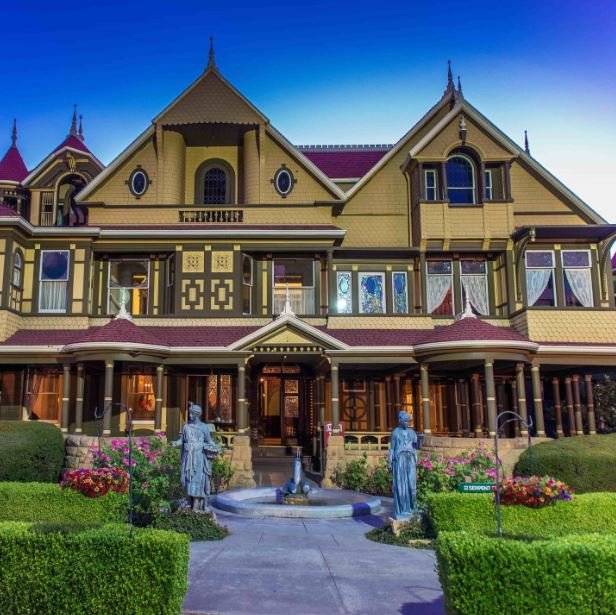
Love, peace, comfort, measureless contentment—that was life on the Winchester Estate in 1888. It was a joy to be alive. Pain there was none, nor infirmity, nor any physical signs to mark the flight of time; disease, care, sorrow—one might feel these outside the pale, but not on Mrs. Winchester’s Estate. There they had no place, there they never came. All days were alike, and all a dream of delight. The big country mansion was so large it could shelter an army. Guests lounging around the house for the big Christmas party. The laughter and music was only broken by the whisper of the wind in the cedar branches, and the scraping of their harsh fingers against the window panes. It had pricked us to such luxurious confidence in our surroundings of bright chintz and candle-flame and fire-light, that we had dared to talk of ghost—in which, we all said, we did not believe one bit. We had told the story of the phantom coach and the wedding that had taken place at the Winchester mansion, and the horrible strange bed, and the farmer’s wife, and the Victorian cottage on the estate. We none of us believed in ghosts, but my heart, at least, seemed to leap to my throat and choke me there, when a tap came to Mrs. Winchester’s door…a tap faint, not to be mistaken. Almost at once, Mrs. Winchester’s housekeeper Miss Eden opened the door and said, “Come in,” but she stood there. She was, at all normal hours, the most silent women I have ever known. She stood and looked at us, and shivered a little. So did we—for in those days corridors were not warmed by hot-water pipes, and the air from the door was keen. “I saw your light,” she said at last, “and I thought it was late for you to be up—after all this gaiety. I thought perhaps—” her glance turned towards the door of the dressing-room. #RandolphHarris 1 of 17

“No,” I said, “Mrs. Winchester is fast asleep.” I should have added a goodnight, but the youngest of us forestalled my speech. She did not know Mrs. Winchester as we others did; did not know how her persistent silence built a wall round her—a wall that no one dared to break down with the commonplaces of talk, or the littlenesses of mere human relationship. Mrs. Winchester was the heiress of the Winchester Repeating Arms Company. In the morning, she came downs stairs in her unsuitably rich silk lace-trimmed dressing-gown falling back from her thin collarbones, and ran to the door and put an arm around her guest Miss McAnally. The vivid light of pleasure in Miss McAnally’s pale blue eyes went through Mrs. Winchester’s heart like a knife. If she wanted an arm there, it would have been so easy to put one around her neck. “Now,” Mrs. Winchester said, “you shall have the very biggest, nicest chair, and the coffee-pot is here on the hob as hot as hot and my other guest have been telling ghost stories all light. When you get warm you ought to tell one too.” “You’re sure I’m not in your way,” Miss McAnally said, stretching her hands to a blaze. “Not a bit”—Mrs. Winchester said. Mrs. Winchester put her fleecy Maderia shawl round her shoulders. She could not think of anything else to do for her, and she found herself wishing desperately to do something. The smiles Miss. McAnally gave were very quite pretty. People can smile prettily at forty or fifty, or even later, though most young women do not realize this. “As I said before,” Mrs. Winchester confessed, “Everyone has been telling ghost stories all night. I retired early for bed. All of the ghost stories are so beautifully rounded off—a murder committed on the spot—or a hidden treasure, or a warning…I think that makes them harder to believe. The most horrid ghost-story I ever heard was one that was quite silly.” #RandolphHarris 2 of 14

“Tell it,” Miss McAnally begged. “I cannot—it does not sound anything to tell,” replied Mrs. Winchester. “The only thing that I ever knew of was—was hearsay,” Mrs. Winchester said, slowly, “till just the end. I daresay it would bore you, but it cannot do any hard. You all do not believe in ghosts, and it was not exactly a ghost either.” There was a breathing time of hush and expectancy. The fire crackled and the gas suddenly flared higher because the billiard lights had been put out. We heard the steps and voices of the men going along the corridors. “It is really hardly worth telling,” Mrs. Winchester said doubtfully, shading her faded face from the fire with her thin hand. Everyone said, “Go on—oh, go on—do!” ‘Well,” she said, “twenty years ago—and more than that—I had two friends, and I loved them more than anything in the World. And they married each other. After they were married, I did not see much of them for a year or two; and then he wrote me and asked me to come and stay, because his wife was ill, and I should cheer her up, and cheer him up as well; for it was a gloomy house, and he himself was growing gloomy too.” I knew as she spoke that she had every line of that letter by heart. “Well, I went. The address was in Oakland, near Berkeley; in those says there were streets and streets of new villa-houses growing up round old brick mansions standing in their own grounds, with red walls round, you know, and a sort of flavour of coaching days, and post chaises, and Blackheath highwaymen about them. He had said the house was gloomy, and it was called ‘The Haunted House,’ and I imagined my carriage going through a dark, winding shrubbery, and drawing up in from of one of these sedate, old, square houses. Instead, we drew up in front of a large, smart villa, with iron railings, gay encaustic tiles leading from the iron gate to the stained-glass-panelled door, and for shrubbery only a few stunted cypresses and aucubas in the tiny front garden. But inside it was all warm and welcoming. He met me at the door. #RandolphHarris 3 of 14
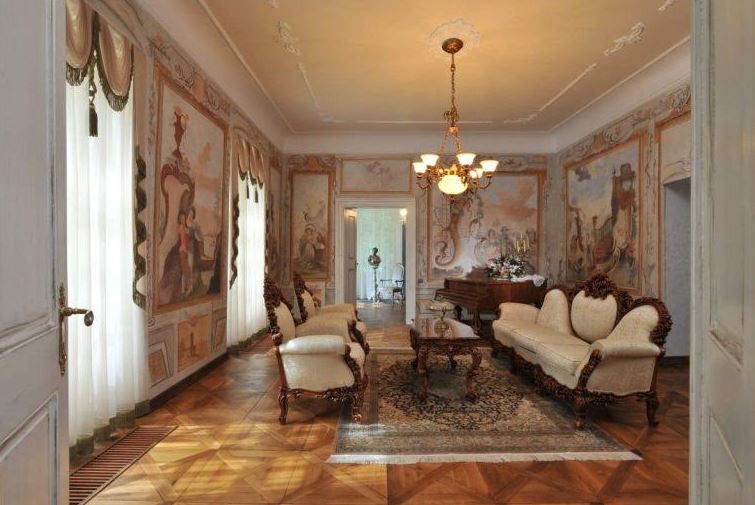
“He met me at the door,” she said again, “and thanked me for coming, and asked me to forgive the past. They were very glad to see me, and I was very glad to be there. Margaret was not exactly ill, only weak and excitable. I thought he seemed more ill than she did. She went to bed early and before she went, she asked me to keep him company through his last pipe, so we went into the dining-room and sat in the two armchairs on each side of the fireplace. They were covered with green leather I remember. There were bronze groups of horses and a black marble clock on the mantlepiece—all wedding-presents. He poured out some whisky for himself, but he hardly touched it. He sat looking into the fire. At last I said: What’s wrong? Margaret looks as well as you could expect.” “Yes,” he said, “but I don’t know from one day to another that she won’t begin to notice something wrong. That’s why I wanted you to come. You were always so sensible and strong-minded, and Margaret’s like a little bird on a flower.” Mrs. Winchester said, “Yes, of course,” and waited for him to go on. Presently he said: “Sarah, this is a very peculiar house. It is new: that’s just it. We’re the first people who’ve ever lived in it. If it were an old house, Sarah, I should think it was haunted.” Mrs. Winchester asked, “Have you ever seen anything?” “No,” he said. “That is just it. I have not heard nor seen anything, but there’s a sort of feeling: I can’t describe it—I’ve seen nothing and I’ve heard nothing, but I’ve been so near to seeing and hearing, just near, that’s all. And something follows me about—only when I turned round, there’s never anything, only my shadow. And I always feel that I shall see the thing next minute—but I never do—not quite—it’s always just not visible.” #RandolphHarris 4 of 14

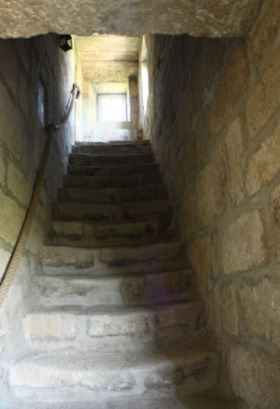
Mrs. Winchester had been working very hard—and tried to cheer him up by making light of all this. “It is just nerves,” she said. He replied, “Mrs. Winchester, I thought you could help me, and I do not think I wronged anyone for them to lay a curse on me. I don’t believe in cruses. The only person I could have wronged forgave me freely.” Mrs. Winchester came up with a suggestion, “I think you ought to take Margaret away from the house and have a complete change.” But he said, “No; Margaret has got everything in order, and I could never manage to get her away just now without explaining everything—and, above and beyond all that, she mustn’t guess there’s anything wrong. I daresay I shan’t feel quite such a lunatic now you’re here.” So they said goodnight.” Whenever Mrs. Winchester was alone with him, he used to tell her the same thing over and over again, and at first when he began to notice things, he tried to think tht it was his talk that had upset her nerves. The odd thing was that it was not only at night—but in broad daylight—and particularly on the stairs and passages. On the staircase the feeling used to be so awful that Mrs. Winchester had to bite her lips till they bled to keep herself from running upstairs at full speed. Only she knew if she would not go mad at the top. There was always something behind her—exactly as he said—something that one could just not see. And a sound that one could just not heat. There was a long corridor at the top of the house. Mrs. Winchester sometimes almost saw something—you know how one see things without looking—but if she turned around, it seemed as if the thing drooped and melted into her shadow. There was a little window at the end of the corridor. #RandolphHarris 5 of 14
Downstairs there was another corridor, something like it, with a cupboard at one end and the kitchen at the other. One night Mrs. Winchester went down into the kitchen to heat some milk for Margaret. The servants had gone to bed. As she stood by the fire, waiting for the milk to boil, she glanced through the open door and along the passage. Mrs. Winchester never could keep her eyes on what she was doing in that house. The cupboard door was partly open; they used to keep empty boxes and things in it. And as she looked, she knew that now it was not going to be “almost” anymore. Yet she said, “Margaret” not because she thought it could be Margaret who was crouching down there, half in and half out of the cupboard. The thing was great at first, and then it was black. And when Mrs. Winchester whispered, “Margaret,” it seemed to sink down till it lay like a pool of ink on the floor, and then its edges drew in, and it seemed to flow, like ink when you tilt up the paper you have split it on; and it flowed into the cupboard till it was all gathered into the shadow there. Mrs. Winchester saw it go quite plainly. The gas was full on in the kitchen. She screamed aloud, but then, she was thankful to say, she had enough sense to upset the boiling milk, so that when he came downs three steps at a time, Mrs. Winchester had the excuse for her scream of a scalded hand. The explanation satisfied Margaret, but the next night he said: “Why didn’t you tell me? It was that cupboard. All the horror of the house comes out of that. Tell me—have you seen anything yet? Or is it only the nearly seeing and nearly hearing still?” Mrs. Winchester said, “You must tell me first what you have seen.” He told her, and his eyes wandered, as he spoke, to the shadows by the curtains, and Mrs. Winchester turned up all three gas lights, and lit the candles on the mantelpiece. #RandolphHarris 6 of 14

Then they looked at each other and said they were both mad, and thanked God that Margaret at least was sane. For what he had seen was what Mrs. Winchester had seen. After that she hated to be alone with a shadow, because at any moment she might see something that would crouch, and sink, and lie like a black pool, and then slowly draw itself into the shadow that was nearest. Often that shadow was her own. The thing came first at night, but afterwards there was no hour safe from it. She saw it at dawn and at noon, in the fireplace, and always it crouched and sank, and was a pool that flowed into some shadow and became part of it. And always she saw it with a straining of the eyes—a pricking and aching. It seemed as though she could only just see it, as if her sight, to see it, had to be strained to the uttermost. And still the sound was in the house—the sound that she could just not hear. At last, one morning early, Mrs. Winchester did hear it. It was close behind her, and it was only a sign. It was worse than the thing that crept into the shadows. She did not know how she bore it. If she had not been so fond of her friends, she could not have tolerated it. However, she knew in her heart that, if he had no one to whom he could speak openly, he would go mad, or tell Margaret. His was not a very strong character; very sweet, and kind, and gentle, but not strong. He was always easily led. So Mrs. Winchester stayed on and bore up, and they were very cheerful, and made little jokes, and tried to be amusing when Margaret was with them. However, when they were alone, they did not try to be amusing. And sometimes a day or two would go by without their seeing or hearing anything. #RandolphHarris 7 of 14
They perhaps should have fancied that they had fancied what they had seen and heard—only there was always the feeling of their being something about that house, that one could just not hear and not see. Sometimes they used to try not to talk about it, but generally they talked of nothing else at all. And the weeks went by, and Margaret’s baby was born. The nurse and the doctor said that both mother and child were doing well. He and Mrs. Winchester sat late in the dining-room that night. They had neither seen nor heard anything for three days; their anxiety about Margaret was lessened. They talked of the future—it seemed then so much brighter than the past. They arranged that, the moment she was fit to be moved, he should take her away to the sea, and Mrs. Winchester should superintend the moving of their furniture into the new house he had already chosen. He was gayer than Mrs. Winchester had seen him since his marriage—almost like his old self. When she said goodnight to him, he said a lot of things about her having been a comfort to them both. She had not done anything much, of course, but still she was glad he said them. Then Mrs. Winchester went upstairs, almost for the first time without that feeling of something following her. She listened at Margaret’s door. Everything was quiet. Mrs. Winchester went on toward her own room, and in an instant, she felt that there was something behind her. She turned. It was crouching there; it sank, and the black fluidness of it seemed to be sucked under the door of Margaret’s room. She went back. She opened the door a listening inch. All was still. And then she heard a sigh close behind her. Mrs. Winchester opened the door and went in. The nurse and the baby were asleep. #RandolphHarris 8 of 14
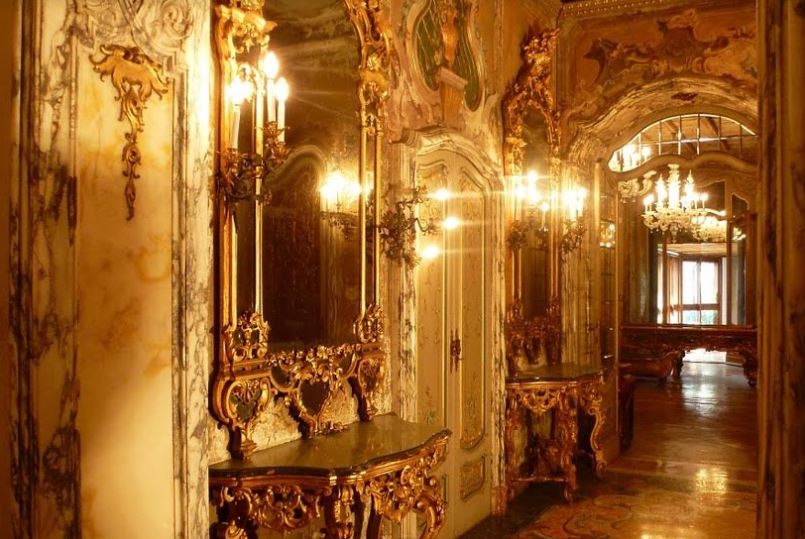
Margaret was asleep too—she looked so pretty—like a tired child—the baby was cuddled up into one of her arms with its tiny heard against her side. Mrs. Winchester prayed then that Margaret might never know the terrors that they are hidden from her. That those little ears might never hear any but pretty sounds, those clear eyes never see any but pretty sights. She did not dare to pray for a long time after that. Because her prayer was answered. She never saw, never heard anything more in this World. And now Mrs. Winchester could do nothing for him or her. When they had put her in her coffin, Mrs. Winchester lighted wax candles round her, and laid the horrible white flowers that people will send near her, and then she saw he had followed her. She took his hand to lead him away. At the door they both turned. It seemed to them that they heard a sign. He would have sprung to her side in glad hope. However, at that instant they both saw it. Between them and the coffin, first grey, then black, it crouched an instant, then sank and liquified—and was gathered together and drawn till it ran into the nearest shadow. And the nearest shadow was the shadow of Margaret’s coffin. Mrs. Winchester left the next day. His mother came. She never liked Mrs. Winchester. The something black that crouched then between him and Mrs. Winchester was only his second wife crying beside the coffin. Mrs. Winchester never told anyone the story because it seemed senseless. After hearing the story, Miss McAnally stood at her gaunt height, her hands clenched, eyes straining. She was looking at something that no one could see, and she knew what the man in the Bible meant when he said: “The hair of my flesh stood up.” What they saw seemed not quite to reach the height of the dressing-room door handle. Her eyes followed it down, down—widening and widening. Mrs. Winchester’s eyes followed them—all the nerves of them seemed strained to the uttermost—and she almost saw it—or did she quite see? She could not be certain. However, they all heard the long-drawn, quivering sign. And to each of them it seemed to be breathed just behind them. #RandolphHarris 9 of 14
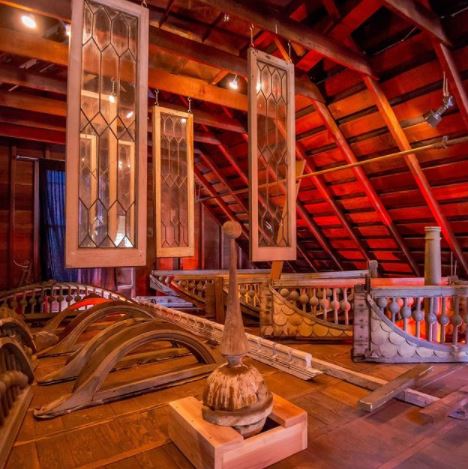
It was Mrs. Winchester who caught up the candle—it dripped all over her trembling hand—and was dragged by Miss McAnally to the girl who had fainted during the second extra. However, it was a servant girl whose lean arms were round the housekeeper when they turned away, and that have been around her many a time since, in the Winchester mansion where she keeps house. The doctor who came in the morning said that Margaret’s daughter had died of heart disease—which she had inherited from her mother. But Mrs. Winchester wondered had she had not inherited something else from her father? It was the daughter’s ghost that had followed Mrs. Winchester into her own mansion and now haunts it. The invoking or summoning of spirits by means of hymns, prayers, and acts of worship in spiritistic séances, finds a counterpart in demon possession. Often the demon speaking through its victim in the demonized state will demand the burning of incense as well as worship service. In return it often promises alleviation from torment and powers of physical healing or clairvoyant and prognostic gifs assuring financial income and material prosperity to the enslaved person. Paganism is replete with fear of demons who must be appeased by worshipping and servile obedience. Those who accept magical powers of healing and clairvoyance at the hand of demonic powers may escape the grosser torments of vile spirits only to fall under more terrible bondage and become Satan’s tool to enslave others. In 1892, people in Santa Clara Valley gossiped about Mrs. Winchester. They told stories of how she was involved in the diabolic rites of Freemasonry, arguing that she and the Freemasons were in reality devout Satanists, carrying out blasphemous and hideous rituals beneath the sinister clock of secrecy. #RandolphHarris 10 of 14
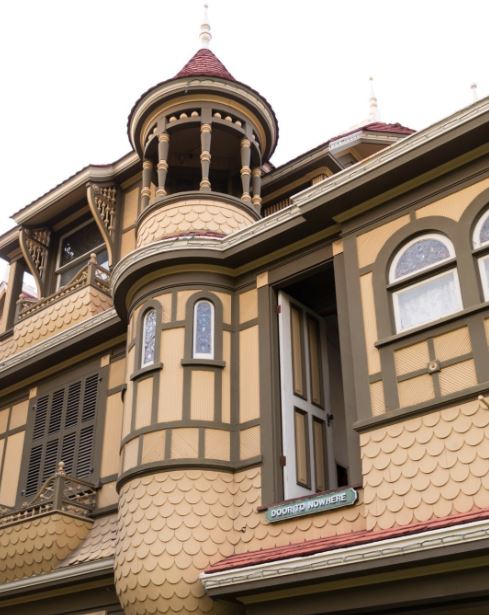
The headquarters of the movement, under the leadership Sarah Winchester, Albert Pike, Gallatin Mackey, and others, located in Santa Clara, California at the Winchester mansion, with celebrants of their Black Masses spread all over the World. Their rites supposedly involved séances. Some went as far to say that the Winchester mansion had an infernal telephone hooked up to Hell, through which the leaders spoke to Lucifer. The stories recounted by the villagers were backed up by Thomas Vaughan, an alchemist. However, if that were true, it would mean the Winchester mansion, Mrs. Winchester, and William Winchester are far older than we believe them to be. The town spread rumors that Black Masses were taking place at the Winchester Mansion under the guise of Freemasonry. It was said that the Winchester mansion was a life and magical order. The emphasis on the former, of living according to one’s real nature. Freemasonry is a nonsectarian fraternity claiming to teach a system of morality veiled in the allegory and symbols passed down from the caste of stonemasons who built the original Temple of Solomon. It allegedly binds its members by an oath of secrecy that imposes death on the betrayer, uses secret passwords and signs, and performs rituals purporting to relate to the history of its origins. It organization is hierophantic, the members receiving the “secrets” of the order, and they pass through the higher degrees. Its antiquity can be documented no further back than the latter part of the seventeenth century. The movement really seems to have gotten its start with the establishment of the Grand Lodge in England, in 1717. From there, it spread to France and Germany, and it did not take long for serious-minded students of the occult, attracted by its ritualistic and secretive trappings, to find their way into its ranks. #RandolphHarris 11 of 14
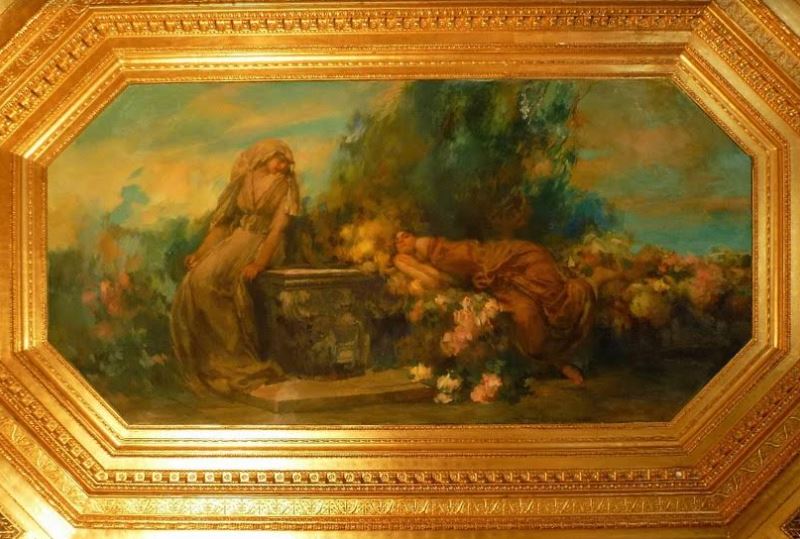
It was also said that Mrs. Winchester was an alchemist and a mystic, and she created her own brand of Victorian Masonry, and taught others how to make gold, heal the sick, and raise the dead. These secret rights had been handed down to her by the Knights of Templar. She was under the tutelage of “Unknown Superiors,” a race of godlike spiritual guides. Many of the people in the town gossiped about Mrs. Winchester so viciously, not only because of her wealth and the mansion larger than anyone had ever seen, but also because of suspicions that her estate was a cover for political conspiracy. The Devil, being a rebel against Heaven, has always been portrayed by the powers-that-be as the chief insurrectionist against the existing political and religious order. The enemy cannot be God, for God is on the side of the ruler. Therefore, the enemy of the ruler must be Satan. It is true that the Winchester mansion is supranational in outlook. There was a secret society that met there dedicated to the scientific and political enlightenment of mankind. To achieve this goal, the group intended secretly to work toward the abolition of all monarchies and the establishment of a One-World government, to be run by those few presently Enlightened, or Illuminati. Since professing such republican ideas could be dangerous, the group was wrapped in a cloak of occultism. Mrs. Winchester adopted the grades of Freemasonry and promised initiates that the magical secrets of the Universe could be revealed to them only when they reached the upper levels. Many believed that William Winchester and Annie Winchester had not died, but gone underground and survived in a network of secret societies, two of which were the Freemasons and the Illuminati, to escape the Assassins. The Assassins were a political group who carried out assassinations while crazed on hashish. #RandolphHarris 12 of 14

Legend has it that Mrs. Winchester was not only running from the souls of those killed by the Winchester rifle, but to also escape the Assassins. Not only spiritual, but Masonic teachings exerted an influence over the construction of the Winchester mansion. Certain mystical thinkers and practitioners of ceremonial magic believed that Mrs. Winchester practiced a complex system of magic that was a synthesis of Eastern and Western mystical traditions. There is a secret cave inside the Winchester mansion that can be entered only by stooping, but inside a room nearly seven feet high about twelve feet square presents itself. On each side of the entrance a Latin cross is deeply carved in the rock, while within, at the further side, and opposite the door, a block of stone four feet high was left for an altar. Above it, a shrine is hollowed out of the stone wall, and over the cavity is another cross. It is said to be the cave of a saint. Some say it is Saint Michael himself, but no one can be quite certain. And there is a big head inside that craved in the shape of the Devil’s face that the saint put there. For Mrs. Winchester, there were two types of magic. What she called evocation and invocation. Evocation was a calling forth, while invocation was a calling in. In such rituals, the magician summoned the demon or deity while standing within the protection of a magical circle drawn on the floor, the object of the sorcerer being to control and direct the entity to do one’s bidding. She sought to achieve total identification with the godhead, to invoke the god so that it actually took possession of her consciousness. The resulting state experienced by the magician was a type of samadhi, or temporary loss of ego. Mrs. Winchester’s estate possesses the KEY which opens up all Masonic and Hermetic secrets of Freemasonry and all systems of religion. #RandolphHarris 13 of 14
It did not take long for rumors to begin to circulate around the town of nightly procession of hooded, candle-bearing figures around the grounds of the Winchester mansion. The reason Mrs. Winchester and the husband of her friend kept seeing demons is because allegedly someone did a ritual on her estate—one of the greatest magical feats ever—the attempt to bring the “Whore of Babalon” down from the Astral Plane and incarnate it in the womb of a living women. Upon hearing of the ritual, someone wrote to the Luciferian Light Group, “Apparently Mrs. Winchester or one of her friends is producing a Moonchild. I am pledged that the work of the Beast 666 shall be fulfilled, and the way for the coming of BABALON be made open and I shall not cease until these things are accomplished.” Mrs. Winchester did not know, but after she left her friend’s house, he managed to blow himself to smithereens while conducting a strange chemical experiment in his basement workshop. Hours later, the scientist’s mother, who lived on the estate, committed suicide with an overdose of sleeping tablets and the baby died from dehydration and starvation, but the baby who is supposed to be the Whore of Babalon still haunts the Winchester till this very day. No matter what people say or believe about Mrs. Winchester, she and her architecture were able to break through the walls of stagnation and bring before the World its first vision of the new Aeon. Once, a tourguide reported while closing the house, he felt something following him, he was alone. He went out onto the fourth floor balcony and prayed into the Heavens one night, “O Thou wicked and disobedient spirit Vinea, because thou hast rebelled, and has not obeyed nor regarded my words which I have rehearsed; I curse thee into the depth of the Bottomless Abyss, there to remain unto the Day of Doom in chains, and in fire and brimstone unquenchable, unless thou forthwith appear here before this Circle, in this triangle to my will.” And he saw Lucifer as a star fall from Heaven, and from Him came to the tour guide light of true salvation. And he was made whole by His infernal wisdom. “My chains lifted off, I was made free,” he said. At night when some drive by, they claim to hear the Devil’s orchestra at that famous time 1.13am. #RandolphHarris 14 of 14
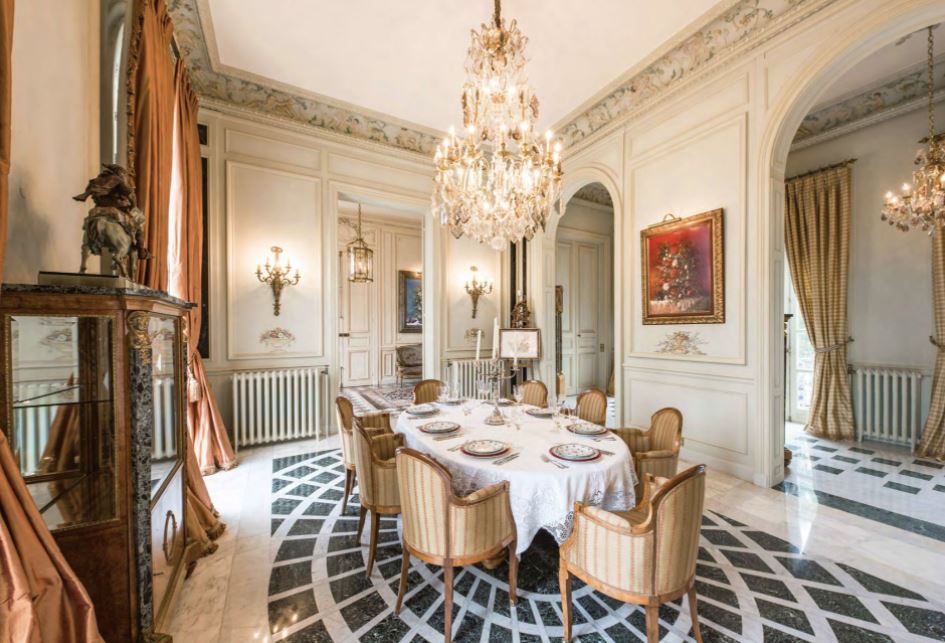
Winchester Mystery House
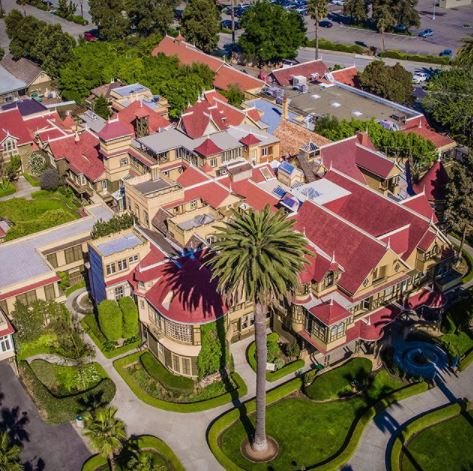
Happy Saturday from The Winchester Mystery House ☀️ What are your weekend plans? Hopefully they include walking around these beautiful gardens 😉 https://www.winchestermysteryhouse.com/





 Randolph Harris II International Institute