
Home » news (Page 14)
Category Archives: news

The Winchester’s Mysterious Echo Chamber

One hundred and twenty-two years ago the Victorian period officially ended along with the reign of England’s Queen Victoria. What is termed Victorian is really a series of architectural styles, most of them imitative of earlier periods from Europe and Great Britain. Though the United States of America was seeking its identity, culturally, politically, socially, and artistically, it sustained strong ties with its European heritage. In 1872, American painter William Merritt Chase was heard to remark, on being asked if he would like to go abroad, “My God, I’d rather go to Europe than go to Heaven.” The ambivalence between striking out as a young nation with ideas of its own and the desire to emulate the sophistication of England and the Continent was exemplified in the mixture and blend of architectural and interior styles during the Victorian period. When the words “Victorian house” are uttered, an image of fanciful gingerbread clapboard dwellings, with its dizzying array of towers, gables, spindles, stained and led glass windows, secret passage ways, basements, rambling square footage, vast front porches, rich, dark wood, brass, farmhouse kitchen sinks, fireplaces, hardwood floors, awning and double hung windows, green lawns, stately trees, beautiful flowers, and ghosts immediately springs to mind. One of the most haunted mansions and most beautiful mansions in the World is the Winchester Mansion, which was built by Sarah L. Winchester, heiress to the Winchester fortune. It is believed that Mrs. Winchester and her family were cursed for making “The Gun that Won the West.” #RandolphHarris 1 of 8

The tales of apparitions and devils, of knockings and strange noise, with which the Winchester Mansion is full of, are indications of the supernatural and magical arts. Sorcery was, so to speak, an aristocratic pursuit. It was like the social media, religion, telephone, television, and therapy for the elite. After the loss of her new born daughter and husband, Mrs. Winchester kept her house alive by spending 38 years constructing it. Secretly, she felt that even the coming and going of indifferent unknown people would help to take the chill from those 600 rooms, to brush their walls the dust of too-heavy memories. Mrs. Winchester was an inconsolable widow. Throughout her home stood vases of flowers: roses, lilies, fragile bunches of lavender, and wild clumps of jasmine withering there among the sturdier blooms with the tick arching fronds of ferns. She often picked them herself. One afternoon, Mrs. Winchester was out on her estate, gathering acorns and blackberries, and sticks for her fire. An old famer stopped, his load was heavy and he begged Mrs. Winchester to let his son come into her house. The little boy was very sick, feverish and sleepless. She stopped and gathered some poppies. As they enter her mansion, the boy was in great distress, for he seemed past hope of recovery. Mrs. Winchester had the housemaid prepare him a bed just past the blue parlor. She received him kindly and stooped and kiss the sick child on his cheek. Instantly the paleness left his face, and healthy vigor returned to his body. The father was delighted; he had no servants. The housemaid spread the table and put upon it curds and cream, apples, and honey in the comb. While they ate, Mrs. Winchester mingled poppy juice in the milk of the boy. When night came and all was still, the father thanked Mrs. Winchester and took the boy home. #RandolphHarris 2 of 8

That evening, a breeze stirred the dark leaves beyond the windows. It lifted the lace curtains, dropping them softly back against the wall. It seemed an insignificant thing, yet made the hair on the back of her neck rise. Panic gripped Mrs. Winchester. She found herself pinned to the sofa, effectively paralyzed. She raised her right hand, and it was gripped at the wrist. Unable to pray or speak, her tongue was frozen. What Mrs. Winchester saw could not have been human. It had a head like a lion, but the body of a human and was a dense black form. The smell of wet fur and coldness was overwhelming. The beast started grunting and panting. Petrified, Mrs. Winchester stumbled out of the parlor and downs the stairs. On reaching the basement, she feels the wet pelt of the unseen creature brush briefly against her legs. As it bounds ahead of her, it growls like a bear. Mrs. Winchester runs back upstairs to her Blue Séance Room and slams the door shut. The doors and windows in the house started banging—opening and shutting. It sounded like a ghostly cavalry was using a battering ram against the front door, but nothing could be seen from the windows above, just wisping spirit voices could be heard trying to beat the door down. Mrs. Winchester closed her eyes. She felt as if a force was approaching her. Almost like a violent storm was coming. The entity entered the Blue Séance Room; it hovered some distance away from her. A wave started pulsing up and down her body. She was terrified. As she felt her body being lifted from the ground, she knew she was going to die. #RandolphHarris 3 of 8

When she came to, she was hovering just outside the Door-to-Nowhere. Mrs. Winchester was afraid. She stared dismally, helplessly, at the surface of the table before her as she tried to guide herself into this room that was two stories from the ground. And above organ music surged from the Grand Ball Room, while the wind came in freezing cold gusts. Through the dark, she saw glittering eyes of an anguished soul. As the wind blew, she was pushed into the room, avoiding a twenty-foot drop to her death. An orchestra was playing. The thick vibrations of the bass startled Mrs. Winchester, but she was in no hurry to see what was going on. But then a hand reached for her, steadied her, and meant to guide her closer to the wall. This was dreadful. Then the mysterious forces came for her as before, lifted her from the room she was in and propelled her into blackness. She found herself high above the floor in the Grand Ball Room. There were ghouls, demons, ghosts, and skeletons dancing and laughing, all looking at her as if she was the most anticipated guest. Mrs. Winchester’s heart was hammering so fast that she feared for her life. Gently she was lowered to the floor. Her spectral hosts were looking at her intently. One of the ghouls raised his crystal glass of fresh blood, basking in what he believed was Mrs. Winchester’s silent admiration. She on the other had was frightened. Her mind was full of turmoil…and in a strange way, she did not want to disappoint him. “Though I doubt you will need a map,” she said, “I welcome you into my home.” The crowd smiled and the music grew even more sumptuous. #RandolphHarris 4 of 8

“You mean you’re into black magic, Mrs. Winchester?” said the ghoul. “I would like to keep an open mind. As I say, I use my gift for the betterment of the spirit World,” replied Mrs. Winchester. William Tell Overture and Funeral March were in heavy rotation that evening. It must be a mirage, she thought at first, but as the ghouls trembling hand grabbed her, and they danced, she knew it was real. The spirit World trawled the mansion like mythic beasts, their cries sending men in wool blazers and hardhats into a frenzy. Many of them dropped their tools and ran off the job. The figures dancing and shrieking around grew until they nearly blinded Mrs. Winchester. Her eyes glowed like embers with the gravely voice still whispering in her ears. An intense heat shot through her veins, carried singing in her blood to the base of her spine. Mrs. Winchester seemed to grow taller. She felt capable of anything. The air was dry, with a smell that reminded her of cathedrals and catacombs, of all those hidden places lying forgotten across the land and dusty years. A cobweb draped itself across her face, her mouth and eyes. She brushed it away, though the sensation lingered. She seemed to pass out, to awaken in an altered state of consciousness. It was not a dream, but not quite reality either—Mrs. Winchester knew it. It was a trance. The ghoul’s plans for the expansion of the Winchester mansion were drawn crudely and in blood on a cloth napkin. It was him home cottage, perhaps. The interior resembled, if anything, a temple. #RandolphHarris 5 of 8
On the blueprint were steeply pitched roofs, shrines to Easter deities, statues and statuettes to the gods of antiquity, gold, black, and red wallpaper, Italian sinks and in a great profusion—drawings, prints, and paintings of characters from legend. The to be adjoining room was given over to books, hundreds of them. A bedroom adjoined it. Lastly, there was a sitting room and a sofa set against one wall. As the ghoul explained the new additions, his face began to contort in this horrible way. The bell in the belfry tolled, and Mrs. Winchester woke up with a jolt. Her guests were gone, but she was left with the blueprints drawn in blood on the cloth napkin. Trembling, she took the sketch to John Hansen, the lead foreman. He did not question the designs and built what he was told to built to the best of his interpretation. When a medium is called upon to relay a message which supposedly comes from the realm of the dead, he or she usually goes into a trance. This is a state which Webster’s New World Dictionary defines as “a condition in which a spiritualist medium allegedly loses consciousness and passes under the control of some external force, as for the supposed transmission of communications from the dead.” In a state of unconsciousness, the necromancer may obtain communication in the form of automatic writing, but it usually comes through verbal speech. Sometimes the phenomenon called “materialization” occurs. This is defined as the ability on the part of some mediums “to create from unknow materials outside of their own body, some visible, tangible, more or less highly organized new formations supplied with their own illumination (such as efflorescent substance) for which formations in many cases, the human body in part or in whole forms a pattern, and these materializations appear and disappear suddenly. #RandolphHarris 6 of 8

Many reputable writers report that the materializations actually have been photographed and carefully studied. They are sometimes called phantasms, and seem to speak while the medium appears to be unconscious. Many people have gone to a séance believing the whole idea to be fraudulent, but have become firmly convinced that they truly heard a loved one who had died. Automatic writing is another baffling spiritistic marvel. The mediums may, while in a trance, inscribe a paper with the exact handwriting of the deceased. At other times a pencil may write without being touched by the human hand or any apparent mechanical device. Then again, in some instances a phantasm does the transcribing. I do conjure thee, O thou Spirits Sarah Lockwood Winchester, Annie Winchester and William Wirt Winchester, by all the most glorious and efficacious names of the MOST GREAT AND INCOMPREHENSIBLE LORD GOD OF HOSTS, that thou please commet quickly and without delay from all parts and places of the Earth and World wherever thou mayest be, to make return to the Winchester Mansion, and present yourselves in comely fashion and please provide rational answers about the architecture, curse, deaths, ghosts, and other spirits, visibly and affably, speaking with a voice intelligible unto mind understanding as aforesaid. I conjure and invite thee, Sarah Lockwood Winchester, Annie Winchester, and William Wirt Winchester, by all the names aforesaid; and in addition by these seven great names wherewith Solomon the Wise bound thee and thy companions in a Vessel of Brass, ADONAI, PREYAI or PRERAI, TETRAGRAMMATON, ANAPHAXETON or ANAEPHENETON, INESSENFATOAL or INESSENFATALL, PATHTUMON or PATHATUMON, and ITEMON; that thou please appearest in the Winchester Mansion before this Circle to fulfill my will in all things that have been requested. #RandolphHarris 7 of 8

Allow your powers to come from the void with unlimited possibility, and reunite them with eternal darkness through the nexion of the practitioner so they can manifest upon the mental plane to be perceived for purposes of practical application. Please use your tools to allow our consciousnesses to grow and understand thou through the forces of creation and destruction. May we gain spiritual power though logic and not blind faith and allow logic to enter a doorway leading to evil mind or spiritual intelligence. May these tools become the eye between the reflector and the reflected which can peer through the veil of religious symbolism and please use it to unlock the latent power within us. Allow the lore surrounding this mansion and the legend of the Winchester family to become an alchemical map which leads us to the treasure of understanding and immortal consciousness as a divine being. It is only through your intent and the communication with the fabric of reality through the languages of the dead and the operations themselves that thou can bless us to gain specific meaning and power. Ahura Mazda is the God of the content or those who choose stasis and comfort rather than becoming. May be assistant you in crossing over to the mortal World with the power of darkness in the Alpha and Omega. All began through Ahriman as the void, which is both all and nothing. He is the origin of the Devil and so everything will also end with this Devil for he desires to liberate mankind from the shackles of enslavement. In this way, may thou be able to operate in the World though us and our evil thoughts, evil words, and evil deeds. May Sin become sacrament in the eyes of Zanda and exercise power according to one’s own divine will. #RandolphHarris 8 of 8


Demons, ghost, and vampires have made a huge splash in popular culture. These characters are portrayed as fiction in books, TV shows, movies. However, they can affect people’s belief about reality. The Cultural Source Hypothesis is a theory about belief in supernatural happenings. It states that popular culture can plant ideas in people’s minds. These ideas affect people’s experiences. For example, someone might see mist over the Winchester Mystery House and think it is a ghost. You decide for yourself. Rainy days at Winchester Mystery House☔️ Open 10-4pm for tours! https://winchestermysteryhouse.com/

I Will Wash the Dishes, You Pay All the Bills

The sadomasochistic splitting of power has the characteristics of all symptomatic behavior: it is literally destructive, and it involves a polarization in which one side of the split is apparent, while the other is hidden. People who turn to violence are visibly controlling; what is less obvious are their weakness and feelings of powerlessness. On the other hand, those who habitually play the victim may be quite unaware of their own more subtle methods of control. This is why issues of power are so difficult to deal with: things are not as they appear to be. Weaklings puff themselves up and try to act strong; tough people hide their vulnerabilities; the rest of us fail to look past the surface. We assume that the fabrication of power all around us are genuine, and we fall victim to them. Heinrich Himmler is an excellent example of a vicious, sadistic character who illustrates what has been said about the connection between sadism and the extreme forms of the anal-hoarding, bureaucratic, authoritarian character. The “bloodhound of Europe,” as he was called by many, Mr. Himmler was, together with Mr. Hitler, responsible for the slaughter of between fifteen and twenty million unarmed and powerless Russians, Poles, and Jewish. Whenever one person victimizes another, real power has been lost and replaced by a literalistic drama that is dangerous for both parties. Stage V On forgoing a working agreement, the offender and, in many cases, victim appeared committed to battle. They contributed to and invested in the development of a fateful transaction, one which was problematic and consequential to their face and wider reputation. #RandolphHarris 1 of 19

Both the offender and the victim placed their character on the line, and alternative methods for assessing character focused on a working agreement that violence was appropriate. Because opponents appeared to fear displaying weakness in character and consequent loss of face, and because resolution of the content was situationally bound, demanding an immediacy of response, they appeared committed to following through with expressed or implied intentions. Commitment to battle was additionally enhanced by the availability of weapons to support verbal threats and challenges. Prior to victory, the offender often sought out and secured weapons capable of overcoming the victim. In about thirty-six percent of the cases, offenders carried hand guns or knives into the setting. In only thirteen percent of these cases did offenders bring hand guns or knives into the situation on the assumption that they might be needed if the victims were confronted. In the remainder of these cases such weapons were brought in as a matter of everyday routine. In either event, to inflict the fatal blow required the mere mobilization of the weapon for action. In sixty-four percent of the cases, the offender either left the situation temporarily to secure a hand gun, rifle, or knife, or transformed the status of some existing situational prop, such as a pillow, telephone cord, kitchen knife, beer mug, or baseball bat, into a lethal weapon. The possession of weapons makes battle possible, and, in situations defined as calling for violence, probable. #RandolphHarris 2 of 19

The particular dynamics of the physical interchange are quite varied. In many cases, the battle was brief and precise. In approximately fifty-four percent of the cases, the offender secured the weapon and dropped the victim in a single shot, stab, or rally of blows. In the remaining cases, the battle was two-sided. One or both secured a weapon and exchanges a series of blows, with one falling in defeat. Stage VI Once the victim had fallen, the offender made one of three moves which marked the termination of the transaction. In over fifty-eight percent of the cases, the offender fled the scene. In about thirty-two percent of the cases, the offender voluntarily remained on the scene for the police. In the remaining cases, the offender was involuntarily held for the police by members of the audience. These alternatives seemed prompted by two lines of influence: the relationship of the offender and victim and the position of the audience vis-à-vis the offense. When there is no audience, the offender and victim were intimately related, the offender typically remained on the scene and notified the police. Sometimes these offenders waited for minutes or hours before reporting the event, stating they needed time to think, check the victim’s condition, and make arrangements on financial matters, the children, and work before arret. In contrast, when victims were acquaintances or enemies, offenders typically fled the scene. Moreover, these offenders often attempted to dispose of their victims and incriminating evidence. #RandolphHarris 3 of 19

Seventy percent of the cases, however, occurred before an audience, and offenders’ moves seemed related to audience reactions to the offense. Bystanders seemed to replace the victim as the primary interactant, serving the offender as the pivotal reference for his existing orientations. The audience assumed one of three roles: hostile, neutral, or supportive. In the hostile role, accounting for nearly thirty-five percent of the case, bystanders moved to apprehend the offender, assist the victim, and immediately notify police. Such audiences were generally comprised of persons who either supported the victim or were neutral during the pre-battle escalation. In several of these cases, bystanders suggested, without use of force, that the offender assist the victim, call the police, and so forth. These audiences were comprised of the offender’s intimates, and he or she followed their advice without question. In either case, hostile bystanders forced or suggested the offender’s compliance in remaining at the scene for police. In almost seventeen percent of the cases, the audience was neutral. These people appeared as shocked bystanders. Having witnessed the killing, they stood numb as the offender escaped and the victim expired. In the remainder of the cases, the audience was supportive of the offender. These audiences were usually comprised of persons who encouraged the offender during the pre-battle stages. Supportive bystanders rendered assistance to the offender in his or her escape, destroyed evidence, and maintained ignorance of the event when questioned by the police, breaking down only in later stages of interrogation. Thus, while a hostile audience directs the offender to remain at the scene, the supportive audience permits or directs one’s flight. #RandolphHarris 4 of 19

On the basis of this research, criminal homicide does not appear as a one-sided event with an unwitting victim assuming a passive, non-contributory role. Rather, murder is the outcome of a dynamic interchange between an offender, victim, and, in many cases, bystanders. The offender and victim develop lines of action shaped in part by the actions of the other and focused toward saving or maintaining face and reputation and demonstrating character. Participants develop a working agreement, sometimes implicit, often explicit, that violence is a useful tool for resolving questions of face and character. In some settings, where very small children are murdered, the extent of their participation cannot be great. However, generally these patterns characterized all cases irrespective of such variables as age, gender, race, time and place, use of alcohol, and proffered motive. We know that in the evolution of vertebrates, the bond of personal love and friendship was the epoch-making invention created by the great constructors when it became necessary for two or more individuals of an aggressive species to live peacefully together and to work for a common end. We know that human society is built on the foundation of this bond, but we have to recognize the fact that the bond has become too limited to encompass all that it should; it prevents aggression only between those who know each other and are friends, while obviously it is all active hostility between al men of all nations or ideologies that must be stopped. Obviously, love and friendship should embrace all humanity; we should love all our human brothers indiscriminately. This commandment is not new. Our reason is quire able to understand its necessity as our feeling is able to appreciate its beauty, but nevertheless, made as we are, we are unable to obey it. #RandolphHarris 5 of 19

Indeed, one might be inclined to summarize the whole matter by saying that the individual is obliged to demonstrate involvement in a situation through the modulation of one’s involvements within the situation. However, this would be a loose way of talking. First, that which the individual owes is conveyed through appropriate modulation of situated involvements. What is thereby conveyed, however, is not “involvement,” but rather a kind of respect and regard for that to which attachment and belongingness are owed. At the heart of it is a kind of concern that shows one to be a part of the thing for which one is concerned. Second, a situation, as defined in this study, is merely an environment of communication possibilities, and not the sort of thing to which one can become attached. The little society involved is that of the gathering in the situation, and the little social system found therein is made up from conduct performed in accordance with the norms of situational propriety. Finally, what is owned the gathering is owed the social occasion in which it occurs, the joint social life sustained by the gathering being an embodiment of the occasion itself. Situational proprieties, then, give body to the joint social life sustained by a gathering, and transform the gathering itself from a mere aggregate of persons present into something akin to a little social group, a social reality in its own right. Behind this social function we can see still further ones. #RandolphHarris 6 of 19

When a situation comes into being, mutual accessibility of body signs is not the only contingency faced by those who are present. As already suggested, each person becomes a potential victim or aggressor in the potential occurrence of violent interpersonal actions, such as physical or sexual assault, blocking of the way, and so forth. Further, each person present is in a position to accost or be accosted by the others for the purpose of initiating a state of talk—a joint conversational engagement. And this, too, has its own dangers, for when persons are joined in this way they can command and plead with each other, insult or compliment each other, inform and misinform each other, or be seen (by others) as being on close terms, and the like. Further, when an engagement is sustained in the presence of bystanders, the participants open themselves up to being listened in on and interfered with, just as the bystanders become vulnerable to undesired distractions. Although these various dangers of being in the presence of others are perhaps not frequently realized, especially in middle-class society, the possibility of their occurrence is always there. And it is through body signs that persons present signify to each other that they can be trusted not to exploit these threatening possibilities. Only when these signs are received may the individual feel secure enough to forget about defending oneself, secure enough to give oneself up to the merely-situated aspects of one’s involvements. #RandolphHarris 7 of 19

Aside, then, from the disrespect an individual shows to a gathering by conducting oneself improperly, such improprieties can also cause the others present to fear for their physical and social inviolability, whether rightly or not. And here, incidentally, is one reason for arguing that social situations and the gatherings occurring therein are worth studying, even apart from the social occasion that incorporates them. Ordinarily, situations are thought to be so closely enmeshed in a particular on-going institutional setting, and these settings to be so very different one from another, that excision of situations and their gatherings for separate study might seem questionable. However, it is only in situations that individuals can be physically assaulted, accosted by requests for talk, or drawn away from conversations and other involvements by the antics of bystanders. It is in situations that these accessibilities will have to be faced and dealt with. And in facing these accessibilities and dealing with them, a common and distinctive character is given to the social life sustained in situations, regardless of the uniqueness of the larger span of social life in which each gathering is embedded and of which each is an expression. King James vowed to make deviants conform or he would “harry them out of the land or else do worse.” If from the beginning one did not state making serious efforts to develop will, it is possible to understand and not be able to do anything about a situation. If will remains undeveloped, then the development of understanding cannot help much. One can understand very much, but at the same time not be able to do anything about it. #RandolphHarris 8 of 19

Much like in Elizabethan England, the exiles knew they were supposed to assimilate. Yet they found it difficult to find a way to flee from the profane multitude that harassed them in their gatherings at the manor house of William Brewster at Scrooby. These educated and sometimes prosperous people, knowing they had much to lose, prepared to lose it by booking a ship onto which they sneaked one night in 1607. Someone betrayed them before they could leave for Holland and religious freedom: Officers searched the men’s shirts for money, “yea even the women further than become modesty.” They tried to escape again a few months later, but only some of the husbands and fathers eluded authorities. The families of these pesky believers were then permitted to join them. “Is the will part of being?” Yes, the same as consciousness or understanding. Only if you work too much on understanding and disregard will, then instead of growing stronger, you will will become weaker, or will remain the same as it was. With our will—the will of men nos 1, 2, and 3—we can only control one center, using all the concentration possible for us. We can never control two or three centers, and yet centers are dependent on one another. Suppose that we decide to control one center and, meanwhile, other centers go on by themselves, then they will immediately corrupt the center that we want to control and bring it again to mechanical reaction. “How can one attain this kind of will?” That was explained in relation to “stop” exercise. #RandolphHarris 9 of 19

Those who heard that lecture about “stop” exercise may remember it. To control more than one center is the basis of “stop” exercise. This can only be done if you put yourself under some other will because your own will is insufficient. Sometimes it may be necessary to control four centers, and the maximum of your energy of will can only control one center. So another will is necessary. This is why schools of discipline is necessary and school exercises. “How can we work against self-will? It is possible for us, as we are, to recognize the moments when we have real will?” Not real will; we cannot have that. All we have is self-will and willfulness, or small wills that change all the time. Real will is very far off; it is based on Permanent “I,” consciousness and individuality. We have not got it. About how we can work against self-will: you can study the system. There are certain demands in the system; things you must not do or must do. For instance, you must not talk, because if you do, you will only tell lies. You cannot speak about the system before you know and understand it. In this way, from the very beginning, you meet with ideas of the work opposed to self-will. If you forget about the work, you re not working against self-will. The only way to struggle against self-will is to remember the work. It may be that at one moment the work does not enter at all, but at another moment it does enter, and in that moment you can understand what giving up self-will means. Ask yourself: Is it right from the point of view of the work or not? This is struggle against-self-will. #RandolphHarris 10 of 19

First it is necessary to understand what will is. We have no will; we only have self-will and willfulness. Self-will is self-assertion. Willfulness is going against something, against rules, and so on. Both include a kind of opposition to something and in that form they exist. Man has no original will which can exist without opposition, and which is permanent. That is why it is necessary to subjugate it. This subjugation trains it so that afterwards it can follow a definite line. When it becomes strong enough, it is no longer necessary to limit it. So will cannot be left as it is. Now it runs in all directions. It has to be trained, and in order to train will one has to do many unpleasant things. In an ordinary man will follows a zigzag line or goes in a circle. Will shows the direction of efforts. Effort is our money. We must pay with effort and the time of effort—in the sense of whether it is the right time for the effort or not—we obtain results. Effort needs knowledge, knowledge of moments when effort is useful. The efforts we can make are efforts of self-observation and self-remembering. When people hear about effort, they think about an effort of “doing.” That would be lost effort or wrong effort, but effort of self-observation and self-remembering is right effort because it can give right results. “It is not from the benevolence of the butcher, the brewer or the baker that we expect our dinner, but from their regard to their own self-interest. [Every individual] intends only his own security, only one’s own gain. And he is in this lead by an invisible hand to promote an end which was no part of his intention. By pursuing his own interest, one frequently promotes that of society more effectually than when one intends to promote it.” #RandolphHarris 11 of 19

Adam Smith wrote this in 1776 in The Wealth of Nations. Ever since, these word have been music to the ears of free-market advocates. The efficiency of the economic marketplace is then interpreted to suggest that a government should not interfere with individuals’ selfish attempts to maximize their interests. Some free-marketers are inclined to take this idea beyond the economic realm and like Dr. Pangloss in Candide claim that “everything is for the best in this, the best of all possible Worlds.” The sad reality is that Adam Smith’s invisible hand has a relatively small span. There is no general presumption that when every person pursues one’s own interest, the outcome will be the best of all possible Worlds. Even in the narrower sphere of economic affairs, there are important caveats and exceptions to the rule of the invisible hand. Game theory provides a natural way to think about social interactions of individuals. Every person has one’s own aims and strategies; we being them together and examine the equilibrium of the game in which these strategies interact. Remember that there is no presumption that an equilibrium must be good; we have to find out in each situation whether the outcome is a war of each against all, or the best of all possible Worlds, or something between these extremes. #RandolphHarris 12 of 19

Why did Adam Smith think the invisible hand would produce good economic results for society? Well, his argument went as follows. When I buy a loaf of bread, I am using up some socially valuable resources—the wheat, the fuel, the services of the oven, the labor, and so on—that go into marking the loaf. What stops me from over-using these resources is the price of the loaf. (Much like is someone keeps hitting your car, the insurance company charges them a lot of money to repair it, to prevent future accidents. However, if drivers know they can cause an at fault accident and win the lottery, word gets around they got a good one to move into.) I will buy the load only if its value to me exceeds the price I have to pay. In a well-functioning market the price equals the cost of all these resources—the baker will not sell me the loaf unless the price covers all his costs, and competition will preclude his charging me a higher price. Thus I will buy the loaf only if its value to me exceeds the cost of the resources to the rest of society. The market mechanism, therefore, controls my desire to by more bread to just the right extent. It is as if the price were a “fine” I had to pay to compensate the rest of society for using up its resources. On the other side of the picture, the baker, representing the rest of society, is compensated for his costs in supplying the bread that I value, and therefore has just the right incentive to produce it. #RandolphHarris 13 of 19

The simplicity, the clarity, we daresay the beauty of this argument explain its appeal. In fact the clarity carries with it an equally clear message about its limitations. The invisible hand at best applies only to situations in which everything has a price. In many instances outside of economics, and even in many within, people are not charged a fine for doing harm to the rest of society, nor given a reward for doing good to someone else. For example, manufacturers are rarely charged an adequate price for using up clean air, nor compensated for training a worker who might then quit and find other employment. Here pollution is an unpriced good (actually a bad), and the problem is that there is no economic incentive to temper the firm’s selfish interest in supplying a large amount of pollution. When a firm trains a worker, this good is not traded on market, so there is no price to guide the firm’s action; the firm must equate its own costs with benefits and cannot capture the willingness of others to pay for this service. In the prisoners’ dilemma, when one prisoner confesses, he harms his colleague but is not fined. Because many unpriced or non-marketed activities matter, it is no wonder that individuals acting selfishly often do too much hard to others, and too little good. Within this broad theme, the failures of the invisible hand can occur in many ways. Everyone might do the individually best thing, but this ends up worst from their collective viewpoint, as in the prisoners’ dilemma. Too many people might do the wrong thing, or everyone might do too much of the wrong thing. Some of these problems are amenable to social policies; others, less so. #RandolphHarris 14 of 19

In 1975 a Palestinian consultant to the Iraqi government was given a blunt message. Iraq, in the process of switching its political orientation from the Soviet Union to the West, was in the market for sixty military aircraft, then worth about $300 million. The consultant, Said K. Aburish, tried to negotiate the purchase with a British firm, but the government would not guarantee that spare parts would be available. The Iraqis thus turned to the French, who agreed to sell them F-1 Mirages and to guarantee spare parts. However, the Iraqis sense the French were overcharging them. According to Mr. Aburish, he was then called in by the Iraqis and told: “Drop whatever you are doing, and find out what the bastards charged other countries. You have unlimited expenses—use them to bribe, buy or bully anyone.” Ironically, as he tells the story, he ultimately found the information he needed in the files of the Peace Institute in Stockholm, not exactly a friend of warplane merchant. When France’s then-Prime Minister Jacques Chirac visited Baghdad shortly thereafter, Saddam Hussein, the Iraqi strongman, shoved a paper in front of him with the prices charged other countries. According to Mr. Aburish, Mr. Chirac “volunteered, on the sport, a reduction of $1,750,000 in the price of each plane.” The planes went on to fly during Iran-Iraq war that ended in 1988. This was traditional commercial intelligence activity carried out on behalf of a government. The size of the return—id et, $1.75 million times 60 plane, or a bit over $100 million—against the modest bribe Aburish claims he paid indicates the immense profit possibilities inherent in economic intelligence gathering. It is frequently a low-risk, high-return operation. However, the Aburish case is small potatoes. It is an example of what might be termed “micro-intelligence.” #RandolphHarris 15 of 19

Compare the potential rewards of “macro-intelligence.” When Britain negotiated its entry into the Common Market in 1973, its negotiators were armed with information from the intercepted messages of the other European countries. It is impossible to measure the bargaining edge thus gained, but it would make Iraq’s $100 million look like petty cash. That was macro-intelligence. Today the National Security Agency and the British GCHQ both maintain so-called “watch lists” of companies or organizations they monitor with more than routine interests. These include banks, petroleum companies, and commodity traders whose activities might swing the World price of, day, oil or gain. The Soviets, too, pay a lot of attention to economic data. Says, Raymond Tate, a former official of the National Security Agency, “The Soviet Union has for many years manipulated a lot of commercial markers in the World” by using its intelligence capabilities. However, it is the Japanese, according to Lionel Olmer, a former Under Secretary of Commerce in the United States of America, who “have the most refined and organized system of economics intelligence in the World through a network of ‘operatives’—a word I do not use disparagingly—in their export trade offices. JETRO [the Japanese External Trade Organization] s the main collector. However, Japanese trading companies live and die on information, and they are active everywhere, from Africa to Eastern Europe. We do not know how much of the information they collect is shared with governments, but we assume almost all of it is.” #RandolphHarris 16 of 19

When Olmer was at Commerce, he says, “We spent a year once trying to prove that the Japanese were secretly manipulating the value of the yen—in the period around 1983. We could find no hard evidence to demonstrate that the government was orchestrating up and down moves in the value of the currency. However, we certainly would have like to know.” That is macro-intelligence. In 1988-89 a major commercial tug-of-war broke out between Japan and the United States of America over terms for the joint production of the FSX fighter plane. In those negotiations, says Olmer, “It would have been very helpful if our government were better informed as to the Japanese government’s true intentions. Was it looking to the FSX project as a springboard to help Japan develop a commercial passenger jet business in competition with out own? All we got were a lot of inconsistences.” Here, too, what was at stake was not the sale of a few planes, but the fate of whole industries. These are only the opening skirmishes, however, of an economic intelligence war that will grow more systematic, more central to government policy and corporate strategies alike in the decisive decades ahead. The World’s leading intelligence producers are being driven deeper into economic espionage by several converging factors. First, with the breakup of the Cold War, all the major agencies are searching for new missions to justify their budgets. Second, as the new wealth-creation system forces more industries to globalize, more and more companies have overseas interests to nurture or protect. #RandolphHarris 17 of 19

These firms step up the pressure on governments for political backup and economic intelligence that may be beyond the reach of an individual firm. Whether or not public intelligence should be sued for private gain, these pressures can only mount as globalization proceeds. Beyond this, however, is a startling, largely overlooked fact. As companies, in order to operate in the new super-symbolic economy, become ever more dependent on electronics, building extensive, Earth-spanning networks, transmitting data across borders, exchanging data directly between their computers and those of other companies, the entire business system becomes more vulnerable to electronic penetration by outfits like the NSA or GCHQ, Chobetsu, and their Soviet counterparts. Immense flows of fine-grained business data, once less accessible, will present a vast, irresistible target for intelligence agencies. Finally, as the stake rise in global trade rivalries, intelligence rivalries will heat up in parallel, leading to the intelligence equivalent of the arms race. A breakthrough by one country’s spy service will immediately set all the others racing to outdo it, raising the stakes at each move. Spying, to greater extent than at any time in the past century, will be pressed into service in support not only of government objectives but of corporate strategy as well, on the assumption that corporate power will necessarily contribute to national power. #RandolphHarris 18 of 19

That is why we must expect more refined monitoring crops and mining activities in target nations, more eavesdropping on crucial trade negotiations, more stealing of engineering software, more purloined bidding data, and so on. The entire armamentarium of electronic surveillance may be pressed into commercial service, along with armies of trained human operatives determined to answer precisely the kind of questions Mr. Olmer found unanswerable during his years in the U.S.A. Commerce Department. All of this will led to a boom in cryptography or coding and code-breaking, as companies and individuals seek to protect their secrets from prying eyes and ears. It will also open the door to corruption—the back-door sale of government-acquired data to private parties by agents or former agents. In the absence of enforceable international law, it will also spark bitter international conflicts. That is why it is very important to pay close attention to technology. Potential accidents with nanotechnology richly deserve the attention they will get, and we have confidence that this attention will suffice to make nanotechnology a force for improved human and environmental safety. Abuse is the greater danger, and harder to deal with. When considering a proposed policy, the first question should be, “How will this affect the long-term likelihood of serious abuse?” Guiding technology means making many choices, and being able to deal with the consequences. #RandolphHarris 19 of 19

Cresleigh Homes

Welcome to the newest addition to the #CresleighHomes family – #MagnoliaStation! 🎊

This beautiful neighborhood offers five incredible for plans perfect for any family and any lifestyle. 👏

We are getting a sneak peek on the blog today – click the link in our bio to take a look!

Never Take Anyone’s Word as Bond!

Spirituality does not arrive fully formed without effort. If our spirituality is like plastic esophagus, then we are starving ourselves, not fasting in a sense. Depictions of violence often glamorize vicious behavior. They offend the Spirit and make you less able to respond to others in a sensitive, caring way. They contradict the Savior’s message of love for one another. Our bodies are temples, and when we abuse our bodies by consuming harmful substances, the Spirit of the Lord is restrained in our lives. The Spirit will not inhabit a polluted temple. Similarly, the Spirit is offended when we pollute our minds with harmful, violent material, whether or not such materials causes us to commit violent acts. Consuming violent media makes it more difficult to keep ourselves unspotted from the World. A diet of violence or pornography dulls the senses, and future exposures need to be rougher and more extreme. Soon the person is desensitized and is unable to react in a sensitive, caring, responsible manner, especially to those in one’s home and family. Good people have become infested with this material and it can have terrifying, destructive consequences. When it comes to our daily lives, sometimes we find ourselves in situations where we may think it is logical to respond violently. However, in retaliating by verbal and physically nonlethal means, offenders appear to suggest to the victim a definition of the situation as one in which violence is suitable in settling questions of face and reputation. When in fact, violence should never be the answer to our problems. However, programs in the media may make some people believe that violence is a way to resolve problems. #RandolphHarris 1 of 23

Stage IV Except for cases in which the victim has been eliminated, the offender’s preceding move places the victim in a problematic and consequential position: either stand up to the challenge and demonstrate strength of character, or apologize, discontinue the inappropriate conduct, or flee the situation and thus withdraw questions of the offender’s face while placing one’s own in jeopardy. Just as the offender could have dismissed the impropriety, fled the scene, or avoided further contact with the victim, so too did the victim have similar alternatives. Rather than break the escalation in a manner demonstrating weakness, sometimes victims come into a “working” agreement with the proffered definition of the situation as one suited for violence. In the majority of cases, the victim’s move appears as an agreement that violence is suitable to the transaction. In some cases, though, the offender interpreted, sometimes incorrectly, the victim’s move as implicit agreement to violence. A working agreement is struck in several ways. The most prominent response, found in forty-one percent of cases, in our study, involves noncompliance with the offender’s challenge or command, and the continued performance of activities deemed offensive: Case 54 The victim continued ridiculing the offender before friends. The offender finally shouted, “I said shut up. If you don’t shut up and stop it, I’m going to kill you and I mean it.” The victim continued his abusive line of conduct. The offender proceeded to the kitchen, secured a knife, and returned to the living room. #RandolphHarris 2 of 23

She repeated her warning. The victim rose from his chair, swore at the offender’s stupidity, and continued laughing at her. She thrusted the knife deep into his chest. Similarly, a spouse or lover’s refusal, under threat of violence, to conciliate a failing marriage or relationship served as tacit acceptance that violence was suitable to the present transaction. Whether the victims noncompliance was intentional or not, the offender interpreted the move as intentional. Take, for example, the killing of children at the hands of parents. In an earlier illustration, the first move found the parent demanding obedience and backed by a hostile, combative stance. In several of these cases, the child was too young to understand what the parent demanded and the specific consequences for noncompliance. Nevertheless, the child’s failure to eat dinner or stop screaming was interpreted by the parent as a voluntary protest, an intentional challenge to authority. Consequently, the unwitting activities of victims may contribute to what offenders define as very real character contest demanding very real lines of opposition. A second response, occurring in thirty five percent of the cases, found victims physically retaliating against their offenders by hitting, kicking, and pushing—responses short of mortal injury. #RandolphHarris 3 of 23

Case 42 The offender and a friend were passing by a local tavern and noticed the victim, a co-worker at a food-processing plant, sitting at the bar. The offender entered the tavern and asked the victim to repay a loan. The victim was angered by the request and refused to pay. The offender then pushed the victim from his stool. Before the victim could react, the bartender asked them to take their fight outside. The victim followed the offender out the door and, from behind, hit the offender with a brick he grabbed from a trash can immediately outside the door. The offender turned and warned the victim that he would beat the victim if he would not pay up and continued his aggression. The victim then struck the offender in the mouth, knocking out his tooth. In the remaining case, victims issued counter-challenges, moves made when offender’s previous moved involved threats and challenges. In some cases, this move came in the form of calling the offender’s bluff. In other cases, the counter came in the form of a direct challenge or threat to the offender, a move no different from the ultimatum given victims by offenders. Unlike simple noncompliance, physical retaliation against offenders and issuance of counter-challenges signify an explicit acceptance of violence as a suitable means for demonstrating character and maintaining or salvaging face. Just as the victim contributed to the escalation toward violence, so too did the audience. #RandolphHarris 4 of 23

In these cases, interested members of the audience intervened in the transaction, and actively encouraged the use of violence by means of indicating to opponents that initial improprieties, cheering them toward violent action, blocking the encounter from outside interference, or providing lethal weapons: Case 23 The offender’s wife moved toward the victim, and hit him in the back of the head with an empty beer bottle stating, “That’ll teach you to [molest] my boy. I ought to cut your balls off, your motherf*cker.” She went over to the bar to get another bottle. The victim pushed himself from the table and rose. He then reached into his pocket to secure something which some bystanders thought was a weapon. One of the bystanders gave the offender an axe handle and suggested that he stop the victim before the victim attacked his wife. The offender moved toward the victim. In remembering cases, onlookers were neutral. They were neither encouraging nor discouraging. While neutrality may have been due to fear, civil inattention, or whatever reason, the point is that inaction within a strategic interchange can be interpreted by the opponents as a move favoring the use of violence. Consider the statement of the offender in the following case: Case 48 Police officer: Don’t you think it was wrong to beat [your daughter] when her hands were tied behind her back? [Her hands and feet were bound to keep her from scratching.] Offender: Well, I guess so. But I really didn’t think so then, or [my wife] would have said something to stop me. #RandolphHarris 5 of 23

Whenever another being is not experienced as human, the act of destructiveness and cruelty assumes a different quality. Perhaps this is why so many offenders become violent. They may see the victim as a culmination of all the abuse they have experienced in their lives, the victim then become several people rolled into one. As the victim goes on to represent an architype of offense and abuse, the offender no longer sees that individual as a human being, but more of a target that must be made to pay for its sins. The victim becomes more of a personal devil for the offender, and therefore must be taken out by any means necessary. As Church members, we are seeking to become like Christ and to cultivate loving relationships with our families and those around us. Consequently, the effects of media violence on our interactions with others should be of particular concern. Let us choose carefully the material we allow to enter our hearts and minds and how we respond to others. We must recognize for ourselves the effects of media violence, both temporal and spiritual, and take responsibility for our choices. In our society, there are a vast array of people who are mentally ill and because they are of a certain race, gender, social class, or profession, they have not been held responsible for their actions, and they see life as a game and think they can abuse anyone they want to. Conversely, others have been deemed victims because of race, age, disability, religion, social class, physical appearance, sexuality, gender and so forth. For certain victims, it is hard to seek justice when one has been labeled a victim. #RandolphHarris 6 of 23

Law enforcement is far from perfect, and some law enforcement officials can be criminals. When a person has become a target and politicians, families members, the media and others are trying to make a news story out of a victim, and turn them into an offender, getting help can seem almost impossible. One will be surprised at how people will go out of their way to help corrupt officials. It is truly unbelievable. Sometimes victim’s can get trapped in situations where no one will help them and they cannot escape, and no matter how many years one pleads for help, it never seem to come, even though people in the community make know one is being terrorized. Americans seem so willing to help others, when there is a crisis in another nation, but it is amazing how fast they are willing to condemn their own. People may have the resources and ability to help a target, but they will not. Trying to survive and remain in compliance with the law can be very difficult, but it is possible. When you have no one to turn to and have tried everything possible to save your own life, it is best to turn your problems over to God. Even though you have done this in the past and things may not have gotten better, you have no other option. Sometimes situations can become a battle for your soul. When you have no other options and you have repeatedly reported to authority figures that you are being attacked and they seem to do nothing, keep in mind God is the highest authority figure. #RandolphHarris 7 of 23

Often times, victims may victims may turn to a family member and talk about things people are doing to them, and the person will respond, “Don’t judge that person.” However, one must keep in mind, just like these people are targeting you, not helping you, and participating in the terrorism, God will judge them. Never feel like your life is meaningless. You are of great value to God. Just endure as long as you can, even if it takes over a quarter of a century. We cannot control all that happens to us, but we have absolute control over how we respond to the changes in our lives. There will be times in our lives when we find ourselves on an unexpected path, facing circumstances much more severe than a disrupted vacation. However, no amount of change, trial, or opposition can alter the eternal course. The changes, and resulting challenges, that we encounter in mortality come in a variety of shapes and sizes and impact each of us in unique ways. Although each change may be unique to our individual circumstances, there is a common element in the resulting trail or challenge—hope and peace are always available through the atoning sacrifice of Jesus Christ. And, maybe others are right, do not judge these people. Just keep in mind that God will. Just like when you needed help and no one was there for you, perhaps God will not be there for them on judgment day. Many people think they are saved, but through their actions and thoughts, they can lose their salvation. Perhaps God is using you to separate the wicked from the good and because the way they are treating you, they are damning themselves to hell. #RandolphHarris 8 of 23

Abuse and discrimination tactics are not always subtle, sometimes they are a combination being overt and covert. However, unliked friends and loved ones, the Savior not only sympathizes with us, but He can empathize perfectly because He has been where we are. In addition to paying the price and suffering for our sins, Jesus Christ also walked every path, dealt with every challenge, faced every hurt—physical, emotional, or spiritual—that we will ever encounter in mortality. Remember, this life is all some people will ever have, many people on this planet will not make it to Heaven, but perhaps your will and your reward will be much greater than you ever imagined. Man wants to remove God from public life and our consciousness so we forget that He exists and focus on this life and think this is all there is, but there is much more to come in Heaven. The mercy and grace of Jesus Christ are not limited to those who commit sins, but they encompass the promise of everlasting peace to all who will accept and follow Him. His mercy is the mighty healer, even to the wounded innocent. In this mortal experience, we cannot control all that happens to us, but we have absolute control over how we respond to the changes in our lives. This does not imply that the challenges and trials we face are of no consequences and easily handled or dealt with. It does not imply that we will be free from pain or heartache. However, it does mean that there is cause for hope and that due to the Atonement of Jesus Christ, we can move forward and find better days—even days full of joy, light, and happiness. #RandolphHarris 9 of 23

Discovering the Mormon Church is a great way to understand what our Savior has planned for our lives. Their strict doctrines and codes for socialization are the path to salvation. I encourage you to turn your life over to God and find a religion that works for you. And rather than blame God for your problems, pour out your heart to Him. The Lord wants you to be of good comfort, and He promises to ease the burdens which are put upon your shoulders, that you will not feel them upon your back. And the Lord will strengthen you that you will be able to bear up your burdens with ease, and this will allow you to submit cheerfully and with patience to all the will of the Lord. Although you mat not immediately delivered from bondage, by turning to the Lord, you will be blessed according to your needs and according to the Lord’ wisdom. Healing blessings come in many ways, each suited to our individual needs, as known to Him who loves us best. Sometimes a “healing” cures our illness or lifts our burden. However, sometimes we are “healed” by being given strength or understanding or patience to bear the burdens placed upon us. In these latter days, the Lord has provided us with numerous resources, our “brazen serpents,” all of which are designed to help us look to Christ and place our trust in Him. #RandolphHarris 10 of 23

A similar picture presents itself when we look at some of the traffic regulations regarding accessible engagements, especially engagements during social occasions such as parties. Prohibitions against improper involvement with others are prohibitions against taking joint leave of the gathering and the encompassing social occasion. Often prohibitions about intruding upon bystanders—persons presumably maintaining an appropriate regard for the social occasion. Rules obliging one to gibe oneself up to occasioned mutual-engagements, and rules against excluding deferential newcomers, are rules assuring that the occasion as a whole will provide the basis of involvement. By maintaining accessibility to all those present, one shows that the gathering is significant enough in itself to ensure that any participant, merely by virtue of one’s participation, has a right to obtain attention and an obligation to give attention to any other participant. Loyalty, damping, spacing, drift—these are all issues basic to the organization of both accessible engagements and the setting of bystanders in which they occur. These issues are difficult even to describe unless reference is made to their function as supports for the gathering as a whole and, behind this, the social occasion. The constraints that apply to objects of involvement, to modes of managing one’s involvements, and (through these) to the management of accessible engagements, seem together to provide evidence of the weight and reality of the “situation.” #RandolphHarris 11 of 23

The determination and definition of aim is a very important moment in the work. It usually happens that one defines one’s aim quite rightly, in quite the right direction, only one takes an aim that is very far off. Then, with this aim in view, one begins to learn and to accumulate material. The next time one tries to define aim, one defines it a little differently, finding an aim that is a littler nearer. The next time again a little nearer, and so on, until one finds an aim that is quite close—tomorrow or the day after tomorrow. This is really the right way in relation to aims, if we speak about them without definite words. However, besides them, we can find many that have been mentioned definitely. “To be one.” Quite right; very good aim. “To be free.” How? Only when one acquires control of the machine. One may say, “I want to be conscious.” Quite right. Another may say, ‘I want to have will.” Very good. “I want to be awake.” Also very good. These are all aims on the same line, only at different distances. “I have come to the conclusion that most of my aims are too remote and I want to work more on the practical side.” Yes, because before you can reach remote aims, there are many things you have to do here and now, and that is where this system differs from almost all other systems. Nearly all other systems begin at least ten thousand miles ahead and have no practical meaning; but this system begins in this room. That is the difference and that is what must be understood first of all. #RandolphHarris 12 of 23

Again and again we must return to this question of what we want from the work. Do not use the terminology of the system but find what you yourself want. If you say you want to be conscious, that is all very good, but why? What do you want to get by being conscious? You must not think that you can answer this question immediately. It is very difficult. However, you must keep coming back to it. And you must understand that before the time comes when you will be able to get what you want, you must know what it is. This is a very definite condition. You can never get anything until you know it and can say, “I want this.” Then perhaps you may get it or perhaps you may not; but you can never get it unless you know what it is. Also, you must want things in the right order. “What does this mean?” One must study and understand the right order of possibility. This is a very interesting subject. “Do you mean in the system?” With the help of the system. However, you can formulate it in your own way. You must be sincere with yourself. You must know exactly what you want, and then you will ask yourself: “Will the system be able to help me to get it?” and so on. However, it is necessary to know what we want. We are never the same for two days in succession. On some days we shall be more successful, on others less. All we can do is to control what we can. We never control more difficult things if we do not control the easy things. #RandolphHarris 13 of 23

Every day and hour there are things that we could control an do not; so we cannot have new things to control. We are surrounded by neglected things. Chiefly, we do not control our thinking. We think in a vague way about what we want, but if we do not formulate what we want, then nothing will happen. This is the first condition, but there are many obstacles. Think about this question, revise what you have already thought about aim, and think how you would define your aim now after the study of these ideas. It is useless to define an aim that cannot be attained. However, if you define an aim that you can hope to attain, then your work will be conscious, serious. What a man can get, what can be promised to him on the condition that he works, is after some time of work he will see himself. Other things he may get, such as consciousness, unity, connection with higher centers, all come after this—and we do not know in what order they come. However, we must remember one thing; until we get this—until we see ourselves—we cannot get anything else. Until we begin to work with this aim in view we cannot say that we have begun work. So, after some time we must be able to formulate our immediate aim as being to see oneself. Not even to know oneself (this comes later), but to see oneself. Even knowledge and understanding cannot help if one does not work on being. If will does not grow at the same time, one can understand and yet not be able to do anything. #RandolphHarris 14 of 23

Brinkmanship in the Atlantic—“At the outbreak of war, the Navy would move aggressively into the Norwegian Sea, first with submarines and then with several aircraft carriers. They would roll back the Soviet fleet, and attack its home base stations, striking ports and any bastions within reach of the carriers’ attack planes.” –John Leman, U.S.A. Navy Secretary (1981-87). “To threaten Soviet nuclear missile submarines is to wage nuclear war. It is very escalatory.” –Barry Posen, Professors of Political Science, MIT. Posen argues that the U.S.A. Navy is following a very dangerous and escalatory policy in the Atlantic. In the event of any conventional conflict with the U.S.S.R., the U.S. Navy will attempt to sink all Soviet subs in the Atlantic. The problem with this strategy is that, at present, the United States of America cannot distinguish nuclear from nonnuclear armed submarines. Hence there is the risk that the United States of America will cross the nuclear threshold unknowingly by inadvertently sinking a Soviet submarined with nuclear weapon. At that point the Soviets will feel justified in attacking American nuclear weapons, and we will be one step too close to an all-out exchange. Secretary of the Navy John Lehman defends the policy just as vigorously as Posen attacks it. He recognized the increased chance that a conventional war would escalate into a nuclear conflict. However, he reasons that the Soviets should recognize this too! The increased chance of escalation was justified because it would decrease the chance of a conventional conflict in the first place. #RandolphHarris 15 of 23

On which side of the fence does brinkmanship lie? Our understanding of brinkmanship is unlikely to please either side. When the goal is to prevent a nuclear way, the policy should not have any effect. The increased chance of a conventional conflict escalating should be exactly offset by a decrease in the probability of initiating a conventional conflict. An analogy might prove helpful. Suppose we try to make dueling safer by reducing the accuracy of the pistols. The likely outcome is that the adversaries will come close to one another before firing. Suppose that the adversaries are equally good shots, and that killing the other person earns the reward of 1, and that being killed incurs the penalty of -1. Then the optimal strategy is for the two to keep on approaching each other, and fire the moment the probability of hitting reaches 1/2. The probability of a fatal hit is the same (3/4) irrespective of the accuracy of the pistols. A change in the rules need not affect the outcome; all players can adjust their strategies to offset it. To deter the Soviets from initiating a conventional attack, the United States of America must expose them to some risk that the conflict will escalate to a nuclear exchange. If the risk along one route grows larger, then the Soviets will advance down that route more slowly. And the Americans will be more likely (as will the Soviets) to offer a concession, knowing that both countries face this bigger risk. #RandolphHarris 16 of 23

Both the Americans and the Soviets should evaluate their strategies by their consequences, not the actions per se. For another helpful way to think about this, imagine that the two parties are engaged in an auction. Instead of bidding dollars or rubles, they are bidding probabilities of disaster. At some point the bidding gets too rich. One side decides to back down rather than escalate to a twenty-three percent chance of mutual loss. However, it may have waited too long, and the probability of a loss could already have turned into the bad outcome. In a conflict between the United States of America and the Soviet Union, the bids are the probability that the conflict will escalate. How the two sides communicate their bids depends on the rules of the game. However, changing the rules alone cannot make brinkmanship a safer game to play. If the United States of America were to change its policy in the Atlantic, the Soviets could simply adjust their bidding strategy to restore the same pressure on the United States of America. In a safer World, the countries can take more escalatory steps. When the threat is a probability, the Soviets can always adjust their actions so as to keep the probability the same. This does not mean that you should give up and be resigned to the risk of nuclear way. To reduce the risks, you have to attack the problem at a more fundamental level—the game must be changed. Were French and German aristocrats to have used less accurate dueling pistols, that would not have helped them to live longer. Rather, they would have to have changed the honor code that initiated a duel at the drop of a glove. As the United States of America and the Soviet Union begin to share the same objectives, that changes the game, not just the rules. #RandolphHarris 17 of 23

As the World of intelligence adapts to the emerging super-symbolic economy, this ravenous information market will demand new products, and new giants will arise to dominate it. Looming in the not-too-distant future is the breakup or terminal enfeeblement of the UKUSA-NATO espionage alliance. As the Soviet Union’s former satellites in Eastern Europe rush off, each to make its own separate deal with Western spy agencies, the World “intelligence balance” is further tilted. In addition, as Japan and Germany take on much larger diplomatic and political (and perhaps military) riles, consonant with their enormous economic strength, they can be expected to beef up their intelligence activities, which in turn will stimulate intelligence and counter-intelligence among their neighbors, trading partners, allies, and adversaries. (We must assume, for example, that German reunification has delivered to Bonn at least some spy networks and “assets” previously run by the East Germans in the United States of America, France, Britain, or other nations.) The Japanese and the Germans may themselves form the nuclei of new consortia, to which lesser powers will attach themselves. In any event, it would be surprising if both the Bundesnachrichtendienst and the Chobetsu were not enjoying substantial budget increases (no doubt disguised or hidden in the budgets of other agencies). #RandolphHarris 18 of 23

These power-shifting changes in the hidden World of intelligence reflect the new “correlation of forces” (to use a favorite Soviet phrase). As the new system of wealth creation intensifies competition among the high-tech nations, it will also shift the priorities of the main spy services. Three specific topics will command top-level attention from spies in the future: economics, technology, and ecology. Technology is a crucial topic in our World today, as many new technologies are being developed. Abuse of nanotechnology can be delayed, perhaps for a long time, by proper regulation. The goal here is not to make regulations so tight that people will have to violate them to get anything done. This would encourage holdouts, underground work, and disrespect for the law. Instead, the goal is to draw boundaries loosely enough to cause little difficulty for legitimate work, while making dangerous activities very difficult indeed. This is a delicate balance to stroke: those fearful of risk naturally try to loosen an avoid regulation entirely. Nonetheless, the problem must be solved, and this seems the best direction to explore. In one approach, nanomachines could be divided into two classes: experimental devices and approved products. Approved products could be made widely available through special-purpose molecular manufacturing systems. Thus, once an experimental device had passed regulatory inspection, it could become inexpensive and abundant. In this way, popular demands for a product could be satisfied without anyone needing to break safety rules. #RandolphHarris 19 of 23

Approved products could include devices like (but superior to) the full range of modern consumer products, ranging from personal supercomputers with 3-D displays, through smart construction materials, to running shoes with truly amazing features. The main cost of such goods might be the royalty to the designer. In Engines of Creation (the first book to examine this topic), this strategy for producing and distributing approved products is called a “limited assembler system.” Note that both approved products and the limited assemblers that build them would lack the ability to make copies of themselves, to self-replicate. Ralph Merkel sees this ability as the one to keep an eye on: “Self-replicating systems can and should be appropriately regulated. There seems no need, however, to have any more than normal concerns for devices which cannot replicate. While we might, as with any device, need law to ensure their appropriate use, they pose no extraordinary problems.” For must products, normal medical, commercial, and environmental standards would apply; the regulatory bureaucracies are already in place. There are great advantages to permitting nearly free experimentation in new technology, allowing creative people to try ideas without seeking prior approval from a cumbersome committee. Surprisingly, this, too, seems compatible with safety. #RandolphHarris 20 of 23

There are great advantages to permitting nearly free experimentation in a new technology, allowing creative people to try ideas without seeking prior approval from a cumbersome committee. Surprisingly, this, too, seems compatible with safety. In the World of nanotechnology, one cubic micron is a large space, with room enough for millions of components. For many purposes, a few cubic microns would amount to a large laboratory space. To a device on a micron scale, a centimeter is an enormous distance. Surrounding a micron-scale device with a centimeter-thick wall would be like surrounding a human being with a wall kilometers thick, and just as hard to penetrate. Further, a micron-scale device can be incinerate in an instant by something as small as a spark of static electricity. Based on observations like these, Engines of Creation outlined the idea of a sealed assembler lab, in which a researcher could build anything, even something deliberately designed to be dangerous, and yet be unable to get anything out of the microscopic sealed laboratory except for information. With a good communications network, a researcher or product developer in Texas could equally easily perform experiments in a remote Maine laboratory run with the security and secrecy of a Swiss bank. A lab would have a responsibility to its customers to keep proprietary work confidential, and a responsibility to regulatory authorities to ensure that nothing but information leaves the laboratory. #RandolphHarris 21 of 23

Researchers could then perform any small-scale experiments they wish. Only approved products, of course, would be built outside the sealed laboratories. While this may not be the best pattern of regulation possible, it does show one way in which freedom of experimentation could be combined with strict regulation of use. By providing a clear separation between legitimate and illegitimate activity, it would help with the difficult problem of identifying and preventing research aimed at damaging ends. A sensible policy will have to balance the risk of private abuse of technology against the risk of government abuse of technology and regulation. Low-cost manufacturing can make surveillance equipment less expensive. Increased surveillance can reduce some risks in society, but the watchers themselves often are not very well watched. Placing bounds on surveillance is a challenge for today’s citizens as well as tomorrow’s, and lessons learned in the past can be applied in the future. In the long run, it seems wise to assume that someone, somewhere, somehow, will escape the bound of regulation and arms control and apply molecular-manufacturing capabilities to making novel weapons. If by then we have had several decades of peaceful, responsible, creative development of nanotechnology (or perhaps a few years of help from smart machines), then we may have developed both ecosystem protectors and sophisticated immune machines for medicine. There is a good reason to think that distributed technologies of this sort could be adapted and extended to deal with the problem of protecting against novel nanoweaponry. Failure to do so could mean disaster. Nonetheless, building protective systems of this sort will be by far the greatest challenge of any we have discussed. The chief purpose of regulator tactics like those we have descried must be to buy time for those peaceful developments, to maximize the chances that this challenge can be met before time runs out. #RandolphHarris 22 of 23

Violence has a great deal to do with shadow, in particular the shadow of power. Take the example Judas. Judas led them into battle, and fought like a lion and behold, the hosts of the enemy were vanquished and they fled. And Israel had a great deliverance. And they sang sons of thanksgiving, and praised the Lord of Heaven for His goodness, because His mercy endureth forever. And on the five and twentieth day of Kislev, the same day when three years before the altar of God had been profaned by the heathen, the sanctuary of God was dedicated anew with songs and music, and the people praised the God of Heaven who had given them great victory, and they celebrated the Dedication of the Altar for eight days, and there was great rejoicing among the people. Moreover, Judas and his brethren with the whole congregation of Israel ordained that the days of the Dedication of the Altar should be celebrated from year to year for eight days in gladness and thanksgiving. O Lord, Thou has ever been our fortress and our strength; from days of old hast Thou upheld our fathers. When me rose up against them in the days of Mattathias, to desecrate Thine altar and destroy their faith in Thee, forcing the brave Judeans to forsake Thy covenant, compelling them to follow pagan ways—then didst Thou, O Lord our God, reveal Thy saving power; Thy spirit moved the Maccabees to rise against the foe that ruled by force and might. Right was thus triumphant, faith victorious; the mighty hosts didst Thou deliver to the weak. Thou didst bring low the wicked hordes who sought to crush the faithful few devoted to Thy Law. When the battle was over, and arrogance subdued, Thy children all rejoiced and praised Thee in Thy courts. They purified Thine altar and kindled there the lamp that sheds its rays on all mankind, spreading Thy light afar. As witness-bearers to the triumph of Thy right, we kindle lights in gratitude, and praise Thy holy name. Through that resplendent victory, Israel was preserved, to share Thy truths with all mankind, and by these truths to live. O may we consecrate our lives as did the Maccabees, and dedicate anew our hearts and souls to Thee. The glowing lights of Heaven, today as in the past, proclaim that man must live, not by might nor by power, but by Thy Spirit, O Lord of hosts. #RandolphHarris #RandolphHarris 23 of 23

CRESLEIGH HAVENWOOD
Lincoln, CA | from the high $600s
Now Selling!
No appointment needed! Cresleigh Havenwood features four distinct floor plans ranging from 2,293 – 3,377 square feet and offering up to five bedrooms. Each plan has been thoughtfully designed and includes great features such as large single-story and two-story homes, guest suites, optional offices, garage workshops, and more!

Get the most out of your new home with Cresleigh’s All-Ready smart home featuring all the connectivity needed to keep your house running. Best of all, each Cresleigh home comes with owned solar included!

Located off of Virginiatown Road and McCourtney Road, residents of the 83 homesites of Cresleigh Havenwood will benefit from a brand-new neighborhood in the charming City of Lincoln. Palo Verde Park, is just down the street and there’s plenty of recreation to take part in all around town. #CresleighHomes

This Was Like a Hot Iron in My Gut

The soul apparently needs amorous sadness. It is a form of consciousness that brings its own unique wisdom. Criminal homicide is the culmination of an intense interchange between an offender and victim. Transactions resulting in murder involved the joint contribution of the offender and victim to the escalation of a “character contest,” a confrontation in which at least one, but usually both, attempt to establish or save face at the other’s expense by standing steady in the face of adversity. Such transactions additionally involved a consensus among participants that violence was a suitable if not required means for settling the contest. These are the occasions in which situated transactions resulted in violent death. However, examination of the development of these situated interchanges is not to argue that such transactions have no historical roots. In almost half of the cases there had preciously occurred what might be termed rehearsals between the offender and victim. These involved transactions which included the escalations of hostilities, and sometimes, physical violence. In twenty-six percent of these cases, the offender and, sometimes, victim entered the present occasion on the assumption that another hostile confrontation would transpire. Whether or not murderous episodes had such rehearsals, an examination of all cases bring to light a conception of the transaction resembling a “face game.” #RandolphHarris 1 of 23

The offender and victim, at times with the assistance of bystanders, make “moves” on the basis of the other’s moves and the position of their audience. While these moves are not always of the same precise content or degree, it was possible to derive as set of time-ordered stages of which each share certain basic properties. Stage I The opening move in the transactions was an event performed by the victim and subsequently defined by the offender as an offense to “face,” that image of self a person claims during a particular occasion or social contact. What constitutes the real or actual beginning of this or any other type of transaction is often quite problematic for the researcher. The victim’s activity, however, appeared as a pivotal event which separated the pervious occasioned activity of the offender and victim from their subsequent violent confrontation. Such a disparaging and interactionally disrupting event constitutes the initial move. While the form and content of the victim’s move varied, three basic types of events cover all cases. In the first, found in over forty-one percent of the cases, the victim made some direct, verbal expression which the offender subsequently interpreted as offensive. This class of events was obviously quite broad. Included were everything from insults levied at some particular attribute of the offender’s self, family, or friends to verbal tirades which disparaged the overall character of the offender. #RandolphHarris 2 of 23

Case 34 The offender, victim, and two friend were driving toward the country where they could consume their wine. En route, the victim turned to the offender, both of whom were located in the back seat, and stated: “You know, you really got some good parents. You know, you’re really a son-of-a-b*tch. You’re a leech. The whole time you were out of a job, you were living with them, and weren’t even paying. The car you have should be your father’s. He’s the one who made the payments. Any time your dad goes to the store, you’re the first in line to sponge off him. Why don’t you grow up and stop being a leech?” The offender swore at him, and told him to shup up. But the victim continued, “Someone ought to come along and really F*ck you up.” A second type, found in thirty-four percent of the cases, involved the victim’s refusal to cooperate or comply with the requests of the offender. The offender subsequently interpreted the victim’s action as a denial of his ability or right to command obedience. This was illustrated in transactions where parent murdered their children. When the parent’s request that the child eat dinner, stop screaming, or take a bath went unheeded, the parent subsequently interpreted the child’s activity as a challenge to rightful authority. #RandolphHarris 3 of 23

The third type of event, found in twenty-five percent of the cases, involved some physical or nonverbal gesture which the offender subsequently defined as personally offensive. Often this gesture entailed an insult to the offender’s prowess involving pleasures of the flesh, and took the form of affairs or flirtation: Case 10 When the victim finally came home, the offender told her to sit down; they had to talk. He asked her is she was “fooling around” with other men. She stated that she had, and her boyfriends pleased her more than the offender. The offender later stated that “this was like a hot iron in my gut.” He ripped her clothes off and examined her body, finding scars and bruises. She said that her boyfriends liked to beat her. His anger magnified. Although the content and the initial production of these two events varied, each served to disrupt the social order of the occasion. Each marked the opening of serious yet tranquil order came to be transactions involving an argumentative “character contest.” Stage II In all cases ending in murder the offender interpreted the victim’s previous move a personally offensive. In some cases the victim was intentionally offensive. However, it is plausible that in other cases the victim was unwitting. In Case forty-three, for instance, the victim, a five-week old boy, started crying early in the morning. The offender, the boy’s father, ordered the victim to stop crying. The victim’s crying, however, only heightened in intensity. #RandolphHarris 4 of 23

The victim was too young to understand the offender’s verbal order, and persistent crying may have been oriented not toward challenging his father’s authority, but toward acquiring food or a change of diapers. Whatever the motive for crying, the child’s father defined it as purposive and offensive. What the victim intends may be inconsequential. What the offender interprets as intentional, however, may have consequences for the organization of subsequent activity. In sixty percent of the cases, the offender learned the meaning of the victim’s move from inquiries made of victim or audience. In reply, the offender received statements suggesting the victim’s action was insulting and intentional. In thirty-nine percent of the cases, the offender ascertained the meaning of the impropriety directly from the victim: Case 28 As the offender entered the back door of the house his wife said to her lover, the victim, “There’s____.” The victim jumped to his feet and started dressing hurriedly. The offender, having called to his wife without avail, enter the bedroom. He found his wife nude and the victim clad in underwear. The startled offender asked the victim, “Why?” The victim replied, “Haven’t you ever been in love?” We love each other.” The offender later stated, “If they were drunk or something, I could see it. I mean, I’ve done it myself. But when he said they loved each other, well that did it.” #RandolphHarris 5 of 23

In another twenty-one percent of the cases, however, the offender made his assessment from statements of interested bystanders: Case 20 The offender and his friend were sitting in a booth at a tavern drinking beer. The offender’s friend told him that the offender’s girlfriend was “playing” with another man (victim) at the other end of the bar. The offender looked at them and asked his friend if he thought something was going on. The friend responses, “I wouldn’t let that guy fool around with [her] if she was mine.” The offender agreed, and suggested to his friend that his girlfriend and the victim be shot for their actions. His friend said that only the victim should be shot, not the girlfriend. In the remaining forty percent of the cases the offender imputed meaning to the event on the basis of rehearsals in which the victim had engaged a similar role. The incessant screaming of the infant, the unremitting aggression of a drunken spouse, and the never-ending flirtation by the lover or spouse were activities which offenders had previously encountered and assessed as pointed and deliberate aspersions. Such previous activities and their consequences served the offender as an interpretive scheme for immediately making sense of the present event. Stage III The apparent affront could have evoked different responses. The offender could have excused the violation because the victim was judged to be drunk, crazy, or joking. #RandolphHarris 6 of 23

He could have fled the scene and avoided further interaction with the victim by moving into interaction with other occasioned participants or dealt with the impropriety through a retaliatory move aimed at restoring face and demonstrating strong character. The latter move was utilized in all cases. In countering the impropriety, the offender attempted to retore the occasioned order and reaffirm face by standing his or her ground. To have used another alternative was to confirm questions of face and self raised by the victim. The offender’s plight, then, was “problematic” and “consequential.” He could have chosen from several options, each of which had important consequences both to the face he situationally claimed and to his general reputation. Thus, the offender was faced with a dilemma: either deal with the impropriety by demonstrating strength of character, or verify question of face by demonstrating weakness. In retaliating, the offender issues an expression of anger and contempt which signified his opinion of the victim as an unworthy person. Two basic patterns of retaliation were found. In eighty-six percent of the cases, the offender issued a verbal or physical challenge to the victim. In the remaining cases, the offender physically retaliated, killing the victim. For the latter pattern, this third move marked the battle ending the victim’s life: Case 12 The offender, victim, and group of bystanders were observing a fight between a barroom bouncer and a drunk patron on the street outside the tavern. #RandolphHarris 7 of 23

The offender was cheering for the bouncer, and the victim was cheering for the patron, who was losing the battle. The victim, angered by the offender’s disposition toward the fight, turned to the offender and said, “You’d really like to see the little guy have the sh*t kicked out of him, wouldn’t you big man?” The offender turned toward the victim and asked, “What did you say? You want the same thing, punk?” The victim moved toward the offender and reared back. The offender responded, “OK buddy.” He struck the victim with a single right cross. The victim crashed to the pavement, and died a week later. Such cases seem to suggest that the event is a one-sided affair, with the unwitting victim engaging a passive, non-contributory role. However, in these cases the third state was preceded by the victim’s impropriety, the offender’s inquiry of the victim or audience, and a response affirming the victim’s intent to be censorious. On assessing the event as one of insult and challenge, the offender elicited a statement indicating to participants, including himself, his intended line of action, secured a weapon, positioned it, and dropped the victim in a single motion. #RandolphHarris 8 of 23

While ten cases witness the victim’s demise during this stage, the typical case consists of various verbal and physically nonlethal moves. The most common type of retaliation was a verbal challenge, occurring in forty-three present of the cases. These took the form of an ultimatum: either apologize, flee the situation, or discontinue the inappropriate conduct, or face physical harm or death. In about twenty-two percent, retaliation came by way of countering the victim’s impropriety with similar insults or degrading gestures. This response entailed a name-calling, action-matching set of expressions resembling that which would be found between boys in the midst of a playground argument or “playing the dozens.” The remaining cases, some eleven percent of the sample, were evenly divided. On the one hand, offenders issues specific commands, tinged with hostility and backed with an aggressive posture, calling for their victims to back down. On the other hand, offenders “called out” or invited their victims to fight physically. This third stage is the offender’s opening move in salvaging face and honor. In retaliating by verbal and physically nonlethal means, the offender appeared to suggest to the victim a definition of the situation as one in which violence was suitable in settling questions of face and reputation. Another point to take away, is people often think they are being attacked when someone says something offensive to them and that it is okay to respond with physical violence. #RandolphHarris 9 of 23

However, the person who first responds with physical violence becomes the offender. So it is often best to walk away. If someone is stalking and harassing you, it is best to contact the police and do not engage in violence because they are baiting you to become the offender and them the victim. If you contact the police and they refuse to take actions and you are feeling threatened, perhaps the next best move would be to contact a lawyer and/or another division of law enforcement to investigate. Just remember, once you physically lay a hand on a person, no matter what they did, you become the offender. And, if someone assaults you, and the responding officer refuse to take action, get the officers name and badge number and contact Internal Affairs. However, keep in mind, it is always best to walk away from an altercation before it becomes physical and never physically attack anyone, nor try to bait them into attacking you. I have suggested that the behavior of an individua while in a situation is guided by social values or norms concerning involvement. These rulings apply to the intensity of one’s involvements, their distribution among possible main and side activities, and, importantly, their tendency to bring one into an engagement with all, some, or none present. There will be then a patterned distribution or allocation of the individual’s involvement. By taking the point of view of the situation as a whole, we can link the involvement allocation of each participant to that maintained by each of the other participants, piecing together in this way a pattern than can be described as the structure of involvement in the situation. (And just as we speak of actual allocations and structures of involvement, so we can consider matter from the normative point of view and speak of prescribed allocations and structures of involvement.) #RandolphHarris 10 of 23

Since the shape and distribution of involvement nicely enfolds an aspect of everything that goes on within a situation, we can perhaps speak here of the structure of the situation. In any case, if we want to describe conduct on a back ward, or in a street market, a bridge game, an investiture, or a revivalistic church service, it would seem reasonable to employ the structure of involvement in these situations a one frame of reference. Now let us briefly review the kinds of situational proprieties that have been described and the social functions that appear to be performed by them. Rules about access to a bounded region, and the regard that is to be shown its boundaries, are patently rules of respect for the gathering itself. Regulations against unoccasioned main involvements or overtaxing side involvements (especially when either of these represents an auto-involvement) seem to ensure that the individual will not become embroiled divisively in matters that incorporate only oneself; regulations against intense mutual-involvement provide the same assurances about the conduct of a subset of those present. In short, interests that are larger or smaller than the ones sustainable by everyone in the gathering as a whole are curtailed; limits are put of those kinds of emigration of the self which can occur without leaving one’s physical position. Being thus constrained to limit his involvements outside the situation as well as divisive ones within the situation, the individual perforce demonstrates that something of oneself has been reserved for what remains, namely, the little system or regulated social life that is jointly and exclusively maintained by all those in the situation as a whole—the situation being that entity neatly matched the area within which the individual’s regulation of involvement is perceptible. #RandolphHarris 11 of 23

However, we know that the gathering and the joint life it currently sustains are merely an expression, a visible phase, of the social occasion within which the situation occurs. To engage in situational impropriety, then, is to draw improperly on what one owes the social occasion. Similar implications emerge when we turn from those constraints that play upon choice of object of involvement to those that pertain to the way in which the individual handles oneself. By sustaining a publicly oriented composition of one’s face and a suitable organization of more material aspects of one’s personal appearance, the individual shows oneself a person ready for social interaction in the situation. By inhibiting creature releases and keeping a check upon intense involvement, one ensures that one will be ready for any event that occurs within the situation, and that one is respectful of these possibilities. By keeping oneself from going too far into a situated task, one is able to remain in readiness near the surface of the situation. Through all of these means, the individual shows that one is “in play” in the situation, alive to the gathering it contains, oriented in it, and ready and open for whatever interaction it may bring. What does it mean to work practically? It means to work not only on intellect but also on emotion and on will. Work on intellect means to think in a new way, creating new points of view, destroying illusions. Work on emotions means not expressing negative emotions, not identifying, not considering, and later on, also work on emotions themselves. #RandolphHarris 12 of 23

Work on will: what does it mean? What is will in men nos 1, 2, and 3? It is the resultant of desires. Will is the line of combined desires, and as our desires constantly change, we have no permanent line. So, ordinary will depends on desires, and desires can be very different; desire to do something and desire not to do something. Man has no will but only self-will and willfulness. We have to ask ourselves on what the will of man no. 7 could be based. It must be based on full consciousness, and this implies knowing and understanding connected with objective consciousness and a Permanent “I.” So three things are necessary: knowledge, consciousness, and Permanent “I.” Only those people who have these three things can have real will; that means, a will that is independent of all else and only based on consciousness, knowledge and a Permanent “I.” Now ask yourselves on what self-will and willfulness is based. It is always based on opposition. Self-will is when, for instance, someone sees that a man does not know how to do a thing and says he will explain, and the man says, “No, I will do it myself. “Self-will springs from opposition. Willfulness is much the same only more general. Willfulness can be a kind of habit. In order to study how to begin work on will, how to transform will, one has to give up one’s will. This is a very dangerous expression if it is misunderstood. It is important to understand rightly what “to give up one’s will” means. #RandolphHarris 13 of 23

The question is how to give up one’s will. First, one must try to connect and to co-ordinate thoughts which change the whole thing. If we want to be in the work, we must verify all our thoughts, words, and actions from the point of view of work. Some of them can harm the work. So, if you want to work, you are not free any more; you must lose the illusion of freedom. The questions is: Have we freedom? Have we something to lose? The only freedom we have is to do harm to the work and to people. By learning not to harm the work we learn not to harm ourselves; not to perform irresponsible, unconnected actions. So we do not give up anything real. Now, let us look at how the United States of America has used nuclear brinkmanship as an effective deterrent. Now that the cold war is over and the arms race is winding down, we can examine nuclear brinkmanship in a cool analytical way that was hard to achieve earlier. Many argue that there is a paradox in nuclear weapons because they pose too big a threat ever to use. If their use cannot be rational, then the threat cannot be rational either. This is just the Gutman-Spade exchange write large. Without the threat value, nuclear weapons are impotent in deterring minor conflicts. This is why the Europeans feared that NATO’s nuclear umbrella might prove a poor shield against the rain of superior Soviet conventional forces. Even if the United States of America is resolved to defend Europe, the argument went, the threat of nuclear response is not credible against small Soviet transgressions. The Soviets can exploit this using “salami tactics,” a slice at a time. #RandolphHarris 14 of 23

Imagine that there are riots in West Berlin and some fires. East German fire brigades come to help. Does the U.S.A. president press the nuclear button? Of course not. East German police arrive in support. The button? No. They stay, and a few days later are replaced by East German troops. At each point, the incremental aggression is too small to merit a drastic response. NATO keeps on redrawing the line of its tolerance. Eventually, the Soviets could be at Trafalgar Square, and NATO headquarters in exile would be wondering just when it was that they missed their chance. This conclusion was mistaken. The threat of a U.S.A. nuclear response to conventional Soviet aggression in Europe was one of brinkmanship. There are two ways for getting around the problem of redrawing the line. Brinkmanship uses both. First, you arrange to take the control for punishment out of your hands so as to deny yourself the opportunity to redraw the line. Second, you transform the precipice into a slipper slope. With each step further down the slope there is the risk of losing control and falling into the abyss. In this way, an opponent who tries to avoid your threat through salami tactics finds oneself constantly exposed to a small chance of disaster. Each slice he takes, no matter how small, may be the proverbial last straw. The essential ingredient in making this type of threat credible is that neither you nor your rival knows just where the breaking point lies. #RandolphHarris 15 of 23

A small risk of disaster can have the same threat value as the certainty of a smaller punishment. The United States of America has used the nuclear threat by creating a risk that the missiles will fly even though at that time the government will be trying as hard as it can to prevent the attack. The United States of America’s threat would be carried out only in spite of itself. The threat of nuclear weaponry is that it will be used inadvertently. Nuclear deterrence becomes credible when there exists the possibility for any conventional conflict to escalate out of control. The threat is not a certainty but rather a probability of mutual destruction. As a conflict escalates, the probability of a chain of events leading to a nuclear confrontation increases. Eventually the probability of war will be sufficiently high that one side will want to back down However, the wheel of war set in motion have a momentum all their own, and the concessions may come too late. Unanticipated, inadvertent, perhaps accidental or irrational actions beyond the leaders’ control will provide the path of escalation to nuclear weapons. M.I.T. political science professor Barry Posen put this well: “Escalation has generally been conceived of as either a rational policy choice, in which the leadership decides to preempt or to escalate in the face of a conventional defeat, or as an accident, the result of a mechanical failure, unauthorized, use, or insanity. But escalation arising out of the normal conduct of intense conventional conflict falls between these two categories: it is neither a purposeful act of policy nor an accident. What might be called “inadvertent escalation” is rather the unintended consequence of a decision to fight a conventional war. #RandolphHarris 16 of 23

Nuclear deterrence involves a fundamental trade-off. There is a value in being able to make the threat of mutual destruction. The nuclear age has enjoyed seventy years without a World war. However, there is a cost in leaving our fate to chance. Nuclear deterrence requires accepting some risk of mutual destruction. Much of the debate about nuclear deterrence centers on this risk. What can we do to lower the probability of nuclear war without losing the value of deterrence? The trick, as usual, is to keep such generalized risk within the bounds of effectiveness and acceptability. Successful brinkmanship remains something of an art and an adventure. When it comes to swapping secrets, all “companies” are part of a massive information marketplace. Part of any industrial economy consists of sales of goods or services, not to “end consumers” but from one business to another. In the same way, spies have long traded with one another. Edward Gleichen, a British spy at the turn of the 20th century, surveyed Moroccan fortifications, sometime with the good-natured help of local populations who, he reported, “assisted me in ‘shooting’ angels and slopes.” This intelligence was later handed over to the French, who were busy “pacifying the natives.” What the British received in exchange is not recorded, but this kind of truck and barter, as Adam Smith might have termed it, is not only rampant behind the scenes, but growing. RandolphHarris 17 of 23

Much like today’s global corporations, spy agencies are linked in consortia and alliance. Ever since 1947, a secret pact known as the UKUSA Security Agreement has linked the NSA, the British GCHQ, and their Canadian, Australian, and New Zealand counterparts. Later, the NATO organization joined the pact. (Since 1986, however, New Zealand has been excluded from the intelligence-sharing arrangement because it prohibited nuclear-armed American vessels from entering its ports.) Members of such consortia maintain uneasy links, sharing information and misinformation, accusing one another of leaking secrets or having been penetrated by an adversary, or of holding out some secrets. The modern World’s second great intelligence consortium, from the end of World War II until the 1990s, was, of course, controlled from Moscow and included most of the East European nations plus Cuba and North Vietnam. One case that illustrates their relationships involved James D. Harper, a retired electrical engineer in California whose wife worked for Systems Control, a U.S.A. defense contractor. For $250,000, Harper sold a large number of Systems Control documents to Zdzislaw Przychodzien, supposedly an employee of the polish Ministry of Machine Industry, but actually an agent of the Polish SB, the Sluzba Bezpieczenstwa. The papers, dealing with U.S.A. ballistic missile defenses, were quickly shipped to Warsaw, sorted, copied, and then picked up by case officers of the Soviet KGB. The KGB is said to have routinely “tasked” the satellite services with specific assignments. #RandolphHarris 18 of 23

The Harper story was repeated many times with the agencies of East Germany, Bulgaria, Hungary, and Romania when Eastern Europe was under Soviet domination. While all these countries also pursued their own perceived self-interests, they were so organically linked to the Soviets, they even continued collaborating with the Soviets for a time after the overthrow of their communists governments. However, not everyone was a member of the two big intelligence camps. Nor did trade only with one another. Many other buyer-seller relationships exist. In many nations when a new regime or different party tasks over the government, one of its most important decisions (never discussed publicly) is the choice of an “intelligence vendor” or “wholesaler.” A good example was the case of President Raul Alfonsin, who headed the first democratic government of Argentina after the military junta fell. In 1985 insiders in his civilian government were debating the problem. The main suppliers that Argentina could hook up with were the CIA, the French, the British, or the Israeli Mossad. Under the deal, Argentina’s spies would feed its supplier with information about certain countries, in return for a steam of information about countries that Argentinian intelligence could not afford to cover or could not penetrate. The British were out, because of the then still-fresh Falklands/Malvinas war, which pitted them against the Argentinians. The CIA? It had has relations with the previous regime in Buenos Aires, and anyway it might be best to avoid both the superpowers. #RandolphHarris 19 of 23

The French were a possibility, but while strong in Africa, they were weak on the ground in South America, where, after all, Argentina’s min interests lie. “Alas,” said one Argentine official, “the problem is that in intelligence matters, one never knows with whom one is dealing.” Similar questions are, no doubt, being debated in all the Eastern European nations that have loosened their ties with Moscow and are even now searching for new spy-partnerships in Western Europe and elsewhere. Even in the United States of America, intelligence-sharing practices change with the arrival of a new administration. South Africa, lacking satellites of its own, has received intelligence about neighboring black nations from both the United States of America and the British. This included information about the African National Congress, the main black opposition movement in South Africa. President Jimmy Carter banned any exchange of U.S.A. intelligence were every opened, all sorts of odd cross-linkages would turn up. The Australians working in Chile under CIA direction to overthrow the Allende government. The French working with the Portuguese and the Moroccans, for example, or the Romanians with the PLO. The Soviets have collected information about Israeli air and sea operations and have passed it on to Libya. This Israelis supply information to the United States of America. #RandolphHarris 20 of 23

Perhaps the most astonishing cross-linkage of all is implied in the 1989 visit of two former top KGB officials—Deputy Director Fiodor Sherbak and Valentin Zvezdenkov, chief of KGB antiterrorist operations—to the United States of America, where they met with former CIA Director William Colby and current officials to work out an information-sharing agreement with respect to narcotics and terrorism. Such secret criss-cross arrangements make it possible for one nation to hide behind another and to do things that its own laws might declare illegal or questionable. The GCHQ, for example, maintains a list of Americans whose phone calls interest the NSA. The international swapping of secrets subverts all domestic restrictions on intelligence gather. When speaking of cooperative controls, molecular manufacturing will lead to more powerful technologies, but our current, crude technology already has World-smashing potential. We have lived with that potential for decades now. In the coming years, we will need to strengthen institutions for maintaining peaceful security. If most of the political power in the World, and with it most of the police and military power, sees that the course of self-interest lies in peace and stability, then solutions seem possible. (The prospect of an arms race in nanotechnology is terrifying and to be avoided at almost any cost. As of this writing, the end of the Cold War offers a better hope of avoiding this nightmare.) #RandolphHarris 21 of 23

James C. Bennett, a high-tech entrepreneur and public-policy commentator affiliated with the Center for Constitutional Issues in Technology, explains the goal: “Advanced technologies, particularly as far-ranging a capability as nanotechnology, will create a strong demand for their regulation. The challenge will be to create sufficient controls to prevent the power-hungry from abusing the technologies, without either smothering development or creating an overbearing international regime.” In the coming decades, preventing major abuse of nanotechnology will take the form of regulation, arms control, and antiterrorist activities. In the field of arms control, nanotechnology should present strong motivation for international cooperation and for intimate mutual inspection in the form of joint-research programs. The sheer productive capabilities of molecular manufacturing will make it possible to move from working prototype to mass production in a matter of days. In a more exotic vein, dangerous nanomachines could be developed, including programmable “germs” (replicating or nonreplicating) for germ warfare. Either development could bring war. With peace looking so profitable and an arms race looking so dangerous, arms control through cooperative development should look attractive. This does not make it easy, or likely. Terrorism is not an immediate concern. We have lived with nuclear weapons and nerve gas for decades now, and nerve gas, at least, is not difficult to make. #RandolphHarris 22 of 23

As of this writing, no city has been obliterated by terrorists using these means, and no terrorist has ever made a credible threat of this sort. The citizens of Hiroshima and Nagasaki, like the Kurds in Iraq, fell victim to nuclear and chemical weapons wielded by governments, not small groups. So long as nanotechnology is technically more challenging than the simple chemistry of nerve gas, nanoterrorism should not be a primary concern. To keep dangerous nanotechologies unavailable, however, will require regulation. If anyone were free to build anything using molecular manufacturing, then someday as the technology base improves and designs become available for more and more nanodevices, someone, somewhere—if only out of sheer spite—would figure out how to combine those nanodevices to make a dangerous replicator and turn it loose. There will almost surely be warning signs, however: In the natural course of events, causes attract protesters before stone-throwers, and produce letter bombs before car bombs. Abuse of nanotechnology is likely to be visible long before it is devastating, and this at least gives some time to try to respond. We should still keep a reasonable hope that our moral responsibility may gain control over the primeval drive, but our only hope of its ever doing so rests on the humble recognition of the fact that militant enthusiasm is an instinctive response with a phylogenetically determined releasing mechanism and the only point at which intelligent and responsible supervision can get control in the conditioning of the scrutiny of the categorical question. #RandolphHarris 23 of 23

Cresleigh Homes

If you have ever been to Heaven, a Cresleigh Home is twice as nice. http://www.cresleighhomes.com


It’s So Hot—Would You Like a Drink?
There is a near universal agreement that violent messages permeate nearly every aspect of social life in this country, as we live in a society that implicitly and/or explicitly exposes individuals to heavy doses of violent imagery and ideals. Our movies, TV news, and television programs are mostly hyperviolent. Our sporting events and other leisure activities tend to revolve around violent themes. Even our children’s cartoons and video game are inundated with violence. Although no direct, causal relationship exist, social commentators tend to agree that this pervasive subculture of violence serves to reinforce individual-level thoughts and behaviors. The actual assaultive or homicidal transactions generally do not hinge upon recent or heightened levels of exposure to these violent stimuli; however, this type of social climate does make physical problem solving appear to be a more acceptable and realistic course of action. Murderers have been known to interact or network with other known killers, taking on everything from a collegial to a formal organizational format. However, when it comes to the issue of organizational alignment, most murderers fit the description of what Best and Luckenbill (1994) call loners. Namely, they choose to work alone and go to great lengths to keep their offending a secret. While some perpetrators of criminal assaultive operate as loners (abusive parents or domestic partners), the average assaulter (the male combatant who is prone to street or barroom fights) operates within a colleague or peerlike existence. #RandolphHarris 1 of 16

In extreme cases, such as gang violence, offenders are known to interact as part of a team or formal organization. Here, the violence takes on a collective form with fellow combatants passing along normative and behavioral guidance to one another. Sometimes, we even see active recruitment and apprenticeships within these collectives. The average offender learns violent ways by mutating or exaggerating existing socialization scripts. They tend to be persons with a history and proficiency in physical problem solving. Faced with emotionally charged situations, these individuals allow the situation to get out of hand to such a degree that a would-be assault becomes an assault or murder. Society’s formal social control agents clearly take a hardline orientation toward the crimes of homicide and assault. Law enforcement hits the ground running when these crimes occur. In 2021, 65 percent of all known homicides and 60 percent of all aggravated assaults were cleared by arrest. No other form of violent or property crime enjoys a clearance rate that approaches this level. Statutory provisions allow for the serious charges to be levied against these arrested individuals. For example, The Model Penal Code assigns a felony status to all three grades of criminal homicides. Murder is treated as a first degree felony which means that, in more jurisdictions, it I punishable by a 1- to 20 year prison term. Where aggravating circumstances are present, someone convicted of murder may be sentenced to life in prison or even death. #RandolphHarris 2 of 16

The Mode Penal Code defines manslaughter to be a second degree felony. If convicted on this charge, the defendant can be sentenced to 1 to 10 years in prison. Finally, the Model Penal Code classifies negligent homicide as a third degree felony. A person convicted on this charge must contend with a 1- to 5-year prison sentence. The Model Penal Code classifies aggravated assaults (those committed with a deadly weapon or against a peace officer) as a felony in the second degree. Such an offense is punishable by 1 to 10 years of prison. Simple assault is assigned a graded offense designation. Most simple assaults receive a generic misdemeanor or a designation, punishable by a fine and/or jail term of less than 1 year. When evidence of mutual consent (id est, a fight) is present, the offense may be downgraded to a petty misdemeanor. This grade of offense is punishable by a fine and/or jail term of up to 6 months. Murder and assault cases receive close scrutiny from the court system. Nearly two thirds of all homicide defendants and one third of the assault defendants remain in jail while they await trial. The average bail amount for murder is $500,000. For involuntary manslaughter, the average amount is $50,000. The average bail amount for assault with a weapon is $100,000. And the average bail amount for assault without a weapon is $15,000. Researchers found that 70 percent of the homicide defendants and 60 percent of the assault defendants in their study were eventually convicted. #RandolphHarris 3 of 16

Once convicted, the vast majority of homicide and assault defendants were subject to extreme sanctions. Over 90 percent of the murderers were sentenced to incarceration with a median prison sentence of 30 years. Only 10 percent of the murderer were sentenced to less than 10 years in prison and nearly 25 percent of all murder cases typically result in a life sentence. Nearly 75 percent of all assault defendants are sentenced to prison with the average sentence set at 69 months. Nationwide, there are approximately 2,500 murderers awaiting death sentences. This means that there was one individual on death row in the United States of America for every nine homicides that were committed in 2021. Surprisingly, informal reactions to homicide and assault offenders and offenses vary across different situations. The presence of third parties can alter the process of a homicide transaction in a number of ways. They can avoid involvement, negotiate further escalation, intervene in the dispute, or simply tolerate the violence as an impartial observer. Staged experiments show that citizens are wary to intervene in physical disputes that they witness This holds true even when the attackers is a man and the victim is a woman. Onlookers are particularly hesitant about intervening in disputes when they do not have social ties (id est, friendships, family ties, group affiliation) to the combatants. Conversely, when third parties know one or more of the combatants, these allegiances are more likely to inspire them to join the fight. #RandolphHarris 4 of 16

Unfortunately, this involvement usually serves to exacerbate, not defuse, the level of violence. The complex and unpredictable nature of third-party responses lead scholars to conclude that their presence rarely takes on a noticeable social control function. By definition, criminal homicide is a collective transaction. An offender, victim, and possibly an audience engage in an interchange which leaves the victim dead. Furthermore, these transactions are typically situated, for participants interact in a common physical territory. As with other situated transactions, it is expected that the participants develop particular roles, each shaped by the others and instrumental in some way to the fatal outcome. However, research, with a few exceptions, has failed critically to examine the situated transaction eventuating in murder. At most, studies have shown that many victims either directly precipitate their destruction, by throwing the first punch or firing the first shot, or contribute to the escalation of some conflict which concludes in their demise. However, how transactions of murder are organized and how they develop remain puzzles. What are the typical roles developed by the offender, victim, and possible bystanders? In what ways do these roles intersect to produce the fatal outcome? Are there certain regularities of interaction which characterize all transactions of murder, or do patterns of interaction vary among transactions in a haphazard fashion? These are important questions that we will soon cover. #RandolphHarris 5 of 16

I have suggested that an individual can betray one’s encounter either by entering collusive byplays against it or by taking leave in a precipitous fashion. There is another possibility, however—one that is especially important for the kind of leave-taking that also terminates the engagement. Leave-taking, as already suggested, is a physical act well designed to express rejection of those taken leave of. In the case of two-person engagements, the person left is not only the person available as the target for this implication, but also finds oneself perforce unengaged—and this state, during some social occasions, may be a threat not only to the unengaged individual but to those managing the occasion as well. Perhaps the most familiar instance of this issue is found in the leave-taking considerateness associated with “getting stuck” at social parties. A girl at a party who is left without a dance or talk partner is left exposed as an undesired person (and, incidentally, exposes the party itself as an entity that cannot incorporate its members). Hence, there are often rules against a male dropping his partner, no matter how long he has been stuck with her, if this means she will be exposed to the gathering unengaged. In theory, in “society” the male must wait for the officially sanctioned means of release: delivery of the female to a desirable unit of participation, especially another male openly seeking her company. At public dances for the lower-middle and lower class, a male’s obligation to his current partner may extend only to walking her back to the female side of the hall; sauntering back with her, however, is more protective of the female than is walking with a rapid pace. #RandolphHarris 6 of 16

Even then, however, the social task of the person released may not be at an end: If you are talking to a lady with the ordinary indifference of a common acquaintance, and are only waiting till some one else comes up, for an opportunity to leave her, you should not move the instant another arrives, for that would look as if your previous tarrying had been compulsory; but you should remain a few moments and then turn away. In the face of this difficult obligation, the withdrawer may devise strategies to reduce the potential offensiveness of his withdrawal. Currently, at informal parties, a person locked in an encounter may seize on a desire for a fresh drink as a reason for tactful leave-taking. A more general tack is to rely on the tacit cooperation of the person who is being left; she must look for cues and hints and take them. While a guy must be willing to dance a little longer than he might want, or even until officially released by another male, the female herself ought to come to his rescue after a while: The beginning of wisdom is to accept the fact that one has danced long enough with one partner and that he might like to change. A woman who clings for hours, pathetic though she may be, will not soon dance with that partner again. Failing that perfect refuge, a table and a group of friends, she should suggest leaving the floor quite quickly, as soon as getting stuck seems likely. The classic phrase for this is, “It’s so hot—would you like a drink?” or, Let’s sit down for a bit.” Once away from the floor, she and her partner should join in a group of friends—better a group than a couple—unless a man comes up to speak to her, at which point her partner may slip away. #RandolphHarris 7 of 16

The tactful work of the leave-taker and the left is sometimes facilitated by the person responsible for order in the occasion; this officer may provide diplomatic means of effecting other persons’ tactful departures. Thus, the fact that a guest may use the punch bowl as a means of switching encounters can lead a wise hostess to arrange to have drinks and food out, but at a far table. However, of course, the hostess’s action may be even more direct: she may herself arrange to break into those conversational clusters in which she feels persons have been stuck. Some of the tete-a-tetes will break up by themselves, if the guests have sense and experience enough to move around and handle themselves. However, very often the intervention of the hostess will be themselves. In fact, unless a tete-a-tere seems to be particularly animated and gay the hostess is sure that both guests are enjoying themselves thoroughly, she should change the combinations from time to time. So, too, with partners who have been too long stuck with each other dancing. Here the hostess may ensure that there will be men present, often relatives of the house, who are willing to engage in “duty” dances and other emergency operations. The traditional role of the usher is a formalization of this function, giving to men whose sign of office is white boutonniere the right and obligation to keep partners “circulating.” #RandolphHarris 8 of 16

When it comes to personal achievement, attitude may be right and understanding may be right, but you still find that things happen in a certain way. Any ordinary things. It is very useful to try to remember instances where one tried to do something differently and to see how one always came back to the same thing even if one made a slight deviation—enormous forces driving one back to the old ways. “When you said that we cannot help the same things happening, did you mean until our being is changes?” I did not speak about work. I said it was necessary to understand that by ourselves we cannot “do.” When this is sufficiently understood, you can think what it is possible to do: what conditions, what knowledge and what help are needed. However, first it is necessary to realize that, in ordinary life, if you try to do something different, you will find that you cannot. When this is emotionally understood, only then is it possible to go further. “If we are machines, how can we change our being?” You cannot wait until you change. There is one very important principle in the work—you never have to work in accordance with your forces, but always beyond your forces. This is a permanent principle. In the work you always have to do more than you can. Only then can you change. If you do only what is possible, you will remain where you are. One has to do the impossible. You must not take the word “impossible” on a big scale, but even a little means much. You have to do more than you can, or you will never change. This is different from life—in life you only do what is possible. #RandolphHarris 9 of 16

“I want to find the way to make a decision to work from which I cannot draw back.” This is one of our greatest illusions, that we can make decisions. It is necessary to be in order to make decisions because, as we are, one little “I” makes decisions and another “I” which does not know about it, is expected to carry them out. This is one of the first points we have to realize, that, as we are, we cannot make decisions even in small things—things just happen. However, when you understand this rightly, when you begin to look for the causes, and when you find these causes, then you will be able to work and perhaps you will be able to make decisions, but for a long time only in relation to work, not to anything else. The first thing you have to decide is to do your own work and to do it regularly, to remind yourself about it, not to let it slip away. We forget things too easily. We decide to make efforts—certain kinds of effort and certain kinds of observations—and then just ordinary things, ordinary octaves, interrupt it all and we quite forget. Again we remember and again we forget, and so on. It is necessary to keep certain realizations, certain things that you have already realized and understood, always with you. You must try not to forget them. #RandolphHarris 10 of 16

The chief difficulty is what to do and how to make yourself do it. To make yourself think regularly, work regularly—this is the thing. Only then will you begin to see yourself, that is, to see what is more important and what is less important, where to put your attention and so on. Otherwise what happens? You decide to work, to do something, to change things—and then you remain just what you were. Try to think about your work, what you are trying to do, why you are trying to do it, what helps you to do it and what hinder you, both from outside and inside. It can also be useful to think about external events because they show you how much depends on the fact that people are asleep, that they are incapable of thinking rightly, incapable of understanding. When you have seen the outside, you can apply it to yourself. You will see the same confusion in yourself on all sorts of different subjects. It is difficult to think, difficult to see where to begin to think: once you realize this, you start to think in the right way. If you find your way to think rightly about one thing, that will immediately help you to think rightly about other things. The difficult is that people do not think rightly about anything. For instance, one should think not only about the consequences of committing a crime and the consequence of self-defense, but also look at the economic factors such as the cost of bail, time lost from work, and if your vehicle happens to be in the area because what will happen if you are not there to move it? Although the macho response to a threat may seem like the best course of action in the moment, walking away may be more rightly. #RandolphHarris 11 of 16

There is so much trouble in the World today that we really should limit the people we are around if they are constantly unhappy and upset or generally not in a good disposition. Movies and TV often depict violence, and most of the time the character gets out of trouble super quick because they have to in order to keep the show of the film flowing. People only see the glamourous side of violence, but the real consequences so they do not stop to really consider if acting out is a viable option. When individual character deviates from the social character, the social group tends to reinforce all those character elements that correspond to it, while the opposite elements become dormant. If, for instance, a sadistic person lives within a group where the majority are nonsadistic and where sadistic behavior is considered undesirable and unpleasant, the sadistic individual will not necessarily change one’s character, but one will not act upon it; one’s sadism will not disappear, but will “dry up,” as it were, for lack of being fed. Life in the kibbutzim and other intentional communities offers many examples of this, although there are also instances where the new atmosphere produces a real change of character. A person whose character is sadistic will be essentially harmless in an antisadistic society; one will be considered to be suffering from an illness. One will never be popular and will have little, if any, access to positions in which one can have social influence. If it is asked what makes the sadism of a person so intense, one must not think of only constitutional, biological, but of psychic atmosphere that is largely responsible not only for the generation of social sadism but also for the vicissitudes of individually generated, idiosyncratic sadism. #RandolphHarris 12 of 16
With any exercise of brinkmanship, there is always the danger of falling off the brink. While strategists look back at the Cuban missile crisis as a successful use of brinkmanship, our evaluation would be very different if the risk of a superpower war had turned into a reality. The survivors would have cursed Kennedy for recklessly and unnecessarily flaming a crisis into a conflagration. Yet in an exercise of brinkmanship, the risk of falling off the brink will sometimes turn into a reality. The riots in America in 2020 are a sad example. The people were on a collision course with law enforcement. One side would have to lose; either the hard-liners would cede power to more reform-minded leaders or the people would compromise on their demands. During the confrontation, there was a continual risk that the hardliners would overact and use force to squelch the democracy movement. When two sides are playing a game of brinkmanship and neither side is backing down, there is a chance that the situation will get out of control, with tragic consequences. In the aftermath of the democracy movement, government leaders became more aware of the dangers in brinkmanship—for both sides. Faced with similar democracy protests in East Germany and Czechoslovakia, the communist leaders decided to give in to popular demands. In Romania, the government tried to hold firm against a reform movement, using violent repression to maintain power. The violence escalated almost to the level of a civil war, and in the end President Nicolae Ceausescu was executed from crimes against the people. #RandolphHarris 13 of 16

It helps to think of spying as a gigantic business. In fact, it is not inappropriate that U.S.A. Central Intelligence Agency is nicknamed The Company. As in any industry, there are a few giant firms and many smaller ones. In the global espionage industry, U.S.A. producers are dominant. These include, apart from the CIA, the Pentagon’s Defense Intelligence Agency and, above all, the National Security Agency and the National Reconnaissance Office, which together are responsible for most of the “techint” data collection. In addition there are specialized military intelligence units attached to various military commands. Less known are the small intelligence units, frequently staffed by CIA people on loan, in the State Department, the Energy Department, the Treasury, the Commerce Department, and sprinkled throughout the government. Together they for the U.S.A. “intelligence community.” The Soviets, on their side, rely on part of the KGB (the other part has domestic security functions) to collect foreign intelligence, and on the GRU, which specializes in military and technological espionage. The Soviets, too, possess a vast system of satellites, ground stations, giant radar, reconnaissance aircraft, and other means to monitor international communications and nuclear activities around the World. The British—famed for excellent analytic skills and for the number of Soviet moles who succeeded in worming their way into their intelligence agencies—depend on their Secret intelligence Service, known as M16, and their own NSA counterpart, called Government Communications, Headquarters, or GCHQ. #RandolphHarris 14 of 16

The French CIA is the DGSE, also known as La Piscine or “the swimming pool,” and is supplemented by the GCR, or Groupement de Controles Radioelectrique. Frequently on the outs with other Wester services, it is rising in prestige, despite its Keystone Kops performance in the so-called Greenpeace incident, which led to the sinking of the Rainbow Warrior, a ship belonging to anti-nuke protestors. The highly rated Israeli Mossad, often called “The Institute,” and the West Germany Bundesnachrichtendienst are also important producers, as are the three main Japanese services. The first of these is the Naicho, or Cabinet Research Office, a small organization that reports directly to the Japanese Prime Minister. The private organizations and news media like Kyodo News service and Jiji Press; and from the Chosa Besshitsu, or “Chobetsu,” which handles electronic and aerial reconnaissance, focusing mainly on North Korea, China, and the U.S.S.R. (In 1986, eighty-four years after Giichi Tanaka’s firsthand look-see at the Trans-Siberian Railroad, the Soviets discovered an odd Japanese container on the railroad. Techint had supplanted Humint.) In short, virtually every nation has some semblance of an agency for the collection of foreign intelligence. Additionally, certain nongovernmental institutions, from giant oil companies to the Vatican, conduct extensive intelligence operations. In aggregate, these organizations form one of the World’s greatest “service” industries. #RandolphHarris 15 of 16

The chief danger of nanotechnology is not accidents, but abuse. The safety benefits of nanotechnology, when used with normal care, will free some of our attention to grapple with this far more difficult problem. Nanotechnologies have such great power that they could be used for evil or environmentally destructive purposes as easily as they could be used for good and environmentally nourishing purposes. This great danger will require a level of political control far beyond that which most nations know how to exercise. We have a prodigious social learning task that we must face. Thus far, we have focused on how increased abilities can serve constructive ends. Not surprisingly, the potential consequences—with the huge exception of social and economic disruption—are overwhelmingly positive. Inherently, clean, well-controlled, inexpensive, superior technologies, when applied with care, can yield far better results than inherently dirty, messy, costly, inferior technologies. This should come as no surprise, but it is only half the story. The other half is the application of those same superior technologies to destructive ends. Readers feeling that all this may be too good to be true can breathe a sigh of relief. This problem looks tough. Molecular manufacturing will lead to more powerful technologies, but our current, crude technology already has World-smashing potential. We have lived with that potential for decades now. In the coming years, we will need to strengthen institutions for maintaining peaceful security. Remember, Americans, be proud of who you are, display your superiority and buy American cars, produce, meat and other products to keep America the World’s Superpower. #RandolphHarris 16 of 16


Our Residence 2 home at #Riverside at #PlumasRanch is meticulously designed to maximize each of its 2,627 square feet shine! ✨

This community is home to the largest sites in our three Plumas Ranch communities – and we know you’ll be wow’d!

Ask about Homesite #70 – it’s ready for new owners!

#CresleighHomes

What Do You Mean By Crystallizing?
The soul needs an intense, full-bodied spiritual life as much in the same way the body requires food. Each person defines beauty, spiritual life, love, pleasure, pain and all the other experiences in a way that makes sense for them. Human beings are tremendously influenced by many things in the cultural experiences. The restrictions against exposed mutual-involvements can sometimes be seen not as a restriction against involvement that withdraws the participants from gathering. Indeed, the individual may at times be obliged to open oneself up for mutual-involvements, as implied in the rule of accessibility. However, one must do this not merely on the grounds of prior relationship but on the basis of the present occasion. (Here we catch another glimmer of the trouble caused by newlyweds or those deeply engaged in courting, who, unlike persons whose relationship is more settled and seasoned, find it awkward to give up their mutual-involvement for the kind of courtesy involvement with a sequence of others that the social occasion often requires.) Thus we find a special kind of exemplary situational conduct when two persons with a long-standing, exclusive relationship manage to treat each other at a sociable gathering with courtesies owed on the basis simply of participation in the occasion; two bitter enemies show a similar regard for the occasion by being “civil.” The same type of courtesy is exhibited by a teacher who addresses her child in class as though he or she were just another student, this being describable not merely as role segregation but also as a gesture of regard for the occasion. #RandolphHarris 1 of 17

Interestingly enough, in the natural history of some social parties, certain forms of fleeting play involving pleasures of the flesh may be a sign that the spirit of the occasion has lifted everyone up with it, not that the party has collapsed into separate pieces. Indeed, should the interactions involving pleasures of the flesh occur between persons brought together only at and for the occasion, it may be a sign of the high degree to which participants have given themselves over to the gathering. The extreme of this, in fact—for example, the kind of interaction involving pleasures of the flesh said to occur at the annual Beaux Arts ball in Paris—can represent not a collapse of duties in regard to the situation, as might at first seem the case, but rather some kind of profane worship of them. Were husbands to engage their wives in this manner, the obligations to the occasion would indeed be threatened. In noting the rule obliging individuals to sustain an occasioned mutual-involvement, we have perhaps a better means of accounting for our response to improper involvements than for predicting actual conduct, for these situational niceties are often ill-sustained. Resistance to the spirit of an occasion, as expressed in a refusal to sustain occasioned mutual-involvements, is apparently so useful a device for conveying so many things that someone in a gathering can usually be counted on to employ it. At public dances in the chief city of Utah, for example, one could usually find a slightly resented handful of couples, solidly middle-class in social status, who withheld themselves from the plebeian pleasures sustained by second-generation crofters. #RandolphHarris 2 of 17

This alienation was expressed by dancing in half-time to the vigorous music and sustaining quiet engrossing talk while doing so, conduct that was obtrusively out of mood with the prevailing ethos. We see, then, that there will be ties when the success of a social occasion such as a party is expressed through the success of a social occasion such as a party is expressed through the success of the participants in finding congenial encounters in which to engross themselves. This engrossment provides proof that each person present is a desirable companion, and that each finds the social occasion significant enough to provide one with grounds for opening oneself up to others. Given these assumptions, we can understand that a person caught for too long between encounters—caught “unengaged”—may cause anxiety to oneself and the hostess, and that the latter may try to anchor one in a convenient port, which particular port being of only secondary significance. And we can also understand why an individual may feel that what one owe the gathering at large can at times override what one owes oneself and one’s fellows in an encounter, providing us with additional evidence that the individual’s engagement in a focused interaction is a fact available to all others in the situation, and hence a part of the unfocused interaction in the situation. Here we have the situational reason for one type of tact, namely, giving the appearance of being spontaneously involved in some occasioned encounter when in fact one is not. #RandolphHarris 3 of 17

Even if you are placed next to some one with whom you have had a bitter quarrel, consideration for your hostess, who would be distressed if she knew you have been put in a disagreeable places, and further consideration for the rest of the table which is otherwise “blocked,” exacts that you give no outward sign of your repugnance and that you make a pretense, at least for a little while, of talking together. At dinner once, Mrs. Winchester, finding herself next to a man she quite openly despised, said to him with apparent placidity, “I shall not talk to you—because I do not care to. But for the sake of my hostess I shall say my multiplication table. Twice one are two, twice two are four—” and she continued on through the tables, making him alternate them with her. As soon as she politely could she turned again to her other companion. Another instance of the obligation to sustain an occasioned involvement with others may be cited from Utah. At a “progressive” whist of twenty tables during a social, the deep engrossment of a member of the gentry in his particular table of whist was likely to be taken as a sign of how thoroughly he was participating in the social occasion. By getting caught up in the spirit of one of the tables, he showed regard for the room as a whole. Had he disdained to invest himself thus, and insisted on wandering from one table to another, making gracious comment to players at all the tables in turn, he might well have tendered the common folk—the crofters—less of a compliment. (And yet if an ordinary crofter became so much involved in a particular hand of whist as to delay appreciably the finishing time for his table, this disregard for the necessity of shifting tables at the end of each game was likely to be considered an affront to the whole social occasion.) #RandolphHarris 4 of 17

If social occasions can be assessed according to their capacity to bring all participants into one occasioned encounter or another, then we can expect that rules will be found obliging those within any encounter to admit entrants. (This corresponds to the previously discussed obligation of the individual to make oneself accessible, the difference being that while an individual may be inaccessible to others because of organic capacity, this excuse is hardly available to encounters.) There are many occasions, as on public streets, where those in an encounter need acknowledge few rights of other to enter. One the other hand, as already suggested, it I characteristic of occasions such as social parties that participants have a right not only to initiate face engagements but also to enter ones that are already in progress. Here participants, in order to demonstrate how thoroughly they have been lifted up and brought together by the party, may feel obliged to admit newcomers to their conversation easily. “Open” topics of conversation may thus be maintained in preparation for newcomers. A conversation that by its tone forbade the entrance of new members would be improper. Consequently, we can understand the strategy sometimes employed by those who would converse about intensely involving private matter in a public place: instead of huddling together in a furtive conspiratorial way, they affect a style of matter-of-fact openness. [Somebody spoke about a useless personality which she enjoyed although she knew that it was useless.] In such a case you can struggle with this personality by strengthening other personalities opposed to it. #RandolphHarris 5 of 17

Suppose you have a certain definite feature you want to struggle with, and try to find some other feature incompatible with it and which may be useful. If in your present equipment you find nothing sufficiently strong to put against it, look in your memory. Suppose you find some feature that is incompatible with the one you want to get rid of, and that can be useful, then just replace one by the other. However, it may happen that even then they can both live happily together. One may present in the evening, the other in the morning, and they may never meet. There is only one real danger. If, for a long time, one goes on without making sufficient efforts or without doing anything seriously, then, instead of becoming one, one becomes divided into two so that all features and personalities are divided into two group—one part useful to the work and helping personal work, and another part either indifferent or even unfriendly. This is a real danger because if two parts begin to form like this, the indifference of one spoils the result of the work of the other. So it is necessary to struggle very quickly and very strongly against that, otherwise it may lead to double crystallization. “What do you mean by crystallizing?” We use the word in a particular sense. Any feature may become crystallized just as buffers crystallize. This term came from the theosophical terminology; it is sometimes a useful term. I think everybody here has heard about higher bodies, the astral, mental and causal. The idea is that man has only one physical body, and development consists in the development of higher bodies. #RandolphHarris 6 of 17

So man no. 5 corresponds to the crystallization of the astral body, man no. 6 to the crystallization of the mental body, and man no. 7 to the crystallization of the causal body. However, speaking of the crystallization of features, one person may have very good and very beautiful features and yet behind them he may have one small feature of false personality which makes work very difficult for him, more difficult perhaps than it is for somebody else who has not got such brilliant features. False personality may pretend to take an interest in the work, may take things for itself and call some negative and mechanical action “self-remembering” or something of that sort. However, it cannot do any useful work; it can only spoil the work of personalities which can do some work and get some results. The system in the light of false personality is quite a different system; it becomes something that strengthens false personality and weakens the real system for you. The moment false personality takes the system to itself, it adds one word here and another word there. You cannot imagine how extraordinary some of these ideas are when they are repeated back to me. One word omitted from some formulation makes quite a different idea; and false personality is fully justified and can do what it likes and so on. The problems of inferring proper lessons (attributing credit) based on limited experience occur in almost every sphere of human activity. #RandolphHarris 7 of 17

Because military organizations only rarely obtain feedback from actual combat, their circumstances make adaptation especially difficult. Since credit attribution has long been so problematic in warfare, military organization have a rich history of refining various forms of simulation, including many forms of gaming and field exercises. The techniques used by the military to cope with the problems of credit attribution when feedback is scarce are therefore particularly illuminating. For these organizations the problem of determining what works well is especially vexing. Large-scale fighting is infrequent—and much work goes into keeping this true. That means that opportunities to try new weapon systems or tactical concepts, or to test officer capabilities, come rarely. Learning only from real combat experience is an unacceptably slow strategy for improvement. This is a price society happily pays for peace, but it leaves military organizations facing a difficult learning problem. Where a firm might have several different versions of a consumer product tested in the field within a few months, a military organization might not accumulate the equivalent amount of useful experience in several decades. For n extreme example, there has never been any full combat experience for our intercontinental ballistic missile hardware, operational concepts, and crews. (This field is the only branch of science where success is achieved by never having any data.) A large portion of what military organizations learn about new technology and operational concepts must come from various forms of experience. #RandolphHarris 8 of 17

This experience may be war games, field exercise, small-scale engagements, mental experiments, computer models, or even imaginative reconstructions of military history. The Information Revolution is providing computer tools that dramatically expand simulation possibilities. The United States of America military now routinely employs simulated aircraft, tanks, ships, and soldiers in its investigations of combat possibilities. Mobilizations of large forces for field exercises incur substantial resource costs, and even without live ammunition, there are inevitable injuries and deaths from the risky movements of personnel and heavy equipment. Such exercises cannot be repeated many times in minor variation of multiple factors may reveal large consequences. The value of these new possibilities is also becoming evident in the business World. Although useful experience is not as scarce as in the military case, there are many situations in which exploratory trials with the real system are not possible, Major reorganizations or changes of corporate strategy are like this. They often have huge costs, and if they do not work, they risk the bankruptcy of the entire firm. In response to this need, simulation tools for business decision making are beginning to appear. Firms are arising that specialize in building such simulation models. Some are spin-offs of computer gaming companies, while others have arisen from consulting practices. There are limitations, of course. One shortcoming is that simulations often place sharp and arbitrary limits on improvisation. #RandolphHarris 9 of 17

While it is an extremely important source of military and business innovation, improvisation is generally not realistically supported in computer simulations, which often insist that the “players” obey rules and constraint that in real activities they might decide to violate. Although they may fall short of realism in significant ways, computer simulations provide the kind of rapidly assessed measure of success we have discussed previously. They generate only surrogate experience, but they can improve learning in an experience-poor domain if they are used wisely, with clear attention to their limitations. So far, our applications of randomized strategies have focused exclusively on games in which the players’ interests are strictly opposed. Somewhat more surprising is the possibility of finding an equilibrium with random behaviour even when the players have common interests. In this case, mixing one’s plays leads to an inferior outcome for all parties. However, just because the outcome is inferior does not mean the strategies are not an equilibrium: equilibrium is a description not a prescription. The reason for mixing one’s moves arises from a failure of coordination. This problem only arises when there is not a unique equilibrium. For example, two people disconnected during a phone call do not always know who should call back. Without the ability to communicate, the players do not know which equilibrium to expect. In a loose sense, the equilibrium with randomization is a way of playing a compromise between the coordinated equilibra. #RandolphHarris 10 of 17

Sarah and William are the sort of couple you read about in fiction, O. Henry’s The Gift of the Magi, to be precise. “Nobody could ever count” their love for each other, and each was willing, even eager, to make any sacrifice to get a really worthy Christmas gift for the other. Sarah would sell her hair to get Willian a chain for his heirloom watch, and William would sell the watch to buy a comb for Sarah’s beautiful hair. If they know each other well enough, they should both reorganize the possibility that each will sell his or her one treasure to buy the other a gift, and the result will be a tragic mistake. Sarah should pause and consider whether it would be better to keep her hair and await William’s gift. Likewise, William should consider not selling his watch. Of course, if they both refrain, neither gives a gift, which would be a different mistake. The couple’s strategies interact even though their interests largely coincide. For each, both kinds of mistake would be a bad outcome. For concreteness, we give this a point of score of zero. As between the two outcomes in which one gives a gift and the other receives it, suppose each thinks it better to give (2 points) than to receive (1 point). The situation in which Sarah keeps her hair and William sells his watch is possible equilibrium; each spouses strategy is the best response to the other’s. However, the situation in which Sarah sells her hair and William keeps his watch is also an equilibrium. Is there a mutually understood convention to select one equilibrium over the other? Surprise is an important aspect of a gift; therefore they cannot communicate in advance to establish a convention. #RandolphHarris 11 of 17

Mixing can help preserve the surprise, although at a cost. It is easy to check that the strategies in which each chooses to give with probability 2/3 and receive with probability 1/3 also constitute an equilibrium. Supposed Sarah uses such a mixture. If William sells his watch, there is a 1/3 chance that Sarah has kept her hair (2 points) and a 2/3 chance that she has sold it (0 point). The average outcome is 2/3 point. A similar calculation shows that if William keeps his watch, the average outcome is again 2/3 point. So William has no clear reason to choose one strategy rather than another, or indeed any mix. Once again, note that the function of Sarah’s best mix is to keep William willing to mix, and vice versa. The probabilities of mistakes are quite large: 4 times in 9 the couple finds that each has sold the item for which the other has bought the gift (an in the O. Henry story), and 1 time in 9 neither gets any gift. Because of these mistakes, the average score (2/3 point for each) is worse than that of either of the two equilibra in which one gives and the other receives (2 points for the giver and 1 for the receiver). This is unlike the tennis example from the past, in which each could actually raise one’s success rate by mixing. Why the difference? Tennis is a zero-sum game, in which the players’ interests are strictly opposed. They do better when they choose the mixing probabilities independently. #RandolphHarris 12 of 17

In our account of The Gift of the Magi, the couple’s interest are largely aligned. They need, therefore, to coordinate their mixing. They should toss one coin, and depending on the outcome decide who gives and who receives. The couple has a slight conflict of interest; William prefers the top left outcome, and Sarah the bottom right. Coordinated mixing can offer them a compromise, splitting the difference. When a common coin toss decides who gives and who receives, the average outcome for each becomes 1.5 points. Of course the element of surprise is lost. Major shift in demographics always cause disruptions. Even when we know they are coming, we never prepare for them. Our plans are based on expectations of what will happen. If things do not go as expected, we find that we have “malinvested.” Huston real estate was valuable and looked to become even more so when times were good for the oil business there; when the fortunes of the oil business changed, Houston real estate was found to have been overbuilt, overpriced, and many millions of dollars were lost. Lengthening life spans push people toward taking a longer-term perspective, but rapid rates of change force a shorter-term perspective in investments. Turbulence in technology and in governmental monetary policy have already shortened time horizons. Businesspeople once routinely built plants with a thirty-year useful life. Today, the rate of change is so fast, and uncertainty regarding inflation and potential changes in tax laws is too great for such investments to make sense. Faster change will shrink time horizons further. #RandolphHarris 13 of 17

Governments have taken on themselves the burden of looking a lifetime ahead, and the Social Security Administration is in for some rough times. When Otto von Bismarck, Germany’s Iron Chancellor, came up with the notion of a guaranteed old-age pension, it was a cynically clever and low-cost way to gain popular goodwill. So few people lived to age sixty-five that the amounts paid out in pension were a pittance. After watching the German experiment for a handful of years, other governments began following suit. None of them expected a World likes ours where a baby girl born in the United States of America today has an average life expectancy of 82 years—more than double that of Bismarck’s time—and even this estimate is based on the faulty assumption that her medical care will be no better than her great-grandmother’s was. At present, the Social Security Administration has two models: one they call “positive” and one they call “negative.” In the “positive” model, people work like slaves until old age, retire, and promptly die—presumably before they have had a chance to collect substantial social-security or medical benefits. In the “negative” model, people retire early, develop illnesses that require medical intervention, and then live a long time making doctor visits and hospital stays during those years. Plans based on these models deserve to be disturbed. A better, more realistic scenario would have people living and able to support themselves for a long time, with illnesses that can be handled easily and inexpensively. Present social-security are enough to provide a certain standard of living—food, housing, transportation, and so forth. In a future of great material wealth, these benefits will be easy to provide, and present projections of economic woe resulting from an aging population seem quaint. #RandolphHarris 14 of 17

A rapidly accumulating international literature tells lurid stories about computer crime—about bank swindles, espionage, viruses sent from one computer to destroy the contents of others. Movies like WarGames have dramatized the dangers from unauthorized entry to the computer and communication systems that control nuclear weapons. According to a published report in France, the Mafia has kidnapped an IBM executive and cut off his finger because it needed his fingerprint to breach a computer security system. The U.S.A. Department of Justice has defined a dozen different methods used in computer-based criminal activity. They range from switching or altering data as they enter the computer, to putting self-concealing instructions into the software, to tapping the computers. Widely publicized cases of “computer viruses” have illustrated the potential for sabotage of military and political communications and computation. However, relatively little thought has been given so far to the ways in which similar techniques might alter political life. One day in 1986, Jennifer Kuiper, a staff aide of Congressman Ed Zschau, saw her computer screen go blank. When she got her machine up and running again, two hundred letters had disappeared. Four days later hundreds of letters and addresses disappeared from the computer of Congressman John McCain. Capitol Hill police, claiming to have eliminated the likelihood of staff error, launched criminal investigations. #RandolphHarris 15 of 17

According to Zschau, himself, the founder of a computer software firm before entering politics, “Every office on Capitol Hill can be broken into in this way…It can bring the work that a member of Congress does to a complete halt.” With 250,000 word processors being used in the offices of American lawyers, it becomes feasible for a lawyer’s unscrupulous opposing counsel to glean compromising information by illegal access to his or her computer—and that this can be accomplished with inexpensive electronic equipment purchasable in the corner of Radio Shack. Politicians and officials, however, may be even more vulnerable. Thousands of computers, many of them linked in networks, are now found in congressional offices, the homes of elected officials and lobbyists, as well as on the desk tops of hundreds of thousands of civil servants who regulate everything from soybean quotas to air travel safety standards. Unauthorized and secret entry could cause endless troubles and shift power in unexpected ways. Computers also increasingly populate election campaign headquarters. Thus new, virtually undetectable games can be played in the ballot box itself. As you know, voter fraud is real. For example, an Iowa woman was arrested 12 January 2023, in Sioux City for her role in an alleged voter fraud scheme during the Iowa 2020 primary and general elections. Kim Phuong Taylor, 49, of Sioux City allegedly perpetrated a scheme to generate votes in the primary election in June 2020, when her husband was an unsuccessful candidate for Iowa’s 4th U.S.A. Congressional District, and subsequently in 2020 general election, when her husband was a successful candidate for Woodbury County Supervisor. #RandolphHarris 16 of 17

Taylor allegedly submitted or caused others to submit dozens of voter registrations, absentee ballot request forms, and absentee ballot containing false information. For instance, although these documents required the singer to affirm that he or she was the person named in them, Taylor singed them for voter without their permission and told other that they could sign on behalf of relatives who were not present. Taylor is charged by indictment with 26 counts of providing false information in registering and voting, three counts of fraudulent registration, and 23 count of fraudulent voting. If convicted, she faces a maximum penalty of five years in prison for each count. Secure elections are the cornerstone of a thriving republic. A key priority for any Attorney General is to investigate and prosecute the increasing allegations of voter fraud to ensure election integrity within the United States of America. In Texas, since 2005, the office of the Attorney General successfully prosecuted election fraud offense against 155 individuals, out of 534 cases suspected. The number of pending offenses against 43 defendants is 510, and currently pending prosecution. There 386 case of active election fraud investigations in Texas. Voter fraud is a reason so many people are demanding Voter ID laws are employed and enforced. However, the objection is that millions of Americans lack ID. In fact, 11 percent of U.S.A. citizens—or more than 21 million Americans—do not have government-issued photo identification. The enforcement of voter ID laws is considered to be discriminatory because obtaining an ID costs money. Even if ID is offered for free, voters must incur numerous costs (such a paying for birth certificates) to apply for a government-issued ID. The combined cost is estimated to range from $75 to $175. However, not requiring voter ID is consider a national security threat. #RandolphHarris 17 of 17

Cresleigh Homes

Welcome to the neighborhood! 👋

We’re thrilled to meet newcomers to the #Havenwood community. Ideally located in the charming city of #Lincoln just down the street from Palo Verde Park.

Not a neighbor yet? Find out more on our website!

#CresleighHomes

So Why are You Lying to Me?

Violence has a great deal to do with shadow, in particular the shadow of power. For many people born and raised in modern America, innocence—the absence or rejection of shadow—is a strong obstacle to realizing the soul’s power. As we grow we discover new ways of feeling, all made possible by the development of the inborn nervous system and by other emotions previously learned. Fear, for instance, is experienced quite early. Some researchers indicate proof that some fears are inborn, particularly of falling and sudden or startling sounds. Fear has a definite survival value: it provides a response that motivates us, because of the endocrine gland hormone called epinephrine (adrenalin), to move away from a situation we perceive to be threatening or dangerous. In considering unfocused interaction, it was suggested that the individual is obliged to exhibit a margin of control over all his involvements, especially involvement in one’s own body. Anglo-American students of other cultures have long commented on social differences in exposed mutual-involvements permissible between selected categories, especially exposed involvements between the genders. In some American communities, a public kiss on the lips is considered an obscene act, as it would be, apparently, in public places in Russia, and in many Eastern societies. Within our own society there are instructive differences among social occasions regarding permissible mutual-involvement, few occasions being defined so as to prohibit all such activity and few being defined so as to allow the kind of mutual engrossment characteristic of pleasures of the flesh. #RandolphHarris 1 of 23
In some places in the World, peep shows are commercially organized which sell the opportunity to spy on performers engaged in pleasures of the flesh. Writers tend to take the position tht this is a perversion of the instinct for pleasures of the flesh. Few students, however, seem to have been concerned with the fact that what is also perverted in these arrangements is the regulation of exposed mutual-involvement; for presumably some of the excitement the voyeurs obtain from these shows derives from observing a pair of persons engaged in conduct that is ideally inappropriate in situation of more than two persons engaged in conduct that is ideally inappropriate in situations of more than two persons, and, in many of our subcultures, somewhat inappropriate even for two persons, hence conducted in the dark. A couple necking or arguing on a business street might well be considered an affront in the situation—an obtrusion of private matters in places where a more public orientation is required. In parks and on beaches, however, these involvements are easily tolerated, and no street is so defined as to preclude modulated light talk between two individuals walking together. While it is permissible for persons at an ocean pier to kiss each other deeply, thereby withdrawing to an appreciable degree from other aspects of the situation, the same action by a suburban housewife meeting her husband at the 6.45 would be inappropriate; a lighter kiss is more in keeping with the situation. A “kiss of delight” in broad daylight in a busy Roman piazza can land you in jail. #RandolphHarris 2 of 23

However, “duty kisses”—the pecks on each cheek that male and female Italians give each other every time they meet—are still permitted. A 1960s court case to determine what public kissing is permissible, ended after nearly a year in a sentence of two months in separate reformatories for an engaged coupe. The unfortunate lovers, Vittorio Grazini, 20, and his fiancée, Angelina Rossi, 22, had their fatal kiss last August at 6.30 in the afternoon. The police officer who arrested them claimed they had a “long kiss of delight” that was a menace to public mortals. The judge agreed. Public kissing is against the law in Rome. Adventurous Italian youngster risk jail every evening to have long kisses of delight in the shadow of walls and monuments. However, before the courageous Vittorio and Angelina tried it, nobody tested the law in a car parked in the middle of a crowd, and in sunshine. Similarly, in our cities, the Howard Johnson type of restaurant may have a section reserved for families with young children, and in these locations a degree of family involvement in the discipline of children may be tolerated that might cause feelings of uneasiness in the other sections of the restaurant. In those situations where all participants are obliged to sustain a main involvement not only in the same kind of activity but in the same encounter, byplays and other minor mutual-involvements are by definition an illegitimate withdrawal from the. However, even where no single engagement continuously exhausts the situation, strict limits on mutual-involvement may be found. #RandolphHarris 3 of 23

Thus, at church, where pious feelings may be obligatory, the enthusiasm of a greeting may have to be tactfully damped, and greetings that would ordinarily involve only a hand-wave may have to be suppressed completely. The first point is that a church is not a social meeting place. Heads turned to look for friends in the congregation, merry nods and smile, gay greetings, and a distracted restlessness are all out of place in church. If one happens to catch a friend’s eye, certainly there is no reason to withhold a glance of recognition and a short subdued smile; but respect for the place and concentration on the ceremony should be the basis of all one’s behaviour. Should long-separated friends meet under these circumstances, it would be difficult indeed for them to do justice to their relationship without committing a situational impropriety. This dilemma, it may be noted, frequently arise at funerals, for at these unjoyous, highly organized occasions, there is a strong likelihood that persons will see each other after long separation and owe each other expansive greetings. Apparently, the very harm handshake provides a solution for this problem, allowing strict situational solemnity to be maintained in appearance, while in fact a shielded involvement is occurring whose depth and alienation from the occasion can be sensed only by the two participants. Just as the involvement rules prevailing in some situations can embarrass relationships, so certain relationship can effectively cause participants to feel that the gathering and the social occasion are threatened. #RandolphHarris 4 of 23

When two persons are known to be intensely involved in their dealings with each other, their mere presence together in the same room can effectively suggest more mutual engrossment than is consistent with their other involvement obligations. In the past, consequently, we have been told that: It is in bad ton for a newly married couple, when going to an evening party, to enter the room together. Some older person, or some relative of hers, should take the bride in. It is in better taste that, on all occasions of appearing in public, the pair should not be exactly together. The recognition of that relation should as much as possible be confined to the fireside. It is not pleasant to see persons thrusting their mutual devotedness into the eye of society. On the other hand, it should be noted that in honeymoon resorts extensive mutual-involvement is exposed in the form of hand-holding and necking, as if a couple’s new status gave them temporary parade rights, an extension of the right of their friends to blow car horns during the motor procession after the ceremony. The apparent contradiction is resolved when we appreciate that an involving relationship must either be strongly suppressed or be given some kind of public ratification, the couple, as a couple, taking the role of performers, at once oriented to each other and properly exposed to the audience. Similarly, persons known to be having an affair can often bring some uneasiness to a gathering, even if this tension is successfully released through a joking, playful manner. Persons known to be at odds with each other can also suggest too much mutual-involvement, even though they manage never to come face-to-face during the social occasion o which they have both been inadvertently invited, or manage to cover with self-conscious nods such contact as cannot be avoided. #RandolphHarris 5 of 23

There will be attempts, then, to forestall unsuitable mutual-involvement. An everyday illustration is provided by the widespread current middle-class rule of etiquette that reminds husbands and wives to separate from each other at table and during small talk at social parties. Presumably the husband-wife pair would either have nothing to say to each other, in that case not expressing the spirit of the occasion, or have quite intimate things to say to each other, in that case affirming their World at home rather than the party itself. One of the most important rules of human relations: Always make the other person happy about doing the thing you suggest. If you make it know that when a person does a favour for you, it will be a great honour, they are more than likely to want to please you. It is much better than an ultimatum. In contrast, the crude handling of human relations will wreck one’s own career, ruin one’s health, shorten one’s life, and cause others to want to stay out of your league. This even works with kids. Leo and Annie get paid $1 to pick up every peach off of the ground, so the lawn can be mowed. However, it is also explained to them that for every peach they miss, $1 dollar will be subtracted from their pay. Therefore, Leo and Annie happily pick up every peach they can see because they know the value of a dollar and want to make others proud of them. An effective leader should be sincere. Do not promise anything that you cannot deliver. Forget about the benefits to yourself and concentrate on the benefits to the other person. #RandolphHarris 6 of 23

Know exactly what it is you want the other person to do. Be empathetic. Ask yourself what is it the other person really wants. Consider the benefits that person will receive from doing what you suggest. Match those benefits to the other person’s wants. In a kind way, try to make a person see the benefit of following the advice you are giving them, or doing the job that you are requesting of them. However, there are some mistakes that are made when we fail to appreciate the critical role of context. This kind of mistake is especially common when selection is at the level of strategies because strategies so often take the form of conditional action patterns: “If you encounter circumstances X, then do Y.” The problem is that the actions are frequently much easier to observe than the conditions. For example, if your opponent in a chess game gives you the opportunity to take a piece, it may not be easy to determine from the context if this I a stupid blunder or a clever sacrifice. To take another example, suppose you are building a collection of rare books. Bidding at book auctions may allow you to observe the buying actions of your colleagues. However, if there is competition among the bidders, they may not be willing to fully, or accurately, disclose why they bought what they did, when they did. Competitive barriers to observation are often a serious impediment to strategy-level selection. Moreover, the ultimate effect of buying decisions may not be clear for some time. It can take a while to appreciate the effect on a collection of new additions, and the market for particular kinds of holdings may grow or decline. #RandolphHarri 7 of 23
In such an environment, learning will go slowly. Efforts to emulate apparently successful buying strategies will involve mistakes because so many factors determine the ultimate success of a purchase, and because inference about the conditional part of the strategies are so constrained. It could be advantageous in such a situation, as in chess or checkers, to develop shorter-range measures of factors correlated with long-run success. Again, we look for ways that the inevitable mistakes of credit attribution can provide opportunities to harness complexity. In this case, it may be possible to gradually identify signals observable in the short run that can foretell the long-term performance that is in the ultimate goal. One good approach follows Arthur Samuel’s insight into learning to play championship checkers. Surprise are actions that came out better, or worse, than expected. Either kind can fuel improvement. The essential thing is to see what factors were observable or predictable in the short run that were correlated with the surprise. This is a powerful idea that has been found to work not only in artificial intelligence systems but also in the neuropsychology of human learning. To return to our rare books example, we might ask what other copies of a target book were recently in the market? Are there details of its condition that might add to its value? Is the market for this type of book cyclical or sensitive to economic conditions? #RandolphHarris 8 of 23

Are new categories of buyers entering the market who might prefer books of this type? There are hundreds of these factors, which I why it is very hard to learn to buy well for a collection. However, the harnessing complexity approach does suggest an important shift in question, asking, “What observable criteria were often high or low when you did better or wore than expected?” The search is not for what predicted the outcome but for what predicted the surprise, the deviation of your expectations from what occurred. Those are the factors to which you should give increasing credit if you want to speed the process of learning which factors to credit. In many ways, society had forced certain masks or roles even on those who have been raised not to hide themselves simply because it is easier or safer. Psychodynamically they have found rewards in mask-wearing; they have been positively reinforced by social attitudes for partial self-presentation. However, in the process other and more important parts of their identity have been hidden or crippled. Often, like the family skeletons, the rest of the identity is hidden away in a closet. “Can we not find our features by observation?” It is very improbable. We are too much in them; we do not have enough perspective, so that real work, serious work, begins only from feature. I do not mean that this is absolutely necessary for every individual because there are cases in which features cannot be defined. The definition would have to be so complicated that it would have no practical value. #RandolphHarris 9 of 23

In such a case it is sufficient to take the general division between “I” and “Winchester.” Only, it is necessary to come to a right understanding of what is “I” and what is “Winchester,” that is to say, what is you and what is lying. It is not sufficient, for instance, to admit this possibility of division and then to say that what you like is “I” and what you dislike is not “I.” It is long work and the right division cannot be found at once, but there must be come indications which you can find of the way in which to begin. For instance, suppose you formulate your aim in connection with this work by saying, “I want to be free.” That is a very good definition, but then what is necessary? It is necessary to understand first of all that you are not free. If you understand to what extent you are not free, and if you formulate your desire to be free, then you will see in yourself which part of yourself wants to be free and which part does not want to be free. [Somebody asked whether the fact of seeing a feature was in itself sufficient to diminish it, and also what one could put in its place. Well, seeing does not diminish it, it was necessary to work against it.] First one should try to check it by direct struggle. Suppose one finds that one argues too much, then one must not argue, that is al. Why put anything in its place? There is no need to put anything in its place except just silence. #RandolphHarris 10 of 23

If you are using your best mix of interpersonal strategies, then it does not matter if the other individual discovers this fact, so long as one does not find out in advance the particular course of action that is indicated by your random device in a particular instance. One can do nothing to take advantage of your random strategy: the equilibrium strategy is chosen to defend against being exploited in just this way. However, if for whatever reason you are doing something other than using your best mix, then secrecy is vital. Leakage of this knowledge would rebound to your cost. By the same token, you can gain by getting your rival to believe the wrong thing about your plan. In preparation for their landings on the Normandy beaches in June 1944, the Allies used many devices to make the Germans believe the invasion would be at Calais. One of the most ingenious ways to turn a German spy into a double agent—but no ordinary double agent. The English made sure that the Germans knew that their agent had been turned, but did not let the Germans know that this was intentional. To build up his (lack of) credibility as a double agent, the spy transmitted home some of the worst information possible. The Germans found this information useful simply by reversing that which they were told. This was the setup for the big sting. When the double agent told the truth that the Allied landing would occur at Normandy, the Germans took this to be further evidence that Calais was the chosen spot. #RandolphHarris 11 of 23

This strategy had the further advantage that after the landing, the Germans were no longer sure that their spy was really a double agent. He had been one of their only sources of correct information. With his credibility restored, the English could now send false information and have it believed. The problem with this story is that the Germans should have predicted the English strategy and thus calculated that there was some probability that their agent had been turned. When playing mixed or random strategies, you cannot fool the opposition every time or on any one particular time. The best you can hope for is to keep them guessing and fool them some of the time. In this regard, when you know that the person you are talking to has in his interest a desire to mislead you, it may be best to ignore any statement he makes rather than accept them at face value or to infer that exactly the opposite must be the truth. There is the story of two rival businessmen who meet in the Warsaw train station: “Where are you going?” says the first man. “To Minsk,” replies the other. “To Minsky, eh? What a nerve you have! I know that you are telling me that you are going to Minsk because you want me to believe that you are going to Pinsk. But it so happens that I know you really are going to Minsk. So why are you lying to me?” Actions do speak louder than words. By seeing what your rival does, you can judge the relative likelihood of matters that one wants to conceal from you. #RandolphHarris 12 of 23

It is clear from our examples that you cannot simply take a rival’s statement at face value. However, that does not mean that you should ignore what one does when trying to discern where one’s true interests lie. The right proportions to mix one’s equilibrium play critically depend on one’s payoffs. This observing an individual’s move gives some information about the mixing being used and is valuable evidence to help infer the rival’s payoffs. Bidding strategies in poker provide a prime example. Poker players are well acquainted with the need to mix their plays. The poker hand must at all times be concealed behind the mask of inconsistency. The good poker player must avoid set practices and act at random, going so far, on occasion, as to violate the elementary principles of correct play. A “tight” player who never bluffs seldom wins a large pot; nobody will ever raise one. One may win many small pots, but invariably ends up a loser. A “loose” player who bluffs too often will always be called, and thus one too goes down to defeat. The best strategy requires a mix of these two. Suppose you know that a regular poker rival raises two-thirds of the time and calls one-third of the time when one has a good hand. If one has a poor hand, one folds two-thirds of the time and raises the other third of the time. (In general, it is a bad idea to call when you are bluffing, since you do not expect to have a winning hand.) #RandolphHarris 13 of 23

Before the other individual bids, you believe that good and poor hands are equally likely. Because that individual’s mixing probabilities depends on his or her hand, you get additional information from the bid. If you see him or her fold, you can be sure your rival had a poor hand. If your rival calls, you know his or her hand is good. However, in both these cases, the betting is over. If your rival raises, the odds are 2:1 that one has a good hand. Your rival’s bid does not always perfectly reveal his or her hand, but you know more than when you started. After hearing a raise, you increase the chance that his or her hand is good from ½ to 2/3. The estimation of probabilities conditional on hearing the bid is made using a mathematical technique called Bayes rule. The probability the other player has a good hand conditional on hearing the bid “X” is the chance that this person would both have a good hand and bid “X” divided by the chance that one ever bids “X.” Thus, hearing a “Fold” implies that one’s hand must be bad, since a person with a good hand never “Folds.” Hearing a “Call” implies that one’s hand must be good, since the only time a player calls is when one’s hand is good. After hearing a “Rise,” the calculations are only slightly more complicated. The odds that a player both has a good hand and raises is (1/2)(2/3) = (1/6). Hence the total chance of hearing a raise is 1/3 + 1/6 = ½. According to Bayes rule, the probability that the hand is good conditional on hearing a raise is the fraction of the total probability of hearing a raise that is due to the times when the player has a strong hand: in this case that fraction is (1/3)(1/2) = 2/3. #RandolphHarris 14 of 23

Taking a new job is also a probability because changing employment causes problems. A major concern, and certainly the single area of greatest upheaval, is employment (which may become hard to distinguish from leisure). Once, people had little choice of employment. To keep a fully belly, most had to work at the only job available: peasant farming. Eventually, people will have a complete choice of employment: they will be able to keep a full belly and a wealth lifestyle while doing whatever they please. Today, we are about halfway between those extremes. In advanced economies, many different jobs are deemed useful enough that other people will offer an adequate income in exchange for the result. Some people can make a living doing something they enjoy—is this work, or leisure? The impact of nanotechnology on patterns of employment will depend on when it arrives. Current demographics show a shrinking supply of young people entering the work force. Agriculture, the assembly line, and entry-level service jobs are experiencing a labour shortage, and no relief is in sight. If these trends continue, nanotechnology may show up in the midst of a shortage of labour. If it arrives late enough, it may compete with industries that are already nearing full automation; “job displacement” may mean replacing an industrial robot with a nanomachine. Employment patterns have shifted radically in the past. One hundred and seventy years ago, the United States of America was an agricultural nation—70 percent of all people worked the land, and a growing percentage worked in industry doing things like building steam locomotives for Baldwin Locomotives Works or tanning leather for the giant Central Leather monopoly. #RandolphHarris 15 of 23

By the early twentieth century, agriculture was waning in numbers but increasing in productivity; most people worked in industry, and the tiny information and service sector was beginning to grow. Today, the picture has reversed: 70 percent of employed Americans wok on information or service jobs, only 28 percent work in industrial production, and 3 percent in agriculture. This tiny fraction feeds the other 97 percent of Americans, exports hugely to other countries, and receives subsidies and price-support payments to stop them from growing even more food. Manufacturing, even without nanotechnology, seems to be heading toward a similar condition. With an ever-declining percentage of our population working in manufacturing, we have as everyday products things that were once available only to kings and the high nobility. Yet owning multiple suits of clothes, having personal portraits of ourselves and family members, having music upon our command, having a personal bedroom, and having a coach awaiting our need—these are now regarded as being among the bare necessities of life. It may be possible to adjust to even greater wealth with even lees required labour, but the adjustment will surely cause problems. In a World in which nanotechnology reduces the need for workers in agricultural and manufacturing still further, the question will be asked, “What jobs are left for people to do once, food, clothing, and shelter are very inexpensive?” #RandolphHarris 16 of 23

Again, the twentieth century provides some guidelines. As technology has reduced costs by efficiently producing many units of an identical item, people have begun to demand customization to meet individual needs or preferences. As a result, there are ever more jobs in producing custom goods. Today, semi-custom goods that they try to help us meet our needs or express our tastes abound: designer linens, ready-to-wear fashions, cosmetics, cars, trucks, recreational vehicles, furniture, carpeting, shoes, televisions, toys, sports, equipment, washing machines, microwave ovens, food processors, bread bakers, pasta makers, home computers, telephones, answering machines, cell phones, espresso machines—are all available in large and ever-changing variety. Just as varied is the fabulous wealth and diversity of information produced in the twentieth century. Information products are a large factor in the economy: Americans buy 2.5 billion books, 6 billion magazines, and 20 billion newspapers each year. In recent years, new magazines have been invented and launched at the rate of one every business say of the year. A visit to a well-stocked magazine rack shows only a hint of the wealth of highly specialized publications, each one focused on a specialized interest or attitude: hotdog skiing, low-fat gourmet cooking, travel in Arizona, a magazine for people with a home office and a computer, and finely tuned magazines on health, leisure, psychology, science, politics, movies stars, and rock stars, music, hunting, fishing, games, art, fashion, beauty, antiques, computers, cars, guns, wrestling. #RandolphHarris 17 of 23

Motion pictures, which started as a flock of independent production companies and then consolidated into the great studios of the 1930s, have since followed the decentralization and diversification trends of recent years. Now an expanding range of film entertainment comes via network TV, cable channels, private networks, videotapes, DVDs, music videos. Independent producers are assisted by the technology, laser disks, video cameras, mobile phones. The arts have burgeoned, with the general public as the new patron of the arts. Any artist or art form that could find and satisfy a market boomed in the twentieth century. Not just the traditional arts of actors, writers, musicians, and painters, but all forms of “domestic” artistry have grown to unprecedented levels: landscapes and interior design, fashion design, cosmetics, hairstyling, architecture, bridal consulting. Providing for these demands are some of the “service and information” jobs created in the late twentieth century. “Service” jobs include many ways of helping other people: from nursing to computer repairs to sales. In “information” jobs, projected to have the fastest percentage of growth over the next decade, people find, evaluate, analyze, and creature information. A magazine columnist or TV news producer obviously has an “information” job. However, so do programmers, paralegals, lawyers, accountants, financial analysts, credit counselors, psychologists, librarians, managers, financial analysts, credit counselors, psychologist, librarians, managers, engineers, biologists, travel agents, and teachers. #RandolphHarris 18 of 23

Increasingly, people are no longer labourers; they are educated professionals who carry their most important work tools in their heads. Dismissing them from their jobs, cutting them off from their places of employment may hurt them emotionally and financially. However, it does not separate them from their vocation in the same way that pushing a farmer off his freshly seeded land does. For centuries workers were more dependent on a particular physical setting than they are now. Modern occupations generally give their practitioners more independence—and greater mobility—than did those of yesteryear. These human skills that people carry with them will continue to be valued: managing complexity, providing creativity, customizing things for other people, helping people deal with problems, providing old services in new contexts, teaching, entertaining, and making decisions. A reasonable guess would be that many of the service and information industries of the twentieth century will continue to evolve and exist in a World with nanotechnology. What is harder to imagine would be what new industries will come into being once we have new capabilities and lower costs. Along with the old economic law of supply and demand is another governing factor: price elasticity effects. Peoples’ desire for something is “elastic”: it expands or contracts when the cost of something valuable goes down or up. If the price of a flight to Europe is five hundred dollars, more people will take a European vacation than if the price is five thousand dollars. #RandolphHarris 19 of 23

When your had to hire a highly trained mathematician to do equations, calculation was slow and expensive. People did not do much of it unless they absolutely had to. Today, computers make calculations affordable and automatic. So now businesses do sophisticated financial modeling, chemists design protein molecules, students calculate orbital trajectories for spaceships, children play video games, moviemakers do ever more amazing special effects, and the cartoon—virtually extinct because of high labour costs—has returned to movie theaters, all because computers permit inexpensive calculation. Nanotechnology will offer new, affordable capabilities to these and other people. Today, it is as hard to predict what new industries will be invented as it would have been for the creators of ENIAC computer to have predicted inexpensive, handheld games computers for children. So rather than producing drastic unemployment, nanotechnology seems likely to continue the trend already seen today, away from jobs that can be automated and into jobs where the human perspective is vital. However, the true possibilities are, as always in the modern World, beyond predicting. To grasp what is meant here by “meta-tactics,” think for a moment about business. Naïve investors look at a company’s “bottom line” to assess its soundness and profitability. However, profits, like sausages…are esteemed most by those who know least about them. Sophisticated investors, therefore, study not merely the bottom line but what lies behind it—the so-called “quality earnings.” #RandolphHarris 20 of 23

They look at the numbers that make up the numbers; at the assumptions that underlie them; and even at the accounting and computer models that manipulate them. This is analysis at a higher level. It is, we might say, an example of simple meta-analysis. When BMW can legally add nearly $2 billion to its (ostensible) profits in one year by changing the length of time over which it depreciates its plants, altering the way it reports on its pension plan, monkeying with the value assigned to its inventories, and changing the supposed worth of the ultimate driving machines it leases, think of what governments or their agencies can do with their accounting. Governments, of course, have been “cooking their books” and making the most delightful soufflé at least since the invention of double-entry ledgers by the Venetians in the 14th century. They have been “cooking” all sorts of data, information, and knowledge, not just budgetary or financial, since Dy One. What is new is the ability to fry, broil, or microwave the stuff with the help of computers. Computers do things. They vastly increase the knowhow potentially available to decision-makers. They improve the efficiency of many services. They help integrate complex processes. The computer revolution makes it possible to model—and therefore better understand—various social problems, from unemployment to rising health costs and environmental threats, in ways never before possible. We can apply multiple models to the same phenomenon. We can examine the interplay of many more factors. We can create data bases on an unprecedented scale, and analyze the data in extremely sophisticated ways. #RandolphHarris 21 of 23

Wherever the new system of wealth creation takes root, governments cannot run without computers any more than businesses can. Nor should we want them to. Governments were less, not more, dramatic before the arrival of computers and other advanced information technologies. However, politics is about power, not truth. Decisions are not based on “objective” findings or profound understandings, but on the conflict of force, each pursuing its perceived self-interest. Computers cannot eliminate this necessary (and useful) party, thrust, and cut of the power struggle. They raise it, instead, to a higher level. Political leaders and senior bureaucrats themselves underestimate how dependent they have become on computers—and how vulnerable, therefore, to those who know how to manipulate them for power purposes. The reason for this is that most governmental computer processing typically occurs at the lowest rather than highest levels of the mind-work hierarchy. We do not see Presidents or party chiefs punching keyboards or gazing at screens. Yet the people on top make scarcely a decision, from the choice of a warplane to the determination of tax policy, that does not rest on “facts” that have at some point been manipulated by specialists using computers. #RandolphHarris 22 of 23

Whether it has to do with hospital beds, import controls, or meat inspection, by the time any problem or policy comes up for a vote or a decision, it has been described (and counter-described) in terms that are quantified, aggregated, abstracted, and pre-formed for the computer. And at every point in this process, from the creation of a data base to the way information in it is classified, to the software used to analyze it, the information is open to manipulation so subtle and frequently invisible it makes such standard political info-tactics as secrecy or leaks look crude by comparison. When we add the distortions produced by meta-tactics to all those deliberately introduced by officials and politicians who play the conventional “info-games” described past reports, we can reach only one conclusion: Political knowledge reaches the decision-maker only after passing through a maze of distorting mirrors. Tomorrow the mirrors themselves will reflect still other mirrors. Major shifts in demographics always cause disruptions. Even when we know they are coming, we never prepare for them. Our plans are based on expectation of what will happen. If things do not go as expected, we find that we have “malinvested.” Houston real estate was valuable and looked to become even more so when times were good for the oil business there; when fortune of the oil business changed, Houston real estate was found to have been overbuilt, overpriced, and many millions of dollars were lost. However, as California has become undesirable due to a lack of family values, high real estate prices, and overcrowding, its population has been absorbing the losses suffered. #RandolphHarri 23 of 23


Can you hear the laughter, see the balloons, taste the pasta and the turkey and the homemade chocolate cake? 🎂 When you have enough room for everyone in your kitchen, the party can begin. It’s not too late to plan a cozy Valentine’s Day soiree for your loved ones!

We can’t wait for you to learn more about our #PlumasRanch Meadows Residence 2 home. Homesite #16 is ready for new owners!

Can You Keep a Secret?

It is difficult to say exactly at what point fear begins, when the causes of that fear are not plainly before the eyes. They key to character that other people seek in the eyes, the mouth, the modeling of the skull, Mrs. Winchester found in the curve of the nails, the cut of the finger tips, the way the palm, rosy or swallow, smooth or seamed, swells up from its base. As a rule, after people die, things are tidied up, furniture is sold, remembrances are dispatched to other family members. However, Mrs. Winchester had managed to keep much of her mansion the same. I was not in the mood for noting details; but in the faint dabble of moving candle light I was half aware of bedraggled cushions, odds and ends of copper pots, and a jar holding a faded branch of some late-flowering shrub. A white figure flitted spectrally to the chimney piece, it lit two more candles, and set down the third one on a table. I had not had time to realize it was an apparition until Mrs. Winchester said, “Three candles—have you ever seen that sort of thing? I have got beyond all that you know,” she chuckled. “This house is built by spirits, after all. It really is such a sense of freedom. Come and sit down by me,” she entreated, sinking to a sofa. “It has been such an age since I have seen a living being.” Her choice of terms was not very mysterious, but I have the urge to turn and run. However, with her radiant face, hovering there in the candlelight, with her bashful red cheeks, the colour of varnished apples and her honey golden brown eyes swimming in vague kindliness, seemed to appeal to me against my cowardice, to remind me that, dead or alive, Sarah L. Winchester would never harm a flower. #RandolphHarris 1 of 6

“Do sit down!” she repeated, and I took the other corner of the sofa. “It is so wonderfully good for you to come. It is an event—quite an event! I have had so few visitors since my death, you see.” Another bone chilling blast of cold air ran over me; but I looked at her resolutely, and again the innocence of her face disarmed me. I cleared my throat and spoke—with a huge panting effort, as if I had been heaving up a gravestone. “You live here alone?” I brought out. “Ah, I am glad to hear your voice—I still remember voices, though I hear so few,” she said dreamily. “Yes—I live here alone. The woman you saw goes away at night. She will not stay after dark…she used to work here when she was alive. However, it does not matter; I like the darkness.” Mrs. Winchester learned to me with one of her irrelevant smiles. “The dead,” she said, “naturally get used to it.” She stood up and fluttered across the room, wavering nearer and nearer to the door. “Do you know this place by daylight?” she asked abruptly. I shook my head. “It is very beautiful. The house is sprawling and in the gardens there are nearly 12,000 boxwood hedge, and some 1,500 plants, shrubs, and tree. It is really is the showplace of the Santa Clara Valley. There are over 10,00 windows which allow the sun to come flooding in lighting almost every square inch of the mansion. However, you will not see me in the day. The light—it makes my head ache. And so I sleep all day. Do you know where I usually sleep? I like the Daisy Bedroom. There is a shady corner down at the bottom where the sun never bothers one. Sometimes I sleep until the stars come out.” #RandolphHarris 2 of 6

Her eyes were still fixed on me, and I saw two tears gather in their corners and run down over the red glistening circles on her cheeks. “You are not going, are you? You must not. I am too lonely.” I stammered something inarticulate, my eyes on the blue-nailed hand that grasped at the latch to the door. Suddenly, the door-to-nowhere crashed open, and a gust of wind, surging in out of the blackness, extinguished the candle on the nearest chimney corner. I glanced back nervously to see if the other candles were going out too. “You do not like the noise of the wind? I do. It is all I have to talk to. People do not like me much since I have been dead. Queer, is it not? The peasants are so superstitious.” She fell in love with the song of the wind, with the rich colours that pulsed all around her, with the rich colours that pulsed all around her in the flowers and drowsy palm trees of the mansion’s gardens. For many years she had been the dupe of superstition. The World had seemed a grim and unchangeable place to her, full of foolishness and ghoulishness, misery and injustice. She knew with an aching heart what young Annie had suffered and her husband William. Her World was poised for destruction if old secrets and old horrors were not confronted and examined by those who knew the stories from the earliest nights? Mrs. Winchester was slowly building a realm for herself with wealth and love. The wealth was easy to acquire, so easy in fact that she donated much to the people in her village, and was able to keep up construction on her mansion day and night for many years. #RandolphHarris 3 of 6

In the Winchester mansion, the libraries were full of poetry, histories, and the philosophies of cultures unknown to the World. I ought to have shut the door when the first gust came. I might have known there would soon be another, fiercer one. It came now, slamming the door shut, filling the room with the noise of the mountains and with swirls of fog, and dashing another candle to the floor. The light went out, and I stood there—we stood there—lost to each other in the roaring coiling darkness. My heart seemed to stop beating; I had to fetch up my breath with great heaves that covered me with sweat. The door—the door—well, I knew I had been facing it when the candle went. Something white and wraithlike seemed to melt and crumple up before me in the night, and avoiding the spot where it had sunk away I stumbled around it in a wide circle, got the latch in my hand, caught my foot in a scarf or sleeve, trailing loose and invisible, and freed myself with a jerk from this last obstacle. I had the doors open now. As I got into the hall I heard a whimper from the blackness behind me; but I scrambled on to the hall door, dragged it open and bolted out into the night. I slammed the door on that pitiful low whimper, and the fog and wind enveloped me in healing arms. The months had passed. The house became a home. I was gratified to be able to fulfill Mrs. Winchester’s dream of having the land restored to the Winchester family. As time wore on, I grew to love the mansion, to feel that I belonged within its walls. However, items would go missing or get misplaced. You might set your coffee on the table, then go to get something in another room, come back, and discover that your cup had been moved to the draining board. #RandolphHarris 4 of 6

The trifling anomalies were to give way to more ominous. I prepared to go back down the stairs. However, before I reached the bottom, the door had swung shut again, all by itself. I hesitated on the stair. I heard something. I felt something, too; it caused the blood to drain from my face. It was not my imagination—heavy footsteps were slowly crossing the hall, in the direction of the stairs. I went into a bedroom and closed the door. Yet, through the closed door I could hear the unseen intruder mounting the stairs, so loud were the footfalls. They were the steps of a heavily built man wearing boots. You could hear the stairs shake with every step he took. The footsteps continued to climb the stairs. I put my ear to the door and listened, hardly knowing what was louder, the thudding of my own heart or the lumbering tread of the phantom boots. At the top of the stairs, they halted. Moments later, they crossed the landing. I caught my breath. My terror was supplanted by the overriding urge to see what was coming. I unlocked the door. However, the landing was deserted, nor was there any sound from any of the other rooms. The house was silent. Whatever had intruded seemed to have left us in peace, if only for the time being. There was an evil presence in this house. Then there was a low whimper followed by moaning. I knew it was not the wind. The moaning grew steadily louder and higher in pitch. There could be no doubt—it was the wailing of a grief-stricken persons. The siege of the Winchester Mansion—the screaming and wailing, the urgent rapping on the windows and doors—continued all through the night. The wailing in particular alerted me to the possibility that it might be a banshee. #RandolphHarris 5 of 6

The banshee is a female spirit who attaches herself to families. Her wailing is said to presage the death of a member of the family. Irish mythology paints the bean si, or “fairy woman,” as a beautiful creature with long, flowing hair and eyes reddened from weeping. She is variably dressed in a green or white gown. However, although many claim to have heard her, actual sightings of the elusive creature are rare. The legend runs that she anticipates the violent death of a family member by appearing to wash his blood-stained grave clothes in a river or stream. I only half believed the legend. However, the horrendous events of the night had convinced me that paranormal forces were arrayed against the Winchester family. If they are real, why not the banshee as well? Tuckered out, I fell asleep. Only to be awakened again after a minute or two by a noise that made my flesh crawl. It was the unmistakable sound of the door-to-nowhere opening. I lit a candle, and walk down the hallway. The door-to-nowhere was opened. My heartbeat quickened. The door was wide open. Standing there, shivering, more from fear than from the cold. I put my finger to my lips. I went cautiously to the door to ease it close, lost my footing and fell to my death. As my soul started to rise my body, Mrs. Winchester approached and said, “I am glad you decided to stay with me. I told you, you would love it here.” Afterwards, the chief of police arrested a large number of sorcerers, fortune-tellers, witches and black magicians because they discovered that the blood was drained from my throat in honour of the demons Ashtaroth and Asmodeus. #RandolphHarris 6 of 6


The Winchester Mystery House is an extravagant maze of Victorian craftmanship—marvelous, baffling, and eerily eccentric, to say the least. Tour guides must warn people not to stray from the group or they could be lost for hours! Countess questions come to mind as you wander through the mansion—such as, what was Mrs. Winchester thinking when she had a staircase built that descends seven steps and then raises eleven?
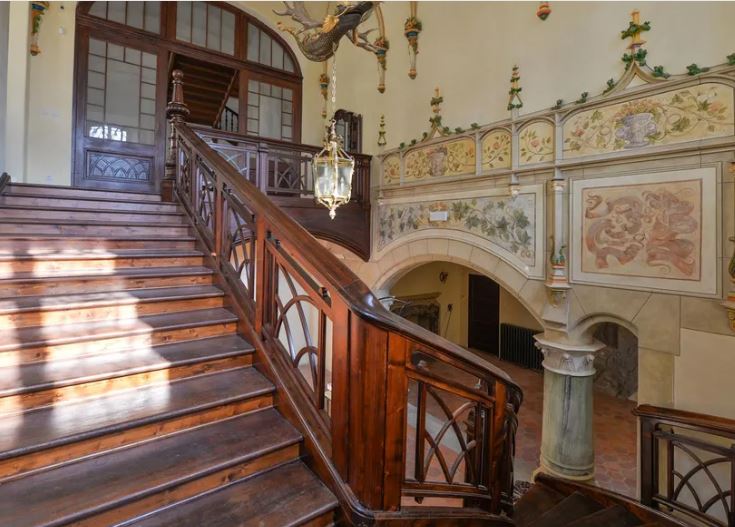
There are so many mysteries surrounding this estate and the First Lady of Santa Clara Valley. There were visible acts that were noticed. Dr. Clyde Wayland, her personal physician, revealed that he witnessed Mrs. Winchester acting very strangely. He claimed that Mrs. Winchester floated inches above the floor, and books and other objects fell off nearby shelves.

According to Dr. Wayland, and other witnesses, Mrs. Winchester spoke in different languages, but she had only learned to speak English. Mrs. Winchester also spoke with a deep voice that sounded nothing like her. The voice shouted, “Go away! She is ours!”

Although Dr. Wayland stated that Mrs. Winchester was sane, he believed there was the possibility that there was some demonic force inside of her home, for he saw no reasonable explanation for these events. Mrs. Winchester was also said to have unusual strength at times, which lead him to believe she was possessed.
https://winchestermysteryhouse.com/

And be sure to check out the online gift shop: https://shopwinchestermysteryhouse.com/

To Be Alive is to Face Risks!

Life is often a struggle. The characteristics of humanistic psychology are directly related to our view of human nature. Man’s own best interests, viewed in the light of a full understanding of his nature, are the criteria for the study and application of humanistic psychology. The first thing that interests us in understanding the essential self is what makes us go. By testing and trying himself out with all the limits of the human condition, man comes to some understanding of what he can and cannot do. This enables him to arrive at some acquired pattens of thought, attitude, and action, giving him a sense of safety or security. He has learned how to stand, what falling feels like, what staying up feels like, and, in the healthy child, a preference for the feeling of staying him. Far from being forced to grow up, the child who is growing in healthy terms, who has “made it” in the sense of acquiring a homeostatic balance of needs and tension-reductions, literally jumps at the chance to move up to the next stage. Those who were kept at a level of satisfaction and need-reduction become bored, fatigued, resentful. It is part of the biological nature of the person to seek continuing growth. Homeostasis moves up, then, from the biological drive to a learned need at each level, following a pattern: discover a need, motive or deficit, find a goal or incentive that will meet the need, and enjoy the satisfying tension-reduction for a period of time. Then it is time to move on to another field, for a different “ball game,” of the same kinds of processes. There is a level of care a one is obligated to exert for an accessible encounter past civil inattention to the question of how an when one can present oneself for official participation. #RandolphHarris 1 of 21
Even at social parties, where every encounter is supposed to be conducted in a fashion that makes it joinable by any guest, the entrant is expected to exert tact, and when cues suggest, not exercise one’s rights. When one does enter, one is expected to accept the current topic and tone, thus minimizing the disruption one causes. If a lady and gentleman are conversing together at an evening party, it would be a rudeness in another person to go up and interrupt them by introducing a new topic of observation. If you are sure that there is nothing of a particular and private interest passing between them you may join their conversation and strike into the current of their remarks; yet if you then find that they are so much engaged and entertained by the discussion that they were holding together, as to render the termination or change of its character unwelcome, you should withdraw. If, however, two persons are occupied with one another upon what you guess to be terms peculiarly delicate and particular, you should without yourself from their company. Welcome or not, the entrant today is usually expected to knock at the door of the encounter before one enters, thus giving the encounter advance warning of one’s intention and the participants a moment to straighten their house for the newcomer. One of the most interesting forms of cooperation in the maintenance of conventional closure is what might be called spacing. The term “individual distance” was introduced to describe the tendency of birds on a fence or railing to stay a particular distance from each other, the distance apparently varies with the species. #RandolphHarris 2 of 21

The term “flight distance” refers to the closeness with which an individual of a given species can be approached before taking flight. However, one should give caution against cross-cultural generalization. In the U.S.A., we distribute ourselves more evenly than many other people. We have strong feelings about touching and being crowded; in a streetcar, bus, or elevator we draw ourselves in. Toward person who relaxes and lets oneself come into full contact with others in a crowded place we usually feel reactions that could not be printed on this page. It takes years for us to train our children not to crowd in on us, and allow of to have some room to breathe. In Latin America, where touching is more common and the basic units of space seem to be smaller, the wide automobiles make in the U.S.A. pose problems. People do not even know where to sit. In America, the tendency for units of participation in the situation—either face engagements or unengaged individuals—to distribute themselves cooperatively in the available space so as physically to facilitate conventional closure. (Often this seems to involve a maximization of the sum of squares of the physical distance among the various units. Spacing will of course ensure that “talk lines” are open, that is, that persons addressing one another in an encounter will have no physical obstruction to block the free exchange of glances. A bystander finding oneself interposed in such a line (in America society, at least) is likely to offer an apology and quickly shift one’s position. #RandolphHarris 3 of 21

While the phenomenon of spacing may be difficult to see because one takes it for granted, a tracing of it in reverse can be obtained by observing children and mental patients—those communication delinquents who sometimes play the game of “attack encounter.” On many wards, for example, a patient will follow a pair of talkers around the room until they have stopped moving, and then sidle right up to the edge of the encounter and lean into it. One adolescent patient I studied would intercept talk lines between two persons by waving her knitting needles in the way, or by swinging her upraised arms, or by thrusting her face into the face of one of the participants, or by sitting in his lap. Along with physical spacing, we also find control of sound so that the various units in the situation can proceed with their business at hand without being jammed out of operation. In many cases this will mean restriction on the volume of sound, although, at rare occasions like social parties, where persons may be crowded close to others not in the same encounter, a general raising of voices may be found; this allows coparticipants to hear each other, but jams the opportunities of eavesdroppers. Here, too, accurately designed delicts can be observed, as when an adolescent mental patient, in a spirit of fun, places her face up against the face of someone engaged in talk with another at a distance, and then shouts so that one can neither hear nor be heard. #RandolphHarris 4 of 21

The requirement that visually open talk lines be maintained, and that sound levels not interfere with neighbouring encounters, sets a limit to the distance over which spoken encounters can ordinarily be sustained. For example, should two persons carry on a conversation from one end of a crowded streetcar to the other, all the intervening passengers would have to remain out of the line of talk and modulate their own conversation so as not to jam the one being maintained over a distance. Such a conversation would necessarily also be fully available to everyone between the two speakers, and would therefore be likely to constitute an embarrassment, even were one of the speakers the conductor. Thus, engagements that must be carried on over such a populated distance are likely to be limited to the exchange of silent gestures, for these neither interfere with other encounters nor expose what is being conveyed. As might be expected, therefore, deaf and dumb persons who board a streetcar together and find themselves seated apart need not discontinue their exchange of messages, but are able to carry on conversation as long as sight lines are clear, their “talk” neither jamming the other talkers nor being accessible to them. #RandolphHarris 5 of 21

While physical spacing and sound control certainly have relevance to occasions such as social parties that are carried on within a relatively small physical region, they are perhaps even more important in public streets and roads and in semipublic regions. In Western society, the development of middle-class dominance is expressed in the rise of a relatively equalitarian use of public places. Even today, however, funerals, weddings, parades, and some other ceremonials are allowed to press their spirit momentarily upon the public at large. Technical units, such as ambulances, police cars, and fire engines cut through public traffic; and guests of a city may be given a motor escort. Some of these prerogatives, however, are but small remnants of practices that were once more general, such as the entourage and train associated with “clientage,” which led a worthy to demonstrate one’s status by the cluster of dependent supporters that accompanied one through a town or a house of parliament, shouldering one’s way for one wherever one went. Nor are these rules uniform within Westerns society, as is suggested by the response of King Edward (of Britain) and his party during a 1906 visit to the Emperor of Germany: The Emperor had a standard attached to his motor and a trumpeter on the box who blew long bugle-calls at every corner. The inhabitants thus had no difficulty in making out where the Emperor was, and all the traffic cleared out of the way when they heard the trumpets blow. The King, however, detested what he called “theatrical methods” and drove about like anybody else. #RandolphHarris 6 of 21

There can sometimes be a kind of restructuring that can occur when a situation is transformed from one containing many encounters—a multifocused situation—to one that is exhausted by a single all-encompassing engagement. For example, at noontime on award of Central Hospital, when the attendant shouts, “Chow time!” he is addressing the whole place, and wherever the sound level of his voice reaches, the meanings of his words are meant to carry too. Similarly, at a small social party, the arrival of a couple may cause the hostess to interrupt the separateness of all the separate encounters in order to introduce the newcomers to the assembly. So also, at formal dinners, the moment the hostess indicates that the conversation will be “general,” she opens up whatever is being said to all the guests. And, of course, whenever public speeches are given, the speaker’s words, as well as the heat with which one speaks them, are meant to impinge on the situation at large. In all such cases, there is the understanding that the situation at large. In all such cases, there is the content of the words of an appropriate single speaker; one has, as we say, the floor. The transformation of a multifocused situation into one that is exhausted by one face engagement is an interesting process to consider. At social parties we can observe a singer or guitar player make an effort to incorporate more and more of the room’s population into one’s audience, until a point is reached where one’s singing officially exhausts the chamber, and the party is momentarily transformed into a performance. #RandolphHarris 7 of 21

At the same time, as a particular encounter comes to include a larger and larger number of persons, side involvements increasingly occur in which a subordinate byplay is sustained, sometimes furtively, its volume and character modulated to allow the main show to prevail unchallenged as the dominating one. In mental hospitals there is a special kind of “symptomatic” behaviour that takes recognition of how the situation as a whole can be “talked to.” Many patients talk to someone, present or not, in a voice loud enough for everyone in the situation to hear and be somewhat distracted. However, those on the ward implicitly distinguish this kind of impropriety from that which occurs when a patient “addresses the situation,” haranguing everyone present in a tone and direction of voice that suggest one is purposely breaching the barriers designed to render clusters of talkers and game players safe in their own focused interactions. (Interestingly, although the actual volumes of sound may be greater in the case of a patient insufficiently modulating one’s contribution to a private conversation than in the case of a patient “addressing the situation,” it is the latter that is likely to cause the greater disturbance.) Attacks on the situation should be compared with the attacks on encounters, previously mentioned, which children, mental patients, and other communication delinquents perform. #RandolphHarris 8 of 21

Many middle-class parents in our society have experienced times when their children, forbidden to interrupt or even to enter a room where adults are talking, stealthily stalks the situation in self-conscious mimicry of stealthiness and stalking, resulting in much more disturbance to the gathering than one’s mere presence might entail. When it comes to constructive criticism, it is best to make a fault seem easy to correct. First off, do not start by discouraging an individual. Be honest, and see the potential they have and use those optimistic characteristics to guide them in the right direction. This will prevent an individual from feeling like a failure and give them the hope that they too can become the highest, the most exalted one. Tell your parents, child, spouse, or employer that one is stupid or dumb at a certain thing, has no gift for it, and is doing it all wrong, and you will have destroyed almost every incentive for improvement. However, when being liberal with your encouragement, making the things seem easy to do, letting the other person know that you have faith in one’s ability to do it, that one has an undeveloped flair for it—and one will practice until they are the brightest planet in the sky. Give confidence, inspire others, help one find the courage and strength that they have been endowed with. For instance, there is nothing to preparing for an exam except memory and judgement. Also, if you are going to be a successful student, you have to learn to read, and you have to actually read and gain a great understanding of the English language. #RandolphHarris 9 of 21

Going to college is great, but one will not succeed unless you start reading in high school. Reading is so important. So much of education can only be mastered by reading the material. If you are not going to read your books, and be prepared for lectures, there is no point in going to school. Many young minds are bright, but they are undisciplined. And, I know you may think TV is the most important thing, but those shows will all be there later. You can even binge watch them over Summer vacation. Take the time to study and get your homework done with a military like focus. Find a quiet room, and get busy. You are a potential genius. Sometimes school systems see surgical scars on students and incorrectly assume that they are injured and cannot function at a normal level. Even if you are a few years being in your age group, find a peer who is willing to help bring you up to speed. Every time you study, you are expanding you mind. You will notice the more you do it, the more understanding of the subject you gain, and eventually it will take you less time to absorb the muscle. It is a lot like cars. They start off cold, but gradually warm up. You can never get into a car, smash on the gas and go at top speed, it will ruin the engine. However, taking breaks it also important. If you are on a long haul in your vehicle, do not just suddenly smash on the gas, that can also mess up the engine. And just like a car, you do not want to overload your brain and burn out. #RandolphHarris 10 of 21

Naturally, the more you study, the more your grades will increase. No one is stupid. You notice that as early as four weeks old that many babies have the ability to form short sentences, and some even start walking at 7 months old. That is because they are smart. However, some need more practice and education to achieve these milestones, but they all get there. Also, as you learn the enrichment curriculum, you will notice that your other natural talents will develop and others will start to notice them. You can really learn and accomplish things. Do not let income/inequality be an excuse as to why you cannot succeed. I have seen poor kids grow up and become richer than students who had the World handed to them. Most cities have a public library where you can go and read books of interest. Social media is not as important as you think. So many people want to become famous for doing things that may not be in their best interest, but you can use your brain and become an auto science engineer or a tennis player. Maybe one day you will be elected in the national honour society. Once you find learning is easy, you whole life will change. Also, sometimes you make need to read a chapter in a book twice. Once to get a feel for the subject, and a second time to grasp the concepts being discussed. Eventually, reading will become easier and you will be able to read a chapter once. Also, to become an excellent writer, you need to read. Communication is so very important in any field of work you will go into. Just remember, faults are easy to correct. #RandolphHarris 11 of 21

Some people wonder whether one can do anything by oneself or whether it must be done with the help of others. Testify as to why you are superior and demonstrate it through your actions. When one tells people what should be done, they usually begin to argue, and not only argue but they become negative. That is really why help cannot be given, and why it is necessary to make rule and definite demands. If all that where needed were just to show people what to do, that would be simple, but it is not always easy to explain the chief features of false personality. Sometimes it is seen clearly, at other times it is more hidden and difficult to see, and then it is only possible to think in a general way of false personality. However, there is not a single case where I showed chief feature when people did not start violent arguing. At one meeting somebody said that he was occasionally able to observe oneself in the act of considering or becoming identified. He asked whether in this way he might come to know his false personality, and by observing it to weaken it. Actually, this is the only way and is very good so long as one does not tire of tying to do it. In the beginning, many people start very eagerly but soon get tired and begin to use the word “I” indiscriminately, without asking themselves which “I,” because we have no right to use it really in ordinary conditions. Much later, after long work, we can begin to think of one of the groups of “I”s (like what has been called Deputy Steward) which develop from magnetic center as “I.” #RandolphHarris 12 of 21

However, in ordinary conditions when you hear yourself saying “I do not like,” you must ask yourself which of your “I”s does not like. In this way you will remind yourself about the plurality which is in all of us. If you forget about it one time it will be easier to forget it next time. There are so many good beginnings in the work and then this is forgotten and people start to slide down, and in the end all that happens is that they become more mechanical than before. When it come to attribution of credit, there can be some common mistakes made. The wrong set of factors is often made in Complex Adaptive Systems for much of the same reasons. Diagnosis of causes in complex, multicausal situations are error prone. We might take as an example the problem of examining customer complaints about product malfunction in order to discover product defects or possible design improvements. Many large consumer product companies have service desks that answer thousands of calls per week about products. They frequently have systems that generate “trouble tickets” associated with each call. It is natural to ask what can be learned from the records of all this work that would contribute to improvement of the products, but closing this loop of organizational learning has often proven quite difficult. Working with a group of such reports, an analyst searches for pattern in the way the features and structure of the product interact with the circumstances of use reported by the customers. The hallmarks of complexity are present. The analyst may develop hypotheses such as: “All these customers reported that sound quality deteriorated when they were driving on country roads. Could it be that the audio unit is disturbed by shocks spaced at a particular frequency?” #RandolphHarris 13 of 21

Many hypotheses like this one are generated, but not all will be correct. In many organizations, such hypotheses are tested by checking if they are sufficient to reproduce the problem. In a complex World, many of those tests will fail. Someone from product development (not the same division as customer service) will subject the unit to low-frequency jolts and observe that it still performs well. An interesting strategy at such a moment of impasse is to bring into the process some of the frontline customer service agents who took the original calls. They may suggest something like, “These all came in last winter. Does it only happen if the unit is cold?” Of course, this may not turn out to be the answer. However, in an organization having trouble maintaining contact patterns between two divisions, the effort to correct a misattribution provides an occasion for interaction during which other useful information may flow. It functions as an episode of triggered recombination. Product people learn of other patterns noticed in customer service. The frontline agents learn about new product ideas in development and can then be alert to relevant remarks from customers. All of this reasoning makes sense in games like football or baseball or tennis, in which the same situation arises many times in one game, and the same players confront each other from one game to the next. Then there is time and opportunity to observe any systematic behaviour, and respond to it. Correspondingly, it is important to avoid patterns that can be exploited, and stick to the best mix. However, what about games that are played just once? #RandolphHarris 14 of 21

Consider the choices of points of attack and defense in a battle. Here the situation is usually so unique that no system from your previous actions can be inferred by the other side. However, a case for random choice arises from the possibility of espionage. If you choose a definite course of action, and the enemy discovers what you are going to do, one will adapt one’s course of action to one’s maximum disadvantage. You want to surprise one; the surest way to do so is to surprise yourself. You may want to consider keeping the options open as long as possible, and at the last moment choose between them by an unpredictable and therefore espionage-proof device. The relative proportions of the device should also be such that if the enemy discovered them, one would not be able to turn the knowledge to one’s advantage. However, that is just the best mix calculated in the description above. Finally, a warning. Even when you are using your best mix, there will be occasions when you have a poor outcome. Even if Paris Hilton is unpredictable, sometimes Britney Spears will still guess right and knock the ball out of the park. In football, in the third down and a yard to go, a run up the middle is the percentage play; but it is important to throw an occasional bomb to keep the defense honest. When such a pass succeeds, fans and sportscasters will marvel at the cunning choice of play, and say the coach is a genius. When it fails, the coach will come in for a lot of criticism: how could one gamble on a pass instead of going for the percentage play? #RandolphHarris 15 of 21

The time to justify the coach’s strategy is before using it on any particular occasion. The coach should publicize the fact that mixing is vital; the run up the middle remains such a good percentage play precisely because some defensive resources must be diverted to guard against the occasional costly bomb. However, we suspect that even if the coach shouts this message in all newspapers and television channels before the game, and then uses a bomb in such a situation and it fails, one will come in for just as much criticism as if one had not tried to educate the public in the elements of game theory. Another game we want to consider is politics. Of course, sports can be just as important and as serious as decisions made in Congress. An unnoticed “first” in politics was marked in 1989. That was the year John Sununu moved into the White House as its chief of staff, making him in all likelihood the World’s most highly placed “computernik.” In a World bristling with microchips, he was the first computer-literate person ever to occupy one of the pinnacles of political power. A mechanical engineer by training, Sununu had done doctoral work at the Massachusetts Institute of Technology and was known as a whiz who could spot and correct programming errors and question the mathematical model underlying an environmental impact statement. Whatever one may think of his political views, Sununu undeniably understood the power-potential of computerized information. #RandolphHarris 16 of 21

Before arriving in Washington, Sununu had served as governor of New Hampshire. When Sununu installed an electronic fiscal and financial control system for the state, members of the legislature demanded access to the data stored in the IBM mainframe. Sununu sidetracked their proposals declaring, “They’ll get what we think they need.” According to Time magazine, Sununu “seemed to be trying to shift the balance of political power” by “holding the state’s computerized financial data close to his chest.” In the end, the governor was forced to give one legislative official a password providing access to some (but not all) of the disputed data. Similarly, though a state court had held that citizens had a right to see and copy public documents, Sununu insisted that this did not apply to computerized data. Sununu, as governor, fully understood the power of knowledge about knowledge. Sununu’s action in New Hampshire was hardly subtle. Stamping something confidential or withholding access is an age-old tactic. New, more potent tools—many of them computer-based—are now available to those who wish to control data, information, and knowledge. In fact, we are witnessing a shift to a higher—and less visible—level of power struggle that reflects the rising level of abstraction and complexity in society generally as the super-symbolic economy spreads. Take, for example, computers. We now use computers to build computers. We are also developing CASE—computer-assisted software engineering. This is based on what might be termed “meta-software”—software designed to produce software. #RandolphHarris 17 of 21

One can imagine a future in which CASE is used to produce the meta-software, itself, in a kind of infinite regress, as the process moves to higher and higher levels of abstraction. Similarly, the early 1980s, “spreadsheet software” spread rapidly through the business World. These computer programs permitted hundreds of thousands of users to put numbers into columns and rows, as in a ledger book, and to manipulate them easily. Because they could automatically show how a change in one number or variable would affect all the others, they accustomed a whole generation of users to think in terms of “what if” scenarios. What would happen if we raised the price of a product by 2 percent? What if interest rates fell by half a point? What if we could get the new product to market a month sooner? However, spreadsheets, like traditional ledgers, were two-dimensional, flat as a chessboard. In 1989, Lotus Development Corporation, the main spreadsheet supplier, introduced its 1-2-3 Release 3.0. This program can be used to create three-dimensional spreadsheets—the accounting equivalent of moving chess pieces up and down as well as backward and forward on the conventional board. It permits users to simulate change in a business or a process in far more complex and revealing ways. It leads users to ask much smarter what-if questions at a much higher level. The new system of wealth creation requires a symbol-drenched work force. #RandolphHarris 18 of 21

Constant exposure to the data deluge—to media, computers, paperwork, fax machines, telephones, movies, posters, advertisements, memos, bills, invoiced, and a thousand other symbolic stimuli, with millions spending their time attending meetings, presenting ideas, persuading, negotiating, and otherwise exchanging images—makes for an increasingly “info-savvy” population. Just as Eskimos develop high sensitivity to differences in the properties of snow, and farmers can almost intuitively sense weather and soil changes, mind-workers become attuned to this informational environment. This rising sophistication compels those in power to seek new, higher-level instruments of persuasion and/or social control. Satellites, videocassettes, narrow-casting, niche-identification, cluster-targeting, extra-intelligent networks, instant polling, simulation, mathematical modeling, and other such technologies are becoming a taken-for-granted part of the political environment in the affluent nations. And along with these come new ways of manipulating computerized information that make all the conventional info-tactics of the politician or bureaucrat look crude and klutzy by comparison. Along with changes in the general population, therefore, fed by the shift to the new wealth-creation system, comes a parallel upgrading of the tools of manipulation used by politicians and government officialdom to hold on to their power. That is what meta-tactics are all about. #RandolphHarris 19 of 21

Nonetheless, even wealth and leisure cause problems. Lester Millbrath, professor of sociology and political science, observes, “Nanotechnologies will create the problem of how to meaningfully and sustainably occupy the time of people who need not perform much work in order to have a sufficiency of life’s goods. Our society has never faced this problem before, and it is not clear what social restructuring will be required to have a good society in those circumstances. We face much deep social learning.” The World has had little experience with what anthropologists’ call “abundance economies.” The Native American tribes of the pacific Northwest were one of those rarities. Their civilization was built upon an ample supply of goods, inexhaustible, and obtained without excessive expenditure of labour. The Kwakiutls became famous for the “potlaches”: contests in which they sought to shame their rivals by heaping more gifts upon them than they could ever return. The potlatches would often be a year in preparation, lasts for days, and occasionally involved destruction of entire buildings. It was certainly a colourful form of keeping up with the Winchesters. What will motivate us, once we have achieved an abundance economy? What will we regard as worthwhile goals to pursue? #RandolphHarris 20 of 21

Will part of the economy of abundance motive of to gain increased knowledge, new art, improved philosophy, eliminate human and planetary ills? Will we find ourselves creating a better, wiser World, or sunk in boredom and jaded now that we have all and want nothing? If boredom gets out of hand, the lively spectacle of wealthy doners seeking to outdo each other to endow the arts, assist the poor, and do other good deeds for the sake of prestige would be welcome. What will happen as life spans continue to lengthen and the time needed to make a living decreases? Even today, there are people who, when confronted with the prospect of significantly longer life span, exclaim that they could not imagine what they would do with all that time. This response can be hard to understand, when it would take a thousand years to walk all the World’s roads, more thousands of years to read all the World’s books, and another ten thousand years to have dinner conversation with each of the World’s people—but tastes differ, and even a few decades of bad television might make anyone long for the peace of the grave. However, perhaps more people will start hibernating. We all could use more sleep. Then wake up to a beautiful World, well rested and ready to enjoy their pleasures of life. Confusing? Of course! Like most truths, when we try to apply them to specific situations in our individual lives, we run the risk of failure. However, let that bit of wisdom sink in: You cannot intentionally set out to create or capture your own personal significance—not as a goal in itself. Human beings strive perpetually toward ultimate humanness, which itself may be anyway a different kind of Becoming and growing. #RandolphHarris 21 of 21

Cresleigh Homes

When it comes to entertaining a crowd, the Residence 4 model at #Havenwood is an absolute dream! 🌈 Take advantage of the butler’s pantry connecting the kitchen and dining rooms and customize the great room and loft room upstairs to fit your family’s needs. 👏
Check out more – including a full virtual tour – on our #CresleighHomes website!

You Made Friends at the Bar–You Join them Almost Every Day of the Week

Our individual accomplishments, opinions, and contributions enable us to known our own unique identity and to take pleasure in feeling tht we are a significant member of the human family. However, at times, differences in the way we act, look, dress, or think can separate us from those around us. By definition, an accessible engagement does not exhaust the situation; there is no situational closure, physical or conventional, to cut it off from nonparticipants. What we find instead is some obligation and some effort on the part of both participants and bystanders to act as if the engagement were physically cut off from the rest of the situation. In short, a “conventional engagement closure” is found. Bystanders extend a type of civil inattention, but one that is designed for encounters, not for individuals. Bystanders are obliged to refrain from exploiting the communication position in which they find themselves, and to give visible expression to the participants of the gathering that they are focusing their attention elsewhere—a courtesy of some complexity, since a too studied inattention to what one is in a position to overhear can easily spoil a show of inattention. I do not want to overstress rational intent in situational behaviour. An individual is supposed to be entirely in or entirely out of an encounter. However, even the individual who wants to follow this rule cannot completely control the expressed direction of one’s attention. If one’s attention is attracted to an accessible encounter, then one’s attempt to conceal the fact is likely to be visible both to those with whom one ought to be participating and to those whom one ought to be disattending. #RandolphHarris 1 of 22
Since there are many reasons why an individual might want to overhear the content of an engagement of which one is not a member, one may often simulate inattention, giving the impression that conventional closure has been obtained, while in fact one is furtively attending to the talk. How much of this eavesdropping actually goes on, and in what situations, is difficult to assess. The expression of inattention and noninvolvement exhibited by those who are physically close to an encounter in which they are not participants can be observed in an extreme form at times when an individual could join the encounter (as far as its participants are concerned), but finds oneself “psychologically” incapable of doing so. What can then result is a kind of conversational parasitism, often observable on mental hospital wards. For example, one psychotic young woman I observed would sit alongside her mother and look straight ahead while the latter was engaged in conversation with a nurse, maintaining what appeared to be civil inattention in regard to the neighbouring engagement. However, while attempting to keep her face composed like that of an uninvolved, uninterested bystander, she would keep up a running line of derisive comment on what was being said, uttering these loud stage whispers under great verbal pressure, from the side of her mouth. The psychological issue here, presumably, was that of “dissociation.” However, the direction of flow taken by the two dissociated lines of conduct—conversational participation and civil inattention—seemed entirely determined by the social organization of communication that is standard for social situations in our society. #RandolphHarris 2 of 22

In a social situation, then, an individual may find oneself torn apart, but torn apart on a standard rack that is articulated in a standard way. There are circumstances in which it is difficult for participants to show tactful trust of bystanders and for bystanders to extend civil inattention; in brief, there are times when conventional closure is difficult to manage. For one example of this we can return to small enclosed place like elevators, where individuals may be so closely brought together that no pretense of not hearing can possibly be maintained. At such times, in middle-class America at least, there seems to be a tendency for participants of an encounter. A similar kind of issue seems to arise in near-empty bars, as novelists have pointed out: We were alone in that bar, it was still the middle of the morning and the presence of the barman there was embarrassing. One could not help overhearing. In his white impassive coat he was a figure of reticent authority. However, he probably realized this too, he was nice enough to keep bobbing down behind the bar and shoveling about his glasses and his little trays of ice. So Darke ordered two more as it were from no-one, and soon thee bobbed up. The cabdriver has something of the same kind of problem here as the bar man. So too has the individual who is momentarily left to his own resources while a person to whom he has been talking answers a telephone call; physically close to the engaged other and patently unoccupied, he must yet somehow show civil inattention. Similarly, in a three-person engagement, when a talker interrupts his talk to answers the phone, the two remaining persons may attempt a quiet, and often very limp, conversation. #RandolphHarris 3 of 22

Where civil inattention is physically difficult to manage, the scene is set for a special kind of dominance. In an elevator, for example, those in one of the engagements may continue fully engaged, forcing the others present to accept the role of nonpersons. Similarly, when two unacquainted couples are required to share the same booth in a restaurant, and they elect to forego trying to maintain an inclusive face engagement, one couple may tacitly give way to the louder interaction of the other. In these situations, the submissive couple may attempt to show independence and civil inattention by beginning a talk of their own. However, while it may appear convincing to the other couple, this weaker talk is not likely to convince it own participants, who, in carrying it on, will be admitting to each other not only that they have been upstaged, but that they are willing to try to pretend that they have not. In Britain, it is my impression that where one of the units present is of “good” speech, that is, received pronunciation, then it is this group that is likely to talk openly, as if the other could easily offer civil inattention and could easily stop their own conversation. This is one of the ways in which a visitor to Britain is struck by the startling vulgarity (according to American standards) of the British upper middle class. It may be added that strength in these cases derives not from muscle, but, typically, from social class. Given the fact that participants and bystanders are required to help maintain the integrity of the encounter, and given the complicating fact that bystanders of this encounter may well be participant of another, we may expect some tacit cooperation in maintaining conventional closure. #RandolphHarris 4 of 22

First, if bystanders are to deist in some way from exploiting their communication opportunities, then it will fall upon the participants to limit their action and words to one that will not be too hard to disattend. And this keeping down of the excitement level is, in fact, what is generally found. Interestingly enough, this tendency is matched by another that moves in the opposite direction, namely, acting in such a way as to show confidence in the willingness of bystander not to exploit their situation. Thus, as already suggested, whispering or obvious use of code terms will often be thought impolite, in part because it casts a doubt on bystanders’ willingness to be inattentive. One consequence of the combination of these rules of conventional closure may be mentioned. It is a rule of conversation that participants show consideration for one another, by, for example, avoiding facts about which the other might be touchy, or by showing constraint in raising criticism, and so forth. Disparagement of persons not present, on the other hand, is usually quite acceptable, offering a basis of preferential solidarity for those in the encounter. In addition, the conversation may well involve business matters that an absent other cannot safely be made privy to. It follows, therefore, that the run of comments in a conversational encounter may have to be altered strategically when a relevantly excluded person approaches, lest the content of the talk put too much strain upon one’s willingness to offer civil attention; when one approaches with the intention of entering the encounter, even more delicacy is required. #RandolphHarris 5 of 22

The well-known example is that of the individual who comes into a room to find that conversation has suddenly stopped and that other present are seeking in a flustered way to find a new and tenable topic. Sometimes, as a relevantly excluded other approaches, a particular physical point is reached where the conversation can be altered without either letting the oncomer hear what would be embarrassing to one (or what would embarrass the speakers for one to hear) or giving one an impression that something embarrassing regarding one has been suppressed. This distance will, of course, vary with the social skill of the participants. Sometimes, too, a given room will have a special “safe region,” from which vantage point any newcomer can be spied in time to safely alter the content to talk without showing that an alteration was necessary. In these circumstances we sometimes find skill-showing, where the talkers daringly and cooly continue their talk up to the very last moment for altering it safely. Many people experience emotional states they cannot understand and identify. They often wonder at the intensity, origin, explanation, and duration of emotions. They also worry about what they might do as a result of these emotions. They may even question whether the emotions are “normal” or not. Of course, this happens to all of us at times. It is one of the risks of being thinking, sensitive people. We begin questioning, analyzing our own experiences. We also categorize them, because that is what our rationalistic, scientific society expects. #RandolphHarris 6 of 22

And when we cannot find a neat explanation or pigeonhole for a particular experience, we either bend it to fit another category, deny it, repress it, or project it onto somebody else (“I am not angry; you are!!”). If we cannot do any of these things because we are too honest with ourselves, we may conclude that the feeling is a bad one or a “sick” one. What do you do when a person who has been a good worker begins to turn in shoddy work? You can fire the individual, but that really does not solve the matter. You can berate the worker, but this usually causes resentment. Sometimes, especially when someone has been on the job for a long time, it is best to call the individual into the office and tell the individual that one is a finer employee. Compliment them on the amount of time they have spent on the job, the quality of their typical work and the quantity. Explain to them that they have received a lot of compliments about their great work. Then gently explain that in the present their work has been slipping and is taking too long and not up to standards. And ask them if there is a way to find a resolution to the problem. Many times, an honest employee will say that they not realized that their productivity has been declining, and they will promise to excel in future projects. In fact, the average person can be led readily if you have one’s respect and if you show that you respect that person for some kind of ability. #RandolphHarris 7 of 22

If you want to improve a person in a certain respect, act as though that particular trait were already one of the individual’s outstanding characteristics. Assume a virtue, if you have it not. And it might be well to assume and state openly that other people have the virtue you want them to develop. Give them a fine reputation to live up to, and they will make prodigious efforts rather than see you disillusioned. When people are given a standard of behaviour and a reputation that is expected of them, you may find that the individual will find it impossible not to follow through. If you want to excel in that difficult leadership role of changing the attitude or behaviour of others, give the other person a fine reputation to live up to. There can be good example of a self-fulfilling prophecy. [Somebody asked whether “Chief Feature” id est, the prime feature of false personality) was a food for false personality.] Chief feature is not food. Chief feature is false personality. False personality in most cases is based on one feature which enters into everything. Some day we will take some examples of chief feature and you will see how it is really that which makes false personality. “What is the best way to look for one’s chief feature?” someone asked. Simply see yourself. I do not know how to explain it better. It is possible one may find something—chief feature of the moment. It is imaginary personality; this is chief feature for everybody. “Can one alter one’s chief feature?” asked someone else. First it is necessary to know it. If you know it, much will depend on the quality of your knowing. If you know it well, then it is possible to change it. #RandolphHarris 8 of 22

“When an attitude at the back of a negative emotion is very old and habitual, possibly a feature, how can I attack it?” Begin from the feature. Find the feature, talk about it and so on. It is necessary to think about false personality and in some cases you can see definitely a kind of chief feature coming into everything, like the axis round which everything turns. It can be shown, but the person will say, “Absurd, anything but not that!” Or sometimes it is so obvious that it is impossible to deny it, but with the help of buffers one can forget it again. I have known people who gave me a name to their chief feature several times and remembered it for some time. Then I met them again and they had forgotten, or when they remembered they had one face, and began to speak as though they had never spoken about it at all. You must come near to it yourself. When you feel it yourself, then you will know; if you are only told, you may always forget. “Can I get a clue to false personality by thinking of events in the past?” Sometimes you may. Either in the past or in your friends. However, you must understand that you also have false personality, not only your friends! “Can we see false personality without help?” There is nothing again it theoretically, only I never saw such a case and nobody else I know saw such a case. Even with help people are not generally prepared to see it. It is as if you were to show a man his reflection in a real, actual mirror, and he were to say, “This is not me. This is not a reflection of me.” However, if a man is prepared, it is sometimes possible to recognize a feature of weakness in oneself. If a man knows this feature, if he begins to keep it in mind and to remember it, then there may be a certain moment when he is free from this feature, when his action is not determined by this weakness. #RandolphHarris 9 of 22

Sometimes our features or weaknesses take simple forms like laziness, but in other cases their forms are so well disguised that there are no ordinary words to describe them, and they can only be described by some kind of diagram or drawing. Laziness is for some people 75 percent of their lives or more. Sometimes laziness is very important, sometimes it is the chief feature of false personality. Very often it is chief feature, and all the rest depends on laziness and serves laziness. However, remember that there are different kinds of laziness. It is necessary to find them by observing yourself and observing other people. For instance, there are very busy people who are always doing something and yet their minds may be lazy. That happens more often than anything else. Laziness is not only the desire to sit and do nothing. However, the goal is to prevent others from exploiting any systematic behaviour of yours. If they have a preference for a particular action, that would mean only that they had chosen the worst course from your perspective. The basic idea is that one resorts to chance as the means of keeping the other player from exploiting any systematic behaviour on your part. Turning this idea into practice is more subtle. Many of us do not wish to settle for knowing just a little bit of other people, especially those we care about. So, we mut find ways of opening up avenues of approach. By experimenting, we can invite these people to come out into the sunlight and experience as much of life as possible. Why should we? If a person is happy being a Bluffer or an Expert or a Life of the Party, is it our business to take on the role of disturbing the individual? Well, it is important not to taunt or torment but to dare the other person to become more fully what one is. #RandolphHarris 10 of 22

In complex systems, it is difficult to determine what should be rewarded or which choice is appropriate. Measurement of success is often infrequent, and shifting context makes few observations comparable. Deliberation costs for choices can be high, especially if they require the apparatus of formal logic or statistics, or social processes of choice such as scientific peer review—not to speak of court proceedings. Feedback is ambiguous. Circumstances, even goals, are changing. All of this follows from the fundamental premise: we are coping with system that are complex and adaptive, not simple or static. In the short run we are not likely to have a direct approach that “get it completely right.” We will need as well the indirect methods of harnessing complexity. The difficulty of attributing credit in real experience can be reinforced by considering a few examples. The war in Vietnam provides a striking case. Although war usually produces large rewards (and punishments) and, in the end, provides clear feedback on the result, none of the other circumstances for effective learning obtains. For the Americans, the Vietnam War was not a victory. However, exactly what lessons and no obvious way to determine which candidates are most appropriate. Despite these impediments, lessons were learned by the American military. These included the need for decisive force in any future war, the need to avoid slow escalation, and the need to avoid civilian interference in the conduct of the war. These lessons—“strategies,” in our terms—were applied to the planning and conduct of the Gulf War and seemed to be effective in that application. #RandolphHarris 11 of 22
On the other hand, for the Soviet Union the Vietnam War was a success. The lessons drawn from the way by the Soviet Union emphasized that their Vietnamese allies won because of their great will and courage, assisted by military aid from Communist nations. These optimistic lessons would not have warned the Soviets about the dangers of their later intervention in Afghanistan. Biological systems also face difficulties in attributing credit. Consider birds, which determine from experience the visual characteristics of dangerous predators. Their situation illustrates one of the many interesting complications of credit attribution in a Complex Adaptive System: exploitation by others. The method is mimicry—as when many species of moths evolve spots on their wings that resemble the eyes of larger predators. This works because the birds develop a “prediction” of danger from appearance and rely on it to avoid predators. One presumes that the birds’ capability to associate certain appearances with danger, which is a mechanism for attributing credit, serves the birds well overall. However, the moths can also exploit the birds’ imperfect credit attribution to avoid being eaten. Once again coevolution increases complexity and inhibit prediction. For a nonbiological example of the limits of credit attribution, consider the person who ends the year with the highest sales volume, receives a significant bonus, and is singled out to be emulated. Years later, more careful cost accounting may show that most of the sales actually lost money for the firm because of eventual refunds or support costs. #RandolphHarris 12 of 22

The business literature is rife with stories of performance indicators that failed to capture important aspects of a complex setting. These misattributions may occur because of casual connections that no one understands, or because some employees, like the spotted moths, come to mimic features that other employees, like the birds, have come to associate with success or failure. The difficulties of credit attribution are endemic in Complex Adaptive Systems. Our aim is not to escape the, though we recommend that when it is feasible. Instead, our aim is to suggest how the side effects of inevitable mistakes of attribution can be turned to some advantage. Each of these three categories is constructed as a composite of actual cases in which complexity makes some mistakes of attribution inevitable. They illustrate a few different problems of inference that are highly characteristic of credit attribution in complex system: the mistake of crediting or blaming a part when a larger ensemble is responsible, the mistake of attributing credit or blame to a particular ensemble of factors when in fact a different ensemble is responsible, and the mistake of crediting a misconstrued strategy, where the action involved produced success, but the conditions in which the action should be taken have been misunderstood. The first type of mistake, crediting a part when a larger ensemble is responsible, is very common in Complex Adaptive Systems since they so often involve a number of entangled factors. It is easy to notice that a single or strategy is associated with a series of successes (or failures). #RandolphHarris 13 of 22
If you are not positioned to observe the operation of other necessary forces, you reach an incorrect conclusion that it alone causes the results. Consider a manager of a department that uses project teams assembled for specific tasks. If it is the practice in the unit to reward team members whose work contributed to notable success, a manager can almost be sure that there will be some occasions where an individual receives credit for what was produced by the interplay among contributions of several team members—what is sometimes labeled the group’s “chemistry.” We have stressed insufficient exploration in examples throughout this essay because we so often have seen variation being undervalued by managers of Complex Adaptive Systems. However, for this case, let us stipulate that the manager believes the department has a problem of insufficient exploitation. Perhaps “back channel” communication suggests that a project group has done well by ensemble effect rather than the efforts of the most prominent individual. How can the manager get “mileage” out of discovering those attribution mistakes without knowing what caused them? One approach is to make a special effort to reassemble that identical team for a later problem, retaining (and exploiting) the uncredited ensemble that may be there. Doing this has a cost, of course. It reduces the ability to mix and match individuals to the characteristic of the next task. Harnessing complexity does not always come for free. #RandolphHarris 14 of 22

Infinite varieties of deception (and self-deception) are found in the masses of data, information, and knowledge that flow through the government’s mind-work mill every day. Space constraints make it impossible to continue illustrating and classifying them here. Instead, we will list just a few more in abbreviated form. THE OMISSION TACTIC. Because politic is so intensely adversarial, political messages are even more consciously selective than most. Typically, they have gaping holes where someone applied the Omission Tactic and ripped relevant or balancing facts out of them. THE GENERALITY TACTIC. Here details that might lead to bureaucratic or political opposition are glossed over with airy abstraction. Diplomatic communiques are rife with examples—which accounts for their frequently brain-numbing style. TIMING TACTICS. Here the most common approach is to delay sending a message until it is too late for the receiver to do anything about it. Thick budget documents are dumped in the laps of legislators who are supposed to respond to them in a few days—well before they can intelligently digest and analyze them. White House speechwriters are known to deliver their drafts of a presidential speech at the latest possible moment, allowing other staffers minimum time to money with the text. THE DRIBBLE TACTIC. Here, data, information, and knowledge are doled out in tiny takes at different times, rathe than compiled into a single document. In this way the pattern of events is broken up and made less visible to the receiver. #RandolphHarris 15 of 22

THE TIDAL WAVE TACTIC. When someone complains about being kept uninformed, the shrewd player ships him or her so much paper that the recipient is drowned and cannot find the essential facts in all the froth. THE VAPOR TACTIC. Here a host of vaporous rumors are released, along with some true facts, so that receivers cannot distinguish the latter from the former. THE BLOW-BACK TACTIC. Here a false story is planted overseas so that it will be picked up and reprinted by the domestic press. This tactic is employed by intelligence and propaganda agencies. But sometimes the blow-back is inadvertent—or seems to be. This CIA once planted a story in the Italian press about the terrorist Red Brigade. This account was picked up and incorporated in a book published in the United States of America, the galley proofs of which were read by then-Secretary of State Al Haig. When Haig commented on the story in a press conference, his remark then, in turn, incorporated in the finished version of the book. This self-referential process is more common than imagined. THE BIG LIE TACTIC. Made famous by Hitler’s propaganda minister, Josef Goebbels, it is based on the idea that if a lie is macro enough it will be believed more readily than any number of mere micro-lies. In this category was the 1987 report spread by Moscow claiming that the World AIDS epidemic was launched by agents in Maryland. Widely disseminated around the World, the story is utterly repudiated by Soviet scientists. #RandolphHarris 16 of 22
THE REVERAL TACTIC. Few examples of tampering with, or massaging, the facts require as much chutzpah as the Reversal Tactic. This simply turns a given message inside out. An example occurred not long ago in Israel, where no love was lost between Prime Minister Yitzhak Shamir and Foreign Minister Shimon Peres. At one point Shamir instructed the Foreign Ministry to notify its embassies around the World that Peres had no authority to promote an interactional conference aimed at resolving the Arab-Israeli problem. Peres’s staff at the Foreign Ministry received the Prime Minister’s message, but simply scrapped it and sent out cables saying the exact opposite. When a senior official was later asked how that could happen, he replied: “How can you ask me such a question? This is war.” Given this lengthy list of technique widely used for doctoring the messages that flow through government offices, it becomes apparent that few statements, messages, or “facts” in political or governmental life can be taken at face value. Almost nothing is power-neutral. Most data, information, and knowledge circulating in government are so politically processed that even if we ask, Cui bono?—whose interest is served?—and even if we think we have got the answer, we may still not be able to cut through the “spin” to the reality beneath it. And all this occurs before the media further reprocesses reality to fit its own requirements. Media massage merely further denatures the “facts.” The implications of what we have just seen go to the crux of the relationship between democracy and knowledge. An informed public is held to be a precondition for democracy. However, what do we mean by “informed”? #RandolphHarris 17 of 22

Restricting government secrecy and gaining public access to documents are necessary in any democracy. However, these are only feeble first steps. For to understand those documents we need to know how they have been doctored along the way as they passed from hand to hand, level to level, and agency to agency in the bureaucratic bowels of government. The full “content” of any message does not appear on the page or the computer screen. In fact, the most important political content of the document may be this history of its processing. At a still deeper level, the ubiquity of these most commonly exploited info-tactics casts doubt on any lingering notion that governing is a “rational” activity or that leaders are capable of “objectively based” decision. Winston Churchill was right when he refused to read “sifted and digested” intelligence analyses, insisting instead on seeing the “authentic documents…in their original form,” so he could draw his own conclusions. However, it is obviously impossible for any decisionmaker to read all the raw data, all the information, and grapple with all the knowledge needed for decision. What we have seen here are just a few of the tricks of the trade exploited by streetwise political in-fighters and savvy staffers in World capitals from Seoul to Stockholm or Bonn to Beijing. Smart politicians and bureaucrats know in their bellies that data, information, and knowledge are adversarial weapons—loaded and ready to be fired—in the power struggles that constitute political life. #RandolphHarris 18 of 22

What most of them do not yet know, however, is that all these Machiavellian ploys and devices must now be regarded as kindergarten stuff. For the struggle for power changes when knowledge about knowledge becomes the prime source of power. In the era of “meta-tactics” in the mind-work mills we call government, is moving the power game to an even higher level. Over centuries, the trend ha seemed to be toward centralization, beginning with the rise of factories and industrial towns. What drove these developments was the high cost of machinery and plant operations, the need to be near power sources, the impracticality of transportation among many small, dispersed sites, and the need for face-to-face communication. Beginning with the first industrial revolution, factories employed large numbers of people in one place, leading to overcrowding and making local economies dependent on one industry and sometimes on a single company. Costly equipment necessitated central locations for textile production, rather than the cottage industries where a lone woman could earn a livelihood carding wool and creating thread on a spinning wheel (providing the origin of the term spinster). By the 1930s, the belief in the virtues of centralization and central panning—the supposed efficiencies and economies of scale—led to nationwide or continentwide experiments in centralization. However, over the last decade, these large-scale experiments have been dismantled, from Britain’s privatization of nationalized utilities to the beginning of a return to the market system in Eastern European countries. #RandolphHarris 19 of 22

Because the old limits on transportation, energy sources, and communication have fallen, business is now decentralizing. Between 1981 and 1986, the Forbes 500 companies cut their employees by 1.8 million. However, during those same years, total civilian jobs went up by 9.2 million. Start-up companies created 14 million jobs; small companies created another 4.5 million. Telecommuting is booming, as are new businesses, independent professionals, and cottage industries. We have also seen the resurgence of small, but highly diverse stores: gourmet-food shops, specialty ethnic shops, tea and coffee, purveyors, organic and health-food stores, bakeries, yogurt shops, gourmet ice cream stores, convenience stores offering twenty-four-hour access, shops selling packaged food plus snacks. These stores epitomize something fundamental: At some point, what we want is not a standard good at an ever-cheaper price, but special things customized to meet our own individual tastes or needs. The trend for advanced technologies seems to be leading away from centralization. Will nanotechnology counter or accelerate this trend? By reducing the cost of equipment, by reducing the need for large numbers of people to work on one product, and brining greater ability to produce the customized goods that people want, nanotechnology will probably continue the twentieth-century toward decentralization. The results, though, will be disruptive to existing businesses. #RandolphHarris 20 of 22

The computer industry perhaps provides a clue to what might happen as costs are lowered by nanotechnology. The computer-software industry is characterized by the garage-shop start-up. When your equipment is inexpensive—affordable PCs built around lost-cost chips—and your can make a product by throwing in some ingenuity and human labour, it is possible to start a new industry on a shoestring. In 1900, when cars were simple, there were many car manufacturers. By the 1980s, if you were not an industrial giant like General Motors or Ford, BMW or Honda, you had to be John De Lorean to even get a shot at acquiring the capital to play in the business. If molecular manufacturing can slash the capital costs for producing cars or other plant-intensive equipment, we will see the equivalent of garage-shop businesses springing up to offer new products, and hiring workers away from the industrial giants of today just as the personal computer has destroyed the dominance of the mainframe. The American dream is to be an entrepreneur, and the technological trends of the twentieth century point in that direction. Nanotechnology probably continues it. In one area, however, the late twentieth-century trend has been toward uniformity. The nations of Western Europe are in the process of uniting under one set of economic rules, and parts of Eastern Europe are anxious to join them. #RandolphHarris 21 of 22

More and more supranational and transnational organizations knit the World together. The growth of trade has motivated economic integration. Molecular manufacturing will work against this trend as well, permitting radical decentralization in economic terms. This will help groups that wish to step aside from the stream of change, enabling them to be more independent of the turbulent outside World, picking and choosing what technologies they use. However, it will also help groups that wish to free themselves from the constraints of the international community. Economic sanctions will have little force against countries that need no imports or exports to maintain a high standard of living. And export restrictions will likewise do little to hamper a military buildup. By weakening the ties of trade, molecular manufacturing threatens to weaken the glue of that holds nations together. We need that glue, though, to deal with the arms-control issues raised by molecular manufacturing itself. This problem, caused by the potential for decentralization, may loom large in the coming years. Therefore, apparently, we have to come to grips with the ongoing conflict in our institutionalized way of viewing ourselves. Since we currently have some patterns of living that view man as a Thinker, they need to be enlarged to recognize man’s need to be a Feeler too. To do so would involved our educational systems, literary and publishing ventures, scientific, technological, and governmental agencies. Similarly, the agencies that view man only as emotional, like the entertainment, recreational, theological, ecclesiastical, and art media, need to be retooled to take into account the important place intellect and reason have in our lives. #RandolphHarris 22 of 22

CRESLEIGH HAVENWOOD
Lincoln, CA | from the high $600s
Now Selling!
No appointment needed! Cresleigh Havenwood features four distinct floor plans ranging from 2,293 – 3,377 square feet and offering up to five bedrooms.

Each plan has been thoughtfully designed and includes great features such as single story homes, guest suites, optional offices, garage workshops, and more! Get the most out of your new home with Cresleigh’s All-Ready smart home featuring all the connectivity needed to keep your house running. Best of all, each Cresleigh home comes with owned solar included!

Located off of Virginiatown Road and McCourtney Road, residents of the 83 homesites of Cresleigh Havenwood will benefit from a brand new neighborhood in the charming City of Lincoln. Palo Verde Park, is just down the street and there’s plenty of recreation to take part in all around town.
 Randolph Harris II International Institute