Home » Articles posted by Randolph Harris II International Institute (Page 273)
Author Archives: Randolph Harris II International Institute
Man Must Earn his Living and Win his Life
![Catch Hell[(007674)18-33-54]](https://harrishistory.org/wp-content/uploads/2016/04/catch-hell00767418-33-54.jpg?w=527&h=285) As we stand queasily at the dawn of new globalism, advancing technologies also tempt us to envision permanent solutions to unsettling unknowns. The younger generation, also, may continue to carry lightly life’s burden, on youthful shoulder, joyfully creating a new World. However, a perfect being exists, and his way of life, based, as we know from, on ritual prescriptions designed to ensure the purity and blamelessness of the soul. Each life is a point of view on to the Universe. Living means being forced to reason out our inexorable circumstances. So if the people of the antiquated generation now leaving the World are often shocked to see swept away the archaic rigid prohibitions they were brought up n, they may leave in peace. God as one than whom there is nothing superior. God is the most adequate conceivable object of worship; there is no possibility of another reality beyond him to which he is inferior or subordinate and which would thus be an even more worthy recipient of man’s devotion. Life, after all, may not have been so hard for them, not so hard, perhaps, as for the younger generation. One cannot ask of the most perfect conceivable being, as one can of a first cause, necessary being, unmoved mover, or designer of the World (supposing such to exist) whether humans ought to worship him. #RyanPhillippe 1 of 10
As we stand queasily at the dawn of new globalism, advancing technologies also tempt us to envision permanent solutions to unsettling unknowns. The younger generation, also, may continue to carry lightly life’s burden, on youthful shoulder, joyfully creating a new World. However, a perfect being exists, and his way of life, based, as we know from, on ritual prescriptions designed to ensure the purity and blamelessness of the soul. Each life is a point of view on to the Universe. Living means being forced to reason out our inexorable circumstances. So if the people of the antiquated generation now leaving the World are often shocked to see swept away the archaic rigid prohibitions they were brought up n, they may leave in peace. God as one than whom there is nothing superior. God is the most adequate conceivable object of worship; there is no possibility of another reality beyond him to which he is inferior or subordinate and which would thus be an even more worthy recipient of man’s devotion. Life, after all, may not have been so hard for them, not so hard, perhaps, as for the younger generation. One cannot ask of the most perfect conceivable being, as one can of a first cause, necessary being, unmoved mover, or designer of the World (supposing such to exist) whether humans ought to worship him. #RyanPhillippe 1 of 10
 Man does not have a nature, but a history. Man is no thing, but a drama. His life is something that has to be chosen, made up as he goes along, and a man consists in that choice and invention. Each man is the novelist of himself, and though he may choose between being an original writer and an imitation, he cannot escape choosing. He is condemned to be Free. Freedom is not an activity exercised by an entity that already possessed a fixed being before and apart from that activity. Being free means being able to be something else than what one is and not being able to settle down once and for all in any determined nature. Unlike all the other things in the Universe which have a pre-fixed being given to them, man is the only and almost inconceivable reality that exists without having an irrevocable pre-fixed being. It is not only in economics but also in metaphysis that man must earn his living [ganarse la vida, win his life]. Each person has one best choice, and this is one’s imperative vocation or mission. Mission means the awareness that each individual has of one’s authentic self which one is called upon to realize. The idea of mission is a constitutive ingredient of the human condition. #RyanPhillippe 2 of 10
 The being of human is at one and the same time natural and extranatural, a sort of ontological centaur. The moral life is the authentic one, the one that stays faithful to a life project or vocation; the immoral life is to abandon oneself to transient, outside influences, to drift instead of realizing a personal destiny. The choice of one personality out of the various possible personalities engages the whole of a man’s reasoning powers and requires perpetual lucidity and concentration. It is by intelligent reckoning with one’s circumstances that an individual gains one’s being and becomes oneself. Reasoned choice is constitutive of human personality. Love illuminates the essence of an, therefore, the lovability of others. This is because love opens the heart. Instead of perception, which observes, the heart knows. The mind thinks and argues, but the heart knows and continues. So even when people make mistake, we love them. Thoughts tell us one thing, but the heart tells us something else. The mind can be critical and disagree, but the heart is loving no matter what. The heart does not put any conditions on what is out there. Only the mind does that. Love makes no demands. #RyanPhillippe 3 of 10
 Principles can only come from the understanding itself as it is before and apart from any acquaintance with sensible things. From these purely intellectual principles may be deduced consequences that form a whole World of intellectual determinations, that is, of ideal objects. The activity of knowing used to seem to consist in an effort to reflect, mirror, or copy in our mind the World of real things, but it turns out to be just the opposite, namely, the invention, construction, or fabrication of an unreal World. A key to making Love unconditional is the willingness to forgive. With forgiveness, events and people are re-contextualized as simply limited—not bad or unlovable. With humility, we are willing to relinquish our perception of a past event. Life is always a problem, an insecurity, a disaster with spectators. For instance, in Hoboken, New Jersey USA, on 29 September 2016, at least three people were killed and more than 108 injured, some critically, when a transit trained crashed into the station Thursday morning, leaving twisted piled of metal and bricks and causing part of the highly trafficked terminal to collapse. However, the desperate measures society takes to struggle against perpetual foundering constitute human culture. #RyanPhillippe 4 of 10
 To be surprised, to wonder, is to begin to understand. This is the sport, the luxury, special to the intellectual human. Culture is radically insecure and a constant effort is required to prevent it from lapsing into barbarism and torpor. That effort is beyond most people, who can merely contribute to it by accepting leadership of a liberal aristocracy, which does most of humanity’s works. The fact that humans have no essence nor fixed nature but must choose oneself implies their inequality. Because of the being of human is not given to individuals but is a pure imaginary possibility, the human species is of an instability and variability that makes it incomparable with animal species. Humans are enormously unequal, in spite of what the egalitarians of the last three centuries affirmed and what archaic-fashioned folk of this century go on affirming. We have to pray for a miracle to see the truth about the situation, and we must surrender all of our opinions about the matter. We can distinguish interindividual from social relations. In the former, which include love and friendship, individuals behave as rational and responsible persons, whereas in social relationships, which include customs, laws, and the state, we encounter irrational and impersonal, the imposed and anonymous. #RyanPhillippe 5 of 10
 There is no collective soul because society, the collectivity, is the great soulless one, because it is humanity naturalized, mechanized, and is if mineralized. Everything that is social or collective is subhuman, intermediate between genuine humanity and nature; it is a quasi-nature. Nevertheless, social relationships have their uses; they make other people’s behavior predictable, they carry on inherited traditions, and by automatizing part of our lives, they set us free for creation in the important interindividual sphere. These gains of socialization need constant defense, from human’s antisocial drives are never vanquished. Society is neither spontaneous nor self-perpetuating. It has to be invented and reinvented by a minority which, however, must be able to procure the cooperation of the masses. The elite is essential to any society; by proposing a project for collective living, it founds the community and then governs and directs it. There is no political healthy when the government functions without the active cooperation of majorities. Perhaps this why politics seems to me a second-class occupation. #RyanPhillippe 6 of 10
 Everything in the World is strange and marvelous to well-opened eyes. This faculty of wonder is the delight that refused to your football “fan,” and, on the other hand, is the one which leads the intellectual human through life in the perpetual ecstasy of the vision. Do not look for answers; instead, let go of the feeling behind the question. When we are surrendered on the feelings behind the question, we can let go of any other feeling behind the question, we can let go of any other feelings that we might also have about what seems to be the problem. When we are finally and fully surrendered on all components, the answer will be there waiting for us. We will not have to look for it. Consider how simple and easy this is as compared to the mind’s long, drawn-out, inefficient attempts at problem solving. Usually the mind hunts and pecks endlessly, fumbling around with first this possible answer and then that one. The reason the mind cannot decide is because it is looking in the wrong place. A mistaken assumption is likely to lead, along with the observations, to contradictor conclusions, and when this happens we are forced to modify the assumptions, in particular, to look further afield than we did at first for possibly relevant factor. #RyanPhillippe 7 of 10
 In business, likewise, our attempts to predict the future in light of ambiguous odds often backfires. As core feelings emerge more openly and vulnerably, and transparency is allowed to play a more central role in the encounter being connected intimate become more important. Let us say that we disagree with our mate on which movie to see. We look to see what the feeling is being the problem. In this case, let us say that we find the feeling of anger and resentment, specifically that we feel resentful about the lack of romantic time spent together. What we really want tonight is affectionate time spent together. As we let it be okay inside ourselves that what we really want is affectionate togetherness, it suddenly dawns on us that we do not want to go to the movie at all. We just want to be together. Or the opposite might happen. We might find that the feeling behind wanting to go to a movie is gear, because we want to avoid spending the evening talking to and being closed to our mate. One begins to understand that the feelings we have built up are unpleasant. The resentment being felt needs to be understood so one will feel less guilty and has to be expressed to our mate. #RyanPhillippe 8 of 10
 Communication, at its best, is communion and articulation functioning as one It is the electricity and circuit board of the relationship, optimally flowing when it is emotional components are illuminated, respected, and fully connected. We create a sharp division between our present, fixed self, and our past, evolving selves. We always think we have steeled into ourselves, and we are always wrong. The most interesting finding is that at every age, we feel like we are done with our own evolution. It is like the present is what we have achieved after all those long years of changing, and we are done. However, this is a misconception. Since people who naturally crave neatness tend to get nervous around unfamiliar situations, positive intergroup experiences help those with a high need for closure feel less anxious. When we assemble, we take the uncertainties in our lives and create something out of them. Take a guess as to how much you have changed over the last ten years on a scale of 1 to 10. In terms of values and preferences, most people predicted significantly less change than they recalled experiencing. However, their personalities were starkly different ten years earlier, yet they foresaw little change ahead. #RyanPhillippe 9 of 10
 Living in two places, being a part of two cultures, and social alienation are just some of the possible sources of creative work. It is not wrong to want to overpower another under certain conditions, such as a fiercely competitive, yet still mutually respectful, game of tennis. Nor is in wrong to exult in our achievements at such times. However, there is also a deeper game to be played, a game in which far more is at stake than our ego’s status. This is not about blind honor, wherein we are willing to trade our life or make enormous sacrifices for an ideal we have never properly questioned or examined. It is about doing what honors our very being. There is also tremendous freedom, the kind of freedom that is found through making optimal use of limitation (as in the best of intimate relationships). When you and another are truly connected, emotionally and otherwise, the arising of emotional disconnection is not a problem because there is enough trust and safety to openly communicate and explore this more deeply, which almost inevitably leads to more connection, thereby reinforcing and deepening. Most people expect to change little in the future, despite knowing that they changed a lot in the past. #RyanPhillippe 10 of 10

Der Sozialismus und seine Gonner Aliquid Quo Nihil Maius Cogitari Possit
 When any individual, of however little account, but one who does not deliberately imperil another’s existence, disappears from the World without or even against his will, this is a far more important happening than any political or religious or national occurrence or the sum total of the scientific and artistic and technical advances made throughout the ages by all the peoples of the World. Should anybody be inclined to regard this statement as an exaggeration, let him imagine the individual concerned to be himself or his best beloved. Then he will understand and accept it. The value-arithmetic of human lives is a concept of the appraisal of a person’s life by the individual being is something indefinite, varying, according to the mental state of the individual, from nothing to infinity. His life means nothing to him in moments of extreme unhappiness nor when he is willing to sacrifice it for a cause in which he believes; but in other circumstances he regards it as a possessing infinite value. From an ethical point of view, the existence of a stupid peasant-boy is just as infinitely valuable as the existence of a Shakespeare or a Newton. #RyanPhillippe 1 of 7
 There is not the remotest equivalence between the existence of a human being who wants to go on living and who is not trying to destroy another one, and any other value; the former exceeds the latter infinitely. Let us suppose that the angel of death were to allow Shakespeare and Newton, in the most creative periods of their lives, to go on living only on condition that we surrender to him two stupid day-laborers or even two incorrigible thieves. As moral being we must not so much as consider an exchange of this kind. It would be far better if Shakespeare and Newton were to die. One may call attention, as much as one wishes, to the pleasure produced in countless future ages by Shakespeare’s plays; one may point to the immense progress of science which would be the consequence of the prolongation of Newton’s life—by comparison with the sacrifice of a human being, these are mere luxury-values. However, a man whose life is threatened by another may, in self-defense, kill the aggressor without having to feel the slightest remorse or misgivings. In such a case, the person’s own life rightly counts as something infinite, while the life of the aggressor, be he one or many, counts as nothing. #RyanPhillippe 2 of 7
 It is in fact a person’s duty, and not merely his right, to defend himself in such a case with all means at his disposal. In addition to helping himself, he also exerts a beneficial influence on millions of others if he demonstrates to them by his example what importance and value non-aggressive human being attaches to his life. It would be better if all the aggressors in the World, even if they numbered millions, were to be destroyed than if a single human being succumbed to them without resistance. Civilized persons actually judge and behave in a great many situations, when their vision is not clouded by bias or prejudice. Suppose, for example, a fire were to break out in the Louvre; in such a situation, it would not occur to any of the firemen or any of the voluntary helpers to save the paintings in preference to the human beings present. If somebody were to save a painting and let a human being die, his behavior would generally condemned and he might in fact be subjected to punishment. It is true, that sometimes when people hear that in a fire in some distant location a number of human being perished but that certain valuable manuscripts or collections were saved, they respond with greater satisfaction than if it had been the other way around; but this only proves that distance from the place of a disaster produced indifference and makes people forget the enormous value of somebody else’s life. #RyanPhillippe 3 of 7
 It becomes altogether different if one stands in front of the burning house. To take another illustration, in all civilized nations a person may not be subjected to vivisection or become the involuntary subject of a medical experiment, regardless of the benefits that might accrue to medical science and, indirectly, to future generations. People do in fact here to these principals. In fortresses or on ships, where the shortage of food many become so acute as to necessitate the sacrifice of some individuals, civilized men would always decide the issues by casting of lots: in such a situation it would not occur to anybody to refer to the special literary or scientific talents of some member of the group. Shakespeare and Newton would count no more than anybody else, and nobody would dare to propose that a less talented person be killed so that the great dramatist or the great physicist be kept alive instead. This is very evident in a case of this kind because once the terror of death is so close, everybody perceives that the naked existence of a human being is something so elevated and infinite that compared with it everything else—be it genius, scholarship, or physical beauty—becomes quite inferior in value and a mere luxury. #RyanPhillippe 4 of 7
 Sinners in the Hands of an Angry God can be seen then, to continue as paradigm of American intellectual history. It was abstracted, mystified, and secularized in a confusing mix of entrapment, victimization, and expiation typical of this cosmology and expiation typical of this cosmology blended into an enduring and recognizable formulas of religious eroticism. Such a process is at work if person, X, recommends a policy which involves the killing of one or more nonaggressive human beings, we extract from him the admission that the policy would not be justified if he, X, were the individual to be killed; we then extract from him the admission that other human beings have the same right to live and not be sacrificed to some biological, cultural, or aesthetic goal. Except in periods of hate, most human beings are ready to make the latter of these admission, at the very least for other member of their own nation or class. It does not, of course, mean that human beings should realize that the mourning of somebody else in a similar situation is justified as one’s own and that to this other person his life or the life of somebody dear to him is more important than anything else. #RyanPhillippe 5 of 7
 Some philosophers and aesthetes who flaunted their readiness to approve the killing or enslavement of millions of ordinary human beings if this were necessary to achieve a biologically superior race or to produce great works of art. Giving artificial assistance to the weakest members of a society, its physical and moral qualities are undermined and that, furthermore, all acts by the state to protect the weak and the sick are a sin against the natural laws of life. However, think about these dubious analogies on which such conclusions are based and the arbitrary preference for the value of the future lives to those now in existence. Suppose, those taking such a biological view point were themselves to become sick or unable to look and look after themselves. Would they approve of a society that turned to them and said: “Perish miserably! To help you is to make future generations less perfect.” Some people might believe such practices, after much anguished speculation, that their own existence is an ontological impossibility and, therefore, the greatest proof of God’s absence. Many do not really value life and love until someone they deeply love is killed or passes away, until then, all they care about is money and status. It is as if they think they can keep people on hold forever and leave them in danger because life never ends. Argument about the existence of God is rare. The concept of God as something than which nothing is greater can be conceived. #RyanPhillippe 6 of 7
 Something than which nothing is greater can be conceived cannot be conceived not to exist (and thus exists necessarily). A being which cannot be conceived not to exist is eternal in the sense of having no beginning or end and always existing as a whole, that is, not in successive phases. If such a being can be conceived, it must also exist. For the idea of an eternal being which has either ceased to exist or had not yet come into existence is self-contradictory; the notion of eternal existence excludes both of these possibilities. Thus death is itself an unfulfillment, for all that we know of life is in the restlessness of incompletion. Eternal life beyond death is for many a source of anxiety and sorrow, whereas for is it seems the image of all human needs. The very fear of death is why we all want to be part of society. Man longs to be freed of nature, but once released to imaginative realms, he needs to involve himself back in time and natural cycle. Only in such surroundings can the imagination guarantee itself life. That part of us to which we refer as our greater Self loves rather than seeks love. Consequently, there comes the awareness that we are at all times surrounded by love, which is unlimited. Love is automatically attracted to the person who is loving. #RyanPhillippe 7 of 7
Sinners are in the Hands of an Angry God in the Myth of Passage
 Time has frequently struck me as mysterious because it embodies humanity’s most hidden fears and desires, and it can seem simultaneously pleasing and intolerable. When have gone from a World ruled by angels and devils at battle, to one ruled by order and disorder, chaos and anarchy, which creates a hostile and random Universe. Some have even felt that time is incapable of rational discursive treatment and that it was able to be grasped only by intuition. This defeatist attitude probably arises from the fact that time always seems to be mysteriously slipping away from us; no sooner do we grasp a bit of it in our consciousness than it has slipped away into the past. I remember when I was five years old and my mother took me to church and she was wearing a beautiful tan color dress, with ruffles, and the dress had a lady bug pattern, and her hair was curly, and the church when went to looked like a castle and had beautiful stained glass windows. And now I am a young man sitting at my typewriting recording my memories and missing the good times we have in the past as the future is not certain. We shall see, however, that this notion of time as something which continually slips past us is based on a confusion. #RyanPhillippe 1 of 10
 What is time? Time seems to be a spatial and progressive measurement of history, present, and the future. Part of the process has passed away, part is to be measured, and another part is yet to be. The present is real, although the past and future are not (the past has ceased to exist, and the future has not yet come to be; consequently, the measurement of space need not be (where the whole spatial object can be present now). This thought—that the present is real in a way in which the past and future are not real—is part of the confusion of the flow or passage of time. While human cultures and sciences have advanced many theories on the nature of time over the centuries, the immortals have believed for eons in a simple timestream: if time flows past us or if we advance through time, this would be a motion with respect to hypertime. For motion in space is motion with respect to time, and motion of time or in time could hardly be motion in tie with respect to time. Ascription of a metric to time is not necessary for the argument, but supposing that time can be measured in seconds, the difficulty comes out very clearly. #RyanPhillippe 2 of 10
 Coming to understand this unique World and society is uncanny. If motion is space is feet per seconds, at what speed is the flow of time? Seconds per what? Moreover, if passage is of the essence of time, it is presumably the essence of hypertime, too, which would lead us to postulate a hyper-hypertime and so on ad infinitum. Time is not just strings in your mind, it is alive. The symbiont through technology and the life force of nature has risen. When you are young, time moves slowly like an infant, but as we age it speeds up because of the materials added to life make it grow, evolve and mature. The idea of time as passing is connected with the idea of events changing from future to past. We think of events as approaching us from the future, whereupon they are momentarily caught in the spotlight of the present and then recede into the past. Yet, in normal context it does not make sense to talk of events changing or staying the same. Roughly speaking, events are happenings to continuants—that is, to things that change or stay the same. Thus, we can speak of a table, a star, or a political constitution as changing or as staying the same. However, can we intelligibly talk of a change itself as changing or not changing? #RyanPhillippe 3 of 10
 The concept of time can seem so unbelievable that it borders on fantasy and the divine. It is not like the Egyptian god Horus is alive and has inconceivable powers such as the uncanny dark gift centering around time manipulation, and a third-eye that can see through space and time. It is true that in differential calculus we talk of rates of change changing, but a rate of change is not the same thing as a change. Again, we talk of continuants as coming into existence or ceasing to exist, but we cannot similarly talk of a “coming-into-existence” itself as coming into existence or ceasing to exist. It is nevertheless true that there is a special class of predicates, such as “being past,” “being present,” “being future,” together with some epistemoloical (the investigation of what distinguishes justified belief from opinion) predicates like “being probable,” or “being foreseen,” with respect to which we can talk of events as changing. Significantly enough, these very predicates do not apply to continuants. We do not, for example, naturally talk of a table or a star as “becoming past” but of its “ceasing to exist.” There is something odd about the putative properties of pastness, presentness, futurity, and the like, whereby events are supposed to change. #RyanPhillippe 4 of 10
 There is probably a deeper source of the illusion of time flow. This is that our stock memories us constantly increasing, and memories are of earlier, not of later events. It is difficult to state this matter properly, since we forget things as well as acquire new memories. With a very antiquated man there may well be a net diminishing of his stock memories, and yet he does not feel as if time were running the other way. This suggestion is therefore a tentative and incompletely worked out one. The subordinate question of why our memories are of the past, not of the future, is an extremely interesting one in its own right, and we shall see that it can be answered. Duration is feeling extension. Physical time is something spatialized and intellectualized, whereas the real thing, with which we are acquainted in intuition (inner experience), is duration. In memory, the past survives in the present. So when talking about the memory of going to church when I was five, I am simply talking about the temporal distance between its beginning and its end. Time is actually a World line tracking along which a material body moves or a light signal is propagated. #RyanPhillippe 5 of 10
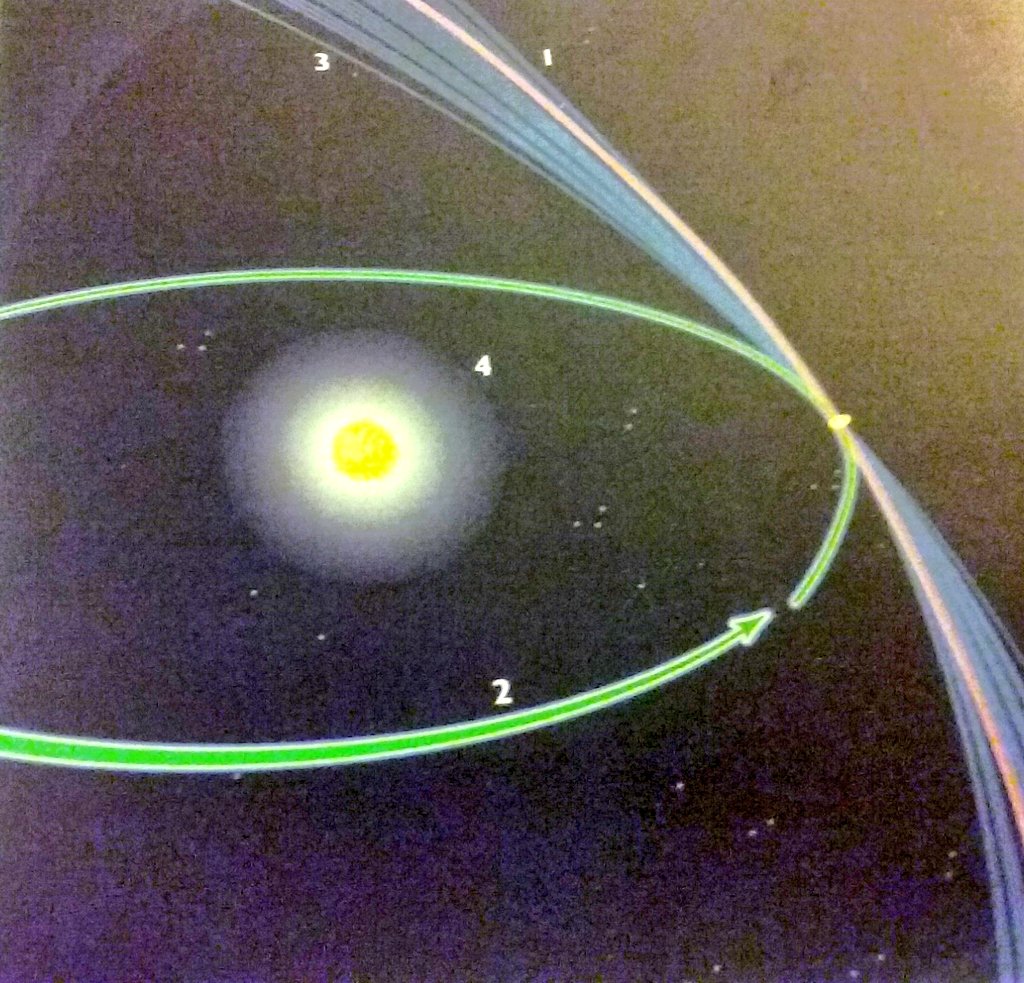 In an almost fairy-tale landscape, with a field that the body or light signal lies (tenselessly) along the World line, we are contemplating the celestial canopy. To talk of anything’s moving through space-time is to bring time into the story twice over an in an illegitimate manner. When we are talking about motion in terms of the space-time picture, we must do so in terms of the relative orientations of World lines. Thus, to say that two particles move with a uniform nonzero relative velocity is expressed by saying that they lie (tenselessly) along straight World lines which are at an angel to one another. Similarly, the recent conception of the positron as an electron moving backward in time is misleading, since nothing can move, forward or backward, in time. What is meant is that the World lines of a positron and electron, which are produced together or which annihilate one another, can be regarded as a single bent World line, and this may indeed be a very fruitful way of looking at the matter. It popular exposition of relativity, we also understand such things as our consciousness crawling up the World line of our body. If we draw a line extending to the past, this will simply be a representation of a particle which has existed a very long time. #RyanPhillippe 6 of 10
 It is not surprising that we cannot represent a time machines, since the notion of such a machine is an incoherent one. How fast would such a machine flash over a given ten-second stretch? In ten seconds or minus ten seconds? Or what? No sensible answers can be given, for the question is itself absurd. The notion also involves the contradiction, that is I get into a time machine at 12 today, then at 3pm, I shall be both at 3pm today and at, say, minus a million years Before Christ. For this to happen, the Earth must pass through part of the stream that lies on the outside of the time machine’s orbit and behind the time machine’s position, thus encountering dust that is blown away by solar-radiation pressure. Absolutely, true and mathematical time, of itself and from its own nature, flows equably without relation to anything external. Taking one second to be equivalent to 186,300 miles, which is the distance light travels in that time, any physical object, such as a man or a star, would be rather like a four-dimensional worm—its length in a timelike direction would be very much greater than its spacelike cross section. #RyanPhillippe 7 of 10
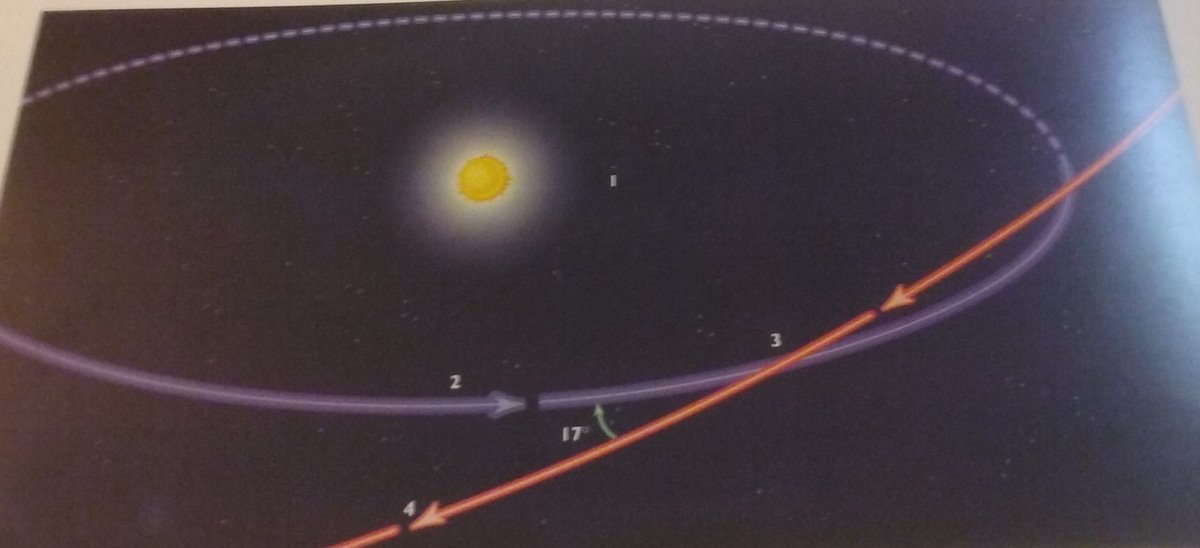 Thinking in terms of space-time, then, two stars which are in uniform velocity with respect to each other and also with respect to our frame of reference will appear to each other and also with respect to our frame of reference will appear as two straight worms, each at a small angle to the other. An observer on either star will regard himself as at rest, so he will take his own World line—the line in space-time along which his star lies—as the time axis. He will take his space axes as (in a certain sense) perpendicular to the time axis. It follows that observers on stars which move relative to one another will slice space-time into spacelike cross sections at different angles. This makes the relativity of simultaneity look very plausible and no longer paradoxical. Time travel could also be understood as simply a rotation of axes it in space-time. Henceforth, space by itself, and time by itself, are doomed to fade away into mere shadows, and only a kind of union of the two will preserve an independent reality. We must not forget that space-time is a space in the mathematical sense of the word space, not in the sense in which space is a continuant. #RyanPhillippe 8 of 10
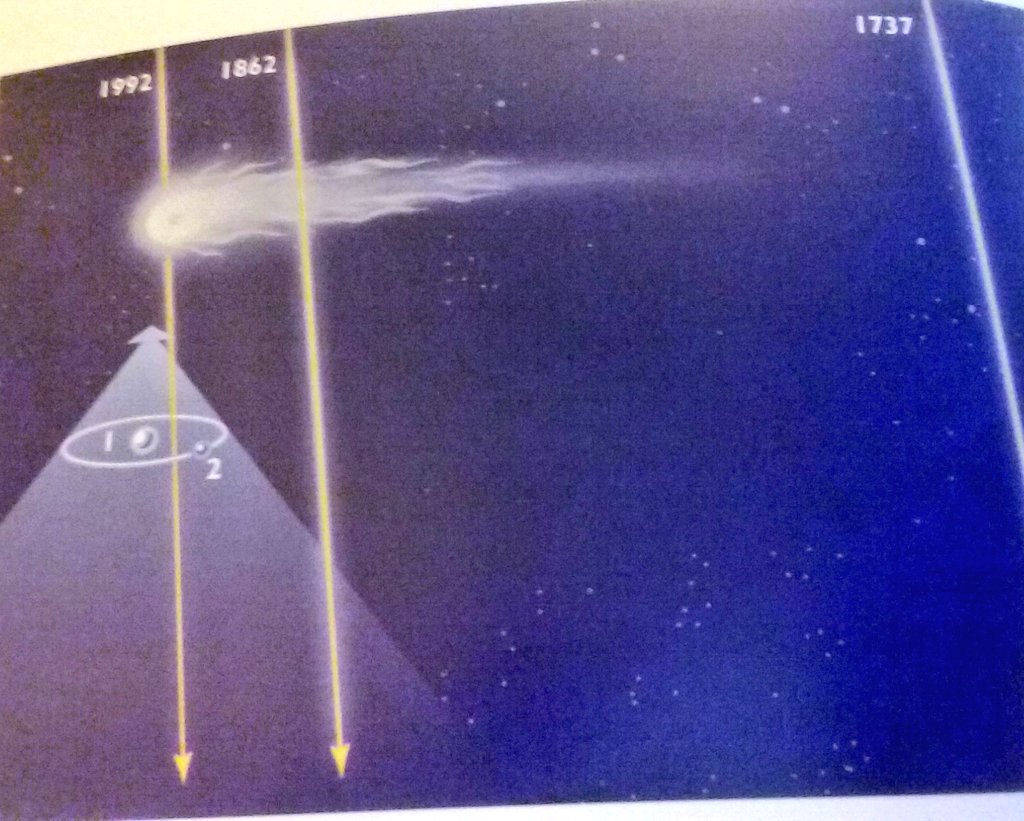 Thus, certain objectionable locutions are often used in popular expositions. For example, we sometimes hear it said that a light signal is propagated from one part of space-time to another. The correct way to put the matter is to say that the light signals lies (tenselessly) along a line between these two parts of space-time. Space-time is not a continuant and is not susceptible of change or of staying the same. The infinity of a series consists in the fact that it can never be completed. Hence, it is impossible for an infinite series of events to have passed away. The World cannot have had a beginning in time, there must have been an infinity of past events. If the World had begun at a certain time, all previous time would have been blank and there would be no reason that the World should have begun at the time it did rather than at some other time. There are always traces of the past, never the future, because it is part of the meaning of the word trace that traces are of earlier, not of later, events. The Universe will eventually return to its given state. The Universe will get more and more shuffled until we get the so-called heat death, in which everything is a featureless uniformity and will then become less and less disordered. #RyanPhillippe 9 of 10
 In the era in which, as we should put it, the Universe was getting less and less disordered, time would seem to run to us. (Thus, denizens of this era would still say that the Universe was getting more and more disordered.) Indeed, there would be an infinite sequence of cosmic eras, much as is supposed in cosmologies, except that time would seem to run in opposite ways in alternate eras. In a sufficiently large view there would be temporal symmetry in this Universe, though not on the scale of any single cosmic era. These celestial concepts and object are mysterious even now as, for the most part, they stride on stage in a completely unforeseeable way at absolutely random intervals. Observing these visitors, with orbits so long that we will never see them again in our lifetime, is a great privilege which connects us to the atavistic sensations of humanity’s first astronomers. #RyanPhillippe 10 of 10


Invisible Injuries–Prejudice of Education is the Devil

A prejudice in favor is as hard to be totally overcome as a prejudice in disfavor. Many humans find no point in limiting themselves to what justice prescribes, provided that they could be unjust successfully and human nature is certainly egotistic. However, why do we sometimes prefer to consult the interest of others rather than our own interest? What is the relationship between selfishness and benevolence? Is altruism merely a mask for self-interest? In the Medieval World the underlying assumption is that human’s self-fulfillment is discovered in the love of God and of the rest of the divine creation. Conservatism most precisely denotes a hostility to radical social change, particularly social change that is instituted by the force of the state and justified by an appeal to abstract rights or to some utopian aim. Conservatives believe that governments are limited by the nature of their instruments to maintaining peace and order: any attempt to go beyond these functions is likely to create a disproportionate amount of misery and disruption. This barren little flow of doctrine which can grow in any kind of soil, from the sandy wastes of fearful privilege to the lush richness of artistic or religious sensibility.

Life is only estimable as it is useful. Of what value is a jewel locked up in a casket, or a light burning in a dead man’s tomb? All conservatives are united in the belief that human affairs are extremely complicated and that the details of human behavior are unpredictable: this we may call the complexity thesis. The nature of man is intricate; the objects of society are of the greatest possible complexity: and therefore no simple disposition or direction of power can be suitable either to man’s nature or to the quality of his affairs. Political judgment therefore cannot be based on problems arising in the sphere of government. Conservatives regard ruling as a special kind of skill, possibly arcane and certainly not universally distributed among embers of the human race. It is learned by practice and example and therefore is likely to be most highly developed among members of a long-established ruling class. Many conservatives wish to avoid grandiose social blueprints (such as the collectivization of agriculture of the thousand-year Reich) whose operation in politics has in recent centuries produced so much misery.

The mingled, mingling threads of life are woven by warp and woof; calms crossed by storms, a storm for every calm. There is no steady unretracting progress in this life. Conservatives have accepted some version of the doctrine of original sin and view the government as being ordained by God as a remedy for human defects. Others have merely insisted on the prudential reminder that men are frail, unstable, and unpredictable. Most have agreed that virtue, stability, and civilization depend on the continuity of long-established institutions. Political stability is founded on state, church, and family, while moral stability rests upon a strong sense of duty, preferably buttressed by religious belief. The nature of man emphasizes either their enduring sinfulness or their frailty. What is the root cause of political and social problems? Conservatives will point immediately to the nature of an, while liberals and socialists will point to man’s environment. First, let us consider the claim that something must “conserve” objects in being from moment to moment, since they have no power in themselves to do so. In contrast, it might me that objects and organisms are being tacitly understood as derivative and dependent in a more radical and philosophical way.

Life is full of care and anxieties; man has occasion for, and a right to make use of, many expedients to make it pass on with tolerable ease. Liberals tend to be dependent upon the player’s continuing to blow, as a shadow or projected film is dependent upon the continuance of light supply. However, we have no reason to believe that all existents are like this, that they are dependent for their very being upon continual behind-the-scenes activity. Changes in the environment may produce changes of the state in the entities within it; but even dramatic changes of state—for example, the death of an organism—are not identical with absolute loss of being. Therefore, there must be at least as much reality in the cause as in its effect; it is impossible that things wholly void of knowledge should be produce a knowing being. Where is the proof that nothing can have caused a mind except another mind? From what experience can we know what can produce what—what causes are adequate to what effect? No cause can give rise to products of a more precious or elevated kind than themselves. Therefore, liberals and conservatives may be dominant, or both may play an equally important role.

This World hath a secret deeper than beauty, and Life some burdens heavier than death. Unless a person is judged personally responsible for some act or outcome, one would not normally be thought to deserve blame, praise, reward, punishment, and so on. Personal responsibility is generally regarded as a necessary condition of the justice of person’s in receiving what one deserves. Persons are normally judged morally responsible for their actions. However, they may be judged responsible for almost anything—events, processes, their own psychological characteristics. Thus, a person may be judged morally responsible for ones firm’s loss of a contract, the Napoleonic wars, ones bad temper, a technique for maintaining the fertility of land, or his friend’s divorce. Under what conditions is a person responsible for one of one’s act or for some other occurrence? A person is regarded as morally responsible for some act or occurrence x if and only if one is believed to have done x, or to have brought x about; and to have gone it or brought it about freely. The concept of freedom is essential to more responsibility and will reflect one’s moral convictions, and especially one’s views about justice.

A just conception of life is too large a thing to grasp during the short interval of passing. Actions are compulsory when the cause is in the external circumstances and the agent contributes nothing and is therefore not free in the sense relevant to responsibility. The nature of free choice, the nature of human power and ability, the relevance of necessity to freedom, the role of choice, and many other issues are actually crystallized in faith in freedom of choice. However, if then all events, including any person’s decision and actions, are fully determined by circumstances which are ultimately beyond that person’s control. If this is so, then that person could not have decided or acted differently. Hence, the person was not free. Human decisions and actions are among those events which are not fully determined, those and actions occur by pure chance. However, what occurs by pure chance is not within a person’s control. Therefore, to the extent that decision and action are not determined, the person is unfree. A person is morally responsible for an action or occurrence only if one is free in that respect. Nothing is more common than to call our own condition the condition of life.

Intellectual Powers of Man and The Bank of the Universe —I Already Told you about my Pasta
 Perhaps there is no time in which the ingenuity of man is more active than in those moments when he has a sensitive consciousness of being wrong, and consequently, a feverish desire to vindicate his works or acts to himself, as well to others. Even if the traditional theory is wrong, something like introspection often takes place, it is a common, everyday phenomenon to think about one’s experiences at the time they are occurring. For example, a person looking at a painting may wonder whether he is enjoying his experience or whether he is enjoying it more than some previous experience. The main difficulty with the traditional theory was its attempt to categorize the process of self-reflection as a form of sense perception or of direct awareness. If I should seem now and then to trifle upon the road—or should sometimes put on a fool’s cap (a conical hat for slow or lazy students) with a bell on it, for a moment or two as we pass along—do not fly off (get very angry)—but rather courteously give me credit for a little more wisdom than appears from my outside—and as we jog on (by extension, to make progress slowly, deliberately, or patiently), either laugh with me, or at me, or in short do anything—only keep your temper. #RyanPhillippe 1 of 11
 Introspection can yield erroneous beliefs about one’s own mental states has been asserted on many occasions in the history of philosophy. It makes no sense to say about other people that they doubt whether I am in pain; but not to say it about myself. It general, it is possible that the concepts used in the description of a mental state are not possessed by the individual who is in that state. In such a case, the individual could not possess self-knowledge. It would seem, then, that the standard account of introspection presupposes that the mind is a nonphysical entity capable of having quasi-sensory experiences. Retrospection is not sufficient for knowledge of past states, for we can retrospect only what we have been previously conscious of. If a person is justified in asserting that he is in pain only if he has introspected his experience of being in pain, what justifies him in asserting that he has introspected the experience? It is a distinguishing characteristic of first-person-experience statements that it is simply their being true, and not the observation that they are true, or the possession of evidence that they are true, that entitles one to assert them. #RyanPhillippe 2 of 11
 For a while, I realized that in labeling my assignments, I kept forgetting the number five. I would look back on my documents over the course of several week and noticed I forget the number five. The files would go from one to four, then six, and so on. So it seems I was robbed by an unknown psychic force of the control over the proper numeric system belonging to my memory; it is the same force which in other cases may bring about the same failure of memory during perfect health and mental capacity. When I analyzed those cases of forgetting the number five and withheld shows some relation to a theme which concerns my own person, and is apt to provoke in me strong and often painful emotions. The number withheld has touched a personal complex it me. The relation of the number to my person is an unexpected one, and the number five is associated with traumatic experiences. Like falling asleep in the closet at age give and getting a terrible spanking because everyone thought I was missing. Five years ago was the Earthquake in Japan. And most recently, a nightmare of being on the fifth floor of the World trade center and hearing planes circle the building, before rushing out and witnessing one actually crash into the building. And also, it has been five years that I have been in this situation where practically every day and every relationship seems the same and I cannot figure out what to do differently to get a different experience. #RyanPhillippe 3 of 11
 Overwhelming experiences affect our innermost sensations and our relations to our physical reality—the core of who we are. Trauma is not just an event that took place sometimes in the past; it is also the imprint left by that experience on mind, brain, and body. This imprint has ongoing consequences for how the human organism manages to survive in the present. Trauma results in a fundamental reorganization of the way mind and brain manage perceptions. It changes not only how we think and what we think about, but also our very capacity to think. For real healing to take place, the body is required to lean that the danger has passed and to live in the reality of the present. Our search to understand trauma has led us to think differently not only about the structure of the mind but also about the process by which it heals. I cannot tell you have to be happy, I can only assist you in understanding what may be going on. I could tell you something that I think would make you happy and it could result in an adverse reaction. When I have seen a person strutting in a procession, after others whose was only to walk before one (defeat easily), I have conceived a higher notion of one’s dignity than I have felt on seeing one in a common situation. #RyanPhillippe 4 of 11
 No person can know what perception is unless one has observed a case of perception, and one’s own perceptions are the only ones one can observe. This theory is merely a special case of a fundamental psychological principle of traditional empiricism, which states that all ideas are abstracted from or compounded out of what is observed. Now the problem of how people do get ideas or concepts is very much up in the air and certainly cannot be solved with a great deal of psychological investigation. However, if introspection is best characterized not as inner sense or direct observation but as thinking and judging about one’s mental states, then it cannot be an original source of concepts. For thinking is an activity in which a person is already exercising the concepts one possesses; one cannot think about anything unless one already has an idea of it. A person cannot have the concept of certain mental states unless one has been in those states, that, for example, a person cannot know what pain is unless one has been in pain. Moreover, consciousness has or is an external relation in the sense that the object, when the subject is conscious of it, is what it would be if the subject were not conscious of it. #RyanPhillippe 5 of 11
 The mind is a nonphysical entity capable of having quasi-sensory experiences. It is in connection with elucidating the meaning of this statement that philosophical problems arise—problem which are of particular interest because we cannot understand such an expression without committing ourselves, in some degree, to some particular conceptual schematism by means of which we can set out the empirical facts about human nature. There are alternative and rival conceptual possibilities is a fact which the history of philosophy testifies. It seem possible for a person to believe that one does not know whether, for example, a certain geometrical theorem is true and then for one to remember having proved it true. In the medieval World the underlying assumption is that man’s self-fulfillment is discovered in the love of God and of the rest of the divine creation. To explain is to reslove a complex whole into its individual parts and to show how the individual parts must be combined in order to reconstruct the whole. To explain the complex whole of social life is, therefore, to resolve it into its component parts, individual men, and to show how individuals must combine if social life is to be reconstructed. I owe to others what I owe to myself. However, it seems that human nature is essentially individual, nonsocial, competitive, and aggressive. This is displayed by your use of “iPhones,” “Selfies,” preference to communicate online, but ignore people trying to get your attention in person. #RyanPhillippe 6 of 11
 The behavior and these devices sound very selfish. Also, may are more concerned about doing better than the next person and seeing how much they can get out of someone, instead of doing their best and helping those in need. However, you will notice that when someone is doing well or beginning to achieve success or popularity, they are proud to support that individual. For instance, in 2007, when Britney Spears was at a low point in her life, she reached out to Justin Timberlake for help, but he ignored her because he did not want to hurt is career. In contrast, the city of Sacramento spent $8 million on a giant gummy bear statue, by Jeff Koons, and feels lucky to have it because it art is rare, but school districts in the city of Sacramento, California USA cannot even afford to pay teachers, they are facing a deficit of over $6 million dollars, and it might have been better to donate money to the school districts. Also, if someone reached out to you and supported you, but you were not there for them in their time of need, when they are through their struggles do you think that they will still be waiting for you? There is a savor of life and immortality in substantial fare. Like balloons, we are nothing till filled. #RyanPhillippe 7 of 11
 Virtue does not consist of selfish pursuit of pleasure nor in the utility of human actions. Rather, virtue is disinterested benevolence or affection; it is the intrinsic beauty of the dispositions of a person’s heart. An action is good not because it is advantageous to ourselves or to others, but solely because it springs from a beautiful disposition of will. Virtue is a spiritual beauty or excellence that commends itself to us for its own sake. Any other motive for acting is based on self-love and consequently does not measure up to virtue. However, human nature, owing to original sin, is totally depraved and given over to self-love. Only by the election of God and the gift of efficacious grace can man rise above his “dreadful condition” and perform truly virtuous actions. Without supernatural assistance seemingly disinterested affections, such as the natural love of parents for their children, are accompanied by self-love and hence are not truly virtuous. At most they are secondary virtues or the shadows of virtues. #RyanPhillippe 8 of 11
 God reveled himself in the Bible and also in the visible Universe and the souls of men, which are made in the image of God. In order to interpret correctly the symbols of God in the created World, the mind has to be purified by a divine illumination. There is no more sublime or delightful activity than to discover and to contemplate the traces of God in nature. All passions originate in love and are for its sake. Love is the excellence of beauty of minds. Understanding is the faculty by which the soul perceives, speculates, and judges. Without senses there can be no further mental operation. The mind needs his sense in order to form all of its ideas. Concerning human understanding, I derive more enjoyment than the greedy miser finds, when gathering up handfuls of silver and gold, from newly discovered treasure. The fine arts, sciences, and philosophy ideally have no status separate from theology; as they become more perfect they issue in divinity, and coincide with it, and appear to be parts of it. The spiritual World alone is real, the visible Universe is but its shadow, created to lead the mind, under divine illumination, to an awareness of the presence of God. The objects of the senses are not real qualities of bodies but impressions and ideas given to us by God. Minds alone are, properly speaking, beings or realities; bodies are only shadows of being. #RyanPhillippe 9 of 11
 Goodness and beauty belong to anything in proportion to its intensity of being. Hence, minds alone are really good and beautiful; the visible World has but a shadow of these perfections. Its value is to lead the mind to the enjoyment of spiritual and divine goodness and beauty. As the intellect passively receives impressions and ideas from God, so the will is inclined to agreeable objects and repelled by disagreeable objects. The will is no a self-determining power; its actions are determined by causes. God alone is free in the sense that one can determine one’s own volitions. Everything that happens has a cause the human will does everything it needs to create it. If, then, self-interest would lead some to disobey the rules of justice and if many have no natural regard for the public interest, how do the rules of justice come into existence, and what fosters our respect for them? The crucial fact is that did we not have respect for the rules of justice, there would be no stability of property. Indeed, the institution of property could not and would not exist. #RyanPhillippe 10 of 11
 The most interesting thing in the World is to find out how the next man gets his vittles. Never speak to a white man till he is fed. Now, the existence of property and stability is to all our interest, and we are always conscious of how much we are injured by others failing to obey the rules. So we have become conscious that although some people’s immediate and short-term benefit rests in breaking the rules on a given occasion, our long-term benefit resides in insisting upon a universal observance of the rules. The solution is to say that God has so contrived the afterlife that only if we obey the fundamental moral rule will we in the long run, that is, the eternal run, secure our own happiness. God has arranged that all the happiness people either have enjoyed or will enjoy is deposited in “The Bank of the Universe.” By working to increase happiness of others, I also increase my own happiness, for God has arranged to divide this stock of happiness into equal share, to be allotted one to a person, and so by increasing the size of the general stock, I also increase my own share. I am, as it were, a shareholder in the cosmic bank of which God is at once chairman and the managing director. #RyanPhillippe 11 of 11

Errors in Memory and Thought and a Bias
 Feelings of anger, shame, pride, and fear are all described in terms of body temperature. Many common descriptions of our inner states are in terms of the behavior they dispose us to display: “I could have jumped over the moon,” “I could have bitten off my tongue,” “You could have knocked me down with a feather,” “I was ready to give up.” All these ways of talking fit the suggested account of inner states. A somewhat parallel claim in made concerning inner awareness of mental states which are not sensations. For awareness of mental states which are not sensations. It becomes the compulsion of custom and tradition and finally the law. However, the commandment concealed behind taboo prohibitions which differ materially according to place and time, had originally the meaning: Beware of the wrath of demons. Primitive races believe in demonic powers, and has remained in power simply because it was one by virtue of a kind of a psychic persistence and in this manner it became the root of their customs and laws. However, neither fear nor demons can be accepted in psychology as finalities defying any further deduction. It would be different if demons really existed; but we know that, like gods, they are only the product of the psychic powers of man; they have been created from and out of something. #RandolphHarris 1 of 7
 Genetically, the asocial nature of the neurosis springs from its original tendency to flee from a dissatisfying reality to a more pleasurable World of phantasy. Neurosis is a relatively mild mental illness that is not caused by organic disease, involving symptoms of stress (depression anxiety, obsessive behavior, hypochondria) but not a radical loss of touch with reality. This real World which neurotics shun is dominated by the society of human beings and by the institutions created by them; the estrangement from reality is at the same time a with draw from human companionship. However, the greater social differentiation of these people suffering from neurosis manifests itself in the fact that they exercise an especially effective intense sense and the understanding turns inwards upon itself, reflects on its own operations, and makes them the object of their own contemplation. They begin where the most primitive and at the same time the most enduring human impulses have their origin, namely in the fear of the effect of demonic powers. #RandolphHarris 2 of 7
 The triumphant progress in the twenty-first century has almost completely eliminated vitalist notions and supernatural views of life. The rise of cybernetics (the abstract theory of machines) and its applications in computing machinery and objects which simulate some of the performances of living things are beginning to threaten the idea of a special status for mental activity. The gathering and interpretation of information, the employment of stored information, successful and spectacular problem solving, even analogues of fatigue, overload, and confusion, hitherto all monopolies of the animate, are now displayed by organizations of matter whose operations can be explained in terms of physical properties alone. And on the other hand, experimental study of the nervous systems of animals and men is showing, in ever increasing detail, how artificially induced changes in the electrochemical state of the nervous system issue in changes in the subject’s “mental” activity. Displays of emotion, performance in perception and recall, and anxiety and tension are being tied down to brain function in this way. #RandolphHarris 3 of 7
 Furthermore, many psychologists of this century have become disheartened by the difficulties of investigating hypothetical mental states and have turned to the study of behavior, relying on publicly observable and physical phenomena in their analyses and explanation of human activities. Indeed, there have been three distinct movements of a materialistic stamp in recent philosophizing about minds. Those meaningful statements about minds which do not deal with hypothetical constructs must refer to such physical properties and entities, even though we cannot yet give their physical translation. Paranormal phenomena are a serious embarrassment to materialism. At some times some people have access to information in ways not explicable within current scientific theory. The quantity of this dangerous property is also taken into consideration. Some persons of things have more of it than others and the danger is precisely in accordance with the charge. The most peculiar part of it is that anyone who has violated such a prohibition assumes the nature of the forbidden object as if he has absorbed the whole dangerous charge. #RandolphHarris 4 of 7
 This concept and the system corresponding to it express a fragment of psychic life which is really not comprehensible to us. And indeed it would seem that no understanding of it could be possible without entering into the study of the beliefs in spirits and demons. Every psychological problem is well worth the effort of investigation for its own sake, but for other reasons as well. A fortiori, these phenomena are not explicable within physics alone. It is not merely that the faculties dubbed telepathy, or clairvoyance cannot yet be accommodated but that they seem to be positively excluded by our present understanding of the physical World. The same can be said of the very striking but less well controlled feats of trance mediums. Although paranormal phenomena cannot be discounted, the spiritual constructions commonly put on them are altogether too hasty. Some revisions of scientific theory will be necessary, but it is not at all clear that we must credit the paranormally gifted with extraordinary souls capable of magic performance which explains this or that striking event. #RandolphHarris 5 of 7
 It is possible that the paranormal phenomena is indicative of some property of the fundamental physical particles undetected or even undetectable in studies of simpler systems than the human being. However, to admit that paranormal capacities cannot be predicted to arise from concatenation of physical particles is not to admit that ghosts come into play at a certain level of complexity. For instance, even before we could explain the macroscopic phenomena of ferromagnetism as arising from juxtaposition of molecular magnetism was at work. The suggestion that resonances among complex systems could explain extrasensory perception. It is plausible in the cases of information passing from mind to mind without an intermediary. However, clairvoyant success and trance medium reports of the dead involve action at a distance without medium in both temporal directions. There is something in common to the various mental states, there is an element of consciousness where most everyone can tell the sensation of blue differs from green. We have then in every sensation two distinct terms, consciousness, in respect of which all sensation are alike; and come thing else [the object], in respect of which one sensation differs from another. #RanolphHarris 6 of 7
 There is no reason to think that these emergent capacities of complex systems will ever be predictable from knowledge of their physical elements. This does not mean that they are not physical emergences or that we could never learn that they were. To deviate into science fiction, we could reasonably claim to know that they were merely physical emergences if it were possible to assemble an electronic machine which demonstrated paranormal powers or to synthesize an organism which grew into something which could demonstrate them. Until then, materialism remains unproven. What promised to be a supernatural manifestation was thus easily explained on a normal basis, but there are still something that seem to be quite usual, and it is impossible to exclude the mysterious. To the category of the wonderful and uncanny, we may also add that strange feeling we perceive in certain moments and situations when it seems as if we had already had exactly the same experience, or hard previously found ourselves in the same situation. Yet we are never successful in our efforts to recall clearly those former experiences and situation. #RanolphHarris 7 of 7

The Case of White Trash: Some Notes on Conscience and Desperate Actors Hungry for Money and Fame
 The black BMW took a final turn on the road to Castel Gandolfo and began threading its way toward the back door of the papal villa. The car approached the unmarked gate, where the Vatican’s security contingent was waiting to escort it. We recalled the tense days, when archaeological sites had been bulldozed, and the remains of Roman Knights and gods and goddesses had been uncovered. Cardinal Szoka, finally out of the hospital and back at his residence at the Governatorato, took the news more philosophically. He had a feeling the battle had been lost when the papers started writing about the archaeological discoveries of graves and tombs dating back over 2,000 years had been discovered where they wanted to put a new parking lot with 155 parking spaces. Now the convergence of views had been articulated from on high, and Cardinal Szoka would not fight it; the cemetery would be preserved. As always he consoled himself with the bottom line: 155 parking space been added below the Vatican landscape. There was bitterness at seeing the early destruction and the satisfaction when learned the site would be preserved. #RyanPhillippe 1 of 10
 After about four of five months, the team decided to stop digging. They were painfully aware that the more they exhumed, the more context they destroyed. There were certainly earlier tombs beneath the exposed layer of the of hill, but to unearth it all would defeat the purpose of preservation, so they stopped. For the next three years they cleaned and restored the site, documented all the finds and published articles. Crumbling mosaics were removed to the Vatican Museums’ restoration facilities and reassembled, tessera by tessera, then returned to their tombs. Microclimate technology was put in place to keep the area at the proper humidity and temperature. Overseeing the placement of the metal walkways, one of the last tasks to make the place visitor-friendly. To secure the structure they had to sink anchors in the ground, and the first sounding had struck something unusual. Di Blasi watched as a flat terra cotta tile was exposed, the kind that often covered a tomb. This one was about three feet by three feet. #RyanPhillippe 2 of 10
 The archaeologist worked all morning to dig it out, and by the afternoon were ready to lift the cover and see what lay beneath. Di Blasi called Mr. Spinola over to watch. As the tile was gently removed, they saw that the cavity below it was still preserved. Inside lay the skeleton of a year-old child, the tiny legs bent, the rib cage seemingly as fragile as a bird’s. The child had been buried with two ceramic cups, which lay to the side. Di Blasi noticed something else. He leaned over and dusted away the Earth at the end of the right arm. It was an egg, a goose egg, perhaps. Was it used as a toy? A rattle? No, the hollow eggshell was undecorated and unperforated. Its function, Di Blasi concluded, was allegorical. The parents had buried their baby holding a symbol of rebirth. Nearly two thousand years later, the archaeologist had brought the child’s story back to life. The heart must appear in the book too, as well as learning. For though it is full of things I do not understand, every now and then there is something I do understand: that seems as if that heart spoke out to all the World. #RyanPhillippe 3 of 10
 When bread and conscience are weighed against each other in time of calamity, it is not to be wondered at that former will preponderate. When one has been conditioned to respond in certain standard ways which are widely and strongly approved, one tends to find that one can break with such approved behavioral norms only after a genuine struggles and a stiff volitional conflict. In any case, whether we speak of the voice of conscience or of the voice of our group or of learned blockage and interference patterns, we often find that there are inhibitions to be overcome before we can break with the mores of our peers. It has been suggested that a policeman, upholding the law, functions as a kind of government-supported externalized conscience. His mere presence in uniform suffices to warn us not to break, for example, the speed law that some may already be bending a bit. Even animals below the human level can be trained to feel the force of such externalized conscience. Cats, for instance, can be trained not to sleep on the couch when humans are in the room. However, it is difficult, to say the least, to teach them not to do so when no human observer is present to their sense. #RyanPhillippe 4 of 10
 With human children and adults, by contrasts, it is possible to develop an internalized conscience, which, even in the absence of all enforcers, will remind them, and even stimulate them strongly, not to do certain prohibited actions and to do certain required ones. The driver who stops his car at red traffic lights only when he sees or suspects that an officer I nearby has, like the cat, only an externalized conscience about this type of act, whereas one who habitually stops is, as we say, acting conscientiously—obeying, perhaps unconsciously, his internalized conscience. That “the voice of conscience” is often effective seems clear, but it is also clear that it can and often does lose its effectiveness. A dutiful son may well adopt many of the mores of his father for a time and then gradually abandon them. If a person persists in violating his conscience, it will grow decrepit, bother him less and less effectively, and it may soon cease to deter him at all. #RyanPhillippe 5 of 10
 As children many of us were taught that the voice of conscience is the voice of God and, hence, completely reliable. Some would claim, in more sophisticated terms, that although God gave us free will and does not infringe upon our freedom of choice, he nevertheless continues to lend us moral support. He gives us, through conscience, a means for distinguishing right from wrong. If we follow the guidance of conscience, we shall do our duty and act rightly. If we act contrary to its deliverances, we shall surely act wrong. There are, however, many difficulties with this kind of account and, indeed, with any other which claims that conscience is a sufficient guide to moral conduct. First, the consciences of different people, whether members of the same or different societies, often differ radically. Conscientious objectors to war and volunteers for wartime service usually disagree strongly as to the rightness of war. Cannibals do not share the conscientious objection to eating human flesh that vegetarians do, and both these groups differ from those who feel it is morally permissible to eat animal but not human flesh. #RyanPhillippe 6 of 10
 Second, there seems to be exceptions to all the edicts of conscience. Even within groups whose members share, say, a conscientious prescription against deliberately taking a human life, the exceptions that the various consciences allow to individuals vary greatly from one person to another. Some Quakers would insist that his conscience forbids the taking of a human life under any conditions. By contrast, although many of us verbally would fully accept the commandment not to kill, we would be likely in practice to find ourselves approving some acts of killing, for example in self-defense or in defense of others, and disapproving of some avoidances of the killing, for example in a very deserving mercy case. Thou shalt not kill, and we felt nothing but repugnance at the very idea. However, we need to view this problem psychoanalytically. The analysis of dreams of normal individuals has shown that our own temptation to kill others is stronger and more frequent than we had suspected and that it produces psychic effects even where it does not reveal itself to our consciousness. #RyanPhillippe 7 of 10
 And when we have learnt that the obsessive rules of certain neurotics are nothing but measures of self-reassurance and self-punishment erected against the reinforced impulse to commit murder, we can return with a fresh appreciation to our previous hypothesis that every prohibition must conceal desire. We can then assume that this desire to murder actually exists and that the taboo as well as the moral prohibition are psychologically by no means superfluous but are, on the contrary, explained and justified through our ambivalent attitude towards the impulse to slay. The psychic process in the unconscious are not entirely identical with those known to us from our conscious psychic life, but have the benefit of certain notable liberties of which the latter are deprived. An unconscious impulse need not have originated where we find it expressed; it can spring from an entirely different place and may originally have referred to others persons and relations, but through the mechanism of displacement, it reaches the point where it comes to our notice. #RyanPhillippe 8 of 10
 Thanks to the indestructibility of unconscious process and their inaccessibility to correction, the impulse may be saved over from earlier times to which it was adapted to later periods and conditions in which its manifestations must necessarily seem foreign. These are all only hints, but a careful elaboration of them would show how important they may become for the understanding of the development of civilization. Psychoanalytic investigation shows that this nobility is not primary. Originally, that is to say a fear of punishment for the violation of a taboos, usually is believed to be a serious disease or death in primitive cultures. This punishment threatens only him who has been guilty of the violation. However, the threat of punishment pertained to one’s own person, in every case the fear was for one’s own life, the fear of death beings only later displaced upon a beloved person. This process is somewhat complicated but we have a complete grasp of it. An evil impulse—a death wish—towards the beloved person is always at the basis of the formation of a prohibition. #RyanPhillippe 9 of 10
 This is repressed through a prohibition, and the prohibition is connected with a certain act which by displacement usually substitutes the hostile for the beloved person, and the execution of this act is threatened with the penalty of death. However, the process goes further and the original wish for the death of the beloved others person is then replaced by fear for his death. So it becomes better to project the death wish on to someone else, and sacrifice him and ruin his life and torture him to save one’s own life and career. To make this sacrifice palatable to society and get others to participate he used the media, for no less than a decade, to make up horrible stories and spread lies about the target so others people would hurt him and not care about his life or human rights. In a society that is driven by vengeance and pack mentality, it is easy to make people hate an innocent person that have never met, which makes the termination of the targets life seem justified because you hear so many bad stories and want to exact revenge because you believe that wild stories and rumors to be true. So basically, Ryan Phillippe is a desperate actor willing to do anything for money and is garbage without Reese Witherspoon. The fake Reese Witherspoon, Paulina Slagther, is a nice touch, loser! Good-bye white trash, I hope you and Paulina end up in prison for your involvement in a criminal conspiracy. #RyanPhillippe 10 of 10

De Mortuis Nil Nisi Bonum
 It is humans who can make a great way that can make them great. Doubtless from the earliest times in which groups established social customs, or mores, and enforced them, members of such groups who were tempted to violate these mores could almost feel the disapproval of their fellows and hear in their own minds protesting outcry, perhaps some primitive equivalent of “No!” or “Do not!” In the early eighteenth century such inner voices or feelings were described as edicts of one’s moral sense or of one’s conscience. The psychic impulses of the Victorian era possessed a higher degree of ambivalence than is found at present among most modern human beings. With the decline of this ambivalence the taboo, as the compromises system of the ambivalent conflict slowly disappeared. Neurotics who are compelled to reproduce this conflict, together with the taboo resulting from it, may be said to have brought with them an atavistic remnant in the form of an archaic constitution the compensation which in the interest of cultural demands entails the most prodigious psychic effects on their part. #RyanPhillippe 1 of 7
 And let us not forget that beginning at the sage of system formation there are two origins for every act judged by the consciousness, namely the systematic, and the real but unconscious origin. At this point, we may recall the confusing information about the double meaning of the word taboo, namely, holy and unclean among the influences which myth everywhere ascribes to demons the evil ones preponderate, so that according to the religious of races evil demon are evidently older than good demons. Now it is quite possible that the whole conception of demons was derived from the extremely important relation to the dead. In the further course of human development, the ambivalence inherent in this relation then manifested itself by allowing two altogether contrary psychic formations to issue from the same root, namely, the fear of demons and of ghosts, and the reverence for ancestors. In the psychoanalysis of neurotic persons who suffer, or have suffered, in their childhood from the fear of ghost, it is often not difficult to expose these ghosts as the parents. Nothing testifies so much to the influence of mourning on the origin of belief in demons as the fact that demons were always taken to be the spirits of persons no long dead. #RyanPhillippe 2 of 7
 Mourning has a very distinct psychic task to perform, namely, to detach the memories and expectations of the survivors from the dead. When this work is accomplished the grief, and wit it remorse and reproach, lessens, and therefore also the fear of the demon. However, the very spirits which at first were feared as demons now serve a friendlier purpose; they are revered as ancestors and appealed to for him in times of distress. In a small office, Giandomenico Spinola sat in front of a computer screen looking at the latest phot documentations from the Vatican Museums dig. The sarcophagi were stunning, but even more unusual were the photos of a hillside area dotted with tubuli, the liberations cylinders leading down to unexcavated graves. These graves dated back to 30 AD, and the more work proceeded, in fact, the stronger the argument grew for leaving this portion of the cemetery unexcavated. Archaeology is itself a form of destruction and Mr. Spinola realized nothing like this had every survived anywhere else in the World. He winced when he imagined the bulldozers cleaning it out. #RyanPhillippe 3 of 7
 On hundreds of occasions in his career, Mr. Spinola could have walked off with precious antique objects from the cultural and civilizations of the spat, but that, of course was unthinkable for a professional. Only once has he succumbed to the temptation. While working alone at a site on Rome’s Caelian Hill, next to an ancient Roman cistern, he found an exquisite gold ring with a sapphire. He reported the find to his superiors and said he would deliver it early the next week; in the meantime, he let his girlfriend where it for four days. Late one night, armed with flashlights, he and three other students lifted a manhole cover in the middle of a residential street and reached the ancient domus through the city’s drainage system. They marveled at the frescoes, took photographs and reemerged from the manhole to find themselves surrounded by dozens of machine gun-wielding police. Mr. Spinola and his friends were let go with a warning, but kept their photos. If there was a lesson learned, it was that archaeology sometimes means taking risks. In the picture the sarcophagus of Publius Cesilius Victorinus, the young Roman night, and shrines to their gods and goddesses. #RyanPhillippe 4 of 7
 Moreover, the coffin lid had an inscription that began D.M. for “Dis Manibus,” that standard dedication phrase to the gods of the underworld. That clearly indicated a pagan tomb, like the others in the same burial chamber, which, after all, had a floor mosaic of an intoxicated Dionysius. And yet, what is? What is the woman did represent a Christian, and what if the bird in the tree behind her represented the soul? And what is the scrolls held by the male figure opposite, seemingly a philosopher, were not symbols of ancient learning but of Scripture? What is the leaping dolphins on the sarcophagus lid evolved not the pagan voyage of the dead but the soul’s emergence from the mortal life? The projection of unconscious hostility upon demons in the taboo of the dead is only a single example from a whole series of processes to which we must grant the greatest influence in the formation of primitive psychic life. The mechanism of projection is used to settle an emotional conflict; people project their own evil impulses upon demons and that is what has become part of the World system (“Weltanschauung”). #RyanPhillippw 5 of 7
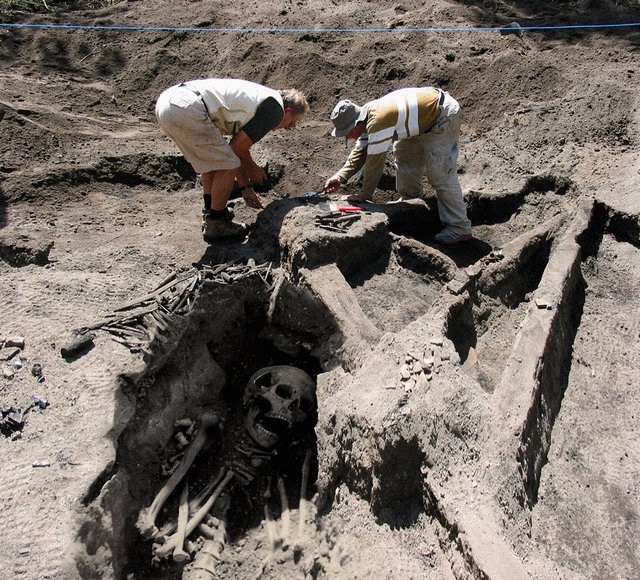 The fourth-century Constantinian basilica had held scores of tombs of bishops, cardinals, popes, and saints, and inevitably some of their bones were scattered or misplace. Five centuries later that is what people remember. Pope John Paul was shown pictures of the recent discover: a sculpted baby’s head, a family tomb with mythological stucco designs, an epigraph written by a widow to her dead husband. Then, the most interesting find, the figure of a praying woman. It was the tomb of a young man, he was told, and it appeared to be Christian. It is possible that this young man was an early Christian, and that this tomb’s ambiguous iconography reflected a transitional stage in Rome—a time when pagan symbols were being repurposed to reflect Christian doctrine. This kind of account of these restraining influences became explicit with the development of faculty psychology, which involved the view that there are different faculties of the human mind responsible for different capacities or abilities which the mind seems to exhibit. Reason was thought of as the rational faculty, emotion as a passional one, and volition as a faculty that enables us to reach decisions and make choices. #RyanPhillippe 6 of 7
 The moral faculty was thought by some to operate through feelings. For instance, a feeling of repugnance would tend to be aroused by the thought of doing anything immoral—anything in violation of the mores—and a feeling of approval by the thought of acting virtuously. Conscience is the inner perception of objections to definite wish impulses that exist in us; but the emphasis is put upon the fact that his rejection does not have to depend on anything else, that it is sure of itself. This becomes even plainer in the case of a guilty conscience, where we become aware of the inner condemnation of such acts which realized some of our definite wish impulses. People held popes responsible for what was built and what was destroyed under their pontificates. Even today, for example, Pope Julius II is remembered at the Vatican as the pontiff who demolished the original Saint Peter’s Basilica. When he authorized the construction of the new church, Julius allowed his architects to simply tear down the old one. There were metal walkways arching over hillside tombs, excavated crypts and uneven mosaic floors. #RyanPhillippe 7 of 7


Money, Power, Respect are the Key to Life—It is First Surrender that Decides
 Suffering can, and does, develop the latent evil that there is in humanity, as well as the latent good. A stoic would probably resist the extension of the concept of power to cover the mere infliction of suffering. By not caring about physical pain or external conditions, he might say, one can remove oneself from the power of another human. A true Christian is free because no outer things can touch one at any significant point. It would seem that what characterize a power situation of this kind is not just the ability to make someone suffer, which after all a dentist possesses, but rather to do him harm—that is, to attack his interest. Thus, by revising the notion of a man’s interest, and therefore the notion of harm, the stoic of the Christian can deny the reality of one man’s power over another, since nothing that another man can do to me can affect my real interest; I am always free, if once I see what those interest are. This little argument is a little odd, because the concept of power generally implies a restriction on choice; however, according to the stoic or Christian view, one can always choose to make the restriction insignificant, and therefore one can choose whether to be in the power of another. #RyanPhillippe 1 of 8
 I have had enough of someone else’s propaganda, I am for truth, no matter who tells it. I am for justice, no matter who it is for or against. I am a human being first and foremost, and as such I am for whoever and whatever benefits humanity as a whole. Power is the perception of what passes in one’s own mind, and in that case, there could not be any real restriction, and all power would be illusory. However, then, what would power be like if it were real? However, it has been demonstrated that whether one man has power over another depends not merely on what he can do to the other, but also the importance to be attached to his action and on whether the subject can reasonably be expected to disregard it. One would not say that X was in Y’s power if one thought that what Y could do to X was trivial—Something that X could or should readily ignore. It takes no one to stir up the sociological nitroglycerine mixed with an absorbent material that stems from the unemployment, bad housing, and inferior education already in the city. This explosively criminal condition has existed for so long, it requires no fuse; it fuses itself; it spontaneously combusts from within itself. #RyanPhillippe 2 of 8
 Again, although threats of real harm are an exercise of power, bribes or promises of reward are not, unless some special feature of character or situation males them irresistible—that is, unless no one so placed could reasonably be expected to resist them (although some in fact might). This is not to say, of course, that a man cannot exercise power by bribery. However, it need not be power in situations in which a man could either successfully determine another’s actions or do him harm. An ability to do him some good is not in itself power over him, although the threat of withholding a good that he has come to count on may well be. I am not surprised when violence happens in any of America’s ghettoes where people have been packed like animals, wrapped or tied together for easy handling, and treated like lepers. Power may not be a relation between people, but between a person and a thing. There is a nonsocial kind of power that is simply an ability to produce an intended result, like a tenor’s power to smash a tumbler with a high C. And even in a social context, the financier’s power to destroy a government comes very close to this, for in this instance too power is manifest merely in the active achievement of an intended result. #RyanPhillippe 3 of 8
 Although the financier no doubt works by initiating actions on the part of others, the relation between him and his object (the government) is that which exists between agent and patient. This case can be distinguished both from that in which power is exercised by punishing a subject for noncompliance and from that in which power is used to inflect deliberate injury. For in the present case the object of the exercise may be only to remove an obstacle. The manifestation of power does not consist in the government’s being made to suffer, for it would be just as much a manifestation of power if the financier had chosen instead to prop it up of if the government welcomed its downfall as a blessed release from responsibility. There has already been too much misinformation manipulated by those who would perpetuate fear to control the emotional growth of humankind. Power is manifest simply in that what happens is the result of the financier’s intentional action, just as the tenor’s power is manifest in his being able to break a glass whenever he likes. #RyanPhillippe 4 of 8
 The power seeker must find human beings who value the things [he or she controls] sufficiently to obey one’s orders in return. Power implies a successful initiative and even perhaps in those instances in which power tends to injure its subject. To set about hurting someone, one must know how to get the right kind of response: there is no point in depriving nonsmokers of tobacco. It is not so clear, however, that the financier’s power is of this type, for he does not secure a response from the government; he merely makes something happen to it. Although his agents respond to his initiatives, one mist distinguish the power he has over them for the power he over the government. These powers would not be the same kind only if he were able not just to destroy the government, but to use it as he wished. However, it is presumably because he cannot so that he uses his power to destroy it. In cases where power depends on threats or on physical coercion, the subject’s acquiescence amounts to no more than that he continues to value whatever is being as a lever against him—an acquiescence that only the stoic, perhaps, would regard as a matter of choice. #RyanPhillippe 5 of 8
 However, political power cannot be entirely coercive. The few can rule the many because the many believe that the few are entitled to do so or that they could hard them if they disobeyed. But they would not think that coercion were possible if they did not also believe that most of the people were prepared to obey without coercion. A political power situation, therefore, must always contain some elements of acquiescence as well as coercion—almost always because it is at least theoretically possible that a reign of terror might enslave a whole people simply by sowing such mistrust that its opponents could never know their own potential strength. Like a field of force in mechanics, power is a potential for creating disturbance, like the potential of a stone cast in a pond for creating ripples. However, this has some odd results. Instead of summering a loss of power, the crashing financier who brings down thousands with him in his fall would be exercising power that is perhaps greater than ever before. Admittedly, it is a mark of power is a man’s actions cause disturbances, even if he is careless or ignorant of them. #RyanPhillippe 6 of 8
 Nevertheless, if powerful men cause incidental and unintended disturbances, they do so in the course of getting what they want. For instance, the man Sean Thompson, age 32, who threw a pie in Mayor (of Sacramento, California USA) Kevin Johnson’s face, finally got his voice heard nationally about how it was not just that Kevin Johnson forced the use of public money, in excess of $255 million to build a sports complex, which cost about $700 million, when we have people sleeping on the streets, cannot afford to pay teachers. Of course, Sean Thompson was punished by his actions when the Mayor jumped on top of him and punched him in the face a few times, requiring him to get nine stitches and is now in jail facing criminal charges, but he finally got his voice out because the media is not really voicing the concerns of the citizens, and the general welfare of the city is suffering because they were not allowed to vote on this expensive sports complex, when the money could have been used for other things that are desperately needed. Some might call Sean Thompson powerful. This is the nature of war. By protecting others, you save yourself. If you only think of yourself, you will only destroy yourself. #RyanPhillippe 7 of 8
 To possess power or to be powerful is, then, to have a generalized potentiality for getting one’s own way or for bring about changes (at least some of which are intended) in other people’s actions or conditions. Influence, it is true, is used in a more general sense. Influence, it is true, is used in a more general sense. A writer’s influence on succeeding generations is rational influence. For a writer may have influence only to the extent that other writers recognize his merits and choose to imitate him. Although such influence may not be intended, still it is not a case, at least in the sense that climate is a possibility cause of national character. To use influence usually implies actively and intentionally working through or on other people, and one who can do this recurrently has influence. Of course, people who have power (that is, who can do many things they want and induce many other people to accept their initiative) are likely on that account to influence (that is, to have effects on) other aspects of society in way that neither they nor their social inferiors necessarily understand. Other classes, envying and admiring them, may imitate their taste and practices, and in this sense they may be influenced by them. However, this influence is not a manifestation of power; it is only one of its effects. #RyanPhillippe 8 of 8

If Power be in the Hands of People it will sometime be Abused
 Of the highest order of genius, it may be truly asserted, that to gain the reputation of superior power, it must partially disguise itself; it must come down, and then it will be applauded for soaring. What signifies power, if we do not exert it? The meanings of power, influence, control, and domination are uncertain, shifting, and overlapping. Although two of these words may be interchangeable in one context, in another context one of the words may refer to a genus and others to a species, or one may refer to a cause and another to a species, or one may refer to a cause and another to an effect. Power is the production of intended effect. If power is a relation, between what kind of terms or things does it hold? Does power over men require a minimum of acquiescence, consent, or cooperation, or can it be analogous to physical force acting on an otherwise inert object? Is to exercise power always to succeed in what one intends, or can a man exercise power in ignorance of what he is doing, like ruling elite that neither knows nor cares about the effects of its actions on other classes? #RyanPhillippe 1 of 5
 Everyone is in some degree influenced by the lover of power. There are five main features of the influence we call power: an intention manifest in the exercise of power, the successful achievement of this intention, a relationship between at least two people, the intentional initiation by one of actions by the other; and a conflict of interest or wishes engendering a resistance that the initiator overcomes. Not every feature would be present, of course, in every instance in which we properly speak of power; but we can examine how different instances are related to the paradigm and to one another, and thus throw some light on a few of the questions listed above. Some instances of power do not involve overcoming resistance to an initiative. A charismatic leader’s power over his followers consists in being able merely by suggestion to move them to do willingly what he wants, even though their interests might have led them to act different. There is a weird power in the spoken word. #RyanPhillippe 2 of 5
Power is ever dangerous and intoxicating. Human nature cannot bear it. It must be constantly checked, controlled and limited, or it declines inevitably into tyranny. The family of power concepts might be arranged along a conflict scale (Partridge): at the end at which conflict is least would lie instances of domination, and in between, instances of authority. In the extreme case, exercising influence would not involve overcoming resistance, for to manipulate a man’s actions by shaping what he considers to be his interest is not to impose action upon him in the face of his interest. Yet this would still be an instance of power satisfying the first features of the paradigm. The limiting case at the end of the scale at which conflict is least would be rational persuasion, for to offer a man good reasons for doing something is not to exercise power over hum, although it may influence his decision. One possible difference between influence and power, then, seems to be that power generally implies a difference of standing between the two parties: the one stimulates, the other reacts. #RyanPhillippe 3 of 5
Who is covetous of power or wealth for the sake of making a right use of it? Rational persuasion, on the contrary, to the extent that it criticizes and invites criticism, presupposes at least the possibility of a dialogue between equal. To the extent that persuasion is really rational, the influence is not so much that of the persuader as of his arguments; the same arguments from anyone else would do as well. (By contrast, a threat of violence is more effective coming from a strong man than from a weak man.) Of course, if A rationally persuades B to help him, A may get power—not over B, however, but over C or D, or even simply the power to do something he could not otherwise. Sometimes a power-holder can successfully and intentionally make the subject suffer for refusing the initiative. “See I believe in money, power, and respect. First you get the money, then you get the power, after you get power people will respect you. It is the key to life. Money, power, and respect is what you need in life. Money, power, respect when you eating right. Money, power, and respect help you sleep at night,” (Lil Kim: Money, Power, and Respect). #RyanPhillippe 4 of 5
 Most people have a passion for power, power that loves to tyrannize over its slaves by playing their chains. Any by yet a further extension of meaning, one can exercise power over someone by deliberately making him suffer, whether or not he has refused an in initiative. Just as in the limiting case of rational persuasion one could speak of influence but hardly of power, so at the other end of the scale one can talk of power but not of influence, for influence is manifest in what a man is, does, or believes, not in what is simply made to happen to him by another man. There is nothing else in the World so big as power-strength. If you have that, you can get everything else. However, if you have it, and do not use it, then it rusts and decays on your hands. It is like a thoroughbred horse. You cannot keep it idle in the stable. If you do not exercise it, you lose it. When we enter upon a devious course, we think we shall have it in our power when we will to return to the right path. #RyanPhillippe 5 of 5