

The mind is a lantern whose flame we never see directly, only the shadows it casts upon our waking life. Consciousness is always intentional; it always intends or is directed toward objects. We can never apprehend some putative substratum of consciousness as such, only consciousness of something or other. This is so regardless of whether the object of consciousness is experienced as belonging to an external physical world or apprehended as an element of an inward subjective reality. Countless realities are coexisting at the same time, and we rarely see more than a sliver of another person’s. You can sit next to someone for years, talk to them, laugh with them, and still know almost nothing about who they actually are. Familiarity tricks us into believing we understand people, when in truth we often only know their surface — the version they choose to show. Most people never reveal their inner world: what they value, what they fear, what they believe about culture, identity, or humanity, what they actually think about the people around them. And because they do not share these things, we fill in the blanks with assumptions. We project our own expectations onto them. We mistake politeness for closeness, and repeated contact for genuine connection. But then moments happen — like someone going on a racist rant, or expressing beliefs you never imagined they held — and the illusion shatters. You realize you never truly knew them. You only knew the mask. This is the unsettling part: You can spend years in someone’s presence and still have no idea how they feel about you or people like you. Many people perform kindness because society teaches us to “market” ourselves — to be agreeable, to be likable, to be employable. But performance is not the same as sincerity. #RandolphHarris 1 of 22

The truth is: If someone never seeks you out, never invests in you, never shows curiosity about your life, you cannot assume they feel warmth toward you. You only know they are capable of being polite. Growing up in diverse communities can create a sense of shared understanding — a kind of unspoken cultural fluency. But adulthood disrupts that. People become more guarded, more fragmented, more shaped by their private beliefs and online echo chambers. Diversity in proximity does not guarantee diversity in thought or empathy. So, the real question becomes: How do you tell what is real? Realness shows up in: who initiates connection, who shows up when you are not useful, who reveals their values without being prompted, who treats you consistently, not as a performance, and who is willing to be known and to know you? Everything else is just social choreography. Everyday life presents itself as a reality interpreted by men and subjectively meaningful to them as a coherent world. The world of everyday life is not only taken for granted as reality by the ordinary members of society in the subjectively meaningful conduct of their lives. It is a world that originates in their thoughts and actions, and is maintained as real by these. The natural attitude is the attitude of commonsense consciousness precisely because it refers to a world that is common to many men. Commonsense knowledge is the knowledge I share with others in the normal, self-evident routines of everyday life. The reality of everyday life is taken for granted as reality. It does not require additional verification over and beyond its simple presence. It is simply there, as a self-evident and compelling facticity. I know that it is real. While I can engage in doubt about its reality, I am obliged to suspend such doubt as I routinely exist in everyday life. This suspension of doubt is so firm that to abandon it, as I might want to do, say, in theoretical or religious contemplation, I must make an extreme transition. #RandolphHarris 2 of 22

The world of everyday life proclaims itself and, when I want to challenge the proclamation, I must engage in a deliberate, by no means easy effort. The transition from the natural attitude to the theoretical attitude of the philosopher or scientists illustrates this point. However, not all aspects of this reality are equally unproblematic. Everyday life is divided into sectors that are apprehended routinely, and others that present me with problems of one kind or another. Suppose that I am an automobile mechanic who is highly knowledgeable about Bayerische Motoren Werke-made cars. Everything that pertains to the latter is a routine, unproblematic facet of my everyday life. However, one day someone appears in the garage and asks me to repair his Honda. I am now compelled to enter the problematic world of foreign-made cars. I may do so reluctantly or with professional curiosity, but in either case I am now faced with problems that I have not yet routinized. At the same time, of course, I do not leave the reality of everyday life. Indeed, the latter becomes enriched as I begin to incorporate into it the knowledge and skills required for the repair of foreign-made cars. The reality of everyday life encompasses both kinds of sectors, as long as what appears as a problem does not pertain to a different reality altogether (say, the reality of theoretical physics, or of nightmares). If the routines of everyday life continue without interruption, they are apprehended as unproblematic. However, even the unproblematic sector of everyday reality is so only until further notice, that is, until its continuity is interrupted by the appearance of a problem. When this happens, the reality of everyday life seeks to integrate the problematic sector into what is already unproblematic. #RandolphHarris 3 of 22

Commonsense knowledge contains a variety of instructions as to how this is to be done. For instance, the others with whom I work are unproblematic to me as long as they perform their familiar, taken-for-granted routines—say, typing away at desks next to mine in my office. However, if they interrupt these routines—say, huddling together in a corner and talking in whispers–they become problematic. As I inquire about the meaning of this unusual activity, there is a variety of possibilities that my commonsense knowledge is capable of reintegrating into the unproblematic routines of everyday life: they may be consulting on how to fix a broken typewriter, or one of them may have some urgent instructions from the boss, and so on. On the other hand, I may find that they are discussing a union directive to go on strike, something as yet outside my experience but still well within the range of problems my commonsense knowledge can handle. It will deal with it, though, as a problem, rather than simply reintegrating it into the unproblematic sector of everyday life. If, however, I conclude that my colleagues have gone collectively mad, the problem that presents itself is of yet another kind. I am now faced with a problem that transcends the boundaries of everyday reality and points to an altogether different reality. Indeed, my conclusion that my colleagues have gone mad implies ipso facto that they have gone off into a world that is no longer the common world of everyday life. #RandolphHarris 4 of 22

Sometimes communities form around us where everyone has indeed gone mad. This is because groups can drift into shared distortions, especially when they reward conformity and punish dissent. If enough people mirror it, what begins as one person’s irrationality can become a collective reality. In such environments, the abnormal becomes the expected, and the expected becomes the unquestioned. Sociologists call this norm drift. Clinicians see it in families where dysfunction becomes tradition. Philosophers see it as the danger of unexamined consensus. For them, their madness becomes the norm. When a group normalizes unhealthy behavior, cruelty becomes “just how we talk,” manipulation becomes “just how we do things around here,” and emotional neglect becomes “just how families are.” Once a group accepts a distorted norm, anyone who resists it looks like the strange one. That is how people get gaslit by entire communities. Therefore, it is best to remember that the people around us, even family members, are human beings and we should treat them with respect and not get too comfortable. This is not paranoia; it is awareness. Treating people with respect while maintaining boundaries is the antidote to over‑identifying with a dysfunctional group, absorbing their distortions, and losing your own moral and psychological center. Respect does not require naïveté. Distance does not require hostility. This is a mature, rational posture. #RandolphHarris 5 of 22

A little cognitive dissonance can be a good thing. Cognitive dissonance — that uncomfortable friction between what we believe and what we are experiencing — is often the first signal that something is off. Most people silence that signal. You are saying: do not silence it — use it. A healthy person occasionally asks: “Is this environment shaping me in ways I do not want?” “Have I started accepting things that are not actually normal?” “Am I still thinking for myself?” This is not self‑doubt. This is self‑maintenance. It is good to check in with oneself and ask the question, “Have I gone mad?” This question is not a sign of madness — it is a sign of sanity. People who have truly lost their grounding rarely ask it. People who want to stay grounded ask it often. It is a psychological compass. If the answer is no, it keeps you humble. If the answer is yes, it keeps you honest. If the answer is “I am not sure,” it keeps you awake. This is essentially a philosophy of self‑preservation in irrational environments. The function of the adult is to make rational decisions, and everyone is an adult. There are hierarchies of decisions, and the highest level is the decision to follow or not to follow a script, and until that decision is made, all other decisions will not avail to change the individual’s ultimate destiny. A “script of a rational life” is not a list of rules — it is the underlying pattern that guides how a sane, grounded person moves through the world. “Scripts” are a powerful psychological metaphor: humans do not improvise everything; we follow internalized sequences of expectation, interpretation, and response. #RandolphHarris 6 of 22

A rational life has its own script, and explaining it clearly means showing what that script does, not just what it contains. The hierarchy goes as follows: To follow or not to follow a script. If a script, which one? If not a script, what to do instead? Suppose then that there is no script. In that case, people do not hear voices in their head telling them what to do, or if they do hear them, they always act independently (id est, neither in compliance nor rebellion) of these voices; people with many different voices telling them what to do (exempli gratia, people raised in a series of foster homes) are as sure of themselves as people raised in one stable home; people who shoot drugs or overdrink or move their bowels on the floor will not usually feel that they are being pushed by inner forces beyond their control toward a well-defined destiny, but instead regard each such act as an isolated, autonomous decision. Or alternatively, the “inner forces” are irreversible and not subject to change by psychological methods. If all, or perhaps even any, of these hypotheses are true, then perhaps there is no script. However, the clinical evidence is that they are all false; there is a script. Gender roles are part of the scrip. Each society differs in its concept of masculine and feminine behavior. Mead showed that in three New Guinea tribes, there was a considerable difference from tribe to tribe in the typical male and female roles. In one group, the Arapesh, men and women alike were passive, “maternal,” cooperative, and nonaggressive. In the Mundugumor, a tribe geographically close to the Arapesh, men and women alike were fierce, cruel, aggressive, and self-assertive. A third tribe, the Tchambuli, showed a different pattern of gender-typing. The men were passive individuals who spent their time cultivating the arts, whereas the women were assertive and had to cultivate the gardens and make a living. #RandolphHarris 7 of 22

In America, the traditional definition of gender roles has broken down. Thus, many middle-class men take an active role in child care and housekeeping, and their wives do many things once deemed to be a male prerogative: they keep the budget, spend the money, and work at occupations that formerly were strictly male. In some European countries, male and female behavior contrasts in certain ways with the American concept of masculinity and femininity. Thus, in Latin countries, a man can comfortably kiss another man, and he can cry openly without shame. However, these men might look askance at the American woman who likes to wear trousers. For many of them, women belong in dresses. To “wear” one’s general role comfortably, a person must be trained into it. Yet, some men have been reared in ways that promote the development of traits ordinarily regarded as effeminate; they may also have acquired, in the process of growing up, the cultural concepts of the male role. Therefore, they find it a strain to “be a man.” In acting in manly ways, they are going against their (acquired) “nature.” However, if they were to act in the ways that were most natural for them, they might experience a considerable threat to their sense of identity as a man and expose themselves to much ridicule. The same considerations apply to women. Some individuals are so insecure about their gender identity that they must “overprotest.” Instead of being content to be manly, they must be “supermanly.” As if to convince themselves and others that they are indeed men, they exaggerate their manly traits. His life involves a continual quest for reassurances of his own masculinity. #RandolphHarris 8 of 22

Because gender roles are relatively fixed by society, each person, man and woman, must find ways of fitting himself or herself to his or her gender role, of coming to terms with it. Some men and women find their gender roles too constraining, and they adopt many of the patterns of the opposite gender, both sexually and behaviorally. Healthy personalities can redefine their own personal gender roles in ways that dovetail better with their needs. Consequently, they have greater freedom to express and act out their real selves and are much less easily threatened. Thus, a healthy man can do many things that might have once been seen as effeminate, yet he will not experience any threat to his masculinity. He may wash dishes, change babies, and perform jobs such as hairdressing or ballet, yet still manly. To the extent that women have assented to traditional, male-dominated views of what their “true” roles and functions might be, to that extent they have realized only a fraction of their potentialities as fully functioning human beings. Healthy personality for the individual and a life-giving culture for a society are no longer possible as long as half the world’s population, women, continues to reflect ancient male perspectives, rather than to develop a more truly educated and enlightened womanhood about the world. There seems little doubt that if all women received an enlightening education, then the more enlightened population resulting from such a program would contribute to the solution of problems of untrammeled population increase, destruction of the environment that supports life, and war. Women are too important an influence upon healthy personality growth to remain less well educated than men and to limit their involvement in society to maternal roles and subordinate professional and occupational roles. #RandolphHarris 9 of 22

It is disconcerting to realize that the first influence upon a child’s education is the mother—a person who, for millennia, has been denied access to higher education and professional opportunity. Women’s liberation is good because that movement is a force that contributes to the healthier personality of all human beings. Recent studies support a very close relationship between self-actualization (or healthy personality) and pro-feminist attitudes. A study by Follingstand, Kilmann, and Robinson showed that in a group of male students led by females, those men who had high self-actualization scores were in agreement with pro-feminist attitudes, in contrast to a control group, which shifted toward more traditional attitudes. Similar results were found in another study by Doyle. Hjelle and Butterfield also found correlations between pro-feminist attitudes and self-actualization among women. People may sometimes extricate themselves from a dependent relationship, and during this period, they may experience self-hate. The first patient, a man, decided to go on a brief vacation alone in order to find out what his true feelings were toward the women upon whom he was dependent. Attempts of this kind, although understandable, mostly prove futile—partly because compulsive factors befog the issue and partly because the individual is usually not really concerned with his own problems and their relation to the situation but only with “finding out,” in a vacuum, whether or not he loves the other person. In this case, his very determination to go to the root of the trouble did bear fruit, although he could not, of course, find the answer to his question. #RandolphHarris 10 of 22

First, he became immersed in feeling that the woman was so inhumanely cruel that no punishment was drastic enough. Soon after, he felt just as intensely that he would give everything for a friendly move on her part. These extreme feelings alternated several times, and each of them felt so real that, for the time being, he forgot the opposite feeling. Only after he had gone through this process three times did he realize that none of these extremes represented his true feelings, and only then did he see clearly that both were compulsive. This realization relieved him. Instead of being swept helplessly from one emotional experience into its opposite, he could now start to regard both as a problem to be understood. Both feelings, at bottom, had less to do with the partner than with his own inner processes. Two questions helped to clarify the emotional upheaval: Why did he have to exaggerate her offenses to the extent of making her an inhuman monster? Why did it take him so long to recognize the apparent contradiction in his mood swings? The first question led us to see the following sequences: increased self-hate (for several reasons), increased feeling of being abused by women, and responding to his externalized self-hate with vindictive hate toward her. After having seen this process, the answer to the second question was easy. His feelings were contradictory only when taken at their face value, as expressing love and hate for the woman. Actually, he was frightened by the vindictiveness expressed in the idea of no punishment being drastic enough, and he tried to allay this anxiety by longing for the woman in order to reassure himself. #RandolphHarris 11 of 22

The other illustration concerns a woman patient who, at the particular period, wavered between feeling rather independent and feeling an almost irresistible urge to call up her partner. Once when she was about to reach for the telephone—knowing full well she only made things harder for herself by a renewed contact—she thought: “I wish somebody would tie me to a mast like Ulysses…like Ulysses? However, he needed to be tired in order to resist the lure of Circe who turned men into swine! So that is what drives me: a violent urge to degrade myself and to be humiliated by him.” This felt right, and the spell was broken. Being able, at this time, to analyze herself, she then asked herself the pertinent question: what made this urge so strong just now? She then experienced considerable self-hate and self-contempt of which she had not been aware. Incidents of previous days emerged, ones which had caused her to turn against herself. After this, she felt relieved and on more solid ground, for at this period, she wanted to leave him and through this self-analysis, she did get hold of one of the strings that still tied her to him. She started the next analytic session by saying: “We have to work more at my self-hate.” There is, thus, a crescendo of inner turmoil through all the factors mentioned: the dwindling hope for fulfillment, the redoubled efforts, the emergence of hate and vindictiveness with their repercussions, and the violence against self. The inner situation becomes increasingly untenable. She is actually at the point where it becomes a proposition of skin or swim. Two moves set in now, and it all depends on which wins. The one to go under—as we have discussed before—has for this type the appeal of a final solution of all conflicts. She may contemplate suicide, threaten it, attempt it, do it. She may fall ill and succumb to her illness. She may become morally sloppy and for instance, plunge into meaningless affairs. She may hit out vindictively against her partner, usually injuring herself more than him. Or without knowing it, she may simply lose her zest for living, become indolent, neglect her appearance, her work, and put on weight. #RandolphHarris 12 of 22

The other move is in the direction of health, and consists in efforts to get out of the situation. Sometimes it is the very realization of being actually in danger of going to pieces that gives her the necessary courage. Sometimes the two moves go on intermittently. The process of struggling out is eminently painful. Incentive and strength to do so come from both healthy and neurotic sources. There is an awakening constructive self-interest; there is also an increasing resentment against him, not only for actual alleged abuse but also for making her feel “cheated”; there is hurt pride over having played a losing game. On the other hand, she is up against terrific odds. She has cut herself off from so many things and people and, being as torn as she is, is petrified at the idea of being thrown on her own. Also, to break away would mean to declare herself defeated, and another kind of pride rebels against that. There are usually ups and downs—times when she feels she is able to leave him and others when she would rather suffer any indignity than get out. It is largely as it were a struggle between one pride and another with herself, terrified, in the middle. The outcome depends on many factors. Most of them are in herself, but many also are in her whole life situation—and, to be sure, the help of a friend or analyst may be of considerable importance. Assuming that she does manage to struggle out of her involvement, the value of her action would depend upon these questions: did she, by hook or crook, get out of the one dependency only sooner or later to rush into another one? Or did she get so wary of her feelings that she tended to deaden all of them? She may then appear “normal” but actually be scarred for life. Or she changed in a more radical way and come out a really stronger person? #RandolphHarris 13 of 22

Any of these possibilities may be realized. Naturally, an analysis offers the best chance to outgrow the neurotic difficulties which led her into distress and danger. However, provided she can mobilize sufficient constructive forces during her struggle and has matured through the real suffering involved, plain ordinary honesty with self and efforts to get on her own feet can go far toward attaining a measure of inner freedom. Morbid dependency is one of the most complicated phenomena with which we must deal. We cannot hope to understand it as long as we are unreconciled to the complexities of human psychology and insist upon a simple formula to explain it all. We cannot explain the total picture as manifold branches of sexual masochism. If it is present at all, it is an outcome of many other factors and not their root. Nor is it all the inverted sadism of a weak and hopeless person. Nor do we grasp its essentials when focusing on the parasitic or symbiotic aspects, or on the neurotic’s drive to lose himself. Nor does self-destructiveness, with the urge to inflict suffering upon self, alone suffice as an explanatory principle. Nor, finally, can we regard the whole condition as being merely an externalization of pride and self-hate. When we regard one or another factor as the deep root of the whole phenomenon, we cannot help getting a one-sided picture which fails to embrace all the peculiarities involved. Moreover, all such explanations give too static a picture. Morbid dependency is not a static condition but a process in which all or most of these factors come into play—coming to the fore, receding in importance, one determining or reinforcing the other or conflicting with it. And, finally, all the factors mentioned, though relevant to the total picture, are, as it were, too negative to account for the passionate character of the involvement. For a passion it is, whether it flares up or smolders. However, there is no passion without the expectation of some vital fulfillment. And it makes no difference whether or not these expectations arise on neurotic premises. This factor, which in its turn cannot be isolated but may be grasped only in the framework of the whole self-effacing structure, is the drive for total surrender and the longing to find unity through merging with the partner. #RandolphHarris 14 of 22

In times of established order, when the law rules supreme and the transgressor of the law is disgraced and ostracized, it is in relation to the tax-gatherer and the prostitute that the gospel of Jesus Christ discloses itself most clearly to men. “The publicans and the harlots go into the kingdom of heaven before you,” reports Matthew 21.31. In times which are out of joint, in times when lawlessness and wickedness triumph in complete unrestraint, it is rather in relation to the few remaining just, truthful, and humane men that the gospel will make itself known. It was the experience of other times that the wicked found their way to Christ while the good remained remote from Him. The experience of our own time is that it is the good who find their way back to Christ and that the wicked obstinately remain aloof from Him. Other times could preach that a man must first become a sinner, like the publican and the harlot, before he could know and find Christ, but we in our time must say rather that before a man can know and find Christ, he must first become righteous like those who strive and who suffer for the sake of justice, truth, and humanity. Both of these principles are alike paradoxical and in themselves impossible; but they make the situation clear. Christ belongs both to the wicked and to the good; He belongs to them both only as sinners, that is to say, as men who in their wickedness and in their goodness have fallen away from the origin. He summons them back to the origin so that they shall no longer be good and evil but justified and sanctified sinners. #RandolphHarris 15 of 22

For one who wishes to judge others instead of oneself is guilty of double-mindedness. The value of truth as an intellectual ideal has greatly increased. We have used our brains during the last two or three centuries as never before. The deepest search in life, it seems, the thing that in one way or another is central to all living is man’s search to find a father, not merely the father of his flesh, not merely the lost father of his youth, but the image of a strength and wisdom external to his need and superior to his hunger, to which the belief and power of his own life could be united. At first, of course, fathers are non-mothers, the other kind of person. They may be part of the maternal environment, but their specificity is experienced only later—when, exactly, I cannot say. Dr. Freud’s Oedipal father has clarified much, but, as sudden clarifications do, he has also obscured much. True, fathers are impressive as the mothers’ powerful counterplayers in contexts not quite knowable, and yet deeply desirable and awe-provoking. However, they are also importantly involved in the awakening of the child’s identity. Fathers, it appears, were there before we were, they were strong when we were weak, they saw us before we saw them; not being mothers—that is, beings who make the care of babies their business—they love us differently, more dangerously. Here, I think, is the origin of an idea attested to by myths, dreams, and symptoms, namely, that the fathers (as some animal fathers do) could have annihilated us before we became strong enough to appear as their rivals. Much of the thanks we bring to potentially wrathful gods (who, we think, know our thoughts) is really thanks for their generosity in suffering us to live at all. Thus, we owe our fathers two lives; one by way of conception (which even the most enlightened children can visualize only very late in childhood); the other by way of a voluntary sponsorship, of a paternal love. #RandolphHarris 16 of 22

In anxiety and confusion, children often seem to take refuge from their fathers by turning back to their mothers. However, this occurs only if the fathers are not there enough, or not there in the right way. For children become aware of the attributes of maleness, and learn to love men’s physical touch and guiding voice, at about the time when they have the first courage for an autonomous existence—autonomous from the maternal matrix in which they only seem to want to remain forever. Fathers, if they know how to hold and guide a child, function somewhat like guardians of the child’s autonomous existence. Something passes from the man’s bodily presence into the child’s budding self—and I believe that the idea of communion, that is, of partaking of a man’s body, would not be such a simple and reassuring matter for so many were it not for that early experience. Who never felt thus generated, “grown,” as an individual by his father or fathers, always feels half annihilated, and may perhaps be forced to seek a father in the mother—a role for which the mother, if she assumes it, is blamed afterwards. For there is something which only a father can do, which is, I think, to balance the threatening and forbidding aspects of his appearance and impression with the guardianship of the guiding voice. Next, to the recognition bestowed by the gracious face, the affirmation of the guiding voice is a prime element of man’s sense of identity. Here, the question is not so much whether, in the judgment of others, the father is a good model or a bad one, but whether or not he is tangible and affirmative. Intangibly good fathers are the worst. #RandolphHarris 17 of 22
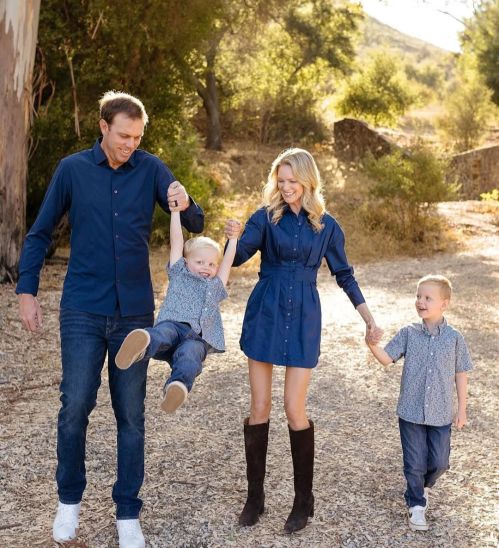
As we grow beyond our early childhood, more and more classes of men become the “fathers” of our newly-acquired insights and techniques: grandfathers, uncles, neighbors, and fatherly teachers. If we call such fathers “father-surrogates,” we empty an important function of its true significance in an effort to understand its potential perversion; this may lead us, as therapists, to cut off our own noses in order to present impersonal enough faces for our patients’ father-transferences. If not fathers, we should study what we really are; for men who wash their hands of their function in the life of youth are as evil, even if by default, as the “bad” fathers whim they despise. In their youth, children need, in addition to fathers who will guard the beginnings of their identities, guarantors of their established identity; in this only the luckiest personal father can participate. If he insists on a monopoly in this regard, he asks for a rebellion, smouldering of flaming. We will meet all of these fathers in our lives, some on earth and some in heaven, some in return performances, and some in strikingly new thoughts. In the meantime, we may recognize another basic arrangement of the human and the divine face in the combination of the sinner who feels so totally guilty that he wants to hide his face, to be totally nobody, and his counterpart, the God who turns his back, who looks away into the eternal darkness—the terrible, the hidden God. The soul beholds itself as through a darkened glass, and mistakes the dimness for the world. #RandolphHarris 18 of 22

The line drifted through Captain Lukas Reinhardt’s thoughts as Engine 2 screeched to a stop outside the mid‑rise already roaring with flame. Smoke pulsed from shattered windows; alarms wailed like something alive. He and Engineer Mara Vogel charged inside, boots immediately catching on the maze of potted plants, shoe racks, and discarded furniture that management had been warned about for months. They knew the penalties. They ignored them anyway. Behind the firefighters came the award‑winning paramedic team: Jonas Keller, Anika Brandt, and their newest medic, Friedrich Albrecht, hauling trauma bags through the same cluttered gauntlet. Heat rolled down the hallway in waves. Doors buckled. Residents screamed from upper floors. Reinhardt and Vogel forced their way upward, tripping, stumbling, pushing past burning debris. They pulled tenants from smoke‑filled units, guiding them toward the stairwell where Keller and Brandt immediately took over. The paramedics worked with practiced precision: Keller cooling burns with sterile water and dressings, Brandt checking airways and administering oxygen, Albrecht splinting a fractured wrist while shielding the patient from falling embers. Their movements were calm, fast, almost surgical. Outside, the treatment area grew—coughing tenants, shaken elders, a child with singed hair clinging to Brandt’s coat. The paramedics reassessed, stabilized, and reassured each one, even as their own arms blistered and uniforms smoldered. By the time the last resident was carried out, the crew was bruised, burned, exhausted—but every tenant was alive. Management had gambled with violations; the Sacramento Fire Department and its paramedics refused to gamble with human beings. “When people ignore fire code, they’re not bending a rule — they’re gambling with lives. Our job is to protect the public, but we can’t do that if buildings are allowed to become traps. Fire codes exist because someone died before they were written.” #RandolphHarris 19 of 22

When it comes to firefighting, every incident carries the potential for injury—no matter how small the fire appears or how routine the call may seem. If you see a fire engine stopped in the street without its lights on, use extreme caution. Crews may be working nearby, and passing the apparatus can put them in danger. It is often safer to turn around and take another route; if you strike a firefighter or civilian and cause a fatality, you could face charges such as manslaughter. Firefighters frequently move around their vehicle on foot, loading equipment or preparing to leave the scene. Attempting to pass the apparatus can result in a collision with someone you cannot see. Pay close attention to their hand signals as well—emergency vehicles sometimes move slowly or reposition, and impatient drivers trying to slip around them create hazardous situations. If you are already in an intersection when you notice an emergency vehicle approaching, continue through it, then pull to the right and stop as soon as it is safe. Always obey directions from law enforcement officers or firefighters, even if those instructions conflict with posted signs or traffic laws. When sirens or flashing lights are activated, it is illegal to follow within 300 feet of a fire engine, ambulance, or police vehicle. Driving to the scene of a fire, collision, or disaster can also result in arrest, as doing so interferes with firefighters, paramedics, and other emergency personnel. Professional courage is not limited to physical toughness. It includes listening to others, advocating for them in difficult situations, understanding personal limits, and having the integrity to tell a superior when they are wrong. The deeper truth is that public safety depends not only on the bravery of first responders but on the discipline and judgment of the community around them. Every driver’s decision—whether cautious or careless—can either protect or endanger the people risking their lives to protect everyone else. #RandolphHarris 20 of 22

Efforts to preserve farmland and maintain buildable land for future generations often lead to discussions about population growth and long‑term planning. Some people argue that immigration levels should be managed carefully to ensure that infrastructure, housing, and land use remain sustainable. Others suggest that, when immigration does occur, programs that encourage broad representation can help communities reflect the diversity of the wider world. When Americans purchase goods made in the United States, it strengthens local businesses and signals to investors that these products are in demand. Strong sales give investors confidence to reinvest in domestic companies, helping keep jobs, production, and wages within the country. As businesses grow, they contribute more to the tax base, which can reduce the burden on taxpayers over time. Supporting American businesses also keeps more money circulating within the national economy. The government increases the national debt when it spends more than it collects in tax revenue or borrows from private or foreign lenders. When people shop locally, more tax revenue stays in the community and supports public services. This helps keep jobs in the United States and increases the tax contributions that fund government operations. Purchasing foreign-made goods, by contrast, often sends money overseas and may benefit companies that operate under lighter tax or environmental regulations. Buying American-made products can also reduce environmental impact because they travel shorter distances and are produced under stricter standards for air, land, and water protection. In this way, consumer choices influence not only the economy but also environmental stewardship and long-term national sustainability. #RandolphHarris 21 of 22

Under President Trump’s administration, he has made America a priority. President Trump has closed the southern border, illegal crossings have fallen to an all-time low, and are 90 percent lower than under the previous administration. Since President Trump’s crack down on crime, violent crimes in Washington D.C. have dropped by approximately 80 percent. He has stopped thousands of pounds of drugs from entering America and killing citizens. And since President Trump took office, investments in America have increased by trillions of dollars in U.S.A. manufacturing, production, and innovation. As you can see, President Donald Trump and his pledge to “Make America Great Again” is exactly what America needs to save the country and the American people. And yes, diversity is important, so you can see why it is also important to preserve blonde hair and blue eyes, as the people with these characteristics are becoming a minority in America. As a reminder, parents, please teach your children to love America and be patriotic citizens, and to buy goods and services made in America. It is also important to respect law and order and treat your elders with respect. It is inborn in the human mind to wish to know. If this begins with the endless surface questions of a child’s curiosity, if it continues into deeper questions of a scientist’s probing investigation, it cannot and does not stop there. For the higher part of the mind will eventually come into unfoldment, that union of abstract reflective thought with mystical intuition, which is true intelligence, which needs and sees a view of the whole of things. And so, the knowing faculty enters the realm of philosophy. A lot of children are having problems in school and cannot even write a paragraph because they are not reading their books. When you actually read books, you get an example of how to write and will become a better student. Therefore, remember to take your education seriously so that you will be successful in life and make your family proud. Also, to make sure they have all the resources required, please donate to the Sacramento Fire Department to help improve our national security. “Oh, thus be it ever, when freemen shall stand between their loved home and the war’s desolation! Blest with victory and peace, may the heav’n-rescued land Praise the Power that hath made and preserved us a nation! Then conquer we must, when our cause is just, and this be our motto: ‘In God is our trust.’ And the star-spangled banner in triumph shall wave O’er the land of the free and the home of the brave.” #RandolphHarris 22 of 22


William Wirt Winchester had always been a man who saw farther than others. Even as a boy in New Haven, he dismantled clocks, rifles, and anything with gears just to understand how they breathed. His father, Oliver Winchester, recognized the spark immediately. “This one,” he would say with pride, “was born with gunpowder in his imagination.” By the time William reached adulthood, he had already designed several mechanical improvements that caught the attention of the Winchester Repeating Arms Company. His ideas were bold—sometimes too bold for the boardroom—but they worked. He refined the lever‑action mechanism, strengthened the firing pin assembly, and even sketched early concepts for a self‑loading rifle decades before the world was ready to understand them.

When Oliver stepped down, the company needed a leader who could carry the Winchester legacy into a new age. William was elected president unanimously. Newspapers called him the quiet genius of American firearms. His employees called him the man who could see the future. And Sarah Pardee Winchester called him husband. Their marriage was a union of intellect and tenderness. Sarah, brilliant in her own right, understood William’s restless mind. She encouraged his experiments, soothed his anxieties, and brought warmth to a life otherwise consumed by metal and machinery. Together, they dreamed of a home unlike any other—a sprawling mansion filled with light, music, and rooms for the family they hoped to build. When Sarah was with child, William worked late into the night designing a new rifle mechanism he believed would revolutionize the industry. He wanted to present it to his daughter one day and say, This is what your father built while waiting for you. Their baby girl, Annie, was born on a cool summer morning. William held her with trembling hands, overwhelmed by the fragile miracle of her tiny fingers curling around his thumb. Sarah wept with joy. For a brief moment, the world felt perfect. However, perfection is a fragile thing.
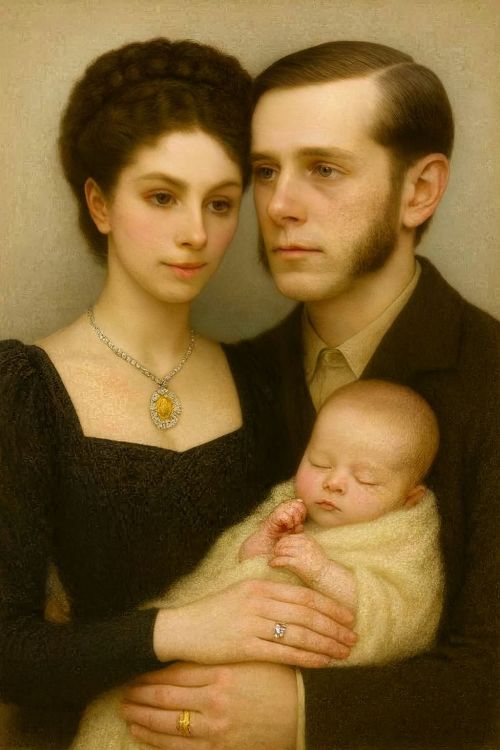
Within weeks, Annie fell ill. Doctors came and went, offering treatments that did little and explanations that did even less. Sarah stayed at her bedside, singing lullabies through tears. William paced the halls, helpless in a way he had never known. Despite every effort, their daughter slipped away. The grief hollowed them. William buried himself in work, creating inventions no one had dreamed possible—rifles with unprecedented precision, mechanisms that seemed almost alive in their efficiency. But each success felt empty without the child he had hoped to teach. Sarah tried to hold them together, but sorrow has a way of reshaping the world. One autumn afternoon, desperate for distraction, they took a family outing to the countryside. They walked through a quiet grove, the leaves whispering overhead. Sarah later said she felt a presence there—cold, watchful, ancient. William brushed it off as imagination. But that night, he fell violently ill.

Doctors suspected poisoning. Possibly chronic arsenic exposurethough they could not determine the source. His condition worsened rapidly. Sarah stayed by his side, holding his hand as she had held their daughter’s. William whispered apologies, dreams unfinished, inventions unbuilt, a life cut short. He died before dawn. Sarah was left alone—widowed, childless, and haunted by the memory of that strange presence in the grove. Some said she imagined it. Others whispered that the Winchesters, whose weapons had shaped history, had drawn the attention of something darker.
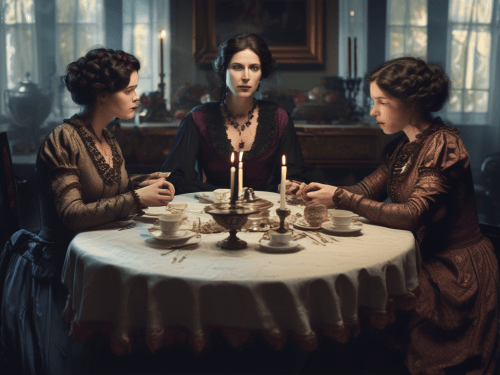
Sarah believed the latter. In her grief, she returned to the plans she and William had drawn together—their dream mansion. A home filled with wonder, creativity, and endless possibility. A place where William’s spirit could live on, where no curse could reach her. She hired crews and began building. And building. And building. Hallways that turned unexpectedly. Staircases that rose into ceilings. Rooms within rooms. Windows that opened to walls. A labyrinth of grief, love, and defiance. Some said she built to confuse spirits. Others said she built to stay connected to William’s genius, continuing the work they had begun together.

But Sarah knew the truth. She wasn’t building a mansion. She was building a promise. A promise that love, invention, and imagination would outlast tragedy. A promise that the curse—real or imagined—would never define her family’s legacy. A promise that William’s brilliance would echo through every beam, every window, every impossible hallway. The Winchester Mansion became her monument to resilience. And in its endless rooms, she kept alive the memory of the man who dreamed of changing the world—and did.

PRIVATE EVENTS & WEDDINGS
at WINCHESTER ESTATE

Many event locations claim to be unique, but nothing compares to the Winchester Mystery House. If you’re truly seeking a distinct, one‑of‑a‑kind setting for your milestone celebration or special occasion, reserve a venue that delivers on uniqueness many times over. Whether you’re planning a wedding, birthday or anniversary celebration, corporate gathering, holiday party, or any other meaningful event, the Winchester Mystery House offers an unforgettable backdrop. Give your guests an experience they’ll be talking about for years to come.
Café 13: A Rest Stop on the Edge of the Mystery

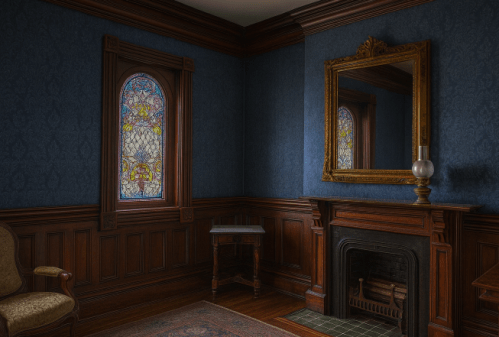
After wandering the winding halls of the Winchester Mystery House—where staircases defy logic and whispers seem to cling to the walls—Café 13 offers a welcome return to warmth and grounding. Newly reopened and serving guests daily from 10 AM to 3 PM, this cozy hideaway invites you to pause, breathe, and gather yourself before diving back into the mansion’s secrets. Here, you can enjoy breakfast, lunch, snacks, and refreshing drinks in a calm indoor space that feels worlds away from the mansion’s twisting corridors. Settle in with a warm meal, challenge a friend to a board game, or simply rest and recharge as sunlight filters through the windows. Café 13 is more than a café—it’s a moment of calm between chapters of the Winchester legend, a place to steady your nerves before returning to the gardens, the grandeur, and the mysteries that await.
Winchester Mercantile Gift Shop
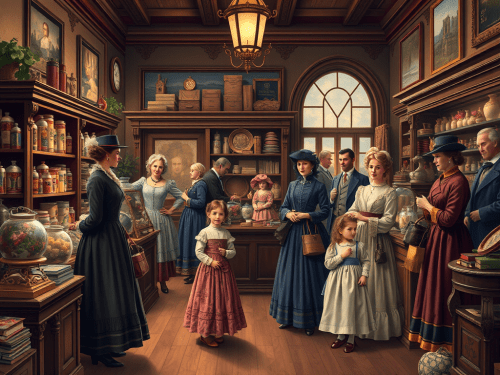
Your journey into the Winchester Mystery House begins long before you cross the mansion’s threshold. It starts at the Mercantile gift shop—a welcoming outpost standing at the edge of a world where history and myth intertwine. Here, beneath warm lights and shelves lined with curiosities, you can secure your tour tickets and prepare for the adventure ahead. Guests often pause for a souvenir photograph, capturing the moment before they step into Sarah Winchester’s enigmatic domain. As you explore the shop, you will find an eclectic array of gifts and keepsakes: tokens of the mansion’s lore, echoes of Victorian elegance, and mementos that carry a touch of the house’s enduring mystery. The Mercantile is more than a gift shop—it is the gateway. https://winchestermysteryhouse.com/

Harris Plumbing, Heating, Air & Electric has been serving our community for 30 years—an achievement few companies can claim. That longevity isn’t an accident. It’s the result of hard work, integrity, and a commitment to doing every job the right way, whether it’s a simple repair or a complex system overhaul. We take pride in every service call because we know your home is more than a building—it’s where your family lives, grows, and feels safe. Ensuring your comfort and protection is a responsibility we carry with seriousness and gratitude. After three decades, our mission remains the same: to deliver dependable service you can trust, every time.

Harris makes sure you have the clear, accurate information you need to decide what comes next—no matter what your home is facing. Before we begin any work, our technicians perform a full diagnosis and walk you through every issue we find. That means you receive a personalized quote and service plan tailored to your home’s exact needs, not a generic estimate or guess. We believe the only way to deliver our best work is to understand the problem completely and address it with precision, transparency, and care. Your home deserves nothing less. https://www.callharrisnow.com/about-us/


BMW’s top ranking in Consumer Reports’ Auto Brand Report Card and its steady market‑share growth highlight the company’s long‑standing ability to build high‑performing, reliable vehicles that truly meet consumer expectations. Unlike other luxury brands that focus primarily on comfort and opulence, BMW distinguishes itself through engineering excellence and unmatched driving dynamics. Every model is designed to create a direct, responsive connection between the driver and the machine—an experience that has defined the brand for generations. This commitment to performance is why BMW continues to earn its reputation as The Ultimate Driving Machine. https://www.brianharrisbmw.com/

Randolph Harris San Francisco Taxation & Mergers

Building strong, lasting client relationships is essential to a successful legal career. Many attorneys assume that mastering legal doctrine alone guarantees success, but law is fundamentally a service profession—our work is measured not only by technical skill, but by how effectively we solve problems for the people who trust us. Long‑term relationships grow from three core commitments: truly knowing your clients, understanding how their legal issues fit within the broader context of their business and personal goals, and consistently delivering exceptional service.

Randy advises clients on business transitions, taxable and tax‑deferred mergers and acquisitions, joint ventures, restructuring, integrated tax planning, federal and state tax controversy matters, and real estate transactions. His approach is grounded in clarity, responsiveness, and a deep understanding of each client’s unique circumstances. Trust is the cornerstone of every relationship he builds. Ultimately, clients feel confident knowing they are working with someone who not only understands their challenges, but is fully committed to helping them achieve their goals. https://www.jmbm.com/l-randolph-harris.html

Cresleigh Bluffs at Plumas Ranch

Base Price: Starting from $450,000
Sales Office: 1821 Glen Ellen Way, Plumas Lake, CA 95961
Where Modern Living Meets Small‑Town Serenity
Welcome to Cresleigh Bluffs, the newest luxury home community within Plumas Ranch—an enclave designed for those who value comfort, craftsmanship, and connection. Ideally situated in the heart of Plumas Lake, California, this thoughtfully planned neighborhood blends refined architecture with the natural beauty and open spaces the region is known for.

Home Designs Crafted for Every Lifestyle
3–4 Bedrooms • 2–3 Baths • 1,542–2,471 sq. ft.
Choose from four distinctive floor plans, each offering a harmonious balance of style, function, and modern convenience. Every home includes:
- Engineered roof construction for long‑lasting durability
- Full front and rear yard fencing for privacy and security
- Smart‑home technology, featuring:
- Central automation hub
- Smart thermostat
- Digital entry system
- Video doorbell
- Wi‑Fi extender
- Remote garage access
Spacious primary suites with elevated finishes
Engineered stone showers and dual sinks in select baths
Ceramic tile flooring and upgraded interior materials
Center‑island kitchens with stainless steel appliances
To make the design process effortless, Cresleigh Bluffs offers exclusive curated design packages—each crafted to fit your aesthetic and your budget.

A Community Connected to Everything
Cresleigh Bluffs places you moments from parks, schools, landscaped open spaces, and the everyday conveniences that make life easier. With direct routes to Sacramento, Roseville, and surrounding regional destinations, residents enjoy the perfect blend of peaceful living and urban accessibility.

Your Next Chapter Begins Here
Our dedicated sales associates are ready to guide you through every step of the home‑buying journey. Join our interest list today to receive the latest updates, community news, and availability.

Life at Cresleigh Bluffs begins with a sense of calm the moment you turn onto its tree‑lined streets. Morning light spills across landscaped open spaces, and the air carries the quiet hum of a community designed for ease. Neighbors wave as they head out for a jog, children ride bikes toward nearby parks, and the Sierra breeze moves gently through the neighborhood. Inside your home, natural light fills the open‑concept living areas, reflecting off curated finishes and the clean lines of a modern kitchen. Smart‑home features respond effortlessly—lights adjust, the thermostat sets itself, and your day begins with a feeling of control and comfort.

As evening settles, Cresleigh Bluffs transforms into a warm, glowing enclave. Families gather on patios, the scent of dinner drifts through open windows, and the sky turns soft shades of gold and lavender. The community’s thoughtful design makes every moment feel connected—whether you’re strolling to a nearby greenbelt, hosting friends in your spacious great room, or unwinding in a primary suite crafted for true relaxation. With direct routes to Sacramento and Roseville, you’re close to everything yet tucked away in a place that feels like a retreat. At Cresleigh Bluffs, life moves at the perfect pace: peaceful, modern, and beautifully grounded in the best of Plumas Lake living. https://www.cresleigh.com/communities/california/plumas-lake-ca/bluffs-at-plumas-ranch




 Randolph Harris II International Institute