

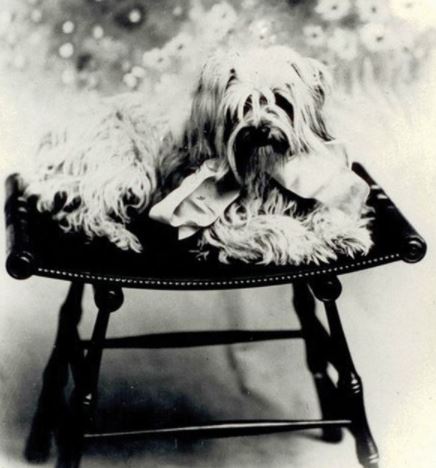
A mansion is not a mansion with its stately grounds, and Mrs. Winchester was just as attentive to the exterior of her estate as she was to the sprawling house. An avid gardener, she imported plans, flowers, trees, shrubs, and herbs from over 110 countries around the World. Mrs. Winchester employed eight to ten gardeners. Her head gardener was Mr. Nishiwara, who was responsible for seeing that the beautiful gardens, plus the tall hedge around the hose, were well maintained. The hedges were once so tall that only the top floor of the house was visible from the road! Mrs. Winchester loved to spend time in her gardens, and she had gazebos built where she could sit and enjoy her trees and flowers. It was a Saturday night, in January 1888, and Mrs. Winchester has, as usual, come home from the City early in the afternoon. It has been a black and foggy day, and the gas had been lighted in the streets and in the office where she worked from early morning. The fog was very bad at the time Mrs. Winchester returned home, and she congratulated herself on the fact that she had not to go out again that night. She sat with her puppy Zip in her sitting-room all the evening, with that comfortable feeling that she was able to relax until Monday morning, and that she need trouble about nothing outside the mansion. In due course, Zip went to bed, and then the maid Agnus reminded her of a letter that must be written and posted that night. Sufficient is it for Mrs. Winchester to say that the letter was to an elderly relative of some means who lived in Oakland, and who had taken great interest in her puppy Zip. The butler Martin remembered that the following day was the birthday of this relative, and that she should receive proper greeting by the Sunday morning post in the country town.

Frankly, Mrs. Winchester did not want the bother of it; but Agnus always knows best in these matters, and so Mrs. Winchester wrote the note and sealed it up. Mrs. Winchester had read nothing exciting during the evening—nothing to stir her imagination in any way. She stamped the letter and proceeded to the front door. Judge of her astonishment when, on throwing it open, she saw nothing but the gray wall of fog coming up to the very house; even the railings, not ten yards in the front of her grand estate, were blotted out completely. She called back into the house for the maid to come and look. “Don’t lose yourself, Mrs. Winchester,” she said, half laughing. “What a terrible night!” “I shall not lose myself,” Mrs. Winchester replied, laughing in turn. “The pillar-box is only at the end of the crescent; if I stick to the railing, I cannot possibly miss it. Do not wait here,” she added solicitously. “I will leave the door ajar, so that I can slip in easily when I come back. I have left my keys on my writing desk.” Angus went in, and Mrs. Winchester pulled the door close, and then stepped out boldly for the front gate. Imagine her standing there, just outside her own gate, and with her back to the crescent, knowing that she had to go to the left to find the pillar-box which was at the end of the crescent. There were thirteen Victorian cottages on her estate, so she knew she had to pass seven more before reaching the pillar-box. She also new that each cottage had an ornamental center-piece before she stepped away from the crescent at the end to reach the pillar box. That Mrs. Winchester knew would be something of an adventure, for the fog was the densest she had ever seen; she could only see the faint glow of her observation tower as she looked behind; the rest of her mansion was invisible.
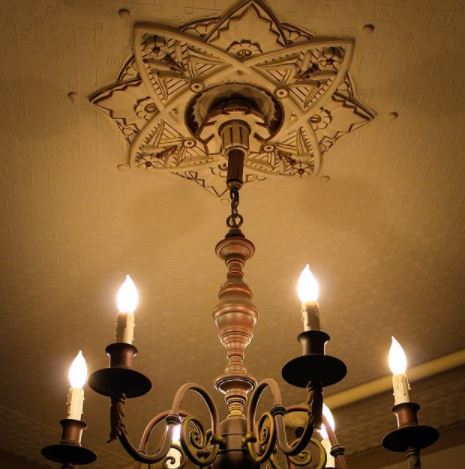
Mrs. Winchester counted seven Victorian cottages, and then stood at the end of the last line of railings. She knew that the pillar-box was exactly opposite her. She took three quick steps, and literally cannoned into it. She was a little proud of her own judgment in getting it so nicely. Then she fumbled for the mouth of it, and dropped in her letter. All this may should very commonplace and ordinary. Mrs. Winchester is an observant woman, and she had noticed always that the mouth of the pillar-box faced directly along the crescent, thus standing at right angles to the road. At the moment that she had her right hand in that mouth, therefore, she argued that if she stood out at the stretch of her arm, she must be facing the crescent; Mrs. Winchester had but to move straight forward again to touch the friendly railings. She was putting that plan into operation, and had let go of the mouth of the pillar-box, when a man, coming hurriedly round the corner, ran straight into her, muttered a gruff apology, and was lost in the fog again in a moment. And in that accidental collision he had spun her round and tossed her aside—and she was lost! This is literally true. She took a step and found herself slipping of the kerbstone int the road; stumbled back again, and strove to find her way along by sticking to the edge of the pavement. After a minute or two, Mrs. Winchester was so sure of herself that she ventured to cross the pavement, and by great good luck touched in a moment one of those ornamental center-pieces of one of the gates—or so, at least, it seemed. She went on with renewed confidence until she saw certain bushes which topped the railings of one particular cottage, and then Mrs. Winchester knew that she was near her mansion’s front door. She pushed walked confidently, stepped quickly up the little path, and reached the door. She was right; the door yielded to her touch, and she went hurriedly in.
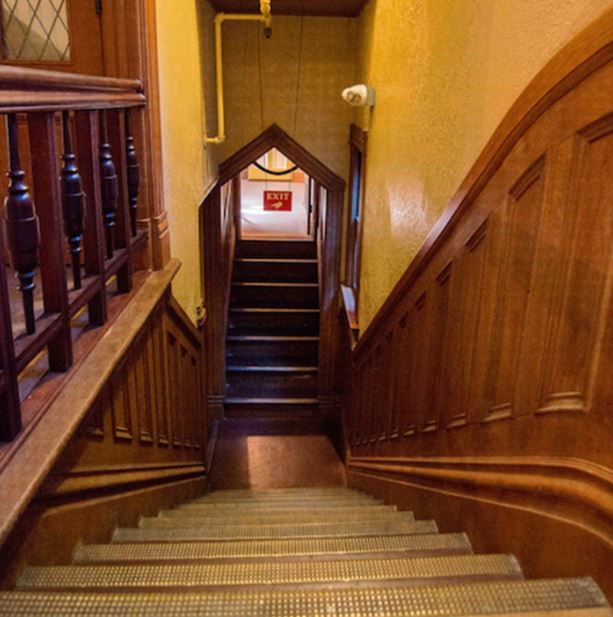
Mrs. Winchester had taken off her hat, and had held it towards the familiar hat-stand before she realized that it was not a familiar hat-stand at all; it was one she did not know. She looked round in some confusion, meaning to make good her escape without being observed, and yet wondering into what part of her mansion could she have come into, when she stopped stock still, with the hat held in her hand, listening. From a room near at hand, Mrs. Winchester heard the sound of a low, long-drawn moan, as from someone in pain. More than that, it was almost the wail of someone in acute terror. Now, Mrs. Winchester was a mild and caring soul, and her first instinct was to run. There was the door within a foot of her; she could open it again noiselessly and slip out, and leave whatever was moaning to its own trouble. Her next instinct, however, was a braver one; she might be able to help. Putting her hat on, and so leaving her hands free, she moved cautiously towards the sound, which was coming intermittently. She found that this wing of the house was unfamiliar to her; there was a 7-11 staircase built in the shape of a letter “Y,” which enabled the servants to quickly get to three different levels of the house. Then there were these stairs that lead to the ceiling, and there was also a cabinet that went straight through to the back thirty rooms of the mansion. When she went down the steps of the 7-11 staircase, slowly and cautiously, with her flesh creeping a little, the morning went on, and Mrs. Winchester was almost inclined to turn back with every step she took. However, at last, she got into the basement, and came to the door of the room from which the sound proceeded. She was in the very act of recklessly thrusting open the door when another sound broke upon her ears that held her still. The sound of someone singing in a raucous voice.

It was a sea song she remembered to have heard when she was a little girl in New Haven, Connecticut, and the words of which she had forgotten; it was something about “Boney was a warrior.” The door of the room was open a little way, and through the crack of it, Mrs. Winchester was able to peer in; and there she saw a sight that for a moment made her doubt her own eyes. She rubbed her eyes in a curious fashion and looked again, and this is what she saw: The room was in a neglected state, with strips of wallpaper hanging down from the walls and with a blackened ceiling. There was a table in the center of it, and at that table a man was seated, with a square black bottle and a glass before him, and a candle burning near his left hand. Mrs. Winchester could see the whole room now as plainly and as clearly as she saw it then. He was a man so villainously ugly that she had a thought that he was not a man at all, but some hideous thing out of a nightmare. He had very long arms—so long that they were stretched across the table, and his hands gripped the opposite edge of it; a great heavy head, crowed with a mass of red hair, was set low between enormously broad shoulders; his eyes, half closed, were high up and close together on either side of a nose that was scarcely a nose at all; the lips were thick and heavy. However, it was not the man that Mrs. Winchester looked at first, it was at two other figures in the room. These figures were seated on chairs facing the table at which the man was, and the strangeness of them lay in the fact that each was securely bound to the chair on which he and she sat, for it was a man and a woman. The man, who was quite young was not only bound, but gagged securely also; the woman was more lightly tied to her chair by the arms only, and her mouth was free. She was leaning back, with her eyes closed, and mingling with the raucous singing of the man at the table. Mrs. Winchester’s first impression was that the man at the table was some sort of unclean, bestial judge, and the others his prisoners.
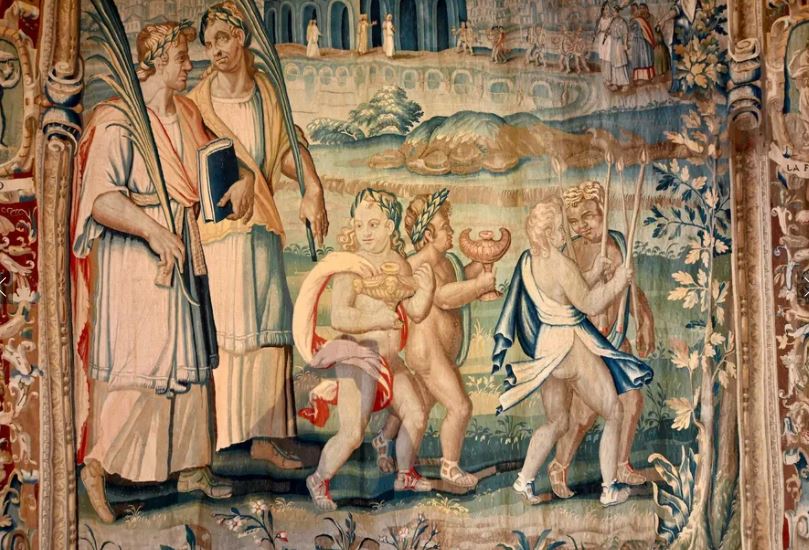
He stopped his singing to pour some liquor from the square bottle into his glass and to drink it off; then he resumed his former attitude, with his fingers locked over the edge of the table. And now Mrs. Winchester noticed that while the woman, who was, by the way, quite young and very pretty, with a fair, dainty prettiness, still kept her eyes closed, the eyes of the bound man never left that dreadful figure seated at the other side of the table. Mrs. Winchester felt like she was on the eve of some awful calamity. She then unhesitatingly pronounced the entire assortment of people in the room as ghost, and condemned all the gathered treasures as the creations of petty intellect, which could not get out of the beaten track, but sought in the supernatural a reason for the explanation of every fact that seemed at variance with routine of daily experience. In her opinion the collection of people in this room had never seen at all in her day and generation, and must have been souls killed by the Winchester rifle ages ago; she did not yet believe her mansion was enchanted, however. To use her own language, “all those stories have been made by those people that set up overnight stirring out legends to entertain each other.” However, she must have known that she was in denial. For she was not insane and there were some kind of beings in this room. “Wouldn’t you like to speak, you dog?” said the red-haired man. “What would you give now to have the use of your limbs—the free wagging of your tongue? What would you say to me; what would you do to me?” The man who was bound could, of course, answer nothing. Mrs. Winchester saw his face flush and darken, and she guessed what his thoughts were. For herself, she was too fascinated by the scene before her to do anything else than peer through the crack and watch what was going one.

“Lovers—eh?” exclaimed the man at the table. “You thought I was unsuspicious; you thought I knew nothing and suspected nothing—didn’t you? While I was safely out of the way you could meet, the pair of you—day after day, and week after week; and this puppy could steal from me what was mine by right.” The woman opened her eyes for the first time and spoke. “It isn’t true,” she said, a sob breaking her voice. “It was all innocent. Martin and I have done no wrong.” “You lie!” thundered the man, brining his fist down upon the table with a blow that might have split it. “You’ve always lied—lied from the moment your father gave you to me—from the very hour I married you. You always hated me; I’ve seen you shudder many and many a time at the mere sight of me. Don’t I know it; haven’t I felt you stab me a thousand times more deeply than you could have stabbed me with any weapon? You devil! I’ve come at last to hate you as much as you hate me.” The woman turned her head slowly and looed at the younger man; a faint smile crossed her lips. In an instant the red-haired man had leapt to his feet, showing Mrs. Winchester astonishingly enough that he was a dwarf, with the shortest legs surely ever a man had. However, the bult of him was enormous, and Mrs. Winchester could guess, with a shudder, at his length. He caught up the glass, crossed the room, and flung the contents in the face of the man. “It’s a waste of good liquor—but that’s for the look she gave you. I wish there was some death more horrible than any invented yet that I could deal out to you,” he added, standing with the glass in his hand and glaring at his victim. “The death I mean for you is too easy.” He walked across to the fireplace in a curious purposeless way, and stirred a great fire that was blazing there. Then from a corner of the room he dragged with ease a great sack that appeared to contain wood and shavings; so much that Mrs. Winchester saw a rent in the side of it. As if in readiness for something, this he dropped down near the fire, and then went back to his seat, applying himself again to the drink that was on the table. And still Mrs. Winchester watched, as a woman may watch a play, wondering how it will end.
“I got the best of you tonight,” he said presently. “If I hadn’t some upon you from behind, you might have been too much for me; but I was ready and waiting. I’ve been watching longer than you think; I had everything mapped out clearly days ago. Tonight sees the end of all things for the pair of you; tomorrow sees me smiles away from here. You came in secret, you dog; you’ll go in secret.” “We have done no wrong,” said the woman again. “We loved each other years ago, when we were boy and girl; there was no sin in that.” “Bah!—I don’t believe a word of it. Don’t I know that your black heart you’ve compared the two of us every day of your life since first I saw you. His straightness for my crookedness; his sleek, black hair for my red; his prettiness for this face of mine”—he struck his own face relentlessly with one hand as he spoke—“that women shudder at. Don’t I know all that?” It was the strangest and most pitiful thing that the creature sitting there before his victims suddenly covered his face with his hands and groaned. If ever Mrs. Winchester had seen a soul in torment, she saw it then, and though she loathed him she could have wept for him. After a moment or two he dropped his hands and seized the bottle, and poured out the last drops into the glass and drank them off; then flung the bottle and glass crashing into the fireplace, as though there was an end to that business. And now, as he got down again from the chair, Mrs. Winchester saw the eyes of the woman open wide and follow his every movement with a dreadful look of terror in them. “I’ll kill you both—here in the place where you’ve met—and then I’ll seal up the house,” went on the dwarf. “I’ve planned it all. Look you last on each other, for tonight you die—and this house shall be your crypt!”
“I swear to you,” panted the woman eagerly, “by all I hold most holy and most dear, that if you let us go, we’ll never see each other again. For pity’s sake! —for the sake of Martin!” “For the sake of Martin!” sneered the dwarf. “That shows you in your true colors; that show who you are and what you are. There’s one poor satisfaction left to you; you’ll die together.” What held Mrs. Winchester then it would be impossible to say. She could only plead that in the dreadful thing that followed was a woman who sits at a play wondering what will happen next, and with never a thought in her of interfering. Mrs. Winchester’s in her anxiety has pressed the door a little to get a clearer view, so that she saw every movement of the dwarf. For herself, Mrs. Winchester had forgotten everything—in her own home, and my puppy zip, and the servants who slept in the mansion. It was as though she has stepped straight into a new World. Mrs. Winchester saw the dwarf advance towards the man in the chair, carrying his right hand stiff and straight beside him, gripping something s, she could not tell what it was that he held. Mrs. Winchester saw him come straight at her, and she saw the eyes of the woman in the opposite chair watching her as one fascinated. Then Mrs. Winchester saw two movements’ one with the left hand of the dwarf, when he struck the other man on the face; then with the right hand, when he raised something that gleamed n the light of the candle and brought it down with a sound that was new and horrible to her on the breast of the other man. And Mrs. Winchester saw the face of the man change, and start as it were into new life, and then fall as it were into death. And Mrs. Winchester saw his head drop forward, and his eyes were closed. Then, above it all, and yet seeming as a sort of dreadful chorus to it all, rang out the scream from the woman in the other chair. Mrs. Winchester did not think that the dwarf heard it; he had drawn back from what had been the living man, and was staring like one mad upon what he had done. And still piercing the air of the place rang the scream of the woman—not for her lover alone, but for herself.

That sound seemed at last to break in upon the senses of the dwarf and to call him partially to himself. Mrs. Winchester had watched him to the point where he draw himself together and crouched like a wild beast ready to spring, with that in his hand that dripped red, when, in some fashion, she flung herself round the partially open door and stumbled into the room. Mrs. Winchester thought she must have been a little made herself; otherwise, frail and commonplace creature that she was, she could not have battled with this madman. Mrs. Winchester came upon him from behind and gripped him, seizing him by the throat and by the head, and all the while shouting something to him quite unintelligible. The attack had been so sudden and so unexpected that she had him, in a sense, at her mercy. He could not know who had attacked him; he struggled madly, not alone to get away from her, but also to discover who she was. Mrs. Winchester struggled to keep his face away from her, gripped him by the neck and by the hair, and fought with him for what she knew then was her own life. And so struggling they stumbled at last horribly against that still figure bound in the chair and brought it over crashing with them to the floor. And then in a sudden Mrs. Winchester felt the dwarf inert in her hands, and knew that she had conquered him. What she must have looked like in that room, kneeling there, panting and struggling to get her breath, she could not tell; the whole business was so like a nightmare. She remembered seeing the dwarf lying there—huddled up and very still. She remembered that other figure, bound grotesquely in the chair and lying, still bound, upon its side; and she remembered, too, the woman, with her arms close fastened behind her, sitting there and sobbing wildly.
The dwarf must have been stunned; he lay there quite still, with the knife that was dreadfully red fallen from his hand, and lying beside him. When at last Mrs. Winchester staggered to her knees she saw that the girl was staring at her with a face that seemed to suggest that here, perhaps, was another ruffian come to kill her. “Who—who are you?” she asked in a frightened whisper. “A friend—one who stumbled in by accident,” Mrs. Winchester panted. “Look at the man that’s tied to the chair,” she whispered hoarsely. “He can’t be dead.” Mrs. Winchester knew that he was, but still she looked, as she bade her. Mrs. Winchester had no need to look twice; the poor fellow was quite dead. The blow had been strong and sure. On her knees beside him, Mrs. Winchester looked up and nodded slowly to her; there was no need for words. The young lady leaned back in her chair again and closed her eyes. “Set me free,” she said in a faint voice. Mrs. Winchester could not touch that knife that lay there; in a mechanical, methodical way she took from her waistcoat pocket the decent, respectable little bone handled penknife she carried always with her. With that Mrs. Winchester but the young lady’s bonds, nothing as she did so how cruelly they had cut into the white flesh; and after a moment or two she swung her arms listlessly against her sides and opened her eyes, and then, with an effort raised her hands and pressed them against her temples. “What will you do?” Mrs. Winchester asked, looking at her curiously. “I—I don’t know,” she said; and then, breaking into weeping, sobbed out: “Oh—dear God—that it should have come to this! What shall I do—what shall I do?” “You must get away,” Mrs. Winchester said, watching the dwarf, who was beginning to stie a little. “If he wakes, you know what will happen.”

“I know—I know,” she said; and got to her feet and began to move towards that bound figure still lying tied to the chair. However, at that Mrs. Winchester got before her, and with her hands against he shoulders held her back, and pleaded passionately to her that she should go, and leave the dead alone. She listened, with that strange look in her eyes of a child wakened from sleep and not clearly understanding; but she yielded to Mrs. Winchester, and stumbled under her guidance to the door. They had reached it, and Mrs. Winchester had opened it for her to pass out, when suddenly the dwarf twisted over on to his hands and knees, and then raised himself upright. He did not seem to realize for a moment what had happened; then he caught sight of the woman, and, with a snarl, crawled forward and gripped the hilt of the knife. At that she pushed suddenly past Mrs. Winchester and fled like a hare up the stairs. Mrs. Winchester heard the swift passage of her footsteps in the little hall of the house—then the slamming of the door-to-nowhere. And now Mrs. Winchester had to look to herself, for she saw in the eyes of the man that he would not let this witness escape if he could catch him. Mrs. Winchester had managed to get through the door by the time that he had got to his feet, and in a dazed fashion was stumbling toward her, knife in hand. With a sudden swoop he reached the table and blew out the candle, and at the same moment Mrs. Winchester ran up the stairs, and in the darkness stumbled along the hall and fumbled with the catch of the door. By great good fortune, Mrs. Winchester got the door open, and literally fell out into the fog. She could not see him as he tore after her; in a faintness Mrs. Winchester had fallen to her knees, and she heard him, as he raced past her, panting heavily. Then the fog swallowed him up, and she knelt there on the farm alone, shaking from head to foot.

Mrs. Winchester had, of course, no means of exactly in what part of her mansion she had had her adventure; she could only judge roughly that it must be about the middle of the crescent. She started along again, in the right direction, as she hoped, and thought to find the front door to her mansion; missed the railings, after going what seemed to be an interminable distance, and came up hard against a pillar-box. Scarcely knowing what she did, she set her right hand in the mouth of it, and performed the same maneuver she had done before; advanced three paces, and touched railings again. Stumbling along these, she came blindly what she thought was her front door, walked up the path, and pushed open the door that yielded; and there, with the face of her maid looking at her in alarm and wonderment, Mrs. Winchester feel in a dead faint at her feet. It has to be recorded that Mrs. Winchester never found that room again. She knew every square inch of her mansion. Over and over again, in clear weather, Mrs. Winchester has always around in her mansion, and had closed her eyes, and tried to remember what steps she took to get to that particular room that night, after a stranger had cannoned into her and twisted her round; but all in vain. Whether in some part of the house lies the body of a man who was foully murdered on that particular night; maybe in a hidden room the crime was committed; or perhaps, in some strange supernatural fashion, she saw that night a deed committed that had been committed long before, she shall never know. That it is no mere figment of the imagination, and that something really happened that night, is proved by one fact. Her maid, in raising Mrs. Winchester from the floor that night when she fell at her feet, found her fingers locked closed upon something, and, forcing them open, disclosed what it was. A tuft of red hair!

Such episodes may appear utterly absurd and pure superstition to people in countries comparatively free of black magic, but instead they should be warnings of the power of Satan and demons where occult literature lures readers into illicit magic. Magic as the release of special power by satanic and demon forces of evil in its character and effects. While divine help and miracles produce new strength and positive results, magic shifts the burden to another area. Small relief in one area must be paid for by terrible burdens in another. The principle of compensation prevails. The price exacted is always found to be much greater than the amount of help received. Satan drives a hard bargain and grossly cheats his victims. Usually violence, suicide, and insanity will run through a whole family line, where the magical arts have been cultivated and practiced. Such tragic events often involve as many as four generations. Many occultists and magic workers, especially those who have cultivated the black arts and signed themselves over to the devil in their own blood, die horrible deaths. When a ready successor is not provided to carry on the nefarious practice, this is especially true. The psychic bondage and oppression that traffickers in occultism themselves suffer, as well as their dupes, is horrifying to contemplate. Demon possession is represented as a vivid symbol of the prevalence of evil in the World. Other critics attempt to dismiss demon possession with theories of accommodation or hallucination. However, this view fails to meet the issue. Nor can present-day parapsychologist and psychiatrists, who refuse to recognize evil supernaturalism in the phenomenon of demon possession, either explain it or deal adequately with it. Laws defining witchcraft as having league with the Devil and prescribing the death penalty for such offenders cropped up in the colonies as early as 1636 in Plymouth. Other colonies soon followed suit—Connecticut in 1642 and Rhode Island in 1647.

The first executions took place in Boston in 1648 and in Hartford, Connecticut, in that same year. The executions were carried out by hanging, in contrast to the European practice of burning witches, which probably stemmed from the widespread fear among the European peasantry of vampire, the dead who returned from their graves to suck the blood from the living. The vampire myths never really took root in America, so the necessity of destroying the bodies of the witches was not deemed urgent. Throughout the 1650s, there appeared prosecution and attempted prosecutions in America, but these cases were infrequent, and all of them were based on the fear of maleficum, the witch’s working of evil, the accusations coming from frustrated and jealous neighbors. Few confessions were recorded in the early cases, and they did not seem to have much real validity. The few that did confess mentioned having dealings with Satan, but for the most part these admissions were confused and incoherent, and the details of the accounts differed greatly from the confessions of the witches in Europe. For example, in 1699, in Connecticut, a woman named Greensmith confessed to trafficking with the Devil, but made no mention of all-important Covenant, or pact. She further stated that the Devil had appeared to her in the form of a deer (not a goat) and that she had attended meetings at a place not far from her house. The mention of “meetings” occurred in some early confession, but the word “Sabbat” or “Sabbath,” commonly used by European witches, did not come up until later, apparently at the suggestion of the Salem judges. Some believe that Satan has a soul and a character. He is not just this futile entity but someone you can see many aspects to. Some people do not see Satan as this guy with horns who is evil, they see Him as the first rebel. Then one can see why He is so attractive to many in the Victorian ages and the young people. He is someone who is standing up to the greatest power in the Universe. “If that ‘evil’ is of a rebellious nature,” says Glenn Danzig, “then I guess, in Christian terms, that evil is the Satan in you. I don’t buy that. I believe in honesty, standing up for yourself. That’s my ‘good.’”

Thousands of people base their hopes on the statements of spiritistic practitioners and subsequently become dependent upon the advice they receive from the “other side.” There are quite a number of people who has suffered serious psychic disturbances through the misuse of such practices. Their personalities have been split and they have been utterly confused by the spirits on which they have called. People therefore who try to discover what life after death is like through spiritism and superstition may be in danger of falling prey to the dark and hidden side of their own minds and soul. If you look at the early tracts of The Christian Bible, there is really not much about Satan in there anyway. Christian religions have tried to overblow and create a whole legend around Satan which is not true to the actual scriptures we have. If you desire, you must first make yourself strong so you can help others. You should only help people who want help, a lot of times people do not really want your help. You tell people what has to be done to change their lives, they will not listen. If Satan were corporeal, He would not be something repulsive, He would be something seductive. He would want to win you over and gain your trust, and of course being repulsive or disgusting would not be the way to go. One would imagine this would be a seductive, beautiful creature. In the Gnostic account of the fall of the angels, the angels were suppsed to be watching over this flock of humans and all of a sudden, they are perpetrating acts of pleasures of the flesh with them. Eventually this created the Cyclops, the Minotaur, things of this nature. There are so many accounts of the fall of the angels, it is like a fantasy tale that you would like to believe actually happened. We, in this circle, conjure and cite this spirit Fatenovenin, with all his adherents, to appear here in this spot, to fulfill our desires, in the name of three holy Angels, Schomajen Sheziem, Roknion Averam, Kandile, Brachat Chaijdalic, Ladabas, Labul, Rargil, Bencul, in the name of God. Amen!

Winchester Mystery House

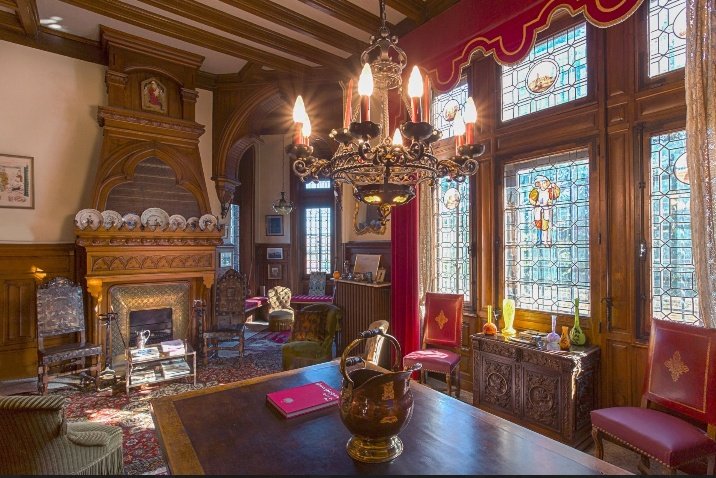
Mrs. Winchester’s estate was a little town within itself. The grounds have their share of unexplained mysteries. Mrs. Winchester outfitted her home with the finest stained glass doors, windows, and wallpaper that money could buy during her time. She had everything she needed: plumber’s shops, carpenter’s workshops, her own water and electrical supplies, and complete sewer and drainage systems. Mrs. Winchester even had her own gas manufacturing plant. It produced carbide gas by adding a small amount of water to a drum containing calcium carbide. The resulting gas was pressed through the gas lines to the house by a large piston and cylinder. The gas lights in the house were then lit by electromechanial strikers that created a spark to light each lamp.
Come see her estate, in person, for yourself this weekend! Please Click the link below for tickets and more information.




 Randolph Harris II International Institute