

Legend has it that the Winchester Mansion was built in one night by angels without human assistance, the work being done at the solicitation of Mrs. Winchester, who watched and prayed while, while the angels toiled. However, the nine-story observation tower was built in one night by a demon, whom she summed by chanting, “I, Sarah Winchester, a servant of God, call upon thee, desire and conjure thee, O Spirit Anoch, by the wisdom of Solomon, by the obedience of Isaac, by the blessing of Abraham, by the piety of Jacob and Noe, who did not sin before God, by the serpents of Moses, and by the twelve tribes, and by the most terrible words: Dallia, Dollia, Dollion, Corfuselas, Jazy, Agry, Ahub, Tilli, Adoth, Suna, Eoluth, Also, Dilu, and by the words through which thou canst be compelled to appear before me in a beautiful, human form, and give what I desire. By sweating of blood in the Garden, by the lashes Jesus bore, by his bitter suffering and death, by his Resurrection, Ascension and the sending of the Holy Spirit, Druj Nasu and all legions under the command of Az-Jahi feed upon the imposed limitations of the astral body which have been constructed by the programming of the World, and over the land raise a tower that will withstand the ravages of time. The tower being divided into stories about ten feet high, each story lighted by a single window, the highest compartment having invariably four lancet windows opening to the cardinal points of the compass. The roof conical, made of overlapping stone slabs, and a circle of grotesquely carved heads and zigzag ornamentation found beneath the projecting cornice, and every figure known to the geometrician to be found in the stones of this single tower.” The tower was indisputably of pagan origin, and of antiquity so great as to precede written history.

There is no doubt that the early Americans were sun and fire worshippers, and many excellent reasons may be given for the belief that the tower was built for the purposes of religion. However, when the Earthquake of 1906 struck, it toppled the nine-story tower directly on Mrs. Winchester’s bedroom. The servants rescued her and terrified, she fled to Redwood City, to build a palatial barge, (called the Ark) on which she lived for the next six years. While Mrs. Winchester was away from her estate, Druids moved in, and were worshipping Satan. A Black Mass took place inside. The alter was a coffin, there were religious artifacts, including the ritual chamber, which was black. The priests wore black robes, with cowls. The Black Mass not only existed, at least in not only in the Satanic ritual, but it also existed on a dual plane, with two different frames of social reference both in practice and in function. At this ritual, there was a sacrificing of a human at crossroads, and an incubus demon, a tall black-haired stranger, appeared in the form of a man. The Lord’s prayer was read backward, and Mrs. Winchester was summoned back home. The demon claimed her would give her a fortune so large that even her inheritance would pale in comparison. Mrs. Winchester entertained him. His name was Zairich, he was the demon of thirst. This spirit was useful for forging the will toward one cause, making one thirsty to achieve a specific objective. The cost was that Mrs. Winchester would become emotionally cold toward others during the period of working with this demon. This was because the majority of her mental and emotional energy would be harnessed by the demon and funneled into the desire of achieving the objective. Mrs. Winchester was quite willing to help him for as the evening advanced Zairich’s attentions great increasingly nauseating, and she was thankful to escape to her room, though the loud voices and coarse laughter below invariably kept her awake till long after midnight.

Mrs. Winchester, at the time, was thoroughly miserable. She had given her love to her Husband, William Wirt Winchester, and he and her new born baby had died, leaving her full of grief. The future without him seemed dark and hopeless, and she was also tormented with a fearful suspicion, which was justified when the 1906 earthquake struck at 5.13am. That sorrow came—it left her sitting up every night looking at the sparkling fields and the lovely myriads to the black sky, doubled by the blur of tears in her eyes. When she looked at her Victorian Garden, it was a dream to her. It was beautiful, surpassingly beautiful, enchantingly beautiful, but she was lost. She wished the secrets of this wonderful World could make her happy again and she could thank the Giver of it all for devising it. The garden gate clicked, and Zairich headed up the drive. There was a curious-looking packet for her sewn up with red cotton in dirty wax-cloth. She tore it open with shaky fingers and searched desperately for the contract she thought would be inside, but what she found was a diamond necklace that startled her with its brilliance—it seemed to be made of captive lightning. Mrs. Winchester looked enchanting: her cheeks were flushed with emotion; her eyes dreamy with memories of her lost husband and child; her white gown threw up the brilliance of her hair and added to the shapeliness of her slight figure; the gorgeous diamond necklace lay around her throat. Zairich told her, that if she kept continual construction on her mansion, and never stopped building it, she would never run out of money and would have eternal life. Zairich then departed in a haze of black smoke. There was a rush of unsteady footsteps down the hallway, a loud slam, a helpless giggling laugh from the butler Baetzhold, as he blundered into his own room, and then all was quiet.

Mrs. Winchester shuddered and turned wearily to the open window; she leaned out and inheld the fragrance of the flowers beneath, the cool sweetness of the night air; little white moths brushed past her face, and now and then a bird called from the trees at the end of the garden. A faint hint of the rising moon was stealing over the sky, and Mrs. Winchester sat motionless and inert while the weird light slowly increased and clove the darkness into blocks of shadow. Suddenly the sound of a muffled cry within the house made her start and draw back her head. Again she heard it, and her heart beat quickly with apprehension. She opened the door and listened; in this room at the end of the passage, Baetzhold seemed to be running violently to and fro and calling hoarsely for help, but before she could dart across to rouse the butler, a dishevelled figure with a white terrified face and wild eyes rushed past her and down the stairs. She heard the hall-door bang, and thud of running feet over the lawn. There were pentagrams on the floor, and black magical chants and prayers. She was powerless to rouse Baetzhold from his heavy stupor, and Mrs. Winchester ran in bewilderment back to her open window. The moonlight was streaming over the smooth grass; and, in and out among the bushes, as though pursued by a relentless enemy, ran Baetzhold, stooping, doubling, dodging. His heavy steps and painting breath throbbed on the night air, and once or twice he half fell, recovering himself with a low hunted cry. It was a sickening sight, but Mrs. Winchester’s courage rose unexpectedly, as sometimes happens with timid natures in a sudden crisis. She lent out of the window and called to him. At the sound of her voice he stopped, then hurried towards her and held up his hands. His face, in the moonlight, drawn with terror and delusion, was ghastly.

“Come down!” he called, “come down and help me drive him away—he is waiting there under the trees. If you are with me perhaps he will go, but alone I cannot escape from him, and he will hunt me to my death—Mrs. Winchester! Mrs. Winchester! The fear and supplication in his voice were pitiable; she braced her nerves and prepared to go down. Perhaps her presence would soothe and influence him—even if he should kill her in his delirium, it would be better than facing Zairich alone. “Wait,” she cried softly, “I am coming.” And presently her hand was on his trembling arm, and she was firmly reassuring him that he was safe from his imaginary pursuer. She led him to a garden bench under the dining-room window, and he sat down a shaking, huddled heap. “It was that cursed diamond necklace you are wearing!” Baetzhold ceased abruptly, his mouth open, his breath coming in quick gasps; he pointed towards the trees: “There! Don’t you see him? Over by the bushes—he has not gone, I have done no good—he is coming out into the moonlight on the lawn—Ah! I cannot bear to see his face.” He pushed past Mrs. Winchester, and ran with superhuman swiftness down the path. She heard him crash through the wrought iron gate, and his rapid footsteps rang clear on the hard road; faster, faster they sped into the distance, until the echo died away on the still night air. Extract from the Oakland Tribune: “An inquest was held yesterday on the body of Baetzhold Unger, who was found drowned in a pond on the Winchester estate, where he had been working as a butler for Mrs. Sarah L. Winchester, widow of William W. Winchester. The jury returned a verdict of suicide whilst temporarily insane; and much sympathy is felt in the neighborhood for Mrs. Winchester for we regret to learn that the young lady is at present lying dangerously ill from the effects of the shock, and grave doubts are entertained as to her recovery.”

However, Mrs. Winchester was called back from the borders of death by Zairich with news which gave her the promise of a happy future, but left her hurting. The secret was Zairich was a collector of souls. “The necklace is cursed,” he told Mrs. Winchester. “You can call pitching hatred at somebody the same thing as cursing them. So creating imagery in your mind to cause death or problems to somebody, that is the best way of accomplishing this curse.” As puerile and absurd as the practice might seem to scientific man, to a primitive who believes that the tying of a know means the casting of a spell, and the untying of the knot signifies the breaking of the spell, this reversal of right must have seemed altogether logical. In fact, modern humans have not lost all their contacts with the imitative World of the magician, for one practice this ritual when one curses someone for whom one feels an intense dislike; the curse is merely a reversal of a blessing, the words, “God damn him” being substituted for “God bless him.” Some times people find themselves stifled by an encroaching, alien force that spells out death for their old ways of life. At their nocturnal meetings, the Luciferans who had taken up residence in Mrs. Winchester’s mansion, were supposed to have for some obscure reason first kissed a toad, and then a tall, thin man who was described as having had cold lips. This man was reported by ecclesiasts to have been the Devil. A feast followed. Those members who were interrogated described a curious symbol that they worshiped at the ceremonies. This was a human figure, its body being half gold, half black, obviously representing the dual nature of the universe, Lucifer being the gold or “light” side. It is not certain whether the figure was a statue or a real human being, since the accounts of the proceedings are so vague, but at any rate all the initiates tore off a piece of their clothing and presented it to the figure as a token of fealty.

The efficacy of magic was widely believed among the clergy from the earliest times. and higher Christian officials, alarmed by the extent of such practices within the Church, often found it necessary to clamp down. In the thirteenth century, Pope Gregory IX passed a canon law forbidding priests to indulge in sorcery. However, these edicts did little to curb the belief on the part of the clergy that magic really did work. Even high officials were accused of practicing the black arts. In 1343, the bishop of Coventry was accused before the Pope of paying homage to the Devil. Pope Sylvester II, in the tenth century, was said to have been a sorcerer and was accused by many of having attained the papacy by magic. Pope Honorius III was rumored to have been a dabbler in magic, this assertion causing his name to be used later on a manual of black magic of doubtful authenticity, the Constitution of Honorius the Great. In 1401, Boniface IX absolved a priest named Otto Syboden for being concerned in an incantation to discover the location of some stolen money; the thief had supposedly died from the spell. It was only natural that the Mass should become the vehicle for later Satanists, for the Mass was believed by all good Christians to be the ultimate magical ritual. During the ceremony, the priest was supposed to be possessed by the spirit of Christ, thus establishing direct contact with the secret powers of the Heavens. However, these powers were not exclusive; they could be used and abused, just like other magical forces. By reversal and substitution, such powers could be twisted to fit the needs of the performer. Thus as early as 681, the Council of Toledo prohibited the so-called Mass of the Dead, which was performed by priests for the purposes of securing someone’s death.

A magic ceremony commonly involves the use of four elements—invocation, charm, symbolic action, and a fetish. If black magic is involved the invocation is addressed to Satan and demonic powers. The invocation of black magic is commonly fortified by a pact with Satan in which the person signs oneself over to the devil with one’s own blood. Magical symbolism is intended to give effectiveness to the magic charm and bring about occult transference. Magic symbolism, in turn, is supported by a fetish. This is a magically charmed object, which is supposed to carry magical power. Any object, of the most bizarre character, can become a fetish by being magically charmed. The magical effectiveness of the fetish (amulet or talisman) is increased by inscriptions, particularly by magic charm formulas. In Mrs. Winchester’s safe, was her diamond necklace, and a note that said, “I am he that holds the seven agues in hand and can send out the seven powers, and if you will hide this and live in my name, you will succeed in all things, and I will protect you.” Obviously, the superstitious use of such a magically charmed object elicited unusual demonic activity. Whoever now possesses this jewel can achieve dominion through magic over all powers in Earth, Heaven, and Hell, but they are in danger of becoming slaves of the devil. The diabolical knowledge and power they gain are paid for by tragedy, misery, and every type of occult oppression. A spell is produced by the release of demonic power through hypnosis, magnetism, mesmerism, or some other form of magic resulting in an extrasensory influence. Conjurers, charmers, and others who dabble in both white and black magic frequently know how to cast and break spells. They can paralyze a person on the spot, cause a thief to be frozen in his tracks.

Although both black and white magic use numerous other enchantments, yet the very heart of both branches centers in casting and releasing the spell. A spell can cause temporary blindness, deafness, dumbness, torpor, sickness, pain, etcetera. The symptoms will disappear when the spell is broken. Often only superstitious claims are made which remain devoid of reality. However, through a genuine magic spell diabolic power is released and real results are obtained. Till the power is recalled or counteracted, the spell remains binding. When one seeks to point out the dangers of spiritism by means of the more exaggerated examples one can often be faced with the following response. “But we do not engage in such a primitive form of spiritism as that. We are interested in spiritualism, and that is a noble and a spiritual thing.” I was once told by a man who had been a spiritualist for a number of years that he himself considered spiritism as opposed to spiritualism to be a crime. Well, what is the answer to this question? Has spiritualism succeeded where spiritism has failed? It is true that today spiritualism seems to have taken over from spiritism, and whereas spiritism is concerned with more animistic experiments, spiritualism attempts to take within its scope the religious and the spiritual World. Once cannot argue with the fact that spiritualism exists on a much higher level both intellectual and ethically than spiritism. There is, for example, in Zurich a spiritualistic “Lodge” which holds services each Sunday in which there are the usual hymns and prayers and sermon. The sermon is allegedly given by a departed spirit from the other side through the help of a medium, and each week it is taken down in shorthand and then published later. I have read several of these sermons and they contain a mixture of idealistic, moral and Christian thought. They fail to present the very center of the Christian message, which is that before God man stands as a helpless sinner who needs the redemption that there is in Christ Jesus.

Another point to note is that spiritualists interpret the New Testament in a quite unique way. For example, they say that the appearance of Moses and Elijah on the mount of transfiguration, and also the resurrection appearances of Christ, were really materializations which one would normally associate with a séance. As well as this, by means of a forced exegesis of Scripture they avoid the direct command of Deut. 18 and other passages which forbid communication with the dead. Once I cited this very passage to a member of a spiritualistic church, he exclaimed that they did not call on the dead but rather upon the living spirits from the realm of the dead. The result of all this is that spiritualism merely confuses people through its apparent Christian façade. The disastrous thing is that some Christian circles fail to recognize the evils that lie behind both spiritism and spiritualism. For example, a Christian family used to visit Mrs. Winchester and they would hold séances together. In this way some of the well-known Christians of the past have apparently appeared and conducted the meeting, as well as preaching to them. It is noteworthy though, that these “spirit” sermons contain nothing exceptional and usually fell well below the standard set. After Mrs. Winchester lost her husband. Nothing would console her in her loss, but later a strange thing began to take place. Her deceased husband started appearing to her at night, and Mr. William Winchester told her that he had been allowed to do so in order to comfort her in her distress. In this way their marriage was able to continue through these nightly appearances. The Mrs. Winchester claimed that she received help and strength from her husband’s coming to her, and she used to ask him about any problems that she had to face. A well-known Christian minister advised her to end this communication with the dead, but Mrs. Winchester could not be convinced that she was in any way wrong in what she did. However, as time went on Mrs. Winchester began to suffer from various psychic disturbances. The enigma of the Mystery House that tragedy and a rifle built is perhaps unanswerable.

Winchester Mystery House

Unlock the secrets of these dark halls, and explore in your own space 👻🗝
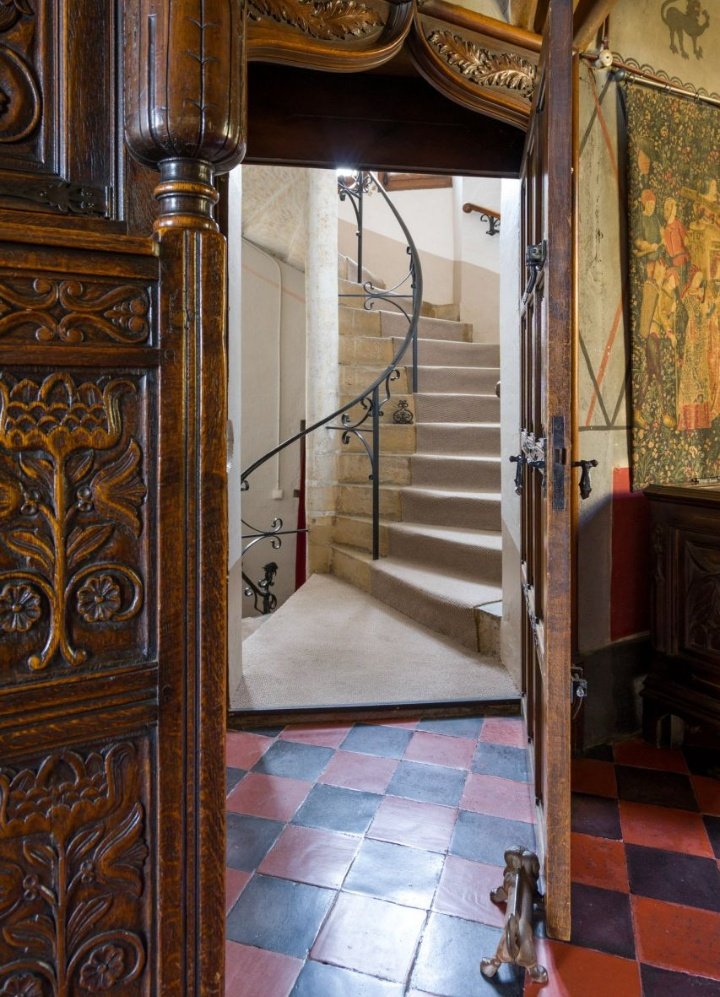
Self guided tours are one party at a time. Winchester Mystery House staff will be available for questions and assistance along the tour route. Advance ticket purchase is required as capacity is very limited. Tickets may be purchased online at www.winchestermysteryhouse.com.




 Randolph Harris II International Institute