

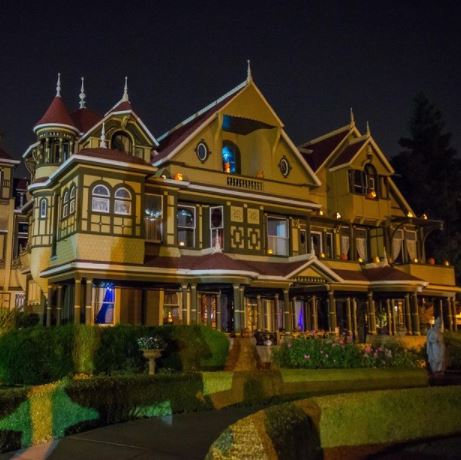
Haunting, eerie, mystical even at times a little frightening to those outside the shadowy half-World of the occult but compelling and demanding out attention. In 1884, Mrs. Winchester left New Haven, Connecticut, and the graves of her husband and only child, moved to San Jose, California, and began the obsession that was to last for the rest of her life. She purchased an unfinished farmhouse outside the small agricultural town, and for the next 38 years, the sound of construction on Mrs. Winchester’s house never stopped. She used to maintain, I remember, that there was no apparition or supernatural manifestation, or series of circumstances pointing to such a manifestation, however strongly substantiated they appeared to be, that could not be explained on purely natural grounds. However, there was a notable instance of what was by many supposed to be a supernatural manifestation that occurred in the water tower on the estate. It was a horrible sight. Barney Ackers and his wife Everly had evidently been waylaid and killed by a blow of an axe just as he was entering the yard gate, and then the door of the water tower had been broken open and his wife had been killed, after which Barney’s body had been dragged into the water tower, and it had been fired with the intention of making it appear that the water tower had burned by accident. However, by one of those inscrutable fatalities, the fire, after burning half of two walls, had gone out. Still, it was a horrible sight and the room looked like shambles. Barney had plainly been caught unawares while leaning over his gate. The back of his head had been crushed in with the eye of an axe, and he had died instantly. The pleasant thought which was in his mind at the instant—perhaps, of the greeting that always awaited him on the click of his latch; perhaps, of his success that day; perhaps, of Mrs. Winchester’s kindness to him for the work he did—was yet on his face, stamped there indelibly by the blow that killed him. There he lay, face upwards, as the murderer had thrown him after bringing him in, stretched out his full length on the floor, with his quiet face upturned, looking in that throng of excited, awestricken men, just what he had said he was: a man of peace. His wife, on the other hand, wore a terrified look on her face. There has been a terrible struggle. She had lived to taste the bitterness of death, before it took her. #RandolphHarris 1 of 13

Satan’s presence was haunting. It haunted Mrs. Winchester for years, and for many nights she could not sleep. No one ever found out who did it, and she found herself unable to forget it, or to have peace as she used to. On the night of the 3rd of January 1888, some thieves attempted to commit a robbery on the estate of Mrs. Winchester. They entered the mansion, armed with a dead man’s hand with a lighted candle in it, believing in the superstitious notion that is such a hand be procured, and a candle placed within its grasp, the latter cannot be seen by anyone except him by whom it is used; also that if the candle and hand be introduced into a house it will prevent those who may be asleep from awaking. The inhabitants, however, were alarmed, and the robbers fled, leaving the hand behind them. No doubt the absolute failure of this gruesome dark lantern on this occasion was due to the fact that neither candle nor candlestick had been properly prepared! The Winchester mansion is full of apparitions and specters and perhaps some of them foiled the bulger’s plan. The mansion was continually disturbed by a nocturnal house-spirits. At night heavy steps were heard as of one carrying a heavy load. On occasion a form appeared in a monk’s cowl. Certain ghosts are confined to the Winchester mansion and they plague particularly people. A certain butler, Elton Abram, was an active spiritist while employed for Mrs. Winchester. For years he practiced table-lifting and considered this to be a way of communicating with the dead. He continued with his occult practices so intensively that psychic disturbances set in. The effects of his spiritistic interests also appeared in his children and grandchildren. His oldest son committed suicide. His next son suffered from a persecution mania. His oldest daughter ended up in The Great Asylum for the Insane. Another daughter suffered from Parkinson’s disease. Among his grandchildren the same picture emerged. One of them was a schizophrenic. Another suffered from weak nerves and hypersensitivity, and another lived a dissolute life, and had given birth to an illegitimate child. The first of the man’s great-grandchildren became a psychopath and a delinquent. #RandolphHarris 2 of 13
From the scientific point of view, one might consider these effects to have a different cause from that of spiritism. The psychiatrist will be interested in the question whether the practicing of spiritism was rather the effect than the cause of the ensuing mental and emotional disorders. Or again, was there some latent disposition in the family that was merely triggered off by the spiritistic activities? The parapsychologist will explain the table-lifting phenomenon as psychic automatism, that is an activation of subconscious forces. The Christian however is concerned essentially with the frequency in which psychic disturbances appear in connection with the practice of occultism. It was well known that Mrs. Winchester donned herself with ceremonial robes and communed nightly with the spirits in the Winchester mansion, and it was the midnight rendezvous for legions of ghosts, with special attention accorded those created by a Winchester rifle slug. It is possible the Mr. Abram stole something from the Winchester mansion, which brought on a curse to him and generations of his family members. A person’s thoughts and actions are like people who populate a community: friendly, contentious, kind, malicious, virtuous, evil, virile, cowardly, optimistic, cynical. We prosper in a pure mental neighborhood and wither in a foul one. And we can choose our mental neighborhood. Tired minds and bodies are signals to be careful. Demonic oppression is not easily discerned. Some people mistakenly blame demons for unrepentant self-will and psychological abnormalities. The source is not always clear, but demon oppression is usually marked by an emotional inability of the individual to do what one wants to do. A young maid staying in the Winchester mansion called Bythesea Atterton, had been a founding member of a thriving witches coven in Essex and the group’s other three members all shared her dedicated to the occult. She began to complain about various mental disturbances which included being tired of life and having depressions. Added to this she often had violent fit of temper, and her marriage was being undermined by her own frigidity. It has also happened that the husband had seen strange figures in the house at night. He had not told his wife about this so as not to upset her, but after a while she too had seen similar strange and maimed figures about the house. #RandolphHarris 3 of 13

Mrs. Winchester questioned the woman about her past illnesses and about the general health of her parents and grandparents, but she was the only one to have suffered in this way. In answer to Mrs. Winchester’s questions about contact with occultism, after a lot of thought Bythesea told her the following story. She had stolen Mrs. Winchester’s sixteenth century book about magic, and saw a black shadow at the end of her bed. It was a horrible presence that frighted the life out of Bythesea. While Mrs. Winchester was asleep, she would invite her Protestant girl’s group over. The minister’s wife, who had become the leader, used to practice table-lifting with all the girls in the Blue Séance Room. The sessions had always begun with the question, “Spirit, are you there?” One knock had meant “yes,” two had meant “no.” When the spirit had been willing to answer they had all taken part in asking it questions. The minister’s wife had continued this practice for many years until she was paralyzed by a stroke. Bythesea told Mrs. Winchester that all the girls had subsequently been afraid to visit their leader since her face had been changed into a terrible grimace by the stroke. Medical science would classy this example together with the precious one. However, with regards to the stroke, we would like to point out that in the numerous cases connected to the Winchester mansion of suicides, fatal accidents, stroke, and insanity, they usually involve the occult and someone who has in someway broke a rule, stole from the mansion, or offended the spirits somehow. The miles of twisting hallways in the mansion are made even more intriguing by secret passageways in the walls. Mrs. Winchester traveled through her house in a roundabout fashion, supposedly to confuse any mischievous ghosts that might he following her. Mrs. Winchester never slept in the same bedroom two nights in a row, in order to confuse any evil spirits that might be waiting for her. Music has always played an important role in cultural outlook and identity. Hymns, marching songs, lullabies—there are a thousand different aspects of life which are ordered or inspired by a musical beat. Music helps to define your cultural tribe. Even the ghost at the Winchester mansion reportedly had parties at ungodly hours. #RandolphHarris 4 of 13

The Satanic underground was celebrated—and eventually propelled into the mainstream—by musicians at the tail-end of the psychedelic era. While the Beatles and the Rolling Stones were the public faces of the 1960s youth culture, other voices of that same social and spiritual revolution sang dark hymns of rebellion. Some think that Black Arts Festivals have gone too far, one in particular. Coven might have achieved the popular success that ultimately eluded them. The band’s first album went under the uncompromising title Witchcraft Destroys Minds and Reaps Souls, boasting a gatefold sleeve featuring the band engaged in a Black Mass—complete with attractive blonde singer Jinx Dawson serving as a naked altar. The album features a recording of this Black Mass at the tail end of side two: “Two the best of our knowledge, this if the first Black Mass to be recorded in written words or in audio,” explain the sleeve notes. (Anton Lavey recorded his own Black Mass shortly afterwards.) “It is as authentic as hundreds of hours of research in every know source can make it. We do no to recommend its use by anyone who has not thoroughly studied Black Magic and is aware of the risks and dangers involved.” The rite bears the hallmark of serious study, with notably authentic elements from medieval Gnostic and witchcraft lore. The overall effect, however is curiously naïve, with the high priest’s command to “kiss the goat” sounding more Monty Python than Aleister Crowley. The music that precedes the Black Mass is standard—if well-executed—1960s folk rock. It is something of a jolt to realize that, behind the gentle acoustic guitars, the lyrics are exclusively about Devil-worship and black magic, while the alluring Miss Dawson’s vocals give the effect of a demonically-possessed Join Mitchell. Ultimately, Witchcraft Destroys Minds and Reaps Souls is an interesting musical exploration of the witchcraft tradition which suffused rural America ever since the Pilgrim Fathers landed in New England over four centuries ago. #RandolphHarris 5 of 13

The infamous Salem witch-trials—which took place in Massachusetts during 1692—had been one of the last major incidents of state extermination by religious fanatics from the “Old World,” making the term “witch-hunt” synonymous with the persecution with marginalized groups. As such, it elicited the sympathy of twentieth-century hippies like Coven toward their satanic predecessors. (In sacrificing the lives of twenty suspected “witches” to the fantasies of hysterical children, it also predated the “Satanic panic” of the 1980s-90s.) Coven’s second album Blood on the Snow followed but, despite its demonic sleeve, the Satanic elements were fare more restrained. By the third album, imaginatively titled Coven, the sinister elements had all but disappeared, replaced by standard hippie material. Robbed of the distinctive image of their early days, Coven faded away. It is interesting that the British rock band Lucifer, formed in 1971, were a curious collection of characters whose sardonically-devilish promotional photos portrayed a Mansonesque image, enlisted the Devil to fight the capitalist-pig system. Lucifer issued two albums, Big Gun and Exit, and a single, entitled “F*ck You,” which was seized by the police. Most outre of the Satanic psychedelicists, Roky Erickson had been the leader of the mid-1960s Texan garage band the Thirteenth Floor Elevators until a bust for marijuana possession. Facing a long prison sentence under the Lone Star State’s sanctimonious laws, he committed himself to a psychiatric institution instead. This was a bad mistake. Three years later, in the early 1970s, the hallucinogen-loving Erickson came out of the lunatic asylum considerably more troubled than when he went in. An obscure cult figure who became known for lyrical tributes to his favorite 1950s horror movies, in the hospital he had formed a close relationship with his own personal Satan. “Ah’m not afraid of the Devil, the Devil is mah friend. He chose me to do his biddin’,” drawled the usual but loveable Erickson. “Those doctors and nurses…They could not mess with the Devil’s chosen one.” To cement this unholy pact, Erickson later vocalized his personal infernal visions in wildly sincere songs like “I Think of Demons” and “Don’t Shake Me Lucifer.” #RandolphHarris 6 of 13

Ny far the most interesting of the Satanic-psychedelic bands were Black Widow. Their 1970s debt album, Sacrifice, was the result of guitarist Jim Gannon’s research into the Black Arts, with occultic lyrics accompanying a blend of traditional folk music and progressive rock. The almost-ubiquitous Alex Sanders warned the band they had done their homework too well, and would attract dark forces. He was right for one, though only inasmuch as Gannon’s lyrics boast a fair degree of authenticity, and some songs—like the catchy “Come to the Sabbat”—are highly evocative of the medieval-European Satanic tradition. Other moments—like the horrible saxophone solo Satan uses to tempt some poor innocent on “Seduction”—are diabolical in a different sense. The band enhanced their image with an elaborately Satanic stage show, professionally choreographed by a Leicester theatre company, complete with sacrificial daggers and an unclothed young woman to adorn the altar (at one point this was Alex Sanders’ wife, Maxine). They reaped the reward for their oddly entertaining work, with Sacrifice reaching the top 40 in the UK album charts. However, their second album, Black Widow, lacked both the Satanic themes and the power of its predecessor. The official explanation for this was that, true to Sanders’ warning, weird things stated to happen—most alarmingly, near-fatal car crashes. (Satan seems particularly keen on causing road accidents, however much more impressive lightning bolts or stampeding elephants might seem.) What is more likely is that, like many rock bands that use powerful Satanic imagery, Black Window may have begun to believe that same imagery was holding back their career. As many have learnt to their cost, however, it is more often the other way around—few dabbling rock stars regain the early excitement once they stop playing the Devil’s music. Suffice to day, Jim Gannon, the major creative force behind the band, cannot have been unduly worried by the curse, as he tried to mount a stage musical version of the Black Widow show on Broadway. Sadly, it never came off, and Black Widow—devoid of Devil worship—dwindled into obscurity. #RandolphHarris 7 of 13

Prosaic accounts of Black Sabbath’s flirtation with occult imagery claim they were impressed by the interest Black Widow had enjoyed in their Satanic stage show. The truth is probably a combination of all these stories. Whatever, it is fair to say that intense interest in their demonic aspects surprised Black Sabbath as much as anyone else. Their eponymous 1969 debut album was recorded in to days for six hundred pounds, treated with contempt and indifference by the press, and rapidly became a commercial success. The Christian Science Monitor, or all publications, noted approvingly that the band did not “condone or promote the less seemly aspects of…an interest in occult matters.” They were right. The song “Black Sabbath” describes the narrator’s state of terror at witnessing a Black Mass. Their attitude to Satan was chiefly the traditional one of fear and loathing, their lyrics even sometime entreating listeners to turn to God as the only source of love. However, the audiences were not listening—they wanted a Satanic band, and that is what Black Sabbath ostensibly became. (Rumor has it that their management had the large cross that decorated the inside of their first album inverted without the band’s knowledge of approval.) Satan appeared in Black Sabbath’s songs as a constant source of fascination and fear, an entity who brings colour into drab existence but can also represent the overwhelming evil of the World. In the classic “War Pigs,” Satanic witched are equated with the evil of politicians and generals who callously kill millions in their power games. (According to guitarist Tony Iommi, the title was derived from “Walpurgis,” the night when evil traditionally rules the World.) However, the most fascinating manifestation of Satan in a Black Sabbath song is also the rarest: when they briefly allow the Prince of Darkness to speak for Himself. In this strange and haunting “N.I.B,” Lucifer, the creator, sings a plaintive love song to His greatest creation and fellow sufferer, humankind. (The song “Lord of this World,” also recognizes Satan as god of the Earth.) #RandolphHarris 8 of 13

N.I.B.’s title is the source of some confusion: according to drummer Bill Ward it was simply his nickname, derived from when the band were stoned and though he resembled a pen nib. Typically, the fans perceived a more Satanic significance—to them, “N.I.B” stood for “Nativity in Black.” Inevitably, the band were quizzed on such apparent occultic beliefs during interviews. “We are into God,” Iommi unhelpfully explained to which Ward added, “But sometimes I feel Satan is God.” Perhaps they were expressing the beliefs of the early Satanic Gnostic groups, fifteen hundred years before. Led Zeppelin emerged in 1968 from London’s lively rhythm and blues scene. The band took off completely and became a huge commercial success. They were also said to have a Satanic influence with their roots being in traditional black blues music—though guitarist Jimmy Page’s outfit, much closer in its sympathies to the blues than to heavy metal, was far more preoccupied with the tradition. The Devil also makes His presence felt, either as a symbol of the inevitable fate awaiting the debauched bluesman, or as the hard-living musician’s comrade and inspiration. The delta blues—the school that had the greatest influence on the rock-guitar style—became known as “the Devil’s music.” Delta bluesmen included Peetie Wheatsraw, who liked to be known as “the Devil’s Son-in-Law and High Sheriff of Hell,” and Robert Johnson. Johnson, the acoustic-playing grandfather of rock guitar, best illustrates the enduring legend of the bluesman who sold his soul to acquire musical talent. (As testified by Satanic Rock star Glenn Danzig during our interview with him: “A lot of the old blues songs are very heavily rooted in occultism. There is Robert Johnson, all the voodoo and juju stuff—‘Got my Mojo Working,’ ‘Black Cat Bone.’”) Johnson’s pact with Satan was said to be struck at the “Crossroads”—one of his best-know song, and a traditionally magical location in many cultures—and thereafter he always claimed to live, as another song put it, with a “Hellhound on My Trail.” #RandolphHarris 9 of 13

Led Zeppelin, and Jimmy Page in particular, were heavily influenced by Johnson, lifting parts of his songs for their own compositions. As with Johnson, so the popular rumour went, Led Zeppelin has made a pact with the Devil, asking the Prince of Darkness to tune their instruments in return for their souls. Only Satanic aid, reasoned the myth, could explain the enormous success the band enjoyed so rapidly, or the power involving pleasures of the flesh these modern pied pipers had over young ladies. These same legends had been linked with musicians from Robert Johnson to Elvis Presley and beyond, but with Led Zeppelin the Satanic-pact myth has proved especially enduring. If you study the supernatural, you cannot ignore evil. The “ZOSO” symbol that became Led Zeppelin’s band’s trademark was also partly derived from the work of another influential British occultist, Austin Osman Spare—a contemporary of Crowley, and occultic artist, best known for his “automatic drawing,” which he claimed worked as a conduit for supernatural forces. One more than one occasion, Page hinted that much of Led Zeppelin’s material (particularly their meditative anthem “Stairway to Heaven”) had been conceived in a similar fashion. (If you recall, this is also how Mrs. Winchester received the plan on how to build her mansion.) Kenneth Anger asked Page to record a soundtrack for his magic ritual film Lucifer Rising, but was bitterly disappointed with the results, saying, “I had asked him for intimacy and strength, rhythms and counter-rhythms. But he gave me a short fragment of chanting voices and sounds that I thought were quite sombre and morbid.” In October of 1976, the two fell out in grand style. Page threw Anger out of the basement of his London house, where he had granted the American magus use of a fil-editing suite. Anger responded with a press conference. Asked if he felt vindictive toward Page, Anger reposed, “You bet I do. I’m not a Christian turn the other cheek kind. In fact, I’m ready to throw a Kenneth Anger curse.” #RandolphHarris 10 of 13
Asked about the incident in an interview the following year, Page observed, “The whole thing about ‘Anger’s Curse,” they were just these silly little letters. God, it was all so pathetic…I had a lot of respect for him. As an occultist he was definitely in the vanguard.” Despite Page’s scepticim, many fans and commentators linked the personal tragedies that were to strike the band with some kind of hex. On 26 July 1977, vocalist Robert Plant’s young son Karac died of a respiratory infection. Three years later, on 26 September 1980, the band’s drummer, John Bonham, died after a drinking binge. Enough was enough. On 4 December 1980, it was announced that Led Zeppelin were no more. The band’s demise only served to fuel rumours. The more lurid stories held that all of Led Zeppelin, with the exception of Bonham, had signed pacts with the Devil for Earthly pleasure, supposedly explaining the drummer’s untimely death. One fanzine reported that black smoke had been seen billowing from Page’s house on the day following Bonham’s death, and that the guitarist was overheard uttering strange curses in unknown tongues. Even the mainstream press got in on the act, with the London Evening News quoting an anonymous source: “It sounds crazy, but Robert Plant and everyone around the band is convinced that Jimmy’s dabbling in black magic is responsible in some way for Bonzo’s death and for all these other tragedies.” What are we to make of the “Led Zeppelin curse”? Many young people still need to hear guitar music that conjured the Devil, and Satanic rock does show a tenacity that surprised all but its most fervent disciples. Kip Trevor from the band Black Widow tells the story about their album Sacrifice and the stage show of the same title. “There is a guy who has lost his wife as a result of an accident to do with some kind of occultic ceremony. Something goes wrong, and she is killed. He comes back through the centuries, is reborn, and remembers this in a dream. In this dream he realizes his wife can be returned to him, if he can perform another ceremony, like the one which had gone wrong. This time he would turn the tables on the Lady Astoroth, draw her, overpower her, and sacrifice her, then she would be banished and his wife would come back. #RandolphHarris 11 of 13

“So in the first song, ‘In Ancient Days,’ tells the story of this guy travelling through the centuries. Then there is the conjuration in which we bring Lady Astoroth and the girl appears. We’d have a lot of fun with that, as she would appear from all sorts of odd places, depending on where we were playing. We toured with it all over Europe for around eighteen months. When Black Widow broke up, Jim and myself went off to try and revive the idea of the occultic stage show. We spent a lot of time, money and effort on this new black magic concept, but it did not work out. Black Widow’s first album was quite an achievement, but it would have been lovely to have developed it. The problem was that the band politics got in the way—some of them wanted to be a “normal” band and thought the whole black magic thing was not them. They thought it was overshadowing their playing. The show was written with Jim’s research, using proper conjuration ceremonies. The whole thing was done authentically as we could possibly do it. We drew the magic circles, used all the props—fire, earth, water, and air. We did it exactly as you were supposed to do it. Doing that has an effect, even if it is only psychological, because you know you’re doing it in the correct fashion. You’re stepping over the line. Combined with the power of the music and the power of the audience’s involvement, weird things would happen.” God did not create the devil as such. Lucifer, one of God’s mighty cherubs, rebelled against Him and became the devil. Satan is thus the product of his own evil choice. God created a superbly beautiful and wise being and invested him with power above all the other created beings. His name, Lucifer, means “son of the morning,” “bright and shining one,” or “light bearer.” He had many angels at his beck and call and was prince over all the Earth. A fee moral agent with the power of choice, he was filled with an ambition to which he had no right—to rise above God. Unwilling to rule over the World as a vice-general under God, he became “Satan,” meaning “adversary,” or opponent. #RandolphHarris 12 of 13
There is only one devil; there are many demons. A familiar spirit in the service of Satan knows human beings so well that he can disguise himself as those people; there are different kinds of spirits—some are sensual and lewd, and others appear ethical; demons are wandering spirits belonging to the legions of Satan, a class of beings distinct from angels—some are on Earth seeking embodiment in human beings and animals, other already are imprisoned in the bottomless abyss; Satan wins followers by psychic and supernatural phenomena that approximate the power of God; Satan is a created being who presently exercises authority over his domain, the Earth realm, but he can do only what God allows him to do, and eventually he will be deprived of all power and glory. As one can see, it is not only Mrs. Winchester who had experiences with the occult, curses, and spirits. Many people have. Occasionally other theories turn up in the literature of modern parapsychology. Some speak of a magical astral World-soul. This entails the idea of an inner World in which all the occurrences of the visible World have their inner equivalent. The World-soul is supposed to be outside of our concept of space and time. The past and the future, the near and the far are said to be all on the same level. Everything is synchronized and simultaneous. A person who is capable of contacting this World-soul enables such a person to enter into a sphere of higher intelligence where the limitations of space and time no longer hold true. Prophecy is inspired either by the Holy Spirit of by the Devil. The wide scope of the occult power possessed by spiritists helps explain why they can cause so much mischief. Through the phenomena of levitation, apports, telekinesis, and materializations, it is not difficult to see how a person endowed with strong mediumistic powers can do a great deal of harm, especially in closely associated realm of magic. Genuine magic is the art of bring about results beyond humans’ power through the enlistment of supernatural agencies. Black magic deliberately involves the devil and demons, and the resulting enchantment is used for persecution and revenge. #RandolphHarris 13 of 13


Sarah Winchester was reportedly trapped in her Daisy Bedroom during the 1906 earthquake. Her workers had to pry her out of the room, and the crowbar mark is still on the door to this day… See it on the Mansion Tour!

A 160-room mansion built to appease the spirits who died at the hands of the Winchester Rifle 👻




 Randolph Harris II International Institute