

Perplexity is leavened by extravagant Victorian beauty, and no casual visitor can see it all. Palatial elegance unfolds with each turn along every path of exploitation of the catacomb. One gazes through oval lens windows now only magnifying the pandemonium of Winchester Boulevard; through them, over a century ago, imagine the warm summer evenings, as Sarah Winchester admired her quiet gardens steeped in the low western sunshine; the bird singing loud in the hawthorn and sycamore of her deer park, the cascading fountains spouting holy water, and the peaceful blossoming orchards vesper calm upon all things. The best tea-things were set out in her best parlour. There was usually a bunch of roses on the table, and Mrs. Winchester was dressed in her light blue muslin, with a rose in her hair. She would arise before her guests like a picture, with the sunshine flickering about her dark hair. She was very sweet, tender and gentle. Many people wanted the pleasure of an invitation to a séance in the Blue Séance Room. Mrs. Winchester would gather together many birds of alien feather. A humans’ own suffering mind must be, of all moral food, the most poisonous for one to feed on. Surround a scorpion with fire and it stings oneself to death. Throw a diseased soul entirely upon its own resources and moral suicide result. It was a principle with Mrs. Winchester to oppose bullying. She believed we were here on this Earth for a definite purpose–and God’s duty plain to any human who wills to read it. There may be disembodied spirits who seek to distress or annoy where they can no longer control. If there are, hers, which is not yet divorces from its means to material action, declines to be influenced by any irresponsible whimsy. #RandolphHarris 1 of 16

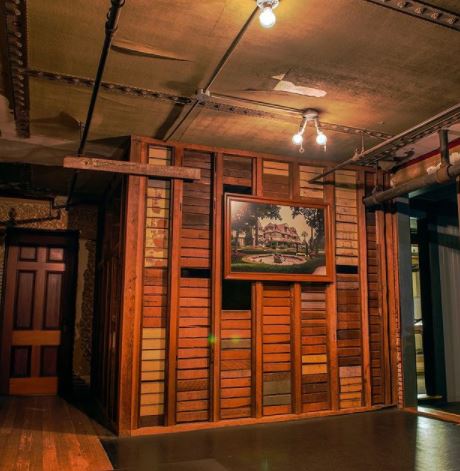
Mrs. Winchester was very happy in her new home. She had been used to keeping her father’s house since her early girlhood days, and her shortly lived matronly duties came very easy to her. The expansive Victorian mansion, with its neat furniture and fresh dimity draperies, 160 rooms, 10,000 windows, nine kitchens, and 47 fireplaces was the pretties thing possible in the way of rustic interiors; the estates was like a temple dedicated to some Heavenly divinity, and Mrs. Winchester took a natural womanly pride in this bright home. She had come from a good house; but this was quite her own. For 38 years, 1884-1922, the sound of saw and hammer never ceased. Commonly, 16 carpenters were employed at one time, some having worked for 20 years without changed. They produced the largest, most complicated and exclusively private residents in the United States of America. There are five different heating systems and three elevators, one hydraulic and two electric. Some of the 13 bathrooms lacked privacy; they have clear glass doors! One rambling room has four fireplaces and five hot-air registers. A spiral stairway has 42 steps, each two inches high. Other stairways melt into blank walls. A second story door opens into the great outdoors and a 20-foot step. A linen closet has the area of a three-room apartment; a nearby cupboard is less than one-inched deep. A skylight is placed in the middle of a room, in the floor! Another floor is a series of trap-doors. The visitor must stoop through one door to enter, the next gives clearance for an eight-foot giant. Many stairway turn posts are upside down. Entire walls are built entirely of half-inch, “half-round” strips. #RandolphHarris 2 of 16

Everywhere prevail that uncanny deference to the number 13; 13 stairsteps, 13 hangers in a closet, 13 wall panels, 13 lights in the chandeliers, 13 windows to a room and if necessary to make that number, some placed in an inside wall. One of the guests at this séance was Ludwig Leichhardt. He thought of men and women who had died of a fever the previous year, and the spirits told him to depart for “people who had wished to live, for whom life was full of duties and household joys; whose loss left wide gaps among their kindred, not to be filled again upon this Earth.” Ludwig felt a dull blankness of his existence which he felt—an utter emptiness and hopelessness; nothing to live for in the present, nothing to look forward to in the future. He bragged about how much capital he had in the Bank of Italy and how he could provide Mrs. Winchester with a comfortable life. However, this was to be his last day as a guest at the Winchester mansion. His two great sea chests, containing his clothes, books, and other property had gone to San Francisco by that evening’s luggage train. His last memory of the Winchester would be Mrs. Winchester’s bright tender face looking at him compassionately, as she had looked the day she broke his heart. After the death of her husband and daughter, Mrs. Winchester remained celibate and never remarried. Precious moments went by, and Ludwig pushed his teacup away with a listless air. He got up presently and showed him she to the exit of the mansion, after a brief good evening to all. The sun was low by this time, and the western sky flooded with an orange light. The garden was abloom with roses and honeysuckle. Ludwig Leichhardt fancied her should never look upon such flowers or such a garden again. The mansion seemed to grow dark all at once when he was gone. #RandolphHarris 3 of 16
Adam Worth had also been at the séance that evening and did not seem to care for the tea. Ludwig promised to write Mrs. Winchester to let her know he was safe. The sun had gone down, and there was a long line of crimson yonder in the west above the edge of the estate. All the guest prepared to leave and Mrs. Winchester retired to her chambers for the evening. While laying in bed, Mrs. Winchester heard a bang on a door with a sounding slap. She figured it was just a piece of stupid discourtesy and went back to sleep. The following morning, she swore that one of the rooms on the second floor was not empty—and was quite upset about it—said there was some infernal influence at work in her home. To satisfy her curiosity, she asked her butler Henry to open the door. The light was dim in the room and Mrs. Winchester paused in the corridor outside. His eyes glistened. His features relaxed, and he gave a short sigh, “the room is empty,” said Henry. With some stir of curiosity, Mrs. Winchester slipped out, but had a certain vague wonder in her mind. As she heard, the medium from the night before in the parlour was struggling on the floor, in what looked like an epileptic fit. Mrs. Winchester walked deliberately back to the closed door, as Henry went to hold the medium from doing any injury to herself. Huddled against the massive end wall, and half embedded in it, as it seemed, there lay a shadow. Looking closely, Mrs. Winchester saw that the trap door was not only firmly bolted, but screwed into its socket. She strode off in a fume. She was in an odd frame of mind, and for long moved her sitting-room to and fro, too restless to go to bed, or, as an alternative, to settle down to a book. #RandolphHarris 4 of 16

She could not whistle her mind from the chase of a certain graveyard will-o’-wisp; and on it went stumbling and floundering through bog and mire, until she fell into a state of collapse, and was useful for nothing else. She went to bed and to sleep without difficulty, but was conscious of herself all the time, and of a shadowless horror that seemed to come stealthily out of the corners and to bend over and look at her, and nothing but a curtain or a hanging coat when she started and stared. Over and over again this happened, and Mrs. Winchester’s temperature rose by leaps, and suddenly she saw that is she failed to assert herself, and promptly, fever would leap her in a consuming fire. Then in a moment she broke into a profuse perspiration, and sank exhausted into delicious unconsciousness. Morning found her restored to vigour, but still the with flutter of curiosity in her brain. It worked there all day, and for many subsequent days, and at last it seemed as if her every faculty were honeycombed with its ramifications. Then “this will not do,” Mrs. Winchester thought, but still the tunnelling process went on. As the curious devil mastered her, she grew into such harmony with it that she could shut her eyes no longer to the true purpose of its insistence. It was the closed room about which her thoughts hovered like crows circling round carrion. In the dead waste and middle of a certain night, Mrs. Winchester awoke with a strange, quick recovery of consciousness. There was the passing of a single expiration, and she had been asleep and was awake. She had gone to bed with no sense of premonition or of resolve in a particular direction; she sat up a monomaniac. It was as if, swelling in the silent hours, the tumour of curiosity had come to a head, and in a moment, it was necessary to operate upon it. #RandolphHarris 5 of 16

She made no excuse for her then condition. Mrs. Winchester was convinced she was the victim of some undistinguishable force, that she was an agent under the control of the supernatural. Some thought had been in her mind of late in her position it was her duty to unriddle the mystery of the closed room door. However, time went by. The new year came, and still there was no letter from Ludwig Leichhardt. However, early in January, Henry, the butler came home from the Bank of Italy one afternoon, and told Mrs. Winchester she need not worry herself about her old friend any longer. “Ludwig Leichhardt is safe enough, mistress,” he said. “I was talking to Gilbert, the cashier at the Bank of Italy, this morning, and he told me that Leichhardt wrote to them for $2,000.00 last October from San Francisco, and he has written $1,000.00 more since. He is buying land somewhere—I forget the name of the place—and he’s well and hearty, Gilbert tells me.” However, a sense of fear and constriction was upon Mrs. Winchester. “Well, I’m afraid I’m rather fanciful, Henry; but I could never explain to you what a strange feeling came over me the night Ludwig Leichhardt went away from this estate. It was after I had said goodbye to him, and he had gone back into the mansion, where all was dark and quiet. I sat in the parlour thinking of him, and it seemed as if a voice was saying in my ear that I, nor anyone that care for hum, would ever seen Ludwig Leichhardt again. There wasn’t any such voice of course, you know, Henry, but it seemed like that in my mind; and whenever I’ve thought of poor Ludwig Leichhardt since that time, it has seemed to me like thinking of the dead. Often and often I’ve said to myself, ‘Why, Sarah, you silly thing, you ought to know that he’s safe enough in San Francisco. Ill news travels fast; and if there’d be anything wrong, we should have heard of it somehow.’ But, reason with myself as I would, I have never been able to feel comfortable about him; and thank God for your good news, Henry, and thank you for bring it to me. #RandolphHarris 6 of 16

It has been very unkind of Ludwig not to write. She could not forgive him for his neglect, glad as she was to know he was safe. Then Mrs. Winchester paused for a moment, and confessed, the quick pant of fear seemed to come from her lips. There were sounds about her—the deep breathing of an imprisoned man. She returned to the locked door, and hurriedly flung it open. An acrid whiff of dust assailed her nostrils as she stepped back a pace and stood expectant of anything—or nothing. What did she wish, or dread, or foresee? The room was rather a large one; an old-fashioned room, with a low ceiling crossed by heavy means; half parlour, half kitchen, with a wide-open fireplace at one end, on which the logs had burnt to a dullish red. There was the old chintz-covered armchair. Mrs. Winchester had been sitting with her face towards the open window, looking absently out at the garden, where daffodils and early primroses glimmered through the dusk. She stood to pick up her blueprints, which had fallen to the ground. She was standing folding this in a leisurely way, when she looked towards the fireplace, and gave a little start at seeing that the armchair was no longer empty. “Why, Henry,” she cried, “how quietly you must have come into the place! I never heard you.” There was no answer, and her voice sounded strange to her in the empty room. “Henry!” she repeated, a little louder; but the figure in the chair neither answered nor stirred. Then a sudden fright seized her, and she knew that it was not her butler. The room was almost dark; it was quite impossible that she could see the face of that dark figure seated in the armchair, with the shoulders bent a little over. Yet she knew, as well as ever she had known anything in her life, that it was not the butler Henry. #RandolphHarris 7 of 16

She went slowly towards the fireplace, and stood within a few paces of that strange figure. A little flash of light shot up from the candle, and shone for an instant on the face. It was Ludwig Leichhardt! Mrs. Winchester tried to speak to him; but the words would not come. And yet it was hardly so appalling a thing to see him there that she need have felt what she did. San Francisco was not too far from San Jose that a man may not cross the Bay and drop in upon his friend unexpectedly. The candle’s flame got bigger, lighting up the entire room. The chair was empty. Mrs. Winchester uttered a loud cry, and Henry entered the room. “Why, Mrs. Winchester! What’s amiss?” he said. She ran to him, sobbing hysterically, and then calming herself with an effort, told him how she had seen Ludwig’s ghost. “Why Mrs. Winchester,” Henry replied. “Ludwig Leichhardt is safe in San Francisco. It was a shadow that took the shape of your old friend, to your fancy. It’s easy enough to fancy such a thing when your mind’s full of anyone.” Ill and shaken, yet fearing death as she had never dreaded it before, Mrs. Winchester said, “It was no fancy. Ludwig Leichhardt is dead, and I have seen his ghost. I’ve a feeling that he never got to San Francisco alive, Henry,” she said. “I can’t explain how it is, but I’ve a feeling that it was so.” Mrs. Winchester spent the rest of that horrible night huddled between her crumpled sheets, fearing to look forth, fearing to think. She knew the letters had been forgeries, and could not forget the madness and the terror in learning to walk the unvext paths of placid souls. She was left with nothing but an aimless scurrying terror and the black swarm of thoughts, so that she verily fancied her reason would give under the strain. Yet she had more to endure and to triumph over. Near morning she fell into a troubled sleep, throughout which the drawn twitch of muscle seemed an accent on every word of ill-omen she had ever spelt out of the alphabet of fear. If her body rested, her brain was an open chamber for any toad of ugliness that listed to “sit at squat” in. #RandolphHarris 8 of 16

Mrs. Winchester tried to convince herself that the thing she had seen was only a trick of her imagination. Another month went by, and again in the twilight the same figure appeared to her. It was standing this time, with one arm leaning on the high mantlepiece; standing facing her as she came back to the room, after having quitted it for a few minutes for some slight household duty. There was a fire burning in the fireplace. The logs were burning with a steady blaze that lit up the well-known figure and unforgotten face. Ludwig Leichardt was looking at her with an expression that seemed half reproachful, half beseeching. He was very pale, much paler than she had ever seen him in life; and as he looked, she standing just within the threshold of the door, she saw him lift his hand slowly and point to his forehead. The firelight showed her a dark red stain upon the left temple, like the mark of a contused wound. She covered her face with her hands, shuddering and uttering a little cry of terror, and then dropped half fainting upon a chair. When she uncovered her face the room was empty, there was a pool of blood on the floor, and the firelight shining cheerily upon the walls, no trace of that ghostly visitant. This time Mrs. Winchester brooded over the thoughts of the thing she had seen, firmly believing that she had looked upon the shadow of the dead, and that there was some purpose to be fulfilled by that awful vision. In the day, she had the room boarded up. The thought of this was almost always in her mind; in the dead silence of the night, she would often lie awake for hours thinking of Ludwig Leichhardt. Mrs. Winchester knew he had been waylaid and murdered. He had a good deal of money about him. Suddenly Mrs. Winchester woke to the fact that there was a knocking at her door—that there had been for some little time. She cried, “Come in!” finding a weak restorative in the mere sound of her own human voice; then remember the keys was turned, bade the visitor wait until she could come to him. #RandolphHarris 9 of 16

Scrambling, feeling dazed and white-livered, out of bed, Mrs. Winchester opened the door, and met one of the gentlemen on the threshold. The man looked scared, and his lips, she noticed, were set in a somewhat boding fashion. “Come you come at once, Mrs. Winchester?” he said, “There’s summat wrong with Ludwig Leichhardt. She had now a settled conviction that some untimely fate had befallen her old friend, and that the letters from San Francisco were forgeries. Gilbert from the Bank of Italy compared the signature cards and determined that the drafts and letters were forgeries. There was one thing noticeable in the San Francisco letters—they were all exactly alike, line for line, curve for curve. This rather discomposed Gilbert; for it is a notorious fact that a man rarely signs his name twice in exactly the same manner. There is almost always some difference. Before the month was out, Ludwig Leichhardt’s ghost appeared for the third time to Mrs. Winchester. In the Tender June twilight. She was thinking of her old friend as she walked along the shadowy winding path of the deer park on her estate. It was just such a still, peaceful evening as that upon which he had stood on the edge of the common looking back at her, and waving his hand, upon that last well remembered night. He was so much in her thoughts, and the conviction that he had come from among the dead to visit her was so rooted in her mind, that she was scarcely surprised when she looked up presently, and saw a tall familiar figure moving slowly among the trees a little way before her. There seemed to be an awful stillness in the wood all at once, but there was nothing awful in that well-known figure. She tried to overtake it; but it kept always in advance of her, and at a sudden turn in the path she lost it altogether. The trees grew thicker, and there was a solemn darkness at the spot where the path took this sharp turn, and on one side of the narrow footpath there was a steep declivity and a great hollow, made by a disused gravel pit. #RandolphHarris 10 of 16

She went to her mansion quickly enough, with a subdued sadness upon her, and told Henry what had happened to her. Nor did she rest until there had been a search made on the extensive grounds for the body of Ludwig Leichhardt. They searched and found him lying at the bottom of the gravel pit, half buried in loose sand and gravel, and quite hidden by a mass of furze and bramble that grew over the spot. There was an inquest, of course. The tailor who had made the clothes found upon the body identified them, and swore to them as those he had made for Ludwig Leichhardt. The pocket were all empty and turned inside out. There could be little doubt the Ludwig Leichhardt had been waylaid and murdered for the sake of the money he carried upon him that night. His skull had been shattered by a blow from a jagged stick on the left temple. The stick was found laying at the bottom of the pit a little way from the body, with human hair and stains of blood upon it. Ludwig Leichhardt had never left San Jose. It was later determined that Adam Worth had killed Ludwig Leichhardt and took his money. The Bank of Italy refunded the withdraws. Adam Worth was ultimately apprehended, with some of Ludwig Leichhardt’s property still in his possession, and he was deeply in debt. The final examination resulted in a verdict of willful murder, tried, found guilty and hung. Ludwig Leichhardt had executed a few days before his intended departure, bequeathing all he possessed to Sarah Winchester—the interest for her sole use and benefit, the principal to revert to her estate after her death. Mrs. Winchester often sits beside that quiet resting place in the spring twilight; but she had never seen Ludwig Leichhardt’s ghost since that evening in the deer park, and she knew she never would see it again. She shook with an awful thankfulness at sight of the pitfalls she had skirted and escaped—of the demon she witlessly had baffled. The joy of life was in her heart again, but chastened and made pitiful by experience. #RandolphHarris 11 of 16

You are aware that evil spirit beings operating through humans in positions of authority and influence are the real motivators in human society? Yes, this is exactly what the Christian Bible teaches! Perhaps this concept seems strange to you, almost like an outmoded superstition, but the Bible definitely states that Satan in the “god of this age,” reports 2 Corinthians 4.4, and that he is the leader of a well-organized army of beings invisible to humans but very active among them. Paul tells us in Ephesians, “For we wrestle not against flesh and blood, but against principalities, against powers, against the rulers of the darkness of this World, against spiritual wickedness in high places,” reports Ephesians 6.12. These words indicate that evil spirits are organized into a military-like structure. The “principalities” are the highest ranking officers under Satan, the “powers” are officials of somewhat lower standing, and the “rulers of the darkness of this World” seem to be a special band of evil spirits whose sphere of influence includes the leaders of human government. The phrase “spiritual wickedness is high places” is better translated “spiritual hosts of wickedness in the Heavenly places,” and makes reference to the myriads of demonic hordes. They are all under the direction of Satan, who is not only named the “god of this age,” but also is called “the prince of the power of the air,” reports Ephesians 2.2. The Scriptures often speak of a close relationship between these evil spiritual and the “World.” In the Ephesians passage quoted above, you will remember that these spirit beings are called “the rulers of the darkness of this World.” The apostle John also refers to the World, and it is significant that he considers it to be the Christian’s enemy. “Love not the World, neither the things that are in the World. If any human love the World, the love of the Father is not in one. For all that is in the World, the lust of the flesh, and the lust of the eyes, and the pride of life, is not of the Farther, but is of the World. And the World passeth away, and the lust of it; but one that doeth the will of God abideth forever,” reports 1 John 2.15-17. #RandolphHarris 12 of 16

In addition, the same apostle declared that one who is “born of God overcometh the World,” reports 1 John 5.4, and also that “the whole World lieth in wickedness,” reports 1 John 5.19. James, the brother of Jesus, declared in his epistle, “Whosoever therefore, will be a friend of the World, is the enemy of God,” reports James 4.4. Before we can gain a full understanding of what this means, we must answer the following questions: What is this World, which if loved causes us to lose God’s friendship? What does the Bible mean when it says that the whole World “lieth in wickedness”? Certainly the Bible is not saying that Christians should not love the World of nature, nor is it implying that every person who is not a Christian is an enemy to be overcome. In fact, the Scriptures often state that the glory of God is revealed in the natural World, and it specifically instructs believers not to antagonize other people, but to love them. No, the material Universe in which we live is not opposed to us, and we are not to consider the people who inhabit the Earth as our enemies. The “World” referred to by John and James is the moral and spiritual system we call human society. Humankind, which has rejected God’s revelation, has devised explanations of life, moral standards, and principles of conduct based upon human knowledge only. Humans, on the whole, operate on erroneous principles, selfish desires, improper motives, and unworthy standards of value. The sciences, the arts, politics, and entertainment are all dominated by a humanistic approach to life which draws humans away from God and makes humans the “measure of all things.” If the period of treated of in the essay from the commencement of the seventeenth century to the Restoration of Charles II, be barren of witchcraft proper, it must at least be admitted that it is prodigal in regard to the marvellous under various shapes and forms, from which the hysterical state of the public mind can be fairly accurately gauged. #RandolphHarris 13 of 16
The rebellion of 1641, and the Cromwellian confiscations, that troubled periods when the county was torn by dissention, and ravaged by fire, sword, and pestilence, was aptly ushered in by a series of supernatural events which occurred in the country Limerick. A letter dated the 13th August 1640, states that “for news we have the strangest that ever was heard of, there inchantments in the Lord of Castleconnell’s Castle four miles from Lymerick, several sorts of noyse, sometymes of drums and trumpets, sometimes of other curious musique with Heavenly vouces, then fearful screeches, and such outcries that the neighbours near cannot sleepe. Priests have adventured to be there, but have been cruelly beaten for their paynes, and carryed away they knew not how, some two miles and some four miles. Moreover were seen in the like manner, after they appear to the view of the neighbours, infinite number of armed men on foote as well as on horseback. One thing more [id est something supernatural] by Mrs. Mary Burke with tweleve servants lyes in the hose, and never one hurt, onley they must dance with them every night; they say, Mrs. Mary come away, telling her she must be wife to the inchanted Earl of Desmond. Uppon a Mannour of my Lord Bishoppe of Lymerick, Loughill, hath been seen upon the hill by most of the inhabitants aboundance of armed men marching, and these seene many tymes—and when they come up to them they do not appear. These things are very strange, if the cleargie and gentrie say true.” During the rebellion an appalling massacre of Protestants took place at Portadown, when about a hundred persons, men, women, and children, were forced over the bridge into the river, and so drowned; the few that could swim, and so managed to reach the shore, were either knocked on the head by the insurgents when they landed, or else were shit. #RandolphHarris 14 of 16

It is not a matter of surprise that this terrible incident gave rise to legends and stories in which anything strange or out of the common was magnified out of all proportion. Accord to one deponent there appeared one evening in the river “a vision or spirit assuming the shape of a woman, waist high, upright in the water, naked with [illegible] in her hand, her hair dishevelled, her eyes seeming to twinkle in her head, and her skin as white as snow; which spirit seeming to stand upright in the water often repeated the word Revenge! Revenge! Revenge! Also, Robert Maxwell, Archdeacon of Down, swore that the rebels declared to him, (and some deponents made similar statements) “that most of those that were thrown from the bridge were daily and nightly seen to walk upon the River, sometimes singing Psalms, sometimes brandishing of Swords, sometimes screeching in a most hideous and fearful manner.” Both these occurrences are capable of a rational explanation. The supposed spectre was probably a poor, bereaved woman, demented by grief and terror, who stile out of her hiding-place at night to bewail the murder of her friends, while the weird cries arose from the half-starved dogs of the country-side, together with the wolves which abounded in Ireland at that period, quarrelling and fighting over the corpses. Granting the above, and bearing in mind the credulity of all classes of Society, it is not difficult to see how the tales originated; but to say that, because such obviously impossible statements occur in certain despsitions, the latter are therefore worthless as a whole, is to willfully misunderstand the popular mind of the seventeenth century. We have the following on the testimony of the Rev. George Creighton, minister of Virginia, Co. Cavan. He tells us that “drivers women brought to his House a young woman, almost naked, to whom a Rogue came upon the way, these women being present, and required her to give him her mony, or else he would kill her, and so drew his sword; her answer was, You cannot kill me unless God gives you leave, and His will be done. #RandolphHarris 15 of 16
“Thereupon the Rogue thrust three times at her naked body with his drawn sword, and never pierced her skin; whereat he being, as it seems, much confounded, went away and left her.” A like story comes from the other side: “At the taking of the Newry a revel being appointed to be shot upon the bridge, and stripped stark-naked, nothing withstanding the musketeer stood within two yards of him, and shot him in the middle of the back, yet the bullet entered not, nor did him any more hurt than leave a little black spot behind it. This many hundreds were eye-witnesses of. Divers of the like have I confidently been assured of, who have been provided of diabolical charms.” Similar tales of persons bearing charmed lives could not doubt be culled from the records of every way that has been fought on this planet of ours since History began. The ease with which the accidental or unusual was transformed into the miraculous at this period is shown by the following. A Dr. Tate and his wife and children were flying to Dublin from the insurgents. On their way they were wandering over commons covered with snow, without any food. The wife was carrying a sucking child, John, and having no milk to give it she was about to lay it down in despair, when suddenly “on the Brow of a Bank she found a Suck-bottle with sweet milk in it, no Footsteps appearing in the snow of any that should bring it thither, and far from any Habitation; which preserved the child’s life, who after became a Blessing to the Church.” The Dr. Tate mentioned above was evidently the Rev. Faithful Tate, D.D., father of Nahum Tate of “Tate and Brady” fame. Much of what has passed current in the New World as White (id est, permissible) Magic is only a disguised goeticism, and may of the resplendent angels invoke with the divine rites reveal their cloven hoofs. It is not too much to say that a large majority of past psychological experiments were conducted to establish communication with demons, and that for unlawful purposes. The popular conceptions concerning the diabolical spheres, which have been all accredited by magic, may have been gross exaggerations of fact concerning rudimentary and perverse intelligences, but the willful viciousness of the communicants is substantially untouched thereby. #RandolphHarris 16 of 16


Happy Early Turkey Day! 🦃

The Winchester Mystery House will be closed on Thursday, Nov. 25 in observance of the Thanksgiving holiday and will reopen on Friday, Nov. 26! winchestermysteryhouse.com




 Randolph Harris II International Institute