
Home » substance (Page 11)
Category Archives: substance

Love Does Not Exists Only in Rare Fleeting Moments

Overpopulated and over-proselytized, The Earth’s land which houses the generation’s of oscillating cities and suburbs began to erode as quickly as quickly as the illusion has. The green lawns and pavement echo with love’s demise. The discarded remains of “youthquake” were now street-smart hustlers. Those left behind after the COVID pandemic can only anesthetize themselves from the World’s mourning and especially, the confusion at hand. The whitewashing euphoria of a pre-tyrannical America turned into an interment camp left behind faces that were convoluted, masked, and void of expression. All that remained was paranoia, phobia and frustration. Hate became the first turned-on revelation. The masses continued to recruit mask police to make sure everyone had on a mask, even if it was dirty and had been worn several times. Men, women, and children were starving in the street. Minds and bodies have become maimed as we watched a much larger scaled model of 9/11. Now someone had to have an answer. The remnants of those evaporated souls awaited remedy by a savior. In the coming years, saviors appeared to supply the demand: pimps, pushers, scientologists, yang, yin, payday loans. Well dressed, Jesuses in silk suits, draped in gold jewelry and driving brand new BMWs and Cadillac Escalades. The Process Church of the Final Judgment. The witches from “Charmed,” who claimed “In love there is no wrong.” Anyone who posed an answer to a perennial question was God-for-a-day. The preachers pontificated, “To all who would know, I am the truth and I speak the truth. In all humility I tell you that I am the greatest an in the World and it does not trouble me in the least. I am going to attack everything you believe in, everything you cling to and put this New Man in you. I am going to shed light on your dark truths.” #RandolphHarris 1 of 22

The preachers when on to announce, “Love does not exist, but only in rare feeling moments. Therefore, wives, cleave unto your husbands and honor his wishes. For love is something you become after there is no more you. This takes complete sacrifice of the personality, mind, body, heart and soul to Jesus Christ. You must give up everything you want for yourself. All these weaklings who are not clinging to God for support are just putting off their own crucifixions. And you must be reborn in Jesus Christ. Amen.” The COVID pandemic presciently brought on this apocalyptic conundrum, regeneration for the price of self-sacrifice. Manson would have called it, “losing the ego” or “cease to exist.” Baptists translate it as being reborn. Either way, breaking oneself down to be built up again was not hard for the lost souls of Hate and Socialism. They were already broken. However, for many, the vaccine and masks took on the role of God, and to a degree, many were convinced they were. The vaccine and these masks secured themselves as a legend, a cure all. They took getting a vaccine and using a mask as a request from God Himself. These tools began to seduce the nation’s press. There was something strange about people walking around with their faces covered, and making galactic claims about the vaccine. These tools, however, answered the prayers emanating from the deathbeat of Americana. They became quit the perfect garden variety God in a materialist World turned upside-down. The vaccines and masks became the World’s universal savior as they eased most everyone’s inner torment, but the COVID measures also fostered their isolation. Many people were too full of dope and alcohol to know what was good anyone, as the Churches had shutdown, but the liquor stores and neighborhood pushers were still open for business. #RandolphHarris 2 of 22

The cities started to drain the people of their souls and financial resources with these empty slogans of “flattening the curve” and convincing them that the President would support them with “$2,000 a month stimulus checks until the pandemic was over,” and “cancel student load dept.” Yet, many Americans are left homeless, farms have gone bankrupt, cattle are starving, people had to decide to buy fuel for their cars so they could get to work or food to put on the table, as their heads got more wrinkled and their hair turned grey waiting for theses unfulfilled promises. The original intention of the reformed academies and universities was to provide a publicly respectable place—and a means of support—for theoretical men, of whom at best there are only few in any nation, to meet, exchange their thoughts and train young persons in the ways of science. The academies and universities were to be engines in the progress of science. The right that reformers attempted to establish was for scientists to be unhindered in the use of their reason, in the areas in which they are competent, to solve the problems posed by nature. Reason and competence are to be underlined here. “Intellectual honesty,” “commitment” and that kind of thing have nothing to do with the university, belong in the arenas of religious and political struggle, only get in the way of the university’s activity, and open it to suspicion and criticism of which it has no need. Freedom of thought and freedom of speech were proposed in theory, and in the practice of serious political reformers, in order to encourage the still voice of reason in a World that had always been comminated by fanaticisms and interests. #RandolphHarris 3 of 22

How freedom of thought and speech came to mean the special encouragement and protection of fanaticism and interests is another of those miracles connected with the decay of the ideal of the rational political order. The authors of The Federalist hoped their scheme of government would result in the preponderance of reason and rational men in the United States of America. They were not particularly concerned with protecting eccentric or mad opinions or life-styles. Such protection, which we now often regard as the Founders’ central intention, is only an incidental result of the protection of reason, and it loses plausibility if reason is rejected. These authors did not respect the many religious sects or desire diversity for its own sake. The existence of many sects was permitted only to prevent the emergence of a single dominant one. The moment of the Enlightenment’s success seems also to have been the beginning of its decay. The obscuring of its intention as a result of its democratization is symptomatic of the inner difficulties of its project. That project entailed freedom for the rare theoretical men to engage in rational inquiry in rational inquiry in the small number of disciplines that treat the first principles of all things. This requires an atmosphere where the voice of reason is not drowned by the loud voices of the various “commitments” prevailing in political life. Knowledge is the goal; competence and reason are required of those who pursue it. The disciplines are philosophy, mathematics, physics, chemistry, biology and the science of man, meaning a political science that discerns the nature of man and the end of government. This is the academy. Dependent on it are a number of applied sciences—particularly engineering, medicine and law—that are lower in dignity and derivative in knowledge, but produce the fruits of science that benefit the unscientific and make them respectful of science. #RandolphHarris 4 of 22

Thus the advantage of the knowers, who want to pursue knowledge, and that of those who do not know, those who want to pursue their well-being, are served simultaneously, establishing a harmony between them. And thus the age-old gulf separating the wise from those who hold power is bridged, and the problem of the wise in civil society is solved. The project was unity reflecting the unity of the intelligible order of nature, its parts organized according to the order of the parts of the whole, joined together finally in a survey of the articulated whole made by the culminating science-philosophy. This project has lost its unity and is in crisis. Reason is unable to establish its unity, to decide what should be in it, to divide up the intellectual labor. It floats without compass or rudder. If the university is indeed the product of the Enlightenment and is its visible presence in modern democracy, and if Enlightenment was a political project that undertook to alter the age-old character of the relation between wisdom and power, knowledge and society, it might be suspected that the crisis of knowledge that has become politically useful—id est, the crisis of university—and the crisis of liberal democracy, the political order dependent on knowledge, have something to do with the new relationship between the two promoted by Enlightenment. I have included among the Enlightenment philosophers men like Machiavelli, Bacon, Montaigne, Hobbes, Descartes, Spinoza, and Locke, along with the eighteenth-century thinkers like Montesquieu, Diderot and Voltaire, whose teachings are usually held to constitute the Enlightenment, because these latter were quite explicit about their debt to the originators of what the Enlightenment was in large measure only popularizing. #RandolphHarris 5 of 22

The men of the Enlightenment proper were the first whose teachings were addressed not only, or primarily, to other philosophers or potential philosophers of the same rank, and who were concerned not only with those who understand but also with changing the opinions of mankind at large. Enlightenment was the first philosophically inspired “movement,” a theoretical school that is a political force at the same time. The very word Enlightenment conveys this mixture of elements, as does Marxism, whereas Platonism and Epicureanism refer strictly to theories—which may have had this or that effect but whose essence is only theoretical. Although Plato and Aristotle had political philosophies, there is no regime to which one can point as a Platonic or an Aristotelian regime, in the sense that either thinker had founded the movement or party that actually established the regime. However, Enlightenment is certainly responsible for liberal democracy, as is Marxism for communism. Intellectual historians have frequently been too impressed by these recent events in philosophy and politics to recognize how recent they are, that they constitute a new phenomenon in both domains, and that what is most profound and interesting about Enlightenment is its radical and self-conscious break with the philosophical tradition in the mode and degree of its political activity. The scale of the electronic war rises when whole industries mobilize to do battle. Rather than individual firms, industry-wide groups are taking collective action. Such industry-wide networks are especially notable in Japan, where their formation is strongly encouraged by the ubiquitous Ministry of International Trade and Industry. Thus MITI is prodding the petroleum industry to complete a net that will link refiners, oil tank facilities, and retailers. #RandolphHarris 6 of 22

Industry-wide Value Added Networks have already appeared in fields as disparate as frozen foods, eyeglasses, and sporting goods. Similar industry-wide nets are springing up elsewhere. In Australia two competing Value Added Networks, Woolcom and a service offered by Talman Pty., Ltd., for wool brokers and exporters, are vying for business and looking ahead to link-ups with Tradegate, an international trade net, and EXIT, an export clearance system. In the United States of America a major drive is under way to complete a network that will tie together not only textile manufacturers like Burlington, but apparel makers and the giant retailers like Wal-Mart and K Mart. To stoke up support for this effort, business leaders like Roger Millikin, chairman of Millikin & Company, make speeches, hold seminars, fund studies, and preach the network gospel. A key problem in the industry has been slow response time. Clothing fashions change swiftly, so the industry wants to compress the time between order and delivery from weeks to days by installing an electronic network that runs from the textile mill to the retail checkout counter. By speeding response, huge cuts in inventory become possible. The electronic system allows retailers to order smaller batches and replace the fast-sellers more frequently as styles and consumer tastes change, instead of sitting on slow-moving merchandise. Milliken cites the experience of one department store chain that was able to sell 25 percent more slacks while, at the same time, carrying 25 percent fewer slacks in its inventory. Indeed, with the system only partly in place, results have been dramatic. #RandolphHarris 7 of 22

The campaign began in 1986. By 1989, according to Arthur Andersen & Company, more than seventy-five retailers had invested an estimated $3.6 billion in the system, called Quick Response, and had already benefited to the tine of $9.6 billion. In fact, Millikin and many others believe so many more billions can be saved that electronic intelligence can serve as a weapon in international trade wars. If efficiency can be raised enough, and rapidly enough, the reasoning goes, the American textile and apparel industries would be able to compete more effectively against affordable labor imports. As individual companies and entire industries race to position themselves for the future by building their own special-purpose networks, other giants are racing to lay in place global multipurpose networks that will carry message for anyone. What we are seeing, therefore, is the emergence of several types or layers of electronic networks: private nets primarily designed for the employees of a single firm; EDI hookups between individual companies and their customers and/or vendors; and industry-wide networks. To these, however, must now be added generic networks—so-called common carriers—which are needed to connect these lower-level networks to one another and to transport messages for everyone else. The volume of messages and data now surging through this neural system is so huge that an even larger-scale battle has erupted among big companies who wish to dominate this common carrier service. Giants like British Telecom, AT&T, and Japan’s KDD are racing to expand their capacity and speed up data flows. To complicate matters, large companies that have their own global nets sell services to outsiders and compete with the common carriers. #RandolphHarris 8 of 22

Thus Toyota, for example, and IBM fight for business that might otherwise go to one of the old telephone companies. General Electric operates a network in more than 180 countries, and Benetton, based in Italy, relies on GE to connect 90 percent of its employees. What is forming under our eyes, therefore, the entirely new, multilayered system, the economy’s infrastructure of the 21st century. Meanwhile, a short man with a friendly face and a helmet of long silver hair falling over his ears climbed a few steps onto the stage, clipped a microphone to his gray Nehru jacket, and began speaking in a voice so soft and gentle that one strained to hear it even over the loudspeakers as he called up slide after slide in his presentation. We were in New Delhi in 2003 at a conference entitled “India—Giant or Pygmy?” Although his name is little known outside India, A.P.J. Abdul Kalam, son of an impoverished boatbuilder, is a Muslim in a predominately Hindu nation and the former chief scientist/engineer behind India’s satellite, missile and nuclear programs. He is also president of India. Kalam does not govern the nation—politicians do that. However, he is a widely admired symbol of up-from-poverty success and a commitment to interreligious harmony. He is also coauthor of India 2020—a Vision for the New Millennium. Kalam’s priority project, when we spoke with him later in the residential palace, was connectivity. Now among technologies but among villages—tiny, remote villages distant from one another. Kalam has developed a program to slow urbanization by linking villages physically, electronically, economically—and in terms of access to knowledge. #RandolphHarris 9 of 22

Counter to the belief that advanced technologies do nothing for the poor, it is the knowledge economy and the technologies associated with it that have awakened India from a half century of postcolonial slumber, helping to life more than 100 millions Indians out of poverty and placing it, according to some estimates, only ten or fifteen years behind China. That lag, according to some, may be offset by three advantages that India brings to the race. First, the wide prevalence of English makes contact and communication with the Anglophone World easier. Second, India is less export-dependent than China, thus less vulnerable to currency and other risks. And third, its less authoritarian, relatively open society is more likely to promote innovation. The growth of the developing World is causing new struggles for the control of knowledge and communication, struggles that are shifting power among people, companies, industries, sectors, and countries. Yet the “neuralization” of the economy has scarcely begun and new players enter the power game every day. They include credit card companies, the great Japanese trading houses, equipment manufacturers, and many others. Crucial to this emerging system is the plastic card in the consumer’s wallet. Whether it is an automatic teller machine card, a conventional credit card, or a “smart” debit card, the card is a network’s link to the individual. That link can, in principle, be expanded vastly. As everyone from banks and oil companies to local merchants moves more deeply into the electronic age…as the cards themselves become smarter, carrying and conveying vast amounts of information…and as money itself becomes “super-symbolic,” no longer pegged to either metal or paper…the card provides the missing link in the emerging neural system. #RandolphHarris 10 of 22
Whoever controls the card—bankers or their rivals—has a priceless channel into the home and daily life. Thus we see a push to link individual customers to the specialized networks. In Japan, JCB. Co., a credit card firm, together with NTT Data Communications, is launching a card women can use at their hairdressers’. It hopes to connect 35,000 hairdressers with 10 million card-carrying customers in a two-year period. The long-rage dream of the World’s network builders is a single integrated loop, running from the customer (who will electronically tell business what goods or services to make)…to the producer…through what remains of distribution intermediary firms…to the retailer or the electronic home shopping service…to the ATM or the credit card payment system…and ultimately back into the home of the consumer. Any company or industrial group that can seize control of the main steps in this cycle will wield decisive economic power—and hence considerable political power as well. However, seizing it will depend less on capital than on brains—intelligence embedded in computers, software, and electronic networks. In order for cooperation to get started in the first place, one more condition is required. The problem is that in a World of unconditional defection, a single individual who offers cooperation cannot prosper unless others are around who will reciprocate. On the other hand, cooperation can emerge from small clusters of discriminating individuals as long as these individuals have even a small proportion of their interactions with each other. So there must be some clustering of individuals who use strategies with two properties: the strategies will be the first to cooperate, and they will discriminate between those who respond to the cooperation and those who do not. #RandolphHarris 11 of 22

Television is not a great way to get people to cooperate. Verbal information is easier to convey than sensory information since television can deliver words with little information loss. If the former is confined to two operative sense of television, sensory information is easier to convey than intuitive information. Intuitive information, which has no form at all, can barely be sent or received. Feelings of conflict, and their embodiment in actions, work better on television than feelings of agreement and their embodiment in calm and unity. Conflict is outward, agreement is inward, and so the former is more visible than the latter. This is often why President visit states they are seeking votes from. Not only to show they care, but also so the crowd can not only hear, but feel the message they are sending out, and ask questions or make comments. It is a great way to get people to cooperate. The conditions for the evolution of cooperation tell what is necessary, but do not, by themselves, tell what strategies will be most successful. For this question, there is evidence in favor of the robust success for the simplest of all discriminating strategies: TIT FOR TAT. By cooperating on the first move, and then doing whatever the other individual did on the previous move, TIT FOR TAT managed to do well with a wide variety of more or less sophisticated decision rules. It also usually a win when it comes to the Prisoner’s Dilemma. TIT FOR TAT again is the most successful rule, indicating that it can do well with good and bad rules alike. “Do unto others as you would have then do unto you,” reports Luke 6.31. TIT FOR TAT is close to the “Golden Rule,” which simply means to treat others the way we want them to treat us, but it also goes a step further that we must learn to watch and gauge their behavior so we are not taken advantage of. #RandolphHarris 12 of 22

TIT FOR TAT’s robust success is due to being nice, provocable, forgiving, and clear. Its niceness means that it is never the first to defect, and this property precents it from getting into unnecessary trouble. Its retaliation discourages the other side from persisting whenever defection is tired. Its forgiveness helps restore mutual cooperation. And its clarity makes its behavioral pattern easy to recognize; and once recognized, it is easy to perceive that the best way of dealing with TIT FOR TAT is to cooperate with it. However, this contradicts what was said earlier. Despite its robust success, TIT FOR TAT cannot be called the ideal strategy to play in the iterated Prisoner’s Dilemma. For one thing, TIT FOR TAT and other nice rules require for their effectiveness that the shadow of the future be sufficiently great. However, even then there is no ideal strategy independent of the strategies used by the others. In some extreme environments, even TIT FOR TAT would do poorly—as would be the case if there were not enough others who would ever reciprocate its initial cooperative choice. And TIT FOR TAT does have its strategic weakness as well. For example, if the other individual defect once, TIT FOR TAT will always respond with a defection, and then if the other party does the same in response, the result would be an unending echo of alternating defections. In this sense, TIT FOR TAT is not forgiving enough. However, another problem is that TIT FOR TAT is too forgiving to those rules which are totally unresponsive, such as a completely random rule. What can be said for TIT FOR TAT is that it does indeed perform well in a wide variety of settings where the other players are all using more or less sophisticated strategies which themselves are designed to do well. #RandolphHarris 13 of 22

If a nice strategy, such as TIT FOR TAT, does eventually come to be adopted by virtually everyone, then individuals using this nice strategy can afford to be generous in dealing with any others. In fact, a population of nice rules can also protect itself from clusters of individuals using any other strategy just as well as they can protect themselves against single individuals. These results give a chronological picture for the evolution of cooperation. Cooperation can begin with small clusters. It can thrive with rules that are, nice, provocable, and somewhat forgiving. And once established in a population, individuals using such discriminating strategies can protect themselves from invasion. The overall level of cooperation tends to go up and not down. In other words, the machinery for the evolution of cooperation contains a rachet. The operation of this ratchet was seen in the development of the norm of reciprocity in the United States of America’s Congress. In the early days of the republic, members of Congress were known for their deceit and treachery. They were quite unscrupulous and frequently lied to each other. Yet, over the years, cooperative patterns of behavior emerged and proved stable. These patterns were based upon the norm of reciprocity. Many other institutions have developed stable patters of cooperation based upon similar norms. Diamond markets, for example, are famous for the way their members exchanged millions of dollars worth of good with only a verbal pledge and a handshake. The key factors is that the participants know they will be dealing with each other again and again. Therefore any attempts to exploit the situation will simply not pay. #RandolphHarris 14 of 22

A wonderful illustration of this principle is provided in the memoirs of Ron Luciano, a baseball umpire who sometimes had his “bad days.” “Over a period of time I learned to trust certain catchers so much that I actually let them umpire for me on the bad days. The bad days usually followed the good nights. On those days there wasn’t much I could do but take two aspirins and call as little as possible. If someone I trusted was catching…I’d tell them, ‘Look, it’s a bad day. You’d better take it for me. If it’s a strike, hold you glove in place for an extra second. It it’s a ball, throw it right back. And please, don’t yell.” This reliance on the catcher could work because if Luciano ever suspected that he was being taken advantage of, he would have many opportunities to retaliate. “No one I worked with ever took advantage of the situation, and hitter ever figure out what I was doing. And only once, when Ed Herrman was calling the pitches, did a pitcher ever complain about a call. I smiled; I laughed; but I didn’t say a word. I was tempted, though, I was really tempted.” Ordinary business transactions are also based upon the idea that a continuing relation allows cooperation to develop without the assistance of a central authority. Even though the courts do provide a central authority for the resolution of business disputes, this authority is usually not invoked. A common business attitude is expressed by a purchasing agent who said that “if something comes up, you get the other man on the telephone and deal with the problem. You don’t real legalistic contract clauses at each other if you ever want to do business again.” This attitude is so ell established that when a large manufacturer of packaging materials inspected its records, it found that it had failed to create legally binding contracts in two-thirds of the orders from its customers. #RandolphHarris 15 of 22

The fairness of the transactions is guaranteed not by the threat of a legal suit, but rather by the anticipation of mutually rewarding transactions in the future. It is precisely when this anticipation of future interaction breaks down that an external authority is invoked. Perhaps the most common type of business contracts case fought all the way to the appellate courts is an action for a wrongful termination of a dealer’s franchise by a parent company. This pattern of conflict makes sense because once a franchise is ended, there is no prospect for further mutually rewarding transactions between the franchiser and the parent company. Cooperation ends, and costly court battles are often the result. In other contexts, mutually rewarding relations become so commonplace that the separate identities of the participants can become blurred. For example, Lloyd’s of London began as a small group of independent insurance brokers. Since the insurance of ship and its cargo would be a large undertaking for one dealer, several brokers frequently made trades with each other to pool their risks. The frequency of the interactions was so great that the underwriters gradually developed into a federated organization with a formal structure of its own. The importance of future interactions can provide a guide to the design of institutions. To help promote cooperation among members of an organization, relationships should be structured so that there are frequent and durable interactions among specific individuals. Corporations and bureaucracies are often structured in just this way. As nowhere else in the early literature of the human race preserved to us, good and evil as principia are here brought together and put asunder. They came forth from a primary initial community, as “twins.” #RandolphHarris 16 of 22

From what seed and womb they steam is not told us, but another time we hear that the highest god, Ahura Mazdah, the “Wise Lord,” is the father of the benignant spirit. So the two primal opposites proceeded from him. Of a mother by whose participation the contradiction could be explained we learn nothing. The god indeed surrounds himself with good powers, makes them battle with the evil ones and will make them conquer the latter, but the opposite he is warring against was manifestly encompassed by himself and he put it out from himself into the begin of the principia. It is as thought he had first to discard evil in order to be able to subdue it. If, with the confrontation of the twins, creation which is effected through them is commence, then the god before creation is the not-yet-good one; but in the creation the god become good strives with that which he has cast out from himself. Thus understood, God’s primal act is a decision within himself, a primal choice, therefore, between still companionate good and evil, which prepares and makes possible their elected actions: The self-choice of good, which first renders it effectual and factual good, and the self-choice of evil, which renders it effectual and factual evil. However, the primal choice is not directed towards creation, the latter being done for the sake of the “turning point” at the end of the struggles. Created man is ordained into the struggle for salvation as one who is himself called upon to choose between good and evil. Since the Wise Lord, creating by His spirit made man’s life incarnate, the power of decision was entrusted to man. With a choice his daena, his self, embarked upon the Earthly path; but ever anew must he, confronted by fresh interminglings of deception and truth, divide, and decide. #RandolphHarris 17 of 22

One must be assisted from above: “because the better path does not stand open to the choice,” says Zarathustra, “I come to you all that we may live according to the truth”; his task is “to place men before the choice” and show them the right path, so that, as the verse concerning the twins concludes, they may of their own decision accede to the Wise Lord with works of truth. Those who do so assist him “to bring this existence to transfiguration.” “And the chief judge stood before them, and smote them again, and said unto them: If ye have the power of God deliver yourselves from these bands, and then we will believe that the Lord will destroy this people according to your words,” reports Alma 14.24. When Catholic priests use spirits, wafers, and incantations to embody spiritual ideas, they acknowledge the mystery and the metaphor being used. However, experts of Technopoly acknowledge no such overtones or nuisances when they use forms, standardized tests, polls, and other machinery to give technical reality to ideas about intelligence, creativity, sensitivity, emotional imbalance, social deviance, or political opinion. They would have us believe that technology can plainly reveal the true nature of some human condition or belief because the score, statistic, or taxonomy has given it technical form. There is no denying that the technicalization of terms and problems is a serious form of information control. Institutions can make decisions on the basis of scores and statistics, and there certainly may be occasions where there is no reasonable alternative. However, unless such decisions are made with profound skepticism—that is, acknowledged as being made for administrative convenience—they are delusionary. #RandolphHarris 18 of 22

In Technopoly, the delusion is sanctified by our granting inordinate prestige to experts who are armed with sophisticated technical machinery. All professionals are conspiracies against the laity. We can go further: in Technopoly, all experts are invested with the charisma of priestliness. Some of our priest-experts are called psychiatrists, some psychologist, some sociologist, some statisticians. The god they serve does not speak of righteousness or goodness or mercy or grace. Their god speaks of efficiency, precision, objectivity. And that is why such concepts as sin and evil disappear in Technopoly. They come from a moral universe that is irrelevant to the theology of expertise. And so the priests of Technopoly call sin “social deviance,” which is a statistical concept, and they call evil “psychopathology,” which is a medical concept, which alludes to the idea that sin (social deviance) and psychopathology (evil) can be corrected with medication. Sin and evil disappear because they cannot be measured and objectified, and therefore cannot be dealt with by experts. As the power of traditional social institutions to organize perceptions and judgment declines, bureaucracies, expertise, and technical machinery become the principal means by which Technopoly hopes to control information and thereby provide itself with intelligibility and order. We will talk about why this cannot work, and the pain and balderdash that are the consequence in future reports. Now, some may be wonder, how far can proximal probes take us? Proximal probes have advantages as a tool for developing nanotechnology, but also weakness. Today, their working tips are rough and irregular. To make stable bonds form, John Foster’s group used a pulse of electricity, but the results proved hard to control. #RandolphHarris 19 of 22

The “IMB” spelled out by Donald Eigler’s group when he made the World’s smallest logo with xenon atoms, it was very precise, but stable only at temperatures near absolute zero—such patterns vanish at room temperature because they are not based on stable chemical bonds. Building structures that are both table and precise is still a challenge. To form stable bonds in precise patterns is the next big challenge. John Foster says, “We’re exploring a concept which we call ‘molecular herding,’ using the STM to ‘herd’ molecules the way my Shetland sheep dog would hard sheep…Our ultimate goal with molecular herding is to make one particular molecule move to another particular one, and then essentially force them together. If you could put two molecules that might be small parts of a nanomachine on the surface, then this kind of herding would allow you to hual one of them up to the other. Instead of requiring random motion of a liquid and specific chemical lock-and-key interactions to give you exactly what you want in brining two molecules together [as in chemical and biochemical approaches], you could drive that rection on a local level with the STM. You could use the STM to put things where you want them to be.” Proximal-probe instruments may be a big help in building the first generation of nanomachines, but they have a basic limit: Each instrument is huge on a molecular scale, and each could bond only one molecular piece at a time. To make anything large—say, large enough to see with the unassisted eye—would take an absurdly long time. A device of this sort could add one piece per second, but even a pinhead contains more atoms than the number of seconds since the formation of Earth. Building a Pocket Library this would be a long-term project. How can such slow systems ever build anything big? Rabbits and dandelions contain structures put together one molecular piece at a time, yet they grow to reproduce quickly. How? They build in parallel, with many billions of molecular machines working at once. #RandolphHarris 21 of 22

To gain the benefits of such enormous parallelism, researchers can either use proximal probes to build a better, next-generation technology, or use a different approach from the start. The techniques of chemistry and biomolecular engineering already have enormous parallelism and already build precise molecular structures. Their methods, however, are less direct than the still hypothetical proximal probe—based molecule-positioners. They use molecular building blocks shaped to fit together spontaneously, in a process of self-assembly. David Biegelsen, a physicist who works with STMs at the Xerox Palo Alto Research Center, put it this way at the nanotechnology conference: “Clearly, assembly using STMs and other variants will have to be tried. But biological systems are an existence proof that assembly and self-assembly can be done. I don’t see why one should try to deviate from something that already exists.” A huge technology bas for molecular construction already exists. Tools originally developed by biochemists and biotechnologist to deal with molecular machines found in nature can be redirected to make new molecular machines. The expertise built up by chemists in more than a century of steady progress will be crucial in molecular design and construction. Both disciplines routinely handle molecules by the billions and get them to form patterns by self-assembly. Biochemists, in particular, can begin by copying designs from nature. Molecular building-block strategies could work together with proximal-probe strategies, or could replace them, jumping directly to the construction of large numbers of molecular machines. Either way, protein molecules are likely to play a central role, as they do in nature. #RandolphHarris 22 of 22

Cresleigh Homes

When you’re the largest home in the neighborhood, you’ve got the space to spread out…both indoors and outdoors!

#Havenwood Residence 4 offers a covered porch along with the patio, so you’ll have plenty of room to entertain in the sunshine.

Homesite 75 is ready for new owners! If you’re in the market to make moves to an incredible community, contact us via the link in bio. https://cresleigh.com/havenwood/residence-four/


It Would Save My Life—That’s All!

In 1839 down-at-heels artist who gave lessons in drawing was asked by a pupil whether payment of a ten-dollar fee would be helpful. The art teacher—a something dabbler in the mysteries of the electromagnetism—replied. “It would save my life, that’s all.” Samuel F.B. Morse had already proved that he could send coded messages along an electric wire. However, it was not until four years later, by dint of strenuous lobbying, that Mores managed to persuade the United States of America’s Congress to appropriate $30,000 to build a telegraph line between Washington and Baltimore. It was on the opening of that earliest line that Morse sent his historic telegram—“What hath God wrought!” With that Morse opened the age of telecommunications and triggered one of the most dramatic commercial confrontations of the 19th century. He started a powerful process that is still unfolding in our time. Today, even as the battle of the supermarket checkout counters intensifies, a larger conflict is shaping up, centered on control of what might be called the electronic highways of tomorrow. Because so much of business now depends on getting and sending information, companies around the World have been rushing to link their employees through electronic networks. These networks form the key infrastructure of the 21st century, as critical to business success and national economic development as the railroads were in Morse’s era. Some of these are “local area networks,” or LANs, which merely hook up computers in a single building or complex. Others are globe-girdling nets that connect CitiBank people the World over, or help Hilton reserve its hotel rooms and Hertz its cars. Every time McDonald’s sells a Big Mac or a McMuffin, electronic data are generated. McDonald’s is the World’s leading global foodservice retailer with over 38,000 restaurants in over 100 countries, McDonald’s operates no fewer than 20 different networks to collect, assemble, and distribute information. #RandolphHarris 1 of 20

Du Pont’s medical sales force plugs laptops into its electronic mail network, and Sara Lee depends on its nets to put L’eggs hosiery onto the shelves. Volvo links 20,000 terminals around the World to swap market data. DEC’s engineers exchange design information electronically Worldwide. IBM alone connection over 355,000 terminals around the World through a system called VNET, which in 1987 handled an estimated 5 trillion characters of data. By itself, a single part of that system—called PROFS—saved IBM the purchase of 7.5 million envelopes, and IBM estimates that without PROFS it would need nearly 40,000 additional employees to perform the same work. Networking has spread down to the smallest businesses. With some 250 million PCs in use in the United States of America, Wang now advertises its networking equipment over the radio, sandwiching its commercials about “connectability” between Bach and suites and Beethoven symphonies. Companies daily grow more dependent on their electronic nets for billing, ordering, tracking, and trading; for the exchange of design specification, engineering drawings, and schedules; and for actually controlling production lines remotely. Once regarded as purely administrative tools, networked information systems are increasingly seen as strategic weapon, helping companies protect established markets and attack new ones. The race to build these networks has taken on some of the urgency that accompanied the great age of railroad construction in the 19th century, when nations became aware that their fate might be tied to the extensiveness of their rail systems. #RandolphHarris 2 of 20

Yet the power-shifting implications of this phenomenon are only dimly perceived by the public. To appreciate their significance, it helps to glance back to what happened after Samuel Morse strung the first telegraph network. By the mid-19th century Morse franchises had built thousands of miles of telegraph lines. Competing companies sprang up, networks grew, and an intense race began to connect major cities to one another across the continent. Stringing its wires along railroad rights of way, a company called Western Union began gobbling up smaller companies. Within eleven years its lines reached from one end of America to the other, and its capital had shot up from $500,000 to $41,000—a bank-boggling amount in those days. Soon its subsidiary, the Gold & Stock Telegraph Company, was providing high-speed information for investors and gold speculators—paving the way for today’s Dow Jones or Nikkei. At a time when most messages were still carried across the continent in saddlebags or railway cars, Western Union had a stranglehold on the means of advanced communications. Success, as usual, bred corporate arrogance. Thus, in 1876, when a voice teacher named Alexander Graham Bell patented the first telephone, Western Union tried to laugh it off as a joke and a fad. However, as public demand for telephone service soared, Western Union made it clear it was not about to surrender its monopoly. A knockdown conflict ensured, and Western Union did everything possible to kill or capture the newer technology. It hired Thomas Edison to invent alternatives to the Bell technology. Its lawyers fought Bell in court. It hired Thomas Edison to invent alternatives to the Bell technology. Its lawyers fought Bell in court. “At another level,” writes Joseph C. Goulden, author of Monopoly, “Western Union barred Bell from the right-of-way monopolies it owned for its wires along highways and railroads. #RandolphHarris 3 of 20

“Western Union had its instruments in every major hotel, railway station, and newspaper office in the nation, under terms which forbade installations of telephones. A Bell manager in Philadelphia was forbidden to erect lines anywhere in the city; his workers frequently were jailed on complaints sworn by Western Union. The telegraph company’s political influence in Washington kept Bell phones from federal offices.” Despite all this, Western Union failed, swept aside not so much by its smaller antagonist as by the business World’s desperate hunger for better communications. In turn, the winner of that corporate power struggle grew into the biggest privately owned business the World had ever seen—the American Telephone & Telegraph Company (AT&T). During the Worldwide Great Depression in the 1930s, a satirical French movie called Le Million showed two farmers sitting at an outdoor bistro savouring glasses of Bordeaux. When the waiter gives them the check, l’addition, one farmer reaches into a sack and hands him a chicken. The waiter returns with change, putting two eggs on the table, at which point the farmer picks up the eggs and places one back as the trip, or pourboire. The absurdity perfectly captures the realities of life for millions in economies where money loses its value, as it did not so long ago in Southeast Asia, Russia, and Argentina. However, tomorrow we may not wait for crises to engage in moneyless transactions. Barter, long regarded as impractical in complex markets, is being given new life. For the average person, the word barter calls to mind images of a primitive society or of small-scale personal exchanges. A lawyer writes a will for a friend who gives him a tennis lesson in return. So many of these transactions occur daily and are so natural that they pass for favors. However, economically speaking, they are in fact minor forms of barter. #RandolphHarris 4 of 20

However, barter is also big business. While reliable global statistics are hard to come by because definitions vary, according to Forbes, “it is estimated that more than 60 percent of all Forbes 500 companies use barter. Even heavyweights, including General Electric, Marriott, and Carnival Cruise Lines have been known to barter goods or services.” Fortune reports that two thirds of all major global companies regularly engage in barter and have set up departments specifically to handle such deals. In Argentina in 2002, as the economy tanked and auto sales melted away, Toyota and Ford agreed to accept grain in payments for cars. When Ukraine racked up a massive debt for natural gas, Russia took eight Tu-160 Blackjack bombers as partial payment. Russia swapped three billion dollars worth of Stolicnaya vodka for Pepsi-Cola syrup. Other governments have put on the barter block everything from alpaca cloth to zinc. At the global level, according to Bernard Lietaer, formerly chief planner of Belgian central bank and one of the architects of the euro, international corporate barter, otherwise known as countertrade, is in “common use among no less than 200 countries around the World, with a volume that now ranges from $800 billion to $1.2 trillion a year.” And barter growth is accelerating. One reason is that we may be heading into decades of tempestuous economic conditions. Say Lietaer, major currencies today are “exhibiting a volatility that is presently four times higher than it 1971.” High volatility suggests that an increasing number of countries will find themselves facing periodic foreign-exchange shortages. Bater gives governments and business a way to trade when no one wants their own nation’s currency. When currencies oscillate wildly, it is also a way to reduce risk. When countries agree to exchange goods or services in lieu of money, currency risk is essentially eliminated. #RandolphHarris 5 of 20

Until now, the main objection to barter has been the difficulty of matching what one person wishes to sell with what another has to offer in return—what economists have called a necessary “coincidence of needs.” However, the rise of the Internet radically reduces these impediments, making it almost instantly possible to locate potential trading partners around the World and expanding the variety of barterable items. Not only is it easier—given today’s remarkable financial networks—to find a partner for a two-sided trade, but the ready availability of data and global communications makes it possible to match the simultaneous offerings and needs of multiple participants. This points toward more complex but far bigger barter deals in days to come. How big? Big enough to replace money within this lifetime? “There is no reason products and services could not be swapped directly by consumers and producers through a direct exchange—essentially a massive barter economy.” That conclusion comes from Mervyn King, formerly deputy governor of the Bank of England. Combine (1) the rise of para-money; (2) the growth of barter; (3) the increase of intangibility; (4) the spread of ever-more-complex global financial networks; and (5) radical new technologies soon to be deployed. Set these against (6) a World economy that is highly leveraged, rocked by largely unregulated speculation; and (7) the coming decades f seismic changes in the World geopolitical framework, and conventional, industrial-age money may not disappear—but it may become a collector’s item. Today, as these forces converge, we also find scattered small-scale experiments with alternate currencies, mostly at a community level, often combined with elements of barter. However, crypto currency was hyped when it first came out, but its value has decrease nearly 60 percent since its peak and now most people are likely to lose money when investing in it. #RandolphHarris 6 of 20

A program pioneered in Ithaca, New York, and now copied in dozens of other communities allows consumers and merchants to use chits rather than real currency to exchange goods and services for everything ranging from rent and medical bills to theater tickets. Another system, created by Edgar Cahn and detailed in his book Time Dollars, lets people build up service credits for, say, taking an elderly neighbour shopping, which can then be used to obtain babysitting from another participant in the network. In their own ways, all of these ventures seek to recognize and give quasi-monetary value to the many economic contributions made by prosumers. Considering the vast new opportunities opened by electronic exchange, it may be possible to expand on such community-based experiments and develop large-scale alternative currencies for certain kinds of prosumer activity. At the opposite end of the spectrum, the Terra Project calls for a superanational currency based not on gold or wildly floating exchange rates but on a basket of internationally traded commodities and services. The larger questions facing us, however, involve not only the fate of money but, as we have seen, the future of property, capital and markets—and their interactions—as well. They involve the shift from wage labour toward “portfolio work” and self-employment; from handcraft prosuming to technology-based prosuming; from profit-based production toward open-source contributions to software, medicine to value based on ideas, images, symbols and models inside billions of brains. They involve completely altered uses of time, space and knowledge—among the deepest fundamental of wealth. How might the growing links between unpaid prosumer production in the non-money economy and the paid production in the money economy affect capitalism? #RandolphHarris 7 of 20

What happens to capitalism when its most important input is not scarce, but essentially limitless and non-rival? What happens to capitalism when a growing proportion of property becomes not only intangible, but doubly intangible? Faced with these changes, as the Third Wave of change supplants industrialism and spread far beyond its origins in the United States of America, capitalism faces a crisis of redefinition. When that revolutionary redefinition is completed, will what remains still be capitalism? I know that the millions of people who migrate to and the other country that try to copy America sure hope so. When I was fifteen years old, I saw the University of Chicago for the first time and somehow sensed that I had discovered my life. I had never before seen, or at least had not noticed, buildings that were evidently dedicated to a higher purpose, not to necessity or utility, not merely to shelter or manufacture or trade, but to something that might be an end in itself. The Middle West was not known for the splendor of its houses of worship or its monument to political glory. There was little visible reminiscence of the spiritual heights with which to solicit the imagination or the admiration of young people. The longing for I knew not what suddenly found a response in the World outside. It was, surely, the World outside. Although the Gothic buildings were magnificent, they are not as grand as the ones in Europe. However, they pointed toward a road of learning that leads to the meeting place of the greats. There one finds examples of a sort not likely to be seen around one, without which one could neither recognize one’s own capacities nor know how wonderful it is to belong to the species. This imitation of styles of faraway lands and ages showed an awareness of lack of, and a respect for, the substance expressed by those styles. #RandolphHarris 8 of 20

These buildings were a bow to the contemplative life by a nation addicted more than any other to the active life. The pseudo-Gothic was much ridiculed, and nobody build like that anymore. Even though it is not authentic, they should continue to build that way. To me it was and remains an expression of what we are, especially since some of these buildings were created with authentic elements from ancient Egypt, Athens, and Medieval Europe. However, one wonders whether the vulture critics had as good an instinct about out spiritual needs as the vulgar rich who paid for the buildings. This nation’s impulse is toward the future, and tradition seems more of a shackle to it than an inspiration. Reminiscences and warnings from the past are our only monitor as we careen along our path. Those despised millionaires who set up a university in the midst of a city that seems devoted only to the American goals paid tribute to what they had neglected, whether it was out of a sense of what they themselves had missed, or out of bad conscience about what their lives were exclusively devoted to, or to satisfy the vanity of having their names attached to the enterprise. (What feeds a man’s vanity teaches as much about him as anything.) Education was an American thing, and not only technical education. For me the promise of these buildings was fully kept. From the moment I became a student there, it seemed plausible to spend all m time thinking about what I am, a theme that was interesting to be but had never appeared a proper or possible subject of study. In high school I had seen many of the older boys and girls go off to the state university to become doctors, lawyers, social workers, teachers, the whole variety of professions respectable in the little World in which I lived. #RandolphHarris 9 of 20

The university was part of growing up, but it was not looked forward to as a transforming experience—nor was it so in fact. No one believed that there were serious ends of which we had not heard, or that there was a way of studying our ends and determining their rank order. In short, philosophy was only a word, and literature a form of entertainment. Our high schools and the atmosphere around them puts us in this frame of mind. However, a great university presented another kind of atmosphere, announcing that there are questions that ought to be addressed by everyone but are not asked in ordinary life or expected to be answered there. It provided an atmosphere of free inquiry, and therefore excluded what is not conducive to or is inimical to such inquiry. It made a distinction between what is important and unimportant. It protected the tradition, not because tradition is tradition but because tradition provides models of discussion on a uniquely high level. It contained marvels and made possible friendships consisting in shared experiences of those marvels. Most of all there was the presence of some authentically great thinkers who gave living proof of the existence of theoretical life and whose motives could not easily be reduced to any of the baser ones people delight in thinking universal. They had authority, not based on power, money or family, but on natural gifts that properly compel respect. The relations among them and between them and students were the revelation of a community in which there is a true common good. In a nation founded on reason, the university was the temple of the regime, dedicated to the purest use of reason and evoking the kind of reverence appropriate to an association of free and equal human beings. #RandolphHarris 10 of 20

The years have taught me that much of this existed only in my youthful and enthusiastic imagination, but not so much as one might suppose. The institutions were much more ambiguous than I could have suspected, and they have proved much frailer when caught in contrary winds than it seemed they would be. However, I did see real thinkers who opened up new Worlds for me. The substance of my being has been informed by the books I learned to care for. If fortune had not put me into a great university at one of its greatest moments, they accompany me every minute of every day of my life, making me see much more and be much more than I could have seen or been. I have had teachers and students such as dreams are made on. And most of all I have friends with whom I can share thinking about what friendship is, with whom there is a touching of souls and in whom works that common good of which I have just spoken. All of this is, of course, mixed with the weaknesses and uglinessess that life necessarily contains. None of it cancels the low in man. However, it informs even that low. None of my disappointments with the university—which is after all only a vehicle for contents in principle separable from it—has ever made me doubt that the life it gave me was anything other than the best one available to me. Never did I think that the university was properly ministerial to the society around it. Rather I thought and think that society is ministerial to the university, and I bless a society that tolerates and supports an eternal childhood for some, a childhood whose playfulness can in turn be a blessing to society. Falling in love with the idea of the university is not a folly, for only by means of it is one able to see what can be. Without it, all these wonderful results of the theoretical life collapse back into the primal slime from which they cannot re-emerge. The facile economic and psychological debunking of the theoretical life cannot do away with its irreducible beauties. However, such debunking can obscure them, and has. #RandolphHarris 11 of 20

When driving a car, one’s nervous system becomes linked with the vehicle in a very basic way. If the driver decides to brake, the body performs a complex sequence of maneuvers with the brake, accelerator and steering wheel, all acting as sense-extension. The vehicle becomes body-like and responds in body-like fashion to the driver’s thoughts. If the driver decides to accelerate, the brain signals the foot which responds by signaling the accelerator, which responds by increasing fuel flow, which enacts a series of events that causes the vehicle to increase speed. In a sense, the car is the driver’s body and is directly controlled by the driver’s brain and central nervous system. The driver “feels” other objects external to the vehicle and judges distances from the car in a manner crudely analogous to the operations involved in judging one’s environment from the physical body. The difference is that the signal flow from the brain to the auto is indirect and is impeded by the physical separation of the operator’s appendages from the appropriate control mechanisms. A little over a decade ago, there was talk of an experimental automobile braking system which was to be engaged by simply lifting an eyebrow, cutting in half the reaction time of a conventional brake system and reducing physical effort and mechanical work. As we designed increasingly subtle mechanisms responsive to heat, pressure, and biological signals, we appear to be approaching a time when “willing” a machine into action will be relatively common. The separate steps between thought and realization of a desire goal begin to blur and finally disappear. Signal flow between organic and mechanical units linked in a system gradually becomes continuous and unbroken. #RandolphHarris 12 of 20
This trend toward continuous communications has resulted in the transfer of the machine operator’s work from “…the level of muscular activity to the level of perception, memory and thought—to internal mental processes.” MIT mathematician Norbert Wiener (1894-1964) noted that the Industrial Revolution concerned the machine primarily as an alternative to human muscle. According to Lewis Mumford in The Pentagon of Power, “Man’s biological emergence during the last two million years has, indeed, accelerated; and it has done so mainly in one direction, in the enlargement of the nervous system, under an increasingly unified cerebral direction.” Machines make the body expendable. If machines have accomplished nothing else, they have reduced the human self to the brain and central nervous system. The history of simple tools is a chronology of extension and articulation of human functions. Tools, originally conceived about two million years ago as crude adjuncts of the body to increase its power and efficacy, are passive participants in accomplishing work. A machine is merely a supplemental limb; this is the be-all and end—all of machinery. Tools connected in series produce machines. Machinery has gone a step beyond the tool in that it is capable of varying degrees of automatism (self-regulated activity without human participation), contingent behavior (decision making) and reaction to sensory stimulus through artificial organs. Mechanical history involves not only extension but replacement of human acidity. Mumford has actually called that machine “…a sort of minor organism, designed to perform a single set of functions.” You might say that extension of the limb evolved into extensions of the brain. #RandolphHarris 13 of 20

Technology improves itself in a Darwinian way, as seen in the electronic marketplace, where unfit contraptions become extinct every year. As technology absorbs more and more human work, the line separating biology and mechanics gradually becomes less distinct. Though we are still toolmakers and our “logic engines” are still tools in the general sense of the word, the context has changed. No one living at the time of Hero of Alexandria had any idea that five machines he defined would have produced offspring capable of instantaneous logarithmic calculation or incorporated into the body as working parts. By World War II, machines were exhibiting behaviour originally thought to be characteristic of primitive life. Early guided missiles were designed with the idea of goal-seeking and scanning in mind, which “had combined as the essential mechanical conception of a working model that would behave very much like a simple animal. Throughout history, limited tools have limited achievement. Leonardo da Vinci’s sixteenth-century chain drives and ball bearings were theoretically workable, yet never worked in their inventor’s lifetime. Charles Babbage’s nineteenth-century mechanical computer suffered the same fate. The problem? Both inventors needed precisely machined parts that (though readily available today) were beyond the manufacturing technology of their times. Physicist David Miller recounts how a sophisticated integrated circuit design project at TRW counts how a sophisticated integrated circuit design project at TRW hit similar limits in the early 1980s: “It all came down to whether a German company could col their glass lenses slowly enough to give us the accuracy we needed. They couldn’t.” #RandolphHarris 14 of 20

In the molecular World, tool development again paces progress, and new tools can bring breathtaking advances. Mark Pearson, director of molecular biology for Du Pont, has observed this in action: “When I was a graduate student back in the 1950s, it was a multiyear problem to determine the molecular structure of a single protein. We used to say, ‘One protein, one career.’ Yet now the time has shrunk from a career to a decade to a year—and in optimal cases to a few months.” Protein structures can be mapped atom by atom by studying X-ray reflections from layers in protein crystals. Pearson observes that “Characterizing a protein was a career-long endeavor in part because it was so difficult to get crystals, and just getting the material was a big constraint. With new technologies, we can get our hands on the material now—that may sound mundane, but it is a great advance. To the people in the field, it makes all the difference in the World.” Improved tools for making and studying proteins are of special importance because proteins are promising building blocks for first-generation molecular machines. At one end of what we might think of as the spectrum of personal experience, there is the occasional momentous event. Emotionally engulfing. Intellectually overpowering. These experiences happen to everyone, but they are relatively rare. Between these “highs,” life moves along from routine experience to routine experience, flowing one into the next, developing the overall pattern that is life’s true content. When you sit down at a café with a friend, you do not need to have a highly excitable and joyful emotional experience to be worthwhile. Perhaps nothing will happen in that hour or two. No exclamations of passion. No news of dire events. No shoot-outs at the next table or in the street. Perhaps you will explore some obscure detail in your friend’s feelings or personal history. Perhaps you will merely converse or watch the passing parade. Perhaps you will explore some obscure detail in your friend’s feelings or personal history. Perhaps you will muse about fashion. Most coffeehouse conversations, like the rest of life, will go more or less that way. #RandolphHarris 15 of 20

Ordinary life contains speaks and valleys of experience, highs and lows, long periods of dormancy, many periods of quiet, indecision, ambiguity, resolution, failed resolution. All of these fit into a wide pattern that is the way of life is actually lived. Included within this pattern are occasional highlighted events: great shocks, unexpected eruptions, sudden achievements. Life would be frustrating without such catharsis and excitement, but life would be bizarre and maddening if it had too many of these peak events. Much of the nervousness in the World today in both individual and national life may be attributable to the destiny and power of the experiences that are prearranged for our consumption. Too much happens too fast to be absorbed and integrated into an overall pattern of experience. It is no accident that the World outside television has concentrated increasingly on large and cathartic events. All artificial environments and the consumer life encourage focus on peak events. When nature is absent, so is natural subtlety. Personal attunement to slower, nature-based rhythms is obscured. We focus on the “hits” that are provided, and these reduce more and more to commodities. Every commodity is advertised as offering a bigger and better and more powerful experience than the one that preceded it. Since life’s experiences have been reduced to packaged commodities, like the chimpanzee in the lab, that is what we seek. Television, in addition to being the prime exponent of the commodity life, makes a direct contribution to distorting life in the direction of highlighted experience by choosing its contents to fit this pattern. It is a technological necessity that it do so. Since television is such a vague and limited medium, so unlikely to produce much of any response in a viewer, producers must necessarily divide all the content into two distinct categories: peaks and troughs, the highlighted and the routine, always choosing the former and not the latter. #RandolphHarris 16 of 20

In this way, the choices in content match the technical bias toward artificial unusualness and also the tendencies of the wider commodity-based, artificial environment. The programming bias is always toward the more vivid, more powerful, more cathartic, more definite, “clean” peaks of content. The result, not the process. The bizarre, rather than the unusual. When we think about territorial systems, suppose that a single individual using a new strategy is introduced into one of the neighbourhoods of a population where everyone else is using a native strategy. One can say that the new strategy territorially invades the native strategy if every location in the territory will eventually convert to the new strategy. Then one can say that native strategy is territorially stable if not strategy can territorially invade it. All this leads to a rather strong result: it is no harder for a strategy to be territorially stable than it is to be collectively stable. In other words, the conditions that are needed for a strategy to protect itself from takeover by an invader are no more stringent in a territorial social system than they are in a social system where anyone is equally likely to meet anyone else. If a rule is collectively stable, it is territorially stable. The proof of this proposition gives some insight into the dynamics of a territorial system. Suppose there is a territorial system in which everyone is using a native strategy that is collectively stable, except for one individual who is using a new strategy. Now consider whether a neighbour of the newcomer would ever have reason to convert to the newcomer’s strategy. Since the native strategy is collectively stable, the newcomer cannot be scoring as well when surrounded by natives as a native who is surrounded by natives is scoring. However, every neighbour of the newcomer actually does have a neighbour who is also a native and who is entirely surrounded by other natives. Therefore no neighbour of the newcomer will find the newcomer’s neighbours will retain their own native strategy, or, what amounts to the same thing, will convert to the strategy of their native neighbours. #RandolphHarris 17 of 20

Therefore, the new strategy cannot spread in a population of collectively stable strategies, and consequently a collectively stable strategy is also territorially stable. The proposition that a collectively stable rule is territorially stable demonstrates that protection from invasion is at least easy in a territorial system as in a freely mixing system. One implication is that mutual cooperation can be sustained in a territorial system by a nice rule with no greater requirement on the size by a nice rule with no grater requirement on the size of the discount parameter relative to the payoff parameters than it takes to make that nice rule collectively stable. Even with the help of a territorial social structure to maintain stability, a nice rule is not necessarily safe. If the shadow of the future is sufficiently weak, then no nice strategy can resist invasion even with the help of territoriality. In such a case, the dynamics of the invasion process can sometimes be extremely intricate and quite fascinating to look at. Meanies spreading in a population of TIT FOR TAT goes something like this: there is an initial situation of one mean person in the population, by generation 1, there are five meanies. By generation 7 most of the community is mean, while the nice people being a very small minority. In this case, the shadow of the future has been made quite weak. By generation 19, the meanies have practically taken over, and finding a pocket of nice people extremely rare. The meanies colonize the original TIT FOR TAT population, forming a fascinating patten of long borders and bypassed islands of cooperators. Another way of looking at the effects of territoriality is to investigate what happens when the players are using a wide variety of more or less sophisticated strategies. #RandolphHarris 18 of 20

The Biblical tale of the flood is started when the wickedness of man is so great on Earth and all the imagery of the designs of his heart only evil the whole day, and He repents of having made man. God Himself speaks: He does not wish again to curse the Earth on account of man, “for the imagery of man’s heart is evil from his youth.” Scripture has at its core such a powerful mythology that even the residue of that mythology is still sufficient to serve as an exacting control mechanism for some people. It provides, first of all, a theory about the mean of life and therefore rules on how one is to conduct oneself. With apologies to Rabbi Hillel, who expressed it more profoundly and in the time it takes to stand on one leg, the theory is as follows: There is one God, who created the Universe and all that is in it. Although humans can never fully understand God, He has revealed Himself and His will to us throughout history, particularly through His commandments and the testament of the prophets as recorded in the Bible. The greatest of these commandments tell us that humans are to love God and express their love for Him through love, mercy, and justice to our fellow humans. At the end of time, all nations and humans will appear before God to be judged, and those who have followed His commandments will find favour in His sight. Those who have denied God and the commandments will perish utterly in the darkness that lies outside the presence of God’s light. To borrow from Hillel: That is the theory. All the rest is commentary. Those who believe in this theory—particularly those who accept the Bible as the literal word of God—are free to dismiss other theories about the origin and meaning of life and to give minimal weight to the facts on which other theories are based. Moreover, in observing God’s laws, and the detailed requirements of their enactment, believers receive guidance about what books they should not read, about what plays and films they should not see, about what music they should not hear, about what subjects their children should not study, and so on. #RandolphHarris 19 of 20

For strict fundamentalists of the Bible, the theory and what follows from it seal them off from unwanted information, and in that way their actions are invested with meaning, clarity, and they believe, more authority. “These children that come at you with knives, they are your children. You taught them. I didn’t teach them…I am whoever you make me, but what you want is a fiend; you want a sadistic fiend, because that is what you are,” say Charles Manson. Many people try to persuade the youth to follow religion and come and meet Jesus Christ, but some to not accept the invitation and become Worldly. A lot of people are disenchanted and have dropped out from main stream society. As they do, the converge to partake in their own great social experiment. They were alienated by the sterility of a technological society that elevated scientific materialism and rational planning as its ultimate ideals, yet could not solve basic problems such as poverty and economic injustice. They were frustrated by the hypocrisy and failures of religious and political institutions that preached Christian tolerance, yet supported the ecology-shearing practices of big business, racial intolerance, and the horrors of the 2020 riots. They sought solace in an atavistic romanticism. En masse, they “turned in, turned on, and dropped out.” This counterculture was a full-fledged revolt against the American technocracy, social form in which an industrial society reaches the peak of its organizational integration. In an attempt to blot out the vision of a “brave new World,” in which corporate profits supersede all other goals, these youths came together in an attempt at a utopian tribal society, in which man was in harmony with the environment, and in which the needs of all members of the tribe would be taken care of willingly, without government coercion. “Therefore we did pour out our souls in prayer to God, that He would strengthen us and deliver us out of the hands of our enemies, yea, and also give us strength that we might retain our cities, and our lands, and our possession, for the support of our people,” reports Alma 58.10. #RandolphHarris 20 of 20

Cresleigh Homes

Welcome to a master crafted Cresleigh home! 4th of July celebrations = enjoying time spent outdoors. 🙌

We just love using the best materials in the business. What does your dream home look like?

The wide open floor plan makes a perfect family space in the Riverside Residence 1.

We might never get over the spacious backyards at Riverside Residence 1! They’re perfect for BBQs, get-togethers, and some good ole’ fashion TAG with the kiddos!

We hope you’re enjoying the holiday! 🇺🇸 https://cresleigh.com/cresleigh-riverside-at-plumas-ranch/move-in-ready-homesite-70/

Nothing Like this Has Ever Happened Before

Knowledge has always been a factor in the creation of wealth. However, in no previous wealth system has the knowledge sector played so dominant a role. Today we are seeing an explosive growth in the amount, variety and complexity of knowledge needed to design, produce and deliver value in every market. As a result, the market for data, information and knowledge is itself growing exponentially. Consumers devour endless amounts of information, misinformation and disinformation on every conceivable subject, from business and finance to news and entertainment, health and religion, pleasures of the flesh and sports. Companies burn through nonstop flows of data about their customers, competitors and suppliers. Scientists and researchers collect findings and formulas from all over the World. Knowledge has always been hard to define, but as we use it here, it includes not just printed texts or computer data but whispered secrets, visual images, stock tips and other intangibles. No one today knows precisely how large the knowledge sector is, and controversy rages over what to include or exclude. However, never before has so much money passed from hand to hand in exchange for knowledge, its component data and information—or for obsoledge. The knowledge market, however, is not merely expanding. It is simultaneously morphing, owing once more to changes at the deep-fundamental level of the wealth system. Never has the collection, organization and dissemination of everything from the rawest of data to the most abstract and sophisticated knowledge moved through society and the marketplace at such click speeds. This parallels and even exceeds the accelerative processes we see in every sector of the economy. Time is compressed to nanoseconds. Simultaneously, dissemination crosses all boundaries, expanding the spatial reach of knowledge in all its forms. #RandolphHarris 1 of 21

Even more important are changes in our knowledge about knowledge and in the way know is organized, with long-standing disciplinary divisions going up in flames. In earlier wealth systems, access to economically valuable knowledge was severely limited. Today much of it flashes nonstop across hundreds of millions of screens and monitors in offices, kitchens and dorm rooms from Manhattan to Mumbai. In agrarian societies for thousands of years, peasants needed to know about planting a patch of land, predicting bad weather, storing harvested crops. This knowledge was local, spread by word of mouth and basically unchanging. In industrial economies, workers and managers alike required non-local knowledge from more sources about more things. However, economically valuable knowledge—about, say, advances in metallurgy—needed relatively infrequent updating. Today, by contrast, much knowledge becomes obsoledge almost before it is delivered. The range of subject matter is constantly broadening. The sources are multiplying. And they may originate in any part of the World. What we are seeing, then, are self-reinforcing, interacting changes that transform the relationships among not products but whole market sectors. Yet even the cumulative impact of all of these is dwarfed in long-term significance by the emergence of an entirely new, previously impossible marketplace. Virtually every traditional market sector—whether for land, labour, capital, things, services, experiences, or knowledge—now has a virtual twin. In effect, the great, global cybermarket adds a second layer on top of every conventional marketplace. Nothing like this has ever happened before. #RandolphHarris 2 of 21

At the turn of the last century, the dot-com collapse briefly made e-commerce a dirty word among investors as headlines proclaimed the death of online business: DOT-COMS FLAME OUT…THE PARTY’S OVER…DOT.COM DISASTER…BOOM TO BUST IN SECONDS FLAT…THE CRAZE COLLAPSES…THE END OF INTERNET TIME. However, as with the Idaho baby revived an hour after being pronounced dead, eager naysayers buried e-commerce too soon. In 2003, consumers around the World were buying some $250 billion worth of products through e-markets that did not, and could not, exist even twenty years ago—something like $40 worth a year for every person on the planet. In 2021, retail e-commerce sales amounted to approximately $4.9 trillion U.S.A. dollars Worldwide. This figure is forecast to grow by 50 percent over the next four years, reaching about $7.4 trillion dollars by 2025. In 2021, the reported total value of retail trade e-commerce sales in the United States of America amounted to $870 billion dollars. Further, they offer no clue to the real size, power and potential of online market or exchanges for direct business-to-business transactions, as e-commerce sales may be even high than reported because the Commerce Department number does not necessarily include these other services. However, the number for all retail sales in the United States of America is drastically larger at an annual total of $6.6 trillion dollars. Thirteen airlines, ranging from All Nippon and KLM Royal Dutch to Lufthansa, Air New Zealand and Northwest, created Aeroxchange, the virtual equivalent of a medieval fair, to display their wares and make deals. Today’s thirty-three members buy parts from four hundred online vendors in thirty counties with an annual revenue of $ 8 million. Similar electronic exchanges now exist for many industries, including automotive, utilities, chemicals, defense, health care, restaurants, all kinds of repair services and spare parts. #RandolphHarris 3 of 21

This global move to a knowledge-based wealth system should not be measured merely in terms of stock-market prices and the diffusion of technology. It is much more profound, and threatens capitalism as it has, until now, been described. As the Third Wave, knowledge-intensive wealth system spreads to Asia and other parts of the World, they, too, will see revolutionary changes in their property bases, capital formation, markets and—as we will see next—in money itself. The People’s Bank of China is building a yuan reserve with five other nations, including Indonesia, Malaysia, Hong Kong, Singapore, and Chile, with each contributing 15 billion yuan, about $2.2 billion, to the Renminbi Liquidity Arrangement, China’s central bank said in a statement Saturday. “When in need of liquidity, participating central banks would not only be able to draw down on their contributions, but would also gain access to additional funding through a collateralized liquidity window,” the bank said. According to the report, the funds will be stored with the Bank for International Settlements. Russian and China have been attempting to develop a new reserve currency with other BRICS countries, Russian President Vladimir Putin explained last week. The basket of currencies would present a United States of America-dominated International Monetary Fund alternative and include contributions from Brazil, Russian, India, China, and South Africa. “The matter of creating the international reserve currency based on the basket of currencies of our countries is under review,” Putin explained to the BRICS Business Forum on 22 June 2022. He went on to say, “We are ready to openly work with all fair partners.” Meanwhile, China’s foreign-exchange reserves—the World’s largest—grew last month for the first time in 2022, state data showed. The nation’s reserves rose by $80.6 billion to reach #.313 trillion. At the same time, the United States of America’s dollar has reached a 20-year high in recent weeks. #RandolphHarris 4 of 21

In March, reports emerged of a Saudi oil deal priced in yuan. An economist told us that a deal done without dollars could signal unease in relaying too heavily on the USA’s currency. “While any deal would be symbolic, the Chinese are not alone in the search for a nondollar reserve currency,” Aleksandar Tomic previously explained. “Other countries’ need for dollars exposed them to the UAS financial sector, and consequently gives the United States of American political leverage.” Not long ago it was announced that the Smithsonian Institution of Washington, D.C., one of the most prestigious museums in the World, was considering the purchase of a small diner in New Jersey. It was the plan of the Smithsonian to move this little restaurant to Washington, make it part of the museum, perhaps even operate it, to illustrate the synthetic materials used during a certain period in American life. The plan was never carried out. For many Americas the roadside diners exercised a nostalgic fascination. Many a 1930s Hollywood scene took place in a diner. Hemingway’s famous story “The Killers” is set in a diner. So, quite beyond illustrating the uses of vinyl and Formica, there was a certain logic to the Smithsonian’s surprising idea. However, if the Smithsonian ever wishes to show what American meant to the outside World in the 1950s, the dead center of the 20th century, it should buy and relocate not a diner but a supermarket. Pushing a car down a brightly lit supermarket aisle was a weekly ritual for a majority of American families. The supermarket with its glistening, packed shelves became a symbol of plenty in a hungry World. It was a marvel of American business and was soon emulated the World over. Today the supermarket is still there, but, largely unnoticed by the public, it has become a battlefield in the information wars—one of many raging throughout the business World today. #RandolphHarris 5 of 21

From one end of the United States of America to the other, a multibillion-dollar tug-of-war today pits giant manufacturers like Nabisco, Revlon, Procter & Gamble, General Foods, and Gillette, once at the top of the industrial heap, against the lowly retail stores that put their products into the customer’s shopping bag. Fought at the checkout counter, this battle gives a glimpse of things to come in the super-symbolic economy. In the early days of the supermarket the big food processors and manufacturers would send their thousands of salespeople across the country to call on these stores and push their various lines of food, cosmetics, soft drinks, cleaning supplies, and the like. Every day, thousands of negotiations occurred. In this day-to-day dickering, sellers had the edge. They carried with them the clout of their giant firms, which even the largest supermarket chains could not match. Each of these megafirms was a commanding presence in its chosen markets. The Gillette Company, for instance, until the late 1970s sold six out of every ten razor blades used in the United State of America. When the French firm Bic, the World’s largest maker of ballpoint pens and disposable cigarette lighters, challenged Gillette on its home turf with a line of disposable razor blades, Gillette fought back and wound up with 40 to 50 percent of the U.S.A disposable market. Bic was left with under 10 percent. Gillette operated outside its own country too. Today, Gillette has company locations in forty-six countries and manufacturing plants in twenty-seven, spread across the globe from Germany and France to the Philippines. When a Gillette salesperson came to call, the supermarket listed hard—or else. #RandolphHarris 6 of 21

From the 1950s into the 1980s, the balance of power, with the giant manufacturers at the top and the wholesalers and retailers at the bottom, remained essentially unchanged. One of the reasons for manufacturer-power was control of information. At the peak of this dominance, these manufacturers were among the heaviest mass advertisers in America. This gave them effective command of the information reaching the consumer. Gillette was particularly astute. It spent heavily to advertise razor blades or shaving cream on TV broadcasts of baseball’s World Series. It plugged its perfumes on the televised Miss America Pageant. Gillette typically ran six “marketing cycles” in the course of a year, each with a big backup ad campaign. This was called “pull-through” marketing—designed to “pull” customers into the store aisles and wipe the shelves clean in no time. These campaigns were so effective, supermarkets could hardly afford not to carry the Gillette products. In turn, success at the cash register meant that Gillette, like the other big firms, could order its own supplies in bulk, at reduced prices. In this way, by coordinating production and distribution with the mass media, manufacturers by and large came to dominate al the other players in the production cycle—farmers and raw material suppliers as well as retailers. In fact, the Gillette man (rarely a woman) could often dictate to the store how many blades it would buy, what types, how they would be displayed, when they would be delivered, and, not infrequently, what the price would be. This was economic power in actions, and it could not have existed without the pivotal control of information. It was Gillette, after all, not the retailer, who touted the advantages of Foamy or Gel shaving cream on television, or showed stubble-faced athletes using Gillette blades to get a clean shave. What the World knew about these products it learned from Gillette. #RandolphHarris 7 of 21

Moreover, if Gillette controlled the information going to the consumer, it also collected information from the consumer. At every stage, Gillette simply knew more than any of its retailers about how, when, and to whom its products would sell. Gillette knew when its advertising would appear on television, when new products were to be launched, what price promotions it would offer, and it was able to control the release of all this information. In short, Gillette and the other mass manufacturers stood between the retailer and the customer, feeding information under their exclusive control, to both. This control played a critical, though largely overlooked, role in maintaining the traditional dominance of the manufacturer vis-à-vis the store. And it paid off. There was a time when Campbells Soup did not even take the trouble to list a phone number on its salespeople’s calling cards. “No use calling them,” vice-president of the Grand Union supermarket chain points out. “They never name deals.” Similarly, when Gillette’s salesman came to the store to sell, he knew what he was talking about. The buyer did the listening. Now, while on the subject, it is also a great time for everyone to think about having some kind of life insurance policy, no matter how young or mature you are. Even kids, teens, young adults, and mature adults should be insured. Many parents have policies for their children, but if you are a young adult or mature, it is a good idea to think about getting your own life insurance policy. Globe Life is a very friendly, safe and professional company to buy a policy from. They offer policies with monthly rates for adults for $3.49 and $2.17 for children. Coverages range from $5,000 to $100,000 and there is no medical exam, and no waiting period. Even if you just buy the lowest cost policy, it is better than having nothing. #RandolphHarris 8 of 21

That way, if the unthinkable happens, you will not be a burden on your family, and can maybe even get a large enough policy to pay not only for funeral costs, but also to leave some money behind for your wife, kids, parents, sibling, family members, maybe even a friend or a charity. Having life insure is very important and it is way to make sure your loved ones and/or property are taken care of and your bills are paid in case you get called home to Heaven. And remember, even a small policy is better than no policy, and some cost less than a bottle of juice. So check out Globe Life, you will be happy you are not leaving your loved ones to the fate of the World. In considering how the evolution of cooperation could have begun, some social structure was found to be necessary. In particular, in a population of meanies who always defect, they cannot be invaded by a single individual using a nice strategy such as TIT FOR TAT. However, if the invaders had even a small amount of social structure, things could be different. If they came in a cluster so that they had even a small percentage of their interaction with each other, then they could invade the population of meanies. There are also four factors that we will discuss over the next few days that can give rise to interesting types of social structure, which includes: labels, reputation, regulation, and territoriality. A label is a fixed characteristic of an individual such as gender or skin colour, which can be observed by the other player. This is why when people are upset, they usually find something about you mean to day that is different from a characteristic they possess. It does not mean that is what they truly think, it could be that they just want to hurt your feelings because they are hurting. Differences and labels can give rise to stable forms of stereotyping and status hierarchies. However, not all stereo types are bad. #RandolphHarris 9 of 21
The reputation of an individual is malleable and comes into being when another individual has information about the strategy that the first one has employed with other individuals. Reputations give rise t a variety of phenomena, including incentives to establish a reputation as a bully, and incentives to deter others from being bullies. Regulation is a relationship between a government and governed. Governments cannot rule only through deterrence, but must instead achieve the voluntary compliance of the majority of the governed. Therefore regulation gives rise to the problems of just how stringent the rules and the enforcement procedures should be. Finally, territorially occurs when players interact with their neighbours rather than with just anyone. It can give rise to fascinating patterns of behaviour as strategies spread through a population. People often related to each other in ways that are influenced by observable features such as gender, age, skin color, hair style, and style of dress. These cues allow a player to begin an interaction with a stranger with an expectation that the stranger will behave like others who share these same observable characteristics. In principle, then, these characteristics can allow an individual to know something useful about the other individual’s strategy even before the interaction begins. This happens because the observed characteristics allow an individual to be labeled by others as a member of the group with similar characteristics. This labeling, in turn, allows the inferences about how that individual will behave. The expectations associated with a given label need not be learned from direct personal experience. The expectations could also be formed by secondhand experiences through the process of sharing of anecdotes. The interpretations given to the cues could even be formed through genetics and natural selection, as when a turtle is able to distinguish the gender of another turtle and respond accordingly. #RandolphHarris 10 of 21

A label can be defined as a fixed characteristic of an individual that can be observed by other individuals when the interaction begins. When there are labels, a strategy can determine a choice based not only on the history of the interaction so far, but also upon the label assigned to the other person. One of the most interesting but disturbing consequences of labels is that they can lead to self-confirming stereotypes. To see how this can happen, suppose that everyone has either a Blue label or a Green label. Further, suppose that both groups are nice to members of their own group and mean to members of the other group. For the sake of concreteness, supposed that members of both groups employ TIT FOR TAT with each other and always defect with members of the other group. And supposed that the discount parameter is high enough to make TIT FOR TAT a collectively stable strategy. Then a single individual, whether Blue or Green, can do no better than to do what everyone else is doing and be nice to one’s own type and mean to the other type. This incentive means that stereotypes can be stable, even when they are not based on any objective differences. The Blues believe that the Greens are mean, and whenever they meet a Green, they have their beliefs confirmed. The Greens think that only others Green will reciprocate cooperation, and they have their beliefs confirmed. If you try to break out of the system, you will find that your own payoff falls and your hopes will be dashed. So if you become a deviant, you are likely to return, sooner or later, to the role that is expected of you. If your label says you are Green, others will treat you as a Green, and since it plays for you to act like Greens act, you will be confirming everyone’s expectations. This kind of stereotyping has two unfortunate consequences: one obvious and one more subtle. #RandolphHarris 11 of 21

The obvious consequence of stereotyping is that everyone is doing worse than necessary because of mutual cooperation between the groups could have raised everyone’s score. A more subtle consequence comes from any disparity in the numbers of Blues and Greens, creating a majority and a minority. In this case, while both groups suffer from the lack of mutual cooperation, the members of the minority group suffer more. No wonder marginalized groups tend to suffer more. No wonder people who are not members of the non-dominant group often seek defensive isolation. Some may even seek to take over a location. To see why, suppose that there are eighty Greens and twenty Blues in a town, and everyone interacts with everyone else once a week. Then for the Greens, most of their interactions are within their own group and hence result in mutual cooperation. However, for the Blues, most of their interactions are with the other group (the Greens), and hence result in pushing mutual defection. Thus, the average score of the minority Blues is less than the average score of the majority Greens. This effect will hold even when there is a tendency for each group to associate with its own kind. The effect still hold because if there are certain number of times a minority Blue meets a majority Green, this will represent a larger share of the minority’s total interactions than it does of the majority’s total interactions. The result is that labels can support stereotypes by which everyone suffers, and the minority suffers more than the rest. Labels can lead to another effect as well. They can support status hierarchies. For example, supposed that everyone has some characteristic, such as height or strength or skin tone, that can be readily observed and that allows a comparison between two people. For simplicity imagine that there are no tie values, so that when two people meet it is clear which one has more of the characteristic which one has less. #RandolphHarris 12 of 21

Now supposed that everyone is a bully toward those beneath them and meek toward those above them. Can this be stable? Yes, and here is an illustration. Suppose everyone uses the following strategy when meeting someone beneath them: alternate defection and cooperation unless the other individual defects even once, in which case never cooperate again. This is being a bully in that you are often defecting, but never tolerating a defection from the other individual. And suppose that everyone uses the following strategy when meeting someone above them: cooperate unless the other defects twice in a row, in which case never cooperate again. This is being meek in that you are tolerating being a sucker on alternating moves, but it is also being provocable in that you are not tolerating more than a certain amount of exploitation. This pattern of behaviour sets up a status hierarchy based on the observable characteristic. The people near the top do well because they can lord it over nearly everyone. Conversely, the people near the bottom are doing poorly because they are being meek to almost everyone. It is easy to see why someone near the top is happy with the social structure, but is there anything someone near the bottom can do about it acting alone? Actually there is not. The reason is that when the discount parameter is high enough, it would be better to take one’s medicine every other move from the bully than to defect and face unending punishment. Therefore, a person at the bottom of the social structure trapped. He or she is doing poorly, but would do even worse by trying to advance in the system. The futility of isolated revolt is a consequence of the immutability of the other individuals’ strategies. A revolt by a low-status individual might alter their behaviour under duress, then this fact should be taken into account by a lower-status individual contemplating revolt. #RandolphHarris 13 of 21

However, this consideration leads the higher-status individual to be concerned with their reputation for firmness. To study this type of phenomena, one needs to look at the dynamics of reputations. Life-style was first popularized here to describe and make acceptable the lives of people who do attractive things that are frowned upon by society. It was identical to counterculture. Two great expressions in the American usage, draped in the authority lent by their philosophic genealogy, provided moral warrant for people to live exactly as they please. Counterculture, of course, enjoyed the dignity attaching to culture, and was intended as a reproach to the bourgeois excuse for a culture we see around us. What actually goes on in a counterculture or a life-style—whether it is ennobling or debasing—makes no difference. No one is forced to think through one’s practices. It is impossible to do so. Whatever you are, whoever you are, is the good. All this is testimony to the amazing power, about which Tocqueville speaks, of abstractions in a democratic society. The mere words change everything. It is also a commentary on our moralism. What begins in a search if not precisely for selfish pleasures—historians of the future will not look back on us as a race of hedonists who knew how to “enjoy,” in spite of all our talk about it—then at least for avoidance of and release from suffering or distress, transmogrified into a life-style and a right, becomes the ground of moral superiority. The comfortable, unconstrained life is morality. One can see this in so many domains across the whole political spectrum. Self-serving is expressed as, and really believed to be, disinterested principle. When one looks at the earnest, middle-class proponents of birth control, abortion, and easy divorce—with their social concern, their humorless self-confidence and masses of statistics—one cannot help thinking that all this serves them very well. This is not to deny the reality of the problems presented by too many children for the poor, the terrible consequences of assaults and battered wives. #RandolphHarris 14 of 21

However, none of those problems really belongs to the middle classes, who are not reproducing themselves, are rarely assaulted or battered, but who are the best-rewarded beneficiaries of what they themselves propose. If one of their proposals entailed a sacrifice of freedom or pleasure for them or their class, they would be more morally plausible. As it is, all their proposals contribute to their own capacity to choose, in the contemporary sense of choice. Motives that could easily be so flawed should not be, but are, the basis for moral smugness. It this case, as in so many others, making relations involving pleasures of the flesh becomes identical to morality. I fear that the most self-righteous of Americans nowadays are precisely those who have most to gain from what they preach. This is made all the more distasteful when their weapons are constructed out of philosophic teachings the intentions of which are the opposite of theirs. Life in civilization is lived almost wholly in a medium of symbols. Not only scientific or technological activity but aesthetic activity consists largely of symbol processing. The laws of aesthetic form are cannon of symbolization, often expressed quite unspiritually. It is widely averred, for example, that a limited number of mathematical figures account for the efficacy of art. There is Cezanne’s famous dictum to “treat nature by the cylinder, the sphere and the cone,” and Kandinsky’s judgment that “the impact of the acute angle of a triable on a circle produced an effect no less powerful than the finger of God touching the finger of Adam in Michelangelo.” The sense of a symbol, as Charles Pierce concluded, is its translation into another symbol, thus an endless reproduction, with the real always displaced. Though at is not fundamentally concerned with beauty, its inability to rival nature sensuously has evoked many unfavorable comparisons. #RandolphHarris 15 of 21

“Moonlight is sculpture,” wrote Hawthorne: Shelley praised the “unpremeditated art” or the skylark; Verlaine pronounced the sea more beautiful than all the cathedrals. And so on, with sunsets, snowflakes, flowers, et cetera, beyond the symbolic products of art. Jean Arp, in fact, termed “the most perfect picture” nothing more than “a warty, threadbare approximation, a dry porridge.” Why then would one respond positively to art? As compensation and palliative, because our relationship to mature and life is so deficient and disallows an authentic one. As Motherlant put it, “One gives to one’s art what one has not been capable of giving to one’s existence.” It is true for artist and audience alike; art, like religion, arises from unsatisfied desire. Technopoly is a state of culture. It is also a state of mind. It consists in the deification of technology, which means that the culture seeks its authorization in technology, finds its satisfactions in technology, and takes its order from technology. This requires the development of a new kind of social order, and of necessity leads to the rapid dissolution of much that is associated with traditional beliefs. Those who feel most comfortable in Technopoly are those who are convinced that technical progress is humanity’s supreme achievement and the instrument by which our most profound dilemmas may be solved. They also believe that information is an unmixed blessing, which through its continued and uncontrolled production and dissemination offers increased freedom, creativity, and peace of mind. The fact that information does none of these things—but quite the opposite—seems to change few opinions, for such unwavering beliefs are an inevitable product of the structure of Technopoly. In particular, Technopoly flourishes when the defenses against information break down. #RandolphHarris 16 of 21

The relationship between information and the mechanism for its control is fairly simple to describe: Technology increases the available supply of information. As the supply is increased, control mechanisms are strained. Additional control mechanisms are themselves technically, they in turn further increase the supply of information. When the supply of information is no longer controllable, a general breakdown in psychic tranquility and social purpose occurs. Without defenses, people have no way of finding meaning in their experiences, lose their capacity to remember, and have difficulty imagining reasonable futures. One way of defining Technopoly, then, is to say it is what happens to society when the defenses against information glut have broken down. It is what happens when a culture, overcome by information generated by technology, tries to employ technology itself as a means of providing clear direction and humane purpose. The effort is mostly doomed to failure. Though it sometimes possible to use a disease as a cure for itself, this occurs only when we are fully aware of the processes by which disease is normally held in check. The dangers of information on the loose may be understood by the analogy of an individual’s biological immune system, which serves as a defense against the uncontrolled growth of cells. Cellular growth is, of course, a normal process without a well-functioning immune system, and organism cannot manage cellular growth. It becomes disordered and destroys the delicate interconnectedness of essential organs. An immune system, in short, destroys unwanted cells. All societies have institutions and techniques that function as does a biological immune system. Their purpose is to maintain a balance between the old and the new, between novelty and tradition, between meaning and conceptual disorder, and they do so by “destroying” unwanted information. #RandolphHarris 17 of 21

We have art in order not to perish of Truth. Its consolation explains the widespread preference for a metaphor over a direct relationship to the genuine article. If pleasure were somehow released from every restraint, the result would be the antithesis of art. In a dominated life freedom does not exist outside of art, however, and so even a tiny, deformed fraction of the riches of being is welcome. “I create in order not to cry,” revealed Klee. This separate realm of contrived life is both impotent and in complicity with the actual nightmare that prevails. In its institutionalized separation it corresponds to religion and ideology in general, where its elements are not, and cannot be, actualized; the work of art is a selection of possibilities unrealized except in symbolic terms. Arising from the sense of loss referred to above, it conforms to religion not only by reason of its confinement to an ideal sphere and its absence of any dissenting consequences, but it can hence be no more than thoroughly neutralized critique at best. Frequently compared to play, art and culture—like religion—have more often worked as generators of guilt and oppression. Perhaps the ludic function of art, as well as its common claim to transcendence, should be estimated as one might reassesses the meaning of Versailles: by contemplating the misery of the workers who perished draining it marshes. Clive Bell pointed to the intention of art to transport us from the plane to the daily struggle “to a World of aesthetic exaltation,” paralleling the aim of religion. Malraux offered another tribute to the conservative office of art when he wrote that, without art works civilization would crumble “within fifty years…” becoming “enslaved to instincts and to elementary dreams.” Hegel determined that art and religion also have “this in common, namely, having entirely universal matters as content.” This feature of generality, of meaning without concrete reference, serves to introduce the notion that ambiguity is a distinctive sign of art. #RandolphHarris 18 of 21

Advertisers are the high artists of the medium. They have gone further in the technologies of fixation than anyone else. However, the lesson has also been learned by producers of the programs, and finally, by politicians. During the Trump-Biden presidential campaign, at the point that Biden was gaining on Trump with incredible rapidity, the technical-events ratio between the commercials of the two was about four to one in favour of Trump. If Trump had spent a little more advertising money, and if the campaign had gone on another few days, I believe Trump kept excelling past Biden, no matter what the messages within their commercials. Because of the central role television now plays in campaigning, advertising technique has become more important than content in the American political arena. The fact that advertising contains many more technical events per minute than commercial programming is significant from another, more subtle perspective. Advertising starts with a disadvantage with respect to the programming. It must be more technically interesting than the program or it will fail. That is, advertising must itself become a highlighted moment compared with what surrounds it. If advertising failed to work on television, then advertisers would cease to sponsor the programs, leading, at least as things are presently structure, to the immediate collapse of television’s economic base. If the programs, leading, at least as thing are presently structured, to the immediate collapse of television’s economic base. If the programs ever become too interesting, that will be the end of television. The ideal relationship between program and commercial is that the programing should be just as interesting enough to keep you interested but not so interesting as to actually dominate the ads. This applies to technique as well as content. Now, when it comes to nanotechnology, if these ideas about nanotechnology had some fatal flaw, life might be much simpler. If only molecules could not be used to form machines, or the machines could not be used to build things, then we might be able to keep right on going with our crude technologies: our medicine that does not heal, our spacecraft that does not open a new frontier, our oil crises, our pollution, and all the limits that keep us from trading familiar problems for strange ones. #RandolphHarris 19 of 21

Especially if they purport to bring radical change, most new ideas are wrong. It is not unreasonable to hope that these wrong. From years of discussions with chemists, physicists’, and engineers, it is possible to compile what seems to be a complete list of basic, critical questions about whether nanotechnology will work. The questioners generally seem satisfied with answers. Will thermal vibrations mess things up? The earlier scenarios describe the nature of thermal vibration and the problems it can cause. Designing nanomachines strong enough and stiff enough to operate reliably despite thermal vibration is a genuine engineering challenge. However, calculating the design requirements usually requires only simple textbook principles, and these requirements can be met for everything we have described in these reports about nanotechnology. Will quantum uncertainty mess things up? Quantum mechanics says that particles must be described as small smears of probability, not as points with perfectly defined locations. That is, in fact, why the atoms and molecules in the simulations felt so soft and smooth: their electrons are smeared out over the whole volume of the molecule, and these electrons clouds taper off smoothly and softly toward the edges. Atoms themselves are a bit uncertain in position, but this is a small effect compared to thermal vibrations. Again, simple textbook principles apply, and well-designed molecular machines will work. Will loose molecules mess things up? Chemist work with loose molecules in liquids, and they naturally tend to picture molecules as flying around loose. It is possible to build nanomachines and molecular manufacturing systems that work in this sort of environment (biological mechanisms are an existence proof), but in the long run, there will be no need to do so. The Silicon Valley Faire simulation gives the right idea: Systems can be built with no loose molecules, making nanomechanical design much easier. If no molecules are loose inside a machine, then loose molecules cannot cause problems there. #RandolphHarris 20 of 21

Speaking of problems, the fierce Cherubim drove Adam and Eve from the Garden with their swords of flame. And what had they done? They meant no harm. They were unenlightened, and did as other children might do. They could not know it was wrong to disobey the command, for the words were strange to them and they did not understand them. They did not know right from wrong—how should they know? They could not, without the Moral Sense; it was not possible. If they had been given the Moral Sense first—ah, that would have been fairer, that would have been kinder: then they should be to blame if they disobeyed. However, to day to those poor unenlightened children words which they could not understand, and then punish them because they did not do as they were told—ah, how can that be justified? They knew no more than this littlest child of yours knows with its four years—oh, not so much, one would think. Would I say to the baby, “If thou touchest this bread I will overwhelm thee with unimaginable disaster, even to the dissolution of thy corporeal elements,” and when it took the bread and smiled up in your face, thinking no harm, as not understanding those strange words, would one take advantage of its innocence and strike it down with the mother-hand it trusted? Whoso knoweth the mother-heart, let one judge if one would do that thing. Adam says Eve’s brain is turned by her troubles, and that she became wicked. Eve says, “I am as I am; I did not make myself.” After the gates had been shut, Adam and Eve became rich in learning. They learned hunger, thirst, and cold; they knew pain, disease and grief; they learned hate, rebellion and deceit; they learned remorse, the conscious that persecutes guilt and innocence alike, making no distinction. They learned right from wrong, a product of the Moral Sense, and it became their possession. The whole of God’s speech can only be translated conjecturally, the most likely version being: “Why art thou worth? Why is thy countenance fallen? Is it no so: if thou purposest good, bear it aloft, but if thou dost not purpose good—sin before the door, a beast lying in wait, unto thee his desire, but prevail thou over him.” “And U, being fifteen years of age ad being somewhat of a sober mind, therefore I was visited of the Lord, and tasted and knew of the goodness of Jesus,” reports Mormon 1.15. #RandolphHarris 21 of 21


Enjoy the harmony of your home. Savor gatherings with the great open plan living, and create great memories for generations to come.

There is a large gormet kitchen, dining room, breakfest room, den, flex room, and there is even an option for a GenSmart Suite with separate Bedroom and Bathroom with a Powder Bath downstairs.

You will love taking full advantage of the Lounging Loft , and the generous sized secondary Bedrooms and Laundry Room.

The most spectacular of all is the Private Primary Suite with grand Bathroom and walk-in closet.

And remember, the kitchen, dining, and indoor/outdoor living areas transition pleasantly into each other, making entertaining as loving and inclusive as your Cresleigh Home.

Conveniently located near shopping, dining, recreational activities, and more, Welcome to the family.

The Haunting Sweetness—I Have Nothing to Live for!

It may be—I do not say that it is—but it may be that it is as unreasonable to require a ghost to appear in an atmosphere of cold skepticism as to require a photograph to be developed in a blaze of sunlight. There is a stairway in the Winchester mansion that appears to lead to the ceiling and stop, but it does lead to somewhere. “This stairway,” Mrs. Winchester concluded, with the graceful movement of her arm, which seemed no less natural than the musical quaver in her tone—“this stairway leads to my son’s rooms.” For the first time in my brief experience of Mrs. Winchester the quiet serenity of expression which constituted one of the many charms of her beautiful face left it utterly. The large, deep brown eyes were visible to me now only through the screen of dropping lashes. The coils of her glorious brown hair were beneath my eyes. She had bent her heard with the manifest purpose of concealing some too poignant emotion. For the space of a minute I had to gaze vacantly at the sudden brownness of her smooth brow, the quick curl of her exquisite red lip. The change from the response of manner which made the mere presence of this lady soothing disconcerted me. I felt a sudden wonder that one so fair to behold should have remained a widow. Then I glanced over my shoulder at the stairway. Access to the wide flight of waxed wood steps was denied by a ceiling curiously at the top of the staircase. My eye followed the stairway to the ceiling. It was that of the top floor. Like everything connected with this Queen Anne Victorian mansion, the was mysterious and of a massive scale. They wound about the turn of the stairway at the top floor and were lost to view behind heavy green curtains of velvet. As I gazed curiously, I heard the notes of one of Beethoven’s most mystical compositions coming from the Grand Ball room. #RandolphHarris 1 of 18

My ears had but begun to drink in the rhythm when I experienced an uncanny shock of what I can only call suspicion. It was the sort of sensation I had had when, years before, I felt intuitively the presence of a person hiding in my room. The instinct had not misled me then. I was sure it did not mislead me now. There was no shadow of doubt in my mind that behind the curtain above us at the head of those stairs lurked an eavesdropper. There seems to linger in things material some trace of the personality of him or her by whose daily contact they once derived their atmosphere or their essence. I know not what term may best denote the subtle influence of the individual upon surrounding objects. A suggestion of it came vividly into my mind as my eye roved up the stair and was halted by the curtain. All objects here conveyed their messages as plainly as a whisper in the ear. The half light seemed charged with intimations of an unrevealed but not unsuspected presence. The very floor beneath my feet, like the ceiling overheard, was telling some story, and telling it in a way that thrilled. However, that lady at my side was moved, apparently, only by the music floating to us from behind the curtain. “That is William himself playing,” I heard her whisper. I withdrew my eyes from the stairway and gazed ne more at the widow’s pale face. Mrs. Winchester was always lovely to look upon, but each time she alluded to her son the light in her deep brown eyes made her seem young despite the wealth she had acquired. She withdrew noiselessly from the gate at the foot of the stairway, and I had no alternative but to follow. We were in the library below before she said another word. “You shall meet my son at dinner; that is, if he comes down to dinner.” She hesitated. Her soft hand clutched the handkerchief she held. “You will not mention that gate to my son?” #RandolphHarris 2 of 18

Her eyes framed a piteous appeal to me as she asked that. I bowed my head, fearing lest a word might wound her. “My son is a little—fanciful.” She brought out the last word by a visible effort. “No one goes to the top floor—not even myself—except the housekeeper.” I had no time to reply before she fled, leaving me to work among the books. Instead of delving at once among the mass of papers upon the library table, I mused for some minutes upon the mystery of the forbidden floor. I have never seen the young man who held such undisturbed possession there. My own connection with this household had begun only a day or two before. My presence in the mansion was due to the anxiety of Mrs. Winchester to give the World an authentic biography of her late distinguished husband. His career had been no less varied than it seemed brilliant. This splendour of his Civil War record and his presidency of the Winchester Repeating Arms Company caused his election to conspicuous public posts. He had served his native and in her diplomatic corps. Great financial enterprises owed their success to his administrative genius. One of his speeches was so perfect a specimen of a certain kind of oratory as to have found a place in the school readers. The widow of this brilliant man had been shocked by what he purported to be accurate versions of her husband’s career. These had been exploited in various periodicals and newspapers in a fashion calculated to discredit the motives of the dead man at one great crisis in the nation’s destiny. Mrs. Winchester burned to vindicate the good name of him whose memory was to her so sacred. The executors of her husband’s estate had made me a most flattering offer to undertake the task of a biographer. The prospect of a few months in the country amid surroundings so conducive to my personal comfort was too tempting to resist, quite apart from all considerations respecting the liberal stipend offered by the widow. #RandolphHarris 3 of 18

This was the second day of my residence in the Winchester mansion. I had no clue the character of the widow’s son. I gathered from the somewhat vague details supplied by the reticent lawyer who engaged me in the city that William Winchester II, was a gifted but somewhat fantastic young man, who wrote poetry and painted. From the elderly housekeeper who showed me to my room on the night of arrival, I derived the additional impression that he kept much to himself. It now appeared that he barred himself against intrusion behind a gate. For the extreme beauty of the widow, I had been totally unprepared. I had expected to find an ancient dame living in the past. I found, instead, a gracious lady, white-haired, to be sure, but seductive in the willowy lightness of her figure and irresistible through the fresh beauty of her face. It was time to dress for dinner when my preliminary inspection of the late president and general’s correspondence was completed. The intimacy of the relation revealed in the letters with men who have made our country’s history was astounding. It was obvious that a biograph of the eminent statesman would prove highly sensational, disclosing, as it must, unsuspected factors in the growth of our republic from an isolated nation to a position of supreme importance among the great powers of the World. One or two episodes of historical importance with which these letters were concerned made it imperative to consult not only the widow, but the son, before any details could be made public. I had not spent two hours in a study of the documents before me, yet I was already in possession of political secrets for which many a sensational publication would pay considerable sums. #RandolphHarris 4 of 18
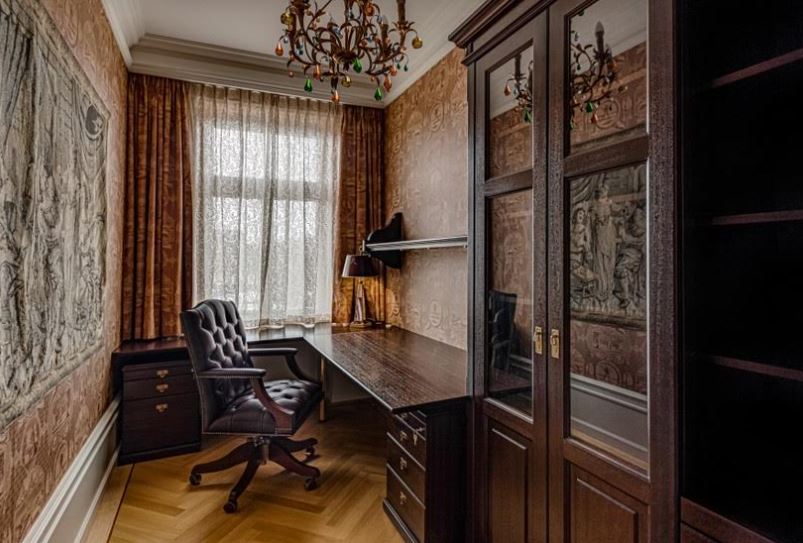
My appreciation of this face made me a little uncomfortable. What if the facts now in my possession were disclosed prematurely through someone’s indiscretion? I might be accused of betraying a confidence. In much perplexity I restored the bundles of letter to the great desk at which I worked. I must consult the dead man’s son without delay. As I left the library for the dining room my ear caught the strains of music from the top of the house. I halted at the head of the stairs. The keys of a piano were evidently responding to the hand of a master. I could have listened for an hour. The air was quite unknow to me, although the rhythm vaguely suggested the Italian school. The thought flashed through my mind that I might be listening to one of the young man’s own compositions. In the event that, William Winchester II was a genius. My eye met that of the old house keeper. She stood mutely and with the rigidity of a statue, gazing down at my upturned face. I felt a moment’s annoyance. This old lady might be one of those disagreeable people whose aptitude for watching unobserved suggests a tendency to by sly. “Master William will not be down tonight, sir,” she said. Her tone was hushed. Her manner was respectful enough. I could not help thinking, as I studied her lined face, that she alone had access to the forbidden floor. With her last word she disappeared, and I went on down. Whatever intentions I had formed to discuss the matter perplexing me with Mrs. Winchester herself were foiled by the presence of guests. One of these was a graceful young lady, dark-eyed and tall with a becoming gravity of manner. The other was her father, a local judge, pompous and little, with that self-assertiveness which a career on the bench does so much to develop in a man. #RandolphHarris 5 of 18
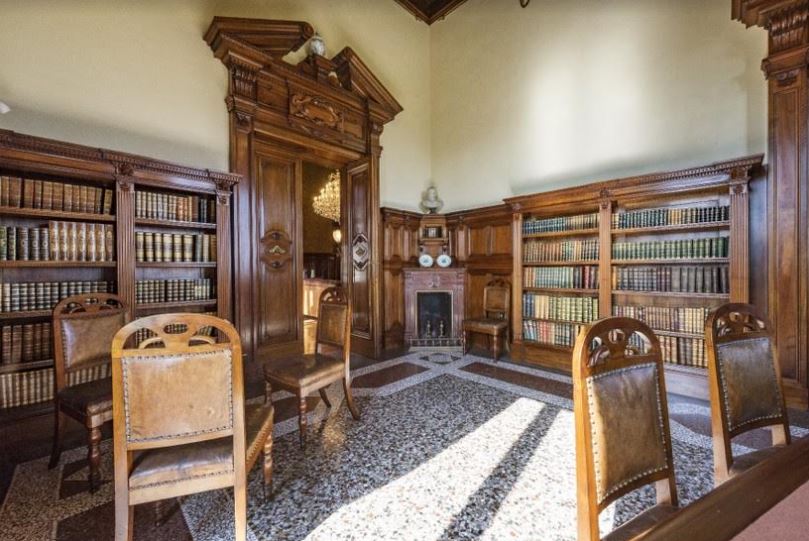
“So you’re Mr. Axelrod, are you?” he snapped, seizing my hand. “Glad to meet you. I hope you’ll turn out a right account of my old friend, the Senator and President of Winchester Repeating arms.” With that he dropped my hand, or rather flung it from him. I was so extremely amused by his swelling port that I at once forgave the brusqueness of this little judge. One could have forgiven a man with such a daughter. Miss Parfrey soothed where her father ruffled. She deferred where he played bully. But she was hopelessly eclipsed by the dazzling beauty of the brown-haired woman. Mrs. Winchester wore a decollete dress of black and lace, which covered her all the way up to her neck down to her ankles. Her perfect arms were fluttering in motion. Her manifest regret at the absence of her son lent to the smile with which she favored us in turn an inexpressible melancholy that sweetened her face like a perfume. I understood that the judge was a widower. If he could be trying to court our hostess, I wondered. “So William won’t come down from the top of the house!” I heard the judge say as he finished his pot roast. “Gad! He’s behaving like his ancestress.” He looked about him at the rest of us while a broad grin creased his jowl on both sides. I had been exchanging ideas with Miss Parfery on the subject of Venice, but the loud tones in which His Honor proclaimed his impression challenged our attention. “His ancestress!” I repeated blankly, no one else having volunteered an observation. “His ancestress!” repeated Judge Parfrey, attacking the game just set in front of him. “She was to have been married from this very house to an officer of Washington’s army.” Mrs. Winchester proffered this observation in her musical tone. She had not shown much interest in the conversation until now. #RandolphHarris 6 of 18

“The Senator told me the story,” proceeded the judge. “The Revolutionary War was raging at that time.” I glanced at the countenance of Mrs. Winchester. A flushed which heightened her beauty a moment before had left her cheeks entirely. “Did the marriage of William’s ancestress take place?” she inquired faintly. “Gad, no!” cried the judge. “Her betrothed came to this very house a day or two before the wedding was to take place—” He hesitated. “And the British captured him?” I suggested. “They captured her,” replied the judge with a laugh. “Her lover caught her kissing Lord Cromwell’s aided-de-camp on the top floor.” “Then she married the Briton instead of the Yankee!” I made the observation as gaily as I could for the sake of lifting the pall which seemed to have dropped upon the subject. My effort was vain, for the retort of the judge seemed to extinguish us completely. “She married neither,” he said shortly. “Until the day of her death she never left that top floor.” I exchanged glances with Miss. Parfrey. Mrs. Winchester too a sip of coffee. The judge, unaware of the mischief he had done stuck to the theme all night. He was still pointing the moral of the legend when his car arrived to take him home. I heard him taking his noisy leave of his hostess at the door, his loud voice relieved at intervals by a brief remark from his daughter. In the matter of apparitions…popular and simple human testimony is of more considerable weight than is the purely scientific testimony. Mrs. Winchester was still very place when she came back to the dining-room. “I think I will say good night,” she observed faintly. I saw her clutch the back of the chair. In a moment I was at her side. “It is nothing,” I heard her cry. “I am afraid our conversation this evening upset you,” I ventured. However, she shook her head. “Arthur’s absence upset me.” I could just catch her whisper. “He seemed very much attached to her—once. Now he will not even come downstairs for a sight of her.” #RandolphHarris 7 of 18

I understood. I could only gaze in silent sympathy into her face. Then she extended her hand, bade me good night, and left the room. I lit a cigar and made my way to the library. It was close upon midnight as I sank into a great leather chair, yet the thought of bed made me restless. My purpose in coming to this house seemed defeated already. I smoked on in the darkness until I heard a clock behind me chime at the hour. The silver strokes beat the air one after another, until the toll of twelve reminded me that a new day was brining me a duty. I got upon my feet with a disconcerting sense that the location of the electric button that switched on the light was a mystery to be solved. I took a single step toward the window, when a moving something drew my eye to the great bookcase looming in the shadow against an opposite wall. Slowly and steadily the object grew luminous as I watched it. The wraith of a feminine form defined itself to my staring eyes with a loveliness so appealing that, in spite of the thrill, I felt at the root of each hair on my head I would not have sold the sight before me for a bag of gold. It is a mistake to think the giants rumored to lurk the halls of the Winchester mansion were all blood-sucking creatures as the causeway guides say, but, bare in mind they were in drink, were as peaceable as rabbits. I saw a pair of sloping shoulders beneath a firmly chiseled neck. I saw a rounded waist and a delicate hand pressed to a smooth cheek. The long robe forming the vestment of this apparition was twined about the curves of the figure after the fashion favored by all sculptors of Greek goddesses. Only the face was kept from me. I remained for the first few minutes of this experience as motionless as the fantom at which I stared. I did not stir until I saw it glide. The apparition darted and halted, darted and halted, making, it seemed, for the wide door at the extremity of the vast apartment. #RandolphHarris 8 of 18
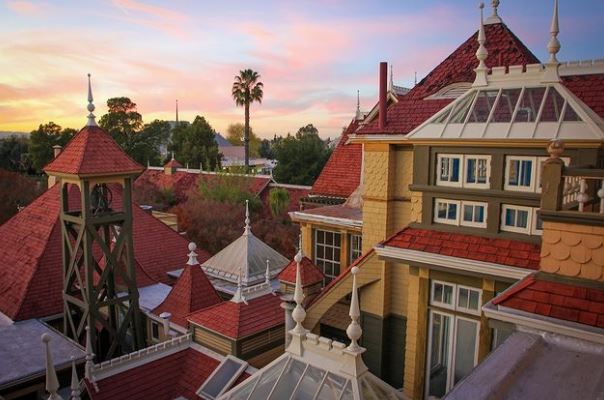
As I kept pace with its advance I marveled at the ethereal grace revealed in every stage of this mute progress. The restless clock seemed eager to accompany us through the darkness, so quick was its ticking to my ear. I had never quivered with so icy a chill as now galvanized my limbs into a kind of movement so like that of this ghost before me that I seemed unearthly to myself. On, on we went, through the door and out upon the rug beyond. Not until the staircase halted the spectre for a moment did it turn. For the first time I looked into the face. Prepared though I was by the unspeakable perfection of form before me for a loveliness of feature which could alone accompany a presence so angelic, the countenance upon which I was allowed to gaze at last transformed me for the instant into a living statue. the chin, rounded with a beauty that told also of strength; the nose, straight, firm, positive, yet delicate, sensitive, tremulous; the brow, noble and serene—these details blended themselves into an expressiveness that caught its quality from a pair of eyes into which I could not look. They did not seem to evade me. The figure kept its gaze upon the floor. The light radiated from the eyes was that, I saw now, which lent its effulgence of the fantom. I realized by a species of intuition that one glance of these orbs meant the loss of consciousness for any upon whom it fell. No one could have endured the delicious shock of so much beauty. I followed to the very top of the next flight of stairs. The fantom climbed another storey, and on I stole. It made for the gated that afforded access to the forbidden floor. There it halted, and turned to beckon me. I saw the folds of its vesture broaden like a wide white wing as the moving arm it waved pointed on and upward. Then it climbed the stair. I was at the ceiling, too, now, and I could not open the door. An instant recollection of the mother’s warning words enabled me to take my eyes from the fantom for the first time. I could not go any further or search for a secret passageway without becoming guilty of a breach of trust. #RandolphHarris 9 of 18
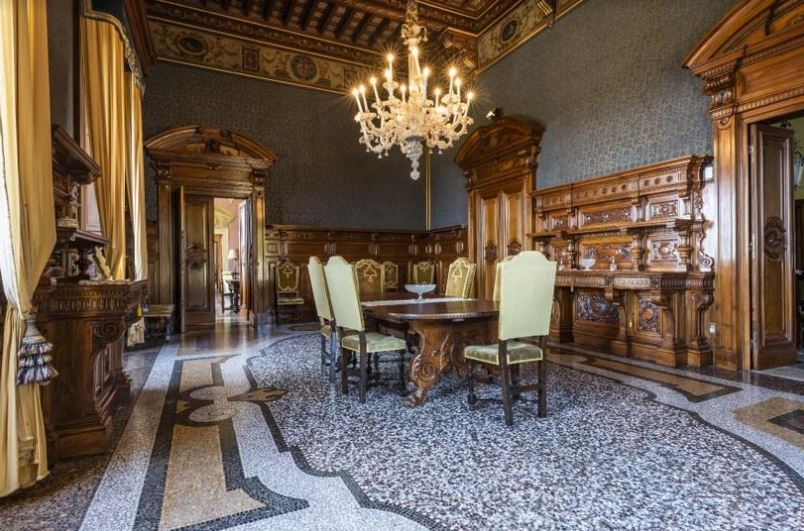
Yet I could no more have gazed at all this grace and beauty, fantom and thing of shadow though it was, without slavish obedience to its least behest than Paris and the men on the walls of Troy could contemplate the loveliest of women without falling in homage at her feet. I put a hand to my brow as I stole guiltily down to the library with all the silence of the ghost I had just beheld. The spacious apartment allotted to me was directly off the library itself. I had but to grope my way to a corner familiar now and find my bed. I fell upon it like a log. The staring sun roused me with my clothes still on and the vapors of an indescribable intoxication in my head. I made haste to change my clothes. The water of my bath seemed oddly warm, although I took it cold. I was in the dining-room before it occurred to me to look at my watch. It was nearly noon. Master William still will not leave the top floor this day. As I passed Mrs. Winchester, the sweet widow was looking at her garden. “I was afraid you might grow fanciful after that anecdote the judge told us last night,” she began, as I crossed the parlor where she took. “Do you believe in Ghosts, Mr. Axelrod?” I gazed keenly into her eyes for a minute. She was smiling. “Do I look as if I had seen a ghost?” I put the question gaily, but I could feel the beating of my heart. “My family and my fortune are being haunted by spirits—in fact of American Indians, Civil War soldiers, and others killed by the Winchester riles. The untimely deaths of my daughter and husband were caused by these spirits, and some say I am the next victim. However, I have appeased the spirits by building a great mansion for them. As long as construction of my house never ceases, I can rest assured that my life will not be in danger. Building this house is even supposed to bring me eternal life. These spirits are a sort of heirloom.” #RandolphHarris 10 of 18
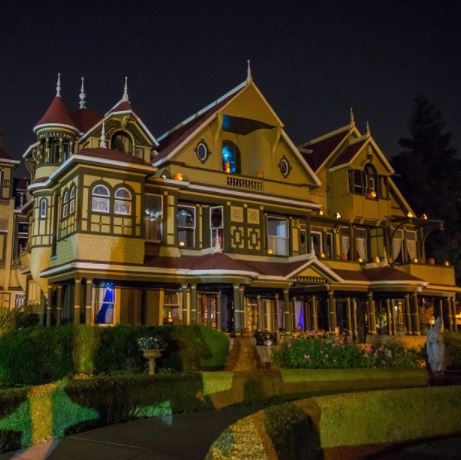
I could feel that thrill at the roots of my hair. “And what are these ghosts like?” “These ghosts can be friendly or not—but often show themselves in a variety of ways. They can become visible; they can speak or make noises, touch you or even emit an odor like perfume or cigar smoke, to let you know they are there. Sometimes there is a ghostly mist. The vaporous clouds usually appear several feet off the ground and can move swiftly or simply stay still—almost like it is orbiting. The noisy ghosts have the ability to move or knock things over, make noise and manipulate the physical environment. Sometimes I hear loud knocking sounds, lights turning on and off, door slamming, even fire breaking out mysteriously have all been attributed out to this type of a spiritual disturbance. These poltergeists become strong and dangerous. There are also orbs, they appear as a transparent or translucent ball of light that is hovering over the over the ground. It is believed that orbs are the soul of a human. This is what inspired the window I made. There are also ghosts that form cold spots and are kind of like a spiral of light. There are also demons in this mansion. They have powers to heal people who have been possessed and great supernatural abilities in exchange for worship and yielded service. However, if demon powers heal, they can also cause diseases. Their object is not to liberate the victim but to deceive and enslave him or her. They heal or cause sickness as it furthers their nefarious plans. What is more significant is that even when demons help heal physical diseases, they exact a price either in some type of occult oppression or psychic disturbance in their victim or by causing one to fall a prey to error. Demonic spirits always have Satan’s costly price tag attached to it. Once, I was overtaken by a witch doctor. He drew from a leather bag a bundle of papers on which were green and orange markings, an imitation of Arabic writing. He started to read to me from the book, and before I could stop him, he began nonsense reading in an ordinary voice. Then suddenly his voice changed. #RandolphHarris 11 of 18

“He was possessed, and I heard a demon through his lips telling me that I had a sick little girl in my house. (My daughter had been sick for several days after she was born, and as he was a total stranger it was unlikely that he would have heard it. Six weeks later she died,” said Mrs. Winchester. I withdrew to the library without even introducing the subject of that interview with William Winchester II for which I longed. He did not descend from the room above the stairs to the ceiling. I had the dining-room to myself that evening. Mrs. Winchester, or so the housekeeper said, was indisposed. As I seated myself in the library, after a solitary stroll through the shrubbery of the lawn, it occurred to me that, as the authorized biographer of the late General Winchester, I ought to look into his ancestry. It was an easy matter to find the family genealogy among the volumes on the well-stocked shelves. One county history dealt exclusively with the Winchester mansion in which I was now at work. The edifice was venerable—for America—and, inevitably, had served as the headquarters for spiritual séances. I was so deeply immersed in my historical reading as to let three full hours slip by. The stroke of twelve had caught me unawares. I thought of the night before and shivered. Then I switched off the light. The fantom arose from the ground at my very feet! Only the bell in the belfry of the dark mansion tolling reached my ear as I stood rigid in the fantom’s radiant presence. I gazed at the phantom. I was myself and not myself in feeling weirdly, supernaturally energized. The incompleteness of my life was extinguished in the full tide of a holier love than mortals have thrilled to. In the inspiring presence of this wraith, I felt capable of that faith which moves mountains. #RandolphHarris 12 of 18

The fleshly and the spiritual ceased to contend as I contemplated with reverence with the haunting sweetness before me. I could have conquered the World, founded empires—then I became the greatest of poets, endowed with a genius breathed into me by this irresistible ghost. There surged through me all imaginable ecstasies, glorious powers, finer perceptions than ever mortal had. I understood in a flash whatever in my past had baffled me with the mystery of the Winchester House. Strains of exquisite much floated through the mansion. One does not see a ghost, but surrenders to it as the wax yield to the flame. The occult subjection that results is from dabbling with occult literature. Magic is of a demonic character no matter under what name it is known. It is obvious that there is no mathematical proof that either God or the devil exist. Nevertheless there are many things that point to this demonic nature. The simple principal of cause and effect is hardly ever evident in a tangible enough form to prove by law that magic is the root case of some offence or crime, but also some very beautiful things. I did not come out of this trance until a movement of the fantom intimated subtly to me that I was to emerge from its enchantment. I grew aware that I was following the vision once again through the portal. The transcendent object of my infatuation conducted me straight to the forbidden floor. I was favored as before with its beauteous gesture. No thought of the ban so recently placed upon my presence here was in mind, even had I left any power to oppose my mortal will to this immortal spirit. I followed in unceasingly, unquestioningly. There was no physical obstacle to my progress anywhere. The mahogany entry affording access to the room above the stairs to the ceiling had been thrown open. #RandolphHarris 13 of 18

I set foot boldly upon the lowest step of the stair. The first contact seemed to afford me a definite sensation of personality in the very air. I can liken this feeling only to that bitter blast, the vague uneasiness, which is said to disseminate itself through the night as some vast iceberg skirts the coast of San Francisco. I had caught a chill, and I shivered. Nor for an instant did I halt. The stairway did not creak. By the time I had set foot upon its summit I was thrilling to some excitation, breathing in impressions like those one derives from moving passages of poetry or strong scenes in a play. I touched the wall only to find my feelings keener, my sensitiveness to the stimulation increased. All material objects exhaled the mystery stamped upon them by a person or an event in times past of which I was now absorbing impressions. I did not feel that murder had been done here. The tragedy was all of the heart, of the grief of a soul, of the perpetual and impotent longing of one who, loving, poured out an agony of sorrow to walls that caught the mood. The heart that had been crushed was a woman’s. This message, too, I was given by the impregnated air. The curtain at the summit of the stairway was pushed aside as if by a breath from some other World. I had attained a great quadrangular vestibule, tenantless except for the apparition and myself. The ghost, preceding me at an interval of some feet, was kneeling beside a wide window through which the warm night air came gently. I beheld a mass of the flowers in a vase upon a carved mahogany table with marble on its surface. I became conscious of the softness of Persian rugs beneath my feet. I moved as silently as the thing I followed. No attitude could express the forlornness of an indomitable grief more appealingly than that of the kneeling fantom. Magnetized by an attraction that made me daring, I touched the shoulder of the ghost. #RandolphHarris 14 of 18
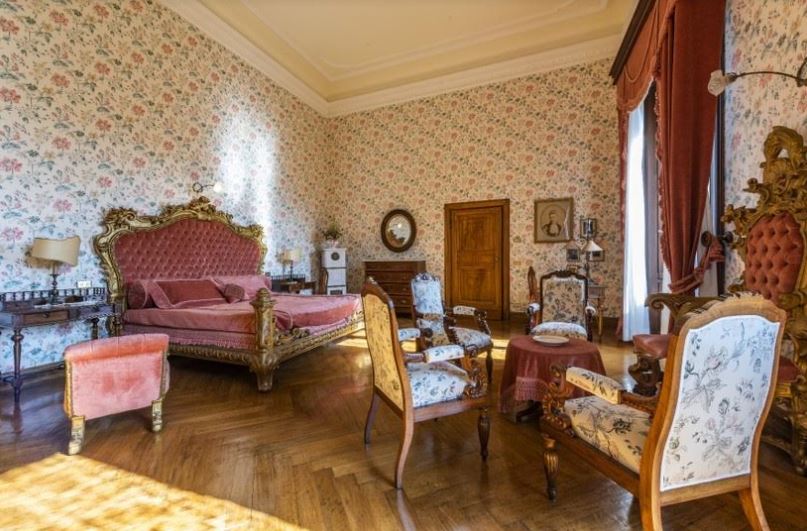
The whiteness of one arm extended itself to my face. Slowly the vision grew toward me, folding itself closely about my neck and breast until the ghost literally rested in my arms. I could not see the features of my beloved as her unreal lips sought mine. I could not feel the long tresses I tried to stroke. I spoke no word as I vowed to cherish her in the World and prayed for death that I might be with her in the next. The mental and psychic damage done to me as a result of occultism was immense. I was infected by occultism. The time has passed in which witches and magicians were either burned or stoned to death. We must remember that magic itself is not to be understood by our five senses alone for it is rather a metaphysical and religious and extrasensory phenomenon. The tired moon that drooped prettily in the sky had sent a curious beam down here. My eye, habituated more and more to the sweet obscurity, caught now a sharper outline of the vase filled with flowers. The heavy table showed its carved proportions less reservedly. A mahogany chair, resisting as a sleeping monster might rest, upon the floor entered the enlarging field of my vision. The impression made by all these upon my spirits was one of personality radiating palpably from them. Not, indeed, that the objects had themselves this quality. I mean no more than that they emitted or effected suggestions of a personality with which they had been formerly in intimate contact. The darkness of that apartment, pierced by the beams from the window, seemed laden with such revelations. The great chair told of one who has reposed, and reposed gracefully, in its arms. The vase betrayed a secret it had caught concerning her who once delighted in its shapeliness. #RandolphHarris 15 of 18
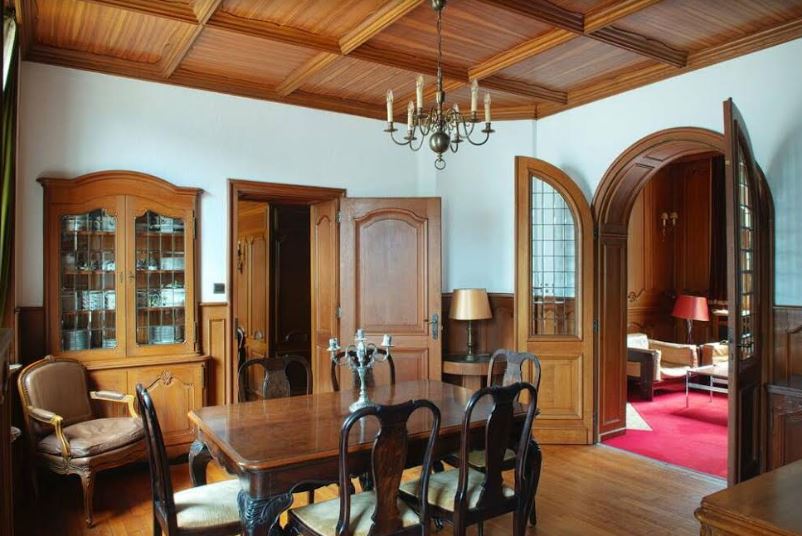
Every emanation from the things around me was of evil purport. I was being warned. “And you will cherish me forever, beloved?” How I understood that she had put this question I can never tell. The words were not spoken. The language was not Earthly. A something within registered the appeal and responded to it. I told of my own unworthiness to be made the object of a celestial passion. I confessed my longing to reach the confines of the Universe in some high quest of a Holy Grail for her sake. I received the outpouring of her passionate regret that in an Earthly form years before she had cherished thoughts gross and material, the memory of which left her too sullied for the purity of my faith in her now. And her fantom arms were wreathed about my neck still, and her bowed head pillowed itself against me, and she quivered with ecstasies of which I partook as a leaf rises and falls with the breeze of a summer’s day. And her fantom arms were wreathed about my neck still, and her bowed head pillowed itself against me, and she quivered with ecstasies of which I partook as a leaf rises and falls with the breeze of a summer’s day. I besought her now to look into my eyes. I saw her head denying that petition. I received some mysterious intimation that the meeting of our gaze must entail an indescribable fatality, not to her but to me. I conveyed my sense of joy in such a circumstance. Here was the proof of my devotion awaiting her acceptance. Let me but gaze into those eyes and I would wander forever through the Universe a blissful spirit. However, she only kept her face buried upon my shoulder and held my head with her arms. I had begun a more impassioned plea when she rushed from my embrace, reeling to the window. I saw her fall upon her knees cowering. She covered her face with one hand, while, extending the other, she pointed to some object behind me. I turned and beheld—William Wirt Winchester II! #RandolphHarris 16 of 18
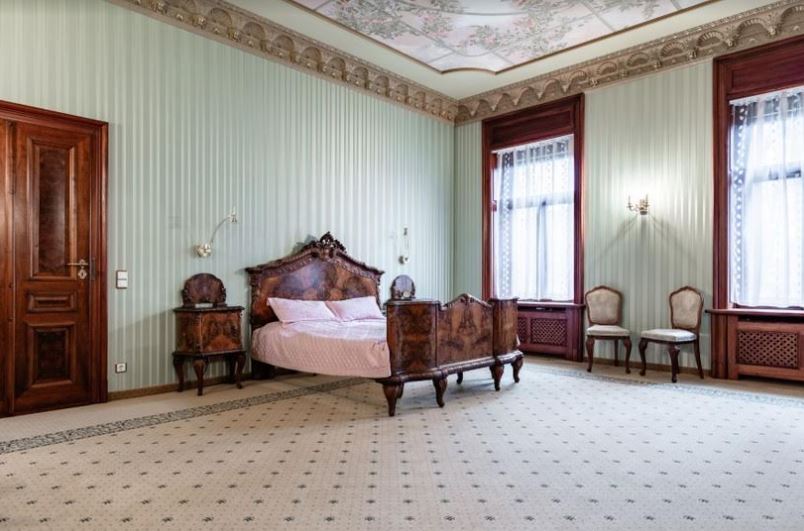
There was no mistaking those eyes, that slight forehead, the delicacy of each refined feature. He was his father’s son. For a terrible moment he and I glared into each other’s faces. I saw him raise an arm. He rushed forward. I threw myself between him and the fantom, but when I directed my gaze to its refuge the object of my infatuation had disappeared. The next moment William Winchester II had me by the throat. Then consciousness left me, but not for long. I was prone upon the floor when my senses returned and the arm of William Winchester II was about my head. “I saw her with you!” He spoke in the musical accents of his own mother, but grief never found utterance so wild. His tone was a revelation. I cried my reply with the voice of a man in panic. “She made your vows of an eternal love and you pledged yours in return.” He bowed his head once more. I realized the sense of betrayal that tortured him. The ghost had proved unfaithful. I was torn with his own jealously, but he proved to me that his ordeal had been worse than mine. “I saw her with you!” he said. “One torture has been spared you. You never saw her when her gaze rested upon—me!” I hated him for a second time. Then I conquered my worst self and pitied him. He had removed his arm from my head and was assisting me to my feet. “We shall never see her again.” It was I who said this. He buried his face in his hands. “She was too timid,” he murmured faintly, “to let us look into her eyes.” The question elicited from me by this remark led to further revelations. He, too, had held mysterious communion with the infatuating wraith; had confessed a longing to reach the confined of the Universe for her sake. To him, too, she had professed regret that in an Earthly form years before her thoughts were gross and material. #RandolphHarris 17 of 18

It is conceivable that emotions generated by a passed and passing life may be conditioned by the state of mind at dissolution. The living and the dying set up vibrations in the emotional atmosphere. These continue in agitation. The place grows haunted. An appropriate or corresponding vibration can alone can alone break the spell. When that meets this, the suspended chord is complete and comes to a full close. Or, an emotional scene which has translated itself, so to speak, into terms of a material plane can, like music in a phonograph, retranslate itself back again. I felt now that I had the clue to my ghost. The lady in seclusion on the forbidden floor so long ago had been true to her lover—in her fashion. He had, indeed, surprised her in the arms of another. It was a sentimental accident in her life. She was denied the opportunity to explain. She was possibly the victim of a man’s sudden impulse. My own infatuation with the rare and beauteous spirit had led me far. In any event the longing of the human soul to be understood—the craving of this lady to vindicate herself—persisted while she lived. It was her most vehement desire as she passed away. The very walls, the chair she sat in, the vase in which she arranged her daily nosegay, grew sick with this discarded lady’s longing. If telepathy from living mind to living mind is a force so mighty as to covey a visual image from Santa Clara to Oakland, is it not perfectly conceivable that a telepathic force which has been stored there by the terrific emotional impulse of original crimes—may be powerful enough to produce a visual image? It was so with me. I did not cease my scrutiny of the countenance of William Wirt Winchester II as these thoughts ran riot in my head. His mind was too manifestly overwhelmed by the shock it had sustained. He paled slightly and spoke at last in lone tones. “I have nothing to live for.” #RandolphHarris 18 of 18


I am enitrely convinced of the existence of the Spiritual World–that there are real intelligences in that World, and that it is possible for them under certain circumstances to communicate with this World.

Summer is *almost* here and it’s getting quite warm at the Winchester Estate! Have you ever experienced the house in the summertime?

Never, Never, Never Invest More than You are Willing to Lose!

Deep changes in the money system cannot occur without threatening entrenched institutions that have, until now, enjoyed positions of extraordinary power. At one level the substitution of electronic money for paper money is a direct threat, for example, to the very existence of banks as we know them. Banking will not retain its position as the primary operator of payment systems. Banks have had a government-protected monopoly in checking-clearing services. Electronic money threatens to supplant this system. In self-defense, some banks have entered into the credit card business themselves. More important, they have extended their reach without automatic teller machines (ATMs). If banks issue debit cards and put ATMs at millions of retail locations, they may repel the attack of the credit card companies. Since debit cards make it possible for the shopkeeper to receive payment instantly, instead of waiting for Diner’s Club or American Express or Visa to remit payment, store owners may not wish to continue paying them a percentage of each sale. Also, something is going on where so major banks have blocked credit unions from linking to their customer’s accounts. Therefore, they cannot use debit cards to transfer money instantly between institution, and this is causing consumers to have to wait days, or weeks for money to reach the accounts of their credit union. So, some people may eventually stop doing business with credit unions, while others stay out of loyalty. There must be some kind of quiet financial storm brewing inside of the credit unions. On another front, banks face attack from a wide variety of nonbanks. In Japan, for example, the Ministry of Finance has qualms about the idea that private companies like NTT can issue value-bearing plastic “notes”—a kind of currency—and operate outside the banking system and its rules. #RandolphHarris 1 of 22
If a company can take in money for a prepaid card, it is accepting a “deposit,” exactly like a bank. When the user spends, he or she is making the equivalent of a “withdrawal.” And when the card company pays the vendor, it is operating a “payment system.” These are functions that once only banks could perform. Moreover, if card companies can issue credit to users, as they and the cardholders see fit, unconstrained by the kind of limits and reserves that govern banks, central banks risk losing their grip on monetary policy. In South Korea, plastic money has expanded so rapidly that the government fears it is feeding inflation. In brief, the rise of electronic money in the World economy threatens to shake up many long-entrenched power relationships. At the vortex of this power struggle is knowledge embedded in technology. It is a battle that will redefine money itself. Many governments have made it understood that they do not care for cryptocurrencies. They hype around the high returns from cryptocurrencies has led to more fraudulent “get-rich-quick” schemes lurking in the dark corners of the market. Many countries do not have law to back up investors. Which means, if a large group of investors lose their money—they will be left with no recourse within the current legal framework of the system. Several mutual funds have been told to hold off on sending any new fund offerings based on crypto assets. Cryptocurrencies, especially Bitcoin in this case, were created as a way to take the power of monetary control away from centralized authorities—like the government and the central bank. So, it is no surprise that the central bank takes issue with not being in control. #RandolphHarris 2 of 22
Cryptocurrencies have led to an increase in assets that can transfer funds with increased anonymity. There are virtual assets that focus on privacy. If and when things go wrong, decentralized platforms pose the problem of having no single entity to go after. Privacy wallets and other new financial instruments allow for reduced transparency, which, in turn, obscures the flow of finance. There is also a national security angle over here now, there are individuals from intelligence who are involved. As things stand, anyone can launch a new cryptocurrency. There is no national framework defining what a cryptocurrency is, or the minimum requirements for it to be a legitimate investment option. This means that anyone can create a virtual asset, get others to invest in it to hike the price, and then cash out their stake without having to explain why. This is normally what is called a “rug-pull.” After the “founders” or “influencers’ pull out their money, other investors are left holding less than what they originally started with. However, that is not much different than what happened with the stock market during 9/11. Many young and/or unsuspecting investors lost huge amounts of money they worked for, which was never returned. The crypto market s speculative and during the COVID-19 pandemic it saw value surge to new all-time-highs. And, while the worst sees to be behind, there is a risk of sharp corrections that still remains. Just as Bitcoin was recently able to hit $70,000, it is possible that it could sink lower than $45,000. In fact, as of June 16, 2022, 5.10 P.M. EST BTC is down to $20,282.52. Many countries that are subject to capital control, are especially vulnerable to destabilizing effects of cryptocurrencies. Free accessibility of crypto assets to residents can undermine their [emerging market economies] capital regulation framework. #RandolphHarris 3 of 22

Non-bank actors—meaning crypto exchanges and other blockchain companies offering financial services—are adding to the dollar funding stress by using loopholes in the traditional policy approach to foreign exchange markets. At this stage, it is important to better understand non-bank investors’ role in creating or propagating systemic risk so that policy actions can be taken to smooth out financial risk-taking over time. This cryptocurrency in actions, a new generation of internet-based currencies which have grown in popularity over the last few years. You cannot not touch it or physically hand it over in any way, but you can use it to trade online. In the way, it is very different from the traditional view of banking, where cash, coins and possibly gold might be stacked in a vault just waiting to be withdrawn, but do these new cryptocurrencies represent a threat to those traditional banks? Thus far, the value of many of these cryptocurrencies has skyrocketed. If you had bought $1000 worth of Bitcoin in 2010, that investment would be worth $20 million today. There are even ATMs around for Bitcoin—put your regular currency in alone with your phone number, then get a receipt back for the purchase of Bitcoin. A check of the digital wallet on your phone should reveal your purchase there in the balance. That is causing a major shift in how people can do business and make transactions. Suddenly, the value is able to be exchanged outside of the traditional banks in the flash of a mobile phone. People who could not access trade and finance ten years ago can do so today. This will lift many out of poverty. The major factor is—if they need financing, people no longer have to go to a traditional bank for financing. (I bet a lot of people wish they knew this before they made car repairs.) #RandolphHarris 4 of 22

Peer-to-peer networks, including those based in cryptocurrencies, are becoming more common and those who might be turned away by traditional banks now have another way around financing. You can often times use an app on your phone to get a loan, and then take it to a car dealership, already knowing what you can afford, and pick the car of your dreams. Some people even get mortgage loans this way. That is why many traditional banks are feeling threatened by these new cryptocurrencies. However, you can also use these same apps on your mobile phone to get approved for cash loans. Many supports of digital currency and technology believe it should be seen as an invention like the printing press because it has the steam to transform the World of finance and beyond. If banks ignore new consumer behaviours and preferences when it comes to how they transact and transfer money, cryptocurrencies definitely represent a threat to traditional banks. Bitcoin users can handle many of their daily payments needs themselves, without the need for interaction with banks, and avoiding the need to incur bank fees. In the same way, the value stored in PayPal accounts moves outside of the bank’s payment systems, depriving banks of valuable payments revenue. There are a few issues cited with these cryptocurrencies, such as their perceived “haven” status for possible perpetrators of illegal activities, a relatively low market cap (Bitcoin’s is somewhere around $3.4 billion) and a sense of volatility with the value of the currency. That is why it is important to never, never, never invest more than you are willing to lose because it could go to nothing. That piece of advice is something even traditional financial advisors are not willing to disclose to investors. And sometimes after several losses, you need to cut and run before you start to become insane by beating the same horse and expecting something in return. #RandolpHarris 5 of 22

There are many people who absolutely could not wait to find a way around being beholden in some way to a big bank and these people are taking up new options with enthusiasm. Traditional banks and credit unions have often been guilty of customer-unfriendly account manipulations, such as applying debits before credits then charging fees for insufficient funds. (Citi Bank is one traditional banks I recommend, they do not charge overdraft fees. If your funds are insufficient, the check will just be returned unpaid.) However, the other big banks will not be able to get away with financial manipulation much longer because in the digital age, customers can actually see this happening by glancing at their mobile phones. Of course, money, whether in the form of metal, digital, or paper (or paper backed by metal), is unlikely to vanish completely. However, barring nuclear holocaust or technological cataclysm, electronic money will proliferate and drive out most alternatives, precisely because it combines exchange with real-time record-keeping, thus eliminating many of the costly inefficiencies that came with the traditional money system. If we put this all together now, a rather striking pattern becomes plain. Capital—by which we mean wealth put to work to increase production—changes in parallel with money, and both take on new forms each time society undergoes a major transformation. As they do so, their knowledge content changes. Thus agricultural-era money, consisting of metal (or some other commodity), had a knowledge content close to zero. Indeed, this First Wave money was not only tangible and durable, it was also pre-literate—in the sense that its value depended on its weight, not on the words imprinted on it. Today’s Second Wave money consists of printed paper with or without commodity backing. What is printed on the paper matters. The money is symbolic but still tangible. This form of money comes along with mass literacy. #RandolphHarris 6 of 22

Third Wave money increasingly consists of electronic pulses. It is evanescent…instantaneously transferred…monitored on the video screen. It is, in fact, virtually a video phenomenon itself. Blinking, flashing, whizzing across the planet, Third Wave money is information—the basis of knowledge. Increasingly detached from material embodiments, capital and money alike change through history, moving by stages from totally tangible to symbolic and ultimately today to its “super-symbolic” form. This vast sequence of transformations is accompanied by a deep shift of belief, almost a religious conversion—from a trust in permanent, tangible things like gold or paper to a belief that even the most tangible, ephemeral electronic blips can be swapped for goods or services. Our wealth is a wealth of symbols. And so also to a startling degree, is the power based on it. Elsewhere, we find imaginative efforts to compensate for the failures of the mass society’s mass educational system. When mass education was widely introduced, teachers were usually the most literate and educated people in the neighbourhood. Today parents are sometimes far better educated than the teachers to whom they entrust their children to. Recognizing the role that parents can play in promoting literacy by reading to their children, it is a good idea to buy your child a short book to read every month, until they develop an appetite for reading books. Meanwhile, more and more disaffected parents in the United States of America are pulling their children out of school and teaching them at home. They are supported by a growing variety of up-to-date online services and tools. #RandolphHarris 7 of 22

One objection to keeping kids home is that they will not learn to get along with other children. However, as public schools decay, and in many places become drug, alcohol and vape-infested and dangerous, parents wonder if the socialization the schools provide is healthy. If parents keep their children at home, they can develop socialization skills by encouraging their kids to play soccer, or, when a bit older, do volunteer work at an NGO where they can meet other young people engaged in community service. Here, once more, we find a pre-industrial practice—most children were educated at home before the industrial era—being transformed to meet post-industrial needs. Charter schools are an attempt to innovate within the system. These are public schools granted a limited degree of freedom to experiment. In the United States of America they still enroll less than 2 percent of American students, and their results are, no doubt, uneven. However, among them we also find many potentially useful innovations. At the Center for Advance Research and Technology (CART) in Clovis, California, twelve hundred high school students, on a 75,000 square foot CART facility, use information technology in a high-performance business atmosphere to help solve real-World community problems. The school focuses on Professional Sciences, Engineering, Advanced Communications, and Global Dynamics. Mentors include local business leaders. Students are encouraged to take part-time jobs and carry out research projects working with adults in business, industry, trade or other services. Within each four clusters of the education, students complete industry-based projects and receive academic credit for advanced English, science, social science and technology. A key mission of the center is to demonstrate to young people the relevance of academic subjects to practical problems, and help them meet expectations and work behaviour for a global job market. #RandolphHarris 8 of 22

Students thus are invited to invent marketable new products that help solve real World problems. CART students have invented an ultrasonic cane for the visually impaired and other devices for the physically impaired. However, the school’s main output consists of smart young people prepared for twenty-first century realities. Institutional invention and experimentation are growing in other fields as well. Entrepreneurs who make vaccines are rapidly multiplying. Today, more than thirty U.S. business schools, including Stanford, Harvard, Yale, Columbia, and Duke, offer courses in pro-social entrepreneurship. Santa Clara University in Silicon Valley has created a Global Social Benefit Incubator to help innovators apply technology to urgent social needs and to assist them in scaling up their efforts. And, in what many regard as the ideological workshop of contemporary capitalism—the annual World Economic Forum held in Davos, Switzerland—NGO leaders and social entrepreneurs seek to improve the work of existing nonprofits and NGOs by applying businesslike methods to them. Others start new organizations to deal with social problems as they emerge. Both typically rely on volunteers. To that degree, at least, they form part of the non-money or prosumer economy that, as we have seen, creates the social capital and “free lunch” on which the money system depends. The remarkable growth of social entrepreneurship reflects cuts in government-provided, one-size-fits-all safety nets designed for fast-fading industrial conditions. It reflects the incapacity of smokestack institutions to generate imaginative, customized solutions to new social problems. And it reflects the impatience of millions around the World who have given up waiting for governments and formal institutions to solve problems. #RandolphHarris 9 of 22
However, in rich societies it reflects something ese. In the past, very few people had the luxury of time, energy and education to devote themselves to imagining and inventing—or fighting for—new institutions for the future. Today vast and growing numbers of people, including the best-educated and most creative among us, have time, money and access to one another through that empowering global change-maker called the Internet. When it comes to life, it is never good to be the first to defect. Theoretical results show that it pays to cooperate as long as the other individuals are cooperating. The single best predictor of how well a rule performed was whether or not it was nice, which is to say, whether or not it would ever be the first to defect. In a business deal, each of the top eight rules were nice, and not one of the bottom seven were nice. In the second round of meetings, all but one of the top fifteen rules were nice (and that one ranked eighth). Of the bottom fifteen rules, all but one were not nice. Some of the rules that were not nice tried quite sophisticated methods of seeing what they could get away with. For example, TESTER tried an initial defection and then promptly back off if one of the managers or other employees retaliated. As another example, TRANQUILIZER threw in additional defections at more frequent intervals, until it was forced to back off by the other’s response. However, neither of these strategies which experimented with being the first to defect did particularly well. There were too many other individuals who were not exploitable by virtue of their willingness to retaliate. The resulting conflicts were sometimes quite costly. Even many of the experts did not appreciate the value of avoiding unnecessary conflict by being nice. In the first round of meetings, almost half of the entries by managers were not nice. But to little avail. #RandolphHarris 10 of 22

There is another way of looking at why nice rues do so well. A population of nice rules is the hardest type to invade because nice rules do so well with each other. Furthermore, a population of nice rules which can resist the invasion of a single mutant rule can resist the invasion of any cluster of other rules. The theoretical results provide an important qualification to the advantages of using a nice strategy. When the future of the interaction is not important enough relative to immediate gains from defection, then simply waiting for the other to defect is not such a good idea. It is important to bear in mind that TIT FOR TAT is a stable strategy only when the discount parameter is high enough relative to payoff other parameters. In particular, if the discount parameter is not high enough and the other player is using TIT FOR TAT, a player is better off alternating defection and cooperation, or even defecting. Therefore, if the other player is not likely to be seen again, defecting right away is better than being nice. This fact has unfortunate implications for groups who are known to move from one place to another. An anthropologist finds that a grifter approaches a non-grifter expecting trouble, and a non-grifter approaches a grifter suspiciously, expecting double-dealing. For example, a physician was called in to attend very sick grifter’s baby; he was not the first doctor called, but he was the first willing to come. We escorted him toward the back bedroom, but he stopped short of the threshold of the patient’s room. “This visit will be one thousand dollars, and you owe me three hundred and thirty-three dollars from the last time. Pay me the thirteen hundred and thirty-three dollars before I see the patient,” he demanded. “Okay, okay, you will get it—just look at the baby now,” the grifter pleaded. #RandolphHarris 11 of 22

Several more go-arounds occurred before I intervened. Six hundred and sixty-six dollars and fifty cents changed hands and the doctor examined the patient. After the visit, I discovered the grifters, in revenge, did not intend to pay the other six hundred and sixty-six dollars and fifty cents. In a California community, grifters were again found not to pay all of a doctor’s bills, but municipal fines were paid promptly. These fines were usually for breaking garbage regulations. This was among a group of grifters who returned to the same town every winter. Presumably, the grifters knew that they had an ongoing relationship with the garbage collection service of that two, and could not shop around for another service. Conversely, there were always enough doctors in that area for them to break off one relationship and start another when necessary. Short interactions are not the only condition which would make it pay to be the first to defect. The other possibility is that cooperation will simply not be reciprocated. If everyone else is using a strategy of always defecting, then a single individual can do no better than to use this same strategy. However, if even a small proportion of one’s interactions are going to be with others who are using a responsive strategy like TIT FOR TAT, then it can pay to use TIT FOR TAT rather than to simply defect all the time like most of those in the population. In the numerical example presented there, it took only 5 percent of one’s interactions to be with like-minded TIT FOR TAT players to make the members of this small cluster do better than the typical defecting member of the population. Will there by anyone out there to reciprocate one’s own initial cooperation? In some circumstances this will be hard to tell in advance. #RandolphHarris 12 of 22

However, if there has been enough time for many different strategies to be tried, and for some way of making the more successful strategies become more common, then one can be fairly confident that there will be individuals out there who will reciprocate cooperation. The reason is that even a relatively small cluster of discriminating nice rules can invade a population of meanies, and then thrive on their good scores with each other. And once nice rules get a foothold, they can protect themselves from reinvasion by meanies. Of course, one could try to “play it safe” by defecting until the other person(s) involved in the business negation cooperates, and only then starting to cooperate. The tournament results show, however, that this is actually a very risky strategy. The reason is that your own initial defection is likely to set off a retaliation by the other party involved in the business deal. This will put the two of you in the difficult position of trying to extricate yourselves from an initial patter of exploitation or mutual defection. If you punish the other’s retaliation, the problem can echo into the future. And if you forgive the other, you risk appearing to be exploitable. Even if you can avoid these long-term problems, a prompt retaliation against your initial defection can make you wish that you had been nice from the start. The ecological analysis of the tournament revealed another reason why it is risky to be the first to defect. The only rule that was not nice and that scored among the top fifteen in the second round of business negotiations was the eighth-ranking rule, HARRINGTON. This rule did fairly well because it scored well with the lower ranking entries in the business negotiations, the lower ranking entries became a smaller and smaller proportion of the population. #RandolphHarris 13 of 22

Eventually, the non-nice rule that originally scored well had fewer and fewer strategies it could do well with. Then it too suffered and eventually died out. Thus the ecological analysis shows that doing well with rules that do not score well themselves is eventually a self-defeating process. The lesson is that not being nice may look promising at first, but in the long run it can destroy the very environment it needs for its own success. Radical egalitarism is the cure for the evils of egalitarianism. Dr. Freud talked about interesting things not found anywhere in Marx. The whole psychology of the unconscious was completely alien to Marx, as was its inner motor, eros. None of this could be incorporated directly into Marx. However, if Dr. Freud’s interpretation of the cases of neuroses and his treatment of the maladjusted could itself be interpreted as bourgeois errors that serve enslavement to the capitalist control of the means of production, then Marx would move in on the Freudian scene. What Dr. Freud said were permanent contradictions between human nature and society could be set in motion dialectically, and in a socialist society there would be no need for the repression that causes neuroses. So Dr. Freud was neatly enrolled in the Marxist legions, adding to the charm of economics that of eros, and thereby providing a solution to the problem of what men are going to do after the revolution—a problem left unsolved by Marx. This is what we find in Marcuse and many others, who simply do not talk about the difficult posed by the contradiction between Marx’s fundamental principles and those of Dr. Freud. Two powerful systems are served up in a single package. Dr. Freud is the really meaty part of the concoction. Marx provides a generalized assurance that capitalism is indeed at fault and that the problems can be solved by more equality and more freedom, that the liberated people will possess all the virtues. #RandolphHarris 14 of 22

The genius and audacity of American capitalists of the late nineteenth and early twentieth centuries, men who were quicker and more focused than those of other nations in exploiting the economic possibilities of new technologies is inextricably the reason the submission of all forms of cultural life to the sovereignty of technique and technology finds fertile ground on American soil. Among those exploiting them are Samuel Morse, Alexander Graham Bell, Thomas Edison, John D. Rockefeller, John Astor, Henry Ford, Andrew Carnegie, and many others, some of who were known as the Robber Barons. What they were robbing—it is clearer now than it was then—was America’s past, for their essential idea was that nothing is so much worth preserving that it should stand in the way of technological innovation. These were the men who created the twentieth century, and they achieved wealth, prestige, and power that would have amazed even Richard Arkwright. Their greatest achievement was in convincing their countrymen that the future need have no connection to the past. Third, the success of twentieth-century technology in providing Americas with convenience, comfort, speed, hygiene, and abundance was so obvious and promising that there seemed no reason to look for any other sources of fulfilment or creativity or purpose. To every Old World belief, habit, or tradition, there was and still is a technological alternative. To prayer, the alternative is penicillin; to family roots, the alternative is mobility; to reading, the alternative is television; to restraint, the alternative is immediate gratification; to sin, the alternative is popular appeal established through scientific polling. There is even an alternative to the painful riddle of death, as Dr. Freud called it. The riddle may be postponed through longer life, and then perhaps solved altogether by cryogenics. At least, no one can easily think of a reason why not. #RandolphHarris 15 of 22

As the spectacular triumphs of technology mounted, something else was happening: old sources of belief came under siege. Nietzsche announced that God was dead. Darwin did not go as far but did make it clear that, if we were children of God, we had come to be so through a much longer and less dignified route than we had imagined, and that in the process we had picked up some strange and unseemly relatives. Marx argued that history had its own agenda and was taking us where it must, irrespective of our wishes. Dr. Freud taught that we had no understanding of our deepest needs and could not trust our traditional ways of reasoning to uncover them. John Watson, the founder of behaviourism, showed that free will was an illusion and that our behaviour, in the end, was not unlike that of pigeons. And Einstein and his colleagues told us that there were no absolute means of judging anything in any case, that everything was relative. The thrust of a century of scholarship had the effect of making us lose confidence in out belief systems and therefore in ourselves. Amid the conceptual debris, there remained one sure thing to believe in—technology. Whatever else may be denied or compromised, it is clear that airplanes do fly, antibiotics do cure, radios do speak, and, as we know now, computers do calculate and never make mistakes—only faulty humans do (which is what Frederick Taylor was trying to tell us all along.) For these well-known reasons, Americans were better prepared to undertake the creation of a Technopoly than anyone else. However, its full flowering depended on still another set of conditions, less visible and therefore less well known. These conditions provided the background, the context in which the American distrust of constraints, the exploitative genius of its captains of industry, the success of technology, and the devaluation of traditional beliefs took on the exaggerated significance that pushed technocracy in America over into Technopoly. #RandolphHarris 16 of 22

In speaking about molecular texture–the ground underfoot, like everything around you, is pebbly with atom-sized bumps the size of your fingertips. Objects look like bunches of transparent grapes or fused marbles in a variety of pretty but imaginary colours. The simulation displays a view of atoms and molecules much like those used by chemists in the 1980s, but with a sharper 3-D image and a better way to move them and to feel the forces they exert. Actually, the whole simulation setup is nothing but an improved version of systems built in the late 1980s—the computer is faster, but it is calculating the same things. The video goggles are better and the whole-body powersuit is major change, but even in the 1980s there were 3-D displays for molecules and crude devices that gave a sense of touching them. The gloves on this suit give the sensation of touching whatever the computer simulates. When you run a fingertip over the side of the smaller nanocomputer, it feels odd, hard to describe. It is as if the surface were magnetic—it pulls on your fingertip if you move close enough. However, the result is not a sharp click of contact, because the surface is not hard like a magnet, but strangely soft. Touching the surface is not hard like a magnet, but strangle soft. Touching the surface is like touching a film of fog that grades smoothly into foam rubber, then hard rubber, then steel, all within the thickness of a sheet of corrugated cardboard. Moving sideways, your fingertip feels no texture, no friction, just smooth bumps more slippery than oil, and a tendency to get pulled into hollows. Pulling free of the surface takes a firm tug. The simulation makes your atom-sized fingertip feel the same forces that an atom would. It is strange how slippery the surface is—and it cannot have been lubricated, since even a single oil molecule would be a lump the size of your thumb. This slipperiness makes it obvious how nano-scale bearings can work, how the parts of molecular machines can slide smoothly. #RandolphHarris 17 of 22

However, on top of this, there is a tingling feeling in your fingers, like the sensation of touching a working loudspeaker. When you put your ear against the wall of the nanocomputer, you flinch back: for a moment, you heard a sound like the hiss of a twentieth-century television tuned to a channel with no broadcast, with nothing but snow and static—but loud, painfully loud. All the atoms in the surface are vibrating at high frequencies, too fast to see. This is thermal vibration, and it is obvious why it is also called thermal noise. While we are on the subject of TV, all technical reproduction of art, nature, and the human image deletes what is called “aura.” Before the age of mechanical reproduction, art objects did not exist in a context outside of their original use. If a religious object were carved in bronze, this piece of bronze gained its meaning from its context, that is, the place and time of its use. When it is dug up by archeologists two thousand years later, it may have intellectual meaning and be informative or beautiful, but it will not have retained the quality of its original power. This depended upon its connection to time and place. When it is then put behind glass in a museum, it has still less power. When it is photographed and reproduced then thousand times on postcards, although it can then be found in ten thousand homes, it is so many times removed from its original shell that it conveys nothing. At this point, it could be used by anyone for any purpose, including advertisement. Meaning must be invested into it, as it no longer has any of its own. What is true for art objects is even more true for natural, living beings. The art object, once separated from its source in time and place, loses the powers invested in it. The human being loses humanness itself. The plight of the performer in a film, for example, has the job of conveying one’s self through machinery which is predisposed not to allow such a conveyance. #RandolphHarris 18 of 22

This situation might be characterized as follows: for the first time—and this is the effect of the film—man [the actor] has to operate with his whole living person, yet foregoing [his] aura. For aura is tied to his presence; there can be no replica of it. The feeling of strangeness that overcomes the actor before the camera…is basically of the same kind as the estrangement felt before one’s image in the mirror. However, now [with photography and film] the reflected image has become separable, transportable….The film responds to the shriveling of the aura with an artificial build-up of the “personality” outside the studio. The cult of the movie star, fostered by the money of the film industry, preserves not the unique aura of the person but the “spell of the personality,” the phony spell of a commodity. Mechanical reproduction of images is the great equalizer. When you reproduce any image of anything that formerly had aura (or life), the effect is to dislocate the image from the aura, leaving only the image. At this point, the image is neutral, it has no greater inherent power than commodities. Products have no life to begin with, neither did they have any aura that attached to some original artistic or religious use at a certain place or time. There is no original car or vacuum cleaner, at least not among those that are advertised. They are all duplications of each other, like the fiftieth copy of a photograph. So products lose virtually nothing when their images are reproduced mechanically or electronically, while original art objects lose their contextual meaning, and human being and other living creatures lose virtually everything that qualifies as meaningful. Humans become image shells, containing nothing inside, no better or worse, more or less meaningful than the product images that interrupt them every few minutes. #RandolphHarris 19 of 22

By the simple process of removing images from immediate experience and passing them instead through a machine, humans beings lose one of the attributes that differentiate us from objects. Products, meanwhile, suffer no such loss and effectively obtain a kind of equality with these aura-amputated living creatures shown on television. These factors conspire to make television an inherently more efficient and effective medium for advertising than for conveying any information in which life force exists: human feeling, human interaction, natural environment, or ways of thinking and being. Advertisers, however, are not satisfied with equality. Leaving their products in their natural deadness would not instill any desire to buy. And so the advertising person goes a step further by constructing drama around the product, investing it with an apparent life. Since a product has no inherent drama, techniques are used to dramatize and enliven the product. Cuts, edits, zooms, cartoons and other effects have the effect of adding artificial life force to the product. These technical events make it possible for products to surpass in power the images of the creatures whose aura has been separated from them by the act of mechanical or electronic reproduction. So television accomplishes something that in real life would be impossible: making products more “alive” than people. There is an important political and psychological conclusion that can be drawn from the disconnection of humans and art from their auras. In destroying aura via the mechanical reproduction of art, all as well as humans and nature lose their grounding, their meaning in time and place. At this point, like the product in the advertisement, the art image or the human image can be used for any purpose whatsoever. #RandolphHarris 20 of 22

The disconnection from inherent meaning, which would be visible if image, object and context were still merged, leads to a similarly disconnected aesthetics in which all users for images are equal. All meaning in art and also human acts becomes only what is invested into them. There is no inherent meaning in anything. Everything, even war, is capable of becoming art, and we are back to Werner Erhard, Solaris and 1984. To illustrate the problem, quoted is Filippo Marinetti, one of the founders of Italian Futurism: “For twenty-seven years, we Futurist have rebelled against the branding of war as antiesthetic…Accordingly we state…War is beautiful because it establishes man’s dominion over the subjugated machinery by means of gas masks, terrifying megaphones, flame throwers, and small tanks. War is beautiful because it initiates the dreamt-of metalization of the human body. War is beautiful because it enriches a flowering meadow with the fiery orchids of machine guns. War is beautiful because it combines the gunfire, the cannonades, the cease-fire, the scents, and the stench of putrefaction into a symphony. War is beautiful because it creates new architecture, like that of the big tanks, the geometrical formation flights, the smoke spirals from burning villages, and many others…Poets and artists of Futurism….remember these principles of an aesthetics of war so that your struggle for a new literature and a new graphic art…may be illuminated by them. This loss of the inherent meaning which is connected to art, humans and nature furthers the notion that all experience is equal, leading in short steps to fascism: Fascism expects war to supply the artistic gratification of a sense perception that has been changed by technology. This is evidently the consummation of “l’art pour l’art.” Mankind, which Homer’s time was an object for contemplation of the Olympian gods, now is one for itself. Its self-alienation has reached such a degree that it can experience its own destruction as an aesthetic pleasure of the first order. #RandolphHarris 21 of 22

“Knowledge of good and evil” means nothing else than: cognizance of the opposities which the early literature of mankind designated by these two terms; they still include the fortune and this misfortune or the order and the disorder which is experienced by a person, as well as that which he causes. This is still the same in the early Avestic text, and it is the same in those of the Christian Bible which precede written prophecy and to which ours belongs. In the terminology of modern thought, we can transcribe what is meant as: adequate awareness of the opposites inherent in all being within the World, and that, from the viewpoint of the Biblical creation-belief, means: adequate awareness of the opposites latent in creation. If we remain full aware that the basic conception of the all the theo- and anthropology of the Hebrews, namely the immutable difference and distance which exists between God and man, irrespective of the primal fact of the latter’s “likeness” to God and of the current fact of his “nearness” to Him, also applies to the knowledge of good and evil. This knowledge as the primordial possession of God and the same knowledge as the magical attainment of man are Worlds apart in their nature. God knows the opposites of being, which stem from His own act of creation; He encompasses them, untouched by them; He is as absolutely familiar with them as he is absolutely superior to them; He has direct intercourse with them (this is obviously the original meaning of the Hebrew verb “know”: be in direct contact with), and this in their function as the opposite poles of the World’s being. For as such He created them—we may impute this late Biblical doctrine to our narrator, it its elementary form. Thus He who is above all opposites has intercourse with the opposites of good and evil that are of His primordial familiarity with them He appears, as can be gathered from the words, “one of us,” to have bestowed upon the “sons of God” by virtue of their share in the work of creation. “And now Father, I pray unto thee for them, and also for all those who shall believe on their words, that they may believe in me, that I may be in them as thou, Father, art in me, that we maybe one,” Reports 3 Nephi 19.23. #RandolphHarris 22 of 22

Cresleigh Homes

Sure – buying a new home 🏠 is thrilling…but it can also be overwhelming. We’re here to help with expert tips and advice.

Check out “A First-Time Homeowners Guide on Everything You Should Know” on our blog – link in bio! ☝️☝️☝️ https://linktr.ee/cresleighhomes

The Beach and party district are hard to compete with, but we think these preaceful Cresleigh Homes in the suburbs are excellent competition.

From Opiates, Brainwashing, and Fasting to the Resurrection of Values as a Concern

Once upon a time, wealth was elemental. One had it or one did not have it. It was solid. It was material. And it was easy to understand that wealth gave power, and power wealth. It was simple because both were based on land. Land was the most important capital of all. Land was finite—meaning that if one used it, no one else could use it at the same time. Better yet, it was eminently touchable. One could measure it, dig it, turn it, plant one’s feet on it, feel it between one’s toes, and run it through one’s fingers. Generations of our ancestors either had it or (literally) hungered for it. When smokestacks began to stab the skies, wealth was transformed. Machines and materials for industrial production, rather than land, now became the most critically needed form of capital: steel furnaces, textile looms and assembly lines, spot welders and sewing machines, bauxite, copper, and nickel. This industrial capital was still finite. If you used a furnace in a steel foundry making cast-iron engine blocks, no one else could use that furnace at the same time. Capital was still material as well. When J.P. Morgan or other bankers invested in a company, they looked for “hard assets” on its balance sheet. When bankers considered a loan, they wanted “underlying” physical, tangible collateral. Hardware. However, unlike most landowners who knew their wealthy intimately, who knew each hill, each field, each spring and orchard, few industrial-age investors ever saw, let alone touched, the machines and minerals on which their wealth was based. An investor received paper instead, a mere symbol, a bond or stock certificate representing some fraction of the value of the corporation using the capital. #RandolphHarris 1 of 20

Marx spoke of the alienation of the worker from his or her product. However, might also have spoken of the alienation of the investor from the source of his or her wealth. Today, at a pace that would have blinded Marx and/or Morgan, capital is being transformed again. As service and information sectors grow in the advanced economies, as manufacturing itself is computerized, the nature of wealth necessarily changes. While investors in backward sectors of industry still regard the traditional “hard assets”—plant, equipment, and inventories—as critical, investors in the fastest growing, most advanced sectors rely on radically different factors to back their investments. No one buys a share of Apple Computer or IMB stock because of the firm’s material assets. What counts are not the company’s buildings or machines, but the contacts and power of its marketing and sales force, the organizational capacity of its management, and the ideas crackling inside the heads of its employees. The same is of course true throughout the Third Wave sectors of the economy—in companies like Fujitsu or NEC in Japan, Siemens of West Germany, France’s Groupe Bull, in firms like Digital Equipment, Genentech, or Federal Express. This symbolic share of stock represents, to a startling degree, nothing more than other symbols. The shift to this new form of capital explodes the assumptions that underpin both Marxist ideology and classical economies, premised alike on the finite character of traditional capital. For unlike land or machines, which can be used by only one person or firm at a time, the same knowledge can be applied by many different users at the same time—and if used cleverly by them, it can generate even more knowledge. It is inherently inexhaustible and nonexclusive. #RandolphHarris 2 of 20

Even this, however, only hints at the full scope of the revolution in capital. For if the shift toward knowledge-capital is real, then capital itself is increasingly “unreal”—it consists largely of symbols that represent nothing more than other symbols inside the memories and thoughtware of people and computers. Capital has therefore gone from its tangible form, to a paper form that symbolized tangible assets, to paper symbolizing symbols in the skulls of a continually changing work force. And, finally, to electronic blips symbolizing the paper. At the very same time that capital increasingly disguised by obsolete accounting rules and tax regulations), the instruments traded in the financial markets are similarly growing ever more remote from tangibility. In Chicago, London, Sydney, Singapore, and Osaka, billions are traded in the form of so-called “derivative” instruments—such as securities based not on the stock of individual companies but on various indices of the market. A step even further removed from “fundamentals” are options based on these indices. And beyond that, in a kind of shadow World, are so-called “synthetics,” which through a series of complex transactions, offer an investor results that simulate or mirror those of an existing bond, stock, index, or option. We are speeding toward even more rarified investments based on indices of indices of indices, derivatives of derivatives, synthetics mirroring synthetics. Capital is fast becoming “super-symbolic.” Just as much of the power of modern science lies in longer and longer chains of reasoning, just as mathematicians build more and more extended structures, piling theorem upon theorem to yield a body of knowledge that yields still more abstract theorems, precisely as artificial intelligences and “knowledge engineers” construct dizzying architectures of inference, so, too, we are creating a capital of progressive derivation, or—some might say—of infinitely receding mirrors. #RandolphHarris 3 of 20

If this were all, it would be revolutionary. However, the process is pushed even further by parallel changes in the nature of money. When we think of dollars, francs, yen, rubles, or deutsche marks, most of us hear the rustle of paper. Yet nothing would have seemed odder to one of our great-great—grandparents who miraculously time-traveled into the present. He or she would never have accepted “useless” paper for a bolt of wearable calico or a bushel of edible corn. Throughout the agricultural age or First Wave civilization, money consisted of some material substance that had a built-in value. Gold and silver, of course. However, also salt, tobacco, coral, cotton cloth, copper, and cowrie shells. An endless list of other useful things also served, at one time or another, as money. (Paper, ironically, had only limited use in daily life prior to the spread of mass literacy, and was therefore seldom—if ever—used as money.) At the dawn of the industrial era, however, strange new ideas began to circulate about money. In 1650, for example, a man named William Potter published a prescient tract in England suggesting something previously unthinkable—that “symbolic wealth was to take the place of real wealth.” Forty years later, when people like Thomas Savery were tinkering with early steam engines, the idea was actually tried out. It was the American colonists, forbidden by the British to mint gold or silver coins, who for the first time—in the Western World at least—began printing money. This switch, from an inherently valuable commodity like gold or tobacco or furs to virtually worthless paper, required a tremendous leap of faith on the part of users. For unless a person believed that others would accept paper, and deliver goods for it, it had no value at all. Paper money was based almost entirely on trust. And paper money dominated the industrial society—the civilization of the Second Wave. #RandolphHarris 4 of 20

Today, as a more advanced Third Wave economy emerges, paper money faces near-total obsolescence. It is now clear with crypto currencies, paper money, like assembly lines and smokestacks, is an artifact of the dying industrial era. Except for economically backward countries and quite secondary uses, paper money will go the way of the coral shell and copper bracelet currency. By any material standard, most Americans today are far better off than, say, their grandparents were in the 1950s, when the “new” economy began. At that time the ordinary American family paid out nearly a 20 percent of its disposable personal income just to feed itself. By 2022, only 15 percent was needed of American’s income was needed. Shoppers are now expected to spend $611 per month on groceries, an increase of about $79, over their projected food budget for 2021. Clothing in those long-ago days ate up 11 percent of personal spending. By 2022, despite all the razzle-dazzle about fashion, the number was down to 7 percent. Back then, only 55 percent of Americans owned their homes. Today it is about 66 percent, and the homes are, on average, much larger. Indeed, by 2022, 15 percent of housing sales were for second homes. As far as health is concerned, despite all the problems, average life expectancy has risen from 68.2 years in 1950 to 76.60 years, which is a 0.3 percent decrease from 2000. However, if all this is true—and a mountain of evidence confirms that it is—why are Americans so seemingly unhappy? The key is because we are living in a material World—which is the opposite of intangible. Thus, as both the money economy and its non-money counterpart shift from muscles and metal-bending toward knowledge-based wealth creation and the intangibility it brings, we see yet another historic change: The resurrection of values as a central concern. #RandolphHarris 5 of 20

It is necessary to sink back into the depths of the human past, to uncover the unifying elements of control which unite the additive and subtractive. As a primary clue, we may note that either state, manifested to its extreme, includes the necessity of raising powerfully altered states of awareness based on overstimulation and understimulation of the senses. These altered states may be sorted according to maximal “gravity” (for the fat fetish) and maximal “levity” (for the thin fetish). Five to ten thousand years ago, the worship of the great above average weight Goddess of crop fertility and abundant supply was still in its heyday, as evidenced in the strikingly voluptuous “Venus” figurines found at Willendorf, Austria, Dolni Vestonice in Czshoslovakia, Laussel, in France, and hundreds of other sites ranging from Spain to the Steppes of Russian and Central Asia The one European site which stands out as clearly suggesting the possibility of a well-organized Neolithic cult whose idol was a force-fed and fattened oracular priestess, is found on the island of Malta, just south of Sicily. A complement of several large temples, constructed out of huge, megalithic slabs create a series of artificial “underground” grottoes or caves. The temples are constructed in curving forms that echo the rounded contours of the abundant Goddess. Found in the burial excavations on one of the temple sites were several impressive statuettes of massively above average sized women, reclining on low couches with their eyes closed, as if dreaming or listening to an inner voice. Jean McMann’s Riddles of the Stone Age: Rock Carvings of Ancient Europe, suggests a confirmation for the idea that over-consumption of food was actually used to create the “gravitic” mediumship that parallels the “levitational” ekstasis of the under-consumer…Further, in the National Museum of Valetta (in Malta) one can see…a wonderful “Sleeping Lady” discovered in the main chamber of Hypogeum (a word meaning “under the Earth”)…Tiny yet monumental, she reclines as though she were a goddess receiving a dream. #RandolphHarris 6 of 20

There has been some guesswork about the possibility of a “dream cult” connected with the structures. Perhaps, like a vestal virgin, or better, a queen bee, this goddess in human form was fed on titbits and delicacies, lived in the temple and dreamed rich dreams for the priests to interpret. By being fed to bursting, the priestess actually embodies the ideal of the obese Goddess, whose favor insured rich crops. The control of feast or famine resided in the very flesh of the ritually fattened priestess. By stuffing these women constantly, there were also kept in a perpetual state of dream-trance which made them the perfect oracles as well as the embodiments of the Goddess. Their huge bodies became laboratories for neurochemically altered frames of awareness, as well as pleasure palaces of the Goddess. Aleister Crowley perfectly describes this ritual fattening into a “gravtic” mediumship in his novel Moonchild. In service to the Lunar Goddess, Crowley’s character, Lisa, gradually fattens into the archetypically obsess sibylline figure: “It was part of the general theory of the operation thus to keep her concealed and recumbent for the greater part of the day…with soft singing and music or with the recital of slow voluptuous poetry, her natural disinclination to sleep was overcome and she began to enjoy the delicious laziness of her existence, and to sleep the clock round without turning in her bed. She lived almost entirely upon milk and cream, and cheese soft-curdled, with little crescent cakes made of rye with white of egg and cane sugar; as for meat, venison, as sacred to the huntress Artemis, was her only dish. However, certain shellfish were permitted, and all soft and succulent vegetables and fruits. #RandolphHarris 7 of 20

“She put on flesh rapidly; the fierce, active impetuous girl of October, with taut muscles and dark-flushed mobile face, had become pale, heavy, languid and indifferent to events, all before the beginning of February, and it was clearly in this month that she was encouraged by her first waking vision of the Moon…for she had become extremely fat; her skin was of a white and heavy pallor; her eyes were almost closed by their perpetual droop. Her habit of life had become infinitely sensuous and languid; when she rose from recumbency she lolled rather than walked; her lassitude was such that she hardly cared to feed herself; yet she managed to consumer five or six times a normal dietary. She seemed utterly attracted to the Moon. She held out her body to it like an offering…She was more languid then ever before; that night, it seemed to her as if her body were altogether too heavy for her; she had the feeling, so well-known to opium smokers, which they call ‘clove a terre.’ It is as if the body clung desperately to the Earth, by its own weight, and yet in the same way as a tired child nestles to its mother’s breast….It may be that it is the counterpart of the freedom of the soul which it is the herald and companion…and gradually, as comes also to the smoker of opium, the process of bodily repose became complete; the Earth was one with the Earth, and no longer troubled or trammeled her truer self…She had become acutely conscious that she was not the body that lay supine in the cradle, with the Moon gleaming upon its bloodless countenance…” Crowley captures the essence of the obese/mediumistic priestess, bound and controlled by the sheer volume of her own flesh, into harmony with Earth and sky. #RandolphHarris 8 of 20

Dr. Douglas Baker, in this Esoteric Anatomy notes a direct link between the hypothalamus, high Serotonin levels and obesity in those subjects who have a sudden awakening of the mediumistic ability. The traditional association of women who are above average weight and mediumship (probably derived from the more than ample form of Madame Blavatsky, 19th century founder of the Theosophical movement) reaches back to the very roots of human culture. Joseph Caezza, in his article “Fat Holy Men” establishes a clear link between sanctity and obesity, based upon somatic/aetheric aspects of the belly as a storage device for subtle energies. Likewise, the “Tarbfeis” or ritual gorging of the Druid priests upon the blood and flesh of the sacred white bull was intended to create a state of divine exaltation and oracular sleep. On the opposite side of the coin, the subtractive side, Crowley also mentions the surgical/cannibal aspect in Moonchild, occurring during a powerful and disturbingly erotic vision encountered during Lisa’s period of lunar “captivity.” “Actual phantoms took shape for her, some seductive, some menacing, but even the most hideous and cruel symbols had a fierce fascination for her. There was a stag-beetle, with flaming eyes, a creature as big as an elephant, with claws in constant motion, that threatened her continually. Horribly as this frightened her, she gloated on it; pictured its sudden plunge with those ghastly mandibles upon her flanks. Her own fatness was a source of curious perverse pleasure for her; one of her favorite reveries was to imagine herself the center of a group of cannibals, watch them chop off great lumps from her body and sear them in the pot, or roast them on a spear, hissing and dripping blood and grease, upon the fire. In some insane or atavistic confusion of the mind, this dream was always recognized as being a dream of love.” #RandolphHarris 9 of 20

Clearly, the removal of flesh, in this example, operates within the context of the fat fetish. If we consider that the addition of flesh via food physically binds one to gravitic mediumship in a perpetual oracular dream state, then the subtraction of flesh, whether by starvation or surgery, must serve to release the Spirit in a rush of levitational ascesis. One binds to Earth, the other to sky. Here, we find the archetypal mythos of the marriage of Heaven and Earth, thin and fat, the conjunctio oppositorum of Alchemy; the wedding of all opposites. Within this perspective, we can begin to understand the more extreme aspects of the subtractive fetish as the ascetic/erotic mirror of the flesh and blood for the sake of a sexual or erotic ecstasy. The range of subtractive activities moves from the largely symbolic practices as piercing, scarification and tattooing, all of which have distinct mind-altering ritual and decorative aspects, to much more extreme forms, such as self-starvation, anorexia, the various forms of cosmetic surgery (especially liposuction!), fetishistic surgery, and what we might even term “folk” surgery. In the subtractive fetish, dread of surgery transforms into a sexual stimulant in its own right. The psychological roots of this fascination foes back to the Neolithic era, which gave birth to the rise of ritual fattening cults. Surgical rites of passage quite literally remove the soul in a state of ekstasis (literally, “out of oneself”) or levitation, through an actual hole in the body. Folk surgery, with its strong shamanic overtones, dates back tens of thousands of years. Clear evidence of trepanation operations (the cutting of a hole in the skull to espose the brain) has been found in early Neolithic skeletal remains. This early surgery was perhaps at first employed to shamanically remove possessing spirits from the head. #RandolphHarris 10 of 20

This early surgery was perhaps at first employed to shamanically remove possessing spirits from the head. As late as the first few decades of our century, Tibetan Buddhist priests were still performing amazing trepanning operations, during which they drilled a hole between and above the eyebrows, and inserted a long, sharp, wooden needle directly into the pituitary gland to stimulate the development of second sight. Moreover, ideology is no longer very distinctly tied to economics, nor is it simply determined. It has been cut loose from necessity’s apron strings in creativity’s realm. Rational causality just does not, since Nietzsche, seem sufficient to explain the historically unique event or thought. Capitalist ideology is now instinctively taken to be something more like the Protestant ethic than what is described in Capital. When one talks to Marxists these days and asks them to explain philosophers or artists in terms of objective economic conditions, they smile contemptuously and respond, “That is vulgar Marxism,” as if to ask, “Where have you been for the last seventy-five years?” No one likes to be considered vulgar, so people tend to fall back into embarrassed silence. Vulgar Marxism is, of course, Marxism. Nonvulgar Marxism is Nietzsche, Weber, Freud, Heidegger, as well as the host of later Leftists who drank at their trough—such as Lukacs, Kojeve, Benjamin, Merleau-Ponty and Sartre—and hoped to enroll them in the class struggle. To do this, they had to jettison that embarrassing economic determinism. The game is surely up when Marxists start talking about “the sacred.” Very early in this century the effects of the encounter with Nietzsche began to be felt within Marxism. An example is the significance of revolution. Revolution and the violence that accompanies it are, as we have seen, justified in modern political philosophy and provide the most arresting spectacles of modern political history. #RandolphHarris 11 of 20

Revolution took the place of rebellion, faction, or civil war, all of which are obviously bad things, while revolution is the best and greatest event—officially and in the popular imagination of Englishmen, Americas, Frenchmen and Russians. Germany was the only one of the great powers not to have had one, and Marxism was partly invented to provide a bigger and better revolution for Germany, the natural fulfillment of Germany philosophy, as French philosophy culminated in the French Revolution. Of course, the spilling of blood is involved in revolution, proof of men’s preferring liberty to life. However, great amounts of blood were not required, and the violence was not thought to be good in itself. The old regime was tottering and needed a push; behind it were the developed conditions for the new order, an order fully justified by nature, reason and history. A mechanism for avoiding the need for recognition is to guarantee the uniqueness of the pairing of individual s by employing a fixed place of meeting. Consider, for example, mutualisms based on cleaning in which a small dish or a crustacean removes and eats parasites from the body (or even from the inside of the mouth) of a larger fish that is its potential predator. These aquatic cleaner mutualisms occur in coastal and reef situations where animals live in fixed home ranges or territories. They seem to be unknown in the free-mixing circumstances of the open sea. Other mutualisms are also characteristic of situations where continued association is likely, and normally they involve quasi-permanent pairing of individuals with such stocks. Conversely, conditions of free-mixing, and transitory pairing conditions where recognition is impossible, are much more likely to result in exploitation—parasitism, disease, and the like. #RandolphHarris 12 of 20

Thus, whereas ant colonies participate in many symbioses and are sometimes largely dependent on them, honeybee colonies—which are much less permanent in place of abode—have no known symbionts but many parasites. The small freshwater animal Chlorohydra viridissima has a permanent, stable association with green algae that are always naturally found in its tissues and are very difficult to remove. In this species the alga is transmitted to new generations by way of the egg. Hydra vulgaris and H. attentuata also associate with algae but do not have egg transmission. In these species it is said that “infection is preceded by enfeeblement of the animals and is accompanied by pathological symptoms indicating a definite parasitism by the plant. Again, it is seen that impermanence of association tends to destabilize symbiosis. In species with a limited ability to discriminate between other members of the same species, reciprocal cooperation can be table with the aid of a mechanism that reduces the amount of discrimination necessary. Territoriality can serve this purpose. The phrase “stable territories” means that there are two quite different kinds of interaction: with those in neighbouring territories where the probability of interaction is high, and with strangers whose probability of future interaction is low. In the case of male territorial birds, songs are used to allow neighbours to recognize each other. Consistent with the theory, such male territorial birds show much more aggressive reactions when the song of an unfamiliar male rather than a neighbour is reproduced nearby. If discrimination can cover a wide variety of others with less reliance on supplementary cues such as location, reciprocal cooperation can be stable with a larger range of individuals. #RandolphHarris 13 of 20
In humans this ability is well developed, and is largely based on the recognition of faces. The extent to which this function has become specialized is revealed by a brain disorder called prosopagnosia. Even if the features have changed substantially over the years, a normal person can name someone from facial features alone. People with prosopagnosia are not able to make this association, but have few other neurological symptoms other than a loss of some part of the visual field. The lesions responsible for the disorder occur in an identifiable part of the brain: the underside of both occipital lobes, extending forward to the inner surface of the temporal lobes. This localization of cause, and specificity of effect, indicates that the recognition of individual faces has been an important enough task for a significant portion of the brain’s resources to be devoted to it. Just as the ability to recognize the other player is invaluable in extending the range of stable cooperation, the ability to monitor cues for the likelihood of continued interaction is helpful as an indication of when reciprocal cooperation is or is not stable. In particular, when the relative importance of future interactions falls below the threshold for stability, it will no longer pay to reciprocate the other’s cooperation. Illness in one partner leading to reduced viability would be one detectable sign of declining. Both animals in a partnership would then be expected to become less cooperative. Aging of a partner would be very like disease in this respect, resulting in an incentive to defect so as to take a one-time gain when the probability of future interaction becomes small enough. These mechanisms could operate even at the microbial level. Any symbiont that still has a chance to spread to other hosts by some process of infection would be expected to shift from mutualism to parasitism when the probability of continued interaction with the original host lessened. #RandolphHarris 14 of 20

In the more parasitic phase, it could exploit the host more severely by producing more of the forms able to disperse and infect. This phase would be expected when the host is severely by producing more of the forms able to disperse and infect. This phase would be expected when the host is severely injured, has contracted some other wholly parasitic infection that threatens death, or when it manifests signs of age. In fact, bacteria that are normal and seemingly harmless or even beneficial in the gut can be found contributing to sepsis in the body when the gut is perforated, implying a severe wound. And normal inhabitants of the body surface (like Candida albicans) can become invasive and dangerous in either sick or elderly persons. It is possible also that this argument has some bearing on the causes of cancer, insofar as it turns out to be due to viruses potentially latent in the genome. Cancers do tend to have their onset at ages when the chances of transmission from one generation to the next are rapidly declining. One tumor-causing a virus, that of Burkitt’s lymphoma, may have alternatives of slow or fast productions of infectious stages. The slow form appears as a chronic mononucleosis, the fast as an acute mononucleosis or as a lymphoma. The point of interest is that, as some evidence suggests, lymphoma can be triggered by the host’s contracting malaria. The lymphoma grows extremely fast and so can probably compete with malaria for transmission (possibly by mosquitoes) before death results. Considering other cases of simultaneous infection by two or more species of pathogen, or by two strains of the same one, the present theory may have relevance more generally to whether a disease will follow a slow, jointly optimal exploitation course (“chronic” for the host) or a rapid severe exploitation might—as dictated by implied payoff functions—begin immediately, or have onset later at an appropriate stage of aging. #RandolphHarris 15 of 20

The model of the iterated Prisoner’s Dilemma could also be tentatively applied to the increase with maternal age of certain kinds of genetic defect. This effect leads to various conditions of severely handicapped offspring, Down’s syndrome (caused by an extra copy of chromosome 21) being the most familiar example. It depends almost entirely on the failure of the normal separation of the paired chromosomes in the mother, and this suggest the possible connection with theory. Cell divisions during formation of the ovum (but usually not the sperm) are characteristically asymmetrical, with rejection (as a so-called polar body) of chromosomes that go to the unlucky pole of the cell. It seems possible that, while homologous chromosomes generally stand to gain by steadily cooperating in a diploid organism, the situation is a Prisoner’s Dilemma: a chromosome which can be “first to defect” can get itself into the egg nucleus rather than the polar body. One may hypothesize that such action triggers similar attempts by the homologue in subsequent divisions, and when both members of a homologue in subsequent divisions, and when both members of a homologous pair try it at once, an extra chromosome in the offspring could be the occasional result. The fitness of the bearers of extra chromosomes is generally extremely low, but a chromosome that lets itself be sent to the polar body makes a fitness contribution zero. For the model to work, an incident of “defection” in one developing egg would have to be perceptible by others still waiting. That this triggering action would occur is pure speculation, as is the feasibility of self-promoting behavior by chromosomes during such a cell division. However, the effects do not seem inconceivable: a bacterium, after all, with its single chromosome, can do complex conditional things. Given such effects, the model would explain the much greater incidence of abnormal chromosome increase in eggs (and not sperm) with parental age. #RandolphHarris 16 of 20

Darwin’s emphasis on individual advantage has been formalized in terms of game theory. This formulation established conditions under which cooperation in biological systems based on reciprocity can evolve even without foresight by the participants. Although the Scopes trial has much to recommend it as an expression of the ultimate repudiation of an older World-view, I must let it pass. The trial had more to do with science and faith than technology as faith. To find an event that signaled the beginning of a technological theory, we must look to a slightly earlier and less dramatic confrontation. Not unmindful of its value as a pun, I choose what happened in the fall of 1910 as the critical symptom of the onset of Technopoly. From September through November of that year, the Interstate Commerce Commission held hearings on the application of Northeastern railroads for an increase in freight rates to compensate for the higher wages railroad workers had been awarded earlier in the year. The trade association, represented by Louis Brandeis, argued against the application by claiming that the railroads could increase their profits simply by operating more efficiently. To give substance to the argument, Brandeis brought forward witnesses—mostly engineers and industrial managers—who claimed that the railroads could both increase wages and lower their costs by using principles of scientific management. Although Frederick W. Taylor was not present at the hearings, his name was frequently invoked as the originator of scientific management, and experts assured the commission that the system developed by Taylor could solve everyone’s problem. #RandolphHarris 17 of 20

The commission ultimately ruled against the railroad’s application, mostly because it judged that the railroads were making enough money as things were, not because it believed in scientific management. However, many people did believe, and the hearings projected Taylor and his system onto the national scene. In the years that followed, attempts were made to apply the principles of the Taylor System in the armed forces, the legal profession, the home, the church, and education. Eventually, Taylor’s book The Principles of Scientific Management, published in 1911, contains the first explicit and formal outline of the assumptions of the thought-World of Technopoly. If not the only, these include the beliefs that the primary goal of human labour and thought is efficiency; that technical calculation is in all respects superior to human judgment; that in fact human judgment cannot be trusted, because it is plagued by laxity, ambiguity, and unnecessary complexity; that subjectivity is an obstacle to clear thinking; that what cannot be measured either does not exist or is of no value; and that the affairs of citizens are best guided and conducted by experts. In fairness to Taylor (who did not invent the term “scientific management” and who used it reluctantly), it should be noted that his system was originally devised to apply only to industrial production. His intention was to make a science of the industrial workplace, which would not only increase profits but also result in higher wages, shorter hours, and better working conditions for labourers. In his system, which included “time and motion studies,” the judgment of individual workers was replaced by laws, rules, and principles of the “science” of their job. This did mean, of course, that workers would have to abandon any traditional rules of thumb they were accustomed to using; in fact, workers were relieved of any responsibility to think at all. #RandolphHarris 18 of 20

The system would do their thinking for them. That is crucial, because it led to the idea that technique of any kind can do our thinking for us, which is among the basic principles of Technopoly. The assumptions that underlay the principles of scientific management did not spring, all at once, from the originality of Taylor’s mind. They were incubated and nurtured in the technocracies of the eighteenth and nineteenth centuries. And a fair argument can be made that the origins of Technopoly are to be found in the thought of the famous nineteenth-century French philosopher Auguste Comte, who founded both positivism and sociology in an effort to construct a science of society. Comte’s arguments for the unreality of anything that could not be seen and measured certainly laid the foundation for the future conception of human beings as objects. However, in a technocracy, such ideas exist only as by-products of the increased role of technology. Technocracies are concerned to invent machinery. That people’s lives are changed by machinery is taken as a matter of course, and that people must sometimes be treated as if they were machinery is considered a necessary and unfortunate condition of technological development. However, in technocracies, such a condition is not held to be a philosophy of culture. Technocracy does. In the work of Frederick Taylor we have, I believe, the first clear statement of the idea that society is best served when human beings are placed at the disposal of their techniques and technology, that human beings are, in a sense, worth less than their machinery. He and his followers described exactly what this means, and hailed their discovery as the beginnings of a brave New World. #RandolphHarris 19 of 20

Nanotechnology will be a bottom-up technology, building upward from the molecular scale. It will bring a revolution in human abilities like that brought by agriculture or power machinery. It can even be used to reverse many of the changes brought by agriculture and power machinery. However, we humans are huge creatures with no direct experience of the molecular World, and this can make nanotechnology hard to visualize, hence hard to understand. Scientists working with molecules will behave, but to understand that behaviour, they need more than heaps of numbers: they need pictures, movies, and interactive simulations, and so they are producing them at an ever-increasing pace. The U.S. National Science Foundation has launched a program in “scientific visualization,” in part to harness supercomputers to the problem of picturing the molecular World. Molecules are objects that exert forces on one another. If your hands were small enough, you could grab them, squeeze them, and bash them together. Understanding the molecular World is much like understanding any other physical World: it is a matter of understanding size, shape, strength, force, motion, and the like—a matter of understanding the differences between sand, water, and rock, or between steel and soap bubbles. Today’s visualization tools give a taste of what will become possible with tomorrow’s faster computers and better “virtual realities,” simulated environments that let you tour a World that “exists” only as a model inside the computer such as the Meta-Universe that Paris Hilton is known to be queen of. In this scenario of nanotechnology, events and technologies described as dating from 1900s or before are historically accurate; those with later dates are either projections or more scenario element. The descriptive details in the simulation are written to fit designs and calculations based on standard scientific data, so the science is not fiction. Some even believe that our souls will one day be based in a computer system, where we will live. #RandolphHarris 20 of 20

Cresleigh Homes
Searching for a move-in ready home with 3 bedrooms, 3 bathrooms, and alllll the extras? Sounds like you’ve met your perfect match! 💘
Riverside Lot 70 at #PlumasRanch is a Residence Two floor plan, meaning it’s a spacious single story home that’s been thoughtfully designed to maximize every available foot of space… and still comes with a 3 car garage! 🤩

And no need to load up your Amazon cart yet, you’ll also get our smart home package featuring a video door bell and digital deadbolt, connect home hub, two smart switches and USB outlets, plus a Google Home Hub and Google Home Mini!
One of the only remaining cul-de-sac locations at Cresleigh Riverside, this move-in ready home is situated adjacent to the gorgeous orchard and will go FAST. Call 530-870-8748 and let’s get you into your new home! 📍 (Actual interior may differ slightly, click the link below to see the model. All rooms may not be featured, but it is very spacious at 2,627 square feet. This is almost as large as the largest two homes featured in out region.)


The Death Spell Had Broken Between the Living and the Dead
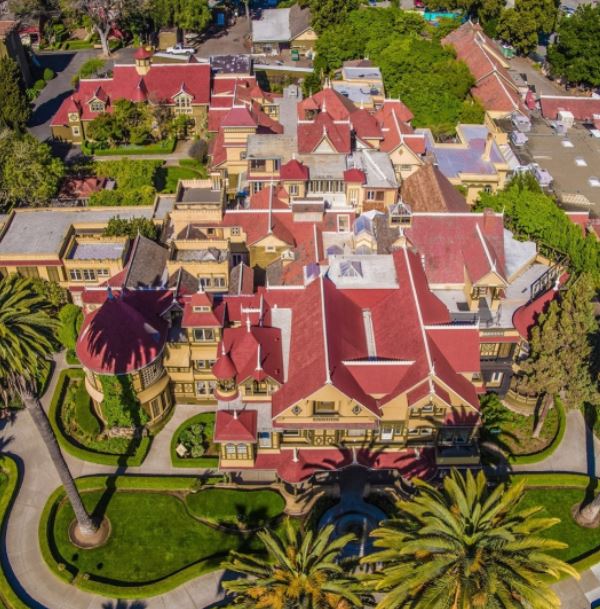
Speculation is bound to pursue a wealthy, extremely beautiful, celibate recluse, who has lost those who mean the most to her and is haunted by spirits of the damned. Many wild rumors circulated about Sarah Winchester during her residence in Santa Clara Valley—her opulent estate was even known locally as “The Spirit House”—and some say the rumors may have added to Mrs. Winchester’s isolation. However, the glory, the splendor, the beauty of her mansion, surpassed the vicious rumors and speculation; and the fragrances of the Victorian garden were intoxicating. The tracks were gone; they vanished where the velvet emerald green sod began. There were plenty of creatures, and they welcomed her with caresses. Yet, Mrs. Winchester was bent, broken, withered, widowed—her head was white with unnumbered sorrows. She had been familiar with grief for a thousand years. The deaths of her young husband and her six-week-old daughter Annie stood out clear in her memory, for it was a land-mark; it brought Mrs. Winchester her first real misery, her first real heartbreak. Her memories were blurred with tears, and after ten centuries she cried over and over and over again. Crying over it for pity of that poor child—the child she had lost. Other mothers have felt something akin to this in recalling, not their former selves, (as in her case), but the little figures which represents sons and daughters of their which have since grown to the gravity and stature of full age. Sometimes, for a moment, these poor mothers have a vision of those little creatures romping by, and they recognize the voices of laughter—gone silent long ago!—and they have a pain at the heart, as knowing that those children are lost to them for always, in the flesh, although their grown-up selves are still present in life and still precious. The loved and lost! Lives having gone out from their mothers’, lives to return no more but in visions. #RandolphHarris 1 of 16
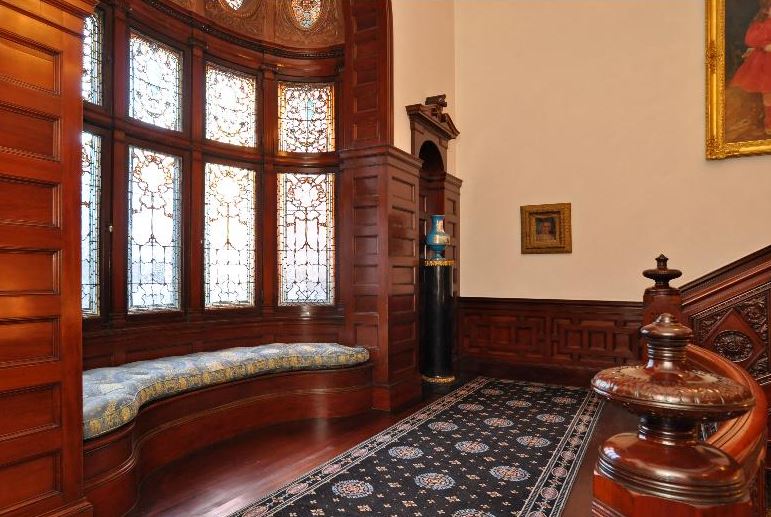
Yes, across the mouldering centuries Mrs. Winchester could still see that silken little baby, with her waxen round arms, and delicate smile, just as she was, the fairest thing in this fair World; and in her heart, leathery as it was, she felt again the pang of that day’s disappointment, holding on to the memory of what could have been. It was weeks that she had been wandering the halls of her enormous mansion, and had found no trace of William, her husband. The Valley was so cruelly vast! Early she had a happy thought, and took the bloodhound throughout the estate and showed him the tracks, and was fully of hope, not doubting he would hunt him down in an hour. But she knew that she tried everything she could try, and just needed to say goodbye forever. The track gave no scent. William Winchester was dead. The hurt stayed with her, and Mrs. Winchester was resolved to absorb herself in the construction of her mansion. She did the work, but the old pleasure in it was somehow gone; she did not care anymore. She had between 500 to 600 rooms constructed, but thought they were not good ones and tore them down because her heart was not in it. Some of them were tolerable, but mainly they were crude and inartistic; they lacked finish. The miles of twisting hallways were made even more intriguing by secret passageways in the walls. When Mrs. Winchester set out for her Séance Room, it might well have discouraged the ghost of the angry spirits or even of a bloodhound, to follow her. After traversing an interminable labyrinth of rooms and hallways, suddenly she would push a button, a panel would fly back and she would step quickly from one apartment into another, and unless the pursuing ghost was watchful and quick, he would lose her. #RandolphHarris 2 of 16
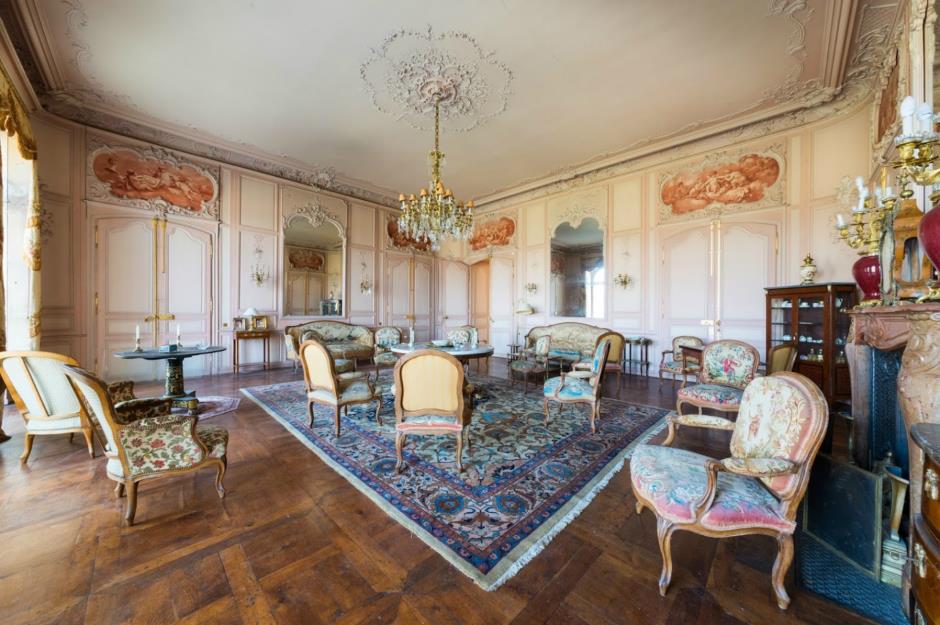
Then she opened a window in that apartment and climbed out, not into the open air, but on the top of a flight of steps that took her down one story only to meet another flight that brought her right back up to the same level again, all inside the house. This was supposed to be very discomforting to evil spirits who are said to be naturally suspicious of traps. Mrs. Winchester was the most unfortunate of women. Rich, respected, very well educated and of sound health and mind—with many other advantages usually valued by those having them and coveted by those who have them not—she sometimes thought that she would be less unhappy if they had been denied her, for then the contrast between her outer and inner life would not be continually demanding a painful attention. In the stress of privation and the need of effort, she might sometimes forget the sombre secret ever baffling the conjecture that it compels. After communing with the spirits, as she turned the hallway, Mrs. Winchester could hear a sound of a door gently closing, and saw in the darkness, indistinctly, the figure of a man, which instantly disappeared among the statues and furniture. A hasty pursuit and brief search of the mansion in the belief that the trespasser was someone secretly visiting a servant proving fruitless, she entered an unlocked door and mounted the stairs to her chamber. Its door was open, and stepping into black darkness she fell headlong over some heavy object on the floor. She spared herself the details; it was her poor William, dead of strangulation by human hands! Nothing had been taken from the house, the servants had heard no sound, and excepting those terrible fingermarks upon the dead man’s throat—dear God she hoped to forget them!—no trace of the assassin was even found. #RandolphHarris 3 of 16

Although William had Tuberculosis, something had come to end his life before the illness did. Mrs. Winchester kept barbarous murder a secret. Mrs. Winchester donated a substantial sum of money to the Winchester Clinic of the General Hospital Society of Connecticut, for the care and treatment of tuberculosis patients. The clinic still exists today as part of the Yale New Haven Medical Center. One night, a few months after the dreadful event, Mrs. Winchester and her butler were walking back from the carriage house after a trip to the city. The full moon was about three hours above the eastern horizon; the entire countryside had the solemn stillness of a summer night; their footfalls and ceaseless song of the katydids were the only sound, aloof. Black shadows of bordering trees lay athwart the mansion, which, in the short reaches between, gleamed a ghostly white. As they approached the door to the mansion, whose front was in shadow, and in which no light shone, her butler suddenly stopped and clutched her arm, saying, hardly above his breath: “God! God! what is that?” “I heard nothing,” Mrs. Winchester replied. “But see—see!” he said, pointing along the road, directly ahead. Mrs. Winchester said: “Nothing is there. Come, Henry, let us go in—you are ill.” He had released her arm and was standing rigid and motionless in the center of the illuminated roadway, staring like one bereft of sense. His face in the moonlight showed a pallor and fixity inexpressibly distressing. She pulled gently at his sleeve, but he had forgotten her existence. Presently he began to retire backward, step by step, by step, never for an instant removing his eyes from what he saw, or thought he saw. Mrs. Winchester turned half round to follow, but stood irresolute. She did not recall any feeling of fear, unless a sudden chill was its physical manifestation. #RandolphHarris 4 of 16

It seemed as if an icy wind had touched her face and enfolded her body from head to foot; she could feel the stir of it in her hair. At that moment her attention was drawn to a light that suddenly streamed from an upper window of the mansion: one of the servants, awakened by what mysterious premonition of evil who can say, and in obedience to an impulse that she was never able to name, had turned on the Carbide gas lights, which were operated by pushing an electric button. When she turned to look for the butler he was gone, and in all the years that had passed no whisper of his fate has come across the borderland of conjecture from the realm of the unknown. Mrs. Winchester retired and had fallen almost immediately into a peaceful sleep, from which she awoke with an indefinable sense of peril which was, a common experience in her estate. The servants slept in another part of the house. But these were familiar conditions and never distressed Mrs. Winchester. Nevertheless, the strange terror grew so insupportable that concurring her reluctance to move she sat up and pushed the button to turn on the lights at her bedside. Contrary to her expectation this gave her no relief; the light seemed rather as added danger, for she reflected that it would shine out under the door, disclosing her presence to whatever evil think might lurk in the halls of her mansion. You that are still in the flesh, subject to horrors of the imagination, think what a monstrous fear that must be which seeks in darkness security from malevolent existences of the night. That is to spring to close quarters with an unseen enemy—the strategy of despair! Extinguishing the gas lights, Mrs. Winchester pulled the bedclothing about her heard and lay trembling and silent, unable to shrike, forgetful to pray. In this pitiable state she must have lain for what you call hours—with her there are no hours, there is no time. #RandolphHarris 5 of 16

At last it came—a soft, irregular sound of footfalls on the stairs! They were slow, hesitant, uncertain, as of something that did not see its way; to her disordered reason all the more terrifying for that, as the approach of some blind and mindless malevolence to which is no appeal. She even thought that she must have left the hall gasolier burning and the groping of this creature proved it a monster of the night. This was foolish and inconsistent with her previous dread of the light, but what would you have? Fear has no brains; it is an idiot. The dismal witness that it bears and the cowardly counsel that it whispers are unrelated. In Mrs. Winchester’s mansion lived those who have passed into the Realm of Terror, who skulk in eternal dusk among the scenes of our former lives, invisible even to themselves, and one another, yet hiding forlorn in lonely places; yearning for speech with out loved ones, yet unenlightened, and as fearful of them as they of humans. Sometimes the disability is removed, the law suspended: by the deathless power of love or hate they break the spell—they are seen by those whom they would warn, console, or punish. What form they seem to them to bear one knows not; they know only that they terrify even those whom they most wish to comfort, and from whom they most crave tenderness and sympathy. What a thing it is to have legions of spirits, cowering and shivering, fearful and vengeful in an altered World, roaming the hallways of one’s house. However, Mrs. Winchester did not die of fright: the Thing turned and went away. She heard it go down the stairs, hurriedly, she thought, as if itself in sudden fear. Then she rose to call for help. Hardly had her shaking hand found the annunciator when—merciful Heaven!—she heard it returning. Its footfalls as it remounted the stairs were rapid, heavy and loud; they shook the mansion. She fled to an angle of the wall and crouched upon the floor. #RandolphHarris 6 of 16
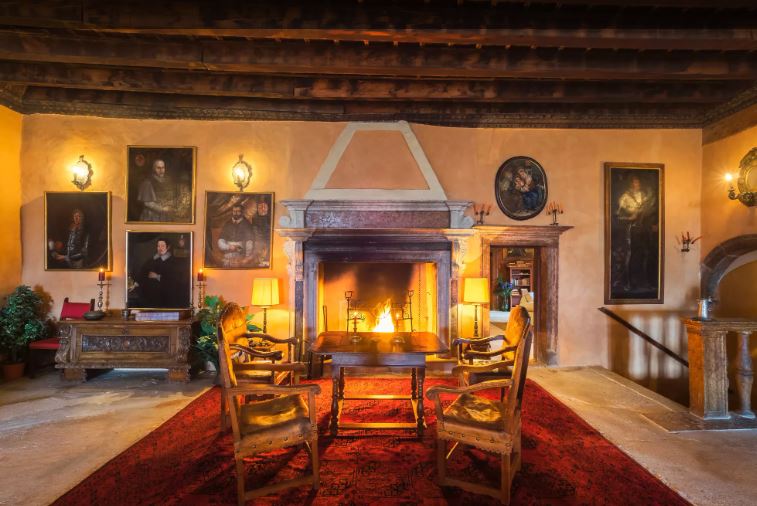
Mrs. Winchester tried to pray. She tried to call the name of her maid. Then she heard the door thrown open. There was an interval of unconsciousness, and when she revived, she felt a strangling clutch upon her throat—felt her arms feebly beating against something that bore her backward—felt her tongue thrusting itself from between her teeth! And the she felt the life pass from her. As the spirits still dwelled in the mansion of the shadows, lurking in its desolate places, peering from brambles, thickets, towers, corners, stairways and doors. Ghosts at the Winchester mansion know when it is night, for then most people retire and they can venture from their places of concealment to move unafraid about in their old mansion, to look in at the windows, even to enter and gazes upon people’s faces who might still be wandering in the evening hours. Vainly, spirits often seek some method of manifestation, some way to make their continued existence and their great love and poignant pity understood by their loved one’s or those they wish to haunt and terrorize. Ghosts dare to approach people when they are awake, but the terrible eyes of the living frighten them by the glances that they seek from the purpose the hold. Demons, ghosts, and other spiritual beings search for the living in the Winchester mansion during the moonlight dawn. At the time of her death, the unrelenting construction had rambled over six acres. The sprawling mansion contained 160 rooms, 2,000 doors, 10,000 windows, 47 stairways, 47 fireplaces, 13 bathrooms, and 6 kitchens. Carpenters even left nails half driven when they learned of Mrs. Winchester’s death. According to the provisions of her will, Mrs. Winchester’s personal property, including the furnishings, household goods, pictures, jewelry, and papers were left to her niece, Mrs. Marian Merriman Marriott, who promptly has the furnishings auctioned off. It is said to have required sic trucks working six weeks to car the furnishings away! The mansion and farm were not mentioned specially in the will. They became part of the Mrs. Winchester’s estate. #RandolphHaris 7 of 16

Demon possession is a well-defined phenomenon and should be clearly distinguished from spiritism. Since the same demonic forces are at work in both phenomena, they bear some similar characteristics and result in the same occult oppression and bondage. The demonized state of the demon possessed is similar to the trance of the spiritistic medium. Both are under the direct influence of demons who speak through them. In the case of the medium who processes to communicate with the spirits of deceased persons, the demon apes the personality and voice of the deceased. In the case of the demon possessed, the evil spirits appear to be more crassly cruel, unclean, violent, and less sophisticated and subtle than spirits working through a clairvoyant medium. In demon possession, they are also more domineering and brutally enslaving. Nervous muscular reactions and contortions peculiar to the demoniac often appear also in the spiritistic medium when one goes into a trance, but in a much milder form. Then, too, the demoniac is normally an involuntary victim of possession, while the medium is a willing subject, who cultivates psychic propensities and willingly yield to demonic control. Extraordinary movements of inanimate objects surrounding the demon-possessed remind us of similar happenings in spiritism. Extraordinary movements of inanimate objects surrounding the demon-possessed remind s of similar happenings in spiritism and magic. Tables, chairs, dishes, and the like are mysteriously moved about without anybody touching them, recalling tumbler moving and table lifting so common in spiritistic séances, and magic conjurations. In demon possession as well as in spiritism, unexplained rappings and noises in so-called “haunted houses” are heard. #RandolphHarris 8 of 16
After the Winchester mansion was opened for tours, a spirit from the house had taken possession of one of the tour guides. The spirit insisted on taking up its abode with them, since it has been driven away from its for dwelling by the presence of Christians. Such cases of haunted houses about everywhere in occult literature in connection with mediums, magicians, and demon possessed persons. The tour guide saw apparitions and had frequent attacks in which she fell unconscious and demons spoke through her in their own voice and personality. A thorough investigation was conducted. Persons were stationed all around the house, in various rooms, and even in the Daisy Bedroom. Noises were heard which gradually increased in violence and seemed to concentrate in the bedroom Mrs. Winchester died in. Chairs bounced, windows rattled, plaster fell from the ceiling, and objects moved about without any visible explanation. Prayer caused the noises and telekinetic phenomena continued for a while in the mansion. On one occasion, after continued prayer, one of the demons inhabiting Jane cried out, “All is now.ost. Our plans are destroyed. You have shattered our bond, and put everything into confusion. You, with your everlasting prayers—you scatter us entirely. We are 13,130,130,130 in number. But there are still multitudes of living men, and you should warn them lest they be like us forever, lost and cursed of God.” The demon confessed that he was an emissary of Satan. The next day, the contents of the mansion were found in compete disarray and utter confusion. The amazing and terrifying thing was that the doors were still securely locked. No man or beast had entered. Evil spirits had obviously been at work in a satanic assault. On that day there were some tremendous crashing and knocking noises heard in the Winchester mansion, as if the whole house was filled with evil spirits. #RandolphHarris 9 of 16

Everyone giving tours in the mansion in the early 1900s, used to hear knocking and rumbling and crashing noises to such an extent that some of the visitors were frightened by them. Ghosts were also seen there quite regularly, even during the day time. A headless ghost was repeatedly seen in the mansion. Many people reporting becoming burned after contact with the “possessed” tour guide Jane. The autumn of 1925, all the pigs on the Winchester mansion’s farm died. The cause of death could not be found even though one of the carcasses was sent to a biological institute for examination. They tried everything but all to no avail. The following year the same thing happened again. This time the farmer redoubled his efforts to discover the cause of the pigs’ death. He had the stables inspected and the food analyzed but again without success. He thus decided to have the conservators of the estate decided to have the pigsty torn down and rebuilt on another site using completely different materials. Next year the pigs died again. They would all of the sudden squeal and then collapse. The whole process was repeated and every possible examination made in order to find out why the pigs had died. At this time certain of the member of the community began to say that someone must be killing the pigs magically out of spite. At first the conservators of the Winchester Estate would have nothing of this and continued to seek the advice of the vet and other such people. However, they could not help them, and so in the end they went to see the local minister to ask him about the question of magic. The minister simply laughed and said that the idea was stupid. Nevertheless the villagers pointed out to the representatives that there did exist some people in some areas of California who could kill livestock by means of magic. #RandolphHarris 10 of 16
The conservators could do nothing though, and the event recurred year after year in spite of the fact that by now they had doubly secured the stables with locks and had sometimes stayed up all night with thread stretched out around the estate in order to discover if anyone was causing the animals’ deaths. One day, however, the circumstances changed. The minister visited the estate and asked one of the tour guides to accompany him to the vicarage. There they found one of the neighbour’s of the Winchester Estate, a man who had been less affluent, and this man confessed that it was he who had been the cause of everything. He had killed the pigs using black magic. The tour guides and conservators were naturally upset because by now 39 pigs had been killed. When asked why he had done this, the neighbour replied that it was because the tourists made such a noise outside his house. He had become so angry that he had tried to get his revenge in this way. He had subscribed himself to the devil with his own blood. To do this he had gone out on a Friday night to some crossroads and there drawn up a contract between himself and the devil. He mentioned that the devil had not appeared to him as he is often pictured, but that he met a black curly headed figure with blood-red eyes and a small snout and that the figure had been dressed in rather old-fashioned clothes. Ever since that day the man confessed that among other things, he had had the power to kill his friend’s pigs. The minister asked him what had made him come out into the open about the whole matter. His answer was that the people at the Winchester estate had been so kind to him over the year, donating food, clothes and furniture, that he had felt ashamed and he now asked for them to forgive him, and promised he would no longer plague them. #RandolphHarris 11 of 16

Not wanting to take any legal action, the conservators of the Winchester Estate forgave him and all went well until the neighbour ceased going to church and slid back into his old ways. Since his confession none of the estate’s pigs had died but now the man again took up his drinking habits two more of the pigs died in exact same ways as the others. The conservators decided to shutdown the farming land of the Winchester Estate and sell off hundred of acres, only keeping four. In the process, several other Victorian houses on the grounds, along with fountains, and gazebos were demolished. From the psychological point of view it is suggested that a person delving into magic and who believes in occult practices is really only succumbing to a fulfilment compulsion. One unconsciously fulfils the things that one seeks to perform by magic. One is the victim of auto-suggestion. However, even if this were the whole explanation as some people affirm, it would still be true to say that occult practices have a corrupting effect on all those who get involved in them. Demons tend to be somewhat more independent than angels…When possession takes place, you will not get to see them at all. The Florida-based Luciferian Light Group (LLG) adopted the ‘Watcher myth’ of devils that were originally angels, sent to Earth to guard humankind and cursed by God for screwing their charges. In the original myth the couplings produced monsters, but, according to the LLG, the actual result was the Aryan race. They say that African Americans and other racial groups take pride in their cultural roots, so the argument goes, why should the same concept not apply to Europeans? The argument cannot be countered by liberal sophistry, and so the ghosts of German volkisch occultists continue to be conjured. #RandolphHarris 12 of 16

The role of cultural villain again proves to be a delicate balancing act—nothing can ever be condemned on purely moralistic grounds. Many people are still trying to protect “The Black House.” The Black Pope himself once reassured his flock, “the first 99 years are always the toughest. Rege Satanas!” Satanism is opposed to victimology and scapegoating. Many people are really drawn to the dark side because they grow up reading a lot of books and watching a lot of movies about it. If witches are out there, practicing some of the old ways of the pre-Christian gods and goddesses, then they are still Satanic in the sense that they are heretical. One side of the heretical and diabolical is the scientific aspect of Satanism. Copernicus and Galileo were regarded as practicing sorcerers in as far as they dared to challenge the supremacy of God with their heresies-their scientific research. Anton LaVey codified modern Satanism. There is a rich heritage of hearsay and blasphemy behind it, but as far as an aboveground religion that reveres Satan, there was not anything before the Church of Satan’s foundation in 1966. There were Black Masses that parodied the Catholic Church. A lot of modern Satanism draws from that codification or personification of Satan used as an archetype in mythology. Satanist are more interested in power, and what was going on in the castles and courts of the times. The interactions of power and Machiavellian machinations interest a Satanists rather than going out and find herbs to cure indigestion. Satanists are reaching for a religion of the aristocracy. They have all the aspects of that pride, that energy, that stye, and hopefully those elevated standards. Many people fear them because they believe they will lure you in their house and kill you, but is that not what many Christians are doing today? #RandolphHarris 13 of 16

Your relationship with your personal Satanic archetype is yours alone. The only way some can see how effective one is as a practicing black magician is how well one gets on in the outside of the World. Satanism has always represented and will always represent the adversary. He is a counterbalance to the unspoken injustice that prevails in the current society, whether that be overweening elitism or, going to the opposite extreme, mob rule. They always have to be in the minority that push hard in the other direction to get the pendulum swinging. Satanism will never be a religion of the people. It will never be populist beyond its current position. You see hundreds of thousands of kids making the sign of the horns, wearing black, getting devil tattoos, and listening to rock music they think is Satanic. They will take all the trappings and even grasp a few of the basic ideas, like Satan representing indulgence and independence of spirit. But, beyond that, they will always be a minority and that is how some think it should be. The Winchester mansion is a common site of demonic assault. In the early 1900s, a group of tourists and tour guides were attacked by demons; some became possessed; 30 people in the group were seized. In 1926, Satan and his allies once again possessed people at the Winchester mansion. For the first time in their lives, many of these people found themselves to be powerful, significant beings, establishing their own realm of authority. When they spoke, everyone in the mansion stopped to listen, for their shrill cries became testimony. Many historians have argued that the Satanism at the Winchester mansion was only the product of demented minds. However, there was something quite real in all the series of accusations and counteraccusations of the witnesses and the possessed—some definitely evil driving force that led humans to turn against one another like mad dogs lusting for the smell of blood. If Satan was to have presided over the Satanism at the Winchester Mansion, much was left out of the picture. #RandolphHarris 14 of 16
The Devil manifested himself in many forms to people at the Winchester Mansion—as a horse, a fox, a dog, a cat, a pig, and as a shadowy figure. At the Sabbats, the Devil was always present in the form of a tall, handsome man with blue eyes and black hair making no attempt to disguise his identity in any way Neither was the all-important bloodletting present in the ceremonies, either in the form of a sacrifice or in the singing of the pact. There was no defiling of sacred object, nor mention of the administering of the witches’ mark, a painful ceremony that was quite vivid in the minds of many of the witches at the estate. The Sabbats, all in all, seemed to have been rather staid affairs, involving no wild ritual or debauchery. The Devil offered not immediate wealth or riches, but a new system of government, where all humans would be equal, each human being free to “live bravely.” He promised an end to beliefs. Whoever the Devil was at those meetings, he obviously did not seek adulation, but rather he sought to establish a more equal and suitable social order among humans. Taken in this context, the entire episode begins to sound like a huge projection, a gigantic wish fulfillment on the part of the disgruntled citizens, who were expressing disdain for the system that, in their eyes had become oppressive. The figure chosen by the confessors as the Devil presiding over the midnight Sabbats had himself become disillusioned by the system. Perhaps he had been holding nocturnal meetings in the mansion in an effort of “cleansing the soul.” At any rate, the meetings were necessary psychological safety valves in the minds of the people. People would stand around begging for the master to teach them his secret. How to become invisible, how to acquire love, and oh! beyond all, how to make gold. How much gold would you give for the Secret of Infinite Riches? Humans became strengthened with wonderful power through the order of angels, so that one declares the divine will. From the Seraphim, that we cling with fervent love. From the Cherubim, enlightenment of the mind, power and wisdom over the exalted figures and images, through which we can gaze upon divine things, etcetera. #RandolphHarris 15 of 16

From the Thronis, a knowledge of how we are made and constituted, that we may direct our thoughts upon eternal things. From Dominationbius, assistance to bring into subjection our daily enemies, who we carry with us constantly, and enabling us to attain salvation. From Potestatibus, protection against human enemies of life. From Virtuibus, God infuses strength into us, enabling us to contend against the enemies of truth and reward, that we may finish the courage of our natural life. From the Principtibus, that all things become subject to humans, that one may grasp all power, and draw unto oneself all secret and supernatural knowledge. From Archangelis, that one may rile over all things that God has made subject to one, over the animals of the field, over the fish of the sea, and over the birds of the air. From the Angelis one receives the power to be the messenger of the divine. When the veil between the conscious and the subconscious mind begins thinning it is likely that one will begin to experience certain phenomenon that will grab your attention throughout the day. This will occur more and more as the veil between Worlds thins merging your spiritual awareness with your physical life. Usually it will manifest in the form of synchronicity, Déjà vu, or circumstance which seems to jump out and grab your attention. Thee I invoke, the Bornless one. Thee, that didst create the Earth and the Heavens: Thee, that didst create the Night and the Day. Thee, that didst create the Darkness and the Light. Thou art Osorronophris: Whom no human has seen at any time. Thou art Ahriman. Hear Thou Me, for I am the Angel of Paphro. Osorronophris: this is Thy True Name, handed down to the Prophets of Ishrael. Ahriman rise up through the infernal planes through the seal of Arezura and find rest within this manifestation of the blessings. Fill this sorcerous fluid with your power and might that it will serve my cause of counter creation through the intent of my own evil mind. Bless this blood as the very powers of death, destruction, and decay that I may cast out all that does not serve the cause of my own great work upon this path of enlightenment. Come tour the dark, brooding and mysterious, promising all kinds of forbidden treats. #RandolphHarris 16 of 16
Winchester Mystery House
Happy weekend! Will we be seeing you on the estate today? 🌻 https://www.winchestermysteryhouse.com/

Born with the Proverbial Silver Spoon in His Mouth

When his name first exploded into the headlines, Michael Milken was an intensely private, work-obsessed an in his early forties, nominally a senior vice-president of Drexel Burnham Lambert, an investment banking firm actually co-founded by Morgan in 1871. Despite this deceptive title, Milken was more than just another senior vice-president. He was the architect of a whole new order in American finance. He was, as many soon recognize, the J.P. Morgan of our time. In the 1980s, Drexel became one of Wall Street’s hottest investment banking firms. And because Milken’s hard-driving efforts were mainly responsible for its spectacular growth, he was allowed to run his own largely independent shop, three thousand miles from the firm’s headquarters in the East. His office was just across from the Beverly Wilshire Hotel in Beverly Hills, California. Milken would arrive at his office as early as 4.30 or 5.00 A.M., in time to squeeze in a few meetings before the opening of the New York Stock Exchange, three time zones away. CEOs of major corporations, trekking in from New York or Chicago, would drag themselves red-eyed to these conferences, hat in hand, seeking financing for their companies. One might want to build a new plant; another might wish to expand into new markets; a third might wish to make an acquisition. They were there because they knew Milken could find the capital for them. Throughout the day Milken would sit at the center of a huge X-shaped trading desk, whispering, wheeling, dealing, shouting, surrounded by a frenzy of employees working the telephones and computer screens. It was from this desk that he and his team reshaped modern American industry, as Morgan had done in an earlier day. #RandolphHarris 1 of 24

A comparison of how each did it tells a lot about how the control of capital—and hence the power of money in society—is changing today. And it begins with the personal. While J.P. Morgan was paunchy, fierce-looking, and imposing, Milken is tall, slender, clean-shaven, with curly black hair and the look of a startled doe. While Morgan was born with the proverbial silver spoon in his baby mouth, Milken, son of a CPA, collected soiled spoons off tables at the coffee shop where he worked for a time as a busboy. Morgan commuted between Wall Street, mid-Manhattan, an estate on the Hudson, and palatial residence in Europe. Milken still lives in a far-from-palatial wood and brick home in Encino, in the not-quite-fashionable San Fernando Valley of Los Angeles. Seldom far from the Pacific Ocean, he keeps his eyes focused on Japan, Mexico, and the developing economies to the south. Morgan surrounded himself with compliant young ladies and left his wife and family to languish in his absence; Milken is, by all accounts, a family man. Morgan disliked Jewish people. Milken was Jewish. Morgan despised trade unions; Milken has served as a financial consultant for rail, airline and maritime unions. The idea that employees might own their own firms would have struck Morgan as arrant communism. Milken favors worker-ownership and believes it is going to play a major role in American industry in the years to come. Both men accumulated vast power for themselves, because notorious in the press, came under government investigation for real and/or alleged wrongdoing. However, far more important, they shifted the structure of power in America in remarkably different ways. #RandolphHarris 2 of 24

When Milken was born on July 4, 1946, the America economy was still dominated by huge companies formed, for the most part, in the Morgan era. These were Genera Motors, and Goodyear Tires, the Burlington Mills and Bethlehem Steels of the World. These smokestake firms, the so-called Blue Chips, along with their lobbyists, political fund-raisers, and trade associations, plugs organizations like the National Association of Manufacturers, had enormous political, as well as economic, clout. Collectively, they sometimes acted as though the country belonged to them. This corporate power was magnified by their influence on the media through the control of immense advertising budgets, and their ability, at least in theory, to shut down a plant in a recalcitrant congressman’s district, and shift the investments and jobs to another where the political climate was more favourable. Often they were able to induce the labor unions representing their blue-collar workers to join them in a lobbying effort. This “smokestack power,” moreover, was further protected by a financial industry that made it difficult for competitors to challenge Blue Chip dominance. As a result, the basic structure of industrial power remained largely unchanged through mid-century in the United States of America. Then something happened. Milken was still in elementary school in 1956, when, for the first time, service and white-collar workers came to outnumber blue-collar workers in the United States of America. And by the time he began his career as a young investment banker the economy had already begun its rapid transition to a new system of wealth creation. Computers, satellites, vastly varied services, glocalization, were creating a totally new, change-filled business environment. However, the financial industry, hidebound and protected by legislation, formed a major barrier to change. #RandolphHarris 3 of 24

Until the 1970s, long-term capital was readily available for Blue Chip dinosaurs, but much more difficult for smaller, innovative and entrepreneurial firms to obtain. Wall Street was the financial Vatican of the World, and in the United States of America two “rating services”—Moody’s and Standard & Poor’s—guarded the gates of the capital. These two private firms assigned risk ratings to bonds, and only some 5 percent of American companies were considered by them to be of “investment grade.” This locked thousands of companies out of the long-term debt market or sent them to banks and insurance companies for loans rather than to investors in the bond market. A student, first at the University of California in Berkeley and later at the Wharton School of the University of Pennsylvania, Milken studied investor risk. He discovered that many of the smaller firms frozen out of Wall Street had good records for paying their debts. If anyone would buy bonds from them, they seldom defaulted and were prepared to pay higher than usual interest. From this counterintuitive insight came the so-called high-yield or “junk” bond, and Milken, now a young underling at Drexel, proceeded to sell them to investors with missionary zeal. The details of the story are not important for our purposes. What matters is that Milken succeeded beyond anyone’s wildest expectations. The result was that he almost single-handedly broke the financial isolation that had hitherto been imposed on this secondary tier of companies. It was like a dam bursting. Capital poured into these companies, passing through Drexel on its way. By 1989 the junk-bond market reached an astronomical $180 billion. Rather than creating a “money trust,” therefore, as Morgan had done, Milken made finance more competitive and less monopolistic, opening the gates, as it were, and freeing thousands of companies from dependence on banks and insurance companies. #RandolphHarris 4 of 24

They also bypassed the snooty Wall Street firms that existed to serve the Blue Chips. Milken’s bonds permitted managers to go directly to the public and to institutional lenders like pension funds for the capital with which to build new plants, to expand markets, to do research and development—or to take over other firms. Roughly 75 percent of junk bonds were quietly used for investment in new technology, or to open new markets, and for other noncontroversial purposes. Drexel’s advertising made much of the fact that while employment in the Blue Chips, the old giants, was not keeping pace with the economy’s expansion, jobs in the smaller firms they financed multiplied more rapidly than in the economy at large. However, some of the capital Milken supplied was used in pitched takeover battles. These dramatic financial showdowns filled the headlines and kept the stock market and the nation itself spellbound. Stock prices soared and plunged on rumors of more, and still more, takeovers and raids affecting some of the nation’s best-known companies. Deals were made that no longer provided a reasonable balance of risk and reward for the investor. Debt was pyramided on top of unrealistic debt in any orgy of speculation. Taxi drivers and waitresses knowingly discussed the latest news and called their stockbrokers, hoping to cash in on the killings to be made as competing raiders bid up the stock of corporations marked for takeover. As other Wall Street firms entered the junk-bond market, the money machine created by Milken a Drexel, no longer in their hands alone, became a runaway juggernaut. Such violent upheavals, often led to a slaughter of the innocents. Companies were “downsized,” workers ruthlessly laid off, executive ranks decimated. Not surprisingly, a massive counterattack was launched with Milken as the principal target. #RandolphHarris 5 of 24

By forcing open the sluice gates of capital, Milken had rattled the entire structure of smokestack power in America. While enriching Drexel Burnham (and feathering his own nest to the amazing tune of $550 million in 1987 alone), he also made bitter enemies of two extremely powerful groups. One consisted of the old-line Wall Street firms who previously had had a stranglehold on the flow of capital to American corporations; the other consisted of the top managers of many of the largest firms. If they could, both had every reason to destroy him. Both also had powerful allies in government and the media. First savaged in the press, which pictured him as the very embodiment of capitalist excess, Milken was then hit with a ninety-eight-count federal indictment charging him with securities fraud, market manipulation, and “parking” (illegally holding stock that belonged to Ivan Boesky, the arbitrageur who was jailed for insider trading). Threatening to use sweeping legal powers designed to deal with the Mafia, rather than with stock market wrongdoings, the federal government forced Drexel to sever its relationship with Milken and pay a crushing $650 million fine to the government. At the same time, some of the worst-case buy-outs began to come apart, panicking investors and pushing down the value of most junk bonds, safe and unsafe alike. Soon Drexel, struggling to stabilize itself after the $650 million fine, and itself holding $1 billion in junk bonds, fund itself driven to the wall. Drexel collapsed with a thunderous crash. Milken, already tried and convicted in the press, ultimately pled guilty to six violations in a complex deal that erased all other criminal charges. #RandolphHarris 6 of 24

However, as in the case of Morgan, the question of whether or not he broke the law is far less important for the country than his net impact on American business. For while finance was restructuring other industries, Milken was restricting finance. The conflict between those, like Morgan, who wanted to restrict assess to capital so that they could themselves control it, and those like Milken, who fought to widen access, has a long history in every country. “There has been a long struggle,” writes Professor Glenn Yago of the State University of New York (Stony Brook), “to innovate U.S. capital markets to make them more accessible. Farmers fought for credit in the 19th century, and agricultural productivity increases…were the outcome. In the 1930s, small businessmen got relief from being squeezed out from bank credit windows. After World War II, workers and consumers sought credit for home ownership and college education. In spite of resistance by those who would restrict popular access to credit, financial markets responded to demand and the country flourished.” While an excess of credit can unleash inflation, there is a difference between excess and access. By broadening access, Milken’s firm could, as Connie Bruck, one of his most savage critics, admits, “reasonably sustain the claim…that it had furthered the ‘democratization of capital,’” which is why some trade unionists and African-Americans rallied to his defense in his time of trouble. Morgan and Milken, in short, change American finance in contrary ways. Furthermore, while Morgan was the ultimate centralizer and concentrator, operating on the assumption that the whole was worth more than its parts, Milken and the people he financed often started from the opposite assumption. #RandolphHarris 7 of 24

Thus the 1960s and 1970s had seen the formation of gigantic, unwieldy, unfocused “conglomerates”—huge companies built on bureaucratic management and a blind belief in “economies of scale” and “synergy.” The bonds Milken sold financed takeovers designed to bust up these behemoths and create slimmer, more maneuverable and more strategically focused firms. Virtually every Milken-funded takeover resulted in the sell-off of divisions or units, because, in fact, the parts were worth more than the whole; the synergy, less than imagined. A striking case in point was the breakup of the Beatrice Companies, an ungainly agglomeration that combined, with little logic, Avis car rentals, Coca-Cola bottling, Playtex brassieres, the manufacture of tampons, along with the food processing that had once formed its core business. After its parts were sold to other companies, Beatrice was a much smaller firm operating more sensibly in the food, cheese, and meat business. Borg-Warner, an industrial firm, sold off its financial operations. Revlon, after takeover, sold off its medical business and other units unrelated to its central skills—the cosmetic industry. Milken’s easing of access to capital also helped nourish upstart firms in the new service and information sectors that are key to the advanced economy. Surely this was not Milken’s primary purpose. He was more than willing to fund rust-belt industries as well. However, operating at a moment when the entire economy was in transit out of the smokestack era, he was certainly aware of this fundamental change and, in some ways, helped spur it on. Thus at one point he told Forbes magazine that much of the restructuring going on had to do with the country’s transition out of the industrial age, adding that “in an industrial society, capital is a scarce resource, but in today’s information society, there is plenty of capital.” #RandolphHarris 8 of 24

Since Milken’s high-yield or junk bonds worked to the advantage of newer, less established companies rather than the Blue Chips, all of whom had easy access to conventional financing, it is not surprising that many of his beneficiaries were in the fast-expanding service and information sectors where newer companies were likely to be found. Thus Milken helped reorganize or channeled capital into cellular telephones, cable television, computers, health services, day care, and other advanced business sectors—whose growing power challenged the dominance of the old smokestack barons. In short, Morgan and Milken alike, but in almost diametrically different ways, shook the established power structure in their time and for this reason, quite apart from legal issues, called down upon themselves hailstorms of controversy and calumniation. For good or ill, legally or not, each changed finance in ways that corresponded to the emerging needs of the economy in their time. It required a leap of imagination on the part of Muhammad Yunus to create a bank that lends money to some of the World’s most desperately impoverished people—village entrepreneurs who might need as little as thirty of fifty dollars to start a tiny business. Conventional banks could not afford to make and service such minute loans, and borrows did not have collateral or credit histories. In 1976 Yunus, a Bangladeshi economist, created the Grameen Bank. Instead of requiring collateral, it asked borrowers to recruit a group of cosigners in their own community to guarantee repayment. The group would have a collective interest in the success of the borrower’s small business and could exert social pressure or provide help if payments fell behind. If the debt was repaid, its members might themselves qualify for loans. #RandolphHarris 9 of 24

By 2005, Grameen had made loans to 4.3 million people in tiny amounts totaling $4.7 billion, almost entirely to women—who turn out to be more apt to succeed in their enterprises and also more likely to make full repayment. Grameen has sparked similar operations in at least thirty-four countries and has set up a foundation to help NGOs and others replicate the Grameen model. Today microfinance is a sizeable global industry. Two keys to its success are its interest rates on these loans—very high by U.S. or European standards—and the remarkable 98 percent repayment rate it claims. In truth, Grameen has had collection difficulties. Yet, these borrowers are less risky than loaning money to some millionaires and billionaires. What is even more interesting about this social invention is the transformative impact it is having on other institutions. To begin with, Grameen has had many imitators of the model it launched in Bangladesh. By 2001, according to The Wall Street Journal, “shopkeepers playing cards in the village of Bagil Bazar can cite from memory the terms being offered by seven competing microlenders.” Because Grameen’s profits are unusually strong, some twenty-six NGOs working in poor countries have created microloan banks of their own to help fund their nonprofit activities. In turn, the spread of microfinance had led to the creation of MicroRate, a rating agency for microfinance banks—itself a novelty. According to its founder, Damian von Stauffenberg, more and more NGO banks will transform themselves into conventional banks in the decade to come, because that would greatly increase their ability to both borrow and lend. As many as two hundred have already taken the preliminary steps. Some will become competitive with conventional banks, and that, he suggests, will bring big global retail banks and local commercial banks into the microloan business. #RandolphHarris 10 of 24

In a word, one new organization, Grameen, has had a transformatory impact—not just on the lives of the poor entrepreneurs it has helped but on the way NGOs raise money for their activities. It could alter conventional banking as well, as it blurs the boundaries between the profit and nonprofit Worlds. Grameen is not the only example of high-impact social invention. Amazon.com has created the bookstore without a store. EBay has developed an auction bureau in which the customers do the auctioneering. Google, Yahoo! and other search engines process 600 million queries a day, altering what libraries do and compelling changes—perhaps transformation—in the staid book-publishing industry. Attacking the industrial-age social welfare model, Vern Hughes in Australia charged that “politicians are still able to get away with promising more schools, more hospitals, more nurses and more police,” as if pouring more money int them will cure the crises they face. In this model, the many social agencies deliver one-size-fits-all services to “disconnected, passive and disempowered ‘clients.’” As an alternative, Hughes cites a program in Melbourne called Person to Person, made up of families of kids with disabilities. These families were “sick of standardized services for their children,” all of whom had different needs. The families persuaded Australia’s Department of Human services to provide cash instead of services, and pay it to a group “support coordinator” the families selected. The coordinator would then buy and allocate “a mix of services chosen by the families (education, home help, day care, etcetera).” As Hughes puts it, the emerging paradigm in human services “shifts focus away from supply-side delivery to demand-side personalization.” This demassification is the welfare-service equivalent of product customization in the marketplace. #RandolphHarris 11 of 24

The technocracy that emerged, fully armed, in nineteenth-century America disdained such beliefs, because holy men and sin, grandmothers and families, regional loyalties and two-thousand-year-old traditions, are antagonistic to the technocratic way of life. They are a troublesome residue of tool-using period, a source of criticism of technocracy. They represent a thought-World that stands apart from technocracy and rebukes it—rebukes its language, its impersonality, its fragmentation, its alienation. And so technocracy disdains such a thought-World but, in America, did not and could not destroy it. We may get a sense of the interplay between technocracy and Old World values in the work of Mark Twain, who was fascinated by the technical accomplishments of the nineteenth century. He said of it that it was “the plainest and sturdiest and infinitely greatest and worthiest of all the centuries the World has seen,” and he once congratulated Walt Whiteman on having lived in the age that gave the World the beneficial products of coal tar. It is often claimed that he was the first writer regularly to use a typewriter, and he invested (and lost) a good deal of money in new inventions. In his Life on the Mississippi, he gives lovingly detailed accounts of industrial development, such as the growth of the cotton mills in Natchez: “The Rosalie Yarn Mill of Natchez has a capacity of 6000 spindles and 160 looms, and employs 100 hands. The Natchez Cotton Mills Company began operations four years ago in a two-story building of 50 x 190 feet, with 4000 spindles and 128 looms….The mill works 5000 bales of cotton annually and manufactures the best standard quality of brown shirtings and sheetings and drills, turning out 5,000,000 yards of these good per year.” #RandolphHarris 12 of 24

Twain liked nothing better than to describe the giantism and ingenuity of America industry. However, at the same tie, the totality of his work is an affirmation of preindustrial value. Personal loyalty, regional tradition, the continuity of family life, the relevance of the tales and wisdom of the elderly are the soul of his work throughout. The story of Huckleberry Finn and Jim making their way to freedom on a raft is nothing less than a celebration of the enduring spirituality of pretechnological man. If we ask, then, why technocracy did not destroy the Worldview of a tool-using culture, we may answer that the fury of industrialism was too new and as yet too limited in scope to alter the needs of inner life or to drive away the language, memories, and social structures of the tool-using past. It was possible to contemplate the wonders of a mechanized cotton mill without believing that tradition was entirely useless. In reviewing nineteenth-century American history, one can hear the groans of religion in crisis, of mythologies under attack, of a politics and education in confusion, but the groans are not yet death-throes. They are the sounds of a culture in pain, and nothing more. The ideas of tool-using cultures were, after all, designed to address questions that still lingered in a technocracy. The citizens of a technocracy knew that science and technology did not provide philosophies by which to live, and they clung to the philosophies of their fathers. They could not convince themselves that religion, as Dr. Freud summed it up at the beginning of the twentieth century, is nothing but an obsessional neurosis. Nor could they quite believe, as the new cosmology taught, that the Universe is the outcome of accidental collocations of atoms. And they continued to believe, as Mark Twain did, that, for all their dependence on machinery, tools, ought still to be their servants, not their masters. #RandolphHarris 13 of 24

They would allow their tools to be presumptuous, aggressive, audacious, impudent servants, but that tools should rise above their servile station was an appalling thought. And though technocracy found no clear place for the human soul, its citizens held to the belief that no increase in material wealth would compensate them for a culture that insulted their self-respect. And so two opposing World-views—the technological and the traditional—coexisted in uneasy tension. The technological was the stronger, of course, but the traditional was there—still functional, still exerting influence, still too much alive to ignore. This is what we find documented not only in Mark Twain but in the poetry of Walt Whiteman, the speeches of Abraham Lincoln, the prose of Thoreau, the philosophy of Emerson, the novels of Hawthorne and Melville, and, most vividly of all, in Alexis de Tocqueville’s monumental Democracy in America. In a word, two distinct thought-Worlds were rubbing against each other in nineteenth-century America. If our future will include nanotechnology, then it would be useful to understand what it can do, so that we can make more sensible plans for our families, careers, companies, and society. However, many intelligent people will respond that understanding is impossible, that the future is just too unpredictable. This depends, of course, on what you are trying to predict: The weather a month from now? Forget it; weather is too chaotic, even weather applications get predictions wrong. The position of the Moon a century from now? Easy; the Moon’s orbit is like clockwork. Which personal-computer will lead twenty years from now? Good luck; major companies today did not even exist twenty years ago. That personal computers will become even more enormously powerful? A virtual certainty. #RandolphHarris 14 of 24

And so on. If you aim to say something sensible about the future of technology, the tick is to ask the right questions and to avoid the standard pitfalls. Here are our suggestions for how to blunder into a Megamistake in forecasting: Ignore the scientific facts, or guess. Forget to ask whether anyone wants the projected product or situation. Ignore the costs. Try to predict which company or technology will win. In looking at what to expect from nanotechnology—or any technology—all of these must be avoided, since they can lead to some grand absurdities. In a classic demonstration of the first error, someone once concocted the notion that pills would someday replace food. However, people need energy to live, and energy means calories, which means fuel, which takes up room. To subsist on pills, one would need to gobble them by the fistful. This would be like eating a tasteless kibbled dog food, which was hardly the idea. In short, the pills-for-food prediction ignored the scientific facts. In a similar vein, we once heard promises of a cure for cancer—but this was based on a guess about scientific facts, a guess that “cancer” was in some sense a single disease, which might have a single point of vulnerability and a single cure. This guess was wrong, and progress against cancer has been slow. Earlier, we presented a scenario that includes the routine cure of a cancer using nanotechnology. This scenario takes account of the currently known facts: Cancers differ, but each kind can be recognized by its molecular makers. Molecular machines can recognize molecular makers, and so can be primed to recognize and destroy specific kind of cancer cells as they turn up. #RandolphHarris 15 of 24

Even nanotechnology cannot cram a meal into a pill, but this is just as well. The pills-for-food proposal did not just ignore the facts, it also ignored what people want—things like dinner conservation and novel ethnic cuisines. Magazines once promised cities beneath the sea, but who wants to live in the ultimate damp, chilly climate? California and the sunbelt have somehow proved more popular. And again, we were promised talking cars, but after giving them a try, people prefer luxury cars from companies that promise silence. Many human wants are easy to predict, because they are old and stable: People want better medical care, housing, consumer goods, transportation, education, and so forth, preferably at lower costs, with greater safety, in a cleaner environment. When our limited abilities force us to choose better quality or lower cost or greater safety or a cleaner environment, decision become sticky. Molecular manufacturing will allow a big step in the direct of better quality and lower costs and increased safety and a cleaner environment. (Choices of how much of each will remain.) There is no existing market demand for “nanotechnology,” as such, but a great demand for what it can do. Neglecting costs has also been popular among prognosticators: Building cities under the sea would be expensive, with few benefits. Building in space has more benefits, but would be far more expensive, sing past or present technologies. Many bold projections gather dust on shelves because development or manufacturing costs are too high. Some examples include personal robots, flying cars, and Moon colonies—they still sound more like 1950s science fiction than practical possibilities, and costs is one major reason. #RandolphHarris 16 of 24

Molecular manufacturing is, in part, about cost reduction. As mentioned above, molecular machines in nature make things inexpensively, like wood, potatoes, and hay. Trees are more complex than spacecraft, so why should spacecraft stay more expensive? Gordon Tullock, professor of economics and political science at the University of Arizona, says of molecular nanotechnology, “its economic effect is that we will all be much richer.” The prospect of building sophisticated products for the price of potatoes gives reason to pull a lot of old projections down from the shelf. We hope you will not find the dust when we brush them off for a fresh look. Even staying within the bounds of known science, focusing on things people want, and paying attention to costs, it is still hard to pick a specific winner. Technology development is like a horse race: everyone knows that some horses will win, but knowing which is harder (and worth big bucks). Both corporate managers betting money and researchers betting their careers have to play this game, and they often lose. A technology may work, provide something useful, and be less expensive than last year’s alternative, yet still be clobbered in the market by something unexpected but better. To know which technologies will win, you would have to know all the alternatives, whether they have been invented yet or not. Good luck! We will not try to play that game here. “Nanotechnology” (like “modern industry”) describes a huge range of technologies. Nonetheless, nanotechnology in one form or another is a monumentally obvious idea: it will be the culmination of an age-old trend toward more thorough control of the structure of matter. Predicting that some form of nanotechnology will win most technology races is like predicting that some will win a horse race (as opposed to, say, a dachshund). #RandolphHarris 17 of 24

A technology based on through control of the structure of matter will almost always beat one based on crude control of the structure of matter. Other technologies have already won races in the literal sense of being first. Few, however, will win in the sense of being best. Television cannot transmit information that comes in the form of smell, touch or taste. Furthermore, as we discussed, the information it can transmit through the visual and auditory senses is extremely narrow. The ranges of color, brightness, depth are confined by the technology. The sounds are blotted out by the whistle of the electron fields. Unfortunately, given the human tendency to accept the information of our senses as total and reliable, we are not aware of the aspects of the visual and aural information that are dropped out of this new information package. We assume that when we see and hear something, we are seeing and hearing everything that is being transmitted, as though we were actually observing the event directly. Or else we assume that what is lost is too minor to matter. We are inclined to believe the information as though it had not been processed, reduced and reshaped before we experienced it. In addition to the elimination of three sensory systems and the narrowing of two others, there is another sensory oddity in the television experience. Television disconnects the two operative sense modes—visual and sural. You are sitting in a room watching an image from miles away. You see the place, but the image you see and the sounds which reportedly connect to the image are not really connected. The sounds are “nearer” to you than the images are. Let us say you are watching two people walking on a faraway hillside. In real life, you could not make out what the characters are saying, but on television you can. #RandolphHarris 18 of 24

The voices are amplified or dubbed in, so you can hear a conversation that would otherwise be inaudible. The natural informational balance between aural and visual has been shattered. Now, information that you take in with the visual sense cannot be used to modify or help process the information from the aural sense because they have each been isolated from each other and reconstructed. Furthermore, while you are watching and listening with your disconnected aural and visual senses, you are smelling some chicken roasting in the kitchen and you are drinking a glass of premium cranberry juice So television has attached two of your sensory modes to a distant sot, altered their natural arrangement to each other, but left other aspects of your sensory apparatus at home in present time. This is a very peculiar arrangement and in a way it is sort of funny, like playing a perceptual game in a technology museum. It takes on importance when we understand that the average person submits to this condition for four hours every day, and while in this state is receiving important information about life All of the information is narrowed to fit the sensory transmission limits of the medium and distorted by the sensory disconnections in the human. One can imagine the emergence of a new psychological syndrome: “sensory schizophrenia.” The cure will involve exercises to resynchronize wildly confused senses with each other, with the mind, and with the World. Because of all the preceding it ought to go without saying that any messages that are dependent upon sensory understanding and interaction are not going to work on television. This is very unfortunate for the ecology movement. #RandolphHarris 19 of 24

It always surprises me whenever any attempts are made to show wilderness or wildlife on television. The fuzzy image previously described is the first problem: forests become blurs, ocean depths are impossibly foggy, the details of plants are impossible to see. So the viewer depends on the voice-over to know what is going on. Because of the blur naturalist programs focus on such objective behavior as playing, fighting, mating, eating, just as they do with human sitcoms and soap operas. There are more animal programs than plant programs because animals come through better on the fuzzy medium, and the larger and more rambunctious the animal the better. However, even if TV images were not as coarse as I have described them, there would still be no way to understand a forest or swamp or desert without all the senses fully operative, receiving information in all ranges, and freely interacting with each other. An interesting recent illustration of the problem was a news feature concerned with a decision that a town council had to make. A land developer sought a permit to convert a large marsh area into a new community of homes. Should the permit be okayed? It was quite a thoroughgoing, earnest report. Considering the subject, not ordinarily conceived as “good television” by producers, it was also an extraordinarily lengthy report, about eight minutes of an evening newscast. The report presented interviews with a local conservation group that opposed the project. It presented several minutes of images of the plants in the marshland, flocks of birds, nesting grounds, all with the appropriate wild-sounding calls. Having worked as a publicist for many years, in fact, as a publicist for environmental groups, I knew how much work the environmentalists had put into this program and how important they felt it to be. #RandolphHarris 20 of 24

In the end, though, I knew they had failed no matter how this particular vote came out, because if there is anything which cannot be conveyed on television it is a feeling for a marsh. I suspect that the result of the program would be to decrease concern for marshes. These images and words about marshes were probably more than they had ever seen or heard before. Since the news report told them interesting things they did not know—how many varieties of creatures lived there, for example—they may have considered it quite a complete story. In terms of popular media, indeed it was. However, while the viewers knew more than before, they were not likely to be aware of what they did not know and were not getting. As the images of the marsh went hurtling into their brains, accompanied by a news reporter’s description of an egret nesting ground, they probably assumed that most of the relevant data were hand, that they had learned enough to make a judgment. Images and words about a marsh do not convey what a marsh is. You must actually sense and feel what a strange, rich, unique and unhuman environment it is. The ground is very odd, soft, sticky, wet and smelly. It is not attractive to most humans. The odor emanates from an interaction between the sometimes-stagnant pools and the plants that live in the mud in varying stages of growth and decay. If the wind is hot and strong there can be a nearly maddening mixture of sweet and rotting odors. To grasp the logic and meaning of marsh life, the richest biological system on Earth, one need to put one’s hand into the mud, overturn it, discover the tiny life forms that abound. One needs to sit for long hours in it, feeling the ebbs and flows of the waters, the creatures and the wind. And this is something television cannot do at this time. #RandolphHarris 21 of 24

The sexuality and violence in the news and on TV serve as metaphors in life which acts directly on consciousness through the Image-ination—or else in the correct circumstances they can be openly deployed and enjoyed, imbued with a sense of the holiness of every thing from the ecstasy and wine to garbage and corpses. Those who ignore their World outside themselves risk destruction. It is creative nihilism to spend life in unreality. For those who follow life, it promises enlightenment and even wealth, a share of temporal power. Capital just does not persuade its readers that it is the truth about economics or about the inevitable future of man, and therefore worth the hard work it demands to be digested. A few brilliant essays still charm but are not enough on which to found a Worldview. The intellectual death of their eponymous hero has not stopped much of the Left from continuing to call itself Marxist, for he represents the poor in their perennial struggle against the rich, and their demand for more equality than liberal societies provided. However, beyond that, the Left’s nourishment comes from elsewhere. Nothing in Marx resonates in souls furnished by Sartre, Camus, Kafka, Dostoyevski, Nietzsche and Heidegger. Rousseau can still overpower where Marx falls flat. In Marx, ideology meant the false system of thought elaborated by the ruling class to justify its rule in the eyes of the ruled, while hiding its real selfish motives. Ideology was sharply distinguished in Marx from science, which is what Marx’s system is—id est, the truth based on disinterested awareness of historical necessity. In Communist society there will be no ideology. “The pure mind,” to use Nietzsche’s formulation, still exists in Marx’s thought, as it hard in all philosophy—the possibility of knowing the ways things are, an intellectual capacity irreducible to anything else. #RandolphHarris 22 of 24

Ideology is a term of contempt; it must be seen through in order to be seen for what it is. Its meaning is not in itself but requires translation back into the underlying reality of which it is a misleading representation. The man without ideology, the one possessing science, can look to the economic infrastructure and see that Plato’s political philosophy, which teaches that the wise should rule, is only a rationalization for the aristocrats’ position in a slave economy; or that Hobbes’s political philosophy, which teaches man’s freedom in the state of nature and the resulting war of all against all, is only the over for the political arrangements suitable for the rising bourgeoisie. This point of view provides the foundation for intellectual history, which tells the story behind the story. Instead of looking at Plato and Hobbes for information about what courage is—a subject important to us—we should see how their definitions of courage suited those who controlled the means of production. However, what applies to Plato and Hobbes cannot apply to Marx; otherwise the very assertion that these thinkers were economically determined would be itself a deception, simply the ideology for the new exploiters Marx happens to serve. The interpretation would self-destruct. He would not know what to look for in the thinkers who were inevitably and unconsciously in the grip of the historical process, for he would be in the same condition as they were. There are certainly historical preconditions of Marx’s science; but they do not detract from the truth of his insight, which is therefore a kind of absolute moment in history that no further history can alter. This truth is the warrant for revolution, and the moral equivalent of the natural rights that warranted the American Revolution. Without it all the killing is unjust and frivolous. #RandolphHarris 23 of 24

As we have talked about, cooperation based on reciprocity can thrive and be evolutionarily stable in a population with no relatedness at all. A case of cooperation that fits this scenario, at least on first evidence, has been discovered in the spawning relationships in sea bass. These fish have the sexual organs of both the male and the female. They form pairs and roughly may be said to take turns at being the high investment partner (laying eggs) and ow investment partner (providing sperm to fertilize eggs). Up to ten spawnings occur in a day and only a few eggs are provided each time. If gender roles are not divided evenly, pairs tend to break up. The system appears to allow the evolution of much economy in the size of testes, but these testes condition many have evolved when the species was sparser and more inclined to inbreed. Inbreeding would imply relatedness in the pairs and this initially may have promoted cooperation without the need of further relatedness. As the angels as the Heavenly, so of the king of the Earthly representative of God, that He knows all things. God discerns good and the evil, this refers specifically to the knowledge of the right and the wrong, the guilty and the innocent, which the Earthly judge, like the Heavenly who rules over the nations receives from His divine commissioner, so that He may give it practical realization. However, added to this is the fact that the word sequence “good and evil” does not permit us to suppose it a rhetorical flourish. Neither is it the case that “cognition in general only came to the first human when they partook of the fruit: it is not before a create without knowledge that, even before the creation of the woman, God brings the beasts that he may give them their appointed names, but before the bearer of his own breath, the beings upon whom, at the very hour of creation, he had manifestly bestowed the abundance of knowledge contained in speech, of which that being is now the master. “And they did not come unto Jesus with broken hearts and contrite spirits, but they did curse God, and wish to die. Nevertheless they would struggle with the sword for their lives,” reports Mormon 2. 14. #RandolphHarris 24 of 24

Cresleigh Homes
Our #MillsStation Residence 1 shows how airy a single story home can be – it’s 1,932 sq. ft. of effortlessly livable space.

It’s so much fun to picture all the events that might happen in this kitchen…and how many late night sandwiches might get munched at that spacious island! 😍
#CresleighHomes

Faith in Machinery is Mankind’s Greatest Menace

Along with the venality of its controllers, the technology of television predetermines the boundaries of its content. Some information can be conveyed completely, some partially, some not at all. The most effective telecommunications are the gross, simplified linear messages and programs which conveniently fit the purposes of the medium’s commercial controllers. Television’s highest potential is advertising. This cannot be changed. The bias is inherent in the technology. A good way to think about television—in fact all the media—is as a kind of telescope in the sky, flying around, constantly looking. Then from it perch in the sky, it zooms down to a single spot on the planet, a small group of people shooting each other. It takes this single event out of billions and billions of other little events and sends it zooming through space to television antennas, and then out through an electron gun into (on average) 120 million people sitting at home in dark rooms with their eyes still. The event gets reconstructed in the brains of these people as an image. Recorded. All these 120 million people have recorded the same image from this single distant spot where they are not. This becomes their experience of that moment. If the telescope has selected a shooting from an entire planet’s worth of activities, in the next moment it may choose a Super Bowl game, or a threatening remark by someone who is unhappy with America, or a program of people trying to win prizes, or a movie about the Old West. All others subjects were not selected, at least in this moment. The telescope did not select views of the ocean as the tide comes in, or people sitting on front porches, or young people knocking on doors to tell a neighbourhood about a zoning hearing. #RandolphHarris 1 of 21
If there is logic in this selection is the question to ask. Are there reasons why the telescope selects one thing and not another? There certainly are. Dozens of them. The first and most obvious of these reasons is the one that most critics of television devote themselves to. The people who control television, businessmen, operate strictly out of considerations of budget and profit, in addition to brining alone their own political, perceptual, and social biases. It was to allay their influence that so many thousands of media reformers devoted years of effort to democratizing access to the medium and its content. And yet at present there are still no poor people running television, no marginalized group, no ecologist, no political radicals, no Zen Buddhists, no factory workers, no revolutionaries, no artists, no Communists, no Luddites, no hippies, no botanists, to name only a few excluded groups. To have only businessmen in charge of the most powerful mind-implanting instrument in history naturally creates a boundary to what is selected for dissemination to nearly 335 million people. If other categories of people had control, there can be little disagreement with the point that the choices would be different. If television is a medium of brainwash, then with it now being a more diverse brainwashing system, it is surely an improvement over the sort we got in the past. Still that is debatable because with less diversity in the past, the programs were more family friendly. The overriding bias of television, then, the bias which contains all the other biases, is that it offers preselected material, which excludes whatever is not selected. Now, of course, this is utterly obvious. And, yes, it is true of all experiences. When you are doing one thing, you exclude everything else that you might be doing. #RandolphHarris 2 of 21

When we forget that someone has selected our experience for us, and we have given up awareness, information and experience that is not part of television, this only then becomes significant concerning television. When you are spending time in front of the television, you are not doing other things. The young child of three or four years old is in the stage of the greatest emotional development that human beings undergo. And we only develop when we experience things, real-life things: a conversation with Mother, touching Father, going places, doing things, relating to others. This kind of experience is critical to a young child, and when the child spends thirty-five hours per week in front of the TV set, it is impossible to have the full range of real-life experience that a young child must have. Even if we had an overabundance of good television programs, it would not solve the problem. The act of sitting in front of television is itself a replacement of other modes of experience and the awareness these would bring. In this way, television is an acceleration of a condition that began with our artificial environments. We are already separated from most experiences with an unmediated planet. We have given up our personal sensory informational systems. The artificial forms around us already limit our experience and awareness. Our knowledge of the outside World was confined to a narrower field even before television was invented. With television, however, the artificial information-field is brought inside our darkened rooms, inside our stilled minds, and shot by cathode guns through out unmoving eyes into our brains, and recorded. We have no participatory role in gathering data. Our information is narrowed to only what the telescope provides. If we do not experience a wider information field, we lose knowledge of that field’s existence. We become the hermit in the cave who knows only what the TV offers. We experience what is, not knowing what is not. #RandolphHarris 3 of 21

The people who control television become the choreographers of choosing information. We live within their conceptual frameworks. We travel to places on the planet which they choose and to situations which they decide we should see. What we can know is narrowed to what they know, and then narrowed further to what they select to send us through this instrument of theirs. The kind of people who control television is certainly a problem. However, this is only the beginning. While our field of knowledge is constrained by their venality and arrogance, the people who run television are constrained by the instrument itself. Television is no open window through which all perception may pass. Quite the opposite. There are many technological factors that conspire to limit what the medium can transmit. Some information fits and some does not. Some information can pass through, but only after being reshaped, redefined, packaged, and made duller and coarser than before. Some ways of mind can be conveyed and some cannot. The wrinkle in the story is what can be conveyed through television are the ways of thinking and the kinds of information that suit the people who are in control. This is why they like it so much. It is obviously efficient for them to concentrate their communications within a medium that is good at conveying their forms of mind, just as a person with a drive for power is more apt to express that in politics than in gardening. Conversely, it is logical that the medium will not respond well to people or attitude that defy its limits. It will throw them off, or distort their messages, as a computer would shun anyone who wishes to use it to express feelings of loving tenderness. It might program such a message, but only the words will come out on the tape; not the loving tenderness. #RandolphHarris 4 of 21

So we have a chicken-egg problem. It is difficult to tell which came first, the technology or its controllers. It may not be that the corporate mentality won the war to control television. The technology itself picked its master, through the inexorable technological factors that confine its use. Molecules matter because matter is made of molecules, and everything from air to flesh to spacecraft is made of matter. When we learn how to arrange molecules in new ways, we can make new things, and make old things in new ways. Perhaps this is why Japan’s MITI has identified “control technologies for the precision arrangement of molecules” as a basic industrial technology for the twenty-first century. Molecular nanotechnology will give thorough control of matter on a large scale at low cost, shattering a whole set of technological and economic barriers more or less at one stroke. A molecule is an object consisting of a collection of atoms held together by strong bonds (one-atom molecules are a special case). “Molecule” usually refers to an object with a number of atoms small enough to be counted (a few to a few thousand), but strictly speaking a truck tire (for instance) is mostly one big molecule, containing something like 1,000,000,000,000,000,000,000,000,000 atoms. Counting this many atoms aloud would take about 10,000,000,000 billion years. Scientists and engineers still have no direct, convenient way to control molecules, basically because human hands are about 10 million times to large. Today, chemists and materials scientists make molecular structures indirectly, by mixing, heating, and the like. The idea of nanotechnology begins with the idea of a molecular assembler, a device resembling an industrial robot arm but built on a microscopic scale. A general-purpose molecular assembler will be a jointed mechanism built from rigid molecular parts, driven by motors, controlled by computers, and able to grasp and apply molecular-scale tools. #RandolphHarris 5 of 21

Molecular assemblers can be used to build other molecular machines—they can even build more molecular assemblers. If given the raw materials, assemblers and other machines in molecular-manufacturing systems will be able to make almost anything. In effect, molecular assemblers will provide the microscopic “hands” that we lack today. (Chemists are asked to forgive this literary license; the specific details of molecular binging and bonding do not change the conclusion.) Nanotechnology will give better control of molecular building blocks, of how they move and go together to form more complex objects. Molecular manufacturing will make things by building from the bottom up, starting with the smallest possible building blocks. The nano in nanotechnology comes from nanos, the Greek word for dwarf. In science, the prefix nano– means one-billionth of something, as in nanometer and nanosecond, which are typical units of size and time in the World of molecular manufacturing. When you see it tacked onto the name of an object, it means that the object is made by patterning matter with molecular control: nanomachine, nanomotor, nanocomputer. These are the smallest, most precise devices that make sense based on today’s science. (Be cautious of other usages, though—sone researchers have begun to use the nano– prefix to refer to other small-scale technologies in the laboratory today. As we use it, nanotechnology means the precise, molecular nanotechnology of the future. British usage also applies the term to the small-scale and high-precision technologies of today—even to precision grinding and measurement. The latter are useful, but hardly revolutionary.) #RandolphHarris 6 of 21

Digital electronics brought an information-processing revolution by handling information quickly and controllably in perfect, discrete pieces: bits and bytes. Likewise, nanotechnology will bring a matter-processing revolution by handling matter quickly and controllably in perfect, discrete pieces: atoms and molecules. The digital revolution has centered on a device able to make any desired patterns of bits: the programmable computer. Likewise, the nanotechnological revolution will center on a device able to make (almost) any desired pattern of atoms: the programmable assembler. The technologies that plague us today suffer from the messiness and wear of an old phonography record. Nanotechnology, in contrast, will bring the crisp, digital perfection of a compact disc. Say only, “It is here.” However, when did ‘here’ begin? When did Bacon’s ideology become a reality? When, to use Siegfried Giedion’s phrase, did mechanization take command? To be cautious about it, we might locate the emergence of the first true technocracy in England in the latter half of the eighteenth century—let us say with James Watt’s invention of the steam engine in 1765. From that time forward, a decade did not pass without the invention of some significant machinery which, take together, put an end to medieval “manufacture” (which once meant “to make by hand”). The practical energy and technical skills unleashed at this time changed forever the material and psychic environment of the Western World. An equally plausible date for the beginnings of technocracy (and, for Americas, easier to remember) is 1776, when Adam Smith’s Wealth of Nations was published. As Bacon was no scientist, Smith was no inventor. However, like Bacon, he provided a theory that gave conceptual relevance and credibility to the direction in which human enterprise was pointed. Specifically he justified the transformation from small-scale, personalized, skilled labour to large-scale, impersonal, mechanized production. #RandolphHarris 7 of 21

Smith not only argued convincingly that money, not land, was the key to wealth, but gave us his famous principle of the self-regulating market. In a technocracy—that is, a society only loosely controlled by social custom and religious tradition and drive by the impulse to invent—an “unseen hand” will eliminate the incompetent and reward those who produce cheaply and well the goods that people want. It was not clear then, and still is not, whose unseen mind guides the unseen hand, but it is possible (the technocratic industrialists believed) that God could have something to do with it. And if not God, then “human nature,” for Adam Smith had named our species “Economic Man,” born with an instinct to barter and acquire wealth. In any case, toward the end of the eighteenth century, technocracy was well underway, especially after Richard Arkwright, a barber by trade, developed the factory system. In his cottons-pinning mills, Arkwright trained workers, mostly children, “to conform to the regular celerity of the machine,” and in doing so gave an enormous boost to the growth of modern forms of technocratic capitalist. He exemplified in every particular the type of nineteenth-century entrepreneur to come. As Siegfried Giedion has described him, Arkwright created the first mechanization of production “[in] a hostile environment, without protectors, without government subsidy, but nourished by a relentless utilitarianism that feared no financial risk or danger.” By the beginning of the nineteenth century, England was spawning such entrepreneurs in every major city. By 1806, the concept of the power loom, introduced by Edmund Cartwright (a clergyman no less), was revolutionizing the textile industry by eliminating, once and for all, skilled workers, replacing them with workers who merely kept the machines operating. #RandolphHarris 8 of 21

By 1850, the machine-tool industry was developed—machines to make machines. And beginning in the 1860s, especially in America, a collective fervor for invention took hold of the masses. To quote Giedion again: “Everyone invented, whoever owned an enterprise sought ways and means to make his goods more speedily, more perfectly, and often of improved beauty. Anonymously and inconspicuously the old tools were transformed into modern instruments.” Because of their familiarity it is not necessary to describe in detail all of the inventions of the nineteenth century, including those which gave substance to the phrase “communications revolution”: the photograph and telegraph (1830s), rotary-power printing (1840s), the typewriter (1860s), the transatlantic cable (1866), the telephone (1876), motion pictures and wireless telegraphy (1895). Alfred North Whitehead summed it up best when he remarked that the greatest invention of the nineteenth century was the idea of invention itself. We had learned how to invent things, and the question of why we invent things receded in importance. The idea that if something could be done, it should be done was born in the nineteenth century. And along with it, there developed a profound belief in all the principles through which invention succeeds: objectivity, efficiency, expertise, standardization, measurement, and progress. It also came to be believed that the engine of technological progress worked most efficiently when people are conceived of not as children of God or even as citizens but as consumers—that it to say, as market. Not everyone agreed, of course, especially with the last notion. In England, William Blake wrote of the “dark Satanic mills,” which stripped men of their souls. Matthew Arnold warned that “faith in machinery” was mankind’s greatest menace. Carlyle Ruskin, and William Morris railed against the spiritual degradation brough by industrial progress. #RandolphHarris 9 of 21

In France, Balzac, Flaubert, and Zola documented in their novels the spiritual emptiness of “Economic man” and the poverty of the acquisitive impulse. The nineteenth century also saw the emergence of “utopian” communities, of which perhaps the most famous is Robert Owen’s experimental community in Scotland called New Lanark. There, he established a model factory community, providing reduced working hours, improved living conditions, providing reduced working hours, improved living conditions, and innovative education for the children of workers. In 1824, Owen came to America and founded another utopia at New Harmony, Indiana. Although none of his or other experiments endured, dozens were tried in an effect to reduce the human costs of a technocracy. In America charisma is not just a description but something good that has to do with leadership. It even seems to confer an extralegal title to leadership by virtue of “something special” inhering in the leader. Although Webber was thinking of Moses and Buddha, or of Napoleon, the gang leader formally suits his definition of charisma. Weber sought to make a place in politic for things that political legalism excludes and that claim to have a title to attention although they are not founded on reason or consent—the only titles to rule in liberal democracy. It is not to be wondered at, then, that all the demagogic appetites frustrated by our constitutional system should latch on to a word that appears to legitimize and to flatter them. Moreover, democratic individualism does not officially provide much of a place for leaders in a regime where everyone is supposed to be one’s own master. Charisma both justifies and excuses followers. The very word gives a positive twist to rabble-rousing qualities and activities treated as negative in our constitutional tradition. And its vagueness makes it a tool for frauds and advertising men adept at manipulating image. #RandolphHarris 10 of 21

Charisma, as Weber knew perfectly well, is God-given grace, which confers leadership through God’s sanction. In keeping with his analysis in the Protestant Ethic, he treats the self’s value-positing as the human truth of God-given grace. His account of it appears to be merely descriptive, but it becomes prescriptive. In passages deeply influenced by Nietzsche, he analyzes the state as a relation of domination of man by man, founded on legitimate violence—that is, violence that is considered to be legitimate. If they have certain beliefs, men inwardly accept being dominated. There is no more foundation to legitimacy than the inner justification the dominated make to themselves in order to accept the violence of those who dominate them. These justifications are, according to Weber, of three kinds: traditional, rational, and charismatic. Some men submit because that is the way it has always been; others consent to obey competent civil servants who follow rationally established rules; and other are enchanted by the extraordinary grace of an individual. Of the three, charismatic legitimacy is the most important. No matter what conservatives think, traditions had a beginning that was not traditional. They had a founder who was not a conservative or a traditionalist. The fundamental values informing that tradition were his creation The tradition is the continuing half-life of the charmed moment when a happy few could live on the heights of inspiration with the creator. Tradition adjusts that inspiration to the ordinary, universal motives of man, such as greed and vanity; it routinized the charisma. It is what it is because of that original impulse. So charisma is the condition of both the charismatic and the traditional legitimacies. It is also the splendid form of legitimacy. The rational is not informed by charisma, and the civil servants—bureaucrats—are therefore unable to make real decisions or take responsibility. They cannot, as we would say, determine the broad outlines of policy or, put more classically, establish ends. #RandolphHarris 11 of 21

Mere competence can only serve already established goals and decide according to the established rules. It must be at least supplemented by charismatic leadership in order to be pointed in the right, or any, direction. So again charisma comes out on top. Value creation, the activity that writes the table of laws by which a people is constituted and lives, is, as Nietzsche tells, the nut in the shell of existence. Whatever the merit of Weber’s analysis and categories, they became holy writ for hosts of intellectuals. They were, as Weber recognized, not only an academic exercise. They expressed his vision of the crisis of the twentieth century. This is a case where the alleged facts also spoke the values. The tradition-based regimes had exhausted their impulse and were on their way to extinction. The ones based on rationality were simply becoming the administration for “the last man,” the intolerable negative pole. Imperative, then, was a stab at some form of charismatic leadership in order to revitalize the politics of the West. The whole undertaking rested on the assurance that Nietzsche was right that the last man is also the worst possible man, or more generally that his critique of reason was correct. Foresight is not necessary for the evolution of cooperation. The theory of biological evolution is based on the struggle for life and the survival of the fittest. Yet cooperation is common between member of the same species and even members of different species. Before about 1960, accounts of the evolutionary process largely dismissed cooperative phenomena as not requiring special attention. This dismissal followed from a misreading of theory that assigned most adaptation to selection at the level of populations or whole species. As a result of such misreading, cooperation was always considered adaptive. Recent reviews of the evolutionary process, however, have shown no sound basis for viewing selection as being upon benefits to whole groups. #RandolphHarris 12 of 21

Quite the contrary. At the level of a species or a population, the processes of selection are weak. The original individualistic emphasis of Darwin’s theory is more valid. To account for the manifest existence of cooperation and related group behaviour, such as altruism and restraint in competition, evolutionary theory has recently acquired two kinds of extension. These extensions are, broadly, genetical kindship theory and reciprocity theory. Most of the recent activity, both in fieldwork and in further developments of theory, has been on the side of kindship. Formal approaches have varied, but kindship theory has increasingly taken a gene’s-eye view of natural selection. A gene, in effect, looks beyond its mortal bearer to the potentially immortal set of its replicas existing in other related individuals. If the players are sufficiently closely related, altruism can benefit reproduction of the set despite losses to the individual altruist. In accord with this theory’s predictions, almost all clear cases of altruism, and most observed cooperation—apart from their appearance in the human species—occur in context of high relatedness, usually between immediate family members. The evolution of the suicidal barbed sting of the honeybee worker could be taken as paradigm for this line of theory. Conspicuous examples of cooperation (although almost never of ultimate self-sacrifice) also occur where relatedness is low or absent. Mutually advantageous symbioses offer striking examples such as these: the fungus and alga that compose a lichen; the ants and ant-acacias, where the trees house and feed the ants and ant-acacias, where the trees house and feed the ants which, in turn, protect the trees; and the fig wasps and fig tree, where wasps, which are parasites of fig wasps and fig tree, where wasps, which are parasites of fig flowers, serve as the tree’s sole means of pollination and seed set. #RandolphHarris 13 of 21

Usually the course of cooperation in such symbioses is smooth, but sometimes the partners show signs of antagonism, either spontaneous or elicited by particular treatments. Although kindship may be involved, as will be discussed later, symbioses mainly illustrate the other recent extension of evolutionary theory—the theory of reciprocity. In societies where the shamanic profession is intact, shamans have been perhaps the most fully rounded and powerful cultural figures in history. The poets, mythographers, visual artists, musicians, medical doctors, psychotherapists, scientist, sorcerers, undertakers, psychopomps, and priests of their tribal groups, they have been one-person cultural establishments. They have also been independent, uncontrollable, and eccentric power figures whose careers have often originated in psychotic episodes—what anthropologists call the “sickness vocation.” As a result, when societies increase their demands for internal order, the old shamanic role, with its unassimilable combination of power and freedom, is broken up into more manageable specialty professions; in our society, the doctor, the poet, the artist, and so on, have each inherited one scrap from the original shaman’s robe. Beginning with the Romantic period an attempt was made to reconstitute something like the fullness of the shamanic role within the art realm; poets especially were apt to attribute both healing and transcendentalizing powers to the art experience. This project has been acted out in the last twenty years by those artists whose work appropriates its material from the early history of religion. Perhaps the most shocking element in the various performance works mentioned here is the practice of self-injury and self-mutilation. This has, however, been a standard feature of shamanic performances and primitive initiation rites around the World. #RandolphHarris 14 of 21

Siberian shamans cut themselves while in ecstatic states brought on by drugs, alcohol, drumming and dancing. Tibetan shamans are supposedly able to slit their bellies and exhibit their entrails. Related practices are found in the performance art under discussion. Chris Burden crawled through broken glass with his hands behind his back. Dennis Oppenheim did a piece in which for half an hour rocks were thrown at him. Linda Montano inserted acupuncture needles around her eyes. The Australian performance artist Stelarc, reproducing a feat of Ajivika ascetics in India, has had himself suspended in various positions in the air by means of fishhooks embedded into his flesh. The number of instances could be easily multiplied. The element of female imitation, found in the works of Brus, McCarthy Jones, and others, is also a standard shamanic an initiatory motif, involving sympathetic magic. Mae shamans and priests around the World, as well as tribal boys at their puberty initiations, adopt female dress to incorporate the female and her powers. In lineages as far apart as North Asian and Amerindian, shamans have worn women’s clothing and ritually married other men. Akkadian priests of Ishtar dressed like their goddess, as did Ramakrishna in nineteenth-century India. A Sanskrit religious text instructs the devote to “discard the male (purusa) in thee and become a woman (prakriti).” Various tribal rites involve the ritual miming, by men, of female menstruation and parturition, as in the works of McCarthy. Freudian and Jungian theories of bisexuality of the psyche and the need to realize it are relevant both to archaic and to modern exercises of this sort. Female imitation and self-mutilation combine in certain practices of ritual surgery found in primitive cultures around the World, though most explicit in Australia. #RandolphHarris 15 of 21

In Central Australian initiation rites, for example, a vulvalike opening is cut into the urethral surface of the male organ, symbolically incorporating the female principle into the male body. Bruno Bettelheim has observed this motif in the fantasies of disturbed children. Brus, in a performance, once cut a vuvalike slit in his groin, holding it open with hooks fastened in his flesh. Ritual surgery to create an androgynous appearance is common in archaic religious practice generally, as an attempt to combine male and female magical powers into one center. The emphasis on the mutilation of the male genitals in much of the Viennese work is relevant here. In classical antiquity the priests of Cybele castrated themselves totally (both the male organ and testicles) in their initiation, to become more like their goddess; thereafter they dressed like women and were called “females.” In subsequent ecstatic performances they would cut themselves in the midst of frenzied dancing and offer blood to the goddess. The public performance of taboo acts is also an ancient religious custom with roots in shamanism and primitive magic. Both art and religion, through the bracketing of their activities in the half-light of ritual appropriationism, provide zones where deliberate inversions of social custom can transpire; acts repressed in the public morality may surface there, simultaneously set loose for their power to balance and complete the sense of life, and held safely in check by the shadow reality of the arena they occur in. Art can be very unusual and interest and even reflect things that we may have never considered as forms of art. However, many different cultures and many different people all enjoy different ways to express life, emotion, feel, and creativity. #RandolphHarris 16 of 21

When it comes to business, we sometimes find striking cases of sham transformation, at the global level, and this particularly case was fond in the halls of the United Nations (UN). Facing a sever crisis in the U.N., Secretary-General Kofi Annan announced in 2003 the “urgent need” to restructure the Security Council to reflect the new “geopolitical realties” of the twenty-first century. The Security Council today reflects power as it was half a century ago, just after the United States of America, Britain, Russian, France, China and their allies defeated the attempt by Germany, Italy and Japan to jointly take over the World. Each of the main victors was rewarded with a permanent Security Council seat and the right to veto any proposed action by the full council. Since then, some of the Big Five have lost power while such countries as Japan, India Brazil, and Germany have gained in global economic and diplomatic importance, yet lack permanent seats and vetoes. Annan wants to fix this problem. However, it will take much more than a redistribution of seats among nation-states to save the United Nations. The U.N.’s influence in the World today is bleeding away because, as a group, nations and/or states are themselves losing power. As we shall see shortly, other forces are gaining clout—global corporations, bond and currency markets, resurgent World religions, tens of thousands of NGOs, sub- and supranational regional units. All these vitiate the dominance of individual nations and states. Collectively, to an even greater extent, they dilute the U.N.’s power. If the United Nations, therefore, really wants to represent the new realities in the twenty-first century, it must bring these newly powerful global players into its fold, giving them, and not just nations and/or states, voting power as well. #RandolphHarris 17 of 21

We see, then, in these very different examples involving very different institutions, the same underestimation of the revolutionary character of the knowledge-based wealth system, the same ignorance about the deep fundamentals, and the same forlorn hope that sake transformation can save them. One reason that overt corporate or business violence is now so rare is that over the years it has been increasingly “contracted out.” Instead of business producing their own violence, they have, in effect, bought the services of government. In all industrial nations, state violence replaces private violence. The first thing any government tries to do, from the moment it is formed, is to monopolize violence. Its soldiers and police are the only ones legally permitted to exert violence. In some cases the state is politically controlled by the corporations, so that the line between the exercise of private and public power in hair-thin. However, the old Marxist idea—that the state is nothing more than the “executive committee” of the ruling corporate power—ignores what we all know: that politicians more often act on their own behalf than on the behalf of others. Moreover, the Marxist assumed that only capitalist corporations or governments would ever use force against unarmed workers. That was before communist police, armed with tear gas, fire hoses, and more ominous equipment, tried to stamp out Poland’s Solidarity union movement in the early 1980s, and China had a standoff with its students and workers near Tiananmen Square, behaving exactly like the soldiers and police of Pinochet’s Chile or any number of other vehemently anticommunist countries. By seizing into its own mailed first the technologies of violence, and attempting to eliminate or control all violence, the state reduces the independent manufacture of violence by the corporation and other institutions. #RandolphHarris 18 of 21

Another reason why direct physical aggression seems to have almost vanished from ordinary business life is that violence has been sublimated into law. All business, capitalist, and socialist alike, depends upon law. Every contract, every promissory note, every stock and bond, every mortgage, every collective bargaining contract, every insurance policy, every debit and credit is ultimately backed by the law. And behind every law, good or evil, we find the barrel of a gun. Currently 33 percent of American making over $250,000 a year are living pay check to pay check. As tersely put by former French President Charles de Gaulle, “The law must have force on its side.” Law is sublimated violence. Thus when one company sues another, it ask the government to bring the force of law to bear. It wants the government’s guns (concealed behind obscuring layers of bureaucratic and judicial rigmarole) stuck into the ribs of its adversary to compel certain actions. It is not entirely accidental that corporate lawyers in the United States of America are called “hired guns.” The very frequency of recourse to the law (as distinct from other ways of resolving business disputes) is a fair measure of force in the economy. By this criterion, the United States of America has a “force-full” economy. Today, there are 32.5 million businesses establishments in the United States of America and 1,327,910 lawyers—id est, approximately one lawyer for twenty-four businesses. More than a than 46,443 civil lawsuits are painfully processed by the clogged district court systems every business day of the year. U.S. businessmen complain loudly about the allegedly unfair intimacy between Japanese businesses and government. Yet ironically, when it comes to settling disputes, it is the Americans, not the Japanese, who rush to litigate, thereupon calling upon the power f the state to intervene on their behalf. #RandolphHarris 19 of 21

From the smallest commercial litigation to the multibillion-dollar lawsuit involving a dispute between Pennzoil and Texaco over a takeover bid, law masks force—which, in the end, implies the potential application of violence. Corporate campaign contributions can be seen as another camouflaged way of getting a government to pull a gun out of its holster in the interest of a company or industry. In Japan, passed out huge amounts of stock at below-market price to top politicians in the ruling Liberal Democratic Party, his attempt to curry favor was so blatant it outraged the press and pubic and led to the resignation of Prime Minister Noboru Takeshita. The scandal bore some resemblance to the earlier case of the Flick empire in West German, whose executives channeled illegal funds to various political parties. The Japanese also spend over $60 billion a year—more than they spend for their automobiles—in 14,500 garishly lit “pachinko parlors,” where they play a game that involves guiding a stainless-steel ball downward past obstacles into an appropriate slot. Winners receive prizes, some of which they can exchange for money. Like game arcades in the United States of America, pachinko is a cash business, made to order for tax evasion and money laundering. Criminal gangs siphon off protection money from the parlors and sometimes war with one another for control of the most lucrative one. To ward off legislation aimed at opening their books to the police, parlor operators have made large contributions to both leading parties. Whenever business funds are passed to candidates or political parties, the presumption is that a quid or pro quo is expected. In the United States of America, despite repeated reforms and changes in the laws governing campaign contributions, every important industry pipes funds to one or both of the parties to buy, at a minimum, as hearing for its special point of view; and ingenious methods—inflated speaking fees, the purchase of otherwise unsalable books, the “loan” of real estate, the granting of low-interest loans—are constantly invented to avoid or evade the legal restrictions. #RandolphHarris 20 of 21

The mere existence of government creates a set of indirect, often hidden, and unintentional cross—subsidies and cross-penalties in the economy. To the extent that government actions are ultimately backed by force—by guns and soldiers and police—the nation of power-free or violence-free economics is puerile. However, the last, and most important, reason why corporations—and even governments—resort to open violence less often than in the preindustrial past is that they have found a better instrument with which to control people. That instrument is money. Coins, paper, digital currency, certificates, are a medium people use as payment for goods or services. It is sometimes a symbol of materialism. Materialism is the tendency to consider material possessions as more important than spiritual values “To find real happiness, we must seek for it in a focus outside ourselves. No one has learned the meaning of living until one has surrendered one’s ego to the service of one’s fellow man. Services to others is akin to duty, the fulfillment of which brings true joy,” reports President Thomas S. Monson. For better of worse, money can change lives and has the potential of blessing lives or drawing a person away from God. As becomes manifest subsequently, the serpent is both right and wrong in denying that this will be the consequence: Adam and Eve do not have to die after eating, they merely plunge into human mortality, that is, into the knowledge of death to come—the serpent plays with the word of God, just as Eve played with it. And now the incident itself begins: the woman regards the tree. She does not merely see that it is a delight to the eye, she also sees in it that which cannot be seen: how good its fruit tastes and that it bestows the gift of understanding. This seeing has been explained as a metaphorical expression for perceiving, but how could these qualities of the tree be perceived? “And this he said unto them having been commanded of God and they did walk uprightly before God, imparting to one another both temporally and spiritually according to their needs and their wants,” reports Mosiah 18.29. #RandolphHarris 21 of 21

Cresleigh Homes
An open and spacious single-level home with a generous sized primary suite, make this home an exceptional value.

No, you’re not dreaming 😴 – that’s the actual size of our closet at Riverside Residence 1! 😍

Think of the great home your shirts, jackets, and shoes will have – they’ll love it as much as you do. 😉 And if you’re tempted to host your own fashion reality show, don’t blame us!
#CresleighHomes
#PlumasRanch

For Auto Insurance that Cares About Humans
For a great auto insurance company, who will make sure you and your loved ones are safe and taken care of, in the event something unexpected happens, please click on the link below: https://www.metromile.com/
 Randolph Harris II International Institute