
Home » #RandolphHarris (Page 56)
Category Archives: #RandolphHarris

This Was Like a Hot Iron in My Gut

The soul apparently needs amorous sadness. It is a form of consciousness that brings its own unique wisdom. Criminal homicide is the culmination of an intense interchange between an offender and victim. Transactions resulting in murder involved the joint contribution of the offender and victim to the escalation of a “character contest,” a confrontation in which at least one, but usually both, attempt to establish or save face at the other’s expense by standing steady in the face of adversity. Such transactions additionally involved a consensus among participants that violence was a suitable if not required means for settling the contest. These are the occasions in which situated transactions resulted in violent death. However, examination of the development of these situated interchanges is not to argue that such transactions have no historical roots. In almost half of the cases there had preciously occurred what might be termed rehearsals between the offender and victim. These involved transactions which included the escalations of hostilities, and sometimes, physical violence. In twenty-six percent of these cases, the offender and, sometimes, victim entered the present occasion on the assumption that another hostile confrontation would transpire. Whether or not murderous episodes had such rehearsals, an examination of all cases bring to light a conception of the transaction resembling a “face game.” #RandolphHarris 1 of 23

The offender and victim, at times with the assistance of bystanders, make “moves” on the basis of the other’s moves and the position of their audience. While these moves are not always of the same precise content or degree, it was possible to derive as set of time-ordered stages of which each share certain basic properties. Stage I The opening move in the transactions was an event performed by the victim and subsequently defined by the offender as an offense to “face,” that image of self a person claims during a particular occasion or social contact. What constitutes the real or actual beginning of this or any other type of transaction is often quite problematic for the researcher. The victim’s activity, however, appeared as a pivotal event which separated the pervious occasioned activity of the offender and victim from their subsequent violent confrontation. Such a disparaging and interactionally disrupting event constitutes the initial move. While the form and content of the victim’s move varied, three basic types of events cover all cases. In the first, found in over forty-one percent of the cases, the victim made some direct, verbal expression which the offender subsequently interpreted as offensive. This class of events was obviously quite broad. Included were everything from insults levied at some particular attribute of the offender’s self, family, or friends to verbal tirades which disparaged the overall character of the offender. #RandolphHarris 2 of 23

Case 34 The offender, victim, and two friend were driving toward the country where they could consume their wine. En route, the victim turned to the offender, both of whom were located in the back seat, and stated: “You know, you really got some good parents. You know, you’re really a son-of-a-b*tch. You’re a leech. The whole time you were out of a job, you were living with them, and weren’t even paying. The car you have should be your father’s. He’s the one who made the payments. Any time your dad goes to the store, you’re the first in line to sponge off him. Why don’t you grow up and stop being a leech?” The offender swore at him, and told him to shup up. But the victim continued, “Someone ought to come along and really F*ck you up.” A second type, found in thirty-four percent of the cases, involved the victim’s refusal to cooperate or comply with the requests of the offender. The offender subsequently interpreted the victim’s action as a denial of his ability or right to command obedience. This was illustrated in transactions where parent murdered their children. When the parent’s request that the child eat dinner, stop screaming, or take a bath went unheeded, the parent subsequently interpreted the child’s activity as a challenge to rightful authority. #RandolphHarris 3 of 23

The third type of event, found in twenty-five percent of the cases, involved some physical or nonverbal gesture which the offender subsequently defined as personally offensive. Often this gesture entailed an insult to the offender’s prowess involving pleasures of the flesh, and took the form of affairs or flirtation: Case 10 When the victim finally came home, the offender told her to sit down; they had to talk. He asked her is she was “fooling around” with other men. She stated that she had, and her boyfriends pleased her more than the offender. The offender later stated that “this was like a hot iron in my gut.” He ripped her clothes off and examined her body, finding scars and bruises. She said that her boyfriends liked to beat her. His anger magnified. Although the content and the initial production of these two events varied, each served to disrupt the social order of the occasion. Each marked the opening of serious yet tranquil order came to be transactions involving an argumentative “character contest.” Stage II In all cases ending in murder the offender interpreted the victim’s previous move a personally offensive. In some cases the victim was intentionally offensive. However, it is plausible that in other cases the victim was unwitting. In Case forty-three, for instance, the victim, a five-week old boy, started crying early in the morning. The offender, the boy’s father, ordered the victim to stop crying. The victim’s crying, however, only heightened in intensity. #RandolphHarris 4 of 23

The victim was too young to understand the offender’s verbal order, and persistent crying may have been oriented not toward challenging his father’s authority, but toward acquiring food or a change of diapers. Whatever the motive for crying, the child’s father defined it as purposive and offensive. What the victim intends may be inconsequential. What the offender interprets as intentional, however, may have consequences for the organization of subsequent activity. In sixty percent of the cases, the offender learned the meaning of the victim’s move from inquiries made of victim or audience. In reply, the offender received statements suggesting the victim’s action was insulting and intentional. In thirty-nine percent of the cases, the offender ascertained the meaning of the impropriety directly from the victim: Case 28 As the offender entered the back door of the house his wife said to her lover, the victim, “There’s____.” The victim jumped to his feet and started dressing hurriedly. The offender, having called to his wife without avail, enter the bedroom. He found his wife nude and the victim clad in underwear. The startled offender asked the victim, “Why?” The victim replied, “Haven’t you ever been in love?” We love each other.” The offender later stated, “If they were drunk or something, I could see it. I mean, I’ve done it myself. But when he said they loved each other, well that did it.” #RandolphHarris 5 of 23

In another twenty-one percent of the cases, however, the offender made his assessment from statements of interested bystanders: Case 20 The offender and his friend were sitting in a booth at a tavern drinking beer. The offender’s friend told him that the offender’s girlfriend was “playing” with another man (victim) at the other end of the bar. The offender looked at them and asked his friend if he thought something was going on. The friend responses, “I wouldn’t let that guy fool around with [her] if she was mine.” The offender agreed, and suggested to his friend that his girlfriend and the victim be shot for their actions. His friend said that only the victim should be shot, not the girlfriend. In the remaining forty percent of the cases the offender imputed meaning to the event on the basis of rehearsals in which the victim had engaged a similar role. The incessant screaming of the infant, the unremitting aggression of a drunken spouse, and the never-ending flirtation by the lover or spouse were activities which offenders had previously encountered and assessed as pointed and deliberate aspersions. Such previous activities and their consequences served the offender as an interpretive scheme for immediately making sense of the present event. Stage III The apparent affront could have evoked different responses. The offender could have excused the violation because the victim was judged to be drunk, crazy, or joking. #RandolphHarris 6 of 23

He could have fled the scene and avoided further interaction with the victim by moving into interaction with other occasioned participants or dealt with the impropriety through a retaliatory move aimed at restoring face and demonstrating strong character. The latter move was utilized in all cases. In countering the impropriety, the offender attempted to retore the occasioned order and reaffirm face by standing his or her ground. To have used another alternative was to confirm questions of face and self raised by the victim. The offender’s plight, then, was “problematic” and “consequential.” He could have chosen from several options, each of which had important consequences both to the face he situationally claimed and to his general reputation. Thus, the offender was faced with a dilemma: either deal with the impropriety by demonstrating strength of character, or verify question of face by demonstrating weakness. In retaliating, the offender issues an expression of anger and contempt which signified his opinion of the victim as an unworthy person. Two basic patterns of retaliation were found. In eighty-six percent of the cases, the offender issued a verbal or physical challenge to the victim. In the remaining cases, the offender physically retaliated, killing the victim. For the latter pattern, this third move marked the battle ending the victim’s life: Case 12 The offender, victim, and group of bystanders were observing a fight between a barroom bouncer and a drunk patron on the street outside the tavern. #RandolphHarris 7 of 23

The offender was cheering for the bouncer, and the victim was cheering for the patron, who was losing the battle. The victim, angered by the offender’s disposition toward the fight, turned to the offender and said, “You’d really like to see the little guy have the sh*t kicked out of him, wouldn’t you big man?” The offender turned toward the victim and asked, “What did you say? You want the same thing, punk?” The victim moved toward the offender and reared back. The offender responded, “OK buddy.” He struck the victim with a single right cross. The victim crashed to the pavement, and died a week later. Such cases seem to suggest that the event is a one-sided affair, with the unwitting victim engaging a passive, non-contributory role. However, in these cases the third state was preceded by the victim’s impropriety, the offender’s inquiry of the victim or audience, and a response affirming the victim’s intent to be censorious. On assessing the event as one of insult and challenge, the offender elicited a statement indicating to participants, including himself, his intended line of action, secured a weapon, positioned it, and dropped the victim in a single motion. #RandolphHarris 8 of 23

While ten cases witness the victim’s demise during this stage, the typical case consists of various verbal and physically nonlethal moves. The most common type of retaliation was a verbal challenge, occurring in forty-three present of the cases. These took the form of an ultimatum: either apologize, flee the situation, or discontinue the inappropriate conduct, or face physical harm or death. In about twenty-two percent, retaliation came by way of countering the victim’s impropriety with similar insults or degrading gestures. This response entailed a name-calling, action-matching set of expressions resembling that which would be found between boys in the midst of a playground argument or “playing the dozens.” The remaining cases, some eleven percent of the sample, were evenly divided. On the one hand, offenders issues specific commands, tinged with hostility and backed with an aggressive posture, calling for their victims to back down. On the other hand, offenders “called out” or invited their victims to fight physically. This third stage is the offender’s opening move in salvaging face and honor. In retaliating by verbal and physically nonlethal means, the offender appeared to suggest to the victim a definition of the situation as one in which violence was suitable in settling questions of face and reputation. Another point to take away, is people often think they are being attacked when someone says something offensive to them and that it is okay to respond with physical violence. #RandolphHarris 9 of 23

However, the person who first responds with physical violence becomes the offender. So it is often best to walk away. If someone is stalking and harassing you, it is best to contact the police and do not engage in violence because they are baiting you to become the offender and them the victim. If you contact the police and they refuse to take actions and you are feeling threatened, perhaps the next best move would be to contact a lawyer and/or another division of law enforcement to investigate. Just remember, once you physically lay a hand on a person, no matter what they did, you become the offender. And, if someone assaults you, and the responding officer refuse to take action, get the officers name and badge number and contact Internal Affairs. However, keep in mind, it is always best to walk away from an altercation before it becomes physical and never physically attack anyone, nor try to bait them into attacking you. I have suggested that the behavior of an individua while in a situation is guided by social values or norms concerning involvement. These rulings apply to the intensity of one’s involvements, their distribution among possible main and side activities, and, importantly, their tendency to bring one into an engagement with all, some, or none present. There will be then a patterned distribution or allocation of the individual’s involvement. By taking the point of view of the situation as a whole, we can link the involvement allocation of each participant to that maintained by each of the other participants, piecing together in this way a pattern than can be described as the structure of involvement in the situation. (And just as we speak of actual allocations and structures of involvement, so we can consider matter from the normative point of view and speak of prescribed allocations and structures of involvement.) #RandolphHarris 10 of 23

Since the shape and distribution of involvement nicely enfolds an aspect of everything that goes on within a situation, we can perhaps speak here of the structure of the situation. In any case, if we want to describe conduct on a back ward, or in a street market, a bridge game, an investiture, or a revivalistic church service, it would seem reasonable to employ the structure of involvement in these situations a one frame of reference. Now let us briefly review the kinds of situational proprieties that have been described and the social functions that appear to be performed by them. Rules about access to a bounded region, and the regard that is to be shown its boundaries, are patently rules of respect for the gathering itself. Regulations against unoccasioned main involvements or overtaxing side involvements (especially when either of these represents an auto-involvement) seem to ensure that the individual will not become embroiled divisively in matters that incorporate only oneself; regulations against intense mutual-involvement provide the same assurances about the conduct of a subset of those present. In short, interests that are larger or smaller than the ones sustainable by everyone in the gathering as a whole are curtailed; limits are put of those kinds of emigration of the self which can occur without leaving one’s physical position. Being thus constrained to limit his involvements outside the situation as well as divisive ones within the situation, the individual perforce demonstrates that something of oneself has been reserved for what remains, namely, the little system or regulated social life that is jointly and exclusively maintained by all those in the situation as a whole—the situation being that entity neatly matched the area within which the individual’s regulation of involvement is perceptible. #RandolphHarris 11 of 23

However, we know that the gathering and the joint life it currently sustains are merely an expression, a visible phase, of the social occasion within which the situation occurs. To engage in situational impropriety, then, is to draw improperly on what one owes the social occasion. Similar implications emerge when we turn from those constraints that play upon choice of object of involvement to those that pertain to the way in which the individual handles oneself. By sustaining a publicly oriented composition of one’s face and a suitable organization of more material aspects of one’s personal appearance, the individual shows oneself a person ready for social interaction in the situation. By inhibiting creature releases and keeping a check upon intense involvement, one ensures that one will be ready for any event that occurs within the situation, and that one is respectful of these possibilities. By keeping oneself from going too far into a situated task, one is able to remain in readiness near the surface of the situation. Through all of these means, the individual shows that one is “in play” in the situation, alive to the gathering it contains, oriented in it, and ready and open for whatever interaction it may bring. What does it mean to work practically? It means to work not only on intellect but also on emotion and on will. Work on intellect means to think in a new way, creating new points of view, destroying illusions. Work on emotions means not expressing negative emotions, not identifying, not considering, and later on, also work on emotions themselves. #RandolphHarris 12 of 23

Work on will: what does it mean? What is will in men nos 1, 2, and 3? It is the resultant of desires. Will is the line of combined desires, and as our desires constantly change, we have no permanent line. So, ordinary will depends on desires, and desires can be very different; desire to do something and desire not to do something. Man has no will but only self-will and willfulness. We have to ask ourselves on what the will of man no. 7 could be based. It must be based on full consciousness, and this implies knowing and understanding connected with objective consciousness and a Permanent “I.” So three things are necessary: knowledge, consciousness, and Permanent “I.” Only those people who have these three things can have real will; that means, a will that is independent of all else and only based on consciousness, knowledge and a Permanent “I.” Now ask yourselves on what self-will and willfulness is based. It is always based on opposition. Self-will is when, for instance, someone sees that a man does not know how to do a thing and says he will explain, and the man says, “No, I will do it myself. “Self-will springs from opposition. Willfulness is much the same only more general. Willfulness can be a kind of habit. In order to study how to begin work on will, how to transform will, one has to give up one’s will. This is a very dangerous expression if it is misunderstood. It is important to understand rightly what “to give up one’s will” means. #RandolphHarris 13 of 23

The question is how to give up one’s will. First, one must try to connect and to co-ordinate thoughts which change the whole thing. If we want to be in the work, we must verify all our thoughts, words, and actions from the point of view of work. Some of them can harm the work. So, if you want to work, you are not free any more; you must lose the illusion of freedom. The questions is: Have we freedom? Have we something to lose? The only freedom we have is to do harm to the work and to people. By learning not to harm the work we learn not to harm ourselves; not to perform irresponsible, unconnected actions. So we do not give up anything real. Now, let us look at how the United States of America has used nuclear brinkmanship as an effective deterrent. Now that the cold war is over and the arms race is winding down, we can examine nuclear brinkmanship in a cool analytical way that was hard to achieve earlier. Many argue that there is a paradox in nuclear weapons because they pose too big a threat ever to use. If their use cannot be rational, then the threat cannot be rational either. This is just the Gutman-Spade exchange write large. Without the threat value, nuclear weapons are impotent in deterring minor conflicts. This is why the Europeans feared that NATO’s nuclear umbrella might prove a poor shield against the rain of superior Soviet conventional forces. Even if the United States of America is resolved to defend Europe, the argument went, the threat of nuclear response is not credible against small Soviet transgressions. The Soviets can exploit this using “salami tactics,” a slice at a time. #RandolphHarris 14 of 23

Imagine that there are riots in West Berlin and some fires. East German fire brigades come to help. Does the U.S.A. president press the nuclear button? Of course not. East German police arrive in support. The button? No. They stay, and a few days later are replaced by East German troops. At each point, the incremental aggression is too small to merit a drastic response. NATO keeps on redrawing the line of its tolerance. Eventually, the Soviets could be at Trafalgar Square, and NATO headquarters in exile would be wondering just when it was that they missed their chance. This conclusion was mistaken. The threat of a U.S.A. nuclear response to conventional Soviet aggression in Europe was one of brinkmanship. There are two ways for getting around the problem of redrawing the line. Brinkmanship uses both. First, you arrange to take the control for punishment out of your hands so as to deny yourself the opportunity to redraw the line. Second, you transform the precipice into a slipper slope. With each step further down the slope there is the risk of losing control and falling into the abyss. In this way, an opponent who tries to avoid your threat through salami tactics finds oneself constantly exposed to a small chance of disaster. Each slice he takes, no matter how small, may be the proverbial last straw. The essential ingredient in making this type of threat credible is that neither you nor your rival knows just where the breaking point lies. #RandolphHarris 15 of 23

A small risk of disaster can have the same threat value as the certainty of a smaller punishment. The United States of America has used the nuclear threat by creating a risk that the missiles will fly even though at that time the government will be trying as hard as it can to prevent the attack. The United States of America’s threat would be carried out only in spite of itself. The threat of nuclear weaponry is that it will be used inadvertently. Nuclear deterrence becomes credible when there exists the possibility for any conventional conflict to escalate out of control. The threat is not a certainty but rather a probability of mutual destruction. As a conflict escalates, the probability of a chain of events leading to a nuclear confrontation increases. Eventually the probability of war will be sufficiently high that one side will want to back down However, the wheel of war set in motion have a momentum all their own, and the concessions may come too late. Unanticipated, inadvertent, perhaps accidental or irrational actions beyond the leaders’ control will provide the path of escalation to nuclear weapons. M.I.T. political science professor Barry Posen put this well: “Escalation has generally been conceived of as either a rational policy choice, in which the leadership decides to preempt or to escalate in the face of a conventional defeat, or as an accident, the result of a mechanical failure, unauthorized, use, or insanity. But escalation arising out of the normal conduct of intense conventional conflict falls between these two categories: it is neither a purposeful act of policy nor an accident. What might be called “inadvertent escalation” is rather the unintended consequence of a decision to fight a conventional war. #RandolphHarris 16 of 23

Nuclear deterrence involves a fundamental trade-off. There is a value in being able to make the threat of mutual destruction. The nuclear age has enjoyed seventy years without a World war. However, there is a cost in leaving our fate to chance. Nuclear deterrence requires accepting some risk of mutual destruction. Much of the debate about nuclear deterrence centers on this risk. What can we do to lower the probability of nuclear war without losing the value of deterrence? The trick, as usual, is to keep such generalized risk within the bounds of effectiveness and acceptability. Successful brinkmanship remains something of an art and an adventure. When it comes to swapping secrets, all “companies” are part of a massive information marketplace. Part of any industrial economy consists of sales of goods or services, not to “end consumers” but from one business to another. In the same way, spies have long traded with one another. Edward Gleichen, a British spy at the turn of the 20th century, surveyed Moroccan fortifications, sometime with the good-natured help of local populations who, he reported, “assisted me in ‘shooting’ angels and slopes.” This intelligence was later handed over to the French, who were busy “pacifying the natives.” What the British received in exchange is not recorded, but this kind of truck and barter, as Adam Smith might have termed it, is not only rampant behind the scenes, but growing. RandolphHarris 17 of 23

Much like today’s global corporations, spy agencies are linked in consortia and alliance. Ever since 1947, a secret pact known as the UKUSA Security Agreement has linked the NSA, the British GCHQ, and their Canadian, Australian, and New Zealand counterparts. Later, the NATO organization joined the pact. (Since 1986, however, New Zealand has been excluded from the intelligence-sharing arrangement because it prohibited nuclear-armed American vessels from entering its ports.) Members of such consortia maintain uneasy links, sharing information and misinformation, accusing one another of leaking secrets or having been penetrated by an adversary, or of holding out some secrets. The modern World’s second great intelligence consortium, from the end of World War II until the 1990s, was, of course, controlled from Moscow and included most of the East European nations plus Cuba and North Vietnam. One case that illustrates their relationships involved James D. Harper, a retired electrical engineer in California whose wife worked for Systems Control, a U.S.A. defense contractor. For $250,000, Harper sold a large number of Systems Control documents to Zdzislaw Przychodzien, supposedly an employee of the polish Ministry of Machine Industry, but actually an agent of the Polish SB, the Sluzba Bezpieczenstwa. The papers, dealing with U.S.A. ballistic missile defenses, were quickly shipped to Warsaw, sorted, copied, and then picked up by case officers of the Soviet KGB. The KGB is said to have routinely “tasked” the satellite services with specific assignments. #RandolphHarris 18 of 23

The Harper story was repeated many times with the agencies of East Germany, Bulgaria, Hungary, and Romania when Eastern Europe was under Soviet domination. While all these countries also pursued their own perceived self-interests, they were so organically linked to the Soviets, they even continued collaborating with the Soviets for a time after the overthrow of their communists governments. However, not everyone was a member of the two big intelligence camps. Nor did trade only with one another. Many other buyer-seller relationships exist. In many nations when a new regime or different party tasks over the government, one of its most important decisions (never discussed publicly) is the choice of an “intelligence vendor” or “wholesaler.” A good example was the case of President Raul Alfonsin, who headed the first democratic government of Argentina after the military junta fell. In 1985 insiders in his civilian government were debating the problem. The main suppliers that Argentina could hook up with were the CIA, the French, the British, or the Israeli Mossad. Under the deal, Argentina’s spies would feed its supplier with information about certain countries, in return for a steam of information about countries that Argentinian intelligence could not afford to cover or could not penetrate. The British were out, because of the then still-fresh Falklands/Malvinas war, which pitted them against the Argentinians. The CIA? It had has relations with the previous regime in Buenos Aires, and anyway it might be best to avoid both the superpowers. #RandolphHarris 19 of 23

The French were a possibility, but while strong in Africa, they were weak on the ground in South America, where, after all, Argentina’s min interests lie. “Alas,” said one Argentine official, “the problem is that in intelligence matters, one never knows with whom one is dealing.” Similar questions are, no doubt, being debated in all the Eastern European nations that have loosened their ties with Moscow and are even now searching for new spy-partnerships in Western Europe and elsewhere. Even in the United States of America, intelligence-sharing practices change with the arrival of a new administration. South Africa, lacking satellites of its own, has received intelligence about neighboring black nations from both the United States of America and the British. This included information about the African National Congress, the main black opposition movement in South Africa. President Jimmy Carter banned any exchange of U.S.A. intelligence were every opened, all sorts of odd cross-linkages would turn up. The Australians working in Chile under CIA direction to overthrow the Allende government. The French working with the Portuguese and the Moroccans, for example, or the Romanians with the PLO. The Soviets have collected information about Israeli air and sea operations and have passed it on to Libya. This Israelis supply information to the United States of America. #RandolphHarris 20 of 23

Perhaps the most astonishing cross-linkage of all is implied in the 1989 visit of two former top KGB officials—Deputy Director Fiodor Sherbak and Valentin Zvezdenkov, chief of KGB antiterrorist operations—to the United States of America, where they met with former CIA Director William Colby and current officials to work out an information-sharing agreement with respect to narcotics and terrorism. Such secret criss-cross arrangements make it possible for one nation to hide behind another and to do things that its own laws might declare illegal or questionable. The GCHQ, for example, maintains a list of Americans whose phone calls interest the NSA. The international swapping of secrets subverts all domestic restrictions on intelligence gather. When speaking of cooperative controls, molecular manufacturing will lead to more powerful technologies, but our current, crude technology already has World-smashing potential. We have lived with that potential for decades now. In the coming years, we will need to strengthen institutions for maintaining peaceful security. If most of the political power in the World, and with it most of the police and military power, sees that the course of self-interest lies in peace and stability, then solutions seem possible. (The prospect of an arms race in nanotechnology is terrifying and to be avoided at almost any cost. As of this writing, the end of the Cold War offers a better hope of avoiding this nightmare.) #RandolphHarris 21 of 23

James C. Bennett, a high-tech entrepreneur and public-policy commentator affiliated with the Center for Constitutional Issues in Technology, explains the goal: “Advanced technologies, particularly as far-ranging a capability as nanotechnology, will create a strong demand for their regulation. The challenge will be to create sufficient controls to prevent the power-hungry from abusing the technologies, without either smothering development or creating an overbearing international regime.” In the coming decades, preventing major abuse of nanotechnology will take the form of regulation, arms control, and antiterrorist activities. In the field of arms control, nanotechnology should present strong motivation for international cooperation and for intimate mutual inspection in the form of joint-research programs. The sheer productive capabilities of molecular manufacturing will make it possible to move from working prototype to mass production in a matter of days. In a more exotic vein, dangerous nanomachines could be developed, including programmable “germs” (replicating or nonreplicating) for germ warfare. Either development could bring war. With peace looking so profitable and an arms race looking so dangerous, arms control through cooperative development should look attractive. This does not make it easy, or likely. Terrorism is not an immediate concern. We have lived with nuclear weapons and nerve gas for decades now, and nerve gas, at least, is not difficult to make. #RandolphHarris 22 of 23

As of this writing, no city has been obliterated by terrorists using these means, and no terrorist has ever made a credible threat of this sort. The citizens of Hiroshima and Nagasaki, like the Kurds in Iraq, fell victim to nuclear and chemical weapons wielded by governments, not small groups. So long as nanotechnology is technically more challenging than the simple chemistry of nerve gas, nanoterrorism should not be a primary concern. To keep dangerous nanotechologies unavailable, however, will require regulation. If anyone were free to build anything using molecular manufacturing, then someday as the technology base improves and designs become available for more and more nanodevices, someone, somewhere—if only out of sheer spite—would figure out how to combine those nanodevices to make a dangerous replicator and turn it loose. There will almost surely be warning signs, however: In the natural course of events, causes attract protesters before stone-throwers, and produce letter bombs before car bombs. Abuse of nanotechnology is likely to be visible long before it is devastating, and this at least gives some time to try to respond. We should still keep a reasonable hope that our moral responsibility may gain control over the primeval drive, but our only hope of its ever doing so rests on the humble recognition of the fact that militant enthusiasm is an instinctive response with a phylogenetically determined releasing mechanism and the only point at which intelligent and responsible supervision can get control in the conditioning of the scrutiny of the categorical question. #RandolphHarris 23 of 23

Cresleigh Homes

If you have ever been to Heaven, a Cresleigh Home is twice as nice. http://www.cresleighhomes.com


It’s So Hot—Would You Like a Drink?

There is a near universal agreement that violent messages permeate nearly every aspect of social life in this country, as we live in a society that implicitly and/or explicitly exposes individuals to heavy doses of violent imagery and ideals. Our movies, TV news, and television programs are mostly hyperviolent. Our sporting events and other leisure activities tend to revolve around violent themes. Even our children’s cartoons and video game are inundated with violence. Although no direct, causal relationship exist, social commentators tend to agree that this pervasive subculture of violence serves to reinforce individual-level thoughts and behaviors. The actual assaultive or homicidal transactions generally do not hinge upon recent or heightened levels of exposure to these violent stimuli; however, this type of social climate does make physical problem solving appear to be a more acceptable and realistic course of action. Murderers have been known to interact or network with other known killers, taking on everything from a collegial to a formal organizational format. However, when it comes to the issue of organizational alignment, most murderers fit the description of what Best and Luckenbill (1994) call loners. Namely, they choose to work alone and go to great lengths to keep their offending a secret. While some perpetrators of criminal assaultive operate as loners (abusive parents or domestic partners), the average assaulter (the male combatant who is prone to street or barroom fights) operates within a colleague or peerlike existence. #RandolphHarris 1 of 16

In extreme cases, such as gang violence, offenders are known to interact as part of a team or formal organization. Here, the violence takes on a collective form with fellow combatants passing along normative and behavioral guidance to one another. Sometimes, we even see active recruitment and apprenticeships within these collectives. The average offender learns violent ways by mutating or exaggerating existing socialization scripts. They tend to be persons with a history and proficiency in physical problem solving. Faced with emotionally charged situations, these individuals allow the situation to get out of hand to such a degree that a would-be assault becomes an assault or murder. Society’s formal social control agents clearly take a hardline orientation toward the crimes of homicide and assault. Law enforcement hits the ground running when these crimes occur. In 2021, 65 percent of all known homicides and 60 percent of all aggravated assaults were cleared by arrest. No other form of violent or property crime enjoys a clearance rate that approaches this level. Statutory provisions allow for the serious charges to be levied against these arrested individuals. For example, The Model Penal Code assigns a felony status to all three grades of criminal homicides. Murder is treated as a first degree felony which means that, in more jurisdictions, it I punishable by a 1- to 20 year prison term. Where aggravating circumstances are present, someone convicted of murder may be sentenced to life in prison or even death. #RandolphHarris 2 of 16

The Mode Penal Code defines manslaughter to be a second degree felony. If convicted on this charge, the defendant can be sentenced to 1 to 10 years in prison. Finally, the Model Penal Code classifies negligent homicide as a third degree felony. A person convicted on this charge must contend with a 1- to 5-year prison sentence. The Model Penal Code classifies aggravated assaults (those committed with a deadly weapon or against a peace officer) as a felony in the second degree. Such an offense is punishable by 1 to 10 years of prison. Simple assault is assigned a graded offense designation. Most simple assaults receive a generic misdemeanor or a designation, punishable by a fine and/or jail term of less than 1 year. When evidence of mutual consent (id est, a fight) is present, the offense may be downgraded to a petty misdemeanor. This grade of offense is punishable by a fine and/or jail term of up to 6 months. Murder and assault cases receive close scrutiny from the court system. Nearly two thirds of all homicide defendants and one third of the assault defendants remain in jail while they await trial. The average bail amount for murder is $500,000. For involuntary manslaughter, the average amount is $50,000. The average bail amount for assault with a weapon is $100,000. And the average bail amount for assault without a weapon is $15,000. Researchers found that 70 percent of the homicide defendants and 60 percent of the assault defendants in their study were eventually convicted. #RandolphHarris 3 of 16

Once convicted, the vast majority of homicide and assault defendants were subject to extreme sanctions. Over 90 percent of the murderers were sentenced to incarceration with a median prison sentence of 30 years. Only 10 percent of the murderer were sentenced to less than 10 years in prison and nearly 25 percent of all murder cases typically result in a life sentence. Nearly 75 percent of all assault defendants are sentenced to prison with the average sentence set at 69 months. Nationwide, there are approximately 2,500 murderers awaiting death sentences. This means that there was one individual on death row in the United States of America for every nine homicides that were committed in 2021. Surprisingly, informal reactions to homicide and assault offenders and offenses vary across different situations. The presence of third parties can alter the process of a homicide transaction in a number of ways. They can avoid involvement, negotiate further escalation, intervene in the dispute, or simply tolerate the violence as an impartial observer. Staged experiments show that citizens are wary to intervene in physical disputes that they witness This holds true even when the attackers is a man and the victim is a woman. Onlookers are particularly hesitant about intervening in disputes when they do not have social ties (id est, friendships, family ties, group affiliation) to the combatants. Conversely, when third parties know one or more of the combatants, these allegiances are more likely to inspire them to join the fight. #RandolphHarris 4 of 16

Unfortunately, this involvement usually serves to exacerbate, not defuse, the level of violence. The complex and unpredictable nature of third-party responses lead scholars to conclude that their presence rarely takes on a noticeable social control function. By definition, criminal homicide is a collective transaction. An offender, victim, and possibly an audience engage in an interchange which leaves the victim dead. Furthermore, these transactions are typically situated, for participants interact in a common physical territory. As with other situated transactions, it is expected that the participants develop particular roles, each shaped by the others and instrumental in some way to the fatal outcome. However, research, with a few exceptions, has failed critically to examine the situated transaction eventuating in murder. At most, studies have shown that many victims either directly precipitate their destruction, by throwing the first punch or firing the first shot, or contribute to the escalation of some conflict which concludes in their demise. However, how transactions of murder are organized and how they develop remain puzzles. What are the typical roles developed by the offender, victim, and possible bystanders? In what ways do these roles intersect to produce the fatal outcome? Are there certain regularities of interaction which characterize all transactions of murder, or do patterns of interaction vary among transactions in a haphazard fashion? These are important questions that we will soon cover. #RandolphHarris 5 of 16

I have suggested that an individual can betray one’s encounter either by entering collusive byplays against it or by taking leave in a precipitous fashion. There is another possibility, however—one that is especially important for the kind of leave-taking that also terminates the engagement. Leave-taking, as already suggested, is a physical act well designed to express rejection of those taken leave of. In the case of two-person engagements, the person left is not only the person available as the target for this implication, but also finds oneself perforce unengaged—and this state, during some social occasions, may be a threat not only to the unengaged individual but to those managing the occasion as well. Perhaps the most familiar instance of this issue is found in the leave-taking considerateness associated with “getting stuck” at social parties. A girl at a party who is left without a dance or talk partner is left exposed as an undesired person (and, incidentally, exposes the party itself as an entity that cannot incorporate its members). Hence, there are often rules against a male dropping his partner, no matter how long he has been stuck with her, if this means she will be exposed to the gathering unengaged. In theory, in “society” the male must wait for the officially sanctioned means of release: delivery of the female to a desirable unit of participation, especially another male openly seeking her company. At public dances for the lower-middle and lower class, a male’s obligation to his current partner may extend only to walking her back to the female side of the hall; sauntering back with her, however, is more protective of the female than is walking with a rapid pace. #RandolphHarris 6 of 16

Even then, however, the social task of the person released may not be at an end: If you are talking to a lady with the ordinary indifference of a common acquaintance, and are only waiting till some one else comes up, for an opportunity to leave her, you should not move the instant another arrives, for that would look as if your previous tarrying had been compulsory; but you should remain a few moments and then turn away. In the face of this difficult obligation, the withdrawer may devise strategies to reduce the potential offensiveness of his withdrawal. Currently, at informal parties, a person locked in an encounter may seize on a desire for a fresh drink as a reason for tactful leave-taking. A more general tack is to rely on the tacit cooperation of the person who is being left; she must look for cues and hints and take them. While a guy must be willing to dance a little longer than he might want, or even until officially released by another male, the female herself ought to come to his rescue after a while: The beginning of wisdom is to accept the fact that one has danced long enough with one partner and that he might like to change. A woman who clings for hours, pathetic though she may be, will not soon dance with that partner again. Failing that perfect refuge, a table and a group of friends, she should suggest leaving the floor quite quickly, as soon as getting stuck seems likely. The classic phrase for this is, “It’s so hot—would you like a drink?” or, Let’s sit down for a bit.” Once away from the floor, she and her partner should join in a group of friends—better a group than a couple—unless a man comes up to speak to her, at which point her partner may slip away. #RandolphHarris 7 of 16

The tactful work of the leave-taker and the left is sometimes facilitated by the person responsible for order in the occasion; this officer may provide diplomatic means of effecting other persons’ tactful departures. Thus, the fact that a guest may use the punch bowl as a means of switching encounters can lead a wise hostess to arrange to have drinks and food out, but at a far table. However, of course, the hostess’s action may be even more direct: she may herself arrange to break into those conversational clusters in which she feels persons have been stuck. Some of the tete-a-tetes will break up by themselves, if the guests have sense and experience enough to move around and handle themselves. However, very often the intervention of the hostess will be themselves. In fact, unless a tete-a-tere seems to be particularly animated and gay the hostess is sure that both guests are enjoying themselves thoroughly, she should change the combinations from time to time. So, too, with partners who have been too long stuck with each other dancing. Here the hostess may ensure that there will be men present, often relatives of the house, who are willing to engage in “duty” dances and other emergency operations. The traditional role of the usher is a formalization of this function, giving to men whose sign of office is white boutonniere the right and obligation to keep partners “circulating.” #RandolphHarris 8 of 16

When it comes to personal achievement, attitude may be right and understanding may be right, but you still find that things happen in a certain way. Any ordinary things. It is very useful to try to remember instances where one tried to do something differently and to see how one always came back to the same thing even if one made a slight deviation—enormous forces driving one back to the old ways. “When you said that we cannot help the same things happening, did you mean until our being is changes?” I did not speak about work. I said it was necessary to understand that by ourselves we cannot “do.” When this is sufficiently understood, you can think what it is possible to do: what conditions, what knowledge and what help are needed. However, first it is necessary to realize that, in ordinary life, if you try to do something different, you will find that you cannot. When this is emotionally understood, only then is it possible to go further. “If we are machines, how can we change our being?” You cannot wait until you change. There is one very important principle in the work—you never have to work in accordance with your forces, but always beyond your forces. This is a permanent principle. In the work you always have to do more than you can. Only then can you change. If you do only what is possible, you will remain where you are. One has to do the impossible. You must not take the word “impossible” on a big scale, but even a little means much. You have to do more than you can, or you will never change. This is different from life—in life you only do what is possible. #RandolphHarris 9 of 16

“I want to find the way to make a decision to work from which I cannot draw back.” This is one of our greatest illusions, that we can make decisions. It is necessary to be in order to make decisions because, as we are, one little “I” makes decisions and another “I” which does not know about it, is expected to carry them out. This is one of the first points we have to realize, that, as we are, we cannot make decisions even in small things—things just happen. However, when you understand this rightly, when you begin to look for the causes, and when you find these causes, then you will be able to work and perhaps you will be able to make decisions, but for a long time only in relation to work, not to anything else. The first thing you have to decide is to do your own work and to do it regularly, to remind yourself about it, not to let it slip away. We forget things too easily. We decide to make efforts—certain kinds of effort and certain kinds of observations—and then just ordinary things, ordinary octaves, interrupt it all and we quite forget. Again we remember and again we forget, and so on. It is necessary to keep certain realizations, certain things that you have already realized and understood, always with you. You must try not to forget them. #RandolphHarris 10 of 16

The chief difficulty is what to do and how to make yourself do it. To make yourself think regularly, work regularly—this is the thing. Only then will you begin to see yourself, that is, to see what is more important and what is less important, where to put your attention and so on. Otherwise what happens? You decide to work, to do something, to change things—and then you remain just what you were. Try to think about your work, what you are trying to do, why you are trying to do it, what helps you to do it and what hinder you, both from outside and inside. It can also be useful to think about external events because they show you how much depends on the fact that people are asleep, that they are incapable of thinking rightly, incapable of understanding. When you have seen the outside, you can apply it to yourself. You will see the same confusion in yourself on all sorts of different subjects. It is difficult to think, difficult to see where to begin to think: once you realize this, you start to think in the right way. If you find your way to think rightly about one thing, that will immediately help you to think rightly about other things. The difficult is that people do not think rightly about anything. For instance, one should think not only about the consequences of committing a crime and the consequence of self-defense, but also look at the economic factors such as the cost of bail, time lost from work, and if your vehicle happens to be in the area because what will happen if you are not there to move it? Although the macho response to a threat may seem like the best course of action in the moment, walking away may be more rightly. #RandolphHarris 11 of 16

There is so much trouble in the World today that we really should limit the people we are around if they are constantly unhappy and upset or generally not in a good disposition. Movies and TV often depict violence, and most of the time the character gets out of trouble super quick because they have to in order to keep the show of the film flowing. People only see the glamourous side of violence, but the real consequences so they do not stop to really consider if acting out is a viable option. When individual character deviates from the social character, the social group tends to reinforce all those character elements that correspond to it, while the opposite elements become dormant. If, for instance, a sadistic person lives within a group where the majority are nonsadistic and where sadistic behavior is considered undesirable and unpleasant, the sadistic individual will not necessarily change one’s character, but one will not act upon it; one’s sadism will not disappear, but will “dry up,” as it were, for lack of being fed. Life in the kibbutzim and other intentional communities offers many examples of this, although there are also instances where the new atmosphere produces a real change of character. A person whose character is sadistic will be essentially harmless in an antisadistic society; one will be considered to be suffering from an illness. One will never be popular and will have little, if any, access to positions in which one can have social influence. If it is asked what makes the sadism of a person so intense, one must not think of only constitutional, biological, but of psychic atmosphere that is largely responsible not only for the generation of social sadism but also for the vicissitudes of individually generated, idiosyncratic sadism. #RandolphHarris 12 of 16

With any exercise of brinkmanship, there is always the danger of falling off the brink. While strategists look back at the Cuban missile crisis as a successful use of brinkmanship, our evaluation would be very different if the risk of a superpower war had turned into a reality. The survivors would have cursed Kennedy for recklessly and unnecessarily flaming a crisis into a conflagration. Yet in an exercise of brinkmanship, the risk of falling off the brink will sometimes turn into a reality. The riots in America in 2020 are a sad example. The people were on a collision course with law enforcement. One side would have to lose; either the hard-liners would cede power to more reform-minded leaders or the people would compromise on their demands. During the confrontation, there was a continual risk that the hardliners would overact and use force to squelch the democracy movement. When two sides are playing a game of brinkmanship and neither side is backing down, there is a chance that the situation will get out of control, with tragic consequences. In the aftermath of the democracy movement, government leaders became more aware of the dangers in brinkmanship—for both sides. Faced with similar democracy protests in East Germany and Czechoslovakia, the communist leaders decided to give in to popular demands. In Romania, the government tried to hold firm against a reform movement, using violent repression to maintain power. The violence escalated almost to the level of a civil war, and in the end President Nicolae Ceausescu was executed from crimes against the people. #RandolphHarris 13 of 16

It helps to think of spying as a gigantic business. In fact, it is not inappropriate that U.S.A. Central Intelligence Agency is nicknamed The Company. As in any industry, there are a few giant firms and many smaller ones. In the global espionage industry, U.S.A. producers are dominant. These include, apart from the CIA, the Pentagon’s Defense Intelligence Agency and, above all, the National Security Agency and the National Reconnaissance Office, which together are responsible for most of the “techint” data collection. In addition there are specialized military intelligence units attached to various military commands. Less known are the small intelligence units, frequently staffed by CIA people on loan, in the State Department, the Energy Department, the Treasury, the Commerce Department, and sprinkled throughout the government. Together they for the U.S.A. “intelligence community.” The Soviets, on their side, rely on part of the KGB (the other part has domestic security functions) to collect foreign intelligence, and on the GRU, which specializes in military and technological espionage. The Soviets, too, possess a vast system of satellites, ground stations, giant radar, reconnaissance aircraft, and other means to monitor international communications and nuclear activities around the World. The British—famed for excellent analytic skills and for the number of Soviet moles who succeeded in worming their way into their intelligence agencies—depend on their Secret intelligence Service, known as M16, and their own NSA counterpart, called Government Communications, Headquarters, or GCHQ. #RandolphHarris 14 of 16

The French CIA is the DGSE, also known as La Piscine or “the swimming pool,” and is supplemented by the GCR, or Groupement de Controles Radioelectrique. Frequently on the outs with other Wester services, it is rising in prestige, despite its Keystone Kops performance in the so-called Greenpeace incident, which led to the sinking of the Rainbow Warrior, a ship belonging to anti-nuke protestors. The highly rated Israeli Mossad, often called “The Institute,” and the West Germany Bundesnachrichtendienst are also important producers, as are the three main Japanese services. The first of these is the Naicho, or Cabinet Research Office, a small organization that reports directly to the Japanese Prime Minister. The private organizations and news media like Kyodo News service and Jiji Press; and from the Chosa Besshitsu, or “Chobetsu,” which handles electronic and aerial reconnaissance, focusing mainly on North Korea, China, and the U.S.S.R. (In 1986, eighty-four years after Giichi Tanaka’s firsthand look-see at the Trans-Siberian Railroad, the Soviets discovered an odd Japanese container on the railroad. Techint had supplanted Humint.) In short, virtually every nation has some semblance of an agency for the collection of foreign intelligence. Additionally, certain nongovernmental institutions, from giant oil companies to the Vatican, conduct extensive intelligence operations. In aggregate, these organizations form one of the World’s greatest “service” industries. #RandolphHarris 15 of 16

The chief danger of nanotechnology is not accidents, but abuse. The safety benefits of nanotechnology, when used with normal care, will free some of our attention to grapple with this far more difficult problem. Nanotechnologies have such great power that they could be used for evil or environmentally destructive purposes as easily as they could be used for good and environmentally nourishing purposes. This great danger will require a level of political control far beyond that which most nations know how to exercise. We have a prodigious social learning task that we must face. Thus far, we have focused on how increased abilities can serve constructive ends. Not surprisingly, the potential consequences—with the huge exception of social and economic disruption—are overwhelmingly positive. Inherently, clean, well-controlled, inexpensive, superior technologies, when applied with care, can yield far better results than inherently dirty, messy, costly, inferior technologies. This should come as no surprise, but it is only half the story. The other half is the application of those same superior technologies to destructive ends. Readers feeling that all this may be too good to be true can breathe a sigh of relief. This problem looks tough. Molecular manufacturing will lead to more powerful technologies, but our current, crude technology already has World-smashing potential. We have lived with that potential for decades now. In the coming years, we will need to strengthen institutions for maintaining peaceful security. Remember, Americans, be proud of who you are, display your superiority and buy American cars, produce, meat and other products to keep America the World’s Superpower. #RandolphHarris 16 of 16


Our Residence 2 home at #Riverside at #PlumasRanch is meticulously designed to maximize each of its 2,627 square feet shine! ✨

This community is home to the largest sites in our three Plumas Ranch communities – and we know you’ll be wow’d!

Ask about Homesite #70 – it’s ready for new owners!

#CresleighHomes

Leaders of the Darkness of this World

The Winchester Mansion is one of the most beautiful homes in the World. The complexity, workmanship, and precision of the structure shows that this architect had planning and building skills far beyond what had formerly been attributed to the Victorian Era. The Winchester Mansion is surrounded by a pleasant grove of all and stately trees. In the mist, there are fountains, sending forth clear and crystal waters, and fast, by a magnificent palace. In the 19th century, it impressed the spectator that it was not the work of mortal hands, but the happy retreat of some God. Drawn by admiration and wonder, many wished to enter and see the amazement of such an elaborate home. Golden pillars supported the vaulted roof, and the walls were enriched with carvings and paintings representing angels and the chase and rural scenes, adapted to delight the eye of the beholder. Proceeding onward inside the mansion, there were nearly 600 rooms filled with all manner of treasures, and beautiful and precious productions of nature and art. While her eyes were occupied, enjoying her magnificent home, though she saw no one, uttering these words: “Sovereign lady, all that you see is yours. We whose voices you hear are your servants and shall obey all your commands within our utmost care and diligence. Retire therefore to your chamber and repose on your bed of down, and when you see git, repair to the bath. Supper awaits you in the adjoining alcove when it pleases you to take your seat there.” Mrs. Winchester gave ear to the admonitions of her vocal attendants, and after repose and the refreshment of the bath, seated herself in the alcove, where a table immediately presented itself, without any visible assistance from waiters or servants, and covered with the greatest delicacies of food and the most nectarous juices. #RandolphHarris 1 of 10

Her ears too were feasted with music from invisible performers; of whom one sang, another played on the lute, and all closed in the wonderful harmony of a full chorus. At this site, engineers found a stone colossus surrounded by a forest of fifty-four columns of immense size and height, which were used to build the foundation. Some of these stones weight 1,100 tons and were seventy-two feet long. No one knows how these stones were moved because Victorians were thought not to have the technology. At the end of one of the passages of the Winchester Mansion, there also was once an entrance that opened onto a passage sixty-two feet long, a buried avenue flanked by forty-three stones—most of them taller than a man and weighed thirteen tons each. At the end of the passage was a complex structure of huge rocks, some carved with symbolic designs, forming a cross-shaped chamber that rose into a vault some twenty feet above the floor. On the floor of each arm of the cross was a basin stone—a large, flat rock with a shallow indentation carved into it. In this area bodies of the dead were placed, corpses were broken and scattered by time and marauding animals. The roof stones were grooved to carry water away from the chamber, and their seams were sealed with puttylike burned soil. It appeared to have been a cathedral to some kind of life force. Scattered about lay sickles and rakes and all the instruments of harvest, without order, as if thrown carelessly out of the weary reapers’ hands in the sultry hours of the day. After the mansion was constructed, there were sheep feeding without a shepherd, with golden-shining fleeces on their back. #RandolphHarris 2 of 10

One of Mrs. Winchester’s favorite homes in the mansion was the Hall of Fires. On this night, the air was almost silky in the Hall of Fires, it has an inviting warmth. Mrs. Sarah L. Winchester was at her harpsichord, she had been playing for hours. Her candle had burned low; the darkness was turning to mist outside of the window. This evening she was concerned, he nephew fell ill, and she did not know if he would make it much longer. It was too bad, she was thinking, he is not so terrible to look at. In fact, he was handsome. Alarik blew out the candle at his bed, as he lay listening to the soft music playing in the background, it made the Earth tremble. Alarik came to Mrs. Winchester sickened. He was a hard-working farmer of age seventeen. On his stony acres, he did his best to support himself. The hill his farm was on was thought to be bewitched, causing anyone who dared climb it to turn a bright blue, and fear of this fate had been enough to be anyone but Alarik away for centuries. He uncovered a number of skeletons whose skulls bore the telltale scars of sword cuts. Time and nature did the rest, silting over the city and burying it beneath the farm his was proud owner of. Shortly after unearthing humans remains was when he fell ill and was drive by carriage to Aunt Sarah’s estate. She was more than happy to take him in. When the doctor arrived, Mrs. Winchester asked him to examine her nephew and asked him, “What do you make of this business Dr. Egil?” Dr. Egil shook his head. “The boy’s a sick man—that’s sure. Something’s sucking the life clean out of him.” Why the Winchester family? He wondered if it was something in their past, something about the mansion and their bloodline. #RandolphHarris 3 of 10

“God only knows,” Mrs. Winchester said with a sigh. “God alone has all the answers. All I can do is speculate. I have never seen a case like this in all of my career. Who’s to say, but maybe he is put up with a demon. God help him,” Dr. Egil replied. Though his eyes blurred with tears, slowly Alarik raised an arm and brushed his cheek with his fingers before the arm fell back. “You look tires, Alarik,” Mrs. Winchester said. “Are you getting enough sleep?” “Of course not.” He looked up sharply. “I’m still have the dreams. Aren’t you?” She smiled. “Every night.” Just mentioning them send paralyzing fears. They both knew they were not dreaming. No one could admit the terror that each reveal struck in them. Now they haunted them well past dawn and all through each day: The sharp chins and bony noses, the cheekbones like broken glass, and the eyes, always green, always slanted, always eerie. It left Mrs. Winchester’s gaze as cold as a knife of panic slicing through him, a steel-bladed reminder that the dream were real. The only where they were coming from—and why. Deep down inside, Mrs. Winchester knew it was the hold of the Druids and it was too strong. Heaven knows what happened on all that land in days gone by. The Winchester’s never knew what they inherited. It is strange how things workout. Although she enjoyed the Hall of Fires, she wished not to tarry in that room for too long while he was there; there was an uncanny air about it. As she was halfway out the door, the tranquil atmosphere of the evening was shattered. A terrifying scream rent the air, sending a chill through Mrs. Winchester and Alarik. #RandolphHarris 4 of 10

“My goodness, there must be a wounded animal nearby, that was not human at all,” Mrs. Winchester said. It frightened the life out of them both. Then a chair fell back with a clatter. Mrs. Winchester approached her nephew. He pointed his figure at the window. For a fleeting moment Mrs. Winchester could not believe what she was seeing. “God Almighty, that face!” The face before them was some transmogrified floating head of utter malevolence. The lips were pulled back in a terrible grimace. And the eyes—they were not the eyes of a human but hooded, like those of a cold-blooded creature predating mankind. Alarik felt her hand on his wrist. She was trembling. But he was recoiling from that awful face. He knew in his weakened state that he could not move and get away from it. His gaze dropped from that fathomless face. It gave Alarik a curious agitated feeling to think that here, in this now icy solitude, in the mansion he had so often admired, a dark mystery, too deep for thought, was being enacted. His heart began to beat stifling. Suddenly he gave an exclamation: “Look!” He had detected a man’s foot prints; two; then three; then more. “God—barefoot!” Alarik gasped. “Then it is…the dead…That is demonic,” said Mrs. Winchester. “I have seen it before, lots of times. It is pretty clear that there are demons at work.” In the Winchester Mansion, these things were not isolated, random occurrences but part of a whole—something sinister. The hauntings lasted for many years. One evening, Alarik felt a tremendous blow to the back of his skull and he later died. #RandolphHarris 5 of 10
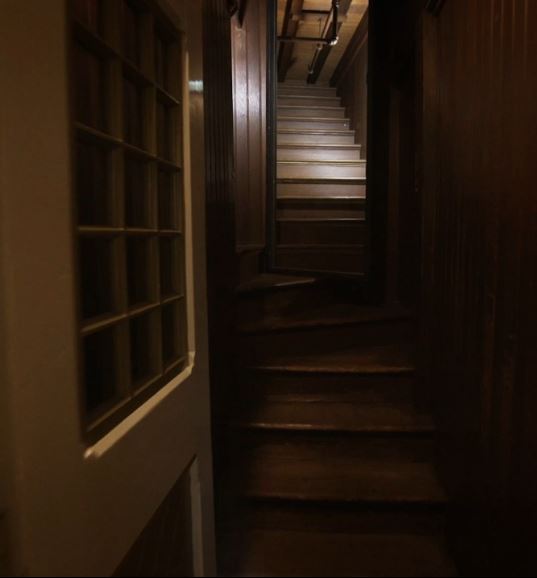
It was a traumatic event. Mrs. Winchester witnessed five objects begin to rise slowly out of the floor. They formed a rough semicircle about Alarik. They were human head. They were terrible looking. The grotesque faces were disfigured: all sores, terrible teeth and mouths, and they were all biting, like biting towards him. It was a vision from hell, worse than anything Mrs. Winchester could ever dream about. The heads were shrieking. As the feet of the dead stampeded through the room. The cold seemed to enter Mrs. Winchester’s very marrow. Her teeth were chattering. She shook like a leaf. The house seemed to plunge into total blackness. Mrs. Winchester groped her way across the floor, caught a sharp splinter of the fallen door in her palm, seemed to see something white and wraithlike surge up out of the darkest corner of the hall, and then heard a revolver shot. She was covered with icy sweat. Eyes listless. She advanced down the narrow side of the zigzag stairs. Her face was whiter than ever, as she saw bony, bloody hands clasping the Good Book. Mrs. Winchester fell back. When she awoke refreshed with sleep, she looked around, and the ghoulish heads, their mouths still opening and shutting obscenely, began to retract into the Earth. Mrs. Winchester felt slightly at ease. However, her ordeal was not yet at an end. Suddenly, the hair on her scalp was being yanked upward with great violence. Before she knew what was happening, her abuser was crouched down in front of her, their faces almost touching. #RandolphHarris 6 of 10

Mrs. Winchester was looking into features that resembled those of the hideous heads. She started screaming uncontrollably. She pushed the face into the floor. Her mind was a riot of thoughts, all frantically trying to explain the atrocious acts. Mrs. Winchester recalled the terrible visions recounted by the saints and mystics of antiquity and felt she was being attacked by the same forces. Mrs. Winchester took lots of bed rest after this series of paranormal events. However, she always felt an evil presence in the mansion and would get stone cold. She could not move at times. But the evil force certainly did. It terrified Mrs. Winchester. She always knew when it was coming for her because her body temperature would drop. She would start to shiver and turn blue from head to toe—really freezing cold. Mrs. Winchester’s belief that the spirit World was watching over her was a comfort. Evil spirits are organized into a military-like structure. The “principalities” are the highest ranking officers under Satan, the “powers” are officials of somewhat lower standing, and the “rulers of the darkness of this World” seem to be a special band of evil spirits whose sphere of influence includes the leaders of human government. The phrase “spiritual wickedness in high places” is better translated “spiritual hosts of wickedness in the Heavenly places,” and makes reference to the myriads of demonic hordes. They are all under the direction of Satan, who is not only named the “god of this age,” but also called “the prince of the power of the air.” The Black Arts could be highly dangerous and most emphatically not a field for the unstable, immature or otherwise emotionally or intellectually weak-minded people. #RandolphHarris 7 of 10
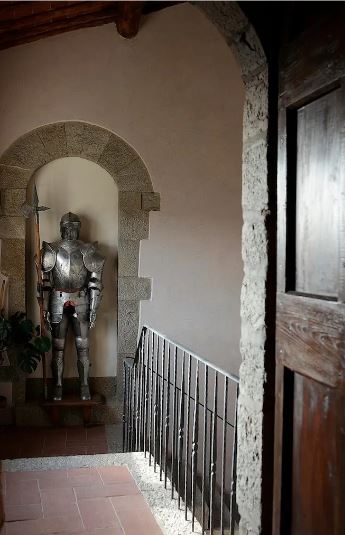
I DO conjure thee Spirit Crocell and your 48 Legions of Spirits, by all the most glorious and efficacious names of the MOST GREAT AND INCOMPREHENSIBLE LORD GOD OF HOSTS, that thou comest quickly and without delay from all parts and places of the Earth and World wherever thou mayest be, to make rational answers unto my demands, and that visibly and affably, speaking with a voice intelligible unto mine understanding as aforesaid. I conure and constrain thee, O thou Spirit Crocell and your 48 Legions of Spirits, by all the names aforesaid; and in addition by these seven great names wherewith Solomon the Wise bound three and thy companions in a Vessel of Brass, ADONAI, PREYAI or PRERAI, TETRAGRAMATON, ANAPHAXETON or ANEPHENETON, INESSENFATOAL or INESSENFATALL, PATHTUMON or PATHATUMON, and ITEMON; that thou appearest here before this Circle to fulfil my will in all things that seem good unto me. And if thou be still so disobedient, and refusest still to come, I will in the power and by the power of the name of the SUPREME AND EVERLASTING LORD GOD WHO created both thee and me and all the World in six days, and what is contained therein, EIE, SARAYE, and by the power of this name PRIMEUMATON which commandeth the whole host of Heaven, curse thee, and deprive thee of thine office, joy, and place, and bind thee in the depths of the Bottomless Pit or Abyss, there to remain unto the Day of the Last Judgment. #RandolphHarris 8 of 10
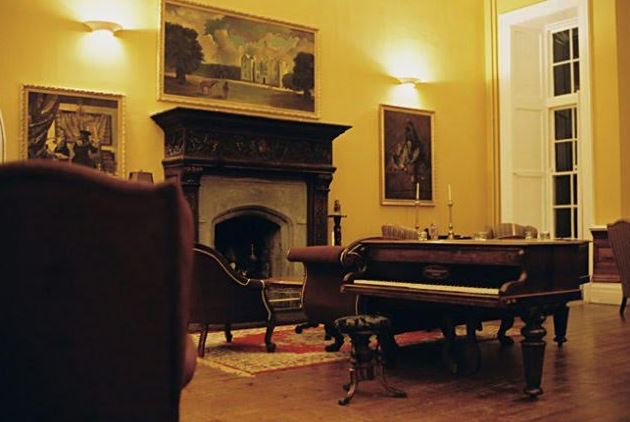
And I will bind thee in the Last Judgment. And I will bind thee in the Eternal Fire, and into the Lake of Flame and of Brimstone, unless thou comest quickly and appearest here before this Circle to do my will. Therefore, come thou! In and by the holy names ADONAI, ZABAOTH, ADONAI, AMIORAN. Come thou! For ADONAI, ZABAOTH, ADONAI, AMIORAN. Come thou! For it is ADONAI who commandest thee. If THOU hast come thus far, and yet he appeareth not, thou mayest be sure that he is sent unto some other place by his King, and cannot come; and if it be so, invocate the King as here followeth, to send him. However, if he do not come still, then thou mayest be sure that he is bound in chains in hell, and that he is not in the custody of his King. If so, and thou still hast a desire to call him even from thence, thou must rehearse the general curse which is called the Spirits’ Chain. As this smoke ascends I ascend also by following the path of smoke and usurping the power of worship to empower my blackened eternal soul. I take all power raised within this sanctuary as my own through this talisman of counter creation to strengthen my divine power and to Become a Living God. May my energy act as the very key which unlocks the cages of imprisonment so that I can reach liberation by stepping into the outer darkness which reunited the isolated frequencies of the light spectrum. Through this may I better perceive reality and become better able to counter create through personal alchemical transmutation and sorcery. #RandolphHarris 9 of 10
From ancient times, people have looked for positive guidance from the spirit World. However, they also believed demons caused most of the World’s problems. Demons were said to cause comets, volcanic eruptions, and eclipses. Some people believed demons were the reason for all illness. Demons had to be cast out before a person could get well. Basically, anything negative that people did not understand was blamed on demons. AD. 500, the Greek and Roman empires had fallen. Education declined. Without a scientific understanding of the World, people’s beliefs in demons resurfaced. The Middle Ages lasted from about 500 to 1500. During this time, anyone acting strangely was accused of being possessed. Religious leaders had the most power during the Middle Ages. They believed demons existed and had to be cast out with prayer. If this did not work, then people were tortured. Torture was meant to make the body too uncomfortable for the demon to stay there. Unfortunately, many people died being tortured. If torture did not work, “possessed” people were killed. Thousands of stories exist about demons from cultures around the World. The stories usually reflect the lifestyles and concerns of those who believed in them. One demon found in folklore in many cultures was the mermaid. She was said to be part beautiful woman and part sea creature. The demon mermaid is not like the sweet ones found in children’s books of movies. Demon mermaids were said to crush sailors to death or drown them. Then they would eat the sailors with their sharp teeth. According to legend, mermaids sat upon rocks, combing their long hair and singing beautifully. A mermaid’s beautiful voice attracted sailors to their doom. #RandolphHarris 10 of 10

Winchester Mystery House

Happy Saturday! House tours 10am-5pm this weekend 🏠 come see us!
🎟️ link in bio. https://winchestermysteryhouse.com/

And be sure to check out the online gift store: https://shopwinchestermysteryhouse.com/

Spy-in-the-Sky

Creativity finds its soul when it embraces its shadow. The artist’s block, for instance, is a well-know part of the creative process: inspiration stops and the writer is faced with an intractable empty page. Many souls today must have evaporated, leaving emptiness to take over. If we could see how our blank spots have eroded our souls, we might quickly humble our lives. Given our society’s propensity for physical problem solving, it should come as no surprise that murder and assault offenders generally develop pronounced criminal careers. These individuals tends to possess a proverbial short fuse and are not shy about resorting to physical means to resolve life’s problems. For example, one third of all individuals who face a felony assault charge and 58 percent of all murder defendants are typically found to have at least one prior felony arrest. More than one in five murder defendants have a rap sheet that includes five or more prior felony arrests, while one in five defendants have at least ten prior felony arrest. In a recidivism study which tracked more than 272,000 inmates released from state prison, the data showed that 41 percent of all released murderers and 65.1 percent of all assault releases were charged with another criminal offense within three years of leaving prison. Most of these arrests resulted in a second conviction and follow-up term of incarceration. There is some evidence of escalation and specialization in the career trajectories of homicide and assault offenders. For instance, 22 percent of those who served time for assault were picked up for yet another assault charge withing three years of there release. #RandolphHarris 1 of 19

In addition, 12 percent will graduate to murder by the end of that three-year window of time. There plausible explanation for these high levels of recidivism is due to the fact that the average murderer is a confrontational male with a long history of violent rehearsals. Repeated involvement in physical violence tends to produce increasing intensity and severity in one’s actions. While most murderers do not involve themselves exclusively in homicide, an analysis of criminal history data reveals that they have a tendency to concentrate their offending in the area of violent crime. Furthermore, 20 percent of murderer and 35 percent of the assault releases face new violent felony arrests within 3 years. Considering not everyone who goes to jail is actually guilty, and some people may have been acting in self-defense, it seems the goal would be to keep people who have been released from jail away from people and situations that may lead them into recidivism for at least 4 to 5 years. There exists a great deal of conjecture and assumption about what goes on inside the mind of the violent offender. Media outlets are more than willing to produce fictional and nonfictional accounts of the thought processes of homicide or assault offenders. As entertaining as the depictions may be, the public is provided little accurate information about the mindset of the average murderer. For starters, most scholars agree that there is nothing innate or inborn about human violence. Man needs a social system in which he has his place and in which his relations to others are relatively stable and supported by generally accepted values and ideas. #RandolphHarris 2 of 19

What has happened in modern industrial society is that traditions, and common values, and genuine social personal ties with others have largely disappeared. The modern mass man is isolated and lonely, even though he is part of a crowd; he has no convictions which he could share with others, only slogans and ideologies he gets from the communications media. He has become an a-tom (the Greek equivalent of “in-dividual” = indivisible), held together only by common, though often simultaneously antagonistic interests, and by the cash nexus. This phenomenon is called anomie, and is the main cause of death by suicide which had been increasing with the growth of industrialization. Anomie is the destruction of all traditional social bonds, due to the fact that all truly collective organization has become secondary to the state and all genuine social life had been annihilated. People living in the modern political state are a disorganized dust of individuals. In modern society, much of the tradition American community in which all genuine social bonds are made have become illegal or disappeared and it is having an impact on the World. Ceasing pledging allegiance to flag of the United States of America in public schools seems to be a problem. Also, removing God and Christ as symbols of America has influenced people to become unpatriotic, have a loss of fear for God, and indulge in sin. Now people are starting to lose respect for the National Anthem and all of this division is ripping America apart from its core. #RandolphHarris 3 of 19

Others are seeing the nonsense that is going on in California, where they are teaching children to deny their gender, not to follow gender roles, and to have a total disregard for humanity and authority figures, and it is setting a dangerous precedent in countries like China, Japan, and India where people who were once loyal to their government, now riot and protest. It is not population density that is the main cause of the problems, but a lack of social structure, genuine common bonds, and interest in life that is causing human aggression. Long standing U.S.A. violence is also due to our propensity for misunderstanding. Parents allow or even encourage aggressive behavior in children, especially boys; all individuals are exposed to gratuitous levels of violence in the print and television media; and we are exposed to displays of aggression on a daily basis in our work and social lives. These three factors come together to produce a culturally based acceptance of violence. While no one of the above sources actually causes violence in a given individual, they can come together to produce a broad-based tolerance for violent problem solving, especially in pockets of society where frustration and violence is more pervasive. The antecedents of violent crimes that are reported by offenders themselves have always impressed me as extraordinarily petty. Unfortunately, some individuals chose to bestow offensive or threatening meanings to the seemingly innocuous comments, gestures, or actions of another. Too frequently, this flawed assessment is followed by a mental exercise to overcome one’s inhibitions against conflict (id est, a mental stamp of approval) and then an intense physical response. #RandolphHarris 4 of 19

The volatility of these situations is exacerbated by the fact that most violent combatants commit their crimes while under the influence of drugs and/or alcohol. Therefore, bragging about being drunk and/or high is not a badge of honor. Surveys of incarcerated persons reveal that more than 50 percent of all murders and assaults occur while the offender is under the influence of drugs and/or alcohol—roughly 40 percent report being impaired by alcohol and roughly 30 percent report being impaired by some other form of illegal drug or controlled substance. It is worth noting that burglary, theft, and robbery are the only index crimes that exhibit higher levels of drug and/or alcohol usage at the time of the offense. These substances can significantly numb an individual’s reasoning and motor skills. In interviews conducted with 268 convicted murderers, drug and/or alcohol impairment was often the determining factor that turned a simple argument or fist fight into a homicide. So, one approach to stopping violence of any kind would be to teach people not to drink and/or use drugs. Murderous and/or assaultive behavior can be supported by both expressive and instrumental motives. Expressive motivation is associated with emotional states in which the individual strikes out spontaneously in a crime of passion. Instrumental motivation is used to describe a more calculated mental state in which the offender is driven by the will to achieve a predetermined goal. Scholars have long belabored the issue of violent motivation. Most stress the emotional and seemingly nonsensical nature of violence. It is particularly popular to interpret gang or “ghetto” violence in this manner. Violence occupies a more central role in the normative culture of inner-city America. All violence is bound to the situation or surroundings within which it occurs and one simply must understand the underlying cultural text of the environment if one wishes to unravel the meanings and intentions behind a given act. #RandolphHarris 5 of 19

In the case of “ghetto” violence, street thugs use overt acts of force as a means of enhancing their social status on the streets (somewhat equivalent to accumulating monetary wealth in middle- and upper-class American culture). However, the leads to a somewhat muddled explanation of assaultive and murderous motives. On one hand, the physical outburst represents a situationally bound overflowing of expressive motions. At the same time, this eruption of emotional energy is not mindless, but takes on an instrumental quality as it is generally guided toward solving some tangible problem. In short, the emotions serve as the means of accomplishing what the individual sees as a rational end. We must distinguish between predatory and moralistic murder. The public is most familiar with and intrigued by the predatory variety—those cases that involve a serial or habitually murderous offender stalking victims in a methodical, blood-thirsty manner. This brand of killers is like modern-day gang members. These predatory offenders stalk their impersonal prey and commit what we see as cold, calculated acts of violence. Most murderers do not fit this stereotypical image. Instead, they are moralistic offenders. This brand of killer commits crimes in a loosely structured, sometimes disorientated state of rage. A small minority of murderers chronically commit predatory homicides with instrumental motives, most killers are novices of the moralistic variety who possess expressive motives that are bound to the uncertainty of the movement. We often refer to the moralistic homicides as crimes of passion. #RandolphHarris 6 of 19

If follows that noticeable levels of criminal planning tend to be observable among predatory murderers, whereas moralistic murders take on a more haphazard quality. Habitual murderers are likely to develop set patterns, rituals, and methods to their madness, whereas the spontaneous and emotional nature of moralistic homicide usually precludes the likelihood of structured planning on the part of the offender. Conversely, planning generally occupies a notoriously small role in a moralistic or assaultive transaction. The spontaneous and emotional nature of these acts leaves little time for conscious aforethought. Although these individuals may plan the dynamics of an aggressive response, their heightened emotional state rules out the possibility for them to ponder or preconceive the volatility of the transaction. Normative neutralizations play an important part in the cognitive dimension of murder and assault. Despite all the cultural messages that supply reinforce violence as an alternative means of problem solving, would-be offenders must still redefine the situation. Individuals quickly overcome existing inhibitions against violence by convincing themselves that violence is an acceptable or appropriate course of action. In the case of a mundane assault, this usually involves a preoccupation with the severity of the victim’s actions. #RandolphHarris 7 of 19

In other cases, the offender will draw mental parallels to past experiences in which violence served a viable alternative. Homicide offenders are also known to develop and refine stable normative neutralizations. In fact, even the most vicious murderer (id est, mafia hitman)often becomes adept at recasting one’s actions in a positive, self-righteous light. Manhattan Island was one of the most densely populated places in the World fifty years ago, but it was not then, as it is today, characterized by excessive violence. Anyone who has lived in a big apartment building where several hundred families live together knows that there are few places where a person has as much privacy and is as little intruded upon by the presence of next-door neighbors as in a densely populated building. By comparison there is much less privacy in a small village where the houses are much more dispersed and population density is much smaller. Here the people are more aware of each other, watch and gossip about each other’s private lives, and are constantly in each other’s field of vision; the same holds true, although to a much lesser degree, for suburban society. This example tends to show that it is not crowding as such, but the social, psychological, cultural, and economic conditions under which it occurs that are responsible for aggression. It is obvious that overpopulation, id est, population density under conditions of poverty, causes stress and aggression, which can be another reason murders are committed. #RandolphHarris 8 of 19

The big cities of India, as well as the slums in American cities, are an example of why overpopulation can cause problems. Overpopulation and the resulting population density are malignant, when, due to the lack of decent housing, people lack the most elementary conditions for protection from immediate and constant intrusion by others. Overpopulation means that the number of people in a given society surpasses the economic basis for providing them with adequate food, housing, and meaningful leisure. There is no doubt that overpopulation has evil consequences and that numbers must be reduced to a level which is commensurate with the economic basis. However, in a society which has the economic basis to support a dense population, the density itself does not deprive the citizen of his privacy, and it does not expose him to constant intrusion of others. An adequate standard of living, however, takes care only of the lack of privacy and constant exposure to others. It does not solve the problem of anomie, of the lack of Gemeinschaft, of the individual’s need to live in a World that has human proportions, whose members know each other as persons. The anomie of industrial society can only be removed if the whole social and spiritual structure can only be removed if the whole social and spiritual structure is changed radically: if the individual is not only adequately fed and housed, but the interests of society become identical with the interests of each individual; when the relationship to one’s fellowman and the expression of one’s powers, rather than the consumption of things and antagonism to one’s fellowman, become the principles which govern social and individual life. This is possible under the condition of high population density, but it requires radical rethinking of all our premises and radical social change. #RandolphHarris 9 of 19

Fantastic technical advances have filled the sky with eyes and ears automating the collection of mass data. Satellites, advanced optics, and other imaging equipment constantly monitor the Earth. Acoustical sensors blanket strategic sea lanes. Listening stations, giant radars, and other electronic devices dot the planet from Australia to Norway. Technological intelligence, or “Techint,” now includes: Signals Intelligence, or “Sigint” (which, in turn, embraces communications, electronics, and telemetry); “Radint” (which sweeps up signals sent by or to radars); and “Imaging intelligence” (which includes photography, infrared, and other detection tools). All use the biggest and most advanced computers on Earth. So vast, costly, and powerful are these systems that they have shoved intelligence gathered by humans, or “Humint,” into a second-class position. William E. Burrows, author of a study of space espionage, has summed up these high-tech systems in the following terms: “The remote sensing systems with which each side monitors the other and most of the rest of the World are so many, so redundant, and so diffuse that no preparation for an all-out attack could take place without triggering multiple alarms…Orders for armies to march, planes to fly, and civilians to hide must be communicated relatively quickly over vast areas, and what is communicated can be intercepted; everything necessary to wage the war must be moved, and what is moved can be photographed.” #RandolphHarris 10 of 19

The big eavesdroppers in the sky can monitor all military, diplomatic, and commercial messages sent by phone, telex, radio, teletype, or other means via satellites or microwave systems. They have even been able to listen in on Kremlin bigwigs in their limousines and Chinese scientists at the Lop Nor nuclear weapons site. (The Chinese subsequently quit using over-the-air communications and installed secure below-ground lines.) There are serious limits on all this. Despite its vaunted “spy-in-the-sky” capabilities, the United States of America was red-faced to discover that the Soviets, who were supposed to have destroyed 239 SS-23 missiles, had secretly transferred 24 of them to East Germany. There are other failings too. An increasing number of codes can no longer be cracked because of computer advances in coding. Weather still interferes with some photoreconnaissance. Adversaries can use their own electronic countermeasures to blind or deceive the collection systems. Nevertheless, factory-style mass collection of data has been spectacularly achieved. Naturally, not all intelligence involves either high technology or trench-coated snoops. A vast amount is derived from “open sources”—careful reading of the press, monitoring of foreign broadcasts, study of officially released statistics, attendance at scientific and commercial conferences—all of which, when added to the secret materials, becomes raw material for the intelligence mill. To handle all these data, from both human and technical sources, a dizzying bureaucracy has grown up which applies the factory principle of the division of labor, breaking production into a sequence of steps. #RandolphHarris 11 of 19

The process begins with the identification of client needs, the collection of raw material from both open and secret sources, translation, decoding, and other preparation, followed by analysis and its packaging into reports which are then disseminated to clients. Many corporations today are learning that this form of sequential production is inadequate. As we saw, in the new economy steps are eliminated or made simultaneous. Bureaucratic organization is too slow and cumbersome. Markets change rapidly. Mass production itself is giving way to “flexible production” of more and more customized products. The result for many industries has been a profound crisis. Not surprisingly, intelligence, too, finds itself at a crisis point. The new collection technologies have been so effective, they now vacuum up so much computerized imagery and listen in on so many phone calls, they deluge intelligence agencies with so much information it can no longer be processed adequately. They now increasingly cause “analysis paralysis.” Finding the right piece of information, analyzing it correctly, and getting it to the right customer in time are turning out to be bigger problems than collecting it in the first place. Today, therefore, as the World moves toward a new system of producing wealth, superseding the smokestack system, intelligence operations face a crisis of restructure paralleling that which has overtaken the economy itself. There is a final aspect of control that is essential for effective brinkmanship. The threatened party must be able to reduce the risk sufficiently, often all the way to zero, by agreeing to the brinkman’s terms. Spade must have the assurance that Gutman’s temper will cool down sufficiently quickly once he knows the secret, and Khrushchev must be sure that the United States of America’s forces will withdraw as soon as he complies. Otherwise you are damned if you do and damned if you do not, and there is no incentive to comply. #RandolphHarris 12 of 19

The conduct of America’s trade policy illustrates brinkmanship without the control mechanism. The United States of America trade administration tries to compel the Japanese and the Koreans to open their markets to American exports (and also to export less to the United States of America) by pointing out the risk of more serious protectionist actions by the Congress. “If we can’t reach a moderate agreement, the Congress will enact restrictions that will be a lot worse for you.” The so-called voluntary export restraints on automobiles agreed to by Japan in 1981 were the result of just such a process. The problem with the regular use of such tactics in trade negotiations is that they can create risk, but cannot control it within the requisite range. When other issues are occupying the legislations’ attention, the risk of protectionist action by Congress is too low to be an effective threat. On the other hand, when the Congress is exercised about trade deficits, the risk is either too high to be acceptable to our own administration, or simply unresponsive to a modest foreign restraint and therefore an ineffective threat. In other words, the American system of checks and balances can create risk, but cannot control it effectively. With our present technology, which is simpler to build—a car that runs on gasoline, or one that forages for fuel in the forest? A foraging car would be very hard to design, cost more to manufacture, and have more parts to break down. The situation is similar with nanotechnology. #RandolphHarris 13 of 19

Ralph Merkle of Xerox Palo Alto Research Center discussed this issue at the First Foresight Conference on Nanotechnology. He explains, “It’s both uneconomical and more difficult to design a self-replicating system that manufactures every part it needs from naturally occurring compounds. Bacteria do this, but in the process they have to synthesize all twenty amino acids and many other compounds, using elaborate enzyme systems tailored specifically for the purpose. For bacteria facing a hostile World, the ability to adapt and respond to a changing environment is worth almost any cost, for lacking this ability they would be wiped out. “But in a factory setting, where adequate supplies of all the needed parts are provided, the ability to synthesize parts from scratch is not only unneeded, it consumes extra time and energy, and produces excess waste. Even if we could design artificial self-replicating systems as flexible as existing natural ones, an inflexible and rigid system is better adapted to the controlled factor setting in which it will find itself than a more complex, more adaptable, less efficient design.” What is more, the Desert Rose Industries scenario showed how an expandable factory setup could operate with no self-replicating machines at all: molecular manufacturing does not require them. If they are used for some purpose, they will most likely resemble automobiles in their finicky requirements. A self-replicating molecular machine built for industrial purpose (and made as simple as possible) would float in a container of specially selected chemicals not commonly found in nature, and it would be easy to make that a design rule: Never make a replicator that can use an abundant natural compound as fuel. If we follow this rule, the idea of a replicator “escaping” and replicating in the wild will be as absurd as the notion of an automobile going feral and refueling itself from tree sap. #RandolphHarris 14 of 19

Whether for replicators or cars, to design a machine that could operate in the wild would not be a matter of a flick of the draftsman’s pen, but an intense, sustained research-and-development effort focused on that objective. Crashes and explosions occur in machinery by accident, but complex new capabilities do not. A simple psychological error frequently occurs when someone first hears about nanotechnology, and hears mention of “molecular machines,” and “replicators,” and “nanocomputers,” and “nanomachines that operate in nature.” The error is this: The person makes a single new mental pigeonhole for “nanotechnology,” throws everything into it, and stirs. After some mental fermentation, the result is the mythical nanomachine that does everything: it is a replicator, it is a supercomputer, it is a BMW X7, it slices, it dices, it makes Julian carrots—and on reflection, this imaginary nanomachine sounds uncontrolled and dangerous. With enough effort, a do-it-all nanomachine could perhaps be built, but it sounds difficult and there is no good reason to try. There are advantages to making systems of molecular machinery that can use inexpensive, abundant chemicals, and devices that can operate in nature, but these machines need not be replicators. A facility like Desert Rose might be designed to use little but electric power from solar panels and molecules from the air, but a setup like this is not going to slip away. Nanomachines built for cleaning up pollutants and other outdoor tasks could be manufactured infacilities run like Desert Rose and then spread or installed where they are needed. Extraordinary accidents deserve attention, but with a little care they can be completely avoided. The incentive to build anything resembling a Star Trek-scenario replicator is negligible, even from a military perspective. Any effort toward building such a thing should be seen not as a use of nanotechnology, but as an abuse. Other abuses seem more likely, however, and are quite bad enough. #RandolphHarris 15 of 19

It should be plain that failure of the participants in an engagement to contain their activity can not only lead to a betrayal of one or more of their numbers, but also cause the content and feeling generated in the engagement to flow over into the situation at large. At such times bystanders may become dislodged from their own involvements, making it very difficult for them to continue to extend civil inattention to the uncontained encounter. An instance of this doubly offensive disloyalty is found during what are sometimes called “scenes.” Here, an individua who is supposed to be enclosed in an engagement may make a deeply engrossing appeal to others outside it, even though the appeal bears on a specific issue generated within the original engagement. Thus, one pair of patients I studied would (according to nursing notes) travel on a bus under the guidance of a nurse, start an argument with each other, and soon “open up the encounter” to all the passengers, dragging them in on both sides of the altercation. A woman in a lower-class street who is struck by her male companion may similarly make a direct appeal to others for help, thereby forcibly embroiling them. The disturbed feelings created by such bursting of the bounds of the engagement give us a clear picture of exactly what the rules of public conduct operate to prevent. In the extreme, a scene can break down all conventional closure separating the various engagements and unengaged individuals in the situation, providing an instance of an exhaustive engagement where none had been expected or desired. #RandolphHarris 16 of 19

The fact that bystanders may desire or feel obliged to remain out of an accessible encounter allows for a special kind of half-scene, where persons in an encounter talk in a sufficiently loud and pointed fashion to be heard by an outsider, yet modulate their talk enough to give him a slight opportunity to distend. Here the terms “grumbling” or “muttering,” and “stage whisper,” are sometimes used. Thus, two middle-aged ladies sitting at a drugstore counter waiting for their lunch sandwiches may, upon receiving them and finding the filling thin, ostentatiously life up a piece of the bread and complain to each other in a tone of voice that the countergirl is half-meant to hear. (The countermeasure for this, as suggested, is for the person who is grumbled at to attempt directly to ratify the half-spoken comment as a message formally addressed to him, employing some such phrase as “Did you say something?”) In addition to “selling out” an encounter while he is yet a member of it, a participant can also leave it in such a ways as to expose the feelings within the encounter to the situation at large. Those remaining in the encounter may not be given a chance to compose themselves during the leave-taking, and the leave-taker may decline to damp and muffle the particular affect generated in him as a participant of the engagement. Ordinarily, of course, a brief leave-taking ceremony functions to allow leave-taking without exposure. #RandolphHarris 17 of 19

One’s expectations that a leave-taker will “cut back” to the tone and temper prevailing in the gathering at large becomes evident when an individual fails to discipline his leave-taking in this way. A special kind of momentary scene can be observed among children, opera stars, mental patients, and others who have the privilege of temperament, when they precipitously take leave of an engagement, stalking or flouncing out of it and often out of the situation, leaving a wave of affect marked materially by slammed doors and overturned chairs. Yet it must also be said that the leave-taker is expected to show in the situation at large at least some marks of his recent participation, some lingering, albeit fading, signs of the animation the encounter inspired in him; should he not do so, he exposes the encounter a one that has failed to move him. It should be apparent that affective disorganization is particularly likely when the leave-taker leaves what was in the first place only a two-person engagement. In such cases the remaining person, having no others to whom to deflect his readied response, and left deeply involved in an encounter that no longer exists, finds himself in a poor position to cut back his own affect to that prevailing in the situation as a whole. This possibility can, of course, be exploited. For example, one patient I studied, who seemed to know exactly how to attack social arrangements at their joints, as it were, would—according to nursing notes—leave with a package from a store after paying the clerk all but one or two cents of the requested amount, thereby leaving him in a position neither to terminate his involvement in the encounter nor to sustain a role in it. #RandolphHarris 18 of 19

Unless people make sufficient efforts from the beginning the system will be useless to them. Efforts must be organized. What does this mean? Unless you understand our work, we shall not be able to help you. You can be helped only if you enter into our work. One must work on three lines. Before one can understand what this means in relation to the work, one must understand three different lines of work in oneself: intellectual work (acquisition of knowledge), emotional work (work on emotions), and work on will (work on one’s action). One has no big will such as man no. 7 has but one has will at certain moments. Will is the resultant of desires. Will can be seen at moments when there is a strong desire to do or not to do something. Only those moments are important. The system can help only those who realize that they cannot control their will. Then the system will either help them to control their will, or they will have to do as they are told. “Is there no such thing as forcing a situation?” It may look like that but really it happened. If it could not happen in that way, then it could not happen. When things happen in a certain way, we are carried by the current but we think that we control the current. “If one feels for a moment that one is able to ‘do,’ say, to put through a particular job in ordinary work what is the explanation of that?” If one is trained to do something one learns to follow a certain kind of happenings, or if you like, to start a certain kind of happenings, and then these develop, and one runs behind although one thinks one is leading. #RandolphHarris 19 of 19

Cresleigh Homes
There’s something magical ✨ about dreaming about your new life in a new home this year – and we think the time has come for you to check out our safe and peaceful community at #Havenwood!

If you Located off of Virginiatown Road and McCourtney Road, our neighborhood is located in the charming city of Lincoln, with Palo Verde Park just down the street! Head to our website to find out more about available homes.


I Do Not Know What You Mean by Knowing Fate

In the cybernetic age, the individual becomes increasingly subject to manipulation. His work, his consumption, and his leisure are manipulated by advertising, by ideologies, by what Dr. Skinner calls “positive reinforcements.” The individual loses his active, responsible role in the social process; he becomes completely “adjusted” and learns that the behavior, act, thought, or feeling which does not fit into the general scheme puts him at a severe disadvantage; in fact he is what he is supposed to be. If he insists on being himself, he risks, in police states, his freedom or even his life; in some democracies, he risks not being promoted, or more rarely, he risks even his job, and perhaps most importantly, he risks feeling isolated, without communication with anybody. As we have discussed, criminal events take on a transactional (give-and-take) nature. It was argued that the “form” and “content” of these exchanges can vary across different types of crime. Homicide and assault transactions generally take on the form of a one-on-one, heated interaction between acquaintances. The vast majority of homicide incidents that were reported to the police in 2022 were known to involve a long assailant and a lone victim. Only 20 percent were known to involve more than two offenders and 6 percent involved multiple victims. Similarly, victimization report indicate that multiple offenders were present in only 25 percent of the assault cases occurring in 2022. Turning to the nature of relationship, about one half of all murder and/or assault victims are known to be related or acquainted with their attacker. #RandolphHarris 1 of 19

Moreover, roughly one in ten of these incidents are categorized as cases of intimate violence wherein the combatants are either intimates or are linked via a blood or marital relationship. An analysis of the circumstances surrounding murder reveal that nearly one third of all homicides begin as a simple argument, while less than one in give are committed in conjunction with another felony offense. Homicides and assaults occur disproportionately in loose social settings. Most often, violent exchanges take place at night and on weekends in locations where acquaintances are accustomed to interacting with one another. These types of familiar settings are governed by relaxed social norms that allow individuals to more freely express their emotion. For example, researchers discovered that 55 percent of all homicide cases occur in residences, while 9 percent occur in or near bars. Only 18 percent were found to occur in the more impersonal setting of a street or public park. Most violent predators commit their crimes in close proximity to their residence. The majority of homicide and assault transactions involve individuals of the same age, race, and gender groups. In 2020, the average homicide offender was 28.5 years of age and the average victim was 32.2 years of age. That same year, individuals between the ages of 18 and 24 committed murder at a rate of 28 per 100,000. This figure was more than five times larger than the homicide rate of the 35- to 49-yer-old age group and nearly twenty times higher than for persons over the age of 50. #RandolphHarris 2 of 19

The same type of trend is observable in the victimization rates. Take for example the crime of assault. In 2020, the reported assault victimization rate for individuals between the ages of 12 and 24 years exceeded forty per 1,000 persons or households. This is almost double the rate in the overall population and more than twenty times the rate reported among persons over the age of 65. A similar trend can be observed with regard to the age of the offender. Most victims of assaultive behavior estimate that at least one of their attackers was under the age of 30—this was the case in 60 percent of the single offender assaults and 95 percent of the multiple offender assaults. Murder is no different. In fact, the CDC ranked homicide as the No. 2 cause of death among 18- to 25-year-olds. Only unintentional injuries accounted for more deaths among members of this age group. It is clear that murder and assault take on an intra-aged transactional form, meaning that offenders and victims come from similar age groups. In the case of assault, nearly three fourths of all victims between the ages of 12 and 20 estimate that their attacker comes from this same age group. Similar patterns are observed in the 30 and above age bracket. Race is another telling indicator in homicide and assault transactions. Assault rates among African Americans (28 per 1,000) were slightly higher than those among European American (22) and Hispanics (25). #RandolphHarris 3 of 19

Race is another telling indicator in homicide and assault transactions. The assault rate among African Americans (27 per 1,000) were somewhat higher than those observed among European Americas (23) and Hispanics (25.6). This trend is further reflected in the arrest data—despite comprising only 12 percent of the overall population, African Americans typically account for 30 percent of the aggravated assault arrests each year. The picture becomes even more grim when we focus solely on murder. An African American person faces a one in forty-four chance of becoming a homicide victim at some point in his or her life. Think about that. If you are in a room with 44 African Americans, it is likely one will be a murder victim. That is compared to a one in 253 chance among European Americans. Makes you want to take stalking and death threats more seriously is one has such a high chance of becoming a murder victim, huh? African Americans represent 52 percent of the known homicide offenders and 48 percent of the known homicide victims. Homicide and assault take form as a markedly intraracial crime (occurring within the same racial group). For example, typically 86 percent of European American victims are killed by European American perpetrators and 94 percent of African Americans were killed by other African Americans. A close examination reveals that most interracial (across races) murder involve younger perpetrators victimizing strangers. Shifting to the crimes of assault, 80 percent of European American assault victims claim that their attackers were of the same race and 83 percent of the African American assault victims claim that they were attacked by a fellow African American. #RandolphHarris 4 of 19

It appears that even offenders behave in an intraracial capacity—only one in ten assault victims who was attacked by more than one offender claims that the attackers were of mixed races. Homicide events traditionally involve male participants. For example, generally, 90 percent of the known homicide offenders and 80 percent of the homicide victims. In fact, men are 10 times more likely than females to be a murder offender and more than three times more likely to be a victim. Most homicide events take shape as intragendered (male on male or female on female) transactions, and nearly 70 percent of the known homicides involve all male participants. A slightly different portrait emerges for assault. Here again, males account for the majority of the offender and victim pools. In fact, 80 percent of the individuals who are arrested for aggravated assault, and 58 percent of the pool of the assault victims are men. The fact that men account for only a slight majority of the victim population but a considerably larger majority of the offender pool suggests that many of these assaults manifest themselves as male-on-female or intergendered transactions. In most cases, this male-on-female violence takes its form as intimate partner violence (id est, domestic violence or spousal abuse). A recent survey of representative samples of 8,000 men and women found that 23 percent of women versus 9 percent of the men had been the victim of domestic assault at least once in their lives. It is estimated that a total of 24,546, 840 women who are alive today will at some point be physically assaulted by an intimate partner—at a rate of 1,400,000 per year. #RandolphHarris 5 of 19

Murder and assault rates become particularly problematic when the age, gender, and race variables are included in the same equation. The overall reported U.S.A. homicide offending rate is 6.1 and the victimization rate is 5.5 per 100,000 population. For African American males between the ages of 18 and 24 those rates ballooned to 206 and 102, respectively. Conversely, the homicide offending and victimization rates among European American females 25 years or older is 1 and 2.3, respectively. African American males between the ages 18 and 24 make up 1.5 percent of the U.S.A. population but account for a staggering 30 percent of all known homicide offenders and 15 percent of all homicide victims. The process of the homicide and/or assault transaction is typically marked by brevity and intensity. Most murders and/or assaults last only a few seconds. In the case of murder, the short amount of time required of the act can be attributed to the fact that firearms are present in nearly two thirds of all homicide cases. This is well evidenced by the fact that 30 percent of aggravated assault victims claimed their attacker carried a gun, compared to 7 percent of the overall pool of assault victimizations. When asked why they carried guns, one fourth of violent felons claimed that the gun was originally intended as a scare tactic. Murders and assaults take on an undeniably interactive and escalating flavor. Most homicides are disputes and/or potential assaults that have gone terribly wrong. They are situations in which factors such as ego, reputation, and irreversible moments of misinterpretation regrettably come together to produce lethal consequences. #RandolphHarris 6 of 19

Spies have been busily at work at least since the Egyptian Book of the Dead termed espionage a soul-endangering sin. However, from the Pharaohs to the end of World War II the technologies available for espionage remained primitive, and early spies, like early scientists, were largely untrained amateurs. In the first years of the 20th century, Robert Baden-Powell, later the founder of the Boy Scouts movement, masqueraded as a dotty butterfly collector when he hiked through the Balkans, sketching fortification and hiding their outline in drawings of complicated butterfly wing. (Baden-Powell insisted that enthusiastic amateurs, who regarded spying as sport, would do the best work.) Another self-taught spy was the Japanese Captain Giichi Tanaka. After serving on the staff of the Japanese military attache in Moscow, learning to speak Russian and claiming adherence to the Russian Orthodox church, Tanaka took a leisurely two-month trip back to Tokyo so he could reconnoiter the Trans-Siberian and Chinese Eastern railroads, brining back with him intelligence used by Tokyo in planning for the Russo-Japanese war of 1905. Much spy literature today still focuses on the derring-do of intrepid individuals pursuing military secrets. The industrial revolution, however, transformed war. The conscripted mass army, the mechanization of transport, the machine gun, mass-produced tanks and airplanes, and the concept of total war were all product of the Second Wave or smokestack era. The potential for mass destruction grew, right along with the rise of mass production, reaching its final point of no return in the U.S.A.-Soviet nuclear stalemate. #RandolphHarris 7 of 19

The industrialization of intelligence followed that of war. In the early 20th century, spying became more systematic and bureaucratic, with the Tsar’s fearsome Okhrana, forerunner of the KGB, leading the way. Espionage schools were set up. Spies began to be trained as professionals. However, a handful of even well-trained spies could no longer satisfy the growing market for intelligence. Thus, just as individual craft took a back seat to assembly-line production in the factory, attempts were made to mass-manufacture intelligence. By early in the 20th century, the Japanese were no longer relying exclusively on a handful of full-timers like Tanaka but on thousands of foot-soldiers spies, as it were—emigrants settled in China or Siberia, cooks, servants, and factory workers who reported on their host countries. Japanese intelligence, following the factory production model, used unskilled “espionage workers” to mass-produce information, then built a growing bureaucracy to process the “take.” After the 1917 revolution in Russia, Lenin promoted the idea of “rabcors” or “people’s journalists”—thousands of ordinary workers were encouraged to write to the newspaper denouncing supposedly antirevolutionary saboteurs and traitors. The idea of masses of amateur correspondents was applied to foreign intelligence, too, and by 1929 there were three thousand so-called “rabcors” in France, including workers in state arsenals and the defense industries who were told to write to the Communists press to expose their poor working conditions. These contributions, however, provided useful insights into war production, and the most revealing letters were not published, but sent on to Moscow. It was another attempt at mass collection of low-level intelligence by amateurs. #RandolphHarris 8 of 19

High-level espionage, however, was entrusted to carefully trained professionals. Richard Sorge, born in Baku and raised in Berlin, became one of the most brilliant soviet agents in history. Because of his German boyhood, Sorge was able to penetrate the Nazi Party and get himself sent to Japan posing as the enthusiastically pro-Hitler correspondent for the Frankfurter Zeitung—a cover that won him access to top German and Japanese officials and diplomats in Tokyo. The Soviets were terrified of a Japanese surprise attack on Siberia. Sorge correctly told them it would never happen, but that the Soviet Union would be attacked by Germany instead. In 1941, Sorge actually sent Moscow advance news of the coming Nazi invasion of the U.S.S.R., warning that 150 German divisions were concentrating in preparation. He even pinpointed the date—22 June 1941. However, his information was ignored by Stalin. Sorge was about to tip off Moscow about the coming Japanese attack on Pearl Harbor—once again naming the exact date—when he was captured and later executed by the Japanese. Sorge was subsequently described by General Douglas MacArthur as “a devastating example of a brilliant success of espionage.” Sorge’s career surely underscored the continuing value of the courageous and resourceful individual spy and spymaster. However, World War II also saw remarkable breakthroughs in everything from coding and deciphering equipment to reconnaissance aircraft, radio, and radar—technologies that laid the basis for true mass production of intelligence, some of its high-level stuff indeed. #RandolphHarris 9 of 19

If you are trying to extract some exclusive information from someone, your threat to kill him unless he reveals the secret will not be credible. He knows that when the time comes, you will realize that the secret dies with him, and will have no incentive to carry out the threat. Hollywood films provide two excellent illustrations of this problem, and how to deal with it. Schelling uses a scene from the film High Wind in Jamacia. “The pirate captain Chavez wants his captive to tell where the money is hidden, and puts his knife to the man’s throat to make him talk. After a moment or two, during which the man keeps his mouth shut, the mate laughs. ‘If you cut his throat he can’t tell you. He knows it. And he knows you know it.’ Chavez puts his knife away and tries something else.” Chavez might have kept the knife out and tried brinkmanship, if only he had seen The Maltese Falcon. There Spade (Humphrey Bogart) has hidden the valuable bird, and Gutman (Sydney Greenstreet) is trying to find out where it is. Spade smiled at the Levantine and answered him evenly: “You want the bird. I’ve got it…If you kill me how are you going to get the bird? If I know that you can’t afford to kill me till you have it, how are you going to scare me into giving it to you?” In response, Gutman explains how he intends to make his threat credible. “I see what you mean.” Gutman chuckled. “That is an attitude, sir, that calls for the most delicate judgment on both sides, because as you know, sir, men are likely to forget in the heat of action where their best interest lies and let their emotions carry them away.” #RandolphHarris 10 of 19

Gutman concedes that he cannot threaten Spade with certain death. Instead, he can expose Spade to a risk, a probability that things might get out of control in the heat of the moment. The outcome is left to chance. It is not that Gutman would actually want to kill Spade, but accidents do occur. And death is irreversible. Gutman cannot commit to killing Spade for sure if Spade refused to talk. However, he can threaten to put Spade in a position in which Gutman cannot guarantee that he will be able to prevent Spade from getting killed. This ability to expose someone to a probability of punishment can be enough to make the threat effective if the punishment is bad enough. The greater the risk of Spade getting killed in this way, the more effective the threat. However, at the same time, the risk becomes less credible. Gutman’s brinkmanship will work if, and only if, there is an intermediate range of probabilities where the risk is large enough to compel Spade to reveal the bird’s location, and yet small enough to be acceptable to Gutman. Such a range exists only if Spade values his own life more than Gutman values the bird, in the sense that the probability of death will frighten Spade into talking is smaller than the risk of losing his information that gives Gutman pause. Brinkmanship is not just the creation of risk, but a careful control of the degree of that risk. Now we have a problem. Many of the mechanisms that generate risk also prevent a sufficiently accurate control of the degree of that risk. #RandolphHarris 11 of 19

We saw how Kennedy could use internal politics and standard operating procedures to ensure that the situation would get somewhat outside his control, and therefore not affected by Kennedy’s temptation to back down. However, those very things make it difficult for him to ensure that the risk does not climb to a degree that is intolerable to the Untied States of America. Kennedy’s own estimate of the risk—between one out of three and even—is a wide range of risk, to the point where one worries if the risk is being controlled at all. We have no perfect or generally valid answer to this dilemma. Brinkmanship is often an effective device, but equally often it remains something of an adventure. Now, when it comes to nanotechnology, it is important that we know how to prepare for a big mistake. The so-called Star Trek scenario (named after an episode of Star Trek: The Next Generation that featured runaway “nanites”) is perhaps the most commonly imagined problem. In this scenario, someone first invests considerable engineering effort in designing and building devices that are bacterial-sized, omnivorous, able to survive in a wide range of natural environment, able to build copies of themselves, and made with just a few built-in safeguards—perhaps a clock that shuts them off after a time, perhaps something else. Then, accidentally, the clock fails, or one of these dangerous replicators builds a copy with a defective clock, and away we go with an unprecedented ecological disaster. #RandolphHarris 12 of 19

This would be an extraordinary accident indeed. Note well, though, that this accident scenario starts with someone building a highly capable device that is almost disastrously dangerous, but held in check by a few safeguards. This would be like wiring your house with dynamite and relying on a safety-catch to protect the trigger: a subsequent explosion could be called an accident, but the problem is not with the safety mechanism, it is with the dynamite installation. Do we need to build nanotechnological dynamite? It is worth considering just how little practical incentive there is for anything even resembling the dangerous replicator just as described. (Note that our topic here is accidents; deliberate acts of aggression are another matter.) When looking at open collusion, there are some illustrations we need to consider. A few attendants tease a patient in order to laugh at their bizarre reactions—such as a nip on the ear or a slap on the head to bring about a temper tantrum. This teasing sometimes becomes cruel, and does not seem to be restricted to trouble-makers among patients. This may be done to break the monotony, or may be due to psychological quirks in the few attendants who do it. Miss Kurt asked the attendant for a cigarette. The attendant replied, “say pretty please.” Miss Kurt, on saying pretty please, was answered, “now say, ‘hello, Miss Crandall’ twice,” pointing to the other attendant. Miss Kurt did not answer. The attendant held a cigarette aloft and said again, “If you say ‘hello Miss Crandall’ twice you will get his cigarette.” Miss Kurt did as requested. #RandolphHarris 13 of 19

Similar interactions can be cited from Central Hospital. For example, an attendant would occasionally take a “pet” patient and dance with him or her while winking broadly to the rest of the ward staff. The wink is a classic device for establishing byplay in our society, but at the same time an item in our involvement idiom that seems to be passing into disuse. The fun reached its climax at the point where the patient was released and the attendant turned back to participation with the rest of the now laughing staff. Similarly, a few patients would sometimes encircle a mute fellow patient who had taken the tack of obeying all commands. They would then address the mute patient, ordering one to do a series of increasingly self-profaning acts, until the circle was excited into laughter. The same sort of treatment is often accorded young children in our society: the child is teased or prodded into responding to a question focusing on the child as an unwitting source of amusement or pride for the adults. Some extreme forms of engagement disloyalty are managed without the butt necessarily becoming aware of what is being done to him. The very obligation to the individual in a two-person encounter to tactfully support his fellow-participant in maintaining the illusion that both desire to be engaged together can itself lead to disaffection which I carefully concealed from the other, but sometimes from him alone. Thus, when one participant fees it is beneath one in some way to be publicly joined to the other in a special relationship of any kind, the disgruntled participant may secretly tease the other participant before the assembled company or communicate in other ways to them that the encounter is not one that should be taken seriously. #RandolphHarris 14 of 19

At Beijing, China dances I occasionally saw a young lady maintain the right of any man to dance by accepting a request from a someone from the southern region, or an international seaman, but once his arms convey by collusive gestures to the circle of people behind his back that the dance-engagement was a lark and that she was not to be judged by it. Cautionary tales in our own society tell of college or high school dances where a male, who may wish to be unburdened of the girl whom he finds himself dancing, holds up a twenty-dollar bill behind her back as they pass the stag-line, a mute but raucous bribe for someone to “cut in.” Of course, the possibility of this kind of sellout is one factor in social control, leading the individual to forego engagements in which his fellow-participants might not be loyal to him. “I do not understand why one should excuse oneself.” One does not want to give up the idea that one can “do,” so that even if one realizes that things just happen, one finds excuses, such as, “This is an accident but tomorrow it will be different.” That is why we cannot realize this idea. All our lives we see how things happen but we explain them as accidents, as exceptions to the rile that we can “do.” Either we forget, or do not see, or do not pay enough attention. We always think that at every moment we can begin to “do.” This is our ordinary way of thinking about it. If you see in your life a time when you tried to do something and failed, that will be an example, because you will find that you explained your failure as an accident, an exception. #RandolphHarris 15 of 19

If things repeat themselves, again you think you will be able to “do,” and if you see this again, again you will explain your failure as just an accident. It is very useful to go though your life from this point of view. You intended one thing and something different happened. If you are really sincere, then you will see; but if not, you will persuade yourself that what happened was exactly what you wanted! You must start with some concrete idea. Try to find what really prevents you from being active in work. It is necessary to be active in work; once can get nothing by being passive. Now we forget the beginning, where and why we started, and most of the time we never even think about aim, but only about small details. No details are of any use without aim. Self-remembering is of no use without remembering the aims of the work and the original fundamental aim. If these ais are not remembered emotionally, years may pass and one will remain in the same state. It is not enough to educate the mind; it is necessary to educate the will. You must understand what our will is. From time to time we have will. Will is the resultant of desires. The moment we have a strong desire, there is will. In that moment we must study our will and see what can be done. We have no will but self-will and willfulness. If one understands that, one must be brave enough to give up one’s will, to pay attention to what was said. You must look for those moments and you must not miss them. I do not mean create them artificially, although in a house [organized according to work principles] special possibilities to give up one’s will are made, so that if you give up your will, later you may have your own will. #RandolphHarris 16 of 19

However, even people who are not in the house, if they watch themselves and are careful, can catch themselves at such moments, and ask themselves what they are to do. Everybody must find what is one’s own situation. “How should we think about our inability to ‘do’ in relation to responsibilities?” You are given certain definite tasks, things to do. When you learn to remember yourself, even a little, you will find you are in a better position in relation to all other things. “Does the system put forward any thesis about will-power other than by using it as it grows, and by disuse it fades away?” The system explains that you have many “I”s and that each has its own will. If instead of being many, you become one, then you will have one will. Will, in normal 1, 2, and 3 men, is only the resultant of desires. Certain conflicting desires, or combinations of desires, make you act in a certain way. That is all. “Is the observing ‘I’ the embryo of Permanent ‘I’? Observing “I” is the embryo of Permanent “I,” but it has no real will. Its will is not opposed to self-will. What can be opposed to self-will? There are only two things opposed to one another: work and self-will. Self-will wants to talk, for instance, and there is a rule against talking. A struggle ensues, and the result is according to which of the two conquers. “The making of effort is what you call struggle, but suppose one is not aware of a struggle?” #RandolphHarris 17 of 19

That means it happened. Things can happen to us in for ways—by accident, through cause and effect, by fate, and by will. Struggle must be by will, intention. And you must be aware of your intention. You cannot make effort and not be aware of it. Will would be if you wanted something, and decided and acted and achieved what you wanted. That is what is important. “I thought I heard is said that if a man studies groups of “I”s, he will understand how groups of “I”s help each other.” What is important in this case is will-action. At first we were told about three things only—will, fate, and accident. Then we came to the conclusion that there must be a fourth class corresponding to Karma. However, as this word had gained many wrong associations from theosophy, we used the words “case and effect,” meaning by them something that happens in this life and refers to oneself only, because from another point of view the whole World is based on cause and effect. “In those four categories, will is not often used, is it?” Will has to be used. We are never ready for work but we must work all the same. If we are ready, then we are given other work for which we are not ready. “Knowing one’s fate, how can one act along a line to avoid accident?” I do not know what you mean by “knowing fate.” It has nothing to do with avoiding accident. One avoids accidents (in our special sense) by creating causes and increasing effects. This is coming to will. It is not will but it is coming to it. Only a certain number of things can happen in an hour or a day, so if one creates more causes, there is less room for accidents to happen. #RandolphHarris 18 of 19

We can take fate only in relation to our physical state, to health and so on. Fate has nothing to do with attainment. Cause and effect begins it. However, cause and effect is when the result depends on one’s own action, but unpremeditated action. In work, one must try to use will—as much as we have of it. If one has one inch of will and uses it, then one will have two inches, then three, and so on. “How can I learn to act differently in life so as to avoid the same limited and recurrent emotions which I now feel?” This is our aim; this is the aim of the whole work. This is why work is organized, why we have to study different theories, to remember different rules, and so on. What you speak of is the far aim. We have to work in the system first. By learning how to act in connection with the system and the organization, we learn how to act in life; but we cannot learn to act in life without first going through the system. “If we are all weakness and no strength, from what source do we draw such strength as is needed even to begin work on ourselves?” We must have certain strength. If we are only weakness, then we can do nothing. However, if we had no strength at all, we should not have become interested in that work. If we realize our situation, we already have a certain strength, and new knowledge increases this strength. So we have quite enough to begin. Later, more strength some from new knowledge and new efforts. #RandolphHarris 19 of 19

Breakfast in bed? ✔️ Soak in the tub? ✔️ There are plenty of ways to relax and live your best life in a #Havenwood home!

Now is the perfect time to join our Lincoln community! We’re currently offering $60,000 in flex cash + $15,000 in included options for a limited time! Plus our community also offers a low tax rate and Mello Roos, too! 💰

Interested? Email Havenwood@cresleigh.com – available homes will go FAST!

Let’s Make it Two Out of Three Before Armageddon

Destructiveness appears in two forms: spontaneous, and bound in the character structure. By the former, I refer to the outburst of dormant (not necessarily repressed) destructive impulses that are activated by extraordinary circumstances, in contrast to the permanent, although not always expressed, presence of destructive traits in the character. The most ample—and horrifying—documentation for seemingly spontaneous forms of destructiveness are on the record for civilized history. Disagreement seems to be a cornerstone of human interaction. In most cases, disputes are revolved calmly and civilly with little more than heated emotions and words being exchanged. However, this is not always the case. In some instances, there is a breakdown in verbal problem solving and a violent physical altercation occurs. Research shows that the outcome severity of these violent confrontations (id est, lethal versus nonlethal) can hinge on everything from luck to the level of emotion and force that are present in the situation. Most lethal altercations do not start out with death as an intended outcome. Instead, most murders manifest themselves as assaults gone awry wherein an unintended fatality results from an overly efficient weapon, an errant blow, or the blind rage of the moment. As such, it is best to think of the crimes as assault and murder as comprising a single conceptual category wherein varied degrees of negative consequences are possible (id est, injury versus death). #RandolphHarris 1 of 17

According to the Model Penal Code (American Law Institute, 1962, p.125), a person is guilty of a criminal homicide if he or she “purposely, knowingly, recklessly, or negligently causes the death of another human being.” Most jurisdictions distinguish between three grades of homicide: murder, manslaughter, and negligent homicide (although the label may vary). These gradations are shaped by the element of criminal intent, with murder referring to a purposeful or knowing material state, manslaughter referring to a condition of recklessness, and negligent homicide encompassing those acts committed under a state of unjustifiable risk or “negligence.” This three-pronged definition leaves room for noncriminal homicides, as in the case of a state-sanctioned killing (id est, capital punishment, wartime killing, or lethal force on the part of a law enforcement officer). The law also recognizes a private citizen’s right to use deadly force against another person where it can be shown that failure to do so would likely result in his or her own death (id est, self-defense). Involuntary intoxication and insanity are legal defenses that speak to a private citizen’s inability or lack of capacity to form criminal intent and thus, in extreme cases, have been used as criminal homicide defenses. Lawmakers have also long frowned upon nonlethal means of physical problem solving. As far back as the ninth century, judges are known to have sanctioned instances of battery (defined as unjustified offensive touching), and assault (defined as attempted or threatened offensive touching) among the populous. #RandolphHarris 2 of 17

Over time, these two legal categories grew together into what is today commonly referred to in criminal codes as criminal assault or assault and battery. In most jurisdictions, one is guilty of assault and battery (shortened hereafter to assault) is one purposely, knowingly, recklessly, or negligently engages or threatens to engage in an act of offensive touching against another person. Criminal statutes differentiate between simple and aggravated assault as a way of allowing the state to factor in the amount of harm that is caused by a given attack. The Model Penal Code (American Law Institute, 1962, p. 134) defines simple assault as any attempted threatened, or completed act whereby an individual knowingly, purposely, recklessly, or negligently cases bodily harm to another. This statutory provision is generally invoked in response to minor fights or fisticuffs. Conversely, the Model Penal Code states that the more serious criminal offenses of aggravated assault occurs when a perpetrator purposely, knowingly, or recklessly seems to “cause serious bodily injury” to another. Central to this more flagrant offense category is the presence of a deadly weapon or any violent behavior that demonstrates an “extreme indifference to the value of human life.” Practically speaking, a charge of aggravated assault is usually reserved for potentially lethal violent encounters or those requiring medical attention. #RandolphHarris 3 of 17

Each year, the federal government conducts the National Crime Victimization Survey (NCVS). This study uses a complex sampling strategy to query tens of thousand of households about their victimization experiences over the past year. The survey asks about a wide variety of violent and property offenses and is used to generate victimization estimates (raw numbers and rates) for the entire U.S.A. population. Data from the 2021 NCVS suggest that nearly 4.9 million assaults (3.7 million simple assaults and 1.2 million aggravated assaults) took place in America that year. All total, those two offense categories constitute 20 percent of the 27.4 million total criminal victimizations and 82 percent of the violent victimizations (id est, robbery, rape, and assault) that occurred that year. This translates into victimization rate of 27.4 victimizations per 1,000 persons or households. About 46 percent of violent victimizations were reported to police in 2021, higher than 2020 (40 percent). No other form of violent crime registers a victimization rate this high and theft and burglary are the only other forms of major crime to post higher victimization rates. Put it a different way, data suggest that one in every fifty-five Americans was a victim of criminal assault. The FBI estimates that an aggravated assault occurred every 34.8 seconds. Although assaults tapered off from 1993 until present from 31.5 simple assaults per 1,000 persons/households, these same victimization reports are of little help when it comes time to assess the scope of the homicide problem—dead individuals cannot tell tales. #RandolphHarris 4 of 17

Our best source of homicide data is the Uniform Crime Reports (UCR). The homicide rates generally increased through the 1960, and 1970s (reaching an all-time high of 11.6 per 100,000 persons in 1980), and homicide rates had decreased rather steadily over three decades to 5.5 per 100,000 in 2000, but we experienced a sharp uptick in 2020 to 7.8 per 100,000. The Centers for Disease Control and Prevention states that U.S.A. residents face a one in 154 chance of being the victim of a homicide during their lifetime. There were 22,900 homicides in 2021. Thus, unlike assault, homicide is a relatively rare criminal event comprising 1 percent to 2 percent of the roughly 1.5 to 2 million violent crimes that are reported to the police annually. Homicide and assaults have long been largely urban phenomena with the highest rates reported in major metropolitan areas. For example, 80 percent of the homicides in 2021 took place in locales with a population exceeding 50,000 persons. America continues to lead in murder and assault rates. Our nation’s sizable murder and assault rates are due a few factors. High levels of economic and racial inequality, the proliferation of the illegal drug trade, and a culture of violence that is clearly manifest from a “code of the streets.” Social inequality can effect levels of homicide and assault. The strongest democracies and wealthiest countries have traditionally experienced the highest homicide rates. Moreover, factors such as poverty, chronic stress and frustration, and relative deprivation are contributing to the high homicide rates that are experienced in our inner-city, minority neighborhoods. #RandolphHarris 5 of 17

The illegal drug market is contributing to our nation’s high rates of interpersonal violence. Drug deals and competition over drug markers add to a culture of lethality. Over 50 percent of the murders that occurred in New York City and Washington D.C., are directly linked to the cities’ illegal drug trade. Factors such as rising poverty rates and the proliferation of the drug markets (especially crack cocaine) have led to the emergence of a code of the streets in most urban areas. They observe that blocked opportunities and mounting frustrations have slowly lead to the emergence of alternative core beliefs and values. Many inner-city youth no longer view earning potential and educational attainment as viable sources of social capital. Instead, a steadfast willingness to engage in violence or a menacing public presence becomes the primary source of self-respect and cultural capital for these youth. Contrary to public perception and television portrayals, interpersonal violence—be it murder or assault—is generally not associated with high levels of skill and precision. Most homicide and assaults are spontaneous acts of rage. Most assault take shape as low skill, low tech confrontations. More often than not, offenders enlist their bare hands to inflict their injuries. In 2021, there was an absence of weaponry in 70 percent of all assaults—6.4 percent involved a firearm, and 5.6 percent a knife or sharp object, and 4.6 percent a blunt object. A decidedly different portrait emerges among those assaults during which serious bodily injury was incurred (id est, aggravated assaults). Here, victims reported that a weapon was present 94 percent of the time. Guns were the tools of trade in 27 percent of these cases, knives or sharp objects were present 24 percent of the time, and blunt objects in 19 percent of the cases. #RandolphHarris 6 of 17

Why is vengeance such a deep-seated and intense passion? I can only offer some speculations. Let us consider first the idea that vengeance is in some sense a magic act. By destroying the one who committed the atrocity one’s deed is magically undone. This is expressed by saying that “the criminal has paid his debt”; at least in theory one is now like someone who never committed a crime. Vengeance may be said to be magic reparation; but even assuming that this is so, why is this desire for reparation so intense? Perhaps man is endowed with an elementary sense of justice; this may bebecause there is a deep-rooted sense of “existential equality”: we all are born from others, we were once powerless children, and we shall all die. Although man can often not defend himself against the harm others inflict upon him, in his wish for revenge he tries to wipe the sheet clean by denying, magically, that the damage was ever done. (It seems that envy has the same root. Cain could not stand the fact that he was rejected while his brother was accepted. The rejection was arbitrary, and it was not in his power to change it; this fundamental injustice aroused such envy that the score could only be evened out by killing Abel.) However, there must be more to the cause of vengeance. Man seems to take justice into his own hands when God or secular authorities fail. It is as if in his passion for vengeance he elevates himself to the role of God, and the angels of vengeance. The act of vengeance may be his greatest hour just because of this self-elevation. Cruelties like physical mutilation, castration, and torture violate the minimal demands of conscience common to all men. Is the passion for vengeance against those who commit such inhuman acts mobilized by this elementary conscience? #RandolphHarris 7 of 17

People are not always prepared to obey. Usually we have a bad will. We very seldom have good will. There are many things mixed here. One does not know how to think about will. With one side of you, your realize that you are machines, but at the same time you want to act according to your own opinion. In that moment you must be able to stop; not to do what you want. This does not apply to moments when you have no intention to do anything, but you must be able to stop if your desire goes against rules or principles, or against what you have been told. It is important to realize two things: that we cannot “do” and that we live under the law of accident. In most cases people think they can “do,” that they can get what they want and that it is only accidental that they do not. People think that accident is very rare and that most things are due to cause and effect. This is quite wrong. It is necessary to learn to think in the right way, then we shall see that everything happens and that we live under the law of accident. In relation to “doing,” it is difficult for us to realize, for example, that when people build a bridge that is not “doing”; it is only the result of all previous efforts. It is accidental. To understand this, you must think of the first bridge that Adam built and of all the evolution of bridges. At first it is accidental—a tree falls across a river, then man builds something like that, and so on. People are not “doing”; one thing comes from another. If you remember that you can do nothing, you will remember many other things. Generally there are three or four chief stumbling-blocs, and if you do not fall over one, you fall over another. #RandolphHarris 8 of 17

“Doing” is one of them. In connection with this, there are some fundamental principles which you must never forget. For instance, that you must look at yourself and not at other people; that people can do nothing by themselves, but—if it is possible to chance—it is possible only with the help of the system, the organization, persona work and study of the system. You must find things like that and remember them. To remember these things, imagine yourself start to make plans to do something. It is only when you really try to do something differently from the way it happens that your realize that it is absolutely impossible to do differently. Half of the questions asked are about “doing”—how to change this, destroy that, avoid this and so on. However, enormous effort is necessary to change even one small thing. Until you try you can never realize it. You can change nothing except through the system. This is generally forgotten. Everything happens. People can do nothing. From the time we are born to the time we die things happen, happen, happen, and we think we are “doing.” This is our ordinary normal state in life, and even the smallest possibility to “do” something come sonly through the work, and first only in oneself, not externally. Even in oneself, “doing” very often begins by not doing. Before you can do something that you cannot do, you must not do many things which you did before. “Does one sometimes have a choice between two possible happenings?” Only in very small things, and even then if you notice that things are going in a certain way and decide to change them, you will find how awfully uncomfortable it is to change things. So you come back to the same things. #RandolphHarris 9 of 17

“When one really begins to understand that one cannot “do,” one will need a great deal of courage. Will that come from getting rid of false personality?” One does not come to this understanding just like that. It comes after some time of work on oneself, so that when one comes to this realization one had many other realizations besides; chiefly that there are ways to change if one applies the right instrument at the right place and at the right time. One must have these instruments, and these again are only given by work. It is very important to come to this realization. Without it one will not do the right things; one will excuse oneself. Open collusion is, of course, a phenomenon observed frequently in mental wards. In the years 1776, the parish officers of Frindsbury applied to me for advice in the case of a maniacal patient confined in their workhouse. This unhappy object had been very desperate and had committed many acts of outrage and violence; was naturally of strong, muscular shape, and rendered much stronger by his present complaint. He had overpowered almost everyone before the could properly secure him, which was now effected in a very extraordinary manner. He was fastened to the floor by means of a staple and iron ring, which was tied to a pir of fetters about his legs, and he was hand-cuffed. The place of his confinement was a large lower room, occasionally made use of for a kitchen, and which opened into the street; there were wooden bars to the windows, through the spaces of which continual visitors were observing, pointing at, ridiculing, and irritating the poor maniac, who thus became a spectacle of public sport and amusement. #RandolphHarris 10 of 17

Just how does one go about generating a threat that involves a risk? In the past, we talked about mixing one’s moves, and suggested several random mechanisms that could be used when selecting one from the range of actions being mixed. We might try that same idea again. For example, suppose that during the Cuban missile crisis, one in six is the right risk of war for Kennedy to threaten. Then he might tell Khrushchev that unless the missiles were out of Cuba by Monday, he would roll a die, and if six came up he would order the U.S.A. missiles to be launched. Quite apart from the horror of this picture conjures up, it just will not work. If Khrushchev refuses to comply, and Kennedy rolls the die and six comes up, the actual decision is still in Kennedy’s hands. He still has the powerful urge to give Khrushchev just one more roll of the die (“let’s make it two out of three”) before Armageddon. Khrushchev knows this, and knows that Kennedy knows that, too. The credibility of the threat collapses just as surely as if the elaborate mechanism of rolling the die had never been mentioned. As essential insight is that when a sharp precipice is replaced by a slippery slope, even Kennedy does not know where safety lies. It is as if he is playing nuclear Russian roulette instead of rolling a die. One number leads to disaster but he does not know which one that is. If the number comes up, he cannot change his mind and roll again. With rational opponents, no one would ever cross the nuclear brink. However, it is possible to fall down a slippery slope by mistake. Brinkmanship deliberately hies the precipice by creating a situation that is slightly out of control. #RandolphHarris 11 of 17
The risk in brinkmanship is therefore fundamentally different from the element of chance in mixing your moves. If the best proportions of your tennis serve are 50:50 between forehand and backhand, and you toss a coin before a particular serve and it comes up heads, you have no reason to feel happy or sorry about the fact. You are indifferent as to your action on each occasion; it is only the unpredictability of individual occasions, and the right proportions of chance, that matter. With brinkmanship, you are willing to create the risk before the fact, but remain unwilling to carry out the threatened act if the occasion arises. To convince your rival that the threatened consequences will occur, you still need other devices. The most common is to take the actual action out of your control, It is not a matter of “If you defy me, then there is a risk that I will choose to do such and such.” Instead, it is “If you defy me, there is a risk that such and sch will happen, however much both of us may regret it then.” This the credibility of brinkmanship still needs a device of commitment; only that device contains within it a coin toss or a die that governs what happens. This conjures up the image of an automaton or computer that will act in response to the roll of a die—an unlikely scenario. However, many circumstances, a generalized fear that “things may get out of hand” serves the same purpose. Kennedy does not have to spell out exactly how a chance of Armageddon will be created. #RandolphHarris 12 of 17

Soldiers and military experts speak of the “fog of war”—a situation in which both sides act with disrupted lines of communication, individual acts of fear or courage, and a great deal of general uncertainty. There is too much going on to keep everything under control. This serves some of the purpose of creating risk. The Cuban missile crisis itself provided instances of this. For example, even the president found it very difficult to control the operations of the naval blockage from 500 miles out to 800 miles off the shore of Cuba in order to give Khrushchev more time. Yet evidence based on the order to give Khrushchev ore time. Yet evidence based on the first ship boarded, the Marcula (a Lebanese fighter under charter to the Soviets), indicates that the blockade was never moved. Nor did Defense Secretary McNamara succeed in persuading Chief of Naval Operations Anderson to modify the Navy’s standard operating procedure for a blockade. As recorded in Graham Allison’s book Essence of Decision, McNamara explained to Anderson: “By the conventional rules, blockade was an act of war and the first Soviet ship that refused to submit to boarding and search risked being sent to the bottom. However, this was a military action with a political objective. Khruschev must somehow be persuaded to pull back, rather than goaded into retaliation.” Allision continues with his portrait of the meeting: “Sensing that Anderson was not moved by this logic, McNamara returned to the lined of detailed questioning. Who would make the first interception? Were Russian-speaking officers on board? How would submarines be dealt with? #RandolphHarris 13 of 17

“What would he do if a Soviet captain refused to answer questions about his cargo? At that point the Navy man picked up the Manual of Naval Regulations and, waving it in McNamara’s face, shouted, ‘It’s all in there.’ To which McNamara replied, ‘I don’t give a damn what John Paul Jones would have done. I want to know what you are going to do now.’ The encounter ended on Anderson’s remark: ‘Now, Mr. Secretary, if you and your Deputy will go back to your offices, the Navy will run the blockade.’” The standard operating procedures for a naval blockade may have imposed a much greater risk than Kennedy desired. This is where it is important to realize that the crisis was not a two-person game; neither the United States of America nor the Soviet Union was one individual play. The fact that Kennedy’s decisions had to be carried out by parties with their own procedures (and sometimes their own agenda) provided a method for Kennedy to credibility commit to taking some of the control out of his hands. The ways in which a bureaucracy takes on a life of its own, the difficulty of stopping momentum, and the conflicting goals within an organization were some of the underlying ways in which Kennedy could threaten to start a process that he could not guarantee to stop. Speaking of threatening to start a process that one cannot guarantee to stop, President Vladimir Putin announced, on 21 February 2023, that he has suspended a landmark nuclear arms treaty with the United States of America because they are supporting Ukraine, while Russia is at war with them. Putin is threatening to resume nuclear tests. “The elites of the West do not hide their purpose. But they also cannot fail to realise that it is impossible to defeat Russia on the battlefield,” he told his country’s political military elite. #RandolphHarris 14 of 17

One of America’s funniest humorists, Art Buchwald, once imagined a meeting of spies in the Cade Mozart in East Berlin, including George Smiley, John le Carre’s famous fictional character. “Does anyone know who’d like to buy the plans for the Warsaw Pact defense of the northern corridor?” Buchwald has Smiley ask. “Forget it, Smiley,” comes the reply. “There’s no market for defense secret anyone. The Cold War is over and Moscow is giving away Warsaw Pact plans, not buying them. The Buchwald column was amusing, as usual. However, the loudest laugh must have come from the World’s real, as distinct from fictional spies. For among the boom businesses of the decades ahead, espionage will be one of the biggest. Spies are not only here to stay, we re about to see their entire industry revolutionized. As the entire society shifts toward a new system of wealth creation based on knowledge, informational functions of governments mushroom, and certain types of stolen knowledge, secret knowledge, are worth more, not less, to those who need them. In turn, this will challenge all conventional ideas about democracy and information. For even if we leave aside covert action and domestic surveillance, and focus instead on the “pure” work of the find a system emerging that goes beyond anything we have previously known as espionage. Just how far beyond become clear when we glance briefly backward. #RandolphHarris 15 of 17

At times of conflict, it is especially important to have a health population. Did you know that medicine can be safer too? Drugs often have side effects that can do permanent damage or kill. Nanomedicine will offer alternatives to flooding the body with a possibly toxic chemical. Often, one wants to affect just one target: just the stomach, or perhaps the ulcer. An antibiotic or antiviral treatment should fight specific bacteria or viruses and not damage anything else. When medicine achieves the sophistication of immune machines and cell-surgery devices, this will become possible. However, what about medical accidents and side effects? Molecular manufacturing will make it possible superior sensors to tell medical researchers of the effects of a new treatment, thereby improving testing. Better sensors will also help in monitoring any negative effects of a treatment on an individual patient. With care, only a few cells would be damaged and only small concentrations of toxic by-products would be produced before this was noticed and the treatment corrected. The resources of nanotechnology-based medicine would then be available for dealing with the problem. With biostasis techniques available, even the worst medically induced illnesses could be put hold while a treatment was developed. In short, serious medical mistakes could be make far rarer, and most mistakes could be corrected. The conclusion that follows from these examples of oil spills, chemical plants, and the effects of medical treatments is straightforward. #RandolphHarris 16 of 17

Today, our comparative poverty and out comparative technological incompetence press us in the direction of building and using relatively dangerous and destructive devices, systems, and techniques. With greater wealth and technological competence, we will have the option of accomplishing what we do today (and more) with less risk and less environmental destruction: in short, being able to do more, and do it better. With better-controlled technologies, and with an ample measure of foresight and concern, we will even be able to do a better job of recovering from mistakes. It will not happen automatically, but with normal care we can arrange for our future accidents to be smaller and less frequent than those in our past. However, Nanotechnology also raises the specter of what have been termed “extraordinary accidents”: accidents involving runaway self-replicating machines. One can imagine building a device about the size of a bacterium but tougher and more nearly omnivorous. Such runaways might blow like pollen and reproduce like bacteria, eating any of a wide range of organic materials: an ecological disaster of unprecedented magnitude—indeed, one that could destroy the biosphere as we know it. This may be worth worrying about, but can this happen by accident? #RandolphHarris 17 of 17


Welcome to the neighborhood! 👋

We’re thrilled to meet newcomers to the #Havenwood community. Ideally located in the charming city of #Lincoln just down the street from Palo Verde Park.

Not a neighbor yet? Find out more on our website! https://cresleigh.com/havenwood/

It Wants You—or Your Soul to be More Exact!

The rain was still falling thickly when Hans Parker, who farmed the land of the Winchester Estate, rode up to Sarah L. Winchester’s gate. He was surprised to see two other cutters ahead of him. It was not often that anybody in Satan Clara Valley entered Mrs. Winchester’s gate; least of all in the dead of winter. Hans glanced through the thickening fall of rain at the desolate front of the Winchester Mansion, the more melancholy in it present neglected state because, like the gateposts, it kept traces of former elegance. Hans had often wondered how such a house had come to be built in that lonely stretch. People said there had once been other houses like it, a sort of valley colony created by railroad barons, who had been murdered by Indians, with their families long before Mrs. Winchester purchased her farmhouse. This tale was confirmed by the fact that there were other Victorian farmhouses still to be discovered under the wild growth of the adjoining fruit orchards. The whole place, even in summer, wore a mournful solitary air, and people wondered why Mrs. Winchester had gone there to settle. “I never knew this place,” Enoch Unger said, “as seemed as far away from humanity.” The three men walked across the drive to the front door. Hans felt a jab of pain in his right arm as Johan Green disappeared into the fields at the Winchester Estate. “Someone had pricked me,” he exclaimed, but Hans and Enoch pressed on to Mrs. Winchester’s front door. People in the Santa Clara Valley did not usually come and go by their front doors, but the two remaining men seemed to feel that, on an occasion which appeared to be so exceptional, the usual and more familiar approach by the kitchen would not be suitable. #RandolphHarris 1 of 11

They had judged rightly; Enoch had hardly lifted the knocker when the door opened and Mrs. Winchester stood before them. “Walk right in,” she said in her usual perky-level tone; and Hans, as he followed, thought to himself: “Whatever’s happened, she’s not going to let it show in her face.” It was doubtful indeed, if anything unwonted could be made to show in Mrs. Winchester’s face. She was dressed for the occasion in a black calico with white spots, a collar or crochet lace fastened by a gold brooch, and a grey woolen shawl, crossed under her arms and tied at the back. Her dark hair, parted above this prominence, passed tight and flat over the tips of her ears into a small brained coil at the nape. Her eyes were a golden honey brown, her complexion was an even white. Her age might have been anywhere from thirty to forty. The room into which she led the two men was the Venetian dining room of the Winchester Mansion. “Please suit yourselves to seats,” she said. The two men, with an increasing air of constraint, took the chairs she pointed out, and Mrs. Winchester sat stiffly down upon a third. “I pressure you gentlemen are wondering what it is I asked you to come here for,” she said in her calming voice. Hans and Enoch murmured an assent. “Well, I allow you may have guest it was to renovate my gardens and fruit orchards. There has been a small spell cast over us and the gardens have grown quite out of control.” Hans looked up sharply, an incredulous smile pinching his lips, “That is some spell, I have been gone a week and hardly recognize this place.” #RandolphHarris 2 of 11

“That is what I said: the estate is bewitched.” Again the two visitors were silent. Hans coughed and cleared his long rattling throat. Mrs. Winchester looked down at her clasped hands, as if she was hiding a precious secret. Hans noticed that the inner folds of her lids were the same uniform white as the rest of her skin, so that when she looked surprised, her rather beautiful eyes looked like the sightless orbs of a marble statue. At that moment, Hans stood up and Mrs. Winchester noticed she saw something like the mark of a hypodermic needle on his neck. He developed a fever, had swelling in his armpits and displayed trouble breathing. Later that evening, he sank into a coma. He died early the next morning. Doctors certified that Hans had died of pneumonia. However, Mrs. Winchester had his blood analyzed, and the blood work pointed to the presence of Yersinia pestis, a lethal bacteria that caused a plague in his blood. Mrs. Winchester and Enoch wondered, how could this happen? They uncovered a plot that Johan had come up with to kill Hans with a sample of a culture of plague bacteria from medical laboratories. When the men were walking to the Winchester Estate, Johan produced a needle and forcibly stuck it in Hans’ neck, breaking the skin. The glasses were tainted with the germs. Johan’s goal was to penetrate the finest fortress known to many in America, which was the Winchester Mansion. He also brought death to a waiter, a doctor in a white coat, the driver of Mrs. Winchester’s hired car, and even a bum on the street. The evil in him made Mrs. Winchester shudder insofar as an angel could shutter. #RandolphHarris 3 of 11

A silence fell, during which Mrs. Winchester and Enoch seemed to be listening for the sound of a step; but none was heard. Enoch felt an icy chill down his spine. Instinctively he turned away his eyes from Mrs. Winchester. Suddenly, they heard a rusty creaking laugh of one whose mirth was never moved by gaiety. It was linked with the other phenomena—the thrown Bible, the hammering on the doors, the ghostly footsteps, and the eerie wailing of a woman. Mrs. Winchester looked coldly at Enoch. Again Enoch felt the chill down his spine. He tried to dissipate the sensation by speaking with an affection of energy. “Can you tell me, Mrs. Winchester, how this trouble we are experiencing shows itself?” She looked at him for a moment; then she leaned forward. A thin smile of disdain narrowed her colorless lips. “I do not think—I know.” She leaned closer, her voice dropping. “I seen them.” In the ashen light from the veiling of rain beyond the windows Enoch’s eyes seem to give out red sparks. The outer door had opened; they heard the familiar stamping and shaking of a man who rids his garment of the rain before penetrating to the sacred precincts of the best parlor. With that came the arrival of a hooded figure. As he came in her faced the light from the north window, and Enoch’s first thought was that he looked like a drowned man fished out from under the ice—“self-drowned,” he added. But the cold rain and light plays cruel tricks with a man’s color, and even with the shape of one’s features. Mrs. Winchester and Enoch were shocked to see it was Johan. Mrs. Winchester sought for a word to ease the horror. “Well, now, Johan—you look as if you ought to set right up to the Hall of Fires.” #RandolphHarris 4 of 11
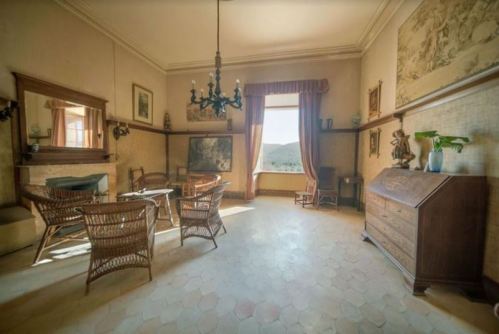
The feeble attempt was unavailing. Johan never moved nor answered. He stood among them silent, incommunicable, like one risen from the dead. Enoch grabbed him by the shoulder. Still Johan did not move. Enoch’s hand dropped from his shoulder. In spite of the man’s rough bullying power he seemed to be undefinably awed by Johan’s look and tone. They were all very disturbed. The Bible fell from the top most shelf of the book case in the dining room and landed open on the rug. Enoch and Mrs. Winchester could only stare at the good book. Before their astonished eyes the pages began to turn, all by themselves, from right to left, as though invisible fingers were leafing through them. From somewhere beneath the table came a deep rumble. The vibration was so powerful that they could feel their legs tremble. It was as though a huge generator had started up. An atmosphere of menace and threat seemed to pervade the room. The air felt charged. Johan was flung backward, as if someone had pushed him in the chest. He fell into an armchair. Another tremor came from the floor. Then, Johan levitated to the ceiling and like Satan, fell as if he was lightning from Heaven through the floor and there was no more sign of him. Indeed Mrs. Winchester and Enoch were trembling. Mrs. Winchester stormed over to the widow. The dayhad turned to a velvety black night, the kind that melted your vision around the edges. She took a quick look over the gardens and saw a legion of demons pruning and trimming the boxwood hedges, and the glorious evergreen trees. She sat down at her table and pressed her forehead against its coo, wood surface. Enoch was sweating bullets and threw the Bible angrily onto the floor. “Mrs. Winchester, I believe the Good Book is conjuring up these hauntings!” he said. #RandolphHarris 5 of 11

Mrs. Winchester nodded. “You knew…or you thought you knew…you were meeting with the dead?” Enoch bent his head again. The rain continued to fall in a steady unwavering sheet against the window, and he felt as if a winding sheet were descending from the sky to envelop them all in a common grave as an enormous white mist appeared in the mansion. “Prayer is not any good. In this kind of thing, it is no manner of use; you know it is not. I called you hear, Enoch, because you remember. A long winter night…they drove a stake through her breast.” “Who’s breast?” “Oh, Enoch, you must remember. A woman who called herself Eve, claiming that this was the Garden of Eden. Not that Victorian tradition is wrong, but the farmers said she committed the first act of evil.” Neither had any great urge to leave the house—not that time of night and without good reason. The Butler showed Enoch to his sleeping chambers and Mrs. Winchester slept in the Daisy Bedroom that evening. But, at around 3am, the house was wide awake again. They heard, plainly the mourful cries of a woman. This time they were coming from the third floor. It almost seemed as though she were crying out for her lost children. It went on for ages, Mrs. Winchester felt helpless to do anything. After that night, the hooded figure began to appear more frequently. The screaming at the windows and the hammering on the doors resumed. Doors started slamming. Mrs. Winchester and Enoch went to inspect what was happening. There was a man and three women tearing through the house, but no one had let them in. #RandolphHarris 6 of 11
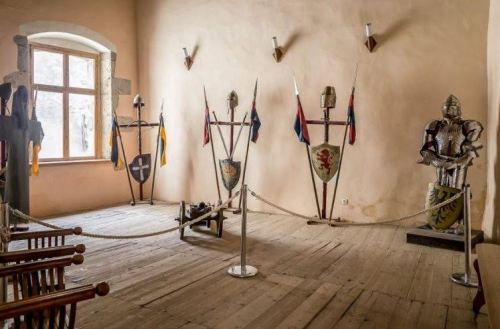
“What is God’s name do you think you are playing at!” Mrs. Winchester demanded. Enoch was angry. “No one invited you here,” he said. “No,” Allister said, “but nonetheless you need me.” “Last night the gates of hell opened up and now you are in my home. I will not have such disrespect! All four of you are to leave at once!” said Mrs. Winchester. Abruptly, the dynamics of the situation had changed—changed utterly and in the most chilling way. Enoch tried to speak, but the word simply would not come. There was a tense silence. Something was cautioning Enoch not to inflame the situation further. Then Allister had begun speaking in a strange language. The women appeared to be chanting; their heads were no longer bowed but raised up and tilted to one side. Their eyes were closed. Mrs. Winchester could not tell what kind of language they were speaking, but they must have disturbed something. That rumbling sound, only this time it was louder and did not stay under the dining room table. It started to move across the floor. They could feel the floor vibrating under them—like there was something moving under the floorboards, very fast. And it went out into the hall. The paranormal activity was of a different order. Mrs. Winchester had never seen the like of it. The walls started to bleed, the chandeliers saw, and the house moaned and groaned. Allister and these women had brought a stronger menace into their home, one that was gaining ground by the second. Then at once it all stopped. #RandolphHarris 7 of 11

Everyone in the home went into a shock. They all knelt there, just stiff with fear. They could not move. They could not speak. All they could do was blink their eyes. Then there was a gradual coldness in the room. It crept up on them and chilled them to the bone. They heard the doorknob turn and the door slowly open. The cold intensified. But there was nothing they could do. This figured blocked the doorway. It was very surreal and terrifying. It is very hard to say what this creature was. It was huge, and it had wings. It was a demon. Mrs. Winchester started addressing the creature. “What are you doing in my home?” Astonishingly, a very deep voice was coming from all around the room. From the ceiling, the floor, everywhere. They could not tell if it was right before them, behind them, below or above—it was everywhere. “Give me what I want and I will leave!” it bellowed. “If you do not, I will take your soul this instance! You were given instructions to build a house and never stop building! Do not dwell on ghosts, and spirits! Do not associate with these common folk. Build, build, build or you will die a horrible death in the depths of hell! He continued with a chuckle. “This is our homes and you must pay the price. It is dangerous to meddle with the wishes of demons.” Mrs. Winchester was studded. “These guests, they are mine. You have been too distracted and I have come to claim their souls. Honor my wishes or you will meet the same fate. No guests are allowed in this house!” #RandolphHarris 8 of 11
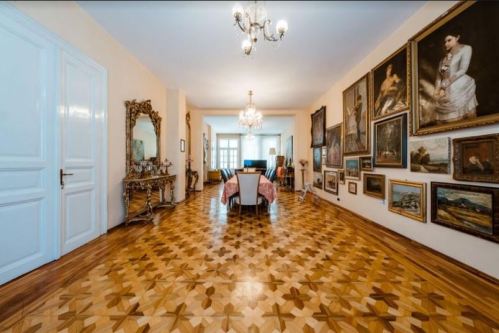
The mansion started to rumbled and groan like it was hungry, the guests flew into the walls and disappeared. The demon crashed through the skylight, leaving Mrs. Winchester terribly shaken. She had the rooms torn down to see if she could find the bodies, but the search was in vain. They were rebuilt. Stairs to the ceiling, for hopes that their souls would materialize and leave. A door that opens to the wall, as a portal for these lost souls. Chimneys that stop just short of the roof to trap demons. From that day on, nothing was safe. It was as though the visit of the strangers had unleashed the fury of something unholy. From the day on, Mrs. Winchester had an icy shadow of loneliness as bitter as the Alaskan winters. The mansion grew more and more substantial. And when the servants looked at Mrs. Winchester’s face, they saw she had an honest, open expression and kind brown eyes. When she smiled, she smiled warmly. Neighbors often came with a loaf of bread they had baked, and also brought brown woolen blanket, furs, and would leave with frightened faces, and tatted clothing, never able to speak with Mrs. Winchester. The Winchester mansion, which contains orders and offices of Spirits that are even said to have conversed with Solomon, together with seals and characters belonging to each spirit. I Do invocate, conjure, and command thee, O thou Spirit Forneus and the 29 legions of spirits you govern, to appear and to show thyself visibly unto me before this Circle in fair and comely shape, without any deformity or tortuosity; by the name and in the name IAH and VAU, which Adam heard and spake; and by the name of God, AGLA, which Lot heard and was saved with his family; and by the name IOTH, which Jacob heard from the angel wrestling with him, and was delivered from the hand of Esau. #RandolphHarris 9 of 11

And by the name ANAPHAXETON which Aaron heard and spake and was made wise; and by the name ZABAOTH, which Moses named and all the rivers were turned into blood; and by the name ASHER EHYEH ORISTON, which Moses named, and all the rivers brought forth frogs, and they ascended into the houses, destroying all things; and by the name ELION, which Moses named, and there was great hall such as had not been since the beginning of the World; and by the name ADONAI, which Moses named, and there came up locusts, which appeared upon the whole land, and devoured all which the hail had left; and by the name SCHEMA AMATHIA which Ioshua called upon, and the sun stayed his course; and by the name ALPHA and OMEGA, which Daniel named, and destroyed Bel, and slew the Dragon; and in the name EMMANUEL, which the three children, Shadrach, Meshach and Abed-nego, snag in the midst of the fiery furnace, and were delivered; and by the name HAGIOS; and by the SEAL of ADONI; and by ISCHYROS, ATHANATOS, PARACLETOS; and by O THEOS, ICTROS, ATHANATOS; and by these three secret names, AGLA, ON, TETRAGRAMMATON, do I adjure and constrain thee. And by these names, and by all other names of the LIVING and TRUE GOD, the LORD ALMIGHTY, I do exorcise and command thee, O SPIRIT BALAM, even by Him Who spake the Word and it was done, and to Whom all creatures are obedient; and by the dreadful judgments of God; and by the uncertain Sea of Glass, which is before the DIVINE MAJESTY, mighty and powerful; by the four beast before the throne, having eyes before and behind; by the fire round about the throne; by the holy angels of Heaven; and by the wisdom of God. #RandolphHarris 10 of 11

I do potently exorcise thee, that thou appearest here before this Circle, to fulfill my will in all things which shall seem good unto me; by the Seal of BASDATHEA BALDACHIA; and by this name PRIMEUMATON, which Moses named, and the Earth opened, and did swallow up Kora, Dathan, and Abiram. Wherefore thou shalt make faithful answers unto all my demands, O Spirits BALAM and FORNEUS, and shalt perform all my desires so far as in thine office thou art capable hereof. Wherefore, come thou, visibly, peaceably, and affably, now without delay, to manifest that which I desire, speaking with a clear and perfect voice, intelligibly, and to mine understanding. Magic is not a disease but the operation and influence of demon powers. The wide scope of occult power possessed by spirits helps explain why they can cause so much mischief. Through the phenomena of levitation, apports, telekinesis, and materializations, it is not difficult to see how a person endowed with strong mediumistic powers can do a great deal of harm, especially in the closely associated realm of magic. Magic defense enlists supernatural agencies to counteract or undo the mischief wrought by magic persecution. Various kinds of spells, charms, or incantations are employed. In spiritistic séances it is an established fact that injuries inflicted upon a phantasm are sustained by the medium, even in the case of animal phantasms. Many defensive customs developed to combat this threat since magic persecution involves materialization. If a victim can injure an aggressive phantasm, one has won the struggle. Missionaries all over the World have claimed to have witnessed cases of possession and repossession among converts from ancient idolatrous cultures, who live in servile fear and abject bondage to Satan. #RandolphHarris 11 of 11

Winchester Mystery House
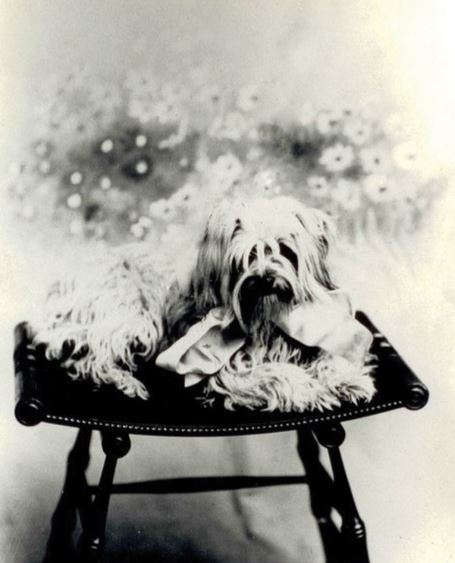
This is Sarah Winchester’s beloved dog, Zip🐶 This cute pup once roamed the many halls of this estate. Do you think Zip ever got lost like so many of us do? https://winchestermysteryhouse.com/

Join us on March 11th for the third installment of our Centennial Speaker Series! We invite you to solve the mystery of the Asian-inspired art and design lurking in Sarah Winchester’s very Victorian mansion. “Japonisme—a Passion for Japan” explores the decorating sensation that swept the western world during the last three decades of the 19 th century, and left an indelible mark on Sarah Winchester’s San Jose home. Speakers include Curator at SFO Museum, Nicole Mullen & West Coast Editor for Old House Journal, Brian Colman. Tickets available now! #100yearsofmystery

And be sure to check out the Online Gift Shop: https://shopwinchestermysteryhouse.com/

They Out There in the Parking Lot Doing Something Unholy!
If one believes that satisfaction of all physiological needs is enough to provide for a feeling of well-being in an animal (and in man), their zoo existence should make them very content. However, this parasitic existence deprives them of stimuli that would permit an active expression of their physical and mental faculties; hence they often become bored, dull, and apathetic. This disposition can lead to deviance in man. When men are engaged in deviant behavior, they are often involved in criminal activity. There is much more to understanding criminal behavior than simply mapping out the pattered aspects of the behaviors in question. For starters, one must consider the thoughts and cognitions that underlie the behaviors. Appreciating how different criminals think is anything but exact science. After all, we are talking about trying to figuratively crawl inside the heads of criminals in an effort to tap their state of mind and decision-making process across whole categories of offenders. Nonetheless, there are important issues that must be considered. First, one must tackle the issue of criminal motivation. As mentioned, criminal definitions expressly indicate that the criteria must be satisfied before an act can be considered a crime. For the legal scholar, criminal motivation is a relatively simple concept referring narrowly to the individual’s state of mind (men reus) at the time of the crime. For the criminologist who seeks to better understand criminal behavior, criminal motivation is a broad and complex concept that speaks to the totality of the offender’s mental state, in that time period preceding the crime, during the actual commission of the crime, and in the post-offense aftermath. #RandolphHarris 1 of 21

Criminal motivation must thus be approached as a complex, situationally based phenomenon in need of careful consideration. Moreover, a full treatment of this concept must also take into account the ways that the expected victim and setting roles can shape the mindset of the offender. For example, the issue of criminal motivation, as it applies to the mindset of street thugs (id est, stick up artist). Criminal planning is yet another important part of the criminal thought process. Once the prospective criminal decides that it is beneficial to commit an offense, the individual must settle on what constitutes the most effective and efficient set of behavioral processes to achieve said act. Planning refers to the rational decision-making processes that map out target selection and the way in which the individual(s) intend to commit the crime. For instance, burglary crews often implement a system of planning that includes a clearly established division of labor, event simulations, and contingency plans. Whereas juvenile car thieves use limited amounts of pre-event planning with offenders engaging more haphazard target selection method and operate with little concern for police intervention. Having a clear conscience is a hallmark of the contemporary human psyche. We as Americans have developed a near instinctual desire or need to think of ourselves as good people. In effect, there appears to be no wrongful behavior that the human mind is unable to cognitively reconstitute as normal or acceptable. Normative neutralizations are part and parcel to the cognitive dimension of crime. When their behavior is called into question by themselves or others, criminals are compelled to generate a cognitive neutralization that excuses or justifies their actions. #RandolphHarris 2 of 21

In effect, when persons do wrong, they feel the need to convince themselves and others that it was not so bad. They make believe that victims of intimate partner violence deserved their abusive situation. Also, rapists often vilify their victims and downplay personal wrongdoing, and men and women of the evening come to think and talk about their careers and clients. All criminal events are social phenomena. As mentioned, they occur in a given social situation or what is termed a “situated criminal transaction.” The form of that transaction is often patterned for any given offense and may even appear to be scripted. While the habitual interactions of victims and audience members is worthy of notice, criminologists are also interested in the routinized behavior of the offender. We have come to realize that the patterning of offender attitudes, beliefs, and behaviors can be a by-product of the behavior and sentiments that exist in the larger criminal subculture. In a noncriminological context, we acknowledge that cultural-based learning is a force to be reckoned with. Few would question the influence that a place of employment, say a law firm, has on the attitudes, beliefs, and behaviors of, say, a new attorney who seeks partner status. The same can be said of criminal subculture. A large part of a criminal’s normative and behavioral makeup can be fostered though interactions with fellow offenders. Significant relationships and scripted roles can be developed and these relationships often play a significant role in the way that the offenders think and behave. For example, there is often a complex web of roles and relationships that exist within the Sacramento sex-for-crack market. #RandolphHarris 3 of 21

It is useful to conceive of a criminal subculture as having two central features: organizational alignment and socialization scripts. Organizational alignment refers to the networking or structuring of interactions that shape a given criminal subculture. Membership plays an importance in the roles and position in criminal outcomes. Criminals typically carry out their misdeeds within the context of one of the following organizational forms: loners, colleagues, peers, teams, and formal organizations. Loners work alone, relying on no one to assist them in their misdeeds. They manipulate and/or adapt the behavioral and cognitive aspects of their legitimate (noncriminal) Worlds as a means of developing and refining their criminal repertoire. When it comes to the term “therapeutic self-medicators” they are described as pharmacists who misappropriate their pharmacological expertise en route to developing their own private drug abuse patterns. These insolent professionals use drugs alone and slowly manipulate their legitimate training and professional roles until they have in effect taught themselves how to think and act as a drug addict. We term other drug-using pharmacists “recreational abusers.” These individuals often operate within a colleague-based organizational alignment. Colleagues offend alone but look to the misdeeds and rationalizations of other deviants to shape thoughts and behaviors associated with their illicit behavior. Those organizational alignment that fit into the peer category take on a slightly different social format. #RandolphHarris 4 of 21

Peers take on co-offenders and openly interaction with other perpetrators in a loose and transient social setting. For example, hard-core heroin addicts comingle and draw upon the collective experience of the junkie subculture to refine their drug-related skills and attitudes. Criminal subcultures can also take on an organizational alignment that is referred to as teams. A term structure is defined by its consistent and patterned interactions. Here, the offender comes to interact and offend with the same group of individuals. Consistent relationships are seen as mutually beneficial, s offenders gain proficiency from a patterned division of labor and loosely structure mentoring. For example, the loose social organization of marijuana grower in Kentucky blue grass country has a growth and distribution system that is held together by informal norms and behaviors. The mot advanced of criminal subcultures manifest itself as formal organizations. By operating in a membership-like format, these criminals serve fixed roles, with some sort of formal or informal mentoring system to recruit and retain the membership base. Organized crime “families” are the best example of this organizational form. An example of the organized crime family is demonstrated by the way in which Adolph Hitler used the Nazi regime to carry out the Holocaust. Organizational alignment represents the structural dimension of a criminal subculture as it describes the context in which criminal interactions occur. This structural, dimension gives way to a process-oriented aspect of criminal subcultures termed socialization scripts. #RandolphHarris 5 of 21

When it comes to socialization scripts, the actual content of subcultural messages and interactions is placed center stage as we seek to ascertain the process through which criminal learning occurs. There is evidence that the cultural message and cues within our nation’s universities can serve to shape the motives and behaviors of college men to engage in gang rape. We often find an illuminating way that the content and dynamics of the learning process comes to produce a socialization script that is somewhat unique to gang rapists. Criminal acts are, by definition, prohibited by law, and the laws of this democratic country are supposed to represent the collective conscious of the collective conscious of the populous. As such, in theory, that which is defined as a potential harm or offense to the state should be defined as a potential harm or offense to the average citizen. Reactions to criminal behaviors can take on one or two forms: formal or informal. Formal reactions to criminal events take the shape of institutional responses. In most cases, the institution in questions is the criminal justice system (id est, law enforcement, courts, and corrections). When a mother openly beats a child in public, law enforcement officials are quick to reference existing criminal statues and cite the mother with child abuse. This matter is then forwarded to the court system where the courtroom workgroup (id est, prosecutor, defense attorney, judge) sets out to determine if in fact a crime has been committed and, if so, what should be the appropriate punishment. Once a sentence has been handed down, members of the correctional system impose the prescribed punishment. To this end, a full understanding of crime begs consideration of the way that institutions such as law enforcement, the courts, and our correctional system respond to the various types of criminal offenses. #RandolphHarris 6 of 21

Institutional (formal) contacts are not the only form of societal rection that can potentially shape the thoughts and behaviors of those involved in the criminal event. Informal reactions are also important. These are the perceived or real responses from audience members and/or valued relations that help shape criminal event. On a most fundamental level, audience members may intervene or choose not to intervene in a criminal event, thereby altering its existence. In fact, the mere existence of an audience changes the nature of the offense. For instance, the group dynamic plays an important role in the occurrence of gang rape on university campuses. Whereas the one-on-one dynamic of marital rape produces a significant different series of events. Informal reactions also serve as important precursors to a criminal event. Namely, the perceived responses of valued relations (id est, friends, family members, role models) can and do effect both the decision to commit a crime and the accounts and justifications that are constructed once the event has transpired. Scholars once again observe that these perceptions often become pattered for a given type of crime. This is even applied to audience roles in the murder event. There often times a subtle spirit of treachery in a system. Some crime families are suave and unctuously polite. As one man puts it: “If we wish to kill a man we approach him, we ear, drink, sleep, work and rest with him, it may be for several moons. We bide our time. We call him friend.” As a result, in the not infrequent cases of murder, suspicion falls on those who have tried to be friends with the victim. #RandolphHarris 7 of 21

That is one reason some people do not trust others who start hovering around them, act as if they know them, or sit around watching one. When an individual is infrequently seen, and varies one’s times of outings, always seeing the same people in the vicinity is a sign to be cautious. It is not statistically probable that they all are on the same varied and infrequent schedule, so chances are these individuals are up to something unholy. Therefore, it is important to pay attention to engagement disloyalty. During an encounter of three or more participants, it is possible for a subset of participants to form a byplay, a noninclusive engagement that is carried on simultaneously with the first but in a way carefully calculated not to interfere with it too openly. These byplays may be carried on relatively openly when they appear to be in the interests of the business at hand—as when a speaker quietly asks some questions of the chairman before turning to speak—or relatively furtively when byplay is patently not in the interests of the dominant interaction. This kind of disaffection seems especially common in large engagements where the presence of manly loyal participants guarantees that the dominant engagement will be sustained. Disaffection is especially treacherous in clusters of three or four, where the participants remaining loyal may be in a numerical minority, subjected to pointed insult by the byplay of others. As might be expected, when an encounter must be sustained by persons unable to use their eyes to scan and monitor what is occurring, byplays employing physical acts become difficult to control and constitute a special threat to the integrity of the encounter. #RandolphHarris 8 of 21

For instance, consternation was felt by visually impaired man in an engagement of three men and one woman, when he heard rustling and suppressed giggling that did not seem to arise from what was being stalked about by the full company at the time. In many instances, these subordinate byplays involve only members of the dominant encounter, and involve them in such a way as not to broadcast to the company at large—to the situation—that disloyalty is occurring. I do not propose to consider this phenomenon here, since it could just as well be considered solely in terms of the dynamics of the engagement itself. Relevant, however, as those byplays that draw some of their membership from persons officially excluded from the dominant engagement, for here disloyalty is made visible to bystanders, and the doings of the betrayed engagement are “opened up,” to at least some of the nonparticipants present. An extreme form of disloyalty is fond where an individual, in the process of being led into the role of the butt, is brought into an engagement maliciously, just so the instigator can be disloyal to the engagement that results. The perpetrator makes a pretense to the butt that he is treating him as a coparticipant, while at the same time openly using the interaction thus created as a source of amusement for oneself and others. The model here, perhaps, is the kind of baiting of animals that people engage in at a zoon, where one individual interacts with an animal until the animal responds, and then uses the animals response as a source of fun between himself and a second individual. #RandolphHarris 9 of 21
People can spend their lives studying systems and system word and never come to real things. In fact, 90 percent of our ordinary knowledges does not really exist; it exists only in imagination. Realization of sleep is the only one thing. It is necessary to find ways to awaken, but before that you must realize that you are asleep. Compare sleep and waking. All ideas of the work begin with the idea of sleep and the possibility of waking. All other ideas—life ideas—may be clever or elaborate but they are all ideas of sleeping people produced for other sleeping people. Sleep is the result of many things: division of personalities, different “I”s, contradictions, identifications and so on. However, the first of all, just pure without any theory, is the realization of sleep. Currently, life is not long enough for changing our being if we work on it as we do at everything else in life. Something can be attained only if one uses a more perfected kind of method. The first condition is understanding. All the rest is proportionate to understanding. There must also be efforts in connection with emotions and will. One must be able to go against oneself to give up one’s will. First you must ask yourself: What is will? We have no will, so how are we to give up what we do not have? This mean, first, that you never agree that you have no will; you only agree in words. Secondly, we do not always have will but only at times. Will means a strong desire. If there is no strong desire, there is nothing to give up; there is no will. At another moment, we have a strong desire that it is against work, and if we stop, it means that we give up will. #RandolphHarris 10 of 21

It is not at every moment that we can give up will but only at special moments. And what does it mean “against work”? It means against rules and principles of the work or against something you are personally told to do or not to do. There are certain general rules and principles of the work or against something you are personally told to do or not to do. There are certain general rules and principles, and there may be personal conditions for different people. “Should one ask for further personal directions?” Yes, but if one asks one must obey. One is not obliged to do anything if one does not ask, so before asking one must think twice. In common home accidents, a dangerous product is wrongly applied, spilled, or consumed. Homes today are full of corrosive and toxic materials, for cleaning drains, dissolving stains, poisoning insects, and so forth. All too often, children dink them and die. With advanced technology, none of these tasks will require such harsh, crude chemicals. Cleaning could be performed by selective nanomachines instead of corrosive chemicals; insects could be controlled be devices like ecosystem protectors that know the difference between a cockroach and a person or a ladybug. There will doubtless be room for deadly accidents, but with care and hard work, it should be possible to ensure that nanotechnologies for the home are safer than what they replace, saving many lives. It is, of course, possible to imagine safety nightmares: nanotechnology could be used to make products far more destructive than anything we have seen because it could be used to extend almost any ability further then we have seen. #RandolphHarris 11 of 21

Such products presumably will not be commonplace: even today, nerve gas would make a potent pesticide, but it is not sold for home use. Thinking realistically about hazards requires common sense. We have already seen how post-breakthrough technologies can eliminate oil spills by eliminating oil consumption. A similar story could be told of almost any class of industrial accident today. However, what about accidents—spills and the like—with the new technologies? Rather than trying to paint a picture of a future technology, of how it could fail and what the responses could be, it seems better to try a thought experiment. What could be done to deal with oil spills, if oil were still in use? This will show how nanotechnologies can be used to cope with accidents: If there were a spill and oil on the shore, advanced nanomechanisms could do an excellent job of separating oil from sand, removing oil from rocks, and cleaning crude oil from feathers on birds and the feathery legs of barnacles. Oil contamination is a pollution problem, and nanotechnology will be a great aid in cleaning up pollution. But why should the oil reach the shore? Economical production would make it easy to stockpile cleanup equipment near all the major shipping routes, along with fleets of helicopters to deliver it at the first distress call from a tanker. Oil cleanup equipment built with nanotechnology could surely do an excellent job of scooping oil from the water before it could reach the shore. #RandolphHarris 12 of 21

But why should the oil leave the tanker? Economical production of strong materials could make seamless hulls of fibrous material far tougher than steel, with double, triple, or quadruple layers. Smart materials could even make punctures self-sealing. Hulls like this could be run into rocks at highway speeds without spilling oil. But why should anyone be shipping crude oil across the sea? Even if oil were still being pumped (despite inexpensive solar energy and solar-derived fuels), efficient molecule-processing systems could refine it into pure, fuels at the wellhead, and inexpensive tunneling machines could provide routes for deeply buried pipelines. Any one of these advances would shrink or eliminate today’s problem with oil spills, and all of them are feasible. This example suggests a general pattern. If nanotechnology can provide so many different ways to avoid or deal with an oil spill—one of the largest and most environmentally destructive accidents caused by today’s industry—it can probably do likewise for industrial accidents in general. The most direct approach is the most basic: the elimination of anything resembling today’s bulk industrial plants and processes. The shifts from messy frilling activities and huge tankers to small-scale distributed systems based on solar cells is characteristic of the style in which nanotechnology can be used. #RandolphHarris 13 of 21

The chemical industry today typically relies on plants full of large, pressurized tanks of chemicals. Not surprisingly, these occasionally spill, explode, or burn. With nanotechnology, chemical plants will be unnecessary because molecules can be transformed in smaller numbers, as needed and where needed, with no need for high temperatures, high pressures, or big tanks. This will not only avoid polluting by-products, but reduce the risk of accidents. Now, given that the United States of America wanted the Soviets to pull their missiles out of Cuba, during the Cuban missile crisis, why could Kennedy not have threatened that he would annihilate Moscow unless Khrushchev removed the missiles? This would be a compellent threat; it must specify the precise conditions of compliance (missiles back to Russia, or in crates on a ship in Havana harbor?) and a deadline for compliance. The problem is that in practice such a threat would not be believed, either by Khrushchev or by anyone else. The threatened action, surely leading to a global thermonuclear war, is simply too drastic to be credible. If the missiles were not out by the deadline, rather than annihilate the World, Kennedy would surely be tempted to extend the deadline by a day, and then another day. There are several ways of lending credibility to threats. The use of an automatic device seems the most promising in this context. (Reputation will not work, because after the threat is carried out there is no tomorrow. Contracts will not work, because everyone will face the overwhelming temptation to renegotiate. And so on.) #RandolphHarris 14 of 21

The use of an automatic device is an approach basis for the movies Failsafe and Dr. Strangelove. In Dr. Strangelove the Soviets have installed a “doomsday machine” that monitors American transgressions and automatically launches Soviet retaliation under circumstances specified in a tamperproof computer program. In Failsafe it is the Americans who have the doomsday machine. Those who have seen these movies (which we recommend highly) know why Kennedy should not use a similar device to make his threat credible. In theory, under ideal circumstances, everything works just as planned. The very knowledge that an automatic device is in place makes the threat credible. Khrushchev backs down, the threat does not have to be carried out, and all is well. If a threat is sure to succeed, it need never be carried out, and it does not matter how big or dire it is, or how much it would hurt you too to carry it out. However, in practice, you cannot be absolutely sure that it will work as planned. There are in fact two kinds of errors that can occur. First, the threat may not succeed. Suppose Kennedy has totally misjudged Khrushchev’s mindset. Then Khrushchev does not back down, and the doomsday device annihilates the World just as Kennedy is regretting having installed it. Second, the threat may be carried out even when it should not. Suppose the Soviets back down, but the news reaches the doomsday computer just too late. Because such errors are always possible, Kennedy does not want to rely on threats that are too costly to carry out. Knowing this, Khrushchev will not believe the threats, and they will not deter or compel him. #RandolphHarris 15 of 21

Kennedy may claim that an automatic launcher has the sole authority to fire at Moscow if the Soviet missiles are not out of Cuba by Monday, but Khrushchev can be sure that Kennedy controls and override button. Although the threat of certainty of war is not credible, one of a risk or probability of war can be credible. If Khrushchev fails to comply, there is a risk, but not a certainty, that the missiles will fly. The uncertainty scales down the threat. The scaling down makes the threat more tolerable to the United States of America, and therefore more credible to the Soviets. This is a lot like another device for credibility we mentioned in the past, namely moving in small steps. There we considered breaking up a large promise into a succession of small ones. If I am trying to sell you a valuable piece of information for a thousand dollars, I may not be willing to disclose it in return for your promise to pay, but may be willing to reveal installments one by one in return for corresponding payments. A similar principle applies to threats. And here the steps consist of degrees of risk. Each stage of escalation by the United States of America or the Soviet Union increases the risk of global war; each small concession reduces the risk. The calculation for each side is how far to proceed or retreat alone this route. If Kennedy is willing to go farther than Khrushchev, then Kennedy’s brinkmanship will succeed. Kennedy cannot credibly threaten an immediate all-out nuclear strike, but he can credibly raise the risks to some degree by taking some confrontational actions. For example, he may be willing to risk one chance is six of nuclear war to ensure the removal of the missiles. #RandolphHarris 16 of 21

Then Khrushchev can no longer conclude that Kennedy’s threat is vacuous; it is in Kennedy’s interest to expose himself to this risk if it will motivate the Soviets to remove the missiles. If Khrushchev finds this degree of risk intolerable, then the brinkmanship has accomplished its objective: to allow Kennedy to choose a more appropriately sized threat, one big enough to work and yet small enough to be believed. We still have to ask how Kennedy can go about threatening a risk of war, short of a certainty. Moving forward, in the spring of 1989, when Dr. James T. Hansen chief of NASA’s Goddard Institute for Space Studies, prepared to testify before the U.S. Congress on the “greenhouse effect”—the overheating of the global climate—he submitted his text for clearance to the White House Office of Management and Budget (OBM). Hansen firmly believed that the time had come for the U.S.A. government to take significant action to prevent drought and other severe effects of climatic warming. When he got his text back, however, he discovered that the OBM had come for the U.S.A. government to take significant action to prevent drought and other sever effects of climatic warming. When he got his text back, however, he discovered that the OMB had added a paragraph throwing doubt on the scientific evidence about planetary warming, and considerably softening his position. He protested, lost the internal battle, and then made his personal views public through the press. Behind this collision between the administration and one of the government’s top scientists lay a little-noticed bureaucratic battle. #RandolphHarris 17 of 21

The U.S.A. Department and the Environmental Protection Agency both wanted the United States of America to take the international lead in combating the greenhouse problem. By contrast, the OMB and the Department of Energy backed a go-slow approach. When Hansen took his protest to the media, Senator Al Gore, one of the few technologically sophisticated members of the U.S.A. Congress, demanded that OBM “testify about the basis for their conclusions. I want to determine…the climatic models they have used.” This reference to “models” is a sure tip-off that the struggle would be waged at the meta-tactical level. For more and more government programs and policies are shaped by the assumptions and sub-assumptions buried inside complex computer models. Thus while Gore in the Senate was questioning the models relied on by the go-slow camp, Sununu in the White House was challenging the reliability of the models that provided ammunition for the other side. He was on top of the scientific literature and thought the computer models predicting significant warming were too primitive to form a reliable basis for action. Today, whether dealing with the economy, health costs, strategic arms, budget deficits, toxic waste, or tax policy, behind almost every major political issue we find teams of modelers and counter-modelers supplying the raw materials for this kind of political controversy. A systematic model can help us visualize complex phenomena. It consists of a list of variables, each of which is assigned a weight based on its presumed significance. #RandolphHarris 18 of 21

Computers make it possible to build models with much larger numbers of variables than the unaided intellect alone. They also help us to study what happens when the variables are given different weights or are interrelated in alternative ways. However, no matter how “hard” the final output may appear, all models are ultimately, and inescapably, based on “soft” assumptions. Moreover, decisions about how much importance to assign to any given variable, or its weighting, are frequently “soft,” intuitive or arbitrary. As a result, political in-fighters, skilled at meta-tactics, battle fiercely over weights, variables, and the way they are linked. Despite the political pressures that tilt and bias the outcome, the results of which conflicts normally come packaged in impressive, seemingly neutral and value-free computer printout. Models are used in developing and choosing policies, in evaluating program effectiveness, and in asking “what is…” questions. However, as we learn from Data Wars, a recent study of government modeling, they can also be used to “obscure an issue or two lend credence to a previously made policy position…to delay decision-making; to give symbolic rather than real attention to a decision; to confuse or obfuscate decision-making,” and so on. “Model use occurs as much for political and ideological need as for technical [substantive decision] need.” This, they note, is necessarily so because “computer models influence ‘who gets what.’” A study by the U.S.A. Congressional Research Service, for example, pointed out that government cuts in social programs during the 1980s, threw at least 557,000 Americans into poverty. The number provided ammunition to politicians who opposed such cuts. However, this figure was not based on counting the poor. #RandolphHarris 19 of 21

Instead, like an increasing number of other statistics, it was a result of politically contentious premises built into a model that attempted to show what might have happened had the budget cuts not taken place. Just how rarefied meta-tactics become as computer data spreads in government is illustrated by the controversy that broke out over missing people and what the Census Bureau technicians called “hot deck imputation.” In November 1988 the cities of New York, Huston, Chicago, and Los Angeles field a lawsuit against the U.S. Bureau of the Census to force a change in the way it counts. They were joined by civil rights groups, the Conference of Mayors, and other organizations. In any census, some groups are undercounted. Poor, transient, and homeless groups are harder to count. Undocumented aliens may not wish to be counted. Other escape the information net for other reasons. Whatever its reason, undercounting can have potent political consequences. Because Washington sends billions of tax dollars back to the cities and states, cities can be deprived of federal funds to which they might otherwise be entitled. Since seats in the House of Representatives are apportioned on the basis of population, states with large uncounted populations may be cheated of full representation. This, in turn, can cost them many other benefits. Inadequate information can thus shift power. To compensate for undercounting, the Census Bureau’s computers, on finding a house for which information is lacking, are now programmed to assume that the unaccounted-for people have characteristics similar to people who live nearby. The computers then fill in the missing data, as though it had been provided by the missing people. #RandolphHarris 20 of 21

The result is that millions of persons, presumed to exist, are really a phantom population whose characteristics we are guessing at. Hot deck imputing may be a better way of compensating for the unknown than previously used statistical methods, but, as with all such techniques, its assumptions are open to challenge. On the strength of these assumptions—informed as they might be—voters in Indiana lost one member in Congress whose seat was reassigned to Florida instead. “Hot deck imputation” shifted political power. In sum, therefore, a new stage of political conflict is developing—a battle over the assumptions that lie behind still other assumptions, often embedded in complex computer software. It is a conflict over meta-questions. It reflects the rise of the super-symbolic economy. This new economy could not run for a second without human contact, imagination, intuition, care, compassion, psychological sensitivity, and other qualities we still identify with people rather than machines. However, it also requires ever more complex and abstract knowledge, based on vast avalanches of data and information—all of which is subject to increasingly refined political manipulation. What this look at info-tactics, and especially the new meta-tactics, teaches us is that laws set limits on governmental secrecy only touch the outermost skin of democracy’s knowledge problem. The new economy, by its very nature, requires a free exchange of ideas, innovative theories, and a questioning of authority. And yet…despite glasnost, despite “freedom of information” legislation, despite leaks, and the difficulty of today’s governments face in keeping things secret—despite all of these and more—the actual operations of those who hold power may well be growing more, not less, opaque. That is the “meta-secret” of power. #RandolphHarris 21 of 21

Cresleigh Homes

Open concept means freedom. 😍 It means flexibility. And it means the whole family (and lots of friends!) can all chill in the same space. 🎉

We love showing off our floor plans at #PlumasRanch! There’s so much to enjoy (and so much space to enjoy it in!)

Learn more about #CresleighHomes on our website.

I’m Going to Target

Love keeps the soul on the track of its fate and keeps consciousness at the edge of the abyss of the infinity that is the rage of the soul. However, as a result of the human condition, sometimes the soul becomes disjointed with its reality. This is why we need to understand how and why people commit different varieties of criminal behaviour, and use this tact to provide insights into what can be done to remedy the situation. That is why scholars adopt a crime typology or criminal behaviour system approach to crime. Typology scholars rely on logic-based conceptual frameworks to categorize and theorize about crime. In effect, he or she constructs ad defines a set of underlying dimensions that allows one to justify and substantiate a given typology of crime. Keep in mind that the differences or similarities on any or all of the theoretical dimensions need not be complete. Instead, it is tacitly implied that partial or conditional similarities or differences can exist across or with the framework of the typology. It is argued that this more focused approach to the study of criminal behaviour affords us a fuller understanding of the patterns and dynamics of criminal behaviour. It allows us to speak to the unique factors associated with a given category of crime. At the same time, we can identify similarities that exist between homicide and aggravated assault, rape, or even burglary. When speaking of criminal behaviour systems, it is useful to adopt the criminal events as the unit of analysis. #RandolphHarris 1 of 19

The criminal event is the social context in which the crime occurs, with every criminal event being comprised of an offender, a victim (or target), and a setting. By way of example, the average date rape involves a male offender and a female victim, and takes place in a leisure setting such as the offender’s house. Too often, typology scholars focus exclusively on the offender (criminal) or offense (crime) and lose sight of the meaningful roles that the victim and/or contextual norms of a given setting play in the criminal outcome. Criminal events are best understood when viewed in light of four organizing principles or sensitizing concepts: behavioural aspects, cognitive aspects, cultural aspects and societal reactions. These sensitizing concepts specifically direct one’s attention toward common themes or criteria by which one can compare and contrast the offender, victim, and setting roles across different types of crime and thus serve as the underlying dimensions of the present seven-part classification scheme. In other words, these organizing principles stress the multifaceted aspects of the criminal event (id est, the offender, victim, situation, and legal distinctions) and allow for a more complete appreciation for the category or type of crime in question. Human beings have a knack for patterning and regimenting their behaviour over time. Crime is no different Much like the common behavioural components to swimming, there are common behavioural aspects to homicide. Swimming involves the act of propelling one’s self through water, whereas a homicide manifest itself as the unlawful killing of a human being. #RandolphHarris 2 of 19

Likewise, there are different techniques, patterns, and skills that delineate the various swimming strokes (exempli gratia, breaststroke, backstroke). There are also different techniques, patterns, and skills associated with different subtypes of homicide (exempli, stranger homicide, intimate homicide, serial homicide). The concepts of crime and criminal behaviour have their humble beginnings in the legal definitions, or necessary conditions that are set forth by the criminal code. Most fundamentally, a crime is defined as an act committed or omitted in violation of a law or statue that expressly forbids or commands it and is accompanied by some form of state-sanctioned punishment. In order for the state to establish that said crime has occurred, it must be shown that the event in question satisfies the actus reus (guilty act) and the mens reus (guilty mind) aspects of a particular criminal statue. These two critical components detail the behavioural and mental states required for an event to be defined as criminal. For example, most jurisdictions define burglary as the unlawful entry of a structure (actus reus) with the intent to commit a felony or theft (mens reus). The behavioural aspects of a given type of crime also encompass the skills and techniques that are used by offenders. In the case of homicide, this means that one must speak to the manner in which the offender brings about the death of the victim (exempli gratia, strangulation, blunt-force trauma, gunshot wound). #RandolphHarris 3 of 19

Many crime oblige or even require the offender to master the use of various mechanisms or tools that serve to assist in the commission of the offense. The “tools of the trade” for a murderer might include a wide variety of weapons (exempli gratia, guns, knives, toxins, bare hands). Burglar are often obliged to use deception or disguises, enlist the assistance of various power tools, or simply peer through windows en route to gaining entry into a targeted residence. Collectively, the patterned skills, techniques, and tools of the trade make up the “nuts and bolts” of how offenders effectively yet efficiently perpetrate their criminal acts. Recall all criminal events are comprised of an offender, a victim, and a setting. Criminal events do not occur when these three elements spontaneously combust. Instead, they occur in transactional manner whereby the offender, victim, and audience members negotiate the criminal outcome. Homicide event are “situated transactions” in which the pressure, volatility, and eventual lethal violence progresses through a series of interactional stages that are collectively negotiated by the offender, victim, and audience member. Criminal transaction often takes on a given “form.” For example, some transactions involve a lone offender and a lone victim in an isolated environment. Other criminal transactions involve multiple offenders, multiple victims, and interactive audience member. A full understanding of the patterned form of the criminal transaction is necessary if one is to comprehend the behavioural aspects of a given offense type. #RandolphHarris 4 of 19

There also exists a patterned “process” to criminal transactions whereby stable actions and roles emerge among the offender, victim, and audience member. For example, there are patterned interactions that exist between burglars, illegitimate pawn shop operators (id est, fences), and the pawn shop customers. The behavioural aspects of criminal offending are patterned on yet another, more broadly defined level Namely, offenders tend to progress through what is called a criminal career. Criminal careers are measured in terms of recidivism rates (rates of re-offending) as well as career trajectories (offending routines that emerge as individuals enter into, persist through, and exit their criminal lifestyles). Criminals can specialize in a given type of crime or behave as generalists who engage in a wide variety of criminal behaviours. Both of these career variations, for example, show how female burglars tend to focus their offending in a select few offense categories, while their male counterparts tend to be less discriminatory and adopt more of a “jack of all trades” orientation. The severity of an offender’s wrongdoings may remain relatively stable or they may intensify. #RandolphHarris 5 of 19

Similarly, a criminal career can be short and erratic or it can be long and tightly routinized. The individuals may have frequent contact with the criminal justice system or might be able to allude suspicion and apprehension for extended periods of time. Past research suggests that there tends to be a patterned aspect of criminal career trajectory within a given criminal behaviour system. There are other types of behaviour that are important to focus on, that tend to be more conducive to society. Participation in an accessible engagement not only directly exposes the individual to linguistic and expressive communication with the other participants in the encounter but also opens up the possibility that they will expressively communicate something about one to bystanders. Seeking some degree of intimacy with potential fellow participants in the encounter, the individual can find oneself spurned or otherwise mistreated in a way that is visible to bystanders. Given these potential exposures, we find regulations to safeguard the individual. These constraints appear in two-person engagements as expressions of loyalty to the encounter. In both cases we deal with a participant’s obligation to stay within “his” engagement. One form of containment is found in the obligation of participants to withhold attention from matters occurring outside of the engagement. We can appreciate the operation of this norm by nothing the various context in which the norm is not adhered to. #RandolphHarris 6 of 19

Quite momentary and minor disaffection constantly occurs, as when an individual turns away from a moment to see who has entered the situation, or to find a suitable chair, expressing by one’s manner and by the arts of shielding involvement that somehow one’s spirit is still attached to the engagement. Where individuals do not have to worry about each other’s small slights because of a long-standing relation of familiarity and intimacy—as between some husbands and wives—one participant may hold the engagement together while the other scans the room in search of useful information. When a couple eats at what is for them a “good” restaurant, the member with one’s back to the assembled others may be annoyed to find one’s partner giving attention to the other tables instead of to the talk at hand. Such disloyalty can of course become excessive, by middle-class standards, suggesting a demoralization (or at least an altered understanding) regarding what is ordinarily owed one’s fellow participants. Hollywood restaurants provide good illustrations. There was a stir in Dave Chasen’s Restaurant in Beverly Hills when Dore Schary walked in. Chasen’s is run by the former stage comedian whose name it bears, and it is popular with people in the motion-picture industry…All the other patrons focused their attention of Schary. They seemed to be looking around at everybody except the people they were with and with whom they were managing to carry on conversations. #RandolphHarris 7 of 19

Schary was not a bit self-concious…He was almost the only man in Chasen’s who was not at the moment looking around at someone other than the person he was talking to. More extreme forms of disloyalty are very commonly found among the mentally ill; it is often because of such delicts that persons are identified as mentally ill in the first place. For example, I observed a female psychotic, strongly attached to her mother and to her psychiatrist, who would, in the midst of a conversation, allow all of her steps. At the approach of either her mother or her therapist, the patient’s body would remain in the talk but her head and interest would turn elsewhere. After a few weeks, as she “recovered” from an “episode,” this interaction indelicacy gradually disappeared until it was possible for either of these figures to walk by without causing the patient visible perturbation. Although these figures no doubt still brained away some of her attention, she was able or willing to disguise the fact. The same patient, while “in” a psychotic break, would play ping-pong with one person while allowing her attention to rest openly on a nearby foursome of her age-mates playing bridge. Gradually, as weeks went by and she “came out” of the psychotic break, she increasingly paid deference to her ping-pong game by according it her cognitive and visual attention, and increasingly during play she exhibited civil inattention to neighbouring engagements. #RandolphHarris 8 of 19

“Is there a place in the static triad where a group of ‘I’s unconnected with magnetic center is active and false personality passive?” Certain group of “I”s or personalities become active, and they are centered round magnetic center. First magnetic center itself, and then those “I”s that range themselves round magnetic center are opposed to false personality. Then, at a certain moment, magnetic center becomes active and false personality passive. Magnetic center is a combination of a certain group of interests. Magnetic center does not lead you, for leading would mean progress and you remain in one place. However, when things come, then with the help of magnetic center you will be able to see which is which or whether you are interested or not interested in a thing. You can make a choice. Before one comes into the work, magnetic center has reached a certain point which transforms it into a certain group of interests When one meets the work it becomes interested in school-work and then it disappears as magnetic center, because magnetic center is a weak thing. For instance, in the first triangle of the triad, it is composed of body, soul and essence (=), false personality (+), and “I”s (-). Now supposing that these “I” are already divided into certain groups, maybe not attached, but still not hostile to the magnetic center, which can exist and eventually develop into something better. The groups of “I”s which are always hostile and always harmful are false personality itself. #RandolphHarris 9 of 19

Somebody asked whether the change from one form of the static triad to another depended on change being. Yes, every small change is a change of being although this expression is generally applied to bigger, more serious changes. When we speak about change of being we speak about change from men nos 1, 2, and 3 to man no. 4 for instance. This is change of being, but of course this big jump consists of many small jumps. The static triad represents you. It shows the state of your being, what you are at a given moment. One of the points, body and essence, is always the same, but the relation of the other two points changes. If body and essence are normal they are impartial and do not take one side or the other, but if there is something wrong in them they are on the side of false personality. When in a state of doubt remember to try and bring up other “I”s which have a certain valuation. This is the only way to conquer doubts. In order to develop you must have some capacity for valuation They only practical approach is to think of the different sides of yourself and to find the sides that can work and the sides that cannot. Some people have real values, some have false values and some have no values at all. It is the same with different “I”s; some value real things, some wrong things and some value nothing. People can spend their lives studying systems and system words and never come to real thing. Three-quarter or nine-tenths of our ordinary knowledge does not really exist; it exists only in imagination. #RandolphHarris 10 of 19

In October 1962, the Cuban missile crisis brought the World to the brink of nuclear war. The Soviet Union, under its mercurial leader Nikita Khrushchev, had begun to install nuclear missiles on Cuba, 90 miles from the American mainland. On tographs of missile sites under construction. After a week of tense discussions within his administration, on October 22 President John F. Kennedy announced a navel quarantine of Cuba. Had the Soviet Union taken up the challenge, the crisis could have escalated to the point of all-out nuclear war between the superpowers. Kennedy himself estimated the probability of this as “between one out of three and even.” However, after a few anxious days of public posturing and secret negotiation, Khrushchev shied away from the confrontation. In return for a face-saving compromise involving eventual withdrawal of U.S.A. missiles in Turkey, he ordered the Soviet missiles in Cuba dismantled and shipped back. Khrushchev looked over the nuclear brink, did not like what he saw, and pulled back. The name “brinkmanship” seems apt for the strategy of taking your opponent to the brink of disaster, and compelling one to pull back. (Many people erroneously say “brinksmanship”—which sounds more like the art of robbing an armored truck.) Kennedy’s action in the Cuban missile crisis is generally accepted as an instance of successful exercise of brinkmanship. The rest of us also practice brinkmanship, but with less than global stakes. #RandolphHarris 11 of 19

A management team and trade union facing a devastating strike, stubborn spouses whose failure to compromise is leading toward divorce, and a divided Congress risking a government shutdown if it fails to ratify a budget are all engaged in brinkmanship. They are deliberately creating and manipulating the risk of a mutually bad outcome in order to induce the other party to compromise. Brinkmanship is a subtle strategy fraught with dangers, and if you want to practice it successfully, you must first understand it thoroughly. We aim to help your grasp the subtleties, using the Cuban missile crisis as a case study. Upon discovering that the Soviets had secretly places missiles in Cuba, the Kennedy administration contemplated a range of options: do nothing, take a complaint to the United Nations (in practice, almost the same thing as doing nothing); impose a quarantine or blockade (the course actually adopted); launch an air strike on the missile sites in Cuba; or—at the extreme end—make an immediate preemptive total nuclear strike on the Soviet Union. After the United States of America imposed a navel quarantine, the Soviets had many possible responses. They could back down and remove the missiles; stop their ships carrying missiles in mid-Atlantic (the course actually adopted); try to run the blockade either without or with navel support; or take the extreme step of launching a preemptive strike on the United States of America. #RandolphHarris 12 of 19

In this spectrum of moves and countermoves, some of the possible actions were clearly safe (such as the United States of America doing nothing or the Soviet removing the missiles) while others were clearly dangerous (such as launching an air strike on Cuba). However, in the large middle range, where does safety end and danger begin? In other words, just where was the brink in the Cuban missile crisis? Was there a borderline such that the World was safe to the one side of it, and doomed as soon as the line was crossed? The answer, of course, is that there was no such precise point, only a gradually increasing risk of uncontrollable future escalation. Had the Soviets tried to defy the blockage, for example, the United States of America was unlikely to launch its strategic missiles at once. However, events and tempers would have heated up another notch, and the risk of Armageddon would have increased perceptibly. The key to understanding brinkmanship I to realize that the brink is not a sharp precipice, but a slippery slope, getting gradually steeper. Kennedy took the World some way down this slope; Khrushchev did not risk going father, and then the two arranged a pullback to the safe ground above. This this was the effect of Kennedy’s actions, it is at least plausible that it was also his intention. Let us examine the strategy of brinkmanship in this light. The essence of brinkmanship is the deliberate creation of risk. This risk should be sufficiently intolerable to your opponent to induce him to eliminate the risk by following your wishes. This makes brinkmanship a strategic move. #RandolphHarris 13 of 19

Like any strategic move, it aims to influence the other’s actions by altering his expectations. In fact brinkmanship is a threat, but of a special kind. To use it successfully, you must understand it special features. Governments rely increasingly on computer-stored data bases. While Sununu’s withholding of access to data is an example of ordinary info-tactics at work, subtle tampering with the data base is an example of meta-tactics. Meta-tacticians attack the data base not by controlling access to it, but by determining what may or may not be included in it in the first place. The ten-year census questionnaire used in the United States of America must be approved by Congress. Says a senior Census official: “Congress puts various pressures on us. We do a sample survey on farm finance. We’ve been directed by Congress not to collect that data because it might have been used to cut federal support for farmers.” Companies in every industry also pressure the Census Bureau to ask, or to avoid asking, certain questions. For example, it has been asked to include a question about mobile homes in its housing survey to supply data needed by a company in that business. Since the number of questions that can be included in the questionnaire is always limited, lobbyists fight one another and apply fierce pressure on the Bureau. No matter how computerized and seemingly “objective,” data baes thus reflect the values and power relationships of society. #RandolphHarris 14 of 19

Controlling what goes on into today’s endlessly multiplying data base is, however, only the simplest of meta-tactics. Far more subtle are attempts to control the way data are broken into categories or classes. Well before the computer era, at a time when the U.S.A. government was concerned about overconcentration in the auto industry, General Motors employed a lobbyist who sat in a little-known body, the Federal Statistics Users Council. His job was to assure that figures for the industry were lumped together so they could never be publicly disaggregated—thus, the degree of economic concentration might be given in terms of how large a share of the industry was controlled by the “top three” companies, but never by the top company alone—General Motors. Today, advanced systems are used to index, classify, and categorize the data flowing into computer data bases. With the help of computers the same data can be “cut” or recategorized many different ways. Thus, intense political battles are waged over more and more obscure, abstract, seemingly technical questions. Many power struggles take place over the indicators used in data bases and the relative importance assigned to them. If you want to know how many angels can dance on the tip of a warhead, do you count their haloes or their harps? #RandolphHarris 15 of 19

Hospital beds, which are easily counted, are sometimes presumed to be an indicator of the level of health services in a community. However, would the number of doctors per thousand residents be a better measure? Ans what do either of these reveal about the actual healthy of local residents? The number of beds may reflect government subsidy programs that reward or penalize hospitals based on bed-count, rather than on the provision of real services to the community. To get a true picture of the population’s health needs, should one count patients? Cures? Life expectancy? Infant mortality? The choice of an indictor or group of indicators will heavily affect the output. Meta-tacticians know the WYMIWYG Principle—What You Measure Is What You Get. Panels of experts, teams of government specialists, lobbyists, and others wrestle frequently with such questions. Whole some participants are not clever enough to ask deep-probing questions or to understand the hidden significance, others can and do. In so doing, they typically fight for their own commercial or departmental interest. While couched in highly technical jargon, the conflicts are often, in fact, strongly political. Most of this skirmishing takes place out of sight of the public, and well below the level of senior officials and Cabinet members, who rarely have the time or inclination to understand the hidden issues in any case. Lacking these and the training needed to cut through the barrage of facts and pseudo-facts themselves, decision-makers are forced to rely more on technical specialists. #RandolphHarris 16 of 19

The monitoring of more variables, plus the enormous jump in data processing capacity made possible by computers changes the problem facing political decision-makers from information underload to information overload. This overload also means that interpretation becomes more important than simple collection. Data (of varying quality) are plentiful. Understanding is rare. However, shifting the emphasis to interpretation means more processing at higher levels in the mind-work hierarchy. This alters power relationships among the experts themselves. It also shifts the info-tacticians’ playing field to a much higher, meta-level. A perfect example has to do with the latest satellite observation systems used to monitor U.S.A.-Soviet arms control agreements. Recently launched satellites deliver such a deluge of data—from their locations in space they can detect objects as small as a few inches—that interpreter drown in the flood. In the past the problems have been mostly connected with sensing the data. Now, they are more in filtering and interpreting it. The sheer volume threatens to overwhelm even armies of analysts, leading to pressures to automate the interpretation function. This, in turn, encourages a reliance on artificial intelligence and other “knowledge engineering” tools. However, their use raises the level of abstraction still further, and buries the critical assumptions of the system under still heavier layers of inference. #RandolphHarris 17 of 19

In business, corporations are looking to embed the inferencing capabilities of expert systems into their existing computer systems. Some 2,200 such expert systems are already opening in North America, doing everything from diagnosing factory tools that malfunction to analyzing chemical spills and evaluating applications for life insurance. Expert systems are spreading in government, too, where they have even been used by the FBI to help investigate serial murders. What this implies is a dependence on complex rules elicited from experts of various kinds, weighted, systematized, and installed in computers to support the making of decisions. We can expect the spread of similar technologies throughout government—including the political life itself, where decisions often have to be take on the basis of a mass complex, imprecise, cross-related, ambiguous facts, ideas, images, and proposals, and just plain deceits intended to produce power shifts. What these tools mean, however, is that the logic driving decisions is further “embedded” and, so to speak, invisibilized. Paradoxically, the very system that delivers clarifying information itself becomes more opaque to most of its end-users. This is no reason to avoid artificial intelligence and expert systems. However, it points to a deep process with important ramifications for democracy. #RandolphHarris 18 of 19

Politics were no purer in some earlier Golden Age. From China’s Lord Shang to the Borgias of Italy, those in power have always manipulated the truth to serve their needs. What is changing dramatically today is the level at which these mind-games are played. The World will face staggering new problems in the decades ahead—dangers of global ecological catastrophe, the breakup of longstanding military balances, economic upheavals, technological revolutions. Every one of these requires intelligent political action based on a clear apprehension of the threats and potentials. However, how accurate are the images of reality on which governments base their survival decisions? How accurate can they be when all the date and information on which they are based are vulnerable to repeated and invisible “meta-massage”? As countries have grown richer, their people have lived longer despite pollution and automobile accidents. Greater wealth means safer roads, safer cars, safer homes, and safer workplaces. Throughout history, new technologies have brought new risks, including risks of death, injury, and harm to the environment, but prudent people have only accepted new technologies when they are offered an improved mix of risks and benefits. Despite occasional dramatic mistakes, the historical record says that people have succeeded in choosing technologies that reduce their personal risks. This must be so, or we would not be living longer. Molecular manufacturing and its products should continue this trend, not as an automatic consequence, but as a result of continued, vigilance, of people exercising care in picking and choosing which technologies they allow into their daily lives. Nanotechnology will give better control of production and products, and better control usually means greater safety. Nanotechnology will increase wealth, and safety is a form of wealth that people value. Public debate, product testing, and safety regulations are standard parts of this process. #RandolphHarris 19 of 19

Cresleigh Homes
👍 Step 1 – Enjoy a delicious dinner with your guests!

👍 Step 2 – Escort them home with promises to do this again really soon.

👍 Step 3 – Throw In A Load Of Napkins And Tablecloths In The Laundry Room.

#CresleighRanch is made for entertaining! Our Residence 4 home at #MillsStation will fit you perfectly – we’re sure of it!

Don’t miss the final opportunity to purchase at Mills Station at Cresleigh Ranch.

A Nightmare Came to Me
Outside, rain was falling harder than ever, pounding on the roof, gurgling noisily through the gutter and downspouts. It was slanting across the front porch and through the shattered window, but we did not have time to worry about water damage. When I was well enough to trust myself to think about it all again I found that a very little thinking got my temperature up, and my heart hammering in my throat. And I sat and talked with my husband, on the same sofa—my husband who had been dead year! I clutched his hand, which was blue and waxy. Tears ran down my cheeks. The circle was a vicious one; I could not break through it. There would be no more sleepless nights spent smothered by his arms—he would never come to bed again. A sob ripped through my body. “Come back!” I wept into his neck. My back quaked, shoulder blades cutting sharp wings in the silk of my dress. I looked at William’s cold face, his eyes staring out into a new World that he could only see. A glacier of hurt expanded in my chest, and I could not get away from the clinging reality. It was a ghost I had been talking to, and not a mere projection of my imagination. Something survived of William Winchester—enough to cry out to me the uttered loneliness of a lifetime, to express at last of what I had always had to keep silent and hidden. The thought moved me curiously—in my weakness I lay and wept over it. No end of a marriage was ever like that, I supposed, and perhaps, after death, if my husband had got his chance, he would try to use it…Old tales and legends floated through my mind; Ziusudra from Old Babylonian, the medieval vampire—but what names to attach to the plaintive image of William Wirt Winchester! #RandolphHarris 1 of 9

All the preternatural World shimmered. Once a preternatural mind picks up the ripples of a sharp cut in the fabric of the ordinary, then another mind receives the image, and on it goes. And then a wickedness possessed me. I came closer toward William and embraced him, knowing that the hardness and coldness of my body would strike the deepest chord of terror in him. But he did not draw back. And when I kissed his cheek, he kissed mine. My mind wandering in and out among these visions and conjectures, and the longer I spent time with him, the more I became convinced that something which had been William Winchester had talked to me this night and held me in his loving arms. I made up my mind, to hurt out the spirits in my mansion—in that shady wing where the sun never bothers one—and appease the poor ghost with a few flowers for allowing me to see my husband again, and let them tell me about how they wanted my home constructed. These precious spirits not only protected me, but I felt that they truly loved me. I had had a glimpse of things that were really no business of mine. The spirits allowed me to see their archives. It was remarkable. A storehouse of tablets, scrolls, parchments—books and poems from cultures of which the World knows nothing. Books lost from time. Of course they forbade me to reveal anything I found except their detail drawings for construction plans. I held documents from Imperial Rome, and other crumbling bits of stone tablets. But after a while of thought, the knowledge began to trouble me. #RandolphHarris 2 of 9

I started to look at the queer neglected look of my house. There was a knot in my throat; I felt almost uncomfortable. “The housemaid forgets,” I heard my poor ghost husband quaver. I shook my head. After all, what had shocked me was that the change was so slight—that between being dead and alive. But William’s eyes were still searching me insistently. He sat silently, his eyes still on my face. His tears had stopped, but his look of solicitude slowly grew into a stare of something like terror. Hesitatingly, almost reluctantly, he stretched out his hand and laid it on mine for an instant more. “You must tell me,” my dead husband said. “I know I ought to have long ago,” I replied. I wanted to say more, but the words would not come. I hugged my ghost husband tighter, trying to find the old scent of his smooth skin. William could feel the rage trembling inside my body, the hatred that a curse had wedged between me and my family, as voices echoed down the bustling hallways of my mansion. I reached over to take him into my arms again, but midway I froze. A pair of beady black eyes stared back at me as the biggest snake I had ever seen taunted me with a forked and darting tongue. The serpent was enormous: as wide as a Zip and who knows how long, the thick muscle of its body flexing under a sheen of scales that glistened in an ominous black-and-red pattern, like tar glistening in the sun. It flicked its tongue at me almost seductively from inside a head as red and lustrous as fresh blood. I opened my mouth, but even the scream would not come right away—not until the viper brought itself up tall and hissed, flexing the scales on its neck. Then I let loose a shriek so loud that even the Greek statues looked like that wanted to take cover. #RandolphHarris 3 of 9
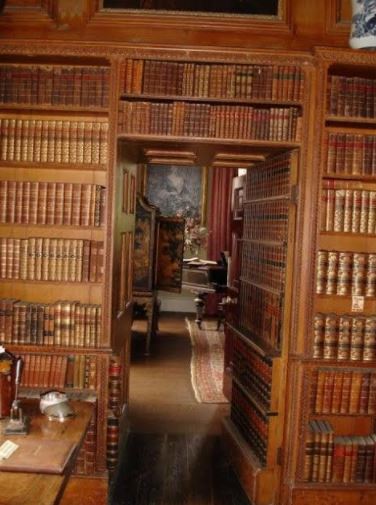
The snake swayed back and forth, beady eyes darting back and forth, as if there were other entities in the room and it was decided who to attack first. It filled me with a cold dread that ran deeper than fear, as if the devil himself had sent a dark and bloodthirsty messenger to my home. Its head was at least two feet off the floor, and there was who knew how much of its stilled coiled under the coffee table. I shrank back on the sofa. The snake burst through William’s throat with a loud roar. The snake hissed hideously, lashing its tail from side to side like a fresh-caught fish flopping on Long Wharf. Bjorn, the butler, heard the commotion and rushed into the parlor with Captain Henry Ware Lawton’s ’86 Winchester, shooting the snake again and again. Its tail flailed, jerking back and forth in a spray of glittering scales and blood. At Bjorn shot it one last time, the jerking stopped and the snake stiffened. For a second, it looked like it was levitating off the ground, all of its coiled muscular energy propelling itself into one final moment of life. And then it vanished. “My goodness, what happened in here?” Bjorn asked? “Oh, it was awful!” I sobbed. Zip leapt onto my lap and began licking my tear, and I heled him tight, weeping into his soft fur. “This snake just popped out of nowhere.” Bjorn jumped up, clasping his hands on his chest and darting away from me. At the other end of the room he stood and gazed, and then moved back slowly. “Then, after all—I wonder?” He held his eyes on me, half fearful and half reassured. “Could it be that this mansion is really haunted?” No,” I said slowly. #RandolphHarris 4 of 9
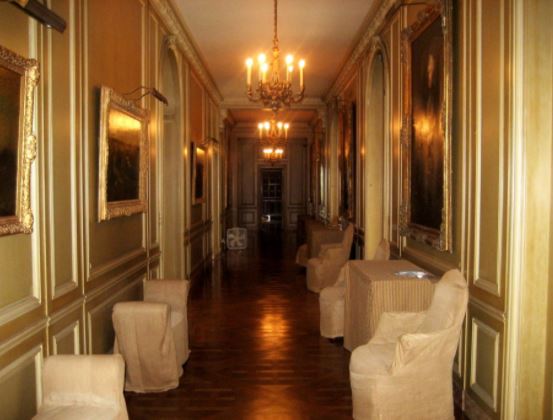
I walked through the huge vestibule and then into the peristyle and into the dining room. I beheld an amazing sight. My father-in-law, Oliver Winchester, was in full battle dress, armed with sword and dagger, lacking only his shield. He even wore his red cloak. His breastplate was polished and gleaming. He started at the floor and with reason. It had been dug up. The old Hearth from generations ago had been excavated. This had been the first room of this house that I started to remodel, and it was around this Hearth that the past owner and his family gathered, worshipped, and dined. I had never even seen it. There was a pattern, a texture of rectangular stones. It was a mosaic. There were slabs of decorated travertine, the kind you find in a cemetery. “What is God’s name is going on here?” I wondered. I was convinced that the ghost of my father-in-law was telling me this site was some kind of Pompeii waiting to be discovered. Lying in the pile of stones, there were several Roman funerary markers. Next to them was a marble altar decorated with rams’ heads and birds; one of the rams’ heads had been clipped, and the altar edges bore the fresh scars of a knife’s blade. Stumps of marble tombstones were strewn across what used to be my dining room. My heart sank. I could see small remnants of mosaics and terra-cotta urns. This was not just a small cluster of graves; it was extensive, probably composing four thousand or five thousand square feet of the main floor. In the center were the brick walls of what looked like a columbarium and other small mausoleum. Someone had sliced through a city of the dead. When I bought the house, it was an eighteen-room farmhouse, I had no idea what secrets it kept. #RandolphHarris 5 of 9
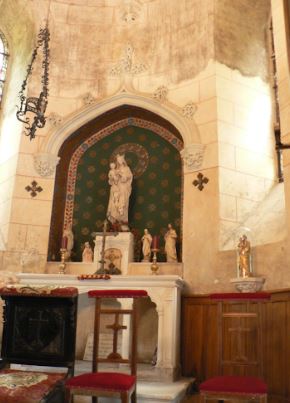
I remembered a similar discovery a few years earlier, as the construction workers were expanding the basement. The excavation hole was vast and deep and looked like the entry to hell. I later learned that we had dug into an ancient Roman villa, with frescoed paintings of birds, masks, and monsters. The artifacts were cleared out, cataloged, and stored in a museum on the estate that had long been forgotten. Then, there came a loud crash. The front door was being bashed in. My father-in-law wobbled as if he was fainting. He was white. Blood flowed and flowed from his wrists. His eyes rolled up into his head, and he vanished. I went to see what had become of my front door. Glancing through the thickening fall of the torrential rain, there was a melancholy man in black. He was wondering how such a house as mine came to be built. Explaining that there had been others like it, and that one Colonel Naglee, who had been murdered by the Indians, with all his family, once lived nearby. This tale was confirmed by the fact that the ruined cellars of several smaller houses were still to be discovered under the wild growth of the estate, and that the Communion plate of the moribund Episcopal church of Trinity Cathedral was engraved with the Colonel Naglee, who had given it to the church when it was consecrated in 1867. No other traces of the church remained. I never knew this place. My home seemed as far away from humanity. Miles were not the only distance. The man seeming satisfied turned into a gloomy mist and dissipated. It was not possible for any candle to keep fire. #RandolphHarris 6 of 9

I saw something in the mystical flash of the whole picture, and in a mad ray, the thing gripped me because it was so utterly unbelievable. All Christians believed the World would end soon. Preparing for this end of the World was the essence of religion. Blood flowed that night representing the Garden of Eden, Satan, and the magical presence of Christ’s blood having been poured into the chalice from the last supper. That night, I awoke to find a tall, hooded figure standing in the corner of the room. A full cowl threw the face into shadow; the arms were crossed over the chest. The creature’s hands were hidden in the deep folds of its garment. I was bloody scared because it was so real. I shouted at it, but it would not budge. It just stood there, even when I lit a candle. I figure if this man would not leave my sleeping chambers, I would. However, when I got to the landing, there it was again, standing at the bottom of the stairs. I did not know what to do. I ran back into my room and locked the door. The hooded entity demonstrated that doors and walls were no obstacles as it appeared at the foot of my bed again. I lie awake most of the night, a prisoner in my own bedroom. This druid did not want me to leave the house. But eventually I dozed off. As daylight broke at the window, I knew something was wrong. Little Zip was missing. I cursed myself for falling asleep. Trembling, I left the bed. The door was still locked. I hardly dared to think about what I might find outside. Refusing to accept the possibility that my dog could be lost to me. #RandolphHarris 7 of 9

However, Zip was safe. He lay fast asleep, curled up on the stairs. And demons also came out, many of them. From place to place, and from one room to another. Spirits came out of the walls. It was as if I was being transported back three thousand years into the days of old religion. There were bodies arranged on the floor as if they had taken part in some ancient ritual. The dark secrets of my mansion were almost as enchanting as was the glimpse of ancient cult rituals, which played out on their own. Horned monsters appeared, with glistening green eyes and blood and smoke exuding from their nostrils and fanged mouths. Sounds of mooing, hoof beats and cowbells made my ears bleed. Soon after all these hauntings, public lighting was introduced. Many were able to grasp the gas lamps of my estate, this arc lighting brought virtual daylight to my home, gardens. Later, the miracle of electricity penetrated my home, as well as other public places. With it, came the brilliance of the sun into cottages and palaces alike. The advances in lighting had affected the behaviour and the minds of people. The planet had been transformed by lighting. Yet, these times were still perfect for ghost, they had new sources of energy to feed off of and it was as if they became even more active. Being confused by light during the darkest nights, they started to come out in the daylight and cause even more of a fright. However, they still preferred the night, where they could hide in the shadows. The Winchester Mansion’s Demons still wanted fresh blood. And got what it wanted. I was truly frighted of all these new souls it was acquiring. I discovered the heart of superstition in myself. #RandolphHarris 8 of 9

To those who believe in them, a demon is an evil spirit. Demons are not a new idea. Stories of demons have been around for thousands of years. Early paintings and folklore show images and tell stories of demon possession. The word “demon” comes from the ancient Greek word daimon. It means “full of wisdom.” The idea of being possessed calls frightening visions to mind. However, not all possessions have been seen as negative. In ancient times, people believed being possessed by good spirits caused divine visions. Some people claimed to become possessed so spirits could speak through them. More than 3,000 years ago, the Greeks built the shrine of Delphi. The Greek built Delphi around a spring they thought was the center of the World. A priestess, called an oracle, lived at the shrine. People traveled great distances to visit the Oracle at Delphi. They believed she could get information from the spirit World. She answered people’s questions about the future. For thousands of years, people have believed that crystals held special psychic powers. Between AD 500 and 1500, the crystal ball became a popular tool for fortune-telling in European countries. Fortune-tellers would gaze into crystal balls and claim to see visions. In the visions, fortune-tellers said they received information about a person’s past, present, or future. Some people continue to seek guidance from the spirit World Mediums and psychics are people who claim to have knowledge of the spirit World. Some claim to know hidden information about you or your life’s path. It is estimated that The Winchester Manson once contained 500 to 600 rooms, but because so many were redone, only 160 remain. This naturally resulted in some peculiar effects, such as stairs that lead to the ceiling, doors that go nowhere and that opened onto walls, and chimneys that stop just short of the roof! #RandolphHarris 9 of 9


 Randolph Harris II International Institute