
Home » #RandolphHarris (Page 40)
Category Archives: #RandolphHarris

The Hopeful and the Despairing Heart

The scream tore through the house. I rose to find the sky uncommonly clear and full of visible stars. A good omen for Llanada Villa. On the desk in the library, I was astonished to see an ancient book, more of a handwritten codex, with brilliant illustrations on its wooden cover. Carefully lifting the pages, which were bound by three different ties of human skin made into thong, the very first page revealed several magic spells, written in faded but clearly visible and very crowded Latin script. It was as old a book of magic as I have ever beheld, and of course its claim—the claim of its title page—was to the very earliest of all black arts ever known since the Fall of Man. I was more than familiar with the legends surrounding vampires and the tale of the Watcher Angels who lay with woman, and taught magic to the Daughters of Men, as so the Book of Genesis states. However, the most important sentences were as follows: “It was a belief very strongly and generally held by the ancients—of whose wisdom in these matters I have had such experience as induces me to place confidence in their assertions—that by enacting certain processes, which to us moderns have something of a barbaric complexion, a very remarkable enlightenment of the spiritual faculties in man may be attained: that, for example, by absorbing the personalities of a certain number of one’s fellow-creatures, an individual may gain a complete ascendancy over those orders of spiritual beings which control the elemental forces of our universe. It is recorded of Adam that he was able to fly in the air, to become invisible, or to assume any form he pleased, by the agency of the soul of a boy whom he had ‘murdered.’” #RandolphHarris 1 of 6
“Similar happy results may be produced by the absorption of the hearts of not less than three human beings blow the age of twenty-one years. The best means of effecting the required absorption is to remove the heart from the living subject, to reduce it to ashes, and to mingle them with a pint of some red wine, preferably port. The remains of the first two subjects, at least, it will be well to conceal: a disused wine-cellar will be found convenient for such a purpose. Some annoyance may be experienced from the psychic portion of the subjects, which popular language dignifies with the of ghosts. However, the man of philosophic temperament—to whom alone the experiment is appropriate—will be little prone to attach importance to the feeble efforts of these beings to wreck their vengeance on him. I contemplate with the liveliest satisfaction the enlarged and emancipated existence which the experiment, if successful, will confer; not only placing one beyond the reach of human justice (so-called), but eliminating to a great extent the prospect of death itself.” Frightened by the pages that had just been translated, I no longer wanted to fear the torment of those words. I could not believe such words had been written. Deep in the bowels of my mansion are dungeons. I supposed I could burry the codex there and no one would ever discover it, nor attempt the experiments mentioned in the ancient text. However, after reaching the dreadful dungeon, a creature abhorrent to the eyes, was found, his head thrown back, his face stamped with an expression of rage, fright, and mortal pain. #RandolphHarris 2 of 6
To my surprise, it was my butler, Josef Schwalber. In his left side was a terrible lacerated wound, exposing the heart. There was no blood on his hands, and a long knife that lay on the table was perfectly clean. A savage wild-dog might have inflicted the injuries. The window of the dungeon was open, and it was the opinion of the Detective Kasberger, that Mr. Schwalber had met his death by the agency of some wild creature. However, after study of the codex, I am led to a very different conclusion. The next morning while I was drinking my coffee and eating my panini (always very flaky and powdery like in Italy), I had the servants sweep the spiders out of the Bath House at the far end of the formal garden (it is said to have been built by the Byzantines). The transformation is quite bewildering. A team of seamstresses had to work day and night for 48 hours, in in the fairy tales, to create my new impracticable dress. Nevertheless, I had quite enough dresses already even if it were the Pope and his cardinals who were going to entertain me. I have learned from experience that new dresses are more often than not thoroughly disappointing. I keep remind myself of that, but I needed to forget about what transpired last evening. But I can say no more than I had said already. Everything that I can remember, I have told with perfect candour. Nothing has been distorted or concealed, and if anything remains vague, it is only because of the dark cloud which has come over my mind—that cloud and the nebulous nature of the horrors which brought it upon me. #RandolphHarris 3 of 6

Vision or nightmare it may have been—vision or nightmare I fervently hope it was—yet it is all that my mind retains of what took place in those shocking hours after I went into the dungeon. It saddens me that Mr. Schwalber had gotten into my vast collections of strange, rare books on forbidden subjects, which many are written in languages that I master; but there are some with those in languages I cannot understand. I remembered how I shuddered at his facial expression on the night before the awful happening, when he talked so incessantly of his theory, why certain corpses never decay, but rest firm and fat in their tombs for a thousand years. Certainly it had something to do with the ancient book in undecipherable characters Mr. Schwalber left on my desk in the library. The picture seared into my soul is of one scene only, and the hour must have been long after midnight; for a waning crescent moon was high in the vaporous Heavens. I have been thinking on and off all day about the differences between the ways we are supposed to behave and the ways we actually do behave. And both are different from the ways in which God calls upon us to behave, and which we can never achieve whatever we do and however hard we apply ourselves. I am so friendless and alone in this alien land. It occurs to me that I must have great inner strength to bear up as I do and to fulfill my duties with so little complaint. The portrait, at the beginning of the beautifully engraved codex, I have begun to feat that I shall see that face looking over my shoulder as I sit gazing into the looking glass. I live on a spiritual plane and desire only the sweet and stimulating companionship of my husband. #RandolphHarris 4 of 6

Small pleasures seemed greater for having been snatched in the shadow of wretchedness. I have been subjected to a fate I fear more than the slowest tortures. My life has become filled with gore and grue, ghosts and ghouls and ghastly events, and I must confess I am impartial to such entertainments. The servants show me stains on the wall and tell me it is the blood of a murdered innocent killed by the Winchester Rifle fifty years before: no amount of washing will ever remove that stain, they tell me in sepulchral tones, and indeed it deepens and darkens on a certain day of the year, the anniversary of the violent passing. One is expected to nod gravely, of course, and one does, if one wishes. Back in the eleventh century, you will be apprised, a battalion of foreign invaders were vanquished by the skeletons of long-dead patriots who arose from their tombs to defend their homeland and then returned to the Earth when the enemy had been driven from their borders. (And since the servants are able to show you the very graves of these lively bones, how can one disbelieve them?) The servants have pointed to the Observational Tower and told me of a spectral tyrant who, a scant dozen years before, is suspected of having died from poisoning. My silver used to be store in the part of the tower where she is seen, and a footman was employed to sleep here and guard it. One night, when the footman had turned in to sleep, he was approached by a very pale-looking lady in white who asked him for some water. Think it was one of the mansion’s guests, he turned to get her some when he remembered he was locked in and no visitor could have possibly entered. When he turned back, the apparition had disappeared. It is thought that her longing for water suggest that she was poisoned. #RandolphHarris 5 of 6

Beside the Grand Ball Room, the voices of two men are often heard talking although no one can make out what they are talking about. If one makes an effort to trace them, they stop talking suggesting that whoever the ghosts are, they are aware of what is going on around them. Servants have also reported having their hair pulled, arms scratched, and even being bitten by unseen assailants while in the dark of its mahogany walls and corridors. I am cursed by Lucifer, they say, suffering the tortures. From the day, I wish the ghost would not strike terror to my soul and stop filling my heart with but paltry pity. Still, I have journeyed in foreign countries, and I long for peace at Llanada Villa. Amorphous shadows seem to lurk in the darker recesses of the mansion and to flit as in some blasphemous ceremonial procession past the portals of the catacombs; shadows which could not have been cast by a trick of light. These things are too utterly beyond thought—I dare not tell a soul—no one could know it and live—Great God! I never dreamed of THIS! Around me there are ghost and the darkness and the shadows; below me, some peril beyond the radius of the human imagination. Curse these hellish things—legions—My God! Beat it! Beat it! Beat it! After that was silence. I know not how many interminable aeons I sat stupefied; whispering, muttering, calling, screaming into the Heavens. Over and over again through those aeons I whispered and muttered, called, shouted, and screamed, “William! William! Answer me—are you there?” And then there came to me the crowing horror of all—the unbelievable, unthinkable, almost unmentionable thing. I watched amorphous, necrophagous shadows dance beneath my silver German chandelier. And this is what it said: “YOU FOOL, WILLIAM IS DEAD!” #RandolphHarris 6 of 6


You have fallen into a time loop and cannot get out. Most paranormal accounts of hauntings fall into the realm of the residual. A cacophony of footsteps, knocking on the walls, music playing by unseen hands, and even smells repeat themselves when the time—and audience—is right. There is no actual ghost interacting during a residual haunting—you have simply stepped into a memory and gotten a bit on your soul. Some objects seem to react to certain dates, such as anniversaries or a time of death, and we think that whatever is making it reach out and say, “YOU FOOL, WILLIAM IS DEAD!” is trapped within its own vortex. Demons can literally attach themselves to certain types of objects. And if a person happens to bring one of these cursed objects into their house, the demon can then start to attack the people who are living in the house as a result of them being attached to that object.

Curses petition the deities for rulings in a Heavenly court. Although it is not surprising, it is unfortunately common that tourists will try to steal artifacts from archaeological sites. What may be surprising is that the tourists have tried to steal relics or artifacts from the Winchester Mystery House, but often voluntarily return them or turn themselves in to the authorities. Some have sent notes apologizing for the theft, claiming that the artifacts are cursed. However, sometimes the thieves just regret their actions and feel guilty, but the Winchester Mystery House has received hundreds of packages through its one hundred years of tours of stolen antiques, as the accompanying letters would say, those objects were responsible for harm to the relic thieves and their families. Some people have even donated things it hopes that the spirits of The Winchester Mystery House would save their lives. Could such curses be real? It seems more believable, perhaps, for objects once owned by Sarah L. Winchester, to be cursed. It adds to the mystery and mystique of the Winchester Mystery House. However, many people have claimed that everyday objects harbour negative energies, including decorative items, paintings, dolls, jewelry, and even a set of Mercedes Benz automobiles!

For further information about tours, including group tours, weddings, school events, birthday party packages, facility rentals, and special events please visit the website: https://winchestermysteryhouse.com/
Please visit the online giftshop, and purchase a gift for friends and relatives as well as a special memento of The Winchester Mystery House. A variety of souvenirs and gifts are available to purchase. https://shopwinchestermysteryhouse.com/

Why this Symptom? Why Now?

After World War I, psychosomatic practitioners tended to be critical of more mainstream medicine, finding fault with that they perceived as an overly reductionist attitude among fellow physicians, one that failed to treat patients as whole beings, body and soul. Psychosomatic doctors rejected narrowly natural-scientific ideas about illness and disability and sought, along side science, to engage in questions of meaning. They placed patients’ biographies and social environment at the center of their treatment and philosophy. Neurologist Viktor von Weizsacher’s teacher and mentor Ludolf von Krehl believed that healing required knowing a patient’s “entire nature.” Dr. Von Krehl declared himself to be no “mystic,” and “also no occultists or such. But what is spirit is spirit,” he said, “and a human being is a totality, spirit, and body.” Dr. Von Weizsacher was much influenced by these ideas, believing that on had to contemplate seriously not just the appearance of disease or organ dysfunction but also its symbolic aspects. He listened to the stories his patients told for clues about the meanings of their troubles. From their life stories, he wrote “pathosophies”—narratives that analyzed aspects of his patients’ lives to unlock hidden significance about their ailments. Rather than asking his patients “What seems to be the trouble?” Dr. Von Weizacker asked, in a way a psychoanalyst might, “Why this symptom? Why now?” It was believed that if medicine had failed patients, the reason was because they were treating their bodies like failing machines while neglecting their souls. #RandolphHarris 1 of 20

Medicine’s psychosomatic transformation toward a more holistic approach to treatment that would take people’s inner lives and life experiences into account was deemed to be more beneficial. This would help to restore trust. Why trust had to be restored—the recent history of forced sterilizations and “mercy killings” of those with disabilities. Through experimentation and observation, German doctors believed that a damaged soul could make the body ill. Patients were also asked how they perceived their bodily sensations. Many patients were spiritually disoriented. They saw “no way out,” felt terribly lonely, thought of suicide, and had “no one in whom they could confide.” One patient described his wife as herzkrank—heartsick—after losing their daughter. Another woman described how her daughter had been raped eight times, had been sick ever since, and no longer wanted to ea. For most doctors in 1949, unless there was an “organic basis” for illness, that illness did not exist. When patients complained of pain for which no manifestly physical cause could be located, doctors sought other explanations. Not unlike the problem of chronic pain in our own day, these explanations could cast a shadow on the sufferer’s moral constitution, suggest a family taint, or hint at a lack of personal integrity. Perhaps the patient was a malingerer, angling for a disability check, or lacked the fortitude or individual strength of character to overcome hard times. Perhaps the patient was too sensitive or weak-willed, or there had already been something wrong with him or her. #RandolphHarris 2 of 20

Doctor’s who practiced psychosomatic medicine believed that these were not phantom ailments: they were manifestly physical maladies with origins in the soul. Individual stories of distress of mass fate; nights under falling bombs, flight and hunger, fallen fathers, fallen sons, assaults and rape. Psychosomatic illness had become the epidemic of war time. They also revealed the history of German suffering. People whose limps suddenly refused to move, or who had stomach ailments, or whose children’s kidneys were failing—these were the products not so much of individual experience but of the nation’s collective fate. They were reactions to the extraordinary burdens that had been the yield of the events of the wars. However, prominent doctors argued that suffering and ill people should not be coddled, but learn to tolerate pain with equanimity. During the war, the remedy prescribed for terrible experiences was not talk, but hard and uncomplaining work. Hard work, that is, and silence. A psychological study conducted in 1944 with people who related their symptoms of illness to experiences in the wartime air raids cautioned that talking about feelings could lead to depression. A culture of silence, in other words, was not only a generalized social imperative born of taboos surrounding Nazism and the war, it was an authoritative medical recommendation because an unseen World of pain and illness, previously confined to the privacy of the home and family, had become increasingly revealed. Every house in Germany was a hospital. #RandolphHarris 3 of 20

Dr. Freud considered character as the relatively stable manifestation of various kinds of libidinous strivings, that is, of psychic energy directed to certain goals and stemming from certain sources. In his concepts of the oral, anal, and genital characters, Dr. Freud presented a new model of human character which explained behaviour as the outcome of distinct passionate strivings; Dr. Freud assumed that the direction and intensity of these strivings was the result of early childhood experiences in relation to the “erogenous zones” (mouth, anus, genitals), and aside from constitutional elements the behaviour of parents was mainly responsible for the libido development. The concept of social character refers to the matrix of the character structure common to a group. It assumes that the fundamental factor in the formation of the social character is the practice of life as it is constituted by the mode of production and the resulting social stratification. The social character is that particular structure of psychic energy which is molded by any given society so as to be useful for the functioning of that particular society. The average person must want to do what one has to do in order to function in a way that permits society to use one’s energies for its purposes. Humans’ energy appears in the social process only partly as simple physical energy (labourers tilling the soil or building roads) and partly in specific forms of psychic energy. A member of a primitive people, living from assaulting and robbing other tribes, must have the character of a warrior, with a passion for war, killing, and robbing. The members of a peaceful, agricultural tribe must have an inclination for cooperation as against violence #RandolphHarris 4 of 20

Only if its members have a striving for submission to authority, and respect and admiration for those who are their superiors, does feudal society function well. Capitalism functions only with men who are eager to work, who are disciplined and punctual, whose main interest is monetary gain, and whose main principle in life is profit as a result of production and exchange. In the nineteenth century capitalism needed men who liked to save; in the first quarter of the twenty-first century, it needs men and women who are passionately interested in spending and consuming. The social character is the form in which human energy is molded for its use as a productive force in the social process. The social character is reinforced by all the instruments of influence available to a society—its educational system, its religion, its literature, its songs, its jokes, its customs, and most of all, its parents’ methods of bringing up their children. This last is so important because the character structure of individuals is formed to a considerable extent in the first five or six years of their lives. However, the influence of the parents is not essentially an individual or accidental one, as classic psychoanalysts believe. The parents are primarily the agents of society, both through their own characters and through their educational methods; they differ from each other only to a small degree, and these differences usually do not diminish their influence in creating the socially desirable matrix of the social character. #RandolphHarris 5 of 20

A condition for the formulation of the concept of the social character as being molded by the practice of life in any given society was a revision of Dr. Freud’s libido theory, which is the basis for his concept of character. The libido theory is rooted in the mechanistic concept of humans as machines, with the libido (aside from the drive for self-preservation) as the energy source, governed by the “pleasure principle,” the reduction of increased libidinal tension to its normal level. In contrast to this concept, various strivings of man, who is primarily a social being, develop as a result of one’s need for “assimilation” (of things) and “socialization” (with people), and that the forms of assimilation and socialization that constitute their main passions depend on the social structure in which one exists. Humans in this concept are seen as characterized by their passionate strivings toward objects—men, women, and nature—and their need of relating themselves to the World. The concept of the social character answers important questions which were not dealt with adequately in Marxist theory. If their reason tells them that their allegiance to it is harmful to them, why is it that a society succeeds in gaining the allegiance of most of its members, even when they suffer under the system? Why has their real interest as human beings not outweighed their functions interests produced by all kinds of ideological influences and social engineering? Why has consciousness of their class situation and of the advantage of socialism not been as effective as Mr. Marx believed it would be. Because of the phenomenon of the social character. #RandolphHarris 6 of 20

Once a society has succeeded in molding the character structure of the average person in such a way that one likes to do that which one has to do, one is satisfied with the very condition that society imposes upon one. As one of Ibsen’s characters once said, “He can do anything he wants to do because he wants only what he can do.” Needless to say, a social character which is, for instance, satisfied with submission is a crippled character. However, crippled or not, it serves the purpose of a society requiring submissive men and women for its proper function. The concept of social character also serves to explain the link between the material basis of a society and the “ideological superstructure.” Mr. Marx has often been interpreted as imply that the ideological superstructure was nothing but the reflection of the economic basis. This interpretation is not correct; but the fact is that in Mr. Marx’s theory the nature of the relation between basis and superstructure was not sufficiently explained. A dynamic psychological theory can show that society produces the social character, and that the social character tends to produce and to hold onto ideas and ideologies which fit it and are nourished by it. However, it is not only the economic basis which creates a certain social character which, in turn, creates certain ideas. The ideas, once created, also influence the social character and, indirectly, the socioeconomic structure. The social character is the intermediary between the socioeconomic structure and the ideas and ideals prevalent in a society. It is the intermediary in both directions, from the economic basis to the ideas and from the ideas to the economic basis. #RandolphHarris 7 of 20

The concept of social character can explain how human energy, like any other raw material, is used by a society for the needs and purposes of that society. Humans, in fact, are one of the most pliable natural forces; they can be made to serve almost any purpose; they can be made to hate or to cooperate, to submit or to stand up, to enjoy suffering or happiness. While all this is true, it is also true that humans can solve the problem of their existence only by the full unfolding of their human powers. The more crippled a society makes a human, the more sicker one becomes, even though consciously one may be satisfied with one’s lot. However, unconsciously one is dissatisfied; and this very dissatisfaction is the element which clines one eventually to change the social forms that cripple one. If one cannot do this, one’s particular kind of pathogenic society will die out. Social change and revolution are caused not only by new productive forces which conflict with older forms of social organization, but also by the conflict between inhuman social conditions and unalterable human needs. One can do almost anything to humans, yet only almost. The history of man’s fight for freedom is the most telling manifestation of this principle. In recent decades “conscience” has lost much of its significance. It seems as though neither external nor internal authorities play any prominent role in the individual’s life. If only one does not interfere with other people’s legitimate claims, then is everybody is completely “free.” However, what we find is rather that instead of disappearing, authority has made itself invisible. #RandolphHarris 8 of 20

Instead of overt authority, “anonymous” authority reigns. It is disguised as common sense, science, psychic health, normality, public opinion. It does not demand anything except the self-evident. It seems to use no pressure but only mild persuasion. Whether a mother says to her daughter, “I know you will not like to go out with that boy,” or an advertisement suggest “Drink the brand of premium cranberry juice—you will like its coolness,” it has the same atmosphere of subtle suggestion which actually pervades our whole social life. Anonymous authority is more effective than overt authority, since one never suspects that there is any order which one is expected to follow. In external authority it is clear that there is an order and who gives it; one can fight against the authority, and in this fight personal independence and moral courage can develop. However, whereas internalized authority the common, though an internal one, remains visible, in anonymous authority both command and commander have become invisible. It is like being fired at by an invisible enemy. There is nobody and nothing to fight back against. The most important aspect of the authoritarian character is the attitude towards power. For the authoritarian character there exists, so to speak, two genders: the powerful ones and the powerless ones. One’s love, admiration and readiness for submission are automatically aroused by power, whether of a person or of an institution. Power fascinates one not for any values for which a specific power may stand, but just because it is power. Just as his “love” is automatically aroused by power, so powerless people or institutions automatically arouses one’s contempt. #RandolphHarris 9 of 20

The very sight of a powerless person makes one want to attack, dominate, humiliate one. Whereas a different kind of character is appalled by the idea of attacking one who is helpless, the authoritarian character feels the more aroused the more helpless one’s object has become. There is one feature of the authoritarian character which has mislead many observers: a tendency to defy authority and to resent any kind of influence from “above.” Sometimes this defiance overshadows the whole picture and the submissive tendencies are in the background. This type of person will constantly rebel against any kind of authority, even one that actually furthers one’s interest and has no elements of suppression. Sometimes the attitude toward authority is divided. Such persons might fight against one set of authorities, especially if they are disappointed by its lack of power, and at the same time or later on submit to another set of authorities which through greater power or greater promises seems to fulfill their masochistic longings. Finally, there is a type in which the rebellious tendencies are completely repressed and come to the surface only when conscious control is weakened; or they can be recognized ex posteriori, in the hatred that arises against an authority when its power is weakened and when it begins to totter. In persons of the first type in whom the rebellious attitude is the center of the picture, one is easily led to believe that their character structure is just the opposite to that of the submissive masochistic type. It appears as if they are persons who oppose every authority on the basis of an extreme degree of independence. They look like persons who, on the basis of their inner strength and integrity, fight those forces that block their freedom and independence. #RandolphHarris 10 of 20

However, the authoritarian character’s fight against authority is essentially defiance. It is an attempt to assert oneself and to overcome one’s feeling of powerlessness by fighting authority, although the longing for submission remains present, whether consciously or unconsciously. The authoritarian character is never a “revolutionary”; I should like to call one a “rebel.” There are many individuals and political movements that are puzzling to the superficial observer because of what seems to be an inexplicable change from “radicalism” to extreme authoritarianism. Psychologically, these people are the typical “rebels.” The end of the terror—the most obvious new factor by which Khruschevism is distinguished from Stalinism is the liquidation of the terror. If terror was necessary in a system where the masses had to work hard without getting any corresponding material satisfaction, it could be diminished once the workers could begin to enjoy the fruits of their labour and could hope for increasing enjoyment. Mr. Stalin’s successors were also sufficiently traumatized themselves by the crazy terror which he had exercised during his last years and which daily threatened each one of the top leaders with extinction. A psychological phenomenon, similar to that in France before the fall of Robespierre, probably existed in the Russian top leadership which led, together with the reasons first mentioned, to the decision to liquidate the terror. All reports from Russian confirm that the system of terror has ceased to exist. The slave labour camps which were not only institutions of terror but also a source of inexpensive labor under Mr. Stalin were dissolved. Arbitrary arrests and punishments were abolished. #RandolphHarris 11 of 20

The Khruschev state might be compared with a reactionary police stat of the nineteenth century as far as political freedom is concerned, perhaps not too different from the Czarist system. Yet this comparison would be misleading; not only because of the obvious differences in the economic structure of the two systems but also because of another and more complex factor. Political freedom comes up as a manifest problem only when there is considerable dissent within the fundamental structure of a given society. In the Czarist system, the majority of the population—peasants, workers, the middle class—were in opposition to the system, and the system took oppressive measures to insure its own existence. On the other hand, there is a reason to assume that the Khruschev system has succeeded in ensuring the allegiance of the majority of the Soviet population. It has done this partly by the real economic satisfactions it provides at present and the reasonable hope for far greater improvements in the future and partly by its success in the ideological manipulation of people’s minds. From all reports it seems fairly clear that the average Russian is convinced that his system worked reasonably well, looked forward to a better future, enjoyed the possibilities for more education and amusement, and was mainly afraid of one thing—war. When one criticized the system one criticized details of its operation, bureaucratic stupidities, and the shoddy quality of consumer goods, but not the Soviet systems as such. One certainly did not think of substituting the capitalist system for it. #RandolphHarris 12 of 20

No doubt under Mr. Stalin’s terror the situation was quite different. The ruthless arbitrariness of the terror threatened everyone, high or low, with prison or physical extinction, not only as a result of making mistakes, but as a consequence of denunciations, intrigues, et cetera. However, this terror has gone and things are different. The average American misjudges the Russian situation by putting oneself in the role of an anti-Communist within Russia, and considering the degree to which expression of one’s opinion would be discouraged. One forgets that, apart from writers and social scientists who might be prone to criticize the system, the average Russian feels little of such an urge. Hence the problem of political freedom is by far less real for one than it appears from the American perspective. (The average Russian might feel similarly to the average American if, picturing oneself as a Communist, one considered the restrictions and hazards one would face in the United States of America.) All this does not alter the fact that Khruschev’s Russian is a police state with much less freedom to dissent and to criticize the government and majority opinion than there is within the Western democracies. Furthermore, after many years of unrestricted terror, it will take years to dispell the residue of fear and intimidation created by terror. Yet, when all is considered, the net result if that Khrushchevism marks a considerable improvement over the Stalinist era as far as political freedom is concerned. Closely related to the disappearance of the terror system is also a change in the nature of the method of leadership in Russia. #RandolphHarris 13 of 20

Mr. Stalin’s rule was a one-man rule, without any serious consultation with collaborators and anything that in the broadest sense could be called discussion or majority rule. It is clear that such a one-man regime needed a terror-force by which the dictator could strike at any person who dared to oppose one. With the execution of Beria, the power of the terrorist state police was considerably restricted and none of the Russian leaders since Mr. Stalin’s death has assumed a dictatorial position that could be compared with that of Stalin. It appears that the leader, whoever he is, has to convince the top echelon in the party of the correctness of his views, and that there is something like discussion and majority rule in the ruling committee. All events in the last few years of Mr. Khruschev’s rule had to defend his policy against opponents, that he had to show successes in order to maintain himself on top, and that he was in some ways in a position not too different from that of a statesman in the West, whose continued political failures would lead to his political disappearance. The attitude of the authoritarian character toward life, one’s whole philosophy, is determined by one’s emotional strivings. The authoritarian character loves those conditions that limit human freedom, one loves being submitted to fate. It depends on one’s social position what “fate” means to one. For a solider it may mean the will or whim of one’s superior, to which one gladly submits. For the small businessperson, the economic laws are one’s fate. Crisis and prosperity to one are not social phenomena which might be changed by human activity, but the expression of a higher power to which one has to submit. For those on the top of the pyramid it is basically not different. The difference lies only in the size and generality of the power to which one submits, not in the feeling of dependence as such. #RandolphHarris 14 of 20

Economic theorists have always recognized the importance of secure property rights in creating the right incentives to produce and to invest. This has been critical to the rise of Western European economies. Students of less-developed countries (LCDs) and transition economies reinforce this lesson. They also show how insecure property rights remain in many countries. The threats to property rights come from two broad classes of predators. Other individual may encroach on one’s property, may extort money by making threats of damaging property, or may steal the property outright; a weak state maybe unable to deter or prevent such actions. Even worse, the state itself or its agents may engage in extortion of private property to further their own objectives, whether they be wasteful public monuments and displays, aggression against other states, or simple person consumption. Faced with such threats, individuals will be deterred from production and investment, but will also attempt to take some countermeasures to preserve their property. Property rights over assets consist of: control—decision about them; entitlement to income produced by them; alienation—selling one or both of the control or income rights, fully or partially, to someone else. All of these are subject to formal or informal constraints. Control rights can be leased or sold under contracts, but where contracts are incomplete, the unspecified or residual rights remain with the owner. Income rights are often shared with other stakeholders under various social norms, terms or covenants in a higher-level contract, general laws, et cetera; some control right may also be similarly shared. #RandolphHarris 15 of 20

And sales are also subject to similar constraints, such as covenants restricting what homeowner can and cannot do to the exterior of their homes, to fences and yards, and on. Much academic discussion of the principle of an administration, while admirably giving increasing emphasis to participation by personnel, tends to overlook the probably much more important matter of participation by clientele. Indeed, some of the academic discussion seem to take for granted that participation by the clientele is impossible, that at best the clientele may consume the services of the agency, and these services are related directly to their preconceived wants. By some administrators and writers on administration, however, it is well understood that the benefits of participation by the clientele of an agency overweighs the hazards. The existence of an alert, informed, interested clientele may expose the inept administrator to observation and correction that one would escape if it were more apathetic; on the other hand, a favourable public goes far to assure the success of a program. The attempt to evoke such a favourable response from its clientele often leads agency administrators into unilateral forms of publicity, public relations, and propaganda. A free flow of valid information is rightly to be desired. A system of interim progress reporting, for the clientele as well as the personnel, is indispensable to optimum co-ordination and motivation in democratic planning agencies. Nevertheless, the practice of unilateral public relations is currently probably justly a little suspect. It produces far fewer results than might be supposed from its analogy to commercial advertising. #RandolphHarris 16 of 20

Though it will be granted by many that public relations will not take the place of participation by an agency’s clientele, some continue to rely upon public relations as a means of obtaining participation. That is, they exhort and cajole their clients to participate, or to feel a sense of participation, as if such a feeling could be induced by will power. Participation to deepen must commence with the definition of the problem, and carry through the debate of proposals and the adoption of policy. It is too late in the process of commence trying to evoke participation after everything is cut and dried. Countless instances can be cited to demonstrate people’s lack of enthusiasm for projects which have been fashioned and thrust on them by others. The best of intentions often go awry because of such methods. Let us suppose, however, that the public has participated fully in the first three phases, in defining the problem, debating the alternative solutions, and, at least through representatives, making the policy decision which launches a program for action. And for the clientele to participate in the conduct of the program. Is it then certain that their involvement will be high, with a resulting flow of effort and ingenuity, or initiative and responsibility? Unfortunately, this cannot be assumed. If participation in the planning process were deemed to go only as far as participation in the conduct of programs and no farther, it would soon dwindle into routine. #RandolphHarris 17 of 20

To the extent that participation of the clientele was voluntary, it would cease. The public would in a sense abdicate, becoming content to leave matters in the hands of the paid and delegated personnel of the agency, as long as they did not to greatly transgress routine expectations. This spectacle of public which is satisfied after setting up a program to leave it to be run by a few is familiar in agencies of all kinds. In the beginning of its existence an agency may enjoy a high degree of interests from its clientele; there is hope, energy, idealism, enthusiasm; but once a permanent personnel is established, all this often wanes. A crisis may seem to waken it again, but only ephemerally. The most persistent obstacle to continuing participation is an intangible one. For the baffling opponent is complacency, especially the sort of complacency which seems permitted if not justified by the tolerable success of an agency in meeting some routine minimum of performance. Some of the bitterest struggles of leadership can occur in the minds of leaders, as the same complacency infiltrates and begins to be felt as dull poisoning of their energy. It is then that the question arises, “Why not relax? Why not let things find a level routine? As long as no one is complaining, why is it not sufficient just to let things amble along as they have been?” A swarm of rationalizations can be found to justify such doubts about the desirability of continued progress, and to support the policy of simply mending troubles as they arise. The decline and failure of participation may this occur insidiously, from within, despite good will, as readily as from arbitrariness without. #RandolphHarris 18 of 20

Many believers are not even aware that they have a spirit. At the other extreme, however, some people imagine that every experience which takes place in the realm of their senses is spirit-based—or perhaps even directly “of the Spirit.” These believers consider everything which takes place in their inner life to be His working. In each of these cases the humans’ own spirit is left out of account. In the first instance, the believer’s religious life is, if we may say so, “spiritually mental,” that is, the mind is illuminated and enjoys spiritual truth, but what “spirit” means one does not clearly know. In the second instance the believer is really “soulish,” although one thinks one is spiritual. And in the case where the believer think that the Holy Spirit’s indwelling means every moment is of Him, one becomes dangerously open to the deception of evil spirits counterfeiting the Holy Spirit, because without discrimination one attributes all inner “movements” or experiences to Him. The conversion of an individual to one of the churches is a gradual process that finally ends in the ecstatic moment of Christian faith. Conversion is the transition from the latent stage of the Spiritual Community to its manifest stage. Thus it is relative, not absolute, conversion, for humans is never completely without faith, without an ultimate concern through which they participate in the Spiritual Community. The missionary and evangelistic efforts of the churches must take this fact into account. The lost sheep are never completely lost; the manifest church builds upon the latent church. #RandolphHarris 19 of 20

The Spiritual Community is a community of Spiritual personalities, of individuals determined by the Spiritual Presence in a state of faith and love. One is either grasped by the Spirit or one is not; there is no special status within the Spiritual Community. Everyone is a priest. However, for the sake of efficiency and orderly procedure, certain individual experts may be called to a regular and trained performance of priestly activities. Though the convert in one’s actual being is subject to the ambiguities of the churches, in one’s essential being one is a Spiritual personality, a participant in the Spiritual Community. This is situation is called the experience of the New Being. By experience, we mean the awareness of something that happens to somebody, namely, the state of being grasped by the Spiritual Presence. According to the three elements of salvation, the New Being is experienced as creative (Regeneration), as paradox (Justification), and as process (Sanctification). The stranger that sojourns with you, shall be unto you as the native among you, and you shall love one as you love yourself, for you were all strangers in the land of America. One law shall be among you, for the native and the stranger alike. If your fellowman become poor and one’s means fail, you shall uphold one. Harden not your heart to the needy in your midst, nor shut your hand to your needy brother; but open your hand unto one; and lend one sufficient for one’s needs. Behold how good and how pleasant it is when brethren dwell together in unity. Hate not your brother in your heart; love your neighbour as yourself. I pledge allegiance to the flag of the United States of America, and to the Republic, for which it stands, One Nation, Under God, with Liberty and Justice for all. And please donate to the Sacramento Fire Department, as they are not receiving all of their resources. #RandolphHarris 20 of 20


Ready to build your custom dream home?

Millhaven Homes have many windows that flood the home with natural light, allowing the owner to enjoy postcard picture views.

Soaring ceilings make your new home look and feel more open and spacious.

A custom-built home by Millhaven Homes provides buyers with that exquisite living experience one is seeking.

These trophy properties are built in highly coveted communities that provide peace, security, and privacy.

Some homes are even located on tree farms, allowing the homeowners to enjoy lush landscaping and a restort style estate which makes rest and relax a charm.

Millhaven Homes offers uncompromising quality making a Millhaven Home a truly remarkable find.
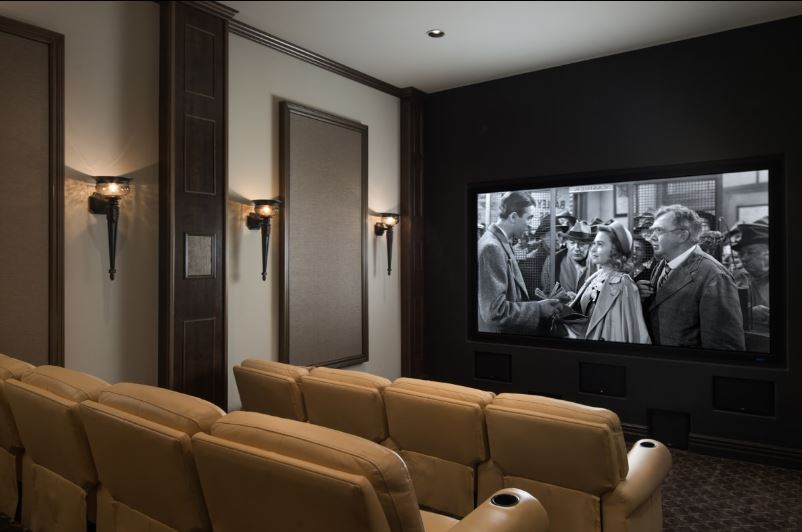
The outdoor living spaces, and options like an outdoor fireplace, make al-fresco dining an option year-round.

Get started today by telling us what you’re wanting and we can schedule an initial consultation. https://millhavenhomes.com/

It is Time to Investigate the Curse

During the Victorian era, too few physicians knew how to treat seelische illnesses, which literally meant illness “of the soul,” but depending on its context, could also mean spiritual, psychological, emotional, or mental. As a result, patients wandered without a cure from doctor to doctor and medications did nothing from them. Those deemed “fit,” that is, who had an Aryan racial identity, experienced freedom from hereditary disease, and an ability to work vigorously and produce. However, those regarded as biologically dangerous usually suffered from disability, and a range of illnesses or conditions that were inherited (or believed to be). My butler Frau Joest had been afflicted with stomach trouble and digestive complaints. As a rule, he kept to himself in his own pantry. One night, I asked him to grab a bottle of wine from the wine cellar, and he replied, “Mrs. Winchester, you may get your own wine, if you like, this evening. Either I do it in the daytime or not at all. I don’t know what it maybe: very like it’s the rats, or the wind got into the cellars; but I’m not so young as I was, and I can’t go through it as I have done.” “Well, Mr. Joest,” I replied, “you know it is a surprising place to find rats. “I’m not denying that, Mrs. Winchester; and, to be sure, many a time I’ve heard the tale from men in the shipyards about the rat that could speak. I never laid no confidence in that before; but tonight, if I’d demeaned myself to lay my ear to the door of the further bin, I could pretty have heard what they was saying.” “Oh, there Mr. Joest, I have no patience with your fancies! Rats talking in the wine-cellar indeed!” “Well, Mrs. Winchester, I’ve no wish to argue with you: all I say is, if you choose to go to the far bin, and lay your ear to the door, you may prove my words this minute.” #RandolphHarris 1 of 8

“What nonsense do you talk, Mr. Joest—not fit for children to listen to! Why, you’ll be frightening Mrs. Winchester there out of her wits,” replied Daisy. “Mrs. Winchester knows well enough when I’m playing a joke with her, Daisy,” he said. In fact, I knew much too well to suppose that Mr. Joest had in the first instance intended a joke. I was interested, not altogether pleasantly, in the situation; but all my questions were unsuccessful in inducing the butler to give any more detailed account of his experiences in the wine-cellar. We have now arrived at February 24, 1891. It was a day of curious experiences for Frau Joest: a windy, noisy day, which filled the house and the gardens with a restless impression. As Frau stood the gate of the grounds, and looked out into the park, he felt as if an endless procession of unseen people were sweeping past him on the wind, borne on resistlessly and aimlessly, vainly striving to stop themselves, to catch at something that might arrest their flight and bring them once again into contact with the living World of which they had formed a part. After luncheon that day I said, “Frau, my boy, do you think you could manage to come to me tonight as late as eight o’clock in my study? I shall be busy until that time, and I wish to show you something connected with your future life which it is most important that you should know. You are not to mention this to Daisy nor to anyone else in the house; and you had better go to your room at the usual time.” Here was a new excitement added to life: Frau eagerly grasped at the opportunity. He looked in at the library door on his way upstairs that evening, and saw written sheets of paper laying on the desk. #RandolphHarris 2 of 8

The wind had fallen, and there was a still night and a full moon. At about seven o’clock Frau was standing at the open window of his bedroom, looking out over the country. Still as the night was, the mysterious population of the distant moonlit woods was not yet lulled to rest. From time to times strange cries as of lost and despairing wanderers sounded from across the mere. They might be the notes of owls or water-birds, yet they did not quite resemble either sound. Were not they coming nearer? Now they sounded from the nearer side among the shrubberies. Then they ceased; but just as Frau was thinking of shutting the window and resuming his reading of Voyages to the Moon and Sun by Cyrano de Bergerac, he caught sight of two figure standing on the terrace that ran along the garden ide of the Mansion—the figures of two men, as it seemed; they stood side by side, looking up at the windows. Something in them inspired him with acute fear. One man stood still, half smiling, with his hands clasped over his heart, the other man, a thin shape, with black hair and ragged clothing, raised his arms in the air with an appearance of menace and of unappeasable hunger and longing. The moon shone upon hi almost transparent hands, and Frau saw that the nails were fearfully long and that the light shone through them. As he stood with his arms this raised, he disclosed a terrifying spectacle. On the left side of his chest there opened a black and gaping rent; and there fell upon Frau’s brain, rather than upon his ear, the impression of one of those hungry and desolate cries that he had heard resounding over the woods of The Winchester Mansion all that evening. In another moment this dreadful pair had moved swiftly and noiselessly over the terrace, and he saw them no more #RandolphHarris 3 of 8

Inexpressibly frightened as he was, he determined to take his candle and go down to my study, for the hour appointed for our meeting was near at hand. The library opened out of the front hall on one side, and Fraud, urged on by his terrors, did not take long in getting there. To effect an entrance was not so easy. The door was not locked, he felt sure, for the key was on the outside of it as usual. His repeated knocks produced no answer. Frau felt that the library was further than he realized—and his travel to it had taken him back in some vague realm or dimension outside our material Universe; some vague abyss out of which only the most accursed rites of human blasphemy could ever have called him for a moment. There was a brief silence, and in that pause the scattered senses of poor Frau Joest began to knit back into a sort of continuity; so that he put his hands to his head with a moan. Memory seemed to pick itself up where it had left off, and the horror of that sight on the terrace had prostrated him burst in upon him again. “Oh oh, my Gawds, that haff face—that haff face on top of it…that face with the red eyes an’ crinkly albino hair, an’ no…It was a octopus, centipede, spider kind o’ thing, but they was haff-shaped man’s face on top of it, an’ it looked like a wizard.” Crystallized into fresh terror, he paused, exhausted. It was—well, it was most likely a kind of force that does not belong in our World; a kind of force that acts and grows and shapes itself by other laws than those of our sort of Nature. We have no business calling in such things from outside, and only very wicked people and very wicked cults ever try to. There was something in my mansion—enough to make a devil and a precocious monster appear, and to make Frau’s passing out a pretty terrible sight. #RandolphHarris 4 of 8
Nature, meaning sometimes the forces and processes that produce everything according to the laws of nature (which include what we call physical laws), sometimes simply those laws, and sometimes all that nature produces—nature, after the Fall, did not wholly lose her original power to produce and control natural, perfect, ordered phenomena, any more than Satan lost all his original brightness on man all his power to reason or to intuit natural laws and God’s will. The other servants carried Frau to bed. After sitting by the fire for a few more hours, I found that I was colder than ever any my arms were quite stiff. However, I had to drag myself to my room and take off my clothes somehow, blow out the candles, and insinuate my tiny self into that enormous, frightening bed. I wished I had slept in a more cheerful room, with better furniture, though tonight I have succeeded in bringing to bed a bottle of mineral water and even a glass from which to drink it. It is only the Italian mineral water, of course. I only wish I were not so sensitive, so that the rooms in my home and other things did not matter so much. The water from my well was actually much more pure. On nights like this, and most particularly on nights when the moon is slim or cloud-enshrouded, it is a heavy blot upon the horizon, a shadow only, without feature save for its many-turreted outline; and should the moon be temporarily released from her cloudy confinement, her fugitive rays lend scant comfort, for they but serve to throw the mansion into sudden, startling chiaroscuro, its windows fleetingly assuming the appearance of sightless though all-seeing orbs, its portcullis becoming for an instant a gaping mouth, its entire form striking the physical and the mental eyes as would the sight of a giant skull. #RandolphHarris 5 of 8

I believe it is entirely possible for a man to possess not a single one of the virtues, to be a demon in human flesh. Frau’s actions seem to have become quite ghoulish. I often wondered had he not been responsible for robbing graves and then feeding upon the disgusting nourishment he found therein? Ghouls are by no means imaginary. A human being can sink into a truly monstrous man. To understand, one must transport their mind back a few years and to a rural region of New Haven. One must become acquainted with a family of country folk—hard-working, law-abiding, God-fearing, or moderate means—the head of which was a simple, good man named man named Alfred Dieck. When he died, it was his expressed wish that he would be buried with his gold and that his wife and sons were not to be told about it. Several weeks after his funeral, the family was desperate for money and Pastor Kuntz told his wife about the gold. The sons began making plans to exhume the dead man. However, the widow spoke firmly: “You father rests peacefully,” she said. “He must not be disturbed. If we disturbed him, no amount of gold would sooth our hearts.” The sons protested with vehemence, but the widow stood her ground. “No son of mine will profane his father’s grave—unless he first kills his mother!” Grumbling, those sons withdrew their plans. However, that night, Claus awoke to find his mother gone from the house. He was frightened, for this was not like her. Intuition sent him to the graveyard, where he found her, keeping a lonely vigil over the grave of her husband, protecting him from the greed of grave robbers. Claus implored her to come out of the cold, to return home; she at first refused; only when Claus offered to keep vigil all night himself did, she relent and return home, leaving her youngest son to guard the have from profanation. #RandolphHarris 6 of 8
Claus waited a full hour. Then he produced from under his shirt a small shovel. He was a strong boy, and the greed of a youngest son who has been deprived of inheritance lent added strength to his arms. He dug relentlessly, stopping seldom for rest, until finally the coffin was uncovered. He raised the creaking lid. An overpowering fetor filled his nostrils and nearly made him faint. Gathering courage, he searched the coffin. The moon proved to be his undoing. For suddenly its rays, hitherto hidden, struck the face of his father, and at the sight of that face, the boy recoiled and went reeling around the wall of the grave, the breath forced from his body. Now, you must know that the mere sight of the father—even in advanced state of decomposition—he had steeled himself to withstand; but what he had not foreseen—what he had not foreseen was that the face of his father, in the rigor of death, would look directly and hideously upon him. And most terrible and most unforeseen of all, the dead lips were drawn back from the teeth in a constant and soul-shattering smile! The remembrance of that night, though it is now many years past, fills me with dread. Fraud Joest was is that ghoulish son, Claus. When his sense returned, he ran out of the grave and ran as swiftly as his limbs would carry him. He reached the graveyard gate, and was smitten by the fact that he had not accomplished the purpose of his mission—the gold in the coffin. His terror notwithstanding, he halted, and forced himself to retrace those hasty steps. His fear notwithstanding, he descended once more into that noisome grave. He threw his father’s body out of the coffin and robbed him of his gold. But the true horror came when he reached him. He was stricken with stomach troubles and when he looked in the mirror, he screamed so loud as to wake the entire house. His face was a replica of his dead father’s: the lips drawn back in perpetual, mocking grin. He tried to close his mouth. He could not. The muscles were immoveable, as if held in the gelid rigor of death. He could hear his family’s stirring at his scream, and since he did not wish to look upon the, he ran from the house and came here, to Llanada Villa. #RandolphHarris 7 of 8

As he wandered the rural roads, his mind sought the cause of the affliction that had been visited upon him. Though but a country lad, he had read much and he had a blunt, rational mind that was not susceptible to the easy explanations of the supernatural. I would not believe that God had placed a malediction upon him to punish him for his act. He would not believe that some black force from beyond the grave had reached out to stamp his face. At length, he began to believe it was the massive shock that had forced his face to its present state, and that his great gilt had helped to shape it even as his father’s dead face was shaped. Shock and guilt: strong powers not from God above or the Fiend below, but from within his own breast, his own brain, his own soul. You need only know that, despite his blighted face, he stole the gold and thus gained an amount of money that would not seem large to me, but which was more than he had ever seen before that time. It was this gold that made him one of the richest men in New Haven. Naturally, he sought out physicians and begged them to restore his face to its previous state. None succeeded, though he offered them vast sums. His face remained fixed in that damnable unceasing smile, and his heart knew the most profound despair imaginable. He could not even pronounce his own name! God and Satan are very much alive. Though readily most people cannot fully explain all the mysteries of life. Spinning hears. Levitating bodies. Otherworldly strength. These are all curious things I have dealt with, here, at Llanada Villa. Gratuitous violence. Eerie voices spouting off vicious claims and threats. These are just some of the things that come with The Curse of the Winchester Fortune. Dozens of my servants are so horribly frightened or so confused that they begin to lose their grip on reality. We are not struggling with flesh and blood, but against the spiritual forces of evil. #RandolphHarris 8 of 8
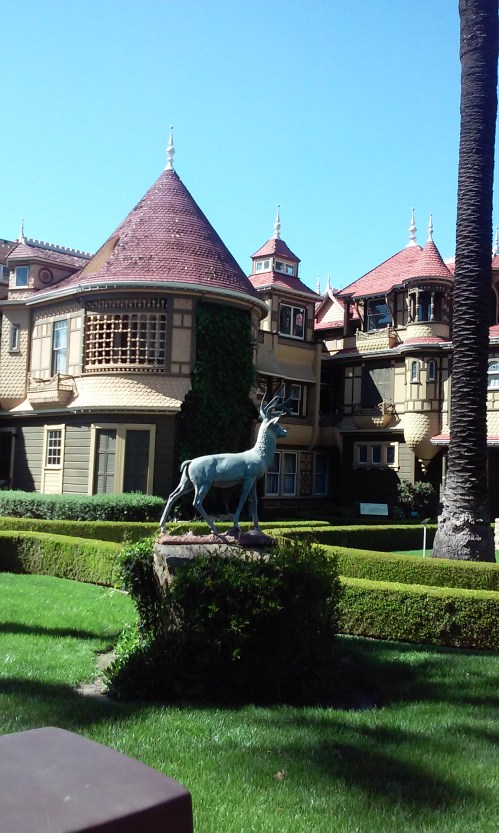
The Winchester Mystery House

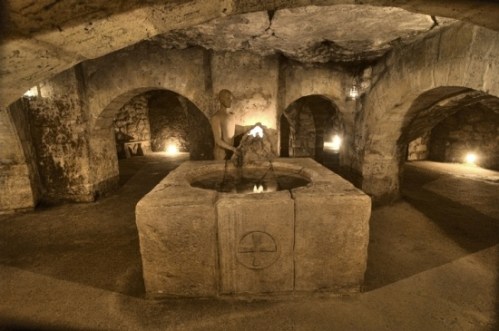
Devils and demons bring up frightening images and terrified thoughts. Mrs. Sarah L. Winchester was forced to look upon these objects of horror and live in fear. As we read tales of this haunted wine-cellar, there may be a real treasure hidden away in The Winchester Mansion. At one time, Mrs. Winchester enjoyed the finest vintage wines and liqueurs. However, one evening when she went to the wine cellar to locate a special bottle, she came across a black handprint on the wall. It was most likely a dirt smudge left by a workman, yet she took it as an omen and ordered the cellar boarded up. To this day the wine cellar had not been rediscovered, which means that there might still be spirits in The Winchester Mystery House—intoxicating and otherwise. We live in a World of duality. Darkness and light. Good and evil. Heaven and Hell. Most likely evil existed before human beings were around to interpret darkness and bad behaviour as such. Demons were created in a Hell-like dimension. Demons are minions, and the most intriguing part of their nature is that we need not believe in their existence to feel the effect they have on our lives. It is believed that demons were summoned, one after another, after which they were forced to give their true names, and reveal what they governed, and offer instructions on how to banish them. Nearly all of these demons were sent to work on the construction of The Winchester Mansion. Many of them more powerfully ranked demons were also empowered with hordes of servitors to do their bidding, as they themselves were subject to their liege’s commands.

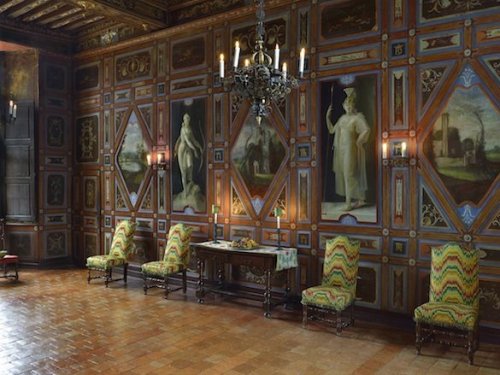
Some ranked and named demons had only a few lesser spirits to act on their behest while others had servants in the hundreds of thousands. Always a few of the most important servitors were named but seldom if ever was any real or extensive information about them given. Nearly every culture has some belief in cursed objects, things that cause unnatural harm to the person whom owns or uses them. Often, these objects have roots in a tragic past, and according to those who believe in curses, something from a tragedy sticks with the objects, becoming part of them and spelling disaster for anyone who might come across them. Almost anything can be a cursed object: a fortune put under a spell by a murdered witch, a car owned by a movie star who died in a wreck, a mansion protected by the power of misfortune. Even normally rational people may occasionally fall into a certain superstition to avoid brining a curse down on themselves. Despite this abundance of allegedly unfortunate object, few come close to one of the most legendary of all: The Winchester Mystery House. The recorded history of this jinxed mansion stretches nearly two centuries, and over that time period, dozens of people have claimed ownership of the stunningly beautiful mansion. Of the owners of The Winchester Mystery House, a few have experienced such great catastrophes that many claim it to be cursed. Fortunes have been lost, noble men executed, and entire communities thrown into chaos and war. The history of The Winchester Mystery House is certainly one of intrigue, but is it true that it, as well as other objects Mrs. Winchester owned, are sources of tragedy?

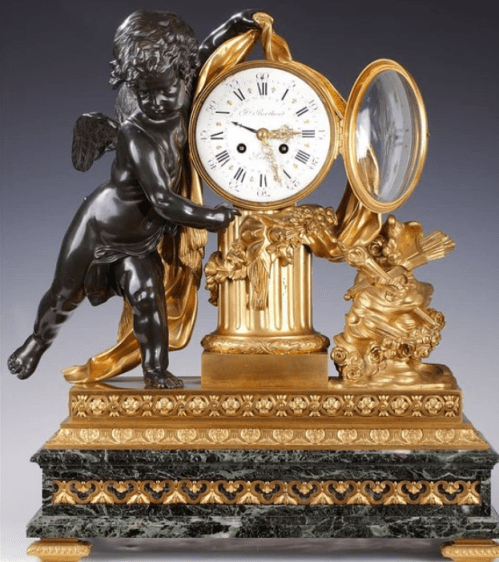
Some individuals have little choice than to recognize their own abilities to interact with the spirit World. If their gift is strong, it may be difficult to get the ghosts to pipe down. Their abilities to pick up on paranormal vibrations help them to work with ghosts and send messages to those that have departed. It is likely that a ghost has wiggled its way between the molecules of The Winchester Mansion, fortune, family, and objects Mrs. Winchester once owned, and is embedded within the fibers of these objects because it cannot bare to be without them. The first law of thermodynamics states that energy cannot be created nor destroyed—it can only be transferred—so one theory about what we call a “haunted object” is simply that energy is being deposited onto an item instead of floating around the ether and popping up at inopportune times. The energy leaves a residue that enables the object to present itself to people sensitive enough to pick up on its energy in the way of movement, talking, feelings of doom—you get the picture. An item may also be used for the spirit to manipulate, sch as a chair being thrown across a room, but does that mean the possession is possessed, or merely in the right place at the wrong time? Other objects such as roads, buildings, houses, and waterways may also be haunted through the transference of a great emotional experience. Some owners of haunted objects want to get rid of the goods fast. An auction, either online or local, can move an item out of the basement and into your hands in no time. Local auctions many not have the label “haunted” attached to a particular item, so take the time to visit the objects beforehand to try to get a feel for what is being offered. If you are interested in bringing home a haunted object, ask the auctioneer to keep an eye out for you. You could be first on their list for something special, and if curse is real, you may be able to being home a new piece for your collection at a great price.

For further information about tours, including group tours, weddings, school events, birthday party packages, facility rentals, and special events please visit the website: https://winchestermysteryhouse.com/
Please visit the online giftshop, and purchase a gift for friends and relatives as well as a special memento of The Winchester Mystery House. A variety of souvenirs and gifts are available to purchase. https://shopwinchestermysteryhouse.com/
Say Your Prayers so No One Can Hurt You
Oliver Fisher Winchester was an entrepreneur who made a fortune in the shirt manufacturing business during the 1830s and 1840s. He took over a bankrupt arms manufacturing company in New Haven, Connecticut in 1857, which eventually became the Winchester Repeating Arms Company. All this time a growing feeling of discomfort had been creeping over him—nervous reaction, perhaps, after the delight of discovery. After he passed in 1880, his son William Wirt Winchester became the second President of the Winchester Repeating Arms Company. However, this accomplishment was shortly enjoyed. William Winchester died in 1881, leaving his fortune and most of the company to me, his wife, Sarah L. Winchester. It was, as far as I can ascertain, March 7, 1881 that I drew open the door of Winchester Hall, in the heart of New Haven, Connecticut. Only to find my husband had died in his sleep. Terribly distraught, I laid beside him. That evening, light shone on the building, making the window-panes glow like so many fires. The clock in the church-tower, buried in tress of the edge of the park, only its golden weathercock catching the light, was striking six, and the sound came gently beating down the wind. It was altogether a pleasant impression, though tinged with the sort of melancholy appropriate to an evening like this. Several years later, I relocated to Santa Clara, California and started on the construction of Llanda villa. It presents a somewhat forbidding aspect to the World, for the rumours of the curse, do not suggest gaiety or warmth or any of those qualities put into its construction. Rather, these stories make this vast edifice of stone exude an austerity, cold and repellant, a hint of ancient mysteries, medieval darkness and hauntings. #RandolphHarris 1 of 7

There were plenty things about the mansion and the gardens which Daisy, my niece, who was of an adventurous and inquiring turn, was anxious to have explained to her. “Why did you build the nine story Observational Tower? Who was the old man lurking on the staircase to the ceiling, sitting at a table, with a skull under his hand?” These and many similar points were cleared up by the resources of my powerful intellect. There were others, however, of which the explanations furnished were less satisfactory. One November evening Diasy was sitting by the fire in the housekeeper’s room reflecting on her surroundings. “Did uncle William go to Heaven?” she suddenly asked, with the peculiar confidence which youth possess in the ability of their elders to settle these questions, the decision of which is believed to be reserved for other tribunals. “Good?—bless the child,” said the maid, Denise Kurlander. “Master was as kind a soul as ever I saw.” Didn’t I never tell you of the he took in out of the street, as you may say, this nine years back? and the little girl, three years after I first started working for your family? “No. Do tell me about them,” Mrs. Kurlander—now this minute!” “Well,” said Mrs. Kurlander, “the little girl I don’t seem to recollect so much about. I know master bought her back with him from his walk one day, give orders to Mrs. Heidelberg, as was housekeeper then, as she should be took every care with. And the pre child hadn’t no one belonging to her—she telled me her own self—and here she lived with us a matter of three weeks it might be; and then, one morning she out of her bed afore any of us had opened, a eye, and neither track nor yet trace of her have I set eyes on since. #RandolphHarris 2 of 7

“Master was wonderful put about, and had all the ponds dragged; but it’s my belief she had away by them witches, for there was singing round the house for as much as an hour the night she went, and Turkheim, he declare as he heard them a-calling in the woods all that afternoon. Dear, dear ! a hodd child she was, so silent in her ways and all, but I was wonderful taken with her, so domesticated she was—surprising. “And what about the little boy?” said Diasy. “Ah, that pore boy!” sighed Mrs. Kurlander. “He were a foreigner—Eduard he called hisself—and he came a tweaking his ‘urdy-gurdy round and about the drive one winter day, and master ‘ad him in that minute, and ast all about where he came from, and how old he was, and how he made his way, and where was his relatives, and all as kind as heart could wish. But it went the same with him. They’re a hunruly lot, them foreign nations, I do suppose, and he was off one fine morning just the same as the girl. Why he went an what he done was our question for as much as a year after; for he never took his ‘urdy-gurdy, and there it lay on the self.” The remainder of the evening was spent by Daisy in miscellaneous cross-examination of Mrs. Kurlander and in efforts to extract a tune from the hurdy-gurdy. That night she had a curious dream. At the end of the passage of the house, in which her bedroom was situated, there was an old disused bathroom. It was kept locked, but the upper half of the door was glazed, and, since the muslin curtains which used to hand there had long been gone, you could look in and see the lead-lined bath affixed to the wall on the right hand, with its head towards the window. #RandolphHarris 3 of 7

On the night of which I am speaking, Diasy found herself, as he thought, looking through the glazed door. The moon was shining through the window, and she was gazing at a figure which lay in the bath. She described a horrid figured, inexpressibly thin and pathetic, of a dusty leaden colour, enveloped in a shroud-like garment, thin lips crooked into a faint and dreadful smile, the hands pressed tightly over the region of his heart. As she looked upon it, a distant, almost inaudible moan seemed to issues from its lips, and the arms began to stir. The terror of the sight forced Daisy backwards, and she awoke to the fact that she was indeed standing on the cold boarded floor of the passage in the full light of the moon. With a courage which I do not think can be common among a young lady her age, she went to the door of the bathroom to ascertain if the figure of her dream were really there. It was not, and she went back to bed. Mrs. Kurlander was much impressed next morning by her story, and went so far as to replace the muslin curtain over the glazed door of the bathroom. That evening, when I came up here to my room after dinner, I just sat in front of the long glass and stared and stared. I must have done it for half an hour or perhaps an hour. I only roe to my feet when it had become quite dark outside. I decided it was time to move to another bedroom. The Crystal Bedroom was much too big and there were only two wooden chairs, painted in greeny-blue with gold lines, or once painted like that. I hate to having to lie on my bed when I should prefer to it and everyone knows how bad it is or the back. Besides, this bed, though it’s enormous, seems to be as hard as when the Earth’s dried up in summer. Not that the Earth’s like that here. Far from it. #RandolphHarris 4 of 7

The rain has never stopped since I left New Haven. Never once. This bed is really huge. It would take at least eight people my size. I do not like to think about it. I have just remembered: it is the third of the month so that I have been gone exactly a year. What a lot of places I have been to in that time—or been through! Already I have quite forgotten some of them. I never properly saw them in any case. Llanada Villa is a huge palace—castle—fortress that simply frightens me some times. The housemaid provided me with no fewer than thirteen candles. I found them in one of the drawers. I suppose there is nothing else to do but read—except perhaps to say one’s prayers. Unfortunately, I finished all the book I brought with me long ago, and it is so difficult to buy any news ones. Daisy would do well to take care of herself, and shut her bedroom windows at night. Two incidents occurred recently that made an impression upon her mind. The first was after an unusually uneasy and oppressed night that she had passed—though she could not recall any particular dream that she had had. The following evening Mrs. Kurlander was occupying herself in mending her nightgown. “Gracious Me, Ms. Daisy!” she broke forth rather irritably, “how did you manage to tear your nightdress all to flinders this way? Look here, Ms. Daisy, what trouble you do give to poor servants that have to darn and mend after you!” There was indeed a most destructive and apparently wanton series of slits or scorings in the garment, which would undoubtedly require a skillful needle to make good. They were confined to the left side of the chest—long, parallel slits, about six inches in length, some of them not quite piercing the texture of the linen. Daisy could only express her entire ignorance of their origin: she was sure they were not there the night before. #RandolphHarris 5 of 7

“But, she said, Mrs. Kurlander, they are just the same as the scratches on the outside of my bedroom door; and I am sure I never has anything to do with making them.” Mrs. Kurlander gazed at her open-mouthed, then snatched up a candle, departed hastily from the room, and was heard making her way upstairs. In a few minutes she came down. “Well,” she said, “Ms. Daisy, it’s a funny thing to me how them marks and scratched can ‘a’ come there—too high up for any car or dog to ‘ave made ‘em, much less a rat: for all the World like a vampire’s finger-nails, as my uncle archeology used to tell us of when we was young girls together. I wouldn’t say nothing to Mrs. Winchester, not if I was you, Ms. Daisy, my dear; and just turn the key to the door when you go to bed.” “I always do, Mrs. Kurlander, as soon as I have said my prayers.” “Ah, that’s a good child: always say your prayers, and then no one can’t hurt you.” Herewith Mrs. Kurlander addressed herself to mending the injured nightgown, with intervals of meditation, until bed-time. This was on Friday night in March, 1898. In a shrill chorus there seemed to lurk a note of tense and evil expectancy. Without warning came these deep, cracked, raucous vocal sounds which would never leave the memory. Not from any human throat were they born, for the organs of man can yield no such acoustic perversions. Rather would one have said they came from the mansion itself. It is almost erroneous to call them sounds at all, since so much of their ghastly, infra-bass timbre spoke to dim seats of consciousness and terror far subtler than the ear; yet one must do so, since their form was indisputably though vaguely that of half-articulate words. #RandolphHarris 6 of 7

They were loud—loud as the rumblings and thunder from the bowels of the mansion from which the echoed—yet did they come from no visible being. And because imagination might suggest a conjectural source in the World of non-visible beings, I winched as if in expectation of a blow. More hideous sounds came croaking out from the bowels of the mansion. The speaking impulse seemed to falter, as if some frightful psychic struggle were going on. There appeared three grotesquely silhouetted human figures in the Observational Tower, all moving their arms furiously in strange gestures as their incantation drew near its culmination. From the black pits of Hell, Acherontic fear or feeling, from the unplumbed gulfs of the mansion’s consciousness or obscure, long-latent heredity, were those half-articulate thunder-croakings drawn? Presently they began to gather renewed force and coherence as they grew in stark, utter, ultimate frenzy. Indisputably English syllables poured thickly and thunderously from the basement. I jumped violently at the deafening, cataclysmic peal whose source, be inner Earth. A single lightning-bolt shot from the sky. Outside, trees, grass, and underbrush were whipped into a fury and the frightened servants in the mansion, were weakened by the lethal foetor that seemed about to asphyxiate them, as they were hurled off their feet. Wolves howled from the distance hills, green grass and foliage wilted to curious, sickly yellow-gray, and over field forest were scattered the bodies of the dead. Slowly the beams of a sunlight shone more brilliant and untainted. My estate was grave and quiet, and seemed shaken by memories and reflection even more terrible than those which had reduced the groups of Indians to a state of quivering. #RandolphHarris 7 of 7


After the death of Mrs. Winchester, the items in her home were auction off in San Francisco, California. However, the queer atmosphere which clings to all in The Winchester Mansion were responsible for the wide-spread story that in opening the mansion of Sarah L. Winchester, and selling all of her possessions, people exposed themselves to the fury of some malignant influence. Recirculating rumours about fears of a curse under sent collectors in a panic. All over the country, people were sending their treasures to museums, anxious to get rid of them because of the superstition that Mrs. Winchester was killed by vengeful spirits. E.E. Evans-Pritchard argued that “cruses are capable of proving effective even after the lapse of thousands of years.” Rumours of The Curse of the Winchester Fortune were always cited. It was said that on the day Pastor Kunst laid bared the entrance to The Winchester Mansion, his pet dog had been devoured by a cobra. Julius Streicher, closely involved with the auction of items from The Winchester Mansion, recalled that “News of this spread quickly and all the natives now said, ‘Alas, that was Oliver Winchester’s cobra, revenging itself on the dog for having betrayed the place of the Winchester Repeating Arms.’” It was said that a solid gold tablet had been discovered in the mansion with the inscription “Death shall come on swift wings to whoever toucheth the home of The Winchester’s.” Mr. Streicher allegedly destroyed the tablet to prevent the superstitious fellaheen from abandoning the auction and so, one believer in the curse states, it was “wiped from the written record of the mansion’s history.”
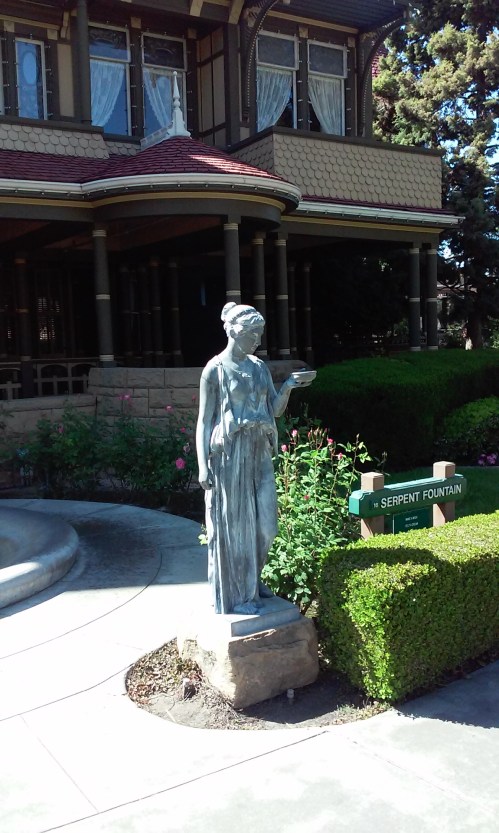
Heinz Bongartz, however, remembers on his visit to the mansion that “Death the who enter” was an “inscription over the door.” It was said that when Gustav Jungbauer opened Mrs. Winchester’s main safe, they found a fortune in diamonds, gold, silver, and other precious stones, and he was bitten by a mosquito, and died shortly afterwards. Soon enough people, anyone who was loosely connected to the sale of the estate and auction of Mrs. Winchester’s goods died, their deaths were folded into the dreamlike elaboration of the curse rumour. The conservators of the estate then decided it would be best to keep the mansion from being further disturbed, and opened it as a tourist attraction to help with the repairs and maintenance of the estate. In May of 1923, Mr. Streicher’s half-brother Peter Geschiere warned that “seeds of destruction are hidden inside,” before he died after a long illness. Close attention was paid to any association with the sale of the estate and items from it. In November of 1929, Tore Olsson, who helped organize the auction, died suddenly in his sleep and is believed to have been troubled by the legendary curse which is said to be associated with those who looted The Winchester Mansion. Victor Petrov, who was also involved, was found dead at his London club in ambiguous circumstances.

Three months later, Mr. Petrov’s father incoherent suicide note included the line: “I really can’t stand any more horrors.” Luke Eggers, a caretaker of The Winchester Mansion, claimed that Pastor Kunst was eventually murdered by shadowy authorities for knowing too much about the truth behind The Winchester Family. This includes the claim that Pastor Kunst’s first operation—supposedly for cancer—in 1923 was a deception and the first attempt in a conspiracy to kill him. Other enthusiasts have continued to track The Curse of the Winchester Fortune into the present day. By 1980, Arthur Jores, German physician, counted one hundred and thirteen victims. Johann Kruse has suggested that the death of Ernst Haeckel, Director of Antiquities, in a car accident in 1976, followed his denunciation of curse stories. When treasures from Mrs. Winchester’s estate were displayed in a New York Museum in 1925, rumours circulated that the crew that transported the items from Santa Clara, California were also subject to misfortune. In 2001, Bedfordshire on Sunday carried a headline “Is Boy, 2, latest Winchester Victim?”, regarding a story about his home in Sacramento, California; “a luxury villa said to be jinxed by the Cruse of the Winchester Fortune.” Such stories have been partly fostered by allegedly authoritive sources. There is a weird fusion of history, myth, and occultism surrounding The Winchester fortune and bloodline. Might the dead return or punish the living for shortcomings of their ritual propitiations? Superstitions proliferate where such borders are breached. I pledge allegiance to the flag of the United States of America, and to the Republic, for witches stand, One Nation, Under God, Indivisible, for Liberty and Justice for all.

For further information about tours, including group tours, weddings, school events, birthday party packages, facility rentals, and special events please visit the website: https://winchestermysteryhouse.com/

Please visit the online giftshop, and purchase a gift for friends and relatives as well as a special memento of The Winchester Mystery House. A variety of souvenirs and gifts are available to purchase. https://shopwinchestermysteryhouse.com/

Comin’ Straight Out of Brooklyn, Crush Your Spine, Corrupt Your Mind!

The era of large-scale witch hunting in Europe ended long ago. The last legal execution that we know of, of a witch in German-speaking Europe took place in Glarus, Switzerland, in 1782. However, that did not end the fear of witches. Perhaps not all witches are bad, but there are renewed concerns in America that people are cohabitating with devilry. The early modern witch hunt has powerfully shaped what we assume witchcraft to be about, and it has also limited what we think it is, and when we think it was. However, in the most basic sense, to accuse someone of being a witch is to accuse that person of conspiring to do covert evil: to inflict harm, misfortune, and sickness. Even if they are unwilling to admit it, some people are using arts of the Devil and in league with demonic forces, which are intended to perplex humanity. Witchcraft, in this regard, is a cultural idiom, a way of understanding and explaining the bad things that befall us. Illness has often been associated with dirt, pollution, and disorder. However, illness is also seen as a form of cosmic judgment, as punishment for improper or irresponsible behaviour. It reflects the order of society and the cosmos write large, and may reveal sins of various orders and magnitude. As such, during Victorian times, it structured the community’s moral economy: those who suffered from heart disease, or had circulatory problems, people believed, had lives wrong. Perhaps they had not worked hard enough, or had recklessly participated in life, creating a social burden for the community. Cancer and ulcers were perceived as punishments, perhaps for youthful sexual indiscretion. #RandolphHarris 1 of 19

Maintaining health was a sign of one’s self-discipline and accountability within a community where people depended on one another to get the work done that allowed the community to continue and to thrive. However, inhabitants did not perceive all illnesses as moral judgments or as the result of cosmic sanction. Tuberculosis and pneumonia, they felt, could befall anyone; those were simply two of humanity’s burdens. Furthermore, it has been asked whether experiences of betrayal, interpersonal alienation, and power politics might help explain some manifestations of illness or sudden disability. One of the striking examples concerns the air-traffic-controller crisis of the early 1980s. In 1981, air traffic controllers went on strike to protest their working conditions and the intolerable stress associated with their jobs. However, researchers readily conceded that the controllers were under stress, they could find no physical evidence of it, like heightened levels of cortisol or elevated blood pressure. Ultimately, Robert Rose, a prominent psychiatrist on a Federal Aviation Administration team researching the problem, concluded that the cause of the controllers’ suffering was not so much stress as a lack of social support. They felt that no one cared about how hard their work was, or how they fared in their jobs. The stress they experienced, Mr. Rose became convinced, was not just biological or physiological, and it “wasn’t just inside the individual.” Their illness was a product of social experience. #RandolphHarris 2 of 19

Also, during World War I, some supplicants were described as suffering from war blindness (Kriegsblindheit). While many other ailments continued to be part of the parade of affliction, illness vaguely attributed to war damage and impairments to sufferers’ limbs and sensory organs were especially prominent themes. Applying these ideas to postwar Germany, we might ask how pervasive unease, a sense of collective failure, persistent questions of blame, and fears of betrayal might have influenced the ways people experienced the fragility of their bodies after the war. Did people become suddenly blind or deaf because they could not bear to see or hear what was happening around them—could not bear defeat and its consequences? Did some suddenly lose their ability to walk as a form of unconscious protest against volition, against agency, against responsibility for genocide and war or defense crimes? Did they lose the ability to speak because there were so many things that could not be discussed out loud? The loss of speech can stand for a refusal of co-existence. The human spirit is a distinct organism. Separation of soul and spirit can happen. This is because of the Fall. The spirit which had been in union with God—which once ruled and dominated the soul and body—feel from its predominated position into the vessel of the soul and could no longer rule. In the “new birth,” which the Lord told Nicodemus was necessary for every man, the regeneration of the fallen spirit takes place. “That which is born of the Spirit is spirit,” reports John 3.6; “a new spirit will I put within you,” reports Ezekiel 36.26. #RandolphHarris 3 of 19

And through cognizance of the death of the old creation with Christ, as set forth in Romans 6.6, is the new spirit liberated, divided from the soul, and joined to the Risen Lord. “Dead to the law…joined to Another”; “Having died…that we might serve in newness of the spirit,” reports Romans 7.4-6. The believer’s life is therefore to be a walk after the spirit, minding the things of the spirit. However, the believer can only thus walk after the spirit if the Spirit of God dwells in one. The Holy Spirit lifts one’s spirit to the place of rule over soul and body—“flesh,” both ethically and physically—by joining it to the Risen Lord, and making it “one spirit” with Him. That the believer retains volitional control over one’s own spirit is the important point to note, for through ignorance one can withdraw one’s spirit from cooperation with the Holy Spirit, and thus, so to speak, walk after the soul, or after the flesh—unwittingly. A surrendered will to do the will of God I therefore no guarantee that one is doing that will; one must understand what the will of the Lord is, and for doing that will must seek to be filled in spirit to the utmost of one’s capacity. The knowledge that the Spirit of God has come to indwell the shrine of the spirit is not enough to guarantee that the believer will continue to walk in the spirit and not fulfill the lusts of the flesh. If one wishes to truly “live” in the realm of the Spirit and know His power, one must learn how to “walk” with the Spirit. And for this, one must understand how to “combine” and “compare” spiritual things with spiritual, so as to interpret truly the things of the Spirit of God—exercising the spirit faculty by which one is able to examine all things, and so discern the mind of the Lord. #RandolphHarris 4 of 19

Such a believer should know how to walk after the spirit, so that one does not quench its action, movements or admonitions as it is moved or exercised by the Spirit of God—cultivating its strength by use, so that one becomes strong in spirit, and a truly spiritual human of “full age” in the Church of God. The Spiritual Community is the assembly of God of the Old Testament, the body of Christ of the New Testament, and the church invisible or Spiritual of the Reformers. It is the invisible essence of the religious communities, both non-Christian and Christian alike. However, those religious groups which are consciously founded upon the reception of Jesus as the Christ are the churches. The Christian churches constitute the manifest Spiritual Community. The Spiritual Community does not exist as a separate entity. For the Spiritual Community is the invisible essence, the inner telos, the essential power in every actual church. The spiritual essence of the churches permits them to participate in unambiguous life under the Spiritual Presence. However, they are also groups of human beings under the conditions of existence. They are simultaneously both the actualization and the distortion of the Spiritual Community. Consequently, there are two aspects to the churches which make them a paradox: the theological aspect, which points to their spiritual essence, and the sociological aspect, which reveals their ambiguities. Every church is a sociological reality. As such it is subject to the laws which determine the life of social groups with all their ambiguities. #RandolphHarris 5 of 19

The sociologists of religion are justified in conducting these inquiries in the same way as the sociologists of law, of the arts, and of the sciences. They rightly point to the social stratification within the churches, to the rise and fall of elites, to power struggles and the destructive weapons used in them, to the conflict between freedom and organization, to aristocratic esotericism in contrast to democratic exotericism, and so forth. Seen in this light, the history of the churches is a secular history with all the disintegrating, destructive, and tragic-demonic elements which make historical life as ambiguous as all other life processes. Despite the sociological trappings which envelop the churches, at their core lies the Spiritual Community. It supplies the “in spite of” element in their paradoxical character, the dynamism which does not eliminate, but conquers the ambiguities of religion at least in principle. The phrase “in principle” means “the power of beginning, which remains the controlling power in a whole process.” In this sense, the Spiritual Presence, the New Being, and the Spiritual Community are principles (archai). Since our primary interest in the mutual relationship between religion and culture, we shall not delay to describe how the Spiritual Presence overcomes the ambiguities of religion within religion itself. Instead, we consider the influence of the churches upon individuals and upon society. As regards the ambiguities of religion, it suffices to note the operative factor, the Protestant principle: The Protestant principle is an expression of the conquest of religion by the Spiritual Presence and consequently an expression of the victory over the ambiguities of religion, its profanization, and its demonization. In this sense, we can speak of the victory of the Spirit over religion. #RandolphHarris 6 of 19

Marxism is humanism, and its amin is the full unfolding of the human potentialities—not humans as deduced from their ideas or their consciousness, but humans with their physical and psychic properties, the real human who does not live in a vacuum but in a social context, the human who has to produce in order to live. It I precisely the fact that the whole human, as well as one’s consciousness, is the concern of Marxist thought which differentiates Mrs. Marx’s “materialism” from Mr. Hegel’s idealism, as well as from the economistic-mechanistic deformation of Marxism. It was Mr. Marx’s great achievement to liberate the economic and philosophical categories that referred to humans from their abstract and alienated expressions and to apply philosophy and economics ad hominem. Mr. Marx’s concern was humans, and his aim was humans’ liberation from the predomination of material interests, from the prison one’s own arrangements and deeds had built around them. If one does not understand this concern of Mr. Marx, one will never understand either his theory or the falsification of it by many who claim to practice it. Even though Mr. Marx’s main work is entitled Capital (Das Kapital), this work was meant to be only a step in his total research, to be followed by a history of philosophy. For Mr. Marx the study of capital was a critical tool to be used for understanding humans’ crippled state in industrial society. It is one step in the great work which, if he had been able to write it, might have been entitled On Man and Society. #RandolphHarris 7 of 19

Mr. Marx’s work, that of the “young” Mr. Marx as well as that of the author of Capital, is fully of psychological concepts. He deals with concepts like the “essence of man,” and the “crippled man,” with “alienation,” with “consciousness,” with “passionate strivings,” and with “independence,” to name only some of the most important. Yet, in contrast to Mr. Aristotle and Mr. Spinoza, who based ethics on a systematic psychology, Mr. Marx’s work contains almost no psychological theory. Aside from fragmentary remarks on the distinction between fixed drives (like hunger and sexuality) and flexible drives which are socially produced, there is hardly any relevant psychology to be found in Mr. Marx’s writings or, for that matter, in those of his successors. The reason for this failure does not lie in a lack of interest in or talent for analyzing psychological phenomena (the volumes containing the unabridged correspondence between Mr. Marx and Mr. Engels show a capacity for penetrating analysis of unconscious motivations that would be a credit to any gifted psychoanalyst); it is to be found in the fact that during Mr. Marx’s lifetime there was no dynamic psychology that he could have applied to the problems of human beings. Mr. Marx died in 1883; Dr. Freud began to publish his work more than ten years after Mr. Marx’s death. Even though in need of many revisions, the kind of psychology necessary to supplement Mr. Marx’s analysis was created by Dr. Freud. Psychoanalysis is, first of all, a dynamic psychology. It deals with psychic forces, which motivate human behaviour, action, feelings, ides. These forces cannot always be seen as such; they have to be inferred from the observable phenomena, and to be studied in their contradictions and transformations. #RandolphHarris 8 of 19

To be useful for Marxist thinking, a psychology must also be one which sees the evolution of these psychic forces as a process of constant interaction between humans’ need and the social and historical reality in which one participates. It must be a psychology which is from the very beginning social psychology. Eventually, it must be a critical psychology, particularly one critical of humans’ consciousness. Dr. Freud’s psychoanalysis fulfills these main conditions, even though their relevance for Marxist thought was grasped neither by most Freudians nor by Marxists. The reasons for this failure to make contact are apparent on both sides. Marxist continued in the tradition of ignoring psychology; Dr. Freud and his disciples developed their ideas within the framework of mechanistic materialism, which proved restrictive to the development of the great discoveries of Dr. Freud and incompatible with “historical materialism.” In the revival of Marxist humanism, those in the West became aware of the fact that socialism must satisfy humans’ need for a system of orientation and devotion; that it must deal with the questions of who humans are and what the meaning and aim of their lives are. It must be the foundation for ethical norms and spiritual development beyond the empty phrase stating that “good is that which serves the revolution” (the worker’s state, historical evolution, et cetera). On the other hand, the criticism arising in the psychoanalytic camp against the mechanistic materialism underlying Dr. Freud’s thinking has led to a critical reevaluation of psychoanalysis, essentially of the libido theory. #RandolphHarris 9 of 19

Because of the development in both Marxist and psychoanalytic thinking, the time seems to have come for humanist Marxist to recognize that the use of a dynamic, critical, socially oriented psychology is of crucial importance for the further development of Marxist theory and socialist practice; that a theory centered around man can no longer remain a theory without psychology if it is not to lose touch with human reality. The sado-masochistic person is always characterized by one’s attitude toward authority. One admires authority and tends to submit to it, but at the same time one wants to be an authority oneself and have others submit to one. There is an additional reason for choosing this term. The Fascist systems call themselves authoritarian because of the dominant role of authority in their social and political structure. By the term “authoritarian character,” we imply that it represents the personality structure which is the human basis of Fascism. Authority is not a quality one person “has,” in the sense that one had property or physical qualities. Authority refers to an interpersonal relation in which one person looks upon another as somebody superior to one. However, there is a fundamental difference between a kind of superiority-inferiority relation which can be called rational authority and one which may be described as inhibiting authority. An example is the relationship between teacher and student and that between slave and owner and slave are both based on the superiority of the one over the other. The interests of teacher and pupil lie in the same direction. If one succeeds in furthering the pupil, the teacher is satisfied; if one has failed to do so, the failure is that of the teacher and the pupil. #RandolphHarris 10 of 19

The slaver owner, on the other hand, wants to exploit the slave as much as possible; the more one gets out of the slave, the more one is satisfied. At the same time, the slave seeks to defend as best one can one’s claims for a minimum of happiness. These interests are definitely antagonistic, as what is of advantage to the one is detrimental to the other. The superiority has a different function in both cases: in the first, it is the condition for the helping of the person subjected to the authority; in the second, it is the condition for one’s exploitation. The dynamics of authority in these two types are different too: the more the student learns, the less wide is the gap between one and the teacher. One becomes more and more like the teacher oneself. In other words, the authority relationship tends to dissolve itself. However, when the superiority serves as a basis for exploitation, the distance becomes intensified through its long duration. The psychological situation is different in each of these authority situations. In the first, elements of love, admiration, or gratitude are prevalent. The authority is at the same time an example with which one wants to identify one’s self partially or totally. In the second situation, resentment or hostility will arise against the exploiter, subordination to whom is against one’s own interest. However, often, as in the case of a slave, this hatred would only lead to conflicts which would subject the slave to suffering without a chance of winning. Therefore, the tendency will usually be to repress the feeling of hatred and sometimes even to replace it by a feeling of blind admiration. This has two functions: to remove the painful dangerous feeling of hatred, and to soften the feeling of humiliation. #RandolphHarris 11 of 19

If the person who rules over me is so wonderful or perfect, then I should not be ashamed of obeying one. I cannot be one’s equal because one is so much stronger, wiser, better, and so on, than I am. As a result, in the inhibiting kind of authority, the element either of hatred or of irrational overestimation and admiration of the authority, the element either of hatred or of irrational overestimation and admiration of the authority will tend to increase. In the rational kind of authority, it will tend to decrease in direct proportion to the degree in which the person subjected to the authority becomes stronger and thereby more similar to the authority. The difference between rational and inhibiting authority is only a relative one. Even in the relationship between slave and master there are elements of advantage for the slave. One gets a minimum of food and protection which at least enables one to work for one’s master. (However, with being beat and working in the broiling hot sun and freeze cold could lead to death, as well as the beatings.) On the other hand, it is only in an ideal relationship between teacher and student that we find a complete lack of antagonism of interests. There are many gradations between these two extreme cases, as in the relationship of a factory worker, with one’s boss, or a farmer’s son with his father, of a hausfrau with her husband. Nevertheless, although in reality two types of authority are blended, they are essentially different, and an analysis of a concrete authority situation must always determine the specific weight of each kind of authority. #RandolphHarris 12 of 19

Authority does not have to be a person or institution which says: you have to do this, or you are not allowed to do that. While this kind of authority may be called external authority, authority can appear as internal authority, under the name of duty, conscience, or superego. As a matter of fact, the development of modern thinking from Protestantism to Mr. Kant’s philosophy, can be characterized as the substitution of internalized authority for an external one. With the political victories of the rising middle class, external authority lost prestige and man’s own conscience assumed the place which external authority once had held. This change appeared to many as the victory of freedom. To submit to orders from the outside (at least in spiritual matters) appeared to be unworthy of a free man; but the conquest of one’s natural inclinations, and the establishment of the domination of one part of the individual, one’s nature, by another, one’s reason, will or conscience, seemed to be the very essence of freedom. Analysis shows that conscience rules with a harshness as great as external authorities, and furthermore that frequently the contents of the orders issues by humans’ conscience are ultimately not governed by demands which have assumed the dignity of ethical norms. The rulership of conscience can be even harsher than that of external authorities, since the individual feels its orders to be one’s own; how can one rebel against oneself? Mr. Stalin, a shrewd, cynical opportunist with an insatiable lust for personal power, drew the consequences of the failure. Given his personality, socialism could never have meant for him the human vision of Mr. Marx or Mr. Engles, and hence he had no scruples in introducing the enforced industrialization of Russian under the name of “socialism in one country.” #RandolphHarris 13 of 19

This formula was only the transparent cover for the goal to be achieved—the building of a totalitarian state managerialism in Russia, and the rapid capital accumulation (and mobilization of human energy) necessary for this goal. Mr. Stalin liquidated the socialist revolution in the name of “socialism.” He used terror to enforce acceptance of the material deprivations which resulted from the rapid build-up of basic industries at the expense of the production of consumer goods; furthermore, the terror served to create a new work morale by mobilizing the energies of an essentially agrarian population and forcing them to work at the pace necessary for this rapid industrial expansion. He used terror probably far beyond what was necessary for the achievement of his economic program because he was possessed by an extraordinary thirst for power, a paranoid suspicion of rivals, and a pathological pleasure in revenge. If a highly industrialized, centralized Russian state managerialism was Mr. Stalin’s aim, he certainly could not have said so. Terror alone, even the most extreme terror, would not have sufficed to force the masses into co-operation had not Mr. Stalin been able also to influence humans’ minds and thoughts He could, of course, have made a complete about-face, staging an ideological counterrevolution employing a fascist-nationalist ideology. Thus he might have had the ideological means which would have led to similar results. Mr. Stalin did not choose this course, and hence there was nothing left for him to do but to use the only ideology which had any influence on the masses at that time—that of communism and World revolution. Religion had been depreciated by the Communist Party; nationalism had been depreciated; “Marxism-Leninism” was the only prestigious ideology left. #RandolphHarris 14 of 19

And no one this, but the figures of Mr. Marx, Mr. Engel, and Mr. Lenin had a charismatic appeal for the Russian people and Mr. Stalin used this appeal by presenting himself as their legitimate successor. In order to perpetrate the great historical fraud, Mr. Stalin had to get rid of Mr. Trotsky and eventually to exterminate almost all the old Bolsheviks to have the way completely free for his transformation of the socialist goal into one of a reactionary state managerialism. He had to rewrite history in order to wipe out even the memory of the old revolutionaries and their ideas. Maybe, unconsciously, he feared and suspected the old revolutionaries in his paranoid fashion, because he felt guilty of having betrayed the ideals of which they were symbols. If not in the whole World, Mr. Stalin succeeded in his goal, which was not World revolution but an industrialized Russia that should become the strongest industrial power in Europe. The economic success of his method of totalitarian state planning later continued with some changes by Mr. Malenkov and Mr. Khrushchev, is no long a matter of dispute. “The Soviet system of centralized direction has proved itself to be more or less the peer of the market economy, as exemplified by the United States of America.” This judgment is borne out by the Russian industrial growth. While the estimates of various American economists vary somewhat, the differences are relatively small. Mr. Bornstein estimates the annual rate of growth of gross national product from 1950 to 1958 in the Soviet Union at 6.5-7.5 percent and for the United States of America in the name period at 2.9 percent. #RandolphHarris 15 of 19

Kaplan-Moorsteen estimate the Russian industrial rate of growth for the same period as being 9.2 percent. The current GDP in Russia for 2023 is 1.3 percent. If one considers the Russian annual rate of growth since 1913, that is to say for the period including the destruction of the First World War and the Civil War, the figures are, of course, quite different. They are according to Mr. Nutter, for civilian industrial output from 1913 to 1955 only 4.2 percent, while the rate of growth for the last forty years of the Czarist period was 5.3 percent. However, between 1928 and 1940 (that is to say, in a period of peace) the Soviet rate was 8.3 percent and between 1950 and 1955 9.0 percent, more or less twice the United States of America during the same time, and somewhat less than twice that of the Czarist rate. Mr. Nutter estimates that if one looks to the immediate future—“it seems reasonably certain that industrial growth will proceed more rapidly in the Soviet Union than in the United States of America, in the absence of radical institutional changes in either country,” while, “it is more doubtful that industrial growth in the Soviet Union will be faster than in rapidly expanding Western economies, such as Western Germany, France, and Japan.” Mr. Nutter doubts, however, that in the long run the Soviet system will generate a more rapid growth than the private enterprise system. In contrast to industrial production, Russian agricultural production has been lagging far behind the planned figures and still constitutes one of the difficult problems of the Russian system. #RandolphHarris 16 of 19

As far as consumption is concerned, the annual growth, taking in account the growth in population, is estimated at about 5 percent, with a recent rise in consumption among peasants. “In terms of food and clothing,” Mr. Turgeon concludes, “the Soviet stands the best chance of overtaking our level of living,” while the United States of America is far ahead in automobiles and other durable consumer goods, and in expenditures for services and travel. Mr. Stalin laid the foundations for a new, industrialized Russia. He transformed, within less than thirty years, the economically most backward of the great European nations into an industrial system that soon would become the economically most advanced and prosperous, second only to the United States of America. He achieved this goal through the ruthless destruction of human lives and happiness, through the cynical falsification of socialist ideas, and through an inhumanity which together with that of Mr. Hitler, corroded the sense of humanity in the rest of the World. Yet apart from the question whether this goal could have been achieved in less inhuman way by using other methods, the fact that he left to his heirs a viable and strong economic and political system. Many of the Stalinist features have remained the same—others have been changed. It is probably not extreme to declare any quote of work externally imposed upon a person is bound to seem coercive to some degree. While the ways in which coercion is exercised are often subtle and difficult to discern, even where no effort is made deliberately to conceal them, the effects of coercion are registered in the attitude of the person to one’s work. #RandolphHarris 17 of 19
Instead of motivation to approach an ideal of performance, which removes all barriers to the release of energy, there is resistance to the coercion, a setting of limits to effort, and even discontent and sabotage. Instead of guilt over doing less than one’s best, there is often the feeling that integrity and self-respect are best maintained by a refusal to surrender to the coercion. To be sure, it is obvious that employment utterly free of coercion is almost nonexistent; even play can become rapidly adulterated with compulsion as it gets organized by teams and clubs. Nevertheless, there are enormous differences in quality of performance as coercion fluctuates. Conversely, if none of the personnel doe more than their specified and required minimum, no organization can survive long; even in prison, the prisoners must contribute more than is absolutely forced from them. In practice the participation of personnel in setting the goals of their own effort can help to release the energy for attaining them. In determining their respective quotas and schedules, personnel are in effect spelling out of the interim or subgoals within the over-all goals of the agency. Yet, since initiative in evoking responsibility lies almost entirely with the administrator, the burden of achieving the personnel’s genuine participation lies upon one’s shoulders, and failure to achieve it can only spuriously be blamed on the personnel. In other words, as generally recognized, the test of the administrator, although it may be expressed in term of objective results in completing one’s program, is basically a test of one’s ability to minimize coercion and maximize participation. #RandolphHarris 18 of 19

Where one has the least opportunity for coercion, one’s skill as an organizer and leader of group effort becomes most clearly manifest (such as in campaigns using unpaid volunteers). All other conditions being equal, it seems demonstrable that shared purpose will always release more energy and ingenuity, and produce better results, than coercion. Too often the planning aspect of administration is discussed loosely in terms of controls. Not only has the term a popular connotation of some form or degree of coercion, but this is all too often so in practice. In other words, the various quotas and schedules are set up unilaterally and hierarchically by the administrator and one’s lieutenants, as tasks imposed externally upon subordinates. The best forms of planning break down the broad goals of a program to apply to the various functional units of the executive agency, but much is lost, and the success of the program is jeopardized, if this is done solely for the sake of co-ordination. If quotas and schedules are instead construed not as controls in this limited sense but as interim goals, their other functions in facilitating motivation of personnel and morale of the agency then become feasible Beyond starting these general characteristics of the program phase of our model of the planning process, it is doubtful that much more could be said without getting down to particular cases. There are vast numbers of books about the familiar problems of administration, most of the conceived in terms of human relations. I pledge allegiance to the flag of the United States of America, and to the Republic, for which it stands, One Nation, Under God, Indivisible with Liberty and Justice for all. If a stranger sojourns with you in your land, you shall not wrong him or her. And you shall love one as yourself, for you were strangers in the land of America. Please be sure to donate to the Sacramento Fire Depart, as they are not receiving all of their resources. #RandolphHarris 19 of 19


Ready to build your custom dream home?

Get started today by telling us what you’re wanting and we can schedule an initial consultation. For example, I would like to build a copy of The Winchester Mystery House. https://millhavenhomes.com/

The Whip of Wall Street Bosses

At one time, witchcraft was “ubiquitous,” and played a part in every activity of one’s life. If blight seized the groundnut crop, it was witchcraft; if the bush was vainly scoured for game, it was witchcraft; if women laboriously bale water out of a pool and were rewarded by but a few small fish, it was witchcraft;…if a prince was cold and distant with his subject, it was witchcraft;…if, in fact, any failure or misfortune fell upon anyone at any time and in relation to any of the manifold activities of one’s life, it might have be due to witchcraft. Witchcraft was foremost a way of making what happened in people’s lives intelligible in the fullest sense, of explaining what lay behind such misfortunes as poor harvest and sickness. Narratives proliferate in the spaces between what is known and what is not, especially in the spaces where life and knowledge are the most fragile. Illness is mysterious. It comes without warning, and its sources are often hidden. By explaining death or illness or bad luck, witchcraft acts as a form of theodicy, a way of understanding why bad things—like granaries collapsing—happen when they do, and to whom. Sadism, as it is often used, can be relatively free from destructiveness and blended with a friendly attitude towards it object. This kind of “loving” sadism has found classical expression in Balzac’s Lost Illusions, a description which also conveys the particular quality of what we mean by the need for symbiosis. In this passage Balzac describes the relationship between young Lucien and the Bango prisoner who poses as an Abbe. Shortly after he makes the acquaintance of the young man who has just tried to commit suicide the Abbe says: “…This young man has nothing in common with the poet who died just now. #RandolphHarris 1 of 19

“I have picked you up, I have given life to you, and you belong to me as the creature belongs to the creator, as-in the Orient’s fairy tales—the Ifrit belongs to the spirit, as the body belongs to the soul. With powerful hands I will keep you straight on the road to power; I promise you, nevertheless, a life of pleasures, of honours, of everlasting feasts. You will never lack money, you will sparkle, you will be brilliant; whereas I, stopped down in the filth of promoting, shall secure the brilliant edifice of your success. I love your power for the sake of power! I shall always enjoy your pleasures although I shall have to renounce them. Shortly: I shall be one and the same person with you…I will love my creature, I will mold him, will shape him to my services, in order to love him as a father loves his child. I shall drive at your side in your Tilbury, my dear boy, I shall delight in your successes with women. I have created this Marquis de Rubempre and have placed him among the aristocracy; his success is my product. He is silent and he talks with my voice, he follows my advice in everything.” Frequently, and not only in the popular usage, sado-masochism is confounded with love. Masochistic phenomena, especially, are looked upon as expressions of love. An attitude of complete self-denial for the sake of another person and the surrender of one’s own rights and claims to another person have been praised as examples of “great love.” It seems that there is no better proof for “love” than sacrifice and the readiness to give oneself up for the sake of the beloved person. Actually, in these cases, “love” is essentially a masochistic yearning and rooted in the symbiotic need of the person involved. #RandolphHarris 2 of 19

If we mean by love the passionate affirmation and active relatedness to the essence of a particular person, if we mean by it the union with another person on the basis of the independence and integrity of the two persons involved, then masochism and love are opposites. Love is based on subordination and loss of integrity of one partner, it is masochistic dependence, regardless of how the relationship is rationalized. Sadism also appears frequently under the disguise of love. To rule over another person, if one can claim that to rule him is for that person’s own sake, frequently appears as an expression of love, but the essential factor is the enjoyment of domination. Many are probably wondering: Is not sadism, as we have described it here, identical with the craving for power? Although the more destructive forms of sadism, in which the aim is to hurt and torture another person, are not identical with the wish for power, the latter is the most significant expression of sadism. The problem has gained added significance in the present day. Since Mr. Hobbes, one has seen in power the basic motive of human behaviour; the following centuries, however, gave increased weight to legal and moral factors which tended to curb power. With the rise of Fascism, the lust for power and the conviction of its right has reached new height. Millions are impressed by the victories of power and take it for the sigh of strength. To be sure, power over people is an expression of superior strength in a purely material sense. If I have the power over another person to kill him, I am “stronger” than he is. #RandolphHarris 3 of 19

However, in a psychological sense, the lust for power is not rooted in strength but in weakness. It is the expression of the inability of the individual self to stand alone and live. It is the desperate attempt to gain secondary strength where genuine strength is lacking. The word “power” has a twofold meaning One is the possession of power over somebody, the ability to dominate one; the other meaning is the possession of power to do something, to be able, to be potent. The latter meaning has nothing to do with domination; it expresses mastery in the sense of ability. If we speak of powerlessness, we have this meaning in mind; we do not think of a person who is not able to dominate others, but of a person who is not able to do what one wants. Thus power can on one of two things, domination or potency. Far from being identical, these two qualities are mutually exclusive. Impotence, using the term not only with regard to the sphere of pleasures of the flesh, but to all spheres of human potentialities, results in the sadistic striving for domination; to the extent to which an individual is potent, that is, able to realize one’s potentialities on the basis of freedom and integrity of one self, one does not need to dominate and is lacking the lust for power. Power, in the sense of domination, is the perversion of potency just as sexual sadism is the perversion of sexual love. Sadistic and masochistic traits are probably to be found in everybody. At one extreme there are individuals whose whole personality is dominated by these traits, and at the other there are those for whom these sado-masochistic traits are not characteristic. #RandolphHarris 4 of 19

Only in discussing the former can we speak of a sado-masochistic character. The term “character” is used here in the dynamic sense in which Dr. Freud speaks of character. In this sense it refers not to the sum total of behavior patterns characteristic for one person, but to the dominant drives that motivate behaviour. Since Dr. Freud assumed that the basic motivating forces are sexual ones, he arrived at concepts like “oral,” “anal,” or “genital” characters. If one does not share this assumption, one is forced to devise different character types. However, the dynamic concept remains the same. The driving forces are not necessarily conscious as such to a person whose character is dominated by them. A person can be entirely dominated by one’s sadistic strivings and consciously believe that one is motivated only by one’s sense of duty. One may not even commit any overt sadistic acts but suppress one’s sadistic drives sufficiently to make one appear on the surface as a person who is not sadistic. Nevertheless, any close analysis of one’s behaviour, one’s phantasies, dreams, and gestures, would show the sadistic impulses operating in deeper layers of one’s personality. Although the character of persons in whom sadomasochistic drives are dominant can be characterized as sado-masochistic, such persons are not necessarily neurotic. It depends to a large extent on the particular tasks people have to fulfill in their social situation and what patterns of feelings and behaviour are present in their culture whether or not a particular kind of character structure is “neurotic” or “normal.” As a matter of fact, for great parts of the lower middle class in Germany and other European countries, the sado-masochistic character is typical, and, it is this kind of character structure to which Nazi ideology had its strongest appeal. #RandolphHarris 5 of 19

A reason why it is so difficult to dare to disobey, to say “no” to power is because during most of human history obedience has been identified with virtue and disobedience with sin. The reason is simple: thus far throughout most of history a minority has ruled over the majority. This rule was made necessary by the fact that there was only enough of the good things of life for the few, and only the crumbs remained for the many. If the few wanted to enjoy the good things and, beyond that, to have the many serve them and work for them, one condition was necessary: the many had to learn obedience. To be sure, obedience can be established by sheer force. However, this method has many disadvantages. It constitutes a constant threat that one day the many might have the means to overthrow the few by force; furthermore there are many kinds of work which cannot be done properly if nothing but fear is behind the obedience. Hence the obedience which is only rooted in the fear of force must be transformed into one rooted in humans’ hearts. Humans want and even need to obey, instead of only fearing to disobey. If this is to be achieved, power must assume the qualities of the All Good, the All Wise; it must become All Knowing. If this happens, power can proclaim that disobedience is sin and obedience virtue; and once this has been proclaimed, the many can accept obedience because it is good and detest disobedience because it is bd, rather than to detest themselves for being cowards. From Mr. Luther to the nineteenth century one was concerned with overt and explicit authorities. Mr. Luther, the pope, the princes, wanted to uphold it; the middle class, the workers, the philosopher, tried to uproot it. #RandolphHarris 6 of 19

The fight against authority in the State as well as in the family was often the very basis for the development of an independent and daring person. The fight against authority was inseparable from the intellectual mood which characterized the philosophers of the enlightenment and the scientists. This “critical mood” was one of the faith in reason, and at the same time of doubt in everything which is said or thought, inasmuch as it is based on tradition, superstition, custom, power. The principles sapere aude and de omnibus est dubitandum—“dare to be wise” and “of all one must doubt”—were characteristic of the attitude which permitted and furthered the capacity to say “no.” The case of Adolf Eichmann is symbolic of our situation and has a significance far beyond the one which his accusers in the courtroom in Jerusalem were concerned with. Mr. Eichmann is a symbol of the organization man, of the alienated bureaucrat for whom men, women, and children have become numbers. He is a symbol of all of us. We can see ourselves in Mr. Eichmann. However, the most frightening thing about hi is that after the entire story was told in terms of his own admission, he was able in perfect good faith to plead his innocence. It is clear that if he were once more in the same situation, he would do it again. And so would we—and so do we. The organization man has lost the capacity to disobey, he is not even aware of the fact that he obeys. At this point in history the capacity to doubt, to criticize and to disobey may be all that stands between a future for humankind and the end of civilization. #RandolphHarris 7 of 19
The Soviet system is a mythical entity to most Americans; probably not any less mythical than the capitalist system is to most Russians. While the Russians see capitalism as a system of exploited wage salves obeying the whip of Wall Street bosses, Americans see Russia as led by men who are a blend of Mr. Lenin and Mr. Hitler, bent on subjugating the rest of the World by force or trickery. Since our whole foreign policy is based on the idea that the Soviet Union wants to conquer the World by force, it is of the utmost importance to examine the facts and to have a clear and realistic picture of the nature of the Soviet system. This task is all the more difficult because the nature of the Soviet system changed completely between 1917 and the present time. It changed from a revolutionary system, considering itself the center and the promotor of Communist revolutions in Europe and eventually throughout the whole World, to a conservative, industrial class society run along lines in many respects similar to the development of the “capitalistic” states of the West. This change, however, was never marked by any official break in the continuity, because many basic features such as the nationalization of means of production and the idea of a planned economy have remained the same. However, much more confusing than the continuity of certain economic patterns is the continuity of the ideology. Mr. Stalin and then Mr. Khrushchev had religiously stuck to the “Marxist-Leninist” formulations, and continued to speak the language of 1848 or 1917, although representing a system which is the very opposite of what revolutionaries like Mr. Marx and Mr. Lenin envisaged. #RandolphHarris 8 of 19

Actually we should be better able to recognize the difference between ritualized ideological formulae and realities. Are we not ourselves caught in a similar discrepancy when we talk of “individual initiative” in a society of the “organization man,” or of a “God-fearing society” when in reality we care mainly about money, comfort, health and education, and very little about God? However—and this makes the recognition of reality all the more confusing—neither the Russians nor are we liars. Both sides are convinced that they are telling the truth, and they approach each other with the common conviction that their own and, even to some extent, their opponent’s ideologies represent realities. Since Mr. Stalin’s ascendancy the Soviet rulers have never aimed at Communist revolution in the West but have used the Communist parties only as instruments for the support of the Soviet foreign policy. The middle of the nineteenth century was a time of socialist hope; this was based on the miraculous progress of science and its effect on industrial production, on the success of the middle-class revolutions of 1789, 1830, 1848, on the mounting protests of the workers, and on the spread of socialist ideas. Mr. Marx and Mr. Engels, like many other socialists, were convinced that the time was near in which the great revolution would occur and that shortly a new epoch in human history would begin, that there was every prospect, as Mr. Engles put it, “of turning the revolution of the minority” [as were all previous revolutions] “into a revolution of the majority” [as he visualized the socialist revolution]. #RandolphHarris 9 of 19

However, at the end of the century Mr. Engels had to admit: “History has proved us, and all who thought like us, wrong. It has made it clear that the state of economic development of the continent at that time was not, by a long way, ripe for the elimination of capitalist production.” The First World War marked a decisive change in the history of socialism. It marked the collapse of two of its most significant aims, internationalism and peace. With the beginning of the war, each socialist party took the side of its own government and fought the other socialists in the name of “freedom.” This moral debacle of socialism was not so much due to the personal betrayal of some leaders as to the change in general economic and political conditions. The naked and ruthless exploitation of the workers which had existed in the nineteenth century had slowly given way to the participation of the working class in the economic gains of their respective countries. Capitalism, instead of being unable to function because of its own inner contradictions, as Mr. Marx had predicted, proved to be a going concern, much more capable of coping with crises and difficulties than the radical revolutionaries had expected. The very success of capitalism led to a new interpretation of socialism. While Mr. Marx’s and Mr. Engles vision was that of a new form of society transcending that of capitalism, a society which would be the full realization of humanism and individualism, socialism began now to be interpreted by most of its adherents as a movement for the economic and political rise of the working class within the capitalist system. #RandolphHarris 10 of 19

While Mr. Marxist socialism in the nineteenth century was the most significant spiritual and moral movement of the century, antipositivistic and antimaterialistic in essence, it was slowly transformed into a purely political movement with essentially economic aims even though the older moral goals never entirely disappeared. The interpretation of socialism in terms of the categories of capitalism led to a new policy for the socialist parties, the aim of which was the welfare state rather than the fulfillment of the messianic hopes held by the founders of socialism. The war of 1914, that senseless slaughter of millions of people f all nations for the sake of certain economic advantages, led to the resurgence, in a new and vital form, of the older socialist attitude against war and nationalism. Radical socialists in all countries felt a profound indignation at the war, and they became the leaders of revolutionary movements in Russian, Germany, and France. In fact, the radicalization of the socialist movement was closely connected with the Zimmerwald movement, the attempt of internationalist socialists to end the war. The February revolution in Russia gave impetus to these revolutionary leaders. Originally Mr. Lenin, in accordance with Mr. Marx’s theory, had believed that a socialist revolution could be successful only within a highly developed, capitalist economy like Germany. He had thought it necessary that a less-developed country like Russia had to complete its bourgeois revolution before moving forward to a socialist revolution. For the same reason the majority of the Communist Central Committee was at first opposed to the seizure of power in 1917, but increasing protest of the peasant-soldier against the war coupled with the incapacity of the Czarist government and its revolutionary successor to end the war and reorganize the Russian economy pushed Mr. Lenin into the October revolution. #RandolphHarris 11 of 19

Mr. Lenin’s and Mr. Trotsky’s hopes were fastened on a German revolution, which both were sure would happen in a short while. They signed the peace treaty of Brest-Litovsk with Imperial Germany in the expectation that the German revolution would soon break out and invalidate the peace treaty. If a highly industrial Germany became a Soviet state and fused with mainly agricultural Russian, then, so they reasoned following Marxist theory, a socialist, German-Russian Soviet system would have a good chance to survive and to flourish. Like Mr. Marx and Mr. Engels in the middle of the nineteenth century, Mr. Lenin and Mr. Trotsky seventy years later believed for a short while that the socialist “kingdom is near,” and that they would lay the foundations for a truly socialist society. Mr. Lenin’s hope had its peaks and its valleys; 1917 and 1918 represented the first peak. Ten days after the October revolution he declared: “We shall march firmly and unswervingly to the victory of socialism which will be sealed by the leading workers of the most civilized countries and give to the people solid peace and deliverance from all oppression and all exploitation. When after the outbreak of the German revolution in November 1918, the new German government showed great reluctance to enter into diplomatic relations with Russian and when the German workers did not seem to follow the Russian example, doubts began to enter Mr. Lenin’s and Mr. Trotsky’s minds. In 1919 the Soviet revolution in Bavaria and Hungary gave rise to new hopes, only to be dashed shortly by the defeat of these revolutions. #RandolphHarris 12 of 19

The summer and fall of 1920, when the Russian civil war was moving toward its end and the Red Army stood at the gates of Warsaw, witnessed the peak of the prestige of the Comintern and of the Communists hopes for World revolution. The second Congress of the Comintern, 1920, was held in a mood of high revolutionary enthusiasm. Yet, only a short time after, with the defeat of the Red Army before Warsaw and the failure of the Polish workers to rise, everything changed dramatically. The revolutionary hopes received a shock from which they never recovered. Mr. Lenin, in ordering the march on Warsaw, after the successful defense against the Polish attack, had yielded to his frantic hope for the World revolution, this time being less realistic than Mr. Trotsky, who (with Mr. Tukhachevski) had advised against the Warsaw offensive. Once more history proved that the revolutionaries had been wrong in their estimates of the revolutionary possibilities. Mr. Lenin recognized the defeat; he admitted that Western capitalism still had a much greater vitality than he had expected and he initiated and organized the retreat in order to save what could be saved from the debacle. He started the NEP, the reintroduction of capitalism in large sectors of the Russian economy, he tried to persuade foreign capitalists to invest capital in “concessions” with the Soviet Union, he tried to arrive at a peaceful understanding with the great Western powers, and at the same time, he suppressed by force the movement of the Kronstadt sailors, directed against what they felt to be the betrayal of the revolution. #RandolphHarris 13 of 19

Mr. Lenin’s concept that the true interest of the working class resided in an elite of leaders, and not in the majority of workers, was not Mr. Marx’s; in fact, it was opposed by Mr. Trotsky during the many years of difference between him and Mr. Lenin before the outbreak of the First World War as it was opposed by Rosa Luxemburg, the most unwavering and clearsighted of Marxist revolutionary leaders until her assassination by German soldiers in 1919. Mr. Lenin did not see what Rosa Luxemburg and many others saw, that the centralized bureaucratic system in which an elite ruled for the workers had to end up in a system in which it would rule over the workers and extinguish whatever was left of socialism in Russia. However, whatever the differences between Mr. Marx and Mr. Lenin were, the fact is that for the second time the great hope had failed. This time however, the failure found Mr. Lenin and Mr. Trotsky in power, confronted with the historical dilemma of how to guide a socialist revolution in a country that did not have the objective conditions for a socialist society. They were spared the problem of having to solve this dilemma. Mr. Lenin, after a first stroke in 1922, which incapacitated him increasingly, died in January 1924; Mr. Trotsky was driven from power a few years later; Mr. Stalin, with whom Mr. Lenin had broken off all personal relations in the last months before his death, took over. #RandolphHarris 14 of 19

Mr. Lenin’s death and Mr. Trotsky’s defeat only underscored the end of the period of revolutionary movements all over Europe and of hopes for a new socialist order. After 1919 the revolution was on the retreat, and by 1923, there was no longer any doubt about its failure. After all the expedient modifications and political concessions, the plan of action which has been adopted as a policy may be much like the original proposal or it may resemble it only very slightly. In either case, what has been adopted is a broad and general set of goals plus an indication of ways and means such as budget, personnel, schedule, which are to be made available for achieving them. There has been a steady evolution from embryonic intention to definite commitment, but even by the end of the third phase of planning, only the broader outlies of the program can be discerned. There is a considerable remaining margin for policy-formulation by the executives or administrators of the agency itself. Even their own status and powers are in part subject to their own definition. Utilizing this margin for initiative which has been left to them, many executives of agencies have distinguished themselves as leaders in conducting their programs. In order to lead successfully, they have to be responsive to their publics and to the policy -making bodies to which they are responsible, yet they prefer those programs which quite decisively state their responsibilities without spelling out in too great detail how they should be performed. Experienced policy-making bodies have realized that just how a policy will work out in practice can be predicted only to a limited extent, due to changing conditions and adjustment of estimates, so that it is best not to weigh an administrator down with too many rigid rules, rather letting these develop from experience. #RandolphHarris 15 of 19

It is better to outline the task and hold the administrator accountable for its performance than to bind one’s hands and hamper the initiative and morale of one’s agency through imposing rules, which may in the end seem more important than the success of the program. In most economic transactions, the player on the two sides are different in many respects. Buyers on one side and sellers on the other is the most usual distinction. The magnitude of the temptation to cheat, and the future consequences of such cheating, differ greatly for the two. For example, firms that produce durable consumer goods are usually in the market for a long time, and their reputation for good or poor quality can be spread by the media, but their consumers may be in the market only infrequently, and may be tempted to backout on payment unless the firms have a good network for exchanging information. Public information –the model of the test ignored any avenues of information dissemination other than the services provided by the intermediary. In practice some public information about traders’ behavior is available, and it is of interest to examine the interaction between such information and the intermediary’s service. Behaviour types—in the model of the text, all traders were identical and rational maximizers. Then in the equilibrium there was no cheating. Many applied models of repeated games have the same structure, but it is neither a good representation of reality, nor is it theoretically satisfactory. In reality there are some innately honest people, and some who are either innately dishonest or so short-lived that future consequence of cheating are not relevant for them. #RandolphHarris 16 of 19

Theoretically, we saw how the interpretation of deviation from equilibrium strategies becomes problematic when the deviant strategies are never played by anyone on the equilibrium path. Drawing the line between how far the policy-making body should go in spelling out details of the program and how much prerogative should be left to executive discretion is a matter of judgment and circumstance. Apart from the need to maintain the supremacy of the policy-making body, and the loyalty and morale of the personnel of the action agency, it is best to rely on ensuing experience rather than any general principles. Perhaps the one general statement that can be made about the proper organizational structure for executing a program of planned action is this corollary of our consistent emphasis on the sharing of purpose as the compass for procedure: Administrative structure is best which, given the problem, resources, and policy determinations binding an agency, maximizes the participation of its personnel and its clientele in the execution of the program. Participation here is viewed in least two senses, first, participation in further development of policy, and second, personal involvement in the goals of the program, leading to maximum effort and ingenuity in contributing to its success. The best test of participation in the program by the personnel of the agency is the degree to which each rank is consulted on the setting of quotas and schedules for its functional unit of the operation. It is precisely here that the two senses of participation, the matter of “voice” and the matter of motivation, will ideally merge. #RandolphHarris 17 of 19

Life in the Spiritual Community is unambiguous life. Religion, culture, and morality, essentially untied but existentially disrupted, are reunited by the Spiritual Presence. Consequently, religion in the narrow sense has no place in the Spiritual Community. Religion in the broad sense of faith animates every cultural creation at its depths: There are no religious symbols in the Spiritual Community because the encountered reality is in its totality symbolic of the Spiritual Presence, and there are no religious acts because every act is an act of self-transcendence. Thus, the essential relation between religion and culture—that culture is the form of religion, and religion the substance of culture—is realized in the Spiritual Community. Although the Spiritual Community unambiguously fulfills the biblical vision of the holy city without a temple, nevertheless, the fulfillment is not ultimate. It is fragmentary and anticipatory because of the temporal-spatial process of its realization. The Spiritual Community is as manifest and s hidden as the New Being in Jesus as the Christ. It is manifest to the Spirit and hidden to all but the Spirit. It is open only to faith as the state of being grasped by the Spiritual Presence. As we have said before: Only Spirit discerns Spirit. But the believer thus cooperating with God in the use of one’s volition must understand that the choice of the will is not sufficient alone. To will is present, but to do is not. Through the spirit, and by the strengthening of the Holy Spirit the soul is liberated will—desiring and determined to do God’s will—empowered to carry out its choice. It is God which works within you…to will, id est, to enable the believer to decide or choose. Then it is God which works in you…to do His good pleasure. #RandolphHarris 18 of 19

God energizes the believer with power to carry out the choice. In short, God gives the power to do—acting from the spirit where He dwells. However, the believer needs to understand the use of one’s spirit as clearly as one understands the use of one’s will, of one’s mind, or of one’s body. One must know how to discern the sense of one’s spirit so as to understand the will of God, before one can do it. I pledge allegiance to the flag of the United States of America, and to the Republic, for which it stands, One Nation, Under God, Indivisible, with Liberty and Justice for All. God has given humans understanding and insight, and has shown them what is good and what is evil. God has revealed unto one what is good; He has given one to choose between right and wrong. God has given one a mind, that one might use one’s blessings wisely; a heart has God given one, and free will, that one might consider one’s ways, and live accordingly to God’s will. We are mindful of all the great gifts which God, O Lord, has given us; may we use them wisely that they may not be in vain. We have been told, O man and woman, what is good, and what the Lord requires of us: to do justly, to love mercy, and to walk humbly with God. Have we not all one Father? Has not one God created us? Why do we deal treacherously, a man against his brother? Justice, justice, shall you pursue, that you may live in your land. And be sure to donate to the Sacramento Fire Department, they are not receiving all of their resources. #RandolphHarris 19 of 19

MAGNOLIA STATION AT CRESLEIGH RANCH
Rancho Cordova, CA | low $600s
Now Selling!

Models now open at Magnolia Station! Located at the corner of Rancho Cordova Parkway and Douglas Road, residents of Cresleigh Ranch will benefit from a brand new neighborhood with convenient access to the new Raley’s Shopping Center, Sunrise Boulevard, and much more!

Magnolia Station will include 81 homesites and five distinct plans ranging from 2,200 – 3,700 square feet; including three single story plans! Each plan has been thoughtfully designed to include features such as: Generations Suite, Optional Offices/Dens, Extended Great Rooms, and more! https://cresleigh.com/magnolia-station/


Parting is Such Sweet Sorrow
Death, darkness and horrible things lurked in the night. Some spirits here are created for vengeance, and in their fury lay on sore stroke. I hated the sight of blood. It was, as far as I can ascertain, in September of the year 1890 that the evening twilight fell when a gnawing fear and tremendous sense of terror strangely domed Llanada Villa and the, deep, shadowy fruit orchards. The quite dread and portent produced strange noises that troubled the large mansion and fell on my ear. Curious noises they were sometimes. I could have sworn I heard a thin metallic voice laughing high in the Observational Tower. I darted an inquiring glance at my carpenter. He was white to the lips. “It is he—that is—it is no one; the door is locked,” was all he said, and we looked at each other for a full minute. The mansion began to fill with shadows, while the curious noises—the muffled footfalls and distant talking voices that had been perceptible seemed, no doubt to becoming more frequent and insistent. A rain of tears appeared on my cheeks. The carpenter began for the first time to show signs of hurry and impatience. He heaved a sigh of relief when his tools and notebooks were finally packed up and stowed away, and hurriedly beckoned a carriage. He turned to his companion. “Okay,” he said. “Let’s go.” The other man nodded and climbed into the carriage as the horses quickly galloped away. The moon had vanished behind a cloud. I was able to go over to the library, and for the rest of the evening tortured my brain with strange and terrible books drawn voluminously from the stack shelves and from secure places of storage. #RandolphHarris 1 of 7

There were things in these books which simply could not be believed by those who had not seen the evidence. The more I reflected on these hellish diaries, the more I was inclined to believe in the Earth-threatening entity which, unknow to me, was the source of the curse. Rumors about “The Winchester Fortune,” were clearly sustained enough to reach the pages of The Oakland Tribune and be referred to as if they were common knowledge. The stories that surrounded The Winchester Fortune and my mansion were so persistent that inquirers were directed to an information sheet that was put together in 1889 to describe my family, legacy, and unique architecture of my home and fill in some of the “vast web of mythology [that] has formed around it.” After the information on provenance, the sheet told a loose variety of myths that around the purchase and construction of Llanada Villa, gesturing vaguely at the accidents, misfortunes and deaths said to have been suffered by carpenters, servants, and members of the Winchester family. It also spoke about the suit of armor—priceless relics, vast halls, tapestries evidenced throughout; strong, heavy, richly carved furniture everywhere. The time-defying walls, comfortable chairs, tea tables, and unusual architectural features were also of great curiosity. And of course, the curse that was principally attached to the fortune and mansion, or rather from whom the curse began its impressive path of contagion through. When disaster struck killing our infant daughter, and fifteen years later my husband, they were claimed to be subjects to the law of the recursive curse and were assumed to be victims. #RandolphHarris 2 of 7

The popular account of Williams’s death is that, not believing in the malignant powers of the celebrated curse of The Winchester Fortune, he determined to make a slashing attack on the belied in the columns of the Connecticut Gazette of New Haven, and went to the Winchester Factory Castle, and sent his photographer there, to collect materials for that purpose; that he was then, although in perfect health, struck down mysteriously by some malady of which he died. The Gazette published his piece and also reported ghost stories about Llanada Villa with a studiously neutral air. Yet William’s death, widely mourned by his colleagues, was probably the impetus for an outline of the alleged curse that appeared in the Connecticut Magazine, which spoke of a “terrible story” that “will never be written in full; but some of its chapters may be told in a few words.” The essay was curiously signed pseudonymously and again the historical actors were replaced by initials. This report likely prompted an anonymous person to syndicate an article on the story, which flashed the rumour of The Curse of the Winchester Fortune around the World. The Correspondence files in the New Haven press, for instance, carried a cutting sent by someone from The Oakland Tribune, which screamed “Ghost of those Killed by the Winchester Rifle Haunt the Sizable Fortune.” A journalist who died investigating the hauntings, along with William and Annie were merely the frames of The Winchester Curse, but their deaths seemed to confirm that even testing the strength of the chain of rumour associated with the Winchester Fortune came with risks. #RandolphHarris 3 of 7
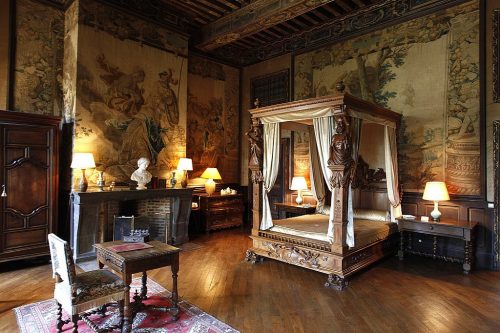
Those who have often been so gay and vivacious, the delight of soirees, would become distant, and aloof, of serious mien, unsmiling after visiting my estate and succumbing to magical thinking, spooked by “the feeling of an unseen force, a fine net drawn around us with infinite skill and delicacy.” The atmospheric writing strained to evoke a liminal territory on the edge of American civilization where superstition merges into everyday experience. The allegedly rational solution to the deaths of my infant daughter and husband feeds into the formula for family curses, as Holmes solves the case through a proper understanding of heredity and threat of degeneracy within aristocratic bloodlines. “The deaths of Mr. William Winchester and infant daughter Annie Winchester was caused by demonic “elementals” guarding the land, because Mr. Winchester had expanded the family business and begun an investigation of the stories of “The Gun that Won the West’s” malevolence….I warned Mr. Winchester against concerning himself with the curse. He persisted, and his death proceeded the death of his infant daughter. He became engrossed in the subject, and wrote with feverish haste and in bewildering abundance. Of skepticism there was none. I told him he was tempting fate by pursuing his inquiries, but he was fascinated and would not desist. Then his daughter was overtaken by illness six weeks after her birth by the mysterious childhood disease marasmus. And Mr. Winchester premature death was fifteen years later from tuberculosis, which added to Mrs. Winchester’s distress. However, this is the way in which the demonic “elementals” guiding the Winchester bloodline might act.” A statement by Weston St. Joyce of the Hellfire Club. #RandolphHarris 4 of 7

One of Daisy’s reminiscences is striking for embroiling all the central figures of The Winchester story in occult: “I had attended at least two seances which my aunt had held at Llanada Villa…I had watched aunt Sarah put into a trance on an occasion when Bertha Haas had been present. It had been an eerie, not to say unpleasant, experience which had shaken me considerably…Suddenly she had started talking in an unknown tongue which, to everyone’s astonishment, Bertha Haas had pronounced as being Coptic…I remembered particularly one séance when Bertha has been placed in a trance.” Friday morning, the day was pleasant, but even in the brightest sunlight, a cold shudder ran through me and visitors like, and every ear seemed strained in a kind of instinctive, unconscious listening. I knew that I had come upon the horror and its monstrous work, and trembled with the responsibility I felt to be mind. Night would soon fall, and it was then that the spirits really became restless. No material weapon would be of help. Having read William’s diaries, I knew painfully well what kind of manifestations to expect, but I did not add to the fright of the servants by giving any hints or clues. As the shadows gathered, the servants commenced to disperse homeward, anxious to bar themselves indoors despite the present evidence that all human locks and bolts were useless before a force that could bend trees and crush houses when it chose. Whatever was in Llanada Villa was biding its time. A downpour waxed in heaviness, and distant peals of thunder sounded from far horizons. Sheet lighting shimmered, and then a forky bolt flashed near at hand, as if descending into my accursed mansion itself. They sky grew very dark, and watcher hoped that the storm would prove a short, sharp one followed by clear weather. #RandolphHarris 5 of 7

It was still gruesomely dark when, not much over an hour later, a confused babel of voices sounded down the hall. Another moment brought to view a frightened group of more than a dozen men, running, shouting, and even whimpering hysterically. But in another minute, we were in a sitting-room of the house, a large, high chamber with a mahogany floor, full of moving shadows cast by a wood-fire that flickered in on the great hearth. Before lay a large folio, bound, perhaps, late in the seventeenth century, with the arms of Canon Alberic de Mauleon stamped in gold on the sides. There may have been a hundred and fifty leaves of paper in the book, and on almost every one of them was fastened a lead from an illuminated manuscript. Such a collection I had hardly dreamed of in my wildest moments. Here were ten leaves from a copy of Genesis, illustrated with pictures, which could not be later than A.D 700. Further on was a complete set of pictures from a Psalter, of English execution, of the very finest kind that the thirteenth century could produce; and, perhaps best of all, there were twenty leaves of uncial writing in Latin, which, as a few words seen here and there told me at once, must belong to some very early unknown patristic treatise. Could it possibly be a fragment of the copy of Papias “On the Words of Our Lord,” which was known to have existed as late as the twelfth century at Nimes? In any case, my mind was soon brought back to the chaos. The swishing, lapping sound of the bending trees and bushes caught my attention. And there was an awful stomping and splashing in the mud. However, I did not see anything at all, only just the bending of the trees and the underbrush. #RandolphHarris 6 of 7

The I heard an awful creaking and straining. The servants were yelling and shrieking when something heavy struck the house—not lightning, nor anything, but something heavy and again, and again. It kept launching itself again and again, though I could not see anything. Lines of fright deepened on every face, we could hear a terrible crashing and a hall full of screaming. In the hall before us were grouped four carpenters, surrounding a crouching figure. A fifth carpenter lay dead on the floor, his neck distorted, and his eyeballs staring from his head. The four surrounding carpenters were looking at him. In their faces the sentiment of horror was intensified; they seemed, in fact, only restrained from flight by their implicit trust in me. All this terror was plainly excited by any words I could say. I absolutely refused to be alone for the rest of the evening, and for many nights I had not dared to put out my lights before going to sleep. All this time a growing feeling of discomfort had been creeping over me. Before my eyes appeared a mass of coarse, matted black hair, and this body of fearful thinness, almost a skeleton, but with the muscles standing out like wires out of my mind. The hands were of a dusky pallor, covered, like the body, with long, coarse hairs, and hideously taloned. The eyes, touched in with a burning yellow, had intensely black pupils, and were fixed upon the ceiling with a look of beast-like hate. This appalling effigy inspired terror. With such intense physical fear and the most profound mental loathing, I grasped blindly at my silver crucifix, that I was conscious of a movement toward me on the part of the demon, and then it screamed with the voice of an animal in hideous pain. Hans and Robert, two sturdy little serving-men, who rushed in, saw nothing, but felt themselves thrust aside by something that passed out between then, and found me in a swoon. They sat up with me that night. The phases of Nature can be utterly forbidden, and wholly outside the sane experience of mankind. #RandolphHarris 7 of 7
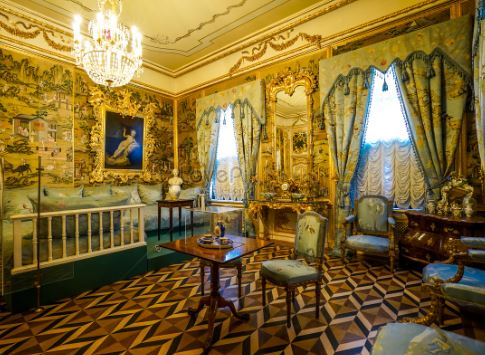
The Winchester Mystery House
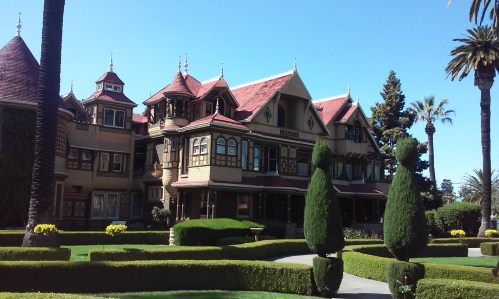
When The Winchester Mansion was opened after the passing of Mrs. Winchester in 1922, a carpenter made a small breach in the upper left-hand corner of the front doors, and put a candle through the hole: “At first I could see nothing, the hot air escaping from the chamber causing the candle flame to flicker, but presently, as my eyes grew accustomed to the light, details of the room within emerged slowly from the mist, strange animals, statues, and gold—everywhere the glint of gold. For the moment—an eternity it must have seemed to the others standing by—I was struck dumb with amazement, and when the movers, unable to stand the suspense any longer, inquired anxiously, ‘Can you see anything?’ It was all I could do to get out the words. ‘Yes, wonderful things.’” It took seven weeks to clear the mansion of its objects, each item laboriously documented, photographed and carried out to moving vans. This took place under the intense gaze of tourist crowds and the restless journalists from the World’s press. Beyond the door, the foyer was almost entirely filled with a shrine covered in gold leaf, and shrines within shrines that protected sacred objects. They found an open store, stuffed with golden statuary and guarded by an impressive Anubis figure.

Daisy recalled the “dazed, bewildered look” of the esteemed visitors invited inside. However, she also stated, “I cannot but think that some risks are run by breaking into the last rest of my beloved aunt Sarah whose mansion is specially and solemnly guarded, and robbing her of her possessions.” A statue of gold was removed from The Winchester Mansion. Tourists had allegedly become supplicants to the statue, holding séances. There was a photograph in which “a shadowy human face has come between the camera and the object which was being photographed.” In other anecdotes, paintings gasped at the movers and the mansion exuded “an unaccountable sense of apprehension.” The first movers not only got lost, but came down with various illnesses (ophthalmia and delirium). A news story of the suicide that claimed one of the movers was frequently heard to mutter “the curse of the Winchester Fortune,” as though this had prayed on his mind. An auctioneer was also incorporated into the unfolding curse (in fact he had been ill with cancer, a fate of several movers). These people knew that they were meddling with terrible powers, yet saw that there was no other way to annul the deeper and more malign meddling which others had done before them.

For further information about tours, including group tours, weddings, school events, birthday party packages, facility rentals, and special events please visit the website: https://winchestermysteryhouse.com/
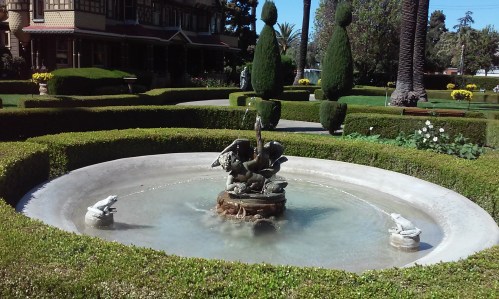
Please visit the online giftshop, and purchase a gift for friends and relatives as well as a special memento of The Winchester Mystery House. A variety of souvenirs and gifts are available to purchase. https://shopwinchestermysteryhouse.com/

Had I Not Pledged My Soul?
Oh, these were terrible thoughts. Did I not love Llanada Villa? Had I not pledged my soul? I was consumed with self-hatred and dread that the curse was controlling my life. These thoughts were too horrendous. They divided me from all that desired. I had to banish them from my mind. However, there was a great clamor, and people were beating on my windows and doors. Rocks were being thrown at my house. The wooden shutters were about to be broken in. Across the field, my estate lay strewn with the carcasses of cows and horses and, in one of the fields, sheep. No flies buzzed near the dead animals; there were no maggots burrowing. No vultures; the sky was clean of birds. And in all the untended rolling hills of grass and trees which had once sung and pulsed with a million voices, in all the land there was this immense stillness now, still as years, still as the unheard motion of the stars. I looked up through the still-hanging poison cloud, up to where the moon was now risen in full coldness. A little fat bald man with old eyes sighed and began to wave in the October dusk. The outline of his form wavered and disappeared in the shadows under the trees where the moonlight did not reach. Other followed him. The wind came limping back from the mountains. #RandolphHarris 1 of 2

It blew the heavy iron bell high in the belfry, as if lifted ancient dusts and hissed again through the trees. I watched the air turn black. I listened to it fill with the flappings and the flutterings and the squeakings. This chaos had caused much worry and bafflement. As I paused for a moment, looking out at the silent place of high dark grass, there were scrolls of stone-frozen children stained silver in the night’s wet darkness. The people were gone; my estate was empty. Morning found me in a cold sweat of terror and a frenzy of wakeful concentration. I sat at the table under the electric light with shaking hands all night. All day long I rested, while guns thundered outside. Then, in the slanting shadows of the later afternoon, the rumbling echoes faded into the distance and I knew it was over. As I climbed the stairs and entered the roofless foyer of Llanada Villa, where only a configuration of cobwebs veiled the radiance of the rising moon, I realized that success had brought me to a state of such fatigue that I had begun seriously to contemplate a long rest. I had not enjoyed a proper holiday in nearly three years. I am quite well, and live in great comfort here, although I receive but rarely and am content with my own company most of the time. I have found deep enjoyment and spiritual profit in foreign cities, having arrived, the tedium of travel itself has often made me think twice before starting out on a long voyage. #RandolphHarris 2 of 2
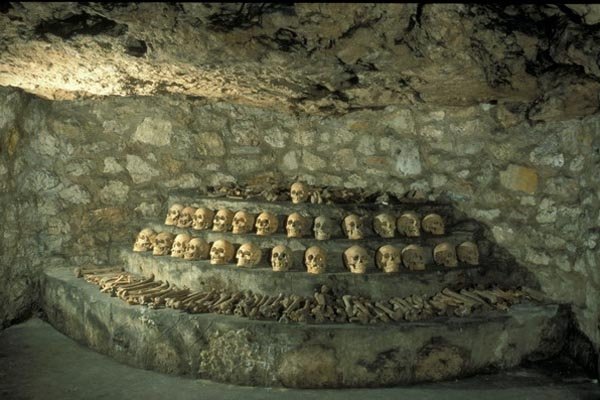
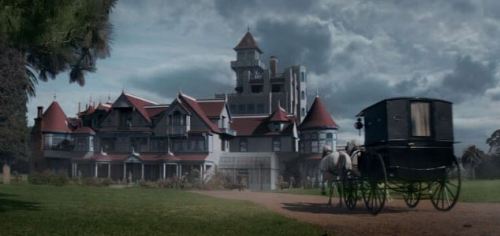
A Blue Lady is said to haunt the mansion. According to legend, a princess wanted to marry one of Mrs. Winchester’s famers, but her father disapproved of him and his standing in life. To ensure the romance did not grow any stronger, the father sent the suitor overseas hoping that it would all blow over in time. After some time, the father told his daughter that her suitor had married someone else, and that she should forget all about him. To improve the spirits of the distraught girl, Mrs. Winchester asked her seamstress to make a dress in favourite colour, blue.

However, when it was completed, the princess put on the beautiful garment, then climbed to the top of the nine story Observational Tower, and threw herself to death. It is now said that the forlorn princess returns to the mansion every thirteen years, in her blue dress, wandering around, then making her way down to the veranda, where she stands at the front doors forever waiting the return of her lost love.

For further information about tours, including group tours, weddings, school events, birthday party packages, facility rentals, and special events please visit the website: https://winchestermysteryhouse.com/

Please visit the online giftshop, and purchase a gift for friends and relatives as well as a special memento of The Winchester Mystery House. A variety of souvenirs and gifts are available to purchase. https://shopwinchestermysteryhouse.com/

Wild Savage Beasts, with Whom Men and Woman Can Have No Society or Security

To bottomless perdition, there to dwell in adamantine chains and penal fire, who durst defy the Omnipotent to arms. Nine times the space that measures day and night to mortal men, he with his horrid crew lay vanquished, rolling in the fiery gulf confounded though immortal: but his doom reserved him to more wrath; for now the thought both of lost happiness and lasting pain torments him; round he throws his baleful eyes that witnessed huge affliction and dismay mixed with obdurate pride and steadfast hate: at once as far as angels ken he views the dismal situation waste and wild, a dungeon horrible, on all side round as one great furnace flamed, yet from those flames no light, but rather darkness visible served only to discover sights of woe, regions of sorrow, doleful shades, where peace and rest can never dwell, hope never comes that comes to all; but torture without end still urges, and a fiery deluge, fed with ever-burning sulphur unconsumed: such place Eternal Justice had prepare for thse rebellious, there their prison ordained in utter darkness, and their portion set as far removed from God and light of Heaven as from the center thrice to the utmost pole. O how unlike the place from whence they fell! There the companions of his fall, overwhelmed with floods and whirlwinds of tempestuous fire, he soon discerns, and weltering by his side one next himself in power, and next in crime. This is a description of Satan’s fall from Heaven and what Hell is like. Many people, especially those who wickedly, maliciously, and feloniously sin like to deluge themselves into thinking there is no Hell. However, those who sin fell to see the Hell they are creating on Earth, in their lives and in the lives of people around them. #RandolphHarris 1 of 19
If you look at their victims and their own lives, it sounds a lot like they are living in Hell, right? So, can you imagine how much worse it will be to spend Eternal Life burning in Hell? To every action, there is an equal, but separate reaction. That is Sir Isacc Newton’s Third Law of Physics. Therefore, a person who thinks that they can go on sinning and not pay the wages of sin is delusional. The wages of sin are death. This means you will not be resurrected to live eternal life with God. This is why it is important to be a good Christian and obey the laws of the land. The Rule of Law is one star in the constellation of ideals that dominate our political morality: the others are democracy, human rights, and economic freedom. We want societies to be democratic; we want them to respect human rights; we want them to organize their economies around free markets and private property to the extent that this can be done without seriously compromising social justice; and we want them to be governed in accordance with the Rule of Law. We want the Rule of Law for new societies—for newly emerging democracies, for example—and old societies alike, for national political communities and regional and international governance, and we want it to extend into all aspects of governments’ dealings with those subject to them—not just in day-to-day criminal law, or commercial law, or administrative law but also in law administered at the margins, in antiterrorism law and in the exercise of power over those who are marginalized, those who can safely be dismissed as outsiders, and those we are tempted to just destroy as (in John Locke’s words) “wild Savage Beasts, with whom men can have no Society or Security.” Some people like to produce a series of lifetime crises, instead of transcending their issues or seeking help. #RandolphHarris 2 of 19

Getting to the Rule of Law does not just mean paying lip service to the ideal in the ordinary security of a prosperous modern democracy; it means extending the Law and Order into societies that are not necessarily familiar with it; and in those societies that are accustomed to it, it means extending the Rule of Law into these unseen corners of governance, as well. The formal aspects of the Rule of Law concern the form of the norms that are applied to our conduct: generality, prospectivity, stability, publicity, clarity, and so on. However, we do not value them for formalistic reason. We value these features for the contribution they make to predictability, which is indispensable for liberty. We value them for the way they respect human dignity. To judge people’s actions by unpublished or retrospective laws is to convey to them your indifference to their power of self-determination. If we respect dignity in these formal ways, we will find ourselves more inhibited against more substantive assault on self-respect and justice. The Rule of Law is treated as an ideal that calls directly for an end to human rights abuses or as an ideal that calls directly for free markets and respect for private property rights. When people clamor for the Rule of Law in America, they are demanding impartial tribunals that can adjudicate their claims. And when people are detained, they are clamoring for hearings on the comprehensive loss of liberty in which they would have an opportunity to put their case, confront and examine the evidence against them, such as it is, and make arguments for their freedom, in accordance with what we would say were normal legal procedures. #RandolphHarris 3 of 19

The masochistic bonds in society are fundamentally different from the primary bonds. The latter are those that exist before the process of individuation has reached its completion. The individual is still part of “one’s” natural and social World, one has not yet completely emerged from one’s surroundings. The primary bonds give one genuine security and the knowledge of where one belongs. The masochistic bonds are escape. The individual self has emerged, but it is unable to realize its freedom; it is overwhelmed by anxiety, doubt, and a feeling of powerlessness. The self attempts to find security in “security bonds,” as we might call the masochistic bonds, but this attempt can never be successful. The emergence of the individual self cannot be reserved; consciously the individual can feel secure and as if one “belonged,” but basically one remains a powerless atom who suffers under the submergence of one’s self. One and the power to which one clings never become one, a basic antagonism remains and with it an impulse, even if it is not conscious at all, to overcome the masochistic dependence and to become free. What is the essence of the sadistic drives? Again, the wish to inflict pain on others is not the essence. All the different forms of sadism which we can observe go back to one essential impulse, namely, to have complete mastery over another person, to make one a helpless object of our will, to become the absolute ruler over one, to become one’s God, to do with one as one pleases. To humiliate one, to enslave one, are means to this end and the most radical aim is to make one suffer, since there is no greater power over another person than that of inflicting pain on one, to force one to undergo suffering without one’s being able to defend oneself. #RandolphHarris 4 of 19

The pleasure in the complete domination over another person (or other animate objects) is the very essence of the sadistic drive. People say that a God who punishes is sadistic. However, what you put out in the World is what you attract. Sadism is not pleasure you want to make another person feel but impression you want to produce; that of pain is far stronger than that of pleasure…one realized that; one uses it and is satisfied. Sadism is the pleasure felt from the observed modifications on the external World produced by the observer. The sadistic mastery is characterized by the fact that it wants to make the object a will-less instrument in the sadist’s hands, while the nonsadistic joy in influencing others respects the integrity of the other person and is based on a feeling of equality. It seems that this tendency to make oneself the absolute master over another person is the opposite of the masochistic tendency, and it is puzzling that these two tendencies should be so closely knitted together. No doubt with regard to it practical consequences the wish to be dependent or to suffer is the opposite of the wish to dominate and to make others suffer. Psychologically, however, both tendencies are the outcomes of one basic need, springing from the inability to bear the isolation and weakness of one’s own self. The aim of both sadism and masochism is called symbiosis. Symbiosis, in this psychological sense, means the union of one individual self with another self (or any other power outside of the own self) in such a way as to make each lose the integrity of its own self and to make them completely dependent on each other. #RandolphHarris 5 of 19

The sadistic person needs one’s own object just as much as the masochistic needs one’s. Only instead of seeking security by being swallowed, one gains it by swallowing somebody else. In both cases the integrity of the individual self is lost. In one case, one dissolves oneself in an outside power; one loses oneself. In the other case, one enlarges oneself by making another being part of oneself and thereby one gains the strength one lacks as an independent self. It is always the inability to stand the aloneness of one’s individual self that leads to the drive to enter into a symbiotic relationship with someone else. It is evident from this why masochistic and sadistic trends are always blended with each other. Although on the surface they seem contradictions, they are essentially rooted in the same basic need. People are not sadistic or masochistic, but there is a constant oscillation between the active and the passive side of the symbiotic complex, so that it is often difficult to determine which side of it is operating at a given moment. In both cases individuality and freedom are lost. If we think of sadism, we usually think of the destructiveness and hostility which is so blatantly connected with it. To be sure, a greater or lesser amount of destructiveness is always to be found linked up with sadistic tendencies. However, this is also true of masochism. Every analysis of masochistic traits shows this hostility. The main difference seems to be that in sadism the hostility is usually more conscious and directly expressed in action, while in masochism the hostility is mostly unconscious and finds an indirect expression. #RandolphHarris 6 of 19

Destructiveness is the result of the thwarting of the individual’s sensuous, emotional, and intellectual expansiveness; it is therefore to be expected as an outcome of the same conditions that makes for the symbiotic need. Sadism is not identical with destructiveness, although it is to a great extent blended with it. The destructive person wants to destroy the object, that is, to do away with it and to get ride of it. The sadist wants to dominate one’s object and therefore suffers a loss if his or her object disappears. Paranoid, projective and fanatical political thinking are all truly pathological forms of thought processes, different from pathology in the conventional sense only by the fact that political thoughts are shared by a larger group of people and not restricted to one or two individuals. These pathological forms of thinking, however, are not the only ones that block the way to the proper grasp of political reality. There are other forms of thinking, which should perhaps not be called pathological, yet which are equally dangerous, maybe only because they are more common. I refer especially to unauthentic, automaton-thinking. The process is simple: I believe something to be true, not because I have arrived at the thought by my own thinking, based on my own observation and experience, but because it has been “suggested” to me. When actually I have adopted them, in automaton-thinking I may be under the illusion that my thoughts are my own, because they have not been presented by sources that carry authority in one form or another. #RandolphHarris 7 of 19

All of modern thought manipulation, whether it is in commercial advertising or in political propaganda, makes use of the suggestive-hypnoid techniques which produce thoughts and feelings in people without making them aware that “their” thoughts are not their own. The art of brain-washing that communists seem to have brought to a certain perfection is actually only a more extreme form of this hypnoid suggestion. With increasing skill in suggestive techniques, authentic thinking becomes more and more replaced by automaton-thinking, yet the great illusion of the voluntary and spontaneous character of our thoughts is kept alive. It is quite remarkable how readily groups recognize the unauthentic character of thought in opponents but not in themselves. American travelers, for instance, returning from Russia, report their impressions about the uniformity of political thinking in Russia. Everybody seems to ask the same questions, from “What about lynchings in the Sacramento, California?” to “If the Americans have peaceful intentions, why does the United State of America need so many military bases surrounding Russia?” What the travelers to Russian who report on the uniformity of opinion there are not aware of is that public opinion in the United State of America is hardly less uniform. Most Americans take for granted a number of cliches such as that the Russians want to conquer the World for revolutionary communism, that because they do not believe in God they have no concept of morality similar to our own, and so on. And that is exactly what many Americans fear about superstitious African American communists and the democratic party. #RandolphHarris 8 of 19

This kind of unauthentic, automaton thinking results in “doublethink,” which George Orwell has so brilliantly described as the logic of totalitarian thought. “Doublethink,” he says in his book 1984, “means the power of holding two contradictor beliefs in one’s mind, and accepting both of them.” We are familiar with the Russian doublethink. Countries like Hungary and Germany, whose governments clearly rule against the will of the vast majority of the population, are called “people’s democracies.” A hierarchical class society built along rigid lines of economic, social and political inequality is called a “classless society.” A system in which the power of the states has been increasing for the last one hundred and twenty years is said to lead to the “withering away of the State.” However, doublethink is by no means only a Russian phenomenon. If they are anti-Russian, we in the West call dictatorships “part of the free World.” Thus dictators like Syngman Rhee, Chiang Kaishek, Mr. Franco, Mr. Salazar, Mr. Batista, to mention only a few, were acclaimed as fighters for freedom and democracy, and the truth about their regimes was suppressed or distorted. Besides that we permitted humans like Mr. Chiang, Mr. Rhee, and Mr. Adenauer to influence and, sometimes modify, American foreign policy. The American public is misinformed about Korea, Formosa, Laos, the Congo, and Germany to a degree that is in flagrant contrast to our picture of ourselves as having a free press and informed public. We call it subversion when the Russians make anti-American propaganda, but we do not call it subversive when ABC, NBC, and CBS do it. #RandolphHarris 9 of 19
We proclaim our respect for the independence of small countries, but we support the overthrow of freedom and communist governments taking over in America. We are horrified at the Russian terror in Ukraine, but not at the American terror in Sacramento, California. Pathological thinking and doublethink are not only sick and inhuman, but they endanger our very survival. In a situation where errors in judgment can bring about catastrophic consequences we can not afford to indulge in pathological or cliché-ridden forms of thinking. The clearest and most realistic thought about the World situation, especially with regard to the conflict between Russian and the West becomes a matter of vital necessity. Today certain opinions are held with pride as being “realistic,” when they actually are some of the Pollyanish illusions that the attack. It is a peculiar frailty of human reactions that many are prone to believe that a cynical, “tough” perspective is more likely to be “realistic” than a more objective, complex, and constructive one. Apparently many people think that it takes a strong and courageous man to see things simply and without too many complexities, or to risk catastrophe without blinking. It seems, for instance, that the admiration with which Herman Kahn’s book On Thermonuclear War, Princeton University Press, Princeton, 1960, has been received in many quarters is due precisely to this mechanism. Anyone who can present a “budget” from 5 to 160 million fatalities in a nuclear war without shrinking, who can reassure us that 60 million killed will not seriously diminish the survivors’ pleasures in living, must be strong and “realistic.” Now many then observe how flimsy and unrealistic many of his thoughts and “proofs” are. #RandolphHarris 10 of 19
Many forget that it often takes fanatical, self-righteous, and confused people to confuse what C.W. Mills has so rightly called “crackpot realism” with a rational appreciation of reality. Paranoid, projective, fanatical, and automaton thinking are various forms of thought processes, which are all rooted in the same basic phenomenon—in the fact that the human race has not arrived yet at the level of development expressed in the great humanist religions and philosophies that came to life in India, China, Palestine, Persia, and Greece from 1500 B.C. to the time of Christ. While most people think in terms of these religious systems and of their nontheological philosophical successors, they are still emotionally on an archaic, irrational level, not different from the one that existed before the ideas of Buddhism, Judaism, and Christianity had been proclaimed. We still worship idols. We do not call these idols Baal or Astarte but we worship and submit to our idols under different names. In fact, the TV has become the number one false idol in the World, which children are taught to worship from day one. Technically and intellectually we are living in an atomic age; emotionally we are still living in the Stone Age. We feel superior to the Aztecs who on a feast day sacrificed 20,000 men and women to their gods, in the belief this would keep the universe in its proper course. We sacrifice millions of men and women for various goals that we think are noble and we justify the slaughter. However, the facts are the same, only the rationalizations are different. Humans, in spite of all their intellectual and technical progress, are still caught in the idol worship of blood ties, property, and institutions. #RandolphHarris 11 of 19

The reason of humans is still governed by irrational passions. They have still not experienced what it is to be fully human. We till have a double standard of values for judging our own and outside groups. The history of civilized man until now is really very short, comparable to less than an hour in human life. It is not amazing or discouraging that we have still not reached maturity. Those who believe in humans’ capacity to become what they potentially are would have no need to be alarmed were it not that the discrepancy between emotional and intellectual-technical development has reached such proportions now that we are threated with extinction or a new barbarism. This time only a fundamental and authentic change will save us. Yet we so little know how to accomplish this change—and the times are so pressing. One approach is to speak the truth. We mut penetrate the net of rationalizations, self-delusions, and doublethink. We must be objective and see the World and ourselves realistically and undistorted by narcissism and xenophobia. Freedom exists only where there is reason and truth. Archaic tribalism and idolatry flourish where the voice of reason is silent. Does it not follow that to know the truth about facts of foreign policy is of vital importance for the preservation of freedom and peace? Up to this point, our model outline of the policy-making phase of the planning process may have seemed to imply some identity between the affected public and its policy-making body. In the smallest planning operations, such an identity is possible and a sort of direct democracy may exist. In most instance, however, even at the local level of operation, policy-making must be carried on by representative bodies. #RandolphHarris 12 of 19

Moreover, the fact that typical documents of the policy phase are minutes of meetings, hearings, and debates may serve to obscure that such formal encounters only condense a larger process of public involvement. The vicarious participation by the affected public through its representative policy-making body needs to be stressed, because therein sees to be an important difference in content, if not in procedure, between the making of law and the setting of goals for action programs—between government in the classical sense and planning in the modern sense. Once launched, a proposal can rarely be withdrawn to a more propitious time; it must meet its fate, whether it be rejection or acceptance. As the discussion by the public proceeds to a climax, it becomes fitting for the representative policy-making body to express a decision either by vote or by some other method. And such a decision, is ideally the formal culmination of a process by which in fact the public has already made up its mind as to what it wants. One further important, but frequently neglected, item is necessary to complete the policy phase. This is the brief ceremony which, though performed in a multitude of formal and informal ways, is generally known as burying the hatchet. Discriminating and sincere dramatization of the values held in common among the erstwhile antagonists is a priceless asset in assuring the maximum degree of co-operation-or at least noninterference-by all parties in the execution of the program which has been finally adopted as policy. #RandolphHarris 13 of 19

The finding that traders may be trapped into undesirable equilibrium under an enforcer, for example, as the result of the mafisos intermediary’s commission is higher when one provides enforcement services than when one provides information only. This model finds that violence is more likely when the mafisos provides enforcement services and in the competition among rival mafiosi. That statement that obedience to another person is ipso facto submission needs also to be qualified by distinguishing “irrational” from “rational” authority. An example of rational authority is to be found in the relationship between student and teacher; one of irrational authority in the relationship between slave and master. Both relationships are based on the fact that authority of the person in command is accepted. Dynamically, however, they are of a different nature. The interests of the teacher and the student, in the ideal case, lie in the same direction. The teacher is satisfied if one succeeds in furthering the student; if one has failed to do so, the failure is one’s and the student’s. The slave owner, on the other hand, wants to exploit the slave as much as possible. The more one gets out of one, the more satisfied one is. At the same time the slave tries to defend as best one can one’s claims for a minimum of happiness. The interests of slave and master are antagonistic, because what is advantageous to the one is detrimental to the other. The superiority of the one over the other has different function in each case; in the first it is the condition for the furtherance of the person subjected to the authority, and in the second it is the condition for one’s exploitation. #RandolphHarris 14 of 19

Another distinction runs parallel to this: rational authority is rational because the authority, whether it is held by a teacher or a captain of a ship giving orders in an emergency, acts in the name of reason which, being universal, I can accept without submitting. Irrational authority has to use force or suggestion, because no one would let oneself be exploited if one were free to prevent it. Why are humans so prone to obey and why is it so difficult for them to disobey? As long as I am obedient to the power of the State, the Church, the media, or public opinion, I feel safe and protected. In fact it makes little difference what power it is that I am obedient to. It is always an institution, or men and women, who use force in one form or another and who fraudulently claim omniscience and omnipotence. My obedience makes me part of the power I worship, and hence I feel strong. I can make no error since it decides for me; I cannot be alone, because it watches over me; I cannot commit a sin, because it does not let me do so, and even if I do sin, the punishment is only the way of retuning to the almighty power. In order to disobey, one must have the courage to be alone, to err and to sin. However, courage is not enough. The capacity for courage depends on a person’s state of development. Only if a person has emerged from mother’s lap and father’s commands, only if one has emerged as a fully developed individual and thus has acquired the capacity to think and feel for oneself, only then can one have the courage to say “no” to power, to disobey. A person can become free through acts of disobedience by learning to say no to power. #RandolphHarris 15 of 19

However, not only is the capacity for disobedience the condition for freedom; freedom is also the condition for disobedience. If I am afraid of freedom, I cannot day to say “no,” I cannot have the courage to be disobedient. Indeed, freedom and the capacity for disobedience are inseparable; hence any social, political, and religious system which proclaims freedom, yet stamps out disobedience, cannot speak the truth. The liberation of the will from its passive condition and control by the prince of this World takes place when the believer recognizes one’s right of choice and begins deliberately to place one’s will on God’s side, thus choosing the will of God. Until the will is fully liberated for action, it is helpful for the believer to assert one’s decision frequently by saying, “I choose the will of God, and I refuse the will of the ultimate negative.” The soul may not even be able to distinguish which is which, but the declaration is having effect in the unseen World. God definitely works by His Spirit in the human as one chooses His will, energizing one through one’s volition continually to refuse the claims of sin and the ultimate negative; and the ultimate negative is thereby rendered more and more powerless, while the human is stepping out into the salvation obtained potentially for one at Calvary…and God is gaining once more a loyal subject in a rebellious World. On the part of the believer the action of the will is governed by the understanding of the mind: id est, the mind sees what to do, the will chooses to do it, and then from the spirit comes the power to fulfill the choice of the will and the percept of the mind. #RandolphHarris 16 of 19

For example, the human sees that one should speak, one chooses or wills to speak, one draws upon the power in one’s spirit to carry out one’s decision. This presumes a knowledge of how to use the spirit and involves the necessity of knowing the laws of the spirit, so as to cooperate fully with the Holy Ghost. The nature of the Spiritual Community is further clarified by distinction between it manifest and latent stages. To put it simply, the difference between the latent and manifest community is the difference of “before” and “after” the encounter with the New Being in Jesus as the Christ Before an individual or a group—be they ancient Mandarin Chinese or modern humanists—receives the gospel message, they are in a period of preparatory revelation. They are not destitute of the Spiritual Presence, for there are elements of faith in the sense of being grasped by an ultimate concern, and there are elements of love in the sense of a transcendent reunion of the separated. Therefore, they belong to the Spiritual Community, but in a latent manner. The latent Spiritual Community lacks the ultimate criterion of the Cross of the Christ which is the principle of resistance against profanization and demonization. The manifest Spiritual Community is the community of those who have encountered and accepted Jesus as the Christ and, consequently, in the Cross possess the means of constant self-negation, reformation, and transformation. The Spiritual Community in its totality is thus seen to extend far beyond the Christian churches, though it embraces them. The “before” and “after” the encounter with Jesus the Christ is not demarcated by the year 33 A.D. For the Spiritual Community in its latency is created by the Spiritual Presence which is operative in all of history, including the present moment. #RandolphHarris 17 of 19

The distinction between the latent and manifest Spiritual Community is not the same as the time-honored distinction between the visible and indivisible church, for “visible” and “invisible” apply to both the latent and manifest community. If its faith is expressed in an organized system of symbols and rituals, by this it is clear that the latent Spiritual Community is visible. The invisible latent community would seem to be those individuals who, although grasped by the Spiritual Presence, do not articulate their faith by adopting the symbols and cult of a recognizable, organized religion. “Visible” and “invisible” would apply to the manifest Spiritual Community in much the same way, the invisible manifest community being those who consciously and explicitly accept Jesus as the Christ, but shun the Christian churches. The existence of a Christian Humanism outside the Christian Church seems to me to make such a distinction necessary. It will not do to designate as non-churchly all those who have become alienated from the organized Churches and traditional creeds. My life in these groups for half a generation showed me how much latent Church there is in them: the experience of the finite character of human existence; the quest for the eternal and the unconditioned, and absolute devotion to justice and love; a hope which is more than any Utopia; an appreciation of Christian values; and a most delicate apprehension of the ideological misuse of Christianity in the Church and State. It often seemed to me as if the latent Church which I found in these groups, were a truer church than the organized Churches, because its members did not assume to be in possession of the truth. #RandolphHarris 18 of 19

Powerful as the latent church is—not even communism could life if it were devoid of all elements of the Spiritual Community. It lacks the criterion of the Cross to guard against demonization from within, and the organizational strength to fend off the attacks of the modern paganism. Plant guards and eat the fruit of them. I, the Lord, will turn the captivity of My people America, and they shall build the waste cities, and inhabit them. America shall no more be termed forsaken, neither shall the land be termed desolate any more. I will open rivers on the high hills, and fountains in the midst of the valleys; I will make the wilderness a pool of water, and the dry land, springs of water. I will plant in the wilderness the cedar, the acacia tree, the myrtle and the olive tree. Be glad then, ye children of America, and rejoice in the Lord your God. For the pastures of the wilderness are green with grass, the tree bears its fruit; the fig-tree and the vine do yield their strength. Be glad, O land, and rejoice, for the Lord hath done great things. I pledge allegiance to the flag of the United States of American, and to the Republic, for which it stands, One Nation, Under God, Indivisible with Liberty and Justice for all. How manifold are Thy works, O Lord! In wisdom hast Thou made them all. O Lord, our God, how glorious is Thy name in all the Earth! When I behold the Heavens, the work of Thy fingers, the moon and the stars which Thou hast established; what is human that Thou art mindful of them, and the son of man that Thou thinkest of him? Yet hast Thou made one but little less than divine, and hast crowned one with glory and honor. Thou hast made one to have dominion over the words of Thy hands; all things hast Thou put under one’s feet. Beloved of Thee are humans, Thine own creation, fashioned in Thine image. And pleasure be sure to donate to the Sacramento Fire Department, they are not receiving all of their resources. #RandolphHarris 19 of 19

CRESLEIGH HAVENWOOD
Lincoln, CA | from the high $600s
Now Selling!

No appointment needed! Cresleigh Havenwood features four distinct floor plans ranging from 2,293 – 3,377 square feet and offering up to five bedrooms. Each plan has been thoughtfully designed and includes great features such as single story homes, guest suites, optional offices, garage workshops, and more!

Get the most out of your new home with Cresleigh’s All Ready smart home featuring all the connectivity needed to keep your house running. Best of all, each Cresleigh home comes with owned solar included! https://cresleigh.com/havenwood/

Located off of Virginiatown Road and McCourtney Road, residents of the 83 homesites of Cresleigh Havenwood will benefit from a brand new neighborhood in the charming City of Lincoln. Palo Verde Park, is just down the street and there’s plenty of recreation to take part in all around town.


Humans Had to Leave the Garden of Eden in order to Become Fully Human

Although Dr. Freud has for many years paid little attention to the phenomenon of nonsexual aggression, Dr. Alfred Adler has put the tendencies in the center of his system. However, he deals with them not as sado-masochism, but as “inferiority feelings” and the “wish for power.” Dr. Adler sees only the rational side of these phenomena. While we are speaking of an irrational tendency to belittle oneself and make oneself small, he thinks of inferiority feelings as adequate reaction to actual inferiorities, such as organic inferiorities or the general helplessness of a child. And while we think of the wish for power as an expression of an irrational impulse to rule over others, Dr. Adler looks at it entirely from the rational side and speaks of the wish for power as an adequate reaction which has the function of protecting a person against the dangers springing from his or her insecurity and inferiority. Dr. Adler, here, as always, cannot see beyond purposeful and rational determinations of human behaviour; and though he has contributed valuable insights into the intricacies of motivation, he remains always on the surface and never descends into the abyss of irrational impulses as Dr. Freud has done. In psychoanalytic literature a viewpoint different from Dr. Freud’s has been presented by Dr. Wilhelm Reich, Dr. Karen Horney, and myself. Although Dr. Reich’s views are based on the original concept of Dr. Freud’s libido theory, he points out that the masochistic person ultimately seeks pleasure and that the pain incurred is a by-product, not an aim in itself. #RandolphHarris 1 of 19
Dr. Horney was the first one to recognize the fundamental role of masochistic strivings in the neurotic personality, to give a full and detailed description of the masochistic character traits, and to account for them theoretically as the outcome of the whole character structure. In her writings, as well as in my own, instead of the masochistic character traits being thought of as rooted in the sexual perversion, the latter is understood to be the sexual expression of psychic tendencies that are anchored in a particular kind of character structure. What is the root of both the masochistic perversion and masochistic character traits respectively? Furthermore, what is the common root of both the masochistic and the sadistic strivings? Both the masochistic and sadistic strivings tend to help the individual to escape one’s unbearable feeling of aloneness and powerlessness. Psychoanalytic and other empirical observations of masochistic persons give ample evidence that they are filled with a terror of aloneness and insignificance. Frequently this feeling is not conscious; often it is covered by compensatory feelings of eminence and perfection. However, if one only penetrates deeply enough into the unconscious dynamics of such a person, one finds these feelings without fail. The individual finds oneself “free” in the negative sense, that is, alone with one’s self and confronting an alienated, hostile World. In this situation, to quote a telling description of Mr. Dostoevski, in The Brothers Karamazov, he has “no more pressing need than the one to find somebody to whom he can surrender, as quickly as possible, that gift of freedom which he, the unfortunate creature, was born with.” #RandolphHarris 2 of 19

The frightened individual seeks for somebody or something to tie one’s self to; one cannot bear to be one’s own individual self any longer, and one tries frantically to get rid of it and to feel security again by the elimination of this burden: the self. Masochism is one way toward this goal. The different forms which the masochistic strivings assume have one aim: to get rid of the individual self, to lose oneself; in other words, to get rid of the burden of freedom. This aim is obvious in those masochistic strivings in which the individual seeks to submit to a person or power which one feels as being overwhelmingly strong. (Incidentally, the conviction of superior strength of another person is always to be understood in relative terms. It can be based either upon the actual strength of the other person, or upon a conviction of one’s own utter insignificance and powerlessness. In the latter event a mouse or a leaf can assume threatening features.) In other forms of masochistic strivings the essential aim is the same. In the masochistic feeling of smallness we find a tendency which serves to increase the original feeling of insignificance. How is this to be understood? Can we assume that by making a fear worse one is trying to remedy it? Indeed, this is what the masochistic person does. As long as I struggle between my desire to be independent and strong and my feeling of insignificance or powerlessness I am caught in a tormenting conflict. If I succeed in reducing my individual self to nothing, if I can overcome the awareness of my separateness as an individual, I may save myself from this conflict. #RandolphHarris 3 of 19

To feel utterly small and helpless is one way to this aim; to be overcome by the effects of intoxication still another. If all other means have not succeeded in bringing relief from the burden of aloneness, the phantasy of suicide is the last hope (but not an option). Under certain conditions these masochistic strivings are relatively successful. If the individual finds cultural patterns that satisfy these masochistic strivings (like the submission under the “leader” in Fascist ideology), one gains some security by finding oneself united with millions of others who share these feelings. Yet even in these cases, the masochistic “solution” is no more of a solution than neurotic manifestations ever are: the individual succeeds in eliminating the conspicuous suffering but not in removing the underlying conflict and the silent unhappiness. When the masochistic striving does not find a cultural pattern or when it quantitatively exceeds the average amount of masochism in the individual’s social group, the masochistic solution does not even solve anything in relative terms. It springs from an unbearable situation, tends to overcome it, and leaves the individual caught in new suffering. If human behaviour were always rational and purposeful, masochism would be as inexplicable as neurotic manifestations in general are. This, however, is what the study of emotional and mental disturbances has taught us: that human behaviour can be motivated by strivings which are caused by anxiety or some other unbearable state of mind, that these strivings tend to overcome this emotional state and yet merely cover up its most visible manifestations, or not even these. #RandolphHarris 4 of 19

Neurotic manifestations resemble the irrational behaviour in a panic. Thus an individual, trapped in a fire, stands at the window of his or her room and shouts for help, forgetting entirely that no one can hear one and that one could still escape by the staircase which will also be aflame in a few minutes. One shouts because one wants to be saved, and for the moment this behaviour appears to be a step on the way to being saved—and yet it will end in complete catastrophe. In the same way the masochistic strivings are caused by the desire to get rid of the individual self with all its shortcomings, conflicts, risks, doubts, and unbearable aloneness, but they only succeed in removing the most noticeable pain or they even lead to greater suffering. The irrationality of masochism, as of all other neurotic manifestations, consists in the ultimate futility of the means adopted to solve an untenable emotional suffering. These considerations refer to an important difference between neurotic and rational activity. In the latter the result corresponds to the motivation of an activity-one acts in order to attain a certain result. In neurotic strivings one acts from a compulsion which has essentially a negative character: to escape an unbearable situation. The strivings tend in a direction which only fictitiously is a solution. Actually the result is contradictory to what the person wants to attain; the compulsion to get rid of an unbearable feeling was so strong that the person was unable to choose a line of action that could be a solution in any other but a fictitious sense. #RandolphHarris 5 of 19

The implication of this for masochism is that the individual is driven by an unbearable feeling of aloneness and insignificance. One then attempts to overcome it by getting ride of one’s self (as a psychological, not as a physiological entity); one’s way to achieve this is to belittle oneself, to suffer, to make oneself utterly insignificant. However, pain and suffering are not what one wants; pain and suffering are the price one pays for an aim which one compulsively tries to attain. The price is dear. One has to pay more and more, like a peon, one only gets into greater debt without ever getting what one has paid for: inner peace and tranquility. The masochistic perversion proves beyond doubt that suffering can be something sought for. However, in the masochistic perversion as little as in moral masochism suffering is not the real aim; in both cases it is the means to an aim: forgetting one’s self. The difference between the perversion and masochistic character traits lies essentially in the following: In the perversion the trend to get rid of one’s self is expressed through the medium of the body and linked up with the sexual feelings. While in moral masochism, the masochistic trends get hold of the whole person and tend to destroy all the aims which the ego consciously tries to achieve, in the perversion the masochistic strivings are more or less restricted to the physical realm; moreover by their amalgamation with pleasures of the flesh they participate in the release of tension occurring in the sphere of pleasures of the flesh and thus find some direct release. #RandolphHarris 6 of 19

The annihilation of the individual self and the attempt to overcome thereby the unbearable feeling of powerlessness are only one side of the masochistic strivings. The other side is the attempt to become a part of the bigger and more powerful whole outside of oneself, to submerge and participate in it. This power can be a person, an institution, God, the nation, conscience, or a psychic compulsion. By becoming part of a power which is felt as unshakably strong, eternal, and glamorous, one participates in its strength and glory. One surrenders one’s own self and renounces all strength and pride connected with it one loses one’s integrity as an individual and surrenders freedom; but one gains a new security and a new pride in the participation in the power in which one submerges. One gains also security against the torture of doubt. The masochistic person, whether one’s master is an authority outside of oneself or whether one has internalized the master as conscience or a psychic compulsion, is saved from making decisions, saved from the final responsibility for the fate of one self, and thereby saved from the doubt of what decision to make. One is also saved from the doubt of what the meaning of one’s life is or who “one” is. These questions are answered by the relationship to the power to which one has attached oneself. The meaning of one’s life and the identity of one’s self are determined by the greater whole into which the self has submerged. For centuries kings, priests, feudal lords, industrial bosses and parents have insisted that obedience is a virtue and that disobedience is a vice. However, human history began with an act of disobedience, and it is not unlikely that it will be terminated by an act of obedience.#RandolphHarris 7 of 19

Human history was ushered in by an act of disobedience according to the Hebrew and Greek myths. Adam and Eve, living in the Garden of Eden, were part of nature; they were in harmony with it, yet did not transcend it. They were in nature as the fetus is in the womb of the mother. They were human, and at the same time not yet human. All this changes when they disobeyed an order. By breaking the ties with Earth and mother, by cutting the umbilical cord, human emerged from a pre-human harmony and were able to take the first step into independence and freedom. The act of disobedience set Adam and Eve free and opened their eyes. They recognized each other as strangers and the World outside them as strange and even hostile. Their act of disobedience broke the primary bond with nature and made them individuals. “Original sin,” far from corrupting humans, set them free; it was the beginning of history. Humans had to leave the Garden of Eden in order to learn to rely on their own powers and become fully human. The prophets, in their messianic concept, confirmed the idea that humans had been right in disobeying; that they had not been corrupted by their “sin,” but freed from the fetters of pre-human harmony. For the prophets, history is the place where man and woman become human; during its unfolding they develop their powers of reason and of love until they create a new harmony between themselves, other humans and nature. This new harmony is described as “the end of days,” that period of history in which there is peace between man and man, and between man and nature. It is a “new” paradise created by humans, and one which they alone could create because they were forced to leave the “old” paradise as a result of their disobedience. #RandolphHarris 8 of 19

Just as the Hebrew myth of Adam and Eve, so the Greek myth of Prometheus sees all of human civilization based on an act of disobedience. Prometheus, in stealing the fire form the gods, lays the foundation for the evolution of humans. There would be no human history were it not for Prometheus’ “crime.” He, like Adam and Eve, is punished for his disobedience. However, he does not repent and ask for forgiveness. On the contrary, he proudly says: “I would rather be chained to this rock than be the obedient servant of the gods.” Humans have continued to evolve by acts of disobedience. Not only was their spiritual development possible only because there were humans who dared to say no to the power that be in the name of their conscience or their faith, but also their intellectual development was dependent on the capacity for being disobedient—disobedient to authorities who tried to muzzle new thoughts and to the authority of long-established opinions which declared a change to be nonsense. If the capacity for disobedience constituted the beginning of human history, obedience might very well cause the end of human history. This is not symbolically nor poetically. There is the possibility, or even the probability, that the human race will destroy civilization and even all life upon Earth within the next five to tend years. There is no rationality or sense in it. However, the fact is that, while we are living technically in the Atomic Age, the majority of humans—including most of those who are in power—still live emotionally in the Stone Age; that while our mathematic, astronomy, and the natural sciences are of the twenty-first century, most of our ideas about politics, the state, and society lag far behind the age of science. #RandolphHarris 9 of 19

If humankind commits suicide, it will be because people will obey those who command them to push the deadly buttons; because they will obey the archaic passions of fear, hate, and greed; because they will obey obsolete cliches of State sovereignty and national honor. The Soviet leaders talk much about revolutions, and we in the “free World” talk much about freedom. Yet they and we discourage disobedience—in the Soviet Union explicitly and by force, in the free World implicitly and by the more subtle methods of persuasion. However, this is not to say that all disobedience is a virtue and all obedience a vice. Such a view would ignore the dialectical relationship between obedience and disobedience. Whenever the principles which are obeyed and those which are disobeyed are irreconcilable, an act of disobedience to its counterpart, and vice versa. Antigone is the classic example of this dichotomy. By obeying the inhuman laws of the State, Antigone necessarily would disobey the laws of humanity. By obeying the latter, she must disobey the former. All martyrs of religious faiths, of freedom and of science have had to disobey those who wanted to muzzle them in order to obey their own consciences, the laws of humanity and of reason. If a human can only obey and not disobey, one is a slave; if one can only disobey and not only, one is a revel (not a revolutionary); one acts out of anger, disappointment, resentment, yet not in the name of a conviction or a principle. #RandolphHarris 10 of 19
However, in order to prevent a confusion of terms an important qualification must be made. Obedience to a person, institution or power (heteronomous obedience) is submission; it implies the abdication of my autonomy and the acceptance of a foreign will or judgment in place of my own. Obedience to my own reason or conviction (autonomous obedience) is not an act of submission but one of affirmation. If authentically mine, my conviction and my judgment are part of me. If I follow them rather than the judgment of others, I am being myself; hence the word obey can be applied only in a metaphorical sense and with a meaning which is fundamentally different from the one in the case of “heteronomous obedience.” However, this distinction still needs two further qualifications, one with regard to the concept of conscience and the other with regard to the concept of authority. The word conscience is used to express two phenomena which are quite distinct from each other. One is the “authoritarian conscience” which is the internalized voice of an authority whom we are eager to please and afraid of displeasing. This authoritarian conscience is what most people experience when they obey their conscience. It is also the conscience which Dr. Freud speaks of, and which he called “Super-Ego.” This Super-Ego represents the internalized commands and prohibitions of father, accepted by the son out of fear. Different from the authoritarian conscience is “humanistic conscience”; this is the voice present in every human being and independent from external sanctions and rewards. #RandolphHarris 11 of 19

Humanistic conscience is based on the fact that as human beings we have an intuitive knowledge of what is human and inhuman, what is conducive of life and what is destructive of life. This conscience serves our functioning as human beings. It is the voice which calls us back to ourselves, to our humanity. Authoritarian conscience (Super-Ego) is still obedience to a power outside of myself, even though this power has been internalized. Consciously I believe that I am following my conscience; in effect, however, I have swallowed the principles of power; just because of the illusion that humanistic conscience and Super-Ego are identical, internalized authority is so much more effective than the authority which is clearly experienced as not being part of me. Obedience to the “authoritarian conscience,” like all obedience to outside thoughts and power, tends to debilitate “humanistic conscience,” the ability to be and to judge oneself. Now, what is a fanatic? How can we recognize one? There is a tendency today, when genuine conviction has become so rare, to call “fanatic” anyone who has a deep faith in a spiritual or scientific conviction that differs radically from the opinions of others, and has not yet been proven. If this were so, then indeed, the greatest and most courageous men—Buddha, Isaiah, Socrates, William Wirt Winchester, William Randolph Hearst, Jesus, Galileo, Darwin, Marx, Freud, Einstein—would all have been “fanatics.” #RandolphHarris 12 of 19

The question of who is a fanatic can often not be answered by judging the contents of an assertion. For instance, faith in man or woman and in his or her potentialities can not be proven intellectually, although it can be deeply rooted in the authentic experience of the believer. Again, in scientific thought, there is often quite a distance from the stage of hypothesis formation to valid proof, and the scientists needs to have faith in one’s thinking, until one can arrive at the stage of proof. True enough, there are many assertions that are clearly in contrast to the laws of rational thought, and anyone who holds an unshakable belief in them may be correctly called a fanatic. However, often it is not easy to decide what is irrational and what is not, and neither “proof” nor general agreement are sufficient criteria. In fact, it is easier to recognize the fanatic by some qualities in one’s personality rather than by the contents of one’s convictions. The most important—and usually an observable—personal quality in the fanatic is a kind of “cold fire,” a passion which at the same time has no warmth. The fanatic is unrelated to the World outside oneself; one is not concerned with anybody or anything—even though one may proclaim one’s concern as an important part of one’s “faith.” The cold glitter in one’s eyes often tells us more about the fanatical quality of one’s ideas than the apparent “unreasonableness” of the ideas themselves. Speaking in a more theoretical vein, the fanatic can be described as a highly narcissistic person who is disengaged from the World outside. One does not really feel anything since authentic feeling is always the result of the interrelation between oneself and the World. #RandolphHarris 13 of 19

The fanatic’s pathology is similar to that of a depressed person who suffers not from sadness (which would be a relief) but from the incapacity to feel anything. The fanatic is different from the depressed person (and in some ways similar to the manic) inasmuch as one has found a way out of acute depression. One has built for oneself an idol, an absolute, to which one surrenders completely but of which one also makes oneself a part. One then acts, thinks, and feels in the name of one’s idol, or rather, one has the illusion of “feeling,” of inner excitement, while one has no authentic feeling. One lives in a state of narcissistic excitement since one has drowned the feeling of one’s isolation and emptiness in a total submission to the idol and in the simultaneous deification of one’s own ego, which one has made part of the idol. One is passionate in one’s idolatric submission and in one’s grandiosity; yet cold in one’s inability for genuine relatedness and feeling. One’s attitude may be described symbolically as “burning ice.” If the content of one’s idol is love, brotherliness, God, salvation, the country, the race, honour, et cetera, rather than frank destructiveness, hostility, or overt desire for conquest, one will be particularly deceptive to others. However, as far as human reality is concerned, it makes little difference what the nature of the idol is. Fanaticism is always the result of the incapacity for authentic relatedness. The fanatic is so seductive, and hence so dangerous politically, because one seems to feel so intensely and to be so convinced. Since we all long for certainty and passionate experience, is it surprising that the fanatic succeeds in attracting so many with one’s counterfeit faith and feelings? #RandolphHarris 14 of 19

One of the fascinating features of actual negotiation is the fact that a great deal of it is nonverbal, proceeding by gesture, posture, facial expression, grunts, sighs, smiles, cheers, snorts, and sneers. Many arguments advanced by literate and rational means are met not in kind but by ridicule, indifference, browbeating, threat, or suppression. Yet the outcome may be agreed to by all concerned. Some of the ideological justifications offered in defense of group interests are often discounted at far below face value without either party dropping its mask of seriousness in speaking or hearing them. On the other hand, profoundly sincere statements of devotion to community interest may be brutally condemned as window-dressing, without preventing later acceptance of highly formal and moral prembles to final agreements. These necessary qualifications to practice, however, do not obviate the frequently pressing practical problem of when to terminate discussion. Where, between utter unanimity at one pole and outright conflict t the other, is the best point for decision? Th principle of majority rule should not mean that as soon as 51 percent of the participants in a decision-making body make up their mind, no more discussion is required. If attention is kept on the fact that, for planning operations, the essential function of the policy phase is to produce a binding commitment for a specified period of time, the attainment of a majority for a proposal may be quite an insufficient guide as to when to terminate discussion. #RandolphHarris 15 of 19

Indeed, when affairs of this sort are well-handled in practice, they proceed quite the other way around; the termination of discussion is the moment to take the vote which officially and ceremonially signifies the reaching of the decision. When all relevant facts have been presented, when all possibilities have been explored, when all compromises and concessions have been bargained out, then it will be noticed that participants, if they have anything more to say at all, will begin to repeat themselves. Or, they cease to engage in discussion, and commence to talk only to delay actions. Experienced discussants are quite able to discern this moment. To ask for a vote on the question prior to this point is to court later nonco-operation from dissident minorities; to postpone discussion after this point is to build up unnecessary impatience and hostile feelings. When the vote is taken, if the proposal wins, the bigger the majority for it, the better the chances of later getting the co-opertion of the losing minorities. Also, the less chance of having to reopen the policy before its term of commitment runs out. When minorities have had their day in court, as it were, and have lost their case fairly after full debate, they become obligated to abide by the decision of the majority. Until there has been a full debate there is not likely to be mutual understanding, and a consensus on the nature of the specific differences between majority and minority (“agreement to disagree”), which, while not constituting unanimous agreement, yet preserves the integrity of the community. #RandolphHarris 16 of 19

As long as the conditions of discussion are maintained, minorities can become majorities in the future, especially when periodic opportunities for evaluation and reconsideration are given, along with the customary opportunities for re-election for officers. There is likely to be a series of issues, each of which divides the public in diverse ways. Opponents on one issue become allies on others, so that permanent alienation of any group is rare. The activities and the resulting relationships and outcomes with an enforcement intermediary are important. If for instance, an investigation is done, and election fraud has been uncovered, it is important to do more than keep a record of this. Immediate punishment needs to be inflicted on the cheater. If the punishment is drastic enough, authority’s threat of inflicting it is credible, then it deters cheating. However, if authorities make threats to punish others and allow people who have no authority threaten to punish law abiding citizens and does nothing to punish them, and at the same time protects criminals, the state then is a sponsor and coconspirator of terrorism. However, a state that is about law and order, threatens to inflict an immediate punishment and does not rely on any repeated gams with cheaters and does not share any responsibility for their actions. Among the legal privileges of corporations…are the right to sue and the “right” to be sued. Who wants to be sued! However, the right to be sued is the power to make a promise…a prerequisite to doing business. One has to be a part of a mutually reinforcing system—this right is valuable to you in deals with others, and others will credibly reciprocate your honesty. It is also important to purchase protection against oneself. The phenomenon is also similar to the idea of “giving hostages” to guarantee one’s own good behaviour. #RandolphHarris 17 of 19

In saving the man and woman, God calls him into co-action with Himself, to work out one’s own salvation, for it is the Holy Spirit who work with and in one, to enable one to will and to do God’s pleasure. God give to the man or woman in the hour of one’s regeneration the decisive liberty of will to rule over oneself, as one walks in fellowship with God. And by this restoration of a will free to act in choosing for God. The ultimate negative loses one’s power. The ultimate negative is the god of this World, and one rules the World through the will of humans enslaved by one—enslaved not only directly but indirectly, by one’s inciting humans to enslave one another and to covet the power of “influence,” whereas they should work with God to restore to every human the freedom of one’s own personal volition, and the power of choice to do right because it is right—the power obtained for them at Calvary. In this direction we can see the working of the World-rulers of darkness in the realm which they govern, directly in atmospheric influence and indirectly through humans, in hypnotic suggestions, mind reading, manipulation of the will, and other forms of invisible force, sometimes employed for the supposed good of others. The danger of all forms of healing by “suggestion,” and all kindred methods of seeking to benefit humans in physical or mental ways, lies in their bringing about passivity of the will and mental powers which lays them open to influences of psychopathological offenders. We, for the moment, avoid the word “church” since it is too closely associated with the ambiguities of religion. Instead, we speak of the Spiritual Community which is the community of the New Being. #RandolphHarris 18 of 19

The Community of the New Being is neither organized religion, nor hierarchical authority, nor social organization; it is primarily a group of people who express a new reality by which they have been grasped. The clue to understanding the connection between the New Being and the Spiritual Community is the nature of revelation, which includes a divine manifestation plus its reception as such by an individual or a group. Christology emphasizes final revelation in the Christ; ecclesiology, its reception in faith. As the Christ is not the Christ without those who receive Him as the Christ, so the Spiritual Community is the creation of the Spirit which opens the eyes of faith to a recognition of the New Being. However, it is the New Being in Jesus as the Christ that is the criterion of the Spiritual Presence and the measure of the marks of the Spiritual Community. The story of the ecstatic event of Pentecost a graphic illustration of the marks of the Spiritual Community. The first mark of faith, for the individuals who constitute the community are grasped by the Spiritual Presence. Within the Spiritual Community there is room for an unlimited variety of “faiths,” even conflicting ones, as long as they are all animated by the Spirit. The second mark is love, for the New Being manifest in the Spiritual Community reunited those who are separated. The third and fourth marks, unity and universality, follow naturally upon the faith and love generated by the Spirit. The Spiritual Community, holy though it is, is not the ultimate fulfillment of the Kingdom of God. In the Spiritual Community one participates in unambiguous life, but only fragmentarily. I pledge allegiance to the United States of America, and to the republic, for which it stands, one nation, under God, indivisible, with liberty and justice for all. And please be sure to donate to the Sacramento Fire Department, they are not receiving all of their resources. #RandolphHarris 19 of 19
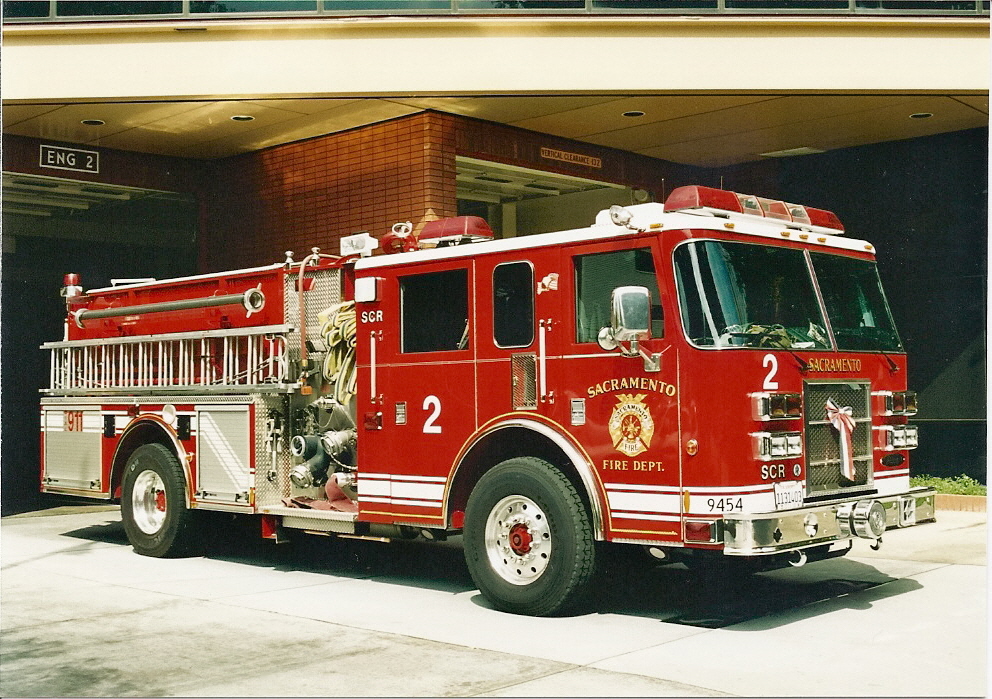
MAGNOLIA STATION AT CRESLEIGH RANCH
Rancho Cordova, CA | low $600s
Now Selling!

Models now open at Magnolia Station! Located at the corner of Rancho Cordova Parkway and Douglas Road, residents of Cresleigh Ranch will benefit from a brand new neighborhood with convenient access to the new Raley’s Shopping Center, Sunrise Boulevard, and much more!
Magnolia Station will include 81 homesites and five distinct plans ranging from 2,200 – 3,700 square feet; including three single story plans! Each plan has been thoughtfully designed to include features such as: Generations Suite, Optional Offices/Dens, Extended Great Rooms, and more! #CresleighHomes
 Randolph Harris II International Institute