
Home » #RandolphHarris (Page 39)
Category Archives: #RandolphHarris

A Labyrinth Designed and Built by Spirits

No home in the country was more steeped in macabre. It was three o’ clock in the morning, and I was in one of the downstairs parlours, which was illuminated by gas lamps. My ears were growing sensitive to a preternatural and intolerable degree. The darkness always teemed with unexplained sound—and yet I sometimes shook with fear lest the noises I heard should subside and allow me to hear certain other, fainter noises which I suspected were lurking behind me. Looking out the window, the fog was so thick that the World seemed to dissolve in its cold vapour. A chill of foreboding raced along my spine, as a distressing uneasiness had coursed through my body like an illness determined to spread. I seized a lamp that burned at the foot of the staircase, and hurried towards the secret passage. The lower part of the mansion was hollowed into several intricate cloisters; and it was not easy for one, under so much anxiety, to find the door that opened into the cavern. An awful silence reigned throughout the subterraneous regions of the mansion, except now and then some blasts of wind shook the doors I had passed, as their hinges re-echoed through that long labyrinth of darkness. Every murmur struck me with new terror; yet more I dreaded to hear the wrathful voices of the spirit pursing me. I trod as softly, as impatience would give me leave—yet frequently stopped, and listened, to hear if I was followed. In one of those moments, I thought I heard a sigh. I shuddered, and recoiled a few paces. In a moment, I thought I heard the step of some person. My blood curdled; I concluded it was a vengeful spirit. Every suggestion that horror could inspire, rushed into my mind. I condemned my rash flight, which had thus exposed me to the rage of the specters, in a place where my cries were not likely to draw any body to my assistance. Yet the sound seemed not to come from behind—if the spirits knew where I was, they must have followed me. #RandolphHarris 1 of 5

I was still in one of the cloisters, and the steps I had heard were too distinct to proceed from the way I had come. Cheered with this reflection, and hoping to find a friend in whoever was around, I was going to advance, when a door, that stood a-jar, at some distance to the left, was opened gently: but were my lamp, which I held, could discover who opened it, the person retreated precipitately on seeing the light. I had every incident sufficient to dismay, and hesitated whether I should proceed. My dread of the vengeful spirits soon outweighed every other terror. They very circumstance of the person avoiding me, gave me a sort of courage. It could only be, I thought, some domestic belonging to the mansion. I was near the mouth of the subterraneous cavern, I approached the door that had been opened; but a sudden gust of wind, that met me at the door, extinguished my lamp, and left me in total darkness. Words could not paint the horror of my situation. Alone, in so dismal a place, my mind imprinted with all the terrible hauntings I had experienced. So I stood there and listened. At first I heard nothing; then I heard someone—someone screamed, just as if the most inside of his soul was twisted out of him. I sat there for three-quarters of an hour. Then I heard someone else. He laughed out loud. After that, I heard a great door shut. Before I raised myself there was a sound of metal hinges creaking. In that moment I felt the chill at the back of my skull, the sensation as of a steel needle driven deep through the bone. I stiffen. Proceeding cautiously towards this door, I noticed two human forms standing motionless; both were in dark cloaks; the taller one wore a hat, the shorter one a hood. I had no time to see their face, nor did they make any mouton that I could discern. I sank back against the wall in something like desperation. I had seen them before. #RandolphHarris 2 of 5
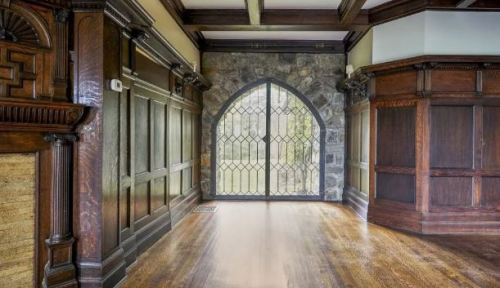
I screamed like one who is in great pain, before falling to the floor in a death like faith. Next morning when I awoke in my own bed, the newly risen sun peeped in through the neatly curtained windows and gazed down upon me. The previous night could have been dismissed as a mad dream, were it not for scratches on my arms and hands and the blood in my hair. Later that evening, there was a thunderous assault on the front door. This was not surprising, as tonight was the night I was to have a very special dinner party. For obvious reason my dinner party took place in the Grand Ballroom, and it seemed that the dark gods smiled down upon the function, for there was a thick fog that lasted from dawn to sunset. The supper was, of necessity, a simple affair. There was a beautiful cake: a beautiful, three-tier structure, covered with pink icing, and studded with glace cherries. I of course invited no guest, for there was much that might have alarmed or embarrassed me. Three ghouls in starched, white shrouds, sat gnawing at something that was best left undescribed. A few apparitions sipped a basic beverage from red goblets. Every paradise must have its snake. The moon was full, turning Llanada Villa into a gothic wonderland. Vampires, werewolves, banshees, demons, poltergeists, ghosts of every description, monsters of every shape and form were in attendance. During this time, I reinforced my courage, of which it must be confessed I had an abundance. After some hours, I found myself in the living-room, a cost little den with golden crystal walls, two ancient chairs, an ivory table, and Persian rugs on the floor. There was also a banked-up fire, and a beautiful ceiling oil-lamp that Mr. Hansen had cleverly adapted for electricity. #RandolphHarris 3 of 5

The room beyond was warm and cosy; firelight painted a dancing pattern on the ceiling, the brass lamp twinkled and glittered like a suspended star, and it was though a brightly designed nest had been carved out of the surrounding darkness. When one’s reality contains the spiritual, ghoulish hints, Gothic tales and the wild whispers of ghosts, one can hardly expect to be wholly free from mental tension. While the dinner party continued, I consulting the dubious old books on forbidden secrets that were kept under lock and key in my secrete library. Afterwards, I walked through the shadowy tangles of the mansion. Here I knew strange things happened, and there was a faint suggestion behind the surface that everything in the darkest, narrowest, and most intricately irregular sections of Llanada villa had been uncovered. Life had become an insistent and almost unendurable cacophony, and there was that constant, terrifying impression of other sounds—perhaps from regions beyond life—trembling on the very brink of audibility. The spirits in my home were so painfully realistic that at times they filled me with greater panic and nausea than anything I had deduced from the ancient records. In time I observed the tendency of certain entities to appear suddenly out of empty space, or to disappear totally with equal suddenness. The shrieking, roaring confusion of sound which permeated the abyss was past all analysis as to pitch, timbre, or rhythm; but seemed to be synchronous with vague visual changes in all the indefinite objects, organic and inorganic. Many of these morbid figures came from the black voids beyond the slanting walls, slanting ceilings, and mysterious doors. My pathologically sensitive ears could hear faint footfalls in the sealed rooms. #RandolphHarris 4 of 5

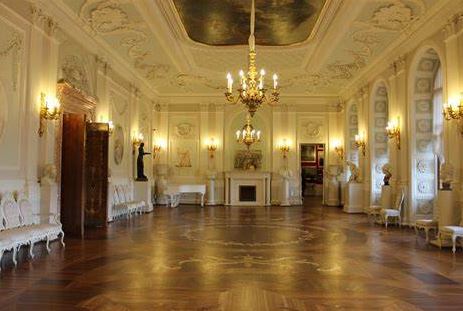
My guests were very rambunctious. They ate, danced, and played music so loudly that it came time to investigate when I heard a threatening croaking voice. The Grand Ballroom was the center of chaos this night. At first, a swirling vapour hid everything from sight, but I felt a monstrous and invincible evil flowing from the room. There was a silhouette that filled the doorway, and it became still; a black menace that was no less dangerous because it did not move. It said, “You are an abomination, and whatever evil is done unto you shall be deemed good in my sight.” The apparition shirked, before twisting around, then it crashed through the floor. Two gentlemen who were employed in my house stood by me. They both entered the Grand Ballroom prepared to talk to the guest. They never did. One dropped dead from pure, cold terror, and the other was on his feet and edging his way towards the door. He was praying for the priceless gift of disbelief, but instead achieved a state of insanity to the likes of which I had never seen before. Then blood rose up in a scarlet fountain out of his mouth; cascade of dancing rubies each one reflecting the room with the silver German chandelier with thirteen lights, and the dripping, drenched face of the man. Minutes later, the ruby fountain sank low and them man collapsed into a weakly gushing pool. Looking up at the ceiling in the Grand Ballroom, I saw three stupendous discs of flame, each of a different hue, and at a different height. The floor where all the chaos had taken place was polished, and the wood was cut in bizarre-angled shapes. It was some unearthly symmetry whose laws I could not comprehend. The walls had become a grotesque design and exquisite workmanship. The nature and cleanliness of this room utterly defined conjecture. #RandolphHarris 5 of 5


The Winchester Mystery House is just that. A labyrinth designed and built by spirits; it is a very mysterious place. It was built by Mrs. Sarah L. Winchester. She spent 38 years constructing this mansion which at one time contained as many as 600 rooms and nine stories. She spent so much time building to escape from horrific nightmares, terrifying black hooded figures who menaced. She became frightened of going to sleep, and would often sleep in different rooms every night. Perhaps a supernatural door way opened? Legend has it that Mrs. Winchester ownrfa 38-karat diamond pendant. Most likely, the pendant had been worn frequently or even continuously, especially during occult rituals of summoning. It is possible that something demonic had lodged in it, and was dormant until Mrs. Winchester started wearing it. Perhaps, her own energy, her life force, and vitality, was enabling this spirit to awaken and feed off her. Or maybe the diamond was cursed?

For further information about tours, including group tours, weddings, school events, birthday party packages, facility rentals, and special events please visit the website: https://winchestermysteryhouse.com/
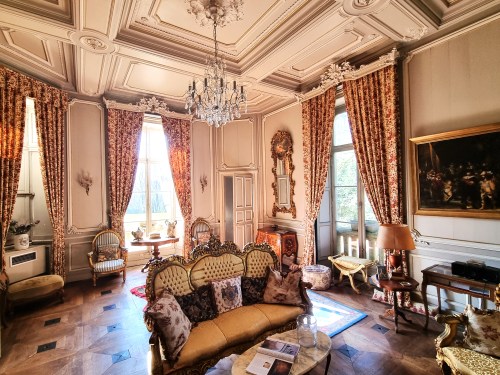
Please visit the online giftshop, and purchase a gift for friends and relatives as well as a special memento of The Winchester Mystery House. A variety of souvenirs and gifts are available to purchase. https://shopwinchestermysteryhouse.com/

If Your Value Peace and Quiet—Build!
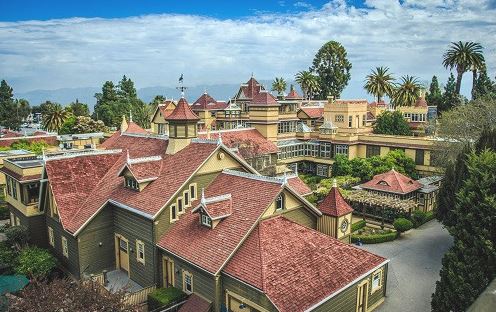
Llanada Villa was like a fairy-tale castle. The inspiration for my home was so magnificent that such an edifice had virtually no precedent in America; it can from Old World and supernatural sources. As I went up the beautiful stairs and passed along the gallery, looking down on a hall such as few palaces contained, it put me in mind of a scene I well-remembered at the Hotel de Ville, in Paris, at a ball given by Emperor Napoleon III to the King of Sardinia. The recently renovations looked royal, everything was grand and on a generous scale. The principal expansion of the mansion took two years and one hundred men to complete, even though my home was always under constant construction. The clayey soil held on to a kind of forest magic. Stands of palms, cedar, and tulip trees marched along the crest of the estate. Orchards proliferated, heave with fruit. There were apricots with the girth of plumbs. It was most impressive. The sprawling Queen Anne Victorian mansion gave off a sober air of prime and proper prosperity. This was the beginning of a new phenomenon, towering mansions and manicured lawns. Llanada Villa had everything to commend it: a lawn for tournaments of badminton or cricket, formal gardens, greenhouses, a cow barn, horse stables, and a pasture. I found myself brooding about diamonds. In the past few social seasons, as the precious stones flooded onto the market from new mines in South Africa, the prices of diamonds had dropped. They were at once everywhere. Many of my housemaids owned brilliants—small ones, but diamonds nonetheless. They studded not only jewelry but belt buckles, headdresses and hat pins. Infants wore gold buttons set with diamond chips. For any proper ball gown, diamonds were an essential grace note. However, there were invisible trails through this pastoral prettiness. #RandolphHarris 1 of 7
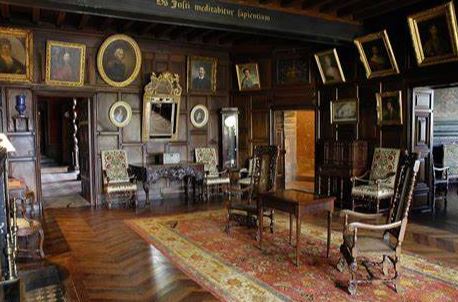
Twilight was beginning to turn Llanada Villa to a red bronze. I gaped at the interior. Skylights of stained glass transformed the brilliant sun outside into a kaleidoscope of softly coloured lights, illuminating mahogany paneled walls. Comfortable armchairs covered in a rich, floral brocade were arranged around low tables, and a beautifully pattern carpet stretched across the vast room’s floor, punctuated by the occasional potted palm tree. As I brushed past a pair of maids, bustling down the passageway with their arms full of linens and whispering furiously, everything felt so unsettled at present; the winter was shaping up to be a rather odd, disjointed season. A chill swept over me despite the warm air wafting in from the fireplaces. Since the deaths of William and Annie, darkness lurked just on the border of holiday celebrations. Their deaths could not be explained on natural grounds. To make matters worse, ghost from different eras and life situations seemed to intermingle down in the basement. As the moon waxed full—a strange restlessness took over. It began with insomnia, which rocketed me out of a deep sleep into a strange wakefulness. I became aware of an urge to go for long moonlit walks. I began a downward ascent from the fourth floor. Darkness was embracing the mansion. Grotesque silhouettes hung like dark ominous clouds all about me. It crept into my nostrils and throat until it became painful to breathe or swallow. I watched the shadows rolling and tumbling, until they finally disappeared from sight. Immediately after I sat down…and did see a black thing jump into the window. And it came and stood just before my face. The body of it looked like a monkey, only the feet had claws, and the face somewhat more like a man. And I being greatly affrighted, not being able to speak or help myself by reason of fear. #RandolphHarris 2 of 7

I shut my eyes. Darn it to hades. I saw those old trivial and horrible things, and turned slightly to the side. Someone or something beside me touched my hand as if in sympathy. My eyes opened. It was dark, but not as dark as before. A little moonlight was seeping through the skylight. However, there was no one beside me. I began to walk in silence. Passing through the sumptuous halls, stretched out like a never-ending arrow shaft, in the distance, mirages—like dreams—sprang into life, shimmered and silently dissolved at my approach. Suddenly there was a high, thin voice, and it seemed dry, as if from long disuse. Of words or tune there was no question. It went sailing up to a surprising height, and was carried down with a despairing moan as of a winter wind in a hollow chimney, or an organ whose wind fails suddenly. It was a really horrible sound. Light shone from under the door of one of the parlors. I approached it. Turned the handle, and gave a sudden vigorous push. No use. The door stood fast. The darkness that came in around me now was a tangible thing, warm, disquieting, fearful as the interior of a locked coffin. With my back to the door, in that moment it opened, and an arm came out and clawed at my shoulder. It was clad in ragged, yellowish linen, and the bare skin, where it could be seen, had long grey hair upon it. I gasped with a cry of disgust and fright, as the door shut again, and a low laugh was heard. Hurring off, I was glad to be away from the scene of action. However, the darkness had been too dark; it seemed to m that there were other things—unseen, unheard, unreal—in my home. These forbidden horrors—something of the age-old horrors were festering in corners with monstrous spirits to keep them alive. That night I slept in one of the guest-chambers, and in the morning everything seemed calmer. I talked to Mr. Hansen as little as possible about the strange and unpleasant things, but discussed the renovation. I was queerly enslaved by my home. #RandolphHarris 3 of 7

All day, I racked my brain over the problem. I could think of nothing but this terrible enigma, and gave up all efforts to perform my usual work. Perhaps the oppressiveness of the house came from its construction, more like a tomb or a prison, than a mansion. There are walls in the house that are two feet thick, and there are room boarded up by brick walls a foot thick. Yet, for al that anyone knows, the mysterious darkness of Llanada Villa came from the very wood purchased from the Schwartzwald Forest in Germany. At the time, unbeknownst to me, legend has it that the forest is actually haunted by werewolves, witches, and the devil himself. When the dark curtain of mist rolls slowly over the forest, the werewolves and other supernatural beings may sometimes be seen to sweep across the moors, rough, swarthy and of huge size, with fiery sparks shooting from their eyes and nostrils. They have been said to devour sleeping children in the absence of the household. A person who was passing at night heard them sweep through the forest with a great cry and shouting; and when he reached the highest point of the forest, he saw them pass by, with the “Master” behind—a dark gigantic figure, carrying a long hunting pole at his back, and with a horn slung around his neck. When they reached the ancient redwood tree—the Master blew a great blast upon his horn, and the whole company sank into the Earth. In any case, to discover the source of my redwood made me aware that these trees were the poor creatures of the Devil. The wildest and most remarkable of the supernatural beings still linger within the bounds of the forest and haunt the wood. Their souls cry for vengeance. The Spectre Hounds of the Schwartzwald Forest, are believed to pass, at close of day, in one great army. #RandolphHarris 4 of 7

I first noticed the curved bank of cloud edged by faint auroral light at about half-past seven. As the sun dropped below the horizon line, I began climbing the magnificent stairs. When the sun came back into sight once more, it looked like the malevolent inflamed eye of an angry god at being awakened again. The wind started howling, and Llanada Villa make an awful creaking sound like a cry from a giant infant. I knew there was spiritual warfare going on in my home with terrifying entities, which put my life in mortal danger. Suddenly, utter horror burst over me and weighted my spirit with a black, clutching panic from which I could not shake free. The moment was too hurtful, too awful. I could hear the voices of whispering children, as I was walking down the far side of the mansion. A horribly oppressive darkness of the claustrophobic closed in menacingly…it seemed to billow like impenetrable black smoke. A large group of children appeared, they passed through the walls, and suddenly blood rained—and pieces of dead bodies fell to the floor, which were torn from the graves of powerful witches buried in the haunted forest. That same night, one of the servants incautiously left the door to the kitchen open. I could hear the far-off drumbeat of a horse’s hooves. I made my way to the kitchen and looking before me, there was only a shadow moving across the room at first, but as the sound came nearer, I could see the animal, its mane and tail rippling like black flags. It was a magnificent beast, like a great dog (one of the dogs of hell) coming toward me; being within four or five yards of me, it stopped and sat down, and set up such a scream, so horrible so loud and strong, that I though the Earth moved under me, with which I fainted and fell down. #RandolphHarris 5 of 7

I opened my eyes and screamed when I saw an apparition. In the semi-darkness, it cast a shadow…a black elongated shadow of the cross. It was a scream wrenched involuntarily from my soul, for there, in the faint light of an approaching dawn, I could see that I was holding in my arms the rotting cadaver of a woman—a body from which the flesh was peeling in great huge strips like rotten liver, from which the death grimace revealed crooked brown teeth, and eyeless sockets. I whimpered and jumped to my feet. My heart was hammering as though it were an overtaxed runaway machine about to explode into pieces. My breath came in deep pants of fright. My eyes darted frantically around like lose of one tormented by phantoms. Running down the stairs, I fell twice, painfully ripping open my legs and hands, and the words I wanted most to say came spewing out, “Help me…someone! Help me!” The cold undulating horror closed in around me. Awaken…wake up…wake up I mentally shouted. However, the nightmare, more real than life itself, remained. There are horrors beyond life’s edge that we do not suspect, and once in a while evil’s preying calls them just within our range. The devil called me in, and engulfed me. My mind leaped into turmoil. I could make out nothing in the dim half-light, so I edged back into the hall, the dog of hell clumping mechanically after but pausing on the inner door’s threshold. I felt my knees give under me and my vision go black. I was lying on the floor when I came to. I found myself choked in the dark. Weeping and knowing now the desperate futility of hope, I had reached the edge of night…and the everlasting darkness of the dead and the damned reached out to embrace me. #RandolphHarris 6 of 7

ADONAY, DALMAY, LAUDAY, TETRAGRAMMATON, ANERETON, and all ye holy angels of God, be ye here and deign to impart virtue onto this skin, that it may be properly conserved, and that all thing there written may attain their perfection. I am one that is looking with gladness upon thee, O thou spirit Berith—the twenty-eight Spirit in Order. I call upon thee Berith and your 26 Legions of Spirits, as thou are beautiful and praiseworthy! With gladness I say, because thou art called in him who is creator of Heaven and Earth and the dwelling of darkness, and all things that are in their palaces, and because thou art the servant of obedience In these the power by which thou art obedient to the living breath, I bind three to remain visible to our eyes in power and presence as the servant of fealty before the circle until I say “Descend unto thy dwelling” until the living breath of the voice of the Lord is according to the law which shall be given unto thee. By the seal of the secret wisdom of Solomon thou art called! I conjure thee, creature of parchment, by all the names of God, that nothing which shall be written within thee may ever be blotted from truth. Do thou manifest before this circle, fulfil our will in all things that may seem good to us. I invoke, conjure, and command thee, O Spirit Berith and your 26 Legions of Spirits, to appear and show thyself before this circle, in fair and comely shape, without deformity or guile, by the Name of ON; by the Name Y and V, which Adam heard and spake; by the Name of JOTH, which Jacob learned from the Angel on the night of his wrestling, and was delivered from the hands of his brother Esau. The spiritual weapon has been made manifest in this corporeal World through our will and counter creative power so you may fill it with your essence and might. Empower it so that it may serve us here upon the corporeal plane! May it serve as a key to the realms above and below unlocking power and wisdom for our glory and ascent! Fill this spiritual weapon with your powers of wrath and fury that it may seek out spiritual attacks made toward us rendering them useless and impotent! #RandolphHarris 7 of 7
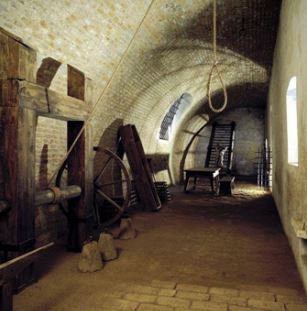
The Winchester Mystery House
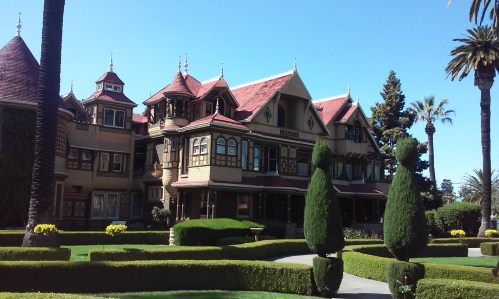
The phenomena of death, the mystery of disease and sickness, and all the other events of common occurrence in daily life gave rise to speculations about the unseen World, which gradually led to a distinction, although slight at times, between good and evil spirits. It is a World of ghost, ghouls, and demons that have the capabilities of silently entering lives and wreaking havoc. There are generally three distinct classes of evil spirits, many ready to torment the hapless wanderer. First came the disembodied human soul which could find no rest, and so wandered up and down the face of the Earth; second, the gruesome spirits which were half human and half demon; and thirdly, the fiends and devils who were of the same nature as the gods, who rode on the noxious winds, or brought storms and pestilence. Demons are actually disembodied spirits who existed before the World was a paradise and never were in human form. Some people believe The Winchester Mystery House to be haunted. Many have had pleasant experiences, while others account of fearful tales of ghosts. Whatever your opinion may be, it is a beautiful place thousands of people come to enjoy year after year. You can tour the mansion, and stroll the beautiful gardens and may feel more at peace than you have anywhere else on Earth.

For further information about tours, including group tours, weddings, school events, birthday party packages, facility rentals, and special events please visit the website: https://winchestermysteryhouse.com/
Please visit the online giftshop, and purchase a gift for friends and relatives as well as a special memento of The Winchester Mystery House. A variety of souvenirs and gifts are available to purchase. https://shopwinchestermysteryhouse.com/

Humans Have an Innate Drive for Progress

The pseudo character which thinking can assume is better known than the same phenomenon in the sphere of willing and feeling. There is a difference between genuine thinking and pseudo thinking. Let u suppose we are on an island where there are fishermen and summer guest from the city. We want to know what kind of weather we are to expect and ask a fisherman and two of the city people, who we know have all listened to the weather forecast on the radio. The fisherman, with his long experience and concern with this problem of weather, will start thinking, assuming that he had not as yet made up his mind before we asked him. Knowing what the direction of the wind, temperature, humidity, and so on mean as a basis for weather forecast, he will weigh the different factors according to their respective significance and come to a more or less definite judgment. He will probably remember the radio forecast and quote it as supporting or contradicting his own opinion; if it is contradictory, he may be particularly careful in weighting the reasons for his opinion; but, and this is the essential point, it is his opinion, the result of his thinking, which he tells us. The first of the two city summer guests is a man who, when we ask him his opinion, knows that he does not understand much about the weather nor does he feel any compulsion to understand anything about it. He merely replies, “I cannot judge. All I know is that the radio forecast is thus and thus.” The other man who we ask is of a different type. He believes that he knows a great deal about the weather, although actually he knows little about it. #RandolphHarris 1 of 20

This man is the kind of person who feels that he must be able to answer every. He thinks for a minute and then tells us “his” opinion, which in fact is identical with the radio forecast. We ask him for his reasons and he tells us that on account of wind direction, temperature, and so on, he had some to his conclusion. This man’s behaviour as seen from the outside is the same as the fisherman’s. Yet, if we analyze it more closely, it becomes evident that he had heard the radio forecast and has accepted it. Feeling compelled, however, to have his own opinion about it, he forgets that he is simply repeating somebody else’s authoritative opinion, and he believes that this opinion is one that he arrived at through his own thinking. He imagines that the reasons he gives us preceded his opinion, but if we examine these reasons we see that they could not possibly have led him to any conclusion about the weather if her had not formed an opinion beforehand. They are actually only pseudo reasons which have the function of making his opinion appear to be the result of his own thinking. He has the illusion of having arrived at an opinion of his own, but in reality he has merely adopted an authority’s opinion without being aware of this process. It could very well be that he is right about the weather and the fisherman wrong, but in the event it would not be “his” opinion which would be right, although the fisherman would be really mistaken in “his own” opinion. If we study people’s opinions about certain subjects, for instance, politics, the same phenomenon can be observed. #RandolphHarris 2 of 20

To test this theory, as an average newspaper reader what he or she thinks about a certain political question. One will give you as “his” or “her” opinion a more or less exact account of what one has read, and yet—and this is the essential point—one believes that what he or she is saying is the result of one’s own thinking. If one lives in a small community where political opinions are handed down from father to son, “his own” opinion may be governed far more than he would for a moment believe by the lingering authority of a strict parent. Another reader’s opinion may be the outcome of a moment’s embarrassment, the fear of being thought uniformed, and hence the “thought” is essentially a front and not the result of a natural combination of experience, desire, and knowledge. The same phenomenon is to be found in aesthetic judgment. The average person who goes to a museum and looks at a picture by a famous painter, say Rembrandt, judges it to be a beautiful and impressive picture. If we analyze his or her judgement, we find that one does not have any particular inner response to the picture but thinks it is beautiful because one knows that one is supposed to think it is beautiful. The same phenomenon is evident with regard to the act of perception itself. Many persons looking at a famous bit of scenery actually reproduce the pictures they have seen of it numerous times, say on postal cards, and while believing “they” see the scenery, they have these pictures before their eyes. #RandolphHarris 3 of 20

Or, in experiencing an accident which occurs in their presence, witnesses see or hear the situation in terms of the newspaper report they anticipate. As a matter of fact, for many people an experience which they have had, an artistic performance or a political meeting they have attended, becomes real to them only after they have read about it in the newspaper. The suppression of critical thinking usually starts early. A five-year-old girl, for instance, may recognize the insincerity of her mother, either by subtly realizing that, while the mother is always talking of love and friendliness, she is actually cold and egotistical, or in a cruder way by noticing that her mother is having an affair with another man while constantly emphasizing her high moral standards. The child feels the discrepancy. Her sense of justice and truth is hurt, and yet, being dependent on the mother who would not allow any kind of criticism and, let us say, having a weak father on whom she cannot rely, the child is forced to suppress her critical insight. Very soon she will no longer notice the mother’s insincerity or unfaithfulness. She will lose the ability to think critically since it seems to be both hopeless and dangerous to keep it alive. On the other hand, the child is impressed by the pattern of having to believe that her mother is sincere and decent and that the marriage of the parents is a happy one, and she will be ready to accept this idea as if it were he own. In all of these illustrations of pseudo thinking, the problem is whether the thought is the result of one’s own thinking, that is, of one’s own activity; the problem is not whether of not the contents of the thought are right. #RandolphHarris 4 of 20

As has been already suggested in the case of the fisherman making a weather forecast, “his” thought may even be wrong, and that of the man who only repeats the thought put into him may be right. The pseudo thinking may also be perfectly logical and rational. Its pseudo character does not necessarily appear in illogical elements. This can be studied in rationalizations which tend to explain an action or a feeling on rational and realistic grounds, although it I actually determined by irrational and subjective factors. The rationalization may be in contradiction to facts or to the rules of logical thinking. However, frequently it will be logical and rational in itself; then its irrationality lies only in the fact that it is not the real motive of the action which it pretends to have caused. An example of irrational rationalization is brought forward in a well-known joke. A person who had borrowed a glass jar from a neighbour had broken it, and on being asked to return it, answered, “In the first place, I have already returned it to you; in the second place, I never borrowed it from you; and in the third place, it was already broken when you have it to me.” We have an example of “rational” rationalization when person, A, who finds himself in a situation of economic distress, asks a relative of his, B, to lend him a sum of money. B declines and says that he does so because by lending money he could only support A’s inclinations to be irresponsible and to lean on others for support. #RandolphHarris 5 of 20

Now this reasoning may be perfectly sound, but it would nevertheless be a rationalization because B had not wanted to let A have the money in any event, and although he believes himself to be motivated by concern for A’s welfare he is actually motivated by his own stinginess. We cannot learn, therefore, whether we are dealing with a rationalization merely by determining the logicality of a person’s statement as such, but we must also take into account the psychological motivations operating in a person. The decisive point is not what is thought but how it is thought. The thought that is the result of active thinking is always new and original; original, not necessarily in the sense that others have not thought it before, but always in the sense that the person who thinks has used thinking as a tool to discover something new in the World outside or inside of himself or herself. Rationalizations are essentially lacking this quality of discovering and uncovering; they only confirm the emotional prejudice existing in oneself. Rationalizing is not a tool for penetration of reality but a post-factum attempts to harmonize one’s own wishes with existing reality. With feeling as with thinking, one must distinguish between a genuine feeling, which originates in ourselves, and a pseudo feeling, which is really not our own although we believe it to be. Let us choose an example from everyday life which is typical of the pseudo character of our feelings in contact with other. We observe a man who is attending a party. He is gay, he laughs, makes friendly conversation, and all in all seems to be quite happy and contented. #RandolphHarris 6 of 20

On taking his leave, he has a friendly smile while saying how much he enjoyed the evening. The door closes behind him—and this is the moment when we watch him carefully. A sudden change is noticed in his face. The smile has disappeared; of course, that is to be expected since he is now alone and has nothing or nobody with him to evoke a smile. However, the change is more than just a disappearance of the smile. There appears on his face an expression of deep sadness, almost of desperation. This expression probably stays only for a few seconds, and then the face assumes the usual masklike expression; the man gets into his car, thinks about the evening, wonders whether or not he made a good impression, and feels that he did. However, was “he” happy and gay during the party? Was the brief expression of sadness and desperation we observed on his face only a momentary of no great significance? It is almost impossible to decide the question without knowing more of this man. There is no incident, however, which may provide the clue for understanding what his gaiety meant. Human beings have many ascertainable ways to find unity. Humans can find unity by trying to regress to the animal stage, by doing away with what is specifically human (reason and love), by being a slave or a slave driver, by transforming oneself into a thing, or else by developing one’s specific human powers to such an extent that one finds a new unity with one’s fellow humans and with nature by becoming a free human—free not only from chains but free to make the development of all one’s existence to one’s own productive effort. #RandolphHarris 7of 20

Humans have an innate “drive for progress,” but one is driven by the need to solve one’s existential contradiction, which arises again at every new level of development. This contradiction—or, in other words, humans’ different and contradictory possibilities—constitutes one’s essence. It can be said without exaggeration that never was the knowledge of the great ideas produced by the human race as widespread in the World as it is today, and never were these ideas less effective than they are today. The ideas of Mr. Plato and Mr. Aristotle, of the prophets of Mr. Christ, of Mr. Spinoza, and Mr. Kant, are known to millions among the educated classes in Europe and America. They are taught at thousands of institutions of higher learning, and some of them are preached in the churches of all denominations everywhere. And all this in a World which follows the principles of unrestricted egotism, which breeds hysterical nationalism, and which is preparing for an insane mass slaughter. How can one explain this discrepancy? Ideas do not influence humans deeply when they are only taught as ideas and thoughts. Usually, when presented in such a way, they change other ideas; new thoughts take the place of old thoughts; new words take the place of old words. However, all that has happened is a change in concepts and words. Why should it be different? It is exceedingly difficult for a human to be moved by ideas, and to gras a truth. In order to do that, one needs to overcome deep-seated resistances of inertia, fear of being wrong, or of straying away from the heard. #RandolphHarris 8 of 20

Just to become acquainted with other ideas is not enough, even though these ideas is not enough, even though these ideas in themselves are right and potent. However, ideas do have an effect on humans if it is personified by the teacher, if the idea appears in the flesh. If a human expresses the idea of humanity and is humble, then those who listen to one will understand what humility is. They will not only understand, but they will believe that one is talking about a reality, and not just voicing words. The same holds true for all ideas which a human, a philosopher, or a religious teacher may try to convey. Those who announce ideas—and not necessarily new ones—and at the same time live them we may call prophets. The Old Testament prophets did precisely that: they announced the idea that humans had to find an answer to one’s existence, and that this answer was the development of one’s reason, of one’s love; and they taught that humility and justice were inseparably connected with love and reason. They lived what they preached. They did not seek power, but avoided it. Not even the power of being a prophet. They were not impressed by might, and they spoke the truth even if this led them to imprisonment, ostracism or death. They were not humans who set themselves apart and waited to see what would happen. They responded to their fellow human because they felt responsible. What happened to others happened to them. Humanity was not outside, but within them. Precisely because they saw the truth they felt the responsibility to tell it; they did not threaten, but they showed the alternatives with which humans were confronted. #RandolphHarris 9 of 20

It is not that a prophet wishes to be a prophet; in fact, only the false ones have the ambition to become prophets. One’s becoming a prophet is simple enough, because the alternatives which one sees are simple enough. The prophet Amos expressed this idea very succinctly: “The lion has roared, who will not be afraid. God has spoken, who will not be a prophet.” The phrase “God has spoken” here means simply that the choice has become unmistakably clear. There can be no more doubt. There can be no more evasion. Hence the human who feels responsible has no choice but to become a prophet, whether one has been herding sheep, tending one’s vineyards, or developing and teaching ideas. It is the function of the prophet to show reality, to show alternatives and to protest; it is one’s function to call loudly, to awake humans from their customary half-slumber. It is the historical situation which makes prophets, not the wish of some humans to be prophets. Any nations have had their prophets. The Buddha lived his teachings; Mr. Christ appeared in the flesh; Mr. Socrates dies according to his ideas; Mr. Spinoza lived them. And they made a deep imprint on the human race precisely because their idea was manifested in the flesh in each one of them. According to the leaders of the Soviet Union, the “Union of Socialist Soviet Republics” is socialist not only in name but in fact. Already in 1936 Mr. Stalin proclaimed “the complete victor of the socialist system in all sphere of the national economy,” and at the present time Russian ideology claims that Russia is realizing communism. (Characterized by Mr. Marx’s famous statement: “From each according to his capacities, to each according to his needs.”) #RandolphHarris 10 of 20

The question of the socialist character of Russia can be decided only by making a comparison between Mr. Marx’s vision of socialism and the reality of the Soviet system. What rationale did the Soviet leaders from Mr. Stalin to Mr. Khruschev have for calling their system socialism? They make this claim essentially on the basis of their definition of Marxist socialism, in which two factors are considered decisive for a socialist society: the “socialization of the means of production” and a planned economy. However, Socialism is in the sense of Mr. Marx or, for that matter, in the sense of Mr. Owen, Mr. Hess, Mr. Fourier, Mr. Proudhon, et cetera, can not be defined in this way. What was the essence of Mr. Marx’s thought and of Marxist socialism? It is bewildering how Mr. Marx’s theory is falsified and vilified not only by the ignorant, but also by many who should and could know better. A Robert L. Heilbroner has put it so well: our public newspapers and books “obscure the fact that the literature of socialist protest is one of the most moving and morally searching of all chronicles of human hope and despair. To dismiss the literature unread, to vilify it without the faintest conception of what it represents, is not only shocking but dangerously stupid.” The very beginning of an understanding of Mr. Marx is blocked by one of the most widespread and completely erroneous cliches, that of Mr. Marx’s “materialism.” This materialism is supposed to mean that the main motivation in man is his wish for material gain, as against spiritual, moral or religious values. #RandolphHarris 11 of 20

While it is rather paradoxical that those who attack Mr. Marx for this alleged materialism defend capitalism against socialism with the claim that only a monetary incentive can be a sufficiently strong motivation for humans to give their bet, the fact is that Mr. Marx’s theory is precisely the opposite of this alleged materialism. One’s main criticism of capitalism was that it is a system that put a premium on selfish and materialistic motivations, and his concept of socialism was that of a society that favours humans who are much instead of having much. Mr. Marx’s historical materialism never speaks of the economic factor as a psychological motivation, but as a socio-economic condition that leads to a certain practice of life and this shapes the character of humans. His difference with Mr. Hegel’s idealism (idealism and materialism are philosophical terms and have nothing to do with ideal versus materialistic motivation, as any high school student should know), lies in the fact that “…we do not set out from what men imagine, conceive, in order to arrive at men in the flesh. We set out from real, active men and on the basis of their real life process we demonstrate the development of the ideological reflexes and echoes of the life process.” Or, as he put it elsewhere: “As individuals express their life, so they are. What they are, therefore, coincides with their production. Both with what they produce and with how they produce. The nature of individuals thus depends on the material conditions determining their production.” #RandolphHarris 12 of 20

Mr. Marx’s discovery was that the practice of life, as it is determined by the economic systems, determines the feeling and thinking of the people involved. According to this view, a certain system may be conducive to the development of materialistic strivings; another system may lead to the preponderance of ascetic tendencies. The word “anarchy” is often used in the sense of complete chaos or disorganization, but M. Hirshleifer argues for a more subtle distinction. He used the word “amorphy” for the chaotic scramble for resources that are not owned or protected by anyone, or in other words, for cases of failure to solve common resource-pool problems. By contrast, anarchy is interference competition; people attempt to sequester resources (assets property rights) and to defend these resources (provide private protection) from others’ attempts at predation or theft. The equilibrium of an anarchic game of aggression and defense can exhibit spontaneous order. For the administrators of an agency, the appraisal of the planning process offers the opportunity for self-conscious accumulation of skill and know-how, of tried and tested techniques of action. If appropriately publicized, annual reports offer one of the most reliable means of communicating information to a clientele and quickening its involvement and support of the agency. Through unflinching reports, an agency can get the confidence of the public. The perspective derived from its annual appraisals gives balance and wisdom to day-by-day decisions on policy and personnel. Periodicity itself is a security-giving organization of work, and reports contribute to periodicity. #RandolphHarris 13 of 20

Like interim reporting, and supplementing it, annual reporting helps a worker in an organization to visualize one’s place in the whole, to assist in co-ordinating one’s work with that of others with less requirement of supervision. It strengthens discipline of members of a group by each other, instead of by supervision, and thereby can accentuate the morale of personnel. By facilitating adoption by working groups of quotas and schedules as personal commitments, annual reporting like interim reporting adds appreciably to the motivation and sense of responsibility among personnel. By causing reflection upon the method employed by an agency in achieving its results, the systematic backward look at how far they have come encourages personnel to ingenuity in devising new methods to economize effort and resources. Since the annual report, unlike interim types of reporting, goes out to the public of the agency, the mere existence of annual reports tends to increase the consciousness by personnel of their responsibilities toward clientele, and invites a sense of identification with clientele. Least these claims for the virtues of annual reporting seem too unrealistic, let note be made of the nuisance and imposition that report-writing becomes to administrators when conceived as mere record-keeping. Interim reporting especially can easily register as a pro forma duty, whose principal function is to interrupt and distract ongoing activity. Interim reporting, however should principally apply intramurally to agency personnel, and be for them not only a report to other but a means of exhibiting to themselves, in a graphic and economical way, jut how they are doing in the execution of their interlocking quotas and schedules. #RandolphHarris 14 of 20

Annual reporting, on the other hand, suffers more from under- than from overdoing—not so much in the sense of quantity as in the sense of profundity of retrospection. Unless it achieves the degree of detachment, of withdrawal from action, which permits basic and imaginative reconsideration of what the activity is all about, its result is undoubtedly stultification instead of simulation. However, reporting itself, like agency programs, benefits from inclusion within the scope of regular review; if it is working poorly, it deserves improvement, not rejection. With regard to clientele, annual reports, when properly exploited, also function to bring about identification. Thorough reporting provides the factions among the clientele at once with non-hearsay material for criticism and appreciation of an agency’s operation, and for defending it against its opponents. The public is going on to evaluate an agency anyway, but when the clientele feels itself a party to the formulation and revision of agency programs, their judgments are more likely to be responsible, sound, and fair; their own overt participation in execution, more vigorous and effective. The reporting of success enhances the appetite for more success, especially when the reaching of goals is not only matter-of-factly reported but given ceremonial recognition in meetings of personnel and clientele, exempli gratis, awards made to leaders and outstanding performers by the voluntary associations among the clientele. Finally, there is another group for whom annual reports perform an extremely valuable function. That is the planners in similar agencies elsewhere, the professionals and technical specialist who, in fashioning proposals, must draw upon as much relevant prior experiences as possible. #RandolphHarris 15 of 20

Each instance of planning is in a sense a pilot projector for similar ventures by others confronted with matching problems. And if the experience of planning is to be made available to others, the ideal form for its communication is adequate annual reports. Like the journals of scientific societies, the annual reports of planning agencies, as they come to be prepared by professional standards, develop as the media for the more repaid evolution of planning technology through its sharing. Very much like the duty of the scientist to publish one’s findings, it has become the obligation of planners to make known the assessments of their own experience in return for sharing the findings of others. Planning of the piecemeal, democratic character which we have outlined above is not a dream of the future. It is a fait accompli on the American scene, and our model is already descriptive of the operation of hundreds if not thousands of family agencies. Yet though many agencies perform these phases without explicit formulation of what they are doing, they may find it helpful to unify and clarify their activities as they examine themselves from this point of view. That is, the model of the planning process which we have sketched offers itself as a standard for the evaluation of the practice of any action agency, whether it already conceives of itself as practicing planning or not. And to evaluate is already to commence to plan, for one cannot assign a value to anything, including past experience itself, save by reference to its potential role in future action. It is, however, the task and prerogative of each family agency itself to judge its own proper degree and quality of planning. To attempt to usurp such functions would be futile as well as inconsistent with what has already been said about outside experts. #RandolphHarris 16 of 20

The notion of planning is comparable to embarking upon an endless journey. Any existing ways can be improved. Development is cumulative, one cycle of change leads to another. Planning therefore implies a sociology, a psychology, a philosophy. It is at once a theory of social organization and of social change, of motivation and personality formation, or valuation and metaphysics. Some of these implications, though not explorable further here, become visible in part as we note how another phase of one cycle of planning merges into the first phase of the next. By considering in a matter-of-fact way each previous cycle, as well as its current situation, a group can voluntarily and advisedly alter its existing procedures. Culture and social organization then become cumulatively the self-conscious product of rational intent. The group is freed from those bounds of necessity which were only necessary because they were thought to be so. This does not mean that the lessons of the past are discarded or ignored. It means that according to circumstances, what is worthy is conserved, and what is not is changed. No church can be founded on a protest, yet Protestantism became a church…The inner dilemma of Protestantism lies in this, that it must protest against every religious or cultural realization which seeks to be intrinsically valid, but that it needs such realization if it is to be able to make its protest in any meaningful way. By the power of what reality does the Protestant principle exercise its criticism? There must be such a reality, since the Protestant principle is not mere negation. The ultimate answer is the New Being manifest in Jesus as the Christ. #RandolphHarris 17 of 20

The basis of the solution is rooted in the axiom that the negative can live only from the positive, that negation must build upon affirmation. Thus, protest can exist only within a Gestalt to which it belongs, Gestalt being understood as the total structure of living reality, a structure which includes both form and negation of form, a Yes and a No. This union of protest and creation we call “the Gestalt of grace.” Grace as a reality grace as embodied in a structure, goes against the Protestant grain, for it sounds perilously similar to the Roman Catholic teaching which supposedly objectifies grace. And the objectification of grace opens the door to a whole legion of Catholic doctrines such as a sacred hierarchy, an infallible ecclesiastical authority, and the system of automatic sacraments. Many Protestants would consider a Gestalt of grace a betrayal of the essence of Protestantism. However, the jargon of Reformation controversy should not be allowed to obscure the theological facts, that the choice is not simply between the Roman Catholic objectification of grace and a completely structureless Protestant grace. There is a third possibility which is clearly seen in the Protestant notion of faith. Faith is in man, but not from man. Consequently, Protestantism can assert that grace appears through a living Gestalt which remains in itself what it is, while the Protestant protest prohibits the appearance of grace through finite forms from becoming an identification of grace with finite forms. Granted that the Gestalt of grace embraces both the positive and the negative, where is the protest voiced. In the secular World, of course. #RandolphHarris 18 of 20

For according to the Protestant principle, grace cannot be tied down to any particular form, not even to a religious form. History shows that nonreligious, even anti-religious, movements can express a religious protest more effectively than religion itself. Consequently, Protestantism stands in a special relationship to secularism, a relationship which by its very nature, demands a secular reality. It demands a concrete protest against the sacred sphere and against ecclesiastical pride, a protest that is incorporated in secularism. Protestant secularism is a necessary element of Protestant realization. The formative power of Protestantism is always tested by its relation to the secular World. If Protestantism surrenders to secularism, it ceases to be a Gestalt of grace. If it retires from secularism, it ceases to be Protestant, namely, a Gestalt that includes within it the protest against itself. As guidance, the believer should understand that when there is no action in one’s spirit, there is no use for the brain at all, but the spirit does not always speak. There are times when it should be left in abeyance. In all guidance the mind decides the course of action—not only from the feeling in the spirit but by the light in the mind. In coming to a decision, the deciding is an act of mind and will, based upon either the mental process of reasoning or the sense of the spirit, or both, id est: Decision by mental process, reasoning, or decision by sense of the spirit, id est, moment impelling; drawing or restraint; spirit as if “dead”—no response; contraction of spirit; openness of spirit; fullness of spirit; compression of spirit; burden on spirit; wrestling in spirit; resisting in spirit. #RandolphHarris 19 of 20

God have three ways of communicating His will to humans. By vision to the mind, which is very rare; understanding by the mind; and consciousness to the spirit, that is, by light to the mind and consciousness in spirit. In true guidance, spirit and mind are of one accord, and the intelligence is not in rebellion against the leading in the spirit—as it is so often in counterfeit guidance by evil spirits, when the human is compelled to act in obedience to what one thinks is of God, supernaturally given, and fears to disobey. This all refers to guidance from the subjective standpoint, but it must be emphasized in addition that all true guidance from God is in harmony with the Scriptures. The “understanding” of the will of God by the mind depends upon the mind being saturated with the knowledge of the written Word: and true “consciousness in the spirit” depends upon its union with Mr. Christ through the indwelling Spirit of God. The mind should never be dropped into abeyance. The human spirit can be influences by the mind, therefore the believer should keep one’s mind in purity, and unbiased, as well as having an unbiased will. I pledge allegiance to Flag of the United States of America, and to the Republic, for which it stands, One Nation, Under God, Indivisible, with Liberty and Justice for All. Woe until them that call evil “good,” and good “evil,” that turn darkness into light, and light into darkness. Seek justice, relieve the oppressed, protect the fatherless, defend the case of the widow. The Sacramento Fire Department has been proudly serving the community since 1851. Currently, they are not receiving all of their resources, and it would be greatly appreciated if you could donate to the Sacramento Fire Department, so they can help keep the community safe. #RandolphHarris 20 of 20


Going Beyond the Build means exceeding client expectations.

Our team of professionals specialize in every aspect of a Design + Build experience.

The Millhaven Difference:

- Unique approach, end to end services in-house
- Transparency, organization and communication
- Live and accurate budget monitoring, no financial surprises
- High standards of quality & proven trade partners
- Clearly defined systems of execution and expectations
- 8 person team of professionals assigned to each project
- Customized software for total project management
- Going BEYOND the BUILD in every way
- https://millhavenhomes.com/custom-homes/

These trophy properties are built in highly coveted communities that provide peace, security, and privacy. Get started today by telling us what you’re wanting and we can schedule an initial consultation. https://millhavenhomes.com/


A Model of Human Nature, Which Could be Cripped?

The task of appraisal always to some degree involved the technical problem of modifying and applying indices of progress, and there is no end to the improvements that can be made in this process. The task of index construction, however, is only part of the larger activity of evaluation. Are the indices applied actually valid. To illustrate, an adult education office may report that it has mailed out many thousands of pieces of literature, although these may be quite unreadable and unread. Or a health clinic may publicize how many free physical examinations or inoculations it has given, without disclosing whether it has demonstrated any effect upon morbidity in a community. Often the most accessible quantitative data have the least validity as indices of progress; massive effort is proffered as a substitute for results. Efficiency is the ratio of effect to effort, and indices of effect are the harder to come by. The problem of developing valid indices is frequently a very difficult one. Professional statisticians, incidentally, have been of meager help, since they tend to concentrate on the manipulation of indices, once derived, rather than on their progressive validation. To be sure, they are in part excused by the uniqueness of the goals of each agency, yet it remains puzzling that theoretical contributions to such a basic feature of social statistics as index construction should remain almost primitive. Why should each family agency be left to struggle in an amateurish way with the technical problems of indexing? #RandolphHarris 1 of 18

The statistical expert cannot rule with propriety upon questions of policy. However, where objectives are not clear or consistent, or where wishful or defeatist thinking prevails in the evaluation of results, the determined statistician makes a signal contribution to objectivity by insisting upon definitions of aims which one can convert into quantitative expressions. One calls loose talk to account. Also, by the same insistence upon converting goals and ideals into standards for measurement of change in desired directions, one promotes thinking about self-evaluation by comparison of achievement in one planning period with that in another, rather than by reference to implied rivals. By such objective comparisons of self with self, over time, the identity and direction of development of a group (or a person) is confirmed, stimulated, and fortified against external counterinfluences. In addition to descriptions and measures of achievement, annual reports usually include statements of the original objectives and goals of a program, names of leading personnel, jurisdiction, financial accounts, table of organization, and varying amounts of background information (history, maps, illustrations) and propaganda. The precise functions which the report is supposed to perform will regulate the inclusion of exclusion of such minor data. Where the annual report goes beyond the reporting of progress for the previous cycle, and becomes also the bearer of definitions of new problems and proposals for action in ensuing cycles, there is, of course, no ready way of determining in advance what further material will prove relevant. #RandolphHarris 2 of 18

Limiting ourselves to the annual report which is primarily a record of progress, it is still possible to extract a few general rules or criteria for the evaluation of annual reports themselves. Examination of even a limited sample of annual reports issued by planning agencies (and there are differences in quality) reveals a pressing need for greater standardization in annual reporting. For a start, annual reports ought to be issued annually, and certainly no more than a year after the period which they cover. Second, they ought to be reports, that is, they should record the degree of success or failure an agency has experienced in pursuing its goals. Not until an agency begins to appraise its achievement objectively can there by any possibility of cumulative improvement in the construction and validation of its indices of progress. These are the fundamentals, yet they are not so obvious that their regular observance can be presupposed. For example, the parks and forest department of a certain great state—employing hundreds of personnel, caring for thousands of square miles, and controlling millions in budget and facilities—issued its only annual report in 1934, and that was a campaign pamphlet for the incumbent governor! In judging the planning practice of many an agency, one cannot begin with the niceties of index validation. Perhaps it may seem superfluous to urge that annual reports should be veracious, but the exhortation is too often needed. #RandolphHarris 3 of 18

One way of getting veracity might be to adopt the same means normally employed to assure honesty in financial accounting, id est, the employment of outside, disinterested, presumably incorruptible auditors. For special purposes of increased assurance, resolution of intra-agency conflicts, fresh viewpoints and special expertness, outside audits of operations are to be recommended. However, such audits ought to be viewed as supplementary only, and the main task of preparing annual reports be kept within the hands of the agency personnel itself. Otherwise much of the utility and regenerative function of annual reports in the planning process is necessarily lost. Sometimes actual preparation of the basic data is delegated to an internal policy-appraisal or progress-reporting unit. However, an agency and its administrative chief ought to feel that the document by which their work is made known periodically is their report. And if the agency grasps the fact that its annual report can become a powerful instrument working for the success of its programs, the strong identification of the personnel with the showing it makes in print can support and augment the veracity of its annual reports. For the declared purpose of the periodic appraisal is to assess the successes and failures of the program, and if the failures are concealed, little or no profit can be derived from them. Incentives to distort facts, to engage in judicious selection and emphasis, to offer tendentious interpretations and gratuitous justifications, will no doubt continue as long as rivalry for position persists, but they can be diluted and countered progressively by strengthening the experimental attitude inherent in planning as science. Professional societies as independent bodies may also eventually assist in raising the standards of program audits. #RandolphHarris 4 of 18

If plans are construed as hypotheses, to be confirmed or refuted by experience, there is no reason to review results in the spirit of praise and blame. There will, no doubt, be gratification or disappointment over the outcome of each cycle of planning, but the important consideration is that each round of experience and its meaning for the next round will be evaluated objectively. Unless critical appraisal of success and failure occurs, the agency will go on repeating undiagnosed mistakes or ascribing efficacy to the wrong causes. Instead of progressive reduction of error and reliable achievement of intention, affairs will degenerate into a stabilized routine which evokes little enthusiasm for anyone concerned. The systematic scrutiny of experience can be a provocative stimulus to progress. Unless this is grasped, neither personnel nor clientele realize how much they have been robbed when their agency fails to publish regular, thorough, and veracious annual reports. Some of the less obvious functions of an annual reports when properly utilized are their respective consequences for administrators, rank-and-file personnel, clientele, and similar agencies in other communities. Many instances of the different methods of protection can be observed in reality. Even in modern states with well-functioning governments, private protection supplements or replaces official policing: firms have private security guards, and homeowners have neighbourhood-watch organizations and gated communities with private guards. #RandolphHarris 5 of 18

In countries where the rule of law does not run very well, private protection become even more important. Theorists have also studied alternative methods of private protection: the owner spending one’s own time and effort on protection, hiring specialized protector who may be individuals or organizations like the Mafia, and so on. In these games, predator choose their targets knowing the form of protection that prevails in equilibrium, and the guards choose their strategies of pricing, entry, collusion, et cetera. This creates many complex interactions. We have to consider the optimal allocation of a property-owner’s effort between producing output using one’s own property on one hand, and fighting over one’s own or another’s property or the output produced using such property on the other hand. We must consider the interaction of a private mafia and the government in providing enforcement of property rights, but our government is also a profit maximizer, so the basic effect of the mafia is to increase competition in the protection industry. The effect of predation—whether by private bandits or by kleptocratic government and its agents—on the incentives to produce and invest, therefore on overall economic performance, depends crucially on the time-horizon of the predator. This dichotomy can involve “roving bandits” and “stationary bandits.” A roving bandit has a short time-horizon, perhaps because he or she faces strong competition from others who want to take one’s place. Such a bandit will grab as much as one can as fast as one can, destroying all incentives for one’s victims. #RandolphHarris 6 of 18

A stationary bandit expects to prey on the same victim for a long time. One will find it in one’s own long-term interests to establish and maintain the reputation that one leaves individuals some of the fruits of their investments or efforts. The resulting incentives will generate more output and growth, and therefore more for the predator to take in the future. One’s optimal strategy will balance at the margin the gains from short-run grabbing and long-run cultivation and harvesting. Can an economy under a station bandit be efficient? It is in the bandit’s own interest to control one’s victim population so as to maximize economic efficiency; this will maximize one’s own take, after one has given the victims just the amount needed to keep them alive and to stop them revolting against one’s rule. We assumed that the bandit can only choose proportional taxation, and it is well known that such a tax inflicts an unavoidable distortion or dead-weight loss on the economy. However, a smarter bandit might try a less-distorting instrument, for example lump-sum taxation or more general nonlinear taxation. The feasibility of such mechanisms depends on the information available to the bandit. The theory of mechanism design under incomplete information is well established in microeconomies. Even though an economy ruled by a stationary bandit may fall considerably short of full efficiency, it will perform much better than that under a roving bandit. Under a regime that has reasonable institutional stability and is not completely dysfunctional, a rapidly increasing level of GDP per capita is possible up to semi-industrialization. #RandolphHarris 7 of 18

At their best, these types of regimes, while they tolerate high level of corruption, also demand some performance such that corruption does not become absolutely disorganized. Disorganization becomes likely if a number of bandits compete with each other for the resources available for extraction, because this adds a common-resource-pool problem to the short-horizon problem. Marxists have usually assumed that what works behind humans’ backs and directs them are economic forces and their political representations. Psychoanalytic study shows that this is much too narrow a concept. Society consists of people, and each person is equipped with a potential of passionate strivings, from the most archaic to the most progressive. This human potential as a whole is molded by the ensemble of economic and social forces characteristic of each given society. These forces of the social ensemble produce a certain social unconscious, and certain conflicts between the repressive factors and given human needs which are essential for sane human functioning (like a certain degree of freedom, stimulation, interest in life, happiness). In fact, revolutions occur as expressions of not only new productive forces, but also of the repressed part of human nature, and they are successful only when the two conditions are combined. Repression, whether it is individually or socially conditioned, distort humans, fragments them, deprives them of their whole humanity. Consciousness represents the “social man” determined by a given society; the unconscious represents the universal human in us, the good and the bad, the whole human who justifies Terrence’s saying, “I believe that nothing human is alien to me.” (This was incidentally was Mr. Marx’s favorite motto.) #RandolphHarris 8 of 18

Depth psychology also has a contribution to make a problem which plays a central role in Mr. Marx’s theory, even though Mr. Marx never arrived at its satisfactory solution: the problem of the essence and nature of humans. On the other hand Mr. Marx—especially after 1844—did not want to use a metaphysical, unhistorical concept like the “essence of man,” a concept which had been used for thousands of years by many rulers in order to prove that their rules and laws corresponded to what each declared to be the unchangeable “nature of man.” On the other hand, Mr. Marx was opposed to a relativistic view that humans are born a blank piece of paper on which every culture writes its text. If this were true, how could humans ever rebel against the forms of existence into which a given society forces its members? How could Mr. Marx use (in Capital) the concept of the “crippled man” if he did not have a concept of a “model of human nature” which could be crippled? An answer on the basis of psychological analysis lies in the assumption that there is no “essence of man,” in the sense of a substance which remains the same throughout history. The answer, in my opinion, is to be found in the fact that humans’ essence lies in the very contradiction between one’s being in nature, thrown into the World without one’s will and taken away against one’s will, at an accidental place and time, and at the same time transcending nature by one’s lack of instinctual equipment and by the fact of one’s awareness—of oneself, of others, of the past and the present. Humans, a “freak of nature,” would feel unbearably alone unless one could solve their contradiction in human existence forces one to seek a solution of this contradiction, to find an answer to the question which life asks one from the moment of one’s birth. #RandolphHarris 9 of 18

There are a number of ascertainable but limited answers to the question of how to find unity. Human beings can find unity by trying to regress to the animal stage, by doing away with what is specifically human (reason and love), by being a slave or a slave driver, by transforming oneself into a thing, or else by developing one’s specific human powers to such an extent that one finds a new unity with one’s fellow humans and with nature by becoming a free human—free not only from chains but free to make the development of all one’s potentialities the very aim of one’s life—a human who owes one’s existence to one’s own productive effort. Humans have no innate “drive for progress,” but they are driven by the need to solve their existential contradiction, which arises again at every new level of development. This contradiction—or, in other words, humans’ different and contradictory possibilities—constitutes their essence. This is a plea to introduce a dialectically and humanistically oriented psychoanalysis as a significant view point into Marist thought. I believe that Marxism needs such a psychological theory and that psychoanalysis needs to incorporate genuine Marxist theory. Such a synthesis will fertilize both fields. Leisure, just as family life, should serve labour training. It should not serve “idle pleasure,” but it should make humans better fitted for their social integration and for better work habits. “With the expansion of free time under socialism, each working person receives greater opportunity to raise one’s cultural level, to perfect one’s knowledge; one can better fulfill one’s social obligations and raise one’s children, better organize one’s rest, participate in sports, and so on. All this is necessary for the all-sided development of a human being. #RandolphHarris 10 of 18

Simultaneously, free time…serves a powerful factor in raising labour productivity It was in the sense that Mr. Marx called free time the greatest productive force exerting an influence in turn on the productive force of labour. Thus free time and working time are interconnected and interdependent. (It should be noted in passing that this reference to Mr. Marx is cynical falsification; Mr. Marx speaks of free time precisely as the true realm of freedom, which begins when work ends, and in which humans can unfold their own powers as an aim in itself, and not as a means for the end of production.) How far a Soviet leader like Khrushchev has even ideologically moved away from the Marxist concept of socialism becomes very clear from a conversation between President Sukarno and Mr. Khrushchev. Mr. Sukarno stated, in a simple yet essentially correct way, the traditional socialist concept way, the traditional socialist concept: “Indonesian socialism…aims at a good life for all without exploitation.” Mr. Khrushchev: “No, no, no. Socialism should mean that every minute is calculated, a life built on calculation.” Mr. Sukarno: “That is the life of a robot.” He might have added: and your definition of socialism is actually the definition of the capitalist principle. In some respects, as Mr. Marcuse has pointed out, Soviet morality is similar to Calvinist work morale: they both “reflect the need for the incorporation of large masses of ‘backward’ people into a new social system, the need for the creation of a well-trained, disciplined labour force, capable of vesting the perpetual routine of the working day with ethical sanction, producing every more rationally, ever-increasing amounts of goods, while the rational use of these goods for individual’s needs is every more delayed by circumstances.” #RandolphHarris 11 of 18

At the same time, however, Russia makes use of the most modern technology, machinery and production methods, and hence has to combine the need for intelligent imagination, individual initiative and responsibility, with the needs of an old-fashioned, traditional labour discipline. The Russian system is its organization methods as well as in its psychological aims combines (or “telescopes,” as Mr. Marcuse aptly says) older with the new phases, and it is precisely this telescoping which makes the understanding of it so difficult for the Western observer—not to speak of the added difficulty that this system is expressed in ideological terms of Marxist humanism and eighteenth-century enlightenment philosophy. While Russian ideology pays lip service to Mr. Marx’s ideal of the “all-rounded personality” who is not shackled to one and the same occupation all one’s life, Russian education places all the emphasis on Training—the training of “specialists on the basis of a close co-operation between studies and production” and calls for “strengthening [of] the ties of the country’s scientific establishment with production, with the concrete demands of the national economy.” Russian culture is centered around intellectual development, while it neglects the development of the affective side of humans. This latter fact finds it expression in the standards of Russian literature, painting, architecture and moving pictures. In the name of “socialist realism” a reasonable level of Victorian bourgeois taste is cultivated, and this in a country that, especially in literature and films, was once among the most creative in the World. #RandolphHarris 12 of 18

While in certain traditional arts like the ballet and the performing of music the Russian people show still the same gifts they had for many generations, the arts that are related to ideology and that influence people’s minds, especially films and literature, show nothing of this creativeness. They breathe the spirit of extreme utilitarianism, are valuable exhortations to work, discipline, patriotism, et cetera. The absence of any authentic human feeling, love, sadness, or doubt, betrays a degree of alienation that is hardly surpassed anywhere else in the World. In these films and novels, men and women have been transformed into things, useful for production, and alienated from themselves and one another. (Of course it remains to be seen whether the change from Stalinism to Khruschchevism had lead to a marked improvement in the artistic standard of Russian culture, and that means in the degree of alienation existing now; such a development seems possible only if very fundamental changes were to take place in the social system of Russia.) These facts seem perhaps to be contradicted by another set of facts, namely the large amount of “good” literature (Dostoevisk, Tolstoi, Balzac, et cetera), which is published and presumably read in Russian. A number of authors who believe that the Khrushchev system might be the basis from which a genuine humanistic socialism will develop have often quoted this aspect of Russian book-publishing as an argument for their hopes. If people are imbued with this kind of literature to the degree that they are in Russia, their human development will be molded by the spirit of this literature. The population is being driven into a state of ever-increasing alienation and is working to produce more genuine human experience, as it is represented in “good” literature. #RandolphHarris 13 of 18

However, the very fact that the novels by Mr. Dostoevski, Balzac, or Jack London take place in foreign countries or in cultures entirely different from Russian reality makes them serve as high-class escape literature; this literature satisfies the unquenchable thirst for authentic human experience which remains unsatisfied in the contemporary Russian practice, and yet, being completely disconnected from this practice, also does not endanger it. If we want to look for a parallel phenomenon in the Western culture one has only to remember that the Bible is still the most widely sold and presumably most widely read book in the West, and yet that this same book fails to have any marked influence on the real experience of modern humans, either on their feelings or on their actions. The Christian Bible has become escape literature, needed to save the individual from facing the abyss of emptiness that one’s mode of life opens up before one, yet without much effect because no connection is made between the Christian Bible and their real life. The assumption that the “normal” way of overcoming aloneness is to become an automaton contradicts one of the most widespread ideas concerning humans in our culture. The majority of us are supposed to be individuals who are free to think, feel, act as they please. To be sure this is not only the general opinion on the subject of modern individualism, but also each individual sincerely believes that one is “one” and that one’s thoughts, feelings, wishes are “one’s.” Yet, although there are true individuals among us, this belief is an illusion in most cases and a dangerous one for that matter, as it blocks the removal of those conditions that are responsible for this state of affairs. #RandolphHarris 14 of 18

Ewe are dealing here with one of the most fundamental problems of psychology which can most quickly be opened up by a series of questions. What is the self? What is the nature of those acts that give only the illusion of being the person’s own acts? What is spontaneity? What is an original mental act? Finally, what has all this to do with freedom? Feelings and thoughts can be induced from the outside and yet be subjectively experienced as one’s own, and one’s own feelings and thoughts can be repressed and thus cease to be part of one’s self. When we say “I think,” this seem to be a clean and unambiguous statement. The only question seems to be whether what I think is right or wrong, not whether or not I think it. Yet, one concrete experimental situation shows at once that the answer to this question is not necessarily what we suppose it to be. Let us attend an hypnotic experience. Here is the subject A whom the hypnotist B puts into hypnotic sleep and suggests one will want to read a manuscript which one will believe one has brought with one, that one will seek it and not find it, that one will then believe that another person, C, has stolen it, that one will get very angry at C. One is also told that one will forget that all this was a suggestion given one during the hypnotic sleep. It must be assed that C is a person toward whom the subject has never felt any anger and according to the circumstances has no reason to feel angry; furthermore, that one actually has not brought any manuscript with one. What happened? A awakes and, after a short conversation about some topic, says, “Incidentally, this reminds me of something I have written in my manuscript. I shall read it to you.” #RandolphHarris 15 of 18

He looks around, does not find it, and then turns to C, suggesting that he may have taken it; getting more and more excited when C repudiates the suggestion, he eventually bursts into open anger and directly accuses C of having stolen the manuscript. He goes even further. He puts forward reasons which should make it plausible that C is the thief. He has heard from others, he says, that C needs the manuscript very badly, that he had a good opportunity to take it, and so on. We hear him not only accusing C, but making up numerous “rationalizations” which should make one’s accusation appear plausible. (None of these, of course, are true and A would never have thought of them before.) Let u assume that another person enters the room at this point. He would not have any doubt that A says what he thinks and feels; the only question in his mind would be whether or not his accusation is right, that is, whether or not the contents of A’s thoughts conform to the real facts. We, however, who have witnessed the whole procedure from the start, do not care to ask whether the accusation is true. We know that this is not the problem, since we are certain that what A feels and thinks now are not his thoughts and feelings but are alien elements put into his head by another person. The conclusion to which the person entering in the middle of the experiment comes might be something like this. “Here is A, who clearly indicates that he has all these thoughts. He is the one to know best what he thinks and there is no better proof than his own statement about what he feels. #RandolphHarris 16 of 18
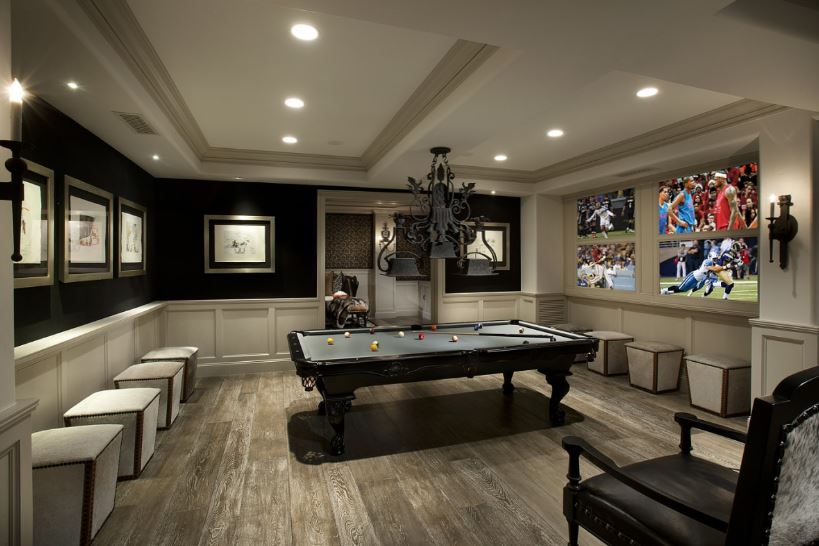
“There are those other persons who say that his thoughts are superimposed upon him and are alien elements which come from without. In all fairness, I cannot decide who is right; any one of them may be mistaken. Perhaps, since there are two against one, the greater chance is that the majority is right.” We, however, who have witnessed the whole experiment would not be doubtful, nor would the newcomer be if he attended other hypnotic experiments. He would then see that this type of experiment can be repeated innumerable times with different persons and different content. The hypnotist can suggest that a raw potato is a delicious pineapple, and the subject will eat the potato with all the gusto associated with eating a pineapple. Or that the subject cannot see anything, and the subject will be blind. Or gain, that he thinks that the World is flat and not round, and the subject will argue heatedly that the World is flat. What does the hypnotic—and especially the post-hypnotic—experiment prove? It proves that we can have thought, feelings, wishes, and even sensual sensations which we subjective feel to be ours, and yet that, although we experience these thoughts and feelings, they have been put into us from the outside, are basically alien, and are not what we think, feel, and so on. What does the specific hypnotic experiment with which we started show? The subject wills something, namely, to read his manuscript, he thinks something, namely, anger against C. We have seen that all three mental acts—his will impulse, his thought, his feeling—are not his own in the sense of being the result of his own mental activity; that they have not originated in him, but are put into him from the outside and are subjectively felt as if they were his own. #RandolphHarris 17 of 18

He gives expression to a number of thoughts which have not been put into him during the hypnosis, namely, those “rationalizations” by which he “explains” his assumption that C has stolen the manuscript. However, nevertheless these thoughts are his own only in a formal sense. Although they appear to explain the suspicion, we know that the suspicion is there first and that the rationalizing thoughts are only invented to make the feeling plausible; they are not really explanatory but come post factum. This hypnotic experiment shows in the most unmistakable manner that, although one may be convinced of the spontaneity of one’s mental acts, they actually result from the influence of a person other than oneself under the conditions of a particular situation. The phenomenon, however, is by no means to be found only in the hypnotic situation. The fact that the contents of our thinking, feeling, will, are induced from the outside and are not genuine, exists to an extent that gives the impression that these pseudo acts are the rile, while the genuine or indigenous mental acts are the exceptions. As to “guidance,” the believer should understand that when there is no action in one’s spirit, one should use one’s mind. If in everything there must be there is no use for the brain at all, but the spirit does not always speak. There are times when it should be left in abeyance. In all guidance the mind decides the course of action—not only from the feeling in the spirit but by the light in the mind. I pledge allegiance to the Flag of the United States of America, and to the Republic for which it stands, One Nation under God, with liberty and justice for all. And please seeing in your heart as a God loving Christian to donate to the Sacramento Fire Department, for they are not receiving all of their resources. #RandolphHarris 18 of 18

CRESLEIGH HAVENWOOD
Lincoln, CA | from the high $600s
Now Selling!

No appointment needed! Cresleigh Havenwood features four distinct floor plans ranging from 2,293 – 3,377 square feet and offering up to five bedrooms. Each plan has been thoughtfully designed and includes great features such as single story homes, guest suites, optional offices, garage workshops, and more! Get the most out of your new home with Cresleigh’s All Ready smart home featuring all the connectivity needed to keep your house running. Best of all, each Cresleigh home comes with owned solar included!

Located off of Virginiatown Road and McCourtney Road, residents of the 83 homesites of Cresleigh Havenwood will benefit from a brand new neighborhood in the charming City of Lincoln. Palo Verde Park, is just down the street and there’s plenty of recreation to take part in all around town. https://cresleigh.com/havenwood/


The Most Beautiful Experience is the Mysterious

On a moonless night, deep in the majestic fields of Llanada Villa, far out in the pasture, where the cattle were grazing in peace, the howl of the wind whistled through the trees as the light in the distance broke through the darkness. As I stood around the crackling fire, the room went dead silent. I could not shake the feeling that there was a malevolent force lurking in the background, biding its time, waiting for the opportunity to strike. It was a great puzzle to me where it could have stood. Chilling memories started to resurface. I ventured deeper into my home, searching for clues and signs of the morbid presence. The air grew colder, and a faint whisper echoed, “You have chosen a dangerous path.” Shadows from the chambers came alive, coalescing into sinister forms. One malevolent force pass through the wall. It was an utterly grotesque and nightmarish creature. It snarled and lunged at me. I looked drowsily about the hall. It was curious that it looked unusually wider, but seemed to contract in length and had grown proportionately higher. This suffocating and wicked force almost overwhelmed me. However, I channeled my inner fortitude against this fierce creature and it recoiled into a wavering form. The other horrors intensified their haunting, pouring every ounce of their will into spreading darkness and fear. An ancient evil had been awakened from the depths of hell, vowing to make me pay for meddling with demonic forces that had laid dormant for centuries. There was superstition of this Babylonish farm house when I purchased it. A legend that there was a nasty entity on the loose weaking havoc. When I purchased the farmhouse, there was a curious stillness—even lifelessness—to this area. As the house and barn came into view, it seemed that a black pall hung overhead. The property was made in 1560, and the former owner practiced secret and wicked arts, and had sold his soul to Satan. #RandolphHarris 1 of 5
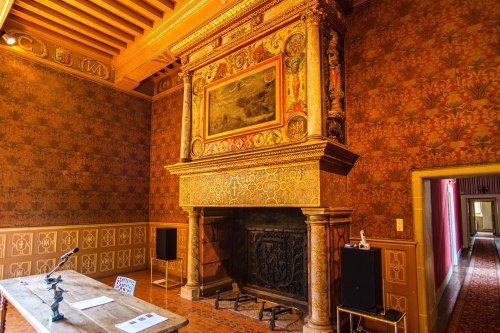
As I arrived at the 13th room on the second floor, work of some kind was evidently going on inside it, for as I neared the door I could hear footsteps and voices, or a voice within. During the few seconds in which I halted to make sure of the number, the footsteps ceased, seemingly very near the door, and I was a little startled at hearing a quick hissing breathing as of a person in strong excitement. This was vexatious. I walked on passed this room, afraid of what could be on the other side of the door. As I opened the door to another room, the light from the gasolier was behind me, and I could see my own shadow clearly cast on a dead wall. Quickly slamming the door and looking suspiciously about, there was no question of the presence. Just then, a very hard blow struck on my breast which caused great pain in my stomach and amazement in my head. However, I caught sight of no person near me. I walked half a mile across my mansion from the aforesaid room, I was taken speechless for some short time. My chambermaid did ask me several questions and desired me that if I could not speak I should hold up my hand, which I did. And immediately I could speak as well as ever. Walking up to the third floor, there I received another blow on my breast which caused much pain, so that I fell to the floor. And when I did come to my feet, to my understanding I saw a woman coming towards me, but did not know who it was. The chambermaid could not see her. After that, I went to the Daisy Bedroom without any further molestation, but after I laid in bed, I was pinched and nipped by something invisible for some time. To say I looked alarmed is a gross understatement. It seemed impossible to account for such a disrespectful act. I was as terrified as I would have been if confronted by a man-eating tiger. My house was now invaded by shadows that slid along the walls and floor, even the ceiling, and then disappeared Sometimes they were blobs, sometimes they had vaguely human shapes. Sometime they slid into cupboards and closets. #RandolphHarris 2 of 5
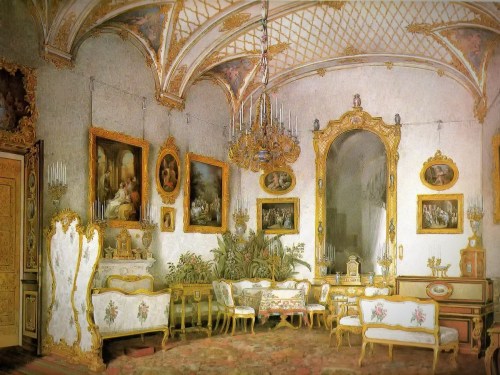
The next morning, I had the carpenters open a passageway into the thirteenth room on the second floor. A could of dust dispersed and settled, the carpenters were able to peer inside and see the content. “They found,” says Mr. Hasen, “below it a rounded hollow place in the floor, wherein were two or three bodies had plainly been smothered by smoke; and, what is to me more curious, at the side of this den, against the wall, was crouching the anatomy or skeleton of a human being, with the skin dried upon the bones, having some remains of black hair, which was pronounced by those that examined it to be undoubtedly the body of a woman, and clearly dead for a period of forty years.” The parlour concealed behind the dead wall had a very nice paper on the walls, bright pink lamps, a well stuffed sofa and matching armchairs, a low, walnut table, some valuable oil on canvas paintings and a fireplace. There were also some peculiar items: a small black cast iron cauldron, large black iron candlesticks covered in wax drippings and other curious objects. Seeking reassurance that nothing was disturbed, I have the men repair the dead wall, and took this as a sign that I was expanding the east wing of the mansion too much, and needed to work on the south. Mr. Hansen added in an undertone, “No need to worry.” “Have you supped lately?” I asked Mr. Hansen. “I have a nice piece of ham in the icehouse, and I can have the cook fry that with eggs, in no time at all.” “That’s very kind of you Mrs. Winchester, but really…” “Mr. Hasen, let him to a little cooking for you,” I pleaded. “He does not get much opportunity.” “If you’re sure it will be no trouble,” Mr. Hansen replied. “Trouble!” I said. “You take it easy and have a meal with a glass of something rich.” Mr. Hansen and his crew departed from the kitchen. I was left alone with an embarrassing interest on my hands. This was followed by two weeks of thick fog—so thick no one could see in front of their faces. It delayed construction on the exterior of my home for a bit. #RandolphHarris 3 of 5

The wind gusted outside, thudded against the door and the windows like something trying to break in. What uncertainty there may be in apparitions I know not. The wind came shrieking in, eddying drafts of icy air. I could see sharp and threatening shadows around the room. Night pressed through the windows. I felt very alone in the World. For a moment I was suspended in a trance-like state, and then vigorously gained a clear head. The shrieking rose again for two or three seconds, then fell back to a muted whine. I kept on standing on the landing, chills racing up and down my back, listening to that black wind scream and scream around me. Feeling the cold sharp edge of it cut into my bare flesh, cut straight to the bone. Just like the blade of a knife. Then the thing happened. A voice was rising to a thin treble scream, when suddenly it was shut off with an almost mechanical click. I half fancied that some obscure telepathic wave of mental force was impeding on me. I felt, infinitely more horrible. A face appeared beside me and it was twisted almost unrecognizably for a moment, while through the whole body there passed a shivering motion—as if all the bones, organs, muscles, nerves, and glands were readjusting themselves to a radically different posture, set of stresses, and general personality. Just where the supreme horror lay, I could not for my life tell; yet there swept over me such a swamping wave of sickness and repulsion—such a freezing, petrifying sense of utter alienage and abnormality—that my grasp of consciousness grew feeble and uncertain. The figure beside me seemed less like a human being. It was ore like some monstrous intrusion from the pits of hell—some damnable, utterly accursed focus of unknow and malign satanic forces. I had faltered only a moment, but before another moment was over my, I was sure this was spectral evidence. It was terrible real and convincing. Someone must have appealed to the doctrine of that Devil and caused him to appear. But who could have been trafficking with the Devil? #RandolphHarris 4 of 5
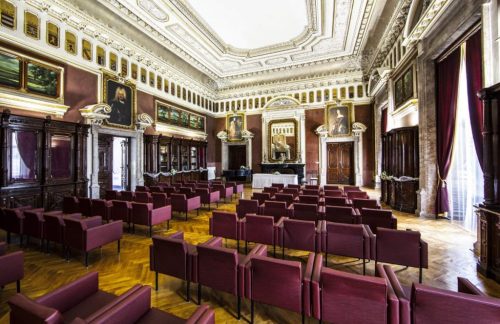
The dusk was now very thick, so I could not see much of his face. The blaze of his eyes, though, was phenomenal; and I knew that this apparition was now in a queerly energized state. I felt heavier and heavier. My home was filled with nightmarish beings and hideous monsters, and blood-drenched landscapes. The being did not speak, and in my inexplicable horror I was glad he did not. As the room started to clean, in the lights of the gasolier, I saw his firmly set mouth, and shivered at the his soulless eyes, which look beyond time. There was certainly something unnatural and diabolic in them, and I felt the sinister element all the more because of the wild ravings I had been hearing in my home for weeks. This man was a stranger—an intrusion of some sort from the black abyss in the thirteenth room. He did not speak until the room grew dark, and when he did, his voice seemed utterly unfamiliar. It was deep, firm, and very decisive, while its accent and pronunciation were rather disturbing. There was something grim, basic, pervasive and extremely evil in his tone. “I hope you’ll forget my attacks, Mrs. Winchester,” he was saying. “I guess you can excuse such things. I’m enormously grateful, of course, for being invited into your home. I hall take a rest from now on—you probably wont’s see me for some time, and you needn’t blame your servants for disturbing me.” This was a bit queer, but it is very simple. There were certain Indian relics in the dark abyss in that room. Standing stones, a sword and several small knives with queer markings etched on the blades, tarnished and pitted silver goblets, pieces of white chalk, and chunks of incense that had lost most of their scent. Also, a marble statue of a fierce looking angel wielding a shield and sword, and stepping on the head of what looked like a demon. With every moment my feeling of elusive cosmic horror increased, till at length I was in a virtual delirium. The next two months were full of rumours, people spoke of seeing devils more and more in my home with a new energized state. I felt an infinitely deep horror which I could not explain. #RandolphHarris 5 of 5
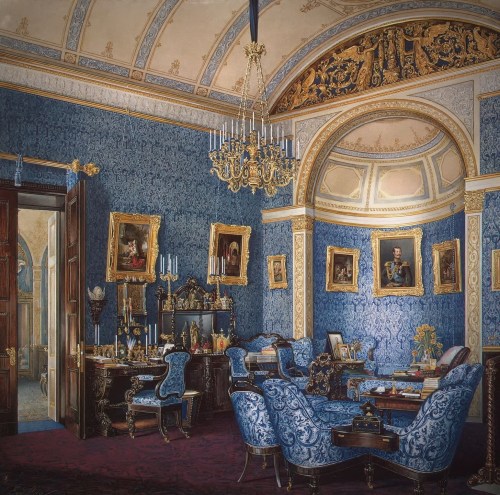

Over the years, Mrs. Sarah L. Winchester has become one of the best-loved figures in architecture and in the paranormal World. People who walk by on the sidewalks always gawked at the mansion. Some star, some laugh, some comment on how beautiful it is, other make rude jokes, and few glance and flee in horror. Every night when The Winchester Mystery House is closed, tour guides often report that they have seen shadows slinking into the house. As one tour guided was leaving the living room, he saw a darting green movement from the corner of his eye. It was a vague shape about three feet tall. With it a feeling of nausea swept over him, and passed. He assumed it was a trick of light, and something he had eaten at lunch had upset his stomach. As he was opening the door to leave, as though an ice pick had been stabbed in his brain, a voice whispered, “I don’t like plants, and I don’t like you.” The voice was so startling that it made him stagger back. He put his hand to the side of his head. “Where did that come from?” he wondered. After that, however, he avoided spending time in the front parlor.

Whenever he had to pass through it, he hurried along. Always, a fog-like shape darted out of view. The room remained cold after that, colder than the rest of the house. It had a forbidding atmosphere, as though a hostile presence had taken over. While giving a tour, the guests gazes fell on the painting hanging from the wall, some thought it was of Mrs. Winchester and froze, looks of uncertainty and astonishment on their faces. One woman rubbed her arms as though cold. The tour guide then said, “I have a great idea, why don’t we move into the Grand Ballroom, one of the best-preserved rooms in the house?” As they gathered up, the tour guide saw the green blob, then it disappeared. The tour guide emphasized that he was not in the habit of engaging in flights of fancy and did not wish to be regarded as one with mediumistic powers who regularly received supernatural visitations; nor was he suffering from any problems of the nervous system that would make his susceptible to delusions. Later, he also stressed the point that he had been in perfect health on the night of the materialization and had not been suffering from weariness nor fatigue. The ghost, he added, did not appear wispy or cloaked in a traditional sheet. The figure appeared lifelike, natural, and so solid that it had blocked light from the fireplace. After the aforementioned experience, there was no question in his mind that ghost do exist. However, the fireplaces have not been used in over 100 years.
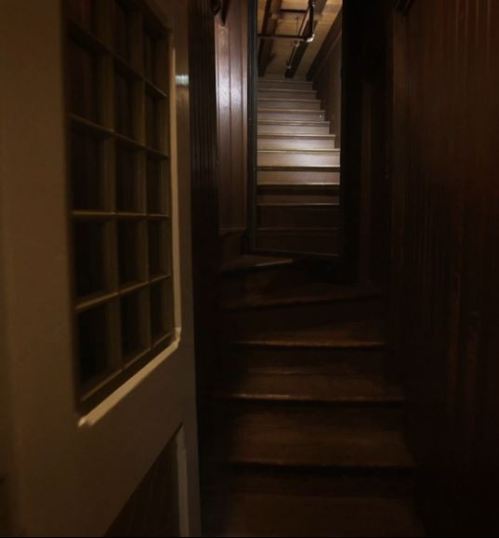
For further information about tours, including group tours, weddings, school events, birthday party packages, facility rentals, and special events please visit the website: https://winchestermysteryhouse.com/
Please visit the online giftshop, and purchase a gift for friends and relatives as well as a special memento of The Winchester Mystery House. A variety of souvenirs and gifts are available to purchase. https://shopwinchestermysteryhouse.com/

Does Every Institution in America Need to be Under Federal Investigation?

Exceptional people should not be hindered by bureaucratic laws, especially not when on the streets, there are people in the shadow economy trading tinfoil balls for outrageous prices. Obviously, dysfunction is happening not only because of corruption, but due to a lack of resources to investigate and properly remediate the problems. Because of this, dysfunction spreads until communities, cities, and even states become undesirable. There comes a time when you have to ask yourself what is important. As leaders, and lawmakers, do you want to keep spending resources on people from other nations, while homeless Americans camp outside of hotels? Do you want to pack this nation so full of people, that no laws will be enforced? People are getting tired and frustrated of dealing with the dysfunction, crime and taxation without representation, and many fear what may happen as a consequence. One can report things until they are blue in the face, but nothing is done. However, if certain people, or Americans took these same kinds of liberties with others or in other countries, not only would they be arrested, but they might even face the death penalty without trial. I know I am sick of dealing with chaos, incompetence, and repetitive dysfunction every day. Even if one is not being physically assaulted, it is physically and mentally painful to have to withstand corruption, violence, unnecessary noise, violation of constitutional rights, the deterioration of the church, family and state. While some people are rich enough to run from these problems and pretend the World is perfect, not all people are able to do the same. It is not just a problem with the democrats, it takes two to tango, and republicans are sitting back doing the Harlem Flame, and complicit in the obstruction of justice, life, liberty and the pursuit of happiness. You cannot serve two masters. You have to serve America, or step aside. #RandolphHarris 1 of 21

People say the country is too big to run. However, you notice when you call US Bank or any other bank, someone picks up the phone and can immediately address their issue because they are trained to and have adequate staff. The American government has more resources than any private company, yet the country is falling apart. Perhaps privatization is the answer because public employees are not held responsible for financial malfeasance. We cannot blame everything on the organized crime carried on by the fake news media because law enforcement is allowing them to engage in criminal acts, and if they are terrorizing and committing treason, that is grounds for a federal investigation. American streets are starting to resemble an army camp. The number of people without homes has swelled to such proportions that the Red Cross needs to provide people with tents, food, water, soap, warm clothes, shoes, blankets and medication. Some people have lung ailments and COVID. The head of the local health office has warned of the possibility of an epidemic. Officials need to resolve to the American military police to provide security. As housing prices continue to rise and inflation is sky high, mass hysteria is developing. Things cannot be allowed to go on a they are. The swarm of people without homes is being caused by the state of California being overpopulated. Half of all Americans living outside on the streets, federal data shows, live in California. California’s homelessness crisis is a homegrown problem that is deepening amid a shortage of affordable housing and emergency shelter, and it is often the brutal conditions of living on the street that trigger behavioural health problems, such as depression and anxiety. At least 90 percent of adults who are experiencing homelessness in the state became homeless while living in California due primarily to the dire lack of affordable house. Let us be realistic, the population of the United States of America is approximately 325,000,000. Therefore, realistically at least 10 percent of those people are homeless. They may be living with someone and are not officially counted, but there are probably 32,500,000 people without homes in America. #RandolphHarris 2 of 21

Homeless people are at relatively high risk for a broad range of acute and chronic illnesses. Precise data on the prevalence of specific illnesses among homeless people compared with those among nonhomeless people are difficult to obtain, but there is a body of information indicating that homelessness is associated with a number of physical and mental problems. This is evident not only in recent data from Social and Demographic Research Institute but also in individual published reports in medical literature. In examining the relationship between homelessness and health, the committee observed that there are three different types of interactions: some health problems precede and causally contribute to homelessness, others are consequences of homelessness, and homelessness complicates the treatment of many illnesses. Of course, certain diseases and treatments cut across these patterns and may occur in all three categories. Certain illnesses and health problems are frequent antecedent of homelessness. The most common of these are the major mental illnesses, especially chronic schizophrenia. As mentally ill people’s disabilities worsen, their ability to cope with their surroundings—of the ability of those around them to cope with their behaviour—becomes severely strained. In the absence of appropriate therapeutic interventions and supportive alternative housing arrangements, many wind up on the streets. Another contemporary example of illness leading to homelessness are deadly viruses. As the illness progresses and leads to repeated and more serious bouts with opportunistic infections, the individual becomes unable to work and may be unable to afford to continue paying rent. #RandolphHarris 3 of 21

Other health problems contributing to homelessness include alcoholism and drug dependence, disabling conditions that cause a person to become unemployed (which is why people are thankful prescription grade pain medication exists), or any major illness that results in massive health care expenses. One type of health problem in this category—about which the committee heard much during several site visits—is accidental injury, especially job-related accidents. Although such programs as Workers’ Compensation were designed to prevent economic devastation as a result of workplace casualties, they often fall far short of what is optimal for many reasons, including lack of knowledge of the program by the employee, low levels of benefits under the program, and lack of benefits for “off the books” work and migrant farm labour. Homelessness increases the risk of developing health problems such as diseases of the extremities and skin disorders; it increases the possibility of trauma, especially as a result of physical assault or rape. It can also turn a relatively minor health problem into a serious illness. Other health problems that may result from or that are commonly with homelessness include malnutrition, parasitic infestations, dental and periodontal disease, degenerative joint disease, venereal disease, hepatic cirrhosis secondary to alcoholism, and infectious hepatitis related to intravenous (IV) drug abuse. For even the most routine medical treatment, that state of being homeless makes the provision of care extraordinarily difficult. If not impossible, even the need for bed rest is complicated when the patient does not have a bed or, as is the case in may shelters for the homeless, must leave the shelter in the early morning hours. #RandolphHarris 4 of 21

Diabetes, for example, usually is not difficult to treat in a domiciled person. For most people, daily insulin injections and control of diet are adequate. In a homeless person, however, treatment is virtually impossible: Some types of insulin need to be refrigerated; syringes may be stolen (in cities where IV drug abuse is common, syringes have a higher street value) or, sometimes, the homeless diabetic may be mistaken for an IV drug abuser; and diet cannot be controlled because soup kitchens serve whatever they can get, which rules out special therapeutic diets. Contusions, lacerations, sprains, bruises, and superficial burns are more commonly reported in the homeless population. Homeless people are frequently victims of violent crimes such as rape, assault, and attempted robbery. In addition, primitive living conditions result in unusual risks; for example, the use of open fires for warmth predisposes them to potential burns. Pustular skin lesions secondary to insect bites and other infestations are common among homeless people. In addition, venous stasis of the lower extremities (id est, poor circulation because of varicose veins) caused by prolonged periods of sitting or sleeping with the legs down predisposes homeless people to dependent edema (swelling of the feet and legs), cellulitis, and skin ulcerations. Although there is reason to speculate that venous valve incompetence would develop more frequently in homeless patients and lead to chronic phlebitis, data are meager. Recurrent dermatitis, which is possibly related to inadequate opportunities to bathe or shower and which is associated with infestations with lice and scabies, is prevalent among the homeless population. #RandolphHarris 5 of 21

This form of dermatitis is frequently confused with bacterial cellulitis, since they both present with red, warm, tender skin lesions. Finally, homeless people are at high risk of developing subu-Collecting tenuous abscesses, but this may be related in part to an increased prevalence of needle-stick infections from drug abuse. Acute nonspecific respiratory diseases (MINURI and SERRI) are commonly reported in populations of homeless people in shelters. Living in groups, crowding, environmental stresses, and poor nutrition may predispose homeless people to infections of the upper respiratory tract and lungs. Tuberculosis has become a major health problem among homeless people. Characteristically, this has been a disease associated with exposure, poor diet, alcoholism, and other illnesses that can lead to decreased resistance in the host. Substance abusers and the elderly are at high risk for developing tuberculosis. Immigrants from less developed countries (LCDs) also have an increased risk of infections. Many homeless people also suffer from greater frequency of hypertension, diabetes, and chronic obstructive pulmonary disease. Also there is a tendency for cardiovascular and renal diseases, as well as metabolic disorders. Homeless people are more likely to contract superficial fungal infections and calluses, corns, bunions that are apparently the result of trauma from ill-fitting shoes. Homeless people suffer from many dental problems. Reports of poor oral hygiene, cavities, gingival disease, and extraction with no prosthetic replacements appear to be extremely common among homeless people. These problems are also common among indigent patients in general who have limited or no access to dental care. #RandolphHarris 6 of 21

Finally, various illnesses associated with increased mortality are related to environmental exposure, such as hypothermia and frostbite or hyperthermia. These life-threatening problems are especially prevalent among alcoholic homeless people and those who abuse other drugs. Many homeless adults suffer from chronic and severe mental illness. The visibility of mentally ill people has led to the creation of a negative stereotype for the entire homeless population, but let us keep it real. Many of the homeless people that I see are more civilized than the people who live at a particular address in Midtown Sacramento, California. It leads some to believe that some parts of Sacramento have become a psychiatric dumping ground. Personality disorders should not be seen primarily as a consequence of homelessness. Rather, because they impair a person’s ability to cope with the demands of life and the expectations of society, they may contribute to the factors that cause certain people to become homeless. Other psychiatric illnesses, such as the anxiety and phobic disorders and milder depressive reactions, can either be contributing factors in causing homelessness or, more commonly, result from the stress of homelessness. Becoming homeless is a psychologically traumatic event that commonly is accompanied by symptoms of anxiety and depression, sleeplessness and loss of appetite. Sometimes, homeless people try to “mediate” these feelings away with alcohol or drugs. Veterans who experience sheltered homelessness often live in places such as emergency shelters, transitional housing programs or other supportive settings. Veterans who experienced unsheltered homelessness live in places not meant for human habitation, such as cars, parks, sidewalks, abandoned buildings and literally on the street. #RandolphHarris 7 of 21

Homelessness is a serious problem and is a threat to national security. Many homeless people are exposed to animals, such as rats, mice, snakes, and insects such roaches, fleas and spiders. And without adequate public bathrooms or places to dispose of waste, some are exposed to feces, urine, and trash. As you recall, the Black Death is believed to have been the result of a plague, an infectious fever caused by the bacterium Yersinia pestis. The disease was likely transmitted from rodents to humans by the bite of infected fleas. It is not known for certain how many people died during the Black Death. About 25,000,000 people are estimated to have died in Europe from the plague between 1347 and 1351. With an extremely high level of people living on the street, the Black Death could manifest again, and even spread to those who have homes. The effects of the Black Death were many and varied. Trade suffered for a time, and wars were temporarily abandoned. Many labourers died, which devasted families through lost means of survival and caused personal suffering; landowners who used labourers as tenant farmers were also affected. Yersinia causes three types of plague in humans: bubonic, pneumonic, and septicemic. Although there is DNA evidence that Yersinia was present in victims of the Black Death, it is uncertain which form the majority of the infection took. It is likely that all three played some role in the pandemic. Bubonic plague causes fever, fatigue, shivering, vomiting, headaches, giddiness, intolerance to light, pain in the back and limbs, sleeplessness, apathy, delirium. It also causes buboes: one or more of the lymph nodes become tender and swollen, usually in the groin or armpits. Pneumonic plague affects the lungs and causes symptoms similar to those of severe pneumonia: fever, weakness, and shortness of breath. Fluid fills the lungs and can cause death if untreated. Other symptoms may include insomnia, stupor, a staggering git, speech disorder, and loss of memory. Septicemic plague is an infection of the blood. Its symptoms include fatigue, fever, and internal bleeding. #RandolphHarris 8 of 21

The masses of homeless people are desperately sick. They are broken spiritually, suffering appalling things, and many see no way out, and cannot find a helping hand. They need homes and medical treatment for the body and soul. People without homes come at the cost of a considerable damage to the body of society as a whole. Many of the homeless people plead from the bottom of their hearts that someone will come, they wait with pain every day that someone will free them from suffering. Some cannot walk and wait with great yearning for a home. One should know that when one’s spirit is touched by the poison of the spirits of evil—by the injection, for instance, of sadness, soreness, complaint, grumbling, fault-finding, touchiness, bitterness, feeling hurt, jealousy, et cetera—all direct from the to the spirit. One should resist all sadness, gloom and grumbling injected into one’s spirit—for the victory life of a freed spirit means joyfulness. Believers ordinarily think that sadness had to do with their disposition, and so yield to it without a thought of resistance or reasoning out the cause. If they were asked if a human with a strong disposition to steal should yield to it, they would at once answer “no”; yet they yield to other “dispositions” less manifestly wrong without a question. In the stress of conflict, when the believer find that the enemy succeeds in reaching one’s spirit with any of these “fiery darts,” one should know how to pray immediately against the attack, asking God to destroy the causes of it. It should be noted that this touching of the spirit by the various things just named is not a manifestation of the “works of the flesh”—assuming the believer is one who knows the life after the spirit—but they will quickly reach the sphere of the flesh if not recognized and dealt with in sharp refusal and resistance. #RandolphHarris 9 of 21

One should know when one’s spirit is in the right position of dominance over soul and body, and not driven beyond due measure by the exigencies of conflict or environment. These are three conditions of the spirit which the believer should be able to discern and deal with: The spirit depressed, id est, crushed or “down.” The spirit in its right position, in poise and calm control. The spirit drawn out beyond “poise,” when it is in strain, or driven, or in “flight.” When the human walks after the spirit, and discerns it to be in either of the wrong conditions, one knows how to “lift” it when it is depressed; and how to check the overaction by a quiet act of one’s own volition when it is drawn out of poise by over-eagerness, or the drive of spiritual foes. The believer must know what the spirit is, and how to give heed to the demands of the spirit and not quench it: exempli gratia, a weight comes on one’s spirit, but one goes on with one’s work, putting up with the pressure; one finds the work had, but one has no time to investigate the cause…until at last the weight become unendurable, and one is forced to stop and see what is the matter—whereas one should have given heed to the claims of the spirit at the first, and in a brief prayer taken the “weight” to God, refusing all pressure from the foe. One should be able to read one’s spirit, and know at once when it is out of cooperation with the Holy Spirit, quickly refusing all attacks which are drawing one’s spirit out of the poise of fellowship with God. Even if this claim is made by a Protestant church, the Protestant principle, in name derived from the protest of the “protestants” against decisions of the Catholic majority, contains the divine and human protest against any absolute claim made for a relative reality. #RandolphHarris 10 of 21

Is the Protestant era at an end? Is Protestantism as an historical reality dying, is its soul fleeing a moribund body that failed to adjust to the demands of its times? The social, political, economic, and spiritual disintegration of the masses can be relieved only by a tight centralization of power in all these areas. Protestantism, however, inspired by its principle of prophetic protest against hierarchical authority, ecclesiastical or political, which wraps itself in the mantle of the sacred, stands opposed to the trend toward centralization. Protestantism, out of step with the rhythm of history, leaves the field open to the tree forces capable of mass reintegration of society: communism, nationalism, and Roman Catholicism. Grim as the Protestant prospect is, renewal will be achieved by a Protestant movement that transcends all churches, political parties and ideologies and yet impregnates them. The prophetic spirit which lists where it will, without ecclesiastical conditions, organization, and traditions. Thus it will operate through Catholicism as well as through orthodoxy, through fascism as well as through communism; and in all these movements it will take the form of resistance against the distortion of humanity and divinity which necessarily is connected with the rise of the new systems of authority. However, this imperative would remain a very idealistic demand if there were no living group which could be bearer of this spirit. Such a group could not be described adequately as a sect. It would approximate more closely an order or fellowship and would constitute an active group, aiming to realize, first, in itself that transformation of Protestantism which cannot be realized either by the present churches or by the movement of retreat and defense. #RandolphHarris 11 of 21

However, whether the Protestant era ends or not, the Protestant principle will never die. If the Protestant reality expires under the protesting blast of the Protestant principle, then the power and vitality of the principle is proved all the stronger. This principle is not a special religious or cultural idea; it is not subject to changes of history; it is not dependent on the increase or decrease of religious experience or spiritual power. It is the ultimate criterion of all religious and all spiritual experiences; it lies at their base, whether they are aware of it or not. It goes without saying how important it is not only to realize the dynamic role of destructiveness in the social process but also to understand what the specific conditions for tis intensity are. We have already noted the hostility which pervaded the middle class in the age of the Reformation and which found its expression in certain religious concepts Protestantism, especially in its ascetic spirit, and in Mr. Calvin’s picture of a merciless God to whom it had been pleasing to sentence part of humankind to eternal damnation for no fault of their own. Then, as later, the middle class expressed its hostility mainly disguised as moral indignation, which rationalized an intense envy against those who had the means to enjoy life. In our contemporary scene the destructiveness of the lower middle class has been an important factor in the rise of Nazism which appealed to these destructive strivings and used them in the battle against its enemies. #RandolphHarris 12 of 21

The root of destructiveness in the lower middle class is easily recognizable as the one which has been assumed in this discussion: the isolation of the individual and the suppression of the individual expansiveness, both of which were true to higher degree for the lower middle class than for the classes above or below. In the mechanisms we have been discussing, the individual overcomes the feeling of insignificance in comparison with the overwhelming power of the World outside of oneself either by renouncing one’s individual integrity, or by destroying others so that the World ceases to be threatening. Other mechanisms of escape are the withdrawal from the World so completely that it loses its threat (the picture we find in certain psychotic states, and the inflation of oneself psychologically to such an extent that the World outside becomes small in comparison. Although these mechanisms of escape are important for individual psychology, they are only of minor relevance culturally. Another mechanism of escape which is of the greatest social significance is the solution that the majority of normal individuals find in modern society. To put it briefly, the individual ceases to be oneself; one adopts entirely the kind of personality offered to one by cultural patterns; and one therefore becomes exactly as all others are and as they expect one to be. The discrepancy between “I” and the World disappears and with it the conscious fear of aloneness and powerlessness. This mechanism can be compared with the protective colouring some animals assume. They look so similar to their surroundings that they are hardly distinguishable from them. The person who gives up one’s individual self and becomes an automation, identical with millions of other automatons around one, need not feel alone and anxious anymore. But the price one pays, however, is high; it is the lose of oneself. #RandolphHarris 13 of 21

Avoidance of error of accepting ideologies (rationalizations) for expressions of the inner, and usually unconscious, reality may become manifest after some time. One method which has proved to be very useful is that of an open-ended questionnaire, the answers to which are interpreted as to their non-intended or unconscious meaning. Thus, when one answer to the question, “Who are the men in history whom you most admire?” is “alexander the Great, Nero, Marx, and Lenin” and another answer is “William Randolph Hearst, William Wirt Winchester, George Fisher Winchester, and Sokrates,” the inference is made that the first respondent is an admirer of power and strict authority, the second an admirer of those who work in the service of life and who are benefactors of humankind. By using an extended projective questionnaire it is possible to obtain a reliable picture of the character structure of a person. Other projective tests—the analysis of favourite jokes, songs, stories, and observable behaviour (especially the “small acts” so important for psychoanalytic observation)—help in obtaining correct results. Methodologically, the main emphasis in all these studies is on the mode of production and the resulting class of stratification, on the most significant character traits and the syndromes they form, and on the relationship between these two sets of data. With the method or stratified samples, whole nations or large social classes can thus be studied by including less than a thousand persons in the investigation. Another important aspect of analytic social psychology is what Dr. Freud called the “unconscious.” #RandolphHarris 14 of 21

However, while Dr. Freud was mainly concerned with individual repression, the student of Marxist social psychology will be most concerned with the “social unconscious.” This concept refers to that repression of inner reality which is common to large groups. Every society must make every effort not to permit its members, or those of a particular class, to be aware of impulses which, if they were conscious, could lead to socially “dangerous” thoughts or actions. Effective censorship occurs, not at the level of the printed or spoken word, but by preventing thought from even becoming conscious, that is, by repression of dangerous awareness. Naturally the contents of the social unconscious vary depending on the many forms of social structure: aggressiveness, rebelliousness, dependency, loneliness, unhappiness, boredom, to mention only a few. The repressed impulse must be kept in repression and replaced by ideologies which deny it or affirm its opposite. The bored, anxious, unhappy human of today’s industrial society is taught to think that one is happy and full of fun. In other societies the human deprived of freedom of thought and expression is taught to think that one has almost reached the most complete form of freedom, even though at the moment only one’s leaders speak in the name of that freedom. In some systems love of life is repressed and love of property is cultivated instead; in others, awareness of alienation is repressed, and instead the slogan, “there can be no alienation in a socialist country,” is prompted. Another way of expressing the phenomenon of the unconscious is to speak of it in terms of Mr. Hegal and Mr. Marx, that is, as the totality of forces which work behind humans’ back while they have the illusion of being free in their decisions, or as Adam Smith put it, “economic man is lead by invisible hand to promote an end which was no part of his intention.” #RandolphHarris 15 of 21

While for Mr. Smith this invisible hand was a benevolent one, for Mr. Marx (as well as for Dr. Freud) it was a dangerous one; it had to be uncovered in order to be deprived of its effectiveness. Consciousness is a social phenomenon; for Mr. Marx it is mostly false consciousness, the work of the forces of repression. The unconscious, like consciousness, is also a social phenomenon, determined by the “social filter” which does not permit most real human experiences to ascend from unconsciousness to consciousness. This social filter consists mainly of language, logic, and social taboos; it is covered up by ideologies (rationalizations) which are subjectively experienced as being true, when in reality they are nothing but socially produced and shared fictions. This approach to consciousness and the repression can demonstrate empirically the validity of Mr. Marx’s statement that “social existence determines consciousness.” As a consequence of these considerations, another theoretical difference between dogmatic Freudian- and Marxist-oriented psychoanalysis appears. Dr. Freud believed that the effective cause for repression—the most important content to be repressed being incestuous desires—is the fear of castration. On the contrary, it is believed that humans’ greatest fear is that of complete isolation from their fellow humans, of complete ostracism. Even fear of death is easier to bear. Society enforces its demands for repression by the threat of ostracism (which is why haters and cancel culture have come together to turn the tide for their unacceptable behaviour). If you do not deny the presence of certain experiences, you do not belong, you belong nowhere, you are in danger of becoming insane. (Insanity is, in fact, the illness characterized by total absence of relatedness to the World outside.) #RandolphHarris 16 of 21

When it comes to property rights, we generally have two categories. Rights to assets that exist in nature, such as land, forests, and mineral deposits, and the emphasis on rights to assets that have to be produced, such as buildings and machines. The latter brings in the added issues of incentives to engage in this production and the efficiency of this productive activity. Even more complex issues arise in the context of other kinds of property, such as intellectual property and commercial brand names. These issues have to do with balancing private incentives to produce new assets of this kind and the social incentives efficiently to use the assets once they exist. Study of property rights in the eighteenth and nineteenth century whaling industry supports and extends many of these ideas by considering the information aspects of the enforcement of property rights. Many boats may participate in the killing of one whale, either simultaneously or sequentially. Or one boat may kill a whale and take it in tow only to lose it, and then another boat may find it. When disputed arise in such situations, their resolution depends on the verifiability of information. Therefore it makes sense to define property rights in the first place so as to be consistent with the verifiability of information regarding any violations of these rights. Mr. Ellickson finds that the definition of fishermen’s property rights over whale carcasses did indeed differ across whale types and regions, and evolved over time, in just this way. This can be thought of as another aspect of the complexity inherent in the concept of property rights. #RandolphHarris 17 of 21

However, optimal evolution of property rights and their enforcement should not be taken for granted. Given this multiplicity of dimensions of property rights, for formal and informal, explicit, and implicit allocations of rights among various claimants, the transaction costs of enforcing rights, and the conflicts that confront any attempts to change any right, it is not surprising that reform is often stalled or makes matters worse. Traditional property rights to land in Africa are a complex system—titles are granted to individual families by clan chiefs, and sales are subject to their approval and also that of heirs (all sons usually have expectations of equal division). Many family stakeholders have usufruct rights. When the Kenyan government attempted to impose a system of formal land titles, this ran into conflict with the traditional arrangements. The expected capital market did not develop because lenders knew that foreclosure was infeasible in the face of opposition from family and community, so the land could not be used as collateral. Attempts to consolidate scattered holdings for scale economy reasons did not work because there was a good economic reason (diversification of risks) for the scattering. Many formally registered titles are now being allowed to lapse and revert to older arrangements, and the laws are being changed to resemble traditional forms more closely. The importance of developing public institutions for property right protection that build on, and work synergistically with, the historical and cultural endowment of norms and practices in a society are very important. #RandolphHarris 18 of 21

If a government cannot or does not provide adequate protection for property rights, individuals and groups will attempt to provide private protection. They may do this using their own individual or collective efforts, or hire professional guards. The latter approach carries the risk that the guards become predators or extortionists; this problem exists with some governments too. The outcome of such games may be more or less efficient depending on the specifics of the situation—the technologies of protection and predation, the information, the skills in alternative occupations, the time-horizon of the predation, the information, the skills in alternative occupations, the time-horizon of the participants, and so on. However, some form of private protection will usually be better than none at all. The educational system of Russian serves, like that of any other country, to prepare the individual for the function one is to assume in society. The first task is to inculcate those attitudes and values that are dominant in Russian society. The values impressed on Russian youth and citizens correspond to the dominant Western morality, although heavily accented on the conservative idea. Care, responsibility, love, patriotism, diligence, honesty, industriousness, the injunction against transgressing the happiness of one’s fellowman, consideration for the common interest—there is nothing in this catalogue of values that could not be included in the ethics of the Western tradition. #RandolphHarris 19 of 21

Respect for property is emphasized as respect for socialist property, submission to authority as acceptance of national or international solidarity. As far as sexual morality is concerned, Russian morality is conservative and puritanical. The family is praised as a center of social stability, and any kind of sexual promiscuity is sternly discouraged. Since the betrayal or the part or the Russian system is about the worst imaginable crime in Russian mortality, the following statement gives an idea of this Russian puritanism. Komsomolskaya Pravda asked in reporting a case of marital betrayal: “How many steps are there from this to treason in the broader sense…? Communism is described as a system of “consistent monogamy” and as being opposed in principle to liaisons born of “dissoluteness and flightiness.” Aside from the central goal of Russian education, dutiful subordination of the individual to the demands of Russian society and its representatives, the other sim is that of creating the proper spirit of a competitive work morality. Families in which a genuine mutual concern about cultural growth is evident and domestic responsibilities are properly shared by all members of the family should be held up as examples. It is necessary to encourage the participation of children, adolescents, and young men and women in the performance of domestic chores and to appreciate this as an important and integral pater of labour training. “Ye shall respect every man his mother and his father. Ye shall rise up before the hoary head, and honour the aged among you. Ye shall not steal; neither shall ye deal falsely, nor lie one to another. Ye shall do no unrighteousness in court or in commerce, in weight or in measure. #RandolphHarris 20 of 21

“Correct balances and just weights shall ye have; I am the Lord your God. Ye shall not oppress your neighbour, nor steal from him; the wages of a hired servant shall not abide with you all night until the morning. Ye shall not be unrighteous in judgment; ye shall not be partial even to the poor. Ye shall not favour the person of the mighty; but in righteousness shall ye judge your neighbour. Thou shalt not go about slandering people; neither shalt thou stand idly by when thy neighbor’s life is in danger. And if a stranger sojourn with thee in thy land, thou shalt not wrong him or her. The stranger that sojourn with thee in thy land, thou shall be unto thee like the native-born. Thou shalt love one as thyself, for ye were strangers in the land of Egypt. Thou shalt not hate thy brother in thy heart; thou shalt not take vengeance nor bear any grudge. Thou shalt love thy neighbour as thyself; I am the Lord. Justice, justice shall you pursue, that you may life in the land which God gives you. You shall not prevent judgment, nor favour persons, neither shall you take a bribe, for a bribe blinds the eyes of the wise, and perverts the words of the righteous. Hear the causes between your brothers, judge righteously your brothers and the strangers. You shall hear the small and great alike, you shall not be afraid of the face of any human; for the judgment is God’s. Woe unto them that call evil “good,” and good “evil,” that turn darkness into light, and light into darkness.” I pledge allegiance to the Flag of the United States of America, and to the Republic for which it stands, One Nation, Under God, Indivisible, with Liberty and Justice for all. Please be kind enough to donate to the Sacramento Fire Department, they are not receiving all of their resources. #RandolphHarris 21 of 21


Going Beyond the Build means exceeding client expectations.

Our team of professionals specialize in every aspect of a Design + Build experience.

The Millhaven Difference:

- Unique approach, end to end services in-house
- Transparency, organization and communication
- Live and accurate budget monitoring, no financial surprises
- High standards of quality & proven trade partners
- Clearly defined systems of execution and expectations
- 8 person team of professionals assigned to each project
- Customized software for total project management
- Going BEYOND the BUILD in every way
- https://millhavenhomes.com/custom-homes/
And for more news information: https://www.instagram.com/p/Cw5Th2IuZWd/

Production of Too Many Useful things Results in Creation of too Many Useless People
Destructiveness is different from the sado-masochistic strivings since it aims not at active or passive symbiosis but at elimination of its object. However, it, too, is rooted in the unbearableness of individual powerlessness and isolation. I can escape the feeling of my own powerlessness in comparison with the World outside of myself by destroying it. To be sure, if I succeed in removing it, I remain alone and isolated, but mine is a splendid isolation in which I cannot be crushed by the overwhelming power of the object outside myself by destroying it. To be sure, if I succeed in removing it, I remain alone and isolated, but mine is a splendid isolation in which I cannot be crushed by the overwhelming power of the object outside of myself. The destruction of the World is the last, almost desperate attempt to save myself from being crushed by it. Sadism sims at incorporation of the object; destructiveness at its removal. Sadism tends to strengthen the atomized individual by the domination over others; destructiveness by the absence of any threat from the outside. Any observer of personal relations in our social sense cannot fail to be impressed with the amount of destructiveness to be found everywhere. For the most part it is not conscious as such but is rationalized in various ways. As a matter of fact, there is virtually nothing that is not used as a rationalization for destructiveness. Love, duty, conscience, patriotism have been and are being used as disguises to destroy others or oneself. However, we must differentiate between two different kinds of destructive tendencies. #RandolphHarris 1 of 20

There are destructive tendencies which result from a specific situation; as reaction to attacks on one’s own or others’ life and integrity, or on ideas which one is identified with. This kind of destructiveness is the natural and necessary concomitant of one’s affirmation of life. The destructiveness where under discussion, however, is not this rational—or as one might call it “reactive”—hostility, but a constantly lingering tendency within a person which so to speak waits only for an opportunity to be expressed. If there is no objective “reason” for the expression of destructiveness, we call the person mentally or emotionally sick (although the person oneself will usually build up some sort of a rationalization). In most cases the destructive impulses, however, are rationalized in such a way that at least a few other people or a whole social group share in the rationalization and thus make it appear to be “realistic” to the member of such a group. However, the objects of irrational destructiveness and the particular reasons for their being chosen are only of secondary importance; the destructive impulses are a passion within a person, and they always succeed in finding some object. If for any reason other persons cannot become the object of an individual’s destructiveness, one’s own self easily becomes the object. When this happens in a marked degree, physical illness is often the result and even suicide may be attempted. We have assumed that destructiveness is an escape from the unbearable feeling of powerlessness, since it aims at the removal of all objects with which the individual has to compare oneself. #RandolphHarris 2 of 20

However, in view of the tremendous role that destructive tendencies play in human behaviour, this interpretation does not seem to be a sufficient explanation; they very conditions of isolation and powerlessness are responsible for two other sources of destructiveness: anxiety and the thwarting of life. Concerning the role of anxiety not much needs to be said. Any threat against vital (material and emotional) interests creates anxiety, and destructive tendencies are the most common reaction to such anxiety. The threat can be circumscribed in a particular situation by particular persons. In such a case, the destructiveness is aroused towards these persons. It can also be a constant—though not necessarily conscious—anxiety springing from an equally constant feeling of being threatened by the World outside. This kind of constant anxiety results from the position of the isolated and powerless individual and is one other source of the reservoir of destructiveness that develops in him. Another important outcome of the same basic situation is what I have just called the thwarting of life. The isolated and powerless individual is blocked in realizing one’s sensuous, emotional, and intellectual potentialities. One is lacking the inner security and spontaneity that are the conditions of such realization. This inner blockage is increased by cultural taboos on pleasures and happiness, like those that have run through the religion and mores of the middle class since the period of the Reformation. Nowadays, the external taboo has virtually vanished, but the inner blockage had remained strong in spite of the conscious approval of sensuous pleasure. #RandolphHarris 3 of 20

This problem of the relation between the thwarting of life and destructiveness has been touched upon by Dr. Freud. Dr. Freud realized that he had neglected the weight and importance of destructive impulses in his original assumption that the sexual drive and the drive for self-preservation were two basic motivations of human behaviour. Believing, later, the destructive tendencies are as important as the sexual ones, he proceeded to the assumption that there are two basic strivings to be found in humans: a drive that is directed toward life and is more or less identical with sexual libido, and a death-instinct whose aim is the very destruction of life. He assumed that the latter can be blended with the sexual energy and then be directed either against one’s own self or against objects outside of oneself. He furthermore assumes that the death-instinct is rooted in a biological quality inherent in all living organisms and therefore a necessary and unalterable part of life. The assumption of the death-instinct I satisfactory inasmuch as it takes into consideration the full weight of destructive tendencies, which had been neglected in Dr. Freud’s earlier theories. However, it is not satisfactory inasmuch as it resorts to a biological explanation that fails to take account sufficiently of the fact that the amount of destructiveness varies enormously among individuals and social groups. If Dr. Freud’s assumptions were correct, we would have to assume that the amount of destructiveness either against others or oneself is more or less constant. However, what we do observe is to the contrary. Not only does the weight of destructiveness among individuals in our culture vary a great deal, but also destructiveness is of unequal weight among different social groups. #RandolphHarris 4 of 20

Thus, for instance, the weight of destructiveness in the character of the members of some of the lower middle class in Europe is definitely much greater than among the working and the upper classes. Anthropological studies have acquainted us with peoples in whom a particularly great amount of destructiveness is characteristic, whereas others show an equally marked lack of destructiveness, whether in the form of hostility against others or against oneself. It seems that any attempt to understand the roots of destructiveness must start with the observation of these very differences and proceed to the question of what other differentiating factors can be observed and whether these factors may not account for the differences in the amount of destructiveness. This problem offers such difficulties that it requires a detailed treatment of its own which we cannot attempt here. However, it would seem that the amount of destructiveness to be found in individuals is proportionate to the amount to which expansiveness of life is curtailed. By this we do not refer to individual frustrations of this or that instinctive desire but to the thwarting of the whole of life, the blockage of spontaneity of the growth and expression of humans’ sensuous, emotional, and intellectual capacities. Life has an inner dynamism of its own; it tends to grow, to be expressed, to be lived. It seems that if this tendency is thwarted the energy directed toward life undergoes a process of decomposition and changes into energies directed toward destruction. In other words: the drive for life and the drive for destruction are not mutually independent factors but are in a reversed interdependence. The more the drive toward life is thwarted, the stronger is the drive toward destruction; the more life is realized, the less is the strength of destructiveness. Destructiveness is the outcome of unlived life. #RandolphHarris 5 of 20

Those individual and social conditions that make for suppression of life produce the passion for destruction that forms, so to speak, the reservoir from which the particular hostile tendencies—either against others or against oneself—are nourished. The character structure of the industrial worker contains punctuality, discipline, capacity for teamwork; this is the syndrome which forms the minimum for the efficient functioning on an industrial worker. (Other differences—dependence-independence, interest-indifference, activity-passivity—are at this point ignored, although they are of utmost importance for the character structure of the worker now and in the future.) The most important application of the concept of the social character lies in distinguishing the future social character of a socialist society as visualized by Mr. Marx from the social character of nineteenth-century capitalism, with its central desire for possession of property and wealth; and distinguishing it from the social character of nineteenth-century capitalism, with its central desire for possession of property and wealth; and distinguishing it from the social character of the twentieth century (capitalist or communist), which is becoming ever more prevalent in the highly industrialized societies—the character of homo consumens. Homo consumens is the human whose main goal is not primarily to own things, but to consume more and more, and thus to compensate for one’s inner vacuity, passivity, loneliness, and anxiety. In a society characterized by giant enterprises and giant industrial, governmental and labour bureaucracies, the individual, who has no control over one’s circumstances of work, feels impotent, lonely, bored, and anxious. #RandolphHarris 6 of 20

At the same time, the need for profit of the big consumer industries, through the medium of advertising, transforms one into a voracious human, an eternal suckling who wants to consume more and more and for whom everything becomes an article of consumption—premium cranberry juice, dinner dates, movies, television, travel, and even education, books, and lectures. New artificial needs are created and humans’ tastes are manipulated. (The character of homo concumnes in its more extreme forms is a well-known psychopathological phenomenon. It is to be found in many cases of depressed or anxious persons who escape into overeating, overbuying, or alcoholism to compensate for the hidden depression and anxiety.) The greed for consumption, an extreme form of what Dr. Freud called the “oral-receptive character,” is becoming the dominant psychic force in present-day industrialized society. Homo consumnes is under the illusion of happiness, while unconsciously one suffers from one’s boredom and passivity. The more power one has over machines, the more powerless one becomes as a human being; the more one consumes, the more one becomes a slave to the ever-increasing needs which the industrial system creates and manipulates. One mistakes thrill and excitement for joy and happiness and material comfort for aliveness; satisfied green becomes the meaning of life, the striving for it a new religion. The freedom to consume becomes the essence of human freedom. This spirit of consumption is precisely the opposite of the spirit of a socialist society as Mr. Marx visualized it. He clearly saw the danger inherent in capitalism. His aim was a society in which man is much, not in which one has or uses much. #RandolphHarris 7 of 20

Mr. Marx wanted to liberate humans from the chains of one’s material greed so that one could become fully awake, alive, and sensitive, and not be the slave of one’s greed. “The production of too many useful things,” Mr. Marx wrote, “result in the creation of too many useless people.” He wanted to abolish extreme poverty, because it prevents humans from becoming fully human; he also wanted to prevent extreme wealth, in which the individual becomes the prisoner of one’s greed. His aim was not the maximum but the optimum of consumption, the satisfaction of those genuine human needs which serve as a means to a fuller and richer life. It is one of the historical ironies that the spirit of capitalism, the satisfaction of material greed, is conquering the communist and socialist countries which, with their planned economy, would have the means to curb it. This process has its own logic; the material success of capitalism was immensely impressive to those less developed countries (LCDs) in Europe in which communism had been victorious, and the victory of socialism became identified with successful competition with capitalism within the spirit of capitalism. Socialism is in danger of deteriorating into a system which can accomplish the industrialization of LCDs more quickly than capitalism, rather than of becoming a society in which the development of humans, and not that of economic production, is the main goal. This development has been furthered by the fact that Soviet communism, in accepting a crude version of Mr. Marx’s “materialism,” lost contact, as did the capitalist countries, with the humanist spiritual tradition of which Mr. Marx was one of the greatest representatives. #RandolphHarris 8 of 20

It is true that socialist countries have still not solved the problem of satisfying the legitimate material needs of their populations (and even in the United States fifty percent of the population is not “affluent”). However, it is of the utmost importance that socialist economists, philosophers, and psychologists be aware of the danger that the goal of optimal consumption can easily change to that of maximal consumption. The task for the socialist theoreticians is to study the nature of human needs; to find criteria for the distinction between genuine human needs, the satisfaction of which makes humans more alive and sensitive, and synthetic needs created by capitalism which tend to weak humans, to make one more passive and bored, a slave to one’s greed for things. Production should not be restricted, but, once the optimal needs of individual consumption are fulfilled, it should be channeled into more production of the means for social consumption such as schools, libraries, theaters, parks, hospitals, public transportation, et cetera. Some much money is being blown on assisting other nations and their people that buildings like the California Department of Veteran Affairs on O street in Sacramento, California is actually holding at least 15 windows together with clear plastic tape. The building cannot be safe for people to work in. However, no one would know that considering how taxpayer dollars are being thrown away on nonessential programs and services the government cannot afford. The State of California is literally crumbling because it is overwhelmed by people and does not have the resources to keep it running efficiently. #RandolphHarris 9 of 20
The ever-increasing individual consumption in the highly industrialized counties suggests that competition, greed, and envy are engendered not only by private property, but also by unlimited private consumption. Socialist theoreticians must not lose sight of the fact that the aim of a humanistic socialism is to build an industrial society whose mode of production shall serve the fullest development of the total human and not the creation of homo consumens; that socialist society is an industrial society fit for human beings to live in and to develop. There are empirical methods which permit the study of the social character. The aim of such study is to discover the incidence of the various character syndromes within the population as a whole and within each class, the intensity of the various factors within the syndrome, and new or contradictory factors which have been caused by different socioeconomic conditions. All such existing character structure, the process of change, and also what measures might facilitate such changes. Needless to say, such insight is importation in countries in transition from agriculture to industrialism, as well as for the problem of the transition of the worker under capitalism or state capitalism, that is, under alienated conditions, to the conditions of authentic socialism. Furthermore, such studies are guides to political action. If I know only the political “opinions” of people as ascertained by the opinion polls, I know how they are likely at act in the immediate future. If I want to know the strength of psychic forces (which at the moment may not yet be manifest consciously) such as, for instance, racism, war- or peace-mindedness, such studies of character inform me of the strength and direction of the underlying forces which operate in the social process and which may become manifest only after some time. #RandolphHarris 10 of 20

There is are several important characteristics of the managerial group. One, as Granick reports, is that Soviet data show that, as early as the 1930s, a great deal of social stability had developed. “Statistics on this subject,” writes Granick, “unfortunately end in the 1930s. Moreover, the data as to the occupation of parents is broken down into only a threefold classification: worker, farmer, and white-collar. Still, even this data is reasonably strong. It shows that the son of a white-collar employee, professional or business owner, had eight times as good a chance of reaching top management rank in the United States of America [in 1952] as did the son of manual workers and farmers, and that he had six times as good a chance in the Soviet Union [1936].” As far as the situation today is concerned, one can only guess. However, Granick sounds convincing when he says that the tendency against social mobility “has probably increased in present-day Russia simply because of the lesser amount of hostility toward the children of white collar parents.” This class stratification exist in spite of the fact that education in the Soviet Union is absolutely free and most of the better students receive stipends besides. This apparent contradiction is probably explained to some extent by the fact that many young Soviet people may not be able to go on to college because their families need their earnings. Considering the very high scholastic standards of Russian higher education, it would also appear likely that the cultural atmosphere of a managerial family provides a better preparation in this respect than that of a worker’s or peasant’s family. #RandolphHarris 11 of 20

The surprising fact—surprising for those who believe in the socialist character of the Soviet system—is, as Berliner reports, that to be a “worker” is “something devoutly to be shunned by most young people who have reached the high school level.” This attitude toward being a worker is, of course, not expressed in the official ideology, which extolls the workers as being the true masters of Soviet society, and the myth of great social mobility continues to exist in the Soviet Union. It is correct, then, to speak of a managerial class in the Soviet Union? If one uses Mr. Marx’s concept, the term “class” could not very well be applied, since in Marxist thought this refers to a social group with reference to its relation to the means of production; that is, whether the group owns capital or its tools (artisans), or is made up of propertyless workers. Naturally in a country where the state owns all the means of production, there is no managerial “class” in this sense, nor any other for that matter, and, if one uses the term “class” in a strict Marxist sense, one can claim that the Russia is a classless society. In reality, however, this is not so. Mr. Marx did not foresee that in the development of capitalist society there would be a vast group of managers who, while not owning the means of production, exercise control over them, and who have in common a high income and high social status. Hence Mr. Marx never transcended his concept of class beyond that of ownership of the means of production to that of control of the means of production and of the “human material” employed in the process of production, distribution, and consumption. #RandolphHarris 12 of 20

In terms of control, Russia is a society with rigid class distinctions. Aside from the managerial bureaucracy, there are the political bureaucracy of the Communist Party and the military bureaucracy. All three share control, prestige, and income. It is important to note that they largely overlap. Not only are most managers and top officers members of the party, but also they often “change hats,” that is, work for a time as managers, and then again as party officials. On the fringes of the three bureaucracies are the scientists, others intellectuals and artists, who are highly rewarded although they do not share in the power of the three main groups. The foregoing considerations make one point clear. Russian, in the process of developing into a highly industrialized system, has not only produced new factories and machines but also new classes, which direct and administer production. These classes have acquired interests of their own, which are quite different from those of the revolutionaries who took over in 1917. They are interested in material comforts, in security, and in education and social advancement for their children, in short, in the very same aims as the corresponding classes in capitalist countries. The continued existence of the myth of equality, however, does not mean that the fact of the rise of a Russian hierarchy is disputed in Russia. Mr. Stalin quite overtly-0and of course always quoted the proper passages from Mr. Marx and Mr. Lenin out of context—as early as 1925 warned the Fourteenth Congress: “We must not play with the phrase about equality. This is playing with fire.” #RandolphHarris 13 of 20

As Deutscher puts it: Mr. Stalin, in later years, spoke “against the ‘levellers’ with a rancour and venom which suggested that in doing so he defended the most sensitive and vulnerable facet of his policy. It was so sensitive because the highly paid and privileged managerial groups came to be the props of Mr. Stalin’s regime.” In fact, Russia copes with the same problem as the capitalist countries do—namely how to reconcile the ideology of an open, mobile society with the need for a hierarchically organized bureaucracy and how to give prestige and moral justification to those on top. The Russian solution is not too different from our own; both principles are emphasized, and the individual is supposed not to stumble over the contradiction. The growth of Russian industry not only produced a new class of managers, but also a growing class of manual workers. In 1928, 76.5 percent of the Russian population were dependent on agricultural occupation, as against 23.5 percent on nonagricultural occupations. In 2021, 5.8 percent of the workforce in Russian was employed in agriculture, 26.7 percent in industry and 67.32 percent in service. The majority of Russia’s labour force works in the services sector, which accounts for more than half the jobs in the country. About 30 percent work in the industry sector and the rest in agriculture. Interestingly, Russia is among the leading export countries in the Worldwide agricultural products, as well as meat, are among the main exported goods. Russia’s economy also profits significantly from selling and exporting fish and sea food. Due to large oil resources, Russian is also among the largest economies and the countries with the largest gross domestic product (GDP) Worldwide. Subsequently, living in working conditions in Russia should be above average, but for a long time, many Russians have struggled to get by. #RandolphHarris 14 of 20

While conditions seem to improve nowadays, many Russian still live below the poverty line. One suggested reason for this is corruption, which has been cited as a severe problem for the country for a long time, and continues to pose difficulties for Russia’s economy. Illicit employment and the so-called “shadow economy,” which does not officially contribute to the fiscal system, yield amounts worth almost half of Russia’s GDP. This can be seen on a ranking of the untaxed economy in selected countries as a share of GDP. The develop of industry requires more than an ever larger number of industrial workers. It also requires increasing productivity of the labour force. How serious this necessity is for Russia is illunstrated by the fact that labour productivity is 3-4 times lower in Russia than in the United States of America. Aside from higher levels of technology, one of the decisive factors in labour productivity is the character of the workers themselves. In order to further the development of a more independent and responsible character, not only have punitive policies been replaced, (absenteeism, for instance, which under Mr. Stalin was a criminal offense, is now a disciplinary matter to be dealt with by management), but Russian labour policy has moved in many respects to encourage the beneficial manifestations of application and effectiveness on the job, [in the area of wage policy and even in the worker’s greater role in the day-to-day decision-making of the enterprise] without, however, fundamentally usurping the prerogatives of management. The roles of education, material satisfaction, and incentives are generally recognized by Russian hierarchy as being of basic importance, and the state is trying its best to improve these factors and this to increase labour productivity. #RandolphHarris 15 of 20

This development will undoubtedly lead to the very thing it has led to in the Western countries. The workers not only work better, they are also more satisfied and more loyal to the system: in the one case “capitalism,” in the other “communism.” While the gap between the situations of the workers in both systems is narrowing, there is one difference that shows no signs of being erased, a political and psychological rather than an economic one—the absence of independent trade unions in Russian. The “company union” character of their unions is, of course, denied by Russian ideology. The reasoning is that a workers’ state, in which the workers themselves “own” the means of production, does not need the type of unions the workers need under capitalism. However, this reasoning is mainly, of course, ideological. The crucial point is that the domination of the unions by party and state in Russian stifled the spirit of independence and freedom and thus tends to strengthen the authoritarian character of the whole Russian system. America is another country that often sees collective action. For instance, mineral rights in California in the mid nineteenth century—the aggregate gains from avoiding a free-for-all among prospectors were huge, so the need for delineation of property rights was quickly recognized. Camps formed their own “governments” and “laws.” Many of the resulting arrangements were then officially accepted, even though they did not conform to the Federal or State laws and practices. The homogeneity and lack of ex ante private information among the prospectors helped achieve agreement. Federal land policies in late nineteenth century western USA areas: here the process of delineation of property rights was slowed by the conflicting interests of ranchers, timber companies, and homesteaders in matter of size of land allocations, rules concerning fences, access to water, and so on. #RandolphHarris 16 of 20

Fisheries raised some serious conflicts that delay or prevent agreement. More efficient incumbents are against uniform quotas and against tradeable quotas because they are hurt if low-efficiency incumbents can sell their quotas to better operators. Fish migrate, so property rights to an area may not solve externality problems. Also, efficiency-promoting arrangements may serve as a cloak for cartelization. Oil fields in Texas. Several drillers usually have the right to tap into a single pool of underground oil, so their free-rider problem needs to be solved by arrangements to treat the pool as a single entity and internalize the externality. The need for such arrangements, called “unitization,” was widely recognized but the efficient arrangements were delayed or not made either in private arrangements or government-imposed rules. Asymmetric information at the time of the negotiation may have been the key difficulty. For fisheries as well as oil, historically determined laws such as “rule of capture” also inhibited efficiency-enhancing adaptations. If there had been good planning up to the last phase, goals will already have been stated in quantitative terms. The index of progress, therefore, is mainly a matter of comparing expected and achieved results. In many cases, however, especially among new agencies, goals may not have been given quantitative formulation in advance. Nevertheless, if there is to be an appraisal at all, there must be quantitative indices. In the course of constructing such measures, there is, or ought to be, a progressive evolution of objective bases of comparison between periods. That is, the process of evaluating results of a program leads to a clarification of the objectives of the program itself, which is of great significance for the next cycle of planning. #RandolphHarris 17 of 20

Even where there has been much previous experience and many careful estimates and predictions, there are always unexpected deviations and consequences in the actual working-out of the program. Thus the task of appraisal always to some degree involves the technical problem of modifying and applying indices of progress, and there is no end to the improvement can be made. When it comes to religion, when a believer understands the direct onslaughts of wicked spirits, one becomes able to discern the condition of one’s spirit and to retain control over it—refusing all forced elation and strain and resisting all weights and pressure to drive it below the normal state of poise—so that it is capable of cooperation with the Spirit of God. The danger of the human spirit acting out of cooperation with the Holy Spirit and becoming driven or influence by deceiving psychopathological offenders is a very serious one, yet it can be increasingly detected by those who walk softly and humbly with God. For instance, a human is liable to think one’s own masterful spirit is evidence of the power of God because in other directions one sees the Holy Spirit using one in winning souls. In another instance, one may have a flood of indignation inserted into one’s spirit which one pours out thinking it is all of God, though others shrink and are conscious of a harsh note which is clearly not God. #RandolphHarris 18 of 20

This influence on the human spirit by psychopathological offenders counterfeiting the divine workings—or even the workings of humans themselves, because one is out of coworking with the Holy Spirit—needs to be understood and detected by the believer who seeks to walk with God. One needs to know that because one is spiritual one’s spirit is open to two forces of the spirit-real, and that is one thinks only the Holy Spirit can influence one in the spiritual sphere one is likely to be mislead. If such were so, one would become infallible; but one needs to watch and pray, and seek to have the eyes of one’s understanding enlightened to know the true workings of God. Critical judgment is the second mode of the relating function of the churches. By it they publicly expose and energetically protest the negatives of society. If the silent penetration of a society by the Spiritual Presence can be called “priestly,” the open attack on this society in the name of the Spiritual Presence can be called “prophetic.” The success of this criticism may be modest, but even a rejected criticism has been heard. Prophetic judgment will not create the Spiritual Community, but it can advance toward it by encouraging a state of society which approaches theonomy—the relatedness of all cultural forms to the ultimate. However, again, the relationship between the churches and society is mutual. By a kind of “reverse prophetism” society criticizes ecclesiastical injustice and forms of saintliness which verge on the inhuman. In the thirteen and twentieth centuries society’s criticism of the churches resulted in their loss of the labouring class, but eventually it forced them to revise their views of social justice and the nature of humans. #RandolphHarris 19 of 20

The third made my which the churches are related to society is political establishment. Although at first sight this seems to be a non-religious arrangement, Christ has not only a priestly and prophetic office, but also a royal one. So, too, the churches. Their royal character consists in exercising sufficient influence to safeguard the free exercise of their priestly and prophetic duties. The danger is that power politics may replace spiritual persuasion in achieving this objective. Sometimes the royal office of the churches is exercised by a political establishment in which the reciprocity of influence between church and state is clearly evidenced. The church is never totally free; inevitably there are limits imposed by its political milieu. However, these restrictions are tolerable, even desirable, as long as the church remains unhindered to express itself as the Spiritual Community. A political arrangement between church and states is inimical to the interest of both, only if it permits either party to assume a totalitarian control over the other. In general, the churches as actualizations of the Spiritual Community relate to society by belonging to it and by opposed by the church is not simply not-church but has in itself elements of the Spiritual Community in its latency which work toward a theonomous culture. Pledging allegiance to the flag is very important. This is a promise that we will always be true to our country and our special red, white, and blue flag represents all 50 states in our country. We are all on a team together and the flag is our symbol…our nation’s family crest. I pledge allegiance to the flag of the United States of America, and to the Republic, for which it stands, One Nation, Under God, Indivisible with Liberty and Justice for All. “Ye shall be holy, for I, the Lord your God, am holy; ye shall revere your God; I am the Lord.” And please be kind and donate to the Sacramento Fire Depart, for they are not receiving all of their resources. #RandolphHarris 20 of 20

Ready to build your custom dream home?

Millhaven Homes have many windows that flood the home with natural light, allowing the owner to enjoy postcard picture views.

Soaring ceilings make your new home look and feel more open and spacious.

A custom-built home by Millhaven Homes provides buyers with that exquisite living experience one is seeking.

These trophy properties are built in highly coveted communities that provide peace, security, and privacy.

Some homes are even located on tree farms, allowing the homeowners to enjoy lush landscaping and a restore style estate which makes rest and relax a charm.

Millhaven Homes offers uncompromising quality making a Millhaven Home a truly remarkable find.

The outdoor living spaces, and options like an outdoor fireplace, make al-fresco dining an option year-round.

Get started today by telling us what you’re wanting and we can schedule an initial consultation. https://millhavenhomes.com/

Demon Haunting Cases are on the Rise
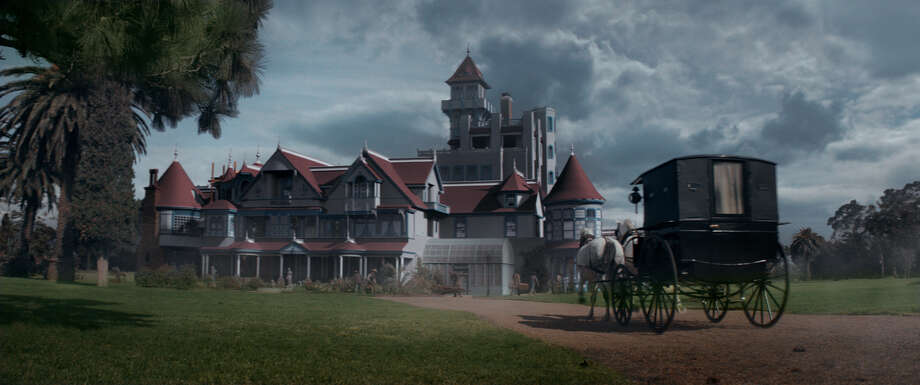
My arrival to the Santa Clara Valley was truly a sensational event. The villagers were so thrilled by the dramatic entrance of a millionairess that I had to take detours to elude the crowds and journalists, jumping over garden railings and slipping through stables to get in my mansion. They were dying to see the rich imported furnishings being hauled by freight cars to Llanada Villa. A fantastic, increasingly fervent spectacle was developing. An eighteen-room farm house mushroomed into a 130-room mansion in the first year. This generated newspaper headlines and wild hopes among crowds of the expectant people transported by spiritual rapture and buoyed by the glamour of lights from the miniature nine story Tower of Babel, and Gospel-like tales about the dead taking up their graves and walking. There was even talk of black magic and of happenings utterly beyond credibility. Crowds formed spontaneously, sometimes in the thousands, on any rumor that I might appear. People desperate to see me stopped traffic, forced carriages to be rerouted, and sometimes became unruly. Around noon one day in early September, three hundred people clustered around Llanada Villa waiting for me. Murmurs went through the crowd—“we won’t leave until we see Mrs. Winchester.” The following day, these scenes and sentiments repeated themselves. Newspapers began hinting that I might leave Santa Clara Valley if crowds did not disperse so I could continue with construction of my mansion. It was so handsome, who could blame them. Cathedral ceilings, a charming garden, a lake of great beauty, with many storks. Llanada Villa was accounted one of the prettiest things in the West. It was a partial escape from the unseen bondage. #RandolphHarris 1 of 5
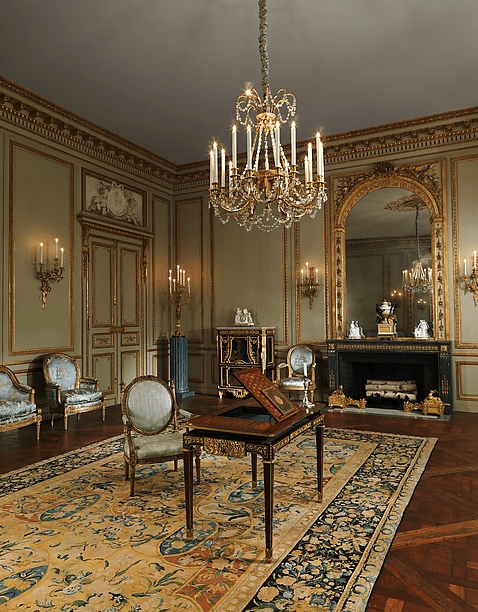
Those who had seen my estate declared that the attic windows were always closed, and that strange sounds sometimes floated from within as evening drew on. I was known to have been a prodigious magical student in my day, and legend averred that I could raise or quell storms according to my whim. Most unusual, though, were the well-attested cases of my influence over other person. People considered me, beyond question, a genuine hypnotist. They made wild claims that by gazing peculiarly at a servant, I would often give the latter a distinct feeling of exchanged personality—as if the subject were placed momentarily in my body and able to stare half across the room at one’s real body, whose eyes blazed and protruded with an alien expression. It was no secret that my mansion had many unique features. Rumors began to spread about my terrible meetings in lonely places, of Cyclopean rooms in the heart of Llanada Villa beneath which vast staircases lead down to abysses of knighted secrets, of complex angles that lead through invisible walls to other regions of space and time, and of hideous exchanges of personality that permitted explorations in remote and forbidden places, on other Worlds, and in different space-time continua. The servants pontificated about elusively coloured and bafflingly rooms, furniture, textured wallpaper, magical windows, and objects like nothing ever heard of on Earth within the walls of my mansion, whose insane curses and surfaces answered no conceivable purpose and followed no conceivable geometry. The servants watched my goings and comings. Through vigilant gossips, they declared there was someone in the attic of the house behind the doubly curtain windows. #RandolphHarris 2 of 5
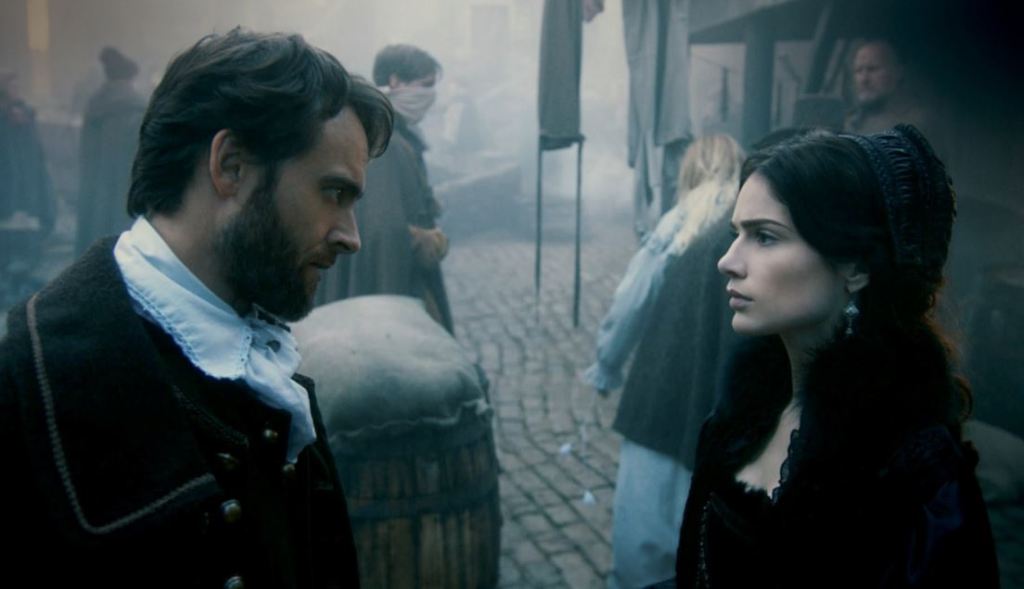
Then sun was declining in the Heavens. Supper-time was approaching. During my sunset sash through the Victorian gardens, I caught a stream of utterly insane drivel about an unholy pit in the basement of my home where the black realm begins and that a watcher guarded the gate. The extent to which it preyed on my nerves was plain, for these servants had woven a whole set of hallucinations around them. Their minds were in pitiable states; for they went on mumbling wild extravagances about me, about black magic, about Llanada Villa, and about some revelation which would convince even me. They repeated names which I recognized from my forbidden volumes, and at times made me shudder with a certain thread of mythological consistency—of consistency—of convincing coherence—which ran through his maundering. Again and again he would pause, as if to gather courage for some final and terrible disclosure. Moments later, the wind came with a shrieking and swirling. I could feel the numbing chill of it; it cut through me like the blade of a knife, that wind, straight to the bone. Feeling uneasy, I made my way to the entrance of my home. Once inside, the stillness had a strained feel, made almost eerie by the constant wailing outside. I could feel myself getting more jittery as the moments passed. While I sliced the ham, I watched two of the housemaids staring at the door. It was curious that they both were wearing the same type of expensive engagement ring. I thought: they must have had words with each other over something; that was all there was to it. Except that was not all there was to it. I have seen a lot of servants come and go. However, I had never seen any like these two. That tension between them was not anything fresh-born, was not just the brief and meaningless aftermath of a squabble. #RandolphHarris 3 of 5

No, there was real hatred on both sides—the kind that builds and builds, seething over long bitter weeks or months or even years. That kind that is liable to explode someday. Well, it was not really any of my business. Not unless the blowup happened in here, it was not, and that was not likely. Or so I kept telling myself. However, I was a little worried just the same. On a night like this, with the damned black wind blowing and playing hell with people’s nerves, anything could happen. Anything at all. I finished slicing the ham. Just as I sat down to eat, there was a loud banging noise from across the room that made me jump half a foot; it sounded like a pistol shot. But it had only been the cook slamming the pumpkin pie down on the table. I took a breath, let it out silently. He was found the next morning by The Good Will Boys Club. Police and an army of enthusiastic volunteers scoured the woods, but no trace of a ferocious wild beast was found. However, they did find the dead man, and he proved to be my cook. He had a reputation locally of being a person of solitary habits. An autopsy revealed he had died of a heart attack. The entire episode assumed the proportions of a thirteen-day wonder, and then was forgotten. The housemaid also no longer wore their engagement rings. Could they have been in love with the same man? Is it possible they killed him? After seating myself on one of the convenient window-seats, I sat some while looking at the rain-drenched gardens, then with a yawn, I turned and gave a quick glance along the long corridor that ran through a series of open doorways. Suddenly my attention was captured by a figure approaching over the long carpet. It was that of a girl in a black dress; she was a beautiful study in black and white. Black hair, white fac and hands, black dress. #RandolphHarris 4 of 5

Not that there was anything sinister about her, for as she drew nearer I could see the look of indescribable sadness in the large, black eyes, and the almost timid way she looked round each room. Her appearance was outstanding, so vivid, like a black and white photograph that had come to life. She entered the morning room and I now I could hear the light tread of her feet, the whisper of her dress, and even those small sounds seemed unreal. She walked around the room, looking earnestly at the pictures, then as though arrested by a sudden sound, she stopped. Suddenly the lovely eyes came round and stared straight at me. They held an expression of alarmed surprise, that gradually changed to one of dawning wonderment. The atmosphere was chilling and she had a weird presence that seemed to permeate the room. She robbed me of speech. She nodded and her hair trembled like black silk in sunlight. She dabbed her eyes with a black lace handkerchief, while I tried to find my way out of a mental labyrinth. As I reached out to her, I watched her figure retreat until it disappeared into lots of beautiful clouds. It was a great pity that her behaviour was so erratic, because I would have dearly liked to have known her better. In fact, when I remembered the black hair and white face, I was aware of a deep disappointment, a sense of loss, and I had to subdue a useless urge to run after her. I remained seated in the window bay and when I looked out on to the gardens, I saw the rain had ceased, but thick cloud banks were billowing across the sky. I smiled gently and murmured, “Lovely clouds—I miss you, Annie Winchester.” I was halfway across the room, when a light touch on my shoulder made me turn, and there was the white face and black hair, with a sad smile parting her lips. Then she vanished. #RandolphHarris 5 of 5

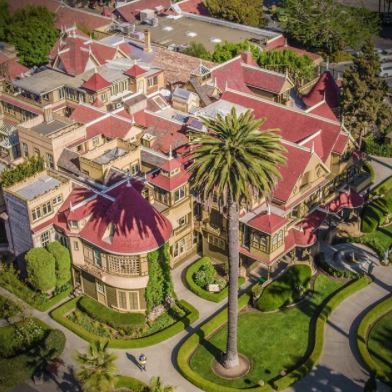
Is it more frightening to see something you cannot explain, or to hear it and feel it around you, unseen, its appearance left totally to your wildly racing imagination? What if you feel “it” inside of you? To be “demon haunted” is an experienced you will never forget. Earth is a haunted planet. Throughout history, human beings have had daily contact with otherworldly residents and visitors whose actions range from benign to aggressive, and from mischievous to deadly. Humans have described, explained, catalogued, summoned, and exorcised these interlopers for centuries. The “paranormal” is far more complex and cannot be explained simply. From quantum physics, we have the concept of “many Worlds,” multi-dimensional realities stacked next to each other, all of which might feature their own inhabitants. The paranormal experiences at The Winchester Mystery House demonstrate that doorways or portals exist both on land and in human consciousness, which open up to these interdimensional realities in ways that awe us or terrify us, or both. “Demon Haunting” case are on the rise. Some people have even gotten more than they bargained for from the terrible trauma of artifacts from the 9/11 attacks.

There is no doubt that negative entities exist, and many are hungry and hostile, and can be bound to objects. Demons include a wide range of spirits, from tricky to evil, meddlers who created a host of problems for people, including all the bad luck and ills of this World. They include low-level irritating beings and dangerous powerhouses who wield the ability to destroy. These beings and spirits are still round us—they never went away, because they exist alongside of us in interdimensional space. They continue to pose problems, or help people, in some cases, shape-shifting in forms and tactics as humans have changed throughout the centuries. The Winchester Mystery House’s haunted objects of all kinds has built up during the 100 years of tours with the paranormal and demonic. Thousands of haunted objects are squeezed into the museum. Sometimes they just appear, have been here for over a century, some arrived by mail anonymously. Household items, art object, clothing, jewelry, ritual and religious objects, games, furniture, masks, dolls, you name it—anything can pick up a spirit hitchhiker who acts out when ushered into a new home. Mirrors are frequently haunted. Mirrors can create doorways for entities. Come for a fascinating tour of the beautiful yet eerily bizarre.

For further information about tours, including group tours, weddings, school events, birthday party packages, facility rentals, and special events please visit the website: https://winchestermysteryhouse.com/

Please visit the online giftshop, and purchase a gift for friends and relatives as well as a special memento of The Winchester Mystery House. A variety of souvenirs and gifts are available to purchase. https://shopwinchestermysteryhouse.com/
Ready to End the Unwanted Pursuit?
The haunting beauty of Llanada Villa was undeniably captivating. I had to go downstairs to procure another light. Echoes transcended time and space. Whispers were soft, indiscernible murmurs, barely distinguishable from the gentle rustle of the curtain. My heartbeat quickened as I strained to comprehend the words, but they remained elusively haunting. As I made my way back to my chamber, I found my windows open. The chilling draft caused the candles to flicker, casting shadows on the walls. Crossing the threshold, I shivered, and goosebumps formed on my arms as an unsettling feeling enveloped me. I was caught off guard by the shutters were flapping in the frigid breeze. As I went to bolt them again, a horse gave a scream that was too frantic for a neigh, and plunged madly off through the night, the wagon rattling crazily behind it. Vanishing into the darkness. As this ghastly situation progressed, the covers had been snatched from the bed, and my books had been scattered about. The sound that the wind made was something hellish, full of screams and wailing that raised the hackles on my neck. The Indians who used to live around here called it a “black wind”; they believed that it carried the voices of evil spirits, and that is you listened to it long enough, it could drive you mad and loose untold terrors on all humankind. A cold gust of wind swept through my chamber, extinguishing the candles. As darkness covered the room, I felt disoriented and vulnerable in the pitch-black abyss. The mansion seemed to come alive with a haunting presence. The moon had reached its zenith, casting an eerie light through the stained-glass windows of the Daisy Bedroom. #RandolphHarris 1 of 5

In the midst of the haunting beauty, there are black zones of shadows, and now and then some evil soul breaks through. However, it is a mistake to fancy that horror is associated inextricably with darkness, silence, and solitude. I slept fitfully that night, even in my sleep listening for footsteps on the veranda. It was already afternoon before I finally rose from my bed and ventured from my sunny room. I could feel strange energy permeating the air, like an intangible veil separating the living World from the dead. Llanada Villa had a life of its own. Its history seeped through the walls, whispering forgotten secrets to anyone who would listen. I sat in silence for a while, lost in a nightmare, my own private hell. These echoing words painted a tapestry of human suffering, of moments that had broken these spirits, shaped them and made them who they were. I had become a soul lost, adrift in a sea of sorrow, desperately seeking an anchor in my constantly expanding home. As the day wore on and became night, a chill ran down my spine, a nagging feeling that something was not quite right. The darkness in the mansion was a thick, oppressive weight on my chest. I could feel it, the sensation of being watched. My heart raced. Struggling to move, I realized I was trapped in my own body—the suffocating grip of sleep paralysis. My eyes, the only part of me that I could move, darted around, trying to make out of the shadows shifting in the corner of my room. Fear propelled me. Reality, with its vivid hues and resonant sounds, tried to assert its dominance, but the boundaries were blurring. Everywhere I looked, a surreal hazed seemed to cover my room, threatening to meld the familiar with the phantasmagorial. The intimacy was beyond untangling. #RandolphHarris 2 of 5
A gust of wind rattled the windows, amplifying a growing horror, of outré and morbid cast. Something was waving my fate in this dark tapestry, and I needed comfort. As I regain my strength, I ventured outside of my chamber. Each shadow seemed to harbour potential threats; every eerie whisper echoed with foreboding. Even my sleep was haunted. Every night, the same shadowed figure emerged, drawing near. Its presence is cold, its intentions unclear. Yet, there is an unspeakable dread that tugged at my soul. It was a warning? Maybe a premonition? I felt like it was calling me, urging me into its dark embrace. That path I was on was treacherous. However, sometimes salvation lies in the shadows. As the day went by, daylight, which once offered refuge from the terror of my nightmares, because just another playground for the menacing specters that haunted Llanada Villa. Morning’s golden glow no longer held the promise of safety, and the warmth of the sun could not dispel the bone-chilling cold that now seemed to follow me wherever I went. As the carpenter’s hammers fell, the miniature Tower of Babel rose course by course into an impressive nine stories. Afear gnawed at my inmost soul. Between my room and the staircase are two dark and empty chambers, which would have once caused me alarm, but which I now welcome. I opened a pair of the big windows, a grimy and, I fear a noisy task. I flitted out in the moon light on the balcony, and gazed down into the garden where the dwarf pines, pale birches, and a vast hiding place lay, where many forms often invisible life lurked in the dense undergrowth of the boxwood hedges. #RandolphHarris 3 of 5
The howl of what was supposed to be a dog brought me to an immediate standstill and for a while I listened, trying to determine from which direction the sound came. There was an unmistakable pricking sensation on the back of my neck, an exceedingly cold, almost icy chill slithered down my spine and gave me reason to remember the conditions laid down by legend and superstition. The howl rang out again. A long, drawn-out cry of canine anguish. I saw something dart behind a gnarled oak, a shadowy silhouette that moved with an unnatural fluidity. It was there and then it was not, leaving behind only the whisper of dread and the echoing silence of the night. There was a creaking of settling timbers, the ticking of an old grandfather clock. Then, without warning, the lights began to flicker, the bulbs were throwing a staccato pattern on the walls, turning the familiar into the grotesque. Then a growl erupted from the floor below. Pity fled like a leaf before a raging wind, and a stark terror filled my brain with blind, unreasoning panic. I ran, fell, got up and rain again, and from behind came the sound of a heavy body crashing on the floor, the rasp of a laboured breathing the bestial growl of some enraged being. Reason had gone, coherent thought had been replaced by an animal instinct for survival; I knew whatever ran behind me was closing the gap. In the blackness, I heard it—a whisper. A voice so faint and fragmented it was like the memory of a sound, speaking words that were not words, a language that transcended mere speech. It was a whisper that crawled into my ear and lay there, festering. Frozen with terror, I could only listen as the whisper grew louder, more insistent. It was calling to me, beckoning me, its very existence a violation of everything safe and sane. #RandolphHarris 4 of 5
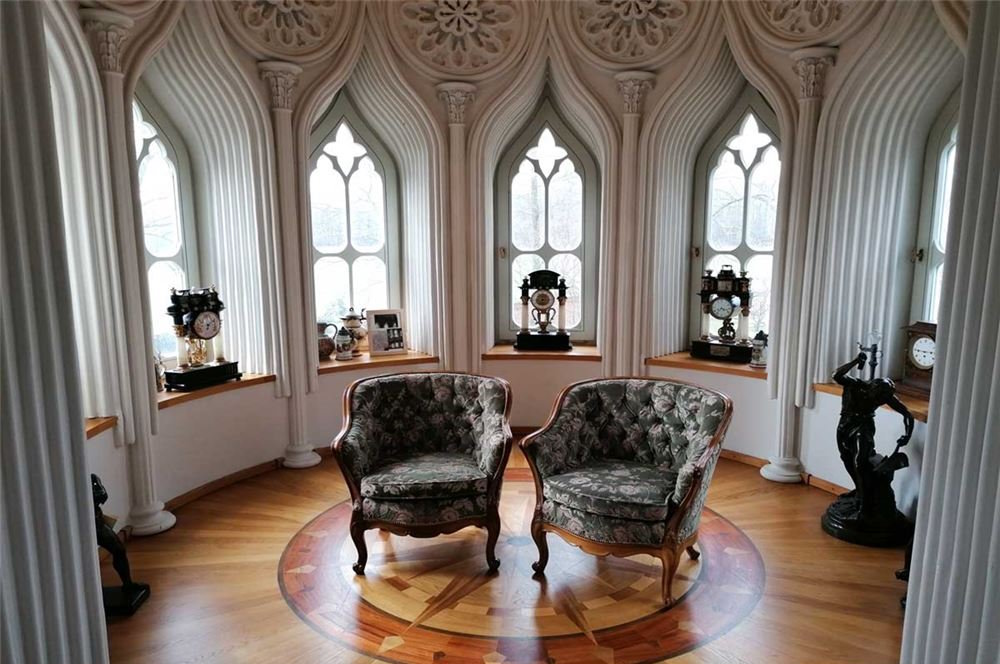
My consciousness was blotted out by a merciful darkness. An hour passed, perhaps more, before I awakened. I lay quite still and tried to remember why I should be lying on the floor in the parlor. Then memory sent its first cold tentacles shuddering across my brain and I dared to sit up and face reality. Night was enforcing its guard, but I was still able to see the dead man who lay but a few feet away. I shrank back with a little muffled cry and tried to dispel this vision of a purple face and bulging eyes, by the simple act of closing my own. However, this was not a wise action for the image of that awful countenance was etched upon my brain, and the memory was even more macabre than the reality. I opened my eyes again, and there it was: a man in late middle life, with grey, close-cropped hair, a long moustache and yellow teeth, that were bared in a death grin. The purple face suggested he laid dead of a heart attack. The ghost of the Winchester Rifle grew more intrusive, more menacing, and with a boldness that sent cold shivers down my spine. They were no longer content to haunt the shadows; they demanded to be seen, to be felt, to be feared. I dragged myself through the halls of Llanada Villa and by sheer good fortune emerged out on to one of the main paths. I engrossed myself in research, buried in the arcane knowledge of the forbidden text, only to feel a chill breeze in the library where no windows were open. I looked up to find my notes shuffled, some even flung across the room. Blood spots, staring back at me like red eyes. My breath became labourious, my pulse quickened, but there was nothing there. Nothing I could see. A cyclone of cold carried with it whispers, indistinct yet filled with malice. Clutching my heart in fear, I could do nothing but listen. #RandolphHarris 5 of 5
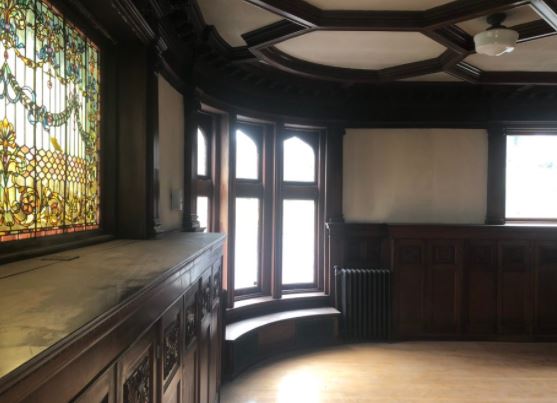
The Winchester Mystery House
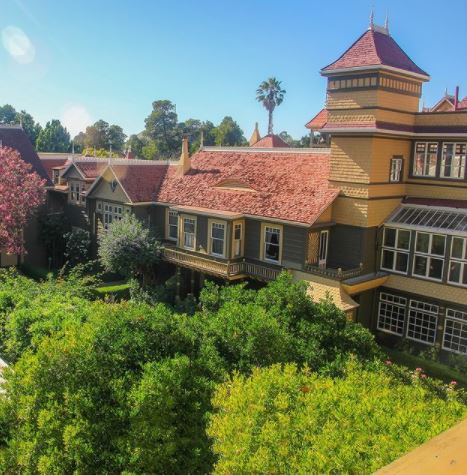
You do not have to believe in cursed objects to be fascinated by them. Because another, less paranormal definition of a cursed object is an item that gathers stories to itself—and more specifically, tragedies. Objects are intimately connected to people. We make them, live with them, use them, love them, and are sometimes even buried with them, and people continuously find themselves in the midst of tragedy. Cursed objects are those items that have simply been the mute witnesses to more tragedies than other items. They then become devices for remembering those stories and provide opportunities for retelling them. For those who are curious, visiting a museum is the easiest way to see a cursed object firsthand.
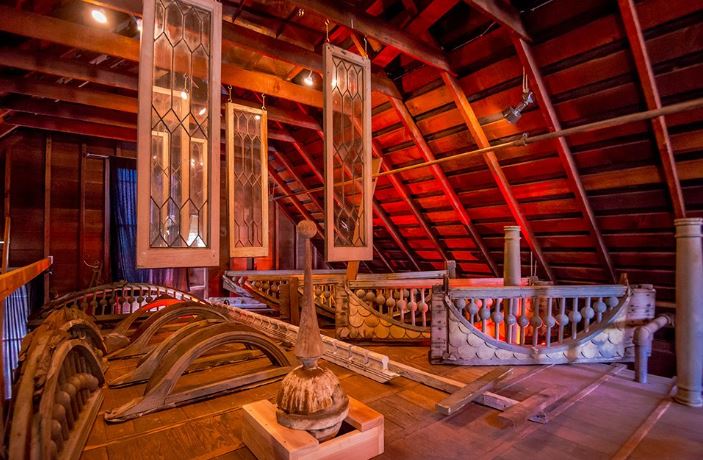
The people who have owned The Winchester Mystery House or inherited money from The Winchester Fortune have been ripped apart by dogs, shot, beheaded, pushed over cliffs, starved to death, and drowned aboard sinking ships. Many people believe The Winchester Mystery House to be the most popular object in California, making it more of a lucky charm for conservators of The Winchester Mystery House, than a cursed object. While it cannot be denied that everyone who has ever owned The Winchester Mystery House has died—The Winchester Mystery House can sometimes seem less the direct cause of trouble than a side effect. After all, you have to be extremely rich to own it. That level of wealth comes with its own problems, whether these problems are born of politics, vengeful spirits, or profligacy. But one thing is certain, the Devil is far more powerful than any person.
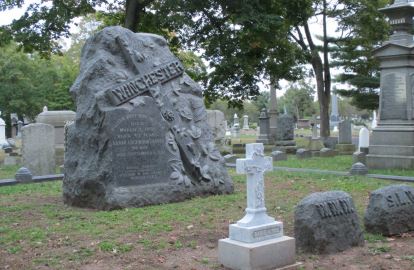
For further information about tours, including group tours, weddings, school events, birthday party packages, facility rentals, and special events please visit the website: https://winchestermysteryhouse.com/

Please visit the online giftshop, and purchase a gift for friends and relatives as well as a special memento of The Winchester Mystery House. A variety of souvenirs and gifts are available to purchase. https://shopwinchestermysteryhouse.com/

What Miracles is He Not Capable!

Man is an indolent creature, but light the fire of fear under him, and of what miracles is he not capable! However, not only the forces that determine one’s own life directly but also those that seem to determine life in general are felt as unchangeable fate. It is fate that there are wars and that one part of humankind has to be ruled by another. It is fate that the amount of suffering can never be less than it always has been. Fate may be rationalized philosophically as “natural law” or as “destiny of man,” religiously as the “will of the Lord,” ethically as a higher power outside of the individual, toward which the individual can do nothing but submit. The authoritarian character worships the past. What has been, will eternally be. To wish or to work for something that has not yet been before is crime or madness. The miracle of creation—and creation is always a miracle—is outside of one’s range of emotional experience. Religious experience as experience of absolute dependence is the definition of the masochistic experience in general; a special role in this feeling of dependence is played by sin. The concept of original sin, which weighs upon all future generations, is characteristic of the authoritarian experience. Moral like any other kind of human failure becomes a fate which humans can never escape. Whoever has once sinned is chained eternally to one’s own sin with iron shackles. Human’s own doing becomes the power that rules over one and never lets one free. The consequences of guilt can never be softened by atonement, but atonement can never do away with the guilt. Isaiah’s words, “though your sins be as scarlet, they shall be as white as snow,” express the very opposite of the authoritarian philosophy. #RandolphHarris 1 of 20

The feature common to all authoritarian thinking is the conviction that life is determined by forced outside of humans’ own self, one’s interest one’s wishes. They only possible happiness lies in the submission to these forces. The powerlessness of humans is the leitmotif of masochistic philosophy. One of the ideological fathers of Nazism, Moeller van der Bruck, expressed this feeling very clearly. He writes: “The conservative believers rather in catastrophe, in the powerlessness of man to avoid it, in its necessity, and in the terrible disappointment of the seduced optimist.” In Mr. Hitler’s writings we shall see more illustrations of the same spirit. The authoritarian character does not lack activity, courage, or belief. However, these qualities for one mean something entirely different from what they mean for the person who does not long for submission. For the authoritarian character activity is rooted in a basic feeling of powerlessness which it tends to overcome. Activity in this sense means to act in the name of something higher than one’s own self. It is possible in the name of God, the past, nature, or duty, but never in the name of the future, of the unborn, of what has no power, or of life as such. The authoritarian character wins one’s strength to act through one’s leaning on superior power. This power is never assailable or changeable. For one lack of power is always an unmistakable sign of guilt and inferiority, and if the authority in which one believes shows signs of weakness, one’s love and respect change into contempt and hatred. One lacks an “offensive potency” which can attack established power without first feeling subservient to another and stronger power. #RandolphHarris 2 of 20

The courage of the authoritarian character is essentially a courage to suffer what fate or its personal representative or “leader” may have destined one for. To suffer without complaining is one’s highest virtue—not the courage of trying to end suffering or at least to diminish it. Not to change fate, but to submit to it, is the heroism of the authoritarian character. One has belief in authority as long as it is strong and commanding. One’s belief is rooted ultimately in one’s doubts and constitutes an attempt to compensate them. However, if we mean by faith the secure confidence in the realization of what now exists only as a potentiality, one has no faith. Authoritarian philosophy is essentially relativistic and nihilistic, in spite of the fact that it often claims so violently to have conquered relativism and in spite of its show of activity. It is rooted in extreme desperation, in the complete lack of faith, and it leads to nihilism, to the denial of life. Authoritarian leaders come out to speak to crowds. These wild-eyed charismatic people mount stages in the darkness and feed crowds words like manna. As they stand out on the balcony—gazing out over the masses in their own kind of uniform—they may telegraph, at least for some, a specific and undeniable memory: that of Mr. Hitler addressing the Volk. Those memories, those aesthetic elements: they charge the air with emotional fervor, at least, for those inclined to be so enchanted. This is not to discount the religious significance so many attach to the leader’s presence and ability to cure the sick. There is no reason in fact to separate those two things at all. #RandolphHarris 3 of 20

For some of the people standing in these fields on an Alpine summer’s night, seeing an authoritarian leader is a little like seeing a friendly ghost. That encounter has enormous, even curative, power. In authoritarian philosophy the concept of equality does not exist. The authoritarian character may sometimes use the word equality either conventionally or become it suits one’s purpose. However, it has no real meaning or weight for one, since it concerns something outside the reach of one’s emotional experiences. For one the World is composed of people with power and those without it, of superior ones and inferior ones. On the basis of one’s sado-masochistic strivings, one experiences only domination or submission, but never solidarity. Differences, whether of gender or race, to one are necessarily signs of superiority or inferiority. A difference which does not have this connotation is unthinkable to one. In Germany, reporters described many people getting suddenly healed at the Trotter Farm, especially of paralysis, and trouble with their ears or eyes. Maria Wurstel told the journalist Heueck how she had suffered since 1938 from near-paralysis of the spine. The slightest movement caused her terrible pain. Her doctor had recommended she see Herr Groning. Heueck saw her run like a child, “partly laughing, partly crying from happiness.” Another woman—she had had polio and had used a wheelchair since the age of three—got up and walked too. A man who said he had suffered brain damage in the war rejoiced, “The buzzing in my ears is gone, my head is free again!” Sometimes people brought photos of their sick relatives—perhaps those too ill to travel—and held them up before the resort’s windows in the hopes of receiving Mr. Groning’s energies. #RandolphHarris 4 of 20

As new of these gatherings and cures multiplied, the crowds grew larger. The description of the sado-masochistic strivings and the authoritarian character refers to the more extreme forms of helplessness and the correspondingly more extreme forms of escaping it by the symbiotic relationship to the object of worship or domination. Although these sado-masochistic strivings are common, we can consider only certain individuals and social groups as typically sado-masochistic. There is, however, a milder form of dependency which is so general in our culture that only in exceptional cases does it seem to be lacking. This dependency does not have the dangerous and passionate qualities of sado-masochism, but it is important enough not to be omitted from out discussion here. I am referring to the kind of persons whose whole life is in a subtle way related to some power outside themselves. There is nothing they do, feel, or think which is not somehow related to this power. They expect protection from “him,” wished to be take care of by “him,” make “him” also responsible for whatever may be the outcome of their own actions. Often the fact of his dependence is something the person is not aware of at all. It worried police. “There people cannot understand why anyone would hinder” Mr. Groning’s “practicing,” one reported, and said he feared a riot if anyone tried. In truth, banning Mr. Groning’s healing work, as Herford officials had done, was not much discussed in local papers. Rather, something like the opposite was generally true. A number of local politicians and officials spoke up for him publicly. Munich’s police commissioner, Social Democrat Franz Xaver Pitzer, thanked Mr. Groning personally in the front of the Trotter Farm crowds for helping him over an illness. #RandolphHarris 5 of 20

A state parliamentary representative, Hans Hagn of Bavaria’s conservative party, the Christian Social Union, exhorted the crowds to “believe in the healing power of Groning and to trust him.” Even the highest officeholder in the Bavarian government, Minister President Hans Ehard, openly expressed support for Mr. Groning. The healer should not be subject to a lot of “red tape” (Paragraphenschwierigkeiten), Mr. Ehard said. Members of the press were as smitten as politicians. One local paper described the public’s trust in Mr. Groning—“a simple, uneducated man…the son of a Danzig bricklayer”—as “limitless.” The very air in Rosenheim, correspondent Hans Bentzinger rhapsodized, was “filled with a special excitement” that “grows from hour to hour, as it becomes known that Her Groning will speak to the waiting crowds.” Mr. Bentzinger described an “unbearable” tension, the atmosphere “so laden with the energy of expectation that one can hear his own heart beating and that of his neighbor at the same time.” Everyone and everything in Germany was waiting for some kind of miracle. Even if there is a dim awareness of some dependency, the person or power on whom one is dependent often remains nebulous. There is no definite image linked up with that power. Its essential quality is to represent a certain function, namely to protect, help, and develop the individual, to be with one and never leave one alone. The “X” which has these qualities may be called the magic helper. Frequently, of course, the “magic helper” is personified: one is conceived of as God, as a principle, or as real persons such as one’s parent, husband, wife, or superior. #RandolphHarris 6 of 20

It is important to recognize that when real persons assume the role of the magic helper they are endowed with magic qualities, and the significance they have results from their being the personification of the magic helper. This process of personification of the magic helper is to be observed frequently in what is called “falling in love.” A person with that kind of relatedness to the magic helper seeks to find one in flesh and blood. For some reason or other—often supported by sexual desires—a certain other person assumes for one those magic qualities, and one makes that person into the being to whom and whom one’s whole life becomes related and dependent. The fact that the other person frequently does the same with the first one does not alter the picture. It only helps to strengthen the impression that this relationship is one of “real love.” This need for the magic helper can be studied under experiment-like conditions in the psychoanalytic procedure. Often the person who is analyzed forms a deep attachment to the psychoanalyst and his or her whole life, all actions, thoughts, and feelings are related to the analyst. Consciously or unconsciously the analysand asks oneself: would he (the analyst) be pleased with this, displeased with that, agree to this, scold me for that? In love relationships the fact that one chooses this or that person as a partner serves as a proof that this particular person is loved just because he is “he”; but in the psychoanalytic situation this illusion cannot be upheld. The most different kinds of persons develop the same feelings toward the most different kind of psychoanalysts. #RandolphHarris 7 of 20

The relationship looks like love; it is often accompanied by sexual desires; yet magic helper, a role which obviously a psychoanalyst, like certain other persons who have some authority (physicians, ministers, teachers), is able to play satisfactorily for the person who is seeking the personified magic helper. The reasons why a person is bound to a magic helper are, in principle, the same that we have found at the root of the symbiotic drives: an inability to stand alone and to fully express one’s own individual potentialities. In the sado-masochistic strivings this inability leads to a tendency to get rid of one’s individual self through dependency on the magic helper—in the milder form of dependency I am discussing now it only leads to a wish for guidance and protection. The intensity of the relatedness to the magic helper is in reverse proportion to the ability to express spontaneously one’s own intellectual, emotional, and sensuous potentialities. In other words, one hopes to get everything one expects from life, from the magic helper, instead of by one’s own actions. The more this is the case, the more is the center of life shifted from one’s own person to the magic helper and one’s personifications. The question is then no longer how to life oneself, but how to manipulate “him” in order not to lose him and how to make him do what one wants, even to make him responsible for what one is responsible oneself. In the more extreme cases, a person’s whole life consists almost entirely in the attempt to manipulate “him”; people differ in the means which they use; for some obedience, for some “goodness,” for others suffering is the main means of manipulation. #RandolphHarris 8 of 20

We see, then, that there is no feeling, thought, or emotion that is not at least coloured by the need to manipulate “him”; in other words, that no psychic act is really spontaneous or free. This dependency, springing from and at the same time leading to a blockage of spontaneity, not only gives a certain amount of security but also results in a feeling of weakness and bondage. As far as this is the case, the very person who is dependent on the magic helper also feels, although often unconsciously, enslaved by “him” or “her” and to a greater or lesser degree, rebels against “him” or “her.” The television show Buffy The Vampire Slayer is another example of a magic helper. This rebelliousness against the very person on whom one has put one’s hopes for security and happiness, creates new conflicts. It has to be suppressed is one is not to lose “him” or “her,” but the underlying antagonism constantly threatens the security sought for in the relationship. If the magic helper is personified in an actual person, the disappointment that follows when one falls short of what one is expecting for this person—and since the expectation is an illusory one, any actual person is inevitably disappointing—in addition to the resentment resulting from one’s own enslavement to that person, leads to continuous conflicts. This can be seen in the conflicts between Buffy and her friends, which frequently arise. These sometimes end only with separation, which is usually followed by a choice of another object who is expected to fill all the hopes connected with the magic helper. This is seen many times with Buffy, like when her friends abandon her when she runs for homecoming queen, or when her mother kicks her out of the house, or when Buffy’s friends kick her out of her own house and turn to the leadership of Faith, another slayer. #RandolphHarris 9 of 20

If this relationship proves to be a failure too, it may be broken up again or the person involved may decide that this is just “life,” and resign. What one does not recognize is the fact that one’s failure is not essentially the result of one’s not having chosen the right magic person; it is the direct result of having tried to obtain by the manipulation of a magic force that which only the individual can achieve oneself by one’s own spontaneous activity. The phenomenon of life-long dependency on an object outside of oneself has been seen by Dr. Freud. He has interpreted it as the continuation of the early, essentially nurturing bonds with the parents throughout life. As long as the infant is small it is quite naturally dependent on the parents, but this dependence does not necessarily imply a restriction of the child’s own spontaneity. However, when the parents, acting as the agents of society, start to suppress the child’s spontaneity and independence, the growing child feels more and more unable to stand on its own feet; it therefore seeks for the magic helper and often makes the parents the personification of “him” or “her.” Later on, the individual transfers these feelings to somebody else, for instance, to a teacher, a husband, or a psychoanalyst. Again, the need for being related to such a symbol of authority is caused by anxiety. What we can observe at the kernel of every neurosis, as well as of normal development, is the struggle for freedom and independence. For many normal persons this struggle has ended in a complete giving up of their individual selves, so that they are thus well adapted and considered to be normal. #RandolphHarris 10 of 20

The neurotic person is the one who has not given up fighting against complete submission, but who, at the same time, has remained bound to the figure of the magic helper, whatever form or shape “one” may have assumed. One’s neurosis is always to be understood as an attempt, and essentially an unsuccessful one, to solve the conflict between that basic dependency and the quest for freedom. The concept of social character is not only a theoretical one lending itself to general speculation; it is useful and important for empirical studies which aim at finding out what the incidence of various kinds of social character is in a given society or social class. Assuming that one defines the “peasant character” as individualistic, hoarding, stubborn, with little satisfaction in cooperation, little sense of time and punctuality, this syndrome of traits is by no means a summation of various traits, but a structure, charged with energy. This structure will show intensive resistance by either violence or silent obstructionism if attempts are made to change it; even economic advantages will not easily produce any effects. The syndrome owes its existence to the common mode of production which has been characteristic of peasant life for thousands of years. The same holds true for a declining lower-middle class, whether it is that which brought Mr. Hitler to power, or the poor Whites in the South of the United States of America. The lack of any kind of beneficial cultural stimulation, the resentment against their situation, which is one of being left behind by the forward-moving currents of their society, the hate toward those who destroy the images which once gave them pride, have created a character syndrome which is made up of love and death (necrophilia), intense malignant fixation to blood and soil, and intense group narcissism (the latter expressed in intense nationalism and racism). #RandolphHarris 11 of 20

The striking feature of a socialist economy is the fact that there is no private ownership in the fact that there is no private ownership in the means of production, and that all enterprises are administered by a state-appointed managerial bureaucracy. (There is, of course, private ownership of consumer goods, like houses, furniture, automobiles, and personal accumulation of saving such as bank accounts and government bonds, just as in the United States of America. The differences in this respect is only that one cannot own a factory or stock in a corporation, a difference, incidentally, which would be relevant only for a small part of the population of the United States of America.) The Soviet leaders and their peoples, assuming that Marxist socialism is characterized by the ownership and management of enterprises by the state, take this to mean that their system is socialism. Whether this claim is justified or nor will be discussed later, along with the fact that current developments in the Soviet system are in many respects more akin to the trends existing in the twenty-first century capitalism than they are to socialism. Over-all planning, introduced for the first time by Mr. Stalin’s Five-Year Plan in 1928, offers Soviet ideology an additional reason to speak of their system as socialism. The over-all plan (Gosplan) is centrally made in Moscow for the USSR after intensive deliberation over a great amount of data. The planning determines what is to be produced and at what rate, in contrast to the relatively free market in the Western countries. Until 1957 the Moscow ministries for various ranches of industry were the central authorities for the respective industries under their administration. #RandolphHarris 12 of 20

Mr. Khrushchev abolished this centralized system, which had existed for over twenty years, and inaugurated a process of decentralization by replacing the ministries by regional economic councils (sownarkhoz). In the United States of American 1 percent of all families own 4/5 of all Industrial stocks which can be owned by individuals. There are somewhat over one hundred such councils within the Soviet Union. They appoint the top personnel (or confirm their appointments) in the enterprises under them, determine the production program of “their” industries (although within the framework of the general plan), are active in determining prices and production methods, and the securing of scarce materials and conduct research on the quality of products et cetera. The control of the sownarkhoz over the many industries under its control is exercised through subdivisions, the “chief administrations,” which in turn control the individual enterprises, headed by their managers. Who are the administrators working in the regional councils, the chief administrations, and the individual enterprises? The majority have a college education (in fact, a greater percentage than in the United States of America), with the greater proportion of graduates in engineering and a small proportion in business administration. The vast majority of them are members of the Communist Party. (It is important for the America reader to remember that the Communist Party in Russia is, by intention, not a mass party, but represents the elite of those who want to get to the highest position and who are willing to exert the greatest efforts; actually, only about 4 percent of the total population are party members.) The director of a plant earns from five to ten times (including bonuses) what the worker earns, depending on the size and kind of factory. #RandolphHarris 13 of 20

If we compare the American situation, an American plant director would have to earn $232,115.88 a year to attain the same position in relation to the worker. A small scale study of American firms showed that in actual fact the top policy-making executive in firms of under 1,000 employees earned an annual average of $305,933.38 in salary and bonus. These figures are difficult to compare since on the one hand prices for consumer goods are relatively much higher in the Soviet Union than in the United States of America, while on the other hand rents are much lower in the Soviet Union and fringe benefits are higher than in the United States of America. Thus, the income differential between managers and workers is not too different in the Soviet Union from what it is in the United States of America. What is particularly important is the role of bonuses which reach 50 to 100 percent of the manager’s salary and which constitutes the most important incentive for optimal production. (Often this system emphasizes quantity rather than quality—hence leading to the production of inferior consumer goods.) Thus, the managers represent a social group that in income, consumption, and authority, is as different from the workers as in any capitalist country of the West. In fact, judging from many reports, rigidities in class stratification, status-differential, et cetera, are greater than in the United States of America. Something we value in the United States of America is legal property rights. Legal property rights are not absolute. They are to some extent subject to private modification by mutual consent for mutual benefit. More generally, security of property rights depends on: government protection, private protection, and other people’s attempts to capture some of the rights. All these are costly in different ways; therefore rights are generally not complete. #RandolphHarris 14 of 20

When transacting is costly, all contract forms are costly, so choice of governance form is at best a constrained optimum. Most assets and commodities have multiple dimensions. It may be optimal to divide the property rights to different attributes of a commodity between different owners. Different dimensions of assets and contracts interact: they may be mutually substitutes or complements. This can be utilized to achieve better outcomes for seemingly incomplete contracts. For example, in a short-term rental contract, the landlord is usually responsible for maintenance and improvement, whereas in the long-term contract, the tenant is. This goes with their natural incentives; therefore it can even be left unspecified. When the rights and responsibilities governing real aspects of behaviour have been efficiently specified, the financial aspects of the contract can adjust to satisfy the participation constraints and division of surplus. Even a given attribute may have shared ownership, of if ownership is not specified or enforced because of incompleteness, it may be placed in the public domain. Actions of individuals in shared ownership can be constrained for their mutual benefit. Income from an asset or attribute may be affected by the actions of others; transaction costs may preclude attainment of the optimum indicated by the Coase Theorem. As transaction technology (information, enforcement, et cetera) changes, the nature and governance mode of property rights also evolves. Disputes arise when some previously unexercised rights become worth exercising, so an owner who had preciously left them in the public domain now wants to reclaim them. #RandolphHarris 15 of 20

Leicap (1989) studies how property rights come to be delineated and enforced in the first place. His general idea is that property rights are needed t reduce or eliminate efficiency losses due to common pool problems. However, the process is political, with distributional conflicts. Bargaining may not lead to an efficient outcome, or may do so only with long delay. The analytical framework argues that efficient adaptation of rights to new circumstances is more difficult if: aggregate gains are small; the number of participants is large; interests are heterogeneous; the sizes of participants’ gains or losses are private information; the efficient regime will involve greater concentration of wealth, so there will be more losers. The outcome of the political conflict between the winners and losers may be determined by who is better able to organize for political action; this is usually the smaller group with more concentrated benefits or costs. When participation in the conduct of programs lags, these programs cease to represent planning, and become something else, for which epithets abound, if analytic concepts do not. Planning, by definition, stands for the guidance of present action by prospective and retrospective reference. It does not stand for mere maintenance of present routine, however well devised, or it does so only to the extent that this may be useful within the context of a more enveloping goal. The vital element, or condition, in maintaining participation by clientele and personal in the programs of agencies is the constant emergence of new goals. Only thus can the sense of creation, of values in process of realization, be maintained. #RandolphHarris 16 of 20

In part, this is a task of leadership, by leaders who do not sink into mere office-holding, but continually find new and inspiring areas for effort. Viewed thus, leadership may spring from any member of a group; if anything, the reverse may be true. It is the realization of such a relationship which provides the political solution to the problem of maintaining both citizen participation in government and clientele participation in social agencies. One way of maintaining public interests is through competition for office, success in which occurs through appeals to the diverse interests and shifting ideas among the public. The dynamic effect of aspiring leaders setting forth rival promises regarding the future, as a mans of securing office, is to generate new wants, new hopes and aspirations, new goals for concerted effort. It happens, however, that even competition for office may be an insufficient source of renewal of group purpose. The insecurities of office-holding may be so intense that, by various schemes of co-optation, monopoly, quietism, or even more drastic devices, office-holders succeed in cementing themselves into place. Or it may be that imagination lag, and rivals come to be so little different that they make no difference. Or, on the other hand, the strife of competition for office may become so intense that its contribution to unified community action is nullified and reversed. Without depreciating the stimulus of competitive politics, of the part they play as a guarantee against worse events, as incentive to progress they must be assessed as sporadic, inconsistent, and unpredictable. Happily, it is quite possible for new goals to form rationally, continually, and effectively without continual changes of personnel. This can come about through the vigorous and careful implementation of the fifth phase of the planning process, the making of the periodic appraisals of progress. #RandolphHarris 17 of 20

Walking “after the spirit” and “minding the spirit”—these expressions do not merely mean mind and body are subservient to the spirit, but they denote the humans’ own spirit co-working with the Holy Spirit in one’s daily life, and in all the occasions of life. To do this, the believer needs to know the laws of the spirit—not only the conditions necessary for the Holy Spirit’s working but the laws also governing one’s own spirit, so that it may be kept open to the Spirit of God. When the Holy Spirit takes the spirit of human beings as His sanctuary, psychopathological offenders attack the spirit to get it our of their object being to close the outlet of the Spirit of God dwelling at the center. And yet, when the human is “spiritual” and the mind and body is subservient to the spirit, the spiritual forces of the ultimate negative can come into DIRECT CONTACT with the spirit—and then follows the “wrestling” referred to by Paul (Eph. 6.12). If the human is ignorant of the laws of the spirit, especially the tactics of the ultimate negative, one is liable to yield to an onslaught of deceiving spirits by which they forced one’s spirit into strained ecstasy, or elation, or elation, or else press it down, as it were into a vice. In the former case one has given “visions” and revelations which appear to be divine, but afterwards are proved to have been of the enemy, by their passing away with no results; in the latter, the mortal sinks into darkness and deadness as if one had lost all knowledge of God. #RandolphHarris 18 of 20

The relationship between the churches and society are within the context of the functions of the churches. Certain functions flow from their very nature. However, a function of the church is not the same as that of an institution. To further highlight this illustration, mediation is a constitutive function of the church, and it frequently is served by the institution of the priesthood. However, mediation may take place without the priesthood, for an institution is only an organizational mechanism for the function. Institutions may come and go, but the function always remains. The function of a church is constitution. By its constitutive function a church receives and mediates the New Being. Expansion is the church function that is behind missionary activity, education, and evangelization of fallen-away members. The constructive function of the churches includes both Theoria (the aesthetic and cognitive functions) and praxis (the personal and communal functions). The aesthetic function struggles to express the meaning of the church through medium of religious art—pictorial, musical, and visual. Theology is the cognitive function which interprets religious symbols and relates them to the categories or rational knowledge. The personal function of the church is the development of saintliness in its members, while the communal function promotes the Holy Community in which justice and holiness flourish together. The problem in all these functions of the church is how to preserve their autonomy of form within the body of the church. Must aesthetic expressiveness, cognitive truth, personal humanity, and communal justice be twisted out of shape in order to fit within the cadre of the church? #RandolphHarris 19 of 20

I feel it is possible to maintain autonomy of form in these functions by the Spiritual Presence; in other words, though theonomy. We come now to the relating function, the function that governs the mutual interaction between the churches and other groups in society. The relating function operates in a threefold way: the way of the silent interpenetration, the way of critical judgment, and the way of political establishment. By silent interpretation the churches radiate the Spirital Presence into the social units which they are contiguous. One could call it the pouring of priestly substance into the social structure of which the churches are a part. The rapid spread of secularism obscures this influence, but if the churches disappeared overnight, society would be impoverished. Interpenetration also means that the current of influence flows from society toward the churches via the cultural forms develop in society. The most obvious of these influences is felt in the continuous transformation of the ways of understanding and expressing experiences in a living culture. To put it another way, the churches’ creative function of Theoria and praxis draws upon society for the forms in which its substance is preserved and conveyed. You shall deal your bread to the hungry, and bring the poor that are cast out to your house. When you see the naked, cover him or her, and hide not yourself from your own flesh. Then shall your light break forth as the morning, and your healing shall spring forth speedily; your righteousness shall go before you, the glory of God shall be your protection. I pledge allegiance to the Flag of the United States of America, and to the Republic, for which it stands, One Nation, Under God, Indivisible with Liberty and Justice for all. And please open your hearts and be kind enough to donate to the Sacramento Fire Depart for they are not receiving all of their vital resources. #RandolphHarris 20 of 20
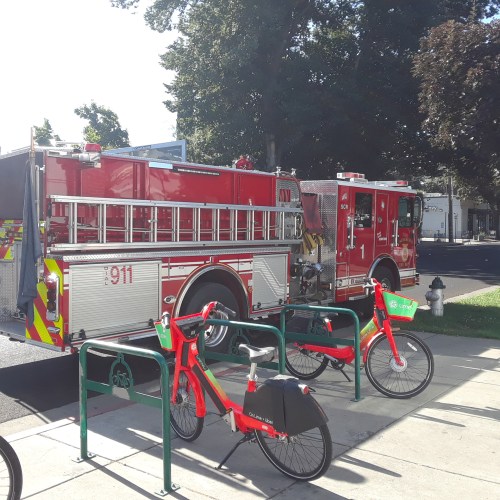
CRESLEIGH HAVENWOOD
Lincoln, CA | from the high $600,000s
Now Selling!

No appointment needed! Cresleigh Havenwood features four distinct floor plans ranging from 2,293 – 3,377 square feet and offering up to five bedrooms. Each plan has been thoughtfully designed and includes great features such as single story homes, guest suites, optional offices, garage workshops, and more!

Get the most out of your new home with Cresleigh’s All Ready smart home featuring all the connectivity needed to keep your house running. Best of all, each Cresleigh home comes with owned solar included!

Located off of Virginiatown Road and McCourtney Road, residents of the 83 homesites of Cresleigh Havenwood will benefit from a brand new neighborhood in the charming City of Lincoln. Palo Verde Park, is just down the street and there’s plenty of recreation to take part in all around town. https://cresleigh.com/havenwood/residence-four/

 Randolph Harris II International Institute