
Home » #RandolphHarris (Page 112)
Category Archives: #RandolphHarris

Squad Goals–Dope Squad Detectives

To allow corporations and cities to deal dope, but lock men and women up for these same offenses is crude, and the differences in treatment must be justified by relevant differences in treatment or condition, where relevance is defined in the light of general rules, and that every human being should be treated with at least a minimum of respect as a source of claims and not as a mere instrument for the promotion of the interest of others. The reason, and I am not justifying this because I think even smoking cigarettes should be illegal and regulated to facilities like the consumption of alcohol because it makes it hard to breath and pollutes the air and if it was done indoors at a smoking bar they could purify the air before releasing it, but people often deal drugs because they grew up poor and are uneducated and need a way to get out of strong gravitational effects of poverty that many cannot seem to escape from through legal mean. Many people feel like they are being held hostage in the ghetto, and it can be argued that it is wrong to allow wealthy people and cities with public money deal quasi legal dope, but punish victims of society who are being held hostage in poverty.

Corporations and cities being allowed to circumvent the law and cultivate and distribute marijuana, while others are severing life sentences in prison for the same thing is an abuse because it necessarily makes for more unhappiness than it prevents, and it treats a certain class of men and women in a way that is appropriate only for the guilt and creates a double standard for the wealth that makes them believe it is okay to not follow the laws. Moreover, a legal system is designed to guide conduct by laying down rules and attaching penalties to those who choose to break them. It is acceptable because the criminal males the essential choice; he, she, or they bring it on themselves. The people trapped in poverty and who have been arrested for cultivating and distributing drugs, on the other hand, have no chance to settle their own fate; they were used as a mere lever for manipulating other people’s conduct, and their own interest is subordinate to that of the other members of society. So it could be argued that many of these people in prison for selling and cultivation and possession of marijuana are technically innocent.

And punishment of the innocent ignores, in the short, fundamental procedural rules of justice and morality without which utilitarianism would make little sense, for unless every is worthy of equal consideration as a source of claims, whose interest is to count in assessing the utility of a course of action? Whom are we entitled to treat as simply a tool for advancing other people’s interest—slave by nature—and what would count as a reason for considering other people before them? This has bearing, too, on the reasons for accepting as excuses such defenses as duress, unavoidable accident, or ignorance of fact—conditions under which an offender can claim that he could not help doing what he did. “I had no choice but to sale drugs, I could not get a job and my baby was hungry and the lights got shut out and my family was about to be put out on the streets. As a man, I had to do something to provide for my family.” It could be argued punishing anyone under such conditions, when you are allowing people to deal dope who have other choices, would be pointless and, therefore, mischievous, because the threat of penalties could not possibly deter anyone in the future who was similarly placed.
People who sale drugs are considered to be hustlers—uneducated, unskilled at anything honorable, and they consider themselves nervy and cunning enough to live by their wits, exploiting any prey that presented itself. They will risk just about anything. Right now, in every big city ghetto, tens of thousands of yesterday’s and today’s school drop-outs are keeping body and soul together by some form of hustling. These people might be casually dealing card in a black jack game, and an old cook with wild and sloshed eyes, forming at the mouth, might try to be slick, and they have to drop a pistol in his face. The dope game is not fun and games. We do not want to glamorize weed and make it seem like it is okay to sale and by corporations and cities and states to get involved in the drug trade is just wrong. And people who sale and use illegal drugs inevitably moved into more and more, worse and worse, illegality and immorality. Full-time hustlers can relax to appraise what they are doing and where they are bound. As is the case in any jungle, the hustler’s every waking hour is lived with both practical and the subconscious knowledge that if one every relaxes, if one every slows down, the other hungry, restless foxes, ferrets, wolves, and vultures out there with one will not hesitate to make him their prey.

Now that the law somewhat protects people, who deal dope for a corporation, from being robbed and having their brains blown out or dope stolen, one might say that it is morally acceptable to interview people in jail and prison, find out who was locked up for the sale, cultivation, or possession of marijuana and ask them is it is the consequence of an act freely chosen by the criminal, or if they were somehow forced into it and release those who had no other choice because we now have corporations and cities disturbing, cultivating, and possessing marijuana and they are not being arrested, having their assets auctioned off, and doing time in a government facility. In the minds of some, a man acting in ignorance or by accident cannot be said to bring his punishment on himself. Punishment, seen as a way of influencing conduct, cannot be justified if there has been no real possibility of choice. Moreover, the punishment of involuntary offenses introduces into men’s lives the possibility of disaster which they can neither foresee nor avert. They cannot be fairly tried and judged before an Earthly tribunal. We are after all justifying a particular case of punishment, but allowing others to go unpunished for the same crime who actually have more resources, which is setting a dangerous precedent.


Internal Graces Conquer the Souls of the Judicious

Fines and imprisonments and corporal punishments operate more forcibly on the human mind than all the fears of damnation. Punishment is deliberately inflicted pain or deprivation on an offender because of an offense he has committed; it is deliberately imposed, not just the natural consequence of a person’s action (like a hang-over), and the unpleasantness is essential to it, not an accidental accompaniment to some other treatment (like the pain of a dentist’s drill). It is imposed by an agent authorized by the system of rules against which an offense has been committed; a lynching is not a standard case of punishment. My interest in punishment is mainly connected with questions of justification. It is, prima facie (based on the first impression), wrong to deliberately inflict suffering or deprivation on another person, yet punishment consists in doing precisely this. What conditions would justify it? Or, more generally, what kind of considerations would count toward a justification?
We must reconcile the apparently conflicting principles that wrongdoers should be punished and that it is wrong to make another man suffer. For instance, if a person had already committed a crime, that would clearly be relevant to the questions of whether he ought to be punished (although it might not be conclusive). What if he were only expected to commit a crime in the future? Or, again, is it relevant to the question of whether this man should be punished to say that punishing him would deter others? And assuming that criminals ought to be punished, how should we set about deciding appropriate penalties? Punishment can be justified only if it has beneficent consequences that outweigh the intrinsic evil of inflicting suffering on human beings. However, it is better that the wicked should be punished than that they should prosper more than the virtuous and, perhaps, at the hands of their expense. Sin is always punished in this World, whatever may come in the next. There is always some penalty in health, in comfort, or in peace of mind to be paid for every wrong.

One can take for granted the principle that wrongdoers should be punished and ask whether a particular cause of punishment was justified. For instance, “The War on Drugs,” is an American term commonly applied to a campaign of prohibition of drugs, with the purpose to reducing the illegal drug trade. It was started by President Richard Nixon 18 June 1971. Since then, “The War on Drugs,” has cost Americans $51,000,000.00 a year. And in the year 2014, 1.6 million people were arrested for drug offenses in the United States of America, 700,993 of those were for marijuana law violations, 1,297,384 (83 percent) of those arrest were for possession only, and 46.4 percent of people are in prison for drug related charges. Punishment has the advantage of impressing both on the criminal and on everyone else that a breach of law and morals is so serious that society must do something to prevent it. Happy is it for those few who are detected in their sins, and brought to exemplary punishment for them in this World.
However, this raises the philosophical question of how one justifies a set of rules or an institution like a penal system to incarceration of people who deal drugs, but allows corporations to deal drugs and even local governments want in on the action. Mind you, it is still against federal law to sale and distribute drugs like marijuana. Nevertheless, according to David Downs of the East Bay Express in “Oakland, California USA, the city of Oakland wants to require any new Oakland marijuana company to make the city a partner—and direct revenue from the cannabis industry to elected officials’ special projects. Oakland would require new marijuana-shop owners to give the city 25 percent ownership stake in a business, plus one seat on a company’s board.” So, in what sense can punishment be said to restore the balance or annul the wrong, when it taken for granted that criminals deserve to be punished? How can we have 1.6 million people arrested for drug crimes annually, making up nearly 50 percent of prison populations, but allow corporations and cities to be involved in the cultivation and distribution of drugs that are deemed illegal by the federal government?

Nor is it clear that virtue must be rewarded or that universal justice requires the kind of human rectification that this sort of retubutivism envisages. Of course, in a universe in which the wicked prospered, there might be no incentive to virtue. Again, evil motives and a bad character are necessary conditions for wickedness, but not of legal guilt and criminal liability. The state’s function is to punish breaches of those rules which in the public interest ought to be upheld; it is a matter of indifference in law (but not in morals) that some men who observe the rules do so from the unworthy motive of fear and others break them from the laudable motives of principle. Conversely, it is at least doubtful whether the criminal law should provide penalties for offenses against morality except where the public interest is at doubtful whether the criminal law should provide penalties for offenses against morality except where the public interest is at stake—exempli gratis (for the sake of example), whether it should extend to cases of lying other than, say, false pretenses and perjury.

Punishment is necessary to annul the wrong done by the criminal. By this something more than restitution or compensation, neither of which is strictly punishment. It is, rather, that the criminal has upset the balance of the moral order, which can be restored only be their being made to suffer. In what sense can punishment be said to restore the balance or annul the wrong, unless it is taken for granted that criminals deserve to be punished? All punishment is a mischief…If it ought at all to be admitted, it ought only to be admitted in as far as it promises to exclude some greater evil. By reforming the criminal, by deterring them or others from similar offenses in the future, or by directly preventing further offenses by imprisonment, deportation, or execution, the good that comes out of punishment may outweigh the intrinsic evil of suffering deliberately inflicted. Without such effects, or if the suffering inflicted exceeded the suffering avoided, the institution would be unjustified.

If people generally could be persuaded that an innocent man was guilty, some would justify punishing him since as a warning to other he would be just as useful as a genuine offender. Again, offenders might be deterred by threatening to punish their wives and children, particularly, if as is so often the case with political terrorists and resistance fighters, it were difficult to catch the offenders themselves. Or again, if punishment could be justified as a way of reforming criminals, it would seem better to punish them before, rather than after, they have committed their crimes. Nonetheless, do not lose sight of the two conditions which are necessary to the very idea of punishment—namely, that an offense should have been committed and that punishment shall be of the offender himself, who alone can be said to deserve it. Even justice makes victims. Punishment is punishment only when it is deserved; punishment for any other reason is a crying injustice. Proof must be built up stone by stone. The end crowns the work. It is not enough that Justice should be morally certain; she must be immorally certain—legally that is.

I hate the man in whom kindness produces no responsive affection, and injustice no swell, no glow of resentment. Some think that it is a good idea to punish innocent people provided that such punishment causes less suffering than might otherwise be caused by the would-be criminals it deters because in the end, the deception would break down, that it could not be used systematically, or that the long-term consequences would be bad for society. However, these answers are unsatisfactory because they depend on assumptions of purely contingent consequences. Our revulsion against punishing innocent men seems to go deeper than that. In any cause, these answers will not meet the case for punishing hostages, which can certainly be done systematically and requires no deception or secrecy. The truth is always incredible, because the blind eyes of humanity can see only half-truths except by great effort. Child predators like, Kevin Maurice Johnson, the Mayor of Sacrament, California USA will eventually be punished for his crimes. Kings are accountable for injustice permitted as well as done.


The Passions of the Soul and the Concept of the Mind

Many people would like to believe in reincarnation because they are attached to their loved ones and want them to stay with the forever. However, it is possible that the soul is immortal, it is even possible that reincarnation and the transference of the soul is possible. Nonetheless, even if your loved one returns and has memories of you and who they are, it does not mean that they will accept you or even love you the same, as it the past, so it could leave you vulnerable, and in a position to get hurt over and over and over again as you try to work with them and be understanding. You may even see characteristics of the past person in this new form, but you have to understand that they have had difference experiences. And, as you know, death can be traumatic, so if someone could return from the day, they may care about you, but they may also be a different person. There are some people who believe in reconstitution of the soul, and they may spend a decade or even a lifetime looking for their loved one to return because no one they have met has ever be as kind and loving as the soul who has transitioned. Any reconstitution doctrine of the soul is confronted with the question, “How is the reconstituted person on the last day to be identified as the original individual, as opposed to a mere replica, an appropriately brilliant forgery? Well, the whole purpose of believing in reconstitution of the soul is because love and the familiar make many people feel safe and protected in the World. It might also be suggested that though there might indeed be cases in which all other merely human observers must be entirely at a loss, the person himself could not fail to know whether he was the original person rather than a channeling or a replica. I have seen in one particular case where there was a discrepancy between who was the original and who was the reconstituted. Reconstituted people may only be mere replicas of and surrogates for their Earthly predecessors. The person claiming to be the original knew intimate details that only an individual who had been there could know. The problem was not two people battling over an identity. However, it was his son having problems accepting him because the way he was treating him.

Nevertheless, the individual in question claimed that he was actually the individual and it was his right to have special privileges and that his son should be understanding towards him considering what he had been through and the fact that he had been here all along watching him and knew of things that had happened and was upset. The point can be brought out better in the case of the argument that the person cannot fail to know who he is. This argument depends on the premises that if I remember doing something, I must have done it and that normal people in normal situations are usually able to remember the most important features of their lives. However, honest and however convinced, claims that you did something do not guarantee that you actually did it. All the time he was singing, the music held me in its spell, filling my head with images of his service in the war and what happened to his friends, and only he would know that, and with emotions of the Oakland A’s games we used to go to when I was a kid, that had long been absent. My eyes pricked with tears. The objection will be that it will not be identically the same man that shall rise again…After the change wrought by death the selfsame man cannot be repeated. When I heard the reverberation of the plainsong in the upper echelons of the cathedral or the stalls of our little country church, I had a moment of understanding. The voice startled me back to the present. I turned to see this man with a shock of copper hair and an open, thoughtful face smiling at me. The soul, even after separation from the body, retain the being which accrues to it when in the body…Consequently there has been no interruption in the substantial being of a man, as would make it impossible for the selfsame man to return on account of an interruption in his being. At that is precisely why this man is claiming that he is the original, he is the one who has been here all along. The nature of the soul and its relation to the bodily machine can be characterized to serve certain ends. The soul is justified by its purpose, and cannot be referred either to the mind or to the body alone. Again, in the air there always are and always have been vulgar or not so vulgar theories about bodies, minds, and souls and their survival natures, destinies and relations, with no guarantee that these theories can be harmonized with the meanings of such terms as “mind” or “soul.”

I took it away. First and foremost, to save Fella from those who might have destroyed it, and it had sent that child’s true soul Heavenward. It was a dreadful error. Some people believe that the soul is a vapor, blood, or something that order and must that extent ne interpreted as embryonic scientists and those thinkers who urged that the essence of the soul is motion, sensation, or some combination of the two. The mind is like a compass certain sort of achievement. In this sense of “mind,” then, someone can do these things because he is endowed with a first-class mind. The soul is the person. We are our souls. We use our hands, our eyes, our whole bodies. Thus, I cannot be my body. Yet, it is agreed that I must be my soul, my body, or a combination of both. However, because the user and the thing used are always different and because I use my body, I cannot be either my body or my body and soul combined. Thus, I must be my soul. Eyes sometimes play tricks on us, this shows that we see not with, but through, them, that they are, as it were, built-in optical instruments. We are sometimes dragged down by the weakness of the body or some part of it. I was dreaming about a family I knew, and I went back to visit them, and I was surprised that the kids had not aged because it had been over a decade. The house still looked exactly the same, but I noticed that the father now had blue eyes, instead of brown, but he looked exactly the same. The mother was also still the same age as when I met her, but her personality had changed. She was very uptight and all she did was clean the house. In the dream, I had a vision of the original mother, who I did not now and she had thick brown hair, and the mother who I did know had fought her to when the matriarch position in the family, but now had become a cleaning woman who lived in the back of the house because she had aged and was replaced by this younger uptight woman. These families did not die out, but they would keep the same names and replace members as they started to age. Strong witches appeared in various generations. Perhaps it was to care for the young children who never seemed to age. The origins of the family history are that a witch has called up a spirit quite by accident, a spirit who appeared to be a brown-eyed man—a spirit who was to haunt the family for generations. It was the ghost of a human being or some astral being without a human story.

It was biding its time, generation by generation, until a witch would bear its children, a witch with psychic powers enough to assist it to possess that unborn fetus and be reborn within it. Over generations he brought this family great wealth in any number of ways. And the men he despises and punished if they got in his way. The spirit did not understand who he was or what he wanted, except to be reborn. He guided everything to that purpose: to come through, to be flesh and blood again. We may infer that we drive our bodies as we drive our cars. Personal pronouns, personal names, and all other person words, words which clearly must refer to something which, it seems, equally clearly cannot refer to bodies, the only available corporeal objects, must therefore refer to some incorporeal objects, the conclusion is that these are the objects to which we apply the term souls. You must keep your name to be part of the family, if you were to be connected to the Legacy. People are what you meet. We do not meet only the sinewy containers in which other people are kept, and they do not encounter only the fleshy houses that we ourselves inhabit. It is therefore wrong to suggest that the word “person” is equivalent to the word “soul” in this sense of “soul” and, hence, to imply that it is contradictory to deny that people are incorporeal objects and that it is absurd to say that you can see a person. We all have certain ideal concepts, such as the ideal of perfect equality, which we cannot have acquired in our lives because they are never fully instantiated in this World. In both forms, the conclusions is that these facts can be accounted for only in terms of memory. We, or “our souls,” must have acquired our knowledge of the conclusion of the theorem of Pythagoras, which states that the soul is immortal, and it transmigrates as comprehensive soul that includes all psychic faculties. Pythagoras also believed that the soul preserved personal identity and could be well contained in the pattern of emotions, that constitute a person’s character. For the soul to be reincarnated, it is then believed that life as a human is actually enjoyable. After certain periods of time the things that have happened once happen again and nothing is absolutely new. This is the doctrine of eternal recurrence.

Transmigration this seems to have been extended to include the idea that we and indeed the whole World will be reborn into the lives that are exactly the same as those we are living and have already lives. Pythagoras actually believed that he was an incarnation of the God Apollo, which seems rational because he was a very smart man, he knew remarkable thing and possessed the greatest wealth of intelligence and accomplished all sort of wise deeds. Pythagoras even invented the Pythagorean theorem, which is a fundamental relation in Euclidean geometry among the three sides of a right triangle. It states that the square of the hypotenuse (the side opposite the right angel) is equal to the sum of the squares of the other two sides. Architects use the Pythagorean theorem, which is expressed by the equation: a2+b2= c2, in designing and computing the measurements of building structures and bridges. One example is involving roof design. A gable roof is made of two right triangles, where the base of one right triangle is called the run, the height is called the rise and the slope is called the rafter. When looking at Victorian architecture, it is so opulent and detailed that I often wondered, what kind of people would think to design and build such houses, which seem to defy physics and were built by hand, one hundred years ago and even earlier. Well, perhaps they were Gods or had lived more than one life. For instance, Pythagoras reported he remembered being an incorporeal being in the Underworld for three years and that is when he decided to be reincarnated. However, reincarnation has never been so popular in Western society because the idea of pre-existence involved in the conclusion does not square with Western orthodoxy. However, how were these great thinkers born with such important logic and a link between (true) memory and personal identity. If I really do remember certain truths or being acquainted with certain objects, then it follows that at some time in the past I must have learned them or made that acquaintance. And most human’s today, are so diluted that they are no longer capable of critical thinking. Genetically modified food is the way to go and people should be focused on perfecting plants and vegetables to exactly replicate the taste and textures of a steak or chicken or even your favorite fish.

The Winchester Mystery House

Follow your tour guide, as you explore the fascinating history and unsettling lore clinging to the haunted mansion. https://winchestermysteryhouse.com/

Nature and Nothing

When we engage in discursive thought and declarative speech, we may attain various forms of success: intelligibility, precision, correctness, and so on. These felicities are best explained by contrast with the corresponding mishaps that threaten our beliefs, assertions, and especially our claims to know something. A person’s thinking may be inadequate because he is ignorant, and what he says may be deficient because it is incoherent, rough, or perhaps most important of all, downright false. A census of hallucinations show that something are not just a collection of coincidences. Have you ever, while believing yourself to be completely away, had a vivid impression of seeing or being touched by a living or inanimate object, or of hearing a voice; which impression, so far as you could discover, was not due to any external physical cause? Death-coincidences cases were the subject. A, recognized his hallucination at the time as an appearance of another person, B; where B died within a period of 12 hours before or after the hallucinatory experience; and where A has no reason to expect B’s death. #RandolphHarris 1 of 8

A skeptic’s doubts about the honesty of the witness or the reliability of their memories cannot be laid to rest merely by the complications of more testimony. The truth is that God is indescribably more than our creaturely concepts can represent. Nature which creates and is not created is God in his eternal reality, the primary principle of all things. God is self-existent and unchanging, the uncaused Cause of the World. He alone truly is, and all other beings exists only as dependent upon or participating in him. Nature which is both created and creative consists of archetypes or exemplary causes of creatures existing in the divine mind. These archetypes came into being through the eternal generation of the Word (Logos) or Son, and can this be described as created only in an unusual sense of the term. Because the World is logically prior to them, they are not strictly coeternal with him; however, he has never existed without them. As exemplary causes, they may be said to perform a creative function. Nature which is created but does not create consists of the World of creatures existing outside the divine mind. #RandolphHarris 2 of 8

In statements which cannot readily be reconciled, these creatures participating in God’s reality are created out of nothing (de omnino nihilo). They constitute the divine self-disclosure or theophany—in the manifestation of the hidden, for formless, and the body of the incorporeal is faster than thought or time. God’s World is not of time, but of the fulfillment of time, the kind of fulfillment traditionally symbolized by the perpetual spring of paradise. The nature which neither creates nor is created is God as the end goal of the creative process, God with his creatures perfectly reunited to him, God become all in all. In the end, the whole World of creatures—including fallen man, redeemed through the incarnation of the Word—is to achieve fulfillment in union with God. In that union creatures are not to be simply reabsorbed into God but will be transmuted and spiritualized. The soul will survive in an incorporeal state. The immortality of the soul is rationally demonstrable. The dogma of a bodily resurrection could be rationally justified on the ground that since soul and body constitute a single substance, the soul requires a body for its self- expression and beatitude. #RandolphHarris 3 of 8

To account for the obvious fact that the flesh decays at death, although the resurrected body will have the same “form” as its Earthy counterpart, it will have a different “matter.” The soul, being immortal, would face judgement after death, that it would receive rewards and punishments according to the goodness or badness of its Earthly life, and that it would be given an opportunity to choose the condition of its next existence. The Bible states that history is nonrepeatable and that it is destine for a divine fulfillment in which good will triumph over evil. In the Bible the, the Old Testament contains only a few vague references to persona afterlife. However, it often refers to a future time when God will establish his everlasting reign of righteousness and peace (for example, Isaiah 11.1-9). The New Testament affirms that this divine end or goal has been reached by the exalted Christ, who defeated the powers of evil on the cross (see, for example, Acts 2.14—36, Colossians 2.8—15; Ephesians 2.11—22; Hebrews 2.5—18). Those who believe in Christ have eternal life here and now (John 3.36; 5.24). While living in this age, this spatiotemporal order that is still subject to sin and death, they have a foretaste of the age to come, a renewed cosmos that will be wholly subject to the will of God. #RandolphHarris 4 of 8

Some maintain that all spiritual creatures—angels, men, women, and devils will be saved in a final restoration (apocatastasis). However, others believe the damned will suffer everlasting torment. My answer to this puzzle is that men have false beliefs, but through their own doing, not God’s. Men are endowed by God with such power of will that they can assent to propositions they do not know to be true—that is, to “ideas” that are not “clear and distinct.” Is God to blame for this disharmony between or limited capacity for knowledge and our unlimited power of assenting? No, will is just a single thing; it is incompatible with its nature that anything should be subtracted from it. Besides, although we are free to, we do not have to believe propositions for which lack conclusive proof. In order to avoid unsuspected error, we must restrain our desire for truth and withhold assent until we know for certain. Do we exercise any control over our convictions and opinions, as the concept of assenting requires? #RandolphHarris 5 of 8

Clearly, people may decide to make statements. Some criminals voluntarily confess their misdeeds, and others are forced, against their will, to admit guilt. How about belief? Can we choose to reject a proposition that seems most likely, according to available evidence, and believe another that seems less plausible? Perhaps not. However, we often make decision as we form our opinions, as we collect or neglect data and seek or ignore testimony. Men who undergo brainwashing are deprived of this control over the formation of their beliefs. The same holds, incidentally, for knowledge. It is absurd to say that investigator decided to know but not absurd to say he resolved to find out for certain who shot at the car and who is responsible for leaking confidential documents. Moreover, children are compelled to learn things. In acquiring knowledge and forming opinions, we pursue rather obvious goals; conclusive proof and correct information. #RandolphHarris 6 of 8

Even so, is it intelligible to suppose that people act deliberately and knowingly when they settle upon false beliefs? One everyday case should dispel the appearance of contradictions: I study the racing form, mull over the evidence, and conclude that Wayfarer is bound to take the handicap. I willingly commit myself to this belief by wagering my paycheck. I realize, however, that even well-grounded expectations like mine can prove erroneous. Consequently, if my horse loses, it is true to say, “I formed my erroneous belief willingly, after deliberation, with the intention of predicting the handicap winner; furthermore, I was aware that I could be mistaken.” It was not my goal to be wrong, but it was within the scope of my intention. Anyone who aims at truth is prepared for falsity, just as a marksman is prepared to miss the bull’s eye. Can we say I erred “knowingly”? #RandolphHarris 7 of 8

The individualistic destiny that awaits each person, in the cosmic and social, after death the description of the goal in which history will be fulfilled is either a this-Worldly or an otherworldly kind. A man who punches another in the back of the head is hardly ever certain that his victim will be injured, but from a legal standpoint he knowingly inflicts hard if he has reason to think injury might result from his blow. There remains another type of errors, fortunately quite infrequent, where such awareness is impossible. This is the unusual situation where you are convinced you know something, banish doubt from your mind, and still turn out to be wrong. Perhaps you acted deliberately and followed your inclinations in pushing your investigation until you believed you could not be wrong. However, this degree of conviction, you cannot have the least awareness that you are mistaken. Your error, then, is not fully voluntary. #RandolphHarris 8 of 8


Inequalities are Indefensible Differences: Frail Human World might be Torn Entirely Asunder
The issue was the position which his action has put us both into in this sidewalk jungle World and reputation and honor are very important. I cannot be hyped, meaning outsmarted or made of fool of, nor can I afford to be bluffed. The notion of universal equality as an idea is difficult to demand a firm answer from. Many egalitarians have tried to argue that despite the many points of inequality, all men and women are alike in possessing reason, or a soul, or some other essentially human characteristic or nature, by virtue of which they stand equal. The difficulty, however, is to find an important characteristic that all men and women possess in precisely the same degree, so that whatever differences their other inequalities might justify, this fundamental equality make them equal qua (the capacity of being) men and women. And even if one could identify such a characteristic, what would follow him from it? If all men are alike in having souls, in what respect should they therefore be treated alike? After all, God is widely believed to punish wicked souls and to reward virtuous ones. God’s omniscience is entailed by infinity. However, a special problem is created by the view that God now knows future freely chosen human acts. Those who hold this view that God sees all urge, first, that since God is timeless it is, strictly speaking, incorrect to say that he “foreknows” events, and second, that even if we say this (speaking from our finite standpoint), we need not assume that a human act, because it is foreknown, is predetermined—by either God or any other factor outside of the agent’s will. To say that a human act can in principle be predicted is not to say that agent has no control over it or is not really active and responsible for what he does; this, at any rate, is a view of human action widely held by philosophers at the present time. However, other theists consider it contradictory to say that a free choice can be known in any sense until it has been made. They affirm that God is ignorant of future human choices and that his ignorance is a “self-limitation” he deliberately incurred in granting men and women free will.
Ideal of universal equality can often be reduced to the principle that all men ought to be equally considered. This does not mean that there is any respect in which they are all alike; it is rather a principle of procedure: that all men ought to be treated equally, despite all their differences, until a case has been made for saying that some particular difference between them is relevant to the matter at hand. The onus of proof rests on whoever wants to make distinctions. And up to this point this might be sad to be implicit in the notion of rational decision, because it would be irrational, within a given class of cases, to treat some differently from others if no relevant grounds could be found for distinguishing between them. It is not easy to see how anyone who seriously held that white men mattered but black did not could be reasoned out of this position, any more than one could argue for the equality of men and dogs. Of course, many people who practice discrimination profess to believe that black men are in some way inferior to white men, in intelligence, sensibility, responsibility, or some such quality, and on this account ought to be treated differently. However, this is to admit the principle of equal consideration for all men, that all men count, and that an argument has to be made to justify discriminating against some among them. The man who denies that they count at all is not bound to show reasons, any more than we feel the need to show reasons for treating inanimate objects, plants, or primitive organisms, such as amoebae, according to our pleasure. Although we hesitate to inflict unnecessary pain on sentient creatures, such as cats or dogs, we are quite sure that we do not need to show good reasons for putting human interests before theirs. The boundaries of moral consideration are enlarged in practice by awakening sympathy and imagination; moral reasons presuppose an initial moral concern.

It is important to note that the Creeds, Pantocrator and omnipotens imply that God is the ruler of all things, rather than that he can do anything. Omnipotence too is entailed by infinity. God cannot act against either reason or morality. However, it is extremely difficult to explain the existence in a World created by a God who is both infinitely powerful and infinitely good. Various explanations have been given. Thus evil has been traces to the fall of a first man or World Soul. Everything of this World is created through the transformation of Earth, Air, Fire, and Water—these elements are the active powers of the World Soul. Again, it is said that God permits (even if he does not inflict) unmerited sufferings as a means of purifying the soul for eternal life. God is not responsible for evil because he is finite both in knowledge and in power. (Christians believe that God displays his omnipotence by overcoming evil through the ministry of Christ.) The purpose of this equality of rights is to ensure equality of freedom and opportunity: the equal right of all men to live the kind of life that seems good to them…equality of opportunity to be oneself, to live as one pleases. This is attractive, but it hardly touches the problem of what is to be done when what pleases one man interferes or competes with what pleases another. Nor does it cope with the diversity of inclinations—can one be said to have, on a given income, an equal opportunity to become a collector of Picassos or of seashells? Or does equality of opportunity require differential provisions, so that the chance of fulfillment matches aspirations? Does it envisage open competition or a handicap? Every individual’s view of where his own interest lie should be given consideration. In the moments when time seems to stand still, we get a glimpse of what is possible. These moments are so rewarding that they are treasured for a lifetime. When they occur, something is experienced that is very impressive. Could it be that, beyond the turbulence of the World and our own mind, there is silence? A realm of peace that is always waiting?

The ideal of universal equality requires that the inequalities of nature be mitigated or rectified. By this view, precisely because men born with superior talents or social advantages can claim no merit on that account, it should be the aim of social policy to compensate for such advantages by differentiating between men to redress the balance. It is of course true that modern welfare states commonly do provide special amenities, such as wheelchairs for the crippled or hearing devices for the deaf, to bring naturally handicapped people up to some minimum. However, an account in terms of meeting needs or deficiencies, for the policy is not much to remedy a handicap that one man suffers in comparison with another (wheelchairs are not mean to enable cripples to compete in races with runners) as to provide conditions necessary to his well-being, understood in the light of some presupposed standard of what a good life requires. This standard will no doubt be governed by the advantages commonly enjoyed by most people in the community, so that in an affluent society a person will be taken to have more needs than in an impoverished one; however, the claim will still be grounded on his own needs and interests, not on the greater advantages enjoyed by those more fortunate. That makes him a very rare and useful species: a practitioner, a researcher, and a journalist. When he encounters new research, he teases out what is practical. Think about how you learned something that you know how to do very well. Did you learn it by doing, by figuring it out yourself, or with help? Today equality means abolishing racial disabilities in the law or seeing that prejudice does not interfere with the administration of the law. It also may mean eliminating the advantages of wealthy litigants over poorer one, by public legal aid schemes, or making certain that no one is prevented by poverty or wealth from getting a fair trial.

Equality very rarely means treating everyone alike; usually it means getting rid of one system of distinction and replacing it with another. Thus, equality of opportunity in education hardly ever means giving everyone exactly the same education; rather, it means eliminating some hitherto determining factor such as ability to pay school or university fees and substituting a test of proficiency. More ambitiously, it might aim at a system with various arrangements, each meant for an appropriate grade of intelligence or type of aptitude. Those who all this equality does so on the ground that the treatment accorded to each is equally appropriated to his needs. Thus, the more anxiously a society endeavors to secure equality of consideration for all its members, the greater will be the differentiation of treatment which, when once the common human needs have been met, it accords to special needs of different groups and individuals among them. The greater the equality of consideration, the greater the differentiation in treatment. If the latter is not called “inequality in treatment” it is because the word “inequality” has acquired, in the sort of context, a pejorative force; “inequalities” have come to mean indefensible differences in treatment. We need to preserve and improve what already exists than to risk the even greater abuses that might follow the destruction of the current order. Revolutionists are intentionally or not, destroying the very fabric of human existence. Given the human condition, it is very important to retain the (far from ideal) way that Christ’s message has been institutionalized; at the same time, I urge a revival of concern for the substance of this message and a revitalization of the church through the correction of as many abuses as possible and the encouragement of scholarly and more efforts to recapture the original Christian spirit. Otherwise, I fear, the frail human World might be torn entirely asunder.

The Winchester Mystery House

Mrs. Winchester loves the beautiful Victorian mansion built, looking for a fresh start after the death of her husband and daughter. Although beautiful, the mansion holds a sinister secret. https://winchestermysteryhouse.com/
The Night Was Wide and Furnished Scant: I Got the Keys!

Self-satisfaction is a terrible trap if you want to achieve anything important. In times of stress, psychological pressure compels us to deny or dismiss inconsistent evidence, pushing us to perceive certainty and clarity where there is neither. The proposition A and B are equal may be descriptive or normative, but in either case it is incomplete without a statement of the respects in which the objects or a person compared are deemed to be equal. In instances where this appears not to be so, either the context supplies the complement or the comparison is of pure quantities, as in pure mathematics. Two objects equal in weight, or height, or value may be unequal in other respects; apart from the abstractions of mathematics and logic, no two objects could ever be said to be equal in all respects, only in all relevant respects. Correspondingly, to say that two candidates are equal in merit would usually mean that with respect to their performances in some understood competition or examination, they deserve to be treated alike; it does not rule out treating them differently if they are unequal in other respects.

When we feel that something is off balance, we seen that we can try to uncover the origin of the imbalance in conflicting or unresolved ideas or events. No distinction ought to be made between men who are equal in all respects relevant to the kind of treatment in question, even though in other (irrelevant) respects they may be unequal. On the other hand, in any matter in which they are in relevant respects unequal, they ought to be treated in proportion to their relevant inequalities. These analytical distinctions are of considerable importance in dealing with equality as a moral and social ideal. President Thomas Jefferson’s claim that “all men are created equal” cannot be rebutted by pointing to the obvious fact that some are taller, stronger, or more clever than others. The claim is intelligible only as a prescription, as saying that there is some respect, at least, in which no difference ought to be made in the treatment or consideration given to all men, whatever differences there might be in their qualities and circumstances. We have explored how the urge to resolve ambiguity is deeply rooted, multifaceted, and often dangerous.

As we make decisions, we need to recognize both the consequence of a decision and our current need for closure. In doing so, we can avoid grasping for new solutions in panic or sticking too rigidly to old ones. Some people believe that others are slaves by nature because some souls are not merely capable of higher development than others, but more valuable on that account. The natural equality of all men as rational beings with an equal capacity for virtue: Virtue closes the door to no man; it is open to all…the freeborn, the freedman, the slave and the king…neither family nor fortune determines it choice—it is satisfied with the naked human being. Men are equal only in the sense that by sin all were totally, and therefore equally, unworthy; God in his mercy extended grace to some but not to others. The equality of all men in the sight of God by the doctrine that slavery is consequence of sin. This view of equality came to be associated with the theory of church government—and indirectly of secular government—that derived legitimate authority (i.e., the right of superiors to command inferiors) from the voluntary agreement of natural equals to submit to such of their number as they choose.

We have seen how easily we can misinterpret genuine ambivalence as calculating duplicity. When we are trying to pin down someone’s intentions, we need to realize that ambivalence is a more natural state of mind than we ordinarily assume. These doctrines were given their first completely secular expression—associated with theories of natural right and social contract—by some of the Parliamentarians in the English civil war, particularly the Levelers. Colonel Rainborough’s declarations in the General Council of the Army in 1647, that the poorest he that is in England hath a life to live as the greatest he and that no one can have a duty to obey a government that he hath not had a voice to put himself under and that is a classic expression of democratic political egalitarianism. Some people think that men are only equal in strength and cunning. By nature, men are equally free, are subject only to natural law, and enjoy the same natural rights. This turns the problem of political authority and obligation into a search for reasons why free and equal men should accept the limitations of civil society.

Political inequality, of rulers and ruled, must by justified as a conventional device for the better safeguarding of the rights and advantage that all men already possess but cannot securely enjoy, in a state of nature. Difference of character, talent, and intelligence are due to difference in environment and experience. By nature men are equal in that sense that at birth they have a limitless potentiality with potentiality without natural characteristics to differentiate one from another. Consequently, their diverse natures are, in fact, contingent; in principle all men are equally perfectible, given the appropriate social arrangements. In the state of nature men’s needs are simple, none need rely on anyone but himself, so none can exploit another or make him subject. The key problem for social philosophy, to which the sovereignty of the general will could provide a solution, is to reconcile the natural equality and autonomy of men with the social condition and political authority potentiality as morally self-governing persons. More broadly, organizations that are consistently forces to deal with ambiguity under pressure can ensure that people with a low need for closure play a central role in decision making.

All human beings must be treated as ends, not merely as means; all men are equally capable of realizing the good will, the only thing in the World good in itself. Our need for closure is a powerful force. It is so deeply ingrained in everyday living that cultivating an awareness of how it works is not enough. Combating its dangers means designing intuitions and processes that makes us less likely to succumb to our natural tendencies towards resolution when it matters most. The right negotiators will stay calm in the face of fluid, incomplete, and seemingly contradictory information. The right reminders at decision points will lower our need for closure. We can build an awareness of what we do not know about the future into our approach to the World by crafting methods to react quickly to change rather than trying to predict it. Ambiguity does not have to be paralyzing or distasteful. Under the right conditions, as we will see, embracing uncertainty can in fact provide opportunities to innovate. It can inspire creative solutions, and might even help make us better people.

And they all have plenty of money, money enough to walk away from this place and be comfortable wherever they go. That gives them a feeling of security, and in air of independence. However, they want to be right here. It is reported that most people spend their lives regretting the past and fearing the future; therefore, they are unable to experience joy in the present. Many of us have assumed that this is our human fate, our lot, and the best that we can do is accept life for what it is. One of the most effective tools for handling the past is the creation of a different context. What this means is that we can give it a different meaning. We take on a different attitude about the past difficulty or trauma, and we acknowledge the hidden gift in it. Everyday life experiences, no matter how tragic, contains a hidden lesson. When we discover and acknowledge the hidden gift that is there, a healing takes place. Your riches taught me poverty. Myself a millionaire in little wealth.

The Winchester Mystery House

Whether you are an expert, an architect, a student or just a lover of Victorians you will enjoy The Winchester Mystery House. https://winchestermysteryhouse.com/

The Problem of Animal Pain–Red in Tooth and Claw

Moral activist, insist on rigorous, continuing moral instruction and effort. Daily self-examination is important for every individual, whose ultimate purpose is to learn how to judge one’s actions clearly and firmly; each man should see that he is alone totally responsible for his deeds because he has given to the external circumstances of the deed. The faculty of choice and refusal, the power to use our external impressions, is of immense importance. When a man finds a fault in his way of using external circumstances, he must root out a dangerous growth. With all his submissiveness, man should be a great defender of the prosopon, or proper character and personality of man. Each man is free to mold it and has an obligation to the rest of the World to display it once it is molded. I like to establish something sure and secure in a World of uncertainty. The feelings of pleasure and pain that accompany sense experiences are the ultimate good and evil; all statements about good and evil are meaningful only be reference to these feelings.

Thus far, these articles have been concerned with evils as it directly affects mankind in the forms of sin, pain, and suffering. There is also, however, the baffling problem of animal pain beneath the human level. Throughout the animal kingdom, one species devours another, and painful accidents and lingering diseases disable and then kill them. I have stopped eating meat because I thought about how cruel it is to raise something to die and then eating. On my evening walks through the park, I saw how much raccoons are, and how they have emotions and feelings, and how they are gentle and shy, and I could not bring myself to buy another, chicken, fish, turkey, nor steak. I also thought about how sad I would be if someone killed and ate my tiger “White Iverson.” However, that is just my decision, at my particular level of consciousness, and I am not judging nor criticizing anyone else. I am just doing what is right for myself. Nonetheless, how is this spectacle of nature, red in tooth and claw to be reconciled with the religious belief in an omnipotent and perfect Creator? Knowledge is a state of mind and has to be accounted for accordingly.

Certain solutions of the problem have been proposed. It is claimed that the lower animals live wholly in the present moment and lack the high-level capacities of memory, anticipation, and conscience which give rise to the human experience of suffering as distinct from the experience of physical pain; that the pain mechanism is a necessary warning device in bodily organisms that move about within a material environment; and that an animal’s life, even though violently terminated, is predominantly active and pleasurable. Solutions of a more speculative nature have been sought in two main directions. It has been suggested that the premundane fall of Satan has had cosmic consequences, perverting the entire evolutionary process to a savage struggle for existence. From another point of view, which adopts a theme of Eastern thought, it has been suggested that there may be a continuous reincarnation of souls through the levels of animal existence up to self-consciousness in human life. Thus, the pain of animals is not wasted, but is part of a long constructive process.


Sleeping, Dreaming, an Antiquated Soul—Fly Eagles Fly!

The Moon, it was full, but veiled behind the pink panoply of clouds, and so we were in a thin rosy and penetrable darkness, all around us the garden was alive and balmy and seeing to feed upon us with countless tiny mouths. The Fall of man is regarded as a virtually inevitable incident in man’s development as a child of God. If man is to enter into a genuinely personal relationship with his Maker, he must first experience some degree of freedom and autonomy. For only a relatively independent being can into a relationship of love and trust with his Creator, and man’s fall is seen as a fall into this independence. It is thus analogous to the phase of disobedience which signals a young child’s assertion of his own individuality. Man has never actually existed in a state of pre-Fall perfection. The Fall story is an analysis of man’s present condition of estrangement from God, but not an account of how he came to be in this condition. Using our knowledge of the early state of mankind, we may say that man, as he emerged from the lower forms of life, was endowed with only dim and rudimentary conceptions of his Maker. He existed at an epistemic distance from God, which allowed him to respond to modes of divine revelation that do not coerce the human mind but which preserves man’s relative autonomy.

Man’s existence at this epistemic distance from God constitutes his fallen estate, and from this flows the moral and spiritual cleavage and estrangement which is traditionally called the “original sin.” In this type of theodicy, God bears the ultimate responsibility for (in other words, is the necessary and knowing cause of) man’s existence as a fallen creature, although, on this own level, man remains individually responsible for his person choices and actions. Further, though the significance of this cannot be pursed here, the God who has thus created man as imperfect but perfectible has also entered into human life, in Christ, to bring about man’s redemption. The more I know of the World the more clearly I perceive that its top and bottom sin is cowardice, physically and morally alike. Some instances of suffering for example, those caused by 11 September 2001, and other war, injustice, and the many forms of man’s inhumanity to man—are traceable to human wrongdoing, and thus fall within the problem of moral evil. Cowards kick and abuse the person who is known to be a degree more timorous than themselves, as much as they tremble at the frown of anyone who has more courage.
It would seem to be strange that any human being should find more to wonder at in any one of the phenomena of Earth than in the Earth itself; or, should specially stand astonished at the might of Him who created the World, when each night brings into view a firmament studded with other Worlds (stars, planets, and Moon in the sky) each equally the work of His hands! However, other sources of pain, besides those generated by humans, such as aliments, Earthquake, flood, drought, and storm, are built into the structure of the World itself. Surely, it is urged, they make it incredible that the World who should have been designed by a Creator who is both perfectly good and infinitely powerful. God’s purpose for making the World must have been to produce a paradise for man to inhabit. He will naturally male it as safe and agreeable as he can and any remaining sources of danger or discomfort are evidence of either his want of care or want of means. However, nature was created free from defect, and it present perils and hardships are punishments which man has brought upon himself.
Great arching branches of the rain tree poured over us from the left. And the eagles sang loudly from the many crowing trees. There were no traffic sounds from the World beyond. The very air itself was blessed. It was so lovely. The purpose of the World is to be a place of soul-making, an environment in which the higher potentialities of human personality may develop. Many thinkers feel that human beings are content to operate at the level of lower animals—to simply have their physiological needs men, breathe, eat, have the sex, find shelter, avoid pain and seek pleasure. It is as if most humans are suspended halfway between animals and Heaven, a kind of wingless animal. Humans must also have the possibility of developing their intellectual and artistic powers to whatever extent accords with their personal characteristics and abilities. Nature is operating by its own laws and men must learn to obey it. If God had created the Word in which natural law were continuously adjusted for the avoidance of all pain, the more heroic human virtues would never be evoked. Indeed, a great part of our present moral language would be meaningless. In the old times when we did not believe in anything, when we believed in the only laws were aesthetic law, expecting further miracles. It was so accidentally beautiful.

If the Fall of man had not happened, there would be no such thing as “doing harm,” for on one would be able to suffer any kind of injury; there would be no such thing as “doing good,” for there would be no needs, deficiencies or occasions for improvement. There would also be no such thing as a crime or a benefaction, an act of generosity or of meanness, of kindness or unkindness and there would be no situations to which such qualities as courage, fortitude, loyalty, honesty, and the caring and protective aspects of love would be appropriate responses. There would thus be no occasions for moral choice. Such a World would be ill-designed to evoke many of the human traits which we value most highly. Indeed, it would seem that the rough edges of the World—its challenges, dangers, tasks, difficulties, and possibilities of real failure and loss—constitute a necessary element in an environment which is to call forth man’s finer qualities. My dad used to always tell me: “God already knows what you are capable of and why type of person you are, he just wants you to see for yourself.” It is all the same, so lovely, more lovely even than I remember before the Fall of man. Nothing has changed.


The Ideas of the Fall and of Original Sin
God created man with no sin in him in a World devoid of evil. What appears to be evil, when seen in isolation or in a too limited context, is a necessary element in a Universe which, viewed as a totality, is wholly good. From the viewpoint of God, who sees timelessly and as a whole the entire moving panorama of created history, the Universe is good: To thee there is no such thing as evil, and even in thy whole creation, taken as a whole, there is not. A Universe in which all the varied potentialities of being are realized and which contains as many different kinds of entity as are possible (lower as well as higher, lesser as well as greater), is a better Universe—one which more adequately expresses the infinite creativity of God—than would a Universe which contains only the highest type of created beings. There is thus an immense hierarchy of forms of created existence, and each creature, in its own proper place in the scheme of nature, is good and glorifies its Maker. Those that are lower in the scale of being are not on that account of evil; they are just different goods, contributing in their different ways to the perfection of the Universe.

Again, things that are transitory by nature, appearing then perishing within the ever-changing pattern of nature’s beauty, contribute, even by the passing, to the perfection of the created order. As a very minor sub-theme within this aesthetic conception, the notion of evil provides a contrast by which good shines the more brightly. The more we love, the more we can love. Love has a powerful anabolic effect. Love increases endorphins, which are life-enhancing hormones. You can live ten years longer with a source in your life that catalyzes the energy of love, and that energy of love heals and prolongs life. For instance, in the film Straight A’s, with Ryan Phillippe, Anna Paquin, an Luke Wilson, Ryan Phillippe plays a man named Scott, who is an outcast from the family and seeking redemption, and he returns home and throws everyone’s lives into disarray. However, he also helps to heal the family and himself by paying attention to each member in the family and bring out their core essence. The energy of love has the capacity to heal our bodies and others when conditions are appropriate.

The Universe must contain mutable and corruptible creatures, compounded of being and nonbeing. It is better that the Universe should include free beings who may, ad do, fall than it should omit them. If Scott had not had the free will to reenter the lives of his family and the ability to be himself, they may have all suffered an existence without try love, without passion. He gave them all a second chance at life. Thus, Scott brings even moral evil within the scope of his aesthetic conception of life. In doing so, he employs the further principle that as long as sin is exactly balanced by just punishment, it does not upset the moral harmony of the Universe. For instance, the little boy Charles, who is probably eight years old did not have a father in his life and lacked the confidence to give his speech in class. And the bell rang, and his drunk Uncle Scott showed up to school to have lunch with his nephew Charles. And Scott talks to young Charles’s friends and gives them all juice and money and says it is from his nephew Charles, which turns Charles from a reject to the coolest kid in school.
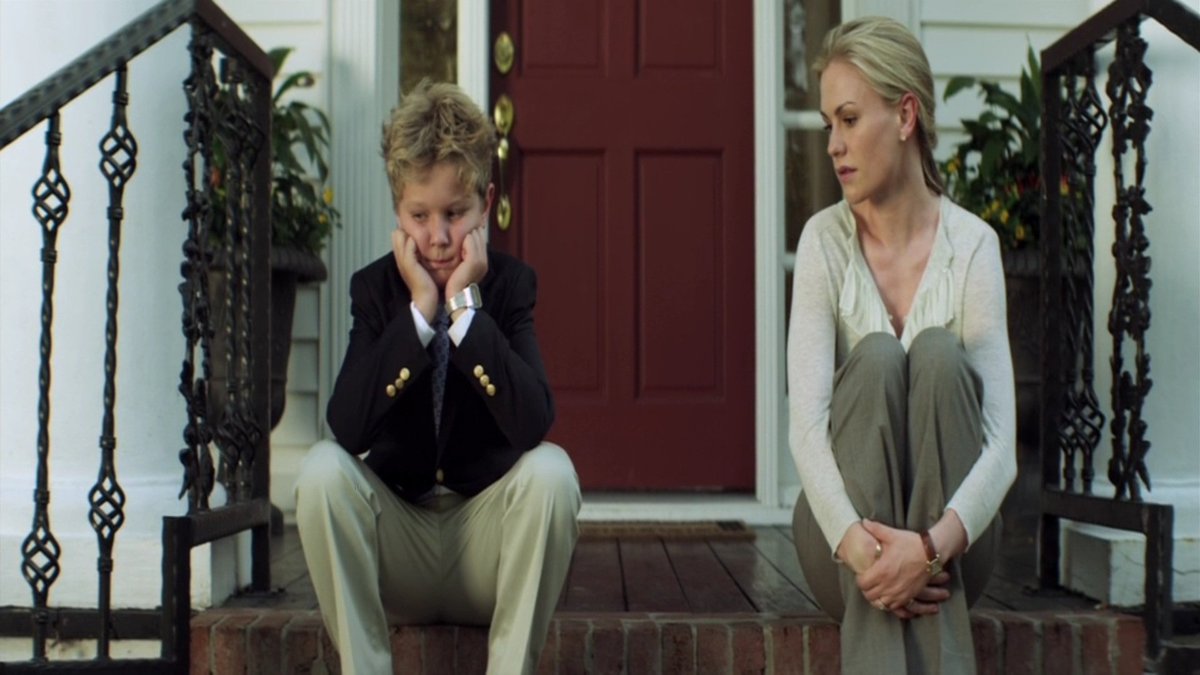
And Grace, Charles’s niece, her own father was not around, so Uncle Scott pours himself a drink and allows her to cut his hair and put ribbons in it. She cuts his scalp a little and it hurts him, he asks Grace if she sees and blood? Grace, says no, then, apologizes and tells his niece to keep styling his hair. Then he lets her shave his facial hair. Also, it is a very uptight community, and while Katherine (Anna Paquin) the matriarch of the family is at brunch, the women are gossiping and assume she is having an affair with William’s (Luke Wilson) brother Scott, which she is not, because Scott is never home. Scott and Katherine kind of play mother and father roles for this kids, while their father is away and it creates a platonic sense of balance in the house for Katherine, as she gets to enjoy having a man around the house and the masculine energy him brings makes her feel like she has a loving husband around and he also keeps the kids happy by playing father to them. Since there is happiness for those who do not sin, like William’s wife Katherine, the Universe is perfect. So, whatever a soul may choose, every beautiful and well-ordered in all its parts is the Universe whose Maker and Governor is God.
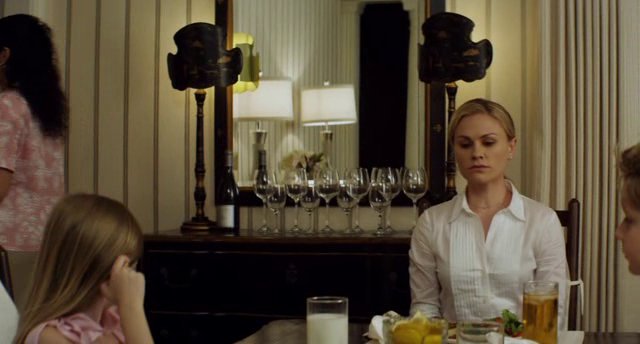
The film Straight A’s is a good film the shows how the Universe works because it is the best of all possible Worlds. It is the best, not because it contains no evil, but because Uncle Scott’s seemingly deviant nature is actually benevolent and gives everyone exactly what they need, and he may be a little reckless, but loves his family and only wishes the best for them. He does not show up to harm them nor take advantage, but to be around people he loves and admires and helps them balance their lives and gets the sense of family and the bonds that Scott has been longing for. Also, any other possible World would contain more evil. Had Scott not showed up when he did, perhaps Katherine would have gotten a divorce, Charles would have turned into a delinquent, and maybe Grace, with the lack of a male role model, would have later in life sought attention from men by being promiscuous. And perhaps without the family being there for Scott, some prostitute(s) would have hustled him out of his pension and left him for dead. The eternal possibilities of existence are individually present to the Divine Mind which, like an infallible calculating machine, surveys all possible combinations and selects the best, to which it then gives existence.
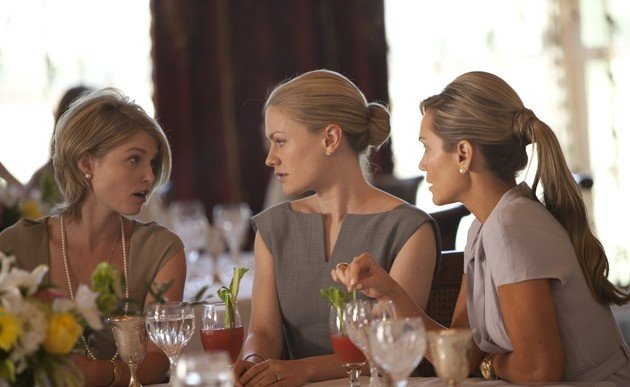
Man willfully misused his God-given freedom and fell into sin. Some men and women, will be redeemed by God’s grace, and others will be condemned to eternal punishment. In all this, God’s goodness and justice alike are manifested. However, this traditional theodicy has been criticized for its accounts of the origin and of the final disposition of moral evil. The origin of moral evil—it is urged that the notion of finitely perfect beings willfully falling into sin is self-contradictory and unintelligible. A truly perfect being, though free to sin, would in fact never do so. To attribute the origin of evil to the willful crime of a perfect being is this to asset the sheer contradiction that evil has created itself ex nihilo (Latin phrase meaning out of nothing). In the Film Straight A’s, Scott represents God, Katherine represents Eve, and William represents Adam. It is logically impossible for God to have created men such that they would always freely make right moral choices has been under attack under the name of “the free will defense.”

Defining a free action as one which flows from the nature of the agent, without eternal compulsion, recent writers have claimed that, without logical contradiction, God might initially have given men a nature which would always freely express itself in right actions. If God’s primary purpose for men is to evoke in them free and uncompelled love and trust in relation to himself, would this purpose be frustrated by his creating men so that they cannot do other than make this response? If God desires to save all his human creatures, but is unable to do so, he is limited in power. If, on the other hand, he does not desire the salvation of all, but has created some for damnation, he is limited in goodness. Before his fall, Adam was in a state of original righteousness, and that his first sin was the inexplicable turning of a wholly good being toward evil. The pre-Fall Adam was more like a child than a mature, responsible adult. Adam stood at the beginning of a long process of development. He had been created as a personal being in the “image” of God, but has yet to be brought into the finite “likeness” of God.

The fall of Adam is seen, not as disastrously transforming and totally ruining man’s situation, but rather as delaying and complicating his advance from the “image” of God, but had yet to be brought into the finite “likeness” of God. His fall is seen as disastrously transforming and totally ruining man’s situation, but rather as delaying and complicating his advance from the “image” to the “likeness” of his Maker. Thus, man is viewed as neither having fallen from so great a height of original righteousness, nor to so profound a depth of total depravity; rather, he fell in the early stages of his spiritual development and now, needs greater help than he would have otherwise required. So in the film, Straight A’s, Scott comes to this family to provide William the help he needs in keeping his family together and in return is provided with a place to stay and teaches and receives unconditional love. Therefore, the doctrine of eternal damnation must be real and by loving each other as God intended, this family was saved from unnecessary hardship and end up stronger because they acted out of love and not selfish greed, nor malicious intent.

The Winchester Mystery House
Come tour The Winchester Mystery House. The mansion’s common rooms are particularly gorgeous: notice the bay windows in leaded stained glass, the beautiful moldings, and the handsome chandeliers. https://winchestermysteryhouse.com/
The Price of the View—Creation is Always Preceded by Chaos
Whatever may be the general infelicity of man, one condition is happier than another, and wisdom surely directs us to take the least evil in the choice of life. The problem of evil concerns the contradiction, or apparent contradiction, between the reality of evil on the one hand, and religious beliefs in the goodness and power of God or the Ultimate on the others. Considered as a response to the problem of evil as stated above, this view is defective in that it redescribes the problem but does not attempt to solve it, for it leaves unexplained the evil of our suffering from the compulsive illusion of evil. There is the dualism exemplified most dramatically in ancient Zoroastrianism, with its opposed good and evil deities, Ahura Mazdah and Angra Mainyu. A much less extreme dualism can be propounded since the terms of the problem of evil vary with the character of the religious beliefs which give rise to it, a separate study is required for each of the great religious systems. In the present articles, however, the problem will be treated only in the context of the Christian tradition.

If we regard this World only, it is the interest of every man to be either perfectly good or completely bad. He had better destroy his conscience than gently wound it. Christianity (like Judaism and Islam) is committed to a monotheistic doctrine of God as absolute in goodness and power and as the creator of the Universe ex nihilo (the Latin phrase meaning “creating out of nothing”). The challenge of the fact of evil to this faith has accordingly been formulated as a dilemma: if God is all-powerful, he must be able to prevent evil. If he is all-good, he must want to prevent evil. However, evil exists. Therefore, God is either not all-powerful or not all-good. Conscience the awarder of its own doom. A theodicy is accordingly an attempt to reconcile the unlimited goodness of an all-powerful God with the reality of evil. There is a motivation for adoration, in the study of the lowest fruits of the wisdom and power of God. God’s first creature, which was light, as well as the seeing eye.

The kinds of evil distinguished in the literature of theodicy are the evil originated by human being (and angels), that is, moral evil or sin; the physical sensation of pain and the mental anguish of suffering, which may be caused either by sin or by natural evil, that is, disease, tornado, earthquake, and so forth; and the finitude, contingency, and hence imperfection of all created things which some have called metaphysical evil. Why has an infinitely powerful and good God permitted moral evil in his Universe? And why has an infinitely powerful and good God permitted pain and suffering in his Universe? Well, if the sole and ultimate power is unambiguously good, what is evil and whence does it come? Evil is a privation. The conception of evil is an independent reality and power coeternal with good as the privation, corruption, or perversion of something good. Evil has no independent existence, but is always parasitic upon good, which alone has substantial being. Nothing evil exists in itself, but only as an evil aspect of some actual entity. Thus, everything God has created is good, and the phenomenon of evil occurs only when beings which are intrinsically good (though mutable) become corrupted and spoiled.

God, as the highest, richest, and most intensely real being, is the supreme good, and everything that he has brought into existence is ipso facto (by that very fact or act) good. For this reason, the corruption which we call evil can never be complete; for if a thing becomes so vitiated in nature that it ceases to exist, the evil which parasitic upon it must also cease to exist. Hence, there can be no wholly evil being. Fear results in chronic anger and makes us prone to attack and to inner emotional chaos. Pain and suffering occur, with periodic despair and proneness to emotional upset. The ego-mind, which sees everyone as separate, is envious of anyone else who appears happier, more successful, or with a better relationship, a better body, or better connections. Soon, because of a lack of inner clarity about goals, there is confusion leading to self-pity, envy, and further resentment. Self-condemnation gets endlessly projected onto the World, taking the form of condemnation from others, which increases further the guilt and feeling of smallness.

For some of us, the only escape is through grandiosity, intolerance, bigotry, arrogance, and anger, which take the form of cruelty, over-bearingness, brutality, and insensitivity to the feelings of others. Often the insensitivity comes with self-excuses, such as: “I am an upfront person who speaks my mind,” or “I am the frank type; you always know where you stand with me.” These comments are a cover-up for insensitivity, which might be better described as gauche, which means to lack ease of grace; unsophisticated and socially awkward. The low self-esteem results in criticism of self and others, constant competition and comparison, analyzing, contempt, intellectualization, doubt, and fantasies of revenge. Evil has entered into the Universe through the culpable volitions of free creatures, angels and men. Their sin consisted. Not in choosing positive evil (for there is no positive evil to choose), but in turning away from the higher good, namely God, to a lower good.

For when the will abandons what is above itself, and turns to what is lower, it becomes evil—not because that is evil to which it turns, but because the turning itself is wicked. No your child was not born disabled or sick because they were bad in a prior life. Your husband, who has been good all his life and done what he was told did not pass away because he was cursed. Natural evils, such as disease, are divinely ordained consequences of the primeval fall of man, and this traces all evils either directly or indirectly to a wicked misuse of creaturely freedom: There are two kinds of evil, sin and the penalty of sin. There is no efficient, or positive, cause for evil willing. Rather, evil willing is itself a negation or deficiency, and to seek for its cause is as if one sought to see darkness, or hear silence. The best way to understand this assertion of the inexplicability of this obscure teaching, in principle, of free volitions; for what cause of willing can there be which is prior to willing? The origin of moral evil lies hidden within the mystery of human and angelic freedom. The freely acting will is an originating cause, and its operations are not explicable in terms of other prior causes.

Stated differently, everything God created is good. However, God loved humans so much that he did not want to make them slaves and punish them for every bad thing they did wrong, and force the World to be good. Earth is an experiment. If you love God, he has given you the free will to be good people. So, in essence, because God wants us to be free, it is up to us to do what is right. Evil is a manifestation of human nature. However, none of us is perfect, and we are here to learn. So our deeds are weighed based on our hearts because we all do things that may be perceived as evil. This could be because we are under attack, or we do not know what we are doing wrong. So that is why we are supposed to do on to others as we would have them do on to us. Commit your way to the Lord, trust in Him, and He shall bring it to pass. There must be something in my character that conforms to the likeness of God. What I need is God’s surgical procedure—His use of external circumstances to bring about internal purification. Keep paying the price. Let God see that you are willing to live up to the vision. God has made nothing in vain.

The Winchester Mystery House
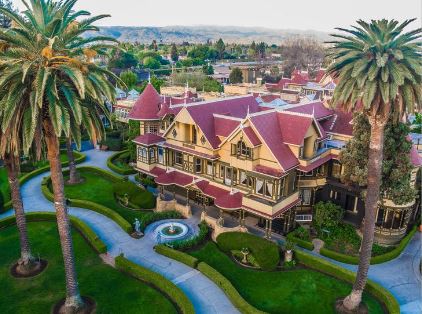
A tour of The Winchester Mystery House will confirm and dispel the various myths and rumors that have surrounded the mysterious Mansion since its opening. And now new history has been added as the attraction continues to evolve. https://winchestermysteryhouse.com/
 Randolph Harris II International Institute