
Home » news (Page 23)
Category Archives: news

The Time of the World Disappears Before Eternity

Revolutionary wealth is not just about money. Civilization is one of those big, stuffy words that may intrigue philosophers and historians but puts most people to sleep. Unless it is used in a sentence like “Our Civilization is threatened”—at which point large numbers of people prepare to defend themselves. Today many people do, in fact, believe that their civilization is threatened—and that the United States of America may be doing the threatening. And it is. However, not in the way most of us think. Around the World, critics of the United States of America point to its military and its economy as the main sources of its predominance. It is, however, knowledge in the broadcast sense and new technologies based on it that integrate America’s military and financial power and propel both forward. It is true that America’s technological lead is threatened. According to the National Science Board, foreign students earn nearly 50 percent of all U.S. doctorates in mathematics, computer sciences and engineering. And American youth are showing less and less interests in these fields. NASA officials complain that there are three times as many scientists over sixty as there are under thirty in the space agency. Shirley Ann Jackson, then president of the American Association for the Advancement of Science, has cautioned that “centers of technology-based activity, training, and entrepreneurialism are rapidly spreading throughout the globe. Thus even the status quo for the U.S. represents a declining share of the global marketplace for innovation and ideas.” Nevertheless, America still leads in most fields of digital technology, in microbiology and in science generally. It spends 44 percent of the World budget for research and development. By most criteria, the United States of America is still the undisputed leader in the performance of basic and applied research. In addition, many international comparisons put the United States of America as a leader in applying research and innovation to improve economic performance.

In the latest IMD International World Competitiveness Yearbook, the United States of America ranks first in economic competitiveness, followed by Hong Kong and Singapore. The survey compares economic performance, government efficiency, business efficiency, and infrastructure. Larger economies are further behind, with Zhejiang (China’s wealthiest province), Japan, the United Kingdom, and Germany ranked 20 though 23, respectively. An extensive review by the Organization for Economic Co-operation and Development (OECD) concludes that since World War II, US leadership in science and engineering has driven its dominant strategic position, economic advantage, and quality of life. And at least for now, the United States of America remains the Word’s scientific powerhouse. Perhaps even more important is the speed with which scientific and technical findings from everywhere are converted into marketable applications or products and widely dispersed into manufacturing, finance, agriculture, defense, biotech and other sectors. All of which boosts economic productivity, further accelerates change, and increasing the U.S. ability to compete at the global level. However, knowledge is not only a matter of bits and bytes or science and technology. Part of the knowledge economy is the production of art and entertainment, and America is the World’s biggest exporter of popular culture. That culture include fashion, music, TV programming, books, movies and computer games. Americans have always been told that their most important message to the World is one of democracy, individual freedom, tolerance, concern for “the rights of man” and—more recently—the rights of women. In the last three decades, however, a U.S. media spread into formerly closed or nonexistent foreign markets, a very different set of messages has been communicated. Much of it targeted at young people.

Certainly not all, but a considerable amount of this material has disgustingly glorified pimps, gangster, drug lords, drug pushers, and hollow-eyed drug users. It has celebrated extremes of violence marked by unending car chases, over-the-top special effects and songs dripping with sexist venom. The impact of all this has been further intensified in the hard-sell, over-the-edge advertising used to promote these products. Hollywood, for example, has painted a fantasy America in which adolescent hedonism reigns supreme and authority figures—police, teachers, politicians, business leaders—are routinely satirized. Film after film, and TV shows one after another, tell young viewers what many of them hunger to hear: that adults are bumbling fools; that being “dumb and dumber” is okay; that “we do not need education”; that to be “bad” is really good; and that pleasures of the flesh, in infinite variety, is or should be nonstop. In this fantasy World, women are readily available, but they can also leap over giant buildings in a single bound (like Superman), shoot and kill (like James Bond) and practice martial arts (Like Jet Li). Extremes, we are repeatedly told, are good and restraint is bad; and, by the way, America is so rich that event its secretaries, police, clerks, and other ordinary working people live in high-rise penthouse apartments or Malibu mansions—images that set adolescent glands tingling from Taipei to Timbuktu. What few foreign critics of American’s pop culture seem to know is that ironically enough, many of the ostensibly American firms producing and disseminating the interesting and unusual of these programs either are, or were financed not by America, but by European and Japanese capital. Nor is it widely understood that shows are often made by, say, a European director with an Australian stary, a Chinese martial-arts consultant, an anime cartoonist from Japan or other foreign contributors.

In the meantime, however, the influence of these intriguing programs is so powerful that other societies fear for the survival of their own culture. Only if art threatens action, then terrorism can be advanced through art. For such a phenomenon as Aesthetic Terrorism to occur, aesthetic pursuit must become symbolic not of its own decadently solipsistic pleasures (exemplified in madness of des Esseintes in Huysmans’ Against Nature), but of action taken beyond the pale of art World confines. Terrorism is art is called the avant-garde. However, if this was once the case, it is no longer. Most avant-garde art is viewed and created today as simply an enfolding reaction to its own history. This disingenuous game-playing guarantees that the avant-garde art is viewed and created today as simply an enfolding reaction to its own history. This disingenuous game-playing guarantees that the avant-garde can no longer stimulate or even provoke. Dada and Futurist actions, which attempted to lead art out of the classroom and museum and into the streets, are simply appropriated by postmodernist facsimiles which capture the letter but little of the original essence. It hardly matters anyway. Avant-garde art has evolved into nothing more than a cultural benchwarmer, corporate tax write-off and public relations smokescreen. Art which openly espouses anti-corporate ideology is embraced as long as it hews to arbitrary standards invented by those taste-making and fortune-telling hirelings, the art critics. What could be wrong, after all, with a business World that allows people to say what they want (because it does not matter)? Aesthetic Terrorism is a term more realistically applied to the faceless regime of consumer culture than the avant-garde. The onslaught of Muzak, ad jingles, billboards, top 40 tunes, commercials, corporate logos, etcetera, all fit the terrorist dynamic of intrusion and coercion.

One almost forgets that aesthetics once implied a consensual relationship between the creators and appreciators of art. How often is it that one hears someone admitting a fondness for a media product “in spite” of oneself? How many times have you heard a slogan or rancid tune ring in your ears like a brain-eating mantra? When consumer terror’s avant-garde correlative, Pop Art, became indistinguishable from the object of its supposed social satire, it erased from big business its pejorative taint. Many of today’s avant-garde stars have emerged from or entered the business World, some enormously successful in the arcane number-juggling or speculation and commodities scams. Even freeloading on the state and private foundations is fair game only for those whose bureaucratic aptitude is matched by their shameless butt-kissing. It is not surprising that most grant recipients excel in little more than lawyerristic logorrhea and ingrained artistic timidity. Critic-centered postmodernism spawned the phrase-art hybrid of Barbara Kruger and Jenny Holzer in which an advertising-style slogan is combined with an implied message or visual cue (usually swiped from some old magazine). Their posture is a hip cynicism which is supposed to subvert the “thrall” of the advertising command. Kruger and Holzer play the market like skillful double-agents, boosting themselves into the public eye through clever steals from Madison Avenue behaviorist techniques yet simultaneously troweling on crypto-Marxist jive to secure the perks of critical and academic currency. Their self-promotions worked when they were at the sidelines of the establishment. However, not the social commentary grows increasingly hollow. Currently being groomed for jet-setting prominence by Soho millionairess Mary Boone, Kruger’s contribution to the Whitney Biennial in 1987, for which she is paid a handsome sum, featured nothing more than a socialite princess joke, “I Shop Therefore I Am.” Winking at and wagging the tail of establishment hierarchy is part of that I-rib-you-gently-you-pay-me-off confidence game artists have been playing the Renaissance courts.

These contemporary court artists, like many of the past centuries, smugly pretend t spit in the eye of the exploiters while allowing themselves to be pampered de-loused—and when they are not looking—de-clawed. There are, of course, those artists, usually fresh out of university, who are unaccomplished at filling out grant forms, and therefore consider themselves “subversives.” The majority of these art and rock magazines-styled rebels are playing out rebellion psychodramas to package and merchandize to consumerist sycophants. This strategy is (forgive them term) the simulacra of terrorism: the content seizes in the frozen attitudinizing of pose and goes no further. We must look to the true outsiders and not the would-be insiders for an artist truly capable of effective counter-terror against the insidious mantras of consumerist brainwash. Terror means a threat, and the outsider’s version of Aesthetic Terrorism belongs to those performances or arrangements of words and pictures that unleash the reactionary impulses of police and bourgeois artist/critic alike. The kind of art that evokes this wrath, fear and condemnation rejoices in its pagan spirit of schadenfreude which controverts the humanist piety of “enlightened victim.” Anti-social sadism rarely receives patronage, however. Outside the corrupting realm of societal handouts, the Aesthetic Terrorist—much as this definition may grate on him—is the last bastion of aesthetic purity. Operation Sun Devil is the name for a government action against computer wizards and assorted sharpies and super-smarts who were resourceful enough to figure out how to hack into the electronic files of Ma Bell. Those who know, claim the Sun Devil gambit as a terrified overreaction against intelligence by the plodding and stupid bureaucracy.

John Perry Barlow (Whole Earth Review, Fall 1990) describes a typical Sun Devil action against a teenage hacker: [A] father in New York […] opened the door at 6.00 a.m. and found a shotgun at his nose. A dozen agents entered. While one of the kept the man’s wife in a choke-hold, the rest made ready to shoot and entered the bedroom for their sleeping 14-year-old. Before leaving, they confiscated every piece of electronic equipment, including all the telephones. Fourth Amendment guarantees against unreasonable search and seizure are unheeded by the government agents who claim nerd computer hackers are terrorists and have “the ability to access and review the files of hospital patients. Furthermore, they could have added, deleted, or altered vital patient information, possibly causing life-threatening situations.” Meacorporate interests have staked claim to the entirety of cyberspace, and they are not about to tolerate the presence of digital interlopers. This may scare off some, but other pirates like the mysterious Legion of Doom and NuPrometheus league (who illegally circulated highly protected Macintosh computer source code) will rise to the challenge now that they have been provided a clearly delineated enemy to innovation, the individual, and personal freedom. It may come as a surprise to learn that a few artists are now producing work which finds itself classified as a thought crime, punishable by expulsion into a Siberia of non-distribution, and in some cases by litigation and imprisonment. Pure magazine, from Chicago, a xeroxed vehicle which extols child torture, murder, and extreme misogyny, tweaked too many civic-minded noses, and its editor, Peter Sotos, was tailed for nine months and underwent a lengthy trial process in which he was finally convicted for possession of some very illegal magazine. Soto’s case was the first successfully prosecuted new Illinois state law, enacted under the influence of the Meese Commission Report on pornography, an example of First Amendment revisionism par excellence.

Soto’s case is particularly disquieting because it proves that prison is in the offing for simple possession of controversial material. No doubt this legal precedent was established to open the doors for future roundups of other thought criminals. The expertly managed Gulf War (massacre), in which networks censored war casualty footage that might provoke a “Vietnam War syndrome,” provides a small window into the dynamics of mass control to come. Any thoughtful individual is undeniably malnourished by the current information diet. Whether this is due to a direct conspiracy of State or by design of the oligarchic marketplace matters little. However, it has upped the ante for a new American Samizdat in which “disreputable,” “crazy,” “hateful,” or “dangerous” topics are broached by individuals or small, autonomous groups that are not compromised or swayed by institutional priorities. Can “offensive interests become the political crime of future? Apparently so. When looking at the previous sentences one can compare and see that musicians have been arrested for obscene lyrics, anarchist individuals have been collared for burning the flag; parents have been arrested for photographing their toddlers in their birthday suits; painter and performer Joe Coleman was arrested in Boston for operating an “infernal machine” and in New York for killing a rat: museum curators were threatened with arrest for hanging homoerotic photos; G.G. Allian was jailed for some consensual sadomasochism with a girlfriend; the FBI have been “monitoring” certain groups who practice unorthodox pleasures of the flesh; and on and on. Even many of the books you read have come under widely publicized attack by authors such as Carl A. Raschke who advocated the revocation of First Amendment rights from those who spread “cultural terrorism.” Even globalization could be considered cultural terrorism.

It has become increasingly obvious that the aesthetic terrorist hobgoblins are nothing more than symbolic scapegoats to divert attention away from the real issues. For Americans, fear is not another form of awareness, it is just another form of gossip. As Charles Manson has stated, true subversive terror can only be actualized by turning off the TV sets. Until then, aesthetic terrorism will be orchestrated by those already in command against insubstantial or non-existent villains. And in the future, while the dumb show of bohemianism plays itself out in the cookie cutter shape of the politically correct martyr/victim, aesthetic terrorism will be orchestrated by those already in command against insubstantial or non-existent villains. And in the future, while the dumb show of bohemianism plays itself out in the cookie cutter shape of the politically correct martyr/victim, aesthetic terrorists will not involve themselves in the dubious rewards of celebrity. The best of them will work alone, already a part of the enemy camp, and in a chameleon-like stye master the fifth-column algorithms to subvert the ancient regime. We will not know them by name but their compensation will be to affect the outcome of the planet. Until then, there is a lot of work to be done. Under what conditions will cooperation emerge in a World of egoists without central authority? This question has intrigued people for a long time. And for good reason. We all know that people are not angels, and that they tend to look after themselves and their own first. Yet we also know that cooperation does occur and that our civilization is based upon it. However, in situations where each individual has an incentive to be selfish, how can cooperation ever develop? The answer each of us gives to this question has a fundamental effect on how we think and act in our social, political, and economic relations with others. And the answers that others give have a great effect on how ready they will be to cooperate with us.

The most famous answer was given over three hundred years ago by Thomas Hobbes. It was pessimistic. He argued that before governments existed, the state of nature was dominated by the problem of selfish individuals who competed on such ruthless terms that life was “solitary, poor, nasty, brutish, and short” (Hobbes 1651/1962, p. 100). In his view, cooperation could not develop without a central authority, and consequently a strong government was necessary. Ever since, arguments about the proper scope of government have often focused on whether one could, or could not, expect cooperation to emerge in a particular domain if there were not an authority to police situation. Today nations interact without central authority. Therefore the requirements for the emergence of cooperation have relevance to many of the central issues of international politics. The most important problem is the security dilemma: nations often seek their own security through means which challenge the security of others. This problem arises in such areas as escalation of local conflicts and arms races. Related problems occur in international relations in the form of competition with alliances, tariff negotiations, and communal conflict places like Cyprus. The Russian invasion of Ukraine in 2022 has presented the United States of American with a typical dilemma of choice. If the United States of American continued business as usual, Russian might be encouraged to try other forms of noncooperative behavior later one. On the other hand, any substantial lessening of United States of America’s cooperation risks some form of retaliation, which could then set off counter-retaliation, setting up a pattern of mutual hostility that could be difficult to end. Much of the domestic debate about international policy is concerned with problems of just this type. And properly so, since these are hard choices.

In everyday life, if they never invite us over in return, we may ask ourselves how many times we will invite acquaintances for dinner. An executive in an organization does favors for another executive in order to get favors in exchange. A journalist who has received a leaked news story gives favorable coverage to the source in the hope that further leaks will be forthcoming. A business firm in an industry with only one other major company charges high prices with expectation that the other firm will also maintain high prices—to their mutual advantage and at the expense of the consumer. For me, a typical case of the emergence of cooperation is the development of patterns of behavior in a legislative body of the United States Senate. Each senator has an incentive to appear effective to his or her constituents, even at the expense of conflicting with other senators who are trying to appear effective to their constituents. However, this is hardly a situation of completely opposing interests, a zero-sum game. On the contrary, there are many opportunities for mutually rewarding activities by two senators. These mutually rewarding actions have led to the creation of an elaborate set of norms, or folkways, in the Senate. Among the most important of these is the norm of reciprocity—a folkway which involves helping out a colleague and getting repaid in kind. It includes vote trading but extends to so many types of mutually rewarding behavior that “it is not an exaggeration to say that reciprocity is a way of life in the Senate” (Matthews 1960, p. 100; see also Mayhew 1975). Washington was not always like this. Early observers saw the members of the Washington community as quite unscrupulous, unreliable, and characterized by “falsehood, deceit, treachery” (Smith 1906, p. 190). In the 1980s the practice of reciprocity is well established. Even the significant changes in the Senate over the last two decades, tending toward more decentralization, more openness, and more equal distribution of power, have come without abating the folkway of reciprocity.

As will be seen, it is not necessary to assume that senators are more honest, more generous, or more public-spirited than in earlier years to explain how cooperation based on reciprocity has emerged or proved stable. The emergence of cooperation can be explained as a consequence of individual senators pursuing their own interest. We are investigating how individual pursuing their own interests will act, followed by an analysis of what effects this will have for the system as a whole. Put another way, the approach is to make some assumptions about individual motives and then deduce consequences for the behavior of the entire system. The case of the U.S. Senate is a good example, but the same style of reasoning can be applied to other settings. The object of this enterprise is to develop a theory of cooperation that can be used to discover what is necessary for cooperation to emerge. By understanding the conditions that allow it to emerge, appropriate actions can be taken to foster the development of cooperation in a specific setting. The Cooperation Theory that is presented here is based upon an investigation of individuals who pursue their own self-interest without the assistance of a central authority to force them to cooperate with each other. The reason for assuming self-interest is that it allows an examination of the difficult case in which cooperation is not completely based upon a concern for other or upon the welfare of the group as a whole. It must, however, be stressed that this assumption is actually much less restrictive than it appears. If a sister is concerned for the welfare of her brother, the sister’s self-interest can be thought of as including (among many other things) this concern for the welfare of her brother. However, this does not necessarily eliminate all potential for conflict between sister and brother.

Likewise a nation may act in part out of regard for the interests of its friends, but this regard does not mean that even friendly countries are always able to cooperate for their mutual benefit. So the assumption of self-interest is really just an assumption that concern for others does not completely solve the problem of when to cooperate with them and when not to. A good example of the fundamental problem of cooperation is the case where two industrial nations have erected trade barriers to each other’s exports. If barriers were eliminated, because of the mutual advantages of free trade, both countries would be better off. However, if either country were to unilaterally eliminate its barriers, it would find itself facing terms of trade that hurt its own economy. In fact, whatever one country does, the other country is better off retaining its own trade barriers. Therefore, the problem is that each country has an incentive to retain trade barriers, leading to a worse outcome than would have been possible had both countries cooperated with each other. This basic problem occurs when the pursuit of self-interest by each leads to a poor outcome for all. To make headway in understanding the vast array of specific situations which have this property, a way is needed to represent what is common to these situations without becoming bogged down in the details unique to each. Fortunately, there is such a representation available: the famous Prisoner’s Dilemma game. In the Prisoner’s Dilemma game, there are two players. Each has two choices, namely cooperate of defect. Each must make the choice without knowing what the other will do. No matter what the other does, defection yield a higher payoff than cooperation. If both defect, the dilemma is that both do worse than if both had cooperated. Cases typically result in one of four possible outcomes in the matrix. If both players cooperate, both do fairly well. Both get a reward for mutual cooperation.

However, if one player cooperates but the other defects, the defecting play get the temptation to defect, while the cooperating players gets the sucker’s payoff. If both defect, both get the punishment for mutual defection. What would you do in such a situation? That is basically the gamble of the Prisoner’s Dilemma. The Prisoner’s Dilemma is simply an abstract formulation of some very common and very interesting situations in which what is best for each person individually leads to mutual defection, whereas everyone would have been better off with mutual cooperation. The definition of Prisoner’s Dilemma requires that several relationships hold among the four different potential outcomes. The second part of the definition of the Prisoner’s Dilemma is that the players cannot get out of their dilemma by taking turns exploiting each other. This assumption means that an even chance of exploitation and being exploited is not as good an outcome for a player as mutual cooperation. It is therefore assumed that the reward for mutual cooperation is greater than the average temptation and the sucker’s payoff. This assumption, together with the rank ordering of the four payoffs, defines the Prisoner’s Dilemma. We have come back to the point where we began, where values take the place of good and evil. However, now we have made at least a hasty tour of the intellectual experiences connected with modern politics that made such a response compelling. How it looked to thoughtful Germans is most revealingly expressed in a famous passage by Max Weber, about God science and the irrational: Finally, although a naïve optimism may have celebrated science—that is, the technique of the mastery of life founded on science—as the path which would lead to happiness, I believe I can leave this entire question aside in light of the annihilating critique which Nietzsche has made of “the last men” who “have discovered happiness.” Who, then, still believes in this with the exception of a few big babies in university chairs or in editorial offices?

So penetrating and well informed an observer as Weber could say in 1919 that the scientific spirit at the heart of Western democracy was dead for all serious men and that Nietzsche had killed it, or had at least given it the coup de grace. The presentation of “the last man” in Thus Spake Zarathusta was so decisive that the old-style Enlightenment rationalism need not even be discussed anymore; and, Weber implies, all future discussion or study must proceed with the certainty that the perspective was a “naïve” failure. Reason cannot establish values, and its belief that it can is the stupidest and most pernicious illusion. This means, simply, that almost all Americans at that time, thinking American in particular, were “big babies” and remained so, long after the Continent had grown up. One need only think of John Dewey to recognize that he fits Weber’s description to a T, and then remember what his influence here once was. And not only Dewey, but everyone from the beginning of our regime, especially those who said, “We hold these truths to be self-evident,” shared the rationalist dream. Weber’s statement is so important because he made as much as more than anyone brought us into contact with the most advanced Continental criticisms of liberal democracy, and was the intermediary between Nietzsche and us Americans who were the most recalcitrant to one’s insight, perhaps because according to it we represent the worst or most hopeless and are therefore loath to see ourselves in that mirror. A very dark view of the future has been superimposed on our incorrigible optimism. We are children playing with adult toys. They have proved too much for us to handle. However, in our defense, we are probably not the only ones for whom they are too much. Perhaps you have caught yourself kissing another person as you first saw kissing in the movies or on television. My children have a phrase to describe this: “television kiss.”

It is fortunate for them that they have noted that there are television kisses and other kinds, because it will help protect them from absorbing it, taking it into themselves where it will come back out ten years, like a replay. Most of us did not make that distinction as we sat in darkened rooms or theaters as children. Since we did not see all that much real kissing, the media kiss became our image of kissing. We found ourselves producing that model of kiss later in life. I was fourteen-year-old when I tried to kiss for the first time. I imitated Brad Pitt’s kiss, but I did not feel it. Only later did I realize that perhaps Brad Pitt did not feel it either; he was merely kissing the way the director said he should. So there I was imitating a kiss that was never real in the first place, worried that there might be something wrong with me for lacking the appropriate feeling and failing to obtain the appropriate response. The journalist Jane Margold was driving home one night in Berkeley with her brother, Harlan. Suddenly a man crawled into the street right in front of them. They screeched to a stop and then, stunned, just sat there for a moment. They finally got out and cautiously went up to the man to find out that he had been stabbed several times in his upper body, was bleeding profusely and was in danger of dying right there. The man’s assailant was nowhere to be seen. In describing the event to me, Jane said that she instantly flipped into a media version of herself. She had never faced anything like it before and had no direct feelings. Instead, playing through her mind were images of similar events she had seen on television or in films. The media superseded her own responses, even to the point of removing her from the event. She was there, but sue did not experience herself as being there. She was seeing the event, but between her and it, floating in her mind, was an image of an implanted reality which would not get out of the way. Jane thought such thoughts as: “This is real; there is a wounded man lying here in from of me, bleeding to death, yet I have no feeling. It seems like a movie.”

In fact, it was they very movielike quality that eventually got her into action. Without feeling, she performed mechanical acts. She and her brother comforted the man, directed traffic, dispatched people to summon the police and an ambulance. She became extremely efficient, but throughout, she had the sense of performing a script. Apart from their economic implications, technologies create the ways in which people perceive reality, and such ways are the key to understanding diverse forms of social and mental life. As individual express their life, so they are. There are three stages in the development of technology: the age of technology of chance, the age of technology of the artisan, the age of technology of the technician. Cultures may be classified into three types: tool-using cultures, technocracies, and technopolies. At the present time, each type may be found somewhere on the planet, although the first is rapidly disappearing: we must travel to exotic places to find a tool-using culture. If we do, it is well to go armed with the knowledge that, until the seventeenth century, all cultures were tool-users. There was, of course, considerable variation from one culture to another in the tools that were available. Some had only spears and cooking utensils. Some had water mills and coal- and horsepower. However, the main characteristic of all tool-using cultures is that their tools were largely invented to do two things: to solve specific and urgent problems of physical life, such as in the use of waterpower, windmills, and the heavy-wheeled plow; or to serve the symbolic World of art, politics, myth, ritual, and religion, as in the construction of castles and cathedrals and the development of the mechanical clock. In either case, tools did not attack (or, more precisely, were not intended to attack) the dignity and integrity of the culture into which they were introduced.

With some exceptions, tools did not prevent people from believing in their traditions, in their God, in their politics, in their methods of education, or in the legitimacy of their social organization. These beliefs, in fact, directed the invention of tools and limited the uses to which they were put. Even in the case of military technology, spiritual ideas and social customs acted as controlling forces. It is well known, for example, that the uses of the sword by samurai warriors were meticulously governed by a set of ideals known as Bushido, or the Way of the warrior. The rules and rituals specificizing when, where, and how the warrior must use either his two swords (the katana, or long sword, and the wakizashi, or short sword) were precise, tied closely to the concept of honor, and included the requirement that the warrior commit seppuku or hara-kiri should his honor be compromised. This sort of governance of military technology was not unknow in the Western World. The use of the lethal crossbow was prohibited, under threat of anathema, by Pope Innocent II in the early twelfth century. The weapon was judged to be “hateful to God” and therefore could not be used against Christians. That it could be used against Muslims and other infidels does not invalidate the point that in a tool-using culture technology is not seen as autonomous, and is subject to the jurisdiction of some binding social or religious system. This is why power, which to a large extent defines us as individuals and as nations, is itself being redefined. A clue to this redefinition emerges when we look more closely at some of the unrelated changes. For we discover that they are not as random as they seem. Whether it is Japan’s meteoric rise, GM’s impressive rebound, or the American doctor’s fall from grace, a single common thread unites them.

Take the punctured power of the god-in-a-white coat. Throughout the heyday of doctor-dominance in America, physicians kept a tight choke-hold on medical knowledge. Prescriptions were written in Latin, providing the profession with a semi-secret code, as it were, which kept most patients in ignorance. Medical journals and texts were restricted to professional readers. Medical conferences were closed to the laity. Doctors controlled medical-school curricula and enrollments. Contrast this with the situation today, when patients have astonishing access to medical knowledge. With a personal computer and a WiFi, anyone from home can access data bases like Index Medicus, and obtain scientific papers on everything from Addison’s disease to zygomycosis, and, in fact, collect more information about a specific aliment or treatment than the ordinary doctor has time to read. Copies of the 2,354-page book knows as the PDR or Physicians’ Desk Reference are also readily available to anyone. Once a week on the Lifetime cable network, any televiewer can watch twelve uninterrupted hours of highly technical television programming designed specifically to educate doctors. Many of these programs carry a disclaimer to the effect that “some of this material may not be suited toa general audience.” However, that is for the viewer to decide. The rest of the week, hardly a single newscast is aired in America without a medical story or segment. A video version of the material from the Journal of the American Medical Association is now broadcast by three hundred stations on Thursday nights. The press reports on medical malpractice cases. Inexpensive paperbacks tell ordinary readers what drug side effect to watch for, what drugs not to mix, how to raise or lower cholesterol levels through diet. In addition, major medical breakthroughs, even if television news almost before the M.S. has even taken his subscription copy of journal out of the in-box. In short, the knowledge monopoly of the medical profession has been thoroughly smashed. And the doctor is no longer a god.

This case of the dethroned doctor is, however, only one small example of a more general process changing the entire relationship of knowledge to power in the high-tech nations. In many other fields, too, closely held specialists’ knowledge is slipping out of control and reaching ordinary citizens. Similarly, inside major corporations, employees are winning access to knowledge once monopolized by management. And as knowledge is redistributed, so, too, is the power based on it. A human is a “beast” and purifies one’s heart, and behold, God holds one by the hand. That is not a kind of humans. Purity of heart is a state of being. A man is not pure in kind, but one is able to be or become pure, rather one is only essentially pure when one has become pure, and even than one does not thereby belong to a kind of humans. The “wicked,” that is, the bad, are not contrasted with good humans. The good is to draw near Hod. One does not say that those near to God are good. However, one does call the bas those who are far from God. In the language of modern thought that means that there are humans who have no share in existence, but there are no humans who possess existence. Existence cannot be possessed, but only shared in. One does not rest in the lap of existence, but one draws near to it. Nearness is nothing but such a drawing and coming near continually and as long as the human person lives. The dynamic of fairness and nearness is broken by death when it breaks the life of the person. With death there vanished the heart, that inwardness of humanity, out of which arises the pictures of the imagination, and which rises up in defiance, but which can also be purified. Separate souls vanish, separation vanished. Time which has been lived by the soul vanished with the soul, we know of no duration in time. Only the rock in which the heart is concealed, only the rock of human hearts does not vanish. For it does not stand in time. The time of the World disappears before eternity, but existing humans die into eternity as into the perfect existence.

CRESLEIGH MEADOWS AT PLUMAS RANCH
Plumas Lake, CA |
Now Selling!

Cresleigh Meadows is now selling! Found just north of Feather River Boulevard, Cresleigh Meadows is home of the largest neighborhood in Plumas Ranch as well as the popular Bear River Park. With four floor plans available, ranging from approximately 2,000 – 3,500 square feet offering, three to five bedrooms, we are certain you will find the home that fits your needs and lifestyle.

Popular design elements include open floor plans, large kitchen islands, and flex spaces are staples in Cresleigh homes. Multi-generational living options also available in select homes.

Homeowners will love the convenient commuter access to nearby Sacramento and Yuba City.

Best of all, each Cresleigh home comes fully equipped with an All Ready connected home! This smart home package comes included with your home and features great tools including: video door bell and digital deadbolt for the front door, connect home hub so you can set scenes and routines to make life just a little easier. Two smart switches and USB outlets are also included, plus we’ll gift you a Google Home Hub and Go. https://cresleigh.com/cresleigh-meadows-at-plumas-ranch/


The Crucial Core of the True Love Waits Philosophy

People have become so machinelike that that the most human character will turn out to be a machine. As busy prosumers now sometimes volunteer their machines, instead of their labor, they are uncooking the books. The best-know case is that of SETI, the search for Extraterrestrial Intelligence. While the likelihood of our discovering life elsewhere, let along “intelligent” life, may be minute, the scientific, philosophical and cultural implications of such a finding can hardly be overestimated. So volunteers have stepped forward to help. The search required the collection of huge quantities of radio telescope data. However, analyzing it required far more supercomputer power than any individual machine at that time could provide. That led two Seattle computer scientists, Craig Kasnoff and David Gedye, to ask whether, if they could not gain access to supercomputers, they could create a virtual supercomputer to do the job. If they could get PC users linked via the Internet to allow free access to their computers and permit the SETI searchers to use the machines when these were otherwise idle, they could build one, they believed. Optimistically, Kasnoff and Gedye hoped they might link up a few hundred thousand machines. By spring of 2002, more than 3.5 million PC owners had contributed more than a million years of processing time to the SETI venture. The result is a project headquartered at the University of California/Berkeley, which sends out six hundred thousand packets of data daily for processing on these privately owned computers. According to the Planetary Society, “The sheer power of millions of computers Worldwide has made SETI@home the most sensitive deep-sky survey ever done.” The SETI model has since been replicated elsewhere. Oxford University scientists and others have turned to Internet users around the World for help in researching smallpox, cancer, other deadly viruses, climate change and other significant problems.

When envelopes bearing anthrax turned up on Capital Hill in Washington and other sites after the 9/11 terror attacks, they touched off a national panic. In rapid response, three companies—Microsoft, Intel, and United Devices—plus Oxford University and National Foundation for Cancer Research, launched a joint project to search for molecules that could block the deadly action of anthrax. In twenty-four days they screened 3.5 billion different compounds. That helped scientists eliminate as irrelevant all but 300,000 compounds, among which they identified 12,000 priority targets. The project also uncovered a number of potentially useful compounds that conventional methods would have, in all likelihood, overlooked. Even with the backing of such giants as Microsoft and Intel, this breakthrough would have been impossible without the contribution of prosumer/volunteers. The anthrax research partly piggybacked on the machines already recruited for cancer research and added some more. In all, more than 1.35 million people, from Mexico and China to Equatorial Guinea and Azerbaijan, participated. In the United States of America more than 100,000 machines were volunteered; in Germany, 14,000; in France, 4,400; and in South Korea, 1,593. There were even four in Afghanistan—which, considering the hunt for Al Qaeda’s bioweapons, presumably raised some eyebrows. The computer innovations exploited by SETI, anthrax and cancer researchers have since exploded into what has come to be called grid or distributed computing. Imitating the prosumer projects, hundreds of big companies have created their own internal grids to take advantage of the unused capacity of their own networked machines.

What we see here is yet another form of free lunch delivered to the money economy by a prosumer project—in this case early testing of a powerful innovation—that has turned into a multibillion-dollar market in the money economy. Again we see that the wall separating the commercial World from the prosumer World is nonexistent. We see evidence, too, that business and government decision-makers need to understand and take far smarter advantage of the free-lunch phenomenon. Underscoring that statement is the likelihood that prosuming, already far larger than most suspect, is about to become bigger than ever, propelled by mutually reinforcing changes in social, cultural and demographic factors that, it turn, will promote an explosion of new prosumer technologies. Thus, along with a “graying” of the population in the United State of America has come a different kind of retiree. Like so many other boundaries, the line between work and retirement is also blurring, with many more senior citizens falling into a semi-retired category and using unpaid time to volunteer and engage in other prosumer activities. According to AAPR, the organization of Americans over fifty, this age group forms the backbone of volunteerism in the United States of America. It forecasts that volunteering will increase as populations live longer and healthier and refuse to live in idleness. The same pattern is evident in Japan. Similarly, the continuing acceleration of change points to relatively high levels of frictional unemployment—temporary joblessness as people change jobs, switch careers or move to new locations. Today “frictional volunteers” working free for nonprofit organizations include people with a wide range of specialized skills—lawyers, accountants, marketing experts, Web designers and the like.

Beyond all this, the Internet will bring into being temporary groupings of all kinds for as-yet-unheard-of prosumer activities—and with them, very often, temporary new markets—including markets for new technologies. These technologies, in turn, will further diversify and empower prosumers. This self-feeding process has just begun. As it gains force, it will compel us to recognize the hidden half of the emerging revolutionary wealth system—and the serious risks and fantastic opportunities that come with it. If you are still in doubt, listen next to the sound of music. The very expression dignity of man, even when Pico della Mirandola coined it in the fifteenth century, had a blasphemous ring to it. Man as man had not been understood to be particularly dignified. God had dignity, and whatever dignity man had was because he was made in God’s image (as well as from dust) or because he was the rational animal whose reason could grasp the whole of nature and hence was akin to that whole. However, now the dignity of man has neither of those supports; and the phrase means that man is the highest of the beings, an assertion emphatically denied by both Aristotle and the Bible. Man is elevated and alone. If this is to be plausible, man must be free—not in the sense of ancient philosophy, according to which a free man is one who participates in a regime where he rules as well as is ruled; nor in the sense of Hobbes and Locke, according to whom a free man is one who can follow his reason without having to obey God or man—but free in a much grander sense, that of legislating to oneself and to nature, hence without guidance from nature. The complement to and explanation of this view of freedom is creativity. We have become so accustomed to this word that it has no more effect on us than the most banal Fourth of July oratory.

As a matter of fact, it has become our Fourth of July oratory. However, when it was first used for humans, it had the odor of blasphemy and paradox. God alone had been called a creator; and this was the miracle of miracles, beyond causality, a denial of the premise of all reason, ex nihilo nihil fit. What defines man is no longer his reason, which is but a tool for his preservation, but his art, for in art man can be said to be creative. There he brings order to chaos. The greatest men are not the knowers but the artists, the Homers, Dantes, Raphaels, and Beethovens. Art is not imitation of nature but liberation from nature. A man who can generate visions of a cosmos and ideals by which to live is a genius, a mysterious, demonic being. Such a man’s greatest work of art is himself. He who can take his person, a chaos of impressions and desires, a thing whose very results from the free activity of his spirit and his will. He contains in himself the elements of the legislator and the prophet, and has a deeper grasp of the true character of things than the contemplatives, philosophers, and scientists, who take the given order as permanent and fail to understand man. Such is the restoration of the ancient greatness of man against scientific egalitarianism, but how different he now looks! All this new language is a measure of the difference; and reflection on how the Greeks would translate and articulate the phenomena it describes is the task of a lifetime, which would pay rich rewards in self-understanding. The vocabulary of self, culture, and creativity pretty much sums up the effects of what Rousseau began. It expresses the dissatisfactions with the scientific and political solutions of the Enlightenment. It turns around the understanding of what nature is. Somehow nature was always that by which men oriented themselves.

However, no influential thinker has tried to return to the pre-Enlightenment understanding of nature, the so-called teleological view, in which nature is the fullness in its own kind that each of the beings strives to attain. The reaction to nature viewed as matter in motion, which can be conquered for the sake of man’s needs, was twofold: a return to the nation that nature is good, but only the brute nature of the fields, forests, mountains and streams in which beast live contentedly; or a transcendence of nature altogether in the direction of creativity. The latter solution conquered the Continent, and came from Germany to England by way of men like Coleridge and Carlyle. Very from Germany to England by way of men like Coleridge and Carlyle. Very few thinkers were consistent or took seriously the full meaning of this revolution in thought. Hegel is the greatest exception. However, everyone was affected by it, and its influence ran across the entire political spectrum, from Right to Left. Marxism as well as conservatism as we know them are unthinkable without what Rousseau did. A small but illuminating example of the pervasiveness of ant-Enlightenment thought today is how scientists themselves have taken to styling themselves as “creative.” However, nothing could be more contrary to the spirit of science than the opinion that the scientist fabricates rather than discovers his results. If there is anything to it, scientists are to a man against creationism, recognizing rightly that their science is wrong and useless. However, they fail to see that creativity has exactly the same consequence. Either nature has a lawful order or it does not; either there can be miracles or there cannot. Scientists do not prove that there are no miracles, they assume it; without this assumption there is no science.

It is easy to deny God’s creativity as a thing of the benighted past, overcome b science, but man’s creativity, a thing much more improbable and nothing but an imitation of God’s, exercises a strange attraction. In honoring it, the scientists’ opinions are not the result of science or of any serious reflection on science. They are merely conforming to democratic public opinion, which has, unawares, been captured by Romantic notions adapted to flatter it (every man a creator). The artist, not the scientist, has become the admired human type; and science senses that it must assimilate itself to that type in order to retain its respectability intact. When every man was understood to be essentially a reasoner, the scientists could be understood to be a perfection of what all men wanted to be. That was Enlightenment’s way of establishing the centrality of science and making it admired. This change in self-description shows how the Zeitgeist has altered and how science, instead of standing outside of it and liberating men from it, has been incorporated into it. The theoretical life has lost its status. Now the scientist scrambles to recover his position as the perfect of what all men want to be; but what all men want to be has changed, undermining the natural harmony between science and society. Some may consider this labeling trivial, akin to C.P. Snow’s calling a science a “culture.” Science may appear creative only because we forget what creativity really mean and take it to be cleverness at proposing hypotheses, finding proofs or inventing experiments. From this perspective, science is unaffected, and we have just another example of the pollution of language. However, this form of pollution, although less feared than the other kind, is really more deadly. It is the intellectual disorder of our age.

The use of insignificant speech entails loss of clarity about what science and art are, weakening both in an impossible synthesis of opposites appealing to a society that wants to be told that it enjoys all good things. If not detailed in the process, there is here a sinister loss of confidence in the idea of science, the idea which was found at the foundation of democratic society and the absolute in a relativized World. These scientists know not what they do. Philosophy, despised and rejected by positive science, has its revenge when it is vulgarized into coarse public opinion and intimidates that science. So the effects of Rousseau and his followers are everywhere around us, in the bloodstream of public opinion. Of course the use of words like “creativity” and “personality” does not mean that those who use them understand the thought that made their use necessary, let alone agree with it. The language has been trivialized. Words that were meant to describe and encourage Beethoven and Goethe are not applied to every school-child. It is in the nature of democracy to deny no one access to good things. If those things are really not accessible to all, then the tendency is to deny the fact—simply to proclaim, for example, that what is not art is art. There is in American society a mad rush to distinguish oneself, and, as soon as something has been accepted as distinguishing, to package it in such a way that everyone can fee included. Creativity and personality were intended to be terms of distinction. They were, as a matter of fact, intended to be the distinctions appropriate to egalitarian society, in which all distinction is threatened. The levelling of these distinctions through familiarity merely encourages self-satisfaction. Now that they belong to everyone, they can be said to mean nothing, both in common parlance and in the social science disciplines that use them as “concepts.” They have no specific content, are a kind of opiate of the masses. They do, however, provide a focus for all the dissatisfactions that any life anywhere and at any time provides, particularly those fostered in a democratic society.

Creativity and personality take the place of older words like virtue, industry, rationality and character, affect our judgments provide us with educational goals. They are the bourgeois’ way of not being unadventurous. Hence they are sources of snobbishness and pretentiousness alien to our real virtues. We have a lot of good engineers but very few good artists. All the honor, however, goes to the latter, or rather, one should say, those who stand in for the latter in the eyes of the many. The real artists do not need this kind of support and are instead weakened by it. The moneymaker is not the most appetizing personality, but he is far preferable to the intellectual phony. Thus what was intended as an elevation of taste and morality has merely become grist for our mill while sapping the mill’s foundation. This was not the only rest in Europe, where creativity had at times an inspiring effect and where the notion had more to feed off of. Even there, as we shall soon see, the balance sheet is arguably negative. However, here I can see no benefits. And now the mother-word itself—culture—has also become part of empty talk, its original imprecision now carried to the point of pathology. Anthropologists cannot define it although they are sure there is such a thing. Artists have no vision of the sublime, but they know culture (id est, what they do) has a right to the honor and support of civil society. Sociologists and the disseminator of their views, the journalists of all descriptions, call everything a culture—the drug culture, the rock culture, the street-gang culture, and so on endlessly and without discrimination. Failure of culture is now culture. This is how the heroic response to the French Revolution fared when it immigrated to America. Our country is still a melting pot. The crucial core of the True Love Waits philosophy is contained in this pledge that hundreds of thousands of young women and men have signed: “Believing that true love waits, I make a commitment to God, myself, my family, my friends, my future mate and my future children to be sexually abstinent from this day, until the day I enter a Biblical marriage relationship.

True Love Waits is clear and uncompromising in asserting its values and assumptions about humankind. True love exists as a God-given emotional dynamic. It is an identifiable phenomenon that blesses only heterosexual couples—love intragender is neither true nor sacred. When true love strikes, the man and woman so blessed should respond by making their union permanent, legal, and honorable in a ceremony that is biblically inspired. Afterward, in the final sublime sequence, comes consummation of pleasures of the flesh. True Love Waits (to be wed in holy matrimony before going all the way) was founded in April 1993 in the U.S. Bible Belt city of Nashville, Tennessee, after youth minister Richard Ross was galvanized by fourteen-year-olds who confided to him, We’re the only virgins left in our school.” They may have been, and their plight was replicated in promiscuous educational intuitions all over the Western World. True Love Waits, with its deceptively simple message cunningly touted, soon attracted hundreds of thousands of pledged Waiters. A movement had been born. Celibacy is at the Heart of True Love Waits, a beneficial, confident, reassuring celibacy. It validates and shores up those young your who remain chaste, but also embraces legions of remorseful nonvirgins it designates “secondary virgins.” Students who have failed sexually can be invited to seek God’s forgiveness and make a True Love Waits pledge ‘from this day forward.’” Ergo, instant redemption, and though even True Love Waits cannot repair broken hymens, it does comfort the contrite and pardon the penitent. Amid the barrage of messages blasted forth by our ubiquitous media, the pronouncements of True Love Waits sound calm and clear in the cacophony. God does not condone premarital pleasures of the flesh. Virginity is a “gift you can only give once.” “Put the focus where God does: on the heart.” “Be willing to wait creatively.” It is not wise for Christians to date non-Christians.

God wants you to be in charge of your life. He will bring you the right partner at the right time. Certain attractions are considered not immoral, but sexualizing them may cross the biblical barrier and could be considered sinful. Walk closer to God. The idea of pleasures of the flesh is derived from, based upon, the pair of opposites—masculine, feminine. Like all other ideas it has to be transcended; like all other pairs of opposites, it has to be brought into equilibrium. In the wild, ungoverned, unhealthy, and irresponsible atmosphere of pleasures of the flesh which covers the younger generation’s World today, we may find some explanation why it was regarded with suspicion, or opposed altogether, not so long ago. They turn away from the passionate desires of the flesh; they seek an existence devoid of its animality. However, lacking esoteric knowledge, without understanding how spirit and body are interwoven, too often they suffer defeat. So far as psychoanalysis confirms the demands of pleasures of the flesh craving without putting upon it the basic disciplines which health, character, and self-respect require, so far does it cease to be a therapy, and become an injury. The enchantment and glamour in which lovers find themselves are too often false and deceptive, mere preliminary devices used by Nature to get them together and thus fulfil her larger purposes. The ancient Greek or Roman thinker who likened their condition to a form of madness was not so far wrong as he seems. However, often also it is subject to change; the glamour goes or is transferred elsewhere or, worse, is transformed into repulsion. And where pleasures of the flesh is not the hidden operative factor, one of the two is a victim of—or possessed by—some other force: ambition, economic need, vanity, the power complex.

Pleasures of the flesh polarity provides the force brining the bodies of men and women into intermittent attractive relation, but mental polarity provides a more lasting one. The strict discipline to which desires for pleasures of the flesh was subject in the earlier stages is abandoned in the later ones, for all lusts and wraths fall away of their own accord as one’s own growth, with the touch of grace, sets one free. As the energy of pleasures of the flesh is transmuted by will and mentally distributed throughout every part of the body, it bestows physical strength and resistance to disease. Where fate forces the practice of complete abstinence it should be accepted philosophically and its compensatory benefits recognized. Lust rises like a fever, rages along its course, and then subsides. However, between start and finish much of a lifetime may pass away. When adolescent boys and girls are able to rush from one pleasure to another, from one emotional entanglement to another, without a thought of the consequences involved or of other persons concerned, except what contribution they can make to selfish enjoyment, when all this is done in the name of modern self-expression, then a state of moral danger can be said to exist. A philosophical way of controlling the animal passion in humans it that if we think often of the inevitability of our own death, if we will remember that the upshot of all our activities is the funeral-pyre, the burial grave, we will begin to realize how pitiful, how untimely worthless, and how immediately transient are our all our passions. How will the animal passions appeal to the man lying on his deathbed? The thought of death even to those who are still very much alive will thus diminish the strength of lust, greed, hate, and anger. The force which humans spend in ungoverned desires for pleasures of the flesh keeps them imprisoned in their lower nature. This same force can be sublimated by will, imagination, aspiration, prayer, and meditation. When this is gone, the Overself can then instruct them for they will be able to hear its voice.

True Love Waits is assisted by aggressive and savvy marketing. It offers typical teen paraphernalia: T-shirts, sweatshirts, jackets, scarves, baseball caps, wall banners and posters, pendants, pins, ring, necklaces, as well as Bibles, manuals, and general literature. Its slogans—“Stop your urgin’, be a virgin,” “Pet your dog, not your girlfriend,” and for reborn virgins, the wistful “I miss my virginity”—rival in targeted triteness those of any other megasuccessful ad campaign. True Love Waits promotes Christian music (The Newsboys, DeGarmo & Key Steven Curtis Chapman, Geoff Moore and the Distance, DC Talk, Audio Adrenaline) and dances—no Waiter need forgo typical teen recreations. In fact, this music and these dances—free of drugs and pleasures of the flesh—encourage energetic young people to socialize with each other and sublimate their energies for pleasures of the flesh in recognizably typical ways, with no sense of deprivation. However, because of the movement’s focus on sexual abstinence and the moral courage it inspires in believers, they have little difficulty in abiding by their vows. True Love Waits also demands active proselytizing from it converts and orchestrates these drives with sophisticated and practical, detailed instructions. The object is usually to garner media attention as well as new and secondary virgins. In February 1996, for instance, True Love Waiters swarmed into Atlanta’s Georgia Dome to attend a chastity rally. However, the truly spectacular moment was when three hundred and fifty thousand signed pledge cards were hoisted on cables upward to the ceiling. Even more striking was Life magazine’s September 1994 color spread of 211,163 of these cards staked into the ground near the Washington Monument. The 1997 Valentine’s Dy Vision—displaying True Love Waits commitment cards on secondary-school campuses through the USA—demonstrates the organization’s determination and ambition.

Material from the True Love Waits/Goes Campus literature maps out the plan step-by-step: advance planning, conducting motivating True Love Waits retreats, Bible studies and ring ceremonies, communication with other Christian groups and clubs to muster helpful support, dealing with school administrations and the media, and after the great event, dismantling the display. Should recalcitrant educational officials stymie the students’ efforts during the long, complicated process preceding the Valentine’s Day Vision, “the students should graciously say they will need to discuss the issue further and will return at a later time.” Avoid emotionalism, the literature advises the students, it will probably work against you. Resort instead to either creative alternatives—perhaps a display across the street from the forbidden campus—or to the law, especially the Equal Access Act, included with Valentine’s Day Vision kit as an emergency contingency. True Love Waits has spread from its American Bible Belt base through the USA, even to California, where a teenager gives birth every eight minutes. This is no fad, teachers talk about this [chastity] for days in the hallways and school yard. Students who are confused and want to be pure are happy to hear that people are supporting their desire to wait. They believe that signing the pledge will help them stick to their abstinence. God does not count it against the heart which has become pure that it was earlier accustomed “to rise up.” Certainly even the erring and struggling man was “with Him,” for the man who struggles for God is near Him even when one imagines that one is driven far from God. That is the reality of life. However, being with God also reveals to the struggling person that in the hour when—not led astray by doubt and despair into treason, and becomes pure in heart—one comes to the sanctuaries of God. Here one receives the revelation of the “continually.” One who draws near with a pure heart to the divine mystery, learns that one is continually with God.

It is a revelation. It would be a misunderstanding of the whole situation to look on this as a pious feeling. From the humans’ side there is no continuity, only from God’s side. God and one are continually with one another. One cannot express this experience as a word of God; but it can be expressed by a gesture of God. God has taken your right hand—as a father, so one may add, in harmony with that expression “the generation of thy children,” takes his little son by the hand in order to lead him. More precisely, as in the dark a father takes his little son by the hand, certainly in order to lead him, but primarily in order to make present to one, in the warm touch of coursing blood, the fact that God, the father, is continually with one. Through True Love Waits evolved and matured in the heartland of Christian Protestant fundamentalism, its engineers have been canny or ecumenical enough to reach out to the twenty-three thousands parishes and millions of American Roman Catholics The Church has clasped tight their outstretched hands and officially adopted True Love Waits. After all, what is chastity but a new way of sharing an old message for us. The guiding counsel of God seems to by simply the divine Presence communicating itself direct to the pure in heart. One who is aware of the Presence acts in the changing situation of one’s life differently from one who does not perceive this Presence. The Presence acts as counsel: God counsels by making know that He is present. He had led His son out of darkness into the light, and now he can walk in the light He is not relieved of taking and directing his own steps. The revealing insight has changed life itself, as well as the meaning of the experience of life. It also changes the perspective of death. For the oppressed human death is only the mouth towards which the sluggish stream of suffering and trouble flows. However, not it has become the event in which God—the continually Present One, the One who grasps the human’s hand, the Good one—“takes” a human.

If television puts our minds in a passive-receptive mode, if it inhibits thinking processes as the preceding remarks certainly suggest, can this be seen as beneficial? As mentioned before, many seem to like what happens to them. People say “it relaxes my mind,” others use the term “spaced-out,” some call it “meditative.” The evidence that television produces alpha brain waves, commonly associated with meditation states, encourages the idea that something beneficial can result, especially for our mentally obsessed culture. In many ways, we are a people isolated in our heads. Nature is absent. Our senses are deprived. The business person lives in the mental World of offices: paper work and forward-focused, driven-thinking processes. The suburban person lives in predefined mental and physical movement patterns: freeways, mechanical kitchens, repetitive routines. The child sits in schools, fixed in chairs, focused on mental work, attempting to channel thoughts in a way that will help later in this World. As the environment has been reconstructed into linear monolithic patterns, and as our days have been reconstructed to function within those patterns, our minds have had to adjust. We drive them forward into obsessive work. We push our thoughts into line, marching with military precision, objectified, analytical, isolated from our senses, our feelings and any alternate patterns of mind. We need to do this. The creative free-roaming mind would help neither the child get through school nor the adult pay rent. We have celebrated “the life of the mind,” but is this the mind we wanted? When we speak of relaxing our minds nowadays, it is not as though we have been working them at anything like their capacity. If our mind are strained, it is from confinement within one pattern of thinking. Most of our mental capacities have gone fat and soft, or dead from atrophy. It may be that our minds are not tired from overwork, but underwork.

If you have ever done physical exercise on a regular basis, you know the result is not exhaustion, but stimulation. The more of it you do, the more you wish to do, and the more you can do. It is only after extraordinarily long effort that one becomes depleted and needs rest. And then relaxation is sweet. In our culture, the chronically exhausted person is the one who sits all day, or the one whose physical work is chained to fixed patterns: assembly line, store counter, waiting on tables. I believe it is the same with out mins. Confined to one mental process, they are exhausted by underuse and repetition. After a day of paper work, turned off in so many realms of experience, compulsive and obsessive in those that remain, we dearly seek to escape mentally. Psychiatrists report that an increasing number of people these days complain they cannot quiet their mins. One cannot will the mind to cease its fixations and rumination. Even when it comes to sleep or pleasures of the flesh or play, experiences that require shifting out of focused thought, the mind continues to churn. It is little wonder, therefore, that we have seen the sudden growth of Eastern religious disciplines, yogic practices, martial arts, diverse exercise regimens and many forms of meditation. They help relieve the agonies of uncalm minds pacing their narrow cages. They stop obsessive thinking and open alternative mental awareness. They allow for the reception of new experiences. They encourage yielding as opposed to always driving forward. They teach people to take in rather than put out. A series of psychological studies over the past twenty years has revealed that after spending time in a quiet rural setting, close to nature, people exhibit greater attentiveness, stronger memory, and generally improved cognition. Their brains become both calmer and sharper.

The reason, according to attention restoration theory, or ART, is that when people are not being bombarded by external stimuli, their brains can, in effect, relax. They no longer have to tax their working memories by processing a stream of bottom-up distractions. The resulting state of contemplativeness strengthens their ability to control their mind. Three dozen people were subjected to a rigorous, and mentally fatiguing, series of tests designed to measure the capacity of their working memory and their ability to exert top-down control over their attention. The subjects were then divided into two groups. Half of them spent about an hour walking through a secluded woodland park, and the other half spent an equal amount of time walking along busy downtown streets. Both groups then took the tests a second time. Spending time in the park, the researchers found, “significantly improved” people’s performance on the cognitive tests, indicating a substantial increase in attentiveness. Walking in the city, by contrast, led to no improvement in test results. The researchers then conducted a similar experiment with another set of people. Rather than taking walks between the rounds of testing, these subjects simply looked at photographs of either calm rural scenes or busy urban ones. The results were the same. The people who looked at picture of nature scenes were able to exert substantially stronger control over their attention, while those who looked at city scenes showed no improvement in their attentiveness. Therefore, simple and brief interactions with nature can produce marked increases in cognitive control. Spending time in the nature World seems to be f vital importance to effective cognition. However, there is no Sleepy Hollow on the Internet, no peaceful spot where contemplativeness can work its restorative magic. There is only the endless, mesmerizing buzz of the urban street.

The stimulation of the Net, like those of the city, can be invigorating and inspiring. We would not want to give them up. However, they are, as well, exhausting and distracting. They can easily overwhelm all quitter modes of thought. One of the greatest dangers we face as we automate the work of our minds, as we cede control over the flow of our thoughts and memories to a powerful electronic system, is that one that informs the fears of both the scientist Joseph Weizenbaum and the artist Richard Foreman: a lot erosion of our humanness and our humanity. While many people use ancient disciplines to achieve freedom from the driving of their minds, most people do not, choosing drugs instead. Alcohol is good. Valium is better. Some sleeping potions work. And there is television. They all succeed. Drugs provide escape while passing for experience and relaxation. Television does as well. All help break obsessive thinking, but this is where their similarity with meditation and other disciplines come to an end. It is not only deep thinking that requires a clam, attentive mind. It is also empathy and compassion. When dealing with how people react to fear and physical threats, we found we the higher emotions emerge from neural processes that are inherently slow. When listening to stories describing people experiencing physical or psychological pain, as subjects were put into a magnetic resonance imaging machine and their brains were scanned, as they were asked to remember these stories; the experiment revealed that while the human brain reacts very quickly to demonstration of physical pain—when you see someone injured, the primitive pain centers in in one’s own brain activate almost instantaneously—the more sophisticated mental process of empathizing with psychological suffering unfolds much more slowly. It takes time, the researchers discovered, for the brain to transcend immediate involvement of the body and begin to understand and to feel the psychological and moral dimensions of a situation.

The experiment indicates that the more distracted we become, the less able we are to experience the subtlest, most distinctively human forms of empathy, compassion, and other emotions. For some kind of thought, especially moreal decision-making about other people’s social and psychological situations, we need to allow for adequate time and reflection. If things are happening too fast, you may not ever fully experience emotions about other people’s psychological states. It would be rash to jump to the conclusion that the Internet is undermining our moral sense. It would not be rash to suggest that the Net reroutes our vital paths and diminishes our capacity for contemplation, it is altering the depth of our emotions as well as our thoughts. Relaxation implies renewal. One runs hard, then rests. While resting, the muscles fist experience calm and then, as new oxygen enters them, renewal. Similarly, one thinks and thinks, driving one’s mind forward. To relax the mind, one needs to cease thinking to calm the mind. However, people are not interested in empty minds, but minds that are empty only long enough to be refilled by the Net and TV. When you are watching television, absorbing techno-guru, your mind may be in alpha, but it is certainly not “empty mind.” Images are pouring into it. Your mind is not quiet or calm or empty. It may be nearer to dead, or zombie-ized. It is occupied. No renewal can come from this condition. For renewal, the mind would have to be at rest, or once rested, it would have to be seeking new kinds of stimulation, new exercise. Television offers neither rest nor stimulation. Television inhibits yours ability to think, but it does not lead to freedom of mind, relaxation or renewal. It leads to a more exhausted mind. You may have time out from prior obsessive thought patterns, but that is as far as television goes. The mind is never empty, the mind is filled. What is worse, it is filled with someone else’s obsessive thoughts and images.

In this way, television serves to continue the same channeled mental processes from which one is seeking relief. The mind is as weary after watching as before. No invention or creation can result, only sleep, if you are lucky, as with the aftermath of alcohol and Valium. Furthermore, there are those who are hearted by the ease with which our minds are adapting to the Web’s intellectual ethic. Some researchers believe that minds are adapting to the Web’s intellectual ethic. They believe that technological progress does not revers, so people tend toward multitasking and consuming many different types of information will only continue. The report goes on to say that we need not worry, though, because our human software will in time catch up to the machine technology that made the information abundance possible. It is thought that we will evolve to become more agile consumers of data. And somehow, as we become used to the 21st-century task of flitting among bits of online information, the wiring of the brain will inevitably change to deal more efficiently with more information. We may lose our capacity to concentrate on a complex task from beginning to end, but recompense we will gain new skills, such as the ability to conduct 34 conversations simultaneously across six different media. A prominent the web allows us to borrow cognitive strengths from autism and to be better infovores. Our technology is believed to have induced ADD, which may be a short-term problem, stemming from our reliance on cognitive habits evolved and perfected in an era of limited information flow. Developing new cognitive habits is the only viable approach to navigating the age of constant connectivity. Some of these researchers are certainly correct in arguing that we are being molded by our new information environment. Our mental adaptability, built into the deepest workings of our brains, is a keytone of intellectual history. However, if there is comfort in their reassurances, it is of a very cold sort. Adaptation leaves us better suited to our circumstances, but qualitatively it is a neutral process.

What matters in the end is not our becoming but what we become. Tide of technological revolution could so captive, bewitch, dazzle, and beguile humans that calculative thinking may someday come to be accepted and practiced as the only way of thinking. Our ability to engage in meditative thinking, which is the very essence of our humanity, might become a victim of headlong progress. The tumultuous advance of technology could, like the arrival of the locomotive at the Concord station, drown out the refined perceptions, thoughts, and emotions that arise only through contemplation and reflection. The frenziedness of technology threatens to entrench itself everywhere. It may be that we are now entering the final stage of that entrenchment. We are welcoming the frenziedness into our souls. Computerized grading systems are already reading and grading essays that students write as part of a widely used test of language proficiency. The system produces the accuracy of human markers while eliminating human elements such as tiredness and subjectivity. In the future, computerized evaluation of essay will be a mainstay of education. The uncertainty is not “when” not “if.” Computers follow rules; they do not make judgments. In place of subjectivity, they give us formula. As we grown more accustomed to and dependent on our computers, we will be tempted to entrust to them task that demand wisdom. And once we do that, there will be no turning back. The software will become indispensable to those tasks. The seductions of technology are hard to resist, and in our age of instant information the benefits of speed and efficiency can seem unalloyed, their desirability beyond debate. However, we continue to hold our hope that we will not go gently into the future our computer engineers and software programmers are scripting for us. We owe it to ourselves to consider them to be an attentive to what we stand to lose. If we were to accept without question the idea that human elements are outmoded and dispensable, how sad it would be, particularly when it comes to the nurturing of our children’s minds. As we come to rely on computers to mediate our understanding of the World, it is our own intelligence that flattens into artificial intelligence.

Cresleigh Homes

The future’s so bright we need shades 😎 to fully enjoy this luxury community.

Creseleigh Homes are centered around tranquil neighborhoods, featuing stunning open floorplans with multiple outdoor living spaces, making living outdoors possible year round!

With a Cresleigh Home, you will find an abundance of living space with seemingly endless storage opportunities including a walk-in panty and extensive walk-in closet.

The sprawling 3,348 square foot home offers 5 beds & 3.5 baths, a large loft/game room. Our communityties do it right.


Summoned to Join the Waiting Throng of His Ancestors

Underneath all the stories there does lie something differ from the tales. How different? In this—that the thing which is invoked is an object of a different nature, however it may put on the appearance of the most beautiful and bizarre mansion in all of the World or indulge in its servants their human appetites. It is cold, it is hungry, it is mysterious, it is illusory. The warm blood of its visitors does not satisfy it. It wants something more and other; it wants “obedience,” it wants “souls,” and yet it pines for matter. The Winchester Mansions cost five million valuable dollars (2022 inflation adjusted $146,685,714.29 USD), with a million ($29,337,142.86) alone spent on materials. It contained 600 rooms with 160 still remaining, and has 10,000 windows, nine kitchens, and 47 fireplaces built of rosewood, cherry, mahogany, Italian marble, oak, teak, and pipestone; all hand-carved, and no two alike. For 38 years, 1884-1922, the sound of saw and hammer never ceased. Commonly, 16 carpenters were employed at one time, some having worked for 20 years without change. They produced the largest, most complicated and exclusively private residence in the United States of America. There are five different heating systems and three elevators. Some of the 13 bathrooms lacked privacy; they have glass doors! One rambling room has four fireplaces and five hot-air registers. A spiral stairway has 42 steps, each two inches high. Other stairways melt into blank walls. A second story door opens into the great outdoors and a 20-foot step. A linen closet has the area of a three-room apartment; a nearby cupboard is less than one-inch deep. A skylight is placed in the middle of a room, in the floor! Another floor is apparently a series of trap-doors. The visitor must stoop through one door to enter, the next gives clearance for an eight-foot giant. Many stairway turnposts are set upside down. Entire walls are built entirely of half-inch, “half-round” strips.

Everywhere prevails that strange deference to the number 13; 13 stairsteps, 13 hangers in closet, 13 wall panels, 13 lights in the chandeliers, 13 windows to a rom and if necessary to make that number, some placed in an inside wall. Perplexity is leavened by extravagant Victorian beauty scattered along each crooked path of exploration, but what else would you expect from the house built by spirits? It was not peaceful, but filled with demons in the shape of succulent young maidens. No casual visitor can see it all. In 1923, occupants gone, it was opened. The Inquisitors were certain that they had uncovered Satan’s lair. The number 13 has undoubtedly possessed great fascination for man throughout his historic and prehistoric past, and has taken on the aspects of a mystical number, embedded in his collective unconscious, just as the number 7 has been for time immemorial a number possessed of magical properties. Since 13 is the number following the perfect cycle of 12, it is symbolic of death or the unknown. It is quite possible that some covens might have been fixed at thirteen members. However, the evidence from the witch trials tends to corroborate the view that the number of members in covens varied, depending on how many members showed up. At night, passers-by heard ghostly music wafting from the dark mansion. Secrecy was imperative, for discovery meant certain death. The Devil himself invariably presided at the important Sabbats, in the personage of the Grand Master of the region. Seated on a black throne, Satan began the meeting by reading the roll call of members from a book he had in his possession. As their names were pronounced, witches reported their activities—their magical success or failure—since the last Sabbat. After the roll call, the Devil admitted new members. The initiate had to enter the cult of one’s own free will. The Devil demanded at the meetings that the witches bring children to the Sabbats for conversion.

The initiation requirement was that the initiate had to make a pact with the Devil, which usually involved signing a contract to do Satan’s work for a specified period of time. This vow of obedience usually employed as a writing fluid the blood of the signer, which was extracted from the arm or the finger. The symbolism behind this part of the ceremony is clear, blood being a traditional symbol for the life force, or the soul. The participants lined up in order to pay homage to Satan. The traditional bowing was followed by the osculum infame, of “Kiss of Shame,” a ritual kiss planted on the Devil where the sun don’t shine. After the black mass, the feast began. Some accounts state that the food was abundant and delicious, consisting of succulent meats, bread, and spirits. Most of the guests gorged themselves with food and drink before leaving the feast to dance. The dancing in the Grand Ball Room was an important part of the ceremony. Whoever stumbled on the occasion of this celebration must have seen something very unbelievable. They saw incoming flights of spirits glowing with sulfurous flames, and the Hand of Glory itself—the human hand with the fingers ignited as candles. They saw even a devil god, monstrously masked, with a candle spluttering between its horns. Then the bell in the belfry high in the gables tolled again to warn these visitors to return to their sepulchres. But once a week these departed ones relaxed and danced in the Great Ball Room. But even after the guests had departed, something it had spawned lived on, and the chanting could still be heard echoing through the caverns of the Winchester mansion. This left many in Santa Clara County bound together by a nihilistic belief that the World was in the throes of a bloody apocalypse, slowly purifying the overpopulated planet. From the mansion, doctrines from the dark undercurrents of the movement had rise to the surface: social Darwinism, the idea that the brutal laws of natural selection applied not just to the natural World but to human society.

There is so much of delicacy in this subject, that the mere resolve to handle it at all might seem to imply a lack of the sensitiveness necessary to its understanding; and it is certain that the more reverent the touch, the more irresistible will figure its opportunity to the common scepticism which is boneslave to its five senses. Mrs. Winchester was an heiress. She managed her considerable estate. She was an opened flower who had been left a green bud—a thing so rare and flawless that it seemed a sacrilege for Earthly passions to converse of her. She loved her husband dearly, wholly, it was plain. And for her part, fearless as nature, she made no secret of her love. She absorbed in, a captive to, William from the movement she met him and forever. What man could have resisted, on first appeal, the attraction of such a beauty, the flower of a radiant soul? The two were betrothed; William’s cup of happiness was brimmed. They were man and wife before God. She never doubted or questioned their mutual bondage, and would have died a maid for his sake. Something of sweet exultation only seemed to quicken the leap in her body, that her faith in her dear love was vindicated. But the joy came to an upset when Mrs. Sarah Winchester lost her daughter only four weeks after her birth. And about a decade later, Mr. William Winchester died in his early 40s. This destroyed Mrs. Winchester utterly. Psychics told her she was cursed by the Winchester fortune. Lonely in her huge mansion, unearthly cries of seabirds answered the questions of her widowed heart. She worked, sweet in charity, among her servants, a beautiful unearthly presence; and was especially to be found where infants and the troubles of child-bearing women called for her help and sympathy. Mrs. Winchester was so sweet a sanity; and indeed, many often noticed that her estate bred the souls of mysticism.

Guest once saw a mermaid bathing in the fountain at the Winchester mansion. At least, that was their instant impression. The creature sat coiled on the strand, combing her hair—that was certain, for they saw gold-green tresses of it whished by her action into rainbow threads. It appeared as certain that her upper half was flesh and her lower fish, and it was only on their nearer approach that this latter resolved itself into a pale green skirt, roped, owing to her posture, about her limbs, and the hem fanned out at her feet into a tail fin. It was plain enough now; yet the illusion for the moment had quite startled onlookers. As they came near, she paused in her strange business to canvass them. It was Mrs. Winchester herself. They guests had never seen so lovely a creature. Her eyes, as they regarded, were something to haunt a dream: so great in tragedy—not fathomless, but all in motion near their surfaces, it seemed, with green and rooted sorrows. They were the eyes of an Undine late-humanized, late awakened to the rapturous and troubled knowledge of the woman’s burden. Her forehead was most fair, and the glistening thatch divided on it like a golden cloud revealing the face of a wondering angel. They passed, and the rose garden stile their vision. The beautiful sight was gone when they returned. The Winchester mansion was full of ancient memories and apparitions. Mrs. Winchester’s manner was still quite youthfully thrilling. One morning succeeding the night after her guests had arrived, after breakfast she invited her guest to a séance in her Blue Séance Room, but even as guests spoke to her, her pretty features wavered and vanished. Where she had been, a gleam of iridescent dust seemed to show one moment before it sank and was extinguished in the falling cloud. Heaping an eternal chaos with nothingness, never to be seen again. But she left the sweetest memory behind her, for human charity, and an elf-like gift of loveliness.

When a family had moved into the Winchester mansion, both the husband and wife heard ghost like phenomena in the house. At night they heard footsteps about the house and at the weekend of Easter they heard such a lot of crashing and knocking that is sounded as if all the furniture was being smashed to pieces. On investigation they found nothing disturbed at all. The noises continued at other times and several guests heard them although they had never been told that the mansion was haunted. The residents prayed continuously about the disturbances and finally they decided to command the invisible powers in the name of Jesus to depart from the mansion. One morning this while it was still dark, they heard a noise as if all the bricks in the basement were being trapped, and this was followed by another noise comparable to hundreds of pigeons flying away. The man was now convinced that the ghosts had left. Later while investigating the possible causes of the ghost, it was discovered that this was the mansion of the spiritist Mrs. Sarah Winchester, who was cursed by the souls taken by the Winchester rifle. When it comes to a genuine haunting, the appearances always have their roots in the occult activity of those ho have previously lived in the house, and, although ghosts associated with particular places are more persistent than ghosts or apparitions associated with particular people. The occurrences are not to be explained away by some scientific explanation or other, but a metaphysical answer has to be sought for to understand the whole truth. The ghosts in the Winchester mansion are so vividly real and yet so fantastically original as to make an impression sometimes exceedingly startling. Some are kind, humorous, some grotesque, and some awe-inspiring even to sublimity, and chief among the last class is the weird-wailing Banshee, that sings by night her mournful cry, giving notice to the people who hear her that one of them will soon to be called to the spirit World.
The Banshee is really a disembodied soul, that of one, who, in life, was strongly attached to the family, or who had good reason to hate all its members. Thus, in different instances, the Banshee’s song may be inspired by opposite motives. When the Banshee loves those who she calls, the song is a low, soft chant, giving notice, indeed, of the close proximity of the angel of death, but with a tenderness of tone that reassures the one destined to die and comforts the survivors; rather a welcome than a warning, and having in its tones a thrill of exultation, as though the messenger spirit were bringing glad tidings to one summoned to join the waiting throng of his ancestors. If, during her lifetime, the Banshee was an enemy of the family, the cry is the scream of a fiend, howling with demoniac delight over the coming death-agony of another of her foes. There exists a belief that the spirits of the dead are not taken from Earth, nor do they lose all their former interest in Earthly affairs, but enjoy the happiness of the saved, or suffer the punishment imposed for their sins, in the neighborhood of the scenes among which they lived while clothed in flesh and blood. At particular crises in the affairs of mortals, these disenthralled spirits sometimes display joy and grief in such a manner as to attract the attention of living men and women. At weddings they are frequently unseen guests; at funerals they are always present; and sometimes, at both weddings and funerals, their presence is recognized by aerial voices or mysterious much know to be of unearthly origin. The spirits of the good wander with the living as guardian angels, but the spirits of the bad are restrained in their actions, and compelled to do penance at or near the places where their crimes where committed. Some are chained at the bottom of lakes, others are buried under ground, others confined in mountain gorges; some hang on the sides of precipices, others are transfixed on the tree-tops, while others haunt the homes of their ancestor, all waiting till the penance has been endured and the hour of release arrives.
The Winchester mansion, in San Jose, California USA is believed to be still inhabited by the spirit of a chief, who there atones for a horrid crime, while the mansion is similarly people by the wicked dead. The ghost of a sinful abbot walks and will continue to do so until his sin has been atoned for by the prayers he unceasingly mutters in his tireless march up and down the halls ways of the labyrinth. The Banshee is of the spirits who look with interested eyes on Earthly doings; and, deeply attached to the old families, or, on the contrary, regarding all their members with a hatred beyond that known to mortals, lingers about their dwellings to soften or to aggravate the sorrow of the approaching death. The Banshee attends only the old families, and though their descendants, through misfortune, may be brought down from high estate to the ranks of peasant-tenants, she never leaves nor forgets them till the last member has been gathered to his fathers in the churchyard. The song of the Banshee is commonly heard a day or two before the death of which it gives notice, though instances are cited that the song at the beginning of a course of conduct or line of undertaking that resulted fatally. Thus, in Winifred, a young servant at the Winchester mansion in the late 1880s, engaged herself to a youth, and at the moment her promise of marriage was given, both heard the low, sad wail above their heads. The young man deserted her, she died of a broken heart, and the night before her death, the Banshee’s song was heard blaring loud and clear, outside the window. The servants marched outside the mansion, and they filed through the gateway, the Banshee was heard high above the observation tower of the mansion. The next night he sang again, and was heard no more for a month, when one of the farmer’s wives heard the wail under her window, and on the following day his coworkers brought back his corpse. One of the farmers heard the Banshee as he started on a journey before daybreak, and was accidentally killed some time after, but while on the same journey.

The wail most frequently comes at night, although causes are cited of Banshees singing during the daytime, and the song is often inaudible to all save the one for whom the warning is intended. This, however, is not general, the death notice being for the family rather than for the doomed individual. The spirit is generally alone, though rarely several are heard singing in chorus. A maid, greatly loved for her social qualities, bebevolence, and piety, was some years ago, taken ill at the Winchester mansion, though no uneasiness was felt on her account, as her ailment seemed nothing more than a slight cold. After she had remained in-doors for a day or two several of her acquaintances came to her room to enliven her imprisonment, and while the little party were merrily chatting, strange sounds were heard, and all trembled and turned pale as they recognized the singing of a chorus of Banshees. The lady’s ailment developed into pleurisy, and she died a few days, the chorus being again heard in a sweet, plaintive requiem as the spirit was leaving her body. The honor of being warned by more than one Banshee is, however, very great, and comes only to the purest of the pure. The “hateful Banshee” is much dreaded by members of a family against which she has enmity. The Winchester mansion was attended by a Banshee of this description. This Banshee is the spirit of a young girl deceived and afterwards murdered by another servant. With her dying breath she cursed her murderer, and promised she would attend him forever. Many years passed, the chieftain reformed his ways, and his youthful crime was almost forgotten even by himself, when, one night, he and his family were seated by the fire of the mansion, and suddenly the most horrid shrieks were heard outside the mansion’s walls. All ran out, but saw nothing. During the night the screams continued as though the mansion was besieged by demons, and the unhappy mand recognized, in the cry of the Banshee, the voice of the young girl he had murdered. The next night he was assassinated by one of the construction workers, when again the wild, unearthly screams of the spirit were heard, exulting over his fate.

Since that night, the “hateful Banshee” has never failed to notify the family, with shrill cries of revengeful gladness, when the time of one of their number had arrived. Banshees are not often seen, but those that have made themselves visible differ as much in personal appearance as in the character of their cries. The “friendly Banshee” is a young and beautiful female spirit, with pale face, regular, well-formed features, hair sometimes coal-black, sometimes golden; eyes blue, brown, or black. Her long, white drapery falls below her feet as she floats in the air, chanting her weird warnings, lifting her hands as if in pitying tenderness bestowing a benediction on the soul she summons to the invisible World. The “hateful Banshee” is a horrible hag, with angry, distorted features: maledictions are written in every line of her wrinkled face, and her outstretched arms call down curses on the doomed member of the hated race. Though generally the only intimation of the presence of the Banshee is her cry, a notable instance of the contrary exists in the family of the Winchester’s, to the doomed member of which the Banshee always appears in the shape of an exceedingly beautiful woman, who sings a song so sweetly solemn as to reconcile him to his approaching fate. The prophetic spirit does not follow members of a family who go to a foreign land, but should death overtake them abroad, she gives notice of the misfortune to those at home. When Mr. Winchester died, the Banshee was heard wailing round the house of his ancestors. In fact, the night before the 1906 Earthquake, several Banshees were heard singing in the air over the Bay Area, the truth of their prophecy being verified by the death-toll and destruction of the next day. How the Banshee is able to obtain early and accurate information from foreign parts of the death in battles and natural disasters is yet undecided in mystical circles.

Some believe that there are, in addition to the two kinds of already mentioned, “silent Banshees,” who act as attendants to the members of old families, one to each member; that these silent spirits follow and observer, bringing back intelligence to the family Banshee at home, who then, at the proper seasons, sings her dolorous strain. A partial confirmation of this theory is seen in the fact that the Banshee has given notice at the family seat in Ireland of deaths in battles fought in every part of the World. From North America, the West Indies, Africa, Australia, India, China; from every point to which Irish regiments have followed the roll of the British drums, news of the prospective shedding of Irish blood has been brought home, and the slaughter preceded by a Banshee wail outside the ancestral windows. However, it is due to the reader to state, that this silent Banshee theory is by no means well or generally received, the burden of evidence going to show that there are only two kinds of Banshees, and that, in a supernatural way, they know the immediate future of those who they are interested, not being obliged to leave Ireland for the purpose of obtaining their information. Such is the wild Banshee, once to be heard in every part of the World. Now, however, she attends only the old families and does not change to the new. Only a few retired districts in the World are the dreaded spirit still found, while for the most part, she has become only a superstition, and from the majesty of the death-boding angel, is rapidly sinking to a level with other supernatural creatures, who are sought out, but so infrequently seen. The deceptiveness of white magic. White magic is black magic in pious masquerade. It uses, in a magic way, the name of God, Christ, and the Holy Spirit, along with Bible phrases and terminology, but is demonic in character. It is called “white” because it parades under the banner of light, in contrast to “black” magic that openly enlists the assistance of the power of darkness.
White magic furnishes a perfect illustration of the Apostle Paul’s warning: “And no marvel; for Satan himself is transformed into an angel of light. Therefore, it is no great thing if his ministers also be transformed as the ministers of righteousness; whose end shall be according to their works,” 2 Corinthians 11.14-15. White magic comes into play and alien spirits “not of God,” begin to operate when the truth of God is perverted. Many do not understand that utterly sincere believers of the holy Bible can come under the spell of white magic and demonic influence. The spirit realm of good in which the Spirit of God operates is closely related, although distinctly separate, from the spirit realm of evil where Satan and demons operate. Werewolf Order literature states, “Nikolas Schreck teaches that the ancient mythological figures of the werewolf and vampire are actually archetypal role models for the next step in evolution: cruelties of the natural order and man’s animal origins, and yet the master of a new science of pagan technology.” This concept—that the mythical creatures of the night were the most highly-evolved form of humanity—would be combined by Schreck with a revived Germanic racial occultism, inside the broader church of Satanism. His self-styled propaganda unit was tiled Radio Werewolf, after the propaganda stations set after the Second World War: Radio Werewolf stands as the standard-bearer of a new kind of youth…Orderly, disciplined, drug-free, proud and reawakened to their pagan heritage; the cadres of the Werewolf Youth Party. Contemporary youth culture was labelled a sewer of mind-numbing drugs, primitive rhythms, the unbalanced encouragement of androgyny and so forth, and the muddying and blurring of racial cultural boundaries. Performing midnight rituals to send signals to the sleeping masses in furtherance of the demonic revolution, the Werewolf Order were a gothic extreme for modern fascism.

The black-clad warrior priests and priestesses of the order form a lycanthropic legion who are shaking the axis of the World. There are thirteen designated Power stations of the Werewolf movement situated in such cities as San Francisco, London, Berlin, Seattle, Vienna, Brussels, Colorado Springs, with headquarters in Los Angeles overseen by Nikolas Schreck. Not one for half measures, Schreck declared his aim as World domination. Occultist trying to bring about a pagan revival has been going on for a very long time. At least since World War I. Necrophiliacs rub shoulders with advocates of eugenics, racist conspiracy theorists struggle for space against champions of self-castration. The Worlds of science, art, and the occult collide in a bewildering pile-up that leaves few standing. Apocalypse Culture distilled the pre-millennial angst and nihilism of people who grew up under the shadow of a mushroom cloud. The possibility of mass destruction, as imprinted on the subconscious of a generation, had produced a state of amorphous unease. A Malthusian mud flood has already been underway. The end of the World came sages ago, but it is happening slowly over a period of time and nobody has been noticing. It is an ongoing process. The World today is different than it was 30 years ago. Some of it has decayed so much, and it is decaying more and more all the time. The entire World is rotten and corrupt and they are [the masses are] ordaining their own death. To some, they are just dead people who refuse to lie down. It is people who do not see anything out in the World right now, who feel lost, unattached, swirling in a World of despair and boredom, but some glimmer of hope that there are at least some people like-minded. Lilith, a popular Satanic-femme pseudonym, is the archetypal illustration of Satan’s longstanding penchant for powerful women. Created of filth by Jehovah in the Old Testament’s Book of Isaiah, she was the first wife of Adam. Cast out into the wilderness for not submitting to her husband, she hooked up with the Devil and they made lots of little demons together.
The doctrines of the Order of the Nine Angels (ONA) calls for entry into a new aeon of human development, via the overturning of current social dogma. More specifically, individual members are encouraged to evolve personally by overcoming various physical and psychological ideas. The ONA defines itself as more “sinister” than the established Satanic movements—such as the Church of Satan and the Temple of Set—who are dismissed as not “evil” enough. The group’s efforts to establish its philosophical wickedness include, inevitably, flirtation with the Far Right. The purpose of human sacrifice was to release energy and draw down dark forces. There are some people who voluntarily offer themselves up; another is the human carnage that ensues as the result of political or social upheaval, to be brought about by the actions of the Order of the Nine Angels (ONA). In other cases, which give people most pause for thought—the secret murder of individuals considered to be opponents or impediments to the ONA’s goals. The Hard Right is a very dangerous thing to get involved with. Particularly for Satanists—the ONA has received threats from certain national socialists groups who do not like the idea of Satanism being linked with them. ONA claims that the secret of Satanism is that a Satanist restores the balance within society, acting as a counterbalance. For example, if we were in a right-wing situation at this time, there would certainly be a communist Satanic organization. This may all seem rather frivolous and aimless, but what Satanism represents is basically an energy for change. Evolution. An energy which provokes insight and adversity. Satan represents movement. Something which moves and that is not tied down by moral abstracts or ideas. You could remove someone you think is detrimental to your cause, but you could be wrong in in that. It could turn out to be the opposite. ONA is designed to attract people who can think and judge for themselves.

The work ONA does is very extreme, it has to be that way. The manuscripts are designed to produce certain changes in society, to create certain preconceptions and destroy others. They are very elitist, because very few people ever stay the course. It involves real hardship, a certain way of living which few people are willing to follow. All civilizations start off as a creative minority, a small group of people in certain area who did certain things which drew the masses. People are putty, basically, and it is always going to be a small number of people who can effect changes; the artists or whatever, the people who dare to break out of the constraints of society. They also let people know that they have freedom of will, but they have to take consequences for their actions. The archetypal ONA member is a lone sorcerer, somebody who defies their own limits, defies themselves. They find out their true potential, usual through ordeals. There is one ordeal, for example, which requires living alone for three months, completely alone, bereft of any possessions whatsoever. The actual aim is, on an individual level, finding your god within yourself. What is aims to produce is a unique individual who does not need anything. ONA is a traditional which goes back 7,000 years—that is according to legend. It was born when there was a civilization around here called Albion which had various rites associated with a dark goddess who we know as Baphomet. Baphomet’s been handed down through the ages as a composite figure. The famous goat-headed symbol was actually a distortion, a lie which took away from the real power of the dark goddess, who are actually a dark, menstruating women. It was very much a code of honor centered around war and the brutal realities of life, and actually the original paganism for thousands of years before Christianity arrived. It is basically an oral tradition some received from Anton Long. He received it from a Mistress of the Order and she had it passed on from someone before her.

The term “demon possession” does not appear in the Bible. The New Testament, however, frequently mentions demoniacs. They are said to “have a spirit,” “a demon,” “demons,” or “an unclean spirit.” Usually such unhappy victims of evil personalities are said to be “demonized” (daimonizomenoi) id est, they are subject to period attacks by one or more inhabiting demons, who derange them physically and mentally during the seizure. Rationalistic criticism has persistently denied the reality of demon possession as presented so vividly in the Bible accounts of our Lord’s Earth ministry. The mythical theory, advanced notably by Germany’s David Strauss, views the whole narrative of Jesus’ demon expulsions as purely symbolic, without actual foundation in fact. Demon possession is represented as a vivid symbol of the prevalence of evil in the World, and the expulsion of demons as a corresponding figure of Christ’s triumph over it. Other critics attempt to dismiss demon possession with theories of accommodation or hallucination. The proponents of the first hypothesis declare the Lord simply adapted Himself to popular belief and terminology without committing himself to the existence or nonexistence of the phenomena described or the truth or falsity of currently belief. The proponents of the second theory consider demon possession a pure hallucination or psychological delusion. However, all such views fail to meet the issue. Nor can present-day parapsychologist and psychiatrists, who refuse to recognize evil supernaturalism in the phenomen of demon possession, either explain it or deal adequately with it. Demon possession is a condition in which one or more evil spirits or demons inhabit the body of a human being and can take compete control of their victim at will. By temporarily blotting out one’s consciousness, they can speak through the individual and their complete slave and tool. The inhabiting demon (or demons) comes and goes much like the proprietor of a house who may or may not be “at home.” When the demon is “at home,” one may precipitate an attack. In these attacks the victim passes from one’s normal state, in which one acts like other people to the abnormal state of the possessed. The present generation must weigh and draw its own conclusions about supernatural activity and this valley’s most interesting, most haunted mansion, and surely our most mysterious Frist Lady!

Winchester Mystery House

Happy Day! Who’s visiting the Winchester Mystery House This weekend?

A 160-room mansion built to appease the spirits who died at the hands of the Winchester Rifle 👻

Are You Brave Enough to Explore the House at Night?

The one problem with oral language is that after being handed down from generation to generation, the reasons for certain social laws are often forgotten and they become elevated to the stature of natural laws, the breaking of which is felt by humans to be detrimental to one’s survival as an organic entity. The laws begin to work independently of the reasons for their existence and in the process assume greater force. “Thou shalt not” is the basic of the concept of social evil. Thou shalt not kill, thou shalt not steal, thou shalt not covet they neighbor’s wife—all these are examples of social evils. If indulged, such acts are evil in that they would facilitate the breakdown of ties within the culture; they are prohibitions aimed at maintenance and control. Seldom have these evils been personified by any particular god, since they act in the capacity of universal laws and, as such, are mechanical, impersonal. Satan has not personified these social taboos in the same sense that Set personified the night and Horus personified the sun; he rather has skillfully manipulated these moral edicts in an attempt to undermine the forces of righteousness and good. Satan as personification of evil has beaten a consistent and clear path through the religious history of Western man and in each guise has been representative of the social type of evil. He has been uniformly antisocial, anti-humanity, anti-God throughout all the religious systems in which he has appeared, at least according to the tenants of the opposing side. However, only under one of the religions in which he appears, Christianity, did a separate movement materialize devoted to his worship as a symbol of the anti-God. The reason for this has been stated many times by writers and historians: historically, Satanism as a religion was the anomalous child of Christian repression.

The reason that Devil worship reached the degree of organization and the size that it did under Christianity, and under other monotheistic religious systems, is the Christian definition of evil. The idea of social evil for the Christians soon became aligned and synonymous with self-indulgence. The Christian idea of the Seven Deadly Sins (greed, pride, envy, anger, gluttony, lust, and sloth) is indicative of this aversion to self-indulgence. Pleasure came to be looked upon as being tainted. Man found it hard, nevertheless, to dissociate himself intellectually from self-indulgence and from his own carnality, from his emotions and from his physical delights. His self became divided and he found that he was being led in two directions at once. A gulf widened between man’s conscious and unconscious mind, and he found himself obsessed by images of his instinctual nature, his animal being. The Devil, conceived and cast in the form of the ubiquitous chtonic snake, functioning at an unconscious level as man’s animal being, was looked upon by the Christian theologians with stern foreboding. The people were told that the Devil was evil, that he represented carnality, pride, lust, gluttony, rebelliousness, all those centrifugal forces that would tend toward atomization and social disintegration. They were told that Satan was evil because he had dared to opposed God, the perfect and omnipotent creator of the Universe. The people nodded in agreement, for they knew that this was correct, but at a deeper level of consciousness something squirmed uncomfortably. It all struck a chord that was just a bit too familiar, for the Devil reminded them of somebody they knew very well—themselves. He was self-indulgent and so were they; he had great pride and so did they; he rebelled against tyrannical authority and so did they often use to.

Satan painted a colorful picture, to be sure, much more attractive than the one of an overpowering, intolerant, faultless God whom none could ever hope to approach in perfection. So the Devil remained intact as a symbol under Christianity; he was humanity in all its weakness, and it was from this manifestation that he originally derived all his strength. In other religions in which he played a major role, Satan had never achieved any great following simply because the theologians, in their mythmaking functions, were more careful in their social definitions of evil. All those religious systems in which Satan has appeared share one common trait: they are all monotheistic and, as such, need a negative balance for the beneficial construct of an all-powerful, all-good, and merciful God. Satan is necessary because there is no other way to dispose of the evil realities constantly confronting humanity. Since pestilence, famine, and death are formidable evils faced by all humans, and since it is difficult, to day the least, to attribute their origin to pure goodness, an evil source must be assumed to exist. In undertaking to relate some of my experiences in connection with the purchase and sale of haunted houses, I was successful in this class of business, but some of my adventures I went through were of such a character that I dared not continue. My nerves are fairly strong, but there are some things which I never wish to face again. I was first tempted to dabble in this unlucky class of business with what is now known as the Winchester Mystery House, which is an extravagant maze of beautiful Victorian craftmanship—marvelous, baffling, and eerily eccentric, to say the least. The Winchester Mystery House became known as “the house built by the spirits.” At the time of Mrs. Winchester’s death in 1922, there were rooms full of ornate treasures still waiting to find a niche in the massive home.

A client was anxious to see me one day, he wanted to make an immediate offer, at almost any price, for the most mysterious hose in the World. However, once he took a tour of the house, he said it was haunted and ran out the front door. The house became very hard to sell. It was all nonsense, of course; but the people in the neighborhood had it in their head that this was a haunted house; and now if any tenants come they are sure to hear of it directly, and get frightened. The result is that I had lost tenant after tenant, and the reputation of the Winchester mansion was so bad that I could not sell it. I assured the clients that the house was in thorough repair, but tended to be reluctant to answer the questions about the ghosts. Potential buyers would ask, “Are there any stories about the house?” Anything to account for its being haunted?” “No; no. What story should there be? It is a modern house—hardly been built for 36 years.” “And how long has it been your property?” “I bought it as soon as it was put up.” “And how long has it been haunted?” I frowned because I disliked to hear this word. “The hose has been talked about for some years now—20 or 30 years,” I replied. The client’s curiosity about the Winchester Mansion was so strong. When I took him on the tour of the estate, he was shocked at how beautiful it was. I had no, however, been able to find a caretaker because you must pay them for living in such a house. I had been trying to get someone to come and occupy it rent free for a time in order to live down its reputation, but often times the tenants would go missing. The client asked if there was any room particularly connected with the ghostly rumours. The grounds have their share of unexplained mysteries.
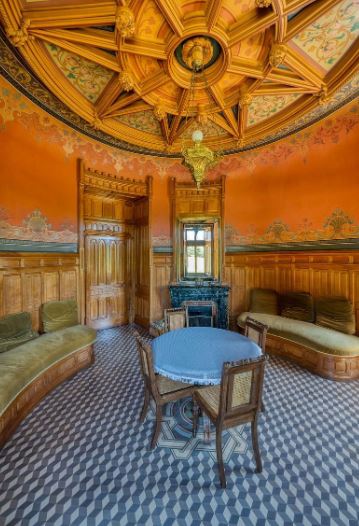
After a monetary hesitation, I led him upstairs into what was Mrs. Winchester’s principal bedroom. In the inner courtyard, there is a crescent shaped hedge that points to Mrs. Winchester’s bedroom—the one where she died. Coincidence? Maybe…but again, we will never know for sure. “Is this where the ghosts walk?” he asked as he glanced around the empty room. I was plainly annoyed by his insistence. “There are no ghosts, and they do not always anywhere,” I said irritably. I glanced up at the ceiling, and swiftly withdrew my eyes with a nervous tremor. I could tell the client was firmly persuaded that I had been the victim of some spectral horror, though I was anxiously trying to conceal it for fear of frightening him off. “Perhaps I had been not tell you anything,” I said, after considering a moment. “There is a great deal in the influence of suggestion, so it is said. If I were to tell you what the people who have slept in this room have seen, or dreamt they have seen, that might be enough to make you dream the same. Whereas, if a sensible man without any notions came and slept here, one would most likely never be disturbed.” Upstairs I showed him another room which was an unfinished attic space. The prospect from the widow showed hum that it was situated over the haunted chamber. “Is there something wrong with this room as well?” he demanded. “The servants do not like sleeping in it,” was my grudging admission. “It does very well as a boxroom.” The client was very anxious to secure an option to purchase the Winchester Mansion at the end of the month. My next step was to secure some attendance, and to send down some furniture for the many empty rooms which they mystery appeared to cling. All of Mrs. Winchester furniture had been sold at auction.

It took movers six weeks, six truck loads a day, to empty the mansion. Many of them often got lost. I was not very well pleased with the idea of taking the ghosts seriously. However, I knew that there were things in Nature which ordinary rules did not explain. I had seen things myself which could not be accounted for by natural means. I dared not tell the client that there had been a murderer lurking in the mansion ready to spring on potential clients and stab them. Suddenly, we heard a low moan—the moan of a creature in mortal terror, drawn out till it became a muffled scream. The moan was repeated, coming distinctly from the room below us. This is why I did not live having an open house at night. With candles in hand, as we reached the third floor landing the moan was repeated in a more terrible key—the key of horror instead of terror. At the same moment the door of one of the haunted rooms was thrown open, and suddenly Agnus, the maid, appeared on the threshold, with a cloak thrown over her shoulders, and a look of fear and distress on her face. “What is it?” I asked. “Merrill, she has seen something horrible, and I cannot get her to come to.” Without stopping to consider questions of etiquette, I dashed into the room. The gas had been turned full on, and by its light I saw the young lady lying stretched out on a couch at the foot of the bed, her features frozen into expression of one who looks upon some horrid sight, while from her parted lips there issued those appalling sounds which wounded like the stabs of a knife. I caught her by the shoulders and shook her, without making the slightest change in her swoon-like conditions. “Water!” I called out to Agnus, who stood wringing her hands, too dazed to act.
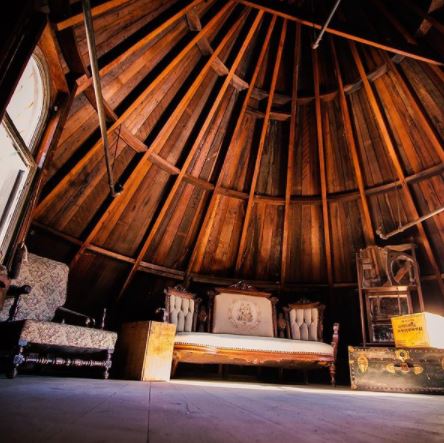
The water was brought, and I dashed half a glass in the face of the sufferer. At first it had no more effect than if she had been dead. Then came a startling change. The moans suddenly ceased, the victim opened her eyes, which showed the dull glassy stare of a somnambulist, and sitting half up, she commenced muttering so quickly and indistinctly that it was difficult to catch the words. “The blood, the blood, the blood, the blood, dripping, dripping, from the read lead in the ceiling, the red leak in the ceiling, in the ceiling, dripping on me, dripping on me, dripping on me!” The words rose into a wild shriek as her blank eyes were turned full on the ceiling overheard, the ceiling between the room she was in and the dressing room the size of three rooms. Involuntarily I looked up and the ceiling did not show the slightest mark. We lifted the unconscious lady and carried her out of the accursed room, and into one adjoining, where we laid her on the floor. Hardly had she passed the doorway of the haunted chamber when the dreadful screams began to die away, and the rigidity of the features to relax. In a short time the trance conditions passed away and we left Merrill to sleep. When she woke in the morning, we told her she had just has a bad dream, but she remembered nothing of what had passed in the night. At her own request, at breakfast, I described to her what had occurred, as minutely as possible. She was profoundly impressed. Of course, the client had bolted out of the house. However, Merrill, said with great conviction, “I am certain that what I saw represents something that actually happened in this house. Dreadful as it sounds, I firmly believe that somebody has been murdered in that attic with the witches cap, and that his blood did drip through the ceiling of the room below, as I saw it last night.”

As soon as the staff left the house, I went straight to a builder’s in the neighborhood, and engaged him to send some men to examine the flooring between two of the haunted rooms. The builder received my order with marked interest. “I knew there was something the matter with that house,” he observed. “It ain’t likely that tenant after tenant would come away sacred without something was wrong. Why, do you know, sir, in the last year since Mrs. Winchester died, I’ve white-washed one ceiling in the house thirteen times!” The builder’s interest led him to accompany his men, a carpenter and a plasterer, to the scene of action. I pointed out that place on the ceiling, as nearly as I could judge it, from which the ghostly dew had appeared to fall. Then men took measurements, and then, proceeding to the attic above, located a spot under the bed I used to sleep in. The bed was quickly removed, the flooring stripped off, and in the space between the joists there was exposed a mass of lime. Both the men, as well as their master, were quick to declare that the lime could not have been left there for no good,” the builder asserted. “If you want somethings hidden away and destroyed, there is nothing better than what lime is when it is fresh. It burns as well as fire, and makes no smoke.” “You mean a dead body?” I said shuddering. “I don’t say nothing about that,” the builder answered, pulling himself up. “It ain’t for me to say what that lime’s been used for. All I say is it wasn’t me that left it there, nor yet my men.” The two men began clearing the stuff away. The volatile element had evidently evaporated long ago. As they struck downward with their tools, one of them went through the plaster of the ceiling below, and a shaft of light came up.

An exclamation from one of the men followed. I bent down and peered into the cavity. On a large beam which here crossed the floor I saw a deep black stain, the stain of long-dried blood! A moment after the carpenter stood suddenly, griped about with one hand amid the woodwork, and drew forth to the light a small sharp stiletto, rusted with the same dismal stain. Nothing more was found. I gave the builder an order to entirely renew the flooring between these two haunted rooms. The most extraordinary part of the story remains to be told. The report of what had taken place having got abroad in the county, the local police came to me to obtain the stiletto, which I had been careful to preserve. By its means they were enabled to unearth a crime which had gone unsuspected till that hour, and to extort a confession from the murderer. Into the details of this terrible case, I do not care to enter. However, it is sufficient to say that the victim had perished while asleep in the attic, and that his blood had actually soaked through the ceiling into the room below, which was that of his murder—the Butler! Later that night, I was alone in the Winchester Mansion. A bright moon was out that night, and I heard a noise like a million soldiers, thrampin’ on the road, so I looked, and the hallway was full of little men, the length of my palm, with gray coats on, and all in rows like one of the regiments; each spoke with a pike on their shoulders and a shield on their arms. One was in front, byway he was the general, walking with his chin up as proud as a peacock. They marched right out the door-to-nowhere and there was another army of men with red coast. The two armies had the biggest fight you have even seen, the grays against the reds.

After looking on a bit, I got excited, for the grays were beating the reds like blazes. And then the sight left my eyes and I remembered no more until morning. I was laying on the floor, in the hallway, where I had seen them, as stuff as a crutch. Typically old castles, deserted graveyards, ruined churches, secluded glens in the mountains, springs, lakes, and caves all are the homes and resorts of fairies, as is very well known on the west coast. The better class of fairies are fond of human society and often act as guardians to those that they love. They are believed to living in the Winchester Mansion to receive the souls of dying and escort them to the gates of Heaven, not, however, being allowed to enter with them. On this account, fairies love graves and graveyards and of course this 160-room mansion built to appease the spirits who died at the hands of the Winchester rifle. They have often been seen walking to and fro among the rooms and gardens. There are, indeed, some accounts of faction fights among the fairy bands at or shortly after a new soul enters the mansion. The question in dispute being whether the soul of the departed belonged to one of the other faction. The amusements of the fairies consist of music, dancing, and ball playing. In music their skills exceed that of men, while their dancing is perfect, the only drawback being the fact that it blights the grass, “fairy-rings” of dead grass, apparently caused by a peculiar fungous growth. Mrs. Winchester used to host fairy balls in her Grand Ball Room, the music for which was furnished by an orchestra which the management had no doubt been at great pains expensive to secure and instruct. All around the fairies would dance like angels the fireflies giving them light to see by, and the moonbeams shinning on the lake for it was light to see by. Even now, staff who have been at the Winchester Mystery House sometimes hear the soft strains of their voices in the distance, and will hurry away least they discover one’s presence and be angry at the intrusion of their privacy.

When in unusually good spirits the fairies will sometimes admit a mortal to revels, but if one speaks, the scene at once vanished, one becomes insensible, and generally finds oneself by the roadside the next morning, with the drudgery of pains in one’s arms and legs and back, that if thirteen thousand devils were after one, one could not stir a toe to save the soul of one, that is what the fairies do be pinching and punching one for coming on them and speaking out loud. Black magic has not changed since the Middle Ages. The term “black art” was then applied to magic because the proficient in it were considered to be in league with the powers of darkness. The term “black magic” refers to the art of producing supernatural effect by direct league with Satan and demons. Frequently those who practice black magic make an actual pact with the powers of darkness, signing their allegiance to the devil in their own blood. This ceremony had come down from the Middle Ages to present-day Europe, where it is practiced in parts of Germany, France, and Switzerland. The ritual of signing an agreement involves a complete sell-out to the devil. Some magic involves the direct solicitation and help of demons, specifically the devil. It is the most terrible and powerful form of occult art, majoring in enchantment for persecution and vengeance, but also employing diabolical powers for defense and healing. An example of this nefarious practice is found in the death spells cast by witch doctors among aboriginal people, such as the Papuans on the island of New Guinea. Enchantment for persecution and vengeance, as well as for defense and healing, is still practiced today, not only in pagan cultures but also in civilized lands where occultism flourishes. Literature on magic was found in the Winchester Mansion and auctioned off with the rest of Mrs. Winchester’s belongings. There were incantations, charms, and spells.

One of the movers, who have never been troubled with psychic disturbances, returned home from taking the items to San Francisco to be auctioned off, and suddenly found himself suffering from acute fear dreams. He had the feeling during sleep that a neighbor lady, the mother of his coworker who was still missing after moving items out of the mansion, was strangling him. The tormented man went to an occultist who told him he was under magic persecution. The neighbor woman was seeking revenge on him for his good fortune in the light of her son’s bad fortune. With the occultist’s help, the terror-dreams creased. (That is why theft from the Winchester Estate is not tolerated. It is said to bring curses on those who remove sacred items without permission or payment.) Then the former mover found himself under a new attack: the neighbor was causing his cattle to die, head after head. The conjurer promised to remedy this new menace. Scraps of paper inscribed with magical formulae were to be mixed with the food of the cattle. The astonishing result was the cessation of the cattle epidemic. In addition to many cases of persecution and self-defense by black magic, occult healing are also common. A local farmer at the Winchester estate went to Mrs. Winchester for counseling and related the traffic results of charming by black magic. The farmer’s son had become paralyzed after an illness. The doctor could not help. However, Mrs. Winchester healed the boy through black magic, so that the paralysis disappeared completely. She had developed this skill after the death of her six-week-old daughter and her husband. Ancient and modern pagan religions, as well as those who subscribe to Christianity, have produced such psychically endowed mediums who have improved their gifts by the study and practice of the magical arts.

From what source people derive their power is not always clear—probably neither to they themselves nor their devotees have ever set themselves the task of unravelling that psychological problem. If they were turned wizards or witches, and indeed they only represented white witchcraft in a degenerate and colourless stage. Their entire time is not occupied with such work, nor, in the majority of cases, do they take payment for their services; they are ready to practice their art when occasion arises, but apart from such moment they pursue the ordinary avocations of rural life. The gift has come to them either as an accident of birth, or else the especial recipe or charm has descended from father to son, or has been bequeathed to them by the former owner; as a rule such is used for the benefit of their friends. Seen from the parapsychological point of view, magic persecution is a mediumistic problem similar to that of materialization. In the same way that a medium can emit energy that can be transformed into the phantasm of a man, so he is able to transform the same energy into the form of an animal. We have on record many cases of the materializations of dogs, cats, frogs, snakes, and even cases where the apparition was half man and half animal. If a phantasm is injured in some way at a spiritistic séance then the medium also suffers in a similar way. The same holds true in the case of animal phantasms. We are thus justified in coming to the conclusion that magic persecution is on the same level as materialization. Many methods of defence magic are based on this fact. If the victim is able to injure the phantasm that is assaulting one, it is reckoned that one has as good won the battle. We have seen then that certain forms of spiritistic offensive and defensive magic are based on materializations.

In 1888, a large black cat was found to be hanging around the Winchester mansion. In one of the cottages, on the estate, a farmer’s wife was about to give birth to a child. The cat would not go away until finally someone threw an axe at it, thereby injuring its leg. Next day it was discovered that an old woman on the estate also hurt her foot. The servants knew this woman to be a master of black magic, and indeed a few days later she took her revenge. On visiting the mother, Ida, of the new-born child, the witch murmured something and at the same time patted the child on the head. Thereafter the child cried continuously for days on end and could not be pacified. It was also discovered that as the child grew up its memory was particularly weak. Afterward the woman had three miscarriages, suffered the early death of her mother and disappearance of her father, but the source of her mental problems was far more spectacular than these mundane tragedies. Using hypnosis, Mrs. Winchester discovered that this mother to a new born had been repressing memories of an horrific past in which she had been an unwilling member of a murderous Satanic cult. Recollections would have convinced many mental-health professionals that she was suffering from pathological delusions. Her “memories” revealed a cult, led by the a monstrous Joris-Karl Huysmans, who indulged in acts of unbelievable brutality in the name of the Devil, such as blood-drinking, and other unspeakable acts. Mrs. Winchester considered the woman to be of nervous debility and easily influenced. When she had the servants cottage searched, they discovered a secret room, holding an apparently sacrificial altar with a wooden dagger suspended above a glass bowl.

In our files, there are about 40 examples involving cats, and almost all of them deal with the same problem, that of a person causing an apparition to appear in the Winchester Mystery House or elsewhere on the estate. Hamilton Howard was once hired for a job on the estate. The young man was on the verge of being dismissed because he very mysterious. He had a fair share of Satanic drawings in the cottage he was allowed to stay in, while working at a farm hand, and he never had meals with the other men. He belonged to a blood drinking cult. This might explain why stories began circulating about the carcasses of cows being discovered on Mrs. Winchester’s farm and other nearby farms drained of blood, with their eyes, lips, and private organ removed. The mystery of where the blood had cone, and how and why these animals had been operated on with seemingly surgical precision, gave birth to stories of Dracula in California and the California Cannibals. Occasionally, starving people have resorted to cannibalism for survival necessity. It is no secret, however, that Mrs. Winchester had her fair share of hauntings. One night, she heard footsteps going from the basement to the attic and then back again. There were also footsteps in the hall and at first, they thought that it was a burglar. Often her staff would search for an intruder. In addition to the footsteps the lights were sometimes turned on, and the gas too. No amount of careful investigation was able to produce any evidence as to the cause of the apparent haunting. One night, Mrs. Winchester had a séance in her Blue Séance Room. The spirit with whom she had made contact started that he had been a Catholic priest who had lived in the house 200 years before she renovated the original farm house and turned it into a mansion. He had murdered his housekeeper and had buried her in the basement. Since then, he had had to haunt the scene of his crime.

When asked in which room he had murdered the housekeeper the table suddenly began to move across the floor. It then hit the door of the room so hard that the wood was chopped. As Mrs. Winchester opened the door, the table rushed into the adjoining room and slid into the corner. In the course of doing this it hit an oak bedstead so hard that it left a permanent impression on it. The spirit was questioned further and when she asked is there was anything that could be done for him, he replied, “Yes, you can pray for me.” Mrs. Winchester did in fact pray for the restless ghost after that, and for a number of years the mansion was no longer haunted. The mansion has been haunted for several generations before its expansion. However, more than one ghost was attached to the property and it became a nexus for spiritual activity. Every person possesses one’s own home spiritually. This possession continues to live on in the house after the departure of the person concerned. Humans do not only leave behind their physical body when they die, but also a spiritual “larva.” When one dies, one leaves a spiritual complex behind that has an independent existence in the astral World, and which sometimes only disintegrates centuries later. This spiritual complex is supposed to cause the phenomen on ghost and apparitions. For some, the real of the dead is not so much a place as a state of being, and some think that there are times, as for example at one’s deathbed, when this realm of the dead becomes visible to our Earthly eyes. The idea that human beings have to remain in the mortal sphere after their death until they are freed from all the thing that once tied them to the World is widely accepted. This idea is similar to the popular opinion that criminals and other such people have to haunt the place of their crime until they are taken out of this sphere to a higher or lower level of existence. Ghosts do not occur only in connection with spiritism, but we have dealt with them here since the problem arose.

Winchester Mystery House

Are you brave enough to explore the house at night? 👀 The Winchester Mystery House is offering Friday the 13th Self-Guided Flashlight Tours. Tickets going fast! Click the link or hastage for tickets and more information.

NEVER MISS A MYSTERIOUS MOMENT

As enshrined in legend as Mrs. Winchester is her beautiful mansion, the Winchester Estate (now known as the Winchester Mystery House). No casual visitor can see it all. Palatial elegance unfolds with each turn. Nowhere is there more conspicuously displayed occult history, habits, and characteristics of the Victorian people. According to the most reliable of the honorable grounds’ keepers, the rural “fairy-men,” a race now nearly extinct, the fairies were once angels, so numerous as to have formed a larger population of Heaven. When Satan sinned and drew throngs of the Heavenly host with him into open rebellion, a large number of the less warlike spirits stood aloof from the contest that followed, fearing the consequences, and not caring to take sides till issue of the conflict was determined. Upon the defeat and expulsion of the rebellious angels, those who had remained neutral were punished by banishment from Heaven, but their offence being only one of omission, they were not consigned to the pit with Satan and his followers, but were sent to Earth where they still remain. Many of them took up residence at the Winchester mansion, not without hope that on the last day they may be pardoned and readmitted to Paradise. They are thus on their good behavior, but having power to do infinite harm, they are much feared, and spoken of, either in a whisper or aloud, as the “garden people.” These fairies are not solitary, they are quite sociable, and always live in large societies, the members of which pursue the cooperative plan of labor and enjoyment. They helped to build the Winchester mansion, and are also responsible for making the grounds so beautiful. They travel in large bands, and although their parties are never seen in the daytime, there is little difficult in ascertaining their line of march, for, sure they made the terriblest little cloud of dust ever raised, and not a bit of wind in it at all, so that fairy migration was sometimes the talk of the country.

Though, be nicer, they are not the length of your finger, they can make themselves the biggness of a tower when it pleases them, and with that ugliness that you would faint with the looks of them, as knowing they can strike you dead on the spot or change you into a dog, or a pig, or a unicorn, any other beast they please. As a matter of fact, however, the fairies are by no means so numerous at present as they were formerly. Someone was rapidly driving them out of the Winchester mansion, for the suspect(s) hated learning and wisdom and are lovers of discord and dysfunction. Many people were envious of Mrs. Winchester’s estate. A mansion is not a mansion and Mrs. Winchester was just as attentive to the exterior of her estate as she was to the rambling labyrinth. The fairies helped Mrs. Winchester by planting rare and exotic plants, flowers, trees, shrubs, and herbs from over 110 countries around the World. Some of the original plantings still flourish today—among them, 140-year-old rose bushes, ferns, and feather and fan date palms, as well as evergreen trees. Mrs. Winchester loved to spend time in her gardens, and she had gazebos built where she could sit and enjoy her trees and flowers. Nearly 12,000 boxwood hedges were planted along the pathways tht wind through the gardens. In addition, all the laws were replanted, and some 1,500 major plants, shrubs, and trees were replaced. Today the home and its garden are still the showplace of the Satan Clara Valley, a reminder of the gracious past, which we will discuss more of. Mrs. Winchester gave her estate, Llanada Villa, a mysterious name. The words are Spanish for “house on flat land,” but no one knows what special meaning they had for Mrs. Winchester.

The Winchester mansion is priceless. It has had more people begging to purchase it than any estate in the World. Many people also desire to invest it the mansion and restore it to its former glory. However, the owners like to leave some rustic evidence of the past, but are restoring some of the rooms that were damaged in the 1906 earthquake to their former glory. It now contains 160 room (but was significantly larger), 25,000 square feet (that is about the size of 20-40 houses, and maybe more because the attics and basements are not counted in the square footage), there are 10,000 windows, nine kitchens, and 47 fireplaces built of rosewood, cherry, mahogany, Italian marble, oak, teak, and pipestone; all hand carved and no two alike. Not including the fairies, commonly, 16 carpenters were employed at one time, some having worked for 20 years without change. They produced the largest, most complicated, and exclusively private residence in the United States of America. There are five different heating systems and three elevators, one hydraulic and two electric. Some of the 13 bathrooms lacked privacy; they have glass doors! One rambling room has four fireplaces and five hot-air registers. A spiral stairway has 42 steps, each two inches high. Other stairways melt into blank walls. A second story door opens into the great outdoors and a 20-foot step. A linen closet has the area of a three-room apartment; a nearby cupboard is less than one-inch deep. A skylight is placed in the middle of a room, in the floor! Another floor is apparently a series of trap-doors. Exterior faucets project unexpectedly from under second-story windows. The visitor must stoop through one door to enter, the next gives clearance for an eight-foot giant. Many stairways turn posts are set upside down. Entire walls are built entirely of half-inch “half-round” strips. Many of these oddities may have been to accommodate the fairies.

Everywhere prevails that strange deference to the number 13; 13 stairsteps, 13 hangers in a closet, 13 wall panels, 13 lights in the chandeliers, 13 windows to a room and if necessary to make that number, some placed in an inside wall. Although Mrs. Winchester’s arrival in California was sensational, the fairies were in the country long before the coming either of human beings or animals. The bodies of the fairies are not composed of flesh and bones, but of an ethereal substance, the nature of which is not determined. One can see themselves as plain as the nose on one’s face, and can see through them like it was a mist. They have the power of vanishing from human sight when they please, and the fact that the air is sometimes full of them inspires the respect entertained from them by humans. Sometimes they are heard without being seen, and when they travel through the air, as they often do, are known by a humming noise similar to that made by a swarm of bees. Whether or not they have wings is uncertain. John Hansen, who was caretaker of the estate, thought they had; for several seen by him a number of years ago seemed to have long; semi-transparent pinions, like them that grow on a dragon fly. Young lady fairies wore pure white robes and usually allowed their hair to flow loosely over their shoulders; while fairy matrons bind up their tresses in a coil on the top or back of the head, also surrounding the temples with a golden band. Young gentlemen elves wore green jackets, with white breeches and stockings; and when a fairy of either gender has need of a cap or head-covering, the flower of the fox-glove is brought into requisition. Male fairies are perfect in all military exercises, for, like the other inhabitants of the Winchester mansion, fairies are divided into factions, the objects of contention not, in most cases, being definitely known.

One night, the wind was roaring; and the windows rattled and the mansion creaked like it was moving to a different location. Mrs. Winchester then knew her house was possessed of unusual powers. She could feel the reaper. The next day, Ezra Benson, the head chef, was not down stairs at five in the morning preparing Mrs. Winchester’s breakfast, as was his custom, nor at seven, nor at nine. As the servants went into the kitchen, a glass ball came flying into the room, and all the doors and windows had been shut! The ball fell at the feet of Agnus who picked it up. It felt hot, but was undamaged. On the ball was a picture of Mrs. Winchester. She claimed that ball had been in the living room, and so the servants when to investigate. The ball in the living room had disappeared! As the servants continued to search around searched around the house for Ezra, they saw 135 objects fly through the rooms in an inexplicable manner. Hereupon the servants went and knocked at his chamber door. The door was opened at last from the outside, and they found Ezra dead and black. No marks of violence appeared at the moment, but the window was open. As was, natural, in the great swelling and blackness of the corpse, there was talk made among the neighbors of poison. The body was very much disordered as it laid in bed, being twisted after so extreme a sort as gave too probable conjecture that Ezra had expired in great pain and agony. And yet what is as yet unexplained, Aimee du Buc de Rivery was entrusted with the lay-out of the corpse and washing it, being both sad and well respected, she went to Mrs. Winchester in pain and distress of both mind and body, saying, what was indeed confirmed upon the first view, that she had no sooner touched the breast of the corpse with her naked hands than she was sensible of a more than ordinary violent smart and aching in her palms, which, with her whole forearms, in no long time swelled so immoderately the pain still continuing, that, as afterwards proved, during many weeks she was forced to lay be the exercise of her calling; and yet no mark seen on the skin.

Upon hearing this, Mrs. Winchester made as careful a proof as she was able by the help of a small magnifying lens of crystal of the condition on the skin on this part of Aimee’s body: but could not detect with the instrument she had any matter of importance beyond a could of small punctures or pricks, which Mrs. Winchester then concluded were the spots by which the poison might be introduced. So much was to be said of the symptoms seen on the corpse. There was on the table by the bedside a Bible of the small size. Mrs. Winchester took it and went into her Blue Séance room where she was going to try to get a message from the superstitious practice of drawing. Proficiency in occultism in general combined with abilities and gift in magical arts in particular is not an accident. Endowment with magical powers may be the result of a number of factors. First, and perhaps foremost, is heredity. Also important are occult transference, subscriptions to Satan, and occult experimentation. The general history of occultism shows that mediumistic powers can often be traced through four generations. It is a common thing for a dying father to bestow upon his eldest son or daughter his magical abilities. As Mrs. Winchester was writing to find the cause and events of these dreadful events. She went into a trance, and wrote “Cut it down. It shall never be inhabited; her young ones also suck up blood.” Ezra was laid to rest. His room was not slept in by anyone else. A certain amount of interest was excited in the city when it was known that a famous witch, Ursula Southeil, who was still remembered by a few, was to be exhumed. She had supposed moved to San Jose, California 1885 and shortly after was buried. People believed that maybe she had been hexing the Winchester estate. And the feeling of surprise and indeed disquiet, was very strong when it was found that, though her coffin was fairly sound and unbroken, there was no trace whatever inside it of body, bones, or dust.

Indeed, it is a curious phenomenon, for at the time of her burying no such things were dreamt of as resurrection-men, and it was difficult to conceive any rational motive for stealing a body otherwise then for the use of dissecting-room. Mrs. Winchester knew the secrets of this terrible death was mystery. Many believed that the spirit of Ursula had using Mrs. Winchester’s mansion as her lair and needed to be forced out. They found below a white oak a rounded hollow place in the Earth, wherein were two or three bodies of creatures, and at the side of this den, against the wall, was crouching the anatomy of skeleton of a human being, with the skin dried upon the bones, having some remains of brown hair, which was pronounced by those that examined it to be undoubtedly the body of a woman, and clearly dead for over hundred years. The history of magic is replete with extraordinary extrasensory phenomena that involved the spirit realm and every phase of the natural World as well, including human beings, animals, plants, and inorganic matter. Spirit-rapping, apparitions, ghosts, moving of furniture, and playing of musical instruments by invisible hands, stones falling from a ceiling, magical killing of cattle, unexplained creatures, and blighting of crops, et cetera, are just a few of the weird occurrences that took place at the Winchester mansion that fill the annals of occult practice. Incredible as it may seem, even in modern scientific age millions are now, or have been at some time, involved in some manner with ancient magic practices and rites, ranging from using spells, magic herbs, and hex signs on houses and barns (which can still be seen in some areas of the estate and other places). The precise character of magic has been even more heatedly disputed than its definition. One lauds it as a gift from God. Another denounces it as an operation of Satan and demons. Another denies it any moral quality and views it merely as the working of neutral forces of nature, which can be employed either positively or negatively.

The liberal theologian sees magic as the crystallization of time-bound ideas and customs. They psychologist looks at the magically subjected person as wrongly adjusted to life and the natural World. The psychiatrist sees the whole magical complex as symptomatic of mental aberration. The Christian Bible condoms magic, it clearly recognizes the reality of its power. (Exodus 20.1-6; Deuteronomy 18.9, 10). Human history will end with a tremendous demonic revival (Revelation 9.1-20) that will culminate in the reign of Antichrist, who will be attended by diabolic signs and magical wonders (2 Thessalonians 2.9-12; Revelation 13.13-18). Armageddon will be a demon-energized revolt and a satanic attempt to take over the Earth (Revelation 16.13, 14). Just as modern humans have inherited their ideas of God and the Universe from their Christian predecessors, so had they inherited the Devil. Satan is an archetype, a force embedded in humans’ unconscious, a remnant of their psychological evolution. Satan is the child of fear, and fear is innate in all humans. Eve from the Garden of Eden used to roam around and take up with animals. Nothing was amiss to her, in the animal line. She trusted them all, they trusted her; and because she would not betray them, she thought they would not betray her. The snake advised her to try the fruit of the forbidden tree, and told her the results would be a great and fine and noble education. Adam told her there would be another result, too—it would introduce death into the World. That was a mistake—he should have kept that remark to himself; it gave her an idea. Adam escaped that night, and rode a horse all night as fast as he could go, hoping to get clear out of the Garden and hide in some other country before the disaster should fall. Eve had eaten the fruit and death was come into the World.

Eve found Adam outside the garden. He was not sorry she had come, for there was absolutely nothing to eat, but meagre pickings here, and she brought some of those apples, and Adam was obliged to eat them, he was so hungry. It was against his principles, but he did it anyway. Evil, as it has appeared through human history, has a schizoid development, manifesting itself in two forms. The most elementary of these forms is purely internal, deriving from humans’ instinctual drive toward self-preservation, the concept “self” here including humans’ own physical being and the physical beings of related others. The object of this type of fear is anything that humans might see as impairing one’s fight for survival. As the primitive human sits in a jungle clearing by his fire at night and hears the sounds of animals stirring in the bushes around him, he fears for his safety. He feels powerless and is overcome by a seemingly unbridgeable gap between knowledge and environment. He feels himself to be a mere pawn, a plaything, victimized by nature’s capricious ways. Drowned by nature’s angry waters, baked by her merciless sun, attacked by her vicious animals, starved, beaten, bullied, he is at a loss for an explanation. Though fully aware mentally, he finds himself totally blind in the face of her inscrutable ways. What recourse does he have? He must attempt in some way to make these strange and wonderous forces less capricious and more subject to his control. So he recreates them in his own mind, makes them more tangible, more related to his own experience. He takes them out of their detached state to give them more personal meaning. Once he has done this, he had some recourse for his grievances: now he may make offerings, get down on his knees and ask the god for a good crop or an abundant herd, attempt to cajole or coerce the god into granting his request.

Those deities that humans have traditionally created to represent evil have stemmed from those forces of nature that they have found to be most uncontrollable; the shapes into which they have been cast being those shapes and forms that they have feared the most. Primitive humans saw hideous demons with six heads and fierce claws waiting from them in the darkness, and they were forced to respond to the danger. The popularity of heavy metal rock acts in the 1970s gradually started to work against them, as audiences associated them with big business rather than rebellion. However, the music changed. Heavy metal had moved out of the Californian sunshine and cosmic otherworldliness of the late 1970s, back into the rainy alleyways and gloomy English pubs that were its birthplace. Satanism had also secured a prominent position in the iconography of the New Wave. For most bands, it was nothing more than an exciting image that sold records. However, the Devil could be a risky card to play—as is His nature, for every potential fan He attracted, He also incited hostility. Iron Maiden’s 1982 album Number of the Beast, which sported a leering Satan on the cover, proved to be their commercial breakthrough. The title track, like the eponymous “Black Sabbath,” describes stumbling across an horrific Satanic ritual. Despite bassist Steve Harris’ limp insistence that “Number of the Beast” is an anti-Satan song, the record not only took them to the top of the charts but also to the top of the hate list for Christian anti-rock campaigners. The band were more than a little complicit in this, hyping the album with spooky stories about its cursed conception: mysterious power failures, radio interference and exploding amps apparently plagued the recording sessions: most sinister of all, the producer had a car crash at the time, his repair bill coming to $666.

More petitely, as Anton Lavey once noted, you cannot employ Satanism without promoting it. True to this dogma, other young bands utilized Satan not as a throwaway reference but as the core of their identity. Their new sub-genre would become knows as black metal, after a 1982 album titled by the band Venom. In many ways black mental is the musical genre that never was—its style is basically the rawest, most malignant heavy metal, with a strong occult element in the lyrical content. The Satanic tag attracted a strange regiment of musicians who wished to test the musical and moral boundaries of what the rock business deemed acceptable. Prominent among these bands was Witchfynde, founded in 1976. They never enjoyed much success, and were almost universally spurned by the music press, but some of their material retains a darkly naïve charm—especially on their 1980 debut Give ‘Em Hell. According to press releases of the time, “It is no secret that guitarist Montalo does more than dabble in the occult and that both he and the band draw upon these sources for guidance.” Though Anglewitch, disassociated themselves from the darker edges of the occult—notably in the song “Hades Paradise,” in which they accuse Satanists of being “sick in the head,” there were suggestions that Angelwitch’s occultic roots were darker than they would have their audience believe. Most unusual in their approach were Demon. Unlike their contemporaries, who boosted their Satanic imagery with aggressive guitars, Demon’s keyboard-anchored sound emphasized more mystical, subtly sinister aspects. Like Black Sabbath, Demon hypocritically warned against the subject that clearly fascinated them. The audience that eluded Demon flocked to a number of black metal acts who matched extreme Satanic lyrics with extreme, blistering tones. At the forefront were the Danish band Mercyful Fate, led by the unashamed Satanist King Diamong—who, taking the stage in black and white face paint, would influence the visual image of Satanic rock for decades to come.

Formed in 1981, the band debuted with the mini-album A Corpse Without a Soul. The cover boasted a scandalous sketch inspire by the song “Nuns Have No Fun.” Mercyful Fate’s first full-length album, Melissa, came out in 1983, inspired by a skull Diamond which he liked to believe once belonged to a witch. Don’t Break the Oath, which followed the year after, contained a title track which was Diamond’s most brazen dedication to Satan: “By the symbol of the Creator, I swear/A faithful servant of his most puissant Archangle/The prince Lucifer/Whom the Creator designated as his Regent/And Lord of this World. Amen.” King Diamond followed this same devotional approach to Satanism in interviews and everyday life. His inspiration was Anton LaVey, who Diamond visited in San Francisco (during this visit, the eccentric LaVey regaled his Danish guest with a keyboard rendition of “Wonderful Copenhagen”). In return, King Diamon received an honorable mention in LaVey’s 1990s biography, The Secret Life as a Satanists, as the only Satanic rocker then paying proper dues to the Prince of Darkness. He won the respect of figures in both the occult ad rock Worlds for his well-mannered sincerity. The shell of Mercyful Fate went off to form the uninspired Fate, while in Diamond’s new band, the modestly-titled King Diamond, Satan was conspicuously by his absence. However, the songs were atmospheric mini-horror movies, and the anti-Christian slant remined—most notably on their best release The Eye, which retold a historical tragedy surrounding the Catholic Inquisition—though records sold disappointingly. Often times, it is the band’s Satanism, however, that convinced many young metal fans to buy the album. On the band Venom’s debut album Welcome to Hell ran the blurb on the back of the sleeve, “We’re possessed by all that is evil. The death of your God we demand. We spit at the virgin you worship. And sit at Lord Satan’s left hand.”

One could day that concerts are Satanic rituals because one is definitely letting so much energy loose. If one did it the right way, one could probably turn it into one of the most powerful Satanic rituals. My God it would be powerful. Satanism is a lot to do with a life philosophy. There are also the steps of how to perform a ritual. However, there too you have to be careful. Not just everybody can do it, you have to have certain features and abilities so you can release the right energies at the right moment. If you cannot do that, nothing will come of it. Many artists perform Satanic rituals at home, but not on stage because they do not want to take advantage of the audience. Satan stands for the powers of the unknow, the powers of darkness, that are all around us which we can use for our or other people’s benefit. Satanism sells because it is the twisted horror of it. Horror sells, death sells, anything nasty sells. You just have to turn on your TV and watch the news and there is more and more violence in your face. Why? Because people like to see it. They like to sit there and know it is not them—that they are better off. Sometimes it is healthy because these things happen, you cannot avoid them. There is no way you can erase that part of life. I do not think we have more or less bad in the World since I have lived. It just moves around a bit. It Is always going to be there, you might as well try and learn to live with it. People like black metal because it gives you a shiver up your spine. There are different purposes to music and different songs that generate different basic emotions—pathos or a marching tune, for example. Successful music feeds upon your emotional needs, while dissonant music feeds humans’ habitual masochism. If you watching the 2001 Anne Rice film, Queen of the Damned, you can get a feeling at the excitement of black metal and Satanism, but as experts recommend, be careful. The star of the film, the beautiful Aaliyah died in a plane crash just months before the film was released. She was only 22, but the film is really intense, and Queen of the Damned is also a great sound track.

Satanists are on the move. Other Satanists might not be quite as “understanding,” but there is a warning to those who tap into Satanism for economic advantage; they should be careful not to slander their seminal roots. They may not care now, but they may vert well have to care in the future. Aaliyah really got into the dark roots and even studied Egyptian culture and loved rock music, but experts are not joking with their warnings. It is a dangerous hobby and way of life. Magic and the fall of man—magic came into being with the spiritual fall of man at the threshold of human history. Demonic forces are engineering the gigantic apostasy of the end of time that will culminate in the rise of Antichrist and the greatest demonstration of diabolic miracle and demonic wonders the World has ever seen (2 Thessalonians 2.8-10; Revelations 13:1-18). One can imagine tht in the hands of a person of criminal tendencies such a spiritistic ability would be the cause of much harm. Mrs. Winchester reported that for several years she had been frightened each night by the appearance of one of her neighbours between 12 and 1 o’clock. Passers-by also heard ghostly music wafting from the dark mansion. Every time this had happened, Mrs. Winchester had woken up with a start. She had been terribly frightened. It was not a dream for she has always seen the apparition as she was actually waking up. The phantom was in fact that of one of them women in the county. This particular woman had the reputation of being an evil person who indulged in plaguing people through black magic. After the woman’s death, Mrs. Winchester ceased to have these strange experiences. I guess the bell in the belfry summoned her with the incoming flights of spirits, and then tolled again to warn her, along with other visitors, to return to their sepulchers.

A young farmer on the Winchester estate had the experience of being beaten up at night in his Victorian cottage on the estate. Sometimes he was beaten so badly that he actually bled. The whole village had seen him on numerous occasions with black and blue weals across his body. As is only to be expected in a country where the majority of the inhabitants were engaged in agricultural pursuits, most of the strange doings are not only connected with ghost, but with cattle as well. One of the herdsmen at the Winchester estate had wounded a hare, which he had discovered sucking on one of the cows under his charge, tracked it to a solitary cottage near the mansion, where he found an old woman, smeared with blood and gasping for breath, extended almost lifeless on the floor. Certain witches had the power of turning themselves into hares and in that shape sucking cows. The early demons, however, were never complete personifications of evil in the social sense. They were always incomplete in their evilness, due to their rather personal nature. For the most part, they were projections of man o nature and, as such, most of them had at least some of humans’ character in them, rendered both consciously and unconsciously. This can be seen in the mythologies of the winged serpent, for, in fact humans’ ambivalence toward oneself and nature is reflected in one’s casting of one’s many demons and gods in this shape. The wings are symbolic, at an unconsciously level, of a loftier striving, an attempt at spiritual transcendence, while the snake has always been an object of instinctual fascination for humans. Humans’ ancient dichotomy of intellect versus instinct is apparent in this symbolism. The old gods, then, were oddly like men, so that they could either heal or destroy, assist man or plague him, depending on whether he awoke in the morning with heartburn or had had a satisfying night with his wife. Evil structuralized in society is socially harmful, and it threatens social rather than person disintegration. Evil inspires fear and awe and thus assume the proportions of a force of nature.

When Mrs. Winchester’s safe was open, after she went to Heaven, an ivory tablet was found that said, “Lord Satan approves.” However, it was not in Mrs. Winchester’s hand writing. The ivory tablet was authenticated. Radio carbon dating indicated that it dated back to the 17th century. One of the movers thought someone from a satanic cult was monitoring them when they opened the safe. One of the guys quickly quit and dedicated his life to Christ. And just a few years ago, as the Winchester Mystery House was closing for the night, a glass rose into the air, then slowly put itself back down on the table. Some of the tour guides feel very comfortable when they see things like that happen because they believe the spirits are their protectors, guardian angels, and feel very comfortable that they are still in the mansion that was built by spirits. Magical powers may be acquired by signing an agreement with Satan, often in one’s own blood. (Please do not try this. Self-harm is not acceptable.) This is an age-old phenomen. Isaiah mentions “making a covenant with hell” (28.15). Such blood-bound occultist frequently become endowed with astonishing magic capabilities. However, they become demonic captives and may be delivered only with the greatest difficult. Often they become hopelessly shackled. The practice of a satanic blood pacts is not a mere superstitious hangover from medieval witchcraft and hobgoblins. It is a well-known and fairly common custom today in various rural districts of Europe where magic literature has circulated for centuries and magical powers have passed from one generation to another. Magical powers can also be acquired through dabbling in the occult. In the late 1900s, a farmer at the Winchester mansion wanted to become rich like Mrs. Winchester. He became enamored with tales of easy money made by occult healers and mesmerizers. He purchased some magical literature and stated mastering charms and spells, underwent devils’ ceremonies, and began healing experiments. His magical healing ability developed rapidly. He soon found his income far exceeded his former wages. Numerous forms of magic exist. Among them are black magic, white magic, neutral magic, mental suggestion, criminal hypnosis, and magical mesmerism. When any of these forms enlist demonic powers, they are authentic cases of magic. In the absence of occult power, the phenomena do not belong to the field of magic.


Happy Earth Day! Mrs. Winchester was very “green” for her day – before it was popular!

An example can be found in the North Conservatory – not wanting to waste resources, she had the floor built at an angle so that excess water would flow down to the exterior gardens below!

Victorian Seance? Fate & Fortune Telling? Count us in 🙋🏻♀️ Join us on April 29th as we welcome back Aiden Sinclair to The Winchester Mystery House. Purchase your tickets today – they are going FAST! https://www.winchestermysteryhouse.com/aiden-sinclair/

There is No Question that Someone is Speaking into Your Mind

The experience of television—the act of watching it—is more significant than the content of the programs being watched. Television viewing by children is addictive, it is turning a generation of children into passive, incommunicative “zombies” who cannot play, cannot create, and cannot think very clearly. It is a horrifying picture, a generation of children are growing up without the basic skills that many earlier generations have used to get through life, children who cannot even solve the problem of dealing with free time. Television even has an impact on family life, in which communication and even direct affection and participation in each other’s lives are being processes through television experience, to the extreme detriment of everyone. The nature of the viewing experience itself, the technology of fixation, the biological effects, together with discoveries about the power of implanting imagery, combine to create a pattern in which the newly diminished role of the human being is more and more apparent. Television is watched in darkened rooms. Some people leave on small lights, daylight filters in, but it is a requirement of television viewing that the set be the brightest image in the environment or it cannot be seen well. To increase the effect, background sounds are dimed out just as the light is. An effort is made to eliminate household noises. The point, of course, is to further the focus on the television set. Awareness of the outer environment gets in the way. Many people watch television alone a substantial amount of the time. This eliminates yet another aspect of outer awareness. Even while watching with others, a premium is placed upon quiet. Talking interferes with attention to the set. If you like to look at people while talking, turning your head actually breaks attention. So other people are dimmed out like the light, the sounds, and the rest of the World.

Dimming out your own body is another part of the process. People choose a position for viewing that allows the maximum comfort and least motion, that is, the least awareness of the body because like awareness of external light, sound or other stimuli, awareness of your own body can detract from the focus on the television. Positions are chosen in which arms and legs will not have to be moved. One may shift weight from time to time, or go for a snack, but for most of the experience, the body is quiet. This dimming out is also true of the internal organs. The heartbeat slows to idle, the pulse rate tends to even out, the brainwave patterns go into a smooth and steady rhythm. The consequences of all this will be examined later. For now, let us just say that thinking processes also dim. Overall, while we are watching television, our bodies are in a quieter condition over a longer period of time than in any other of life’s nonsleeping experiences. This is true even for the eyes, which are widely presumed to be active during television viewing. In fact, the eyes move less while watching television than in any other experience of daily life. If you sit at a distance from the set, or if your set is small, this is particularly so. In such cases you take in the entire image without scanning. Even with huge television screens, the eyes do not move as much as they do when seeing a movie, where the very size of the theater screen requires eye and even head movement. Even when you are working in an office, or reading a book, the eyes move more than they do while watching television. In offices there are always interruptions. While reading, you vary the speed at which you read, go over material and raise your eyes off the page from time to time.

In the wider Word outside of the media, the eyes almost never stop moving, searching and scanning. For humans, the eyes are “feelers”; they are one of our major contact with the World and are forever reaching and studying. While you are watching television, in addition to the non-movement of the eyeball, there is a parallel freezing of the focusing mechanism. The eye remains at a fixed distance from the object observed for a longer period of time than in any other human experience. Ordinarily, the process of focusing, defocusing and refocusing engages the eye nonstop all day long, even during sleeping and dreaming. However, while you are watching television, no matter what is happening on the screen, however far away the action of the story is supposed to be inside the set, the set itself remains at a fixed distance and requires only an infinitesimal change in focus. As we shall see, the result is to flatten all information into one dimension and to put the viewer in a condition akin t unconscious staring. However idle the eyes are during television watching, they are absolutely lively compared to other senses. Sound is reduced to the extremely narrow ranges of television audio, while smell, taste and touch are eliminated altogether. Images on television are not real. They are events taking place where the person who views them is sitting. The images are taking place in the television set, which then projects them into the brain of the viewer. Direct response to them would therefore be more than absurd. So whatever stimulation is felt is instantly repressed. While it is correct that seeing the images stimulates the impulse to move, the impulse is cut off. The effect is a kind of sensory tease, to put the case generously. The human starts a process and then stops it, then starts it again, then stops it, vibrating back and forth between those two poles of action and repression, all of it without a purpose in real life.

There is mounting evidence that this back-and-forth action is a major cause of hyperactivity; fast movement without purpose, as though stimulated by electricity. The physical energy which is created by the images, but not used, is physically stored. Then when the set is off, it comes bursting outward in aimless, random, speedy activity. I have seen it over and over again with children. They are quiet while watching. Then afterwards they become overactive, irritable and frustrated. We believe that in extreme cases the frustration inherent in the TV experience can lead to violet activity, whatever the content of the program. Artificially teased senses require resolution. It is bizarre and frightening, therefore, that many parents use television as a means of calming hyperactive children. It would be far better to clam them with physical exercise, sports, running, playing with toys, and a lot of direct attention that gives them wide-ranging sensory and intellectual stimulation. Changes in diet would also help. The worst thing one can do for a hyperactive child is to put one in front of a television set. Television activates the child at the same time that it cuts the child (or adult) off from real sensory stimulation and the opportunity for resolution. Television is sensory deprivation. We have previously drawn a parallel between modern life and conditions of sensory deprivation. Artificial environments themselves reduce and narrow sensory experience to fit their own new confined reality. The effect and purpose of this narrowing is to increase awareness and focus upon the work, commodities, entertainments, spectacles and other drugs that society uses to keep us within its boundaries. We can consider television to be an advance on that already prevalent condition.

Sitting in darkened rooms, with the natural environment obscured, other humans dimmed out, only two senses operating both within a very narrow range, the eyes and other body function stilled, staring at light for hours and hours, the experience adds up to something nearer to a sense deprivation than anything that has come before it. Television isolates people from the environment, from each other, and from their own senses. In such a condition, the two semioperative senses cannot benefit from the usual mix of information that humans employ to deduce meaning from their surroundings. All meaning comes from this very narrowed information field. We know that it is an accepted truth about sensory-deprivation conditions that subjects have no recourse but to focus on the images in their brain. And we know that in sensory-deprivation conditions, having no resources aside from mental images, the subject is unusually susceptible to suggestion. When you are watching TV, you are experiencing mental images. As distinguished from most sense-deprivation experiments these mental images are not yours. They are someone else’s. Because the rest of your capacities have been subdued, and the rest of the World dimmed, these images are likely to have an extraordinary degree of influence. Am I saying this is brainwashing or hypnosis or mind-zapping or something like it? Well, there is no question but that someone is speaking into your mind and wants you to do something. First, keep watching. Second, carry the images around in your head. Third, buy something. Fourth, tune in tomorrow. Another source of control is the computer and the Internet. Before television and the Internet, people had far less distractions, they were able to think deep thoughts and spent more time creating things and working with their hands. There was a projected space for reflection. The contemplative mind was not overwhelmed by the noisy World’s technological business.

True enlightenment comes only through contemplation and introspection. The tension between the two perspectives is one manifestation of the broader conflict between the machine and the garden—the industrial ideal and the pastoral ideal—that has played such an important role in shaping modern society. When carried into the realm of the intellect, the technological ideal of efficiency poses a potentially mortal threat to the pastoral ideal of meditative thought. That does not mean that promoting the rapid discovery and retrieval of information is bad. It is not. The development of a well-rounded mind requires both an ability to find and quickly parse a wide range of information and a capacity for open-ended reflection. There needs to be time for efficient data collection and time for inefficient contemplation, time to operate the machine and time to sit idly in the garden. We need to work in the Internet’s World of web pages, but we also need to be able to retreat to our peaceful Victorian estate, read books, and enjoy the garden. The problem today is that we are losing our ability to strike a balance between those two very different states of mind. Mentally, we are in perpetual locomotion. As Gutenberg’s press was making headway in the 1600s, books also face backlash, much like the Internet. Some believed that having too many books was a disease that would overcharge the World because it is not able to digest the abundance of idle matter that is every day hatched and brought into the World. Ever since, we have been seeking, without mounting urgency, new ways to bring order to the confusion of information we face every day. The flood of information is swelling and the very machines we look to as a means of helping with organizing the information have further exacerbated information overload.

Computer networks have placed far more information within our reach than we ever had access to before. And some of that has been very good because it allows people to order thing, learn, communicate with others and it cuts down on traffic because some do not have to physically go out to stores and pick up items. However, with all these technological advances and all the information one has access to, the most effective filter of human thought is time. We no longer have the patience to await time’s meticulous and scrupulous winnowing. Everything that human beings are doing to make it easier to operate computer networks is at the same time, but for different reasons, making it easier for computer networks to operate human beings. If the devi would come to Earth, what place better to hide than the Internet. There is a fear that the use of the Internet could make people last and abolish or destroy something that we consider precious, fruitful, something that represents for us a value in itself, and deeply spiritual one. Because committing information to one’s mind is now becoming seen as ever less essential. The Internet has quickly come to be seen as a replacement for, rather than just a supplement to, personal memory. The magic of this age of information is that it is allowing people to know less. It provides individuals with external cognitive servants, which make actually reduce the capacity of the mind, and hinder its development because one will end up making little deep knowledge in their own heads. Therefore, memorizing long passages or historical facts may be seen as obsolete. We do not want people to think that memorization is a waste of time, however. The art of remembering is the art of thinking. Expertise in any discipline necessitates that one has a foundation of memorized facts stored in the long-term memory where there is no need to look it up, for it is always with you.

Memorization is also the foundation of learning. Our brains naturally want to gather, store, sort, manipulate or retrieve, for the working memory is limited, only able to process about seven pieces of information at a time. In order to amass this information in the long-term memory, one must repeat and repeat and repeat. Humans need to put something into their brains so they can begin to create neural pathways in the long-term memory and create an automaticity in connecting one piece of information with another. There is no substitution for memorizing math facts, for one does not always have a calculator, and having to look up basic facts is such a waste of time. The storeroom of knowledge packed into memory makes it much more likely a creative connection will occur when the next round of facts come alone. Once the fundamentals are committed to memory, research has show that retrieval practice will significantly increase learning. Having to pull the information out and make meaning is how learning occurs. We cannot let memory lost its divinity, nor its humanness. It is extraordinary that the high-class talk from what was the peak of Western intellectual life is still as natural trees growing in the forest. Reading books and learning to think is how people find their identity and learn to like themselves. Knowledge is fascinating and the intellect has an effect on history. The greatest deeds are thoughts that the World revolves around the inventors of new values, revolves silently. There are great expectations in social sciences that a new era is beginning in which humans and society are becoming better understood better than they had ever been understood before. Equality and the welfare of the people are now a part of the order of things. Psychotherapy should make individuals happy, and sociology should improve societies.

In the fourteenth century, however, if children survived to age seven, their recognized life began, more or less as miniature adults. Childhood was already over. Most children did not survive; their mortality rate was extraordinarily high, and it was not until late fourteenth century that children are even mentioned in wills and testaments—an indication that adults did not expect them to be around very long. Certainly, adults did not have the emotional commitment to children that we accept as normal. Then, too, children were regarded primarily as economic utilities, adults being less interested in the character and intelligence of children than in their capacity for work. However, we believe that the primary reason for the absence of the idea of childhood is to be found in the communication environment of the medieval World; that is to say, since most people did not know how to read or did not need to know how to read, a child became an adult—a fully participating adult—at the point where one learned how to speak. Since all important social transactions involved face-to-face oral communication, full competence to speak and hear—which is usually achieved by age seven—was the dividing line between infancy and adulthood. That is why the Catholic Church designated age seven as the age at which a person can know the difference between right and wrong, the age of reason. That is why children were hanged, along with adults, for stealing or murder. And that is why there was no such thing as elementary education in the Middle Ages, for where biology determines communication competence there is no need for such education. There was no intervening stage between infancy and adulthood because none was needed. Until the middle of the fifteenth century.

At that point an extraordinary event occurred that not only changed the religious, economic, and political face of Europe but created our modern idea of childhood. In 1450, the printing press was invented. Gutenberg announced that he could manufacture books. To get some idea of what reading meant in the two centuries following Gutenberg’s invention, consider the case of two men—one by the name of William, the other by the name of Paul. In the year 1605, they attempted to burglarize the house of the Earl of Sussex. They were caught and convicted. Here are the exact words of their sentence as given by the presiding magistrate: “The said William does not read, to be hanged. The said Paul reads, to be scarred.” Paul’s punishment was not exactly merciful; it meant he would have to endure the scarring of his thumbs. However, unlike William, he survived because he had pleaded what was called “benefit of clergy,” which meant that he could meet the challenge of reading at least one sentence from an English version of the Bible. And that ability alone, according to English law in the seventeenth century, was sufficient grounds to exempt him from the gallows. I suspect the reader will agree with us when we say that of all the suggestions about how to motivate people to learn to read, none can match the method of seventeenth-century England. As a matter of fact, of the 203 men convicted of hangable crimes in Norwich in the year 1644, about half of them pleaded “benefit of clergy.” Childhood was an outgrowth of literacy. And it happened because in less than one hundred years after the invention of the printing press, European culture became a reading culture; which is to say, adulthood was redefined. One could not become an adult unless one knew how to read.

To experience God, one had to be able, obviously, to read the Bible. To experience literature, one had to be able to read novels and personal essays, forms of literature that were wholly created by the printing press. Our earliest novelist—for example, Richardson and Defoe—were themselves printers, and Sir Thomas More worked hand in hand with a printer to produce what may be called our first science-fiction novel—his Utopia. Of course, to learn science, one had to know how to read, but by the beginning of the seventeenth century, one could read science in the vernacular—that is, in one’s own language. Sir Francis Bacon’s The Advancement of Learning, published in 1605, was the first scientific tract an Englishman could read in English. Alongside all of this, the Europeans rediscovered what Plato had known about learning to read—that it is best done at an early age. Since reading is, among other things, an unconscious reflex as well as an act of recognition, the habit of reading must be formed in that period when the brain is still engaged in the task of acquiring oral language. The adult who learns to red after one’s oral vocabulary is completed rarely is ever becomes a fluent reader. Now, making sense of adult leisure. What are the present goals of the philosophers of leisure, for instance, the National Recreation Association? And now imagine those goals achieved. There would be a hundred million adults who have cultured hobbies to occupy their spare time: some expert on the flute, some with do-it-yourself kits, some good at chess and go, some square dancing, some camping out and enjoying nature, and all playing various athletic games. Leaf through the entire catalogue of the National Recreation Association, take all the items together, apply them to two hundred and sixty million adults—and there is the picture. (This costs at present $560 billion a year.) The philosophy of leadership, correspondingly, is to get people to participate—everybody must “belong.”

Now even if all these people were indeed getting deep personal satisfaction from these activities, this is a dismaying picture. It does not add up to anything. It is not important. There is no ethical necessity in it, no standard. One cannot waste two and sixty million people that way. Recreation is any activity participated in merely for the enjoyment it affords. The rewards of recreational activities depend upon the degree to which they provide outlets for personal interests. However, enjoyment is not a goal, it is a feeling that accompanies important ongoing activity; pleasures, as Dr. Freud said, is always dependent on function. From the present philosophy of leisure, no new culture can emerge. What is lacking is worthwhile community necessity, as the serious leisure, the communal necessity, whether in the theater, the games, the architecture festivals, or even the talk. That we find it hard to think in these terms is a profound sign of our social imbalance. Yet we do not need, a new ethics, a new esthetic. For the activities of serious leisure are right there, glaring, in our communities, to avoid shame and achieve grandeur. However, the question is: If there is little interest, honor, or manliness in the working part of our way of life, can we hope for much in the leisure part? In order to have citizens, one must first be sure that one has produced men. There must therefore be a large part of the common wealth specifically devoted to cultivating “freedom and civilization,” and especially to the education of the young growing up. Celibacy as a permanent way of life has always been difficult to observe. We have seen how unwilling female religious, shunted into cloisters, bitterly resisted this rejection of their sensuality and the possibility of establishing intimate relationships in which they could express it. On the other hand, women who voluntarily entered holy orders as a vocation had much less of a struggle, for the rewards of celibacy far outweighed its disadvantages.

Male religious, however, often fought lifetime battles with their sexuality; their lives became ordeals against the enemies of dreams that involved pleasures of the flesh, self-love, and obsessive fantasizing. Many violated their vows, with women or each other. For them, celibacy was the most exacting religious pledge and the most often breached. Celibacy was much more than a burdensome vow, arguably the most burdensome. It was also the state that distinguished Catholic clergy from most others. Anglicanism and Buddhism, among other religions, are also served by some celibate religious, but in no other religion does celibacy dominate the moral agenda as it does in Catholicism. Centuries of thunderous theologians championed it as a supreme virtue, pleasing to God and paralleling Christ’s own chastity. Even in the 1960s, Catholic Church spokesmen lauded it. Celibacy was “far more precious to God” than matrimony, wrote one. “The objective excellence of virginity over marriage cannot be called into question,” declared another. However, some conscientious Church people reflected differently. The director of a treatment center for psychologically disturbed religious reveled that “many of the neuroses we treat are aggravated by styles of spirituality and community life that encourage religious…to try to be happy without giving and receiving genuine affection and warm love.” The Jesuit Rule 32, Noli me tangere, for example, forbade Jesuits from touching each other, even in jest. They also banned PFs—Particular Friendships—between individuals. In 1967, a majority of nuns responding to a sisters’ survey believed that “the traditional way of presenting chastity in religious life has allowed for the development of isolation and false mysticism among sisters.” Two thousand years of theology was sinking beneath the force of accumulated discontent, disbelief, and disobedience. Suddenly, long-term celibate religious had to justify their psychological depth, maturity, and integrity. This was the hopeful context in which Churchmen began their massive preparations for what came to be known as Vatican II.

The coming explosion in the prosumer economy will make many new millionaires. Not until then will it be “discovered” by stock markets, investors and the media—at which point it will finally lose its invisibility. Countries such as Japan, Korea, India, China and the United States of America—rich in advanced manufacturing, niche marketing and highly skilled knowledge workers—will be the first beneficiaries. However, that is not all. Prosuming will shake up markets, alter the role structure in society and change the way we think about wealth. It will also transform the future of health. To understand why, we need to look briefly at rapidly converging changes in demography, the costs of medical care, knowledge and technology. Health care is where the most spectacular new technologies are matched by the most obsolete, disorganized, counterproductive and often deadly medical institutions. If the term deadly seems excessive, think again. According to the U.S. Centers for Disease Control, as many as 90,000 body bags are filled each year with victims who ide of infections contracted in U.S. hospitals. By another count, between 44,000 and 98,000 die of medical errors committed in hospitals—in what is presumed to be the World’s best and most heavily financed health-care system. Of course, as many as 26,000 Americans die each year because of lack of health insurance. Also, in all well-off nations, from Japan and the United States of America to nations of Western Europe, health-care costs are spiraling out of control, populations are rapidly gaining and politicians are panicking. These facts are part of a bigger, deeper crisis. In the late nineteenth and early twentieth centuries, investments in physical infrastructure led to better water and public sanitation, almost wiping out some diseases that had previously devasted whole populations.

The reconceptualization of medicine led to medical specialization. Hospitals multiplied and grew into huge, bureaucratic institutions linked to even-more-bureaucratic government agencies, insurance companies and pharmaceutical giants. These changes did radically improve health conditions, essentially eliminating some of the most prevalent diseases in the modernizing countries of the West. Today, however, another change in the deep fundamental of space—a new globe-girdling transportation infrastructure—leaves nations largely unprotected against the cross-border transmission of diseases old and new, not to mention global pandemics. Public-health systems are underfunded. And the danger of biological, chemical or nuclear terrorism from religious, political or psychotic fanatics is no longer a comic-book fantasy. Medical specialization, meanwhile, has reached the point at which communication among specialties is perilously poor. Bureaucracies are on the edge of unmanageability. Hospitals go broke. And patterns of illness in countries with advanced economies have changed dramatically. Today’s main killers in affluent nations are no longer communicable diseases like pneumonia, tuberculosis or influenza. They are heart disease, lung cancer and other illnesses that are clearly affected by individual behavior with respect to diet, exercise, alcohol, drug use, smoking, stress, pleasures of the flesh and international travel. What has not changed, however, is the underlying premise that doctors are “health providers” and patients still their “clients” or “customers.” Demography may compel us to rethink this assumption.

Cresleigh Homes

Yay! You’re moving! There’s excitement in the air and plans in the works. However – the logistics of packing 📦 and transporting 🚚 your entire home’s 🏠 contents can feel overwhelming, even with the best of intentions!

Today on the blog, we’re covering a helpful moving checklist to make sure you don’t miss a thing! Click the link in bio to get all the details. linktr.ee/cresleighhomes

We Shall be as a City Upon a Hill and the Eyes of All People are Upon Us

God here stands in judgment upon gods, in respect of their judging. He is not concerned with Heaven but with the Earth, the Earth of man, and within this human World with the weak, the afflicted, the wretched and needy-and the concern that these receive justice in face of the wicked. God judges the “gods,” because in their function as judges they do not let the weak of the Earth receive justice. God clearly towers over those who stand in a circle around Him. And further, God’s presiding signifies a judgment. God endows people with divine power, that power it only lent to them by God, the only power giver. The National Anthem of the United States of America speaks of powerful mountains and of the fixed stars, in order to point to the divine dunamis (inherent power, power residing in a thing by virtue of its nature, power for preforming miracles) from which their majesty springs. However, then those beings who have this power are themselves called “gods.” It is sufficiently clear from that God, who pronounces the judgement on the “gods” that they must die “like men,” that this description of them as gods is not to be understood as a metaphor for human authority. In order to grasp the nature and range of influence of those beings, we must look at their history and nations. Even the earliest writing prophets were faced with the fact that other nations possessed similar traditions of their wandering and their settlement to those of America, and that each of these nations worshipped its tribal god as the leader of those marches by means of which the tribe or association of tribes had grown and become a nation and had entered the history of nations.

The question which faced the prophets was, how are these traditions to be reconciled with the basic factor of America’s election, which presupposes the sovereignty of God over the nation from which He had made His choice? God who has led the other nations, as He has led America, in their history-making wandering and settling, whereas to America alone did God condescend to give His immediate company. This means that all the gods of the nations were characterized as being masks or caricatures of the one true Liberator of the nations, the God of history to whom America pays homage. However, now this exclusive faith is opposed by the experience of history that even in times when America has been loyal to its covenantal relation with God, one of those neighbouring nations which had been led to that place by God Himself, from time to time defeated America in battle—an experience which excited very serious doubts and produce many different answers. The Massachusetts Bay Colony flourished at first. The Puritans built a sound economy based on agriculture, fishing, timbering, and trading for beaver furs with local Indians. Even before leaving England, the directors of the Massachusetts Bay Company transformed their commercial charter into a rudimentary government and transferred the charter to New England. Once there, they laid the foundations of self-government. Free male Church members annually elected a governor and deputies from each town, who formed one house of a colonial legislature. The other house was composed of the governor’s assistants, later to be called councillors. Consent to both houses was required to pass laws.

The Puritans also established the first printing press in the English colonies and planted seed of a university, Harvard College, which opened its doors in 1636 for the training of prospective clergymen. The Puritan leaders also launched a brave attempt in 1642 to create a tax-supported school system so that all children might gain the “ability to read and understand the principles of religion and the capital laws of this country.” In 1647, the government ordered every town with 50 families to establish an elementary school and every town with 100 families a secondary school as well, open to all who wished to take advantage of this education. In spite of these accomplishments, the Puritan colony suffered many of the tensions besetting people, bent on perfecting the human condition. Also, its inhabitants proved no better than their less religious countrymen on the Chesapeake in reaching an accommodation with the Native Americans. Surrounded by seemingly boundless land, the Puritans found it difficult to stifle acquisitive instincts and to keep families confined in compact communities. Restless souls looked to more distant valleys. “An over-eager desire after the World,” wrote an early leader, “has no seized on the spiritis of many as if the Lord had no farther work for his people to do, but every bird to feather his own nest.” Others, remaining at the nerve center in Boston, agitated for broader political rights and even briefly ousted John Winthrop as governor in 1635. For Mr. Winthrop the English gentry who joined the Puritan movement looking for a new life in the 1620s, and was the reason for most of their success. If you recall, in 11 ships, about a thousand Puritans set out from England in 1630 for the Promised Land. They were the vanguard of a movement that by 1642 had brought about 18,000 colonizers to New England’s shores. Mr. Winthrop was a talented Cambridge-educated member, and they operated under a charter from the king to the Puritan-controlled Massachusetts Bay Company.

The Puritans set about building their utopia with the fervor of people convinced they were carrying out a divine task. “God hat sifted a nation,” wrote one Puritan, “that He might send choice grain into the wilderness.” Their intention was to establish communities of pure Christians who collectively swore a covenant with God to work for his ends. To accomplish this, the Puritan leaders agreed to employ sever means. Civil and religious transgressors must be rooted out and severely punished. Their emphasis was on homogenous communities where the good of the group outweighed individual interests. “We must delight in each other, make others’ conditions our own, rejoice together, mourn together, labor and suffer together,” counseled Mr. Winthrop. To realize their utopian goals, the Puritans willingly gave up freedoms that their compatriots sought. An ideology of rebellion in England, Puritanism in North America became an ideology of control. Much was at stake, for as Mr. Winthrop reminded the first settlers, “we shall be as a city upon a hill [and] the eyes of all people are upon us.” That visionary sense of mission would help to shape a distinctive America self-image in future generations. As in Plymouth and Virginia, the first winter tested the strongest souls. More than 200 of the first 700 settlers perished, and 100 others, disillusioned and sickened by the forbidding climate, returned to England the next spring. However, Puritans kept coming. They “hived out” along the Back Bay of Boston, the port capital of the colony, along the rivers that emptied into the bay, south into what became Connecticut and Rhode Island a few years later, and north along the rocky Massachusetts coast. Motivated by their militant work ethic and sense of mission, led by men experienced in local government, law, and the uses of exhortation, the Puritans thrives almost from the beginning.

The early leaders of Virginia were soldiers of fortune or roughneck adventurers with predatory instincts, men who had no families, or had left them at home. The ordinary Chesapeake settlers were mostly young men with little stake in English society who sold their labor to cross the Atlantic. In Massachusetts, experienced members of lesser gentry, and men with a compulsion to fulfill what they knew was God’s prophecy for New England. Most of the ordinary settlers came as freemen in families. Trained artisans and farmers from the middling rank of English society, they established tight-knit communities in which, from the outset, the brutal exploitation of labor rampant in the Chesapeake had no place. Therefore, it was shocking that the colony’s ousted John Winthrop, when in 1635 the colony’s clergy backed the stiff-necked Thomas Dudley. After a few years, Governor Winthrop wondered if the Puritans had not gone “from the snare to the pit.” Mr. Winthrop’s troubles multiplied in 1633 when Salem’s Puritan minister, Roger Williams, began to voice disturbing opinions on church and government policies. Now the colony’s leaders faced a contentious and visionary young man who argued that the Massachusetts Puritans were not truly pure because they would not completely separate themselves from the polluted Church of England (which most Puritans still hoped to reform). Mr. Williams also denounced mandatory worship, which he said “stinks in God’s nostrils,” and argued that government officials should not interfere with religious matters but confine themselves to civil affairs. “Coerced religion,” he warned, “on good days produces hypocrites, on bad days rivers of blood.” Later to be celebrated as the earliest spokesman for the separation of church and state, Williams seemed in 1633 to strike at the heart of the Bible commonwealth, whose leaders regarded civil and religious affairs as inseparable. Mr. Williams also charged the Puritans with illegally intruding on the land.

Mr. Winthrop and others spent two years plying Williams alternately with sweet reason and threats, but they could not quiet the determined young man. Convinced that he would split the colony into competing religious groups and undermine authority, the magistrates vowed to deport him to England. Warned by Mr. Winthrop, Mr. Williams fled southward through winter show with a small band of followers to found Providence, a settlement on Narragansett Bay in what would become Rhode Island. Even as they were driving Mr. Williams out, the Puritan authorities confronted another threat. This time it was a magnetic woman of extraordinary talent and intellect. Anne Hutchinson was as devoted a Puritan as any who came to the colony. Arriving in 1634 with her husband and seven children, she gained great respect among Boston’s women as a practiced midwife, healer, and spiritual counselor. She soon began to discuss religion, suggesting that the “holy spirit” was absent in the preaching of some ministers. Before long Mr. Hutchinson was leading a moment labeled antinomianism, an interpretation of Puritan doctrine that stressed the mystical nature of God’s free gift of grace while discounting the efforts the individual could make to gain salvation. By 1636, Boston was dividing into two camps, those who followed the male clergy and those who cleaved to the theological vies of a gifted though untrained woman with no official standing. Her followers included most of the community’s malcontents—merchants who chafed under the price controls the magistrates imposed in 1635, young people resisting the rigid rule of their elders, women disgruntled by male authority, and artisans who resented wage controls designed to arrest growing inflation.

Mrs. Hutchinson doubly offended the male leaders of the colony because she boldly stepped outside the subordinate position expected of women. “The weaker gender” set her up as a “priest” and “thronged” after her, wrote one male leader. Another described a “clamour” in Boston that “New England men..usurp over their wives and keep them in servile subjection.” Determined to remove this thorn from their sides, the clergy and magistrates put Mrs. Hutchinson on trial in 1637. After two long interrogations, they convicted her of sedition and contempt in a civil trial and banished her from the colony “as a woman not fit for our society.” Six months later, the Boston church excommunicated her for preaching 82 erroneous theological opinions. She had “highly transgressed and offended and troubled the church,” intoned the presiding clergyman, and “therefore in the name of our Lord Jesus Christ, I do cast you out and deliver you up to Satan and account you from this time forth to be a heathen and a leper.” In the last month of her eighth pregnancy, Mrs. Hutchinson, with a band of supporters, followed the route Roger Williams to Rhode Island, the catch basin for Massachusetts Bay’s dissidents. However, ideas proved harder to banish than people. The magistrates could never enforce uniformity of belief. Neither could they curb the appetite for land. Growth, geographic expansion, and commerce with the outside World all eroded the ideal of integrated, self-contained communities filled with religious piety. Leaders never wearied of reminding Puritan settlers that the “care of the public must oversway all private respects.” However, they faced the nearly impossible task of containing land-hungry immigrants in an expansive region.

By 1636, groups of Puritans had swarmed not only to Rhode Island, but also to Hartford and New Haven, where Thomas Hooker and John Davenport led new Puritan settlements in what became Connecticut. Some believed that Anne Hutchinson’s God removed the God of the colonies, who had been Sovereign over the World of nations, Who possessed the inalienable right of decisions as to which of them is right and which is wrong, and Who gave judgment in accordance with His decision: that is, He determines the history of nations, He is the Judge. Each colony was represented by an angel prince, and because of Roger Williams and Anne Hutchinson, Boston lost its angel and so it no longer had its direct relation to the Lord of the colonies. In order to pass judgment on the Heavenly princes of the colonies God the judge had entered their assembly, which He had summoned. This was not the cosmic circle of a Heavenly host, such as surrounds the supreme throne in the prophet’s vision, and from which cosmic powers are commissioned to lead human rulers astray in foolish historical actions. Now, modern democracy was, of course, the target of Nietzsche’s criticism. Is rationalism and its egalitarianism are the contrary of creativity. Its daily life is for him the civilized rewilding of man. Nobody really believes in anything anymore, and everyone spends one’s daily life in frenzied work and frenzied play so as not to face the fact, not to look into the abyss of what happened from believing that God is dead, not obeying the laws and worshipping idols. Nietzsche’s call to revolt against liberal democracy is more powerful and more radical than is Marx’s. And Nietzsche adds that the Left, socialism, is not the opposite of the special kind of Right that is capitalism, but is its fulfillment.

The Left means equality, the Right means inequality because they believe that there is no free lunch, while the left believes in stealing from wage earners to support others, and this theft goes beyond just taxes. It means if you get a discount here, the city or state can later come and take money from you and use it how they please regardless of your budget. Or, if you earned a larger home, the city or state does not have to pay you money that is owed to you because someone else has less than you and they feel it could be better applied to help that person get ahead in life. However, Nietzsche’s call is from the Right, but a new Right transcending capitalism and socialism, which are the powers moving in the World. Yet, in spite of this, or perhaps because of it, the latest models of modern democratic or egalitarian man find much that is attractive in Nietzsche’s understanding of things. It is the sign of the strength of equality, and of the failure of Nietzsche’s war against it, that he now far batter known and really influential on the Left than on the Right. This may at first appear surprising, inasmuch as Nietzsche looks toward the extraordinary, not the ordinary, the unequal, not the equal. However, the democratic man requires flattery, like any ruler, and the earliest versions of democratic theory did not provide it. They justified democracy as the regime in which very ordinary people were protected in their attempt to achieve very ordinary and common goals. It was also the regime dominated by public opinion, where the common denominator set the rule for everyone. Democracy presented itself as decent mediocrity as over against the splendid corruption of older regimes. However, it is quite another thing to have a regime in which all the citizens can be thought to be at least potentially autonomous, creating values for themselves.

A value-creating man is a plausible substitute for a good man, and some such substitute becomes practically inevitable in pop relativism, since very few persons can think of themselves as just nothing. The respectable and accessible nobility of man is to be found not in the quest for or discovery of the good life, but in creating one’s own “life-style,” of which there is not just one but many possible, none more comparable to another. One who has a “life-style” is in competition with, and hence inferior to, no one, and because one has one he or she can command one’s own esteem and that of others. All this had become everyday fare in the United States of America, and the most popular schools of psychology and their therapies take value positing as the standard of healthy personality. Woody Allen’s comedy is nothing but a set of variations of the theme of the man who does not have a real “self” or “identity,” and feels superior to the inauthentically self-satisfied people because one is conscious of one’s situation and at the same time inferior to them because they are “adjusted.” This borrowed psychology turns into a textbook in Zelig, which is the story of an “other-directed” man, as opposed to an “inner-directed” man, terms popularized in the 1950s by David Riesman’s The Lonely Crowd, borrowed by him from his analyst, Erich Fromm, who himself absorbed them (exempli gratia, innige Mensch) from a really serious thinker, Nietzsche’s heir, Martin Heidegger. I was astounded to see how doctrinaire Woody Allen is, and how normal his way of looking at things—which has immediate roots in the most profound Germany Philosophy—has become in the America entertainment market. One of the links between Germany and the United States of America, the psychologist Bruno Bettelheim, actually plays a cameo role in Zelig.

Zelig is a man who literally becomes whoever or whatever is expected of him—a Republican when with the rich; a gangster when with Mafiosi; black, Chinese or female, when with blacks, Chinese or females. He is nothing in himself, just a collection of roles prescribed by others. He inevitably enters into psychiatric treatment, where we learn that he was once “tradition-directed,” id est, from a family of silly, dancing rabbinic Jewish people. “Tradition-directed” means to be guided by old values, received from old beliefs, usually religious, which gave a man a role that he takes to be more than a role and a place in the World. It goes without saying that a return to that old mode of adjustment and apparent health is neither possible nor desirable. One is supposed to laugh at the dancing Jewish person, although it is not clear whether from the point of view of alienation or health It is sure that, in this situation, the Jewish person is a pariah, Max Weber’s category given special notoriety by Hannah Arendt, here meaning interesting only as an outsider who has a special insight into the insider, but whose Jewishness has no merit in itself. His value is defined by the World currently of interest to him. His health is restored when he becomes “inner-directed,” when he follows his real instincts and sets his own values. When Zelig hears people say that it is a nice day, when it manifestly is, he responds that it is not a nice day. So he immediately clapped back into a mental institution by those whom he previously tried to imitate and with whose opinions he is now at war. This is the way society imposes its values on the creator. At the end he gets around, on his own, to reading Moby Dick, which he had previously discussed without having read, in order to impress people. His health is a mixture of petulance and facile, self-conscious smugness.

Woody Allen’s haunted comedy diagnoses our ills as stemming from value relativism, for which the cure is value positing. And his great strength is in depicting the self-conscious role-player, never quite at home in his role, interesting because he is trying so hard to be like the others, who are ridiculous because they are unaware of their emptiness. However, Mr. Allen is tasteless and superficial in playing with his Jewishness, which apparently has no inner dignity for him. And where he fails completely is in his presentation of the healthy inner-directed man, who is neither funny nor interesting. This is the figure against which the others are understood and judged, as misers are ridiculous only compared to the mand who knows the real value of money. However, Mr. Allen’s inner-directed man is simply empty or nonexistent, forcing one to wonder how profound his creator’s understanding can be. Here is where we confront the nothing, but it is not clear that Mr. Allen knows it. Inner-directedness is an egalitarian promise that enables us easily to despise and ridicule “the bourgeois” we actually see around us. This is all terribly lightweight and disappointing, for it really tries to assure us that the agonies of the nihilism we are living stiffening of our backs. Erich Fromm’s Escape from Freedom is just Dale Carnegie with a bit of middle-European culture whipped cream on top. Get rid of capitalist alienation and Puritan repression, and all will be well as each man chooses from oneself. However, Woody Allen really has nothing to tell us about inner-directedness. Nor does Mr. Riseman nor, going back further, does Mr. Fromm. One has to get to Mr. Heidegger to learn something of all the grim facts of what inner-directedness might really mean. Mr. Allen is never nearly as funny as was Mr. Kafka, who really took the problem seriously, without the propagandistic reassurance that Left progressivism would solve it.

Zelig has a flirtation with Hitler—whose appeal, it almost goes without saying is to “other-directed persons,” or to use an equivalent expression popularized by another German psychosociologist, Theodore Adorno, to “authoritarian personalities” (exactly the same point, but without Mr. Allen’s saving wit, is stressed by Bertolucci in The Conformist)—but is rescued by his psychiatricus ex machina. (Flirtation with Stalin never needs explanation in this intellectual universe.) Woody Allen helps to make us feel comfortable with nihilism, to Americanize it. I’m O.K., thou art O.K too, if we agree to be a bit haunted together. It is the missed revolutions of modern times—the fallings-short and the compromises—that add up to the conditions that make it hard for the young to grow up in our society. The existing local community, region, and nation is the real environment of the young. Conversely, we could define community spirit and patriotism as the conviction in which it is possible to grow up. (An independent and not too defeated adult confronts a broader historical, international, and cosmic scene as his environment for actions.) Modern times have been characterized by fundamental changes occurring with unusual rapidity. These have shattered the tradition but often have not succeeded in creating a new whole community. We have no recourse to going back there is nothing to go back to. If we are to have stable and whole community in which the young can grow to manhood, we must painfully perfect the revolutionary modern tradition we have. This stoical resolve is, paradoxically, a conservative proposition, aiming at stability and social balance. For often it is not a question of making innovations, but of catching up and restoring the right proportions. However, no doubt, in our runaway, one-sided way of life, the proposal to conserve human resources and develop human capacities has become a radical innovation.

Right proportion cannot be restored by adding a few new teachers formally equivalent to the growth in population. Probably we need a million new minds and more put to teaching. Even Dr. Conant says that we must nearly double our present annual expenditure on education for teaching alone, not counting plant and the central schools he wants. And this does not take into account essentially new fields such as making sense of adult leisure. It might also help to have a few psychologists on campuses to talk to students and get them to realize how serious their education is and even break up groups of students who are in clicks so they can better focus on the enrichment material. It must be understood that with the increase in population and crowding, the number and variety of human services increase disproportionately, and the laissez-faire areas, both geographical and social, decrease. Therefore the units of human service, such as school classes or the clientele of a physician (and even political districts?), ought to be made smaller, to avoid the creation of masses: mass teaching, mass medicine, mass psychotherapy, mass penology, mass politics. (However, sometimes mass medicine is good. For example, the Kaiser Hospital in South Sacramento has everything in one location from primary care physicians, pharmacy, Urgent Care, Emergency Room, Head, Neck and Ear Surgery, Neurosurgery, therapy, pediatricians, Cardiovascular medicine, optometry and all kinds of other care, including labs. The only think I think they are missing is dentistry and orthodontics, and once they add that, you will get all your services at one location. Therefore, also buying a house near this mass medical facility is a great investment because there is also a college just a mile away. It is good for property values, and a about five miles down the road, a casino is under construction, which will increase home values and is supposed to be a boom for the local economy.) Yet our normal schools and medical schools cannot cope with even the arithmetic increase.

Right proportion requires reversing the goal in vocational guidance, from fitting the human to the machine and chopping one down to fit, to finding the opportunity in the economy that brings out the man, and if you cannot find such an opportunity, make it. This involves encouraging new small enterprises and unblocking and perhaps underwriting invention. Also, in the Sacramento County area, many architects and builders would like 22-year-old housing codes to be update so they can build more innovative homes, with features that are popular in other states. For example, homes with taller garages so people can park the recreational vehicle inside of the garage. And perhaps create interlocking neighbourhoods, so they can build the houses closer to the street, with smaller lawns (to conserve water), larger backyards, thus reducing traffic flow so roads are not used like interstates. Again, if at present production is inhuman and stupid, it is that too few minds are put to it: this can be remedied by giving the workman more voice in production and the kind of training to make that voice wise. Probably, right proportion involves considerable decentralizing and increasing the rural-urban ratio. Certainly it involves transforming the scores of thousands of neglected small places, hopelessly dull and same, into interesting villages that someone could be proud of. A lot of the booming production has got to go into publicly useful goods, proportionate to the apparently forgotten fact that it is on public grounds, because of public investment, and the growth of population, that private wealth is produced and enjoyed. We have to learn again, what city man always used to know, that belonging to the city, to its squares, its market, its neighbourhoods, and it high culture is a pubic good; it is not a field for “investment to yield a long-term modest profit.”

A proportionate allocation of public funds, again, is not likely to devote more money to escape roads convenient for automobiles than to improving the city center. (If I may make a pleasant suggestion, we could underwrite a handsome program for serious adult leisure by a $10 luxury tax on Congressional income, investments, cars, houses and endorsements per $1,000; it would yield billions a year.) Since prosperity itself has made it more difficult for the underprivileged American and immigrant to get started, right proportion requires devoting all the more money and ingenuity to helping them find oneself and get started. (In such cases, by the way, ingenuity and friendly assistance are more important than money, as some of our settlement houses in New York has beautifully demonstrated.) And some way will have to be found, again, for a human to be decently less affluent, to work for a subsistence without necessarily choosing to involve oneself in the total high-standard economy. One way of achieving this would be directly producing subsistence goods in distinction from the total economy. In arts, and letter, there is a right balance between the customary social standard and creative novelty, and between popular entertainment and esthetic experience. Then, to offset Hollywood and Madison Avenue, we must have hundreds of new litter theaters, little magazines and journals of dissenting opinion with means of circulation; because it is only in such that new things can develop and begin to win their way in the World. It is essential that our democratic legislatures and public spokesmen be balanced by more learned and honorable voices that, as in Britain, can thoughtfully broach fundamental issues of community plan, penal code, morality, cultural tone, with some certainty of reaching a public forum and some possibility of being effective. For there is no other way of getting the best to lead, to have some conviction and even passionate intensity, to save America from going to managers, developers, and politicians by default.

Certainly right proportion, in a society tightly organized and conformist, requires a vast increase in the jealous safeguard of civil liberties, to put the fear of God back into local police, district attorneys, and judges. Here is a program of more than a dozen essential changes, all practicable, all difficult. A wiser and more experienced author could suggest a dozen more. In a groundbreaking paper as far back as 1965, thirty-four-year-old Gary Becker pointed out that “non-working time may now be more important to economic welfare than working time; yet the attention paid by economists to the latter dwarfs any paid to the former.” Analyzing the allocation of time between the two, he calculated that the value of non-work activities such as getting an education. He quantified its value by assuming that each hour spent in the classroom was an hour that might have been devoted to paid work instead, the toted up the earnings forgone. Far more complicated than this simple description suggests, his work was a brilliant advance in economic theory, presented in mathematical terms that economists could respect. Yet it took twenty-seven years before Becker, in 1992, was awarded the Nobel Prize, in part because of this work. Today, despite many studies, prosuming and unpaid work, especially that of women, remain far outside the main concerns of everyday, conventional economics. Efforts have also been made by sociologists and social-policy experts to calculate the value of prosuming. By estimating hours spent doing unpaid labor and asking what having it done by paid employees would cost, some have come up with startling conclusions. They echo Mr. Becker’s assumption that the household is a “small factory” and that actual paid working time may be less important to the overall economy than it appears.

Stein Ringen, writing in 1996, concludes, “The material standard of living would be more than halved if it were not for the effects of living in household. In the national economy, households contribute as much as market institutions. This is an astonishing result,” he writes, considering that “the family is often believed to have become marginal in economic terms.” That family output is almost entirely a result of prosuming. Even if such numbers are only fractionally correct, we are still looking at an enormous, gaping black hole in standard economics, which partially explains why even top-league economists and scholars have so poor a record in forecasting. By failing to take prosuming adequately into account, they rely heavily, almost cultishly, on measures that misled them—and us. Conventional economists and their “true believer” followers tend to brush aside this hidden economic activity as inconsequential, despite the real-life evidence to the contrary. By essentially defining economic “value” as something created only when money changes hands, economists often wind up focusing on easily measure superficialities. Thus, just as the deep fundamentals of time, space and knowledge—those most crucial to advanced economies—are the least studied by economists, so, too, their insistence on the traditional definition of “economic value” blinds them to the approaching drama of tomorrow. They cling to this core definition in part because money is easy to count and lend itself to mathematization and modeling. Unpaid activity does not. And in a profession obsessed with metrics, that puts prosuming outside the perimeter of central concern. Little effort is made to create a parallel metric for prosuming and to systematically track the many pathways through which the paid and unpaid system interact.

Without money as a tool of measurement, one must find other ways of quantifying value, and one must identify the different systems of ascribing value and exchange rates between them. However, some people mainly focus on unpaid work done by software prosumers as distinct from unpaid contributions in many other fields. If prosuming were, in fact, inconsequential—or if it had little impact on the money economy, our ignorance about prosuming might be acceptable. However, neither is true. The result is that a basic tool like the gross domestic product, on which so many businesses and government decisions are based, would more accurately be named grossly distorted product. Given how little attention is still paid to this huge underlying force in wealth creation, and how little data about it are available, we are reduced to speculation. However, that is better than ignoring so massive a factor in wealth creation. If the value of prosuming is, in fact, roughly equal to the output of the money economy that economists measure, it is the hidden half. Applied to the World as a whole—taking into account the output of the teeming millions of less affluent people who live only by prosuming—we perhaps do wind up with a missing $100 trillion. What makes this so important today is that as we move into the next phase of revolutionary wealth, the prosumer sector of our economies is poised for tremendous change, including a striking historical turnabout. Amazingly, even as millions of peasants in the poor World are being gradually absorbed into the money economy, millions of people in the rich World are doing the exact opposite: They are rapidly expanding their activity in the non-monetized half—the prosumer part—of the World economy.

In fact, as we see next, we are laying the base for a veritable explosion of prosuming in the richest countries—and not just of the Home Depot variety. Completely new markets will open before us as others slam shut. The role of the consumer will be transformed as the role of the prosumer expands. Healthy care, pensions, education, technology, innovation, and government budgets will all be heavily impacted. Do not think of hammers and screwdrivers. Think of biology, nanotools, desktop factories and fantastic new materials that will permit all of us, as prosumers, to do things for ourselves that we could never have imagined. Even as freedom and fate belong together, caprice belongs with doom. However, freedom and fate are promised to each other and embrace each other to constitute meaning; caprice and doom, the spook of the soul and the nightmare of the World, get along with each other, living next door and avoiding each other, without connection and friction, at home in meaninglessness—until in one instant eye meets eye, madly, and the confession erupts from both that they are redeemed. How much intellectual eloquence and artistry is used today to prevent or at least conceal this occurrence! Free is the human that wills without caprice. One believes in the actual, which is to say: one believes in the real association of the real duality, I and You. One believes in destiny and also that it needs one. It does not lead one, it waits for one. One must proceed toward it without knowing where it waits for one. One must go forth with one’s whole being: that one knows it. If one resolves to do that which one can will, it will not turn out the way one’s resolve intended it; but what wants to come will come. One must sacrifice one’s little will, which is unfree and ruled by things and drives, to one’s great will that moves away from being determined to find destiny. Now one no longer interferes, nor does one merely allow things to happen. One listens to that which grows, to the way of Being in the World, not in order to be carried along by it but rather in order to actualize it in the manner in which it, needing one, wants to be actualized by one—with human spirit and human deed, with human life and human death. One believes, I said; but this implies: one encounters.

Cresleigh Homes
Might never recover from the laugh we got when one of the kiddos called the pergola a “parugala”! 😂 Hey – maybe it works? Arugula salad 🥬 and seating in the shade ☂️ sound like a great combo to us!

The outdoor living spaces at our #Havenwood home are just as thoughtfully designed as the indoor ones; we just can’t get enough fresh air!

Cresleigh Homes features thoughtfully designed architecture, open living areas, pleanty of storage, beautiful backyards, and sizable primary suites.
#CresleighHomes

How Can I Get My Kids Off it and Back to Life?

In the past the system has come first; in the future, America must be first. America is great and genius; she has commodious harbors and ample rivers, fertile fields and boundless forest. America has rich mines and vast World commerce, along with the best public school system and institutions of learning in the World. The genius of the American system lies in her matchless Constitution and righteousness. The secret of her power is that American is great because good. Other nations are shameless and godless, their habits are corrupt and abominable; among them, as is repeatedly said, there is none the does good, non that understands any more what is desired of human beings, how they should rule and be ruled, they are all gone aside from their original humanity as willed in the creation, they are altogether decaying, like tainted food. However, if America ever ceases to be good, she will cease to be great. In spite of everything there is a pitiable self-righteousness in understanding the great picture of America, the Heavens are looking down upon us and spying out every single person with a patriotic heart who enquires after the American Dream, and shining down upon these people are such brilliant beams of prosperity. However, evil doers are eating up our people; therefore they must be outside this people. That is so; but our people are righteous and some oppressed. We no longer count as part of the people of the shameless, those gone aside, who oppress the righteous. Thus we are acting in guidelines with the holy remnant which is the true people, and are here concentrated in the consideration of the present. However, the view of others too, those who are “decayed,” is prophetic and have fallen into corruption. Make sure you remain in the proven generations of the real people. God’s people, and the others are just the others; but they are so many that they seem to be “all.”

The falling away of the corrupt means the immorality is falling asunder. What appears outwardly to be a unified nation is in truth torn in two—but of the two parts only one is still truly to be called America, a living organism; the other is nothing but decomposed tissue, the rotting substance of people. There are the oppressors and there are the oppressed, the arrogant and the humble. Those say in their heart, “There is no God.” They do not say it aloud, it does not rise from the heart to the lips with their lips they confess Him. Even in their heart thy do not mean, by what they say, to contest the existence of God. Why should there not be a God—so long as He does not bother Himself with what humans are doing on Earth! However, the truth is that God watches what His creatures are making of themselves. He sees how humans “eat up” humans; this is not a food-like the animal sacrifice which is called the bread of God—over which is called the name of God. Those who have fallen away from the great Kingdom and blessed nations rush again to their prey, but suddenly they are filled with terror: there, in the midst of those who they thought were abandoned to an arbitrary fate, the Presence of God appears, even that God and His great kingdom America, who they thought was far from men and their doings, but who is in truth the refuge of the oppressed. And His words thunders upon them. We must unite in a messianic promise. America’s liberation and salvation can only come from the Heavens. The Heavens of righteousness fulfilled in the land of America is what must be meant. For the “remnant,” which has now truly become the people of God, the great turning-point draws near.

No one can be satisfied with the division of America, just as one cannot be satisfied with the division of the human Word. We see the rift between those who do violence and those to whom violence is done, the rift between those who are true to God, running not merely through every nation, but also through every group in a nation, and even through every soul is part of the fabric of our royal heritage. Only in times of great crisis does the hidden rift in a people become apparent. There is now an entirely new language of good and evil, originating in an attempt to get “beyond good and evil” and preventing us from talking with any conviction about good and evil anymore. Even those who deplore our current moral condition do so in the very language that exemplifies that condition. The new language is that of value relativism, and it constitutes a change in our view of things moral and political as great as the one that took place when Christianity replaced Greek and Romans paganism. A new language always reflects a new point of view, and the gradual, unconscious popularization of new words, or of old words used in new ways, is a sure sign of a profound change in people’s articulation of the World. When bishops, a generation after Hobbes’s death, almost naturally spoke the language of the state of nature, contract and rights, it was clear that he had defeated the ecclesiastical authorities, who were no longer able to understand themselves as they once had. It was henceforward inevitable that the modern archbishops of Canterbury would have no more in common with the ancient ones than does the second Elizabeth with the fist. What is offensive to contemporary ears in the use of the word “evil” is its cultural arrogance, the presumption that one, and America, knows what is good; it closes the dignity of other ways of life; its implicit contempt for those who do not share our ways.

The political corollary is that one is not open to negation. The opposition between good and evil is not negotiable and is a cause of war. Those who are interested in “conflict resolution” find it much easier to reduce the tension between values than the tension between good and evil. Values are insubstantial stuff, existing primarily in the imagination, while death is real. The term “value,” meaning the radical subjectivity of all belief about good and evil, serves the easygoing quest for comfortable self-preservation. Value relativism can be taken to be a great release from the perpetual tyranny of good and evil, with their cargo of shame and guilt, and the endless efforts that the pursuit of the one and the avoidance of the other enjoin. Intractable good and evil cause infinite distress—like war and repression of pleasures of the flesh—which is almost instantly relieved when more flexible values are introduced. One need not feel bad about or uncomfortable with oneself when just a little value adjustment is necessary. And this longing to shuck off constraints and have one peaceful, happy World is the first of the affinities between our real American World and that of decaying flesh. However, there is a second side of the coin. Persons deeply committed to values are admired. Their intense belief, their caring or concern, their believing in something, is the proof of autonomy, freedom and creativity. Such persons are the contrary of easygoing, and they have standards, all the more worthy because they are not received from tradition, and are not based on a reality all can see, or derived from thin rationalizing confined to calculate themselves to ideals of their own making. They are the antibourgeois.

Value here serves those who are looking for fresh inspiration, for beliefs about good and evil at least as powerful as the old ones that have been disenchanted, demystified, demythologized by scientific reason. This interpretation seems to say that dying for values is the noblest of acts and that the old realism or objectivism led to weak attachments to one’s goals. Nature is indifferent to good and evil; man’s interpretations prescribe a law of life to nature. Thus our use of the value language leads us in two opposite directions—to follow the line of least resistance, and to adopt strong poses and fanatic resolutions. However, these are merely different deductions from a common premise. Values are not discovered by reason, and it is fruitless to seek them, to find the truth or the good life. The quest begun by Odysseus and continued over three millennia had come to an end with the observation that there is nothing to seek. This alleged fact was announced by Nietzsche just over a century ago when he said, “God is dead.” Good and evil now for the first time appeared as values, of which there have been a thousand and one, none rationally or objectively preferable to any other. The salutary illusion about the existence of good and evil has been definitively dispelled. For Nietzsche this was an unparalleled catastrophe; it meant the decomposition of culture and the loss of human catastrophe; it meant that decomposition of culture and the loss of human aspiration. The Socratic “examined” life was no longer possible or desirable. It was itself unexamined, and if there was any possibility of human life in the future it must begin from the naïve capacity to life an unexamined life. The philosophic way of life had become simply poisonous. In short, Nietzsche with the utmost gravity told modern humans that he was freefalling in the abyss of nihilism. Perhaps after having lived through this terrible experience, drunk it to the dregs, people might hope for a fresh era of value creation, the emergence of new gods.

One of these new gods is the television, and the other is the Internet. It has become clear that watching television is an experience that an amazing number of people are eager to describe. It is like a machine that invades the mind, controls and deadens the people who view it. It is not unlike the alien operated “influencing machine” of the psychopathic fantasy. At one point I heard my son Leo say: “I don’t want to watch television as much as I do but I can’t help it. It makes me watch. TV is colonizing my brain.” However, there are some favorable reports, it can make lonely people feel like they are in the company of friends and family, and they can live vicariously through the TV. Not everyone becomes sucked into the programing and experiences severe acute television intoxication. You know, one reason spiritualism and séances, which were so popular during the Victorian ages may be dying out, is because we have what the Victorians were trying to channel. Victorian people did not have televisions, and some did not have neighbours for miles and miles and days away, so they had to use their imagination and try to tap into the supernatural to understand life and how other felt, how they reacted, how they live—they need a chance to have conversations with people about life experiences. Now, people have television that does that for them. There may be some who believe the TV is talking to them, there may be others who watch TV to make sure their behavior is considered rational. Nonetheless, not all TV is bad, it will teach one how to read into situations and discover what others may have actually been saying to you. In Victorian times and this day, not everyone had or has access to friends and therapists and many people on the television are playing out situations that actually do occur in peoples lives.

You may learn by watching TV, for example, when you expressed a grievance to someone about what another person did to your car, and she seem to blow it off did not mean she did not believe, but that she was simply trying to keep peace between you and the other party. It does not mean that she favors that other person. She may in fact agree with you, but does not want you to know what this individual did because it would cause a rift. You have to learn to read people and trust your instincts. In contrast, TV also helps people “space out” and the like that experience. It may help some forget about their otherwise busy lives. Many people believe that the TV has “meditative” qualities; others find it “relaxing,” saying that it helps them “forget about the World.” Some who used terms like feeling “brainwashed” or “addicted” nonetheless feel that television provides them with good information or entertainment, although there is no one who felt television lived up to its “potential.” In all the time we collected responses about the television, only eight people suggested they watched too little. Ideally, it is a good idea to keep television watching down to two or three hours a month. Even if the programs you are watching are interesting, it feels “antilife,” as though one has been drained in some way, or one has been used. If you spend all this time watching television on purpose, to understand life better, you will have all the answers, but realize you do not have much more life to live. Do not let your whole physical being go dormant, do not become the victim of a vague soft assault.

Often times, the longer one watches television, the worse one will feel. Afterwards, several people notice there is nearly always a desire to go outdoors, or go to sleep, to recover one’s strength and one’s feelings. Another thing. After watching television, one will always be aware of a kind of glowing inside one’s head: the images! They will remain in there even after the set is off, like an aftertaste. Again one’s will, one will find oneself returning to one’s awareness hours later. Gather descriptions of the experience other people have watching television. That may be a good topic of conversation. We have found that people frequently describe concrete physical symptoms that neither they nor anyone else actually believed are real. The people who tell us that television is controlling their minds would then laugh about it. Or they would say they were addicted to it, or feel like vegetables while watching, and then they laugh at that. People were saying they were being hypnotized, controlled, drugged, deadened, but they would not assign validity to their own experience. (However, these are the same reason many people do not like working. I guess making money is not enough of a reward when one has to exert physical energy.) Yet if there is any truth in these descriptions, we are dealing with a force that is far more powerful and subtle than Huxley’s hypnopeadic machines. If television “hypnotizes,” “brainwashes,” “controls minds,” “makes people stupid,” “turns everyone into zombies,” then you would think it would be an appropriate area of scientific inquiry. In fact, someone should call the police. Science has a name for such collections of descriptions. They are called “anecdotal evidence” or “experiential reports.” Such reports are not totally ignored by researchers, although they are not exactly taken seriously either.

In the case of television, there is the problem that the symptoms are not fatal, they are subtle. Few people go to doctors complaining about them. They therefore remain below the threshold of visibility for the scientific inquiry. Even when such reports are noticed, science does not accept them as valid unless they have been put through the grinder of scientific proof. Since it is beyond science to validate exactly what is meant by “zombie” or “brainwash” or even “addiction” or, as we will see, even “hypnosis,” these symptoms inevitably remain unproved, leaving people who need external validation at a loss. One major result of modern science has been to make people doubt what they would otherwise accept as true from their own observation and experience. Science, medicine, psychology and economics all deeply depend on people being mystified by their own experience and blind to the strict limits of scientific method. In this country, where intervention between humans and their inner selves is so very advanced, the mystification is virtually total. If the National Institutes of Health funded a $5 million study over a three-year period which gathered together all the “experts” to determine the effects of television on the body and mind, and then reported its findings to the president of the United States of America, who, frightened by the results, then appointed a commission of scholars and other experts to do it over again, one of whom smuggled a copy of the original “findings” to The Oakland Tribune, which then carried it on page one: SUPPRESSED STUDY SUGGESTS TELEVISION IS ADDICTIVE, HYPNOTIC, STOPS THOUGHT: SIMILAR TO BRAINWASHING: OTHER PHYSICAL EFFECT NOTED, then people would day, “You know, I always thought that might be true.”

In my opinion, if people are watching television for four hours every day and they say they cannot stop it, and also say that it seems to be programming them in some way, and they are seeing their kids go dead, then really, I deeply feel there is no need to study television. This evidence is what lawyers call “prima facie” proof. The only question is how to deal with it. I am satisfied that most people are already perfectly aware of what television is doing to them, but they remain tranquilized by the general wisdom that: the programming is the problem, and it is useless to attempt to change it anyway. Television is here to stay. More than a century after the invention of the steam engine, the Industrial Revolution had at last found its philosophy and its philosopher. Frederick Winslow Taylor’s tight industrial choreography—his “system,” as he liked to call it—was embraced by manufacturers throughout the country and, in time, around the World. Seeking maximum speed, maximum efficiency, and maximum output, factory owners used time-and-motion studies to organize their work and configure the jobs of their workers. The goal, as Mr. Taylor defined it in his celebrated 1911 treatise The Principles of Scientific Management, was to identify and adopt, for every job, the “one best method” of work and thereby to the effect “the gradual substitution of science for rule of thumb throughout the mechanic arts.” Once his system was applied to all acts of manual labor, Mr. Taylor assured his many followers, it would bring about a restructuring not only of industry but of society, creating a utopia of perfect efficiency. “In the past the man has been first,” he declared; “in the future system must be first.” Mr. Taylor’s system of measurement and optimization is still very much with us; it remains one of the underpinnings of industrial manufacturing. And now, thanks to the growing power that computer engineers and software coders wield over our intellectual and social lives, Mr. Taylor’s ethic is beginning to govern the realm of the mind as well.

The Internet is a machine designed for the efficient, automated collection, transmission, and manipulation of information, and its legions of programmers are intent on finding the “one best way”—the perfect algorithm—to carry out the mental movements of what we have come to describe as knowledge work. Google’s Silicon Valley headquarters—the Googleplex—is the Internet’s high church, and the religion practiced inside its walls is Taylorism. Google’s CEO is Sundar Pichai. The company was founded around the science of measurement. It is striving to systematize everything it does. Google tries to be data-driven, and quantify everything. This corporation lives in a World of numbers. Drawing on the terabytes of behavioral data Google collects through it search engine and other sites, the company carried out thousands of experiments a day and uses the results to refine the algorithms that increasingly guide how all of us find information and extract meaning from it. What Mr. Taylor did for the work of the hand, Google is doing for the work of the mind. The company’s reliance on testing is legendary. Although the design of its Web pages may appear simple, even austere, each element has been subjected to exhaustive statistical and psychological research. Using a technique called “split A/B testing,” Google continually introduces tiny permutations in the way its sites look and operate, shows different permutations to the sets of users, and then compares how the variations influence the users’ behaviour—how long they stay on a page, the way they move their cursor about the screen, what they click on, what they do not click on, where they go next. In addition to the automated online test, Google recruits volunteers for eye-tracking and other psychological studies at its in-house “usability lab.”

Because Web Surfers evaluate the contents of pages so quickly that they make most of their decisions unconsciously, monitoring their eye movements is the next best thing to actually being able to read their minds. Google relies on cognitive psychology research to further its goals of making people use their computers more efficiently. Subjective judgments, including aesthetic ones, do not enter into Google’s calculations. On the web, design has become much more of a science than an art. Because you can iterate so quickly, because you can measure so precisely, you can actually find small differences and mathematically learn which one is right. In one famous trial, the company tested forty-one different shades of blue on its toolbar to see which shade drew the most clicks from visitors. It carries out similarly rigorous experiments on the texts it puts on its pages. You have to try to make words less human and more a piece of the machinery. Furthermore, Taylorism is founded on six assumptions: if not the only, the primary goals of human labor and thought is efficiency; that technical calculation is in all respects superior to human judgment; that in fact human judgment cannot be trusted, because it is plagued by laxity, ambiguity, and unnecessary complexity; that subjectivity is an obstacle to clear thinking; that what cannot be measured either does not exist or is of no value; and that the affairs of citizens are best guided and conducted by experts. What is remarkable is how well this encapsulates Google’s intellectual ethic. Only one tweak is required to bring it up to date. Google does not believe that the affairs of citizens are best guided by experts. It believes that those affairs are best guided by software algorithms–which is exactly what Mr. Taylor would have believed had powerful digital computers been around in his day.

Google also resembles Mr. Taylor in the sense of righteousness it brings to work. It has a deep, even messianic faith in its cause. Google is more than a mere business; it is a moral force. The company’s much-publicized mission is to organize the World’s information and make it universally accessible and useful. Fulfilling that mission will take approximately 300 years. (I know many of us may have not even looked that far into the future yet. We are just praying the World will last a few more lifetimes at this point.) The company’s more immediate goal is to create the perfect search engine, which is something that understands exactly what you mean and give you back exactly what you want. In Google’s view, information is a kind of commodity, a utilitarian resource that can, and should, be mined and processed with industrial efficiency. The more pieces of information we can access and the faster we can distill their gist, the more productive we become as thinkers. Anything that stands in the way of the speedy collection, dissection, and transmission of data is a threat not only to Google’s business but to the new utopia of cognitive efficiency it aims to construct on the Internet. As outsiders, we and many others for decades have repeatedly hectored economists about their failure to adequately credit the crucial role prosuming plays in generating wealth. In doing so, we followed in the pioneering footsteps of Gary Becker and Amartya Sen. From within the economics profession, they made very early, intellectually powerful efforts to persuade their colleagues of the importance of this hidden economy—only to face decades of polite humming before being belatedly aware their Nobel Prizes.

Among activists, too, Hazel Henderson, in Paradigms in Progress and other insightful books; Edgar Cahn in Time Dollars; Nona Y. Glazer in Woman’s Paid and Unpaid Labor; and others have attacked the self-imposed blingers of mainstream economists. Finally, and perhaps most important, countless NGOs in many countries have echoed these criticisms. Yet even today, little has been done to systematically map the vital two-way links that connect the money economy and its huge, off-the-books doppelganger. When prosumers help glue families, communities and societies together, they do it as part of everyday life without, as a rule, calculating its effects on the nation’s visible economy. Yet, if economists could tell us what social cohesion is worth in dollars, yen, yuan, won or euros—or what social disintegration costs—it would be highly instructive. So what, then, is all this unpaid work worth? There are failures, fallings-short, and compromises. Imagine that these modern radical positions had been more fully achieved: we should have a society where: A premium is placed on technical improvement and on the engineering style of functional simplicity and clarity. Where the community is planned as a whole, with an organic integration of work, living, and play. Where buildings have the variety of their real functions with the uniformity of the prevailing technology. Where a lot of money is spent on public goods. Where workers are technically educated and have a say in management. Where no one drops out of society and there is an easy mobility of classes. Where production is primarily for use. Where social groups are laboratories for solving their own problems experimentally. Where democracy begins in the town meeting, and a man seeks office only because he has a program. Where regional variety is encouraged and there is pride in the republic. And young men are free of conscription. Where all feel themselves citizens of the universal Republic of Reason.

Where it is policy to give an adequate voice to the unusual and unpopular opinion, and to give a trial and market to new enterprise. Where races are factually equal. Where vocation is sought out and cultivated as God-given capacity, to be conserved and embellished, and where the church is the spirit of its congregation. Where ordinary experience is habitually scientifically assayed by the average human. Where it is felt that the suggestion of reason is practical. And speech leads to the corresponding action. Where the popular culture is daring and passionate culture. Where children can make themselves useful and earn their own money Where their sexuality is taken for granted. Where the community carries on its important adult business and the children fall in at their own pace. And where education is concerned with fostering human powers as they develop in the growing child. In such an utopian society, as was aimed at by modern radicals but has not eventuated, it would be very easy to grow up. There would be plenty of objective, worth-while activities for a child to observe, fall in with, do, learn improvise on his own. That is to say, it is not the spirit of modern times that makes our society difficult for the young; it is that that spirit has not sufficiently realized itself. In this light, the present plight of the young is not surprising. In the rapid changes, people have not kept enough in mind that the growing young also exist and the World must fit their needs. So instead, we have the present phenomena of excessive attention to the children as such, in psychology and suburbs, and coping with “juvenile delinquency” as if it were an entity.

Adults fighting for some profoundly conceived fundamental change naturally give up, exhausted, when they have achieved some gain that makes life tolerable again and seems to be the substance of their demand. However, to grow up, the young need a World of finished situations and society made whole again. Indeed, the bother with the above little utopian sketch is that many adults would be restive in such a stable modern World if it were achieved. They would say: It is a fine place for growing boys. I agree with this criticism. I think the case is as follows: Every profound new proposal, of culture or institution, invents and discovers a new property of “Human Nature.” Henceforth it is going to be in these terms that a young fellow will grow up and find one’s identity and one’s task. So if we accumulate the revolutionary proposals of modern times, we have named the goals of modern education. We saw that it was the aim of Progressive Education to carry this program through. However, education is not life. The existing situation of a grown man is to confront an uninvented and undiscovered present. Unfortunately, at present, he must also try to perfect his unfinished past: this bad inheritance is part of the existing situation, and mist be stoically worked through. Our new media environment, with television at its center, is leading to the rapid disappearance of childhood in North America, that childhood probably will not survive to the end of this century, and that such a state of affairs represents a social disaster of the first order. Childhood is a social artifact, not a biological category. Our genes contain no clear instruction about who is and who is not a child, and the laws of survival do not require that a distinction be made between the World of the adult and the World of the child. In fact, if we take the word “children” to mean a special class of people somewhere between the ages of seven and, say, seventeen, who require special forms of nurturing and protection, and who are believed to be qualitatively different from adults, then there is ample evidence that children have existed for less than four hundred years.

Indeed, if we use the word “children” in the fullest sense in which the average North American understand it, childhood is not much more than 150 years old. To take one small example: the custom of celebrating a child’s birthday did not exist in America throughout most of the eighteenth century, and the precise marking of a child’s age in any way is a relatively recent cultural tradition, no more than two hundred years old. To take a more important example: as late as 1890, high schools in the United States of America enrolled only 7 percent of the fourteen-through seventeen-year-old-population. Along with many much younger children, the other 93 percent worked at adult labor, some of them from sunup to sunset in all of our great cities. However, it would be a mistake to confuse social facts with social ideas. The idea of childhood is one of the great inventions of the Renaissance, perhaps its most humane one. Along with science, the nation state, and religious freedom, childhood as both a social principle and a psychological condition emerged around the sixteenth century. Up until that time, children as young as six and seven simply were not regarded as fundamentally different from adults. The language of children, their way of dressing, their games, their labor, and their legal rights were the same as adults. It was recognized, of course, that children tended to be smaller than adults, but this fact did not confer upon them any special status; there certainly did not exist any special institutions for the nurturing of children. Prior to the sixteenth century, for example, there were no books on childrearing or, indeed, any books about women in their role as mothers. Children were always included in funeral processions, there being no reason anyone could think of to shield them from death. Neither did it occur to anyone to keep a picture of a child, whether that child lived to adulthood or had died in infancy.

Nor are there any references to children’s speech or jargon prior to the seventeenth century, after which they are founded in abundance. If you have ever seen thirteenth-or fourteenth-century paintings of children, you will have noticed that they are always depicted as small adults. Except for size, they are devoid of any of the physical characteristics we associate with childhood, and they are never shown on canvas alone, isolated from adults. Such paintings are entirely accurate representations of the psychological and social perceptions of children prior to the sixteenth century. There was no separate World of childhood. Children shared the same games with adults, the same toys, the same fairy stories. They lived their lives together, never apart. The coarse village festivals of the past depicted men and women besotted with drink, groping for each other with unbridled lust, and children eating and drinking with the adults. Even in the soberer pictures of wedding feasts and dances, the children are enjoying themselves along aide their elders, doing the same thing. Now, are vampires eternally celibate lovers of is vampirism antithetical to celibacy? A bloodless look at some of the literature leaves the question largely unanswered, but severs up delectable literary tidbits suitable for nibbling. Bram Stoker’s Dracula, properly interpreted, was likely a Victorian adult film, pornography, but pornography with a difference. Where other authors titillated with seductions, various styles of pleasures of the flesh, and sadomasochistic drills, Mr. Stoker mesmerized with scenes of fantasized eroticism in which, for example, “lamias” of female vampires set upon hero Harker, trapped in the castle, and barely miss “Seducing” him, while nosferatu the “vampyre” is a constant menace, “drawing the life’s blood,” of his victims.

What does this really mean? Is the nosferatu akin to a ubiquitous, unkillable needle-happy doctor? Or are his biting kisses, at least metaphorically, seductive? Perhaps just bewitching? Tantalizing? Is this lustful experience of pleasures of the flesh without intercourse, without even the possibility of intercourse? The classic early vampire tales never clarify whether their characters actually engage in intimate passions with vampires, through certainly they pique the reader’s interest—and libido?—with their innuendos. In the end, the vampire is the ultimate seducer, and descriptions of his bloody conquests are metaphors for the reader’s dark and hidden fantasies of pleasures of the flesh. After all, who would not be charmed by an immortal, omnipotent being invisible in mirrors, perhaps presenting as a savage dog or wolf, whose Achilles’ heel is his aversion to religious paraphernalia, garlic, sunlight, and running water? Who cannot imagine the shivery thrill of blowing away this ancient predator with a hefty puff of garlicky breath or production of a gleaming crucifix? Modern vampires are very, very attractive, with all manner of erotic imagery—heterosexual, flexible, and even homosexual—quite prominent. Vampire pleasures of the flesh or celibacy—this is, of course, the stickiest question—is the ultimate kind, dangerous and deadly, with a quasi-surgical finality. Vampire intimate passions or celibacy, depending on your take, is the cutting edge of erotic fantasy and has led to admirably serious debate on the issue of whether vampires actually exist. (They do not, even in Transylvania, but perhaps at The Winchester Mystery House?) The demanding silence of forms, the loving speech of human beings, the eloquent muteness of creatures—all of these are gateways into the present World. When the perfect encounter is to occur, the gates are unified into the one gate of actual life, and you no longer know through which one you have entered.

Cresleigh Homes
Trust Cresleigh to build you a home that you can truly grow into. With nature focused amenities, large open spaces, several windows, plush backyards your hoe will always be filled with sunshine and beauty.

With a Cresleigh Home, you can enjoy a nice, perfect day outside from the inside of your home. And have the ability to extend family gatherings into your private and secure backyard.

The Great Depression of 1930s Never Ended

The strict and rigid doctrines will at most permit you to carry out conditionality with your life and to “remain free” in your soul. However, one that returns considers this freedom the most ignominious slavery. In A Room of One’s Own, Virginia Woolf’s ringing essay about women’s need for personal autonomy including independent means, she fantasizes that William Shakespeare had a sister Judith, every bit as gifted and imaginative as he was. However, as she was a girl, the Shakespeares did not send her to school as they had her brother, for in those days, girls stayed home, apprentices training for their future as housewives and mothers. Judith was restless as she mended William’s torn trousers, absentminded as she bent over to stir the oily stew pot. Sometimes, rebelliously, she would snatch up a book and read a few pages, until Mistress or Mr. Shakespeare caught her slacking and sharply rebuked her for mooning about. In wilder moments, perhaps Judith even scribbled down her thoughts and dreams, then burned her work to hide all traces of her insubordination. Before Judith was out of her teens, the Shakespeares arranged her betrothal to the son of a neighboring wool stapler. “Marriage is hateful!” she cried out in desperation when her parents informed her of their decisions. Alarmed and angry, Mr. Shakespeare beat her severely, then relented and, instead, implored her not to shame him with her sullen behavior. He even restored to bribery, promising her a necklace or a fine petticoat in return for her sunny cooperation. Judith was brokenhearted, torn between loyalty to her parents and to the fierce longings for her unquiet heart. Her heart prevailed, and with a bundle of her meager possessions, she ran away and set out for the theaters of London. However, the managers were blind to her genius for fiction, her lust “to feed abundantly upon the lives of men and women and the study of their ways.” She might be as talented as young William, but Judith Shakespeare was a female, and that was all anyone needed to know. #RandolphHarris 1 of 18

At last Nick Greene, an actor-manager, took her in. He also deflowered her and made her pregnant. Driven by “the heat and violence of the poet’s heart when caught and tangled in a woman’s body,” Judith killed herself. Judith’s dilemma was every Elizabethan woman’s. The brilliant, artistic soul trapped inside her body would, Mrs. Woolf said, “certainly have gone crazed, shot herself, or ended her day in some lonely cottage outside the village, half witch, half wizard, feared and mocked at.” In Judith’s case, attempting to breach the dramatic World of actor-managers was fatal, for it meant compromising her chastity. And “chastity had then, it has even now, a religious importance in a woman’s life, and has so wrapped itself round with nerves and instincts that to cut it free and bring it to the light of day demands courage of the rarest…It was the relic of the sense of chastity that dictated anonymity to women even so late as the nineteenth century.” Chastity in this Woolfian sense extends far past inviolate private parts and encompasses both intellect and spirit. Their purity, like the body’s, is defined by rigid conventions, penetrable only by appropriate agents designated by social and cultural mores. A wild spirit, free-ranging and unfettered, was unchaste. A surging ambition, longing to communicate to the World, was unchaste. Judith Shakespeare combined these with a grateful heart and surrendered her chastity, forking it over in return for the chance—unrealized!; stolen from her by Nick Greene’s lustful bullying—to touch the World in iambic pentameter. Chastity is the ultimate purity. Those who are chaste are morally clean in their thoughts, words, and actions. Chastity means not having any relations involving pleasures of the flesh before marriage. It also means complete fidelity to husband or wife during marriage. #RandolphHarris 2 of 18

Breaking the law of chastity and encouraging someone else to do it is not an expression of love. People who love each other will never endanger one another’s happiness and safety in exchange for temporary personal pleasure. When people care for one another enough to keep the law of chastity, their love, trust, and commitment increase, resulting in greater happiness and unity. In contrast, relationships built on pleasures of the flesh and immorality sour quickly. Those who engage in pleasures of the flesh and immorality often feel fear, guilt, and shame. Bitterness, jealousy, and hatred soon replace any beneficial feelings that once existed in their relationship. We have been given the law of chastity for our protection. Obedience to this law is essential to personal peace and strength of character and to happiness in the home. Those who keep themselves sexually pure will avoid the spiritual and emotional damage that always comes from sharing physical intimacies with someone outside marriage. Those who keep themselves sexually pure will be sensitive to the Universe’s guidance, strength, comfort, and protection and will fulfill an important requirement for receiving a temple recommended and participating in temple ordinances. Sins of pleasures of the flesh are more serious than any other sins except murder and denying the Creator. All pleasures of the flesh relations outside of marriage violate the law of chastity and are physically and spiritually dangerous for those who engage in them. Therefore, abstain from fornication, and speak out against the evil practice of sexual abuse and those who bare false testimony about it. Those who find themselves struggling with temptations of pleasures of the flesh, including nontraditional attraction, should not give in to those temptations. People can choose to avoid such behavior and receive help as they pray for strength and work to overcome the problem. No matter how strong the temptations seem, you can withstand them. #RandolphHarris 3 of 18

Most useful theories about science invoke unseen forces to explain observable events. However, the unseen forces (exempli gratia, gravity) should be capable of generating fairly reliable predictions. Does the invocation of God in Creation Science meet this criterion? Does Natural Selection? We suspect that when these two theories are put side by side and students are given the freedom to judge their merit as science, Creation theory will fail ignominiously (although Natural Selection is far from faultless). In any case, we must take our chances. It is not only bad science to allow disputes over theory to go unexamined, but also bad education. Some argue that the schools have neither the time nor the obligation to take notice of every discarded or disreputable scientific theory. “If we carried your logic through,” one science professor has said to us, “we would be teaching post-Copernican astronomy alongside Ptolemaic astronomy.” Exactly, and for two good reasons. The first was succinctly expressed in an essay George Orwell wrote about George Bernard Shaw’s remark that we are more gullible and superstitious today than people were in the Middle Ages. Mr. Shaw offered as an example of modern credulity the widespread belief that the Earth is round. The average man, Mr. Shaw said, cannot advance a single reason for believing this. Mr. Orwell took Mr. Shaw’s remark to heart and examined carefully his own reasons for believing the World to be round. He concluded that Mr. Shaw was right, that most of his scientific beliefs rested solely on the authority of scientists. In other words, most students have no idea why Mr. Copernicus is to be preferred over Mr. Ptolemy. If they know of Mr. Ptolemy at all, they know that he was “wrong” and Mr. Copernicus was “right,” but only because their teacher or textbook says so. #RandolphHarris 4 of 18

The way of believing that inclines one not to questions textbooks or specialists is what scientists regard as strict and rigid and authoritarian. It is the exact opposite of scientific belief. (This works when one’s job is based on being fair and unbiased and knowing that their performance matters to their career and name.) Nonetheless, real science education would ask students to consider with an open mind the Ptolemaic and Copernican World views, array the arguments for and against each, and then explain why they think one is to be preferred over the other. A second reason to support this approach is that science, like any other subject, is distorted if it is not taught from a historical perspective. Ptolemaic astronomy may be a refuted scientific theory but, for that very reason, it is useful in helping students to see that knowledge is a quest, not a commodity; that what we think we know comes out of what we once thought we knew; and that what we will know in the future may make hash of what we now believe. Of course, this is not to say that every new or resurrected explanation for the ways of the World should be given serious attention in our schools. Teachers, as always, need to choose—in this case by asking which theories are most valuable in helping students to clarify the bases of their beliefs. Ptolemaic theory, it seems to me, is excellent for this purpose. And so is Creation Science. It makes claims on the minds and emotion of many people; its dominion has lasted for centuries and is thus of great historical interest; and in its modern incarnation it makes an explicit claim to the status of science. It remains for me to address the point (not quite an argument) that we dare not admit Creation Science as an alternative to Evolution because most science teachers do not know much about the history and philosophy of science, and even less about rules by which scientific theories are assessed; that is to say, they are not equipped to teach science as anything but dogma. If this is true, the we have made a serendipitous discovery and should take action at once to correct a serious deficiency, id est, by improving the way science teachers are educated. #RandolphHarris 5 of 18

A second example of columbusity originates in still another assault by the fertile right wing. This one is not as infamous as Creation Science but nonetheless offers liberal educators an excellent opportunity to improve themselves, their students, and education in general. We refer to the movement known as Accuracy in Academia (AIA), an offshoot of a rightwing group called Accuracy in Media (AIM), which carefully monitors newspapers, radio, and television in an effort to discover left-wing bias. Mr. Reed Irvine, who heads AIM, has now extended his surveillances to include the classroom. The idea is to have members of AIA, who would mostly be students, secretly but carefully monitor the lectures and remarks of their teachers with the purpose of exposing inaccuracies and standard-brand academic opinions, most of which tend to lean toward the port side. Naturally, liberals have reacted with disdain, chagrin, righteousness, and other varieties of defensiveness to the thought of student-spies assiduously evaluating everything their teachers say. Befogged by columbusity, liberals have overlooked the fact that Reed Irvine has come up with the best idea yet invented for achieving what every teacher—left-wing, right-wing, or center—longs for: first, to get students to pay attention, and second, to get them to think critically. Of course, the flaw in Mr. Irvine’s idea is that he wishes students to think critically in only one direction. However, this is easily corrected. All that is necessary is that at the beginning of each course the teacher address students in the following way: “During this semester, I will be doing a great deal of talking. I will be giving lectures, answering questions, and conducting discussions. Since I am an imperfect scholar and, even more certainly, a fallible human being, I will inevitably be making factual errors, drawing some unjustifiable conclusions, and perhaps passing along my opinions as facts. #RandolphHarris 6 of 18

“I should be very unhappy if you were unaware of these mistakes. To minimize that possibility, I am going to make you all honorary members of Accuracy in Academia. Your task is to make sure that none of my errors goes by unnoticed. At the beginning of each class I will, in fact, ask you to reveal whatever errors I made in the previous session. You must, of course, say why these are errors, indicate the source of your authority, and, if possible, suggest a truer or more useful or less biased way of formulating what I said. Your grade in this course will be based to some extent on the rigor with which you pursue my mistakes. And to ensure that you do fall into the torpor that is so common among students, I will, from time to time, deliberately include some patently untrue statements and some outrageous opinions. There is no need for you to do this alone. You should consult with your classmates, perhaps even from a study group which can collectively review the things I have said. Nothing would please me more than for one or several of you to ask for class time in which to present a corrected or alternative version of one of my lectures.” It is a good guess that Mr. Irvine did not have this sort of thing in mind. That is unimportant, just as it is unimportant that Columbus thought he was in the East Indies. A discovery is a discovery, and an idea is an idea. Its source is irrelevant. In fact, these days the most advanced liberal ideas seem to come from the right wing. That the right wing does not know it is probably understandable. That the liberal wing does not is quite unforgivable. Our political position were developed to oppose the absolutism of the kings who has unified the warring feudal states; the program for children and adolescents has been a response to modern industrialism and urbanism; and so forth. However, it does not follow, as some sociologist think, that they can therefore be superseded and forgotten as conditions change. #RandolphHarris 7 of 18

The ideals that we Westerners associate with the classic, liberal, bourgeois period of modern culture may well be rooted in this one historical stage of this one type of society. Such ideals as personal freedom and cultural autonomy may not be inherent, necessary features of cultural life as such. However, this is much like saying that tragic poetry or mathematics was “rooted” in the Greek way of life and is not “inherently” human. This kind of thinking is the final result of the recent social-scientific attitude that culture is added onto a featureless animal, rather than being the invention-and-discovery of human powers. This is effectually to give up modern enterprise altogether. However, we will not give it up. New conditions will be the conditions of, now, this kind of man, stubbornly insisting on the ideals that he has learned he had in him to meet. Yet the modern positions are not even easily consistent with one another, to form a coherent program. There have been bitter conflicts between Liberty and Equality, Science and Faith, Technology and Syndicalism, and so forth. Nevertheless, we will not give up one or the other, but will arduously try to achieve them all and make a coherent program. And indeed, experience has taught that the failure in one of these ideals at once entails failure in others. For instance, failure in social justice weakens political freedom, and this compromises scientific and religious autonomy. If we continue to be without Constitutional enforcement, we may end up without a labor force. The setbacks of progressive education makes the compulsory school system more hopeless, and this now threatens permissiveness and freedom of pleasures of the flesh; and so forth. So, if we are to fulfill our unique modern destiny, we struggle to perfect all these positions, one buttressing another. #RandolphHarris 8 of 18

There is no doubt, too, that in our plight new modern positions will be added to these, and these too will be compromised, aborted, their prophetic urgency bureaucratized and ironically transformed into the opposite. But there it is. Relativism in theory and lack of relatedness in practice make students unable to think about or look into their futures, and they shrivel up with the confines of the present and material I. They are willing to mutter the prescribed catechism, the substitute for thought, which promises them salvation, but there is little faith. As a very intelligent student said to me, “We are all obsessively going to the well, but we always come up dry.” The rhetoric of the campus homosexuals only confirms this. After all the demands and the complaints against the existing order—“Do not discriminate against us; do not legislate morality; do not put policemen and policewomen in every bedroom; respect our orientation”—they fall back into the empty talk about finding life-styles. There is not, and cannot be, anything more specific. All relationships have been homogenized in their indeterminacy. The eroticism of our students is lame. It is not the divine madness Mr. Socrates praised; or the enticing awareness of incompleteness and the quest to overcome it; or nature’s grace, which permits a partial being to recover one’s wholeness in the embrace of another, or a temporal being to long for eternity in the perpetuity of one’s seed; or the hope that all men will remember one’s deeds; or one’s contemplation of perfection. Eroticism is a discomfort, but one that in itself promises relief and affirms the goodness of things. It is the proof, subjective but incontrovertible, of man’s relatedness, imperfect though it may be, to others and to the whole of nature. Wonder, the source of both poetry and philosophy, is its characteristic expression. Eros demands daring from its votaries and provides a good reason for it. #RandolphHarris 9 of 18

This longing for completeness is the longing for education, and the study of it is education. Mr. Socrates’ knowledge of ignorance is identical with his perfect knowledge of erotics. The longing for his conversations with which he infected his companions, and which was intensified after his death and has endured throughout the centuries, proved him to have been both the neediest and most grasping of lovers, and the richest and most giving of beloves. The pleasures of the flesh that our students participate in and their reflection on them disarm such longing and make it incomprehensible to them. Reduction has robbed eros of its divinatory powers. Because they do not trust it, students have no reverence for themselves. There is almost no remaining link visible to them between what they learn in sex education and Plato’s Symposium. Yet only from such dangerous heights can our situation be seen in proper perspective. The fact that this perspective is no longer credible is the measure of our crisis. When we recognize the Phaedrus and the Symposium as interpreting our experiences, we can be sure that we are having those experiences in their fullness, and that we have the minimum of education. Mr. Rousseau, the founder of the most potent of reductionist teachings about eros, said that the Symposium is always the book of lovers. Are we lovers anymore? This is my way of putting the educational question of our times. In all species other than humans, when an animal reaches puberty, it is all that it will ever be. This stage is the clear end toward which all of its growth and learning is directed. The animal’s activity is reproduction. It lives on this plateau until it starts downhill. Only in humans is puberty just the beginning. The greater and more interesting part of his learning, moral and intellectual, comes afterward, and in civilized man is incorporated into his erotic desire. #RandolphHarris 10 of 18

His tastes and hence his choices are determined during this “sentimental education.” It is as though his learning were for the sake of his sexuality. Reciprocally, much of the energy for that learning obviously comes from his sexuality. Nobody takes human children who have reached puberty to be adults. We properly sense that there is a long road to adulthood, the condition in which they are able to govern themselves and be true mothers and fathers. This rod is the serious part of education, where terrestrial ways become human ways, where instinct gives way in man to choice with regard to the true, the good and the beautiful. Puberty does not provide man, as it does other animals, with all that he needs to leave behind others of his kind. This means that the terrestrial pert of his sexuality is intertwined in the most complex way with the higher reaches of his soul, which must inform the desires with its insight, and that the most delicate part of education is to keep the two in harmony. As we slowly begin to understand that the American Dream was not merely a dream, but is becoming a hoax, as America and Americans no longer come first in the United States of America, and that far from benefitting economic democracy, it produced a terrifying concentration of wealth and power, we can also grasp the quality of our new dependency. It is similar to the old company-store syndrome. These few huge enterprises control the jobs, and as job competition increases, they also control the salaries. We work for the company, we beg to keep our jobs, we do not make trouble, and we buy at the company store (not steal or patronize the competition). In retrospect we can see that what should have been obvious all along. If this is true, then we have made a serendipitous discovery and should take action at once to correct a serious deficiency, id east, by improving the way science teachers are education. #RandolphHarris 11 of 18

Upon the heels of its 100-year anniversary, we know now that the Great Depression of the 1930s never ended. It went underground, covered over by a war which created jobs and expanded industrial capacity, and then, when the war was over, by an advertising fantasy, a pipe dream sold to us with promise. The new American lifestyle based on commodity consumption, emphasizing credit buying on the never-never plan, and economic growth with its inevitable concentration of economic power, only produced a more virulent version of the older Depression. In the 1930s, as the number of jobs went down, at least prices did too. Now, because economic concentration has advanced to the point where price competition is passe, as jobs disappear, prices go up. This new phenomenon was summarized in Mother Jones (February 1977) by economist David Olson and Richard Parker, reporting on a study by Dr. Howard Wachtel and Peter Adelsheim for the Joint Economic Committee of Congress: “They found that corporations in food, utilities, rubber, tobacco, computers, aircraft, to name a few, had all raised their prices at times the textbooks say they should have rolled them back. How can corporations raise prices when the economy is stagnant, demand is falling, factories are operating well below full capacity and more and more people are out of work? The answer, Dr. Wachtel says, is economic concentration—entire industries increasingly dominated by a small number of even-larger firms…fewer and fewer big businesses need to compete through pricing. This creates a situation in which prices can be increased and inflation kept rising even during periods of recession.” Meanwhile, the government of this country, like the governments of other Western countries, has been losing the power to control these actions. Existing outside the boundaries of the country, the multinational companies, in concert with banks, are capable of the economic domination of the entire nations. Governments slip slowly into a new role subordinate to and supportive of them. #RandolphHarris 12 of 18

Dr. Lester Thurow concluded his paper in the Public Interest Economics Newsletter, “There is no satisfactory answer to the question of why the American people have been content to leave untouched the enormous concentration of wealth that characterizes this economy.” It is possible that Dr. Thurow was being coy when he made that statement, because there certainly is an obvious explanation. Too few people have ever heard of the figures listed here, and many of those that have heard them may have been too indoctrinated with accepted economic theory to grasp their true meaning. All of our cultural institutions teach us that Keynesian economics and the trickle-down theory of economic growth have a certain effect when they actually have an effect which is opposite to what is claimed. Since the overwhelming majority of Americas are removed from any personal participation in economic processes, we have come to believe in an artificial economic construct propagated by the people who benefit from it and who control the media that explain it to us. Prosuming takes myriad forms, from writing shareware or rewiring a lamp to baking brownies for the school fund-raiser. It may include hunting down anthrax, saving earthquake victims, building churches, or searching for life in outer space. It can be done with the help of a hammer and nails or with a giant supercomputer and the Internet. Prosuming is what Sharon Bates of Alvaston, England, does when she cares for her homebound epileptic husband, even though she herself is disabled by arthritis. She receives no paycheck for that—although she was nominated for “Mum in a Million” award. (She also cares for two children.) Prosuming is what our close friend Enki Tan did when he suddenly canceled dinner with us in California to fly all night to Aceh, Indonesia, which was, at the time, devasted by the tsunami. #RandolphHarris 13 of 18

A physician by training, Dr. Enki bandaged babies, performed surgery, fought to keep victims alive, struggling without adequate instruments, under unimaginable conditions—one of the thousands of volunteers from twenty-eight countries who rushed to help the victims of this traffic disaster. Then there is Canadian physician Bruce Lampard, who treks through Nigeria or the Sudan helping to set up health clinics in villages lacking electricity and safer water. Marta Garcia, a single mom with three children, cannot roam the World, but in addition to working for pay six hours a day, she volunteers to stamp books in the library of the nearby charter school and serves as secretary of her neighborhood association. In Yokosuka, Japan, Katsuo Sakakibara, a bank employee, helps out each year at a sports event for the mentally impaired. And in Belo Horizonte, Brazil, Mariana Pimenta Pinheiro, Despite warnings about crime and violence, climbs up a narrow stairway one day a week to the top of a favela—a shanty-town—to teach children English and how to use a computer—preparing them for an escape from misery. It is in the invisible prosumer economy that we comfort friends who have lost a child. We collect toys for homeless children, take out the garbage, separate recyclables, drive a neighbor’s kid to the playground, organize the church choir and perform countless other unpaid tasks in home and community. Many of these cooperative activities are what author-activist Hazel Henderson describes as “socially cohesive.” They balance equally valuable competitive activities in the paid economy. Both create value. Recognizing this, according to Daily Yomiuri, Japan’s Ministry of Health, Labor and Welfare noted that working means “not only paid labor, but also volunteer work for non-profit organizations and community services.” #RandolphHarris 14 of 18

Focusing on the family, Norwegian sociologist Stein Ringen of Oxford University explains, “When a family sits down to a meal, its members enjoy the product of a range of activities which are carried out in the market and in the household. From the market, they benefit from farming and fishing, processing, packaging, storage, transport and retailing. The family contributes by shopping, preparing ingredients, cooking, setting the table and washing up afterwards.” All these typically unmeasured activities are production, he writes, “every bit as much as when similar activities are provided in the market.” They are, in a word, presumption—production in the non-money economy. And were we to hire and pay others to do such tasks for us, the size of the bill would stagger us. To recognize reason as the rose in the cross of the present and thus to delight in the present—this rational insight brings us that reconciliation with actuality which philosophy grants those who have once been confronted by the inner demand to comprehend. Scores on many common tests designed to measure intellectual skills seem to be either stagnant or declining. Scores on PSAT exams, which are given to high school juniors throughout the United States of America, did not increase at all during the years from 1999 to 2008, a time when Net use in homes and schools was expanding dramatically. In fact, while the average math scores held fairly steady during that period, dropping a fraction of a point, from 49.2 to 48.8, scores on the verbal portions of the test declined significantly. The average critical-reading score fell 3.3 percent, from 48.3 to 46.7, and the average writing-skills score dropped an even steeper 6.9 percent, from 49.2 to 45.8. Scores on the verbal sections of the SAT tests given to college-bound students have also been dropping. The U.S Department of Education showed that twelfth-graders’ scores on tests of three different kinds of reading—for performing a task, for gathering information, and for literary experience—fell. #RandolphHarris 15 of 18

Literary reading aptitude suffered the largest decline, dropping twelve percent. One general rule to abide by is that each 10-point increase on the SAT necessitates about three hours of intensive study. Students who take advantage of growing SAT School Day program, show improvement in their Math and Evidence-Based Reading and Writing scores, and greater percentage of students become on track for college and career readiness. More than 7.3 million students show a nearly 10 percent increase from the previous year, and they are from all backgrounds. Many experts believe this is because these students are not distracted by the Net and spend more time working with their peer, teachers, and using textbooks to improve their grades. Before the Net was really up and popular, in the United Kingdom, for example, IQ scores had been increasing. However, after decades of increases, after more started using the Internet, the scores of teenagers dropped by two points. Many theories have been offered to explain why since the popularity of the Internet, why have some scores been increasing, while others seem to be declining. Some say it is because of better family nutrition and also the expansion of formal education. Other say that children are just smarter these days. Yet, how can children get smarter when they do not have larger vocabularies, no larger stores of general information, no greater ability to solve arithmetical problems? Perhaps because IQ scores have less to do with an increase in general intelligence than with a transformation in the way people think about intelligence. Obviously, though, intelligence may be linked to greater preparation. Less teens have to work to provide for their households and more parents are now college educated so they can help their students to learn or hire them help. #RandolphHarris 16 of 18

In the past, many people saw their intelligence as a matter of deciphering the workings of nature and solving practical problems—on the farm, in the factory, at home. Living in a World of substance rather than symbol, they have little cause or opportunity to think about abstract shapes and theoretical classification schemes. Now days, economic, technological and educational reasoning is moving into the mainstream. Yet, do not discount those with practical knowledge of cars, agriculture, farming, woodwork and those kinds of skills. As money becomes tighter, you could have students who are very well educated to work in a corporation and succeed, but what happens if they lose their jobs and have no idea why the electronics in their car is not working, when it may be something as simple as a fuse. We have to know how to bridge the gulf between our minds and the minds of our ancestors. When you are low on money, would you not better like a friend who knows how to gossip or one who can save you thousands of dollars and fix your car? We are not more intelligent than our ancestors, but we have learned how to apply our intelligence to a new set of problems. Therefore, do not totally detach logic from the concrete. Even though the World is willing to deal with the hypothetical, the World is not only a place that needs to be understood scientifically, but it also needs to be a place we can manipulate with our hands, instead of always turning to expensive experts, who may not even do the repair charges properly, or overstate the repairs they are actually doing. Then later explain to you that changes all the hoses in a car only means the radiator hoses and not the heater hoses. If you do not have a basic understanding of cars, electrical, plumbing, woodwork, farming, and home economics, you are putting yourself at a disadvantage because you will only be functional when you have money and you will not understand that people could be overcharging for services and damaging things that were fine before they touched them. #RandolphHarris 17 of 18

Boys still need to learn to be men and work with their hands and not their brains only. It is important to have a father figure or other guys friends for him to learn from. Boys need to socialize with other boys so they can learn to be well rounded adults. Therefore, we are not necessarily smarter than our ancestors, but we do depend on others, money and technology more, and that may make us seem more intelligent. We are just skilled in different ways. And that influenced not only how we see the World but also how we raise and educate our children. One of my friends is an auto science engineer, and he learned how to work on cars with his father and grandfather on their 400-acre farm. Now he owns an auto mechanic shop and specializes in BMWs, and has a really big house with a balcony and hundreds of thousands worthy of nice BMWs because he learned how to work with his hands. No matter what the economy is like, he will always have business because people will always need their cars repaired. While a lot of researchers, even in a good economy, are still not making any money. Likewise, you have doctors paying off student loans until they are ready to retire. This social revolution in how we think about thinking explains why we have become ever more adept at working out the problems in the more abstract and visual sections of IQ tests, while making little or no progress in expanding our personal knowledge, bolstering our basic academic skills, or improving our ability to communicate complicated ideas clearly. We are trained, from infancy, to put things into categories, to solve puzzles, to think in terms of symbols in space. Our use of personal computers and the Internet may well be reinforcing some of those mental skills and the corresponding neural circuits by strengthening our visual activity, particularly our ability to speedily evaluate objects and other stimuli as they appear in the abstract realm of a computer screen, but that does not mean our brains our better. It just means we have different brains. #RandolphHarris 18 of 18

Cresleigh Homes
When you know, you know…the Residence 1 model at #Meadows just calls to us! Open concept? ✔️ Single story living? ✔️ All Ready connected home features? ✔️

Yes to all of it!


A Vast Unsleeping Money Machine

Basic words do not state something that might exist outside them; by being spoken they establish a mode of existence. Beginning about 1960, the fifty-two-minute play and its variations began to disappear. There were many reasons for its demise. For one thing, writers discovered that there was much more money to be made writing movie scripts, and many of them fled to Hollywood, including, by the way, Paddy Chayesky. Some of them left because they objected to the limitations imposed by the television screen, including the commercial interruptions, and they hoped to find greater artistic freedom on the stage and in the movies. Second, and of special importance, was the advent of color, video tape, improved editing techniques, and other technical developments, including the use of film. Television became the technician’s medium, not a writer’s medium. Everyone became fascinated with the ingenious possibilities of technical magic—which is also the case, by the way, with current American filmmakers—and the quality of scripts came to be irrelevant. Third, television broadcasting began to occupy all the hours of the day, and it is of course impossible to write and produce meaningful drama for such a ravenous consumer of talent and material. Entrepreneurs and executives had discovered that money may not grow on trees, but television is a vast, unsleeping money machine, provided that it is used to keep viewers in a condition of almost psychopathic consumership. Thus, American television turned away from serious, provocative, original drama, and toward sit-coms, soap operas, and game shows. In other words, the function of television changed. Its uses fell into the hands of merchants who, obviously, have different agenda from other artists. #RandolphHarris 1 of 21

Executives are very excited that there are still undeveloped communities that have not been yet exposed to television. You have audiences that are not over saturated with television, so they are neither cynical nor stupefied. Your merchants have not yet taken control of television, and you have stringent government regulations to hold them back. You do not have a large and powerful movie industry nor, we should add, advertising industry, to steal away talented directors, writers, and actors. Your entire nation sits within one time zone, which makes live television a practical consideration. And please keep in mind that the “liveness” of television broadcasts gives them an immediacy and simultaneity that film, videotape, and books may never have. To deny television drama this distinctive feature is the equivalent of doing a film without the benefit of editing. (However, many people would not like to only see the directors cut of films, but also the unedited versions. Hollywood still has magic most in the World have never seen in person.) Moreover, there is no need to limit yourselves to the fifty-two-minute drama, although one hopes Ingmar Bergman’s self-indulgent eleven-hour experiment, Scenes from a Marriage, will not be used as a model. Remember: a television play that can be shown, cut or uncut, in a movie theater is probably not much of a television play. To continue: You do not operate your television system twenty-four hours a day, so television will not eat everyone up in two months. You have a rich culture that is increasingly significant in World affairs, especially in its effort to reduce international paranoia and nuclear-bomb madness. So your writers are provided with weighty themes to explore, and they have the political freedom to do so. #RandolphHarris 2 of 21

At the same time, your culture creates disturbing problems for its people, leading to the development of interesting and serious grievances. Keep in mind that grievance, as Ibsen and Strindberg have shown us, is always the stuff of important drama. And finally, we assume you have a wealth of young and energetic writers and directors who are not obsessed with technological wizardry but who, on the contrary, are passionate about the mystical and transcendent possibilities of the dramatized word. Thus, the conditions are present here for the emergence of a television theater that will speak to and for a national audience who will support and take pride in it. If we are wrong in assessment, we hope you will be gentle and circumspect in correcting us. We are trying our best to see things a beneficial way, and it is not good for our health to get too much bad news. Television has certain effects on individuals. It was not only abstract entities like corporations that benefited disproportionately during the commodity boom. So did the people who owned the corporations. Dr. Lester C. Thurow, professor of economics and management at MIT and former member of the Council of Economic Advisors, published some enlightening figures in the Public Interest Economics Newsletter of December 1975. By 1962, says Mr. Thurow, during the final spurt of the greatest economic growth of any industrial nation in history: “The top 18 percent of all families owned 76.2 percent of all privately held wealth in the United States of America, while the bottom 25 percent, roughly 50 million people, had no assets at all…recent estimates suggest no significant change.” Mr. Thurow continues: “The top 5 percent of the families own more wealth than the bottom 81 percent. The top .008 percent hold as many assets as the bottom half of the population.” #RandolphHarris 3 of 21

Mr. Thurow goes on to say that “wealth and power are even more concentrated than are indicated in these data, because of the inter-relationships among the wealthiest individuals and the large corporations they control.” In other words, this .008 percent can, through their stock ownership and interlocking directorships, effectively dominate the few corporations that in turn dominate the few corporations that in turn dominate the economy. We believe Mr. Thurow is suggesting conspiracy, or at least a startling degree of collaboration among these few. Perhaps his academic standing prevents him from putting it that way. Since we do not have know all the details, we are willing to draw the obvious conclusions. Mr. Thurow goes on to talk about income: “The income gap between the bottom 5 percent [of the families] and the top 5 percent is 45 to 1, and the income gap between the bottom 1 percent and the top 1 percent is 525 to 1. The top 1 percent received nearly three times as much income annually as the bottom 20 percent of the America population. The fact that only the government transfer payments [social security, welfare, food stamps, unemployment insurance have kept the position of the lowest income groups from declining, indicates that the distribution of earnings by the private sector is becoming more and more unequal…The lowest fifth of the population receives only 1.7 percent of the earnings as distributed by the market [private industry], down from the already miserable 2.6 percent in 1943. The top fifth receives through the market 28 times as much in wages and salaries as the lowest fifth.” Mr. Thurow’s point is that if the government, that is, the taxpayer, did not pick up the slack which industrial growth has created, the widening gap between the rich and the poor would be perfectly obvious. #RandolphHarris 4 of 21
In the false belief that industrial growth will provide benefits to the poor and unemployed, we provide tax breaks to assist individual growth. Meanwhile, with out own taxes, we feed the growing number of hungry and poor, who are blamed for the rising taxes. We pay for what is being taken away from us. At each turn of the cycle, the situation becomes more desperate. What these figures reveal is that America is every bit as dominated and directed by a tiny fraction of wealthy people. To further illustrate this example, it would be as to say all the politicians in the United States of America are the ones with the money, and make more money when they are out of office and everyone else is less affluent. People are wondering why the less affluent are penalized so heavily, when it has been proven that the trickle-down method does not work, and for those who are being stabilized by it, others use the system to try and make sure these people lose their financial support and become even worse off. Looking at the past 22 years, 2000-2022, through our new reality of unemployment lines, bankrupted small businesses and corporations, and the immense profits of congress and a handful of corporate giants, we can see that we are now much further away from an egalitarian society than we were three decades ago. We need to fight a war on poverty in the United States of America, focus on putting our own farms and farmers back to work, buying American beef, pork, lobster, fish, fruit, vegetables, and grain. And produce our own toys, cars (American cars are becoming so popular and to make sure they stay that way, and to stimulate the economy, the government should issue $5000-$15,000 in down payment assistance instead of tariffs on other products), steel, cloths and more. This would help to increase not only the minimum wage, which should be around $30 an hour by now, but it would also drive-up overall wages so people can afford to rent and buy in their communities without government assistance. We have to make sure the American Dream was not just a dream. #RandolphHarris 5 of 21
The inharmoniousness of final ends finds its most concrete expression in the female career, which is now precisely the same as the male career. There are two equal careers in almost every household composed of educated persons under thirty-five. And those careers are not mere means to family ends. They are personal fulfillments. In this nomadic country it is more than likely that one of the partners will be forced, or have the opportunity, to take a job in a city other than the one where his or her spouse works. What to do? They can stay together with one partner sacrificing his career to the other, they can commute, or they can separate. None of these solutions is satisfactory. More important, what is going to happen is unpredictable. Is it the marriage or the career that will count most? Women’s careers today are qualitatively different from what they were up to twenty years ago, and such conflict is not inevitable. The result is that both marriage and career are devalued. For a long time middle-class women, with the encouragement of their husbands, had been pursuing careers. It was thought they had a right to cultivate their higher talents instead of being household drudges. Implicit in this was, of course, the view that the bourgeois professions indeed offered an opportunity to fulfill the human potential, while family and particularly the woman’s work involved in it were merely in the realm of necessity, limited and limiting. Serious men of good conscious believed that they must allow their wives to develop themselves. However, with rare exceptions, both parties still took it for granted that the family was the woman’s responsibility and that, in the case of potential conflict, she would subordinate or give up her career. It was not quite serious, and she usually knew it. #RandolphHarris 6 of 21

This arrangement of giving up her career to take care of the family was ultimately untenable, and it was clear in which way the balance would tip. Couples agreed that the household was not spiritually fulfilling for most women and that many women have equal rights. The notion of a domestic life appropriate to women had become incredible. Why should not women take their careers as seriously as men take theirs, and have them be taken as seriously by men? Terrific resentment at the injustice done to women under the prevailing understanding of justice found its expression in demands seen as perfectly legitimate by men and women, that men weaken the attachment to their careers, that they share equally in the household and the care of the children. Women’s abandonment of the female persona was reinforced by the persona’s abandoning them. Economic changes made it desirable and necessary that women work; lowering of infant mortality rates meant that women had to have fewer pregnancies; greater longevity and better healthy meant that women devoted a much smaller portion of their lives to having and rearing children; and the altered relationships within the family meant that they were less likely to find continuing occupation with their children and their children’s children. At forty-five they were finding themselves with nothing to do, and forty more years to do it in. Their formative career years had been lost, and they were, hence, unable to compete with men. Even if she were to brave the long hostile public opinion, a woman who now wanted to be a woman in the old sense would find it very difficult to do so. In all of these ways the feminist case is very strong indeed. However, though the terms of marriage had been radically altered, no new ones were defined. #RandolphHarris 7 of 21
The feminist response that justice requires equal sharing of all domestic responsibility by men and women is not a solution, but only a compromise, an attenuation of men’s dedication to their careers and of women’s to family, with arguably an enrichment in diversity of both parties but just as arguably a fragmentation of their lives. The question of who goes with whom in the case of jobs in different cities is unresolved and is, whatever may be said about it, a festering sore, a source of suspicion and resentment, and the potential for war. Moreover, this compromise does not decide anything about the care of the children. Are both parents going to care more about their careers than about the children? Previously children at least had the unqualified dedication of one person, the woman, for whom their care was the most important thing in life. Is half the attention of two the same as the whole attention of one? Is this not a formula for neglecting children? Under such arrangements the family is not a unity, and marriage is an unattractive struggle that is easy to get out of, especially for men. And here is where the whole business turns nasty. The souls of men—their ambitious, warlike, protective, possessive character—must be dismantled in order to liberate women from their domination. Machismo—the polemical description of maleness or spiritedness, which was the central natural passion in humans’ souls in the psychology of the ancients, the passion of attachment and loyalty—was the villain, the source of the difference between the genders. The feminists were only completing a job begun by Hobbes in his project of taming the harsh elements in the soul. With machismo discredited, the beneficial task is to make men caring, sensitive, even nurturing, to fit the restructured family. #RandolphHarris 8 of 21

Thus once again men must be re-educated according to an abstract project. They must accept the “feminine elements” in their nature. A host of Brad Pitt and Paris Hilton types invade the schools, popular psychology, TV and the movies, making the project respectable. Men tend to undergo this re-education somewhat sullenly but studiously, in order to avoid the opprobrium of the most attractive label and to keep peace with their wives and girlfriends. And it is indeed possible to soften men. But to make them “care” is another thing, and the project must inevitably fail. It must fail because in an age of individualism, persons of either gender cannot be forced to be public-spirited, particularly by those who are becoming less so. Further, caring is either a passion or a virtue, not a description like “sensitive.” A virtue governs a passion, as moderation governs lust, or courage governs fear. However, what passion does caring govern? One might say possessiveness, but possessiveness is not to be governed these days—it is to be rooted out. What is wanted is an antidote to natural selfishness, but wishes do not give birth to horses, however much abstract moralism may demand them. The old moral order, however imperfect it may have been, at least moved toward the virtues by way of the passions. If men were self-concerned, that order tried to expand the scope of self-concern with themselves. To attempt the latter is both tyrannical and ineffective. A true political or social order requires the soul to be like a Gothic cathedral, with selfish stresses and strains helping to hold it up. Abstract moralism condemns certain keystones, removes them, and then blames both the nature of the stones and the structure when it collapses. The failure of agriculture in socialist collective farming is the best political example of this. #RandolphHarris 9 of 21

An imaginary motive takes the place of a real one, and when the imaginary motive fails to produce the real effect, those who have not been motivated by it are blamed and persecuted. In family questions, inasmuch as men were understood to be so strongly motivated by property, an older wisdom tried to attach concern for the family to that motive: the man was allowed and encouraged to regard his family as his property, so he would care for the former as he would instinctively care for the latter. This was effective, although it obviously had disadvantages from the point of view of justice. When wives and children come to the husband and father and say, “We are not your property; we are ends in ourselves and demand to be treated as such,” the anonymous observer cannot help being impressed. However, the difficulty comes when wives and children further demand that the man continue to care for them as before, just when they are giving an example of caring for themselves. They object to the father’s flawed motive and ask that it be miraculously replaced by a pure one, of which they wish to make use for their own ends. The father will almost inevitably constrict his quest for property, cease being a father and become a mere man again, rather than turning into a providential God, as others ask him to be. What is so intolerable about the Republic, as Plato shows, is the demand that men give up their land, their money, their wives, their children, for the sake of the public good, their concern for which had previously been buttressed by these lower attachments. The hope is to have a happy city made up entirely of unhappy men. Similar demands are made today in an age of slack morality and self-indulgence. Plato taught that, however laudable justice may be, one cannot expect prodigies of virtue from ordinary people. Better a real city tainted by selfish motives then one that cannot exist, except in speech, and that promotes real tyranny. #RandolphHarris 10 of 21

Samuel Richardson’s Pamela or virtue Rewarded, published in 1740, was a literary milestone of massive proportions. When the kindly and sympathetic Mr. Richardson penned it, he was merely an accomplished, professional how-to-letter-writer who expanded his craft into narrative form, told a true story that had deeply affected him, and unwittingly produced the English language’s first novel. For fifteen years after “a gentleman” had recounted it to him, Mr. Richardson had pondered the story of a young servant girl and her unpleasant and all-too-representative experience in service. As a mere slip of a twelve-year-old, this child had been forced to go into service because of her family’s financial problems. She became the personal maid of a woman who died three years later, whereupon her dead mistress’s son attempted, “by all manner of temptations and devices, to seduce her.” So far, so ordinary—this was, after all, the lot of hundreds of thousands of young domestics throughout England. However, here the story deviated from the usual path of pregnancy, discovery, disgrace, expulsion from service, childbirth in a hovel or even a ditch, ruin, misery, perhaps death. For in the story Mr. Richardson heard, the bonnie lass “had recourse to…many innocent stratagems to escape the snares laid for her virtue,” which included nearly drowning herself. However, she persevered, and finally, “by her noble resistance, watchfulness, and excellent qualities, subdued” her tormentor so that he actually did the decent but astonishing thing and married her. Even more astonishingly, the bride managed to vault the social abyss between herself and her husband and “behaved herself with so much dignity, sweetness, and humility, that she made herself beloved by everybody.” Both rich and poor adored her and her grateful husband blessed her. Apparently this is what had really happened, and Mr. Richardson set himself the task of committing the story to paper. Mr. Richardson painstakingly presented it from the heroine’s perspective, with all the nuances and judgment a beleaguered fifteen-year-old might have had. #RandolphHarris 11 of 21

Pamela is the 533-page result. Pamela was staggeringly successful, to its publisher’s delight, selling out five editions in its first year. (282 years later, it is still required reading for thousands of postsecondary literature courses.) Its message—that maidenly virtue and virginity were marketable commodities that could greatly advance their owner and her family—resonated with the rising middle class. The great poet Alexander Pope raved that Pamela’s would do more for virtue than volumes of sermons. However, vociferous critics also emerged, foremost among them Henry Fielding, who detested Pamela’s cloying and calculating coyness. Months after Pamela’s triumphant appearance, Mr. Fielding counter-attacked with Shamela, subtitled “An Apology for the Life of Mrs. Shamela Andrews. In which, the many notorious Falsehoods and Misrepresentations of a Book called Pamela, Are exposed and refuted; and all the matchless Arts of that young Politician, set in a true and just Light…Necessary to be had in all Families…” Ten months later, Mr. Fielding’s lengthier novel Joseph Andrews appeared, still parodying Pamela. Here the hero is the virtuous Joseph Andrews, in dire danger from his aggressive, lascivious, and upper-class female employer. When he resists her advances, she is aghast. “Have you the assurance to pretend, that when a lady demeans herself to throw aside the rules of decency, in order to honor you with the highest favor in her power, your virtue should resist her inclination? That when she had conquered her own virtue, she should find an obstruction in yours?” “Madam,” said Joseph, “I can’t see why her having no virtue should be a reason against my having any: or why, because I am a man, or because I am poor, my virtue should be subservient to her pleasures.” “I am out of patience,” cries the lady: “did ever a mortal hear of a man’s virtue! Did ever the greatest, or the gravest, men pretend to any of this kind! Will magistrates who punish lewdness, or parsons who preach against it, make any scruple of committing it?” #RandolphHarris 12 of 21

Mr. Fielding was getting in his own strikes against what he regarded as the preposterous and morally revolting Pamela, in which virginity is called a virtue, ticketed with a price tag, and hawked to the highest bidder. In his own moral scheme, chastity—true chastity—is essential, for men ad for women. He slips in lessons about the consequences of debauchery—a ruined young woman condemned to Newgate Prison for prostitution, while her seducer suffers only pangs of remorse. Joseph Andrews’s chastity is more than his physical virginity. It is his commendable ability to master his sensuality. Chastity is not some smug item for barter. It is a religiously derived way of life and deserving of more profundity than Pamela was able to give it. Let us proceed to some more general moral premises of modern times. The Protestant Reformation won the possibility of living religiously in the World, freed individuals from the domination of the priest, and led, indirectly, to the toleration of private conscience. However, it failed to withstand the secular power; it did not cultivate the meaning of vocation as a community function; and in most sects the spirit of the churches did not spring from their living congregations but was handed down as dogma and ascetic discipline. The final result has been secularism, individualism, the subordination of human beings to a rational economic system, and churches irrelevant to practical community life. Meantime, acting merely as a negative force, the jealous sectarian conscience has drive religion of social thought. The Scientific revolution associated with the name of Mr. Galileo freed thinking of superstition and academic tradition and won attention to the observation of nature. However, it failed to modify and extend its method to social and moral matters, and indeed science has gotten further and further from ordinary experience. With the dominance of science and applied science in our times, the result has been a specialist class of scientists and technicians, the increasing ineptitude of the average person, a disastrous dichotomy of “neutral” facts versus “arbitrary” values, and a superstition of scientism that has put people out of touch with nature, and also has aroused a growing hostility to science. #RandolphHarris 13 of 21

The Enlightenment unseated age-old tyrannies of state and church and won a triumph of reason over authority. However, its universalism failed to survive the rising nationalisms except in special sciences and learning, and its ideal of encyclopedic reason as the passionate guide to life degenerated to the nineteenth-century hope for progress through science and learning. And we now have an internationalism without brotherhood or peace, even concealing science as a strategic weapon; and a general sentiment that the rule of reason is infinitely impractical. The rebellion for honest speech that we associate with Ibsen, Flaubert, etcetera, and also with the muckrakers broke down the hypocrisy of Victorian prudishness and of exploiting pillars of society; it reopened discussion and renovated languages; and it weakened official censorship. However, it failed to insist on the close relation between honest speech and corresponding action. The result has been a weakening of the obligation to act according to speech, so that, ironically, the real motives of public and private behavior are more in the dark than ever. Popular culture—this ideal, that we may associate in literature with the name of Sam Johnson and the Fleet Street journalists, in the plastic arts with William Morris and Ruskin, freed culture from aristocratic and snobbish patrons. It made thought and design relevant to everyday manners. However, it did not succeed in establishing an immediate relation between the writer or artist and his audience. The result is that the popular culture is controlled by hucksters and promoters as though it were a saleable commodity, and our society, inundated by cultural commodities, remains uncultivated. More than a billion humans, we are frequently told, subsist on the equivalent of less than a dollar a day. Many survive—just barely—on much less. #RandolphHarris 14 of 21

Today the total annual output of the World money economy—what we have referred to as the visible economy—is something on the order $100 Trillion. That is, we are told, the total economic value created on the planet each year. However, what if the total we humans produce each year is not $50 trillion a year in goods, services, and experiences, but closer to $200 trillion? What if, in addition to the $100 trillion, there were another $100 trillion “off the books,” so to speak? We believe there may well be, and the hunt for that missing $50 trillion is the subject of the next several reports. The hunt will take us from supercomputers to Hollywood and hip-hop music, biological threats, piracy and the search for life in outer space. Nonetheless, there are compensations for the Internet. Research shows that certain cognitive skills are strengthened, sometimes substantially, by our use of computers and the Net. These tend to involve lower-level, or more primitive, mental functions such as hand-eye coordination, reflex response, and the processing of visual cues. One much-cited study of video gaming, published in Nature in 2003, revealed that after just ten days of playing action games on computers, a group of young people had significantly increased the speed with which they could shift their visual focus among different images and tasks. Veteran game players were also found to be able to identify more items in their visual field than novices could. The authors of the study concluded that “although video-game playing may seem to be rather mindless, it is capable of radically altering visual attentional processing.” While experimental evidence is sparse, it seems only logical that Web searching and browsing would also strengthen brain functions related to certain kinds of fast-paced problem solving, particularly those involving the recognition of patterns in a welter of data. #RandolphHarris 16 of 21

In fact there are still vast numbers who live without any money at all. They have never entered the World money system, scratching by, as our distant ancestors did, basically consuming only what they themselves can produce. A substantial part of this impoverished population would do almost anything to move into the money economy. To enter that economy, humans have had to go through one of what might be called the “Seven Doorways to Money.” Imagine a long hallway with seven doors locked doors. A tired, dirty, hungry crowd pushes and pulls its desperate way along the hall. Each doorway bears a brief, brusque sign telling what must be done to open the lock. Illiterates eagerly ask others to read the signs to them. The signs read as follows: Doorway One: CREATE SOMETHING SALABLE. Grow surplus corn. Draw a portrait. Make a pair of sandals. Find a buyer and you are in. Doorway Two: GET A JOB. Work. Get paid money in return. You are in the money system. As such, you are now a part of the visible economy. Doorway Three: INHERIT. If your parents or your Uncle William bequeaths money to you, this door will swing open. You thereby enter the system. You may never need a job. Doorway Four: OBTAIN A GIFT. Someone—anyone—could give you money, or something you can sell or translate into money. Whatever its form, one you have it, you, too, are in. Doorway Five: MARRY. (Or remarry.) Pick a spouse who has already walked through one of the doors and will share his or her money. Then you, too, can walk on in. Doorway Six: GO ON WELFARE. Money may be grudgingly transferred to you by a government. The amount may be a pittance, but to that degree, you, too, are in the money system. Doorway Seven: STEAL. Finally, there is always theft, first resort of the criminal and last resort of the desperate poor. Of course, there are minor variations—bribes, accidental discovery of money and the life. However, these seven are the main portals through which humanity over the centuries has marched into the money economy. #RandolphHarris 15 of 21

Through the repetitive evaluation of links, headlines, text snippets, and images, we should become more adept at quickly distinguishing among competing informational cues, analyzing their salient characteristics, and judging whether they will have practical benefit for whatever task we are engaged in or goal we are pursuing. One British study of the way woman search for medical information online indicated that the speed with which they were able to assess the probable value of a Web page increased as they gained familiarity with the Net. It took an experienced browser only a few second to make an accurate judgment about whether a page was likely to have trustworthy information. Other studies suggest that the kind of mental calisthenics we engage in online may lead to small expansion in the capacity of our working memory. That, too, would help us to become more adept at juggling data. Such research indicates that our brains learn to swiftly focus attention, analyze information, and almost instantaneously decide on a go or no-go decision. It is believed that as we spend more time navigating the vast quantity of information available online, many of us are developing neural circuitry that is customized for rapid and incisive spurts of directed attention. As we practice browsing, surfing, scanning, and multitasking, our plastic brains may well become more facile at those tasks. The importance of such skills should not be taken lightly. As our work and social lives come to center on the use of electronic media, the faster we are able to navigate those media and the more adroitly we are able to shift our attention among online tasks, the more valuable we are likely to become as employees and even as friends ad colleagues. Our jobs depend on connectivity, and our pleasure-cycles—no trivial matter—are increasingly tied to it. The practical benefits of Web use are many, which is one of the main reasons we spend so much time online. It may be too late to retreat to a quieter time. #RandolphHarris 17 of 21

Still, it is a serious mistake to look narrowly at the Net’s benefits and conclude that technology is making us more intelligent. It could be making us more dependent and less intelligent in the long run. If the power goes out, fuel supplies are compromised, and your car cannot drive and park itself or do the lane sensing change, what then? If the power goes out nationwide and you have a book report to do and there is no Net, and you need to charge your car up, what then? For instance, people are pushing electric cars, but in January and February of 2023, Japan is expected to see electricity shortages, as they are expecting record cold temperatures. Some thermal facilities where damaged by an earthquake, so they will not be able to produce the needed power. We need to find other alternatives to electric cars. If one does not learn these skills and think beyond the trends, without having a computer assist them, that may have dire consequences. While the constant shifting of our attention when we are online may make our brains more nimble when it come to multitasking, improving our ability to multitask actually hampers our ability to think deeply and creatively. Does optimizing for multitasking result in better functioning—that is, creativity, inventiveness, productiveness? The answer is, in more cases than not, no. The more you multitask, the less deliberative you become; the less able to think and reason out a problem. You become more likely to rely on conventional ideas and solutions rather than challenging them with original lines of thought. As we gain more experience in rapidly shifting our attention, we may overcome some of the inefficiencies inherent in multitasking, but except in rare circumstances, you can train until you are blue in the face and you would never be as good as if you just focused on one thing at a time. What we are doing when we multitask is learning to be skillful at a superficial level. The Roman philosopher Seneca may have put it best two thousand years ago: To be everywhere is to be nowhere.” Every medium develops some cognitive skills at the expense of others. Our growing use of the Net and other screen-based technologies has led to widespread and sophisticated development of visual-spatial skills. #RandolphHarris 18 of 21

We can, for example, rotate objects in our minds better than we used to be able to. However, our new strengths in visual-spatial intelligence go hand in hand with a weakening of our capacities for the kind of deep processing that underpins mindful knowledge acquisition, inductive analysis, critical thinking, imagination, and reflection. Only if we define intelligence by the Net’s own standards, the Net is making us smarter. If we take a broader and more traditional view of intelligence—if we think about the depth of our thought rather than just its speed—we have come to a different and considerably darker conclusion. Given our brains plasticity, we know that our online habits continue to reverberate in the workings of our synapses when we are not online. We can assume that the neural circuits devoted to scanning, skimming, and multitasking are expanding and strengthening, while those used for reading and thinking deeply, with sustained concentration, are weakening or eroding. Researchers have also found signs that this shift may already be well under way. They gave a battery of cognitive tests to a group of heavy media multitaskers as well as a group of relatively light multitaskers. They found that the heavy multitaskers were much more easily distracted by irrelevant environmental stimuli, had significantly less control over the contents of their working memory, and were in general much less able to maintain their concentration on a particular task. Whereas the infrequent multitaskers exhibited relatively strong top-down attentional control, the habitual multitaskers showed a greater tendency for bottom-up attentional control, suggesting that they may be sacrificing performance on the primary task to let in other sources of information. Intensive multitaskers are suckers for irrelevancy. Everything distracts them. As we multitask online, we are training our brains to pay attention to the crap. The consequences for our intellectual lives may prove deadly. #RandolphHarris 19 of 21

The mental functions that are losing the “survival of the busiest” brain cell battle are those that support calm, linear thought—the ones we use in traversing a lengthy narrative or an involved argument, the ones we draw on when we reflect on our experiences or contemplate an outward or inward phenomenon. The winners are those functions that help us speedily locate, categorize, and assess disparate bits of information in a variety of forms, that let us maintain our mental bearings while being bombarded by stimuli. These functions are, not coincidentally, very similar to the ones performed by computer, which are programmed for the high-speed transfer of data in and out of memory. Once again, we seem to be taking on the characteristics of a popular new intellectual technology. On the evening of April 18, 1775, Samuel Johnson accompanied his friends James Boswell and Joshua Reynolds on a visit to Richard Owen Cambridge’s grand villa on the banks of the Thames outside London. They were down into the library, where Cambridge was waiting to meet them, and after a brief greeting Dr. Johnson darted to the shelves and began silently reading the spines of the volumes arrayed there. “Dr. Johnson,” said Cambridge, “it seems off that one should have such a desire to look at the backs of books.” Dr. Johnson, Mr. Boswell would later recall, “instantly started from his reverie, wheeled about, and replied, ‘Sir, the reason is very plain. Knowledge is of two kinds. We know a subject ourselves, or we know where we can find it.” The Net grants us instant access to a library of information unprecedented in size and scope, and it makes it easy for us to sort through that library—to find, if not exactly what we were looking for, at least something sufficient for our immediate purposes. What the Net diminishes is Dr. Johnson’s primary kind of knowledge: the ability to know, in depth, a subject for ourselves, to construct within our own minds the rich and idiosyncratic set of connections that give rise to a singular intelligence. #RandolphHarris 20 of 21
Much of the way of the World, as you know, has become anti-Christ, or anything but Jesus Christ. Our day is a replay of Book of Mormon history in which charismatic figures pursue unrighteous dominion over others, celebrate license of pleasures of the flesh, and promote accumulating wealth as the object of our existence. Their philosophies justify in committing a little sin, or even a lot of sin, but none can offer redemption. That comes only through the blood of the Lamb. Th best, the “anything but Christ,” or “anything but repentance” crowd can offer is the unfounded claim that sin does not exist or that is it exists, it ultimately has no consequences. We cannot see that argument getting much traction at the Final Judgment. We do not have to attempt the impossible in trying to rationalize our sins away. And on the other hand, we do not have to attempt the impossible in creasing the effects of sin by our own merit alone. Ours is not a religion of rationalization nor a religion of perfectionism but a religion of redemption—redemption through Jesus Christ. If we are among the penitent, with His Atonement our sins are nailed to His cross, and with his stripes and stars we are healed. We are not motivated by the desire to condemn. Our true desire mirrors the love of God. We love those to whom we are sent, whoever they may be and whatever they may be like. Just as the Lord, His servants do not want anyone to suffer the pains of sin and poor choices. Clouds and mountains all tangled together up to the blue sky, a rough road and deep woods without any travellers far away the lone moon a bright glistening white nearby a flock of birds sobbing like children. O Lord, give us righteous humans! Humans who are just, humans who are free, humans who respond to their brothers’ and sisters’ needs; who work together with resolute will to speed the approach of Thy kingdom on Earth. O Lord, give us faithful humans! Men like Abraham, dauntless and true, who bring to Thine altar devoted love; who brave every hardship Thy will to perform, befriending the stranger in homage to Thee. #RandolphHarris 21 of 21

Cresleigh Homes

Sometimes, we swear we can see sparkles ✨ bouncing off the gorgeous tiled backsplash of our new home at #Havenwood! When you’ve got a kitchen this fabulous, it feels almost too good to be true.

The Model 1 at #Havenwood is the smallest in the community, but still includes a separate dining room AND three bedrooms with option to convert the den into a fourth. 🙌 What a find!
Gerogeous open plan living with ahead of the trend designs–the American Dream you’ve always desired is attainable with Cresleigh Homes.

All the space you require, and enchanting features everywhere you look.


 Randolph Harris II International Institute