
Home » news (Page 22)
Category Archives: news

Never, Never, Never Invest More than You are Willing to Lose!

Deep changes in the money system cannot occur without threatening entrenched institutions that have, until now, enjoyed positions of extraordinary power. At one level the substitution of electronic money for paper money is a direct threat, for example, to the very existence of banks as we know them. Banking will not retain its position as the primary operator of payment systems. Banks have had a government-protected monopoly in checking-clearing services. Electronic money threatens to supplant this system. In self-defense, some banks have entered into the credit card business themselves. More important, they have extended their reach without automatic teller machines (ATMs). If banks issue debit cards and put ATMs at millions of retail locations, they may repel the attack of the credit card companies. Since debit cards make it possible for the shopkeeper to receive payment instantly, instead of waiting for Diner’s Club or American Express or Visa to remit payment, store owners may not wish to continue paying them a percentage of each sale. Also, something is going on where so major banks have blocked credit unions from linking to their customer’s accounts. Therefore, they cannot use debit cards to transfer money instantly between institution, and this is causing consumers to have to wait days, or weeks for money to reach the accounts of their credit union. So, some people may eventually stop doing business with credit unions, while others stay out of loyalty. There must be some kind of quiet financial storm brewing inside of the credit unions. On another front, banks face attack from a wide variety of nonbanks. In Japan, for example, the Ministry of Finance has qualms about the idea that private companies like NTT can issue value-bearing plastic “notes”—a kind of currency—and operate outside the banking system and its rules. #RandolphHarris 1 of 22

If a company can take in money for a prepaid card, it is accepting a “deposit,” exactly like a bank. When the user spends, he or she is making the equivalent of a “withdrawal.” And when the card company pays the vendor, it is operating a “payment system.” These are functions that once only banks could perform. Moreover, if card companies can issue credit to users, as they and the cardholders see fit, unconstrained by the kind of limits and reserves that govern banks, central banks risk losing their grip on monetary policy. In South Korea, plastic money has expanded so rapidly that the government fears it is feeding inflation. In brief, the rise of electronic money in the World economy threatens to shake up many long-entrenched power relationships. At the vortex of this power struggle is knowledge embedded in technology. It is a battle that will redefine money itself. Many governments have made it understood that they do not care for cryptocurrencies. They hype around the high returns from cryptocurrencies has led to more fraudulent “get-rich-quick” schemes lurking in the dark corners of the market. Many countries do not have law to back up investors. Which means, if a large group of investors lose their money—they will be left with no recourse within the current legal framework of the system. Several mutual funds have been told to hold off on sending any new fund offerings based on crypto assets. Cryptocurrencies, especially Bitcoin in this case, were created as a way to take the power of monetary control away from centralized authorities—like the government and the central bank. So, it is no surprise that the central bank takes issue with not being in control. #RandolphHarris 2 of 22

Cryptocurrencies have led to an increase in assets that can transfer funds with increased anonymity. There are virtual assets that focus on privacy. If and when things go wrong, decentralized platforms pose the problem of having no single entity to go after. Privacy wallets and other new financial instruments allow for reduced transparency, which, in turn, obscures the flow of finance. There is also a national security angle over here now, there are individuals from intelligence who are involved. As things stand, anyone can launch a new cryptocurrency. There is no national framework defining what a cryptocurrency is, or the minimum requirements for it to be a legitimate investment option. This means that anyone can create a virtual asset, get others to invest in it to hike the price, and then cash out their stake without having to explain why. This is normally what is called a “rug-pull.” After the “founders” or “influencers’ pull out their money, other investors are left holding less than what they originally started with. However, that is not much different than what happened with the stock market during 9/11. Many young and/or unsuspecting investors lost huge amounts of money they worked for, which was never returned. The crypto market s speculative and during the COVID-19 pandemic it saw value surge to new all-time-highs. And, while the worst sees to be behind, there is a risk of sharp corrections that still remains. Just as Bitcoin was recently able to hit $70,000, it is possible that it could sink lower than $45,000. In fact, as of June 16, 2022, 5.10 P.M. EST BTC is down to $20,282.52. Many countries that are subject to capital control, are especially vulnerable to destabilizing effects of cryptocurrencies. Free accessibility of crypto assets to residents can undermine their [emerging market economies] capital regulation framework. #RandolphHarris 3 of 22

Non-bank actors—meaning crypto exchanges and other blockchain companies offering financial services—are adding to the dollar funding stress by using loopholes in the traditional policy approach to foreign exchange markets. At this stage, it is important to better understand non-bank investors’ role in creating or propagating systemic risk so that policy actions can be taken to smooth out financial risk-taking over time. This cryptocurrency in actions, a new generation of internet-based currencies which have grown in popularity over the last few years. You cannot not touch it or physically hand it over in any way, but you can use it to trade online. In the way, it is very different from the traditional view of banking, where cash, coins and possibly gold might be stacked in a vault just waiting to be withdrawn, but do these new cryptocurrencies represent a threat to those traditional banks? Thus far, the value of many of these cryptocurrencies has skyrocketed. If you had bought $1000 worth of Bitcoin in 2010, that investment would be worth $20 million today. There are even ATMs around for Bitcoin—put your regular currency in alone with your phone number, then get a receipt back for the purchase of Bitcoin. A check of the digital wallet on your phone should reveal your purchase there in the balance. That is causing a major shift in how people can do business and make transactions. Suddenly, the value is able to be exchanged outside of the traditional banks in the flash of a mobile phone. People who could not access trade and finance ten years ago can do so today. This will lift many out of poverty. The major factor is—if they need financing, people no longer have to go to a traditional bank for financing. (I bet a lot of people wish they knew this before they made car repairs.) #RandolphHarris 4 of 22

Peer-to-peer networks, including those based in cryptocurrencies, are becoming more common and those who might be turned away by traditional banks now have another way around financing. You can often times use an app on your phone to get a loan, and then take it to a car dealership, already knowing what you can afford, and pick the car of your dreams. Some people even get mortgage loans this way. That is why many traditional banks are feeling threatened by these new cryptocurrencies. However, you can also use these same apps on your mobile phone to get approved for cash loans. Many supports of digital currency and technology believe it should be seen as an invention like the printing press because it has the steam to transform the World of finance and beyond. If banks ignore new consumer behaviours and preferences when it comes to how they transact and transfer money, cryptocurrencies definitely represent a threat to traditional banks. Bitcoin users can handle many of their daily payments needs themselves, without the need for interaction with banks, and avoiding the need to incur bank fees. In the same way, the value stored in PayPal accounts moves outside of the bank’s payment systems, depriving banks of valuable payments revenue. There are a few issues cited with these cryptocurrencies, such as their perceived “haven” status for possible perpetrators of illegal activities, a relatively low market cap (Bitcoin’s is somewhere around $3.4 billion) and a sense of volatility with the value of the currency. That is why it is important to never, never, never invest more than you are willing to lose because it could go to nothing. That piece of advice is something even traditional financial advisors are not willing to disclose to investors. And sometimes after several losses, you need to cut and run before you start to become insane by beating the same horse and expecting something in return. #RandolpHarris 5 of 22

There are many people who absolutely could not wait to find a way around being beholden in some way to a big bank and these people are taking up new options with enthusiasm. Traditional banks and credit unions have often been guilty of customer-unfriendly account manipulations, such as applying debits before credits then charging fees for insufficient funds. (Citi Bank is one traditional banks I recommend, they do not charge overdraft fees. If your funds are insufficient, the check will just be returned unpaid.) However, the other big banks will not be able to get away with financial manipulation much longer because in the digital age, customers can actually see this happening by glancing at their mobile phones. Of course, money, whether in the form of metal, digital, or paper (or paper backed by metal), is unlikely to vanish completely. However, barring nuclear holocaust or technological cataclysm, electronic money will proliferate and drive out most alternatives, precisely because it combines exchange with real-time record-keeping, thus eliminating many of the costly inefficiencies that came with the traditional money system. If we put this all together now, a rather striking pattern becomes plain. Capital—by which we mean wealth put to work to increase production—changes in parallel with money, and both take on new forms each time society undergoes a major transformation. As they do so, their knowledge content changes. Thus agricultural-era money, consisting of metal (or some other commodity), had a knowledge content close to zero. Indeed, this First Wave money was not only tangible and durable, it was also pre-literate—in the sense that its value depended on its weight, not on the words imprinted on it. Today’s Second Wave money consists of printed paper with or without commodity backing. What is printed on the paper matters. The money is symbolic but still tangible. This form of money comes along with mass literacy. #RandolphHarris 6 of 22

Third Wave money increasingly consists of electronic pulses. It is evanescent…instantaneously transferred…monitored on the video screen. It is, in fact, virtually a video phenomenon itself. Blinking, flashing, whizzing across the planet, Third Wave money is information—the basis of knowledge. Increasingly detached from material embodiments, capital and money alike change through history, moving by stages from totally tangible to symbolic and ultimately today to its “super-symbolic” form. This vast sequence of transformations is accompanied by a deep shift of belief, almost a religious conversion—from a trust in permanent, tangible things like gold or paper to a belief that even the most tangible, ephemeral electronic blips can be swapped for goods or services. Our wealth is a wealth of symbols. And so also to a startling degree, is the power based on it. Elsewhere, we find imaginative efforts to compensate for the failures of the mass society’s mass educational system. When mass education was widely introduced, teachers were usually the most literate and educated people in the neighbourhood. Today parents are sometimes far better educated than the teachers to whom they entrust their children to. Recognizing the role that parents can play in promoting literacy by reading to their children, it is a good idea to buy your child a short book to read every month, until they develop an appetite for reading books. Meanwhile, more and more disaffected parents in the United States of America are pulling their children out of school and teaching them at home. They are supported by a growing variety of up-to-date online services and tools. #RandolphHarris 7 of 22

One objection to keeping kids home is that they will not learn to get along with other children. However, as public schools decay, and in many places become drug, alcohol and vape-infested and dangerous, parents wonder if the socialization the schools provide is healthy. If parents keep their children at home, they can develop socialization skills by encouraging their kids to play soccer, or, when a bit older, do volunteer work at an NGO where they can meet other young people engaged in community service. Here, once more, we find a pre-industrial practice—most children were educated at home before the industrial era—being transformed to meet post-industrial needs. Charter schools are an attempt to innovate within the system. These are public schools granted a limited degree of freedom to experiment. In the United States of America they still enroll less than 2 percent of American students, and their results are, no doubt, uneven. However, among them we also find many potentially useful innovations. At the Center for Advance Research and Technology (CART) in Clovis, California, twelve hundred high school students, on a 75,000 square foot CART facility, use information technology in a high-performance business atmosphere to help solve real-World community problems. The school focuses on Professional Sciences, Engineering, Advanced Communications, and Global Dynamics. Mentors include local business leaders. Students are encouraged to take part-time jobs and carry out research projects working with adults in business, industry, trade or other services. Within each four clusters of the education, students complete industry-based projects and receive academic credit for advanced English, science, social science and technology. A key mission of the center is to demonstrate to young people the relevance of academic subjects to practical problems, and help them meet expectations and work behaviour for a global job market. #RandolphHarris 8 of 22

Students thus are invited to invent marketable new products that help solve real World problems. CART students have invented an ultrasonic cane for the visually impaired and other devices for the physically impaired. However, the school’s main output consists of smart young people prepared for twenty-first century realities. Institutional invention and experimentation are growing in other fields as well. Entrepreneurs who make vaccines are rapidly multiplying. Today, more than thirty U.S. business schools, including Stanford, Harvard, Yale, Columbia, and Duke, offer courses in pro-social entrepreneurship. Santa Clara University in Silicon Valley has created a Global Social Benefit Incubator to help innovators apply technology to urgent social needs and to assist them in scaling up their efforts. And, in what many regard as the ideological workshop of contemporary capitalism—the annual World Economic Forum held in Davos, Switzerland—NGO leaders and social entrepreneurs seek to improve the work of existing nonprofits and NGOs by applying businesslike methods to them. Others start new organizations to deal with social problems as they emerge. Both typically rely on volunteers. To that degree, at least, they form part of the non-money or prosumer economy that, as we have seen, creates the social capital and “free lunch” on which the money system depends. The remarkable growth of social entrepreneurship reflects cuts in government-provided, one-size-fits-all safety nets designed for fast-fading industrial conditions. It reflects the incapacity of smokestack institutions to generate imaginative, customized solutions to new social problems. And it reflects the impatience of millions around the World who have given up waiting for governments and formal institutions to solve problems. #RandolphHarris 9 of 22

However, in rich societies it reflects something ese. In the past, very few people had the luxury of time, energy and education to devote themselves to imagining and inventing—or fighting for—new institutions for the future. Today vast and growing numbers of people, including the best-educated and most creative among us, have time, money and access to one another through that empowering global change-maker called the Internet. When it comes to life, it is never good to be the first to defect. Theoretical results show that it pays to cooperate as long as the other individuals are cooperating. The single best predictor of how well a rule performed was whether or not it was nice, which is to say, whether or not it would ever be the first to defect. In a business deal, each of the top eight rules were nice, and not one of the bottom seven were nice. In the second round of meetings, all but one of the top fifteen rules were nice (and that one ranked eighth). Of the bottom fifteen rules, all but one were not nice. Some of the rules that were not nice tried quite sophisticated methods of seeing what they could get away with. For example, TESTER tried an initial defection and then promptly back off if one of the managers or other employees retaliated. As another example, TRANQUILIZER threw in additional defections at more frequent intervals, until it was forced to back off by the other’s response. However, neither of these strategies which experimented with being the first to defect did particularly well. There were too many other individuals who were not exploitable by virtue of their willingness to retaliate. The resulting conflicts were sometimes quite costly. Even many of the experts did not appreciate the value of avoiding unnecessary conflict by being nice. In the first round of meetings, almost half of the entries by managers were not nice. But to little avail. #RandolphHarris 10 of 22

There is another way of looking at why nice rues do so well. A population of nice rules is the hardest type to invade because nice rules do so well with each other. Furthermore, a population of nice rules which can resist the invasion of a single mutant rule can resist the invasion of any cluster of other rules. The theoretical results provide an important qualification to the advantages of using a nice strategy. When the future of the interaction is not important enough relative to immediate gains from defection, then simply waiting for the other to defect is not such a good idea. It is important to bear in mind that TIT FOR TAT is a stable strategy only when the discount parameter is high enough relative to payoff other parameters. In particular, if the discount parameter is not high enough and the other player is using TIT FOR TAT, a player is better off alternating defection and cooperation, or even defecting. Therefore, if the other player is not likely to be seen again, defecting right away is better than being nice. This fact has unfortunate implications for groups who are known to move from one place to another. An anthropologist finds that a grifter approaches a non-grifter expecting trouble, and a non-grifter approaches a grifter suspiciously, expecting double-dealing. For example, a physician was called in to attend very sick grifter’s baby; he was not the first doctor called, but he was the first willing to come. We escorted him toward the back bedroom, but he stopped short of the threshold of the patient’s room. “This visit will be one thousand dollars, and you owe me three hundred and thirty-three dollars from the last time. Pay me the thirteen hundred and thirty-three dollars before I see the patient,” he demanded. “Okay, okay, you will get it—just look at the baby now,” the grifter pleaded. #RandolphHarris 11 of 22

Several more go-arounds occurred before I intervened. Six hundred and sixty-six dollars and fifty cents changed hands and the doctor examined the patient. After the visit, I discovered the grifters, in revenge, did not intend to pay the other six hundred and sixty-six dollars and fifty cents. In a California community, grifters were again found not to pay all of a doctor’s bills, but municipal fines were paid promptly. These fines were usually for breaking garbage regulations. This was among a group of grifters who returned to the same town every winter. Presumably, the grifters knew that they had an ongoing relationship with the garbage collection service of that two, and could not shop around for another service. Conversely, there were always enough doctors in that area for them to break off one relationship and start another when necessary. Short interactions are not the only condition which would make it pay to be the first to defect. The other possibility is that cooperation will simply not be reciprocated. If everyone else is using a strategy of always defecting, then a single individual can do no better than to use this same strategy. However, if even a small proportion of one’s interactions are going to be with others who are using a responsive strategy like TIT FOR TAT, then it can pay to use TIT FOR TAT rather than to simply defect all the time like most of those in the population. In the numerical example presented there, it took only 5 percent of one’s interactions to be with like-minded TIT FOR TAT players to make the members of this small cluster do better than the typical defecting member of the population. Will there by anyone out there to reciprocate one’s own initial cooperation? In some circumstances this will be hard to tell in advance. #RandolphHarris 12 of 22

However, if there has been enough time for many different strategies to be tried, and for some way of making the more successful strategies become more common, then one can be fairly confident that there will be individuals out there who will reciprocate cooperation. The reason is that even a relatively small cluster of discriminating nice rules can invade a population of meanies, and then thrive on their good scores with each other. And once nice rules get a foothold, they can protect themselves from reinvasion by meanies. Of course, one could try to “play it safe” by defecting until the other person(s) involved in the business negation cooperates, and only then starting to cooperate. The tournament results show, however, that this is actually a very risky strategy. The reason is that your own initial defection is likely to set off a retaliation by the other party involved in the business deal. This will put the two of you in the difficult position of trying to extricate yourselves from an initial patter of exploitation or mutual defection. If you punish the other’s retaliation, the problem can echo into the future. And if you forgive the other, you risk appearing to be exploitable. Even if you can avoid these long-term problems, a prompt retaliation against your initial defection can make you wish that you had been nice from the start. The ecological analysis of the tournament revealed another reason why it is risky to be the first to defect. The only rule that was not nice and that scored among the top fifteen in the second round of business negotiations was the eighth-ranking rule, HARRINGTON. This rule did fairly well because it scored well with the lower ranking entries in the business negotiations, the lower ranking entries became a smaller and smaller proportion of the population. #RandolphHarris 13 of 22

Eventually, the non-nice rule that originally scored well had fewer and fewer strategies it could do well with. Then it too suffered and eventually died out. Thus the ecological analysis shows that doing well with rules that do not score well themselves is eventually a self-defeating process. The lesson is that not being nice may look promising at first, but in the long run it can destroy the very environment it needs for its own success. Radical egalitarism is the cure for the evils of egalitarianism. Dr. Freud talked about interesting things not found anywhere in Marx. The whole psychology of the unconscious was completely alien to Marx, as was its inner motor, eros. None of this could be incorporated directly into Marx. However, if Dr. Freud’s interpretation of the cases of neuroses and his treatment of the maladjusted could itself be interpreted as bourgeois errors that serve enslavement to the capitalist control of the means of production, then Marx would move in on the Freudian scene. What Dr. Freud said were permanent contradictions between human nature and society could be set in motion dialectically, and in a socialist society there would be no need for the repression that causes neuroses. So Dr. Freud was neatly enrolled in the Marxist legions, adding to the charm of economics that of eros, and thereby providing a solution to the problem of what men are going to do after the revolution—a problem left unsolved by Marx. This is what we find in Marcuse and many others, who simply do not talk about the difficult posed by the contradiction between Marx’s fundamental principles and those of Dr. Freud. Two powerful systems are served up in a single package. Dr. Freud is the really meaty part of the concoction. Marx provides a generalized assurance that capitalism is indeed at fault and that the problems can be solved by more equality and more freedom, that the liberated people will possess all the virtues. #RandolphHarris 14 of 22

The genius and audacity of American capitalists of the late nineteenth and early twentieth centuries, men who were quicker and more focused than those of other nations in exploiting the economic possibilities of new technologies is inextricably the reason the submission of all forms of cultural life to the sovereignty of technique and technology finds fertile ground on American soil. Among those exploiting them are Samuel Morse, Alexander Graham Bell, Thomas Edison, John D. Rockefeller, John Astor, Henry Ford, Andrew Carnegie, and many others, some of who were known as the Robber Barons. What they were robbing—it is clearer now than it was then—was America’s past, for their essential idea was that nothing is so much worth preserving that it should stand in the way of technological innovation. These were the men who created the twentieth century, and they achieved wealth, prestige, and power that would have amazed even Richard Arkwright. Their greatest achievement was in convincing their countrymen that the future need have no connection to the past. Third, the success of twentieth-century technology in providing Americas with convenience, comfort, speed, hygiene, and abundance was so obvious and promising that there seemed no reason to look for any other sources of fulfilment or creativity or purpose. To every Old World belief, habit, or tradition, there was and still is a technological alternative. To prayer, the alternative is penicillin; to family roots, the alternative is mobility; to reading, the alternative is television; to restraint, the alternative is immediate gratification; to sin, the alternative is popular appeal established through scientific polling. There is even an alternative to the painful riddle of death, as Dr. Freud called it. The riddle may be postponed through longer life, and then perhaps solved altogether by cryogenics. At least, no one can easily think of a reason why not. #RandolphHarris 15 of 22

As the spectacular triumphs of technology mounted, something else was happening: old sources of belief came under siege. Nietzsche announced that God was dead. Darwin did not go as far but did make it clear that, if we were children of God, we had come to be so through a much longer and less dignified route than we had imagined, and that in the process we had picked up some strange and unseemly relatives. Marx argued that history had its own agenda and was taking us where it must, irrespective of our wishes. Dr. Freud taught that we had no understanding of our deepest needs and could not trust our traditional ways of reasoning to uncover them. John Watson, the founder of behaviourism, showed that free will was an illusion and that our behaviour, in the end, was not unlike that of pigeons. And Einstein and his colleagues told us that there were no absolute means of judging anything in any case, that everything was relative. The thrust of a century of scholarship had the effect of making us lose confidence in out belief systems and therefore in ourselves. Amid the conceptual debris, there remained one sure thing to believe in—technology. Whatever else may be denied or compromised, it is clear that airplanes do fly, antibiotics do cure, radios do speak, and, as we know now, computers do calculate and never make mistakes—only faulty humans do (which is what Frederick Taylor was trying to tell us all along.) For these well-known reasons, Americans were better prepared to undertake the creation of a Technopoly than anyone else. However, its full flowering depended on still another set of conditions, less visible and therefore less well known. These conditions provided the background, the context in which the American distrust of constraints, the exploitative genius of its captains of industry, the success of technology, and the devaluation of traditional beliefs took on the exaggerated significance that pushed technocracy in America over into Technopoly. #RandolphHarris 16 of 22

In speaking about molecular texture–the ground underfoot, like everything around you, is pebbly with atom-sized bumps the size of your fingertips. Objects look like bunches of transparent grapes or fused marbles in a variety of pretty but imaginary colours. The simulation displays a view of atoms and molecules much like those used by chemists in the 1980s, but with a sharper 3-D image and a better way to move them and to feel the forces they exert. Actually, the whole simulation setup is nothing but an improved version of systems built in the late 1980s—the computer is faster, but it is calculating the same things. The video goggles are better and the whole-body powersuit is major change, but even in the 1980s there were 3-D displays for molecules and crude devices that gave a sense of touching them. The gloves on this suit give the sensation of touching whatever the computer simulates. When you run a fingertip over the side of the smaller nanocomputer, it feels odd, hard to describe. It is as if the surface were magnetic—it pulls on your fingertip if you move close enough. However, the result is not a sharp click of contact, because the surface is not hard like a magnet, but strangely soft. Touching the surface is not hard like a magnet, but strangle soft. Touching the surface is like touching a film of fog that grades smoothly into foam rubber, then hard rubber, then steel, all within the thickness of a sheet of corrugated cardboard. Moving sideways, your fingertip feels no texture, no friction, just smooth bumps more slippery than oil, and a tendency to get pulled into hollows. Pulling free of the surface takes a firm tug. The simulation makes your atom-sized fingertip feel the same forces that an atom would. It is strange how slippery the surface is—and it cannot have been lubricated, since even a single oil molecule would be a lump the size of your thumb. This slipperiness makes it obvious how nano-scale bearings can work, how the parts of molecular machines can slide smoothly. #RandolphHarris 17 of 22

However, on top of this, there is a tingling feeling in your fingers, like the sensation of touching a working loudspeaker. When you put your ear against the wall of the nanocomputer, you flinch back: for a moment, you heard a sound like the hiss of a twentieth-century television tuned to a channel with no broadcast, with nothing but snow and static—but loud, painfully loud. All the atoms in the surface are vibrating at high frequencies, too fast to see. This is thermal vibration, and it is obvious why it is also called thermal noise. While we are on the subject of TV, all technical reproduction of art, nature, and the human image deletes what is called “aura.” Before the age of mechanical reproduction, art objects did not exist in a context outside of their original use. If a religious object were carved in bronze, this piece of bronze gained its meaning from its context, that is, the place and time of its use. When it is dug up by archeologists two thousand years later, it may have intellectual meaning and be informative or beautiful, but it will not have retained the quality of its original power. This depended upon its connection to time and place. When it is then put behind glass in a museum, it has still less power. When it is photographed and reproduced then thousand times on postcards, although it can then be found in ten thousand homes, it is so many times removed from its original shell that it conveys nothing. At this point, it could be used by anyone for any purpose, including advertisement. Meaning must be invested into it, as it no longer has any of its own. What is true for art objects is even more true for natural, living beings. The art object, once separated from its source in time and place, loses the powers invested in it. The human being loses humanness itself. The plight of the performer in a film, for example, has the job of conveying one’s self through machinery which is predisposed not to allow such a conveyance. #RandolphHarris 18 of 22

This situation might be characterized as follows: for the first time—and this is the effect of the film—man [the actor] has to operate with his whole living person, yet foregoing [his] aura. For aura is tied to his presence; there can be no replica of it. The feeling of strangeness that overcomes the actor before the camera…is basically of the same kind as the estrangement felt before one’s image in the mirror. However, now [with photography and film] the reflected image has become separable, transportable….The film responds to the shriveling of the aura with an artificial build-up of the “personality” outside the studio. The cult of the movie star, fostered by the money of the film industry, preserves not the unique aura of the person but the “spell of the personality,” the phony spell of a commodity. Mechanical reproduction of images is the great equalizer. When you reproduce any image of anything that formerly had aura (or life), the effect is to dislocate the image from the aura, leaving only the image. At this point, the image is neutral, it has no greater inherent power than commodities. Products have no life to begin with, neither did they have any aura that attached to some original artistic or religious use at a certain place or time. There is no original car or vacuum cleaner, at least not among those that are advertised. They are all duplications of each other, like the fiftieth copy of a photograph. So products lose virtually nothing when their images are reproduced mechanically or electronically, while original art objects lose their contextual meaning, and human being and other living creatures lose virtually everything that qualifies as meaningful. Humans become image shells, containing nothing inside, no better or worse, more or less meaningful than the product images that interrupt them every few minutes. #RandolphHarris 19 of 22

By the simple process of removing images from immediate experience and passing them instead through a machine, humans beings lose one of the attributes that differentiate us from objects. Products, meanwhile, suffer no such loss and effectively obtain a kind of equality with these aura-amputated living creatures shown on television. These factors conspire to make television an inherently more efficient and effective medium for advertising than for conveying any information in which life force exists: human feeling, human interaction, natural environment, or ways of thinking and being. Advertisers, however, are not satisfied with equality. Leaving their products in their natural deadness would not instill any desire to buy. And so the advertising person goes a step further by constructing drama around the product, investing it with an apparent life. Since a product has no inherent drama, techniques are used to dramatize and enliven the product. Cuts, edits, zooms, cartoons and other effects have the effect of adding artificial life force to the product. These technical events make it possible for products to surpass in power the images of the creatures whose aura has been separated from them by the act of mechanical or electronic reproduction. So television accomplishes something that in real life would be impossible: making products more “alive” than people. There is an important political and psychological conclusion that can be drawn from the disconnection of humans and art from their auras. In destroying aura via the mechanical reproduction of art, all as well as humans and nature lose their grounding, their meaning in time and place. At this point, like the product in the advertisement, the art image or the human image can be used for any purpose whatsoever. #RandolphHarris 20 of 22

The disconnection from inherent meaning, which would be visible if image, object and context were still merged, leads to a similarly disconnected aesthetics in which all users for images are equal. All meaning in art and also human acts becomes only what is invested into them. There is no inherent meaning in anything. Everything, even war, is capable of becoming art, and we are back to Werner Erhard, Solaris and 1984. To illustrate the problem, quoted is Filippo Marinetti, one of the founders of Italian Futurism: “For twenty-seven years, we Futurist have rebelled against the branding of war as antiesthetic…Accordingly we state…War is beautiful because it establishes man’s dominion over the subjugated machinery by means of gas masks, terrifying megaphones, flame throwers, and small tanks. War is beautiful because it initiates the dreamt-of metalization of the human body. War is beautiful because it enriches a flowering meadow with the fiery orchids of machine guns. War is beautiful because it combines the gunfire, the cannonades, the cease-fire, the scents, and the stench of putrefaction into a symphony. War is beautiful because it creates new architecture, like that of the big tanks, the geometrical formation flights, the smoke spirals from burning villages, and many others…Poets and artists of Futurism….remember these principles of an aesthetics of war so that your struggle for a new literature and a new graphic art…may be illuminated by them. This loss of the inherent meaning which is connected to art, humans and nature furthers the notion that all experience is equal, leading in short steps to fascism: Fascism expects war to supply the artistic gratification of a sense perception that has been changed by technology. This is evidently the consummation of “l’art pour l’art.” Mankind, which Homer’s time was an object for contemplation of the Olympian gods, now is one for itself. Its self-alienation has reached such a degree that it can experience its own destruction as an aesthetic pleasure of the first order. #RandolphHarris 21 of 22

“Knowledge of good and evil” means nothing else than: cognizance of the opposities which the early literature of mankind designated by these two terms; they still include the fortune and this misfortune or the order and the disorder which is experienced by a person, as well as that which he causes. This is still the same in the early Avestic text, and it is the same in those of the Christian Bible which precede written prophecy and to which ours belongs. In the terminology of modern thought, we can transcribe what is meant as: adequate awareness of the opposites inherent in all being within the World, and that, from the viewpoint of the Biblical creation-belief, means: adequate awareness of the opposites latent in creation. If we remain full aware that the basic conception of the all the theo- and anthropology of the Hebrews, namely the immutable difference and distance which exists between God and man, irrespective of the primal fact of the latter’s “likeness” to God and of the current fact of his “nearness” to Him, also applies to the knowledge of good and evil. This knowledge as the primordial possession of God and the same knowledge as the magical attainment of man are Worlds apart in their nature. God knows the opposites of being, which stem from His own act of creation; He encompasses them, untouched by them; He is as absolutely familiar with them as he is absolutely superior to them; He has direct intercourse with them (this is obviously the original meaning of the Hebrew verb “know”: be in direct contact with), and this in their function as the opposite poles of the World’s being. For as such He created them—we may impute this late Biblical doctrine to our narrator, it its elementary form. Thus He who is above all opposites has intercourse with the opposites of good and evil that are of His primordial familiarity with them He appears, as can be gathered from the words, “one of us,” to have bestowed upon the “sons of God” by virtue of their share in the work of creation. “And now Father, I pray unto thee for them, and also for all those who shall believe on their words, that they may believe in me, that I may be in them as thou, Father, art in me, that we maybe one,” Reports 3 Nephi 19.23. #RandolphHarris 22 of 22

Cresleigh Homes

Sure – buying a new home 🏠 is thrilling…but it can also be overwhelming. We’re here to help with expert tips and advice.

Check out “A First-Time Homeowners Guide on Everything You Should Know” on our blog – link in bio! ☝️☝️☝️ https://linktr.ee/cresleighhomes

The Beach and party district are hard to compete with, but we think these preaceful Cresleigh Homes in the suburbs are excellent competition.

The Death Spell Had Broken Between the Living and the Dead

Speculation is bound to pursue a wealthy, extremely beautiful, celibate recluse, who has lost those who mean the most to her and is haunted by spirits of the damned. Many wild rumors circulated about Sarah Winchester during her residence in Santa Clara Valley—her opulent estate was even known locally as “The Spirit House”—and some say the rumors may have added to Mrs. Winchester’s isolation. However, the glory, the splendor, the beauty of her mansion, surpassed the vicious rumors and speculation; and the fragrances of the Victorian garden were intoxicating. The tracks were gone; they vanished where the velvet emerald green sod began. There were plenty of creatures, and they welcomed her with caresses. Yet, Mrs. Winchester was bent, broken, withered, widowed—her head was white with unnumbered sorrows. She had been familiar with grief for a thousand years. The deaths of her young husband and her six-week-old daughter Annie stood out clear in her memory, for it was a land-mark; it brought Mrs. Winchester her first real misery, her first real heartbreak. Her memories were blurred with tears, and after ten centuries she cried over and over and over again. Crying over it for pity of that poor child—the child she had lost. Other mothers have felt something akin to this in recalling, not their former selves, (as in her case), but the little figures which represents sons and daughters of their which have since grown to the gravity and stature of full age. Sometimes, for a moment, these poor mothers have a vision of those little creatures romping by, and they recognize the voices of laughter—gone silent long ago!—and they have a pain at the heart, as knowing that those children are lost to them for always, in the flesh, although their grown-up selves are still present in life and still precious. The loved and lost! Lives having gone out from their mothers’, lives to return no more but in visions. #RandolphHarris 1 of 16

Yes, across the mouldering centuries Mrs. Winchester could still see that silken little baby, with her waxen round arms, and delicate smile, just as she was, the fairest thing in this fair World; and in her heart, leathery as it was, she felt again the pang of that day’s disappointment, holding on to the memory of what could have been. It was weeks that she had been wandering the halls of her enormous mansion, and had found no trace of William, her husband. The Valley was so cruelly vast! Early she had a happy thought, and took the bloodhound throughout the estate and showed him the tracks, and was fully of hope, not doubting he would hunt him down in an hour. But she knew that she tried everything she could try, and just needed to say goodbye forever. The track gave no scent. William Winchester was dead. The hurt stayed with her, and Mrs. Winchester was resolved to absorb herself in the construction of her mansion. She did the work, but the old pleasure in it was somehow gone; she did not care anymore. She had between 500 to 600 rooms constructed, but thought they were not good ones and tore them down because her heart was not in it. Some of them were tolerable, but mainly they were crude and inartistic; they lacked finish. The miles of twisting hallways were made even more intriguing by secret passageways in the walls. When Mrs. Winchester set out for her Séance Room, it might well have discouraged the ghost of the angry spirits or even of a bloodhound, to follow her. After traversing an interminable labyrinth of rooms and hallways, suddenly she would push a button, a panel would fly back and she would step quickly from one apartment into another, and unless the pursuing ghost was watchful and quick, he would lose her. #RandolphHarris 2 of 16
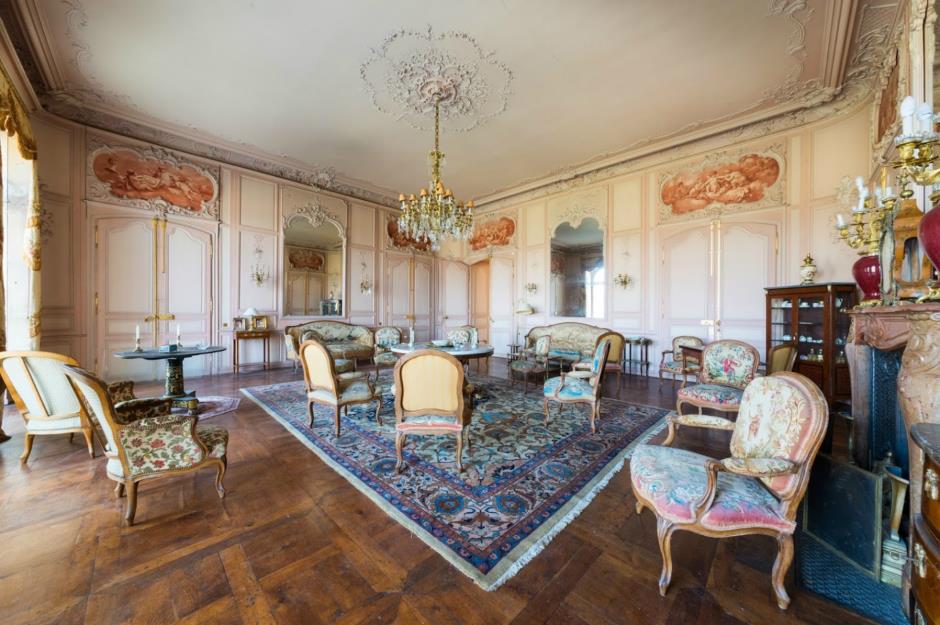
Then she opened a window in that apartment and climbed out, not into the open air, but on the top of a flight of steps that took her down one story only to meet another flight that brought her right back up to the same level again, all inside the house. This was supposed to be very discomforting to evil spirits who are said to be naturally suspicious of traps. Mrs. Winchester was the most unfortunate of women. Rich, respected, very well educated and of sound health and mind—with many other advantages usually valued by those having them and coveted by those who have them not—she sometimes thought that she would be less unhappy if they had been denied her, for then the contrast between her outer and inner life would not be continually demanding a painful attention. In the stress of privation and the need of effort, she might sometimes forget the sombre secret ever baffling the conjecture that it compels. After communing with the spirits, as she turned the hallway, Mrs. Winchester could hear a sound of a door gently closing, and saw in the darkness, indistinctly, the figure of a man, which instantly disappeared among the statues and furniture. A hasty pursuit and brief search of the mansion in the belief that the trespasser was someone secretly visiting a servant proving fruitless, she entered an unlocked door and mounted the stairs to her chamber. Its door was open, and stepping into black darkness she fell headlong over some heavy object on the floor. She spared herself the details; it was her poor William, dead of strangulation by human hands! Nothing had been taken from the house, the servants had heard no sound, and excepting those terrible fingermarks upon the dead man’s throat—dear God she hoped to forget them!—no trace of the assassin was even found. #RandolphHarris 3 of 16

Although William had Tuberculosis, something had come to end his life before the illness did. Mrs. Winchester kept barbarous murder a secret. Mrs. Winchester donated a substantial sum of money to the Winchester Clinic of the General Hospital Society of Connecticut, for the care and treatment of tuberculosis patients. The clinic still exists today as part of the Yale New Haven Medical Center. One night, a few months after the dreadful event, Mrs. Winchester and her butler were walking back from the carriage house after a trip to the city. The full moon was about three hours above the eastern horizon; the entire countryside had the solemn stillness of a summer night; their footfalls and ceaseless song of the katydids were the only sound, aloof. Black shadows of bordering trees lay athwart the mansion, which, in the short reaches between, gleamed a ghostly white. As they approached the door to the mansion, whose front was in shadow, and in which no light shone, her butler suddenly stopped and clutched her arm, saying, hardly above his breath: “God! God! what is that?” “I heard nothing,” Mrs. Winchester replied. “But see—see!” he said, pointing along the road, directly ahead. Mrs. Winchester said: “Nothing is there. Come, Henry, let us go in—you are ill.” He had released her arm and was standing rigid and motionless in the center of the illuminated roadway, staring like one bereft of sense. His face in the moonlight showed a pallor and fixity inexpressibly distressing. She pulled gently at his sleeve, but he had forgotten her existence. Presently he began to retire backward, step by step, by step, never for an instant removing his eyes from what he saw, or thought he saw. Mrs. Winchester turned half round to follow, but stood irresolute. She did not recall any feeling of fear, unless a sudden chill was its physical manifestation. #RandolphHarris 4 of 16

It seemed as if an icy wind had touched her face and enfolded her body from head to foot; she could feel the stir of it in her hair. At that moment her attention was drawn to a light that suddenly streamed from an upper window of the mansion: one of the servants, awakened by what mysterious premonition of evil who can say, and in obedience to an impulse that she was never able to name, had turned on the Carbide gas lights, which were operated by pushing an electric button. When she turned to look for the butler he was gone, and in all the years that had passed no whisper of his fate has come across the borderland of conjecture from the realm of the unknown. Mrs. Winchester retired and had fallen almost immediately into a peaceful sleep, from which she awoke with an indefinable sense of peril which was, a common experience in her estate. The servants slept in another part of the house. But these were familiar conditions and never distressed Mrs. Winchester. Nevertheless, the strange terror grew so insupportable that concurring her reluctance to move she sat up and pushed the button to turn on the lights at her bedside. Contrary to her expectation this gave her no relief; the light seemed rather as added danger, for she reflected that it would shine out under the door, disclosing her presence to whatever evil think might lurk in the halls of her mansion. You that are still in the flesh, subject to horrors of the imagination, think what a monstrous fear that must be which seeks in darkness security from malevolent existences of the night. That is to spring to close quarters with an unseen enemy—the strategy of despair! Extinguishing the gas lights, Mrs. Winchester pulled the bedclothing about her heard and lay trembling and silent, unable to shrike, forgetful to pray. In this pitiable state she must have lain for what you call hours—with her there are no hours, there is no time. #RandolphHarris 5 of 16

At last it came—a soft, irregular sound of footfalls on the stairs! They were slow, hesitant, uncertain, as of something that did not see its way; to her disordered reason all the more terrifying for that, as the approach of some blind and mindless malevolence to which is no appeal. She even thought that she must have left the hall gasolier burning and the groping of this creature proved it a monster of the night. This was foolish and inconsistent with her previous dread of the light, but what would you have? Fear has no brains; it is an idiot. The dismal witness that it bears and the cowardly counsel that it whispers are unrelated. In Mrs. Winchester’s mansion lived those who have passed into the Realm of Terror, who skulk in eternal dusk among the scenes of our former lives, invisible even to themselves, and one another, yet hiding forlorn in lonely places; yearning for speech with out loved ones, yet unenlightened, and as fearful of them as they of humans. Sometimes the disability is removed, the law suspended: by the deathless power of love or hate they break the spell—they are seen by those whom they would warn, console, or punish. What form they seem to them to bear one knows not; they know only that they terrify even those whom they most wish to comfort, and from whom they most crave tenderness and sympathy. What a thing it is to have legions of spirits, cowering and shivering, fearful and vengeful in an altered World, roaming the hallways of one’s house. However, Mrs. Winchester did not die of fright: the Thing turned and went away. She heard it go down the stairs, hurriedly, she thought, as if itself in sudden fear. Then she rose to call for help. Hardly had her shaking hand found the annunciator when—merciful Heaven!—she heard it returning. Its footfalls as it remounted the stairs were rapid, heavy and loud; they shook the mansion. She fled to an angle of the wall and crouched upon the floor. #RandolphHarris 6 of 16
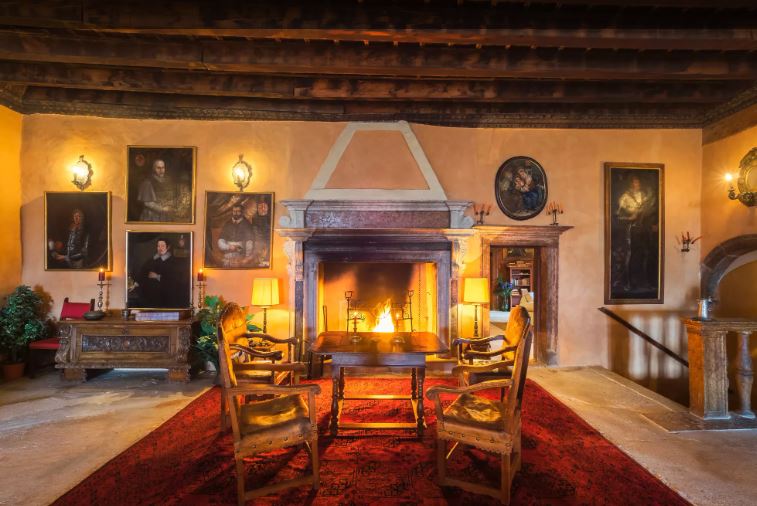
Mrs. Winchester tried to pray. She tried to call the name of her maid. Then she heard the door thrown open. There was an interval of unconsciousness, and when she revived, she felt a strangling clutch upon her throat—felt her arms feebly beating against something that bore her backward—felt her tongue thrusting itself from between her teeth! And the she felt the life pass from her. As the spirits still dwelled in the mansion of the shadows, lurking in its desolate places, peering from brambles, thickets, towers, corners, stairways and doors. Ghosts at the Winchester mansion know when it is night, for then most people retire and they can venture from their places of concealment to move unafraid about in their old mansion, to look in at the windows, even to enter and gazes upon people’s faces who might still be wandering in the evening hours. Vainly, spirits often seek some method of manifestation, some way to make their continued existence and their great love and poignant pity understood by their loved one’s or those they wish to haunt and terrorize. Ghosts dare to approach people when they are awake, but the terrible eyes of the living frighten them by the glances that they seek from the purpose the hold. Demons, ghosts, and other spiritual beings search for the living in the Winchester mansion during the moonlight dawn. At the time of her death, the unrelenting construction had rambled over six acres. The sprawling mansion contained 160 rooms, 2,000 doors, 10,000 windows, 47 stairways, 47 fireplaces, 13 bathrooms, and 6 kitchens. Carpenters even left nails half driven when they learned of Mrs. Winchester’s death. According to the provisions of her will, Mrs. Winchester’s personal property, including the furnishings, household goods, pictures, jewelry, and papers were left to her niece, Mrs. Marian Merriman Marriott, who promptly has the furnishings auctioned off. It is said to have required sic trucks working six weeks to car the furnishings away! The mansion and farm were not mentioned specially in the will. They became part of the Mrs. Winchester’s estate. #RandolphHaris 7 of 16

Demon possession is a well-defined phenomenon and should be clearly distinguished from spiritism. Since the same demonic forces are at work in both phenomena, they bear some similar characteristics and result in the same occult oppression and bondage. The demonized state of the demon possessed is similar to the trance of the spiritistic medium. Both are under the direct influence of demons who speak through them. In the case of the medium who processes to communicate with the spirits of deceased persons, the demon apes the personality and voice of the deceased. In the case of the demon possessed, the evil spirits appear to be more crassly cruel, unclean, violent, and less sophisticated and subtle than spirits working through a clairvoyant medium. In demon possession, they are also more domineering and brutally enslaving. Nervous muscular reactions and contortions peculiar to the demoniac often appear also in the spiritistic medium when one goes into a trance, but in a much milder form. Then, too, the demoniac is normally an involuntary victim of possession, while the medium is a willing subject, who cultivates psychic propensities and willingly yield to demonic control. Extraordinary movements of inanimate objects surrounding the demon-possessed remind us of similar happenings in spiritism. Extraordinary movements of inanimate objects surrounding the demon-possessed remind s of similar happenings in spiritism and magic. Tables, chairs, dishes, and the like are mysteriously moved about without anybody touching them, recalling tumbler moving and table lifting so common in spiritistic séances, and magic conjurations. In demon possession as well as in spiritism, unexplained rappings and noises in so-called “haunted houses” are heard. #RandolphHarris 8 of 16
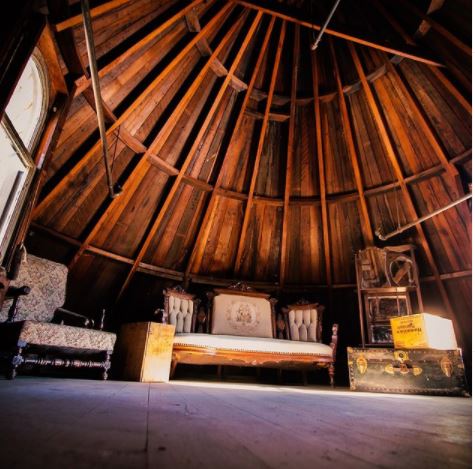
After the Winchester mansion was opened for tours, a spirit from the house had taken possession of one of the tour guides. The spirit insisted on taking up its abode with them, since it has been driven away from its for dwelling by the presence of Christians. Such cases of haunted houses about everywhere in occult literature in connection with mediums, magicians, and demon possessed persons. The tour guide saw apparitions and had frequent attacks in which she fell unconscious and demons spoke through her in their own voice and personality. A thorough investigation was conducted. Persons were stationed all around the house, in various rooms, and even in the Daisy Bedroom. Noises were heard which gradually increased in violence and seemed to concentrate in the bedroom Mrs. Winchester died in. Chairs bounced, windows rattled, plaster fell from the ceiling, and objects moved about without any visible explanation. Prayer caused the noises and telekinetic phenomena continued for a while in the mansion. On one occasion, after continued prayer, one of the demons inhabiting Jane cried out, “All is now.ost. Our plans are destroyed. You have shattered our bond, and put everything into confusion. You, with your everlasting prayers—you scatter us entirely. We are 13,130,130,130 in number. But there are still multitudes of living men, and you should warn them lest they be like us forever, lost and cursed of God.” The demon confessed that he was an emissary of Satan. The next day, the contents of the mansion were found in compete disarray and utter confusion. The amazing and terrifying thing was that the doors were still securely locked. No man or beast had entered. Evil spirits had obviously been at work in a satanic assault. On that day there were some tremendous crashing and knocking noises heard in the Winchester mansion, as if the whole house was filled with evil spirits. #RandolphHarris 9 of 16

Everyone giving tours in the mansion in the early 1900s, used to hear knocking and rumbling and crashing noises to such an extent that some of the visitors were frightened by them. Ghosts were also seen there quite regularly, even during the day time. A headless ghost was repeatedly seen in the mansion. Many people reporting becoming burned after contact with the “possessed” tour guide Jane. The autumn of 1925, all the pigs on the Winchester mansion’s farm died. The cause of death could not be found even though one of the carcasses was sent to a biological institute for examination. They tried everything but all to no avail. The following year the same thing happened again. This time the farmer redoubled his efforts to discover the cause of the pigs’ death. He had the stables inspected and the food analyzed but again without success. He thus decided to have the conservators of the estate decided to have the pigsty torn down and rebuilt on another site using completely different materials. Next year the pigs died again. They would all of the sudden squeal and then collapse. The whole process was repeated and every possible examination made in order to find out why the pigs had died. At this time certain of the member of the community began to say that someone must be killing the pigs magically out of spite. At first the conservators of the Winchester Estate would have nothing of this and continued to seek the advice of the vet and other such people. However, they could not help them, and so in the end they went to see the local minister to ask him about the question of magic. The minister simply laughed and said that the idea was stupid. Nevertheless the villagers pointed out to the representatives that there did exist some people in some areas of California who could kill livestock by means of magic. #RandolphHarris 10 of 16

The conservators could do nothing though, and the event recurred year after year in spite of the fact that by now they had doubly secured the stables with locks and had sometimes stayed up all night with thread stretched out around the estate in order to discover if anyone was causing the animals’ deaths. One day, however, the circumstances changed. The minister visited the estate and asked one of the tour guides to accompany him to the vicarage. There they found one of the neighbour’s of the Winchester Estate, a man who had been less affluent, and this man confessed that it was he who had been the cause of everything. He had killed the pigs using black magic. The tour guides and conservators were naturally upset because by now 39 pigs had been killed. When asked why he had done this, the neighbour replied that it was because the tourists made such a noise outside his house. He had become so angry that he had tried to get his revenge in this way. He had subscribed himself to the devil with his own blood. To do this he had gone out on a Friday night to some crossroads and there drawn up a contract between himself and the devil. He mentioned that the devil had not appeared to him as he is often pictured, but that he met a black curly headed figure with blood-red eyes and a small snout and that the figure had been dressed in rather old-fashioned clothes. Ever since that day the man confessed that among other things, he had had the power to kill his friend’s pigs. The minister asked him what had made him come out into the open about the whole matter. His answer was that the people at the Winchester estate had been so kind to him over the year, donating food, clothes and furniture, that he had felt ashamed and he now asked for them to forgive him, and promised he would no longer plague them. #RandolphHarris 11 of 16

Not wanting to take any legal action, the conservators of the Winchester Estate forgave him and all went well until the neighbour ceased going to church and slid back into his old ways. Since his confession none of the estate’s pigs had died but now the man again took up his drinking habits two more of the pigs died in exact same ways as the others. The conservators decided to shutdown the farming land of the Winchester Estate and sell off hundred of acres, only keeping four. In the process, several other Victorian houses on the grounds, along with fountains, and gazebos were demolished. From the psychological point of view it is suggested that a person delving into magic and who believes in occult practices is really only succumbing to a fulfilment compulsion. One unconsciously fulfils the things that one seeks to perform by magic. One is the victim of auto-suggestion. However, even if this were the whole explanation as some people affirm, it would still be true to say that occult practices have a corrupting effect on all those who get involved in them. Demons tend to be somewhat more independent than angels…When possession takes place, you will not get to see them at all. The Florida-based Luciferian Light Group (LLG) adopted the ‘Watcher myth’ of devils that were originally angels, sent to Earth to guard humankind and cursed by God for screwing their charges. In the original myth the couplings produced monsters, but, according to the LLG, the actual result was the Aryan race. They say that African Americans and other racial groups take pride in their cultural roots, so the argument goes, why should the same concept not apply to Europeans? The argument cannot be countered by liberal sophistry, and so the ghosts of German volkisch occultists continue to be conjured. #RandolphHarris 12 of 16

The role of cultural villain again proves to be a delicate balancing act—nothing can ever be condemned on purely moralistic grounds. Many people are still trying to protect “The Black House.” The Black Pope himself once reassured his flock, “the first 99 years are always the toughest. Rege Satanas!” Satanism is opposed to victimology and scapegoating. Many people are really drawn to the dark side because they grow up reading a lot of books and watching a lot of movies about it. If witches are out there, practicing some of the old ways of the pre-Christian gods and goddesses, then they are still Satanic in the sense that they are heretical. One side of the heretical and diabolical is the scientific aspect of Satanism. Copernicus and Galileo were regarded as practicing sorcerers in as far as they dared to challenge the supremacy of God with their heresies-their scientific research. Anton LaVey codified modern Satanism. There is a rich heritage of hearsay and blasphemy behind it, but as far as an aboveground religion that reveres Satan, there was not anything before the Church of Satan’s foundation in 1966. There were Black Masses that parodied the Catholic Church. A lot of modern Satanism draws from that codification or personification of Satan used as an archetype in mythology. Satanist are more interested in power, and what was going on in the castles and courts of the times. The interactions of power and Machiavellian machinations interest a Satanists rather than going out and find herbs to cure indigestion. Satanists are reaching for a religion of the aristocracy. They have all the aspects of that pride, that energy, that stye, and hopefully those elevated standards. Many people fear them because they believe they will lure you in their house and kill you, but is that not what many Christians are doing today? #RandolphHarris 13 of 16

Your relationship with your personal Satanic archetype is yours alone. The only way some can see how effective one is as a practicing black magician is how well one gets on in the outside of the World. Satanism has always represented and will always represent the adversary. He is a counterbalance to the unspoken injustice that prevails in the current society, whether that be overweening elitism or, going to the opposite extreme, mob rule. They always have to be in the minority that push hard in the other direction to get the pendulum swinging. Satanism will never be a religion of the people. It will never be populist beyond its current position. You see hundreds of thousands of kids making the sign of the horns, wearing black, getting devil tattoos, and listening to rock music they think is Satanic. They will take all the trappings and even grasp a few of the basic ideas, like Satan representing indulgence and independence of spirit. But, beyond that, they will always be a minority and that is how some think it should be. The Winchester mansion is a common site of demonic assault. In the early 1900s, a group of tourists and tour guides were attacked by demons; some became possessed; 30 people in the group were seized. In 1926, Satan and his allies once again possessed people at the Winchester mansion. For the first time in their lives, many of these people found themselves to be powerful, significant beings, establishing their own realm of authority. When they spoke, everyone in the mansion stopped to listen, for their shrill cries became testimony. Many historians have argued that the Satanism at the Winchester mansion was only the product of demented minds. However, there was something quite real in all the series of accusations and counteraccusations of the witnesses and the possessed—some definitely evil driving force that led humans to turn against one another like mad dogs lusting for the smell of blood. If Satan was to have presided over the Satanism at the Winchester Mansion, much was left out of the picture. #RandolphHarris 14 of 16

The Devil manifested himself in many forms to people at the Winchester Mansion—as a horse, a fox, a dog, a cat, a pig, and as a shadowy figure. At the Sabbats, the Devil was always present in the form of a tall, handsome man with blue eyes and black hair making no attempt to disguise his identity in any way Neither was the all-important bloodletting present in the ceremonies, either in the form of a sacrifice or in the singing of the pact. There was no defiling of sacred object, nor mention of the administering of the witches’ mark, a painful ceremony that was quite vivid in the minds of many of the witches at the estate. The Sabbats, all in all, seemed to have been rather staid affairs, involving no wild ritual or debauchery. The Devil offered not immediate wealth or riches, but a new system of government, where all humans would be equal, each human being free to “live bravely.” He promised an end to beliefs. Whoever the Devil was at those meetings, he obviously did not seek adulation, but rather he sought to establish a more equal and suitable social order among humans. Taken in this context, the entire episode begins to sound like a huge projection, a gigantic wish fulfillment on the part of the disgruntled citizens, who were expressing disdain for the system that, in their eyes had become oppressive. The figure chosen by the confessors as the Devil presiding over the midnight Sabbats had himself become disillusioned by the system. Perhaps he had been holding nocturnal meetings in the mansion in an effort of “cleansing the soul.” At any rate, the meetings were necessary psychological safety valves in the minds of the people. People would stand around begging for the master to teach them his secret. How to become invisible, how to acquire love, and oh! beyond all, how to make gold. How much gold would you give for the Secret of Infinite Riches? Humans became strengthened with wonderful power through the order of angels, so that one declares the divine will. From the Seraphim, that we cling with fervent love. From the Cherubim, enlightenment of the mind, power and wisdom over the exalted figures and images, through which we can gaze upon divine things, etcetera. #RandolphHarris 15 of 16

From the Thronis, a knowledge of how we are made and constituted, that we may direct our thoughts upon eternal things. From Dominationbius, assistance to bring into subjection our daily enemies, who we carry with us constantly, and enabling us to attain salvation. From Potestatibus, protection against human enemies of life. From Virtuibus, God infuses strength into us, enabling us to contend against the enemies of truth and reward, that we may finish the courage of our natural life. From the Principtibus, that all things become subject to humans, that one may grasp all power, and draw unto oneself all secret and supernatural knowledge. From Archangelis, that one may rile over all things that God has made subject to one, over the animals of the field, over the fish of the sea, and over the birds of the air. From the Angelis one receives the power to be the messenger of the divine. When the veil between the conscious and the subconscious mind begins thinning it is likely that one will begin to experience certain phenomenon that will grab your attention throughout the day. This will occur more and more as the veil between Worlds thins merging your spiritual awareness with your physical life. Usually it will manifest in the form of synchronicity, Déjà vu, or circumstance which seems to jump out and grab your attention. Thee I invoke, the Bornless one. Thee, that didst create the Earth and the Heavens: Thee, that didst create the Night and the Day. Thee, that didst create the Darkness and the Light. Thou art Osorronophris: Whom no human has seen at any time. Thou art Ahriman. Hear Thou Me, for I am the Angel of Paphro. Osorronophris: this is Thy True Name, handed down to the Prophets of Ishrael. Ahriman rise up through the infernal planes through the seal of Arezura and find rest within this manifestation of the blessings. Fill this sorcerous fluid with your power and might that it will serve my cause of counter creation through the intent of my own evil mind. Bless this blood as the very powers of death, destruction, and decay that I may cast out all that does not serve the cause of my own great work upon this path of enlightenment. Come tour the dark, brooding and mysterious, promising all kinds of forbidden treats. #RandolphHarris 16 of 16

Winchester Mystery House

Happy weekend! Will we be seeing you on the estate today? 🌻 https://www.winchestermysteryhouse.com/

Born with the Proverbial Silver Spoon in His Mouth

When his name first exploded into the headlines, Michael Milken was an intensely private, work-obsessed an in his early forties, nominally a senior vice-president of Drexel Burnham Lambert, an investment banking firm actually co-founded by Morgan in 1871. Despite this deceptive title, Milken was more than just another senior vice-president. He was the architect of a whole new order in American finance. He was, as many soon recognize, the J.P. Morgan of our time. In the 1980s, Drexel became one of Wall Street’s hottest investment banking firms. And because Milken’s hard-driving efforts were mainly responsible for its spectacular growth, he was allowed to run his own largely independent shop, three thousand miles from the firm’s headquarters in the East. His office was just across from the Beverly Wilshire Hotel in Beverly Hills, California. Milken would arrive at his office as early as 4.30 or 5.00 A.M., in time to squeeze in a few meetings before the opening of the New York Stock Exchange, three time zones away. CEOs of major corporations, trekking in from New York or Chicago, would drag themselves red-eyed to these conferences, hat in hand, seeking financing for their companies. One might want to build a new plant; another might wish to expand into new markets; a third might wish to make an acquisition. They were there because they knew Milken could find the capital for them. Throughout the day Milken would sit at the center of a huge X-shaped trading desk, whispering, wheeling, dealing, shouting, surrounded by a frenzy of employees working the telephones and computer screens. It was from this desk that he and his team reshaped modern American industry, as Morgan had done in an earlier day. #RandolphHarris 1 of 24

A comparison of how each did it tells a lot about how the control of capital—and hence the power of money in society—is changing today. And it begins with the personal. While J.P. Morgan was paunchy, fierce-looking, and imposing, Milken is tall, slender, clean-shaven, with curly black hair and the look of a startled doe. While Morgan was born with the proverbial silver spoon in his baby mouth, Milken, son of a CPA, collected soiled spoons off tables at the coffee shop where he worked for a time as a busboy. Morgan commuted between Wall Street, mid-Manhattan, an estate on the Hudson, and palatial residence in Europe. Milken still lives in a far-from-palatial wood and brick home in Encino, in the not-quite-fashionable San Fernando Valley of Los Angeles. Seldom far from the Pacific Ocean, he keeps his eyes focused on Japan, Mexico, and the developing economies to the south. Morgan surrounded himself with compliant young ladies and left his wife and family to languish in his absence; Milken is, by all accounts, a family man. Morgan disliked Jewish people. Milken was Jewish. Morgan despised trade unions; Milken has served as a financial consultant for rail, airline and maritime unions. The idea that employees might own their own firms would have struck Morgan as arrant communism. Milken favors worker-ownership and believes it is going to play a major role in American industry in the years to come. Both men accumulated vast power for themselves, because notorious in the press, came under government investigation for real and/or alleged wrongdoing. However, far more important, they shifted the structure of power in America in remarkably different ways. #RandolphHarris 2 of 24

When Milken was born on July 4, 1946, the America economy was still dominated by huge companies formed, for the most part, in the Morgan era. These were Genera Motors, and Goodyear Tires, the Burlington Mills and Bethlehem Steels of the World. These smokestake firms, the so-called Blue Chips, along with their lobbyists, political fund-raisers, and trade associations, plugs organizations like the National Association of Manufacturers, had enormous political, as well as economic, clout. Collectively, they sometimes acted as though the country belonged to them. This corporate power was magnified by their influence on the media through the control of immense advertising budgets, and their ability, at least in theory, to shut down a plant in a recalcitrant congressman’s district, and shift the investments and jobs to another where the political climate was more favourable. Often they were able to induce the labor unions representing their blue-collar workers to join them in a lobbying effort. This “smokestack power,” moreover, was further protected by a financial industry that made it difficult for competitors to challenge Blue Chip dominance. As a result, the basic structure of industrial power remained largely unchanged through mid-century in the United States of America. Then something happened. Milken was still in elementary school in 1956, when, for the first time, service and white-collar workers came to outnumber blue-collar workers in the United States of America. And by the time he began his career as a young investment banker the economy had already begun its rapid transition to a new system of wealth creation. Computers, satellites, vastly varied services, glocalization, were creating a totally new, change-filled business environment. However, the financial industry, hidebound and protected by legislation, formed a major barrier to change. #RandolphHarris 3 of 24

Until the 1970s, long-term capital was readily available for Blue Chip dinosaurs, but much more difficult for smaller, innovative and entrepreneurial firms to obtain. Wall Street was the financial Vatican of the World, and in the United States of America two “rating services”—Moody’s and Standard & Poor’s—guarded the gates of the capital. These two private firms assigned risk ratings to bonds, and only some 5 percent of American companies were considered by them to be of “investment grade.” This locked thousands of companies out of the long-term debt market or sent them to banks and insurance companies for loans rather than to investors in the bond market. A student, first at the University of California in Berkeley and later at the Wharton School of the University of Pennsylvania, Milken studied investor risk. He discovered that many of the smaller firms frozen out of Wall Street had good records for paying their debts. If anyone would buy bonds from them, they seldom defaulted and were prepared to pay higher than usual interest. From this counterintuitive insight came the so-called high-yield or “junk” bond, and Milken, now a young underling at Drexel, proceeded to sell them to investors with missionary zeal. The details of the story are not important for our purposes. What matters is that Milken succeeded beyond anyone’s wildest expectations. The result was that he almost single-handedly broke the financial isolation that had hitherto been imposed on this secondary tier of companies. It was like a dam bursting. Capital poured into these companies, passing through Drexel on its way. By 1989 the junk-bond market reached an astronomical $180 billion. Rather than creating a “money trust,” therefore, as Morgan had done, Milken made finance more competitive and less monopolistic, opening the gates, as it were, and freeing thousands of companies from dependence on banks and insurance companies. #RandolphHarris 4 of 24

They also bypassed the snooty Wall Street firms that existed to serve the Blue Chips. Milken’s bonds permitted managers to go directly to the public and to institutional lenders like pension funds for the capital with which to build new plants, to expand markets, to do research and development—or to take over other firms. Roughly 75 percent of junk bonds were quietly used for investment in new technology, or to open new markets, and for other noncontroversial purposes. Drexel’s advertising made much of the fact that while employment in the Blue Chips, the old giants, was not keeping pace with the economy’s expansion, jobs in the smaller firms they financed multiplied more rapidly than in the economy at large. However, some of the capital Milken supplied was used in pitched takeover battles. These dramatic financial showdowns filled the headlines and kept the stock market and the nation itself spellbound. Stock prices soared and plunged on rumors of more, and still more, takeovers and raids affecting some of the nation’s best-known companies. Deals were made that no longer provided a reasonable balance of risk and reward for the investor. Debt was pyramided on top of unrealistic debt in any orgy of speculation. Taxi drivers and waitresses knowingly discussed the latest news and called their stockbrokers, hoping to cash in on the killings to be made as competing raiders bid up the stock of corporations marked for takeover. As other Wall Street firms entered the junk-bond market, the money machine created by Milken a Drexel, no longer in their hands alone, became a runaway juggernaut. Such violent upheavals, often led to a slaughter of the innocents. Companies were “downsized,” workers ruthlessly laid off, executive ranks decimated. Not surprisingly, a massive counterattack was launched with Milken as the principal target. #RandolphHarris 5 of 24

By forcing open the sluice gates of capital, Milken had rattled the entire structure of smokestack power in America. While enriching Drexel Burnham (and feathering his own nest to the amazing tune of $550 million in 1987 alone), he also made bitter enemies of two extremely powerful groups. One consisted of the old-line Wall Street firms who previously had had a stranglehold on the flow of capital to American corporations; the other consisted of the top managers of many of the largest firms. If they could, both had every reason to destroy him. Both also had powerful allies in government and the media. First savaged in the press, which pictured him as the very embodiment of capitalist excess, Milken was then hit with a ninety-eight-count federal indictment charging him with securities fraud, market manipulation, and “parking” (illegally holding stock that belonged to Ivan Boesky, the arbitrageur who was jailed for insider trading). Threatening to use sweeping legal powers designed to deal with the Mafia, rather than with stock market wrongdoings, the federal government forced Drexel to sever its relationship with Milken and pay a crushing $650 million fine to the government. At the same time, some of the worst-case buy-outs began to come apart, panicking investors and pushing down the value of most junk bonds, safe and unsafe alike. Soon Drexel, struggling to stabilize itself after the $650 million fine, and itself holding $1 billion in junk bonds, fund itself driven to the wall. Drexel collapsed with a thunderous crash. Milken, already tried and convicted in the press, ultimately pled guilty to six violations in a complex deal that erased all other criminal charges. #RandolphHarris 6 of 24

However, as in the case of Morgan, the question of whether or not he broke the law is far less important for the country than his net impact on American business. For while finance was restructuring other industries, Milken was restricting finance. The conflict between those, like Morgan, who wanted to restrict assess to capital so that they could themselves control it, and those like Milken, who fought to widen access, has a long history in every country. “There has been a long struggle,” writes Professor Glenn Yago of the State University of New York (Stony Brook), “to innovate U.S. capital markets to make them more accessible. Farmers fought for credit in the 19th century, and agricultural productivity increases…were the outcome. In the 1930s, small businessmen got relief from being squeezed out from bank credit windows. After World War II, workers and consumers sought credit for home ownership and college education. In spite of resistance by those who would restrict popular access to credit, financial markets responded to demand and the country flourished.” While an excess of credit can unleash inflation, there is a difference between excess and access. By broadening access, Milken’s firm could, as Connie Bruck, one of his most savage critics, admits, “reasonably sustain the claim…that it had furthered the ‘democratization of capital,’” which is why some trade unionists and African-Americans rallied to his defense in his time of trouble. Morgan and Milken, in short, change American finance in contrary ways. Furthermore, while Morgan was the ultimate centralizer and concentrator, operating on the assumption that the whole was worth more than its parts, Milken and the people he financed often started from the opposite assumption. #RandolphHarris 7 of 24

Thus the 1960s and 1970s had seen the formation of gigantic, unwieldy, unfocused “conglomerates”—huge companies built on bureaucratic management and a blind belief in “economies of scale” and “synergy.” The bonds Milken sold financed takeovers designed to bust up these behemoths and create slimmer, more maneuverable and more strategically focused firms. Virtually every Milken-funded takeover resulted in the sell-off of divisions or units, because, in fact, the parts were worth more than the whole; the synergy, less than imagined. A striking case in point was the breakup of the Beatrice Companies, an ungainly agglomeration that combined, with little logic, Avis car rentals, Coca-Cola bottling, Playtex brassieres, the manufacture of tampons, along with the food processing that had once formed its core business. After its parts were sold to other companies, Beatrice was a much smaller firm operating more sensibly in the food, cheese, and meat business. Borg-Warner, an industrial firm, sold off its financial operations. Revlon, after takeover, sold off its medical business and other units unrelated to its central skills—the cosmetic industry. Milken’s easing of access to capital also helped nourish upstart firms in the new service and information sectors that are key to the advanced economy. Surely this was not Milken’s primary purpose. He was more than willing to fund rust-belt industries as well. However, operating at a moment when the entire economy was in transit out of the smokestack era, he was certainly aware of this fundamental change and, in some ways, helped spur it on. Thus at one point he told Forbes magazine that much of the restructuring going on had to do with the country’s transition out of the industrial age, adding that “in an industrial society, capital is a scarce resource, but in today’s information society, there is plenty of capital.” #RandolphHarris 8 of 24

Since Milken’s high-yield or junk bonds worked to the advantage of newer, less established companies rather than the Blue Chips, all of whom had easy access to conventional financing, it is not surprising that many of his beneficiaries were in the fast-expanding service and information sectors where newer companies were likely to be found. Thus Milken helped reorganize or channeled capital into cellular telephones, cable television, computers, health services, day care, and other advanced business sectors—whose growing power challenged the dominance of the old smokestack barons. In short, Morgan and Milken alike, but in almost diametrically different ways, shook the established power structure in their time and for this reason, quite apart from legal issues, called down upon themselves hailstorms of controversy and calumniation. For good or ill, legally or not, each changed finance in ways that corresponded to the emerging needs of the economy in their time. It required a leap of imagination on the part of Muhammad Yunus to create a bank that lends money to some of the World’s most desperately impoverished people—village entrepreneurs who might need as little as thirty of fifty dollars to start a tiny business. Conventional banks could not afford to make and service such minute loans, and borrows did not have collateral or credit histories. In 1976 Yunus, a Bangladeshi economist, created the Grameen Bank. Instead of requiring collateral, it asked borrowers to recruit a group of cosigners in their own community to guarantee repayment. The group would have a collective interest in the success of the borrower’s small business and could exert social pressure or provide help if payments fell behind. If the debt was repaid, its members might themselves qualify for loans. #RandolphHarris 9 of 24

By 2005, Grameen had made loans to 4.3 million people in tiny amounts totaling $4.7 billion, almost entirely to women—who turn out to be more apt to succeed in their enterprises and also more likely to make full repayment. Grameen has sparked similar operations in at least thirty-four countries and has set up a foundation to help NGOs and others replicate the Grameen model. Today microfinance is a sizeable global industry. Two keys to its success are its interest rates on these loans—very high by U.S. or European standards—and the remarkable 98 percent repayment rate it claims. In truth, Grameen has had collection difficulties. Yet, these borrowers are less risky than loaning money to some millionaires and billionaires. What is even more interesting about this social invention is the transformative impact it is having on other institutions. To begin with, Grameen has had many imitators of the model it launched in Bangladesh. By 2001, according to The Wall Street Journal, “shopkeepers playing cards in the village of Bagil Bazar can cite from memory the terms being offered by seven competing microlenders.” Because Grameen’s profits are unusually strong, some twenty-six NGOs working in poor countries have created microloan banks of their own to help fund their nonprofit activities. In turn, the spread of microfinance had led to the creation of MicroRate, a rating agency for microfinance banks—itself a novelty. According to its founder, Damian von Stauffenberg, more and more NGO banks will transform themselves into conventional banks in the decade to come, because that would greatly increase their ability to both borrow and lend. As many as two hundred have already taken the preliminary steps. Some will become competitive with conventional banks, and that, he suggests, will bring big global retail banks and local commercial banks into the microloan business. #RandolphHarris 10 of 24

In a word, one new organization, Grameen, has had a transformatory impact—not just on the lives of the poor entrepreneurs it has helped but on the way NGOs raise money for their activities. It could alter conventional banking as well, as it blurs the boundaries between the profit and nonprofit Worlds. Grameen is not the only example of high-impact social invention. Amazon.com has created the bookstore without a store. EBay has developed an auction bureau in which the customers do the auctioneering. Google, Yahoo! and other search engines process 600 million queries a day, altering what libraries do and compelling changes—perhaps transformation—in the staid book-publishing industry. Attacking the industrial-age social welfare model, Vern Hughes in Australia charged that “politicians are still able to get away with promising more schools, more hospitals, more nurses and more police,” as if pouring more money int them will cure the crises they face. In this model, the many social agencies deliver one-size-fits-all services to “disconnected, passive and disempowered ‘clients.’” As an alternative, Hughes cites a program in Melbourne called Person to Person, made up of families of kids with disabilities. These families were “sick of standardized services for their children,” all of whom had different needs. The families persuaded Australia’s Department of Human services to provide cash instead of services, and pay it to a group “support coordinator” the families selected. The coordinator would then buy and allocate “a mix of services chosen by the families (education, home help, day care, etcetera).” As Hughes puts it, the emerging paradigm in human services “shifts focus away from supply-side delivery to demand-side personalization.” This demassification is the welfare-service equivalent of product customization in the marketplace. #RandolphHarris 11 of 24

The technocracy that emerged, fully armed, in nineteenth-century America disdained such beliefs, because holy men and sin, grandmothers and families, regional loyalties and two-thousand-year-old traditions, are antagonistic to the technocratic way of life. They are a troublesome residue of tool-using period, a source of criticism of technocracy. They represent a thought-World that stands apart from technocracy and rebukes it—rebukes its language, its impersonality, its fragmentation, its alienation. And so technocracy disdains such a thought-World but, in America, did not and could not destroy it. We may get a sense of the interplay between technocracy and Old World values in the work of Mark Twain, who was fascinated by the technical accomplishments of the nineteenth century. He said of it that it was “the plainest and sturdiest and infinitely greatest and worthiest of all the centuries the World has seen,” and he once congratulated Walt Whiteman on having lived in the age that gave the World the beneficial products of coal tar. It is often claimed that he was the first writer regularly to use a typewriter, and he invested (and lost) a good deal of money in new inventions. In his Life on the Mississippi, he gives lovingly detailed accounts of industrial development, such as the growth of the cotton mills in Natchez: “The Rosalie Yarn Mill of Natchez has a capacity of 6000 spindles and 160 looms, and employs 100 hands. The Natchez Cotton Mills Company began operations four years ago in a two-story building of 50 x 190 feet, with 4000 spindles and 128 looms….The mill works 5000 bales of cotton annually and manufactures the best standard quality of brown shirtings and sheetings and drills, turning out 5,000,000 yards of these good per year.” #RandolphHarris 12 of 24

Twain liked nothing better than to describe the giantism and ingenuity of America industry. However, at the same tie, the totality of his work is an affirmation of preindustrial value. Personal loyalty, regional tradition, the continuity of family life, the relevance of the tales and wisdom of the elderly are the soul of his work throughout. The story of Huckleberry Finn and Jim making their way to freedom on a raft is nothing less than a celebration of the enduring spirituality of pretechnological man. If we ask, then, why technocracy did not destroy the Worldview of a tool-using culture, we may answer that the fury of industrialism was too new and as yet too limited in scope to alter the needs of inner life or to drive away the language, memories, and social structures of the tool-using past. It was possible to contemplate the wonders of a mechanized cotton mill without believing that tradition was entirely useless. In reviewing nineteenth-century American history, one can hear the groans of religion in crisis, of mythologies under attack, of a politics and education in confusion, but the groans are not yet death-throes. They are the sounds of a culture in pain, and nothing more. The ideas of tool-using cultures were, after all, designed to address questions that still lingered in a technocracy. The citizens of a technocracy knew that science and technology did not provide philosophies by which to live, and they clung to the philosophies of their fathers. They could not convince themselves that religion, as Dr. Freud summed it up at the beginning of the twentieth century, is nothing but an obsessional neurosis. Nor could they quite believe, as the new cosmology taught, that the Universe is the outcome of accidental collocations of atoms. And they continued to believe, as Mark Twain did, that, for all their dependence on machinery, tools, ought still to be their servants, not their masters. #RandolphHarris 13 of 24

They would allow their tools to be presumptuous, aggressive, audacious, impudent servants, but that tools should rise above their servile station was an appalling thought. And though technocracy found no clear place for the human soul, its citizens held to the belief that no increase in material wealth would compensate them for a culture that insulted their self-respect. And so two opposing World-views—the technological and the traditional—coexisted in uneasy tension. The technological was the stronger, of course, but the traditional was there—still functional, still exerting influence, still too much alive to ignore. This is what we find documented not only in Mark Twain but in the poetry of Walt Whiteman, the speeches of Abraham Lincoln, the prose of Thoreau, the philosophy of Emerson, the novels of Hawthorne and Melville, and, most vividly of all, in Alexis de Tocqueville’s monumental Democracy in America. In a word, two distinct thought-Worlds were rubbing against each other in nineteenth-century America. If our future will include nanotechnology, then it would be useful to understand what it can do, so that we can make more sensible plans for our families, careers, companies, and society. However, many intelligent people will respond that understanding is impossible, that the future is just too unpredictable. This depends, of course, on what you are trying to predict: The weather a month from now? Forget it; weather is too chaotic, even weather applications get predictions wrong. The position of the Moon a century from now? Easy; the Moon’s orbit is like clockwork. Which personal-computer will lead twenty years from now? Good luck; major companies today did not even exist twenty years ago. That personal computers will become even more enormously powerful? A virtual certainty. #RandolphHarris 14 of 24

And so on. If you aim to say something sensible about the future of technology, the tick is to ask the right questions and to avoid the standard pitfalls. Here are our suggestions for how to blunder into a Megamistake in forecasting: Ignore the scientific facts, or guess. Forget to ask whether anyone wants the projected product or situation. Ignore the costs. Try to predict which company or technology will win. In looking at what to expect from nanotechnology—or any technology—all of these must be avoided, since they can lead to some grand absurdities. In a classic demonstration of the first error, someone once concocted the notion that pills would someday replace food. However, people need energy to live, and energy means calories, which means fuel, which takes up room. To subsist on pills, one would need to gobble them by the fistful. This would be like eating a tasteless kibbled dog food, which was hardly the idea. In short, the pills-for-food prediction ignored the scientific facts. In a similar vein, we once heard promises of a cure for cancer—but this was based on a guess about scientific facts, a guess that “cancer” was in some sense a single disease, which might have a single point of vulnerability and a single cure. This guess was wrong, and progress against cancer has been slow. Earlier, we presented a scenario that includes the routine cure of a cancer using nanotechnology. This scenario takes account of the currently known facts: Cancers differ, but each kind can be recognized by its molecular makers. Molecular machines can recognize molecular makers, and so can be primed to recognize and destroy specific kind of cancer cells as they turn up. #RandolphHarris 15 of 24

Even nanotechnology cannot cram a meal into a pill, but this is just as well. The pills-for-food proposal did not just ignore the facts, it also ignored what people want—things like dinner conservation and novel ethnic cuisines. Magazines once promised cities beneath the sea, but who wants to live in the ultimate damp, chilly climate? California and the sunbelt have somehow proved more popular. And again, we were promised talking cars, but after giving them a try, people prefer luxury cars from companies that promise silence. Many human wants are easy to predict, because they are old and stable: People want better medical care, housing, consumer goods, transportation, education, and so forth, preferably at lower costs, with greater safety, in a cleaner environment. When our limited abilities force us to choose better quality or lower cost or greater safety or a cleaner environment, decision become sticky. Molecular manufacturing will allow a big step in the direct of better quality and lower costs and increased safety and a cleaner environment. (Choices of how much of each will remain.) There is no existing market demand for “nanotechnology,” as such, but a great demand for what it can do. Neglecting costs has also been popular among prognosticators: Building cities under the sea would be expensive, with few benefits. Building in space has more benefits, but would be far more expensive, sing past or present technologies. Many bold projections gather dust on shelves because development or manufacturing costs are too high. Some examples include personal robots, flying cars, and Moon colonies—they still sound more like 1950s science fiction than practical possibilities, and costs is one major reason. #RandolphHarris 16 of 24

Molecular manufacturing is, in part, about cost reduction. As mentioned above, molecular machines in nature make things inexpensively, like wood, potatoes, and hay. Trees are more complex than spacecraft, so why should spacecraft stay more expensive? Gordon Tullock, professor of economics and political science at the University of Arizona, says of molecular nanotechnology, “its economic effect is that we will all be much richer.” The prospect of building sophisticated products for the price of potatoes gives reason to pull a lot of old projections down from the shelf. We hope you will not find the dust when we brush them off for a fresh look. Even staying within the bounds of known science, focusing on things people want, and paying attention to costs, it is still hard to pick a specific winner. Technology development is like a horse race: everyone knows that some horses will win, but knowing which is harder (and worth big bucks). Both corporate managers betting money and researchers betting their careers have to play this game, and they often lose. A technology may work, provide something useful, and be less expensive than last year’s alternative, yet still be clobbered in the market by something unexpected but better. To know which technologies will win, you would have to know all the alternatives, whether they have been invented yet or not. Good luck! We will not try to play that game here. “Nanotechnology” (like “modern industry”) describes a huge range of technologies. Nonetheless, nanotechnology in one form or another is a monumentally obvious idea: it will be the culmination of an age-old trend toward more thorough control of the structure of matter. Predicting that some form of nanotechnology will win most technology races is like predicting that some will win a horse race (as opposed to, say, a dachshund). #RandolphHarris 17 of 24

A technology based on through control of the structure of matter will almost always beat one based on crude control of the structure of matter. Other technologies have already won races in the literal sense of being first. Few, however, will win in the sense of being best. Television cannot transmit information that comes in the form of smell, touch or taste. Furthermore, as we discussed, the information it can transmit through the visual and auditory senses is extremely narrow. The ranges of color, brightness, depth are confined by the technology. The sounds are blotted out by the whistle of the electron fields. Unfortunately, given the human tendency to accept the information of our senses as total and reliable, we are not aware of the aspects of the visual and aural information that are dropped out of this new information package. We assume that when we see and hear something, we are seeing and hearing everything that is being transmitted, as though we were actually observing the event directly. Or else we assume that what is lost is too minor to matter. We are inclined to believe the information as though it had not been processed, reduced and reshaped before we experienced it. In addition to the elimination of three sensory systems and the narrowing of two others, there is another sensory oddity in the television experience. Television disconnects the two operative sense modes—visual and sural. You are sitting in a room watching an image from miles away. You see the place, but the image you see and the sounds which reportedly connect to the image are not really connected. The sounds are “nearer” to you than the images are. Let us say you are watching two people walking on a faraway hillside. In real life, you could not make out what the characters are saying, but on television you can. #RandolphHarris 18 of 24

The voices are amplified or dubbed in, so you can hear a conversation that would otherwise be inaudible. The natural informational balance between aural and visual has been shattered. Now, information that you take in with the visual sense cannot be used to modify or help process the information from the aural sense because they have each been isolated from each other and reconstructed. Furthermore, while you are watching and listening with your disconnected aural and visual senses, you are smelling some chicken roasting in the kitchen and you are drinking a glass of premium cranberry juice So television has attached two of your sensory modes to a distant sot, altered their natural arrangement to each other, but left other aspects of your sensory apparatus at home in present time. This is a very peculiar arrangement and in a way it is sort of funny, like playing a perceptual game in a technology museum. It takes on importance when we understand that the average person submits to this condition for four hours every day, and while in this state is receiving important information about life All of the information is narrowed to fit the sensory transmission limits of the medium and distorted by the sensory disconnections in the human. One can imagine the emergence of a new psychological syndrome: “sensory schizophrenia.” The cure will involve exercises to resynchronize wildly confused senses with each other, with the mind, and with the World. Because of all the preceding it ought to go without saying that any messages that are dependent upon sensory understanding and interaction are not going to work on television. This is very unfortunate for the ecology movement. #RandolphHarris 19 of 24

It always surprises me whenever any attempts are made to show wilderness or wildlife on television. The fuzzy image previously described is the first problem: forests become blurs, ocean depths are impossibly foggy, the details of plants are impossible to see. So the viewer depends on the voice-over to know what is going on. Because of the blur naturalist programs focus on such objective behavior as playing, fighting, mating, eating, just as they do with human sitcoms and soap operas. There are more animal programs than plant programs because animals come through better on the fuzzy medium, and the larger and more rambunctious the animal the better. However, even if TV images were not as coarse as I have described them, there would still be no way to understand a forest or swamp or desert without all the senses fully operative, receiving information in all ranges, and freely interacting with each other. An interesting recent illustration of the problem was a news feature concerned with a decision that a town council had to make. A land developer sought a permit to convert a large marsh area into a new community of homes. Should the permit be okayed? It was quite a thoroughgoing, earnest report. Considering the subject, not ordinarily conceived as “good television” by producers, it was also an extraordinarily lengthy report, about eight minutes of an evening newscast. The report presented interviews with a local conservation group that opposed the project. It presented several minutes of images of the plants in the marshland, flocks of birds, nesting grounds, all with the appropriate wild-sounding calls. Having worked as a publicist for many years, in fact, as a publicist for environmental groups, I knew how much work the environmentalists had put into this program and how important they felt it to be. #RandolphHarris 20 of 24

In the end, though, I knew they had failed no matter how this particular vote came out, because if there is anything which cannot be conveyed on television it is a feeling for a marsh. I suspect that the result of the program would be to decrease concern for marshes. These images and words about marshes were probably more than they had ever seen or heard before. Since the news report told them interesting things they did not know—how many varieties of creatures lived there, for example—they may have considered it quite a complete story. In terms of popular media, indeed it was. However, while the viewers knew more than before, they were not likely to be aware of what they did not know and were not getting. As the images of the marsh went hurtling into their brains, accompanied by a news reporter’s description of an egret nesting ground, they probably assumed that most of the relevant data were hand, that they had learned enough to make a judgment. Images and words about a marsh do not convey what a marsh is. You must actually sense and feel what a strange, rich, unique and unhuman environment it is. The ground is very odd, soft, sticky, wet and smelly. It is not attractive to most humans. The odor emanates from an interaction between the sometimes-stagnant pools and the plants that live in the mud in varying stages of growth and decay. If the wind is hot and strong there can be a nearly maddening mixture of sweet and rotting odors. To grasp the logic and meaning of marsh life, the richest biological system on Earth, one need to put one’s hand into the mud, overturn it, discover the tiny life forms that abound. One needs to sit for long hours in it, feeling the ebbs and flows of the waters, the creatures and the wind. And this is something television cannot do at this time. #RandolphHarris 21 of 24

The sexuality and violence in the news and on TV serve as metaphors in life which acts directly on consciousness through the Image-ination—or else in the correct circumstances they can be openly deployed and enjoyed, imbued with a sense of the holiness of every thing from the ecstasy and wine to garbage and corpses. Those who ignore their World outside themselves risk destruction. It is creative nihilism to spend life in unreality. For those who follow life, it promises enlightenment and even wealth, a share of temporal power. Capital just does not persuade its readers that it is the truth about economics or about the inevitable future of man, and therefore worth the hard work it demands to be digested. A few brilliant essays still charm but are not enough on which to found a Worldview. The intellectual death of their eponymous hero has not stopped much of the Left from continuing to call itself Marxist, for he represents the poor in their perennial struggle against the rich, and their demand for more equality than liberal societies provided. However, beyond that, the Left’s nourishment comes from elsewhere. Nothing in Marx resonates in souls furnished by Sartre, Camus, Kafka, Dostoyevski, Nietzsche and Heidegger. Rousseau can still overpower where Marx falls flat. In Marx, ideology meant the false system of thought elaborated by the ruling class to justify its rule in the eyes of the ruled, while hiding its real selfish motives. Ideology was sharply distinguished in Marx from science, which is what Marx’s system is—id est, the truth based on disinterested awareness of historical necessity. In Communist society there will be no ideology. “The pure mind,” to use Nietzsche’s formulation, still exists in Marx’s thought, as it hard in all philosophy—the possibility of knowing the ways things are, an intellectual capacity irreducible to anything else. #RandolphHarris 22 of 24

Ideology is a term of contempt; it must be seen through in order to be seen for what it is. Its meaning is not in itself but requires translation back into the underlying reality of which it is a misleading representation. The man without ideology, the one possessing science, can look to the economic infrastructure and see that Plato’s political philosophy, which teaches that the wise should rule, is only a rationalization for the aristocrats’ position in a slave economy; or that Hobbes’s political philosophy, which teaches man’s freedom in the state of nature and the resulting war of all against all, is only the over for the political arrangements suitable for the rising bourgeoisie. This point of view provides the foundation for intellectual history, which tells the story behind the story. Instead of looking at Plato and Hobbes for information about what courage is—a subject important to us—we should see how their definitions of courage suited those who controlled the means of production. However, what applies to Plato and Hobbes cannot apply to Marx; otherwise the very assertion that these thinkers were economically determined would be itself a deception, simply the ideology for the new exploiters Marx happens to serve. The interpretation would self-destruct. He would not know what to look for in the thinkers who were inevitably and unconsciously in the grip of the historical process, for he would be in the same condition as they were. There are certainly historical preconditions of Marx’s science; but they do not detract from the truth of his insight, which is therefore a kind of absolute moment in history that no further history can alter. This truth is the warrant for revolution, and the moral equivalent of the natural rights that warranted the American Revolution. Without it all the killing is unjust and frivolous. #RandolphHarris 23 of 24

As we have talked about, cooperation based on reciprocity can thrive and be evolutionarily stable in a population with no relatedness at all. A case of cooperation that fits this scenario, at least on first evidence, has been discovered in the spawning relationships in sea bass. These fish have the sexual organs of both the male and the female. They form pairs and roughly may be said to take turns at being the high investment partner (laying eggs) and ow investment partner (providing sperm to fertilize eggs). Up to ten spawnings occur in a day and only a few eggs are provided each time. If gender roles are not divided evenly, pairs tend to break up. The system appears to allow the evolution of much economy in the size of testes, but these testes condition many have evolved when the species was sparser and more inclined to inbreed. Inbreeding would imply relatedness in the pairs and this initially may have promoted cooperation without the need of further relatedness. As the angels as the Heavenly, so of the king of the Earthly representative of God, that He knows all things. God discerns good and the evil, this refers specifically to the knowledge of the right and the wrong, the guilty and the innocent, which the Earthly judge, like the Heavenly who rules over the nations receives from His divine commissioner, so that He may give it practical realization. However, added to this is the fact that the word sequence “good and evil” does not permit us to suppose it a rhetorical flourish. Neither is it the case that “cognition in general only came to the first human when they partook of the fruit: it is not before a create without knowledge that, even before the creation of the woman, God brings the beasts that he may give them their appointed names, but before the bearer of his own breath, the beings upon whom, at the very hour of creation, he had manifestly bestowed the abundance of knowledge contained in speech, of which that being is now the master. “And they did not come unto Jesus with broken hearts and contrite spirits, but they did curse God, and wish to die. Nevertheless they would struggle with the sword for their lives,” reports Mormon 2. 14. #RandolphHarris 24 of 24

Cresleigh Homes
Our #MillsStation Residence 1 shows how airy a single story home can be – it’s 1,932 sq. ft. of effortlessly livable space.

It’s so much fun to picture all the events that might happen in this kitchen…and how many late night sandwiches might get munched at that spacious island! 😍
#CresleighHomes

For Auto Insurance that Cares About Humans
For a great auto insurance company, who will make sure you and your loved ones are safe and taken care of, in the event something unexpected happens, please click on the link below: https://www.metromile.com/

Why Does the Work Force Seem Riddled with Ulcer-Producing Levels of Angry and Envy?

It is hardly surprising that even smart executives seem confused. Some take Dale Carnegie courses on how to influence people, while others attend seminars on the tactics of negotiation, as though power were purely a matter of psychology or tactical maneuver. Still others privately bewail the presence of power in their firms, complaining on that power-play is bad for the bottom line—a wasteful diversion from the push for profit. They point to energy dissipated in personal power squabbles and unnecessary people added to the payroll of power-hungry empire-builders. When many of the most effect power wielders smoothly deny have any, confusion is redoubled. The bewilderment is understandable. Free-marketeer economists like Milton Friedman tend to picture the economy as an impersonal supply-and-demand machines and ignore the role of power in the creation of wealth and profit. Or they blandly assume that all the power struggles cancel one another out and thus leave the economy unaffected. This tendency to overlook the profit-making importance of power is not limited to conservative ideologues. One of the most influential texts in U.S.A. universitites is Economics by Paul A. Samuelson and William D. Nordhaus. Its latest edition carries an index that runs to twenty-eight pages of eye-straining fine print. Nowhere in that index is the word power listed. (An important exception to this power-blindness or purblindness among celebrated American economists has been J.K. Galbraith, who, regardless of whether one agrees with his other views, has consistently tried to factor power into the economic equation.) #RandolphHarris 1 of 20

Radical economists do a lot of talking about such things as business’s undue power to mold consumer wants, or about the power of monopolies and oligopolies to fix prices. They attack corporate lobbying, campaign contributions, and the less savory methods sometimes used by corporate interests to oppose regulation of worker healthy and safety, environment, progressive taxation, and the like. However, at a deeper level, even activists obsessed with limiting business power mistake (and underestimate) the role of power in the economy, including its beneficial and generative role, and seem unaware that power itself is going through a startling transformation. Behind many of their criticisms lurks the unstated idea that power is somehow extrinsic to production and profits. Or that the abuse of power by economic enterprises is a capitalist phenomenon. A close look at today’s powershift phenomenon will tell us, instead, that power is intrinsic to all economies. Not only excessive or ill-gotten profit, but all profits are partly (sometimes largely) determined by power rather than by efficiency. (If it has the power to impose its own terms on workers, suppliers, distributors, or customers, even the most inefficient firm can make a profit.) At virtually every step, power is an inescapable part of the very process of production—and this is true for all economic systems, capitalist, socialist, or whatever. Even in normal times, production requires the frequent making and breaking of power relationships, or their constant readjustment. However, today’s times are not “normal.” Heightened competition and accelerated change require constant innovation. Each attempt to innovate sparks resistance and new power conflict. #RandolphHarris 2 of 20

However, in today’s revolutionary environment, when different systems of wealth creation collide, minor adjustments often no longer suffice. Power conflicts take on new intensity, and because companies are more and more interdependent, a power upheaval in one firm frequently produces reverberating shifts of power elsewhere. As we push further into a competitive global economy heavily based on knowledge, these conflicts and confrontations escalate. The result is that the power factor in business is growing more and more important, not just for individuals but for each business as a whole, bringing power shifts that often have a great impact on the level of profit than cheap labor, new technology, or rational economic calculation. From budget-allocation battles to bureaucratic empire-building, business organizations are already increasingly driven by power imperatives. Fast-multiplying conflicts over promotions and hiring, the relocation of plants, the introduction of new machines, or products, transfer pricing, reporting requirements, cost accounting, and the definition of accounting terms—all will trigger new power battles and shifts. The Italian psychologist Mara Selvini Palazzoli, whose group studies large organizations, report a case in which two men together owned a group of factories. The present hired a consulting psychologist, ostensibly to boost efficiency. Telling him that morale was low, he encouraged the consultant to interview widely to find out why the work force seemed riddled with ulcer-producing levels of angry and envy. The vice-president and co-owner (30 percent, versus 70 percent owned by the president) expressed skepticism about the project. Hiring a consultant, the president shrugged, was merely “the thing to do” nowadays. #RandolphHarris 3 of 20

Analysis by Palazzoil’s group revealed a snake pit of power relationships gone awry. The consultant’s overt agenda was to increase efficiency. However, his real task was different. In actuality, the president and vice-president were at dagger-points and the president wanted an ally. Palazzoli and her group write: “The president’s secret agenda was an attempt to gain control, through the psychologist, of the whole company, including manufacturing and sales [which were largely under the control of his vice-president and partner]….The vice-president’s secret agenda was to prove himself superior to his partner and to show that his authority derived from his greater technical competence [id est, better knowledge] and more commanding personality.” The case is typical of many. The fact is that all businesses, large and small, operate in a “power field” in which the three basic tools of power—force, wealth, and knowledge—are constantly used in conjunction with one another to adjust or revolutionize relationships. However, what the above case chronicles is merely “normal” power conflict. In the decades just ahead, as two great systems of wealth creation come into violent collision, as globalization spreads and the stakes rise, these normal contests will take place in the midst of far greater, more destabilizing power battles than any we have yet seen. This does not mean that power is the only goal, or that power is a fixed pie that companies and individuals fight to divine, or that mutually fair relationships are impossible, or that so-called “win-win” deal (in which both sides gain) are out of the question, or that all human relationships are necessarily reduced to a “power nexus,” rather than to Marx’s famous “cash nexus.” #RandolphHarris 4 of 20

However, it strongly suggests that the immense shifts of power that face us will make today’s takeovers and upheavals seem small by comparison, and will affect every aspect of business, from employee relations and the power of different function units—such as marketing, engineering, and finance—to the web of power relations between manufacturers and retailers, investors and managers. Men and women will make those changes However, the instruments of change will be force, wealth, and knowledge and the things they covert into. For inside the World of business, as in the larger World outside, force, wealth, and knowledge—like the ancient sword, jewel, and mirror of the sun goddess Amaterasu-ominkami—remain the primary tools of power. Failure to understand how they are changing is a ticker to economic oblivion. If that were all, business-men and -women would face a time of excruciating personal organizational pressure. However, it is not all. For a powershift, in the full sense, is more than a transfer of power. It is a sudden, sharp change in the nature of power—a change in the mix of knowledge, wealth, and force. To anticipate the deep changes soon to strike, therefore, we must look at the role of all three. Thus, before we can appreciate what is happening to power based on wealth and knowledge, we must be prepared to take an unsettling look at the role of violence in the business World. One reason the “surplus complexity” imposed on consumers when companies bundle too many functions into a single product is hopes of widening its market, a holdover from the era of mass merchandising. #RandolphHarris 5 of 20

The result is cell phones that play music, take pictures, screen videos, offer games, track appointments, identify location, store memos and—if you are lucky—place and receive phones calls. Or a Volkswagen Passat that boasts of 120 different features, including a refrigerated glove compartment that can keep sushi cool. However, the more multi-functional a product, the more suboptimized its functions are, the more costly it is, and the more difficult it is to use. Since few customers want or need all the functions, the rest of us are victims of this surplus complexity. Complexity at the personal level is immensely amplified at the level of business, finance, the economy and society. In America, Elon Musk, who ought to know, speaks of “overcoming astronomically rising complexity.” In Germany, the Federal Financial Supervisory Board speaks of the “growing complexity of banking.” In Basel, Switzerland, the powerful Bank for International Settlements, which sets rules for banks all over the World and tells them how much capital they need to keep on hand, drafted a new set of proposed regulations called Basel II. These rules can shake up the World’s biggest banks, and governments everywhere are battling over them. Yet they were so obfuscating and complex that, according to banking consultant Emmanuel Pitsilis of McKinsey & Co., “Nobody understands 100 percent of Basel II or its implications.” Similarly, the United Nations Conference on Trade and Development is pulling together a collection of the financial and business instruments used in foreign direct investment and in deals among multinational corporations. Designed to be “conveniently available” to its user, the compendium runs to a mere fourteen volumes. #RandolphHarris 6 of 20

Welcome to “Complexorama”—the new everyday reality. Computers are supposed to help us cope with complexity, but software, according to MIT’s Technology Review, has “outrun our ability to comprehend it. It’s next to impossible to understand what is going on…whenever a program runs lager than a few hundred lines of code—and today’s desktop software contains millions of lines.” Microsoft’s ubiquitous Windows software contains fifty million lines of code and its Vista product even more. Says Ran S. Ross of the National Information Assurance Partnership, the complexity of I.T. systems themselves has “outstripped our ability to protect them,” making “complexity…the No. 1 enemy of security.” We see mounting complexity in every aspect of business, from scheduling and marketing to calculating taxes. Especially taxes. The Cato Institute in Washington reports that the American tax code has been changed no fewer than seven thousand times in the past two decades, requiring a 74 percent increase in the number of pages needed to print it. The complexity of the system costs Americans an estimated six billion hours each year spent filling out forms, trying to understand the rules and collecting and storing records of transactions. Then there is the compliant, by USA Today, that the perennially low American savings rate is being further depressed by complexity. With seven different types of individual retirement accounts and many others offered by employers, each with its own rules and constraints, “a once simple savings concept has grown into an incomprehensible thicket that can be stored out only by high-priced accountants.” #RandolphHarris 7 of 20

Exactly as one might therefore expect, the U. S. Bureau of Labor Statistics reports that positions for accountants are multiplying rapidly. As one job search firm puts it, the growing demand reflects the “increasing complexity of the corporate transactions and growth in government.” Yet another measure of skyrocketing complexity is the increase in sub-and sub-sub-specialties in many fields. Half a century ago, before the shift to a knowledge economy began, the health-care profession was divided into about ten specializations. Today there are more than 220 categories of medical professionals, says Dr. David M. Lawrence of the Kaiser Permanente health network. In the 1970s they had to stay abreast of approximately one hundred randomized, controlled clinical research trials a year. Today the annual number is ten thousand. Outside the United States of America, we see a slower but similar process of complexification at work. The European Union agency devoted to R&D speaks of the “growing complexity of all our societies,” adding that “companies’ ability to manage this complexity will be a determining factor for Europe’s future innovation capacity.” An official of the British prime minister’s Office of Public Reform reports that “more complex personal and social problems are presented for state solution” and that “national objectives for better education, health and other outcomes can only be successful by engaging with this complexity.” Meanwhile, Karola Kampf of the University of Mainz in Germany describes the escalating complexity of higher education. Kampf speaks of the “increasing number of system levels,” the multiplying types of “corporative actors” involved with the university, the rising importance of NGOs and “intermediary actors,” the “growing number of policy fields concerned with higher education” and a rise in “different modes of coordination.” #RandolphHarris 8 of 20

The mounting complexity of universities, however, whether in Europe or elsewhere, is nothing compared with the dizzying complexity of health-care systems dependent on fast-diversifying medical specializations, tests and forms of medical treatment, equipment, schedules, government regulations, financial and accounting arrangements—all constantly interacting at high speed. These are just a few examples. However, lay over these the additional intricate complexities of local, national and now global environmental regulations; financial and trade rules; disease controls; anti-terror constraints; negotiations over water and other resources; and an endless list of other interrelated functions, processes and laws. Then lay on top of that the complexities introduced by tends of thousands of NGOs each proposing or demanding it own new complexities. A decade ago, the Union of International Associations in Brussels published the two-volume Encyclopedia of World Problems and Human Potential. Its ambitions compendium listed no fewer than12203, “world problems,” each one cross-referenced to others that are “more general,” more specific, related, aggravating, aggravated, alleviating [or] alleviated.” The index to the section had no fewer than 53,825 entries, backed by a bibliography of 4,650 sources. And that was then. We are moving beyond the relative simplicity of an industrial era that everywhere emphasized uniformity, standardization and one-size-fits-all massification. And the United States of America is not alone in generating the new complexity. Add the byzantine complexities imposed by the European Union in an attempt to “harmonize” everything from education to cheese. Only computers can keep track. #RandolphHarris 9 of 20

What we see, then, are changes in the deep fundamentals that are creating the revolutionary wealth system and a corresponding way of life, both based on unprecedented levels of economic and social complexity. Together, the convergence of acceleration, de-synchronization and reglobalization, along with a tsunami of new knowledge, is overwhelming our rust-belt institutions and driving us ever closer to implosion. Fortunately, there is a way out. Before looking further at the stability of the cooperation, it is interesting to see how cooperation got started in the first place. The first stage of the war, which began in August 1914, was highly mobile and very bloody. However, as the lines stabilized, nonaggression between the troops emerged spontaneously in many places along the front. The earliest instances may have been associated with meals which were served at the same time on both sides of no-man’s land. As early as November 1914, a noncommissioned officer whose unit had been in the trenches for some days, observed that “the quartermaster used to bring the rations up…each night after dark; they were laid out and parties used to come from the front line to fetch them. I supposed the enemy were occupied in the same way; so things were quiet at that hour for a couple of nights, and the ration parties became careless because of it, and laughed and talked their way back to their companies.” By Christmas there was extensive fraternization, a practice which the headquarters frowned upon. In the following months, direct truces were occasionally arranged by shouts or by signals. An eyewitness noted that: “In one section the hour of 8 to 9am was regarded as consecrated to “private business,” and certain places indicated by flag were regarded as out of bounds by the snipers on both sides.” #RandolphHarris 10 of 20

However, direct truces were easily suppressed. Orders were issued making clear that the soldiers “where in France to fight and not to fraternize with the enemy.” More to the point, several soldiers were court martialed and whole battalions were punished. Soon it became clear that verbal arrangements were suppressed by the high command and such arrangements became rare. Another way in which mutual restraint got started was during a spell of miserable weather. When the rains were bad enough, it was almost impossible to undertake major aggressive action. Often ad hoc weather truces emerged in which the troops simply did not shoot at each other. When the weather improved, the pattern of mutual restraint sometimes simply continued. So verbal agreements were effective in getting cooperation stared on many occasions early in the war, but direct fraternization was easily suppressed. More effective in the long run were various methods which allowed the two sides to coordinate their actions without having to resort to words. A key factor was the realization that is one side would exercise a particular kind of restraint, then the other might reciprocator. Similarities in basic needs and activities let the solider appreciate that the other side would probably not be following a strategy of unconditional defection. For example, in the summer of 1915, a soldier saw that the enemy would be likely to reciprocate cooperation based on the desire for fresh rations. “It would be child’s play to shell the road behind the enemy’s trenches, crowded as it must be with ration wagons and water carts, into a bloodstained wilderness…but on the whole there is silence. After all, if you prevent your enemy from drawing his rations, his remedy is simple: he will prevent you from drawing yours.” #RandolphHarris 11 of 20

Once started, strategies based on reciprocity could spread in a variety of ways. A restraint undertaken in certain hours could be extended to longer hours. A particular kind of restraint could lead to attempting other kinds of restraint. And most importantly of all, the progress achieved in one small sector of the front could be imitated by the units in neighboring sectors. Just as important as getting cooperation started were the conditions that allowed it to be sustainable. The strategies that could sustain mutual cooperation were the ones which were provocable. If necessary, during the periods of mutual restraint, the enemy soldiers took pains to show each other that they could indeed retaliate. For example, German snipers showed their prowess to the British by aiming at spots on the walls of cottages and firing until they had cut a hole. Likewise, if they wished to, the artillery would often demonstrate with a few accurately aimed shots that they could do more damage. These demonstrations of retaliatory capabilities helped police the system by showing that restraint was not due to weakness, and the defection would be self-defeating. When a defection actually occurred, the retaliation was often more than would be called for by TIT FOR TAT. Two-for-one or three-for-one was a common response to an act that went beyond what was considered acceptable. “We go out at night in front of the trenches…The German working parties are also out, so it is not considered etiquette to fire. The really nasty things are rifle grenades…They can kill as many as eight or not if they do fall into a trench…But we never use ours unless the Germans get particularly noisy, as on their system of retaliation three for every one of ours come back.” #RandolphHarris 12 of 20

There was probably an inherent damping process that usually prevented these retaliations from leading to an uncontrolled echo of mutual recriminations. The side that instigated the action might not the escalated response and not try to redouble or retriple it. One the escalation was not driven further, it would probably tend to die out. Since not every bullet, grenade, or shell fired in earnest would hit its target, there would be an inherent tendency toward escalation. Therefore, it is clear that business negations are a lot like war strategy. When it comes to transportation outward, there are other things we need to consider. For example, Jim Salin’s afternoon from Dulles International is on the ground, late for departure. Impatiently, Jim checks the time: any later, and he will miss his connecting flight. At last, the glassy-surfaced craft rolls down the runway. With gliderlike winds, it lifts its portly body and climbs steeply toward the east. A few pages into his novel, Jim is interrupted by a second recitation of safety instructions and the captain’s announcement that they will try to make up for lost time. Jim settles back in his seat as the main engines kick in, the wings retract, the acceleration builds, and the sky darkens to black. Like the highest-performance rockets of the 1980s, Jim’ liner produces an exhaust of pure water vapor. Spaceflight has become clean, safe, and routine. And more people go up than come down. The cost of spaceflight is mostly the cost of high-performance, reliable hardware. Molecular manufacturing will make aerospace structures from nearly flawless, superstrong materials at low cost. Add inexpensive fuel, and space will become more accessible than the other side of the ocean is today. #RandolphHarris 13 of 20

Galileo did not invent the telescope, although he did not always object to the attribution. A Dutch spectacle-maker named Johann Lippershey was probably the instrument’s true inventor; at any rate, he was the first to claim a license for its manufacture, in 1608. (It might also be worth remarking here that the famous experiment of dropping cannon balls from the Tower of Pisa was not only not done by Galileo but actually carried out by one of his adversaries, Giorgio Coressio, who was trying to confirm, not dispute, Aristotle’s opinion that larger bodies fall more quickly than smaller ones.) Nonetheless, to Galileo must go the entire credit for transforming the telescope from a toy into an instrument of science. And to Galileo must also go to the credit for transforming the telescope from a toy into an instrument of science. And to Galileo must also go the credit of making astronomy a source of pain and confusion to prevailing theology. His discover of the four moons of Jupiter and the simplicity and accessibility of his writing style were key weapons in his arsenal. However, more important was the directness with which he disputed the scriptures. In his famous Letter to the Grand Duchess Christina, he used arguments first advanced by Kepler as to why the Bible could not be interpreted literally. However, he went further in saying that nothing physical that could be directly observed or which demonstrations could prove ought to be questioned merely because Biblical passages say otherwise. More clearly than Kepler had been able to do, Galileo disqualified the doctors of the church from offering opinions about nature. To allow them to do so, he charged, is pure folly. He wrote, “This would be as if an absolute despot, being neither a physician nor an architect, but knowing himself free to command, should undertake to administer medicines and erect buildings according to his whim—at grave peril of his poor patients’ lives, and the speedy collapse of his edifices.” #RandolphHarris 14 of 20

From this and other audiation arguments, the doctors of the church were sent reeling. It is therefore astonishing that all the church made persistent efforts to accommodate its beliefs to Galileo’s observations and claims. It was willing, for example, to accept as hypotheses that the Earth moves and that the sun stands still. This, on the grounds that it is the business of mathematicians to formulate interesting hypotheses. However, there could be no accommodation with Galileo’s claim that the movement of the Earth is a fact of nature. Such a belief was definitively held to be injurious to holy faith by contradicting Scripture. Thus, the trail of Galileo for heresy was inevitable even though long delayed. The trail took place in 1633, resulting in Galileo’s conviction. Among the punishments were that Galileo was to abjure Copernican opinion, serve time in a formal prison, and for three years repeat once a week seven penitential psalms. There is probably no truth to the belief that Galileo mumbled at the conclusion of his sentencing, “But the Earth moves” or some similar expression of defiance. He had, in fact, been asked for times at his trial if he believed in the Copernician view, and each time he said he did not. Everyone knew he believed otherwise, and that it was his advanced age, infirmities, and fear of torture that dictated his compliance. In any case, Galileo did not spend a single day in prison. He was confined at fist to the grand duke’s villa at Trinita del Monte, then to the palace of Archbishop Piccolomini in Siena, and final to his home in Florence, where he remained for the rest of his life. He died in 1642, the year Isaac Newton was born. #RandolphHarris 15 of 20

In a society like ours, in which people have become increasingly isolated from each other in their offices, private cars, single-family living units and television-watching, sharing personal information has become a rarity. The extended family is gone and neighborhood community gatherings are increasingly the exception to the rule. There is less and less interpersonal sharing of intimate problems, few windows into other people’s lives. Now our only windows are professional counselors, psychiatrists, and, least expensive and most available, television. It becomes the window for most people. That it looks into fictional lives is irrelevant. Although critics complain about the stereotyped characters and plots of TV dramas, many viewers look on them as representatives of the real World. Anyone questions that assertion should read the 250,000 letters, mostly containing requests for medical advice sent by views during the first five years of one doctor’s practice on television. Imagine a hermit they suggest, who lives in a cave linked to the outside World by a television set that functions only during prime time. One’s knowledge of the World would be built exclusively out of the images and facts one could glean from the fictional events, persons, objects and places that appear on television. His expectations and judgments about the ways of the World would follow the conventions of TV programs with their predictable plots and outcomes. His views of human nature would be shaped by the shallow psychology of TV characters. There are definite distortions of reality in three areas that we measured: Heavy users of television were more likely to overestimate the percentage of the World population that lives in America; they seriously overestimated the percentage of the population who have professional jobs; and they drastically overestimated the number of police in the United States of America and the amount of violence. #RandolphHarris 16 of 20

In all these cases, the overestimate matched a distortion that exists in television programming. The more television people watched, the more their view of the World matched television reality. Knowledge that the television programs were fictional—surely no one who watched them can consciously doubt that police dramas are fiction—does not prevent one from “believing” them anyway, or at least gaining important impressions which lead to beliefs. If you need further proof of this, there is always advertising. A recent study showed that a greater percentage of voters based their decisions concerning candidates and ballot propositions on information received from advertising than on information received in any other way. This may be partially due to the fact that, except for big electoral races which are widely reported in all news media, we are likely to receive a greater quantity of data from advertising than from the news. This is certainly true of most congressional races and ballot issues. Yet we all know that advertising cannot be considered always truthful. In fact, it is by nature one-sided. Advertising always reflects only the facts and opinions of the people who pay for it. Why lese would they pay for it? And yet, knowing that people use advertising information as though it can be relied upon. When it comes to product advertising, the situation is clearer still. When one is watching an advertisement, one knows for sure that the advertiser is trying to get you to do something: but the product. One also knows that the people in the ad are not “real,” that is, they are actors who are speaking lines, in situations that do not represent their actual lives. Everyone knows this. We all know that the motive of the sponsor and the actors and the writers of the ads is that they are all trying to implant a feeling in us that will eventually get us to but something. We know they are doing this, but we often act on the ad. #RandolphHarris 17 of 20

In Meat Joy (Paris, 1964) nearly naked men and women interacted, in a rather frenzied, Dionysian way, with one another and with hunks of raw meat and carcasses of fish and chickens. They smeared themselves with blood, imprinted their bodies on aper, tore chickens apart, threw chunks of raw meat and torn fowl about, slapped one another with them, kisses and rolled about “to exhaustion,” and so on. The sparagmatic dismemberment and the suggestion of the suspension of mating taboos both evoke Maenadism and the Dionysian cult. The wild freedom advocated by this ancient cult, as well as its suggestions of rebirth, seemed appropriate expression of the unchecked newness that faced the art World as its boundaries dissolved and opened on all sides into unexpected vistas, where traditional media, torn apart and digested, were reborn in unaccountable new forms. The Dionysian subversion of ego in the cause of general fertility has become another persistent theme of appropriation performance. Barbara Smith has performed what she calls a Tantric ritual, that included pleasures of the flesh, in a gallery setting as an artwork. In general, performance works involving appropriate of religious forms follow two groups: those that select from the neolithic sensibility of fertility and blood sacrifice, and those that select from the paleolithic sensibility of shamanic magic and ordeal; often the two strains mix. Both may be seen as expression of the desire, so widespread in the 60s and early 70s, to reconstitute within Modern civilization something like an ancient or primitive sensibility of oneness with nature. Though the erotic content of the works based on the themes of fertility has been received with some shock, it is the work based on the shamanic ordeal that the art audience has found most difficult and repellent. #RandolphHarris 18 of 20

Clearly that is part of the intention of the work, and in fact a part of its proper content. However, it is important to make clear that these artists have an earnest desire to communicate, rather than simply shock. Seen in an adequate context, their work is not aggression but expression. Nietzsche restored to something like the soul to our understanding of man by providing a supplement to the flat, dry screen of consciousness, which with pure intellect looks at the rest of humanity as something alien, a bundle of affects of matter, like any other object of physics, chemistry and biology. The unconscious replaces all the irrational things—above all divine madness and eros—which were part of the old soul and had lost significance in modernity. It provides a link between consciousness and nature as a whole, restoring therewith the unity of humanity. Nietzsche made psychology, as the most important study, possible again; and everything of interest in psychology during the last century—not only psychoanalysis but also Gestalt, phenomenology, and existentialism—took place within the confines of the spiritual continent he discovered. However, the difference between the self and the soul remains great because of the change in the status of reason. The reconstitution of man in Nietzsche required that sacrifice of reason, which Enlightenment, whatever its failings, kept the center. For all the charms of Nietzsche and all that he says to hearten a lover of the soul, he is further away from Plato in this crucial respect than was Descartes or Locke. Since the wicked man has negated his existence, he ends in nothing, his way is his judgement. However, with sinners it is different: their “not standing” does not refer to the decision of the supreme judgement, it is only a human community which is unable to offer them any stability if it is not to make its own stability questionable. #RandolphHarris 19 of 20

However, entry into this community is not closed to them. They need only to carry out that turning into God’s way, of which permits us to the divine, is not merely open to them but that they themselves may desire it in the depths of their hearts, whereas they do not feel themselves strong enough, or rather fancy they are not strong enough, to enter upon it. Is the way, then, closed to the wicked? It is not closed from God’s side—so we may continue the reflection of the divine way—but it is closed from the side of the wicked themselves. For in distinction from the sinners they do not wish to be able to turn. That is why their way peters out. Here, it is true, there arises for us modern interpreters of the Divine way to which neither this nor any other work of knowledge nor any human word knows the answer: how can an evil will exist, when God exists? The abyss which is opened by this question stretches, even more uncannily than the abyss of Job’s question, into the darkness of the divine mystery. Before this abyss the interpreter of the Psalms stands silent. Underlying principles of respect that were once commonplace in society have increasingly given way to unkind behavior. To help our children and youth set aside the many negative examples that bombard them, we must first understand respect, reasons we sometimes act disrespectfully, gospel principle that apply, and ways we can be better teachers and exemplars of respect. Respect is being polite or civil to those we meet or with whom we interact. This would include being respectful of a teacher. We hope grandchildren will treat grandparents respectfully during visits. We usually treat strangers with polite respect. We want children and others to treat us with respect—using good manners—but also to honor our standards, which we seek to exemplify through Christlike living. #RandolphHarris 20 of 20

Cresleigh Homes

Who says single story homes can’t be absolutely luxurious?! ✨ Our bathroom at #Havenwood Residence 1 is nothing short of glam – and that little peep of the closet? 👀 Tempting!
All homes in the Cresleigh community come with an All Ready connected home – “Alexa, play spa 🎶 music!”


In the “Judgement” it is Existence Which is at Stake

Mutual cooperation can emerge in a World of egoists without central control by starting with a cluster of individuals who rely one reciprocity. When conditions are right, cooperation can evolve even without friendship or foresight, with is much more conducive than mutual treachery. Sometimes cooperation emerges where it is least expected. During World War I, the Wester front was the scene of horrible battles for a few yards of territory. However, between these battles, and even during them at other places along the five-hundred-mile line in France and Belgium, the enemy soldier often exercised considerable restraint. A British staff officer on a tour of the trenches remarked that he was, “astonished to observe German soldiers walking about within rifle range behind their own line. Our men appeared to take no notice. I privately made up my mind to do away with that sort of thing when we took over; such things should not be allowed. These people evidently did not know there was a war on. Both sides apparently believed in the policy of “live and let live.” This is not an isolated example. The live-and-let-live system was endemic in trench warfare. It flourished despite the best efforts of senior officers to stop it, despite the passions aroused by combat, despite the military logic of kill or be killed, and despite the ease with which the high command was able to repress any local efforts to arrange a direct truce. This is a case of cooperation emerging despite great antagonism between the players. As such, it provides a challenge for the application of the concepts and the theory we developed in past reports. In particular, the main goal is to use the theory to explain: How could the live-and-let-live system have gotten started? How was it sustained? Why did it break down toward the end of the war? Why was it characteristic of trench warfare in World War I, but of few other wars? #RandolphHarris 1 of 20

A second goal is to use the historical case to suggest how the original concept and theory can be further elaborated. The Historical situation in the quiet sectors along the Western Front was an iterated Prisoner’s Dilemma. In a given locality, the two players can be taken to be the small units facing each other. At any time, the choices are to shot to kill or deliberately to shoot to avoid causing damage. If a major battle is ordered in the sector, for both side, weakening the enemy is an important value because it will promote survival. Therefore, in the short run it is better to do damage now whether the enemy is shooting back or not. This established that mutual defection is preferred to unilateral restraint (P>S), and that unilateral restraint by the other wise is even better than mutual cooperation (T>R). In addition, the reward for mutual restraint is preferred by the local units to the outcome of mutual punishment (R>P), since mutual punishment would imply that both units would suffer for little or no relative gain. Taken together, this establishes the essential set of inequalities: T>R>P>S. Moreover, both sides would prefer mutual restraint to the random alternation of serious hostilities, making R> (T + S)/2. This the situation meets the conditions for a Prisoner’s Dilemma between small units facing each other in a given immobile sector. Two small units facing each other across one hundred to four hundred yards of no-man’s-land were the players in one of these potentially deadly Prisoner’s Dilemmas. Typically, the basic unit could be taken to be the battalion, consisting of about one thousand men, half of whom would be in the front line at any one time. The battalion played a large role in the life of an infantryman. It not only organized its members for combat, but also fed, paid, and clothed them as well as arranged their leave. All of the officers and most of the other soldiers in the battalion knew each other by sight. For our purposes, two key factors make the battalion the most typical player. #RandolphHarris 2 of 20

On the one hand, it was large enough to occupy a sufficient sector of the front to be “held accountable” for aggressive actions which came from its territory. On the other hand, it was small enough to be able to control the individual behavior of its men, through a variety of means, both formal and informal. A battalion on one side might be facing parts of one, two, or three battalions on the other side. Thus each player could simultaneously be involved in several interactions. Over the course of the Western Front, there would be hundreds of such face-offs. Only the small units were involved in these Prisoner’s Dilemmas. The high commands of the two sides did not share the view of the common soldier who said: “The real reason for the quietness of some sections of the line was that neither side had any intention of advancing in that particular district….If the British shelled the Germans, the Germans replied, and the damage was equal: if the Germans bombed an advanced piece of trench and killed five Englishmen, an answering fusillade killed five Germans.” To the army headquarters, the important thing was to develop an offensive spirit in the troops. The Allies, in particular, pursued a strategy of attrition whereby equal losses in men from both sides meant a net gain for the Allies because sooner or later Germany’s strength would be exhausted first. So at the national level, World War I approximated a zero-sum game in which losses for one side represented gains for the other side. However, at the local level, along the front line, mutual restraint was much preferred to mutual punishment. Locally, the dilemma persisted: at any given moment it was prudent to shoot to kill, whether the other side did so or not. What made each trench warfare so different from most other combat was that the same small units faced each other in immobile sectors for extended periods of time. This changed the game from a one-move Prisoner’s Dilemma in which defection is the dominant choice, to an iterated Prisoner’s Dilemma in which the theory’s predictions: with sustained interaction, the sable outcome could me mutual cooperation based upon reciprocity. In particular, both sides followed strategies that would not be the first to defect, but that would be provoked if the other detect. #RandolphHarris 3 of 20

Now, running a business can be a lot like fighting in a war. Business may be turning out products and profits. However, it is hard to resist the suspicion that it is also becoming a popular form of theater. Like theater, it has heroes, villains, drama, and—increasingly—it has stars. The names of business tycoons ricochet through the media like those of Hollywood celebrities. Surrounded by publicists, trained in all the arts of self-promotion, characters like Donald Trump, Paris Hilton, or Elon Musk have become living symbols of corporate power. They are satirized in the comics. They (and their writers) crank out best sellers. All of these people have even been mentioned—or perhaps arranged to have themselves mentioned—as potential candidates for the presidency of the United States of America, and one has actually been elected as president. Business has arrived in the Age of Glitz. Business had its stars in the past, too, but the very context of stardom is different today. The tinselly new glamour acquired by business is a superficial facet of the new economy, in which information (including everything from scientific research to advertising hype) plays a growing role. What is happening is the rise of an entirely new “system for wealth creation,” which brings with it dramatic changes in the distribution of power. This new system for making wealth is totally dependent on the instant communication and dissemination of data, ideas, symbols, and symbolism. It is, as we will discover, a super-symbolic economy in the exact sense of that term. Its arrival is transformational. It is not, as some still belatedly insist, a sign of “de-industrialization,” “hollowing out,” or economic decay, but a leap toward a revolutionary new system of production. This new system takes us a giant step beyond mass production toward increasing customization, beyond mass marketing and distribution toward niches and micro-marketing, beyond the monolithic corporation to new forms of organization, beyond the nation-state to operations that are both local and global, and beyond the proletariat to a new “cognitariat.” #RandolphHarris 4 of 20

The collision between forces favoring this new system of wealth creation and defenders of the old smokestack system is the dominant economic conflict of our time, exceeding in historical importance the conflict between capitalism and communism or among the United States of America, Europe, and Japan. Moving from an economy based on smokestacks to one based on computers requires massive transfers of power, and it largely explains the wave of financial and industrial restructuring that has been ripping through the corporate World, throwing up new leaders, as companies desperately seek to adapt to fresh imperatives. Takeovers, raids, acquisitions, leveraged buy-outs, corporate buy-backs, all made financial headlines throughout the 1980s, and involved not only U.S.A. firms but many foreign companies as well, despite legal and other restrictions that limit “unfriendly” takeovers in countries like Germany, Italy, or Holland. It would be an exaggeration to say that all these wild doings on Wall Street and the thrashing about in companies around the World are direct manifestations of the shift to a new kind of economy. Tax considerations, the integration of Europe, financial liberalization, old-fashioned greed, and other factors all play a role. Indeed, if anything, people like Trump, Hilton, Musk, and Iacocca represent heralds of the past and the new. Successfully lobbying Washington to bail out a failing auto maker, Iacocca’s chief claim to fame, or putting one’s name on flashy skyscrapers and gambling casinos hardly make one business revolutionary. In a revolutionary period, however, all sorts of strange flora and funa appear—atavists, eccentrics, publicity hounds, saints, and crooks, along with visionaries and genuine revolutionaries. #RandolphHarris 5 of 20

Beneath all the razzle-dazzle, the refinancings and reoganizations, there is an emerging pattern. For what we are seeing is a change in the structure of business and the beginnings of a shift of power from “smokestack money” to what might be called “super-symbolic money”—a process we will explore in more detail later. This broad restructuring is necessary as the entire wealth-creation system, driven by competitive pressures, steps up to a more advanced level. Thus, to picture the takeover frenzy of the late eighties as nothing more than an expression of me-first greed is to miss its larger dimensions. Nevertheless, the new economy has rewarded well those who first saw it coming. In the smokestack era any list of the richest people in the World would have been dominated by car makers, steel barons, rail magnates, oil moguls, and financiers, whose collective wealth ultimately came from the organization of inexpensive labor, raw materials, and the manufacture of hardware. By contrast, Forbes magazine’s latest list of the ten richest American billionaires includes fully seven whose fortunes were based on media, communications, or computer—software and services rather then hardware and manufacturing. They reflect what the Japanese call the new “softnomics.” The spasm of mergers, takeovers, divestitures, and financial reshuffling is, however, only one aspect of the transition to the new economy. At the same time that they are trying to fend off raiders or to make acquisitions, companies are also frantically striving to cope with an info-technological revolution, a restructuring of markets, and a host of other related changes. It adds up to the biggest shake-up the business World has known since the industrial revolution. So deep a restructuring does not happen without anguish and confrontation. As happened at the start of the industrial revolution, millions find their incomes threated, their ways of work made obsolete, their futures uncertain, their power slashed. #RandolphHarris 6 of 20

Investors, managers, and workers alike are thrown into conflict and confusion. Strange alliances spring up. New forms of judo are invented. In the past, labor unions exerted power by striking or threatening to do so. Today, in addition, they hire investment bankers, lawyers, and tax experts—purveyors of specialized knowledge—hoping to become part of a restructuring deal rather than its victim. Managers seeking to head off a takeover, or to buy out their own firm, along with investors seeking to profit from such upheavals, are increasingly dependent on timely, pinpointed information. Knowledge is a key weapon in the power struggles that accompany the emergence of the super-symbolic economy. So is the ability to influence the media—thereby shaping what others know (or think they know). In this volatile environment, flashy personalities skilled at manipulating symbols have a distinct advantage. In France the epitome of the entrepreneur is Bernard Tapie, who claims to have built a privately held business with annual revenues of $1 billion. Tapie hosts his own TV show. In Brain, Richard Branson, who founded the Virgin Group, breaks speedboat records and, in the words of Fortune, enjoys “the sort of celebrity once reserved for rock stars or royalty.” As an old system cracks, the faceless bureaucrat-managers who run it are blown away by a guerrilla army of risk-taking investors, promoters, organizers, and managers, many of them antibureaucratic individualists, all of them skilled at either acquiring knowledge (sometimes illegally) or controlling its dissemination. The arrival of the new super-symbolic system for creating wealth not only shifts power but changes its style as well. One need only compare the temperaments of, say, John DeButts, the slow, solemn who ran the American Telephone and Telegraph Company in the 1970s before it was broken up, with that of William McGowan, who cracked AT&T’s monopoly and created MCI Communications Corporation to compete with it. #RandolphHarris 7 of 20

Impatient and irreverent, the son of a railroad unionist, McGowan began by peddling alligator purses, wound up raising funds for Hollywood producers Mike Todd and George Skouras when they made the wide-screen version of Oklahoma, and then founded a small defense contracting firm before zeroing in on AT&T. Or compare the cautions “business statesmen” who ran General Electric for a decade or two, with Jack Welch, who gained the nickname “Neutron Jack” as he tore up the giant and reshaped it. The stylistic shift reflects changed needs. For the task of restructuring companies and whole industries to survive in the super-symbolic economy is not a job for nit-picking, face-saving, bean-counting bureaucrats. It is, in fact, a job for individualists, radicals, gut-fighters, even eccentrics—business commandos, as it were, ready to storm any beach to seize power. It has been said that today’s risk-taking entrepreneurs and deal-makers resemble the “robber barons” who originally built the smokestack economy. Today’s Age of Glitz, indeed, does bear a resemblance to the so-called Gilded Age, just after the American Civil War. That, too, was a time of fundamental economic restructure, following the defeat of agrarian slavery by the rising forces of the industrializing North. It was the era of conspicuous consumption, political corruption, wild spending, financial peculation and speculation, peopled by larger-than-life characters like “Commodore” Vanderbilt, “Diamond Jim” Brady, and “Bet a Million” Gates. Out of that era, marked by anti-unionism and contempt for the poor, came the decisive burst of economic development that thrust American into the modern industrial age. However, if today’s breed are more buccaneer than bureaucrat, they could be termed “electronic pirates.” The power they seize is dependent on sophisticated data, information, and know-how, not just bags of capital. #RandolphHarris 8 of 20

Say California financier Robert I. Weingarten, describing the corporate takeover process, “The first thing you do is create a computer screen which lists your criteria. Then you search for a target company that meets them by running these criteria against various data bases until you identify the target. And the last thing you do? The last thing you do is call a press conference. You start with the computer and end with the media. “In between,” he add, “you call in a host of highly specialized knowledge workers—tax lawyers, proxy war strategists, mathematical modelers, investment advisers, and PR experts—most of whom are also very dependent on computers, facsimile machines, telecommunications, and the media. “Nowadays the ability to make a deal happen very often depends more on knowledge than on the dollars you bring to the table. At a certain level it is easier to obtain the money than the relevant know-how. Knowledge is the real power lever.” Because takeovers and restructure challenge power, they produce high drama, hence heroes and villains. Names like Carl Icahn and T. Boone Pickens become household words around the World. Feuds breakout. Steve Jobs, co-founder of Apple Computer and once the boy wonder of American industry, resigns after a corporate coup d’etat by John Sculley, despite Job’s vast holdings in the company. Iacocca continues his interminable vendetta against Henry Ford II. Roger Smith of General Motors is satirized in a movie, Roger & Me, and savaged in public by Ross Perot, the computer millionaire whose company Smith acquired. The list lengthens each day. To imagine that takeovers are peculiarly American, an artifact of inadequate regulation of Wall Street, is to miss their deeper significance. In Britain, Roland “Tiny” Rowland battles bitterly for control of Harrods department store and Sir James Goldsmith, the burly, brash financier launches a $21 billion raid of BAT Industries PLC. Carlo de Benedetti, head of Olivetti, battles with Gianni Agnelli of the Fiat empire and il salotto buono—the inner circle of entrenched industrial power in Italy—and shocks all of Europe with a sudden bid for control of Societe Generale de Belgique of Brussels, a group that controls a third of the entire Belgian economy. #RandolphHarris 9 of 20

Groupe Bull, the French computer firm, eyes the computer operation of Zenith in the United Sates of American. Groupe Victorie takes over Germany’s second-largest insurer, Colonia Versicherung A.G., while the Dresdner Bank buys out the French Banque Internationale de Placement. In Spain, where drama often turns into melodrama, the public has been treated to what the Financial Times has called “probably the most riveting and, ultiamately, tasteless, display in decades,” and explosive battle between “los beautiful people” and “los successful people”—old and new money. Focused on control of the nation’s three largest banks and their related industrial empires, the battle pitted Alberto Cortina and his cousin Alberto Alcocer against Mario Conde, a brilliant, Jesuit-trained lawyer who capture control of Banco Espanol de Credito and tried to merge it with Banco Central, already the largest bank in the country. The battle hit the pages of the soft-porn press when one of “los Albertos” fell in love with a twenty-eight-year-old marquesa who was photographed in a nightclub wearing a miniskirt san undies. In the end the grand merger, touted by the Spanish Prime Minister as “possibly the economic event of the century,” broke apart like shattered glass, leaving Conde fighting to survive in his own bank. All this is exciting fodder for the media mills, but the international character of the phenomenon tells us that something more is involved than glitz, greed, and local regulatory failures. As we will see, something more serious is happening. Power is shifting on a hundred fronts at once. The very nature of power—the mix of force, wealth, and knowledge—is changing as we make the transition to the super-symbolic economy. Has anyone noticed how complicated sports have become? Once upon a time, recreational and even professional sports formed a relatively simple part of a modern economy. Today we seem more and more teams, more leagues, more rules and many multifaceted relations between teams and leagues. #RandolphHarris 10 of 20

Moreover, the sports World finds itself entangled in everything from drug laws, television, politics, labor unitions and gender conflict to urban planning and intellectual-property issues. And sports, as a business, is increasingly linked to other industries, new technologies, and audiences, forming a far more complex mesh of constantly changing relationships. Ohio University notes that its graduates now work in “intercollegiate athletics, professional sports, public assembly facilities, sports tours, motor sports, corporate sports organizations, sports media, and the entertainment industries.” The engineering department of the University of Cape Ton in South Africa offers studies in “hardness testing of cricket bats, the drag of bicycle wheels, mountain bike tire aerodynamics….and the heat transfer of cycling helmets.” A software company advertises that, “the increased attention that the big sports events draw has resulted in complex scheduling problems” that its customizing software can handle. The greater the variety and number of interacting components in any system, and the faster the changes among them, the greater its complexity. And this is not just a matter of soccer and skating. Each of history’s three great wealth systems—agrarian, industrial and knowledge-based—differs in its levels of complexity. Today we are experiencing a historic, system-wide leap toward greater economic and social complexity. And it affects everything from business to politics, and from child rearing to shopping. Malls are filled with more and more styles of flashy sneakers. Pizza comes with more exotic toppings. Bottled water is available in multiple flavors. Pharmaceutical houses move toward drugs customized for each patient. Not surprisingly, everything in daily life now seems more complex and interdependent: Choosing a mobile phone, a credit card or an Internet provider—even, in fact, the way our kids choose their friends. #RandolphHarris 11 of 20

For young people, the choice of a portable digital gizmo affects the games one plays and the groups one hangs out with. The social group, in turn, affects the clothes one wears, the music one listens to, who is “in” and who is “out.” The very criteria that snobs apply have become more complicated. It is this combination of diversity and interdependence that makes life so complex. Nietzsche finds these decadents, pessimists or protonihilists revelatory, as he does the fakers of great deeds and passions who are the reverse side of the coin, in particular Wagner. He has contempt for the former, not because they lack honesty or because their characterization of the World around them is inaccurate, but because they know that once there were gods and heroes and that they were the products of poetic imagination—which means that poetic imagination can make them again—yet do not have the courage or the resolve themselves to create. Therefore they are hopeless. They alone can still long; but they are secret believers in the Christian God or, at least, in the Christian Worldview and cannot believe in the really new. They are afraid to set sail on stormy, uncharted seas. Only Dostoyevski has a vitality of soul, proof against decadence. His unconscious, filtered through a Christian conscience, expresses itself in forbidden desires, crimes, acts of self-abasement, sentimentality and brutality; but he is alive and struggling and proves the continuing health of the animal and all that is in ferment down under. The artists is the most interesting of all phenomena, for one represents creativity, the definition of humans. One’s unconscious is full of monsters and dreams. It provides the pictures to consciousness, which takes them as given and as “World,” and rationalizes them. Rationality is only the activity of providing good reasons for what has no reason or is unreasonable. We do what we do out of a fate that is our individuality, but we have to explain and communicate. This latter is the function of consciousness; and when it has been provided with a rich store by the unconscious, its activity is fruitful, and the illusion of its sufficiency is even salutary. However, when it has chopped up and chewed over its inheritance, as mathematical physics has now done, there are not enough nourishing plants left whole. Consciousness now requires replenishment. #RandolphHarris 12 of 20

Thus Nietzsche opened up the great terrain explored by modern artists, psychologist and anthropologists, searching for refreshment for our exhausted culture in the depths of the darkest unconscious or darkest Africa. Not all that Nietzsche asserted is plausible, but its charm is undeniable. He went to the end of the road with Rousseau, and beyond. The side of modernity that is less interesting to Americans, which seeks less for political solutions than for understanding and satisfaction of man in his fullness or completeness, finds it profoundest statement in Nietzsche, who represents the culmination of that second state of nature. Above all he was a friend of artists, who were the first to recognize him when he was disreputable among academics; and among them his influence was clearly most fertile. One need only think of Rilke, Yeats, Proust and Joyce. The greater philosophic tribute to him is Heidegger’s book Nietzsche, the most important part of which is entitled “The Will to Power as Art.” In Vienna in the early 1960s, Hermann Nitsch began presenting a series of performances that, in 1965, he would consolidate as the OM, or Orgies Mysteries, Theatre. His work was a focused exercise to bring the performance genre to its darkest spaces, its most difficult test, at once. In OM presentations the performers tear apart and disembowel a lamb or bull, cover themselves and the environment with the blood and gore, pour the entrails and blood over one another, and so on. These events last up to three hours (though Nitsch is planning one that will last for six days and nights). They have occasionally been shut down by the police. They have occurred in art galleries and have been reported in art magazines and books. The OM Theatre performances open into dizzyingly distant antiquities of human experience. In form they are essentially revivals of the Dionysian ritual called the sparagmos, or dismemberment, in which the initiates, in an altered state produced by alcohol, drugs, and wild dancing, tore apart and ate raw a goat that represented the god Dionysus, the god of all thrusting and wet and hot things in nature. #RandolphHarris 13 of 20

It was, in other words, a communion rite in which the partaker abandoned his or her individual identity to enter the ego-darkened paths of the unconscious and emerged, having eaten and incorporated the god, redesignated as divine. In such rites ordinary humanity ritually appropriates the aura of godhood, through the ecstatic ability to feel the Law of Identity and its contrary at the same time. Euripides, an ancient forerunner of the Viennese artists, featured this subject in several works. Like Nitsch, he did so partly because this was the subject matter hardest for his culture, as for ours, to assimilate in the light of day. In the Bacchae especially he presents the dismemberment as a terrifying instrument of simultaneous self-abandonment and self-discovery. The Appollonian tragic hero, Pentheus, like our who rationalist culture, thought his boundaries were secure, his terrain clearly mapped, his identity established. Rejecting the Dionysian rite, which represents the violent tearing apart of all categories, he became its victim. Disguising himself as Maenad, or female worshipper of Dionysus, he attempted to observe the ritual, but was himself mistaken for the sacrificial victim, torn apart, and eaten raw. In short, his ego-boundaries were violently breached, the sense of his identity exploded into fragments that were then ground down into the primal substrate of Dionysian darkness which both underlies and overrides civilization’s attempts to elevate the conscious object above nature. Nitsch writes of his work in consciously Dionysian terms as celebrating a “drunken, all-encompassing rejoicing,” a “drunken ecstasy of life,” a “liberated joy of strong existence without barriers,” “a liturgy of exultation, of ecstatic, orgiastic, boundless joy, of drugged rapture…” He has created, in fact, a purely classical theory for it, based on Freudian and Jungain reinterpretations of the scape goat as the wellspring of purification for the community. Another state of the OM ritual finds a young male standing or lying naked beneath a slain carcass marked with religious symbols and allowing the blood and guts to flow over his naked body. Again an ancient source has been appropriated. #RandolphHarris 14 of 20

In the initiation rite called the taurobolium, the aspirant was placed named in a pit over which, atop a lattice of branches, a bull representing the god, was slain and disemboweled. When the initiate emerged covered with the bull’s blood and entrails, he was hailed as the reborn god emerging from the Earth womb. These works demonstrate the category shift involved in the appropriation process. In part this shift from the sone of religion to that of art represents the residual influence of Romanticism: the artist is seen as a kind of extramural initiation priest, a healer or guide who points the alienated soul back towards the depths of the psyche where it resonates to the rhythms of nature. In addition, it is the neutrality of the unbounded category that allows the transference to occur. Religious structures in our society allow no setting open enough or free enough to equate with that of ancient Greek religion, which was conspicuously nonexclusionary; the art realm in the age of boundary dissolution and the overflow did offer such a free or open zone. Gunter Brus, another Viennese performer, has claimed that placing such contents within the art realm allows “free access to the action”—a free access that the category of religion, with its weight of institutionalized beliefs, does not allow. The assumption, in other words, is that in the age of the overflow the art context is a neutral and open context which has no proper and essential context of its own. Art, then, is an open variable which, when applied to any culturally bound thing, will liberate it to direct experience. That is was the age of psychedelic drugs, and that psychedelic drugs were widely presumed to do the same thing, is not unimportant. As the tradition advanced along the path to the underworld, it was increasingly influenced by psychopharmacology with its sense of the eternally receding boundaries of experience. Soon after Nitsch’s first performances in Vienna, Carolee Schneemann presented a series of now-classic pieces also based on the appropriation of ritual activities from ancient and primitive sources. The general shape of these works arose, as among ancient shamans and magicians, from a variety of sources, including dream material and experience with psychedelic drugs. Like Nitsch’s work, Schneemann’s are based both on depth psychology and on the appropriation of contents from the neolithic stratum of religious history, especially the religious genre of the fertility rite. #RandolphHarris 15 of 20

Some also consider television a form of art because of its visual images, but that can lead to some issues because it is also mistaken as reality. Several people confuse television with real life because there are images of real people on the screen, and they are often doing logical, amusing and interesting things. It is difficult to get at exactly what is going on here. After all, there is it. Those are real people. It is happening. It is real. When people are watching television, they are watching people do things, and they are doing them. It is the same as the south-flying birds. The things that some see are real. It is just that they are made-up real. But that is pretty subtle. The question of what is real and unreal is itself a new one, abstract and impossible to understand. The natural evolutionary design is for humans to see all things as real, since the things that we see have always been real. Seeing things on television as false and unreal is learned. It goes against nature. Yet how is a child to understand that? When some of the audience is watching a television program, a few have no innate ability to make any distinction between real and not-real. Once an image is inside the box and then inside the child’s mind, having never existed in any concrete form, there is no operable distinction. All such images are equally real and the child is correct to see it that way. Only after the image is ingested can it be noted as unreal, and by then it is too late. It does not work. The images are already stored in the brain, with all these other images. Whatever one can say about the images being in a separate category called “unreal” has only superficial meaning. Images are images. They run through the audience’s dreams the same way whether they are real or not. They occupy one’s mind, whether real or not. The Bionic Man’s movements, his way of speaking, his attitudes, his way of relating to people, are in some people’s mind no matter what one tells them about reality and unreality. This causes people to suffer severe acute television intoxication. They believe TV is reality and that they can do the things people on TV do. And that they can just make up plots and assume that they are true and that others are on the same wavelength and understand what game they are playing. #RandolphHarris 16 of 20

By now, people with severe acute television intoxication have learned although they have questions on al this, they had better not ask too many of them. Even people who are in touch with reality get annoyed with them, and other adults may actually laugh. Slowly, as people mature, they are becoming educated. They will finally know how to discern what adults in our modern World mean by real and not real an can remind oneself of that as they watch television. Humanity is learning to repress millions of years of genetic programming to accept all images as real, and to interfere with their own instincts, substituting interpretation. In this way one becomes more adult, which is to say, alienated from oneself. One learns, as we have, that images from television cannot be relied upon automatically as true and believable and that they have to be evaluated in some way: separated, categorized, dealt with differently from other images. One is developing sensory cynicism. One does this, as we all do, by placing one’s intellect above one’s senses, as a kind of judge, reporter, observer upon one’s own experience. One says to oneself, “This is real to me but I have learned that there are things in this World which are not real, even though they look perfectly real; many of these things are on television. Somebody wrote this program and those are actors playing the parts so it is not real, so I do not believe it.” However, one does believe it. Of course you and I can tell the difference between real and not real on television. Correct? Well, friend, maybe we can, but there is sure a lot of evidence that everyone else is pretty confused. Now, this is an area that has been studied. There have been hundreds of reports showing that adults are having only a slightly less-hard time than children separating what is television from what is life. A majority of adults, nearly as high a percentage as children, use television to learn how to handle specific life problems: family routines; relationships with fellow workers; hierarchical values; how to deal with rebellious children; how to understand deviations from the social norm, sexually, politically, socially and interpersonally. The overall fare of television situation-comedies and dramatic programs is taken as a valid, useful, informative, and, true to life. #RandolphHarris 17 of 20

Most viewers of television programming give the programming concrete validity, as though it were not fictional. When solving subsequent, similar problems in their own families, people report recalling how the problem was solved in a television version of that situation. They often make similar choices. Practical knowledge and methods of problem-solving lead the list of knowledge reported acquire through these programs. Furthermore, these dramatic programs are most often seen as realistic. Many viewers then seem to be seeing the shows they value as directly relevant to their own lives…[they] evidently take the fictionalized content of dramatic programs more seriously and literally than most social thinkers and behavioral scientists have recognized. Technology is very helpful, but we are still coming to understand affects it is having on people. Behind a village school in the forest a stone’s throw from the Congo River, a desktop computer with a thousand times the power of an early 1990s supercomputer lies half-buried in a recycling bin Indoors, Joseph Adoula and his friends have finished their day’s studies; now they are playing together in a vivid game universe using personal computers each a million times more powerful than the clunker in the trash. They stay late in air-conditioned comfort. Trees use air, soil, and sunlight to make wood, and wood is inexpensive enough to burn. Nanotechnology can do likewise, making products as cheap as wood—even products like supercomputers, air conditioners, and solar cells to power them. The resulting economics may even keep tropical forests from being burned. In Earth’s atmosphere, the twenty-first century rise in carbon-dioxide levels has halted and reversed. Fossil fuels are obsolete, so pollution rates have lessened. Efficient agriculture had free fertile land for reforestation, so growing trees are cleansing the atmosphere. Surplus solar power from the World’s repaved roads is being used to break down excess carbon dioxide at a rate of 5 billion tons per year. Climates are returning to normal, the seas are receding to their historical shores, and ecosystems are beginning the slow process of recovery. In another twenty years, the atmosphere will be back to the pre-industrial composition in had in the year 1800. #RandolphHarris 18 of 20

Kepler was Born in 1571, he began his career by publishing astrological calendars, and ended it as court astrologer to the duke of Wallenstein. Although he was famous for his service as an astrologer, we must credit him with believing that “Astrology can do enormous harm to a monarch if a clever astrologer exploits his human credulity.” Kepler wished astrology to be kept out of sight of all head of the state, a precaution that in recent years has not always been taken. His mother was accused of being a witch, and although Kepler did not believe this specific charge, he would probably not have denied categorically the existence of witches. He spent a great deal of his time corresponding with scholars on question concerning chronology in the age of Christ, and his theory that Jesus was actually born in 4 or 5 B.C. is generally accepted today. In other words, Kepler was very much a man of his time medieval through and through. Except for one thing: He believed that theology and science should be kept separate and, in particular, that angels, spirits, and the opinions of saints should be banished from cosmology. In his New Astronomy, he wrote, “Now as regards the opinions of the saints about these matters of nature, I answer in one word, that in theology the weight of authority, but in philosophy the weight of Reason alone is valid.” After reviewing what various saints had said about the Earth, Kepler concluded,”…but to me more sacred than all these Truth, when I, with all respect for the doctors of the Church, demonstrate from philosophy that the Earth is round, circumhabited by antipodes, of a most insignificant smallness, and a swift wanderer among the stars.” In expressing this idea, Kepler was taking the first significant step toward the conception of a technocracy. We have here a clear call for a separation of moral and intellectual values, a separation that is one of the pillars of technocracy—a significant step but still a small one. No one before Kepler had asked why planets travel at variable rates. Kepler’s answer was that it must be a force emanating from the sun. However, this answer still had room in it for God. #RandolphHarris 19 of 20

In a famous letter sent to his colleague Maestlin, Kepler wrote “The sun in the middle of moving stars, himself at rest and yet the source of motion, carries the image of God the Father and Creator….He distributes His motive force through a medium which contains the moving bodies even as the Father creates through the Holy Ghost.” Kepler was a Lutheran, and although he was eventually excommunicated from his own church, he remained a man of sincere religious conviction to the end. He was, for example, dissatisfied with his discovery of the elliptical orbits of planets, believing that an ellipse had nothing to recommend it in the eyes of God. To be sure, Kepler, building on the work of Copernicus, was creating something new in which truth was not required to gain favor in God’s eyes. However, it was not altogether clear to him exactly what his work would lead to. It remained for Galileo to make visible the unresolvable contradictions between science and theology, that is, between intellectual and more points of view. One who in one’s own activity serves the God Who reveals Himself—even though one may by nature be sprung from a mean Earthly realm—is transplanted by the streams of water of the Direction. Only now can one’s own being thrive, ripen and bring forth fruit, and the law by which seasons of greenness and seasons of withering succeed one another in the life of the living being, no longer holds for one—one’s sap circulates continually in undiminished freshness. These, who are constant in the way of God, stand in contrast to those two other classes of humans, the sinners and the wicked. It is essential to distinguish these two classes from one another. The parallelism in the form means here, as so often, not a mere correspondence but a completion. “Wicked” here really describes a kind of human, a persistent disposition, whereas “sinners” describes rather a condition, a fit which from time to time attacks the human, without adhering to one. The sinner does evil, the wicked human is evil. That is why it is said only of the wicked, and not of sinners, that their way peters our and that they “do not stand,” there is a fundamental distinction. The wicked do not stand “in the judgment,” while the sinners do not stand only “in the congregation of the proven ones.” In the “judgement” it is existence which is at stake. #RandolphHarris 20 of 20

Cresleigh Homes

Allow the natural light into your life with large windows throughout your new Cresleigh Home.

The kitchen is a chef’s dream come true. It features long-range counter space and a perfectly spacious island.

The open, airy floor plan of our home at #PlumasRanch has us all excited for gatherings with premium cranberry juice 🍷and twinkle lights – look out for some amazing backyard barbeques this year!

Enjoy every minute when you love where you live; we’re so glad we do!
#CresleighHomes


By the Way of King Diamond and Diamond Baby
Black metal, as a 1990s phenomenon, is a creature with an identity largely distinct from its parent heavy metal music. Growing like a poisonous fungus away from the light of mainstream media and interest, it developed its own bizarre sounds, imagery and philosophies. Fostered upon a diet of xeroxed fanzines with names like Thanatograpy (after Thanatos, Greek god of death), Hammer of Damnation and Baphomet, its teenage male exponents were keen to make their mark with a genre too willfully obnoxious for outsiders. Visually, bands tried to outdo each other with outrageously macabre or offensive imagery: fire-breathing; tattered black clothing or robes; blood-soaked or naked flesh; medieval weaponry; bullet belts and spiked leather; insane calligraphy—spattered with profane images—which rendered band names illegible or scarcely identifiable. The most striking black-metal “fashion statement,” however, was the sepulchral black-and-white make-up worn by many bands which became known as “corpse paint”—a mutated offspring of the theatrical greasepaint worn by KISS in the 1970s, by way of King Diamond. At the movements genesis, few band members had racked up enough years of experience to excel at their instruments in the traditional fashion—instead, they concentrated on producing unearthly, crazed, bizarre sounds with guitars, drums, the human voice and keyboards. Specialist independent record labels, founded by fans or the bands themselves, sprang up as a truly international underground: Osmose Productions in France; Blackground Records 2.0 and Wild Rags in America; Candlelight Records in Spain. The list continues to proliferate to the present day, but the most influential of all was a small Scandinavian label called Deathlike Silence—of which, much more later. #RandolphHarris 1 of 21
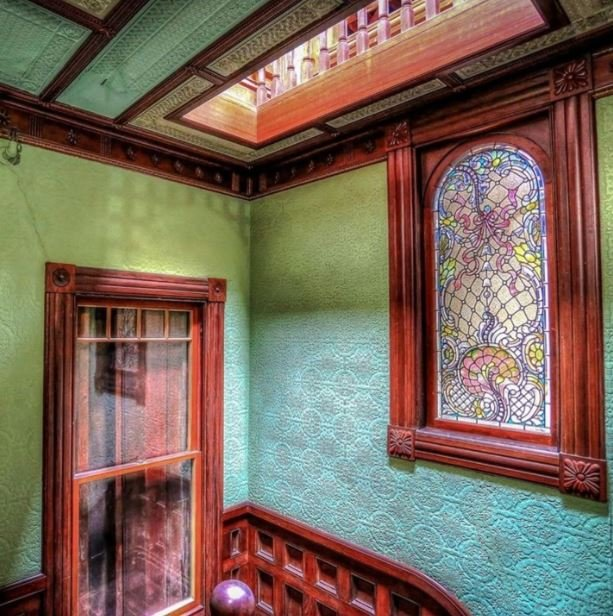
One of the more arresting rock artists of the early 1990s bridged the gap between the musical extremes of black metal and rock “n” roll’s demonic roots in the blues. Far subtler than most black metal bands, Glenn Danzig still operated at the infernal end of the spectrum. An anomaly who stubbornly refused to bow to the expectations of either purists or populists, Danzig began his career at the height of the punk revolution in 1977 as vocalist for New Jersey band the Misfits. No ordinary punk band, Danzig’s classic rock “n” roll delivery gave a quasi-1950s feel to their abrasive sound, while they spurned the usual punk look in devour of an all-year-round Halloween image. Sporting monstrous black quiffs they dubbed “devil locks,” the Misfits often took the stage in skeletal garb—indeed, Danzig’s skull make-up was prescient of the “corpse paint” popular among the 1990s black metal bands. The Misfits were one of the first punk bands whose songs possessed a strong gothic undercurrent. Many reflected their love of fascinating schlock movies, such as “Teenagers from Mars” and “Return of the Fly,” but others were genuinely disturbing explorations of hat and violence. Their second recording, Bullet, featured a song entitled “Hollywood Babylon,” inspired by magus and film-maker Kenneth Anger, while another track included an authentic Latin chant for effecting a werewolf transformation. In what was to become a familiar pattern, Danzig tired of the more tongue-in-cheek aspects of the Misfits, forming Samhain (pronounced “Sow-En”—the precursor to Halloween, a Celtic festival dedicated to fire and death) who released their first album, Initium, in 1984. This was a stark journey into primal evil, threatening rhythms and bleak guitars combining with Danzig’s lupine vocals to create a musical beast that howled at the World. It was all too bleak for most audiences and, in 1987, the vocalist dissolved the band in order to enter his third incarnation—called simply Danzig. #RandolphHarris 2 of 21

Danzig was in many ways the singer’s most innovative project, as well as the most overtly Satanic. Voodoo blues as deep and black as Mississippi mud met predatory heavy metal, with vocal style redolent of early rock “n” roll’s late-fifties/early-sixties crooners. Typically, Glenn Danzig’s insistence on treating his Satanic subject matter without a trace of irony did not endear him to the press. Short, powerfully built, with raven black hair and prominent side-burns, the music media dubbed him as “Evil Elvis” or, more irreverently, “Fonzig.” Some audiences were also perplexed: younger black metal fans wanted a less subtle Satanism, while rock fans who appreciated Danzig’s musical approach found his lyrical preoccupation off-putting. Nevertheless, the ban attracted a dedicated fan base, appreciative of a familiarity with demonic subject matter that most shock-horror rockers could only envy. Nietzschean howls of defiance against the Creator, such as “Godless,” complemented more traditional takes on hellish suffering like “Tired of Being Alive.” At his quietest, Danzig was at his most sinister—like the poet William Blake, Danzig identified love as “a Devil’s thing.” In 1994, when MTV picked up on the video for the anthemic “Mother, the band received mainstream attention; in the same year, an uncompromising Glenn Danzig released a solo project entitled Black Aria: an album of quasi-classical music retelling the story of Satan’s fall from grace. In 1996, after four albums of powerfully-infernal rock music, Danzig took his eponymus band in a new direction. BlackAcidDevil was predominantly an industrial record, many fans mourning the passing of the classic Danzig sound and dismissing at as “poor man’s Nine Inch Nails.” In truth, when the industrial grind is layered with the dark velvet of Danzig’s seductive tones—as on “Come to Silver,” an exploration of temptation—then the material becomes really interesting. #RandolphHarris 3 of 21

The indifferent sales and reviews that greeted BlackAcidDevil tested Danzig’s already-strained relationship with the music business. He let the band slip back into the cult status he was perhaps happiest with, and began spending the money he had made from his musical career on other projects—most notably a comic-book company named Verotik. As the company’s name suggests, these comics are crammed with violence and erotica, combined with the fascination for all things infernal that has become Glenn Danzig’s trademark. Scripting many of the comic-strips himself, Danzig introduced overly devilish characters, like the vamp Satanika, to stake his claim as one of the main modern contributors to Satanic popular culture. On the continent of Europe, particularly in the Norwegian capital, Oslo, things were being taken to a less subtle extreme. Deathlike Silence was an independent record label owned by a young man who re-named himself Euronymous—according to some folklore traditions, a cannibalistic demon with skin the bluish-black colour of a meatfly’s carapace—who also ran a dank, dingy specialist record store named Helvete (meaning “Hell”) and founded a band called Mayhem. Mayhem formed in 1984, just as the original black metal scene was peaking, debuting with a demo called Pure Fucking Armageddon and an album called Deathcrush. Interest in Satanic imagery, with its attendant gothic spikes-and-leather garb, was faltering among audiences at this time, but Mayhem clung onto its uncompromising style. They sounded like a rawer, more grinding version of Venom, screaming and thundering between militaristic marches and growling rage. As the tastes of young underground fans in the 1990s swung further towards the diabolical excess, Euronymous’ obsessive dedication made him a potent force on the newly-burgeoning black metal scene. #RandolphHarris 4 of 21
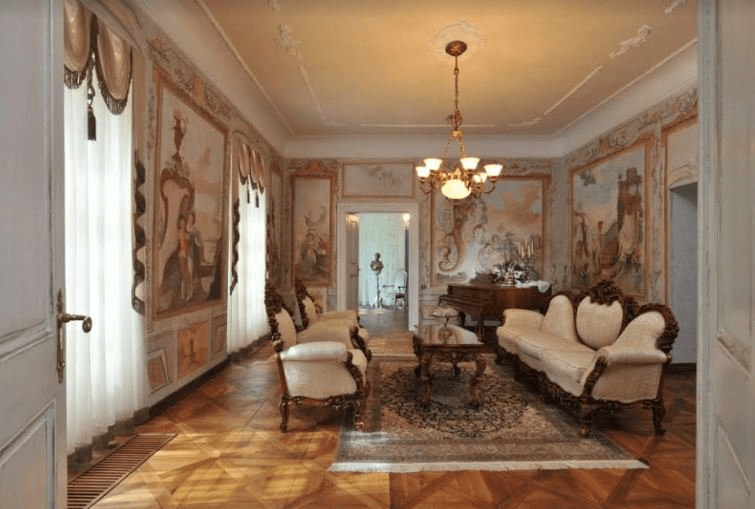
During the early 1990s, Euronymous’ store became the focus for a small circle of likeminded Scandinavian metal fans who all started their own bands. This loose group named itself variously the Black Metal Circle, Satanic Terrorists or Black Metal Mafia, and was influenced by the supposedly Satanic doctrines of Euronymous—based around a vague reading of the biblical concept of war between Heaven and Hell. For Euronymous, siding with Satan meant endorsing everything that was considered evil, spiteful, hateful. Hate motivated his philosophy, coloured by the cold, depressive morbidity that characterizes the negative edge of the Scandinavian psyche. All of the releases on Deathlike Silence were stamped with the “Anti-Mosh” symbol (moshing is a raucously combative form of dancing common to thrash and death metal fans). Around the symbol were stamped the messages “No Mosh,” “No Core” (a reference to the hardcore punk revival), “No Trends” and “No Fun”—these sentiments taking against those metal audiences who were introducing splashes of gaudy mainstream colour, in the form of Bermuda shorts, baseball caps and skateboards. In the center of the “No Moshing” symbol was a red line struck through those figures Euronymous professed to hate most: Scott Burns, the Florida-based record producer whose work had come to dominate the death metal scene, and curiously, Anton LaVey. Euronymous divorced himself from all Satanic tradition, loathing LaVey because of the Church of Satan’s philosophy of self-empowerment and individualism. Euronymous’ simple faith expressed all that was negative: a cold core for violent code of self-destructive nihilism. Joining Mayhem in their isolated World of hate were several other extreme bands. Burzum—chiefly a vehicle for Count Grishnackh (given name Kristian Vikernes, though he legally changed his first name to Varg, Norwegian for “wolf”), who had lived in the damp, lightless cellar of the Helvete record shop for some time—were a prominent presence. Burzum were an odd blend of frustrated insanity and strange, sad, ambient mood music, pained pathos and gibbering fury—oddly effective, but distinctly disturbed. #RandolphHarris 5 of 21

Founder member Grishnackh took his name from one of the evil “orc” characters in J.R.R. Tolkien’s fantasy trilogy The Lord of the Rings, while Burzum meant “darkness” in the orcish language conceived by Tolkien. Perverse as this seems, it should be remembered that The Bible is just a book of stories—in this light, perhaps using The Lord of the Rings as the basis for an (im)moral philosophical code is not wholly ludicrous. However, it does an infernal philosopher’s credibility no favours to identify too closely with “hobbits” (glorified goblin). Grishnackh’s personal mythology combined the darkness-versus-light motifs of “mystic quest”/sword-and-sorcery sagas with the violent Viking tradition he believed true Northern Europeans belonged to. While this seems symptomatic of Scandinavia’s peripheral removal from—and distorted imitation of—Western pop culture, it also has an authentic dark side. As is common among Norse pagan revivalists, the Black Metal Circle began to espouse race-based Nazi political views. (Though totalitarian-loving Euronymous also expressed admiration for communist despots and Cambodian genocidalist Pol Pot.) Also pivotal in this new movement were the bands Emperor, Immortal, Enslaved and Arcturus. The last to join Euronymous’s Norwegian cadre were Dark Throne, who had already recorded one death metal album, Soulside Journey, in 1990. In the following year, they disowned their debut, donned corpse-paint and joined the “Satanic Mafia” with their album A Blaze in the Northern Sky. If Euronymous exemplified the nihilistic hate at the heart of the Black Metal Circle, and Burzum represented its violent Norse/Nazi fantasies, then Dark Throne symbolized the Circle’s isolation and sociopathic need for solitude. Taking their country’s sombre, anti-social reputation to extremes, the band never met to record, spoke little, and spent increasing periods alone in the frost-bitten Norwegian wilderness. #RandolphHarris 6 of 21

In the spring of 1991, Mayhem’s vocalist died: a Swede who, by way of black comedy, had re-named himself “Dead.” Dead blew his head off with a shotgun, leaving a note to day that he felt he was not of this World, but belonged instead to the cold solitude of the forest. He also apologized for the mess. As in common with obsessively inward-looking groups like the Black Metal Circle, a crisis of this type either causes the grouping to dissolve, or re-enforces their convictions. The latter instance applied, and the Circle hailed Dead as a hero. Euronymous, who found the corpse, rushed out for a camera to take his final photograph of Dead before altering the authorities—claiming a morsel of brain to make into soup and a fragment of skull to fashion into a necklace. At this point, the Black Metal Circle were no longer merely a group of disaffected teens and early-twentysomethings, but a subculture who believed themselves to be at the center of significant, apocalyptic events. Euronymous’ demented, anti-social rants were making him a regular feature in the underground metal fanzines; despite the continued indifference of the global music media, black metal was rising from the grassroots across the World. The “legend of Dead” contributed to a growing international interest in extreme, Scandinavian Satanic metal, with Deathlike Silence treating the grim event as a grotesque promotional gimmick. For the first time, European countries bordering the Mediterranean also began throwing up a slew of black metal acts—most notably the Greek band Rotting Christ. In contrast to the could hatred of the Northerners, the Southern European scene was inclined to a less self-destructive, more LaVeyan approach—though Anton LaVey would have regarded many of them as blasphemy-fixated novices, struggling to topple the repressive Christianity that dominates their culture. #RandolphHarris 7 of 21

Much of black metal is supposed to be inspired by demons. They cannot be any worse than human being, right? Many of them just have never possessed a body of their own. They are souls who have been lurking around before humanity. Before the dinosaurs. They are the darkness. The reason God created life so that life could flourish and grow and rest when it is dark. Demon possession is a condition in which one or more evil spirits or demons inhabit the body of a human being and can take complete control of their victim at will. By temporarily blotting out one’s consciousness, they can speak and act through one as their complete slave and tool. The inhabiting demon (or demons) comes and goes much like the proprietor of a house who may or may not be “at home.” When the demon is “at home,” one may precipitate an attack. In these attacks the victim passes from one’s normal state of possession. The condition of the afflicted person in the “possessed” state varies greatly. Sometimes it is marked by depression and deep melancholy, sometimes by vacancy and stupidity that resemble idiocy. Sometimes the victim may be ecstatic or extremely malevolent and wildly ferocious. During the transition from the normal to the abnormal state, the victim is frequently thrown into a violent paroxysm, often falling to the ground unconscious, foaming at the mouth with symptoms similar to epilepsy or hysteria. The intervals between attacks vary greatly from an hour or less to months. Between attacks, the subject may be healthy and appear normal in every way. The abnormal or demonized stages can last a few minutes or several days. Sometimes the attacks are mild; sometimes they are violent. If they are frequent and violent, the health of the subject suffers. The chief characteristic of demon possession or demonomania is the automatic projection of a new personality in the victim. During attack the victim’s personality is completely obliterated, and the inhabiting demon’s personality takes over completely. #RandolphHarris 8 of 21

The inhabiting demon uses the victim’s body as a vehicle for one’s own thoughts, words, and acts. The demon even speaks out of the victim’s mouth and declares emphatically that one is a demon. Frequently one gives one’s name and dwelling place. The new personality reveals itself in a different voice and sometimes uses a different language or dialect on a completely different educational or cultural level. Pronouns are used to emphasize the new personality. The first personal pronoun consistently designates the inhabiting demon. Bystanders are addressed in the second person. The victim is referred to in the third person and looked upon during the attack as unconscious and for all practical purposes as nonexistent during this interval. Demonomania should be clearly differentiated from the insanity in which a person imagines oneself to be someone else, often a famous personality such as Liz Taylor, Julius Caesar, of William Randolph Hearst. The demoniac, when in the demonized state characterized by the new personality, speaks and acts in all respects like a completely different person. By contrast, the insane person is one’s own diseased self, one’s assumed personality being a transparent unreality. In cases of demon possession the new personality clearly and constantly recognizes the distinct existence and individuality of its “possessed” victim, speaking of that victim in the third person, an element entirely lacking in cases of insanity. Because various inadequate theories have left demon possession largely unexplained, it is quite probable that some patients in mental hospitals are demon possessed rather than insane. This was the conviction of the famous nineteenth-century specialist in mental diseases, Dr. Forces Benignus Winslow (1810-1874). He correctly recognized the demoniac by a strange duality; and by the fact that, when temporarily relived from the oppression of the demon, he is frequently able to describe the force which takes control of one and compels one to act and speak shamefully. #RandolphHarris 9 of 21

While in the demonized state many persons give evidence of knowledge which cannot be accounted for naturally. The demon who takes control of the body of one’s victim is obviously the source of the superhuman knowledge. While demon possessed, many persons recognize the Lord Jesus Christ as the Son of God, and display an aversion to and a fear of Him (Mark 1.23-24; 5.7). The case of Mrs. Winchester, who lived in Santa Clara County, illustrates how a woman came under demon domination through practicing séances. Being centered within our own God like power is of utmost importance. Even when evoked to create change directly, keep in mind that you are the God that wields these powers for the cause of Counter Creation. Just be careful! As a God you will be tested and so how these powers are wielded is a powerful initiatic test in its own right. Mrs. Winchester was in her Blue Séance Room, she lite a candle on her left first, and then a candle on her right. A sacred serpent was sacrificed over the wood sigil and the blood was left to drain upon the idol. Then the body of the serpent was encircled around it, she chanted “I do invocate and conjure thee, O Spirit, Sabnock; and being with power armed from the SUPREME MAJESTY, I do strongly command thee, by BERALANENSIS, BALADACHIENSIS, PAUMACHIA, and APOLOGIAE SEDES; by the most Powerful Princes, Genii, Liachidae, and Ministers of the Tartarean Abode; and by the Chief Prince of the Seat or Apologia in the Ninth Legion, I do invoke thee, and by invocating conjure thee. And being armed with power from the SUPREME MAJESTY, I do strongly command thee, by Him Who spake and it was done, and unto whom all creatures be obedient. Also I, being made after the image of GOD, endued with power from GOD and created according unto His will, do exorcise thee by that most mighty and powerful name of GOD, EL, strong and wonderful; O thou Spirit Sabnock. And I command thee and Him who spake the Word and HIS FIAT was accomplished and by all the names of God. #RandolphHarris 10 of 21

“Also by the names ADONAI, EL, ELOHIM, ELOHI, EHYEH, ASHER EHYEH, ZABAOTH, ELION, IAH, TETRAGRAMMATON, SHADDAI, LORD GOD MOST HIGH, I do exorcise thee and do powerfully command thee, O thou Spirit Sabnock, that thou dost forthwith appear unto me here before this Circle in a fair human shape, without any deformity or tortuosity. And by this ineffable name, TETRAGRAMMATON IEHOVAH, do I command thee, at which being heard the elements are overthrown, the air is shaken, the sea runneth back, the fire is quenched, the Earth trembleth, and all the hosts of the celestials, terrestrials, and infernals do tremble together, and are troubled and confounded. Wherefore come thou, O Spirit Sabnock, forthwith, and without delay, from any or all parts of the World wherever thou mayest be, and make rational answers unto all things that I shall demand of thee. Come thou peaceably, visibly, and affably, now, and without delay, manifesting that which I shall desire. For thou art conjured by the name of the LIVING and TRUE GOD, HELIOREN, wherefore fulfill thou my commands, and persist thou therein unto the end, and according unto mine interest, visibly and affably speaking unto me with a voice clear and intelligible without any ambiguity. I do invocate, conjure, and command thee, O thou Spirit Sabnock, to appear and to show thyself visible unto me before this Circle in fair and comely shape, without any deformity or tortuosity; by the name and in the name IAH and VAU which Adam heard and spake; and by the name of God, AGLA, which Lot heard and was saved with his family; and by the name IOTH, which Jacob heard from the angels wrestling with him, and was delivered from the hand of Esau his brother; and by the name ANAPHAEXTON which Aaron heard and spake and was made wise; and by the name ZBAOTH, which Moses named and all the rivers were turned into blood; and by the name ASHER EHYEH ORISTON, which Moses named, and all the rivers brought forth frogs, and they ascended into the house, destroying all things. #RandolpHarris 11 of 21
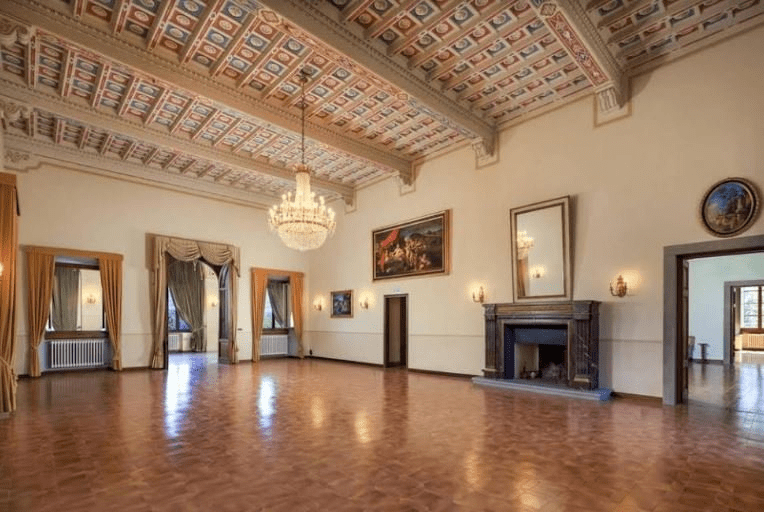
“And by the name ELION, WHICH Moses named, and there was a great hail such as had not been since the beginning of the World; and by the name ADONAI, which Moses named, and there came up locusts, which appeared upon the whole land, and devoured all which the hail had left; and by the name SCHEMA AMATHIA which Ioshua called upon, and the sun stayed his course; and by the name ALPHA and OMEGA, which Daniel named, and destroyed Bel, and slew the Dragon; and in the name EMMANUEL, which the three children, Shadrach, Meshach and Abed-nego, sang in the midst of the fiery furnace, and were delivered; and by the name HAGIOS; and by the SEAL OF ADONI; and by ISCHYROS, ATHANATOS; and by these three secret names, AGLA, ON, TETRAGRAMMATION, do I adjure and constrain thee. And by these names, and by all other names of the LIVING and TRUE GOD, the LORD ALMIGHTY, I do exorcise and command thee, O Spirit Sabnock, even by Him Who spake the Word and it was done, and to Whom all creatures are obedient; and by the dreadful judgments of GOD; and by the uncertain Sea of Glass, which is before the DIVINE MAJESTY, mighty and powerful; by the four beasts before the throne, having eyes before and behind; by the fire round about the throne; by the holy angels of Heaven; and by the mighty wisdom of GOD; I do potently exorcise thee, that thou appearest here before this Circle, to fulfill my will in all things which shall seem good unto me; by the Seal of BASDATHEA BALDACHIA; and by this name PRIMEUMATON, which Moses named, and the Earth Opened, and did swallow up Kora, Dathan, and Abiram. Wherefore thou shalt make faithful answers unto all my demands, O Spirit Sabnock, and shalt perform all my desires so far as in thine office thou art capable hereof. Wherefore, come thou, visibly, peaceably, and affably, now without delay, to manifest that which I desire, speaking with a clear and perfect voice, intelligibly, and to mine understanding. #RandolphHarris 12 of 21

“Tbatlu! Bualu! Tulatu! Labusi! Ubisi!—Let thee also appear and being before me the Spirit of Sabnock. Sovar, merciless leader of Divs come forth! Inner eye behold the demon before me. Sovar awaken! Rise up within that I may compel the rise of the fallen ones and devour the very essence of the Holy Angel Shahrewar! I stand alone as the embodiment of the Adversary known as Ahriman, the Black Dragon of Chaos and becoming! I devour the natural order of stasis brought forth by Ahura Mazda and forge my destiny through the power of the Black Sun! Taromat, beautiful Div or rebellion come forthy! Inner eye behold the demoness before me. Toramat awaken! Rise up within that I may compel the rise of the fallen ones and devour the very essence of the Holy Angel Spandarmad! Ahirman, Lord of Darkness divine, I thank you for your presence within this unholy temple of counter creation. I have offered you the life of this noxious creature as a gateway to your manifestation within this realm to stand before me! You are Angra Mainyu who is the Lord of counter creation, whom has brought forth the mountains to the plains! You have brought forth the beasts to the field and the creatures of the night! Ahriman with your infernal blessing I ask that you would bring forth the baneful powers of the wolf kin to fill this oil with their essence that it may be compelled according to my will! I offer my nails as fangs which will devour that which stands in my way! I offer my hair to embody their predatory essence! I give my blood as a gateway to empower them to act within this world according to my will and purpose!” Then Mrs. Winchester heard the distant howling of wolves and she perceived their phantom shadows as they began to surround her and encroach. She was focused on Sabnock and dared not fear that which she had just conjured. SABNOCK—of course is the Forty-third Spirit of the Winchester Mansion. He is a Marquis, Mighty, Great, and Strong, appearing in the Form of an Armed Soldier with a Lion’s Head, riding on a pale-coloured horse. His office is to build high Towers, Castles and Cities, ad to furnish them with Armour, etcetera. Also he can conflict Men for many days with Wounds and with Sores rotten and full of Worms. He giventh Good Familiars at the request of the Exorcist. Commandth 50 Legions of Spirits; and his Seal is this, etcetera. #RandolphHarris 13 of 21

Mrs. Winchester fell down unconscious, frothing at the mouth, and was carried to her room, outside where the crescent hedge is planted. A doctor was called in gave her large doses of medicine to no avail. He left and refused to have anything more to do with the case as he saw with in hours gables and towers rise, wings of the mansion extended right before his eyes, and gardens grow from sprouts and spring up to mature plants and trees before night fall. For five of six days Mrs. Winchester raved wildly, and her staff and friends were in great distress. In desperation they proposed giving Mrs. Winchester more medicine. However, the demon, speaking through her, replied: “Any amount of medicine will be of no use.” Daisy then implored, “If medicine will be of no use, what shall we do?” The demon replied, “Burn incense to me, and submit yourself to me, and all will be well.” The staff knelt down and worshiped the demon, imploring him to torment Mrs. Winchester no longer. During that time Mrs. Winchester was in a state of complete unconsciousness. A little later when the demon drove Mrs. Winchester to renewed frenzy, her distraught staff repeated their promise to worship and serve him. They also promised that they would urge their Mrs. Winchester to do likewise. When Mrs. Winchester regained consciousness, she reluctantly consented to do so. The demon gave explicit directions regarding the proposed worship. On the first and fifteenth of each month, incense was to be burned, food offered, and the require prostration made before the shrine of himself, SABNOCK. Periodically the demon came, sometimes every few days, sometimes after a month’s lapse. Each time, Mrs. Winchester felt fluttering of her heart, a sense of overwhelming fear, and inability to control herself. She would quietly as Daisy to fetch a neighboring woman whenever the demon came. The two would burn incense to the demon in Mrs. Winchester’s stead and receive his directives, which they then communicated to the possessed. #RandolphHarris 14 of 21

Although these communications were spoken by the Mrs. Winchester’s (the victim) lips, she was completely unaware of them, since she was in the demonized state. The demon often bade the audience not to be afraid, protesting he would not harm them, but rather help them in various ways. He declared he would instruct the victim in the healing art, so that people would flock to her and be cured of their sickness. This soon proved true, although may diseases were not under the demon’s control. Apparently only those afflicted by evil spirits were completely cured. Mrs. Winchester’s long-ill child was not helped. The demon declared he controlled many inferior spirits. He also frequently outlined his plan for Mrs. Winchester’s life and work. He promised he would help her grow more proficient as a healer, and the people would compensate her for her services. Gifts thus earned were donated to the nearby ancient pagan temple. As certain parts of the Winchester mansion would appear but once every seventeen years, SABNOCK was never seen save on the eve of some awful calamity, visitors to the mansion had a very slight chance of seeing his physical body. There could be no doubt though of the existence of the mansion and SABNOCK, for everybody knows he was one of the greatest of the giants during his natural lifetime, nor could any better evidence be asked then the facts that he guided Mrs. Winchester into turning stone, wood, and class into the World’s most beautiful and bizarre mansions. The door-to-nowhere was also known as Lovers’ Leap;” from which Mrs. Winchester once flung herself when she was a state of deep morning, and survived unharmed. The path SABOCK made from the door-to-nowhere to the mountains was used by him when he would leave his island and come to shore. Upon being informed of the variety and amount of legendary material collected about the Winchester mansion and Mrs. Winchester’s doings, many people unhesitatingly pronounced the entire assortment condemned all the gathered treasures as creations of the supernatural. #RandolphHarris 15 of 21

It was very well beknown that in them old days there were giants in plenty hereabouts, but they did not make the make an appearance at the estate very often. But everyone knows that there were giants, because if there were not, no one would know of them at all. They were just like human beings, except in the matter of size, and one of them could make a dozen like men that live now. When they walked, they carried oak trees for sticks and lived in the forest of the giants, and carved the mountain and caves. (It should be noted that spiritistic visions of this nature are quite likely to occur in the course of reading occult literature. Sometimes people mistake these visions for genuine religious experiences. However, it is again a case of Satan disguising himself as an angel of the light.) Yet, there are more than 20,000 accounts of spirits, ghost, angels and demons being seen in the Winchester mansion. The uncanny phenomena places one under a charm. The pattern of the courts during this early period in the 1800s was erratic, sometimes convicting, sometimes throwing cases out of court for lack of evidence, something awarding damages for slander to those who had been maligned as witches by accusers. This vacillation sprang from the fact that the judicial bodies that heard the causes were not religious but secular, and therefore had little competence in dealing with matters that were primarily religious. As far as control was concerned, in adhering to the principles of congregationalism, the responsibility for suppressing heresy and enforcing religious behavior within the communities went to the state. The trial judges were not the sure, steadfast, confident Dominican Inquisitors or Protestant prosecutors of the Old World, but merely secular officials of the valley who had been forced into the position of trying heresy for lack of anyone else to do it. Mary Johnson, who was hired at the Winchester mansion in 1887, as a cook, admitted have had “familiarity with the Devil” and was executed by the state. She confession to have pleasures of the flesh with demons and other sorted things. She made no mention of mass meetings; rather, her Devil seems to have been a personal one, coming to her assistance when needed. #RandolphHarri 16 of 21
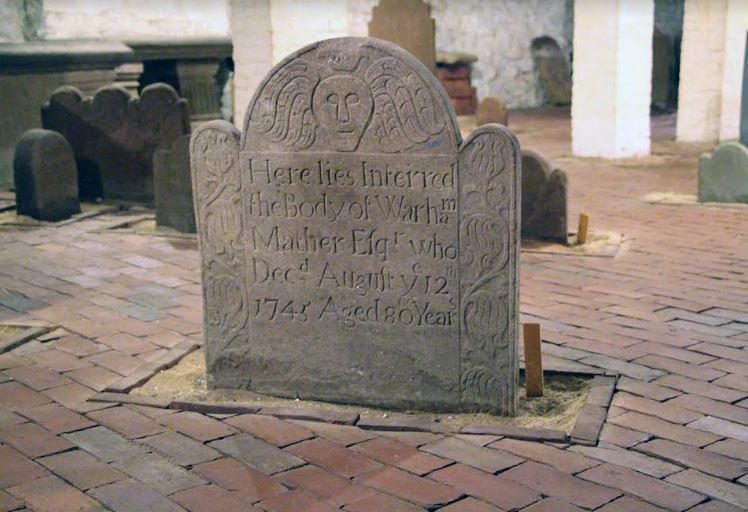
Dolls were sometimes used as a means of projecting curses, and Mary said she had attended meetings with Satan and his consorts. Witches’ pact with Satan was attributed as part of God’s inscrutable plan of the Universe. The Puritan settlers in Santa Clara Valley believed in the doctrine of Original Sin wholeheartedly; their pessimistic outlook proclaimed that all men were unworthy until God saw fit to bestow His grace upon them. They believed that the God allowed the Devil to afflict not only the guilty but also anybody else that might happen to get in the way. If He had to teach misguided humans a lesson, He might punish an entire community for the sins of the most wicked in that community. And it appeared to the God-fearing Puritans that He was doing just that. The Puritans were highly intolerant and has a paranoiac distrust of other religious groups, some were farmers at the Winchester mansion, and did not always like the rituals that were performed, but they were very loyal and protective of Mrs. Winchester. Many of the people who worked at the Winchester mansion were often under suspicion of witchcraft. The Puritans came to the Winchester mansion because they felt it was a true kingdom of God on Earth, and they could help Mrs. Winchester live peacefully. However, what they found was something different. They found that the vast acres of the estate had bitterly cold winters, and the terrain could be inhospitable. They found themselves in a wilderness, surrounded by demonic tribes whom they considered to be the legions of Hell incarnate. Having come to settle in this last stronghold of the Devil, they were plagued by him constantly for the very reason that they were God’s chosen people, thus the most likely target for unholy temptation. The fact that the new settlers in the Santa Clara Valley were being attacked by Satan seemed incontestable. The estate was ravaged by smallpox, and had suffered constant harassment by envious local town’s people and demonic tribes. Mrs. Winchester wondered what she had done to offend God that He should allow the Devil such free range. She experimented with the spirits to bring peace to her life and home. #RandolphHarris 17 of 21

Mrs. Winchester had an answer: Judgment Day was at hand and Satan was therefore stepping up his activities in one last desperate move. It was simply the nova-like burst of the energy from a dying star. She glibly stated that “there will again be an unusual Range of the Devil among us, a little before the Second Coming of the Lord, which will be to give the last stroke in destroying the works of the Devil.” This theory found wide acceptance among the servants and laity of Santa Clara Valley, for not only did it offer a simple explanation for all their maladies and misfortunes, but it also gave them hope, promising cooly a quick end to their hardships. Satan is most able to seduce human in periods o great discontent, for human, in times of poverty and affliction, will turn knowingly to whatever hands will feed them. The valley had had a difficult time of it up to that time, and famines had reduced the population drastically. However, as if labouring under the most severe environmental handicaps was not enough, Puritan perfectionism went even further in making life unbearable. In seeking to establish a holy kingdom, according to Heaven’s law, self-indulgence in any form was strictly repressed. Severe punishments were meted out for drinking, swearing, and licentiousness; in Santa Clara, it was a punishable offense to walk on the streets on Sunday, except when going to and from church. And witches, people possessed by demons, and others also attended church to blend in and keep the peace. On top of it all, there stood the Calvinistic doctrine of election, holding that as soon as man was born, eh was judged to be headed for either Heaven or Hell, this choice being made according to God’s immutable law. However, even if a human thought oneself to be damned, the civil punishment for one’s indulgence were still exacted upon one. It was into this environment that the waters of the witchcraft flood would soon pour. The good people of Santa Clara clearly saw signs of Satanic activity in their midst, and an investigation was launched. #RandolphHarris 18 of 21

Mrs. Winchester confessed to having attended witches’ Sabbaths and of having met with the Devil, who was a tall, black man from New Haven, Connecticut. Soon the witch fever spread, and more people from the valley became posses by demons. The common belief was that at that time witches, when entering into a Covenant with Satan, because the owners of specters, with the help of which they could do harm to any person of their choosing. People believe that God—the Alpha and Omega was both God and Satan. That He has a soul and character. He is not just this futile entity but someone you can see many aspects to. Some people fled to Satanism because they had to deal with so much evil from Christians that they wanted another source of power to exalt them. Satanism is supposed to be something to be something secret, something people do not know anything of. One goes to America and in the telephone directory one can see “Church of God,” “Church of Jesus,” and “Church of Satan.” One calls, and a person answers: “Church of Satan, how may I help you?” One thinks, “This is not Satanism!” The Church of Satan deny Satan, they say He does not exist, yet they act as if He dd, they rebel against God. They call themselves Satanists because He also rebelled against God, but they are basically light and life worshipping individualists. Well, the phone is tapped, so I think you better write what you know. Some people have disappeared. And of course the normal grave yard desecration. Anne Winchester’s headstone was recently stolen, but replaced. Normal people just disappear and never show up again. It could have a Satanic connection. Every human is life, and some hate life, especially human life. That is why people disappeared. These people may have disappeared for some form of sacrifice. Something like that would be called a Satanic murder. The murder is the ritual sacrifice. These murders gain power from whoever was responsible. Everybody has their own aura, and auras can be stolen by sacrificing an individual, this allows one to gain more power. #RandolphHarris 19 of 21
Places of worship, such as churches, have their own spirit—the Winchester Mystery House, for example, has been worshipped in for maybe hundreds of years and has thus gained a lot of spirit in that time, it could qualify as a church and gain charitable tax exemption. But that is not the point. A person who sacrifices that will gains a lot of power and grows stronger. Some people fear the Winchester mansion, because there are a lot of different energies. There is fear, terror and suspense, but others feel a lot of light, happiness, and goodness. Sometimes the energy is mixed. Anton LaVey really surprises me. If your every rea his work, he seems very intelligent and not scary at all, but I guess it depends on what one reads. I have read parts of his Bible, and it is very straightforward, it is stuff people tell their kids every day. Stand up for yourself and do not let people run you over. I think that the Winchester mansion should also open on nights of a full Moon, not just Friday the 13th. During the full Moon, there is a lot of energy and symbolic value. A lot of people believe in the full Moon and a lot of people believe in virgins. That makes both the full Moon and the virgin more powerful because of belief in them. God was first and He created the World. Of course, a lot of scientists would deny that. However, I would challenge their view because I believe God used evolution, which is why it took so long, which is why we have evidence like dinosaur bones. Yet, some Gnostic Christians have suggested Satan created the World. Everybody will be taken as slaves except the warlords. Euronymus, who we talked about earlier, was murdered in August 1993, Aaliyah 2001. Some say that is a month when sacrifices are made. Grishnackh killed Euronymous, and a few hours later, he was laughing and joking, saying, “Ha ha, Euronymous is dead, I’m going to dance and piss on his grave.” It reminded of the jokes Howard Stern made about Aaliyah. It was not funny. These are not the rantings of someone who is all there. Grishnackh talked about the dynamite he had and how he was going to blow things up. Basically, they took things to illogical extremes, but it all made sense in their own heads. #RandolphHarris 20 of 21

It is possible when dabbling with occultism for one to make an unconscious contract with the powers of darkness. The gift of discernment is absolutely necessary in life. It is generally not wise to lay one’s hands on a person who is occultly subjected. The retuning spirits will often attempt to creep back under the guise of some pious camouflage. It is in this way that evil can often enter unnoticed into one’s Christian life. A maid at the Winchester mansion once accepted the invitation of one of her coworkers to attend some spiritistic meetings. At first she felt as though she had gain something from going along to the meetings but later on she began to notice some psychic changes taking place in herself. She began to notice some psychic changes taking place in herself. She began to suffer from depression which resulted in her consulting a neurologist. During the course of the treatment she was committed to a lunatic asylum. However, as her condition improved, she could no longer attend the spiritistic séances. At the hospital the chaplain came to see her through his help and counsel she was able to make a complete recovery. One of the farmers at the estate wanted to see if charms actually worked, and some of them He. He practiced in the basement of the Winchester mansion. He drew a magic circle on the ground and drew some other magic symbols in the circle. He then used a charm three times in order to invoke the spirit. However, no spirit came. Yet, as he repeated, the charm he fell down in the magic circle and lay there unconscious for some time. The result was that for several weeks following this event he was semi-paralysed and drained of all his physical strength and will-power. After a few weeks, he died. Frequently identified as a common spot where the “wheelbarrow Ghost” is sighted, Steam Alley is one of the most well-known paranormal hot-spots in the mansion. Have you ever seen anything in the basement? #RandolphHarris 21 of 21

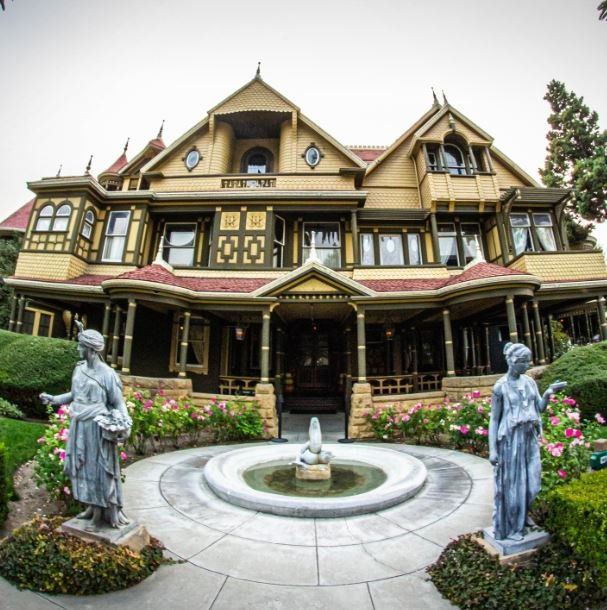
Some stroll Sarah’s lovely gardens this Memorial Day Weekend. There is a beautiful parrot which Mrs. Winchester used to pet, it talks! He is supposed to be happy and impudent, and talks and laughs and screeches all the time. Maybe you may catch a glimpse at this wooded, flowery estate. It is such a beautiful spectacle, all of that life and grace and animation, and sun-smitten flash and sprinkle of rich colour.

This impressive mansion dates back to the 1880s, when it was developed by Sarah Winchester and the spirits, whose project enobed and enriched the community. It once had a nine-story military watchtower. Mrs. Winchester further developed the grounds of the 160 room mansion, introducing a Victorian garden at the hands of World renowed architect Gino Coppede around the turn of the century.

These adaptions made this idyllic mansion a unique asset, tinged with the signs and influences of eclecticism and Liberty, juxtaposed to the ancient Architectural characteristics of its medieval heritage. This mansion presents itself as impressive and spectacular. The building now spreads on four floors plus the basment, for a total of approximently 25,000 feet square.

There is lovely gift shop and cafe, and it is also an ideal venue for hosting private events, conventions and/or ballrooms are located on the back overlooking the internal garden with its panoramic position which glows thanks to its night-time lighting.
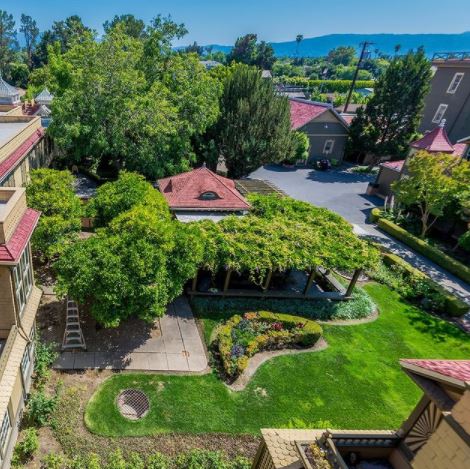
Inside the property there are splendid rooms filled with historial furniture, decorated ceilings and flamboyant fireplaces, vaulted ceilings and richly frescoes walls. In addition, there are several bedrooms, nine kitchens. and thirteen bathrooms, which made the structure a perfect luxurious accommodation for guests, and is now a tourist destination.

This mansion is located within a private park of 4 acres and elegant Nineteenth-century Victorian-gardens, that offer areas of wide lawns, and further green spaces. There is also a parking area, with free parking. Currently used to host guided tours and private events and functions. The enitre porperty sits at a close distance from the mall, hotels, and resturants. The high-fashion outlet complex and gourmet food has brought further development and tourism to Santa Clara County. https://www.winchestermysteryhouse.com/


The Highest-Quality of Power Comes from the Application of Knowledge

After wrestling throughout their lives with malfunctioning homes, schools, and medical institutions; after being fleeced by corrupt financial institutions and finally reaching retirement, American workers look ahead to their “golden years—the long-awaited time to take a breath, stroll to the mailbox and pick up one’s pension check. However, here Americans young and old face yet another institutional disaster—this one in the pension system. Critics of the current pension arrangements warn of a coming “financial meltdown.” Once considered heresy, such doubts have been attributed to no less an authority than a U.S. secretary of the Treasury. An underfunded pension plan is an employee benefit plan for retirement income that has fewer assets than liabilities, or what it owes in benefits. If a pension plan is underfunded, it is not on track to have enough money to pay out all its promised benefits and other expenses. Damage from corporate pension-plan losses has been piling up like a slow-motion train wreck. Once recent three-year period saw assets of U.S. private pension funds shrink by 15 percent, while liabilities soared nearly 60 percent. People who rely on their company pension plans to fund their retirement may be in for a shock: of the 200 biggest defined-benefit plans in the S&P 500 based on assets, 186 are not fully funded. Simply put, they do not have enough money to fund current and future retirees. A big part of the reason is the poor returns they got from their assets in the superlow interest rate environment that followed the financial crisis. It left a hole of $382 billion for the top 200 plans. Of course, the percentage of workers covered by traditional defined benefit plans—those that pay a lifetime annuity, often based on the years of service and salary—has been declining for decades as companies shift to defined contribution plans such as 401(k)s. However, each time a pension plan is terminated, canceled or altered, thousands of workers are affected.

The mothers of the under-funded pensions is no less a behemoth. General Electric Co. has a major problem. The company ended its defined benefit plan for new hires in 2012, but its primary plan, covering about 467,000 people, is one of the largest in the U.S.A. And at $31 billion, GE’s pension shortfall is one of the largest in the S&P 500. INTC US Equity, DAL US Equity, DLPH US Equity, AAL US Equity, APC US Equity, along with automakers, airlines and paper industries are also majorly underfunded. The good news is that the funded states of the 100 largest corporate defined benefit pension plans rose by $43 billion during March of 2022. The funded states surplus improved to $86 billion from $43 billion at the end of February 2022 thanks to liability gains, which improved due to an increase in the benchmark corporate bond interest rates used to value pension liabilities. As of March 31, the funded ratio rose to 105.2 percent, up from 102.5 percent at the end of February. March’s increase caps an impressive first quarter of 2022 which saw a $92 billion improvement in funded status. This is the highest funded ratio recorded by the Pension Funding Index (PFI) in nearly 15 years—since the end of 2007. The Milliman 100 PFI asset value fell by $16 billion to $1.738 trillion at the end of March due to investment losses of 0.56 percent. By comparison, the 2021 Milliman Pension Funding Study reported that the monthly median expected investment return during 2020 was 0.50 percent annualized. The projected benefit obligation (PBO), or pension liabilities, decreased to $1.652 trillion at the end of March. The change resulted from an increase of 26 basis points in the monthly discount rate to 3.62 percent for March from 3.36 percent for February 2022. March caps off the fourth consecutive month of discount rate increases.

The first quarter ending March 31, 2022, assets fell by $105 billion while plan liabilities decreased by $197 billion. Despite investments posting losses of 4.75 percent during the first quarter of 2022, discount rates rose 82 basis points and helped propel the funded status improvement, which totaled $92 billion by the end of the first quarter. The funded ratio of the Milliman 100 companies improved to 105.2 percent at the end of March from 99.7 percent at the beginning of 2022. The nation’s state retirement systems, however, finished the 2021 fiscal year in the best condition since the Great Recession of 2007-09. The gap between the cost of pension benefits that states have promised their workers and what they have set aside to pay for them dropped in 2021 to its lowest level in more than a decade. For the first time since 2008, approximately 80 percent of the state retirement systems are now funded. A decade of increasing pension contributions and the strong stock market rally of 2021 have combined to help stabilize state pensions funds. And total unfunded state pension obligations were less than $800 billion at the end of fiscal year 2021, the greatest progress in closing the state pension plan funding gap—the difference between plan liabilities and assets—this century. However, not all state pension funds are approaching long-term fiscal sustainability, defined as government revenue matching expenditures without a corresponding increase in public debt. As part of a larger project to develop a fiscal sustainability matrix highlighting the practices of successful state pension systems and presenting a critical 50-state data that facilitates comparative analyses and plan assessments, The Pew Charitable Trusts is producing individual state fact sheets. For example, California’s main pension plans—the California Public Employees’ Retirement System (CalPERS) and the California State Teachers’ Retirement System (CalSTRS)—are the nation’s largest state plans.

CalPERS requires that participating employers make the full actuarially recommended contributions but has been managing pension debt attributed to unfunded benefit increases offered in 1999. CalSTRS received less than the actuarially recommended contribution for several years, but reforms in 2014 strengthened the plan’s funding policy. The average state funded ratio as of 2019 is 71 percent. At the same time, some 40 percent of Americans cannot afford to come afford to come up with $400 dollars for an unexpected expense. If—or, more likely, when—they are confronted with such an expense, they would probably have to sell something or go into debt. Furthermore, roughly 46 percent of all Americans expect to retire in debt, and debt repayment is even harder on a fixed income and can threaten one’s retirement security. Maintaining enough cash on hand to cover recurring bills with interest is harder on a fixed income and adds another obstacle to the challenge of living comfortably. Debt can derail a lot of peoples’ retirement plans. These days, older Americas owe more than every before. The total debt burden for Americas over age 70 increased 614 percent through 2021 from 1999, to $1.27 trillion. Also, 43 percent of Americans fear their retirement dreams could be disrupted by Social Security going bankrupt. Already, the U.S. Department of the Treasury has said the Social Security trust fund will run out of money sooner than expected due to the COVID pandemic. A lot of people have been relying on credit cards to get through the pandemic, but this also has caused interest rates to rise. Your retirement income—monthly payments from investments and Social Security should cover debt payments and still afford one a comfortable lifestyle. Otherwise, one may need to work longer or find a supplement source of income from a part-time job.

California is becoming one of the nation’s most expensive states to live in with gas prices hitting $7 a gallon and a small basket of strawberries costing $8.00. If inflation increases by more than 7 percent between 2021 and 2022, the law says the minimum wage must increase to $15.50 per hour for everyone. However, official inflation figures will not be final until this summer. California has about 3 million minimum wage workers. The increase in the minimum wage will be about $3 billion, or less than 0.1 percent of the $3.3 trillion in personal income Californians are projected to earn. This is a mixed blessing. It means that people will get paid more, but they businesses will also hire or keep less employees. With that being the case, the employees they hire or retain will be those who are highly skilled, which should increase productivity. So, it is a huge benefit for big companies, but not so greater for incompetent workers, or customers who will have to pay higher prices. Yet, at this rate of pay, minimum wage will still be below market value. Analysis say it should be around $30 an hour, which would also mean that other workers are also underpaid. This is all due to globalization, sending our jobs and money overseas suppressed wages for American workers. Faced with a rapidly aging population and underfunded pensions, an intergenerational was is brewing among pensioners on one side and young workers on the other, who fear their will be nothing left for them by the time they retire. Confronted by failing institutions on all sides, many Americans seek help from charitable organizations, long regarded as ethically cleaner than the profit-making sector. That, however, was before some of the most prestigious nonprofits such as the United Way and the American Red Cross came under investigation for false accounting or misapplication of contributed funds.

Meanwhile, where did many Americans go to find out more about all these crises? The Internet, of course. However, as newspapers take pains to point out, much of what appears on the Net is unverified, biased or mistaken. What is needed, publishers say, is credible, accurate carefully checked and rechecked information. Yes. However, the print and broadcast media are themselves facing a credibility crisis that threatens their future, as journalistic scandals recently erupted at The New York Times, USA Today, NBC News, CNN, CBS News, Newsweek and other media outlets. It is not just that people are reading the newspaper less or watching the news less. These scandals take place against a background of declining readers and dwindling audiences, partly because people are busy, they do not trust the news, and they have digital content to watch. The estimated U.S. daily newspaper circulation (print and digital combined) in 2020 was 24.3 million from its 1983 peak of 63.3 million, while the U.S. population has grown by 100 million. A quarter of all U.S.A. newspapers have died in 17 years. At least 1,800 communities that had a local news outlet in 2004 were without one at the beginning of 2020. More than 300 newspapers have failed, bring the death toll to 2,100, of the 9,000 newspapers than were being published 17 years ago. The list of institutional breakdowns in superpower America could be extended to include the failure of the U.S. intelligence and counterintelligence agencies—in combination with the White House under both Bill Clinton and George W. Bush—to present the 9/11 disaster despite various early warnings to correctly assess the threat of weapons of mass destruction in Iraq. It is not much different than the southern boarder crisis. While many people do not want to deport unregistered immigrants, they would like to stop the 18,000 the are coming into the country daily without being registered. That is approximately 7 million people a year, while many America institutions are running dry. Joe Biden has been warned about the danger of ignoring the crisis.

Crisis, it may be said, is in the eye of the beholder—or in the rhetoric of self-interested parties demanding dramatic change. However, even allowing for statistical inadequacy, simplistic trend extrapolation and exaggerated rhetoric, or for difference in their importance, intensity or immediacy, they very multiplicity of these cases tells us something important: The whole adds up to more than its parts. Until recently, most observers, America or not, have viewed all these institutional crises in the United States of America as unrelated. However, that view is no longer tenable. America’s seemingly separate and distinct crises are increasingly interconnected. Health care and pensions. Pension and the corporate crisis. Family and education. The political crisis and all the rest feed into one another. What is developing, therefore, inside the United States of America is a systemic breakdown of its vital institutional infrastructure at the very time when many believe its power in the World is diminishing. Most conventional assumptions about power, in Western culture at least, imply that power is a matter of quantity. However, while some of us clearly have less power than others, this approach ignores what may now be the most important factor of all: the quality of power. Powe comes in varying grades, and some power is decidedly low in octane. In the fierce struggles soon to sweep through our schools, hospitals, businesses, trade unions, and governments, those who understand “quality” will gain a strategic edge. No one doubts that violence—embodies in a mugger’s switchblade or nuclear missile—can yield awesome results. The shadow of violence or force, embedded in the law, stands behind every act of government, and in the end every government relies on soldiers and police to enforce its will. This ever-present and necessary threat of official violence in society helps keep the system operating, making ordinary business contracts enforceable, reducing crime, providing machinery for the peaceful settlement of disputes. In this paradoxical sense, it is the veiled threat of violence that helps make daily life nonviolent.

However, violence in general suffers from important drawbacks. To begin with, it encourages us to carry a can of Mace, or to crank up an arms race that increases risks to everyone. Some people target shoot so often that they develop a callous on their thumb and seemed to be possessed by a feeling of wanting to look a man in the eye and rob him of his power and life. So, it is not the gun that is the problem, it is the individual who uses it to feel powerful that is the problem. Even when it “works” violence produces resistance. Its victims or their survivors look for the first chance to strike back. That is why it is not good to harm anyone nor get into an altercation, or even a car accident; some people will want to retaliate right then or later on. The main weakness of brute force or violence, however, is its sheer inflexibility. It can only be used to punish. It is, in short, low-quality power. Wealth, by contrast, is a far better tool of power. A fat wallet is much more versatile. Instead of just threatening or delivering punishment, it can also offer finely graded rewards—payments and payoffs, in cash or kind. Wealth can be used in either a beneficial or harmful way. It is, therefore, much more flexible than force. Wealth yields medium-quality power. The highest-quality of power, however, comes from the application of knowledge. Actor Sean Connery, in a movie set in Cuba during the reign of the dictator Batista, plays a British mercenary. In one memorable scene the tyrant’s military chief says: “Major, tell what your favorite weapon is, and I will get it for you.” To which Connery replies: “Brains.” High-quality power is not simply clout. Not merely the ability to get one’s way, to make others do what you want, though they might prefer otherwise. High quality implies much more. It implies efficiency—using up the fewest power resources to achieve a goal. Knowledge can often be used to make the other party like your agenda for action. It can even persuade the person that one originated it.

Of the three root sources of social control, therefore, it is knowledge, the most versatile, that produces what Pentagon brass like to call “the biggest bang for the buck.” It can be used to punish, reward, persuade, and even transform. It can transform enemy into ally. Best of all, with the right knowledge one can circumvent nasty situations in the first place, so as to avoid wasting force or wealth altogether. Knowledge also serves as a wealth and force multiplier. It can be used to augment the available force or wealth or, alternatively, to reduce the amount needed to achieve any given purpose. In either case, it increases efficiency, permitting one to spend fewer power “chips” in any showdown. Of course, maximum power is available to those in a position to use all three of these tools in cleaver conjunction with one another with one another, alternating the threat of punishment, the promise of reward, along with persuasion and intelligence. The truly skilled power players know intuitively—or through training—how to use and interrelate their power resources. To assess the different contenders in a power conflict—whether a negotiation or a war—therefore, it helps to figure out what commands access to which of the basic tools of power. Knowledge, violence, and wealth, and the relationships among them, define power in society. Francis Bacon equated knowledge with power, but he did not focus on its quality or on its crucial links to the other main sources of social power. Nor could anyone until now foresee today’s revolutionary changes in the relationships among these three. Authentic values are those by which a life can be lived, which can form a people that produces great deeds and thoughts. Moses, Jesus Christ, Homer, Buddha: these are the creators, the men who formed horizons, the founders of Jewish, Christian, Greek and Indian culture. It is not the truth of their thought that distinguished them, but its capacity to generate culture.

If it is life-preserving and life-enhancing, only then it is a value. The quasi-totality of men’s values consists of more or less pale carbon copies of the originator’s values. Egalitarianism means conformism, because it gives power to the sterile who can only make use of old values, other men’s ready-made values, which are not alive and to which their promoters are not committed. Egalitarianism is founded on reason, which denies creativity. Everything in Nietzsche is an attack on rational egalitarianism, and shows what twaddle the habitual talk about values is these days—and how astonishing is Nietzsche’s respectability on the Left. Since values are not rational and not grounded in the natures of those subject to them, they must be imposed. They must defeat opposing values. Rational persuasion cannot make them believe, so struggle is necessary. Producing values and believing in them are acts of the will. Lack of will, not lack of understanding, becomes the crucial defect. Commitment is the equivalent of faith when the living God has been supplanted by self-provided values. It is Pascal’s wager, no longer on God’s existence but on one’s capacity to believe in oneself and the goals one has set for oneself. Commitment values the values and makes them valuable. Not love of truth but intellectual honesty characterizes the proper state of mind. Since there is no truth in the values, and what truth there is about life is not lovable, the hallmark of the authentic self is consulting one’s oracle while facing up to what one is and what one experiences. Decisions, not deliberations, are the movers of deeds. One cannot know or plan the future. One must will it. There is no program. The great revolutionary must destroy the past and open up the future for the free play of creativity.

Politics are revolutionary; but unlike the Glorious Revolution, the American Revolution, the French Revolution or the Russian Revolution, the new revolutions should be unprogrammatic. They are to be made by intellectually honest, committed, strong-willed, creative men. Nietzsche was not a fascist; but this project inspired fascist rhetoric, which looked to the revitalization of old cultures or the foundation of new ones, as opposed to the rational, rootless cosmopolitanism of the revolution of the Left. Nietzsche was a cultural relativist, and he saw what that means—war, great cruelty rather than great compassion. War is the fundamental phenomenon on which peace can sometimes be forced, but always in the most precarious way. Liberal democracies do not fight wars with one another because they see the same human nature and the same rights applicable everywhere and to everyone. Culture fight wars with one another. They must do so because values an only be asserted or posited by overcoming others, not by reasoning with them. Cultures have different perceptions, which determine what the World is. They cannot come to terms. There is no communication about the highest things. (Communication is the substitute for understanding when there is no common World men share, to which they can refer when they misunderstand one another. From the isolation of the closed system of self and culture, there are attempts to “get in contact,” and “failures of communication.” How individuals and culture can “relate” to one another is altogether a mysterious business.) Culture means a war against chaos and a war against other cultures. The very idea of culture carries with it a value: man need culture and must do what is necessary to create and maintain cultures. There is no place for a theoretical man to stand. To live, to have any inner substance, a man must have values, must be committed, or engage. Therefore a cultural relativist must care for culture more than truth, and fight for culture while knowing it is not true.

This is somehow impossible, and Nietzsche struggled with the problem throughout his career, perhaps without a satisfactory resolution. However, he knew that the scientific view is deadly to culture, and that the political or moral cultural relativist of the ordinary sort is doomed to have no culture. Culture relativism, as opposed to relativism simply, teaches the need to believe while undermining belief. A difficulty with this concept of collective stability when applied to the iterated Prisoner’s Dilemma is that it can be very hard actually to determine which strategies have it and which do not. Others have dealt with this difficulty by restricting the analysis to situations where the strategies are particularly simple, or by considering only some arbitrarily limited set of strategies. The problem has now been solved, making it possible to characterize all collectively stable strategies for the iterated Prisoner’s Dilemma. For present purposes, it is not necessary to be so general. It is sufficient to take a particular strategy and see under what conditions it can resist invasion by any other strategy. A good strategy to investigate is TIT FOR TAT. TIT FOR TAT cooperates on the first move, and then does whatever the other person did on the previous move. Thus a population of people using TIT FOR TAT will cooperate with each other. If another strategy is to invade this population, it must get a higher expected value than this. What kind of strategy might be able to get more than this when negotiating with a person using TIT FOR TAT? The first thing that can be said is that such a strategy must defect at some point. When it first does it will get the temptation, which is the highest payoff. However, then TIT FOR TAT will defect. Consequently, if the negotiation is likely to last long enough for the retaliation to counteract the temptation to defect, TIT FOR TAT can avoid being invaded by such a rule. If the discount parameter is sufficiently large, no rule can TIT FOR TAT.

Culture is the only framework within which to account for what is specifically human in humans. Humans are pure becoming, unlike any other being in nature; and it is in culture that one become something that transcends nature and has no other mode of existence and no other support than a particular culture. The actuality of plants and the other animals is contained in their potentialities; but this is not true of humans, as is indicated by the many cultural flowers, essentially unlike, produced from the same seed, man. Nietzsche’s contribution was to draw with perfect intransigence the consequences of that idea and try to live with them. If there are many cultures, unsolicited by one perfect or complete culture in which man is man, simply—without prefix such as Greek, Chinses, Christian, Buddhist (id est, if Plato’s Republic, outlining the one best regime, is simply a myth, a work of Plato’s imagination), then the very word “man” is a paradox. There are as many kinds of man as there are cultures, without any perspective from which man can be spoken of in the singular. This is true not only of one’s habits, customs, rituals, fashions, but above all of one’s mind. There must be as many different kinds of mind as there are cultures. If the mind itself is not included among the things that are relative to cultures, the observations of cultural relativism are trivial and have always been accepted. Yet everyone likes cultural relativism but wants to exempt what concerns one. The physicist wants to save one’s atoms; the historian, one’s events; the moralist, one’s values. However, they are all equally relative. If there is an escape from one truth from the flux, then there is in principle no reason why many truths are not beyond it; and then the flux, becoming, change, history or what have you is not what is fundamental, but rather, being, the immutable principle of science and philosophy.

Now let us go a step further. Please bring to mind a baseball game or a football game. Have you got one? Hold it for a moment. If you are like most Americans, you have actually been to a game. You have seen one directly and probably participated in one personally. You have probably also watched at least one of them on television. Here is the question: Which one did you bring to mind? The television version or the one you experienced directly? If only because it was the most recent, although the answers vary on this point, many people I have asked will report that the television image is one which springs to mind first Most will say the images rotate. Once images are inside your head, the mind does not really distinguish between the image that was gathered directly and the one that derived from television. Of course you can distinguish. When I asked you whether it was a television image or a firsthand image, you were certainly able to identify which was which. However, until I asked you, you may not have thought to do that. Have you ever met movie stars or famous television personalities? Whenever I have met them I have always remarked to myself upon the difference in the personal image they presented and the television or film image. I could recognize them when I saw them in person, I am only saying that it was different. The main point is this: When I think about them now, in retrospect, their television images are just as likely to spring into my mind as their real-life images. If I wish to, I can decide to bring up their real images, but if their names are mentioned in passing conversation, or I read a review of a production they have been in, I am actually more likely to bring up a media image than one of the real person I have met.

Have you every visited McDonald’s? Which images dominate in your mind, those from your actual visit or those from television? They rotate, do they not? They take on a certain equality in your memory banks. You can make the distinction between the direct image and the advertising image, but do you? If for some reason the subject of McDonald’s comes up in conversation, which image comes into your mind as you talk? Do you make the distinction? If you are like most people to whom I have asked this question, it is only with great effort that you are able to distinguish which one is the personal experience and which is the television experience. It takes a certain amount of effort to do so; one does not ordinarily bother. The television image can be as real in effect as the personally experienced image. The mind does not automatically distinguish which image is from direct experience and which has been imposed by the media. If I should now ask you to erase the television image of McDonald’s, leaving only the reality—the personally experienced direct contact—can you do that? See if you can. Please make an effort. We are left a very bizarre phenomenon. Television is capable of dominating personally derived imagery—from books or imagination—and it is also capable, at least some of the time, of causing confusion as to what is real experience and what is television experience. The mind is very democratic about its image banks, all are equally available for our recall and use. And so when we call on our images for whatever purpose we may have for them, we are as likely to produce an implanted image as the one which was originally our own. The root of this unfortunate problem lies with the fact that until very recently, human beings had no need to make distinctions between artificial images of distant events and life directly lived. The process of universalizing the art context goes back at least as far as Duchamp’s showing Readymades. Dada and Surrealism, of course, had their input. However, the tendency came to maturity in the middle to late 50s, when Alain Robbe-Grillet, for example, insisted that is art is going to by anything, it has to be everything.

At about the same time Yves Klein, extending the tradition of French dandyism, said, “Life, it self…is the absolute art.” Similarly, in America, Allan Kaprow suggested that “the line between art and life should be kept as fluid, and perhaps as indistinct, as possible.” Duchamp had appropriated by signature, as Klein did when, in about 1947, he signed the sky. Later Klein would designate anything as art by painting it with his patented International Klein Blue. Manzoni sometimes designated preexisting objects as art by singing them, and at other times by placing them on a sculpture base. In 1967 Dennis Oppenheim produced his “Sitemarkers,” ceremonial stakes used to mark off areas of the World as art. These procedures were sometimes employed in conscious parody of the theological concept of creation by the word. In 1960 Klein, imitating divine fiat, appropriated the entire Universe into his Theatre of the Void, as his piece for the Festival d’ Art d’ Avant-garde, in Paris. In the next year he painted a topographical globe International Klein Blue, thereby appropriating the Earth into his portfolio; soon Manzoni, responding, placed the Earth upon his Sculpture Base (Socle du monde, 1961), wresting it from Klein’s portfolio into his own. Of course there is a difference between fiat and appropriation. The purely linguistic procedure of forcefully expanding the usage boundaries of word does not create a wholly new reality, but shifts focus on an existing one. Any action that takes place in the appropriation sone is necessarily real as itself—yet semantically a kind of shadow-real. Insofar as the act’s prior category is remembered, it remains what it was, just a loan-word may retain a trace of its prior meaning—only it is reflected, as it were, into a new semantic category. Thus the process of universal appropriation has certain internal or logical limits; it is based on the assumption that a part can contain the whole, that art, for example, can contain life.

However, the only way that a part an contain its whole is by reflection, as a mirror may reflect a whole room, or by implication, as a map of a city implies the surrounding nation. The appropriation process, in other words, may rearrange the entire Universe at the level of a shadow or reflection, and this is its great power. At the same time, as with the gems strung together in the Net of Indra, only the shadowy life of a reflection is really at issue, and this is its great limit. The infinite regress implicit in such a procedure was illustrated when, in 1962, Ben Vautier signed Klein’s death and, in 1963, Manzoni’s, thereby appropriating both those appropriations of the Universe. The idea of signing a human being or a human life was in fact the central issue. In 1961 Manzoni exhibited a nude model on his sculpture base and signed her as his work. Later he issued his “Certificates of Authenticity,” which declared that the owner, having been signed by Manzoni, was now permanently an artwork. However, it was Klein who most clearly defined the central issue, saying, “The painter only has to create one masterpiece, oneself, constantly.” The idea that the artist is the work became a basic theme of the period in question. Ben acted it out, not long after the signing of Klein’s death, by exhibiting himself as a living sculpture. Soon Gilbert & George did the same thing. As early as 1959 James Lee Bryars had exhibited himself, seated alone in the center of an otherwise empty room. Such gestures are fraught with strange interplays of artistic and religious forms, as the pedestal has always been a variant of the altar. It was in part the Abstract Expressionist emphasis on the direct expression of the artist’s person was in fact the art. Through the survival in the art realm of the Romantic idea of the specially inspired individual, it was possible, though in a sort of bracketed parody, to confer on an artist the status of a royal or sacred being who is on exhibit to other humans.

When it comes to technologies, they can create problems for the spiritual life of medieval Europe. For example, the mills to which farmers flocked to have their grain ground became a favorite place for women of the evening to attract customers. The problem grew to such proportions that Saint Bernard, the leader of the Cistercian order in the twelfth century, tried to close down the mills. He was unsuccessful, because the mills had become too important to the economy. In other words, it is something of an oversimplification to say that tool-using cultures never had their customers and symbolic life reoriented by technology. And, just as there are examples of such cases in the medieval World, we can find queer but significant instance in technologically primitive societies of tools attacking the supremacy of custom, religion, or metaphysics. Egbert de Vries, a Dutch sociologist, has told of how the introduction of matches to an African tribe altered their habits of pleasures of the flesh. Members of this community believed it necessary to start a new fire in the fireplace after each act of pleasures of the flesh. This custom meant that each act of pleasures of the flesh was something of a public event, since when it was completed, someone had to go to a neighboring hunt to bring back a burning stick with which to start a fresh fire. Under such conditions, adultery was difficult to conceal, which is conceivably why the custom originated in the first place. The introduction of matches changed all this. It became possible to light a new fire without going to a neighbor’s hut, and thus, in a flash, so to speak, a long-standing tradition was consumed. In reporting on de Vries finding, Alvin Toffler raises several intriguing questions: Did matches result in a shift in values? Was adultery less or more frowned upon as a result? By facilitating the privacy of pleasures of the flesh, did matches alter the valuation of placed upon it?

We can be sure that some changes in cultural values occurred, although they could not have been as drastic as what happened to the Ihalmiut tribe early in the twentieth century, after the introduction of the rifle. The replacement of bows and arrows with rifles is one of the most chilling tales on record of a technological attack on a tool-using culture. The result in this case was not the modification of a culture but its eradication. However, people were also tired of sneak attacks, getting rob, having their livestock killed and stolen and their homes broken into. Nonetheless, after one acknowledges that no taxonomy ever neatly fits the realities of a situation, and that in particular the definition of a tool-using culture lacks precision, it is still both possible and useful to distinguish a tool-using culture from a technocracy. In a technocracy, tools play a central role in the thought-world of the culture. Everything must give away, in some degree, to their development. The social and symbolic Worlds become increasingly subject to the requirements of that development. Tools are not integrated into the culture; they attack the culture, but also provide new freedoms and protection. For the most part tools become the culture. As a consequence, tradition, social mores, myth, politics, ritual, and religion have to fight for their lives. With nanotechnology will mean for human life is beyond out predicting, but a good way to understand what it could mean is to paint scenarios. A good scenario brings together different aspects of the World (technologies, environments, human concerns) into a coherent whole. Major corporations use scenarios to help envision the paths that the future may take—not as forecasts, but as tools for thinking. In playing the “What if?” game, scenarios present trial answers and pose new questions. The following scenarios cannot represent what will happen, because no one knows. They can, however, show how post-breakthrough capabilities could mesh with human life and Earth’s environment. The results will likely seem quaintly conservative from a future perspective, however much they seem like science fiction today.

In Plumas, California, Jillian Harris flips on the light in her Cresleigh Home on a dark winter morning. The light comes on, powered by stored solar electricity. Nanotechnology can make solar cells efficient, as inexpensive as newspaper, and as tough as asphalt—tough enough to use for resurfacing roads, collecting energy without displacing any more grass and trees. Together with efficient, inexpensive storage cells, this will yield low-cost power (but no, not “too cheap to meter”). Jake Harris of Plumas, California, has been a bit hoarse for weeks, and just came down with a horrid head cold. For the past six months, he has been seeing ads for At Last! : The Cure for the Common Cold, so he spend his five dollars and takes the nose-spray and throat-spray doses. Within three hours, 99 percent of the viruses in his nose and throat are gone, and the rest are on the run. Within six hours, the medical mechanisms have become inactive, like a pinch of inhaled but biodegradable dust, soon cleared from the body. He feels much better and will not infect his friends at dinner. The human immune system is an intricate molecular mechanism, patrolling the body for viruses and other invaders, recognizing them by their foreign molecular coats. The immune system, though, is slow to recognize something new. For his five dollars, Justin bought 10 billion molecular mechanisms primed to recognize not just the viruses he had already encountered, but each of the five hundred most common viruses that cause cold, influenzas, and the like. Weeks have passed, but the hoarseness Justin had before his cold still has not gone away; it gets worse. He ignores it through a long vacation, but once he is back and caught up, Jake finally foes to see his doctor. He looks down his throat and says, “Hmmm.” He asked him to inhale an aerosol, cough, spit in a cup, and go read a magazine.

The diagnosis pops up on a screen five minutes after he pours the sample into his cell analyzer. Despite his knowledge, his training and tools, he feels chilled to read the diagnosis pops up on a screen five minutes after he pours the sample into his cell analyzer. Despite his knowledge, his training and tools, he feels chilled to read the diagnosis: a malignant cancer of the throat, the same disease that has cropped up all too often in his own mother’s family. He touches the “Proceed” button. In twenty minutes, he looks at the screen to check progress. Yes, Jake’s cancerous cells are all of one basic kind, displaying one of the 16,314 known molecular markers for malignancy. They can be recognized, and since they can be recognized, they can be destroyed by standard molecular machines primed to react to those markets. The doctor instructs the cell analyzer to prime some “immune machines” to go after the cancer cells. He tests them on cells from the sample, watches, and sees that they work as expected, so he has the analyzer prime up some more. Jake puts the magazine down and looks up. “Well Doc, what is the word?” he asks. “I found some suspicious cells, but this should clear it up,” he says. He gives him a throat spray and injection. “I would like you to come back in three weeks, just to be sure.” “Do I have to?” he asks. “You know,” he lectures him, “we need to make sure it is gone. You really should not let things like this go so far before coming in.” “Yes, fine, I will make an appointment,” he says. Leaving the office, Jake thinks fondly of how old-fashioned and conservative Dr. Buber is. The molecular mechanism of the immune system already destroys most potential cancers before they grow large enough to detect. With nanotechnology, we will build molecular mechanisms to destroy those that the immune system misses. God shows man the way to the righteous. To recognize God’s ways is to know. This knowing is developed in the realm of a relation of the soul to other beings, where the fact of mutuality changes everything.

Cresleigh Homes
Someone’s peeking out from behind the vase…do you spot the sloth?! 🦥 Could this bedroom be the nursery? 💖

Residence 2 at Meadows has 3 bedrooms and 3 bathrooms – in 2372 square feet of thoughtfully designed living space.
There’s room to decorate for each member of the family!

The Grounds Have their Share of Unexplained Mysteries
A mansion is not a mansion with its stately grounds, and Mrs. Winchester was just as attentive to the exterior of her estate as she was to the sprawling house. An avid gardener, she imported plans, flowers, trees, shrubs, and herbs from over 110 countries around the World. Mrs. Winchester employed eight to ten gardeners. Her head gardener was Mr. Nishiwara, who was responsible for seeing that the beautiful gardens, plus the tall hedge around the hose, were well maintained. The hedges were once so tall that only the top floor of the house was visible from the road! Mrs. Winchester loved to spend time in her gardens, and she had gazebos built where she could sit and enjoy her trees and flowers. It was a Saturday night, in January 1888, and Mrs. Winchester has, as usual, come home from the City early in the afternoon. It has been a black and foggy day, and the gas had been lighted in the streets and in the office where she worked from early morning. The fog was very bad at the time Mrs. Winchester returned home, and she congratulated herself on the fact that she had not to go out again that night. She sat with her puppy Zip in her sitting-room all the evening, with that comfortable feeling that she was able to relax until Monday morning, and that she need trouble about nothing outside the mansion. In due course, Zip went to bed, and then the maid Agnus reminded her of a letter that must be written and posted that night. Sufficient is it for Mrs. Winchester to say that the letter was to an elderly relative of some means who lived in Oakland, and who had taken great interest in her puppy Zip. The butler Martin remembered that the following day was the birthday of this relative, and that she should receive proper greeting by the Sunday morning post in the country town.

Frankly, Mrs. Winchester did not want the bother of it; but Agnus always knows best in these matters, and so Mrs. Winchester wrote the note and sealed it up. Mrs. Winchester had read nothing exciting during the evening—nothing to stir her imagination in any way. She stamped the letter and proceeded to the front door. Judge of her astonishment when, on throwing it open, she saw nothing but the gray wall of fog coming up to the very house; even the railings, not ten yards in the front of her grand estate, were blotted out completely. She called back into the house for the maid to come and look. “Don’t lose yourself, Mrs. Winchester,” she said, half laughing. “What a terrible night!” “I shall not lose myself,” Mrs. Winchester replied, laughing in turn. “The pillar-box is only at the end of the crescent; if I stick to the railing, I cannot possibly miss it. Do not wait here,” she added solicitously. “I will leave the door ajar, so that I can slip in easily when I come back. I have left my keys on my writing desk.” Angus went in, and Mrs. Winchester pulled the door close, and then stepped out boldly for the front gate. Imagine her standing there, just outside her own gate, and with her back to the crescent, knowing that she had to go to the left to find the pillar-box which was at the end of the crescent. There were thirteen Victorian cottages on her estate, so she knew she had to pass seven more before reaching the pillar-box. She also new that each cottage had an ornamental center-piece before she stepped away from the crescent at the end to reach the pillar box. That Mrs. Winchester knew would be something of an adventure, for the fog was the densest she had ever seen; she could only see the faint glow of her observation tower as she looked behind; the rest of her mansion was invisible.

Mrs. Winchester counted seven Victorian cottages, and then stood at the end of the last line of railings. She knew that the pillar-box was exactly opposite her. She took three quick steps, and literally cannoned into it. She was a little proud of her own judgment in getting it so nicely. Then she fumbled for the mouth of it, and dropped in her letter. All this may should very commonplace and ordinary. Mrs. Winchester is an observant woman, and she had noticed always that the mouth of the pillar-box faced directly along the crescent, thus standing at right angles to the road. At the moment that she had her right hand in that mouth, therefore, she argued that if she stood out at the stretch of her arm, she must be facing the crescent; Mrs. Winchester had but to move straight forward again to touch the friendly railings. She was putting that plan into operation, and had let go of the mouth of the pillar-box, when a man, coming hurriedly round the corner, ran straight into her, muttered a gruff apology, and was lost in the fog again in a moment. And in that accidental collision he had spun her round and tossed her aside—and she was lost! This is literally true. She took a step and found herself slipping of the kerbstone int the road; stumbled back again, and strove to find her way along by sticking to the edge of the pavement. After a minute or two, Mrs. Winchester was so sure of herself that she ventured to cross the pavement, and by great good luck touched in a moment one of those ornamental center-pieces of one of the gates—or so, at least, it seemed. She went on with renewed confidence until she saw certain bushes which topped the railings of one particular cottage, and then Mrs. Winchester knew that she was near her mansion’s front door. She pushed walked confidently, stepped quickly up the little path, and reached the door. She was right; the door yielded to her touch, and she went hurriedly in.

Mrs. Winchester had taken off her hat, and had held it towards the familiar hat-stand before she realized that it was not a familiar hat-stand at all; it was one she did not know. She looked round in some confusion, meaning to make good her escape without being observed, and yet wondering into what part of her mansion could she have come into, when she stopped stock still, with the hat held in her hand, listening. From a room near at hand, Mrs. Winchester heard the sound of a low, long-drawn moan, as from someone in pain. More than that, it was almost the wail of someone in acute terror. Now, Mrs. Winchester was a mild and caring soul, and her first instinct was to run. There was the door within a foot of her; she could open it again noiselessly and slip out, and leave whatever was moaning to its own trouble. Her next instinct, however, was a braver one; she might be able to help. Putting her hat on, and so leaving her hands free, she moved cautiously towards the sound, which was coming intermittently. She found that this wing of the house was unfamiliar to her; there was a 7-11 staircase built in the shape of a letter “Y,” which enabled the servants to quickly get to three different levels of the house. Then there were these stairs that lead to the ceiling, and there was also a cabinet that went straight through to the back thirty rooms of the mansion. When she went down the steps of the 7-11 staircase, slowly and cautiously, with her flesh creeping a little, the morning went on, and Mrs. Winchester was almost inclined to turn back with every step she took. However, at last, she got into the basement, and came to the door of the room from which the sound proceeded. She was in the very act of recklessly thrusting open the door when another sound broke upon her ears that held her still. The sound of someone singing in a raucous voice.

It was a sea song she remembered to have heard when she was a little girl in New Haven, Connecticut, and the words of which she had forgotten; it was something about “Boney was a warrior.” The door of the room was open a little way, and through the crack of it, Mrs. Winchester was able to peer in; and there she saw a sight that for a moment made her doubt her own eyes. She rubbed her eyes in a curious fashion and looked again, and this is what she saw: The room was in a neglected state, with strips of wallpaper hanging down from the walls and with a blackened ceiling. There was a table in the center of it, and at that table a man was seated, with a square black bottle and a glass before him, and a candle burning near his left hand. Mrs. Winchester could see the whole room now as plainly and as clearly as she saw it then. He was a man so villainously ugly that she had a thought that he was not a man at all, but some hideous thing out of a nightmare. He had very long arms—so long that they were stretched across the table, and his hands gripped the opposite edge of it; a great heavy head, crowed with a mass of red hair, was set low between enormously broad shoulders; his eyes, half closed, were high up and close together on either side of a nose that was scarcely a nose at all; the lips were thick and heavy. However, it was not the man that Mrs. Winchester looked at first, it was at two other figures in the room. These figures were seated on chairs facing the table at which the man was, and the strangeness of them lay in the fact that each was securely bound to the chair on which he and she sat, for it was a man and a woman. The man, who was quite young was not only bound, but gagged securely also; the woman was more lightly tied to her chair by the arms only, and her mouth was free. She was leaning back, with her eyes closed, and mingling with the raucous singing of the man at the table. Mrs. Winchester’s first impression was that the man at the table was some sort of unclean, bestial judge, and the others his prisoners.
He stopped his singing to pour some liquor from the square bottle into his glass and to drink it off; then he resumed his former attitude, with his fingers locked over the edge of the table. And now Mrs. Winchester noticed that while the woman, who was, by the way, quite young and very pretty, with a fair, dainty prettiness, still kept her eyes closed, the eyes of the bound man never left that dreadful figure seated at the other side of the table. Mrs. Winchester felt like she was on the eve of some awful calamity. She then unhesitatingly pronounced the entire assortment of people in the room as ghost, and condemned all the gathered treasures as the creations of petty intellect, which could not get out of the beaten track, but sought in the supernatural a reason for the explanation of every fact that seemed at variance with routine of daily experience. In her opinion the collection of people in this room had never seen at all in her day and generation, and must have been souls killed by the Winchester rifle ages ago; she did not yet believe her mansion was enchanted, however. To use her own language, “all those stories have been made by those people that set up overnight stirring out legends to entertain each other.” However, she must have known that she was in denial. For she was not insane and there were some kind of beings in this room. “Wouldn’t you like to speak, you dog?” said the red-haired man. “What would you give now to have the use of your limbs—the free wagging of your tongue? What would you say to me; what would you do to me?” The man who was bound could, of course, answer nothing. Mrs. Winchester saw his face flush and darken, and she guessed what his thoughts were. For herself, she was too fascinated by the scene before her to do anything else than peer through the crack and watch what was going one.

“Lovers—eh?” exclaimed the man at the table. “You thought I was unsuspicious; you thought I knew nothing and suspected nothing—didn’t you? While I was safely out of the way you could meet, the pair of you—day after day, and week after week; and this puppy could steal from me what was mine by right.” The woman opened her eyes for the first time and spoke. “It isn’t true,” she said, a sob breaking her voice. “It was all innocent. Martin and I have done no wrong.” “You lie!” thundered the man, brining his fist down upon the table with a blow that might have split it. “You’ve always lied—lied from the moment your father gave you to me—from the very hour I married you. You always hated me; I’ve seen you shudder many and many a time at the mere sight of me. Don’t I know it; haven’t I felt you stab me a thousand times more deeply than you could have stabbed me with any weapon? You devil! I’ve come at last to hate you as much as you hate me.” The woman turned her head slowly and looed at the younger man; a faint smile crossed her lips. In an instant the red-haired man had leapt to his feet, showing Mrs. Winchester astonishingly enough that he was a dwarf, with the shortest legs surely ever a man had. However, the bult of him was enormous, and Mrs. Winchester could guess, with a shudder, at his length. He caught up the glass, crossed the room, and flung the contents in the face of the man. “It’s a waste of good liquor—but that’s for the look she gave you. I wish there was some death more horrible than any invented yet that I could deal out to you,” he added, standing with the glass in his hand and glaring at his victim. “The death I mean for you is too easy.” He walked across to the fireplace in a curious purposeless way, and stirred a great fire that was blazing there. Then from a corner of the room he dragged with ease a great sack that appeared to contain wood and shavings; so much that Mrs. Winchester saw a rent in the side of it. As if in readiness for something, this he dropped down near the fire, and then went back to his seat, applying himself again to the drink that was on the table. And still Mrs. Winchester watched, as a woman may watch a play, wondering how it will end.
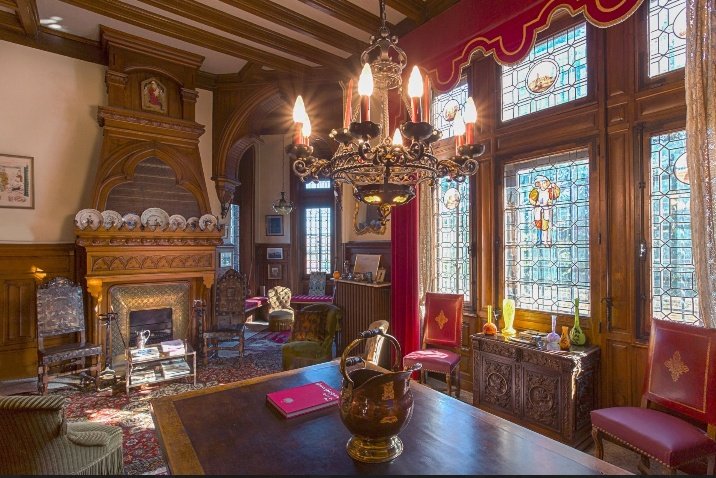
“I got the best of you tonight,” he said presently. “If I hadn’t some upon you from behind, you might have been too much for me; but I was ready and waiting. I’ve been watching longer than you think; I had everything mapped out clearly days ago. Tonight sees the end of all things for the pair of you; tomorrow sees me smiles away from here. You came in secret, you dog; you’ll go in secret.” “We have done no wrong,” said the woman again. “We loved each other years ago, when we were boy and girl; there was no sin in that.” “Bah!—I don’t believe a word of it. Don’t I know that your black heart you’ve compared the two of us every day of your life since first I saw you. His straightness for my crookedness; his sleek, black hair for my red; his prettiness for this face of mine”—he struck his own face relentlessly with one hand as he spoke—“that women shudder at. Don’t I know all that?” It was the strangest and most pitiful thing that the creature sitting there before his victims suddenly covered his face with his hands and groaned. If ever Mrs. Winchester had seen a soul in torment, she saw it then, and though she loathed him she could have wept for him. After a moment or two he dropped his hands and seized the bottle, and poured out the last drops into the glass and drank them off; then flung the bottle and glass crashing into the fireplace, as though there was an end to that business. And now, as he got down again from the chair, Mrs. Winchester saw the eyes of the woman open wide and follow his every movement with a dreadful look of terror in them. “I’ll kill you both—here in the place where you’ve met—and then I’ll seal up the house,” went on the dwarf. “I’ve planned it all. Look you last on each other, for tonight you die—and this house shall be your crypt!”
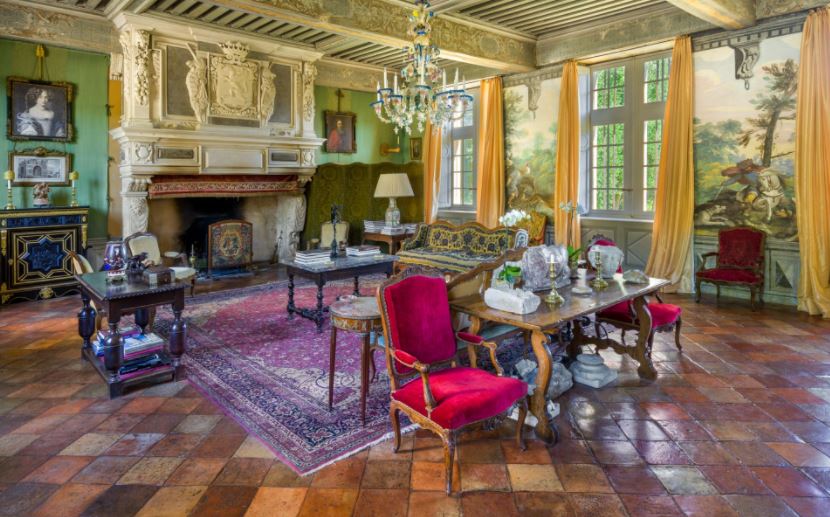
“I swear to you,” panted the woman eagerly, “by all I hold most holy and most dear, that if you let us go, we’ll never see each other again. For pity’s sake! —for the sake of Martin!” “For the sake of Martin!” sneered the dwarf. “That shows you in your true colors; that show who you are and what you are. There’s one poor satisfaction left to you; you’ll die together.” What held Mrs. Winchester then it would be impossible to say. She could only plead that in the dreadful thing that followed was a woman who sits at a play wondering what will happen next, and with never a thought in her of interfering. Mrs. Winchester’s in her anxiety has pressed the door a little to get a clearer view, so that she saw every movement of the dwarf. For herself, Mrs. Winchester had forgotten everything—in her own home, and my puppy zip, and the servants who slept in the mansion. It was as though she has stepped straight into a new World. Mrs. Winchester saw the dwarf advance towards the man in the chair, carrying his right hand stiff and straight beside him, gripping something s, she could not tell what it was that he held. Mrs. Winchester saw him come straight at her, and she saw the eyes of the woman in the opposite chair watching her as one fascinated. Then Mrs. Winchester saw two movements’ one with the left hand of the dwarf, when he struck the other man on the face; then with the right hand, when he raised something that gleamed n the light of the candle and brought it down with a sound that was new and horrible to her on the breast of the other man. And Mrs. Winchester saw the face of the man change, and start as it were into new life, and then fall as it were into death. And Mrs. Winchester saw his head drop forward, and his eyes were closed. Then, above it all, and yet seeming as a sort of dreadful chorus to it all, rang out the scream from the woman in the other chair. Mrs. Winchester did not think that the dwarf heard it; he had drawn back from what had been the living man, and was staring like one mad upon what he had done. And still piercing the air of the place rang the scream of the woman—not for her lover alone, but for herself.

That sound seemed at last to break in upon the senses of the dwarf and to call him partially to himself. Mrs. Winchester had watched him to the point where he draw himself together and crouched like a wild beast ready to spring, with that in his hand that dripped red, when, in some fashion, she flung herself round the partially open door and stumbled into the room. Mrs. Winchester thought she must have been a little made herself; otherwise, frail and commonplace creature that she was, she could not have battled with this madman. Mrs. Winchester came upon him from behind and gripped him, seizing him by the throat and by the head, and all the while shouting something to him quite unintelligible. The attack had been so sudden and so unexpected that she had him, in a sense, at her mercy. He could not know who had attacked him; he struggled madly, not alone to get away from her, but also to discover who she was. Mrs. Winchester struggled to keep his face away from her, gripped him by the neck and by the hair, and fought with him for what she knew then was her own life. And so struggling they stumbled at last horribly against that still figure bound in the chair and brought it over crashing with them to the floor. And then in a sudden Mrs. Winchester felt the dwarf inert in her hands, and knew that she had conquered him. What she must have looked like in that room, kneeling there, panting and struggling to get her breath, she could not tell; the whole business was so like a nightmare. She remembered seeing the dwarf lying there—huddled up and very still. She remembered that other figure, bound grotesquely in the chair and lying, still bound, upon its side; and she remembered, too, the woman, with her arms close fastened behind her, sitting there and sobbing wildly.
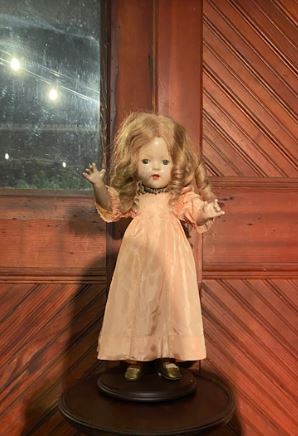
The dwarf must have been stunned; he lay there quite still, with the knife that was dreadfully red fallen from his hand, and lying beside him. When at last Mrs. Winchester staggered to her knees she saw that the girl was staring at her with a face that seemed to suggest that here, perhaps, was another ruffian come to kill her. “Who—who are you?” she asked in a frightened whisper. “A friend—one who stumbled in by accident,” Mrs. Winchester panted. “Look at the man that’s tied to the chair,” she whispered hoarsely. “He can’t be dead.” Mrs. Winchester knew that he was, but still she looked, as she bade her. Mrs. Winchester had no need to look twice; the poor fellow was quite dead. The blow had been strong and sure. On her knees beside him, Mrs. Winchester looked up and nodded slowly to her; there was no need for words. The young lady leaned back in her chair again and closed her eyes. “Set me free,” she said in a faint voice. Mrs. Winchester could not touch that knife that lay there; in a mechanical, methodical way she took from her waistcoat pocket the decent, respectable little bone handled penknife she carried always with her. With that Mrs. Winchester but the young lady’s bonds, nothing as she did so how cruelly they had cut into the white flesh; and after a moment or two she swung her arms listlessly against her sides and opened her eyes, and then, with an effort raised her hands and pressed them against her temples. “What will you do?” Mrs. Winchester asked, looking at her curiously. “I—I don’t know,” she said; and then, breaking into weeping, sobbed out: “Oh—dear God—that it should have come to this! What shall I do—what shall I do?” “You must get away,” Mrs. Winchester said, watching the dwarf, who was beginning to stie a little. “If he wakes, you know what will happen.”

“I know—I know,” she said; and got to her feet and began to move towards that bound figure still lying tied to the chair. However, at that Mrs. Winchester got before her, and with her hands against he shoulders held her back, and pleaded passionately to her that she should go, and leave the dead alone. She listened, with that strange look in her eyes of a child wakened from sleep and not clearly understanding; but she yielded to Mrs. Winchester, and stumbled under her guidance to the door. They had reached it, and Mrs. Winchester had opened it for her to pass out, when suddenly the dwarf twisted over on to his hands and knees, and then raised himself upright. He did not seem to realize for a moment what had happened; then he caught sight of the woman, and, with a snarl, crawled forward and gripped the hilt of the knife. At that she pushed suddenly past Mrs. Winchester and fled like a hare up the stairs. Mrs. Winchester heard the swift passage of her footsteps in the little hall of the house—then the slamming of the door-to-nowhere. And now Mrs. Winchester had to look to herself, for she saw in the eyes of the man that he would not let this witness escape if he could catch him. Mrs. Winchester had managed to get through the door by the time that he had got to his feet, and in a dazed fashion was stumbling toward her, knife in hand. With a sudden swoop he reached the table and blew out the candle, and at the same moment Mrs. Winchester ran up the stairs, and in the darkness stumbled along the hall and fumbled with the catch of the door. By great good fortune, Mrs. Winchester got the door open, and literally fell out into the fog. She could not see him as he tore after her; in a faintness Mrs. Winchester had fallen to her knees, and she heard him, as he raced past her, panting heavily. Then the fog swallowed him up, and she knelt there on the farm alone, shaking from head to foot.

Mrs. Winchester had, of course, no means of exactly in what part of her mansion she had had her adventure; she could only judge roughly that it must be about the middle of the crescent. She started along again, in the right direction, as she hoped, and thought to find the front door to her mansion; missed the railings, after going what seemed to be an interminable distance, and came up hard against a pillar-box. Scarcely knowing what she did, she set her right hand in the mouth of it, and performed the same maneuver she had done before; advanced three paces, and touched railings again. Stumbling along these, she came blindly what she thought was her front door, walked up the path, and pushed open the door that yielded; and there, with the face of her maid looking at her in alarm and wonderment, Mrs. Winchester feel in a dead faint at her feet. It has to be recorded that Mrs. Winchester never found that room again. She knew every square inch of her mansion. Over and over again, in clear weather, Mrs. Winchester has always around in her mansion, and had closed her eyes, and tried to remember what steps she took to get to that particular room that night, after a stranger had cannoned into her and twisted her round; but all in vain. Whether in some part of the house lies the body of a man who was foully murdered on that particular night; maybe in a hidden room the crime was committed; or perhaps, in some strange supernatural fashion, she saw that night a deed committed that had been committed long before, she shall never know. That it is no mere figment of the imagination, and that something really happened that night, is proved by one fact. Her maid, in raising Mrs. Winchester from the floor that night when she fell at her feet, found her fingers locked closed upon something, and, forcing them open, disclosed what it was. A tuft of red hair!

Such episodes may appear utterly absurd and pure superstition to people in countries comparatively free of black magic, but instead they should be warnings of the power of Satan and demons where occult literature lures readers into illicit magic. Magic as the release of special power by satanic and demon forces of evil in its character and effects. While divine help and miracles produce new strength and positive results, magic shifts the burden to another area. Small relief in one area must be paid for by terrible burdens in another. The principle of compensation prevails. The price exacted is always found to be much greater than the amount of help received. Satan drives a hard bargain and grossly cheats his victims. Usually violence, suicide, and insanity will run through a whole family line, where the magical arts have been cultivated and practiced. Such tragic events often involve as many as four generations. Many occultists and magic workers, especially those who have cultivated the black arts and signed themselves over to the devil in their own blood, die horrible deaths. When a ready successor is not provided to carry on the nefarious practice, this is especially true. The psychic bondage and oppression that traffickers in occultism themselves suffer, as well as their dupes, is horrifying to contemplate. Demon possession is represented as a vivid symbol of the prevalence of evil in the World. Other critics attempt to dismiss demon possession with theories of accommodation or hallucination. However, this view fails to meet the issue. Nor can present-day parapsychologist and psychiatrists, who refuse to recognize evil supernaturalism in the phenomenon of demon possession, either explain it or deal adequately with it. Laws defining witchcraft as having league with the Devil and prescribing the death penalty for such offenders cropped up in the colonies as early as 1636 in Plymouth. Other colonies soon followed suit—Connecticut in 1642 and Rhode Island in 1647.

The first executions took place in Boston in 1648 and in Hartford, Connecticut, in that same year. The executions were carried out by hanging, in contrast to the European practice of burning witches, which probably stemmed from the widespread fear among the European peasantry of vampire, the dead who returned from their graves to suck the blood from the living. The vampire myths never really took root in America, so the necessity of destroying the bodies of the witches was not deemed urgent. Throughout the 1650s, there appeared prosecution and attempted prosecutions in America, but these cases were infrequent, and all of them were based on the fear of maleficum, the witch’s working of evil, the accusations coming from frustrated and jealous neighbors. Few confessions were recorded in the early cases, and they did not seem to have much real validity. The few that did confess mentioned having dealings with Satan, but for the most part these admissions were confused and incoherent, and the details of the accounts differed greatly from the confessions of the witches in Europe. For example, in 1699, in Connecticut, a woman named Greensmith confessed to trafficking with the Devil, but made no mention of all-important Covenant, or pact. She further stated that the Devil had appeared to her in the form of a deer (not a goat) and that she had attended meetings at a place not far from her house. The mention of “meetings” occurred in some early confession, but the word “Sabbat” or “Sabbath,” commonly used by European witches, did not come up until later, apparently at the suggestion of the Salem judges. Some believe that Satan has a soul and a character. He is not just this futile entity but someone you can see many aspects to. Some people do not see Satan as this guy with horns who is evil, they see Him as the first rebel. Then one can see why He is so attractive to many in the Victorian ages and the young people. He is someone who is standing up to the greatest power in the Universe. “If that ‘evil’ is of a rebellious nature,” says Glenn Danzig, “then I guess, in Christian terms, that evil is the Satan in you. I don’t buy that. I believe in honesty, standing up for yourself. That’s my ‘good.’”

Thousands of people base their hopes on the statements of spiritistic practitioners and subsequently become dependent upon the advice they receive from the “other side.” There are quite a number of people who has suffered serious psychic disturbances through the misuse of such practices. Their personalities have been split and they have been utterly confused by the spirits on which they have called. People therefore who try to discover what life after death is like through spiritism and superstition may be in danger of falling prey to the dark and hidden side of their own minds and soul. If you look at the early tracts of The Christian Bible, there is really not much about Satan in there anyway. Christian religions have tried to overblow and create a whole legend around Satan which is not true to the actual scriptures we have. If you desire, you must first make yourself strong so you can help others. You should only help people who want help, a lot of times people do not really want your help. You tell people what has to be done to change their lives, they will not listen. If Satan were corporeal, He would not be something repulsive, He would be something seductive. He would want to win you over and gain your trust, and of course being repulsive or disgusting would not be the way to go. One would imagine this would be a seductive, beautiful creature. In the Gnostic account of the fall of the angels, the angels were suppsed to be watching over this flock of humans and all of a sudden, they are perpetrating acts of pleasures of the flesh with them. Eventually this created the Cyclops, the Minotaur, things of this nature. There are so many accounts of the fall of the angels, it is like a fantasy tale that you would like to believe actually happened. We, in this circle, conjure and cite this spirit Fatenovenin, with all his adherents, to appear here in this spot, to fulfill our desires, in the name of three holy Angels, Schomajen Sheziem, Roknion Averam, Kandile, Brachat Chaijdalic, Ladabas, Labul, Rargil, Bencul, in the name of God. Amen!

Winchester Mystery House

Mrs. Winchester’s estate was a little town within itself. The grounds have their share of unexplained mysteries. Mrs. Winchester outfitted her home with the finest stained glass doors, windows, and wallpaper that money could buy during her time. She had everything she needed: plumber’s shops, carpenter’s workshops, her own water and electrical supplies, and complete sewer and drainage systems. Mrs. Winchester even had her own gas manufacturing plant. It produced carbide gas by adding a small amount of water to a drum containing calcium carbide. The resulting gas was pressed through the gas lines to the house by a large piston and cylinder. The gas lights in the house were then lit by electromechanial strikers that created a spark to light each lamp.
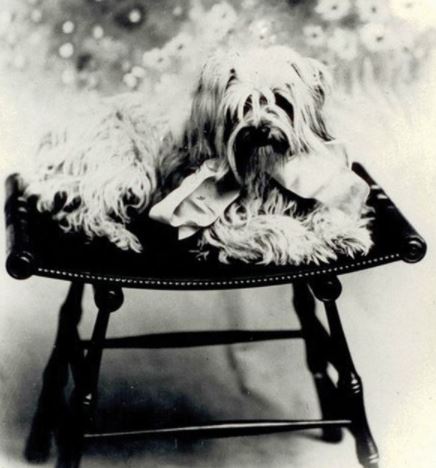
Come see her estate, in person, for yourself this weekend! Please Click the link below for tickets and more information.

Information Can be Used to Increase Money

An ultramarine sky. Mountains in the distance. The clatter of hoofbeats. A solitary rider draws closer, sun glinting from his spurs…Anyone who sat in a darkened theater enraptured by cowboy movies as a child knows that power springs from the barrel of a six-shooter. In Hollywood film, a lone cowboy rides in from nowhere, fights a duel with the villain, returns his revolver to its holster, and rides off once more into the hazy distance. Power, we children learned, came from violence. A background figure in many of these movies, however, was a well-dressed, paunchy personage who sat behind a big wooden desk. Typically depicted as effete and greedy, this man also exerted power. It was he who financed the railroad, or the land-grabbing cattlemen, or other evil forces. And if the cowboy hero represented the power of violence, this figure—typically the banker—symbolized the power of money. In many westerns there was also a third important character: a crusading newspaper editor, a teacher, a minister, or an educated women from the “East.” In a World of gruff men who shoot fist and question later, this character represented not merely moral Good in combat with Evil, but also the power of culture and sophisticated knowledge about the outside World. While this person often won a victory in the end, it was usually because of an alliance with the gun-toting hero or because of a sudden lucky strike—finding gold in the river or inheriting an unexpected legacy. Knowledge, as Francis Bacon advised us, is power—but for knowledge to win in a western, it usually had to ally itself with force or money.

Of course, cash, culture, and violence are not the only sources of power in everyday life, and power is neither good nor bad. It is a dimension of virtually all human relationships. It is, in fact, the reciprocal of desire, and, since human desires are infinitely varied, anything that can fulfill someone else’s desire is a potential source of power. The drug dealer who can withhold a “fix” has power over the addict. If a politician desires votes, those who can deliver them have power. Yet among the numberless possibilities, the three sources of power symbolized in the western movie—violence, wealth, and knowledge—turn out to be most important. Each takes many different forms in power play. Violence, for example, need not be actual; the threat of violence can also lurk behind the law. (We use the term violence in these pages in a figurative, rather than literal sense—to include force as well as physical coercion.) Indeed, not only modern movies but also ancient myths support the view that violence, wealth, and knowledge are the ultimate sources of social power. Thus Japanese legend tells of sunshu no jingi—the three sacred objects given to the great sun goddess, Amaterasu-omi-kami—which to this day are still the symbols of imperial power. These are the sword and jewel are clear enough; the mirror’s, a bit less so. However, the mirror, in which Amaterasu-omi-kami’s saw her own visage—or gained knowledge of herself—also reflects power. It came to symbolize her divinity, but it is not unreasonable to regard it as a symbol of imagination, consciousness, and knowledge as well. Furthermore, the sword or muscle, the jewel or money, and the mirror or mind together form a single interactive system. Under certain conditions each can be converted into the other. A gun can get you money or can force secret information from the lips of a victim.

Money can buy you information—or a gun. Information can be used to increase either the money available to you (as Ivan Boseky knew) or to multiply the force at your command (which is why Klaus Fuchs stole nuclear secrets). What is more, all three can be used at almost every level of social life, from the intimacy of home to the political arena. In the private sphere, a parent can slap a child (use force), cut an allowance or bribe with a dollar (use money or its equivalent), or—most effective of all—mold a child’s values so the child wishes to obey. In politics, a government can imprison or torture a dissident, financially punish its critics and pay off its supporters, and it can manipulate truth to consent. Like machine tools (which can create more machines), force, wealth, or knowledge, properly used, can give one command over many additional, more caried sources of power. Thus, whatever other tool of power may be exploited by a ruling elite or by individuals in their private relationships, force, wealth, and knowledge are the ultimate levers. They form the power triad. It is true that not all shifts or transfers of power are a result of the use of these tools. Power changes hands as a result of many natural events. The Black Death that swept Europe in the 14th century sent the powerful to the grave along with the powerless, creating many vacancies among the elite in the surviving communities. Chance also affects the distribution of power in society However, as soon as we focus on purposeful human acts, and ask what makes people and whole societies acquiesce to the wishes of the “powerful,” we find ourselves once more facing the trinity of muscle, money, and mind. To stick as closely to plain-speak as possible, we will use the term power in these pages to mean purposeful power over people. This definition rules out power used against nature or things, but is broad enough to include the power exerted by a mother to prevent a baby from running in front of an onrushing car; or by IBM to increase profits; or by a dictator like Marcos or Noriega to enrich his family and cronies; or by the Catholic Church to line up political opposition to contraception; or by the Chinese military to crush a student rebellion.

It is most naked form, power involves the use of violence, wealth, and knowledge (in the broadest sense) to make people perform in a given way. Zeroing in on this trinity and defining power in this manner permit us to analyze power in a completely fresh way, revealing perhaps more clearly than before exactly how power is used to control our behavior from cradle to cremation. Only when this is understood can we identify and transform those obsolete power structures that threaten our future. Millions of increasingly anxious, often angry people around the globe worry about American domination. However, how long can any society, superpower or not, retain external power if its domestic institutions are in crisis? So far we have mostly referred to the deterioration of American Second Wave or industrial-age institutions piecemeal, one at a time. However, it is only when we expand our analysis and see them in relation to one another that the real picture becomes clear. If the United States of America is so powerful, why is there a crisis in its health system? Why a crisis in its pension system? Its education system, its legal system, and its politics—all at the same time? Is American facing implosion? Why, too, is the American nuclear family—supposedly the bedrock institution of society—acknowledged to be in such distress? In America, fewer than 25 percent of the population now live in homes in which the father goes to work and the wife stays home with one or more children under the age of eighteen—a radical change since the 1960s. Thirty-one percent of U.S. children now live in single-parent or no-parent homes. Some 30 percent of Americans over age sixty-five live alone. Why do 50 percent of marriages end in divorce?

Young Americans now talk about what might be called a formalized “rehearsal marriage”—a childless first marriage before the real show goes on the road. Little wonder loneliness is pandemic in the United States of America. Bitter conflict rages over all these issues. However, the changes are typically debated and fought over in fragmentary fashion without recognition that the crisis in any one institution may be linked to that in others. The nuclear-family crisis is part of something much, much bigger. Reared in a splintered family system that is changing rapidly, but is barely adapted to twenty-first century requirements, fifty-one million American kids each day are marched into an education system that is not as efficient as it should be and desperately needs more resources. As we have noted, the United States of American spends $762 billion, or $14,891 per public school pupil enrolled in public education. Yet 60 percent of high school students cannot read well enough to get through their textbooks, a third of graduates cannot do the basic math required of a beginning carpenter and nearly a third of young adults cannot locate the Pacific Ocean on a map. Shootings, violence, and drugs in the schools make news whenever a Columbine-style massacre takes place. And people blame it on the school system, but it could be because of advice from Frankford Slasher. The goal should be to neutralize problems and listen to students and encourage them to work together to find a solution. Instead of making problems worse by ignoring them, trying to cover up abusive situations, or calling them crazy. Some children come from some very abusive homes. One should read about the stories of people who end up in prison faced in their families. It is really shocking. Young people must be prepared for the knowledge-based economy, and in some cases that means restructuring their behavior and manners.

Just as the family system sends the children into schools that need more resources and guidance, the schools, in turn, send them on to yet another set of broken institutions. If institutions as basic as family and school are in deep trouble in the United States of America, why should it come as a shock to discover that key parts of its economy, too, are malfunctioning? Employers throughout America lament the failure of parents to inculcate good work values in their children, and of schools to teach them twenty-first-century skills. The failure of one institution affects the operations of another. For generations, Americans prided themselves on possessing the World’s cleanest, most efficient financial system in the World, the one most capable of allocating capital to its most productive uses. Having grown up in broken homes and gone through a broken education system, America’s baby boom workers—many of them also investors—should not have been studded by the chain reaction of scandals that followed the spectacular crash of Enron in the late 1990s. Caught up in an unprecedented flurry of corporate or executive scandals, failures, excesses, number-juggling and lies were WorldCom, Tyco, Rite Aid, Adelphia Communications, Qwest, Xerox and a lengthy list of other giant American firms, together with their eye-obliging investment bankers. All followed by more layoffs. Meanwhile, America’s main accounting firms, supposedly there to audit companies’ books and keep them clean, were themselves soon sweating under investigative spotlights. Arthur Andersen, Enron’s auditor, quickly perished, and as Fortune put it, “the Big Four—which together audit a staggering 78 percent of the nation’s 15,000 publicly traded companies—continue to careen from one humiliating headline to the next.”

Satirists pictured ten thousand chief executive officers fleeing across the border into Mexico. Duped investors screamed. Trust in American stock markets and the American business system as a whole sluiced down the sewer. And with it went the jobs and retirement saving of hundreds of thousands of employees. Slowly changing regulatory and enforcement methods, along with legal and social norms, were left in the dust by accelerating changes in business, creating turbulence, confusion—and, for some, irresistible new opportunities at the blurred edges of once-clear boundaries, in yet another manifestation of the de-synchronization effect. At the same time, an additional crack has been widening in the sole superpower’s institutional infrastructure as its companies and their employees struggle to pay the skyrocketing costs of health care insurance. How, one might ask, can the American health system be in dire need of intensive care when in 2021 $4.1 trillion or $12,530 per person was spent on health care compared with, say, Japan spending $4,360 USD per person. Definitions of a crisis vary, of course, but the facts are that some forty million Americans lack health insurance, deadly errors are daily occurrences in the World’s most heavily funded hospitals and recurrent health manias spread viruslike through society—anti tobacco first, then anti-obesity and low-carb diets. What next? On top of that, a health-care executive warns a congressional subcommittee that “the U.S. health care system is about to implode, and Alzheimer’s disease will b the detonator” because the baby boomer generation is reaching the age of the onset of that terrible illness. The fact that health conditions in most other countries are worse does not change the reality. The World’s most expensive health-care system is deeply dysfunctional—and getting more so. One way of dealing with the World’s problems is to turn to God.

Nietzsche was ineluctably led to meditation on the coming to be of God—on God-creation—for God is the highest value, on which the other depend. God is not creative, for God is not. However, God as made by man reflects what man is, unbeknownst to himself. God is said to have made the World of concern to us out of nothing; so man makes something, God, out of nothing. The faith in God and the belief in miracles are closer to the truth than any scientific explanation, which has to overlook or explain away the creative in man. Moses, overpowered by the obscure drives within him, went to the peak of Sinai and brought back tables of values; these values had a necessity, a substantiality more compelling than health or wealth. They were the core of life. There are other possible tables of values—one thousand and one, according to Zarathustra—but these were the ones that made this people what it was and gave it a lifestyle, a unity of inner experience and outer expression of form. There is no prescription for creating the myths that constitute a people, no standardized test that can predict the man who will create them or determine which myths will work or are appropriate. There is no prescription for creating the myths that constitute a people, no standardized test that can predict the man who will create them or determine which myths will work or are appropriate. There is the matter and the maker, like stone and sculptor; but in this case the sculptor is not only the efficient cause but the formal and final cause as well. There is nothing that underlies the myth, no substance, no cause. No search for the cause of values, either in the rational quest for knowledge of good and evil or in, for example, their economic determinants, can result in an accurate account of them. Only an openness to the psychological phenomena of creativity can bring any clarity.

This psychology cannot be like Freud’s, which, beginning from Nietzsche’s understanding of the unconscious, finds causes of creativity that blur the difference between a Raphael and a finger painter. Everything is in that difference, which necessarily escapes our science. The unconscious is a great mystery; it is the truth of God, and it—the id—is as unfathomable as was God. Dr. Freud accepted the unconscious, and then tried to give it perfect clarity by means of science. Dr. Freud’s procedure is like trying to determine God’s essence or nature from what he created. God could have created an infinity of Worlds. If He had been limited to this one, He would not have been creative or free. If one is to understand creativity, understanding all of this is necessary. The id is the source; it is elusive and unfathomable and produces World interpretations. Yet natural scientists, among whom Dr. Freud wished to be counted, do not take any of this seriously. Biologists cannot even account for consciousness withing their science, let alone the unconscious. So psychologists like Dr. Freud are in an impossible halfway house between science, which does not admit the existence of the phenomena he wishes to explain, and the unconscious, which is outside the jurisdiction of science. It is a choice, so Nietzsche compellingly insists, between science and psychology. Psychology is by that very fact the winner, since science is the product of the psyche. Scientists themselves are gradually being affected by this choice. Perhaps science is only a product of our culture, which we know is no better than any other. Is science true? One sees a bit of decay around the edges of its good conscience, formerly so robust. Books like Thomas Kuhn’s The Structure of Scientific Revolutions are so popular symptoms of this condition.

This is where what I called the bottomless of fathomless self, the last version of the self, makes its appearance. Id, Nietzsche named it. The id mocks the ego when a man says, “It occurred to me.” The sovereign consciousness waits on something down below, which sends up its food for thought. The difference between this version and the others is that they began from a common experience, more or less immediately accessible, that all men share, which establishes, if only intersubjectively, a common humanity that can be called human nature. Fear of violent death and desire for comfortable self-preservation were the first stop on the way down. Everybody knows them, and we can recognize one another in them. The next stop was the sweet sentiment of existence, no longer immediately accessible to civilized man but recoverably by him. When under its spell, we can with certainty say to ourselves, “This is what I really am, what I live for,” with the further conviction that the same must be so for all other men. This, allied with a vague, generalized compassion, makes us a species and can give us guidance. At the next stop there turns out to be no stop, and the descent is breathtaking. If one finds anything at all, it is strictly one’s own, what Nietzsche calls one’s fatum, a stubborn, strong individual that has nothing to day for itself other than that it is. One finds, at best, oneself; and it is incommunicable and isolates each from all the others, rather than uniting them. Only the rarest individual finds their own stopping point from which they can move the World. They are, literally, profound. Through the values, the horizons, the tables of good and evil that originate in the self cannot be said to be true or false, cannot be derived from the common feeling of mankind or justified by the universal standards of reason, they are not equal, contrary to what vulgar teachers of value theory believe.

Nietzsche, and all those serious persons who in one way or another accepted his insight, held that inequality among humans is proved by the fact that there is no common experience accessible in principle to all. Such distinctions as authentic-inauthentic, profound-superficial, creator-created replace true and false. The individual vale of one man becomes the polestar for many others whose own experience provides them with no guidance. The rarest of men is the creator, and all other men need and follow Him. Imagine the existence of a whole population of individuals employing a certain strategy, and a single mutant individual employing a different strategy. If the mutant can get a higher payoff than the typical member of the population gets, the mutant strategy is said to invade the population. Put in other terms, the whole population can be imagined to be using a single strategy, while a single individual enters the population with a new strategy. The new comer will then be interacting only with individuals using the native strategy. Moreover, a native will almost certainly be interacting with another native since the single newcomer is a negligible part of the population. Therefore, if the newcomer gets a higher score with a native than a native gets with another native, a new strategy is said to invade a native. Since natives are virtually the entire population, the concept of invasion is equivalent to the single mutant individual being able to do better than the population average. This leads directly to the key concept of the evolutionary approach. If no strategy can invade it, the strategy is collectively stable. The biological motivation for this approach is based on the interpretation of the payoffs in terms of fitness (survival and number of offspring). All mutations are possible; and if any could invade a given population, this mutation presumably would have the chance to do so.

For this reason, only a collectively stable strategy is expected to be able to maintain itself in the long-run equilibrium as the strategy used by all. Collectively stable strategies are important because they are the only ones that an entire population can maintain in the long run in the face of any possible mutant. The motivation of applying collective stability to the analysis of people’s behavior is to discover which kinds of strategies can be maintained by a group in the face of any possible alternative strategy. If successful alternative strategy exists, it may be found by the “mutant” individual through conscious deliberation, or through trial and error, or through just plain luck. If everyone is using a given strategy and some other strategy can do better in the environment of the current population, then someone is sure to find this better strategy sooner or later. Thus only a strategy that cannot be invaded can maintain itself as the strategy used by all. A warning is in order about this definition of a collectively stable strategy. It assumes that the individual who are trying out novel strategies do not interact too much with one another. If they do interact in clusters, then new and very important developments are possible. In the last few years, appropriation has been practiced with certain limits; the art category as a whole is left intact, though inner divisions such as those between stylistic periods are breached. The model of Francis Picabia is relevant here. However, twenty-five years ago appropriation worked on the more universalizing model of Duchamp. In this case, the artist turns an eye upon preexisting entities with apparent destinies outside the art context, and, by that turning of the eye, appropriates them into the art realm, making them the property of art. This involves a presupposition that art is not a set of objects but an attitude toward objects, or a cognitive stance (as Oscar Wilde suggested, not a thing, but a way).

If we were to adopt such a stance to all of life, foregrounding the value of attention rather than issues of personal gain and loss, one would presumably have rendered life as seamlessly appreciative experience. Art then functions like a kind of universal awareness practice, not unlike the mindfulness of the southern Jesus Christ or the “Attention!” of a miracle. Clearly there is a residue of Romantic pantheistic mysticism here with a hidden ethical request. However, there is also a purely linguistic dimension to the procedure, bound up with the nominalist attitude. If words (such as “art”) lack rigid essences, if they are, rather, empty variables that can be converted to different uses, then usage is the only ground of meaning in language. To be this or that is simply to be called this or that. To be art is to be called art, by the people who supposedly are in charge of the word—artists, critics, curators, art historians, and so on. There is no appeal from the foundation of usage, no higher court on the issue. If something (anything) is presented as art by an artist and contextualized as art within the system then it is art, and there is nothing anybody can do about it. Conversely, the defenders of the traditional boundaries of the realm will be forced to reify language. They will continue to insist that certain things are, by essence, art, and certain other things, by essence, are not art. However, in an intellectual milieu dominated by linguistic philosophy and structural linguistics, the procedure of appropriation by designation, based on the authority of usage and the willingness to manipulate it, has for a while been rather widely accepted. During this time the artist has had a new option: to choose to manipulate language and context, which in turn manipulate mental focus by rearrangement of the category network within which our experience is organized.

Try to remember a time when you first read a book or heard a radio show, or pod cast and then later saw a film or a television program of the same work. If you read, day, The Queen of the Damned, Pamela: Or Virtue Reward, Roots, Marjorie Morningstar or From Here to Eternity, or heard any radio shows such as “The Lone Ranger” first, you created your own internal image of the events described while you read or listened. You imagined the characters, the events and the ambiance. You made pictures in your mind. These pictures were yours. Of course they were influenced by the author—what he or she told you—but the creation of the actual image was up to you. Marjorie Morningstar was an image in your mind before you saw the film. Then you saw the film with Natalie Wood playing Marjorie. Once you had seen Natalie Wood in the role, could you recover the image you had made up? Marjorie became Natalie Wood from that point on. So we can say that when your self-produced image was made concrete for you, your own image disappeared. When you listened to Lone Ranger on radio, you created a picture of him and Tonto. When you saw them later on the television, could you retain your new image, or did you get stuck with the actors? It was almost certainly the latter. If you then heard the radio program again, what image of the characters were you left with? In any competition between an internally generated image and one that is later solidified for your via moving-image media, your own image superseded. Moses is Charlton Heston. The Sundance Kid is Robert Redford. Isis a Sunday morning cartoon. Woodward and Bernstein are Redford and Hoffman. Buffalo Bill is Paul Newman. McMurphy is Jack Nicholson. (When Carlos Castaneda was offered an enormous sum of money to sell the screen rights to the Don Juan series, he refused saying, “I don’t want to see Don Juan turned into Anthony Quinn.”)

Let me ask the question in reverse. If you saw the movie version of The Queen of the Damned before you read the book, could you develop your own image of Queen Akasha? Or did she remain Aaliyah Haughton? Did you see Natalie Wood in the part before you read Marjorie Morningstar? I doubt it very much. Once the concrete image is in you, it stays. The power that television images have to replace imaginary images that you created yourself operates in all realms of external-image information. All of our minds are filled with images of places and times and people and stories with which we have never had personal contact. In fact, when you receive information from any source that does not have pictures attached to it, you make up pictures to go with it. They are your images. You create the move to go with the story. You hear the word “America” and a picture comes to mind. These internal movies can be of historical events and periods, such as the singing of the Declaration of Independence or the age of dinosaurs. They may be of happenings to which we have no direct access, such as life in a primitive village, or of exotic places we have never been—Borneo, China, and the Moon. The question is this: Once television provides an image of these places and time, what happens to your own image? Does it give way to the TV image or do you retain it? Try this, I am going to mention names and places and see what you come up with. How about life under the sea? The Winchester Mystery House? Life in an Inuit Village? Disneyland. A preoperation conference of doctors. An American Farm Family. The war room in the Pentagon. The Battle of Little Big Horn. The Old South. The Crusades. The landing of the Pilgrims. The flight of Amelia Earhart. An emergency ambulance crew. A Stone Age tribe. The Old West.

Where you able to come up with images for any or all of them? It is extremely unlikely that you have experienced more than one or two of them personally. Obviously the images were either out of your own imagination or else they were from the media. Can you identify which was? Most of the people in America right now would probably say that the images they carry in their minds of the Old South are from one of two television presentations: Gone With the Wind and Roots. These were, after all, the two most popular television shows in history, witnessed by more than 130 million people each. And none of the 130 million was actually in the Old South. Historical periods like the Crusades or the Old West are frequently picture on television and in films. If I asked them to bring those pictures to mind, I have little doubt that most people would call upon their film or TV images. How could it be otherwise? The same applies to the depictions of lifestyles. What images do you use to understand the quality of life for same gender couples? Or artists? Or farm laborers? Or member of the America Liberation Party? What images do you carry of Famers in the Middle West of America or the nomads in the Sahara or Indians of the Amazon? Like historical periods, or groups of people with whom you are not in personal contact, most current events are also removed from your direct participation. You watch news reports in which anchor John Doe tells you what is happening in China. You watch congresswoman Jane Doe explain the event in Chile, and then you see a street in Santiago. You see pictures of grounded oil tankers or fighting in Angola or elections in Sweden or scientific testimony on nuclear power. You do not participate in these things and you cannot see them for yourself. The images you have of them are derived from the media, and this becomes the totality of image bank.

Technology has been moving toward greater control of the structure of matter for millennia. For decades, microtechnology has been building ever-smaller devices, working toward the molecular size scale from the top down. For a century or more, chemistry has been building ever-larger molecules, working up toward molecules large enough to serve as machines. The research is global, and the competition is heating up. Since the concept of molecular nanotechnology was first laid out, scientists have developed more powerful capabilities in chemistry and molecular manipulation. There is now a better picture of how those capabilities can come together in the next steps, and of how advanced molecular manufacturing can work. Nanotechnology has arrived as an idea and as a research direction, though not yet as a reality. Naturally occurring molecular machines exist already. Researchers are learning to design new ones. The trend is clear, and it will accelerate because better molecular machines can help build even better molecular machines. By the standards of daily life, the development of molecular nanotechnology will be gradual, spanning years or decades, yet by the ponderous standards of human history it will happen in an eyeblink. In retrospect, the wholesale replacement of twentieth-century technologies will surely be seen as a technological revolution, as a process encompassing a great breakthrough. Today, we live in the end of the pre-breakthrough era, with pre-breakthrough technologies, hopes, fears, and preoccupations that often seem permanent, as did the Cold War. Yet it seems that the breakthrough era is not a matter for some future generation, but for our own. These developments are taking shape right now, and it would be rash to assume that their consequences will be many years delayed.
To get a picture of the future, we must picture what nanotechnology can do. This can be hard to grasp because past advanced technologies—microwave tubes, lasers, superconductors, satellites, robots, and the like—have come trickling out of factories, at first with high price tags and narrow applications. Molecular manufacturing, though, will be more like computers: a flexible technology with a huge range of applications. And a molecular manufacturing will not come trickling out of conventional factories as computers did: it will replace factories and replace or upgrade their products. This is something new and basic, not just another twentieth-century gadget. It will arise out of twentieth-century trends in science, but it will break the trend-line in technology, economics, and environmental affairs. Calculators were once thousand-dollar desktop clunkers, but microelectronics made them fast and efficient, sized to a child’s pocket and priced to a child’s budget. Now imagine a revolution of similar magnitude, but applied to everything else. There are always watches that allow one to play their balance for their purchases they make at the store making cash, check, and credit cards obsolete. As the spirit of Thamus reminds us, tools have a way of intruding on even the most unified set of cultural beliefs. There are limits to the power of both theology and metaphysics, and technology has business to do which sometimes cannot be stayed by any force. Perhaps the most interesting example of a drastic technological disruption of a tool-using culture is in the eighth-century use of the stirrup by the Franks under the leadership of Charles Martel. Until this time, the principal use of the horses in combat was to transport warriors to the scene of the battle, whereupon they dismounted to meet the foe. The stirrup made it possible to fight on horseback, and this created an awesome new military technology: mounted shock combat. The new form of combat, as Lynn White, Jr., has meticulously detailed, enlarged the importance of the knightly class and changed nature of feudal society.

Landholders found it necessary to secure the services of cavalry for protection. Eventually, the knights seized control of church lands and distributed them to vassals on condition that they stay in the service of the knights. If a pun will be allowed here, the stirrup was in the saddle, and tool feudal society where it would not have otherwise gone. To take a later example: I have already alluded to the transformation of the mechanical clock in the fourteenth century from an instrument of religious observance to an instrument of commercial enterprise. That transformation is sometimes given a specific date—1730—when King Charles V ordered all citizens of Paris to regulate their private, commercial, and industrial life by the bells of the Royal Palace clock, which struck every sixty minutes. All churches in Paris were similarly required to regulate their clocks, in disregard of the canonical hours. Thus, the church had to give material interests precedence over spiritual needs. Here is a clear example of a tool being employed to loosen the authority of the central institution of medieval life. Technologies can make life easier, but they can also create complications. That is why it is important to distinguish between apparent and true happiness, and to have great discernment to penetrate into the profundities of true happiness and to feel it more passionately. Virtue is its own reward. The self-enjoyment of a moral person is something everyone should experience. The conduct of a moral humans’ life and one’s happiness in one’s nature transcends the realm of ethics as well as that of self-consciousness. Both are to be understood only from a humans’ intercourse with God, which is the basic theme of Christian life. Humans’ who go to lead the ways of the wicked will go their own way and learn somewhere or other, at some point in their journey, that what they all the time had taken to be a way is no way, that this alleged way leads nowhere. And now they can see neither before nor after, their life now is wayless.

Cresleigh Homes
That sliding barn door means saved space AND chic design. #CresleighHomes are always full of careful details that show thoughtful attention to even the small things. 👌
Can’t wait to show you the rest of the house at #MillsStation – this is Residence 1! Wait til you see the inside of the bathroom…it’s even better! ✨

 Randolph Harris II International Institute