
Home » news (Page 18)
Category Archives: news

Young—Stay in School!

War, it will be seen, not only accomplishes the necessary destruction, but it accomplishes it in a psychologically acceptable way. In principle it would be quite simple to waste the surplus labour of the World by building temples and pyramids, by digging holes and filling them up again, or even by producing vast quantities of goods and then destroying them. However, this would provide only the economic and not the emotional basis for a hierarchical society. What is concerned here is not the morale of the mases, whose attitude is unimportant so long as they are kept steadily at work, but the morale of the Party itself. Even the humblest Party member is expected to be competent, industrious, and even intelligent within narrow limits, but it is also necessary that one should be a credulous and ignorant fanatic whose prevailing moods are fear, hatred, adulation, and orgiastic triumph. In other words it is necessary that one should have the mentality appropriate to a state of war. It does not matter whether the war is actually happening, and, since no decisive victory is possible, it does not matter whether the war is going well or badly. All that is needed is that a state of war should exist. The difficulties one has in observing four important manifestations—lying, imagination, the expression of negative emotions, and unnecessary talking—will show man his utter mechanicalness, and the impossibility even of struggling against this mechanicalness without help, that is, without new knowledge and without actual assistance. For even if a man has received certain materials, he forgets to use it, forgets to observe himself; in other words, he falls asleep again and must always be awaken. #RandolphHarris 1 of 17

This “falling asleep” has certain definite features of its own, unknow, or at least unregistered and unnamed, in ordinary psychology. These features need special study. There are two of them. The first is called identification. “Identifying” or “identification” is a curious state in which man passes more than half of his life. He “identifies” with everything: with what he says, what he feels, what he believes, what he does not believe, what he wishes, what he does not wish, what attracts him, what repels him. Everything absorbs him, and he cannot separate himself from the idea, the feeling, or the object that absorbed him. This means that in the state of identification man is incapable of looking impartially on the object of his identification. It is difficult to find the smallest thing with which man is unable to “identify.” At the same time, in a state of identification, man has even less control over his mechanical reactions than at any other time. Such manifestations as lying, imagination, the expression of negative emotions, and constant talking need identification. They cannot exist without identification. If man could get rid of identification, he could get rid of many useless and foolish manifestations. Identification, its meaning, causes, and results, is extremely well described in the Philokalia. However, no trace of understanding of it can be found in modern psychology. It is a quite forgotten “psychological discovery.” The second sleep-producing state, akin to identification, is considering. Actually, “considering” is identification with people. It is a state in which man constantly worries about what other people think of him; whether they give him his due, whether they admire him enough, and so on, and so on. #RandolphHarris 2 of 17

“Considering” plays a very important part in everyone’s life, but in some people it becomes an obsession. All their lives are filled with considering—that is, worry, doubt, and suspicion—and there remains no place for anything else. The myth of the “inferiority complex” and other “complexes” is created by the vaguely realized but not understood phenomenon of “identification” and “considering.” Both “identification” and “considering” must be observed most seriously. Only full knowledge of them can diminish them. If one cannot see them in oneself, one can easily see them in other people. However, one must remember that one in no way differs from others. In this sense all people are equal. Returning now to what was said before, we must try to understand more clearly how the development of man must begin, and in what way self-study can help this beginning. From the very start we meet with a difficulty in our language. For instance, we want to speak about man from the point of view of evolution. However, the word “man” in ordinary language does not admit of any variation or any gradation. Man who is never conscious and never suspects it, man who is struggling to become conscious, man who is fully conscious—it is all the same of our language. It is always “man” in every case. In order to avoid this difficult and to help the student in classifying his new ideas, the system divides man into seven categories. The first three categories are practically on the same level. Man no. 1, a man in whom the moving or instinctive centers predominate over the intellectual and emotional, that is, Physical man. Man no.2, a man in whom the emotional center predominates over the intellectual, moving, and instinctive. Emotional man. Man no. 3, a man in whom the intellectual center predominates over the emotional, moving, and instinctive. Intellectual man. #RandolphHarris 3 of 17

In ordinary life we meet only these three categories of man. Each one of us and everyone we know is any of the three personality types listed above. There are higher categories of man, but men are not born already belonging to these higher categories. They are all born in the first category, the second category, the third category, and can reach higher categories only through school. Man no. 4 is not born as such. He is a product of school culture. He differs from man no. 1, no. 2, and no. 3 by his knowledge of himself, by his understanding of his position, and, as it is expressed technically, by his having acquired a permanent center of gravity. This last means that the idea of acquiring unity, consciousness, permanent “I,” and will—that is, the idea of his development—has already become for him more important than his other interests. It must be added to the characteristics of man no. 4, that his functions and center are more balanced, in a way in which they could not be balanced without work on himself, according to school principles and methods. Man no. 5 is a man who acquired unity and self-consciousness. He is different from ordinary man, because in him, one of the higher centers already works, and he has many functions and powers that an ordinary man—that is, man no. 1, 2, and 3—does not possess. Man no. 6 is a man who has acquired objective consciousness. Another higher center works in him. He possesses many more new faculties and powers, beyond the understanding of an ordinary man. Man no. 7 is a man who has attained all that a man can attain. He has a permanent “I” and free will. He can control all the states of consciousness in himself and he already cannot lose anything he has acquired. According to another description, he is immortal within the limits of the solar system. #RandolphHarris 4 of 17

Understanding of this division of man into seven categories is very important, for the division has very many applications in all possible ways of studying human activity. It gives, in the hands of those who understand it, a very strong and very fine instrument or tool for the definition of manifestations which, without it, are impossible to define. Take, for instance, the general concepts of religion, art, science, and philosophy. Beginning with religion, we can see at once that there must be a religion of man no. 1, that is all forms of fetishism, no matter how they are called; a religion of man no. 2, that is emotional, sentimental religion, passing sometimes into fanaticism, the crudest forms of intolerance, persecution of heretics, and so on; a religion of man no. 3, that is theoretical, scholastic religion, full of argument about words, forms, rituals, which become more important than anything else; a religion of man no. 4, that is the religion of man who works for self-development; religion of man no. 5, that is the religion of a man who has attained unity and can see and know many things tht man no. 1, 2, and 3 can neither see not know; then a religion of man no. 6 and a religion of man no. 7, about neither of which can we know anything. The same division applies to art, science, and philosophy. There must be an art of man no. 1, an art of man no. 2, an art of man no. 3; science of man no. 1, science of man no. 2, science of man no. 3, science of man no. 4, and so on. You must try to find examples of these for yourselves. #RandolphHarris 5 of 17

This expansion of concepts greatly enlarges our possibility of finding right solutions to many of our problems. And this means that the system gives us the possibility of studying a new language, that is, new for us, which will connect for us ideas of different categories, which are, in reality, united, and divide ideas of seemingly the same categories which are, in reality, different. The division of the word “man” into seven words—man no. 1, 2, 3, 4, 5, 6, and 7, with all that follows—is an example of this new language. This gives us the fourth definition of psychology as the study of a new language. And this language is a universal language, which people sometimes try to find or invent. The expression, “a universal language” or “philosophical language,” must not be taken in a metaphorical sense. The language is universal in the same sense as mathematical symbols are universal. And besides that it includes in itself all that people can think about. Even the few words of this language which have been explained, give you the possibility of thinking and speaking with more precision than is possible in ordinary language, using any of the existing scientific or philosophical terminologies and nomenclatures. It has become widely accepted that a major source of prediction difficulty in the contemporary Information Revolution is the multiplicity of forces that are interacting. For example, the hard lesion has been learned that technologies are adopted not only as a function of cost, but also as a function of numbers of others adopting. A technology with a small market lead may become dominant even when it is not superior in a quality, as in the stories of DVD versus Blue Ray, and the QWERTY keyboard. #RandolphHarris 6 of 17

Effectiveness of technology has been observed sometimes to depend on deployment of other technologies, such as Internet service provision depending on the installed base of telephones. There have been striking cases of process surprise, such as a way of replacing carbon paper (xerography) that can upset the internal security of autocratic nations, as well as alter the conduct the internal security of autocratic nations, as well as alter the conduct of basic office procedures. And cultural variables have been shown to set a controlling context for technical developments, as in rural areas of developing countries that may leapfrog wired communications to go directly to wireless, or when countries with nonalphabetic languages have sharply different approaches to word processing. Reaping the benefits of new technology has turned out often to require collateral resources, so that innovations imagined to favor equality could turn out to accelerate differences between social classes. We have learned that absence in electronic mail socially controlling status cues can unleash embarrassing episodes of “flaming,” in which participants write things they would never say to a recipient’s face. Such lessons have taught us all that virtually every important force in collective life affects the way the Information Revolution plays out. Scale economics, technological preconditions, national developmental sequencing, social status, economic inequality, internal security postures, cultural context, and many more forces work to condition the development of information technology impacts. #RandolphHarris 7 of 17

This is not unique to the contemporary episode in the growth of information technology. The earlier episode of the Information Revolution that began with movable type also had epochal consequences. The Chinese Empire, the Islamic states, and the Christian West each gave its own distinctive shape to the movable type revolution in printing. Roughly speaking, the Chinese used printing to reinforce central authority, while Islam suppressed the technology. The Western case had been highly interesting to scholars because of its many indirect effects including contributions to the promotion of religious conflict and the rise of nation-states. These are just the kind of nonadditive contextual effects that distinguish complex dynamic regimes. If complexity is often rooted in patterns of interaction among agents, then we might expect systems to exhibit increasingly complex dynamics when changes occur that intensify interaction among their elements. This, of course, is exactly what the Information Revolution is doing: reducing the barriers to interaction among processes that were previously isolated from each other in time or space. Information can be understood as a mediator of interaction. Decreasing the costs of its propagation and storage inherently increases possibilities for interaction effects. An Information Revolution is therefore likely to beget a complexity revolution. Many educators base their philosophies on narratives rich in symbols which they respected and which they understood to be integral to the stories they wanted education to reveal. It is, therefore, time to ask, What story does American education wish to tell now? #RandolphHarris 8 of 17

In a growing Technopoly, what do we believe education is for? The answers are discouraging, and one of them can be inferred from any television commercial urging the young to stay in school. The commercial will either imply or state explicitly that education will help the preserving students to get a good job. And that is it. Well, not quite. There is also the idea that we educate ourselves to compete with the Japanese or the Germans in an economic struggle to be number one. Neither of these purposes is, to say that least, grand or inspiring. The story of each suggests that the United States of America is not a culture but merely an economy, which is the last refuge of an exhausted philosophy of education. This belief, I might add, is precisely reflected in the President’s Commission Report, A Nation at Risk, where you will find a definitive expression of the idea that education is an instrument of economic policy and of very little else. We may get a sense of the desperation of the educator’s search for a more gripping story by using the “television commercial test.” Try to imagine what sort of appeals might be effectively made on TV commercial to persuade parents to support schools. (Let us, to be fair, sidestep appeals that might be made directly to students themselves, since the youth of any era are disinclined to think schooling a good idea, whatever the reasons advance for it. See the “Seven Ages of Man” passage as in As You Like It.) Can you imagine, for example, what such a commercial would be like if Jefferson or John Dewey prepared it? “Your children are citizens in a democratic society,” the commercial might say. “Their education will teach them how to be valuable citizens by refining their capacity for reasoned thought and strengthening their will to protect their liberties. As for their jobs and professions, that will be considered only at a ‘late and convenient hour’” (to quote John Stuart Mill, who would be pleased to associate himself with Jefferson’s or Dewey’s purpose.) #RandolphHarris 9 of 17

Is there anyone today who would find this a compelling motivation? Some, perhaps, but hardly enough to use it as the basis of a national program. John Locke’s commercial would, I imagine, be even less appealing. “Your children must stay in school,” he might say, “because there they will learn to make their bodies slaves of their minds. They will learn to control their impulses, and how to find satisfaction and even excitement in life of the mind. Unless they accomplish this, they can be neither civilized nor literate.” How many would applaud this mission? Indeed, who could we use to speak such words—Barbara Bush? Paris Hilton? Donald Trump? Even the estimable Dr. Bill Cosby would hardly be convincing. The guffaws would resound from Maine to California. There is a comprehensive purpose to education. Literacy is defined as the capacity to understand and use the words, dates, aphorisms, and names that form the basis of communication among the educated in our culture. It is, of course, an expected outcome of any education that students become acquainted with the important references of their culture. Even Rousseau, who would have asked his students to read only one book, Robinson Crusoe (so that they would learn how to survive in the wild), would probably have expected them to “pick up” the names and sayings and dates that made up the content of the educated conversation of their time. The problem with the present time is that the condition of technology-generated information is so long, varied, and dynamic that it is not possible to organize into a coherent educational program. #RandolphHarris 10 of 17

To some, making a list of cultural heroes and books that qualify one as educated, is not a solution to the problem of information glut. It is therefore considered to be incoherent. However, it also confuses a consequence of education with a purpose. When we answer the question, “What is an educated person?” We left unanswered the question, “What is an education for?” Young me, for example, will learn how to make lay-up shots when they play basketball. To be able to make them is part of the definition of what good players are. However, they do not play basketball for that purpose. There is usually a broader, deeper, and more meaningful reason for wanting to play—to assert their manhood, to please their fathers, to be acceptable to their peers, even for the sheer aesthetic pleasure of the game itself. What you have to do to be a success must be addressed only after you have found a reason to be successful. In Technopoly, this is very hard to do. The skunkworks organization—here a team is handed a loosely specified problem or goal, given resources, and allowed to operate outside the normal company rules. The skunkworks group thus ignores both the cubbyholes and the official channels—id est, the specialization and hierarchy of the existing corporate bureaucracy. Tremendous energies are released; information is exchanged at high speed outside normal channels. Members develop strong emotion toward their work and one another, and very often, enormously complex projects are completed in record time. #RandolphHarris 11 of 17

The new product game when BMW wanted to design a car that would appeal to young people, it put together a team—average age twenty-seven—and turned it loose. In the words of one young engineer: “It’s incredible how the company…gave us the freedom to do it our way.” When Nippon Electric Company (NEC) developed its PC8000, it turned the project over to a group of former microprocessors sales engineers who had no previous experience with PCs. Says the project head: “We were given the go-ahead from top management to proceed with the project, provided we would develop the product by ourselves and also be responsible for manufacturing, selling, and serving it on our own.” IBM’s PC, which became the industry standard, was developed by a nearly autonomous group working in Boca Raton, Florida. Apart from quarterly reviews by corporate headquarters in Armonk, New York, the team was free to operate as it wished. It was also permitted to break normal corporate policy about buying from outside suppliers. Similar examples can be found at Apple, Hewlett-Packard, Xerox, and other high-tech firms. The skunkwork format is inherently and militantly antibureaucratic. A project team takes on a self-organization character as it is driven to a state of “zero information”—where prior knowledge does not apply…Left to stew, the process begins to create its own dynamic order. The project team begins to operate like a start-up company—it takes initiatives and risk, and develops an independent agenda. Successful skunkworks develop their own leadership, based on skill and competence rather than formal rank. These newly empowered leaders often come into direct frontal conflict with the formal leader appointed by the bureaucracy to initiate and oversee the skunkwork unit. #RandolphHarris 12 of 17

A new way of life based on revolutionary wealth is still taking form in America—plug-in/plug-out jobs, glitter and hype, speed, commercialism, 24/7 entertainment, speed, cleaner air, dirtier television, rotten schools, speed, a broken health system and longer life, speed again, perfect landings on Mars, information overload, surplus complexity, reduced racism, hyper-diets and hyper-kids Oh, yes, and still more speed. Add to this kaleidoscope the multiplying contradictions in America life today. Viagra commercials and anti-abortion marchers. Free markets—but tariffs and subsidies that favor U.S. firms. Americans who are provincials—bad at languages, uninterested in other cultures. However, hooray for globalization! Outsides do not know what to make of all this noisy disarray. In the words of Dominique Moisi, the French foreign-affairs experts, “It’s not that we are so much against America, it is that we cannot understand the evolution of that country.” However, neither do most Americans. And outsiders do not know that the Americans do not know. It might help to think about America not simply as the World’s most powerful nation-states, which it currently, but as the World’s greatest social and economic laboratory. It is the main place in the World were new ideas and new ways of life are eagerly tried—and sometimes pushed to stupid, even cruel extremes—before they are rejected. Experiments are under way in this lab not merely with technologies but with culture and the arts, patterns in pleasures of the flesh, family structures, diets, and sports, start-up religions and brand-new business models. #RandolphHarris 13 of 17

Simultaneously, the United States of America is experimenting with all three of the deep fundamentals of wealth. That is what all the speed is about—want it is why so many people yearn for a less frenzied time. It is why machines may need to work faster and people more slowly. America is experimenting as well with space and how it is divided up—witness the growth permeability of economic boundaries. And above all, of course, it is experimenting with countless new ways of turning data, information and knowledge into wealth. The United States of America is the place where mistakes are allowed to happen—and sometimes lead to economically or socially valuable breakthroughs. It is where almost any failure is redeemable and where “comeback kids” are admired rather than shunned (sometimes when they should not be). Great laboratories re free to make mistakes. If they do not risk error, they are not reaching out for the future. And America is. The trouble is that no everyone likes to live in a laboratory—or next door to one. Lab mistakes can cost people jobs, influence, power—even lives. Many Americans fear change and yearn for a return to the so-called good old days of the early 1950s, when America was a Second Wave country and the Third Wave was barely visible. Conveniently forgetting the backbreaking physical labour, racial hatred and subjugating of women that still characterized the U.S. economy and society during those supposedly “good” times, and legitimately afraid of losing their jobs, position, prestige or prominence, they derogate the present and fear—and resist—the future. The result, therefore, inside America, no less than in China, Japan, Europe and elsewhere, is wave conflict. #RandolphHarris 14 of 17

When a revolutionary wealth-creation system arises, one of the first things it does it create counter-revolutionaries. The late banker Walter Wriston, head of the White House Economic Advisory Policy Board under President Reagan, put it bluntly: “Whenever there is a sift in how wealth is created, the old elites give up their position and a new group of people raise and control society. We’re in the middle of that right now.” What he did not point out is that “old elites” do not give up without a fight. Game theory can be dangerous to your health. Late one night, after a conference in Jerusalem, two American economists found a licensed taxicab and gave the driver directions to their hotel. Immediately recognizing them as American tourists, the driver refused to turn on his meter; instead, he proclaimed his love for Americans and promised them a lower fare then the meter. Naturally, they were somewhat skeptical of this promise. Why should this stranger offer to change less than meter when they were willing to pay the metered fare? How would they even know whether or not they were being overcharged? (If the driver wanted to prove that he was going to charge less than the meter, he could have turned on the meter and asked and then charged 80 percent the price. The fact that he did not should have told something about his intentions.) On the other hand, they had not promised to pay the driver anything more than what would be on the meter. If they were to start bargaining and the negotiations broke down, they would have to find another taxi. Their theory was that once they arrived at the hotel, their bargaining would be much stronger. And taxis were hard to find. #RandolphHarris 15 of 17

They arrived. The driver demanded 2,500 Israeli New Shekels ($724.18). Who knew what fare was fair? Because people generally bargain in Israel, they protested and counter-offered 2,200 shekels. The driver was outraged. He claimed that it would be impossible to get from there to here for that amount. Before negotiations could continue, he locked all the doors automatically and retraced the route at breakneck speed, ignoring traffic lights and pedestrians. Were they being kidnapped to Beirut? No. He returned to the original position and ungraciously kicked the two economists out of his cab, yelling, “See how far your 2,200 shekels will get you now.” They found another cab. This driver turned on his meter and 2,200 shekels later they were home. Certainly the extra time was not worth the 300 shekels to the economists. On the other hand, the story was well worth it. It illustrates the dangers of bargaining with those who have not yet read our essay. More generally pride and irrationality cannot be ignored. Sometimes, it may be better t be taken for a wife when it costs only two dimes. There is a second lesson to the story. Think of how much stronger their bargaining gaining position would have been if they had begun to discuss the price after getting out of the taxi. (of course, for hiring a taxi, this logic should be reversed. If you tell the driver where you want to go before getting in, you may find your taxi chasing after some other customer. Get in first, then say where you want to go.) #RandolphHarris 16 of 17

People have cried “Wolf!” before about new technologies leading to overwhelming abundance. It was said of nuclear power, and of steam power before it, and perhaps of water wheels, the horse, the plough, and the chipped rock. Molecular manufacturing is different because it is a new way to make almost anything, including more of the equipment needed to do the manufacturing. There has never been anything quite like this before. The basic argument for low-cost production is this: Molecular manufacturing will be able to make almost anything with little labor, land, or maintenance, with high productivity, and with modest requirements for materials and energy. Its products will themselves be extremely productive, as energy producers, as material collectors, and as manufacturing equipment. There has never been a technology with this combination of characteristics, so historical analogies must be used with care. Perhaps the best analogy is this: Molecular manufacturing will do for matter processing what the computer has done for information processing. There will always be limiting costs, because resources—whether energy, matter, or design skill—always have some alterative use. Cost will not fall to zero, but it seems that they could fall very low. Yet there is no society that does not put restrictions on resources. Out of an infinite plenty is created a host of artificial scarcities. It would obviously repay us to look into this matter, since we have already observed that although we live in the most affluent society ever know, the sense of deprivation and discomfort that pervades it is also unparalleled. #RandolphHarris 17 of 17

Cresleigh Homes

There’s nothing like a move-in ready home! When you choose Homesite 70 at #PlumasRanch Riverside, get ready to enjoy the best of this #CresleighHomes development.

Not only does this home maximize its single story space, it also sits squarely on one of the last cul-de-sac addresses in the neighborhood. It’s also adjacent to an orchard, and includes an upgraded wrought iron fence.
This home is ready for you! Give our office a call to take a 👀 peek: 530-870-8748.

The More One Thinks One is Free from Lying, the More One is in it

Flight into the home was only part of a general postwar retreat from the World—a flight that would have occurred without Baby and Child Care. The phenomena was established as a pattern after the September 11, 2001 attacks on US soil, which spawned many home renovations and renovation television programs. This was in response to the World seeming like a dangerous place and people wanting somewhere they can go and feel safe, comfortable, protected, and have a sophisticated environment. The pattern continued during the 2020 COVID pandemic. Only this time, houses got larger, became multigenerational, and outdoor living was seen as a major aspect of homeownership. Not only did people want to feel more comfortable at home, but they wanted space to work, party, and enjoy the great outdoors without leaving their home. No revolution produces total change—much of the old machinery is retained more or less intact. Those intimate with the machinery are in the best position to facilitate the rootling and redirection. We live in a culture that is preoccupied with tradition, with community, with relationships—with many things that would reinstate the validity of accumulated wisdom. From ordinary psychology, and from ordinary thinking, we know that the intellectual functions, thoughts, and so on, are controlled or produced by a certain center which we call “mind” or “intellect,” or “the brain.” And this is quite right. Only, to be fully right, we must understand that other functions are also controlled each by its own mind or center. #RandolphHarris 1 of 21

Thus, from the point of view of the system, there are four minds or centers which control our ordinary actions: intellectual mind, emotional mind, moving mind, and instinctive mind. In further references to them we shall call them centers. Each center is quite independent of the others, has its own sphere of action, its own powers, and its own ways of development. Centers, that is, their structure, capacities, strong sides, and defects, belong to essence. Their contents, that is, all that a center acquires, belong to personality. The contents of centers will be explained later. Personality is as equally necessary for the development of a man as is essence, only it must stand it its right place. This is hardly possible, because personality is full of wrong ideas about itself. It does not wish to stand in its right place, because its right place is secondary and subordinate; and it does not wish to know the truth about itself, for to know the truth will mean abandoning its falsely dominant position, and occupying the inferior position which rightly belongs to it. The wrong relative positions of essence and personality determine the present disharmonious state of man. And the only way to get out of this disharmonious state is by self-knowledge. To know oneself—this was the first principle and the first demand of old psychological schools. We sill remember these words, but have lost their meaning. We think that to know ourselves means to know our peculiarities, our desires, our tastes, our capacities, and our intentions, when in reality it means to know ourselves as machines, that is, to know the structure of one’s machine, its parts, functions of different parts, the conditions governing their work, and so on. #RandolphHarris 2 of 21

We must remember this in relation to ourselves and must remember this in relation to ourselves and must study our own machines as machines. The means of study is self-observation. There is no other way and no one can do this work for us. We must do it ourselves. However, before we must learn how to observe. I mean, we must understand the technical side of observation: we must know that it is necessary to observe different function and distinguish between them, remembering, at the same time, about different states of consciousness, about our sleep, and about the many “I’s” in us. Such observations will very soon give results. First of all a man will notice that he cannot observe everything he finds in himself impartially. Some thins may please him, and other things will annoy him, irritate him, even horrify him. And it cannot be otherwise. Man cannot study himself as a remote star, or as a curious fossil. Quite naturally he will like in himself what helps his development and dislike what makes his development more difficult, or even impossible. This means that very soon after starting to observe oneself, he will begin to distinguish useful features or and harmful features in oneself, that is, useful or harmful from the point of view of his possible self-knowledge, his possible awakening, his possible development. He will see sides of himself which can become conscious, and side which cannot become conscious and must be eliminated. In observing himself, he must always remember that his self-study is the first step towards his possible evolution. #RandolphHarris 3 of 21

Now we must see what are those harmful features that man finds in himself. Speaking in general, they are all mechanical manifestations. The first, as has already been said, is lying. Lying is unavoidable in mechanical life. No one can escape it, and the more one thinks that one is free from lying, the more one is in it. Life as it is could not exist without lying. However, from the psychological side, lying has a different meaning. It means speaking about things one does not know, and even cannot know, as though one knows and can know. You must understand that I do not speak from any moral point of view. We have not yet come to question of what is good, and what is bad, by itself. I speak only from a practical point of view, of what is useful and what is harmful to self-study and self-development. Starting in this way, man very soon learns to discover signs by which he can know harmful manifestations in himself. He discovers that the more he can control a manifestation, the less harmful it can be, and that the less he can control it, that is, the more mechanical it is, the more harmful it can become. When man understands this, he becomes afraid of lying, again not on moral grounds, but on the grounds that he cannot control his lying, an that lying controls him, that is, his other functions. The second dangerous feature he finds in himself is imagination. Very soon after starting his observation of himself he comes to the conclusion that the chief obstacle to observation is imagination. He wishes to observe something, but instead of that, imagination starts him on the same subject, and he forgets about observation. #RandolphHarris 4 of 21

Very soon he realizes that people ascribe to the word “imagination” a quite artificial and quite underserved meaning in the sense of creative or selective faculty. He realizes that imagination is a destructive faculty, that he can never control it, and that it always carries him away from his more conscious decisions in a direction in which he had no intention of going. Imagination is almost as bad as lying; it is, in fact, lying to oneself. Man starts to imagine something in order to please himself, and very soon he begins to believe what he imagines, or at least some of it. Further, or even before that, one finds many very dangerous effects in the expression of negative emotions. The term “negative emotions” means all emotions of violence or depression: self-pity, anger, suspicion, fer, annoyance, boredom, mistrust, jealousy, and so one. Ordinarily, one accepts this expression of negative emotions as quite natural and even necessary. Very often people call it “sincerity.” Of course it has nothing to do with sincerity; it is simply a sign of weakness in man, a sign of bad temper and of incapacity to keep his grievances to himself. Man realizes this when he tries to oppose it. And by this he learns another lesson. He realizes that in relation to mechanical manifestations it is not enough to observe them, it is necessary to resist them, because without resisting them one cannot observe them. They happen so quickly, so habitually, and so imperceptibly, that one cannot notice them if one does not make sufficient efforts to create obstacles for them. #RandolphHarris 5 of 21

After the expression of negative emotions one notices in oneself or in other people another curious mechanical feature. This is talking. There is no harm in talking by itself. However, with some people, especially with those who notice it least, it really becomes a vice. They talk all the time, everywhere they happen to be, while working, while traveling, even while sleeping. They never stop talking to someone if there is someone to talk to, and if there is no one, they talk to themselves. This too must not only be observed, but resisted as much as possible. With unresisted talking one cannot observe anything, and all the results of a man’s observations will immediately evaporate in talking. When working with the mentally ill or dealing with the public in general, especially around the holidays, it is important to have impulse control. Impulse control is the degree to which a person can control the desire for immediate gratification or other; impulse control may be the single most important indicator of a person’s future adaptation in terms of number of friends, school performance and future employment. Our society is enmeshed in a major social transformation, driven in part by, and deriving much of its distinctive character from the amazing advances in technologies of information. The rate of technical change in processing, storage, bandwidth, sensing, and effecting is dizzying. The technical changes in turn facilitate large shifts in most of our fundamental institutions: in nation-states, communication industries, churches, armies, factories, friendship networks, and more. The rate of social change is intoxicating, disorienting, and probably accelerating. #RandolphHarris 6 of 21

The transitions underway as referred to as the “Information Revolution,” although forces other than information technology are also deeply involved. Transportation, biotechnology, marketing, and a host of other technologies have expanded dramatically in the last half-century. Information technology has fueled these expansions and been shaped by them. While acknowledging these complications, we concentrate here on the Information Revolution, the aspect of our era that seems to us to have the most novel and transforming properties. An Information Revolution seems to demand policy interventions at every level of social organization. What shall notion-states do about encryption of boundary-spanning financial crimes? What shall families do about unsavory materials their children can easily access? What shall armies do to prepare for attacks on “infostructure”? What shall charitable organizations and business firms do about the privacy of records kept in their clienteles? In all these cases and thousands more, deep questions are being asked about how interventions—designs and policies—can steer future developments in beneficial directions. In an era in which so many customary social, political, and economic arrangements seem up for grabs, what interventions will bring us to a future we would prefer? In all of these settings, people often ask how the likely consequences of actions can be foreseen. #RandolphHarris 7 of 21

Using our framework, we depart sharply from conventional efforts to foretell the future and draw policy implications for the unfolding Information Revolution. Instead, we offer a way to analyze the situations and intervention possibilities that flow unceasingly from this enormous change. We have offered purposeful questions where general answers can be known. We can start by considering why at this historical and technological juncture we should expect the future events in an Information Revolution to be especially difficult to discern. Our answer lies in the complexity of the social and technical processes whose rates of change are accelerated. Our view of the relevance of work on Complex Adaptive Systems can be grounded by examining two arguments. They relate the concept of information to complexity and adaptation. Of course, not all the images and words used are cannibalized from serious or sacred contexts, and one must admit tht as things stand at the moment it is quite unthinkable for the image of Jesus Christ to be used to sell wine. At least no a chardonnay. On the other hands, his birthday is used as an occasion for commerce to exhaust nearly the entire repertoire of Christian symbology. The constraints are so few that we may call this a form of cultural rape, sanctioned by an ideology that gives boundless supremacy to technological progress and is indifferent to the unraveling of tradition. In putting it this way, I mean to say that mass advertising is not the cause of great symbol drain. Such cultural abuse could not have occurred without technologies to make it possible and a World-view to make it desirable. #RandolphHarris 8 of 21

In the institutional form it has taken in the United States of America, advertising is a symptom of a World-view that see tradition as an obstacle to its claims. There can, of course, be no functioning sense of tradition without a measure of respect for symbols. Tradition is, in fact, nothing but the acknowledgement of the authority of symbols and the relevance of the narratives tht gave birth to them. With the erosion of symbols there follows a loss of narrative, which is one of the most debilitating consequences of Technopoly’s power. We may take as an example the field of education. In Technoply, we improve the education of our youth by improving what are called “learning technologies.” At the moment, it is considered necessary to introduce computers to the classroom, as it once was thought necessary to bring closed-circuit television and film to the classroom. To the question “Why should we do this?” the answer is: “To make learning more efficient and more interesting.” Such an answer is considered entirely adequate, since in Technopoly efficiency and interest need no justification. It is, therefore, usually not noticed that this answer does not address the questions “What is learning for?” “Efficiency and interest” is a technical answer, an answer about means, not ends; and it offer no pathway to a consideration of educational philosophy. Indeed, it blocks the way to such a consideration by beginning with the question of how we should proceed rather than with the question of why. #RandolphHarris 9 of 21

It is probably not necessary to say that, by definition, there can be no education philosophy that does not address what learning is for. Confucius, Plato, Quintilian, Cicero, Comenius, Erasmus, Locke, Rousseau, Jefferson, Russell, Montessori, Whitehead, and Dewey—each believed that there was some transcendent political, spiritual, or social idea that must be advance through education. Confucius advocated teaching, “the Way” because in tradition he saw the best hope of social order. As our first systematic fascist, Plato wished education to produce philosopher kinds. Cicero argued that education must free the student from the tyranny of the present. Jefferson thought the purpose of education is to teach the young how to protect their liberties. Rousseau wished education to free the young from the unnatural constraints of a wicked and arbitrary social order. And among John Dewey’s aims was to help the student function without certainty in a World of constant change and puzzling ambiguities. Only in knowing something of the reasons why they advocated education can we make sense of the means the suggest. However, to understand their reason we must also understand the narratives that governed their view of the World. By narrative, present a human history that fives meaning to the past, explains the present, and provides guidance for the future. It is a story whose principles help a culture to organize its institutions, to develop ideals, and to find authority for its actions. #RandolphHarris 10 of 21

Once again, the resource of the World’s greatest narratives has been religion, as found, for example, in Genesis or the Bhagavad-Gita or the Koran. There are those who believe—as did the great historian Arnold Toynbee—that without a comprehensive religious narrative at its center a culture must decline. Perhaps. There are, after all, other sources—mythology, politics, philosophy, and science, for example—but it is certain that no culture can flourish without narratives of transcendent origin and power. This does not mean that the mere existence of such a narrative ensures a culture’s stability and strength. There are destructive narratives. A narrative provides meaning, not necessarily survival—as, for example, the story provided by Adolph Hitler to the German nation in the 1930s. Drawing on sources in Teutonic mythology and resurrecting ancient and primitive symbolism, Hitler wove a tale of Aryan supremacy that lifted German spirits, gave point to their labours, eased their distress, and provided explicit ideals. The story glorified the past, elucidated the present, and foretold the future, which was to last a thousand years. The Third Reich lasted exactly twelve years. It is not my point to dwell on the reasons why the story of Aryan supremacy is facing challenges enduring. Cultures must have narratives and will find them where they will, even if they lead to catastrophe. The alternative is to love without meaning, the ultimate negation of life itself. It is also to point to say that each narrative is given its form and its emotional texture through a cluster of symbols that call for respect and allegiance, even devotion. #RandolphHarris 11 of 21

The United States of America’s Constitution, for example, is only in a part a legal document, and, a small part. Democratic nations—England, for one—do not require a written constitution to ensure legal order and the protection of liberties. The importance of the American Constitution is largely in its function as a symbol of the story of our origins. It is our political equivalent of Genesis. To mock it, to ignore it, to circumvent it is to declare the irrelevance of the story of the United States of America as a moral light unto the World. In like fashion, the American Flag is the key symbol of the story of America as the natural home of the teeming masses, for anywhere, yearning to be free. There are, of course, several reasons why such stories lose their force. The growth of Technopoly has overwhelmed earlier, more meaningful stories. However, in all cases, the trivialization of the symbols that express, support, and dramatize the story will accompany the decline. Symbol drain is both a symptom and a cause of a loss of narrative. In Guys and Dolls, gambler Sky Masterson relates this valuable advice from his father: “Son, one of these days in your travels a guy is going to come to you and show you a nice brand-new deck of cards on which the deal is not yet broken, and this guy is going to offer to bet you that he can make the jack of spades jump out of the deck and squirt cider in your ear. But son, do not bet this man, for as sure as you stand there you are going to wind up with cider in your ear.” #RandolphHarris 12 of 21

The context of the story is that Nathan Detroit had offered Sky Masterson a bet about whether Mindy’s sold more strudel or cheesecake. Nathan had just discovered the answer (strudel) and was willing to bet if Sky would bet on cheesecake. This example may sound somewhat extreme. Of course no one would take such a sucker bet. However, look at the market for futures contracts on the Chicago Board of Exchange. If another speculator offers to sell you a future contract, he will make money only if you lose money. This deal is a zero-sum game, just like sports competitions, in which one team’s victory is the other’s loss. Hence if someone is willing to sell a futures contract, you should not be willing to buy it. And vice versa. The strategic insight is that other people’s actions tell us something about what they know, and we should use such information to guide our own action. Of course, we should use this in conjunction with our own information concerning the matter and use all strategic devices to elicit more from others. In the Guys and Dolls example, there is a simple device of this kind. Sky should ask Nathan at what odds he would be willing to take the cheesecake side of the bet. If the answer is “not at any odds,” then Sky can infer that the answer must be strudel. If Nathan offers the same odds for both strudel and cheesecake, he is hiding his information at the cost of giving Sky the opportunity to take an advantageous gamble. In stock markets, foreign exchange markets, and other financial markets, people are free to take either side of the bet in just this way. #RandolphHarris 13 of 21

Indeed, in some organized exchanges, including the London stock market, when you ask for a quote on a stock the market-maker is required to state both the buying and selling prices before he knows which side of the transaction you want. Without such a safeguard, market-makers could stand to profit from private information, and the outside investors’ fear of being suckered might cause the entire market to fold. The buy and sell prices are not quite the same; the difference is called the bid-ask spread. In liquid markets the spread is quite small, indicating that little information contained in any buy or sell order. On the other hand, Nathan Detroit is willing to bet on strudel at any price and on cheesecake at no price; his bid-ask spread is infinity. Beware of such market-makers. We should add that Sky had not really learned his father’s teaching very well. A minute later he bet Nathan that Nathan did not know the colour of his own bowtie. Sky cannot win: if Nathan knows the colour, he takes the bet and wins; if he does not, he declines the bet and does not lose. If one is to rule, and to continue ruling, one must be able to dislocate the sense of reality. For the secret of rulership is to combine a belief in one’s own infallibility with the power to learn from past mistakes. It need hardly be said that the subtlest practitioners of double-think are those who invented doublethink and know that it is a vast system of mental cheating. In our society, those who have the best knowledge of what is happening are also those who are furthest from seeing the World as it is. In general, the greater the understanding, the greater the delusion: the more intelligent, the less sane. #RandolphHarris 14 of 21

The United States of America and Europe increasingly differ in their relationships not only to the deep economic fundamentals of time and space but to the knowledge as well—including knowledge-intensive technologies. In 2022, the PC market in Europe generated $68 billion U.S. dollars in revenue as against the $10.4 billion by the United States of America and $57.7 by Japan. Of the top ten I.T. companies in the World in 2022—including Microsoft Corporation, IBM, Accenture, Oracle, SAP, TCS, DXC, Delloite Consulting, Capgemini, Cognizant—only SAP and Capgemini are European. Only thirty European producers make it onto the list of the World’s three hundred biggest software companies, and only two—Capgemini and SAP are in the top ten. Like North America and Japan, Europe is a leading player in the generation of scientific and technological competencies. The combined R&D budget of the EU-25 is more than two-thirds that of the United States of America, and nearly double that of Japan. The output of the EU is substantially higher than the of the United States of America, but strongly reflects the size of the EU, which has a population much larger than the USA or Japan. However, Europe is losing ground in the most dynamic and technologically advanced part of the economy. The concern about an increasing technological gap is certainly not new: as early as the 1960s we heard about “the American challenge,” and similar concerned were reiterated in the 1980s and in the 1990s. Europe is not the only region concerned about its technological performance. Similar worries were echoed in America, and we would doubtless find comparable statements in the Far East as well. #RandolphHarris 15 of 21

However, saying that the neighbour’s grass is always greener cannot dismiss the issue of poor performance by the European economy in key aspects of knowledge-based production. The gap in living standards between the European Union and the U.S.A. is now wider than it has ever been in the past 25 years. The commission also warned that Europe is about to miss the boat on the biotech revolution. The commission also found that both the United States of America and Japan invest more per capita in nanotechnology R&D than the European Union, and that “the gap is expected to widen.” Innovation is a key to economic success, but it is an area where Europe needs to excel quickly. Some people believe the European Union needs to do a better job of catching up with America. The union’s economy matches that of the United States of America in the late 1970s. Europe’s leaders are still shortchanging research and development, science and science education, still brushing off the “new economy” and complaining about de-industrialization. Europe is the planet’s leading industrial power. However, the United States of America is the planet’s leading “no-longer-industrial power.” And Europe, with some important exceptions, has still not adequately altered its relationship to the deep fundamental of knowledge—and to revolutionary wealth. In the years ahead, the big countries of Western Europe could see many of their low-tech manufacturing jobs migrate to the lower-cost E.U. member states in for former Soviet bloc or elsewhere. Failure to replace these jobs through a faster transition to services and knowledge-based, innovation-intensive, and higher-value-added production will increase unemployment levels—already significantly higher than those in the United States of America or Japan. #RandolphHarris 16 of 21

In turn, this will further increase anti-immigrant tensions—and the potential for escalating militancy and terrorism in Europe’s large Muslim underclass. The car-burning riots in France may only be a foreshadow of things to come. Part of Western Europe’s problem is deep-seated hostility toward technology. Its trade unions fear job losses. Its NGOs offer knee-jerk opposition to new technologies often because of imagined dangers. While a technophiliac Asia races to adopt the latest advances, technophobic Western Europeans create obstacles to their development and application. This technophobia is somewhat less apparent as one moves eastward to the former Communist countries. The Czech Republic, with one of the World’s highest percentages of science and engineering graduates compared with all degrees awarded there, has attracted projects by IMB, Accenture, Logica and Olympus. Slovenia has all the attributes of a top destination for smaller knowledge-economy projects, high-tech centers, distribution and logistic hubs and call centers. Hungary already claims Nokia’s largest R&D center outside Finland, and ExxonMobil has opened a new headquarters in Budapest to consolidate its European I.T and accounting support operations. The European Union itself, the value of Hungary’s high-tech exports already rivaled those of Denmark or Spain. Eastern European members may soon be scouting high-tech, value added niches ignored by slower-moving Western European—and pondering the possibility of actually leaping ahead of some of their neighbours. #RandolphHarris 17 of 21

With respect, therefore, to all three of the deep fundamentals we have explored—time, space and knowledge—the United States of America and Europe are moving apart. And that would be happening even if differences over the war in the Ukraine had never been an issue. To reverse that process, the United States of America would need to stall or drive in reverse as Europe, with a new map, accelerates its transition to a Third Wave wealth system. Someday, if one listens to its triumphalists, Europe could become a global counterweight to what may see as excessive American power. However, the geopolitical power of nations presupposes economic and military might—both of which now increasingly depend on that softest of all resources: Knowledge. Regrettably, it would appear, Europe has still not received that lost-in-the spam folder message. The best surviving example of feudal organization today is found in the university, where each department is a barony, professors are ranked and rule over graduate assistants, who make up the body of serfs. This feudal holdover is embedded within (and often war with) the bureaucratic administrative structure of the university. Another example is the Congress of the United States of America, where 535 elected “barons” rule over a huge bureaucratic staff. A similar combination of industrial bureaucracy and feudal barony is found in the Big Eight accounting firms, in large law offices, in brokerage houses, and in the military, where each service—army, navy, or air force—is a fiercely independent fiefdom. Generals and admirals in charge of these fiefdoms may have more real power than higher-ranked officers in staff positions who command no troops. #RandolphHarris 18 of 21

In “buro-baronies” the barons war with one another, often forming alliances to weaken central control. Such feudal elements are still found in business as well, along with what we might call “vestigial vassalage.” George Masters is a veteran engineer who has worked for several U.S. electronics manufacturers and now serves as the administrative aide to Philip Ames, a corporate VP in one of the World’s largest computer firms. If anyone in personnel took the trouble to check, they would discover that Masters came into the company shortly after Ames arrived. And if they were to check further, they would discover the same thing happened in the company that employed both of them before they took their present jobs. And the one before that. Hard-drinking buddies as well as workmates, Masters and Ames socialize together. They and their wives take vacations together. In fact, Masters and Ames (the people are real, the names are not) have worked together for more than fifteen years, Masters always following Ames as Ames hopped to successively higher positions. This pattern, whether called “hitching your wagon to a star” or “riding on someone’s coattails, is found in almost every large firm. Because it sharply reduces the need for communication—the two men know each other so well they can anticipate each other’s reactions—it is highly efficient for some purposes, even though it violates formal personnel rules that call for “objective” selection. #RandolphHarris 19 of 21

The psychology of “vassalage” is extremely complex, involving everything from mentorships to the exchange of financial, pleasures of the flesh, or other favors. At its heart, however, the system is feudal and subjective, rather than bureaucratic and impersonal. The power relationships are similarly complicated. At one level the “vassal,” or junior, is dependent upon the “lord,” or senior, who is higher up in the table of organization. Yet the top dog can be totally dependent upon his or her underling, whose chief unofficial function may be to conceal from others the weaknesses of the boss. This may be as common as fronting for the boss when he or she is too drunk to do one’s job. It may be as unusual as reading to one and making presentations for one because, unbeknownest to the company, the boss is dyslexic. As bureaucracy weakens and its channels and cubbyholes become clogged, other neo-feudal forms and practices are likely to proliferate also, and find a place in the flex-firm. When it comes to energy, it was once thought that nuclear power would lead to “power too cheap to meter.” This assertion, attributed to the early nuclear era, has passed into folklore as a warning to be skeptical of technologists promising free goodies. Does the warning apply here? Anyone claiming that something is free does not really understand economics. Using something always has a cost equal to the most valuable alternative use for the thing. Choosing one alternative sacrifices another, and that sacrifice is the cost. There is no such things as a free opportunity, since opportunities always cost (at least) time and attention. Nanotechnology will not mean free goodies. #RandolphHarris 20 or 21

Nuclear reactors boil water to make steam to turn turbines to turn generators to drive electrical power through power lines to transformers to local power lines to houses, factories, and so forth. The wildest optimist could never have claimed that nuclear power was a free source of anything more than heat, and a realist would have added in the cost of the reactor equipment, fuel, waste disposal, hazards, and the rest. Even our wild optimist would have had to include the cost of building the boiler, the turbines, the generators, the power lines, and the transformers, and the cost of maintenance on all these. These costs were known to be a major part of the cost of power, so free heat would not have meant free power. Thus, the claim was absurd the day it was made—not merely in hindsight. In the early 1960s, Alvin Weinberg, head of the Oak Ridge National Laboratory, was a strong advocate of nuclear power, and argued that it would provide “cheap energy.” He was optimistic, but did his sums. First, he assumed that nuclear-power plants could be built a little more cheaply than coal-fire powered plants of the same size. Then he assumed that the cost of fuel, waste disposal, operations, and maintenance for nuclear plants would be not much more than the cost of operations and maintenance alone for coal plants. Then he assumed that they might last for more than thirty years. Finally, he assumed that they would be publicly operated, tax free at low interest (which merely moves costs elsewhere) and that after thirty years the cost of the equipment would be written off (which is an accounting fiction). With all of that, he derived a power cost that “might be” as low as one half the cost of the cheapest coal-fired plant he mentions. He was clearly an optimist, but he did not come close to arguing for power too cheap to meter. #RandolphHarris 21 of 21

MEADOWS| HOMESITE 48
New HomesCresleigh Meadows at Plumas RanchMeadows| Homesite 48
4 Bedrooms – 3.5 Bathrooms – 2,781 sq. ft. – $597,852

Homesite 48 is a Residence Three, the largest single story home offered in Cresleigh Meadows. At 2,781 square feet you’ll be hard pressed to find a contemporary floorplan that offers this much space.

There are four bedrooms, three and one half bathrooms, including a multi-generational living option with separate bedroom suite with kitchenette, and a three car garage. The Dining Room and Kitchen are well situated to make entertaining a breeze.

This home is fully complete and includes some great features including upgrades like painted cabinetry and contemporary kitchen backsplash. Best of all, each Cresleigh home comes fully equipped with an All Ready connected home!

This smart home package comes included with your home and features great tools including: video door bell and digital deadbolt for the front door, connect home hub so you can set scenes and routines to make life just a little easier.

Two smart switches and USB outlets are also included, plus we’ll gift you a Google Home Hub and Google Mini to help connect everything together! https://cresleigh.com/cresleigh-meadows-at-plumas-ranch/quick-move-homesite-48/


Look Away Always When You See it

Before consciousness can come, a certain degree of activity in the movement must be reached. This requisite degree is called the “threshold;” but the height of the threshold varies under different circumstances: it may rise of fall. As Sarah L. Winchester was working on her sprawling complex, sighting of an old man, dressed in a raincoat and hat, were frequent enough, to scare Mrs. Winchester and several of the construction workers. Although the phantom was usually benign, choosing to spend most of his eternity simply patrolling the ground of the house, occasionally people witnessed the ghostly temper. The spirit explained, though a Ouija board, that the previous owner of the farmhouse had murdered him. It soon became apparent to Mrs. Winchester that the spirit was both angry and aggressive. He threw things, set fires, and even wrapped the cord from an electrical appliance around a visitor’s neck. Mrs. Winchester moved to her houseboat for almost a year, but it was not long before the spirit found her there and began to draw attention to himself by banging on the exterior walls. When the invisible entity hurled a fisherman to Mrs. Winchester’s house boat, the confused and frightened woman moved back to her mansion. Mrs. Winchester initiated into a coven which operated secretly. It was an old-established coven by all accounts and among the more renowed—but secret—rituals the coven performed was their attempt to help Mrs. Winchester stop evil spirits from taking her life, too. They claimed responsibility for helping Mrs. Winchester’s husband, William Wirt Winchester create “The Gun that Won the West.” #RandolphHarris 1 of 9

The coven consisted of 12 witches and the devil was the leader. Each member of the coven specialized in a particular branch of magic, such as bewitching agricultural produce, producing sickness or death in humans, storm raising, and seduction. The New Forest coven told Mrs. Sarah L. Winchester that her family and fortune were being haunted by spirits, and the group was deadly serious about their secret rituals to keep the demons and evil spirits at bay and decided beforehand that they could leave nothing to chance. However, to be 100 percent effective, no only would Mrs. Winchester have to build an estate as a monument to the spirits, but there would also have to be a human sacrifice. It is aid that the oldest and frailest member of the coven volunteered to die during the ritual, set for what proved to be the coldest May night in many years. All but the frail old man had covered their bodies with an ointment, which was in reality a heavy grease used among other things to keep the body warm. Having formed their magic circle in the depths of the forest, the group, who were unveiled, made a line and held hands and then danced furiously around a small bonfire, chanting the incantation banishing the demons and evil spirits from Mrs. Winchester. They performed the rite with such vigour that one or two of them fainted, a not uncommon experience when a serious amount of power and energy is aroused by performance of ritual. The old volunteer duly collapsed and died, and it is not known whether it was from an overdose of mushrooms, over-exhaustion or the cold. #RandolphHarris 2 of 9

The great sacrifice had been made and the potency of their magic could only have been enchanted when two other members of the coven died from pneumonia in the following two weeks, and two others passed to the waiting room for reincarnations not long afterwards. The angry spirit’s energy seemed to be dissipating. He was no longer destructive, but limited his ghostly activity to creating balls of ghost light—also knowns as ignes fatui—that would harmlessly bounce round the mansion. The very existence of the Winchester Mansion and Mrs. Winchester was so dark and mysterious that many doubted it was real. People heard that she manufactured gold through alchemy, and aimed toward the moral renewal and perfection of mankind. It is said that Mrs. Winchester eventually became incorporated into Freemasonary. Excited by the ritual and the coven, Mrs. Winchester became an ardent student of witchcraft. Because her own coven was made up entirely of elderly people who merely possessed partial knowledge of the old religion and the ritual, Mrs. Winchester began a comprehensive study of recent books. She believed there was an urgent task ahead of her, especially when seven coven members died after conducting their rite against the spirits killed by the Winchester Rifle, and seemed to believe that it was up to her to save witchcraft from extinction. #RandolphHarris 3 of 9

Two nights before the 1906 Earthquake, the phantom attacks began late one evening in Mrs. Winchester’s bedroom when she was thrown and molested by an unseen force. Her screams of terror brought her niece Daisy running into the room. For a second Daisy stared in disbelief as she plainly saw her aunt was being assaulted. What Daisy could not see who by who or what. Thinking that Mrs. Winchester had suffered a terrible nightmare, Daisy tied to calm her horrified aunt. Mrs. Winchester had her niece search the house search the house thoroughly, it took nearly 24 hours to comb through the catacombs of the mansion, but no signs of a break-in were discovered. One hour before the 1906 earthquake, all was quiet in the grand mansion. The stars hung low over the distant dark horizon, and there was a mere stroke between the Earth and Heaven. The soft wind swept though the rooms of the house, beneath the high ceilings, bring a tropical freshness to every nook and cranny, though the big mansion was cold. Mrs. Winchester did not care. Because of her mansion’s immense size, it contacted forty-seven fireplaces and seventeen chimneys. One rambling section in particular, the Hall of Fires, was designed to produce as much heat as possible. She was bundled in a long Shetland wool turtleneck, and legs snug in wool stockings, and she enjoyed the chill of the breeze as much as the fierce and specific heat coming from her busy fireplaces. The cold, the smell of the water, the smell of the fire—all of it was Lalanada Villa in the winter, Mrs. Winchester’s hideaway, her refuge, her safe place to be. #RandolphHarris 4 of 9

As she lay on the couch opposite the hearth, staring and the intricately carved mahogany wood ceilings, watching the play of light on it, and wondering in a passive uncurious sort of what, what it was about Daisy that made her so happy—and why she had been such a perfect escape from the perpetual gloom of her life. Mrs. Winchester decided to retire to her favorite bedroom, “The Daisy Bedroom.” Sadly, as she laid her head down on the pillow, vicious attacks by a paranormal intruder started up—and Daisy rushed to respond to her aunt’s cries for help. The early morning, the entity’s strength was especially powerful, its forced picked up Daisy and hurled her out of the room, slamming the door shut and living Mrs. Winchester alone. Daisy landed on the floor, and broke her back on impact. As for Mrs. Winchester, “The morning was the most terrible disaster that ever befell my house. For me to describe the scenes and events of the past few days would be an impossibility at present, and no doubt you would have had more news regarding the fate of my estate than I myself know. All that I can say is that at this writing is, that about 5.13 a.m., Wednesday morning, my niece was flung for my room as the door slammed, I was thrown out of bed an in a twinkling of an eye, the nine-story observation tower of my house was dashed on top of my house, locking me in my bedroom and destroying most of the fourth floor of my home. As I was tossed to and fro on the floor amid flying glass and timber and plaster, I begged for my life. #RandolphHarris #RandolphHarris 5 of 9

When the dust cleared away, I was an able to open my door, and banged and banged on the door, desperately calling for help. I saw nothing but a ruin of house, and home that it had taken nearly two decades to build. I saw the fires in the sky arising in great clouds and it was no time to mour my loss so getting into what clothing I could find. As I waded through plaster, to I all my precious goods still on the shelves with no damage being done to them, but I wondered how my most precious gift, my niece Daisy was. I still could her crockery and glassware falling as the house shook more and more. The piano in the next room crashed into the wall like a freight train. I was more nervous than excited. As the mourning of the third day came, I could barely speak, I was too weak to walk, and so thirsty that I thought I would parish, but that is when my men busted down the door and rushed me to safety. This home was really part of me and made me think of what was ahead of us. Only an independent force could be responsible for this tragedy.” Through all of this, Mrs. Winchester was badly shaken. Mrs. Winchester felt the Earthquake was a warning from the spirits that she had spent too much money on the front section of the house, which was nearing completion. After having the structural damage repaired, she immediately ordered the front thirty rooms—including the Daisy Bedroom, Grand Ballroom, and the beautiful front door—sealed up. The heavy, ornate doors, which had been installed just prior to the earthquake, had only been used by three people—Mrs. Winchester and the two carpenters who installed them. #RandolphHarris 6 of 9

Through all this, the attacks continued and word of the bizarre hauntings leaked to the press. Not only were the spectral attacks continuing, but now the being was leaving scrapes and bruises all over Mrs. Winchester’s body. The woman’s pride had been totally obliterated by fear. Clocks, vases and mirrors were thrown about by angry, invisible hands. Cold breezes blew through the house and a nauseating odor permeated the rooms. Mrs. Winchester’s agony went on for months, and years. The entities gained strength and began to materialize with physical forms. The terror had reached its climax. And what a dreadful thing they had all done to Mrs. Winchester. Did not anyone care what the woman felt? All many of the people in the town did was gossip and tell her, “You have lots of blood on your hands.” As for the idea that Daisy was in real danger, that Daisy had been forced somehow to leave, that something might have happened to her—that was almost too terrible a thought for Mrs. Winchester to bear. Yet Mrs. Winchester was pretty sure something had happened to Daisy. Something really bad. She could feel it. Mrs. Winchester said she could see ghosts, and did not think anyone should bank on Daisy coming back. Mrs. Winchester had so many regrets. Sometimes it seemed to her that her entire life was a great sighing regret. Beneath the lovely surface of her Grand Queen Anne Victorian Mansion, her gorgeous new born daughter was gone, her favorite niece was missing, all her charming nephew did was stop by to pick up a check and was never seen again, and her handsome husband, God rest his soul, also died prematurely. Her own southern style, was nothing but regret, as if her life had been built atop a great and secret dungeon. #RandolphHarris 7 of 9

Where was her emerald ring Mr. Winchester had left her? The evil in the house lived in every brick, piece of wood, and every bit or mortar; twelve witches and a devil; and to think, all their old possession were up in the attic. The evil lived in those things; it lived in the plaster ceilings, and under the porches and eaves, like bees’ nest hidden in the capitals of the Corinthian columns. Mrs. Winchester began to write out in longhand a compilation of ritual and ceremony, a sort of grimoire or magician’s handbook the type compiled by occultists and alchemists of old. She called hers The Book of Shadows and claimed it contained the handed-down version of her own coven’s centuries-old theory and practice of witchcraft. By tradition in witchcraft and the occult, practitioners of both were expected to write in their own hand a diary of their workings and rituals; printed various were said to cause the loss of power. It was this work that was to form the basis of the re-creation of modern witchcraft, and it is used in covens the World over as what amounts to the new witches’ gospel. Mrs. Winchester was also told by a medium that not only was she supposed to keep building her mansion to achieve eternal life, but that she must also keep writing her book and never let it out of her hand, for if it was found in the hands of another, they would be taken and tortured, and there would be no hope for her life if she betrayed the occult. However, if she were steadfast to her death, she would experience the ecstasy of the Goddess. #RandolphHarris 8 of 9
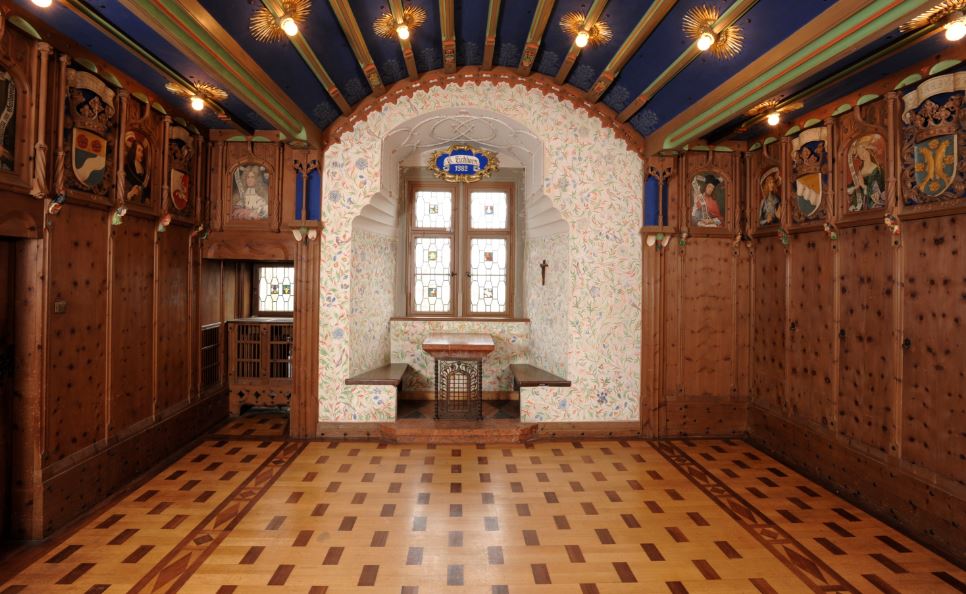
Mrs. Winchester gave witchcraft a new lease on life by revealing the inner secrets of the craft and leaving clues built-in to her mansion. She made a beautiful image out of witchcraft. It was her ambition to banish the fear of witchcraft in society and make it more publicly acceptable. Consciousness cannot expand until it is first made whole and this is to oppose creation of all its limitations. I conjure thee, Spirits of Sarah L. Winchester and William W. Winchester, by Alpha et Omega, Lezo and Yschirios, Ohin Ission, Niva, by Tetragramation, Zeno, by Peraclitus, Ohel, by Orlenius, Lima, by Agla, that ye will obey and appear before me and fulfill my desire, thus in and through the name Elion, which Moses named. Wherefore thou shalt make faithful answers unto all my demands, O Spirits of Sarah and William Winchester, and shalt perform all my desires so far as in thine office thou art capable hereof. Wherefore, come thou, visibly, peaceably, and affably, now without delay, to manifest that which I desire, speaking with a clear and perfect voice, intelligibly, and to mine understanding. I do conjure thee, O thou Spirits of Mrs. and Mr. Winchester, by all the most glorious and efficacious names of the MOST GREAT AND INCOMPREHENSIBLE LORD OF GOD OF HOSTS, that thou comest quickly and without delay from all parts and places of the Earth and World wherever thou mayest be, to make rational answers unto my demands, and that visibly and affably, speaking with a voice intelligible unto mine as aforesaid. I now plant the seed of my desire withing the black earth, through the mouth of Arezura where the powers of sorcery and counter creation dwell. Through this gateway of darkness, I now shine the light and power of my will upon this World for the benefit of me and mine! #RandolphHarris 9 of 9

Winchester Mystery House
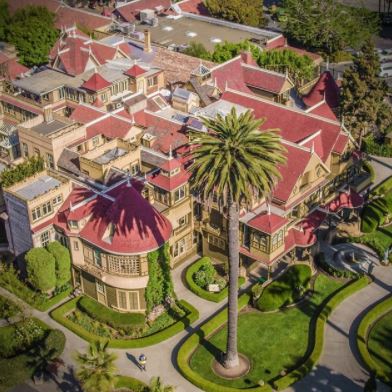
Happy Early Turkey Day! 🦃
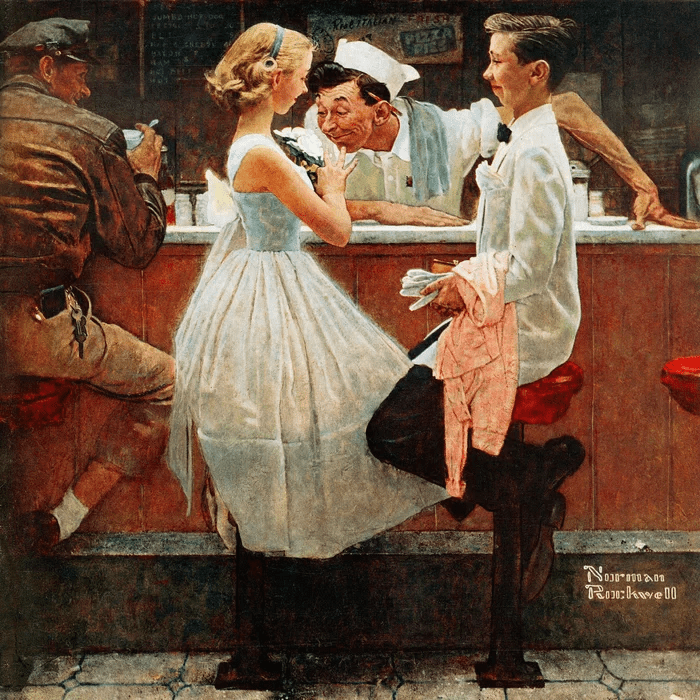
The Winchester Mystery House will be closed on Thursday, Nov. 24 in observance of the Thanksgiving holiday and will reopen on Friday, Nov. 25! https://winchestermysteryhouse.com/

Heard is Not Understood and Understood is Not Done

Everyone wants a place where they can be alone occasionally, and when they have such a place, it is only common courtesy in anyone else who knows of it to keep one’s knowledge to oneself. Yielding and mastery are two sides of the same command over life. While we are still able-bodied, we tend to feel cheated when mishaps interfere with our strivings. The primary goal of speaking is to allow one to cognitively interact with others. Verbal communication is critical to an individual’s overall health, psychological functioning, and social interactions. When communication breaks down between people, one’s ability to participate meaningfully in life is greatly restricted. Dogs, for instance, love human being, and even see themselves as human beings, but they cannot speak. So, they are to use nonverbal indicators to expression their feelings, desires and emotions. Our talents and abilities are gifts from our Heavenly Father. Almost every person is endowed with the gift of speech. It is essential that we discover and develop our verbal talents. The Apostle Paul said, “Neglect not the gift that is in thee,” reports 1 Timothy 4.14. However, finding and improving our verbal talents will require effort. Human errors are the most common reasons for planes to crash, and of all human errors, communication errors are number one. Evidence suggests the same for adverse outcomes in critical care medicine. However, in contrast to aerospace, most medical curricula focus on factual knowledge and procedural dexterity but rarely address verbal communication during evolving crises. The airline industry felt compelled as lives and profits were at stake. #RandolphHarris 1 of 21

With medical errors believed to cause at least 100,000 deaths annually in the United States of America alone, we should be similarly motivated. Efforts to prevent medical errors could have saved the lives of people like Prince and Michael Jackson. Given the importance of communication, specialists in critical care should also be specialist in critical care communication. Our verbal dexterity and factual know-how. Verbal communication is essential to optimize teamwork. However, stress and uncertainty mean tht even experienced professionals can be prone to silence during crisis. In aviation, this is illustrated by the fact that the cockpit black box recorder is often silent for minutes before a crash. Similarly, a common complaint after poorly coordinated resuscitation is tht people failed to speak up. This is why we cannot leave communication to chance. When teaching assertiveness, pilots learn a graded approach using up to 6 strategies from least to most direct. This graded assertiveness includes the “hint,” exempli gratia, “should things look like this?”, a preference exempli gratia, “I think it would be wise to do the following…” a query exempli gratia, “what do you think we should do?”, a shared suggestion exempli gratia “you and I should do the following…” a statement exempli, “I think we need to do the following…” Psychologist talk of the framing effect as a strategy to improve understanding (“heard is not understood”). The framing effect is how different decisions may be made depending upon how similar information is presented. Both the specific words that we speak and how they are understood can change based upon stress, workload, culture, and the relative seniority and profession of those involved. Medical crises can engender strong emotions but overly aggressive (or overly passive) speech is inappropriate. #RandolphHarris 2 of 21

There are certain strategies we can use to improve task completion (understood is not done). Flight crash investigators identified cockpit interruptions to be such a major safety concern that they are now addressed in the standard operating procedures. These communication rules promote the “sterile cockpit rule” to minimize distractions, especially when a commercial airliner is flying below ten thousand feet. This is because commercial airliners are only below ten thousand feet during critical phases of flight. These include taxi, take-off, landing, or impending crash. Verbal communication during crisis or every day life is a major determinant of outcome, whether in aviation or critical care medicine or another day in the office. Optimizing daily and crisis communication is of paramount importance for safety and the environment. It is, therefore, a vital topic that deserves immediate attention. Fortunately, many practical strategies already exist. There really is no excuse not to address this missing curriculum, and remember, not everyone is willing to use nonverbal communication because what someone thinks they are conveying may mean something else to another person. Many corporations prefer honest and direct speech, as a way of avoiding law suits and communication errors. As I tell my class all the time, do not assume Billy likes you and that you have a connection with him until you speak directly to him. Because if the police get involved, they are going to what to know what led you to believe that you and Billy are going steady, and just because he looked at you and smiled at you is not tangible evidence that you are in a relationship. #RandolphHarris 3 of 21

It is evidence that you used your imagination to conjure up a fake relationship, which may only be real to you. If you are too shy to talk to someone, we now have social media, where you can create a profile using your picture and get to know and message someone else. What is lying? As it is understood in ordinary language, lying means distorting or in some cases hiding the truth, or what people believe is the truth. This lying plays a very important part in life, but there are much worse forms of lying, when people do not know that they lie. We cannot know the truth in our present state, and can only know the truth in the state of objective consciousness. How then can we life? There seems to be a contradiction here, but in reality there is none. We cannot know the truth, but we can pretend that we know. And this is lying. Lying fills all our life. People pretend that they know all sorts of things: about God, about the future life, about the Universe, about the origin of man, about evolution, about everything; but in reality they do not know anything, even about themselves. And every time they speak about something they do not know as though they knew it, they lie. Consequently the study of lying becomes of the first importance in psychology. And it may lead even to the third definition of psychology, which is: the study of lying. Psychology is particularly concerned with the lie a man says and thinks about himself. These lies make the study of man very difficult. Man, as he is, is not a genuine article. He is an imitation of something, and perhaps not the fully evolved imitation. Imagine a scientist on some remote planet who has received from the Earth specimens of artificial flowers, without knowing anything about real flowers. It will be extremely difficult for one to define them—to explain their shape, colour, the material from which they are made, that is, wire, cotton wool, and coloured paper—and to classify them in any way. #RandolphHarris 4 of 21

Psychology stands in a very similar position in relation to man. It has to study an artificial man, without knowing the real man. Obviously, it cannot be easy to study a being such as a man, who does not himself know what is real and what is imaginary in him. So psychology must begin with a division between the real and the imaginary in man. It is impossible to study man as a whole, because man is divided into two parts: one part which, in some cases, can be almost all real, and the other part which, in some cases, can be almost all imaginary. In the majority of ordinary men these two parts are intermixed, and cannot be easily distinguished, although they are both there, and both have their own particular meaning and effect. In the system we are studying, these two parts are called essence and personality. Essence is what is born in man. Personality is what is acquired. Essence is what is his own. Personality is what is not his own. Essence cannot be lost, cannot be changed or injured as easily as personality. Personality can be changed almost completely with the change of circumstances; it can be lost or easily injured. If I try to describe what essence is, I must, first of all, say that it is the basis of man’s physical and mental makeup. For instance, one man is naturally what is called a good sailor, another is a bad sailor; one has a musical ear, another has not; one has a capacity for languages, another has not. This is essence. #RandolphHarris 5 of 21

Personality is all that is learned in one or another way, in ordinary language, “consciously” or “unconsciously.” In most cases “unconsciously” means by imitation, which, as a matter of fact, plays a very important part in the building of personality. Even in instinctive functions, which naturally should be free from personality, there are usually many so-called “acquired tastes,” that is, all sorts of artificial likes and dislikes, all of which re acquired by imitation and imagination. These artificial likes and dislikes play a very important and very disastrous part in man’s life. By nature, man should like what is good for him and dislike what is bad for him. However, this is so, only as long as essence dominates personality, as it should dominate it—in other words, when a man is healthy and normal. When personality begins to dominate essence and when man becomes less healthy, he begins to like what is bad for him and to dislike what is good for him. This is connected with the chief thing that can be wrong in the mutual relations of essence and personality. Normally, essence must dominate personality and then personality can be quite useful. However, if personality dominates essence, this produces wrong results of many kinds. It must be understood that personality is also necessary for man; one cannot live without personality and only with essence. However, essence and personality must grow parallel, and the one must not outgrow the other. Cases of essence outgrowing personality may occur among uneducated people. The so-called simple people may be very good, and even cleaver, but they are incapable of development in the same way as people with more developed personality. #RandolphHarris 6 of 21

Cases of personality outgrowing essence are often to be found among more cultured people, and in such cases, essence remains in a half-grown or half-developed state. This means that with a quick and early growth of personality, growth of essence can practically stop at a very early age, and as a result we see men and women externally quite grown-up, but whose essence remains at the age of ten or twelve. There are many conditions in modern life which greatly favor this underdevelopment of essence. For instance, the infatuation with sport, particularly with games, can very effectively stop the development of essence, and sometimes at such an early age that essence is never fully able to recover later. This shows that essence cannot be regarded as connected only with the physical constitution, in the simple meaning of the idea. To fulfill our promises to ourselves is to prepare to die; tragedy is to die with unlived life still inside us. No one on one’s deathbed, perhaps except for the man who leaves with family with nothing, says “I wish I had spent more time on my business.” In stable societies, the control of human impulses is usually a collective responsibility. The individual is viewed as not having within oneself the controls required to guarantee that one’s impulses will not break out in ways disapproved by the community. However, this matters very little, since the group is always near at hand to stop one or sham one or punish one should one forget oneself and family. #RandolphHarris 7 of 21

In more, fluid, changing societies we are more apt to find controls that are internalized—that do not depend to so great an extent on control and enforcement by external agents. Why might this perspective and its associated vocabulary be useful for deliberations over action in settings whose consequences are hard to predict? Complexity research deals with systems that are hard to control, and much of it has gone on in fields that seem far from policy or design concerns. (Do the neurons fire in the synchronized waves or incoherently? Are the magnetic poles of particles oriented like those of their near neigbours or are they disarrayed? Do most of the animals in a population continue to exhibit a certain useless trait, or has this type vanished over time?) However, many of the same dynamics are involved in social issues. (Do similar transactions across the economy take place at one price or many? Does animal husbandry improve the agricultural value of a livestock population? Do citizens remain loyal to a single large state, or transfer their loyalties to smaller political units? Does an infection—or an Internet rumor—become endemic in certain subpopulations?) Social systems exhibit dynamic patterns analogous to physical, biological, and computational systems. This is perhaps the fundamental reason we pursue complexity research. Many social interventions are directed toward controlling the interaction among types of agents. For example, segregation (and integration) of races; vias and immigration rules; entry qualifications to religious and social organizations; “cultural revolutions” and “peace corps” that send the highly educated to less developed areas; political redistricting; zoning restriction of commercial, industrial, and residential activities; film, television, and Internet ratings to facilitate matching of audiences and contents; and foster-care systems that place children with adults differing from their parents in race and class. #RandolphHarris 8 of 21

Many other policies have important or interesting side effects that are related to interactions of types. For example, imprisonment that mixed experienced criminals with rebellious adolescents; public transit patterns that separate urban center residents from suburban jobs; armies of occupation that result in children of intermarriage; computer networks for defense and science that increase communication between parents and college-distant children and facilitate finding of long-lost friends. Complexity research gives us a grounded basis for inquiring where the “leverage points” and significant trade-offs of a complex system may lie. It also suggests what kinds of situations may be resistant to policy intervention, and when small interventions may be likely to have large effects. For guidance in designing actions, such insights into the right questions can be very valuable. They can be valuable even if the theories are too multiple and too preliminary to support any claim that a theory of complexity implies any sharply etched expectation about a future scenario and how a particular action will guarantee it. We are hardly the first to sense the promise of complexity research for guiding action. Books, consulting services, conferences, and journals have been developed to respond to the intuition of many managers and professionals that there is a deep resonance between concepts in complexity research and the problems of designing effective interventions. Regular conference for managers have been organized in recent years. Our contribution lies in our attempt to move the work beyond metaphorical affinities and to distill an explicit method that can be applied in practice. #RandolphHarris 9 of 21

At the same time, we want to avoid simplistic lists of four (or nine, or twelve) principles that readers should always follow. As we see it, unqualified nostrums could hardly be less in keeping with scientific work on complexity. Our aim is to build on the resemblance between change processes seen in the systematic study of Complex Adaptive Systems and potential sources of change in social systems. It is our argument that principles derived from working with complexity problems shed valuable light on the issues confronting policy makers and designers. We develop this argument by characterizing a set oof change mechanisms in complex systems. While we cannot hope to provide any sort of exhaustive catalog, we can show that a wide array of examples fall into a few useful clusters. Most of the mechanisms and related principles that have policy relevance center on three central and deeply connected questions: What is the right balance between variety and uniformity? What should interact with what, and when? Which agents or strategies should be copied and which should be destroyed? These are necessarily rather abstract issues. Let us return for a moment to the World of sports. In football, before each snap of the ball the offense chooses between passing and running while the defense organize itself to counter one of these plays. In tennis, the server might go to the forehand or the backhand of the receiver, while the receiver, in turn, can try to return crosscourt or down the line. In these examples, each side has an idea of its own strong points and of its opponent’s weaknesses. #RandolphHarris 10 of 21

It will have a preference for the choice that exploits these weaknesses, but not exclusively. It is well understood, by players and sports fans alike, that one should mix one’s plays, randomly throwing in the unexpected move. If you do the same thing all the time, the opposition will be able to counter you more effectively by concentrating its resources on the best response to your one strategy. Mixing your plays does not rotating your strategies in a predictable manner. Your opponent can observe and exploit any systematic pattern almost as easily as one can the unchanging repetition of a single strategy. It is unpredictability that is important when mixing. Imagine what would happen if there were some known formula that determined who would be audited by the IRS. Before you submitted a tax return, you could apply the formula to see if you would be audited. If an audit was predicted, but you could see a way to “amend” your return until the formula no longer predicted an audit, you probably would do so. If an audit was unavoidable, you would choose to tell the truth. The result of the IRS being completely predictable is that it would audit exactly the wrong people. All those audited would have anticipated their fate and chosen to act honestly, while those spared an audit would have only their consciences to watch over them. When the IRS audit formula is somewhat fuzzy, everyone stands some risk of an audit; this gives an added incentive for honesty. There are similar phenomena in the business World. Think of competition in the market for razors. Imagine that Gillette runs a coupon promotion on a regular schedule—say, the first Sunday of every other month. #RandolphHarris 11 of 21

Bic can preempt Gillette by running a competing coupon promotion the week before. Of course, Bic’s move is then predictable and Gillette can preempt the week before. This process leads to cutthroat competition and both makes less profit. However, if each uses an unpredictable or mixed strategy, together they might reduce the fierceness of the competition. The importance of randomized strategies was one of the early insights of game theory. The idea is simple and intuitive but needs refinement if it is to be useful in practice. It is not enough for a tennis player to know that he should mix his shots between the opponent’s forehand and backhand. He needs some idea of whether he should go to the forehand 30 percent or 64 percent of the time and how the answer depends on the relative strengths of the two sides. Parts serve the whole. The organism grows larger and more powerful by virtue of finding better and better ways to exploit its constituents, for example. People who are forced into slavery may be made to man the oars and drive the galley, but it requires the constant attention of a slave master cracking the whip. However, if the enslaved people can be converted to a faith in the ship and its mission, then no slave master will be needed—one will now be free to help with the cannon—while the ship slices forward ever faster, with more power, more dangerous to its enemies. #RandolphHarris 12 of 21

There is no alternative to power, no other position—not Christianity nor the Golden Rule nor brotherly love nor nonviolence; not self-sacrifice nor the turning of the other cheek. For all these various abnegations of power by parts of a whole are, unwittingly, in the service of increased power to the whole; and the morality created by such renunications is used by the aggregate to increase the power with which it then pursues more power. In Austria after World War II a deal was struck between the two main political parties assuring that whichever party won the top spot would install a member of the opposition party in the second spot, and so on all the way down to the shop floor. This proparz system has meant that throughout the key posts in state-owned companies, banks, insurance companies, and even in schools and universities, Socialist “reds” altered with Conservative “blacks.” Today we find an adaptation of this in, say, the Japanese bank in California that alternates Japanese and Americans at each level of the hierarchy, thus guaranteeing that Tokyo receives a flow of information seen through Japanese eyes, not simply from the top, but from many levels of the organization. Power at the pinnacle is reinforced by a constant stream of insight originating at many layers at once. As firms go global, many will no doubt try the Austrian and Japanese approach. Soviet Army units have traditionally had not only military commanders but political officers attached to them. While the military officer reported up the military line of command, the political officers also report to the Communist Party. The object was to keep the army subject to the party. #RandolphHarris 13 of 21

In business, too, we often see “commissars” chosen from above and planted in subordinate units to keep an eye on things and report to the top through separate channels rather than through the normal hierarchy. Here there are two main information channels, instead of one, violating the strict single-channel character of bureaucracy. It also reflects the deep distrust with which top management regards information flowing up through normal channels. As change speeds up and predictability declines, CEOs will use “commissars” to end-run the bureaucracy in a desperate attempt to maintain control. The United States of America and Europe have very different approaches to the deep fundamental of space as well. Deriving from the industrial belief that bigger is almost always better, the European Union continues to push its spatial boundaries ever eastward by incorporating more and more member countries. The bigger its population, its leaders believe, the richer. However, in pursuing sheer size, Europe sees space through the lens of a previous era. The European Union’s (EU) leaders would be quite justifiably horrified to be compared in any way to Nazis. The E.U.’s peaceful expansion to the east, with the incorporation of additional countries and murmured speculation about someday even brining Russia into the E.U. fold, is opposite of Nazi Germany’s Drang nach Osten—the drive to the east—that sent troops and death legions all the way to the gates of Moscow. #RandolphHarris 14 of 21

However, both recall the once popular geopolitical theory that held that whoever controls the “heartland” will command the World. The heartland, originally defined by Halford Mackinder in 1904, was the entire landmass from Eastern Europe across Russia to Siberia. Of course, his theories have been shattered by, among other things, the invention of airplanes, missiles, and global communication. However, some apparently see a “Europe” stretching eastward all the way to the Sea of Japan as, in effect, a new heartland. Also shattered are many of today’s taken-for-granted assumptions. Timothy Garton Ash of St. Antony’s College, Oxford, argues that the European Union is a “transnational organization based on supra-national law” rather than an “old-fashioned…classical nation-state.” However, Ash himself hangs onto the obsolete assumption that scale necessarily translates into economic power. Thus he writes that the European Union’s future is more promising than that of the United States of America because “put very simply, the European Union is getting bigger” while “Haiti cannot hope to follow Hawaii into the American Union.” Hidden here, in addition to the bigger-is-better assumption, is a further spatial premise: That is a group of nations wished to form a “transnational organization,” the countries need to be next door to one another—that contiguity, that is, geographical proximity, is what counts. Yet, we are racing into a World when nearness matters less and less, thanks to speedy transportation, lighter and lighter products and the growing trade in intangible services. #RandolphHarris 15 of 21
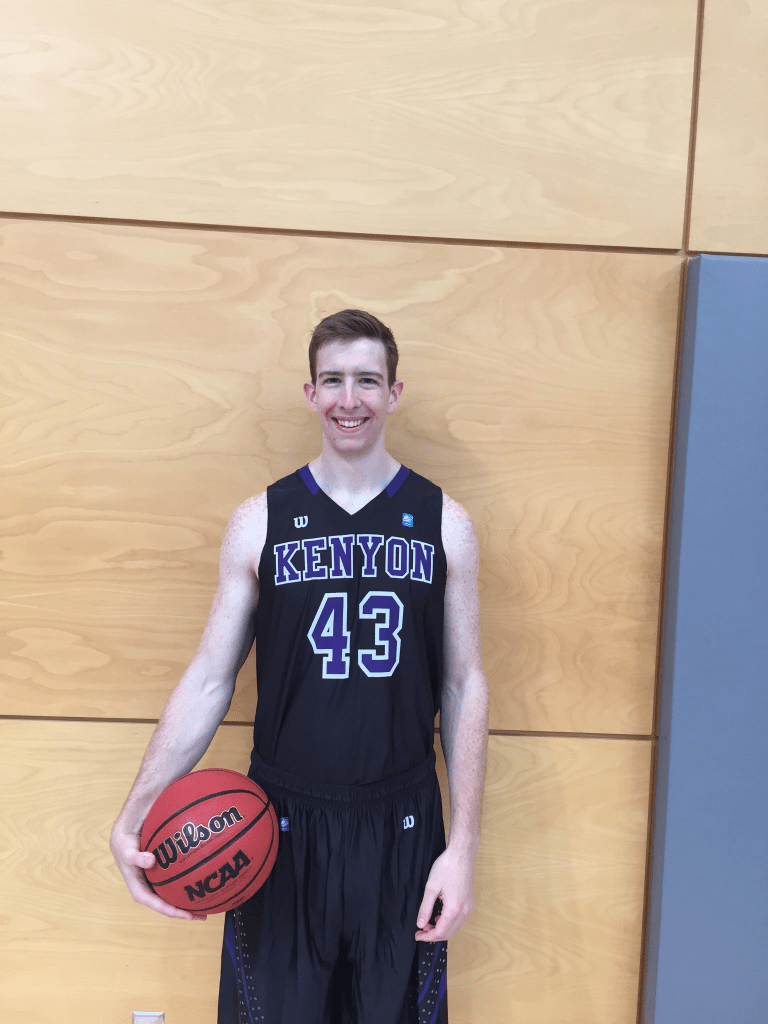
If, indeed, landmass mattered, Ash might consider that Russia alone is more than four times the size of the expanded European Union. Brazil is more than twice its size. And then there is prosperous Singapore, with not quite seven hundred square kilometers all told. If, indeed, the United States of America wished to create a “transnational organization based on supra-national law,” what would prevent such an organization from including noncontigous South Korea, Singapore or Israel as members? Or, for that matter, Japan? Total GDP of this group is an estimated $25 trillion–$10.5 trillion more than the European Union. A noncontiguous supranational organization consisting of America and Japan alone—we call it Jameria—has a GDP of $29 trillion, which exceeds the EU’s GDP by $14.5. Ironically, while the EU has been busy expanding its scale and territorial limits, its member nations that have advanced the most in the direction of revolutionary wealth are the smaller ones on its periphery. Finland with Nokia and Sweden with Ericsson shine in telecommunications, as Ireland does in software—although much of its output is turned out by American firms such as Microsoft, Oracle, Novell, Symantec and Computer Associates. I am not here making a standard-brand critique of the excesses of capitalism. It is entirely possible to have a market economy that respects the seriousness of words and icons, and which disallows their use in trivial or silly contexts. In fact, during the period of greatest industrial growth in America—from roughly 1830 to the end of the nineteenth century—advertising did not play a major role in the economy, and such advertising as existed used straightforward language, without recourse to the exploitation of important cultural symbols. #RandolphHarris 16 of 21

There was no such thing as an “advertising industry” until the early twentieth century, the ground being prepared for it by the Postal Act of March 3, 1879, which gave magazines low-cost mailing privileges. As a consequence, magazine emerged as the best available conduits for national advertising, and merchants used the opportunity to make the names of their companies important symbols of commercial excellence. When George Eastman invented the portable camera in 1888, he spent $25,000 advertising it in magazines. However, there was a lost patten filed by Sarah L. Winchester, who actually was never given credit for some of her inventions. By 1895, “Kodak” and “camera” were synonymous, as to some extent they still are. Companies like Royal Baking Powder, Baker’s Chocolate, Ivory Soap, and Gillette moved into a national market by advertising their products in magazines. Even magazines moved into a national market by advertising themselves in magazines, the most conspicuous example being Ladies’ Home Journal, whose publisher, Cyrus H.K. Curtis, spent half a million dollars between 1883 and 1888 advertising his magazine in other magazines. By 1909, Ladies’ Home Journal had a circulation of more than a million readers. Curtis’ enthusiasm for advertising notwithstanding, the most significant figure in mating advertising to the magazine was Frank Munsey, who upon his death in 1925 was eulogized by William Allen White with the following words: “Frank Munsey contributed to the journalism of his day the talent of a meat packer, the morals of a money changer, and the manners of an undertaker. He and his kind have about succeeded in transforming a once-noble profession into an 8 percent security. May he rest in trust.” #RandolphHarris 17 of 21

What was the sin of the malevolent Munsey? Simply, he made two discoveries. First, a large circulation could be achieved by selling a magazine for much less than it cost to produce it; second, huge profits could be made from the high volume of advertising that a large circulation would attract. In October 1893, Munsey took out an ad in the New York Sun announcing that Munsey’s Magazine cutting its price from 25 cents to 10 cents, and reducing a year’s subscription from $3 to $1. The first 10-cent issued claimed a circulation of forty thousand; within four months, the circulation rose to two hundred thousand; two months later, it was five hundred thousand. Munsey cannot, however, be blamed for another discovery, which for convenience’s sake we may attribute to Procter and Gamble: that advertising is most effective when it is irrational. By irrational, I do not, of course, mean crazy. I mean that products could best be sold by exploiting the magical and even poetical powers of language and pictures. In 1892, Procter and Gamble invited the public to submit rhymes to advertise Ivory Soap. Four years later, H-O employed, for the first time, a picture of a baby in a high chair, the bowel of H-O cereal before him, his spoon in hand, his face ecstatic. By the turn of the century, advertisers no longer assumed that reason was the best instrument for the communication of commercial products and ideas. Advertising became one part of depth psychology, one part aesthetic theory. In the process, a fundamental principle of capitalist ideology was rejected: namely, that the producer and consumer were engaged in a rational enterprise in which consumers made choices on the basis of a careful consideration of the quality of a product and their own self-interest. #RandolphHarris 18 of 21

This, at least, is what Adam Smith had in mind. However, today, the television commercial, for example, is rarely about the character of the products. It is about the character of the consumers of products. Images of movie stars and famous athletes, of serene lakes and macho fishing trips, of elegant dinners and romatic interludes, of happy families packing their station wagons for a picnic in the country—these tell nothing about the products being sold. However, they tell everything about the fears, fancies, and dreams of those who might but them. What the advertiser needs to know is not what is right about the product but what is wrong about the buyer. And so the balance of business expenditures shifts from product research to market research, which means orienting business away from making products of value and toward making consumers feel valuable. The business of business becomes pseudo-therapy; the consumer, a patient reassured by psychodramas. The core of Technopoly is a vast industry with license to use all available symbols to further the interests of commerce, by devouring the psyches of consumers. Although estimates vary, a conservative estimate is that the average American will have seen close to two million television commercials by age sixty-five. If we add to this the number of radio commercials, newspaper and magazine ads, and billboards, the extent of symbol overload and therefore symbol drain is unprecedented in human history. #RandolphHarris 19 of 21

As we move into the future, with high inflation, high fuel costs, and supply and land shortages, will we see a cycle of falling costs? Let us say that making one kilogram of product by molecular manufacturing requires one dollar a kilogram of raw materials and four dollars for a generous forty kilowatt-hours of energy. Assume, for the moment, that other costs are small One of the resulting five-dollars-per-kilogram products can be solar-cell paint suitable for applying to paved roads. A layer of paint a few millionths of a meter thick would cost about five cents per square mete to produce, and would generate enough energy to make another square meter of paint in less than a week, even allowing for nighttime and moderate cloud cover. The so-called energy payback time would thus be short. Let us assume that this smart paint costs as much to spread and hook up as it does to make, and that we demand that it pay for itself in a single month, so we charge ten cents per square meter per month. At that rate, the costs of solar energy from resurfaced roads would be roughly $0.004 per kilowatt hour—less than a twentieth the energy cost assumed in the initial production-cost estimate. By itself, this makes the cost of production fall to a fraction of what it was before. Most of that remaining fraction consists of the cost of materials. However, the products of nanotechnology will mostly be made of carbon (if present expectations are any guide), and carbon dioxide is too abundant in the atmosphere these days. With energy so affordable, the atmosphere can be used as a source of carbon (and of hydrogen, nitrogen, and oxygen). The price of carbon would be a few cents per kilogram—roughly a twentieth the original price assumed for raw materials. #RandolphHarris 20 of 21

However, now, both energy and raw materials are a twentieth the original price, and so the products become more inexpensive, including the energy-producing products and the raw-material-producing (atmosphere-cleaning) products. This scenario is simple, but it seems realistic in its basic outlines: lower costs can lead to lower costs. How far this process can go is hard to estimate precisely, but it could go far indeed. Many of the phenomena we have discussed can also be linked to a compulsive American tendency to avoid confrontation of chronic social problems. This avoiding tendency often comes as a surprise to foreigners, who tend to think Americans as pragmatic and down-to-earth. However, while trying to solve long-range social problems with short-run “hardware” solutions produces a lot of hardware—a down-to-earth result, surely—it can hardly be considered practical when it aggravates the problems, as it almost always does. American pragmatism is deeply irrational in this respect, and in our hearts we have always know it. One of the favorite themes of American cartoonists is the man who paints himself into a corner, saws off the limb he is sitting on, or runs out of space on the sign he is printing. The scientists of science-fiction and horror films, whose experimentation leads to disastrously unforeseen consequences, is a more anxious representation of this same awareness that the most future-oriented nation in the World shows a deep incapacity to plan ahead. We are, as a people, perturbed by our inability to anticipate the consequences of our acts, but we still wait optimistically for some magic telegram, informing us that the tangled skein of misery and self-deception into which we have woven ourselves has vanished in the night. #RandolphHarris 21 of 21

Cresleigh Homes

#MillsStation Residence 3 proves that indoor amenities aren’t enough; you need a gorgeous outdoor space, too! 💖

When it comes to luxurious living in #RanchoCordova, our community has exactly what you need. 🙌

Lot 111 is ready for new owners, and we can’t wait to see how you make yourself at home!
#CresleighRanch
#CresleighHomes


People Live in Sleep
There is no middle ground in the stark appraisal of suffering. We hope only for recovery and for a return to self-sufficiency. Anything less invokes bitterness. Everyone eats but few kill. Technicians fell the lamb. Eating becomes a ceremony of innocence, tinkle of crystal, rustle of taffeta. Teeth are for beauty: straighten them, make them whiter, the smile more loving. Visit every restaurant in town, never pass the house of nourishment. The tendency of civilization is not to eliminate destructiveness, nor even to diminish it, but to remove it. Our fate falls now from the touch of a finger in an underground bunker half a World away. As we have already discussed, there are four states of consciousness possible for man: sleep, waking consciousness, self-consciousness, and objective consciousness; but he lives only in two: partly in sleep and partly in what is called waking consciousness. It is as though he had a four-storied house, but lived only in the two lower stories. The first, or the lowest state of consciousness, is sleep. This is a purely subjective and passive state. Man is surrounded by dreams. All his psychic functions work without any direction. There is no logic, no sequence, no cause, and no result in dreams. Purely subjective pictures—either reflections of former experiences or reflections of vague perceptions of the moment, such as sounds reaching the sleeping man, sensations coming from body, slight pains, sensations of muscular tension—fly though the mind, leaving only a very slight trace on the memory and more often leaving no trace at all. #RandolphHarris 1 of 20

The second degree of consciousness comes when man awakes. This second state, the state in which we are now, that is, in which we work, talk, imagine ourselves conscious beings, and so forth, we often call waking consciousness or clear consciousness, but really it should be called “waking sleep” or “relative consciousness.” This last term will be explained later. It is necessary to understand here that the first state of consciousness, that is, sleep, does not disappear when the second state arrives, that is when man awakes. Sleep remains there, with all its dreams and impressions, only a more critical attitude towards one’s own impressions, only a more critical attitude towards one’s own impressions, more connected thoughts, more disciplined actions become added to it, and because of the vividness of sense impressions, desires, and feelings—particularly the feeling of contradiction or impossibility, which is entirely absent in sleep—dreams become invisible exactly as the stars and moon become invisible in the glare of the sun. However, they are all there, and they often influence all our thoughts, feelings, and actions—sometimes even more than the actual perceptions of the moment. In connection with this I must say at once that I do not mean what is called in modern psychology “the subconscious” or “the subconscious mind.” These are simply wrong expressions, wrong terms, which mean nothing and do not refer to any real facts. There is nothing permanently subconscious in us because there is nothing permanently conscious; and there is no “subconscious mind” for the very simple reason that there is no “conscious mind.” #RandolphHarris 2 of 20

Later you will see how this mistake occurred, and how this wrong terminology came into being, and became almost generally accepted. However, let us return to the states of consciousness which really exist. The first is sleep. The second is “waking sleep” or “relative consciousness.” The first, as I have said, is purely subjective state. The second is less subjective; man already distinguishes “I” and “not I” in the sense of his body and objects different from his body, and he can, to a certain extent, orientate among them and know their position and qualities. However, it cannot be said tht man is awake in this state, because he is very strongly influenced by dreams, and really lives more in dreams than in fact. All the absurdities and all the contradictions of people, and of human life in general, become explained when we realize that people live in sleep, do everything in sleep, and do not know that they are asleep. It is useful to remember that this is the inner meaning of many ancient doctrines. The best known to us is Christianity, of the Gospel teaching, in which the idea that men live in sleep and must first of all awake is the basis of all the explanations of human life, although it is very rarely understood as it should be understood, in this case literally. However, the question is: how can a man awake? The Gospel teaching demands awakening, but does not say how to awaken. #RandolphHarris 3 of 20

However, the psychological study of consciousness shows that only when a man realizes that he is asleep, is it possible to say that he is on the way to awakening. He can never awaken without first realizing his sleep. These two states, sleep and waling sleep, are the only two states of consciousness in which man lives. Besides them there are two states of consciousness possible for man, but they become accessible to a man only after a hard and prolonged struggle. These two higher states of consciousness are called “self-consciousness” and “objective consciousness.” We generally think that we possess self-consciousness, that is, that we are conscious of ourselves, at any moment we wish, but in truth “self-consciousness” is a state which we ascribe to ourselves without any right. “Objective consciousness” is a state about which we know nothing. Self-consciousness is a state in which man becomes objective towards himself, and objective consciousness is a state in which he comes into contact with the real, or objective, World from which he is now shut off by the senses, dreams, and subjective states of consciousness. Another definition of the four states of consciousness can be made from the point of view of the possible cognition of truth. In the first state of consciousness, that is, in sleep, we cannot know anything of the truth. Even if some real perceptions or feelings come to us, they become mixed with dreams, and in the state of sleep we cannot distinguish between dreams and reality. #RandolphHarris 4 of 20

In the second state of consciousness, that is, in waking sleep, we can only know relative truth, and from this comes the term “relative consciousness.” In the third state of consciousness, that is, the state of self-consciousness, we can know the full truth about ourselves. In the fourth state of consciousness, that is, in the state of objective consciousness, we are supposed to be able to know the full truth about everything; we can study “things in themselves,” “the World as it is.” This is so far from us that we cannot even think about it in the right way, and we must try to understand that even glimpses of objective consciousness can only come in the fully developed state of self-consciousness. In the state of sleep we can have glimpses of relative consciousness. However, if we want to have more prolonged periods of self-consciousness and not merely glimpses, we must understand that they cannot come by themselves, they need will action. This means that frequency and duration of moments of self-consciousness depend on the command one has over oneself. So it means that consciousness and will are almost one and the same thing. At this point, it must be understood that the first obstacle in the way of the development of self-consciousness in man, is his conviction that he already possesses self-consciousness, or at any rate, that he can have it at any time he likes. It is very difficult to persuade a man that he is not conscious and cannot be conscious at will It is particularly difficult because here nature plays a very funny trick. #RandolphHarris 5 of 20

If you ask a man if he is conscious or if you say to him that he is not conscious, he will answer that he is not, because he hears and understands you. And he will be quite right, although at the same time quite wrong. This is nature’s trick. He will be right because your question or your remark has made him vaguely conscious for a moment. Next moment consciousness will disappear. However, he will remember what you said and what he answered, and he will certainly consider himself conscious. In reality, acquiring self-consciousness means long and hard work. How can a man agree to this work if he thinks he already possesses the very thing which is promised him as the result of long and hard work? Naturally a man will not begin this work and will not consider it necessary until he becomes convinced that he possesses neither self-consciousness nor all that is connected with it, that is, unity or individuality, permanent “I,” and will. This brings us to the question of schools, because methods for the development of self-consciousness, unity, permanent “I,” and will, can be given only by special schools. That must be clearly understood. Men on the level of relative consciousness cannot find these methods by themselves; and these methods cannot be described in books or taught in ordinary schools for the very simple reason that they re different for different people, and there is no universal method equally applicable to all. #RandolphHarris 6 of 20

In other words, this means that men who want to change their state of consciousness need a school. However, first they must realize their need. As long as they think they can do something by themselves they will not be able to make any use of a school, even if they find it. Schools exist only for those who need them, and who know that they need them. The idea of schools—the study of the kinds of schools that may exist, the study of school principles and school methods—occupies a very important place in the study of that psychology which is connected with the idea of evolution; because without a school there can be no evolution. One cannot even start because one does not know how to start; still less can one continue or attain anything. This means that, having got rid of the first illusion—that one already has everything one can have—one must get rid of the second illusion—tht one can get anything by oneself; because by oneself one can get nothing. These lectures are not a school—not even the beginning of a school. A school requires a much higher pressure of work. However, in these lectures I can give to those who wish to listen, some ideas as to how schools work and how they can be found. I gave before two definitions of psychology. First, I said that psychology is the study of the possible evolution of man; and second, that psychology is the study of oneself. Psychology which investigates the evolution of man is worth studying, and a psychology which is occupied with only one phase of man, without knowing anything about his other phases, is obviously not complete, and cannot have any value, even in a purely scientific sense, that is, from the point of view of experiment and observation. #RandolphHarris 7 of 20

For the present phase, as studied by ordinary psychology, in reality does not exist as something separate and consists of many subdivisions which lead from lower phases to higher phases. Moreover, the same experiment and observation show tht one cannot study psychology as one can study any other science not directly connected with oneself. One has to begin the study of psychology with oneself. Putting together, first, what we may know about the next phase in the evolution of man—that is, that it will mean acquiring consciousness, inner unity, permanent ego, and will—and second, certain material that we can get by self-observation—that is, realization of the absence in us of many powers and faculties which we ascribe to ourselves—we come to a new difficulty in understanding the meaning of psychology, and to the necessity for a new definition. The two definitions given in the previous lectures are not sufficient because man by himself does not know what evolution is possible for him, does not see where he stands at present, and ascribes to himself features belonging to higher phases of evolution. In fact, he cannot study himself, being unable to distinguish between the imaginary and the real in himself. There are countless pitfalls on the way out of misery. Focusing restlessly on what has been lost, comparing oneself to others, aspiring for things that are out of reach, and placing blame on others are only some of the most common snares. Each personal variation is uniquely painful. #RandolphHarris 8 of 20

It is all too common for people to get themselves into situations that are difficult to get out of. Once you have a job in a particular city, it is expensive to resettle. Once you buy a computer and learn its operating system, it becomes costly to learn another one and rewrite all your programs. Travelers who join the frequent-flyer program of one airline thereby raise their cost of using another. And, of course, marriage is expensive to escape. The problem is that once you make such a commitment, your bargaining position is weakened. Companies may take advantage of their workers’ anticipated moving costs and give them fewer salary raises. Computer companies can charge higher prices for new, compatible peripheral equipment knowing that their customers cannot easily switch to a new, incompatible technology. Airlines, having established a large base of frequent flyers, will be less inclined to engage in fare wars. A couple’s agreement that they will split the housework 50:50 may become subject to renegotiation once a child is born. Strategists who foresee such consequences will use their bargaining power while it exists, namely, before they get into the commitment. Typically, this will take the form of a payment up front. Competition among the would-be exploiters can lead to the same result. Companies will have to offer more attractive initial salaries, computer manufacturers will have to charge sufficiently low prices for their central processing units (CPUs), and airline frequent-flyer programs will have to offer larger signing-on mileage bonuses. As for married couples, exploitation may be a game that two can play. #RandolphHarris 9 of 20

The same foresight is what prevents many curious but rational people from trying addictive drugs such as heroin. A Tom Lehrer song describes the drug dealer’s ploy: “He gives the kids free samples because he knows full well that today’s young innocent faces will be tomorrow’s clientele.” Smart kids know it too, and turn down the free samples. Complexity research has received considerable attention recently. In some measure, this is because advances in computation have enabled progress on a number of problems tht had long been too difficult for conventional mathematical tools. However, it is important to recall that the fundamental orientation of complexity research is actually rooted in long traditions. Adam Smith’s hidden hand, the “blind watchmaking” of Darwinian evolution, the cell-assembly neuropsychology of Donald Hebb, and the self-reproducing automata of John von Neumann were earlier intellectual developments that blazed the same trail by uncovering system-level properties produced by the structured interaction of simple components. Perhaps there are powerful results just over the horizon, but as we see it, complexity research does not make detailed predictions. Rather, it is a framework that suggests new kinds of questions and possible actions. We should compare the results taking shape to the artificial selection principles of animal husbandry (a field that must interested the youthful Darwin). Analyzing complex systems within the framework does not assure the ability to produce specific outcomes but can foster an increase in the value of populations overtime—whether the populations are of livestock, of technical innovations, or of new strategies for business competition. #RandolphHarris 10 of 20

In the language of our framework, a designer introduces new artifacts or strategies into the World. A new machine on a factory floor or a new approach to conducting a budget review may be interventions in complex systems whose full consequences cannot be contemplated in advance. An orbiting telescope and a legal appeal on constitutional grounds almost certainly will have consequences that are hard to predict. A designer may even introduce new agents into the World. For example, an executive might create a new division in an organization, or a legislature might set up a new governmental bureau. Policy makers deliberately alter the consequences of available strategies when they increase rewards for some outcomes or make some patterns of action illegal. We use the phrase “design and policy making” to indicate the full spectrum of actions that we may find ourselves considering. We may take the perspective of some within a system—for example, as one of many people at a committee table. Alternatively, we may contemplate the system from the outside, as an architect or a legislator might do. In either case, we all find ourselves designing or making policy in complex settings. When we do, it can be very valuable to extend the questions we conventionally ask about likely consequences and scenarios. We can go on to ask what populations of agents and strategies are involved, and what interventions might create new combinations or destroy old ones? These kinds of questions help us harness complexity. #RandolphHarris 11 of 20

The widening gulf between Western Europe and the United States of America also reflects two contrasting attitudes toward the deep fundamental of time. Europe and America operate at different speeds. Europe is well behind the United States of America in work-at-home arrangements that typically allow employees to adjust their work hours. Even in the shop or office, Europe lags in flexible scheduling, 24/7 operations and other departures from traditional industrial routines. Workforce flexibility is needed for firms to compete successfully in today’s global markets. However, European workers and employers alike remain trapped in inflexible temporal arrangements. This situation is not merely reflected in the longer vacations, generally shorter workweek and overall slower pace of life on which Europeans, and especially the French, pride themselves. It is even seen in attitudes toward meals. In response to the American-born fast-food industry spreading across the globe, Europe has originated the “slow food” movement aimed at fighting it. Started almost as a joke in Italy in 1986, this movement now claims as many as eighty thousand members in one hundred countries, including 145 chapters in the United States of America. Its organizers stage events, publish books about food and celebrate good (and slow) eating. #RandolphHarris 12 of 20

The slow-food movement has (slowly) spawned a counterpart called cittaslow devoted to maintaining slow life in small cities. It promotes local products and sustainability and is so committed to slowness, that of thirty Italian towns that helped found the movement, none had qualified for membership. “They’re not supposed to qualify quickly,” explained one of the movement’s organizers. “It could take years.” Whether a new organization ever spring up for those who enjoy both a fast and a slow pace of life at different times, both a burger on the run and a languorous lobster, remains to be seen. Meanwhile, Britons are flocking to villages like Agincourt in northern France in search of greater tranquility and a still-slower-paced lifestyle. The surge is helped, no doubt, by lower house prices and just possibly by the Channel Tunnel and additional airline flights that-forefended the thought—speed up travel. All of which led one Againcourt real estate agent, Maggie Kelly, to exclaim, “There days I hardly have five minutes to turn around!” Apparently, no irony intended. However, amusement should not deceive us. Whatever the virtues of slow versus fast, how a society deals with time has important implications for how it creates wealth—for both de-synchronization at home and integration into the World economy. European headlines are dotted, in fact, with the word slow, as in CORE EUROPEAN COUNTRIES SLOW TO IMPLEMENT…, EU “TOO SLOW” ON ECONOMIC REFORMS and GENDER EQUALITY: SLOW PROGRESS. But it is not just the European must confront layer after impenetrable layer of regulations. #RandolphHarris 13 of 20

In Europe things move slower and take more time and energy. So it is no surprise to learn from the European Commission itself that “in the United States of America, it takes just six hours to establish a business, and while differences remain between member states…in Europe, it takes much longer in all of them.” Try, for example, obtaining a patent in Europe. According to Trevor Cook of the European law firm Bird & Bird, “It takes much longer to secure patents in Europe thana it does in the U.S., typically at least four, sometimes as many as ten years, and this is a real problem for fast-moving high-tech businesses.” Or talk to Rita Villa, an American certified public accountant who operates on both sides of the Atlantic. “Things just take longer in Europe. Transactions have many more steps. For example, if the U.S. company wants to move its headquarters from, say, Chicago to Dallas, no problem. But if a German firm wants to move from Berlin to Frankfurt, it requires a whole time-consuming multi-step process of ‘registration.’” Or, she says, try changing the legal form of a company, something smaller firms often need to do. If I have limited liability corporation, or LLC, in the U.S. and want to convert it to an ordinary corporation with “Inc.” at the end of its name, I can do that rapidly. But in Germany when we wanted to change a GMBH to an AG—a comparable change—it took over a year. Say the company wants to issue a dividend to its shareholders. In the U.S., the board of directors meets and, if it thinks it’s a god idea, it votes and that’s it. Not in Germany. There the auditors first have to approve it. Then it goes to the management board. After that it has to go to the supervisory board. Then it has to go to the notary who can demand last-minute alterations even after all the parties have reached an agreement. Then it has to be registered. #RandolphHarris 14 of 20

The transatlantic differences intime and pace even affect Europe’s defense industries and military. American military technology and capabilities are aimed at enabling faster and faster responses to crisis. European forces in NATO cannot keep up, making integrated joint action more difficult. The European Union, meanwhile, is moving—slowly—to create its own “rapid reaction” military force. At all these levels, therefore, from lifestyle and culture to military matters and, above all, business and the economy, the speed gap between European and the United States of America is, if anything, widening. Each is responding to the accelerative economy and the deep fundamental of time at its own, very different pace. Now, when it comes to flex-firms, another format likely to find a place in many flex-firms is a completely two-faced unit capable of operating in two modes, depending upon the circumstance. The pulsating unit differs in size and organization from time to time. The pulsating unit differs in size and organization from time to time. The Janus-like organization may remain the same in size, but shift from hierarchical to nonhierarchical command as needs demand. A prime example is the famed British military unit, the Special Air, or SAS. Used for surgical antiterrorist strikes, hostage rescue, and other missions demanding surprise and deception, the SAS operates in two diametrically opposed modes. On the parade ground it is all spit, polish, and blind obedience. Regimental protocol is enforced by screaming sergeants. The privileges of rank and hierarchy are brutally upheld. #RandolphHarris 15 of 20

In action, however, a totally different kind of behavior is expected from the same people. SAS troops fight in tiny units, often cut off from their base, and without any officer present. There is a unit commander, but he may not hold a formal rank and is likely to be referred to simply as the “boss.” The men, derisively called “sir” on the parade ground, now become “mister” or are addressed simply by the first name. The same sergeant who cursed a trooper for some trivial infraction of the dress code may now tolerate jokes about those “parade ground idiots.” Rank, hierarchy, and privilege are replaced under fire by a different set of ground rules. In fact, Colonel David Stirling, who initially proposed formation of the SAS, pointed out that the smallest unit in paratroop or commando organizations consisted of eight or ten men led by a noncommissioned officer who did the thinking for the unit. Stirling insisted on something unique in military history—a four-man fighting module. In the SAS, Stirling has written, “Each of the four men was trained to a high general level of proficiency in the whole range of the SAS capability and, additionally, each man was trained to have at least one special expertise according to his aptitude. In carrying out an operation—often in pitch-dark—each SAS man in each module was exercising his own individual perception and judgment at full stretch.” In fact, Stirling insisted on the number four to prevent orthodox leadership from arising. The danger of each person acting as a loose cannon is minimized through the selection of extremely motivated team players. #RandolphHarris 16 of 20

The result is an organization that has been described as “a unique military democracy…in which, if he succeeds, a man exchanges his former class and even identity for membership [in] a caste as binding as any family.” It is this intense training and commitment that make it possible for the same unit to operate in both an authoritarian and a democratic mode, as the occasion demands. Businesses, too, needs different behavior during normal operations and in the midst of crisis. In fact, many firms today are creating crisis centers, contingency plans, and fallback arrangements. However, few actually train all their employees to operate in two contrasting modes. The present conception of crisis management is to create a “shadow management,” which waits in reserve, prepared to assume power during the emergency. Its ability to do so depends heavily on access to information and control of communications. Southern California Edison, for example, which operates the San Onofre Nuclear Generating Station, has set up a complex emergency information system that uses remote sensing, voice and video links, to tie its crisis command center to field units. As we move further into a period of economic and political turbulence, punctuated erratically by technological breakthroughs and disasters, we can expect crises to crowd in on one another—everything from terrorist attacks and product failures to sudden international crises. #RandolphHarris 17 of 20

The Exxon oil spill, the collapse of the Continental Illinois bank, the wave of saving-and-loan failures, the bankruptcy of the A.H. Robins Company after the discovery of health problems related to its Dalkon Shield intrauterine contraceptive device only begin to suggest the diversity of crises that can face businesses. Each one brings enormous power shifts with its scapegoats are blamed, new leaders arise, and others are discredited and replaced. However, the increased likelihood of crisis teams and two-faced organizations spread through the business World and become a regular part of the flex-firm of tomorrow. Now, when it comes to labor, once a plant is operating, it should require little human labor (what people do with their time will change, unless factories are kept running as bizarre hobbies). Desert Rose Industries was run by two people, yet was described as producing large quantities of varied gods. The basic molecular-scale operations of manufacturing have to be automated, since they are too small for people to work on. The other operations are fairly simple and can be assisted by equipment for handling materials and information. When taking space into account, even a manufacturing plant based on nanotechnology takes up room. It would, however, be more compact than familiar manufacturing plants, and could be built in some out-of-the-way place with inexpensive land. These costs should be small by today’s standards. Considering insurance, this cost will depend on the state of the law, but some comparisons can be made. #RandolphHarris 18 of 20

Improved sensors and alarms could be made integral parts of products; these should lower fire and theft premiums. Product liability costs should be reduced by safer, more reliable products. Employee injury rates will be reduced by having less labor input. Still, the legal system in the United States of America has shown a disturbing tendency to block every new risk, however small, even when this forces people to keep suffering old risks, which are sometimes huge. (The supply of lifesaving vaccines has been threatened in just this way.) When this happens, we kill anonymous people in the name of safety. If this behavior raises insurance premiums in perverse way, it could discourage a shift to safer manufacturing technologies. Since such costs can grown or shrink independent of real World of engineering and human welfare, they are beyond our ability to estimate. Considering the costs of sales, distribution, training—these costs will depend on the product: Is it as common as potatoes, and as simple to use? Or is it rare and complex, so that determining what you need, where to get it, and how to use it are the main problems? These service costs are real but can be distinguished from costs of the thing itself. Essentially, molecular manufacturing should eventually lead to lower costs. The initial expense of developing the technology and specific products will be substantial, but the cost of production can be low. Energy costs (at present prices) and material costs (ditto) would be significant, but not enormous. They were quoted on a perkilogram basis, but nanotechnological products, being made of superior materials, will often weigh only a fraction of what familiar products do. (Ballast, were in needed, will be dirt-cheap.) Equipment costs, land costs, waste-disposal costs, and labor costs can be low by the very nature of the technology. #RandolphHarris 19 of 20

Costs of design, regulation, and insurance will depend strongly on human tastes and are beyond predicting. Basic products, like clothing and housing, can become inexpensive unless we do something to keep them costly. As the cost of improved safety falls, there will be less reason to accept unsafe products. Molecular manufacturing uses processes as controlled and efficient as the molecular processes in plants. Its products could be as inexpensive as potatoes. This may sound too good to be true (and there are downsides, as we will later discuss), but why should it not be true? Should we not expect large changes to come with the replacement of modern technology? An argument is sometimes made that promiscuous use of sacred or serious symbols by corporate America is a form of healthy irreverence. Irreverence, after all, is an antidote to excessive or artificial piety, and is especially necessary when piety is used as a political weapon. One might say that irreverence, not blasphemy, is the ultimate answer to idolatry, which is why most cultures have established means by which irreverence may be expressed—in the theater, in jokes, in song, in political rhetoric, even in holidays. However, there is nothing in the commercial exploitation of traditional symbols that suggests an excess of piety is itself a vice. Business is too serious a business for that, and in any case has no objection to piety, as long as it is directed toward the idea of consumption, which is never treated as a laughing matter. In using Uncle Sam or the flag, or the American Eagle or images of presidents, in employing such names as Liberty Insurance, Freedom Transmission Repair, and Lincoln Savings and Loan, business does not offer us examples of irreverence. It is merely declaring the irrelevance, in Technopoly, of distinguishing between the scared and the profane. #RandolphHarris 20 of 20

Cresleigh Homes
You’ll never feel cramped in Model 4 at #Havenwood! This is the largest home offered in this community, and there’s even a great room and loft upstairs for more great flexible entertainment space. 😍

Like all our #CresleighHomes, this one comes with an All-Ready connected home system, including a video doorbell and digital deadbolt.

It’s the perfect time to make moves to the home of your dreams, and it’s not far away!

Home Site 67 is a Residence Four plan, the largest home offered in Cresleigh Havenwood. This two-story, 3,489 square foot home features four bedrooms, including one suite on the first floor, three and one half bathroom, and a true three-car garage.
The covered porch provided a warm entry and the dining room is located right off the entry way. The Kitchen is connected through the Butler’s Pantry providing ample storage. The great room and loft upstairs allow for various uses that will suit your family and lifestyle.
This home includes over $50,000 in options and upgrades
• Durable luxury vinyl plank flooring throughout the first floor
• Gray Shaker Cabinetry with Soft-Close Doors & Drawers
• Over Island Pendants and Under-Cabinet Lighting
• Gourmet Kitchen option with upgraded appliances
• Stainless Steel Farm Sink and Upgraded Faucet
• Flat Screen Prewire in Great Room
• Owned Solar
Best of all, each Cresleigh home comes fully equipped with an All Ready connected home! This smart home package comes included with your home and features great tools including: video door bell and digital deadbolt for the front door, connect home hub so you can set scenes and routines to make life just a little easier. Two smart switches and USB outlets are also included, plus we’ll gift you a Google Home Hub and Google Home Mini! https://cresleigh.com/havenwood/quick-move-homesite-67/

One Picture is Worth a Thousand Words

On a bench in the park, mid-afternoon, dreamily noting the drift of the species back and forth—to think—this multitude is but a wee little fraction of the Earth’s population! And all blood-kin to me, every one! Eve ought to have come with me; this would excite her affectionate heart, she was never able to keep her composure when she came upon a relative; she would try to kiss every one of these people, African and European and all. [A baby-wagon passes.] How little change one can notice—none at all, in fact. I remember the first child well—let me see…it is three hundred thousand years ago come Tuesday; this one is just like it. So between the first one and the last one there is really nothing to choose. The same insufficiency of hair, the same absence of teeth, the same feebleness of body and apparent preoccupation of mind, the same general adorableness all around. Yet Eve worshiped that early one, and it was pretty to see her with it. This latest one’s mother worships it; it shows in her eyes—it is the very look that used to shine in Eve’s. To think—that so down a procession three hundred thousand years long and remain the same, without shade of change! Yet here it is, lighting this young creature’s face just as it lighted Eve’s in the long ago—the newest thing I have seen in the Earth, and the oldest. Of course, the Dinosaur—but that is in another class. We must try to understand the four chief functions of the human machine. I am sure everyone knows what the intellectual or thinking function is. All mental processes are included here: realization of an impression, formation of representations and concepts, reasoning, comparison, affirmation, negation, formation of words, speech, imagination, and so on. #RandolphHarris 1 of 20

The second function is feeling or emotions: joy, sorrow, fear, astonishment, and so on. Even if you are sure that it is clear to you how, and in what, emotions differ from thoughts, I should advise you to verify all your views in regard to this. We mix thought and feelings in our ordinary thinking and speaking; but for the beginning of self-study it is necessary to know clearly which is which. The two functions following, instinctive and moving, will take longer to understand, because in no system of ordinary psychology are these functions described and divided in the right way. The words “instinct,” “instinctive,” are generally used in the wrong sense and very often in no sense at all. In particular, to instinct are generally ascribed external functions which are in reality moving functions, and sometimes emotion. The instinctive function in man includes in itself four different classes of functions: All the inner work of the organism, all physiology, so to speak; digestion and assimilation of food, breathing, circulation of the blood, all the work of inner organs, the building of new cells, the elimination or worked-out materials, the work of glands of inner secretion, and so on. The so-called five sense: sight, hearing, smell, taste, touch; and all other senses such as the sense of weight, of temperature, of dryness or of moisture, and so on; that is, all indifferent sensations—sensations which by themselves are neither pleasant nor unpleasant. All physical emotions; that is, all physical sensations which are either pleasant or unpleasant. All kinds of pain or unpleasant feeling such as unpleasant taste or unpleasant smell, and all kinds of physical pleasure, such as pleasant taste, pleasant smell, and so on. #RandolphHarris 2 of 20

The moving function includes in itself all external movements, such as walking, writing, speaking, eating, and memories of them. To the moving function also belong those movements which in ordinary language are called “instinctive,” such as catching a falling object without thinking. The difference between the instinctive and the moving function is very clear and can be easily understood if one simply remembers that all instinctive functions without exception are inherent and that there is no necessity to learn them in order to use them; whereas on the other hand, none of the moving functions are inherent and one has to learn them all as a child learns to walk, or as one learns to write or to draw. Besides these normal moving functions, there are also some strange moving functions which represent useless work of the human machine not intended by nature, but which occupy a very large place in man’s life and use a great quantity of his energy. These are: formation of dreams, imagination, daydreaming, talking with oneself, all talking for talking’s sake, and generally, all uncontrolled and uncontrollable manifestations. The four functions—intellectual, emotional, instinctive, and moving—must first be understood in all their manifestations, and later they must be observed in oneself. Such self-observation, that is, observation on the right basis, with a preliminary understanding of the states of consciousness and of different functions, constitutes the basis of self-study; that is, the beginning of psychology. #RandolphHarris 3 of 20

It is very important to remember that in observing different functions it is useful to observe at the same time their relation to different states of consciousness. Let us take the three states of consciousness—sleep, waking state, and possible glimpses of self-consciousness—and the four functions—thinking, feeling, instinctive, and moving. All four function can manifest themselves in sleep, but their manifestations are desultory and unreliable; they cannot be used in any way, they just go by themselves. In the state of waking consciousness or relative consciousness, they can to a certain extent serve for our orientation. Their results can be compared, verified, straightened out; and although they may create many illusions, still in our ordinary state we have nothing else and must make of them what we can. If we knew the quantity of wrong observations, wrong theories, wrong deductions and conclusions made in this state, we should cease to believe ourselves altogether. However, men do not realize how deceptive their observations and their theories can be, and they continue to believe in them. It is this tht keeps men from observing the rare moments when their functions manifest themselves in connection with glimpses of the third state of consciousness; tht is, of self-consciousness. All this means that each of the four functions can manifest itself in each of the three states of consciousness. However, the results are quite different. When we learn to observe these results and their difference, we shall understand the right relation between functions and states of consciousness. #RandolphHarris 4 of 20

However, before even considering the difference in function in relation to states of consciousness, it is necessary to understand that man’s consciousness and man’s functions are quite different phenomena, of quite different nature and depending on different causes, and that one can exist without the other. Functions can exist without consciousness, and consciousness can exist without functions. We can stop to compose ourselves at any time. Composure is the result, not the precondition, of assembling the events of our lives into a meaningful whole. The word compose comes from the Latin root pausare, to rest, nd the Greek pauein, to stop. If we are fortunate, we get to take a long pause before the stop of death. When frailty or illness limits our external activities, we are given the opportunity to expand our reach into ourselves. Life has the shape and meaning of a great work of art: it is one’s task to select, telescope and transmute the facts so that their universal significance should be revealed. When a society offers at its apex a scheme of things, inclusive and integrative of all subordinate orientations, and when that scheme by virtue of being generally accepted as true holds great authority, then that society is unified and cohesive, is an organism. Every leader seeks to embody such a scheme of things, and charismatically to make it ever more powerfully appealing, binding on the loyalties of all. A number of the things we research in dealing with specialized characteristics have recurring themes in the work of complexity. Many of these themes can be distilled and brought to bear on the problem of analyzing interventions in a World that is hard to predict because it is complex. #RandolphHarris 5 of 20

In contest, a World that is hard to predict merely because it is complicated can be attacked in quite a different way. For example, nearly additive contributions of factors mean tht independent studies of the important factors can later be merged at acceptable cost. The Human Genome Project is a large bet that much can be understood via such a “divide and conquer” strategy. Nevertheless, in many cases the interactions of the parts of the system are critical, and complexity reigns. Our framework can be developed to give a unified view of the work on complex systems. As we look across many lines of this research, we see in most of the studies collections of elements—what we have called populations of agents. Usually those elements subdivide into some types (for example, buyers, and sellers, inhibiting molecules and potentiting ones, BMWs and Mercedes). Each of the is connected to some, but usually not all, of the others. The connections are through relations, and there is tremendous variety across fields in what those relations are and how they work (for example, magnetic attraction, organizational authority, electrical stimulation, affinity of pleasures of the flesh, chemical inhibition, geographical proximity or ethnic hostility). Each element in one of those complex systems has patterns of action that affect those connected to it. The research very often centers on the emergent global dynamics of the whole system. It asks the questions like: How (or when) does a system of locally trading agents develop prices that will cause marketwide inventories to clear? How does a brain made of interconnected neurons learn? How does a pile of sand generate its characteristic mix of large and small avalanches? #RandolphHarris 6 of 20

How does news about a vacant job successfully make its way from an employer to potential employees in distant towns? How does a gene pool remix itself over time to create and retain genotypes that may be fit for a changing environment? How do we nurture a network of trust that permits informal credit mechanisms to foster trade efficiencies? It is usual in this approach to view the global properties of the systems as emerging from the actions of its part, rather than seeing the actions of parts as being imposed from a dominant central source. This is not a denial that there are times when systems have effective central authorities or dominant influences. However, the project of complexity theories in such cases is to understand how those dominant influences come about, what sustains (or undermines) them, and how local action responds in the face of global constraints. An excellent example is the work of Padgett and Ansell (1993) on the emergence of a new form of state in medieval Florence as Medici power built up out of tensions within the marital, residential, and commercial networks of the city. Finally, many complex systems—but by no means all—are “adaptive.” As we said earlier, in systems we call adaptive the strategies used by agents or a population change over time as the agents or population works for improved performance. #RandolphHarris 7 of 20

When we use the phrase Complex Adaptive System, we leave open the question of whether the agents or population actually achieves improved performance. If we are designing interventions, improvement on some measure is what we want to promote. For a system to exhibit adaptation that enhances survival (or another measure of success), it must increase the likelihood of effective strategies and reduce the likelihood of ineffective strategies. We call such a process attribution of credit if an agent uses a performance criterion to increase the frequency of successful strategies or decreases the frequency of unsuccessful ones. The latest erosion of the United States of America-Europe ties was typically attributed to their shape differences over the Ukrainian war. However, far deeper forces are at work. The alliance can be said to have cracked the way Western Europeans stopped fearing an attack by Russia—and concluded they no longer needed U.S. troops and taxpayers to defend them. However, this is not true because they are now relying on American taxpayer money during this war and as a result of the hard economic conditions. For today’s widening split actually began generations earlier when the United States of America started to change its relationship to the deep fundamental and began building a knowledge economy. Europe’s core countries, by contrast, focused on reconstruction after World War II and subsequent expansion of their smokestack economies. #RandolphHarris 8 of 20

Rich with talent, top-notch scientists, I.T. engineers, futurists and thinkers, Europe for a time seemed poised to embrace the new technological potentials. However, it was largely led b rear-mirror business and political leaders steeped in the guiding doctrines of the industrial age and incapable of thinking beyond them. It is true that in recent years Europe has moved faster than the United States of America in several advanced sectors, including mobile-phone use. Its Airbus for a time did well competing against an under-the-weather Boeing. It may lead the United States of America in grid computing. The French are strong competitors in the satellite-launch business, and Europe is planning to loft a rival to the American Global Positioning System. Tim Berners-Lee, who is British, gave us the World Wide Web. Linus Torvalds, a Finn, gave of Linux. And the European Space Agency led the project that, in collaboration with NASA, put a probe on Titan, Saturn’s moon. This list could easily be extended. However, all these successes needed to be set against a larger, much darker picture. To this day, key industrial principles such as standardization, concentration, maximization of scale and centralization still dominate European Union thinking. Thus, as knowledge-based economies move from massification toward de-massification of products and markets—accompanied by growing social and cultural diversity—the European Union has been homogenizing national differences. Giving lip service to the concept of diversity, it has, in fact, kept busy attempting to “harmonize” everything from taxes to cosmetics, job resumes to motorcycle laws. #RandolphHarris 9 of 20

In applying one-size-fits-all rules, moreover, as The Economist points out, it usually opts for the most stringent and least flexible of the available versions. As in Japan and elsewhere, success in advanced knowledge economies requires increasingly flexible business and governmental organizations. However, the European specializes in imposing inflexible, top-down industrial-style controls—even on the budgets and financial decisions of its member nations. Under the Maastricht Treaty each nation using the euro as currency was bound to limit government deficits to nor more than 3 percent of its GDP. This was done largely at the imperial instance of Germany, which eventually found the limits so restrictive that it, itself, repeatedly violated the inflexible standard it helped impose on everyone else. Around 6 percent of the 12 euro-zone members are in violation of the pact. French and Dutch voters rejected the proposed E.U. constitution, a four-hundred-page masterwork of bureaucratic overkill. Critics noted that the authors of the U.S. Constitution required fewer than ten pages, including the Bill of Rights. Most countries use tariffs, quotas, and other measures to restrict important competition and protect domestic industries. Such policies rise prices, and hurt all domestic users of the protected product. Economists have estimated that when important quotas are used to protect industries such as steel, textiles, or sugar, the rest of us pay higher prices amounting to roughly $100,000 for each job saved. How is it that the gains to a few always get priority over the much larger aggregate losses to the many? #RandolphHarris 10 of 20

The trick is to bring up the cases one at a time. First, 10,000 jobs in the shoe industry are at risk. To save them would cost a billion dollars to the rest of us, or just over $4 each. Who would not agree to pay $4 to save 10,000 jobs even for total strangers, especially when competing nations can be blamed for their plight? Then along comes the garment industry, the steel industry, the auto industry, and so on. Before we know it, we have agreed to pay over $50 billion, which is more than $200 each, or nearly $1,000 per family. (Which is why so many people want to cut off other nations from receiving economic assistance. The money we send them causes us a deficit, and then America cannot afford to pay for infrastructure improvements and social services that Americans need. Often time new taxes are born to help offset the cost, but where does it stop, how much more do we have to pay when we are taxed without representation? Before you know it, we have so many new taxes and all taxes are so high that America becomes a communist nation.) If we had foreseen the whole process, we might have thought the cost too high, and insisted that workers in each of these industries bear the risks of international trade just as they would bear any other economic risk. Decisions made case by case can lead to undesirable results overall. In fact, a sequence of majority votes can lead to an outcome that everyone regards as worse than the status quo. The income tax reform of 1985-86 almost collapsed because the Senate initially took a case-by-case approach. #RandolphHarris 11 of 20

In the first round of the Finance Committee’s markup sessions, the amended Treasury proposal became so weighted down with special interest provisions that it sank to a merciful death. The senators realized that they were “powerless” to prevent any one organized lobby from getting special treatment. Yet the combination of these lobbyists could destroy the bill, and this would be worse than producing no legislation at all. So Senator Packwood, the committee chairman, made his own lobby: he persuaded a majority of the committee members to vote against any amendment to the tax bill, even those amendments that especially favored their own constituents. The reform was enacted. However, special provisions are already staging a comeback, one or two at a time. Along similar lines, the line-item veto would allow the president to veto legislation selectively. If a bill authorized money for school lunches and a new space shuttle, the president would have the option of neither, either, or both, instead of the current neither or both. Although a first reaction is that this allows the president greater control over legislation, the opposite might end up happening as Congress would be more selective about which bill it process. While the line-item veto is generally thought to be unconstitutional, this question may have to be resolved by the Supreme Court. #RandolphHarris 12 of 20

These problems arise because myopic decision-makers fail to look ahead and see the whole picture. In the case of tax reform, the Senate recovered its vision just in time; the issue of protectionism still suffers. The pulsating organization is one that expands and contracts in a regular rhythm. A good example is the U.S. Census Bureau, which swells to enormous size every ten years, then shrinks, starts planning for the next decennial count, and swells again. Ordinarily staffed by about 7,000 regular employees, the Bureau maintains twelve regional centers around the United States of America. However, to conduct a complete census, it sets up a parallel or “shadow” center for each of the twelve. Through them more, than 1.2 million applicants ae interviewed to find the 400,000 “troops” who actually fan out and knock on every American door. These shadow centers are designed to last one year or a year and a half, and then to be dismantled. The staff then shrivels back to around 7,000. At which point planning begins for the next count ten years in the future. Carrying this operation through successfully ought to earn the managerial equivalent of an Olympic gold medal. The 1990 census was fraught with bugs and bloopers. However, the task would clearly daunt many a senior business executive. Indeed, many firms will notice that their own problems, though smaller in scale, are not entirely dissimilar. For “pulsating organizations” are present in many industries as well. #RandolphHarris 13 of 20

We see them in companies that gear up for annual model changes, then gear down again; in retail firms that staff up for Christmas and lay off in January; and in pickup crews used for film and television production. In fact, one of the most rapidly proliferating formats in business today is the task force or project team, examples of what we term “ad-hocracy.” These, however, are only variants of the pulsating organization. While true “pulsers” grow and shrink repetitively, a project team normally carries out a single task. In therefore grows and declines once and then is dismantled. It is, in effect, a “single-pulse” organization. Pulsing organizations have a unique information and communication requirements. For its recent census, the Census Bureau’s shadow centers, for example, were linked by some $100 million worth of computers and telecommunications equipment in a temporary network designed to be disposed of, or folded back into the permanent organization. Executives in charge of pulsing companies or units often find their power pulsing too. Funds dry up as the unit shrinks. People disappear. The available pool of knowledge or talent diminished. The power of rival units in the company expands relatively as the unit continues to shrink. In a pulsating power structure, the executive who commands a large project may be a “700-pound gorilla” one day—and a money the next. As many pulsating organizations interact, they lend a kind of rhythm to the economy. #RandolphHarris 14 of 20

Pulsing, however, is not only a matter of size. Some companies pulse back and forth between centralization and decentralization. With each swing or pulse, information structures are changed—and power therefore shifts. The speedup and growing unpredictability of change point toward faster pulsing in the ten years ahead. It is possible that, some day soon, an advertising man who must create a television commercial for a new California Chardonnay will have the following inspiration: Jesus is standing alone in a desert oasis. A gentle breeze flutters the leaves of the stately palms behind him. Soft Mideastern music caresses the air. Jesus holds in his hand a bottle of wine at which he gazes adoringly. Turning toward the camera, he says, “When I transformed water into wine at Cana, this is what I had in mind. Try it today. You’ll become a believer.” If you think such a commercial is not possible in your lifetime, then consider this: As I write, there is an oft-seen commercial for Hebrew National Frankfurters. It features a dapper-looking Uncle Sam in his traditional red, white, and blue outfit. While Uncle Sam assumes appropriate facial expressions, a voice-over describes the delicious and healthful frankfurters produced by Hebrew National. Toward the end of the commercial, the voice stresses that Hebrew National Frankfurters surpass federal standards for such products. Why? Because, the voice says as the camera shifts our point of view upward toward Heaven, “We have to answer to a Higher Authority.” #RandolphHarris 15 of 20

I will leave it to the reader to decide which is more incredible—Jesus being used to sell wine or God being used to sell frankfurters. Whichever you decide, you must keep in mind that neither the hypothetical commercial nor the real one is an example of blasphemy. They are much worse than that. Blasphemy is, after all, among the highest tributes that can be paid to the power of a symbol. The blasphermer take symbols as seriously as the idolater, which is why the President of the United States of America (circa 1991) whishes to punish, through a constitutional amendment, desecrators of the American flag. What we are talking about here is not blasphemy but trivialization, against which there can be no laws. In Technopoly, the trivialization of significant cultural symbols is largely conducted by commercial enterprise. This occurs not because corporate America is greedy but because the adoration of technology pre-empts the adoration of anything else. Symbols tht draw their meaning from traditional religious or national contexts must therefor be made impotent as quickly as possible—that is, drained of sacred or even serious connotations. The elevation of one god requires the demotion of another. “Thou shalt have no other gods before me” applies as well to technological divinity as any other. There are two intertwined reasons that make it possible to trivialize traditional symbols. The first, as neatly expressed by the social critic Jay Rosen, is that, although symbols, especially images, are endlessly repeatable, they are not inexhaustible. Second, the more frequently a significant symbol is used, the less potent is its meaning. #RandolphHarris 16 of 20
The beginnings, in the mid-nineteenth century, of a “graphics revolution” allowed the easy reproduction of visual imges, thus providing the masses with continuous access to the symbols and icons of their culture. Through prints, lithographs, photographs, and, later, movies and television, religious and national symbols became commonplaces, breeding indifference if not necessarily contempt. As if to answer those who believe that the emotional impact of a sacred image is always and ever the same, we should be reminded that prior to the graphics revolution most people saw relatively few images. Paintings of Jesus or the Madonna, for example, would have been seen rarely outside the churches. Paintings of great national leaders could be seen only in the homes of the wealthy or in government buildings. There were images to be seen in books, but books were expensive and spent most of their time on shelves. Images were not a conscious part of the environment, and their scarcity contributed toward their special power. When the scale or accessibility was altered, the experience of encountering an image necessarily changed; that is to say, it diminished in importance. One picture, we are told, is worth a thousand words. However, a thousand pictures, especially if they are of the same object, may not be worth anything at all. This is a common enough psychological principle. You may demonstrate this for yourself (if you have not at some time already done so) by saying any word, even a significant one, over and over again. Sooner than you expect, you will find that the word has been transformed into a meaningless sound, as repetition drains it out of its symbolic value. #RandolphHarris 17 of 20

Any male who has served in, let us say, the United States of America’s Army or spent time in a college dormitory has had this experience with what are called obscene words, especially the notorious four-letter word which I am loath to reproduce here. Words that you have been taught not to use and that normally evoke an embarrassed or disconcerted response, when used too often, are stripped of their power to shock, to embarrass, to call attention to a special frame of mind. They become only sounds, not symbols. Moreover, the journey to meaninglessness of symbols is a function not only of the frequency with which they are invoked but of the indiscriminate contexts in which they are used. An obscenity, for example, can do its work best when it is reserved for situations that call forth anger, disgust, or hatred. When it is used as an adjective for every third noun in a sentence, irrespective of emotional context, it is deprived of its magical effects and, indeed, of its entire point. This is what happens when Abraham Lincoln’s image, or George Washington’s, is used to announce linen sales on President’s Day, or Martin Luther King’s birthday celebration is taken as an occasion for furniture discounts. It is what happens when Uncle Sam, God, or Jesus is employed as an agent of the profane World for an essentially trivial purpose. In the meantime, we should be able to exercise our humanity, governing each other and being governed, instead of encasing ourselves in the laden armor of our technological schizophrenia. #RandolphHarris 18 of 20

Some costs apply to a kind of product, regardless of how many copies are made: these include design costs, technology-licensing costs, regulatory-approval costs, and the like. Other costs apply to each unit a product: these include the costs of labor, energy, raw materials, production equipment, production sites, insurance, and waste disposal. The per-kind costs can become very low if production runs are large. If these costs stay high, it will be because people prefer new products or their new benefits, despite the cost—hardly cause for complaint. The more basic and easier to analyze costs are per-unit costs. A picture to keep in mind here is of Desert Rose Industries, where molecular machinery does most of the work, and where products are made from parts that are ultimately made from simple chemical substances. Let us consider some cost components. Energy: Manufacturing at the molecular scale need not use a lot of energy. Plants build billions of tons of highly patterned material every year using available solar energy. Molecular manufacturing can be efficient, in the sense that the energy needed to build a block of product should be comparable to the energy released in burning an equivalent mass of wood or coal. If this energy were supplied as electricity at today’s costs, the energy costs of manufacturing would be something like a dollar per kilogram. We will return to the cost of energy later. Raw Materials: Molecular manufacturing will not need exotic materials as inputs. Plain bulk chemicals will suffice, and this means materials no more exotic than the fuels and feedstocks that are, for now, derived from petroleum and biomass—gasoline, methanol, ammonia, and hydrogen. These typically cost tends of cent per kilogram. If bizarre compounds are used, they can be made internally. Rare elements could be avoided, but might be useful in trace amounts. #RandolphHarris 19 of 20

The total quality of raw materials consumed will be smaller than in conventional manufacturing processes because less will be wasted. Capital Equipment and Maintenance: As we saw in the Desert Rose scenario, molecular manufacturing can be used to build all of the equipment needed for molecular manufacturing. It seems that this equipment—everything from large vats to submicroscopic special-purpose assemblers—can be reasonably durable, lasting for months or years before being recycled and replaced. If the equipment were to cost dollars per kilogram, and produce many thousands of kilograms of product in its life, the cost of the equipment would add little to the cost of the product. Waste Disposal: Today’s manufacturing waste is dumped into the air, water, and landfills. There need be no such waste with molecular manufacturing. Excess materials of the kind now spewed into the environment could instead be completely recycled internally, or could instead be completely recycled internally, or could emerge from the manufacturing process in pure form, ready for use in some other process. In an advanced process, the only wastes would be leftover atoms resulting from a bad mix of raw materials. Most of these leftover atoms would be ordinary minerals and simple gases like oxygen, the main “waste” from the molecular machinery of plants. Molecular manufacturing produces no new elements—if arsenic comes out, arsenic must have gone in, and the process is not to blame for its existence. Any intrinsically toxic materials of this sort can at least be put in the safest form we can devise for disposal. One option would be to chemically bond it into a stable mineral and put it back where it came from. #RandolphHarris 20 of 20

Cresleigh Homes

Welcome to Residence 4 – the largest home in the #MillsStation community at #CresleighRanch! 👏

With 2,692 square feet at your disposal, you’ll find that there’s enough room for all the party guests with space to spare. Whether you’re hosting a holiday party 🦃 or just cooking up something for the special people in your life, you’ll have everything you need in this home!
Questions? Call us! (916) 781-6020


There is No Other Remedy
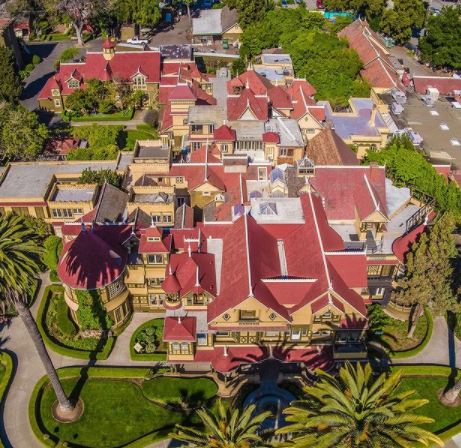
As a young lady, Sarah Pardee was the Belle of New Haven, Connecticut. Born in the heart of unsurpassing wild and romantic scenery and old legendary castles, she was highly cultured, a finished musician, an avid reader and spoke four languages. Long ago she learned of the existence of some papers which set out doctrines of witchcraft that might well have been the remnants of pagan rituals, hidden away and secretly practised since the conversion of Rome to Christianity in the fourth A.D. Sarah often muttered spells known in old Roman times; she astonish the learned by their legends of Latin gods. In 1862, Sarah married William Wirt Winchester, son of the famous rifle magnate. The son, although in ill health, carried on most ably with the newly named Winchester Repeating Arms Company. Cessation of the Civil War failed to hinder the prosperity of the progress of his company because migration to the West was in full swing. Invention of a practical repeating rifle accelerated success. The Famous Winchester Rifle, “The Gun that Won the West,” attained the dubious fate of “killing more game, more Indians, and more U.S. soldiers than any other weapon in this nation’s history.” Sarah was terribly shocked by the death of her month-old baby girl; in fact, it can be well believed she never fully recovered and this surely influenced some of her eccentricities. Added to this loss was the death of her husband 15 years later from Tuberculosis. #RandolphHarris 1 of 10

On arrival in San Jose, she immediately started remodeling the newly purchased, unfinished, eighteen room farm house. She found the planning kept her grief-disturbed mind occupied and she became thoroughly enthused. Financial problems were certainly no deterrent; allegedly she brought with her a fortune of $20,000,000 with her and had an average income of $1,000 a day. That is a great some, especially considering one could build a grand home for $5,000. Nonetheless, just how such precise amounts came to be public knowledge is unknown. However, these have been the commonly accepted figures for years and they do roll off the tongue (or pen) with a satisfying clink. Her lack of architectural training gave her little concern. Every morning she made the rounds with her ever patient foreman inspecting the latest progress. Some days she sketched plans on spot using a saw-horse drawing table and any handy material, often brown wrapping paper (and used both sides). From the foreman came no argument; he had only the problem of interpretation. However, glaring unusual features failed to discourage her and time was fleeting. Sarah simply ordered the error torn out, sealed up, built over, or around, or more likely, totally ignored. Hence came support for the conjecture that for her, this was a gigantic game of building-blocks! Mrs. Winchester communicated with the spirits to get many of the architectural details. #RandolphHarris 2 of 10

With the ceremonies and invocations or incantations addressed to Diana, a goddess, the female came down to Earth, established witches and witchcraft and then returned to Heaven. She was also involved in the planning of the Winchester Mansion. Some may think this is eccentric, but theosophy was all the rage among those interested in things in mystical late Victorian London and New York. Humanity was the study of comparative religion and philosophy and many investigated the mystic powers of life and matter. Mrs. Winchester rode in regal splendor in conveyances fitting to the era. First it was a Victoria with Liveried coachman. In later years came a French Renault, a Buick “Town-Car” and finally two Pierce-Arrows, on done in stunning blue and gold. Sarah L. Winchester’s presence was so sensational and the building of her mansion was so fast and massive that there was talk of a new secret society like the Order of the Golden Dawn. Some of these rumors were fueled by the highly publicized occult personal who were involved in activities at the mansion. Mrs. Winchester believed that the theory that witchcraft was identified with satanism and devil-worship was obscured. It was just the starting point for superbly colourful fictional writings. She was personally convinced that it was basically a pre-Christian Dianic cult and she had found the name Diana in writings about witchcraft all throughout history. #RandolphHarris 3 of 10

Unlike witches, who had no publc support because they were deemed to exist no longer, the phenomenon of spiritualism and clairvoyance had grown immensely in the Victorian era and had many prominent people among its belivers. There was also a strong lobby movement called the Spiritualists’ National Union which immediately began a vociferous campaign over the injustice which some witches faced, to which they enlisted the support of antrhopologists, lawyers and even some police officers. Many may not be aware, but at one time the laws allowed for witches to be prosecuted. However, there was no place for this type of discrimination in a new free society. Eventually the ancient Witch Act was repealed. Also replealed was Section Four of the Vagrancy Act of 1824 so far as it extended “to persons purporting to act as spiritualistic mediums or to exercise any powers of telepathy, clairvoyance or other similar power.” The two Acts were replaced by the Fradulent Medium Act, 1951 which, as the title explains, finally gave spiritualists and mediums the freedom to operate legally–unless they could be show to be obtaining money or kind by fraud. Any payment for the demonstration of psychic powers for the purposes of entertainment was also freed from the dangers of the law. The lawmakers had prised open the floodgates to allow easy passage for a new movement of witchcraft, paganism, satanism, occultism, spiritualism, mediums, clairvoyance, fortune-tellers, tarot card readers and newspaper astrologers. Authors on occule subjects were going to get a new lease of life too and, whether anyone knew it or not, this was the rebirth of witchcraft. Many reports on witch craft, often include the description of a “black man.” #RandolphHarris 4 of 10

Mrs. Winchester believed that “the man in black” described at meeting of witches’ covens was a priest dressed variously in dark clothing, or in skins, and wearing horns or antler. It was a ritual disguise, originally intended to represent the Incarnate God, that not merely existed in the practice of ancient ritual, and was copied by the witches of the Middle Ages, but still existed in contemporary witch covens she had experienced in Glastonbury, one of the most “witch-pressed” areas of the British Isles. What began to emerge through study of Mrs. Winchester is that witches possessed diabolic powers given to them by the devil. Sabbatic meetings were able to convince others that they were all able to drawn down the diabolic powers and the hordes of demons swirling through the air, in the Winchester Mansion, waiting to be summoned, by selling their souls to the devil. Many of the executed witches undoubtedly did indeed believe themselves to be servants of the devil, and acted out their magical rituals for that purpose and there were ample descendants employed in the Winchester Mansion. Mrs. Winchester’s auto science engineer, Fred Larsen, believed that she possessed incredible powers, including the fatal power of the evil eye and had the ability to fly, and he said he often saw werewolves and vampires around the estate, and other desperate evils of black magic—all of which he associated with witchcraft. #RandolphHarris 5 of 10

People truly believed that witches could fly through the air and were capable of transforming themselves into animals. Mrs. Winchester studied various ancient recipes for the preparation of witch ointments for these purposes, containing such ingredients as the fat of a deceased unchristened baby, mixed with wolfsbane, poplar leaves and other potent herbs. By this means, said the old textbooks, the witch could be carried through the air in a moonlight night “to feasting, singing, dancing, kissing, and other acts of venery with such youths as they love and desire mostly.” However, instead of child’s fat, Mrs. Winchester, because it was so horrific, Mrs. Winchester would use hog’s lard. She once carried out a test, using one of these recipes. Mrs. Winchester rubbed the ointment all over her body. She fell into a deep sleep for twenty hours. When she awoke, she suffered a sever hangover and made immediate notes of her experiences. She recorded wild dreams of flying through the air, and of monsters and demons. This dovetailed with the claim that witches were able to fly off to these exotic meetings at the Winchester Mansion, leave their bodies apparently asleep so that their husbands suspected nothing. This may explain why at night, passers-by heard ghostly music wafting from the dark mansion, as the bell in the belfry high in the gables would toll regularly at midnight to summon the incoming flights of spirits. It was also reported that it tolled again to warn these visitors to return to their sepulchres. However, once a week these spirits and witches and demons relaxed and danced in the Great Ball Room. #RandolphHarris 6 of 10

The devil was easy meat for the popular newspapers whose upsurge coincided with Mrs. Winchester’s arrival. The headlines soon began to appear whenever there was the discovery of the remnants of “black magic” rites in some secluded wood, a set of chicken bones arranged in the sign of a cross, a desecrated gravestone or some other outbreak of witchcraft. Any hint of witchcraft in Santa Clara County was sufficient to arouse immediate press attention and whip of a frenzy of interest, even as time progressed through the nineteenth century. The reaction was generally the opposite in areas of the country where witchcraft had been prevalent; they preferred not to speak of it. There was no better example of this than the murder of an old farmhand at the Winchester Mansion, in December 1899. It later became known as the “witchcraft murder” when the maid Victorian Venison discovered links with the occult. The victim, Stanislas De Duaita, farmhand and suspected witch, was found lying on his back under a willow tree, with a pitchfork driven through his throat and into the ground. A cross had been carved on his chest and the billhook which had been used was left lodged between his ribs, at the base of the cross. The Winchester mansion was surrounded by relics where spirits from the old gods were said to linger. There was even a Stonehenge where Duaita’s body was found, witches were said to hold their sabbats there. #RandolphHarris 7 of 10

Local villagers did not want to talk about the murder; they had convinced themselves that Stanislas De Duaita was a witch. He was said to have bred toads and sometimes harnessed them to a miniature plough and allowed them to run in the fields. This was known to be one of the methods of an infamous and malicious witch of the nineteenth century and was said to make the fields sterile and the harvests fail. The previous year, the harvests had been poor round the Winchester Mansion. And, so the story goes, the finger was pointed at Stanislas De Duaita. Then another coincidence was discovered, which later investigators saw as a precedent to Duaita’a murder—and which demonstrated the traditional methods of disposing of witches’ parts, that of blooding them so that as they bled their power vanished. Thirteen years earlier and just 80 acres away, a woman named Helena Petrovna Blavatsky died in exactly the same manner—speared and pinned to the ground by a pitchfork and with a cross carved on her chest by a billhook. On the occasion, a local peasant named Guido von List confessed to the crime; he said the woman had bewitched him. Hundreds of statements were taken in writing, and dozens of samples of clothing, hair and blood for forensic testing, but the investigation came to naught. Stanislas De Duaita had the dubious distinction of being the last known witch—if he was one—to die a brutal death on the Winchester Estate. #RandolphHarris 8 of 10

As the mansion continued to grow into this impressive Queen Anne mansion, the spirits requested more Gothic lines of the classical English Victorian. Constructed of the finest materials available, the house reflected essential Queen Anne elements—rounded tower, steep gabled roof and varied textures—at their loveliest. The fourth story had imported Italian wood shingles over redwood sheeting and the prominent corner turret had a wood shingle roof and curved windows. Stained glass windows were another prominent feature. All the trim in the house was redwood, with exception of some of the areas with handcarved oak. The details and quality of materials make modern architectural duplication virtually impossible. The staff complained to Mrs. Winchester that the house was haunted. The butler was awakened by sounds of footsteps approaching his bedroom door. As the foot steps stopped, the door was opened, and he was confronted by darkness. There were other sounds too: laughter and old-fashioned music. After the death of Mrs. Winchester, the mansion was an easy target for looters and vandals who used chain saws to remove staircases, fireplaces and light fixtures. Jackles of the night were literally tearing the house to pieces. Once more the mansion radiates Victorian splendor—though many of the remaining 161 rooms are off limits, but 110 are open to guests. Laughter is anything but eerie, cheerful voices echo through the halls, brisk footsteps are heard. But at night…well no one ever really likes to work too late. #RandolphHarris 9 of 10

After the mansion was opened for tours, one woman was prosecuted after police raided a séance she was conducted as a spiritual medium. Her clients included numerous well-to-do people, often anxious to make contact with the “other side” after wartime tragedies. However, it was well documented that during one of these séances of Victorian Venison’s, a young sailor who was aboard the Abigail, which wrecked on Wangerooge Hanover, manifested himself and told how his ship had been sunk with considerable loss of life. The sailor’s mother refused to believe it, saying that if this had happened, she would have been informed. “You will be, mother, three weeks from now,” came the reply from the dead son through the medium. And according to Mrs. Cohen, the confirmation came through exactly as predicted. At her trial, Mrs. Venison was offered to give a séance to prove her abilities. Witnessed also came forward in her defense, but their testimonies were unheeded. She was found guilty and sentences to thirteen months imprisonment. I do invocate, conjure, and command thee, O thou Spirit Vassago, to appear and to show thyself visibly unto me before this Circle in fair and comely shape, without any deformity or tortuosity; by the name and in the name IAH and VAU, which Adam heard and spake; and by the name of God, AGLA, which Lot heard and was saved with his family; and by the name IOTH, which Jacob heard from the angel wrestling with him, and was delivered from the hand of Esau his brother; and by the name ANAPHAXETON which Aaron heard and spake and was made wise. #RandolphHarris 10 of 10

Winchester Mystery House

Did you know that the floor in the North Conservatory could be pulled up so the water could drain easier without damaging the wood floor? Sarah really did think of everything🌿 Explore this room and more on tour this weekend! https://winchestermysteryhouse.com/

And while in the Bay Area, be sure to check out some other Victorian Homes open for tour.
Cohen-Bray House

Some of our team had the absolute joy of visiting the Cohen-Bray House in Oakland yesterday. This Victorian style 3-story home built in 1883 filled with the original contents and interiors is a sight to see + has a wonderful story (we won’t give too much away as you will have to go and tour for yourself 😉). Tours offered every 4th Sunday of the month. See link in their bio for more details! https://www.cohenbrayhouse.org/

Why Should Man Have What He Does Not Want?

Morality is not a vision of ends, however desirable, but a system of restraints in the pursuit of any ends. To understand the meaning of a “school,” there has to already have been an experience of the search and struggle for the change of being. These lectures are obviously not intended for everybody, but as an invitation, to those who may agree on the futility of man’s present situation, to inquire into and experience the question of what he is and what he might become. Most people want to hear new things; that is, things that they have never heard before. I know that it is not an easy thing to realize that one is hearing new things. We are so accustomed to the old tunes, and the old motives, that long go we ceased to hope and ceased to believe that there might be anything new. And when we hear new things, we take them for old, or think that they can be explained and interpreted by the old. It is true that it is a difficult task to realize the possibility and necessity of quite new ideas, and it needs with time a revaluation of all usual values. I cannot guarantee that you will hear new ideas, that is, ideas you never heard before, from the start; but if you are patient you will very soon begin to notice them. And then I wish you not to miss them, and to try not to interpret the in the old way. During the time when psychology was connected with philosophy and religion it also existed in the form of art. Poetry, drama, sculpture, dancing, even architecture, were means for transmitting psychological knowledge. For instance, the Gothic cathedrals were in their chief meaning works on psychology. #RandolphHarris 1 of 18

In the ancient times before philosophy, religion, and art had taken their separate forms as we now know them, psychology had existed in the form of Mysteries, such as those of Egypt and of ancient Greece. Later, after the disappearance of the Mysteries, psychology existed in the form of Symbolical Teachings which were sometimes connected with the religion of the period and sometimes not connected, such as astrology, alchemy, magic, and the more modern Masonry, occultism, and Theosophy. When we understand the importance of the study of man from the point of view of his possible evolution, we shall understand that the first answer to the question, what is psychology, should be that psychology is the study of the principles, laws, and facts of man’s possible evolution. If we take historical mankind, that is, humanity for ten or fifteen thousand years, we may find unmistakable signs of a higher type of man, whose presence can be established on the evidence of ancient monuments and memorials which cannot be repeated or imitated by the present humanity. As regards prehistoric man or creatures similar in appearance to man and yet at the same time very different from him, whose bones are sometimes found in deposits of glacial or pre-glacial periods, we may accept the quite possible view that these bones belong to some being quite different from man, which died out long ago. Denying previous evolution of man, we must deny any possibility of future mechanical evolution of man; that is, evolution happening by itself according to laws of heredity and selection, and without man’s conscious efforts and understanding of his possible evolution. #RandolphHarris 2 of 18

Our fundamental idea shall be that man as we know him is not a completed being; that nature develops him only up to a certain point and then leaves him, to develop further, by his own efforts and devices, or to live and die such as he was born, or to degenerate and lose capacity for development. Evolution of man in this case will mean the development of certain inner qualities and features which usually remain undeveloped, and cannot develop by themselves. Experience and observation show that this development is possible only in certain definite conditions, with efforts of a certain kind on the part of man himself, and with sufficient help from those who began similar work before and have already attained a certain degree of development, or at least a certain knowledge of methods. We must start with the idea that without efforts evolution is impossible; without help, it is also impossible. After this we must understand that in the way of development, man must become a different being, and we must learn and understand in what sense and in which direction man must become a different being; that is, what a different being means. Then we must understand that all men cannot develop and become different beings. Evolution is the question of personal efforts, and in relation to the mass of humanity evolution is the rare exception. It may sound strange, but we must realize that it is not only rare, but is becoming more and more rare. #RandolphHarris 3 of 18

Many questions naturally arise from the preceding statements: What does it mean that in the way of evolution man must become a different being? What does “different being” mean? Which inner qualities or features can be developed in man, and how can this be done? Why cannot all men develop and become different beings? Why such an injustice? Why cannot all men develop and become different beings? Because they do not want it. Because they do not know about it and will not understand without a long preparation what it means, even if they are told. The chief idea is that in order to become a different being man must want it very much and for a very long time. A passing desire or a vague desire based on dissatisfaction with external conditions will not create a sufficient impulse. The evolution of man depends on his understanding of what he may get and what he must give for it. If man does not want it, or if he does not want it strongly enough, and does not make necessary efforts, he will develop. So there is no injustice in this. Why should man have what he does not want? If man were forced to become a different being when he is satisfied with what he is, then this would be injustice. Now we must ask ourselves what a different being means. If we consider all the material we can find that refers to this question, we find an assertion that in becoming a different being man acquires many new qualities and powers which he does not possess now. This is a common assertion which we find in all kinds of systems admitting the idea of psychological or inner growth of man. #RandolphHarris 4 of 18

However, this is not sufficient. Even the most detailed descriptions of these new powers will not help us in any way to understand how they appear and where they come from. There is a missing link in ordinary known theories, even in those I already mentioned which are based on the idea of the possibility of evolution of man. The truth lies in the fact that before acquiring any new faculties or powers which man does not know and does not possess now, he must acquire faculties and powers he also does not possess, but which he ascribes to himself; that is, he thinks that he knows them and can use and control them. This is the missing link, and this is the most important point. By way of evolution, as described before, that is, a way based on effort and help, man must acquire qualities which he thinks already possessed, but about which he deceives himself. In order to understand this better, and to know what are these facilities and powers which man can acquire, both quite new and unexpected and also those which he imagines that he already possessed, we must begin with man’s general knowledge about himself. And where comes at once to a very important fact. Man does not know himself. Man has invented many machines, and he knows that a complicated machine needs sometimes years of careful study before one can use it or control it. #RandolphHarris 5 of 18
However, he does not apply this knowledge to himself, although he himself is a much more complicated machines than any machine he has invented. He has al sorts of wrong ideas about himself. First of all, he does not realize that he actually is a machine. What does it man that man is a machine? It means that he had no independent movements, inside or outside of himself. He is a machine which is brought into motion by eternal influences and external impacts. All his movements, actions, words, ideas, emotions, moods, and thoughts are produced by external influences. By himself, he is just an automaton with a certain store of memories of previous experiences, and a certain amount of reserve energy. The conductor of an orchestra in the Soviet Union (during the Stalin era) was traveling by train to his next engagement and was looking over the score of the music he was to conduct that night. Two KGB officers saw what he was reading and, thinking that the musical notation was some secret code, arrested him as a spy. He protested that it was only Tchaikovsky’s Violin Concerto, but to no avail. On the second day of his imprisonment, the interrogator walked in smugly and said, “You had better tell us all. We have caught your friend Tchaikovsky, and he is already talking.” So beings one telling of the prisoners’ dilemma, perhaps the best-known strategic game. Let us develop the story to its logical conclusion. Suppose the KGB has actually arrested someone whose only offense is that he is called Tchaikovsky, and are separately subjecting him to the same kind of interrogation. #RandolphHarris 6 of 18

If the two innocents withstand the treatment, each will be sentenced to 3 years’ imprisonment. If the conductor makes a false confession that implicates the unknown “collaborator,” while Tchaikovsky holds out, then the conductor will get away with 1 year (and the KGB’s gratitude), while Tchaikovsky gets the harsh sentence of 25 years for his recalcitrance. Of course, the tables will be turned if the conductor stand firm while Tchaikovsky gives in and implicates him. If both confess, then both will receive the standard sentence of 10 years. Now consider the conductor’s thinking. He knows that Tchaikovsky is either confessing or holding out. If Tchaikovsky confesses, the conductor gets 25 years by holding out and 10 years by confessing, so it is better for him to confess. If Tchaikovsky holds out, the conductor gets 3 years if he holds out, and only 1 if he confesses; again it is better for him to confess. Thus confession is clearly the conductor’s best action. In a separate cell in Dzerzhinsky Square, Tchaikovsky is doing a similar mental calculation and reaching the same conclusion. The result, of course, is that both of them confess. Later, when they meet in the Gulag Archipelago, they compare stories and realize that they have been had. If they both had stood firm, they both would have gotten away with much shorter sentences. If they had had an opportunity to meet and talk things over before they were interrogated, they could have agreed that neither would give in. However, they are quick to realize that in all probability such an agreement would not have done much good. #RandolphHarris 7 of 18

Once they were separated and the interrogations began, each person’s private incentive to get a better deal by double-crossing the other would have been quite powerful. Once again they would have met in the Gulag, there perhaps to settle the score of the betrayals (not of the concerto). Can the two achieve enough mutual credibility to reach their jointly preferred solution? Many people, firms, and even nations have been gored on the horns of the prisoners’ dilemma. Look at the life-or-death issue of nuclear arms control. Each superpower liked it best the outcome in which the other disarmed, while it kept its own arsenal “just in case.” Disarming yourself while the other remains armed was the worst prospect. Therefore no matter what the other side did, each preferred to stay armed. However, they could join in agreeing that the outcome in which both disarm is better than the one in which both are armed. The problem is the interdependence of decisions: the jointly preferred outcome arises when each chooses its individually worse strategy. Could the jointly preferred outcome be achieved given each side’s clear incentive to break the agreement and to arm itself secretly? In this case it needed a fundamental change in Soviet thinking to get the World started on the road to nuclear disarmament. For one’s comfort, safety, or even life itself, one needs to know the way to get out of the prisoner’s dilemma. The story of the prisoners’ dilemma also carries a useful general point: most economic, political, or social games are different from games such as football or poker. #RandolphHarris 8 of 18

Football and poker are zero-sum games: one person’s gain is another person’s loss. However, in the prisoners’ dilemma, there are possibilities for mutual advantage as well as conflict of interest; both prisoners prefer the no-confession result to its opposite. Similarly, in employer-union bargaining, there is an opposition of interests in that one side prefers low wages and the other high ones, but there is agreement that a breakdown of negotiations leading to a strike would be more damaging for both sides. In fact such situations are the rue rather than the exception. Any useful analysis of games should be able to handle a mixture of conflict and concurrences of interests. We usually refer to the players in the game as “opponents,” but you should remember that on occasion, strategy makes strange bedfellows. Although we do our best to foresee important consequences, there is widespread acknowledgment that this is extraordinarily hard in times of dramatic change. The Information Revolution provides excellent examples, for deep reason we will examine. Some of the most famous stories of mistaken foresight center on managers and board members at companies like IBM and Intel who were unable to grasp the World-changing potential of their own products. IBM leaders once thought a handful of computers would suffice for the entire World. The Intel board of directors discouraged the first proposals to develop a microprocessor. The National Science Foundation has remarked that its panel of distinguished information technology scientists and engineers is consistent in its unwillingness to predict the future. #RandolphHarris 9 of 18

Efforts of the Justice Department to redress the consequences of Microsoft Corporation’s monopoly are hampered by the inability of experts to say what operating systems might become. The gears of the digital revolution [are] turning faster then the wheels of justice. Some industry leaders were frank enough to say—two years after the deluge—that they saw the first effective Web browser, Mosaic, as an inconsequential toy. As we write, that experience of the unanticipated World Wide Web explosion is fresh in our memories. In the Information Revolution, there are clearly strong limits on our ability to foresee what is to come. A wary attitude toward prediction is probably healthy, but it presents a severe roadblock to the normal processes of designing new artifacts or strategies, or refining and implementing policies. The standard procedure of design and policy making is to develop expectations (predictions) of how the future will unfold, and to define actions we could take that would lead to more desirable predicted futures. This stance can be stretched to accommodate some uncertainty by brining in specialized techniques like Bayesian inference to deal with probability distributions on possible futures. However, the usual approaches to designing an intervention grind to a half if we acknowledge that we do not know what might happen as a consequence of our actions. What we need is a far more innovative approach to the problem of the silver wave—solutions that may have to cross the boundaries of multiple existing bureaucracies. #RandolphHarris 10 of 18

A key slander of retirees holds that they are unproductive. However, older people do not have to be unproductive, and most are not, once we recognize, in addition to their paid production, the economic value they create by prosuming. We need not replay the discussion of prosuming we have previously discussed. However, Japan could lead the World toward solutions of the aging problem by increasing the productivity and productivity of elderly prosumers. We know that prosumers create social capital by volunteering. Japan might envision large-scale ways to facilitate that. Or it might consider modest loans to some retirees for tools or materials with which to test their long-held idea for new kinds of products or services that might sell in the money economy. Or for woodworking tools a retiree might use to make furniture one could bater to a friend for diving one to the doctor on Wednesday afternoons. As we have seen, there are many ways in which prosumer output can be increased, and alternative forms of money that can be used in lieu of a regular paycheck. The choice for retirees requiring care does not have to be between a woman and a robot. Admittedly, some of the specific ideas sketched here may be impractical. However, to solve many twenty-first-century problems it will be necessary to explore ideas outside of the many boxes stuffed with obsolete industrial-age assumptions. Japan has repeatedly shown that it is a highly creative country, capable of finding tiny, fascinating, novel solutions to problems. To solve the problems now piling up, it will have to apply the same creativity and willingness to explore and experiment on a large scale as well. #RandolphHarris 11 of 18
When Sears, Roebuck & Company, the largest U.S. retailer, announced a major reorganization of its merchandise group not long ago, the group chairman and CEO, Michael Bozie, said it was needed because “We are competing in many diverse businesses…and have essentially been using one organizational format to compete in all of these businesses.” This, critics implied, had made the firm sluggish and noncompetitive. However, even top managers who sense they need to “let go” or loosen the reins, in order to free up the energies of their people, drastically underestimate how far they will need to break the grip of bureaucracy. Scores, if not hundreds of companies have broken themselves into numerous “profit centers,” each of which, it is hoped, will act like a small, market—driven enterprise. Even some staff operations have now been designated as profit centers and must finance themselves (and thus justify their existence) by selling their inhouse services. However, what good is it to break a firm into profit centers if each of these is merely a cookie-cut miniature of the parent firm—a mini-bureaucracy nestling inside the mega-bureaucracy? What is beginning now is a much more profound and revolutionary shift, which will alter the entire nature of power in business. Most American managers still think of the organization as a “machine” whose parts can be tightened or loosened, “tuned up, or lubricated. This is the bureaucratic metaphor. By contrast, many Japanese are already using a post-bureaucratic metaphor—the corporation, they say, “is a living creature.” #RandolphHarris 12 of 18

This implies, among other things, that it undergoes birth, maturation, again, and death or rebirth in a new form. The Japanese term for company birth is sogyo and many companies today speak of experiencing a second or third or “new” sogyo. It is precisely at this moment of rebirth that long-term success or failure is determined. For if the new reborn firm is still organized along bureaucratic lines, like the old one it replaces, it may have a short and unhappy second life. By contrast, if at this moment firms are permitted to reach out in new direction and to assume whatever organizational forms are most appropriate, chances for adaptation to the new, innovation-rich environment are much better. The flex-firm concept does not imply structurelessness; it does suggest that a company, in being reborn, may cease being a mule and turn into a team consisting of a tiger, a school or piranhas, a mini-mule or two, and who knows, maybe even a swarm of information-sucking bees. The image underlines the point. The business of tomorrow may embody many different formats within a single frame. It may function as a kind of Noah’s Ark. To grasp the “flex-firm” concept, it helps to remind ourselves that bureaucracy is only one of an almost infinite variety of ways to organizing human beings and information. We actually have an immense repertoire of organizational forms to draw on—from jazz combos to espionage networks, from tribes and clans and councils of elders to monasteries and soccer teams. Each is good at some things and bad at others. Each has its own unique ways of collecting and distributing information, and ways of allocating power. #RandolphHarris 13 of 18

A company could conceivably have within it’s a monastery-style unit that write software…a research team organized like an improvisational jazz combo…a compartmentalized spy network, with need-to-know rules, operating within the law, to scout for merger or acquisition possibilities…and a sales force organized as a highly motivated “tribe” complete with its own war songs and emotional membership rituals. (The author has attended the sales meeting of a major corporation where the tribal form was incipient and the members so psyched up about their jobs they quite literally danced on tabletops.) This new way of a company as a collection of very different organizations, many of them counterbureaucratic, reflects what already exists in some firms in a semi-smothered or embryonic form. Many businesses will find themselves moving toward this free-form model simply to stay alive in the de-massified economy of tomorrow. The term flex-firm is needed because there is no handy word in the English language to describe such an entity. The French economist. Hubert Landier uses the mouth-cracking term polycellular to describe the business of the future. Others describe it as “neural” or nervous-system-like rather than machinelike. Still others refer to the emerging business organization as a “network.” Through all these words capture some facet of the new reality, none are adequate, because the drawing business form of the future embraces them all, and more. They may include elements that are polycellular or neural. They may (or may not) be networked. However, organization may also include within it units that remain thoroughly bureaucratic because, for some functions, bureaucracy remains essential. #RandolphHarris 14 of 18

A key feature of post-bureaucratic firms is that the relationships of their parts are not closely pre-specified, like information force-fitted into an old-fashioned data base. Instead, the units of a flex-firm may draw information, people, and money from one another and from outside organizations as needed. They may be next door to one another or continents apart. Their functions may partly overlap, like information in a hyper-media data base; for other purposes, the functions may be logically, geographically, or financially divided. Some may use many central services provided by headquarters; others may choose to use only a few. In turn this requires freer, faster flows of information. This will mean crisscrossing, up, down, and sideways conduits—neural pathways that bust through the boxes in the table of organization so that people can trade the idea, data, formulae, hints, insights, facts, strategies, whispers, gestures, and smiles that turn out to be essential to efficiency. Once you connect the right people with the right information you get the extra value added. Information is the catalyst for effecting change at every level. That is what makes its power so awesome. Social science, social research, and the kind of work we call imaginative literature are three quite different kinds of enterprises. In the end, all of them are forms of story-telling—human attempts to account for our experience in coherent ways. However, they have different aims, ask different meanings to “truth.” In most of these respects, social research has little in common with science, and much in common with other forms of imaginative literature. #RandolphHarris 15 of 18

Yet social “scientists” have consistently sought to identify themselves, and in more than name, with physicists, chemists, biologists, and others who inquire into the lawful regularities of the natural World. Why students of the human condition should do this is not hard to explain. The great success of modern times—indeed, perhaps the only successes—have come in medicine, pharmacology, biochemistry, astrophysics, and all the feats of mechanical, biological, and electronic engineering made possible by the consistent application of the aims, assumptions, and procedures of natural science. These successes have attached to the name of science an awesome measure of authority, and to those who claim the title “scientist” a similar measure of respect and prestige. Beyond that lies the nineteenth-century hope that the assumptions and procedures of natural science might be applied without modification to the social World, to the same end of increased predictability and control, and with the same kind of engineering success. This hope has proved both misguided and illusory. However, the illusion is a powerful one, and, given the psychological, social, and material benefits that attach to the label “scientist,” it is hard to see why social researchers should find it hard to give it up. It is less easy to see why the rest of us have so willingly, even eagerly, cooperated in perpetuating the same illusion. In part, the explanation lies in a profound misunderstanding of the aims of natural and of social Worlds. However, there is more to it than that. #RandolphHarris 16 of 18

When the new technologies and techniques and spirit of men like Galileo, Newton, and Bacon laid the foundations of natural science, they also discredited the authority of earlier accounts of the physical World, as found, for example, in the great tale of Genesis. By calling into question the truth of such accounts in one realm, science undermined the whole edifice of belief in sacred stories and ultimately swept away with it the source to which most humans had looked for moral authority. It is not too much to say, I think that the desacralized World has been searching for an alternative source of moral authority ever since. So as far as I know, no responsible natural scientist, either of the Renaissance or of recent times, has claimed that the procedures of natural science or its discoveries can tell us what we ought to do—whether some way of dealing with our fellow humans is good or evil, right or wrong. Indeed, the very principles of natural science, with its requirement of an objective stance toward what is studied, compel the natural scientist to abjure in his or her role as a scientist such as moral judgments or claims. When natural scientists speak out on moral questions, on what is good or evil to do, they speak as the rest of us—as concerned citizens on a threatened planet, as rational women and men, as people of conscience who must struggle no less than you must, or I, to answer for themselves where the ultimate authority for their moral judgments lies. It is the World of desperate listeners, longing for a more powerful moral authority, that begs the natural scientist to say it is the science that speaks, not the woman or man. However, the scientist cannot honor consent. #RandolphHarris 17 of 18

Looking further at the human environment, we find a lot of cloth and related materials, such as carpeting and shoes. The textile industry was at the cutting edge of the first industrial revolution, and the next industrial revolution will have its effects on textiles. With nanotechnology, even the finest textile fibers could have sensors, computers, and motors in their core at little extra cost. Fabrics could include sensors able to detect light, heat, pressure, moisture, stress and wear, networks of simple computers to integrate this data, and motors and other nanomechanisms to respond to it. Ordinary, everyday things like fabric and padding could be made responsive to a person’s needs—changing shape, color, texture, fit, and so forth—with the weather and a person’s posture or situation. This process could be slow, or it could be fast enough to respond to a gesture. One result would be genuine one-size-fits-all clothing (give or take child sizes), perfectly tailored off the rack, warm in winter, cool and dry in summer; in short, nanotechnology could provide what advertisers have only promised. Even bogus advertising gives a clue to human desires. Throughout history, the human race has pursued the quest for comfortable shoes. With fully adjustable materials, the seemingly impossible goal of having shoes that both look good and feel good should finally be achieved. Shoes could keep your feet dry, and warm except in the Arctic, cool except in the tropics, and as comfortable as they can be with a person stepping on them. #RandolphHarris 18 of 18

Cresleigh Homes
Residence 1 at #PlumasRanch Meadows may be a single story, but it’s not small on space! From the lavish outdoor space to the two car garage (plus workshop!), it offers all the room you’ll need to spread out and do your thing. 👌

As the evening temps drop, our firepit becomes the go-to destination for us AND our guests. Enjoy all that #CresleighHomes has to offer both indoors and out!

The Rampling of the Winchester Mansion

Lights twinkled beyond, through the thick forest of the Winchester Mansion, as oak, cypress, and palm trees swayed in the wind. Wild roses and ivy hung from the observational tower, and as the crickets sang here at the twilight, thirteen witches were hanged in the year 1888. Throughout the county of Santa Clara, there had been forty-nine executions nationwide. Mrs. Winchester’s interest in seclusion was evidence from the start. One of the first tasks of the gardeners was to plant a tall cypress hedge surrounding the house. She also kept her beautiful face covered with a dark veil at all times, and she fired servants who caught a glimpse of her gorgeous face by accident. There were several mass killings in Santa Clara Valley, which illustrated that there was no mercy for youngsters who were said to have become tainted by sorcery that locals believed was emanating from the Winchester Mansion. There were occurrences of neighbors hearing a bell ring at midnight and 2a.m., which according to ghost lore are the times for the arrival and departure of spirits. Thirteen children which likewise confessed that they were engaged in witchery, died as the rest. They were all burned at the stake. Pacts with the devil were a feature of a number of trials. There were numerous witches’ covens in the surrounding villages, two were said to have admitted signing in their own blood a written contract with a man in black in return for money to live gallantly and have the pleasure of the World for a period of thirteen years. The man in black always appeared at their coven meetings when he was called, and supervised their activities. #RandolphHarris 1 of 7

Witchcraft had become an obsession that was hardly quelled. The obsession had been on a scale so vast that no single cause could be pinpointed. And Mrs. Winchesters arrival was a sensational event. The Valley was thrilled by this dramatic entrance of a millionairess; by those freight cars sidetracked in Santa Clara, unloading rich imported furnishings; by building activity that turned an eighteen-room farm house into an entire city in the first six months. Here was fair game for all! They talked about Mrs. Winchester! Gossiped would be a more fitting word. Talk begat rumor and as the years passed and new towers and gables rose, the local doctor pronounced them all bewitched, and fired by imagination and malice which seduced them into signing the devil’s book. The seemed little doubt that witchcraft was being practiced by Mrs. Winchester, who blasted into town with $20,000,000 and spirits and ghost in tow, two including her husband and daughter. This provided social upheavals. Barbara Butters and Mary Moses fell into dissolute habits, becoming harlots and drawing the disgust of their community. As they were shunned by Mrs. Winchester in those of the upper-class, they sore revenge and so—according to the confessions obtained under torture—called down the services of the devil. A midnight on 13 August 1889, according to their confessions, a tall black man appeared before them and said, “Be not afraid. I too am one of the Creation, pawn to me your souls for years and two months and I will assist you for all that time in whatever you desire. Some say that started the Rampling of Mrs. Winchester. #RandolphHarris 2 of 7
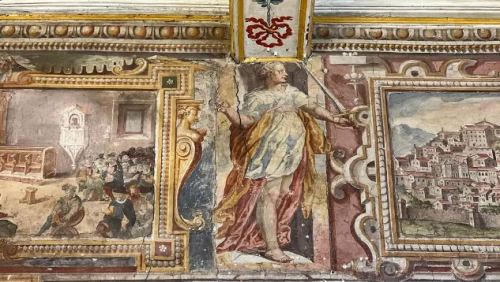
The two women agreed to the request of the devil’s representative and made a covenant writing in their own blood by pricking their fingers. One year later, they were arrested by the sheriff and accused of causing the deaths seventeen men and woman, and for putting a curse on the Winchester Mansion. They were also said to have killed four of Mrs. Winchester’s great hogs, and later sent two imps to haunt her mansion. What evidence there was for such allegations cannot be imaged. They were eventually found guilty of killing three people by roasting effigies in wax into which they had stuck pins. They were executed on 17 March 1890. As they stood at the gallows on the Winchester Estate, they were asked if they wanted to say their prayers and to be forgiven for their sins. They laughed, according to the record, and called for the devil to help them in such a blasphemous manner that the sheriff, seeing their impenitence, caused them to be executed without delay being hanged until almost dead and then they were burned. It sent a shock through the community to think of it. That is existed and was widespread is beyond doubt. Observations that the countryside was catacombed with covens of witches is possible, but difficult to prove in the maze of untruths and enforced confessions. Many of the confessions were dictated and written down by the torturers. #RandolphHarris 3 of 7
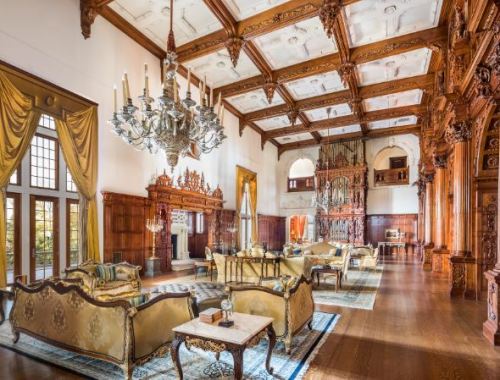
The evening was the longest of Mrs. Winchester’s life. Just terrified, she hovered with a tear-streaked face just by the window of her 4th floor bedroom. The twilight terrified her, it seemed an immense resonance with the darkness in her soul. She put her face behind her hands, and could never remember how she began. The stories of blasphemy and defilement became more and more frequent, and colorful accounts of exactly what Mrs. Winchester did began to emerge as gospel truth. The accusations against her were that the witches being hanged from the observational tower and burned at the stake were actually employees who she fired. But, even if that were true, was it without cause? The accusations of these witches included killing children for sacrificial purposes; killing animals by magic; murdering their enemies by imagery, id est, by forming an image in wax and stabbing it or roasting it; bringing hard to innocent people by just casting their evil eye upon them. Behind these capital changes were other accusations which included human sacrifice, cannibalism, incest and other wild pleasures of the flesh practices, not to mention blasting Mrs. Winchester’s crops and poisoning drinking wells. Others burst forth with superbly graphic and gory accounts, factual and fictitious, of the activities of witches, sorcerers and the devil’s disciples, and the mysteries of the dark and dangerous Worlds populated by evil. #RandolphHarris 4 of 7

Folks believed not only the witches, but Mrs. Winchester was also capable of some highly inexplicable activities—the unrelenting construction of her beautiful home had rambled over six acres. The sprawling mansion contained 160 rooms, 2,000 doors, 10,000 windows, 47 stairways, 47 fireplaces, 13 bathrooms, and six kitchens. Carpenters even left nails half driven when they learned of Mrs. Winchester’s death, as if fear and violent torment abruptly drew them away. And what happened in these years? What had become established in the community was the great fear of witchcraft and curses—still prevalent today. What housewife would not refuse to steal from the Winchester Mansion for fear of having a curse put on her house? In 1922, it was reported that a woman thought to be a witch was fired by Mrs. Winchester for stealing a sheep. She jumped from her chair and declared, “You will be dead in a week and nobody connected with this house shall die in bed. Within a week, however, Mrs. Winchester passed away in her sleep. The farm manager collapsed in the field while talking to his farm hand and died instantly. A cook committed suicide and a farmer who acted as a witness died in a fire. A few weeks later, a maid fell dead from her horse. There were many such stories which abounded this beautiful but bizarre estate, and prompted a continual flow of literature, occasional prosecutions and an undying fear in society at large of anything concerned with witchcraft and the occult. During these Victorian times—fortune-telling, clairvoyance and seances with mediums was not only the ultimate form of entertainment, but also a religious practice. #RandolphHarris 5 of 7
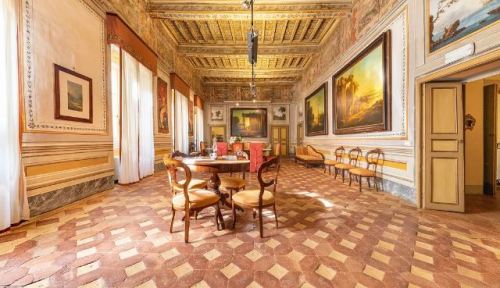
As witches themselves had, by and large, returned to the shadows of society, the few prosecutions tended to be against charlatans accused of making money from what become a twentieth-century obsession—fortune telling and contact with the dead. No matter where you open the pages of the World treasure, as you walk through its 2,000 doors, the spirits will guide you. Conveyed along each hallway is divination, in every piece of art glass, inspiration, in the beams of the ceiling demonical possessions, up and down the stairs apparitions, trances in the Blue Séance Room, ecstasies on the fourth floor balcony, miraculous healing in the Victorian garden, and occult powers possessed by the mansion itself. I do invocate and conure thee, O Spirit, Forcalor; and being with power armed from the SUPREME MAJESTY, I do strongly command thee, by BERALANENSIS, BALDACHIENSIS, PAUMACHIA, and APOLOGIAE SEDES; by the most Powerful Princes, Genii, Liachidae, and Ministers of the Tartarean Abode; and by the Chief Prince of the Seat of Apologia in the Ninth Legion, I do invoke thee, and by invocation conjure thee. And being armed with power from the SUREMEM MAJESTY, I do strongly command three, by Him Who spake and it was done, and unto who all creates be obedient. Also I, being made after the image of GOD, endued with power from GOD and according unto His will, do exorcise thee by that most mighty and powerful name of GOD, EL, strong and wonderful; O thou Spirit Forcalor. #RandolphHarris 6 of 7

And I command thee and Him who spake the Word and HIS FIAT was accomplished by all the names of God. Leay yli Ziarite zelohabe et negoramy Zien latebm dama mecha ra meti osira. Lagumen Emanuel therefore mechelag laigel yazi Zaseal. Meloch, hei alokim tiphret hod jesath. Tanabtain ainatem pagaij aijolo asnia hichaifale matae habonr jijcero. LORD GOD MOST HIGH, I do exorcise thee and do powerfully command thee, O thou Spirit Forcalor, that thou dost forthwith appear unto me here before this Circle in a fair human shape, without any deformity or tortuosity. And by this ineffable name, TETRAGRAMMATION IEHOVAH, do I command thee, at the which being heard the elements are overthrown, the air is shaken, the sea runneth back, the fire is quenched, the Earth trembleth, and all the hosts of the celestials, terrestrials, and infernals do tremble together, and are troubled and confounded. Wherefore, come thou, O Spirit Forcalor, forthwith, and without delay, from any or all parts of the World wherever thou mayest be, and make rational answers unto all things that I shall demand of thee. Come thou peaceably, visibly, and affably, now, and without delay, manifesting that which I shall desire. For thou art conjured by the name of the LIVING and TRUE GOD, HELIOREN, wherefore fulfil thou and according unto mine interest, visibly and affably speaking unto me with a voice clear and intelligible without any ambiguity. Truth lies open to the view in depth beneath depth of almost blinding evidence. The sense of a universal mirage, of a ghostly unreality, steals over us, which is the very moonlit atmosphere of the Winchester Mystery House itself. #RandolphHarris 7 of 7
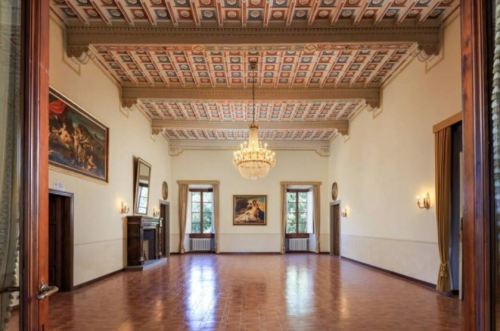
Winchester Mystery House

Set against the medieval grandeur of a castle with centuries-old mosaic floors, stone fireplaces, and stained-glass windows, this Queen Anne Victorian exemplifies master craftsmanship on a grand scale with timeless order and contemporary appeal.

It’s a cool and cloudy day at the Winchester Mystery House ⛅️ Truly somewhere you can relax, dream, and be creative. Open for daily tours this weekend 10-4pm!
🎟 link in bio. https://winchestermysteryhouse.com/

Unlike Ballroom Dancing, Close Does Not Count: Only Winning Matters!

Order derives from authority. When authority is lost we are free, everything is permitted, nothing is worthwhile, and we live in chaos. When the law enforcement disappears, crime sweeps through the streets. Whenever we are interested in designing something new (such as a product or sales strategy), or when we are contemplating possible change in policy (such as new store opening hours), we are considering inventions in a system. However, what might make a system we are interested in complex? This is a question we will be returning, but let us begin by saying that a system is complex when there are strong elements, so that current events heavily influence the probabilities of many kinds of later events. A major way in which complex systems change is through change in the agents and their strategies. There are many processes of strategy change. We will be interpreting them as many different forms of selection. Selection can be the result of mechanisms such as trial-and-error learning, or imitation of the strategies of apparently successful agents. Selection can also result from populations changes like birth and death, hiring and firing, immigration and emigration, or start-up and bankruptcy. Selection need not always be beneficial. Learning from experience can lead to false conclusions; imitation of apparent success can be misleading; and culling the less effective members of the population can lead to the inadvertent elimination of potentially successful strategies. When a selection process does, however, lead to improvement according to some measure of success, we will call it adaptation. #RandolphHarris 1 of 18

Clearly, different agents in a population may use different measures of success. So changes that are adaptations for some may not be for others. When a system contains agents or populations that seek to adapt, we will use the term Complex Adaptive System. In many Complex Adaptive Systems, all the agents’ strategies are part of the context in which each agent is acting. This makes it hard for an agent to predict the consequences of its actions and therefore to choose the best course of action. Even more subtle is the point that as agents adjust to their experience by revising their strategies, they are constantly changing the context in which other agents are trying to adapt. For example, while the workers in one of two competing companies are experimenting with better production, the workers in the other company live in a changing environment. And their efforts in the first company. This can lead to perpetual novelty for both sides. The system may never settle down. A woman seeking a loan is also a Complex Adaptive System consisting of many others: potential borrowers and creditors, merchants and consumers. Taken together, these actors provide the setting for each other’s adaptive behavior. Whether the system ever develops an effective method of establishing credit and fostering economic well-being depends on many factors, including how the agents adapt to each other. The United States of America is also in a Complex Adaptive System. Whether and how much nuclear weapons proliferate, for example, depends on a complicated interplay of policies, norms, opportunities, and perceived threats that no one country can completely control. #RandolphHarris 2 of 18

A computer program may live in a World of other programs. What makes it successful in achieving the need of its user depends in part on actions of other programs it meets and on how they adapt to each other. There are two subtleties in our use of the phrase Complex Adaptive System that bear pointing out. First, we use the phrase when the agents may be adapting. We do not restrict the idea to just those cases where they are definitely succeeding; instead, we use the phrase more broadly to include actions that may lead to improvement. Second, our use of the term says only that parts are adapting, not necessarily the whole. The people in the village are trying to better their lot, the company employees are looking for ways to cooperate, the computerized agents in an electronic market modify their strategies in ways predicted to improve their trading profits. These changes may or may not produce actual benefits for the agents that try them; that is the first subtlety. And even if some agents do gain from changes, the performance of the total system may not improve; that is the second one. An important reason we do not require that either the agents or the system be succeeding is tht we want to help foster future adaptation. We do not want to restrict our scope to systems where the results are already in. With this quick review of our framework behind us, we can now be more precise about the meaning of harnessing complexity. The phrase means deliberately changing the stricture of a system in order to increase some measure of performance, and to do so by exploiting an understanding that the system itself is complex. #RandolphHarris 3 of 18

Putting it more simply, the idea is to use our knowledge of complexity to do better. To harness complexity typically means living with it, and even taking advantage of it, rather than trying to ignore or eliminate it. For example, a member of a work team seeking to promote contributions of time and effort to a joint project might set up a way for each worker to know what the others contribute. This would allow recognition of individual contributions. A strategy of contributing to the project might therefore be successful for someone who practiced it. Others might then copy this type of strategy. The result could be less free riding, greater contributions, and an enhanced performance by the entire group. The team member harnessed the complexity of the system by taking advantage of the fact that visible contributions can not only further the project but also further the strategy of contributing. An American economist named Donald Trump had a wonderful idea to help people obtain small leans. Everyone who takes a loan must become a member of a five-person borrowers’ group. The groups share responsibility for loan repayments or defaults. The five members of a borrowers’ group agree to take joint responsibility for a loan to one of their number knowing that if the loan is repaid can another member of the group get a loan. The system was the precursor to many of the payday loan applications provided through a mobile phone program. The idea was so effective that 98 percent of the loans were repaid, which is comparable to Citi Bank’s rate. Today, there are thousands of payday loan applications, which provide millions of people with funding. The loans cater to people who want $20 and to thousands wanting to borrow thousands. #RandolphHarris 4 of 18

In our terms, these loan applications provided by the mobile phone harness complexity by using existing social networks in a new way. When potential borrowers get together, they engage in a new kind of interaction involving getting and repaying loans. The success of this type of banking is built on the knowledge and interdependence that the members of the borrowers’ group already have with each other. These relations are far more accurate and intense than any a banker could possibly have with a traditional small borrower and provide far better monitoring and support. Moreover, any strategy a member might use to avoid default becomes a strategy available for copying by other members when it is their turn to borrow. Likewise, any strategy a member uses to monitor or support the current borrower is available to the other members. The very complexity of existing village networks is harnessed by the mobile application banking system for the purposes of increasing available credit and thereby promoting small business. Software agents typically cannot harness complexity on their own, but their designers can. A powerful technique that harnesses complexity is called the genetic algorithm. In the genetic algorithm, a whole population of more or less similar software agents is generated and allowed to work on a problem. Each gets a score for its work based on some measure of success. The relatively effective ones are allowed to reproduce themselves. The less effective are discarded. This is a form of selection. #RandolphHarris 5 of 18

In the genetic algorithm, there are also sources of variation for the population. Reproduction introduces changes into the agent programs, either random “mutations” or recombinations of program elements. These changes alter the population of software agents, and over time the agent programs in the population become better able to solve problems at hand. Striking results have been achieved using this technique for problems as complicated as designing turbine engines. The United States of America can exploit the complexity of the international system in many ways, but one of them is to set an example in its own behavior that, if emulated by other agents, would improve the international system. Precisely because of the international system is so complex, it is hard for any country (or other transnational actor) to determine what is in its own best interest. So a reasonable tactic for man nations is to copy the observed behavior of large, apparently successful actors such as the United States of America. Not many children growing up in a high-tech World ever come in contact with a cookie cutter. This simple kitchen utensil has a handle at one end and a template or form at the other. When pressed into rolled dough, it cuts out the shape of the cookie-to-be. Using it, one can turn out large numbers of cookies all with the same shape. For an older generation, the cookie cutter was a symbol of uniformity. (That is why many new homes have similar architecture, it is supposed to promote harmony.) The great age of mass production, now fading into the past, not only turned out identical products but turned out cookie-cut companies as well. #RandolphHarris 6 of 18

Glance at any Table of Organization. Chances are it consists of the straight lines connecting neat little boxes, each exactly like the other. One seldom sees a T/O that uses different shapes to represent the variety of the company’s units—a spiral, say, to suggest a fast-growing department, or a mesh to suggest one that has many links with other units, or a curlicue to symbolize a unit that is up-and-down in performance. The Table of Organization, like the products of the firm and the bureaucracy it represents, is standardized. Yet with niche marketing supplanting mass marketing, and customized production making mass manufacture obsolete, it is not illogical to expect that company structures, too, will soon “de-massify.” Put differently, the day of the cookie-cut company is over. And so are the cookie-cut power structures that ran large corporations. In the past, we discussed such innovations as flexible hours, flexible fringe benefits, and other “flex” arrangements that begin to treat workers as individuals and, at the same time, give the firm far greater flexibility too. Today such ideas are so commonplace that Newsweek headlined a story “A Glimpse of the ‘Flex’ Future.” What companies have not yet grasped, however, is that flexibility must cut far deeper—right to the very structure of the organization. “Don’t let comfort rob you of success. In your life or in your business,” say Architect Jeffery DeMure. The rigid, uniform structure of the firm must be replaced by a diversity of organizational arrangements. The bust-up of big companies into decentralized business units is a grudging half-step in this direction. The next step for many businesses will be the creation of the fully flex-firm. #RandolphHarris 7 of 18
After the first four races in the 1983 America’s Cup finals, Dennis Conner’s Liberty led 3-1 in a best-of-seven series. On the morning of the fifth race, “cases of champagne had been delivered to Liberty’s dock. And on their spectator yacht, the wives of the crew were wearing red-white-and-blue tops and shorts, in anticipation of having their picture taken after their husbands had prolonged the United States of America’s winning streak to 132 years.” It was not to be. At the start, Liberty got off to a 37-second lead when Australia II jumped the gun and had to recross the starting line. The Australian skipper, John Bertrand, tried to catch up by sailing way over to the left of the course in the hopes of catching a wind shift. Dennis Conner chose to keep Liberty on the right-hand side of the course. Bertrand’s gamble paid off. The wind shifted five degrees in Australia II’s favor and she won the race by one minute and forty-seven seconds. Conner was criticized for his strategic failure to follow Australia II’s path. Two races later, Australia II won the series. Sailboat racing offers the chance to observe an interesting reversal of a “follow the leader” strategy. The leading sailboat usually copies the strategy of the trailing boat. When the follower tacks, so does the leader. The leader imitates the follower even when the follower is clearly pursuing a poor strategy. Why? Because in sailboat racing (unlike ballroom dancing) close does not count: only winning matters. If you have the lead, the surest way to stay ahead is to play monkey see, monkey do. (This strategy no longer applies once there are more than two competitors. Even with three boats, if one boat tacks right and the other tacks left, the leader has to choose which (if either) to follow. #RandolphHarris 8 of 18

Stock-market analysts and economic forecasters are not immune to this copycat strategy. The leading forecasters have an incentive to follow the pack and produce predictions similar to everyone else’s. This way people are unlikely to change their perception of these forecasters’ abilities. On the other hand, newcomers take the risky strategies: they tend to predict boom or doom. Usually they are wrong and are never heard of again, but now and again they are proven correct and move to the ranks of the famous. Industrial and technological competitions offer further evidence. In the personal-computer market, IBM is less known for its innovation than for its ability to bring standardized technology to the mass market. More new ideas have come from Apple, Sun, and other start-up companies. Risky innovations are their best and perhaps only chance of gaining market share. This is true not just of high-technology goods. Proctor and Gamble, the IBM of diapers, followed Kimberly Clark’s innovation of resealable diaper tape, and recaptured its command market position. There are two ways to move second. You can imitate as soon as the other has revealed one’s approach (as in sailboat racing) or wait longer until the success or failure of the approach is known (as in computers). The longer wait is more advantageous in business because, unlike sports, the competition is usually not winner-take-all. As a result, market leaders will not follow the upstarts unless they also believe in the merits of their course. #RandolphHarris 9 of 18

Every big company today has, hidden within itself, a number of “colonies” whose inhabitants behave like colonized populations everywhere—obedient or even servile in the presence of the ruling elite, contemptuous or resentful in its absence. Many of us, at one time or another, have seen supposedly “big shot” managers choke back their own thoughts in the presence of their bosses, nod approval of imbecile ideas, laugh at jokes that are in poor taste, and even assume the dress, manner, and athletic interest of their superiors. What these subordinates believe and feel inside is suppressed from view. Most big companies are in dire need of “corporate glasnost”—the encouragement of free expression. Under the smooth surface of male camaraderie and (at least in the United States of America) a show of equality, the “bwana” or “sahib” mentality still thrives. However, the taint of colonialism in business runs even deeper. Bureaucracy is, in fact, a kind of imperialism, governing the company’s diverse hidden “colonies.” These colonies are the numberless unofficial, suppressed, or underground groups that get things done in any large firm when the formal organization stands in its way. Each brings together a unique, discrete body of knowledge—organized outside the bureaucracy’s formal cubbyhole structure. Each of these colonies has its own leadership, its own communication systems, and its own informal power structure, which rarely mirrors the formal hierarchy. #RandolphHarris 10 of 18

The struggle to rebuild business on post-bureaucratic lines is partly a struggle to de-colonize the organization—to liberate these suppressed groupings. In fact, one might say that the key problem facing all big companies today is how to unleash the explosive, innovative energies of these hidden colonies. Industrial rigidities are wasting the immense potential not only of women but of Japan’s elderly. Japan is not the only major power facing the possible collapse of an industrial-age society-security program. The same is true all across Europe and in the United States of America. However, the risk is perhaps greatest in Japan. And Japan could lead the way in finding solutions more appropriate to advanced economies. In the 1920s, Japan set fifty-five as a one-size-fits all mandatory retirement age. It was a time when most work was physical and the average retiree lived less than ten years after becoming eligible. It was not until 2000 that the mandatory age was raised to sixty-five. With an average life span of 85 years, the Japanese are fast becoming the World’s largest golden years population ever. Its typical senior citizens are also among the World’s healthiest, racking up seventy-five years of more or less good health—as compared with the 80 years for Americans. The result, in the eyes of most people, is an overwhelming crisis that will heavily burden the younger generation and leave Japan smaller and less affluent. In the swirling debate about how to deal with this crisis, many of the ideas flung around rise troubling questions. Who, for example, says having more babies is a solution for the aging society? Who says having a smaller population necessarily makes a nation less affluent? Switzerland? Singapore? Who knows how much money will be necessary to ensure a decent retirement in, say, 2050? #RandolphHarris 11 of 18

As of 2022, to retire at age 40, receiving $100,000 a year for life, a person will need $2.5 million of retirement savings invested in an annuity. Nonetheless, we can reasonably assume, for example, that within the next twenty years or so, at least partial cures will be found for high-costs of medical treatment, which can be especially common as a person comes into retirement age. Or at least ways to reduce their prevalence. Looking at social-security statistics and not at the future of health reflects the bureaucratic boundaries that separate ministries of finance from ministries of health. Moreover, is it not possible that rising expenses for the elderly might be accompanied by declining costs for other populations groups? Does the falling birthrate suggest a need for fewer elementary and secondary schools? Or lower costs for pediatric wards and services? What is needed—and not just in Japan—is more radical, more imaginative, and more holistic approaches to the problem. Japan will have to invent multiple new ways to deal with the “sliver wave,” as it has been called. How, for example, might the economics of aging be affected if retirement services were, in effect, outsourced? Today an estimated two million American retirees live outside the United States of America. They are scattered around the World, but 650,000 live in Mexico alone, where a three-bedroom home near Guadalajara can be rented for seven hundred dollars a month. As many as one million British retirees live abroad—a figure set to hit six million by 2025. Poor-country governments will compete for rich-country retirees. #RandolphHarris 12 of 18

Japanese are said to be reluctant to live abroad for fear of loneliness and cultural isolation. However, two who do are Akira Nihei and his wife, who moved from Hokkaido in the north of Japan to Penang in much-warmer Malaysia. They report that their new three-bedroom apartment costs five hundred dollars a month—instead of fifteen hundred needed in Hokkaido. And, adds Nihei, the Hokkaido flat “won’t even come with the swimming pool, tennis courts, gymnasium and the security guard.” Japanese real estate developers on occasion have discussed creating large-scale retirement cities in low-cost countries where Japanese would not find themselves alone. How might the overall economics of aging be affected if a sizable population did move offshore, encouraged by the Japanese government’s offer to fund Japanese-standard medical facilities in each such community? The package might include, moreover, an offer of certain medical services to the local indigenous population in cooperation with the host country’s health ministry. Some costs might come out of Official Development Assistance funds. Now, why do social researchers tell their stories? Essentially for didactic and moralistic purposes. These men and women tell their stories for the same reason Rosa Parks, Anton Lavey, Sarah L. Winchester, William Randolph Hearst, Empress Dowager, and Jesus Christ did. It is true, of course, that social researchers rarely base their claims to knowledge on the indisputability of sacred texts, and even less so on revelation. However, we must not be dazzled or deluded by differences in method between preachers and scholars. #RandolphHarris 13 of 18

Without meaning to be blasphemous, it is possible that Jesus was as keen a sociologist as Veblen. Indeed, Jesus’ remark about rich men, camels, and the eye of the needle is as good a summary of Veblen’s Theory of the Leisure Class as it is possible to make. As social researchers, Jesus and Veblen differed in that Veblen was more garrulous. Unlike science, social research never discovers anything. It only rediscovers what people once were told and need to be told again. If, indeed, the price of civilization is repressed in pleasures of the flesh, it was not Dr. Sigmund Freud who discovered it. If the consciousness of people is formed by their material circumstances, it was not Marx who discovered it. If the medium is the message, it was not McLuhan who discovered it. They have merely retold ancient stories in a modern style. And these stories will be told anew decades and centuries from now, with, I imagine, less effect. For it would seem that Technopoly does not want these kinds of stories but facts—hard facts, scientific facts. We might even say that in Technopoly precise knowledge is preferred to truthful knowledge but that in any case Technopoly wishes to solve, once and for all, the dilemma of subjectivity. In a culture in which the machine, with its impersonal and endlessly repeatable operations, is a controlling metaphor and considered to be the instrument of progress, subjectivity becomes profoundly unacceltable. #RandolphHarris 14 of 18

Diversity, complexity, and ambiguity of human judgement are enemies of technique. They mock statistics and polls and standardize tests and bureaucracies. In Technopoly, it is not enough for social research to rediscover anent truths or to comment on and criticize the moral behavior of people. In Technopoly, it is an insult to call someone a “moralizer.” Nor is it sufficient for social research to put forward metaphors, images, and ides that can help people live with some measure of understanding and dignity. Such a program lacks the aura of certain knowledge that only science can provide. It becomes necessary, then, to transform psychology, sociology, and anthropology into “sciences,” in which humanity itself becomes an object, much like plants, planets, or ice cubes. That is why the commonplaces that people fear death and that children who come from stable families valuing scholarship will do well in school must be announced as “discoveries” of scientific enterprise. In this way, social researchers can see themselves, and can be seen, as scientists, researchers without bias or values, unburdened by mere opinion. In this way, social policies can be claimed to rest on objectively determined facts. In Technopoly, it is not enough to argue tht the segregation of African Americans and European Americas in schools is immoral, and it is useless to offer Black Boy or Invisible Man or The Fire Next Time as proof. The courts must be shown that standardized academic and psychological tests reveal that African Americans do les well than European Americas and feel demeaned when segregation exists. #RandolphHarris 15 of 18

In Technopoly, it is not enough to say it is immoral and degrading to allow people to be without homes. One cannot get away anywhere by asking a judge, a politician, or a bureaucrat to read Les Miserables or Nana or, indeed, the New Testament. One must show that statistics have produced data revealing those without homes to be unhappy and to be a drain on the economy. Neither Dostoevsky nor Dr. Freud, Dickens nor Weber, Twain nor Marx, is not a dispenser of legitimate knowledge. They are interesting; they are “worth reading”; they are artifacts of our past. However, as for “truth,” we must turn to “science.” Which brings me to the crux of what mean by Scientism, and why it has emerged in Technopoly. Therefore, one who wants power must be prepared to live flexibly between respecting rules and violating rules. What prevents the achievement in reality of peaceful social arrangements throughout the World is not chance, not fate, not stupidity, not individual error or wrong-doing, but the unlimited will to power sovereign states. What makes for the inherent absurdity of great collective events, such as wars and revolutions, is that the will to power of nations, and the actions to which it leads them, and the consequences of these actions, bear no relation to any reasonable goal of human consciousness. So the individual of goodwill, with one’s ideals of peace, freedom, justice, equality—or even, more modestly, of simple common sense—is confronted with something with which one cannot come to terms, an unfathomable and unyielding absurdity. #RandolphHarris 16 of 18

Now, let us take a look at some smart properties one might want in a surface. External walls, roofs, and paving surfaces are exposed to sunlight, and sunlight carries energy. A proven ability of molecular machinery is the conversion of sunlight to stored energy: plants do it every day. Even now, we can make solar cells that convert sunlight into electricity at efficiencies of 30 percent or so. Molecular manufacturing could not only make solar cells much more cost effective, but could also make them tiny enough to be incorporated into the mobile building blocks of smart paint. To be efficient, this paint would have to be dark—that is, would have to absorb a lot of light. Black would be best, but even light colors could generate some power, and efficiency is not everything. Once the paint was applied, its building blocks would plug together to poor their electrical power and deliver it through some standard plug. A thicker, tougher form of this sort of material could be used to resurface pavement, generate power, and transmit it over large distances. Since smart solar-cell pavement could be designed for improved traction and a similar roofing material could be designed for amazing leak-resistance, the stuff should be popular. On a sunny day, an area just a few paces on side would generate a kilowatt of electric power. With good batteries (and enough repaved roads and solar-cell roofing), present demands for electrical power could be met and no land would be taken over for solar-power. #RandolphHarris 17 of 18

The glow of fireflies and deep-sea fish shows that molecular devices can convert stored chemical energy into light. All sorts of common devices show that electricity can be converted to light. With molecular manufacturing, this conversion can be done in thin films, with control over the brightness and color of each microscopic spot. This could be used for diffuse lighting—ceiling paperpaint that glows. With more elaborate control, this would yield the marvel (horror?) of video wallpaper. With today’s technology, we are used to displays that glow. With molecular manufacturing, it will be equally easy to make displays that just change color, like a printed page with mobile ink. Chameleons and flatfish change color by moving colored particles around, and nanomachines could do likewise. On a more molecular level, they could use tunable dyes. Live lobsters are a dark grayish green, but when cooked turn bright red. Much of this change results from the “retuning” of a dye molecule that is bound in a protein in the live lobster but released by heat. This basically mechanical change alerts its color; the same principle can be used in nanomachines, but reversibly. How surface appears depends on how it reflects or emits light. Nanomachines and nanoelectronics will be able to control this within wide limits. They will be able to do likewise for sound, by controlling how a surface moves. In a stereo system, a speaker is a movable surface, and nanomachines are great for making things move as desired. Making a surface emit high-quality sound will be easy. Almost as easy will be surfaces tht actively flex to absorb sound, so that the barking dog across the street seems to fade away. #RandolphHarris 18 of 18

Cresleigh Homes

It’s official: Residence 2 at #MillsStation offers all the benefits of single story living in a two-story home. 👏

We even offer an owner’s suite on the first floor – perfect for the varying needs of your family throughout the years.

We’ve got Homesite #104 ready for you! And, as always, this one comes with a spacious floor plan and tons of natural light. https://cresleigh.com/

 Randolph Harris II International Institute