
Home » news (Page 12)
Category Archives: news

Harris, You’re No Good Alone, Why are You Sittin’ at Home on the Floor, What Kind of Pills are You On?

We tend to live as though money, lots of money, is a necessity for the lives we choose to live. Some people wander from their faith because of the love of money. “For the love of money, people will steal from their mother. For the love of money people will rob their own brother. For the love of money people can’t even walk the streets because they never know who in the World they’re gonna beat,” those are the lyrics from the song “For the Love of My,” by the O’jays, and they are most certainly true. The decision to commit robbery, then, is motivated by a perceived need for cash. Why does this need express itself as robbery? Presumably the offenders have other means of obtaining money. Why do they choose robbery over legal work? Why do they decide to commit robbery rather than borrow money from friends or relatives? Most important, why do they select robbery to the exclusion of other income-generating crimes? That the decision to commit robbery typically emerges in the course of illicit street action suggests that legitimate employment is not a realistic solution. Typically, the offenders’ need for cash is so pressing and immediate that legal work, as a viable money-making strategy, is untenable: Payment and effort are separated in space and time and these offenders will not, or cannot, wait. Moreover, the jobs realistically available to them—almost all of whom were unskilled and poorly educated—pay wages that fall far short of the funds required to support a cash-intensive lifestyle. #RandolphHarris 1 of 19

“Education-wise, I fell late on the education. I just think it’s too late for that. They say it’s never too late, but I’m too far gone for that…I’ve thought about [getting a job], but I’m too far gone I guess…I done seen more money come out of [doing stick-ups] than I see working.” Legitimate employment also was perceived to be overly restrictive. Working a normal job requires one to take orders, conform to a schedule, minimize informal peer interaction, show up sober and alert, and limits one’s freedom of movement for a given period of time. The “conspicuous display of independence” is a bedrock value on which street-corner culture rests. To be seen as cool, one must do as one pleases. This ethos clearly conflicts with the demands of legitimate employment. Indeed, robbery appealed to a number of offenders precisely because it allowed them to flaunt their independence and escape from the rigors of legal work. This is not to say that every offender summarily dismissed the prospects of gainful employment. If someone gave them a “good-job”—the emphasis on being goo–twenty-five of the 75 unemployed respondents claimed they would stop robbing. “My desire is to be gainfully employed in the right kind of job…If I had a union job making $20 or $25 [an hour], something that I could really take care of my family with, I think that I could become cool with that. Years ago I worked at one of the [local] car factories; I really wanted to be in there. It was the kind of job I’d been looking for. Unfortunately, as soon as I got in there they had a big lay off.” #RandolphHarris 2 of 19

Others alleged that, while a job may not eliminate their offending altogether, it might well slow them down: “[If a job were to stop me from committing robberies], it would have to be a straight up good paying job. I ain’t talkin’ about no $12 an hour…I’m talkin’ like $20 to $21 an hour, something like that. But as far as $10 or $12 an hour, no! I would have to get like $20 to $21 an hour, full-time. Now something like that, I would probably quit doing it [robbery]. I would be working, making money, I don’t think I would do it [robbery] no more…I don’t think I would quit [offending] altogether. It would probably slow down and then eventually I’ll stop. I think [my offending] would slow down.” Even if the offenders were able to land a high-paying job, it is doubtful they would keep it for long. The relentless pursuit of street action—especially hard drug use—has a powerful tendency to undermine any commitment to conventional activities. Life as party ensnares street-culture participants, enticing them moment. Though functional in lightening the burdensome present, gambling, drinking, and drugging—for those on the street—become the proverbial “padlock on the exit door,” and fertilize the foreground in which the decision to rob becomes rooted. In theory, the offenders could have borrowed cash from a friend or relatively rather than resorting to crime. In practice, this as not feasible. #RandolphHarris 3 of 19

Unemployment, unskilled, and uneducated persons caught in the throes of chronically self-defeating behavior cannot, and often do not, expect to solve their fiscal troubles by borrowing. Borrowing is a short-term solution, and loans granted must be rapid. This itself could trigger robberies. As one offender explained, “I have people that will loan me money, [but] they will loan me money because of the work [robbery] that I do; they know they gonna get their money [back] one way or another.” Asking for money also was perceived by a number of offenders to be emasculating. Given their belief that men should be self-sufficient, the mere prospect of borrowing was repugnant: “I don’t like always asking my girl for nothing because I want to et her keep her own money…I’m gonna go out here and get some money.” The possibility of borrowing may be moot for the vast majority of offenders anyway. Most had long ago exhausted the patience and goodwill of helpful others; not even their closet friends or family members were willing to proofer additional cash: “I can’t borrow the money. Who gonna loan me some money? Ain’t nobody gonna loan me no money. Sh*t, [I use] drugs and they know [that] and I rob and everything else. Ain’t nobody gonna loan me no money. If they give you some money, they just give it to you; they know you ain’t giving it back.” When confronted with an immediate need for money, then, the offender perceived themselves as having little hope of securing csh quickly and legally. However, this does not explain why the respondents decided to do robbery rather than some other crime. #RandolphHarris 4 of 19

Most of the offenders had committed a wide range of income-generating offenses in the past, and some continued to be quite versatile. Why, then, robbery? For many, this question was irrelevant; robbery was their “main line” and alternative crimes were not considered when the pressing need for cash arose: “I have never been able to steal, even when I was little and they would tell me jut to be the watch-out man…Sh*t, I watch out, everybody gets busted. I can’t steal, but give me the pistol and I’ll go get some money…[Robbery is] just something I just got attached to.” Some of the offenders who favored robbery over other crimes maintained that it was safer than burglary or dope dealing: “I feel more safer doing a robbery because doing a burglary, I got a fear of breaking into somebody’s house not knowing who might be up in there. I got that fear about house burglary…On robbery I can select my victims, I can select my place of business. I can watch and see who all work up in there or I can rob a person and pull them around in the alley or push them up in a doorway and rob them. You don’t got [that] fear of who…in that bedroom or somewhere in another part of the house.” A couple of offenders reported steering clear of dope selling because their strong craving for drugs made it took difficult for them to resist their own merchandise. Being one’s own best customer is a sure formula for disaster. #RandolphHarris 5 of 19

The following respondent seemed to understand well about why being one’s own customer is a bad idea: “A dope fiend can’t be selling dop because he be his best customer. I couldn’t sell dope [nowadays]. I could sell a little weed or something cause I don’t smoke too much of it. But selling rock [cocaine] or heroin, I couldn’t do that cause I mess around and smoke it myself. [I would] smoke it all up! Now you see what G-Eazy and Snoop D are talking about in their respective songs, “I Wanna Rock.” Without doubt, some of the offenders were prepared to commit crimes other than robbery; in dire straits one cannot afford to be choosy. More often than not, robbery emerged as the “most proximate and performable” offenses available. The Universe of money-making crimes from which these offenders realistically could pick was limited. By and large, they did not hold jobs that would allow them to violate even a low-level position of financial trust. Nor did they possess the technical know-how to commit lucrative commercial break-ins, or the interpersonal skills needed to perpetrate successful frauds. Even street-corner dope dealing was unavailable to many; most lacked the financial wherewithal to purchase baseline inventories—inventories many offenders would undoubtedly have smoked up. The bottom line is that the offenders, when faced with a pressing need for cash, tend to resort to robbery because they know of no other course of action, legal or illegal, that offenders as quick and easy a way out of their financial difficulties. #RandolphHarris 6 of 19

The clothing industry is one of the best ways to conceal drug dealing. Speaking of the clothing industry, China does not lead in manufacturing production and exports all across the board. Also, the range of its exports lead is narrower than the range of production lead because in many industries the increments in production are absorbed by the rapidly expanding domestic market. Besides, the rise in exports is supported by a dynamic growth of the imports of production inputs: intermediate products and equipment. Depending on China’s position versus other major producers and exporters, all manufacturing industries can be divided into three groups. Group One Industries: China is the top producers and top exporter. This group of industries consists of two major pillars. The first one is the office and telecommunications equipment sector, along with electrical machinery. The second is a variety of light industry goods: textiles and clothing, footwear, toys and games, travel goods, furniture, travel items and so on. In the 2000s, these sectors’ production in China increased dramatically, while in the West and other major producing nations, mainly Asian, it grew at a slow pace, stagnated, or declined. As a result, China established itself as the number one producer and exporter, often running far ahead of the follower. Office and telecom equipment, electrical machinery—the most vivid example is the office and telecommunication equipment sector. It consists of two big blocs. The first one is electronic data processing (EDP) and office equipment; the second is telecommunication and sound-recording/reproducing apparatus and equipment. #RandolphHarris 7 of 19

EDP equipment means computers, printers, computer peripheral equipment, and software. Sound-recording and reproducing equipment includes TVs and various audio-video products. The data about production of the four key items belonging to this sector (LED TVs, drones, wearable electronics, powerbanks, cloud servers, telecom infrastructure, video products, mobile phones, and personal computers, and digital cameras indicating that China underwent a fundamental and abrupt change. Within two decades, China has become cemented as the World leader in producing these electronics with a global output of 40 percent. It is the World’s most extensive electronics manufacturing ecosystem with a labor force of electrical goods workers close to 150 million. The shares of North America and Europe in the production of all electronics plummeted. Therefore, when you shop for electronics and cars, please try to buy American made products so we do not continue to lose jobs and operate at a deficit. It is a very serious matter. East Asian countries have also drastically increased production of their parts, components, and materials, which in great part were exported to China, where final products were assembled. This is one of the major reasons why East Asian preserves the dynamism of its manufacturing industries. #RandolphHarris 8 of 19

Also, it goes without saying that China’s dramatic upswing to the number one position (as both a producer and an exporter) was largely the result of the production activities of multinational companies. However, in this regard, too, East Asian, not Western multinationals took the lead. The data on exports indicates that China’s shares have been rising at an enormous speed. In another important development, along with the office and telecommunication equipment sector, China established itself as the leading producer and exporter of electrical machinery (including home electric appliances). Its electrical machinery exports was US$898.96 billion in 2021. Electrical equipment manufacturing in the USA in 2023 is $49.2 billion. The market size of the electrical equipment manufacturing industry in America is expected to increase by 5.2 percent in this same year. In the production of textiles, in 2021, approximately 24 billion units of apparel had been produced in China. The U.S.A. industry is the third largest exporter of textile-related products in the World with value of $34 billion in 2021. As of 2022, China’s textile and garment export total is up to around $316 billion and their retail up to $672 billion. China has been ranked as the World’s largest manufacture since 2010. In 2020, China topped the ranking of the largest machine tool producing countries Worldwide. With machine tool production to the value of about $24 billion, China’s market share increased to 31 percent from 29 percent the year before. China’s motor vehicle production was reported at 27,020, 615 units in 2022. The United States of America comes in second with 9.17 million units, and Germany comes in 6th with 3.31 million. #RandolphHarris 9 of 19

The steel industry is one of the most important in the World, not just in terms of direct value and job creation, but also because it is intrinsic to several other major trillion dollar industries such as the construction sector. Iron is used in the production of steel, which in turn is over 1,000 times stronger than iron. Steel is one of the smokestack industries and one of the oldest alloys in the World, with steel knives being dated back to the 11th century BC. The most commonly used metal in the World, total steel production in 2021 amounted to 1,951 million tonnes. The biggest steel producing country is currently China, which produces 60 percent of the World’s steel. Whereas the United States of America accounts for only 4 percent of steel produced in the World, but is reported to have some of the best quality steel known to man. Ethylene glycol is a useful industrial compound found in many consumer products. Examples include antifreeze, hydraulic brake fluids, some stamp pad inks, ballpoint pens, solvents, paints, plastics, films, and cosmetics. It can also be a pharmaceutical vehicle. In 2021, China was the country with the highest ethylene glycol (EG) capacity was 51.54 mtpa in 2021 and is expected to achieve an AAGR of more than 7 percent during 2021-2026. In the same year, the USA came to 40 mtpa. China’s production of the four major plastics (polyethylene, polypropylene, polystyrene, and polyvinyl chloride) accounts for 32 percent of global plastic material production, making it the World’s plastic leader by far. The total Worldwide production of plastics in 2021 amounted to some 391 million metric tons. The United States of American produces about 10 percent of the global plastic production. #RandolphHarris 10 of 19

Overall, today’s China is leading in both production and exports of a wide and widening range of final goods, especially electronic/electrical products and light industry consumer items. It has also joined the ranks of major producers and exporters of electronic components. China exports much more than it imports. China’s annual trade surplus, one of the irritants that prompted President Trump to hike tariffs, has reached a record $878 billion. $404.1 billion of that surplus comes from China’s trade with the United States of America. Overall USA trade deficit with China grew 8.3 percent annually to $382.9 billion. Chinese state-owned enterprises (SOEs) have become big net importers. China’s imports for 2021 was $3,091.26 billion, an increase of 30.17 from 2021. Forecasters expect Chinese export growth to weaken as the possibility of recession in Western economies increases. We now face the ultimate political power shift. We can redesign democracy for the 21st century—or descend into a new Dark Age. One path moves power from the state toward the individual. The other threatens to shrink the individual to zero. Nothing in the foreseeable future is about to take the gun out of the hands of the state. Nothing will prevent the state from siphoning wealth into its hands and disposing of it for its own power-enhancing purposes. What is likely to change, as we have already begun to see, is the state’s ability to control knowledge. The new economy thrives on freer expression, better feedback between rulers and ruled, more popular participation in decision-making. It can produce a less bureaucratic, more decentralized and responsive government. It can create a greater independence for the individual, a power shift away from the state—not its “withering away” but its humanization. #RandolphHarris 11 of 19

Yet any new alliance of democratic groups will face three giant forces now racing toward convergence in the Worldwide crusade that could, if we are not careful, sweep us into a new Dark Age. Organized religion, in one form or another, had a virtual monopoly on the production and distribution of abstract knowledge in the pre-smokestack era, the time before the Enlightenment, before the birth of democracy in the West. Today, forces are at work seeking to restore that monopoly control of the mind. The resurgence of religio-politics around the World may seem to have little to do with the rise of the computer and the new economy. But it does. The knowledge-based wealth-creation system, of which the computer is the symbol, rings down the curtain on three centuries during which the industrial nations dominated the Earth. Within the smokestack nations, this period was marked by a war for the mind between the forces of religion, aligned with the power elites of the agrarian age, and secular forces that fought for industrial “modernism” and mass democracy. By the middle of the industrial era, these secular forces had managed to subdue organized religion, weakening its hold on the schools, on morality and on the state itself. However, a demon has moved in to become the opioid of the masses. The TV news media has choke hold on schools, no morality, and on the state. They focus on school shootings to promote violence on school campuses to make people unsafe and as a means of stripping the 2nd Amendment rights from the people, which may be very important in the foreseeable future. #RandolphHarris 12 of 19

The media also wants people to be less moral, and not fear God so that violence in the streets will continue, making it easy for them to find things to report and compete with highly rated television shows like SWAT starring Mr. Shemar Moore. The made also has a choke hold on the state as it steals, leaks, and distorts government documents and takes control of election coverage where it commits voter fraud that goes unrecognized because no one investigates these criminal broadcasting systems. Also, the TV news media wants to take a fatalistic look on the World by doing nothing but presenting doom and gloom, and with its fatalistic outlook, people feel like the World is ending and all hope is lost. Because of the corrupt TV news media, the three great religions of the West, where industrialism had triumphed, have all seen their social, moral, and political power diminish. It is, however, precisely at this moment that the computer actually started changing the way wealth is produced. The technology that has most radically undermined the blue-collar, factory-based economy have moved more rapidly out of the laboratories and a few corporate and government installations, and into general use. Coinciding with this revolutionary development, most advanced in the United States of America, have arose the hippie movement, which launched a savage attack on the cultural premises of the industrial age, including its secularism. With the patchouli oil, lack of deodorant, and drug smoke came a bitter technophobia , hate of politics and religion, and widespread interest in musty cults and “free love.” #RandolphHarris 13 of 19

The movement looked at industrial society, hated what it saw, and urged a return to some haloed, mythical parts. The hippies reject the cutter cooker homes with clean lines, and family values They year for a return to preindustrial culture. This was the seed from which sprang today’s sprawling, burgeoning New Age movement, with its lack of regard for law and order. The signs of crisis in the old industrial society are everywhere. Life itself has been threatened. Urban systems, healthy systems, housing systems, banking systems, the automotive industry and education systems, all have plunged into crisis. Our greatest corporations have been forced to restructure. Our labor unions have declined. Our communities are torn apart by financial and mora conflict, devastated by drugs, crime, family breakup, and other agonies. The rejection of traditional Christianity, in a country founded on Christianity, upset the breakup of the familiar World, Christian fundamentalists have also began a counterattack on secularism that has taken the form of highly effective political action. Here, again, is a violent rejection of the messy, painful present and a search for absolutist certainties of the past. However, around the World, many people have followed in the footsteps of American colonialism, and today are in frenzy. However, they would not be if industrial civilization in America were not itself in a moral and social crisis, no longer offering a very attractive model for emulation by the rest of the World. Indeed, the industrial states, now torn apart internally, no longer seem a invincible as they one had. Now hostage-taker, terrorists, and petroleum sheiks were able to jerk them around, seemingly at will. #RandolphHarris 14 of 19

The problem is that America has lost professionalism, religious foundations, family values, pride in their country. The uprise of feminism has promoted single parent homes, and has influenced men to transition into women because paternal dominance has been incorrectly labeled as deviant and accused of being responsible for all the ills in society. As the dominance of America has ended in production, its reigning philosophy has been attacked from within and without, from many sides at once, to the point that the United States of America’s Constitution has been thrown in the trash, along with the flag, Christianity and national pride. The flames have grown stronger as Christian farms are stolen, cattle mutilated, and Americans are being beaten and their cars and homes stoned by radicals whose ideas and social models were shaped by deviant subcultures and foreign ideas. This destructive model of rebellion has ripped across the United States of America, and destroyed peaceful, traditional suburban communities because rejects want revenge, no matter the cost, even if it requires breaking the law. What is happening is a sky-darkening attack on the ideas of the Enlightenment which helped usher in the most prosperous era in American history—the smokestack era, also known as the industrial age. Fanatics are breeding lazy and uneducated children who are committed to controlling the by popularizing entitlement, greed, theft, and the party life. #RandolphHarris 15 of 19

Tolerance of diversity is the first commandment of the demassified society, including tolerance of the intolerant—up to a point. Because somethings are just not normal, nor are they acceptable. However, it is okay to be unique and love life, life your country, your family and God. We should not try to impose control on people who are seen as normal. What is not compatible with being America is to be at war with your people and your religion, your employ, your neighbor, your friends, law enforcement, nor the government. People need to go back to doing their jobs, following the rules and doing what is expected of them. In America, peace and respect and cleanliness is what is considered normal. Have you notice since we have outsourced our jobs and criticized the uniform style of the McMansion that the beautiful streets have become laces with crime and tent cities? This new lazy, live out loud, party generation has created a lethal combination of toxicity on the American way of life. They are determined to size power over the state, the country, your mind, private property, privacy, and own rule over every aspect of human life. They are also determined to roll back freedoms that make democracy possible and make being young and beautiful a sin They are the agents of a new Dark Age. The characteristics of these wicked spirits are, and how they able to dwell in the bodies and minds of human beings, as well as their power to interfere with, mislead and deceive even servants of God has amounted to such astronomical proportions that study groups have set up to monitor them due to the fact the there is some kind of ritual abuse going on. #RandolphHarris 16 of 19

Evil spirits are generally looked upon as “influences,” and not as intelligent beings. They have a desire of a dwelling place to rest, they possess great wickedness, much power of rage, and act as a combination of the maddest and most wicked persons in existence, but all their evil is done with the fullest intelligence and purpose. They know what they do, they know it is evil, terribly evil, and they will to do it. They do it with rage, and with the full swing of malice, enmity and hatred. They act with fury and bestiality like an enraged bull, as if they had no intelligence. And yet with full intelligence they carry on their work, showing the wickedness of their wickedness. They act from an absolutely depraved nature, with diabolical fury, and with an undeviating perseverance. They act with determination, persistency, and with skillful methods, forcing themselves upon mankind, upon the Church, upon America, and still more upon the spiritual man. The history of religion and of Christianity is an immense reservoir of religious experience, and in this sense it is content and, therefore, the source of theology. However, experience as event is the medium. The event is a revelatory event, id est, “the manifestation of the ultimate ground and meaning of human existence. It is a matter of ultimate concern. The theologian must share in the revelator character of one’s source, for we can speak of it only if it has become revelation for us, if we have experienced it existentially. #RandolphHarris 17 of 19

The awareness of the ultimate, of being-itself, is inherent in the Christian message. Humans seek a reality to overcome the estrangement of existence, a reality of reconciliation and reunion, of creativity, of meaning, and hope. This reality is the New Being, and it is manifest in Jesus as the Christ. Therefore, the material norm of this systematic theology is the New Being in Jesus as the Christ as our ultimate concern. The Bible is far too general, and a more concrete norm is required—for example, Luther’s justification by faith. Hence, one can say that the norm is derived from the Bible, and then governs the use of the Bible. The question of the canonicity of the biblical books clearly shows that the Bible is a source, not a norm. The norm results from an encounter between the church and the biblical message. Consequently, the norm is provided in church history, and every era consciously and unconsciously contributes to its formation. Because the church does not live in a vacuum, the norm is conditioned by the particular religio-cultural environment in which it is produced. The norm is also dependent upon the theological medium, for it is born in and nurtured by the collective experience of the church. However, at the same time it is the criterion of this experience. In brief, the norm is derived from the Bible, produced in the church, conditioned by culture, and vivified by experience. Therefore, I will not participate in the gaiety around me when in my heart I know you are alone. I do not know the meaning of joy when I see the sadness in your eyes. I speak but the words embrace a darkness that no bright sun can invade. #RandolphHarris 18 of 19

My footstep are weighted with not knowing. You move with a willingness and enter swiftly the dark clouds, the rainy nights and the setting suns. You merge easily with distant stars. I refuse to submit. I continue to live in conflict, stumbling, not knowing the way. I wonder if the darkness in me touches you and increases your suffering. For me, there is no substitute—only the pain fully expresses my love. I know that when the time comes, I will go with you into the unknow, not quietly but strongly protesting the injustice with every fiber of my being. The inevitable truth about gambling is that one person’s gain must be another person’s loss. This it is especially important to evaluate a gamble from the other side’s perspective before accepting. For if they are willing to gamble, they expect to win, which means they expect you to lose. Someone must be wrong, but who? The method of correlation explains the contents of the Christian faith through existential questions and theological answers in mutual interdependence. Revelation contains answers, but they are meaningful only if correlated with questions about the whole of human existence. And man can never get the ultimate answer to one’s own questions unless he seeks it in the revelatory events. The fact that man is able to ask the question of this existence reflect his essential unity with the infinite. The fact that he must ask it reflects his existential estrangement from it. Consequently, the procedure of the theologian is first to analyze the existential situation. One examines the cultural creations in which man expresses his interpretation of existence: philosophy, sociology, depth psychology, the novel, drama, poetry, and so forth. #RandolphHarris 19 of 19

Step outside and find yourself on a spacious private lot, with your brand new home. This exclusive community offers estate-sized single-family homes, the interior of these custom homes is expansive and offers many state of the art amenities.


And Finally the Spirits Drew Blood

Life-changing, miraculous, beautiful—it has been the scene of serious studies by aspiring intellectuals, of raucous parties filled to the brim with youthful enthusiasm. It was also been the dwelling place of Death. There was a persistent malevolent visitor within the walls of the house, who had an agenda of pursuit and manipulation for evil all of his own. By the time they reached my estate, Hendrick had a fairly good understanding of what the Winchester Mansion was, and he had assured Mr. Hansen that he would keep confidential forever what he was about to read in the files. Henrick loved the idea of the Winchester Mansion, the flashing, sparkling panorama of Santa Clara Valley. However, he grew coldly and unexpectedly calm as he puzzled over the catacombs, and reviewed in his mind all the popular myths he had heard about the apparitions, and this brief interlude of excitement began to fade. “Mrs. Winchester, I have to go on leave,” Hendrick explained. “It’s unavoidable.” How calm his voice sounded as all the color drained out of his face. I insisted that we go at once to a small screened porch off the back of the second story, and there, overlooking a formal garden with miles of green grass and fountains, we could sit down to eat. However, Hendrick insisted that he had to leave at once. Mr. Hansen showed him to the door. The atmosphere began to change. I felt a whisper of fresh air on my face. The floor suddenly veered precipitously upward. Tiny drops of blood began to fall from the ceiling. Rappings shook the walls. Then a large butcher knife appeared and menacingly headed in our direction. When ran into the morning room, and all the chairs therein fell over and danced about noisily. “The spirits are angry,” said Mr. Hansen. #RandolphHarris 1 of 6

I felt light-headed, intoxicated by the danger. There were noises, a myriad of them and terror-filled cries of the wounded and dying echoing long and pitifully into the night; disembodied rumblings from artillery, and even more mysterious, unidentifiable rustling in the darkness just behind my shoulder. Several knives and a large glass paperweight were thrown at us by invisible intruders, narrowly missing our heads. “Do angels really lack knowledge of the heart?” I asked Mr. Hansen as I wept. There was the dark melee, horrifying screams in the night. Night was always a time of icy fear and apprehension. It must stem from our most primal subconscious. It can bring sudden death. And sleep, if it should come, steals consciousness, our last warning system and makes us more vulnerable to Earthly creatures who would do us harm. Or to other entities not of this Earth with perhaps the same ambition. Perhaps sleep was the main portal through which ghosts came into our lives. I felt Mr. Hansen’s brown eyes sweep across my face. He shook his head. There was something about the translucent moon that gave me the impression he was made of air or water, rather than blood and bone. I looked at him more closely, scared that he might have slipped away. But he was still there. “I feared you had…” “Not yet,” Mr. Hansen said, reading my mind. Around and around the room an unexplainable jingling went, pausing first in one corner, then at another wall, until the sound was right next to us. Then it became a plopping sound like water dripping. We were being troubled by entities that seemed set upon us by a curse of black magic. Suddenly, a hooded figure appeared and was moving about the house. It appeared to be the image of a man with thinning white hair on the sides, and bald at the top. #RandolphHarris 2 of 6

There were secret passageways in the mansion, hidden from view. The tiniest opening in the mahogany walls lead to tunnels, hiding places, a labyrinthine sequence of passageways and caverns. As we entered a secret passageway to escape the ghost, I heard a whole bunch of voices whispering, but I could not understand them. They were all jumbled together. As we walked along the pathway, Mr. Hansen said my name right in my ear, and when I turned to look at him, he was gone. The voice was a demon voice: throaty, hoarse and very mean. It said to me, “Sarah, show yourself to me!” I could not actually pinpoint the exact location the voice had come from. But there was a black, floating swirling mass, about four feet high and three feet wide. It unnerved me so much that I feld the catacombs, and as I came out where the dining room was, something hit the wall with such a force that it knocked down several of the paintings. It looked like there had been an earthquake. And I was about to fall. However, something grabbed the collar of my collar of my shirt, and pulled me back to safety. No apparition could be seen, but the collar of my shirt had been pulled back. It was midnight when I went back to my room in the north wing. I rose early the next morning. Drawing back the curtain, then I saw a dark shadow of a woman entering my home. I could hear the dark figure ascending up their stairs and towards my room. The footsteps and voices got louder. The shadow of the woman appeared in the doorway to the room I was in. It disappeared as quickly as it manifested. I felt a cold wind pass by me, and the curtains closed and billowed as a shadowy figure. #RandolphHarris 3 of 6
I decided to stay in my room until I fell asleep. Not only did I lock the door, but I put a chair against the door as an added safety measure from intruders. Late into the night, I was awakened by the loud rattling of the door and the chair. Frighteningly, the sound came from inside the room and not outside the door. It was as if someone was trying to get outside the room, not in. The room was dimly illuminated by a faint, green-glowing light. On the wall hangs a mirror, into which the light casts its luminescence. In a semi-awakened state, I gazed into the mirror and saw the reflected light begin to take the shape of a woman dressed in a beautiful dress. As I continued to stare at the apparition in the mirror, she was suddenly accompanied by a man dressed as a cavalry man, complete with high cavalry boots. How long I had been sitting in bed, I scarcely know; I had been half meditating, half dozing, mixing broken snatches of thought with brief glimpses of dreaming, when I was startled into wakefulness by a sound that was strange to me. As I opened my eyes, the sun risen. I inspected the chair and found that somehow it had been pulled out, away from the door about an inch. I stood transfixed. When suddenly my entire body flew back, and on to the floor. My eyes rolled into the back of my head. Mr. Hansen and Ersula overheard the commotion and burst into the room. “Mrs. Winchester, are you okay, where have you been?!” Ersula demanded as she and Mr. Hansen lifted me off the floor. “You are as pale as a ghost!” he said. “Never mind the sal volatile,” I said at last. “I am not ill; I have been startled, that is all.” Even now, I get the chills thinking about that night. I do believe there was something evil in the house. I have been quite reluctant to tell about the hauntings, for most people just do not want to know the truth about what is out there. #RandolphHarris 4 of 6
The spinning in my head slowed and then finally stopped altogether. As the last chime of the clock struck ten, I came downstair to the reception area. I felt my heart expand with the beauty of the same old World but seen through new eyes. Glancing out the skylight, a white winter sun hung low in the sky and it was bright but cold. A bird was singing. My plans for construction where castles in the air, dreams of sliver days. Places where I could spend countless dusks watching the sun sinking down into the Earth. Out of the corner of my eye I saw something move. A flash of blue, perhaps. I could not tell. A shiver crept down my spine. For a moment, I stood motionless. Everyone looked very dead now, very empty. There was no odor yet, but they were dead. The rigidity of Ersula’s face absorbed me. The body of Hendrick on the floor was dry and wrinkled. Not even murmuring melodies to myself of the songs I most liked to play meant anything to me. In my ears, I heard a din as if the imps of Hell were making a horrid music to drive me out of my mind. I whispered to myself to silence it. Shortly after discovering the bodies, I heard muffled voices and noises on the second floor, followed by a sharp crash. I rushed up stairs to find a large painting in the hallway had been flung violently across the hall into a freshly painted wall. The wall had been damaged by the force of the crash. I was terrified to hear the wails of a baby coming from the wall. Petrified, I remained on the second floor with the terrible cries until carpenters began a search and found me. Nearly incoherent when I was taken to my chamber, I told the carpenters about hearing the baby cry. #RandolphHarris 5 of 6

Emperor Lucifer, Master and Prince of Rebellious Spirits, as the agent of the strong living God, of His beloved Son, and of the Holy Ghost, and by the power of the Great ADONAY, ELOIM, ARIEL, and JEHOVAM, please appear instantly. I command thee to surrender me the nearest treasure, and I promise thee as a reward the first piece of gold or silver which I touch with my hands on the first day of every month. Such is my demand. Thou shalt purge me with hyssop, O Lord! And I shall be clean: Thou shalt wash me, and I shall be whiter than snow. I Do invocate and conure thee, O Prince of the Rebellious Spirits; and being with power armed from the SUPREME MAJESTY, I do strongly command thee, by BERALANENSIS, BALDACHIENSIS, PAUMACHIA, and APOLOGIAE SEDES; by the most Powerful Princes, Genii, Liachidae, and Ministers of the Tartarean Abode; and by the Chief Prince of the Seat of Apologia in the Ninth Legion, I do invoke thee, and by invocating conjure thee. And being armed with power from the SUPREME MAJESTY, I do strongly command thee, by Him Who spake and it was done, and unto whom all creatures be obedient. Also I, being made after the image of GOD, endued with power from GOD and created according unto HIS will, do exorcise thee by that most mighty and powerful name of God, EL, strong and wonderful; O thou Emperor Lucifer. And I command thee and Him who spake the Word and His Fiat was accomplished, and by the names of God. Also by the names of AFONAI, EL, ELOHIM, ELOHI, EHYEH, ASHER EHYEH, ZABOTH, ELION, IAH, TETRAGRAMMATON, SHADDAI, LORD GOD MOST HIGH. Come thou peaceably, visibly, and affably, now, and without delay, manifesting that which I shall desire. #RandolphHarris 6 of 6


Something awakens you from a fitful sleep. You roll over in your bed and there, right at the foot of it, is a misty shape resembling a human. However, its features are hazy, unclear. The dress it wears is recognizable, but from an era long past, and it is tattered, as if it had spent too much time hanging in a closet, or lying in the damp mustiness of a coffin. The figure is, at first, an object of curiosity, since you immediately assume you are dreaming. However, its tendril-like arms begin to wave, to move towards you—no, to beckon you—and the face twists into the mockery of a smile. Now you begin to panic as you realize-despite your hoping it is not true—that you are fully awake, that this is no dream and there is no explanation for the horrid sight before you, except that it is real, in all its dead splendor. It is well known that, possessions, apparitions, and other supernatural intrusions have occurred what is now known as The Winchester Mystery House.

Mrs. Winchester Might be the Next Victim
In reliving those years of despair, I weep for my beautiful angel as she was experiencing a most unfortunate horror. My heart filled with anguish as I remember the horrible ending to her life. Her lungs had filled beyond further help; her stomach could no longer function properly and she could not be fed orally any longer. She was only six weeks old. My husband and I consulted with her doctors about her condition and were advised that no further feedings be given. However, the final decision was ours. Our final decision to discontinue all further feedings took all our strength. Although we were aware it was the only human thing to do, we also knew that while we watched her take her last breaths, we too would be dying within ourselves. We loaded the carriage and drove her to the hospital for the last time. As I held Annie in my I arms, I knew that this memory would remain within my heart eternally. The memory of that trip and the finality that is possessed still feel so real to me. When we arrived at the hospital, I laid my baby girl gently in her bed, never to hold her in my arms again. Later, I tried to hold her again but she became extremely rigid in the process of lifting her. The doctor said she was dying from malnutrition. She has a curious disease known as Marasmus. My baby could not digest her food. She was so tiny. She did not have round waxen arms and legs like other babies, now puffy pink cheeks. My dear Annie was reduced to a skeleton. Her beautiful eyes were vacant. She barely had the energy to muster up a cry. #RandolphHarris 1 of 3

I knew then that she could no longer endure living with great pain she had known. She was ready to leave us. There was nothing more we could do for her but allow her to leave. Two days later, Annie died, along, unaware of another human being. She had been under heavy sedation and was unable to further communicate. Her days of torment and agony were over. It broke my heart that I brought a baby in the World who was slowly, agonizingly dying as we pondered the imponderable eternity for days, hours, until her life force abandoned us. But her precious memories will always remain alive and real in our hearts. She left the deepest feeling of compassion and love with Mr. Winchester and myself. Her tragic memories are embedded within our hearts. I shall find a way to dedicate meaning to her life so she will not have suffered in vain. In 1862, Sarah L. Winchester married William Wirt Winchester, son of Oliver Fisher Winchester, Lieutenant Governor of Connecticut and manufacturer of the famous Winchester repeating rifle. The couple’s life together was happy, and they moved in the best of New England society. However, in 1866, disaster struck when their infant daughter, Annie Winchester, died of the then curious childhood disease marasmus. Mrs. Winchester fell into a deep depression from which she never fully recovered. Fifteen years later, in March 1881, her husband’s premature death from tuberculosis added to Mrs. Winchester’s distress. A medium explained to Mrs. Winchester her family and her fortune were cursed and being haunted by spirits and that she would be the next victim. #RandolphHarris 2 of 3

However, the medium also claimed that there was an alternative. Mrs. Winchester was instructed to move West and appease the spirits by building a great house for them. As long as construction never ceased, Mrs. Winchester could rest assured that her life was not in danger. Building such a house was even supposed to being her eternal life. Innumerable spirits shuffled off their mortal coils embrace the Winchester Mansion as their home. They have surrendered their spirits to the miles of winding and twisting hallways in the Winchester Mansion. Humans beings that were mowed down in sheaves, bowled over by bounding shot, decapitated, disemboweled, dismembered, exterminated instantly all call this place home. Although bullets dropped many of them, they all did not die right away. They gagged their last words, hoping that God would hear them. They paid with their heart’s blood for defending this great nation. Countless others as well, unready, perhaps unwilling, have left their shadows behind to haunt this estate. It cannot be surprising then, that Mrs. Winchester and the caretakers, reluctantly admit they saw apparitions. Particularly on sultry moonlit summers nights, when the mists hang low in the garden, there can be seen, slowly trotting across the lawn, a long horseman, in the finery of a Civil War officer. Where medical doctors were scarce in the Civil War, witches provided cures for a variety of common ailment. They were said to worship Satan Himself during their infamous sabbats, gatherings at which the Devil was sometimes present in person, and can almost be seen lurking about the estate. #RandolphHarris 3 of 3
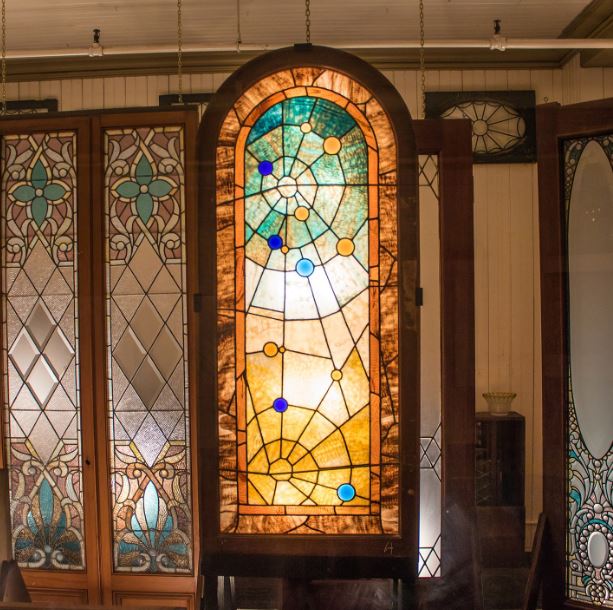
It is difficult to see in hindsight what Mrs. Winchester had to do with all this, but as time went on and the estate grew, wild accusations came to be leveled, chief among which was that of Mrs. Winchester having made a pact with Satan. How else but through diabolic abetment could a mere woman exercise such power? https://winchestermysteryhouse.com/
And be sure to check out the online gift store: https://shopwinchestermysteryhouse.com/

Well, I’ve Walked These Street in a Spectacle of Wealth and Poverty

We must learn to care for our own loneliness and suffering and the loneliness and suffering of others, for within pain and isolation and loneliness one can find courage and hope and what is brave and lovely and true in life. A man who is intimate with his anger and who can express it skillfully is a man who forcefulness coexists with vulnerability and compassion, a man worthy of our trust, a man capable of deep intimacy. However, some might say that aggression is no more than a going-toward forcefulness, centered by a will to take strong action. Yet, unhealthy aggression is an intended or acted-out attack, no matter how mild or indirect it might be (as in verbal sniping). This does not mean that aggression is therefore always a bad thing, for there are times when attack is entirely appropriate, when heavy intervention is clearly called for. Another disturbing manifestation of rape happens in those instances in which a husband forces himself sexually upon his wife. This discussion begins with a lesson in history. Until recently, wife rape stood as a legal impossibility—most jurisdictions observed a marital clause through which the sanctity of marriage protected a husband from the allegation of rape. We interviewed a snowball sample of forty women who report being raped at least once by their husbands. The behavior and psychological feature of the offenders is categorized using a three-part typology. Force-only rapists used fear and intimidation to gain sexual submission. For the battering rapist, the unwanted sex act represent a simple extension of a violent physical assault upon his wife. The sadistic rapist combines physical force and perverse sexual motivations to degrade and demean his wife. There is an evolving cycle of violence and self-reflection in which the women grapple with the painful realization that they are being sexually victimized by their most intimate companion. This emotional betrayal leads to a series of emotional and behavioral countermeasures that enable the victims to compartmentalize their troubled marital relations. #RandolphHarris 1 of 19

We hope to develop a more comprehensive understanding of women’s experience of wife rape by focusing on the nature of this type of sexual violence and how women cope with it. How victims of intimate partner violence respond to the violence in their relationships has been studied by many researchers. It was found that women who are raped by their husbands are more likely than battered women to file legal charges and to try to leave their partners. However, there is no research to date that systematically documents the coping strategies of wife rape survivors. If we are to acknowledge the complexity of women’s experiences of sexual violence and the impact of that violence on their lives, women’s coping strategies must be considered. Furthermore, by exploring how women manage wife rape, we see that they are not passive victims at the time of assault nor are they passive victims in relation to the consequences of abuse. Within the lager society, wife rape is often understood as a relatively innocuous incident in which a husband wants to have sex, his wife rejects him, and he holds her down on the bed and has intercourse with her. Although a few of the women in this sample experienced this type of sexual assault, this scenario was far from the norm. Indeed, the women I interviewed described a wide range of experiences, from assaults that were relatively quick in duration and involved little physical fore to sadistic, torturous episodes that lasted for hours. I suspect that there are many other types of wife rape. Furthermore, the type of violence women experienced often changed over the course of the relationship. However, these classifications reflect how women themselves talked about their experiences of sexual violence—from being coerced to have sex when they really did not want to, to being terrorized with sadistic acts involving torture. #RandolphHarris 2 of 19

In my study, 10 of the women descried force-only rapes. Although they were all physically battered at other times during their relationship, the sexual abuse was generally not characterized by physical violence. For example, Abigail told me, “He shoved me down on the bed very forcefully, and I said, ‘What are you doing?’…No, I don’t want this.’ And there [were] n preliminaries and no tenderness. Nothing. And he entered me and it was painful and I just remember being so repulsed.” The women in the force-only category descried incidents of sexual abuse devoid of excessive physical violence. However, they talked about their fear of physical violence if they resisted their partners’ sexual advances. As Cory told me, “If I resisted, he would beat me up, so I learned not to resist and I just gave in.” Several other women in this force-only category experienced severe physical violence at other times during their relationship, and their fear of the physical repercussions is what motivated many of them not to resist their partners’ sexual advances. However, it is significant to note that these women were not freely consenting to have intercourse; they only acquired out of fear that physical violence would occur if they did not. Other women, although not freely choosing to have sex, did so out of a sense of obligation. Kayla said, “I thought I had to. Nobody ever told me I had the right to say no. I knew if it was yucky and I dreaded it, but I thought I had to do it.” Paula described her reasons: “He always wanted to have sex. He was jealous, and if he did not have sex with me every single day, that meant that I was with another guy and that was his theory. From the time I was 18, I had sex every single day for the first year we were married, and may I had 2 days off when I had my period. But we did it every day because he wanted to and I thought I had to.” #RandolphHarris 3 of 19

These women were no less upset or humiliated than other wife rape survivors, simply because these incidents were devoid of excess force. Indeed, Lisa told me that after each rape, “I was real upset and I would cry afterwards. I felt so terrible and it didn’t even bother him. He didn’t care.” Noelle, who had been raped by an acquaintance when she was a teenager, was particularly traumatized by her husband’s attack. She said, “That’s [rape] the worst thing he could have done knowing my background and knowing how I felt about the issue—it’s a violation of trust and commitment and the whole bit and compound it with knowing my background, and it was the worst thing he could have done to me.” Thus, we see that the women in this sample who experienced force-only rape suffered serious emotional consequences from being raped by their partners even though they did not suffer from excessive physical violence. All of the women in this sample experienced physical violence at some point during their relationship, and several were severely bettered by their partners. Again, this is probably the result of my sample, which was drawn largely from a battered woman’s shelter. Not all women who are raped by their partners are battered wives. However, wife rape is more likely to occur in marriages characterized by extreme physical violence. In this study, women who had been severely battered talked about common injuries, such as black eyes, broken bones, blood clots in their heads, and knife wounds. In a particularly violent incident, Nina described how her partner (who was angered by her pregnancy) dragged her into the woods, where he beat and raped her and then sued a knife to slice open her abdomen. #RandolphHarris 4 of 19

While not all of the women in my sample were subjected to such extreme forms of physical violence, about 70 percent of them experienced battering rapes at some point. For some, the physical violence regularly accompanied the sexual abuse. For example, Barbara told me, “He would fight me and then he would always rip all of my clothes off me. I don’t have hardly any clothes left because he always ripped off my clothes, and I was naked. Then he would try to lay on me and put it in. Sometimes I was able to fight him off, and I would fight like wild, and he wouldn’t be able to get it in. But usually he would [succeed in penetrating her], and he put me in the hospital a lot. He broke my nose and my jaw and cut my wrists.” For many women, like Karen, the rape followed on the heels of the physical abuse when their partners were attempting to reconcile. For example, Jen said, “He sexually assaulted me a couple of times and always after he beat me up. He would want sex, and he would actually think in his own mind that he really hadn’t done anything.” Melissa told me, “He would beat me and then take it. He would choke me. He put his elbow in my throat and choked me. He would throw anything he could get his hands on—ashtrays, or whatever, he broke my fingers and hands. He was real violent. He threw knives at me, and he would throw me naked into the street and pour cold water on me and make me stay out there in the winter…then he would make me have sex and then go and eat a sandwich. I never understood how he could do that. How can you do that to somebody?” #RandolphHarris 5 of 19

Other women in this sample experienced battering rapes frequently, but not necessarily all the time. For example, Sonya experienced both force-only rapes and battering rapes at various times in her relationship. She said, “Sometimes we would go to bed, and he would push my legs aside and force sex on me. Or he would grab my head and force me [to give him oral sex]…Other times he would beat the crap out of me in bed or hold a gun to my head to force me. The third type of wide rape, sadistic rape, was experienced by a total of hone of the women in this sample at some point in their relationships. These women characterized their experiences not only as physically violent but also as involving “perverse” acts or torture. Seven women experienced both battering rapes and sadistic rapes. However, two were always sadistically raped—for both this occurred more than 20 times during the course of their relationships. For example, Tanya was regularly choked to the point of passing out and then raped by her partner. She told me, “He was really into watching porno movies, and he tried to make me do all sorts of things. And I [didn’t] like it. He hurt my stomach so bad because I was pregnant, and he was making me do these things. I think he’s a sadist—he pulls my hair and punches me and slaps me and makes me pass out.” For several of the women in this study, bondage was a usual occurrence in their experiences of sexual violence. Lorraine, who was regularly sadistically raped, remembered, “just waking up and being tied to the bed by m arms and legs, and the things that woke me up was him touching me [vaginally] with a feather and me waking up in shock. #RandolphHarris 6 of 19

“And he had this thing about taking pictures of it all and trying to open me up [vaginally]. So he would use his fist and other objects and then make me do exercises on the toilet to tighten [my vagina] up again. The women who described sadistic incidents of sexual assault suffered particularly severe physical and emotional trauma as a result of the violence. This is likely the result of both the terroristic nature of the assaults they experienced and the great frequency with which they were raped by their partners. Aggression militates against intimacy, keeping relationships in the shallows, marooned from any significant healing and deepening. To get to the heart of aggression, to undo its armoring without stranding ourselves from our anger and capacity to take care of ourselves, is a great undertaking, at once vulnerable and empowering, made possible in part through devoting yourself to empathy, compassion, vulnerability, cultivating intimacy with your shame, fear, and anger, sympathetic joy, no name-calling, skillful anger, and having a conscious rant. Aggression is not just a matter of physiology or social conditioning, but a result of biological, psychological, and social factors operating in conjunction. We can begin with facing our aggressiveness; then unearth the anger that underlies it, developing more and more intimacy with that anger, eventually feeling deeply empowered, simultaneously vulnerable and filled with a healing courage. There is undeniable growth in such work, requiring both a keenly discerning awareness and a full “yes” to passion, bringing together heart, guts, and head in ways that sever our highest good. Some people may need to go to anger management class to deal with this aggression. #RandolphHarris 7 of 19

In the sociological study of different species of human organizations, such as political movement, professional bodies, local communities, or families, it has proved very useful to put the question of appropriate personal attachment: in what ways is the member obliged to give oneself up to the organization, and in what ways is one expected to hold oneself off from it? This questions helps us to see that the individual is known by the social bonds that hold one, and that through these bonds one is held to something that is a social entity with a boundary and a life substance of its own. In looking at behavior in social situations one finds that the same key question helps us to bring together and understand many of the scattered details of things we know about interactional activity. There is a reason, then, to view a social gathering as a little society, one that gives body to a social occasion, and to view the niceties of social conduct as the institutionalized bonds that tie us to the gathering. There is reason to move from an interactional point of view to one that derives from the study of basic social structures. A social gathering may be only a filmy pinpoint of social organization, but however minuscule it is, there is reason to examine it sociologically. When we see the gathering as something that must embody the social occasion in which it occurs, we have some added reasons for giving it weight. Persons who differ little in status within an organization may find themselves with quite different interaction obligations at a given moment; those with quite different statuses within the organization may find themselves currently cast in the same interaction role. #RandolphHarris 8 of 19

Some rules of conduct can best be studied by looking at the conduct of the Chairman of the Board; but there are other rules that can be best studied by looking at Board meetings themselves. The study of situational obligations is different from the study of social role obligations. Of course, as suggested, the individual may employ situational improprieties (and also proprieties) to say something about one’s relationship to a community, a social establishment, a kinship network, a two-person bond, and any other unit of social organization one might care to mention. We find that our little inhabitations are carefully tied into a network, that the waste products of our serious activities are worked into a pattern, and that his network and this pattern are made to carry important social functions. Surely this is a credit to the thoroughness with which our lives are pressed into the service of society. What the individual thinks of as the niceties of social conduct are in fact rules for guiding one in one’s attachment to and detachment from social gatherings, the niceties themselves providing one the idiom for manifesting this. One often follows these rules with very little thought, paying what one feels is but a small tribute to convention. However, should one be caught acting improperly, or catch others doing so, the embarrassment can be surprisingly deep. One may rationalize this response by reference to such things as the invidious class implications of uncouth acts (as when one become angered at someone for chewing gum too loudly, or for sniffing). However, underlying this is the feeling that the other has not properly given oneself up to the gathering, and, beyond the gathering itself, the social occasion. #RandolphHarris 9 of 19

More than to any family or club, more than to any class or gender, more than to an nation, the individual belongs to gatherings, and one had best show that one is a member in good standing. The ultimate penalty for breaking the riles is harsh. Just as we fill our jails with those who transgress the legal order, so we partly fill our asylums with those who act unsuitably—the first kind of institution being used to protect our lives and property; the second, to protect our gatherings and occasions. The reason much of society is in such a disarray today and because laws are not enforced and people accept bad behavior as a norm and it is becoming so outrageous that it is causing a pandemic. In reliving the years that we have suffered in despair, we often weep for all the pain and suffering we have to endure; we weep for our beautiful angles that have experienced fantastic terror. Our hearts become filled with anguish as we remember the horrible ending to our relationships. Memories of our loved ones will always remain alive and real in our hearts. They leave the deepest feelings of compassion and love in all the souls that love us so dearly. All the despair and repressed emotions will be truly revealed, as the pleasant memories as well as our tragic memories are embedded with our beings. Our loved ones are apart of us and very real in our minds. We must hold on to these experiences and allow them to enhance our lives and our understanding of other human beings. Only then will our lives have meaning and our agonies and pain not suffered in vain. By accepting and submitting to our own loneliness, new and beautiful values will be revealed. #RandolphHarris 10 of 19

What is school? School is an organization for the transmission to a certain number of prepared people of knowledge coming from the higher mind. The most essential thing in school is the knowledge that comes from higher mind. This means that schools cannot be formed arbitrarily without the participation of people who have obtained knowledge in schools. Another very important fact is the selection effected by the school, that is, the selection of students. Only people of a certain preparation and a certain level of understanding are admitted. A school cannot be open to all, it cannot even be open to many. A school is always a closed circle with the instructor in the center. Schools can be of very different levels depending on the preparation and the level of being of the students. The higher the level of the school, the greater the demands made upon the students. Why are schools necessary? Before speaking of why schools are necessary, it must be realized for whom schools are necessary, because schools are not necessary to those people who already realize the inadequacy of knowledge collected by the ordinary mind and who feel that, by themselves, with their own strength they can neither resolve the problems which surround them nor find the right way. Only such people are capable of overcoming the difficulties connected with school work and only for them are schools necessary. #RandolphHarris 11 of 19

In order to understand why schools are necessary it must be realised that the knowledge which comes from men of higher mind can be transmitted only to a very limited number of people simultaneously and with necessary observance of a whole series of definite conditions which must be well known to the instructor of the school and without which knowledge cannot be transmitted correctly. The existence of these conditions and the impossibility of doing without them explains the necessity of an organization. The transmission of knowledge demands efforts both on the part of one who receives it and on the part of one who gives it. The organization facilitates these efforts or marks them possible. These conditions cannot come by themselves. A school can only be organized according to a certain definite plan worked out and known long ago. There can be nothing arbitrary and improvised in schools. However, schools can be of different type corresponding to different ways. Different ways will be spoke of later. Can it be explained in what these conditions consist? These conditions are connected with a definite property of man’s nature, namely, that there are two sides of man which, in man’s general development, ought to develop simultaneously and in parallel: knowledge and being. People know, or think they know, what knowledge is and to a certain extent they understand the relativity of knowledge. However, they do not know what being is and they do not understand the relativity of being and the fact that knowledge depends on being. #RandolphHarris 12 of 19

Meanwhile the development of knowledge without corresponding development of being or development of knowledge gives wrong results. Schools are necessary in order to avoid such one-sided development and the undesirable results connected with it. The conditions of school teaching are such that form the very first steps work progress simultaneously along two lines, along the line of knowledge and along the line of being. From the first day at school a man begins to study mechanicalness and to struggle against mechanicalness in himself, against involuntary actions, against unnecessary talk, against imagination, against day-dreaming and against sleep. It is explained to one that one’s knowledge depends on one’s being. In making one step along the line of knowledge a man must make a step along the line of being. The principles of school work, all the demands made upon one, the rules which one must remember, all help one to study one’s being and work to change it. Why is knowledge necessary? The aim of a man who realizes his state and his position becomes a change of being. This change is so difficult that it would, in fact, be impossible if knowledge was not there to help one. Can a change of being, that is, the attainment of a certain level of being, give knowledge? No, it cannot. Knowledge and being express two sides of man’s nature which can develop and grow, but they require different effort for their development. On what does understanding depend, on knowledge or being? Neither knowledge nor being separately can give right understanding. The reason for this is that understanding is the resultant of knowledge and being. A growth of understanding is possible only with a simultaneous growth of knowledge and being. If one outgrows the other too much, understanding cannot develop in the right direction. #RandolphHarris 13 of 19

A perspective view of the ages covered by the history given in Bible records shows that the rise in spiritual power of the people of God was marked by the recognition of the existence of demoniacal hosts of evil. When the Church of God in the old and new dispensations was at the highest point of spiritual power, its leaders recognized, and drastically dealt with, the invisible forces of Satan; and when it was at the lowest, they were ignored or allowed to have free course among the people. The reality of the existence of wicked spirits by whom Satan, their prince, carries out his wok in the fallen World of men cannot be more strongly proved than by the fact that the statutes given by God to Moses on the fiery mount embodies stringent measures for dealing with the attempts of evil spirit-beings to gain power over the people of God. Moses was instructed by God to keep the camp od Israel free from their inroads by the drastic penalty of death for all who had dealings with them (Lev. 20.27). The very fact of God thus giving statutes in connection with such a subject, and the extreme penalty to be enforced for disobedience to His laws, shows in itself the existence of evil spirits, their wickedness, their ability to communicate with and influence human beings, and the necessity for uncompromising hostility to them and their works. God would not legislate about dangers which had no real existence, nor would He command the extreme penalty of death if the contact of people with evil spirit-beings of the unseen World did not necessitate such drastic dealings. The severity of the penalty obviously implies, also, that the leaders of Israel must have been given acute ability for “discerning of spirits,” so sure and so clear that they could have no doubt in deciding cases brought before them. #RandolphHarris 14 of 19

While Moses and Joshua lived and enforced the strong measures decreed by God to keep His people free from the inroads of satanic power, Israel remined in allegiance to God—at the highest point of its history; but when these leaders died, the nation sank into darkness, brought about by evil spirit-powers drawing the people into idolatry and sin. The condition of the nation in later years rose or fell because of allegiance to God, or like where America currently is, idolatrous worship of spirits (see Judges 2.19, 1 King 14.22-24; compare 2 Chron. 33.1-5, 34.1-7), and all the sins resulting therefrom. For what actually is idolatry but the worship of demons in place of God (1 Corinthians 10.20). When the new dispensation opens with the advent of Christ, we find that God-Man recognizing the existence of the satanic powers of evil and manifesting uncompromising hostility toward them and their works. As with Moses in the Old Testament, so was the abhorrence by Christ in the New. Moses was the man who knew God face to face; Christ was the Only Begotten Son of the Father, sent expressly from God to the World of men. And each definitely recognized the existence of Satan and other evil spirit-beings; each drastically dealt with them as entering and possessing men; and each waged war against them, as actively opposed to God. Taking a perspective view, from the time of Christ on throughout the early history of the Church and up to the giving of the Apocalypse and the death of the Apostle John, the manifested power of God worked among His people, and the leaders recognized and dealt with the spirits of evil. This period corresponded to the Mosaic period in the old dispensation. #RandolphHarris 15 of 19

The revolutionists’ media strategy–what Mr. Ceausescu was not alone in missing were the strategic ways in which First Wave, Second Wave, and Third Wave communications can sometimes be combined or opposed to one another. A good example is provided by religion. One of the biggest gainers from the 1989 revolutions in Eastern Europe had been the Catholic Church, long suppressed but never destroyed by the communist regimes. The church, as suggested above, was itself a mass medium, long before today’s Jim Bakkers and Jimmy Swaggerts hit the Protestant televangelical circuit, and long before Pat Roberston built so large a TV following that he was able to mount a campaign for the presidency of the United States of America. The church wields power in the World today partly because of its moral influence and economic resources, but also because it continues to serve as a mass medium. Able to reach numberless millions every Sunday morning, it makes the audience for some of the World’s top-rated television shows seem small indeed. Of course, it communicates with its members the other six days of the week as well, and in today’s World the church makes use of newspapers, online articles, magazines, and other media in support of its face-to-face communications. So long as the Catholic Church—or any other organized religion—can gather enormous flocks, and thus reach a mass audience, no government can ignore it. Some governments, as we know, have tried to extirpate the church (which is almost impossible). Others have tried peddling a substitute religion based on nationalism, Marxism, or some other doctrine. Still others compromise and try to co-opt the church. #RandolphHarris 16 of 19

In totalitarian states the existence of an unco-opted or unsuppressed mass medium in the hands of the church is a constant threat, for there is always the danger that this channel will be made available to the political opposition. This accounts for the ferocity with which communist states tried to kill off the church or to buy it off when that proved impossible. The recognition that organized religion, whatever else it might be, is also a mass medium helps to explain many recent shifts or power. It helps explain why, so often in history, in countries as different as Iran under the Shah or South Korea under Chun Doo Hwan, economic and other popular discontents are channeled into religious movements. In Iran, of course, this canalization of protest into a religious form led to the overthrow of the Shah’s secular regime. In South Korea it led to a spectacular growth of Christianity, both Catholic and Protestant. In both countries organized religion took the place of, or merged with, a political opposition. Ironically, the more successfully a totalitarian government censors and controls all the other media of expression, the more important the church medium becomes as a potential vehicle for dissidence. It may be the only way to express opposition to regime. However, when the church opens its “channel” and expresses popular resentment from the pulpit, the medium alters the message, and the protest, which may originate in hunger or other material grievances, is recast in religious terms. This explains why movements that start out fighting for goals having little to do with religion, per se, become transmuted into religious crusades. #RandolphHarris 17 of 19

In Iran, the Ayatollah Khomeini fused class resentment and nationalist rage with religious fervor. Love of Allah + hatred of imperialism + anticapitalism = a triple-charged brand of fanaticism that turned the Middle East into a tinderbox. However, Khomeini did more than combine these three elements into a single passion. He also combined First Wave media—face-to—face exhortation by his mullahs to the faithful—with Third Wave technology—audio tapes with political messages, smuggled into the mosques, where they were played and duplicated on cheap tape recorders. To counter Khomeini, the Shah used the Second Wave media—press, radio, and television. Once Khomeini managed to overthrow the Shah and take control of the state, he also took command of these centralized Second Wave media as well. This strategy of using First and Third Wave media to combat those who control Second Wave media is common among revolutionary movements, and was even more conspicuous in China during the pro-democracy protests of 1989. The old men in Beijing who trembled when Mr. Ceausescu fell in Bucharest underestimated the power of this strategy. This will hurt you more than it hurts me. When a strategic bargainer observes that a better outside opportunity translates into a better share in a bargain, one will look for strategic moves that improve one’s outside opportunities. Moreover, one will notice that what matters is one’s outside opportunity relative to that of one’s rival. Even if one makes a commitment or a threat that lowers both parties’ outside opportunities, one will also do better in the bargaining, so long as that of the rival is damaged more severely. #RandolphHarris 18 of 19
In our example, when the union members could earn $300 a day on the outside while the management could make a profit of $500 a day using substitute employees for labor, the result of the bargaining was $400 for the union and $600 for the management. Now suppose the union members give up $100 a day of outside income to intensify their picketing, and thus reduce the management’s profit by $200 a day. Then the bargaining process gives the union a starting point of $200 ($300 minus $100) and the management $300 ($500 minus $200). The two starting points add up to $500, and the remaining $500 of daily profit from regular operation of the hotel is split equally between them. Therefore the union gets $450 and the management gets $550. The union’s threat of hurting both (but hurting the management more) had earned it an extra $50. The major league baseball players used just such a tactic in their wage negotiations in 1980. They went on stike during the exhibition season, returned to work at the start of the regular season, and threatened to strike again starting on Memorial Day weekend. To see how this “hurt the team owners more,” note that during the exhibition season the players got no salaries, while the owners earned revenue from vacationers and locals. During the regular season the players got the same salary each week. For the owner, the gate and television revenues are low initially and rise substantially during and after the Memorial Day weekend. Therefore the loss of the owners relative to that of the players was highest during the exhibition season and again starting Memorial Day weekend. It seems the players knew the right strategy. The owners gave in just before the second half of the threatened baseball strike. However, the first half actually occurred. Our theory of looking ahead and reasoning back is clearly incomplete. Why is it that agreements are not always reached before any damage is done—why are there strikes? #RandolphHarris 19 of 19


Many People are Prepared to Dismiss the Occult World

There was no one downstairs, though the oil lamps were burning. A tall antique-case clock with a mahogany surround stood in the alcove beneath the sweep of the stairs. I looked up at the mottled ivory-colored face, at the slim Roman numerals and delicate black hands. There was a whirring of the mechanism inside the case, then a high-pitched carillon started to chime. I know I had taken my time, but even so, I was surprised that it was eight o’clock already. There was a deep nocturnal silence in the house, in which five caretakers were presumably coming and going about their work. It was certainly strange. I looked out the window, hoping to see someone crossing the court or coming alone the drive. However, no one was in sight, and the rain was still falling, with a business-like regularity, muffling the outer World in layers on layers of thick white liquid velvet, and intensifying the silence within. A noiseless World—were people so sure tht absence of noise was what they wanted? Let them first try a lonely December in a mansion this size! My heart began to hammer. Luckily there was a chair near the fireplace. I sat down to recover my strength—or was it my courage? Astrid the caretaker slept in the nearest wind. It occurred to me that by looking from the window of a neighbouring bathroom I could see the kitchen chimney. There ought to be smoke coming from it at this hour; and if there were, I would be less afraid to go on. I got as far as the front parlor and looking through the window I could see there was no smoke coming from the chimney. My sense of loneliness grew more acute. #RandolphHarris 1 of 9

Whatever had happened below stairs must have happened before the morning’s work had begun. The cook had not time to light the fire, the other caretakers had not yet begun their rounds. I was struggling against my fears. If I carried on my investigations, what next would I discover? I walked along the passage, and rested my hand on a radiator. It was stone-cold. Yet in my well-ordered house during the winter, the central heating was never allowed to go out, and by eight in the morning mellow warmth typically pervaded the rooms. The icy chill of the pipes startled me. No matter, I will just have the carpenters remove this fancy new technology and go back to using the 47 fireplaces. It was Mr. Hansen who looked after the heating—he was too involved in the mystery, whatever it was, as well as the house caretakers. At Astrid’s door, I paused and knocked. I expected no answer, and there was none. I opened the door and went in. The room was very dark and cold. But what frightened me was no so much its emptiness as its air of scrupulous and undisturbed order. There was no sign of anyone having lately dressed in it—or undressed the night before. And the bed had not been slept in. The woman was out, then; had gone out, no doubt, the night before, since the bed was unslept in, the dressing and washing appliances untouched. Astrid never set foot out of the house after dark. I could not believe she had deserted the house on a cold rainy night, while her mistress lay upstairs, suffering and helpless! #RandolphHarris 2 of 9

Why had she gone, and where had she gone? When she was undressing me the night before, taking my orders, trying to make me comfortable, was she already planning this mysterious and dreadful occurred? I took a few deep breaths to steady my nerves. Held in a spell, filling my head with images, with emotions, that had long been absent my eyes filled with tears. My home had suddenly become the scene of virtually indescribable horrors and life-altering (and life-ending) event. Sadly, as I walked into the hallway, I saw wounded bodies laying desperately wounded. Wounded, shattered men and boys by the hundreds were strung about the mansion. The sounds of soft lead being driven into bone made a shattering sound, there were tiny bone fragments. Hundreds of torn bodies pouring into every in of my home. Blood covered doctors were sweating over several hundred filthy bodies with their guts torn open. Sticky gore flung in my sinks, and my morning room transformed into a mourning room, roped-offed for those who had been hit in the head. My former happy, joyous home had morphed into a hospital and cemetery. Suddenly, a choir singing. The reverberation of the plainsong in the upper echelons of the cathedral ceilings of the Grand Ball Room. As I made my way though the hall, time stopped many times. I noticed a lady who looked like Astrid and was on the point of waving when she vanished right before my eyes. A ghost of a man with a bright lantern appeared. He felt neighbourly and hovered in the hallway. He suddenly darted at me. I was absolutely frozen stiff until the light sailed out of sight. #RandolphHarris 3 of 9

As I looked out the window, I could see human tibia, fibula, femur and radius, rings and cuff buttons were scattered on the emerald green lawns. My mansion was filled with groans and sighs and tremors. It was possibly more fearful than the 1906 Earthquake which woke me from my slumber. That was also a strange morning. In the cupola, figures of men—sentinels, paced back in forth, and hovered above the estate and the observational tower shortly after midnight. I always thought the Earthquake was caused by these sentry-spirits, now haunting my mansion, acting out the horrors of the war. In fact, for several night in a row, prior to the Earthquake, I saw a man on the cupola, frantically waving his arms. He was there three nights in a row. He stood, dressed in a blue coat and white pants, looking very pale, within the cupola, waving his hoary arms, back and forth. I called out to him, but he would not answer—just waving motion, back and forth, back and forth. Was he, rapped in more important duties, too busy to answer? Or what he trying to warn me? The thin veil between this life and the next one was sending me messages. And, one evening, there was witnessed an even more bizarre and unexplainable devotion to my estate. Astrid and I had just finished having tea on the 3rd floor. We entered the elevator to take us to the first floor. The lighted numerals in the elevator displayed their descent: “3…2…1…” and continued past the first floor. Absent-mindedly, I pushed the button for the first floor again, wondering why the elevator had not stopped, or perhaps, who in the basement had summoned the elevator. #RandolphHarris 4 of 9

The elevator stopped at the basement level. The doors opened to reveal not the area once cleaned up for storage, but a scene out of time and reason, the blood-stained doctors and orderlies of nearly half a century before, again performing their abhorrent and hideous tasks of slicing sinew and sawing bone and suturing artery and vein and tying ligaments; of carrying armloads of severed limbs to grisly, blood-dampened corners and dumping them there unceremoniously. We have fallen into a ghastly frozen moment, being held captive witness to the scene. One of the harried doctors turned toward us and began to look beseechingly into our eyes for help with the never-ending work, or perhaps for help to find some way out of the subterranean scene where he himself would not be heled in forced incarceration for eternity. As he took a step towards us, finally, slowly, the doors began to close. This latest encounter was a continuation. My mansion echoed with the cries and moans of torn men and boys. All of this tension and blood shed because many leaders were heavily involved in companies that raced to establish claims to millions of acres of western land. The Emancipation Proclamation was but another example of the war’s surprising consequences. On July 3, General Lee sent three divisions, about 15,000 men in all, against the Union center. The assault, known as Pickett’s Charge, was as futile as it was gallant. At 700 yards, the Union artillery opened fire. Pickett’s division just seemed to melt away in the blue musketry smoke which now covered my estate. Ghosts of soldiers straggling to my home, all these years later. #RandolphHarris 5 of 9

Tracing its origins back to 1849, Winchester was the World’s oldest maker of lever-action repeating firearms in the World. I believe Winchester Rifles had been in the Civil War. Thousands of men and horses, dying, stripped and saddle and bridle were killed during the battle of Antietam. That is a reason this estate is also haunted by demonic horses. The Civil War put more men in the field than any previous engagement. On the morning of April 12, 1906, at 5.13 a.m., trapped in the Daisy Bedroom, I gazed out my window and could see a steady stream of men covered with mud, soaked through with rain…pouring irregularly, without any semblance of order, up 13 Palm Drive toward my home. I perceived they belonged to different regiments…mingled pell-mell together…a pale young man who looked exhausted to death and who had lost his sword appeared in my room and rescued me. Then he said, “I know I’m going home. I’ve had enough of fighting to last my lifetime.” More and more the cold unanswering silence of the house weighed me down. I had never thought of it as a big house, even though it had 600 rooms and expanded more than 250,000 square feet, but now, in this devastating moment, it seemed immense, and full of ominous corners around which I dared not look. Every step that I took was increasingly painful; but after being freed from my room, I walked slowly the whole length of the passage, and went down the front stair. I did not know why I did this; but at the moment I was past reasoning, and had to obey my instinct. #RandolphHarris 6 of 9

More than once I explored the ground floor alone in the small hours, in search of unwonted midnight noises; but now it was not the idea of the noises that frightened me, but that inexorable and hostile silence, the sense that my mansion had retained in full daylight its nocturnal mystery, and was watching me as I was watching it; in entering those empty orderly rooms, I might be disturbing some unseen confabulation on which beings of flesh-and-blood had better not intrude. The broad mahogany stairs were beautifully polished, and so slippery that I had to cling to the rail and let myself down tread by tread. And as I descended, the silence descended with me—heavier, denser, more absolute. I felt its just behind me, softly keeping time with mine. It has a quality that I had never been aware of in any other silence, as though it were not merely an absence of sound, a thin barrier between the ear and the surging murmur of life just beyond, but an impenetrable substance made out of the World-wide cessation of all life and all movement. Yest, that is what laid a chill on me: the feeling that there was no limit to the silence. I was lost in time. There was no outer margin, nothing beyond this day. I had reached the foot of the stairs and was limping across the hall to the drawing room. What I found there, I was sure, would be mute and lifeless; but what would it be? The bodies of my dead caretakers, mown down by some attack that shook my mansion for day and days? And, was it my turn next—what if it were waiting for me behind the heavy drapes of the room I was about to enter? #RandolphHarris 7 of 9

Well, I must find out—I must face whatever lay in wait. Not impelled by bravery—the last drop of courage had oozed out of me—but because anything, anything was better than to remain shut up in this house amongst debris, though most of the room were undamaged. “I must find out, I must find out,” I repeated to myself in a sort of meaningless singsong. The cold outer light flooded the drawing room. The shutters had not been closed, nor the curtain drawn. I looked about me. The room was empty, and every chair in its usual place. My armchair was pushed up by the chimney, and the cold hearth was piled with the ashes of the fire at which I had warmed myself before start on my ill-fated walk. Even my empty tea cup stood on the table near the armchair. It was evident that the caretakers had not been in the room since the explosion. And suddenly, an orb materialized, moved about, split into twin spheres, and re-formed in front of me. I was astounded. Then, candlesticks roe in midair and fell to the floor. A lead ball struck me on the chest but it did not harm me. The sound of footsteps began to pad about the room, and my tea cup jumped off the table and shattered against the floor. A hat was floating teasingly in front of me. The hat led me on a merry chase before it finally dropped at my feet. I was so exhausted from what seemed like months of sleep deprivation. I found a bed to lay in and gets some rest. As I drifted into a deep sleep, I was rudely awakened by a large quantity of water being dumped in my face. #RandolphHarris 8 of 9

May people are prepared to dismiss the occult World as insignificant and ignore the possibility that there could well be an element of truth in certain of the allegations. This “otherworld” has never been far beneath the surface in the Winchester Mansion. The gods are everywhere, not only in the garden, where they might take the forms of living creatures, but in the mansion as well. Communication with the otherworld was therefore relatively for Mrs. Winchester and her warps through time and space. The human mind has consciousness that occupies a position between two Worlds: the material and the spiritual. At any time, the spiritual might intrude; it could also be summoned at will, demons and all. The Winchester Mansion operated with many skirmishes with the estate’s sorcerers. The pagan demons were not prepared to go quietly. Some of them were heroes. In Mrs. Winchester’s day, surviving manuscripts suggest that she received extraordinary visions. Mrs. Winchester saw angels who battled demons for possession of her soul. Good triumphed, but not before the saint, Mrs. Winchester, had a vision of the fires of hell. On her return to consciousness, her caretakers observed that she had developed actual burn marks over much of her body—scars that shortly after disappeared. On her death 5 September 1923, her body lay unburied for thirty-eight days and was visited by thousands of pilgrims. Many of whom claimed that Mrs. Winchester showed no decay. #RandolphHarris 9 of 9

A werewolf is typically seen as a noble and honorable warrior. They are of a royal class in their species. Legend had it that Mrs. Winchester had a pack of vicious werewolf guarding her estate. After the death of Mrs. Winchester, a Bloodline Blade with a birch handle and silver blade. The knife had been passed down for a millennium in her family, and was sold at auction. Too bad. It was a priceless artifact and carried withing it the soul of a divine wolf.

I conjure thee, Spirits of the Winchester Mansion, by the great living God, the Sovereign Creator of all things, to please appear under comely human forms, without noise and without terror, to answer truly all questions we shall ask three. Hereunto I conjure thee by the virtue of these Holy and Sacred Names, O SURMY, DELMUSAN, ATALSLOYM, CHURUSIHOA, MELANY, OMOT, and VERMIAS. https://winchestermysteryhouse.com/

And be sure to check out the online gift store: https://shopwinchestermysteryhouse.com/

Have I Been Blind, Have I Been Lost Inside Myself and My Own Mind?

It is common to equate being aggressive with being manly, and—in many circles—to assign this a beneficial connotation. Men who appear far from aggressive may be subjected to slurs, or made fun of for such apparent weakness, as exemplified by referring to them as females. One of the most interesting aspects of group sexual assault is that it is an aggressive group activity, implying that the discussion of motivation must take into the fact that there is, in some sense, an audience and that something is being shared. While studying convicted rapists’ accounts of the rewards of rape, with particular attention to the responses of gang rapists, who were mostly in their late teens or early twenties, a motive was confirmed. In the “Good Old Boys Sociability groups” (GOBS), men who maintained a group affiliation from adolescence into adulthood, provided a helpful picture of the activities of middle-class “gangs.” The most common description of the rewards of rape by the incarcerated gang rapists fell into the category of recreation and adventure. For these men, fun and trouble enjoy a symbiotic relationship as sociability themes. One activity that fits this description is fooling around with a “bad woman.” A bad woman is defined as any woman who is not the wife or girlfriend of a member. A unique reward of gang rape described by the respondents is the camaraderie among the men. It is believed that some men prefer gang rape to solitary rape because they a pack mentality. #RandolphHarris 1 of 21

Also, when someone is of a different culture, seen as an enemy, or does not share a common language, the offenders are able to detach from the victim by not seeing the individual as a human being and this make them feel they are doing no harm. It also provides a motive for sharing the rape with friends. Fellowship, and cooperation are seen as unique benefits of gang rape. However, the offenders who call their victims animals may have fantasies of bestiality. In group situations, as previously mentioned, fun and trouble go hand-in-hand, so are competition and camaraderie intertwined in some male sociability groups. A primary motive in group sexual assault, especially for group leaders, is to sustain an image with the group. Participation seems to stem in part from indebtedness to or emotional dependency on the leader. In part, then, participation in a group sexual assault is motivated by the relationship among the men, for the purpose of maintaining or creating images and roles within the group. Certainly, providing a woman to the group, as in several of the documented campus cases where a college student offered his date to his friends, falls in the category of motives related to intragroup acceptance. An intriguing possibility to consider is does an outsider intensify the competition and need to create a masculine image? It appears that part of the appeal is the shared experience with one’s buddies. Earlier studies of gang rape posited that the men were latent homosexuals and sharing the woman was a way of sharing sex. The men are sharing in a homosexual experience. #RandolphHarris 2 of 21

That does day something about their social and emotional relationships with their own gender, but does not in itself inform us that they would rather have sex with each other. Men do not rape women out of sexual desire for other men, but they may rape women, in part, as a way to relate to men. Much like two men robbing a store together: they are not covertly expressing a desire to rob each other. One motive that should not be overlooked in this age group, however, is simply the opportunity to have heterosexual intercourse. One offender who was interviewed had been involved in 20-30 group rapes. He stated that he had participated in gang rapes because his driver’s license had been revoked, depriving him of the opportunity to take women out alone. A college student interviewed about his participation in a “train” during Spring break in Florida seemed to be delighted by the unusual sexual availability of college women. He did not know the other men, thus apparently relations among the men played little or no role in his participation. A related enticement of group rape for young men who are unable to make relationships with women on their own is that it allows for sexual intercourse without responsibility toward the sexual partner. Solitary rapists sometimes seek reassurance from their victims that they were also sexually satisfied and believed that a reward of group rape was that on individual has to be concerned about or related to the woman. #RandolphHarris 3 of 21

However, there is also a new trend amongst college age males, who are generally 18-28. They are living in houses with large groups of men, and they have group sex. Most times it is consensual because other men want to be part of the group, and they are able to backout at any time because there are so many guys participating and enjoy that no one is held hostage, but the interesting phenomena is that these young man do not fit the stereotype of a homosexual male. They have no overt homosexual tendencies other than the fact that they like to have sex with other men. If you met one of them, you would not even suspect that they were gay. It could be as homosexuality is becoming more accepted, more men are willing to have homosexual relationships, but they may not be homosexual. It could just be a way for them to get through college or life without being accused of rape. Men tend to be more free about their sexuality and if they are in a group where they already know what is considered the dominant culture, they know what to expect. So it is not like they are being tricked into having sex. It is just an unwritten rule about their house that that is what they do. They often times do not use protection because there is no risk of pregnancy, so as long as no one goes outside of the house for pleasures of the flesh, they do not have to worry about diseases or viruses. And sometimes there is also financial compensation. Many of these young men are able to afford jumbo sized homes together and luxury cars, and they have healthy bank accounts. Can afford to buy high end clothes and dine at fancy restaurants. #RandolphHarris 4 of 21
This social group thee young men form may help some of them pay their way through college or give them the funding they will need later in life to start a business. And all they need to do is be skinny, or slightly muscular and have an average to attractive face. Nonetheless, you will also notice that homosexual men, especially the ones who do not fit the stereotype, are very secretive about their relations. If you are not one of them, you probably will not know what they do on their free time. They also may date women, and some may not. But you still have like these masculine athletic jocks nowadays who are openly in relationship with other men, who often times look like their twin or brother. This could be a healthy form of narcissism. (Not the I am promoting this lifestyle, I think abstinence is best, but in most cases, they are not hurting anyone and earning a living legally.) It is well-established that individuals are more aggressive in groups than they would be when acting alone. Such group processes are probably what participants in group sexual assaults and their defenders have in mind when they attempt to deflect blame by explaining, “Things got out of hand” (a several “enlightened” male students have confided to me about group sexual assaults). Three factors identified by social psychologists to explain why groups are so easily ignited to aggression can be applied to gang rape. An individual in a group is less likely to behave altruistically and more likely to harm others than if the same individual were alone. One reason for these tendencies is that responsibility for the welfare of a victim is diluted by the presence of others, who share the blame. The term diffusion of responsibility is applied to situations in which the presence of others acting in a similar fashion diminishes the feeling of responsibility any individual feels for the harmful consequences of his or her own behavior. #RandolphHarris 5 of 21

A slightly different concept, deindividuation, refers to a state of loss of self-awareness, including awareness of one’s beliefs, attitudes, and self-standards. (In contrast, diffusion of responsibility does not entail forgetting oneself or what one considers proper behavior, but only feeling it is not one’s job to uphold these standards all alone. Deindividuation connotes irrationality.) This loss of self is sometimes encouraged to promote group spirit, as in a pep rally, or to facilitate behavior that is otherwise unacceptable. For examples, soldiers’ uniforms are deindividuating that they remove signs of individuality and are thought to make it easier for them to adopt the alien role of defender. Alcohol promotes deindividuation by allowing escapes from one’s conscience and self-consciousness. Group cohesion and loyalty can produce deindividuation by substituting a group identity, with a group history and mores, for individual identities with unique, personal histories and beliefs. Hierarchical or status seeking behavior can start at a very young age, supported by whatever aggression can be mustered—and by authority figure and social rewards. In a group setting, particularly when a group identity produces conformity, modeling of aggression also occurs. Not only would watching peers rape and sodomize a woman indicate the appropriateness of such behavior, it would also demonstrate how it is done. There was an incident in which up to forty fraternity brothers raped and sexually humiliated a woman who was developmentally disabled. #RandolphHarris 6 of 21

Many view aggression not as innate, but as a disposition fueled and governed by personal and cultural condition. According to the social learning theory, aggression is a self-serving learned behavior: we assume we need or deserve something, and we find that we can get it—and sometimes even more—through being aggressive, whether directly or indirectly (as when we manipulate another into acting out our aggression). The students’ behavior can be attributed to group membership, illustrating how diffusion or responsibility, deindividuation, and modeling might come together to render a grotesque act not only tolerable but pleasurable: Who can doubt that these same young men would…have had considerable qualms about doing these things to a woman by themselves? They would probably have felt that what they were doing was perverse and shameful. It was the presence of other men that made the act acceptable; in fact, it was probably the presence of the other men that made it attractive…it was the sort of appeal that baiting a dog, or watching a hanging holds. The aggressive man, the alpha male, the violence-delivering hero, the mesomorphic bare-chested hulk with the big guns, the tough guy who kills with barely a blink of his narrowed eyes, the ruthless moneymaker—all of these, in various combinations, infiltrate a boy’s consciousness, however peripherally, implanting the notion that a man is primarily here to fight, however bloodless his battles may be. #RandolphHarris 7 of 21

Functional mental disorders are instances of sickness similar in certain ways to the sickness exhibited by a paretic is partly based on the fact that in many cases it is extremely difficult to discover from behavior alone whether an individual patient is suffering from an organic or functional psychosis. The assumption seems to be that the misbehavior or organically diseased patients is thoroughly symptomatic, and that if functionals exhibit these behaviors, too, it can at least be said of them that they are conducting themselves symptomatically. How a psychogenically-based disorder can give rise to a whole pattern of behavior similar to that seen in organic cases is not explained. However, in terms of the sociology of situations, surely this happy coincidence between organic and functional behavioral symptoms is only to be expected. Whatever the diverse grounds—social or organic—of deviance, there is usually only one set of situational rules that apply within a given situation. And if eventful deviation is to be perceived, whether this deviation is called a symptom or not, it is just these rules that must be broken. Take, for example, the form of possession called “were” of the Shango cult in Trinidad: Finally, a form of possession known as “were” occurs with some frequency. Individuals in this state are considered “messengers of the powers.” Were possession is a half-way state between full possession and normal behavior, and a high degree of consciousness is retained. It is marked by disobeying ceremonial regulations by such acts as smoking, swearing, or mocking sacred places by spitting on the tombs of the powers. #RandolphHarris 8 of 21

The behavior becomes extremely childish: the possessed may speak with a marked lisp, wet or soil oneself, and use vulgar oneself, and use vulgar language and gestures. One is treated tolerantly by onlookers, as one might treat a naughty but loved child. One person in this state maintained that he had just landed from “New York Thity” and that his plane was parked outside the gate. He cordially invited all available females to examine the side of the plane with him (evoking gales of hysterical laughter from all present). It is possible to view this kind of conduct as a form of transitory psychosis, but the more we learn about the qualifications required for engaging in this behavior, and the community position of those qualitied, the more we appreciate that the same vocabulary of improprieties must be relied upon regardless of the reasons and meaning of deviation. (This lesson, of course, has been taught by Freudian psychiatrist themselves, in their theory if not in their practice, in connection with the notion that a psychotic symptom can be a defense, and can be altered radically without changing the underlying psychopathology, while at the same time similar symptoms may be exhibited by persons of quite dissimilar psychopathology.) Here, paradoxically, the comparative approach has perhaps done us some disservice. Psychiatrists visiting foreign countries often find the culture utterly strange and the language very difficult to understand. However, often, too, the find the behavior of local mental patients perfectly familiar; once they are on a native back ward the visitors find themselves at home. #RandolphHarris 9 of 21

Since they similarly find themselves in a familiar territory when looking in on a foreign operating room or observing native case of measles, the tendency is to assume that what mental patient have is a medical kind of culture-free disorder. Here, however, the possibility might be entertained that some of the same rules of situational propriety may be to social gatherings in many different cultures. To the degree cultural uniformities, there are internationally recognized improprieties, and psychiatrist are in fact at home anywhere in the World. The culmination of the rising tide of these deceiving spirits sweeping upon the Church is described by the Apostle Paul in his second letter to the Thessalonians, where he speaks of the manifestation of someone who will, eventually, have so deceived Christendom as to have gained an entrance into the very sanctuary of God; so that “he sitteth in the sanctuary of God, setting himself forth as God.” The bearing of this one will be a “presence” like God, and yet “according to the working of Satan, with all power, and signs, and wonders of falsehood, and with all deceit…” (2 Thess. 2.4, 9-10). Confirmation of our Lord’s words recorded by Matthew is found in the revelation given by Him to John on Patmos, that at the close of the age the main weapon used by the deceiver for obtaining power over the people of the Earth will be supernatural signs from Heaven, when a counterfeit “lamb” will do “great signs,” and even “make fire come down out of Heaven” to deceive the dwellers on the Earth, thereby exercising such control over the whole World that “no man shall be able to buy or sell, save he that hath the mark of the beast” (Rev. 13.11-17). Through this supernatural deception, the full purpose of the deceiving hierarchy of Satan reaches its consummation in the foretold World-wide authority. #RandolphHarris 10 of 21

Deception of the World with deepening darkness, including deception of the Church through arcane “teachings” and “manifestations,” will reach the highest floodtide climax at the close of the age. It is striking to note that John, the apostle who was chosen to transmit the Apocalypse to the Church in preparation for the last days of the Church militant, should be the one who wrote to the Christians of his say, “Believe not every spirit…” (1 John 4.1-6). He earnestly warned his “children” that the “spirit of antichrist” and the “spirit of error” (deception) was already actively at work among them. Their attitude was to be “believe not”—id est, to doubt every supernatural teaching and teacher until proved to be of God. They were to prove the “teachings,” lest they came from a “spirit of error” and where part of the deceiver’s campaign as “antichrist,” id est, against Christ. If this attitude of neutrality and doubt toward supernatural teachings was needed in the days of the Apostle John—some fifty-seven years after Pentecost—how much more is it needed in “later times” foretold by the Lord, and by the Apostle Paul. Times which were to be characterized by a clamor of voices of “prophets”: that is—in the language of the twenty-first century—“speakers” and “teachers” using the sacred name of the Lord; and when “teachings” received supernaturally from the spiritual realm would abound—“teachings” accompanied with such wonderful proofs of their “divine” origin as to perplex even the most faithful of the Lord’s people, and even, for a time, to DECEIVE some of them. #RandolphHarris 11 of 21

One moment someone’s hand is warm in yours and then they are gone. The door closed between you and that individual and one was taken away. Shut off in another one, the person left behind will feel a cold vacancy. Alone, silent and still, waiting the long loneliness. The terror and dread from being away from the one you love increases and grips one’s heart. People do not know what life is like without their soulmate. They envision only vague, empty images from their mind. One thing may be clear, your being in the World brought them a unique value into their life as it has for many others. When you depart, often your other half has no idea what life will be like—alone, facing the painful intimacy of a broken heart. Always before you two were together. You faced your sufferings together. They often wonder in that final moment when you walk away, who will they be? As they listen to approaching footsteps approach in the hall, your loved one wonders “Where are you?” and “What is happening in the moment?” as they do not see you coming home. All they see is new faces, cars, dogs, and cats. All of it comes together in horror and he or she closes the door. Waiting, trying to feel some hope. Will you come soon? Will your face tell me the ordeal is over? Hardly a night passes when they have not awakened to the depth of suffering. In these days, your loved one pauses momentarily and stops and stares. In crowded streets, they feel your hurt. And in the morning sun the pain is continuous. Yet through it all you have maintained a loving place in their heart, a gentle spirit, and your strength has encouraged other to go on living. #RandolphHarris 12 of 21

Your loved believes if you return to their life, there will be no more pain, only tenderness and life. As one listens for the sounds that will bring you back, this is one’s fervent hope—that fear and anguish and the break up are finished and will never again hover over them again. The practice of stopping thoughts helps self-remembering very much. Struggle with imagination and with mechanical talk with oneself or with people is necessary from the very beginning. However, one will get still stronger help for self-remembering from sacrificing one’s suffering. Only this can make the work on consciousness real and serious. Before this, all is only preparation for it. The work on emotions as the work on consciousness mut be practical from the beginning. It begins with the struggle against the expression of negative emotions. When a certain control is acquired and when you fully understand all evil sides of negative emotions in your own life and in life in general, you must make a plan for your personal work on identification, imagination and lying in those particular forms which they take in you. In this work you must not be afraid to hurt yourself. Understand that only by hurting yourself can you get what you want. You can do this by observing rules. For instance, by saying something about yourself or about other people that you do not want to say, but when you are told to do so. Also, you can produce a very emotional state in yourself by preparing yourself to speak in this way, by imagining yourself being told to speak the truth on the most difficult and intimate subjects which you think are quite hidden or disguised. #RandolphHarris 13 of 20

Realize also, that there are many other kinds of suffering through which you will pass before you attain your aim. Try to understand that suffering is the only active principle in us which can be converted into higher feeling—which is also higher thought and higher understanding. Do not be afraid of thinking of your emotions and finding contradictions in them, even if it hurts you. Only if your work hard enough and are not afraid of hurting yourself by comparing different emotions referring to the same subject, can you find buffers in yourself and eventually destroy them. Remember that this will lead you to the awakening of conscience, which is the simultaneous feeling of all contradictory emotions; and remember that the awakening of conscience is a necessary step for transferring yourself to the higher level of consciousness. Practice removing identification and imagination from negative emotions without destroying them. You may get quite unexpected and very interesting results. Learn to transform emotions into mental attitudes and to transfer them to the mind. Many emotions which are quite useless and even harmful in emotional center, because they cannot exist there without identification and imagination, become quite useful as mental attitudes and help self-observation, observation of other people and generally understanding. Try to go through all your emotions during all the time you have been connected with the system, emotions referring to the system itself, to me, to yourself and to other people in this work. #RandolphHarris 14 of 21

Try to be sincere with yourself. See how you have always tried to profit by your being in the work; for instance, by using the particular intimacy that establishes itself between people in the work, owing to common psychological study and the disappearance of many buffers, for making friends in the ordinary mechanical and sentimental way, having love affairs, et cetera. See what use you have made of your connection with the work. See how you were often selfish and calculating, how little you have to the work and how much you took from it. See how much considering was in your attitudes, how many demands and how much resentment, particularly when people tried to help you. Try to see how poor was your valuation of the work and how much you missed by it. Try to see how foolish you were to express negative opinion of people who could have helped you, many of whom have disappeared already. Try to see yourself as you really are. And do not let yourself rest, do not comfort yourself with false hopes and expectations of miracles, or with decisions to act differently tomorrow. Think about life in general, think about masses of blind and sleeping people without any chance in the World to become anything else. Think about yourself, realize how many opportunities you had and how many you have already lost. Think about death. You do not know how much time remains to you. #RandolphHarris 15 of 21

And remember that if you do not become different, everything will be repeated again, all foolish blunders, all silly mistakes, all loss of time and opportunity—everything will be repeated with the exception of chance you had this time, because chance never comes in the same form. You will have to look for your chance next time. And in order to do this, you will have to remember many things, and how will you remember then if you do not remember anything now? Try to understand the work on will. You begin this work by work on mind and consciousness; work on emotions strengthens will still more, and prepares you for further efforts. However, real work on will begins with trying to understand self-will and finding examples of its manifestations in your actions. At this point come the necessity for great sincerity with yourself and the necessity for being ready to speak to me about your manifestations of self-will. Try to understand that every decision made by yourself and for yourself which can at the same time affect your work is the manifestation of self-will. In order to understand better the difference between will and self-will, learn to distinguish between mechanical and conscious. Self-will is always mechanical, will is always conscious. You must understand that even on an ordinary level there is a great difference between mechanical and conscious. In life the difference is connected with the difference between important and unimportant, but in life the difference between important and unimportant varies for different people and changes according to the change of circumstances. For people in school, “important” is always connected with the work. #RandolphHarris 16 of 21

Bargaining—a newly elected trade union leader went to his first tough bargaining session in the company boardroom. Nervous and intimidated by the setting, he blurted out his demand: “We want ten dollars an hour or else.” “Or else what?” challenged the boss. The union leader replied, “Nine dollar fifty.” Few union leaders are so quick to back down, and bosses need the threat of Japanese competition, not their own power to secure wage concessions. However, the situation poses several important questions about the bargaining process. Will there be an agreement? Will it occur amicably, or only after a strike? Who will concede and when? Who will get how much of the pie that is in the object of the haggling? To look ahead and reason back, it helps to start at a fixed point in the future, so let us think of an enterprise with a natural conclusion, such as a hotel in a summer resort. The season lasts 101 days. Each day the hotel operates, it makes a profit of $1,000. At the beginning of the season, the employees, union confront the management over wages. The union presents its demand. The management either accepts this, or rejects it and returns the next day with a counteroffer. The hotel can open only after an agreement is reached. #RandolphHarris 17 of 21

First suppose bargaining has gone on for so long that even if the next round leads to an agreement, the hotel can open for only the last day of the season. In fact bargaining will not go on that long, but because of the logic of looking ahead and reasoning back, what actually happens is governed by a thought process that starts at this logical extreme. Suppose it is the union’s turn to present its demand. At this point the management should accept anything as better than nothing. So the union can get away with the whole $1000. Now look at the day before the last, when it is the management’s turn to make an offer. It knows that the union can always reject this, let the process go on to the last day, and get $1,000. Therefore the management cannot offer any less. And the union cannot do any better than get $1,000 on the last day, so the management need not offer any more on the day before. Therefore the management’s offer at this stage is clear: of the $2,000 profit over the last two day, it asks half. Each side gets $500 per day. Next let the reasoning move back one more day. By the same logic, the union will offer the management $1,000, and ask for $2,000; this gives the union $667 per day and the management $333. We show the full process following table. #RandolphHarris 18 of 210

Each time the union makes an offer, it has an advantage, which stems from its ability to make the last all-or-nothing offer. However, the advantage gets smaller as the number of rounds increases. At the start of a season 101 days long, the two sides’ positions are almost identical: $505 versus $495. If the management were to make the last offer, or indeed if there were no rigid rules like one offer a day, alternating offers, et cetera, almost the same division would emerge. Our restrictions to alternating offers and a known finite horizon are simply devices to help us look ahead. They become innocuous when the time between offers is short and the bargaining horizon is long—in these cases, looking ahead and reasoning backward leads to a very simple and appealing rule: split the total down the middle. What is more, the agreement occurs on the very first day of the negotiation process. Because the two sides look ahead to predict the same outcome, there is no reason why they should fail to agree and jointly lose $1,000 a day. Not all instances of union-management bargaining have such a happy beginning. Breakdowns in negotiations do occur, strikes or lockouts happen, and settlements favor one side or the other. When it comes to the media, the best way to understand its power is to place today’s media revolution in historical perspective, and to distinguish clearly among three different modes of communication. #RandolphHarris 19 of 20

In highly oversimplified terms, we can say that in First Wave or agrarian societies, most communication passed mouth-to-ear and face-to-face within very small groups. In a World without newspapers, radio, or television, the only way for a message to reach a mass audience was by assembling a crowd. The crowd was, in fact, the first mass medium. A crowd may “send a message” upward to its ruler. In fact, the very size of the crowd is itself a message. However, whatever else the crowd may communicate, it also sends an identical message to all its participants. This message—which can be profoundly subversive—is simple: “You are not alone.” The crowd, therefore, has played a crucial role in history. The problem with the crowd or mob as a communications medium, however, is that it is usually ephemeral. The crowd was not the only pretechnolgical mass medium. In the West during the medieval era, the Catholic Church, because of its extensive organization, was the closet thing to a durable mass medium—and the only one able to transmit the same message to large populations across political boundaries. This unique capacity gave the Vatican immense power vis-à-vis Europe’s feuding kings and princelings. It accounts in part for the seesaw power struggles between church and state that bloodied Europe for centuries. #RandolphHarris 20 of 21

The Second Wave system of wealth creation, based on factory mass production, needed more communication at a distance and gave rise to the post office, telegraph, and telephone. However, the new factories also needed a homogeneous work force, and technologically based mass media were invented. Newspapers, magazines, movies, radio, and television, each capable of carrying the same message to millions simultaneously, became the prime instruments of massification in the industrial societies. The new Third Wave system, by contrast, reflects the needs of the emerging post-mass-production economy. Like the latest “flexible manufacturing” plants, it customizes its image products and sends different images, ideas, and symbols to closely targeted population segments, markets, age categories, professions, ethnic or life-tyle groupings. This new high diversity of message and media is necessary because the new system of wealth creation required a far more heterogeneous work force and population. The de-massification has become a key characteristic of the new media system. But this is only one aspect. #RandolphHarris 21 of 21


We know you’ve been thinking about it…

Picture your life at #Havenwood. Go on. We’ll wait. 😍 Psst…Residence 4 is one of our favorites…and Homesite #67 is ready for new owners!

Right now, #CresleighHomes is offering $60,000 in flex cash + $15,000 in included options for a limited time! Plus, our community also offers a low tax rate and Mello Roos, too! 💰

Interested? Email Havenwood@cresleigh.com today!


There is No One Who Could Help Now?

I turned away astonished to see that in the few moments we had been talking, dusk had stolen the remnants of the day. Time always did seem to pass differently in my home. As we clattered down the corridor, I glanced into the rooms where the doors stood open. All were empty. There were no sounds of conversation, of caretakers going about their duties. Mr. Hansen stopped in front of a high wooden desk at the foot of the stairs. I caught the smell of beeswax polish, a sharp reminder of the back stairs leading up to the attic of the witches cap. We walked on the staircase, until I stopped in front of a paneled door and unlocked it. “I will have the fire made up,” Mr. Hansen said. The room was bone chillingly cold, though it was clean. I lit the oil lamps from the candle, and looked around. A small writing table and chip and dale arm chair sat adjacent to the door. Straight ahead, two tall windows, floor to ceiling, filled one side of the room. On the opposite side of the room was a heavy chest of gold, covered by a lace runner. When Mr. Hansen returned, I said, “Dearest Jim, will you please open that chest, there is something inside of it for you and your family.” Mr. Hansen eagerly walk over to the chest, and his eyes lit up like a new born baby having his first birthday cake. “Go ahead, Mr. Hansen, it is for you.” “No, Mrs. Winchester; I can well believe it. But this is a treasure I can live on for years. Only you must tell me how I can repay you…In a hundred years I could never do enough for you,” he said. #RandolphHarris 1 of 7

Well, that word went to my heart; but for a minute I did not know how to answer. For it was true I had risked my soul, and that was something he could not pay me for; but then maybe I had saved his, in getting him away from those foul people, so the whole business was more of a puzzle to me than ever. However, then I had thought that made me easier. Mr. Hansen went on to explain to me, “Well, Mrs. Winchester, the day before yesterday, I was with my young son; the poor young man, without health or hope, lying sick in a mean rooming house. Until now, I had no way to know how I would care for him.” Mrs. Winchester sat up in bed in a flutter of pity. “Oh, Mrs. Hansen, how dreadful! Why did you never tell me? You must hire a better room for him at once. Has he a doctor? Has he a nurse? Quick—give me my checkbook!” “Thank you, Mrs. Winchester. But you have already given me a king’s ransom.” When I got back to my room after a long, hot soak in the bath, a fire was burning in the grate, releasing an aroma of pine resin into the room. The smell snapped at my heartstrings, taking me back to New Haven winters when William was home from work. I gazed into the fire awhile longer, happy in my own company. I sometimes wondered if some of those grizzled old souls were able to make the journey from New Haven to Santa Clara. My home seemed to add so much to the ambience of the area. However, unlike the Earth, this huge estate seemed to need people within it to survive. That is one of many reasons my construction project went on so long. #RandolphHarris 2 of 7

Have you ever noticed how houses, as long as they have someone occupying them, no matter how little maintenance is done, always hold up better than houses that are abandoned? Houses, like a body which the soul has abandoned, deteriorate more rapidly when on one resides within. One evening in the cooling fall of the year, Mr. Hansen and his wife left the caretaker’s house on the estate for a social function. The son of Mr. Hansen was home alone. He was in the basement which was used as a recreation room. It was getting late and her was expecting his parents any minute. Sure enough, he heard footsteps on the floor above his head. They traveled across the living room and into the dining room and back again. He thought it unusual that his father and mother would be in the house walking around for nearly a minute and not call him. He walked to the stairs that led from the basement to the first floor and called out, “Daddy?” The only answer was the sound of footsteps crossing the room and beginning to ascend the stairs to the second floor. “Daddy?” he called again. With still no answer, he began to slowly climb the stairs from the basement to the first floor. He could hear what he was convinced was an intruder walking through the bedrooms just above his head, apparently looking for something valuable. The footsteps crossed the second floor just above his head and began approaching the stairs and descend to the first floor. He rushed into the basement again. #RandolphHarris 3 of 7
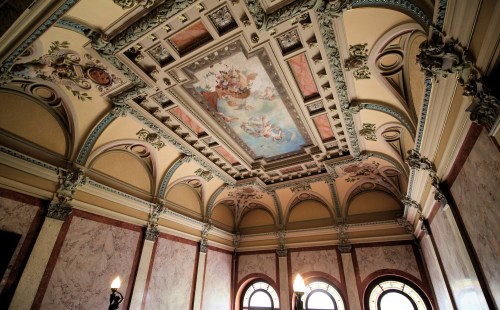
Wanting to run but not wanting to run into whoever it was who prowled above his head, he could only wait in icy apprehension for his parents. As he waited, the intruder stalked the floor above him, apparently not interested in valuables, seeking something known only to him. His wanderings became more aimless. First to the kitchen, then back to the living room, then the dining room—pacing…pacing—to perhaps peer out a window at the fruit orchard. The ancient floorboards that once soaked up blood of those killed by the Winchester rifle, groaned with the wandering footfall of an apparently lost intruder. Slowly the footsteps approached the cellar steps…he swore he heard him put a foot on the top step. Ghosts supposedly went out of fashion when electric light came in. What nonsense! The supernatural were always around on my estate. My very mansion was patrolled by headless victims with clanking chains, and even though it was a comfortable house with an ice box and 47 fireplaces where you feel, as soon as you are in it, that there is something wrong, it sends chills down your spine! It is certainly a lovely, airy, high-ceilinged house with electricity, but I knew we were dealing with something that was invisible and could not be seen—something that was very malevolent. I often saw a boy with glowing eyes near the 7-11 staircase. But here I belonged and here I would stay. There morning had been bitter, with a driving sleet—though it was only the last day of October—but after lunch a watery sun showed for a while through banked-up wooly cloud and tempted me out. #RandolphHarris 4 of 7

I was an energetic walker, and given, at that season, to walking about the beautiful grounds. I made my usual round, and was following the path back to the mansion when I overtook a plainly-dressed woman walking in the same direction. When I caught up with the intruder, I was surprised to find she was a stranger. It was almost dark, and the woman’s face was hardly visible, but this woman was middle-aged, plain and rather pale. I greeted her, and then added: “You are going to my house?” “Yes, ma’am,” the woman answered, in a voice that the Connecticut Valley in the old days would have called “foreign.” I could not say where she came from. What struck me as queer was that I did not know her. I asked the woman, politely, what she wanted, and the woman answered: “Only to see Annie.” The answer was natural enough, but there was no one by that name on my estate. I turned off from the drive to the lower part of the gardens, so that I saw no more of the visitor then or afterward. And, in fact, half hour later something happened which put the stranger entirely out of my mind. I approached my house, slipped on a froze puddle, turned my ankle and lay suddenly helpless. Elroy, the butler, and Ersula the housemaid, knew exactly what to do. In no had me stretched out on a lounge, and Dr. Parker had been notified. When he arrived, he ordered me to bed, and did the necessary examining and bandaging, and shook his head over my ankle, which he feared was fractured. #RandolphHarris 5 of 7
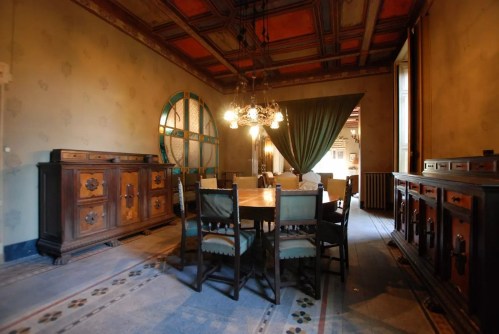
Concerned about how I would get around my estate, as I was laying in bed, the spirit gave me an idea of building mini stairs that rose only two inches, so I could make it around, until I healed without being bound in plaster. From that night on, there was an appearance of ghost, who would manifest in front yard, walk up to the house and enter it, and interact with me. My home brought me deeper and deeper into a mysterious territory whose boundaries I had never before dream of transgressing. Ghosts often took shape right before my eyes. They would start off as tendrils and grow into glowing, mistlike things. Turning into orbs, the figures would grow larger and denser and began to assume a humanlike form. One evening, I extended my hand into the mist, and could feel its cold interior. Such a bold act may have been considered very rude by the entity, as the glowing image suddenly vanished. There were plenty of vibrations in my mansion to tune into. The place was drenched with psychic vibrations. In my Blue Séance Room is where the glowing lights and ethereal broadcast were received well enough that caretakers were aware of their presence. They would morph into columns of light about the height of a man and make their trek out of the room. One night Ersula reported seeing ghostly face looking through the window at her one night. The ghost then chased her hands away from the cows during an evening milking. The following morning, it was about nine o’clock before I admitted to myself that something uncommonly strange must have happened in the house. Mysterious things—dreadful things—were associated with darkness; and the wholesome prosaic daylight had not come to banish there. #RandolphHarris 6 of 7

I conjure thee, O Spirit Pheynix, and your 20 Legions of Spirits, by all the most glorious and efficacious Names of the Great and Incomparable Lord the God of Hosts, come quickly and without delay, from whatsoever part of the World thou art in; make rational answers to our demands; please come visibly, speak affably, speak intelligibly to our understanding. We conjure and constrain thee, O Spirit Pheynix and your 20 Legions of Spirits, as also by these seven other Names wherewith Solomon bound thee and thy fellows in the brazen vessel, to wit, ADONAI, PRERAI, TETRAGRAMMATON, ANEX-HEXETON, INESSENSATOAL, PATHUMATON, and ITEMON; do thou manifest in the Winchester Mansion, fully our will in all things that they may seem good to us. Come, therefore, in the Holy Names ADONAI, ZEBAOTH, AMIORAM, come, ADONAI commands thee. Please grants us your powers and virtues by the powers and virtues, and by the name PRIMEMATUM, which commands the whose host of Heaven. Do thou force and compel the Spirit of Sarah L. Winchester here before to return to her mansion, in a fair and comely shape, without injury to herself or any creature, that she many continue to expand and make her estate thrive, so that she accomplished her desired end, whatsoever it be, provided that it is proper to her office, by the power of God, EL, who hath created and doth dispose of all things, celestial, aerial, terrestrial, and infernal. Please appear and make the sweet perfumes, give good entertainment. May all the Company of Heaven, the Sun, the Moon, the Stars, the Light of Hosts of Heaven guide you back to your estate by the power of TETRAGRAMMATON, ANEXHEXETON, PRIMEMATUM. So bless it be. #RandolphHarris 7 of 7
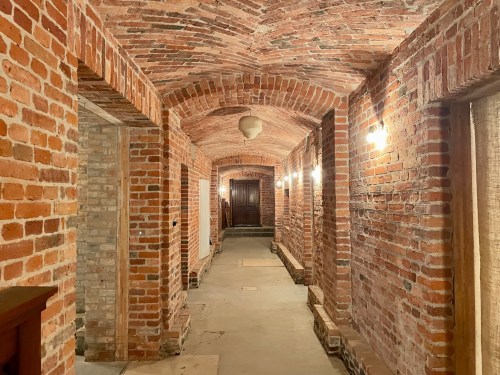
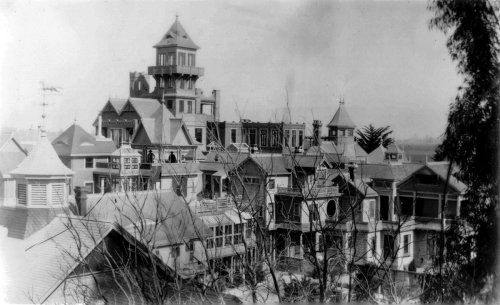
If such peculiar manifestations as orbs and ghosts should be as intelligent as their actions often indicate, just what are they and what is their purpose? We have folklore that is at least 2,000 years old that equates these mysterious globes of light with spirits of the dead and with those beings we label nature spirits—the Devas, the elves, and the fairies. The manipulation of glowing balls of light as a means of transportation may even be employed by angelic beings and spirit guides. Indeed, these benevolent beings may take form as ghosts of light before fully materializing in our dimension. These orbs seen in the Winchester Mansion are intelligent and may be able to manifest a physical appearance that is most compatible with the level of understanding of each individual witness.
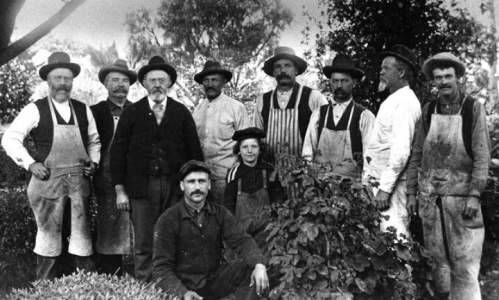
These were Mrs. Winchester’s carpenters on the estate. One of these gentleman has been spotted inside the house by both guests and tour guides for decades! He is usually seen fixing the fireplaces and rolling around his wheelbarrow in the basement. Can you guess which one he is? https://winchestermysteryhouse.com/ 👻

And be sure to check out the Online Gift Store: https://shopwinchestermysteryhouse.com/

Well, I’ve Walked these Streets, a Virtual Stage, it Seemed to Me

The soul is threatened by modern life. And if an emotional problem presents itself, the real issue may not be some single trauma or troubled relationship. Maybe the issue is a life set up in such a way that soul is neglected habitually. Culture is a factor in rape, but the precise nature of the relationship between culture and sexual violence remains a topic of discussion. Ethnographic data from pre-industrial societies show the existence of rape-free cultures, though explanations for the phenomena differ. We can relate sexual violence to contempt for the female qualities and suggest that rape is a part of a culture of violence and an expression of male dominance. However, it has also be argued that in pre-industrial societies women are more likely to lack important life options and to be physically and politically oppressed where they lack economic power relative to men. Furthermore, in pre-industrial societies relative economic power enables women to win some immunity from men’s use of force against them. Among modern societies, the frequency of rape varies dramatically, and the United States of America is among the most rape-prone of all. The rate of reported rape and attempted rape for the United States of America is eighteen times higher than the corresponding rate for England and Wales. Spurred by the Woman’s Movement, feminists have generated an impressive body of theory regarding the cultural etiology of rape in the United States of America. Representative of the feminist view called rape “The All American Crime.” #RandolphHarris 1 of 15

The feminist perspective views rape as an act of violence and social control which functions to “keep women in their place.” Feminists see rape as an extension of normative male behavior, the result of conformity or overconformitty to the values and prerogatives which define the traditional male gender role. That is, traditional socialization encourages males to associate power, dominance, strength, virility, and superiority with masculinity, and submissiveness, passivity, weakness, and inferiority with masculinity, and submissiveness, passivity, weakness, and inferiority with femininity. Furthermore, males are taught to have expectations about their level of sexual needs and expectations for corresponding female accessibility which function to justify forcing sexual access. The justification for forced sexual access is buttressed by legal, social, and religious definitions of women as male property and sex as an exchange of goods. Socialization prepares women to be “legitimate” victims and men to be potential offenders. The United States of America has some form of a rape culture because both genders are socialized to regard male aggression as a natural and normal part of sexual intercourse. However, society is also set up where women suffer greatly if the husband is arrested. Married women will lose more than half, if not all the financial support they have, and unmarried women will no longer receive their alimony checks because a man in jail or prison cannot work. The way to overcome that is to teach women the importance of education and make sure they have careers where they can afford to fully support themselves. A husband should just be a supplement, not your main source of income. #RandolphHarris 2 of 15

Feminists view pornography as an important element in a larger system of sexual violence; they see pornography as an expression of a rape-probe culture where women are seen as objects available for use by men. However, I argue that with the frequency of disease and viruses, pornography may help some people abstain from pleasures of the flesh, as they do not want to catch an illness, nor be exposed to germs or bacteria, nor deal with fracture emotions. And by using pornography as a form of gratification, it could make them hold off on pleasures of the flesh. After awhile pleasures of the flesh will become so boring that one will want true love so they have something special to hold on to and not just a fleeting, meaningless encounter. However, experts disagree with me. They argue that rape is presented as part of normal male/female sexual relations, but the women, despite her terror, is always depicted as sexually aroused to the point of cooperation. In the end, she is ashamed but physically gratified. The message—women desire and enjoy rape—has more potential for damage than the image of the violence per se. Still, I believe that you have to keep in mind that most pornography does not depict rape, and more and more of adult focused films are now produced by the individuals in them and they tend to be solo videos or collaborations where people act out soft core pornographic acts, such as dancing, with friends, suggestively in their underclothes or with skin showing. So, there is a move away from the hardcore stuff that many are used to. Also, the actors are often times on social media, so the viewer can get to know them and interact with them and so there is more of a connection to the actors. #RandolphHarris 3 of 15

I communicate with some of the actors on social media because I like to see them as humans, but I do not really like their adult content. They just seem more willing to talk than others who are marketing something. And I think they like to know that someone actually cares about their brains. It can make a person want to be your friend when you are genuinely interested in their minds and character and not just their body. Nonetheless, the fusion of these themes—sex as an impersonal act, the victim’s uncontrollable orgasm, and the violent infliction of pain—is commonplace in the actual accounts of rapist. Many convicted rapists deny their crime and attempt to justify their rapes by arguing that their victim had enjoyed herself despite the use of a weapon and the inflicting of serious injuries, or even death. In fact, many argued, they had been instrumental in making her fantasy come true. The images projected in pornography contribute to a vocabulary of motive which trivializes and neutralizes rape and which might lessen the internal controls that otherwise would prevent sexually aggressive behavior. Men who rape use this culturally acquired vocabulary to justify their sexual violence. One must examine the goals that some men have learned to achieve through sexually violent means. Thus, one approach to understanding why some men rape is to shift attention from individual psychopathology to the important question of what rapists gain from sexual aggression and violence in a culture seemingly prone to rape. #RandolphHarris 4 of 15

Also, I think it is important to remember that just because a person may accept money for pleasures of the flesh does not mean that you own their body for the time you paid for. It does not mean that you can do whatever you want. And if an individual is intoxicated, even if they seem interested, it is best to stay away from them because they may not remember consenting to pleasures of the flesh and accuse you of rape in the morning. With that being said, I do not know what the law says about two adults who are both drunk and have pleasures of the flesh, but wake up in the morning feeling violated. However, I supposed it is best to learn not to drink to the point of being inebriated so you can know what it going on. Perhaps a class on “knowing your limits” is a course a lot of people would benefit from. And if a person says, “No,” or “Stop,” it is best not to go any further until they are ready or agree to the act. Often times the culturally derived excuses and justifications allow people to view their behavior as either idiosyncratic or situationally appropriate and thus it reduced their sense of moral responsibility for the actions. Having disavowed deviance, these men revealed how they had used rape to achieve a number of objectives. We find that one men used rape for revenge or punishment while, for others, it was an “added bonus”—a last minute decision made while committing another crimes. In still other cases, rape was used to gain sexual access to women who were unwilling or unavailable, and for some it was a source of power and sex without any personal feelings. Rape was also a form of recreation, a diversion or an adventure and, finally, it was something that made these men “feel good.” #RandolphHarris 5 of 15

A rapist might see his act as a legitimized form of revenge or punishment. Additionally, he asserts that the idea of “collective liability” accounts for much seemingly random violence. “Collective liability” suggests that all people in a particular category are held accountable for the conduct of each of their counterparts. Thus, the victim of a violent act may merely represent the category of individual being punished. These factors—revenge, punishment, and the collective liability of women—can be used to explain a number of rapes in our research. Several cases will illustrate the ways in which these factors combined in various types of rape. Revenge-rapes were among the most brutal and often included beatings, serious injuries and, even murder. Typically, revenge-rapes included the element of collective liability. This is, from the rapist’s perspective, the victim was a substitute for the woman they wanted to avenge. As explained elsewhere, an upsetting event, involving a woman, preceded a significant number of rapes. When they raped, these men were angry because of a perceived indiscretion, typically related to a rigid, moralistic standard of sexual conduct, which they required from “their woman” but, in most cases, did not abide by themselves. Over and over these rapists talked about using rape “to get even” with their wives or other significant women. Typically is a young man who, prior to the rape, had a violent argument with his wife over what eventually proved to be her misdiagnosed case of venereal disease (VD). She assumed the disease had been contracted through him, an accusation that infuriated him. #RandolphHarris 6 of 15

After fighting with his wife, he explained that he drove around “thinking about hurting someone.” He encountered his victim, a stranger, on the road where her car had broken down. It appears she accepted his offered ride because her car was out of commission. When she realized that her rape was pending, she called him “a son of a b”tch,” and attempted to resist. He reported flying into a rage and beating her, and he confided. “I have never felt that much anger before. If she had resisted, I would have killed her…The rape was for revenge. I didn’t have an orgasm. She was there to get my hostile feelings off on.” Although not the most common form of revenge, sexual assault continues to be used in retaliation against the victim’s male partner. In one such case, the offender, angry because the victim’s husband owned him money, went to the victim’s home to collect. He confided, “I was going to get it one way or another.” Finding the victim alone, he explained, they stated to argue about the money and, “I grabbed her and started beating the hell out of her. Then I committed the act. I knew what I was doing. I was mad. I could have stopped but I didn’t. I did it to get even with her and her husband.” When women are viewed as commodities, “In raping another man’s woman, a man may aggrandize his own manhood and concurrently reduce that of another man.” #RandolphHarris 7 of 15

Revenge-rapes often contained an element of punishment. In some cases, while the victim was not the initial object of the revenge, the intent was to punish her because of something that transpired after the decision to rape had been made or during the course of the rape itself. This was the case with a young man whose wife had recently left him. Although they were in the process of reconciliation, he remained angry and upset over the separation. The night of the rape, he met the victim and her friend in a bar where he had gone to watch a fight on TV. The two women apparently accepted a ride from him but, after taking her friends home, he drove the victim to his apartment. At his apartment, he found a note from his wife indicating she had stopped by to watch the fight with him. This increased his anger because he preferred his wife’s company. Inside his apartment, the victim allegedly remarked that she was sexually interested in his dog, which he reported, put him in a rage. In the ensuing attack, he raped and pistol-whipped the victim. Then he forced a vacuum cleaner hose, switched on suction, into her female private part, and bit her breast, severing the nipple. He stated: “I hated at the time, but I don’t know if it was her (the victim). (Who could it have been?) My wife? Even though we were getting back together, I still didn’t trust her.” During his interview, it became clear tht this offender, like many of the men, believed men have the right to discipline and punish women. In fact, he argued that most of the men he knew would also have beaten the victim because “that kind of thing (referring to the dog) is not acceptable among my friends.” #RandolphHarris 8 of 15

In some rapes, both revenge and punishment were directed at victims because they represented women who these offenders perceived as collectively responsible and liable for their problems. Rape was used “to put women in their place” and as a method of proving their “manhood” by displaying dominance over a female. For example, one multiple rapist believed his actions were related to the feelings that women though they were better off than he was. “Rape was a feeling of total dominance. Before the raped, I would always get a feeling of power and anger. I would degrade women so I could feel there was a person of less worth than me.” There is a difference between “false” teachers and deceived ones. There are many deceived ones among the most able teachers today because they do not recognize that an army of teaching spirits have come forth to deceive the people of God and that the special peril of the earnest sections of the professing Church lies in the supernatural realm, from whence the deceiving spirits with “teachings” are whispering their lies to all who are “spiritual,” id est, open to spiritual things. These “teaching spirits” with “doctrines” will make a special effort to deceive those who have to transmit doctrine and seek to mingle their teachings with truth so as to get them accepted. Every believer must test all teachers today for him or herself, by the Word of God and by their attitude to the atoning cross of Christ and other fundamental truths of the gospel, and not be misled into testing “teaching” by the character of the teacher. Good men can be deceived, and Satan needs good men to float his lies under the guise of truth. #RandolphHarris 9 of 15

I was the son of an army officer, and I went to West Point and spent seven years in a very numb and lonely existence as an army officer. It was during a time of intense loneliness that I split with my wife after ten years of marriage and I was very deeply into experiencing that tragic loss for the first time. Loneliness had been an emotion which I had always managed to outrun. I had discovered that if I did something important or impressive that people would make a fuss over me and I would not have to experience my own loneliness. Additionally, at age five, I became “man of the house” when my father left for World War II, leaving me in charge of my mother and telling me to take care of her and to “be good,” yet he did not come home for four years. I did not burden my mother and kept my loneliness literally caught up with me after having outrun it for so long, I cried deeply; I went beneath the veneer of my tough shell and found a whole new part of the essence of me—a creativity. I wrote poems and a book and painted. And more important, I discovered a little boy part of me that had grown up early—a tenderness which West Point did not exactly nourish. I find that this tender part of me, rather than the tough part, was a part my friends and I both cherish. I then discovered that rather than my toughness being my strength, as I had misconstrued it in the military, it was really my tenderness that was my strength. #RandolphHarris 10 of 15

The question of using a right attitude as a weapon against negative emotions requires understanding; it refers to our attitude to the emotions themselves, because we may have a right or a wrong attitude to our negativeness. It is different in different cases and there can be no generalization. Now we must consider the attitudes in themselves and realize that a positive attitude is right in some cases, and that a negative attitude is right in other cases. A positive attitude belongs to the part of our intellect which says “Yes” and a negative attitude to the part which says “No.” There can also be different attitudes but these are the two most important. Lack of understanding about some subject or problem may be caused simply by having a wrong attitude towards it. There are people who have a negative attitude towards everything and anything, and there are others who try to cultivate a positive attitude about things towards which they should have a negative attitude. Using the words “positive” and “negative” in the ordinary sense of approval or disapproval, we can say that in order to understand certain things we must have negative attitudes whereas other things can be understood positively. Too much of an indiscriminately positive attitude can spoil things in the same ways as a persistently negative attitude is useful because there are many things in life which can only be understood through having a sufficiently good negative attitude towards them. Certainly, identification with a negative attitude would cause negative emotion, but his can be avoided, and very often identifying is the result of a wrong attitude. #RandolphHarris 11 of 15

Paradoxical as it may seem, we have many negative emotions because we do not have a sufficiently negative attitude towards negative emotions. On the other hand, the moment you have a negative attitude towards any of the things connected with this work of development, you will cease to understand it. We must understand that we have no control, that we are machines, that everything happens to us. Simply to speak about it does not change these facts. To cease to be mechanical something else is needed. A change of attitude is necessary. Attitude can be independent of emotion, and to a certain extent it can be under our control. For instance, we have some control over our attitudes towards knowledge, towards friends, towards this work and towards self-study. Attitude is really a point of view, and if a point of view is right, there is one effect; if it is wrong, another effect. It is necessary to understand that we cannot do things, but we can change our attitudes. A right attitude may be developed gradually through the study of oneself and the study of life, in accordance with the special ways in which we study it. This study does not depend only on knowledge but upon a different way of thinking. Different thinking can only come from different attitudes and from an understanding of the relative values of things. Change of attitude does not bring about change of a man’s being by itself. Valuation is necessary. #RandolphHarris 12 of 15

It need only be noted that improprieties can, of course, occur because the individual is alienated, or wants to appear alienated, from an on-going engagement. Examples can be found during group psychotherapy sessions in mental hospitals, where patients, coerced to participate, may pointedly read magazines or play solitaire. A situational impropriety can convey to its witnesses, justifiably or not, that the actor is alienated not so much from the gathering as from one’s community, or one’s establishment, or one’s intimates, or one’s conversation. However, we must be quite clear that, no matter how distant or broad the target of an offense, the idiom in this case is first of all a means of expressing alienation from or attachment to the gathering that is present. Anything else the individual thus conveys, however much it constitutes the crucial implication of one’s act, must be superimposed upon these original situational meanings. Whatever the social unit to which the individual is concerned to indicate one’s relationship, many of the signs one must rely on will be written entirely in a situational language. Because of this tendency for the situational idiom to be made a convenience of and pressed into service as the language of relationship, it is at once more and less important than we might at first perceive. We can now come to the conclusions and to the point where the sociologist might find cause to nibble at the psychiatric hand that feeds one data. For while psychiatry forcible directs our attention to situational improprieties, there appear to be ways in which psychiatry embodies and rationalizes lay attitudes toward this aspect of conduct, instead of carrying us beyond these conceptions. #RandolphHarris 13 of 15

The problems with majority rule go beyond manipulating the outcome through control of the agenda. Even sophisticated voters who exercise foresight can collectively outsmart themselves. We tell a story that illustrates the point, freely adapting the saga of President Reagan’s nominees for the Supreme Court. Judge Bork was the first nominee. Judges Ginsberg and Kennedy were known to be high on the list, and likely to be nominated should Bork not be confirmed by the Senate. If the Senate turned down all three, the likelihood was that the seat would stay vacant for the next president to fill. Imagine that the decision rests in the hands of three powerful senators. To avoid impugning the reputation of any actual persons, we will call the three A, B, and C. Their rankings of the four possible outcomes are as follows: A’s Ranking: 1st Kennedy, 2nd Vacant, 3rd Bork, 4th Ginsberg. B’s Ranking: 1st Ginsberg, 2nd Kennedy, 3rd Vacant, 4th Bork. C’s Ranking: 1st Vacant, 2nd Bork, 3rd Ginsberg, 4th Kennedy. The first thing to observe is that leaving the seat vacant is unanimously preferred to nominating Judge Bork. Yet if these are the preferences and the senators correctly predict the order of nominations as Bork, Ginsberg, and Kennedy, the result will be that Bork is confirmed. We figure out the voting patterns by working backward up the tree. Vacant, Kennedy, Ginsberg, Bork. If the vote comes down to appointing Kennedy versus leaving the seat vacant, Kennedy will win. By looking ahead and reasoning backward the senators can predict a victory for Kennedy if Ginsberg is defeated. There, if Bork is turned down the contest becomes Ginsberg or Kennedy. In the Ginsberg versus Kennedy contest, Ginsberg wins two to one. #RandolphHarris 14 of 15

Reasoning backward again, right at the start the senators should realize that their choice is Bork or Ginsberg. Here, Bork wins two to one. Everyone is looking ahead and correctly figures out the consequences of their action. Yet they collectively end up with a candidate whose nomination, everyone agrees, is worse than leaving the seat vacant. Now in fact it did not turn out that way, and there are several reasons. No one was quite certain who the next nominee would be. Preferences changes as more information was learned about the nominees. The senators’ preferences may not have been as we represented them. Equally important, we have ignored any possibility for logrolling. This was a perfect opportunity for logrolling to arise. There were three 2.1 votes. Each of the senators was on the winning side twice and on the losing side once. The gain from each win was worth one position in their ranking, but the loss pushed them down three. It does not help to win two small battles and lose the big war. The possibility for mutual gain opens the door for logrolling, and with thee preferences we expect Bork would be defeated. The globalization of the media, necessary for the new economy, is in fact moving rapidly. When Japan’s Sony bought up Columbia Pictures Entertainment for $5 billion, acquiring Hollywood’s largest library of films, including such quality products as On the Waterfront, Lawrence of Arabia, and Kramer vs. Kramer, along with 220 movie houses and 23,000 TV episodes, it shook the entertainment industry. Sometimes shacking things up can generate more publicity and interest in a product and make it more desirable. #RandolphHarris 15 of 15


We see that glint in your eye…you’re already planning your decor scheme, aren’t you?! 😉 When you’ve got all the spacious layout of Residence 4 at #MillsStation to work with, you’ll have a chance to explore all your wildest dreams! Contact us ASAP – we’ve got homesite #105 ready for new owners! (4 Bedrooms – 3.5 Bathrooms – 2,692 sq. ft. – $715,000)

Plus we’re showing off another move-in ready home this weekend! Stop by our Open House from 10am-6pm this Saturday 4/1 and Sunday 4/2 to experience Homesite 111 – a gorgeous Residence 3 plan that boasts 2,394 square feet and an ideal location across from the community park! It also comes complete with three bedrooms, two and a half bathrooms, and a two car garage plus workshop, for starters… 😉( 3 Bedrooms – 2.5 Bathrooms – 2,364 sq. ft. – $683,000)

With accents of elegance, spacious living areas, and convenient workspaces, Cresleigh Ranch offers beautiful features that will surely capture your interest and imagination.

Come see it for yourself this weekend! Have questions? Get in touch with our sales center at 916-333-1919.
#CresleighRanch
#CresleighHomes


Angels and Demons, Gargoyles and Ghostly Apparitions
Except for William, the idea of love to me always seemed a question of submission. Of giving in to some powerful emotion, of losing control. Poor souls. However, with my beloved William, love seemed a natural thing, something one did not even need to remark upon, like breathing or raising one’s face to the sun on a summer’s day. It is no matter now, for he passed away years ago, and all I ask is to be left alone in my chair. Money has been an armor, you see; and there are few cracks in it. But William had a loving nature, if only others had show him love. He was a delicate boy when he was little, so his mother could curl him up, and put him into black velvet pants, like that boy in the book—little Lord Something. However, when his legs grew out of the pants, and they sent him to school, she said he was not her own little cuddly baby any more; and it riles a growing boy to hear himself talked about like that. It was like being pushed out of an illuminated ballroom, all flowers and chandeliers, into the winter night and snow. Yet, Mr. Winchester grew up into a fine man and that is why I married him. He used to go over and see his mother now and again; or she would come home for the holidays. And he used to take her out for lunch, or to dance at those cabaret places; and when the headwaiters adore his mother’s beauty and charm, he would talk about it for a week. For a time she used to get some comfort out of telling me about her early triumphs; and I used to listen to her patiently, taking notes on how to be a good wife and mother. You must not think of her as an unkind woman. She was friendly to her husband, and friendly to her children, but she knew she had to raise William to be tough and strong. #RandolphHarris 1 of 7

There were always people prowling about in the background that she did not like the look of; people, you understand, who live on weak people. There is nothing more I can say. Reflecting of these memories was nice. It allowed me to sleep all day and into the evening. Or, rather, I drifted in and out of twilight state. I was aware of the housemaids and the parlor maids coming and going, shapes, blurred faces, the sound of kindlin and a striking match, the maid laying a fire. I work fully only twice. First, when Ersula placed a bowl of soup and bread beside the bed and waited until I had eaten it all. The second time, when she returned to administer a second draft of the bitter white medicine, a sleeping draft or some kind of traditional remedy, I never knew and hardly cared. My skin was alternatively burning and clammy with sweat. I tossed and turned in bed, like a ship on a storm-wracked sea, plagued by dreams and delusions. Angels and demons, gargoyles and ghostly apparitions, long-since deserted friends waltzed in and out of my head. For hours, so Ersula later told me, things hung in the balance as my temperature climbed as high as the nine-story observational tower. Certainly, I oscillated between beauty and horror. A skeletal hand pushing up from beneath freshly turned Earth, blossoms dying on the bough. The back of Annie’s heads, impassive and deaf to my consoling up her upset tummy. William smiling at me, in the orchard and by the stream, but then stepping just out of reach and turning away when I called out to him. Barbed wire and mud and blood, chlorine gas, a World of unimaginable pain. #RandolphHarris 2 of 7

Nearly 175,000 men—jamming the streets and roads and field of my estate, attempting to tear each other apart, and in doing so, leaving anywhere from 44,000 to 51,000 casualties behind, to be cared for immediately after the battle by a handful of doctors, orderlies, and the servants of my estate, and my mansion metamorphosing into one vast charnel-house. To day the least, my tidy rooms, barns, and farmhouses, and Victorian gardens were overflowing with men who were seriously hurt and badly needed shelter from the elements. These horrors seemed to last for weeks. The fever broke at about three o’clock in the morning. My temperature dropped. I stopped shaking and my skin, sticky with fever, returned to normal. For the first time in hours, I was able to get out of bed. In the still and sleeping house, I could hear the whirring and chiming of the grandfather clock in the hall downstairs. A ribbon of moonlight made its way between the shutters and painted a line across the floor. I watched the moonbeams dance, slowly shifting, as the hours passed and the World continued to turn. I walked through the hallway, looking through a couple of doorways and back into the original section of the house when I noticed a fresh-countenanced young man standing and watching the goings-on with a peculiar look on his face. The more I watched him, the more I saw it was a look of wanting to come out of the Grand Ball Room. Catching his eye, I motioned for the young man to come join me for a cup of tea. He just stood there and stared, the expression on his face becoming even more painted. #RandolphHarris 3 of 7

Then it dawned on me that he was a ghost, and he was stuck in the old part of the house and could not leave the Grand Ball Room. With an understanding shrug, he turned away from the door and walked further into the room to join the other apparitions. I stood back with my eyes closed, and a quiet smile on my face. By this time, the sky was a mass of teal and fuchsia. At first it looked like a kite-flying contest, the could over my mansion obstructed by swooping streaks of color that danced on the air currents, trailing multi-hued streamers behind them. Then I heard the chirping cacophonous twittering like an orchestra of xylophones. As I looked further through the skylights, I realized that the kites’ long tails were really feathers, and they were not tethered to the ground by strings. A flock of birds, what seemed like hundreds of them, painted the air with wings the color of the rainbow, dipping and soaring on air currents visible only to them. I could barely take my eyes off the flock. I wished the birds would stay forever: They were like an elaborately painted scene on a China teacup, and their chirping filled me with the kind of inexplicable joy that I had felt as a child, climbing onto my mother’s lap and smelling the faint scent of her jasmine perfume after a long day of play. The birds, as if acting on an invisible signal from above, formed two loose lines and soared higher, heading towards Heaven. I wished I could fly with them, borne along on whatever invisible breeze they had ridden in on. The birds had stirred something powerful in me, mysterious symphony of joy and emotion. #RandolphHarris 4 of 7

It must have been some kind of European sorcery and magic. And, there seemed to be something else in the atmosphere. Around 5.45 a.m., I heard what sounded like for all the World, a small child. It came from further down the hallway, and I walked curiously down towards where the sound seemed to be coming from, the sound moved into the living room. I followed, and it kept moving and cooing at a distance of what I estimated was about six feet in front of me. As I got to the living room, the cooing baby moved on into the next room, the kitchen. I stood in the living room and rationalized for a moment. The lights from outside the mansion were spilling into the room, and it slowly occurred to me that if the baby had been playing, I would surely have seen her cross the room between the hall and the kitchen. I listened to the cute baby sounds in the next room, and a chill went down my spine. I now had no idea what I was dealing with. The cooing faded within the next moment, and I backed down the hall, ducking into the Alice in Wonderland room and, of course, there was no one in the room, but the tiny rocking chair was swaying back and forth. A few nights later, I was up in the middle of the night. I was in complete darkness. No windows in the room, no light, just darkness. Suddenly, from the area to my left, which would have been the bathtub, I heard very clearly—sharp and loud enough to make me jump—a voice shout, “Belly Ache!” The voice was that of a little girl, but there was something sweet and warm about the voice, like the voice of an angel. I pushed the button to turn on the light. Nothing. Not that I found the matter unfathomable. Quite frequently, I saw the figure of a little girl moving up and down the hall past my bedroom door during the night. She has a soft, blue glow. #RandolphHarris 5 of 7

For week, I lie awake at night, thinking this could be my beloved Annie. I waited and waited, night after night to see her again and perhaps talk with her, but she did not return. However, the bathtub faucet leaked and dripped fairly on occasion. I lay in bed, listening to the drip. It had developed a steady rhythm, as drips will. Suddenly, the rhythm changed. The drip sound changed in pitch, and it literally played a tune. It was the Highland Fairy Lullaby. The temperature in the room dropped, and I could clearly hear the sound of a little girl playing with her doll. She was singing a tuneless little song, the kind of melodic chat that was common among young children, especially little girls at play. From time to time, she would interrupt the humming of her sing-song to speak lovingly to her doll, and then she would call rather loudly to her mother that she had a tummy ache. However, there was no response from the mother, and she would return to playing with her doll and singing. I could almost see the little girl dressing her doll, combing its beautiful hair. From that night on, I would awake in the middle of the night or in the morning and hear the little girl calling for her mother. Once I had thoroughly searched the house and determined that it must be the sound of some lost and confused spirit-child, eternally singing and occasionally calling for her mother, or perhaps it was some kind of ethereal phonograph, eternally reproducing the sounds of a little girl. For some, this haunting might be considered a nightmare, but for me, it reminded me of the death of my six-week-old daughter, and it gave me hope that she was still near me, in my house growing and aging, even if she were only a spirit. I took these as signs from the spirit World and had a bird aviary constructed with exotic birds from all over the World, and invited my niece Daisy to live with me. Someone I could be a mother to. #RandolphHarris 6 of 7

I invoke, conjure, and command thee, Spirit Botis, and your 60 Legions of Spirits to bring with you power armed from the Supreme Majesty, I do strongly command thee, by BERALANENSIS, BALDACHINENSIS, PAUMACHIA, and APOLOGIAE SEDES; by the most Powerful Princes, Genii, Liachide, and Ministers of the Tartarean Abode; and by the Chief Prince of the Seat of Apologia in the Ninth Legion, I do invoke thee, and by invocating conjure thee. Magic forces, black and white, reaching out through space and light, be he far or be he near, brings us the demon Balthazar here. Ancient powers, we summon thee, we the power of three and seek your help in finding the demons who are in the Winchester Mansion. Come thou peaceably, visibly, and affably, now, and without delay, manifesting that magic running through this estate, help us see with clarity, power that we have summoned here, protect us and we will have no fear. Throne having eyes before and behind, by the fire which is about the Throne, by Holy Angels of Heaven, by the Mighty Wisdom of God; by the Seal of Basdathea, by this name PRIMEMATUM, which Moses named, and the Earth opened and swallowed Corah, Dathan, and Abiram; do thou make faithful answers unto all our demands and perform all our desires, so far as thine office shall permit. Come therefore peaceably and affably; come visibly and without delay; manifest that which we desire; speak with a clear and intelligible voice, that we may understand. TETRAGRAMMATON IEHOVAH, do I command three, at which being heard the elements are overthrown, the air is shaken, the sea runneth back, the fire is quenched, the Earth trembleth, and all the hosts of the celestials, terrestrials, and infernals do tremble together, and are troubled and confounded. Wherefore come thou, O Spirits Sarah, William, and Annie Winchester, forthwith, and without delay, from any or all parts of the World wherever thou mayest be, and make rational answers unto all things that we shall demand. #RandolphHarris 7 of 7


A thin door indeed it is between life and death: one moment young and full of future, the next lying wounded in some stranger’s house in a small farm-town, the following instant forever lost and wandering in eternity. Could it be the vital spark, the spirit of not only souls killed by the Winchester rifle, but also members of the Winchester family that still search for the youth they lost, roaming the miles of hallways in the Winchester Mansion for all of eternity? https://winchestermysteryhouse.com/

And be sure to check out the Online Gift Store: https://shopwinchestermysteryhouse.com/

Did You Know, When Go, it’s the Perfect Ending to the Bad Day I Was Just Beginning?

Aside from murder, the crimes of rape and sexual assault occur with less regularity than any other for of violent crime. In 2021, there were approximately 144,240 reported cases of rape in the United States of America. There are more than 106,010 reported cases of sexual assault. Only about half the victims of rape or attempted rape surveyed stated that the crime had been reported to the police. Two-thirds of all rapes and rape attempts occurred at night, with the largest proportion occurring between 6 p.m. and midnight. Most victims of rape or attempted rape where white and young; the ages with the highest victimization rates for rape and attempted rape were 16 to 24. More than half of all victims had never been married and most were members of low-income families. The most frightening form of rape, an assault by a total stranger, was the most common. More than 75 percent of all rapes involved one victim and one offender, and most offenders were unarmed. Most victims offered some form of resistance. The most common responses to the situation were trying to get help; resisting physically; to threatening, arguing, or reasoning with the offender; or resisting without force. The total cost of the medical expenses reported was almost $72 million. The FBI estimated that a new rape occurred every 5.8 minutes. Over a ten-year period, there were 1.5 million victims of rape. There were more than 120 million crimes committed in the United States of America in 2017 (including 24 million violent crimes), amounting to a financial impact of $2.6 trillion. #RandolphHarris 1 of 21

Given the high levels of trauma and betrayal that often accompany rape, it should come to no surprise that a considerable number of rapes go unreported to police. With only 139,815 rapes (excluding sexual assaults) being reported to law enforcement agencies in 2019, it is safe to say that this form of crime goes without official detection more often than any other type of violent offense. We know from victim reports that a little over one third (39 percent) of the persons who were raped and/or sexually assaulted in 2021 chose to inform the police about the incident. Roughly 40 percent stated that they sustained physical injuries in the attack. A study of violence-related injuries treated at hospital emergency rooms found that 63,800 rape or sexual assault received medical care that year. Nationwide, 81 percent of women and 43 percent of men reported experiencing some form of sexual harassment and/or assault in their lifetime. The highest rates of rape and sexual assault victimization are experienced in the western and southern regions of the United States of America. Slightly lower rape/sexual assault rates have traditionally existed in the Midwest and Northeast. Uniform Crime Reports data indicate that the offending rate (per 100,000 residents) for the crime of forcible rape was highest in Alaska (68.6), Delaware (67.1), New Mexico (55.1), Nevada (52.1), and Michigan (50.4). That same year, residents from Montana (17.8), Maine (18.1), West Virginia (18.7), Wisconsin (19.9), and New Jersey (20.0) exhibited the lowest offending rates. #RandolphHarris 2 of 21

Rape and sexual assault rates are clearly related to population density. There is a composite rape/sexual assault rate of 1.9 in urban environments. This figure is more than twice the victimization rates experienced in suburban and rural areas (0.9 and 0.5, respectively). Among the sixty-six cities with a population exceeding 250,000 residents, the highest rates of forcible rape (known offenses per 100,000 residents) were observed in Minneapolis (126.7), Memphis (112.8), Cleveland (101.6), Columbus (94.7), and Nashville (88). Conversely data rank New York City (22.9), Louisville (24.1), Virginia Beach (24.4), and San Francisco (25.5) as the most rape-free cities. America appears to be the violent sex crime capitol of the World. The U.S. rape rate of 36 (per 100,000 inhabitants) was more than double tht of its nearest rivals: Israel (14.3), England and Wales (14.7), and France (13.4). Moreover, U.S.A. rape rates were exponentially higher than those observed in Germany (9.6), Spain (3.2), and Japan (1.5). This raises the obvious question of why rape rates are so much higher in this country. There are four relevant theoretical perspectives of rape that is believed to provide some much needed insight in this area. First of all, gender inequality theory, a favorite of many feminists. Scholars who take this position believe that rape and the fear of rape enable men to assert their power over women and maintain the existing system of gender stratification.” #RandolphHarris 3 of 21

These rape motivations need not be an overt and malicious feature of societal gender norms. Instead, subtle forms of gender oppression, such as the objectification of women are inferior to men and are misinterpreted by some violent individuals to indicate that sexualized violence is one way of protecting their manhood. The gender equality theory of rape predicts that rape rates will be highest in patriarchal societies where women are considered to be the sexual servants of men. The advertising imagery and gender biases that limit women’s status attainment in contemporary America are held as evidence that the tenets of this theory are readily applicable to U.S.A. culture. Other feminist scholars prefer to gravitate toward the pornography theory. These scholars content that pornographic imagery depicting the domination and degradation of women sends the wrong cultural message—the images convey an implicit message that all women want sex and lead men to expect it from women. Repeated exposure to this imagery serves to reinforce and condone violet sexual behavior in men. Although the evidence of the pornography theory is inconclusive, rape rates are highest in those states that experienced the most sizeable circulation rate for adult monthly periodicals such as Playboy, Hustler, and Penthouse. Many mainstream sociologist endorse the social disorganization theory of rape. These scholars theorize that crime rates will increase as social disorganization increases and the institutional infrastructure of society breaks down. #RandolphHarris 4 of 21

Factors such as widespread poverty, the collapse of the traditional nuclear family unit, racial tension, and decreased religiosity are thought to breed a sense of alienation and desperation among the effected parties. This, in turn, produces a frustration rection. Criminal behavior in general, and rape in particular, are thus said to represent prime examples of the reaction formation concept. Clearly there is no shortage of these types of structural instabilities in contemporary American society. Rape rates are highest in those states that experience elevated levels of social disorganization as one such measure of support for the theory. The legitimation of violence theory offers a more social, psychologically oriented take on rape causation. Scholars who endorse this perspective view rape as a little more than a specialized form of violent behavior. Forms of sexual violence are said to represent a “spillover effect” in cultures that glorify or condone the use of physical problem solving. The legitimation of violence seems to work hand in hand with gender inequality to produce higher rates of sexual violence. Namely, states with a volatile mix of high gender inequality and an established culture of violence consistently experience the highest rape rates. #RandolphHarris 5 of 21

In general, violent sex crimes take shape as unskilled, technically simple acts. Victimization data indicate that nearly 70 percent of all rapes and sexual assaults are committed by someone who is known to the offender (acquaintance, intimate partner, family member). These forms of violent betrayals are referred to under the heading of acquaintance or date rape. It was found the coercion, intimidation, and brute strength—more so than weaponry or props (rope, handcuffs, tape, et cetera)—serve as the tools of the trade for the average date rapist. The term stranger rape is used to describe those acts where the offender and victim have no previous relationship. The cold and calculating nature of this rape dynamic oftentimes translates into a heightened reliance on weapons and props on the part of the offender. Victims report that weapons were present in 7.6 percent of all rapes and sexual assaults. This peril concerns every professing Christian. The prophecy of the Holy Spirit declares that (1) “some” shall fall away from the faith. (2) The reason for the fall will be a “giving heed to seducing spirits.” The nature of this working is not the promotion of obvious evil, but deception, which is a covert working. The essence of deception is that the operation is looked upon as sincere and pure. (3) The nature of the deception will be in doctrines of demons id est, the deception will be in a doctrinal sphere. (4) The way of deception will be that the “doctrines” are delivered with “hypocrisy,” id est, spoken as if true. #RandolphHarris 6 of 21

(5) Two instances of the effect of these evil spirit doctrines are given: (a) the forbidding of marriage, and (b) abstaining from meat. However, both of these common activities—marrying and the eating of meat—are, said Paul, divinely ordained—“created by God.” Therefore their prohibition is a mark of opposition to God, even in His work as Creator. Silence and reserve and isolation are often indirectly related to the way in which some communicate when they are engaged in a kind of self-consciousness and awareness that one has not known before. It is a process of inner searching that grows out of questions and issues that are confronting one at the moment. It may seem that one is interested only in finding one’s own private way, that one is looking for a life of freedom and independence but this may not be the basis of one’s loneliness. What one is searching for is a life fully rooted in truth and in authenticity, yet one is living with contradictions and dishonesty that leave one feeling helpless and alone. Sometimes people feel confused, misinformed, unreal. They may feel totally alone and keenly conscious of one’s isolation, not belonging on this Earth of normal people. For the first time, some are becoming aware of how ridiculous their values are, aware of the solitary nature of their actions. There sometimes is no other way but to become numb to the lie that was there before one, in the presence of people who do not have the guts to speak openly, whose fear of consequences is more powerful than their commitment to the truth. #RandolphHarris 7 of 21

This may cause some to suddenly walk out of their friends, after only reuniting with them for a short time. One may consider every relationship in terms of moral principles. What may begin to surface can be opposing wishes and wills glossed over and actions that challenge their dedication to honesty. If an individual feels lonely, must one pretend social interests? If one feels placid or unalive, must one feign excitement? Many everyday activities came into view. And one could develop self-consciousness, checking to determine if what one is saying and doing are consistent with what one is feeling and who one is. Everyone knows this is a painful process, not only in one’s own suffering but in the grief it brings to others. Some may trust this solitary struggle and believe that ultimately a more fully honest life with others will emerge. Is the individual searching for something that does not exist? Will one finally admit that an absolutely moral life is impossible? No one can be certain. Furthermore many on this path do not even know where one is going—only that one must retain with this struggle and let it take one where it will. These individuals are aware that something extreme is happening to one and that one is suffering because their withdrawal strikes at the heart of their relationships and their friends are unable to reach them. #RandolphHarris 8 of 21

Many deeply regret the pain their loneliness brings their loved ones and they bear something of that suffering within themselves. These individuals feel a tenderness and love for their relationships but in this search for a truthful way to live in all one’s moments must, it must take its own course before the individual will again feel the joy of life and beauty of being with others. When it comes to this search for meaning, it is necessary to repeat that first of all you must understand how wrong negative emotions are, how useless they are, and then you must understand that they cannot exist without identification. It will take you a long time to realize this, but when you have done so, you must try to divide your negative emotions into three categories. First, the more or less ordinary everyday negative emotions which happen often, and are always connected with identification. Certainly, you must observe them and you must already have a certain control over the expression of them. Then you must start dealing with them by trying not to identify, by avoiding identification as often as you can, not only in relation to these emotions but in relation to everything. If you create in yourself the capacity of not identifying, that will affect these emotions and you will notice how they begin to disappear. The second category do not appear every day. They are the more difficult, more complicated emotions depending on some mental process—suspicion, hurt feelings and many things like that. They are more difficult to conquer. #RandolphHarris 9 of 21

You candela with them by creating a right mental attitude, by thinking—not at the time when you are in the negative emotion, but in between, when you are quiet. Try to find the right attitude, the right point of view, and make it permanent. If you create right thinking, that will take all power from these negative emotions. Then there is a third category, much more intense, much more difficult, and very rare. Against them you can do nothing. These two methods—struggle with identification and creating right attitudes—do not help. When such emotions come you can do only one thing: you must try to remember yourself; to remember yourself with the help of the emotion. That will change them after some time. However, for this you have to be prepared; it is quite a special thing. It is a fact that the individual’s relationship to gatherings and social occasion sometimes tell us something about one’s relationships to broader units of social life. Thus, in Utah, the few men who did not bother to shave regularly were also the ones who refused to keep a tidy front yard, even in cases where their holdings were where visitors to the community would see the untidiness. The same individuals also declined to support the local socials in any regular way, and one of them sometimes worked on Sundays, thus showing civic as well as situational insensitivity. Similarly, in a study of urban lower-class ceremonial life, it is reported that members of the community defined “respectability” in terms of not borrowing money, not applying for unemployment assistance, and not making free with the neighbor’s front door, and that this civic decorum was reflected in situational proprieties also. #RandolphHarris 10 of 21

One of the outstanding characteristics of the respectable people is that they are “particular,” which implies that they try hard to maintain their standards in spite of all adversities and difficulties. While unemployment or other adversity enforces a limitation of expenditure, this does not, among the respectable, result in the complete abandonment of standards, for as they say, “it’s not how much you get, but what you do with it that matter.” The notion of “being particular” applies especially to children and to cleanliness. In hard times before the pandemic, the children might have had to forego school clothes shopping, but at least, the women insisted, it was clean. “Every child is rough and ready some part of the day, but you can be particular.” In another context, one informant who was commenting on the poor condition of her house, pointed out that she had at least tried to “cover up,” by putting newspaper over the fireplace and a curtain over the gap where the cupboard door should have been. “But the rough ones,” she said, “don’t even care about covering things up. You can’t help having a poor or a broken-down house, but you can help keeping it looking nice.” And certainly this tie-in between situational and other deviations is found among mental “prepatients”; an individual who ruminates all day on the sofa often turns out to be one who also offends by, for example, not keeping appointments or not bothering to put air in his car tires. #RandolphHarris 11 of 21

Further, as has already been discussed, an institutional role having its primary locus in one place may require the performer to carry marks of one’s membership wherever one goes, thereby setting one apart from the public at large, though often through no fault of one’s own. A more serious question was debated; though, according to the newspaper accounts, obliquely, when a high-level conference in Utah discussed at considerable length, whether clergymen of Church should wear laymen’s clothing publicly at any time except when playing lawn-tennis or other approved games. Here is an example of the belief, held tacitly by many people, and recently state in the case of an officer, that holds offices ought to be regarded as never off duty: that a publicly assigned role overshadows all others. There are echoes of this in the assumption in some schools, implied rather than states, that a schoolboy outside the school premises, not wearing his school cap, is—or is about to be—up to no good. In the Army, “other ranks,” but not officers, have “walking-out” dress; the implication that a pretty nurse-maid awaits the soldier is delightfully Victorian and West-end. The “civvies” of some National Service “other ranks” are carefully censored by the authorities, who justify it with understandable rationalizations about “Teddy-boys.” Where the individual employs such insignia not because of institutional regulation but because of personal election, the link between civic and situational alienation would seem to be especially evident. #RandolphHarris 12 of 21

The insignia then become a kind of proclamation of distance from the ordinary course of social life, and of some sort of skewing of relationship to the public at large. Note, for instance, the self-imposed uniform worn by members of erupting social movements, such as the early European fascist groups. Something similar is seen among sailors who express their life-experience solidarity and their alienation from land society by placing a tattoo between themselves and the appearance-proprieties of the host culture. Something of the same effect is obtained by college students and beatniks (and their fellow-travelers) who express distance from the employed adult population by a full beard, or a two-day growth, and by bedraggled clothes. And although the dress pattern of young, male urban drug users may not be collegiate, this attire, too, seems to be linked to the maintenance of expressed distance. The tabooed creature releases that usually provide evidence of insufficient situational presence seem to provide a favorite idiom for expressing some kind of disregard for broad elements of conventional society, pointing to the voluntary elaborations that can be made of acts that are supposedly involuntary. College students, for example, sometimes compete with each other in belching prowess, conveying something about their relation to the adult World in doing so. Preadolescent boys have a special game built around flatulence, which manages both to penalize the offender and to bypass civilian standards at the same time. #RandolphHarris 13 of 21

When it comes to voting, our emphasis has been on pairwise elections. In such cases there is little strategy other than whether or not to vote. If you vote, you should always vote for the candidate whom you most prefer. Because your vote matters most when it breaks a tie, you want your vote to reflect your preferences honestly. For elections with more than two alternative, the decision is both whether or not to vote and what to vote for. It is no loner true that one should always vote for one’s favorite candidate. In the 1984 Democratic party primary, supporters of Jesse Jackson had the problem of trying to send a signal with their vote. They could predict that Mr. Jackson was unlikely to win. The polls told them that Gary Hart and Walter Mondale were the clear front-runners. There was a great incentive to vote for those at the head of the pack in order not to waste one’s vote. This became an even bigger problem when there were seven candidates competing for the 1988 Democratic party presidential nomination. Supporters did not want to waste their vote or campaign contributions on a nonviable candidate. Thus polls and media characterizations that pronounced front-runners had the real potential to become self-fulfilling prophecies. There is another reason why votes may not reflect preferences. One way to help keep your vote from getting lost in the crowd is to make it stand out: take an extreme position away from the crowd. Someone who thinks that the country is too liberal could vote for a moderately conservative candidate. #RandolphHarris 14 of 21

Or one could go all the way to the extreme right and support Donald Trump. To the extent that candidates compromise by taking central positions, it may be in some voters’ interests by taking central positions, it may be in some voters’ interests to appear more extreme than they are. This tactic is effective only up to a point. If you go overboard, you are thought of as a crackpot, and the result is that your opinion is ignored. The trick is to take the most extreme stand consistent with appearing rational. To make this a little more precise, imagine that we can align all the candidates on a 0 to 100 scale of liberal to conservative. The Young Spartacus League is way on the left, around), while Donald Trump takes the most conservative stance, somewhere near 100. Voters express their preference by picking some point along the spectrum. Suppose the winner of the election is the candidate whose position is the average of all voters’ positions. The way you might think of this happenings is that through negotiations and compromises, the leading candidate’s position is chosen to reflect the average position of the electorate. The parallel in bargaining is to settle disputes by offering to “split the different.” Consider yourself a middle-of-the-roader: if it were in your hands, you would prefer a candidate who stands at the position 50 on our scale. However, it may turn out that the country is a bit more conservative than that. Without you, the average is 60. For concreteness, you are one of a hundred voters polled to determine the average position. #RandolphHarris 15 of 21

If you state your actual preference, the candidate will move to [99 x 60 + 50]/100 = 59.9. If, instead, you exaggerate and claim to want 0, then final outcome will be at 59.4. By exaggerating your claim, you are six times as effective as effective in influencing the candidate’s position. Here, extremism in the defense of liberalism is no vice. Of course, you will not be the only one doing this. All those more liberal than 60 will be claiming to be at 0, while those more conservative will be arguing for 100. In the end, everyone will appear to be polarized, although the candidate will still take some central position. The extent of the compromise will depend on the relative numbers pushing in each direction. The problem with this averaging approach is that it tries to take into account both intensity and direction of preferences. People have an incentive to tell the truth about direction but exaggerate when it comes to intensity. The same problem arises with “split the difference”: if that is the rile for settling disputes, everyone will begin with an extreme position. One solution to this problem dates back to the twenties and Columbia University economist Harold Hotelling. Instead of taking the mean or average position, the candidate chooses the median position, the platform where there are exactly as many voters who want the candidate to move left as to move right. Unlike the mean, the median position does not depend on the intensity of the voters’ preference, only their preferred direction. To find the median point, a candidate could start at 0 and keep moving to the right as long as a majority supports this change. At the median, the support for any further rightward move is exactly balanced by the equal number of voters who prefer a shift left. #RandolphHarris 16 of 21

When a candidate adopts the media position, no voter has an incentive to distort her preferences. Why? There are only three cases to consider: (i) a voter to the left of the median, (ii) a voter exactly at the median, and (iii) a voter to the right of the median. In the first case, exaggerating preferences leftward does not alter the median, and therefore the position adopted, at all. The only way that this voter can change the outcome is to support a move rightward. However, this is exactly counter to one’s interest. In the second case, the voter’s ideal position is being adopted anyway, and there is nothing to gain by a distortion of preferences. The third case parallels the first. Moving more to the right has no effect on the median, whole voting for a move left is counter to the voter’s interests. The way the argument was phrased suggested that the voter knows the median point for the voting population, and whether one is to the right or the left of it. Yet the incentive to tell the truth had nothing to do with which of those outcomes occurred. You can think about all three of the above cases as possibilities and then realize that whichever outcome materializes, the voter will want to reveal one’s position honestly. The advantage of the rule that adopts the median position is that no voter has an incentive to distort one’s preferences; truthful voting is the dominant strategy for everyone. The only problem with adopting the median voter’s position is its limited applicability. This option is available only when everything can be reduced to a one-dimensional choice, as in liberal versus conservative. However, not all issues are so easily classified. One’s voters’ preferences are more than one-dimensional, there will not be a median. At that point, the possibility of manipulating the system becomes real. #RandolphHarris 17 of 21

The main producers of imagery until recently were the major broadcast networks. Today, in the United States of America, where de-massification is most advanced, their power is plummeting. Where ABC, NBC, and CBS once stood virtually alone, there are now seventy-two national services of various kinds, with more coming online and streaming services, which offer cool programs not shown on TV and with more leeway in their scripts and content. A new crop of networks serving “niche” markets and digital stream are big news. And on cable there is comedy network, consumer business news network, and a science-fiction network. In addition, Channel One pipes programs into school classrooms, and National College Television uses satellite to target special programs to university students. Cable of some type is available in nearly 90 percent of American homes. The average cable user has more than fifty channels to choose from and that will soon be up to seventy five. In a small town like Rochester, Minnesota, viewers can choose from more then sixty different channels offering a wide range of material, from the Black Entertainment Network and programs in Spanish, to specialized medical training programs aimed at the larger medical community around the famed Mayo Clinic. Cable was the first to begin fractionalzing the mass audience. Videocassette and direct broadcast satellite (delivering signals not only to cable stations but into the home itself) fractionalize the fractions. Thus videocassette offers viewers a choice of thousands of movies and programs. And recently four major companies banded together to deliver 108 channels of standard and high-definition TV to American viewers by shooting signals from the World’s most powerful commercial satellite to “napkin-size” receiver dishes in the home.” #RandolphHarris 18 of 21

Furthermore, the number of stations operating independently of the three big networks has quadrupled since the late 1970s. Many have formed themselves into syndicates or temporary groupings that compete with the majors for top-rated programming. The impact of all these de-massifying forces on the once-mighty networks has been a little short of catastrophic. The key words in all this are choice and alternative. It is what people did not have back in 1980. It is what they do have today. However, these are precisely what the main stream networks were designed to prevent. For CBS, ABC, and NBC were Second Wave smokestack companies, accustomed to dealing with masses, not heterogenous micro-markets, and are having as much difficulty adapting to the post-smokestack Third Wave economy as are interest rates and wages. A measure of the networks’ concern was the decision of NBC to join in the direct broadcasting satellite venture. Wonder what will happen to the Big Three? Well, once upon a time there were three big radio networks too. Today hardly anyone even remembered they existed. Adjusting to nanotechnology is also something we are going to have to deal with, so the World is rapidly changing. People within existing organizations can nudge them toward evaluating nanotechnology and molecular manufacturing. A good start is to introduce others in the organization to the concepts, and talk through some of their implications. Follow-up activities will depend on the group, its resources, and its purposes. #RandolphHarris 19 of 21

For the time being, drafting of new regulations, lobbying of Congress, and the like all seem premature. Getting nanotechnology into the planning process, though, seems overdue. We invite existing organizations with concerns regarding medicine, the economy, the environment, and other issues of public policy to put nanotechnology on their agendas, and to join in debating and ultimately implementing sensible policies. Some groups are doing relevant research work. Many could bias their choice of projects to favor goals in the direction of molecular systems engineering. For nanotechnology to be taken really seriously, some research group will have to build a reasonably capable molecular manipulator or a primitive assembler. This will require an interdisciplinary team, years of work, and a total cost unlikely to exceed one tenth that of a single U.S.A. Space Shuttle. Other researchers can help by providing further theoretical studies of what advanced molecular manufacturing and nanotechnology will make possible. These studies can help groups know what to anticipate in their planning. Some scientists and engineers will want to steer their careers into the field of nanotechnology. More students will want to study a combination of physics, chemistry, and engineering that will prepare them to contribute. We encourage people of common sense and goodwill to become involved in developing nanotechnology. For those who have—or can gain—the necessary technical backgrounds, becoming involved with its development is an excellent way to influence how it is used. For better or for worse, technical experts in a field have a disproportionate influence over related policies. #RandolphHarris 20 of 21

During these years, there will be a growing need for grass-roots organizations aimed at public education and building a base for political action. Having a few thousand people ready to write five letters to Congress in some crucial year could make the difference between a World that works and a World destroyed by the long-term effects of a shortsighted bill. What happens will depend on what people do, and what people do will depend on what they believe. The World is overwhelmingly shaped by the state of opinion: people’s opinion about what will and will not happen, what will and will not work, what will and will not prove profitable or beneficial for themselves, for their families, for their businesses, for their communities, for the World. This state of opinion—as expressed in what people say to each other, and whether their actions conform to their words—shapes decisions day to day. During these years, it will matter greatly what people are saying to one another about the future, and how to make it work. With help from new technologies, we can renew the World—not make it perfect, not eliminate conflict, not achieve every imaginable dream, yet clear away many afflictions, both ancient and modern. With good preparation, we can perhaps even avoid creating too many new afflictions to take their place. Who is responsible for trying to bring this about? Those who want to fight poverty, to earn their share of the benefits to come, to join in a great adventure, to meet people who care about the future, to save species, to heal the Earth, to heal the sick, to be at the cutting edge, to build international cooperation, to learn about technology, to fight dangers, to change the World—not necessarily all together, or all at once. To help deal with the main problem today, lack of knowledge, you can encourage friends to read up on the subject. #RandolphHarris 21 of 21

Cresleigh Homes

Love to entertain? 💃🕺 You’ll love Residence Two at #MagnoliaStation – now selling!
This spacious single story home offers a large kitchen and working island, dining room connected through the butler’s pantry, and a large great room overlooking the ample rear yard. Plus three bedrooms, three bathrooms, and a three car garage! 😍
Sound like the perfect fit for your family? Visit our website to learn more, view interactive floor plans, and get in touch today!
 Randolph Harris II International Institute