
Home » New Homes (Page 18)
Category Archives: New Homes

Some Mistakes Can be More Serious than a Sin

Sometimes it is not easy to tell the difference between a mistake and a sin. The boundary can be uncertain. Take the matter of the beautiful China Doll Tree in our backyard. One spring when it finally started growing again, after being cut down, the gardener thought the tree was getting too tall, he pruned it, quite severely. My brother evaluated his pruning and said it was a sin. I thought the extent of his pruning was a mistake at worst. However, I did not think this was needful of chastening and repentance. My experience with the overpruning the China Doll leads to the large category of undesirable conduct that is surely an error or mistake, and, at an extreme level, can cross over the border into transgression. When we willfully pass up an opportunity to progress toward eternal life, this is surely a mistake that should be corrected. In one way of looking at things, it is also a sin. This would apply to such things as failing to get schooling to prepare us for life, wasting our time, or failing to maintain the good grooming or to acquire the social or communication skills that would help us obtain employment or favorable consideration. Mistakes can also lead to sins. There are so many unenlightened people in the World for ignorance to take root in. The violation of social limits like curfews or missionary rules can make one vulnerable to sin. Or a mistake committed by one person can lead another person into sin in attempting to correct it. We should not conclude that a sin is always more serious than a mistake. #RandolphHarris 1 of 21
Almost all sins, large and small, can be repented of, but some serious mistakes, like driving under the influence of drugs or alcohol can lead to manslaughter and 25 years to life in prison, which is irreversible. This shows that a big mistake may have more serious permanent effects than a small transgression. Another thing about the relationship of sins and mistakes is that they can often go together. This is a serious truth. Recent victimization data suggest that crimes against property account for more than three fourths of all criminal victimizations that occur annually in the United States of America. Roughly one in every sic property crimes takes the shape as a household burglary. It takes very little to conjure up an image of a burglar crawling through and unlocked second-story window or jiminy the lock of a hotel room. This abstract imagery is reinforced by television series such as S.W.A.T, Criminal Minds, Blue Bloods, FBI, Cold Case, and Law and Order, wherein nearly every episode includes at least one call-for-service to the scene of a burglary. Americans clearly view burglary as a serious crime that carries with it a potential to disrupt the lives of the citizenry as well as overburden the criminal justice system. Laypersons have a tendency to interchange the terms robbery, burglary, and larceny. This is poor practice as there are distinct differences between these three types of crime. Robbery is an act of force or threatened force occurring during the course of a theft. The clear emphasis on physical force leads to robbery being classified as a crime of violence. Larceny is defined as a simple act of taking without force and irrespective of where the theft occurs. #RandolphHarris 2 of 21

This makes larceny a classic example of a property crime as the act is directed specifically toward depriving someone of his or her property. Burglary, on the other hand, is not so cut and dried. According to the Model Penal Code, a burglary occurs when a person enters a building or occupied structure with the purpose of committing a crime therein. There are three important components of this definition: the entry (usually referred to as breaking and entering or remaining), the dwelling, and the intent to offend while inside. Most scholarly sources (including the National Crime Victimization Survey and the Uniform Crime Reports) tacitly assume that the contents of a dwelling are the target of the crime and thus classify burglary as a property offense. However, since damage or deprivation of property need not occur, we maintain that burglary is more aptly described as a crime of intrusion or a crime against habitation. There were 2.5 million burglaries in the United States of America in 2022, which is down from 3.1 million in 2001. Our homes are our castles and burglars are aware of that. In fact, $737,294,919,165 worth of property was reported stolen in residential burglaries in 2021. The average stolen value is $3,100. On average, each break-in last eight to ten minutes, and 25 percent of these burglaries took place during the day. Americans spend over $20 billion annually on security devices and systems to protect themselves and their property. #RandolphHarris 3 of 21

Burglary represents 13 percent of total number of criminal victimizations that were reported and translates into a victimization rate of 28.7 burglaries per 1,000 household. Residential burglary—are those offenses that target homes. There are also nonresidential burglaries—those that occur in offices, stores, warehouses. Pooling of NCVS data on residential burglary and the UCR data on nonresidential burglary suggests that roughly 3.5 million burglaries (residential and nonresidential) occurred in this country during 2022. Victims of burglary routinely complain about the sense of violation and perceived invasion of privacy that goes along with having their homes burglarized. However, there are usually monetary losses that accompany the emotional trauma. A fully 87 percent of the household burglaries occurring in 2022 were said to result in a monetary loss due to theft of property damage. Where a theft is committed in conjunction with a break-in, burglars appear willing to direct their thievery toward a wide array of valuables—jewelry, household furnishings, tools, firearms and cash were among the most frequently stolen items. However, there is encouraging news about the incidence of residential burglary. Our nation’s victimization rates steadily declined, as stated above. Victimization data suggest that residential burglary rates are relatively stable across the U.S.A. South (29.7), Midwest (33.6), and West (30.2). The notable exception to this trend is seen in the Northeast, where the 2022 victimization rate was significantly lower at 18.7 per 1,000 households. #RandolphHarris 4 of 21

The states with the highest burglary rate are: Texas, Arizona, Missouri, Tennessee, and Washington. At the other end of the continuum, New Hampshire, North Dakota, Montana, South Dakota, and Pennsylvania were shown to have the lowest burglary rates. Urban areas experience the highest residential burglary rates (37.3 per 1,000 households). What is somewhat unexpected is the fact that the aggregate burglary rate for rural areas (26.7) is higher than the corresponding rate for suburban areas (24.3). Studies show that burglary patterns often vary considerably across and within suburban locales. Factors such as an effective police presence, active neighborhood watch programs, and prevention-friendly residential design (strategic landscaping and street layout) are found to have a significant impact on the level of burglary activity in a suburb. Burglary is one of the few crimes for which the United States of America fares well in comparison to other developed nations. Official reports made availably by police agencies in the United States of America establish nationwide offense rate for burglary at 862.0 per 100,000 inhabitants. By comparison, Australia (2,338.4), England and Wales (1,832.7), Germany (1,507.1), and Canada (1,155.7) experienced higher burglary rates. Lower rates were observed in countries such as France (676.9), Spain (570.2), and Japan (187.9). #RandolphHarris 5 of 21

Entry into an occupied dwelling is one of the critical components of the legal definition of burglary. Contrary to popular belief, burglars tend to be an unsophisticated lot who rely on soft targets and brute force to accomplish their crimes. Offender based research shows that a surprising number of these unlawful entries are accomplished by the burglar simply passing through an open door or window. Habitual offenders learn that they cannot always count on this type of open invitation and thus come prepared with a variety of tools and/or strategies to assist them in defeating locks, windows, and doors. This is perhaps best evidenced by the fact that roughly two thirds of known burglaries involve some form of forced entry. Forced entry is often accomplished through the use of crowbars, screwdrivers, or hammers. A burglar may also become adept at popping sliding glass doors off their tracks, identifying alarms, or efficiently defeating deadbolt locks. For the most part, however, these skills and tools are best described as rudimentary in nature. Burglary activities are shaped by a number of factors. The time of day and occupancy status of the dwelling stand as two clear examples. Law enforcement reports indicate that 60 percent of all residential burglaries occur during the day while roughly 60 percent of nonresidential burglaries take place at night. Occupancy appears to be the driving factor behind these statistics—residential dwellings are most susceptible to burglary at night when they are closed to business. #RandolphHarris 6 of 21

Burglars clearly prefer unoccupied homes or businesses, as this situation allows them more freedom to enter and exist without being detected. Residential burglars disproportionately come calling on multiunit rental properties. Multiunit dwellings are significantly more likely to be burglarized than single-family structures. In the same vein, rental properties generally experience higher victimization rates than do properties that are owned. The transience and anonymity of these types of dwellings allow the burglar to move about without being noticed. The significance of this “transience effect” is further highlighted by recent victimization reports showing that a newly occupied residence (less than 6 months) faces more than three times the risk of burglary than a home that has been occupied for 5 or more years. Residence that are occupied by young, less affluent, people not of the dominant race face the greatest risk of being burglarized. First, recent victimization data reveal a direct relationship between the age of the person who serves as the head of the household and the likelihood that the home will be burglarized. The burglary rate for homes in which the head of household is under 20 years of age (66.9) was more than 4 times that of homes in which the head of household is over the age of 65 (16.6). Victimization rates for African American-headed households (42.8) were significantly higher than for Hispanic or European American-headed households (33.0 and 26.6, respectively). #RandolphHarris 7 of 21

There also exists a clear negative relationship between burglary victimization rates and family income—homes with an annual family income of less than $7,500 experienced a burglary rate than was more than doubled that of homes with a family income in excess $75,000 (58.0 versus 22.7). A residence that has been burglarized once faces a higher risk of future victimization than a home that has never been targeted. Repeat victimization is due, in part, to repeat offending—either the offender views the dwelling as a soft target or he or she returns to obtain goods that could not be removed during the first offense. There also seems to be a “neighborhood effect” underlying repeat victimization, wherein habitual offenders prefer to travel short distances from where they live and frequent those areas with appealing physical layouts (exempli gratia, ready access to escape routes, poor lighting, minimal foot traffic). The offender-victim relationship also appears to play a role in initial and repeat burglary victimizations. Interviews with active offenders reveal that burglars sometimes target the homes of acquaintances. Existing relationships afford the offender knowledge about the layout and contents of the home as well as the daily routines of the occupants. While few offenders report ripping off their close friends or relatives, they cannot pass up a casual acquaintance’s home if it is not a soft target. Given the covert nature of the crime, we cannot rely on victimization reports to inform us about the characteristics of burglary offenders. #RandolphHarris 8 of 21

Nearly 90 percent of all arrestees for burglary were men. Almost one 33 percent of the persons arrested were under the age of 18 and roughly 60 percent were under 25. The data of offenders based on race is inconclusive. There is a group of offenders that are over represented, but they only make up 30 percent of the arrested suspect. Most burglaries take on a hit-and-run quality. Offenders claim that they try to spend as little time as possible getting in and getting out of the dwellings that they burglarize. This haste often means that broken windows, clues to their identity, and/or overlooked valuables are left behind. Once a threat-related burglary is completed, the offender is left with the task of converting the stolen goods into cash. One option has the offender serving an entrepreneurial role and selling or trading the goods (for drugs or other desired commodities). In most urban communities, there exists an underground economy. This is the informal market economy that allows thieves to sell their booty to residents (from the seediest drug dealer to the most law-abiding blue collar and professionals) who are more than happy to buy “warm” or even clearly “hot” goods is the price is right. These transactions run the gamut from a quick sale by the burglar out of the trunk of his or her car to a seasoned fence who stocks an entire warehouse or pawn shop with stolen goods. This entrepreneurial course of action requires time and effort on stolen goods. This entrepreneurial course of action requires time and effort on the part of the burglar. #RandolphHarris 9 of 21

Many offenders choose to avoid these hassles by passing the stolen goods along to a fence. A fence is an individual who specializes in the buying and selling of stolen goods. Several case studies have been published about the “life and crimes” of persons who make a living from buying and selling of stolen goods. The fence plays a role in the stolen property system. This concept refers to the various players (id est, burglary, fence, buyer) and roles (extraction, repackaging, marketing, and sale) that come together to sustain a market for stolen property. Crimes involve a deception. Deception has to do with the mind, and by definition is the result of a thought being admitted to the mind under the erroneous assumption that it is truth. Since deception is based on ignorance, and not on one’s moral character, a Christian who is “true and faithful” up to the knowledge one has is yet open to deception in the spheres where one is ignorant. We are liable to be deceived by the unenlightened because of ignorance. The thought that God will protect a believer from being deceived if one is true and faithful is in itself a deception, because it throws a man off guard, and ignores the fact that there are conditions on the part of the believer which have to be fulfilled for God’s working. God does not do anything instead of a man, but by the man’s cooperation with Him; neither does He undertake to make up for a man’s ignorance, when He has already provided knowledge for him which will prevent him from being deceived. #RandolphHarris 10 of 21

If there had been no danger of deception, or if God had undertaken to keep them from deception apart from their “taking heed” and their knowledge of such danger, Christ would not have warned His disciples, “Take heed…be not deceived.” We must not lower our spiritual guard. The knowledge that it is possible to be deceived keeps the mind open to truth and light from God, and is one of the primary conditions for the keeping power of God; whereas a mind closed to light and truth is certain guarantee of deception by the unenlightened at their earliest opportunity. As we glance back over the history of the Church, and study the rise of various “heresies” or “aberrant belief systems”—as they have sometimes been called—we can at times detect that the period of deception began with some great crisis, a crisis in which a particular individual was motivated to give oneself up in full abandonment to the Holy Spirit, and in so doing he opened himself to the supernatural powers of the invisible World. The reason for the peril of such a crisis is that, up to this time, that believer used one’s reasoning faculties in judging right and wrong, and obeyed what one believed to be the will of God from principle; but now, in one’s abandonment to the Holy Spirit, one begins to obey an unseen Person, and to submit one’s faculties and one’s reasoning powers in blind obedience to that which one believes is of God. The will is surrendered to carry out the will of God at all costs, and the whole being is made subject to the powers of the unseen World. #RandolphHarris 11 of 21

The believer, of course, purposes that it shall only be to the power of God, not taking into account that there are other powers in the metaphysical realm, and that all that is “supernatural” is not entirely of God. Not realizing that, this absolute surrender of one’s whole being to invisible forces without knowing how to discern between the contrary powers of God and malevolent forces are the gravest risk to the inexperienced believer. The question whether this surrender to “obey the Spirit” is one that is in accord with Scriptures should be examined in view of the way in which so many wholehearted believers have been misled, for it is strange that an attitude which is scriptural should be so grievously the cause of danger, and often of complete wreckage. Sometimes people experience loneliness and isolation due to their own personal struggle and anguish, as they are confronting the unknow in solitude and self-renewal. This may lead to some cutting themselves off from others—family and friends and all those persons with whom one has shared one’s life. There are pains and horrors as well as an eventual breakthrough to new energy and life, that convey in depth something of the feelings and ideas involved and the shocking awareness and discovery of what it means to trust the unknown in guiding the way. It is a good idea to recreate those currents of feeling and thought to awaken one’s own awareness and being and to know that one is alive in this moment and that loneliness has helped to sustain that life. #RandolphHarris 12 of 21

This message is not simply in words but in the pauses between and in the sweep of feeling and mystery through which the words have been created, of which the words are only a fragment. If one is interested merely in providing knowledge that grew out of one’s study of loneliness, one would summarize in brief terms. However, there is a crucial difference between a living process and knowledge about life. The reality itself is established on the hope that it will create within one a realization of one’s own sense of mystery, one’s own response to the unknown, and the opening of one’s inner life to the truth of this journey and all the journeys to follow. The objective side of faith is considered the content of faith; doubt, risk, and anxiety; faith and courage; and the truth of faith and the Protestant principle. The name or symbol for that which concerns man ultimately is “God.” God does not first exist and then demand that man be ultimately concerned about him. Rather, whatever concerns man ultimately is god for him. Symbols are the language of faith, for ultimate concern must be expressed concretely and yet transcendently. The basic symbol of faith is God, but there can be others—for example, the divine attributes of power, justice, and love. And if the word “God” no longer has meaning, people are exhorted to translate it, and speak of the depths of one’s life, of the source of one’s being, of one’s ultimate concern, of what one takes seriously without any reservation…of the depth of history, of the ground and aim of our social life.” #RandolphHarris 13 of 21

Perhaps one has to forget the word “God” altogether in order to comprehend what God is. The issue at stake is not the existence of God, but rather which symbol is most adequate to express the content of faith. One can have a “Personal God,” but we also understand this is the ground and abyss of being and meaning. One should be deeply moved with the wonder of life and the feeling of living within natural elemental things. At the same time, many of us feel sadness due to the awareness of how often people today are cut off from or indifferent to water and Earth and trees. The World today is sick to its thin blood for lack of elemental things, for fire before the hands, for water welling from the Earth, for air, for the dear Earth itself underfoot. In the World of beach and dune these elemental presences lived and had their being, and under their arch there moves an incomparable pageant of nature and the years. The flux and reflux of ocean, the incoming of waves, the gathering of birds, the pilgrimages of the sea, winter and storm, the splendour of autumn and the holiness of spring. One must learn to recognize the striking beauty, with all the amazing adventures, the awesome discoveries in nature and the freedom from time pressures and schedules, but something may be missing. We should share out deepest thoughts and feelings, issues and conflicts that emerge in our living with God, and relate with an openness, freedom and trust that encourages each of us to purse individual preferences without a sense of loss. #RandolphHarris 14 of 21

Dealing with globalization, in this market for the wealthy, including the high-end products segment, competition with domestic companies is going to be really tough. The assumption that Chinese firms are mostly commanding the low-end product segment while Western manufacturers comfortably occupy the high-end one, may still stand for the global market, but already does not apply to the market of China itself. Chinese firms are actively upgrading their products, improving their quality, and establishing brands. At this point, their activities of this kind are targeting mostly domestic customers. In the domestic market they have important advantages over Western competitors: proximity to the marketplace, absence of cultural and language barriers, and better knowledge of local customers’ preferences—not to say that, while upgrading their products and building brands, they still enjoy a substantial cost advantage. Unlike overseas, inside the country their names are known not less if not more than those of their Western counterparts. All this puts them in a good position to expand. Let us take the furniture market as a representative example. One the one hand, Western firms are noticeably increasing their presence. Top brands like G. Versace, ColomboMobili, Fendi, or Rubelli have made their entries. The largest U.S.A. furniture maker Haworth has stated production in Shanghai, and the three largest sofa markers of Italy have also set up their Chinese factories. The U.S.A. brand Fine Furniture Design opened a flagship store in Beijing, followed by the Italian brand Savio Firmino. #RandolphHarris 15 of 21

On the other hand, however, domestic makers are moving remarkably fast to establish themselves as leading and immediately recognizable players in the high-end market niche. Shanghai-based Yun Dian Furniture offers furniture of the traditional Chinese style, often adding a little bit of Western flavor. In addition, it has found one more way to differentiate: All its pieces are made in mahogany. Foshan Jihao Furniture located at Lojiang town 40 kilometer from Guangzhou, has established a reputation as a high-end sofa manufacturer possessing such brand names as Menoir, Kouma, Kamina, and Sofia. Well known in China, it has also independently developed brands in South Korea, Spain, Australia, and Poland. Dongguan-based maker Fu Yi Furniture opened a 1,500-square-meter specialty store in Beijing selling Chinese brands of the classic, casual, and modern styles: a total of 16 series of latest stylish products. In the capital goods sector, competition is no less fierce. For instance, China’s consumer electronics market is worth USD $179 billion as of 2022. China is likewise the World’s largest consumer electronics exporter, with estimated earnings of USD $557 billion and accounting for 24 percent of the USD $2 trillion worth of exports Worldwide. In the World’s most extensive electronics manufacturing ecosystem and supply chain, with more than fives times the electronics suppliers based in Japan and a labor force of manufacturing workers close to 150 million. New powerful domestic competitors are emerging like Chint, a maker of low-voltage electronics, and Shanghai Electric, a manufacturer of power-generation equipment. #RandolphHarris 16 of 21

China is already pursuing a high-end niche and becoming more and more dominant. How should Western firms react? Jack Perkowski, an American entrepreneur who recently started JFP Holdings, a merchant bank for China, gives a very interesting example. One of his American clients makes electrical testers in the United States of America that can test for up to eight to nine items and sells them in China. Its competitors are GE and other World-famous electrical brands. About 15 Chinese manufacturers produce similar lower-end products, which can test only two to three items. The Chinese market for the latter is bigger than for eight-to nine-item testers. In a few years Chinese companies are expected to be making eight-to nine-item testers at a lower cost. The question is: What can the U.S.A. producer do? J. Perkowski suggests that it can and should start making two to three-item testers in China, bringing in Chinese managers and workers—in other words, to become a full-fledged Chinese player. This is the option two were discussed earlier. Definitely, at the company level such business strategy has its rationale. For instance, DMG of Germany, the World’s largest maker of machine tools, is doing exactly what J. Perkowski recommends: It has started to develop low-cost models for Chinese customers and to produce them locally. Yet developments of this kind, while strengthening the production base of China, are weakening the bases of America, Europe, and Japan, accelerating production power shift. #RandolphHarris 17 of 21

Tomorrow Chinese firms will be able to produce many high-end products of today, and will make them less expensively than their Western counterparts. However, there is still a concern with some products about their durability and function. If the West wants to preserve its production base, it will still have to enable domestic, not Chinese-based, factories of its firms to differentiate the products, further upgrade technologies, and raise the degree of sophistication. The governments have to aggressively promote the exports of those products to China and other emerging market countries. Also, much more attention has to be paid to development of products tailored to the needs of Chinese customers. Thus, the problem posed by J. Perkowski, perhaps, may have one more solution: run ahead, develop even more high-end testers, produce them at home, and work to create the market for them in China, or, if this is not feasible, use your technological skills to develop, produce, and export similar high-end items. The competition in the Chinese market is going to be very tough, but the fight for it is worthwhile. The West has to increase the number of domestic factories that can be strong fighters. However, another blow awaits countries that base their development plans on the export of bulk raw materials such as copper or bauxite. Here, too, power-shifting changes are just around the corner. Mass production required vast amounts of a small number of resources. By contrast, as de-massified manufacturing methods spread, they will need many more different resources—in much smaller quantities. #RandolphHarris 18 of 21

Furthermore, the faster metabolism of the new global production system also means that resources regarded as crucial today may be worthless tomorrow—along with all the extractive industries, railroad sidings, mines, harbor facilities, and other installations built to move them. Conversely, today’s useless junk could suddenly acquire great value. Oil itself was regarded as useless until new technologies, and especially the internal combustion engine, made it vital. Titanium was largely useless white powder until it became valuable in aircraft and submarine production. However, the rate at which new technologies arrived was slow. That, of course, is no longer true. Superconductivity, to choose a single example, will eventually reduce the need for energy by cutting transmission losses and, at the same time, will require new raw materials for its use. New antipollution devices for automobiles may no longer depend on platinum. New pharmaceutical may call for organic substances that today are either unknown or unvalued. In turn, this could change poverty-stricken countries into important suppliers—while undercutting today’s big bulk exporters. What is more, in the words of Umberto Colombo, Chairman of the EC’s Committee on Science and Technology, “In today’s advanced and affluent societies, each successive increment in per capita income is linked to an ever-smaller rise in quantities of raw materials and energy used.” Colombo cites figures from the International Monetary Fund showing that “Japan…in 1984 consumed only 60 percent of the raw materials required for the same volume of industrial output in 1973.” Advancing knowledge permits us to do more with less. As it does so, it shifts power away from the bulk producers. #RandolphHarris 19 of 21

Beyond this, fast-expanding scientific knowledge increases the ability to create substitutes for imported resources. Indeed, the advanced economies may soon be able to create whole arrays of new customized materials such as “nanocomposities” virtually from scratch. The smarter the high-tech nations become about micro-manipulating matter, the less dependent they become on imports of bulk raw materials from abroad. The new wealth system is too protean, too fast-moving to be shackled to a few “vital” materials. Power will therefore flow from bulk raw material producers to those who control “eyedropper” quantities of temporarily crucial substances, and from them to those who control the knowledge necessary to create new resources de novo. Several of us today are concerned about gasoline prices. Many gasoline stations used to advertise only the price of their leaded gasoline. What made this peculiar is that very few of their customers actually bought leaded gasoline; only cars manufactured before 1976 are able to use leaded gas. It is clear how this practice began. Originally, there was only one type of gasoline. It was not until 1911, when Lewis and Jacob Blaustein invented a way to boost gasoline octane without using lead additives, that unleaded gas even became available. Another sixty years passed before it became the standard. Now stations continue to advertise the price of a product bought by few customers. The stations display only one number to catch the eye of the passing motorist and continue to use the one they used before. Most motorists must infer the unleaded price they need to know from the lead price. Why does this practice persist? #RandolphHarris 20 of 21

If one gasoline station decided to advertise its unleaded gas prices in big numbers, what would happen? Motorists find it too difficult to read anything but numbers. As a result, they assume it is the leaded gas price being advertised. Typically, unleaded gas is about five cents a gallon more expensive at the pumps, and drivers therefore would mistakenly add about a nickel to make their guess of the unleaded price. This maverick gasoline station puts itself at a disadvantage, as motorists overestimate it price. Interestingly enough, unleaded gas is less expensive wholesale. This suggests tht leaded has plays the role of a loss leader. Economists can offer a second reason why leaded gasoline sells for less: it is bought by a different set of customers. You might not be surprised to see smaller markups on products brought by people who drive old cars than on products bought by people who drive new cars. A new over of a $155,000 BMW is less likely to balk at a ten-cent markup than someone driving an older car that is beat-up. If society wants to improve matters for consumers, one way would be to legislate a change in the convention; require that if only one price is posted, this price must be that of unleaded. A second solution is to require that gasoline stations advertise in big numbers all of their basic grades, leaded, unleaded, and super unleaded. Soon enough this will all be moot; the sale of leaded gas is being phased out, so stations will have to advertise the price of their unleaded gas—it’s the only type they will be selling. #RandolphHarris 21 of 21

Millhaven Homes

With accents of elegance, spacious living areas, and convenient workspaces, Millhaven Homes offers beautiful features that will surely capture your interest and imagination.

If you are considering building a custom home with us, please fill out the information below and we will reach out to you to schedule an introductory meeting. https://millhavenhomes.com/get-started/


They Continue to Become More Situationally Desperate

Interestingly, a sizable proportion of our respondents purposely targeted people who themselves were involved in crime. Such individuals make excellent targets. Their participation in street culture encourages the acquisition of vehicles most prized by carjackers (those with valuable, if often gaudy, after-market items). And, because they are involved in a number of illegal activities (such as drug selling), they cannot go to the police. As Mr. Dee put it; Mr. Dee: “You can’t go to no police when you selling drugs to buy that car with drug money. So, I wasn’t really worried about that. If he would have went to the police he would have went to jail automatically ‘cuz they would have been like, ‘Where’d you get this thousand dollar car from?’ He put about $4,000 into the car. So, he ain’t got no job, he ain’t doin it like that bro. He’d be goin’ to the police station lookin’ like a fool tellin’ his story. I [could] see if he’s workin’ or something…and slinging. It’d be different ‘cause he could show them his check stub from work.” However, there is a considerable danger associated with targeting such individuals because, unable to report the robbery of illegal goods to the police, they have a strong incentive to engage in retaliation—those who fail to do so risk being perceived as soft or easy. This introduced the possibility that incidents of carjacking likely are substantially higher than officially reported. When asked about the possibility of retaliation many of the carjackers, displaying typical street offender bravado, indicated that they had no fear. The need to see oneself as capable and tough was essential to respondents. #RandolphHarris 1 of 20

Such self-beliefs served to create a sense of individuality that allowed carjackers to continue to engage in a crime considered by many to be hazardous. As playboy put it, “It [can’t be] a fear thing. If you’re gonna be scared then you shouldn’t even go through with stuff like that [carjacking people].” Likewise, Big-Mix expressed an almost complete disregard for the consequence of his actions. His comments confirm the short-term thinking characteristic of many street offenders, “I don’t give a damn. I don’t care what happens really. I don’t care. That’s how it always is. Whether they kill us or whether we kill them, same damn sh*t. Whatever. I don’t f*cking care.” Pacman, a young carjacker who worked exclusively with this brother-in-law, indicated that thinking about the possible negative consequences was detrimental to one’s ability to execute an offense. When asked if he was worried about retaliation, he was dismissive. Pacman: Yeah, you be pretty pissed. But like I say, I’m not looking over my back, you know what I’m saying? Because, I wouldn’t be here for sure. I couldn’t [keep carjacking]. I definitely wouldn’t last man. I wouldn’t have lasted as long as I lasted. Because it would be too many mother*ckers [that I’ve victimized], you know what I’m saying, [for me to look] over my shoulder all the time. When I look what the f*ck could I do anyhow? I could get a few of them, but it would take a lot of mother*cking looking over my shoulder. I try to avoid that altogether. I’m going to avoid all that.” #RandolphHarris 2 of 20

Other carjackers relied on hypervigilance (obsessive attention to one’s surroundings and to the behavior of others), or anonymity maintenance (exempli gratia, targeting strangers, not talking about the crime, using of disguises, carjacking in areas away from one’s home ground) to minimize the possibility of pay-back. Sexy-Diva, a female carjacker who worked with Sleezee-E, often spent hours with potential victims at night clubs before taking their cars, “I just disguises myself. I change my hair…my clothes. I change whatever location I was at. And then I don’t even go to that area no more. They can’t find me. No way, no how.” Nukie sacrificed a great deal of his day-to-day freedom by engaging in behaviors designed to anticipate and neutralize the threat of retaliation. Nukie: “That’s why I don’t go out. If I go somewhere to get me a beer, if I’m gonna get me some bud [marijuana] or something, I stay in the hood. I don’t go to the clubs. There’s too many people going there at night, you know what I’m saying? I don’t need to be spotted like that. That’s why I keep on the DL [down-low, out of sight]. You see, I stay in the hood. [If] I be riding [in a car], while I’m riding I might have my cats [friends] with me. You know, no mother*cker’s gonna try to f*ck with us like that. Yeah, I be with some mother*cker most of the time. If we’re [going] to do something, go get blowed [high]—see, we get blowed everyday—I be with people, sh*t.” #RandolphHarris 3 of 20

Pookie choose to employ similar preemptive tactics, but also emphasized the need to be proactive when dealing with the threat of retaliation, predicated on the philosophy that, “the best defense is a good offense.” Pookie: “Well, you know the best thing [to deal] with retaliation like this here, you know, in order for you to get some action you got to bring some action. If I see you coming at me and you don’t look right, then this is another story here. If you doing it like you’re reaching for something, I’m gonna tear the top of your head off real quick, you know. I’m gonna be near you, where you’re at because they ain’t nothing but some punk-a** tires and rims that I took from you, that’s all it is. What you gotta understand is that you worked hard for it, and I just came along and just took them, you know. You go back and get yourself another set son, ‘cause if I like them then I’m gonna take them again.” In the end, there were no guarantees. No matter how many steps a carjacker took to prevent retaliation, the possibility of payback remained. As self-confidence bred the perception of security, so too did it breed over-confidence. This was true in the case of Goldie, whose motivation to carjack a known drug dealer named Mucho was described above. His attempt did not go as planned. Goldie: “He was going to put up a fight trying to spin off with [the car], I jumped in and threw it in park so now I’m tussling with him, ‘Give me this mother*cker!’ He’s trying to speed off. He got like in the middle of the intersection. I dropped my gun on the seat and he grabbed me like around [the neck], trying to hold me down in the car, and throw it back in Drive with me in the car, you dig? #RandolphHarris 4 of 20

“You know, I’m like no, I ain’t going for that sh*t. I had my feet up on the gear [shift], you know what I’m saying? He ain’t tripping off the gun. He trying to hold me, ‘[Racial explicative], you ain’t going to get this car! Punk-a** [racial explicative]! What the f*ck wrong with you? What the f*ck do you want my car for?’ [I said], ‘Look boy, I don’t want that punk a** sh*t dude! I’m getting this car. This is mine. F*uk you!” The gun flew on the passenger’s seat. So I grabbed the gun and put it to his throat, ‘So what you gonna to do? Is you gonna die or give up this car?’ [He replied], ‘Motherf*cker, you’re going to have to do what you are going to have to do.’ He don’t want to give up his car, right? So I cocked it one time, you know, just to let him know I wasn’t playing, you dig? But I ain’t shoot him on his head, put it on his thigh. Boom! Shot him on his leg. He got to screaming and sh*t hollering, you know what I’m saying, ‘You shot me! You shot me! Your hot me!’ like a mother*cker gonna hear him or something. Cars just steady drive past and sh*t, you know what I’m saying. By this time I opened up the door, ‘F*ck you!’ Forced his a** on up out of there. He laying on the ground talking about, ‘This mother*cker shot me! Help, help!’ Hollering for help and sh*t. But before I drove off I backed up, ran over him I think on the ankles like. While he was laying on the street, after I shot him. Ran over his bottom of his feet or whatever, you know what I’m saying. #RandolphHarris 5 of 20

“Oh yeah. I felt that. Yeah. Boom, boom. ‘Aaah!’ scream. I hear bones break, like all this down here was just crushed. I didn’t give a f*ck though. Sped off. Went and flossed for a minute.” INT: “I don’t know—two streets over and he sounds like he’s pretty scandalous. You’re not worried about him coming up on you for this?” Goldie: “No. I pretty much left him not walking. And he don’t know who I am. [Later on] I heard about that. [People were saying], ‘Motherf*cker Mucho, he got knocked [attacked], mother*cker tried to knock him, took his car, you know what I’m saying, on the block.’ I’m like, ‘Yeah, I heard about that. You know what I’m saying. I wonder who did this sh*t.’ You know what I’m saying?” Three months later, we spoke to Goldie from his hospital bed. Mucho had tracked him down and shot him in the back and stomach as he crossed the street to buy some marijuana. Goldie: “I call them a bad day…I got shot. I saw him [Mucho] drive by but I didn’t think he seen me. He caught up to me later. [I got shot] in the abdomen (pointing at his stomach)…here’s where they sewed me up. I had twenty staples.” INT: “How did it go down?” Goldie: “I wanted [to] stop on the North[side] and get me a bag of grass, grab me a bag of weed or something. So, [we were] going around to the set [the dealer’s home turf] and I’m getting out, I see [Mucho’s] car parked this time. He wasn’t in it. I’m thinking in my mind like you know, ‘That’s that puss a**.’ So I’m like, ‘Damn I’m having bad vibes already.’ So I instantly just turned around like, ‘F*ck it. I’ll go somewhere else to get some grass.’ #RandolphHarris 6 of 20

“I’m walking [back] to [my] car and hear a gunshot. Jump in the car. You know…you [don’t] feel it for a minute. [Then,] my side just start hurting, hurting bad you know what I’m saying? I’m like damn. Looked down, I’m in a puddle of blood, you know. She freaking out and screaming, ‘You shot! You shot!’ and sh*t. [She] jumped out the car like she almost should be done with me, you know what I’m saying? So I had to immediately take myself to the hospital. [They] stuffed this tube all the way down my [male private part] all the way to my stomach…f*cking with my side, pushing all of it aside. [I was there] about a good week. I done lost about 15 or 20 pounds. That probably wouldn’t have happened if I wouldn’t have to go to do that. Wanted some more grass. At the wrong spot at the wrong time.” Goldie make it clear during the interview that he felt the need to counter-retaliate to protect himself from future attack by maintaining a tough reputation, a valuable mechanism of deterrence. INT: “You don’t feel like you all are even now? You shot him—he shot you. Why go after him?” Goldie: “It’s [about] retaliation. When I feel good is when he taken care of…and I don’t have to worry about him no more. I mean my little BG’s [Baby Gangsters, younger criminal protegees] look up to me. Me getting shot and not going to do [something about, it thy would say], ‘Ah [Goldie’s] a b*tch. Aw, he’s a [expletive].” Now down there [in the neighborhood], when they hit you, you hit them back. You know, if someone shoot you, you gotta shoot them back. That’s how it is down there or you’ll be a b*tch. Everybody will shoot you up, whoop you’re a**. Know what I’m saying? Treat you like a punk. It’s just I got to do what I have to do, you know what I’m saying.” #RandolphHarris 7 of 20

Many carjackers echoed such sentiments, indicating a common belief in the importance of following unwritten rules of conduct and behavior related to street offending, especially when they refer to matters of honor or reputation. The decision to commit a carjacking is usually governed by two things: perceived situational inducements and perceived opportunity. Situational inducements involve immediate pressures on the would-be offender to act. They can be internal (exempli gratia, the need for money or desire for revenge) or external (exempli gratia, the peer pressure of co-offenders). Opportunities refer to risks and rewards ties to a particular crime target in its particular environmental setting. Carjackings occur when perceived situational inducements and a perceived opportunity, alone or in combination, reach a critical level, thereby triggering that criminogenic moment when an individual commits to the offense. It is important to reiterate that either a perceived opportunity or perceived situational inducement on its own may be sufficient to entice an individual to commit a carjacking. It is also important to know that background and foreground factors (such as membership in a criminogenic street culture) can increase the chance a carjacker will go after a vehicle by lowering his/her capacity to resist the temptation to offend. More often, carjackings were motivated though the combined influence of opportunity and inducement. The carjackers’ responses indicate that offenses triggered by pure opportunity or pure need are relatively rare. Most carjackings occur between the extremes, where opportunities and situational inducements overlap. #RandolphHarris 8 of 20

Owning to their precarious day-to-day existence—conditioned by risk factors such as persistent poverty, and exacerbated by “boom and bust” cycles of free-spending when money is available—carjackers are always under some degree of pressure and thus are encouraged to maintain a general openness to offending. During the pandemic, carjackings increased by 59 percent. An estimated $7.4 billion was lost because of vehicle theft in the United States of America in 2020. During a “boom” period, carjackers anticipate future needs, but are not desperate to offend. This encourages the notion of alter opportunism—a general willingness to offend if a particularly good opportunity presents itself. However, as time passes and no acceptable opportunities emerge, situational pressures to offend begin to mount in the face of diminishing resources. Approaching “bust” periods increasingly promote an active willingness to offend, driven by heightened situational inducements. Dormant or anticipated needs become pressing ones, moving carjackers from a start of alert opportunism to a state of motivated opportunism. As they continue to become more situationally desperate, their openness to offending expands to include opportunities perceived to have greater risk or lower reward. Targets that previously seemed unsuitable become increasingly attractive and permissible. The logical outcome is a carjacking triggered almost exclusively by pressing needs. It is also possible for carjackers to move from a state of motivated opportunism to the lower state of alert opportunism, especially where the decision to commit such an offense is a drive desire for revenge. #RandolphHarris 9 of 20

Retaliatory urges tend to be higher initially, and then to dissipate over time. This is not to say however, that an offended party has necessarily forgiven the offending party. They may simply be getting on with their lives, even as they keep their eyes open for the object of their wrath. Although infrequent when compared to strong-arm robber or drug robbery, carjacking’s proportional impact on the spread of violence is probably more significant than has been suspected. When offenders themselves are targeted carjacking, like other forms of violent crime, can produce retaliatory behavior patterns that serve to perpetuate and proliferate cycles of violence on the streets. In addition, their sensationalist nature increases the public’s general fear of crime when law-abiding citizens are victimized. In either case, the preceding evidence and discussion indicate that carjacking is a unique and dynamic form of crime that probably deserves its own categorization (separate from robbery or auto theft) or, at the very least, further study and attention by those interested in criminal decision-making. One prevailing idea which such believers have deeply embedded in their minds is that “honest seekers after God” will not be allowed to be deceived. This is one of Satan’s lies to lure such seekers into a false position of safety. It is proved by this history of the Church during the past two thousand years, for every “wile of error” which has borne sad fruit throughout this period laid hold first of devoted believers who were “honest souls.” The errors among groups of such believers, some well known to present generation, all began among “honest” people—and all so sure that, knowing the sidetracking of others before them, they would never be caught by the wiles of Satan. Yet they, too, have been deceived by lying spirits counterfeiting the workings of God. #RandolphHarris 10 of 20

We need to know that to be true in motive, and faithful up to light, is not sufficient safeguard against deception; and that it is not safe to rely upon “honesty of purpose” as guaranteeing protection from the enemy’s wiles, instead of taking heed to the warnings of God’s Word and watching unto prayer. When a man become a child of God by the regenerating power of the Spirit—giving one new life as one trusts in the atoning work of Christ—one does not at the same time receive fullness of knowledge, either about God, oneself, or the devil. The mind, which by nature is darkened (Eph. 4.18) and under veil created by Satan (2 Cor. 4.4), is only renewed, and the veil destroyed, up to the extent that the light of truth penetrates it, and according to the measure in which the man is able to apprehend it. Lying spirits have sometimes worked on their determination literally to obey the Scriptures, and by misuse of the letter of the letter of the written Word have pushed them into awkward corners of unbalanced truth, with resulting erroneous practices. Many who have suffered for their strict adherence to these “Biblical commands” firmly believe that they are martyrs suffering for Christ. The aftermath of the Revival in Wales, which was a true work of God, revealed many swept off their feet by evil supernatural effects, which they were not able to distinguish from the true working of God. And since that time there have been “movements” in other places, with large numbers of followers, swept into deception through the wiles of deceiving spirits counterfeiting the workings of God. #RandolphHarris 11 of 20

All are “honest souls,” deceived by the subtle foe, and certain to be led on into still deeper deception, notwithstanding their honesty and earnestness, unless they are awakened to “return to soberness” and recovery out of the snare of the devil into which they have fallen (2 Tim. 2.26). God is the fundamental symbol for what concerns us ultimately, and it seems the universality of faith is to undercut the very possibility of atheism. For when a so-called atheist denies God, one does so in the name of another ultimate concern. God can be denied only in the name of God, since “ultimate” and “God” are interchangeable. Therefore, the only logical type of atheism would be complete lack of ultimate concern, that is, total indifference to the meaning of one’s existence, and the possibility of such an attitude is very problematic. Some people try to maintain a cynical unconcern. However, the cynic is concerned, passionately concerned, about one thing, namely one’s unconcern. There is a distinction between what could be called essential atheism and intentional atheism. Essentially, Form cannot exist without Gehalt (content); the holy and the secular are essentially united. Consequently, essential atheism simply cannot exist, as explained above. However, the mind can consciously exclude any reference to the unconditional and remain at the level of conditioned forms. Such a decision would be intentional atheism, as exemplified in an attitude of cultural autonomy. #RandolphHarris 12 of 20

Humanists are trying to respond to the question of existence from hidden religious sources, and their answers are matters of ultimate concern or faith, although garbed in a secular gown. Faith as ultimate concern is so broad and so deep that genuine atheism is not humanly possible, for even the atheists stand in God—namely, that power out of which they live, the truth for which they grope, and the ultimate meaning of life in which they believe. The traditional view of the World history as the battlefield between faith and un-faith must yield to a new view which sees faith versus faith, or, more precisely, faith versus idolatrous faith. One can speak seriously of “secular faith,” the implication for the relation of religion and culture are enormous. The presence of another being, a caring being can give an individual love, unqualified acceptance. It makes one feel special to be recognized in a distinctive way. Above all else, one feels like they matter to you when time, place, or person does not interfere with one’s genuine concern. When people feel deeply cared about, they may walk on the ground and the air one breathes. Always having someone with you, even in spirit, makes an individual feel like the Earth and sky are always there. This beautiful melody never has to end. A person who supports you in this manner may also feel like you are being fully there for them. These types of relationships are a special gift of life itself, and one knows it with their eyes, their ears, their senses, and will always cherish the unique presence that is you. #RandolphHarris 13 of 20

In the capital goods sector, the leading exporters to China are not American or European firms, but their East Asian, especially Japanese, South Korean, and Taiwanese competitors. In 2022, China’s trade in intermediate products from East Asia (Japan, South Korean, Taiwan, and the ASEAN) and China has almost tripled since 2010, from USD $235.5 billion to UDS $635.5 billion in 2022. ASEAN state members are (Thailand, Malaysia, Singapore, Indonesia, Philippines, Cambodia, Myanmar and Sir Lanka). Not surprisingly, while enjoying enormous surpluses in its trade with America and Europe, China runs deficits in trade with almost all major countries and territories of East Asia, supporting their growth as the region’s major market creator. China is rapidly establishing itself as the World’s largest market for an increasing number of consumer products, from cars to cosmetics. In 2022 China exported USD $3.34 trillion and imported USD $2.72 trillion, resulting in a positive trade balance of $620 billion. In 2021, USA exports to China were $151.1 billion, a 21.4 percent increase ($26.6 billion) increase from 2020; the USA imports from China were $506.4 billion, a 16.5 percent ($71.6 billion) increase; and the trade deficit with China was $355.3 billion, a 14.5 percent ($45.0 billion) increase. China is importing more and more food products, automobiles, computers, interior goods, kitchenware, sporting goods, and many other items. New export opportunities for Western firms are opened by rising incomes of Chinese households and the expansion of the middle class, eager to improve its living standards and keen to imitate Western-style consumption patterns. These people are willing to buy Western-made goods to taste the real thing. #RandolphHarris 14 of 20

China is already the number one importer of many Western World-famous brand products. A key to invigorating Western manufacturing industry is, however, the ability of a wider range of consumer goods makers—not just a narrow circle of World-famous brands—to establish a position in the Chinese market. Especially, it refers to small and medium companies. They are not as famous as Armani, Versace, or Gucci, but for them the country name as such (made in Italy, or in France, or in Spain) may, at least so some extent, work as a brand substitute, while their selling prices can be lower than those for famous brand items. However, beware of a China trap. On an average, prices in China are still much lower than in the West. Usually two markets exist for one and the same kind of product, effectively separated from one another. The major market, with Chinese prices, is dominated by domestic companies. The other market, on a smaller scale, is for Western products (including products made by Chinese subsidiaries of Western firms) with Western selling prices. The vast majority of the Chinese families, belonging to the middle class by Chinese standards, do not have middle-class incomes by Western standards. Thus, their purchasing power is insufficient to buy Western goods for Western prices on a regular basis. The bottom line for an annual income of a Chinese family belong to the middle class varies depending on the source. It is often set at UDS $4,534 per month. China’s middle class has been among the fastest growing in the World, swelling from 39.1 million people (3.1 percent of the population) in 2000 to roughly 707 million (50.8 percent of the population) in 2018. #RandolphHarris 15 of 20

The number of affluent families in China and their combined wealth has continued to grow despite the COVID-19 pandemic and economic and political uncertainties. About 5.2 million Chinese families had a total wealth of USD $900,000 or more as of January 2022, up 2.1 percent over a year. Consequently, for Western exporters even this group is largely out of reach as a regular buyer of their products. It would be different if the yuan exchange rate were higher. A weak yuan is a tool that is used by the Chinese state not only to encourage exports, but also—perhaps even more important—to shut out imports. This is the main reason why the West should continue pressing Beijing to speed up the appreciation process. Chinese families belonging to the middle class and even to the mass affluent group have raised their living standards to the present level mostly by purchasing goods at Chinese prices produced by domestic makers. Domestic, not foreign, manufacturers are the major beneficiaries of China’s middle-class expansion. Only wealthy Chinese families with an annual income of over USD $54,408, which is slightly lower than the USA middle-class of $70,784, enjoy the purchasing power, sufficient to buy West-made goods as a habit. Its growth rate is about 16 percent a year. Obviously, its expansion is widening opportunities for Western producers/exporters, but scale constraints are significant. The likelihood that many of the World’s poorest countries will be isolated from the dynamic global economy and left to stagnate is enhanced by three other powerful factors that stem, directly or indirectly, from the arrival of a new system of wealth creation on the Earth. #RandolphHarris 16 of 20

One way to think about the economic power of powerlessness of the LDCs (Less Developed Countries) is to ask what they have to sell to the rest of the World. We ca begin with a scarce resource that only a few countries at any given moment can offer the rest of the World: strategic real estate a salable resource that only a few countries at any given moment can offer the rest of the World: strategic location. Economists do not normally consider military strategic real estate a salable resource, but for many LDCs that is precisely what it has been. Countries seeking military and political power are frequently prepare to pay for it. Like Cuba, many LDCs now have sold, leased, or lent their location or facilities to the Soviet Union, the United States of America, or others for military, political, and intelligence purposes. For Cuba, giving the Soviets a foothold ninety miles off the U.S.A. coast, and heightened political influence throughout Central America, has brought in a $5 billion annual subsidy from Moscow. For almost half a century the Cold War has meant that even the poorest country (assuming it was strategically located) had something to sell to the highest bidder. Some, like Egypt, managed to sell their favors first to one superpower, then to the other. However, while the relaxation of U.S.A.-Soviet tensions may be good news for the World, it is decidedly bad news for places like the Philippines, Vietnam, Cuba, and Nicaragua under the Sandinistas, each of which has successfully peddled access to its strategic geography. From now on it is unlikely that the two biggest customers for strategic location will be bidding against each other, as they once did. #RandolphHarris 17 of 20

Moreover, as logistic capabilities rise, as aircraft and missile range increases, as submarines proliferate, and as military airlift operations quicken, the need for overseas bases, repair facilities, and prepositioned supplies declines. LDCs must, therefore, anticipate the end of the seller’s market for such strategic locations. Unless replaced by other forms of international support, this will chock off billions of dollars of “foreign aid” and “military assistance” funds that have until now flowed into certain LDCs. The U.S.A.-Soviet thaw is a Soviet response to the new system of wealth creation in the high-tech nations. The collapse of the market for strategic location is an indirect consequence. Even if the great powers of the future (whoever they may be) do continue to locate bases, set up satellite listening posts, or build airfields and submarine facilities on foreign soil, the “leases” will be for shorter times. Today’s accelerating changes make all alliances more tenuous and temporary, discouraging the great powers from making long-term investments in fixed locations. Wars, threats, insurrections will arise at unexpected places. Thus, the military of the great powers will increasingly stress mobile, rapid-deployment forces, the projection of naval power and space operations rather than fixed installations. All this will further drive down the bargaining power of countries with locations to let or lease. #RandolphHarris 18 of 20
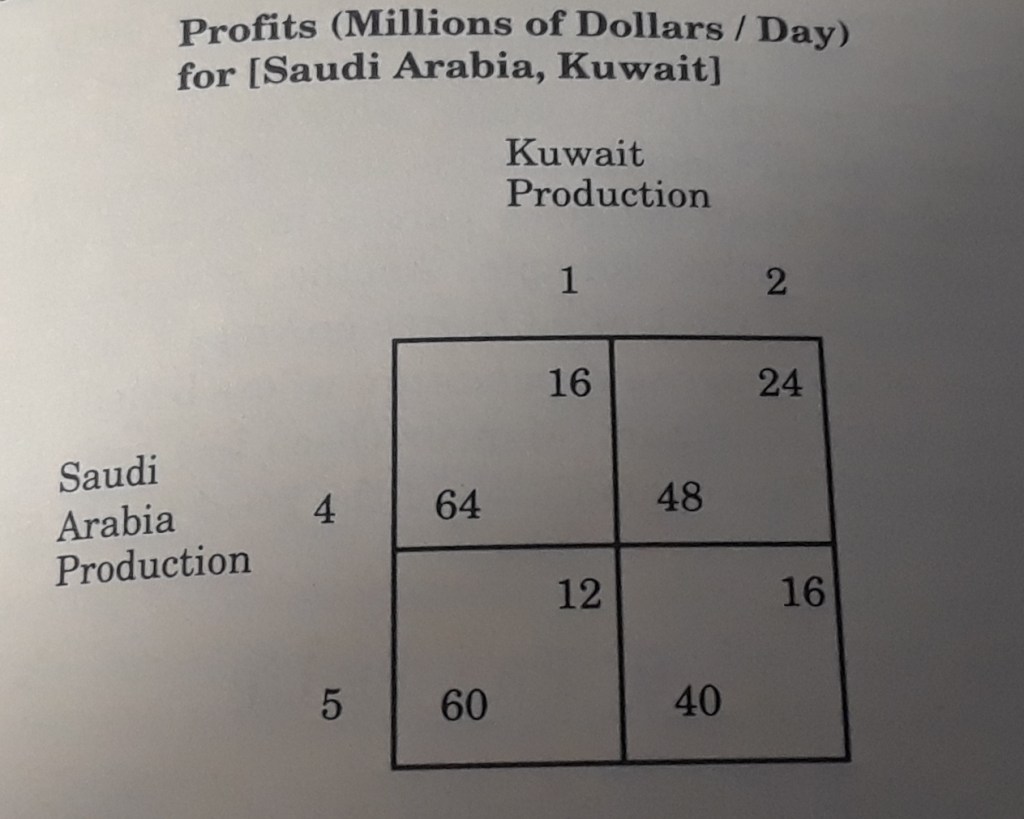
Finally, the rise of Japanese military power in the Pacific may well lead the Philippines and other Southeast Asian countries to welcome U.S.A. or other forces as a counterbalance to a perceived Japanese threat. Carried far enough, this implies even a willingness to pay for protection, instead of charging for it. New outbreaks of regional war or internal violence on many continents will keep the arms business booming. However, whatever happens, it will be harder to extract benefits from the United States of America and the Soviets. This will upset the delicate power balance among the LDCs—as between India and Pakistan, for instance—and will trigger potentially violent power shifts within the LDCs as well, especially among the elites closely (and sometimes corruptly) linked to aid programs, military procurement, and intelligence operations. The heyday of the Cold War is over. Far more complex power shifts lie ahead. And the market for strategic locations in the LDCs will never be the same. An important feature of OPEC is that its members are of unequal size. Saudi Arabia is potentially a much larger producer than any of the others. Do large and small members of a cartel have different incentives to cheat? We keep matter simple by looking at just one small country, say Kuwait. Suppose that in a cooperative condition, Kuwait would produce 1 million barrels per day, and Saudi Arabia would produce 4. For each, cheating means producing 1 million extra barrels a day. So Kuwait’s choices are 1 and 2; Saudi Arabia’s, 4 and 5. Depending on the decisions, total output on the market can be 5, 6, or 7. #RandolphHarris 19 of 20

Supposed the corresponding profit margins (prince minus production cost per barrel) would be $16, $12, and $8 respectively. This leads to the following profit able. In each box, the bottom left number is the Saudi profit, and the top right number is the Kuwaiti profit, each measured in millions of dollars per day. Kuwait has a dominant strategy: cheat by producing 2. Saudi Arabia also has a dominant strategy, but this is the cooperative output level of 4. The Saudis cooperate even though Kuwait cheats. The prisoners’ dilemma has vanished. Why? Saudi Arabia has an incentive to cooperate for purely selfish reasons. If they produce a lot output, the market price rises and the profit margins go up for all members of OPEC. If they had only a small share in OPEC’s total output, they would not find it profitable to provide this “public service” to the whole cartel. However, if their share is large, then a large part of the benefit of the high profit margin comes to them, and it may be worth the cost of suffering some reduction in volume. This is what happens for the illustrative numbers we choose above. Here is another way out of the prisoners’ dilemma: find a large benefactor who acts cooperatively and tolerates others’ cheating. The same thing happens in many alliances. In many countries, a large political party and one or more small parties must form a governing coalition. The large party commonly takes the responsible position and makes the compromises that hold the alliances together, while the small parties insist on their special concerns and get their often extreme way. The influence of small religious parties in Israel’s coalition government is a prime example. Another example arises in the NATO alliances; the United States of America provides a disproportionate amount of defense expenditure whose benefits go to Western Europe and Japan. Mancur Olson has aptly labeled this phenomenon “the exploitation of the great by the small.” #RandolphHarris 20 of 20


With accents of elegance, spacious living areas, and convenient workspaces, Millhaven Homes offers beautiful features that will surely capture your interest and imagination.

If you are considering building a custom home with us, please fill out the information below and we will reach out to you to schedule an introductory meeting. https://millhavenhomes.com/get-started/

One Who Lasts Last Lasts Best?

It is possible that depictions of violence often glamorize vicious behavior. They offend the Spirit and could possibly make one less able to respond to others in a sensitive, caring way. They also may contradict the Savior’s message of love for one another. The second portion of our interviews with carjackers dealt with the aftermath of carjackings. Here, we are concerned with basic questions: What did they do with the vehicles? What did they do with their money? Given the propensity of many carjackers to target other offenders, how did they mange the threat of retaliation? The majority of our respondents immediately disposed of the vehicle, liquidating it for cash. As Corleone put it, “there’s a possibility they report[ed] the car stolen and while I’m driving around the police [could] pull me over. I ain’t got time to hop out [of the vehicle] and run with no gun. I just want to get the money that I wanted.” Although most of our respondents immediately delivered the vehicle to a chop shop or dismantled it themselves, a fair number of them chose to drive the vehicle around first, showing it off or “flossing” to other neighborhood residents and associates. Despite the possibility that the vehicle’s owner or the police might catch up with them, they chose to floss. INT: “What do you like to do after a carjacking?” Binge: “Well, what I like to do is just like to, see my friends. They don’t give a damn either, I just go pick them up and ride around, smoke a little bit [of] weed, and get some gals, and to partying or something like that you know. I know it’s taking a chance but, you know like I say, they don’t give a damn. #RandolphHarris 1 of 21
INT: “Is that what you did with the car that you took off the guy at the Lightrail?” Binge: “Yeah. I was just riding around listening to the music, picked up a couple of friend of mine. We rode around. I told them it was a stolen car. It was a nice little car too. Black with a hard top. Oh yeah, oh yeah—[it had] nice sounds. I was chilling man, I was chilling, you know? I was driving along with the music playing up loud. Ha ha. You know I wasn’t even worried. I was just feeling good. ‘Cause I’m not used to driving along with music playing up loud. Ha ha. You know I wasn’t even worried. I was just feeling good. ‘Cause I’m not used to driving that much you know ‘cause I don’t have a car you know. That’s why when I do a carjacking I just play it off to the tee, run all the gas off, keep the sounds up as loud as I can, keep the heat on, you know just abuse the car you know. That’s all about carjacking like that.” C-Low described his desire to floss as having to do with the ability to gain status in his neighborhood. C-Low: “Put it this way, you got people you know that’s driving around. We just wanna know how it feels. We’re young and we ain’t doing sh*t else. So they [people from the neighbourhood] see you driving the car, they gonna say, “Hey, there’s C-Low!” and such and such. That makes us feel good ‘cause we’re riding, and then when we’re done riding we wreck the car or give it to somebody else and let him ride. We took the car and drove around the hood, flossing everything. And then we wrecked it on purpose We ran it into a ditch. I don’t know, we were f*cked up high, we were high man, just wild! Wrecked the thing.” #RandolphHarris 2 of 21

However, for offenders like these, the prospect of getting caught and losing profits eventually began to outweigh the benefits of showing off. INT: “So how long did you drive around in the [Chevrolet] Suburban before you stripped it?” LOCO: “Oh, we was rolling that. We drove for a good thirty minutes, then I said that I want[ed] to get up out of it because they might report it stolen. We was [still driving] right there [near] the scene [of the crime] and they [the police] would probably tried to flag me [pull me over]. And if they tried to flag me, I would [have to] have taken them through a high-speed chase. F*ck that.” Sleezee-E informed us (as did other respondents) that disposing of the vehicle quickly was the key to getting away with a carjacking. Indeed, almost all respondents were aware of the police department’s “hot sheet” for stolen vehicles (although their estimations of how long it took for a vehicle to show up on the hot-sheet varied greatly, from as soon as the vehicle was reported stolen to 24 hours or even longer afterwards). Sleezee-E: [People think that] the cops will wait 24 hours just to see what you are going to do with the car. Because some idiots, when they jack a car, they just drive it around and then they leave it someplace. I don’t do that. That’s how you get caught. Driving it around. You take that car right to the chop shop and let them cut that sucker up.” Once the vehicle was stripped, most carjackers disposed of the vehicle by destroying it somehow. #RandolphHarris 3 of 21

Littlerag: “’Cause it was hot man! It was too hot. All I [wanted] was to take the rims, take the beats, the equalizer, the detachable face. Got all that off, then I just pour gas on it and burnt that mother*cker up. I had finger prints [on it]. I didn’t have no gloves on. I had my own hands on the steering wheel. I left my fingerprints.” Nicole and a boyfriend chose a less conventional method of getting rid of their stolen vehicle. Nicole: We got rid of the car first. We drove the car two blocks and went back down a ways to the park. We drove the car up there, we parked right there and sat for about ten minutes, made sure how many cars come down this street before we can push it over there. It’s a pond, like it’s a lake out there with ducks and geeses in it.” While a few respondents reported that they used the proceeds from carjacking to pay for necessities or bills, the overwhelming majority indicated that they blew their cash indiscriminately on drugs, women, and gambling. We had interviewed Tone on a number of previous occasions for his involvement in strong-arm drug robbery. Although robbery was his preferred crime, he engaged in carjacking occasionally (about once every two months) when easy opportunities presented themselves. During his most recent offense, he and three of his associates took a Cadillac from a neighborhood drug dealer and made $6000. When we asked what he did with his portion, he indicated that he, “…spent that sh*t in like, two days.” #RandolphHarris 4 of 21

INT: “You can go through $1500 in two days?” Tone: “Sh*t, it probably wasn’t even two days, it probably was a day, sh*t.” INT: “What did you spend fifteen hundred on?” Tone: “It ain’t shit that you really want. Just got the money to blow so f*ck it, blow it. Whatever, it don’t even matter. Whatever you see you get, f*ck it. Spend that shit. It wasn’t yours from the getty-up, you know what I’m saying? You didn’t have it from the jump so…Can’t act like you careful with it, it wasn’t yours to care for. Easy come, easy go. The easy it came, it go even easier. F*ck that, f*ck all that. I ain’t trying to think about keeping nothing. You can get it again. INT: “So what does money mean to you? Tone: “What money mean? Sh*t, money just some sh*t everybody need, that’s all. I mean, it ain’t jack sh*t.” INT: “Ok, so it’s not really important to you? Tone: “F*ck no. Cause I told you, easy come, easy go.” Mo had taken a Mercedes-Benz from two men residing in another neighborhood. He had planned the offense over the course of a month and finally, posing as a street window cleaner, carjacked them as they exited a local restaurant. The vehicle’s after-market items netted $5000 in cash. INT: “I’m just kind of curious how you sped like $5,000!” MO: “Just get high, get high. I just blow money. Money is not something that is going to achieve for nobody, you know what I’m saying? So everyday, there’s not a promise that there’ll be another [day] so I just spend it, you know what I’m saying? It ain’t mine, you know what I’m saying, I just got it, it’s just in my possession. This is mine now, so I’m gonna do what I’ve got to do. It’s a lot of fun. At a job you’ve got to work a lot for it, you know what I’m saying? You got to punch the clock, do what somebody else tells you. I ain’t got time for that. Oh yeah, there ain’t nothing like gettin’ high on $5000!” #RandolphHarris 5 of 21

Binge and others confirmed that the proceeds from their illegal activities went to support this form of conspicuous consumption. Binge: “I just blowed it man. With the money me and my girlfriend went and did a bit of shopping, stuff for Christmas. But, the money I got from his wallet? I just blowed that, drinking and smoking marijuana.” For Corleone, the motivation to carjack was directly related to his desire to manage the impressions of others in his social milieu. His remarks served as a poignant comment on sociocultural and peer pressures experienced by many inner city youths. The purpose of carjacking was to obtain the money he needed to purchase clothing and items that would improve his stature in the neighborhood. Corlone: “[$1500 is] a lot. [I bought] shoes, shoes, everything you need. Guys be styling around our neighborhood. The brand you wear, shoes cost $150 in my size. Air Jordans, everybody want those. Everybody have them. I see everybody wearing those in the neighborhood. I mean come on, let’s go get a car. I’m getting those, too.” INT: “How man pairs of sneakers have you got?” Corleone: “Millions. I got, I got, I got a lot of shoes. Clothes, gotta get jackers. INT: “Well, why do you have to look good, what’s so big about looking good?” Corleone: “You can’t. Not nowadays, not where I’m from. You try to walk up to a girl, boy, you got on some raggedy tore up, cut up shoes they’re gonna spit on you or something. Look at you like you crazy. Let’s say you walking with me. I got on creased up pants, nice shoes, nice shirt and you looking like a bum. Got on old jeans. And that dude, that dude, he clean as a mother*cker and you look like a bum.” #RandolphHarris 6 of 21

INT: “So you’re competing with each other, too?” Corleone: “Something like that. Something like a popularity contest.” INT: “Well, you know, you can look nice and clean and not have to spend $150 bucks on shoes, you know.” Corleone: “It’s just this thing. You aint’ going [to] understand, you don’t come from the projects.” In the extraordinary onslaught of the deceiver which will come upon the whole of Christendom at the close of the age, through his army of deceiving spirits, there are some, more than others, who will for a particular reason be attacked by the powers of darkness. These individuals need clear light as to his deceptive workings, so that they may pass through the trial of the “last hour” and be counted worthy to escape that hour of greater trial which is coming upon the Earth (Luke 21.34-36; Rev. 3.10). These are the ones who are recklessly ready to follow the Lord at any cost, and yet do not realize their unpreparedness for the contest with the spiritual powers of the unseen World as they press on into fuller spiritual things. They are believers who are full of mental conceptions wrought into them in earlier years—views and opinions which hinger the Spirit of God from preparing them for all they will meet as they press on to their coveted goal, and which also hinder others from giving them from the Scriptures much that they need to know regarding the spiritual World into which they are so blindly advancing. These sentiments lull them into a false security, and give ground for, and even help bring about, that very deception which enables the deceiver to find them as easy prey. #RandolphHarris 7 of 21

Being spiritual prey can make one feel that family companionship and activities can be a little nerve-racking, and they may want to get away from the constant harping. Some may even think other groups look appealing, until they join them and find out they have nothing in common. While these individuals sit alone, they may feel isolated, yet content. After being involved in an accident and being in a hospital, one may feel aloneness and emptiness. They may not be terrified because one understands why things are done; but one still feels the pain, and no one is able to share it with the individual. It is a very personal experience. Many people are connected with their childhood because they still live in a World of fantasy. Anytime during the day or night when one is not actively thinking or doing something specific, one may have dreams of something they like or admire. Sometimes these fantasies have something to do with the lack of “participant” love that one has felt all of one’s life. They know they are loved by their families, but I think that want non-familial relationships. Yes let there be loneliness, for where there is loneliness, there also is love, and where there is suffering, there also is joy. If faith strike a chord so deep in human nature, the question can be posed: Is faith universal? There are two forms of faith: the formal and the material. The formal definition of faith is valid for every kind of faith in all religions and cultures. Faith, formally or generally defined, is the state of being grasped by that toward which self-transcendence aspires, the ultimate in being and meaning. #RandolphHarris 8 of 21

This formal or universal definition of faith is particularized in the material definition of faith which is the Christian faith, the state of being grasped by the New Being as it is manifest in Jesus as the Christ. Whatever is said of formal faith applies to material faith, although the reverse is not true, because material faith contributes a specification not found in formal faith. It suffices for the present to say that we reconcile the two definitions by holding that Christianity, as the particular (material) definition of faith, expresses the fulfilment toward which all forms of faith are driven. The note of universality enters through the formal definition of faith, for in this formal sense of faith as ultimate concern, every human being has faith. Every human spirit drives toward the unconditional in the direction of self-transcendence. One who is not able to perceive something ultimate, something infinitely significant, is not a man Faith is a universal human potentiality because the human heart is aware that it is ordered to the infinite, but is not yet in possession of it. The seeds of faith are sown in the restlessness of man’s spirit, his striving to transcend the stream of transitory, preliminary concerns in which one is submerged. Thus, the state of being ultimately concerned is a state which is universally human, whatever the content of the concern may be. Of course, the content of ultimate concern can be demonically distorted so that faith becomes idolatrous faith, but it remains faith despite this ambiguity. Our ultimate concern can destroy us as it can heal us, but we never can be without it. #RandolphHarris 9 of 21

Faith in Capitalism is also important to some people. However, things that work well for Western companies to be able to survive in the global market, pose big problems for Western economies as a whole, narrowing their domestic manufacturing base and worsening the employment environment. No easy solutions are in sight. However, these problems can and should be tackled more actively at the national policy level. What can be done? To begin with, the West has to accept that trying to keep its ailing industries afloat by pressing China to appreciate the yuan will not provide a genuine solution. (Though it does not mean that the West should not press China to appreciate yuan—it should, but for a different reason; we will come back to this point later on.) Protectionist measures like punitive import tariffs are an even worse option. Doing effectively nothing to protect industries, they create risks of trade wars, harm consumers, and send the wrong signals to domestic producers: wrong because today it is basically more efficient to produce mass products in China than in the West. Two closely interrelated strategies are vital to address the challenges posed by China’s export offensive. First, Western governments have to do more to encourage differentiation and upgrading of products by domestic factories (in other words, to help them shift from segments one and two to segments three and four) in order to expand the cohort of domestic manufacturers, especially SME, with high non-price competitiveness. The task of primary importance is to promote exports of such upgraded and differentiated products, especially to China and other emerging countries. #RandolphHarris 10 of 21

If an active export promotion policy is not in place, market constraints can critically weaken companies’ motivation to differentiate and upgrade and, as a result, erode the technological base the West has already created, threatening its command over core manufacturing technologies. Here is a quote from a conference address by Haruhisa Gai, the president of Tsubamex, a well-known Japanese manufacturer of mold models and the first company in the industry that introduced a three dimensional CAD-CAM system to speed up product development and raise its quality. The topic under discussion was globalization and challenges from Chinese and other companies from the emerging World. Mr. Gai said: “Costs aside, today there are only two countries in the World that can make any kind of a prototype: Japan and America. Even Germany cannot produce certain customized models. The levels of Japan’s manufacturing technologies is very high, but these says there is no work—and makers do not introduce new machines. If there are no new machines, no new technologies will be born. It is a very big problem…One of our major headaches is that even if we get orders it is uncertain whether we will get the payment in due course—especially from overseas. It is very difficult to collect the money we have to be paid. It would be nice if this can be done by the state…We count a lot on our link with overseas, but there are a lot of obstacles.” The fragment quoted brilliantly articulates the problem and expresses concerns existing in Japan’s business community. #RandolphHarris 11 of 21

To address the Chinese challenge, Western governments have to orchestrate a large-scale export counteroffensive on the Chinese market. In broader terms, they have to come out with a wide-range export promotion policy, centered on those domestic small and medium-size producers that are really capable of differentiating their products and climbing up the value chain. The promotion package can include far more active assistance in market research and sales promotion, in the establishment of overseas distribution industry people. Stage advertising campaigns. Do not be shy about allocating sufficient budget funds for these purposes. And, of course, do all you can to make China reduce its tariff and nontariff import barriers. Much more can be done at the local administration level. Establish and expand direct province-to-province and city-to-city relations. (How many America and European cities have sister relations with Chinese cities? Not too many, really.) Organize various public events, and let the Chinese audiences know how good and attractive the products from your homeland are. They will be interested, without any doubt. Establish trade representative offices—and not only in Beijing and Shanghai, but also in other Chinese cities, effectively acting as export agent for your homeland’s producers and their associations. #RandolphHarris 12 of 21

Studying the feasibility of the U.S.A.-China and the EU-China free trade agreements would be a great idea. Can American and European leaders show enough vigor and courage to come out with such strategic initiatives? (Japan and South Korea are already working with China on a trilateral FTA, and the process seems to be gaining momentum.) It may not be as simple as endless debates about currency manipulators, but it is worthy trying. The range of options is wide. Without drastic steps of this kind, the West’s deficits in its trade with China will continue to increase, and more and more Western manufacturers will have to being down the curtain. The new system for making wealth consists of an expanding global network of markets, banks, production centers, and laboratories in instant communication with one another, constantly exchanging huge—and ever-increasing—flows of data, information, and knowledge. This is the “fast” economy of tomorrow. It is this accelerative, dynamic new wealth-machine that is the source of economic advance. As such, it is the source of great power as well. To be de-coupled from it is to be excluded from the future. Yet that is the fate facing many of today’s “LCDs,” or “less developed countries.” As the World’s main system for producing wealth revs up, countries that wish to sell will have to operate at the pace of those in a position to buy. This means that slow economies will have to speed up their neural responses, lose contracts and investments, or drop out of the race entirely. #RandolphHarris 13 of 21

The earliest signs of this are already detectable. The United States of America in 1980s spent $125 billion a year on clothing. Half of that came from inexpensive-labor factories dotted around the World from Haiti to Hong Kong. Tomorrow much of this work will return to the United States of America. The reason is speed. Of course, shifting taxes, tariffs, currency ratios, and other factors still influence businesses when overseas investment or purchasing decisions are made. However, far more fundamental in the long run are changes in the structure of cost. These changes, part of the transition to the new wealth-creation system, are already sending runaway factories and contracts home again to the United States of America, Japan, and Europe. The Tandy Corporation, a major manufacturer and retailer of electronic products, not long ago brought its Tandy Color Computer production back from South Korea to Texas. While the Asian plant was automated, the Texas plant operated on an “absolutely continuous” flow basis and had more sophisticated test equipment. In Virginia, Tandy set up a no-human-hands automated plant to turn out five thousand speaker enclosures a day. These supply Japanese manufacturers, who previously had them made with low-cost labor in the Caribbean. The computer industry is, of course, extremely fast-paced. However, even in a slower industry, the Arrow Company, one of the biggest U.S.A. shirtmakers, transferred 20 percent of it dress-shirt production back to the United States of America after fifteen years of off-shore sourcing. #RandolphHarris 14 of 21

Frederick Atkins Inc., a buyer for U.S.A. department stores, has increased domestic purchases from 5 percent to 40 percent in three year. These shifts can be traced, at least in part, to the rising importance of time in economies. The new technology is giving domestic apparel makers an important advantage over their Asian competitors. Because of fickle fashion trends and the practice of changing styles as often as six times a year, retailers want to be able to keep inventories low. This calls for quick response from apparel makers that can offer fast turnaround on smaller lots in all styles, sizes and colors. Asian suppliers, half a World away, typically require order three months in advance. By contrast, Italy’s Benetton Group delivers midseason reorders within two to three weeks. Because of its electronic network, Haggar Apparel in Dallas is now able to restock its 2,500 customers with slacks every three days, instead of the seven weeks it once needed. Compare this with the situation facing manufacturers in China who happened to need steel. In 1988, China suffered the worst steel shortages in memory. Yet with fabricators crying out for supplies, 40 percent of the country’s total annul output remained padlocked in the warehouses of the Storage and Transportation General Corporation (STGC). Why? Because this enterprise—incredible as it may seem to the citizens of fast economies—makes deliveries only twice a year. #RandolphHarris 15 of 21

The fact that steel prices were skyrocketing, that the shortages were creating a black market, that fraud was widespread, and that companies needing the steel faced crisis meant nothing to the managers of STGC. The organization was simply not geared to making more frequent deliveries. While this is no doubt an extreme example, it is not isolated. A “great wall” separates the fast from the slow, and that wall is rising higher with each passing day. It is this cultural and technological great wall that explains, in part, the high rate of failures in joint projects between fast and slow countries. Many deals collapse when a slow-country supplier fails to meet promised deadlines. The different pace of economic life in the two Worlds make for cross-cultural static. Officials in the slow country typically do not appreciate how important time is to the partner from the fast country—or why it matters so much. Demands for speed seem unreasonable, arrogant. Yet for the fast-country partner, nothing is more important. Delivery delayed is almost as bad as delivery denied. The increasing cost of unreliability, of endless negotiation, of inadequate tracking and monitoring, and of late responses to the demands for up-to-instant information further diminish the competitive edge of low-wage muscle work in the slow economies. So do expenses arising from delays, lags, irregularities, bureaucratic stalling, and slow decision-making—not to mention the corrupt payments often required to speed things up. #RandolphHarris 16 of 21

In the advanced economies the speed of decision is becoming a critical consideration. Some executives refer to the inventory of “decisions in process,” or “DIP,” as an important cost, similar to “work in progress.” They are trying to replace sequential decision-making with “parallel processing,” which breaks with bureaucracy. They speak of “speed to market,” “quick response,” fast cycle time,” and “time-based competition.” The increase precision of timing required by systems like “just-in-time delivery” mean that the seller must meet far more rigid and restrictive schedule requirements than before, so that it is easier than every to slip up. In turn, as buyers demand more frequent and timely deliveries from overseas, the slow-country suppliers are compelled to maintain larger inventories or buffer stocks at their own expense—with the risk that the stored parts will rapidly become obsolete or unsalable. The new economic imperative is clear: Overseas suppliers from developing countries will either advance their own technologies to meet the World speed standards, or they will be brutally cut off from their markets—casualties of the acceleration effect. Manager generally take a rosy view of time: markets expand, better technologies become available, information improves. However, where there is growth, there is also decay. More than 10 percent of the United States of Americas’ manufacturing output was accounted for by industries whose real output had shrunk during the 1970s. #RandolphHarris 17 of 21

These declining industries range from core manufacturing such as steel, tire, and rubber to fibers and chemicals, to aby foods and vacuum tubes. The reasons for the decline are varied, ranging from technological progress (transistors over vacuum tubes) to improved foreign competition (steel) to regulation (chemicals) to changing demographics (baby foods). In these declining industries, someone must reduce capacity in order for the industry to remain profitable. Each firm would like its competitors to shoulder the reduction; that way they can capture the remaining market by themselves This case examines the questions of whether survivability is related to size. In declining markets, do Davids cut Goliaths down to size or do they get stepped on? David is a small producer. He manufactures one slingshot per quarter. Goliath is twice David’s size. He produces two slingshots per quarter. The two competitors have no flexibility in choosing output. If they are in, they are in; once they stop, they cannot come back. Their battle has some of the same characteristics as Time versus Newsweek. Each quarter they decide whether to produce or to exit, without knowing their competitor’s coeval choice. However, then they find out last period’s move and get to repeat the battle next quarter (provided neither exited). Starting in the first quarter of 1988, if David is a monopolist, he can expect to make $3 on his one slingshot. #RandolphHarris 18 of 21
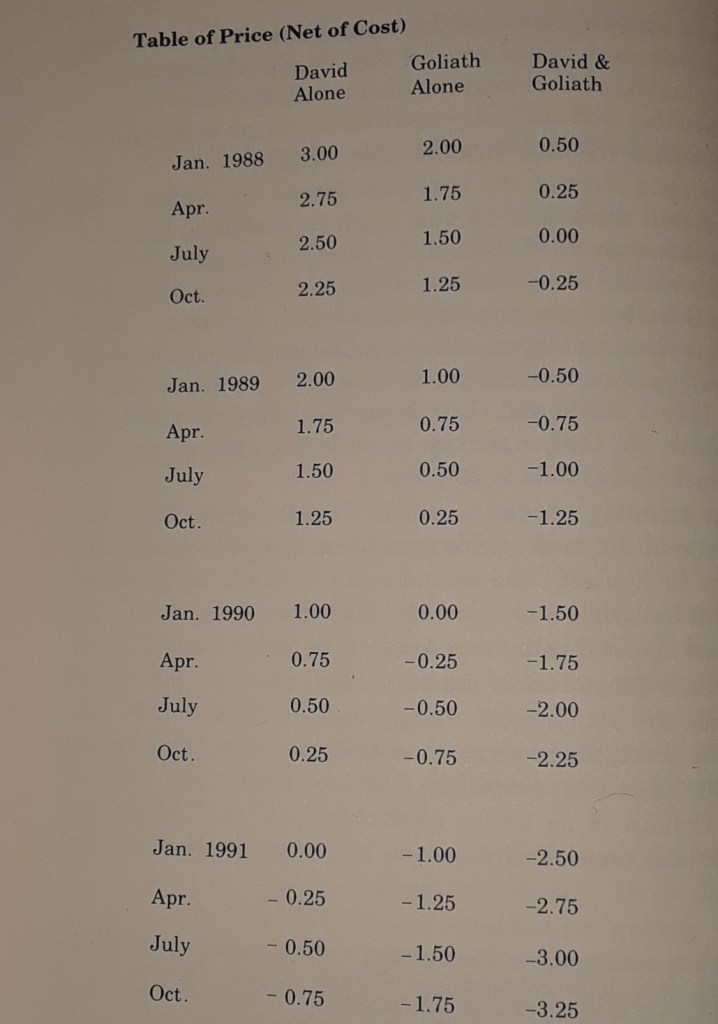
If David exists and leaves Goliath as a monopolist, Goliath gets a lower unit price since his output is bigger; in the case, he gets $2 per slingshot. (Of course, $2 on two slingshots is better than $3 on David’s one.) If both David and Goliath produce, they are said to be duopolists. In that cause they saturate the market, and the prince (net of cost) falls to 50 cents. The declining market is evident from the price chart. The first column shows the price net of cost if David captures the market for himself. The second column details the price net of cost if Goliath is a monopolist. The third column details the price net of cost if both firms continue to produce in a duopoly. In each quarter after January 1988, the price falls by 25 cents for any output level brough to market. As can be seen from the cart, the pressure to exist begins in the third quarter of 1988, when the duopolists first lost money. By January 1990, Goliath is no longer profitable even as a monopolist. A year later, even David can no longer expect to make any money. Over the twelve quarters from 1988 to 1991 the slingshot industry will become extinct. But when do the firms exit? Who gives up first? When do they exit? This problem can be solved using the technique of sequentially eliminating dominated strategies. To get you started, note that staying past January 1990 is a dominated strategy for Goliath, as he forevermore loses money, irrespective of whether David stays or exists. #RandolphHarris 19 of 21

Now work backward and ask what you would do if you were David and it was the third quarter of 1989 and Goliath was still producing. (In calculating the value of the worst-case scenario, you can simplify the mathematics by assuming a zero interest rate; profits (losses) tomorrow and today are equally valuable.) In this problem, it does not matter how much money you make, just how long you can make it. The firm that can hang on the longest can force out its more profitable rival as soon as duploy profits begin to turn negative. As suggested in the hint, if David can hold on until the third quarter of 1989 he is home free. From then on, the worst possibility is that Goliath stays in the market through the fourth quarter of 1989. This will cost David $2.25in duoploly losses. However, when 1990 comes, Goliath must exit, since he suffers losses either as a duopolist or as a monopolists. Thus, David can count on making $2.50 in monopoly profits during the 1990s, which is enough to tide him over any possible losses during the final two quarters of 1989. Now, the power of backward reasoning picks up steam. Given that David is committed to staying upon reaching July 1989 (exiting is a dominated strategy), Goliath can expect to earn only losses from July 1989 onward. Thus, he will exit immediately if he ever finds himself as a duopolist on that date. That means that David can expect to make the $2.50 as a monopolist in 1990 and $2.75 as a monopolist in the final two quarters of 1989. This windfall of $5.25 more covers the maximum duopoly losses up until that date ($1.50), and therefore David should never exit before January 1991. Given that David is committed to staying, Goliath should leave as soon as duopoly profits turn negative, July 1988. Note that Goliath cannot make the same commitment to stay in the market for the same length of time. #RandolphHarris 20 of 21
That commitment breaks down first in January 1990, and then the guarantee exist by January 1990 translates into a forced exit by July 1989. The slippery slope for Goliath brings him back to October 1988, the first instance when the market is not big enough for the two of them. This simple story of fighting for a market share in declining industries may help explain the observation that large firms are often first to exit. Charles Baden Fuller, an expert in the decline of British markets, reports that when the demand for U.K. steel casing fell by 42 percent over the period of 1975—1981, executives of the two largest firms, F. H. Lloyd and the Weir Group, “felt that they had borne the brunt of the costs of rationalization; they accounted for 41 percent of the industry output in 1975, but for 63 percent of the capacity that was withdrawn over the 1975-1981 period, reducing their combined market share to 24 percent. Remember that size is not always an advantage: in judo and here in exit strategies, the trick is to use your rival’s bigger size and consequently inflexibility against him or her. This strategy can be applied to China. A big battle for the Chinese market is starting. In 2009, China became not only the World’s top exporter, but also the second-largest importer. It is the number one market for an increasing amount of both capital and consumer goods. For instance, its share of the World market optical fibers has been the largest producers in the World with a 62 percent share of the global total in 2022. According to the study, shipments from machine tool plant in China accounted for a whopping 30 percent of the $92.7 billion total produced by 28 countries around the globe, and China manufactures 36 percent of the World’s electronics. In addition, with nearly one-fifth of the World’s population, China is the second-largest final consumption market—after the U.S.A.—for electronic devices embedded with semiconductors. It is the largest market for cars and brand fashion goods and is about to become the number one for luxury goods. The list can be continued. Yet, the competition for tapping this market is becoming increasingly fierce, and more often than not Western companies appear to be not on the winning side. #RandolphHarris 21 of 21

With accents of elegance, spacious living areas, and convenient workspaces, Millhaven Homes offers beautiful features that will surely capture your interest and imagination.

If you are considering building a custom home with us, please fill out the information below and we will reach out to you to schedule an introductory meeting. https://millhavenhomes.com/get-started/

It Hurt Like Pent-Up Life Rushing into a Chilled and Starved Soul

There has been a lot of talks about communism in modern America and many people fear it, while others do not understand it and promote the dangerous ideology. Many of the local news airwaves have been overtaken by communist leaders. In fact, people that proport that they are journalists, are actually uneducated activists. Communism is a political and economic doctrine that aims to replace private property and a profit-based economy with public ownership and communal control of at least the major means of production (exempli gratia, mines, mills, and factories) and the natural resources of a society. Communism is thus a form of socialism—a higher and more advanced form, according to its advocates. Communism and socialism are basically synonyms. The theory of the Communists may be summed up in the single sentence: Abolition of private property. The major problem confronting the people of the United State of America and free peoples everywhere in the first quarter of the 21st century is the threat to peace and freedom presented by the militant aggressiveness of international communism. We recognize that we must retain our present military and economic advantage over the Communist bloc. Communism is a false idea, and the answer to a false idea is truth, not ignorance. With the triumph of communism, classes will disappear. Communism will supplant and destroy the market economy of capitalism. Communism is the easiest system to sell to the people who are poor, not because poor people are any less worthy than the affluent, but because it sounds so reasonable, fair, and workable. #RandolphHarris 1 of 19

The promises of communism sound sweet, warm, and affectionate—the poor can take in the opulence of the rich without putting in the work. The reality is that the tenets of Communism are, indeed, workable; the only problem is that they produce super inefficient economies, such that, even though people in a communist system fully support its ideals, they soon start conducting themselves in a manner what shows their deep yearning for the freedoms of Capitalism. Communism has always, still does, and always will fail. China is doing so well because it abandoned communism in the 1970s when it introduced capitalism reforms which have led to rapid economic growth. China is now a mixed economy. Socialism, another form of communism, destroyed Venezuela. The worsening humanitarian crisis on corruption, mismanagement, failing oil prices, or U.S.A. sanctions came about because of the rise of socialism. The policies implemented by dictator Hugo Chavez and Nicolas Maduro caused these problems. There are three main policies implemented by Mr. Chavez since 1999 that produced the current crisis: Widespread nationalization of private industry, currency and price controls, and the fiscally irresponsible expansion of welfare programs. One of Mr. Chavez’s first actions was to start nationalizing the agriculture sector, supposedly reducing poverty and inequality by taking from rich landowners to give to poor workers. From 1999 to 2016, his regime robbed more than 6 million hectares of land from its rightful owners. #RandolphHarris 2 of 19

Nationalization destroyed production in affected industries because no government has the capacity to run thousands of businesses or the profit motive to run them efficiently. Instead, government officials face incentives to please voters by selling products at low prices and hiring more employees than necessary, even when that is the wrong industry decision. As economic theory predicted, as state control of the agricultural industry increased, Venezuela’s food production fell 75 percent in two decades while the country’s population increased by 33 percent. This was a recipe for shortages and economic disaster. After agriculture, the regime nationalized electricity, water, oil, banks, supermarkets, construction, and other crucial sectors. And in all these sectors, the government increased payrolls and gave away products at low cost, resulting in days-long countrywide blackouts, frequent water service interruptions, falling oil production, and bankrupt government enterprises. Ye taking over the most important sectors of the economy was not enough for the socialist regime. In 2003, Mr. Chavez implemented a foreign currency control scheme where the government set an overvalued exchange rate between the Venezuelan currency and the U.S.A. dollar. One goal of the scheme was to reduce inflation by overvaluing the currency, subsidizing imported products. However, the currency control meant the regime had to ration available U.S.A. dollars to importers since, at an overvalued (cheap) exchange rate, there was more demand for U.S.A. dollars than supply. #RandolphHarris 3 of 19

Naturally, an illegal market for foreign currency emerged and corrupt regie members and lucky individuals assigned cheap U.S.A. dollars obtained large profits. Even worse, the scheme actually increased inflation since overvaluing the currency reduced government oil revenues in Venezuelan currency, leading the regime to print money to cover the ensuing budget deficit. The socialist regime also implemented price ceilings on hundreds of basic products such as beef, milk, and bathroom hygiene paper. At artificially low prices, more people were willing to buy these products but the few private factories left—not nationalized—could not profit at the government-capped price, so they reduced or halted their production. Instead of benefiting the poor, price ceilings predictably resulted in shortages that forced them to stand in lines for hours, while supermarket employees and the well-connected obtained the products they needed. However, perhaps the most harmful part of the Venezuelan socialist project is the part that the international media and leftist figures used to praise most frequently: welfare programs. The socialist regime created social “missions” aimed at tackling poverty, illiteracy, healthcare, and more. However, despite enjoying higher government oil revenues due to a tenfold rise in oil prices from $10 a barrel in 1999 to more than $100 in 2008, the regie financed a growing deficit by printing more currency. Expansive welfare programs and massive public-works projects provided ever-growing opportunities for still greater corruption. Printing money to pay for endless state programs unsurprisingly led to high rates of inflation. Socialism and communism are sort of alter opportunism. #RandolphHarris 4 of 19

Many people can see the United State of American heading down this same path with rent control, importing foreign produce and meats, borrowing from China, and student loan forgiveness. Corrupt regimes can certainly cause many problems, but without socialism, hyperinflation and widespread shortages are not usually among them. Venezuelans have learned over the past few decades that there is no such thing as a free lunch. “Free things” come at a high price. Offenses motivated purely by either irresistible opportunities or overwhelming situational inducements are relatively rare. We have been discussing carjacking, another way people use to get something for nothing. Most carjackings occur between these extremes, where situational inducements merge with potential opportunities to create circumstances ripe for offending. What follows are descriptions of offenses spurred by the combination of internal or external situational inducements and acceptable (or near acceptable) levels of risk and reward. The degree which a given situation was compromised of rewards and risk on the one hand ad internal and external pressures on the other varied, but when the combination reached a certain critical level, a carjacking resulted. Offenders often described situation in which inducements were present, but not pressing, where they had some money or some drugs on them, but realized that the supply of either or both was limited and would soon run out. In such cases, the carjackers engaged in a state referred to as alert opportunism. The offenders are not desperate, but they anticipate need in the near term and become increasingly open to opportunities that may present themselves during the course of day-to-day activities. #RandolphHarris 5 of 19

Here, would-be carjacking prowled neighborhoods, monitoring their surroundings for good opportunities, allowing potential victims to present themselves. Corleone, a sixteen year-old with over a dozen carjacking under his belt, had been committing such offenses with his cousin since the age of 13. The two were walking the street of Sacramento one afternoon looking for opportunities for quick cash when they saw a man walking out of a barbershop toward his parked car, keys in hand. Motivated by the obliviousness of their pray and the lightness of their wallets, they decided to take his car. Corleone: “it was down in the city of Downtown Sacramento. We was just walking around, you know. We just look for things to happen you see just to get money. We just walk around and just see something that’s gonna make us money We just happened to be going to the Chinaman [a restaurant] to get something to eat. [We had] about five or six dollars in our pocket which ain’t nothing. It was this man driving a blue BMW. It has some chrome wheels on there. He just drove up and he was going to the Chinaman and…my cousin was like, ‘Look at that car, man, that’s tough [nice]. I’m getting that. I want that.’ [I was] like, ‘Straight up, you want to do it?’ He was like, ‘Yeah.’ He was all G[ood] for it. Then he [the victim] came out the barbershop. It was kind of crowded and we just did what we had to do. There was this little spot where [my cousin] stash[es] his money, drugs and all that type of stuff and then he got the gun [from the stash]. He got around the corner. He say, ‘Hey, hey.’ I asked him for a cigarette so he went to the passenger’s side [of the vehicle to get one]. I ran on the driver’s side with a gun. Put it to his head and told him to get out of the car.’ #RandolphHarris 6 of 19

INT: “Did you know that you were going to do carjacking or…?” Corleone: “No. Not necessarily. But since that was what came up, that’s what we did.” No mater how alert one is, however, good opportunities do not always present themselves. Over the course of time, situational inducements mount (that is, supplies of money and drugs inevitably dry up), and the option of waiting for ideal opportunities correspondingly diminishes. Such conditions cause offenders to move from a “passive” state of alert opportunism to an “active” state of what could be referred to as motivated opportunism (creating opportunities where none previously existed or modifying existing non-optimal opportunities to make them less hazardous or more rewarding). Here, attention and openness to possibilities expands to allow offenders to tolerate more risk. Situations that previously seemed unsuitable start to look better. Binge, a 45 year old veteran offender who had engaged in burglary, robbery, and carjacking for over 20 years, discussed his most recent decision to get a car on a wintry January day. He had been carrying a weapon (a 9mm Glock) since that morning, looking to commit a home invasion. After prowling the streets for hours and encountering few reasonable prospects, he happened on an easy opportunity—a man sitting parked in a car, its engine running, at a Lightrail (trolley) station. #RandolphHarris 7 of 19

Binge: “Well, I was out hustling trying to get me a little money and I was walking around. I was cold. I was frustrated. I couldn’t get in [any] house[s] or nothing, so I say [to myself], ‘Well I’ll try and get me a little car, and you know, just jam off the heat and sh*t that he [the vehicle’s owner] got,’ you know? I was strapped [carrying a firearm] and all that, you know and I was worried about the police catching me, trying to pull my pistol off, and I see this guy. Well, he was at the Lightrail you know, nodding [falling asleep] in his car. So I went up to the window. I just think that I just peeped it on [happened on the situation]. I was at the Lightrail you know, I was standing at the bus stop trying to keep warm and so I just walked around with no houses to rob, and I seen this dude you know sitting in his car, you know, with the car running. And I said ‘Ah man, if I can get a wag at this [take adventure of this opportunity],’ you know. It wasn’t just an idea to keep warm or nothing like that. I was cold and worried, and it just crossed my mind and I thought I can get away with it, and I just did it. I’d do anything man, I’d do anything. If I want something and I see I can get away with it I’m gonna do it. That’s what I’m saying. That night I saw an opportunity and I took it, you know. It just occurred to me.” Just as compelling were instances where third parties placed demands on offenders. A number of our respondents indicated that they engaged in car jacking to fulfill specific orders or requests from chop shop owners or other individuals interested in a particular make and model of car or certain valuable car part. The desire to fulfill such orders quickly created conditions ripe for motivated opportunism. #RandolphHarris 8 of 19

Goldie, for instance, was experiencing strong internal situational pressures (the need for cash) and external pressures (the demand for a particular vehicle by some of his criminal associates) combined with a moderately favorable opportunity (inside information on the driver of the wanted vehicle and its location): Goldie: “He’s from my neighborhood. He’s called Mucho. He’s from the same neighborhood but like two streets over. Them two streets don’t come over on our street. You know, we not allowed to go over on they street. It was a nice car. The paint, the sound system in it, and the rims. [It] had some beats, rims. Rims costs about $3,000, some chrome Daytons. 100 spokes platinums.” INT: “OK. That’s a lot of money to be putting on a car. What does he do for a living?” Goldie: “I don’t know. I’ don’t ask. What they told me was they wanted this car and they are going to give me a certain amount of money.” INT: “You say they told you they wanted this car. You mean they told you they wanted his car or they wanted a car like that?” Goldie: “His car. His car. They want [Mucho’s] car. They said, ‘I need one of these, can you get it for me?’ And they knew this guy. So now, I need that car. That car.” Low-Down also specialized in taking orders from chop shops. Low-Down: What I do, I basically have me a customer before I even go do it. I ask a few guys that I know that fix up cars, you know what I’m saying. I ask them what they need then I take the car. But see, I basically really got a customer. I’m talking about this guy over in East Sacramento. Me and Bob, we real cool. He buy ‘em cause he break ‘em down, the whole car down and her got an autobody shop. He sell parts. He’ll take the car and strip it down to the nitty gritty and sell the parts. He get more money out of selling it part by part than selling the car. And, before I get it I already set the price.” #RandolphHarris 9 of 19

Low-Down also had a drug habit: Low-Down: “The main reason basically why I did it was I be messing with heroin, you know what I’m saying. I be using buttons [heroin housed in pill-form]. I be snorting some, but I be snorting too much, you know? I got a habit for snorting cause I be snorting too much at a time, that’s how I call it a habit. I probably drop about 5 or 6 [buttons] down first [thing in the morning.] [So] I basically really sick and my daughter needed shoes and sh*t like that and my girlfriend was pressuring me about getting her some shoes. She had been pressing me about two or three days. Baby food and stuff like that. But the money I had, I had been trying to satisfy my habit with it. Basically I just thought it was a good thing to do. It was a good opportunity.” (This is essentially why many professionals and affluent people ride in their cars with the windows up, at all times, and the doors always up and never give anyone a cigarette, light, or money. The church in the twenty-first century must recognize the powers of darkness. To this end the Christian Church must recognize that the existence of deceiving, lying spirits is as real in the twenty-first century as in the time of Christ and that their attitude toward the human race is unchanged: that their one ceaseless aim is to deceive every human being. Yes, that they are given up to wickedness all day long, and all night long, and that they are ceaselessly and actively pouring a stream of wickedness into the World and are satisfied only when they succeed in their wicked plans to deceive and ruin men. Yet the servants of God have been concerned only to destroy their works—to deal with sin—not recognizing the need of using the power given by Christ to resist by faith and prayer this ever-flowing flood of satanic power pouring in among men. #RandolphHarris 10 of 19

Hence both men and women, young and old, Christian and non-Christian, become deceived through their guile, because of ignorance about them and their wiles. These supernatural forces of Satan are the true hindrance to revival. The power of God which in 1904 broke forth in Wales, with all the marks of the days of Pentecost, was checked and hindered from going on to its fullest purpose by the same influx of evil spirits as met the Lord Christ on Earth and the apostles of the early Church—with the difference that this inroad of the powers of darkness found the Christians of the twenty-first century, with few exceptions, unable to recognize and deal with them. Evil-spirit possession has followed and checked every similar revival throughout the centuries since Pentecost. If the Church is to advance to maturity, these things must now be understood and dealt with—understood not only with respect to the degrees of possession recorded in the Gospels and Acts, but in light of the social forms of manifestation suited to the close of the age. For now these spirits have appeared under the guise of Holy Spirit, yet having some of the very characteristic marks in bodily symptoms which are seen in the Gospel accounts, when all who observed the manifestations knew that it was the work of the spirits of Satan. It my have been so short a time that one has been able to share with another the coldness, blackness, and emptiness of the void experienced as loneliness and alienation. And, deeply as one loves relationships and encounters, one may also need solitude to grow in another way, to regenerate and reintegrate. #RandolphHarris 11 of 19

How many times the change within one (“insight,” “solution,” or simply new perspective) has come in the solitude after the encounter which made it possible. This may be enough different from those around one to make one feel alien at times. One’s feelings are step children so long, and one’s hear mute. At a point, one may come through a siege of depression and self-doubt during which one may have overlooked one’s dark side and shared fears and despair with another for the first time in one’s life. Some may face life once gain with some joy, some hope. One may feel so much but cannot find any words for these feelings. It is possible to stammer out something about hoping one has not been too much bother, and another individual may communicate one’s love as well as one’s acceptance of one—ALL of one. This individual who has seen your weaknesses and your negative feelings—he or she could care? You feel the most intense pain of your life than and sit for minutes with closed eyes, reeling under it. It hurts like pent-up life rushing into a chilled and starved soul. It may have been such a good hurting. One may not be able to say for sure, but it might be as though only when one is no longer alone and alien one can stand the pain of loneliness and the hunger of one’s heart for understanding, for relationship that does not exclude part of one. Perhaps just being so open to feeling and to immediate experiencing is painful. Only later when the experience has lost a little of its overwhelming intensity does the words of a poem pour out and one can weep with joy. #RandolphHarris 12 of 19

The response to attack of pain can lead to growth and resolution into relationship. For one to strike back does not ease one’s pain but often adds more. This is hard enough to understand for many, but when one experiences understanding, another’s caring—this too can be painful—one may experience such disbelief that one falls silent. Often people can enrich an individual’s life and gladdened one’s heart. The power which grasps the individual in the experience of faith is the quality of the “unconditional,” a term often used in describing faith an ultimate concern. Unconditional or ultimate concern, subjectively, is a concern that demands total involvement. However, the unconditional, absolute character of the demand stems from the unconditionality of the object of faith. The power grasping us in the state of faith is not a being beside others, not even the highest; it is not an object among objects, not even the greatest; but it is a quality of all beings and objects, the quality of pointing beyond themselves and their finite existence to the infinite, inexhaustible, and unapproachable depth of their being and meaning. Here, then, we are principally interested in that quality of things which unconditionally grips man’s spirit. A fuller exposition of that toward which this quality points, the “depth of their being and meaning.” We use the term “unconditional” because the German equivalent for unconditional is unbedingt, the connotation being that something is conditioned or limited by being made into a thing (Ding). Thus, the unconditional ( das Unbedingte ) is not “thingish” at all, but rather “a quality which we experience in encountering reality.” #RandolphHarris 13 of 19

The “ultimate concern” also means unconditional. The ultimate concern is was unbedingt angeht (what concerns us unconditionally). Since faith is effective in all of man’s spiritual functions, both theoretical and practical, it cannot be identified with any one of them. Faith comes to expression in these functions, and they, in turn, are rooted in faith. Tendency toward the unconditional must be understood in connection with the concept of Sinn, which is best translated into English by “meaning” and into French by sens. The relation of unconditioned meaning to individual things must be understood as a polarity of form and content. This polarity stands in constant tension, for the unconditional never ceases to demand fulfillment in what would be conditional form. However, unconditioned form is a contradictory notion impossible of realization, for the ground meaning (Sinngrund) is also the abyss of meaning (Sinnabgrund) which transcends every form. The inexhaustibility of meaning (Sinnunerschopflichkeit) would be rendered finite if it could be contained in a form. Nonetheless, each act of meaning must hearken to the demand that is strive to being form and content to unity of filament. Two points are to be underscored in this theory of Sinn: the unconditional is meaning, and in the act of faith one tends toward it, but not as toward an object, since meaning is not an object or thing. One turns to a holy object in which the unconditional is symbolically expressed, but then faith passes beyond this object to the ground and abyss upon which it resist. #RandolphHarris 14 of 19

Abstract and difficult though it be, the analysis of faith in the unconditioned meaning of life makes it a very human issue. For unless some spark of that faith is present, there can be no spirit, for to live spiritually is to live in the presence of meaning, and without an ultimate meaning everything disappears into the abyss of meaninglessness. Faith is unconditional, absolute, and ultimate, because without it man ceases to live as man. One of the greatest power imbalances on Earth today divides the rich countries from the poor. That unequal distribution of power, which affects the lives of billions of us, will soon be transformed as the new system of wealth creation spreads.. Since the end of World War II the World has been split between capitalist and communist, North and South. Today, as these old divisions fade in significance, a new one arises. For from now on the World will be split between the fast and the slow. To be fast or slow is not simply a matter of metaphor. Whole economies are either fast or slow. Primitive organisms have slow neutral systems. The more evolved human nervous systems processes signals faster. The same is true of primitive and advanced economies. Historically, power has shifted from the slow to the fast—whether we speak of species or nations. In fast economies, advanced technology speeds production. However, this is the least of it. Their pace is determined by the speed of transactions, the time needed to take decisions (especially about investment), the speed with which new ideas are created in laboratories, the rate at which they are brought to market, the velocity of capital flows, and above all the speed with which data, information, and knowledge pulse through the economic system. Fast economies generate wealth—and power—faster than slow ones. #RandolphHarris 15 of 19

By contrast, in less affluent societies economic processes move at a glacial pace. Traditional, ritual, and ignorance limit socially acceptable choices. Communications are primitive; transport, restricted. Before the market system arose as an instrument for making investment choices, tradition governed technological decisions. Tradition, in turn, relied on rules or taboos to preserve productive technique that were proven workable over the slow course of biological and cultural evolution. With most people living at the bare edge of subsistence, experiment was dangerous, innovators were suppressed, and advances in the methods of wealth creation came so slowly they were barely perceptible from lifetime to lifetime. Moments of innovation were followed by what seemed like centuries of stagnation. The historical explosion we call the industrial revolution stepped up the economic metabolism. Roads and communications improved. Profit-motivated entrepreneurs actively searched for innovations. Brute force technologies were introduced. Society has a large surplus to fall back on, reducing the social risks of experimentation. With technological experimentation now so much less costly, productive methods [can] change more rapidly. All this, however, merely set the stage for today’s super-fast symbolic economy. The bar code on the pack of Marlboros, the computer in the Federal Express truck, the scanner at the Safeway checkout counter, the bank’s automatic teller, the spread of the extra-intelligent data networks across the planet, remotely operated robots, the informationalization of capital, all are preliminary steps in the formation of a 21-century economy that will operate at nearly real-time speeds. #RandolphHarris 16 of 19

In due course, the entire wealth-creation cycle will be monitored as it happens. Continual feedback will stream in from sensors built into intelligent technology, from optical scanners in stores, and from transmitters in trucks, planes, and ships that send signals to satellites so managers can track the changing location of every vehicle at every moment. This information will be combined with the results of continuous polling of people and information from a thousand other sources. The acceleration effect, by making each unit of saved time more valuable than the last unit, thus creates a beneficial feedback loop that accelerates the acceleration. The consequences of this, in turn, will be not merely evolutionary but revolutionary, because real-time work, management, and finance will be radically different from even today’s most advanced methods. Even now, however, well before real-time operations are achieved, time itself has become an increasingly critical factor of production. As a result, knowledge is used to shrink time intervals. This quickening of economic neural responses in the high-technology nations holds still-unnoticed consequences for low-technology or no-technology economies. For the more valuable time becomes, the less valuable the traditional factors of production, like raw materials and labor. And that, for the most part, is what these countries sell. The acceleration effect will transform all present strategies for economic development. #RandolphHarris 17 of 19

Another solution for the manufacturing crisis America is facing is transferring production to China and other emerging market countries to cut cross and raise price competitiveness. To go multinational. More and more firms, not only large, but also small and medium, are stepping along this road. The number of multinational small and medium-size manufacturers in America, Europe, and Japan is increasing at a remarkable speed—not least because of the Chinese challenge. The emergence of strong micro-multinationals is an important global trends. At the present time, there are some 60,000 multination corporations (MNCs) Worldwide, controlling more than 500,000 subsidiaries. They are responsible for half of international trade, especially due to the scale of inta-company trading (between subsidiaries of the same company). More and more manufacturing micro-multinationals from industrially developed states shift their production to China and other emerging countries, seeking to cut profits. However, for their home countries, without the expansion on a comparable scale of new manufacturing activities, such multinationalization poses a threat of the hollowing-out of domestic industries and significant job losses (even though opening of a factory overseas creates some additional jobs at home, especially office jobs needed to coordinate, support, and monitor its activities). These interests of multinationals and the countries of their origin become less and less identical. In the past it was taken for granted that everything that is good for General Motors is good for America. #RandolphHarris 18 of 19

Nowadays it is still true: American cars keeps manufacturing jobs and money in America. If our manufacturing jobs are being hollowed out, instead of just transferring factories overseas, there should be a clause that these factories are also able to transfer their workers and make sure they can afford the same type of life, if a better quality. Also, those living on government benefits should be allowed to move to other countries because due to inflation and rising costs of rents, many of them can no longer afford to live in America and some income-based housing is just second chance housing for criminals and good people should not be caught up in a hood with criminal thugs. In many of these places, the senior citizens are robbed, physically attacked, threatened by the management, harassed, their apartments are frequently broken into, their keys are floating around and their cars are often broken into and vandalized also. And the thugs are not evicted, taken to jail, nor held responsible for their crimes. The victims are made to suffer and live in fear, and some people involved in management and operations may be criminals, too. Nonetheless, the performance of every country’s manufacturing sector, its national economy as a whole and that well-being of its citizens increasingly depend on its ability to attract manufacturing and other companies from all around the World—China being one of the most vivid examples in this regard. The United States of America needs to attract more planet who want to manufacturing good in America, but with American wages being so high, it is a hard bargain to accomplish. #RandolphHarris 19 of 19

With accents of elegance, spacious living areas, and convenient workspaces, Millhaven Homes offers beautiful features that will surely capture your interest and imagination.
If you are considering building a custom home with us, please fill out the information below and we will reach out to you to schedule an introductory meeting. https://millhavenhomes.com/get-started/

You’ll have more time to do the things you love while relaxing into your new lifestyle and enjoying your new home community.


The Only Way for America to Survive is Manifest Destiny

With many people driving cars that are flashy and very expensive, carjacking is a subject of concern. Need was not the only factor implicated in carjacking. Some carjackers indicated that they were influenced by the appeal of targets that represented effortless or unique opportunities (exempli gratia, isolated or weak victims, vehicles with exceptionally desirable options, rare vehicles). Here, risks were so low or potential rewards so great that, even in the absence of substantive internal or external situational inducements, they decided to commit a carjacking. Such opportunities were simply too good to pass up. Po-Po (short of “Piss Off the PO lice”) described just such an opportunity-driven incident. She and her brother had spent the day successfully pickpocketing individuals at the Golden 1 Center, in Sacramento. On their way out, she noticed an easy target, an isolated woman walking to her car, preoccupied with the lock on her car door. Po-Po: “It was a fancy little car. I don’t know too much about names of cars, I just know what I like. A little sporty little car like a Mercedes Benz like car. It was black and it was shiny and it looked good. I just had to joy ride it. She was a white lady. It looked like she worked for [a news station] or somebody. We just already pick pocket[ed] people in the arena, but f*ck. So we just walked down stairs and [I] said, ‘You want to steal a car? Come on dude, let me get this car.’ I didn’t have a gun on me. I just made her think I had a gun. I had a stick and I just ran up there to her and told her, ‘Don’t move, don’t breathe, don’t do nothing. Give me the keys and ease your a** away from the car.’ I said, ‘You make one sound I’m going to blow your mother*cker head off and I’m not playing with you!’ I said, ‘Just go on around the car, just scoot on around the car.’ Threw the keys to my little brother and told him go on and open the door. And she stood around there at the building like she waiting on the bus until we zoomed off. We got away real slow and easy.” #RandolphHarris 1 of 19

Likewise, Kow, and older carjacker and sometimes street robber, was on his way to a friend’s house to complete a potentially lucrative drug deal when he happened on an easy situation—a man sitting in a parked car, talking to someone on a pay phone at 2A.M. INT: “What drew you to this guy? What were you doing? Why did you decide to do this guy?” KOW: “Man, it ain’t be no, ‘What you be doing?,’ [it’s] just the thought that cross your mind be like, you need whatever it is you see, so you get it, you just get it. I was going to do something totally different [a drug deal] but along the way something totally different popped up so I just take it as it comes. I was like, ‘Whew! Get that.’ I don’t know man, your mind is a hell of a thing. On our way to this other thing. It just something that just hit you, you know what I’m saying? Plus, [he looked like] a b*tch. I don’t know, it’s just something, he look like a b*tch, just like we could whip him, like a b*tch, you know what I’m saying. Easy.” Not all irresistible opportunities were driven solely by the prospect of monetary gain. In a city the size of Sacramento, offender run into one another all the time, at restaurants, malls, movie theaters and night-clubs. As a result, individuals with shared histories often encounter unique chances for retaliation or personal satisfaction. Goldie emphasized how such opportunities could pop up at a moment’s notice. While cruising the north side of Sacramento, he spotted an individual who had sexually assaulted one of his girlfriends. #RandolphHarris 2 of 19

Goldie: “I did it on the humbug [spontaneously]. I peeped this dude, [saw that] he [was] pulling up at the liquor store. I’m tripping [excited] you know what I’m saying, [as I’m] walking there [towards the target]. You know, peep him out, you dig? He [was] reaching in the door to open the door. His handle outside must have been broke cause he had to reach in [the window] to open the door. And I just came around you know what I’m saying. [I] put it [the gun] to his head, ‘You want to give me them keys, brother?’ He’s like, ‘No, I’m not givin’ you these keys.’ I’m like, ‘You gonna give me them keys, brother. It’s simple as that!’ Man, he’s like, ‘Take these, motherfu*ker, f*ck you and this car. F*ck you!’ I’m like, ‘Man, just go on and get your a** home.’ [Then I] kicked him in his a**, you know what I’m saying, and I was like, ‘F*ck that, as a matter of fact get on your knees. Get on your knees, mother*cker…’ Then I seen this old lady right, that I know from around this neighborhood. I was like ‘F*ck!,’ jumped on in the car [and] rolled by. I wanted to hit him but she was just standing there, just looking. That’s the only thing what made me don’t shoot him, know what I’m saying? ‘Cause he’s f*cking with one of my little gals. ‘Cause he f*cked one of my little gals. Well, she was saying that he didn’t really f*ck her, you know, he too the p***y, you know what I’m saying? He got killed the next week so I didn’t have to worry about him. Motherf*ckers said they found him dead in the basement in a vacant home. #RandolphHarris 3 of 19

That the apostle after Pentecost recognized and dealt with the denizens of the invisible World is evident both from the Acts of the Apostles and from references in the Epistles. During their three years’ training by the Lord, the disciples were being prepared for Pentecost and the exposure to the supernatural World resulting from the coming of the Holy Spirit. They had watched Jesus deal with the wicked spirits of Satan, and had themselves learned to deal with them too. So the power of the Holy spirit could be safely given at Pentecost to men who already knew the workings of the foe. We see how quickly Peter recognized Satan’s work in Ananias (Acts 5.3), and how unclean spirits came out at his presence even as they had with his Lord (Acts 5.16). Philip likewise found the evil hosts subservient to the word of his testimony (Acts 8.7) as he proclaimed Christ to the people. And Paul definitely knew the power of the name of the risen Lord (Acts 19.11) in dealing with the powers of evil. It is therefore clear from Christian Bible history that the manifestation of the power of God invariably meant active dealing with the satanic hosts; that the manifestation of the power of God at Pentecost, and through the apostles’ subsequent ministry, meant an aggressive attitude toward the powers of darkness. We can therefore conclude that growth and maturation of the Church at the end of the New Testament dispensation will require the same recognition and the same attitude toward these satanic hosts—with the same co-witness of the Holy Spirit to the authority of the name of Jesus—as was fond in the early Church. #RandolphHarris 4 of 19

The Church of Christ will reach its high-water mark when it is able to recognize and deal with demon possession: when it knows how to “bind the strong man” by prayer and “command” the spirits of evil in the name of Christ, thus delivering men and women from their power. We want a theology which beats in rhythm with the pulse of modern life. Christian symbols must speak to and be understood by humans in present existential situation. Questions should spring from the depth and not the surface of existence, for we employ ontology. If one wants to know, one cannot escape ontology. Ontology removes us from those theologians who shun philosophy of any kind or who attempt to theologize in purely biblical categories. Ontology injects into our system a refreshing intellectual vigor and an antibody against narrowness. The result has unquestionably made a great contribution to the revival of metaphysical thinking within Protestant circles in our day. Since we represent the here and now existential situation, things tend to be vibrant, demanding, and so tends to steal the spotlight from the theological symbols which have already been on the stage for several thousand years. For us the Bible is not the unique source. The theological source, adequately understood, includes the history of the church, of religion, and of culture, for these are the areas in which revelation is received and expressed. Both Protestants and Catholics alike can profit from this enrichment of the wellsprings of theology in order to avoid the impoverishment of a narrow biblicism or of a cramped clerical view of the history of salvation. #RandolphHarris 5 of 19

The goal is to restore to theology its oft neglected historical perspective with an amplitude that surpasses the commonly accepted notion of tradition. If the Christian Bible is not directly employed, its influence is present in every part of the system. The goal is to produce mountains of information about what it the Bible meant to the people at the time it was produced by trying to make it more relevant in modern examples. The theological norm is the New Being in Jesus as the Christ as our ultimate concern. Ultimate concern appears to be not just an accessory gadget, but the mainspring of the system. The moment or act in which one is grasped by the holy is a thunderstorm at night, when the lightning throws a blinding clarity over all things, leaving them in complete darkness the next moment. Reality is seen as something new. Its ground has become visible in an ecstatic experience, called “faith.” Faith is equated with the ultimate concern: Faith is a total and centered act of the personal self, the act of unconditional, infinite and infinite passion. Some people feel like they do not belong no matter where they go’ somehow, as always, they are left in the cold, alone, by themselves. And no matter how much they try to be themselves and have friends, and be alive; each time, their friends depart, go their own way, achieve their goal, and one is left alone. It may have always been that was since one was a child. Some kids play alone in the backyard, planting flowers and trees, or making patterns and designs with things they find in the backyard. #RandolphHarris 6 of 19

One may remain alone, and play by oneself, build something, grow something, or paint with paint or draw crayon pictures—they would be all right; one would feel strong and better; night, silence, these would not bother one at all. However, some may have felt like they never belonged in their own family, even though they turned to them so very much. But every family needs an individual to look down on to make themselves feel better. They all need someone to talk about and make fun or, someone to depress and ruin. The goal is to create something in the aloneness, then one will be all right, and will not really be alone and will not really suffer, for in being alone, you can grow. Faith is ultimate concern and infinite passion. Consequently its all-consuming urgency requires that it be an act of total personality. Faith is not a special faculty nor is it a special function of man’s being. Faith involves the whole person, and thus it is the integrating factor which gives unity and direction to all man’s other concerns. In the fact of faith every nerve of man’s body, every striving of man’s soul, every function of man’s spirit participates. An infinite passion is all-pervading, and no area of man’s being can escape it: one’s body, for ultimate concern is passionate concern; one’s unconscious strivings, for they relate to the symbolic expression of faith; one’s conscious life, for faith concentrates man’s activities upon the object of ultimate concern. Because faith is such a centered act, its identification with any one function leads to what is called intellectualistic, voluntaristic, or emotionalistic distortion of faith. #RandolphHarris 7 of 19
Since faith cannot spring from any of man’s spiritual functions, but implies a power which unites and transcends all of them, faith has a receptive character, its mere passivity in relation to the divine Spirit. This accords with the basic theology truth that in relation to God everything is by God. Man’s spiritual functions cannot attain the ultimate, although they tend toward it, but the ultimate can grasp all of these functions and raise them beyond themselves by the creation of faith. Although faith is in man, it is not from man. The passive character of faith has to be grasped. Faith is the state of being grasped by the ultimate concern. In contrast to this, faith healing is a psychological phenomenon of autosuggestion which emphasizes an act of intensive concentration and self-determination. However, nothing could be farther from the receptive character of genuine religious faith, the state of being grasped by the Spirit. Once a person has been grasped by the power of the ultimate, one possesses an absolute certainty of the fact which springs from an immediate awareness of it. In ecstasy, anxiety, an even in despair, one is as certain of the experience of the holy as one is of one’s own self. In fact, it is the self in its self-transcending quality. All this, of course, is on the subjective side of faith, for objectively there is always room for doubt about the content of faith. We may not grasp anything in depth of our uncertainty, but that we are grasped by something ultimate, which keeps us in its grasp and from which we may strive in vain to escape, remains absolutely certain. #RandolphHarris 8 of 19

Advances in science and technology have been so extraordinary since World War II they hardly need elaboration. If nothing had occurred but the invention of the computer and the discovery of DNA, the postwar period might still go down as the most revolutionary in scientific history. However, in fact, much more has happened. We have not only improved our technologies, we have begun to operate at deeper and deeper levels of nature, so that instead of dealing with gross chunks of matter, we can now create a layer of material so incredibly thin that the electrons in it are effectively moving in only two dimensions. We can etch lines that are only 20 billionths of a mete wide. We will soon be able to assemble things one atom at a time. This is not “progress,” but upheaval. The U.S. Nation Academy of Engineering in 1989 listed what it considered the ten most important engineering achievements of the previous twenty-five years. It began the list with the Apollo moon landing, which it ranked in history with the building of the Egyptian pyramids. Next came the development of satellites, micro-processors, lasers, the jumbo jet, genetically engineered products, and other breakthroughs. Since the beginning of the 1950s, when the new wealth-creation system began sprouting in the United States of America, humans, for the first time in history, opened the pathway to the stars, identified the biological program of life, and invented intellectual tools as important as writing. This is an astonishing set of achievements in what amounts to a single generation. #RandolphHarris 9 of 19

Nor is it only scientific or technological knowledge that has made, or is about to make, remarkable strides. In everything from organization theory to music, from the study of ecosystems to our understanding of the brain, in linguistics and learning theory, in studies of nonequilibrium, chaos, and dissipative structures, the knowledge base is being revolutionized. And even as this occurs, competing researchers in fields like neural networks and artificial intelligence are providing new knowledge about knowledge itself. These transformative advances, seemingly remote from the Worlds of diplomacy and politics, are in fact inescapably linked to today’s geopolitical eruptions. Knowledge is the “K-Factor” in global power struggles. Consider, for example, the implications of the knowledge factor for Soviet power Today’s historic powershift, as we have seen, has made two of the most basic sources of power—violence and wealth—increasingly dependent on the third source: knowledge. Because of the spread of knowledge-based technology and the relatively free circulation of ideas, the United States of America, Europe, and Japan have been able to leave the socialist nations in the dust economically. However, the same technology made possible a vast leap in military power as well. #RandolphHarris 10 of 19

A fighter airplane today is the equivalent of a computer with wings. Its effectiveness depends almost entirely on the knowledge packed into its avionics and weaponry—and into its pilot’s brain. In 1982, Soviet military planners suffered a collective case of ulcers when eighty Soviet-built MiG fighters, flown by the Syrians, were destroyed by Israeli pilots, who lost not a single plane. Soviet-built tanks also did badly against Israeli armor. Even though the U.S.S.R. had brilliant military scientists, and nukes enough to incinerate the World, it could not keep place in the race toward super-high-technology conventional weapons or in the dash for strategic defense systems. The growing sophistication of information-based conventional weapons (which, in fact, are not conventional at all) threatened Soviet superiority on the ground in Eastern Europe. Meanwhile, the extremely knowledge-intensive Strategic Defense Initiative (SDI) threatened to negate the vale of Soviet long-range missiles. Critics of SDI complained that it would never work. However, the very possibility alarmed Moscow. If SDI could, in fact, block all Soviet nuclear missiles before they hit the United State of America, they were useless. That would also mean that the United States of America could launch a first-strike nuclear attack without fear of retaliation. If, on the other hand, as is more reasonable, SDI was only fractionally effective, blocking some but not all warheads, it would leave Soviet war panners wondering which fraction of U.S.A. missiles would survive. In either case, SDI raised the ante, and made theoretical Soviet use of nuclear weapons, never very likely, even riskier for Moscow. #RandolphHarris 11 of 19

On the ground and in space, then, the Soviets confronted a double threat. Faced with these sobering realities, plus its own economic decline, Moscow rationally concluded that it could no longer protect its Eastern European perimeter militarily, except at an unacceptable and skyrocketing cost. For both economic and military reasons, therefore, a reduction of its imperial commitments became necessary. In the end, what did in the Soviets was not arms or economics, but the K-factor—the new knowledge on which both military strength and economic power are increasingly dependent. The same K-factor helps explain the fragmentation of “developing countries” and the rise of three distinct groupings among them. For example, once the most advanced economies began to shift to computer and information-based technologies, yielding higher value-added products, they transferred many of the old muscle-based, less information-intensive operations to countries like South Korea, Taiwan, Singapore, and now to Thailand and other places. As Europe, Japan, and the United States of America moved to Third Wave tasks to another tier of nations. This speeded their industrialization and they left the other LDCs behind. (Many of these “newly industrialized economies,” or NIEs, in turn, are now racing to pawn off Second Wave processes on still poorer, more economically backward countries—along with the accompanying pollution and other disadvantages—while they, in turn, try to make the transition to more knowledge-intensive production.) The different speeds of economic development have separated the LDCs from one another. #RandolphHarris 12 of 19

And as far the inter-capitalist rivalry among Europe, Japan, and the United States of America, the fabulous success of the U.S.A. postwar policy, which promoted the rebuilding of both the European and Japanese economies, helped both of them restore their shattered industrial structures. This meant the chance for a fresh start and the opportunity to replace old prewar machines with the shiniest new technology, while the United States of America, whose plants had not been bombed into rubble, still needed to amortize its existing industrial base. For a variety of reasons, including a future-oriented culture and the regional economic stimulation resulting from the Vietnam War, and, of course, because of the tremendous hard work and creativity of its postwar generation, Japan leaped ahead. Its eyes always focused on the 21st century, it culture always emphasizing the importance of education, business intelligence, and knowledge in general. Japan seized on the computer and all its derivatives in electronics and information technology with an almost erotic passion. The economic results as Japan transited from the old to the new system of wealth creation were stunning—but they threw Japan into inevitable competition with the United States of America. In turn, a terrified Europe launched its drive for economic and political integration, after years of dawdling. At every step, the new knowledge-based system of wealth creation has been either a majority contributor, or a primary cause of, the great historical shift of power now reshaping our World. There are global implications. #RandolphHarris 13 of 19

A memory of a very recent past. Several years ago, amid heated debates about the undervalued yuan and China’s currency manipulation, one of America’s major TV channels interviewed an owner-manager of a stocks-making company. He was bitterly complaining that he would not keep afloat if yuan did not appreciate and Chinese-made socks continued to sell for some 65 cents a pair. I understood his feelings. However, the more I listened to his talk, the more I felt that he was not on the right track: The yuan appreciation, perhaps, might somewhat ease his pain for a certain period of time, but, unfortunately, could not provide a solution. According to various estimates, the yuan is currently undervalued by 40-60 percent. Even if a miracle happens and its exchange rate goes up 60 percent right away, cost differentials between China and the United States of America will remain significant, as the average wage of a Chinese worker in the manufacturing industries is currently less than one-seventh that of his U.S.A. colleague (and the socks-producing industry is hardly an exception). The mentality has to change. Time has come to realize the U.S.A.—based markers of socks for everyday use are no longer in a position to compete with their Chinese counterparts—be it at their domestic market or anywhere else. Furthermore, it is hardly relevant and desirable for America to force its consumers to pay more for their everyday-wear socks—not least because for many of them global competition exerts strong downward pressure on wages. #RandolphHarris 14 of 19

One more example from the recent past. In the mid-2000s, U.S.A. bedroom furniture makers formed the American Furniture Manufacturer Committee for Legal Trade and began to press the government to give them protection from Chinese exports, insisting that they threatened “our way of life, our culture and the competitiveness of American in the World.” Really confusing. So high and passionate wording was obviously in contradiction with the harsh reality, namely the racket to buy protection. Chinese makers paid cash to their American competitors who had the right to as the U.S.A. Ministry Commerce to review important duties. References to values and culture are hardly relevant. It rather resembles the World depicted in The Godfather by Mario Puzo. Essentially, there is no more economic rationale of U.S.A. and other Wester-based factories to produce goods belonging to the first and also, increasingly, the second segment. This is the golden rule of the globalized economy. In a sense, they do not have the right to produce them (it is not about a legal right, of course, but about the right stemming from economic common sense, and maybe even about the moral right if you assume that producers have to serve the society—do they not?), because Chinese and other Third World factories can provide the same customer value at a lower price (to repeat—even if the yuan becomes 1.5 times or even twice as heavy as it is now). Consequently, Western governments basically do not have the “right” to protect such producers by higher tariffs and other means, because it will have the vast majority of their countries’ households. #RandolphHarris 15 of 19

If you play by the rules of the globalized economy, the only genuine solution for a Western-based manufacturer can be a shift to the third or the fourth segment: product differentiation. Trying to compete with Chinese-made products on price is mostly meaningless. In today’s World, whether a Western-based factory has the “right” and rationale to continue operating, depends on its ability to produce differentiated products—preferably those that are in demand internationally because the domestic market may be too small. If you want to continue makings socks in the United States of America, try to make them character goods, think of a peculiar design attractive for particular groups of customers, bet on special features like high durability, sweat-absorbing ability, or whatever. It is advisable to shift from regular socks as a mass product to high-grade socks as a fashion item and to do your best to establish the brand. (This may be why so many people support labor from people who have immigrated illegally. It tends to be less expensive, they want to stay in business, and the labor tends to be more affordable, but it may displace American workers and reduce their wages.) If you want to produce bedroom furniture, develop strong attractive American brands, popular not only in the United States of America but also around the World and capable of competing with internationally recognized Italian, French, Spanish, or Swedish makers. Otherwise you are doomed to lose, and the yuan appreciation will not be of help. #RandolphHarris 16 of 19

The emergence of China as a major competitor brings about a deep polarization in the global manufacturing industry, creating three groups of winners and one group of losers. The winners are Chinese domestic companies, Western multinationals using China as a production platform, and Western non-multinationals making differentiated, especially high-end products and increasing their exports to rapidly expanding markets in China and other developing countries. The losers are numerous unrecognizable non-multinational companies in the West making mass products: largely, but not only, small and medium-size firms. The key issue is how the latter can address the challenge and what policy can help them to succeed. The first option is to pursue aggressive product differentiation. To switch to the fourth segment, establishing a position as a high-end goods marker. If you are a domestic market-oriented company, development of external markets is indispensable to expand the range of customers. (I still think there is a market for trucks and cars without all the computers and windows you can roll up and down by hand and doors you have to individually lock, but everyone is focused on high-end only.) However, it is more easily said that done. Many Western businesses are simply unprepared for it both psychologically—lacking the will and persistence to work hard to achieve the goal—and organizationally: most of all due to the shortage of capable human resources, both at the managerial and the shop-floor level. #RandolphHarris 17 of 19

Yes, the developed West has to make a very, very big step forward in human capacity building to train people capable of transforming its struggling companies and industries. The shift from mass to differentiated, especially high-end products making is usually a difficult and risky thing. You have to find or newly create your group of customers and appeal to them so that they become found of your brand name. You have to persuade people to pay more for every unit of your product than they did before. The number of buyers in your home country will inevitably become smaller, so you will have to expand or newly create your customer base overseas, including remote Third World countries whose markets are most dynamic. Most likely, you will have to make a tremendous effort and to bear a lot of expense to introduce more advanced technologies and more state-of-the-art equipment, to employ more high-skilled workers, to develop various products promotion channels, and so on—and you will have to do all this while you still remain in terra incognita, not knowing whether your potential customer will react in a beneficial way or not. The high-end product niches are usually already occupied by World-famous brand markers, which will make your mission even more challenging. Presumably, product differentiation, especially a shift to the fourth, high-end products segment, can be handled only by a small portion of Western companies, and those who fail to access the limited market space will be squeezed out or, for the best, will have to struggle to make ends meat. The process has already started. A narrow circle of successful Western factories are differentiating their products and establishing a strong global position—largely (but not only) in the high-end products segment, while most domestic producers, especially small and medium are either washed out or clutching to a straw. #RandolphHarris 18 of 19
The overall number of manufacturers is falling. Take Japan, famous for its strong manufacturing base. On the one hand, a cohort of small and medium-size domestic manufacturers is successfully capturing or even monopolizing important niches of the global market due to their outstanding technological capabilities, vigorous quality control, dynamic innovation, and persistent market development in various parts of the World. Nippon Ceramic is the World leader in the production of infrared sensors for security systems. Teibo manufacturers about half of the World’s fiber pen nibs, praised by NASA for their ability to write in space. Nakashima Propeller controls that lion’s share of the global market for supersize screws for ships, and JAMCO for the lavatories for passenger planes. On the other hand, the overall number of manufacturing companies is decreasing, including companies belonging to the famous manufacturing clusters, like Ota Ward in Tokyo or Higashi-Osaka (Easter Osaka) in the Osaka Prefecture. Traditionally, clusters of this kind generated strong synergy effects stemming from regular intercompany interactions and networking, and contributed a lot to the country’s competitiveness in manufacturing. However, as much as 40 percent of the companies in those cluster areas closed down almost 40 years ago. Lots of manufacturers are frustrated. For instance, Japanese mold models (prototypes that produce objects) makers who were World leaders some 10 or even 5 years ago, are now facing strong competition from Chinese and Korean rivals, which appears to be very difficult if not impossible to overcome. In real life, more and more small entrepreneurs and their employees are left with no choice but to retreat and accept low-paid jobs in the service sector or even to shift (back?) to such traditional occupations as fishing to earn their living. #RandolphHarris 19 of 19


With accents of elegance, spacious living areas, and convenient workspaces, Millhaven Homes offers beautiful features that will surely capture your interest and imagination.

If you are considering building a custom home with us, please fill out the information below and we will reach out to you to schedule an introductory meeting. https://millhavenhomes.com/get-started/

You’ll have more time to do the things you love while relaxing into your new lifestyle and enjoying your new home community.

Gravity’s Holding Me Back, I Want You to Hold Out the Palm of Your Hand
We must not pull away from our children. We must keep trying, keep reaching, keep praying, keep listening. Many of the offenders we spoke to indicated that their carjackings were guided by the power of immediate situational inducements. Such inducements could be internal (exempli gratia, money, drugs, the avoidance of drug withdrawal, need to display a certain status level, desire for revenge, jealousy)or external (objective or subjective strains, such as pressure from family members to put food on the table, the need to have a vehicle for use in a subsequent crime). Situational inducements could be intensely compelling, pressing offenders to engage in carjacking even under unfavorable circumstances, where the risk of arrest, injury, or death was high or the potential reward was low. Here, the individuals’ increased desperation caused them to target a vehicle or victim they would not otherwise consider (such as a substandard car, or one occupied by several passengers), initiate an offense at a time or location that was inherently more hazardous (exempli gratia, day-time, at a busy intersection), or attempt a carjacking with no planning whatsoever. Internal situational inducements usually were linked to the immediate need for cash. Most street offenders (including carjackers) are notoriously poor planners. They lead cash-intensive lifestyles in which money is spent as quickly as it is obtained (due to routine drug use, street gambling, acquisition of the latest fashions, heavy partying). As a result, they rapidly run out of money, creating pressing fiscal crises, which the produce other internal situational inducements such as the need to feed oneself or to avoid drug withdrawal. #RandolphHarris 1 of 17

The sale of stolen vehicles and parts can be a lucrative endeavor. Experienced carjackers sometimes stripped the vehicles themselves (in an abandoned alley or remote lot) and sold the items on the street corner or delivered them to a chop shop owner with whom they had a working relationship. Of particular value were “portable” after-market items, such as gold or silver plated rims, hub caps, and expensive stereo components. Across our 28 respondents, profits from carjacking per offense ranged anywhere from $200 to $5,000, with the average running at $1,750. The cash obtained from carjacking served to alleviate ever emergent financial needs. Little Rag, a diminutive teen-aged gang-banger, indicated that without cash the prospect of heroin withdrawal loomed ahead. INT: So, why did you do that? Why did you jack that car? Little Rag: For real? ‘Cause it’s the high, it’s the way I live. I was broke. I was fiending [needed drugs]. I had to get off my scene real quick [wanted to get back on my feet]. I sold crack but I’d fallen off [ran out of money] and I had to go and get another lick [tempting crime target] or something to get back on the top. I blow it on weed, clothes, shoes, sh*t like that. Yeah, I truly f*ck money up.” The need for drugs was a frequent topic in our discussion with carjackers. Even the youngest offenders had built up such tolerances to drugs like heroin and crack that they required fixes on a daily basis. Many were involved in drug dealing and had fallen into a well known trap; using their own supply. #RandolphHarris 2 of 17

Whether they sold for themselves or in the service of someone else, the need for cash to replenish the supply or feed the habit was a powerful internal motivator. L-Dawg, a young drug dealer from the north side of Sacramento also had developed a strong addiction to heroin. Only two days before this interview with us, he had taken a car from a man leaving a local night club. L-Dawg: “I didn’t have no money and I was sick and due some heroin so I knew I had to do something I was at my auntie’s house [and] my stomach started cramping. I just had to kill this sickness, ‘cause I can’t stay sick. If I’d stayed sick I would [have to] do something worse. The worse I get sick, to me, the worse I’m going to do. That’s how I feel. If I’ve got to wait on it a long time, the worse the crime may be. If it hadn’t been him then I probably would have done a robbery. One way or another I was going to get some money to take me off this sickness. I just seen him and I got it.” External situational inducements could be just as compelling. Pressures from friends, family, other criminal acquaintances, or even the threat of injury or death were capable of pushing offenders to carjacking. For example, C-Low described an incident that occurred while he was with a friend in New Orleans. The two were waiting in the reception room of a neighborhood dentist when a group of men hostile to C-Low’s friend walked into the office. #RandolphHarris 3 of 17

C-Low: “They knew him. I didn’t know them. It was something about some fake dope. I think it was some heroin. He got caught. We weren’t strapped [armed] at the time. We booked out. We left. We just left ‘cause he know this person’s gonna be strapped, and I didn’t know this. So my partner was like, “Man, just burn out man, just leave.” So we was leaving and they was coming up behind us [and started] popping [shooting] at us just like that, popping at my partner, just started shooting at him, so my partner he was wounded. We had no car or nothing so we were running through and the guy was popping at us. So, there was a lady getting out of her car, and he stole it. We had to take her car because we had no ride. She like a nurse of something. It was a nice little brand new car. Brand new, not kind you sort of sport off in like. She saw I was running. She heard the gun shots. I know she heard them, but she didn’t see the guy that was shooting at us though. She had the keys in her hand. She was getting out her car, locking her door, yeah. She had her purse and everything. [My partner] just came on her blind side, just grabbed her, hit her. She just looked like she was shocked, she was in a state of shock. She was really scared. And [we] took her car and we left. We could’ve got her purse and everything, but we were just trying to get away from the scene ‘cause we had no strap and they were all shooting at us. We just burnt on out of there. Got away. But then [later that day] he got caught though…somebody snitched on him and they told them [the police] that he had the car. He gave me the car but he for caught for it, they couldn’t find the car ‘casue I’d taken it to the chop shop. I sold the car for like twenty-seven hundred bucks and about 2 ounces of weed.” #RandolphHarris 4 of 17

Similarly, Nicole, a seasoned car thief and sometimes carjacker described a harrowing spur-of-the-moment episode. She and a friend had been following a young couple from the drive-in, casually discussing the prospect of rubbering them, when her partner suddenly stopped their vehicle, jumped out and initiated a carjacking without warning. Nicole was instantly drawn into abetting her partner in the commission of the offense. Nicole: “My partner just jumped out of the car. He jumped out of the car and right then when I seen him with the gun I [realized] what was happening. I had to move. Once he got the guy out of the car he told me, ‘Come get the car.’ The girl was already out of the car screaming, ‘Please don’t kill me, please don’t kill me!’ She was afraid because [she could see] I was high. You do things [when] you high. She’s running so I’m in the car waiting on him. He’s saying, ‘Run b*tch and don’t look back.’ She just started running…across the parking lot. [At] the same time he made the guy get up and run, ‘[Racial expletive] you don something, you look back, I’m gonna kill your mother*cking a**.’ As he got up and ran he shot him any ways.” It is increasingly clear that we must teach the gospel to our families personally, live those teaching in our homes, or run the risk of discovering too late that a Primary teacher or priesthood adviser or seminary instructor could not do for our children what we would do for them. Family councils have always been needed. They are, in fact, eternal. We belonged to a family council in the premortal existence, when we lived with our Heavenly parents as their spirit children. Everyone ought to be involved in helping to create proactive solutions and in setting their own goals. As families collaborate in making decisions, individuals will thrive, and the family will become more unified as a whole. #RandolphHarris 5 of 17

People are hungry to be their own authorities in basic life matters, and, spurred by my own expression in these matters, they wanted it all the more, meaning they had to leave me to my own, too. If not filled with the substance of life-realized in depth, the vacuum of “being will gain so much power that our people will collapse inwardly in the clutter of their own psychic debris. How striking it is to contrast all this with the calm authority of Christ. He needed n rubric of adjuration, nor other formula of exorcism, and no prolonged preparation of Himself before dealing with a spirit-possessed individual. “He cast out the spirits by a word.” “With authority and power He commandeth…and they obey Him,” was the wondering testimony of the awestruck people. It was the testimony, also, of the seventy sent forth by Him to use the authority of His name. They found that the spirits were subject to them, even as they were to the Lord (Luke 10.17-20). “They obey Him,” said the people. “They”—the evil spirits whom the people knew to be real identities, governed by Beelzebub, their prince (Matt. 12.24-27). The complete mastery of Jesus over the demons compelled the religious leaders to find some way of explaining His authority over them. And so by that subtle influence of Satan with which all who have had insight into his devices are familiar, they cunningly accuse the Lord of having satanic power Himself, saying, “He casteth out demons through Beelzebub, the prince of the demons.” This reference to Satan and his position as a prince was left uncontradicted by the Lord. #RandolphHarris 6 of 17

In the face of Satan’s lie, Jesus simply declared the truth that He cast out demons “by the finger of God,” and the fact that Satan’s kingdom would soon fall were he to act against himself and dislodge his emissaries from their place of retreat in human bodies. That Satan does apparently fight against himself is sometimes true; but when he does so, it is only for the purpose of covering up some scheme—for greater advantage to his kingdom. There is a difference between theology and philosophy. Several reasons force this issue to the foreground. The theological circle is drawn by ultimate concern about being, but the study of being has traditionally been the preserve of the philosopher. Moreover, the existential analysis performed by the theologian answers must be couched in ontological terms. Philosophy and theology cannot pass like ships in the night. After at least two thousand years of thought dedicated to the solution of this problem, it is not easy to offer a new solution. Nevertheless, it must be attempted in every generation as long as theology exists, for the question of the relation of philosophy and theology is the question of nature of theology itself. Theology was already been defined. Philosophy is defined as that cognitive endeavor in which the question of being is asked. Or, philosophy is the attempt to answer the most general questions about the nature of reality and human existence. Or again, philosophy is that cognitive approach to reality in which reality as such is the object. When we compare philosophy with theology, we find that they simultaneously diverge and converge. They diverge in many ways. Although both as the question be being, philosophy seeks to know the structure of being, while theology is concerned with being as it determines out being. The philosopher is detached in one’s research; the theologian is involved, committed. #RandolphHarris 7 of 17

The philosophical source is the whole of reality, both subjective and objective logos, but the theological source is the logos contained in a particular event and received by the church. Although philosophy and theology both answer the question of being, the philosophy and theology both answer the question of being, the philosophical content is cosmological, descriptive of the Universe, while the theological content is soteriological, healing the disruption of the cosmos. The philosopher’s answer is abstract; the theologian’s is concrete. To sum up: religion deals existentially with the meaning of being; philosophy deals theoretically with the structure of being. The above divergencies, however, are balanced by a number of similarities which they share. Most important of all, thy both have being as their common object. They also converge in tht every creative philosopher is motived by a hidden ultimate concern and in that every theologian, in order to remain open to the ultimate, must be detached from the existential situation. The philosopher cannot avoid existential decisions, and the theologian cannot avoid ontological concepts. In a word, theology is basically existential and philosophy is basically theoretical, but each participates to a certain extent in the characteristics of the other. The distinction between philosophy and theology is not unambiguous. They are basically divergent, but partially convergent. They are not separated, and they are not identical, but they are correlated. #RandolphHarris 8 of 17

There is no necessary conflict between them, and if philosophers and theologians clash, it is because one or the other has left one’s proper domain. Nor is there any possible synthesis between them in the sense of a Christian philosophy, for they simple do not share a common basis. Philosophy and theology in principle are essentially distinct, but in actual life they overlap. Their unity is emphasis by their mutual immanence as an actually, though fragmentarily, fulfilled eschatology. Their perfect, eschatological unity would be had when the philosophical analysis of the structure of being-in-itself would be untied with a theological expression of the meaning of being for us. However, even then there is a qualitative difference for unity does not exclude definitory distinction. However, leaving behind these abstruse formulations, there is an imaginary boundary. The boundary only divides philosophy and theology; it is also the point of contact. But the fact that metaphysics is directed towards being and its universal characteristics does not imply that it has no existential roots. It certainly has them, for the philosopher is human being, and in very philosophical school human interests and passions are a driving force. No philosophy is without an ultimate concern in its background, whether this is acknowledged or denied. This makes the philosopher a theologian, always implicitly and sometimes explicitly. From a winter of loneliness and solitude, friendlessness and suffering, a spring will arrive which promises the beginning of real meaning. One will begin search, and accept the meaning and price of growth and learning. #RandolphHarris 9 of 17

In recent years, corporations have adopted many new and innovative ways, often called shark repellents, to prevent outside investors from taking over the company. Without commenting on the efficiency or even morality of these ploys, we present a new and as yet untested variety of poison pill and ask you to consider how to overcome it. The target company is Piper’s Pickled Peppers. Although now publicly held, the old family ties remains, as the five-member board of directors is completely controlled by five of the founder’s grandchildren. The founder recognized the possibility of conflict between his grandchildren as well as the threat of outsiders. To guard against both family squabbles and outsider attacks, he first required that the board of director election be staggered. This trick means that even someone who owns 100 percent of the shares cannot replace the entire board—rather, only the members had a staggered five-year term. An outsider could hope to get at most one seat a year. Taken at face value, it appeared that it would take someone three ears to get a majority and control the company. If a hostile party wrested control of the shares, the founder was worried that his idea of staggered terms would be subject to change. A second provision was therefore added. The procedure for board election could be changed only by the board itself. Any board member could make a proposal without the need for a seconder. However, there was a major catch. The proposer would be required to vote for one’s own proposal. The voting would then proceed in clockwise order around the boardroom table. #RandolphHarris 10 of 17

To pass, a proposal needed at least 50 percent of the total board (absences were counted as votes against). Given that there were only five members, that meant at least 3 out of 5. Here is the rub. If one’s proposal failed, any person who made a proposal to change either the membership of the board or the rules by how that membership was determined would be deprived of one’s position on the board and one’s stock holdings. The holdings would be distributed evenly among the remaining members of the board. In addition, any board member who voted for a proposal that failed would also lose one’s seat on the board and one’s holdings. For a while this provision proved successful in fending off hostile bidders. However, then Sea Shells by the Sea Shore Ltd. Bought 51 percent of the shares in a hostile takeover attempt. Sea Shells voted herself one seat on the board at the annual election. However, it did not appear that loss of control was imminent, as she was one lone voice against four. At their first board meeting, Sea Shella proposed a radical restructuring on the board membership. This was the first such proposal that the board had ever voted on. Not only did the Sea Shells proposal pass, amazingly, it passed unanimously! As a result, Sea Shells got to immediately replace the entire board. The former directors were given a lead parachute (which is still better than nothing) and then were shown the door. How did she do it? Hint: It was pretty devious. Backward reasoning is the key. First, work on a scheme to get the resolution to pass, and then you can worry about unanimity. To ensure that the Sea Shells proposal passes, start at the end and make sure that the final two voters have an incentive to vote for the proposal. This will be enough to pass the resolution, since Sea Shella starts the process with a first yes vote. #RandolphHarris 11 of 17

Many proposals do the trick. Here is one of them. Sea Shells’ restructuring proposal has the following three cases: If the proposal passes unanimously, then Sea Shells chooses an entirely new board. Each board member replaced is given a small compensation. If the proposal passes 4 to 1, then the person voting against is removed from the board, and no compensation is made. If the proposal passes with a vote of 3 to 2, the Sea Shells transfers the entirety of its 51 percent share of Peter’s Pickled Peppers to the other two yes voters in equal proportion. The two no voters are removed from the board with no compensation. At this point, backward reasoning finishes the story. Imagine that the vote comes down to the wire: the last voter is faced with a 2-2 count. If he votes yes, it passes and he gets 25.5 percent of the company’s stock. If it fails, Sea Shells’ assets (and the other yes-voter’s shares) are distributed evenly among the three remaining members, so he gets (51 + 12.25)/3 = 21.1 percent of the company’s stock. He’ll say yes. Everyone can thereby use backward reasoning to predict that if it comes down to a 2-2 tie-breaking vote, Sea Shells will win when the final vote is cast. Now look at the fourth voter’s dilemma. When it is his turn to vote, there are either: 1 yes vote (by Sea Shells), 2 yes votes, or 3 yes votes. If there are three yes votes, the proposal has already passed. The fourth voter would prefer to get something over nothing, and therefore votes yes. If there are two yes votes, he can predict that the final voter will vote yes even if he votes no. #RandolphHarris 12 of 17

The fourth voter cannot stop the proposal from passing. Hence again, if one sees only one yes vote, then one would be willing to bring the vote to a 2-2 tie. One can safely predict that the final voter will vote yes, and the two of them will make out very nicely indeed. The first two Piper’s board member are now in a true pickle. They can predict that even if they both vote no, the last two will go against them and the proposal will pass. Given that they cannot stop it from passing, it is better to go along and get something. This case demonstrates the power of backward reasoning. Of course it helps to be devious too. When it comes to businesses strategies, many Chinese companies are targeting the high-end products segment. The probability is high that by the end of this decade people around the World will come to know well a group of at least a dozen Chinese producers of nonelectrical and electrical machinery, electronic goods, apparel products, and so on, with internationally recognized brands, respected for high quality and originality of their sophisticated products. And even in the high-end sector the Chinese may also exploit their cost advantage. The emergence and expansion of such a cohort will be fostered by several driving forces. To begin with, China money is at work. Many Chinese firms have earned a great deal selling low-end goods, and are now heavily investing in products’ upgrading and technological innovation. Quite often they get significant financial support from the government. #RandolphHarris 13 of 17

With a lot of cash at hand, they are beginning to attract the best talent from around the World: designers, researchers, engineers, and managers. The trend will gain strength. At the same time, the pool of high-skilled Chinese cadres, ready for high-end jobs, is widening too—both due to improvements in the educational system and the increase in the number of Chinese choosing to return home after studying and/or working in the West. To speed up production upgrading, Chinese firms are using their new financial strength to purchase parts, components, machinery, and equipment manufactured by the World’s best producers. The machine tools industry provides a valuable example of China’s drive toward the high end. In 2009, China became the largest producer of machine tools in the World. Until recently, however, it produced rather simple and inexpensive machines, while the high-end segment was dominated by German, Japanese, Italian, Swiss, and other makers from industrially developed countries. Having a sharp technological edge, the latter commanded high prices for their products. However, since mid-2000s thing have begun to change. In 2004, one of the leading Chinese makers, Shenyang Machine Tool Group (SMTCL), acquired Germany’s Schiess AG, which announced bankruptcy earlier that same year. Within a short time, European designers and engineers noticeably improved SMTCL’s products. #RandolphHarris 14 of 17

The company rapidly increased the number of Japanese-made parts and components installed. It started to establish the image of a globally oriented producers of advanced precision machine tools, working hard to overcome users’ mistrust rooted in the concerns about made-in-China’s poor quality. Currently it supplies flat-bed CNC machining center and other products to customers in the United States of America, Canada, the United Kingdom, Italy, Spain, India, South Africa, and so on. The most famous examples of Chinese companies knocking at the higher-end segment door are the 2Hs—Huawei and Haier. Huawei, with Worldwide revenues of $105.1 billion, is the World’s second-largest network and telecom equipment supplier in the World after Ericsson, serves 31 out of 50 of the largest telecom operators around the globe. Haier, with a value of $16.3 billion, has become a World-famous producer of a range of household appliances, from air-conditioners to TVs. It commands the World’s largest market share in white goods. In it ranked first in three categories: refrigeration appliances, home laundry, and electrical wine cooler/chiller appliances. Having developed an array of original products, it is successfully competing in the medium and high-end market segments in the United States of America, Europe, and many developing countries, emphasizing stylishness and modernity, functionality, reliability, and the use of the very latest technologies—all this in combination with affordable prices. The Haier advertisement catches your eye when you stroll through the famous Ginza-4 Crossing in Tokyo, in the very center of Japan’s most lush area. #RandolphHarris 15 of 17

Few peacetime power shifts have been as dramatic as those Soviet bloc. Suddenly, immense power, centralized in Moscow for nearly half a century, shifted back to Warsaw, Prague, Budapest, Bucharest, and Berlin. In a few brief spectacular months the “East” splintered. A second shift has accompanied the breakup of the so-called South. The LDCs, or “less developed countries,” have never been able to form a truly united front vis-à-vis the industrialized World, despite efforts beginning as long as the Bandung conference in Indonesia in1955. In the 1970s, the United Nations rang with rhetoric about the common needs of “the South.” Programs of “South-South” technological exchange and other forms of cooperation were launched. Campaigns were begun to shift the terms of trade between the North and the South. Power did shift. However, not in the way the spokesmen for a united South had hoped. What happened instead has been the division of the LDCs into distinct groupings with very different needs. One consists of desperately poor countries still mostly dependent on First Wave peasant labor. Another group includes countries—like Brazil, India, and China—that are actually important Second Wave or industrial powers, but saddled with vast populations still scrabbling for subsistence from preindustrial agriculture. Lastly, there are nations like Singapore, Taiwan, and South Korea, which have virtually completed industrialization and are moving swiftly into Third Wave high technology. If power in the East Block has splintered, so, too, has power in the so-called South. #RandolphHarris 16 of 17

The third immense shift of power has been the emergence of Japan and Europe into rivals of the United States of America, leading to hyper-competition as each fights to dominate the 21st century. The so-called West, too, is now splitting apart. While politicians, diplomats, and the press still treat these powers shifts as distinctly separate phenomena, there is a deep connection among all three. The global structure that reflected the dominance of the Second Wave industrial powers has been shattered like a crystal sphere under the blow of a sledgehammer. Naturally, such vast historical developments spring from many roots, and no single explanation can completely account for them. To reduce history to any single force of factor is to ignore complexity, chance, the role of individuals, and many other variables. However, by the same token, to regard history as a succession of patternless or unrelated accidents is equally reductionist. The future patterns of global power can only be glimpsed if, instead of looking at each major shift of power as an isolate event, we identify the common forces running through them. And, in fact, we find that all three of these epochal power shifts are closely linked to the decline of industrialism and the rise of the new knowledge-driven economy. #RandolphHarris 17 of 17


If you are considering building a custom home with us, please fill out the information below and we will reach out to you to schedule an introductory meeting. https://millhavenhomes.com/get-started/

You’ll find the best of both worlds in this idyllic new home community—an abundance of small-town charm with plenty of big-city conveniences. https://millhavenhomes.com/get-started/


When Everything Gets in the Way, Seems You Cannot be Replaced

We live in a World where many look on the marketplace as a ruthless arena where the buyer must beware, where no one is obligated to do more than the law requires, and where fraud is not fraud unless you can prove it in court. However, as American citizens, we must have a higher standard. Some seize wealth by trafficking in illegal drugs, or by carjacking. Carjacking is defined as the theft of an automobile by threat or force. Despite its growing reputation, little is known about the thoughts and behaviors of persons who turn to this hybrid form of violent crimes. To this end, we draw upon interviews with twenty-eight active offenders to illustrate how they engage in the planning, enactment, and aftermath of carjacking events. Offenders are described as opportunists who rely on carjacking as a source of reputation enhancement and income. The data show that stolen cars are sometimes used for short-term transportation but eventually get converted to cash through the use of a third party (id est, chop shops) or by personally selling off in-demand accessories (id est, rims, stereo components) on the street. A variety of internal and external pressures are shown to shape carjacking motivations. Offenders may choose to engage in the crime in response to peer pressure, boredom, or a perceived need for money, drugs, or transportation. The term “alert opportunism” refers to those theft in which the offenders do not actively seek to steal a car but take advantage of a soft target. #RandolphHarris 1 of 25

Conversely, the term “motivated opportunism” is used to describe a predatory state in which the offender actively seeks out potential targets. These findings demonstrate a loose rationality behind carjacking, one that is fueled by an ongoing need for cash and status, and leads to a number of patterned behaviors. With the exception of homicide, probably no offense is more symbolic of contemporary urban violence than carjacking. Carjacking, the taking of a motor vehicle by threat of force, has attained almost mythical status in the annuals of urban violence and has played an undeniable role in fueling the fear of crime that keeps urban residents off of their own streets. What is more, carjacking has increased dramatically in recent years. There is an aggregate annual average of 35,500 carjackings per year. Offenders used a weapon in 77 percent of all attempted and completed carjackings. Carjackings are most likely to occur in the evening and at night away from the victims home. Twenty-nine percent of carjackings took place in a parking lot or garage, and 45 percent occurred in an open area, such as on the street. Eighteen percent occurred at or near the victims home. Although carjacking has been practiced for decades, the offense first made national headlines in 1992 when a badly botched carjacking in suburban Washington, D.C., ended in a homicide. Pamela Basu was dropping her 22-month-old daughter at pre-school when two men commandeered her BMW at a stop sign. In full view of neighborhood residents, municipal workers, and a school bus driver, the two men tossed her daughter off with Mrs. Basu’s arm tangled in the car seat belt. She was dragged over a mile to her death. #RandolphHarris 2 of 25

This incident focused a nationwide spotlight on carjacking and legislative action soon followed with the passing of the Anti-Car Theft Act of 1992. Carjacking was made a federal crime punishable by up to a 25-year term in prison or—if the victim is killed—by death. Like other forms of robbery, carjacking bridges property and violent crimes. Although a manifestly violent activity, it appears often to retain elements of planning and calculation typically associated with instrumental property crimes such as burglary. Unlike most robberies, however, carjacking apparently is directed at an object rather than a subject. Mot of the research on carjackings is based on official police reports or large pre-existing data sets such as the National Crime Victimization Survey. From this research, we know that carjackings are highly concentrated in space and time, occurring in limited areas and at particular hours. These studies also indicate that carjackers tend to target individuals comparable to themselves across demographic characteristics such as race, gender, and age. We know that weapons are used in 66-78 percent of carjackings, and tht weapon usage increases the chance that an offense will be successful. Finally, these studies suggest that carjacking is often a violent offense; approximately 24-38 percent of victims are injured during carjackings. Despite these studies, much about carjacking remains poorly understood. #RandolphHarris 3 of 25

By their very large-scale nature, such studies are incapable of providing insight into the interaction between motivational and situational characteristics that govern carjacking at the individual level. What is more, they overrepresent incidents in which the offenders and victims are strangers. Recent literature on the nature of acquaintance robbery and drug robbery suggests that this limitation may represent a crucial gap in our understanding of the social and perceptual dynamics associated with carjacking. If, for example, offenders target victims who they know or “know of,” the chance of serious injury or death may increase because within-offense resistance and post-offense retaliation both are more likely. We conducted a field-based study of active carjackers, focusing on the situational and interaction factors (opportunities, risks, rewards) that carjackers take int account when contemplating and carrying out their cries. Drawing on a tried and tested research strategy, we recruited 28 active offenders (with three asked back to participate in follow-ups) from the street of St. Louis, Missouri, and interviewed them at length about their day-to-day activities, focusing on the motivations, planning, execution, and aftermath of carjackings. This methodological strategy allowed us to examine the perceptual links between offenders’ lifestyles and the immediate situational context in which decision to offend emerge, illuminating the contextual uses that mediate the carjacking decision. #RandolphHarris 4 of 25

Interviews focused on two broad issues: motivation to carjack ad vehicle/victim target selection, and aftermath of carjacking offenses (including vehicle disposal, formal and informal sanction risk management, use of cash, et cetera. The issue of how carjacking occurs (id est, offense enactment) is covered across the discussion of these two broader themes, because enactment represents a behavioral bridge that unites them. Thus, the procedural characteristics of carjacking naturally emanated from discourse regarding motivation, target selection, and aftermath. In area of motivation, our interviews focused on the situational and interactional factors that underlie the decision to commit a carjacking, and the transition from unmotivated states to those in which offenses are being contemplated. On its face carjacking seems risky. Why risk a personal confrontation with the vehicle owner when one could steal a parked car off the street? Respondents felt that car theft was more dangerous because they never knew if the vehicle’s owner or law enforcement might surprise them. Low-Down: “I done did that a couple of times too, but that ain’t nothing I really want to do ‘cause I might get in a car [parked on] the street and the motherfu*ker [the owner of the vehicle] might be sitting there and then it [might not] be running [any] ways. I done got caught like that before, got locked up, so I don’t do that no more. #RandolphHarris 5 of 25

“I can’t risk no motherfu*king life just to get into a car and then the car don’t start. That’s a waste of time. I would rather catch somebody at a light [or] a restaurant drive-thru of something like that.” Throughout the interviews, two global factors emerged as governing motivation, planning, and target selection: the nature of a given carjacking opportunity (that is, its potential risk and rewards) and the level of situational inducements (such as peer pressure, need for cash or drugs, or revenge). When these factors, in some combination, reached a critical minimal level, the decision to carjack became certain. Scheming promoters with glib tongues and ingratiating manners deceive their neighbors. Unlike carjacking, difficulties of proof make fraud a hard crime to enforce. However, the inadequacies of the laws of man provide no license for transgression under the laws of God. Though their method of thievery may be immune from correction in this life, sophisticated thieves in white shirts and ties will ultimately be seen and punished for what they are. Most of us can be relatively comfortable when a message on the Golden rule in the workplace uses examples like illegal drugs and theft by deception. What follows is more challenging. And it should be. If we measure our conduct against the Savior’s command, “I would that ye should be perfect even as I” (3 Ne. 12.48), we cannot be comfortable. To following the footsteps of the only perfect person who ever lived, we must expect to stretch our souls. Followers of Christ have the moral responsibility of earning their livings and conducting their financial transactions in ways that are consistent with the principles of the gospel and the teachings of the Savior. #RandolphHarris 6 of 25

Yes, evil spirits are at work today. The control of spirits over the bodies of those they possess is seen in several Gospel cases. The man with the legion was not master over his own body or mind. The spirits would “seize him,” “drive him” Luke 8.29, compel him to cut himself with stones (Mark 5.5), strengthen him to burst every fetter and chain (v. 4), “cry out” aloud (v. 5), and fiercely attack others (Matt. 8.28). They boy with the dumb spirit would be dashed to the ground (Luke 9.42), and convulsed; the spirit forced him to cry out, and tore him, so that his body became bruised and sore (v. 39). Teeth, tongue, vocal organs, ears, eyes, nerves and muscles are seen to be affected and interfered with by evil spirits in possession. Weakness and strength are both produced by their working, and men (Mark 1.23), women (Luke 8.2), boys (Mark 9.17), and girls (Mark 7.25) are equally open to their power. That the Jews were familiar with the fact of evil-spirit possession is clear from their words when they saw the Lord Christ cast out the blind and dumb spirit from a man (Matt. 12.24). It is evident also that there were men among them who knew some method of dealing with such cases (v. 27). “By whom do your sons cast them out?” asked the Lord. That such dealing with evil spirits was not truly effective may be gathered from the several instances given, where it appears that alleviation of the sufferings from evil-spirit possession was the most that could be done: exempli gratia, the case of King Soul, who was soothed by the harp playing of David; the sons of Sceva, who were professional exorcists, yet who recognized power in the name of Jesus which their exorcism did not possess. #RandolphHarris 7 of 25

In both these cases, the danger connected with the attempted alleviation or exorcism, because of the power of evil spirits to resist, is strikingly shown in contrast to the complete results achieved by Christ and His apostles. David playing to Saul is suddenly aware of the javelin flung by the hand of the man he was seeking to soothe. And the sons of Sceva found the possessed man leaping upon them, and overpowering them, when they used the name of Jesus without the divine co-working given to all who exercise personal faith in Him. Among the heathen also—who know the venom of similar wicked spirits—the best that can be accomplished is ere propitiation and the soothing of the spirits; hatred, by obedience to them. The language of theology consists of symbols and ontological terms. In a very strict sense, myth and symbol are not the language of theology, but of religion, id est, of man’s encounter with the holy. The task of theology is to interpret the Christian symbols of this encounter in relation to the existential situation and in ontological terms. In brief, theology speaks ontologically about Christian symbols. Symbols, therefore, necessarily enter into the theologian’s vocabulary and method. A sign—for example, the red light on the street corner—is an arbitrary convention that does not participate in the reality signified, while a symbol—for instance, the king of a country—does participate in the power and meaning of the reality symbolized. Symbols open up levels of reality that cannot be attained in any other way. #RandolphHarris 8 of 25
And corresponding to levels of reality, levels of the soul are also opened up by symbols. A watercolor, a poem, or a symphony mediates something for which another mode of expression or even another painting or sonnet is utterly inadequate. Thus symbols are irreplaceable; new ones cannot be invented. They are born out of the “collective unconscious” which produces or at least accepts them. They die when they no longer respond to the “inner situation of the human group.” When it comes to religious symbols, the level of reality they open up is the depth dimension, the ground of all reality, being-itself or the ultimate power of being. In the soul they excite the experience of this ultimate reality, of the holy. But caution must be hastened. Although symbols participate in the holy, they are not identified with it. The constant danger of symbolism is demonization. There are two levels within all religious symbols. The transcendent level goes beyond the empirically encountered reality and includes the idea of God, his attributes, and his acts. The immanent level is encountered within empirical reality and includes incarnation and sacraments. Now, we must consider the truth of religious symbols. Their truth is their adequacy to the religious situation in which they exist. They cannot be proven wrong or “killed” by historical and scientific criticism, but they die when they no longer mediate the religious experience of a community. Such was the case of the symbol of the Blessed Virgin Mary which died among Protestants because of their loss of the ascetic ideal of virginity and because of their rejection of any mediator between God and man. #RandolphHarris 10 of 25

However, the external criterion of all religious symbols which guard them from being demonized is the cross of Christ, for he who embodies the divine presence sacrificed himself so as not to become an idol. The theologian has in his hands the rich treasure of Christian symbols. How is one to interpret them? The method of correlation directs one to begin with an existential analysis of the religious situation. This analysis reveals that the questions asked are ontological ones, questions of being and non-being, of ontological anxiety, and of the ambiguities of life. Consequently, if the Christian symbols are to be relevant to the situation, the answers must also be in ontological terms. However, there now arise the serious objection that ontology is alien to the biblical message and that to use it is to betray the very source of theology. Biblical religion is characterized by its personalism, for, in the Bible, God appears as a person in the I-Thou revelator encounter. Ontology, on the other hand, asks the question of being-itself, describes the structure of being, and searches for ultimate reality. The extremes of these definitions serve to highlight the conflict: a concrete person versus abstract being-itself. One finds the same opposition in other concepts, for instance, faith. Biblical faith is passionate, confident, and committed, while ontology is detached, questioning, doubting. Each of the biblical symbols drives inescapably to an ontological question and answers are given by theology necessarily contained in the ontological elements. There is a hidden but close correlation between biblical imagery and ontological concepts once one probes beneath the surface. #RandolphHarris 11 of 25

China’s economic and military transformation has the potential to rival that of America. China is starting to pursue differentiation of their products: both low-tech and high-tech. One of their most popular tools to achieve this goal is buying the brands of internationally famous Western companies, along with acquiring their product departments, initiating tie-up arrangements, or, more and more often, acquiring them altogether. The trend gained strength in the 2000s. Lenovo became famous for its acquisition for the PC department of IBM in 2004. It made its own name recognizable all around the World and effectively contributed to the establishment of the Lenovo brand associated with an attractive cost-quality mix, dynamism, entrepreneurial spirit, newcomer’s aggressiveness (in the positive meaning of the word), quick learning, desire to innovate, openness, and readiness to integrate different business culture. Having invested more than $500 million, the country’s second largest TV maker TCL established a joint venture with the French electronic giant Thomson and became its majority partner. Thompson also owns the World-famous American brand RCA. The tie-up opened the way for producing under both Thompson and RCA brands and was also used to promote products under the brand of TCL itself, though mostly in the developing nations. Then, through its subsidiary, TCL also acquired the cellular phone business of Alcatel. Pearl River Piano, controlling 60 percent of China’s piano market, acquired a small British maker exporting pianos under the German brand Ritmuller. #RandolphHarris 12 of 25

However, buying the brand is not at all an easy and not necessarily a successful game. Its costs are very high—especially as Chinese firms usually target famous but ailing companies or poorly performing product divisions their Western counterparts are eager to sell. Thus, as a rule, Chinese acquirers have to bear a heavy financial burden without any guarantee that the company or the division they have purchased will be put back on track. TCL’s venture has been in the red from the very start. Lenovo’s profit margins are extremely low, and it is pressed back by Dell, HP, and Acer. In 2006, due to it poor performance, the Hong Kong Exchange removed it from the list of companies included in the key Hang Seng Index. In another development, step-by-step, slowly but surely, a cohort of domestic companies is gradually establishing international brands of their own, without embarking on costly acquisitions. For instance, sports apparel maker Li Ning is challenging Nike and Adidas in terms of design and product selection. In January 2010, it opened its first retail store in Portland, Oregon. Furthermore, it started design operations near Nike’s headquarters in Beaverton, Oregon, hiring American personnel. Tsingtao Brewery has become a popular name in many countries of the World as one of the symbols of the Chinese taste. Other examples of increasingly recognizable Chinese brands include air-conditioner producer Midea, telecom equipment maker ZTE, car marker Chery and Geely, clean technology company LDK Solar, and so on. #RandolphHarris 13 of 25

In the West it is often argued that, with a few exceptions, Chinese companies are lacking brand-building capabilities. Sometimes it is even considered proof that China is not an economic superpower. This argument is not convincing. True, China’s progress in this area is much slower than in others. However, besides the evidence of progress already achieved, we have to take into account the fact that most Chinese companies that are seriously working on differentiating their products are establishing brands in their own way, going through several stages. They start not from America, Europe, or Japan, but from China itself: the most rapidly expanding and the most familiar market in the World. Then they move or will move on to other developing countries, taking advantage of the markets’ dynamism and comparatively weak competition from other brand-builders. In the Third World they can also capitalize on their still relatively low production and sales costs. And only after that, having acquired brand-building skills and experience, some of them will go to America, Europe, Japan, and other developed states. The interviews conducted by the China Market Research Group with several hundred senior executives of Chinese consumer goods-making companies, showed that over 50 percent of the respondents expected to enter the United States of American in five years, but only after they target their home market and regions like Africa and the Middle East. If they realize their plans, in the second half of this decade Chinese and Western brands will start genuinely competing in the U.S.A. territory. #RandolphHarris 14 of 25

For instance, MINISO USA, a Guangdong-based seller of toys and household products, opened a flagship store in New York City’s SoHo in February of 2022. MINISO USA’s estimated annual revenue is currently $49.2M per year. MINISO USA has 156 Employee, and grew their employee count by 5 percent last year. When considering diversity, one of the characteristics of the Dark Age village was extreme xenophobia—hatred for the newcomer, or sometimes recent immigrants have hatred for established cultures (recent immigrants can be naïve for a city, for instance, but a high influx of them may migrate to a region where their culture is not dominant and create culture shock for the established culture). With the coming of the smokestack era, individual and mass loyalties were gradually transferred from village to nation. However, xenophobia, chauvinism, hatred of the outside, the stranger, the greenhorn, continued to be a tool of state power. Today’s shift to a knowledge-based economy requires more cross-national interdependence than the smokestack economy it replaces. Inevitably, this restricts the range of independent action by nations. This, in turn, leads to a xenophobic backlash in everything from commerce to culture. Today, governments throughout Europe are bracing themselves for an onslaught of imported culture, primarily television and movies, because of the integration of the European market. They are especially jitter about the packaging of news by newcomers. Le Monde charges that the EC’s plan for Television Without Frontiers “risks accelerating the implantation of Anglo-Saxon producers and distributors who have taken a decisive lead in the creation of all-European networks.” #RandolphHarris 15 of 25

Europeans were nervous about plans for a Moroccan network to begin satellite broadcasts in Arabic to Europe’s 44 million or more mainly Islamic immigrants. And they are projected to compose 8 percent or 58 million by 2030. Concerned has deepened as Muslin fundamentalists scored voting success in secular Algeria. This, however, is only a portent of things to come. Satellite technology and other new media tools are cracking open national cultures. In the opinion of satellite expert Dan Goldin of TRW, the day may well come when home satellite receivers can sold for a fraction of their already low price, and millions around the World will be able to pick up transmission from abroad—a Brazilian variety show, a Nigerian newscast, a South Korean drama, a Libyan propaganda program. This cross-communication, however, threatens the “national identity” that governments seek to preserve and propagate for their own self-serving purpose. When fears of culture deracination are intensified by large-scale immigration, identity becomes and explosive issue. The promoters of a European single-market, urging open borders for capital, culture, and people, seek to displace traditional nationalist sentiment with “supra-nationalism” instead. However, precisely because the new economy is becoming more globally integrated, exporting joblessness, pollution, and culture along with products and services, we see a mounting backlash and the revival of nationalism in the high-tech World. #RandolphHarris 16 of 25

The Le Penist movement in France, with its viciously anti-Arab propaganda, led by a former legionnaire who terms the Nazi gas chambers “a minor point,” appeals to the knee-jerk xenophobic emotions. His party holds tend seats in the European Parliament. The Republikaner Party in West Germany, formed by an ex-Waffen-SS non-com, Franz Schoenhuber, attacks not merely Turkish migrant workers but even ethnic Germans immigrating from Poland and the Soviet Union who are allegedly taking jobs, housing, and pensions away from “real Germans.” With links to the Le Penists in France and extremist parties elsewhere in Europe, the Republikaner won eleven seats in the West Berlin legislature in 1989, and six in the European Parliament. Under banners proclaiming “Germany first,” Schoenhuber, like Mr. Hitler after the Versailles Treaty, portrayed Germany—now one of the World’s richest countries—as a “victim” nation. Schoenhuber, according to the respected German analyst Josef Joffe, writing in The Wall Street Journal, has issued a “call to arms against the rest of the World, which seeks to oppress Germany by shacking it to the past”—meaning that the World will not let Germany forget Mr. Hitler’s ravages. (Schoenhuber has since quit they part, terming it too extremist.) Any country continually cudgeled for the sins of a much earlier generation can, of course, expect an eventual backlash, a reassertion of national pride. However, pride about what? Instead of urging Germany to become a World leader in developing a more advanced, 21st-century democracy, the neo-nationalists appeal to many of the anti-democratic pathologies of the German past, thus providing neighboring countries good cause for not wanting Germany to forget its alleged crimes. #RandolphHarris 17 of 25
With the Berlin Wall down and the de facto reunification of Germany well advanced, what happens in Bonn and Berlin has ramifications throughout Europe, and many all over the continent are watching the Republikaners carefully. However, similar nationalist movements are found all over Western Europe, from Belgium to Italy and Spain, wherever free-flowing culture and communication and border-crossing migrants threaten the old national self-conceptions. The resurgence of flag-waving xenophobia, however, is not limited to Europe. In the United States of America, too, there is a growing nationalist backlash. Fed by a fear that America is in economic and military decline, weary of being told they are too imperialist, materialist, violent, uncultured, et cetera, et cetera, even normally apolitical Americans are responding to nationalist demagogy. Anti-immigration sentiments runs hot, encouraged by eco-extremists who claim the influx of Mexican immigration is damaging to the U.S.A. environment. This born-again nativism, however, is only one manifestation of a new flag-waving nationalism. The 1990 ruling of the Supreme Court that burning the flag is a form of free political expression, protected by the U.S.A. Bill of Rights, led to an outpouring of high-octane emotion. Radio call-in shows were besieged by outraged callers. The White House instantly proposed changing the Constitution to ban the practice, which is something many Americans would still like to do to this very day. Another indication of the new mood is Japan-bashing, a popular sport these days among protectionist and ordinary Americans worried about the trade imbalance and the Japanese buy-up of U.S.A. companies and real estate. #RandolphHarris 18 of 25

In Japan, meanwhile, a parallel ultra-nationalism is spreading. Resurgent nationalists call for changes in the constitution to permit a more aggressive military buildup. Japan, they say, did “nothing to be ashamed of” during World War II—a view that upsets China and other nearby countries invaded by the Japanese. For suggesting that Emperor Hirohito may have shared responsibility for World War II, the then mayor of Nagasaki, Hitoshi Motoshima, became the victim of an attempted assassination. A leading daily Asahi Shimbun, one of those whose reporters had previously been murdered, presumably by nationalists, warns that such violence “will lead to fascism.” The ultras claim, moreover, that Japan has a national “soul” and language different from and superior to that of any other nation. The cult of “Yamatoism,” which promotes this concept of unique superiority, is called upon to offset a loss of national identity resulting from postwar Westernization. Having been treated patronizingly by the United States of America since the way, and sick of being criticized by others for economic policies that have brought it tremendous success, some Japanese are willing to listen to the nationalist pitch. This patriotic hubris comes hand in hand with extraordinary financial clout on the World scene and a fast-growing military capability, and is associated with the most anti-democratic forces in Japanese society. Finally, what makes the widespread resurgence of nationalism truly extraordinary is its reemergence as a powerful political force in the Soviet Union and Eastern European countries. #RandolphHarris 19 of 25

In fact, rather than democratic uprisings, the upheavals in Eastern Europe could equally well be described as nationalist uprisings among nations bent for nearly half a century to Soviet will. Reframing the concept of “nation” is one of the most emotional and important tasks to face the World in the decisive decades before us, and maintaining national control over certain functions, rather than allowing them to be either localized or globalized, is essential. However, blind tribalism and nationalism are both dangerous and regressive. And when linked to the notion of racial or God-conferred superiority, they gave birth to violence or repression Significantly, in the U.S.S.R., where ethnic passions rocked the state itself, they are often linked to both environmentalism and religious fundamentalism. Ecological themes are exploited to arouse ethnic sentiment against Moscow. In Tashkent a movement called Birlik, which started up to block the building of an electronics plant, has taken on an Islamic fundamentalist coloration. Even more significant than the mounting demands of ethic minorities in the Baltic regions, Armenia, Azerbaijan, Georgia, and other parts of the U.S.SR. for autonomy or independence is the upsurge of ethnicism in the dominant Great Russian population. Writing about Tolstoi, the historian Paul Johnson described Russian nationalism in words that could apply today. It was, Mr. Johnson says, a “chauvinist spirit, the conviction that the Russians were a special race, with unique moral qualities (personified in the peasant) and a God-ordained role to perform in the World.” #RandolphHarris 20 of 25

This attitude is expressed in extreme form in today’s anti-Semitic, anti-foreigner Pamyat organization, which claims thirty branches around the Soviet Union, 20,000 members in Moscow alone, and has strong links to both the military and KGB, as well as best-selling authors and cultural figures are members. Pamyat, now facing criminal prosecution for spreading hate, resembles the Black Hundreds moment, which organized pogroms under the Tsar at the turn of the century. Pamyat and similar groups themselves as merely interested in preserving ancient monuments, or repairing the environment, but has as their goal the re-creation of the same village-based society that the Green fundamentalist exalt. Some call for a restoration of the Tsarist monarchy, linked to religious orthodoxy. Like Mr. Schoenhuber in Germany, who disclaims anti-Semitism but mouths Hitler-era propaganda about Jews, Pamyat claims innocence but issues virulent diatribes against “International Zionism and Freemasonary,” and its members threaten pogroms. A pamyat manifesto lashes out at all who have “reduced our churches, temples, monasteries, and graves of national heroes of our Motherland” and who have “reduced the ecology of the country to a catastrophic state.” It urges a massive return to the land—“Down with the giant cities!”—and a revival of the “centuries-old institution of the ploughman.” Here, then, we find xenophobic ethnicism explicitly linked to religious fundamentalism and eco-medievalism—all three in a single Dark Age package. #RandolphHarris 21 of 25

It is a combustible convergence of forces that could blow up in the face of democracies wherever they now exist. In its worst case, it conjures up the image of a racist or tribal, eco-fascist, theological state—a maximal recipe for the suppression of human rights, freedom of religion, and private property as well. Such a state seems hard to imagine—except, perhaps, as a result of some immense crisis and tragedy, an eco-spasm combining ecological upheaval with vast economic crisis, terror, or war. However, one need not imagine the worst-case scenario to feel a chill in the bones. It is not necessary for such movements, or a convergence of them, to seize control of a state in order for them to savagely restrict or destroy a form of democracy that, even in the high-tech nations, is already fragile because it is increasingly out of sync with the emerging economy and society. Governments controlled or heavily influenced by extremists who put their particular brand of religion, ecology, or nationalism ahead of democratic values do not stay democratic long. The system of advanced wealth creation now spreading around the Earth opens expanded opportunities for democracy. For the first time, as we say, it makes freedom of expression not just a political good but an economic necessity. However, as the old industrial society enters it terminal tailspin, counterforces are created that could destroy both democracy and the option of economic advance. To save both development and democracy, political systems need to leap to a new stage, as the economy itself is doing. Whether that enormous challenge can be met will decide whether the ultimate powershift tht approaches will protect or enslave the individual. #RandolphHarris 22 of 25

In the Powershift Era ahead, the primary ideological struggle will no longer be between capitalist democracy and communist totalitarianism, but between 21st-century democracy and 11th-century darkness. The three-way duel—three antagonists, Larry, Mo, and Curly, are engaged in a three-way duel. There are two rounds. In the first round, each player is given one shot: first Larry, then Mo, and the Curly. After the first round, any survivors are given a second shot, again beginning with Larry, then Mo, and then Curly. For each duelist, the best outcome is to be the sole survivor. Next best is to be one of two survivors. In third place is the outcome in which no one gets killed. Dead last is that you get killed. Larry is a poor shot, with only a 30 percent chance of hitting a person at whom he aims. Mo is a much better shot, achieving 80 percent accuracy. Curly is a perfect shot—he never misses. What is Larry’s optimal strategy in the first found? Who has the greatest chance of survival in this problem? Although backward reasoning is the safe way to solve this problem, we can jump ahead a little by using some forward-looking arguments. We start by examining each of Larry’s options in turn. If Larry shoots at Mo, what happens? If Larry shoots at Curly, what happens? If Larry shoots at Mo and hits, then he signs his own death warrant. It becomes Curly’s turn to shoot, and he never misses. Curly will not pass at the chance to shoot Larry, as this leads to his best outcome. Larry shooting at Mo does not seem to be a very attractive option. #RandolphHarris 23 of 25

If Larry shoots at Curly and hits, then it is Mo’s turn. Mo will shoot at Larry. [Think about how we know this to be true.] Hence, if Larry hits Curly, his chance of survival is les than 20 percent (the chance that Mo misses). So far, neither of these options looks to be very attractive. In fact, Larry’s best strategy is to fire up in the air! In this case, Mo will shoot at Curly, and if he misses, Curly will shoot and kill Mo. Then it becomes the second round and it is Larry’s turn to shoot again. Since only one other person remains, he has at least a 30 percent chance of survival, since that is the probability that he kills his one remaining opponent. The moral here is that small fish may do better by passing on their first chance to become stars. We see this every four years in presidential campaigns. When there is a large number of contenders, the leader of the pack often gets derailed by the cumulative attacks of all the medium-sized fish. It can be advantageous to wait, and step into the limelight only after others have knocked each other and themselves out of the running. Thus, your chances of survival depend on not only your own ability but also whom you threaten. If the stronger players kill each other off, a weak player who threatens no one may end up surviving. Curly, although he is the most accurate, has the lowest chance of survival—only 14 percent. So much for survival of the fittest! Mo has a 56 percent chance of winning. Larry’s best strategy turns his 30 percent accuracy into a 41.2 percent chance of winning. #RandolphHarris 24 of 25

Today’s duels are more likely to be fought between takeover specialist T. Boone Pickens and the target management over who will end up with control of the board of directors. However, if you do not think far enough ahead, things do not always come out as planned. Throughout my life I has associated with all classes of people. I have few prejudices and my greatest wealth lies in the fact that I have dear, true, faithful friends in all classes. Some of the wealthiest down to some of the poorest are my friends. I am proud to have these friends and proud of the fact that I can talk to them and speak out my heart to them, thus assisting them in some way. However, until now I could never help myself. I wanted to feel free but I never have. Every door I ever entered led to frustration sooner or later. I always got the feeling that I did not “belong.” When I made new friends and found new and interesting things to do I was happy for a while but soon I would become frustrated. I cannot control myself when it comes to spending money. I seem to always be in debt. I always seem tied down. I have always felt as though I were searching for a star that never existed. I have already been lonely! However, I have been given confidence in myself and confidence that I can help others. I consider every human being a sacred thing. Many do not. That is my greatest complaint against the World in general. What can I do to create a stream of sensitivity in the hearts of those around me so that they might consider others? #RandolphHarris 25 of 25

With accents of elegance, spacious living areas, and convenient workspaces, Millhaven Homes offers beautiful features that will surely capture your interest and imagination.

If you are considering building a custom home with us, please fill out the information below and we will reach out to you to schedule an introductory meeting. https://millhavenhomes.com/get-started/

Harris, You’re No Good Alone, Why are You Sittin’ at Home on the Floor, What Kind of Pills are You On?

We tend to live as though money, lots of money, is a necessity for the lives we choose to live. Some people wander from their faith because of the love of money. “For the love of money, people will steal from their mother. For the love of money people will rob their own brother. For the love of money people can’t even walk the streets because they never know who in the World they’re gonna beat,” those are the lyrics from the song “For the Love of My,” by the O’jays, and they are most certainly true. The decision to commit robbery, then, is motivated by a perceived need for cash. Why does this need express itself as robbery? Presumably the offenders have other means of obtaining money. Why do they choose robbery over legal work? Why do they decide to commit robbery rather than borrow money from friends or relatives? Most important, why do they select robbery to the exclusion of other income-generating crimes? That the decision to commit robbery typically emerges in the course of illicit street action suggests that legitimate employment is not a realistic solution. Typically, the offenders’ need for cash is so pressing and immediate that legal work, as a viable money-making strategy, is untenable: Payment and effort are separated in space and time and these offenders will not, or cannot, wait. Moreover, the jobs realistically available to them—almost all of whom were unskilled and poorly educated—pay wages that fall far short of the funds required to support a cash-intensive lifestyle. #RandolphHarris 1 of 19
“Education-wise, I fell late on the education. I just think it’s too late for that. They say it’s never too late, but I’m too far gone for that…I’ve thought about [getting a job], but I’m too far gone I guess…I done seen more money come out of [doing stick-ups] than I see working.” Legitimate employment also was perceived to be overly restrictive. Working a normal job requires one to take orders, conform to a schedule, minimize informal peer interaction, show up sober and alert, and limits one’s freedom of movement for a given period of time. The “conspicuous display of independence” is a bedrock value on which street-corner culture rests. To be seen as cool, one must do as one pleases. This ethos clearly conflicts with the demands of legitimate employment. Indeed, robbery appealed to a number of offenders precisely because it allowed them to flaunt their independence and escape from the rigors of legal work. This is not to say that every offender summarily dismissed the prospects of gainful employment. If someone gave them a “good-job”—the emphasis on being goo–twenty-five of the 75 unemployed respondents claimed they would stop robbing. “My desire is to be gainfully employed in the right kind of job…If I had a union job making $20 or $25 [an hour], something that I could really take care of my family with, I think that I could become cool with that. Years ago I worked at one of the [local] car factories; I really wanted to be in there. It was the kind of job I’d been looking for. Unfortunately, as soon as I got in there they had a big lay off.” #RandolphHarris 2 of 19

Others alleged that, while a job may not eliminate their offending altogether, it might well slow them down: “[If a job were to stop me from committing robberies], it would have to be a straight up good paying job. I ain’t talkin’ about no $12 an hour…I’m talkin’ like $20 to $21 an hour, something like that. But as far as $10 or $12 an hour, no! I would have to get like $20 to $21 an hour, full-time. Now something like that, I would probably quit doing it [robbery]. I would be working, making money, I don’t think I would do it [robbery] no more…I don’t think I would quit [offending] altogether. It would probably slow down and then eventually I’ll stop. I think [my offending] would slow down.” Even if the offenders were able to land a high-paying job, it is doubtful they would keep it for long. The relentless pursuit of street action—especially hard drug use—has a powerful tendency to undermine any commitment to conventional activities. Life as party ensnares street-culture participants, enticing them moment. Though functional in lightening the burdensome present, gambling, drinking, and drugging—for those on the street—become the proverbial “padlock on the exit door,” and fertilize the foreground in which the decision to rob becomes rooted. In theory, the offenders could have borrowed cash from a friend or relatively rather than resorting to crime. In practice, this as not feasible. #RandolphHarris 3 of 19

Unemployment, unskilled, and uneducated persons caught in the throes of chronically self-defeating behavior cannot, and often do not, expect to solve their fiscal troubles by borrowing. Borrowing is a short-term solution, and loans granted must be rapid. This itself could trigger robberies. As one offender explained, “I have people that will loan me money, [but] they will loan me money because of the work [robbery] that I do; they know they gonna get their money [back] one way or another.” Asking for money also was perceived by a number of offenders to be emasculating. Given their belief that men should be self-sufficient, the mere prospect of borrowing was repugnant: “I don’t like always asking my girl for nothing because I want to et her keep her own money…I’m gonna go out here and get some money.” The possibility of borrowing may be moot for the vast majority of offenders anyway. Most had long ago exhausted the patience and goodwill of helpful others; not even their closet friends or family members were willing to proofer additional cash: “I can’t borrow the money. Who gonna loan me some money? Ain’t nobody gonna loan me no money. Sh*t, [I use] drugs and they know [that] and I rob and everything else. Ain’t nobody gonna loan me no money. If they give you some money, they just give it to you; they know you ain’t giving it back.” When confronted with an immediate need for money, then, the offender perceived themselves as having little hope of securing csh quickly and legally. However, this does not explain why the respondents decided to do robbery rather than some other crime. #RandolphHarris 4 of 19

Most of the offenders had committed a wide range of income-generating offenses in the past, and some continued to be quite versatile. Why, then, robbery? For many, this question was irrelevant; robbery was their “main line” and alternative crimes were not considered when the pressing need for cash arose: “I have never been able to steal, even when I was little and they would tell me jut to be the watch-out man…Sh*t, I watch out, everybody gets busted. I can’t steal, but give me the pistol and I’ll go get some money…[Robbery is] just something I just got attached to.” Some of the offenders who favored robbery over other crimes maintained that it was safer than burglary or dope dealing: “I feel more safer doing a robbery because doing a burglary, I got a fear of breaking into somebody’s house not knowing who might be up in there. I got that fear about house burglary…On robbery I can select my victims, I can select my place of business. I can watch and see who all work up in there or I can rob a person and pull them around in the alley or push them up in a doorway and rob them. You don’t got [that] fear of who…in that bedroom or somewhere in another part of the house.” A couple of offenders reported steering clear of dope selling because their strong craving for drugs made it took difficult for them to resist their own merchandise. Being one’s own best customer is a sure formula for disaster. #RandolphHarris 5 of 19

The following respondent seemed to understand well about why being one’s own customer is a bad idea: “A dope fiend can’t be selling dop because he be his best customer. I couldn’t sell dope [nowadays]. I could sell a little weed or something cause I don’t smoke too much of it. But selling rock [cocaine] or heroin, I couldn’t do that cause I mess around and smoke it myself. [I would] smoke it all up! Now you see what G-Eazy and Snoop D are talking about in their respective songs, “I Wanna Rock.” Without doubt, some of the offenders were prepared to commit crimes other than robbery; in dire straits one cannot afford to be choosy. More often than not, robbery emerged as the “most proximate and performable” offenses available. The Universe of money-making crimes from which these offenders realistically could pick was limited. By and large, they did not hold jobs that would allow them to violate even a low-level position of financial trust. Nor did they possess the technical know-how to commit lucrative commercial break-ins, or the interpersonal skills needed to perpetrate successful frauds. Even street-corner dope dealing was unavailable to many; most lacked the financial wherewithal to purchase baseline inventories—inventories many offenders would undoubtedly have smoked up. The bottom line is that the offenders, when faced with a pressing need for cash, tend to resort to robbery because they know of no other course of action, legal or illegal, that offenders as quick and easy a way out of their financial difficulties. #RandolphHarris 6 of 19

The clothing industry is one of the best ways to conceal drug dealing. Speaking of the clothing industry, China does not lead in manufacturing production and exports all across the board. Also, the range of its exports lead is narrower than the range of production lead because in many industries the increments in production are absorbed by the rapidly expanding domestic market. Besides, the rise in exports is supported by a dynamic growth of the imports of production inputs: intermediate products and equipment. Depending on China’s position versus other major producers and exporters, all manufacturing industries can be divided into three groups. Group One Industries: China is the top producers and top exporter. This group of industries consists of two major pillars. The first one is the office and telecommunications equipment sector, along with electrical machinery. The second is a variety of light industry goods: textiles and clothing, footwear, toys and games, travel goods, furniture, travel items and so on. In the 2000s, these sectors’ production in China increased dramatically, while in the West and other major producing nations, mainly Asian, it grew at a slow pace, stagnated, or declined. As a result, China established itself as the number one producer and exporter, often running far ahead of the follower. Office and telecom equipment, electrical machinery—the most vivid example is the office and telecommunication equipment sector. It consists of two big blocs. The first one is electronic data processing (EDP) and office equipment; the second is telecommunication and sound-recording/reproducing apparatus and equipment. #RandolphHarris 7 of 19

EDP equipment means computers, printers, computer peripheral equipment, and software. Sound-recording and reproducing equipment includes TVs and various audio-video products. The data about production of the four key items belonging to this sector (LED TVs, drones, wearable electronics, powerbanks, cloud servers, telecom infrastructure, video products, mobile phones, and personal computers, and digital cameras indicating that China underwent a fundamental and abrupt change. Within two decades, China has become cemented as the World leader in producing these electronics with a global output of 40 percent. It is the World’s most extensive electronics manufacturing ecosystem with a labor force of electrical goods workers close to 150 million. The shares of North America and Europe in the production of all electronics plummeted. Therefore, when you shop for electronics and cars, please try to buy American made products so we do not continue to lose jobs and operate at a deficit. It is a very serious matter. East Asian countries have also drastically increased production of their parts, components, and materials, which in great part were exported to China, where final products were assembled. This is one of the major reasons why East Asian preserves the dynamism of its manufacturing industries. #RandolphHarris 8 of 19

Also, it goes without saying that China’s dramatic upswing to the number one position (as both a producer and an exporter) was largely the result of the production activities of multinational companies. However, in this regard, too, East Asian, not Western multinationals took the lead. The data on exports indicates that China’s shares have been rising at an enormous speed. In another important development, along with the office and telecommunication equipment sector, China established itself as the leading producer and exporter of electrical machinery (including home electric appliances). Its electrical machinery exports was US$898.96 billion in 2021. Electrical equipment manufacturing in the USA in 2023 is $49.2 billion. The market size of the electrical equipment manufacturing industry in America is expected to increase by 5.2 percent in this same year. In the production of textiles, in 2021, approximately 24 billion units of apparel had been produced in China. The U.S.A. industry is the third largest exporter of textile-related products in the World with value of $34 billion in 2021. As of 2022, China’s textile and garment export total is up to around $316 billion and their retail up to $672 billion. China has been ranked as the World’s largest manufacture since 2010. In 2020, China topped the ranking of the largest machine tool producing countries Worldwide. With machine tool production to the value of about $24 billion, China’s market share increased to 31 percent from 29 percent the year before. China’s motor vehicle production was reported at 27,020, 615 units in 2022. The United States of America comes in second with 9.17 million units, and Germany comes in 6th with 3.31 million. #RandolphHarris 9 of 19

The steel industry is one of the most important in the World, not just in terms of direct value and job creation, but also because it is intrinsic to several other major trillion dollar industries such as the construction sector. Iron is used in the production of steel, which in turn is over 1,000 times stronger than iron. Steel is one of the smokestack industries and one of the oldest alloys in the World, with steel knives being dated back to the 11th century BC. The most commonly used metal in the World, total steel production in 2021 amounted to 1,951 million tonnes. The biggest steel producing country is currently China, which produces 60 percent of the World’s steel. Whereas the United States of America accounts for only 4 percent of steel produced in the World, but is reported to have some of the best quality steel known to man. Ethylene glycol is a useful industrial compound found in many consumer products. Examples include antifreeze, hydraulic brake fluids, some stamp pad inks, ballpoint pens, solvents, paints, plastics, films, and cosmetics. It can also be a pharmaceutical vehicle. In 2021, China was the country with the highest ethylene glycol (EG) capacity was 51.54 mtpa in 2021 and is expected to achieve an AAGR of more than 7 percent during 2021-2026. In the same year, the USA came to 40 mtpa. China’s production of the four major plastics (polyethylene, polypropylene, polystyrene, and polyvinyl chloride) accounts for 32 percent of global plastic material production, making it the World’s plastic leader by far. The total Worldwide production of plastics in 2021 amounted to some 391 million metric tons. The United States of American produces about 10 percent of the global plastic production. #RandolphHarris 10 of 19

Overall, today’s China is leading in both production and exports of a wide and widening range of final goods, especially electronic/electrical products and light industry consumer items. It has also joined the ranks of major producers and exporters of electronic components. China exports much more than it imports. China’s annual trade surplus, one of the irritants that prompted President Trump to hike tariffs, has reached a record $878 billion. $404.1 billion of that surplus comes from China’s trade with the United States of America. Overall USA trade deficit with China grew 8.3 percent annually to $382.9 billion. Chinese state-owned enterprises (SOEs) have become big net importers. China’s imports for 2021 was $3,091.26 billion, an increase of 30.17 from 2021. Forecasters expect Chinese export growth to weaken as the possibility of recession in Western economies increases. We now face the ultimate political power shift. We can redesign democracy for the 21st century—or descend into a new Dark Age. One path moves power from the state toward the individual. The other threatens to shrink the individual to zero. Nothing in the foreseeable future is about to take the gun out of the hands of the state. Nothing will prevent the state from siphoning wealth into its hands and disposing of it for its own power-enhancing purposes. What is likely to change, as we have already begun to see, is the state’s ability to control knowledge. The new economy thrives on freer expression, better feedback between rulers and ruled, more popular participation in decision-making. It can produce a less bureaucratic, more decentralized and responsive government. It can create a greater independence for the individual, a power shift away from the state—not its “withering away” but its humanization. #RandolphHarris 11 of 19

Yet any new alliance of democratic groups will face three giant forces now racing toward convergence in the Worldwide crusade that could, if we are not careful, sweep us into a new Dark Age. Organized religion, in one form or another, had a virtual monopoly on the production and distribution of abstract knowledge in the pre-smokestack era, the time before the Enlightenment, before the birth of democracy in the West. Today, forces are at work seeking to restore that monopoly control of the mind. The resurgence of religio-politics around the World may seem to have little to do with the rise of the computer and the new economy. But it does. The knowledge-based wealth-creation system, of which the computer is the symbol, rings down the curtain on three centuries during which the industrial nations dominated the Earth. Within the smokestack nations, this period was marked by a war for the mind between the forces of religion, aligned with the power elites of the agrarian age, and secular forces that fought for industrial “modernism” and mass democracy. By the middle of the industrial era, these secular forces had managed to subdue organized religion, weakening its hold on the schools, on morality and on the state itself. However, a demon has moved in to become the opioid of the masses. The TV news media has choke hold on schools, no morality, and on the state. They focus on school shootings to promote violence on school campuses to make people unsafe and as a means of stripping the 2nd Amendment rights from the people, which may be very important in the foreseeable future. #RandolphHarris 12 of 19
The media also wants people to be less moral, and not fear God so that violence in the streets will continue, making it easy for them to find things to report and compete with highly rated television shows like SWAT starring Mr. Shemar Moore. The made also has a choke hold on the state as it steals, leaks, and distorts government documents and takes control of election coverage where it commits voter fraud that goes unrecognized because no one investigates these criminal broadcasting systems. Also, the TV news media wants to take a fatalistic look on the World by doing nothing but presenting doom and gloom, and with its fatalistic outlook, people feel like the World is ending and all hope is lost. Because of the corrupt TV news media, the three great religions of the West, where industrialism had triumphed, have all seen their social, moral, and political power diminish. It is, however, precisely at this moment that the computer actually started changing the way wealth is produced. The technology that has most radically undermined the blue-collar, factory-based economy have moved more rapidly out of the laboratories and a few corporate and government installations, and into general use. Coinciding with this revolutionary development, most advanced in the United States of America, have arose the hippie movement, which launched a savage attack on the cultural premises of the industrial age, including its secularism. With the patchouli oil, lack of deodorant, and drug smoke came a bitter technophobia , hate of politics and religion, and widespread interest in musty cults and “free love.” #RandolphHarris 13 of 19

The movement looked at industrial society, hated what it saw, and urged a return to some haloed, mythical parts. The hippies reject the cutter cooker homes with clean lines, and family values They year for a return to preindustrial culture. This was the seed from which sprang today’s sprawling, burgeoning New Age movement, with its lack of regard for law and order. The signs of crisis in the old industrial society are everywhere. Life itself has been threatened. Urban systems, healthy systems, housing systems, banking systems, the automotive industry and education systems, all have plunged into crisis. Our greatest corporations have been forced to restructure. Our labor unions have declined. Our communities are torn apart by financial and mora conflict, devastated by drugs, crime, family breakup, and other agonies. The rejection of traditional Christianity, in a country founded on Christianity, upset the breakup of the familiar World, Christian fundamentalists have also began a counterattack on secularism that has taken the form of highly effective political action. Here, again, is a violent rejection of the messy, painful present and a search for absolutist certainties of the past. However, around the World, many people have followed in the footsteps of American colonialism, and today are in frenzy. However, they would not be if industrial civilization in America were not itself in a moral and social crisis, no longer offering a very attractive model for emulation by the rest of the World. Indeed, the industrial states, now torn apart internally, no longer seem a invincible as they one had. Now hostage-taker, terrorists, and petroleum sheiks were able to jerk them around, seemingly at will. #RandolphHarris 14 of 19

The problem is that America has lost professionalism, religious foundations, family values, pride in their country. The uprise of feminism has promoted single parent homes, and has influenced men to transition into women because paternal dominance has been incorrectly labeled as deviant and accused of being responsible for all the ills in society. As the dominance of America has ended in production, its reigning philosophy has been attacked from within and without, from many sides at once, to the point that the United States of America’s Constitution has been thrown in the trash, along with the flag, Christianity and national pride. The flames have grown stronger as Christian farms are stolen, cattle mutilated, and Americans are being beaten and their cars and homes stoned by radicals whose ideas and social models were shaped by deviant subcultures and foreign ideas. This destructive model of rebellion has ripped across the United States of America, and destroyed peaceful, traditional suburban communities because rejects want revenge, no matter the cost, even if it requires breaking the law. What is happening is a sky-darkening attack on the ideas of the Enlightenment which helped usher in the most prosperous era in American history—the smokestack era, also known as the industrial age. Fanatics are breeding lazy and uneducated children who are committed to controlling the by popularizing entitlement, greed, theft, and the party life. #RandolphHarris 15 of 19

Tolerance of diversity is the first commandment of the demassified society, including tolerance of the intolerant—up to a point. Because somethings are just not normal, nor are they acceptable. However, it is okay to be unique and love life, life your country, your family and God. We should not try to impose control on people who are seen as normal. What is not compatible with being America is to be at war with your people and your religion, your employ, your neighbor, your friends, law enforcement, nor the government. People need to go back to doing their jobs, following the rules and doing what is expected of them. In America, peace and respect and cleanliness is what is considered normal. Have you notice since we have outsourced our jobs and criticized the uniform style of the McMansion that the beautiful streets have become laces with crime and tent cities? This new lazy, live out loud, party generation has created a lethal combination of toxicity on the American way of life. They are determined to size power over the state, the country, your mind, private property, privacy, and own rule over every aspect of human life. They are also determined to roll back freedoms that make democracy possible and make being young and beautiful a sin They are the agents of a new Dark Age. The characteristics of these wicked spirits are, and how they able to dwell in the bodies and minds of human beings, as well as their power to interfere with, mislead and deceive even servants of God has amounted to such astronomical proportions that study groups have set up to monitor them due to the fact the there is some kind of ritual abuse going on. #RandolphHarris 16 of 19

Evil spirits are generally looked upon as “influences,” and not as intelligent beings. They have a desire of a dwelling place to rest, they possess great wickedness, much power of rage, and act as a combination of the maddest and most wicked persons in existence, but all their evil is done with the fullest intelligence and purpose. They know what they do, they know it is evil, terribly evil, and they will to do it. They do it with rage, and with the full swing of malice, enmity and hatred. They act with fury and bestiality like an enraged bull, as if they had no intelligence. And yet with full intelligence they carry on their work, showing the wickedness of their wickedness. They act from an absolutely depraved nature, with diabolical fury, and with an undeviating perseverance. They act with determination, persistency, and with skillful methods, forcing themselves upon mankind, upon the Church, upon America, and still more upon the spiritual man. The history of religion and of Christianity is an immense reservoir of religious experience, and in this sense it is content and, therefore, the source of theology. However, experience as event is the medium. The event is a revelatory event, id est, “the manifestation of the ultimate ground and meaning of human existence. It is a matter of ultimate concern. The theologian must share in the revelator character of one’s source, for we can speak of it only if it has become revelation for us, if we have experienced it existentially. #RandolphHarris 17 of 19

The awareness of the ultimate, of being-itself, is inherent in the Christian message. Humans seek a reality to overcome the estrangement of existence, a reality of reconciliation and reunion, of creativity, of meaning, and hope. This reality is the New Being, and it is manifest in Jesus as the Christ. Therefore, the material norm of this systematic theology is the New Being in Jesus as the Christ as our ultimate concern. The Bible is far too general, and a more concrete norm is required—for example, Luther’s justification by faith. Hence, one can say that the norm is derived from the Bible, and then governs the use of the Bible. The question of the canonicity of the biblical books clearly shows that the Bible is a source, not a norm. The norm results from an encounter between the church and the biblical message. Consequently, the norm is provided in church history, and every era consciously and unconsciously contributes to its formation. Because the church does not live in a vacuum, the norm is conditioned by the particular religio-cultural environment in which it is produced. The norm is also dependent upon the theological medium, for it is born in and nurtured by the collective experience of the church. However, at the same time it is the criterion of this experience. In brief, the norm is derived from the Bible, produced in the church, conditioned by culture, and vivified by experience. Therefore, I will not participate in the gaiety around me when in my heart I know you are alone. I do not know the meaning of joy when I see the sadness in your eyes. I speak but the words embrace a darkness that no bright sun can invade. #RandolphHarris 18 of 19

My footstep are weighted with not knowing. You move with a willingness and enter swiftly the dark clouds, the rainy nights and the setting suns. You merge easily with distant stars. I refuse to submit. I continue to live in conflict, stumbling, not knowing the way. I wonder if the darkness in me touches you and increases your suffering. For me, there is no substitute—only the pain fully expresses my love. I know that when the time comes, I will go with you into the unknow, not quietly but strongly protesting the injustice with every fiber of my being. The inevitable truth about gambling is that one person’s gain must be another person’s loss. This it is especially important to evaluate a gamble from the other side’s perspective before accepting. For if they are willing to gamble, they expect to win, which means they expect you to lose. Someone must be wrong, but who? The method of correlation explains the contents of the Christian faith through existential questions and theological answers in mutual interdependence. Revelation contains answers, but they are meaningful only if correlated with questions about the whole of human existence. And man can never get the ultimate answer to one’s own questions unless he seeks it in the revelatory events. The fact that man is able to ask the question of this existence reflect his essential unity with the infinite. The fact that he must ask it reflects his existential estrangement from it. Consequently, the procedure of the theologian is first to analyze the existential situation. One examines the cultural creations in which man expresses his interpretation of existence: philosophy, sociology, depth psychology, the novel, drama, poetry, and so forth. #RandolphHarris 19 of 19

Step outside and find yourself on a spacious private lot, with your brand new home. This exclusive community offers estate-sized single-family homes, the interior of these custom homes is expansive and offers many state of the art amenities.


I Did Not Come this Far, Just to Come this Far, and Not be Happy!

With few exceptions, the decision to commit a robbery arises in the face of what offenders perceive to be pressing need for fast cash. Eighty of 81 offenders who spoke directly to the issue of motivation said that they did robberies simply because they needed money. Many lurched from one financial crisis to the next, the frequency with which they committed robbery being governed largely by the amount of money—or lack of it—in their pockets: “[The idea of committing a robbery] comes into mind when your pockets are low; it speaks very loudly when you need thing and you are not able to get what you need. It’s not a want, it’s things that you need,…things that if you don’t have the money, you have the artillery to go and get it. That’s the first thing on my mind; concentrate on how I can get some more money. I don’t think there is any one factor that precipitates the commission of a crime,…I think it’s just the conditions. I think the primary factor is being without. Rent is coming up. A few months ago, the landlord was gonna put us out, rent due, you know. Can’t get no money no way else; ask family and friends, you might try a few other ways of getting the money and, as a last resort, I can go get some money [by committing a robbery]. This is why a lot of people are not judgmental of people who post content on sites like onlyfans. Some of them make more than doctors and the money is legal. Not that I am advertising for the site, nor encouraging people to use it, I am just saying it my decrease the crime rates for people who are desperate for money to pay rent. Of course, it is not an option for everyone. #RandolphHarris 1 of 18

Nonetheless, many offenders appeared to give little thought to the offense of robbery until they found themselves unable to meet current expenses. “[I commit a robbery] about every few months. There’s no set pattern, but I guess it’s really based on the need. If there is a period of time where there is no need of money…, then it’s not necessary to go out and rob. It’s not like I do [robberies] for fun.” The above claims conjure up an image of reluctant criminals doing the best they can to survive in circumstances not of their own making. In one sense, this image is not so far off the mark. Of the 59 other offenders who specified a particular use for the proceeds of their crimes, 19 claimed that they needed the cash for basic necessities, such as food or shelter. For them, robbery allegedly was a matter of day-to-day survival. At the same time, the notion that these offenders were driven by conditions entirely beyond their control strains offenders were driven by conditions entirely beyond their control strains credulity. Reports of “opportunistic” robberies confirm this, that is, offense motivated by serendipity rather than basic human need: “If I had $5,000, I wouldn’t do [a robbery] like tomorrow. But [i]f I got $5,000 today and I seen you walkin’ down the street and you look like you got some money in your pocket, I’m gonna take a chance and see. It’s just natural…If you see an opportunity, you take that opportunity…It doesn’t matter if I have $5,000 in my pocket, if I see you walkin’ and no one else around and it look like you done went in the store and bought somethin’ and pulled some money out of your pocket and me or one of my partners has peeped this, we gonna approach you. That’s just the way it goes.” #RandolphHarris 2 of 18

Need and opportunity, however, cannot be considered outside the opened ended quest for excitement and sensory stimulation that shaped much of the offenders’ daily activities. Perhaps the most central of pursuits in street culture, “life as party” revolves around the enjoyment of “good times” with minimal concern for obligations and commitments that are external to the…immediate social setting. While the offenders referred to such activities as partying, there is a danger in accepting their comments at face value. Many gambled, used drugs, and drank alcohol as if there were no tomorrow; they pursued these activities with an intensity and grim determination that suggested something far more serious was at stake. Illicit street action is no party, at least not in the conventional sense of the term. Offenders typically demonstrate little or no inclination to exercise personal restraint. Why should they? Instant gratification and hedonistic sensation seeking are quite functional for those seeking pleasure in what may objectively be viewed as a largely pleasureless World. The offenders are easily seduced by life as party, at least in part because they view their future prospects as bleak and see little point in long-range planning. At such, there is no milage to be gained by deferred gratification: “I really don’t dwell on [the future]. One day I might not wake up. I don’t even think about what’s important to me. What’s important to me is getting mine [now].” The offenders’ general lack of social stability an absence of conventional sources of support only fueled such a mindset. #RandolphHarris 3 of 18

The majority called the streets home for extended periods of time; a significant number of offenders claimed to seldom sleep at the same address for more than a few nights in a row. Moving from place to place as the mood struck them, these offenders essentially were urban nomads in a perpetual search for good times. The volatile streets and alleyways that crisscrossed St. Louis’s crime-ridden central city neighborhoods provided their conduit. The open-ended pursuit of sensory stimulation was but one way these offenders enacted the imperatives of street culture. No less important was the fetishized consumption of personal, nonessential, status-enhancing items. The unchecked pursuit of such items—like anomic participation in illicit street action—emerges directly from conduct norms of street culture. The code of the streets calls for the bold display of the latest status symbol clothing and accessories, a look that loudly proclaims the wearer to be someone who has overcome, if only temporarily, the financial difficulties faced by others on the street corner. To be seen as “with it,” one must flaunt the material trappings of success. The quest is both symbolic and real; such purchases serve as self-enclosed and highly efficient referent systems that asset one’s essential character in no uncertain terms. “You ever notice that some people want to be like other people…? They might want to dress like this person, like dope dealers and stuff like that. They go out there [on the street corner] in diamond jewelry and stuff. ‘Man, I wish I was like him!’ You got to make some kind of money [to look like that], so you want to make a quick hustle.” #RandolphHarris 4 of 18

The functionality of offenders’ purchases was tangential, perhaps irrelevant. The overriding goal was to project an image of “cool transcendence,” that, in the minds of offenders, knighted them members of a mythic street aristocracy. Obviously, the relentless pursuit of high living quickly becomes expensive. Offenders seldom had enough cash in their pockets to sustain this lifestyle for long. Even when they did make the occasional “big score,” their disdain for long-range planning and desire to live for the moment encouraged spending with reckless abandon. That money earned illegally holds “less intrinsic value” than cash secured through legitimate work only fueled their spendthrift ways. They way money is obtained, after all, is a “powerful determinant of how it is defined, husbanded, and spent.” Some researchers have gone so far as to suggest that through carefree spending, persistent criminals seek to establish they very conditions that drive them back to crime. Whether offenders spend money in a deliberate attempt to create these conditions is open to question; the respondents in our sample gave no indication of doing so. No matter, offenders were under almost constant pressure to generate funds. To the extent that robbery alleviated this stress, it nurtured a tendency for them to view the offense as a reliable method for dealing with similar pressures in the future. A self-enclosed cycle of reinforcing behavior was thereby triggered. #RandolphHarris 5 of 18

In manufacturing output, the shift of global power balance is drastic. In this sector the West has lost its dynamics, and all the growth energy has gone to China and other emerging economies. China’s manufacturing output for 2021 was $4,865.83B, a 26.04 percent increase from 2020. However, the U.S.A. manufacturing output from 2021 was nearly half as much at $2,497.13B, with only an 11.55 percent increase from 2020. Perhaps, to bring our jobs and factories back from China and become a manufacturing nation again, we need to decrease the value of the dollars below the Chinese yuan. I am sure this would hurt in the short term, but in the long term it would help us and it would be better than going bankrupt. If not dominant, China has emerged and consolidated its position as the World’s largest, producers of a wide variety of manufacturing goods, often leaving all other contenders far behind. In contrast, the range of major manufacturing items whose production is led by Western countries has significantly narrowed. If current differentials in the growth dynamics are preserved, already in the second half of this decade China’s production of manufactured goods will be greater than that of the United States of America and Japan combined. Besides, as in the case of GDP, comparisons based on the national currencies’ exchange rates have to be treated with caution: Their results may be biased in the West’s favor because one and the same product is usually less expensive in China than in the West. #RandolphHarris 6 of 18

China is also exceeding predicted figures, they were only expected to account for 25 percent of the World’s total exporting, but are nearly at 30 percent. Since the early 1980s, China has at least doubled its share of the World’s merchandise exports every ten years, so this is something we should be very concerned about. As it stands, the United States of America has a 16.8 percent global manufacturing output. True, the best Western manufacturers are raising productivity and sharpening their competitive edge. However, the circle of these strong players is quite limited. They agony of weak manufacturers exacerbates the situation at the labor market: People losing their manufacturing jobs, even if they find a job in the service sector, often have to accept lower pay, worse working conditions, and less employment stability. Today, because the Law of Ubiquity has not yet completed it action, high-tech societies, and especially the United States of America suffers from a maldistribution of information—an “information divide” as deep as the Grand Canyon. A seemingly intractable problem in many of the high-tech nations is the existence of what has come to be called an “underclass.” The presence of this underclass is not only a moral affront to affluent societies but a menace to social peace, and ultimately a threat to democracy. It is simple-minded to assume that all those in the underclass are “victims” of society or unemployment. Many, perhaps, most are there for other reasons. #RandolphHarris 7 of 18

What is increasingly clear, however, is that work requires higher and higher informational skills, so that even if jobs are available, most of the members of this group cannot match the knowledge requirements. Moreover, the knowledge needed goes beyond task-specific job skills. To be truly employable a worker must share certain implicit cultural understandings about things like time, dress, courtesy, money, causality, and language. Above all, the worker must be able to get and exchange information. These generalized cultural skills cannot come out of textbooks or training sessions alone. They presuppose a familiarity with how the World-beyond-one’s-own-street functions. That kind of knowledge comes increasingly from the media environment. It is from the media that people infer both social norms and “facts” about how things work. The nature of the media, the pictures they deliver, the groups they target, and the feedback they permit are directly related, therefore, both to employment and to the problems of the underclass. Furthermore, the cultural divide between the underclass and the mainstream society actually widens as the new media system spreads. National College Television (NCT) which uses satellites to distribute specialized programming to college students for forty-two hours a week, claims a student audience of 1,000,0000. Ranging in age from eighteen to thirty-four, these are citizens today and potential leaders tomorrow. If anything, they represent the polar opposite of the young people in the underclass. #RandolphHarris 8 of 18

The U.S.A. college population of today probably includes within in it two future Presidents, a hundred senators, and thousands of corporate CEOs. Today’s college student of age 20 is the most video-sophisticated audience in history…Forty years ago Sesame Street went on air, specifically designed to educate infants and pre-school children with sophisticated television techniques including short (90-second) segments, dazzling video effects, interactive involvement, new heroes, easy daily access, et cetera. This audience migrated [as it grew older, to other programs like] Electric Company, Zoom, to Nickelodeon, MTV—each a move representing an inexorable progression…The audience created by Sesame Street now reshaped all of television! The TV programs are either all shown on the public—id est, educational—network or on cable channels, rather than on the major Second Wave networks. One of my favorite cartoons was Beverly Hills Teens. The term screenie is used to describe this video-drenched generation, which has digested thousands of hours of television, imbibing its “video-logic.” To that must be added, for many of them, more hours of interactive video games and, even more important, of work on their own personal computers. They not only follow a different logic, but are accustomed to make the screen do things, thus making them good prospects for the interactive services on the market today. Above all, they are accustomed to choice. #RandolphHarris 9 of 18

The vast divide between the youth of the underclass and the screenie, which now characterizes the United States of America, will widen in Europe, Japan, and other high-tech nations, too, unless steps are taken to bridge the informational Grand Canyon. In a knowledge-based economy the most important domestic political issue is no longer the distribution (or redistribution) of wealth, but of the information and media that produce wealth. This is a change so revolutionary it cannot be mapped by conventional political cartography. The new wealth-creation system will compel politicians, activists, and political theorists—whether they still regard themselves as left-wing or right-wing, radical or conservative, feminists or traditionalist—to rethink all political ideas developed during the smokestack era. The very categories are now obsolete. Social justice and freedom both now increasingly depend on how each society deals with three issues: education; information technology (including the media); and freedom of expression. In case of education, the reconceptualization now required is so profound, reaching so far beyond questions of budgets, class size, teacher pay, and the traditional conflicts over curriculum, that it cannot be dealt with here. #RandolphHarris 10 of 18

Like Second Wave TV networks (or for that matter all the smokestack industries), our mass education systems are in need of some fine tuning. Exactly as in the case of the media, education, however, will require a proliferation of new channels and a vast expansion of program diversity. (However, with the Internet, there is no reason only 30 percent of students are reading at their grade level and only 32 percent are performing in math at their grade level because there are free online tutors and examples to help them.) That was one of my concerns, is America becoming overpopulated with people who have intellectual disabilities? While China has students excelling in all fields. If schools are to prepare for economically productive roles, a high-choice system will have to replace a low-choice system. And students are going to need more guidance to help them find the resources they need to excel in school. The links between education and the six principles of the new media system—interactivity, mobility, convertibility, connectivity, ubiquity, and globalization—have scarcely been explored. Yet to ignore the relationship between the educational system of the future and the media system of the future is to cheat the learners who will be formed by both. Significantly, education is no longer merely a priority for parents, teachers, and a handful of education reformers, but for the advanced sectors of business as well, since its leaders increasingly recognize the connection between education and global competitiveness. #RandolphHarris 11 of 18

The second priority involves the speedy universalization of access to computers, information technology, and the advanced media. No nation can operate a 21st century economy without a 21st century electronic infrastructure, embracing computers, data communications, and other new media. This requires a population as familiar with this informational infrastructure as it is with cars, roads, highways, trains, and the transportation infrastructure of the smokestack period. Not everyone, of course, needs to be a telecom engineer or a computer expert, just as not everyone needs to be a auto science engineer. However, access to the media system, including computers, faxes, and advanced telecommunications, must be as free and easy as access is today to the transportation system. A key objective of those who want an advanced economy, therefore, should be to accelerate the workings of the Law of Ubiquity—that is, to make sure that all citizens, poor and rich alike, are guaranteed access to the widest possible range of media. Finally, if the essence of the new economy is knowledge, the democratic ideal of freedom of expression becomes a top political priority, rather than a peripheral matter. The state—any state—is in business to stay in power. Whatever the economic costs to the rest of us, it will seek ways to harness the latest communications revolution to its purposes, and it will set limits on the free flow of information. When the industrial revolution brought mass media into being, just as the state invented new forms of mind control, it will search for new tools and techniques to retain at least some control over the images, ideas, symbols, and ideologies reaching its people through the new electronic infrastructure. #RandolphHarris 12 of 18

Enthusiasm over the way the media were used to overthrow totalitarian regimes in Eastern Europe should not blind citizens to the more sophisticated mind manipulations that governments and politicians will attempt in the future. No society can tolerate total freedom of information. Some secrecy is necessary to all social life. Total freedom of information would mean total lack of individual privacy. There are moments of extreme crisis, moments of “clear and present danger,” when absolute freedom invites bad behavior contagion to spread across peaceful lands. Absolute freedom of expression is, therefore, no more possible than absolute anything else. However, the more the society advances toward a super-symbolic economy, the more important it becomes to permit an extremely wide range of dissent and free expression. The more any government chokes off or chills this rich, free flow of data, information, and knowledge-including wild ideas, innovation, and even political dissent—the more it slows down the advance of the new economy. For the vast extension of the global neural system coincides with the most important change in the function of free expression since at east the French and American revolutions. In the agrarian past, new ideas were often a threat to survival. In communities living on the thin edge of subsistence, using methods honed over the centuries, any deviation was dangerous to an economy that lift little margin for risk. They very notion of freedom of thought was alien. #RandolphHarris 13 of 18

With the rise of science and the industrial revolution, a radical new notion came into being: that minds free of state or religious shackles were necessary for “progress.” However, the population to whom this applied was a fraction of the total. With the revolutionary rise of the new wealth-creation system, it is not a fraction of the working population but a substantial and ever-expanding number whose productivity depends precisely on the freedom to create everything from new product designs to new computer logics, metaphors, scientific insights, and epistemologies. Super-symbolic economies grow from cultures constantly provoked by new, often dissenting ideas, including political ideas. The fight for free expression, once the province of intellectuals, thus becomes a matter of concern to all who favor economic advance. Like adequate education and access to the new media, freedom of expression is no longer a political nicety, but a precondition for economic competitiveness. This discovery lays the basis for an unusual political coalition of the future—one that brings together two groups who have, since the early days of the industrial revolution, been frequent adversaries: intellectuals, scientists, artists, and civil libertarians, on the one side, and advanced managers and even shareholders and capitalists on the other, all of whom will now find that their interests depend on revolutionizing the education system, widening the access of the entire population to computers and the other new media, expansion of free WiFi, and protecting—even extending—freedom of expression. #RandolphHarris 14 of 18

Such a coalition is the best guarantee of both intellectual and economic advance in the economies of the 21st century. For Mr. Marx, freedom was the recognition of necessity. Those who wish to build 21st century economies could find that necessity is the mother of freedom. Now, the principle behind the efficient contract is to get firms to take into account the costs they impose on others by their actions. When each firms pays the other’s cost, they are each motivated to announce the truth and make an efficient go-ahead decision. However, this leads to a problem with budget balancing. So instead of paying the actual costs of the other firm each can pay the expected or statistical average of the costs its actions will impose. When each firm declares a low cost, this increases the chance tht the project will proceed and correspondingly the chance that the other firm will have to bear some production costs. To make each firm take into account the average externality it will inflict on the other type of firm, it should receive the statistical average of the project’s operating profit minus the average of the costs of the other type of firm it will be dealing with when the project goes ahead. If the firm inflates its own costs, it risks canceling the project more frequently and getting smaller receipts, while if it deflates costs this leads to a higher “externality” payment for the expected costs imposed on the other firm. #RandolphHarris 15 of 18

The Lord did not spend time attempting to convince the Pharisees of His claims as the Messiah; nor did He take the opportunity of alluring the Jews people by yielding to their desires for an Earthly kind. Is tht not striking? His one mission in this World was manifestly to conquer the satanic prince of the World by death on the cross (Heb. 2.14) and thereby deliver the devil’s captives from his control. He had come to destroy the works of the devil and his invisible hosts (1 John 3.8). The commission He gave to the twelve, and to the seventy, was exactly in line with His own. He sent them forth and “gave them authority over unclean spirits, to cast them out, and to heal all the manner of disease” (Matt. 10.1); to “first bind the strong man” (Mark 3.27), and then to take his goods; to deal with the invisible hosts of Satan first, and then to “preach the gospel.” From all this we learn that there is one Satan, one devil, one prince of the demons, directing all the opposition to Christ and His people; but myriads of wicked spirits called “demons”—lying spirits, deceiving spirits, foul spirits, unclean spirits—are subjectively at work in men. What is their form, and whence their origin, none can positively say. That they are spirit-beings who are evil is alone beyond all doubt; and all who are undeceived and dispossessed from satanic deception become firm witnesses, from personal experience, to their existence and power. They know that thing were done to them by spirits, and that those things were evil. Therefore they recognize that there are spirit beings who pervert, and know that the symptoms, effects and manifestations of demonical possession have active, personal agencies behind them. #RandolphHarris 16 of 18

From experience they know that they often have been hindered by these beings. Therefore, reasoning from personal facts, as well as the testimony of Scripture, they know that these malevolent spirits are tempters, liars, accusers, counterfeiters, cruel enemies, haters, murderers, and wicked beyond all the power of man to know. That is why sometimes people say, “How could a human do something like that?” perhaps the human was possessed by a demon. The names of these evil spirits describe their characters, for they are called “foul,” “lying,” “unclean,” “evil,” and “deceiving” spirits, as they are wholly given up to every manner of wickedness, and deception and lying works. Historical theology closely related blocks of source material: the Bible, church history, and the history of religion and culture. This threefold source may cause some Protestant and Catholic eyebrows to rise, but we must reject the assertion of neo-orthodox biblicism that the Bible is the only source. For the Bible can be understood only in the context of past religions and cultures, and it conveys a message to us only because the church experiences and participates in that message. Still, the Bible remains the basic theological source since it is the original document about the events of sacred history that led to the foundation of the Christian church. It is inspired in the sense that the inspiration of the biblical writers is their receptive and creative response to potentially revelatory facts. The Bible is a revelation according to which no revelation takes place unless someone receive it. This the act of reception is part of the revelatory event. #RandolphHarris 17 of 18

The theologian must also employ the history of religion and culture, because one’s spiritual life, one’s thought patterns, one’s education, and the very language one speaks is conditioned by religious and cultural antecedents. The link between the theologian and one’s sources is that experience is the medium through which the sources speak to us, through which we can receive them. For every theologian stands in an existential relation to truth in that one experiences, participates in, the religious power of one’s source before one analyzes them. Experience, as the theological medium, is receptive, not productive. No new revelation is produced, and the unique event of Jesus as the Christ remains at the center of Christian theology. Subjectivity is excluded in the sense that experience is not a source. However, subjectivity is active insofar as the theologian does not woodenly report one’s sources, but is seized by their power. Wise and philosophical ideas give us a better understanding of our soul. Loneliness has a quality of immediacy and depth, it is a significant experience—one of the few in modern life—in which man communes with himself. And in such communion man comes to grips with one’s own being. One discovers life, who one is, what one really wants, the meaning of one’s existence, the true nature of one’s relations with others. One sees and realizes for the first time truths which have been obscured for a long time. One’s distortions suddenly become naked and transparent. One perceives oneself and others with a clearer, more valid vision and understanding. #RandolphHarris 18 of 18


Going Beyond the Build means exceeding client expectations. Our team of professionals specialize in every aspect of a Design + Build experience.

The Millhaven Difference
- Unique approach, end to end services in-house
- Transparency, organization and communication
- Live and accurate budget monitoring, no financial surprises
- High standards of quality & proven trade partners
- Clearly defined systems of execution and expectations
- 8 person team of professionals assigned to each project
- Customized software for total project management
- Going BEYOND the BUILD in every way


If You Believe, I Need You to Believe in Love Right Now

Very few robbers operate in a lonerlike capacity. Instead, they interact with others members of the criminal element, rubbing shoulders, jointly partaking in illicit underground markets (exempli gratia, drugs, stolen property systems), and exchanging communications. This attachment to a criminal subculture means that many robbers operate in a colleague-like fashion. The same cannot be said about the robbers who work in groups. These individuals internalize the “safety in numbers” motto and choose to gang up on their prey. More often that not, conspirators rely on a loose network of fellow thieves, switching on and offer between collaborators as theft opportunities present themselves. In this regard, the social organization of most conspiratorial robbers is best described as peerlike—they do not get too cozy with one another but are willing to work together to achieve a mutually beneficial end. There is, however, a select minority of the offender population that interact in a much more stable and collaborative capacity. Movies such as Heat or Point Break depict robbery crews that forge long-term criminal associations with a clear set of roles and a well-defined division of labor. A teamlike social organization exists among some robbery specialists, particularly bank robbers. Those robbers who are active participants in the criminal subculture (id est, colleagues, peers, and teams) are provided ample opportunity to draw upon a host of socialization scripts that serve to shape and advance their criminal agenda. #RandolphHarris 1 of 17
Implicit and explicit messages serve to reinforce robbery as an acceptable means of survival. Street thugs are not explicitly tutored in “ways of the badass,” but rather come to internalize these norms and behaviors through imitation and street-level informal interactions. Robbery generally receives a firm formal response from the criminal justice system. The Model Penal Code classifies robbery as a second degree felony. If convicted, the perpetrator shall be sentenced to 1 to 10 years in prison. When the offender threatens or achieves “serious bodily harm,” he or she is likely to see the charge elevated to a first degree felony. In most jurisdictions, an armed robber, especially one involving a firearm, will result in this more sever statutory designation. A person charged with a first degree felony faces anywhere from 1 year to life in prison. A robbery must first be apprehended before facing these stiff penalties. Unfortunately, most offenders get away with their crimes. In 2022, law enforcement authorities reported a meager 25 percent clearance rate for the crime of robbery. If items are not marked with recorded serial numbers and no one knows who stole and sold them, they are hard to find, as well as the thieves. That means that roughly 75 percent of all robberies that are reported to police go unsolved. The 2022 Uniform Crime Reports reveal that law enforcement authorities made 108,400 robbery arrests that year, which translates into a per capita arrest rate of 39.8 per 100,000. When called upon to year robbery cases, our nation’s court system responds with considerable care. #RandolphHarris 2 of 17

Robbery cases comprised 7 percent of the total court dockets that were studied. It was discovered that the vast majority of the accused robbery offenders (87 percent) were offered some sort of pretrial release option (exempli gratia, bail), with the median bail amount observed at $25,000. Despite these release options, only 39 percent of robbery defendants were able to gain release prior to the final disposition of their case. Of those released, roughly one third (34 percent) violated the conditions of their release order and 22 percent were rearrested before their original case could be resolved. This is particularly disturbing when one considers that two thirds of the cases were resolved in less than 6 months. A review of the available adjudication data suggests that courts follow through a relatively hardline stance toward robbery offenders. We found that 70 percent of the robbery defendants in our sample were eventually convicted. A full 90 percent of convicted robbers face some sort of incarceration. While the median sentence was 5 years, nearly one in five were sentenced to more than 10 years in prison. Among all felony offenses, only murder and rape experience higher felony conviction rates and/or longer median sentences. On average, an imprisoned robber can expect to serve a little less than one half of one’s sentence behind bars before being paroled. #RandolphHarris 3 of 17

It appears that informal social control plays a large part in the dynamics of robbery. Interviews with known offenders reveal that many stick-up artists specifically target other members of the criminal underworld. Some are even targeted for repeat victimization. These can include drug dealers (id est, drug robbery), pimps, prostitutes, or the run-of-the-mill street thug. These persons tend to have money or valuables (id est, cars, clothes, jewelry, drugs) in their possession and, more importantly, are not inclined to report their victimizations to the police. This sets the stage for “street justice” or vigilantism. A single robbery victimization can set in motion a contagious of violence in which escalating vendetta cycles get played out over extended periods of time. The origin of these cycles of violence goes largely undetected by police and usually spill over to other community members. Much lip service has been paid to the criminal motivation, yet very little systematic understanding has emerged on the topic. A need for money services as the primary and most immediate motivation for robbery. However, unwritten conduct norms of the street serve as the critical secondary motivator for these habitual offenders. A constant flow of cash is needed to finance a carefree lifestyle that includes new clothes, endless partying, and the never-ending ability to impress themselves and others. Over time, the cyclical pursuit of money and free spending transforms robbery into a central feature of the person’s everyday life. These observations thus provide valuable insight into both the proximate (day-to-day) and distal (long-term) aspects of robbery motivation and behavior. #RandolphHarris 4 of 17

Motivation is the central, yet arguably the most assumed, causal variable in the etiology of criminal behavior. Obviously, persons commit crimes because they are motivated to do so, and virtually no offense can occur in the absence of motivation. Though the concept inheres implicitly or explicitly in every influential theory of crime, this is far from saying that its treatment has been comprehensive, exhaustive, or precise. In many ways, motivation is criminology’s dirty little secret—manifest yet murky, presupposed but elusive, everywhere and nowhere. If there is a bogeyman lurking in or discipline’s theoretical shadows, motivation may well be it. Much of the reason for this can be located in the time-honored, positivistic tradition of finding the one factor, or set of factors, that accounts for it. Causality has been called criminology’s “Holy Grail,” the quest for which makes other disciplinary pursuits seem tangential, sometimes inconsequential. The search typically revolves around identification of background risk factors—behavioral correlates—that establish nonspurious relationships with criminal behavior. A panoply of such factor have been implicated over many decades of research—spanning multiple levels, as well as units, of analyses. They include, among other things, anomie, blocked opportunities, deviant self-identity, status frustration, weak social bonds, low self-control, social disorganization, structural oppression, unemployment, age, gender, class, race, deviant peer relations, marital status, body type, IQ, and personality. #RandolphHarris 5 of 17

Common to all such factor, however, is their independent status from the “foreground” of criminal decision making—the immediate phenomenological context in which decisions to offend are activated. Though background factors may predispose persons to crime, they fail to explain why two individuals with identical risk factor profiles do not offend equally, why persons with particular risk factors go long periods of time without offending, why individuals without the implicated risk factors offend, why persons offend but not in the particular way a theory directs them to, or why persons who are not determined to commit a crime one moment become determined to do so the next. Decisions to offend, like all social action, do not take place in a vacuum. Rather, they are bathed in an “ongoing process of human existence,” and mediated by prevailing situational and subcultural conditions. While the decision to commit robbery stems most directly from a perceived need for fast cash, this decision is activated, mediated, and channeled by participation in street culture. Street culture, and its constituent conduct norms, represent essential intervening variable linking criminal motivation to background risk factors and subjective foreground conditions. Now, the Gospel records refer repeatedly to the workings of evil spirits. They how that wherever the Lord moved, the emissaries of Satan sprang into active manifestation in the bodies and minds of those they indwelt, so that the ministry of Christ and His apostles was directed actively against them. #RandolphHarris 6 of 17

Again and again we read: “He went into their synagogues through all Galilee, preaching and casting out demons” (Mark 1.39); He “cast out many demons, and He suffered not the demons to speak, because they knew Him” (Mark 1.34); “Unclean spirits whensoever they beheld Him, fell down before Him, and cried, saying, Thou art the Son of God” (Mark 3.11). Then came the sending out of the twelve chosen disciples, and again the spirits of evil are taken into account, for “He gave them authority over the unclean spirits” (Mark 6.7). Later He appointed seventy other messengers: they too, as they went forward in their work, found the demons subject to them through His name (Luke 10.17). Are we to conclude that Judea, Galilee and Syria were in reality overflowing with people who were insane and epileptic? Is it not evident, rather, that the Son of God dealt with the powers of darkness as the active, primary cause of all sin and suffering of this World, and that the aggressive part of His and His disciples’ ministry was directed persistently against them? On the one hand, He dealt with the deceiver of the World and bound the “strong man”; on the other, He taught the truth about God to the people, to destroy the lies which the prince of darkness had placed in their minds about His Father and Himself (2 Cor. 4.4). We find, too, that the Lord clearly recognized the devil behind the opposition of the Pharisees (John 8.44), and in the “hour and power of darkness” (Luke 22.53) behind His persecutors at Calvary. He says that His mission was to “proclaim release to the captives” (Luke 4.18), and He revealed who the captor was when, on the eve of Calvary, He said, “Now is the judgement of this World: now shall the prince of the World be cast out” (John 12.31). #RandolphHarris 7 of 17

The theologian is a committed man, committed to the gospel message and committed to his task of interpreting it. He is a believing, self-surrendering, answering man. The theologian and the philosopher of religion have some things in common. Both of them are committed in the sense that even their most scientific efforts are directed by a mystical a priori—and immediate experience of something ultimate in value and being of which one can become intuitively aware. Examples of the mystical a priori and being-itself, universal substance, identity of spirit and nature, absolute spirit, and cosmic person. If, after scientific investigation, this a priori is discovered, it is only because it was present and operative from the very start. At this stage both theologian and philosopher are within a philosophical circle described by their mystical a priori, but there is no petition principii, for spiritual things can be understood only in circular fashion. However, the theologian steps inside the theological circle of commitment to the gospel message. The philosopher deals in the abstract, with universal concepts. The theologian works with a concrete message that claims historical uniqueness. The radius of the theological circle is shorter than that of the philosophical one. Since it is necessary that the theologian places oneself within the circle of Christian commitment, the problem arises: What is the touchstone for commitment? Who can be sure of one’s commitment, of one’s faith, one’s justification? Acceptance of the word of Christ as depends on one being ultimately concerned with the Christian message. #RandolphHarris 8 of 17

Our finite concerns about our work, our science, our money, and our nation will be taken from us by the melancholy law of transitoriness. However, everything seems the same and yet everything has changed, for we are grasped by the one thing needed, by the infinite. Ultimate concern is the abstract formulation of the great commandment: “You shall love the Lord your God with al your heart, and with all your soul, and with all you might” (Deut. 6.5). Concern not only means that one is related to or interested in something, but it also implies an existential element of anxious solicitude. Thus, man is concerned about many things—food and shelter, knowledge, art, social problems, politics—with varying degrees of urgency. However, a concern becomes ultimate only when it demands total surrender and promises total fulfilment. Ultimate concern is unconditional, total, and infinite. Any concern less than this is a preliminary concern, for it is conditional, partial, and infinite. Preliminary concern can be related to ultimate concern in three possible ways. First, by a mutual indifference ultimate concern can be placed beside preliminary concern so that the former loses its ultimacy. It fails to transcend; it becomes secularized. Secondly, preliminary concern can be “elevated to ultimacy,” but in so doing it becomes demonic by usurping the place of the truly ultimate. Thirdly, preliminary concern can become a vehicle of the ultimate concern without claiming ultimacy for itself. It points beyond itself; it is transparent to the holy. #RandolphHarris 9 of 17

Extreme nationalism is one of our favorite examples of an ultimate concern—a demonic one to be sure, but all the more indicative of its unconditional character. In the name of the god Nation, all other concerns are ruthlessly sacrificed and systematically subordinated. However, unconditional demand is balanced by unconditional fulfilment more or less vaguely expressed in such symbols as the greatness of the nation or the conquest of the World. Exclusion from the promised fulfilment is a threat which reinforces the demand. The above points to the ambiguous nature of ultimate concern. Ultimacy and holiness go together, for the holy is the quality of that which concerns man ultimately. Only that which is holy can give man ultimate concern, and only that which gives man ultimate concern has the quality of holiness. When this holy, ultimate concern is directed toward the infinite, the unconditioned, the truly ultimate, then it is divine. When directed toward the finite, the conditioned, the preliminary, then it is demonic and its holiness is idolatrous. However, even in the latter case, the holy which is demonic is still holy. The ambiguity of ultimate concern lies in the fact that ultimacy consists of a demand for total surrender and a promise of total fulfilment, and even the demonic can demand sacrifice and offer promises. #RandolphHarris 10 of 17

Ultimate concern constitutes the basic credentials for admittance to the theological circle, this can be further refined by the theologian’s basic commitment by formulating two criteria for the theological statements. They are formal criteria, that is, abstracted from the content of the whole system. The first criterion states: The object of theology is what concerns us ultimately. Only those propositions are theological which deal with their object in so far as it can become a matter of ultimate concern for us. This principle distinguishes theology from other sciences, for it rules out preliminary concern. The second criterion handles the content of ultimate concern: Our ultimate concern is that which determines our being or not-being. Only those statements are theological which deal with their object in so far as it can become a matter of being or not-being for us. In this statement, “being” does not refer to a man’s life in time and space, but to the whole of human reality, the structure, the meaning, and the aim of existence. When it comes to joint venters, the issue arises in personal partnerships just as in business ones. Imagine a working couple, both of whom dislike cooking but cannot afford to ear out more than one a week. They start with an implicit or explicit understanding that they will split the cooking chores equally—three days a week each. However, the wife, says, knows that the husband is not likely to walk out just because she cuts her share down to two days. She is tempted to discover essential work that demands her presence at the office for an extra hour on some days, making it impossible for her to get home in time to fix dinner even though it is her turn. The husband in turn should look ahead to this and try to arrange the initial deal in such a way that the wife’s future temptation is reduced. #RandolphHarris 11 of 17

Of course the personal and long-term aspects of a marriage often suffice to ensure that the parties do not try such tricks, or that they resolve such disputes amicably when they do arise. Businesses partnerships are less influenced by personal emotions, and the dollar amounts of the temptation to cheat are often higher. Therefore the kinds of contracts we will discuss are more relevant in this setting, even though the marriage analogy sometimes makes for more striking and amusing stories. What are the essential features of this class of situations? First, these situations involve projects that require simultaneous participation by two or more people or firms. Each side must make some investment up front—a stake it stands to lose if the relationships is terminated—or else the other side’s walking out will be no threat at all. Second, there must be some uncertainty about subsequent events that acts as a justification for reopening of the agreement, or else a simple clause that provides large punitive damages for any breach will serve the purpose. China and the United States of America are in a relationship. Globalization has entered a critical stage, as the ongoing economic disruptions have prompted many of us to reexamine its promises. The World today is characterized by pronounced fragility and heightened uncertainty, fed by external shocks and multiple crises that are dangerously reinforcing. Against the backdrop of these unprecedented challenges, we are witnessing an economic and geopolitical power shift from the developed to the emerging World. #RandolphHarris 12 of 17

By 2030, most of the World’s largest economies will be non-Western and more than half of the World’s 1,000 largest corporations will have their origins in the emerging countries. This will directly impact the way globalization work. As emerging economies rewrite the rules of globalization, the West is overly advocating more protectionism. One of the main criticisms made of globalization by its detractors has been that it is Western-drive and Western-centric—in other words, that the West calls the shots and that most benefits go to Western players. Yet, as globalization was gathering momentum, it assumed new and striking features that ran contrary to that Western-focused characterization. Non-Western players start to emerge as vital sources of energy and initiative in globalization; they have become its new engines, and their companies are strengthening their global position at an unprecedented pace. Chia is the leader of the emerging World. In the year 2022, its share of the global manufacturing exports reached 28.7 percent, this is up from 12.1 percent in 2009. The trend is likely to persist in this decade. Eventually, China will reach a point at which mounting labor costs trigger declining shares in low-end exports, offsetting gains in the mid and high-end value segments. However, we are not there yet. China’s goods are more high-end than before, but it is still predominately a labor-intensive, export power, excelling in production of commodities such as clothing, textiles, footwear, electronics, medication and toys. #RandolphHarris 13 of 17

However, the future of exports from China will be led by equipment manufacturers, and, although they may not be penetrating Western markets, coemption in third markets is intensifying. The greatest shock that might face European and U.S.A. manufacturers is the full-scale export of Chinses manufacturing capability similar to that of the Japanese entry into the U.S.A. and European markers several decades ago. China wishes to establish its global image as that of a benign power in many sectors, but it will not be perceived as mature if it doles out money to spent causes. It brought into the U.S.A. debt, perhaps fueling too much credit and inflaming U.S.A. purchase of cheap Chinese-made goods. It will have learned that hard lesson, and now Europe has to behave in a more relevant way than the old United States of America did in order to be creditworthy in China’s eyes. That seems fair. The China-West rivalry (economic wars) are in particular fields: trade/currency, environment, natural resources, technologies, and company acquisitions. China is not only a World factory, but also a World research lab and leader in green business. China is an undisputed leader in export volumes of electrical/electronic products and light industry goods. Its presence in other merchandise export markets is much smaller. Having joined the ranks of important exporters of services, it still remains far behind the United States of America and other leading services nations. The Chinese state is emerging as effectively the World’s number one financial powerhouse (soon you will feel it stronger, as Beijing will become a key emergency lender for cash-strapped Western governments), but China’s private investors are still relatively new and financial assets of its households growing. #RandolphHarris 14 of 17

One more country looked upon as a new great economic power comparable to China is India. No doubt, as the second-largest emerging economy, India is becoming increasingly important, but compared to China, it is in a different weight category and the global impact of its growth is much smaller. Compared to Western economies, China looks better in terms of not only average growth rates (this may be natural as economic development stages are different), but also growth stability. The rise of a new media system, corresponding in form with the requirements of a wholly new way of creating wealth, challenges those in power, giving rise to new political methods, constituencies, and alliances. Just as people at, say, the beginning of the 18th century could not imagine the political changes that flowed from the spread of a smokestack economy, so today it is almost impossible, short of the science-fiction-style speculation, to foresee the political uses to which the still emerging media system will be put. Take for example, interactivity. By allowing TV viewers to use, rather than merely view, the screen, interactivity could someday change political campaigning and candidates. Interactive media make possible far more sophisticated opinion polling than ever before, not simply asking yes-no questions, but allowing respondents to make trade-offs among many options. However, the possibilities go beyond polling. #RandolphHarris 15 of 17

Would a candidate, once elected, trade off jobs for environmental improvements—and if so, how many? How would the candidate respond to a hostage crisis, a race riot, or a nuclear disaster under differing sets of circumstances? Instead of trying to test the values and judgment of a potential President by listening to thirty-second commercial, the interactive video users of tomorrow could tune into a program, or insert a diskette, that would virtually show the candidate discussing and making decisions under a variety of conditions programmed in by the voter. Political platforms could be issued in a spreadsheet format, so that the voters could manipulate their underlying budgetary assumptions and ask “what if” questions. If large numbers can participate in a mass-appeal game show like Jeopardy with a computer tallying their responses, it does not take too much imagination to see how similar technology could be adapted to political polling or collective decision-taking—and political organizing of a new kind. Futurists, simulation experts, and others have long speculated about the possibility of organizing very large numbers of citizens in political “games.” Professor Jose Villegas at Cornell University developed models for such activity as far back as the late 1960s, including games that less affluent residents and transient populations could engage in as a form of political education—and protest. What was missing was the technology. The spread of networked interactivity will place the tools for political “games” in millions of living rooms. With them, citizens could, in principle at least, conduct their own polls, and form the own “electronic parties” or “electronic lobbies” and pressure groups around various issues. #RandolphHarris 16 of 17

One can also easily imagine electronic sabotage, not as the act of individual hackers or criminals, but for the purpose of political protests or blackmail. At 2.25 P.M. on the afternoon of January 15, 1990, engineers in Bedminster, New Jersey, noticed read lights flashing on the seventy-five screens that display the status of AT&T’s long-distance telephone network in the United States of America. Each light indicated trouble. “It just seemed to happen. Proof, there it was,” said William Leach, manager of AT&T’s network operations center. That “proof” assed up to a massive breakdown in the U.S.A. long-distance phone system lasting for nine hours, during which an estimated 65 million calls were blocked. AT&T investigators concluded that the breakdown resulted from a faulty computer program. However, they could not “categorically rule….out” the possibility that it resulted from sabotage. It so happened that January 15 was the national holiday celebrating the birth of Dr. Martin Luther King, Jr. It also happened to be true that some racist Americans bitterly hated King and were outraged that a national holiday should commemorate him. The AT&T “blackout” may simply have been a random occurrence. However, it does not stretch credulity too far to imagine electronic political protests and sabotage in the future. One need not engage in sci-fi speculation, however, to recognize some of the profound social tensions already arising from the introduction of a new form of economy—problems relate to the way knowledge is disseminated in society. #RandolphHarris 17 of 17


Going Beyond the Build means exceeding client expectations.

Our team of professionals specialize in every aspect of a Design + Build experience.

- Unique approach, end to end services in-house
- Transparency, organization and communication
- Live and accurate budget monitoring, no financial surprises
- High standards of quality & proven trade partners
- Clearly defined systems of execution and expectations
- 8 person team of professionals assigned to each project
- Customized software for total project management
- Going BEYOND the BUILD in every way

 Randolph Harris II International Institute