
Home » Articles posted by Randolph Harris II International Institute (Page 24)
Author Archives: Randolph Harris II International Institute

I Will Meet You Once Again Beyond the Grave

With its rapid expansion, its exploitative methods, its desperate competition, and its peremptory rejection of failure, post-bellum America was like a vast human caricature of the Darwinian struggle for existence and survival of the fittest. Successful business entrepreneurs accepted by instinct the Darwinian terminology which portrayed the conditions of their existence. Businesspeople are not commonly articulate social philosophers, but a rough reconstruction of their social outlook show how congenial to their thinking were the plausible analogies of social selection, and how welcome was the expansive evolutionary opportunism of the Spencerian system. In a nation permeated with the gospel of progress, the incentive of pecuniary success appealed even to many persons whose ethical horizons were broader than those of business enterprise. “I perceive clearly,” wrote Walt Whitman in Democratic Vistas, “that the extreme business energy, and this almost maniacal appetite for wealth prevalent in the United States of America, are parts of amelioration and progress, indispensably needed to prepare the very results I demand. My theory includes riches, and the getting of riches…” No doubt there were many to applaud the assertion of the railroad executive Chauncey Depew that the guests at the great dinners and public banquets of New York City represented the survival of the fittest of the thousands who came there in search of fame, fortune, or power, and that it was “superior ability, foresight, and adaptability” that brought them successfully through the fierce competitions of the metropolis. #RandolphHarris 1 of 21

James J. Hill, another railroad magnate, in an essay defending business consolidation, argued that “the fortunes of railroad companies are determined by the law of the survival of the fittest,” and implied that the absorption of smaller by larger roads represents the industrial analogy to the victory of the strong. And John D. Rockefeller, speaking from an intimate accquaintance with the methods of competition, declared in a Sunday-school address: “The growth of a large business is merely a survival of the fittest…The American Beauty rose can be produced in the splendor and fragrance which bring cheer to its beholder only by sacrificing the early buds which grow up around it. This is not an evil tendency in business. It is merely the working-out of a law of nature and the law of God.” The most prominent of the disciples of Spencer was Andrew Carnegie, who sought out the philosopher, became his intimate friend, and showered him with favours. In his autobiography, Mr. Carnegie told how troubled and perplexed he had been over the collapse of Christian theology, until he took the trouble to read Darwin and Spencer. “I remember that light came as in a flood and all was clear. Not only had I got rid of theology and the supernatural, but I had became my motto, my true source of comfort. Man was not created with an instinct for his own degradation, but from the lower he had risen to the higher forms. Nor is there any conceivable end to his march to perfection. His face is turned to the light; he stands in the sun and looks upward.” #RandolphHarris 2 of 21

Perhaps it was comforting, too, to discover that sociual laws were founded in the immutable principles of the natural order. In an article in the North American Review, which he ranked among the best of his writings, Mr. Carnegie emphasized the biological foundations of the law of competition. However much we may object to the seeming harshness of this law, he wrote, “It is here; we cannot evade it; no substitutes for it have been found; and while the law may sometimes be hard for the individual, it is best for the race, because it insures the survival of the fittest in every department.” Even if it might be desirable for civilization eventually to discard its individualistic foundation, such a charge is not practicable in our age; it would belong to another “long succeeding sociological stratum,” whereas our duty is with the here and now. The reception accorded to Spencer’s social ideas cannot be disassociated from that accorded to the main body of his thought; however some part of his success probably came because he was telling the guardians of American society what they wanted to hear. Grangers, Greenbackers, Single Taxers, Knights of Labor, trade unionists, Populists, Socialists Utopian and Marxian—all presented challenges to the existing pattern of free enterprise, demanded reforms by state action, or insisted upon a thorough remodeling of the social order. Those who wished to continue in established ways were pressed for a theoretical answer to the rising voices of criticism. Said ironmaster Abram S. Hewitt: “The problem presented to systems of religion and schemes of government is, to make men who are equal in liberty—that is, in political rights and therefore entitled to the ownership of property—content with that inequality in its distribution which must inevitably result from the application of the law of justice.” #RandolphHarris 3 of 21

This problem the Spencerian system could solve. Conservatism and Spencer’s philosophy walked hand in hand. The doctrine of selection and the biological apology for laissez faire, preached in Spencer’s formal sociological writings and in a series of shorter essays, satisfied the desire of the select for a scientific rationale. Spencer’s plea for absolute freedom of individual enterprise was a large philosophical statement of the constitutional ban upon interference with liberty and property without due process of law. Spencer was advancing within a cosmic framework the same general political philosophy which under the Supreme Court’s exegesis of the Fourteenth Amendment served so brilliantly to turn back the tide of state reform. It was this convergence of Spencer’s philosophy with the Court’s interpretation of due process which finally inspired Mr. Justice Holmes (himself an admirer of Spencer) to protest that “the fourteenth Amendment does not enact Mr. Herbert Spencer’s Social Statics.” The social views of Spencer’s popularizers were likewise conservative. Youmans took time from his promotion of science to attack the eight-hour strikers in 1872. Labour, he urged in characteristic Spencerian vein, must “accept the spirit of civilization, which is pacific, constructive, controlled by reason, and slowly ameliorating and progressive. Coercive and violent measures which aim at great and sudden advantages are sure to prove illusory.” #RandolphHarris 4 of 21

He suggested that, if people were taught the elements of political economy and social science during their education, such mistakes might be avoided. Youmans attacked the newly founded American Social Science Association for devoting itself to unscientific reform measure instead of a “strict and passionless study of society from a scientific point of view.” Until the laws of social behaviour are known, he declared, reform is blind; the Association might do better to recognize a sphere of natural, self-adjusting activity, with which government intervention usually wreaks havoc. There was precious little scope for meliorist activities in the outlook of one who believed with Youmans that science shows “we are born well, or born badly, and that whoever is ushered into existence at the bottom of the scale can never rise to the top because the weight of the universe upon him.” Acceptance of the Spencerian philosophy brought with it a paralysis of the will to reform. One day, some years after the publication of Progress and Poverty, Youmans in Henry George’s presence denounced with great fervour the political corruption of New York and the selfishness of the rich in ignoring or promoting it when they found it profitable to do so. “What do you propose to do about it?” George asked. Youmans replied, “Nothing! You and I can do nothing at all. It’s a matter of evolution. We can only wait for evolution. Perhaps in four or five thousand years, evolution may have carried men beyond this state of things.” #RandolphHarris 5 of 21
The peak of Spencer’s American popularity probably was reached in the fall of 1882, when he made a memorable visit to the United States of America. Despite his aversion to reporters, Spencer received much attention from the press, and hotel managers and railway agents competed for the privilege of serving him. Finally yielding one synthetic “interview” with the gentlemen of the press, Spencer expressed (it was a slightly jarring note) his fear that the American character was not sufficiently developed to make the best use of its republican institutions. The prospect for the future, however, was encouraging; from “biological truths,” he told the reporters, he inferred that the eventual mixture of the allied varieties of the Aryan race forming the population would produce “a finer type of man than has hitherto existed.” Whatever difficulties the Americans might have to surmount, they might “reasonably look forward to a time when they will have produced a civilization grander than any the World has known.” The climax of that visit was a hastily arranged banquet at Delmonico’s, which gave American notables an opportunity to pay personal tribute. The dinner was attended by leaders in American letters, science, politics, theology, and business. Spencer’s message to this distinguished audience was somewhat disappointing. He had observed, he said, an excess of hurry and hard labour in the tempo of American life, too much of the gospel of work; his friends would ruin their constitutions with exertion. #RandolphHarris 6 of 21

The guests rewarded this appeal against strenuosity with an onerous round of fulsome tributes, which painfully embarrassed even the vain Spencer. William Graham Sumner ascribed the foundations of sociological method to the guest of honour; if the South had been familiar with his Social Statics, Carl Schurz suggested that the Civil War might have been averted; John Fiske asserted that his service to religion were as great as his services to science; and Henry Ward Beecher struck a rather incongruous note at the end of a hearty testimonial by promising to meet him once again beyond the grave. However imperfect the appreciation of the guests for the niceties of Spencer’s thought, the banquet showed how popular he had become in the United States of America. When Spencer was on the dock, waiting for the ship to carry him back to England, he seized the hand of Carnegie and Youmans. “Here,” he cried to reporters “are my two best American friends.” For Spencer it was a rare gesture of personal warmth; but more than this, it symbolized the harmony of the new science with the outlook of a business civilization. The rise of critical reformism in economics and sociology, of pragmatism in philosophy, and of other tendencies that undermined Spencer’s vogue and displaced his ideas—this remains to be treated elsewhere. It is enough to say that, surviving until 1903, he outlived by many years the popularity of his works. In his old age, he was aware that the current of the times was running against his preaching, and a visitor of this period reported finding him “grievously disappointed” at the neglect of his political doctrines, the decline of individualism, and the rise of socialist ideals. “Herbert Spencer was a name to conjure with twenty-five years ago,” taunted a religious observer in 1917. “But how the mighty are fallen! How little interest is shown in Herbert Spencer at the present time!” #RandolphHarris 7 of 21

While it was true that for younger men Spencer’s name no longer carried its old ring of authority, the writer had forgotten that men who were then in their maturity—the publicists, industrialists, teachers, and writers of the governing generation—had spent their youth with Spencer. Whatever had become of Synthetic Philosophy, the mark of his evolutionary individualism was indelible. As late as late as 1915, the Forum had seen fit to reprint a collection of Spencer’s individualistic essays, “The Man Versus the State,” “The New Toryism,” “The Coming Slavery,” “Over-Legislation,” “The Sins of Legislators,” and others, along with commentaries by a galaxy of Republican Party luminaries brilliant enough to dispel all doubt of the vitality of Spencer’s influence among outstanding national leaders. Nicholas Murray Butler, Charles William Eliot, Representative Augustus P. Gardner, Elbert H. Gary, David Jayne Hill, Henery Cabot Lodge, Elihu Root, and Harlan Fiske Stone responded to the editor’s request for contributions by “leaders of thought in America who know the tremendous value of Spencer’s work in our social system.” Hill’s remark that he saw at work in this country the same fatal and illogical procedure that Spencer had been fighting in England, “namely, the gradual imposition of a new bondage in the name of freedom…the increasing subjection of the citizens to the growing tyranny of officialism,” made it clear that the essays were being republished as a manifesto against Wilson’s New Freedom. #RandolphHarris 8 of 21

Long after individualism had become a national tradition, Spencer’s doctrines were imported into the Republic. Yet in the expansive age of our industrial culture, he became the spokesman of that tradition, and his contribution materially swelled the stream of individualism if it did not change its course. If Spencer’s abiding impact on American thought seems impalpable to later generations, it is perhaps only because it has been so thoroughly absorbed. His language has become a standard feature of the folklore of individualism. “You can’t make the World all planned and soft,” says the businessman of Middletown. “The strongest and best survive—that’s the law of nature after all—always has been and always will be.” Man is not required to acquire a perfect character, a complete absence of all faults. In new surroundings or circumstances and under different pressures, new faults may appear. He is required to remove just sufficiently the obstructive conditions within himself. The herd of men are ruled by physical instincts and changing emotions. The aspirant for true individuality must set up higher standards of self-control, personal stability, and harmonious balance. Though man assigns little importance to his thoughts, contrasted with his deeds, their total effect is to dictate his policies which in turn dictate his deeds. If Universal obligations may have to be fulfilled, at least this will not be done in total ignorance. It will be with resignation rather than hatred, and with hope for higher attainment. The habit of always remembering that he is committed to the Quest and to the alteration of character which this involves should help him to refuse assent in temptation and reject despondency in tribulation. #RandolphHarris 9 of 21

We now have a considerable body of knowledge, both clinical and empirical, as to the conditions which, in psychotherapy, foster the process of learning to be free, of becoming oneself. We have found, this experience comes about in a close, warm, understanding relationship in which there is freedom from such things as threat, and freedom to choose and be. From the practical and research information currently available, it seems that a growth-facilitating of freedom-promoting relationship contains at least three significant qualities. When the psychotherapist is what he is, when in the relationship with his client he is genuine and without “front” of facade, openly being the feelings and attitudes which at that moment are following in him, personal change is facilitated. Congruence describes this condition. If appropriate, congruence is the feelings the therapist is experiencing which are available to him, to his awareness, and he can live these feelings, be them, and able to communicate them. No one fully achieves this condition, yet the more the therapist can listen acceptantly to what is going on within himself, and the more he is able to be the complexity of his feelings, without fear the higher the degree of his congruence. Each of us senses this quality in people in many ways. One of the things that offends us about radio, Internet, TV News, and TV commercials is that it is evident from the tone of voice that the announcer is “putting on,” playing a role, saying something he or she does not feel. That is incongruence. Each of us knows individuals whom we somehow trust because we sense that they are being what they are, that we are dealing with the person, not with a polite or professional front. It is this quality of congruence which we sense that research has found to be associated with successful therapy. The more genuine and congruent the therapist has in the relationship, the more probability there that a change in personality in the client will occur. #RandolphHarris 10 of 21

In our case study with Clare something fascinating happened. In the morning paper, a notice about a shipwreck brought back to her that part of her dream in which she had drifted on waves. When she had time to think about this dream, four associations occurred to her. One was a fantasy of a fantasy of a shipwreck in which she was drifting on the water. When a strong man put his arms around her and saved her, she was in danger of drowning. With him she had a feeling of belonging, and of never-ending protection. He would always hold her in his arms and never leave her. The second association concerned a novel which ended in a similar tone. A girl who had gone through disastrous experiences with several men finally met the man she could love and upon whose devotion she could rely. Then she remembered a fragment of a dream that she had at the time she became familiar with Bruce, the older writer who had encouraged her and implicitly promised to be her mentor. In that dream, she and Bruce walked together hand in hand. He was a hero or a demigod, and she was overwhelmed by happiness. To be singled out by this man was like an indescribable grace and blessing. When recalling this dream Clare smiled, for she had blindly overrated Bruce’s brilliance and only later had seen his narrow and rigid inhibitions. This memory made her recall another fantasy, or rather a frequent daydream, which she had almost forgotten though it had played quite a role at college, before the time of her crush on Bruce. It circled around the figure of a great man, endowed with superior intelligence, wisdom, prominence, and wealth. And this great man made advances to her because beneath her inconspicuous exterior he had snesed her great potentialities. #RandolphHarris 11 of 21

If given a break, he knew that she could be beautiful and achieve great things. He devoted all his time and energy to her development. He did not merely spoil her by giving her beautiful garments and an attractive home. Under his guidance, not only at becoming a great writer but also at cultivating mind and body, she had to work hard. Thus, he made a beautiful swan out of someone who had great potential. It was a Pygmalion fantasy, created from the point of view of the girl to be developed. She also had to be devoted to her master exclusively. Clare believed associations expressed a wish for an everlasting love. She believed that every woman wanted this. Because Peter did not give her a feeling of security and permanent love, she recognized that this wish was enhanced. With these associations, without becoming aware of it, Clare touched rock bottom. The special characteristics of the “love” that she craved, she only saw later. Otherwise, the most significant part of the interpretation is the recognition that Peter did not give her what she wanted. As if she had already known it, it is made casually, but it was her first conscious realization of any deep dissatisfaction with the relationship. Therefore, only the conscious facing of problems counts, but also every step taken forward toward this goal. #RandolphHarris 12 of 21

Have you ever felt as if you were being pulled into someone’s story? Maybe you have met someone in your life who could tell you things so vividly it made you see what they were saying in your mind. Their words might have ignited emotions with you. Maybe you could smell the things they were talking about—the fresh bread they spoke of baking. If youy can recall a time like this, then you can safely say that you have been covertly hypnotized. without even knowing, you have been pulled into a place the speaker wanted you. You had not expected to be seeing things so vividly, you had not opened a book or turned on the television, yet there you were, seeing it all unfold. It felt as if you had experienced it with the person, even though you had never left where you stood. When you find yourselfd taking the word of what the speaker is saying, you are not using your own analytical mind. When this happens, your brain takes in what is being said as truth. This is dangerous. Greed can be motivated in two ways: By a physiological imbalance which produces the greedy desire for food, drink, etcetera. Once the physiological need is satisfied, greed ceases, unless the imbalance is chronic. By a psychological imbalance, especially the presence of increased anxiety, loneliness, insecurity, lack of identity, etcetera, which is alleviated by the satisfaction of certain desires like those for food, satisfaction with pleasures of the flesh, power, fame, property, etcetera. This type of greed is, in principle, insatiable, unless a person’s anxiety, etcetera, ceases or is greatly reduced. This first type of greed is reactive to circumstances; the second is inherent in the character structure. #RandolphHarris 13 of 21
The greedy feeling is highly egocentric. Whether it is hunger, thirst, or desire for pleasures of the flesh, the greedy person wants something for himself exclusively, and that by which he satisfies his desire is only a means for his own purposes. When we speak of arousal of pleasures of the flesh in its greedy form where the other person becomes primarily an object, this is obvious. In the nongreedy feeling, there is little egocentricity. Experience is not needed to preserve one’s life, to allay anxiety, or to satisfy or enhance one’s ego; it does not serve to still a powerful tension, but begins precisely where necessity in the sense of survival or still of anxiety ends. In the nongreedy feeling, the person can let go of himself, is not compulsively holding on to what he had and what he wants to have, but is open and responsive. The concept of alienation has its roots in an early phase of the Western tradition, in the thought of Old Testament prophets, more specifically in their concept of idolatry. The prophets of monotheism did not denounce heathen religions as idolatrous primarily because they worshiped several gods instead of one. The essential difference between monotheism and polytheism is not one of the numbers of gods, but lies in the fact of alienation. Man spends his energy, his artistic capacities on building an idol, and then he worships this idol, which is nothing but the result of his own human effort. His life forces have flowed into a “thing,” and this thing having become an idol, is not experienced because of his own productive effort, but as something apart from himself, over and against himself, which he worships and to which he submits. As the prophet Hosea says (XIV, 8): “Assur shall not save us; we will not ride upon horses; neither will we say anymore to the work of our hands, you are our gods; for in thee the fatherless finds love.” Idolatrous man bows down to the work of his own hands. The idol represents his own life-forces in an alienated form. #RandolphHarris 14 of 21

The principle of monotheism, in contrast, is that man is infinite, that there is no partial quality in him which can be hypostatized into the whole. God, in the monotheistic concept, is infinite, that there is no partial quality in him which can be hypostatized into the whole. God, in the monotheistic concept, is unrecognizable and indefinable; God is not a “thing.” Man being created in the likeness of God is created as the bearer of infinite qualities. In idolatry man bows down and submits to the projection of one partial quality in himself. He does not experience himself as the center from which living acts of love and reason radiate. He becomes a thing, his neighbour becomes a thing, just as his gods are things. “The idols of the heathen are silver and gold, the work of men’s hands. They have mouths but they speak not; eyes have they, but they see not; they have ears, but they hear not; neither is there any breath in their mouths. They that make them are like them; so is everyone that trusts in them,” reports Psalm 135. In programs of education aimed at the prevention of mental illness, it would be well to recognize the secondary school as an institution providing an excellent opportunity to reach large numbers of students with instruction in the beneficial principles of mental hygiene. At the early school age, it is more important that they be given sound suggestions as to how to maintain healthy attitudes, how to manage conflicts, and how to deal with strong emotions than it is that they be informed about mental illness. However thoughtful, courses in mental hygiene are not enough. #RandolphHarris 15 of 21

Here is an interesting story from a firefighter we will call Hans Fallada. “When I got called for the fireman’s job, I was sent to the fire department training school to learn all the things you must know to be a professional firefighter. The training school confronts you with a lot of tough situations. They put you in heavy smoke without masks, so you get a sense of what it’s like to be in a terribly hostile environment, one that’s claws around your neck, just squeezing and squeezing. You get an understanding of what it’s like to work in complete darkness, where you’re totally blind. This is what it’s like to be in a burning building, you learn. You’re also taught many other things. You learn how to use the equipment, the fire trucks, the Halligan tool (it’s a pry bar with a form on one end and a point and adz on the other), the axes, the claw tools, and hooks. You’re taught how to use hoses and nozzles, how to stretch hose, hump hose, pack hose. You learn the science of fire. You learn how fire travels. You learn the various kinds of building construction. You know what kind of windows to expect in different buildings, and you know how to deal with those windows and whether to break them or not. In a way, it’s like studying to be a lawyer or a doctor. In law school, the student studies law books, goes through mock trials, and says, ‘Hey, I really know what I’m doing.’ Then he finds it’s a lot different when he’s in an actual courtroom. The medical student studies chemistry, physiology, anatomy, and how to use a scalpel. But once he gets into an actual operating room, it’s different—suddenly people’s lives are at stake. It’s no longer an academic confrontation. It’s right now. #RandolphHarris 16 of 21

“It’s the same thing with a firefighter. You learn all these things in training school so that when you are out in the field in an emergency situation, you know where to go and what to do, so that your actions will be effective. Here I was, a trained firefighter. I got assigned to a firehouse in Sacramento. The men I worked with there were great guys, what we call stand-up guys. They had fast lips, they could get around any situation with their mouths when they couldn’t do it with their dukes. You meet all kinds of personalities in a firehouse. They’re all fundamentally good guys who care about other people. That, in my opinion, is what sets them apart. That’s not to say that you have a room full of Francis of Assisi types figuring out how they’re going to help the poor. But in an emergency situation they care about what happens to people. I got to the firehouse, met these guys. Then, of course, the alarm started ringing. So I went through a few alarms. Mayve it was a false alarm, a garbage pail on fire, a car accident, maybe somebody went out to get a paper and left the soup on the stove. All kinds of things can happen. I remember the first fire. Not really a great fire, but there were a couple of things that happened that day that stick in my memory. The area outside the firehouse is called the apron. When the fire trucks are coming out, two firemen are out there stopping traffic. In those days two firemen rode on the back step of the fire engine. We don’t do that anymore because it’s unsafe. I remember being on the back of the rig, it’s two in the afternoon and I’m putting on my coat, with one arm in the D-ring hanging there like a subway strap. #RandolphHarris 17 of 21

“The truck is stopped momentarily, waiting for the traffic to halt. I look up, and who walks by but a priest from St. Mary’s parish up by 818 N street. He looks over, and he blesses me and the guy beside me on the back of the truck. Now, the other guy may be an atheist for all I know, but I have this priest blessing me, so I make the sign of the cross, a conditioned response like a dog salivating to a stimulus. We get going, and I’m thinking, ‘What’s going on here? I’m just doing my job, and this priest is blessing me on the sidewalks of the City of Sacramento.’ I guess in his head he’s saying, these guys have a tremendously tough job and they might me in a bit of trouble, so I’ll bless them. But at that point I don’t want anybody reminding me that I might be in trouble. All i know is that I’ve been blessed, and that we are going to this alarm. From blocks away I could smell the wood burning. It has a particular smell, not like a car fire, for instance, which has a heavy smell of plastic and rubber. This was a two-story frame building in a row of houses typical of that area of Sacramento, generally lived in by working-calls people. The first thing I thought of, what every firefighter thinks of, was: ‘is there anybody inside, how bad is the fire, and what is the immediate thing to do?’ One of the saving things about being a trooper in a way is that there is leadership you can rely on, and in the fire department we have a lieutenant or a captain on every truck. I was probably with the captain, because I was a probationary firefighter, and they always put a probie with the captain so the captain can keep an eye on on him and assess his performance. The captain has to make reports and decide whether he wants to keep him or transfer him after six months. #RandolphHarris 18 of 21

“I’m in an engine company, and the captain says, ‘Okay, stretch a two-and-a-half-inch line.’ This tells us it’s a serious fire, because for a small fire you stretch a smaller line. This was the way we were trained. So we stretch the hose into the building, and I’m still thinking that I’m probably in better shape than the others because I was blessed. The ladder company arrives, and they immediately go in and do a search. I don’t remember anybody being caught in the fire, maybe somebody was, but it didn’t matter to me at the time. I had my job to do. We’re on our stomachs, crawling into this fire, and I’m humping, pulling, this gargantuan snake of a hose filled with water. Fifty feet of it weighs ninety pounds when it’s dry, so you can imagine how much it weighs when it’s filled with water. There is black, dense smoke, and we can’t see an inch in front of us. There’s a red glow in the background, and we’re pushing toward it. Without masks. Making it a “snotty” fire, that’s one where for every square inch of smoke you ingest a square inch of something else comes out through your eyes, nose, and mouth. The red glow is in the back of the building, and we learn later that the fire has gone out through the back windows and is shooting up to the afternoon sky. We’re on our stomachs, the guy on the nozzle, myself, and the captain behind me, advancing slowly into the fire. Then all of a sudden, this big guy, another firefighter, comes in and jumps on top of the hose, he grabs it from the hands of our nozzle man, and he runs with it in a crouch toward the red glow. Apparently we’re not moving fast enough for him for some reason. #RandolphHarris 19 of 21

“None of us have smoke masks or SCBAs [self-contained breathing apparatus], so we’re all choking. Then we start cursing, ‘Hey, what the (expletive) is this guy doing?’ And our nozzle man goes running after the guy, following the string of hose that’s dancing in front of him. This big guy pulls up maybe fifteen feet, throws himself on the floor, opens the nozzle, and hits the ceiling. The red glow darkens to blackness. He has stopped the fire. It’s amazing, you can have a whole big room on fire, and a two-and-a-half inch hose will put it out in twelve seconds. My captain was really mad. He said, ‘What the (expletive) are you doing?’ And the guy said, ‘Listen, I got the job done, right?’ Well, the captain let it go. I didn’t say anything because I was new on the job. But I felt that this was our line and our hose, and our territory had been infringed on. Later I heard about the old-time firefighters in Sacramento back in the nineteenth century, when territory was the main thing and there was competition between one firehouse and another. When an alarm came, they’d send one firefighter ahead with a barrel while they got the horses and everything else ready, and he’d slip the barrel over the fire hydrant. And if another gang tried to use it, he’d fight them off. They’d have big fistfights over this hydrant, because the first fire of mine I just knew that somehow we should have put out the fire, particularly, I suppose, in view of the fact that I was well protected by the blessing. What I learned is that it is your job to control the nozzle, and that every fire is a personal confrontation. This is your job, and you have to go in there and put the fire out, and a lot of people are watching you to be assured that the fire is being put out. #RandolphHarris 20 of 21

“Firefighting is a highly coordinated job. You don’t begin ventilating a building, for instance, opening windows or doors or breaking windows, until there is water in the hose and the water is shooting out of it. Then you operate in a mathematically correct way. What you’re doing is creating pressure inside the room, and the pressure has to have some way of being released, so you break some windows. This is called ventilation. Otherwise, you have the energy of the fire and the energy of the water shooting from the hose, and you have nowhere for all this energy to go. It will just blow back at you toward the door you came in, where there’s oxygen. That is what creates flashovers fires, when the fire and heat search for oxygen and the fire flashes as it consumes the oxygen. I carried that lesson with me for the rest of my life. The hose is your job, and you have to do the job. If you don’t do it and somebody else does, that’s hard to live with.” Please be sure to donate to the Sacramento Fire Department. I pledge allegiance to the flag of the United States of America, and to the Republic, for which it stands, one nation, under God, indivisible with liberty and justice for all. Forsake not wisdom, and wisdom will preserve you; cherish it, and it will keep you. Enter not the path of the wicked, and walk not in the way of evil men. Avoid evil, turn away from it and do good. Now, therefore, hearken unto wisdom, for happy are they that keep its ways. He who find wisdom finds true life, and obtains favour of the Lord. It is not the place that honours the man, but the man that honours the place. Do not consider yourself a gaint, and your neighbour, small as a locust. He who covets things that are not rightfully his, will not only be disappointed in his wish, but even lose the things that belong to him. #RandolphHarris 21 of 21

The Winchester Mystery House

One afternoon in December of 1890, at about one o’clock in the afternoon, Mrs. Winchester was sitting with three of the servant’s children in the Venetian Dining Room. She was reading to them. She rang the annunciator for the parlour-maid, when the door opened, Mrs. Winchester looked up. “I saw the figure of a woman come in and walk up to the side of the table,” she recollected. “She stood there a second or two, and then turned to go out again, but before reaching the door she seemed to dissolve away.” Mrs. Winchester described her as a “blue, short-looking woman” dressed in a blue muslin. “I hardly saw the face,” she added, “which scarcely seemed to be defined at all.” It is interesting that none of the three children saw her, and Mrs. Winchester only mentioned the event to Mr. Hansen, one of the carpenters who lived on the estate.
In the succeeding two months two servants saw the same figure in a blue dress in other rooms of the house; one saw her in the daylight, and one saw her in candlelight. Neither servant was aware of Mrs. Winchester’s own experience. The two young women had become accustomed to the “noises” within the house, but the experience of seeing the lady in blue prompted one of them to give her notice. Mrs. Winchester suffered from other manifestations. On one occasion she glimpsed a ball of brilliant light within an otherwise darkened room. She felt an icy wind in a closed room. Then the strange incidents seemed to subside, and from 1891 onwards, the strange events became more serious.

Please come and enjoy a delicious meal in Sarah’s Café, stroll along the paths of the beautiful Victorian gardens, and wonder through the miles of hallways in the World’s most mysterious mansion. For further information about tours, including group tours, weddings, school events, birthday party packages, facility rentals, and special events please visit the website: https://winchestermysteryhouse.com/

Please visit the online giftshop, and purchase a gift for friends and relatives as well as a special memento of The Winchester Mystery House. A variety of souvenirs and gifts are available to purchase. https://shopwinchestermysteryhouse.com/

The Next One Will be Better

Whoever does a wrong to another man is not doing it to him alone. He does it also to himself. The nature of the means used will help to predetermine the nature of the end reached. Even though mixed with some good, an evil means cannot lead to a good end, but only to one of its own kind. When it is sought, the truth comes, but is found only when we are ready. This is why the aspirant must take himself in hand, must improve his character and discipline his emotions. There is to be nothing in himself to impede the intuitive power. Moral nobility is not the sole possession of either the rich or the poor, the education or the ignorant. Spencer deplored not only poor laws, but also state-supported education, sanitary supervision other than the suppression of nuisances, regulation of housing conditions, and even state protection of the ignorant medical quacks. He likewise opposed tariffs, state banking, and governmental postal systems. Accused of brutality in his application of biological concepts to social principles, Spenser was compelled to insist repeatedly that he was not opposed to voluntary private charity to the unfit, since it had an elevating effect on the character of the donors and hastened the development of altruism; he opposed only compulsory poor laws and other state measures. Spencer traces the parallels between the growth, differentiation, and integration of society and of animal bodies. Although the purpose of a social organism is different from those of an animal organism, he maintained that there is no difference in their laws of organization. #RandolphHarris 1 of 20
Among socities as among organisms, there is a struggle for existence. Since it made possible successive consolidation of small groups into large ones and stimulated the earliest forms of social cooperation, this struggle was one indispensable to social evolution. It was assumed that in the future these intersocial struggles would lose their utility and die out. The conflict between lower and higher values, between the false and the true interpretation of life, goes on all the time within all men. However, he who brings it into the open and looks it in the face is the man who had gained more than a little wisdom from the impact of experience. The very process of social consolidation brought about by struggles and conquest eliminates the necessity for continued conflict. Society then passes from its barbarous or militant phase into an industrial phase. In the militant phase, society is organized chiefly for survival. It bristles with military weapons, trains its people for warfare, relies upon a despotic state, submerges the individual, and imposes a vast amount of compulsory cooperation. In contest among such societies those best exemplifying these militant traits will survive; and individuals best adapted to the militant community will be the dominating types. The creation of larger and larger social units through conquests by militant states widens the areas in which internal peace and application to the industrial arts become habitual. #RandolphHarris 2 of 20

The militant type now reaches the evolutionary stage of equilibration. There emerges the industrial type of society, a regime of contract rather than status, which unlike the older form is pacific, respectful of the individual, more heterogeneous and plastic, more inclined to abandon economic autonomy in favour of industrial cooperation with other states. Natural selection now works to produce a completely different individual character. Unless there is honest effort to apply practically the knowledge got and the understanding gained from this teaching, unless there is real striving after personal betterment and individual discipline, the interest shown is mere dabbling, not study. Industrial society requires security for life, liberty, and property; the character type most consonant with this society is accordingly peaceful, independent, kindly, and honestly. The emergence of a new human nature hastens the trend from egoism to altruism which will solve all ethical problems. The first moral slip is also the worst one. For the effort to cover it up involves further lapses. Then the road runs downhill from slip to slip. Small mentalities cannot comprehend big truths. Greedy mentalities cannot comprehend generous truths. Bigotry keeps vital facts outside the door of knowledge. This is why philosophic discipline is needed. In the interest of survival, cooperation in industrial society must be voluntary, not compulsory. State regulation of production and distribution, as proposed by socialist, is more akin to the organization of militant society, and would be fatal to the survival of the industrial community; it would penalize superior citizens and their offspring in favour of the inferior, and a society adopting such practices would be outstripped by others. #RandolphHarris 3 of 20

Spencer was animated by the desire to foster a science of society that would puncture the illusions of legislative reformers who, he believed, generally operated on the assumption that social causes and effects are simple and easily calculable, and that project to relieve distress and remedy ills will always have the anticipated effect. A science of sociology, by teaching men to think of social causation scientifically, would awaken them to the enormous complexity of the social organism, and put an end to hasty legislative panaceas. Fortified by the Darwinian conception of gradual modification over long stretches of time, Spencer ridiculed schemes for quick social transformation. The great task of sociology is to chart the normal course of social evolution, to show how it will be affected by any given policy, and to condemn all types of behaviour that interfere with it. Social science is a practical instrument in a negative sense. Its purpose is not to guide the conscious control of societal evolution, but rather to show that such control is an absolute impossibility, and that the best that organized knowledge can do is to teach men to submit more readily to the dynamic factors in progress. This is the function of a true theory of society as a lubricant but not a motive power in progress: it can grease the wheels and prevent friction but cannot keep the engine moving. There cannot be better done than that of letting social progress go on unhindered; yet an immensity of mischief may be done in the way of disturbing, and distorting and repressing, by policies carried out in pursuit of erroneous conceptions. #RandolphHarris 4 of 20

Man is called upon to reconcile spiritual aspirations with life’s demands. Too many people are willing to make an assault upon the outward effects of evil while leaving untouched the inward causes of evil. Those who want only to gratify bodily appetites and have no use for spiritual satisfactions may regard ideals as quite futile. They may find the only rational purpose in human action is to cast out all aims except selfish ones, subordinating all moral restraints to the realization of those aims in the process. However stubborn and intransigent his character may seem, let him never despair of himself. Even if he keeps making mistakes, let him pick himself up and try again. However slow and laborious such a procedure seems, it will still be effectual in the end. He must purify the will by abandoning error. What he does in his personal relations with others or in the way he meets events is no less a part of his spiritual life than his formal exercises in meditation. If the goals of life are not redefined on a higher plane, the status of life remains—hovers—between that of the animal and the human and does not become fully human. He needs to be war of his own animal self and its interfusion with his human self and its hostility to angelic self. A justly balanced picture would show every man to be good in some points, bad in other points. There is no exception to this. Therefore, there is necessity for the false pride of anyone who ignores his bad points. However, in the spiritual aspirant, such pride is not only unnecessary but also deathly to his progress. #RandolphHarris 5 of 20

The tyranny of negative thoughts and negative feelings can and must be broken. For this he can look for help from the best in him and the best in others. It is said that necessity shapes its own morality. This is often true. However, the exceptional man listens to a higher command. As if one were no longer identified with them, if repeated regularly, standing aside from one’s thoughts, observing their nature and results quite critically, becomes a means of self-betterment. It is tremendously important to safeguard the fruits of one’s studies by purification of character. On this Quest, the aspirant’s motives must necessarily be of the highest quality. Each should do what he or she can to prepare himself by learning how to recognize and eliminate weaknesses. It is equally essential to keep the thoughts, emotions, and actions on as high a level as possible. The discipline of self is a prerequisite to the enlightenment of self. It is true that most people realize that they do not yet come anywhere near such an ideal as philosophy proposes to them regarding their personal development. At least if they are aware of the ideal and if they accept it, they will find that practice can make quite a difference. When these first appear, the simple practice of holding back their own negative thoughts, holding back their own negative feelings and nipping them in the bud is the beginning of becoming their own master. If a man regrets his own conduct, be it a single action or a whole course of actions, he will feel some self-contempt and get depressed. This is a valuable moment, this turning of the ego against itself. If he takes advantage of it to ferret out the cause in his own character, in his own person as it got built up through its reincarnations in Jesus as the Christ, he may remold it in a more satisfactory way. This inner work is accomplished by a series of creative and optimistic prayers. #RandolphHarris 6 of 20

The experience I have had with my clients causes me profoundly to disagree with the notion that the individual is no more than a link between a series of complex causes and their inevitable and predetermined effects. When I think of the explanation in which Skinner concurs as to his presence at the conference, I cannot make it apply to human events as I know them. When I try to tell myself, for example, that a Freedom Rider did not choose to expose himself to danger, did not voluntarily risk his life for a right which he valued, and had, as a person, no part in his behaviour, my judgment rebels. When I try to tell myself that behaved in this way, went into a dangerous situation, accepted a brutal beating, served a jail sentence, simply because his genetic constitution and his individual and cultural conditioning caused him to move in certain geographical directions, emit certain sounds when beaten, and further vocalizations when arrested, and that all those behaviours were emitted because he had been conditioned to find them rewarding—this seems to me a most inadequate and degrading view of man. He becomes a meaningless phenomenon in a World which has no sense. If I object to the concept of man as a meaningless molecule in an equation which he had no part in writing, I must be willing to define what I mean when I speak of freedom, when I say that I have observed in others, and have experienced in myself, the process of learning to be free. This may seem especially difficult since, as a behavioural scientist, I agree as much in the psychological as in the physical World. #RandolphHarris 7 of 20

Freedom is essentially an inner thing, something which exists in the living person, quite aside from any of the outward choices of alternatives which we so often think of as constituting freedom. Freedom is a quality where everything—possessions, identity, choice—is taken away from one. However, even months and years in a hostile environment will prove that everything can be taken from a man but one thing: the last of the human freedoms—to choose one’s own attitude in any given set of circumstances, to choose one’s own way. It is this inner, subjective, existential freedom which I have observed. It is the realization that “I can live myself, here and now by my own choice. It is the quality of courage which enables a person to step into the uncertainty of the unknown as he chooses himself. It is the discovery of meaning from within oneself, meaning which comes from listening sensitively and openly to the complexities of what one is experiencing. It is the burden of being responsible for the self one chooses to be. It is the recognition by the person that he is an emerging process not a static product. The individual who is thus deeply and courageously thinking his own thoughts, becoming his own thoughts, becoming his own uniqueness, responsibly choosing himself, may be fortunate in having hundreds of objective outer alternatives from which to choose, or he may be unfortunate in having none, but his freedom exists regardless. So, we are speaking of something which exists within the individual, of something phenomenological rather than objective, but to be prized. #RandolphHarris 8 of 20
In defining this experience of freedom is that it exists not as contradiction to the picture of the psychological universe as a sequence of cause and effect, but as a complement to such a universe. Freedom, rightly understood, is a fulfillment, by the person, of the ordered sequence of his life. The free man…believes in destiny, and believes that it stands in need of him. He moves out voluntarily, freely, repsonsibly, to play his significant part in the World whose determined events move through his spontaneous choice and will. He who forgets all that is caused and makes decisions out of the depths…is a free man, and destiny confronts him as the counterpart of his freedom. It is not his boundary but his fulfillment. This is the answer of the modern philosopher to the prevailing view that man is no more than the sum of his condition. Even more is no more than the sum of his conditioning. Even more convincing than the intellectual answer is the experience of one client after another, as he moves in therapy toward an acceptance of the realities of the World outside and inside himself, and moves toward becoming a responsible agent in this real World. We are speaking then, of a freedom which exist in the subjective person, a freedom which he courageously uses to live his potentialities. We are speaking of a freedom in which the individual chooses to fulfill herself by playing a responsible and voluntary part in brining about the destined events of his World. This experience of freedom is for my clinets a most meaningful development, one which assists them in becoming human, in relating to others, in being a person. #RandolphHarris 9 of 20

Contemporary industrial man has undergone an intellectual development to which we do not yet see any limits. Simultaneously he tends to emphasize those sensations and feeling experiences which he shares with the animal: desires for pleasures of the flesh, aggression, fright, hunger, and thirst. The decisive question is, Are there any emotional experiences which are specifically human and which do not correspond to what we know as being rooted in the lower brain? The view is often voiced that the tremendous development of the neocortex has made it possible for man to arrive at an ever-increasing intellectual capacity but that his lower brain is hardly different from that of his primate ancestors and hence that, emotionally speaking, he has not developed and can at best deal with his “drives” only by repression or control. There are specifically human experiences which are neither of an intellectual character nor identical with those feeling experiences which by and large are like those of the animal. Not being competent in the field of neurophysiology, I can only guess that relations between the large neocortex and the old brain are the basis for these specifically human feelings. There are reasons to speculate that the specifically human affective experiences like love, tenderness, compassion, and all affects which do not serve the function of survival are based on the interaction between the new and the old brain; hence, that man is not distinguished from the animal only by his intellect, but by new affective qualities which result from the interaction between the neocortex and the base of animal emotionality. #RandolphHarris 10 of 20

The student of human nature can observe these specifically human affects empirically and he cannot be deterred by the fact that neurophysiology has not yet demonstrated the demonstrated the neurophysiological basis for this sector of experiences. As with many other fundamental problems of human nature, the student of the science of man cannot be placed in the position of neglecting his observations because neurophysiology has not yet given the green light. Each science, neurophysiology as well as psychology, has its own method and necessarily will deal with such problems as it can handle at a given point in its scientific development. It is the task of the psychologist to challenge the neurophysiologist, urging him to confirm or deny his findings, just as it is his task to be aware of neurophysiological conclusions and to be stimulated and challenged by them. Both sciences, psychology and neurophysiology, are young and very much at their inception. They must develop relatively independently and yet remain in close touch with each other, mutually challenging and stimulating. As far as the “drives” which function for the sake of survival are concerned, it does not sound implausible that a computer could be developed which would parallel this whole aspect of feeling sensations, but as far as the specifically human feeling aspect, which does not serve survival purposes, is concerned it seems difficult to imagine that a computer could be constructed with nonsurvivial functions. One might even say that the “humane experience” could be negatively defined as one which cannot completely duplicated by a machine. #RandolphHarris 11 of 20
Seeing alienation as a pathological phenomenon must not obscure the fact that Hegel and Marx considered it a necessary phenomenon, on which is inherent in human evolution. This is true regarding the alienation of reason as well as of love. Only when I can distinguish between the World outside becomes an object, can I grasp it and make it my World, become one with it again. The infant, from whom the World is not yet conceived as “object,” can also not grasp it with his reason and reunite himself with it. Man must become alienated to overcome this split in the activity of his reason. The same holds true for love. If the infant has not separated himself from the World outside, he is still part of it, and hence cannot love. To love, the “other” must become a stranger, and in the act of love, the stranger ceases to be a stranger and becomes me. Love presupposes alienation—and at the same time overcomes it. The same idea is to be found in the prophetic concept of the Messianic Time and Marx’s concept of socialism. In Paradise man still is one with nature, but not yet aware of himself as separate from nature and his fellowman. By his act of disobedience man acquires self-awarteness, the World becomes estranged from him. In the process of history, according to the prophetic concept, man develops his human powers so fully that eventually he will acquire a new harmony with men and nature. Socialism, in Marx’s sense, can only come, once man has become completely alienated and thus is able to reunite himself with men and nature without sacrificing his integrity and individuality. #RandolphHarris 12 of 20

Returning to our case study of Clare, while she was going over her association of a memory, it occurred to her in connection with the “foreign city” of the dream she had. Once when she was in a foreign city, she had lost her way to the station; since she did not know the language, she could not ask directions and thus she missed her train. As she thought of this incident it occurred to her that she had behaved in a silly manner. She might have bought a dictionary, or she might have gone into any great hotel and asked the porter. However, apparently, she had been too timid and too helpless to ask. Then it suddenly struck her that this very timidity had played a part also in the disappointment with Peter. Instead of expressing her wish to have him back for the weekend she had encouraged him to see a friend in the country so that he could have some rest. An early memory emerged of her doll Emily, whom she loved most tenderly. Emily had only one flaw: she had only a cheap wig. Clare deeply wanted for her a wig of real hair, which could ne combed and braided. She often stood before a toy shop and looked at dollars with real hair. One day she was with her mother in the toy shop, and the mother, who was generous in giving presents, asked her whether she would like to have a wig with real hair. However, Clare declined. The wig was expensive, and she knew that the mother was short of money. And she never got it, a memory which even now moved her almost to tears. #RandolphHarris 13 of 20

She was disappointed to realize that she had still not overcome her reluctance in expressing her wishes, despite the work on this problem during her analytical treatment, but at the same time she felt tremendously relieved. This remaining timidity appeared to be the solution to her distress of the previous days. She merely had to be franker with Peter and let him know her wishes. Clare’s interpretation illustrates how an only partially accurate analysis can miss the essential point and blur the issue involved. It also demonstrates that a feeling of relief does not in itself prove that the solution found is the real one. The relief resulted from the fact that by hitting upon a pseudo solution Clare succeeded, temporarily, in circumventing the crucial problem. If she had not been unconsciously determined to find an easy way out of her disturbance, she would probably have paid more attention to the association. The memory was not just one more example of her lack of assertiveness. It clearly indicated a compulsion to give first importance to her mother’s needs to avoid becoming the object of even vague resentment. The same tendency applied to the present situation. She had been too timid in expressing her wish, but this inhibition arose less from timidity than from unconscious design. Peter was an aloof person, hypersensitive to any demands upon him. At that time Clare was not fully aware, but she sensed it sufficiently to hold back any direct wishes concerning his time, just as she refrained from ever mentioning the possibility of marriage, though she often thought of it. #RandolphHarris 14 of 20

If she had asked him to be back for the weekend, he would have complied, but with resentment. Clare could not have recognized this fact, however, without a dawning realization of the limitations within Peter, and this was still impossible for her. She preferred to see primarily her own share in the matter, and to see that part of it which she felt confident of overcoming. It should be remembered, too, that it was an old pattern of Clare’s to preserve a difficult relationship by taking all the blame on herself. This was essentially the way in which she had dealt with her mother. The result of Clare’s attributing the whole distress to her own timidity was that she lost—at least consciously—her resentment toward Peter, and looked forward to seeing him again. This happened the next evening. However, a new disappointment was in store for her. Peter not only was late for the appointment but looked tired and did not express any spontaneous joy at seeing her. As a result, she became self-conscious. He was quick to notice her freezing up and, was apparently his habit, he took the offensive, asking her whether she had been angry at his not coming home for the weekend. She answered with a weak denial but on further pressure admitted that she had resented it. She could not tell him of the pathetic effort she had made not to resent it. He scolded her for being childish and for considering only her own wishes. Clare was miserable. #RandolphHarris 15 of 20

While a person must be aware of the usual type of hypnosis, covert hypnosis is a thing done to you, and you are unaware of what is happening. If you have been covertly hypnotized or not, you may never know. Chances are though that you have experienced things then later wondered why in the World you participated in that thing or acted the way you did. Those who seek to use covert hypnosis on you to get you to do what they want, generally will not want to let you in on what they did to you. It is not like they must use a pocket watch to put you under their spell. Often, the reasons to hypnotize you are to get you to darker things than you normally would. Other times, it may be used to distract you from something so they can get away with what they have done. Whatever the reason is, you can bet it is never a good one. If it was, then the hypnotist would be happy to let you in on what they are doing to you. We live in the Age of Anxiety. Certainly, we have much to be anxious about and worried. Uncertainty is perhaps the greatest stimulus to anxiety, and at the present time we are confronted by a universal uncertainty as to the future of our World that has an urgency and immediacy surpassing that of any previous period of history. We are faced with the imminent possibility of cataclysmic destruction of the World through nuclear war. Insofar as all peoples of the World know this uncertainty, they share for the first time in a universal anxiety. However, the fact of a common and heavy anxiety does not mean obviously that ours is a more anxious World than ever before. Uncertainty is a condition of life; anxiety has been experienced by all men in all periods. Civilization is the process whereby men change what it is they fear. However, ultimate uncertainties have always been coupled with immediate dangers to make men anxious. #RandolphHarris 16 of 20

If this is the Age of Anxiety, it is not so simply as a function of absolute increase in the things about which man is fearful. Rather it is so because we have taught man to be anxious about his anxiety. We have attributed to anxiety and to the efforts of escape anxiety all of man’s neurotic ills. We have sensitized ourselves to recognize the signs of anxiety, and we have been taught that the signs of anxiety are symptoms. We have been encouraged to the fallacious values of a total avoidance of anxiety as a goal of life; we have been led to believe that complete freedom from anxiety would be the distinguishing characteristic of an adjusted life. Many people are unaware that the psychopathology of a significant portion of psychiatric patients (the so-called psychopaths and character disorders) is attributed by some authorities to a pathological incapacity to experience anxiety. Much of what we have learned about psychopathology, and especially about the etiology of neuroses, has come through an understanding of the effects of severe anxiety and of the mechanisms by which the individual copes with anxiety. It is essential to the aims of mental health education that the importance and role of anxiety be understood by everyone. However, in this endeavour, there has been a failure to distinguish between normal and pathological anxiety. If a person were totally incapable of experiencing pain, his life would be seriously jeopardized. The experiencing of continual pain is abnormal and signals the need for efforts to correct that cause of the pain. #RandolphHarris 17 of 20

However, it would be inimical to the welfare of a normal person to drug him so that this pain sensitivity was continuously reduced or absence. Medical literature contains fascinating accounts of injuries and illnesses (and abnormal complications thereof) of persons apparently suffering a congenital defect in their neurological system for the sensation of pain. The capacity to experience pain is normal, and the sensation of pain is normal under certain conditions. Likewise, anxiety is a normal experience when present to certain degrees in appropriate situations. When taking an examination, when applying for a job, when getting married, when being prepared for surgery, when making a speech, it is normal to be anxious. When facing any new situation or demand for which there is an uncertain outcome, it is normal to experience much anxiety. The signs of anxiety (such as increased heart rate, dry throat, perspiring hands) are indications that one’s physiological apparatus is in a state of readiness for special effort. One could interpret these experiences as signs that one is keyed up and “ready to go.” Or one can interpret these as symptoms of anxiety, and become anxious about them—and this may have a disrupting effect on performance. It is an unfortunate result of the massive attention which has been given to anxiety that people have been led to view all experiences of the signs of “nervousness” as symptoms of pathological anxiety. Once the arrive at this orientation they are potential candidates for psychotherapy, and in presenting their complaints of incapacitating anxiety, it may not be immediately clear to the therapist that their symptoms represent the circular, autocatalytic effects of being “anxious about anxiety.” #RandolphHarris 18 of 20

The limited resources for expert psychotherapy should not be dissipated upon individuals who have inappropriate attitudes and expectations. Mental health educators must make a concerted effort to teach the public about normal anxiety and its necessary role in adjustment. They must teach that physiological changes under stress are signs of normal functioning, not symptoms of pathology. The adult public must be helped to correct its currently predominant and unhealthy tendency to overinterpret and be fearful of normal anxiety. In the instruction and rearing of children we have the opportunity both to teach them the biological utility of anxiety and to assist them in the progressive development of tolerance for it. Being a firefighter is a job where one must deal with a lot of anxiety. “I can still remember the day the Sacramento Fire Department called me. I was so happy. That was the place I wanted to work. I had just taken the fire exam in San Francisco, where I had gone to high school and where my parents still lived. I really didn’t want to go back there. I was back in San Francsico about a week, when somebody from the city personnel department called, saying, ‘I’ve been trying to get hold of you for days. Where have you been? We want you to come in and talk to us.’ The exam process consisted of an initial interview with a personnel staff member, covering general stuff like, ‘Why do you want to be a firefighter? Why do you think you’re qualified for this work? Do you get along well with people?’ Then there was an interview with one of the department’s chief officers that was a lot more specific. #RandolphHarris 19 of 20

‘If you passed the interview, you were given a physical agility examination, where you ran a dash of, I’m not sure how many hundred yards, you had to walk a balance beam and climb a fifty-foot ladder up to the department’s drill tower. Once on top of the tower, you had to lift a hose bundle. That was 150 feet of inch-and-a-half hose tied into a bundle, with a rope tied to it that went up over a hose roll at the top of the grill tower. You had to pull that up, hand over hand, to the top, and then set it back down again. You wore a doughnut roll like a backpack for a couple of sessions and had to climb a ladder to the third floor and back down. You had to take a twenty-four-foot ladder off the side of a pumper, set it down, then put it back on. All this was timed. Then there was a mechanical aptitude test, where you had a series of nuts and bolts you had to assemble. That was the exam at the time. It was funny because the hose bundle pull was the thing I was most concerned about. I had been running for a long time and felt good about my heart, lungs, and legs, but having been a student, I wasn’t pumping iron, and my arms weren’t real strong. I had a summer job managing a gymnasium for San Francisco parks department. We had a rope that went up to the ceiling, and the test for the fire department then was a rope climb, so I spent the whole summer climbing the rope and did it with no problem. Then I returned to Sacramento, and my friends in the fire department said, ‘They changed the test. There’s no longer a rope climb. Now you’ve got to pull a bundle up, hand over hand.’ Anyway, I wound up passing the test without any trouble, and came to work a few weeks after that. Please keep the Sacramento Fire Department in your heart and donate to ensure they receive all the resources they need. I pledge allegiance to the flag of the United States of America, and to the republic, for which it stands, one nation, under God, indivisible, with liberty and justice for all. #RandolphHarris 20 of 20

Millhaven Homes
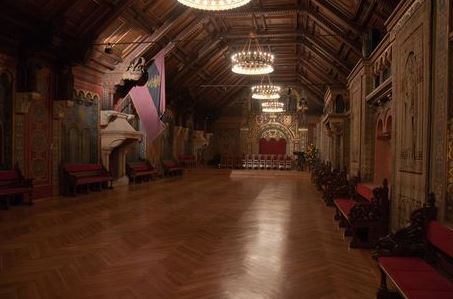
Reminiscent of the Gothic Victorian style of the mid-19th century, this delightfully detailed, three-story house has a nice entertaining area in the front for summertime relaxing. A grand reception hall welcomes visitors and displays an elegant staircase. The parlor and family room, each with a fireplace, provide excellent formal and informal living facilities.

The well-planned kitchen is only a couple of steps from the dining and breakfast rooms. Access to the rear backyard is provided through the family room or the breakfast room. The second floor has at least four bedrooms and three bathrooms plus a loft with sleeping for nine. The third floor houses an additional bedroom or studio with a half bath, as well as a playroom. There is also a basketball court and a swimming pool.

When building a custom home, your experience is just as vital as the final product you live in. Whether you’re building a custom home in Utah or another state, we can help. Our team at Millhaven goes beyond the build with our full-service approach to each project. https://millhavenhomes.com/

Human Perfection is Not Only Possible but Inevitable

There is all the difference between a sturdy independence and an inflated self-esteem. An experience which is a blow to his ego ought to be received with humility and analysed with impartiality. However, too often the man receives it with resentment and analyses it with distortion. In the result he is doubly harmed: there is the suffering itself and there is the deterioration of character. We sin by wandering away from our true inner selves, by letting ourselves become immersed in the thoughts and desires which surround us, by losing our innermost identity and taking up an alien one. This is the psychology of sin as philosophy sees it. However, if it had not succeeded overcoming the bondage of flesh, feeling, and thought and penetrating by means of its flawless technique into the World of the divine spirit, which is the real man, it could not have gained the knowledge for such a view of man. He is to live for the praise and blame, not of other people, but of his own higher self. The distance from lip to heart is sometimes immense. Who has not known men who had God prominent in their heard speech but evil prominent in their silent desires? The philosophic way of living asks for more than most men possess, more command of the passions, more discipline of the thoughts, and more submissiveness to intuition. #RandolphHarris 1 of 20
The moral injunctions which he finds in this teaching and must follow out in his life, are based on understanding the relation between his higher self and his lower self. They are not arbitrary commands but inevitable consequences of applying the adage, “Man, know thyself.” When anyone takes advantage of it to bloster his own ego at the expense of those under him, there is an abuse of authority. He will be virtuous not merely because so many others are–it is safer, it stops the prodding of conscience, etcetera—but much more because it is essential to put up no obstructions to the light flowing from the Overself. When applying evolution and social Darwinism to society, we are doing poetic justice to its origins. The “survival of the fittest” was a biological generalization of the cruel processes which reflective observers saw at work in early nineteenth century society, and Darwinism was a derivative of political economy. The miserable social conditions of the early industrial revolution had provided the data for Malthus’ Essay on the Principle of Population, and Malthus’ observations had been the matrix of natural-selection theory. The stamp of its social origin was evident in Darwinian theory. “Over the whole of English Darwinism,” Nietzsche once observed, “there hovers something of the odor of humble people in need and in straits.” #RandolphHarris 2 of 20

Darwin acknowledged his great indebtedness to Malthus: “In October 1838, that is, fifteen months after I had begun my systematic inquiry, I happened to read for amusement ‘Malthus on Population,’ and being well prepared to appreciate the struggle for existence which everywhere goes on from long-continued observation of the habits of animals and plants, it at once struck me that under these circumstances favorable variations would tend to be preserved and unfavorable ones to be destroyed. The result of this would be the formation of new species.” Spener’s theory of social selection, also written under the stimulus of Malthus, arose out of his concern with population problems. In two famous articles that appeared in 1852, six years before Darwin and Wallace jointly published sketches of their theory, Spencer had set forth the view that the pressure of subsistence upon population must have a beneficent effect upon the human race. This pressure had been the immediate cause of progress from the earliest human times. By placing a premium upon skill, intelligence, self-control, and the power to adapt through technological innovation, it has stimulated human advancement and selected the best of each generation for survival. #RandolphHarris 3 of 20

Because he did not extend his generalization to the whole animal World, as Darwin did, Spencer failed to reap the full harvest of his insight, although he coined the expression “survival of the fittest.” He was more concerned with mental than physical evolution, and accepted Lamarck’s theory that the inheritance of acquired characteristics is a means by which species can originate. This doctrine confirmed his evolutionary optimism. For if mental as well as physical charactersitics could be inherited, the intellectual powers of the race would become cumulatively greater, and over several generations the ideal man would finally be developed. Spencer never discarded his Lamarckism, even when scientific opinion turned overwhelmingly against it. Spencer called for a return to natural rights, setting up as an ethical standard the right of every man to do as he pleases, subject only to the condition that he does not infringe upon the equal rights of others. In such a scheme, the sole function of the state is negative—to insure that such freedom is not curbed. Fundamental to all ethical progress, Spence believed, is the adaptation of human character to the conditions of life. The root of all evil is the “non-adaptation of constitution to conditions.” Because the process of adaptation, founded in the very nature of the organism, is constantly at work, evil tends to disappear. While the moral constitution of the human race is still ridden with vestiges of man’s original predatory life which demanded brutal self-assertion, adaptation assures that he will ultimately develop a new moral constitution fitted to the needs of civilized life. #RandolphHarris 4 of 20

Human perfection is not only possible but inevitable: “The ultimate development of the ideal man is logically certain—as certain as any conclusion in which we place the most implicit faith; for instance that all men will die…Progress, therefore, is not an accident, but a necessity. Instead of civilization being artificial, it is a part of nature; all of a piece with the development of the embryo or the unfolding of a flower.” Some young much, such as actor Ian Nelson, who is wise beyond his years, also believes in the idea of human perfection. He has helped other people gain more success in their careers by sharing with them opportunities that were meant for him. And he has a very optimistic attitude about helping others become successful and sharing in their joy, but I guess that is why he is so successful. However, Spencer was ultra-conservative. His categorical repudiation of the state interference with the “natural,” unimpeded growth of society led him to oppose all state aid to the poor. They were unfit, he said, and should be eliminated. “The whole effort of nature is to get rid of such, to clear the World of them, and to make room for better.” Nature is as insistent upon fitness of mental character as she is upon physical character, “and radical defects are as much causes of death in the one case as in the other.” He who loses his life because of his stupidity, vice, or idleness is in the same class as the victims of weak viscera or malformed limbs. Under nature’s laws alike are put on trial. “If they are sufficiently complete to live, they do live, and it is well they should live. If they are not sufficiently complete to live, they die, and it is best they should die.” #RandolphHarris 5 of 20

To some, it must seem strangely out of tune with the modern World to speak of learning to be free. The growing opinion today is that man is essentially unfree. He is unfree in a cultural sense. He is all too obviously a pawn of government. He is molded by mass propaganda into being a creature with certain opinions and beliefs, desired and pre-planned by the powers that be. He is the product of his class—lower, middle, or upper—and his values and his behaviour are shaped by the class to which he belongs. So, it seems increasingly clear from the study of social institutions and influences, that man is simply the creature of his culture and his circumstances, and most decidedly is not free. At a still deeper level the behavioural sciences have added to this conception of man as unfree. Man is determined in part by his heredity—in his intelligence, his personality type, perhaps even his tendency toward mental aberration. He is above all the product of his conditioning—the inevitable result of the fortuitous events which have “shaped up” his behaviour. Many of our most astute behavioural scientists agree that this process of conditioning, of “shaping up” the individual’s behaviour, will no longer be left to chance, but will be planned. Certainly, the behavioural sciences are developing a technology which will enable us to control the individual’s behaviour to a degree which now would seem fantastic. #RandolphHarris 6 of 20

Along with the developlement of this technology has gone an underlying philosophy of rigid determinism in the psychological sciences which can perhaps best be illustrated by a brief exchange which I had with Professor B.F. Skinner of Harvard at a recent conference. A paper given by Dr. Skinner led me to direct these remarks to him. “From what I understood Dr. Skinner to say, it is his understanding that though he might have thought he chose to come to that meeting, might have thought he had a purpose in giving that speech, such thoughts are illusory. He made certain marks on paper and emitted certain sounds here simply because his genetic makeup and his past environment had operantly conditioned his behaviour in such a way that it was rewarding to make these sounds, and that he as a person does not enter this. In fact, if I get his thinking correctly, from his strictly scientific point of view, he, as a person, does not exist.” In his reply, Dr. Skinner said that he would not go into the question of whether he had any choice in the matter (presumably because the whole issue is illusory) but stated, “I do accept your characterization of my own presence here.” I do not need to labour the point that for Dr. Skinner the concept of “learning to be free” would be quite meaningless. #RandolphHarris 7 of 20

Thus, though there are opposing voices, the general thrust of the cultural trend throughout both the West and Communist World is to say that man is not free, that there is no such thing as a free man. We are formed and moved by forces—cultural forces without, and unconscious forces within—which we do not comprehend, and which are beyond our control. We will soon be formed more knowingly and more precisely by scientific technology which will replace the crude way in which we have been molded by practically fortuitous natural events. The age of information of our time prides itself on the fact that millions of people have a chance and, in fact, use the chance to listen to excellent live, recorded, or streamed music, to see art in the many museums in the country, and to read the masterworks of human literature from Plato to Anne Rice in easily available, inexpensive editions. No doubt for a small minority this encounters with art and literature is a genuine experience. For the vast majority, “culture” is another article of consumption and a status symbol since having seen the “right” pictures, knowing the “right” music, and having read the good books indicates college education and hence is useful for climbing the social ladder. The best of art has been transformed into an article of consumption, and it is reacted to an alienated fashion. The proof of this is that many of the very same people who go to concerts, listen to classical music, and buy a paperback Plato view tasteless and vulgar offerings on television without disgust. If their experience with art were genuine, they would turn off their television sets when they are offered artless, banal “drama.” #RandolphHarris 8 of 20

Yet man’s longing for the dramatic, that which touches upon the fundamental of human experience, is not dead. While most of the drama offered in theaters or on the screen is either a nonartistic commodity or is consumed in an alienated fashion, the modern “drama” is primitive and barbaric when it is genuine. In our day the longing for drama is manifested most genuinely in the attraction which real or fictionalized accidents, crimes, and violence have for most people. An automobile accident or fire will attract crowds of people who watch with great intensity. Why do they do so? Simply because the elemental confrontation with life and death breaks into the surface of conventional experience and fascinates people hungry for drama. For the same reason, nothing sells a newspaper better than reports of crime and violence. The fact is that whole on the surface the Greek drama or Rembrandt’s paintings are held in the highest esteem, their real substitutes are crime, murder, and violence, either directly visible on the television screen or reported in the newspapers. Some people suffer from an alienation of hope. One characteristic of the alienation of hope is the future becoming transformed into an idol. This idolatry of history can be clearly seen from Robespierre’s point of view. “O posterity, sweet and tender hope of humanity, thou art not a stranger to us; it is for thee that we brave all the blows of tyranny; it is thy happiness which is the price of our painful struggles: often discouraged by the obstacles that surround us, we feel the need of thy consolations; it is to thee that we confide the task of completing our labours, and the destiny of all the urban generations of me!… Make haste, O posterity, to bring to pass the hour of equality, of justice, of happiness!” #RandolphHarris 9 of 20

Similarly, a distorted version of Marx’ philosophy of history has often been used in the same sense by Communists. The logic of this argument is: whatever is in accord with the historical trend is necessary, hence good and vice versa. In this view, whether in the form of Robespierre’s or the communist argument, it is not man who makes history but history that makes man. It is not man who hopes and has faith in the future but the future that judges him and decides whether he had the right faith. Marx expressed very succinctly the opposite view of history to the alienated one I just quoted. “History,” he wrote in The Holy Family, “does nothing, it possesses no colossal riches, it fights no battles! It is rather man, actual and living man, who does all this; ‘history’ does not use man as a means for its purposes as though it were a person apart; it is nothing but the activity of man pursuing his ends.” Not only are all forms of depression, dependence and idol worship (including the “fanatic”) direct expressions of, or compensations for, alienation; the phenomenon of the failure to experience one’s identity which is a central phenomenon at the root of psychopathological phenomena is also a result of alienation. Precisely because the alienated person has transformed his own functions of feeling and thought to an object outside, he is not himself, he has no sense of “I,” of identity. This lack of a sense of identity has many consequences. The most fundamental and general one is that it prevents integration of the total personality, hence it leaves the person disunited within himself, lacking either capacity “to will one thing” or if he seems to will one thing his will lack authenticity. #RandolphHarris 10 of 20

In the widest sense, every neurosis can be considered an outcome of alienation; this is so because neurosis is characterized by the fact that one passion (for instance, for money, power, women, etcetera) becomes dominant and separated from the total personality, thus becoming the ruler of the person. This passion is his idol to which he submits even though he may rationalize the nature of his idol and give it many different and often well-sounding names. He is ruled by a partial desire, he transfers all he has left to this desire, he is weaker the stronger “it” becomes. He has become alienated from himself precisely because “he” has become the slave of a part of himself. Now, in our case study, Clare was unable to let go of a man, for whatever reasons. The repression of her resentment is striking as she was fully aware of her disappointment at Peter, the man she was involved with, staying away. Moreover, on such an occasion resentment would certainly have been a natural reaction, and it was not in her character never to allow herself to be angry at anyone; she often was angry at people, though it was characteristic of her to shift anger from its real source to trivial matters. However, raising this question, while apparently only a routine matter, would have meant broaching the subject of why the relationship with Peter was so precarious that any disturbance of it had to be shut out of awareness. #RandolphHarris 11 of 20

After Clare had thus managed to shake off the whole problem from her conscious mind, she fell asleep again and had a dream. She was in a foreign city; the people spoke a language that she did not understand; she lost her way, this feeling of being lost emerging very distinctly; she had left all her money and luggage deposited at the station. Then she was at a fair; there was something unreal about it, but she recognized gambling stands and a freak show; she was riding on a merry-go-round which turned around more and more quickly so she was drifting on waves, and she woke up with a mixed feeling of abandon and anxiety. The first part of the dream reminded her of an experience she had had in adolescence. She had been in a strange city; had forgotten the name of her hotel and had felt lost, as in the dream. Also, it came back to her that the night before, when returning home from the movie, she had felt similarly lost. The gambling stands and the freak show she associated with her earlier thoughts about Peter making promises and not keeping them. Such places, too, make fantastic promises and there, too, one is usually cheated. In addition, she regarded the freak show as an expression of her anger at Peter: he was a freak. What really startled her in the dream was the depth of the feeling of being lost. She immediately explained away her impressions, however, by telling herself that these expressions of anger and of feeling lost were but exaggerated reactions to her disappointment, and that dreams express feelings in a grotesque way anyhow. #RandolphHarris 12 of 20

It is true that the dream translated Clare’s problems into grotesque terms, but it did not exaggerate the intensity of her feeling. And even if it had constituted an exaggeration, it would not have been sufficient merely to dismiss it on that score. If there is an exaggeration it must be examined. What is the tendency that prompts it? Is it not an exaggeration but an adequate response to an emotional experience, the meaning and intensity of which are beyond awareness? Did the experience mean something quite different on the conscious and unconscious level? Clare felt just as miserable, as lost, as resentful as the dream and the earlier associations indicated. However, since she still clung to the idea of a close love relationship this realization was unacceptable to her. For the same reason she ignored that part of the dream about having left all her money in the luggage at the station. This was probably a condensed expression of her feeling that she had invested all she had in Peter, the station symbolizing Peter and connoting something transitory and indifferent as opposed to the permanence and security of home. And Clare disregarded another striking emotional factor in the dream when she did not bother to account for its ending with anxiety. Nor did she make any attempts to understand the dream. She contended with the superficial explanation of this and that element, and thus learned from it no more than she knew anyhow. #RandolphHarris 13 of 20

If Clare had probed more deeply, she might have seen the main theme of the dream as this: I feel helpless and lost; Peter is a great disappointment; my life is like a merry-go-round, and I cannot jump off; there is no solution but drifting; but drifting is dangerous. We cannot discard emotional experiences, however, as easily as we can discard thoughts unconnected with our feelings. And it is quite possible that Clare’s emotion experience of anger and particularly of feeling lost, despite her blatant failure to understand them, lingered on in her mind and were instrumental in her pursuing the path of analysis she subsequently embarked upon. While the public has been effectively educated to recognize symptoms of personality disorder and has been encouraged to seek professional consultation for emotional problems, the mental health movement has inevitably created problems as it has offered solutions. The nature of neurosis as presently defined is such as to encourage overinterpretation of the significance of a host of idiosyncrasies and eccentricities. The mental health educator has understandably, in the first phase of the moment, operated within the pathological framework afforded by essentially gross medical definitions of emotional illness. Emphasis has been upon detection and prevention of illness, rather than upon modes of achieving and maintaining beneficial mental health. The meaning of neurosis, ambiguous to begin with, has been subtly extended to cover a variety of cultural delusions, perhaps the most prominent which is the Western myth that a state of happpiness is both a primary and achievable goal of life. #RandolphHarris 14 of 20

One effect of the mental health movement has been to encourage many people to see their unhappiness. Psychotherapist, both visible and “invisible,” are increasingly confronted by would-be patients who do not manifest any of the more objective hallmarks of a neurotic problem, who do not complain of failures of productivity or achievement, who do not suffer from serious interpersonal conflicts, who are free of functional somatic complaints, who are not incapacitated by anxiety, or tormented by obsessions, whose objective life circumstances they confess are close to optimal. These seekers of help suffer freedom from complaint. The absence of conflicts, frustrations, and symptoms brings a painful awareness: of absence—the absence of faith, of commitment, of meaning, of the need to search out personal, ultimate values, or of the need to live comfortably and meaningfully each day in the face of final uncertainty. For increasing numbers of rational, educated, and thoughtful men the central struggle becomes one of finding and keeping an emotional and psychological balance between the pain of doubt and the luxury of faith. A distaste for this struggle, or an insistence on its resolution as a necessary condition for continued existence is at the heart of the philosophical neuroses. In contrast to the psychoneuroses, we have no established knowledge or technique to bring to bear this form of dis-ease. We do not have a scientifically confirmable matrix of ideas concerning how or what to teach those who suffer philosophical neuroses. #RandolphHarris 15 of 20

The philosophical neurotic suffers in his struggle to be both reasonable and hopeful, and he can be helped in his skirmish by access to human wisdom and by encouragement to expose himself to it. However, in this seeking for counsel and for opportunity to test doubt against faith or faith against doubt, he must not be misled to think that any group of experts has a corner on some specialized wisdom about the meaning of life or how to live it. It is an unfortunate side-effect of the mental health movement that a large portion of the limited psychotherapeutic resources afforded by psychiatrists and psychologists is being consumed by persons who suffer a philosophical anomie for which neither psychiatrist nor psychologist can offer specific therapy. The person with a philosophical neurosis deserves care and can be helped; it would be in his own interests and in the interest of social economy for him to be encouraged to seek guidance from those who are most practiced and equipped to think with him in the domain of values, meaning, ethics, and eschatology. Recognition of the philosophical neurosis and the special problems its presents have been delayed on the part of psychotherapists because the well-bred, well-fed, well-read qualities typical of this patient appeal to the intellectual and social prejudices of the therapist and make for spontaneous rapport and empathy. #RandolphHarris 16 of 20
In combating the general ignorance and superstition of the public about mental illness, the mental health movement has necessarily attacked the idea that emotional and mental problems should be a source of shame. The public has been taught that everyone has a basic susceptibility to psychological maladjustment and, furthermore, that a very large number of people in fact suffer from some degree of “nervousness.” All of this teaching is true and was most necessary in ending the shameful connotations that formerly prevailed. However, as an unfortunate consequence of these beneficial changes, neurosis has achieved respectability. In some sophisticated segments of our society it has become expected and accepted for the individual to acknowledge his “neurosis”–and to have all manner of immature, selfish, irresponsible behaviours explained by him (and accepted by his companions) as “symptoms” of his “sickness.” Among persons whose work demands some degree of creative imagination there is a popular stereotype which equates genius with neurosis. It becomes a tempting apology to substitute symptoms for effort; to manifest the temperament of an artist may be an easier road to achieving an artistic identity than to be truly creative. When individuals are volubly proud that they are “in therapy,” although they remain silent on the content and course of that self-discovering endeavour, with discussion of the causes and treatment reserved by socially sanctioned conspiracy of silence between therapist and client (or with normal social respect for the individual’s privacy), it may be wondered if the continuation of therapy is required at least in part because the patient is reluctant to lose the dramatic appeal of his status. #RandolphHarris 17 of 20

And when the patient does speak freely of the content of his therapeutic conversations to all willing listeners, it may be wondered if he suffers from lack of any other mental content with which he would hope to hold an audience. To be proud of an illness or a defect is a separate illness, and perhaps needs to be treated first. Man’s capacity to feel shame is not pathological in itself; pathology arises from what he does or fails to do about shame. Shame can be hidden by repression and denial, but the massive effort required to hide one’s shame results in symptoms. Or, shame can yield a sense of responsibility, and this can power a search for self-understanding, for self-acceptance, and for better behaviour. The mental health movement has lifted the pathological shame previously associated with emotional illness. Now it must be attentive to combat the tendency for the unashamed to have pathological pride in their maladjustment. Liars have a dangerous maladjustment, which is why they often answer a question with one of their own. The tactic of answering a question with a question buys the liar time to come up with something plausible. They are not the type to let the silence go by, so they fill it with something that cannot be used against them. And the old, I swear on a stack of Bibles tactic is an oath to beware of. What people will say to try to get themselves off the hook is insane. When you are sure they are lying, how important is it to you that you get to the bottom of things and make someone tell you the truth? #RandolphHarris 18 of 20

All that is best in the Christian virtues you will find in philosophic ones. Few are those who are psychologically ready for philosophy’s disciplines, which call, not merely for a reluctant control of the animal nature, but for an eager aspiration to rise above it altogether. Few are ready for its ethics, which all not merely for a willingness to abide by society’s protective laws, but for a generous disposition contently putting itself in someone else’s place. Firefighters with the Sacramento Fire Department certainly display the Christian virtues. One firefighter said, “I think just being around firefighters got me. It’s like being a sports fan, being there and watching you get to know more about it, and you have more admiration for the good ones. The firefighting process is like a well-oiled machine going to work. I for fascinated watching it and wanted to be a part of it. I was just so happy to go in there, and I always wanted to do the very best job I could, to keep it that way. When I was a kid, I thought the World of the Sacramento Fire Department. I want to hold up my end of it.” Today, I think the best way to get to know someone is by listening to their first-hand accounts about themselves. Many people are cowards and like to tear down people who shine, and do not get to know them personally. Instead, they choose to gossip about them, become jealous and form hate groups. I personally like talking to people and getting to know their story and about them. #RandolphHarris 19 of 20
Not everyone has a tragic story, nor is it unhappy. Recently, I found out a 29-year-old had been listening to classical music all week. And that really impressed me because it shows a rare level of maturity, and it gave me insight into his personality. It tells me that he is intelligent, cultured and probably very interesting. To make friends with someone, you have to know something about them and have something in common, and it is rare for people to disclose things about themselves to others. The Sacramento Fire Department has developed prestige in the community. People think, “boy, if you belong to that fire department, you’re really ‘in.’” People may say that they are a bunch of prima donnas, but they must be. If you belong to their fire department, you earn it. It is not easy to get in, but once you are in, you must produce, or you are out. Because you must get along with thirty other people or more, and if you do not pull your share, you will have a hard time. There is always a waiting list, people waiting to get in. And that is good. It may take two or three years before your number comes up. And there are sometimes some limiting factors. Sometimes residents are shown a preference. They pay attention to how long you have lived in the community and are you going to continue going to continue to live here. Once a team member is taken in, they want to keep them for at least twenty years. Please be sure to donate to the Sacrament Fire to ensure they are receiving all their resources. I pledge allegiance to the flag of the United States of America, and to the republic for which it stands, one nation under God, indivisible, with liberty and justice for all. #RandolphHarris 20 of 20


Asymmetry of facade is a characteristic of Victorian feature. Differing wall textures, such as the change from lap siding to fish scale shingles on the front-facing gable, is another distinguishing architectural trait. This inviting dwelling opens into a foyer sparking with light from the windows.

A semi-formal dining room and spacious great room provide ample space for holiday festivities. A master suite offers a handsome bath with separate vanities and a walk-in closet, which is as large as a bedroom. There also is a loft area, three other bedrooms, and three bathrooms and a powder room. This home offers a four bay car garage. One of the bays could be used as a gym or completed and used as another bedroom or a recreational area. https://cresleigh.com/magnolia-station/residence-4/


The House of Ghosts and Dreams

Ghosts, spirits, lost souls, did not, could not exist. And hopefully in a day or two, everyone will be convinced. A couple by the door, both approaching middle age, sat close enough together for their thighs to touch, and listened overattentively to whatever the other was saying in the manner of a man and woman each married to a different partner. By the fire was a group in tweeds and mufflers, the men mostly satisfied listening to the conversation of their womenfolk while they sipped their gin and tonics and pondered the virtues (or the boredom) of retirement. I turned my back to the group. After a time, the quality of darkness seemed to change. I frowned. I thought I could see the faintest glow of gathering light coalescing near the door-to-nowhere. The light was not strong enough to collect the attention of my guests yet, but it was certainly visible. After several moments, the light began to form an indistinct shape. Of course, everyone in the room was seeing it, too. The chatter suddenly stopped as they gasped for air. With wonder, we were witnessing a supernatural manifestation right before our eyes. Two children, a boy, and a girl, he, in a blue suit and tie, and she in a white communion dress with a blue sash tied around the waist, hovered just out of our reach. My heart leaped with surprise, as I became flushed with tears. My guests, conjuring their own horror, were at a loss for words. #RandolphHarris 1 of 5
The children slowly rotated around the room before coming to rest. The girl cried out, “Mommy!” And at that moment, the room was completely darkened. I screamed because the room had become extremely cold. I had a fragile hope, one that was beyond the tight and restricting bonds of sanity, that the faintest essence of my daughter was within the walls of my home. I listened for a moment, wishing that the peripheral voice would rouse my attention. However, there was no sound from the room and grief had exhausted our bodies as well as our spirits. I stared into the darkness, terribly afraid, even more terribly, compelled to ask my guests to leave. At the foot of the stairs I paused, glancing back over my shoulder as if seeking reassurance from the spirit World. There was still no sound from the apparitions. No sounds in the house at all. Not even the voice. From ahead, at the end of the corridor in which I hesitated, came a soft glow, a shimmer strip of amber. Slowly, each footstep measured, I went to the light. I stopped outside the closed door and now there was a sound, a quiet shifting, as though the house had signed. It could be no more than a breeze stealing through. The light was not constant; it flicked. My hands grasped the door handle. My grip was tenuous, slipping over the smooth surface before lodging and turning. A brief thought that there was someone clutching the other side, resisting my effort; then the handle catches and the door is open. I pushed open a heavy door and my face was flushed by the lambent glow. #RandolphHarris 2 of 5

The chill followed behind me in darkness. “Is any one there?” I called from the doorway. The room was a display of burning candles: their light bowed with the opening of the door and their waxy smell welcomed me. Shadows momentarily shyed away then rush forward in their own greeting as the myriad flames settled. Against the back wall and facing entrance was a large walk-in fireplace that could easily accommodate a six-foot log. “At least the carpenters made sure I have heat,” I laughed. I started opening the other doors. One disclosed stairs to the servants’ quarters above; another opened a stairway to the basement which contained thirteen rooms. A third door led to a stairwell in the backyard, and it was securely locked. Still another one opened into the butler’s pantry and that was provided with its own exit under the broad stairway that faced the front door. I found myself in the entrance hall. Walking a bit further through a short hallway to the right with a great sliding door of heavy mahogany and leaded glass at its end. Pushing it open, I discovered a library at least twenty-five feet wide that extended to the back of the house, and it had its own exit into the backyard. Filled with bookshelves, at least seven feet tall, extended around three sides fo the room except where deep windows with built-in seats were set into the walls. The spirits had built my house to last. #RandolphHarris 3 of 5

There was another immense fireplace in the library. Two 1879 Winchester Rifles were crossed above the mantel like medieval swords. A long antique davenport was placed in front of the fireplace. Behind it was an old-fashioned library table with a lamp for reading before the fire. Two crystal chandeliers gave an ornate touch to an elegant and charming room. However, nothing could prepare me for what I saw. At the furthermost point of the room, resting on lace-clothed tables, were two coffins. I stared. My steps were leaden as I approached the open caskets, and my eyes were wide. The moisture on my skin glistened under the light. I did not want to investigate those coffins. I did not want to see the figure lying there, not in such an alien state. However, there was really no choice. My mind had become open to unnatural possibilities. A voice whispered my name and I had responded; I had my own reasons for grasping the inconceivable possibilities. I drew closer. The forms inside the silklined caskets were gradually revealed. She was wearing a white communion gown, a pale blue sash tied at her waist. And the boy—why these were the same two children we had seen earlier. Their hands rested together on their chests as if in supplication. Dark hair framed their faces, and, in their death, they looked serene, sleeping, untroubled children. The light played upon the corners of their lips so that they suppressed smiles. #RandolphHarris 4 of 5
Despite my yearning to disbelieve, I knew there was no life within these pallid shells. I wished to speak to these children, but my throat was constricted by the wretchedness of my emotion. I blinked, dislodging a swell of tears. I leaned forward as if I might kiss the dead children. And their eyes snapped open. They grinned up at me, their young faces no longer innocent. And their hands stirred as if to reach out to me. I was frozen. My mouth was locked open, lips stretched taut and hard over bone, the scream beginning but only breaking loose a few moments later, a shrilling that cuts through the quietness of the house. My cry wanes, dissolves, and by eyes close as reason seeks sanctuary behind Llanada Villa’s walls. A warm mass of air carried the faint sound of music. Castigating myself in silence, I stepped with authority to the rear of the room, placing my hands on the wooden door. As I turned the handle and opened the door, I had a feeling there was something there, but I let it pass, thinking it was my imagination. However, there was something on the landing upstairs that seemed to stare down at me. Something within me made me say, “Whoever you are, you must be lonely!” On Saturday night, as I was sitting down for dinner, the servants had prepared roasted chickens, sausage pie, and Yorkshire pudding. The servant-girl threw some coal on the boiler fire, only to have it all thrown back again on the floor. No one can explain the cause of the occurrences, and it remained the only topic of conversation for days to come. #RandolphHarris 5 of 5

The Winchester Mystery House

Tours had been going on in The Winchester Mystery House for 100 years, when by degrees caretakers decided that it had become rather “noisy.” It began with the windows being violently shaken at night, and then they began to hear steps where no steps should be. They were perturbed still further when they began to hear deep, long sighs at all hours of day and night. There were other odd manifestations. There were occasions when caretakers would approach the door-to-nowhere, when the handle would turn, and the door would fly open. One caretaker wrote that “I have once seen this happen, and it is a curious thing to see, when on the other side of the door there is a two-story fall into the garden.” Then another caretaker heard the sounds of stitching of some hard material in the sewing room; and in the Witches Cap, they would often hear the noise of children playing and a heavy weight being dragged across the floor, when there was no object in sight, and most alarmingly of all there were times when they experienced the sensation of their hair being pulled.

Please come and enjoy a delicious meal in Sarah’s Café, stroll along the paths of the beautiful Victorian gardens, and wonder through the miles of hallways in the World’s most mysterious mansion. For further information about tours, including group tours, weddings, school events, birthday party packages, facility rentals, and special events please visit the website: https://winchestermysteryhouse.com/

Please visit the online giftshop, and purchase a gift for friends and relatives as well as a special memento of The Winchester Mystery House. A variety of souvenirs and gifts are available to purchase. https://shopwinchestermysteryhouse.com/


The Most Dangerous Job in the World

Evil must die ultimately as the weaker element, in the struggle with good. The persistence of force, manifested in the forms of matter and motion, is the stuff of human inquiry, the material with which philosophy must build. Everywhere in the Universe man observes the incessant redistribution of matter and motion, rhythmically apportioned between evolution and dissolution. Evolution is the progressive integration of matter accompanied by dissipation of motion; dissolution is the disorganization of matter accompanied by the absorption of motion. The life process is essentially evolutionary, embodying a continuous change from incoherent homogeneity, illustrated by the lowly protozoa, to coherent heterogeneity, manifested in man and the higher animals. From the persistence of force, anything which is homogeneous is inherently unstable, since the different effects of persistent force upon its various parts must cause differences to arise in their future development. Thus the homogeneous will inevitably develop into the heterogeneous. Here is the key to Universal evolution. This progress from homogeneity to heterogeneity–in the formation of the Earth from a nebular mass, in the evolution of higher, complex species from lower and simpler ones, in the embryological development of the individual from a uniform mass of cells, in the growth of the human mind, and in progress of human societies–is the principle at work in everything man can know. #RandolphHarris 1 of 18
No amount of description, regardless of how carefully it is presented, can convey an adequate impression of exactly what is involved in the process of reaching an understanding of oneself. The grown-up individual is not a child, and to talk about the child in him, or “his” unconsciousness, is using a topological language which does not do justice to the complexity of the facts. The neurotic, grown-up individual is an alienated human being; he does not feel strong, he is frightened and inhibited because he does not experience himself as the subject onto whom he projects all his own human qualities: his love, intelligence, courage, etcetera. By submitting to this object of transference, he feels in touch with this own qualities; he feels strong, wise, courageous, and secure. This mechanism, idolatric worship of an object, based on the fact of the individual’s alienation, is the central dynamism of transference, that which gives transference its strength and intensity. The less alienated person may also transfer some of his infantile experience to another persons, but there would be little intensity in it. The alienated individual, in search for and in need of an idol, finds the analyst and usually endows him with the qualities of his father and mother as the two powerful persons he knew as a child. Thus the content of transference is usually related to infantile patterns while its intensity is the result of the individual’s alienation. Needless to add that the transference phenomenon is not restricted to the analytic situation. It is to be found in all forms of idolization of authority figure, in political, religious, and social life. #RandolphHarris 2 of 18

Transference is not only the phenomenon of psychopathology which can be understood as an expression of alienation. Indeed, it is not accidental that alien, in French and alienado in Spanish, are older words for the psychotic, and the English “alienist” refers to a doctor who cares for the insane, the absolutely alienated person. Alienation as a sickness of the self can be considered to be the core of the psychopathology of modern man even in those forms which are less extreme than psychosis. Some clinical examples may serve to illustrate the process. The most frequent and obvious case of alienation is perhaps the false “great love.” A man has fallen enthusiastically in love with a woman; after she had responded at first, she is beset by increasing doubts and breaks off the relationship. He is overcome by a depression which brings him close to suicide. Life, he feels, has no more meaning to him. Consciously he explains the situation as a logical result of what happened. He believes that for the first time he has experienced what real love is, that with this woman, and only with her, could be experience love and happiness. If she leaves him, there will never be anyone else who can arouse the same response in him. Losing her, so he feels, he has lost his one chance to love. Hence it is better to die. #RandolphHarris 3 of 18

While all this is convincing to himself, his friends may ask some questions: Why is it that a man who thus far seemed less capable of loving than the average person is now so completely in love he seems to be unwilling to make any concessions, to give up certain demands which conflict with those of the woman he loves? Why is it that while he spears of his loss, he mainly speaks relatively little interest in the feelings of the woman he loves so much? If one speaks to the unhappy man himself, at greater length, one need not be surprised to hear him in fact as if he had left his heart with the girl he lost. If he can understand the meaning of his own statement, he can understand that his predicament is one of alienation. He never was capable of loving actively, of leaving the magic circle of his own ego, and of reaching out to becoming one with another human being. What he did was to transfer his longings for love to the girl and to feel that being with her he experiences his “loving” when he really experiences only the illusion of loving. The more he endows her not only with his longing for love but also for aliveness, happiness, and so on, the poorer he becomes, and the emptier he feels if he is separated from her. When actually he had made the woman into an idol, the goddess of love, and believed that by being united with her he experienced love, he was under the illusion of loving. #RandolphHarris 4 of 18

He had been able to initiate a response in her but he had not been able to overcome his own inner muteness. Losing her is not, as he thinks, losing the person he loves, but losing himself as a potentially loving person. Alienation of thought is not different from alienation of the heart. Often one believes he was thought through something, that his idea is the result of his own thinking activity; the fact is that he has transferred his brain to the idols of public opinion, the newspapers, the government or a political leader. He believes that they express his thoughts while in reality he accepts their thoughts as his own, because he has chosen them as his idols, his gods of wisdom and knowledge. Precisely for this reason he is dependent on his idols and incapable of giving up his worship. He is their slave because he has deposited his brain with them. An involuntary and in a deeper sense unwarranted dependency upon another person is a problem known to nearly everyone. Most of us deal with one or another aspect of it at one or another period of our lives, often not truly recognizing its existence and screening it instead behind such exquisite terms as “love” or “loyalty.” This dependency is so frequently because it seems to be a convenient and promising solution for many troubles we all have. It puts grave obstacles, however, in the way of our becoming mature, strong, independent people; and its promise of happiness is mostly fictitious. #RandolphHarris 5 of 18

Therefore a delving into some of its unconscious implications may be interesting and helpful, even apart from the question of self-analysis to anyone who regards self-reliance and good relationships with others as desirable goals. After several months of not very productive efforts at self-analysis Clare awoke one Sunday morning with an intense irritation at an author who failed to keep his promise to send an article for the magazine she edited. This was the second time he had left her in the lurch. It was intolerable that people should be so unreliable. Soon after it struck her that her anger was out of proportion. The whole matter was scarcely of sufficient importance to wake her up at five in the morning. The mere recognition of a discrepancy between anger and alleged provocation made her see the real reason for the anger. The real reason also concerned unreliability, but in a matter more close to her heart. Her friend Peter, who had been out of town on business, had not returned for the weekend as he had promised. To be exact, he had not given a definite promise, but he had said that he would probably be back by Saturday. He was never definite in anything, she told herself; he always aroused her hopes and then disappointed her. The fatigue she had felt the night before, which she had attributed to having worked too hard, must have been a reaction to her disappointment. #RandolphHarris 6 of 18

She had hoped for an evening with Peter, and then, when he did not show up, she had gone to a movie instead. She could never make engagements because Peter hated to make definite dates in advance. The result was that she left as many evenings free as she possibly could, always harbouring the disquieting thought, would he or would he not be with her? While thinking of this situation two memories occurred to her simultaneously. One was an incident that her friend Eileen had told her years before. Eileen, during a passionate but rather unhappy relationship with a man, had fallen seriously ill with pneumonia. When she recovered from the fever she found to her surprise that her feelings for the man had died. He tried to continue the relationship, but he no longer meant anything to her. Clare’s other memory concerned a particular scene in a novel, a scene that had deeply impressed her when she was an adolescent. The first husband of the novel’s heroine returned from war, expecting to find his wife overjoyed at his return. Actually the marriage had been torn by conflicts. During the husband’s absence the wife’s feelings had changed. She did not look forward to his coming. He had become a stranger to her. All she felt was indignation that he could be so presumptuous as to expect love just because he chose to want her–as if she and her feelings did not count at all. #RandolphHarris 7 of 18

Clare could not help realizing that these two associations pointed to a wish to be able to break away from Peter, a wish that she referred to the momentary anger. However, she argued, I would never do it because I love him too much. With that thought ths fell asleep again. Clare made a correct interpretation of her anger when she saw it as caused by Peter rather than by the author, and her interpretation of the two associations was right. However, despite this correctness the interpretations, as it were, lacked depth. There was no feeling whatever for the force of the resentment she harboured against Peter. Consequently she regarded the whole outburst as only a transient grievance, and thus discarded much too lightly the wish to tear loose from him. Retrospectively it is clear that at that time she was far too dependent on Peter to dare to recognize either resentment or a wish for separation. However, she had not the slightest awareness of any dependency. She ascribed the apparent ease with which she overcame the anger to her “love” for her friend. This is a good example of the fact that one will get no more out of association than one can stand at the time, even though, as in this instance, they speak an almost unmistakable language. Clare’s basic resistance against the import of her associations explains why she did not raise certain questions that they suggested. #RandolphHarris 8 of 18

It is significant, for example, that both of them, while connoting a general way a wish to break off, indicated a very special form of breaking off: in both instances the woman’s feelings faded out while the man still wanted her. This was the only ending of a painful relationship that Clare could visualize. To break away from Peter on her own initiative was unthinkable because of her dependency upon him. The idea that he could break away from her would have aroused sheer panic though there are good reasons to infer that she felt deep down that he did not really want her while she hung on to him. Her anxiety on this score was so deep that it took ger considerable time to realize the mere fact that she was afraid. It was so great that even when she discovered her fear of desertion, she still closed her eyes to the rather obvious fact that Peter wanted a separation. In thinking of incidents in which the woman herself was in a position to reject the man Clare revealed not only a wish to be free but also a desire for revenge, both deeply buried and both referring to a bondage which was itself unrecognized. Here lies the connection between beauty and truth. Beauty is not the opposite of the “ugly,” but of the “false”; it is the sensory statement of the suchness of a thing or a person. #RandolphHarris 9 of 18

To create beauty presupposes a state of mind in which one has emptied oneself in order to fill oneself with what one portrays so that one becomes it. “Beautiful” and “ugly” are merely conventional categories which vary from culture to culture. A good example of our failure to comprehend beauty is the average person’s tendency to cite a “sunset” as an example of the beautiful, as if rain or fog were not just as beautiful, although sometimes less pleasant for the body. All great art is by its very essence in conflict with society with which it coexists. It expressed the truth about existence regardless of whether this truth serves or hinders the survival purposes of a given society. All great art is revolutionary because it touches upon the reality of man and questions the reality of the various transitory forms of human society. Even an artist who is a political reactionary is more revolutionary–if he is a great artist–than the artists of “socialist realism” who only mirror the particular form of their society with its contradictions. It is an astonish fact that art has not been forbidden throughout history by the powers that were and are. There are perhaps several reasons for this. One is that without art man is starved and perhaps not even useful for the practical purposes of his society. #RandolphHarris 10 of 18

Another is that by his particular form and perfection of the great artist was an “outsider” and hence while he stimulated and gave life, he was not dangerous because he did not translate his art into political terms. Besides that, art usually reached only the educated or politically less dangerous classes of society. The artists have been the court jesters of all past history. They were permitted to say the truth because they presented it in its particular but socially restricted artistic form. A self-initiated process of learning to be free is composed of movement from as well as movement toward. From being persons driven by inner forces they do not understand, fearful and distrustful of these deeper feelings and of themselves, living by values they have taken over from others, they move significantly. They move toward being persons who accept and even enjoy their own feelings, who value and trust the deeper layers of their nature, who find strength in being their own uniqueness, who live by values they experience. This learning, this movement, enables them to live as more individuated, more creative, more responsive, and more responsible persons. People are often sharply away of such directions in themselves, as they move with fearfulness toward being freely themselves. #RandolphHarris 11 of 18

It is a painful paradox of civilization that so many of our major discoveries seem to contribute almost equally to the solution of one problem and the creation of another. Dynamite is perhaps the most often noted example, but there are many others. Our discoveries seems to extricate us from an old set of limitations only to burden us with new frustrations. Happily, there seems to be a period of relatively unadulterated enjoyment of each new technological advance. However, sooner or later, its “fringe” limitations come to equal or even surpass its benefits. Thanks to the invention of the Ultimate Driving Machine we have had a marvelous mobility and a great expansion of our “living space,” and now we have an increasingly serious problem of what to do with out cars when they are not in use. Discovery of nuclear fission may have helped to end one way, but now we are threatened by a way of total annihilation. The industrial revolution which enormously increased the supply of goods has been augmented by scientific advances in the twenty-first century that threaten to poison the air we breathe, pollute the water we drink and the food we eat. Automation of industry has made possible better control of processes and more efficient production with fewer workers, and it is as yet uncertain whether we shall be able successfully to absorb the displaced and unneeded labour force as our industries become increasingly places of auto-facture rather than manufacture. #RandolphHarris 12 of 18

Medical science and modern technology have added significantly to longevity. Each year our population receives a sizable increment of persons who have been retired from the productive community and who may live another five or ten years; we find we must cope directly with the problem of supplying meaning to these “golden years.” In light of the ageless struggles to maintain and extend biological life against the assaults of famine and pestilence, in light of the individual struggle to protect health and preserve life, it is a poignant paradox that we must search out ways to help the retired warrior to cope with a life that is now secure, comfortable, and certain. It is an important fact to which all psychotherapists should be fully sensitive that for very many persons when the steadily recurrent daily problems of work–of earning, of building, of planning, of saving–are over, the problem of meaning comes promptly pressingly to the fore. Enjoyment of existence does not come naturally to the person whose earlier life has given neither time nor stimulus to question ultimate purpose or to explore for meanings that superscribe the orientation provided by inescapable basic demands for effort. Thus, paradoxically, each new freedom brings the possibility of new entrapments. We may wonder whether the pace of discovery may soon achieve so many solutions that the problems created by those solutions will surpass our problem-solving capacities! #RandolphHarris 13 of 18

At any place along the road of life, one may turn one’s back on ignorant habits and seek to create better ones. If society find him an odd creature, if it laughs at his peculiarities of belief or frowns at his departures from convention, then he must not blame society. He must accept the situation as inescapable and submit to its unpleasantness as being better than the littleness of surrender. The quest is carried on always under silent and continual pressure. The earnest aspirant will strive to love well where formerly he lived ill, will keep looking for better ideals. As if it were enforced by outside authority, few are ready to impose such a discipline upon themselves; but if they applied what they know, many more could to a little better. Some temptations come on slowly, but others suddenly and before he fully realizes what is happening to him. Whatever the way they come–and this depends partly on his personal temperament, partly on the nature of the temptation–he should prepare himself in advance by fortifying the weaker places in his character. The negative quality can be rubbed away gradually by brining counter qualities into the field against it. He is expected to put forth the effort needed to dispel a negative emotion or to destroy a negative thought, since such will not go away of itself. #RandolphHarris 14 of 18

When the mind is sufficiently purified, it receives intuitions more easily and nurtures aspirations more warmly. Tread firmly on negative thoughts, eject them from the mind as soon as they appear, and give them no chance to grow. Spite, envy, moroseness, despondency and denigrating criticism should all be denied entry. A prompt and decisive “No!” to the suggestion or impulse as soon as it appears, prevents it from gathering strength and becoming uncontrollable. The quickness with which an impulse moves him to action may hide its beginning in him. However, the moment is there: by self-training it may be perceived in time, and inhibition or control applied with more and more success. His intellectual clarity must be deep and his emotional tolerance broad. It is always a pity when thinkers are not equal to their own thoughts. The gain of building an equable character and evenness of mind is not only a spiritual one, it is also a contribution to person happiness. He will not agree to act under threat. Every such attempt to intimidate him makes him only more determined to resist it and to reject the desired action. The power which man spends in the passions and emotions of his lower nature will, when governed and directed upward in aspiration to his higher nature, give him the knowledge and bliss of the Overself. #RandolphHarris 15 of 18

It is not enough to follow a wholesome diet and a healthy way of life. The seeker after a better existence must match with these advanced his thoughts and emotion. By focusing national attention on the numbers and needs of the thousands of patients who suffer incapacitating emotional illness, the mental health movement has served to arouse attention and to mobilize efforts in their behalf. It has won increased expenditures to provide better facilities, more personnel, more and better treatment for the hospitalized patient. It has stimulated the founding of clinics so that milder disturbances may come to early diagnosis and it has encouraged the provision of resources for early outpatient therapy so that developing symptoms can be halted in their first stages and prevented from progression into complete disruption of the personality. The mental health movement has achieved a significant increase in public enlightenment in regard to mental illness. There has been a reduction in the older attitudes of fear and distrust of the mentally ill. Each year fewer and fewer persons remain who hold to an archaic attitude of shame toward any implication of mental illness in themselves or their families. The public has been effectively educated to recognize symptoms of personality disorder and has been encouraged to seek professional consultation for emotional problems. #RandolphHarris 16 of 18

One has to live for praise and blame, not for other people, but for one’s higher self. As we will see, being a firefighter is a lot of responsibility. “As soon as I got out of high school, I put in my application to the Sacramento Fire Department. The written exam was easy. The physical exam was challenging. I knew it was very demanding because my brother had gone through it three years earlier. I was a short, stocky kid, only five-eight. But I knew how to train, and I trained harder than anybody else. All I did was run stairs. I did well on the tests, but there were about twelve hundred people taking the test, and I was kind of downhearted. I heard the results the same day I was taking my final exam for my EMT classes. I was flying high, I was ecstatic, it was a lifelong dream come true for me. But it was scary, too. My dad had never talked to me about the job until I put my application in. Then he was telling me, it’s the most dangerous job in the World, you’ve got to watch yourself, every day you go to work you could get killed. I know that now. We had a grass fire in our backyard, and my wife got to talking to a couple of the firefighters out there. She had heard me talking about wanting to join the fire department. And one of the firemen said, ‘Yeah, we’re looking for a couple of guys here.’ It just kind of went from there. #RandolphHarris 17 of 18

“I put in an application at City Hall, and about a week later they called me. There wasn’t any kind of written test. I tool the physical, and a small oral test there with the captain. The first thing he asked me was how my driving record was. He wanted to know if I had points on my license or any kind of bad record. If I did, there would have been almost no kind of chance of my getting on. To me it was a chance to serve the community.” The Sacramento Fire Department works hard and risks their lives everyday to protect us. Please be kind and make a donation to the Sacramento Fire Department. I pledge allegiance to the flag of the United States of America, and to the republic for which it stands, one nation, under God, indivisible with liberty and justice for all. Do you desire life and seek length of days? Then keep your tongue from evil, and your lips from deceit. Depart from evil and do good, seek peace and pursue it. Keep the commandment of your father, and forsake not the teaching of your mother. Keep them continually in your heart so that they may lead you in the right path. When you lie down, they shall watch over you, and when you awaken, they shall talk with you. For the commandment is a lamp, yea, the Word of God is a light. Get knowkedge and understanding; turn not away from wisdom. #RandolphHarris 18 of 18
The Winchester Mystery House

A series of remarkable occurrences, which caused great excitement, are said to have taken place in September 1888 at The Winchester Mystery House. As dusk was closing in, Mrs. Winchester was about to get ready for tea. The cups and saucer had been arranged on the table, and one of them fell to the floor and smashed. Of course Mrs. Winchester was a little surprised at this; but directly afterwards when she saw the table partially turned over, apparently without being touched, and all the cups fall, she was thoroughly frightened. A small timepiece which stood on the mantelshelf was thrown on the floor. As a servant was getting a number of articles out of the house, a large kitchen table followed him to the door, and it would have probably gone further if the width of the door would have allowed it. Meanwhile things in the parlour continued the same course. Mrs. Winchester’s volume of the Pilgrim’s Progress came flying though the parlour door and out to the walk opposite the front door; whence, after laying there a short time, it jumped up on the windowsill! To this very day, mysterious affairs take place at The Winchester Mystery House.

Come and enjoy a delicious meal in Sarah’s Café, stroll along the paths of the beautiful Victorian gardens, and wonder through the miles of hallways in the World’s most mysterious mansion. For further information about tours, including group tours, weddings, school events, birthday party packages, facility rentals, and special events please visit the website: https://winchestermysteryhouse.com/

Please visit the online giftshop, and purchase a gift for friends and relatives as well as a special memento of The Winchester Mystery House. A variety of souvenirs and gifts are available to purchase. https://shopwinchestermysteryhouse.com/

We Pay So Much Attention to Where We Live, So Little to When
The individual who wants the spiritual prizes of life must elevate one’s thoughts and ennoble one’s impulses. One will prudently look ahead not only to the consequences of one’s actions but also of one’s thoughts. One must be prepared to spend a whole lifetime in making this passage from aspiration to realization. Petal-by-petal the bud of one’s growing virtues will open as the years pass. One’s character will be transformed. The old Adam will become a new man. The progressing disciple who reaches an advanced state will find that one’s powers of mind and will develop accordingly. Where they are not accompanied by sufficient self-purification, they may become dangerous to oneself and hurtful to others. One’s vigilance over thought and feeling must become greater accordingly. To dwell upon thoughts which belong to a lower level out of which one has climbed may open up a pitfall in one’s path; to hold bitter feelings against another person may throw discord into that person’s life. One’s outer conduct should be brought into agreement with the soaring aspiration of one’s inner life. When the one is antithetical to the other, the result will be chaos. That individual has attained mastery whose body yields to the commands of reason and whose tongue obeys the orders of prudence. #RandolphHarris 1 of 20
When the body’s appetites and the intellect’s curiosity get an excessive grip on an individual, they throw an air of unreality on aspiration which soars beyond both. This makes intuitive feeling and metaphysical thinking seem irksome or trivial. Those who do not have the strength of will to translate into practice the ideals which they accept in thought need not despair. It can be got by degrees. Part of the purpose of ascetic exercises is to lead to its possession. There is knowledge available, based on ancient and modern ascetic experiences, which can be applied to liberate the moral nature from its weakness. One who puts one’s lower nature under control puts oneself in possession of forces, gifts, possibilities, and satisfactions that most other humans lack. If a person’s inner life is repeatedly wasted by passion, one will know no assured peace and attain no enduring goal. One must govern oneself, rule one’s passions, and discipline one’s emotions. One must strengthen one’s higher will at the expense of one’s lower one. For the first promotes one’s spiritual evolution whereas the second inflames one’s animal nature. Faith is needed to make the basic change in one’s thinking, the change which takes one out of the past’s grip. If one takes up new thoughts, a new life is possible. If one lets compromise with the World, or lapses from the right moral standard, slip beyond a certain mark, one will pay commensurately for it. #RandolphHarris 2 of 20
Man’s drives inasmuch as they are trans-utilitarian, are an expression of a fundamental and specifically human need: the need to be related to man and nature and to confirm oneself in this relatedness. These two forms of human existence, that of food gathering for the purpose of survival in a narrow or broader sense and that of free and spontaneous activity expressing man’s faculties and seeking for meaning beyond utilitarian work, are inherent in man’s existence. Each society and each man has it own particular rhythm in which these two forms of living make their appearance. What matters is the relative strength which each of the two have and which one dominates the other. It is not only a matter of self-betterment but also of self-respect for an honourable man. The man whom he has looked upon as himself must be left behind; the New man, who he is to become, must be continually with him in thought, aspiration, will, and deed. This it is to be truly human for it brings man into a more perfect state. To sneer at the philosophic ideal as being inhuman is really to sneer at it for rejecting the evils and weaknesses and deformities of the Worldly ideal. The moment a negative idea appears, repudiate it automatically by the use of counter-affirmations and imagination, which is the gate to creative subconscious mind. #RandolphHarris 3 of 20

Such negative thoughts as animosity and jealousy must be rooted out like weeds as fast as they spring up. This is both the easier and more effective way in the end. The man who has not learned to control himself is still only a fractional man, certainly not the true man that Nature is trying to produce. When he cannot live with his negative side any longer, illumination will come and stay. Character is tested by afflictions more than by prosperity. The first stage is to expunge the evil in his heart and to raise the good in it to the highest possible octave. If he holds these as ideals, a personal character which will be beautiful, a way of life which will be the best, a man is more likely to come by them. When allowing thoughts to enter his mind, as when allowing strangers to enter his home, he needs to be as fastidious. If a man lives in mental and emotional negativity, the removal of his physical residence to another place will in the end benefit him less than if he removes himself from the negativity. The building-up of character naturally brings a better sense of proportion in one’s dealings and outlook. Be seeing good in all persons, you become good, but if you see evil, the evil in you will augment. People seem not to see that their opinion of the World is also a confession of character. We can only see what we are. #RandolphHarris 4 of 20

He must become thoroughly sick of his mistakes and sins before he will take the trouble to develop by self-training his discriminatory faculties and moral ideals. We can combat feat by remembering that the Overself is always with us. The power of such thinking is its rightness and its constructiveness. It is right bvecause the Overself is the real source of strength and courage so that recalling its ever-presence in us helps to tap that source. It is constructive because it uses up the energy that would otherwise have gone into the fear-thoughts. Both action and thought share in the double nature of this polarity. Activity on the level of survival is what one usually calls work. Activeness on the trans-survival level is what one calls play, or all those activities related to cult, ritual, and art. Thought also appears in two forms, one serving the function of survival and one serving the function of knowledge in the sense of understanding and intuiting. This distinction of survival and trans-survival thought is very important for the understanding of consciousness and the so-called unconscious. Our conscious thought is that type of thinking, linked with language, which follows the social categories of thought imprinted in our thinking from early childhood. Our consciousness is essentially the awareness of such phenomena which the social filter composed of language, logic, and taboos permits us to become aware of. #RandolphHarris 5 of 20

Those phenomena which cannot pass the social filter remain unconscious or, more accurately speaking, we are unaware of everything that cannot penetrate to our consciousness because the social filter blocks its entry. This is the reason why consciosuness is determined by the structure of society. However, this statement is only descrptive. Inasmuch as man has to work within a given society, his need for survival tends to make him accept the social conceptualizations and hence to repress that which he would be aware of had his consciousness been imprinted with different schemata. If he studies other cultures, this is not difficult for the reader to find in his own example. The categories of thought in the industrial age are that of quantification, abstraction and comparison, of profit and loss, of efficiency and inefficiency. The member of a consumer society of the present day, for example, is encouraged, but not required to repress pleasures of the flesh because so many people are Worldly and pleasures of the flesh seems to be the number one past time for many by the schemata in the age of information. The member of the middle class of the nineteenth century who was busy accumulating capital and investing it rather than consuming it, had to repress pleasures of the flesh because they did not fit into the acquisitive and hoarding mood of his society, or, more correctly, of middle classes. #RandolphHarris 6 of 20
If we think of medieval or Greek society or of such cultures as the Pueblo Indians’ we can easily recognize that they were very conscious of different aspects of life to which their social filter granted entry into consciousness while others were tabooed. The most eminent case in which man does not have to accept the social categories of his society is when he is asleep. Sleep is that state of being in which man is free from the need to take care of his survival. While he is awake, he is largely determined by the survival function; while he is asleep, he is a free man. As a result, his thinking is not subject to the thought of categories of his society and shows that peculiar creativity which we find in dreams. In dreams, man creates symbols and has insights into the nature of life and of his own personality which he is incapable of having while he is the creature busy with food gathering and defense. Often, indeed, this lack of contact with social reality can cause him to have experiences and thoughts which are archaic, primitive, malignant, but even those are authentic and represent him rather than the thought patterns of his society. In dreams, the individual transcends the narrow boundaries of his society and becomes fully human. That is why Dr. Freud’s discovery of dream interpretation, even though he looked basically for the repressed instinct for pleasures of the flesh, has paved the way for the understanding of the uncensored humanity which is in all of us. (Sometimes children, before they have been sufficiently indoctrinated by the process of education, and psychotics who have served all relationships to the social World manifest insights and creative artistic possibilities which the adapted adult cannot recover.) #RandolphHarris 7 of 20

However, dreams are only a special case of that trans-survival life of man. Its main expression is in rituals, symbols, painting, poetry, drama, and music. Our utilitarian thinking has, quite logically, tried to interpret all these phenomena as serving the survival function (a vulgarized Marxism has sometimes allied itself in substance although not in form with this type of materialism). More profound observers like Lewis Mumford and others have emphasized the fact that the cave paintings in France and ornaments on primitive pottery, as well as more advanced forms of art, have no utilitarian purpose. One might say that their function is to help the survival of man’s spirit, but not that of man’s body. He has only to resolve that he will always be faithful to his higher self and the trick is done. However, alas! resolution is one thing, execution another. If he finds himself attacked by a strong temptation or about to be overcome by an old obsession, he should at once think of the master, of his name and picture, and call for his help. Whether you live as a labourer or a lord, it is your character that counts most in the end. It is the ego that gives way to moods of sulkiness, bad temper, irritability, and impatience. Remember that on the outcome of your efforts to control yourself, your faults and emotions, your speech and your actions, much will depend for your Worldly and spiritual frame. He who controls the mind controls the body, for the one acts upon and through the other. #RandolphHarris 8 of 20

To yearn for something is to value. I have known this yearning “to be good” in all of us. No one is left out. I have known it in a British peer. I have known it in a man who hijacked a truck, got a Native American drunk and threw him off a moving truck, hit a burro and killed it, bashed in the radiator, and then drove the truck until the motor burned out and he landed in jail, while four small children were at home alone because their mother was in the hospital having a fifth one. I got him out of jail so that he could take care of his family, and he got me fired from my job. I also knew it in my best friend that killed himself. Before his suicide, I lived with knowing that he might kill my son and me, both of whom he loved, and that he might seriously injure other people, which he did not wish to do at all. It seemed to me that suicide might have seemed to him the only way to put an end to his hurting people, to doing what he did not want to do. Many people in America are hurting today. Everyone responds in terms of his own humanness, uncontaminated by all the phoney values with which we live. (The only exceptions were two very neurotic men and a few feeble-minded oldfolks who did not know what is going on.) In Hawaii during the week following the Japanese attack on Pearl Harbour, the military expected that the success of the attack would be followed by an invasion: they believed that when the Japanese planes reported to their carriers, then other ships would move in with troops like what was done to Mr. Hitler and Germany during World War II. #RandolphHarris 9 of 20

However, fast forward to post 911 America. Currently in 2024, there is an invasion going on at our southern boarder, and as many as 20,000,000 unknown people have flooded into this country and have been committing major crimes. The leaders of industry have warned the government that this is a serious crisis and they suspected that these people who are invading America could be preparing for an attack larger than 911, but no one in a position of power is doing anything to track these people, nor stop them from invading the nation. The problem is not only a lack of God, but also a lack of love. Many people are cafeteria Americans. They fly the flag, pretend to be proud of the country, but all they care about is American money. They disrespect the land, disrespect the people, ignore the needs of America and bleed her dry. These posers forget that people have died and become severely disabled from serving their country, and are doing nothing to protect it, but supposedly are trying to instill democracy in other places, while America is becoming a hostile, communist nation. It is very difficult for me to go on writing this. Tears blur my vision, no matter how many times I wipe them away. I sob, and that shakes me so that I cannot use the typewriter very well. I feel, “Oh, what is the use? How can I possibly convey it?” Many of us are silent. Trying to show respect or trying to feel for someone else. When they are scared, people can do the most frightful things. People fear that they could be wiped out at any moment, and that there is onluy now to live. We pay so much attention to where we live, so little to when. #RandolphHarris 10 of 20

Alienation corrupts and perverts all human values. By making economic activities and the values inheret in them, like gain, work, thrift, and sobriety, the supreme value of life, man fails to develop the truly moral values of humanity, the riches of a good conscience, of virtue, etcetra, but how can I be virtuous if I am not aware of anything? In a state of alienation, each sphere of life, the economic and the moral, is independent from the other, “each is concentrated upon a specific area of alienated activity and is itself alienated from the other. The needs of man in an alienated society are preverted into true weakness. Every man speculates upon creating a new need in another in order to force him to sacrifice, to place him in a new dependence, and to entice him into a new kind of pleasure and thereby into economic ruin. Everyone tries to establish over others an alien power in order to find there the satisfaction of his own egoistic need. With the mass of objects, therefore, there also increases the realm of alien entities to which man is subjected. Every new product is a new potentiality of mutual deceit and robbery. Man becomes increasingly poor as a man; he has increasing need of money in order to take possession of the hostile being. The power of money diminishes directly with the growth of the quantity of production, id est, his need increases with the increasing power of money. #RandolphHarris 11 of 20

The need for money is therefore the real need created by the modern economy, and the only need which it creates. The quantity of money becomes increasingly its only important quality. Just as it reduces every entity to its abstraction, so it reduces itself in its own development to a quantitative entity. Excess and immoderation become its true standard. This is shown subjectively, partly in the fact that the expansion of production and of needs becomes an ingenious and always calculating subservience to inhuman, depraved, unnatural, and imaginary apopetities. Americans are blessed with private property, but they do not know how to change crude need into human need; their idealism is fantasy, caprice and fancy. No eunch flatters his tyrant more shamefully or seeks by more infamous means to stimulate his jaded appetite, in order to gain some favour, than does the eunch of industry, the entrepreneur, in order to acquire a few silver coins or to charm the gold from the purse of his dearly beloved neighbour. Every produce is a bait by means of which the individual tries to entice the essence of the other person, his money. Every real or potential need is a weakness which will draw the bird into China’s pockets. As every imperfection of man is bound with Heaven, a point at which his heart is accessible to the priest, so every want is an opportunity for approaching one’s neighbour with the air of friendship, saying, “Dear Friend, I will give you what you need, but you know the conditio sine qua non. #RandolphHarris 12 of 20
“You know what the ink you must use in sining yourself over to me. I shall swindle you while providing your enjoyment.” All this constitues a universal exploitation of human commual life. The entrepreneur accedes to the most depraved fancies of his neighbour, plays the role of pander between him and his needs, awakens unhealthy appetities in him, and watched for every weakness in order, later, to claim the remuneration of this labour of love. The man who has thus become subject to his alienated needs is a mentally and physically dehumanized being…the self-conscious and self-acting commodity. This commodity-man knows only one way of relating himself to the World outside, by having it and by consuming (using) it. The more alienated he is, the more the sense of having and using constitutes his relationship to the World. The less you are, the less you express your life, the more you have, the greater is your alienated life and the greater is the saving of your alienated being. You have to listen hard to spot a liar. Often they shift from past to present tense. Moving from the past tense to the present means the person is getting into their brain–reliving the story they have made up to cover up what they have done. People will often tell a story as if they see it because in their minds, they see the story they have made up. It take a keen ear to pick up on the change in tense and why a person would do such a thing. When people are telling the truth, especially a breach of national security, they tend to stick with the most important details and speak in the past tense, since it already happened. #RandolphHarris 13 of 20

Sometimes when it comes to self-analysis, the analytical work at oneself will recede into the background. One will still observe one or another striking reaction and try to understand it, thus continuing the process of self-recognition, but in distinctly diminished intensity. One may be absorbed in personal work or in group activities; one may be engaged in a battle with external hardships; one may be concentrated on establishing one or another relationship; one may simply feel less harassed by one’s psychic troubles. At this time the mere process of living is more important than analysis, and it contributes in its own way to one’s development. The method in self-analysis is no different from that in work with an analyst, the technique being free associations. Whereas in working with an analyst the patient reports whatever comes into his mind, in working alone he begins by merely taking note of his associations. Whether he only notes them mentally or write them down is a matter of individual preference. Some people can concentrate better when they write; others find their attention distracted by writing. There are undoubtedly certain advantages in writing down one’s associations. For one thing, if he makes it a rule to put down a short note, a catchword, of every association, almost everything one will find that his thoughts do not wander off on a tangent so easily. At any rate he will notice the wandering more quickly. It may be, too, when it is all down on paper that the temptation to skip a thought or feeling as irrelevant is lessened. #RandolphHarris 14 of 20

However, the greatest advantage of writing is that it affords the possibility of going over the notes afterward. Frequently when he lets his mind dwell on his notes, a person will miss the significance of a connection at first sight, but will notice it later. Findings or unanswered questions that are not well entrenched are often forgotten, and a return to them may revive them. Or he may see the old findings in a different light. Or he may discover that he has made no noticeable headway, but is essentially still at the same point where he was several months ago. These two latter reasons make it advisable to jot down findings, and the main paths leading up to them, even though they may have been arrived at without taking notes. The main difficulty in writing, the fact that thoughts are quicker than the pen, can be remedied by putting own only catchwords. If most of the work is done in writing a comparison with diary-keeping is almost unavoidable, and an elaboration of this comparison may serve also to highlight certain characteristics of analytical work. If the latter is not a simple report of factual occurrences but is written with the further intention of truthfully recording one’s emotions experiences and motivations, the similarity with a diary suggests itself particularly. However, there are differences. A diary, at its very best, is an honest recording of conscious feelings, thoughts, and motivations. The revealing character it may have concerns emotional experiences unknown to the outside World rather than experiences unknown to the writer himself. #RandolphHarris 15 of 20

When Rousseau, in his Confessions, boasted of his honesty in exposing his masochistic experiences, he did not uncover any fact of which he himself was unaware; he merely reported something that is usually kept secret. Furthermore, in a diary, if there is any search for motivations, this does not reach beyond one or another loose surmise that carries little if any weight. Usually no attempt is made to penetrate beneath the conscious level. Culberston, for instance, in The Strange Lives of One Man, frankly reported his irritation and moodiness toward his wife but gave no hint as to possible reasons. These remarks do not implay a criticism of diaries or autobiographies. They have their value, but they are intrinsically different from an exploration of self. No one can produce a narrative about himself and at the same time let his mind run in free associations. There is still another difference which it is of practical importance to mention: a diary often glances with one eye toward a future reader, whether that reader be the writer at a future time or a wider audience. Any such side glance at posterity, however, inevitably detracts from pristine honesty. Deliberately or inadvertently the writer is bound, then, to do some retouching. He will omit certain factors entirely, minimize his shortcomings or blame them on others, protect other people from exposure. If he takes the least squint at admiring audience or at the idea of creating a master piece of unique value, when he writes down his associations, the same will happen. He will them commit all those sins that undermine the value of free associations. Whatever he sets down on paper should serve one purpose only, that of recognizing himself. #RandolphHarris 16 of 20

The mental hygiene movement has had a very significant beneficial impact on the problem of mental illness. There can be little doubt that it has contributed to an enhanced general level of mental health in our country. Certainly it has achieved marked improvement in public attitudes toward mental illness. As a perhaps unavoidable consequence of its educational effort it has created new and greater demands for psychotherapy and not all of the increased demand is fully appropriate. The pattern of psychotherapeutic practice in America is seriously unbalanced in that too many of the ablest, most experienced psychiatrists spend most of their time with patients who need them least. This has been unfortunate, though probably inevitable, consequence of the concept of mental illness as personal malfunctioning which in itself represents a gain in understanding. The trouble is that this view makes it impossible to draw the line, so that many persons who are showing essentially normal responses to the wear and tear of life or who are unhappy for reasons other than personal malfunctioning see themselves–and are seen by others–as proper candidates for psychotherapy. Philosophy is that disease for which it should be the cure. The mental hygiene movement has inadvertently added to the problem which it intended to reduce. It is time for the leaders of the mental health movement to put their minds to a touch philosophical analysis of problems which psychiatry and psychology have tended to neglect: to criteria of mental health, to delimitation of the meanings and forms of mental illness, to specification of precisely what are and what are not psychiatric problems. #RandolphHarris 17 of 20

It would be a beneficial contribution for mental health educators to develop ways of communicating to the public on such questions as: “When not to go to the psychiatrist,” or “What to do before you see a psychiatrist”; “What psychotherapy cannot do for you”; “Ten sources of helpful conversation”; “Problems which do not make you a ‘Mental Case.'” He who controls the mind controls the body, for the one acts upon and through the other. It is not enough to overcome the jealousy which begrudges other people’s having advantages denied us: we must also take the next step and overcome the envy which feels discontented at not having those advantages and continues to desire them for itself. Jealousy would go out of its way to hurt those others by depriving them of their possessions, but envy would not fall so low. When they oppose emotion and passion, once he forms this resolve to follow the bidding of intuition and reason, he will find it both a safeguard and a test. If at any time he should temporarily weaken from this resolve, he may become uncertain as to the correct course to pursue when at the crossroads. A willing discipline of the character by one’s own self may often take the place of an unwanted and unwilling discipline by outer events. He is to become an exemplar to the aspiring, a pattern-setter for those who would ennoble themselves. He must establish, for and over himself, an emotional discipline and intellectual control. He cannot successfully do this all at once, of course. Emotional tendencies and mental habits engendered by years of materialism cannot be overturned and eliminate in a single night. However, the goal must be there and must be kept in view. #RandolphHarris 18 of 20
A firefighter we will call Helmut share his experience about becoming a fireman. “When I got out of the military, I had the opportunity to get into the trucking industry. I was in it for ten years. I started out as an assistant to a dispatcher and worked up to operations manager. I trained people coming into the industry. I was doing pretty good, and I enjoyed it. The problem was that there was no real job security, and though the pay was good I was putting in too many hours. I was missing a lot of time with my family. I had to do it, though because I needed the job. Then I heard that the Sacramento Fire Department was giving a test. Up to that point, I’d actually thought about becoming a policeman. I was an MP in the military, and I thought maybe it would be a good field to get into. So I went down to City Hall and filled out the fire department application. I didn’t do it reluctantly, I just did it with a little bit of skepticism. I said to my wife, ‘Oh, I don’t really think anything is going to come of this, because I don’t think I’m going to make it.’ I knew that the cutoff age was thirty-six years, and at the time I was thirty-five, and I thought I really had to get in on this first class, otherwise I’m not going to make it. So they scheduled the test, and I studied hard for it while I was still doing trucking. And I was fortunate to have the ten-point veteran’s preference, so that added ten points to whatever score I got on the test. But I was concerned because so many people had taken the test. #RandolphHarris 19 of 20

“My sister called and told me, ‘Twenty-six thousand people took the test, so your changes of getting on are small.’ That depressed me, but I felt I’d done good because I did study hard and the test wasn’t that difficult. So my brother called me the next day and said, ‘Six thousand people walked out halfway through the test.’ So that lowered the odds. I thought, well, twenty thousand, that’s starting to sound better all the time. I kept calling, and some months later I was notified that I had aced the test, I was number six on the list. I was ecstatic, I thought, now I’ve got to be in first class. As it turned out, I was. And from then on, everything has been running smoothly. Everything has been great.” To make sure the Sacramento Fire Department is receiving all of the required resources, please make a donation. I pledge allegiance to the flag of the United States of America and to the republic for which it stands, one nation, under God, indivisible, with liberty and justice for all. The ideal man that he wants to be should be evoked, pictured, and adored daily. If greater wisdom brings an immunity to other men’s negative thoughts, it also brings the responsibility to stifle one’s own. When all malice and all envy are resolutely cast out of his nature, not only will he be the gainer by it in improved character and pleasanter blessings, but also those others who would have suffered as victims of his barbed words or ugly thoughts. The past is beyond recall, but the present is at our command. #RandolphHarris 20 of 20
The Winchester Mystery House

Farewell Week is here! The last day to experience our Walk With Spirits Tour is April 14, 2024!
Beginning today, all guests who participate will have the opportunity to sign a special guest book that will be preserved in our archives which will become a part of Winchester Mystery House history. And as a bonus, enjoy 13% off our upcoming Halfway to Halloween Flashlight Tours.

Come and enjoy a delicious meal in Sarah’s Café, stroll along the paths of the beautiful Victorian gardens, and wonder through the miles of hallways in the World’s most mysterious mansion. For further information about tours, including group tours, weddings, school events, birthday party packages, facility rentals, and special events please visit the website: https://winchestermysteryhouse.com/

Please visit the online giftshop, and purchase a gift for friends and relatives as well as a special memento of The Winchester Mystery House. A variety of souvenirs and gifts are available to purchase. https://shopwinchestermysteryhouse.com/

If You Want the Prizes of Life, You Must Elevate Your Thoughts
If he who suffers from the hallucination—for usually it is nothing less—that an ideal existence can be found by emigrating to some distant spot turns, himself into a different man, then it may be turned into a reality. Our higher nature bids us aspire to inner growth, development, self-control, and ennoblement. It goes further and seeks freedom from enslavement by the passions, thus lifting the human nature above the animal. Animal ties to the World are given, mediated by his instincts. Man, set apart by his self-awareness and the capacity to feel lonely, would be a helpless bit of dust driven by the winds if he did not find emotional ties which satisfied his need to be related and unified with the World beyond his own person. However, in contrast to the animal, he has several alternative ways thus to be tied. As in the case of his mind, some possibilities are better than others; but what he needs most in order to his sanity is some tie to which he feels securely related. The one who has no such tie is, by definition, insane, incapable of any emotional connection with his fellow man. The discontent with a spiritually unfulfilled life has a twofold origin—from personal experiences of the World outside and from vaguely felt pressures by the Soul within for the man to surpass himself. There is thus a reciprocal working of negative and positive feelings. #RandolphHarris 1 of 18

The easiest and most frequent form of man’s relatedness is his “primary ties” to where he comes from—to blood, soil, clan, to mother and father, or, in a more complex society, to his nation, religion, or class. These ties are not primarily of pleasures of the flesh, but they fulfill the longing of a man who has not grown up to become himself, to overcome the sense of unbearable separateness by continuing what “primary ties”–which are natural and necessary for the infant in his relationship to his mother—is obvious when we study the primitive cults of worship of the soil, of lakes, of mountains, or of animals, often accompanied by the individual’s symbolic identification with these animals (totem animals). We see it in the matriarchal religions in which the Great Mother and the goddess of fertility and of the soil are worshipped. There seems to be an attempt to overcome these primary ties to mother and Earth in the patriarchal religions, in which the great father, the god, king, tribal chief, law, or state are objects of worship. However, although this step from the matriarchal to the patriarchal cult in society is a progressive one, the two forms have in common the fact that man finds his emotional ties to a superior authority, which he blindly obeys. By remaining bound to nature, to mother or father, man indeed succeeds in feeling at home in the World, but he pays a tremendous price for this security, that of submission, dependence, and a blockage to the full development of his reason and his capacity to love. When he should become an adult, he remains a child. #RandolphHarris 2 of 18

Today the many individual cases of “mother fixation” are explained by orthodox psychoanalysts as a result of an undissolved tie to the mother. This explanation ignores the fact that the tie to mother is only one of the possible answers to the predicament of human existence. The dependent individual of the twenty-first century, living in a culture which in its social aspects expects him to be independent, is confused and often neurotic because his society does not provide him—as do more primitive societies—with the social and religious patterns to satisfy need for dependency. This fixation to mother is a personal expression of one of the answers to human existence which some cultures have expressed in religious forms. It is an answer, though one which conflicts with the full development of the individual. If only man finds a higher form of feeling at home in the World, if not only his intellect develops, but also his capacity to feel related without submitting, at home without being imprisoned, intimate without being stifled, only then can the primitive forms of incestuous ties to mother, soil, etcetera, of benign and of malignant ecstasies disappear. On a social scale, this new vision was expressed from the middle of the second millennium B.C. to the middle of the first millennium—one of the most remarkable periods in human history. The solution to human existence was no longer sought in the return to nature nor in blind obedience to the father figure, but in a new vision that man can again feel at home in the World and overcome his sense of frightening loneliness; that he can achieve this by the full development of his human powers, of his capacity to love, to use his reason, to create and enjoy beauty, to share his humanity with all his fellow men. Christianity proclaimed this new vision. #RandolphHarris 3 of 18

The new bond which permits man to feel at one with all men is fundamentally different from that of the submission-bond to father and mother; it is the harmonious bond of brotherhood in which solidarity and human ties are not vitiated by restriction of freedom, either emotionally or intellectually. This is the reason why the solution of brotherliness is not one of subjective preference. It is the only one which satisfied the two needs of man: to be closely related and at the same time to be free, to be part of a whole and to be independence. It is a solution which has been experienced by many individuals and also by groups, religious or secular, which were and are able to develop the bonds of solidarity together with unrestricted individuality and independence. In order to understand fully the human predicament and the possible chocies man is confronted with, we must understand that there is another conflict inherent in human existence. Inasmuch as man has a body and bodily needs essentially the same as those of the animal, he has built-in striving for physical survival, even though the methods he uses do not have the instinctive, reflexlike character which are more developed in the animal. Man’s body makes him want to survive regardless of circumstance, even of happiness or unhappiness, slavery of freedom. As a consequence of the will to survive, man must work or force other to work for him. #RandolphHarris 4 of 18

In the past history of man, most of man’s time was spent on food gathering. With the animal, it essentially means gathering the food in the quantity and quality his instinctive apparatus suggest to him. In man there is much greater flexibility in the kind of food he can choose; but more than this, man, once he begins the process of civilization, works not only to gather food but to make clothes, to build shelters, and, in the more advanced cultures, to produce the many things which are not strictly necesary for his physical survival but which have developed as real needs forming the material basis for a life which permits the development of culture. If man were satisfied to spend his life by making a living, there would be no problem. Although he does not have the instinct of ants, an antlike existence would nevertheless be perfectly tolerable. However, it is part of the human condition that man is not satisfied with being an ant, that aside from this sphere of biological or material survival, there is a sphere characteristic of man which one can all the trans-survival or trans-utilitarian sphere. What does this mean? Precisely because man has awareness and imagination, and because he has the potential of freedom, he had an inherent tendency not to be dice thrown out of the cup. He wants not only to know what is necesary in order to survive, but he wants to understand what human life is about. He is the only case of life being aware of itself. He wants to make use of those faculties which he has developed in the process of mere biological survival. #RandolphHarris 5 of 18

Hunger and pleasures of the flesh, as purely physiological phenomena, belong to the sphere of survival. (Dr. Freud’s psychological system suffers from the main error which was part of the mechanistic materialism of his time and which led him to build a psychology on those drivers which serve survival.) However, man has passions which are specifically human and transcend the function of survival. Nobody has expressed this more clearly than Marx: “Passion is man’s faculties striving to obtain their own object.” In this statement, passion is considered as a concept of relation or relatedness. The dynamism of human nature inasmuch as it is human is primarily rooted in this need of man to express his faculties in relation to the World rather than in his need to use the World as a means for the satisfaction of his physiological necessities. This means: because I have eyes, I have the need to see; because I have ears, I have the need to hear; because I have a mind, I have the need to think; and become I have a heart, I have the need to feel. In short, because I am a man, I am in need of man and the World. Marx makes very clear what he means by “human faculties” which relate to the World in a passionate way: “His human relationships to the World—seeing, hearing, smelling, tasting, touching, thinking, observing, feeling, desiring, acting, loving—in which all the organs of his individuality are the…expression (Betaetigung) of human reality…In practice I can only relate myself in a human way to a thing when the thing is related in a human way to man.” #RandolphHarris 6 of 18

Philosophy does not believe that any man is doomed to continue to sin, but that every man is capable of rising to a life higher than that which he has previously lived. It believes, too, in the forgiveness of sins and in the truth of hopefulness. It is not pessimistic but reasonably optimistic in its long-range views. Whatever within himself keeps a man from seeing the Real and knowing the True must be got rid of, or rectified. And whatever he lacks within himself and also keeps him away from them must be acquired. The struggle to attain these things may not interest most people, whose desire for self-improvement is not strong enough to move their will: but it is well worthwhile. There is a devilish cunning in the human ego, animalistic beastliness in the human body, angelic sublimity in the human soul. However, this is only the appearance of things. All three conditions are really mental conditions. They pertain, after all, to the mind. We must root out the evil or foster the good there and there alone. Occult power should not be sought until the battle for self-mastery has been largely won. The nobler part of his self may exist in a man even though he has not yet come to awakening. There are three activities which he needs to keep under frequent examination and constant discipline—his thoughts, his speech, and his action. The quester who wants to keep his integrity in a corrupt World may not be able to live up to his ideal but at least he need not abandon it. The direction in which he is moving does still count. #RandolphHarris 7 of 18

It is not his business to reform others while he himself remains as he is. The attack on them will only provoke them to answering attack. Temptation is easiest cast out at first thought. As the number of thoughts grow, control grows harder too. A year ago at New Year’s I was talking with a Navajo man who had said “Happy New Year” to me. I asked him if he thought the New Year would be good for him or if it would be like my own life, “I think there is no end to being down—and then things change. They go alone well, and I think ‘now at last, everything is all right’–and then it isn’t.” He nodded, and said simply, “Just like us.” There was complete acceptance that life was the same for both of us, even though I had never been hungry as he had, had never been in jail as he had, and had never been forced to submit to the imposition of another culture as he had. That this is true, I know through listening to a woman talk for seventeen hours, in three days, about her life. Her life had been as “different” from mine as mine from the Navajo’s. We had very little. This woman had been born to Old Masters, a yacht with a crew of twenty-eight men, and everything that went with that. The more I listened, the more I mew that there had been no difference between the lives of the Princess and the Pauper. The innerness the same. Sometimes it is clearly the mainstream of a person’s life even though smaller streams confuse it. Other times, it has showed only briefly in a person when through stress or ease the barriers went down. #RandolphHarris 8 of 18

This used to be a puzzle to me: which was the person? Other people said that what a person was most of the time was what he was, and this confused me, because it seemed reasonable and yet—what the person was at times in privacy seemed so much more vibrant, living, real. Sometimes his pouring out of it was almost more than I could bear, the agony of man’s knowing his inability to be what he knew himself to be. Sometimes it was gentle and tender, this knowing and so sad. Which is the person? A woman told me that one day she was at a football game waving a pennant and cheering, when suddenly the hand holding the pennant fell to her lap, and with all the excited mob around her she thought, “Why am I doing this? I haven’t enjoyed it for fifteen years.” Which was real—the fifteen years or the moment? The knowing of the realness in another person—his desperate desire to be non-hurtful, loving, responsive, constructive (or creative), at one with others—seems to me to explain why one person sometimes stays with another against all reason, and not necessarily with good judgment. A very simple “ignorant” woman, who had every reason to hate her being to know this, “He wants to be good.” Mothers often know this in their children and defend them—not their behaviour—when they are destructive. Observations, and the associations and question they arose, are the raw material. However, work on them takes time, as does every analysis. In a professional analysis, a definite hour is set apart every day or every other day. This arrangment is expedient but it also has certain intrinsic values. #RandolphHarris 9 of 18

Patients wiith mild neurotic trends can, without disadvantage, see the analyst merely when they are in trouble and want to discuss their difficuties. However, if a patient in the clutches of a severe neurosis were advised to come only when he really wanted to, he would probably play hooky whenever he had strong subjective reasons for not going on, that is, whenever he developed a “resistance.” This means that he would stay away when actually he needed the most help and when the most constructive work could be done. Another reason for regularity is the necessity to preserve some measure of continuity, which is the very essence of any systematic work. Both reasons for regularity—the trickiness of resistances and the necessity to maintain continuity—apply, of course, to self-analysis as well. However, here I doubt whether the observance of a regular hour would serve these purposes. The differences between professional analysis and self-analysis should not be minimized. It is much easier for anyone to keep an appointment with an analyst than with himself, because in the former instance he has a greater interest in keeping it: he does not want to be impolite; he does not want to expose himself to the reproach that he stayed away because of a “resistance”; he does not want to lose the value that the hour might have for him; he does not want to pay for the time reserved for him without having utilized it. These pressures are lacking in self-analysis. Any number of things that apparently or actually permit of no delay would interfere with the time set apart for analysis. #RandolphHarris 10 of 18

A regular, predetermined time for self-analysis is unfeasible also because of inner reasons—and these quite apart from the subject of resistances. A person might feel like thinking about himself during a spare half hour before dinner but resent it as a nuisance at a prearranged time before he leaves for his office. Or he may not find any time during the day but have the most illuminating associations while taking a walk at night or while falling asleep. In this respect, even if his zest to express himself is diminished, even the regular appointment with the analyst whenever he feels a particular urge or willingness to talk with him, but must appear at the analyst’s office at the arranged time. Because of external circumstances this disadvantage can scarcely be eliminated, but there is no good reason why it should be projected into self-analysis, where these circumstances are not present. Still another objection to rigid regularity in self-analysis lies in the fact that this process should not become a “duty.” The connotation of “have to” would rob it of its spontaneity, its most precious and most indispensable element. If a person forces himself to his daily exercises when he does not feel like taking them, there is no great harm done, but in analysis listlessness would make him lame and unproductive. Again, this danger may exist also in professional analysis, but there it can be overcome by the analyst’s interest in the patient and by the very fact of the common work. In self-analysis a listlessness produced by overstressed regularity is not so easily dealt with, and it may well cause the whole undertaking to peter out. #RandolphHarris 11 of 18

Thus in analysis regularity of work is not an end in itself but is rather a means that serves the two purposes of preserving continuity and combating resistances. The patient’s resistances are not removed because he always appears for his appointment at the analyst’s office; his coming merely enables the analyst to help him understand the factors at play. Nor is consistent punctuality any guarantee that he will not jump from one problem to another and gain only disconnected insights; it is an assurance of continuity only for the work in general. In self-analysis, too, these requirements are essential. Therefore, they do not demand a rigid schedule of appointments with oneself. If a certain irregularity in work should make a person shirk a problem, it will catch up with him. And even at the expense of time it is wiser to let it slide until he himself feels that he had better go after it. Self-analysis should remain a good friend to fall back upon rather than a shcoolmaster pushing us to make our daily good marks. Needless to say, this warning against compulsive regularity does not imply taking things easy. If we want it to be a meaningful factor in our life, just a friendship must be cultivated. If we take it seriously, only then can analytical work at ourselves can yield its benefits. Finally, no matter how genuinely a person regards self-analysis as a help toward self-development rather than as a quick panacea, there is no use in his determining to pursue this work consistently from now until the day he dies. #RandolphHarris 12 of 18

In pursuing its preventive and therapeutic aims, and especially in arousing the interest and support of the public, the mental hygiene movement (which has become the mental health movement) has of necessity communicated in overly simplified terms about mental illness and mental health. The ways of seeking mental health are not always clearly distinguished from the ways to avoid mental illness. Mental health is most readily (though not most helpfully) defined as the absence of mental illness. Mental illness is defined in terms of certain symptoms, and the specifications of those symptoms has been a primary responsibility of psychiatrists. As the mental health movement has gained momentum the psychiatrist has found himself increasingly on call to speak out to the public about mental health (rather than illness) and it is only human of him to react to his enhanced prestige by relinquishing the smaller role of expert pathologist-therapist for the smaller role of expert pathologist-therapist for the larger role of arbiter of social values. In this role, the psychiatrist has frequently expanded the domain of mental illness to include all degrees and kinds of psychological distress, failing to appreciate that human suffers some pains not because he is sick but because he is human. Invitation to the role of “expert” in an area in which society has suddenly developed intense interest is always a seductive one. (Note the number of chemists and physicists who have become “social” scientists since World War II!) #RandolphHarris 13 of 18

If he occasionally failed to note that as an authority on values, the psychiatrist well may be forgiven; the meaning of existence, and how to live he is at best on par with other learned and thoughtful men. The psychologists and social workers have not been noticeably less susceptible to the sacerdotal appeal, but have been called less frequently to the altar than have the psychiatrists. The mental health movement together with psychiatry suffers from imprecision in the definition and delineation of psychopathology. The subjectivity of diagnosis, especially where neurotic behaviour is in question, coupled with expansive or inclusive trends in the diagnostician, creates particular problems when by broadcast methods the public is being encouraged to self-examination and to the seeking of “preventive” therapy. The insufficiency of therapeutic resources to meet the legitimate needs of truly neurotic patients is seriously exacerbated when uncritical enthusiasm encourage persons with the non-neurotic frustrations common to all inhabitants of a less-than-perfect World to seek expert therapy, and when ambiguous nosology encourages the therapist to a nondiscriminating investment of his expensively acquired skills. There is a historical parallel to this problem which has been noted in the earlier period of the mental hygiene movement: “Indeed, so great was the enthusiasm over mental hygiene, that it led for a long time to a dangerous overemphasis on the mental factors in problems of social work. The important sociological factors were lost sight of while psychological factors were given almost exclusive attention. Mental Hygiene was being ‘oversold’ by over-enthusiastic adherents.” #RandolphHarris 14 of 18

As long as a cleavage exists between the particular and the common interest of man’s own deed becomes an alien power opposed to him, which enslaves him instead of being controlled by him. This crystallization of social activity, this consolidation of what we ourselves produce into an objective power above us, growing out of our control, thwarting our expectations, bringing to naught our calculations, is one of the chief factors in historical development up to now. In handicraft and manufacture, the workman makes use of a tool; in the factory the machine makes use of him. There the movements of the instruments of the machines that he must follow. In manufacture, the workmen are part of a living mechanism; in the workmen are part of a living appendage. Or (education of the future will) combine productive labour with instruction and gymnastics, not only as one of the methods of adding to the efficiency of production, but as the only method of producing fully developed human beings. Modern Industry, indeed, compels society, on the penalty of death, to replace the detail-worker of today, crippled by lifelong repetition of one and the same trivial operation, and thus reduced to the mere fragment of man, by the fully developed individual…to whom the different social functions he performs are but so many modes of giving free scope to his own natural and acquired powers. Alienation is the sickness of man. Since it starts necessarily with the beginning of division of labour, that is, of civilization transcending primitive society, it is not a new sickness; it is most strongly developed in the working class, yet it is a sickness from which everybody suffers. #RandolphHarris 15 of 18

When it has reached its peak, only then can the sickness be cured; only the totally alienated man can overcome the alienation—he is forced to overcome his alienation since he cannot live as a totally alienated man and remain sane. Man has to become the conscious subject of history, experience himself as the subject of his powers and thus emancipate himself from the bondage to things and circumstances. With his development the realm of natural necessity expands, because his wants increase; but at the same time the forces of production increase, by which these wants are satisfied. The freedom in this field cannot consist of anything else but of the fact that socialized man, the associated producers, regulate their interchange with nature rationally, bring it under their common control, instead of being ruled by it as by some blind power; that they accomplish their task with the least expenditure of energy and under conditions most adequate to their human nature and most worthy of it. But it always remains a realm of necessity. Beyond it begins that development of human power, which is its own end, the true realm of freedom, which, however, can flourish only upon that realm of necessity as its basis. #RandolphHarris 16 of 18

Many people admire firefighters. It is a very normal thing for one to become a firefighter. A firefighter we will call “Dieter” shares with us his account. “I wanted to be one so bad, I just wished that I could be done with high school, with all of the crap, and have it over with. When you’re a fourteen-year-old and you’re going down and riding with squads, all the other things—high school football games, dances, and stuff like that—are anticlimactic. I was seeing what real men do. And when I got a little older, I was actually doing a man’s job. I was strong for a high school kid, and when I would go to the firehouse, they’d let me work as a firefighter. That was in a suburb. I see these jokers getting off the train. You ask a kid in a school, ‘What does your dad do for a living?’ They say, ‘I don’t know, he goes to some office.’ Well, I knew what my old man did for a living. I knew why we were eating and why we had a roof over our heads. It’s because my old man was busting his backside as a fireman, freezing in the wintertime and having rocks thrown at him in the summertime. I knew what he was doing. Other people, they take the train and they commute back and forth to the city, and I thought to myself, ‘That’s not for me. I want to do something that’s important, that’s vital. If these jokers did not go to work, nobody would miss them.’ Of course, now that I’m a little bit more mature, I realize everybody’s job is just as important. #RandolphHarris 17 of 18

“I don’t think firemen are supermen, by any means. At the time, I thought, ‘Hey, firemen are strong, and they’re doing an important job, and people’s lives depend upon them being here.’ Other jobs are not like that, and the police did not appeal to me. I didn’t want to be a doctor. Anyhow, I was working for this town in California, waiting to get called by the Sacramento Fire Department. I was still single, going with my future wife, and her dad was a big mucky, muck at construction company. I came down on vacation, and I took the fire test here. I didn’t even know if I wanted the job, and I didn’t think I could get it. Well, for the first time in something like six years, they took guys right off the top of the list. So as a result, we got a bunch of guys who were schoolteachers, guys with engineering degrees, and all kinds of real sharp guys in our class. Take the time to get to know the Sacramento Fire Department, and be sure them to thank them for keeping our community safe. Also, out of the kindness of your heart, please be sure to make a donation to the Sacramento Fire Department. I pledge allegiance to the flag of the United States of America, and to the Republic, for which it stands, one nation, under God, indivisible with liberty and justice for all. If you are dissatisfied with yourself abandon yourself! You can make a start by abandoning its negative ideas, its animal passions, and its sharp critiques of others. You are responsible for them: it is you who must get rid of them. He must refuse to allow himself to become emotionally overwhelmed by an unthinking majority or intellectually subservient to an unworthy convention. #RandolphHarris 18 of 18


A testament to real Folk Victorian styling, this delightful home offers the best in thoughtful floor planning. From the covered front porch, the home opens to a well-executed entry foyer. To the left is the causal family room with fireplace and proximity to the laundry room and mud rooms. To the right is the open living room with a sliding glass door and optional fireplace. This room connects to the dining area, also with a large window. The kitchen/breakfast room combination features either a large window or sliding glass door to the rear covered porch, a huge center island, a large pantry and a butler’s pantry. Second floor bedrooms include a well-planned master suite and up to four family bedrooms, with an optional loft that dominates the upstairs lobby. There is also a powder room on the first floor and three bathrooms upstairs. https://cresleigh.com/havenwood/


Intrepid Delver into the Forbidden
Tuesday afternoon came and waned to the twilight. It was a peculiar time; something new was astir, something that was quite unlike the tranquility of the past, something that was very strange indeed, but was felt everywhere. The unknown things had begun to close in on me with a whole new degree of determination. I knew all too well of the things which must be lurking nearby. I began to fear that I might not sleep tonight, so certain was I that I was surrounded by the tortured spirits of those who had not yet been allowed to cross the veil to the other side. Here they remained, crying aloud, desperate to be heard, causing disarray and torment in my home as they longed to be released to the peace of eternal rest. I wore a pale expression. Staring at the floor beneath me, there were myriads of claw-prints in the hallway, with human prints among them. Clutching a bloody handkerchief, I was half afraid for myself. Sorcery from the Middle Ages has been violently unmaksed in Llanada Villa and the whole craft has been exposed in its darkest colours and most abominable manifestations. I had indeed been cursed, but it had been carefully hidden and scrupulously concealed. Trembling, I was terrified at the horror I knew was sure to come my way. #RandolphHarris 1 of 6

I fell asleep quite soon after going to bed, but it was a fitful and unhappy sleep. My dreams were full of nightmares of dark debaucheries. There were foul and hideous mysteries of lust which neither human intercourse nor the employ of a mechanical property can explain. Howbeit, I am fully aware what unspeakable horror lurked in the blackness beyond. When I rose up and wandered along the gallery, I was hopeless. I tried to estimate how long I had been asleep, but all I knew was that it seemed days and weeks, and yet it was plain that this could not be, for my candles were not gone yet. I was cruelly tired. I sat down and fastened my candle to the wall. I turned on the lights and walked toward the kitchen. Although my home was quite empty, I had an eerie sensation of not being alone. Hurriedly, I walked to the front door. Glancing backward into the dark recesses of my home, upon which I saw an apparition of a man, staring at me with piercing black eyes. He wore a wool shirt. He seemed to smile at me, and I called, “I beg your pardon, but who are you?” However, the figure never moved or reacted. “What are you doing here?” I demanded, all the while looking at him. There was no answer, and suddenly my courage left me, as the icy touch of an unseen hand caressed my cheek. #RandolphHarris 2 of 6

I ran down the central hallway, until abruptly stopping at the end. Tenderly, my fingers ran over the brass trim on the heavy mahogany door. Nervously turning the handle, I reluctantly pushed open the door and waited for my eyes to adjust to the darkness. As the door swung inward, there was a rush of bone chilling air. Stepping inside, I heard a crying baby. Immediately recognizing the cry of my own child. Standing alone in the pitch-black room, I turned toward where the sounds were coming from. Every step felt as if I was walking in cold tar. A sense of desperation took hold of me, as I struggled to find the child. However, the closer I seemed to get, the more distant the sound became. A sense of desperation overcame me, as the cries faded, and dark shadows began swiftly darting around the room. I found myself quietly walking back downstairs. To my right was the stair railing which went around the top of the stairs at a turn in the hallways which led to an interior-opening balcony space, overlooking the front door at the downstairs hall, with a view of the beautiful chandelier hanging over the foyer. As I walked down the stairs, I was fearful that something would happen. That is when I heard a terrible shriek. The bloodcurdling sound was that of a lunatic. The atmosphere within my home changed, the walls came alive. Its appetite whetted by the taste of human blood. The horror overcame me. #RandolphHarris 3 of 6

In stark loneliness of night, hurtling between somber, darkened rooms that quivered with unknown, invisible life. I could see some horror lurking in my mind’s eye. Perhaps my clairvoyant sense assisted me, but in these great halls, along the long corridors, in the gloomy cold there was an ancient and lingering pain. The wind whistled and shrieked and moaned, as if the dead had collected to fight the battle of their race. I was being pursued, the forced of hell were gathering against me. It was cold in the echoing corridors. I hurried along them, trying out doors on each side. The handles were covered in thick dust. Each one I tried seemed to be locked, so I made my way to another floor. There were hundreds more doors to try. After an hour, I sat down on the top step and closed my eyes. For some minutes I sat motionless, listening to my own heartbeat. With my head full of thoughts, I went through a doorway. Finding myself in a luxurious suite of rooms, with walls of dark mahogany panels, filled with exquisite antique furniture and paintings. Thick dust covered everything, and enormous cobwebs were suspended from every corner. The silence of centuries now hung in the air. I sat down on a soft, velvet-covered couch, and for some reason started feeling very sleepy. It was as if there were some curious force in the room—a force which was impossible to resist. I lay back on the couch, and went into a sort of trance. #RandolphHarris 4 of 6

When I came to, the room was darkened. Within its shadowy depths, I saw the white blur of a man’s face and hands; and in a moment I had crossed to greet the figure who had tried to speak. Dim though the light was, I perceived that this was a very sick man. There was a touch of the pitiful in the limp, lifeless way his lean hands rested in his lap. He had on a loose dressing-gown, and was swathed around the head and high around the neck with a vivid yellow scarf or hood. And then I saw that he was trying to talk in a hacking whisper. It was a hard whisper to catch at first, since the grey moustache concealed all movements and the lips, something in its timbre disturbed me greatly. I was also trying to ignore certain shadowy, indistinct shapes that might have been living creatures; I was trying to ignore my mounting fear. I realized that the man before me, what appeared to be a human figure—was it? A man? A tall, stiff-poised man? Or was it an apparition? Along this desolate gallery. I felt a stab of fear as I made a swift decision to run—not to turn back but to increase my speed and pass the mysterious brooding figure. Even though I saw that this figure was acutely aware of me, I had dismissed him as a dream. Touched with horror, yet empowered by it, by a rush of adrenaline like a flame through my veins, I did not slacken my speed, and veered through hallways and rooms until I was safe. #RandolphHarris 5 of 6

I climbed the stairs to the third floor, my heart pounding violently in my chest not in warning, not in caution but urging me on! And so, opening the door to the Celestial Bedroom, and so stepping breathless inside that room, I dared to switch on a light; a dim, yellow bulb in a bedside lamp; I stood beside my enormous, canopied bed. On my pillow there was the heavy imprint of a head, a concave shadow. I stared, not certain what I saw. My hand reached out; groping; I dared to touch the figure—pushing gently at the smooth, naked shoulder that, with the attached torso, fell away from the shadowed lower body, and from the neck and head; the head, a bald, blank head, rolled to one side on the pillow; one of the limbs, the shapely left leg, had fallen away from the body, as if its joints had become brittle with time, and lay at a grotesque angle perpendicular to the thigh. I saw clearly that the thing was not human and was not alive. Objects seemed to move across the room like conscious entities; the sounds of their footfalls having something about it like a loose, hard-surfaced clattering. Running to the drawing room, I summoned Zip. My precious darling was always here to comfort me. I decided that it may be a good idea to get some fresh air. Wagging his tail, he was more than happy to oblige. May was in its full beauty. The evenings were exquisite. The wild cherry was in flower. Zip and I walked every evening in the garden and we would sit till nightfall in the arbour, as I poured out my thoughts and feelings to him. We had poetic moments. #RandolphHarris 6 of 6

The Winchester Mystery House
A real nightmare occurs when you experience a frightening encounter with something strange and unknown, and you know without question that you are not asleep, that you are not dreaming. You know with every ounce of your being that the chilling encounter is real. The events that were described were actual experiences and encounters and were not legends and folklore. One must clearly understand and fully realize the shuddering horror and heart-sick dismay that exists when there is any sort of commerce between human beings and evil spirits, which is the very core and kernel of Witchcraft. All too often, nowadays, the orthodox doctrine of the Powers of Darkness are forgotten or ignored. In the first place, the name Devil is commonly given to the fallen angels, who are also called demons.

The chief of the demons is called the Devil. The Devil and other demons were created by God naturally good; but they themselves became evil. It is also remarkable that for an account of the Fall of the angels, which happened before the creation of the World, we must turn to the last book in the Bible, the Apocalypse of St. John. “And there was a great battle in Heaven, Michael and his angels fought with the dragon, and the dragon fought and his angels: and they prevailed not, neither was their place found any more in Heaven. And that great dragon was cast out, that old serpent, who is called the Devil, and Satan, who seduceth the whole World; and he was cast down unto the Earth, and his angels were thrown down with him” (Apocalypse xxi. 7-9). Once you open the door to the unknown, it may be hard to close again.

Come and enjoy a delicious meal in Sarah’s Café, stroll along the paths of the beautiful Victorian gardens, and wonder through the miles of hallways in the World’s most mysterious mansion. For further information about tours, including group tours, weddings, school events, birthday party packages, facility rentals, and special events please visit the website: https://winchestermysteryhouse.com/

Please visit the online giftshop, and purchase a gift for friends and relatives as well as a special memento of The Winchester Mystery House. A variety of souvenirs and gifts are available to purchase. https://shopwinchestermysteryhouse.com/

Life itself Appears Only as a Means of Life
It is not enough to repent today and forget tomorrow. Repentance should be a continuous attitude of heart until the thing repented of is expunged from it and gotten rid of. We may well look with envy upon the life of Ralph Waldo Emerson, for he was a man whose course conformed perfectly to the doctrines which he taught. We may have seen high truths in our moods of vision and often written them down, but how to bring an unwilling heart and rebellious body to their subjection is ever a problem to us. The forming of a high character is both a contributory cause to mystical illumination (by removing obstacles in its way) and a consequential result of it. The inner light does not shine in a vacuum. It clarifies the man’s moral judgments and educates his moral conscience. It is still a fact, which may be noted more in the Old World perhaps, that merely by being lofty, strong, and noble in character, a man’s existence helps or comforts some of those he meets even if his circumstances prevent him doing anything outwardly useful to them. There is a natural dignity which comes from inner greatness, and which is to be respected, but there is also another kind which comes from the little ego’s self-infatuation, from its foolish empty pride. There is a natural dignity which comes from inner greatness, and which is to be respected, but there is also another kind which comes from the little ego’s self-infatuation, from its foolish empty pride. #RandolphHarris 1 of 15
If a man cannot make the right decision in a time of stress, if he feels bewildered in a time of crisis, this is not sufficient justification for him to expect a master to make his decisions for him. For his blindness and bewilderment measure the depth to which he is sunk in his personal self and lower nature. He would have seen his way more clearly and he kept this will free from their domination. For a master to make his decisions for him during such a critical time is not really to help him but to injure him. For it would prevent the struggle within himself continuing until it could give birth to a higher point of view, to a stronger character. We must put out of our minds every weakening impulse by instant reference to the strength of the Overself, every evil thought by a call to the infinite good of the Overself. In this way character is uplifted and made noble. On the degree of authority which he vests in the Overself, will depend the degree of power he draws from it to conquer the lower nature. There is a perfect relation between the impression we make upon others and the mastery we have achieved over ourselves. The strength of the impression depends on the degree of the mastery. Furthermore, our power over the World outside us will be proportionate to our power over the nature within us. The real tests of character are imposed through our reaction to thoughts as well as to events. Both are needed to show us to ourselves. In the giant mills where steel is prepared, we may glean a great lesson. The crude material if first made to undergo the ordeal of fire, a fire so intense that the material loses it solidity and becomes a bubbling liquid. #RandolphHarris 2 of 15

And after its temperature has been lowered sufficiently to resume a solid form again, the still red-hot material has to undergo a further ordeal. It is hammered on every side, pounded from top to bottom. Out of these processes there emerges at last a purified, strengthened, finely tempered steel which will stand up to the most trying tests during wear and work. Men who wish to make something of their lives must take the terrific pounding and suffering to which they have had to submit in the past few years as a similar process intended to turn away from the dross in their character and strengthen the nobility within it. The desire to serve the cause of Truth is praiseworthy, but an inner change of character is at once the basis and the beginning of such work. Passion and emotion are easier to control than thought. For this and other reasons they are brought to heel—not completely, but sufficiently—as a preliminary to the practice of meditation. If possible, a beginner should avoid any thing, any person, any contact, any event, or any environment which he knows will upset his emotional balance or produce negative thoughts. It is only at a later stage when he is more proficient in the art of self-control and has more strength within himself that he should not be afraid of these challenges but should accept them and try to win through. #RandolphHarris 3 of 15

Mental attitudes can be developed, thoughts can be trained in this direction, and feelings can be stimulated in harmony with it; but all this should be done naturally and not artificially. Discipline without harshness, strength without coldness, balance without pedantry, these are desirable qualities. I made a mistake of thinking that everything that went on in my head was me. Even when I was in college and had a great deal of that cleared up, I got into aching mess for a week about something having to do with money. The back of my neck was clutched, and my head ached unbearably because there were two opposing views fighting in my head and I could not settle for either one. I was so tired of fighting that I did not care which side won, if only the blasted battle would stop. However, no matter which side I decided to choose, I felt guilty. Then I had a dream which, speaking its own language, told me that the conflicting views of money were neither of them mine. It was really a battle between my father, who never forgot a debt whether it was his own or another’s, and my uncle who never remembered one unless he was reminded and then it seemed to him unimportant. My own view of money was neither. What I thought about money had to do with this particular instance which had some unusual factors in it. It was fantastic to m that I had worn myself out for a week in a battle that was really between two men with whom I had spent very little time for twenty years, and both of whom were dead. #RandolphHarris 4 of 15

When Carl Rogers spears about “prizing” a person, and conveying the feeling “this person has worth,” I become uneasy that this may be misconstrued to mean a kind of praise, of placing a high (selective, comparative, superior) value on a person. To me, it means not that, but something which is more difficult to describe, something that is not praise, not blame, and at the same time not neutral, flat, or middle-of-the-road. To me it is closer to the equality that I learned from Herbert Talehaftewa, a Hopi who at home on the Reservation was a kind of circuit judge. He was working as a carpenter on a construction job where I was office manager. Cab, the owner and boss, was a Boston snob who looked own on everyone, belittled them to the point where most people who were subjected to it went to pieces and had to pull themselves together again. One day I saw this man look at and speak to the Hopi in this way. Cab was a small man, and the Hopi was quite tall and broad, but Cab managed to look down on the Hopi. I saw the Hopi look at Cab so equally that he drew Cab down to his own level—precisely, and not one bit lower—so that they seemed to be two people eye-to-eye. I was so impressed by this that I looked up to the Hopi as though he were some sort of god. The Hopi turned to me with that same strong equalness in his gaze, and I felt myself being drawn up until we were on the same plane. If only we will regard them so, through him I knew that all men are equal. #RandolphHarris 5 of 15

This equalness is what “prizing” and “this person has worth” say to me—not exceptional, although at the same time unique, but equal with me myself who also is not exceptional and still has worth and is unique. “You are meaningful to me as one person to another.” “You are as interesting to me as I am to myself.” Differences in physique, gender, dress, speech, age, education, background—all of these disappear in the sense that although they are present, they are unimportant. We are in direct communication with each other—person to person. At the time of the incident with the Hopi, my office manager work was partly in abeyance because I was cooking three times a day for a dozen Hopi men who worked on construction. The Tewa Indian cook had burned her hand severely and had to stop using it for ten days. I hoped that my cooking was pleasing to the Hopi men, but I did not know. One day Herbert Talehaftewa, the circuit judge at home, said to me evenly, “The men say you are doing the best you can.” I was hurt. It seemed to me that they must think that my cooking was not very good. However, then I realized that what the men said was simple truth, and that their recognition of that was more beautiful to me than praise. They knew me innerly. And is not that the way that all of us wish to be known, no matter how many blocks and barriers we may put up against it? #RandolphHarris 6 of 15

I came to know them innerly too, person to person, and fifteen years later, with only scattered messages in between when I hear of something that has gone well or ill in their personal lives, I feel this deeply within myself, knowing truly what it means to them, to each man in terms of himself, and at the same time in terms of all of us—the whole human race. I am closer now to those Hopi men whom I have not seen for fifteen years than I am to many of the people now around me who have categorized me, put me in a pigeon-hole, who do not know me innerly at all. I would not hesitate to tell any of those Hopi men my troubles, of any kind, because they would simply accept them, not try to advise me, and their acceptance would be in sharing way, without regard to differences. If a man believes he is worth nothing and will become nothing, his seership will be confirmed. Humility can be overstretched. If, as sometimes happens, an aspirant seems to have some unusual power over others, he is strongly advised to check it immediately. If allowed to continue, it could develop into black magic, which leads to self-destruction. Such a person should devote far more effort to the task of ridding himself of these dangers, to improving his thought-process, and to praying to the Overself for protective guidance. There is a certain stage of development when it is more important to work on the improvement of the character than to practise meditation. The fulfilment of one’s Higher Purpose depends on a great deal of strenuous character building and improvement, plus the final overthrow of the ego. #RandolphHarris 7 of 15

A person’s incentive to face himself squarely usually comes from a realization that his happiness or efficiency is being hampered by a certain outstanding disturbance, such as a recurring depression, chronic fatigue, chronic constipation of a functional character, general shyness, insomnia, a lifelong inhibition toward concentrating on work. And he is likely to attempt a frontal attack on this disturbance as such and set out on something of a blitzkrieg. In other words, he may try to get at the unconscious determinants of his predicament without knowing much of anything about his personality structure. The result, at best, will be that some sensible questions will occur to his mind. If his particular disturbance is an inhibition toward work, for example, he may ask himself whether he is too ambitions, whether he is really interested in the work he does, whether he regards the work as duty and secretly rebels against it. He will soon get stuck and resolve that analysis does not help at all. However, there the fault is his and cannot be put at the doorstep of psychoanalysis. A blitzkrieg is never a good method in psychological matters, but a blitzkrieg that is entirely unprepared is bad for any purpose. This would be one that has neglected any previous reconnoitering of the territory to be attacked. It is partly because ignorance in psychological matters is still so heat and so widespread that anyone could even attempt such a dead-end short cut. #RandolphHarris 8 of 15

Here is a human being with infinitely complex crosscurrents of strivings, fears, defenses, illusion; his incapacity to concentrate on work is one end result of the entirety of these factors. And he believes he can eradicate it by direct action, as simply as he switches off an electric light! To some extent this expectation is based on wishful thinking: he would like to remove quickly the disability that disturbs him; and he likes to think that apart from this outstanding disturbance everything is all right. He does not like to face the fact that an overt difficulty is merely an indication that something is basically wrong with his relation to himself and to others. It is important for him, certainly, to remove his manifest disturbance, and certainly he should not pretend to be disinterested in it and artificially exclude it from his thinking. However, he should keep it in the background of his mind as an area to be explored eventually. He must know himself very well before he can glimpse the nature of his concrete impediment. If he is alert to the implications of his findings, as he proceeds in the accumulation of this knowledge he will gradually assemble the elements involved in the disturbance. In one way, however, the disturbance can be directly studied, for much can be learned by observing their vacillations. None of these chronic difficulties is equally strong all the time. The hold they have will tighten and lessen. At the beginning the person will be ignorant as to the conditions that account for these ups and downs. #RandolphHarris 9 of 15

He may even be convinced that there are no underlying causes and believe that such vacillations are in the “nature” of the disturbance. As a rule this belief is a fallacy. If he observes carefully, he will recognize a factor here and a factor there that contributes to making the condition better or worse. When he has once gained an inkling as to the nature of these contributing factors, his capacity for further observation will be sharpened and thus he will gradually obtain a general picture of the relevant conditions. If you want to analyze yourself, you must not study only the highlights. The upshot of these considerations is the banal truth. You must take every opportunity to become familiar with this stranger or acquaintance that is yourself. This, by the way, is not a figurative way of speaking, for most people know very little about themselves, and only gradually learn to what extent they have lived in ignorance. If you want to know New York, you do not merely look at it from the Empire State Building. You go to the lower East Side; you stroll through Central Park; you take a boat around Manhattan; you ride on a Fifth Avenue bus; and a great deal more. Opportunities to become familiar with yourself will offer themselves, and you will see them, provided you really want to know this queer fellow who lives in your life. You will then be astonished to see that here you are irritated for no apparent reason, there you cannot make up your mind, here you were offensive without meaning to be, here you mysteriously lost your appetite, there you had an eating spell, here you could not bring yourself to answer a letter, there you were suddenly afraid of noises around you when alone, here you had a nightmare, there you felt hurt or humiliated, here you could not ask for a raise in salary or express a critical opinion. #RandolphHarris 10 of 15

All these infinite observations represent that many entrances to the unfamiliar ground that is yourself. You start to wonder—which here, too, is the beginning of all wisdom—and by means of free association you try to understand the meaning of these emotional upsets. If this development is to take place, one condition is necessary: that the social contradictions and irrationalities which throughout most of man’s history have forced upon him a “false consciousness”—in order to justify domination and submission respectively—disappear or at least are reduced to such a degree that the apology for the existent social order does not paralyze man’s capacity for critical thought. Of course, this is not a matter of what is first and what is second. Awareness of existing reality, and every improvement in reality helps the clarification of thought. Today, when scientific reasoning has reached a peak, the transformation of society, burdened by the inertia of previous circumstances, into a sane society could permit the average man to use his reason with the same objectivity to which we are accustomed from the scientists. This is a matter not primarily of superior intelligence but of the disappearance of irrationality from social life—an irrationality which necessarily leads to confusion of the mind. Man not only has a mind and is in need of a frame of orientation which permits him to make some sense of and structuralize the World around him; he has also a heart and a body which need to be tied emotionally to the World—to man and to nature. #RandolphHarris 11 of 15

From the concept of alienated work, Marx proceeds to the concept of man’s alienation from himself, his fellowman, and from nature. He defines labour in its original and nonalienated form as “life activity, productive life “Lebenstaetigkeit, das produktiv Leben”,” and then proceeds to define the species character of man as “free, conscious activity.” (‘freie bewusste Taetigkeit’) In alienated labour the free and conscious activity and thus “Life itself appears only as a means of life.” Marx is by no means only concerned with the alienation of man from his product nor only with the alienation of work. He is concerned with man’s alienation from life, from himself, and from his fellowman. This idea is expressed in the following: “Thus alienated labour turns the species of life man, and also nature as his mental species-property, into an alien being and into a means for his individual existence. It alienates from man his own body, external nature, his mental life, and his human life. A direct consequence of the alienation of man from the species life is that man is alienated from other men. What is true of man’s relationship to his work, to the product of his work, and to himself, is also true of his relationship to other men, to their labour, and to the objects of their labour. In general, man is alienated from his species life, which means that each man is alienated from others, and that each of the others is likewise alienated from human life. #RandolphHarris 12 of 15

Tremendous progress has been made in the understanding and treatment of mental illness. Perhaps the most significant component of that progress is contained in the improved education of the public, in the broad dissemination of enlightened attitudes. There have been great inroads on the mass ignorance that caused mental illnesses to b viewed as disgraceful stigmata and the mentally ill to be ostracized. In place of widespread public aversion or apathy toward the mentally ill and their problems, we have broad programs for effective social enlightenment and positive community action to provide more and better treatment. In the efforts to make treatment more accessible there is recognition that earlier treatment is far mor effective than later treatment and that early treatment of mild disturbances may interrupt and divert a process that might overwise eventuate in total personality disruption. Much remains to be done. There are still people who have feelings of shame or guilt about mentally ill relatives and neighbours. There are still people who think “insanity” is “inherited,” like blue eyes. There are still people who are afraid of former mental hospital patients. There are still employers who would avoid hiring persons with histories of psychiatric treatment. However, all media of public communication are being used almost daily to mount a massive offensive of information against these uninformed or unthinking purveyors of archaic attitudes. #RandolphHarris 13 of 15

Credit for these significant educational accomplishments to date cannot be given to psychiatrists, psychologists, or social workers. Rather, these accomplishments represent the impact of the “mental hygiene movement.” This is a crusade which was announced with publication in 1908, of the autobiography of Clifford W. Beers, A Mind That Found Itself, and officially launched with the founding in the next year of the National Committee for Mental Hygiene. In the formal statement of its objectives, the National Committee included as a goal “the protection of the mental health of the public.” While the burning instigation to the crusade was aroused in its leader, Clifford Beers, by his experience as a hospitalized mental patient, the goal of the movement was never restricted to correction and improvement of hospital treatment of the severely ill. From the beginning, continuously and increasingly, the mental hygiene movement has placed major emphasis on education and prevention—on programs designed to teach beneficial methods of achieving and maintaining mental health. In working toward these goals, the movement has benefited from the active participation and contributions of psychiatric social workers, psychiatrists, psychologists, teachers, physicians, the clergy and, most particularly, from a host of lay persons who have consistently volunteered their rime and energies in a variety of projects, ranging from assisting in recreational programs in state hospitals to lobbying for improved legislative provisions for care of the mentally ill. #RandolphHarris 14 of 15

If the can, most people avoid uncomfortable situations. When someone knows they have done something wrong and do not want to face the consequences, they might ty to avoid meeting face to face with whomever they have wronged. Lying is easier done by someone when done over the phone or by email, or text message. The long pauses are a tactic that is more common than most. The deceiver is not good at lying. It takes him time to come up with something that sounds like it could be truth. When people refuse to take responsibility for what they have done wrong, they will grasp at everything they can to prove they are not to blame. Why purification of character should be needed in order to contact what seems to be above our lowly human characteristics is, indeed, a paradox which only the Overself can answer. Perhaps it is a test of our devotion—for it is known that the Higher Self will not surrender her revelations to anyone who does not love her completely. Purification is merely the casting out of lesser loves for the sake of this supreme Love. When he begins to exercise these scruples, he will begin to question the impulse to act for its source much more than for its purpose. The advantages of an excellent physique are plain enough but they are not good enough. Something more is needed to make a man. He needs excellence character and intellect. However, even this is still not enough if he is to find self-fulfillment. Intuitive feeling, which takes him into a holier presence if followed up, must be cultivated. #RandolphHarris 15 of 15


A home is where the most important events of your life take place. The overall floor plan plays a massive part in ensuring you maximize your lifestyle. Our team of plan designers can help you with custom options or existing plans that have already been proven. We work with clients locally and nationwide. https://millhavenhomes.com/


Take Care of this Baby as though it Were You Own

The really mature person is an optimistic person. He prefers goodwill to hate, peace to aggression, and self-control to unloosed passions. During the war, in southern California, my daughter wanted to take a course in aircraft production illustration. The man in charge said he could not accept her because she would not be eighteen by the time she was through with the course. That was the rule. I went to see him, and he was really a swell person, but he would not budge even when I said, “Look. Here is a girl who is very good at drawing and she loves planes. She has come from a war zone and wants to do something that does not seem futile to her. She is just what you need, so why not admit her?” He said, “Oh, I couldn’t do that! I’d have to go over several dead bodies.” I thought of the bodies dumped into trenches in Honolulu, and the bodies left rotting in ships in Pearl Harbour because there was not time to do anything about them. His remark in this context was too much for me. I said, “In war, what is a few more dead bodies” That was too much for him, too. He got her in. When my husband was in charge of the pediatric service at a hospital in New York in the twenties, there was an infant whom none of the doctors could find anything wrong with, but all of them agreed that the baby was dying. My father spoke privately to a young nurse who loved babies. He swore her to secrecy before telling her what he wanted her to do. #RandolphHarris 1 of 20

The awful secret was, “Take care of this baby as though it were your own. Just love it.” At that time, “love” was nonsense even to psychologist; to doctors and nurses, it still seems to be what you must have for a patient. The baby took hold. All the doctors agreed on that. However, if someone had told the my father how this happened, he would have ceased to be medical man (trustworthy) and would have become a mystic (unreliable). Even if some of his colleagues might have become a mystic (unreliable). Even if some of his colleagues might have agreed with him, they would not have dared to speak in support of him because then they would have lost caste too. Love was not “scientific” because it could not be measured. So let the baby die? Two quite well-known scientists have told me, separately of things they had observed about life, their own knowing, and when they were leaving said, in identical words, “Don’t tell anyone I said that!” A psychologist said one thing at school and another within his own home. When asked about the discrepancy he said, “That was my professional opinion (at school). This is my personal opinion.” If schizophrenic means “split mind,” then who is not? No wonder that when William Menninger was asked how many of us suffer from emotional illness he asked “One out of one of us.” It hurts deeply to be told that I am irresponsible—like a knife thrust into my chest and given a twist. So I know somewhat how it must feel to other professional people, and why they do not speak out more than they do. When I do and say what everyone says and does, then no one calls me irresponsible. However, sometimes I am. #RandolphHarris 2 of 20
I am inconsistent, not congruent, (sometimes called a hypocrite) if I complain about bribery and deceit in politics, government, business, the police, when I myself do and say, at the expense of my own integrity, what I will be rewarded for smiles, friendship, acceptance, position, a nice house and all the other things which are supposed to be our good and proper goals. The wickedness is not in what I have accepted, but in what I have given up, which is myself, my own authority based on my own knowing. This process begins so early in our lives even under relatively good conditions that I cannot blame anyone else or me for becoming confused, but no matter who got me into what I got into, I am the only person who can get me out of it. Others can certainly help—and they have—by letting me think what I think, choose what I choose, and feel what I feel, However, still, I have to be willing to let this surge into me and become the basis for my actions. This can be ridiculously difficult and frightening. It may be about something that does not seem in the least important when looked at from the outside, but the inside scene is altogether different. As part of the age I lived in and my profession, was contemptuous of “mysticism.” This was the same man who cured a baby by assigning it to a loving nurse. His feeling about swamis and ochre robes—of which he had not direct experience whatever—was so strong that when Aldous Huxley, who he had admired, joined the Vedantists my husband said bitterly, “Get along, little yogi.” I had got infected by his shudders. #RandolphHarris 3 of 20
When I was on the mainland with the children for a year and started out in search of my own values, I went to the Vedanta temple in Hollywood to find out for myself what I thought of swamis and ochre robes. That is true, and yet the way that is stated is misleading. It expresses a clarity which was not present at the time. A more accurate way of saying it is, “I did not know what I was doing, but I knew that I had to do it”—the wisdom of the organism making its own corrections. I sat through the service with ants running up my back. I felt that I must have gone out of my mind to be there, because I did not know anyone who would not disapprove of me. Something made me stay, not run away. Afterward, although I had been a devotee of the non-handshaking cult for many years, I went to the swam and shook hands with him. I did not know why: it was just something that I had to do. As I looked at him, suddenly I felt very shaky and by voice cracked as I said, with deep and genuine feeling, “Thank you!” I felt a fool for my shakiness and my emotion, but it made no difference to the swami: there was no change in him. His acceptance of me was the same before, during, and after. I did not know what I was thanking him for until I realized that I respected the guy. He was real. His being real, not phoney, had helped me to break through what had blocked me, which was such a battle taking place in me that it felt like exorcising the devil, like breaking out of a strait-jacket. However, somehow I got out. #RandolphHarris 4 of 20
I am sure there are phoney swamis just as there are phoney everything else—ministers, lawyers, doctors, teachers, scientists—but this one was not, and I could never have that awful block against a whole group—swamis—again. That was my only face-to-face encounter with a swami and almost my total experience of him. I had lunch once with a swami recently arrived from India—a very sincere young man who was also very nervous. Another swami, I listened for an hour at a lecture and kept looking at my watch. I have not since been able to think of “swamis” as anything, but only of individual swamis, and this I like because it is real. I have never yet known anyone who fit a category or who was only the category in which he was placed. Some were worse, some better, but the category itself was misleading. At the same time, I was left open to “mysticism.” I did not accept it, but neither did I block it out. I was free to explore it or not, but I knew that I could not say anything about it until I had explored it—until I could speak from my own experience and know what I was talking about. This seems to be part of the built-in pathfinder, that it fins its own way regardless of what anyone else says or thinks. It acts on the information that it has, but tentatively—open to change as further information comes in. Irrational as it seems to my rational mind, it is—in terms of my own life—more scientific. #RandolphHarris 5 of 20
It explores, discovers, tests, is forever open to re-evaluation and perpetual learning. It does not get fuddled or irritated by mistakes: it is interested in what happens, learns, moves on. It is not “coldly scientific” any more than Nobel prize-winning scientists like Linus Pauling and Albert Szent-Gyorgyi are “cold”—they are warm, human, enthusiastic, do not take themselves too seriously and are very much alive. One needs only to watch a healthy infant or small child, forever testing and exploring and enjoying this, to know what I have rediscovered in myself. When I was small, one of the things that puzzled me was that when I saw something that I wanted to try, and did it, sometimes the grownups said that I was bright, sometimes that I was silly. A little later, with people outside the family who did not love me as my family did, it was sometimes I was “bright” and sometimes I was “stupid.” I could not understand at first what made the difference. As I went into doing things, they looked the same to me. Gradually I learned that “bright” or “silly” depended not on how it looked to me when I went into it, but on how it came out. That was puzzling to me, because how it came out was something that I never knew until after I had done it. I did things to see what would happen. So how could I be “bright” when it came out one way and “silly” when it came out another? I was the same both ways, it seemed to me. #RandolphHarris 6 of 20
Later on, I learned, especially in school, to value success” and to hide “failure” so that I would not be scolded or ridiculed. That was not the way that I started out, when both were interesting, and failure was sometimes more stimulating than success because it raised more questions When I turned my mine to concealing failure—being clever about it—I did not notice the questions any more. In our past case study of Clare, during the period in which she tried to solve her dependence on her friend Peter, she dreamed that another man put his arm around her and said he loved her. He was attractive to her, and she felt happy. Peter was in the room, looking out of a window. The dream might suggest offhand that Clare was turning from Peter to another man, and thus be an expression of conflicting feelings. Or it might express a wish that Peter would be as demonstrative as this other man. Or it might represent a belief that turning to another attachment would solve the problem of her morbid dependency; in this case it would constitute an attempt to evade a real solution of the problem. Or it might express a wish to have a choice about remining with Peter, a choice that she actually did not have because of her ties to him. If some progress has been made toward understanding, then a dream may provide confirmation for an assumption; it may fill a gap in one’s knowledge; or it may open up a new and unexpected lead. #RandolphHarris 7 of 20

However, if the picture is befogged by a resistance a dream is not likely to clarify matters. It may do so, but also it may be so intricately interwoven with unrecognized attitudes that it defined interpretation and merely adds to the confusion. These warnings should certainly not deter anyone from attempts to analyze his dreams. In another case study we did on John in the past, his dream about bedbugs, for instance, was a definite help to him in understanding his feeling. The pitfall to be avoided is merely a one-sided concentration on dreams to the exclusion of other observations equally valuable. And a warning of an opposite character is equally important: we frequently have a compelling interest not to take a dream seriously, and by its very grotesqueness or exaggeration a dream may lend itself to such an ignoring of its message. In reference to Clare’s self-analysis, she spoke in a distinct enough language as to a serious turmoil in her relationship with her lover, yet she managed to take it lightly. The reason was that she had stringent reasons for not letting herself be moved by its implications. And this is not an exceptional situation. Thus dreams are an important source of information, but only one among several. #RandolphHarris 8 of 20

However, keep in my that dreams do not give a photographic, static picture of feelings or opinions but are primarily an expression of tendencies. It is true that a dream may reveal to us more clearly than our waking life what our true feelings are: love, hatred, suspicion, or sadness otherwise repressed may be felt in dreams without constraint. However, the more important characteristic of dreams is, as Dr. Freud expressed it, that they are governed by wishful thinking. This does not necessarily mean that they represent a conscious wish, or that they directly symbolize something we regard as desirable. The “wishful thinking” is likely to lie in the purport rather than in the explicit content. Dreams, in other words, give voice to our strivings, our needs, and often represents attempts at a solution of conflicts bothering us at the time. They are a play of emotional forces rather than a statement of facts. If two powerful contradictory strivings clash, an anxiety dream may result. Thus if we dream of a person whom we consciously like or respect as a revolting or ridiculous creature we should look for a need that compels us to deflate that person rather than jumping to the conclusion that the dream reveals our hidden opinion of him. If a patient dreams of himself as a dilapidated house that it beyond repairs, this may, to be sure, be an expression of his hopelessness, but the main question is what interest he has in presenting himself in this way? #RandolphHarris 9 of 20
Is this defeatist attituded desirable for him as the lesser evil? Is it the expression of a vindictive reproach, at his own expense, revealing his feeling that something should have been done for him earlier but that now is too late? The second principle to be mentioned here is that a dream is not understood until we can connect it with the actual provocation that stimulated it. It is not enough, for instance, to recognize in a dream derogatory tendencies or vindictive impulses in general. The question must always be raised as to the provocation to which this dream was a response. If this connection can be discovered we can learn a good deal as to the exact type of experience that represents us to a threat or an offense, and the unconscious reactions it elicits. There are various possible answers to the question that human existence raises. They are centered around two problems: one, the need for a frame of orientation, and the other the need for a frame of devotion. What are the answers to the need for a frame or orientation? The overriding answers which man has found so far is one which can also be observed among animals—to submit to a strong leader who is supposed to know what is best for the group, who plans and orders and who promises to everyone that by following him he acts in the best interest of all. In order to enforce allegiance to the leader, or, to put it differently, to give the individual enough faith to believe in the leader, the leader is assumed to have qualities transcending those of any of his subjects. #RandolphHarris 10 of 20
The leader is supposed to be omnipotent, omniscient, sacred; he is a god himself or a god’s viceroy or a high priest, knowing the secrets of the cosmos and performing the rituals necessary for its continuity. To be sure, the leaders, have usually used promises and threats to manipulate submission. However, this is by no means the whole story. Man, as long as he has not arrived at a higher form of his own evolution, has needed the leader and was only too eager to believe the fantastic stories proving the legitimacy of the king, god, father, monarch, priest etcetera. This need for the leader still exists in the most enlightened societies of our day. Even in countries like the United States of America or Russia, decision affecting the life and death of everyone are left to a small group of leaders or to one man who is acting under the formal mandate of the constitution—whether it is called “democratic” or “socialist.” In their wish for security, men love their own dependence, especially if it is made easy for them by the relative comfort of material life and by ideologies which call brainwashing “education” and submission “freedom.” There is no need to seek for the roots of this submissiveness in the phenomenon of dominance-submission among animals. In fact, in quite a few animals it is not as extreme or widespread as it is in man, and the very conditions of human existence would require submission even if we disregarded our animal past completely. However, there is one decisive difference. Man is not bound to be sheep. #RandolphHarris 11 of 20
In fact, inasmuch as h is not an animal, man has an interest in being related to and conscious of reality, to touch the Earth with his feet, as in the Greek legend of Antaeus; man is stronger the more fully he is in touch with reality. As long as he is only sheep and his reality is essentially nothing but the fiction built up by his society for more convenient manipulation of men and things, he is weak as man. Any change in the social pattern threatens him with intense insecurity and even madness because his whole relationship with reality is mediated by the fictitious reality which is presented to him as real. The more he can grasp reality on his own, and not only as a datum with which society provides him, the more secure he feels because the less completely dependent he is on consensus and hence the less threatened by social change. Man qua man has an inherent tendency to enlarge his knowledge of reality and that means to approximate the truth. We are not dealing here with a metaphysical concept of truth but with a concept of increasing approximation, which means decreasing fiction and delusion. In comparison with the importance of this increase or decrease of one’s grasp of reality, the question whether there is a final truth about anything remains entirely abstract and irrelevant. The process of increasing awareness is nothing but the process of awakening, of opening one’s eyes and seeing what is in front of one. Awareness means doing away with illusions and, to the degree that his is accomplished, it is a process of liberation. #RandolphHarris 12 of 20
In spite of the fact that there is a tragic disproportion between intellect and emotion at the present moment in industrial society, there is no denying the fact that the history of man is a history of growing awareness. This awareness refers to the facts of nature outside of himself as well as to his own nature. While man still wears blinders, in many respects his critical reason has discovered a great deal about the nature of the Universe and the nature of man. He is still very much at the beginning of this process of discovery, and the crucial question is whether the destructive power which his present knowledge has given him will permit him to go on extending this knowledge to an extent which is unimaginable today, or whether he will destroy himself before he can build an ever-fuller picture of reality in the present foundations. Looking back over history it may appear that there has been more change in the perception and explanation of mental illness than there has been in the basic forms of treatment. It is notable, however, that there have been significant changes in the identity of the persons who have assumed major responsibility for the care of management of the emotionally ill. #RandolphHarris 13 of 20

The earliest approach to management of disordered behaviour deserving to be called treatment was the responsibility of priests and religious healers. In the enlightened period of the Greco-Roman culture there evolved a special group of therapists who combined the role of religious functionary with the ministrations of early medicine. These were the priest-physicians and their sanitaria combined the functions of temple and hospital. Because of their dual roles and orientations it is possible that these priest-physicians may have achieved an unusually integrated (and possibly never replicated), truly psychosomatic approach to psychosomatic ailment. With the growth of medical science and with the final acceptance of naturalistic explanation of mental phenomena (including disorders of adaptive behaviour), the mentally ill became the charge of the physician. The institutional history of medical psychology begins with the establishment of asylums for the insane under the direction of medics. The medical superintendents of these early asylums steeped themselves in the clinical material of their wards and whenever possible made intensive study of associated nervous system pathology. Then the hospital clinic came into existence as a place where less severe symptoms were presented for treatment and from study of this outpatient material came gradual recognized. #RandolphHarris 14 of 20

Johann Weyer (1515-1588) is credited as being the first psychiatrist: He was the first physician whose major interest turned toward mental diseases and thereby foreshadowed the formation of psychiatry as a medial specialty…Dr. Wayer more than anyone else completed, or at least brought close to completion the process of divorcing medical psychology from theology. However, the roots of modern psychiatry are seen most clearly in the writings and teachings of the neurologist, the “neuropsychiatrists” led by Charcot, Janet, Liebeault, and Bernheim, who first demonstrated the power of the mind both to cause and to alleviate symptoms, physical and mental. With Dr. Freud’s discovery of the critical mechanism of the psychoneuroses and with his establishment of psychoanalysis, we have what has become for many a new religion, a current philosophy for modern man—and with it we have a new “priest.” We have come full circle in assignment of authority in the treatment of mental illness: from priest-physician to psychiatrist and, finally to the analyst-priest (who frequently is not a physician). And there are signs that we may increasingly recognize the potential therapeutic powers of the spiritual authority. In ancient times the deranged person’s wildness was believed due to a possession by evil spirits; today, there is a distinct trend to see that emotional suffering of many persons as stemming from a defect of faith, a lack of meaning. #RandolphHarris 15 of 20
As the definition of neurosis has been gradually broadened so as to encompass symptoms ranging from actual failure of performance to a lack of basic zest for living, and as the optimal treatment of such disorders has increasingly assigned a critical role to therapeutic conversation, it becomes less and less clear that there is any one group of experts in our culture whose background and professional training uniquely equips them to function in the role of psychotherapist—as emotional tutor, as intimate counsel, as master philosopher, or as guide in the quest for self-realization. Hegal, taking God as the subject of history, has seen God in man, in a state of self-alienation and in the process of history God’s return to himself. Feuerbach turned Hegel upside down; God, so he thought, represented man’s own powers transferred from man, the owner of these powers, to a being outside of him, so that man is in touch with his own powers only by his worship of God; the stronger and richer God is, the weaker and poorer becomes man. Marx was deeply stirred and influenced by Feuerbach’s thought. Marx wrote, “The worker becomes poorer, the more wealth he produces and the more his production increases in power and extent.” It may not be too farfetched to speculate the Marx was influenced in his erroneous theory of the increasing impoverishment of the work in the process of capitalistic evolution by this analogy between religious and economic alienation even though his economic assumption seems to be nothing but the logical outcome of his economic theory of labour, value, and other factors. #RandolphHarris 16 of 20
Marx also wrote: “All these consequences follow from the fact that the worker is related to the product of his labour as to an alien object. For it is clear on this presupposition that the more the worker expends himself in work, the more powerful becomes the World of objects he creates in face of himself, the poorer he becomes in his inner life and the less he belongs to himself; it is just the same as in religion. The more of himself man attributes to God the less he has left in himself. The worker puts his life into the object and his life then belongs to himself but to be object. The greater his activity, therefore, the less he posses…The alienation of the worker in his product means not only that his labour becomes an object, assumes an external existence, but that it exists independently, outside himself that is stands opposed to him as an autonomous power. The life which he has given to the object sets itself against him as an alien and hostile force. However, so Marx goes on to say, the worker is not only alienated from the products which he creates; “alienation appears not only in the result, but also in the process, of production, within productivity itself.” And again he returns to the analogy of alienation in labour with alienation in religion, “Just as in religion the spontaneous activity ‘Selbsttaetigkeit’ of human fantasy, of the human brain and heart, reacts independently as an alien activity of gods and devil upon the individual, so the activity of the worker is not his own spontaneous activity.” #RandolphHarris 17 of 20
Temperament and circumstance, happening and universal law will combine to decide whether he lets go the bad tendency or habit suddenly or whether he will need a period to adjust and settle down anew. When a person does not want to talk about something, especially something you think is important, they can give too little detail to the story to hide the things they do not want you to know about. When someone is going to lie, premediating the lie, they might make up a lavish story. This story will have endless details that are meant to make the story sound believable, but it only serves to make the listener sure the story is made up. The lair has rehearsed this story over and over again in their minds. In their opinion, it is the details that make it so believable. Saying way too much shows the listener that the speaker has rehearsed the story many times. Again, the use of details most people would not bother with shows us the lair believes throwing them in makes them sound believable. We Westerners have to bring two polar opposites into harmony, for we have to adjust our temperamental inclination towards the partial, the actual, the visible, and concrete with rising other-Worldly needs of the transcendental, the real, the silent, the invisible, and abstract. It is from this deeper part of our being that there arise our noblest ethics and our loftiest ideals. Philosophy creates and maintains the highest standards of conduct. However, they are not necessarily conventional ones. It is time preachers began to realize that giving naïve admonitions to the weak and sinful is not enough. The latter must not only be told to be good but, not less important, taught how to be good! #RandolphHarris 18 of 20

Many firefighters have tragic stories. One firefighter we will call Blake had to come to terms with a tragedy at the age of seven. His father was killed in a fire. He was a battalion chief at the time. Everybody respected him, and Blake is so proud of that fact. He aims to be as honourable and dedicated as his father. Blake and his brother, whom we will call Brad, used to go to the firehouse with their father. Brad is now a captain in the fire department. Blake is a third-generation fireman. His grandfather was a captain, and died on the job of a stomach ailment. He also had his hand crushed at a fire in the stockyards, but he was able to go back to work. Blake’s uncle was a battalion chief in the same house as Blake’s brother. He is retired now, but his three sons, Blake’s cousins, are firemen. Blake’s father-in law is deputy district chief, and his two sons, Blake’s brothers-in-law, are firemen. Blake’s sister’s husband, another brother-in-law, is a fireman. From the age of seven on, Blake would be at the firehouse. Fire fans were not allowed to go into the building, but he was sort of accepted as one of the firemen. Blake was able to go in and go to work. He was injured a few times, but he covered it up by saying he had done it at home. The firehouse is essentially where he got his background. This went on for several years until a fire fan fell off a truck and was killed. The Fire Commissioner stopped all unauthorized people from riding fire apparatus, and Blake had to go down and get a special letter from him, which gave Blake permission to have special privileges. #RandolphHarris 19 of 20

When Blake was in grammar school and high school, he was not looking forward to college or anything. His goal was to be a fireman. And the first test that came along, he took it. He had to wait a few years before he would be called. He took his Emergency Medical Technician (EMT) courses, and applied to get on the city ambulances, which are part of the Sacramento Fire Department. If he was not going to be a fireman, Blake figured this would be the next best thing. So Blake was an EMT, and he was assigned to the firehouse where his father had been a lieutenant. The ambulance in that house was the busiest in the city, and he went there because he wanted to get experience. He was there about nine months before he got called to become a firefighter. If I am not for myself, who will be for me? Yet if I am for myself alone, of what good am I? Please show your love to the Sacramento Fire Department and make a donation. Although some calls they receive may not be emergencies, they all are dangerous because they have to race to get to the scene and they never know what to expect. I pledge allegiance to the flag of the United States of America, and to the Republic for which it stands, One Nation, under God, Indivisible, with Liberty and Justice for All. Who is strong? He who is master over his impulses. Who is rich? He who rejoices in whatever is his portion. Who is honoured? He who honours his fellowmen. Let not your learning exceed your deeds, least you be like a tree with many branches and few roots. Knowledge of God avails much, yet the chief purpose of its study is the doing of God’s will. The more understanding one has, the more righteousness; the more righteousness, the more peace. #RandolphHarris 20 of 20


Cresleigh Homes come with stucco or detailed woodwork and are breathtaking. When you enter a Cresleigh Home, by the way of the large, tiled receiving hall, you will notice the living room is spacious, with a fireplace and access to the covered porch. The library is tucked away off the entrance hall. The dining room has a delightful window or sliding glass door and is convenient to the kitchen for entertaining, which also has a large center island and will be a great place for family activities.

There are between 3-5 bedrooms and as many as 7, depending on the floorplan and options you choose. Many of the homes have 2-4 bathrooms and 2-4 car garages, with an optional gym, or a space that could be converted into another bedroom. The gracious master suit features a spa inspired bathroom, spacious bedroom, and a large closet. https://cresleigh.com/magnolia-station/
 Randolph Harris II International Institute