
Home » Articles posted by Randolph Harris II International Institute (Page 23)
Author Archives: Randolph Harris II International Institute

They were Covering Up Blackmail Payments Made to Death

Every soul is precious. Salvation for the dead is a doctrine which shows forth the love and mercy and justice of God in His dealings with all His children—not only to those whose receive the gospel in this life, but to all those to whom this privilege does not come, since the are all precious in the Lord’s sight. As Americans, we are a most blessed and favored people. The Lord has restored to us the sealing power, the power to bind on Earth and have our acts sealed eternally in the Heavens. Elijah—a prophet was taken up into Heaven without tasting death, and is not a resurrected and exalted being—we must remind ourselves of that. A great truth is that we are spirit children of God our Heavenly Father; we dwelt with Him for long ages in our premortal life. If we are faithful and true in all things, God ordained a plan of progression and salvation which requires us to advance and progress until we become more like Him. This plan of salvation is designed to enable us to create eternal family units of our own. We must also remind ourselves that God has restored the fulness of His everlasting gospel. He has revealed anew the law and principles by which we may press forward in righteousness until we gain eternal life. And He has conferred again upon men that priesthood and those powers whereby they can be sealed up onto eternal life. #RandolphHarris 1 of 24

Mort, a thirty-year-old man with a slowly developing form of cancer, incurable in the present state of knowledge, was given at worst two years, and at best, five. His psychiatric complaint was tics, consisting of nodding his head or shaking his feet for reasons unknown to him. In his treatment group he soon found the explanation: he was damming his fears behind a continuous wall of music which ran through his mind, and his tics were his way of keeping time with that music. It was established by careful observation that it was this way ‘round and not the other, that is, that it was not music keeping time with the tics, but body movement keeping time with mental music. At this point everyone, including Mort, saw that if the music were taken away by psychotherapy, a vast reservoir of apprehension would be released. Unless his fears could be replaced by more agreeable emotions, the consequences of this were unforeseeable. What to do? It soon became clear that all the members of the group knew that they were going to die sooner or later, and that they all had feelings about it which they were holding back in various ways. Just as with Mort, the time and effort they spent covering up were blackmail payments made to death, which prevented them from fully enjoying life. Such being the case, they might do more living in the twenty of fifty years left to each of them than Mort could do in the two to five years left to him. #RandolphHarris 2 of 24

Thus it was determined that it was not the duration of life, but the quality of living which was important: not a startling or novel discovery, but one arrived at in a more poignant way than usual because of the presence of the dying man, which had a deep effect on everyone. It was agreed by the other members (who understood Martian talk, which they gladly taught Mort, and which he gladly learned) that living meant such simple things as seeing the evergreen trees and emerald green grass, hearing the lovely birds see and frogs croaking at night, and saying Hello to people: experiences of awareness and spontaneity without drama or hypocrisy, and with reticence and decorum. They also agreed that to do these things, all of them, including Mort, had to get tough about the trash in their heads. When they saw that his situation was, in a way, not much more tragic than their own, the sadness and timidity caused by his presence lifted. They could now get tough with him about his trash, because now he knew the value of toughness, and why they were being tough; in return, he had the privilege of getting tough with them about their trash. In effect, Mort turned in his cancer card and resumed his membership in the human race, although everyone, including himself, still fully realized that his predicament was more acute than anyone else’s. #RandolphHarris 3 of 24

This situation illustrates more clearly than most others that pathos and depth of the Hello problem, which, in Mort’s case, went through three stages. When he first entered the group, the others did not know that he was a condemned man. They first addressed him in the manner customary in that group. Their approaches were basically set by each member’s upbrining—the way his parents had taught him to greet other people, adjustments learned later in life, and a certain respect and frankness appropriate to psychotherapy. Mort, being a newcomer, responded the way he would anywhere else, pretending to be ambitions, red-blooded American boy his parents had wanted him to be. However, when he stated, during his third session that he was a doomed man, the other members felt confused and betrayed. They wondered if they had said anything which would make them look bad in their own eyes and his, and especially in the eyes of the therapist. They seemed, in fact, angry at both Mort and the therapist for not telling them sooner, almost as though they had been tricked. In effect, they had said Hello to Mort in a standardized way, without realizing to whom they were speaking. Now that they knew he was a special person, they wished they could go back and start over, in which case they would treat him differently. #RandolphHarris 4 of 24

So the did start over. Instead of talking forthrightly, as they had before, they addressed him softly and cautiously, as though to say: “See how I’m going out of my way to be thoughtful of your tragedy?” None of them wanted to risk his good name now by speaking out to a dying man. However, since it gave Mort the upper hand, this was unfair. Nobody dared to laugh very loud in such a presence. When the problem of Mort could be solved, this was corrected; then the tension lifted and they could go back and start over for the third time, talking to him as a member of humanity, without restraint. Thus, the three stages were represented by the superficial Hello, the tense, sympathetic Hello, and the relaxed, real Hello. Zoe cannot say Hello to Mort until she knows who he is and that can change from week to week, or even from hour to hour. Each time she meets him, she knows a little more about him than she did the last time. If she wants to keep up with their advancing friendship, she must say Hello to him in a slightly different way. However, since she can never know all about him, nor anticipate all the changes, she can never say a perfect Hello, but only come closer and closer to it. Therefore, we must remember our first concern should be our salvation, and this will allow us to treat others with more compassion and empathy. #RandolphHarris 5 of 24

Our descendants and our ancestors are all members of our families, and we do and should have more concern about their spiritual well-being than that of any other people in the World. That is one thing the groups was missing, concern about the spiritual well-being of others. Miguel Unamuno’s declaration that “love is the child of illusion” is one of those statements which are themselves the product of illusion. For the pure state of love is the Cosmic Energy which holds together and continuously activates the entire universe. It is those shadows of shadows of love which appear in the beasts as lust, in the humans as affection, which represent states that are transient and, in that sense, unreal. This transiency is obvious enough in the beast’s case but less so in the human’s. We may divide these different kinds of love conveniently into animal-physical love, emotional-mental love, and spiritual-love. When Saint John of the Cross was prior of the Monastery of Segovia, he was unjustly dismissed from his high position by his own superiors in the Order and banished to an unhealthy hermitage in semi-wild country. However, he bore no ill-will against his persecutors, and even wrote a letter: “Where there is no love, put love and you will get back love.” This is so, but he did not state that the returning love might take a long time to appear, so long that a whole lifetime in some cases, or several incarnations in other cases might be needed. #RandolphHarris 6 of 24

Therefore, love must be accompanied by patience. If we look for quick results, we may look in vain. Indeed, we ought not to look for any results at all. If we wish, in all such relationships with hostile persons, we ought to do what is right, forgiving, extending goodwill, but leaving the outcome to take whatever course it did. Act, but do not be attacked to the consequences of your action. If you want to practice goodwill, be patient. Some biologist had remarkable confidence in their ability to resolve the problems of politics by the methods of science. When the First World War threw the menace of “kaiserism” into the limelight, Frederick Adams Woods, a student of heredity in royal families, pointed out that the most despotic Roman emperors had been closely related. If despots are largely the result of hereditary forces, he concluded, “then the only way to eliminate despots is to regulate the sources from which they spring.” In so far as the despots are recast in their ancestral mold, “the number of despots can be reduced by a control of the marriages from which they originate.” The ideology of the movement drew fire from representatives of the trend toward cultural analysis in sociology. #RandolphHarris 7 of 24

Lester Ward, who had long before tried to refute Galton, saw in the eugenics ideology a menace to his own theories, and he had devoted the greater part of his Applied Sociology to an attack upon the hereditarian argument. Analyzing the very cases used by Galton to prove that genius is hereditary, Ward showed that opportunity and education were also universally present. In 1897 Charles H. Cooley, influenced by Ward’s own early work, published a critical review of Galton’s thesis, pointing out that all his cases of “hereditary genius” had been provided with certain simple tools—literacy and access to books—without which no amount of genius could make its way. Remarking that there had been a very high percentage of illiteracy among the common people of England in the middle of the nineteenth century, Cooley asked how the geniuses in this mass of illiterates could have risen to fame, no matter how great their native endowment. Albert Galloway Keller also reminded eugenists that their proposals involved a thoroughgoing transformation in the mores, above all in the strong and deep-rooted mores of pleasures of the flesh. #RandolphHarris 8 of 24

It was Cooley who summarized the most pointedly the objections of mature sociologist to the eugenists’ conception of social causation: “Most of the writers on eugenics have been biologists or physicians who have never acquired that point of view which sees in society a psychological organism with a life process of its own. They have thought of human heredity as a tendency to definite modes of conduct, and of environment as something that may assist or hinder, not remembering what they might have learned even from Darwin, that heredity takes on a distinctively human character only by renouncing, as it were, the function of predetermined adaptation and becoming plastic to the environment. The ability to act according to one’s conscience depends on the degree to which one has transcended the limits of one’s society and has become a citizen of the World. The average individual does not permit himself to be aware of thoughts or feelings which are incompatible with the patterns of his culture, and hence he is forced to repress them. Formally speaking, then, what is unconscious and what is conscious depends on the structure of society and on the patterns of feeling and thought it produces. #RandolphHarris 9 of 24

As to the contents of the unconscious, no generalization is possible. However, one statement can be made: it always represents the whole man, with all his potentialities for darkness and light; it always contains the basis for the different answers which man can give to the question which existence poses. In the extreme case of the most regressive cultures, bent on returning to animal existence, this very wish is predominant and conscious, while all strivings to emerge from this level are repressed. In a culture which has moved from the regressive to the spiritual-progressive goal, the forces representing the dark are unconscious. However, man, in any culture, has all the potentialities within himself; he is the archaic man, the beast of prey, the cannibal, the idolater, and he is the being with a capacity for reason, for love, for justice. The content of the unconscious, then, is neither the good nor the evil, the rational nor the irrational; it is both; it is all that is human. The unconscious is the whole man—minus that part of him which corresponds to his society. Consciousness represents social man, the accidental limitations set by the historical situation into which an individual is thrown. #RandolphHarris 10 of 24

Unconsciousness represents universal man, the whole man, rooted in the cosmos; it represents the plant in him, the animal in him, the spirit in him; it represents his past, down to the dawn of human existence, and it represents his future up to the day when man will have become fully human, and when nature will be humanized as man will be “naturalized.” To become aware of one’s unconscious means to get in touch with one’s fully humanity and to do away with barriers which society erects within each man and, consequently, between each man and his fellow man. To attain this aim fully is difficult and a rare occurrence; to approximate it is in the grasp of everybody, as it constitutes the emancipation of man from the socially conditioned alienation from himself and humankind. Nationalism and xenophobia are the opposite poles of the humanistic experience brought about by becoming aware of one’s unconscious. Which factors make for greater or lesser awareness of the social unconscious? First, it is obvious that the certain individual experiences make a difference. #RandolphHarris 11 of 24

The son of an authoritarian father, who has been rebelling against fatherly authority without being crushed by it, will be better prepared to see through the social rationalizations and to become aware of the social reality which, to most, is unconscious. Similarly, members of racial, religious, or social minority groups which have been discriminated against by the majority, will often be more likely to disbelieve in the social clichés; this hold also true for the members of an exploited and suffering class. However, such class situation by no means always makes the individual more critical and independent. Very often his social status makes him more insecure and more eager to accept the clichés of the majority to be acceptable and to feel secure. It would take a minute analysis of many personal and social factors to determine why some members of minorities or exploited majorities react with increased criticism, and others with increased submission to the ruling patterns of thought. In addition to these factors, there are purely social ones which determine how strong is the resistance against the awareness of the social reality. If a society or a social class has no chance to make any use of its insight because there is objectively no hope for a change for the better, the chances are that everybody in such a society would stick to the fictions since the awareness of the truth would only make them feel worse. #RandolphHarris 12 of 24

Since they have nothing to gain by the truth, decaying societies and classes are usually those which hold most fiercely to their fictions. Conversely, societies—or social classes—which are bound for a better future offer conditions which make the awareness of reality easier, especially if this very awareness will help them to make the necessary chances. A good example is the bourgeois class in the eighteenth century. Even before it had won political hegemony over the aristocratic class, it had shed many fictions of the past and had developed new insight into the past and present social realities. The writers of the middle classes could penetrate through the fictions of feudalism because they did not need these fictions—on the contrary, they were helped by the truth. When the bourgeois class had been firmly entrenched and was fighting against the onslaught of the working class and, later, the colonial peoples, the situation was reversed; the members of the middle classes refused to see the social reality, the members of the forward-moving new classes were more prone to dispense with many illusions. Very often, however, individuals developing these insights in support of the groups fighting for their freedom came from the very classes against they were fighting. #RandolphHarris 13 of 24

In all such cases one would have to examine the individual factors which make a person critical of his own social group, and make him side with the group to which he des not belong by birth. The social and the individual unconscious are related to each other and in constant interaction. In fact, unconsciousness/consciousness is, in the last analysis, indivisible. What matters is not so much the content of what is repressed, but the state of mind and, to be more precise, the degree of awakedness and realism in the individual. If a person in each society is not able to see the social reality, and instead fills his mind with fictions, his capacity to see the individual reality regarding himself, his family, his friends, is also limited. He lives from all sides, and to believe that the fictions suggested to hum are the truth. (Of course, a person will be particularly prone to repress the awareness of reality regarding his personal life in areas where social repression is particularly marked. In a society, for instance, which cultivates obedience to authority, and hence repression of awareness or criticism of authority is not an essential part of social repression.) #RandolphHarris 14 of 24

With the growth of the “new science,” religion in its traditional forms became less and less effective, and there appeared the danger that the values which in Europe were anchored in the theistic frame of reference would be lost. Dostoevski expressed this fear in his famous statement: “If there is no God, everything is possible.” In the eighteenth and nineteenth centuries, several people saw the necessity for creating an equivalent to what religion stood for in the past. Even if it could be done, Robespierre tried to create an artificial new religion and necessarily failed because his background or enlightened materialism and idolatrous worship of posterity did not permit him to see the basic elements which would have been needed for founding a new religion. Similarly, Comte thought of a new religion and his positivism made it equally impossible to arrive at a satisfactory answer. In many ways, Marx’s socialism in the nineteenth century was the most important popular religious movement—though it was formulated in secular terms. If he believed in God ceased was only partly filled, Dostoevski’s prognosis of the breakdown of all ethical values. Those ethical values of modern society which are generally accepted by law and custom, such as respect for property, for individual life, and other principles remained intact. #RandolphHarris 15 of 24

However, those human values which go beyond the requirements of our social order did, indeed, lose their influence and weight. However, Dostoevski was wrong in another and more important sense. Development during the last ten, and especially the past five, years all over Europe and in America have shown an extraordinarily strong trend toward the deeper values of the humanistic tradition. This new quest for a meaningful life did not arise only among small and isolated groups, but because a whole movement in countries of entirely different social and political structures, as well as within the Catholic and Protestant churches. What is common to the believers and the nonbelievers in this new movement is the conviction that concepts are only secondary to dees and human attitudes. A Hassidic story might exemplify this point. The adherent of a Hassidic master is asked, “Why do you go to hear the master? It is to hear his words of wisdom?” The answer is, “Oh, no, I go to see how he ties his shoelaces.” The point hardly needs an explanation. What matters in a person is not the set of ideas or opinions which he accepts, because he has been exposed to them since childhood or because they are conventional patterns of thought, but the character, attitude, the visceral root of his ideas and convictions. #RandolphHarris 16 of 24

The Great Dialogue is based on the idea that shared concern and experience are more important than shared concepts. This does not mean that the various groups referred to here have abandoned their own concepts or ideas or hold that they are not important. However, they have all come to the conviction that their shared concern, their shared experience, their shared action causes them to have much more in common than what separates them by their unshared concepts. Abbe Pire has expressed it in an amazingly simple and forceful way: “What matters today is not the difference between those who believe and those who do not believe, but the difference between those who care and those who don’t.” Thus far all my hypotheses regarding the possibility of constructive growth have rested upon the experiencing compassion and empathy by the counselor. There is, however, one condition which must exist in the client. Unless the attitudes I have been describing have been to some degree communicated to the client, and perceived by him, they do not exist in his perceptional World and thus cannot be effective. Consequently it is necessary to add one more condition to the equation which I have been building up regarding personal growth through counseling. It is that when the client perceives, to a minimal degree, the genuineness of the counselor and the acceptance and empathy which are the counselor experiences for hum, then development in personality and change in behaviour are predicted. #RandolphHarris 17 of 24

This had implications for me as a counselor. I need to be sensitive to the flow of feeling sin my client. I must also be sensitive to the way he is receiving my communications. I have learned, especially in working with more disturbed persons, that empathy can be perceived as lack of involvement; that an unconditional regard on my part can be perceived as indifference; that warmth can be perceived as a threatening closeness, that real feelings of mine can be perceived as false. I would like to behave in ways, and communicate in ways which have the clarity for this specific person, so that what I am experiencing in relationship to hum would be perceived unambiguously by him. Like the other conditions I have proposed, the principle is easy to grasp; the achievement of it is difficult and complex. Analysis sets going or accentuates a play of forces within the self between two groups of factors with contrasting interests. The interest of the one group is to maintain unchanged the illusions and the safety afforded by the neurotic structure; that of the other group is to gain a measure of inner freedom and strength through overthrowing the neurotic structure. It is for this reason that analysis, as has already been strongly emphasized, is not primarily a process of detached intellectual research. #RandolphHarris 18 of 24
The intellect is an opportunist, at the service of whatever interest carries the greatest weight at the time. The forces that oppose liberation and strive to maintain the status quo are challenged by every insight that can jeopardize the neurotic structure, and when thus challenged they attempt to block progress in one way or another. They appear as “resistances” to the analytical work, a team appropriately used by Dr. Freud to denote everything that hampers this work from within, Resistance is by no means produces only by the analytical situation. Unless we live under exceptional conditions life itself is at least as great a challenge to the neurotic structure as is the analyst. A person’s secret claims on life are bound to be frequently frustrated because of their absolute and rigid character. Others do not share his illusions about himself, and will hurt him by questioning or disregarding them. Inroads upon his elaborate but precarious safety measures are unavoidable. These challenges may have a constructive influence, but also, he may react to them—as he does in analysis—first with anxiety and anger, one or the other prevailing, and then with a reinforcement of the neurotic tendencies. He becomes still more withdrawn, more dominating, more dependent. #RandolphHarris 19 of 24

In part the relationship with the analyst produces much the same feelings and responses as the relationships with others. However, since analysis is an explicit attack on the neurotic structure, the challenge it presents is great. One of the most fundamental distinctions we make about the content of our experiencing has to do with whether it is really there, whether we are perceiving something or only imagining it. Each person, and for that matter each society, is committed to a set of assumptions about what is real (what can be perceived) and what is unreal. Reality is a person or group of persons takes to be real. In the last analysis, reality is an attribution, that is, an act or judgment performed by a person, imbuing some experience with the quality of a reality that must be reckoned with. By the same token, we can withdraw our attribution of reality from some experience and view it as not real. Thus, a person may awaken from deep sleep with the conviction that someone is trying to harm him. Upon awakening, he reflects upon this experience and says, with relief, “It is not real—no one is trying to harm me; I was only dreaming.” #RandolphHarris 20 of 24

On the other hand, he may experience himself as trapped by a dominating parent and believe that the parent has more power to control his destiny than he has strength to oppose. He lives his life, then, according to his parents wishes, or what he believes those wishes would be. To an outsider, his estimate of his own strength in relation to the strength of the parent seems unrealistic. However, he lives according to what he takes to be the case, what he experiences as real. He attributes reality to experiences of ghosts and spirits, and they experience plants, animals, and all of nature as having souls and personalities. The “real World,” the World that is real for them, differs from that experienced by the modern Westerner. She regards that World view as mere animism—the ghosts, spirits, and souls with which the “primitive” person lives in her daily life are figments of imagination to the sophisticated person of the modern World. For her, only what can be recorded upon instruments, such as cameras and sound recorders, is taken to be real. The goal of the Sacramento Fire Department is to save lives, protect property, ease pain and suffering, and many feel that they are blessed by this opportunity. #RandolphHarris 21 of 24

Living a life of service is a great honour and privilege. “I think that firefighters are still highly regarded by the public, but we’re not the heroes we used to be. I think the reason is that they know what we’re making. Last year I made around $188,760 with overtime. I went to college for only two years. In how many other jobs can you go to training for four weeks and get a job paying that amount of money? Some people think about firemen as just sitting around. But for the most part, the public thinks that we’re pretty good, especially here in Sacramento, because we run the emergency medical service. That is a big plus. I want to get rid of the myth of the guys just sitting around playing checkers, and get people to understand that we are actively doing other things. I’ve had people tell me, ‘Oh, you work one day, you’re off four, you’re off five. I saw how much you make in the paper. You guys don’t do anything.’ To them, firemen are making tremendous salaries—whether we deserve it or not is immaterial to them—firemen have tremendous benefits, tremendous time off, which allows them to work second jobs. Plus, they go past the fire stations, and they see BMWs and other expensive vehicles in the back of the station. They say, ‘Look at those damn firemen, man, they’re making a tremendous amount of money, and I’m pounding nails and not making anything near them.’ A lot of envy, or at least resentment. #Randolph Harris 22 of 24

“The cops are the heroes now. Maimi Vice has something to do with it. A lot of buildings that you see, they paint those pastels on the buildings before they shoot, especially the ones they blow up. I’ve worked those sets as a fireman. Nonetheless, Sacramento is changed. They call it the Coatzacoalcos now. I would not have a cop’s job down here. Statistically, more firemen get killed an injured than policemen, but not so in Sacramento. Here the cops get killed way more often than firemen do. The killers are stealing or looting because they need money to buy drugs. Meth City, Sacramento. I really believe that professional is the name of the game, and that we have to continue to become more vital to the public. There is a lot of community in us. We care about Sacramento County. And we have to serve the public in many ways, emergency medical services, for instance. The more we have mandatory sprinklers in buildings, the less manpower and resources a fire department will need, and so we must be community-involved. I will say one thing, I’m gladder than hell I’m not a paramedic. I tried it for a while, and I didn’t like it. I don’t begrudge going on a medical call, but I’d prefer fighting a fire.” #RandolphHarris 23 of 24

You can help save lives, property and create community programs by donating to the Sacramento Fire Department. And parents, remember to teach your children to love America, love their family, treat others with respect. Be proud patriot Americans. Teach them to love God and Jesus Christ, to get an education, and to respect law and order, property, and nature. I pledge allegiance to the flag of the United States of America, and to the Republic, for which it stands, One Nation, Under God, Indivisible with Liberty and Justice for all. Rock from whose store we have eaten—bless Him, my faithful companions. Eaten have we and left over—this was the word of the Lord. Feeding His World like a shepherd—Father whose bread we have eaten, Father whose premium cranberry juice we have drunken, now to Hos name we are singing, Praising Him loud with our voices, saying and singing forever: Holy is none like the Lord. It is obvious that only a small portion of mankind has so far heard the word of revealed truth from the voice of one Lord’s true servants. In the wisdom and justice of the Lord, all must do so. As Peter said: “For this cause was the gospel preached also to them that are dead, that they might be judged according to men in the flesh, but live according to God in the spirit,” reports 1 Peter 4.6. #RandolphHarris 24 of 24

The Winchester Mystery House

Only 13 days left until our final flashlight tour of the year! Legend has it that Sarah had a special connection to the number 13, which you can see highlighted in various features throughout the house. Was it just by chance, or by design?

See if you can find them all during our self-guided flashlight tour on July 27th 🔦

Please come and enjoy a delicious meal in Sarah’s Café, stroll along the paths of the beautiful Victorian gardens, and wonder through the miles of hallways in the World’s most mysterious mansion. For further information about tours, including group tours, weddings, school events, birthday party packages, facility rentals, and special events please visit the website: https://winchestermysteryhouse.com/

Please visit the online giftshop, and purchase a gift for friends and relatives as well as a special memento of The Winchester Mystery House. A variety of souvenirs and gifts are available to purchase. https://shopwinchestermysteryhouse.com/

Disappearance of the American Type

The capacity to give and receive love is not to be destroyed, nor can it be. Nature has planted its roots too deeply for that destruction to be attempted with success or desired with wisdom. However, the man or woman who aspires to the highest cannot let it stay ungrown and benefit from its finest fruits. He should nurture it, purify it, exalt it, and spiritualize it. He should direct it toward his best self, his Overself, aspiring and yearning. And when it comes back to him in the blessed form of Grace, he should be ready and fit to receive it. Loved mixed with the sense of intimacy, or with the emotion of personal companionship, is what most people take to be love itself. They have not experienced it as it is, unmixed with anything else. Yet if its adulterated forms give them so much satisfying feeling, how much more could they get from seeking it at its source, pure and intense! Passion, with its savage insistencies and appeasements, its animalist intrusion, has no place in this serene, tender affection which unites their minds—the hushed peace, the mesmeric strangeness, and the golden felicity of this mood. #RandolphHarris 1 of 20

It is by trial and error, reflection and experience, that the paradoxical art of loving without becoming possessive, of being affectionate without becoming attached, of accepting outward attachments with inward detachment, is learnt, and this applies to family. What do you say after you say hello? This childlike question, so apparently artless and free of the profundity expected of scientific inquiry, really contains within itself all the basic questions of human living and all the fundamental problems of the social sciences. It is the question that babies “ask” themselves, that children learn to accept corrupted answers to, that teenagers ask each other and their advisors, that grownups evade by accepting the corrupted answers of their betters, and that wise old philosophers write books about without ever finding answer. It contains the primal question of social psychiatry: Why do people like to be liked? Its answer is the answer is the response posed by the Four Horsemen of the Apocalypse: war or peace, famine or plenty, pestilence or health, death or life. Since most go through life without every finding the aster to the question which precedes it: How do you say hello? it is no wonder that few people find the answer in their lifetimes. #RandolphHarris 2 of 20

To say hello rightly is to see the other person, to be aware of him as a phenomenon, to happen to him and to be ready for him to happen to you. Perhaps the people who show this ability to the highest degree are the Fiji Islanders, for one of the rare jewels of the World is the genuine Fijian smile. It starts slowly, it illuminates the whole face, it rests there long enough to be clearly recognized and to recognize clearly, and it fades with secret slowness as it passes by. It can be matched elsewhere only by the smiles of an uncorrupted mothers and infant greeting each other, and, in Western countries, by a certain kind of open personality. To say Hello, you first get rid of all the trash which has accumulated in your head ever since you came home from the maternity ward, and then you recognize that this particular Hello will never happen again. It may take years to learn how to do this. To say Hello back, you get rid of all the trash in your head and see that there is somebody standing there or walking by, waiting for you to say Hello back. It may take years to learn how to do that. After you say Hello, you get rid of all the trash that is coming back into your head; all the after-burns of the grievances you have experienced and all the reach-backs of all the troubles you were planning to get into. Then you will be speechless and will not have anything to say. After more years of practice, you might think of something worth saying. #RandolphHarris 3 of 20

The way people speak who are learning to say Hello is called “Martian,” to distinguish it from everyday Earth-talk, which, as history shows from the earliest recorded times in Egypt and Babylonia to the present, has led to wars, famines, pestilence, and death; and, in the survivours, to a certain amount of mental confusion. It is hoped that in the long run, Martian, properly learned and properly taught, will help to eliminate these plagues. Martian, for example, is the language of dreams, which show things they way they really are. During these same years when social Darwinism was under increasingly strong criticism among social theorists, it was being revived in a somewhat new guise in the literature of the eugenics movement. Accompanied by a flood of valuable genetic research carried on by physicians and biologists, eugenics seemed not so much a social philosophy as a science; but in the minds of most of its advocates it had serious consequences for social thought. The theory of natural selection, which had assumed the transmission of parental variations, hard greatly stimulated the study of heredity. Popular credulity about the scope and variety of hereditary traits had been almost boundless. Darwin’s cousin, Francis Galton, had laid the foundations of the eugenics movement and coined its name during the years when Darwinism was being sold to the public. #RandolphHarris 4 of 20
In the United States of America, Richard Dugdale had published in 1877 his study of The Jukes, which although its author gave more credit to environmental factors than did many later eugenists, had nevertheless offered support to the common view that disease, pauperism, and immorality are largely controlled by inheritance. While Galton’s first inquiries into heredity—Hereditary Genius (1869), Inquiries into Human Faculty (1883), and National Inheritance (1889)—had been received here with much acclaim, it was not until the turn of the century that the eugenics movement took organized form, first in England and then in the United States of America. Eugenics then grew with such great rapidity that by 1915 it had reached the dimensions of a fad. While eugenics has never since been so widely discussed, it has proved to be the most enduring aspect of social Darwinism. At the turn of the century, there was a notable rise of interest in the social significance of hereditary characteristics. The Nation Conference on Race Betterment in 1914 showed how thoroughly the eugenic ideal had made its way into the medical profession, the colleges, social work, and charitable organizations. The ideas of the movement began to receive practical application in 1907, when Indiana became the first state to adopt a sterilization law; by 1915 twelve states had passed similar measures. #RandolphHarris 5 of 20

Doubtless the paid urbanization of American life, which created great slums in which were massed the diseased, the deficient, and the demented, had much to do with the rise of eugenics. The movement was also favoured by a growing interest in philanthropy and increasing endowments for the hospitals and charities and appropriations for public health. Especially stimulating the study of mental disease and deficiency was the rapid expansion of American psychiatry and social workers, it was easy to confuse the rising mass of known cases with a real increase. The influx of a large immigrant population from peasant countries of central and southern Europe, hard to assimilate because of rustic habits and language barriers, gave colour to the notion that immigration was lowering the standard of America intelligence; at least so it seemed to nativists who assumed that a glib command of English is a natural criterion of intellectual capacity. The apparent economic deceleration at the end of the century was also seen by many observers as the beginning of a national decline; and it was in accordance with the habits of a Darwinized era to find in this apparent social decline a biological deterioration associated with the disappearance of “the American type.” #RandolphHarris 6 of 20

The Eugenist believes that no other single factor in determining social conditions and practices approaches in importance that of racial structural integrity and sanity. Early eugenists tacitly accepted that identification of the “fit” with the upper classes, and the “unfit” with the lower that had been characteristic of the older social Darwinism. Their warnings about the multiplication of morons at the lower end of the social scale, and their habit of speaking of the “fit” as if they were all native, well-to-do, college-trained citizens, sustained the old belief that the poor are held down by biological deficiency instead of environmental conditions. Their almost exclusive focus upon the physical and medical aspects of human life helped to distract public attention from the broad problems of social welfare. They were also in large part responsible for the emphasis upon preserving the “racial stock” as a means of national salvation—an emphasis so congenial to militant nationalist like Theodore Roosevelt. They differed, however, from earlier social Darwinists in that they failed to draw sweeping laissez-faire conclusions; indeed a part of their own program depended upon state action. Still, they were almost equally conservative in their general bias; and so authoritative did their biological data seem that they were convincing to me like E.A. Ross, who had thoroughly repudiated Spencerian individualism. #RandolphHarris 7 of 20

The social preconceptions of Sir Francis Galton were not seriously questioned by the early eugenists; and Galton, like Bowen, Summer, and Arthur Latham Perry, had postulated the free competitive order in which awards are distributed according to ability. He was convinced “that men who achieve eminence, and those who are naturally capable, are, to a large extent, identical.” “If a man is gifted with vast intellectual ability, eagerness to work, and power of working,” he added, “I cannot comprehend how such a man should be repressed.” Galton insisted that “social hindrances” cannot prevent men of high ability from becoming eminent, and, on the other hand, that “social advantages are incompetent to give that status to a man of moder ability.” When he estimated that heredity accounts for nine-tenths of a man’s capacity, Karl Pearson set the tone of eugenics on this point. Henry Goddard, because of his investigation of the Kallikaks, concluded that feeble-mindedness is “largely responsible” for paupers as well as criminals, prostitutes, and drunkards. David Starr Jordan declared that “poverty, dirt and crime” could be ascribed to poor human material, and added, “It is not the strength of the strong but the weakness of the weak which engenders exploitation and tyranny.” #RandolphHarris 8 of 20

Lewellys F. Barker, a distinguished physician, suggested that the decline and fall of nations could be explained through the relative fertility of the fit and unfit elements. Charles B. Davenport, the leader of American eugenics, challenged the environmentalist assumptions which dominated current social practice, and argued that “the greatest need of the day for progress of social science is additional precise data as to the unit characteristic of man and their methods of inheritance.” Edward Lee Thorndike did much to spread among educators the eugenists’ idea of inherited mental capacity. Thorndike believed that men’s absolute achievements can be affected by environment and training, but that their relative achievements, their comparative performances in rivalry with each other, can be accounted for by original capacity. Fundamentally it is the soundness and rationality of the racial stock that creates the environment and not vice versa. “There is no certain and economical way to improve man’s environment as to improve his nature.” For education policy this view demanded the development of the intellectual faculties of the few who have outstanding abilities, and giving limited vocational training to the mediocre. #RandolphHarris 9 of 20

The consequences for social policy of the eugenic point of view were treated at some length by Popenoe and Johnson in their popular textbook, Applied Eugenics. Among the reforms they favoured were large inheritance taxes, the back-to-the farm movement, the abolition of child labour, and compulsory education. Rural living would counteract the dysgenic effect of urban society. The abolition of child labour would cause the poor to restrict their breeding. Compulsory education would have the same effect by making the child an expense to its parents; but it should not be supplemented by subsidies to children of the poor in form of free lunches, free textbooks, or other benefits that would lower the cost of childcare. The authors opposed minimum-wage legislation and trade unions on the ground that both favoured inferior workmen and penalized the superior by fixing wages in industry without regard to individual merit. They also opposed socialism for its belief in the benefits that would flow from environmental changes and for its faith in human equality; but they did break with individualism in so far as eugenics sought a social end requiring some individual subordination. When Alleyne Ireland, a noted critic of democracy, wrote in the Journal of Heredity that Weismann’s germ-plasm theory sapped the intellectual foundations of democracy by ruling out the possibility that the inferior could be improved from generation to generation by education and training, he was immediately challenged by biologists who saw no inevitable contradiction between natural inequality and democratic government. #RandolphHarris 10 of 20

The concept of ostracism as the basis of repression could lead to the rather hopeless view that every society can dehumanize and deform man in whatever way it likes because every society can always threaten him with ostracism. However, to assume this would mean to forget another fact. Man is not only a member of society, but he is also a member of humanity. While man is afraid of complete isolation from his social group, he is also afraid of being isolated from humanity which is inside him and which is represented by his conscience and his reason. To be completely inhuman is frightening, even when a whole society has adopted inhuman norms of behaviour. The more human a society is, the less need is there for the individual to choose between isolation from society or from humanity. The greater the conflict between the social aims and human aims, the more is the individual torn between the two dangerous poles of isolation. To that degree which a person—because of his own intellectual and spiritual development—feel his solidarity with humanity, can he tolerate social ostracism, and vice versa. If only his material needs are satisfied, thus guaranteeing his psychological survival, but not those needs and facilities which are specifically human—love, tenderness, reason, joy, etcetera, the man does not function properly. #RandolphHarris 11 of 20

Indeed, since he is also a terrestrial being, man needs first to satisfy his material wants; but his history is a record of the search for and expression of his transsurvival needs, such as in painting and sculpture, in myth and drama, in music and dance. Religion was almost the only system which incorporated these aspects of human existence. A while ago, a person who has been a member of the Church for many years asked me, “Why do I need Jesus Christ?” I keep the commandment; I am a good person. Why do I need a Saviour?” This member’s failure to understand this most fundamental part of our doctrine, this foundational element of the plan of salvation, took my breathe away. This is a good message for many to understand. There is this small matter of death. I assume you do not want your death to be your final status, and without Jesus Christ there would be no resurrection. Also, Christ teaches the importance of forgiveness and how cleansing of sin is possible only through the Saviour’s atoning grace. Many people believe in God and a postmortal existence but assume that because God loves us, it does not matter so much what we do or do not do; He just takes care of things. #RandolphHarris 12 of 20

However, doing things the way the Father has planned offers us an essential mortal experience. By “mortal experience,” I mean choosing our course “tasting the bitter, that we might know to prize the good,” reports Moses 6.55; learning, repenting, and growing, becoming beings capable of acting for ourselves rather than simply being “acting upon,” reports 2 Nephi 2.13; and ultimately overcoming evil and demonstrating our desire and ability to live a celestial law. This requires a knowledge of good and evil on our part, with capacity and opportunity to choose between the two. And it requires accountability for choices made—otherwise they are not really choices. Choice, in turn, requires law, or predictable outcomes. We must be able by a particular outcome or result—and by the opposite choice create the opposite outcome. If actions do not have fixed consequences, then one has no control over outcomes, and choice is meaningless. Using justice as a synonym for law, Alma states, “Now the work of justice [that is, the operation of law] [cannot] be destroyed; if so, God would cease to be God” reports Alma 42.13. It is His perfect understanding and use of law—or in other words, His justice—that gives God His power. We need the justice of God, a system of fixed and immutable laws that He Himself abides by and employes, so that we can have and exercise agency. This justice is the foundation of our freedom to act and is our only path to ultimate happiness. #RandolphHarris 13 of 20

One must also accept the fact that one is a living being driven by needs and interests, and drop the illusion that one’s mind operates with a well-greased, machinelike perfection. In this process, as in so many others thoroughness in penetrating to one or another implication counts more than completeness. The implications that are missed will turn up at some later time when one is perhaps more ready to see them. Continuity of work is likely to be disturbed also by causes outside a person’s control. He mut expect interruptions because he does not live in an experimental vacuum. Any number of daily experiences will encroach upon his thinking, some of them perhaps eliciting emotional responses that call for immediate clarification. Suppose, for instance, our friend Clare had lost her job while she was working at the problem of her dependency, or that she had assumed a new position requiring more initiative, assertion, and leadership. In either case other problems than her dependency would have stepped into the foreground. All anyone can do in such circumstances is to take these interruptions in his stride and to deal with the problems arising as best he can. He may just as well, however, have experiences that help him with the problem at hand. Thus, her boyfriend Peter’s breaking of the relationship certainly stimulated Clare to do further analytical work at her problem. #RandolphHarris 14 of 20

Overall, there is no need to worry too much about outside interferences. I have found in working with patients that even decisive outside events deflect the course of analysis only for a short while. Rather swiftly, and often without knowing it, the patient swings back to the problem on which he was working, resuming it sometimes at exactly the point where he had left it. We need not resort to any mysterious explanation for this occurrence, such as an assumption that that problem appeals more to the patient than happenings in the outside World. It is more likely that since most experiences elicit several responses, that one which is closet to the problem at hand will touch him most deeply and thereby lead him to retrieve the thread he was about to abandon. The fact these remarks have emphasized subjective factors rather than presenting clear-cut directions may recall the criticism raised against analysis that it is more an artistic than a scientific procedure. A discussion of this argument would lead us too far astray because it would involve a philosophical clarification of terms. What counts here is a practical consideration. #RandolphHarris 15 of 20

If analysis is called an artistic activity this would suggest to many people that one must be especially gifted to undertake it. Naturally, our endowments differ. And just as some people are particularly skillful in mechanical matters or have a particularly clear vision for politics, others have a special flair for psychological thinking. Yet what really matters is not an enigmatic artistic endowment but a strictly definable factor—which is one’s interest or incentive. This remains a subjective factor, but it is not the decisive one for most of the things we do? What matters is the spirit and not the rules. “The which is governed by law is also preserved by law and perfected and sanctified by the same,” reports Doctrine and Covenants 88.34. However, we must admit that none of us has always and unfailingly been “governed by law.” And we really cannot look to the law or justice to preserve and perfect us when we have broken the law. “And men are instructed sufficiently that they know good from evil. And the law is given unto me. And by the law no flesh is justified; or, by the law men are cut off. Yea, by the temporal law they were cut off; and also, by the spiritual law they perish from that which is good, and become miserable forever,” reports 2 Nephi 2.5. #RandolphHarris 16 of 20

So, being just but also being motivated by love, our Heavenly Father created mercy. He did this by offering His Only Begotten Son as propitiation for our sin, a sinless Being who could, with His Atonement, satisfy justice for us, putting us right with the law so that it is once again supporting and preserving us, not condemning us. “And now, the plan of mercy could not be brought about except an atonement should be made; therefore God Himself atoneth for the sins of the World, to bring about the plan of mercy, to appease the demands of justice, that God might be perfect, just God, and a merciful God. However, there is also a law given, and a punishment [or consequence] affixed, and a repentance granted; which repentance, mercy, claimeth; otherwise, justice claimeth the creature and executeth the law, and the law inflicteth the punishment; if not so, the works of justice would be destroyed, and God would cease to be God. However, God creaseth not to be God, and mercy claimeth the penitent, and mercy cometh because of the atonement,” reports Alma 42.15, 22.23. The penitent, of course, are those who take responsibility and accept His mercy by repenting. Or, in other words, repenting is what we do to claim the gracious gift of forgiveness that a just Father in Heaven can offer us because His Beloved Son atoned for our sins. #RandolphHarris 17 of 20

We must also learn to prize others in a total, rather than a conditional way. Babies to not accept certain feelings in their parents and disapprove of others. They feel an unconditional positive regard for their parents. This is an outgoing, optimistic feeling without reservation and without evaluations. It means not making judgments. I believe that when this nonevalutative prizing is present in the encounter between parent and child, or others, constructive change and development is more likely to occur. Certain one does not need to be a professional to experience this attitude. The best of parents show this in abundance, while others do not. A friend of mine, a therapist in private practice on the east coast, illustrates this very well in a letter in which he tells me he is learning about parents. He says: “I am beginning to feel that they key to human being is the attitudes with which the parents have regarded him. If the child was lucky enough to have parents who have felt proud of him, wanted him, wanted him just as he was, exactly as he was, this child grows into adulthood with self-confidence, self-esteem; he goes forth in life feeling sure of himself, strong, able to lick what confronts him. Franklin Delano Roosevelt is an example… ‘my friends…’ He could not imagine anyone thinking otherwise. He could not imagine anyone thinking otherwise. He had two adoring parents. He was like a pampered dog who has never known rejection or harshness. #RandolphHarris 18 of 20

“Even if you should kick him, he’ll come right back at you, his tail frisker than ever, thinking you’re playing a game with him and wanting more. The animal cannot imagine anyone disapproving or disliking him. Just as unconditional regard and love was poured into him, he has it now to give out. If a child is lucky enough to grow up in this unconditionally accepting atmosphere, he emerges as strong and sure and he can approach life and its vicissitudes with courage and confidence, with zest and joy of expectation.” However, the parents who like their children—if. They would like them if they were changed, altered, different; if they were smarter or if they were better, or if, if, if. The offspring of these parents have trouble because they never had feelings of acceptance. These parents do not really like these children; they would like them if they were like someone else. When you come down to the fundamental, the parent feels: “I do not like this child, this child before me.” They do not say that. If parents did, I am beginning to believe that it would be better for all concerned. It would not leave such horrible ravages on these unaccepted children. It is never done that cruelly. “If you were a nice boy and did this, that and the other thing, then we would all love you.” I am coming to believe that children brought up by parents who would like them “if” are never quite right. They grow up assuming that their parents are right and that they are wrong; that somehow or other they are at fault; and even worse, very frequently they feel they are stupid, inadequate, inferior. #RandolphHarris 19 of 20

This is an excellent contrast between an unconditional positive regard and a conditional regard. I believe it holds as true for counselors as for parents. Our experiencing is always of some meaningful content, such as a person’s face, or the sound of a voice, or the recollection of someone’s acts. This content stands forth as figure in one’s field of awareness. Another basic characteristic of experiencing is that it always has some emotional quality. Thus, my memory of my father is accompanied by feelings of warmth, nostalgia, and sometimes laugher as I recall some of his conversation. My perception of a lovely woman is accompanied by aesthetic and sensual feelings. “Unemotional” experiencing is an outcome of the repression of affect and represents an effort on the part of the unemotional person to imitate a camera or tape recorder. Remember parents, raise your children to love America, to be patriotic, to love God and Jesus Christ, to honour law and order, and treat all people, property and living beings with dignity. Our goal is to leave things better than we received them. I pledge allegiance to the flag of the United States of America and to the Republic, for which it stands, One Nation, under God, indivisible with Liberty, and Justic for all. Father of Peace, please grant us Thy peace, please Grant us Thy blessing, Thy blessing of peace. Wherever they be, please great America peace; Merciful One, Thou art He who grantest Thy people peace. O may we see our children, our children, and their children Devoted to the Lord, to the scripture—yea, please grant America peace. Thou wondrous Counsellor, mighty God, Eternal Father, Prince of Peace! #RandolphHarris 20 of 20

Ascent at Montelena

11977 Cobble Brook Drive, Rancho Cordova, California 95742
4 Home Design(s) Available

Experience modern designs and affordability in our upcoming new homes for sale. Ascent at Montelena in Rancho Cordova is near major employers and premier shopping.
- Starting at $625,990
- 3-7 Bedrooms
- 2.5-5 Bathrooms
- 2-3 Car Garage
- from 2,526 square feet to 2,973
https://www.pulte.com/homes/california/sacramento/rancho-cordova/ascent-at-montelena-210916

There isn’t a Soul in Here

I was returning home late one stormy night. The loud claps of thunder rattled among the house. The lighting quivered about the pinnacles of Llanada Villa, and shed flickering gleams over roof top. There was an evil influence hanging over me; an evil genius or spirit seeking to ensnare me and ensure my perdition. One afternoon I was lying down on the bed with a book trying to rest. Before long I was asleep. Suddenly, I awoke with a feeling of horror that seemed to start at my feet and gradually work its way up throughout my entire body and mind. The room seemed to be permeated with something terribly evil. I could neither see nor hear anything, but I had the feeling that there was a presence there and that it was very strong and about to overcome me. A succession of vivid flashes of lightning revealed it more distinctly. The scenes of blood which followed shocked my sensitive nature, disgusted me with society and the World, and I shut myself up in a Llanada Villa where I pursed my favour speculations. Sometimes I spent hours in my great library, the catacombs of departed authors, in quest of knowledge. I have seen ghosts a few times. In various parts of the house. And in the garden by the Cupid fountain. #RandolphHarris 1 of 7

These apparitions are the desolate souls of those unfortunates who have left their Earthly bodies in traumatic, or perhaps even tragic circumstances. Something must have created a power vortex—the whirlwind of negative and terrible emotions that act now as a magnet for unseen entities. Maybe there are more of them than I realize. The following morning, the housemaid laid my plate before me (scrambled eggs, bacon, and mushrooms). As I sat, casting my eyes down at my own half-eaten breakfast, I contemplated the situation. In the past, I was inclined to believe the someone had been smitten with the worth of a wealth widow; or rather a marauding Tarquin, had stolen into my home to violate my purse, and rifle my strong box, when all the house should be asleep. However, now I am prepared to believe that emotions of certain distressed people can be so strong at the moment of death, whether through pain, unhappiness, or shock, that an impression is left behind. An after image that can take years, maybe centuries, to fade completely. In any event, after breakfast, I went to the library. There was a fire burning in the massive stone fireplace. As one can imagine, the crack and spark of the aromatic logs, as well as the heat itself, were very welcome. I placed myself beside the hearth and relaxed into the delicious heat. #RandolphHarris 2 of 7

When I was sufficiently warmed, I made my way through the ground floor rooms without finding a living soul. Curiously, I had not dismissed the servants. I discovered a mincemeat pie on the kitchen table, and on the massive gas stove a teakettle blackened now because someone had left the flame on while all the water had evaporated. I turned offed the fire and almost seared my palm lifting the kettle to a cool spot. Now I was truly terrified. I heard it. The sound echoing eerily in the bowels of the house. Something was coming out of the shadows. The sound of its movements sent shock waves and terror running through me. I turned and ran from the room. “Oh, God,” I cried in despair, “what is going to happen to me?” There was nobody to protect me, nobody to save me. I flew down the hall and hurtled to the front door. It would not open no matter how hard I pulled and pushed. I ran into the parlour, ripped aside the heavy drapes and tried to open the window. It would not budge. I looked at the storm-swept night outside and found even that preferable to remaining in my home. In a fit of rage, I picked up a chair and threw in at the window, gasping in astonishment as the chair bounced off the pain of glass. I could not run away. #RandolphHarris 3 of 7

Within dreams I seemed gradually to acquire a greater and greater freedom of wandering. I floated through many rooms in Llanada Villa, going through secret passages. Sometimes I encountered those sealed trap-doors in the lowest level, around which such an aura of fear and forbiddingness clung. The next morning, as I was in the library, I looked up from my book and saw a shadow on the frosted glass of the door. When I rushed out into the hallways only to see the door across the hall closing, imagine my irritation. I walked over there, intending to knock, and find out who was in the room, but I saw a shadow withing the room, bent over a table. For some reason this stopped me, and I returned to the library. The next day the same thing happened. Then the day after that. I then refused to leave my desk. I would not chase a shadow; he would not use me in such a fashion. I soon discovered that when I did not go to the door, the shadow remained in my frosted glass all day long. He was standing outside my door all day long, every day. Once there were two shadows. That brought me to my feet immediately. However, when I snatched the door open, I discovered two housemaids busy shining chandeliers, polishing floors and furniture. Of course, after the two housemaids had left, the single shadow was back again. It was there until five. #RandolphHarris 4 of 7

I am not usually given to emotion. However, the next day I lost my temper. I saw the shadow before the library door and in a fit of rage, I order him away from the door at the top of my voice. When three hours had passed and he still had not left, I began to weep. I pleaded with him. However, he was still there. I opened the door and went across the hall and was startled at what I found. Shadows moved intelligently around the room, getting books from shelves and taking them to great tables, or vice versa, and sometimes writing diligently with a peculiar rod gripped in their hands. Afterwards, I saw them everywhere through the mansion; swarming in all the great chambers and corridors; racing along the vast miles of hallways. I ceased to be afraid of them, for they seemed to form supremely natural parts of the house. Individual differences amongst them began to manifest, and a few appeared to be under some kind of restraint. Hours passed, and night fell. I stopped by a covered form, and pulled back a canvas tarpaulin. “This is my butler,” I said. His body had been dismembered. I looked at the left hand first, saw the thumb and two remaining fingers. His face, empty and expressionless. #RandolphHarris 5 of 7

As for the other pieces—the torso, still joined to the upper right arm and thighs, the right forearm and hand, and the two disjointed feet and lower legs—I was not sure. Then he vanished before my eyes. Shortly after this incident, many of the servants began hearing the door-to-nowhere open by itself and close again. This was immediately followed by footsteps of someone walking through the hall. At first, they would get up to see who it was, but there was never anyone to be seen. Gradually, we realized that these were not the footsteps of a living person. The visitor would come at various times of the day or evening, and then stay away for several months. Then it would all resume. We became used to these sounds, and hardly looked up when they became audible. One day the steps continued and then we could clearly hear someone sit down in the baroque chair in the morning room! This did not bother me, but it bothered some of the servants who held less broadminded views of ghosts. However, it soon because apparent to everyone that the footsteps were not always the same: sometimes they were soft and light, as if made by a young person, while at other times they were heavy, almost clumsy steps of a big man. #RandolphHarris 6 of 7

On January 16, 1892, two servants were in different parts of the mansion busy with their chores. Independently of each other, the two women saw the same figure of a man suddenly appear out of nowhere. At first, the Parlour maid saw him. He was a big man, about six feet in height, and heavy-set, dressed in black, and where his face should have been was just a black mass. However, unmistakably this was a human figure. A few moments later, he appeared to a Kitchen maid. She looked at him, and could see right through him into the other room! The women both had the impression that the man was looking at them. As he disappeared toward the rear of the house, they realized they had not heard a single sound. Since the appearance of the man in black, the footsteps were not heard again, but the door kept opening and closing as before. This too must by no means be passed over that certain servants being seduced by the illusions and phantasmal shows of demons firmly believe and openly profess that in the dead of the night, Satan assumes the shape of a man. Satan, in the form of a tall, dark man conveyed thither, and most often leaves the house by way of the chimney. #RandolphHarris 7 of 7
The Winchester Mystery House

The house had been vacant for many months, but people could not help visiting it, even though it was locked. They would go up to the front steps and peer in the windows. So many people were strangely attacked to the beautiful but bizarre Victorian house. Some say they were “called” by the house as if someone inside were beckoning to them. Over the months after the death of Mrs. Winchester, strangers who had passed by the house would speak of strange tales of music emanating from the empty house. Definite tunes, song after song played by skilled hands. Eventually the house taken possession of by the Winchester Repeating Arms Company. However, Mrs. Winchester’s niece, Daisy, doubted that Mrs. Winchester would move out just because the house changed hands. She felt her presence, very much alive and wholly content to live in the house. In February of 1923, a stranger went to The Winchester Mansion and rang the doorbell. When the door opened and lights appeared, he claims that he had an opportunity of contemplating Mrs. Winchester, and was more than ever intoxicated by her beauty. Her face was pale, but of a dazzling fairness, set off by a profusion of raven hair that hung clustering about it. Her eyes were large and brilliant. As far as her black dress permitted her shape to be seen, it was of perfect symmetry. Her whole appearance was highly striking, though she was dressed in the simplest style.

The only thing approaching to an ornament which she wore, was a board black band round her neck, clasped by diamonds. He spoke to her, but received no reply. He advanced to greet her. On taking her hand, it was cold—there was no pulsation. Horrified and frantic, a scene of confusion ensued. The police were summoned. Because the house had been vacant for months, they are armed with guns. Once in the foyer, they switched on the lights. As they looked around, they saw no one. The police finally went back to where the man was standing, looking dejectedly at him. “There isn’t a soul in here,” they told him flatly. They tried to soothe him, but in vain. He was possessed with the frightful belief that an evil spirit had reanimated Mrs. Winchester’s body to ensnare him. He went distracted, and died in a mad-house. This was a fact not to be doubted. The best authority said that saw him in The Great Asylum for the Insane. Perhaps he saw a manifestation of some kind. A visual representation of Mrs. Winchester still lingering. With a house this old, it would be a little unusual is there was not a skeleton or two lurking in a cupboard somewhere.

Please come and enjoy a delicious meal in Sarah’s Café, stroll along the paths of the beautiful Victorian gardens, and wonder through the miles of hallways in the World’s most mysterious mansion. For further information about tours, including group tours, weddings, school events, birthday party packages, facility rentals, and special events please visit the website: https://winchestermysteryhouse.com/

Please visit the online giftshop, and purchase a gift for friends and relatives as well as a special memento of The Winchester Mystery House. A variety of souvenirs and gifts are available to purchase. https://shopwinchestermysteryhouse.com/

An Altar Boy Just Escaped from Mass or Something

The choices you make—mission, education, marriage, career, and faith in God—will shape your eternal destiny. Much has been written and said about today’s generation of young adults. Research shows that many resist organized religion. Many are in debt and unemployed. A majority like the idea of marriage, but many are reluctant to take that step. A growing number do not want children. Without the gospel and inspired guidance, many are wandering in strange paths and losing their way. However, your righteous choices will keep you from getting off course. Think of it: If you choose not to take a drink of alcohol, you will not become an alcoholic! If you never choose to go into debt, you will avoid the possibility of bankruptcy! The Lord will always keep Hos promise: “I will lead you along.” The only question is, will we let ourselves be led? Will we hear His voice and the voice of His servants? If you are there for the Lord, I testify that He will be there for you. If you love Him and Keep His commandments, you will have His Spirit to be with you and guide you. “Put your trust in that Spirit which leadeth to do good…By this shall you know, all things…pertaining unto things…pertaining unto things of righteousness.” #RandolphHarris 1 of 20

If we are steadfast and immovable in doing good, our customs will help us to stay on the covenant path. We all have customs and traditions that are personal, from our family, or from the community in which we live, and we hope to keep all those that align with the principles of the gospel. Edifying customs and traditions are fundamental to our efforts to stay on the covenant path, and those that are an obstacle, we ought to reject. A custom is the practice or the frequent and habitual way of thinking for a person, culture, or tradition. Frequently, the things we think and do in a habitual way we recognize as normal. Few people know what love really means because with nearly all it is filtered through the screens of bodily and selfish considerations. In its pure native state, it is the first attribute of the divine soul and consequently it is one of the most important qualities which the seeker has to cultivate. The love for which man is searching exists; it is as perfect, as beautiful, as perpetual, and as healing as he can imagine it to be. However, it does not exist where one wants to find it. Only the inner kingdom holds and gives it at the end of his search. No other human being can do so unless he or she has previously entered the kingdom, and then only through all the limitations and colourings of the Earthly consciousness. #RandolphHarris 2 of 20
Although we have learned that a love restricted to the limited circle of wife, family, or friends is unphilosophic and should be extended in universal compassion to all mankind, this should not be mistaken to mean that such a restricted love ought to be abandoned. On the contrary, it should have its fullest place within the larger one. We also believe that “love” is one of the most misused words in English. We may now add that it is also one of the most debased words. Why? Because, very often, it is based on sheer self-interest and not on the beloved’s interest and gives only so lang as it gets; because, not seldom, the greater the ardour with which it begins, the greater the antipathy with which it ends; and because it frequently mistakes the goading of animal glands for the awakening of human affection. True love does not change or falter because the beloved has changed and wavered or because the physical circumstances wherein it was born have become different. It cannot be blown hither and thither by the accidents of destiny. It is not merely an emotional attraction, although it will include this. “Love is not love which alters when it alteration finds, …O no! it is an ever-fixed mark…” wrote Shakespeare. #RandolphHarris 3 of 20
It expressed itself outwardly in an exceptionally kindly behaviour. He will not hurt others unnecessarily. He feels that one of the best pieces of advice he can give others is: “Be kind.” In this way you abrase your own egoism and show forth something—just an echo—of this love which emanates from the indwelling spiritual self. The cost in thus weakly and briefly identifying yourself with others is little: the gain in moral growth is large. When your duties, activities, or responsibilities in life call for critical judgment of any person, that is allowable. However, when you fall into it for the sake of idle gossip or, what is worse, when you are nastily censorious, slanderously back-biting, for the sake of malice, that is unkind and unpardonable. Above his own deliberate willing or wishing, quite spontaneously and impulsively, a feeling of pure love begins to well up within him. It is unconnected with physical or egoistic causes, for all those who touch his orbit benefit by it. If they are foolish or dreadful, sinful or deformed, unclean or disagreeable, it does not stop flowing. No one has ever unraveled the mystery of love as it exists between a man and a woman. Since it is usually beyond our power to accept or reject, we should regard it as a Divine Message and seek out its meaning to our spiritual life. #RandolphHarris 4 of 20
What is normal for some may be odd for others, depending on their customs and traditions. Which customs and traditions are normal in our lives? Today, we often hear about “a new normal.” If you really want to embrace a new normal, I invite you to turn your heart, mind, and soul increasingly to our Heavenly Father and His Son, Jesus as the Christ. Let that be your new normal. If there is anything virtuous, lovely, or good report or praiseworthy, we seek after these things,” reports Articles of Faith 1.13. At its peak moments, which can arise only in its first or last stages and which belong only to its affectional rather than passional side, human love catches and reflects feebly the nature of divine love. The romantic aureole which young persons put around love, the demands made on it for that which it cannot give, point to the need of maturer instruction. Yet there is a relationship where two can grow in virtues side by side, learning wisdom from one another, harmonizing more and more with each other. However, this calls for self-control, eliminating negatives, cultivating positives. No one has the right to bind, hinder, or restrict the free spiritual movement of another person—no matter how close his blood, contractual, or emotional relationship may be—who enters into the pursuit of higher well-being. If it is done in the name of love, then that word has its meaningly sorely misrepresented, for it is really being done in selfishness. #RandolphHarris 5 of 20
This quality of “love” is not to be measured by the exhibitions of effusiveness on the part of its possessor; it is to be measured by the presence or absence in him of egolessness. Whoever talks of his love for mankind will reveal it better by positive deeds than by sentimental displays. When brought down to individuals, the fact is, however, that such love is hard to feel. Only the actualized Christian really possesses it. Our Heavenly Father’s love for each of His children is real. He is there for each one. The eternal principle of love is manifested by living the two great commandments: love God with all your heart, soul, mind, and strength and love your neighbour as yourself. We are willing to help each other because we love one another, and our loved one’s needs become our needs, and ours become theirs. No matter what language a child of God speaks or what country he comes from, we love each other because we are brothers, children of the same Father. It is not enough to avoid being a stumbling block for others; it is not enough to notice the needy on the road and pass by. Even if it is the first and only time, we meet him or her in this life, let us take advantage of every opportunity to help our neighbour. By loving the Overself within you in worship you are loving it in all men, because it is present in them, too. Hence, you do not have to go out of your way to love any individual specially, separately, although you will naturally feel affection for some. #RandolphHarris 6 of 20

Adversity in our lives can cause doubt about the fulfillment of the promises that have been made to us. Please trust in our Father. He always keeps His promises, and we can learn what He wants to teach us. Traces of earlier customs survive in present-day cultures. According to the Doctrine of Survival, meaningless customs must be survivals. When and where they first arose, they had a practical or at least a ceremonial intention, but are now fallen into absurdity from having been carried on into a new state in society where the original sense has been discarded. If we can accept the conclusion that every established and settled institution is justifiable, in its setting, as an adaptation, it seems to me that we are thereby accepting the extension of the Darwinian theory to the field of science and society. Sociology is a psychology rather than a biological science. The consciousness of kind, which is the basis of all social organization, is a mental state and not a biological process. Although the fittest is not always the best, the characteristic of the social process makes them identical. Society, however, in selecting the best, gives weight to such qualities as sympathy and mutual aid. It usually eliminates the incompetent and the irresponsible. The improvement of society must be a slow evolutionary process waiting upon the gradual increment of personal characteristics “adapted” to the life conditions of modern industrial society. #RandolphHarris 7 of 20
The individual is a product of his social life and society is an organization of such individuals. Man’s psychical outfit is not divisible into the social and the non-social; but that he is all social in a large sense, is all a part of the common human life. We may desire abolition of war, industrial justice, greater equality of opportunity for all. However, no amount of preaching good will or the golden rule or cultivation of sentiments of love and equity will accomplish the results. There must be change in objective arrangements and institutions. We must work on the environment, not merely on the hearts of men. The prevailing code of morals fails to pierce the veil of the impersonal corporate relations of modern society, and the blame for social ills must be fixed on the absentee malefactors. If we were to cut back unnecessary dehumanizing consumption today, it would mean less production, less employment, and less income and less profit generated in certain sectors of the economy. Clearly, if this were done willy-nilly, with no planning, etcetera, it would cause extreme hardship for the economy as a whole and for specific groups of people. What would be required is a planned process of spreading the increased leisure across all areas of work, retraining of people, and a redeployment of some material resources. #RandolphHarris 8 of 20
Time would be needed, and planning would of course have to be social rather than private, since no one industry could organize and implement a plan affecting wide sectors of the economy. Given proper planning, the reduction in total income and profit would not seem to be an insurmountable problem, since the need for income would have been reduced with the lowering consumption. As our productive potential has increased, we have been faced with the choice of much less work with a much higher production and consumption with a steady level of work. Somewhat begrudgingly we have chosen a mixture of the two. Production and consumption have been increased, and at the same time work hours have been reduced and child labour largely abolished. This choice was not dictated by technical necessity, but was the result of changing social attitudes and political struggle. Whatever the merits of theses suggestion are, they are of little importance in comparison with what economists can suggest in response to the question, Is a stationary technological society possible? The important point is that the specialists address themselves to this problem, and they will do so only if they see the relevance of the question. One should not forget that the main difficulty may be found not in the economic and technical aspects of the problem but in its political and psychological aspects. Habits and ways of thought do not bend easily, and since many powerful interest groups have a very real stake in maintaining and speeding up the consumption treadmill the struggle to change the pattern will be hard and long. As have been said many times, the all-important point at this time is that we make a beginning. #RandolphHarris 9 of 20
We are not alone in our fixation on material consumption—other Western nations, Russia, China, Japan, and East European nations also seem to be caught in the same destructive trap. Witness the Chinese claim that they will bury us in washing machines, cars, minerals, refrigerators, etcetera. The real challenge would be not to engage them in the wrong race, but to transcend this stage of social development and challenge them to build a truly human society—which will not be defined and measured by the number of Smart TVs or cars. If the consumers were to reduce their consumption to satisfy their real needs as living human beings, while this question of an eventually stationary production level is at the moment an essentially theoretical one, there is a very practical one which would arise. If this were to happen, if we redirected and transferred production from certain “unnecessary” private consumption to more humane forms of social consumption, the present rate of economic growth could be maintained. The needs here are clear and have been noted by many contemporary analysts and writers. A partial list of activities would include: a reconstruction of much of the nation’s living spaces (millions of new housing units), a vast expansion and improvement in public education and public health, development of urban and intercity systems of public transportation, tens of thousands of small and large recreation projects in American communities (parks, playgrounds, swimming pools, etcetera), a major beginning in the development of cultural life—brining drama, music, dance, painting, movie making, etcetera, into hundreds of thousands of communities and millions of lives which currently have no real sense of this dimension of human existence. #RandolphHarris 10 of 20
All these efforts involve physical production and the development of vast human resources. Such projects have the immediate virtue of attacking the problems of the impoverished minority, at the same time engaging the imagination and energies of the non-poor. If not completely eliminate, they also soften the problems created by cutting back on consumption. If major programs of this kind were to be undertaken, national economic and social planning would, of course, be required since substantial shifts in the use of human and material resources would be involved. A prime result of such efforts would be to show that we were indeed moving toward a genuinely human community. If we guaranteed that in each aspect of such programs the people and communities involved would be responsible for project development and implementation, this would be another great step in the direction of creating an alive, involved society. At the national level, enabling legislation is necessary plus adequate financing, but given this all-important minimum, maximum public participation and project diversity should be the prime principle. #RandolphHarris 11 of 20
In such a shift from the private to the public sector of consumption, private spending would be restrained as more income was diverted to higher taxes, and there would be a measurable shift from deadening, dehumanizing private consumption to new forms of public consumption that would involve people in creative community activities. Needless to say, such a shift would require careful planning to avoid severe upsets in the economic system; in this respect, we face the same problem in the convention from armament to peace production. For man, inasmuch as he is man—that is to say, inasmuch as he transcends nature and is aware of himself and of death—the sense of complete aloneness and separateness is close to insanity. Man as man is afraid of insanity, just as man as terrestrial being is afraid of death. Man has to be related, he had to find union with others, in order to be sane. This need to be one with others is his strongest passion, stronger than pleasures of the flesh and often even stronger than his wish to live. It is this fear of isolation and ostracism, rather than the “castration fear,” that makes people repress the awareness of that which is taboo since such awareness would mean being different, separate, and hence, to be ostracized. Even if his own eyes could convince him that it is false, for this reason the individual must bling himself from seeing that which his group claims does not exist, or accept as truth that which the majority says is true. #RandolphHarris 12 of 20

The herd is so vitally important for the individual that their views, beliefs, feelings, constitute reality for him, more so than what his sense and his reason tell him. Just as in the hypnotic state of dissociation the hypnotist’s voice and words take the place of reality, so the social pattern constitutes reality for most people. What man considers true, real, sane, are the clichés accepted by his society, and much that does not fit in with these clichés is excluded from awareness, is unconscious. There is almost nothing a man will not believe—or repress when he is threatened with the explicit or implicit threat of ostracism. Retuning to the fear of losing one’s identity, for the majority of people, their identity is precisely rooted in their conformity with the social clichés. “They” are who they are supposed to be—hence the fear of ostracism implies the fear of the loss of identity, and the very combination of both fears has a most powerful effect. Let us imagine a person who has observed that in certain situations in which he would like to participate in discussions he is tongue tied because he is afraid of possible criticism. If he allows this observation to take root within himself he will begin to wonder about the fear involved, since it is out of proportion to any real danger. He will wonder why the fear is so great that it prevents him not only from expressing his thoughts but also from thinking clearly. He will wonder whether the fear is greater than his ambition, and whether it is greater than any consideration of expediency, which for the sake of his career, would make it desirable that he produce a good impression. #RandolphHarris 13 of 20
Having thus gained an interest in his problem, he will try to find whether similar difficulties operate in other areas of life, and, if so, what form they take, He will examine his relations with women. Is he too timid to approach them because they might find fault with him? What about his life that involves pleasures of the flesh? Was he once important for a while because he could not get over a failure? Is he reluctant to go to parties? What about shopping? Does he buy an expensive house because otherwise the real estate agent might think he is too economical? Does he tip too generously because the waiter might look down upon him? Furthermore, exactly how vulnerable is he in regard to criticism? What is sufficient to touch off an embarrassment or to make him feel hurt? Is he hurt only when his wife overtly criticizes his necktie or is he uneasy when she merely praises Justin for always matching his tie and his socks? Such considerations will give him an impression of the extent and intensity of his difficulty and of its various manifestations. He will then want to know how it affects his life. He knows already that it makes him inhibited in many areas. He cannot assert himself; he is too complaint with what other expect of him, and therefore he can never be himself but must automatically play a part. #RandolphHarris 14 of 20

Not being able to be himself makes him resentful against others, for they appear to dominate him, but it also lowers his own self-esteem. Finally, he looks out for the factors that are responsible for the difficulty. What made him so fearful of criticism? He may remember that his parents held him to very rigid standards, and may recall any number of incidents in which he was scolded or made to feel inadequate. However, he will also have to think of all the weak spots in his actual personality which, in their totality, render him dependent on others and therefore make him regard their opinion of him as of compelling importance. If he can find the answers to all such questions his recognition that he is afraid of criticism will no longer be an isolated insight, but he will see the relationship of this trait to the whole structure of his personality. It may well be asked whether I mean by this example that a person who has discovered a new factor should deliberately ransack his experiences and feelings in the various ways indicated. Certainly not, because which a procedure would involve the same danger of merely intellectual mastery that was discussed before. #RandolphHarris 15 of 20
However, he should grant himself a period of contemplation. He should mediate on his finding in much the same manner as an archaeologist who has discovered a buried statues, badly mutilated, looks at his treasure from all angels until the original factor that a person recognizes is like a searchlight turned on certain domains of his life, lighting up spots which have hitherto been dark. If only he is vividly interested in recognizing himself, he is almost bound to see them. These are point at which the guidance of an expert would be particularly helpful. I hypothesize that growth and change are more likely to occur the more that a counselor is experiencing a warm, optimistic, acceptant attitude toward what is in the client. It means that he prizes his client, as a person, with somewhat the same quality of feeling that a parent feels for his child, prizing him as a person regardless of his particular behaviour at the moment. It means that he cares for his client in a non-possessive way, as a person with potentialities. It involves an open willingness for the client to be whatever feelings are real in him at the moment—hostility or tenderness, rebellion or submissiveness, assurance of self-depreciation. It means a kind of love for the client as he is, providing we understand the word love as equivalent to the theologian’s term agape, and not in its usual romantic and possessive meanings. #RandolphHarris 16 of 20
This description is a feeling which is not paternalist, not sentimental, nor superficially social and agreeable. It respects the other person as a separate individual, and does not possess him. It is a kind of liking which has strength, and which is not demanding. We have termed it a beneficial regard. Consciousness is awareness, the state of or faculty of being mentally cognizant or aware of anything. This important state of being not only refers to the unique capacity to perceive, remember, think about, and imagine the World in its many realities and possibilities. It includes a special human capacity—to reflect upon the person’s immediate way of being aware. Thus, you can engage in remembering the past; of someone asks, “What are you doing right now?” you can reply, “I am trying to remember something.” You can tell the difference, through such reflection, between perceiving, remembering, and imagining. Indeed, loss of the capacity for such discriminating reflection, confusion of seeing with imagining, is one of the signs by which students of abnormal personality identify psychosis. The first property of human consciousness to which we call attention, then, is that it can be reflected on. Humans are capable of being self-conscious, as well as conscious of the World beyond themselves. This strange ability of the human to “clamber outside of self” and look back at self is a valuable tool of consciousness expansion. It enables the person to see self as others see the person. In gives one an added foothold on reality. #RandolphHarris 17 of 20
We do not have to be hindered by self-judgment. Compassion is an attribute of Christ. It is born of love for others and knows no boundaries. Even when we do what is right, the circumstances in our life can change from good to bad, from happiness to sadness. God answers our prayers according to His infinite mercy and love and in His own time. Our Saviour’s plea is to “let your light shine before men, that they may see your good works, and glorify your Father which is in Heaven,” reports Matthew 5.16. We want to see Jesus for who He is and we want to feel His love. Worthiness is a process, and perfection and an eternal trek. We can be worthy to enjoy certain privileges without being perfect. There is a natural, probably a mortal, tendency to compare ourselves with others. Unfortunately, when we make these comparisons, we tend to compare our weakest attributes with someone else’s strongest. Obviously these kinds of comparisons are destructive and only reinforce the fear that somehow we do not measure up and therefore we must not be as worthy as the next person. We need to come to terms with our desire to reach perfection and our frustration when our accomplishments or behaviours are less than perfect. Salvation does not come all at one; we are commanded to be perfect even as our Father in Heaven it perfect. It will take us ages to accomplish this end, for there will be greater progress beyond the grave, and it will be there that the faithful will overcome all things, and receive all things, even the fulness of the Father’s glory. #RandolphHarris 18 of 20
As California’s Capitol City fire department, it is the Sacramento Fire Department’s mission to provide unparalleled fire, rescues, and emergency medical services to their community. “Firefighters are individuals unto themselves, with a tremendous sense of humor. I think you need it in this type of job. I don’t think there is another occupation where a sense of humor is so important. The pranks that are played on one another, the fraternity house atmosphere at times, is necessary to cut both the tension of what it is you actually do when you go to work and the tedium in between. Sometimes you meet guys in the job who think they know everything, but the job doesn’t let them get away with it for every long. There was this kid, one of those people who don’t know anything but think they have it all together. He was a probie, a probationary fireman, and he looked like an altar boy just escaped from Mass of something. When you tell him something, he says, ‘I know that. I know that. I’ll tell you something. My friend X and I have been tight because we work together in the same station. I’ve never been to Vietnam or anything like that, but they say that when you are close to death and you’re with somebody, it makes you closer. Well, I know that since we found that baby in that collapsed building, X and Y and I are a lot closer than we were. #RandolphHarris 19 of 20

“I guess just knowing that you could die, just that fact does something to bring you together. We knew that is something happened we were all going together.” California’s Capital City fire department stives to maintain a focus on providing value to the residents, business owners, and visitors who live, work and play within in boundaries. The Sacramento Fire Department promotes safety and assists people in their time of crisis. They seek not only to make a good impression, but to provide the public piece of mind that their fire department is capable, ready, and willing to help them when they need it. You can help save lives by donating to the Sacramento Fire Department. As this is a community of family values, it is essential to raise your children to love America, be patriotic, love God and Jesus Christ, respect and obey law and order, and treat others with dignity and kindness. I pledge allegiance to the flag of the United States of America, and to the Republic for which it stands, One Nation under God, Indivisible, with Liberty and Justice for all. God of the World, eternity’s sole Lord! King over kings, be now Thy name adored! Blessed are we to whom Thou dost accord this gladsome time Thy wonderous ways to scan! This is the day bless above all others, for the Rock of Ages rested thereon. Six days are days for toil and labour, but the seventh day is a day unto the Lord. Toil not! This day is not for labour! In six days was the World created. #RandolphHarris 20 of 20

Ascent at Montelena

11977 Cobble Brook Drive, Rancho Cordova, California 95742
4 Home Design(s) Available Starting from $625,990

Experience modern designs and affordability in our upcoming new homes for sale. Ascent at Montelena in Rancho Cordova is near major employers and premier shopping. https://www.pulte.com/homes/california/sacramento/rancho-cordova/ascent-at-montelena-210916


The Fear of Isolation and Ostracism

Many people wonder why it is so important to work hard. Well, accumulation is the reward of personal merit and millionaires are a product of natural selection; the business class is essentially predatory in outlook and habits. The personal attributes of the ideal pecuniary man are ordinarily reserved for moral delinquents. Where the function of the captain of industry is conventionally considered a productive one, the methods of a developed business society is an attenuated form of sabotage. Where pecuniary acquisition is regarded as the reward of social service, the productive function of industry is an expression of workmanship, and the partially fraudulent character of business is an expression of salesmanship and chicanery. Competition has sometimes been looked at chiefly as a rivalry in productive service, but this is only true of the past when there had been no divorce between business and industry. Competition had once centered about rivalry between producers for industrial efficiency; but when business became supreme over industry it had become chiefly a contest between seller and consumers with a large admixture of fraudulent exploitation. #RandolphHarris 1 of 24
Institutions, individuals, and habits of thought are results of selective adaptation. The simple aggression characteristic of barbarian culture has given way to shrewd practice and chicanery, as the best approved method of accumulating wealth. There are the qualities which have become essential for selective admission into the leisure class. The tendency of pecuniary life is, in a general way, to conserve the barbarian temperament, but with the substitution of fraud and prudence, or administrative ability, in place of the predilection for physical damage that characterizes the early barbarian. The process of selection, under the conditions of modern society, has caused the aristocratic and bourgeois virtues—that is to say the destructive and pecuniary traits—to be found among the upper classes, and the industrial virtues, the peaceable traits, largely among the classes given to mechanical industry. The thing that distinguishes post-Darwinian science from pre-evolutionary science is not the insistence on facts, nor again the effort to formulate schemes of growth or development. It is a difference of spiritual point of view…a difference in the basis of valuation of the fact for the scientific purpose, or in the interest from which the facts are appreciated. #RandolphHarris 2 of 24

Evolutionary science is unwilling to depart from the test of causal relation or quantitative sequence. The modern scientist who asks the question “Why?” demands an answer in terms of cause and effect and refuses to go beyond it to any ultimate system, to any teleological conception of the cosmos. This is the crux of the distinction; for earlier natural scientists were not satisfied with this bare formula of mechanical sequence, but sought for some ultimate systematization the facts within a framework of natural law. They persistently clung to the notion of some spiritually legitimate end resident in and underlying the matters of fact which they observed. Their object was to formulate knowledge in terms of absolute truth; and this absolute truth is a spiritual fact. This pre-Darwinian viewpoint still dominates the conceptions of modern economics. The ultimate laws formulated by the classical economists are laws setting down the normal or natural in the light of their preconception regarding the ends to which, in the nature of things, all things, tend; and this preconception imputes to things a tendency to work out what the instructed common sense of the time accepts as the adequate or worthy end of human effort. #RandolphHarris 3 of 24

Yet evolutionary natural science deals only with cumulative causation, and not with the formulation of some normal case, which is constructed not out of any available facts but out of the investigator’s ideal of economic life. Traditional economics, following a preconceived notion of the normal, formulates an abstraction of the hedonistic man as a homogeneous globule of desire of happiness, passive under the buffetings of pain and pleasure stimuli. In the light of evolutionary science, on the contrary, man is seen to be a coherent structure of propensities and habits which seeks realization and expression in an unfolding activity. Instead of seeking for normal cases in the existence f an imaginary normal hedonistic man, a truly evolutionary economics must be the theory of a process of cultural growth as determined by the economic interest, a theory of cumulative sequence of economic institutions stated in terms of the process itself. Where other economist had found in Darwinian science merely a source of plausible analogies or a fresh rhetoric to substantiate traditional postulates and precepts, it is a loom upon which the whole fabric of economic thinking could be rewoven. The dominant school of economists had said that the existing is the normal and the normal is the right, and the roots of human ills lie in acts which interfere with natural unfolding of this normal process toward its inherent end in a beneficent order. #RandolphHarris 4 of 24

By virtue of their hedonistic preconceptions, their habituation to the ways of a pecuniary culture, and their avowed animistic faith that nature is in the right, the classical economists knew that the consummation to which, in the nature of things, all things tend, is the frictionless and beneficent economic system. This competitive ideal, therefore, affords the normal, and conformity to its requirements affords the test of absolute economic truth. In so far as economists had tried to use Darwinism, it was only to fortify this theoretical structure. Henceforth, economics should abandon such preconceived notions and devote itself to a theory of the evolution of institutions as they actually are. It is interesting to note that earlier political economists writing in the nineteenth century saw clearly that the economic process of greater and greater production was a means to an end, not an end in itself. Once a decent standard of material life had been achieved, it was hoped and expected that productive energies would be redirected toward the truly human development of society. The goal of producing more material goods as the final and total end of life was foreign to them. #RandolphHarris 5 of 24

Solitude, in the sense of being often alone, is essentially to any depth of meditation or of character; and solitude, in the presence of natural beauty and grandeur, is the cradle of thoughts and aspirations which are not only good for the individual, but which society could ill do without. Nor is there much satisfaction in contemplating the World with nothing left to the spontaneous activity of nature; with every rood of land brought into cultivation, which is capable of growing food for human beings; every flowery waste or natural pasture ploughed up, all quadrupeds or birds which are not domesticated for man’s use exterminated as his rivals for food, every hedgerow or superfluous tree rooted out, and scarcely a place left where a wild shrub or flower could grown without being eradicated as a weed in the name of improved agriculture. If the Earth must lose that great portion of its pleasantness which it owes to things that the unlimited increase of wealth and population would extirpate from it, for the mere purpose of enabling it to support a larger, but not a better or happier population, I sincerely hope, for the sake of posterity, that they will be content to be stationary, long before necessity compels them to it. #RandolphHarris 6 of 24

It is scarcely necessary to remark that a stationary condition of capital and population implies no stationary state of human improvement. There would be as much scope as ever for all kinds of mental culture, and moral and social progress; as much room for improving the Art of Living, and much more likelihood of its being improved, when minds ceased to be engrossed by the art of getting on. And though it is true that a shortening of the hours of labour would in many cases lessen the national dividend and lower wages; it would probably be well that most people should work rather less; provided that the consequent loss of material income could be met exclusively by the abandonment by all classes of the least worthy methods of consumption; and they could learn to spend leisure well. The most revolutionary change in our times lies in the fact that all the peoples of the World have opened their eyes and are aware of their desire for a dignified material life, and that man has discovered the technical means for the fulfillment of this aspiration. In the Western World and in Russian it will take only a relatively short while until this stage is achieved, even though it will take much longer in the nonindustralized countries of Asian, Africa, and Latin America. #RandolphHarris 7 of 24

Does this mean that in the rich industrial countries there is almost no longer any need for repression? This is, indeed, a widespread illusion among most people; yet it is not a fact. These societies, too, exhibit many contradictions and irrationalities. Does it make sense to spend millions of dollars on storing agricultural surpluses while millions of people in the World are starving? Well, in some senses yes. Many of the people who are starving in these other countries are not allies of America. The World is already overpopulated and by feeding people who are starving, they will be encouraged to breed more. When people cannot afford to feed themselves, they generally abstain from having children, which would reduce the burden on the World. Does it make sense to spend half of the national budget on weapons which, if and when they are used, will destroy our civilization? Well, the only way to protect a nation is to be heavily armed. This will make developed nations and less developed nations strongly reconsider an attack. Does it make sense to teach children the Christian virtues of humility and unselfishness and, at the same time, to prepare them for a life in which the exact opposites of these virtues are necessary in order to be successful? #RandolphHarris 8 of 24

In spite of our sinful heats, competition can bring out the best in people. When we compete, we push each other to test our strengths and give our best. In corporate America, competition can result in innovation and excellence. When people and ideas compete over something, it results in greater good for mankind. We all want a product that is more efficient, a process that is simpler, a person who is more skilled, and a business that is more profitable. Healthy competition is God’s way of providing the best for society. Does it make sense that we fought the last two World Wars for “freedom and democracy,” ending them with the demilitarization of the “enemies of freedom,” and that only a few years later we are rearming again for “freedom and democracy,” except that the former enemies of freedom are not its defenders, and the former allies are the enemies? I hope that the Lord’s people may be at peace one with another during times of trouble, regardless of what loyalties they may have to different governments or parties. Death of our military members seems to represent the contradictions of the peace of the gospel and the tides of war. The nations of the Earth have been divided over the possibility of World War III. Feelings run strong. There have been demonstrations for and against. #RandolphHarris 9 of 24

War, of course, is not new. The weapons change. The ability to defend and attack is constantly refined. However, there has been conflict throughout the ages over essentially the same issues. In the course of history, tyrants have arisen from time to time who have oppressed their own people and threatened the World. Such is adjudged to be the case presently, and consequently great and terrifying forces with sophisticated and fearsome armaments have engaged in battle. As citizens, we are all under the direction of our respective national leaders. They have access to greater political and military intelligence than do the people generally. Those in the armed services are under obligation to their respective governments to execute the will of the sovereign. When they joined the military service, they entered into a contract by which they are presently bound and to which they have dutifully responses. There are times and circumstances when nations are justified, in fact have an obligation, to fight for family, for liberty, and against tyranny, threat, and oppression. However, we are a people of peace. We are followers of our Redeemer, the Lord Jesus Christ, who was the Prince of Peace. However, even He said, “Think not that I am come to send peace on Earth: I came not to send peace, but a sword,” reports Matt 10.34. #RandolphHarris 10 of 24

This places us in the position of those who long for peace, who teach peace, who work for peace, but who also are citizens of nations and are subject to the laws of our governments. Furthermore, we are a freedom-loving people, committed to the defense of liberty wherever it is in jeopardy. I believe that God will not hold men and women in uniform responsible as agents of their government in carrying forward that which they are legally obligated to do. If we try to impede or hedge up the way of those who are involved in a contest with forces of evil and repression, it may even be that He will hold us responsible. If they have a military alliance with us, does it make sense to be deeply indignant against systems which do not grant freedom of speech and of political activity, while we call the very same systems, and even more ruthless ones, “freedom loving?” There is much that we can and must do in these perilous times. We can give our opinions on the merits of the situation as we see it, but never let us become a party to words or works of evil concerning our brothers and sisters in various nations on one side or the other. Political differences never justify hatred or ill will. I hope that the Lord’s people may be at peace one with another during times of trouble, regardless of what loyalties they may have to different governments or parties. #RandolphHarris 11 of 24

Let us pray for those who are called upon to bear arms by their respective governments and plead for the protection of Heaven upon them that they may return to their loved ones in safety. Does it make sense that we live in the midst of plenty, yet have little joy? Joy comes from exercising faith in the Lord Jesus Christ, worthily receiving and faithfully honouring sacred ordinances and covenants, and striving to become deeply converted to the Saviour and His purposes. Becoming more like the Saviour and receiving His image in countenance our Quest. Does it make sense that we are all literate, have radio and television, yet are chronically bored? Accept the reality of some boring routines. Not all of life is deeply meaningful and exciting. Avoid creating drama, intensity, or conflict to deal with boredom. Instead, appreciate and enjoy the good around you, and look for ways to improve and serve. Does it make sense that…We could go on for many more pages, describing the irrationalities, fictions, and contradictions of our Western way of life. Yet all these irrationalities are taken for granted and are hardly noticed by anybody. This is by no means due to the lack of critical capacity; we see these same irrationalities and contradictions quite clearly in our opponents—we only refuse to apply rational and critical judgement to ourselves. #RandolphHarris 12 of 24

The repression of the awareness of facts is, and must be, supplemented by the acceptance of many fictions. The gaps which exist because we refuse to see many things around us must be filled so that we may have a coherent picture. What are these ideologies which are fed into us? There are so many. We are Christians; we are individualists; our leaders are wise; we are good; our enemies (whoever these happen to be at the moment) are bad; our parents love us and we love them; our marriage system is successful; and so on, and so on. The Russian states have constructed another set of ideologies: That they are Marxists; that their system is socialism; that it expresses the will of the people; that their leaders are wise and work for humanity; that the profit interest in their society is a “socialist” profit interest and different from the “capitalist” profit interest; that their respect for property is that for “socialist” property and quite different from the respect for “capitalist” property; and so on, and so on. As if they were the result of men’s own thinking, all these ideologies are impressed on the people from childhood on by their parents, by the schools, churches, movies, television, newspapers, and they take hold of men’s minds. If this process takes place in societies opposed to our, we call it “brain washing,” and, in its less extreme forms, “indoctrination” or “propaganda”; in our, we call it “education” and “information.” #RandolphHarris 13 of 24
Even though it is true that societies differ in the degree of awareness and brain washing, and even though Western World is somewhat better in this respect than Russia, the difference is not enough to alter the fundamental picture of a mixture between repression of facts and acceptance of fiction. Why do people repress the awareness of what they would otherwise be aware of? Undoubtedly the main reason is fear. However, fear of what? Is it fear of castration, as Dr. Freud assumed? There does not seem to be sufficient evidence to believe this. Is it fear of being killed, imprisoned, or fear of starvation? That might sound like a satisfactory answer, provided repression occurred only in systems of terror and oppression. However, since this is not so, we have to inquire further. Are there more subtle fears which a society such as our own, for instance, produces? Let us think of a young executive or engineer in a big corporation. If he has thoughts which are not “sound,” he might be inclined to repress them lest he might not get the kind of promotion others get. This is, in itself, would be to tragedy, were it not for the fact that he, his wife, and his friends will consider him a “failure” if he falls behind in the competitive race. Thus the fear of being a failure can become a sufficient cause for repression. However, there is still another and, as I believe, the most powerful motive for repression: the fear of isolation and ostracism. #RandolphHarris 14 of 24

Empathy is an essential condition in the human relationship. An empathic understanding of another’s private World, and the ability to communicate some of the significant fragments of that understanding is very important. To sense if a confidant’s inner World of private personal meanings as if it were you own, but without every losing the “as if” quality, this is empathy, and this seems essential to a growth-promoting relationship. To sense his confusion or his timidity or his anger or his feeling of being treated unfairly as if it were your own, yet without your own uncertainty or fear or anger or suspicion getting bound up in it, this is the optimal condition. When another person’s World is clear to you and you can move about in it freely, then you can both communicate his understanding of what is vaguely known to the client, and you can also voice meanings in the client’s experience of which the client is scarcely aware. It is this kind of highly sensitive empathy which seems important in making it possible for a person to get close to himself and to learn, to change and develop. I suspect that each of us has discovered that this kind of understanding is extremely rare. We neither receive it nor offer it with any great frequency. Instead, we offer another type of understanding which is very different, such as “I understand what is wrong with you,” or “I understand what makes you act this way.” #RandolphHarris 15 of 24

There are the types of understanding which usually offer and receive—an evaluative comprehension from outside. It is not surprising that we shy away from true understanding. If I am truly open to the way life is experienced by another person—if I can take his World into mine—then I run the risk of seeing life in his way, of being changed myself, and we all resist change. So we tend to view this other person’s World only in our terms, not in his. We analyze and evaluate it. We do not understand it. However, when someone understands how it feels and seems to be me, without wanting to analyze me or judge me, then I can blossom and grow in that climate. I am sure I am not alone in that feeling. I believe that when the counselor can grasp the moment-to-moment experiencing occurring in the inner World of the client, as the client sees and feels it, without losing the separateness of his own identity in this empathic process, then change is likely to occur. Though the accuracy of such understanding is highly important, the communication of intent to understand is also helpful. If he perceives that I am trying to understand his meaning, even in dealing with the confused or inarticulate or bizarre individual, this is helpful. It communicates the value I place on him as an individual. It gets across the fact that I perceive his feelings and meanings as being worth understanding. #RandolphHarris 16 of 24

None of us steadily achieves such a complete empathy as I have been trying to describe, any more than we achieve complete congruence, but there is no doubt that individuals can develop along this line. Suitable training experiences have been utilized in the training of counselors, and also in the “sensitivity training” of industrial management personnel. Such experiences enable the person to listen more sensitively, to receive more of the subtle meanings the other person is expressing in words, gesture, and posture, to resonate more deeply and freely within himself to the significance of those expressions. I hope the above account of an empathic attitude will make it abundantly clear that I am not advocating a wooden technique of pseudo-understanding in which the counselor “reflects back what the client has just said.” I have been more than a little horrified at the interpretation of my approach which has sometimes crept into the teaching and training of counselors. If a person has made a pertinent observation or gained an insight into himself, he should examine how the peculiarity uncovered manifests itself in various areas, what consequences it has and which factors in his personality account for it. #RandolphHarris 17 of 24
Consciousness, the capacity to experience the World in its richness, is the evidence for life itself. You may say, “I am experiencing; therefore, I know I am alive!” Certainly a distinguishing characteristic of the healthy personality is openness to new experience. Indicative of the extent of the person’s consciousness is the ability to be responsive to new idea, new thoughts, new perceptions. However, does the person have to be selective about the particular experiences that are chosen and even about the ways new experiences are sought? If at all, chemical alterations in consciousness are at best a mixed blessing and need to be engaged in with great caution. New experiences that entail genuine effort and accomplishment differ from the chemically induced experience in important ways. Consciousness is a complex and important human characteristic, and the serious student should become familiar with a number of professional points of view concerning the expansion of consciousness in one’s own life. This is especially necessary in a time such as the present, when alternation or expansion of states of consciousness has become a popular and sometimes dangerous recreational activity. #RandolphHarris 18 of 24

It is essential that the student keep his romantic inclinations under constant surveillance of reason, caution, and reflection upon consequences. He is well advised to avoid emotional entanglements; for in this region there is often, for those who have a special spiritual destiny, a thorn concealed beneath every rose. When two people, emotionally involved with each other, have a misunderstanding or difference of opinion regarding the Quest itself, it is best that they deliberately discontinue their relationship for a while. In this way, they avoid a revival of the discussion which can only lead to exacerbation and further confusion. Time will solve the problem. Probably there are faults on both sides, since we are all human, but we have to carry on with the Quest despite these faults. Being on the Quest need not prevent the continuance and even the development of a friendship with one of the opposite gender, provided that it be kept on a high plane above the physical. Universal laws may be involved and these have to be carefully negotiated. The relationships can be beautiful, platonic, and mutually helpful but a strong discipline of the ego is called for. Great men can liberate great feelings in others or lift them toward acceptance of true ideas. #RandolphHarris 19 of 24

The mission of the Sacramento Fire Department is to provide the City of Sacramento with superior customer service and integrated emergency response to any situation that threatens life, safety, and well-being of people and property. “Firefighters, as a group, are different from other people. I think the thing that brings us you together is not the lives you save, it’s the fatalities that you see together. Most firemen can handle an adult fatality. But the one that gets everybody is the death of a child. Most firemen are family men, and they relate. There have been times when I have come home emotionally drained and have actually just sat down and cried, because things were beyond my control. Firemen need that feeling of being in control of a situation. At a fire you’re doing something not everybody else is doing—you’re going in when everyone else is coming out—but you feel that you have a grip on the situation and you can handle it. It’s not bravery, it’s a matter of fortitude, a little intelligence, with guts mixed in. And then once in a while it gets you, because you can’t handle it. The only thing worse than a child fatality is a fatality involving a fireman. It’s because of the brotherhood that’s there. You can share good times with any group of people, but I think it’s the bad times that bring people together, because you can’t really share it with anybody else. It’s only the guys in the room and the feeling, ‘This is what it’s about, this is what we’re doing this for.’ #RandolphHarris 20 of 24

“Some of the outsiders have the idea that what firemen do at a fire is throw things out the window. My fire department doesn’t do that. Our point of view is not to break anything in the interior unless it’s necessary in attacking the fire. Most all cities operate that way. These are people who are leaving their jobs and willing to put their lives on the line, for free, to help their neighbours out, or to fulfill something in their own lives, or whatever their reasons are. But they do it. Just as in any other job, there are various degrees of success. Not everybody is as good as everybody else in any field. That’s why there are superstars in baseball while there are guys in the minor leagues. Not everybody is going to be Hank Aaron. But they’re doing it, and doing it successfully throughout the country. For a country that’s as under the gun from fire as this country is, we have given it a good fight. I’ve been to fires all over Sacramento City, and the thing that amazes me is the blasé attitude of the populace. They will stop and look for a second and then just keep going. Here is somebody’s life tragedy being played out on the streets of Sacramento, and they’ll just stop for an instant and look. Or watch it on the television while they are cooking dinners. There is so much going on here that people are immune. They put walls around themselves. #RandolphHarris 21 of 24

“In small town America, everyone would be involved. There are some exceptional good Samaritans. When that helicopter went down in the East River, a jogger, who was a teacher, dove head first into cold water to help some people out. Nobody asked him to do it. He was in his mid-fifties. It was a pretty wild maneuver to jump in the water, because the water was moving. I’ve had close friends on teams I’ve been on and business companies I’ve worked for, and we were kind of like brothers. But it’s not like the brother feeling that you get with the firemen. Even if you don’t like the guy. I mean, I had an uncle I wasn’t too found of, but he was still related to me, and there was nothing I could do about it. It’s like that with the brotherhood of the fire department. They are your brothers. You might not like one of them on a given day, but he is your brother. It’s not the shared danger. There are lots of other jobs where you share danger, or sports like surfing, which I used to do a lot. It’s more the things you see, the shared grief, the loss of another fireman, the loss of a child at a fire, the unspeakable things. The things you can’t bring home and tell your family. You tell them about the rescues and the funny things, but you can’t go home and graphically explain. With other firemen, you don’t have to graphically explain, you just look. You just look into each other’s eyes after a fire, and you know that he is thinking what you are thinking. Because nobody else on the face of the Earth comes across what we come across on a regular basis. #RandolphHarris 22 of 24

“The fireman knows the awful dangers civilians manage to get themselves into, and that’s why he is willing to go to the point of killing himself to make a rescue, because he knows how bad it is. I’ve heard it said that firemen already know what hell is. That could very well be. I wouldn’t want my worst enemy to die by means of fire. I myself really don’t think about it. You wouldn’t be able to do the job you have to do. You get the job done, and you think about it later. You sit around and have a cup of coffee, and you shake your head: ‘I can’t believe I just got myself through that.’ One of the great things about a rescue company is that they are handpicked men, and they get unusual incidents to go to. I have been to building collapses, train crashes, plane crashes. Light planes. I haven’t gone to a jetliner yet, thank God. I hope I never see one of those. I’ve been in many successful rescues. At least four people are walking around today because of me personally, which makes me feel great. I’ve been extremely lucky. I’m lucky to be part of Rescue (number is being kept confidential), the best fire company in the World. There are tremendous people working in the Sacramento Fire Department. #RandolphHarris 23 of 24

“I was lucky to win awards. I used the award money to take my family to Hawaii, which was a lifetime dream of mine, having been a surfer most of my life. I use the word luck, and I don’t know another word for it. To make a rescue, you have to be working that day, there had to be a fire your company goes to, there unfortunately has to be somebody trapped, and you have to be in the right position to go get them. Luck stops, though, when you fine those few minor obstacles you have to overcome before you can make the rescue. All the brothers have a common interest, a shared understanding, and that is that we’re out there protecting life and property.” The goal of the Sacramento Fire Department is to continually strive for excellence and seek to improve the Fire Department through innovation, education, teamwork and open communication, making Sacramento a safer place to live and be a source of pride for all. You can help out by donating. Also, remember to raise your children to love America and to be patriotic, to love God and Jesus Christ, respect law and order and treat all people with dignity. I pledge allegiance to the Flag of the United States of America, and to the Republic, for which it stands, One Nation, under God, Indivisible with Liberty and Justice for all. May America be blessed with angels a cohort, of peace and of rest. #RandolphHarris 24 of 24

The Winchester Mystery House

One day Mrs. Winchester’s niece Daisy accompanied her to the attic. While Mrs. Winchester was busy looking for dresses, Daisy wandered around the attic. Suddenly she came running out of the back room and beckoned her aunt to follow her. “There is a lady back there,” she explained. Immediately, Mrs. Winchester went back but she saw nothing this time. Whether this visit to the attic had stirred up some sort of psychic contact, or whether her years of living in the mansion now allowed her to see entities, Daisy had something more to say about Ghosts before long. Naturally, no one discussed such matters with her. Why frighten the young lady? “There is a man in the attic,” Daisy explained earnestly, “and his name is Gunther. He died. He was short in the head, and he’s buried in the back yard under the bushes.” Daisy led Mrs. Winchester to the dining room window and pointed at the bushes in the backyard. It’s under the bushes there,” Daisy repeated and stared out the window. Mrs. Winchester shuddered. It was a spot she had wondered about many times. No matter how she tried, no matter what she planted, nothing would grow on that spot!

Please come and enjoy a delicious meal in Sarah’s Café, stroll along the paths of the beautiful Victorian gardens, and wonder through the miles of hallways in the World’s most mysterious mansion. For further information about tours, including group tours, weddings, school events, birthday party packages, facility rentals, and special events please visit the website: https://winchestermysteryhouse.com/
Please visit the online giftshop, and purchase a gift for friends and relatives as well as a special memento of The Winchester Mystery House. A variety of souvenirs and gifts are available to purchase. https://shopwinchestermysteryhouse.com/

Any Occupied Environment is Filled with Struggling Beings

Man is a dual being—a living soul—composed of a body of a spirit and a physical body. His spirit existed as an individual personal entity in a premortal life long before the Earth was created. As a matter of fact, this Earth was expressly created as a place for the spirits of men to take on mortality. The clearest teaching on record as to the nature of the spirit of man was given 2254 years B.C., when Jesus as the Christ, in spirit body, appeared to the brother of Jared and said: “Behold, I am Jesus Christ…seest thou that ye are created after mine own image? Yea, even all men were created in the beginning after mine own image. Behold, this body, which ye now behold, is the body of my spirit; and man have I created after the body of my spirit; and even as I appear unto thee to be in the spirit will I appear unto my people in the flesh,” reports Ether 3.14-16. Man’s physical body is patterned after his spiritual body. If he is to attain the freedom and assume the responsibility of true adulthood, a man may have to free himself from being unduly dependent or overly attached to another person. Values are imposed upon things by human feelings, human desires, and human purposes. The common criterion of value is whether a thing or an occurrence brings an agreeable feeling or satisfies a personal want. #RandolphHarris 1 of 22

However, as wants and feelings are subject to change, so likewise first valuations are subject to revision with time. Indeed, it may happen, as indeed in the case of marriage it often does happen, that what was formerly valued as good is later branded as bad. That he should seek the delight of shared understanding and confirmed attitude with friend, family, or co-disciple is to be expected. Tears have power. Followers of Christ are bidden to weep whenever they recite the Christian Bible. In these changing times, we all have to reorient our external lives occasionally, so it is useless to try sentimentally to fix forever relationships that once were. Building upon the foundation of Jesus as the Christ is essential to our happiness. This relationship can continue beyond the grace and answer other questions of the soul, such as what is the purpose of life, how we overcome our weakness, and where do we go after we die? Alma taught the people of his day, “For behold, I say unto you there by many things to come; and behold, there is one thing which is of more importance than they all—for behold, the time is not far distant that the Redeemer liveth and cometh among His people,” reports Alma 7.7. This declaration is equally important to us today as we anticipate and prepare for Christ’s Second Coming! #RandolphHarris 2 of 22

Therefore, behold that Jesus as the Christ is essential to our happiness. This is a sure foundation, “a foundation whereon if men build, they cannot fall.” Doing so prepares us for the challenges of life, come what they may. The environment has so strong an influence over men that their subjective qualities can be neglected. Nature is so stingy and its surplus so small that no radical change in social relations is possible. Nature seems ungenerously until it is shown that the economic environment changes with the changes in men. New classes of men look upon the World in different ways, and the environment they find depends upon their mental characteristics. The laws given by society are not simply the laws of nature; they are laws derived from the combination of natural forces of which society makes use. Modifications of the environment react on men by changing their habits of consumption. Every reduction of cost creates another order of consumption, a new standard of life, which by inducing a new race psychology tends to stimulate new motives in production, new devices, new reductions in cost. This is how a dynamic economy works: progress occurs as a steady upward spiral. #RandolphHarris 3 of 22

The theory of goods in economics is in fact the study of the environments of organisms. The environment of each organism, being the sum of its economic conditions, changes as these conditions change. There is an indefinite number, a series, of environments. Any given environment, once occupied, is soon filled with struggling beings. A progressive evolution depends upon the power of moving from one environment to another and thus avoiding the stress of competition. A series of differing environments presents increasingly complex conditions, requiring a new mental evolution for each transition. A progressive nation passes through a complete series of different environments, even though its geographical location does not change. In a progressive evolution the higher type of animal adjusts to a new environment; among lower animals there is a static competition for the existing limited resources. Thus, the essence of progress is escape from competition. Sensory organisms gain clearer ideas of the environment; motor organisms act with vigour and promptness. In the biological stage of progress, beings are pushed into a local environment in which little thought is required to supply the necessaries of life. #RandolphHarris 4 of 22

The development of motor powers determines who shall survive, and those with inferior motor powers are driven out. Some of these, however, are better fitted to occupy a more general environment in which highly developed sensory powers are of more use. The conquered find a new place to live and create a new society with new requisites for survival. In time the residents of this new society who have the better motor powers will again survive, and those with imperfect motor organization but improved sensory powers are driven once again into a more general environment where new social instincts are needed and a new order is formed. The characteristics of social progress, as distinguished from biological, depend upon this ability to break through from one environment to another. Man has achieved such control over his environment, such development of his sensory faculties, that he has passed out of a pain economy—the primitive economy portrayed in Ricardian economics—into a pleasure economy. The essence of a pleasure economy is not the total absence of pain but the disappearance of fear as a dominant motive. The race slowly loses the instincts of a pain economy and acquires those best suited to the new conditions. #RandolphHarris 5 of 22

In time the pleasure economy’s surplus population will be carried off by temptation, disease, and vice, and thus will be bred a race with instincts to resist extinction by such devices—a truly superior race of men in a social commonwealth. Peoples with varied diets and many wants has a decided advantage over those with simple diet and few wants. The latter class would require a large area of land to support a given number of persons and would thus be at a disadvantage in an economic contest for survival. Consumption itself becomes a lever in progressive evolution. When we modify classical economics, we become open to new perspectives on the possibilities of a life based upon abundance rather than want. The best religion is that which acts most powerfully as a spur to energy and directs that energy most productively. The religion which best fits men for the struggle to survive will be left in possession of the World, just as the “work-bench” philosophy of life is destined to prevail over the “pig-trough” philosophy. The struggle for existence is primarily a group struggle, but the struggle among individuals continues, and promotes the efficiency of the group in its larger conflict. The group that regulates individualist competition by rewarding those who strengthen it most and penalizing it through poverty and failure, those who strengthen it least, is the group that will survive. #RandolphHarris 6 of 22

The best method of getting productive work out of men is the selective method of competition, and rewards are best meted out to valuable citizens by means of private property. The laws of natural selection are merely God’s regular methods of expressing his choice and approval. The naturally selected are the chosen of God. To help in the essential business of survival the churches should preach obedience to the laws of God through pursuit of the productive life. An economist, even a traditional one, more likely than most people, should be able to view his analysis of the mechanisms of choices and see how limited, though essential, an instrument it is. As with so many proposals for new thinking, the concept of a guaranteed income should be welcome as a challenge to theory before it needs to become a program for action. The principle of the guaranteed annual income has to cope with the objection that man is lazy and would not want to work if the principle of work-or-starve were to be abolished. In fact, this assumption is wrong. As overwhelming evidence shows, man has an inherent tendency to be active, and laziness is a pathological symptom. If even for a short time, under a system of “forced labour” where little attention is paid to the attractiveness of work, man seeks to escape from it. #RandolphHarris 7 of 22

If the whole social system is changed in such a way that coercion and threat are removed from the work obligation, only a minority of sick people would prefer to do nothing. It is quite possible that a certain minority of people would prefer what would be the equivalent of the monastic life, devoting themselves completely to their inner development, to contemplation, or study. If the Middle Ages could afford to tolerate monastic life, certainly our affluent technological society is much more able to afford it. However, again, as soon as we introduced bureaucratic methods necessitating that somebody had to prove that he really made “good use” of his time, the whole principle would be spoiled. There is a specific variant of the principle of the guaranteed income which, although not likely to be accepted at present, constitutes an important principle. I am referring to the principle that the minimal requirements for a dignified life are not obtained on a cash basis, but as free commodities and services which do not require payment. We have accepted this principle for elementary schooling, nor does anyone have to pay for the air he breathes, but if democrats have their way, cows will have to pay taxes to live. #RandolphHarris 8 of 22

One could begin to extend this principle of free commodities and services which do not require payment to all higher education, which could be completely free, with a stipend for every student, making it possible for him to enjoy free access to education. We could also extend the principle in another direction, namely, to have basic commodities free, beginning perhaps with free bread and free transportation. Eventually it could be extended to all commodities because they constitute the minimum material basis for a dignified life. Needless to add, this vision is utopian as far as its realization soon is concerned. However, it is rational, both economically and psychologically, for a much more advanced state of society. To recommend that many affluent Americans begin to disconnect themselves from the endless and increasingly mindless process of more and more consumption requires at least a brief comment on the strictly economic implications of such a suggestion. The question is simply, Is it technically and economically possible for the economy to remain strong and stable in the absence of higher and higher consumption levels? #RandolphHarris 9 of 22

At this point, American society is not affluent, at least 40 percent of the population, and a large sector of the remaining 60 percent is not overconsuming. Hence, the question at this moment is not that of restrictions of the growth of our production level, but of redirection of consumption. Nevertheless, the question must be raised—whether, once the legitimate consumption level for the whole population has been reached, whatever it may be (including production which helps the poor nations), and considering the increase in production which corresponds to population increase, there is any point at which production would become stationary; or must we, for economic reasons, pursue the aim of a never-ending increase in production, which also means increase in consumption? It is necessary that economist and planners begin to study the problem, even though at the moment it does not seem urgent from a practical standpoint. For as long as our planning is oriented toward the never-ending increase in production, our thinking and economic practices are influenced by this goal. This is already important in decisions about the rate of annual production growth. The aim of maximal economic growth rate is accepted like the doctrine and covenants, undoubtedly because of the urgency of the real needs, and also because of the quasi-religious principle of the limitless rise of production as the goal of life called “progress,” the industrial version of Heaven. #RandolphHarris 10 of 22

If they have reached it, while language and logic are parts of the social filter which makes it difficult or impossible for an experience to enter awareness, one of the most important parts of the social filter is the one that does not permit certain feelings to reach consciousness and tends to expel them from this realm. In a tribe of warriors, for instance, whose members live by killing and robbing the members of other tribes, there might be an individual who feels a revulsion against killing and robbing. Yet it is most unlikely that he will be aware of this feeling since it would be incompatible with that of the whole tribe; to be aware of this incompatible feeling would mean danger of being completely isolated and ostracized. Hence an individual with such an experience of revulsion would probably develop a psychosomatic symptom such as vomiting, instead of letting the feeling of revulsion penetrate to his awareness. Exactly the contrary would be found in the case of a member of a peaceful agricultural tribe who has the impulse to go out and kill and rob members of other groups. He also would probably not permit himself to become aware of his impulses, but instead would develop a symptom—maybe intense fright. #RandolphHarris 11 of 22

Still another example, one from our own civilization: there must be many shopkeepers in our big cities who have a customer who badly needs, let us say, a suit of clothes, but who does not have sufficient money to buy even the most inexpensive one. Among those shopkeepers (especially the well-to-do ones) there must be a few who would have the natural human impulse to give the suit to the customer for the price that he can pay. However, how many will permit themselves to be aware of such an impulse? I assume very few. The majority will repress it, and we might find among them quite a few who will have a dream during the following night which might express the repressed impulse in one form or another. Another example: the modern “organization man” might feel that his life makes little sense, that he is bored by what he is doing, that he has little freedom to do and think as he sees fit, that he is chasing after an illusion of happiness which never comes true. However, if he were aware of such feelings, he would be greatly hindered in this proper social functioning. Hence such awareness would constitute a real danger to society as it is organized; and as a result, the feeling is repressed. #RandolphHarris 12 of 22

Or, there must be many people who sense that it is irrational to buy a new car every two years and who might even have a feeling of sadness when they have to part from a car they have been using, one that has “grown on them.” Yet if many were aware of such feelings, there would be danger that they would act on them—and where would our economy be, which is based on relentless consumption? Then again, is it possible that most people should be so lacking in natural intelligence that they do not see with how much incompetence many of their leaders—whatever the method by which they came to the top—perform their functions? Yet, if such facts became conscious to more than a tiny minority, where would social cohesion and unified action be? Is reality in this respect any different from what happens in Andersen’s fairy tale of the emperor without clothes? Although the emperor is naked, only a little boy perceives this fact, while the rest of the people are convinced that the emperor is wearing beautiful clothes. The irrationalities of any given society results in the necessity for its members to repress the awareness of many of their own feelings and observations. This necessity is the greater in proportion to the extent to which a society is not representative of all its members. #RandolphHarris 13 of 22

Greek society did not pretend to fulfill the interest of all its people. The slaves, even according to Aristotle, were not full-fledged human beings; hence neither the citizens nor the slaves had to repress much in this respect. However, if they fail to do so, for the societies which pretend to care for the welfare of all, this problem does exist. Throughout human history, with the exception, perhaps, of some primitive societies, the table has always been set only for a few, and the vast majority received nothing but the remaining crumbs that trickled down. If the majority had been fully aware of the fact that they were being cheated, a resentment might have developed which would have endangered the existing order. Hence such thoughts had to be repressed and those in whom this process of repression did not take place adequately were in danger of their lives or freedom. In our recent years in our work with randomly selected hospitalized schizophrenic patients, I have received much clinical conformation for the hypothesis that the more genuine and congruent the therapist is in the relationship, the more probability there is that change in personality in the client will occur. The individual therapists in our research program who seem to be most successful in dealing with these unmotivated, poorly educated, resistant, chronically hospitalized individuals, are those who are first of all real, who react in a genuine, human way as persons, and who exhibit their genuineness in the relationship. #RandolphHarris 14 of 22

However, is it always helpful to be genuine? What about negative feelings? What about the times when the counselor’s real feeling toward his clients is one of annoyance, or boredom, or dislike? My tentative answer is that even with such feelings as these, which we all have from time to time, it is preferable for the counselor to be real than to put up a façade of interest and concern and liking which he does not feel. However, this is not a simple thing to achieve such a reality. I am not saying that it is helpful to blurt out impulsively every passing feeling and accusation under the comfortable impression that one is being genuine. Being real involves the difficult task of being acquainted with the flow of experiencing going on within oneself, a floe marked especially by complexity and continuous change. So if I sense that I am feeling bored by my contacts with this student, and this feeling persists, I think I owe it to him and to our relationship to share this feeling with him. However, here again I will want to be constantly in touch with what is going on in me. If I am, I will recognize that it is my feeling of being bored which I am expressing, and not some supposed fact about him as a boring person. If I voice my own reaction, it has the potentiality of leading to a deeper relationship. However, this feeling exists in the context of a complex and changing flow, and this needs to be communicated too. #RandolphHarris 15 of 22

I would like to share with him my distress at feeling bored, and the discomfort I feel in expressing this aspect of me. As I share these attitudes, I find that my feeling of boredom arises from my sense of remoteness from him, and that I would like to be more in touch with him. And even as I try to express these feelings, they change. I am certainly not bored as I try to communicate myself to him in this way, and I am far from bored as I wait with eagerness and perhaps a bit of apprehension for his response. I also feel a new sensitivity to him, now that I have shared this feeling which has been a barrier between us. So I am very much more able to hear the surprise or perhaps the hurt in his voice as he now finds himself speaking more genuinely because I have dared to be real with him. I have let myself be a person—real, imperfect—in my relationship with him. Realness in the counselor which is deep and true, not superficial creates a transparency which helps to create this element of personal congruence. If everything going on in me which is relevant to the relationship can be seen by my client, if he can see “clear through me,” and if I am willing for this realness to show through in the relationship, then I can be almost certain that this will be a meaningful encounter in which we both learn and develop. #RandolphHarris 16 of 22

It is better to be genuinely what one is, than to pretend to be feeling these other qualities. It is thus by no means a matter of purely theoretical interest for a person to discover how a personality trait is embedded in his structure, with manifold roots and manifold effects; it si also of the greatest therapeutic importance. This requirement could be expressed in the familiar terms of dynamics: one must know the dynamics of a trait before one can change it. However, this word is like a coin that has become a bit shabby and thin through long usage. Besides, it usually suggests the idea of driving forces, and might be interpreted here to mean that one should merely seek such forces, whether in early childhood or in the present. In this case the notion of dynamics would be misleading, for the influence that a trait exerts on the entire personality is just as important as the factors that determine its existence. It is by no means only in psychological matters that this awareness of structural interrelations is essential. The considerations I have emphasized apply with equal weight to questions of organic illness, for example. No good physician will regard a heart disorder as an isolated phenomenon. He will consider also in what way the heart is influenced by other organs, such as the kidneys and the lungs. #RandolphHarris 17 of 22

And he must know the heart condition in turn affects other systems in the body: how it affects, for instance, the circulation of the blood or the action of the liver. His knowledge of such influences will help him to understand the intensity of the disorder. If it is thus essential in analytic work not to become lost in scattered details, how can the desirable continuity be brought about? We have seen that the concept of the healthy personality is nowhere near as old and venerable as the concepts of the unhealthy personality, maladjustment, and neurosis. However, we have also seen that ideas about how to make one’s self a “better self” or “one’s best self” can be found in present-day writings and those from the past. The early Freudians suggest that you can find a way to better functioning by understanding your past, by thinking and interpreting your dreams. Some suggest getting in “better touch” with your body, with specific parts of your body. Full expression of self is indicated by both Dr. Freud and Lowen. Of course, such free expression should take place in the proper environment and circumstances—often a psychotherapist’s office, but also in one’s own home and in the company of understanding, helpful friends. The newness of the concept of healthy personality gently reminds us that we ought not to put aside any of the many routes to self-actualization or self-realization. These varying methods recognize the necessity, at times, for careful professional help, but they do not deny the value of self-help and help from those who truly love and care about you. #RandolphHarris 18 of 22
The Sacramento Fire Department exists to provide a safe environment for the community by minimizing the impact of fire and injury through public education, quality service, emergency preparedness and an overall culture of safety. Their number one goal is and will always be firefighter safety. Safety is both an individual and team responsibility. Supervisors and employees must take an active role in their personal safety and the safety of their crews. “Fires with multiple fatalities are hard to deal with. I was at my second station in the course of my probationary period, and there was a structure fire in Downtown Sacramento. Both floors of this large two-story residence were pretty well involved. There were reports of possible trapped victims, and it was early enough in the morning that there was a good possibility that there were people in there. That made me anxious over their fate. I was with the engine company, and we attacked the fire with a hose line. It was a real hot, down-and-dirty, nasty kind of fire. We took some pretty good fire going in. On the second floor, we discovered the first couple of fatalities, because we crawled right past them as we were knocking down the fire. They probably died of smoke inhalation, but they were considerably burned in the course of the fire. There were four fatalities in all. #RandolphHarris 19 of 22

“Rookie firefighters were always assigned to help with the body removal. They try to prepare you for this in the academy, but it’s something you can’t fully comprehend until you’ve been there. It was a pretty helpless feeling. We rookies were assigned to assist the coroner in putting the victims on the gurney and removing them from the fire scene out to the coroner’s van. I remember having a well of emotions inside me, almost to the point of tears. A lot of questions went through my mind: did we do everything we could have done, was there something we could have done sooner or differently that would have changed the outcome? After mulling over these questions for a period of time, I was pretty satisfied that we had done everything that we could, that this thing had just run its course, and there wasn’t much we could have done to change it.” The leadership of the Sacramento Fire Department are good stewards of taxpayer’s funds. They strive to be fiscally responsible with City funding and make prudent financial decisions. The Sacramento Fire Department is a well trained and educated workforce and those qualities are essential to an effective fire department. They provide their firefighters and professionals with knowledge support and opportunities to improve their physical health, wellness and fitness in order to enhance job performance and an overall healthy personal lifestyle. Great people can liberate great feelings in others or lift them toward acceptance of true ideas. You can help them in their mission of saving lives and the community by donating. #RandolphHarris 20 of 21

Few people know what love really means because with nearly all it is filtered through the screens of bodily and selfish considerations. In its pure native state it is the first attribute of the divine soul and consequently it is one of the most important qualities which the seeker has to cultivate. Remember parents, teach your children to love American, to be proud to be American and to be patriotic. I bear you my witness of the divinity of the Saviour of the World and of His redemptive love and power to heal, strengthen, and lift us when we are earnestly striving to come unto Him. Conversely, there is no way we can move with the crowd and also toward Jesus. The Saviour has defeated death, disease, and sin and has provided a way for our ultimate perfection if we will follow Him with all of our hearts. “We believe in being subjects to kings, presidents, rulers, magistrates, in obeying, honouring, and sustaining the law,” reports the Articles of Faith. Respect is an expression of our sense of universal brotherhood or sisterhood—a testimony of our membership in the human family. It acknowledges our common humanity and shows our reverence for children of God. The gospel teaches us that we are to hold the same esteem for others that we would hold for ourselves. Acting disrespectfully suggests we do not esteem the other person as ourselves. #RandolphHarris 21 of 22
For example, prejudice is a result of disrespect for our fellowman. We cannot participate in attitudes of prejudice without distancing ourselves from others. True respect, then, comes as we develop our ability to love our brothers and sisters as ourselves. Gossip, another everyday form of disrespect, is incompatible with love. If they were present, what we say about people in their absence should be what we would say to them, with love. Feeling empathy for others is a symptom of respectful behaviour, while feeling unsympathetic is a symptom of disrespectful acts. Vouchsafe unto us, O Lord, wisdom equal to our strength and courage equal to our responsibilities, to the end that our nation may lead the World in the advancement and fulfillment of human welfare. I pledge allegiance to the Flag of the United States of America, and to the Republic, for which it stands, One Nation, under God, Indivisible with Liberty, and Justice for all. May all nations become aware of their common unity and all the peoples of the World be united in the bonds of brotherhood before Thee, the Father of all. Amen. #RandolphHarris 22 of 22


For over 40 years, Cresleigh Homes® has designed and built sophisticated, custom, luxury homes with precision and dedication to fulfill the clients’ goals, ensuring the functionality and longevity of these spaces. Our homes are built with the utmost care for your vision and industry standards. Book a tour today. https://havenwood.cresleigh.com/


He Who Does Not Work Should Not Eat

We can forgive a child who is afraid of the dark, but it is deeply concerning when a man is afraid of the light. Man is a creature of desires, universally motivated by self-interest; the mechanism of competition, if free and fair, transmutes the self-seeking of the economic man into deeds that work for “the greatest good of the greatest number.” However, this machinery is delicate and must be permitted to operate under “normal” conditions and must not be overridden by government interference; to enjoy the fruits of an inherently beneficent natural economic law, men must permit it to operate unhampered; they must be industrious, frugal, temperate, and self-reliant; self-help, and not a weak recourse to state intervention, is the way of economic salvation. We must not, however, always have blind faith in the doctrines and simplicity of classical laissez faire economics, and its belief in the adequacy of self-interest as an explanation of human conduct. The historical method cannot lead to such doctrinaire extreme. This younger political economy no longer permits the science to be used as a tool in the hands of the greedy and the avaricious for keeping down and oppressing the labouring classes. It does not acknowledge laissez-faire as an excuse for doing nothing while people starve, nor allow the all-sufficiency of competition as a plea for grinding the poor. #RandolphHarris 1 of 18

Malthus assumed that man has a definite and unalterable set of attributes; but Darwinism holds that man is pliable and circumstances determine his characteristics. On true Darwinian premises one can assume no such thing as a permanent natural rate of increase; for the human rate of increase would be susceptible to change in accordance with man’s surroundings and circumstances. We regard the state as an agency whose positive assistance is one of the indispensable conditions of human progress. We believe that political economy as a science is still in an early stage of its development. While we appreciate the work of former economists, we look not so much to speculation as to the historical and statistical study of actual conditions of economic life for the satisfactory accomplishment of that development. The most fundamental things in our minds are on the one hand the idea of evolution, and on the other hand, the idea of relativity. A new World is coming into existence, and if this World is to be a better World we know that we must have a new economics to go along with it. If the consumer challenges the corporation to respond to his wishes, the management will begin to respond to this challenge. However, as it stands, many corporations are taking on the form of a dictator and demanding that the consumer be thankful for allowing them to purchase from their businesses and that the consumer accepts whatever the business gives them, even if it is substandard quality and service. #RandolphHarris 2 of 18

Accusations will not help to clarify or to improve the situation. Managers as well as consumers are part of the same alienated system; they are its prisoners rather than its creators. The managers tend to seduce the consumer into passiveness, but the consumer is attracted to his passive role; he makes it easy to be seduced. The resistance to basic change exists on both sides, but the wish for imaginative change, for liberation of energies, for new or creative solutions exists on both sides, too. A further measure would be legal restrictions on present methods of advertising. This point hardly needs an explanation. It refers to all semihypnotic and irrational advertising which has developed in the last three quarters of a century. It could be effected by a simple law, like the one requiring cigarette manufacturers to put a warning of danger to health on their product, or as fake and misleading advertising in interstate commerce and specifically false advertisements with respect to food, drugs, and cosmetics are forbidden by federal statutes. Whether such a law has a chance to be passed against the combined powers of the advertising industry, the newspapers, television, radio, and, most of all, that part of industry for which hypnotic advertising is an important aspect of its planning and production, depends on certain changes in our democratic process, and chance to be informed, to debate and to discuss this problem, and whether the power of citizens is superior to that of lobbies and those members of Congress who are influenced by lobbies. #RandolphHarris 3 of 18

What about a redirection of production itself? Assuming that the best experts and an enlightened public opinion came to the conclusion that the production of certain commodities is preferable to that of others in the interest of the population as a whole, could the freedom of the enterprise to produce that which is most profitable or requires least vision, experimentation, and daring be restricted within the framework of our Constitution? Legally this would not cause any great problem. While in the twentieth century such change might required the nationalization of industry, today it can be achieved by laws which require no change in our Constitution. The production of “useful” things could be furthered and the production of useless and unhealthy things could be discouraged by tax laws which favour those industries that agree to fit their production into the pattern of a sane society rather than into a pattern of “profit regardless.” The government could influence adequate production by loans or, in certain instances, by government-owned enterprises which would pave the way for private initiative, once feasibility of profitable investment was proved. It is also important to increase investment in the public sector in relation to investment in the private sector. #RandolphHarris 4 of 18

All investments in the public sector—like public transportation, housing, schools, parks, theaters, and so on—have a twofold merit: first, of fulfilling needs adapted to man’s aliveness and growth; second, of developing a sense of solidarity rather than one of personal greed and envy and hence competitiveness with others. Our society, like many of the past, has accepted the principle “he who does not work should not eat.” (American Communism has elevated this old principle into a “socialist” precept, phrasing it slightly different.) The problem is not whether a man fulfills his social responsibility by contributing to the common good. In fact, in those cultures which have explicitly or implicitly accepted this norm, the rich who did not have to work, were exempted from this principle, and the definition of a gentleman was a man who did not have to work to live in style. The problem is that any human being has an inalienable right to live regardless of whether he performs a social duty. Work and all other social obligations should be made sufficiently attractive to urge man to desire to accept his share of social responsibility, but he should not be forced to do so by the threat of starvation. If the latter principle is applied, society has no need to make work attractive and to fit its system to human needs. It is true that in many societies of the past the disproportion between the size of the population and the available techniques of production did not permit the freedom to dispense with the principle of what is, in fact, forced labour. #RandolphHarris 5 of 18

In the affluent industrial society there is no such problem, and yet even the members of the middle and upper classes are forced to follow norms laid down by the industrial system for fear of losing their jobs. Our industrial system does not give them as much leeway as it could. If they lose a job because they lack “the right spirit”—which means they are too independent, voice unpopular opinions, marry the “wrong” women—they will have great difficulties in finding another job of equal rank, and getting a job of inferior rank implies that they and their families feel that their personality has been degraded; they lose the new “friends” whom they had gained in the process of rising; they fear the scorn of their wives and the loss of respect from the children. We must uphold the principle that a person has an inalienable right to live—a right to which no conditions are attached and which implies the right to be treated at least as well as the owner of a dog or a cat treats his pet, which does not have to “prove” anything in order to be fed. Provided this principle were accepted, if a man, woman, or adolescent could be sure that whatever he did his material existence would not be in jeopardy, the realm of human freedom would be immensely enhanced. Acceptance of this principle would also enable a person to change his occupation or profession by using one or more years in preparing himself for a new and, to him, more adequate activity. #RandolphHarris 6 of 18
It happens that most people decide about their career at an age when they do not have the experience and judgment to know what activity is the most congenial to them. Perhaps in their mid-thirties they wake up to the fact that it is too late to start that activity which they now know would have been the right choice. In addition, no woman would be forced to remain unhappily married because she did not have what it takes even to prepare herself for a job at which she could make a living. If he knew he would not starve during the time he looks for a job more to his liking, no employee would be forced to accept conditions which to him are degrading or distasteful. This problem is by no means solved by unemployment or welfare dole. As many have recognized, the bureaucratic methods employed here are humiliating to such a degree that many people are afraid of being forced into the dole-receiving sector of the population, and this fear is sufficient to deprive them of the freedom not to accept certain working conditions. How could this principle be realized? Several economists have suggested as a solution an “annual guaranteed income” (sometimes called a “negative income tax”). The guaranteed annual income for work in order not to arouse resentment and anger in those who work. If it is to guarantee a modest but still adequate material basis, the present wage level would have to rise considerably. #RandolphHarris 7 of 18

It is feasible to determine a minimum standard of living which is as high as the present minimum standard for a modest and adequate material basis. Anyone who is attracted by a more comfortable life would be free to achieve a higher level of consumption. The guaranteed annual income could also serve, as some economists have observed, as an important regulating feature in our economy. What we need is some device that can be permanently instituted as a regular feature of the industrial economy by which demand can be made to keep pace with a constantly proliferating supply. The guarantee of a basic income to all members of the community irrespective of the earnings of employment, as Social Security payments are now guaranteed to all persons over the age of seventy-two years of age, would provide the flow of effective demand that the economy more and more desperately requires. However limited the impact of Darwinism on economic theory, one could doubtless compile a formidable list of obiter dicta in which competition was justified in Sumnerian fashion as a special case of the struggle for existence. The survival of the fittest was a precept of sheer brutality and nothing else. I must deem any man very shallow in his observation of the facts of life who fails to discern in competition the force to which it is mainly due that mankind has risen from stage in intellectual, moral, and physical power. #RandolphHarris 8 of 18

An aspect of the filter which makes awareness possible is the logic which directs the thinking of people in each culture. Just as most people assume that their language is “natural” and that other languages only use different words for the same things, they assume also that the rules which determine proper thinking are natural and universal ones’ that is what is illogical in one cultural system is illogical in any other because it conflicts with “natural” logic. A good example of this is the difference between Aristotelian and paradoxical logic. Aristotelian logic is based on the laws of identity which states that A is A, the law of contradiction (A is not non-A), and the law of the excluded middle (A cannot be A and non-A, neither A nor non-A). Aristotle stated: “It is impossible for the same thing at the same time to belong and not to belong to the same thing in the same respect…This, then, is the most certain of all principles.” In opposition to Aristotelian logic is what one might call paradoxical logic, which assumes that A and non-A do not exclude each other as predicates of X. Paradoxical logic was predominant in Chinese and Indian thinking, in Heraclitus’ philosophy, and then again under the name of dialectics in the thought of Hegel and Marx. The general principle of paradoxical logic has been clearly described in general terms by Lao-tse: “Words that are strictly true seem to be paradoxical.” And by Chuang-tzu: “That which is one is one. That which is not-one, is also one.” #RandolphHarris 9 of 18

Inasmuch as a person lives in a culture in which the correctness of Aristotelian logic is not doubted, it is exceedingly difficult if not impossible, for him to be aware of experiences which contradict Aristotelian logic, hence which from the standpoint of his culture are nonsensical. A good example is Dr. Freud’s concept of ambivalence, which says that one can experience love and hate for the same person at the same time. This experience, which from the standpoint of paradoxical logic is quite “logical,” does not make sense from the standpoint of Aristotelian logic. As a result, it is exceedingly difficult for most people to be aware of feelings of ambivalence. If they are aware of love, they cannot be aware of hate—since it would be utterly nonsensical to have two contradictory feelings at the same time. In therapy, the personal growth is facilitated when the counselor is what he is, when in the relationship with his client he is genuine and without “front” or façade, openly being the feelings and attitudes which at that moment are flowing in him. We have used the term “congruence” to try to describe this condition. By this we mean that the feelings the counselor is experiencing are available to him, available to his awareness, that he is able to live these feelings, be them in the relationship, and able to communicate them if appropriate. #RandolphHarris 10 of 18

Congruence means that he comes into a direct personal encounter with his client, meeting him on a person-to-person basis. It means that he is being himself, not denying himself. No one fully achieves this condition, yet the more the therapist can listen acceptantly to what is going on within himself, and the more he is able to be the complexity of his feelings without fear, the higher the degree of his congruence. I think that we readily sense this quality in our everyday life. We could each of us name persons whom we know who always seem to be operating from behind a front, who are playing a role, who tend to say things they do not feel. They are exhibiting incongruence. We do not reveal ourselves too deeply to such people. On the other hand, each of us knows individuals whom we somehow trust, because we sense that they are being what they are, that we are dealing with the person himself, and not with a polite or professional façade. This is the quality of which we are speaking, and it is hypothesized that the more genuine and congruent the therapist is in the relationship, the more probability there is that change in personality in the client will occur. Therefore, never accept more than you believe. A person may feel obliged, for instance, to accept whatever “bad” things emerge concerning himself, and to suspect a “resistance” if he hesitates to do so. However, if he regards his interpretation as merely tentative, and does not try to convince himself that it is definite, he will be on much safer ground. #RandolphHarris 11 of 18

The essence of analysis is truthfulness, and this should extend also to acceptance or nonacceptance of interpretations. The danger of making an interpretation that is misleading or at least unprofitable can never be excluded, but one should not be overawed by it. If one does not weaken, but carries on in the right spirit, a more profitable path will open sooner or later, or one will become aware of being in a blind alley and perhaps even learn from that experience. Clare, for instance, before embarking on her analysis of the dependency, had spent a couple of months digging after an alleged need to have her own way. From the data that emerged later we can understand how she was led in that direction. She told me, though, that during these attempts she had never had a feeling of conviction remotely like those she experienced later, during the period reported. Also, the ultimate reason why she had taken that earlier course was that Peter (her boyfriend) often reproached her for being dominating. This illustrates the importance of following one’s own interests; and the importance of not accepting anything without full conviction. However, while this early search of Clare’s meant a waste of time it petered out without harm and did not prevent her from doing highly constructive work afterward. #RandolphHarris 12 of 18
The constructive character of Clare’s work was due not only to the essential correctness of her interpretations but also to the fact that her analysis in this period showed a remarkable degree of continuity. Without intending to concentrate on one problem—for a long time she did not even know what it was—everything she embarked upon turned into a contribution to the problem of her dependency. This unanswering unconscious concentration upon a single problem, which made her approach it relentlessly from ever-new angels, is desirable but rarely attained to the same degree. We can account for it in Clare’s case, for at that period she was living under a formidable pressure—how formidable she fully recognized only later—and hence she unconsciously bent all her energies into solving the problems that contributed to it. Such a compelling situation cannot be created artificially. However, the more absorbing one’s interest in a problem, the more will a similar concentration be approximated. Clare’s self-analysis illustrates the recognition of a neurotic trend; understanding its implications; and discovering its interrelations with other neurotic trends. In Clare’s analysis, the steps overlapped to some extent: she recognized many of the implications before she finally detected the trend itself. Nor did she make any effort to cover definite steps in her analysis: she did not deliberately set out to discover a neurotic trend, and she did not deliberately examine the connections between her dependency and her compulsive modesty. #RandolphHarris 13 of 18

The recognition of the trend came of itself; and, similarly, the connecting links between the two trends almost automatically became more and more visible as the analytical work proceeded. Clare did not select the problems—at least not consciously—but the problems came to her, and in their unfolding they displayed an organic continuity. There was in Clare’s analysis a continuity of still another kind, even more important, and more possible to emulate: at no time was there any insight that remained isolated or disconnected. What we see develop is not an accumulation of insights that a person gains in an analysis is correct, he may still deprive himself of the greatest benefits of his work if the nights remain scattered. Thus Clare, after recognizing that she let herself be immersed in misery because she secretly believed she could thereby command help, might merely have traced the origin of this trait in childhood and regard it as a persistent infantile belief. That might have helped some, because nobody really wants to be miserable for no good reason; the next time she found herself succumbing to a spell of misery, she might have caught herself up short. However, at best this handling of her insight would have diminished in the course of time the gross attacks of exaggerated unhappiness. And these attacks were not the most important expression of the trait. #RandolphHarris 14 of 18

Or Clare might have gone no further than the next step, connecting her finding with her actual lack of self-assertion and recognizing that her belief in magic help substituted for an active dealing with life’s difficulties. This, although still inadequate, would have helped considerably more, because it would have opened a new incentive to do away with the whole attitude of helplessness lying behind the belief. However, if she had not linked up the magic-help belief with her dependency, and seen the one as an integral part of the other, she could not thoroughly have overcome the belief, because she would always have made the unconscious reservation that if she could only find the permanent “love,” help would always be forthcoming. It was only because she saw that connection, and because she recognized the fallacy in such an expectation and the excruciating price she had to pay for it, that the insight had the radically liberating effect it did. Wilhelm Reich, originally a psychoanalyst, became more and more convinced that healthy personality was impossible if a person defended himself or herself from the experience of vitality, pleasures of the flesh, and other emotional repression. Such repressions produce muscular tension. He gave the name muscular armor to those groups of muscles that a person keeps in chronic tension in order not to feel unwanted dimensions of experience. One indication that a person is not living a chronically “armored” life is the capacity to experience an enjoyable experience during pleasures of the flesh. #RandolphHarris 15 of 18

Alexander Lowen adapted some of Reich’s ideas and techniques and founded a school of therapy that he calls bioenergetic analysis. He observes a person’s body, noting peculiarities of chronic tension and posture that are the outcome of the way the person lives. For example, a person with chronically hunched shoulders, who breathes shallowly, may reveal thereby a sense of personal helplessness in a hostile World. Lowen has his patients do certain stretching exercises to identify areas of tension; but he also encourages them to yell, and to beat a pillow or mattress with a tennis racquet, or fists and feet, to release tension. “Unarmoring” a person frees that person from repressions that protect one from pain but also destroy the capacity for pleasure. The man who reposes his emotional strength or mental peace on any single person is taking a chance whose outcome may disappoint him. The feelings of the transformed man no longer come out of the ego but out of the Overself’s life deep within the ego. A fuzzy sentimentality which passes for mystical feeling is only its counterfeit. If a man had trained himself to reject self-pity as an emotional egoism that is harmful, he is not likely to encourage its display in other men merely because they conventionally expect him to be sympathetic. Yet it must always be remembered that when pity, which begins in the emotions, is filtered through the reasons, it is not destroyed but balanced. #RandolphHarris 16 of 18

The Sacramento Fire Department must be as technically advanced as their communities so that when an emergency involving technology occurs, they are equipped and trained effectively to deal with the issue that results. Often lives depend on their readiness and skill levels as new hazards develop into emergency incidents. “I had been through EMT experience, and I had learned all the basic firefighting techniques from the local firehouse, where they let me take the pipe and open roofs. My brother was on the truck, and he’d take me on the roof with him. The knowledge I got there was unbelievable. And then, I had twelve relatives of one kind or another who are or have been firemen. When I went to training school, I probably knew as much as some of the instructors there. But you’re in there to learn, so you keep your mouth shut and do as you’re told. That’s just what I did, and I never had a problem. We were in training school five months, and the last month and a half we would go to school for a day and be assigned to a fire company for a day, wherever they needed us. I’m a very proud fireman. My wife thinks I’m crazy. I’ve got pictures all over my wall of my father, my brother, because I like to walk by them and think of me following in my father’s and brother’s footsteps. #RandolphHarris 17 of 18

“The first time I went to a fire in a special unit, I felt excited, yes, also proud I was here following my father. This is what I always wanted to be. A person could go to college for years and years and never gain the goal they want. And here I am, a couple of years out of high school. I got what I want.” The challenge for today’s leaders in the fire service is to create a vision for the future and make it happen. They have no way of knowing what the future will be like, however. You can do your part to help save lives by donating to the Sacramento Fire Department. Also, remember to raise your children to love America, be patriotic, love God and Jesus Christ, respect law and order and show reverence their elders. It is a privilege to be an American citizen, and one of the many benefits of that privilege is the ability to earn an education. Stay in school and study hard. In tribute to the Founding Fathers of this blessed Republic, may we strive to keep these United States of America forever righteous and just. May ours be a land where none shall prey upon or exploit his fellowman, where bigotry and violence shall not be tolerated, where poverty shall be abolished, and all men live amicably as bothers. I pledge allegiance to the flag of the United States of America and to the Republic, for which it stands, one nation, under God, indivisible with liberty and justice for all. #RandolphHarris 18 of 18

The Winchester Mystery House

The Winchester Mystery House calls to mind cracking thunder above the secretive mansion, howls of strange animals in the night, and spiky iron gates. Inside this legendary fortress may lurk angels, ghosts, and demons. The Winchester Mystery House is celebrating 101 years of giving tours. As many of you know, when Mrs. Winchester died in 1922, it took six moving vans, six weeks to remove all her furniture. On the last day, when almost everything had already been removed, Daisy stood in the now almost empty mansion once more. There were still a few boxes left in the basement. Two of the movers went back into the basement to get them out, while Daisy waited for them upstairs. The bell in the belfry started to strike twelve midnight. They loaded the boxes into the van, carefully locked the front door of the house and then the garden gate. At this precise moment, all three clearly heard the front door open and close again, and loud steps reverberated inside the empty mansion. “There must be someone in there,” one of the movers said. Quickly he unlocked the gate and front door once more and re-entered the dark house. After a few moments, he returned, relocked the door and gate, and somewhat sheepishly, shook his head. “Nothing. It’s all empty.” Not at all, Daisy thought, as the car pulled out into the night, not at all. That was only the reception committee for the tours that were to begin in 1923.
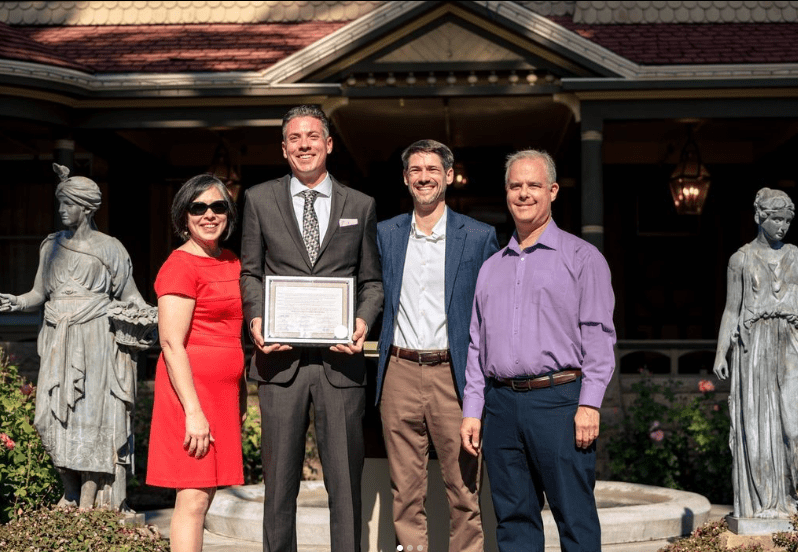
Please come and enjoy a delicious meal in Sarah’s Café, stroll along the paths of the beautiful Victorian gardens, and wonder through the miles of hallways in the World’s most mysterious mansion. For further information about tours, including group tours, weddings, school events, birthday party packages, facility rentals, and special events please visit the website: https://winchestermysteryhouse.com/

Please visit the online giftshop, and purchase a gift for friends and relatives as well as a special memento of The Winchester Mystery House. A variety of souvenirs and gifts are available to purchase. https://shopwinchestermysteryhouse.com/


It Feels Like Home

How members of immigrant communities can make positive adjustments and contribute to their new communities is an issue challenging policy makers and advocates in many countries. Although there are ways in which the participants adopt new identities, or mask their real ones, there are strong indications that they also experience several of the elements associated with a sense of community. Some are reflected in the clear membership boundaries imposed, forms of social support offered, private language and symbols used, and the sanctions used under the influence sphere to ensure members adhere to permitted forms of behaviour. It appears that the anonymity offered by the virtual environments can facilitate social interaction and openness that membership of communities is usually seen as encapsulating. As a Worldwide church is dealing with many complex issues across the globe, The Church of Jesus Christ of Latter-day Saints promotes broad, foundational principles that have Worldwide application: We follow Jesus as the Christ by loving our neighbour. The Saviour taught that the meaning of “neighbour” includes all of God’s children, in all places, always. We recognize an ever-present need to strengthen families. Families are meant to be together. Forced separation of working parents from their children, is something that every American faces, and it weakens families and damages society. We acknowledge that every nation has the right to enforce its laws and secure its borders. All persons subject to a nation’s laws are accountable for their acts in relation to them. #RandolphHarris 1 of 21

The Lord is depending on you to assist in the exaltation of your eternal family. Public officials should create and administer laws that reflect the best of our aspirations as a just and caring society. Such laws will properly balance love for neighbours, family cohesion, and the observance of just and enforceable laws. When someone says the word “home,” what comes to mind? The meanings for the term home are numerous. Everyone probably has a sense of what is meant by the phrase “going home” or what is meant by characterizing a place as “homey.” For example, when looking through a new house, a prospective buyer may say that it “feels like home.” Throughout history, home has had both spiritual and emotional connotations. For example, “Swing low, sweet chariot, Comin for to carry me home” from the old, anonymous Southern African American spiritual, connotes a celestial home. Disillusioned with the World, Ralph Waldo Merson penned “Goodbye, proud World! I’m going home; Thou art not my friend and I’m not thine” in Poems (1847). Many authors have written about the emotional aspects of the term. For example, Pandects (533 AD) wrote, “One’s home is the safest refuge to everyone.” Similarly, Oliver Wendell Holmes in Homesick in Heaven wrote, “Where we love is home, Home that our feet may leave, but not our hearts.” Although the colloquial expression “Home is where the heart is” captures the emotional component of home, it fails to address the dynamic interaction between a physical space and our need to have surroundings reflect who we are. Home also has been used in nationalistic and patriotic senses. To further highlight this illustration, Irving Berlin (1938) inspired Americans with the lyrics from God Bless America with, “From the mountains to the prairies, To the oceans white with foam, God bless America, My home Sweet Home!” #RandolphHarris 2 of 21

Each Day from Santa Clara to Oakland to Rancho Cordova, the people of the Church repeat these words: “We will be prepared to strengthen home and family, make and keep sacred covenants, receive the ordinances of the temple, and enjoy the blessings of exaltation.” Being part of a family is a great blessing. Not all families are the same, but each is important in Heavenly Father’s plan. All families need strengthening, from the ideal to the most troubled. That strengthening can come from you. In fact, in some families you may be the only source of spiritual strength. The Lord is depending on you to bring the blessings of the gospel to your family. It is important to establish patterns of righteousness in your own life, which will enable you to set a good example for your family, whatever form your family may take. The example of your righteous life will strengthen your family. A simple four-point program will not only assure your happiness, but will bless your family as well. Pray, study, pay your tithing, and attend your meetings. Seeking the help of the Lord daily through prayer will bring great blessings to your family. Ask yourself: “Who in my family could benefit from my personal prayers?” “What could I do to support and encourage family prayer?” As you personally study the scriptures, you will come to know the Saviour and His teachings. From His example, you will know how to love, serve, and forgive members of your family. Consider how you could share your understanding of the scriptures with your family. Get all the education you can. Your education will benefit your family now and will surely bless your future family. #RandolphHarris 3 of 21

The Holy Ghost will guide you and will teach you what you should do to bless your family. As you commit to these patterns of righteousness, you will be blessed throughout your life and will develop the spiritual foundation from which you can strengthen your family by example. In 1 Timothy, Paul teaches us about example: “Let no man despise thy youth; but be thou an example of the believers, in word, in conversation, in charity, in spirit, in faith, in purity” (1 Timothy 4.12). Be cheerful, helpful, and considerate of others. Concern yourself with the needs of other family members. Honour your parents by showing love and respect for them and by being obedient. Participate in family activities and traditions, including family prayer, family home evenings, and family scripture reading. These traditions strengthen and unify families. Strengthen your relationships with your brother and sisters. They can become your closets friends. My siblings and I were “born of goodly parents” (1 Nephi 1.1). who loved and made great sacrifices for us, but our family have not been blessed with the sacred ordinances of the temple. However, as we established family patterns of righteousness, praying together, studying about the ordinances of the temple, paying tithing, and attending our meetings regularly—as a family—the Lord heard and answered our prayers. As we surrounded the holy altar in the temple and were sealed as a family for time and all eternity, each person learned a better way and in so doing blessed the lives of those around us and taught correct traditions for the generations that followed. #RandolphHarris 4 of 21
John Howard Payne in his opera Clari, the Maid of Milan (1823) wrote, “Mid pleasures and palaces though we may roam, Be it ever so humble, there’s no place like home. Clearly, literature and the media have conceptualized the term home in diverse ways. Most individuals might argue that it does not necessarily take a “heap of living,” yet there is some sense that we must “do” something to make an abode a home. We must imprint it in some way, make it ours. Why do we spend so much time and energy making a house our home? Time and energy are invested into transforming a house into a home because they experience positive consequences from doing so. This concept of action and benefit represented the basis for further development of the psychological home construct. Remember, the family is central to the Creator’s plan for the eternal destiny of His children. Eternal families are made up of individuals. Do your part to build a happy home. Establish patterns of righteousness in your life. And be an example of the believers. The Lord is depending on you to assist in the exaltation of your eternal family. I know that Jesus as the Christ lives. He knows you and loves you. He has blessed me and my family, and I know He will bless you and yours. Of this I humbly testify in the name of Jesus as the Christ. In addition to a primary physical location (id est, a person’s house), many individuals will often make an aspect of their office homier. Office workers may place a personal photograph or memorabilia in their cubicle to make that space their own. What drives us to do this? Could it be that we are afraid of being swallowed up and losing our individuality in a sea of cubicles? #RandolphHarris 5 of 21

We desire to belong to groups and community, yet we also want to keep a place in our hearts and surroundings that is separate from others. We need to impact our surroundings (exempli gratia house, dorm, office space, car) in such a way that it reflects our personality, our sense of self, and in so doing, derive benefits. We contend that modifying physical space to have it better reflect our self-identity reflects the core of psychological home. Three principles that will help you strengthen your home and family are nurturing, sacrifice, and prayer. We are on the Lord’s team, and He will always be there for us to help us bring home the gold. As children of God, some of you may have great athletic ability, but all you have been blessed with many talents and gifts. One of the most meaningful gifts is your ability to strengthen your home and family. Tonight it is my prayer that the Spirit will burn within you, that you will have a greater desire to strengthen your family now and prepare for your future family. The scriptures are filled with ways to teach us how to strengthen our families. There is no greater teacher than the Saviour. As you study His teachings and follow His example, you can make your family life better. As you gather in your family, you can do so much to invite a spirit of unity. When was the last time you put your loving arms around your mom and dad and thanked them for all they do? Parents do most of the nurturing, but they need to be nurtured too. When our Father in Heaven introduced the Saviour to the World, He demonstrated good nurturing by using a soft voice. The language in the scriptures says, “As if it came out of the Heavens, they heard a voice; and it was not a harsh voice, neither was it a loud voice; notwithstanding it being a small voice it pierced them that did hear to the center” (3 Nephi 11.3). #RandolphHarris 6 of 21

In our homes, this can be a model for the way we talk to our family members. When we talk to those we love, let us not use a loud voice but a soft voice. This is the way our Heavenly Father speaks to His children. Except for a possible reversion to a cultural situation strongly characterized by ideas of emulation and status, the ancient racial bias embodied in the Christian principle of brotherhood should logically continue to gain ground at the expense of the pecuniary morals of competitive business. The struggle for existence many of us are facing is a glimpse of life which just now seems to many the dominant fact of the universe, chiefly because attention has been fixed upon it by copious and interesting exposition. As it has had many predecessors in this place of importance, so doubtless it will have many successors. Evolution had a profound impact upon psychology, ethnology, sociology, and ethics but it failed to work a similar transformation in economics. The most plausible explanation of the inflexibility of the received political economy is that its spokesmen were satisfied that there was little their science could learn from biology. The accepted function of political economy, as taught in American colleges and propagated in the forums of opinion, was apologetic. It had always been an idealized interpretation of economic processes under the competitive regime of property and individual enterprise; violations of the set patten had been discouraged as infringements of natural law. Here in the United States of America, it was not made the test of economic orthodoxy, merely. It was used to decide whether a man was an economist at all. #RandolphHarris 7 of 21

The common failure of orthodox economists to embrace social Darwinism as preached by Sumner—so obviously adapted to the function of their science as they conceived it—was only incidentally due to the unsettled status of evolution in its relation to religious beliefs. More important was the fact that classical economics already had its own doctrine of social selection. Since it had one of the great figures of the classical economic tradition who had led Spencer, Darwin, and Wallace toward their evolutionary theories, the economists might have had some justification for proclaiming that biology had merely universalized a truth that had been in their possession for a long time. A parallel can be drawn between the patterns of natural selection and classical economics, suggesting that Darwinism involved an addition to the vocabulary rather than to the substance of conventional economic theory. Both assumed the fundamentally self-interested animal pursuing in the classical pattern, pleasure or, in the Darwinian pattern, survival. Both assumed the normality of competition in the exercise of the hedonistic, or survival, impulse; and in both it was the “fittest,” usually in a eulogistic sense, who survived or prospered—either the organism most satisfactorily adapted to its environment, or the most efficient and economic producer, the most frugal and temperate worker. Economics was the better suited to a kindly interpretation of the status quo since it accepted the present environment as a natural datum, while conscientious and perceptive followers of Darwin saw that the “fittest” might be understood to be fit to inferior and degrading surroundings. #RandolphHarris 8 of 21

Veblen, writing in 1900, found that “identification of the categories of normality and rights gives the dominant note of Mr. Spencer’s ethical and social philosophy, and that later economists of the classical line are prone to be Spencerians. Further, both classical economics and natural selection were doctrines of natural law. At this point, once again, classical economics was more conducive to intellectual stability, because its concept of equilibrium was Newtonian and hence static, whereas a dynamic theory of society raised possibilities of an unsettled World. The conception of the pressure of population upon subsistence, so important in the historical connection between biology and political economy, not only played its part in the doctrine of Malthus but was closely related to the classic wage-fund doctrine. According to the wage-fund theory, which was popular among extreme proponents of laissez faire in the United States of America, labour is paid out of a capital fund which is fixed at any given time; and the average wage of the labourers is determined by the ratio of the number of workers seeking employment to the amount of the wage-fund. According to the logic of the wage-fund theory, neither legislative regulation nor any action of the labourers could alter this situation, and a policy of strict acquiescence was indicated. Competition was generally considered the perfect means of distributing wealth. According to this doctrine the increase in numbers among the working class pressed upon the limited wage-fund with the same inexorability as the total population on the means of subsistence. This doctrine was not a little favored by the fact that if afforded a complete justification for the existing order of things respecting wages. The peace that comes when we avoid debt and the temporal and spiritual blessings we receive when we pay tithes and offerings succeeds in making a fortune. If there is any one thing that will bring peace and contentment into the human heart, and into the family, it is to live within our means. And if there is any one thing that is grinding and discouraging and disheartening, it is to have debts and obligations that one cannot meet. #RandolphHarris 9 of 21

God our Heavenly Father has instituted laws to improve his people physically, spiritually, intellectually, and one of the best laws in all the World to make better Latter-day Saints is the law of tithing. There are many people who believe the gospel and would probably embrace it, but for the fact that they are young, they still need to be guided. Many people cannot endure the gospel because of financial requirements that are made of them, and they allow the things of this World, which they have grasped firmly and steadfastly, to rob them of the greatest of all God’s gifts, namely, life eternal. The great criterion of success in the World is that men can make money. However, this is not true success. As a man grows and increases in the things of this World, if he is not careful, he will lose the Spirit of the Lord, and he will set his heart upon the things of this World. And if he loses the Spirit of the Lord, and fails to be honest with God in the payment of his tithes as strictly and honestly as he would account to a partner if he were engaged in business, that man will lessen his strength, will lessen his power, will lessen the testimony of the Spirit of God within his soul. There is no question of it in my mind. We must be honest with the Lord. The great trouble is that there are many people who, as they grow and increase in the things of this World, set their hearts upon them and lose the Spirit of the Lord. Therefore, that which is counted by the World as success is failure; because if a man starts out for a prize and he fails to secure it after labouring nearly a lifetime for that prize, certainly his life has been a failure. Be honest with the Lord and I promise that peace, prosperity, and financial success will attend those who are honest with our Heavenly Father because they are fulfilling the law and an obligation. God will bless them for doing so. #RandolphHarris 10 of 21

It is feasible that many individuals experiment with changes in the consumption pattern. To some extent this has already been done in small groups. The point here is not asceticism for poverty, but life-affirming as against life-denying consumption. This distinction can be made only on the basis of awareness of what life is, what activeness is, what is stimulating, and what their opposites are. A dress, an object of art, a house may be in the one or in the other categories. The dress which follows the fashion presented by the profit interests of the dressmakers and their public relations staffs is quite different from the dress which is beautiful or attractive and the result of personal choice and tastes. A number of dressmakers might choose to sell their products to women who prefer to wear what they like rather than what is forced upon them. The same holds true of art objects, and all kinds of aesthetic enjoyment. If they lose their function as either status symbols or capital investments, the sense for the beautiful will have a chance for a new development. The unnecessary, or merely laziness-promoting, would be out. If it became a useful vehicle for transportation and not a status symbol, the Ultimate Driving Machine would change in significance. Certainly there would be no reason to buy a new Ultimate Driving Machine every two years, and industry would find itself forced to make some drastic changes in production. To put it in a nutshell: up to now the consumer has permitted and even invited industry to brainwash or control him. The consumer has a chance of becoming aware of his power over industry by turning around and forcing industry to produce what he wants or suffer considerable losses by producing what he rejects. #RandolphHarris 11 of 21

The revolution of the consumer against the domination of industry has yet to come. It is perfectly feasible and its consequences far-reaching, unless industry takes control of the state and enforces its right to manipulate the consumer. From the standpoint of conscious rational thought, fright and admiration are distinct feelings, hence they cannot denoted by the same word; and if there is one word like awe, it is used in the one or the other sense, and the fact is forgotten that it actually means fright and admiration. In our feeling experience, fear and admiration are frequently part of one complex feeling, which, however, modern man is usually not aware of as such. It seems that the language of peoples who emphasized less than we do the intellectual aspects of experience, has more words which expressed the feeling as such, while our modern languages tend to express only such feelings which can stand the test of our kind of logic. Incidentally, this phenomenon constitutes one of the greatest difficulties for dynamic psychology. Our language just does not give us the words which we need to describe many visceral experiences which do not fit our scheme of thoughts. Hence psychoanalysis has no adequate language at its disposal. It could do what some other sciences have done and use symbols to denote certain complex feelings. For instance, a/t could stand for that complex feeling of admiration and terror which was once expressed by one word. Or xy could stand for the feeling of “aggressive defiance, superiority, accusation + hurt innocence, martyrdom, being persecuted and falsely accused.” Again, this latter feeling is not a synthesis of different feelings, as our language would make us believe, but one specific feeling which can be observed in oneself and in others once one transcends the barrier of the assumption, that nothing can be felt which cannot be “thought.” #RandolphHarris 12 of 21

If one does not use abstract symbols, the most adequate, paradoxically enough, scientific language for psychoanalysis is actually that of symbolism, poetry or reference to themes of mythology. (Dr. Freud often chose the latter way.) However, if the psychoanalyst thinks he can be scientific by using technical terms of our language to denote emotional phenomena, he deceives himself and speaks of abstract constructs which do not correspond to the reality of felt experience. However, this is only one aspect of the filtering function of language. Different languages differ not only by the fact that they vary in the diversity of words they use to denote certain affective experiences, but also by their syntax, their grammar, and the root-meaning of their words. The whole language contains an attitude of life, is a frozen expression of experiencing life in a certain way. Here are a few examples. There are languages in which the verb form “it rains,” for instance, is conjugated differently depending on whether I say that it rains because I have been out in the rain and have got wet, or because I have seen it raining from the inside of a hut, or became somebody has told me that it rains. It is quite obvious that the emphasis of the language on these different sources of experiencing a fact (in this case, that it rains) has a deep influence on the way people experience facts. (In our modern culture, for instance, with its emphasis on the purely intellectual side of knowledge, it makes little difference how I know a fact, whether from direct or indirect experience, or from hearsay.) Or in Hebrew, the main principle of conjugation is to determine whether an activity is complete (perfect) on incomplete (imperfect), while the time in which it occurs—past, present, future—is expressed only in a secondary fashion. #RandolphHarris 13 of 21

In Latin both principles (time and perfection) are used together, while in English we are predominately oriented in the sense of time. Again it goes without saying that this difference in conjugation expresses a difference in experiencing. The significance of this difference becomes quite apparent in the English and German translation of the Old Testament. Often when the Hebrew text uses the perfect tense for an emotional experience like loving, meaning, “I love fully,” the translator misunderstands and writes, “I loved.” Still another examples is to be found in the different uses of verbs and nouns in various languages, or even among different people speaking the same language. The noun refers to a “thing”; the verb refers to an activity. An increasing number of people prefer to think in terms of having things, instead of being or acting; hence, they prefer nouns to verbs. Language, by its words, its grammar, its syntax, by the whole spirit, which is frozen in it, determines which experiences penetrates to our awareness. A wide variety of professional work involving relationships with people—whether as a psychotherapist, teacher, religious worker, guidance counselor, social worker, clinical psychologist—it is the quality of the interpersonal encounter with the client which is the most significant element in determining effectiveness. I have been primarily a counselor and psychotherapist. In the course of my professional life I have worked with troubled college students, with adults in difficulty, with “normal” individuals such as business executives, and more recently with hospitalized psychotic persons. I have endeavoured to make use of the learnings from my therapeutic experience in my interactions with classes and seminars, in the training of teachers, in the administration of staff groups, in the clinical supervision of psychologist, psychiatrists, and guidance workers as they work with their clients or patients. #RandolphHarris 14 of 21

Some of these relations are long-continued and intensive, as in individual psychotherapy. Some are brief, as in experiences with workshop participants or in contacts with students who come for practical advice. They cover a wide range of depths. Gradually, learning which applies to all these experiences is that it is the quality of the personal relationship which matters most. With some of these individuals I am in touch only briefly, with others I have the opportunity of knowing them intimately, with others I have the opportunity of knowing them intimately, but in either case the quality of the personal encounter is probably, in the long run, the element which determines the extent to which this is an experience which releases or promotes development and growth. I believe the quality of my encounter is more important in the long run than is my scholarly knowledge, my professional training, my counseling orientation, the techniques I use in the interview. In keeping with this line of thought, I suspect that for a guidance worker also the relationship he forms with each student—brief or continuing—is more important than his knowledge of tests and measurements, the adequacy of his record keeping, the theories he hold, the accuracy with which he is able to predict academic success, or the school in which he received his training. In recent years, I have thought a great deal about this issue. I have tried to observe counselors and therapists whose orientations are very different from mine, in order to understand the basis of their effectiveness as well as my own. I have listened to recorded interviews from many different sources. #RandolphHarris 15 of 21

Gradually, I have developed some theoretical formulations, some hypotheses as to the basis of effectiveness in relationships. As I have asked myself how individuals sharply different in personality, orientation and procedure can all be effective in a helping relationship, can each be successful in facilitating constructive change or development because they bring to the helping relationship certain attitudinal ingredients. It is these that I hypothesize as making for effectiveness, whether we are speaking of a guidance counselor, a clinical psychologist, or a psychiatrist. What are these attitudinal or experiential elements in the counselor which makes a relationship a growth-promoting climate? Gemeinschaftsgefuhl is the most important goal of personal growth and therapy. The German word gemeinschaftsgefuhl has been translated as “social interest” or “social feeling.” It refers to a feeling of oneness, a brotherly feeling toward one’s fellow human beings. The concept of social feeling accords with the highest precepts of ethics and religion and represents a wholesome corrective to the more pathology-oriented psychoanalytic writing. Healthy personality implies the courage to become a separate, distinct person, the courage to express and celebrate one’s difference from others, and the courage to be inventive and creative in various spheres of existence. A healthy personality can respond to the human situation in inventive, creative ways. One must have a conscious aspect of the psyche and covert the “shadow” side, which remains unknown to the individual and invisible to others. #RandolphHarris 16 of 21

Personal growth is a gradual unfolding and expression of the unconscious, shadow side and the integration of these unfolding aspects of personality into a coherent, meaningful way of life. Humans experience the World in various ways; this is a basic polarity of attention, called extraversion-introversion. The extraverted person is most attentive to the happenings of the external World. The introvert is more given to reflection and introspection, attending to personal experience as it is affected by the external World. Through upbringing, and perhaps hereditary and congenital influences, persons grow to emphasize one of these fundamental attitudes, while the opposite attitude remains undeveloped. Although the attitude of extraversion or introversion defines direction of interest for the person, that person’s ways of contacting the World are also diverse. The fundamental ways of experiencing the World are designated as sensing, intuition, feeling, and thinking. Sensing refers to the act of receiving the disclosure of the World by way of one’s several sensory systems. Intuition refers to a kind of imaginative knowing; it consists of rapid guessing about what lies behind obvious sensory inputs. Feeling refers to the emotional quality of experience—its pleasant or unpleasant, frightening, or ugly qualities. Thinking, of course, refers to the human capacity for reasoning, conceptualizing, and abstract thought. The most singular and important characteristic about humans is the capacity to symbolize experience in dreams, myths, art, and folklore. In dreams there are hints for the next stages of a person’s growth toward fuller self-realization. Self-realization, becoming an “individuated” person, requires that a person become aware of repressed “shadow” sides in the personality and struggle to express these in his or her way of life. #RandolphHarris 17 of 21

The motive for attempting such self-discovery is to alleviate suffering. Many people do not want help on overcoming childhood hangups. They seek help because their lives are stale. The goal is to resume growth. A healthy personality entails the endless struggle to transcend one’s initial socialization (training to become a socius, a citizen) to discover and express one’s own repressed possibilities of functioning. Integration of the capacities to think, feel, intuit, and sense is fostered by commitment to new purposes for existence. Thus, persons whose growth was adequate to enable them to marry, raise families, and achieve vocational success would arrive at an impasse in their growth and would suffer from it. Their attainment of healthier personality—self-realization—was fostered by relinquishing projects that had animated their youthful years and choosing new aims. In the selection of problems that arise one must pass easily from deliberate thinking to intuitive grasping of connections. This latter requirement might be compared to the attitude required in studying a painting: we think about composition, colour combinations, brush strokes, and the like, but we also consider the emotional responses that the painting elicits in us. This corresponds, too, to the attitude an analyst adopts toward the patient’s associations. While listening to a patient, I sometimes do hard thinking about possible meanings, and sometimes I arrive at a conjecture merely by letting the patient’s talk play on my intuitive faculties. The verification of any finding, however, no matter how one has arrived at it, always demands full intellectual alertness. #RandolphHarris 18 of 21

A person may find, of course, that in a series of associations nothing commands his particular interest; he merely sees one or another possibility but nothing illuminating. Or, at the opposite extreme, he may find that even as he delves into one connection certain other elements also strike him as noteworthy. In both instances he will do well to put down in the margin the questions left open. Perhaps at a future time, in going over his notes, the mere theoretical possibilities will mean something more to him, or the shelved questions can be taken up in more detail. In the New Testament Apocrypha we find a curious sentence: “For the Lord Himself, having been asked by someone when His kingdom should come, said, ‘When the two shall be one, and the outside as the inside and the male with the female.’” The loss of property and the break-up of possessions may be a terrible happening, but it may also have the effect of driving the sufferer into himself. He may disintegrate with his things, or he may steel his mind and school his emotions to endure the event while he tries to start life anew. So in the end, he will become stronger than he was when the World’s pleasures and riches were available to him. We may wallow in the lowest kind of emotions and passions, or we may rise the whole feeling-nature to a level where love and beauty, refinement and sensitivity reign serenely. When the good in hum overbalances the bad, his selfishness will be purged by pity. He can transcend gender by turning inward and finding the inner bliss. He should cultivate therefor joy, love, and happiness as attributes of the inner self. #RandolphHarris 19 of 21

Working for the Sacramento Fire Department is a prestigious accomplishment for many. However, being a firefighter is dangerous, with risks including dealing with collapsing structures, operating heavy equipment, climbing high ladders, and being suspended in unsafe places during rescues. “My first fire was a taxpayer, a group of one-story stores. It was a pullbox alarm, and we were first due in. I had the nozzle. The fire was in the ceiling and the walls, and it had gotten a little bit into the floor, but it was mostly smoke. Danger never entered my mind. I remember thinking through the whole thing, ‘Don’t fall. Pace yourself.’ I was very conscious of not making a mistake. The danger, the hell with the danger, I didn’t want to look stupid. I didn’t want to be pointed out. I mean, this was my first. This was my proving ground. ‘Don’t make a fool of yourself.’ It’s still like that. I’m disappointed when I’m given control of the door, because inevitably somebody says, ‘How come you’re outside, and not inside?’ Sometimes I take it too seriously; they could be teasing, but I get my back up a little bit. That’s my main concern—to be a professional and to do it right, to stop and think about what I’m doing. Having the nozzle in that first fire was wonderful. Just the exhilaration and the high afterwards. My feet didn’t touch the ground. #RandolphHarris 20 of 21

“Of course, nobody said, ‘Wow, you did a good job.’ It was just a nod or a look, or a small feeling of acceptance. My officer was my backup man. I fell in love with him. It was like a woman and her obstetrician. I thought, ‘This is it.’ I never felt closer to anybody. It’s a very close relationship. It’s magnetic. It’s very magnetic for a woman. I also remember thinking that this was really hard work, that the guys were right: ‘I’m not going to be able to do this.’ You can’t see anything. It’s claustrophobic, you’re moving in, and you don’t know where. You’re climbing over stud, and you don’t know what it is. There’s a lot of noise, a lot of yelling. I remember being scared and doubting whether I was physically able to do this. I was constantly talking to myself: ‘Don’t give up, you’ve got to keep going.’ That was the first. It wasn’t seven floors in an occupied building, with people coming down carrying their TV sets. I remember thinking how happy I was. But when I look back on it now, it really wasn’t anything.” Please remember to raise your children to love America, love God and Jesus Christ, respect law and order, do well in school, respect their elders, and be proud to be a member of the best country on Earth. You can help save lives and property by making a donation to the Sacramento Fire Department. I pledge allegiance to the flag of the United States of America, and to the Republic, for which it stands, one nation, under God, indivisible, with liberty and justice for all. We are grateful for the faith that made fearless, and the courage that kept firm these valiant men and women. Above all, we are grateful that the spirit of America’s Prophets lived in their hearts that they knew all men are created equal in Thy sight, by Thee endowed with the imperishable right to life, liberty, and pursuit of happiness. #RandolphHarris 21 of 21

Ascent at Montelena

11977 Cobble Brook Drive, Rancho Cordova, California 95742
4 Home Design(s) Available

Experience modern designs and affordability in our upcoming new homes for sale. Ascent at Montelena in Rancho Cordova is near major employers and premier shopping.
Starting from: $625,990
2,526-2,973 square feet
3 to 6 bedrooms
2.5 to 4.5 bathrooms
2-3 car garage
https://www.pulte.com/homes/california/sacramento/rancho-cordova/ascent-at-montelena-210916

The Slave of Blind Forces

The idea that we belong to communities and that these communities provide benefits and responsibilities is one that has gained a growing appreciation in the last few decades. As a reaction to the urbanization faced by many people, globalization, cross-national forms of media and their impact on cultures, physical and social isolation from family and friends, and a growing fear of change and the unknown, images of community, belonging and support have become paramount. However, what is meant by community, how a community functions, and what are the benefits and costs of community membership has not necessarily been well explored. For many, the idea of community evokes images of the small town or close neighbourhood. People know each other, often have been resident for some generations, and provide various types of instrumental or emotional support to other members of the community. It is an idealization in place and time of other members of the community. It is an idealization in place and time of feeling a part of a place, with those around knowing us and caring about us. In many ways, it is a village in which relationships are governed by kinship and centered on the parish church. Integration and fulfillment of needs reflects the benefits that people derive from their membership of a community. Some of the needs can be fulfilled through community membership status achieved through group membership, demonstration of competence by members, and the shared values that are exhibited by the group. For them, strong communities can provide these opportunities for their members, thus reinforcing the value of membership of the community. #RandolphHarris 1 of 20

There is also a shared emotional connection. This refers to the sharing of significant events and the amount of contact that members have with each other. Because the community has had significant events, whether the members have taken part in them, there is a bond that can be developed between the members. The number of events, the salience of these events, and the importance of them in conferring merit or status to the community and its members all influence the development of a shared emotional connection between community members. Whether the events are positive or negative, they still have significant impacts on the development of emotional connections between members. Intelligence has an effectiveness as an instrument in modifying the World. Thinking is not a series of transcendent states or acts interjected into a natural scene. Knowledge is a part of nature, and its end is not mere passive adjustment but the manipulation of the environment to provide consummatory satisfactions. An idea is a plan of action rooted in the natural impulses and responses of the organism. The “spectator theory of knowledge” is pre-Darwinian. The biological point of view commits us to the conviction that mind, whatever else it may be, is at least an organ of service for the control of the environment in relation to the ends of the life process. #RandolphHarris 2 of 20

The ultimate refuge of the standpatter in every field, education, religion, politics, industrial and domestic life, has been the notion of an alleged fixed structure of mind. If mind is conceived as an antecedent and ready-made thing, institutions and customs may be regarded as its offspring. Intelligence operates within a series of objectively “indeterminate” situations. It is from the indeterminateness of the situations, from the element of contingency in nature, that the discriminating intellect derives its special significance. The significance of morals and politics, of religion and science, have their source and meaning in the union in Nature of the settled and the unsettled, the stable and the hazardous. Without this union there can be no such things as “ends,” either in the form of human consummations or as purposes. There is only a block universe, either something ended and admitting of no change, or else a predestined march of events. There is no such thing as fulfillment where there is no risk of failure, and no defeat where there is no promise of possible achievement. Philosophers must shift their attention from the sterile aspects of epistemology and metaphysics to politics, education, and morals. Philosophy will become, among other things, a moral and political diagnosis and prognosis. When psychology is founded upon the primary fact of impulse, the positive motivation of the organism is just the fact needed to give firm support to the main contentions in life. #RandolphHarris 3 of 20

The elimination of conflict from society is a hopeless and self-contradictory ideal, but it is possible to direct the struggle to eliminate waste. In the continual sacrifice of the individual to the conditions of progress, we see a hopeless confusion about the relation of ends and means. The individual forever sacrifices himself to the welfare of future generations, but since the individual of future generations do the same, the process never reaches any consummation in human satisfactions. Man always sacrifices toward an end which is by definition never attained. It is the reductio ad absurdum of the philosophy of progress. Direct participation in events is necessary to genuine understanding. No universal proposition can be laid down to determine the functions of a state. We must bring to order out of the moral confusion caused by the apparently conflicting aims of morality and science. What man thinks consciously is determined by forces which operate behind his back, that is, without man’s knowledge; man explains his actions to himself as being rational or moral and these rationalizations (false consciousness, ideology) satisfy him subjectively. However, being driven by forces unknown to him, man is not free. He can attain freedom (and health) only by becoming aware of these motivating forces, that is of reality, and thus he can become the master of his life (within the limitations of reality) rather than the slave of blind forces. #RandolphHarris 4 of 20

The ethical process, like the activity of the gardener, is one of constant struggle. We can never allow things simply to go on of themselves. If we do, the result is retrogression. However, what is the significance of this apparent opposition between the ethical process and the cosmic process, in the light of our idea of the evolutionary process as a whole? The conflict is not one in which man is pitted against his entire natural environment, but one in which man modifies one part of the environment with relation to another. He does not work with anything that is totally alien to his entire environment. The gardener may introduce foreign fruits or vegetables into a particular locale, and he may assist their growth by conditions of sunlight and moisture unusual on his plot of ground; but these conditions fall within the wont and use of nature as a whole. The survival of the fittest is different from the survival of the ethically best. Yet must not the conditions be interpreted as a whole complex, including the existing social structure with all the habits, demands, and ideals which are found in it? Under such an interpretation the fittest would in truth be the best. The unfit would be practically equivalent to the antisocial, but not to the physically weak or the economically dependent. The dependent classes in society may be quite “fit” when measured by the whole of the environment. The prolongation of the period of dependency in man has developed foresight and planning and the bonds of social unity; the care of the sick has taught us how to protect the healthy. #RandolphHarris 5 of 20

What was fit among carnivora is not fit among men. Man lives in such a changing and progressive environment that in his case it is flexibility, readiness to adjust to the conditions of the morrow as well as the present, that constitutes fitness. As the meaning of environment changes, the meaning of the struggle for existence changes also. The biological promptings of self-assertion have potentialities for good as well as evil. The essence of the human problem is controlled foresight—ability to maintain the institutions of the past while remaking them to suit new conditions; in short, to maintain a balance between habits and aims. The term “selection” can mean not only that one form of life, one organism, is selected at the expense of another, but also that various modes of action and reaction are selected by an organism or a society because of their superiority over other modes. Society has its own mechanisms, public opinion and education, to select the modes it finds most suitable. There is, then, no bifurcation between the ethical process and the cosmic process. The difficulty has been created by static interpretations of biological functions and their applications out of context to the unique and dynamic conditions of human environment. It is not necessary to go outside of Nature to find warrant for the ethical process; one need only recognize the natural situation in its totality. #RandolphHarris 6 of 20

Man’s consciousness is determined by his being, his being by his practice of life, his practice of life by his mode of producing his livelihood, that is, by his mode of production and the social structure, mode of distribution and consumption resulting from it. Pragmatism, the cash-value of ideas, is not an abject apology for the acquisitive spirit of business culture. Society only influences his being by greater or lesser repression of his innate physiological and biological equipment. Dr. Freud believed that man can overcome repression without social changes. Marx on the other hand, was the first thinker who saw that the realization of the universal and fully awakened man can occur only together with social changes which lead to a new and truly human economic and social organization of mankind. For any experience to come into awareness, it must be comprehensible in accordance with the categories in which conscious thought is organized. I can become aware of any occurrence, inside or outside of myself, only when it can be linked with the system of categories in which I perceive. Some of the categories, such as time and space, may be universal, and may constitute categories of perception common to all men. Others, such as causality, may be a valid category for many, but not for all forms of conscious perception. Other categories are even less general and different from culture to culture. For instance, in a pre-industrial culture people may not perceive certain things in terms of their commercial value, while they do so in an industrial system. #RandolphhHarris 7 of 20

However this may be, experience can enter into awareness only under the condition that it can be perceived, related, and ordered in terms of a conceptional system. With the problem of childhood amnesia of childhood memories, and with the difference between the categories (“schematas”) employed by the child and those employed by the adult, the incompatibility of early childhood experience with the categories and organization of adult memory is largely due to the conventionalization of memory. Furthermore, the problem is not only that of memory, but also that of consciousness in general. This system is a result of social evolution. Every society, by its own practice of living and by the mode of relatedness, of feeling and perceiving, develops a system, or categories, which determines the forms of awareness. This system works, as it were, like a socially condition filter: experience cannot enter awareness unless it can penetrate this filter. The question, then, is to understand more concretely how this “social filter” operates, and how it happens that it permits certain experiences to be filtered through while others are stopped from entering awareness. First of all, we must consider that many experiences do not lend themselves easily to being perceived in awareness. Pain is perhaps the physical experience which best lends itself to being consciously perceived; desires for pleasures of the flesh, hunger, etcetera, also are easily perceived; quite obviously, all sensations which are relevant to individual, or group survival have easy access to awareness. #RandolphHarris 8 of 20

However, when it comes to a more subtle or complex experience, like “seeing a rosebud in the early morning, a drop of dew on it, while the air is still chilly, the sun coming up, a bird singing” –this is an experience which, in some cultures, easily lends itself to awareness (for instance, in Japan), while in modern Western culture this same experience will usually not come into awareness because it is not sufficiently “important” or “eventful” to be noticed. Whether or not subtle effective experiences can arrive at awareness depends on the degree to which such experiences are cultivated in each culture. There are many affective experiences for which a given language has no word, while another language may be rich in words which express these feelings. In a language in which different affective experiences are not expressed by different words, it is almost impossible for one’s experiences to come to clear awareness. It may be said that an experience rarely comes into awareness for which the language has no word. This fact is of social relevance about such experiences which do not fit into our intellectual rational scheme of things. In English, for instance, the word “awe” (like in Hebrew “nora”) means two different things. Awe is the feeling of intense fright as it is still indicated in “awful”: and awe also means something like intense admiration, as we still find it in awesome (and in awed by). #RandolphHarris 9 of 20

One general consideration may be introduced at this point concerning the concept of happiness. The term “happiness” has a long history, and this is not the place to go into the meaning of the concept from its derivation from Greek hedonism to its contemporary usage. It may suffice to say that what most people experience as happiness today is really a state of full satisfaction of their desires regardless of their quality; if it is conceived in this sense, it loses the important qualifications which Greek philosophy gave it, namely, that happiness is not a state of fulfillment of purely subjective needs but of those needs which have an objective validity in terms of the total existence of man and his potentialities. We would do better to think of joy and intense aliveness instead of happiness. The sensitive person, not only in an irrational society but also in the best of all societies, cannot help being deeply saddened by the inevitable tragedies of life. Both joy and sadness are unavoidable experiences for the sensitive and alive person. Happiness in its present meaning usually implies a superficial, contented states of satiation, rather than that condition accompanying the fullness of human experience; “happiness” may be said to be the alienated form of joy. #RandolphHarris 10 of 20

It is a crazy gift we have, this trickery. My inside knowing of it is remembered only as far back as my own third year when: My mother and father laugh at me because I am enchanted by a hole in the ground. The hole is being dug on the next street so I cannot go there alone. I wait with excitement for my father to take me. When he does, I look into that ever-deepening hole with the same fascination that I watch my mother peel potatoes, noticing the changing form, the changing colour, the changing texture, and the changing fragrance of both holes in the ground and potatoes. My father tells my mother, “A hole in the ground!” (the way that he says it, I know is not much.) “You’d think there was a magnet at the bottom. If I didn’t hold her hand, she’d tumble right in.” (I do not catch all those words at the time. There are too many that I do not know. I hear them later on, when my father tells someone, and I remember my pain, and what I did about it.) My mother and father laugh together and are tender with me and love me, but they do not understand. I feel alone, and my enchantment is bleeding around the edges. I am the angry which is hurt. Being at the moment true to me, I scowl at my parents. They jolly me then, because children must be kept happy. And then I am not true to me. I laugh, because in that grownup World of which I would like to be a part, that is the thing to do. (A few years later, when I am attracted by a hole in the ground, I drop a marble into it, so that if anyone comes along I can say that I am looking for my marble, not that I am enjoying the hole, which would be ridiculed.) #RandolphHarris 11 of 20

There are times when I scowl at my parents not because I am misunderstood, or not understood, but because I have discovered that that is a way to get their attention. And then, when they have brought me around from scowls to laughter they are very pleased with both themselves and me. And I am pleased with myself for having figured this out. That is a long way from being happy with a hole in the ground. Less than three years in this World, and I have got involved in cleverness. I did not develop that all by myself. Already my parents have been tricking me, and I have watched other trickery go on with aunts and uncles, grandpa…My parents and I love each other and enjoy each other. Most of the time we are sensitive to each other at some level. We do not know that increasingly we are being superficial, that there is a dimension missing, and that their lack of respect for me is developing into me a lack of respect for them. They respect me in the outside things, like letting me paint the railings on the porch and carry things that would break if I dropped them, but they do not respect my insides because they think I have not any. When I am playing on the floor, they talk together or with other people about things I am “too little to understand” and so it is all right to say to them. However, they do not know what my understanding is, and I have no way to tell them. So it goes round and round inside my head. Sometimes I understand some things, and I am hurt. Other times, I do not understand and I try to put things together, with not enough information in my head to arrive at making sense. So what I make of it is nonsense, but I do not know that. And sometimes what I make of it will not stay put. #RandolphHarris 12 of 20

I think if it one way and I hurt, so I think of it another way so I will feel comfortable. However, it slips around, and I do not know which way it is. I am too young to know that the word for my trouble is confusion. To my parents, aunts and uncles, my life is good: I have loving parents, aunts and uncles, and “How blessed it is to be a child and have no worries.” To me, if often seems that I must have been born to the wrong parents, or that these are not my parents, because my real parents would know me. My sister, older than I, bewilders me, because sometimes she is a child with me, and then suddenly she switches and talks like a grownup. She tells me what to think and feel. What I thinking and feel she says is silly. A moment ago, she was agreeing with me. Sometimes I fight my sister about this. However, sometimes I say that I think and feel what she does, and then I feel BIG. However, then I get all mixed up and I am crying “Who am I?” And no one helps me with that because it is a silly question. I am me. Who else could I be? This seems so to me, too, so why is it that I do not know? There must be something so wrong with me that no one will tell me about it. I talk to my puppy and my dolls, and to the trees. They do not confuse me because they listen, and I can say anything I want and they do not talk back. They go on listening. And then I begin to hear myself and know it is me. No possessive relationship between two human beings can last forever. To ask such a thing is to ask for the impersonal universe to change its laws of growth for the sake of pleasing its ungrown progeny. God is entirely self-sufficient and if God’s children are to grow increasingly into his likeness, they can do so only by becoming less dependent on others, more sufficient unto themselves. #RandolphHarris 13 of 20

A false, showy, and pretentious cheerfulness which ignores facts, represses truths, and hides evils is not really cheerful at all. It is well to remember not to let oneself become the victim of negative feelings or harsh thoughts. They do not mend matter but only make you suffer more, and also suffer needlessly. It is one of the side effects of philosophy that it purifies human affection, takes the littleness out of it, and lifts it to a higher and wider plane. This may bring some pain or it may bring a shared pleasure, depending on those involved in the experience. If ignorance, credulity, naivete, or imbalance are the accompaniment, it is excellent but not enough to be well-meaning, to have a pure intent, to be guided by feeling alone. For there are traps and quicksands, illusions, and deceits in life as on the quest. No human being has the right to claim another as his own. Each stands ultimately alone and essentially isolated. Each is born out of and must find his way back to spiritual solitude. For each must learn to be divinely self-reliant and self-sufficient. This is so because the soul is of the nature of God. How much misery has come into contemporary life through non-recognition of this fact! How much bitterness has come to the unwilling possessed ones or to the defeated would-be possessors! The way to get rid of an obstinate negative feeling is to supersede it by a new positive one of greater intensity. If success is to be attained, right thoughts about the wrong feeling will help to correct it, right imaginations about the new one will help to bring it in, but feeling itself must be invoked and fostered. In most human relations, egoism in one person is replied by egoism in the other. He has feelings but they are so poised that they never disturb, so balanced with reason that they never agitate, and so harmonized with intuition that they never excite him. If anyone is to carry out Christ’s bidding of reconciliation with enemies and forgiveness of those who have harmed him, he can do so only by giving up the ego. #RandolphHarris 14 of 20

Our dear friend Clare, her whole self-analysis illustrated the validity of one who was able to choose the factors which were involved in her problems which she could grasp at the time, and she refrained from embarking upon problems that were still deeply repressed. With apparent insouciance she never bothered to tackle any problem that did not elicit a response in her, though it might almost stare her in the face. Without knowing anything about the principle of guidance through interest she intuitively applied it throughout her work, and it served her well. One example may stand for many. In the series of associations ending with the first emergence of the daydream of the great man, Clare recognized merely the role that the need for protection played in her relationships. The suggestions concerning her other expectations of men she discarded entirely, though they were an obvious and prominent part of the daydream. This intuitive choice took her on the best course she could have followed. By no means did she merely move on familiar ground. The finding that a need for protection was an integral part of her “love” was a discovery of a factor hitherto unknown. Furthermore, as will be remembered, this discovery constituted the first inroad on her cherished illusion of “love,” a painful and incisive step. To have taken up at the same time the aggravating problem of her sponging attitude on men would certainly have been too hard, unless she had dealt with it in a superficial way. This brings up a last point: it is not possible to absorb more than one important insight at a time. An attempt to do so will be detrimental to both, or all, of them. If it is to “sink in” and take root, any relevant insight needs time and undivided concentration. #RandolphHarris 15 of 20

Most of the previous writers developed their theories out of an interest in the unhealthy personality. However, almost all of them found it necessary to make some postulations, some suggestions for the concept of the idealized personality. The oldest, most venerable school, that of Dr. Freud and psychoanalysis, fixed the pattern of such emphases. Dr. Freud contented himself by stating that health consisted in the ability to love and to do productive work. Healthy personality, in psychoanalytic terms, is an outcome of harmony among id, ego, and superego. According to the psychoanalysts, personality is divided into three substructures—the id, the ego, and the superego. Id is the term used to refer to instincts. Ego refers to the active, controlling, perceiving, learning functions of personality. Superego refers to the moral ideals and taboos a person acquires as he or she grows up. It is the task of the ego to scan external reality and inner experience and then choose action that will gratify needs without violating moral taboos—in other words, to mediate between id and superego. A healthier personality would be able to gratify needs and yet remain free of guilt or of social blame. Because one would be less prone to prevent some feelings from coming to the surface (such repression consumes energy), energy would be available for productive work. Because one would not be ashamed of feelings and emotions (because of a reasonable conscience), one could be freer in expressing oneself in loving relationships. Hence, the relationship between ability to love and work, and the concept of harmony among id, ego, and superego, can assume greater meaning. #RandolphHarris 16 of 20

The Sacramento Fire Department looks for the most qualified applicants that they can find, and many people cherish their jobs. “I went to college in bits and pieces. I took some fire science work at the community college. I went back to Santa Clara University for a term to get a degree in public administration. The trouble was, I was an officer of our union, a local of the International Association of Firefighters, while most of the professors were management oriented. We had serious ideological clashes about management relations, and finally I just didn’t go back to school. I’ve had some misgivings about that. The fire service did two things for me, really. I provided a service, and yet, for a young man who was looking for some excitement, it provided that, too. Our fire department has changed. When I joined in 1975, it was a very conservative kind of environment. The music in the firehouses was mostly country and western. Not too long ago, I remember getting back from an alarm at two in the morning, and the guys in the day room were watching MTV. I was thirty-three years old and the oldest guy on the crew. It just shows you how things have changed. When I first joined, there was this generational thing. The hair code was a major issue. A lot of social stuff spilled over into the fire service. A guy who came on probation with me had a mustache. The battalion chief told him, ‘You know, we’ve never had anyone with a mustache make it through probation.’ I’m not sure if this guy was naïve or was jacking the chief around, but his response was, ‘Oh, you mean I’ll be the first.’ #RandolphHarris 17 of 20

“We had four weeks of basic training, eight to five, Monday through Friday. We were the first group to use the International Fire Service Training Association material. We were assigned homework each night, and the next morning there would be a quiz. If you failed any of the quizzes, you were out of the program. There were also classes on mechanical proficiency and on the use and maintenance of breathing apparatus. At that you could join the department and be a firefighter, period. Now the program goes for seven weeks and includes emergency medical training and learning how to drive the vehicles. They didn’t have a very good burn facility in our department for training purposes, so they had buildings scheduled for destruction, and they would burn them. They would actually give us a live fire and out us in a real fire station. As it turned out, buildings to burn were in short supply, so my class did not actually get a chance to be in a burning building. As a result, the first actual fire that I went to was a real fire. I was assigned to our downtown station. On my second or third shift, we had a fire in the middle of the night. It was a modular classroom set up behind a grade school. I was in the second-due engine. We used to do a lot more blitz attacks, where the first company would pull a line and go in without masks, and then the second company would lay a fire line from a hydrant and mask up. #RandolphHarris 18 of 20

“We were second in, and the lieutenant said to me, ‘Just get a mask on and hang on to my coat. Just follow me. Whatever you do, keep track of where the line is, because if you get lost and go sideways, the line is the only way you have to get back out.’ I remember crawling in there with the old mask that had a full face piece and an eyehole on either side. I couldn’t see a damn thing, the room was filled with smoke. I remember thinking, ‘These people are crazy.’ It was just nuts. And yet, I followed right in, took a turn on the nozzle, and got out. In those days, in the late fifties, we didn’t get much training, just two weeks at the training towers. It’s interesting that we had about 220 firefighters who did around two thousand alarms a year. This year we have 1,100 people in the fire department, and we are going on over a hundred thousand alarms. Big changes obviously. I was twenty years old, so I was a baby in the fire department, and in a very middle-class kind of way. I had worked in construction in the summers when I was going to college, I was a hod carrier when I came into the fire department. So I was used to construction guys, who were strong characters. They wanted you to be tired at the end of the day. I went to Santa Clara University for three semesters and graduated with a degree in fire protection technology, which is what they called it in those days. #RandolphHarris 19 of 20

“If you look at the Sacramento Fire Department today, we are probably just a typical fire department. Thirty years ago, it was inhabited by a lot of very good leaders. They had been in the Second World War, they had been through the tail end of the Depression, and they had tattoos. They were tough guys—good leaders, guys who had a strong set of values. If you got out of line, they kicked your expletive. They didn’t know about participatory management, they hadn’t been screwed up in graduate school. They were street guys, and these are the people I look back on, who raised me.” The Sacramento Fire Department is a very important organization. They help keep our community safe and save lives. You can save lives and property, too, by donating to the Sacramento Fire Department. Remember to have a safe and happy Independence Day. Be sure to raise your children to love America, love God and Jesus Christ, respect law and order and treat their elders with kindness and honour. It is a great privilege to be American and never forget that. Lord, God of our fathers, as we gather to pay homage to the founders and builders of this, our country, we ask Thy blessing. With courage and vision, they made of these Untied States of America a land of freedom and opportunity. For all that they have so firmly established, we render thanks unto Thee. “Our lines are fallen in pleasant places; yea, we have a goodly heritage.” I pledge allegiance to the flag of the United States of America, and to the Republic, for which it stands, one nation, under God, indivisible with liberty and justice for all. #RandolphHarris 20 of 20

The Winchester Mystery House

If you are up for a day away with the chance sighting of a ghost, The Winchester Mystery House is open July 4th, 2024 from 10am PST to 5pm PST.

Please come and enjoy a delicious meal in Sarah’s Café, stroll along the paths of the beautiful Victorian gardens, and wonder through the miles of hallways in the World’s most mysterious mansion. For further information about tours, including group tours, weddings, school events, birthday party packages, facility rentals, and special events please visit the website: https://winchestermysteryhouse.com/

Please visit the online giftshop, and purchase a gift for friends and relatives as well as a special memento of The Winchester Mystery House. A variety of souvenirs and gifts are available to purchase. https://shopwinchestermysteryhouse.com/

That is Just Slavery in Another Form
Sometimes it seems the times of some people are so fatally lacking in geniality, humour, picturesqueness, and poetry; and are so explicit, so mechanical, so flat in the panorama which it gives to life. Many are overcome by the awfully monotonous quality and there is no twilight region in their minds, and no capacity for dreaminess and passivity. All parts of it are filled with the same noonday glare, like a dry desert where every grain of sand shows singly, and there are no mysteries and shadows. It is harmful to be overcome by a dry school-master’s temperament, to display a preference for cheap makeshifts in argument, where one is lacking education even in mechanical principles, and in general the vagueness of all one’s fundamental ideas, their whole system is wooden, as if knocked together out of cracked hemlock boards. Human beings gain knowledge within their souls. “The true lover of learning then must from his earliest youth, as far as in him lies, desire all truth,” says Plato. Nothing justifies the development of abstract principles but their utility in enlarging our concrete knowledge of nature. The ideas on which mathematical Mechanics and the Calculus are founded, the morphological ideas of Natural History, and the theories of Chemistry are such working ideas, finders, not merely summaries of truth. It is possible for “accidents” or novelties to arise which are not predictable from our knowledge of their antecedents—for example, the evolution of self-consciousness, or the application of the voice to social communication. #RandolphHarris 1 of 19

In particular instances, the facts are certain to show irregular departures from the law. A thoroughly consistent evolutionist must regard the laws of nature themselves as the results of evolution, and hence as limited rather than absolute. There exists an element of indeterminacy, spontaneity, or absolute chance in nature. Evolution is a change from a nohowish untalkaboutable all-alikeness by continuous stick-togetherations and somethingelseifications. When the whole training of life is to make us fighters for the higher, why should it be extraordinary or wrong to protest against a philosophy the acceptance of which is acceptance of the defeat of the higher? If it means anything at all, calling a thing bad means that the thing ought not to be, that something else ought to be in its stead. Determinism, in denying that anything else can be in its stead, virtually defines the universe as a place in which what ought to be is impossible—in other words, as an organism whose constitution is afflicted with an incurable taint, an irremediable flaw. Determinism is consistent only with the direst pessimism or a romantic mood of resignation. However, fi moral judgments are to be effective there must be some minimum of uncertainty in the universe; this does not necessitate a completely haphazard World, but only one in which there are occasional choices. #RandolphHarris 2 of 19
The necessity of retaining choices remains, even though one’s dream of universal fatalism be as optimistic in the ultimate advent of a peaceful millennium. Even if no preference can succeed unless it is in harmony with the ultimate triumph of peace, justice, and sympathy, we are still free to decide when to settle down on an equitable and peaceful basis. Until it is finally revealed with certainty what shall succeed, we are all free to try for our own preference. Intelligent mental reactions as those that minister to survival by arranging internal relations to suit the environment, but the critical factor in the cognitive situation, the desire for survival or welfare, is a subjective element which many ignore. The idea of correspondence between inner and outer relations, to be made meaningful as the criterion of mental acts, must be qualified by some subjective or teleologic reference. Furthermore, it is not simply a mirror floating with no foothold anywhere, and passively reflecting an order that he comes upon and finds simply existing. The knower is an actor, and coefficient of the truth on one side, whilst on the other he registers the truth which he helps to create. Mental interests, hypotheses, postulates, so far as they are bases for human action—action which largely transforms the World—help to make the truth which they declare. In other words, there belongs to mind, from its birth upward, a spontaneity, a vote. It is in the game, and not a mere looker-on; and its judgements of the should-be, its ideals, cannot be peeled off from the body of the cogitandum as if they were excrescences, or meant, at most, survival. #RandolphHarris 3 of 19

It is habitual to speak as if the mere body that owns the brain has interests, to treat the body’s survival as an absolute end without reference to any commanding intelligence. The reactions of an organism cannot be considered useful or harmful; it can only be said of them that if they occur in certain ways survival will incidentally be their consequence: but the moment you bring a consciousness into the midst, survival ceases to be a mere hypothesis. No longer is it “if survival is to occur, then so and must brain and other organs work.” It has now become an imperative decree: “Survival shall occur, and therefore organs must so work!” Real ends appear for the first time upon the World’s stage…Every actually existing consciousness seems to itself at any rate to be a fighter for ends, of which many, but for its presence, would not be ends at all. Its powers of cognition are mainly subservient to these ends, discerning which facts further them and which do not. What causes communities to change from generation to generation? Changes are the result of innovations by unusual or outstanding individuals, playing the same role in social change as variations in Darwin’s theory of evolution; such persons are selected by society and elevated into positions of influence because of their adaptability to the social situation into which cause of their adaptability to the social situation into which they happen to be born. Social changes can also be attributed to geography, environment, external circumstances—in brief, to everything except human control. The existence of a universal web of causation is one in which the finite human intellect becomes hopelessly entangled. #RandolphHarris 4 of 19

The most that sociology can predict is that if a great man of such nature appears under certain circumstances, he will affect society in such and such a way; but that he does affect it should not be denied. The great man is himself part of the environment of everybody else. However, a metaphysical creed is a mood of contemplation, an emotional attitude rather than a system of thought; and in its neglect of spontaneous variations in human thinking and their effect upon society, it is an absolute anachronism reverting to a pre-Darwinian type of thought. Without spontaneity, without some possibility that the individual may in measure alter the course of history, there is no chance for betterment of any kind, and the whole romance of struggle with its attendant alternatives of triumph or failure is banished. There is a zone of insecurity in human affairs in which all the dramatic interest lies. The rest belongs to the dead machinery of the stage. That life should be deprived of its dramatic interest by a scheme of universal causality was an intolerable thought, the most pernicious and immoral of fatalism. When people wish to illustrate the problem of evil, they choose spectacularly brutal murders rather than wars or the homeless crisis in America. Through their hardness and inflexibility of tone, many politicians believe that they are superior to the constituents and entertainment supersedes basic human needs. The interests of the citizens are harshly overridden. #RandolphHarris 5 of 19

Society has undoubtedly got to pass toward some newer and better equilibrium, and the distribution of wealth has doubtless slowly got to change; such changes have always happened, and will happen to the end of time. However, if, after all that I have said, any of you expect that they will make any genuine vital difference, on a large scale, to the lives of our descendants, you will have missed the significance of my entire lecture. The solid meaning of life is always the same eternal thing—the marriage, namely, of some unhabitual ideal, however special, with some fidelity, courage, and endurance; with some man’s or woman’s pains. And, whatever or wherever life may be, there will always be the chance for that marriage to take place. I sometimes wonder what did my love of Latin in high school have to do with my life? The only connection that I can find is that I liked words, and the meanings of words, and the derivations of words. However, after a year I had got the hang of that and could look up the rest for myself when I needed it. How did my daughter become so interested in cowboys, when her life had been in Hawaii, New York City, England and the New England coast—before the days she was allowed to stream TV and when she had not seen many movies? I think the answer is that she loved horses. At three, when she said that she felt sick and I asked her what would make her well, she said, “A wide on de pony in de park!” When she was five, the school reported that she was doing well in piano and suggested that she have private lessons. I asked her if she would like this and she said, after only a moment’s pause, “Well, I would rather ride a horse.” She always wanted the horse she did not have, and that may have been her problem, that she solved by being with horses in books. #RandolphHarris 6 of 10
When I went to live in Hawaii, for the first time I got interested in studying history. At that time, the written history was only about a hundred years old and all the sources were available to me. At the same time, I could question people for whom much of that past was a part of their own experience, and another lot of it had come to them through their immediate forebears. As I was living in the Islands, all this contributed to my understanding of what I was living in, and I liked this. I think another factor may have been that in the Islands I was exposed to a different way of thinking about life, and I got really interested in Island history in that sense. If “problems” entered into this, I think it may have been chiefly that when I was first in Hawaii, I did have problems, particularly during the first six months. Although I had driven in New York Labour Day traffic and all that, when I go to Hawaii, the traffic in Honolulu scared me so that I parked on Punchbowl and walked into town, until I could figure out how to drive in it. Time after time, as I went around in Honolulu doing errands, I watched the traffic to try to get the hang of it. At last, it became clear to me: instead of going by rules, the drivers went by noticing. They noticed other cars and they noticed pedestrians and moved in accord with them. Then I drove into town and drove as they did and enjoyed it. I had a problem with the slowness of everything in Hawaii: it was what I wanted for myself, but it was still a problem to me because I got irked by it and had to find my way out of that. #RandolphHarris 7 of 10

I had to slow down myself: then I enjoyed the ease and the lack of friction in moving slowly. I had the problem of living where it seemed to me that everyone had dark hair, dark skin, dark eyes. It was not race prejudice, just homesickness. When I returned to the white skins on the mainland eight years later, it seemed to me that everyone looked sick. I loved the mangoes, papayas, soursops, guavas, mountain apples, cherimoyas, pohas, and all the rest, but it seemed to me that if I could get to California (a place I had never really liked) and eat apricots, peaches, grapes, pears, apples for ten days, then it would be easier for me to go on living in the Islands. I had the problem of ants: I thought I must be a sloppy housekeeper because there were always ants in my house. Sometimes I dived in to help people—and got bumped. The people were somehow different from those I had lived with before. There were all these re-evaluations and adjustments going on, and this seems to open up my mind and lead to questions in other areas too. In trying to answer them, I run into problems, but it does not seem necessary for me to have the problem first. This suggests to me that in trying to provide our children with “security” by keeping them within a closed environment we may be stupidizing them. Then, when we make them specialize at an early age, we are stupidizing them still further. However, is it only the “problem,” anyway? It seems to me that I could have resolved my problem of being sick in another way, but when I found out how little medicine knows about the whole field of chronic illness, I was intrigued by the unknown territory that I lived in. #RandolphHarris 8 of 19

It scared me at first, but then I began to get used to it, and I like moving in the unknown, even when it scares me and is painful. I do not like the scare and the pain, but I do like the exploring. With the doctor, I explored what is known by medicine about chronic illness, with particular reference to my own. Through his honesty, I learned how much is not known. All this churned around in my head until I had the feeling of a dead end, of being somehow on the wrong track. That was when I side-slipped into psychology. It happened. This could lead me back into medicine sometime. That happens too. This suggests that telling children what is not known may be as helpful as telling them what is. When I am told only what is known, it seems to be “all there”—nothing that I can contribute to it. I can only learn what others have found out. It is a closed World. When I know how small the known is in relation to the unknown, the whole World opens up before me. I am free to explore and make my own discoveries instead of being a passive recipient of what is known—to the point that I think that everything is known by someone else and that it is only through others that I can acquire knowledge. I have seen this happen recently with several people, individually, when they discovered how chaotic the field of psychotherapy is, how much is not known. One of them said, with such freedom, “Each man is on his own!” and the others expressed themselves in much the same way. They moved from the limitation of trying to find a specific answer already known to the freedom of making their own discoveries. #RandolphHarris 9 of 19

More is known about how we get into the troubles that we do than is known about how to get out of them. With this knowledge of how things go wrong, these people are now trying to find out for themselves how to go about the undoing, both in the sense of curing and of prevention, by intelligent trial and error. If we all did this, it seems to me that we would get out of our difficulties a lot faster. Some people are very afraid of this, because people will make mistakes. That certainly will happen. However, these will not be such persistent mistakes as taught mistakes are, and I think it is the persistent mistakes that foul us up. It seems to me that much damage has been done by psychotherapists who believed that because they had been trained, they know the answers, and so went on and on with their mistakes. Being sure that the answers they had were right, they did not ask enough questions, and when things did not go well, the questions that arose were answered in terms of the answers they already had. That is a good way to get stuck. If all psychotherapists had done that, we would not have arrived at the new concepts that we have today. Holding to a belief seems to be a large part of our trouble. If I am sure that beating a child is good, or that permissiveness is good, poor results will only lead me to push harder with whatever it is that I believe. That seems to have happened with education. “It has not produced what we wanted, so let us have more of it” seems to sum up what I hear from all kinds of people all the time. #RandolphHarris 10 of 19

When a profession makes a mistake, a whole generation or more is damaged by it—like four-hour feedings and no rocking the baby. An individual’s mistake just does not reach that far. Another good thing about everyone trying to work out psychotherapy on his own (and including himself) is that all these people would not be Authorities. If I try out something in my relations with other people and it does not work well for them, they will be resistant to me in a way they would not be to an authority, who is believed to know what he is doing. It is my experience of most authorities that “working with them” means that I do as they say even if it gives me hell. That is just slavery in another form. “Working with authorities” make sense to me only when the professional and the amateur each say, “Of what you offer, I go along with this, but not with that,” or “Let us try this and see how it works out.” Then, there is continuing education on both sides, and each one at the same time is responsible for himself, through the choices he makes. That actually makes it much easier on the authorities, and it seems to me that any authority in his right mind would welcome this: he has contributed the best that he has to offer, but the choice is made by the other person. The authority, likewise, is responsible for his choices—for himself, not for anyone else. I know how this works out because I have tried it in medicine, education, and psychology. #RandolphHarris 11 of 19

When I meet with authorities who permit this, I become more intelligent, and I enjoy democracy. When I, a parent-authority, permit this, I become more intelligent, and I enjoy democracy. When they are made clearly responsible for themselves, children, in my experience, become more accountable. When they see the responsibility as being up to someone else, they are less so. This happens to grownups, too. It seems to me that democracy has not failed: we just have not really tried it yet. As a boy in grade school said to his teacher, “Mr. P—how do you reconcile your teaching of democracy with the way that you conduct this class?” We need to be more congruent. No one can be devoid of feelings, and the philosopher will not be exempt from this rule. Cheerfulness is an excellent mental attribute and worth cultivating; but where it results from mental blindness it is not worth having, for then it may become a real danger. Feelings, emotions, and passions should not be allowed to submerge reason, unless the feeling is genuinely intuitive, the emotion truly impersonal, and the passion a desire for the highest Truth. Feeling can be trained to become finer, more delicate, responsive to higher urges and ideals. The baser feelings go away of their own accord as the higher ones are let in and encouraged. The man who is seeking regeneration of his character will not often have repose of his feelings, for he is called by himself to struggle with himself. It is in the very nature of emotion to vary like the wind. Consequently, he who would attain inner peace cannot base his attainment upon emotion alone. He must find something much more stable than that, much more constant than that. This is not to say that life of the spirit is without feeling, but it is a calm, unbroken feeling. #RandolphHarris 12 of 19

One may legitimately take pride in the fact that he is called to the philosophic life, that he has accepted the philosophic ideal. For it is not the kind of pride which can vaunt itself over other men; its aims are to be fulfilled rather by humbling the ego and reducing its sway. The Roman Stoics, who sought to control their emotions and master their passions, placed character above knowledge. We pursue a similar albeit less rigorous discipline in controlling feelings by reason because we place knowledge above character. The latter is made a preliminary to attainment of the former. Goethe says: “I prefer the harmful truth to the helpful falsehood. Truth will heal the wound which she may have given.” And again, he says: “A harmful truth is helpful, because it can be harmful only for the moment, and will lead us to other truths which must become ever more and more helpful. On the other hand, a helpful lie is more harmful, because it can help only for the moment, and then lead to other lies which must become more and more harmful.” When he can brin himself to see clearly that no woman has anything to offer him which the Overself cannot offer more satisfyingly—be it ecstasy or beauty, intimacy or love, comfort or companionship—the glamour of pleasures of the flesh will pall. Roberto Assagioli, an Italian psychiatrist, developed a theory of healthy personality and a set of techniques for fostering this goal that he named psychosynthesis. He combined contributions from psychosomatic medicine, psychology of religion, study of higher modes of consciousness, parapsychology, Eastern philosophy, personality theory, anthropology, and finally, active techniques for fostering personality growth. #RandolphHarris 13 of 19

His theory of personality structure states that the human being comprises seven levels, or modes, of functioning: The lower unconscious, which includes drives and urges, repressed feelings, and the like (similar in meaning to the id, which harbours primitive pleasures of the flesh and aggressive demands, in Dr. Freud’s writings). The middle unconscious, which comprises the background of our ordinary waking consciousness and is like Dr. Freud’s preconscious, or to the “background” of awareness described by Gestalt psychologists. The superconscious, which Assagioli states is the source of “higher” feelings, such as altruistic love, and higher inspirations and intuitions, which give rise to truly creative works. The field of consciousness, which designates our ordinary awareness of perceptions, memories, feelings, and urges. The conscious self, or “I” designates a “point of pure self-awareness” independent of the content of one’s awareness. The self, or “I,” he claims, is an enduring center in our consciousness, like a light illuminating the objects that are seen. The higher self, of which we are generally unconscious, and which transcends the “I,” our conscious self. This higher self seems to stand for the possibility of more fully developed experiencing and acting. The collective unconscious, a term that Assagioli borrowed from Jung, refers to the beliefs, assumptions, traditions, myths, and symbols that form a source for and background to a persons ordinary consciousness, a source he or she shares with the other members of the society. #RandolphHarris 14 of 19
The task for human beings, says Assagioli, is to free themselves from enslavement by ignorance and unconsciousness, to attain a “harmonious inner integration, true self-realization, and right relationships with others.” The goal of such integration—true psychosynthesis—is achieved in four stages: through the knowledge of one’s personality. Control of the various elements of personality. This is achieved by a technique called disidentification. As Assagioli states, “We are dominated by everything with which our self becomes identified. We can dominate and control everything from which we dis-identify.” Realization of one’s true self, the discovery or creation of a unifying center. This stage entails the quest for the best, most fully functioning person that one can be through commitment to a worthwhile mission. Psychosynthesis, the formation or reconstruction of the personality around the new center. This phase calls for the commitment, study, struggle, and action to actualize the mission and, thereby, the image of the best possible self. How can man attain the goal of freeing himself from illusions? Marx thought his goal could be achieved by reform of consciousness. The reform of consciousness consists exclusively in the fact that one lets the World become aware of its consciousness, that one awakens the World from the dream it is dreaming about itself, that one interprets its own actions to the World…our motto must be: reform of consciousness, not through doctrines but by analyzing the mystical self-confused consciousness, whether it has a political or a religious content. One will see, then, that the World has possessed already for a long time the dream of something, of which it must only have consciousness to possess it in reality. #RandolphHarris 15 of 19

One will see that we are not dealing with a big hiatus between past and present but with the realization (Vollziehung) of the thoughts of the past. Eventually one will see that mankind does not begin any new task but accomplishes its old task with consciousness…this is a confession, nothing else. To have its sins forgiven, mankind has only to explain them for what they are. A group of psychologists, sociologist, economists, and representatives of the consuming public could undertake a study of those needs which are “humane,” in a sense that they serve man’s growth and joy, and those synthetic needs suggested by industry and its propaganda in order to find an outlet for profitable investment. As in so many other problems, the question is not so much the difficulty in determining the difference between these two types of needs and certain intermediate types but rather the raising of an extremely important question which can be brought up only if the social scientists begin to be concerned with man, instead of the alleged smooth functioning of our society or their function as apologists. It is true that to be guided by one’s interest means to take the way of least resistance. The principle means essentially the pursuit of those subjects which at the time being are least repressed. And this is exactly the principle that the analyst applies when he chooses those factors for interpretation which he believes the patient can fully grasp at the time, and he will refrain from embarking upon problems that are still deeply repressed. #RandolphHarris 16 of 19

Life safety. The primary purpose of firefighters is to help ensure the safety of lives and that means saving people’s lives by preventing and extinguishing fires and it also means by offering medical care during emergencies. “There was no training in the fire department at that time. I learned to run a pumper by myself, by being an observer, and then, on off hours, I’d go over to the station and practice on my own. The first time I ever got into the truck, of course I got my butt chewed up by the old-timers, because that was their job. That was a prestige job in those days. My business was only a block from the fire station, so I was one of the first one there on calls, and when I felt confident with that damn pumper I’d jump in the seat and have it sitting outside when those guys showed up. Some of them didn’t like that. They wouldn’t tell you anything. Same way with the breathing apparatus. At the Fireman’s Association summer meeting, which we had every year in June, we used to have hose-laying contests—two hundred feet of two-and-a-halfs and a Siamese arrangement of two one-and-a-halfs, a hundred feet long. And they timed you from when they said “Go” until water came out of both inch-and-a-half nozzles. We practiced over here every night for six weeks, because there was a particular town in the country that kept walking away with the prize. We were bound and determined that we were going to beat those guys, and we have that thing down pat. Make and break, set that up, and really get her going. #RandolphHarris 17 of 19
“Then we went over the conference, ready for this contest, and they gave us an old, beat-up ex-forestry truck that our engineer had never seen before. And he messed up the connection to the hydrant, so we got a little screwed up there. Then we got going, and after it was over, there was a big battle over the timers. Anyhow, we ended up losing. And then the fight was on. With fists. My guys were mad, and those guys thought we tried to cheat them. And one thing led to another. I’m strictly a lover, not a fighter, so I had to laugh. When I’m in charge at a fire scene, the guys I send in to make a search are those ones that attend all the training sessions, because I know they’re not going to panic or anything like that. I never send in just one man, I’ll generally send two and a captain to be their eyes and ears and guide. We practice that way. I got an old building where we practice our firefighting tactics with live fire. We get a little bit more of it each time. It’ll probably take us three or four months before that thing finally goes to ground. Great training for these guys. The state has a training program, but in recent years it hasn’t been able to fund enough instructors. So they are trying to develop self-training programs, by training somebody from each fire department to become the instructor for that particular department. And this works out pretty good, because that’s exactly what I’m doing, following my own training plans. We do ours in the evenings, Monday through Friday, and the guys get their certificate, and so on. I enjoy doing it.” #RandolphHarris 18 of 19

The Sacramento Fire Department is the all-hazards response team. It is important to keep them fully funded so they have the resources to save the community. You can help save lives and property by making a donation to the Sacramento Fire Department. And remember parents, teach your children what a privilege it is to live in America and be America. Raise them to love America, love God and Jesus Christ and respect law and order and their elders. We can help raise the next generation of patriotic leaders. Let justice well up as the waters, and righteousness as a mighty stream. I pledge allegiance to the flag of the United States of America and to the republic for which it stands, one nation, under God, indivisible with liberty and justice for all. In future days which we seek to make secure, we look forward to a World founded upon four essential human freedoms: freedom of speech and expression—everywhere in the World; freedom of every person to worship God in his own way—everywhere in the World; freedom from want which will secure to every nation a healthy peacetime life for its inhabitants—everywhere in the World; freedom from fear, which means a Worldwide reduction of armaments to such a point and in such a thorough fashion that no nation will be in a position to commit an act of physical aggression against any neighbour—everywhere in the World. And they shall beat their swords into ploughshares, and their spears into pruning-hooks, nation shall not lift sword against nation, neither shall they learn way anymore. However, they shall sit every man under His vine. And none shall make them afraid. #RandolphHarris 19 of 19

The Winchester Mystery House

In the summer of 1899, Mrs. Winchester found herself alone on the stairs on one occasion, when she suddenly heard a voice speak to her. “It’s all right…she can come out now,” some woman said somewhere in back of her. There was no one visible who could have spoken these words and no one nearby. Besides, it was not a voice she recognized. It sounded strangely hollow and yet imperious at the same time. Someone was giving an order, but who, and to whom? Clearly, this someone still considered herself a member of this house. The servants from two were half frightened out of their wits at the idea of living in such a beautiful, but bizarre, pagan-looking place; especially when they got together in the servants’ hall in the evening, and compared notes on all the hobgoblin stories picked up in the course of the day. They were afraid to venture alone about the gloomy, black-looking chambers. One of Mrs. Winchester’s chambermaids declares she could never sleep alone in such a “gashly rummaging old building”; and the footman, who was a kind-hearted young fellow, did all in his power to cheer her up. Mrs. Winchester was struck with the lonely appearance of the house. Before going to bed, therefore, she examined well the fastness of the doors and windows; locked up the plate with her own hands, and carried the keys, together with a little box of money and jewels, to her own room; for she was a notable woman, and always saw to all things herself.

Having put the keys under her pillow, and dismissed her maid, she sat by her toilet arranging her elaborate hair; for being in spite of her grief for Mr. William Winchester and Annie Winchester, rather a buxom widow, she was somewhat particular about her person. She sat for a little while looking at her face in the glass, first on one side, then on the other, as ladies are apt to do when they would ascertain whether they have been in good looks. All of the sudden she thought she heard something move behind her. She looked hastily round, but there was nothing to be seen. Nothing but the grimly painted portraits of her poor dear man, and late newborn daughter hanging against the wall. She gave a heavy sigh to their memories, as she was accustomed to do whenever she spoke of them in company, and then went on adjusting her night-dress, and thinking of them. Her sigh was reechoed, or answered by a long-drawn breath. She looked round again, but no one was to be seen. She ascribed these sounds to the wind oozing through the windows of the mansion and proceeded leisurely to put her hair in papers, when all at once, she thought she perceived one of the eyes of the portrait move, as her eyes were fixed on its reflection in the glass. It struck a momentary chill to her heart; for she was a lone woman, and felt herself fearfully situated.

Please come and enjoy a delicious meal in Sarah’s Café, stroll along the paths of the beautiful Victorian gardens, and wonder through the miles of hallways in the World’s most mysterious mansion. For further information about tours, including group tours, weddings, school events, birthday party packages, facility rentals, and special events please visit the website: https://winchestermysteryhouse.com/

Please visit the online giftshop, and purchase a gift for friends and relatives as well as a special memento of The Winchester Mystery House. A variety of souvenirs and gifts are available to purchase. https://shopwinchestermysteryhouse.com/
 Randolph Harris II International Institute