

Difficult days have a way of shrinking the world around us. Uncertainty presses in. Fear whispers that peace is something other people get to have. A deep sense of guilt is awakened—a strange sense, for it seems forever to imply that the individual has committed crimes and deeds that were, after all, not only not committed but would have been quite impossible. This is a stage of fear for life and limb. There are seasons when life feels like walking through dim light — not total darkness, but not enough brightness to see the path clearly. In those moments, your mind reaches for safety but finds only questions. Your heart wants rest but keeps bracing for the next blow. Your spirit longs for God but feels like He is just out of reach. The great governor of initiative is conscience. Now, not only does one feel afraid of being found out, but one also hears the “inner voice” of self-observation, self-guidance, and self-punishment, which divides an individual radically within himself: a new and powerful estrangement. This is the ontogenetic cornerstone of morality. If this great achievement is overburdened by all too eager adults, from the point of view of human vitality, it can be bad for the spirit and for morality itself. For the conscience can be primitive, cruel, and uncompromising, this fear is not about wrongdoing. It is about vulnerability, exposure, and the internalization of scrutiny. The suspiciousness and evasiveness which is added to the all-or-nothing quality of the superego makes moralistic man a great potential danger to himself and his fellow men. Morality can become synonymous with vindictiveness and with the suppression of others. #RandolphHarris 1 of 20

To someone who has never lived under chronic pressure, humiliation, suppression, or fear, all of this may seem strange. However, there is the potential powerhouse of destructive drives which can be aroused and temporarily buried, only to contribute later to the inner arsenal of a destructiveness so ready to be used when opportunity provokes it. Yet, if we learn to understand the conflicts and anxieties of adulthood and the importance of autonomy for mankind, there is little in these inner developments which cannot be harnessed to constructive and peaceful initiative. However, if we should choose to overlook or belittle the phenomena of adulthood, along with the best and worst of our dreams, we shall have failed to recognize one of the eternal sources of human anxiety and strife. For again, the pathological consequences of this stage may now show for a while, when conflicts over initiative may find expression in hysterical denial or in a self-restriction which keeps an individual from living up to his inner capacities or to the powers of his imagination and feeling. All of this, in turn, may be “overcompensated” in a great show of tireless initiative, in a quality of “go-at-itiveness” at any cost. While the struggle for autonomy at its worst had concentrated on keeping rivals out, there has been an expression of jealous rage, most often projected by underqualified individuals trying to encroach on fields outside of their realm of expertise. While some Diversity, Equity, and Inclusion (DEI) programs have allowed some individuals who were qualified for their position to enter arenas they qualify for, but may not have usually been accepted in, others who do not qualify have been allowed in fields they are not prepared for. Because they have long been marginalized, undereducated, and dismissed, some estranged candidates who have benefited from DEI programs come into careers with a lot of jealousy, rivalry, and embittered and yet essentially futile attempts at demarcating a sphere of unquestioned privilege. However, the performance of underqualified and embittered employees makes their failure both inevitable and predictable, and the corporation’s own dysfunction merely mirrors their incompetence. #RandolphHarris 2 of 20

Highly educated individuals know they will not be granted unearned advancement. Their careers depend on demonstrating competence, expanding their skill sets, and consistently delivering results. In profit‑driven corporations, value is measured by output, efficiency, and customer satisfaction. As a result, their sense of personal worth becomes inseparable from their performance — from what they are actively “going at.” However, the strain consequently developed in their bodies, which are always “on the go,” with the engine racing even at moments of rest, is a powerful contribution to the much-discussed psychosomatic diseases of our time. It is as if the culture has made a man over-advertise himself and so identify with his own advertisement that only disease can designate the limit. For overachievers, their identity development was created by the stories of big life and of what to them is the great past. These individuals absorbed the ethos of action in the form of ideal types and techniques, fascinating enough to replace the heroes of the picture book and fairy tale. This was fulfilled because of some form of basic family, which taught these children by patient example, where play ends, and irreversible purpose begin and where “don’ts” are superseded by sanctioned avenues of vigorous action. These individuals look for new identifications which promise a field of initiative with less conflict and guilt which attach to the values of the stringent rivalry from their peers. Also, in connection with comprehensible games and work activities, a companionship may develop between these overachieving employees and their superior, an experience of essential equality in worth, despite the inequality in developmental schedule. Such companionship is a lasting treasure not only for the boss and employee, but for the community, as it is a counterforce to those hidden hatreds based on differences in mere position, salary, and seniority. #RandolphHarris 3 of 20

Only thus are guilt feelings integrated in a strong but not severe conscience, only this is language certified as a shared actuality. This stage in one’s career eventually results not only in a moral sense constricting the horizon of the permissible; it also sets the direction toward the possible and the tangible which attaches dreams to the varied goals of technology and culture. Success is at the core of man’s conflicted existence, and this is not only according to psychiatric evidence but also to the testimony of great fiction, drama, and history. For the fact that man began as a playing child leaves a residue of play-acting and role-playing, even in which he considers his highest purposes. These he projects on the glorified past as well as on a larger and always more perfect historical future; these he will dramatize in the ceremonial present with uniformed players in ritual arrangements which sanction aggressive initiative even as they assuage guilt by submission to a higher authority. Among the group psychological consequences of the initiative career stage, then, there is also a latent and often rageful readiness in the best and the most industrious to follow any leader who can make goals of conquest seem both impersonal and glorious enough to excite an intrinsically phallic enthusiasm in men (and a compliance in women), and this to relieve their irrational guilt. These impulses are usually kept under tight control because they conflict with one’s moral self‑image, they feel socially unacceptable, they threaten one’s sense of being “good,” “responsible,” or “professional,” but they do not disappear. They remain unlived, unexpressed, and psychically charged. This creates a psychological pressure point. However, a charismatic leader who frames conquest, expansion, or domination as impersonal, glorious, or morally elevated gives them a psychological release valve. #RandolphHarris 4 of 20

Suddenly, their forbidden impulses feel sanctioned, purified, justified, shared, and heroic. This is the phallic enthusiasm is not sexual, but symbolic: the excitement of power, potency, expansion, and victorious action. Furthermore, cultural scripts shape psychological reactions: men are encouraged to express power; women are encouraged to support it. The indispensable contribution of the initiative career stage to later identity development as a corporate employee, then, obviously, is that of freeing the employee’s ingenuity and sense of purpose for tasks which promise (but cannot guarantee) a fulfillment of one’s range of capacities. This is prepared in the firmly established, steadily growing conviction, undaunted by guilt, that “I am what I can imagine I will be.” It is equally obvious, however, that a widespread disappointment with this conviction, by a discrepancy between naïve expectations and disillusioning workplace realities, can only lead to an unleashing of the pressure-and-punishment cycle so characteristic of the corporate infrastructure and yet so dangerous to man’s very existence. Employees internalize impossible expectations, feel guilty for falling short, and then discharge that guilt through sanctioned forms of aggression — competition, blame, and scapegoating — which only deepens their insecurity. However, such is the wisdom of the ground plan that at no time is the eager employee more ready to learn quickly and avidly, to become big in the sense of sharing obligation, discipline, and performance. He is also eager to take on important projects, to share in constructing and planning, instead of trying to coerce other colleagues or provoke restrictions. Young professionals attach themselves to successful employees who have seniority, and they watch and imitate them. If they are fortunate, they spend at least part of their lives in proximity to “captains of industry” and other driven individuals, surrounded by people of varied ages and backgrounds, allowing them to observe, imitate, and gradually participate as their own capacities and initiative develop in tentative spurts. #RandolphHarrisi 5 of 20

For early‑career development, psychological maturation, and genuine growth of high achievers, unlike the stagnation of underqualified employees, the captains of industry tend to have more specialized careers, and they prepare their mentees by teaching them things that, first of all, make them literate in business and psychology. He is then given the widest possible basic education for the greatest number of possible careers. The greater the specialization, the more indistinct the goal of initiative becomes, the more complicated the social reality, and the vaguer the father’s and mother’s roles in it. The young professional goes to school, and school skill seems to many to be the world all by itself, with its own goals and limitations, its achievements, and disappointments. Oftentimes, playfulness disappears, and people cease to be regarded as persons at all; they become objects — inspected, bumped aside, or conscripted into demeaning little roles, forced to “be horsie” for someone else’s momentary gratification. Such learning is necessary in order to discover what potential others have in one’s life and who can be admitted; and what content can be shared with others and even forced upon them. It is not restricted to the technical mastery of people and things, but also includes a rudimentary way of mastering social experience by experimenting, planning, and sharing. While all young professionals, at times, need to be left alone in solitude, they sooner or later become dissatisfied and disgruntled when gratification is delayed and/or the environment is not well and evenly perfect. They need a sense of industry. Without this, even the best-prepared young professional soon feels exploited. It is as if he knows, and his society knows that now that he is psychologically already a successful corporate entity, he must begin to manifest a vision of success in his environment. He won recognition by producing things. He developed perseverance and adjusted himself to the inorganic laws of the business world and has eagerly been absorbed as a unit of a productive situation. The danger at this stage is the development of an estrangement from himself and his peers. #RandolphHarris 6 of 20

When examining any institutional order, the central question is how much of everyday life it succeeds in regulating. Some societies institutionalize nearly everything, leaving little room for spontaneous or personal action; others allow wide spaces of uninstitutionalized behavior. What determines this difference is the degree to which people share the same “relevance structures” — the same assumptions about what matters, what counts, and what deserves attention. The more widely shared these structures are, the more expansive the institutional sphere becomes. In other words, institutions grow strongest where meaning is most uniform. When a collectivity agrees on what is important, institutions can script more of life; when that agreement breaks down, individuals reclaim more of their own behavior, improvising in the gaps where institutions no longer reach. It may be heuristically useful to think here in terms of ideal-typical extremes. It is possible to conceive of a society in which institutionalization is total. In such a society, all problems are common, all solutions to these problems are socially objectivated and all social actions are institutionalized. The institutional order embraces the totality of social life, which resembles the continuous performance of a complex, highly stylized liturgy. There is no role-specific distribution of knowledge, or nearly none, since all roles are performed within situations of equal relevance to all the actors. This heuristic model of a totally institutionalized society (a fit topic for nightmares, it might be remarked in passing) can be slightly modified by conceiving that all social actions are institutionalized, but not only around common problems. While the style of life such a society would impose on its members would be equally rigid, there would be a greater degree of role-specific distribution of knowledge. Several liturgies would be going on at the same time, so to speak. #RandolphHarris 7 of 20

Needless to say, neither the model of institutional totality nor its modification can be found in history. Actual societies can, however, be considered in terms of their approximation to this extreme type. It is then possible to say that primitive societies approximate the type to a much higher degree than civilized ones. It may even be said that in the development of archaic civilizations, there is a progressive movement away from this type. The opposite extreme would be a society in which there is only one common problem, and institutionalization occurs only with respect to action concerned with this problem. In such a society, there would be almost no common stock of knowledge. Almost all knowledge would be role-specific. In terms of macroscopic societies, even approximations of this type are historically unavailable. However, certain approximations can be found in smaller social formations—for example, in libertarian colonies where common concerns are limited to economic arrangements, or in military expeditions consisting of a number of tribal or ethnic units whose common problem is the waging of the war. Apart from stimulating sociological fantasies, such heuristic fictions are useful only insofar as they help to clarify the conditions that favor approximations to them. The most general condition is the degree of division of labor, with the concomitant differentiation of institutions. Any society in which there is an increasing division of labor is moving away from the first extreme described above. Another general condition, closely related to the previous one, is the availability of an economic surplus, which makes it possible for certain individuals or groups to engage in specialized activities not directly concerned with subsistence. These specialized activities, as we have seen, lead to specialization and segmentation in the common stock of knowledge. And the latter makes possible knowledge subjectively detached from any social relevance, that is, “pure theory.” This means that certain individuals are (to return to a previous example) freed from hunting not only to forge weapons but also to fabricate myths. #RandolphHarris 8 of 20

Thus, we have the “theoretical life,” with its luxurious proliferation of specialized bodies of knowledge, administered by specialists whose social prestige may actually depend upon their inability to do anything except theorize—which leads to a number of analytical problems. Institutionalization is not, however, an irreversible process, despite the fact that institutions, once formed, have a tendency to persist. For a variety of historical reasons, the scope of institutionalized actions may diminish; deinstitutionalization may take place in certain areas of social life. For example, the private sphere that has emerged in modern industrial society is considerably deinstitutionalized as compared to the public sphere. There is nothing really mysterious about the principle that consists of using scientific reasoning to the advantage of prophecy. This has already been named the principle of authority, and it is this that guides the Churches when they wish to subject living reason to dead faith and freedom of the intellect to the maintenance of temporal power. There remains of Marx’s prophecy—henceforth in conflict with its two principles, economy and science—only the passionate annunciation of an event that will take place in the very far future. The only course of the Marxists consists in saying that the delays are simply longer than was imagined and that one day, far away in the future, the end will justify all. In other words, we are in purgatory, and we are promised that there will be no hell. And so, the problem that is posed is of another order. If the struggle waged by one or two generations throughout a period of economic evolution which is, perforce, beneficial, suffices to bring about a classless society, then the necessary sacrifice becomes comprehensible to the man with a militant turn of mind; the future for him has a concrete aspect—the aspect of his child, for instance. #RandolphHarris 9 of 20

But if, when the sacrifice of several generations has proved insufficient, we must then embark on an infinite period of universal strife one thousand times more destructive than before, then, the conviction of faith is needed in order to accept the necessity of killing and dying. This new faith is no more founded on pure reason than were the ancient faiths. In what terms is it possible to imagine this end of history? Marx did not fall back on Hegel’s terms. He said, rather obscurely, that communism was only a necessary aspect of the future. However, either communism does not terminate the history of contradictions and suffering, and then it is no longer possible to see how one can justify so much effort and sacrifice; or it does terminate it, and it is no longer possible to imagine the continuation of history except as an advance toward this perfected form of society. Thus, a mystic idea is arbitrarily introduced into a description that claims to be scientific. The final disappearance of political economy—the favorite theme of Marx and Engels—signifies the end of all suffering. Economics, in fact, coincides with pain and suffering in history, which disappear with the disappearance of history. We arrive at last in the Garden of Eden. We come no nearer to solving the problem by declaring that it is not a question of the end of history, but of a leap into the midst of a different history. We can only imagine this other history in terms of our own history; for man, they are both one and the same thing. Moreover, this other history poses the same dilemma. Either it is not the solution of all contradictions, and we suffer, die, and kill for almost nothing, or it is the solution of contradictions and therefore, to all intents and purposes, terminates our history. Marxism, at this stage, is only justified by the definitive city. #RandolphHarris 10 of 20

Can it be said, therefore, that this city of ends has a meaning? It has, in terms of the sacred universe, once the religious postulate has been admitted. The world was created, it will have an end; Adam left Eden, humanity must return there. If the dialectical postulate is admitted, it has no meaning in the historical universe. The dialectic correctly applied cannot and must not come to an end. The antagonistic terms of a historical situation can negate one another and then be surmounted in a new synthesis. However, there is no reason why this new synthesis should be better than the original. Or rather, there is only a reason for this supposition, if one arbitrarily imposes an end to the dialectic, and if one then applies a judgment based on outside values. If the classless society is going to terminate history, then capitalist society is, in effect, superior to feudal society to the extent that it brings the advent of this classless society still nearer. However, if the dialectic postulate is admitted at all, it must be admitted entirely. Just as aristocratic society has been succeeded by a society without an aristocracy but with classes, it must be concluded that the society of classes will be succeeded by a classless society, but animated by a new antagonism still to be defined. A movement that is refused a beginning cannot have an end. “If socialism,” says an anarchist essayist, “is an eternal evolution, its means are its end.” More precisely, it has no ends; it has only means which are guaranteed by nothing unless by a value foreign to evolution. In this sense, it is correct to remark that the dialectic is not and cannot be revolutionary. From our point of view, it is only nihilism—pure movement that aims at denying everything which is not itself. There is in this universe no reason, therefore, to imagine the end of history. That is the only justification, however, for the sacrifices demanded of humanity in the name of Marxism. However, it has no other reasonable basis but a petitio principii, which introduces into history—a kingdom that was meant to be unique and self-sufficient—a value foreign to history. #RandolphHarris 11 of 20

Since that value is, at the same time, foreign to ethics, it is not properly speaking, a value on which one can base one’s conduct; it is a dogma without foundation that can be adopted only as the desperate effort to escape of a mind which is being stifled by solitude or by nihilism, or a value which is going to be imposed by those whom dogma profits. The end of history is not an exemplary or a perfectionist value; it is an arbitrary and terroristic principle. Marx recognized that all revolutions before his time had failed. However, he claimed that the revolution announced by him must succeed definitively. Up to now, the workers’ movement has lived on this affirmation which has been continually belied by facts of which it is high time that the falsehood should be dispassionately denounced. In proportion as the prophecy was postponed, the affirmation of the coming of the final kingdom, which could only find the most feeble support in reason, became an article of faith. The sole value of the Marxist world henceforth resides, despite Marx, in a dogma imposed on an entire ideological empire. The kingdom of heaven ends is used, like the ethics of eternity and the kingdom of heaven, for purposes of social mystification. Elie Halevy declared himself unqualified to say that socialism was going to lead to the universalization of the Swiss Republic or to European Caesarism. Nowadays, we are better informed. The prophecies of Nietzsche, on this point at least, are justified. Marxism is henceforth to win fame, in defiance of its own teachings and, by an inevitable process of logic, by intellectual Caesarism, which we must now fully describe. The last representative of the struggle of justice against grace, it takes over, without having wanted to do so, the struggle of justice against truth. How to live without grace—that is the question that dominates the twenty-first century. “By justice,” answers those who do not want to accept absolute nihilism. #RandolphHarris 12 of 20

To the people who despaired of the kingdom of heaven, they promise the kingdom of men. The preaching of the City of Humanity increased in fervor up to the end of the nineteenth century, when it became really visionary in tone and placed scientific certainties in the service of Utopia. However, the kingdom has retreated into the distance, and gigantic wars have ravaged the oldest countries of Europe, the blood of rebels has bespattered walls, and total justice has approached not a step nearer. The question of the twenty-first century—for which the terrorists of 1905 died and which tortures the contemporary world—has gradually been specified: how to live without grace and without justice? Only nihilism, and not rebellion, has answered that question. Up to now, only nihilism has spoken, returning once more to the theme of the romantic rebels: “Frenzy.” Frenzy in terms of history is called power. The will to power came to take the place of the will to justice, pretending at first to be identified with it and then relegating it to a place somewhere at the end of history, waiting until such time as nothing remains on earth to dominate. Thus, the ideological consequence has triumphed over the economic consequence: the history of Russian Communism gives the lie to every one of its principles. Once more, we find, at the end of this long journey, metaphysical rebellion, which, this time, advances to the clash of arms and the whispering of passwords, but forgetful of its real principles, burying its solitude in the bosom of armed masses, covering the emptiness of its negations with obstinate scholasticism, still directed toward the future, which it has made its only god, but separated from it by a multitude of nations that must be overthrown and continents that must be dominated. With action as its sole principle, and with the “kingdom of man” as its alibi, the movement has already begun to build its own armed camp in the east of Europe, facing other armed camps across the continent. This hardening of ideological boundaries — this insistence that only one script for human conduct is permissible — provides a useful backdrop for considering how scripts operate at the level of individual psychology. #RandolphHarris 13 of 20
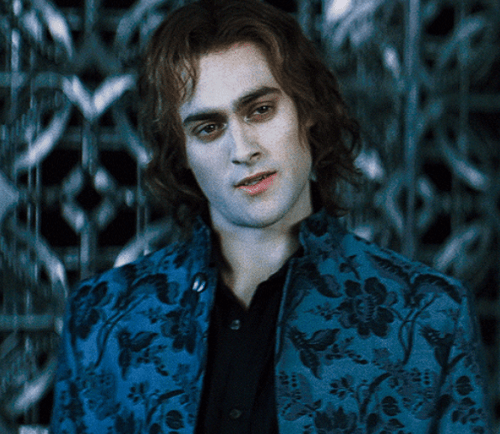
Many people object to the theory of scripts, each from his own point of view. Yet the very intensity of these objections reveals how deeply patterned human behavior actually is. The more satisfactorily these objections can be answered, the stronger the inference that script theory is valid. What appears on the geopolitical stage as the construction of armed camps appears, in the individual, as the construction of rigid interpretive frameworks — the personal “scripts” through which people justify action, defend identity, and resist ambiguity. Some people feel intuitively that the theory of scripts cannot be valid because it is contrary to the destiny of man as a creature of free will. The whole idea arouses in them a kind of revulsion, since it appears to reduce mankind to a mechanism without a vitality to call his own, very much as, in its extreme form, conditioning theory does. These people are also, and for the same humanitarian reasons, uneasy about psychoanalytic theory, which in one form constricts man into a closed-off, cybernetic energy system with only a few restricted input and output channels, and leaves no room for his godhead. These are the moral descendants of people who felt the same way about the Darwinian theory of natural selection, which, in their minds, reduced the processes of life to mechanics and left no room for Mother Nature’s creativity. They, in turn, are the descendants of those who found Galileo intolerably impudent. Nevertheless, such objections, arising as they do from a philanthropic regard for human dignity, must be treated with proper consideration. The answer, or apology if you will, is as follows: Structural analysis does not pretend to answer all questions about human behavior. It states certain propositions about observable social behavior and inner experiences, and these propositions are valid. It does not deal, formally at least, with the essence of being, the Self. It deliberately provides a concept which is beyond its province, the construct of free cathexis, wherein that Self resides, and thereby sets aside a whole field, in many respects the most crucial one, for philosophers, metaphysicians, theologians, and poets to deal with as they see fit. #RandolphHarris 14 of 20

Structural analysis in no way attempts to encroach on this well-defined area, and expects the same courtesy in return from those who do deal with the problem of man’s essence or Self. It has no desire to intrude into either the ivory tower, the cathedral, the minstrel’s pad, or the courtroom, but on the other hand, neither does it expect to be dragged into any of them against its will. Script theory does not pretend that all human behavior is directed by the script. It leaves as much room as possible for autonomy, and indeed, autonomy is its ideal. It only states that relatively few people attain it completely, and then only on special occasions. Its whole purpose is to increase the distribution of that invaluable commodity, and it offers a method for doing so. However, the first requirement is to separate the spurious from the genuine, and that is its whole task. It does forthrightly call a chain a chain, however, and this should not be taken as an insult by those who love their chains or choose to ignore them. “Blessed are they which are persecuted for righteousness’ sake: for theirs is the kingdom of heaven,” reports Matthew 5.10. This does not refer to the righteousness of God; it does not refer to persecution for Jesus Christ’s sake. It is the beatification of those who are persecuted for the sake of a just cause, and, as we may now add, for the sake of a true, good, and human cause. This beatitude puts those Christians entirely in the wrong who, in their mistaken anxiety to act rightly, seek to avoid any suffering for the sake of just, good, and true cause, because as they maintain, they could with a clear conscience suffer only an explicit profession of faith in Christ; it rebukes them for their ungenerousness and narrowness which looks with suspicion on all suffering for a just cause and keeps its distance from it. Even if a cause is not precisely the confession of His name, Jesus gives His support to those who suffer for the sake of a just cause; He takes them under His protection, He accepts responsibility for them, and He lays claims to them. #RandolphHarris 15 of 20

And so is the man who is persecuted for the sake of a just cause is led to Christ, so that it happens that in the hour of suffering and of responsibility, perhaps for the first time in his life and in a way which is strange and surprising to him but is nevertheless an inner necessity, such a man appeals to Christ and professes himself a Christian because at this moment, for the first time, he becomes aware that he belongs to Christ. This, too, is not an abstract deduction, but it is an experience which we ourselves have undergone, an experience in which the power of Jesus Christ became manifest in fields of life where it had previously remained unknown. Peacemaking begins in the most basic place—in our hearts. Then in homes and families. As we practice there, peacemaking will spread into our neighborhoods and communities. Building peacemaking in our homes by using the Lord’s pattern to influence our relationships with one another: persuasion, long-suffering, gentleness, kindness, meekness, and love unfeigned. If it is possible for a man really in truth to will one thing, then he must will the good in truth. If it be possible for a man to will the Good in truth, then he must be at one with himself in willing to renounce all double-mindedness. Therefore, if it be possible for a man to will one thing, then he must will the Good, for only the Good is one. Thus, if it becomes a fact that he wills one thing, he must will the Good in truth. All God needs to accomplish His purpose and to help us become who He wants is for each of us to turn our hearts fully to Him. As we dedicate time daily to come closer to Christ, our hearts are changed. Daily study of the scriptures, accompanied by sincere prayer and regular fasting, will increase your love for the Savior and strengthen your faith and desire to repent and humbly yield your heart to God. Spiritual habits create an internal readiness, a kind of moral fire‑safety system that activates when life grows dark or uncertain. #RandolphHarris 16 of 20

The fire at the X Apartments began just after dusk, when most residents were settling in for the evening. Smoke alarms sounded in uneven bursts, some shrill, some silent, as if the building itself could not decide how seriously to take the emergency. But the elevators kept running — not because of a malfunction, but because management had quietly overridden the fire‑safety interlock years earlier. They wanted to avoid complaints from elderly tenants during false alarms. It was a convenience that had never been tested against real danger, and on this night, it became catastrophic. Residents inside the elevator felt the car rise smoothly, unaware of the fire spreading on the fourth floor. When the doors slid open, they revealed a corridor already overtaken by heat and smoke. The elevator’s logic, stripped of its safety protocols, simply waited for passengers to exit. The people inside pressed buttons, tried to close the doors, tried to reverse direction, but the car remained fixed in place, unable to override the building’s manual bypass. By the time the Sacramento Fire Department arrived, dispatch had already relayed the chilling detail: “Elevator occupied. Doors open on the fire floor.” Firefighters moved with practiced urgency, but the situation demanded more than routine. They had to reach the elevator without allowing the shaft to draw the fire upward, and without triggering further mechanical responses from the compromised system. Crews advanced under controlled conditions, forcing the elevator doors shut manually and using a portable override to bring the car down to a safe landing. Once the passengers were removed, the incident commander ordered a full shutdown of the elevator bank and redirected teams to contain the fire’s spread, which had been accelerated by the open shaft acting as a vertical conduit. In the aftermath, investigators documented what the firefighters already suspected: the building had ignored fire code, intentionally disabling the automatic elevator shutdown required during alarms. The tragedy was not the result of unpredictable technology but of predictable negligence. The event became a stark reminder that safety systems are not optional conveniences — they are the thin line between inconvenience and irreversible loss. #RandolphHarris 17 of 20

When it comes to firefighting, no matter how large or small the fire is or how routine the call seems to be, there is always the potential for injury. If you see a fire truck stopped in the street without the lights on, be very careful. Sometimes there is an emergency, and you should not pass the fire truck. It might be a good idea to safely turn around and go another way because if you hit someone and they happen to die, you could be charged with manslaughter. Sometimes fire firefighters are getting back into their vehicle, and if you pass the apparatus, you may collide with a firefighter who is on foot. Also, be sure to look at their signals; sometimes emergency vehicles are in motion, albeit slowly, and drivers try to pass them, and this could lead to a dangerous situation. Also, if you are in an intersection when you see an emergency vehicle, continue through the intersection. Drive to the right as soon as it is safe and stop. Obey any direction, order, or signal given by a law enforcement officer or a firefighter. Even if they conflict with existing signs, signals, or laws, follow their orders. When their siren or flashing lights are on, it is against the law to follow within 300 feet of any fire engine, law enforcement vehicle, ambulance, or other emergency vehicle. If you drive to the scene of a fire, collision, or other disaster, you can be arrested. When you do this, you are getting in the way of firefighters, ambulance crews, or other rescue and emergency personnel. The concept of professional courage does not always mean being as tough as nails, either. It also suggests a willingness to listen to other people’s problems, to go to bat for them in a tough situation, and it means knowing just how far they can go. It also means being willing to tell the boss when he or she is wrong. #RandolphHarris 18 of 20

Also, to ensure that we have farmland and buildable land for future use, we need to start limiting the number of people allowed to immigrate to America. Perhaps with the immigrants we do allow into America, there needs to be a diversity program to make sure we have a population that equally represents all races of people. If Americans continue to spend money on American products, then more need to be made to keep up the inventory. When investors notice these goods are selling, it gives them the confidence to pour more money into that local business. It shows that people want these goods made in America and pressures investors to keep these goods and services in America. The jobs stay here, the business stays in America, wages naturally increase, and more money is invested to keep up with demand. This reduces the burden on the taxpayer. When you support American businesses, that money stays in our economy and can help to reduce the national debt. The government creates debt by borrowing from businesses in the private sector or from foreign countries. It also increases the national debt by spending more than it gains in tax revenue in a fiscal year. When people shop locally, more tax money stays in the economy and goes to the government. This way, it keeps more money in our national economy and keeps more jobs located in America which also sends more taxes to the government, which can again help to reduce the national debt. When you buy foreign goods, these companies usually have lighter tax loads or exemptions, meaning less money for the national debt, plus you are helping to strengthen these foreign nations by sending more money overseas. Buying American-made products is also better for the environment and helps to reduce the carbon footprint because these products do not have to travel nearly as far. Furthermore, American companies and manufacturers are held to much higher standards on pollution. American companies must be more careful about air, land, and water pollution and have proper ways to dispose of waste. #RandolphHarris 19 of 20

Under President Trump’s administration, he has made America a priority. President Trump has closed the southern border, illegal crossings have fallen to an all-time low, and are 90 percent lower than under the previous administration. Since President Trump’s crack down on crime, violent crimes in Washington D.C. have dropped by approximately 80 percent. He has stopped thousands of pounds of drugs from entering America and killing citizens. And since President Trump took office, investments in America have increased by trillions of dollars in U.S.A. manufacturing, production, and innovation. As you can see, President Donald Trump and his pledge to “Make America Great Again” is exactly what America needs to save the country and the American people. And yes, diversity is important, so you can see why it is also important to preserve blonde hair and blue eyes, as the people with these characteristics are becoming a minority in America. As a reminder, parents, please teach your children to love America and be patriotic citizens, and to buy goods and services made in America. It is also important to respect law and order and treat your elders with respect. It is inborn in the human mind to wish to know. If this begins with the endless surface questions of a child’s curiosity, if it continues into deeper questions of a scientist’s probing investigation, it cannot and does not stop there. For the higher part of the mind will eventually come into unfoldment, that union of abstract reflective thought with mystical intuition, which is true intelligence, which needs and sees a view of the whole of things. And so, the knowing faculty enters the realm of philosophy. A lot of children are having problems in school and cannot even write a paragraph because they are not reading their books. When you actually read books, you get an example of how to write and will become a better student. Therefore, remember to take your education seriously so that you will be successful in life and make your family proud. Also, to make sure they have all the resources required, please donate to the Sacramento Fire Department to help improve our national security. “Oh, thus be it ever, when freemen shall stand between their loved home and the war’s desolation! Blest with victory and peace, may the heav’n-rescued land Praise the Power that hath made and preserved us a nation! Then conquer we must, when our cause is just, and this be our motto: ‘In God is our trust.’ And the star-spangled banner in triumph shall wave O’er the land of the free and the home of the brave.” #RandolphHarris 20 of 20


People say the Winchester Mansion is strange because Mrs. Sarah Winchester built it that way — staircases to nowhere, doors that open into air, rooms that appear without warning. But those who have studied the deeper folklore whisper something else: that the house inherited stories far older than California, stories that drifted across oceans and centuries until they found a place to root themselves again. They say the mansion carries echoes of another place — a fortress of stone, a house of trials, a home of restless spirits. And at the center of those echoes stands a single figure. The Watcher. Long before the mansion rose from the California soil, the Watcher belonged to a different tower — a high, narrow room where he kept vigil over a land filled with fear, accusations, and unanswered questions. But when Mrs. Sarah Winchester began her endless construction, something in her grief called to him.

Visitors to the mansion sometimes see him in the uppermost windows: a tall silhouette, unmoving, always looking outward as if guarding something only he understands. Guides say the tower is empty. Workers say no one goes up there. Yet the figure appears, night after night, watching. Some believe he is a guardian. Others say he is a witness. But the oldest version claims he is both — a presence drawn to places where sorrow builds walls and fear carves corridors. In the eastern wing, guests sometimes report a pale woman drifting through the hallways, her gown trailing like mist. She never speaks. She never approaches. She simply moves from room to room as though searching for something she lost long ago. Some say she is a memory Mrs. Sarah could not let go of. Others believe she is one of the mansion’s “unfinished stories,” a spirit who followed the Watcher across the sea and found a new home in the labyrinth Mrs. Sarah built.

On fog-heavy nights, the mansion grounds echo with the sound of a horse-drawn carriage approaching the front steps — though nothing ever arrives. The clatter of wheels, the snort of horses, the creak of leather harnesses… all vanish the moment someone opens the door. Locals say it is the carriage of a former visitor returning to the house, eternally repeating his journey. Others whisper that it is the Watcher’s escort, arriving to collect the lost or guide the wandering. In the farthest corridors, where the house seems to fold in on itself, visitors sometimes hear heavy footsteps pacing behind them — too slow for a person, too deliberate for an animal. Some claim to hear low growls echoing from the walls, as though something unseen is patrolling the mansion’s edges. Mrs. Sarah herself once wrote of “shadows that walk like men but breathe like beasts.” Whether she meant it literally or metaphorically, no one knows. But the stories persist.
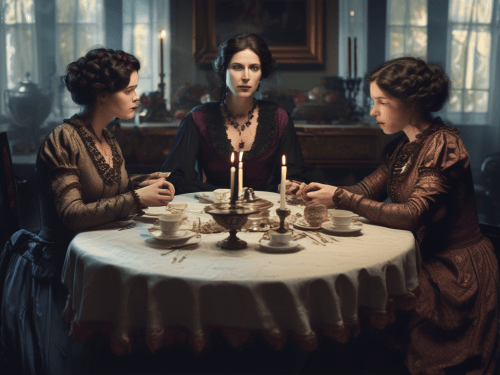
The legend says Mrs. Sarah Winchester did not create these hauntings — she inherited them. Her grief, her isolation, her relentless building formed a kind of beacon. The house became a sanctuary for wandering spirits, a place where old stories could settle into new rooms. And the Watcher, drawn by the same sorrow he had known in his first tower, took up his post again — not to frighten Mrs. Sarah, but to accompany her. To stand guard over a woman who built a labyrinth not to trap spirits, but to give them somewhere to go. Some nights, when the mansion is especially still, visitors swear they see him turn from the window, as if acknowledging them. As if reminding them that every house with a history has someone watching over it.

PRIVATE EVENTS & WEDDINGS
at WINCHESTER ESTATE

Many event locations claim to be unique, but nothing compares to the Winchester Mystery House. If you’re truly seeking a distinct, one‑of‑a‑kind setting for your milestone celebration or special occasion, reserve a venue that delivers on uniqueness many times over. Whether you’re planning a wedding, birthday or anniversary celebration, corporate gathering, holiday party, or any other meaningful event, the Winchester Mystery House offers an unforgettable backdrop. Give your guests an experience they’ll be talking about for years to come.
Café 13: A Rest Stop on the Edge of the Mystery

After wandering the winding halls of the Winchester Mystery House—where staircases defy logic and whispers seem to cling to the walls—Café 13 offers a welcome return to warmth and grounding. Newly reopened and serving guests daily from 10 AM to 3 PM, this cozy hideaway invites you to pause, breathe, and gather yourself before diving back into the mansion’s secrets. Here, you can enjoy breakfast, lunch, snacks, and refreshing drinks in a calm indoor space that feels worlds away from the mansion’s twisting corridors. Settle in with a warm meal, challenge a friend to a board game, or simply rest and recharge as sunlight filters through the windows. Café 13 is more than a café—it’s a moment of calm between chapters of the Winchester legend, a place to steady your nerves before returning to the gardens, the grandeur, and the mysteries that await.
Winchester Mercantile Gift Shop

Your journey into the Winchester Mystery House begins long before you cross the mansion’s threshold. It starts at the Mercantile gift shop—a welcoming outpost standing at the edge of a world where history and myth intertwine. Here, beneath warm lights and shelves lined with curiosities, you can secure your tour tickets and prepare for the adventure ahead. Guests often pause for a souvenir photograph, capturing the moment before they step into Sarah Winchester’s enigmatic domain. As you explore the shop, you will find an eclectic array of gifts and keepsakes: tokens of the mansion’s lore, echoes of Victorian elegance, and mementos that carry a touch of the house’s enduring mystery. The Mercantile is more than a gift shop—it is the gateway. https://winchestermysteryhouse.com/


Harris Plumbing, Heating, Air, & Electric has been in business for 30 years. How many businesses can say that? We take pride in everything we do – no matter how big or small the service call might be. We’re here to help your home be as safe and comfortable as possible for you and your family. We take that responsibility very seriously as a company.

Harris will ensure you have the information you need to decide what to do next, whatever your home is facing. We’ll perform a diagnosis and detail what issues are present before starting any work. This gives you a personalized quote and service plan specific to your home’s needs, not some random quote based on the best guess. The only way we can do our best work is to make sure we handle the issues at hand. https://www.callharrisnow.com/about-us/


With its top ranking in Consumer Reports’ Auto Brand Report Card and consistent market share growth, BMW, The Ultimate Driving Experience, has demonstrated its ability to produce high-performing, reliable vehicles that meet consumer demands.BMW stands out due to its focus on driving dynamics and engineering excellence. While other luxury brands prioritize comfort and opulence, BMW is known for creating cars that are fun to drive and offer a unique connection between the driver and the machine. This is why BMW is known as The Ultimate Driving Machine. https://www.brianharrisbmw.com/

Randolph Harris San Francisco Taxation & Mergers
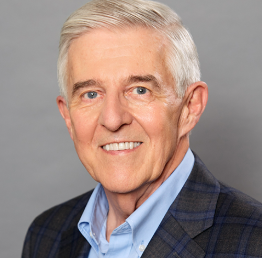
Building strong and lasting client relationships is crucial for a successful legal career. Many lawyers mistakenly believe that mastering legal skills alone ensures success, but law is fundamentally a service industry—our job is to solve problems through the time we sell. To build long-term relationships, attorneys must focus on three core elements: knowing their clients, understanding how their legal issues fit into a larger context, and consistently delivering exceptional service.

Randy advises clients with regard to business transition, taxable and tax-deferred mergers and acquisitions, joint ventures, restructuring, integrated tax planning, federal and state tax controversy resolution, and real estate transactions. Trust is the cornerstone of any client relationship. Ultimately, my clients feel they are in capable hands with someone who genuinely understands their problems and goals. https://www.jmbm.com/l-randolph-harris.html

Magnolia Station
Base Price $735,000
Sales Office 4159 Aura Way
Rancho Cordova, CA 95762

Only three homesites remain in this peaceful, welcoming community, a place where thoughtful design and everyday comfort come together to create a lifestyle that feels both effortless and deeply fulfilling. Here, wide streets, mature landscaping, and a sense of neighborly warmth set the tone for a community that values connection as much as convenience. Each single‑story floorplan has been crafted with care, offering open living spaces, flexible rooms, and natural light that moves gently through the home throughout the day.

Residence One, a beautifully balanced 2,293‑square‑foot design, features three spacious bedrooms, two well‑appointed bathrooms, a versatile den, an inviting great room, a dedicated dining area, an outdoor patio perfect for morning coffee or evening gatherings, and a two‑car garage. It’s a home that adapts gracefully to the rhythms of daily life, offering both comfort and possibility.

For those seeking even more room to grow, Residence Three offers 2,827 square feet of expansive living, including four bedrooms, two‑and‑a‑half baths, a private den ideal for work or retreat, a generous owner’s suite designed for rest and renewal, and a three‑car garage that provides ample storage and flexibility. With its larger footprint and thoughtful layout, it offers the perfect blend of openness and privacy. In a community defined by tranquility, thoughtful planning, and a genuine sense of belonging, these final homesites represent a rare opportunity to settle into a place that truly feels like home — a place where every detail supports the life you want to live. https://www.cresleigh.com/communities/california/rancho-cordova-ca/magnolia-station#plans





 Randolph Harris II International Institute