

Who he is emerges from what he glorifies, what he hates, what he builds, and what he buries. Prince Lestat, Lord de Lioncourt, glorifies and cultivates within himself everything that means mastery. Mastery with regard to others entails the need to excel and to be superior in some way. He tends to manipulate or dominate others and to make them dependent upon him. This trend is also reflected in what he expects their attitude toward him to be. Whether he is out for adoration, respect, or recognition, he is concerned with their subordinating themselves to him and looking up to him. He abhors the idea of his being compliant, appeasing, or dependent. Furthermore, Prince Lestat is proud of his ability to cope with any contingency and is convinced that he can do so. There is, or should be, nothing that he cannot accomplish. Somehow, he must be—and feels that he is—the master of his fate. Helplessness may make him feel panicky, and he hates any trace of it in himself. Mastery with regard to himself means that he is his idealized, proud self. Through willpower and reason, he is the captain of his soul. Only with great reluctance does he recognize any forces in himself which are unconscious, id est, not subject to his conscious control. It disturbs him inordinately to recognize a conflict within himself, or any problem that he cannot solve (master) right away. Suffering is felt by Lestat as a disgrace to be concealed. It is typical for him that in analysis he has no particular difficulty in recognizing his pride, but he is loath to see his should, or at any rate that aspect of them which implies that he is shoved around by them. #RandolphHarris 1 of 9

Nothing should push him around. As long as possible, Lestat maintains the fiction that he can lay down laws for himself and fulfill them. He abhors being helpless toward anything in himself as much as or more than being helpless toward any external factor. In the type veering in the direction of the self-effacing solution, we find a reverse emphasis. He must not feel consciously superior to others or display any such feelings in his behavior. On the contrary, Lestat tends to subordinate himself to others, like when Queen Akasha stood against Maharat and the retinue sworn to her cause. Most characteristic is the diametrically opposite attitude from that of the expansive type toward helplessness and suffering. Far from abhorring these conditions, Lestat rather cultivates and unwittingly exaggerates them; accordingly, anything in the attitude of others, like admiration or recognition, that puts him in a superior position makes him uneasy. For example, Lestat grew sorely disquieted when Queen Akasha vowed to set him as king over all the earth, for a strange tenderness toward humankind had taken root within his heart. What he yearned for was succor, safeguard, and a love that yielded itself in trust—gifts Jesse freely bestowed—whereas Queen Akasha sought rather to yield her dominion to him and fashioned him into a king of war. These characteristics also prevail in his attitude toward himself. In sharp contrast to the expansive types, Lestat lives with a diffuse sense of failure (to measure up to his shoulds) and hence tends to feel guilty, inferior, or contemptible. His self-hate and self-contempt spring from the making of him by Marius, who forsook him; and the sense of failure born of that abandonment is turned outward in a passive guise, as though the scorn and accusation he feels within were coming from others. Conversely, he tends to deny and eliminate expressive feelings about himself, such as having the ego of a king, self-glorification, pride, and arrogance. Pride, no matter what it concerns, is put under a strict and extensive taboo. As a result, it is not consciously felt; it is denied or disowned. Lestat is his subdued self; he is the stowaway without any rights. #RandolphHarris 2 of 9

In keeping with this disposition, Lestat suppresses within himself all that smacks of ambition, vindictiveness, triumph, or the pursuit of his own advantage. Thus, he resolves his inner conflict by casting sown every expansive impulse and allowing self-abnegation to reign; and so, he betrays Queen Akasha—she who guarded him, tended him, and preserved his life—all for the love of a mortal woman. The anxious shunning of pride, triumph, or superiority shows in many ways. A characteristic and easy to observe is the fear of winning in games. Lestat, though erstwhile bearing all the tokens of morbid dependency, yet could at whiles comport himself right nobly in the lists or at the butts, proving himself no mean hand at jousting nor at archery. So long as he remained unmindful of his own advantage, all went prosperously; yet no sooner did Lestat perceive himself to stand before his adversary than his hand faltered, and he would straightway miss the joust, at the butts, overlook the plainest shot that should have won him the day. Even before any searching of his soul, Lestat knew full well that the cause of his failure lay not in a lack of will to win, but in a lack of daring. Perchance for this cause, he forsook Queen Akasha’s life and slew her. Yet, though wrath rose within him for failing to overcome himself, the working of that inward defeat moved with such swiftness and certainty that he was powerless to stay it. The same temper showeth itself in all other matters. It is the wont of such a man never to know when he standeth in the stronger stead, nor to wield that strength to his own behoof. #RandolphHarris 3 of 9

In any circumstance wherein his rights be not plainly set forth—be it in dealings with household servants or with those who attended him in secretarial charge—he is as one cast upon the open sea, unsure of his footing and unable to command the situation. Even when his petitions be wholly just, he feeleth as though he did trespass upon the goodwill of others, and so either holdeth his tongue or speaketh with a conscience burdened by guilt. Toward those who depend upon him—such as the moral woman Jesse—Lestat is oft powerless, unable to withstand insult or rebuke. Small wonder, then that he becometh easy prey to those vampires who seek his ruin. He is defenseless, and knoweth it not till much later—like at the concert—when wrath flares within him, not only against his exploiters but against himself. And in the end, it is for these very ones that he betrayeth Queen Akasha, she alone who loved him truly and kept him safe. His fear of triumph in more serious matters than games applies to success, acclaim, and limelight. Not only is he afraid of any public performance, but when he is successful in some pursuit, he cannot give himself credit for it. He either gets frightened, minimizes it, or ascribes it to good luck. In the latter case, instead of feeling, “I have done it,” he merely feels that “it happened.” There is often an inverse ratio between success and inner security. Repeated achievements in his field do not make him more secure, but more anxious. And this may reach such proportions of panic that a musician or an actor, for example, will sometimes decline promising offers. #RandolphHarris 4 of 9

Moreover, though born of noble blood and steeped in the rites of royal vampiric lineage, he shuns any thought, feeling, or gesture that might bear the mark of presumption. In a manner both unconscious and methodical, he bends himself backward to avoid all that smacks of arrogance, conceit, or undue self-assertion. It is as though the crown he wears must be ever hidden, lest it gleam and betray a pride he dares not claim. To his mind, it is sheer conceit to imagine that he might rule a kingdom, that men would answer when he summoneth them, or that a goddess—fair and terrible—could bestow her love upon him. “Anything I desire is arrogance,” he telleth himself. And if by chance he accomplisheth some worthy deed, he ascribeth it not to skill or merit, but to fortune’s whim or some clever bluff. Already, he deemth it presumptuous to hold an opinion of his own, and thus, he yieldeth with troubling ease to his adversaries—those who but yesterday sought his death—accepting whatever counsel they press upon him without so much as consulting his own convictions. And so, in a single turn of the wind, he cast aside his royal inheritance and the ancient kingdom of five millennia to which he had belonged for more than a century. Thus, is he like a weather vane upon a storm-tossed tower, turning now this way, now that way, swayed by the strongest breath, whether for good or for ill. Lestat’s self-hate hath its root in the forsaking he suffered at the hands of Marius, who made him a vampire and then abandoned him. #RandolphHarris 5 of 9
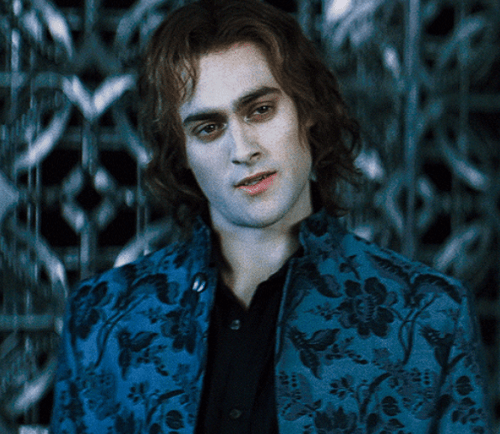
For a season, he did revel in the limelight, yet not from joy, but rebellion. His aim was not fame, but provocation—to draw forth the hidden ones, that they might slay him, and in so doing, reveal themselves to the world. Thus, would their destruction be assured, and his own death sealed. By the time Queen Akasha came to bore him away, his hatred of immortals had deepened, fed by the influence of Jesse, the mortal woman. Had Jesse not entered his life, Lestat might well have embraced his nature and ruled beside Akasha in majesty. However, such is the poison of self-hate: it turneth a man against his own kind, driveth him to slay his brethren, and bind himself to those who would undo him. And we must not forget Akasha’s warning: “Kill me, and you kill yourselves.” A saying both literal and figurative, for self-hate is a blade turned inward—it cleaveth not only flesh, but soul, and bringeth ruin from the very core. In a word, then, there is a man whose mind remains piously ignorant of the multitude of things, for the Good is one thing. The more difficult part of the talk is directed to the man whose mind, in its double-mindedness, has made the doubtful acquaintance of the multitude of things and of knowledge. It is certain that a man is truth will something, then he wills the Good, for this alone can be willed in this manner. However, both of these assertions speak of identical things, or they speak of different things. The one assertion plainly designates the name of the Good, declaring it to be that one thing. The other assertion cunningly conceals this name. It appears almost as if it spoke of something else. However, just on that account, it forces its way, searchingly, into a man’s most innermost being. And no matter how much he may protect, or defy, or boast that he wills only one thing, it searches him through and through in order to show the double-mindedness in him if the one thing he wills is not the Good. #RandolphHarris 6 of 9

For in truth, Lestat was once on earth and seemed to will only one thing. It was unnecessary for him to insist upon it. Even if he had been silent about it, there were witnesses enough against him who testified how inhumanely he steeled his mind, how nothing touched him, neither tenderness, nor innocence, nor misery; how his blinded soul had eyes for nothing, and how the senses in him had only eyes for the one thing that he willed. And yet, it was certainly a delusion, a terrible delusion, that he willed one thing. For pleasure and honor and riches and power and all that this world has to offer, only appear to be one thing. It is not, nor does it remain one thing, while everything else is in change or while he himself is in change. It is not in all circumstances the same. On the contrary, it is subject to continual alteration, and I guess the prince missed what his maker Marius was trying to teach him. Hence, even if this man named but one thing, whether it be pleasure, or honor, or riches, actually, he did not will one thing. Neither can he be said to will one thing when that one thing which he wills is not in itself one: is in itself a multitude of things, a dispersion, the toy of changeableness, and the prey of corruption! In the time of pleasure, see how he longed for one gratification after another. He went from loving the violin to wanting to be a rock star. He gave up his noble heritage to become a commoner. Variety was Prince Lestat’s watchword. Is variety, then, to will one thing that shall ever remain the same? On the contrary, it is to will one thing that must never be the same. It is to will a multitude of things. And a person who wills in this fashion is not only double-minded but is at odds with himself. #RandolphHarris 7 of 9

For such a man as Prince Lestat wills first one thing and then immediately wills the opposite, because the oneness of pleasure is a snare and a delusion. It is the diversity of pleasures that he wills. So when the man of whom we are speaking had gratified himself up to the point of disgust, he became weary and sated. Even if he still desired one thing—what was it that he desired? He desired new pleasures; his enfeebled soul raged so that no ingenuity was sufficient to discover something new—something new! It was change he cried out for as pleasure served him, change! change! Now, it is to be understood that there are also changes in life that can prove to a man whether he wills one thing. There is the change of the perishable nature when the sensual man must step aside, when dancing and the tumult of the whirling senses are over, when all becomes soberly quiet. That is the change of death. If, for once, the perishable nature should seem to forget to close in, if it should seem as if the sensual one had succeeded in slipping by: death does not forget. The sensual one will not slip past death, who has dominion over what belongs to the earth and who will change into nothing the one thing which the sensual person desires. And last of all, there is the change of eternity, which changes all. Then only the Good remains, and it remains the blessed possession of the man that has willed only one thing. However, the rich man whom no misery could touch, that rich man who even in eternity to his own damnation must continue to will one thing, ask him now whether he really wills one thing. So, too, with honor and riches and power. #RandolphHarris 8 of 9

For in the time of strength as Lestat aspired to honor, did he really discover some limit, or was that not simply the stiver’s restless passion to climb higher and higher? Did he find some rest amid his sleeplessness in which he sought to capture honor and to hold it fast? Did he find some refreshment in the cold fire of his passion? And if he really won honor’s highest prize, then is earthly honor in itself one thing? Or in its diversity, when the thousands and thousands braid the wreath, it is an honor to be likened to the gorgeous carpet of the field—created by a single hand? No, like worldly contempt, worldly honor is a whirlpool, a play of confused forces, an illusory moment in the flux of opinions. It is a sense-deception, as when a swarm of vampires at a distance seems to the eye like one body; a sense-deception, as when the noise of the many at a distance seems to the ear like a single voice. “And though I have the gift of prophecy, and understand all mysteries, and all knowledge; and though I have all faith, so that I could remove mountains, and have not love, I am nothing. And though I bestow all my goods to feed the poor, and though I give my body to be burned, and have not love, it profiteth me nothing” (I Corinthians 13.2 and 3). This is the decisive word which marks the distinction between man in disunion and man in the origin. The word love. There is a recognition of Christ, a powerful faith in Christ, and indeed a conviction and a devotion of love even unto death—all without love. That is the point. Without this “love,” everything falls apart, and everything is inacceptable, but in this love, everything is united, and everything is pleasing to God. What is this love? Growth is change, but change in the direction of greater awareness, competence, and authenticity. With each episode of growing through which a person passes, that person’s knowledge of the world increases and the ability to be more aware of what is going on likewise is enlarged. Growth reveals itself publicly, in the person’s action, but the more important dimensions of growing are secret and invisible. Growth in consciousness makes it possible for a person to see connections between ways of behaving and their consequence for well-being. Lestat was always known as the “Brat Prince.” #RandolphHarris 9 of 9

God calls us to seek wisdom and understanding as we make decisions. Logical thinking is a tool that allows us to apply knowledge correctly and walk in God’s will. “For the Lord grants wisdom! From his mouth come knowledge and understanding.” Proverbs 2.6





 Randolph Harris II International Institute