

We can forgive a child who is afraid of the dark, but it is deeply concerning when a man is afraid of the light. Man is a creature of desires, universally motivated by self-interest; the mechanism of competition, if free and fair, transmutes the self-seeking of the economic man into deeds that work for “the greatest good of the greatest number.” However, this machinery is delicate and must be permitted to operate under “normal” conditions and must not be overridden by government interference; to enjoy the fruits of an inherently beneficent natural economic law, men must permit it to operate unhampered; they must be industrious, frugal, temperate, and self-reliant; self-help, and not a weak recourse to state intervention, is the way of economic salvation. We must not, however, always have blind faith in the doctrines and simplicity of classical laissez faire economics, and its belief in the adequacy of self-interest as an explanation of human conduct. The historical method cannot lead to such doctrinaire extreme. This younger political economy no longer permits the science to be used as a tool in the hands of the greedy and the avaricious for keeping down and oppressing the labouring classes. It does not acknowledge laissez-faire as an excuse for doing nothing while people starve, nor allow the all-sufficiency of competition as a plea for grinding the poor. #RandolphHarris 1 of 18

Malthus assumed that man has a definite and unalterable set of attributes; but Darwinism holds that man is pliable and circumstances determine his characteristics. On true Darwinian premises one can assume no such thing as a permanent natural rate of increase; for the human rate of increase would be susceptible to change in accordance with man’s surroundings and circumstances. We regard the state as an agency whose positive assistance is one of the indispensable conditions of human progress. We believe that political economy as a science is still in an early stage of its development. While we appreciate the work of former economists, we look not so much to speculation as to the historical and statistical study of actual conditions of economic life for the satisfactory accomplishment of that development. The most fundamental things in our minds are on the one hand the idea of evolution, and on the other hand, the idea of relativity. A new World is coming into existence, and if this World is to be a better World we know that we must have a new economics to go along with it. If the consumer challenges the corporation to respond to his wishes, the management will begin to respond to this challenge. However, as it stands, many corporations are taking on the form of a dictator and demanding that the consumer be thankful for allowing them to purchase from their businesses and that the consumer accepts whatever the business gives them, even if it is substandard quality and service. #RandolphHarris 2 of 18

Accusations will not help to clarify or to improve the situation. Managers as well as consumers are part of the same alienated system; they are its prisoners rather than its creators. The managers tend to seduce the consumer into passiveness, but the consumer is attracted to his passive role; he makes it easy to be seduced. The resistance to basic change exists on both sides, but the wish for imaginative change, for liberation of energies, for new or creative solutions exists on both sides, too. A further measure would be legal restrictions on present methods of advertising. This point hardly needs an explanation. It refers to all semihypnotic and irrational advertising which has developed in the last three quarters of a century. It could be effected by a simple law, like the one requiring cigarette manufacturers to put a warning of danger to health on their product, or as fake and misleading advertising in interstate commerce and specifically false advertisements with respect to food, drugs, and cosmetics are forbidden by federal statutes. Whether such a law has a chance to be passed against the combined powers of the advertising industry, the newspapers, television, radio, and, most of all, that part of industry for which hypnotic advertising is an important aspect of its planning and production, depends on certain changes in our democratic process, and chance to be informed, to debate and to discuss this problem, and whether the power of citizens is superior to that of lobbies and those members of Congress who are influenced by lobbies. #RandolphHarris 3 of 18

What about a redirection of production itself? Assuming that the best experts and an enlightened public opinion came to the conclusion that the production of certain commodities is preferable to that of others in the interest of the population as a whole, could the freedom of the enterprise to produce that which is most profitable or requires least vision, experimentation, and daring be restricted within the framework of our Constitution? Legally this would not cause any great problem. While in the twentieth century such change might required the nationalization of industry, today it can be achieved by laws which require no change in our Constitution. The production of “useful” things could be furthered and the production of useless and unhealthy things could be discouraged by tax laws which favour those industries that agree to fit their production into the pattern of a sane society rather than into a pattern of “profit regardless.” The government could influence adequate production by loans or, in certain instances, by government-owned enterprises which would pave the way for private initiative, once feasibility of profitable investment was proved. It is also important to increase investment in the public sector in relation to investment in the private sector. #RandolphHarris 4 of 18

All investments in the public sector—like public transportation, housing, schools, parks, theaters, and so on—have a twofold merit: first, of fulfilling needs adapted to man’s aliveness and growth; second, of developing a sense of solidarity rather than one of personal greed and envy and hence competitiveness with others. Our society, like many of the past, has accepted the principle “he who does not work should not eat.” (American Communism has elevated this old principle into a “socialist” precept, phrasing it slightly different.) The problem is not whether a man fulfills his social responsibility by contributing to the common good. In fact, in those cultures which have explicitly or implicitly accepted this norm, the rich who did not have to work, were exempted from this principle, and the definition of a gentleman was a man who did not have to work to live in style. The problem is that any human being has an inalienable right to live regardless of whether he performs a social duty. Work and all other social obligations should be made sufficiently attractive to urge man to desire to accept his share of social responsibility, but he should not be forced to do so by the threat of starvation. If the latter principle is applied, society has no need to make work attractive and to fit its system to human needs. It is true that in many societies of the past the disproportion between the size of the population and the available techniques of production did not permit the freedom to dispense with the principle of what is, in fact, forced labour. #RandolphHarris 5 of 18

In the affluent industrial society there is no such problem, and yet even the members of the middle and upper classes are forced to follow norms laid down by the industrial system for fear of losing their jobs. Our industrial system does not give them as much leeway as it could. If they lose a job because they lack “the right spirit”—which means they are too independent, voice unpopular opinions, marry the “wrong” women—they will have great difficulties in finding another job of equal rank, and getting a job of inferior rank implies that they and their families feel that their personality has been degraded; they lose the new “friends” whom they had gained in the process of rising; they fear the scorn of their wives and the loss of respect from the children. We must uphold the principle that a person has an inalienable right to live—a right to which no conditions are attached and which implies the right to be treated at least as well as the owner of a dog or a cat treats his pet, which does not have to “prove” anything in order to be fed. Provided this principle were accepted, if a man, woman, or adolescent could be sure that whatever he did his material existence would not be in jeopardy, the realm of human freedom would be immensely enhanced. Acceptance of this principle would also enable a person to change his occupation or profession by using one or more years in preparing himself for a new and, to him, more adequate activity. #RandolphHarris 6 of 18

It happens that most people decide about their career at an age when they do not have the experience and judgment to know what activity is the most congenial to them. Perhaps in their mid-thirties they wake up to the fact that it is too late to start that activity which they now know would have been the right choice. In addition, no woman would be forced to remain unhappily married because she did not have what it takes even to prepare herself for a job at which she could make a living. If he knew he would not starve during the time he looks for a job more to his liking, no employee would be forced to accept conditions which to him are degrading or distasteful. This problem is by no means solved by unemployment or welfare dole. As many have recognized, the bureaucratic methods employed here are humiliating to such a degree that many people are afraid of being forced into the dole-receiving sector of the population, and this fear is sufficient to deprive them of the freedom not to accept certain working conditions. How could this principle be realized? Several economists have suggested as a solution an “annual guaranteed income” (sometimes called a “negative income tax”). The guaranteed annual income for work in order not to arouse resentment and anger in those who work. If it is to guarantee a modest but still adequate material basis, the present wage level would have to rise considerably. #RandolphHarris 7 of 18

It is feasible to determine a minimum standard of living which is as high as the present minimum standard for a modest and adequate material basis. Anyone who is attracted by a more comfortable life would be free to achieve a higher level of consumption. The guaranteed annual income could also serve, as some economists have observed, as an important regulating feature in our economy. What we need is some device that can be permanently instituted as a regular feature of the industrial economy by which demand can be made to keep pace with a constantly proliferating supply. The guarantee of a basic income to all members of the community irrespective of the earnings of employment, as Social Security payments are now guaranteed to all persons over the age of seventy-two years of age, would provide the flow of effective demand that the economy more and more desperately requires. However limited the impact of Darwinism on economic theory, one could doubtless compile a formidable list of obiter dicta in which competition was justified in Sumnerian fashion as a special case of the struggle for existence. The survival of the fittest was a precept of sheer brutality and nothing else. I must deem any man very shallow in his observation of the facts of life who fails to discern in competition the force to which it is mainly due that mankind has risen from stage in intellectual, moral, and physical power. #RandolphHarris 8 of 18

An aspect of the filter which makes awareness possible is the logic which directs the thinking of people in each culture. Just as most people assume that their language is “natural” and that other languages only use different words for the same things, they assume also that the rules which determine proper thinking are natural and universal ones’ that is what is illogical in one cultural system is illogical in any other because it conflicts with “natural” logic. A good example of this is the difference between Aristotelian and paradoxical logic. Aristotelian logic is based on the laws of identity which states that A is A, the law of contradiction (A is not non-A), and the law of the excluded middle (A cannot be A and non-A, neither A nor non-A). Aristotle stated: “It is impossible for the same thing at the same time to belong and not to belong to the same thing in the same respect…This, then, is the most certain of all principles.” In opposition to Aristotelian logic is what one might call paradoxical logic, which assumes that A and non-A do not exclude each other as predicates of X. Paradoxical logic was predominant in Chinese and Indian thinking, in Heraclitus’ philosophy, and then again under the name of dialectics in the thought of Hegel and Marx. The general principle of paradoxical logic has been clearly described in general terms by Lao-tse: “Words that are strictly true seem to be paradoxical.” And by Chuang-tzu: “That which is one is one. That which is not-one, is also one.” #RandolphHarris 9 of 18

Inasmuch as a person lives in a culture in which the correctness of Aristotelian logic is not doubted, it is exceedingly difficult if not impossible, for him to be aware of experiences which contradict Aristotelian logic, hence which from the standpoint of his culture are nonsensical. A good example is Dr. Freud’s concept of ambivalence, which says that one can experience love and hate for the same person at the same time. This experience, which from the standpoint of paradoxical logic is quite “logical,” does not make sense from the standpoint of Aristotelian logic. As a result, it is exceedingly difficult for most people to be aware of feelings of ambivalence. If they are aware of love, they cannot be aware of hate—since it would be utterly nonsensical to have two contradictory feelings at the same time. In therapy, the personal growth is facilitated when the counselor is what he is, when in the relationship with his client he is genuine and without “front” or façade, openly being the feelings and attitudes which at that moment are flowing in him. We have used the term “congruence” to try to describe this condition. By this we mean that the feelings the counselor is experiencing are available to him, available to his awareness, that he is able to live these feelings, be them in the relationship, and able to communicate them if appropriate. #RandolphHarris 10 of 18

Congruence means that he comes into a direct personal encounter with his client, meeting him on a person-to-person basis. It means that he is being himself, not denying himself. No one fully achieves this condition, yet the more the therapist can listen acceptantly to what is going on within himself, and the more he is able to be the complexity of his feelings without fear, the higher the degree of his congruence. I think that we readily sense this quality in our everyday life. We could each of us name persons whom we know who always seem to be operating from behind a front, who are playing a role, who tend to say things they do not feel. They are exhibiting incongruence. We do not reveal ourselves too deeply to such people. On the other hand, each of us knows individuals whom we somehow trust, because we sense that they are being what they are, that we are dealing with the person himself, and not with a polite or professional façade. This is the quality of which we are speaking, and it is hypothesized that the more genuine and congruent the therapist is in the relationship, the more probability there is that change in personality in the client will occur. Therefore, never accept more than you believe. A person may feel obliged, for instance, to accept whatever “bad” things emerge concerning himself, and to suspect a “resistance” if he hesitates to do so. However, if he regards his interpretation as merely tentative, and does not try to convince himself that it is definite, he will be on much safer ground. #RandolphHarris 11 of 18

The essence of analysis is truthfulness, and this should extend also to acceptance or nonacceptance of interpretations. The danger of making an interpretation that is misleading or at least unprofitable can never be excluded, but one should not be overawed by it. If one does not weaken, but carries on in the right spirit, a more profitable path will open sooner or later, or one will become aware of being in a blind alley and perhaps even learn from that experience. Clare, for instance, before embarking on her analysis of the dependency, had spent a couple of months digging after an alleged need to have her own way. From the data that emerged later we can understand how she was led in that direction. She told me, though, that during these attempts she had never had a feeling of conviction remotely like those she experienced later, during the period reported. Also, the ultimate reason why she had taken that earlier course was that Peter (her boyfriend) often reproached her for being dominating. This illustrates the importance of following one’s own interests; and the importance of not accepting anything without full conviction. However, while this early search of Clare’s meant a waste of time it petered out without harm and did not prevent her from doing highly constructive work afterward. #RandolphHarris 12 of 18
The constructive character of Clare’s work was due not only to the essential correctness of her interpretations but also to the fact that her analysis in this period showed a remarkable degree of continuity. Without intending to concentrate on one problem—for a long time she did not even know what it was—everything she embarked upon turned into a contribution to the problem of her dependency. This unanswering unconscious concentration upon a single problem, which made her approach it relentlessly from ever-new angels, is desirable but rarely attained to the same degree. We can account for it in Clare’s case, for at that period she was living under a formidable pressure—how formidable she fully recognized only later—and hence she unconsciously bent all her energies into solving the problems that contributed to it. Such a compelling situation cannot be created artificially. However, the more absorbing one’s interest in a problem, the more will a similar concentration be approximated. Clare’s self-analysis illustrates the recognition of a neurotic trend; understanding its implications; and discovering its interrelations with other neurotic trends. In Clare’s analysis, the steps overlapped to some extent: she recognized many of the implications before she finally detected the trend itself. Nor did she make any effort to cover definite steps in her analysis: she did not deliberately set out to discover a neurotic trend, and she did not deliberately examine the connections between her dependency and her compulsive modesty. #RandolphHarris 13 of 18

The recognition of the trend came of itself; and, similarly, the connecting links between the two trends almost automatically became more and more visible as the analytical work proceeded. Clare did not select the problems—at least not consciously—but the problems came to her, and in their unfolding they displayed an organic continuity. There was in Clare’s analysis a continuity of still another kind, even more important, and more possible to emulate: at no time was there any insight that remained isolated or disconnected. What we see develop is not an accumulation of insights that a person gains in an analysis is correct, he may still deprive himself of the greatest benefits of his work if the nights remain scattered. Thus Clare, after recognizing that she let herself be immersed in misery because she secretly believed she could thereby command help, might merely have traced the origin of this trait in childhood and regard it as a persistent infantile belief. That might have helped some, because nobody really wants to be miserable for no good reason; the next time she found herself succumbing to a spell of misery, she might have caught herself up short. However, at best this handling of her insight would have diminished in the course of time the gross attacks of exaggerated unhappiness. And these attacks were not the most important expression of the trait. #RandolphHarris 14 of 18

Or Clare might have gone no further than the next step, connecting her finding with her actual lack of self-assertion and recognizing that her belief in magic help substituted for an active dealing with life’s difficulties. This, although still inadequate, would have helped considerably more, because it would have opened a new incentive to do away with the whole attitude of helplessness lying behind the belief. However, if she had not linked up the magic-help belief with her dependency, and seen the one as an integral part of the other, she could not thoroughly have overcome the belief, because she would always have made the unconscious reservation that if she could only find the permanent “love,” help would always be forthcoming. It was only because she saw that connection, and because she recognized the fallacy in such an expectation and the excruciating price she had to pay for it, that the insight had the radically liberating effect it did. Wilhelm Reich, originally a psychoanalyst, became more and more convinced that healthy personality was impossible if a person defended himself or herself from the experience of vitality, pleasures of the flesh, and other emotional repression. Such repressions produce muscular tension. He gave the name muscular armor to those groups of muscles that a person keeps in chronic tension in order not to feel unwanted dimensions of experience. One indication that a person is not living a chronically “armored” life is the capacity to experience an enjoyable experience during pleasures of the flesh. #RandolphHarris 15 of 18

Alexander Lowen adapted some of Reich’s ideas and techniques and founded a school of therapy that he calls bioenergetic analysis. He observes a person’s body, noting peculiarities of chronic tension and posture that are the outcome of the way the person lives. For example, a person with chronically hunched shoulders, who breathes shallowly, may reveal thereby a sense of personal helplessness in a hostile World. Lowen has his patients do certain stretching exercises to identify areas of tension; but he also encourages them to yell, and to beat a pillow or mattress with a tennis racquet, or fists and feet, to release tension. “Unarmoring” a person frees that person from repressions that protect one from pain but also destroy the capacity for pleasure. The man who reposes his emotional strength or mental peace on any single person is taking a chance whose outcome may disappoint him. The feelings of the transformed man no longer come out of the ego but out of the Overself’s life deep within the ego. A fuzzy sentimentality which passes for mystical feeling is only its counterfeit. If a man had trained himself to reject self-pity as an emotional egoism that is harmful, he is not likely to encourage its display in other men merely because they conventionally expect him to be sympathetic. Yet it must always be remembered that when pity, which begins in the emotions, is filtered through the reasons, it is not destroyed but balanced. #RandolphHarris 16 of 18

The Sacramento Fire Department must be as technically advanced as their communities so that when an emergency involving technology occurs, they are equipped and trained effectively to deal with the issue that results. Often lives depend on their readiness and skill levels as new hazards develop into emergency incidents. “I had been through EMT experience, and I had learned all the basic firefighting techniques from the local firehouse, where they let me take the pipe and open roofs. My brother was on the truck, and he’d take me on the roof with him. The knowledge I got there was unbelievable. And then, I had twelve relatives of one kind or another who are or have been firemen. When I went to training school, I probably knew as much as some of the instructors there. But you’re in there to learn, so you keep your mouth shut and do as you’re told. That’s just what I did, and I never had a problem. We were in training school five months, and the last month and a half we would go to school for a day and be assigned to a fire company for a day, wherever they needed us. I’m a very proud fireman. My wife thinks I’m crazy. I’ve got pictures all over my wall of my father, my brother, because I like to walk by them and think of me following in my father’s and brother’s footsteps. #RandolphHarris 17 of 18

“The first time I went to a fire in a special unit, I felt excited, yes, also proud I was here following my father. This is what I always wanted to be. A person could go to college for years and years and never gain the goal they want. And here I am, a couple of years out of high school. I got what I want.” The challenge for today’s leaders in the fire service is to create a vision for the future and make it happen. They have no way of knowing what the future will be like, however. You can do your part to help save lives by donating to the Sacramento Fire Department. Also, remember to raise your children to love America, be patriotic, love God and Jesus Christ, respect law and order and show reverence their elders. It is a privilege to be an American citizen, and one of the many benefits of that privilege is the ability to earn an education. Stay in school and study hard. In tribute to the Founding Fathers of this blessed Republic, may we strive to keep these United States of America forever righteous and just. May ours be a land where none shall prey upon or exploit his fellowman, where bigotry and violence shall not be tolerated, where poverty shall be abolished, and all men live amicably as bothers. I pledge allegiance to the flag of the United States of America and to the Republic, for which it stands, one nation, under God, indivisible with liberty and justice for all. #RandolphHarris 18 of 18

The Winchester Mystery House

The Winchester Mystery House calls to mind cracking thunder above the secretive mansion, howls of strange animals in the night, and spiky iron gates. Inside this legendary fortress may lurk angels, ghosts, and demons. The Winchester Mystery House is celebrating 101 years of giving tours. As many of you know, when Mrs. Winchester died in 1922, it took six moving vans, six weeks to remove all her furniture. On the last day, when almost everything had already been removed, Daisy stood in the now almost empty mansion once more. There were still a few boxes left in the basement. Two of the movers went back into the basement to get them out, while Daisy waited for them upstairs. The bell in the belfry started to strike twelve midnight. They loaded the boxes into the van, carefully locked the front door of the house and then the garden gate. At this precise moment, all three clearly heard the front door open and close again, and loud steps reverberated inside the empty mansion. “There must be someone in there,” one of the movers said. Quickly he unlocked the gate and front door once more and re-entered the dark house. After a few moments, he returned, relocked the door and gate, and somewhat sheepishly, shook his head. “Nothing. It’s all empty.” Not at all, Daisy thought, as the car pulled out into the night, not at all. That was only the reception committee for the tours that were to begin in 1923.
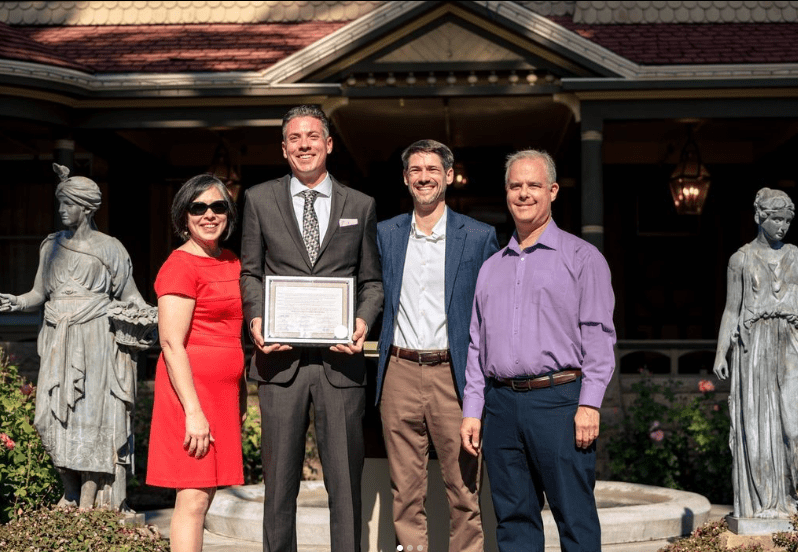
Please come and enjoy a delicious meal in Sarah’s Café, stroll along the paths of the beautiful Victorian gardens, and wonder through the miles of hallways in the World’s most mysterious mansion. For further information about tours, including group tours, weddings, school events, birthday party packages, facility rentals, and special events please visit the website: https://winchestermysteryhouse.com/

Please visit the online giftshop, and purchase a gift for friends and relatives as well as a special memento of The Winchester Mystery House. A variety of souvenirs and gifts are available to purchase. https://shopwinchestermysteryhouse.com/





 Randolph Harris II International Institute