

Sometimes it seems the times of some people are so fatally lacking in geniality, humour, picturesqueness, and poetry; and are so explicit, so mechanical, so flat in the panorama which it gives to life. Many are overcome by the awfully monotonous quality and there is no twilight region in their minds, and no capacity for dreaminess and passivity. All parts of it are filled with the same noonday glare, like a dry desert where every grain of sand shows singly, and there are no mysteries and shadows. It is harmful to be overcome by a dry school-master’s temperament, to display a preference for cheap makeshifts in argument, where one is lacking education even in mechanical principles, and in general the vagueness of all one’s fundamental ideas, their whole system is wooden, as if knocked together out of cracked hemlock boards. Human beings gain knowledge within their souls. “The true lover of learning then must from his earliest youth, as far as in him lies, desire all truth,” says Plato. Nothing justifies the development of abstract principles but their utility in enlarging our concrete knowledge of nature. The ideas on which mathematical Mechanics and the Calculus are founded, the morphological ideas of Natural History, and the theories of Chemistry are such working ideas, finders, not merely summaries of truth. It is possible for “accidents” or novelties to arise which are not predictable from our knowledge of their antecedents—for example, the evolution of self-consciousness, or the application of the voice to social communication. #RandolphHarris 1 of 19

In particular instances, the facts are certain to show irregular departures from the law. A thoroughly consistent evolutionist must regard the laws of nature themselves as the results of evolution, and hence as limited rather than absolute. There exists an element of indeterminacy, spontaneity, or absolute chance in nature. Evolution is a change from a nohowish untalkaboutable all-alikeness by continuous stick-togetherations and somethingelseifications. When the whole training of life is to make us fighters for the higher, why should it be extraordinary or wrong to protest against a philosophy the acceptance of which is acceptance of the defeat of the higher? If it means anything at all, calling a thing bad means that the thing ought not to be, that something else ought to be in its stead. Determinism, in denying that anything else can be in its stead, virtually defines the universe as a place in which what ought to be is impossible—in other words, as an organism whose constitution is afflicted with an incurable taint, an irremediable flaw. Determinism is consistent only with the direst pessimism or a romantic mood of resignation. However, fi moral judgments are to be effective there must be some minimum of uncertainty in the universe; this does not necessitate a completely haphazard World, but only one in which there are occasional choices. #RandolphHarris 2 of 19

The necessity of retaining choices remains, even though one’s dream of universal fatalism be as optimistic in the ultimate advent of a peaceful millennium. Even if no preference can succeed unless it is in harmony with the ultimate triumph of peace, justice, and sympathy, we are still free to decide when to settle down on an equitable and peaceful basis. Until it is finally revealed with certainty what shall succeed, we are all free to try for our own preference. Intelligent mental reactions as those that minister to survival by arranging internal relations to suit the environment, but the critical factor in the cognitive situation, the desire for survival or welfare, is a subjective element which many ignore. The idea of correspondence between inner and outer relations, to be made meaningful as the criterion of mental acts, must be qualified by some subjective or teleologic reference. Furthermore, it is not simply a mirror floating with no foothold anywhere, and passively reflecting an order that he comes upon and finds simply existing. The knower is an actor, and coefficient of the truth on one side, whilst on the other he registers the truth which he helps to create. Mental interests, hypotheses, postulates, so far as they are bases for human action—action which largely transforms the World—help to make the truth which they declare. In other words, there belongs to mind, from its birth upward, a spontaneity, a vote. It is in the game, and not a mere looker-on; and its judgements of the should-be, its ideals, cannot be peeled off from the body of the cogitandum as if they were excrescences, or meant, at most, survival. #RandolphHarris 3 of 19

It is habitual to speak as if the mere body that owns the brain has interests, to treat the body’s survival as an absolute end without reference to any commanding intelligence. The reactions of an organism cannot be considered useful or harmful; it can only be said of them that if they occur in certain ways survival will incidentally be their consequence: but the moment you bring a consciousness into the midst, survival ceases to be a mere hypothesis. No longer is it “if survival is to occur, then so and must brain and other organs work.” It has now become an imperative decree: “Survival shall occur, and therefore organs must so work!” Real ends appear for the first time upon the World’s stage…Every actually existing consciousness seems to itself at any rate to be a fighter for ends, of which many, but for its presence, would not be ends at all. Its powers of cognition are mainly subservient to these ends, discerning which facts further them and which do not. What causes communities to change from generation to generation? Changes are the result of innovations by unusual or outstanding individuals, playing the same role in social change as variations in Darwin’s theory of evolution; such persons are selected by society and elevated into positions of influence because of their adaptability to the social situation into which cause of their adaptability to the social situation into which they happen to be born. Social changes can also be attributed to geography, environment, external circumstances—in brief, to everything except human control. The existence of a universal web of causation is one in which the finite human intellect becomes hopelessly entangled. #RandolphHarris 4 of 19

The most that sociology can predict is that if a great man of such nature appears under certain circumstances, he will affect society in such and such a way; but that he does affect it should not be denied. The great man is himself part of the environment of everybody else. However, a metaphysical creed is a mood of contemplation, an emotional attitude rather than a system of thought; and in its neglect of spontaneous variations in human thinking and their effect upon society, it is an absolute anachronism reverting to a pre-Darwinian type of thought. Without spontaneity, without some possibility that the individual may in measure alter the course of history, there is no chance for betterment of any kind, and the whole romance of struggle with its attendant alternatives of triumph or failure is banished. There is a zone of insecurity in human affairs in which all the dramatic interest lies. The rest belongs to the dead machinery of the stage. That life should be deprived of its dramatic interest by a scheme of universal causality was an intolerable thought, the most pernicious and immoral of fatalism. When people wish to illustrate the problem of evil, they choose spectacularly brutal murders rather than wars or the homeless crisis in America. Through their hardness and inflexibility of tone, many politicians believe that they are superior to the constituents and entertainment supersedes basic human needs. The interests of the citizens are harshly overridden. #RandolphHarris 5 of 19

Society has undoubtedly got to pass toward some newer and better equilibrium, and the distribution of wealth has doubtless slowly got to change; such changes have always happened, and will happen to the end of time. However, if, after all that I have said, any of you expect that they will make any genuine vital difference, on a large scale, to the lives of our descendants, you will have missed the significance of my entire lecture. The solid meaning of life is always the same eternal thing—the marriage, namely, of some unhabitual ideal, however special, with some fidelity, courage, and endurance; with some man’s or woman’s pains. And, whatever or wherever life may be, there will always be the chance for that marriage to take place. I sometimes wonder what did my love of Latin in high school have to do with my life? The only connection that I can find is that I liked words, and the meanings of words, and the derivations of words. However, after a year I had got the hang of that and could look up the rest for myself when I needed it. How did my daughter become so interested in cowboys, when her life had been in Hawaii, New York City, England and the New England coast—before the days she was allowed to stream TV and when she had not seen many movies? I think the answer is that she loved horses. At three, when she said that she felt sick and I asked her what would make her well, she said, “A wide on de pony in de park!” When she was five, the school reported that she was doing well in piano and suggested that she have private lessons. I asked her if she would like this and she said, after only a moment’s pause, “Well, I would rather ride a horse.” She always wanted the horse she did not have, and that may have been her problem, that she solved by being with horses in books. #RandolphHarris 6 of 10

When I went to live in Hawaii, for the first time I got interested in studying history. At that time, the written history was only about a hundred years old and all the sources were available to me. At the same time, I could question people for whom much of that past was a part of their own experience, and another lot of it had come to them through their immediate forebears. As I was living in the Islands, all this contributed to my understanding of what I was living in, and I liked this. I think another factor may have been that in the Islands I was exposed to a different way of thinking about life, and I got really interested in Island history in that sense. If “problems” entered into this, I think it may have been chiefly that when I was first in Hawaii, I did have problems, particularly during the first six months. Although I had driven in New York Labour Day traffic and all that, when I go to Hawaii, the traffic in Honolulu scared me so that I parked on Punchbowl and walked into town, until I could figure out how to drive in it. Time after time, as I went around in Honolulu doing errands, I watched the traffic to try to get the hang of it. At last, it became clear to me: instead of going by rules, the drivers went by noticing. They noticed other cars and they noticed pedestrians and moved in accord with them. Then I drove into town and drove as they did and enjoyed it. I had a problem with the slowness of everything in Hawaii: it was what I wanted for myself, but it was still a problem to me because I got irked by it and had to find my way out of that. #RandolphHarris 7 of 10

I had to slow down myself: then I enjoyed the ease and the lack of friction in moving slowly. I had the problem of living where it seemed to me that everyone had dark hair, dark skin, dark eyes. It was not race prejudice, just homesickness. When I returned to the white skins on the mainland eight years later, it seemed to me that everyone looked sick. I loved the mangoes, papayas, soursops, guavas, mountain apples, cherimoyas, pohas, and all the rest, but it seemed to me that if I could get to California (a place I had never really liked) and eat apricots, peaches, grapes, pears, apples for ten days, then it would be easier for me to go on living in the Islands. I had the problem of ants: I thought I must be a sloppy housekeeper because there were always ants in my house. Sometimes I dived in to help people—and got bumped. The people were somehow different from those I had lived with before. There were all these re-evaluations and adjustments going on, and this seems to open up my mind and lead to questions in other areas too. In trying to answer them, I run into problems, but it does not seem necessary for me to have the problem first. This suggests to me that in trying to provide our children with “security” by keeping them within a closed environment we may be stupidizing them. Then, when we make them specialize at an early age, we are stupidizing them still further. However, is it only the “problem,” anyway? It seems to me that I could have resolved my problem of being sick in another way, but when I found out how little medicine knows about the whole field of chronic illness, I was intrigued by the unknown territory that I lived in. #RandolphHarris 8 of 19

It scared me at first, but then I began to get used to it, and I like moving in the unknown, even when it scares me and is painful. I do not like the scare and the pain, but I do like the exploring. With the doctor, I explored what is known by medicine about chronic illness, with particular reference to my own. Through his honesty, I learned how much is not known. All this churned around in my head until I had the feeling of a dead end, of being somehow on the wrong track. That was when I side-slipped into psychology. It happened. This could lead me back into medicine sometime. That happens too. This suggests that telling children what is not known may be as helpful as telling them what is. When I am told only what is known, it seems to be “all there”—nothing that I can contribute to it. I can only learn what others have found out. It is a closed World. When I know how small the known is in relation to the unknown, the whole World opens up before me. I am free to explore and make my own discoveries instead of being a passive recipient of what is known—to the point that I think that everything is known by someone else and that it is only through others that I can acquire knowledge. I have seen this happen recently with several people, individually, when they discovered how chaotic the field of psychotherapy is, how much is not known. One of them said, with such freedom, “Each man is on his own!” and the others expressed themselves in much the same way. They moved from the limitation of trying to find a specific answer already known to the freedom of making their own discoveries. #RandolphHarris 9 of 19

More is known about how we get into the troubles that we do than is known about how to get out of them. With this knowledge of how things go wrong, these people are now trying to find out for themselves how to go about the undoing, both in the sense of curing and of prevention, by intelligent trial and error. If we all did this, it seems to me that we would get out of our difficulties a lot faster. Some people are very afraid of this, because people will make mistakes. That certainly will happen. However, these will not be such persistent mistakes as taught mistakes are, and I think it is the persistent mistakes that foul us up. It seems to me that much damage has been done by psychotherapists who believed that because they had been trained, they know the answers, and so went on and on with their mistakes. Being sure that the answers they had were right, they did not ask enough questions, and when things did not go well, the questions that arose were answered in terms of the answers they already had. That is a good way to get stuck. If all psychotherapists had done that, we would not have arrived at the new concepts that we have today. Holding to a belief seems to be a large part of our trouble. If I am sure that beating a child is good, or that permissiveness is good, poor results will only lead me to push harder with whatever it is that I believe. That seems to have happened with education. “It has not produced what we wanted, so let us have more of it” seems to sum up what I hear from all kinds of people all the time. #RandolphHarris 10 of 19

When a profession makes a mistake, a whole generation or more is damaged by it—like four-hour feedings and no rocking the baby. An individual’s mistake just does not reach that far. Another good thing about everyone trying to work out psychotherapy on his own (and including himself) is that all these people would not be Authorities. If I try out something in my relations with other people and it does not work well for them, they will be resistant to me in a way they would not be to an authority, who is believed to know what he is doing. It is my experience of most authorities that “working with them” means that I do as they say even if it gives me hell. That is just slavery in another form. “Working with authorities” make sense to me only when the professional and the amateur each say, “Of what you offer, I go along with this, but not with that,” or “Let us try this and see how it works out.” Then, there is continuing education on both sides, and each one at the same time is responsible for himself, through the choices he makes. That actually makes it much easier on the authorities, and it seems to me that any authority in his right mind would welcome this: he has contributed the best that he has to offer, but the choice is made by the other person. The authority, likewise, is responsible for his choices—for himself, not for anyone else. I know how this works out because I have tried it in medicine, education, and psychology. #RandolphHarris 11 of 19

When I meet with authorities who permit this, I become more intelligent, and I enjoy democracy. When I, a parent-authority, permit this, I become more intelligent, and I enjoy democracy. When they are made clearly responsible for themselves, children, in my experience, become more accountable. When they see the responsibility as being up to someone else, they are less so. This happens to grownups, too. It seems to me that democracy has not failed: we just have not really tried it yet. As a boy in grade school said to his teacher, “Mr. P—how do you reconcile your teaching of democracy with the way that you conduct this class?” We need to be more congruent. No one can be devoid of feelings, and the philosopher will not be exempt from this rule. Cheerfulness is an excellent mental attribute and worth cultivating; but where it results from mental blindness it is not worth having, for then it may become a real danger. Feelings, emotions, and passions should not be allowed to submerge reason, unless the feeling is genuinely intuitive, the emotion truly impersonal, and the passion a desire for the highest Truth. Feeling can be trained to become finer, more delicate, responsive to higher urges and ideals. The baser feelings go away of their own accord as the higher ones are let in and encouraged. The man who is seeking regeneration of his character will not often have repose of his feelings, for he is called by himself to struggle with himself. It is in the very nature of emotion to vary like the wind. Consequently, he who would attain inner peace cannot base his attainment upon emotion alone. He must find something much more stable than that, much more constant than that. This is not to say that life of the spirit is without feeling, but it is a calm, unbroken feeling. #RandolphHarris 12 of 19

One may legitimately take pride in the fact that he is called to the philosophic life, that he has accepted the philosophic ideal. For it is not the kind of pride which can vaunt itself over other men; its aims are to be fulfilled rather by humbling the ego and reducing its sway. The Roman Stoics, who sought to control their emotions and master their passions, placed character above knowledge. We pursue a similar albeit less rigorous discipline in controlling feelings by reason because we place knowledge above character. The latter is made a preliminary to attainment of the former. Goethe says: “I prefer the harmful truth to the helpful falsehood. Truth will heal the wound which she may have given.” And again, he says: “A harmful truth is helpful, because it can be harmful only for the moment, and will lead us to other truths which must become ever more and more helpful. On the other hand, a helpful lie is more harmful, because it can help only for the moment, and then lead to other lies which must become more and more harmful.” When he can brin himself to see clearly that no woman has anything to offer him which the Overself cannot offer more satisfyingly—be it ecstasy or beauty, intimacy or love, comfort or companionship—the glamour of pleasures of the flesh will pall. Roberto Assagioli, an Italian psychiatrist, developed a theory of healthy personality and a set of techniques for fostering this goal that he named psychosynthesis. He combined contributions from psychosomatic medicine, psychology of religion, study of higher modes of consciousness, parapsychology, Eastern philosophy, personality theory, anthropology, and finally, active techniques for fostering personality growth. #RandolphHarris 13 of 19

His theory of personality structure states that the human being comprises seven levels, or modes, of functioning: The lower unconscious, which includes drives and urges, repressed feelings, and the like (similar in meaning to the id, which harbours primitive pleasures of the flesh and aggressive demands, in Dr. Freud’s writings). The middle unconscious, which comprises the background of our ordinary waking consciousness and is like Dr. Freud’s preconscious, or to the “background” of awareness described by Gestalt psychologists. The superconscious, which Assagioli states is the source of “higher” feelings, such as altruistic love, and higher inspirations and intuitions, which give rise to truly creative works. The field of consciousness, which designates our ordinary awareness of perceptions, memories, feelings, and urges. The conscious self, or “I” designates a “point of pure self-awareness” independent of the content of one’s awareness. The self, or “I,” he claims, is an enduring center in our consciousness, like a light illuminating the objects that are seen. The higher self, of which we are generally unconscious, and which transcends the “I,” our conscious self. This higher self seems to stand for the possibility of more fully developed experiencing and acting. The collective unconscious, a term that Assagioli borrowed from Jung, refers to the beliefs, assumptions, traditions, myths, and symbols that form a source for and background to a persons ordinary consciousness, a source he or she shares with the other members of the society. #RandolphHarris 14 of 19

The task for human beings, says Assagioli, is to free themselves from enslavement by ignorance and unconsciousness, to attain a “harmonious inner integration, true self-realization, and right relationships with others.” The goal of such integration—true psychosynthesis—is achieved in four stages: through the knowledge of one’s personality. Control of the various elements of personality. This is achieved by a technique called disidentification. As Assagioli states, “We are dominated by everything with which our self becomes identified. We can dominate and control everything from which we dis-identify.” Realization of one’s true self, the discovery or creation of a unifying center. This stage entails the quest for the best, most fully functioning person that one can be through commitment to a worthwhile mission. Psychosynthesis, the formation or reconstruction of the personality around the new center. This phase calls for the commitment, study, struggle, and action to actualize the mission and, thereby, the image of the best possible self. How can man attain the goal of freeing himself from illusions? Marx thought his goal could be achieved by reform of consciousness. The reform of consciousness consists exclusively in the fact that one lets the World become aware of its consciousness, that one awakens the World from the dream it is dreaming about itself, that one interprets its own actions to the World…our motto must be: reform of consciousness, not through doctrines but by analyzing the mystical self-confused consciousness, whether it has a political or a religious content. One will see, then, that the World has possessed already for a long time the dream of something, of which it must only have consciousness to possess it in reality. #RandolphHarris 15 of 19

One will see that we are not dealing with a big hiatus between past and present but with the realization (Vollziehung) of the thoughts of the past. Eventually one will see that mankind does not begin any new task but accomplishes its old task with consciousness…this is a confession, nothing else. To have its sins forgiven, mankind has only to explain them for what they are. A group of psychologists, sociologist, economists, and representatives of the consuming public could undertake a study of those needs which are “humane,” in a sense that they serve man’s growth and joy, and those synthetic needs suggested by industry and its propaganda in order to find an outlet for profitable investment. As in so many other problems, the question is not so much the difficulty in determining the difference between these two types of needs and certain intermediate types but rather the raising of an extremely important question which can be brought up only if the social scientists begin to be concerned with man, instead of the alleged smooth functioning of our society or their function as apologists. It is true that to be guided by one’s interest means to take the way of least resistance. The principle means essentially the pursuit of those subjects which at the time being are least repressed. And this is exactly the principle that the analyst applies when he chooses those factors for interpretation which he believes the patient can fully grasp at the time, and he will refrain from embarking upon problems that are still deeply repressed. #RandolphHarris 16 of 19

Life safety. The primary purpose of firefighters is to help ensure the safety of lives and that means saving people’s lives by preventing and extinguishing fires and it also means by offering medical care during emergencies. “There was no training in the fire department at that time. I learned to run a pumper by myself, by being an observer, and then, on off hours, I’d go over to the station and practice on my own. The first time I ever got into the truck, of course I got my butt chewed up by the old-timers, because that was their job. That was a prestige job in those days. My business was only a block from the fire station, so I was one of the first one there on calls, and when I felt confident with that damn pumper I’d jump in the seat and have it sitting outside when those guys showed up. Some of them didn’t like that. They wouldn’t tell you anything. Same way with the breathing apparatus. At the Fireman’s Association summer meeting, which we had every year in June, we used to have hose-laying contests—two hundred feet of two-and-a-halfs and a Siamese arrangement of two one-and-a-halfs, a hundred feet long. And they timed you from when they said “Go” until water came out of both inch-and-a-half nozzles. We practiced over here every night for six weeks, because there was a particular town in the country that kept walking away with the prize. We were bound and determined that we were going to beat those guys, and we have that thing down pat. Make and break, set that up, and really get her going. #RandolphHarris 17 of 19

“Then we went over the conference, ready for this contest, and they gave us an old, beat-up ex-forestry truck that our engineer had never seen before. And he messed up the connection to the hydrant, so we got a little screwed up there. Then we got going, and after it was over, there was a big battle over the timers. Anyhow, we ended up losing. And then the fight was on. With fists. My guys were mad, and those guys thought we tried to cheat them. And one thing led to another. I’m strictly a lover, not a fighter, so I had to laugh. When I’m in charge at a fire scene, the guys I send in to make a search are those ones that attend all the training sessions, because I know they’re not going to panic or anything like that. I never send in just one man, I’ll generally send two and a captain to be their eyes and ears and guide. We practice that way. I got an old building where we practice our firefighting tactics with live fire. We get a little bit more of it each time. It’ll probably take us three or four months before that thing finally goes to ground. Great training for these guys. The state has a training program, but in recent years it hasn’t been able to fund enough instructors. So they are trying to develop self-training programs, by training somebody from each fire department to become the instructor for that particular department. And this works out pretty good, because that’s exactly what I’m doing, following my own training plans. We do ours in the evenings, Monday through Friday, and the guys get their certificate, and so on. I enjoy doing it.” #RandolphHarris 18 of 19

The Sacramento Fire Department is the all-hazards response team. It is important to keep them fully funded so they have the resources to save the community. You can help save lives and property by making a donation to the Sacramento Fire Department. And remember parents, teach your children what a privilege it is to live in America and be America. Raise them to love America, love God and Jesus Christ and respect law and order and their elders. We can help raise the next generation of patriotic leaders. Let justice well up as the waters, and righteousness as a mighty stream. I pledge allegiance to the flag of the United States of America and to the republic for which it stands, one nation, under God, indivisible with liberty and justice for all. In future days which we seek to make secure, we look forward to a World founded upon four essential human freedoms: freedom of speech and expression—everywhere in the World; freedom of every person to worship God in his own way—everywhere in the World; freedom from want which will secure to every nation a healthy peacetime life for its inhabitants—everywhere in the World; freedom from fear, which means a Worldwide reduction of armaments to such a point and in such a thorough fashion that no nation will be in a position to commit an act of physical aggression against any neighbour—everywhere in the World. And they shall beat their swords into ploughshares, and their spears into pruning-hooks, nation shall not lift sword against nation, neither shall they learn way anymore. However, they shall sit every man under His vine. And none shall make them afraid. #RandolphHarris 19 of 19

The Winchester Mystery House

In the summer of 1899, Mrs. Winchester found herself alone on the stairs on one occasion, when she suddenly heard a voice speak to her. “It’s all right…she can come out now,” some woman said somewhere in back of her. There was no one visible who could have spoken these words and no one nearby. Besides, it was not a voice she recognized. It sounded strangely hollow and yet imperious at the same time. Someone was giving an order, but who, and to whom? Clearly, this someone still considered herself a member of this house. The servants from two were half frightened out of their wits at the idea of living in such a beautiful, but bizarre, pagan-looking place; especially when they got together in the servants’ hall in the evening, and compared notes on all the hobgoblin stories picked up in the course of the day. They were afraid to venture alone about the gloomy, black-looking chambers. One of Mrs. Winchester’s chambermaids declares she could never sleep alone in such a “gashly rummaging old building”; and the footman, who was a kind-hearted young fellow, did all in his power to cheer her up. Mrs. Winchester was struck with the lonely appearance of the house. Before going to bed, therefore, she examined well the fastness of the doors and windows; locked up the plate with her own hands, and carried the keys, together with a little box of money and jewels, to her own room; for she was a notable woman, and always saw to all things herself.
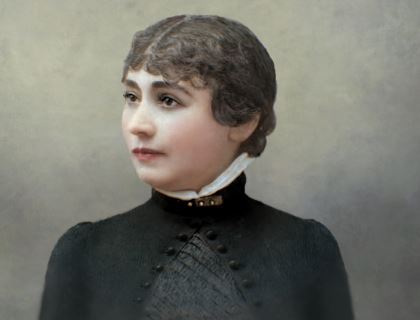
Having put the keys under her pillow, and dismissed her maid, she sat by her toilet arranging her elaborate hair; for being in spite of her grief for Mr. William Winchester and Annie Winchester, rather a buxom widow, she was somewhat particular about her person. She sat for a little while looking at her face in the glass, first on one side, then on the other, as ladies are apt to do when they would ascertain whether they have been in good looks. All of the sudden she thought she heard something move behind her. She looked hastily round, but there was nothing to be seen. Nothing but the grimly painted portraits of her poor dear man, and late newborn daughter hanging against the wall. She gave a heavy sigh to their memories, as she was accustomed to do whenever she spoke of them in company, and then went on adjusting her night-dress, and thinking of them. Her sigh was reechoed, or answered by a long-drawn breath. She looked round again, but no one was to be seen. She ascribed these sounds to the wind oozing through the windows of the mansion and proceeded leisurely to put her hair in papers, when all at once, she thought she perceived one of the eyes of the portrait move, as her eyes were fixed on its reflection in the glass. It struck a momentary chill to her heart; for she was a lone woman, and felt herself fearfully situated.

Please come and enjoy a delicious meal in Sarah’s Café, stroll along the paths of the beautiful Victorian gardens, and wonder through the miles of hallways in the World’s most mysterious mansion. For further information about tours, including group tours, weddings, school events, birthday party packages, facility rentals, and special events please visit the website: https://winchestermysteryhouse.com/

Please visit the online giftshop, and purchase a gift for friends and relatives as well as a special memento of The Winchester Mystery House. A variety of souvenirs and gifts are available to purchase. https://shopwinchestermysteryhouse.com/




 Randolph Harris II International Institute