

The disciple who wishes to make real progress must attack, weaken, and ultimately destroy certain bad traits of character. Among them is the trait of jealousy of his fellow disciples. It is not only an unpleasant thought but may also end in disastrous consequences. It often leads to wrathful moods and raging spells. It not only harms the other disciple but always does harm to the sinner himself. It is caused by an unreasonable sense of possessiveness directed towards the teacher which does not understand that love should give freedom to him, not deny it to him. The pursuit of moral excellence is immeasurably better than the pursuit of mystical sensations. Its gains are more durable, more indispensable, and more valuable. I believe that over time most people accumulate the introjected patterns by which we live. In this fantastically complex culture of today, the patterns we introject as desirable or undesirable come from a variety of sources and are often highly contradictory in their meanings. Desires for pleasures of the flesh and behaviours are mostly bad. The sources of this construct are many—parents, church, teachers. Disobedience is bad. Here parents and teachers combine with the military to emphasize this concept. To obey is good. To obey without questions is even better. Making money is the highest good. The sources of this conceived value are too numerous to mention. Learning an accumulation of scholarly facts is highly desirable. Browsing and aimless exploratory reading for fun is undesirable. The source of these last two concepts is apt to be in school, the education system. #RanolphHarris 1 of 20

Abstract art or “pop” art, or “op” art is good. Here the people we regard as sophisticated are the originators of the value. Communism is utterly bad. Here the government is a major source. To love thy neighbour is the highest good. This concept comes from the church, perhaps from the patents. Cooperation and teamwork are preferable to acting alone. Here companions are an important source. Cheating is clever and desirable. The peer group again is the origin. Coca-Colas, chewing gum, electric refrigerators, and Ultimate Driving Machines are utterly desirable. This conception comes not only from advertisements, but is reinforced by people all over the World. From Jamacia to Japan, from Copenhagen to Kowloon, the “Coca-Cola culture” has come to be regarded as the acme of desirability. This is a small and diversified sample of the myriads of conceived values which individuals often introject, and hold as their own, without ever having considered their inner organismic reactions to those patterns and objects. I believe it will be clear from the foregoing that the usual adult—I feel I am speaking for most of us—has an approach to values which has these characteristics: The majority of his values are introjected, from other individuals or groups significant to him, but are regarded by him as his own. The source of locus of evaluation on most matters lies outside himself. The criterion by which his values are set is the degree to which they will cause him to be loved or accepted. These conceived preferences are either not related at all, or not clearly related, to his own process of experiencing. #RandolphHarris 2 of 20

Often there is a wide and unrecognized discrepancy between the evidence supplied by his own experience, and these conceived values. Because these conceptions are not open to testing in experience, he must hold them in a rigid and unchanging fashion. The alternative would be a collapse of his values. Hence his values are “right”—like the law of the Medes and the Persians, which changeth not. Because they are untestable, there is no ready way of solving contradictions. If he has taken in from the community the conception that money is the summum bonum and from the church the conception that love of one’s neighbour is the highest value, he has no way of discovering which has more value for him. Hence a common aspect of modern life is living with absolutely contradictory values. We calmly discuss the possibility of dropping a hydrogen bomb on Russia, but then find tears in our eyes when we see headlines about the suffering of one small child. Because he has relinquished the locus of evaluation to others, and had lost touch with his own valuing process, he feels profoundly insecure and easily threatened in his values. If some of these conceptions we destroyed, what would take their place? This threatening possibility makes him hold his value conceptions more rigidly or more confusedly, or both. #RandolphHarris 3 of 20

I believe that this picture of the individual, with values mostly introjected, held as fixed concepts, rarely examined or tested, is the picture of most of us. By taking over the conceptions of others as our own, we lose contact with the potential wisdom of our own functioning, and lose confidence in ourselves. Since these values constructs are often sharply at variance with what is going on in our own experiencing, we have in a very basic way divorced ourselves from ourselves, and this accounts for much of modern strain and insecurity. This fundamental discrepancy between the individual’s concepts and what he is actually experiencing, between the intellectual structure of his values and the valuing process going on unrecognized within him—this is a part of the fundamental estrangement of modern man from himself. This is a major problem for the therapist. There are five ways in which the human being progressively views his own self and consequently five graduated ethical stages on his quest. First, as an ignorant materialist he lives entirely within his personality and hence for personal benefit regardless of much hurt caused to others in order to secure this benefit. Second, as an enlightened materialist he is wrapped in his own fortunes but does not seek them at the expense of others. Third, as a religionist he perceives the impermanence of the ego and, with a sense of sacrifice, he dines his self-will. Fourth, as a mystic he acknowledges the existence of a higher power, God, but finds it only within himself. Fifth, as a philosopher he recognizes the universality and the oneness of being in others and practices altruism with joy. #RandolphHarris 4 of 20

However, after all, these qualities are not only the negative prerequisites of spiritual realization. They are not realization itself. Their attainment is to free oneself from defects that hinder the attainment of higher consciousness, not to possess oneself of true consciousness. The act must illustrate the man, the deed must picture the attitude. It is thus only that thought becomes alive. The more I travel and observe the more I come to believe that the only men who will make something worthwhile of philosophy are the men who have already made something worthwhile of their personal lives. The dreamers and cranks will only fool themselves, the failures and alibi chasers will only become confirmed in their fantasies. Many people talk mysticism or play with psychism so long as either promises them wonderful powers which most other people have not got or wonderful experiences which most other people do not have. However, when they come to philosophy and find that it demands from them a renovation of their entire character, they are seized with fear and retreat. Philosophy I not for such people, for it does not conform to their wishes. It tells them what they do not like to hear. It disturbs their egoistic vanity and troubles their superficial serenity when it throws a glaring spotlight to their lower nature, their baser motives, and their ugly weaknesses. #RandolphHarris 5 of 20

While the aspirant fails to take an inventory of his weaknesses and consequently fails to build into his character the attributes needed, much of hi mediation will be either fruitless or a failure or even harmful. That it is not enough for men to think truth, that they mut also feel it, is a statement with which mot scientists, being intellect-bound, would disagree. However, artist, mystics, true philosophers, and religious devotees would accept it. People must be taught to be good and do good before they are taught to venture into the maze of the real World. And even when they emerge safely from a territory where so many lose themselves utterly, religions is useful in brining them back to ethical values albeit now of a much higher kind because it is based on utter unselfishness. For love must marry knowledge, pity must shed its warm rays upon the cold intellect. Enlightenment of others must be the price of one’s own enlightenment. These things are not easily felt by the mystic, who is often too absorbed in his own ecstasies to notice the miseries of others, or by the metaphysician, who is often too tied by his own verbosity to his hard and rigorous logic to realize that mankind is not merely an abstract noun but is made up of flesh-and-blood individuals. The philosopher however finds these benign altruistic needs to be an essential part of truth. Consequently the salvation which he seeks—from ignorance and the attendant miseries that dog its steps—is not for himself but for the whole World. #RandolphHarris 6 of 20

It does not necessarily mean that he has faults to repair or weaknesses to overcome. It may mean that there is some lack in him, some quality or capacity that he needs to cultivate. The real choice, decision, judgment, is made n the subconscious mind. Impulses come from it and character is formed in it. Despite all the repetitious assertions that there is no go, that the person is a fiction, that the goal is pure being unsullied by the self-illusion, here—in the various manifested signs of an individual character in a separate body—is evidence to the contrary. Accept fully and without demur your self-made universal consequences, even to the extent of refraining from asking to be forgiven your sins, for it is just a result. Ask instead to be shown how to overcome the weakness which had been the cause. Singly if that proves enough, combined is not, when negative or degrading or weakening suggestions enter his mind, from whatever source, he can deal with them in two ways. The first is to tense his will and by a beneficial commanding mental act master the suggestion and drive it away. The second is to turn away into its opposing idea and dwell firmly on that until the suggestion vanishes altogether. If, in spite of using these methods he is still defeated, then he can try remembering the Overself. Can he still carry out the evil suggestion while thinking of that serene divine presence? By aspiring to it for help and protection as fervently as he can, the negative idea may disintegrate like the ash of a piece of firewood. #RandolphHarris 7 of 20

A habit change or a thought change which is made under someone else’s persuasion and not out of inner need brought into the open by that other person, is only a surface one and will fade and fall away. If in some ways he learns to lessen egoism and practise humility, in other ways he gains a larger easier assurance. If he is now willing, to a certain extent, to be deflated, he feels he is standing nonchalantly and calmly on firmer ground than before. Perhaps this is all a play, not to be taken too seriously, for the real trial, the worst test, the last great agony, will come later—either through the terrible loneliness of the Dark Night of the Soul, or the painful crucifixion of the ego before Ascension, Liberation, and Fulfilment. If each attack of adverse force, each temptation that tries a weakness, is instantly met with the Shorth Path attitude, he will have an infinitely better chance of overcoming it. The secret is to remember the Overself, to turn the battle over to IT. Then, what he is unable to conquer by himself, wil be easily conquered for him by the higher power. The question is whether he is to accept he baser weaknesses as human or whether he is to struggle against them as unworthy of a human being. We must so centralize our own consciousness as to render it strong against the onslaughts of outside suggestion, immune to the promptings of crowd and the dictation of places. Thus we learn to be our own true self not only at home, where it is easy, but also in the street and in others’ homes, where it is hard. Thus we become truly individualizes. Thus we are always serene among the anxious, good amongst the wicked. #RandolphHarris 8 of 20

Like a rock so firmly embedded that it cannot be moved by human force but can only be blasted by dynamite, his moral character must be embedded in the great Truth. Some individuals are fortunate in going beyond the picture I have just given, developing further in the direction of psychological maturity. We see this happen in psychotherapy where we endeavour to provide a climate favourable to the growth of the person. We also see it happen in life, whenever life provides a therapeutic climate for the individual. When we concentrate on this further maturing of a value approached as I have seen in therapy, a few things become evident. In the first place let me say somewhat parenthetically that the therapeutic relationship is not devoid of values. Quite the contrary. When it is most effective, it seems to me, it is marked by one primary value: namely, that this person, this client, has worth. He as a person is valued in his separateness and uniqueness. It is when he senses and realizes that he is prized as a person that he can slowly begin to value the different aspects of himself. Most importantly, he can begin, with much difficulty at first, to sense and to feel what is going on within him, what he is feeling, what he is experiencing, how he is reaching. He uses his experiencing as a direct referent to which he can turn in forming accurate conceptualizations and as a guide to his behaviour. As his experiencing becomes more and more open to him, as he is able to live more freely in the process of his feelings, then significant changes begin to occur in his approach to values. It begins to assume many of the characteristics it had in infancy. #RandolphHarris 9 of 20

Perhaps I can indicate this by reviewing a few of the brief examples of introjected values which I have given, and suggesting what happens to them as the individual comes closer to what is going on within him. The individual in therapy looks back and realizes, “But I enjoyed pulling my sister hair—and that doesn’t make me a bad person.” The student failing chemistry realizes, as he gets close to his own experiencing—“I don’t value being a doctor, even though my parents do; I don’t like chemistry; I don’t like taking steps toward being a doctor; and I am not a failure for having these feelings.” The adult recognizes that desires for pleasures of the flesh and behaviour may be richly satisfying and permanently enriching in their consequences, or shallow and temporary and less than satisfying. He goes by his own experiencing, which does not always coincide with the social norms. He considers art from a new value approach. He says, “This picture moves me deeply, means a great deal to me. It also happens to be an abstraction, but that is not the basis for my valuing it.” He recognizes that this communist book or person has attitudes and goals which he shares as well as ideas and values which he does not share. He realizes that at times he experiences cooperation as meaningful and valuable to him, and that at other times he wishes to be alone and act alone. #RandolphHarris 10 of 20

As the examples will indicate, the disturbances that produce an attempt at examination may be acute or of long standing; they may result predominantly from actual difficulties inherent in a situation or they may be expressions of a chronic neurosis. Compared with the preconditions for a systematic self-analysis, those for occasional analysis are moderate. It suffices to have some psychological knowledge, and this need not be book knowledge but may be gained from ordinary experience. The only indispensable requirement is a willingness to believe that unconscious factors may be sufficiently powerful to throw the whole personality out of gear. To put it negatively, it I necessary not to be too easily satisfied with ready-at-hand explanations for a disturbance. A man, for instance, who has become inordinately upset about being cheated. A person suffering from an acute depression must be skeptical about explaining his state on the basis of World conditions. Habitual forgetting of appointments is not very well explained by saying that one is too busy to remember. It is particularly easy to brush aside those symptoms that are not obviously psychic in character, such as headaches to weather conditions, fatigue to overwork, stomach upsets to spoiled food or gastric ulcers, without even considering the possibility that psychic factors are involved. This attitude may be assumed because of sheer ignorance, but also it is a characteristic neurotic tendency in persons who cannot tolerate the idea of any unevenness or flaw in themselves. #RandolphHarris 11 of 20

At the other extreme are those who are convinced that every disturbance is psychic in origin. For such a person it is out of the question that he might be tired because of an overdose of hectic work, that he might have caught a cold because he was exposed to a too vigorous infection. He cannot tolerate the idea that any external factor can have the power to affect him. If any disturbance befalls him it is because he himself has brought it about; and if a symptom is psychic in origin it is in his own power to remove it. Needles to say, both attitudes are compulsive and the most constructive attitude is somewhere between them. We may feel genuinely concerned about World conditions, though such a concern should drive us into action and not into a depression. We may feel tired because of too much work and too little sleep. We may have headaches because of a bad eye condition or a brain tumor. Certainly no physical symptom should be attributed to psychic factors before the medical explanation is thoroughly investigated. The important point is that with full regard for the plausible explanation one should also take a good look into one’s emotional life. Even if the difficulty is a case of flu it might be helpful, after giving it the proper medical attention, to raise the question whether some unconscious psychic factors were present, operating to lower resistance to infection or to retard recovery. #RandolphHarris 12 of 20
With these general considerations are borne in mind, it will help us understand case studies. To further highlight this illustration, John, a good-natured businessman, apparently happily married for five years, suffered from diffuse inhibitions and “inferiority feelings” and in recent years had developed occasional headaches without any detectable physical basis. He had not been analyzed but he was fairly familiar with the psychoanalytic way of thinking. Later he came to me for analysis of a rather intricate character neurosis, and his experience in working alone was one of the factors that convinced him of the possible value of psychoanalytic therapy. When he started to analyze his headaches, it was without intending to do so. He, his wife, and two friends went to a musical comedy and he developed a headache during the play. This struck him as queer because he had felt well before going to the theater. At first, with some irritation, he ascribed his headache to the fact that the play was bad and the evening was a waste of time, but he soon realized that after all one does not get headaches from a bad play. Now that he thought about it, the play was not so bad after all. However, of course, it was nothing compared with the play of Shaw’s that he would have preferred. These last words stuck in his mind—he “would have preferred.” Here he felt a flash of anger and saw the connection. He had been overruled when the choice between the plays was up for discussion. It was not even much of a discussion: he felt he should be a good sport, and what did it matter anyhow. #RandolphHarris 13 of 20
Apparently it had mattered to him, however, and he had been deeply angry about being coerced. With that recognition, the headache was gone. He realized also that this was not the first headache that originated in this way. There were bridge parties, for instance, which he hated to join but was persuaded to do so. He was startled to discover this connection between repressed anger and headaches, but he gave it no further thought. A few days later, however, he work up early, again with a splitting headache. He had attended a staff meeting of his organization the night before. They had been drinking afterward, and at first he accounted for the headache by telling himself that probably he had drunk too much. With that he turned on the other side and tried to fall asleep again, but he could not. A fly buzzing around his face irritated him. At first the irritation was barely noticeable, but it grew rapidly to full-blown anger. Then he recalled a dream or a dream fragment: he had squashed two bedbugs with a piece of blotting paper. The blotting paper had many holes. As a matter of fact, he remembered that the holes were all over the paper and formed a regular pattern. This reminded him of tissue paper that he had folded as a child, for cutting out patterns. He was quite taken by their beauty. An incident emerged in which he had shown the tissue to his mother, expecting admiration, but she had paid only perfunctory attention. The blotting paper then reminded him of the staff meeting. There he had scribbled on paper because he felt bored. No, he had not merely scribbled; he had drawn small caricatures of the chairman and of his opponent. #RandolphHarris 14 of 20

The word “opponent” struck him, because he had not consciously regarded that person as an opponent. A resolution had been voted on, about which he felt vaguely uneasy. However, he saw no clear objection to it. Hence the objection he had raised was actually not to the point. It was weak and made no impression. Only now he realized that they had put something over on him, for the acceptance of the resolution meant a lot of tedious work for himself. They had been so clever that it had escaped him. At this point he suddenly laughed because he recognized the meaning of the bedbugs. The chairman and the opponent—they were bloodsuckers, as distasteful as bedbugs. Also, he was as afraid of bedbugs as he was of these exploiters. Well, he had taken revenge—at least in his dream. Again the headache vanished. One three subsequent occasions he searched for a hidden anger as soon as the headache started, found the anger and then lost his headache. After that the headaches disappeared entirely. In reviewing this experience one is struck at first by the lightness of the labour in comparison with the result attained. However, miracles occur in psychoanalysis as seldom as anywhere else. Whether a symptom can be easily removed depends on its function in the whole structure. It this case the headaches had not assumed any further role, such as preventing John from doing things he was afraid of doing or resented doing, or serving as a means of demonstrating to others that they had given offense or inflicted injury, or serving as a basis for demanding special consideration. #RandolphHarris 15 of 20

If headaches or any other symptoms have assumed important functions such as these, their cure will require long and penetrating work. One will then have to analyze all the needs they satisfy and they will probably not disappear until the work is practically finished. In John’s case they have not assumed any such functions, and probably resulted merely from tension increased by the repressed anger. The extent of John’s accomplishment is diminished also by another consideration. It was a gain, certainly, to be rid of the headaches, but it seems to me that we are inclined to overrate the significance of such gross, tangible symptoms and to underrate the importance of less tangible psychic disturbances, such as, in this case, John’s alienation from his own wishes and opinions and his inhibition toward self-assertion. In these disturbances, which later proved to be highly significant for his life and his development, nothing was changed by his work. All that happened was that he became somewhat more aware of rising angers and that his symptoms disappeared. Actually, any of the incidents that John happened to analyze could have yielded more insight than he gained from them. Thus in his analysis of the anger that emerged during the musical comedy, there were numerous questions that he failed to touch on. What was the real nature of his relationship with his wife? Was the compatibility, of which he was proud, due only to compliance on his part? Was she domineering? Or was he merely hypersensitive to anything resembling coercion? #RandolphHarris 16 of 20

Furthermore, why did he repress his anger? Was it necessary because of a compulsive need for affection? Was he apprehensive of a rebuke from his wife? Did he have to maintain an image of himself as a person who was never disturbed by “trifles”? Was he afraid of having to fight for his wishes? Finally, was he really only angry at the others for having overruled him, or was he primarily angry at himself for having given in because of sheer weakness? The analysis of the anger following the staff meeting might also have opened up further problems. When they were jeopardized, why was he not more alert to his own interests? Again, was he afraid to fight for them? Or had the anger such dimensions—squashing the bedbugs—that it was safer to repress it altogether? Also, did he lay himself open to exploitation by being too compliant? Or did he experience something as exploitation which was actually merely a legitimate expectation of his condition? Furthermore, what about his wish to impress others—the memory of expecting admiration from his mother? Was his failure to impress his colleagues an essential element in his anger? And to what extent was he angry at himself for having been so unassertive? None of these problems was touched upon. When he had discovered the effect of repressed anger at others, John let the matter rest. After a lifetime of World-wandering, after a varied experience among different faces of people and in different classes of society, we have come to the firm and settled conviction that what is most to be looked for in a man is character. The best test of character is neither intellectual hairsplitting nor emotional, wordy gush, not high-flown idealistic professions, nor flowery mystical pretensions, but deeds. #RandolphHarris 17 of 20

The Sacramento Fire Department has saved the community from so many disasters. On one occasion, there was a small fire in a closet on the fourth floor of a building. There was a lot of smoke, but there seem to be just a bunch of papers and rubbish in there. What no one knew was that it had purposely been set and that there was a lot of gasoline poured onto the closet floor and the floor of a near bathroom. Three members from the engine company were in the room, but none of them smelled the gasoline because of the smoke. The three guys started to extinguish the fire just as the heat got to the gasoline. The gasoline exploded, and the whole room went on fire. Two of the guys got to the door and were safe, but the fire expanded so rapidly, it cut the third guy off, and he ended up at the window. Unless you have had the experience, you will never believe how quickly a fire can move through a room, two rooms, three rooms. This firefighter we will call number 1, was at the window yelling, and Ladder 1 began to put it tower ladder up. That is a long boom with a platform at the end of it, with room enough for four or five fighters to stand. There were two firefighters on the platform, raising it. As it reached the third floor, firefighter number 1, now framed in the fourth-floor window, was on fire, and he could not wait the extra five seconds for the tower ladder to get him. He was forced to jump. He jumped into the bucket and hit one of the guys there, Lt. 1, breaking his leg. However, even with a broken leg, Lt. 1 was able to grab an extinguishing can and put out the flames on the burning firefighter. Fire fighter number 1 had his fire-safe coat on, but it was the clothes beneath it, his pants and his shirt, that were on fire. All this happened from a very little fire in a closet in a multi-family, low-rise, housing building. #RandolphHarris 18 of 20

When the firefighter was visited at the Burn Center, he was terribly burned on his arms and shoulders, and on the bottom part of his body around his buttocks and the backs of his legs. He was very courageous. You would have to be in such a situation. You really do muster up extraordinary strength in times of personal crisis. There is a spiritual part of firefighters, and when they get hurt seriously, they realize how fragile they are as human beings, and they rely on this spirituality to bring forth the dignity of their souls. This firefighter was in great pain, but he was also very funny. He said his wife was concerned about his being in the burn center with all these beautiful nurses. However, e reassured her. He said that a nurse who is tearing the burned layers of skin off your body, inch by painful inch, no matter how gorgeous she is, is never going to be thought of as anybody but a person who is tearing off the top layer of your skin, inch by painful inch. Sometimes people get killed. Every firefighter has to deal with the death of a brother or sister firefighter at some point in his or her life. In America, a firefighter dies in the line of duty every other day. Many have been to several funerals. It is hard to look at the surviving children of firefighters and thinking that they will live with the memory of their father giving his life in a job that cared about him. The only standing room one will find at a firefighter’s funeral is out in the street, down the block. A firefighter recalled when 11 firefighters died in the line of duty. It was a terrible scene when they were searching for the bodies. Firefighters could recall the bodies coming out, one by one. #RandolphHarris 19 of 20

As if the bodies were passing were passing in review, the hundreds of firefighters who were there took off their helmets. The floors of the building had collapsed, taking these firefighters down into the bowels of the fire. There was quiet in the immediate vicinity as their bodies came out. When it came time for the funerals, many firefighters were dismayed at how little the city had done to make those thousands of visiting firefighters welcome. The firehoses alone had taken them in, given them something to eat, and made them feel at home. Therefore, before to show your support for the Sacramento Fire Department by voting for Assembly Member Kevin McCarty. He is endorsed by the Sacramento Fire Department, and his focus is on affordable housing and getting people without homes into a home. A vote for McCarty is a way of showing support for the Sacramento Fire Department. And if you can, please make a donation to the Sacramento Fire Department and keep those who have been injured, disabled, or killed on the job in your prayers. I pledge allegiance to the flag of the United States of America, and to the republic, for which it stands, one nation, under God, indivisible, with liberty and justice for all. Though it is not incumbent upon you to complete the work, you are not free from doing all you possibly can to honour God. Judge a man by his deeds, and you will not be led to false judgment. Say little and do much, for by your deeds shall you be judged. If you are wise and rich, let your good deeds reveal your wisdom and wealth. Honour a man for what he is; but honour him more for what he does. #RandolphHarris 20 of 20


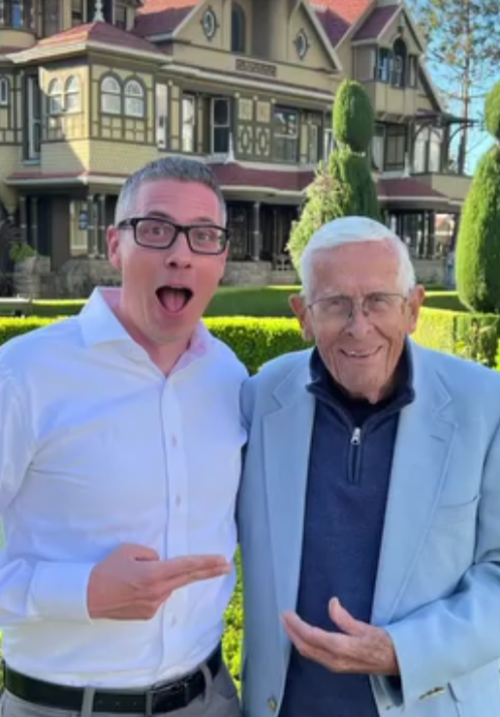
Many people have laughed at caretakers for believing in ghosts. Skeptics think the noises to be the product of their over-active imaginations. However, they also begin to hear them when they spent time in The Winchester Mystery House. One skeptic reported after hearing them, “the groans, squeaks, tingling and knockings were frightful enough.” One caretake was locking up the mansion one night, when there came a sound from one of the six kitchens as of a large lump or lumps of coal being splintered and smashed onto the floor. He and one of the other caretakers went through the entire mansion, but could find nothing to explain the sounds; no guests were in the house. Upon hearing the sound of bottles breaking beneath the stairs, when no one was in the house, they ran in fright into an office.

Then they heard the sound of a man walking slowly past them; then going down the grand staircase, then up the back stairs and up the stairs to the ceiling. Soon after this, they heard in the corner of a room, as it were the violent rocking of a cradle; as far as anyone knows, no cradle has ever been in the house. Two caretakers were sitting in one of the dining rooms, on a later occasion, when they heard the sound of loud raps coming from the outside of the door and on the ceiling overhead.

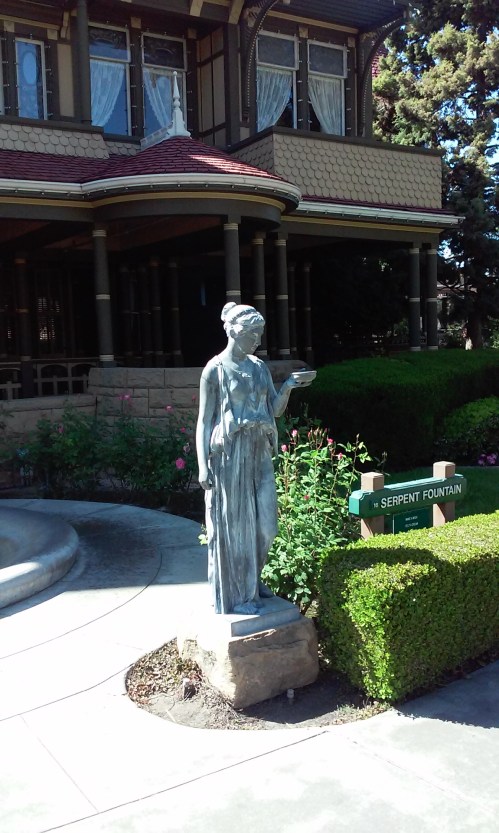
Come and enjoy a delicious meal in Sarah’s Café, stroll along the paths of the beautiful Victorian gardens, and wonder through the miles of hallways in the World’s most mysterious mansion. For further information about tours, including group tours, weddings, school events, birthday party packages, facility rentals, and special events please visit the website: https://winchestermysteryhouse.com/

Please visit the online giftshop, and purchase a gift for friends and relatives as well as a special memento of The Winchester Mystery House. A variety of souvenirs and gifts are available to purchase. https://shopwinchestermysteryhouse.com/




 Randolph Harris II International Institute