
Home » Posts tagged 'spirituality' (Page 2)
Tag Archives: spirituality

Hey, We Are a Free Country!

Love can be really great and one of the most pleasant experiences in the World. However, people ask, “If God is all knowing and knows how much love can hurt, why would He allow us to experience heartbreak?” Well, there are many answers to this question. First of all, when we sin, it hurts God because He loves us. Therefore, we have to experience pain so we can learn not to sin, not to hurt God and not to hurt others. Also, if love was easy, then people would not cherish it, it would become more like lust, just a fleeting moment of joy. Additionally, people fall in love and get married so they can procreate. Because of that, love cannot always be pleasant and it does not always last because humans would overpopulate the Earth, and destroy ever other living species, including themselves. Day by day, God’s gracious love surrounds you, as a balm to soothe your troubled heart. When you pray to God, countless cares and worries that confound you fade away or quietly depart, for His heart is kind beyond all measure, and He comforts us as He knows best. Every day, with all its pain and pleasure, mingles tears with peace and rest. The Lord is every near you, granting loving mercies for each hour, and your care He gladly bears, and cheers you with His counsel pure and holy power. Do not fear for what may come tomorrow, though the path ahead you cannot see. God assures that in all joy or sorrow, as thy days, thy strength shall be. #RandolphHarris 1 of 24

God will help you rest in quiet consolation. The Lord will help you trust His promises. When you are faced with daily tribulation, God will help you find the strength to live His word. Then when toil and troubled find you, dear Lord will hold you steadfast in His powerful hand. Day by day, God’s strength will bear you kindly until you reach the promised land. The philosopher’s easy self-assurance and dignified serenity, as noticeable calamity as in prosperity, mark him as being in some mysterious manner superior to circumstances. He will always be a gentleman, but not in the narrow, formal sense of clinging to a code of etiquette which may become faulty the moment he crosses the border into another country, or which will certainly become falsified a thousand years hence. He will be a gentleman in the broader sense of behaving always with human dignity and kindly consideration towards all others who cross his path. That alone is true culture which refines taste, improves character, lifts standards, corrects behaviour, and teaches self-control. A refined taste, delicate and subtle, delighted by the harmonies, melodies, or beauties in Nature and art, offended by the grossness in man, can express itself socially and instinctively only through refined manners. If others lack this taste but for class reasons keep up the appearance of such manner, the outer social value is still present even when the inside is empty. #RandolphHarris 2 of 24

His general attitude in discussion or study should be unbiased and unprejudiced, his observation of men and their situations impersonal and serene. He must realize that small men cannot entertain large views, that he is called upon to be big enough to put aside his personal sympathies and antipathies at certain times. He must realize too that whilst a man’s mind moves at the low level of harsh prejudice or hot passion, it cannot possibly arrive at just conclusions. Before he can arrive at the truth of a highly controversial matter, he must detach himself from partisan feeling about it. Only in such inner silence can he think clearly and correctly about it. Where his criticism is directed against others, it should be the result of calm, impersonal reflection, not of emotional chagrin. This poised spirit will help him to avoid foolish extremes and dangerous rashness. He should not adopt a violent partisan spirit towards a problem or principle for he knows that such a spirit always obscures the truth. Instead, he should always calmly view all sides in a balanced way. It is because he himself holds no rigidly partisan view that the earnest philosophic student can see better than other people what is true and what is false in every partisan view. It is not often that all the truth lies on one side and all the falsehood on the other. His ethical attitude should be more tolerant and less unfriendly than the average, as his intellectual attitude should be more inclusive and less dogmatic. #RandolphHarris 3 of 24

He should refuse to imitate the irresponsible multitudes, with their surface judgement and facile condemnation. He should seek to understand and to respect the views of others; he should take the trouble to put himself in their place, to give an imaginative sympathy to their standpoint. He need not fall into the error of necessarily sharing them and may still stand on the intellectual foothold which he has secured. Although this attitude will more and more show itself in personal and social situations and in practical and general affairs as a matter of course according to his growth, it will also show itself in his spiritual life. The unprejudiced study and unbiased comparison of various systems of religions, metaphysics, mysticism, and ethics will be for him valuable parts of philosophic culture. He should be both willing and desirous to understand all of the chief points of view, all the leading variants of doctrine in these systems, but at the same time he will know his own mind and views. Even while he is seeking to know the minds and views of others, he should estimate how limited, how distorted, how falsified, or how large an aspect of truth each represents. He can do this with the help of the philosophic conception of truth, which lights up all these others, because it stands at the peak toward which they have climbed only a part of the way. #RandolphHarris 4 of 24

Tolerance and mutual accommodation are the ways of true spirituality. There is room in life for the other man’s opinion also. If he wishes, let him keep it so long as he refrains from forcing it upon us and so long as he himself does not preach or practise intolerance. His own experience of the ups and downs of life have combined to bring him to that belief; why should he not have it then? We may dislike it intensely but we must admit that from his standpoint he is right enough. When his experience broadens out and he sees life in larger perspective, be sure that he will change his opinion too. When his circumstances alter or his environment changes, he may learn how limited was his former view. When the long-drawn lesson of suffering or a thought-provoking book or powerful personality swings the balance of his mind in a new direction, he will desert his opinion or modify it. Meanwhile, let us set the World an example—and be tolerant. Those who give enough thought to behaving politely do so from different motives, some of which may be merely hypocritical, others the slavish following of blind custom, still others simple obedience to selfish interest; but there still remains the remnant who do so sincerely, honestly, because generous enough to consider the feelings of those persons they meet. The good manners prescribed for civilized living may have varied from century to century, or from continent to continent, but whatever their form, they represent that man in society must have some consideration for society, and not be utterly and selfishly indifferent to the effect of his conduct upon others. #RandolphHarris 5 of 24

If the he lacks self-respect, there is also the further point that he needs to be taught it to keep civilization from falling back to barbarism; so personal dignity and appearance, cleanliness and inoffensive speech are involved. At some point and place, whether in the home or at school or in society itself, the young have to learn, and to be trained, in acceptable manners. And this, not chiefly to improve their quality, which it does, nor decorate their behaviour, which it will, or even refine their speech, which it must, but because it lifts them up from being terrestrial to human being and thus contributes toward their spiritualization. It is really pretentious to give importance to politeness in behaviour in an age when the decay of manners is plainly visible? To those old enough to have seen better, the difference points up moral value of consideration for others in human society. During segregation in the United States of America, not only was it illegal for African Americans to marry European Americans, but African Americans also could not buy vanilla ice cream, which is why butter pecan is so popular. It is no man’s fault that he lacks breeding, but it is his own fault if he lacks the courtesy which comes from breeding or else is self-acquired. To become a fuller human being a man must acquire education and culture. Both he and his life will be enriched. However, unless he keeps humility, his egoism may grow too. #RandolphHarris 6 of 24

We may affirm the factuality of caste in nature without turning ourselves into snobs who adopt condescending airs and utter patronizing remarks to those they consider socially below them. We have to recognize the fact of caste in the development of the human species through successions of repeated Earthly embodiments. That which comes through inherited or acquired wealth is not necessarily the same, may be a mere shallow copy, an empty vessel. When caste comes with arrogance, and especially with cruel arrogance, be sure it is not a carry-over from past births. The same situation holds with refinement of nature, conduct, taste, manner, and speech. When it is real, inward, the quality shines through; but when it is artificial, contrived, outward, it comes with snobbishness, especially a proud snobbishness. The way we—that is, you and I—arrive at a state of being is through something I call effortless effort. It is not striving or doing or working at anything. It is the kind of non-effort John Hancock and his friends came in touch with when they stood up and said, “Hey, we are a free country.” It is the kind of non-effort that an expert swimmer comes in touch with when he relaxes and lets gravity and the skis carry him smoothly down the mountain. And it is the kind of non-effort that some men come in touch with by lying with their head in their mistresses’ lap and letting her stroke his hair. In those moments, these men are simply being men. He is not doing anything but being there. #RandolphHarris 7 of 24

Also, this mode of being does not diminish or preclude external achievement, success, or productivity. It enhances them. A superb example of a state of being where effort becomes effortless and the effortlessness becomes perfection is found in Tolstoy’s Anna Karenina. Levin, a character closely resembling Tolstoy himself, is working with the less affluent, mowing grass in the fields. He “clicks” into a state of enhanced being: “He thought of nothing, wished for nothing, but not to be left behind the peasants, and to do his work as scythes, and saw before him Tit’s upright figure, mowing away, the crescent-shaped curve of the cut grass, the grass and flower heads slowly and rhythmically falling before the blade of his scythe, and ahead of him the end of the row, where would come the rest. Another row, and yet another row, followed—long rows and short rows, with good grass and with poor grass. Levin lost all sense of time, and could not have told whether it was late or early now. A change began to come over his work, which gave him immense satisfaction. In the midst of his toil there were moments during which he forgot what he was doing, and it came all easy to him, and at those same moments his row was almost as smooth and well-cut as Tit’s. But so soon as he recollected what he was doing, and began trying to do better he was at once conscious of all the difficulty of his task, and the row was badly mown.” #RandolphHarris 8 of 24

Alan Watts, in The Wisdom of Insecurity, puts the concept of nonstriving in another context: “I have already been fascinated by the law of reversed effort. Sometimes I call it the ‘backwards law.’ When you try to stay on the surface of the water, you sink; but when you try to sink, you float. When you hold your breath, you lose it—which immediately calls to mind an ancient and most neglected saying, ‘Whosoever would save his soul shall lose it.’ Insecurity is the result of trying to be secure, and, contrariwise, salvation and sanity consist in the most radical recognition that we have no way of saving ourselves.” Those who justify themselves do not convince, that to know truth one must get rid of knowledge, and that nothing is more powerful and creative then emptiness—from which men shrink. What Watts is saying—and what Tolstoy says in his story—is that the more we try in some situations, the more we seem to fail; there are some goals which can never be achieved by active striving. We find this particularly true in psychotherapy when the more one tries to be a certain way, the more one fails. This brings up another truth for men and for the rest of society. Simply stated, it is: Whenever you win, you lose; whenever you lose, you win. Most men’s insistence on winning every round makes them a loser in a larger sense. Without the experience of an occasional loss, men cannot experience the lessons losses carry with them. They cannot experience the power that comes from losing. #RandolphHarris 9 of 24

When men eventually do experience losing, first with their wives, then later in the therapy room, they discover how valuable losing can be. In losing, men become winners. As we have seen, in a losing situation, the top-dog is virtually useless. That is because the top-dog is the doer—a self which cannot be much help when nothing can be done. However, the subordinate self, which some men recently begin to express, is basically a “do nothing” self. Men find, in the role-switching exercise, that this “do nothing” self can have value, something which many had denied nearly all of their lives. Men begin to feel “together” only when they see the value in both sides of their nature and make the first steps toward expressing both. Like men, many people exaggerate their criticalness. They stand in judgment of others and early in every relationship set about establishing themselves as right, as better, as more knowledgeable than the other. They tend to surround themselves with people who, for their own reasons, are willing to play that game. Their reward is, of course, the position of being on top. However, it is a reward which comes at the price of unrelenting manipulation and effort. When people participate in cushion-ponding exercises during therapy, the truth is they are not doing anything; they are just giving wings to their fantasy. They are not killing their boss; they are killing the image of his boss. (Which is why property destruction is considered a violent crime.) In that way, these people are simply feeling or being angry, frustrated, helpless, righteous and defeated. #RandolphHarris 10 of 24

However, by the means of the fantasy, the effortless effort, people are able to vent their hostility and experience the love, surrender, release, and the peacefulness that follows. This coming together and synthesizing of strong, conflicting values is an experience of mastery. In the moment of intense feeling, a lot of men come into touch with their core, which criticalness and support, weakness synthesize in the fully integrated, masterful human being. The smiling, exhausted man sitting on the floor at the end of the session is not the same man, the surgeon, or the man, the administrator. It is simply a man, the all of himself. It is achievement without doing: effortless effort. Is criticalness important to you in your relationships? Later that same year, the man in our case study broke up with his mistress in the hope of creating the same type of relationship wife. While their marriage is not as rigid as it was before, it is not yet the kind of relationship he was looking for. The important item to note is that, while this man is still looking, he is looking at home, not elsewhere. This is more difficult but is also more consistent with the man’s Catholic up brining and has less potential for triggering guilt. With this decision, he is also enabling himself to seek the right kind of relationship with his wife while staying close to his children, who mean a great deal to him. Thus, while it appears this man has chosen a more restrictive courage of action, this course actually gives him more freedom: he would not have been free to stay close to his children had he left his wife. #RandolphHarris 11 of 24

You may have noted that the man in our case study did not get to his core experience by way of a direct experience with support, which is the opposite of criticalness. This is not a mistake; it is just the way things work. Our human psyche does not always perform according to the charts. It performs the way it wants. Often, as in this case, a person will jump to a more comfortable value first. This man was more comfortable with anger than with support, and since he was able to express the anger, he got to his core through it. Later, this man made some changes in his professional life as well. After he got over this anger at his boss, he looked at the situation more calmly and realised his boss’s decision had nothing to do with him personally. He was just upset that his boss shutdown his clinic and took away all of his authority as he was close to retirement. However, they settled their differences and became as close to being friends as the man in our case study has ever been able to manage. In reconciling with his boss, this man did not change his point of view. He merely was able to appreciate the differences between them, rather than adjudge the man wrong, as he would have in the past. When his unit was disbanded, the man in our case study moved to a small, innovative hospital in another town. Now he concentrates on being a better surgeon rather than fighting to become an administrator. For the first time in his life, he is actually enjoying his work. He is still in therapy. The pleasure caste is a strange and powerful caste of humans whose psychology and neurology has been ignored by philosophers because of the taboo nature of the subject—pleasure, beauty, sensuality, and eroticism. #RandolphHarris 12 of 24

History reveals that each gene pool and every successful civilization has produced an aesthetic-elite caste—those whose nervous systems are especially sensitive to sensual stimulation; those who have the ability to receive, manage and transmit neurosomatic, hedonic signals; those who are robot-programmed to stimulate pleasure in themselves and in others—either singularly or in cooperation with other reality-artists. Aesthetic-Artist-Sensory Castes: Hedonic Consumers—those who receive pleasure. Hedonic Directors—those who create pleasure realities for themselves and others. Hedonic Producers—those who exchange pleasure. The pleasure industry includes those called artists—show business people, entertainers, and courtesans. Hive philosophers and establishment reality-definers tend to discredit the Pleasure-Aesthetic Castes and the contributions they make to the species. There is little overt, bureaucratic pressure on young people to take up a life of courtesan-actress-musician-artist when they “grow up.” Indeed, the classic situation calls for discouragement by the gene pool of such aspirations on the part of the young. However, at the same time that the hedonic occupations are publicly taboo, there is a covert acceptance of them as evidenced by the pervasive presence of the show-biz-pleasure profession. Nightclubs, saloons, theatres, carnivals, brothels, dance halls—however fake, tinsel, laundered the actual performance—the allure, the promise is always the same. Somatic reward, inhuman soft-skin-bliss, hop sophistication, erotic movement, hedonic consumption of self-indulgence and self-actualization. #RandolphHarris 13 of 24

The script apparatus of a loser consists on one hand of injunctions, provocations, and a curse. These are the script controls, and are firmly implanted by the age of six. To combat this programing, he has an inner demon, and is sometimes supplied with an internal release. Later he comes to understand slogans, which give him a counterscript. Throughout, he is learning behaviour patterns, which serve both the script and the counterscript. A winner has the same apparatus, but the programing is more adaptive, and he usually has more autonomy because he has more permissions. However, in all human beings the demon persists, to bring sudden pleasure or grief. It should be noted that the script controls are parameters or strictures, which merely set limits on what a man can do, while the behaviour patterns he learns from his parents, including their games, tell him how he can actually structure his time. Thus, the script is a complete plan for living, offering both strictures and structures. Healthier personalities have been more successful than average people in gratifying their needs. Consequently, their unconscious is not a dreaded source of evil, but a fount of innovation, self-integration, and creativity. Creative individuals show less fear of the free play of fantasy, and so they can “unrepress” to a greater degree than the average. In freeing their unconscious from its customary bonds, they experience the welcome admission to consciousness of new ideas, solutions to problems, insights into themselves, and other valued creations. #RandolphHarris 14 of 24

Sexuality or unacceptable drives such as aggression are not the only aspects of personality that are typically repressed. Mowrer has shown that if the conscience were not repressed, individuals repress their consciences, and hence are unconscious of the guilt that would arise. If someone has acquired a conscience that could guide that person in the direction of fullest growth and personal integration, then its repression could thwart his or her healthiest potentials. The individual said to have a “hardened heart,” like Scrooge in Dickens’ classic Christmas Carol, is one who has likely repressed his or her conscience and the guilt to which it might give rise. The unrepression of conscience in such individuals will produce acute guilt. The guilt, if acknowledged, could motivate the person to change his or her usual ways of behaviour from self-centered pursuit of satisfaction to more loving concern for others. Thus guilt, often thought of by many theoreticians as unhealthy, can be useful as an indicator to the person that he or she must take action to correct something that is the person’s own responsibility. It is a signal that some behaviour of yours has wronged someone. Some have seen psychotherapy as assuaging guilt for one’s harm to others. Mowrer and others have insisted that this is a misuse of psychological help and is doomed to failure. They strongly suggest an old remedy—right the wrong that has been done. #RandolphHarris 15 of 24

One of the ways of dealing with wishes and feelings that provoke anxiety or guilt is to substitute another activity, particularly one that is socially desirable. This is called sublimation and is an ancient and honourable approach for the individual with specific religious or cultural taboos that he or she choses to honour. Thus, someone with a great deal of sexual energy but strong feelings of moral commitment to abstinence might throw himself or herself into community leadership, into programs of social justice, or into creative arts such as painting or sculpture. Particularly as a result of greater freedom in activities involving pleasures of the flesh, many have rejected the concept of sublimation as indicative of the person’s avoidance of the problem. However, there is as much evidence for the position that it is a healthy adjustment mechanism as for any other. While Dr. Freud showed how people repressed undesirable dimensions of their experience, Dr. Jung called attention to the fact that we remain unconscious of our “higher,” more fully humanized possibilities. The unconscious is not only a repository of our psychological “sewage”; it is also the source of our most sublime possibilities. Just as dreams reveal morally repugnant wishes for the tabooed sexuality or murder, so they can reveal, albeit in metaphoric language, possible ways for a person to rise above barriers to growth. In dreams, many persons discover the solutions to vexing personal problems. #RandolphHarris 16 of 24

Our usual waking consciousness is limited by our chronic preoccupation with daily needs and projects. Other possible ways to experience ourselves and the World remain unconscious, or potentially conscious, and may be revealed to us in our dreams. A man I once knew became a criminal and broke out of prison and had to spend the rest of his life on the run. He knew that the police and the FBI would be looking for him to dress up or hide behind a beard. The strategy was to take it off. Take off his hair. Bald. He sat stripped to the waist in a kitchen chair while someone trimmed the back and sides to an American Legion butch. She looked sadly at the scissors in her hand, brushing her long tresses away from her eyes. “I just hate to do this,” she said. She snipped the top of his hair close to the scalp. It was a slow process. She was a giggling artist. Standing back studying her work. “Not bad. Now let’s shave it clean,” she said. She draped a hot rag on his skull and squirted lather foam. Carefully, she started to shave. “Take it easy,” he said, “bloody gashes will betray.” Easy gentle little strokes. After a while the barber begins to laugh. The man walked to the bathroom and peered in the mirror at a high-domed, chicken-plucked moose-faced baldpate stranger. When his friend returned for the day, they gaped at the change. For the first time he felt a flicker of feasibility. When the man came out of the bathroom, he was smiling. “Well, let’s go. I’ve waited for seven months to see that Queen of the Damned movie.” #RandolphHarris 17 of 24

“It will be a good test for your disguise,” his accomplice said. The first public appearance. They walked past theater guards, bought two tickets, two bags of hot buttered popcorn, ice-cream bars and walked down the welcome darkness to hear P.Diddy and Ginuwine singing “I Need a Girl (Part Two)”! They found seats near the front and opened their eyes to the bright silver screen and one of his guy friends kept shouting: “There’s Aaliyah! “There’s Vincent Perez!” And he kept shushing him. They were really quite public, their commando group behind them exchanging loud comments and cries of pleasure. It must have looked for a bald-headed man, a virgin secretary, and three young Hollywood actors. They jumped at the death of Queen Akasha and sorrowed at the long sad ending. Aaliyah died a few months before in real life. As they crossed the street after the show, they saw a narc waiting on the corner. He glanced at them as they walked by. Back in the car one of the men said, “Now for some plastic goodies at a drive-in. He ordered enormous plies of In-and-Out cheeseburgers, malteds, and French fires. After seven month the man who broke out of prison was ready to freak out, too. As they drove back to the farm, one of the guys kept his head turned half to talking to everyone and half to watch the cares behind them. #RandolphHarris 18 of 24

Saturday morning was cloudy. A tribal council meeting around the kitchen table. The baldhead disguise and the trial run the night before gave him courage. It was still the riskiest plan, but now he could see that it could be done. “What ID do I need to get a passport,” he said. Two of the other guys began spilling jigsaw pieces of identities over the table. “Here’s your prison escape ID. That would have been ideal except that he’s already got a passport and he’s heavily bearded. Here’s another set. A beautiful one with driver’s license and all. But the picture blows it. I don’t see any way to avoid your getting a driver’s license with your own picture on it. That means we’ll have to wait till Monday. Then fly to Detroit Monday night. Get a passport Tuesday morning. Hit it for Madrid Tuesday night. If we’re going to do that here’s the best ID.” The man pushed a set of cards across the table. “Birth Certificate.” With a name on it and a birthday. A Social Security card. Temporary driver’s license with no description. “The birth certificate gets you the driver’s license. And the two get you a passport.” The Weathermen were ready for a day of contemplation. Although Democratic leaders ignore the laws and aid and abet criminals, there comes a time when a new leadership will come into office and have zero tolerance laws. You do not want to live a life of crime and have to find a disguise, nor do you want to put your life in someone else’s hands. There is always a chance that you will be captured. And if one of your buddies gets in trouble, they might give you up for immunity. “Make it your ambition to lead a quiet life: You should mind your own business and work with your hands, just as we told you,” reports 1 Thessalonians 4.11. #RandolphHarris 19 of 24

For people who live an honest life, at least, boundaries disappear and desire can be allowed free rein. The Sacramento Fire Department is the premier, all-risk public safety and emergency service provider that exceeds the expectations of the diverse communities they serve. The Sacramento fire department preserves life, protects property, and safeguards their communities through relentless commitment to emergency preparedness, prevention, response, and recovery. “There were no windows in the building. This was at three in the morning on December 31 in an industrial section of Sacramento. A pretty cold night. We weren’t on the box. Battalion X had the fire. The battalion chief, Y, made a triple two on it, a second alarm, and we go on all triple twos. The building wasn’t venting well, the smoke was really stratified and down on the ground. When we came up there, we couldn’t even see the building, the smoke was so heavy. Truck X was up on the roof, ventilating it. I talked to Chief Y, and I recognized the type of construction. My first concern was about the men on the roof. It was an open bar joint, metal deck roof. The first thing I did was get them off there, because I didn’t think it was worth risking them. The fire was fairly serious in the stock and office areas. We had two companies in on the lines. Seeing the situation we had and the need for more manpower, we called for a third alarm and had the companies report to a staging area. Due to the reduction in battalions, on the third alarm we didn’t get a chief, which made safety a problem, as far as I was concerned. #RandolphHarris 20 of 24

“I made a call for another battalion chief, so we could split the fire up. My normal procedure—and I’m very adamant about this—is to sector the fire because, I don’t care who you are, I don’t think you can run the whole fire by yourself. At that time we got a call on the walkie-talkie from a firefighter, who said he was lost in the building. We organized the search team, and the fire itself became of secondary importance. The smoke was really heavy even though we had a good ventilation hole in the roof. It was tough to open up the sides of the building, and we had companies working on that. There were railroad tracks and an embankment that made it very difficult to get to the back of the building. It took us approximately seven minutes to find this firefighter, a five-year veteran on Engine X named A. He had been to quite a few fires on a very busy engine company, so I don’t know what caused him to do what he did. He was the nozzle man on the line, and there were two others on the line with him. One of the men went back to get a hook, and the second man exhausted his air tank and he ran out to change his tank, leaving A alone for the moment. He was only about twenty-five feet into the building, and for some reason he left the line. There was a backup line laid out, but nobody was aware that this firefighter had left the line. We tried to give him instructions on the walkie-talkie, but we couldn’t get any response back from him. #RandolphHarris 21 of 24

“The building was approximately 150 by 200 feet with about twenty aisles and racks blocking overhead doors in the back of the building. We finally found him when we saw the light of his flashlight. He had gotten into a dead end aisle. It was really difficult to find him, and naturally it seemed like an eternity. We brought him out, gave him CPR and oxygen, and transported him to the hospital, where they worked on him for over an hour. He never came back. The fire had been pretty well knocked, but the building was loaded with smoke. There was a lot of electrical insulation that had burned. And he ran out of air. There’s about twenty minutes of air in a tank. He ran out. I was very depressed after that fire, from having lost a firefighter and talking to his wife. She was distraught, naturally. Since I was in charge of the fire, I thought it was my job to talk to the woman. So early in the morning, after a couple of news conferences, I went out to her house with a couple of other firefighters from his company, and we consoled her as best we could. She was completely broken up. It was hard for her to grasp the permanence of her loss. I never blamed myself personally for the death, but it makes you want to reexamine and look deeper and see what can be done to prevent a recurrence. In that type of fire, there are some things you can control and some thing that you can’t control. The possibility of a firefighter getting seriously injured or killed is always a clear and present danger. #RandolphHarris 22 of 24

“We tend to become complacent when we go for a long period of time without casualties, and we like to think it’s because we’ve run the fires well and then men are knowledgeable and well trained. Actually, there’s a certain amount of luck involved, if you look back and think of the many close calls where a few second made the difference. I remember one fire where we had a very good, experienced lieutenant in charge of our company. We were fairly new guys on the job and didn’t realize the seriousness of some of our actions. We were probably 150 feet into a hundred-year-old mercantile building, and the lieutenant said, ‘Back out of here, we have to get out of here.’ There was the lieutenant, myself, and two other guys. As soon as we got out the door, the while first floor went into the basement. You wonder how that man knew that. He knew that the situation was bad, he had that sense. I always remembered that. It made me want to become more proficient, to learn more from experience and studying. It caused me to do a lot of studying. I was pretty depressed for a week or so. The wake and the funeral were fresh in my mind, and I went over and over and over that fire to determine what I could have done differently to prevent it. My wife and family were completely understanding and supportive.” The Sacramento Fire Department prioritizes their citizens, residents, and communities. #RandolphHarris 23 of 24

The Sacramento Fire Department is a full-spectrum life safety agency protecting more than 2 million people who live, work and play in one of America’s largest cities. The Sacramento Fire Department recognizes that they face unique challenges in keeping pace with the changing World in which they live and work. They will not forget the traditions of those that came before them. However, they have adapted and progressed so that they can remain successful. “We are a family of individuals committed to serving others. We will always provide for the welfare of our personnel through a health and rewarding work environment. We are dedicated to respect, integrity, compassion, and leadership amongst ourselves so that we may proudly serve others. The Sacramento Fire Department strives to sustain and improve the health, safety, convenience, and welfare of the citizens of Sacramento and to plan for the future development of the community. You can help save lives and property by donating to the Sacramento Fire Department. And remember parents, please raise your children to love America, to be patriotic, to love God and Jesus, respect law and others, treat others with dignity and respect, and remind them of the importance of education. To help America survive the global recession and bring manufacturing jobs back to America and to get American wages at pace with inflation, it is important to buy America cars, American meat, American produce and other American made goods and services. I pledge allegiance to the flag of the United States of America, and to the Republic, for which it stands, one nation, under God, indivisible with Liberty and Justice for all. Our Father, our King, be gracious unto us and answer us, for we are wanting in good deeds; deal with us in charity and lovingkindness, and please save us. #RandolphHarris 24 of 24

Ventris Place
North Laguna Creek, CA | Mid 500’s
Now Selling!

Located in Laguna Park adjacent to the South Sacramento 22-acre North Laguna Creek Park and a quick walk from the 119-acre designated Wildlife Area and Interpretive Trail, this intimate enclave of 37 homesites with available one- and two-story floorplans is the place to be in Sacramento.

Imagine waking up every day to the comfort of a life-made-easy home plan, private side yards, and inspired living spaces carefully designed to make life at home a pleasure.

Just a few steps from your door, enjoy all the amazing features of North Laguna Creek Park including paved paths, tennis courts, a basketball court, playgrounds, picnic areas, ball fields and a wildlife area.

Walk or ride to an abundance of Sacramento area parks, attractions, shopping, dining, and destinations just minutes from your home.

Or enjoy an impromptu outing to Old Sacramento, downtown, or the historic riverfront district. Ventris Place is located in the Elk Grove school district.

Homes at Ventris Place offer 3-4 bedroom and 2-3 bath plans ranging from 1196 to 1846 square feet and include rear-entry 2-car garages. Choose from a single-story plan or several two-story plans. https://nextgenerationcapital.us/new-homes-elk-grove-ventris-place/

Your Home for Generations


Lord, Don’t Let Me Die Like this

There is the blindly instinctive and passioned terrestrial will in man, which violently drives him to seek and be satisfied with bodily satisfactions. There is also a higher will which gently draws him to transcend the body altogether. If the only enjoyment a man knows is that of physical sensations, he is only a dressed-up, walking, and thinking animal. The law of chastity requires that sexual relations be reserved for marriage between a man and a woman. In addition to reserving sexual intimacy for marriage, we obey the law of chastity by controlling our thoughts, words, and actions. Jesus Christ taught, “Ye have heard that it was said by them of old time, Thou shalt not commit adultery: but I say unto you, That whosoever looketh on a woman to lust after her hath committed adultery with her already in his heart,” reports Matthew 5.27-28. It is an essential part of the Quest’s work to separate the man from his passions, to subjugate the animal in him so as better to cultivate the godlike in him. Both desires and fears bind a man to his ego and thus bar the way to spiritual fulfilment. They could not exist except in relation to a second thing. However, when he turns his mind away from all things and directs it towards its own still center, it is the beginning of the end for all desires and all fears. The end of all this long self-training to cast out personal grief and terrestrial passion is blessedness. #RandolphHarris 1 of 18

The heart must become empty of all desires. This brings about the emotional void, which corresponds, in its own place, to the mental void experienced in the depth of mystical meditation. To this emptiness he must give himself, with it he must satisfy himself. In this way he obeys Jesus and becomes “poor in Spirit.” Poor in Spirit refers to a spiritual state of humility and dependence on God. It is a recognition of one’s need for God and a growing dependence on Him. It is also a sense of spiritual bankruptcy, powerlessness, and unworthiness before God. What is it worth to a man to be free from the passions, and free from the inner divisive conflicts which their activity must necessarily produce in him? Are they not the chief obstacles which prevent him from attaining that inner calm wherein alone the ego can be faced, caught, and conquered? And this done, what is there to keep the Overself from taking possession of him? Few men are moved by a single motive. For most men the contrary is the fact. This is because first, the ego itself is a complex and second, the higher and lower natures are in conflict. Discrimination is needed to penetrate the thin surface of so many pleasures, while the strength is needed to say “No” when this is wiser than accepting them. #RandolphHarris 2 of 18

It is not only needful to understand the characteristics of one’s desires but also their source. This knowledge will help him to improve character and attain true self-reliance. It is a strange paradox that on whatever desire a man wields the axe of non-attachment, he will thereafter become possessed of the power to attain it. There is this great paradox on the Quest: that the more the disciple obtains the power to bring about the fruition of his desires, the more he loses those desires! If we lack the willpower to overcome bad habits that have become popular and conventional, at least let us try not to justify our indulgence by specious reasons. The blind impulses must be checked by willpower, the lower nature must be disciplined and the lower energies directed into higher channels. It is perfectly possible, where fate ordains, to live continently and chastely, however strongly sexed a man may be. However, to achieve this, he must utilize the analytic reason, the creative imagination, and the active will in understanding and disciplining his energies and then he must redirect them towards aspirational, intellectual, or moral ideas or transmute them into practical work. He who begins by refusing to be a slave to the palate’s perverted appetite will find it easier to go on to refusing to be a slave to lust. A triumph over the one prepares the way for, and helps in the achievement of, a triumph over the other. #RandolphHarris 3 of 18

It is true that we all share a terrestrial body with the lower creatures. However, that does not force us to stay on their level emotionally. Every desire conquered feeds his strength and fortifies his will. The man who has made his way to the top of his profession but failed to make the conquest of his passions, is still an unbalanced creature, an unsatisfied human being. The extremes of abstention which follow repugnance, indifference, or self-struggle and the satiety which follows helpless yielding are both undesirable. The necessities of Nature hold us in their thrall but there is first, a difference between them and the desires of the ego and second, a difference between the true necessities which are inescapable from physical existence and the false ones which have been imposed on us by age-old habits, traditions, environments, and outer suggestions. That desire is a true one whose source lies in a genuine need, not in mere greed. Repentance redeems man, lifts him above the lustful dog to the loving human being, distinguishes him from the mere animal. We are cast out of Heaven by our own passion and kept out by our own attachments. If today we are miserable exiles, the way to remedy such a situation is clear. We must free ourselves from the one and disentangle ourselves from the other. He should desire that which will itself cut off all desires. #RandolphHarris 4 of 18

“Experiencing” is defined as an inner stream of feelings to which you can every moment attend inwardly. It is simple, effortless and available to us all. Yet it is maddeningly elusive. Try these experiences: Feel your body from the inside. Is there tension in your muscles? Is your stomach wound tight like a watch spring? Take a deep breath and feel what happens to that tension. Sit a while without moving. Does some prickliness begin to form just under the skin? Recall the full feeling you once had after overeating. Recall the heaviness, the discomfort, the difficulty in breathing. What does being bored really feel like? That strained, impatient deadness almost hurts, does it not? Something deep down screams soundlessly at you to get out of the boring situation. Can you recall feeling that? These are but three examples of experiences. They do not involve learning or doing. You can have them instantaneously. And there are thousands more available to you—each distinct from all the others. To have an experience, to really “get into” a feeling, involves a release or surrender. Behind the surrender is a basic willingness to trust, to accept that the inner core “knows what is best” for you. Thus experiencing holds the solution to all your internal mysteries, the truth of your existence. If experiencing is so wonderful and useful, why is it so elusive? Who do we shun the prospect of getting to our inner core and discovering our true being? Probably because we are afraid. We anticipate the truth will be too painful, that when we look inside at what really is, we will not like what we see. #RandolphHarris 5 of 18

Ironically, by trying to avoid the pain of looking within, we virtually guarantee the continued pain of our incomplete, manipulative behaviour. True, some will shed some tears on the way into their core, but compared to the tears of helplessness one has already shed, they are a few random raindrops in a storm. And who knows how many future tears he has avoided by reaching down and finding his inner source of power—a source which he can use to untangle the painful web of helplessness his life has become. People who benefit most from therapy are those who are “experience-oriented,” who subjectively follow their feelings even though they have not explicitly thought them all out. Being willing to let your experience talk to you is the first significant step from manipulation to mastery. There are some common ways people approach a problem. One way is to belittle the problem. This is when one says, “It really is nothing…I should not let a few pains bother me.” Such an approach will get you nowhere. If pains are important enough for your body to feel, they are important enough to look into, get inside of, and get clear. You do not make a problem go away by belittling it. In fact, by pushing it aside, you probably make it worse. Often times people analyze their problems. We might assume someone has something to do with our problem. However, the analysis may or may not be correct, and it does nothing to change the feeling. #RandolphHarris 6 of 18

You can analyze furiously the whole time you are having the feeling, but if it is there in your guy, with its inexplicable discomforts and tensions, your analysis will not ease or make it disappear. A lot of people also face down the feeling. Some say to themselves, “I will have to grit my teeth, stand up to it, walk through it,” which sounds courageous and noble, but is actually false bravado. This approach does not work because when you do it, you do not touch the place where change takes place: in your body. You are just mouthing a courage which can only be found deep inside, at your core. Another method is lecturing yourself. The script often goes like this, “If I could just grow up and be adult about this, I am sure everything would be all right.” This does not work either. The lecture is based on the mistaken notion that adults do not have feelings, or if they do, they do not have the right to the feelings. When you lecture yourself, all you do is pile guilt on top of whatever the problem is. And the guilt just makes it worse. Drowning the feeling is another method. When you try to tune the problem out because it makes you feel worse, you sink into the discomfort, hoping you will find it less painful, but knowing deep down that you will not. Whenever you sink into this unchanged feeling, it makes you feel as bad as the last time. You are no further ahead. #RandolphHarris 7 of 18

Since these five approaches are not physical, they cannot work. The feeling is physical and can only be changed by a physical process, such as focusing. When a man finally focuses, a very real change happens in him, something which he can build on. Even though it appears that some people play the victim in life, that circumstances seem to be manipulating him, they are still manipulators. Some people may stay married to a homosexual husband, playing upon one’s own helplessness and their husband’s sense of guilt to take care of her, even though they both resented it. The unspoken (and sometimes even spoken) message is, “I am too weak and helpless to take care of myself and the boys, so you have to.” This manipulation is rewarded by his grudging support, but it has its price: It traps her in an unhappy marriage, it prevents her from going out and learning to make it on her own, it reinforces her own feeling of helplessness. How can you deal with this type of manipulator in your everyday life? Well, for starters, you will have to fight the temptation to take the easy way out. You will have to refuse to do things for the weakling and instead, encourage him or her to be strong and self-directed. I once had a friend whose wife was afraid to go to the store and buy a newspaper. She said she did not like the way the clerks leered at her. #RandolphHarris 8 of 18

So my friend would stop in his way home from work and buy the newspaper himself. It was easier than arguing with his wife about it. Finally, he said, “I do not read the evening newspaper, I watch the news on TV. If you want the paper, buy it yourself.” She refused, but she still wanted the newspaper. So my friend began by accompanying her to the store the first few times until she felt more comfortable about it. In time, she went to get the paper without a second thought. My friend used this same technique when it came to his wife’s getting a driver’s license. At first, he refused to drive her places, even though he had been chauffeuring her for years. When she grew tired of taking buses and cabs, he offered to teach her how to drive, and she eventually accepted the offer. Now she had her own car and capably goes wherever she wants. In refusing to be manipulated, my friend made his wife angry and perhaps caused her some pain. However, in the end, he helped her gain strength—and helped free her from a continuing life-script of manipulation. The criminal who acts according to nature cannot, without betraying his office, range himself on the side of the law. “If you want to be republicans, one more effort” means: “Accept the freedom of crime, the only reasonable attitude, and enter forever into a state of insurrection as you enter into a state of grace.” Thus total submission to evil leads to an appalling penitence, which cannot fail to horrify the Republic of enlightenment of natural goodness. #RandolphHarris 9 of 18

By a significant coincidence, the manuscript of One Hundred and Twenty Days of Sodom was burned during the first riot of the Republic, which could hardly fail to denounce Sade’s heretical theories of freedom and to throw so compromising a supporter into prison once more. By doing so, it gave him the regrettable opportunity of developing his rebellious logic still further. The universal republic could be a dream for Sade, but never a temptation. In politics his real position is cynicism. In his Society of the Friends of Crime he declares himself ostensibly in favour of the government and its laws, which he meanwhile has every intention of violating. It is the same impulse that makes the lowest form of criminal vote for conservative candidates. The plan that Sade had in mind assures the benevolent neutrality of the authorities. The republic of crime cannot, for the moment at least, be universal. It must pretend to obey the law. In a World that knows no other rule than murder, beneath a criminal Heaven, and in the name of a criminal nature, however, Sade, in reality, obeys no other law than that of inexhaustible desire. However, to desire without limit is the equivalent of being desired without limit. License to destroy supposes that you yourself can be destroyed. Therefore you must struggle and dominate. The law of this World is nothing but the law of force; its driving force, the will to power. #RandolphHarris 10 of 18

When it comes to therapy, we really want to think of that person as a person—someone unique with dignity and capacity, worthy of our unreserved respect. If we must have a word for it, “client” seems more expressive of that. Why “client-centered”? This matters much more. Again, the negative purpose is only to distinguish between this and “therapist-centered,” “theory-centered,” “society-centered,” etcetera. There are such things. The positive meaning is immense. It expresses the major goal of the therapist; to understand and accept the perception and feelings of the client; to share the client’s view of reality rather than to impose his own. It follows than that we rely heavily upon the growth capacity of the individual. The therapist is an active and significant person, but he cannot heal—he can only help to create conditions in which the natural regenerative powers take effect. As for motive, the drive toward self-actualization is a primary one; every human being would rather be better than worse, and strives toward the enhancement of self even though the strivings may often be thwarted and regressive. These assumptions about motive and capacity combine into a general ethic, which can simply be called self-determination. Client-centered therapy is founded on the conviction that man should be free, and to this end makes freedom a major means in the therapeutic experience. #RandolphHarris 11 of 18

This is not, as some think, a reflection of political attitudes which supposedly prevail in America. It is a personal psychological conviction that the man who is most free will be most healthy. Freedom means the widest scope of choice and openness to experience, therefore the greatest probability of an adaptive response. For the individual, it seems that the urge to freedom is an urge to health, and precedes, rather than reflects, a political order. It is common for a person to experience conflict between wishes. He or she may want to study and also to go to the movies. Someone may want to marry one person and at the same time be in love with another. A person may want to have fun but also to be “good.” The healthy thing to do with conflict is to acknowledge its existence within the self, study all the alternatives as rationally as one can in the light of one’s value system, make a decision, act on it, and accept all the consequences. Among the consequences to be accepted are regrets over what one has lost in connection with the abandoned alternatives. No decision can ever be made without some fear that it is the wrong decision. There is nothing inconsistent with healthy personality in the idea that a decision, once made will still leave the person uncertain that it is the best or “rightest” one. #RandolphHarris 12 of 18

Existential conflicts frequently arise where each choice has positive values and negative implications associated with it. Any alternative, if chose, will affect one’s life profoundly. To make decisions, such as whether to marry or not, to take this job or that, calls for courage. The ability to decide such conflicts is an attribute of healthy personality. Such courage seems to grow out of past experiences at decision-making, experience that fosters independent security. The younger generation is generally viewed as being too laid back, apathetic, narcissistic, self-indulgent, and sensual. There are periods when a species or an individual or a nation needs to lay back, mellow out, cocoon-quiescent and recoup. Intelligent pursuit of happiness is a challenge of the human experience. However, this quiescence is more apparent than real. The spellbreaker, or internal release, is the element which lifts the injunction and frees the person from his script so that he can fulfill his own autonomous aspirations. It is a pre-set “self-destruct” which is obvious in some scripts but has to be hunted for or decoded in others, much like the pronouncements of the Delphic oracle which served the same function in Ancient Greece. Not much is known about it clinically, because people come for treatment just because they cannot find out. #RandolphHarris 13 of 18

For example, in a “Waiting for Rigor Mortis” or “Sleeping Beauty: script, the patient thinks she will be freed of her frigidity when she meets the Prince with the Golden Apples, and may very likely feel that the therapist is that Prince. However, he declines the honour, mainly for ethical reasons, but also because when he previous (unlicensed) therapist took on the job, his Golden Apples turned to dust. Sometimes the spellbreaker is merely ironic. This is a common situation in losers’ scripts: “Things will be better after you are dead.” The internal release may be event-centered or time-centered. “When you meet a Prince,” “After you die fighting,” or “after you have three children” are event-centered antiscripts. “When you pass the age at which your father died,” or “After you have stayed with the company thirty years” are time-centered. Whoever puts a moral purpose into life automatically lifts himself above the physical level of mere animality. For him begins a struggle between the slavery of sense and the freedom of enlightenment, between blind emotion and deliberate will, between inward weakness and inward strength. Henceforth, he seeks happiness rather than pleasure, the calm of a satisfied mind rather than the excitement of satisfied senses. If this is a stoic ideal, it is a necessary one, for he must conquer himself. He hates himself, and no man can live in peace with what he hates. #RandolphHarris 14 of 18

The Sacramento Fire Department protects the people of Sacramento with public education, fire suppression, rescue, and emergency medical services. The Sacramento Fire Department partners with the community to mitigate risks, and responds to all calls for service with skill, dedication, and compassion. “We were asleep, and the alarm came at about 5.55 on a Sunday morning. My company, Engine XX was first in. It was a one-family row house, two floors and a basement. It started as a fire in the basement and had spread to the first floor. I was the nozzle man. We knocked down the floor fire on the first floor, then we tried to find the entrance to the basement. We stumbled around in the living room because there was so much furniture in it and we couldn’t see in the smoky darkness. The family had redone the basement, and instead of opening a door and going down steps to the basement, you had to open the door and walk about eight feet before you came to the steps. We didn’t know that at the time. It’s an unusual arrangement for that kind of house. Anyway, we couldn’t find the basement. It started getting real hot in there, and everything started cracking. The lieutenant, Y, said, ‘Too hot. Let’s get out of here.’ Before we could make a move, the floor collapsed and knocked us down. The fire just took off, and we were trapped in there. I was slightly unconscious for a while, then I had to pause a little while to get my senses together, because I was burned on my forehead. #RandolphHarris 15 of 18

“Lieutenant Y was in worse trouble. He was dazed. I had to get him out of there. I grabbed him under the arms and started to lead him toward the back door, but we stumbled over the furniture, and we tripped and fell. So I grabbed him by the hand, and my glove came off. The next thing I knew, my hand was badly burned. Then I started dragging him along the floor, and the next thing I knew, I was stuck. My air mask had stuck on a table or chair or something. I was stuck, and I couldn’t move. It was real scary. It was like being in hell, really. I thought, ‘Lord, don’t let me die like this. I deserve a chance.’ I thought about my wife. We were only married a year. I said, ‘Wow, I’m going to leave my wife right now, and my family.’ The way it happened, it was unbelievable. I was totally stunned. I didn’t believe I would be in a situation like that. From my training and previous experience in other fires, I knew we had to get out of there. I tired as hard as I could to get us out, but every time I tried to move, somehow I was getting weaker and weaker. I thought it was hopeless. Then my air bottle ran out of oxygen. I thought I was going to die of suffocation. I was just hoping I wouldn’t burn to death. But the fire didn’t seem like it was coming toward us anymore. I could hardly breathe in my air mask, and I had too much smoke in my chest. Just then, the other guys managed to get back in there and pull us out. #RandolphHarris 16 of 18

“At the hospital they put a tube into my lungs. They could hardly get it down there, my throat was so swollen. It had been burned by the heat. They were showing it down there, and I was scared. They finally got it down. I don’t remember much of my first three days in the hospital. A lot of people said they came up to see me, but I don’t remember who. I asked somebody if everybody had made it out od the fire all right, and they said no. I saw the other two firefighters who were hurt, but I didn’t see Lieutenant Y. I kind of figure he had died. After the third or fourth day, everything started hurting real bad. My hand. My face. I was in a lot of pain. It took me a while to get over that. The first day was hardest for my wife. She was really hurt to see me, but she tried to hold it back. Afterwards, she didn’t want me coming back to the department, but I told her that that was what I wanted to do. So she respects that, and she supports me. I was in therapy for a year and a half for my hand, using grips and putty. Then I went to this physical therapy center and did all sorts of other things, exercising every day, working with my hand to build things. Today my hand is not as good as it was, but it’s okay. The department was excellent, supportive in every way. Everybody came up to see me, even guys I didn’t know. It seemed like the whole fire department was at the hospital. Anything I wanted or needed, they got for me. They treated me excellently. #RandolphHarris 17 of 18

“I was off the job for about five and a half months, then I was put on light duty for about a year. Now I’m back on the job full-time. Everything is pretty cool. I’m lucky to be alive, right?” Professionalism leads the Sacramento Fire Department to continuously improve their knowledge and skills, always striving to be “first in” with excellent service. The Sacramento Fire Department also strives to sustain and improve the health, safety, convenience, and welfare of the citizens of Sacramento and to plan for the future development of the community. You can help save lives and property by donating to the Sacramento Fire Department. And remember parents, please raise your children to love America, to be patriotic, to love God and Jesus, respect law and others, treat others with dignity and respect, and remind them of the importance of education. To help America survive the global recession and bring manufacturing jobs back to America and to get American wages at pace with inflation, it is important to buy America cars, American meat, American produce and other American made goods and services. I pledge allegiance to the flag of the United States of America, and to the Republic, for which it stands, one nation, under God, indivisible with Liberty and Justice for all. Our Father, our King, be gracious unto us and answer us, for we are wanting in good deeds; deal with us in charity and lovingkindness, and please save us. #RandolphHarris 18 of 18

The Winchester Mystery House

The Menagerie Oddities Market is back this Holiday season!

On every Saturday from November 30 to December 28, from 11am to 5pm, Winchester Mystery House will host the 6th annual Menagerie Holiday Oddities & Curiosities Market, with new vendors every week. Join the Yuletide Oddventure and stuff those stockings with something weird they won’t forget this holiday season! 🎄
Link in bio for more information! https://winchestermysteryhouse.com/

The Needle or the Gun?

Many people are seeking love, but sometimes it is infiltrated by hate. We all have our desperate needs. We need freedom from spiritual confusion and Worldly darkness. We need to know for ourselves. One of the great truths of the Restoration is that the Heavens are open—that we too can receive light and knowledge from on high. However, we must be wary of a spiritual trap. Some people believe that with the right dope and good pictures in their heads that they do not need anything more. The prisons are filled with heroin vibrations. Junkies involved in the ancient cult devotion to Mother Opium, and the graves are full of people devoted to Father Fentanyl. Some go to prison with certain naïve, liberal hypothetical prejudices against self-defense. Insulated from the threat of violence, starvation, disease, brute force, they are nonviolent, seeped in middle class serenity not shared by the majority of the World population. Now, they have to figure out what they will do when armed violence threatens their life and their freedom. The needle or the gun? Often, individuals enter prison with a fear of Lady H. (heroin). Logically, they know that no one has the right to put anything in their bodies. However, they maintain a moral superiority about drug users. This is not good because often times when we judge people, we will learn why they suffer the way they do. #RandolphHarris 1 of 25

“Judge not, lest ye be judged,” reports Matthew 7.1. Your brain controls everything your body does from breathing to calculus. It is as high-tech as it gets. The various parts of your brain work in a miraculous combination to run your entire body. However, drug abuse can seriously alter how your brain and body work. Harmful narcotics change the way you think and feel by posing as unhealthy substitutes for chemicals that help your brain run normally. These mind-altering drugs can cause addictions that are not easily overcome. And even one-time use can be harmful. After just trying heroin once, every cell in your body whispers her name. One-time drug abuse can be harmful, and even lethal. Continued recreational use of drugs causes brain damage and increasingly compromises your ability to make decisions. Habit-forming drugs not only affect your body, but as you surrender your body and will to them, they will also destroy the other command center of your body—your spirit. Choosing to disobey the Word of Wisdom will lead you away from the Lord. Trying drugs “just once” can physically harm you in some cases. However, “just once” will always harm you spiritually. Narcotic addiction serves the design of eternal death, for it disrupts the channel to the holy spirit of truth. Addiction has the capacity to disconnect the human will and nullify moral agency. It can rob one of the power to decide. Agency is too fundamental a doctrine to be life in such jeopardy. #RandolphHarris 2 of 25

Stay away from all drugs that are not prescribed by your doctor. Drugs that are not meant for you, can absolutely destroy you. They will take away your powers of reason. They will enslave you in a vicious and terrible way. They will destroy your mind and your body. They will build within you such cravings that you will do anything to satisfy them. The same goes for abusing prescription drugs or any other addictive substance, including alcohol and tobacco. Each of us has had times in our lives when we have made poor choices. We are all in desperate need of the redemptive power of the Atonement of Jesus Christ. Each of us must repent of any rebellion. “For I the Lord cannot look upon sin with the least degree of allowance.” He cannot because he knows what it takes to become like Him. Many of us have allowed weakness to develop in our character. Through the Atonement of Jesus Christ, we, like the Ammonites, can build spiritual fortifications between ourselves and any past mistakes that Worldly people attempt to exploit. The spiritual protections built around the Ammonite fathers blessed and strengthened themselves, their families, their country, and future generations. The same can be true with us. So how do we build these eternal fortifications. The first step must be sincere, thorough, and complete repentance. Through the Atonement of Jesus Christ, each of us can become clean and the burden of our rebellion will be lifted. Remember, repentance is not punishment. It is hope-filled path to a more glorious future. #RandolphHarris 3 of 25

The ancients, even though they believed in destiny, believed primarily in nature, in which they participated wholeheartedly. To rebel against nature amounted to rebelling against oneself. It was butting one’s head against a wall. Therefore, the only coherent act of rebellion was to commit suicide (not recommended). Destiny, for the Greeks, was a blind force to which one submitted, just as one submitted to the forces of nature. The acme of excess to the Greek mind was to beat the sea with rods—an act of insanity worthy only of barbarians. Of course, the Greeks described excess, since it exists, but they gave it its proper place and, by doing so, also defined its limits. Achilles’ defiance after the death of Patroclus, the imprecations of the Greek tragic heroes cursing their fate, do not imply complete condemnation. (Edipus knows that he is not innocent. He is guilty in spite of himself; he is also part of destiny. He complains, but he says nothing irreparable. Antigone rebels, but she does so in the name of tradition, in order that her brothers may find rest in the tomb and that the appropriate rites may be observed. In her case, rebellion is, in one sense, reactionary. The Greek mind has two aspects and in its meditations almost always re-echoes, as counterpoint to its most tragic melodies, the eternal words of Edipus, who, blind and desperate, recognizes that all is for the best. Affirmation counterbalances negation. Even when Plato anticipates, with Callicles, the most common type of Nietzschean, even when the latter exclaims: “But when a man appears who has the necessary character…he will escape, he will trample on our formulas, our magic spells, our incantations, and the laws, which are all, without exception, contrary to nature. Our slave has rebelled and has shown himself to be the master”—even then, though he rejects law, he speaks in name of nature. #RandolphHarris 4 of 25

So long as anyone lives in a state of uncontrolled emotion, and especially of ungoverned desire, so long does he remain unready for entry into the higher consciousness. For he is unable to bring his mind into that unruffled balance state which is necessary to reflect like a mirror the truth and peace of that consciousness. When anyone is carried away by an emotion, in most cases it happens before he knows it. This is why some sort of training in self-awareness, self-observation, and self-control becomes a requisite. If the day itself is reviewed at night, all of these can be practiced during the day at odd times more easily and effectively. The emotional agitations will certainly come to an end when he finds his real inner peace, for he cannot have the two together. To have the peace he has to give up the agitations. There will be no relief from this continual oscillation between opposite moods until he reaches the sixth degree. His capacity to recover quickly from, and react positively to, the unexpected shocks of life will be one of the benefits of this cultivation of calmness. When uncontrolled, emotion may be very destructive to oneself and to others, but controlled it becomes constructive and beneficial to all. If they uselessly seek to achieve moral perfection, they may hopefully seek to achieve inner peace. The man who holds to this discipline of the emotions will not be easily embarrassed when friends desert him or enemies attack. #RandolphHarris 5 of 25

Where the hands of another man may may tremble, his heart bleed, and his eyes fill with tears, the philosopher will know peace. The impression which other persons make on him are to be separated from the emotional and personal feelings they arouse in him. How else is he to know the truth about them? The practice of calmness frees a man from the fretful, nervous tension so many carry around with them; he brings a pleasant air of repose with him. This coolness where other men might see them with passion or emotion, this detachment from events and persons, things and places, is exacerbating to those who misunderstand it. Why was it required of candidates for entry into the Pythagorean School of Wisdom that they be of a “contented disposition”? Why does the ancient Christian Scripture forbid the teaching of the deepest knowledge to one “who is not tranquil in the mind”? The practice of calmness means that no emotions are squandered, no negative thoughts entertained. Walter Hilton, the medieval English religious mystic, remarked on the fact that the advanced Christian is no longer bubbling with religious devotion or weeping with religious fear, since emotional feelings are subject to changes, hence unstable, for he “is now wholly at peace, and there is little outward indication of fervour.” The pathological resentment in their hearts contributes toward the ideological resistance in their heads to truth. He who values inner peace will resist being swept away by strong negative emotions, will try to keep in command when the pressure of fear, anxiety, wrath, or hate threatens this peace. As we win control of our feelings, they become less a source of negative thoughts and more of upholding ones. #RandolphHarris 6 of 25

We use the term “emotionalist” in the same derogatory sense that we use “intellectualist.” Only an unflinching devotion to truth and an unyielding exercise of reason can see through these insincerities of sentimentality. Intelligent generosity is philosophical. Sentimental generosity is not. So long as he mistakes his own longings for actualities, so long will disappointment wait for him in the end. If we let it stay in the mind long enough and feed it often enough, a worry can easily become an obsession. Human power in controlling the emotions consists solely in the Understanding, it follows that no one rejoices in blessedness because he has controlled his lusts, but contrariwise his power of controlling his lusts arises from the blessedness itself. The passage from jealousy to hatred is not a long one. The negative, discordant, and disruptive emotions require treatment by psychological means just as much as the physical body may require treatment by medical, surgical, herbal, naturopathic, magnetic, or manipulative means. The first step is to deny every form of outward expression to those emotions which are definitely harmful to his spiritual progress: to resentments, wraths, envies, and hates. If he let them envelop him in a haze of excitement or of emotion, how can he discover the truth that some of his strongest desire arise out of imagined needs? #RandolphHarris 7 of 25

If the value of a calm stability in our emotional life could be sufficiently known and appreciated, we would have less unhappiness, less tragedy, and less inefficiency. In moments of usual calm, he may recognize the truth of these statements, but never in moments of personal agitation, whether it be painful or pleasurable agitation. He must learn to master his baser emotions and to free himself from emotional frailties which, while not objectionable in common everyday life, may weakened his capacity to comprehend the truth. The free indulgence of undesirable personal emotions leads to neuroticism. Those who most need the excellent discipline of checking such emotions by the power of will and eventually extinguishing them by the activity of reason, are unfortunately those who are least ready to submit to it. If he asks himself whether when dying he would like to remember that he had reacted to it in a negative way, when he could have reacted optimistically, he may put each irritating situation of his life in a truer perspective. Since a kind of order reigned in Nature, it should be made by men to reign among themselves. They ought to live in an orderly manner and thus they could live in civilized harmony. This requires them to control emotions and not allow themselves to be swept hither and thither. The individual who is touch and irritable should be lest his traits flare up into open anger, still more least anger grow by degrees into intense hate and aggressive spite. These neurotics seeking comfort, who invade mysticism to its determent, display their self-willed, petty egotism by resenting the discipline of their emotions, and thus contribute to their own further suffering. #RandolphHarris 8 of 25

Th man who is constantly petulant and consistently pessimistic obstructs the inflow of higher forces. Structural caste, or alpha reality, involves the genetic division into specialized functions—such as worker hum-ant, warrior hum-ant, drone hum-ant, and builder hum-ant-that characterize hive organisms like social insects and civilized hum-ants. Structural caste in insects is easily identified by visible morphological-ana-tomical-differences. In humans’ neurological differences are more important in determining the behaviour of each caste. Obviously, highly complex neurological differences characterize insect hives. It may well be that individual insects have more illusions of individuality than we credit them. The nervous systems of juvenile worker-ants are imprinted with specific culture cues. Each corridor of each ant hill has its highly characteristic odors, textures and humidities that identify the inhabitants. We are reflex-chauvinists when we naively deny that ant hill cultures—100 million years in building—offer their caste members any less sense of individual and hive uniqueness than is offered the average hum-ant. Structural caste is genetic-anatomical templating that produces involuntary-robot behaviours. For example, a drone bee looks different from worker bees and queen bees. Structural caste differences characterize homo sapiens. Male and female—is one structural caste difference. #RandolphHarris 9 of 25

Big, muscled, hyper-adrenalized aggressive are a separate caste—the warriors, the Amazons. Danity, fragile, nurturant minister—types are another caste. Chestmasters like Bobby Fisher, FBI top-cops like J. Edgar Hoover, feisty politicians like Bella Abzug and sultry singers like Aaliyah Haughton and actresses like Marilyn Monroe are caste-exemplars. The caste distinctions are blatantly visible. It is interesting to note that politically repressive countries forbid talk about genetic caste-differences. Discussion of genetic types is taboo among modern humans. For example, Marxism held that society determined behaviour. Caste theories, to a socialist, reek of elitist racism. Although politically incorrect, these differences exist nonetheless and were taken for granted by earlier societies. In western democracies, the Intellectual-Scientists-Caste denies caste differences because of the hive commitment to equality, the revulsion against Nazi, Arab and Zionist genetic fanaticism makes caste discussions verboten among liberals—and most scientists are liberals. By contrast uneducated, lower-class people readily accept the reality of racial and caste-differences. Country bumpkins and illiterate farmers are aware of the effects of breeding and thus are far more ethnologically sophisticated than liberal Nobel Prize laureates. Common sense suggests that there are a limited number of basic genetic castes that characterize the human species, and that new caste differences will emerge as homo sapiens continue its accelerated differentiated evolution. #RandolphHarris 10 of 25

Transactional analysts did not start out with the idea that human life plans are constructed like myths and fairy tales. They simply observed that childhood decisions, rather than grown-up planning, seemed to determine the individual’s ultimate destiny. No matter what people thought or said they were doing with their lives, they seemed driven by some inner compulsion to strive for a final payoff that was often different from what they put down in their autobiographies or employment resumes. Many who said they wanted to make money lost it, while all around them others were growing rich. Some who claimed to be seeking love found hate even in the one who loved them. Parents who declared they did everything to make their children happy ended up with addicts, convicts, and children who suffered mysteriously from death by suicide. Righteous Christian Bible students committed murders and child rapes. These were the contradictions which had existed since the beginning of the human race; they were the ones that operas sang about and that sold newspapers. It gradually became clear that while none of this made Adult sense, it did make sense to the Child part of the personality. That was the part that liked myths and fairy tales, and believed that that was the way the World once was or could be. It was not surprising, therefore, to find that when children planned their lives, they often followed the plot of a favourite story. #RandolphHarris 11 of 25

The real surprise was that these plans persisted for twenty, forty, or eighty years, and that in the end they usually prevailed over “common sense.” Working backward from a death by suicide, car crash, delirium tremens, jail sentence, or divorce, and ignoring the “diagnosis” to find out what really happened, soon showed that these outcomes were nearly all planned because the age of six. The plans or scripts had certain elements in common, which formed a “script apparatus.” The same apparatus seemed to be at work in good scripts: creators, leaders, heroes, venerable grandfathers, and people eminent in their professions. This apparatus had to do with how the life time was structured, and turned out to be the same as the apparatus used in fairy tales for that purpose. In such stories, the programming is done by giants and giantesses, ogres and witches, fairy godmothers and grateful beasts, and sulky magicians of either gender. In real life, all these parts are played by the parents. Psychotherapists know more about “bad” scripts than about “good” ones because they are more dramatic and people spend more time talking about them. Dr. Freud, for example, cites in numerable case histories of losers, and about the only winders in his works are Moses, Leonardo da Vinci, and himself. Only a few winners bother to find out how they got that way, while losers are often very anxious to know so that they can do something about it. #RandolphHarris 12 of 25

As we deal with losing scripts, where are knowledge is quite precise, keep in mind that the script apparatus consists of items, translated by the child into Martian imperatives. The parents tell the child how to end his life. “Get lost!” and “Drop dead!” are death decrees. So is “Die rich.” “You’ll end up like your (alcoholic) father,” is a life sentence. Such a command is called the script payoff, or curse. They then give him an unfair negative command that will keep him from lifting the curse: “Do not bother me!” or “Do not act smart!” (=Get lost!) or “Stop complaining!” (=Drop dead!”). This is the script injunction or stopper. Injunctions are given by Controlling Parent or crazy Child ego state. They encourage behaviour that will lead into the payoff: “Have a drink!” or “You are not going to let him get away with that!” This is called the script provocation, or come-on. It comes from a mischievous Child ego state, or demon, in the parent, and is usually accompanied by a “ha ha.” They also give him a prescription for filling in time while waiting for the action. This is in the form of a moral precept. “Work hard!” may mean “Work hard all week so you can get drunk on Saturday night.” “Take care of every penny!” may mean “Take care of every penny so you can lose it all at once.” This is the antiscript slogan, and comes from a nurturing Parent ego state. In addition, they teach him what he has to know in real life to carry out the script: how to mix drinks, how to keep books, how to cheat. This is the pattern or program, a form of Adult instruction. #RandolphHarris 13 of 25

The child, on his part, has urges and impulses which fight the whole script apparatus that is laid on him by his parents. “Knock on the door!” (vs. Get lost), “Act smart!” “Take off!” (vs. Work hard), “Spend it all now!” (vs. Save every penny), “Do it wrong.” These are called scripty impulses, or the demon. Tucked away somewhere is a way to life the curse. “You can succeed after you’re forty.” This spellbreaker is called the antiscript or internal release. However, often the only antiscript is death. “You will get your reward in Heaven.” Exactly the same apparatus for structuring time is found in myths and fairy tales. The payoff or curse: “Get lost!” (Hansel and Gretel) or “Drop dead!” (Snow White and Sleeping Beauty). The injunction or stopper: “Do not be too curious!” (Adam and Eve, Pandora). The provocation or come-on: “Prick your finger with a spindle, ha ha.” (Sleeping Beauty). The counterscript slogan: “Work hard until you meet the prince!” (Kari Woodengown), or “Be nice until she says she loves you!” (Beauty and the Beast). The pattern or program: “Be kind to animals and they will help you in time of need.” (Pretty Goldilocks). The impulse or demon: “I will take just one look!” (Bluebeard). The Antiscript or spellbreaker: “You can stop being a frog when she throws you against the wall.” (The Frog Prince), or “You will be free after twelve years of labout.” (Hercules). #RandolphHarris 14 of 25

This is the anatomy of the script apparatus. The curse, the stopper, and the come-on form the script controls, and the other four items can be used to fight them. However, the child lives in a fairy-tale World, beautiful, mediocre, or gruesome, and believes mainly in magic. Thus, he seeks a magic way out, through superstition and fantasies. When that does not work, he falls back on the demon. However, the demon has one peculiarity. When the demon in the child says, “I am going to defy you, ha ha!” the demon in the parent says “That is exactly what I want you to do, ha ha.” Thus, the script provocation and the scripty impulses, the come-on and the demon, work together to bring about the loser’s doom. The parent wins when the child loses, and the child loses by trying to win. Interpretation of experience is another matter. It is easy to go haywire on that, particularly if I insist on one interpretation. When I was sick, my sickness was diagnosed “organic”—the somatic part of psychosomatic—but I did not feel sure about that, so I studied myself. I discovered that while I could decide for either psychic or somatic, as soon as I removed my decision there were both—interacting now as they had through all my life. Next, I asked me if I had brough my sickness upon myself (as some people said). I went into this deeply and found that I could build an equally good case for my sickness having been dealt out to me as a punishment (to make me learn). Or it could be retribution. Or simply cause and effect. #RandolphHarris 15 of 25

In a groping, unclear way, I wrote to Aldous Huxley “Perhaps it is all of them and they are all the same thing seen differently.” My difficulty in accepting the truth of my own discovery was purely and simply that I did not know anyone else who saw it as I did. Each person had one view, and that was the way that I was supposed to see it. When I said (experimentally) that my sickness was organic, some people got mad. When I said that it was psychosomatic, others got mad. When I said that it was both, everyone got mad. The effect of everyone being mad at me was to make me feel that I must be “mad” myself. When I tried to express my stumbling beginning knowing that the same experience can be seen in many ways and expressed in different concepts or theories, any of which may be useful to me if I like it and use it wisely, then I was “mad” to other people. “Willam’s smart, but if he thinks he knows more than the experts, he’s crazy.” Which experts? At that time, I didn’t know the ones who would agree with me. I hunted them out, over a period of years, to prove to me that I was not crazy, because when I thought that I was, I became a little crazy—mixed up and everyone else around me was seeing. I am no longer troubled about being “crazy”—for probably the first time in my life—because I know that I can become confused, but also, I can become unconfused. If I let myself to along with it, I can let myself go into confusion with confidence and I will come out all right. #RandolphHarris 16 of 25

Many followed the idea that loyalty is more essential than success. This point of view is entirely false. Loyalty in itself is not something that can be seen. It is best expressed through accomplishment. I am no longer afraid that this in itself may be crazy—to let myself go into a kind of madness, to explore it—no matter how many other people may think that it is. Without the fear, there is nothing to be afraid of. I can accept my own experience and know it to be me. It is often difficult to distinguish between a need and a want. Wants are infinite in number, and they change moment by moment. I want an Icon yacht, but I do not need one to survive right now. I may, however, need a yacht to achieve the status that is essential to me. Wants are a person’s interpretation of what he or she needs in order to achieve happiness or wellbeing. Needs are what scientists agree a person requires to sustain life and to foster growth of desirable human potentialities. Incentives, rewards, and reinforcers are what other people believe will move you. A man needs food. His wide knows he really likes rare roast beef. She may reward (or reinforce) his attention to her wishes by cooking it for him. Whoever possess the means of gratifying needs and wants has power to influence action, this makes a person vulnerable to being controlled by others in ways that can undermine personal freedom and dignity. #RandolphHarris 17 of 25

A person is vulnerable in this way, however, only when others know what he or she needs or wants—what it takes to “buy” that person. Competence at gratifying one’s basic needs can protect one from being controlled by others. There are situations in which self-concealment may be required in order to elude control. If a person wishes the love of others, on the other hand, they must “open” themselves and disclose their needs and wants to the beloved ones, who can then act in their behalf. It takes trust to accept the love of another. The other must earn this trust by being trustworthy. What do persons need for a healthy personality? What does one need for oneself in order to be free to give to the World as well as take from it? Maslow presents an authoritative analysis of needs. He stated a need can be adjudged basic if: its deprivation breeds illness (mental or physical), gratification of the need prevents illness, identification and gratification of the need restores health in a person who is presently ill, the deprived person prefers gratification of this need over any other, under conditions of free choice. The need is not in a state of tension or privation in healthy persons. A subjective feeling of yearning, lack, or desire prevails when the need is not fulfilled. Gratification of the need feels good; gratification produces a subjective sense of healthy wellbeing. #RandolphHarris 18 of 25

There is further implied the idea that when the need is met, the person does not think about it until the next time it arises; he or she is free for other pursuits. While there are may systems of needs, Maslow’s hierarch is perhaps the best known. Without specifying which of the needs are explicitly basic, the system does imply that the lower needs are prepotent, that is, that they must be satisfied before the other, higher needs can be taken care of. Maslow’s list from basic to higher order is as follows: Physiological needs, safety needs, belongingness and love, self-esteem, self-actualization, cognitive and conative, aesthetic needs. Keeping in mind the entire rage of needs, one may get a perspective on the importance of the basic needs. The concept of the basic need is easier to demonstrate with animals than it is with humans. In animals the maternal drive is usually considered to be the most fundamental. Even Maslow’s system for humans has been challenged by some recent research suggesting that the hierarchy of needs is not unassailable as theory. Nevertheless, the system is useful in providing a perspective over the whole need system of the human. Opinions among biologists and psychologists vary about the precise number basic needs in humans. Agreement can be reached on what is required for sheer physical survival, but not on what humans need to fulfill their unfathomed potentialities. #RandolphHarris 19 of 25

The City of Sacramento Fire Department proactively and aggressively protects life, property, and the environment with a culture of safety and leadership. They serve all with integrity, respect, and professionalism. “I was working the night shift when an alarm went off. The street side of this old loft building was a lamp store, filled with heavy smoke and high heat. We started to go in for our salvage operation, and one of the firefighters said, ‘There’s no sense going up there because the heat is too high.’ So we backed down. There was nothing for us to do at that point because the fire hadn’t been located yet, just the heavy smoke and high heat. So our officer sent three of us around to the Street side, Pete Pearly, Bob Sampson, and myself. The fire companies came around too, Engine X and Ladder X and one other. One of the battalion chiefs told us to force the door of a store on that side of the loft building, a lingerie store. We did that, and the store was clear. No smoke. We came out and went next door to Wonder Drug. The door was already forced, and there were fire companies in the cellar. Y was one of the lieutenants there. The drugstore was clear. We went down in the cellar to see if there was any salvage operation that we could do. There was nothing. The cellar was clear of smoke. The firemen were pulling ceilings in the back where there was a cinder block partition. #RandolphHarris 20 of 25

“We went back upstairs to the drugstore level and started to check it out. We felt the walls, and the wall in the rear was very hot. But there was no smoke. There was a fire in the walls and flooring, but nothing was visible. I learned later that nine successive layers of flooring had been laid there, and that acted as insulation for a time. As we were going out, a chief’s aide was coming in, and we told him what we found. He said, ‘Yeah, we’re brining a line in.’ A couple of guys from X Engine were brining the line in, there was a probie and a guy outside the door feeding the line in. I knew the location of these men as I passed them. We walked out, went next door, and started up the staircase to go above the fire to see fi there was anything we could do, and a fellow from A Truck said, ‘Patrol, get out of there, the heat’s building up, and it sounded like there were cracks.’ We took off down the stairs, and the minute we hit the street, the drugstore just lit up. Heavy flames. A pure white flame. Super heat. Guys were tugging on the line Engine X had taken into the basement. We ran over and tried to help, but we couldn’t pull it. Guys from Ladder X were coming out. Lieutenant Y was burned on the ears and I don’t know where else. Everything happened so fast. Nobody knew what really happened, or who was in there, or if anybody was missing. #RandolphHarris 21 of 25

“I tried to tell some chief that I had an idea of where the men were, but in the excitement, he seemed to be devastated. I didn’t realize the building had collapsed. I didn’t hear anything, all I saw was the pure white flame coming out. So firefighter A, B, and I went to the store on the other side of the drugstore, which was a camera store, and we went down in the cellar. I know there was a truck company in the drug store basement, Ladder X, and an engine company, I didn’t know which. I figured, if they’re where I think they are and if they’re alive, we can breach this wall and get to them. There was a wooden partition along that wall, and when we got behind it, we saw that the foundation was built of boulders. We started at it with a pickax, and Chief C heard the sounds. He came down, thinking they were tapping noises from the trapped men alive in the cellar next door. The didn’t see us at first behind the partition, then we showed ourselves and explained what was going on. Then our own officer came down and he had me go up and talk to Commissioner D. I drew maps of the drugstore layout and showed where the men might be. We went to the basement next door again and went over it again with Chief C. I had no pencil or paper, so I drew my map on a cardboard box with a nail. I really didn’t feel that the men were dead at that time. I thought there was hope. #RandolphHarris 22 of 25

“Then the chief said, ‘All right, everybody get out of here.’ I started to leave, and he said, ‘No, Patrol, you stay.’ The rescue company came down, I remember it was definitely Rescue X and may another company. I pointed out to them the two places where I though the men might be. They brought down jackhammers, and they had to rig slings with rope from the beams, so that they could wield the heavy jackhammers against the wall. When they opened the hole, that’s where a couple of men were. D from Ladder E, I remember seeing him. And Lieutenant F. They were burned, legs and arms. So we found a couple right off the bat. As the night went on, and the next day, they started to pick them out from upstairs, too. There were twelve who died in this fire, one the largest in the history of the Sacramento Fire Department at one incident. I stayed on the scene for two days, just doing what everyone else was, making a chain, passing debris, until the men were found. I saw a lot of love, a lot of family. There were firemen there from all the districts. It was like one whole family just came together like bees to a hive. They all took their turn on the line. It was a real sad scene. To see six firemen carrying out another dead brother in a wire basket and everybody taking their helmets off as the body passed by was sad. Some of them—grown men—were crying though most of them didn’t know the guy. It didn’t matter, he was their brother. Like being in a battle and seeing one of your comrades go down, you take care of your own. Outsiders don’t realize, even my wife doesn’t understand the comradeship and the closeness. There’s really a family in the fire department. #RandolphHarris 23 of 25

“I saw a fireman’s wife outside, crying. Later, after the funerals, she took the time to write me a letter, thanking me. I really think that going through the wall was the quickest way to get to the trapped men. When Chief C wrote me up for a department medal, he stated in his report that I had pinpointed exactly where the men were. That made me feel good. I had felt bad initially when I was not acknowledged by a member of the fire department. Later on, I saw the reason: it was just the excitement and confusion. I think he was in a state of shock himself. The ordeal took its toll on me. I went back to the fire patrol house and stayed there for a whole day, sleeping. At the funeral, the fire patrol was stationed up front, right in the front of Cathedral of the Blessed Sacrament. I guess that was kind of an honor. To this day, I couldn’t say if it was a rainy day or foggy or what. It was sad to hear the muffled drums and to see the lines and lines of firefighters who came from all over the country. It was a big shock for everyone to see the apparatus carrying the deceased members. It was quite an experience.” We all have life events that, when we recall them years later, acquire new and important meaning. There is a great benefit in seeing one’s treasures through someone else’s eyes. My concern is that we often take for granted the unique and valuable blessings that we have of membership in the Lord’s Church, and in a state of underappreciation, we are more likely to be complacent about our Church membership and are less valiant contributors to building a community of Saints. #RandolphHarris 24 of 25

We are blessed with a great and noble heritage that offers a pathway to truth that veers dramatically from the so-called ways of the World. We need to remind ourselves about the value of our heritage so we do not underestimate its worth. The Sacramento Fire Department has a firm adherence to a code of moral and ethical standards: Honesty, Trust, and Accountability. You can help save lives by donating to the Sacramento Fire Department. Also, it is important to raise your children to love America and to be patriotic. By having pride in America, and purchasing American made cars and other goods and services, we can make America a creditor nation again and ensure that this sacred land will be enjoy by your family for generations to come. Teaching children to love God and Jesus Christ will also preserve our American heritage and allow us to make sure our children are set on a path that will lead them to success and help them reserve a seat in Heaven. The Ten Commandments in the Christian Bible are a good guideline of how everyone should live. Furthermore, by respecting law and order, we will ensure the tranquility of this great nation and make sure that we are setting an exemplary example for other nations to follow. And by treating others with dignity, respect, and compassion, this will ensure that we are following the golden rule, “Do on to others as you would have them do on to you,” reports Luke 6.31. By following the golden rule, we will attract more of God’s grace into our lives and others will treat with respect. I pledge allegiance to the Flag of the United States of America, and to the Republic, for which it stands, One Nation, Under God, Indivisible, with Liberty and Justice for all. Earthly longings bid retire, quench the passions’ baneful fire; to the wayward, sin-oppressed, bring thou the divine behest: Thou shalt rest. #RandolphHarris 25 of 25

The Winchester Mystery House

The basement is calling! It says to send some snacks…. and your bestie for emotional support! 🔦

Please come and enjoy a delicious meal in Sarah’s Café, stroll along the paths of the beautiful Victorian gardens, and wonder through the miles of hallways in the World’s most mysterious mansion. For further information about tours, including group tours, weddings, school events, birthday party packages, facility rentals, and special events please visit the website: https://winchestermysteryhouse.com/
Please visit the online giftshop, and purchase a gift for friends and relatives as well as a special memento of The Winchester Mystery House. A variety of souvenirs and gifts are available to purchase. https://shopwinchestermysteryhouse.com/


Departing Seniors and the House of Secrets

The receptivity of the masses is extremely limited, their intelligence is small, but their power of forgetting is enormous. In consequence of these fact, all effective propaganda must be limited to a very few points and must harp on these in slogans until the last member of the public understands what you want him to understand by your slogan. Each person, in addition, has a preconscious life plan, or script, by which he structures longer periods of time—months, years, or his whole life—filling them with ritual activities, pastimes, and games which further the script while giving him immediate satisfaction, usually interrupted by periods of withdrawal and sometimes by episodes of intimacy. Scripts are usually based on youthful illusions which may persist throughout a whole lifetime; but in more sensitive, perceptive, and intelligent people these illusions dissolve one by one, leading to the various life crises described by Erik Erikson, which include trust versus mistrust, autonomy versus shame and doubt, initiative versus guilt, industry versus inferiority, identity versus confusion, intimacy versus isolation, generativity versus stagnation, and integrity versus despair. #RandolphHarris 1 of 28

Among these crises are the adolescent reappraisal of parents; the protests, often bizarre, of middle age and the emergence of philosophy after that. Sometimes, however, overly desperate attempts to maintain the illusions in later life lead to depression or spiritualism, whole the abandonment of all illusions may lead to despair. Time structuring is an objective term for the existential problem of what to do after saying Hello. What follow is the attempt to answer this question by observing what it is that people do after they say Hello, and by inserting a few hints of what might be. This can be profitably done by investigating the nature of life scripts and the course of their development. The destiny of every human being is decided by what goes on inside his skull when he is confronted with what goes on outside his skull. Each person designs his own life. Freedom gives him the power to carry out his own designs, and power gives him the freedom to interfere with the designs of others. Even if the outcome is decided by men he has never met or germs he will never see, his last words and the words on his gravestone will cry out his striving. #RandolphHarris 2 of 28

If by great misfortune he dies in dust and silence, only those who know him best will get the slogan right, and all outside the private chambers of friendship, marriage, and medicine will see him wrong. In most cases he had spent his life deceiving the World, and usually himself as well. Each person decides in early childhood how he will live and how he will die, and that plan, which he carries in his head whenever he goes, is called his script. His trivial behaviour may be decided by reason, but his important decisions are already made: what kind of person he will marry, how many children he will have, what kind of bed he will die in, and who will be there when he does. It may not be what he wants, but it is what he wants it to be. Sarah was a devoted wife and mother, but when her youngest boy got extremely sick, she realized to her horror that in the back of her mind was an idea, a picture, or perhaps even a wish that the much-loved son would die. It reminded her of the time when her husband was overseas with the army and the same thing had happened. She was haunted by an eerie vision that he would get killed. #RandolphHarris 3 of 28

In both cases she pictured herself in terrible grief and affliction. This would be her cross to bear, and everyone would admire the way she bore it. Q. What would happen after that? A. I never got that far. I would be free, and then I could do what I wanted to. Start over. When Sarah was in grade school she had many adventures with her classmates, and the guilt of that had been with her ever since. The death of her son or husband would be a punishment or an expiation for this, and would free her from her mother’s curse. She would no longer feel like an outcast. People would exclaim: “Isn’t she courageous!” and acknowledge her as a full-fledged member of the human race. Throughout most of her her life she had had this tragic cinema planned out and pictured in her mind. It was the third act of her life drama, or script, as written in her childhood. Act I: Guilt involving pleasures of the flesh and Confusion. Act II: Mother’s Curse. Act III: Expiation. Act IV: Release, and a New Life. However, in reality she was leading a very conventional life, in accordance with the teachings of her parents, and doing what she could to keep her loved ones healthy and happy. This was counter to the plot of her script—a counterscript—and was certainly not as dramatic or exciting. #RandolphHarris 4 of 28

A script is an ongoing life plan formed in early childhood under parental pressure. It is the psychological force which propels the person toward his destiny, regardless of whether he fights it or says it is his own free will. Examples of this can be seen in the 2019 film Max Winslow and the House of Secrets and in the 2023 film Departing Seniors and the 2017 movie 911 starring Charlie Sheen. A real persons may be defined as one who acts spontaneously in a rational and trustworthy way with decent consideration for others. One who follows a formula is a not-real, or unreal, person. However, since these seem to constitute the bulk of humanity, it is necessary to try to learn something about them. These studies indicate that perhaps it is possible to observe cause and effect in counseling and psychotherapy. They are actually the first studies to endeavour to isolate and measure the primary change-producing influences in counseling. Whether they are still further confirmed by later research, or whether they are contradicted or modified by future studies, they represent pioneering investigations of the question, “What really makes the difference in counseling and psychotherapy?” And the answer they give is that it is the attitudes provided by the counselor, the psychological climate largely created by him, which really makes the difference, which really induces change. #RandolphHarris 5 of 28

There is another highly practical significance to these studies. They indicate quite clearly that, by assessing a relationship early in its existence, we can to some degree predict the probability of its being a relationship which makes for growth. It seems to be quite within the range of possibility that in the not-too-distant future we will acquire an increasingly accurate knowledge of the elements which make for constructive psychological development, just as we have in the realm of nutrition acquired an increasingly accurate knowledge of the elements which promote physical growth. As this knowledge accumulates, and as our instruments grow sharper, then there is the exciting possibility that we may be able, relatively early in the game, to predict whether a given relationship will actually promote or inhibit individual psychological growth and development, just as we can assess the diet of a child and predict the extent to which this diet will promote or inhibit physical growth. In this connection the disturbing finding that an inadequate interpersonal relationship can have a negative effect on personal development, at least in the case of highly disturbed individuals, makes such early assessment of a relationship an even more challenging possibility and responsibility. #RandolphHarris 6 of 28

In principle the provocations for resistance are the same in self-analysis. Here, however, it is not the analyst’s interpretations but the person’s own encroachment on a painful insight or implication that provokes a resistance. Furthermore, the provocation that may lie in the analyst’s behavior is lacking. If the responses to them are correctly analyzed, this is an advantage of self-analysis to some extent, though it should not be forgotten that these provocations can prove to be most constructive. Finally, in self-analysis the experiences of daily life seem to have a greater power to produce a blockage. This is readily understandable: in professional analysis the patient’s emotions are largely concentrated on the analyst, because of the importance he has assumed for the time being, but such a concentration is lacking when analysis is undertaken alone. The ways in which resistances express themselves in professional analysis may be roughly grouped under three headings: first, an open fight against the provoking problem; second, defensive emotional reactions; and third, defensive inhibitions or evasive maneuvers. Different though they are in form, essentially these various expressions merely represent different degrees of directness. #RandolphHarris 7 of 28

In illustration let us assume with a patient who has a compulsive striving for absolute “independence” the analyst starts to tackle his difficulties in relationships with people. The patient feels this approach as an indirect attack upon his aloofness and therefore on his independence. Only if the goal is to improve his human relationships, in this he is right because any work at the difficulties he has with people is meaningful and will help him toward a greater friendliness and a feeling of solidarity with others. The analyst may not even have these goals consciously in mind; he may believe that he merely wants to understand the patient’s timidity, his provocative behaviour, his predicaments with women. However, the patient senses the approaching danger. His resistance may then take the form of an open refusal to tackle the difficulties mentioned, a frank declaration that he does not want to be bothered with people anyhow. Or he may react with distrust of the analyst, suspecting that the latter wants to impose his standards upon him; he may believe, for instance, that the analyst wants to execute on him a distasteful gregariousness. Or he may simply be listless toward the analytical work: he is late for his appointment, nothing much occurs to him, he changes the subject, he has no more dreams, he swamps the analyst with dreams so involved that their meaning is unintelligible. #RandolphHarris 8 of 28

In addition to the issue of self-consciousness versus spontaneity, there are two other views of the concept of divided self that are of great consequences: the multiple self and the two sides of the brain. One of the strangest forms of adjustment to emerge in our times centers about the person who has not merely divided into two selves but into several selves. The most dramatic accounts of this phenomenon are found in the books The Faces of Eve and Sybil, both of which are true histories of individuals with multiple personalities. Also, the film 2017 film Cabin 28, which is based on a true story, is another great example. One may have sympathy with a multiple-selved person in the light of the classic work of Kelly identifying the need for self-consistency as being the fundamental drive. Neither of the two, Eve or Sybil, was able to function constructively as long as the “person” kept switching identities or consciousness of self. The phrases that speak of this phenomenon have now become standard in our language, “putting it all together,” “getting my act together,” “getting my head together.” While Eve had three selves, Sybil had sixteen, each a distinct personality. Other psychiatrists have since reported similar conditions in rare instances, and one might predict that this phenomenon of divided consciousness will become more frequent, since many of the psychoses seem to have cultural or temporal connections—that is, they are products of the social situation. Something in our divided society seems to favor the emergence of this behaviour syndrome. #RandolphHarris 9 of 28

In sharp contrast to the previous logical, philosophical, or psychological views of divided consciousness is the position of Orenstein that each side of the brain controls widely differing functions. Both the structure and the function of the two “half brains” in some part underlie the two modes of consciousness which simultaneously coexist within each one of us. Although each hemisphere shares the potential for many functions, and both sides participate in most activities, in the normal person the two hemispheres tend to specialize. The left hemisphere (connected to the right side of the body) is predominately involved with analytic, logical thinking, especially in verbal and mathematical functions. Its mode of operation is primarily liner. This hemisphere seems to process information sequentially. This mode of operation of necessity must underlie logical thought, since logic depends on sequence and order. Language and mathematics, both left-hemisphere activities, also depend predominately on linear time. The right hemisphere (again, remember, connected to the left side of the body) seems specialized for holistic mentation. Its language ability is quite limited. This hemisphere is primarily responsible for our orientation in space, artistic endeavour, crafts, body image, recognition of faces…the right hemisphere is more holistic and relational. #RandolphHarris 10 of 28

Ornstein and others have suggested that the existence of the two functions implies the need for developing both sides and for seeing these as complimentary functions rather than as polarities in the human being. The high-level-functioning person will effectively utilize both functions in work and lifestyle. There are many other views that should be considered. A third viewpoint needs to be mentioned, even though its full exposition is well beyond the scope of this report. The relationship between self or self-consciousness and the brain, considered as a physiological entity, has been fully explored in a rare dialogue between two distinguished thinkers, one, Karl R. Popper, a philosopher, and the other, Sir John Eccles, a brain researcher. Both are dualists and espouse the separate existence of mind and brain. Eccles describes their view: “According to the dualist-interactionist philosophy presented…, the brain is a machine of almost infamous complexity and subtlety, and in social regions, under appropriate conditions, it is open to interaction with…the World of conscious experience. Around the beginning of the 20th century, Dr. Freud’s theories—even though they may not all have been correct—challenged existing mores and thoughts; they necessarily attracted people with a critical mind and were part of the critical movement which existed in other spheres of intellectual, political, and artistic life in Western society. #RandolphHarris 11 of 28

However, by 1930 the social mores had changed (to some extent under the influence of psychoanalysis, but mainly through the development of a consumer society which encourages consumption in all spheres and discourages the frustration of desires). Pleasures of the flesh were no longer taboo; and to speak freely of incestuous wishes, of perversions involving pleasures of the flesh, and so on, ceased to be shocking for the urban middle class. All these topics, which an average “decent” person would not even have dared think about around 1910, lost their tabooed qualities and were accepted as the latest and not particularly exciting results of “science.” In several ways psychoanalysis, instead of challenging society, conformed to it, not only in the obvious sense that since Dr. Freud’s Future of an Illusion and Civilization and Its Discontent, psychoanalysts, with very few exceptions, did not produce any social criticism; but on the contrary, the vast majority of psychoanalysts represented urban middle class attitudes and tended to consider as neurotic anyone who deviated from this attitude, either to the left or to the right. Very few psychoanalysts had any serious political, philosophical, or religious interests beyond those customary in the urban middle class. This very fact points to another aspect of the deterioration of psychoanalysis: instead of being a radical movement, it became a substitute for being a radical movement, it became a substitute for radicalism in politics and religion. #RandolphHarris 12 of 28

Its adherents were people who, for one reason or another, were not interested in serious political or religious problems, and thus whose lives were lacking in the meaning such interests had given to former generations. Yet, since man has a need for some philosophy which gives meaning to his life, psychoanalysis was very handy for this class. It presumed to give an all-embracing philosophy of life (even though Dr. Freud had denied such an intention explicitly). Many a psychoanalyzed person believed that he had solved all the riddles of life by means of the concepts of the Oedipus complex, the fear of castration, etcetera; that if the whole World could be psychoanalyzed, or at least all its leaders, there would be no serious political problems left for man to solve. When he enjoined his disciples to love their neighbours as themselves, what did Jesus Christ mean? Did he mean the sentimental, emotional, and hail-fellow-well-met attitude which the churches teach? How could he when in order to become what he was, he had once to hate and turn aside from that part of himself, the lower part—that is, the ego and the animal nature—which is mostly what neighbours show forth? #RandolphHarris 13 of 28

If His disciples were taught to hate, and not to love, their egos, how then could they love the ego-dominated humanity amidst which they found themselves? The injunction “Love thy neighbour” has often led to confusion in the minds of those who hear or read it, a confusion which forces many to refuse to accept it. And they are the ones who do not understand its meaning, but misinterpret it to mean “Like thy neighbour!” The correct meaning of this age-old ethical injunction is “Practise compassion in your physical behaviour and exercise goodwill in your mental attitude towards your neighbour.” Everyone can do this even when he cannot bring himself to like his neighbour. Therefore, this injunction is not a wholly impracticable one as some believe, but quite the contrary. Whoever imagines that it means the development of a highly sentimental, highly emotional condition is mistaken; for emotions of that kind can just as easily swing into their opposites of hate as remain what they are. This is not love, but the masquerade of it. Sentimentality is the mere pretense of compassion. When it is put under strains, it breaks down, whereas genuine compassion will always continue and never be cancelled by them. #RandolphHarris 14 of 28

True love towards one’s neighbour must come from a level higher than the emotional and such a level is the intuitive one. What Jesus Christ meant was, “Come into such an intuitive realization of the one Infinite Power from which you and your neighbour draw your lives that you realize the harmony of interest, the interdependence of existence which results from this fact.” What Jesus Christ meant, and what alone he could have meant, was indicated by the last few words of his injunction, “as thyself.” The self which they recognized to be the true one was the spiritual self, which they were to seek and love with all their might—and it was this, not only the frail ego, which they were also to love in others. The quality of compassion may easily be misunderstood as being mere sentimentality or mere emotionality. It is not these things at all. They can be foolish and weak when they hide the truth about themselves from people, whereas a truly spiritual compassion is not afraid to speak the truth, not afraid to criticize as rigorously as necessary, to have the courage to point out faults even at the cost of offending those who prefer to live in self-deception. Compassion will show the shortcoming within themselves which is in turn reflected outside themselves as maleficent destiny. #RandolphHarris 15 of 28

A valid formula will produce successful results every time and for everyone. You just must follow it. Try this one and see. Life provides a wonderful opportunity to seek our talents and interests. It is well to remember, however, that “all have not every gift given unto them; for there are many gifts, and to every man is given a gift by the Spirit of God,” reports Doctrine and Covenants 46.11. In our searching, it is important to discover skills we should develop. Once we have decided what we really want to do, the Lord has given us a formula for achieving our eternal and temporal goals: “For He will give unto the Faithful line upon line, precept upon precept; and I will try you and prove you herewith,” reports Doctrine and Covenants 98.12. The Lord reminds us that real success will exclusively come only to the faithful—those who have sincere determination to achieve their goal. Learning is a slow process and comes line upon line, one step at a time. The Lord offers kind encouragement when He says, “Wherefore, be not weary in well-doing, for ye are laying the foundation of a great work. And out of small things proceedeth that which is great,” reports Doctrine and Covenants 64.33. We must learn to be patient with ourselves while pushing to new levels of achievement or knowledge. It is important to take time occasionally to remind ourselves of what we are trying to do. #RandolphHarris 16 of 28

We are to be tried. As we pursue our goals, we may meet difficulties or distractions. Other people may ridicule our efforts. Or maybe we will find it difficult to understand or use what we have learned. There may even be temptations to give up. However, if we can just persist, the proof or benefits of our efforts will eventually come to us, which is the final part of the formula. In some cases, the rewards may be improved skills or greater knowledge. Perhaps we will be better qualified for a good job. Of utmost importance in using this process is when we use it to live as the Lord has taught us, our vision and determination will be good. Those who first seek the kingdom of God can “receive revelation upon revelation, knowledge upon knowledge, that thou mayest know the mysteries and peaceable things—that which bringeth joy, that which bringeth life eternal,” reports Doctrine and Covenants 42.61. As you do, you will find more self-confidence and increased faith in the Lord. You will find you do not really understand a gospel principle until you live it. Paying tithing may be difficult for some even though the Lord had made great promises to those who do so. When it comes into a person’s mind and heart to pay an honest tithing out of appreciation, love, and obedience, then one begins to understand what the Lord has been promising him. #RandolphHarris 17 of 28

Although concrete economic and strategic interests, such as Chinese trade and the vital necessity of sea power, were the prominent issues in the imperial debate, the movement took its rationale from more general ideological conceptions. The appeal of Anglo-Saxonism was reflected in the adherence to it of political leaders of the expansion movement. The idea of inevitable Anglo-Saxon destiny figured in the outlook of Senators Albert T. Beveridge and Henry Cabot Lodge and of John Hay, Theodore Roosevelt’s Secretary of State, as well as the President himself. During the fight for the annexation of the Philippines, when the larger question of imperial policy was thrown open for debate, expansionists were quick to invoke the law of progress, the inevitable tendency to expand, the Manifest Destiny of Anglo-Saxons, and the survival of the fittest. Before the Senate in 1899, Beveridge cried: “God has not been preparing the English-speaking and Teutonic people for a thousand years for nothing but vain and idle self-admiration. No! He has made us the master organizers of the World to establish system where chaos reigns…He has made us adepts in government that we may administer government among savages and senile peoples.” #RandolphHarris 18 of 28

In the most memorable of his imperialist exhortations, “The Strenuous Life” (1899), Theodore Roosevelt warned of the possibility of national elimination in the international struggle for existence: “We cannot avoid the responsibilities that confront us in Hawaii, Cuba, Porto Rico, and the Philippines. All we can decide is whether we shall meet them in a way that will redound to the national credit, or whether we shall make of our dealings with these new problems a dark and shameful page in our history…The timid man, the lazy man, the man who distrusts his country, the over-civilized man, who has lost the great fighting, masterful virtues, the ignorant man, and the man of dull mind, whose soul is incapable of feeling the mighty lift that thrills “stern men with empires in their brains”—all these, of course, shrink from seeing the nation undertake its new duties. I preach to you, then, my countrymen, that our country calls not for the life of ease but for the life of strenuous endeavour. The twentieth century looms before us big with the fate of many nations. If we stand idly, if we seek merely swollen, slothful ease and ignorable peace, if we shrink from the hard contests where men must win at hazard of their lives and at the risk of all they hold dear, then the bolder and stronger peoples will pass us by, and will win for themselves the domination of the World.” #RandolphHarris 19 of 28

John Hay found in the impulse to expand a sign of an irresistible “cosmic tendency.” “No man, no party, can fight with any chance of final success against a cosmic tendency; no cleverness, no popularity avails against the spirit of the age.” “If history teaches any lesson,” echoed another writer a few years later, “it is that nations, like individuals, follow the law of their being; that in their growth and in their decline, they are creatures of conditions in which their own volition plays but a part, and that often the smallest part.” The question of the Philippines was sometimes pictured as the watershed of American destiny; our decision would determine whether we should undergo a new expansion greater than any in the past, or fall back into decline as senile people. Said John Barrett, former minister to Siam: “Now is the critical time when the United States of America should strain every nerve and bend all her energies to keep well in front in the mighty struggle that has begun for the supremacy of the Pacific Seas. If we seize the opportunity we may become leaders forever, but if are laggards now we will remain laggards until the crack of doom. The rule of the survival of the fittest applies to nations as well as to the animal kingdom. It is cruel, relentless principle being exercised in a cruel, relentless competition of mighty forces; and these will trample over us without sympathy or remorse unless we are trained to endure and strong enough to stand the pace.” #RandolphHarris 20 of 28

Among the conditions which make victory for President Trump of a new orientation a real possibility is the fact that the middle class has begun to listen and to be moved. Several elements have made this possible: material affluence and the promise of the Platinum Plan in the African American communities has allowed the middle class to have the experience that more consumption is not the way to happiness. A higher educational level brings them into contact with new ideas and makes them more responsive to rational argument. Their comfortable economic situation makes them more aware of the many personal problems which they cannot solve. In the back of their minds is, often unconsciously, the question: Why is it that we, having everything one could wish, are unhappy, lonely, and anxious? Is there something in our way of life, in the structure or value system of our society, which is wrong? Are there other and better alternatives? In addition, there is another important factor: the relationship of youngsters to their parents. It has happened again and again in recent years that young people from twelve to twenty have confronted their parents with their own doubts about the sincerity of what is preached or about the sense of what is done, and many parents have been influenced by their children. #RandolphHarris 21 of 28

While one might say that it is a regrettable sign that parents do not believe in either an authoritarian or a progressive value, this lack of belief has at least now the great advantage that they can be converted by their children, who, having gone through the experience of disappointment and, not yet having acquired a resignation to falsehood and double-talk, confront their parents with a deep contradiction within their own lives, very often open their eyes and, not rarely, stimulate them and activate them to a more sincere and less hopeless way of looking at the World. Some have even gained a new interest in political action of which they had been despairing before. Perhaps the most important factor among those which form the basis for the real possibility of change is one which is not given enough weight in the general discussion. I mean the power of ideas. It may be necessary to point out the difference between ideas and ideologies. Ideologies are ideas formulated for public consumption, satisfying the need of everybody to relieve his guilty conscience in the belief that he acts in favour of something which appears good or desirable. Ideologies are ready-made “thought-commodities” spread by the press, the orators, the ideologist in order to manipulate the mass of people for purposes which have nothing to do with the ideology, and are very often exactly the opposite. Such ideologies are sometimes manufactured ad hoc—for instance, when a war is made popular by being described as a war for freedom, or when religious ideologies are used to rationalize political status quo even though it may be in complete contrast to the genuine ideas of the religion in whose name the ideologies are preached. #RandolphHarris 22 of 28

By its very nature, the ideology does not appeal to active thought, nor to active feeling. It is like a pill which either excites or puts man to sleep. When he remarked in Mein Kampf that the best time for a public rally is the evening, when people are tired and most susceptible to influence, Mr. Hitler saw this very clearly. In contrast, the idea refers to what is real. It opens the eyes. It wakes men from their slumber. It requires them to think and to feel actively and to see something which they have not seen before. The idea has the power to awaken those who are exposed to it, provided it appeals to man’s reason. If the idea touches the people, it becomes one of the most powerful weapons because it creates enthusiasm, dedication, and increases and channels human energy. What matters is that the idea is not vague and general, but specific and enlightening and relevant to man’s needs. The force of ideas become all the greater in a situation where those who defend the status quo do not have ideas, and this is precisely the case of the present situation. By the very nature of our bureaucracy and of the kind of organization which we encourage, at best we obtain bureaucratic effectiveness but no ideas. If we compare our situation with that in the middle of the nineteenth century, the fact cannot be ignored that the romantics and the reactionaries of the nineteenth century were full of ideas, very often profound and attractive ones—even though they may have been used for purposes which did not fulfill what the ideas promised. #RandolphHarris 23 of 28

However, today there are no ideas which help the defenders of the status quo. The latter repeat the old formulae of free enterprise, individual responsibility, law and order, honor of country, etcetera, some of which are plainly in contrast to the reality to which they refer, and some of which are nothing but vague ideologies. It is a remarkable fact that today new ideas are to be found almost entirely among the people who are in favour of basic change of the status quo: scientists, artists, and farsighted men of business and politics. The great chance for those who want a new direction lies in the fact that they have ideas, while their opponents have outworn ideologies which may quiet people down but do not stimulate them or enhance their energies. It would be an oversimplification to say that, because the mass media support the establishment, they will block the publication of ideas which favour radical change. While the mass media are parts of the establishment, they also need customers and hence, just as the press needs to print news, they need to publish ideas which attract people, and they must face competition from new sources of news and discussion. Those who believe that the mass media are absolute obstacles to the spread of new ideas think in too doctrinaire and abstract a way and do not take account of the subtle realities which are inherent in the business of television, radio, and the press in a country like the United States of America. #RandolphHarris 24 of 28

What might hold true for a country where the mass media are completely controlled by the state does not hold true to the same degree for the mass media who need to sell their products. The spread of ideas fortunately is not entirely dependent on the favours of the mass media. The paperback and blogs and podcasts have changed publication methods drastically. Many publishers are willing to publish ideas which find enough readers—and that can be a small minority within the whole reading public—sometimes because they are interested in the idea itself, most of the time because they need to sell books, products, and other goods and services. A paperback for twelve dollars is accessible economically as any number of the mass-media magazines and can easily become a vehicle to spread ideas provided the test is interesting and attract attention. And most blogs and pod casts are free of charge and people really enjoy those also. If we must deny its most powerful manifestations, if we are taught to deny the body and ignore the senses, if we are to reject the natural satisfactions and renounce the aesthetic ones, life makes no sense. To deny Nature in the name of some narrow ascetic doctrine, to judge men and art by its standards, is to introduce unattractiveness into life, prejudice into affairs, and imbalance into character. Not in ascetic despisal of the flesh nor in fascinated enslavement to it will peace be found. #RandolphHarris 25 of 28

As one of the World’s largest accredited municipal fire agencies, the Sacramento Fire Department promotes excellence. They are recognized as a premier public service organization, respected, and admired by their peers and the community as the most diverse, innovative, and efficient public safety provider known to man. “I recently took the lieutenant’s test, and I passed the written. Then I had to take the oral. I don’t like the oral system. I was kind of nervous. The system is tough. You go in there. I’m there for fifteen minutes, and these three guys are sizing me up in fifteen minutes. They don’t know anything about me. They don’t know my credibility. They don’t know anything from the chief of the department about me. They don’t know if I’m an abuser of sick time. They have no idea what my background is. All they do is shoot nine questions at you, and you’re nervous, and you’ve got to answer them. If you don’t answer them right, or if they don’t like the way you look, I mean, my whole twenty years can be blown down the drain by these three guys. I would not evaluate a man’s career without knowing something about the man. I’m the only one who feels this way. In my twenty years I’ve taken make thirty-some sick days. I’m a professional firefighter. I do my job. If my chief and the twelve district chiefs had to say thumbs up or thumbs down on me, I know it would be thumbs up with every one of them. I’ve been through a lot of stuff. I’ve received burns. I was caught in a backdraft. I’ve been hospitalized. I recoeved the medal of valor for rescues. #RandolphHarris 26 of 28

“They don’t know all this. All they’re judging me on is nine questions, and I’m hesitating, I’m nervous. And they could blow my whole life down the drain.” No one must go through life’s challenges alone. Jesus Christ understands perfectly what you are going through and will support you. Because God loves you and wants you to become your best, He sent His perfect Son to Earth to redeem you. An important part of Jesus Christ’s mission was to be our advocate. He overcame suffering and affliction so that He would know how to support us. If you turn to God in prayer and ask for guidance, He knows you perfectly and knows how to help you. As you turn to God and Jesus Christ, your faith will be strengthened and act as an anchor in the storms of life. Christ’s gospel can teach you the way to lasting joy, and the truths taught in His Church can bring peace and hope. The Sacramento Fire Department is committed to creating safe and resilient communities through prevention, preparedness, and effective emergency response. Friends, family, and the community can be a wonderful source of support and happiness. You can help save lives and property by donating to the Sacramento Fire Department. And remember parents, raise your children to love America, to be patriotic, to buy American made products, to love God and Jesus, respect law and order and treat everyone, especially their elders with dignity and respect. #RandolphHarris 27 of 28

It was like a dream, when by the Lord from bondage American was restored; our mouths were filled with mirth and songs to God, to whom all praise belongs. I pledge allegiance to the flag of the United States of America, and to the Republic for which it stands, One Nation, Under God, Indivisible, with Liberty and Justice for all. To the nations owned that God has wrought Great works, which joy to us has brought; as southern streams when filled with rain, He turned our captive state again. Who sow in tears, with joy shall reap; though bearing precious seed they weep while going forth, yet shall they sing when, coming back, their sheaves they bring. We may not, probably will not, receive a personal visit from the Lord, but the answers do come—from prayer, the scriptures, the words of the prophet, the still, small voice of inspiration. I should like to reassure you that we truly can find courage to face our challenges and also give service to those whose needs are even greater than our own. Sometimes to each of us will come questions of life and death, purpose and our own inevitable parting. All of us have had losses or will have. Perhaps it is for this that we are taught “to mourn with those that mourn,” reports Mosiah 18.9 and to “weep for the loss of them that die,” reports Doctrine and Covenants 42.45. Death is not permanent. We have the reality of the Resurrection and that makes the waiting endurable and purposeful. #RandolphHarris 28 of 28


Starting September, Friday the 13th, Winchester Mystery House presents Unhinged: Hotel, a brand-new chapter of our Halloween haunt 👻

Book your stay and prepare for an unforgettable night of terror. Will you make it to check out? 🧳

Tickets on sale now–be sure to get your tickets early as some time slots have already sold out!

Please come and enjoy a delicious meal in Sarah’s Café, stroll along the paths of the beautiful Victorian gardens, and wonder through the miles of hallways in the World’s most mysterious mansion. For further information about tours, including group tours, weddings, school events, birthday party packages, facility rentals, and special events please visit the website: https://winchestermysteryhouse.com/
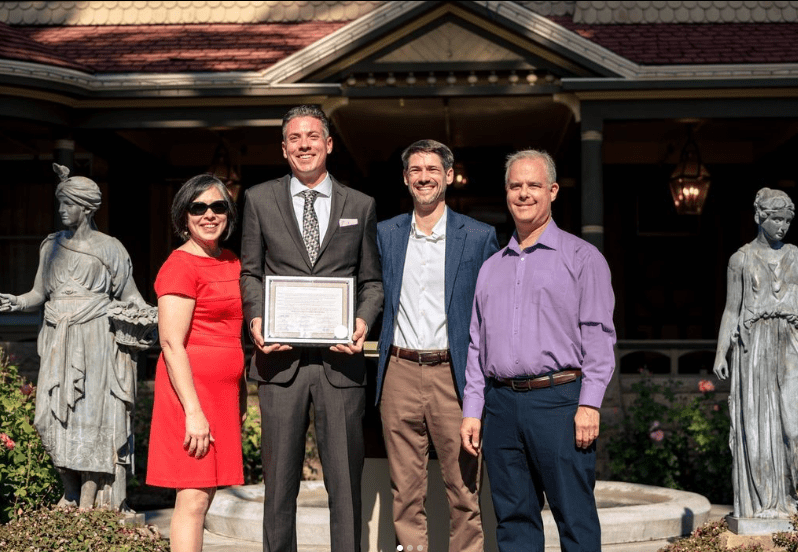
Please visit the online giftshop, and purchase a gift for friends and relatives as well as a special memento of The Winchester Mystery House. A variety of souvenirs and gifts are available to purchase. https://shopwinchestermysteryhouse.com/

The Big, Blonde, Democratic Teuton

The expression of compassion for others is the essence of the gospel of Jesus as the Christ. It is meaningful to observe that Jesus’s compassionate acts were not occasional, nor mandated manifestations based on a list of tasks to be completed but everyday expressions of the reality of His pure love for God and His children and His abiding desire to help. One of the most poignant examples of kindness in the Christian Bible is when Jesus showed compassion at the grave of Lazarus. When Jesus saw Lazarus’ friends weeping, he wept alongside them (John 11.33-35). Over and over, our Lord Jesus felt compassion on people, healing them and comforting them. He saw the large crowd as sheep without a shepherd and he came to give them purpose and shelter. As the Son of God, Jesus possessed more than we can ever imagine. Even so, he gave up everything, voluntarily and selflessly sacrificing Himself for us so that we can have eternal life. In that sacrifice, we see the greatest example of compassion in the Bible. The stories of compassion in the Bible should motivate us to put compassion into action. Those who cannot make the leap and rise above human love to their higher self—with its impersonality and immateriality—may continue to draw a happiness from it. However, the limitations will be there, inexorable, unconquerable, of time and body, relativity, and change. #RandolphHarris 1 of 25

One of the most important scriptures in the Bible is Hebrews 13.2, “Do not forget to show hospitality to strangers, for by doing so some people have shown hospitality to angels without knowing it. Now, what are angels? Angels are messengers of God. Therefore, what this scripture could also mean is to show compassion to others, not only does how you treat people reflect on your and your family, but you could also be entertaining people who have great power and influence in this World. If you want to get ahead in life, the right way, it is important that people see you as a good person. Fear weakens a man, hate destroys him in the end, but love brings him his best. If everyone in the World would practice universal love, then the whole World would enjoy peace and order. We must learn to rise above our emotions, and understand by this kind of love a state of mind, not a state of emotion. When two people confront each other, there are six ego states involved, three in each person. Since ego states are as different from each other as actual people are, it is important to know which ego state is active in each person when something takes place between them. The exasperating response is where someone who wants sympathy gets facts instead. This is known as a child/parent-adult/adult. Impudence is where someone who expects compliance gets what is consider a “smart aleck” response instead, in the form of a factual statement. #RandolphHarris 2 of 25

There are 812 or 6561 different types of duplex transactions possible. For example, if we engage in only three transactions, and each time we have a choice among 6597 varieties, then we have our three transactions in 65973 ways. This gives us about 300 billion different ways of structuring our three exchanges with each other. That certainly gives us all the room we need to express our individualities. Since most people engage in hundreds or thousands of transactions every day, each person has trillions and trillions of combinations at his disposal. Even if he has an aversion to 5000 of the 6597 possible types of transactions, and never gets into them, there is still plenty of room to maneuver in, and there is no necessity for his behaviour to be stereotyped unless he himself sets it up that way. If he does so, as most people do, that is not the fault of transactional analysis, but of others influences that form the chief subject matt of this report. Since this system, in all its branches, is referred to as transactional analysis, what has been described above, the analysis of single transactions, is called transactional analysis proper, which is the second step after structural analysis. Transactional analysis proper gives a rigorous definition of the system, which will be of interest principally to those trained in scientific methodology. #RandolphHarris 3 of 25

A transaction consisting of a single stimulus and a single response, verbal or non-verbal, is the unit of social action. It is called a transaction because each party gains something from it, and that is why he engages in it. Anything that happens between two or more people can be broken down into a series of single transactions, and this gives all the advantages which any science attains when it has a well-defined system of units. Transactional analysis is a theory of personality and social action, and a clinical method of psychotherapy, based on the analysis of all possible transactions between two or more people, on the basis of specifically defined ego states, into a finite number of established types (nine complementary, 72 crossed, 6480 duplex, and 36 angular). Only about 15 of these commonly occur in ordinary practice; the rest are largely of academic interest. Any system or approach which is not based on the rigorous analysis of single transactions into their component specific ego states is not transactional analysis. This definition, in effect, purports to set up a model for all possible forms of human social behaviour. This model is efficient because it follows the principle of scientific economy (sometimes knows as “Occam’s razor”), making only two assumptions: that human beings can change from one ego state to another, and that if A says something and B says something shortly thereafter, it can be verified whether what B said was a response to what A said. #RandolphHarris 4 of 25

It is also very effective because, so far, no examples have been found among thousands or millions of interchanges between human beings which could not be dealt with by the model; and it is rigorous as well, because it is limited by simple arithmetical considerations. The best way to understand the “transactional viewpoint” is to ask: “What would a one- or two- or three-year-old child do that would correspond to this grownup’s behaviour?” Eastern philosophers are fond of pointing out how Westerns live with a “divided” consciousness, experiencing a gulf between mind and body, between self and nature. Divided consciousness is a chronic self-consciousness, such that the person is always aware of self. Whether the person is watching a sunset, enjoying pleasures of the flesh, or playing a game of tennis, he or she is always aware of self as the “subject, whereas that which the person is noticing is experienced as the “object,” as “out there,” distance from the self. Even our language, with its grammatical structure, encourages us to enter a chronic state of self-consciousness, of reflection upon our experiencing. A child, before taking on language, apparently has the capacity to perceive in selfless fashion. Eventually, the child learns to monitor experience and action, after having learned that he or she will be called on to give an account of thoughts and actions. The child is to become a spy or witness of his or her own actions, and is to give a report to parents upon request. #RandolphHarris 5 of 25

As the child grows older, such self-vigilance becomes habitual, and the rift in consciousness that hinders spontaneity has been permanently inserted. When a happening fully absorbs someone’s attention, the person may re-experience the long-lost mode of unreflective, unself-conscious perception. This is a terrible way to live—always to be watching one’s self. The capacity to be self-conscious is unique to human beings, because of the relative seize of the human cerebral cortex. Doubtless, the ability to observe the flow of one’s experiencing has some adaptive and adjustive value. However, chronic self-consciousness is agonizing, and it destroys enjoyment of living; in extreme instances, self-consciousness can so limit a person that he or she becomes unable to act at all until having first checked and rechecked the proposed action or communication. When self-consciousness is carried to this extreme, the individual may become nearly paralyzed by doubt and indecision, as in a pattern of neurosis called doubting compulsion. When used to “mirror” self and know how you are perceived by others, the gift of reflecting consciousness is helpful. Prayer to God and His Son, Jesus Christ, was developed as a means of healing the breach in consciousness. #RandolphHarris 6 of 25

The purpose of prayer is to help a person “transcend” the ego and experience a unification of self with all that exists. When such enlightenment and unification occur, the person becomes more capable of effortless action, grace of movement, and power of reason, because the person is not doing two things at once, that is, doing something and reflecting upon what is being done. Prayer is one of the greatest blessings we have while we are here on Earth. Through prayer we can communicate with our Heavenly Father and seek His guidance daily. Prayer is a sincere, heartfelt talk with our Heavenly Father. We should pray to God and to no one else. We do not pray to any other being or to anything made by man or God. “Thou shalt have no other gods before me. Thou shalt not make unto thee any graven image, or any likeness of anything that is in Heaven above, or that is in the water under the Earth. Thou shalt not bow down thyself to them, nor serve them: for I the LORD thy God am a jealous God, visiting the iniquity of the fathers upon the children unto the third and fourth generation of them that hate me,” reports Exodus 20.3-5. Prayer has been an important part of the gospel from the beginning of the World. An angel of the Lord commanded Adam and Eve to repent and call upon God in the name of the Son. “Wherefore, thou salth do all that thou doest in the name of the Son, and thou shalt repent and call upon God in the name of the Son forevermore,” reports Moses 5.8. This commandment has never been taken away. #RandolphHarris 7 of 25

Prayer will help us draw closer to God. All our thoughts, our words, and our actions are influenced by our prayers. The experience of overcoming chronic fixation upon a self-conscious, reflective state of awareness, so that one begins to smell and taste, and remember and imagine with greater vividness, can easily be described as “an enlargement of the World,” a rebirth, or a self-unification. Yet reflection, or self-witnessing, helps a person to learn skills. Self-consciousness may rob action of its spontaneity and of its joy. The aim of healthy personality is to be able to reflect upon experience when it is appropriate to do so, and to engage unself-consciously like a child in action, and in personal relationships, when there is no need to reflect. Action is one way to obtain temporary respite from self-consciousness. Warm-up exercises, followed by intense involvement in a game of tennis or basketball, or in dance, enable a person to be engaged without reflection. Other means for temporarily suppressing the act of reflection include listening to music, engaging in hobbies, and absorption in a book or a drama on a video steaming service or DVD. Dialogue with another person that fully engages one’s attention is also a means of overcoming self-consciousness. When such dialogue is going on, each person is responding to the other without premediated efforts to produce a particular impression in the experience of the other. #RandolphHarris 8 of 25

The Darwinian mood sustained the belief in Anglo-Saxon racial superiority which obsessed many American thinkers in the latter half of the nineteenth century. The measure of World dominion already achieved by the “race” seemed to prove it the fittest. Also, in the 1870’s and 1880’s many of the historical conceptions of the Anglo-Saxon school began to reflect advances in biology and allied developments in other fields of thought. For a time, American historians fell under the spell of the scientific ideal and dreamed of evolving a science of history comparable to the biological sciences. The keynote of their faith could be found in E.A. Freeman’s Comparative Politics (1874), in which he allied the comparative method with the idea of Anglo-Saxon superiority. “For the purposes of the study of Comparative Politics,” he had written, “a political constitution is a specimen to be studied, classified, and labeled, as a building or an animal to be studied, classified, and labeled by those to whom buildings or animals are objects to study.” If political constitutions were to be classified and compared by Victorian scholars as if they were animal forms, it was highly probable that the political methods of certain peoples would be favoured over others. Inspired by the results of the comparative method in philology and mythology, particularly by the work of Edward Tylor and Max Muller, Freeman tried, using this method, to trance the signs of original unity in the primitive institutions of the Aryans, particularly in the “three most illustrious branches of the common stock—the Greek, the Roman, and the Teuton.” #RandolphHarris 9 of 25

When Herbert Baxter Adams set up his great historical seminar at John Hopkins, it was with the official blessing of Freeman; and Freeman’s dictum, “History is past politics and politics is present history,” was emblazoned on the historical studies that came pouring forth from Adams’ seminar. A whole generation of historians receiving their inspiration from the John Hopkins school could have said with Henry Adams, “I flung myself obediently into the arms of the Anglo-Saxons in history.” The leading notion of the Anglo-Saxon school was that the democratic institutions of England and the United States of America, particularly the New England town meeting could be traced back to the primitive institutions of the early German tribes. Despite differences in detail, the Hopkins historians were in general agreement on their picture of the big, blonde, Democratic Teuton and on the Teutonic genealogy of self-government. The viewpoint of the school was given a fitting popular expression in 1890 with the publication of James K. Hosmer’s Short History of Anglo-Saxon Freedom, which drew upon the home literature of Anglo-Saxondom to establish the thesis that government of the people and by the people is of ancient Anglo-Saxon origin. #RandolphHarris 10 of 25

Wrote Hosmer: “Though Anglo-Saxon freedom in a partial form has been adopted (it would be better perhaps to say imitated) by every nation in Europe, but Russia, and in Asia by Japan, the hopes for that freedom, in the future, rest with the English-speaking race. By that race alone it has been preserved amidst a thousand perils; to that race alone is it thoroughly congenial; if we can conceive the possibility of the disappearance among peoples of that race, the chance would be small for that freedom’s survival.” Hosmer shared the optimism of his English contemporary John Richard Green, who believed that the English-speaking race would grow in enormous numbers and spread over the New World, Africa, and Australia. “The inevitable issues,” concluded Hosmer, “is to be that the primacy of the World will lie with us. English institutions, English speech, English thought, are to become the main features of the political, social, and intellectual life of mankind.” Thus would the survival of the fittest be written large in the World’s political future. What Hosmer did for Anglo-Saxon history, John W. Burgess did for political theory. His Political Science and Comparative Constitutional Law, published in the same year as Hosmer’s book, serves as a reminder of German as well as English influences in the American Anglo-Saxon cult; for Burgess, like Herbert Baxter Adams, had received a large part of his graduate training in Germany. #RandolphHarris 11 of 25

The peculiarity of his work, Burgess declared, it was method. “It is a comparative study. It is an attempt to apply the method, which has been found so productive in the domain of Natural Science, to Political Science and Jurisprudence.” It was Burgess’ contention that political capacity is not a gift common to all nations, but limited to a few. The highest capacity for political organization, he believed, has been shown, in unequal degrees by the Aryan nations. Of all these, only “the Teuton really dominates the World by his superior political genius.” It is therefore not to be assumed that every nation must become a state. If we may judge from history, The political subjection or attachment of unpolitical nations to those possessing political endowment appears to be as truly a part of the World’s civilization as is the national organization of states. I do not think that Asia and Africa can receive political organization in any other way…The national state is…the most modern and complete solution of the whole problem of political organization which the World has yet produced; and the fact that it is the creation of Teutonic political genius stamps the Teutonic nations as the political nations par excellence, and authorizes them, in the economy of the World, to assume the leadership in the establishment and administration of states. #RandolphHarris 12 of 25

The Teutonic nations can never regard the exercise of political power as a right of man. With them this power must be based upon capacity to discharge political duty, and they themselves are the best organs which have yet appeared to determine when and where this capacity exists. We see the beginnings of this, for instance, in songs like “We Shall Overcome,” which are living rituals, not just songs. A ritual like that of common silence as it has been practiced by the Friends as the center of their religious service could be acceptable to large groups of people; it could become a custom that every meeting of significance begins or ends with five or fifteen minutes of common silence given to prayer and concentration. It is not too farfetched an idea to suggest that, instead of prayers or patriotic formulae, classes in schools and special occasions in universities could be introduced by a period of common silence. We also have shared symbols, such as the dove and the outline of a human figure as symbols of peace and respect for man. There is no point in speculating about further details of possible common rituals and symbols outside church life, because they will grow naturally once the soil is prepared. In the field of art and music, there are innumerable possibilities for the creation of new ritual and symbolic expressions. #RandolphHarris 13 of 25

Whatever new psychospiritual systems may arise, they will not be “fighting” religion, although they will be a challenge to those in the various religions who have made an ideology of religious teachings and an idol of God. Those who worship the “living God” will have no difficulty in sensing that they have more in common with the “unbelievers” than they have in what separates them; they will have a deep sense of solidarity with those who do not worship idols and who try to do what the believers call “God’s will.” I expect that to many the hope expressed here for new manifestations of man’s psychospiritual needs are too vague to form the basis of hope that such a development will happen. Those who want certainty and proof before they can take any hope seriously are right in reacting negatively. However, those who believe in the reality of the yet unborn will have more trust that man will find new forms of expressing vital needs, even though at this moment there is only a dove with an olive branch indicating the end of the flood. It is the rule rather than the exception in the historical process that ideas deteriorate into ideologies; mere words take the place of the human reality; these words are administered by a bureaucracy which thus succeeds in controlling people and gaining power and influence. And usually, the result is that the ideology, while still using the words of the original idea, in effect expresses the opposite meaning. This fate has happened to the great religions and to philosophical ideas; it has happened to Marx’s and to Dr. Freud’s ideas. #RandolphHarris 14 of 25

What was Dr. Freud’s original system? First, it was radical thought; radical, in the original sense of the word, meaning going to the roots and—as Marx said—since the root is man, going to the very nature and essence of man. Dr. Freud’s psychoanalysis was critical thought; critical first, of existing psychiatric ideas which took consciousness as the basic datum of psychiatry. However, Dr. Freud’s thought was critical in a much broader sense. It attacked many of the values and ideologies of the Victorian age; it attacked the notion that pleasures of the flesh were not a subject for rational and scientific investigation; it attacked the insincerity of Victorian morality; it attacked the sentimental notion of the “purity” and “innocence” of the child. However, its most important attack was directed against the notion that there is no psychic content transcending consciousness. Dr. Freud’s system was a challenge to existing ideas and prejudices; it opened a new era of thought corresponding to the new development in the natural sciences and in art. It might be called in this sense a revolutionary movement, even though despite his criticism of some aspects of society Dr. Freud did not transcend the existing social order, nor did he think of new social and political possibilities. What became of this radical and critical movement after the first thirty years of its existence? #RandolphHarris 15 of 25

First, psychoanalysis has become very successful, especially in the Protestant countries of Europe and in the United States of America, while, until the end of the First World War, it was mocked and derided by most “serious” psychiatrists and by the public in general There were many reasons for the growing success of psychoanalysis. The fact is that the movement, ridiculed during the first twenty years of its existence, came to be considered respectable in psychiatry, accepted by many social scientists, and popular among many literary men, some of whom—Thomas Mann, for example—were quite outstanding. However, this academic and intellectual recognition was not all; psychoanalysis became popular with the public; psychoanalysts found it difficult to take all the patients who asked for their help; in fact, the profession of psychoanalysis because one of the most rewarding from the economic standpoint and from that prestige. This successful development, however, was by no means paralleled by a corresponding richness and productivity of psychoanalytic discoveries as regards theory and therapy. In fact, it many be surmised that the very success of psychoanalysis contributed to its deterioration. Psychoanalysis lost is original radicalism and its critical and challenging character. #RandolphHarris 16 of 25

An ability to recognize resistances demands some definite knowledge of their sources and their expressions. Hence it appears appropriate to recapitulate all that has been said about the subject in scattered places throughout this report—often without explicitly mentioning the term “resistance”—and to add certain points that are of special interest for self-analysis. The sources of resistance are the sum of a person’s interests in maintaining the status quo. These interests are not—and emphatically not—identical with a wish to remain ill. Everyone wants to get rid of limitations and sufferings, and in that wish, he is all for change, and for a quick change at that. What he wants to maintain is not “the neurosis” but those aspects of it which have proved to be of immense subjective value to him and which in his mind hold the promise of future security and gratification. The basis factors that no one wants to modify one iota are, briefly, those that concern his secret claims on life, his claims for “love,” for power, for independence and the like, his illusions about himself, the safety zones within which he moves with comparative ease. The exact nature of these factors depends on the nature of his neurotic trends. #RandolphHarris 17 of 25

In professional analysis the provocation for resistance is, in the great majority of cases, something that has occurred in the analysis itself. If strong secondary defenses have developed, the first resistances arise as soon as the analysts questions the validity of these defenses, that is, as soon as he casts any doubt on the rightness, goodness, or unalterability of any factor in the patient’s personality. Thus a patient whose secondary defenses consist in regarding everything concerning himself, faults included, as excellent and unique will develop a feeling of hopelessness as soon as any motivation of his is questioned. Another patient will react with a mixture of irritability and discouragement as soon as he encounters, or the analyst points out to him, any trace of irrationality within himself. It is in accordance with the function of the secondary defenses—protection of the whole system developed—that these defensive reactions are elicited not merely when a special repressed factor is in danger of being uncovered but when anything is questioned, regardless of content. However, if the secondary defenses are not of such vital strength, or if they have been uncovered and faced, resistances are for the most part a response to attacks on specific repressed factors. As soon as any domain is approached, closely or remotely, which is tabu for the patient he will react emotionally with fear or anger and will automatically set going a defensive action to prevent further trespassing. #RandolphHarris 18 of 25

This encroachment on a tabu need not be a specific attack but may be result merely from the analyst’s behaviour. Any thing he does or fails to do, says or fails to say, may hurt one of the patient’s vulnerable spots and create a conscious or unconscious resentment which for the time being blocks the co-operative work. However, resistances to analytical work can be elicited also by factors outside the analytical situation. If outside circumstances change during analysis in such a way as to favour a smooth functioning of the neurotic trends, or even to render them positively useful, the provocation for resistance is greatly increased; the reason is, of course, that the forces opposing change have been strengthened. However, resistance can be provoked also by unfavourable developments in daily life. If a patient feels, for example, that he has been unfairly dealt with by someone in his circle his indignation may be so great that he refuses any effort in analysis to seek the real reason why he felt injured or insulted, his entire energy being concentrated on revenge. If a repressed factor is touched upon, either specifically or remotely, a resistance may be produced by developments outside as well as within the analytical situation. #RandolphHarris 19 of 24

Measurement is important using the Relationship Inventory. The Inventory contains statements regarding the degree to which the counselor is acceptant, empathic, and congruent, and the client responds by evaluating the statement on a six-point scale from “strongly true” to “definitely untrue.” Examples concerning empathy are: “He generally sense or realizes how I am feeling;” “He understands my words but does not realize how I feel.” In relationship to congruence sometimes items are: “He pretends that he likes me or understands me more than he really does.” The Inventory is scored for each of the four attitudinal elements, and there is also a total score. The counselor is the most significant factor in setting the level of conditions in the relationship, though the client, too, has some influence on the quality of the relationship. Clients who later show more change perceive more of these attitudinal conditions early in the relationship with their counselor or therapist. The more disturbed the client, the less he is likely to (or able to?) perceive these attitudes in the counselor. Counselor or therapists tend to be quite consistent in the level of attitudinal conditions which they offer to each client. The major finding from all of the studies is that those clients in relationships marked by a high level of counselor congruence, empathy and unconditional positive regard, show constructive personality development. #RandolphHarris 20 of 25

These high levels of conditions are associated with positive changes on Minnesota Multiphasic Personality Inventory scales and indices, including ego-strength; positive change from the pre- to post-test battery as rated by clinicians working “blind”; decrease in anxiety scores and in a self-consciousness score; a higher level of Process Scales designed to measure process in therapy; and positive changes in counselor’s ratings. Clients relationships characterized by a low level of these attitudinal conditions show significantly less positive changes on these same indices. The client’s perception is the best predictor of change. This finding does not hold for the schizophrenic client, whose inner disturbance makes it difficult for him accurately to perceive the conditions offered by our conscientious and experienced therapist. With our schizophrenics, the rating of the conditions made by the unbiased raters is the best predictor of change. An unexpected finding with the schizophrenic clients is that low conditions in the relationship are associated with negative change in several respects. The clients not only fail to show constructive change but become worse in the judgment of clinicians rating their pre- and post-test batteries; show an increase in anxiety; are worse off than their matched no-therapy controls. Whether this finding holds for clinical clients who come for help has not yet been determined. #RandolphHarris 21 of 25

As might be expected, more experienced counselors, when compared with inexperienced counselors, offer a higher level of these conditions, and are more successful in communicating these to their clients. Thus they are perceived as offering higher conditions, and their clients show more change over the course of the interviews. Many people are sent to counseling for romantic problems. Those who glorify romantic lover avert their eyes from the truth that there is a negative side to it. However ignored, it will one day come into focus. There is a common notion that love, to be worth its name, must be highly emotional and dramatically intense. That, of course, is one kind but it is not the best kind, which is calm, unchanging, and unexcited. The sentimental gush which is talked so often and so freely in religiomystic circles about loving one’s fellow humans is usually quite shallow and will not stand deep analysis. Nor is it the most important of all the virtues as such circles seem to believe. When a woman comes to a man for spiritual help or even spiritual companionship, he should not ask her for more than the chance to serve. Even if she is not conscious of having been sent to him for this purpose, or even if she mistakes the spiritual attraction for merely a human one, this remains true. It would be a spiritual failure on his part to ask for more then the opportunity to serve her. The service he gives must be given with a pure motive. #RandolphHarris 22 of 25

Therefore, he appearance in his life is a test for him. Should he fall in love with her the test still holds good, but its character may change. He is to keep the relationship at a high level. He is not to attempt to possess her but to be content with knowing and loving her. He must accept the situation with calm resignation and complete nonattachment. Does the unified man have to like everyone he meets? Some students believe that Jesus as the Christ commanded us to “love thy neighbour as thyself” and this question ought to be answered with a resounding Yes! However, in actual life we find that some unified men succeed in doing this whereases others frankly do not feel that way nor make any such effort. To make the love of everybody else a compulsory ethic ought not to be demanded even from a quester, much less from the masses! To make the cultivation of goodwill desirable as a general attitude would be more reasonable. Even so it should grow naturally out of the cultivation, not be forced. When a man discovers that the same Overself dwells in his enemy as in his own heart, how can he ever again bring himself to hate or injure another? It is easy to believe more softness to be compassion. It is easy to deceive oneself in this way. However, a vigorous analysis of one’s thoughts and observation of their results in action will expose the very real differences between them. “Do not day: O God, I thank thee that we are better than our brethren; but rather say: O Lord, forgive my unworthiness, and remember my breathren in mercy—yea, acknowledge your unworthiness before God at all times,” reports Alma 38.14. #RandolphHarris 23 of 25

The Sacramento Fire Department is committed to providing citizens with a professional fire service that meets or exceeds professional standards and best practices from across the nation. “The State Department asked me to go to Russia and several other communist countries to speak about contemporary American literature to the writer’s unions, and to the English-speaking clubs of the universities. It was a great trip, because the Russian people are gregarious and full of subtle humor, though, before glasnost, the Russian authority seemed dark and pervasive, like a giant shadow. Consequently, I liked the people and the architecture but felt uncertain about the country. I kept asking to visit a Moscow fire station, and the authorities kept stonewalling me. Finally, after a week of telephone calls, they agreed to take me to one of their huge centralized fire stations where there are ten or so fire companies. This was pretty unusual, for the fire department is quasimiliatry, that is, run by and attached to the army, and they do not normally take Americans to military installations. A reporter came, but they wouldn’t let him in to the station, which was rimmed by a high wall, and he wrote a long story about it in the magazine. I was taken to a reception hall, where I met a group of pretty congenial officers, a general and some colonels, who ran the Russian Fire Service. I was pretty impressed, though I just wanted to talk to a few back-step firefighters. I wanted to hear what the Russian firefighters felt about false alarms or nuisance fires—if, indeed, they existed in that country. #RandolphHarris 24 of 25

“I sat at the head of a long table and began talking about the problems of fighting fires in a large city, in overcrowded buildings where impoverished people lived, where false alarms were as frequent as changing traffic signals, where my one company would respond to forty calls a day, every day. I talked a little about the personal challenge of firefighting, the renewed confrontation, never really resolved, one fire after another. The general stood and pointed to a colonel sitting down the table. The colonel stood as the general related with great price that this man personally had been in more than a hundred fires. ‘Very good,’ I said, ‘congratulations,’ thinking but of course not saying, that to us in Sacramento, a hundred fires represented not a lifetime’s work but a single weekend in July.” The Sacramento Fire Department strives to sustain and improve the health, safety, convenience, and welfare of the citizens of Sacramento and to plan for the future development of the community. You can help save lives and property by donating to the Sacramento Fire Department. And remember parents, raise your children to love America, to be patriotic, to love God and Jesus, respect law and others, treat others with dignity and respect, and the remind them of the importance of education. Every single thing they learn in school can and will apply to the real World. I pledge allegiance to the flag of the United States of America, and to the Republic, for which it stands, one nation, under God, indivisible with Liberty and Justice for all. Our Father, our King, be gracious unto us and answer us, for we are wanting in good deeds; deal with us in charity and lovingkindness, and please save us. #RandolphHarris 25 of 25


Discover a closet so spacious it could be its own room at Residence 4 at Havenwood! This expansive closet offers ample space for all your clothing and accessories, making organization a delight.

Plus, Havenwood provides individual selections to customize your home to your liking. Elevate your storage game and personalize your space – see it to believe it! https://cresleigh.com/havenwood/residence-four/


I Love Myself and Use You to Satisfy My Interest or Feelings

We have been told by well-meaning ministers of religion and counsellors in psychology to practice Jesus’s words, “Love thy neighbour.” Now there are two different ways in which we can do so, because there are two different interpretations of these words—the religious and the philosophic. According to the first, we have at least to be amiable toward our next-door neighbour, or at most to throw our arms around him and express our warm feeling for hum in a gushy, sentimental, hyper-emotional manner. According to the second and philosophic interpretation, we must understand that every person who crosses our path is our neighbour, everyone with whom we are thrown into momentary or continuous contact is our neighbour, whether at home or at work. It is in these immediate contacts that irritations are bred, differences are noted, and dislikes appear. It is much easier to love humanity as a whole or in the abstract than it is to love humanity in the individual and in the concrete. Despite the instinctive urge to manifest irritability, dislike, anger, resentment, or even hatred against those with whom you are thrown in contact, you can steel your will and resist the negative feelings. #RandolphHarris 1 of 19

If you can take all these negative feelings and sublimate them into understanding, tolerance, and goodwill based on the teachings of philosophy, you are loving your neighbour in the sense that Jesus meant it. You will then see that such philosophic love is far removed from and far superior to the hyper-emotionalism which slows hot and cold. How can I love my enemy, it is asked, or anyone who is outwardly or inwardly repugnant to me? We are not called on to love what is evil in our enemy nor what is ugly in anyone. We are called on, however, to remember that alongside of the evil there is the divine soul in him, alongside of the ugliness there is the divine beauty in him. His non-awareness of it does not alter the fact of its existence. And because he is a bearer of something grander than himself, unconscious of it though he be, we are to meet his hostility with our goodwill, his baseness with out nobility, and thus help him by our thought or our example to move onward—even if no more than one millimeter—towards the discovery and realization of his own divine soul. When we are enjoined to love others, we are really enjoined to sympathize with them as fellow living creatures and to have compassion for their sufferings or ignorance. #RandolphHarris 2 of 19

If the thought of our enemy arouses hatred, dislike, or fear, he will continue to haunt. The only way to free him is to arouse our compassion for him, to extend goodwill toward him. In the moment that we feel like this we exorcise his wrath and are liberated. “Love thy neighbour as thyself,” the dictum preached by Jesus and practiced by the self-actualized Christians, seems to offer a remote and unapproachable ideal. However, if we come to understand what Jesus meant and how the self-actualized Christian can realize it, it will not seem so. Every man does indeed love himself, but he does not love the whole of himself. There are defects and weaknesses in himself which he hates. He cannot therefore be expected to love them in his Neighbour. However, if he perceives that these faults eventually bring painful Karmic results, he can be expected to feel compassion for those who suffer from them. In the case of the self-actualized Christian, not only is such a consideration operative but also the perception of his neighbour’s existence within the one universal Mind in which he feels himself to be rooted. It is easy and natural for him, therefore, to practice loving kindness towards his neighbour. #RandolphHarris 3 of 19

Here, at this final stage of knowledge, which is Christianity, the “I” in a man becomes inseparable from the “you.” Both exist simultaneously within him, whereas in the ordinary man they stand fundamentally opposed to each other. No longer is the personality the sole content of the mind: it is now but a partial content. In his inmost attitude he is conscious of unity with others and consequently emanates a perfect sympathy towards them. This is not the sentimental attitude which often goes with the superficial emotion called love. It is profoundly deeper. It can never change, whereas emotional love may turn to dislike or even hate. This inner sense of unity can in no wise alter it is always there. Nor can it even be impeded by physical or selfish considerations. There is nothing in another man’s face or body, fortune or misfortune, mind, or heart, which can obstruct the ceaseless flow of the blesser. “We two are rooted in the same Overself” is the remembrance which he cherishes in himself. He has understood the inner penetration of the many in the One and of the One with the many. What he feels for himself is not different from what he feels for others; but what he does for himself will be necessarily different, because wisdom demands recognition of the superior and hence more responsible role which has been allotted to him in his game of life. #RandolphHarris 4 of 19

Many patients who come to a psychiatrist for the first time introduce themselves and shake hands when he invites them into his office. Some psychiatrists, indeed, offer their own hands first. I have a different policy about handshakes. If the patient proffers his hand in a hearty way, I will shake it to avoid being rude, but in a noncommittal fashion, because I am wondering why he is being so hearty. If he offers it in a way which merely suggests that he considers it good manners, I will return the compliment in such a way which indicates that he is desperate, then I will shake it firmly and reassuringly to let him know that I understand his need. However, my manner when I enter the waiting room, the expression on my face and the position of my arms, indicates clearly enough to most newcomers that this amenity will be omitted unless they insist upon it. This is intended to establish, and usually does establish, that we are both there for a more serious purpose than to prove that we are good fellows or to exchange courtesies. Mainly, I do not shake hands with them because I do not know them, and I do not expect them to shake hands with me, because they do not know me; also, some people who come to psychiatrist’s object to being touched, and it is a courtesy to them to refrain from doing so. #RandolphHarris 5 of 19

The ending of the interview is a different matter. By that time, I know a great deal about the patient, and he knows something about me. Thus, when he leaves, I make a point of shaking hands with him, and I know enough about him to know how to do it properly. This handshake means something particularly important to him: that I am accepting him even after he has told me all the “bad” things about himself. (“Acceptance” is not used here in it ill-defined, sentimental sense; it means, specifically, that I am willing to spend more time with him. This involves a serious commitment which may, in some cases, mean one or more years of patience, effort, ups and downs, and getting up in the morning.” If he needs comforting, my handshake is such that it will comfort him; if he needs assertion of his masculinity, my handshake will evoke his masculinity This is not a carefully thought-out device to seduce the patient; it is a spontaneous and freely-given recognition of him as I now know him after talking for an hour with him about his most intimate concerns. On the other side, if he has lied to me out of malice rather than natural embarrassment, or tried to exploit or browbeat me, I will not shake hands with him, so that he knows he will have to behave differently if he wants me on his side. #RandolphHarris 6 of 19

With women, it is slightly different. If one needs a palpable sign that I accept her, I will shape hands in a way suitable to her needs; if (as I know by this time) another shrinks from contact with men, I will say farewell in a correct way but let her pass without a handshake. This latter cause illustrates most clearly the reason for not shaking hands as a greeting: if I shake hands, I awaken her abhorrence. I have, in effect, intruded upon and insulted her before the interview, by forcing her, out of good manners, and against her inclination, to touch me and let me touch her, however courteously. In therapy groups, I follow a similar policy. I do not say Hello on entering, because I have not seen the members for a whole week, and I do not know to whim I am saying Hello. A light or cordial Hello might be quite out of place in the light of something that has happened to them in the interval. However, I do make an extraordinarily strong point of saying Good-by to each member at the end of the meeting, because then I know to whom I am saying Good-by, and how to say it in each case. For example, suppose one woman’s mother has died since the last meeting. A genial Hello from me would seem out of place to her. She might forgive me for it, but there is no need to put that strain on her. By the time the meeting is over, I know how to say Good-by to her in her bereavement. #RandolphHarris 7 of 19

Socially, it is different, since friends are for stroking. With them, Hello and Good-by range from an open handshake to a big hug, depending on what they are ready for or need; or sometimes it is josh and jive to keep from getting too involved, a “smile when you say that.” However, one thing in life is more certain than taxes and just as certain as death: the sooner you make new friends, the sooner you will have old ones. So much for Hello and Good-by. What happens in between falls into the framework of a specific theory of personality and group dynamics, which is also a therapeutic method, knows as transactional analysis. To appreciate what follows, it is first necessary to understand the principles of this approach. Plotinus’ belief that in all his lesser loves, man is seeking the divine, that it is the object he permanently wants much more than these temporary ones, is the truth to which he must come one day. And he will come by a double movement: the first, away from them by successive disenchantments, the second by progressive glimpses of the divine beauty. A life without love is a life emotionally starved and therefore stunted in growth. However, do not limit the meaning of the word love either to a selfish or animalistic definition. #RandolphHarris 8 of 19

How many unreflective and selfish persons have uttered the words “I love you” to someone else—wife, friend, or teacher when what they actually, if unconsciously meant was, “I love myself and use you to serve my interests or to satisfy my feelings.” A merely physical or purely emotional love will fade and die when events test if it really seeks the happiness of the beloved rather than the pleasure of the lover. Despite its fundamental conservatism, the eugenics craze had about it the air of a “reform,” for it emerged at a time when most Americans liked to think of themselves as reformers. Like the reform movements, eugenics accepted the principle of state action toward a common end and spoke in terms of the collective destiny of the group rather than of the individual success. This is significant of the general trend of thought in the Progressive era. A rising regard for the collective aspects of life was one of the outstanding characteristics of the shift in the dominant pattern of thought. The new collectivism was not socialistic, but was based upon an increasing recognition of the psychological and moral relatedness of men in society. It saw in the coexistence of baronial spledour and grinding poverty something more than the accidental dispensation of Providence. Refusing to depend upon individual self-assertion as an adequate remedy, men turned toward collective. #RandolphHarris 9 of 19

The change in the political outlook of the common man was responsible for a change in the fundamental mechanisms of thought among workers in the social sciences. The formalistic thought of the nineteenth century had been built upon an atomistic individualism. Society, men had believed, was a loose collection of individual agents; social advance depended upon improvements in the personal qualities of these individuals, their increased energy and frugality; among these individuals the strongest and best rose to the top and gave leadership to the rest; their heroic accomplishments were the ideal subject matter of history; the best laws were those that gave them the greatest scope for their activities; the best nations were those that produces most leaders of this type; the way of salvation was to leave unhindered the natural processes that produced these leaders and gave the affairs of the World into their hands. This pattern of thought was static; instead of inquiry it seemed to encourage deductive speculation; its essential function was the rationalization of existing institutions. Those who were satisfied with it had felt relatively little need for concrete investigation or even for significant novelty in their abstractions. #RandolphHarris 10 of 19

Between the Spanish-American War and the outbreak of the First World War there was a great restlessness sin American society, which inevitably affected the patterns of speculative thought. The old scheme of thought was repeatedly assailed by critics who were in sympathy with the new spirit of the Progressive era. The intellectual friction engendered by this discontent fired the energies and released the critical talents of new minds in history, economics, sociology, anthropology, and law. The result was a minor renaissance in American social thought, a renaissance which saw in relatively short span of years the rise to prominence of Charles A. Beard, Frederick Jackson Turner, Thorstein Veblen, John R. Commons, John Dewey, Franz Boas, Louis D. Brandeis, and Oliver Wendell Holmes. It is easier to enumerate the achievements of this renaissance than to characterize its intellectual assumptions, but certainly its leading figures did share a common consciousness of society as a collective whole rather than a congeries of individual atoms. They shared also an understanding of the need for empirical research and accurate description rather than theoretical speculation cast in some traditional mold. #RandolphHarris 11 of 19

A drastic departure from ancestor worship in history was marked by Charles Beard’s study of the origins of the Constitution by Frederick Jackson Turner’s quest for environmental and economic explanations of American development. Brandies opened new possibilities in law by drafting for the first time a factual sociological brief in defense of a state law regulating conditions in labour in private enterprise. Franz Boas led a generation of anthropologists away from unilinear evolutionary theory toward cultural history and took pioneer steps in the criticism of race theory. John Dewey made philosophy a working instrument in other disciplines, applying it fruitfully to psychology, sociology, education, and politics. Veblen exposed the intellectual sterility of prevailing economic theory, and pointed the way to an institutional analysis of the facts of economic life. In accordance with the spirit of the times, the most original thinkers in social science had ceased to make their main aim the justification and perpetuation of existing society in all its details. They were trying to describe it with accuracy, to understand it in new terms, and to improve it. Man’s development requires his capacity to transcend the narrow prison of his ego, his greed, his selfishness, his separation from his fellow man, and hence, his basic loneliness. #RandolphHarris 12 of 19

This transcendence is the condition for being open and related to the World, vulnerable, and yet with an experience of identity and integrity; of man’s capacity to enjoy all that is alive, to pour out his faculties into the World around him, to be “interested”; to be rather than to have and to use are consequences of the step to overcome greed an egomania. From an entirely different standpoint, the principle shared by all racial humanists is that of negating and combating idolatry in every form and shape—idolatry, in the prophetic sense of worshiping the work of one’s own hands and hence making man subservient to things, and in this process becoming a thing himself. The idols against which the Old Testament prophets fought were idols in stone or wood, or trees or hills; the idols of our day are leaders, institutions, especially the State, the nation, production, law and order, and every man-made thing. Whether or not one believes in God is a question secondary to whether one denies idols. The concept of alienation is the same as the Christian Bible concept of idolatry. It is man’s submission to the things of his creation and to the circumstances of his doing. If they are true to their common tradition, whatever may divine believers and nonbelievers, there is something which unites them, and that is the common fight against idolatry and the deep conviction that no thing and no institution must ever take the place of God or, as a non-believer may prefer to say, of that empty place which is reserved for No-thing. #RandolphHarris 13 of 19

Dr. Freud was mainly concerned with the uncovering of the individual unconscious. While he assumed that society enforced repressions, these were the repression of instinctual forces, and not the social repression which really matter—the repressions of the awareness of social contradictions, socially produced suffering, of the failure of authority, of feelings of malaise and dissatisfaction, etcetera. Freudian analysis has shown that it is possible to some degree to make the individual unconscious conscious, without touching the social unconscious. However, it follows from the premises which were present thus far, that any attempt for de-repression which excludes the social sphere must remain limited. Only if it transcends the individual realm, and if the process includes the analysis of the social unconscious, is the full awareness of what had been repressed is possible. The reasons for this proposition follows from what has been said before. Unless a person can transcend his society and see how it furthers or hinders the development of human potentialities, he cannot be fully in touch with his own humanity. Socially conditioned taboos and restrictions must appear as “natural” to him, and human nature must appear in a distorted form, if he does not recognize the distortion of human nature by the society, he happens to live in. #RandolphHarris 14 of 19

If uncovering the unconscious means arriving at the experience of one’s own humanity, then, indeed, it cannot stop with the individual but must proceed to the uncovering of the social unconscious. This implies the understanding of social dynamics and the critical appraisal of one’s own society from the standpoint of universal human values. The very insight into society which Marx has given us is a condition for becoming aware of the social unconscious, and hence for the full awakening (“depression”) of an individual. If the “should be Ego where there was Id,” humanistic social criticism is a necessary precondition. Otherwise, the person will become aware only of certain aspects of his individual unconscious, yet in other aspects hardly more awake as a total person than the rest. It must be added, however, that not only is critical understanding of society important for the analytic understanding of oneself, but that the analytic understanding of the individual unconscious is also a significant contribution to the understanding of society. Only if one has experienced the dimension of the unconscious in one’s personal life can one fully appreciate how it is possible that social life is determined by ideologies which are neither truths nor lies or, to put it differently, which are both truths and lies in the sense that they are rationalizations which have the function of hiding the real motivation of social and political actions. #RandolphHarris 15 of 19

Recently, I had occasion to listen to some recorded interviews by a young counselor of elementary school children. She was very warm and optimistic in her attitude toward her clients, yet she was ineffective. She seemed to be responding warmly only to the superficial aspects of each child and so the contacts were charry, social, and friendly, but it was clear she was not reaching the real person of the child. Yet in a few ways, she rated reasonably high on each of the conditions I have described. So perhaps there are still elements missing which I have not captured in my formulation. I am also aware of the possibility that different kinds of helping relationships may be effective with different kinds of people Some of our therapists working with schizophrenics are effective when they appear to be highly conditional, when they do not accept some of the bizarre behaviour of the psychotic. This can be interpreted in two ways. Perhaps a conditional set is more helpful with these individuals. Or perhaps—and this seems to me to fit the facts better—these psychotic individuals perceive a conditional attitude as meaning that the therapist really cares, where an unconditional attitude may be interpreted as apathetic noncaring. In any event, I do want to make it clear that what I have given are beginning formulations which surely will be modified and corrected from further learnings. #RandolphHarris 16 of 19

In the major part of analytical literature it is an implicit or explicit axiom that we are helpless toward our resistances, that is, that we cannot overcome them without expert help. This conviction will be held as the strongest argument against the idea of self-analysis. And it is an argument that will carrying heavy weight, not only with analysts but also with every patient who has been analyzed, because both analyst and patient know the tenacious and devious struggles that arise when precarious territory is approached. However, an appeal to experience can never be a conclusive argument, because experience itself is determined by the whole complex of ruling concepts and customs, and by our mentality. More specifically, analytical experience is determined by the fact that the patient is not given a chance to cope alone with his resistances. The stronger consideration is the theoretical premise that underlies the analyst’s conviction, which is no more and no less than Dr. Freud’s whole philosophy of the nature of man. This subject is too intricate to delve into here. Only this much: if man is driven by instincts and if among them a destruction instinct plays a prominent role—as was the contention of Dr. Freud—not much, if any, space is left in human nature for constructive forces that might strive toward growth and development. #RandolphHarris 17 of 19

And it is these constructive forces that constitute the dynamic counterpole to the forces producing the resistances. A denial of them by necessity lead to a defeatists attitude toward the possibility of overcoming our resistances through our own efforts. I do not share this part of the Freudian philosophy, but I do not deny that the question of resistance remains a serious consideration. The outcome of self-analysis, as of every analysis, depends by and large on the strength of the resisting forces and the strength of the self to deal with them. No two persons can occupy the same space, and so each has a different place from which to view the World. It follows that, if there are eight billion human beings in the World, there are 8 billion ways for this World to be experienced, none more real or valid than another. If each person embodies a unique perspective, then it is a momentous thing indeed to invalidate or destroy it. This is one cruel feature of colonial exploitation, which destroyed the perspectives of black Africans, Australian aborigines, and Native American Indians. Women and African Americas around the World have complained, legitimately, that their perspectives are often ignored or invalidated by the dominate European male populations. #RandolphHarris 18 of 19

With the advent of the various liberation movements, the neglected perspective are revealed to the World, and an enriched existence accrues to all concerned. The growing interest of young people in the religion and the lifestyles of traditional peoples such as the American Indians and Africans, and Mormons, is a quest for perspectives upon self and World that are experienced as more life giving then the perspective of White, male, middle-class American. The human race is a myriad of refractive surfaces staining the White radiance of eternity. Each surface refracts the refractions of refractions of refractions. Each self refracts the refractions of others’ refractions of self’s refractions of others’ refractions…Here is glory and wonder and mystery, yet too often we wish to ignore or destroy those points of view that refract the light differently from out own. I pledge allegiance to the flag of the United States of America, and to the Republic, for which it stands, One Nation, Under God, Indivisible with Liberty and Justice for all. Unto the hills I life mine eyes, whence comes my help that lies in God, who is enthroned above the skies, who made the Heavens and Earth to be. He guides thy foot over mountains steeps, he slumbers not, they soul He keeps; behold, He slumbers not nor sleeps, of American the guardian He. He is thy rock, thy shield, and stay, on thy right hand a shade always; the sun never smiteth thee by day, the moon at night never troubles thee. The Lord will guard thy soul from sin, thy life from harm without, within, thy going out and coming in, from this time forth eternally. #RandolphHarris 19 of 19

Cresleigh Homes

Discover the elegance of Residence 2 at Havenwood! This beautiful home features three bedrooms, three bathrooms, and a three-car garage, perfect for modern living. Enjoy the spacious kitchen with a working island and a butler’s pantry connecting to the formal dining room – ideal for entertaining. Plus, take advantage of our $5,000 incentive to make this dream home yours. Schedule your tour today and see why Havenwood is the perfect place to call home! 🏡https://cresleigh.com/havenwood/


An Altar Boy Just Escaped from Mass or Something

The choices you make—mission, education, marriage, career, and faith in God—will shape your eternal destiny. Much has been written and said about today’s generation of young adults. Research shows that many resist organized religion. Many are in debt and unemployed. A majority like the idea of marriage, but many are reluctant to take that step. A growing number do not want children. Without the gospel and inspired guidance, many are wandering in strange paths and losing their way. However, your righteous choices will keep you from getting off course. Think of it: If you choose not to take a drink of alcohol, you will not become an alcoholic! If you never choose to go into debt, you will avoid the possibility of bankruptcy! The Lord will always keep Hos promise: “I will lead you along.” The only question is, will we let ourselves be led? Will we hear His voice and the voice of His servants? If you are there for the Lord, I testify that He will be there for you. If you love Him and Keep His commandments, you will have His Spirit to be with you and guide you. “Put your trust in that Spirit which leadeth to do good…By this shall you know, all things…pertaining unto things…pertaining unto things of righteousness.” #RandolphHarris 1 of 20

If we are steadfast and immovable in doing good, our customs will help us to stay on the covenant path. We all have customs and traditions that are personal, from our family, or from the community in which we live, and we hope to keep all those that align with the principles of the gospel. Edifying customs and traditions are fundamental to our efforts to stay on the covenant path, and those that are an obstacle, we ought to reject. A custom is the practice or the frequent and habitual way of thinking for a person, culture, or tradition. Frequently, the things we think and do in a habitual way we recognize as normal. Few people know what love really means because with nearly all it is filtered through the screens of bodily and selfish considerations. In its pure native state, it is the first attribute of the divine soul and consequently it is one of the most important qualities which the seeker has to cultivate. The love for which man is searching exists; it is as perfect, as beautiful, as perpetual, and as healing as he can imagine it to be. However, it does not exist where one wants to find it. Only the inner kingdom holds and gives it at the end of his search. No other human being can do so unless he or she has previously entered the kingdom, and then only through all the limitations and colourings of the Earthly consciousness. #RandolphHarris 2 of 20

Although we have learned that a love restricted to the limited circle of wife, family, or friends is unphilosophic and should be extended in universal compassion to all mankind, this should not be mistaken to mean that such a restricted love ought to be abandoned. On the contrary, it should have its fullest place within the larger one. We also believe that “love” is one of the most misused words in English. We may now add that it is also one of the most debased words. Why? Because, very often, it is based on sheer self-interest and not on the beloved’s interest and gives only so lang as it gets; because, not seldom, the greater the ardour with which it begins, the greater the antipathy with which it ends; and because it frequently mistakes the goading of animal glands for the awakening of human affection. True love does not change or falter because the beloved has changed and wavered or because the physical circumstances wherein it was born have become different. It cannot be blown hither and thither by the accidents of destiny. It is not merely an emotional attraction, although it will include this. “Love is not love which alters when it alteration finds, …O no! it is an ever-fixed mark…” wrote Shakespeare. #RandolphHarris 3 of 20

It expressed itself outwardly in an exceptionally kindly behaviour. He will not hurt others unnecessarily. He feels that one of the best pieces of advice he can give others is: “Be kind.” In this way you abrase your own egoism and show forth something—just an echo—of this love which emanates from the indwelling spiritual self. The cost in thus weakly and briefly identifying yourself with others is little: the gain in moral growth is large. When your duties, activities, or responsibilities in life call for critical judgment of any person, that is allowable. However, when you fall into it for the sake of idle gossip or, what is worse, when you are nastily censorious, slanderously back-biting, for the sake of malice, that is unkind and unpardonable. Above his own deliberate willing or wishing, quite spontaneously and impulsively, a feeling of pure love begins to well up within him. It is unconnected with physical or egoistic causes, for all those who touch his orbit benefit by it. If they are foolish or dreadful, sinful or deformed, unclean or disagreeable, it does not stop flowing. No one has ever unraveled the mystery of love as it exists between a man and a woman. Since it is usually beyond our power to accept or reject, we should regard it as a Divine Message and seek out its meaning to our spiritual life. #RandolphHarris 4 of 20

What is normal for some may be odd for others, depending on their customs and traditions. Which customs and traditions are normal in our lives? Today, we often hear about “a new normal.” If you really want to embrace a new normal, I invite you to turn your heart, mind, and soul increasingly to our Heavenly Father and His Son, Jesus as the Christ. Let that be your new normal. If there is anything virtuous, lovely, or good report or praiseworthy, we seek after these things,” reports Articles of Faith 1.13. At its peak moments, which can arise only in its first or last stages and which belong only to its affectional rather than passional side, human love catches and reflects feebly the nature of divine love. The romantic aureole which young persons put around love, the demands made on it for that which it cannot give, point to the need of maturer instruction. Yet there is a relationship where two can grow in virtues side by side, learning wisdom from one another, harmonizing more and more with each other. However, this calls for self-control, eliminating negatives, cultivating positives. No one has the right to bind, hinder, or restrict the free spiritual movement of another person—no matter how close his blood, contractual, or emotional relationship may be—who enters into the pursuit of higher well-being. If it is done in the name of love, then that word has its meaningly sorely misrepresented, for it is really being done in selfishness. #RandolphHarris 5 of 20

This quality of “love” is not to be measured by the exhibitions of effusiveness on the part of its possessor; it is to be measured by the presence or absence in him of egolessness. Whoever talks of his love for mankind will reveal it better by positive deeds than by sentimental displays. When brought down to individuals, the fact is, however, that such love is hard to feel. Only the actualized Christian really possesses it. Our Heavenly Father’s love for each of His children is real. He is there for each one. The eternal principle of love is manifested by living the two great commandments: love God with all your heart, soul, mind, and strength and love your neighbour as yourself. We are willing to help each other because we love one another, and our loved one’s needs become our needs, and ours become theirs. No matter what language a child of God speaks or what country he comes from, we love each other because we are brothers, children of the same Father. It is not enough to avoid being a stumbling block for others; it is not enough to notice the needy on the road and pass by. Even if it is the first and only time, we meet him or her in this life, let us take advantage of every opportunity to help our neighbour. By loving the Overself within you in worship you are loving it in all men, because it is present in them, too. Hence, you do not have to go out of your way to love any individual specially, separately, although you will naturally feel affection for some. #RandolphHarris 6 of 20

Adversity in our lives can cause doubt about the fulfillment of the promises that have been made to us. Please trust in our Father. He always keeps His promises, and we can learn what He wants to teach us. Traces of earlier customs survive in present-day cultures. According to the Doctrine of Survival, meaningless customs must be survivals. When and where they first arose, they had a practical or at least a ceremonial intention, but are now fallen into absurdity from having been carried on into a new state in society where the original sense has been discarded. If we can accept the conclusion that every established and settled institution is justifiable, in its setting, as an adaptation, it seems to me that we are thereby accepting the extension of the Darwinian theory to the field of science and society. Sociology is a psychology rather than a biological science. The consciousness of kind, which is the basis of all social organization, is a mental state and not a biological process. Although the fittest is not always the best, the characteristic of the social process makes them identical. Society, however, in selecting the best, gives weight to such qualities as sympathy and mutual aid. It usually eliminates the incompetent and the irresponsible. The improvement of society must be a slow evolutionary process waiting upon the gradual increment of personal characteristics “adapted” to the life conditions of modern industrial society. #RandolphHarris 7 of 20

The individual is a product of his social life and society is an organization of such individuals. Man’s psychical outfit is not divisible into the social and the non-social; but that he is all social in a large sense, is all a part of the common human life. We may desire abolition of war, industrial justice, greater equality of opportunity for all. However, no amount of preaching good will or the golden rule or cultivation of sentiments of love and equity will accomplish the results. There must be change in objective arrangements and institutions. We must work on the environment, not merely on the hearts of men. The prevailing code of morals fails to pierce the veil of the impersonal corporate relations of modern society, and the blame for social ills must be fixed on the absentee malefactors. If we were to cut back unnecessary dehumanizing consumption today, it would mean less production, less employment, and less income and less profit generated in certain sectors of the economy. Clearly, if this were done willy-nilly, with no planning, etcetera, it would cause extreme hardship for the economy as a whole and for specific groups of people. What would be required is a planned process of spreading the increased leisure across all areas of work, retraining of people, and a redeployment of some material resources. #RandolphHarris 8 of 20

Time would be needed, and planning would of course have to be social rather than private, since no one industry could organize and implement a plan affecting wide sectors of the economy. Given proper planning, the reduction in total income and profit would not seem to be an insurmountable problem, since the need for income would have been reduced with the lowering consumption. As our productive potential has increased, we have been faced with the choice of much less work with a much higher production and consumption with a steady level of work. Somewhat begrudgingly we have chosen a mixture of the two. Production and consumption have been increased, and at the same time work hours have been reduced and child labour largely abolished. This choice was not dictated by technical necessity, but was the result of changing social attitudes and political struggle. Whatever the merits of theses suggestion are, they are of little importance in comparison with what economists can suggest in response to the question, Is a stationary technological society possible? The important point is that the specialists address themselves to this problem, and they will do so only if they see the relevance of the question. One should not forget that the main difficulty may be found not in the economic and technical aspects of the problem but in its political and psychological aspects. Habits and ways of thought do not bend easily, and since many powerful interest groups have a very real stake in maintaining and speeding up the consumption treadmill the struggle to change the pattern will be hard and long. As have been said many times, the all-important point at this time is that we make a beginning. #RandolphHarris 9 of 20
We are not alone in our fixation on material consumption—other Western nations, Russia, China, Japan, and East European nations also seem to be caught in the same destructive trap. Witness the Chinese claim that they will bury us in washing machines, cars, minerals, refrigerators, etcetera. The real challenge would be not to engage them in the wrong race, but to transcend this stage of social development and challenge them to build a truly human society—which will not be defined and measured by the number of Smart TVs or cars. If the consumers were to reduce their consumption to satisfy their real needs as living human beings, while this question of an eventually stationary production level is at the moment an essentially theoretical one, there is a very practical one which would arise. If this were to happen, if we redirected and transferred production from certain “unnecessary” private consumption to more humane forms of social consumption, the present rate of economic growth could be maintained. The needs here are clear and have been noted by many contemporary analysts and writers. A partial list of activities would include: a reconstruction of much of the nation’s living spaces (millions of new housing units), a vast expansion and improvement in public education and public health, development of urban and intercity systems of public transportation, tens of thousands of small and large recreation projects in American communities (parks, playgrounds, swimming pools, etcetera), a major beginning in the development of cultural life—brining drama, music, dance, painting, movie making, etcetera, into hundreds of thousands of communities and millions of lives which currently have no real sense of this dimension of human existence. #RandolphHarris 10 of 20

All these efforts involve physical production and the development of vast human resources. Such projects have the immediate virtue of attacking the problems of the impoverished minority, at the same time engaging the imagination and energies of the non-poor. If not completely eliminate, they also soften the problems created by cutting back on consumption. If major programs of this kind were to be undertaken, national economic and social planning would, of course, be required since substantial shifts in the use of human and material resources would be involved. A prime result of such efforts would be to show that we were indeed moving toward a genuinely human community. If we guaranteed that in each aspect of such programs the people and communities involved would be responsible for project development and implementation, this would be another great step in the direction of creating an alive, involved society. At the national level, enabling legislation is necessary plus adequate financing, but given this all-important minimum, maximum public participation and project diversity should be the prime principle. #RandolphHarris 11 of 20

In such a shift from the private to the public sector of consumption, private spending would be restrained as more income was diverted to higher taxes, and there would be a measurable shift from deadening, dehumanizing private consumption to new forms of public consumption that would involve people in creative community activities. Needless to say, such a shift would require careful planning to avoid severe upsets in the economic system; in this respect, we face the same problem in the convention from armament to peace production. For man, inasmuch as he is man—that is to say, inasmuch as he transcends nature and is aware of himself and of death—the sense of complete aloneness and separateness is close to insanity. Man as man is afraid of insanity, just as man as terrestrial being is afraid of death. Man has to be related, he had to find union with others, in order to be sane. This need to be one with others is his strongest passion, stronger than pleasures of the flesh and often even stronger than his wish to live. It is this fear of isolation and ostracism, rather than the “castration fear,” that makes people repress the awareness of that which is taboo since such awareness would mean being different, separate, and hence, to be ostracized. Even if his own eyes could convince him that it is false, for this reason the individual must bling himself from seeing that which his group claims does not exist, or accept as truth that which the majority says is true. #RandolphHarris 12 of 20

The herd is so vitally important for the individual that their views, beliefs, feelings, constitute reality for him, more so than what his sense and his reason tell him. Just as in the hypnotic state of dissociation the hypnotist’s voice and words take the place of reality, so the social pattern constitutes reality for most people. What man considers true, real, sane, are the clichés accepted by his society, and much that does not fit in with these clichés is excluded from awareness, is unconscious. There is almost nothing a man will not believe—or repress when he is threatened with the explicit or implicit threat of ostracism. Retuning to the fear of losing one’s identity, for the majority of people, their identity is precisely rooted in their conformity with the social clichés. “They” are who they are supposed to be—hence the fear of ostracism implies the fear of the loss of identity, and the very combination of both fears has a most powerful effect. Let us imagine a person who has observed that in certain situations in which he would like to participate in discussions he is tongue tied because he is afraid of possible criticism. If he allows this observation to take root within himself he will begin to wonder about the fear involved, since it is out of proportion to any real danger. He will wonder why the fear is so great that it prevents him not only from expressing his thoughts but also from thinking clearly. He will wonder whether the fear is greater than his ambition, and whether it is greater than any consideration of expediency, which for the sake of his career, would make it desirable that he produce a good impression. #RandolphHarris 13 of 20

Having thus gained an interest in his problem, he will try to find whether similar difficulties operate in other areas of life, and, if so, what form they take, He will examine his relations with women. Is he too timid to approach them because they might find fault with him? What about his life that involves pleasures of the flesh? Was he once important for a while because he could not get over a failure? Is he reluctant to go to parties? What about shopping? Does he buy an expensive house because otherwise the real estate agent might think he is too economical? Does he tip too generously because the waiter might look down upon him? Furthermore, exactly how vulnerable is he in regard to criticism? What is sufficient to touch off an embarrassment or to make him feel hurt? Is he hurt only when his wife overtly criticizes his necktie or is he uneasy when she merely praises Justin for always matching his tie and his socks? Such considerations will give him an impression of the extent and intensity of his difficulty and of its various manifestations. He will then want to know how it affects his life. He knows already that it makes him inhibited in many areas. He cannot assert himself; he is too complaint with what other expect of him, and therefore he can never be himself but must automatically play a part. #RandolphHarris 14 of 20

Not being able to be himself makes him resentful against others, for they appear to dominate him, but it also lowers his own self-esteem. Finally, he looks out for the factors that are responsible for the difficulty. What made him so fearful of criticism? He may remember that his parents held him to very rigid standards, and may recall any number of incidents in which he was scolded or made to feel inadequate. However, he will also have to think of all the weak spots in his actual personality which, in their totality, render him dependent on others and therefore make him regard their opinion of him as of compelling importance. If he can find the answers to all such questions his recognition that he is afraid of criticism will no longer be an isolated insight, but he will see the relationship of this trait to the whole structure of his personality. It may well be asked whether I mean by this example that a person who has discovered a new factor should deliberately ransack his experiences and feelings in the various ways indicated. Certainly not, because which a procedure would involve the same danger of merely intellectual mastery that was discussed before. #RandolphHarris 15 of 20

However, he should grant himself a period of contemplation. He should mediate on his finding in much the same manner as an archaeologist who has discovered a buried statues, badly mutilated, looks at his treasure from all angels until the original factor that a person recognizes is like a searchlight turned on certain domains of his life, lighting up spots which have hitherto been dark. If only he is vividly interested in recognizing himself, he is almost bound to see them. These are point at which the guidance of an expert would be particularly helpful. I hypothesize that growth and change are more likely to occur the more that a counselor is experiencing a warm, optimistic, acceptant attitude toward what is in the client. It means that he prizes his client, as a person, with somewhat the same quality of feeling that a parent feels for his child, prizing him as a person regardless of his particular behaviour at the moment. It means that he cares for his client in a non-possessive way, as a person with potentialities. It involves an open willingness for the client to be whatever feelings are real in him at the moment—hostility or tenderness, rebellion or submissiveness, assurance of self-depreciation. It means a kind of love for the client as he is, providing we understand the word love as equivalent to the theologian’s term agape, and not in its usual romantic and possessive meanings. #RandolphHarris 16 of 20

This description is a feeling which is not paternalist, not sentimental, nor superficially social and agreeable. It respects the other person as a separate individual, and does not possess him. It is a kind of liking which has strength, and which is not demanding. We have termed it a beneficial regard. Consciousness is awareness, the state of or faculty of being mentally cognizant or aware of anything. This important state of being not only refers to the unique capacity to perceive, remember, think about, and imagine the World in its many realities and possibilities. It includes a special human capacity—to reflect upon the person’s immediate way of being aware. Thus, you can engage in remembering the past; of someone asks, “What are you doing right now?” you can reply, “I am trying to remember something.” You can tell the difference, through such reflection, between perceiving, remembering, and imagining. Indeed, loss of the capacity for such discriminating reflection, confusion of seeing with imagining, is one of the signs by which students of abnormal personality identify psychosis. The first property of human consciousness to which we call attention, then, is that it can be reflected on. Humans are capable of being self-conscious, as well as conscious of the World beyond themselves. This strange ability of the human to “clamber outside of self” and look back at self is a valuable tool of consciousness expansion. It enables the person to see self as others see the person. In gives one an added foothold on reality. #RandolphHarris 17 of 20

We do not have to be hindered by self-judgment. Compassion is an attribute of Christ. It is born of love for others and knows no boundaries. Even when we do what is right, the circumstances in our life can change from good to bad, from happiness to sadness. God answers our prayers according to His infinite mercy and love and in His own time. Our Saviour’s plea is to “let your light shine before men, that they may see your good works, and glorify your Father which is in Heaven,” reports Matthew 5.16. We want to see Jesus for who He is and we want to feel His love. Worthiness is a process, and perfection and an eternal trek. We can be worthy to enjoy certain privileges without being perfect. There is a natural, probably a mortal, tendency to compare ourselves with others. Unfortunately, when we make these comparisons, we tend to compare our weakest attributes with someone else’s strongest. Obviously these kinds of comparisons are destructive and only reinforce the fear that somehow we do not measure up and therefore we must not be as worthy as the next person. We need to come to terms with our desire to reach perfection and our frustration when our accomplishments or behaviours are less than perfect. Salvation does not come all at one; we are commanded to be perfect even as our Father in Heaven it perfect. It will take us ages to accomplish this end, for there will be greater progress beyond the grave, and it will be there that the faithful will overcome all things, and receive all things, even the fulness of the Father’s glory. #RandolphHarris 18 of 20
As California’s Capitol City fire department, it is the Sacramento Fire Department’s mission to provide unparalleled fire, rescues, and emergency medical services to their community. “Firefighters are individuals unto themselves, with a tremendous sense of humor. I think you need it in this type of job. I don’t think there is another occupation where a sense of humor is so important. The pranks that are played on one another, the fraternity house atmosphere at times, is necessary to cut both the tension of what it is you actually do when you go to work and the tedium in between. Sometimes you meet guys in the job who think they know everything, but the job doesn’t let them get away with it for every long. There was this kid, one of those people who don’t know anything but think they have it all together. He was a probie, a probationary fireman, and he looked like an altar boy just escaped from Mass of something. When you tell him something, he says, ‘I know that. I know that. I’ll tell you something. My friend X and I have been tight because we work together in the same station. I’ve never been to Vietnam or anything like that, but they say that when you are close to death and you’re with somebody, it makes you closer. Well, I know that since we found that baby in that collapsed building, X and Y and I are a lot closer than we were. #RandolphHarris 19 of 20

“I guess just knowing that you could die, just that fact does something to bring you together. We knew that is something happened we were all going together.” California’s Capital City fire department stives to maintain a focus on providing value to the residents, business owners, and visitors who live, work and play within in boundaries. The Sacramento Fire Department promotes safety and assists people in their time of crisis. They seek not only to make a good impression, but to provide the public piece of mind that their fire department is capable, ready, and willing to help them when they need it. You can help save lives by donating to the Sacramento Fire Department. As this is a community of family values, it is essential to raise your children to love America, be patriotic, love God and Jesus Christ, respect and obey law and order, and treat others with dignity and kindness. I pledge allegiance to the flag of the United States of America, and to the Republic for which it stands, One Nation under God, Indivisible, with Liberty and Justice for all. God of the World, eternity’s sole Lord! King over kings, be now Thy name adored! Blessed are we to whom Thou dost accord this gladsome time Thy wonderous ways to scan! This is the day bless above all others, for the Rock of Ages rested thereon. Six days are days for toil and labour, but the seventh day is a day unto the Lord. Toil not! This day is not for labour! In six days was the World created. #RandolphHarris 20 of 20

Ascent at Montelena

11977 Cobble Brook Drive, Rancho Cordova, California 95742
4 Home Design(s) Available Starting from $625,990

Experience modern designs and affordability in our upcoming new homes for sale. Ascent at Montelena in Rancho Cordova is near major employers and premier shopping. https://www.pulte.com/homes/california/sacramento/rancho-cordova/ascent-at-montelena-210916


The Fear of Isolation and Ostracism

Many people wonder why it is so important to work hard. Well, accumulation is the reward of personal merit and millionaires are a product of natural selection; the business class is essentially predatory in outlook and habits. The personal attributes of the ideal pecuniary man are ordinarily reserved for moral delinquents. Where the function of the captain of industry is conventionally considered a productive one, the methods of a developed business society is an attenuated form of sabotage. Where pecuniary acquisition is regarded as the reward of social service, the productive function of industry is an expression of workmanship, and the partially fraudulent character of business is an expression of salesmanship and chicanery. Competition has sometimes been looked at chiefly as a rivalry in productive service, but this is only true of the past when there had been no divorce between business and industry. Competition had once centered about rivalry between producers for industrial efficiency; but when business became supreme over industry it had become chiefly a contest between seller and consumers with a large admixture of fraudulent exploitation. #RandolphHarris 1 of 24

Institutions, individuals, and habits of thought are results of selective adaptation. The simple aggression characteristic of barbarian culture has given way to shrewd practice and chicanery, as the best approved method of accumulating wealth. There are the qualities which have become essential for selective admission into the leisure class. The tendency of pecuniary life is, in a general way, to conserve the barbarian temperament, but with the substitution of fraud and prudence, or administrative ability, in place of the predilection for physical damage that characterizes the early barbarian. The process of selection, under the conditions of modern society, has caused the aristocratic and bourgeois virtues—that is to say the destructive and pecuniary traits—to be found among the upper classes, and the industrial virtues, the peaceable traits, largely among the classes given to mechanical industry. The thing that distinguishes post-Darwinian science from pre-evolutionary science is not the insistence on facts, nor again the effort to formulate schemes of growth or development. It is a difference of spiritual point of view…a difference in the basis of valuation of the fact for the scientific purpose, or in the interest from which the facts are appreciated. #RandolphHarris 2 of 24

Evolutionary science is unwilling to depart from the test of causal relation or quantitative sequence. The modern scientist who asks the question “Why?” demands an answer in terms of cause and effect and refuses to go beyond it to any ultimate system, to any teleological conception of the cosmos. This is the crux of the distinction; for earlier natural scientists were not satisfied with this bare formula of mechanical sequence, but sought for some ultimate systematization the facts within a framework of natural law. They persistently clung to the notion of some spiritually legitimate end resident in and underlying the matters of fact which they observed. Their object was to formulate knowledge in terms of absolute truth; and this absolute truth is a spiritual fact. This pre-Darwinian viewpoint still dominates the conceptions of modern economics. The ultimate laws formulated by the classical economists are laws setting down the normal or natural in the light of their preconception regarding the ends to which, in the nature of things, all things, tend; and this preconception imputes to things a tendency to work out what the instructed common sense of the time accepts as the adequate or worthy end of human effort. #RandolphHarris 3 of 24

Yet evolutionary natural science deals only with cumulative causation, and not with the formulation of some normal case, which is constructed not out of any available facts but out of the investigator’s ideal of economic life. Traditional economics, following a preconceived notion of the normal, formulates an abstraction of the hedonistic man as a homogeneous globule of desire of happiness, passive under the buffetings of pain and pleasure stimuli. In the light of evolutionary science, on the contrary, man is seen to be a coherent structure of propensities and habits which seeks realization and expression in an unfolding activity. Instead of seeking for normal cases in the existence f an imaginary normal hedonistic man, a truly evolutionary economics must be the theory of a process of cultural growth as determined by the economic interest, a theory of cumulative sequence of economic institutions stated in terms of the process itself. Where other economist had found in Darwinian science merely a source of plausible analogies or a fresh rhetoric to substantiate traditional postulates and precepts, it is a loom upon which the whole fabric of economic thinking could be rewoven. The dominant school of economists had said that the existing is the normal and the normal is the right, and the roots of human ills lie in acts which interfere with natural unfolding of this normal process toward its inherent end in a beneficent order. #RandolphHarris 4 of 24

By virtue of their hedonistic preconceptions, their habituation to the ways of a pecuniary culture, and their avowed animistic faith that nature is in the right, the classical economists knew that the consummation to which, in the nature of things, all things tend, is the frictionless and beneficent economic system. This competitive ideal, therefore, affords the normal, and conformity to its requirements affords the test of absolute economic truth. In so far as economists had tried to use Darwinism, it was only to fortify this theoretical structure. Henceforth, economics should abandon such preconceived notions and devote itself to a theory of the evolution of institutions as they actually are. It is interesting to note that earlier political economists writing in the nineteenth century saw clearly that the economic process of greater and greater production was a means to an end, not an end in itself. Once a decent standard of material life had been achieved, it was hoped and expected that productive energies would be redirected toward the truly human development of society. The goal of producing more material goods as the final and total end of life was foreign to them. #RandolphHarris 5 of 24

Solitude, in the sense of being often alone, is essentially to any depth of meditation or of character; and solitude, in the presence of natural beauty and grandeur, is the cradle of thoughts and aspirations which are not only good for the individual, but which society could ill do without. Nor is there much satisfaction in contemplating the World with nothing left to the spontaneous activity of nature; with every rood of land brought into cultivation, which is capable of growing food for human beings; every flowery waste or natural pasture ploughed up, all quadrupeds or birds which are not domesticated for man’s use exterminated as his rivals for food, every hedgerow or superfluous tree rooted out, and scarcely a place left where a wild shrub or flower could grown without being eradicated as a weed in the name of improved agriculture. If the Earth must lose that great portion of its pleasantness which it owes to things that the unlimited increase of wealth and population would extirpate from it, for the mere purpose of enabling it to support a larger, but not a better or happier population, I sincerely hope, for the sake of posterity, that they will be content to be stationary, long before necessity compels them to it. #RandolphHarris 6 of 24
It is scarcely necessary to remark that a stationary condition of capital and population implies no stationary state of human improvement. There would be as much scope as ever for all kinds of mental culture, and moral and social progress; as much room for improving the Art of Living, and much more likelihood of its being improved, when minds ceased to be engrossed by the art of getting on. And though it is true that a shortening of the hours of labour would in many cases lessen the national dividend and lower wages; it would probably be well that most people should work rather less; provided that the consequent loss of material income could be met exclusively by the abandonment by all classes of the least worthy methods of consumption; and they could learn to spend leisure well. The most revolutionary change in our times lies in the fact that all the peoples of the World have opened their eyes and are aware of their desire for a dignified material life, and that man has discovered the technical means for the fulfillment of this aspiration. In the Western World and in Russian it will take only a relatively short while until this stage is achieved, even though it will take much longer in the nonindustralized countries of Asian, Africa, and Latin America. #RandolphHarris 7 of 24

Does this mean that in the rich industrial countries there is almost no longer any need for repression? This is, indeed, a widespread illusion among most people; yet it is not a fact. These societies, too, exhibit many contradictions and irrationalities. Does it make sense to spend millions of dollars on storing agricultural surpluses while millions of people in the World are starving? Well, in some senses yes. Many of the people who are starving in these other countries are not allies of America. The World is already overpopulated and by feeding people who are starving, they will be encouraged to breed more. When people cannot afford to feed themselves, they generally abstain from having children, which would reduce the burden on the World. Does it make sense to spend half of the national budget on weapons which, if and when they are used, will destroy our civilization? Well, the only way to protect a nation is to be heavily armed. This will make developed nations and less developed nations strongly reconsider an attack. Does it make sense to teach children the Christian virtues of humility and unselfishness and, at the same time, to prepare them for a life in which the exact opposites of these virtues are necessary in order to be successful? #RandolphHarris 8 of 24

In spite of our sinful heats, competition can bring out the best in people. When we compete, we push each other to test our strengths and give our best. In corporate America, competition can result in innovation and excellence. When people and ideas compete over something, it results in greater good for mankind. We all want a product that is more efficient, a process that is simpler, a person who is more skilled, and a business that is more profitable. Healthy competition is God’s way of providing the best for society. Does it make sense that we fought the last two World Wars for “freedom and democracy,” ending them with the demilitarization of the “enemies of freedom,” and that only a few years later we are rearming again for “freedom and democracy,” except that the former enemies of freedom are not its defenders, and the former allies are the enemies? I hope that the Lord’s people may be at peace one with another during times of trouble, regardless of what loyalties they may have to different governments or parties. Death of our military members seems to represent the contradictions of the peace of the gospel and the tides of war. The nations of the Earth have been divided over the possibility of World War III. Feelings run strong. There have been demonstrations for and against. #RandolphHarris 9 of 24

War, of course, is not new. The weapons change. The ability to defend and attack is constantly refined. However, there has been conflict throughout the ages over essentially the same issues. In the course of history, tyrants have arisen from time to time who have oppressed their own people and threatened the World. Such is adjudged to be the case presently, and consequently great and terrifying forces with sophisticated and fearsome armaments have engaged in battle. As citizens, we are all under the direction of our respective national leaders. They have access to greater political and military intelligence than do the people generally. Those in the armed services are under obligation to their respective governments to execute the will of the sovereign. When they joined the military service, they entered into a contract by which they are presently bound and to which they have dutifully responses. There are times and circumstances when nations are justified, in fact have an obligation, to fight for family, for liberty, and against tyranny, threat, and oppression. However, we are a people of peace. We are followers of our Redeemer, the Lord Jesus Christ, who was the Prince of Peace. However, even He said, “Think not that I am come to send peace on Earth: I came not to send peace, but a sword,” reports Matt 10.34. #RandolphHarris 10 of 24
This places us in the position of those who long for peace, who teach peace, who work for peace, but who also are citizens of nations and are subject to the laws of our governments. Furthermore, we are a freedom-loving people, committed to the defense of liberty wherever it is in jeopardy. I believe that God will not hold men and women in uniform responsible as agents of their government in carrying forward that which they are legally obligated to do. If we try to impede or hedge up the way of those who are involved in a contest with forces of evil and repression, it may even be that He will hold us responsible. If they have a military alliance with us, does it make sense to be deeply indignant against systems which do not grant freedom of speech and of political activity, while we call the very same systems, and even more ruthless ones, “freedom loving?” There is much that we can and must do in these perilous times. We can give our opinions on the merits of the situation as we see it, but never let us become a party to words or works of evil concerning our brothers and sisters in various nations on one side or the other. Political differences never justify hatred or ill will. I hope that the Lord’s people may be at peace one with another during times of trouble, regardless of what loyalties they may have to different governments or parties. #RandolphHarris 11 of 24

Let us pray for those who are called upon to bear arms by their respective governments and plead for the protection of Heaven upon them that they may return to their loved ones in safety. Does it make sense that we live in the midst of plenty, yet have little joy? Joy comes from exercising faith in the Lord Jesus Christ, worthily receiving and faithfully honouring sacred ordinances and covenants, and striving to become deeply converted to the Saviour and His purposes. Becoming more like the Saviour and receiving His image in countenance our Quest. Does it make sense that we are all literate, have radio and television, yet are chronically bored? Accept the reality of some boring routines. Not all of life is deeply meaningful and exciting. Avoid creating drama, intensity, or conflict to deal with boredom. Instead, appreciate and enjoy the good around you, and look for ways to improve and serve. Does it make sense that…We could go on for many more pages, describing the irrationalities, fictions, and contradictions of our Western way of life. Yet all these irrationalities are taken for granted and are hardly noticed by anybody. This is by no means due to the lack of critical capacity; we see these same irrationalities and contradictions quite clearly in our opponents—we only refuse to apply rational and critical judgement to ourselves. #RandolphHarris 12 of 24

The repression of the awareness of facts is, and must be, supplemented by the acceptance of many fictions. The gaps which exist because we refuse to see many things around us must be filled so that we may have a coherent picture. What are these ideologies which are fed into us? There are so many. We are Christians; we are individualists; our leaders are wise; we are good; our enemies (whoever these happen to be at the moment) are bad; our parents love us and we love them; our marriage system is successful; and so on, and so on. The Russian states have constructed another set of ideologies: That they are Marxists; that their system is socialism; that it expresses the will of the people; that their leaders are wise and work for humanity; that the profit interest in their society is a “socialist” profit interest and different from the “capitalist” profit interest; that their respect for property is that for “socialist” property and quite different from the respect for “capitalist” property; and so on, and so on. As if they were the result of men’s own thinking, all these ideologies are impressed on the people from childhood on by their parents, by the schools, churches, movies, television, newspapers, and they take hold of men’s minds. If this process takes place in societies opposed to our, we call it “brain washing,” and, in its less extreme forms, “indoctrination” or “propaganda”; in our, we call it “education” and “information.” #RandolphHarris 13 of 24
Even though it is true that societies differ in the degree of awareness and brain washing, and even though Western World is somewhat better in this respect than Russia, the difference is not enough to alter the fundamental picture of a mixture between repression of facts and acceptance of fiction. Why do people repress the awareness of what they would otherwise be aware of? Undoubtedly the main reason is fear. However, fear of what? Is it fear of castration, as Dr. Freud assumed? There does not seem to be sufficient evidence to believe this. Is it fear of being killed, imprisoned, or fear of starvation? That might sound like a satisfactory answer, provided repression occurred only in systems of terror and oppression. However, since this is not so, we have to inquire further. Are there more subtle fears which a society such as our own, for instance, produces? Let us think of a young executive or engineer in a big corporation. If he has thoughts which are not “sound,” he might be inclined to repress them lest he might not get the kind of promotion others get. This is, in itself, would be to tragedy, were it not for the fact that he, his wife, and his friends will consider him a “failure” if he falls behind in the competitive race. Thus the fear of being a failure can become a sufficient cause for repression. However, there is still another and, as I believe, the most powerful motive for repression: the fear of isolation and ostracism. #RandolphHarris 14 of 24

Empathy is an essential condition in the human relationship. An empathic understanding of another’s private World, and the ability to communicate some of the significant fragments of that understanding is very important. To sense if a confidant’s inner World of private personal meanings as if it were you own, but without every losing the “as if” quality, this is empathy, and this seems essential to a growth-promoting relationship. To sense his confusion or his timidity or his anger or his feeling of being treated unfairly as if it were your own, yet without your own uncertainty or fear or anger or suspicion getting bound up in it, this is the optimal condition. When another person’s World is clear to you and you can move about in it freely, then you can both communicate his understanding of what is vaguely known to the client, and you can also voice meanings in the client’s experience of which the client is scarcely aware. It is this kind of highly sensitive empathy which seems important in making it possible for a person to get close to himself and to learn, to change and develop. I suspect that each of us has discovered that this kind of understanding is extremely rare. We neither receive it nor offer it with any great frequency. Instead, we offer another type of understanding which is very different, such as “I understand what is wrong with you,” or “I understand what makes you act this way.” #RandolphHarris 15 of 24

There are the types of understanding which usually offer and receive—an evaluative comprehension from outside. It is not surprising that we shy away from true understanding. If I am truly open to the way life is experienced by another person—if I can take his World into mine—then I run the risk of seeing life in his way, of being changed myself, and we all resist change. So we tend to view this other person’s World only in our terms, not in his. We analyze and evaluate it. We do not understand it. However, when someone understands how it feels and seems to be me, without wanting to analyze me or judge me, then I can blossom and grow in that climate. I am sure I am not alone in that feeling. I believe that when the counselor can grasp the moment-to-moment experiencing occurring in the inner World of the client, as the client sees and feels it, without losing the separateness of his own identity in this empathic process, then change is likely to occur. Though the accuracy of such understanding is highly important, the communication of intent to understand is also helpful. If he perceives that I am trying to understand his meaning, even in dealing with the confused or inarticulate or bizarre individual, this is helpful. It communicates the value I place on him as an individual. It gets across the fact that I perceive his feelings and meanings as being worth understanding. #RandolphHarris 16 of 24

None of us steadily achieves such a complete empathy as I have been trying to describe, any more than we achieve complete congruence, but there is no doubt that individuals can develop along this line. Suitable training experiences have been utilized in the training of counselors, and also in the “sensitivity training” of industrial management personnel. Such experiences enable the person to listen more sensitively, to receive more of the subtle meanings the other person is expressing in words, gesture, and posture, to resonate more deeply and freely within himself to the significance of those expressions. I hope the above account of an empathic attitude will make it abundantly clear that I am not advocating a wooden technique of pseudo-understanding in which the counselor “reflects back what the client has just said.” I have been more than a little horrified at the interpretation of my approach which has sometimes crept into the teaching and training of counselors. If a person has made a pertinent observation or gained an insight into himself, he should examine how the peculiarity uncovered manifests itself in various areas, what consequences it has and which factors in his personality account for it. #RandolphHarris 17 of 24
Consciousness, the capacity to experience the World in its richness, is the evidence for life itself. You may say, “I am experiencing; therefore, I know I am alive!” Certainly a distinguishing characteristic of the healthy personality is openness to new experience. Indicative of the extent of the person’s consciousness is the ability to be responsive to new idea, new thoughts, new perceptions. However, does the person have to be selective about the particular experiences that are chosen and even about the ways new experiences are sought? If at all, chemical alterations in consciousness are at best a mixed blessing and need to be engaged in with great caution. New experiences that entail genuine effort and accomplishment differ from the chemically induced experience in important ways. Consciousness is a complex and important human characteristic, and the serious student should become familiar with a number of professional points of view concerning the expansion of consciousness in one’s own life. This is especially necessary in a time such as the present, when alternation or expansion of states of consciousness has become a popular and sometimes dangerous recreational activity. #RandolphHarris 18 of 24

It is essential that the student keep his romantic inclinations under constant surveillance of reason, caution, and reflection upon consequences. He is well advised to avoid emotional entanglements; for in this region there is often, for those who have a special spiritual destiny, a thorn concealed beneath every rose. When two people, emotionally involved with each other, have a misunderstanding or difference of opinion regarding the Quest itself, it is best that they deliberately discontinue their relationship for a while. In this way, they avoid a revival of the discussion which can only lead to exacerbation and further confusion. Time will solve the problem. Probably there are faults on both sides, since we are all human, but we have to carry on with the Quest despite these faults. Being on the Quest need not prevent the continuance and even the development of a friendship with one of the opposite gender, provided that it be kept on a high plane above the physical. Universal laws may be involved and these have to be carefully negotiated. The relationships can be beautiful, platonic, and mutually helpful but a strong discipline of the ego is called for. Great men can liberate great feelings in others or lift them toward acceptance of true ideas. #RandolphHarris 19 of 24

The mission of the Sacramento Fire Department is to provide the City of Sacramento with superior customer service and integrated emergency response to any situation that threatens life, safety, and well-being of people and property. “Firefighters, as a group, are different from other people. I think the thing that brings us you together is not the lives you save, it’s the fatalities that you see together. Most firemen can handle an adult fatality. But the one that gets everybody is the death of a child. Most firemen are family men, and they relate. There have been times when I have come home emotionally drained and have actually just sat down and cried, because things were beyond my control. Firemen need that feeling of being in control of a situation. At a fire you’re doing something not everybody else is doing—you’re going in when everyone else is coming out—but you feel that you have a grip on the situation and you can handle it. It’s not bravery, it’s a matter of fortitude, a little intelligence, with guts mixed in. And then once in a while it gets you, because you can’t handle it. The only thing worse than a child fatality is a fatality involving a fireman. It’s because of the brotherhood that’s there. You can share good times with any group of people, but I think it’s the bad times that bring people together, because you can’t really share it with anybody else. It’s only the guys in the room and the feeling, ‘This is what it’s about, this is what we’re doing this for.’ #RandolphHarris 20 of 24

“Some of the outsiders have the idea that what firemen do at a fire is throw things out the window. My fire department doesn’t do that. Our point of view is not to break anything in the interior unless it’s necessary in attacking the fire. Most all cities operate that way. These are people who are leaving their jobs and willing to put their lives on the line, for free, to help their neighbours out, or to fulfill something in their own lives, or whatever their reasons are. But they do it. Just as in any other job, there are various degrees of success. Not everybody is as good as everybody else in any field. That’s why there are superstars in baseball while there are guys in the minor leagues. Not everybody is going to be Hank Aaron. But they’re doing it, and doing it successfully throughout the country. For a country that’s as under the gun from fire as this country is, we have given it a good fight. I’ve been to fires all over Sacramento City, and the thing that amazes me is the blasé attitude of the populace. They will stop and look for a second and then just keep going. Here is somebody’s life tragedy being played out on the streets of Sacramento, and they’ll just stop for an instant and look. Or watch it on the television while they are cooking dinners. There is so much going on here that people are immune. They put walls around themselves. #RandolphHarris 21 of 24

“In small town America, everyone would be involved. There are some exceptional good Samaritans. When that helicopter went down in the East River, a jogger, who was a teacher, dove head first into cold water to help some people out. Nobody asked him to do it. He was in his mid-fifties. It was a pretty wild maneuver to jump in the water, because the water was moving. I’ve had close friends on teams I’ve been on and business companies I’ve worked for, and we were kind of like brothers. But it’s not like the brother feeling that you get with the firemen. Even if you don’t like the guy. I mean, I had an uncle I wasn’t too found of, but he was still related to me, and there was nothing I could do about it. It’s like that with the brotherhood of the fire department. They are your brothers. You might not like one of them on a given day, but he is your brother. It’s not the shared danger. There are lots of other jobs where you share danger, or sports like surfing, which I used to do a lot. It’s more the things you see, the shared grief, the loss of another fireman, the loss of a child at a fire, the unspeakable things. The things you can’t bring home and tell your family. You tell them about the rescues and the funny things, but you can’t go home and graphically explain. With other firemen, you don’t have to graphically explain, you just look. You just look into each other’s eyes after a fire, and you know that he is thinking what you are thinking. Because nobody else on the face of the Earth comes across what we come across on a regular basis. #RandolphHarris 22 of 24

“The fireman knows the awful dangers civilians manage to get themselves into, and that’s why he is willing to go to the point of killing himself to make a rescue, because he knows how bad it is. I’ve heard it said that firemen already know what hell is. That could very well be. I wouldn’t want my worst enemy to die by means of fire. I myself really don’t think about it. You wouldn’t be able to do the job you have to do. You get the job done, and you think about it later. You sit around and have a cup of coffee, and you shake your head: ‘I can’t believe I just got myself through that.’ One of the great things about a rescue company is that they are handpicked men, and they get unusual incidents to go to. I have been to building collapses, train crashes, plane crashes. Light planes. I haven’t gone to a jetliner yet, thank God. I hope I never see one of those. I’ve been in many successful rescues. At least four people are walking around today because of me personally, which makes me feel great. I’ve been extremely lucky. I’m lucky to be part of Rescue (number is being kept confidential), the best fire company in the World. There are tremendous people working in the Sacramento Fire Department. #RandolphHarris 23 of 24

“I was lucky to win awards. I used the award money to take my family to Hawaii, which was a lifetime dream of mine, having been a surfer most of my life. I use the word luck, and I don’t know another word for it. To make a rescue, you have to be working that day, there had to be a fire your company goes to, there unfortunately has to be somebody trapped, and you have to be in the right position to go get them. Luck stops, though, when you fine those few minor obstacles you have to overcome before you can make the rescue. All the brothers have a common interest, a shared understanding, and that is that we’re out there protecting life and property.” The goal of the Sacramento Fire Department is to continually strive for excellence and seek to improve the Fire Department through innovation, education, teamwork and open communication, making Sacramento a safer place to live and be a source of pride for all. You can help out by donating. Also, remember to raise your children to love America and to be patriotic, to love God and Jesus Christ, respect law and order and treat all people with dignity. I pledge allegiance to the Flag of the United States of America, and to the Republic, for which it stands, One Nation, under God, Indivisible with Liberty and Justice for all. May America be blessed with angels a cohort, of peace and of rest. #RandolphHarris 24 of 24

The Winchester Mystery House

One day Mrs. Winchester’s niece Daisy accompanied her to the attic. While Mrs. Winchester was busy looking for dresses, Daisy wandered around the attic. Suddenly she came running out of the back room and beckoned her aunt to follow her. “There is a lady back there,” she explained. Immediately, Mrs. Winchester went back but she saw nothing this time. Whether this visit to the attic had stirred up some sort of psychic contact, or whether her years of living in the mansion now allowed her to see entities, Daisy had something more to say about Ghosts before long. Naturally, no one discussed such matters with her. Why frighten the young lady? “There is a man in the attic,” Daisy explained earnestly, “and his name is Gunther. He died. He was short in the head, and he’s buried in the back yard under the bushes.” Daisy led Mrs. Winchester to the dining room window and pointed at the bushes in the backyard. It’s under the bushes there,” Daisy repeated and stared out the window. Mrs. Winchester shuddered. It was a spot she had wondered about many times. No matter how she tried, no matter what she planted, nothing would grow on that spot!

Please come and enjoy a delicious meal in Sarah’s Café, stroll along the paths of the beautiful Victorian gardens, and wonder through the miles of hallways in the World’s most mysterious mansion. For further information about tours, including group tours, weddings, school events, birthday party packages, facility rentals, and special events please visit the website: https://winchestermysteryhouse.com/

Please visit the online giftshop, and purchase a gift for friends and relatives as well as a special memento of The Winchester Mystery House. A variety of souvenirs and gifts are available to purchase. https://shopwinchestermysteryhouse.com/

That is Just Slavery in Another Form

Sometimes it seems the times of some people are so fatally lacking in geniality, humour, picturesqueness, and poetry; and are so explicit, so mechanical, so flat in the panorama which it gives to life. Many are overcome by the awfully monotonous quality and there is no twilight region in their minds, and no capacity for dreaminess and passivity. All parts of it are filled with the same noonday glare, like a dry desert where every grain of sand shows singly, and there are no mysteries and shadows. It is harmful to be overcome by a dry school-master’s temperament, to display a preference for cheap makeshifts in argument, where one is lacking education even in mechanical principles, and in general the vagueness of all one’s fundamental ideas, their whole system is wooden, as if knocked together out of cracked hemlock boards. Human beings gain knowledge within their souls. “The true lover of learning then must from his earliest youth, as far as in him lies, desire all truth,” says Plato. Nothing justifies the development of abstract principles but their utility in enlarging our concrete knowledge of nature. The ideas on which mathematical Mechanics and the Calculus are founded, the morphological ideas of Natural History, and the theories of Chemistry are such working ideas, finders, not merely summaries of truth. It is possible for “accidents” or novelties to arise which are not predictable from our knowledge of their antecedents—for example, the evolution of self-consciousness, or the application of the voice to social communication. #RandolphHarris 1 of 19

In particular instances, the facts are certain to show irregular departures from the law. A thoroughly consistent evolutionist must regard the laws of nature themselves as the results of evolution, and hence as limited rather than absolute. There exists an element of indeterminacy, spontaneity, or absolute chance in nature. Evolution is a change from a nohowish untalkaboutable all-alikeness by continuous stick-togetherations and somethingelseifications. When the whole training of life is to make us fighters for the higher, why should it be extraordinary or wrong to protest against a philosophy the acceptance of which is acceptance of the defeat of the higher? If it means anything at all, calling a thing bad means that the thing ought not to be, that something else ought to be in its stead. Determinism, in denying that anything else can be in its stead, virtually defines the universe as a place in which what ought to be is impossible—in other words, as an organism whose constitution is afflicted with an incurable taint, an irremediable flaw. Determinism is consistent only with the direst pessimism or a romantic mood of resignation. However, fi moral judgments are to be effective there must be some minimum of uncertainty in the universe; this does not necessitate a completely haphazard World, but only one in which there are occasional choices. #RandolphHarris 2 of 19

The necessity of retaining choices remains, even though one’s dream of universal fatalism be as optimistic in the ultimate advent of a peaceful millennium. Even if no preference can succeed unless it is in harmony with the ultimate triumph of peace, justice, and sympathy, we are still free to decide when to settle down on an equitable and peaceful basis. Until it is finally revealed with certainty what shall succeed, we are all free to try for our own preference. Intelligent mental reactions as those that minister to survival by arranging internal relations to suit the environment, but the critical factor in the cognitive situation, the desire for survival or welfare, is a subjective element which many ignore. The idea of correspondence between inner and outer relations, to be made meaningful as the criterion of mental acts, must be qualified by some subjective or teleologic reference. Furthermore, it is not simply a mirror floating with no foothold anywhere, and passively reflecting an order that he comes upon and finds simply existing. The knower is an actor, and coefficient of the truth on one side, whilst on the other he registers the truth which he helps to create. Mental interests, hypotheses, postulates, so far as they are bases for human action—action which largely transforms the World—help to make the truth which they declare. In other words, there belongs to mind, from its birth upward, a spontaneity, a vote. It is in the game, and not a mere looker-on; and its judgements of the should-be, its ideals, cannot be peeled off from the body of the cogitandum as if they were excrescences, or meant, at most, survival. #RandolphHarris 3 of 19

It is habitual to speak as if the mere body that owns the brain has interests, to treat the body’s survival as an absolute end without reference to any commanding intelligence. The reactions of an organism cannot be considered useful or harmful; it can only be said of them that if they occur in certain ways survival will incidentally be their consequence: but the moment you bring a consciousness into the midst, survival ceases to be a mere hypothesis. No longer is it “if survival is to occur, then so and must brain and other organs work.” It has now become an imperative decree: “Survival shall occur, and therefore organs must so work!” Real ends appear for the first time upon the World’s stage…Every actually existing consciousness seems to itself at any rate to be a fighter for ends, of which many, but for its presence, would not be ends at all. Its powers of cognition are mainly subservient to these ends, discerning which facts further them and which do not. What causes communities to change from generation to generation? Changes are the result of innovations by unusual or outstanding individuals, playing the same role in social change as variations in Darwin’s theory of evolution; such persons are selected by society and elevated into positions of influence because of their adaptability to the social situation into which cause of their adaptability to the social situation into which they happen to be born. Social changes can also be attributed to geography, environment, external circumstances—in brief, to everything except human control. The existence of a universal web of causation is one in which the finite human intellect becomes hopelessly entangled. #RandolphHarris 4 of 19

The most that sociology can predict is that if a great man of such nature appears under certain circumstances, he will affect society in such and such a way; but that he does affect it should not be denied. The great man is himself part of the environment of everybody else. However, a metaphysical creed is a mood of contemplation, an emotional attitude rather than a system of thought; and in its neglect of spontaneous variations in human thinking and their effect upon society, it is an absolute anachronism reverting to a pre-Darwinian type of thought. Without spontaneity, without some possibility that the individual may in measure alter the course of history, there is no chance for betterment of any kind, and the whole romance of struggle with its attendant alternatives of triumph or failure is banished. There is a zone of insecurity in human affairs in which all the dramatic interest lies. The rest belongs to the dead machinery of the stage. That life should be deprived of its dramatic interest by a scheme of universal causality was an intolerable thought, the most pernicious and immoral of fatalism. When people wish to illustrate the problem of evil, they choose spectacularly brutal murders rather than wars or the homeless crisis in America. Through their hardness and inflexibility of tone, many politicians believe that they are superior to the constituents and entertainment supersedes basic human needs. The interests of the citizens are harshly overridden. #RandolphHarris 5 of 19

Society has undoubtedly got to pass toward some newer and better equilibrium, and the distribution of wealth has doubtless slowly got to change; such changes have always happened, and will happen to the end of time. However, if, after all that I have said, any of you expect that they will make any genuine vital difference, on a large scale, to the lives of our descendants, you will have missed the significance of my entire lecture. The solid meaning of life is always the same eternal thing—the marriage, namely, of some unhabitual ideal, however special, with some fidelity, courage, and endurance; with some man’s or woman’s pains. And, whatever or wherever life may be, there will always be the chance for that marriage to take place. I sometimes wonder what did my love of Latin in high school have to do with my life? The only connection that I can find is that I liked words, and the meanings of words, and the derivations of words. However, after a year I had got the hang of that and could look up the rest for myself when I needed it. How did my daughter become so interested in cowboys, when her life had been in Hawaii, New York City, England and the New England coast—before the days she was allowed to stream TV and when she had not seen many movies? I think the answer is that she loved horses. At three, when she said that she felt sick and I asked her what would make her well, she said, “A wide on de pony in de park!” When she was five, the school reported that she was doing well in piano and suggested that she have private lessons. I asked her if she would like this and she said, after only a moment’s pause, “Well, I would rather ride a horse.” She always wanted the horse she did not have, and that may have been her problem, that she solved by being with horses in books. #RandolphHarris 6 of 10

When I went to live in Hawaii, for the first time I got interested in studying history. At that time, the written history was only about a hundred years old and all the sources were available to me. At the same time, I could question people for whom much of that past was a part of their own experience, and another lot of it had come to them through their immediate forebears. As I was living in the Islands, all this contributed to my understanding of what I was living in, and I liked this. I think another factor may have been that in the Islands I was exposed to a different way of thinking about life, and I got really interested in Island history in that sense. If “problems” entered into this, I think it may have been chiefly that when I was first in Hawaii, I did have problems, particularly during the first six months. Although I had driven in New York Labour Day traffic and all that, when I go to Hawaii, the traffic in Honolulu scared me so that I parked on Punchbowl and walked into town, until I could figure out how to drive in it. Time after time, as I went around in Honolulu doing errands, I watched the traffic to try to get the hang of it. At last, it became clear to me: instead of going by rules, the drivers went by noticing. They noticed other cars and they noticed pedestrians and moved in accord with them. Then I drove into town and drove as they did and enjoyed it. I had a problem with the slowness of everything in Hawaii: it was what I wanted for myself, but it was still a problem to me because I got irked by it and had to find my way out of that. #RandolphHarris 7 of 10

I had to slow down myself: then I enjoyed the ease and the lack of friction in moving slowly. I had the problem of living where it seemed to me that everyone had dark hair, dark skin, dark eyes. It was not race prejudice, just homesickness. When I returned to the white skins on the mainland eight years later, it seemed to me that everyone looked sick. I loved the mangoes, papayas, soursops, guavas, mountain apples, cherimoyas, pohas, and all the rest, but it seemed to me that if I could get to California (a place I had never really liked) and eat apricots, peaches, grapes, pears, apples for ten days, then it would be easier for me to go on living in the Islands. I had the problem of ants: I thought I must be a sloppy housekeeper because there were always ants in my house. Sometimes I dived in to help people—and got bumped. The people were somehow different from those I had lived with before. There were all these re-evaluations and adjustments going on, and this seems to open up my mind and lead to questions in other areas too. In trying to answer them, I run into problems, but it does not seem necessary for me to have the problem first. This suggests to me that in trying to provide our children with “security” by keeping them within a closed environment we may be stupidizing them. Then, when we make them specialize at an early age, we are stupidizing them still further. However, is it only the “problem,” anyway? It seems to me that I could have resolved my problem of being sick in another way, but when I found out how little medicine knows about the whole field of chronic illness, I was intrigued by the unknown territory that I lived in. #RandolphHarris 8 of 19

It scared me at first, but then I began to get used to it, and I like moving in the unknown, even when it scares me and is painful. I do not like the scare and the pain, but I do like the exploring. With the doctor, I explored what is known by medicine about chronic illness, with particular reference to my own. Through his honesty, I learned how much is not known. All this churned around in my head until I had the feeling of a dead end, of being somehow on the wrong track. That was when I side-slipped into psychology. It happened. This could lead me back into medicine sometime. That happens too. This suggests that telling children what is not known may be as helpful as telling them what is. When I am told only what is known, it seems to be “all there”—nothing that I can contribute to it. I can only learn what others have found out. It is a closed World. When I know how small the known is in relation to the unknown, the whole World opens up before me. I am free to explore and make my own discoveries instead of being a passive recipient of what is known—to the point that I think that everything is known by someone else and that it is only through others that I can acquire knowledge. I have seen this happen recently with several people, individually, when they discovered how chaotic the field of psychotherapy is, how much is not known. One of them said, with such freedom, “Each man is on his own!” and the others expressed themselves in much the same way. They moved from the limitation of trying to find a specific answer already known to the freedom of making their own discoveries. #RandolphHarris 9 of 19

More is known about how we get into the troubles that we do than is known about how to get out of them. With this knowledge of how things go wrong, these people are now trying to find out for themselves how to go about the undoing, both in the sense of curing and of prevention, by intelligent trial and error. If we all did this, it seems to me that we would get out of our difficulties a lot faster. Some people are very afraid of this, because people will make mistakes. That certainly will happen. However, these will not be such persistent mistakes as taught mistakes are, and I think it is the persistent mistakes that foul us up. It seems to me that much damage has been done by psychotherapists who believed that because they had been trained, they know the answers, and so went on and on with their mistakes. Being sure that the answers they had were right, they did not ask enough questions, and when things did not go well, the questions that arose were answered in terms of the answers they already had. That is a good way to get stuck. If all psychotherapists had done that, we would not have arrived at the new concepts that we have today. Holding to a belief seems to be a large part of our trouble. If I am sure that beating a child is good, or that permissiveness is good, poor results will only lead me to push harder with whatever it is that I believe. That seems to have happened with education. “It has not produced what we wanted, so let us have more of it” seems to sum up what I hear from all kinds of people all the time. #RandolphHarris 10 of 19

When a profession makes a mistake, a whole generation or more is damaged by it—like four-hour feedings and no rocking the baby. An individual’s mistake just does not reach that far. Another good thing about everyone trying to work out psychotherapy on his own (and including himself) is that all these people would not be Authorities. If I try out something in my relations with other people and it does not work well for them, they will be resistant to me in a way they would not be to an authority, who is believed to know what he is doing. It is my experience of most authorities that “working with them” means that I do as they say even if it gives me hell. That is just slavery in another form. “Working with authorities” make sense to me only when the professional and the amateur each say, “Of what you offer, I go along with this, but not with that,” or “Let us try this and see how it works out.” Then, there is continuing education on both sides, and each one at the same time is responsible for himself, through the choices he makes. That actually makes it much easier on the authorities, and it seems to me that any authority in his right mind would welcome this: he has contributed the best that he has to offer, but the choice is made by the other person. The authority, likewise, is responsible for his choices—for himself, not for anyone else. I know how this works out because I have tried it in medicine, education, and psychology. #RandolphHarris 11 of 19

When I meet with authorities who permit this, I become more intelligent, and I enjoy democracy. When I, a parent-authority, permit this, I become more intelligent, and I enjoy democracy. When they are made clearly responsible for themselves, children, in my experience, become more accountable. When they see the responsibility as being up to someone else, they are less so. This happens to grownups, too. It seems to me that democracy has not failed: we just have not really tried it yet. As a boy in grade school said to his teacher, “Mr. P—how do you reconcile your teaching of democracy with the way that you conduct this class?” We need to be more congruent. No one can be devoid of feelings, and the philosopher will not be exempt from this rule. Cheerfulness is an excellent mental attribute and worth cultivating; but where it results from mental blindness it is not worth having, for then it may become a real danger. Feelings, emotions, and passions should not be allowed to submerge reason, unless the feeling is genuinely intuitive, the emotion truly impersonal, and the passion a desire for the highest Truth. Feeling can be trained to become finer, more delicate, responsive to higher urges and ideals. The baser feelings go away of their own accord as the higher ones are let in and encouraged. The man who is seeking regeneration of his character will not often have repose of his feelings, for he is called by himself to struggle with himself. It is in the very nature of emotion to vary like the wind. Consequently, he who would attain inner peace cannot base his attainment upon emotion alone. He must find something much more stable than that, much more constant than that. This is not to say that life of the spirit is without feeling, but it is a calm, unbroken feeling. #RandolphHarris 12 of 19

One may legitimately take pride in the fact that he is called to the philosophic life, that he has accepted the philosophic ideal. For it is not the kind of pride which can vaunt itself over other men; its aims are to be fulfilled rather by humbling the ego and reducing its sway. The Roman Stoics, who sought to control their emotions and master their passions, placed character above knowledge. We pursue a similar albeit less rigorous discipline in controlling feelings by reason because we place knowledge above character. The latter is made a preliminary to attainment of the former. Goethe says: “I prefer the harmful truth to the helpful falsehood. Truth will heal the wound which she may have given.” And again, he says: “A harmful truth is helpful, because it can be harmful only for the moment, and will lead us to other truths which must become ever more and more helpful. On the other hand, a helpful lie is more harmful, because it can help only for the moment, and then lead to other lies which must become more and more harmful.” When he can brin himself to see clearly that no woman has anything to offer him which the Overself cannot offer more satisfyingly—be it ecstasy or beauty, intimacy or love, comfort or companionship—the glamour of pleasures of the flesh will pall. Roberto Assagioli, an Italian psychiatrist, developed a theory of healthy personality and a set of techniques for fostering this goal that he named psychosynthesis. He combined contributions from psychosomatic medicine, psychology of religion, study of higher modes of consciousness, parapsychology, Eastern philosophy, personality theory, anthropology, and finally, active techniques for fostering personality growth. #RandolphHarris 13 of 19

His theory of personality structure states that the human being comprises seven levels, or modes, of functioning: The lower unconscious, which includes drives and urges, repressed feelings, and the like (similar in meaning to the id, which harbours primitive pleasures of the flesh and aggressive demands, in Dr. Freud’s writings). The middle unconscious, which comprises the background of our ordinary waking consciousness and is like Dr. Freud’s preconscious, or to the “background” of awareness described by Gestalt psychologists. The superconscious, which Assagioli states is the source of “higher” feelings, such as altruistic love, and higher inspirations and intuitions, which give rise to truly creative works. The field of consciousness, which designates our ordinary awareness of perceptions, memories, feelings, and urges. The conscious self, or “I” designates a “point of pure self-awareness” independent of the content of one’s awareness. The self, or “I,” he claims, is an enduring center in our consciousness, like a light illuminating the objects that are seen. The higher self, of which we are generally unconscious, and which transcends the “I,” our conscious self. This higher self seems to stand for the possibility of more fully developed experiencing and acting. The collective unconscious, a term that Assagioli borrowed from Jung, refers to the beliefs, assumptions, traditions, myths, and symbols that form a source for and background to a persons ordinary consciousness, a source he or she shares with the other members of the society. #RandolphHarris 14 of 19

The task for human beings, says Assagioli, is to free themselves from enslavement by ignorance and unconsciousness, to attain a “harmonious inner integration, true self-realization, and right relationships with others.” The goal of such integration—true psychosynthesis—is achieved in four stages: through the knowledge of one’s personality. Control of the various elements of personality. This is achieved by a technique called disidentification. As Assagioli states, “We are dominated by everything with which our self becomes identified. We can dominate and control everything from which we dis-identify.” Realization of one’s true self, the discovery or creation of a unifying center. This stage entails the quest for the best, most fully functioning person that one can be through commitment to a worthwhile mission. Psychosynthesis, the formation or reconstruction of the personality around the new center. This phase calls for the commitment, study, struggle, and action to actualize the mission and, thereby, the image of the best possible self. How can man attain the goal of freeing himself from illusions? Marx thought his goal could be achieved by reform of consciousness. The reform of consciousness consists exclusively in the fact that one lets the World become aware of its consciousness, that one awakens the World from the dream it is dreaming about itself, that one interprets its own actions to the World…our motto must be: reform of consciousness, not through doctrines but by analyzing the mystical self-confused consciousness, whether it has a political or a religious content. One will see, then, that the World has possessed already for a long time the dream of something, of which it must only have consciousness to possess it in reality. #RandolphHarris 15 of 19

One will see that we are not dealing with a big hiatus between past and present but with the realization (Vollziehung) of the thoughts of the past. Eventually one will see that mankind does not begin any new task but accomplishes its old task with consciousness…this is a confession, nothing else. To have its sins forgiven, mankind has only to explain them for what they are. A group of psychologists, sociologist, economists, and representatives of the consuming public could undertake a study of those needs which are “humane,” in a sense that they serve man’s growth and joy, and those synthetic needs suggested by industry and its propaganda in order to find an outlet for profitable investment. As in so many other problems, the question is not so much the difficulty in determining the difference between these two types of needs and certain intermediate types but rather the raising of an extremely important question which can be brought up only if the social scientists begin to be concerned with man, instead of the alleged smooth functioning of our society or their function as apologists. It is true that to be guided by one’s interest means to take the way of least resistance. The principle means essentially the pursuit of those subjects which at the time being are least repressed. And this is exactly the principle that the analyst applies when he chooses those factors for interpretation which he believes the patient can fully grasp at the time, and he will refrain from embarking upon problems that are still deeply repressed. #RandolphHarris 16 of 19

Life safety. The primary purpose of firefighters is to help ensure the safety of lives and that means saving people’s lives by preventing and extinguishing fires and it also means by offering medical care during emergencies. “There was no training in the fire department at that time. I learned to run a pumper by myself, by being an observer, and then, on off hours, I’d go over to the station and practice on my own. The first time I ever got into the truck, of course I got my butt chewed up by the old-timers, because that was their job. That was a prestige job in those days. My business was only a block from the fire station, so I was one of the first one there on calls, and when I felt confident with that damn pumper I’d jump in the seat and have it sitting outside when those guys showed up. Some of them didn’t like that. They wouldn’t tell you anything. Same way with the breathing apparatus. At the Fireman’s Association summer meeting, which we had every year in June, we used to have hose-laying contests—two hundred feet of two-and-a-halfs and a Siamese arrangement of two one-and-a-halfs, a hundred feet long. And they timed you from when they said “Go” until water came out of both inch-and-a-half nozzles. We practiced over here every night for six weeks, because there was a particular town in the country that kept walking away with the prize. We were bound and determined that we were going to beat those guys, and we have that thing down pat. Make and break, set that up, and really get her going. #RandolphHarris 17 of 19

“Then we went over the conference, ready for this contest, and they gave us an old, beat-up ex-forestry truck that our engineer had never seen before. And he messed up the connection to the hydrant, so we got a little screwed up there. Then we got going, and after it was over, there was a big battle over the timers. Anyhow, we ended up losing. And then the fight was on. With fists. My guys were mad, and those guys thought we tried to cheat them. And one thing led to another. I’m strictly a lover, not a fighter, so I had to laugh. When I’m in charge at a fire scene, the guys I send in to make a search are those ones that attend all the training sessions, because I know they’re not going to panic or anything like that. I never send in just one man, I’ll generally send two and a captain to be their eyes and ears and guide. We practice that way. I got an old building where we practice our firefighting tactics with live fire. We get a little bit more of it each time. It’ll probably take us three or four months before that thing finally goes to ground. Great training for these guys. The state has a training program, but in recent years it hasn’t been able to fund enough instructors. So they are trying to develop self-training programs, by training somebody from each fire department to become the instructor for that particular department. And this works out pretty good, because that’s exactly what I’m doing, following my own training plans. We do ours in the evenings, Monday through Friday, and the guys get their certificate, and so on. I enjoy doing it.” #RandolphHarris 18 of 19

The Sacramento Fire Department is the all-hazards response team. It is important to keep them fully funded so they have the resources to save the community. You can help save lives and property by making a donation to the Sacramento Fire Department. And remember parents, teach your children what a privilege it is to live in America and be America. Raise them to love America, love God and Jesus Christ and respect law and order and their elders. We can help raise the next generation of patriotic leaders. Let justice well up as the waters, and righteousness as a mighty stream. I pledge allegiance to the flag of the United States of America and to the republic for which it stands, one nation, under God, indivisible with liberty and justice for all. In future days which we seek to make secure, we look forward to a World founded upon four essential human freedoms: freedom of speech and expression—everywhere in the World; freedom of every person to worship God in his own way—everywhere in the World; freedom from want which will secure to every nation a healthy peacetime life for its inhabitants—everywhere in the World; freedom from fear, which means a Worldwide reduction of armaments to such a point and in such a thorough fashion that no nation will be in a position to commit an act of physical aggression against any neighbour—everywhere in the World. And they shall beat their swords into ploughshares, and their spears into pruning-hooks, nation shall not lift sword against nation, neither shall they learn way anymore. However, they shall sit every man under His vine. And none shall make them afraid. #RandolphHarris 19 of 19

The Winchester Mystery House

In the summer of 1899, Mrs. Winchester found herself alone on the stairs on one occasion, when she suddenly heard a voice speak to her. “It’s all right…she can come out now,” some woman said somewhere in back of her. There was no one visible who could have spoken these words and no one nearby. Besides, it was not a voice she recognized. It sounded strangely hollow and yet imperious at the same time. Someone was giving an order, but who, and to whom? Clearly, this someone still considered herself a member of this house. The servants from two were half frightened out of their wits at the idea of living in such a beautiful, but bizarre, pagan-looking place; especially when they got together in the servants’ hall in the evening, and compared notes on all the hobgoblin stories picked up in the course of the day. They were afraid to venture alone about the gloomy, black-looking chambers. One of Mrs. Winchester’s chambermaids declares she could never sleep alone in such a “gashly rummaging old building”; and the footman, who was a kind-hearted young fellow, did all in his power to cheer her up. Mrs. Winchester was struck with the lonely appearance of the house. Before going to bed, therefore, she examined well the fastness of the doors and windows; locked up the plate with her own hands, and carried the keys, together with a little box of money and jewels, to her own room; for she was a notable woman, and always saw to all things herself.

Having put the keys under her pillow, and dismissed her maid, she sat by her toilet arranging her elaborate hair; for being in spite of her grief for Mr. William Winchester and Annie Winchester, rather a buxom widow, she was somewhat particular about her person. She sat for a little while looking at her face in the glass, first on one side, then on the other, as ladies are apt to do when they would ascertain whether they have been in good looks. All of the sudden she thought she heard something move behind her. She looked hastily round, but there was nothing to be seen. Nothing but the grimly painted portraits of her poor dear man, and late newborn daughter hanging against the wall. She gave a heavy sigh to their memories, as she was accustomed to do whenever she spoke of them in company, and then went on adjusting her night-dress, and thinking of them. Her sigh was reechoed, or answered by a long-drawn breath. She looked round again, but no one was to be seen. She ascribed these sounds to the wind oozing through the windows of the mansion and proceeded leisurely to put her hair in papers, when all at once, she thought she perceived one of the eyes of the portrait move, as her eyes were fixed on its reflection in the glass. It struck a momentary chill to her heart; for she was a lone woman, and felt herself fearfully situated.

Please come and enjoy a delicious meal in Sarah’s Café, stroll along the paths of the beautiful Victorian gardens, and wonder through the miles of hallways in the World’s most mysterious mansion. For further information about tours, including group tours, weddings, school events, birthday party packages, facility rentals, and special events please visit the website: https://winchestermysteryhouse.com/

Please visit the online giftshop, and purchase a gift for friends and relatives as well as a special memento of The Winchester Mystery House. A variety of souvenirs and gifts are available to purchase. https://shopwinchestermysteryhouse.com/

Freedom to be King of the Supermarket
The struggle for existence is in a sort of hopeful fatalism, of which current literature is full. The injustice of society, not the stinginess of nature, is the cause of the want and misery which we attribute to overpopulation. The new mouths which an increasing population calls into existence require no more food than the old ones, while the hands they bring with them can in the natural order of things produce more. The process is the results of forces which work slowly, steadily and remorselessly, for the elevation of man. War, slavery, tyranny, superstition, famine, and pestilence, the want and misery which fester in modern civilization, are the impelling cases which drive men on by eliminating poorer types and extending the higher; and hereditary transmission is the power by which advances are fixed, and past advances made the footing for new advances. The individual is the result of changes thus impressed upon and perpetuated through a long series of individuals, and the social organization takes its form from the individuals of which it is composed. Radical to a degree beyond anything which current radicalism conceives, since it anticipates a change in human nature itself, civilization holds that no change can avail, save these slow changes in men’s natures. #RandolphHarris 1 of 20

The prevailing view of civilization accounts neither for the failure of some peoples to progress, nor for the failure of others to maintain a level of civilization once achieved. History suggests that civilizations rise and fall in a wavelike rhythm. It is possible that each national or race of life has a stock of energy which it expends as the energy is dissipated the nation declines. America, many believe, is currently in a decline because of the immigration crisis, overpopulation, destruction of gender roles, the church, the nuclear family, inflation, low wages, high cost of housing and corruption. That obstacles which finally bring progress to a halt are raised by the course of progress are association and equality, and society is not threatened by the division and inequality it breeds. The seeds of the destruction of the existing order can be found in its own poverty; in its squalid cities which are breeding and welcoming in the barbarian hordes which might overwhelm it. As Artificial Intelligence puts a major strain on electric grids, civilization must either prepare itself for a new forward leap or plunge downward into a new barbarism. Each man must swim for himself in a crossing river, ignoring the fact that some have been artificially provided with corks and others artificially loaded with lead. #RandolphHarris 2 of 20

Human nature itself must have changed very much. Not all, but the conditions of human life have changed, and with them the motives of human action. As wonders of the cooperative order have unfolded, it has become clear that this change of conditions is centered about the abolition of strife. Selfishness was their only science, and in industrial production selfishness is suicide. The elimination of strife, by automating jobs and tasks, has only produced more strife. Competition, which is the instinct of selfishness, is another word for dissipation of energy, while combination is the secret of efficient production. The principle of the Brotherhood of Humanity is one of the eternal truths that govern the World’s progress on lines which distinguish huma nature from brute nature. The principle of competition is simply the application of the brutal law of the survival of the strongest and most cunning. Therefore, so long as competition continues to be the ruling factor in our technological system, the highest development of the individual cannot be reached, the loftiest aims of humanity cannot be realized. The final pleas for any form of brutality in these days is that it tends to the survival of the fittest; and very properly this plea has been advanced in favour of the system which is the sum of all brutalities. #RandolphHarris 3 of 20

If the richest were in fact the best, there would have been no social question, and disparities of condition would have been willingly endured; but the competitive system apparently causes the unfittest to survive, not in the sense that the rich are worse than the poor, but that the system encourages the worst in character of all classes. The difference between the animal and human economy will bear study as furnishing the best of ammunition for replying to the “survival of the fittest” against the argument of nationalism. Evolutionary biology does not provide a justification for competitive individualism. There is a healthy emulation that will go on in a cooperative commonwealth and the unhealthy competition of capitalism. The organic character of social life demands increasing centralization and management. Through capitalism, some American corporations and the government, through costs and fees, are gauging citizens, underpaying workers, and each year, redistributing billions of dollars of American wealth and tax money to other countries, instead of reinvesting in the American people and America. Conscious evolution is a far different thing from the unmodified natural evolution of the past, and human intervention must play an increasingly important role in development. #RandolphHarris 4 of 20
The rise of trusts is paving the way for socialism, and the continuing “trustification” of industry is a proof of the superiority of combination over competition. The combination is the inevitable next step in social evolution, leaving them a choice between monopolized capitalism and a collectivized social order. If you wish to enjoy art, you must be an artistically cultivated person; if you wish to influence other people, you must be a person who really has a stimulating and encouraging effect upon others. Every one of your relations to man and to nature must be specific expressions, corresponding to the object of your will, of your real individual life. If you love without evoking love in return, id est, if you are not able, by the manifestation of yourself as a loving person, to make yourself a beloved person, then your love is impotent and a misfortune. The aim of the activation of man in the technological society requires another step as important and as difficult as replacement of the alienated bureaucratic structure by methods of humanist management. Again, I wanted to ask the reader to take the following proposals only as illustrations of desirable possibilities, not as definite aims and methods. Up to the present, our industrial system has followed the principle that anything man wants or desires is to be accepted indiscriminately, and that is possible society should satisfy all of man’s desires. #RandolphHarris 5 of 20

We make a few exceptions to this principle; for instance, certain laws which restrict or even forbid the use of liquor regardless of a person’s desire to drink as much as he likes; stronger ones against the taking of drugs, where even the possession of drugs like marijuana (the degree of whose harmfulness is still under debate) is penalized severely; we also restrict the sale and exhibition of so-called pornography. Furthermore, our laws forbid the sale of harmful food under the Food and Drug Act. In these areas, there is consensus, crystallized in state and federal laws, that there are desires which are harmful to man, and which should not be fulfilled although a person craves for the satisfaction of these desires. While one can argue that so-called pornography does not constitute a real threat and, furthermore, the hidden lasciviousness of our advertisements are at least as effective in arousing cupidity of pleasures of the flesh as straight pornography would be, the principle is recognized that there are limits to the freedom of the satisfaction of subjective desires. Yet these restrictions are essentially based on only two principles: the concern for bodily harm, and the vestigial remnants of the Puritan morality. It is time we began to examine the whole problem of subjective needs and whether their existence is a sufficiently valid reason for their fulfillment; to question and examine the generally accepted principle of satisfying all needs—while never asking about their origins or effects. #RandolphHarris 6 of 20

In trying to find adequate solutions, we meet with two powerful obstacles. First, the interests of industry, whose imagination is fired by too many alienated men who cannot think of products which would help to make a human being more active rather than more passive. Besides this, industry knows that by advertising it can create needs and cravings which can be calculated in advance, so that there is little risk in losing profit if one continues the safe method of creating needs and selling the products which satisfy them. The other difficulty lies in a certain concept of freedom which gains ever-increasing importance. The most important freedom in the twenty-first century is the freedom to use and invest property in any form which promised profit. Since managers of enterprises were at the same time the owners, their own acquisitive motivations made them emphasize this freedom of the use and investment in capital. Because of inflation, many Americans do not own property—even though there are a relatively large number of people who own large fortunes. The average American is employed, and he is satisfied with relatively small savings, either in cash, stocks, bonds, or life insurance. For him, the freedom of investment of capital is a relatively minor issue; and even for most people who are able to buy stocks, this is a form of gambling in which they are counseled by investment funds. #RandolphHarris 7 of 20
However, the real feeling of freedom today lies in another sphere, in that of consumption. In this sphere, everybody except those who live a substandard existence experiences the freedom of the consumer. Here is an individual who is powerless to have any influence—beyond a marginal one—on the affairs of the state or the enterprise in which he is employed. He has a boss, and his boss has a boss, and the boss of his boss has a boss, and there are very few individuals left who do not have a boss and do not obey the program of the managerial machine—of which they are a part. However, what power does he have as a consumer? There are dozens of brands of cigarettes, toothpastes, soaps, deodorants, radios, social media networks, cellular phones, Smart TVs, movie and television stream services, etcetera, etcetera. And they all woo his favor. They are all there “for his pleasure.” He is free to favour the one against the other and he forgets that essentially there are no differences. This freedom to give his favours to his favourite commodity creates a sense of potency. The man who is impotent humanely becomes potent as a buyer and consumer. Can one make any attempt to restrict this sense of potency by restricting the freedom of choice in consumption? It seems reasonable to assume one can do so only under one condition and that is that the whole climate of society changes and permits man to become more active and interest in his individual social affairs, and hence less in need of that fake freedom to be king of the supermarket. #RandolphHarris 8 of 20

We are determined by forces outside of our conscious selves, and by passions and interests which direct us behind our backs. Inasmuch as this is the case, we are not free. However, we can emerge from this bondage and enlarge the realm of freedom by becoming fully aware of reality, and hence of necessity, by giving up illusions, and by transforming ourselves from somnambulistic, unfree, determined, dependent, passive persons into awakened, aware, active, independent ones. The aim of life is liberation from bondage, and the way to this aim is the overcoming of illusions and the full use of our active powers. Dr. Freud’s position is essentially the same; he spoke less of freedom versus bondage than of mental health versus mental sickness. He, too, saw that man is determined by objective factors (the libido and its fate) but he thought that man can overcome this determination by overcoming his illusions, by waking up to reality, and by becoming aware of what is real but unconscious. Dr. Freud’s principle as a therapist was that awareness of the unconscious is the way to the cure of mental illness. As a social philosopher he believed in the same principle: only if we become aware of reality and overcome our illusions can we attain the optimal strength to cope with life. Perhaps those who do not suffer from the neurosis will need no intoxicant to deaden it. They will, it is true, find themselves in a difficult situation. #RandolphHarris 9 of 20

They will have to admit to themselves the full extent of their helplessness and their insignificance in the machinery of the universe; they can no longer be the center of creation, no longer the object of tender care on the part of a beneficent providence. They will be in the same position as a child who has left the parental house where he was so warm and comfortable. However, surely infantilism is destined to be surmounted. Men cannot remain children forever; they must in the end go out into “hostile life.” We may call this “education to reality.” Our God, Logos, is perhaps not a very almighty one, and he may only be able to fulfill a small part of what his predecessors have promised. If we must acknowledge this, we shall accept it with resignation. We shall not on that account lose our interest in the World and in life…no, our science is no illusion. However, it would be to suppose that what science cannot give us we can get elsewhere. When I study my own, I discover that while many things can be quite well known in a general way, they cannot be accurately or permanently pinned down. I become less dogmatic, and at the same time more free, living with the uncertainty that is a reality of life. Through reading authors of many different periods, I notice how each has been conditioned by his times, and this leads me to seek out in which ways my own view is affected by times. #RandolphHarris 10 of 20

I notice where this is freeing and where it binds me, and then I can begin to cut the bonds, which are, I discover, not contemporary but a hangover from the past, prevalent but dying. I move, then, with what is truly contemporary, with what is appearing now—the living change, not the dying. I find authors whose views have changed in successive books, which tends to keep my mind more open about both of us. I discover that when I re-read a book out of my own interest, what is says to me the second time may be quite different from what it said the first time. This brings me closer to reality about myself and books. All this in itself has an effect on my interpersonal relations, apart from the fact that when I am ranging freely I am happy—not happy about, just happy—and that affects my interpersonal relations too. These facts to me are significant learning. They are basic, universal, applicable to any people, place and time. When I am aware of them, I am in touch with the unchanging reality of change. With this awareness first, then what I do in the ephemeral World of my own lifetime is more intelligent, including my relations with other people. At the same time, I am a more autonomous person, able to find out for myself, and with trust in my ability to find my way. That my way includes the help of others in no way diminishes my independence because I do the choosing for myself. #RandolphHarris 11 of 20

I accept what I can use at the time, what is meaningful to me. Even if I spent a lifetime doing it, then, all that I learn is linked together, inside me, with more connections than could be written down because new ones are constantly being made while I am writing. All of these connections are available to me through my inner computer, as I need them. One part of me is such a fantastic machine, contained in such a littler space and so easy to take with me, that it is idiotic to get excited about the feats of machines that are made by men. If we use them properly, they are convenient, and that is all. I must use my own machine properly too, by not interfering with it, because when it is interfered with it goes haywire. It does not seem to me that a problem is necessary for this kind of learning, although a problem certainly can stimulate me. However, perhaps I am using the word “problem” in a too limited way. Philosophy will create within him a disgust for evil, a disdain for what is ignoble, a taste for what is refined and beautiful, a yearning for what is true and real. It is not in the process of dying to self he is to become a man without feelings, but that he is to die to the lower phases of feeling. Indeed, such a victory can only be achieved by drawing the needed forces from the higher phases of feeling. In the World of values, the truth is the synthesis of opposites, as for instance the synthesis of optimism and pessimism. #RandolphHarris 12 of 20

One more word as to the technique of free association: it is essential to abstain from reasoning while associating. Reason has its place in analysis, and there is ample opportunity to use it—afterward. However, as already stressed, the very essence of free association is spontaneity. Hence the person who is attempting it should not try to arrive at a solution by figuring out. Assume, for instance, that you feel so fatigued and so limp that you would like to crawl into bed and pronounce yourself ill. You look out of a second story window and detect yourself thinking miserably that if you fell you would at most break an arm. This startles you. You had not known that you were desperate, even so desperate to want to die. Then you hear a podcast turned on above you, and you think with moderate irritation that you would like to shoot the fellow operating it. You conclude that there must be rage as well as despair behind your feeling ill. So far you have done a good job. You already feel less paralyzed, because if you are furious at something you may be able to find the reasons for it. However, now you start a frantic conscious search for what might have infuriated you. You go over all the incidents that occurred before you felt so tired. #RandolphHarris 13 of 20

It is possible that you will hit upon the provocation, but the probability is that all your conscious digging comes to nought—and that the real source will occur to you half an hour later, after you have become discouraged by the futility of your attempts and have given up the conscious search. As unproductive as such attempts to force a solution is the procedure of a person who, even while he lets his mind run freely, tries to get at the meaning of his associations by putting two and two together. Whatever prompts him to do so, whether it is impatience or a need to be brilliant or a fear of giving way to uncontrolled thoughts and feelings, this intrusion of reason is bound to disturb the relaxed condition necessary for free association. It is true that the meaning of an association may dawn upon him spontaneously. Clare’s series of associations ending with the text of religious song is a good example of this: here her associations showed an increasing degree of lucidity although no conscious effort had been made to understand them. The two processes—self-expression and understanding—may sometimes coincide. However, as far as conscious efforts are concerned, they should be kept strictly separate. The quest remains unfinished and unsuccessful so long as it lacks this element of rich feeling, so long as it has not become a warm devotion. The Quest is not all a matter of psychological readjustment, of severe self-improvement. Man is not just a character to be remolded. Deep reverential feelings have also to be cultivated. #RandolphHarris 14 of 20

The quest for health and happiness has existed as long as people have been able to reflect upon the human condition. American philosophers concerned themselves many centuries ago with the problem of how human beings could liberate themselves from cramping habits to attain a happier, freer existence. Some of those who attained “liberation and enlightenment” became teachers, seeking to help others attain the same degree of emancipation from stifling life. There is a parallel between the state of enlightenment and the state of healthy personality. Neurotic suffering is a result of separating oneself too radially from nature, from other humans, and from one’s own organism. Most people equate their very identity with a concept of themselves instead of with their whole being. In the process of separating self, one loses contact with the flow or process of life, which is essentially spontaneous. People replace spontaneity in their experience, thinking, and behaviour with efforts to make them happen. Liberation (and, by implication, healthy personality) occurs when a person can adopt the attitude of “letting be,” or “letting happen.” That is, one “lets go” the conscious, controlling ego, or self, and experiences life in somewhat the following fashion: instead of a person’s “trying” to swim, “liberated” swimming is experiences as “swimming is permitted to happen” or “swimming is going on.” #RandolphHarris 15 of 20

When a person stops trying to make things happen, when one stops truing to make oneself behave in some desired way, it is argued that the desired events or behaviours will spontaneously happen. Learning theorists, surprisingly, offer a similar argument for some skill learning. Healthy personality entails liberation from effortful constraint on, and control over spontaneous thinking, feeling, and action; it entails attainment of an attitude of “letting oneself be” and letting other and nature “be.” His life will be extraordinarily enriched, and not bleakly impoverished, by discovering the higher relationship that is possible between men and women that which begins and ends with the flesh. Intense concentrated feeling may fill a man with self-destructive or murderous antagonism but lead another into self-realization—depending upon the thoughts and acts which flow from him at its bidding. First comes the capacity to recognize these higher feelings; then to understand them for what they are; next to appreciate their intrinsic worth; and finally, to give oneself up to them entirely. The real philosopher feels what he knows: it is not a dry intellectual experience alone but a living one. Why become resentful and bitter at the loss? Why not be grateful at having had the good fortune at all, and for possessing memory of it that cannot be lost? Why not regard it as enough to have experienced such happiness, even for a little time, when in the chances of life, it could have passed you by altogether? Why not receive the gifts of destiny humbly without trying to own them with a tight vampire-like grip? #RandolphHarris 16 of 20

The higher human feelings such as kindness and sympathy, patience and tolerance must nurtured. This species called Man has shown its finer possibilities in the kindness of Jesus as the Christ, the compassion of Dr. Freud, the love of Saint Aldric Bishop of Le Mans, the leadership of King Rudolf I of Germany, the skill of Michelangelo, and the design of William Randolph Hearst, and the craftmanship of Sarah L. Winchester. Man will not lose the capacity to feel; in this he will still be like other men: but it will be free from false sentimentality and debased animality. He who enters upon this quest will have to revise his scale of values. Experiences which he formerly thought bad, because they were unpleasant, may now be thought good, because they are educative or because they reveal hitherto obscured weaknesses. The Sacramento Fire Department has invested millions of dollars into research and development. They have years of hard work dedicated to their success. Also, they have proven themselves to save the lives of those individuals who place their lives in the hands of the skilled heroes who use the concept. Their purpose is to save your life, and the lives of their fellow firefighters, and the community they serve and who trusts them wholly. #RandolphHarris 17 of 20

“We trained on the job over the course of one summer, in the mountains of Santa Clara County. We walked at least eight hundred miles, mostly at a forty-five-degree angle, fighting brush fires. We did an hour of calisthenics every day, including a twenty-foot rope climb without using your feet. It’s very hot there in the summer. We were always learning things, always sweating. The first forest fire we had was real hard and lasted a few days. We ran out of water and had to pace ourselves. The mountains have a lot of tall trees, mostly coast redwoods, various kinds of brush, and dry grass. A fire will burn sixteen and a half times faster uphill than down. It preheats, spreads, and has a convection column that will carry embers clear across a canyon and start a fire on the other side. It darkens the sky, and it’s just a big hellstorm that can cover hundreds of thousands of acres. When we get trapped by the fire, we have aluminum shields we use. They fold into a packet about eighteen inches long, three inches thick, and about eight inches wide that we wear around our waist. Unfolded, it looks like a big baked potato about six feet long and comes to a triangular top like a tent. You lie inside it, and in each corner there’s a strap. You hold the straps down with your feet and your hands, and you dig a hole where your face will go and fill it with water, if you have any, and put a wet cloth over your face. #RandolphHarris 18 of 20

“You usually face the fire, as it’s making headway toward you, because the wind is going to be blowing from the fire toward you. That way, you can put your head down and hold the thing down with your hands more securely. Facing the other way, you have more of a chance of taking heated gases into the tent. In my first forest fire, there were about three hundred of us in a big field that formed a natural firebreak. We expected a wind change that would change the direction of the fire, and we couldn’t run away from it. So we gathered there and waited for the fire to pass over. We didn’t have to use the shields on that occasion, but when the fire passed over it involved some big electric towers and there were lots of explosions. It was a pretty awakening experience. I didn’t know what was going to happen, because it was the first time I had ever been in that situation. That time, we were protected by the clearing. But when you use the aluminum shield, the heat from outside isn’t usually the main problem. The shield will sustain a pretty good temperature, but you could have a burning tree fall on you. In the Sacramento Fire Department, I’ve taken a lot of classes and furthered my education as much as I can. I’m an emergency medical technician, and most of our calls are medical, having to do with accidents and heart attacks. #RandolphHarris 19 of 20

“We deal with human emotions. It’s given me an opportunity to pursue my medical education. In our drills we learn a lot about hazardous materials, different aspects of fighting fire, ventilation. I have an AA from San Jouse City College, and they equate our first year in the fire department to about twelve units of college. We have to know all 1,500 miles of streets in town, learn our rules and regulations, how to use our equipment safely. We have ongoing classes and can sign up for classes ordered by the state. For instance, I recently came back from a heavy rope rescue class, bring people up cliffs and across rivers, dealing with earthquake type emergencies, how to shore up a building that’s falling down. It’s a real concentrated time for us.” Aesthetic appreciation, the feeling of delight in art, is not enough by itself to bring humanity into the perception of reality, that is, into truth. Artistic feeling, even poetic emotion, is not less exempt from the need of being equilibrated by reason than other functions of man’s nature. Please raise your children to love America, love God and Jesus Christ, to respect law and order, and practice the art of forgiveness. You can help save lives by dontating to the Sacramento Fire Department. I pledge allegiance to the flag of the United States of America, and to the republic, for which it stands, one nation, under God, indivisible with liberty and justice for all. #RandolphHarris 20 of 20

The Winchester Mystery House

Mrs. Winchester’s daughter died six weeks after she was born. In 1888, Mrs. Winchester was awakened, and she saw the apparition of a little girl between her curtain and her pillow, who told her she was her daughter, and that she was happy. The next day, Mrs. Winchester desired that the chaplain might be called to read prayers, and when prayers were ended, she played a song on the piano so melodiously that her music-master, who was then there, admired at it.

Please come and enjoy a delicious meal in Sarah’s Café, stroll along the paths of the beautiful Victorian gardens, and wonder through the miles of hallways in the World’s most mysterious mansion. For further information about tours, including group tours, weddings, school events, birthday party packages, facility rentals, and special events please visit the website: https://winchestermysteryhouse.com/

Please visit the online giftshop, and purchase a gift for friends and relatives as well as a special memento of The Winchester Mystery House. A variety of souvenirs and gifts are available to purchase. https://shopwinchestermysteryhouse.com/
 Randolph Harris II International Institute