
Home » Posts tagged 'spirituality'
Tag Archives: spirituality

Beyond Suffering

When one has been through a lot, worked hard, and still feels far from where one thought one would be, the future can start to look like a narrowing hallway rather than an open horizon. That feeling is not a personal failure—it is just a very human response to long-term strain, disappointment, and the weight of expectations that were never small to begin with. When one takes the time to stop and reflect, the past can feel heavy, the present can feel insufficient, and the future can feel uncertain. No matter how successful they are, this is something that many people are currently facing. However, the fact that one has taken time to reflect on one’s life means one is still searching for ways to achieve one’s goals. There is a psychological reality taking place. Because one has faced so much hardship, one’s mind becomes incredibly good at looking out for danger and truly bad at imagining the possibility. This does not mean that one is feeling hopeless. It means that one is exhausted. Many often think about the trials of life that seem endless, shattered dreams, and mistakes. It is important to dwell on this point because much of the lasting sense of doubt, and of the indignity of punishment and restriction common to so many, is a consequence of frustration in marriage, in work, and in citizenship. Where large numbers of people have been prepared in childhood to expect from life a high degree of personal autonomy, pride, and opportunity, and then in later life find themselves ruled by impersonal organizations and machineries too intricate to deal with now, the result may be chronic disappointment. #RandolphHarris 1 of 15

However, keep in mind that one’s future is not only determined by one’s expectations. Many are still building their future and creating their story. It is important to keep in mind that one is not in the same place one once was. As one has gone through life, one has accumulated skills, insight, resilience, and clarity that one did not have long ago. While those things may not show up on a resume or in one’s bank account, they change the trajectory of a life in ways that are not always visible in the moment. They may be possessed, instead, by irrational fears of losing what is left of their autonomy or of being sabotaged, restricted, and constricted in their free will by anonymous enemies, and, at the same time, paradoxically enough, of not being controlled enough, of not being told what to do. This is characteristic of the struggles and triumphs adults face when crossing into unfamiliar territory. To believe that one is turning away from everything one knows, not by choice, but by necessity, in many ways, is an emancipation. For this reason, one can also regress partially (and sometimes wholly) to a demanding and plaintive search for guidance which their cynical independence seems to disavow. Apart from such “clinical” evidence, however, the decisive contribution to becoming a new adult is the courage to stand as an independent individual who can choose and guide the direction of their own life. The past never disappears; it settles into the growing personality as a residue — a sediment of impressions, identifications, and early convictions. On many hierarchical levels, and especially within the individual’s sense of identity, this residue forms an echoing conviction: “I am what I hope I have and give.” #RandolphHarris 2 of 15

Yet the analogous residue of the stage of autonomy is of a different order. It crystallizes into the conviction: “I am what I can will freely.” Here the self no longer defines itself solely by its possessions, its attachments, or its capacity to please and provide. Instead, it discovers the inward axis of volition — the ability to initiate action, to choose among alternatives, and to bear the consequences of one’s own decisions. In this sense, autonomy is not merely a developmental milestone but a psychological reorganization. The individual learns that freedom is not the absence of constraint but the presence of an inner capacity to direct one’s energies toward chosen ends. The will becomes the instrument through which the self asserts continuity with its past while refusing to be imprisoned by it. The adult personality emerges at precisely this juncture: where inherited residues meet the dawning realization that one’s future can be shaped by deliberate, self‑guided action. Being firmly convinced that one is an individual, one must now find out what kind of life one can create. Several are, of course, deeply and exclusively “identified” with their past, which most of the time appears powerful and beautiful, although often quite unreasonable, disagreeable, and even dangerous. Three developments support this stage: one experiences more freedom, one has unlimited potential, but also there is uncertainty; one’s sense of behavior becomes perfected to the point where one understand and can do innumerable things; and both this new identity and sense of freedom permit one to expand their horizons to so many roles one cannot evade inevitably confront one’s self with the very experiences and imaginings that arouse fear. Nevertheless, out of all this, one must emerge with a sense of initiative as a basis for a realistic sense of ambition and purpose. #RandolphHarris 3 of 15

Where there once was a crisis beset with some new estrangement, one finds ways to resolve it in such a way that one suddenly seems to be “more oneself,” more loving, more relaxed, and brighter in one’s judgment—in other words, vital in a new way. Most of all, one is more activated and activating; one is in the free possession of a certain surplus of energy which permits one to forget many failures rather quickly and to approach new areas that seem desirable, even if they also seem dangerous, with undiminished zest and some increased sense of direction. On the other hand, prevailing conditions may not contain even the partially favorable elements just described here. If the inner tension is great and the environmental conditions are difficult, one not only may become extremely miserable, but one’s equilibrium may break down. Whatever the symptoms—panic, insomnia, anorexia (loss of appetite)—it comes about and is characterized by hostility breaking the dam and overflooding the system. All one’s piled-up, bitter accusations against others then come to the fore; one’s claims become openly vindictive and unreasoning; one’s self-hate becomes conscious and reaches formidable proportions. One’s condition is one of unmitigated despair. One may have severe panics and the danger of suicide is considerable. A very different picture from that of the too-soft person who is so anxious to please. And yet, the beginning and the end stages are part and parcel of one kind of neurotic development. It would be a wrong conclusion to think that the amount of destructiveness appearing in the end stages has been under check all the time. Certainly, under the surface of sweet reasonableness, there has been more tension than meets the eye. However, only a considerable increase in frustration and hostility brings about the end stages. #RandolphHarris 4 of 15

Every neurosis entails real suffering, usually under the shackles that prevent one’s expansion, under one’s self-abuse, under one’s ambivalent attitude toward others. All of this plain suffering; it is not the service of some secret purpose; it is not put on to impress others in this or that way. However, in addition, one’s suffering takes over certain functions. This suffering results from this process of neurotic or functional suffering. Suffering becomes a basis for one’s claims. It is not only a plea for attention, care, and sympathy, but it entitles one to all these. It serves to maintain one’s solution and hence has an integrating function. Suffering is also one’s specific way of expressing vindictiveness. Frequent indeed are the examples where the psychic ailments of one of the marriage partners are used as a deadly weapon against the other, or where they are used to cramp the children by instilling in them feelings of guilt for an independent move. How does one square with oneself the infliction of so much misery on others—one who is anxious not to hurt anybody’s feeling? One may be more or less dimly aware that one is a drag on one’s environment, but one does not squarely face it because one’s own suffering exonerates one. To put it briefly: one’s suffering accuses others and excuses oneself! It excuses in one’s mind everything—one’s demands, one’s irritability, one’s dampening of the spirits of others. Suffering not only assuages one’s own self-accusations, but also wards off the possible reproaches of others. And again, one’s need for forgiveness turns into a claim. One’s suffering entitles one to “understanding.” If others are critical, they are unfeeling. No matter what one does, it should arouse sympathy and the wish to help. #RandolphHarris 5 of 15

Also, to pay the currency of suffering does not make one feel free, as it were, to “sin again.” The inner tribunal does not accept suffering as adequate compensation. Its dictates are so numerous, so rigid, and so absolute that the individual cannot help but violate them again. This is the paradox of the harsh superego: it demands perfection, yet constructs a moral universe in which perfection is impossible. The more one tries to appease it through self‑punishment, the more it tightens its grip. Suffering becomes not a release but a confirmation of guilt; the individual pays and pays, yet the debt is never reduced. Thus, one find one’s self caught in a cycle: an impossible standard, an inevitable failure, a self‑inflicted punishment, and a renewed sense of moral contamination. In this way, the inner tyranny reproduces itself. It is not satisfied by remorse, nor by pain, nor by the sincere wish to do better. It thrives precisely on the impossibility of ever being fully absolved. The individual is left with the haunting sense that they are always already in violation — that their very humanity is a kind of transgression. Lastly, neurotic suffering may entail a playing with the idea of going to pieces, or an unconscious determination to do so. The appeal of doing so naturally is greater in times of distress and can then be conscious. More often in such periods, only reactive fears reach consciousness, such as fears of mental, physical, or more deterioration, of becoming unproductive, of becoming too old for this or that. These fears indicate that the healthier part of the person wants to have a full life and reacts with apprehension to another part which is bent on going to pieces. This tendency may also work unconsciously. The person may not even be cognizant that one’s whole condition has —that, for instance, one is less able to do things, is more afraid of people, more despondent—until one day when one suddenly wakes up to the fact that one is in danger of going downhill, and that something in oneself drives one down. #RandolphHarris 6 of 15

In times of distress, the “going under” may have a powerful appeal to an individual. For it appears as a way out of all one’s difficulties: giving up the hopeless struggle for love and the frantic attempts to fulfill contradictory shoulds, and freeing oneself from the terror of self-accusations by accepting defeat. It is, moreover, a way which appeals to one through one’s very passivity. It is not as active as suicidal tendencies, which rarely occur at such times. One simply stops struggling and lets the self-destructive forces take their course. Finally, going to pieces under the assault of an unfeeling world appears to one as the ultimate triumph. It may take the conspicuous form of “dying at the offender’s doorstep.” However, more often, it is not a demonstrative suffering that intends to put others to shame and to raise claims on these grounds. It goes deeper, and hence is more dangerous. It is a triumph primarily in the person’s mind, and even this may be unconscious. When we uncover it in analysis, we find a glorification of weakness and suffering supported by confused half-truths. Suffering, per se, appears as the proof of nobility. What else can a sensitive person in an ignoble world do but go to pieces! Should one fight and assert oneself, and hence stoop down to the same level of crude vulgarity? One can but forgive and perish with the crowning glory of martyrdom. #RandolphHarris 7 of 15

All these functions of neurotic suffering account for its tenacity and depth. And all of them stem from the dire necessities of the whole structure, and can be understood only against this background. To put it in terms of therapy: one cannot dispense with them without a radical change in one’s whole character structure. For the understanding of the self-effacing solution, it is indispensable to consider the totality of the picture: both the totality of the historical development and the totality of processes going on at any given time. When briefly surveying the theories on this subject, it seems that their inadequacies stem essentially from a one’s sided focus on either intrapsychic or interpersonal factors. We cannot, however, understand the dynamics from either one of these aspects alone but only as a process in which interpersonal conflicts lead to a peculiar intrapsychic configuration, and this latter, in turn, depends on and modifies the old patterns of human relations. It makes them more compulsive and more destructive. Moreover, some theories, like those of Dr. Freud and Karl Menninger, focus too much on the conspicuously morbid phenomena such as “masochistic” perversions, wallowing in guilt feelings, or self-inflicted martyrdom. They leave out trends which are closer to the healthy. To be sure, the need to win people, to be closer to others, to live in peace are determined by weakness and fear and hence are indiscriminate, but they contain germs of healthy attitudes. The humility of this type and one’s capacity to subordinate oneself in oneself (granted one’s spurious foundation) seem closer to the normal than, for instance, the flaunting arrogance of the aggressive-vindictive type. These qualities make the self-effacing person, as it were, more “human” than many other neurotics. Not understanding one, as an intrinsic part of the whole solution, inevitably leads to misinterpretations of the entire process. #RandolphHarris 8 of 15

Lastly, some theories focus on the neurotic suffering—which is indeed a central problem—but divorce it from the whole background. This inevitably leads to an undue stress on strategic devices. Thus, Alfred Adler saw suffering as a means to get attention, to shirk responsibility, and to attain a devious superiority. Theodore Reik stresses demonstrative suffering as a means to get love and to express vindictiveness. Franz Alexander, as already mentioned, emphasizes the function which suffering has for removing guilt-feelings. All these theories rest on valid observations but nevertheless, when insufficiently embedded in the whole structure, bring into the picture an undesirable approximation of popular beliefs that the self-effacing type simply wants to suffer or is only happy when miserable. To see the total picture is not only important for theoretical understanding but also for the analyst’s attitude toward patients of this kind. Through their hidden demands and their special brand of neurotic dishonesty, they may easily arouse resentment, but perhaps even more than the others, they need a sympathetic understanding. We can always counter any doubts about our biological origin with ordinary defenses and typical phantasies; but when we are helpless against the recurrent discovery of the icy fact that at one time we did not exist at all—particularly helpless when, as children, we are acutely deprived of parental sponsorship. It is even probable that much of the preoccupation with mysterious origins which occurs in infantile phantasies and in the myths of peoples is an attempt to cover up, with questions of whence and how, the “metaphysical” riddle of existence as such. “Metaphysical anxiety,” is like an ego chill, a shudder which comes from the sudden awareness that our nonexistence—and thus our utter dependence on a creator who may choose to be impolite—is entirely possible. Ordinarily, we feel this shudder only in moments when a shock forces us to step back from ourselves, and we do not have the necessary time or equipment to recover instantaneously a position from which to view ourselves again as persistent units subject to our own logical operations. Where man cannot establish himself as the thinking one (who therefore is), he may experience a sense of panic; which is at the bottom of our myth-making, our metaphysical speculation, and our artificial creation of “ideal” realities in which we become and remain the central reality. #RandolphHarris 9 of 15

The sense of identity, which is not wanting in most adults, prevents such a feeling of panic. To be an adult usually means, among other things, to see one’s own life in continuous perspective, both in retrospect and in prospect. By accepting some definition as to who one is, usually based on a function in an economy, a place in the sequence of generations, and a status in the structure of society, the adult can selectively reconstruct one’s past in such a way, that step for step, it seems to have planned one, or better, one seems to have planned it, In this sense, psychologically we do choose our parents, our family history, and the history of our kings, heroes, and gods. By making them our own, we maneuver ourselves into the inner position of proprietors, of creators. If we can weather the repeated crises throughout childhood and youth, and become ourselves begetters and protectors of children, then most of us become too busy for metaphysical questions. Yet, unconsciously, we are by no means sure, not just that we are the begetters of a particular child, which we mostly can convince ourselves of reasonably well, but that in any respect we can be a first cause, a causa causans. This doubt helps to make us overeveluate those jealousies and rivalries, those radical and personal myths, those ethnocentricities and egocentricities, that make us feel that if we are more caused than causing, at least we are a link in a chain which we can proudly affirm and thus, somehow will. #RandolphHarris 10 of 15

We can feel like a causa causans if we accept the inevitable in such a way that it becomes ornamented with some special pride—pride in our power to resign ourselves, or pride in the inevitable as something so patently good that we surely would have chosen it if it had not chosen us. If adult man, then, ever comes close to an ego-chill, he has available automatic recourse to a context in which he is needed, or in which others will him so that he may will them, or in which he has mastered some technique which brings visible returns. He forgets the sacrifices which he must make to achieve this functional relatedness to other occupants of his cultural universe. He forgets that he achieved the capacity for faith by learning to overcome feelings of utter abandonment and mistrust; the sense of free will by resigning himself to a mutual limitation of wills; relative peace of conscience by submitting to, and even incorporating into himself, some harsh self-judgments; the enjoyment of reason by forgetting how many things he wanted to solve and could not; and the satisfaction of duty by accepting a limited position and its obligations in his technology. In all these areas, he learns to develop a sense of individual mastery from his ability to adapt himself to a social system which has managed to orchestrate religion, law, morals, and technique; he derives from the accrual of his sacrifices a coherent measure of historical identity. He can further enhance this feeling of identity by partaking of the arts and sciences with all their grandiose displays of magic omnipotence. Deep down, he believes that a Toscanini writes the works he conducts, nay, creates them out of the orchestra while he is conducting; and that an Einstein creates the cosmic laws which he predicts. #RandolphHarris 11 of 15

The child is not yet in possession of such a seemingly self-sustaining universe; and he often is not willing, before he is forced to, to suffer all the adult sacrifices. He may, therefore, develop deep anxieties; and these, especially when they are interwoven with psychosexual phantasies, belong to the best documented phenomena in psychoanalytic literature. Psychoanalysis has emphasized and systematized the sexual and aggressive drives and contents are repressed and disguised, to reappear subsequently in impulsive acts and in compulsive self-restraints. However, psychoanalysis has not charted the extent to which these drives and contents owe their intensity and exclusivity to such depreciations of the ego and of material available as buildingstones for a future identity. If they are halfway worth the name, the child does have his parents. Their presence will define for him both the creative extent and the secure limitations of his life tasks. The one most exposed to the problem of his existential identity is the late adolescent. Shakespeare’s Hamlet, a very late adolescent with a premature, royal integrity, and still deeply involved with his Oedipal conflicts, poses the question “to be or not to be” as a sublime choice. The introspective late adolescent, trying to free himself from his parents, who made and partially determined him, and trying also to face membership in wider institutions, which he has not as yet made his own, often has a hard time convincing himself that he has chosen his past and is the choser of his future. Moved by his ravenous pleasures of the flesh, his commanding aggressive power, and his encompassing intellect, he is tempted to make premature choices, or to drift passively. When he can make a few choices, they have greater finality because they decide his estate: peasant, miner, or computer science engineer. When he must make many choices, as he does in our society, they may provoke a false sense of freedom, of indefinite time in which to experiment, and thus lead to moments in which it becomes suddenly clear to him that even in playing around, he has been typed, and in trying things out, become committed to them. #RandolphHarris 12 of 15

Whether or not all this comes upon the young person suddenly and traumatically depends on his society. Some cultures prepare him in childhood and youth by symbolic ceremonials which convincingly anticipate all these ego-dangers; some cultures limit and retard his magic rites and confirmations which make him a member of a group with a strongly predefined identity; while others teach him social and technological methods of mastering dangerous forces which take the forms of enemies, animals, and machines. In each case, the young person finds himself part of a universal framework which reaches back into an established tradition, and promises a definable future. However, in a time of rapid change, be it the disintegration of the old or the advancement of the new, the meaning of confirmation changes. Some ceremonies and graduations, while ancient and profound, no longer speak to young people; others, while sensible and modern, are somehow not magic enough to provide that superlative shudder which alone touches on the mystery of experience. Many young people, eager for an image of the future, find the confirmations and ceremonies offered by their parents’ churches, clubs, or orders designed more for their parents’ spiritual uplift than for their own. Others go along with the make-believe identities proffered in many occupational and professional schools, but find that streamlined adaptiveness proves brittle in the face of new crises. What academic institutions teach and preach often has little to do with the immediate inner needs and outer prospects of young people. #RandolphHarris 13 of 15

Today, this problem faces us most painfully on that frontier where leaderless and unguided youth attempt to confirm itself in sporadic riots and other excesses which offer to those who have temporarily lost, or never had, meaningful confirmation in the approved ways of their fathers, an identity based on a defiant testing of what is most marginal to the adult world. The mocking grandiosity of their gang names (“Black Barons,” “Junior Bishops,” “Navahoes, “Saints”), their insignia, sometimes even tattooed into the skin, and their defiant behavior clearly indicate an attempt to emulate that which gives other people the background of a group identity: a real family, nobility, a proud history—and religion. A healthy personality is impossible without the ability to enter into a variety of non-intimate social roles and the complementary ability to enter close personal relationships, where mutual self-disclosure and intimate knowing are of the essence. Social roles make life with others possible, yet they are a hidden source of stress and demoralization that can make people sick. Roles are invisible to us, for they are at the heart of our identities, and we simply live them. A sociologist, studying a group like a family, or an entire society, is able to see that people’s behavior with others displays recurring patterns. Interpersonal relationships do not occur in a random fashion, but instead are seen to follow rules, like a script for a play. Thus, the older male in a family group typically earns the living and protects the women and children. The woman nurtures young children, is affectionate and loving to the older man, and is careful to avoid intimacy with other males. #RandolphHarris 14 of 15

When seen from the perspective of a sociologist, roles are prescribed ways for people to divide the labor of a society and to interact with others. They keep the social system going and prevent it from changing. Because the stability of a society is so important, people are carefully trained to live within the limits defined by their roles, and strong penalties await those who violate role definitions. The task of training people for their roles is assigned to the agencies and agents of socialization, whereas that of keeping people in conformity with their roles is the responsibility of agents and agencies of social control. Agencies of socialization include the family, schools, and the mass media, such as television, Internet, and radio; these are all institutions within society that train people in the “right” ways to act. The agents of socialization are the actual persons who shape the behavior of a growing and learning person so that this behavior will fit the definition of the roles and the person is to assume. Thus, one’s parents, siblings, and peers are all socializing agents, as are the teachers one encounters in school. Agents of social control are the persons who provide punishment for violations of the rules, laws, and customs. The police are clearly agents of social control. The institutions of the law—the legal system, the courts, prisons, and the police force—are all social control agencies. Parents, peers, and neighbors are social control agents who control our behavior by threatening to withdraw love and friendship and through criticism and shaming. They also reward and encourage other behavior through approval, gifts, and the bestowal of friendship. A more subtle agent of social control is the person’s conscience, which functions like an invisible parent or police officer, inflicting guilt and self-hatred at each lapse from the behavior that is deemed right and proper for the person. The deeper truth behind our suffering is that we cannot understand it apart from the whole of our lives, and just as a friend comes to lift us out of a painful situation when we cannot get away on our own, Jesus does the same with our lives when we call on Him. #RandolphHarris 15 of 15


People say the Winchester Mansion is strange because Mrs. Sarah Winchester built it that way — staircases to nowhere, doors that open into air, rooms that appear without warning. But those who have studied the deeper folklore whisper something else: that the house inherited stories far older than California, stories that drifted across oceans and centuries until they found a place to root themselves again. They say the mansion carries echoes of another place — a fortress of stone, a house of trials, a home of restless spirits. And at the center of those echoes stands a single figure. The Watcher. Long before the mansion rose from the California soil, the Watcher belonged to a different tower — a high, narrow room where he kept vigil over a land filled with fear, accusations, and unanswered questions. But when Mrs. Sarah Winchester began her endless construction, something in her grief called to him.
Visitors to the mansion sometimes see him in the uppermost windows: a tall silhouette, unmoving, always looking outward as if guarding something only he understands. Guides say the tower is empty. Workers say no one goes up there. Yet the figure appears, night after night, watching. Some believe he is a guardian. Others say he is a witness. But the oldest version claims he is both — a presence drawn to places where sorrow builds walls and fear carves corridors. In the eastern wing, guests sometimes report a pale woman drifting through the hallways, her gown trailing like mist. She never speaks. She never approaches. She simply moves from room to room as though searching for something she lost long ago. Some say she is a memory Mrs. Sarah could not let go of. Others believe she is one of the mansion’s “unfinished stories,” a spirit who followed the Watcher across the sea and found a new home in the labyrinth Mrs. Sarah built.

On fog-heavy nights, the mansion grounds echo with the sound of a horse-drawn carriage approaching the front steps — though nothing ever arrives. The clatter of wheels, the snort of horses, the creak of leather harnesses… all vanish the moment someone opens the door. Locals say it is the carriage of a former visitor returning to the house, eternally repeating his journey. Others whisper that it is the Watcher’s escort, arriving to collect the lost or guide the wandering. In the farthest corridors, where the house seems to fold in on itself, visitors sometimes hear heavy footsteps pacing behind them — too slow for a person, too deliberate for an animal. Some claim to hear low growls echoing from the walls, as though something unseen is patrolling the mansion’s edges. Mrs. Sarah herself once wrote of “shadows that walk like men but breathe like beasts.” Whether she meant it literally or metaphorically, no one knows. But the stories persist.

The legend says Mrs. Sarah Winchester did not create these hauntings — she inherited them. Her grief, her isolation, her relentless building formed a kind of beacon. The house became a sanctuary for wandering spirits, a place where old stories could settle into new rooms. And the Watcher, drawn by the same sorrow he had known in his first tower, took up his post again — not to frighten Mrs. Sarah, but to accompany her. To stand guard over a woman who built a labyrinth not to trap spirits, but to give them somewhere to go. Some nights, when the mansion is especially still, visitors swear they see him turn from the window, as if acknowledging them. As if reminding them that every house with a history has someone watching over it.
PRIVATE EVENTS & WEDDINGS
at WINCHESTER ESTATE

Many event locations claim to be unique, but nothing compares to the Winchester Mystery House. If you’re truly seeking a distinct, one‑of‑a‑kind setting for your milestone celebration or special occasion, reserve a venue that delivers on uniqueness many times over. Whether you’re planning a wedding, birthday or anniversary celebration, corporate gathering, holiday party, or any other meaningful event, the Winchester Mystery House offers an unforgettable backdrop. Give your guests an experience they’ll be talking about for years to come.
Café 13: A Rest Stop on the Edge of the Mystery

After wandering the winding halls of the Winchester Mystery House—where staircases defy logic and whispers seem to cling to the walls—Café 13 offers a welcome return to warmth and grounding. Newly reopened and serving guests daily from 10 AM to 3 PM, this cozy hideaway invites you to pause, breathe, and gather yourself before diving back into the mansion’s secrets. Here, you can enjoy breakfast, lunch, snacks, and refreshing drinks in a calm indoor space that feels worlds away from the mansion’s twisting corridors. Settle in with a warm meal, challenge a friend to a board game, or simply rest and recharge as sunlight filters through the windows. Café 13 is more than a café—it’s a moment of calm between chapters of the Winchester legend, a place to steady your nerves before returning to the gardens, the grandeur, and the mysteries that await.
The Mercantile Gift Shop: Your First Step Into the Mystery

Your journey into the Winchester Mystery House begins long before you cross the mansion’s threshold. It starts at the Mercantile gift shop—a welcoming outpost standing at the edge of a world where history and myth intertwine. Here, beneath warm lights and shelves lined with curiosities, you can secure your tour tickets and prepare for the adventure ahead. Guests often pause for a souvenir photograph, capturing the moment before they step into Sarah Winchester’s enigmatic domain. As you explore the shop, you will find an eclectic array of gifts and keepsakes: tokens of the mansion’s lore, echoes of Victorian elegance, and mementos that carry a touch of the house’s enduring mystery. The Mercantile is more than a gift shop—it is the gateway.
Once you pass through its doors, the legend begins to unfold. https://winchestermysteryhouse.com/

The Devil is Old; Grow Old to Understand Him

Sin and passion originate wholly in the inevitable conditions of human existence. There is a time in every man’s education when he arrives at the conviction that envy is ignorance; that imitation is suicide; that he must take himself for better, for worse, as his portion; that though the wide universe is full of good, no kernel of nourishing corn can come to him but through his toil bestowed on that plot of ground which is given to him to till. The power which resides in him is new in nature, and none but he knows what that is which he can do, nor does he know until he has tried. Not for nothing, one face, one character, one fact makes much impression on him, and another none. It is not without pre-established harmony, this sculpture in the memory. The eye was placed where one ray should fall, that it might testify of that particular ray. In your reality, as you feel the weight of difficult days—uncertainty and fear—peace feels distant. All of us yearn for a peaceful and just world. However, mankind has shattered the possibility of peace through an insatiable hunger for material possessions and an unquenchable thirst for dominion. What begins as a secret disorder of the heart—an inward distortion of desire—unfolds outward into the great calamities of the age. The individual, unable to master his own passions, becomes the first battlefield. Within him, the conflict manifests as despair, self‑reproach, and the tragic impulse toward self‑destruction. In the family, this same moral disease takes the form of cruelty, suspicion, and violence, as the home—once the sanctuary of affection—becomes the arena where frustrated ambition and wounded pride seek their victims. #RandolphHarris 1 of 19

Among nations, the disorder magnifies itself into insurgency, civil strife, and the perpetual rivalry of states. Peoples rise against their rulers; rulers wage war against their neighbors; and the earth, weary of human contention, bears witness to the same tragic cycle repeated across centuries. No nation, however proud its heritage or lofty its ideals, has escaped the scourge of war. Each has, at some point in its history, bowed beneath the weight of its own ungoverned passions.Across the United States, crowds are clashing with federal authorities over the enforcement of the law. Some individuals have gone beyond peaceful protest, choosing instead to physically confront federal officials, mock them, or treat the documentation of their actions as a source of amusement. Yet the moment those same individuals discover that their conduct has placed them under federal scrutiny—listed as potential domestic threats, restricted in employment opportunities, or barred from air travel—the laughter will fade. These confrontations carry consequences far beyond the adrenaline of the moment. People who engage in violence or targeted harassment against federal officers jeopardize their futures, their freedom, and their safety. They also endanger the lives of the very officials tasked with maintaining public order. History shows that provoking armed authorities is never a trivial matter. The state’s responsibility to enforce the law does not disappear because a crowd is angry, and the risks escalate quickly when people treat confrontation as entertainment or political theater. Whatever one’s grievances, escalating into violence or direct attacks on federal personnel is a path that leads only to harm—for individuals, for families, and for the broader society that must absorb the consequences. Thus, the unrest of the world is not an accident of politics but the inevitable consequence of a deeper moral and psychological failure: the inability of mankind to restrain greed, to govern desire, and to honor the dignity of others. Until the inner life is reformed, the outer world will remain in turmoil. #RandolphHarris 2 of 19

Human aggressiveness, enmity, violence, and war have revealed man’s inability to govern himself. Neither religion nor science has ever suggested that humans are perfect in the sense of possessing great powers of intellect, will, and decision-making. Dr. Jung stresses that aggressiveness, violence, and greed are the inherent characteristics of “ego-instincts.” The originally simple and unequivocal instinctual determination, in Dr. Jung’s view, can appear transformed into “pure greed” and into a characteristic expression of self-preservation. It may well be that greed is encouraged to a greater degree in capitalism, but it is impossible to deny that greed precedes rather than follows the capitalistic economic order. Humans, like animals, are born with greed. The nursing child, knowing nothing about capitalism and dialectical materialism, will instinctively overfeed himself. Goldfish, like many animals, will overeat when given the chance. This instinctive excess reflects a broader truth: the drive to take more than is necessary is not unique to humans but inherent in many living beings. What humans call “greed” is, in its rawest form, a biological impulse toward survival and accumulation. Animals hoard food. Plants compete aggressively for sunlight and nutrients. Predators overhunt when prey is abundant. Humans accumulate wealth, power, and status far beyond survival needs. The difference is that humans moralize the impulse, while animals simply enact it. However, no mutual interaction of economic forces, including private ownership, division of labor, and exchange, can ever give rise to human greed, although this interaction can influence its intensity. #RandolphHarris 3 of 18

Greed—understood as the desire to acquire more than one needs—is older than capitalism, older than socialism, older than any modern ideology. It appears in monarchies, tribal societies, feudal systems, and communal experiments. It appears in families, workplaces, religious institutions, and political movements. Economic systems do not invent greed; they merely provide different avenues for it to express itself. In capitalist societies, greed often expresses itself through the accumulation of wealth, the exploitation of labor, monopolistic behavior, and consumer excess. Critics argue that capitalism can reward greed by tying success to acquisition. In socialist or collectivist movements, greed can take a different form: a sense of entitlement to others’ labor or resources, demands for benefits without contribution, political elites controlling distribution, and corruption within centralized authority. These are not inherent to socialism itself, but they are ways human desire can distort the system. Whether someone seeks private wealth or public redistribution, the psychological root can be the same: a desire to acquire without limit or without responsibility. Greed and selfishness are defects of human nature and not defects of socioeconomic relations. The primacy of greed and other human passions has nothing to do with the capitalist economy. The situation of human action and the character of humanly possible responses to that situation are shot through with deep-seated tensions which make the maintenance of any given state of affairs precarious. Human beings are never simply reacting to the external world; they are continually negotiating the inner contradictions of dependency and autonomy, fear and desire, vulnerability and assertion. These tensions press upon the developing personality long before the individual has the resources to understand them, and the early solutions adopted in childhood often harden into enduring orientations toward life. #RandolphHarris 4 of 19
People who later tend toward the self‑effacing solution usually have solved their early conflicts with others by “moving toward them.” In the face of threat, disapproval, or emotional uncertainty, they discovered that safety lay not in resistance or withdrawal but in compliance, appeasement, and the cultivation of exaggerated agreeableness. What begins as a child’s attempt to preserve connection becomes, in adulthood, a habitual strategy of self‑preservation: the self is protected by diminishing itself, by anticipating the needs of others, by forestalling conflict through submission or charm. Yet this solution, like all characterological defenses, carries its own internal strain. The individual who survives by yielding must continually monitor the emotional climate, suppress personal impulses, and maintain a vigilant sensitivity to the expectations of others. The very strategy that once ensured safety becomes a source of chronic tension, for it requires the ongoing sacrifice of spontaneity, autonomy, and authentic self‑assertion. Thus, the self‑effacing solution preserves the person at the cost of constricting the self. The self-effacing type grew up under the shadow of somebody: of a preferred sibling, of a parent who was generally adored (by outsiders), of a beautiful mother or of a benevolently despotic father. It was a precarious situation, liable to arouse fears. However, the affection of a kind was attainable—at a price: that of the self-subordinating devotion. There may have been, for instance, a long-suffering mother who made the child feel guilty at any failure to give her exclusive care and attention. Perhaps, there was a mother or a father who could be friendly or generous when blindly admired, or a dominating sibling whose fondness and protection could be gained by pleasing and appeasing. And so, after some years, in which the wish to rebel struggled in the child’s heart with his need for affection, he suppressed his hostility, relinquished the fighting spirit, and the need for affection won out. Temper tantrums stopped, and he became complaint, learned to like everybody, and to lean with a helpless admiration on those whom he feared most. He became hypersensitive to hostile tension and had to appease and smooth things over. Because the winning over of others became paramount in importance, he tried to cultivate in himself qualities that would make him acceptable and loveable. Sometimes, during adolescence, there was another period of rebellion, combined with a hectic and compulsive ambition. #RandolphHarris 5 of 19

However, he again relinquished these expansive drives for the benefit of love and protection, sometimes with his first falling in love. The further development largely depended upon the degree to which rebellion and ambition were suppressed or how complete the swing toward subordination, affection, or love became. Like every other neurotic, the self-effacing type solves the needs evolving from his early development by self-idealization. However, he can do it in one way only. His idealized image of himself primarily is a composite of “lovable” qualities, such as unselfishness, goodness, generosity, humility, saintliness, nobility, and sympathy. Helplessness, suffering, and martyrdom are also secondarily glorified. In contrast to the arrogant-vindictive type, a premium is also placed on feelings—feelings of joy or suffering, feelings not only for individual people but for humanity, art, nature, values of all sorts. To have deep feelings is part of his image. If he reinforces the self-abnegation trends which have grown out of his solution of his basic conflict with people, only then can he fulfill the resulting inner dictates. He must therefore develop an ambivalent attitude toward his own pride. Since the saintly and lovable qualities of his pseudoself are all the values he has, he cannot help being proud of them. One patient, when recovering, said about herself: “I took my moral superiority humbly for granted.” Although he disavows his pride, and although it does not show in his behavior, it appears in many indirect forms in which neurotic pride usually manifests itself—in vulnerability, face-saving devices, avoidances, et cetera. On the other hand, his very image of saintliness and lovableness prohibits any conscious feeling of pride. He must lean over backward to eradicate any trace of it. #RandolphHarris 6 of 19

Thus begins the shrinking process which leaves hum small and helpless. It would be impossible for him to identify himself with his proud, glorious self. He can only experience himself as his subdued, victimized self. He feels not only small and helpless but also guilty, unwanted, unlovable, stupid, and incompetent. He is the underdog and identifies himself readily with others who are downtrodden. Hence, the exclusion of pride from awareness belongs to his way of solving the inner conflict. The weakness of this solution, as far as we have traced it, lies in two factors. One of them is the shrinking process, which in biblical terms entails the “sin” (against oneself) of hiding one’s talent in the earth. The other concerns the way in which the taboo on expansiveness renders him a helpless prey to self-hate. We can observe this in many self-effacing patients at the beginning of analysis, when they respond with stark terror to any self-reproach. This type, often unaware of the connection between self-accusation and terror, merely experiences the fact of being frightened or panicky. He is usually aware of being prone to reproach himself but, without giving it much thought, he regards it as a sign of conscientious honesty with himself. He may also be aware that he accepts accusations from others all too readily, and realizes only later that they may actually have been without foundation and that it comes easier to him to declare himself guilty than to accuse others. In fact, his response to admitting guilt, or a fault when criticized, comes with such a quick and automatic reaction that his reason has no time to interfere. However, he is unaware of the fact that he is positively abusing himself, and still less of the extent to which he does it. His dreams are replete with symbols of self-contempt and self-condemnation. Typical for the latter are execution-dreams: he is condemned to death; he does not know why, but accepts it; nobody shows him any mercy or even concern. Or he has dreams or fantasizes in which he is tortured. The fear of torture may appear in hypochondriac fears: a headache becomes a brain tumor; a sore throat, tuberculosis; a stomach upset, cancer. #RandolphHarris 7 of 19

As analysis proceeds, the intensity of his self-accusations and self-torture comes into clear focus. Any difficulty of his that comes up for discussion may be used to batter himself down. An emerging awareness of his hostility may make him feel like a potential murderer. Discovering how much he expects of others makes him a predatory exploiter. A realization of his disorganization with regard to time and money may arouse in him the fear of “deterioration.” The very existence of anxiety may make him feel like somebody utterly unbalanced and on the verge of insanity. In case these responses are out in the open, the analysis at the beginning may then seem to aggravate the condition. We may therefore get the impression at first that his self-hate or self-contempt is more intense, more vicious than in other kinds of neurosis. However, as we get to know him better, and compare his situation with other clinical experiences, we discard this possibility and realize that he is merely more helpless about his self-hate. Most of the effective means to ward off self-hate which are available to the expansive type, are not at his disposal. He does try, though, to abide by his special shoulds and taboos and, as in every neurosis, his reasoning and his imagination help to obscure and to embellish this picture. However, he cannot stave off self-accusations by self-righteousness, because by doing so, he would violate his taboos on arrogance and conceit. Nor can he, effectively, hate or despise others for what he rejects in himself, because he must be “understanding” and forgiving. Accusing others, or any kind of hostility toward others, would, in fact, frighten him (rather than reassure him) because of his taboos on aggression. Also, he needs others so much that he must avoid friction for this very reason. Finally, because of all these factors, he simply is not a good fighter, and this applies not only to his relations to others but to his attacks on himself as well. In other words, he is just as defenseless against his own self-accusations, his self-contempt, his self-torture, et cetera, as he is against attacks on the part of others. He takes it all lying down. He accepts the verdict of his inner tyranny—which in turn increases his already reduced feelings about himself. #RandolphHarris 8 of 19

Nevertheless, he, of course, needs self-protection, and does develop defensive measures of his own kind. If his special defenses are not properly functioning, the terror with which he may respond to the assaults of his self-hate actually only emerges then. He tries to placate and take the edge off accusations by (for instance) an overeager admission of guilt. “You are quite right…I am no good anyhow…it is all my fault.” He tries to elicit sympathetic reassurance by being apologetic and by expressing remorse and self-reproach. He may also plead for mercy by emphasizing his helplessness. In the same appeasing way, he takes the sting out of his own self-accusations. He exaggerates in his mind his feelings of guilt, his helplessness, his being so badly off in every way—in short, he emphasizes his suffering. A different way of releasing his inner tension is through passive externalization. This shows in his feeling accused by others, suspected, or neglected, kept down, treated with contempt, abused, exploited, or treated with outright cruelty. However, this passive externalization, while allaying anxiety, does not seem to be as effective a means of getting rid of self-accusations as does active externalization. Besides (like all externalization), it disturbs his relations to others—a disturbance to which, for many reasons, he is particularly sensitive. All these defensive measures, however, still leave him in a precarious inner situation. He still needs a more powerful reassurance. Even at those times in which his self-hate keeps within moderate limits, his feeling that everything which he does by himself or for himself is meaningless—his self-minimizing, et cetera—makes him profoundly insecure. So, following his old pattern, he reaches out for others to strengthen his inner position by giving him the feeling of being accepted, approved of, needed, wanted, liked, loved, and appreciated. His salvation lies in others. Hence, his need for people is not only greatly reinforced but often attains a frantic character. Greed, self‑preservation, and the self‑effacing personality are best understood as divergent attempts to resolve the same fundamental insecurity that marks the human condition. In a world where the individual is continually confronted with threat, uncertainty, and the precariousness of all social arrangements, the psyche develops characteristic modes of safeguarding itself. Greed represents an expansive, acquisitive effort to secure safety by accumulating power or possessions; the self‑effacing solution represents the opposite tendency, in which safety is sought through compliance, appeasement, and the reduction of one’s own claims. Both are expressions of the broader instinct toward self‑preservation, shaped by early relational tensions and hardened into enduring patterns of character. #RandolphHarris 9 of 19

Human action unfolds within a field of tensions that no individual can fully escape. The moral life, like the psychological life, is marked by contradictions that render the maintenance of any stable orientation precarious. The ethic of ultimate ends collapses when confronted with the problem of means; the individual who seeks purity of intention soon discovers that action in the real world demands compromise, ambiguity, and the acceptance of morally hazardous instruments. In such moments, the strain of unresolved conflict often drives the idealist into chiliastic certainty, a prophetic absolutism that shields him from the intolerable burden of contradiction. Clinical experience reveals a parallel process within the developing personality. The child, confronted with the inescapable tensions of dependency, fear, and the unpredictability of others, must fashion some workable mode of self‑preservation long before he can comprehend the forces that shape him. These early solutions harden into characteristic patterns of character. Greed represents one such solution: an expansive, acquisitive attempt to secure safety by accumulating power, possessions, or advantage. It is a defensive maneuver against the felt precariousness of existence, a way of mastering anxiety by enlarging the sphere of control. The self‑effacing solution represents the opposite pole. Here, the individual seeks safety not through expansion but through contraction—by appeasing others, yielding to their demands, and minimizing his own claims. This pattern, too, is a response to the same fundamental insecurity. Where the greedy personality attempts to overcome tension by dominating the environment, the self‑effacing personality attempts to dissolve tension by aligning with it, “moving toward” others in the hope that compliance will forestall conflict. #RandolphHarris 10 of 19

Thus, the ethic of ultimate ends, the greedy pursuit of security, and the self‑effacing retreat into submission are all variations on a single theme: the human effort to manage the deep and persistent tensions inherent in action, relationship, and moral life. Each represents a different strategy of self‑preservation, shaped by early experience and sustained by the individual’s ongoing attempt to find safety in a world that offers none without cost. Human action is continually strained by contradictions that no individual or moral system can fully resolve. Even those who preach “love against violence” often find themselves, under the pressure of events, calling for one final act of force that will supposedly abolish all future violence. This shift from moral purity to chiliastic certainty is not an aberration but an expression of the deep tensions inherent in acting within a world where every means carries danger and every end demands compromise. The psyche, no less than the moralist, seeks refuge from these contradictions by adopting protective strategies that promise safety, coherence, or release from inner conflict. Clinical experience shows that individuals respond to these same tensions with characteristic patterns of self‑preservation. Greed represents one such pattern: an expansive attempt to master anxiety by accumulating power, possessions, or advantage, as though the enlargement of one’s sphere could neutralize the precariousness of existence. At the opposite pole stands the self‑effacing solution, in which the individual seeks safety through compliance, appeasement, and the reduction of personal claims. Both strategies arise from the same fundamental insecurity. Where the greedy personality attempts to overcome tension by dominating the environment, the self‑effacing personality attempts to dissolve tension by aligning with it, “moving toward” others in the hope that submission will forestall danger. #RandolphHarris 11 of 19

The moralist who turns from nonviolence to a final purifying act of force is engaged in a similar psychological maneuver. Faced with the intolerable strain of contradiction, he seeks a decisive act that will eliminate the very conditions that produced the conflict. This is the chiliastic impulse: the belief that one ultimate gesture—whether of force, renunciation, or submission—can restore harmony and abolish tension. Yet, like the characterological solutions of greed and self‑effacement, this impulse is itself precarious, for it rests on the illusion that the fundamental conflicts of human existence can be resolved once and for all. Therefore, whether in moral doctrine or in personality structure, the same pattern emerges: confronted with the inescapable tensions of life, individuals and systems alike adopt protective strategies that promise safety but cannot escape the underlying instability of the human condition. In the social sphere, the same instability that marks individual action becomes readily apparent. People often express grievances about economic strain, rising taxes, or the cost of living, yet their responses to the conditions producing these burdens are frequently marked by contradiction. They may support policies intended to reduce financial pressures while simultaneously protesting Immigration and Customs Enforcement, which, as an institution, is tasked with enforcing policies to reduce inflation and enforce laws. Illegal immigration is costing Americans jobs, it is increasing health care costs and education costs, and increasing competition for housing, which results in billions of taxpayer dollars being spent unnecessarily. Such inconsistencies are not best understood as matters of logic but as manifestations of deeper emotional tensions. Much of this behavior reflects the strain of self‑preservation under conditions of uncertainty. When individuals feel economically or socially threatened, their anxieties seek an outlet. The resulting agitation may attach itself to whatever object is most symbolically available, regardless of whether it aligns with their stated concerns. In these moments, the protest is less about the issue itself and more about the need to discharge accumulated frustration, to assert agency, or to locate a target for diffuse anger. #RandolphHarris 12 of 19

This pattern is not unlike the clinical solutions we observe in personality development. Just as the greedy personality attempts to secure safety through expansion, and the self‑effacing personality through submission, the socially agitated individual may attempt to preserve a sense of control by directing hostility outward. The object of that hostility need not be logically connected to the underlying distress; it merely needs to serve as a vessel for the emotional tension. Furthermore, what appears as political inconsistency is often a psychological maneuver—an attempt to manage inner conflict by externalizing it. In this sense, the instability of public reaction mirrors the instability of individual character. Both arise from the same fundamental condition: the difficulty of maintaining coherence in a world where threats are real, tensions are chronic, and the means of securing safety are never entirely adequate. Using the logic that people who immigrated illegally should be allowed to be here, even though they broke the law, is like saying the guys who crashed the airplanes on September 11, 2001, should have been allowed to do so because they made it past security. What is interesting—and where this ties back to your work—is that people often use whatever argument feels emotionally satisfying, not necessarily logically consistent. When people feel threatened, insecure, economically strained, or morally conflicted, they may reach for explanations that symbolically express their frustration, even if the reasoning is inconsistent. This is a form of self‑preservation, not logical analysis. In other words, some arguments are not really about history. Some arguments are not really about science, but they are about managing anxiety, identity, and social tension. As you can see, people adopt positions that help them cope with inner conflict, even when the reasoning is unstable. People may try to appeal to historical territorial changes to justify their modern immigration position. However, territorial history is extremely complex. Borders have shifted countless times across the world. Nations have formed, dissolved, and merged, and historical ownership does not determine modern law. #RandolphHarris 13 of 19

This problem—the experience of the irrationality of the world—has been the driving force of all religious evolution. The early Christians knew full well the world is governed by demons and that he who lets himself in for politics, that is, for power and force as means, contracts with all diabolical powers, and for his action it is not true that good can follow only from good and evil only from evil, but that often the opposite is true. Anyone who fails to see this is, indeed, a political infant. We are placed into various life-spheres, each of which is governed by different laws. Religious ethics have settled with this fact in different ways. Hellenic polytheism made sacrifices to Aphrodite and Hera alike to Dionysus and to Apollo, and knew these gods were frequently in conflict with one another. The wickedness of the world stemming from original sin allowed, with relative ease, the integration of violence into ethics as a disciplinary means against the heretics who endangered the soul. However, the demands of the Sermon on the Mount, an acosmic ethic of ultimate ends, implied a natural law of absolute imperatives based upon religion. These absolute imperatives retained their revolutionizing force, and they came upon the scene with elemental vigor during almost all periods of social upheaval. They produced especially the radical pacifist sects, one of which in Pennsylvania experimented in establishing a polity that renounced violence towards the outside. This experiment took a tragic course, inasmuch as, with the outbreak of the War of Independence, the Quakers could not take up arms in hand for their ideals, which were those of war. Normally, Protestantism, however, absolutely legitimized the state as a divine institution and hence violence as a means. Protestantism, especially, legitimized the authoritarian state. There is an ethical responsibility for war, and that is transferred to the authorities. #RandolphHarris 14 of 19

To obey the authorities in matters other than those of faith could never constitute guilt. Calvinism, in turn, knew principled violence as a means of defending faith; thus, Calvinism knew the crusade, which was for Islam an element of life from the beginning. One sees that it is by no means a modern disbelief born from the hero worship of the Renaissance which poses the problem of political ethics. All religions have wrestled with it, with highly differing success, and after what has been said, it could not be otherwise. It is the specific means of legitimate violence as such in the hands of human associations which determines the peculiarity of all ethical problems of politics. Whosoever contracts with violent means for whatever ends—and every politician does—is exposed to its specific consequences. This holds especially for the crusaders, religious, and revolutionaries alike. Let us confidently take the present as an example. He who wants to establish absolute justice on earth by force requires a following, a human “machine.” He must hold out the necessity of internal and external premiums, heavenly or worldly reward, to this “machine” or else the machine will not function. Under the conditions of the modern class struggle, the internal premiums consist of the satisfying of hatred and the craving for revenge; above all, resentment and the need for pseudo-ethical self-righteousness: the opponents must be slandered and accused of heresy. The external rewards are adventure, victory, booty, power, and spoils. The leader and his success are completely dependent upon the functioning of his machine and hence not his own motives. Therefore, he also depends upon whether or not the premiums can be permanently granted to the following, that is, to the Red Guard, the informers, the agitators, whom he needs. #RandolphHarris 15 of

In every sphere of collective life, the individual who assumes a position of leadership discovers that the actual outcome of his efforts is never fully his own. What he attains is shaped not only by his intention but by the motives of those who follow him—motives which, when examined ethically, are often mixed, ambivalent, or frankly base. The following can be harnessed only so long as a genuine belief in the leader’s person or cause animates at least a portion of them; never, in the realities of earthly affairs, can one rely upon the purity of motive in the majority. The leader must therefore contend with the instability inherent in human action: the gap between the ideal he seeks to embody and the emotional currents that drive those who rally behind him. For here, as with every leader’s machine, one of the conditions for success is the depersonalization and routinization, in short, the psychic proletarianization, in the interests of discipline. After coming to power, the following of a crusader usually degenerate very easily into a quite common stratum of spoilsmen. Whoever wants to engage in politics at all, and especially in politics as a vocation, has to realize these ethical paradoxes. He must know that he is responsible for what may become of himself under the impact of these paradoxes. He lets himself in for the diabolical forces lurking in all violence. He who seeks the salvation of the soul, of his own and of others, should not seek it along the avenue of politics, for the quite different tasks of politics can only be solved by violence. Those who enter political or social struggle for the sake of what they believe to be the common good often discover that the work exacts a psychological toll. They must contend not only with external opposition but with the inner conflict that arises whenever one is compelled to use imperfect means in the service of a desired end. Under such conditions, it is not uncommon for the individual to feel that his soul is endangered, that the very act of resisting disorder draws him into the moral ambiguities he hoped to overcome. #RandolphHarris 16 of 19

This sense of being “damned” is less a theological judgment than a recognition of the tragic structure of human action: no one can engage the world’s conflicts without being touched by their impurities. In the course of fulfilling one’s duty, it is not uncommon for the individual to feel that the impurities of the world have reached out and drawn him into their orbit. The work of resisting ignorance, disorder, or harm requires contact with precisely those forces one would prefer to avoid. This contact produces a sense of inner strain, as though the soul itself were endangered by the very responsibilities laid upon it. Yet it may be that such burdens are not accidental but intrinsic to the vocation. There are tasks that fall to particular individuals not because they are untainted, but because they possess the strength to endure the tension without collapsing into cynicism or despair. The genius or demon of politics lives in an inner tension with the god of love, as well as with the Christian God as expressed by the church. This tension can at any time lead to an irreconcilable conflict. Men knew this even in the times of the church rule. Time and again, the papal interdict was placed upon Florence, and at the time, it meant a far more robust power for men and their salvation of soul than the “cool approbation” of the Kantian ethical judgement. The burghers, however, fought the church-state. And it is with reference to such situations that Machiavelli, in a beautiful passage, if I am not mistaken, of the History of Florence, has one of his heroes praise those citizens who deemed the greatness of their native city higher than the salvation of their souls. If one says, “the future of capitalism” or “international peace,” instead of native city of “fatherland” (which at present may be a dubious value to some), then you face the problem as it stands now. #RandolphHarris 17 of 19

Everything that is striven for through political action operating with violent means and following an ethic of responsibility endangers the “salvation of the soul.” If, however, one chases after the ultimate good in war of beliefs, following a pure ethic of absolute ends, then the goals may be damaged and discredited for generations, because responsibility for consequences is lacking, and two diabolic forces with enter the play remain unknown to the actor. These are inexorable and produce consequences for his action and even for his inner self, to which he must helplessly submit, unless he perceives them. The devil is old; grow old to understand him! Age is not decisive; what is decisive is the trained relentlessness in viewing the realities of life, and the ability to face such realities and to measure up to them inwardly. Sure, politics is made with the head, but it is certainly not made with the head alone. In this, the proponents of an ethic of ultimate ends are right. One cannot prescribe to anyone whether he should follow an ethic of absolute ends or an ethic of responsibility, or when the one and when the other. One can say only this much: If in these times, which, in your opinion, are not times of “sterile” excitation—excitation is not, after all, genuine passion—if now suddenly the Weltanschauungs—politicians crop up en masse and pass the watchword, “The world is stupid and base, not I,” “The responsibility for the consequences does not fall upon me but upon the others whom I serve and whose stupidity or baseness I shall eradicate,” then I declare frankly that I would first inquire into the degree of inner poise backing this ethic of ultimate ends. I am under the impression that in the nine out of ten cases, I deal with windbags who do not fully realize what they take upon themselves but who intoxicate themselves with romantic sensations. From a human point of view, this is not very interesting to me, nor does it move me profoundly. #RandolphHarris 18 of 19

However, it is immensely moving when a mature man—no matter whether old or young in years—is aware of a responsibility for the consequences of his conduct and really feels such responsibility and somewhere he reaches the point where he says: “Here I stand; I can do no other.” That is something genuinely human and moving. And every one of us who is not spiritually dead must realize the possibility of finding himself at some time in that position. Insofar as this is true, an ethic of ultimate ends and an ethic of responsibility are not absolute contrasts but rather supplements, which only in unison constitute a genuine man—a man who can have the “calling for politics.” In the United States of America, where the rule of law is stable and consistently applied, individuals experience a heightened sense of security. People are not required to adapt to chronic threat, nor to accept violence, disappearance, or predation as ordinary features of daily life. This predictability becomes a psychological asset: it reduces the burden of vigilance and allows the individual to invest energy in constructive pursuits rather than in constant self‑protection. The popularity of the United States of America is therefore not mysterious; it reflects the universal human longing for an environment in which danger is not omnipresent and where the individual can rely upon institutions to stop and/or prevent conflict and crime. However, everything that we are accustomed to call love, that which lives in the depths of the soul and in the visible deed, and even the brotherly service of one’s neighbor which proceeds from a pious heart, all this can be without “love,” not because there is always a “residue” of selfishness in all human conduct, entirely overshadowing love, but because loves as a whole is something entirely different. Only he who knows God knows what love is. It is not the other way round; it is not that we first of all by nature know what love is and therefore know what God is. No one knows God unless God reveals Himself to him. And so no one knows what love is except in the self-revelation of God. Love, then, is the revelation of God. And the revelation of God is Jesus Christ. “In this was manifested the love of God towards us, because that God sent His only begotten Son into the world, that we might live through him,” reports 1 John 4.9. #RandolphHarris 19 of 19


Now I’ve Got You, You Son of a…
From time to time, everyone feels a little sad. However, some people feel sad more frequently because life did not turn out the way they expected, even after putting in the hard work, or because they are trapped in abusive and/or dangerous situations. We have all experienced times when our focus is on what we lack rather than on our blessings. The important thing to remember is, even though your circumstances are not as rosy as you would like them to be, thank God for all the little blessings in your life. Thank God that you have a home to live in, for waking up this morning, or for having food to eat. The more we are thankful for all the small things in life, the more gratitude we have, and that may create the energy we need to attract larger blessings. Sincerely giving thanks not only helps us recognize our blessings, but it also unlocks the doors of heaven and helps us feel God’s love. Human needs arrange themselves in hierarchies of prepotency. That is to say, the appearance of one need usually rests on the prior satisfaction of another, more pre-potent need. Man is a perpetually wanting animal. Also, no need or drive can be treated as if it were isolated or discrete; every drive is related to the state of satisfaction or dissatisfaction of other drives. It is far easier to perceive and to criticize the aspects of your life. However, a grateful heart comes through expressing gratitude to our Heavenly Father for His blessings and to those around us for all that they bring into our lives. When you focus on gratitude, you do not have a spirit of conceit, entitlement, or egotism; you have a spirit of thanksgiving that is becoming to you and will bless your life. #RandolphHarris 1 of 29

Of all the judgments that we pass in life, none is as important as the one we pass on ourselves, for that judgment touches the very center of our existence. We stand amid an almost infinite network of relationships: to other people, social media, to things, to our families and friends, and to the world. And yet, sometimes when we are alone with ourselves, we are aware that the most intimate and powerful of all relationships, and the one we can never escape is the relationship to ourselves. No significant aspect of our thinking, motivation, feelings, or behavior is unaffected by our self-evaluation. We are organisms who are not only conscious but self-conscious. Dr. Freud originally stated that the sources of human self-esteem are: the residue of childish narcissism, id est, the child’s natural self-love; such infantile omnipotence as is corroborated by experience giving the child the feeling that he fulfills his own ego ideal; gratification of object libido, id est, the love for others. However, if a healthy residue of infantile narcissism is to survive, the maternal environment must create and sustain it with a love which assures the child that it is good to be alive in the social coordinates in which he happens to find himself. “Natural” narcissism, which is said to fight so valiantly against the inroads of a frustrating environment, is, in fact, verified by the sensual enrichment and the encouragement of skills provided by this same environment. Widespread severe impoverishment of infantile narcissism, on the other hand, must be considered a breakdown of that collective synthesis which gives every newborn baby and his motherly surroundings a superindividual status as a trust of the community. And in the later absorption of this narcissism into more mature self-esteem, it is again of decisive importance whether or not the adolescent can expect an opportunity to employ what he has learned in childhood and to acquire thereby a feeling of continued communal meaning. #RandolphHarris 2 of 29

If experience is to corroborate a sound part of the infantile sense of omnipotence, then child-training methods must not only foster sensual health and progressive mastery, but also offer tangible social recognition as the fruits of health and mastery. For unlike the childish sense of omnipotence which is fed by make-believe and adult deception, the self-esteem which contributes to a sense of identity is based on the rudiments of skills and social techniques which assure a gradual coincidence of play and skillful performance, of ego ideal and social role, and thereby promise a tangible future. If “object libido” is to be satisfied, then genital love and orgastic potency must be assured in a cultural style of economic safety and emotional security, for only such a synthesis gives unified meaning to the full functional cycle of genitality, which includes conception, childbearing, and child rearing. Infatuation may gather incestuous childhood loves in a present “object’; genital activity may help two individuals to use one another as anchors against regression; but mutual genital love faces toward the future and the community. It works toward a division of labor in that life task which only two of the opposite gender can fulfill together: the synthesis of production, procreation, and re-creation in the primary social unit of some family system. If the ego identity of lovers and mates is complementary in some essentials, it can be fused in marriage to the benefit of the offspring’s ego development. From the point of view of such joint identities, the “incestuous” attachment to parent images cannot be considered as necessarily pathogenic, as writers in psychopathology seem to infer. #RandolphHarris 3 of

On the contrary, such a choice is part of an ethnic mechanism in that it creates a continuity between the family one grew up in and the family one establishes. It thus perpetuates tradition, id est, the sum of all that had been learned by preceding generations, in a social analogy to the preservation of the gains of evolution in the mating within the species. Neurotic fixation on parents, however, and rigid inner defenses against incestuous wishes signify the failure, not the nature, of the affinity of generations. However, as has been pointed out, many of the mechanisms of adjustment which once made for psychosocial evolution, tribal integration, and national or class coherence are at loose ends in a world of universally expanding identities. Education for an ego identity which receives strength from changing historical conditions demands a conscious acceptance of historical heterogeneity on the parts of adults, combined with an enlightened effort to provide human childhood everywhere with a new fund of meaningful continuity. If they avoid such stereotypes as “the patient had a domineering mother,” stereotypes which have historical determinants and themselves acquire habitual connotations, clinical histories help in research. Psychoanalytic thinking could well contribute to new methods of studying not only children, but also the spontaneous ways in which segments of modern society strive under vastly changing technological conditions to make a workable continuity out of child training and historical development. For whoever wants to cure or guide must understand, conceptualize, and use spontaneous trends of identity formation. #RandolphHarris 3 of 29

The concepts of honoring the self and self-esteem are intimately related is obvious almost from the words themselves. An optimistic self-esteem depends, and in many ways is affected by the nature of our self-appraisal. Virtually all psychologists recognize that there is some connection between the degree of a person’s self-esteem and the degree of his or her overall mental well-being, just as there is some connection between the condition of a person’s self-esteem and his or her behavior in work and human relationships. In studying this subject, there should be an observation point equidistant from the id, the ego, and the superego—so that one may be aware of their functional interdependence and so that as one observes a change in one of these sections of the mind, he may not lose sight of related changes in others. What is here conceptualized as a compartmentalization of inner man reflects vast processes in which man is involved at all times. We may reformulate the ego’s task (and, maybe, the ego) by recognizing it as one of three indispensable and ceaseless processes by which man’s existence becomes and remains continuous in time and organized in form. The first of these is the biological process, by which an organism comes to be a hierarchic organization of organ systems living out its life cycle. The second is the social process, by which organisms come to be organized in groups which are geographically, historically, and culturally defined. What may be called the ego process is the organizational principle by which the individual maintains himself as a coherent personality with a sameness and continuity both in his self-experience and in his actuality for others. #RandolphHarris 4 of 29

While these processes have yielded to study by different disciplines, alternately concentrating on the biological, the social, or the psychological, it must be obvious that the “physiology” of living, id est, the unbroken interaction of all parts, is governed by a relativity which makes each process dependent on the other. This means that any changes observed in one will cause and again be influenced by changes in the other. True, each of these processes has its own warning signals: pain, anxiety, and panic. They warn of the danger of organic dysfunction, of impairment, of ego mastery, and of loss of group identity; but each signal announces a threat to all. In psychopathology, we observe and study the apparent autonomy of one of these processes as it receives undue accentuation because of the loss of mutual regulation and general balance. Thus, psychoanalysis first studied, as if it could be isolated, man’s enslavement by the id, id est, by the excessive demands on ego and society of frustrated organisms upset above all in their instinctuality. Next, the focus of study shifted to man’s enslavement by seemingly autonomous ego (and superego) strivings—defensive mechanisms which, in order to “contain” an upset libido economy, impoverish the ego’s power of experiencing and planning. Perhaps, psychoanalysis will complete its basic studies of neurosis by investigating more explicitly man’s enslavement by historical conditions which claim autonomy by precedent and exploit archaic mechanisms within him, to deny him physical vitality and ego strength. #RandolphHarris 5 of 29

The goal of psychoanalytic treatment itself has been defined as a simultaneous increase in the mobility of the id (that is, in the adaptability of our instinctual drives to opportunities for satisfaction as well as to necessary delays and frustrations), in the tolerance of the superego (which will condemn special acts but not the whole doer), and in the synthesizing power of the ego. The analysis of the ego includes the individual’s ego identity in relation to the historical changes which dominated his childhood, his adolescent crisis, and his mature adjustment. For the individual’s mastery over his neurosis begins where he is put in a position to accept the historical necessity which made him what he is. The individual feels free when he can choose to identify with his own ego which must be done. Only thus can he derive ego strength (for his generation and the next) from the coincidence of his one and only life cycle with a particular segment of human history. High self-esteem can best be understood as the integrated sum of self-confidence and self-respect. Self-confidence is consciousness evaluating the efficacy of its own operations when applied to the task of understanding and dealing with reality. Am I competent to know? Am I competent to choose? To chart the course of my life? To satisfy my needs? Self-respect is the feeling of personal worth. Is it appropriate that I should be happy? That others should find me lovable? That I should be treated with respect? That my needs and wants matter to those who are close to me? #RandolphHarris 6 of 29
Self-esteem is an evaluation of my mind, my consciousness, and, in a profound sense, my person, It is not an evaluation of particular success or failures, nor is it an evaluation of particular knowledge or skills. Thus, I can be very confident of myself at the fundamental level and yet be uncertain of my abilities in specific social situations. And, conversely, I can outwardly revel in my social savoir-faire, yet inwardly be self-doubting and insecure. Further, I can be universally loved and yet not love myself. I can be universally admired and yet not admire myself. I can be widely regarded as brilliant and yet think myself intellectually inadequate. I can be a high achiever and yet feel like a failure, because I have not lived up to my own standards. Living up to my own standards can enhance or diminish self-esteem. The ability to perceive the world accurately is a relatively difficult achievement. The probability is high that persons will perceive the world autistically unless they take active steps to “reality-test” their perceptions. Autistic perception is animistic and “physiognomic.” The young child, the regressed psychotic, and, to some extent, primitive people all manifest such “primitive” perception. Primitive perception is characterized by the tendency for the individual to personalize animals, trees, water, and nature—assuming they have motives, feelings, and wishes just as the perceiver has. The defense mechanism of projection is a special case of primitive perception. Projection is the name given to the tendency to assume that another person has motives, feelings, wishes, values, or, more generally, traits that the individual has. #RandolphHarris 7 of 29

If persons assume that someone else is similar to themselves, the term assimilative projection is used to describe such an assumption. Projection as such is not a defense mechanism; rather, it might be called misperception of another person. Or it may be regarded as a sort of logical fallacy—the act of formulating beliefs about another person’s motives and feelings without adequate evidence. Thus, I may notice that some man resembles me in age, gender, and educational level, and so I assume he is responding to some situation in a manner identical with my own. Both of us look at an attractive woman; I notice I am pleasantly affected by the woman, and I assume that the other person is similarly affected. Further questioning of the other person may prove my assumption is wrong; my assumption itself illustrates assimilative projection. Suppose I have repressed interest in attractive women; to admit such interest would threaten my self-structure. I may assume the other fellow is very interested in the attractive woman, but I would myself vehemently deny any such interest. I would be displaying disowning projection. This unwarranted assumption about the other person’s motives would be a defense mechanism. I would be protecting my self-concept by repressing certain feelings in myself and assuming without warrant that other people, not I, are motivated by such unacceptable drives. The evidence that prompts the observer to suspect disowning projection is to be found in the beliefs that a person holds concerning his or her own motivation and that of others. #RandolphHarris 8 of 29

One suspects disowning projection if the motives imputed to others are derogatory and immoral; such motives are vigorously denied in the self, and there is not much evidence to support the belief that the other person has the motives imputed to him or her, and the person himself or herself gives evidence of these imputed motives, but at an unconscious level. Not only can a person disown and project unsavory aspects of the real self; the person can also repress and project positive potentialities. Where this occurs, the person perceives the self as imperfect, weak, and base, whereas the object of the projection is perceived as perfect, strong, and ideal. Authoritarian characters often appear to do this. Many a romantic lover, too, has seen himself as worthless and evil and has projected his own moral potential onto his beloved, perceiving her as the embodiment of all that is clean, wonderful, and morally perfect. He may become disillusioned in the face of reality. The main types of protest are anger and weeping. These are highly regarded by the majority of group therapists as “expressing real feelings,” while laughter is for some reason not so highly thought of, and is sometimes lightly dismissed as not expressing a “real feeling.” Since about ninety percent of anger is a “racket” encouraged by the Parent, the real question is “What good does it do to get angry?” It seldom accomplishes anything that cannot be done better without it, and the price is hardly worth paying: four to six hours of disturbed metabolism, and possibly several hours of insomnia. #RandolphHarris 9 of 29

The crucial point in the after-burn of anger occurs when Jeder stops saying to himself or his friends: “I should have…” (using the past tense) and switches into “I would like to…” (using the present tense). This staircase anger is nearly always misguided. The rule for staircase anger is the same as the rule for staircase wit. “If you did not say it on the spot, do not go back to say it afterward, as young intuition was probably right in the first place.” The best policy is to wait until the next occasion, and then if you are really ready to do better, you will. The phase of the present tense (“I would like to…”) is usually short lived, and the future tense soon takes over: “Next time, I will…” This signifies a shift from Child to Adult. I am firmly convinced (without any chemical evidence) that the shift from past to future coincides with a shift in metabolic chemistry, and is merely a slight change in some small radical of some complex hormonal substance—a simple process of reduction or oxidation. This is another assault on the illusion of autonomy. As the person shifts from past to future in his indignation, he thinks “I am calming down,” or someone says: “Now you are being more sensible.” However, in fact, he is neither “calming” nor “being” and is simply reacting to a trivial chemical change. Nearly all anger is part of a game of “Now I’ve Got You, You Son of a B*tch” (NIGYSOB). (“Thank you for giving me an excuse to get angry.”) Jeder is in fact, pleased at being wronged, since he has been carrying around a bag of anger since early childhood, and it is a relief to vent some of it legitimately. (“Who would not get angry under such conditions?”) The question here is whether abreaction is beneficial. Dr. Freud, long ago, said it did not do the job. Nowadays, however, for most group therapists, it is the mark of a “good” group meeting, and leads to lively staff conferences. Everybody is delighted and exhilarated, and relieved when a patient “expresses anger.” #RandolphHarris 10 of 29

Therapists who encourage patients to express anger, or even demand it from them, feel very supercilious toward their less trippy colleagues, and have no hesitation in saying so. The reductio ad absurdum of this attitude is in the following statement by an imaginary patient: “I took public transportation toward my occupational area and resolved that today I would really communicate with authority figures by expressing real feelings. So I screamed at my boss and threw my laptop through the window. He was very happy, and said ‘I’m glad that we’re finally communicating and that you’re freely expressing your hostility. That’s the kind of employee we like to have around here. I note that you have liquidated a fellow employee who happened to be standing under the window, but I hope this will not arouse hampering guilt feelings in you that will interfere with our interpersonal interaction.’” This distinction between racket anger and genuine anger is often easy to make. After NIGYSOB anger the patient may smile, whereas genuine anger is usually followed in the group by weeping. In any case, the patients should understand that they are not permitted to throw things, or assault or strike each other in the group. Any attempt to do so should be physically restrained, and, except in special cases, a patient who does either of these things should be dropped from the group. There are, however, some therapists who contract to let patients express their anger physically, and have proper facilities and personnel for handling the possible complications. #RandolphHarris 11 of 29

Weeping is also a racket in most cases, or may even be a dramatic put-on. The response of the other group members is the best way to judge this. If they feel annoyed or overly sympathetic, the tears are probably spurious. Genuine weeping usually results in a respectful silence and genuine responses of Aristotelian tragic pity. Naturally, the course of our life is in part determined by factors outside our influence. However, we can have a sense of direction. We can know what we want to make out of our life. We can have ideals, toward the approximation of which we strive and based on which we make moral decisions. This sense of direction is conspicuously absent in many neurotics, whose directive powers are weakened in direct proportion to the degree of alienation from self. These people shift without plan or purpose, wherever their fancy takes them. Futile daydreaming may take the place of directed activities; sheer opportunism, the place of honest strivings; cynicism may choke off ideals. Indecision may reach such an extent as to prohibit any purposeful functioning. Even more widespread and more difficult to recognize are the hidden disturbances of this sort. A person may appear well organized, in fact streamlined, because he is driven toward such neurotic goals as perfection or triumph. The directive control is, in such cases, taken over by compulsive standards. The artificiality of the directives which then develop may show only when he finds himself caught between contradictory shoulds. #RandolphHarris 12 of 29

The anxiety which will arise in such situations is great because he has no other directives to follow. His real self is, as it were, confined in an oubliette; he cannot consult with it, and for this reason, he is a helpless prey to contradictory pulls. This is true for other neurotic conflicts as well. The degree of helplessness toward them and the fear of facing them not only point to the magnitude of the conflicts but even more to his alienation from self. Lack of inner direction also may not appear as such because a person’s life has moved in traditional channels and has made it possible to evade personal plans and decisions. Procrastination may veil indecision. If a decision which they alone can make has to be made, only then may people become aware of their indecision. Such a situation may then be an ordeal of the worst order. However, even so, they usually do not recognize the general nature of the disturbance and ascribe it to the difficulty of the particular decision to be made. Finally, an insufficient sense of direction may be hidden behind an attitude of compliance. People then do what they think others expect them to do; they are what they think others desire them to be. And they may develop considerable astuteness about what others need or expect. Usually, they will, in a secondary way, glorify this skill as sensitivity or considerateness. When they become aware of the compulsive character of such “compliance,” and try to analyze it, they will focus usually on factors pertaining to personal relations, such as a need to please or to ward off the hostility of others. #RandolphHarris 13 of 29

However, they “comply” also in situations in which these factors do not apply, as for instance in the analytic situation. They leave the initiative to the analyst and want to know or to guess what he expects them to tackle. They do so contrary to explicit encouragements on the part of the analyst to follow their own interests. Here, the background of the “compliance” becomes clear. Without being in the least aware of it, they are compelled to leave the direction of their own lives to others instead of taking it in their own hands. They will feel lost when left to their own resources. In dreams, such symbols will appear as being in a boat without a rudder, having lost a compass, being without a guide in a strange and dangerous territory. That the lack of inner directive powers is the essential element in their “compliance” also becomes apparent at a later time, when the struggle for inner autonomy begins. The anxiety occurring during this process has to do with abandoning accustomed assistances without as yet daring to trust themselves. While the impairment or loss of the directive powers may be hidden, there is another insufficiency that is always clearly discernible, at least to the trained observer: the faculty of assuming responsibility for self. The term “responsibility” may connote three different things. I do not, in this context, refer to dependability in the sense of fulfilling obligations of keeping promises, or to the assumption of responsibility for others. Attitudes on these scores vary too much to single out constant characteristics for all neuroses. The neurotic may be utterly reliable, or he may assume too much or too little responsibility in regard to others. #RandolphHarris 14 of 29

Nor do we mean to embark here upon the philosophical intricacies of moral responsibility. The compulsive factors in neuroses are so prevailing that freedom of choice is negligible. For all practical purposes, we take it for granted that in general the patient could not develop otherwise than he did; that in particular he could not help doing, feeling, thinking what he did do, feel, think. This viewpoint, however, is not shared by the patient. His lofty disregard for all that means laws and necessities extends to himself, too. The fact that, everything considered, his development could go only in certain directions is beneath his consideration. Whether some drive or attitude was conscious or unconscious does not matter. However insuperable the odds against which he had to struggle he should have met them with unfailing strength, courage, and equanimity. If he did not do so, it proves that he is no good. Conversely, in self-protection, he may rigidly reject any guilt, declare himself infallible, and put the blame for any difficulties, past or present, on others. Here again, as in other functions, pride has taken over responsibility and hounds him with condemnatory accusations when he fails to do the impossible. This then makes it close to impossible to assume the only responsibility that matters. This is, at bottom, no more but also no less than plain, simple honesty about himself and his life. It operates in three ways: a square recognition of his being as he is, without minimizing or exaggerating; a willingness to bear the consequences of his actions, decisions, et cetera, without trying to “get by” or to put the blame on others; the realization that it is up to him to do something about his difficulties without insisting that others, or fate, or time will solve them. #RandolphHarris 15 of 29

This does not preclude accepting help but, on the contrary, implies getting all the help he possibly can. However, if he himself does not make efforts toward a constructive change, even the best help from outside does not avail. To illustrate with an example which is actually a composite of many similar cases: a young married man constantly spends more money than he can afford, despite regular financial help from his father. He offers to himself and to others plenty of explanations: it is the fault of his parents, who never trained him to deal with money; it is the fault of his father, who gives him too small an allowance. This, in turn, continues because he is too intimidated to ask for more; he needs money because his wife is not economical or because his child needs a today; then there are taxes and doctors’ bills—and is not everybody entitled to a little fun now and then? All these reasons are relevant data for the analyst. They show the patient’s claims and his tendency to feel abused. To the patient, they not only account completely and satisfactorily for his dilemma but, to come directly to the point, he uses them as a magic wand to dispel the simple fact that, for whatever reason, he did spend too much money. This statement of facts, this calling a spade a spade, is often close to impossible for the neurotic caught in the push and pull of pride and self-condemnation. Of course, the consequences do not fail to appear: his bank account is overdrawn; he runs into debt. He is furious at the banker who politely notifies him of the state of his account, and furious at his friends who do not want to lend him money. #RandolphHarris 16 of 29
When the predicament is drastic enough, he presents his father or a friend with the accomplished fact and more or less forces them to come to his rescue. He does not face the simple connection that the difficulties are the consequences of his own undisciplined spending. He makes resolutions concerning the future which cannot possibly carry weight because he is too busy justifying himself and blaming others to mean what he plans. What has not penetrated is the sober realization that the lack of discipline is his problem, that it actually makes his life difficult, and that consequently it is up to him to do something about it. Another illustration of how tenaciously a neurotic can blind himself to the consequences of his problems or his actions: a person harboring an unconscious conviction of his immunity to ordinary cause and effect may have recognized his arrogance and his vindictiveness. However, he simply does not see the consequences of others resenting it. If they turn against him, it is an unexpected blow; he feels abused, and may often be quite astute in pointing out the neurotic factors (in others!) which make them resent his behavior. He discards lightly all the evidence presented. He considers it an attempt by the others involved to try to rationalize away their own guilt or responsibility. These illustrations, though typical, do not begin to cover all the ways of avoiding responsibility for self. However, we see how the neurotic puts responsibility on everybody and everything except himself; how neatly he distinguishes between himself and his neurosis. As a result, his real self becomes increasingly weaker or more remote. If, for instance, he denies that unconscious forces are part of his total personality, they may become a mysterious power which scares him out of his wits. And the weaker his contact with his real self becomes through such unconscious evasions, the more does he become a helpless prey to his unconscious forces and the more and more reason he has in fact to dread them. On the other hand, every step he takes toward assuming responsibility for all of this complex which is himself, makes him visibly stronger. #RandolphHarris 17 of
Diagnosing a mental health problem is similar to identifying the root cause of a fire. It must be meticulous and deliberate, methodically pulling back and sorting the contributing factors. As options are eliminated, the root cause can be revealed. Predetermined views and opinions are a sure way to undermine the investigation. Several years ago, an alarm sounded from a store. Around 1:15 in the afternoon, a passerby noticed smoke coming from the rear of the building and called the fire department. The blaze had started and spread so quickly that the employees of the building were unaware of it until the flames and smoke shot through the building. One employee was slightly injured from the heat and smoke as she escaped the building. The award-winning Sacramento Fire Department quickly surrounded the building. The fire had spread so quickly, engulfing the interior of the building and making entrance to the inside impossible. As water was poured into the building, the flames seemed to subside. Windows had shattered from the intense heat. Suddenly, without warning, the second floor collapsed. The weight of the two floors combined was too much, causing the first floor to collapse into the basement, where over 200 gallons of paint were stored, touching off an explosion and renewing the fire’s intensity for hours. Despite the total destruction, the fire was contained to that one building. The cause of the fire was never determined due to the extensive damage that prevented any investigation. Fire can break out anywhere at any time, and there is never a lack of bravery from the award-winning Sacramento Fire Department, which is an invaluable asset to the community. #RandolphHarris 18 of 29

If you see a fire truck stopped in the street without the lights on, be very careful. Sometimes there is an emergency, and you should not pass the fire truck. It might be a good idea to safely turn around and go another way because if you hit someone and they happen to die, you could be charged with manslaughter. Sometimes fire firefighters are getting back into their vehicle, and if you pass the apparatus, you may collide with a firefighter who is on foot. Also, be sure to look at their signals; sometimes emergency vehicles are in motion, albeit slowly, and drivers try to pass them, and this could lead to a dangerous situation. Also, if you are in an intersection when you see an emergency vehicle, continue through the intersection. Drive to the right as soon as it is safe and stop. Obey any direction, order, or signal given by a law enforcement officer or a firefighter. Even if they conflict with existing signs, signals, or laws, follow their orders. When their siren or flashing lights are on, it is against the law to follow within 300 feet of any fire engine, law enforcement vehicle, ambulance, or other emergency vehicle. If you drive to the scene of a fire, collision, or other disaster, you can be arrested. When you do this, you are getting in the way of firefighters, ambulance crews, or other rescue and emergency personnel. The concept of professional courage does not always mean being as tough as nails, either. It also suggests a willingness to listen to other people’s problems, to go to bat for them in a tough situation, and it means knowing just how far they can go. It also means being willing to tell the boss when he or she is wrong. #RandolphHarris 19 of 29

California is the third most expensive state in the nation. In 37 percent of counties, a family of four living on a six-figure income is now considered low-income. The average home price in California is nearly $1,000,000.00 USD, while the average salary is $96,036.00, meaning that most Californians cannot even afford to buy a home. California is having an affordability crisis. A single person making an income above $100,000 is now considered low-income in five counties in California. This distinction now applies to individuals living in Santa Cruz, Santa Clara, San Mateo, San Francisco, and Marin counties. The maximum percentage of your gross income that you should earmark for a monthly mortgage payment is calculated at 28 percent, and no more than 36 percent of your gross income to all debts, including mortgage. If you take 28 percent of the median household income per home in Sacramento County, homeowners can only afford a mortgage of $2,070.23 per month. And if you take 36 percent of their gross income to all debts, including mortgage, they should be devoting no more than $2,661.72 a month to these debts. The mortgage lenders must be using some kind of sorcery to get buyers into these expensive homes. To afford one of these homes using traditional guidelines, a household would need to gross $11,280.24 per month or $135,362.88 per year, but the median household in Sacramento County is grossing $7,393.67 a month or $88,724.00 annually, and that typically means two to four people in the home are working and contributing to the mortgage. Home prices in Sacramento County are rivaling the Bay Area, and in some cases, homes in the Bay Area are more affordable. Historically, homes in the Bay Area have been more expensive because they have higher-paying jobs, a larger population, and the Bay Area is a tourist destination. Contributing to the housing affordability crisis is Gavin Newsom, who has been lavishing illegal immigrants with taxpayer-funded resources and cash aid, when state workers should be receiving a 25 percent wage increase instead. #RandolphHarris 20 of 29

n 2025, many people in California saw their bills increase by an estimated $500 a month. This includes items such as food, automobile insurance, homeowners’ insurance, and electricity. In fact, more than 3 million people in California are facing household hardship, and more than 300,000 of them are facing eviction soon. This comes at a time when California is having a shortage of affordable housing. The crisis is caused by nearly half a century-old laws that discourage home sales and encourage higher rents. The incompetence in California is very easy to see. From 2018 to 2023, California received $24 billion, which they used to fund 30 homeless and housing programs. These programs created 100,000 units. That is an average cost of $240,000 per unit. In comparison, Roger Lucas, owner of Grand Castle, LLC, spent $50 million to build The Grand Castle, which is a 522-unit residential apartment community in Grandville, Michigan. The community includes studios, 1 bedroom, 2 bedrooms, 3 bedrooms, and even a multi-level penthouse. Rents generally range from $1,000 to $2,500. The community is a 23.6-acre site. It features 750 covered parking spaces, a clubhouse, a resort-style swimming pool, and was built over a period of 12 to 18 months. The average cost was about $95,785.45 per unit, which is $144,214.55 less per unit than California spent. California also has the highest unemployment rate in the country at 5.4 percent, while the national average is 4.5 percent. As people are seeing their bills skyrocket, and minimum wage has increased to $20 an hour, people on Social Security retirement are really bearing the burden with the checks the typically equate to $5-$7 an hour. Furthermore, while Americans are struggling to find and afford housing, Gavin Newsom, Democrat governor of California, signed two bills into law on February 7, 2025, to protect illegal immigrants. Bills SBX 1 1: Budget Act of 2024, and SBX 1 2: Budget Act of 2024, allocates $50 million to protect illegal immigrants from deportation. Governor Gavin Newsom also granted 700,000 illegal immigrants free health care, which costs taxpayers $3 billion annually. At the same time, Newsom cut vital programs for veterans, school children, the disabled, and the homeless. The California crisis created by Democrats is driving up home prices and mortgages, and rents all over the nation and the world, making living unaffordable for all, and advocates say the crisis is far from over. #RandolphHarris 21 of 29

Meanwhile, China, where we are sending all our jobs and money, has more than 50 ghost cities, with 65 million vacant homes. Ghost cities are regions where housing has been overdeveloped to the point that these places are uninhabited. If they are all officially counted, California has approximately 4 million homeless people. The highest home prices in the nation, the highest taxes, and the most unfriendly business regulations known to man. Because California is so hostile towards people and businesses, more than 360 companies have fled the state since 2020. Businesses like Chevron, SpaceX, Oracle, and Hewlett-Packard are among the names on that list. Also, more than 500,000 people a year are abandoning California because it is too expensive to live in, Gavin Newsom has criminalized homelessness and actually started arresting people without homes, crime is out of control, and they are losing their jobs due to companies relocating. More than 100 companies have announced layoffs in California for 2025. Intel is cutting 15,000 jobs, PayPal is cutting 2,500, and Meta has terminated 4,000 employees. California also has the highest unemployment rate in the country at 5.4 percent, while the national average is 4.1 percent. The California crisis created by Democrats is driving up home prices and mortgages, and rents all over the nation and the world, making living unaffordable for all, and advocates say the crisis is far from over. Accordingly, California has more than 3.5 million illegal immigrants. Having the Southern American border open and not having American farmland protected, not producing beef, poultry, fish, fruit, produce, and dairy in America, and without American goods and services being our number one manufactured and selling items, America has created a dangerous and significantly elevated risk to national security, national economic security, and national public health. Some people may believe that these claims are overstated, but by not routinely monitoring Common Vulnerabilities and Exposures (CEVs) or other security-relevant alerts, such as the end-of-life of machinery is how the Oroville Dam Crisis occurred in 2017. #RandolphHarris 22 of 29

Additionally, Democratic Governor Gavin Newsom seems to be uneducated about economics. Newsom has spent $1 billion taxpayer dollars renovating the State Capitol building and $300 million to try to stop proposition 50. Proposition 50 would replace the maps drawn by the state’s independent commission with districts drawn by legislators solely to gain or protect Democratic seats. Newsom only cares about the environment when his policies allow him to raise taxes and restrict freedoms. To further highlight this illustration of incompetence by Governor Gavin Newsom, Mexico has been causing one of America’s worst environmental disasters. Fifty million gallons a day of industrial chemicals, untreated sewage, and trash flow from Tijuana, Mexico, into southern San Diego County daily. This toxic waste has been turning up on Imperial Beach and is causing the miles of white sands to become polluted and the ocean breeze to smell of feces, which has been sickening residents and wildlife and costing San Diego millions in the form of lost tourism and health problems. The problem has been going on for more than a century, and by 2030, Mexico plans to dump one hundred and twenty million gallons of sewage a day into Imperial Beach. Other crises that have occurred due to neglect of critical infrastructure such as the 2025 Palisades fire. Southern California ran out of water because Newsom is totally neglecting the state and the American people. And while the fire departments in California are critically understaffed and underfunded, Governor Newsom vetoed firefighter pay raise. The Palisades fire cost $275 billion, which is money that could have been used to insure the State of California had the resources it needed. Furthermore, when Southern California is located next to an ocean, Newsom should have invested in desalination plants to help with the water shortage in California. The water in the ocean is so plentiful that it is currently eroding land and causing homes to fall into the sea. Desalination has been identified as one technology that will help solve California’s water scarcity problem. Desalination is a cost-effective technology that can transform an abundance of salt water into a reliable supply of potable, fresh water, which is a great way to fight climate change and have enough water for our region’s water requirements. Ras Al Khair, Saudi Arabia, is producing 1,036,000 meters (273,682,192) per day of desalinated water. #RandolphHarris 23 of 29

America needs an approach to eliminate safety vulnerabilities in American cities. There needs to be a road map by the end of 2025, outlining a prioritized approach to eliminate crisis situations in America. There is enough money to send aid to foreign nations, but the American government does not have enough money to care for its infrastructure, provide adequate resources, or end the affordable housing crisis. Nor is there enough money to fund other national critical functions (NCFs). These bad practices of putting America and Americans last are considered exceptionally risky, particularly to national security, national economic security, and national public health and safety. In 2024, Americans spent $100 billion on Japanese cars. As a result, the American automobile trade deficit with Japan was $39 billion. Additionally, Japan exported 1.4 million cars to the United States of America, but only imported 16,000 American-built automobiles. However, Japan imported approximately 143 thousand motor vehicles from the European Union. This is why President Trump created tariffs. We need to balance the trade deficit that America faces with other nations so we are not taken advantage of and so America can go bank to being a creditor nation, instead of borrowing money for other countries. Each year, President Trump is bringing $400 Billion in Tariff revenue into America and hundreds of thousands of new jobs. With this money, America is paying down debt, and with a portion of it, President Trump plans to send Americans a stimulus check anywhere in the range of $1,000 to $2,000. However, if President Trump’s Tariffs are deemed illegal by the Supreme Court, taxpayers will have to pay back trillions and trillions of dollars. As we literally and /or figuratively see gangs, federal judges, and Governor Gavin Newsom fighting with federal law enforcement and President Trump– states and cities refusing to honor federal laws. Politicians are also showing an utter disregard for the Constitution of the United States of America, and anarchy is becoming increasingly common. #RandolphHarris 24 of 29

Anarchism is a cluster of doctrines and attitudes centered on the belief that government is both harmful and unnecessary. Derived from the Greek root anarchos, meaning “without authority,” anarchism, anarchist, and anarchy are used to express both approval and disapproval. The anarchist denies man-made laws, regards property as a means of tyranny, and believes that crimes are merely the product of property and authority. However, the anarchist would argue that their denial of constitutions and governments leads not to “no justice” but to the real justice inherent in the free development of human sociality—the natural inclination, when unfettered by laws, to live according to the principles and practice of mutual aid. Anarchism is also a form of treason. Treason, the crime of betraying a nation or a sovereign by acts considered dangerous to security. In English law, treason includes the levying of war against the government and the giving of aid and comfort to the monarch’s enemies. In the United States of America, treason was defined restrictively by the framers of the Constitution. Treason against the United States of America “shall consist only in levying War against them, or in adhering to their Enemies, giving them aid and comfort,” which is something that many politicians are currently guilty of. The American government should know all exploitable vulnerabilities and fix them before the situation becomes a crisis. Failure to take such mitigating actions is dangerous and significantly elevates risk to national security, national economic security, and national public health and safety. The American government must understand that significant time and resources must be invested in America. They must also encourage corporations to plan for both mitigating safety vulnerabilities in the short term and eliminating them in the long term. For instance, a company might begin by reaching out to the federal, state, or local government and requesting tax incentives to provide security to dangerous communities, to help the government repair bridges and potholes. #RandolphHarris 25 of 29
Drug cartels have been threatening the health and safety of Native American communities. The trafficking of dangerous and illegal drugs into their territories is leading to a second genocide. The overdose rate for Indigenous people is 42 percent higher than the national average. A recent bust on Montana’s Blackfeet Nation’s Tribal Reservation resulted in the seizure of more than 700,000 fentanyl pills, which was the largest bust in Montana history. Recently, the Blackfeet Nation had to declare a state of emergency after facing 17 overdoses in just one week. There are only 6.8 million Native Americans left in the world, which is 2 percent of the American population. We should be doing more to protect these proud and honorable people; they should not want for anything. People rush and give away resources to illegal immigrants, but totally disregard the Indigenous people of this land, as their race silently fades away into extinction. We must secure our borders and increase federal funding to Native American tribes so we can save this precious population. Meanwhile, Gavin Newsom has given billions of taxpayer dollars away to illegal immigrants and protected them from law enforcement, while arresting law-abiding Americans because they cannot afford to pay rent or mortgage, and the homeless shelters are unsafe, overcrowded, and have restrictions on who is allowed inside. He has also totally ignored the cartel problems on American lands. Clean air, water, land, and preserving our heritage are extremely important. We cannot just allow criminals to kill off the people who are native to this land and do nothing about it. Wars have been started over governments that tax citizens without representation. Taxation without representation is what led to the American Revolution. #RandolphHarris 26 of 29
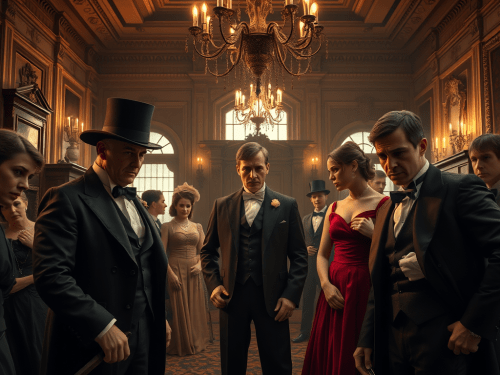
Much like the land crisis in Las Vegas, we could also run out of land to farm and will not be able to grow or cultivate our own food. We can protect American farmland and support American farmers by buying American made beef, poultry, dairy, and produce. Also, country of origin labeling is very important so Americans can know where their food is coming from and can support American farmers and ranchers. As money flows, it influences further investment. Save the land that sustains us by protecting American farmland. Once the land is built on, we lose it forever. And in the future, there may be food wars. Also, to ensure that we have farmland and buildable land for future use, we need to start limiting the number of people allowed to immigrate to America. Perhaps with the immigrants we do allow into America, there needs to be a diversity program to make sure we have a population that equally represents all races of people. If Americans continue to spend money on American products, then more need to be made to keep up the inventory. When investors notice these goods are selling, it gives them the confidence to pour more money into that local business. It shows that people want these goods made in America and pressures investors to keep these goods and services in America. The jobs stay here, the business stays in America, wages naturally increase, and more money is invested to keep up with demand. This reduces the burden on the taxpayer. When you support American businesses, that money stays in our economy and can help to reduce the national debt. The government creates debt by borrowing from businesses in the private sector or from foreign countries. It also increases the national debt by spending more than it gains in tax revenue in a fiscal year. #RandolphHarris 27 of 29

When people shop locally, more tax money stays in the economy and goes to the government. This way, it keeps more money in our national economy and keeps more jobs located in America which also sends more taxes to the government, which can again help to reduce the national debt. When you buy foreign goods, these companies usually have lighter tax loads or exemptions, meaning less money for the national debt, plus you are helping to strengthen these foreign nations by sending more money overseas. Buying American-made products is also better for the environment and helps to reduce the carbon footprint because these products do not have to travel nearly as far. Furthermore, American companies and manufacturers are held to much higher standards on pollution. American companies must be more careful about air, land, and water pollution and have proper ways to dispose of waste. Under President Trump’s administration, he has make America a priority. President Trump has closed the southern border, illegal crossings have fallen to an all time low, and are 90 percent lower than under the previous administration. Since President Trump’s crack down on crime, violent crimes in Washington D.C. have dropped by approximately 80 percent. He has stopped thousands of pounds of drugs from entering America and killing citizens. And since President Trump took office, investments in America have increased by trillions of dollars in U.S.A. manufacturing, production, and innovation. As you can see, President Donald Trump and his pledge to “Make America Great Again” is exactly what America needs to save the country and the American people. And yes, diversity is important, so you can see why it is also important to preserve blonde hair and blue eyes, as the people with these characteristics are becoming a minority in America. #RandolphHarris 28 of 29

We must think before we can understand the soul’s existence; we must understand before we can realize it. The earliest beginnings of thought, as apart from instinct, when it was itself still but a lurking tendency, belong far back in primeval time. The human intellect as we find it today, so rich and developed an instrument for the consciousness of the ego, did not arrive at this fullness without a series of graduated stages. We have had plenty of scientific thinking, business thinking, and political thinking long enough, but we have had very little inspired thinking. That is the world’s need. The intellect is cradled in selfishness but runs the evolutionary track into reason, where it will one day finish at the winning-post of selflessness. As a reminder, parents, please teach your children to love America and be patriotic citizens, and to buy goods and services made in America. It is also important to respect law and order and treat your elders with respect. It is inborn in the human mind to wish to know. If this begins with the endless surface questions of a child’s curiosity, if it continues into deeper questions of a scientist’s probing investigation, it cannot and does not stop there. For the higher part of the mind will eventually come into unfoldment, that union of abstract reflective thought with mystical intuition, which is true intelligence, which needs and sees a view of the whole of things. And so, the knowing faculty enters the realm of philosophy. Therefore, remember to take your education seriously so that you will be successful in life and make your family proud. Also, to make sure they have all the resources required, please donate to the Sacramento Fire Department to help improve our national security. “Oh, thus be it ever, when freemen shall stand between their loved home and the war’s desolation! Blest with victory and peace, may the heav’n-rescued land Praise the Power that hath made and preserved us a nation! Then conquer we must, when our cause is just, and this be our motto: ‘In God is our trust.’ And the star-spangled banner in triumph shall wave O’er the land of the free and the home of the brave.” #RandolphHarris 29 of 29


According to locals, over a century ago, the land that houses The Winchester Mansion had been vacant forever. Then, sometime in the early afternoon of Saturday, March 13, 1886, Sheriff Angel Camilio began getting reports that a massive castle made of wood had suddenly appeared. Gables rose, towers peaked into the sky as the mansion mushroomed into a labyrinth overnight. The house’s sudden manifestation had been both disconcerting and fascinating to the community. Some felt dark curses flowing from the estate, and things moving around in the darkness. Others saw a fairytale castle glimmering in the spring sunlight. Perhaps this is why there are no records of construction, no blueprints, and no permits filed with the county. And then one day, a hearse came tearing through the gates, and in that hearse was a coffin, some believed it contained Mrs. Winchester.

According to legend, when Sarah Lockwood Pardee (Winchester) married William Wirt Winchester in 1862, she enjoyed a life of extravagant luxury. William Winchester, President of the Winchester repeating rifle, became a very wealthy man through the sale of his guns, and the couple were among the elite New England society. She also told Mrs. Winchester they would kill her too, unless she moved out West and built a great house for the spirits. In addition, Mrs. Winchester was told construction on the house must never end in order to appease the spirits and keep her alive, perhaps even give her eternal life. Mrs. Winchester followed the medium’s suggestions, and in 1886, she moved to the Santa Clara valley just outside San Jose, where she bought an 18-room farmhouse and property to build her mansion. At its peak, the Mansion once stood 9-stories tall and had as many as 600-rooms. Today, the stately mansion is 4-storys, and over 100,000 square feet.

Experience an unforgettable journey back to the time of kings and queens with this entry ticket for The Winchester Mansion in Santa Clara, California, which was the residence of Heiress Sarah L. Winchester. Come and see what secrets this so-called, “Winchester Mystery House” may hold. Take advantage of this fascinating experience. After the tour, there will be time to enjoy the mansion’s splendor at your own pace. You might even discover secret passages that lead to hidden chambers within the mansion. These chambers served as safe places for valuables, precious documents, and as private sanctuaries for Mrs. Winchester, and allowed her to move stealthily throughout her home. At one time, there were even secret tunnels that extended beyond the mansion, leading to nearby Victorian houses that were also on the property, and other structures, creating a network of escape routes or hidden pathways.

Please come and enjoy a delicious meal at Sarah’s Café, stroll along the paths of the beautiful Victorian gardens, which once spanned 740 acres, all the way down to Stevens Creek Boulevard; wander through the miles of hallways in the world’s most mysterious mansion.

For further information about tours, including group tours, weddings, school events, birthday party packages, facility rentals, and special events please visit the website: https://winchestermysteryhouse.com/

Please visit the online giftshop, and purchase a gift for friends and relatives as well as a special memento of The Winchester Mystery House. A variety of souvenirs and gifts are available for purchase. https://shopwinchestermysteryhouse.com/
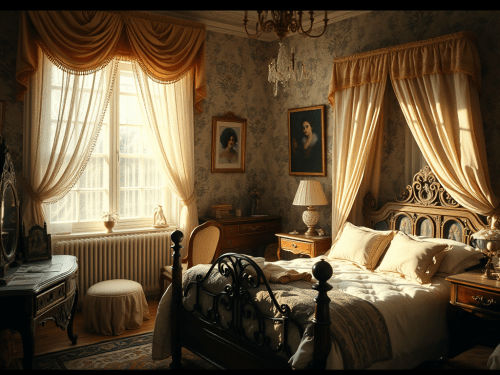

Harris Plumbing, Heating, Air, & Electric has been in business for 30 years. How many businesses can say that? We take pride in everything we do – no matter how big or small the service call might be. We’re here to help your home be as safe and comfortable as possible for you and your family. We take that responsibility very seriously as a company.

Harris will ensure you have the information you need to decide what to do next, whatever your home is facing. We’ll perform a diagnosis and detail what issues are present before starting any work. This gives you a personalized quote and service plan specific to your home’s needs, not some random quote based on the best guess. The only way we can do our best work is to make sure we handle the issues at hand. https://www.callharrisnow.com/about-us/


With its top ranking in Consumer Reports’ Auto Brand Report Card and consistent market share growth, BMW, The Ultimate Driving Experience, has demonstrated its ability to produce high-performing, reliable vehicles that meet consumer demands. BMW stands out due to its focus on driving dynamics and engineering excellence. While other luxury brands prioritize comfort and opulence, BMW is known for creating cars that are fun to drive and offer a unique connection between the driver and the machine. This is why BMW is known as The Ultimate Driving Machine. https://www.brianharrisbmw.com/

Randolph Harris San Francisco Taxation & Mergers
Building strong and lasting client relationships is crucial for a successful legal career. Many lawyers mistakenly believe that mastering legal skills alone ensures success, but law is fundamentally a service industry—our job is to solve problems through the time we sell. To build long-term relationships, attorneys must focus on three core elements: knowing their clients, understanding how their legal issues fit into a larger context, and consistently delivering exceptional service.

Randy advises clients with regard to business transition, taxable and tax-deferred mergers and acquisitions, joint ventures, restructuring, integrated tax planning, federal and state tax controversy resolution, and real estate transactions. Trust is the cornerstone of any client relationship. Ultimately, my clients feel they are in capable hands with someone who genuinely understands their problems and goals. https://www.jmbm.com/l-randolph-harris.html

Park Haven
Rancho Cordova, CA | low $500s
Now Selling!

Welcome to Cresleigh Park Haven, the newest home community in Rancho Cordova.

Nestled in the heart of Rancho Cordova, Park Haven is a thoughtfully planned neighborhood of 71 homes designed for comfort, convenience, and connection. Adjacent to Exploration Park, it offers the perfect blend of modern living and outdoor adventure right at your doorstep.

Choose from five floor plans ranging from 1,342 to 2,547 square feet, with options for 3 to 5 bedrooms, flexible spaces, and open layouts tailored to today’s lifestyles. Whether you are a first-time buyer, a growing family, or looking to simplify without giving up style, there is a home here for you.

Select Park Haven homes include free solar ownership, built in savings from day one. Enjoy the benefits of 100 percent owned solar at no extra cost, providing lasting energy efficiency, lower monthly expenses, and the confidence of full ownership.

With maintenance friendly yards, nearby shopping and dining, and access to top rated schools, Park Haven is more than just a place to live. It is a place to thrive.

All within a community rich in resort-style amenities and within the highly regarded Elk Grove School District.

Home sweet home. A Cresleigh Home is the place to find happiness. The light is what guides you here; the warmth is what keeps you here. https://cresleigh.com/park-haven/move-in-ready-homesite-22/


Grandmothers are Even More Powerful than Mothers
Language plays a great part in our life. Perhaps because of its familiarity, we rarely observe it, taking it rather for granted, as we do breathing or walking. The effects of language are remarkable, and include much of what distinguishes man from other terrestrial beings. Language originates in and has its primary reference to everyday life; it refers above all to the reality I experience in wide-awake consciousness, which is dominated by the pragmatic motive (that is, the cluster of meanings directly pertaining to present or future actions) and which I share with others in a taken-for-granted manner. Although language can also be employed to refer to other realities, it even then retains its rootage in the commonsense reality of everyday life. As a sign system, language has the quality of objectivity. I encounter language as a facticity external to myself and it is coercive in its effect on me. Language forces me into its patterns. I cannot use the rules of German syntax when I speak English; If I want to communicate outside the family, I cannot use word invented by my three-year-old son; even if I would prefer my “improper” ones, I must consider prevailing standards of proper speech for various occasions. Language also typifies experiences, allowing me to subsume them under broad categories in terms of which they have meaning not only to myself but also to my fellow men. As it typifies, it also anonymizes experiences, for the typified experience can, in principle, be duplicated by anyone falling into the category in question. #RandolphHarris 1 of 28

For instance, I have a quarrel with my mother-in-law. This concrete and subjectively unique experience is typified linguistically under the category of “mother-in-law trouble.” In this typification, it makes sense to myself, to others, and, presumably, to my mother-in-law. The same typification, however, entails anonymity. Not only I but anyone (more accurately, anyone in the category of son-in-law) can have “mother-in-law trouble.” In this way, my biographical experiences are ongoingly subsumed under general orders of meaning that are both objectively and subjectively real. Because of its capacity to transcend the “here and now,” language bridges different zones within the reality of everyday life and integrates them into a meaningful whole. The transcendences have spatial, temporal, and social dimensions. Through language, I can transcend the gap between my manipulatory zone and that of the other; I can synchronize my biographical time sequence with his; and I can converse with him about individuals and collectivities with whom we are not at present in face-to-face interaction. As a result of these transcendences language is capable of “making present” a variety of objects that are spatially, temporally, and socially absent from the “here and now.” Put simply, through language an entire world can be actualized at any moment. This transcending and integrating power of language is retained when I am not actually conversing with another. Through linguistic objectification, even when “talking to myself” in solitary thought, an entire world can be appresented to me at any moment. As far as social relations are concerned, language “makes me present” for me not only fellowmen who are physically absent at the moment, but fellowmen in the remembered or reconstructed past, as well as fellowmen projected as imaginary figures into the future. All these “presences” can be highly meaningful, of course, in the ongoing reality of everyday life. #RandolphHarris 2 of 28

Moreover, language is capable of transcending the reality of everyday life altogether. It can refer to experiences pertaining to finite provinces of meaning, and it can span discrete spheres of reality. For instance, I can interpret “the meaning” of a dream by integrating it linguistically within the order of everyday life. Such integration transposes the discrete reality of the dream into the reality of everyday life by making it an enclave within the latter. The dream is now meaningful in terms of the reality of everyday life rather than of its own discrete reality. Enclaves produced by such transposition belong, in a sense, to both spheres of reality. They are “located” in one reality, but “refer” to another. Any significative theme that thus spans spheres of reality may be defined as a symbol, and the linguistic mode by which such transcendence is achieved may be called symbolic language. On the level of symbolism, then, linguistic signification attains the maximum detachment from the “here and now” of everyday life, and language soars into regions that are not only de facto but a priori unavailable to everyday experience. Language now constructs immense edifices of symbolic representations that appear to tower over the reality of everyday life like gigantic presences from another world. Religion, philosophy, art, and science are the historically most important symbol systems of this kind. To name these is already to say that, despite the maximal detachment from everyday experience that the construction of these systems requires, they can be of very great importance indeed for the reality of everyday life. #RandolphHarris 3 of 28

Language is capable not only of constructing symbols that are highly abstracted from everyday experience, but also of “brining back” these symbols and appresenting them as objectively real elements in everyday life. In this manner, symbolism and symbolic language become essential constituents of the reality of everyday life and of the commonsense apprehension of this reality. I live in a world of signs and symbols every day. It can be fairly said that script analysts and their groups have more fun than anybody, even though they do refrain from laughing at the hanging or when someone gets his feet dirty. There are several kinds of laughs which are of interest in script analysis. “Heh Heh Heh” is the Parental chuckle of the witch mother or ogre father who is leading someone, usually his own offspring, down the primrose path of derision and defeat. “How much weight did you put on, heh heh heh?” (Sometimes written “ha ha.”) This is the scripty laugh. “Ha Ha Ha” is the Adult’s chuckle of rueful humor. As in Jeff’s case, it signifies a superficial insight. From his recent experiences, Jeff had learned not to trust ghost writers, but he had not learned much about himself and his own weaknesses, which would again and again lead him into similar traps until the final one was sprung. This is the gallows laugh. “He He He” is the Child’s laugh when he is going to pull a fast one. He is really getting into a game of “Let’s Pull a Fast One on Joey,” a true con game where he is enticed into thinking that he is going to fool somebody, but he himself ends up being the victim instead. For example, Jeff said “He He He!” when a ghost writer explained how they could pull a fast one on the English professor, but then Come to Find Out, Jeff ended up as the victim. This is the gamy laugh. #RandolphHarris 4 of 28

Healthy laughs. “Ho Ho Ho” is the Parent’s laugh at the Child’s struggle to succeed. It is patronizing, benevolent, and helpful, at least as far as the immediate problem is concerned. It usually comes from people who are not too heavily involved and can turn over the final responsibility to someone else. It demonstrates to the child that there are rewards for nonscripty behavior. This is the granddad or Santa Claus laugh. There is another kind of “Ha Ha Ha” which is much heartier and more meaningful. This signifies true insight on the part of the Adult as to how he has been conned, not by external figures, but by his own Parent and Child. It is similar to what psychologists call an “aha experience” (although I personally have never anyone except a psychologist say “aha” on such occasions). This is the laugh of insight. “Wow Wow” is the Child laugh of sheer fun or the belly laugh of older people who have bellies. It only comes to people who are script free or can put their scripts aside for the occasion. This is the spontaneous laugh of healthy people. Even if she herself was one, no one who has ever known his grandmother is an atheists, for all grandmothers, good or evil, are watching somewhere out there, usually on pass from Heaven. During group meetings (and often during poker games as well) she hovers in the corner of the room by the ceiling. If a patient’s Child does not have complete confidence in his Parent, in time of need, he usually feels that he can still trust grandmother, and he will gaze up at the ceiling in her direction to get protection and guidance from her invisible presence. #RandolphHarris 5 of 28
It should be remembered that grandmothers are even more powerful than mothers, although they may appear but seldom on the scene. However, when they do, they have the final say. This is well known to readers of fairy tales, where the old crone can put a blessing or a curse on the baby prince of princess, and the bad fairy or the fairy godmother cannot take it away, but can only tone it down. Thus, in “Sleeping Beauty” the old crone condemns the princess to die. The good fairy modifies this to sleeping for one hundred years. That is the best she can do, for as she says: “I have no power to undo entirely what my elder has done.” Thus grandmother, for good or evil, is the court of last appeal, and if the therapist succeeds in breaking the curse put on the patient by her mother, he still has grandmother to reckon with. A good therapist, therefore, must learn how to deal with antagonistic grandmothers as well as with mothers. In therapeutic situations, grandmothers always think they are right, and justified. The therapist must talk firmly to them: “Do you really want Zoe to be a failure?” If you tell them the truth, do you really think your complaint will be well received at Headquarters? The truth is that I am not seducing your granddaughter into bad ways, but I am actually giving her permission to be happy. Whatever you tell them, remember that psychiatrists come from Headquarters, too, and will also be heard there. Zoe cannot speak for herself against you, but I can speak for her.” In most cases, it is grandmother who decides which cards Jeder will get when he plays poker. If he keeps in good with her, her will certainly not lose, and will usually win. If he offends her by thought or deed, he is bound to lose. However, he must remember that the other players have grandmothers, too, and they may be just as powerful as his. In addition, they may be in better standing with their grandmothers than he is with his. #RandolphHarris 6 of 28

What, then, are the effects that alienation from self has on an individual’s personality and on his life? Offhand, it would seem difficult to say anything about the capacity to feel or the awareness of feelings that is valid for all neuroses. Some are overemotional in their joy, enthusiasm, or suffering; others appear to be cold, or at any rate hide behind a façade of impassivity; again, in others feelings seem to have lost their intensity and are dulled and flattened out. Despite endless variations, however, one characteristic seems to be pertinent for all neuroses of any severity. Awareness, strength, and kind of feelings are determined mainly by the pride system. Genuine feelings for self are dampened or diminished, sometimes to a vanishing point. In short, pride governs feelings. The neurotic is liable to play down those feelings which run counter to his particular pride and to overemphasize those which add to it. If in his arrogance, he feels vastly superior to others, he cannot allow himself to feel envy. His pride in asceticism may put a lid on feelings of enjoyment. If he is proud of his vindictiveness, vindictiveness is glorified and rationalized in terms of dealing out “justice,” he does not experience vindictive rage as such, although it is so freely expressed that nobody else has any doubt about it. Pride in absolute endurance may prohibit any feeling of suffering. However, if suffering plays an important part within the pride system—as a vehicle for expressing resentment and as a basis for neurotic claims—it is not only emphasized in front of others but actually felt more deeply. If it is regarded as a weakness, a feeling of compassion may be choked off, but if it is registered as a godlike attribute, it may be fully experienced. If pride is mainly focused on self-sufficiency, in the sense of not needing anything or anybody, then to own to any feelings or needs is like an “unbearable bowing down to go through a narrow gate…If I like anything, I might get dependent on it.” #RandolphHarris 7 of 28

Sometimes in analysis, we can observe directly how pride interferes with genuine feelings. A may respond in a spontaneously friendly way to a friendly approach of Z, although he usually resents Z, mainly on the grounds of injured pride. Then, a minute later, something in him says, “You are a fool to be taken in by friendliness.” So, the friendly feelings go by the board. Or a picture may awaken a warm, glowing enthusiasm in him. However, his pride mars it when he thinks so himself, “Nobody else can appreciate pictures as you do.” Up to this point, pride acts as a kind of censorship, encouraging or forbidding feelings to come to awareness. However, it may govern feelings in a still more basic way. The more pride has taken over, the more a person can respond emotionally to life only with his pride. It is as if he had shut away his real self in a soundproof room and could hear the voice of pride alone. His feeling satisfied or dissatisfied, dejected, or elated, his likes or dislikes of people, then, are mainly a suffering of his pride. This is not apparent on the surface. It feels convincingly real to him that he suffers from failures, from feelings of guilt, loneliness, and unrequited love. And he does indeed. However, the question is: who suffers? In analysis, it turns out that it is mainly his proud self. He suffers because he feels that he has failed to achieve supreme success, to do things to ultimate perfection, to be so irresistibly attractive as to be sought out always, to make everybody love him. Or, he suffers because he feels entitled to success, popularity, et cetera, which is not forthcoming. #RandolphHarris 8 of 28

Only when the pride system is considerably undermined does he begin to feel true suffering. Only then can he feel sympathy for this suffering self of his, a sympathy that can move him to do something constructive for himself. The self-pity he felt before was rather a maudlin writhing of the proud self for feeling abused. He who has not experienced the difference may shrug his shoulders and think that it is irrelevant—that suffering is suffering. However, it is true suffering alone that has the power to broaden and deepen our range of feelings and to open our hearts for the suffering of others. In Dr Profundis Oscar Wilde has described the liberation he felt when, instead of suffering from injured vanity, he started to experience true suffering. Sometimes the neurotic can experience even his pride responses only through others. He may not feel humiliated by the arrogance or the neglect of a friend, but he feels ashamed at the thought that his brother or his colleagues would regard it as a humiliation. There are, of course, variations in the degree to which pride governs feelings. Even a neurotic who is severely cripped emotionally may have certain feelings which are strong and sincere, such as feelings for nature or for music. These, then, are not touched by his neurosis. One might say that his real self is allowed this much freedom. Or, even though his likes and dislikes are mainly determined by his pride, genuine elements also may be present. Nevertheless, as a result of these trends, there is in neurosis a general impoverishment of the emotional life showing in a diminished sincerity, spontaneity, and depth of feelings, or at least in a restricted range of possible feelings. #RandolphHarris 9 of 28

A clinician’s training permits, and in fact forces him to recognize major trends even where the facts are not all available; at any point in a treatment, he can and must be able to make meaningful predictions as to what will prove to have happened; and he must be able to sift even questionable sources in such a way that a coherent predictive hypothesis emerges. The proof of the validity of this approach lies in everyday psychoanalytic work, in the way that a whole episode, whole life period, or even of a whole life trend is gradually clarified in therapeutic crises leading to decisive advances or setbacks sufficiently circumscribed to suggest future strategies. In biography, the validity of any relevant theme can only lie in its crucial recurrence in a man’s development, and in its relevance to the balance sheet of his victories and defeats. A long time ago, in Germany, older sons had to yield a paternal from to the youngest brother; and older son could either become the youngest brother’s sharecropper, marry into another farm, or leave and seek work elsewhere. Cultural evolution, although long an unfashionable concept, has commanded renewed interest in the last two decades. Growth and change in a particular locality result from adopting elements from other cultures through contacts. If a culture is isolated, change takes place very slowly indeed. However, if lines of communication are opened between a hitherto isolated culture and various other different cultures, changes will occur because of cultural diffusion. #RandolphHarris 10 of 28

Psychoanalysis realized early that all memories must pass through a number of screens; because of these screens, earlier years appear in a haze which distorts form and modifies color. The period of language development forms one screen; going to school (the post-oedipal period) another. To these we must add the period of the completion of identity development at adolescence, which results in a massive glorification of some of the individual’s constituent elements, and repudiation of others. In the life of a man, another screen is strongly suggested: the beginning of an official identity, the moment when life suddenly becomes biography. In work with veterans discharged from the armed forces as psychoneurotic before the end of hostilities, we became familiar with the recurring symptoms of partial loss of ego synthesis. Many of these men, indeed, regressed to the “stage of unlearned function.” The boundaries of their egos had lost their shock-absorbing delineation. Anxiety and anger were provoked by anything too sudden or too intense, a sudden sensory impression from outside, an impulse, or a memory. A constantly “startled: sensory system was attacked by external stimuli as well as by somatic sensations: heat flashes, palpitation, cutting headaches. Insomnia hindered the nightly restoration of sensory screening by sleep and that of emotional rebinding by dreaming. Amnesia, neurotic pseudologia, and confusion showed the partial loss of time-binding and of spatial orientation. As if the ego could not even accomplish an organized neurosis, what definable symptoms and remnants of “peacetime neuroses” there were had a fragmentary and false quality. #RandolphHarris 11 of 28

In some cases, this ego impairment seemed to have had its origin in violent events, in others in the gradual grind of a million annoyances. Obviously, the men were worn out by too many changes, in too many respects at once. Somatic tension and social panic and ego anxiety were always present. Above all, the men felt that they “did not know any more who they were”: there was a distinct loss of ego identity. The sense of sameness and continuity and the belief in one’s social role were gone. In this field of clinical observation, I first found the assumption of a central loss of s sense of identity both inescapable and immediately clarifying. A sense of identity was most enhanced in the armed forced among the recipients of promising commissions and members of teams in highly mechanized units. Yet, men whose ego identity did thrive in miliary service sometimes broke down after discharge, when it appeared that the war had provoked them into more ambitious self-images than their more restricted peacetime identities could afford to sustain. For many others, however, the restraint and discipline of army life itself provided dew ideal prototypes. For the American group identity supports an individual’s ego identity as long as he can preserve a certain element of deliberate tentativeness, as long as he can convince himself that the next step is up to him and that no matter where he is staying or going, he always has the choice of leaving or turning in the opposite direction. In this country, the migrant does not want to be told to move on nor the sedentary man to stay where he is, for the lifestyle of each contains the opposite element as an alternative which he wishes to consider for his most private and individual decisions. To quite a few soldiers, then, the military identity represented the despicable prototype of the sucker, of one who lets himself be sidetracked and stalled while others are free to pursue what could have been his chance and his girl. However, in America, to be a sucker means to be a social and sexual castrate. If you are a sucker, not even a mother’s pity will be with you. #RandolphHarris 12 of 28

In the often-profuse utterances of psychoneurotic veterans’ memories and anticipations, consistently reappeared which permitted them to blame circumstances for their failures as soldiers and as men, and thus helped them to deny a sense of personal inferiority. Their ego identities had fallen apart into bodily, sexual, social, occupational fragments, each having to overcome again the danger of its evil prototype. Their traumatized egos fought and fled from such images as the crying baby, the menstruating female, the stifled African American, the sexual sissy, the economic sucker, the mental moron—all prototypes the mere allusion to which could bring these men close to homicidal or suicidal rage, followed by varying degrees of irritability or apathy. Their exaggerated attempts to blame their dilemma on circumstances and individuals gave their childhood histories a more sordid character and themselves the appearance of more malignant psychopathy than was clinically justified. And an exaggerated diagnosis, once entered into the record, can only aggravate vicious cycles of blame and self-blame. If the clinical investigation focused on the patient’s shattered life plan, and if advice tended to strengthen the resynthesis of the elements on which the patient’s ego identity was based, only then could rehabilitation work become effective and economical. In addition to the several hundred thousand men who lost and only gradually or partially regained their ego identity in the war, and the tens of thousands whose acute loss of ego identity was falsely diagnosed and treated as psychopathy, an untold number experienced to the core the threat of a traumatic loss of ego identity as a result of radical historical change. #RandolphHarris 13 of 28

The fact, however, that these men, their physicians, and their contemporaries in increasing numbers turned to the bitter truths of psychoanalytic psychiatry is in itself a historical development which calls for critical appraisal. It expresses an increased acceptance of psychoanalytic insights insofar as they concern the meaning of anxiety and disease in the individual case history. Yet, this partial acceptance of painful unconscious determinants of human failure and this emphasis on individual treatment, even where the patient seemed anything but introspective and verbal, can also be seen as a widespread resistance against the awareness of a failure of social mechanisms under radically changing historical determinants. Historical change has reached a coercive universality and a global acceleration which is experienced as a threat to the traditional American identity. It seems to devaluate the vigorous conviction that this nation can afford mistakes; that this nation, by definition, is always so far ahead of the rest of the world in inexhaustible reserves, in vision of planning, in freedom of action, and in tempo of progress that there are unlimited space and endless time in which to develop, test, and complete her social experiments. The difficulties met in the attempt to integrate this old image of insulated spaciousness with the new image of explosive global closeness are deeply disquieting. They are characteristically first met with the application of traditional methods to a new space-time. #RandolphHarris 14 of 28

The psychotherapist, in disregarding the contribution of such developments to neurotic discomfort, is apt not only to miss much of the specific dynamics in contemporary life cycles; he is apt also to deflect individual energy from the collective tasks at hand. A large-scale decrease of mental discomfort can be envisaged only by equal clinical attention to conditions as well as to cases, to the emerging design for the future as well as to the fixation on the past, to the unsafe surface and to the grumbling depths. In this connection, it is worth noting that the popular use of the word “ego” in this country has, of course, little to do with the psychoanalytic concept of the same name; it commonly denotes unqualified, if perhaps unjustified, self-esteem. Bolstering, bantering, boisterousness, and other “ego-inflating” behavior is, of course, part of the American folkways. As such, it pervades speech and gesture and enters into all interpersonal relations. Without it, a therapeutic relationship in this country would remain outlandish and nonspecific. Another problem altogether is the systematic exploitation of the national practice of “bolstering” for the sake of making people “feel better,” or of submerging their anxiety and tension so as to make them function better. A weak ego does not gain substantial strength from being persistently bolstered. A strong ego, secured in its identity by a strong society, does not need and in fact is immune to any deliberate attempt at artificial inflation. Its tendency is toward the testing of what feels real, the mastery of that which works, the understanding of that which proves necessary, the enjoyment of the vital, and the overcoming of the morbid. At the same time, it tends towards the creation of a strong mutual reinforcement with others in a group ego, which will transmit its purpose to the next generation. #RandolphHarris 15 of 28

The effectiveness of the psychoanalytic contribution to this development is guaranteed solely by the persistent humanist intention, beyond the mere adjustment of patients to limiting conditions, to apply clinical experience to the end of making man aware of human potentialities which are clouded by archaic fear. However, there are also the historical determinants of psychoanalytic concept formation, and more: if in the field of human motivation, the same terms have been used over a period of over a century, they cannot but reflect the ideologies of their day of origin and absorb the connotations of contemporary social changes. Ideological connotation is the inevitable historical equations in the use of conceptual tools which concerns the ego, man’s organ of reality testing. Persons may defend themselves against unwanted thoughts, feelings, and wishes, first by repressing them and then by compulsively thinking and striving to feel the opposite. It is as if it were not sufficient for them to free themselves of the threat by merely eliminating the unwanted thoughts and feelings from the mind. They can only convince themselves (and others?) that they are not that kind of person if and only if, they display the opposite kinds of behavior in the extreme degree. Reaction formation reveals itself through the compulsive and exaggerated nature of the behavior and attitudes that the person manifests; yet, the repressed aspects of the real self may still leak out. #RandolphHarris 16 of 28

Thus, a compulsively generous person may betray repressed egocentricity and selfishness by giving gifts that the receiver does not like or cannot use, such as giving S.T. Dupont Ligne 2 Haute Creation cigarette lighter as a gift to nonsmokers and The Macallan “The Reach” 81-Year-Old Single Malt Scotch Whisky to teetotalers. The person who is compulsively kind to animals betrays underlying sadism by the brutality with which invective is leveled against those who experiment with animals. The devoted, overprotective parents keeps the child from grown by exaggerated overconcern with his or her health and safety. The guilty, philandering husband showers his wife with lavish gifts and with surprising and unusual tenderness and solicitude. The woman with repressed dependency strivings displays exaggerated self-reliance until she gets sick, when she becomes a virtual baby. In striving to master their earthly surroundings, people must learn to do nothing wrong. Materialism must begin and grow, as the moral, the metaphysical-intuitive, and the religious points of view are submerged and misplaced. As the intellect is analyzing this experience, judging it by science’s light and with science’s critical rigor, the subtle essence must not be lost. Even with all our scientific knowledge and technical skills, we know little of our subconscious self, less of our spiritual self, and we are unable to control thoughts, and even less able to concentrate attention, and this also must be improved upon. #RandolphHarris 17 of 28

If you see a fire truck stopped in the street without the lights on, be very careful. Sometimes there is an emergency, and you should not pass the fire truck. It might be a good idea to safely turn around and go another way because if you hit someone and they happen to die, you could be charged with manslaughter. Sometimes fire firefighters are getting back into their vehicle, and if you pass the apparatus, you may collide with a firefighter who is on foot. Also, be sure to look at their signals; sometimes emergency vehicles are in motion, albeit slowly, and drivers try to pass them, and this could lead to a dangerous situation. Also, if you are in an intersection when you see an emergency vehicle, continue through the intersection. Drive to the right as soon as it is safe and stop. Obey any direction, order, or signal given by a law enforcement officer or a firefighter. Even if they conflict with existing signs, signals, or laws, follow their orders. When their siren or flashing lights are on, it is against the law to follow within 300 feet of any fire engine, law enforcement vehicle, ambulance, or other emergency vehicle. If you drive to the scene of a fire, collision, or other disaster, you can be arrested. When you do this, you are getting in the way of firefighters, ambulance crews, or other rescue and emergency personnel. The concept of professional courage does not always mean being as tough as nails, either. It also suggests a willingness to listen to other people’s problems, to go to bat for them in a tough situation, and it means knowing just how far they can go. It also means being willing to tell the boss when he or she is wrong. #RandolphHarris 18 of 28
California is the third most expensive state in the nation. In 37 percent of counties, a family of four living on a six-figure income is now considered low-income. The average home price in California is nearly $1,000,000.00 USD, while the average salary is $96,036.00, meaning that most Californians cannot even afford to buy a home. California is having an affordability crisis. A single person making an income above $100,000 is now considered low-income in five counties in California. This distinction now applies to individuals living in Santa Cruz, Santa Clara, San Mateo, San Francisco, and Marin counties. The maximum percentage of your gross income that you should earmark for a monthly mortgage payment is calculated at 28 percent, and no more than 36 percent of your gross income to all debts, including mortgage. If you take 28 percent of the median household income per home in Sacramento County, homeowners can only afford a mortgage of $2,070.23 per month. And if you take 36 percent of their gross income to all debts, including mortgage, they should be devoting no more than $2,661.72 a month to these debts. The mortgage lenders must be using some kind of sorcery to get buyers into these expensive homes. To afford one of these homes using traditional guidelines, a household would need to gross $11,280.24 per month or $135,362.88 per year, but the median household in Sacramento County is grossing $7,393.67 a month or $88,724.00 annually, and that typically means two to four people in the home are working and contributing to the mortgage. Home prices in Sacramento County are rivaling the Bay Area, and in some cases, homes in the Bay Area are more affordable. Historically, homes in the Bay Area have been more expensive because they have higher-paying jobs, a larger population, and the Bay Area is a tourist destination. Contributing to the housing affordability crisis is Gavin Newsom, who has been lavishing illegal immigrants with taxpayer-funded resources and cash aid, when state workers should be receiving a 25 percent wage increase instead. #RandolphHarris 19 of 28

In 2025, many people in California saw their bills increase by an estimated $500 a month. This includes items such as food, automobile insurance, homeowners’ insurance, and electricity. In fact, more than 3 million people in California are facing household hardship, and more than 300,000 of them are facing eviction soon. This comes at a time when California is having a shortage of affordable housing. The crisis is caused by nearly half a century-old laws that discourage home sales and encourage higher rents. The incompetence in California is very easy to see. From 2018 to 2023, California received $24 billion, which they used to fund 30 homeless and housing programs. These programs created 100,000 units. That is an average cost of $240,000 per unit. In comparison, Roger Lucas, owner of Grand Castle, LLC, spent $50 million to build The Grand Castle, which is a 522-unit residential apartment community in Grandville, Michigan. The community includes studios, 1 bedroom, 2 bedrooms, 3 bedrooms, and even a multi-level penthouse. Rents generally range from $1,000 to $2,500. The community is a 23.6-acre site. It features 750 covered parking spaces, a clubhouse, a resort-style swimming pool, and was built over a period of 12 to 18 months. The average cost was about $95,785.45 per unit, which is $144,214.55 less per unit than California spent. California also has the highest unemployment rate in the country at 5.4 percent, while the national average is 4.5 percent. As people are seeing their bills skyrocket, and minimum wage has increased to $20 an hour, people on Social Security retirement are really bearing the burden with the checks the typically equate to $5-$7 an hour. Furthermore, while Americans are struggling to find and afford housing, Gavin Newsom, Democrat governor of California, signed two bills into law on February 7, 2025, to protect illegal immigrants. Bills SBX 1 1: Budget Act of 2024, and SBX 1 2: Budget Act of 2024, allocates $50 million to protect illegal immigrants from deportation. Governor Gavin Newsom also granted 700,000 illegal immigrants free health care, which costs taxpayers $3 billion annually. At the same time, Newsom cut vital programs for veterans, school children, the disabled, and the homeless. The California crisis created by Democrats is driving up home prices and mortgages, and rents all over the nation and the world, making living unaffordable for all, and advocates say the crisis is far from over. #RandolphHarris 20 of 28

Meanwhile, China, where we are sending all our jobs and money, has more than 50 ghost cities, with 65 million vacant homes. Ghost cities are regions where housing has been overdeveloped to the point that these places are uninhabited. If they are all officially counted, California has approximately 4 million homeless people. The highest home prices in the nation, the highest taxes, and the most unfriendly business regulations known to man. Because California is so hostile towards people and businesses, more than 360 companies have fled the state since 2020. Businesses like Chevron, SpaceX, Oracle, and Hewlett-Packard are among the names on that list. Also, more than 500,000 people a year are abandoning California because it is too expensive to live in, Gavin Newsom has criminalized homelessness and actually started arresting people without homes, crime is out of control, and they are losing their jobs due to companies relocating. More than 100 companies have announced layoffs in California for 2025. Intel is cutting 15,000 jobs, PayPal is cutting 2,500, and Meta has terminated 4,000 employees. California also has the highest unemployment rate in the country at 5.4 percent, while the national average is 4.1 percent. The California crisis created by Democrats is driving up home prices and mortgages, and rents all over the nation and the world, making living unaffordable for all, and advocates say the crisis is far from over. Accordingly, California has more than 3.5 million illegal immigrants. Having the Southern American border open and not having American farmland protected, not producing beef, poultry, fish, fruit, produce, and dairy in America, and without American goods and services being our number one manufactured and selling items, America has created a dangerous and significantly elevated risk to national security, national economic security, and national public health. Some people may believe that these claims are overstated, but by not routinely monitoring Common Vulnerabilities and Exposures (CEVs) or other security-relevant alerts, such as the end-of-life of machinery is how the Oroville Dam Crisis occurred in 2017. #RandolphHarris 21 of 28

Additionally, Democratic Governor Gavin Newsom seems to be uneducated about economics. Newsom has spent $1 billion taxpayer dollars renovating the State Capitol building and $300 million to try to stop proposition 50. Proposition 50 would replace the maps drawn by the state’s independent commission with districts drawn by legislators solely to gain or protect Democratic seats. Newsom only cares about the environment when his policies allow him to raise taxes and restrict freedoms. To further highlight this illustration of incompetence by Governor Gavin Newsom, Mexico has been causing one of America’s worst environmental disasters. Fifty million gallons a day of industrial chemicals, untreated sewage, and trash flow from Tijuana, Mexico, into southern San Diego County daily. This toxic waste has been turning up on Imperial Beach and is causing the miles of white sands to become polluted and the ocean breeze to smell of feces, which has been sickening residents and wildlife and costing San Diego millions in the form of lost tourism and health problems. The problem has been going on for more than a century, and by 2030, Mexico plans to dump one hundred and twenty million gallons of sewage a day into Imperial Beach. Other crises that have occurred due to neglect of critical infrastructure such as the 2025 Palisades fire. Southern California ran out of water because Newsom is totally neglecting the state and the American people. And while the fire departments in California are critically understaffed and underfunded, Governor Newsom vetoed firefighter pay raise. The Palisades fire cost $275 billion, which is money that could have been used to insure the State of California had the resources it needed. Furthermore, when Southern California is located next to an ocean, Newsom should have invested in desalination plants to help with the water shortage in California. The water in the ocean is so plentiful that it is currently eroding land and causing homes to fall into the sea. Desalination has been identified as one technology that will help solve California’s water scarcity problem. Desalination is a cost-effective technology that can transform an abundance of salt water into a reliable supply of potable, fresh water, which is a great way to fight climate change and have enough water for our region’s water requirements. Ras Al Khair, Saudi Arabia, is producing 1,036,000 meters (273,682,192) per day of desalinated water. #RandolphHarris 22 of 28

America needs an approach to eliminate safety vulnerabilities in American cities. There needs to be a road map by the end of 2025, outlining a prioritized approach to eliminate crisis situations in America. There is enough money to send aid to foreign nations, but the American government does not have enough money to care for its infrastructure, provide adequate resources, or end the affordable housing crisis. Nor is there enough money to fund other national critical functions (NCFs). These bad practices of putting America and Americans last are considered exceptionally risky, particularly to national security, national economic security, and national public health and safety. In 2024, Americans spent $100 billion on Japanese cars. As a result, the American automobile trade deficit with Japan was $39 billion. Additionally, Japan exported 1.4 million cars to the United States of America, but only imported 16,000 American-built automobiles. However, Japan imported approximately 143 thousand motor vehicles from the European Union. This is why President Trump created tariffs. We need to balance the trade deficit that America faces with other nations so we are not taken advantage of and so America can go bank to being a creditor nation, instead of borrowing money for other countries. Each year, President Trump is bringing $400 Billion in Tariff revenue into America and hundreds of thousands of new jobs. With this money, America is paying down debt, and with a portion of it, President Trump plans to send Americans a stimulus check anywhere in the range of $1,000 to $2,000. However, if President Trump’s Tariffs are deemed illegal by the Supreme Court, taxpayers will have to pay back trillions and trillions of dollars. As we literally and /or figuratively see gangs, federal judges, and Governor Gavin Newsom fighting with federal law enforcement and President Trump– states and cities refusing to honor federal laws. Politicians are also showing an utter disregard for the Constitution of the United States of America, and anarchy is becoming increasingly common. #RandolphHarris 23 of 28

Anarchism is a cluster of doctrines and attitudes centered on the belief that government is both harmful and unnecessary. Derived from the Greek root anarchos, meaning “without authority,” anarchism, anarchist, and anarchy are used to express both approval and disapproval. The anarchist denies man-made laws, regards property as a means of tyranny, and believes that crimes are merely the product of property and authority. However, the anarchist would argue that their denial of constitutions and governments leads not to “no justice” but to the real justice inherent in the free development of human sociality—the natural inclination, when unfettered by laws, to live according to the principles and practice of mutual aid. Anarchism is also a form of treason. Treason, the crime of betraying a nation or a sovereign by acts considered dangerous to security. In English law, treason includes the levying of war against the government and the giving of aid and comfort to the monarch’s enemies. In the United States of America, treason was defined restrictively by the framers of the Constitution. Treason against the United States of America “shall consist only in levying War against them, or in adhering to their Enemies, giving them aid and comfort,” which is something that many politicians are currently guilty of. The American government should know all exploitable vulnerabilities and fix them before the situation becomes a crisis. Failure to take such mitigating actions is dangerous and significantly elevates risk to national security, national economic security, and national public health and safety. The American government must understand that significant time and resources must be invested in America. They must also encourage corporations to plan for both mitigating safety vulnerabilities in the short term and eliminating them in the long term. For instance, a company might begin by reaching out to the federal, state, or local government and requesting tax incentives to provide security to dangerous communities, to help the government repair bridges and potholes. #RandolphHarris 24 of 28

Drug cartels have been threatening the health and safety of Native American communities. The trafficking of dangerous and illegal drugs into their territories is leading to a second genocide. The overdose rate for Indigenous people is 42 percent higher than the national average. A recent bust on Montana’s Blackfeet Nation’s Tribal Reservation resulted in the seizure of more than 700,000 fentanyl pills, which was the largest bust in Montana history. Recently, the Blackfeet Nation had to declare a state of emergency after facing 17 overdoses in just one week. There are only 6.8 million Native Americans left in the world, which is 2 percent of the American population. We should be doing more to protect these proud and honorable people; they should not want for anything. People rush and give away resources to illegal immigrants, but totally disregard the Indigenous people of this land, as their race silently fades away into extinction. We must secure our borders and increase federal funding to Native American tribes so we can save this precious population. Meanwhile, Gavin Newsom has given billions of taxpayer dollars away to illegal immigrants and protected them from law enforcement, while arresting law-abiding Americans because they cannot afford to pay rent or mortgage, and the homeless shelters are unsafe, overcrowded, and have restrictions on who is allowed inside. He has also totally ignored the cartel problems on American lands. Clean air, water, land, and preserving our heritage are extremely important. We cannot just allow criminals to kill off the people who are native to this land and do nothing about it. Wars have been started over governments that tax citizens without representation. Taxation without representation is what led to the American Revolution. #RandolphHarris 25 of 28

Much like the land crisis in Las Vegas, we could also run out of land to farm and will not be able to grow or cultivate our own food. We can protect American farmland and support American farmers by buying American made beef, poultry, dairy, and produce. Also, country of origin labeling is very important so Americans can know where their food is coming from and can support American farmers and ranchers. As money flows, it influences further investment. Save the land that sustains us by protecting American farmland. Once the land is built on, we lose it forever. And in the future, there may be food wars. Also, to ensure that we have farmland and buildable land for future use, we need to start limiting the number of people allowed to immigrate to America. Perhaps with the immigrants we do allow into America, there needs to be a diversity program to make sure we have a population that equally represents all races of people. If Americans continue to spend money on American products, then more need to be made to keep up the inventory. When investors notice these goods are selling, it gives them the confidence to pour more money into that local business. It shows that people want these goods made in America and pressures investors to keep these goods and services in America. The jobs stay here, the business stays in America, wages naturally increase, and more money is invested to keep up with demand. This reduces the burden on the taxpayer. When you support American businesses, that money stays in our economy and can help to reduce the national debt. The government creates debt by borrowing from businesses in the private sector or from foreign countries. It also increases the national debt by spending more than it gains in tax revenue in a fiscal year. #RandolphHarris 26 of 28

When people shop locally, more tax money stays in the economy and goes to the government. This way, it keeps more money in our national economy and keeps more jobs located in America which also sends more taxes to the government, which can again help to reduce the national debt. When you buy foreign goods, these companies usually have lighter tax loads or exemptions, meaning less money for the national debt, plus you are helping to strengthen these foreign nations by sending more money overseas. Buying American-made products is also better for the environment and helps to reduce the carbon footprint because these products do not have to travel nearly as far. Furthermore, American companies and manufacturers are held to much higher standards on pollution. American companies must be more careful about air, land, and water pollution and have proper ways to dispose of waste. Under President Trump’s administration, he has make America a priority. President Trump has closed the southern border, illegal crossings have fallen to an all time low, and are 90 percent lower than under the previous administration. Since President Trump’s crack down on crime, violent crimes in Washington D.C. have dropped by approximately 80 percent. He has stopped thousands of pounds of drugs from entering America and killing citizens. And since President Trump took office, investments in America have increased by trillions of dollars in U.S.A. manufacturing, production, and innovation. As you can see, President Donald Trump and his pledge to “Make America Great Again” is exactly what America needs to save the country and the American people. And yes, diversity is important, so you can see why it is also important to preserve blonde hair and blue eyes, as the people with these characteristics are becoming a minority in America. #RandolphHarris 27 of 28
We must think before we can understand the soul’s existence; we must understand before we can realize it. The earliest beginnings of thought, as apart from instinct, when it was itself still but a lurking tendency, belong far back in primeval time. The human intellect as we find it today, so rich and developed an instrument for the consciousness of the ego, did not arrive at this fullness without a series of graduated stages. We have had plenty of scientific thinking, business thinking, and political thinking long enough, but we have had very little inspired thinking. That is the world’s need. The intellect is cradled in selfishness but runs the evolutionary track into reason, where it will one day finish at the winning-post of selflessness. As a reminder, parents, please teach your children to love America and be patriotic citizens, and to buy goods and services made in America. It is also important to respect law and order and treat your elders with respect. It is inborn in the human mind to wish to know. If this begins with the endless surface questions of a child’s curiosity, if it continues into deeper questions of a scientist’s probing investigation, it cannot and does not stop there. For the higher part of the mind will eventually come into unfoldment, that union of abstract reflective thought with mystical intuition, which is true intelligence, which needs and sees a view of the whole of things. And so, the knowing faculty enters the realm of philosophy. Therefore, remember to take your education seriously so that you will be successful in life and make your family proud. Also, to make sure they have all the resources required, please donate to the Sacramento Fire Department to help improve our national security. “Oh, thus be it ever, when freemen shall stand between their loved home and the war’s desolation! Blest with victory and peace, may the heav’n-rescued land Praise the Power that hath made and preserved us a nation! Then conquer we must, when our cause is just, and this be our motto: ‘In God is our trust.’ And the star-spangled banner in triumph shall wave O’er the land of the free and the home of the brave.” #RandolphHarris 28 of 28

101 years ago, famed magician Harry Houdini was invited to the Winchester Mystery House by a tour guide who admired his magic. Mr. Houdini accepted the invitation and visited on a late-night private tour, exploring the mansion’s twisting halls, as shadows lurked and snarled at the edge of light. Despite the cold, Mr. Houdini could not stop perspiring. As he walked toward the bedroom Mrs. Winchester said her good-bye in, he pushed open the door. He stood frozen for the space of one deep, shuddering breath. Hanging from the light fixture, head titled as if questioning, was a woman dressed in a maid’s uniform. Mr. Houdini picked up the fallen chair and set it aside. He reached out to touch her, hesitated, then changed his mind.

Her neck and lips were a deep blue. The maid opened her eyes. She looked at him wordlessly. She reached up her hands to loosen the noose, slipped out of it, dropped and vanished into the floor. His throat felt caked with dust and his stomach was an empty, aching pit. The impressions of what he had seen filtered into his consciousness, and caused him to wonder, “How long have I been in the mansion? Days? Weeks? Surely not weeks;” he thought, “I would have died of thirst by now.” He did not have much energy left. Mr. Houdini left with more questions than answers.
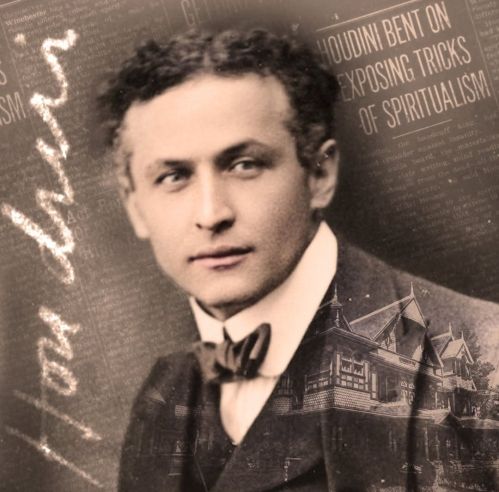
According to locals, over a century ago, the land that houses The Winchester Mansion had been vacant forever. Then, sometime in the early afternoon of Saturday, March 13, 1886, Sheriff Angel Camilio began getting reports that a massive castle made of wood had suddenly appeared. Gables rose, towers peaked into the sky as the mansion mushroomed into a labyrinth overnight. The house’s sudden manifestation had been both disconcerting and fascinating to the community. Some felt dark curses flowing from the estate, and things moving around in the darkness. Others saw a fairytale castle glimmering in the spring sunlight. Perhaps this is why there are no records of construction, no blueprints, and no permits filed with the county. And then one day, a hearse came tearing through the gates, and in that hearse was a coffin, some believed it contained Mrs. Winchester.

According to legend, when Sarah Lockwood Pardee (Winchester) married William Wirt Winchester in 1862, she enjoyed a life of extravagant luxury. William Winchester, President of the Winchester repeating rifle, became a very wealthy man through the sale of his guns, and the couple were among the elite New England society. She also told Mrs. Winchester they would kill her too, unless she moved out West and built a great house for the spirits. In addition, Mrs. Winchester was told construction on the house must never end in order to appease the spirits and keep her alive, perhaps even give her eternal life. Mrs. Winchester followed the medium’s suggestions, and in 1886, she moved to the Santa Clara valley just outside San Jose, where she bought an 18-room farmhouse and property to build her mansion. At its peak, the Mansion once stood 9-stories tall and had as many as 600-rooms. Today, the stately mansion is 4-storys, and over 100,000 square feet.

Experience an unforgettable journey back to the time of kings and queens with this entry ticket for The Winchester Mansion in Santa Clara, California, which was the residence of Heiress Sarah L. Winchester. Come and see what secrets this so-called, “Winchester Mystery House” may hold. Take advantage of this fascinating experience. After the tour, there will be time to enjoy the mansion’s splendor at your own pace. You might even discover secret passages that lead to hidden chambers within the mansion. These chambers served as safe places for valuables, precious documents, and as private sanctuaries for Mrs. Winchester, and allowed her to move stealthily throughout her home. At one time, there were even secret tunnels that extended beyond the mansion, leading to nearby Victorian houses that were also on the property, and other structures, creating a network of escape routes or hidden pathways.

Please come and enjoy a delicious meal at Sarah’s Café, stroll along the paths of the beautiful Victorian gardens, which once spanned 740 acres, all the way down to Stevens Creek Boulevard; wander through the miles of hallways in the world’s most mysterious mansion.

For further information about tours, including group tours, weddings, school events, birthday party packages, facility rentals, and special events please visit the website: https://winchestermysteryhouse.com/

Please visit the online giftshop, and purchase a gift for friends and relatives as well as a special memento of The Winchester Mystery House. A variety of souvenirs and gifts are available for purchase. https://shopwinchestermysteryhouse.com/

Harris Plumbing, Heating, Air, & Electric has been in business for 30 years. How many businesses can say that? We take pride in everything we do – no matter how big or small the service call might be. We’re here to help your home be as safe and comfortable as possible for you and your family. We take that responsibility very seriously as a company.
Harris will ensure you have the information you need to decide what to do next, whatever your home is facing. We’ll perform a diagnosis and detail what issues are present before starting any work. This gives you a personalized quote and service plan specific to your home’s needs, not some random quote based on the best guess. The only way we can do our best work is to make sure we handle the issues at hand. https://www.callharrisnow.com/about-us/
With its top ranking in Consumer Reports’ Auto Brand Report Card and consistent market share growth, BMW, The Ultimate Driving Experience, has demonstrated its ability to produce high-performing, reliable vehicles that meet consumer demands. BMW stands out due to its focus on driving dynamics and engineering excellence. While other luxury brands prioritize comfort and opulence, BMW is known for creating cars that are fun to drive and offer a unique connection between the driver and the machine. This is why BMW is known as The Ultimate Driving Machine. https://www.brianharrisbmw.com/

Randolph Harris San Francisco Taxation & Mergers
Building strong and lasting client relationships is crucial for a successful legal career. Many lawyers mistakenly believe that mastering legal skills alone ensures success, but law is fundamentally a service industry—our job is to solve problems through the time we sell. To build long-term relationships, attorneys must focus on three core elements: knowing their clients, understanding how their legal issues fit into a larger context, and consistently delivering exceptional service.
Randy advises clients with regard to business transition, taxable and tax-deferred mergers and acquisitions, joint ventures, restructuring, integrated tax planning, federal and state tax controversy resolution, and real estate transactions. Trust is the cornerstone of any client relationship. Ultimately, my clients feel they are in capable hands with someone who genuinely understands their problems and goals. https://www.jmbm.com/l-randolph-harris.html


At Millhaven Homes our professionals bring extensive experience in creating custom luxury properties. Your needs are the central focus.

We savor the sanctuary of awe-inspiring spaces, unique architectural details and fine craftsmanship. The key to a successful relationship is communication. We will incorporate your thoughts and ideas into your new home.

With vast experience in all types of custom home construction, our premier services are created for you, so you can get the most out of the function and design of your dream home.

Discover Millhaven Homes today. Let us design and build a custom home that reflects your style, comfort, and aspirations. We are here to bring your vision to life with creativity, care, and attention to every detail.

“Those who deny freedom to others, deserve it not for themselves; and, under a just God, can not long retain it.” -President Abraham Lincoln

America is a nation founded on godly principles, by God-fearing men. As a nation, we have convinced ourselves of our uniqueness with concepts such as Manifest Destiny and American exceptionalism. Manifest destiny was the imperialist belief in the 19th-century United States that American settlers were destined to expand from sea to shining sea.

American exceptionalism, idea that the United States of America is a unique and even morally superior country for historical, ideological, or religious reasons. As a nation we appear favored and blessed by the Lord with success and prosperity unparalleled in human history.
America has a lot of amazing things – its beautiful natural scenery, vibrant cities, unique culture, and some of the world’s most iconic landmarks — it us no wonder many choose to make America their home.

“We shall pay any price, bear any burden, meet any hardship, support any friend, oppose any foe to assure the survival and success of liberty. Ask not what your country can do for you – ask what you can do for your country .” -President John F. Kennedy

Our Cover Was Blown on the Plane from Cairo to Beirut
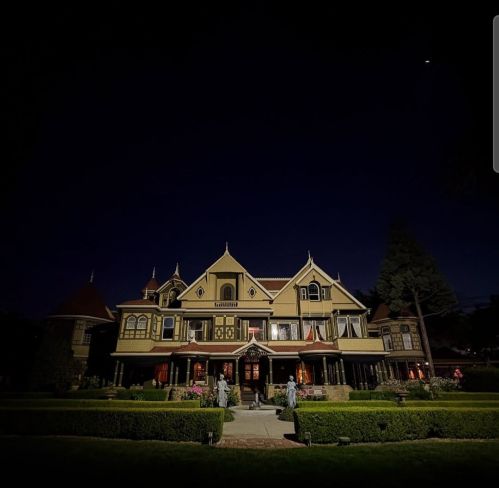
Youth have a right to expect that we will help the organization of this world in cooperation and goodwill so that tens of millions of them will never in the future have to pay the price of a grim disaster. However, all spheres—intellectual, psychic, political, economic, religious—to some extent follow the developments of their own. The increasingly unshatterable prestige of prophecy in general has rested upon those few cases that were terribly impressive for the prophet’s contemporaries, and in which the prophets by their success were unexpectedly in the right. Ideas, selected and reinterpreted from the original doctrine, do gain an affinity with the interests of certain members of special strata; if they do not gain such an affinity, they are abandoned. Thus, by distinguishing the phases of the personal and charismatic origin of ideas and their routinization and social impact, we can consider several complications, which are reflected in changing shades of meaning. Both the ideas and their publics are seen as independent; by a selective process, elements in both find their affinities. Modern capitalism in its early stages requires a specific type of personality. This personality type, in turn, is psychologically constructed because of a set of ideas that unwittingly led to the development of those specific personality traits useful in capitalist conduct. #RandolphHarris 1 of 28

Dr. Freud has shown that sexuality begins with birth, and he has also given us tools for demonstrating the fact that social life begins with everyone’s beginnings. Child training seems to be integrated with a well-defined economic system. The method by which a group’s basic ways of organizing experience, or what we may call group identity, is transmitted to the infant’s early bodily experiences and, through them, to the beginnings of his ego. As a child develops, they learn that we live in a world of machines, far from remaining an extension of the body, destined to be whole human organizations that are extensions of machinery; magic serves as intermediate links only, and childhood becomes a separate segment of life with its own folklore. The expansiveness of civilization, together with its stratification and specialization, demanded that children base their ego models on shifting, sectional, and contradictory prototypes. To be “one who can walk” becomes one of the many steps in child development which, through the coincidence of physical mastery and cultural meaning, of functional pleasure and social recognition, contributes to a realistic self-esteem. #RandolphHarris 2 of 28

This self-esteem gradually grows into a conviction that the ego is capable of integrating effective steps toward a tangible collective future, that it is developing into a well-organized ego within a social reality. This sense is called ego identity. The conscious feeling of having a personal identity is based on two simultaneous observations: the perception of the selfsameness and continuity of one’s existence in time and space, and the perception of the fact that others recognize one’s sameness and continuity. Ego identity, then, is the awareness of the fact that there is a self-sameness and continuity to the ego’s synthesizing methods, the style of one’s individuality, and this style coincides with the sameness and continuity of one’s meaning for significant others in the immediate community. For each individual, there is a characteristic posture, gesture, mannerism, tic, or symptom which signifies that he is living “in his script,” or has “gone into” his script. As long as people display “script signals,” one is adjusting to life, but still may be making progress. As an individual progresses in life, he may be less miserable, or happier, living in his script world, and this will be confirmed by his dreams, his outside experience, and his attitude toward authority figures and the other members of the group. #RandolphHarris 3 of 28

The script signal is usually first perceived intuitively by those he knows well (preconsciously, not unconsciously). The script is what permits people to behave in certain ways. Some people may feel more comfortable laughing, and they may do this with great vigor and enjoyment at every opportunity, but may not have permission to speak. If addressed, one may go through a complicated, sluggish routine before answering. Then, will slowly show maturity and present a cohesive thought. Because his prohibition against talking is so severe, an individual may display signs that he is uncomfortable speaking by trying to protect part of his body that he feels is in jeopardy. And, that is why some people never speak, unless someone has given them permission to by asking him a question. As long as this script signal is present, he will not be free to talk spontaneously, nor to decide other matters that are bothering him. A more common and similar script signal occurs among women, and may also be perceived intuitively for a long time before it comes into full awareness. Some women sit relaxed until a subject comes up that involves pleasures of the flesh, and then they not only cross their knees, but wind the upper instep around the lower ankle, often simultaneously crossing their arms over their chests and sometimes also leaning forward. This posture forms a triple or quadruple protection against a violation which exists only in their script worlds and not in the real world of the group. #RandolphHarris 4 of 28

Other script signs are blinking, tongue-chewing, jaw-clamping, sniffing, hand-writing, ring-turning, and foot-tapping. Posture and carriage are also revealing. The tilt of the head in “Martyr” and “Waif” scripts is one of the commonest script signals. The script signal is always a reaction to some Parental directive. In most neuroses, there are disturbances which constitute valid reasons for discontent with the functioning of the mind. A fear of being aggressive may hamper critical thinking; a general reluctance to commit oneself may render it difficult to arrive at an opinion. The compelling need to appear omniscient may interfere with the capacity to learn. General tendencies to becloud personal issues may also befog the clarity of thinking; just as people blind themselves to their inner conflicts, they may be oblivious to other sorts of contradictions. They may be too fascinated in the glory to be achieved to be sufficiently interested in the work they are doing. I remember a time when I thought that such actual difficulties accounted fully for the feeling of stupidity; when I hoped to be helpful in saying something like: “Your intelligence is perfectly in order—but what about your interests, your courage; what about all that has to go into your capacity to work?” Of course, to work at all these factors are necessary. However, one is not interested in freeing oneself to use his intelligence in his life; what one is interested in is the absolute intelligence of the “master mind.” #RandolphHarris 5 of 28

What I did not recognize, at the time, was the power of the self-devaluating process, which sometimes reaches gigantic proportions. Even people who have attained genuine intellectual achievements may prefer to insist on considering themselves stupid than to avow their aspirations, since at any cost they must avoid the danger of ridicule. And in quiet despair, they accept this verdict, rejecting all evidence or assurance to the contrary. The self-belittling process disturbs the active pursuit of any interest to a varying degree. A neurotic succumbing to self-contempt may feel so discouraged that it does not occur to him that he could change a tire, speak a foreign language, or talk in public. Or he may start some activity but give it up at the first difficulty that arises. Or he may become frightened before or at public performances (stage fright). Again, as in regard to vulnerability, both pride and self-contempt operate to engender these inhibitions and fears. They result from a dilemma caused by needs for a sweeping acclaim on the one hand and active self-disgracing or self-defeating forces on the other. When, despite all these difficulties, a piece of work is finished, well done, and well received, the self-disparagement does not end. “Anybody could have achieved the same thing with so much work put in”; the one passage that did not come out to perfection in a piano recital looms large: “this time I got by, but the next will be a debacle.” A failure, on the other hand, calls forth the full force of self-contempt, and this discouraging far beyond its actual significance. #RandolphHarris 6 of 28

When a person is acting without taking responsibility for choosing the action, life is then lived automatically. Thus, the person may evade conflict and the necessity to make decisions by following an inflexible moral code. The authoritarian character never chooses, seeking the leader’s wishes and expectations and conforming with them, like a soldier getting orders from a superior officer. The other-directed person likewise does not choose actions, but instead acts as he or she believes peers would wish. In none of these cases do the persons realize that they are free to choose their actions in every situation they encounter. They can change their actions at will, though at times it may be difficult. Human beings are free, and hence responsible for their actions and the consequences. However, as the existential philosophers point out, awareness of such freedom and its accompanying responsibility may be terrifying: it is certainly common for people to wish to “escape from freedom.” Dr. Erich Fromm’s book of that title is a classic and should be read for the insight into the human situation that it affords. Authentic being, or being one’s real self, means that the person explores the opportunities and challenges afforded by each situation and then chooses a response that expresses his other true values, needs, feelings, and commitments. An authentic person is less predictable than an inauthentic, self-alienated person, because each life situation, each problem, each encounter with a person is experienced as new, with different invitations and demands issuing from it. #RandolphHarris 7 of 28

However, such authenticity is only possible when the person has not repressed entire dimensions of experiencing, but is, instead, in steady contact with the real self. It takes courage to be real in this sense, because one’s own experiencing often gives rise to fright and sometimes disgust. Moreover, such authenticity requires a person to face decisions time and time again, with the awareness that the outcomes of his or her life are the person’s own responsibility, not the responsibility of parents, superior officers, or public pressure. Authentic decision-making of this nature is most likely to be started by a person after somehow realizing, with intensity, the fact that he or she will die someday. An encounter with death functions as an invitation for many people to live more decisively, more intensively, and more authentically. Authentic being is a sign of a healthy personality, and it is the means of achieving healthy personality growth. When persons are authentic, they not only acknowledge the truth of their feelings, needs, and wishes, but they are capable of revealing their true being to the other people with whom they have personal relationships. We humans can lie to one another, aiming to be seen by others as a person we know we are not. We also have the capacity for entering into true dialogue with our fellows, disclosing what we think, feel, and are planning, without reserve. #RandolphHarris 8 of 28

Obviously, such transparency exposes a person to real danger, because to be that open with others means to be without defenses. If persons can disclose themselves honestly and spontaneously to others, the interests of a healthy personality are served. People are more likely to be cautious than to be excessively open, with the result that they are relatively safe, but lonely and misunderstood by others. It may seem paradoxical, but a person comes to know their real self, and becomes able to introspect honestly, as a consequence of the spontaneous disclosure of self to another person. The individual who has a trusted friend or relative to whom he or she can express thoughts, feelings, and opinions honestly is in a better position to learn the real self than the one who has never undergone this experience, because by revealing the self to another, the person is also revealing the self to himself or herself. The act of stating one’s experience to another, making oneself known, permits one to “get outside oneself” and see oneself. This process of self-discovery through making one-self known to another is facilitated if the other person reflects back what he or she has heard you say. This reflection or restatement, like a mirror, then permits you to compare your words with your experience as you feel it directly and immediately. The capacity to be a transparent self in one’s personal relationships is a sign of a healthy personality. #RandolphHarris 9 of 28

It follows that relations with others in the face-to-face situation are highly flexible. Put negatively, it is comparatively difficult to impose rigid patterns upon face-to-face interaction. Whatever patterns are introduced will be continuously modified through the exceedingly variegated and subtle interchange of subjective meanings that goes on. For instance, I may view the other as someone inherently unfriendly to me and act toward him within a pattern of “unfriendly relations” as understood by me. In the face-to-face situation, however, the other may confront me with attitudes and acts that contradict this pattern, perhaps up to a point where I am led to abandon the pattern as inapplicable and to view him as friendly. In other words, the pattern cannot sustain the massive evidence of the other’s subjectivity that is available to me in the face-to-face situation. By contrast, it is much easier for me to ignore such evidence as long as I do not encounter the other face-to-face. Even in such a relatively “close” relation as may be maintained by correspondence, I can more successfully dismiss the other’s protestations of friendship as not actually representing his expressivity. It is, to be sure, possible for me to misinterpret the other’s meanings even in the face-to-face situation, as it is possible for him “hypocritically” to hide his meanings. All the same, both misinterpretation and “hypocrisy” are more difficult to sustain in face-to-face interaction than in less “close” forms of social relations. #RandolphHarris 10 of 28
On the other hand, I apprehend the other by means of typificatory schemes even in the face-to-face situation, although these schemes are more “vulnerable” to his interference than in “remoter” forms of interaction. Put differently, while it is comparatively difficult to impose rigid patterns on face-to-face interaction, even it is patterned from the beginning if it takes place within the routines of everyday life. (We can leave aside for later consideration cases of interaction between complete strangers who have no common background of everyday life.) The reality of everyday life contains typificatory schemes in terms of which others are apprehended and “dealt with” in face-to-face encounters. Thus, I apprehend the other as “a man,” “a European,” “a buyer,” “a jovial type,” and so on. All these typifications ongoingly affect my interaction with him as, say, I decide to show him a good time on the town before trying to sell him my product. Our face-to-face interaction will be patterned by these typifications as long as they do not become problematic through interference on his part. Thus, he may come up with evidence that, although “a man,” “a European,” and “a buyer,” he is also a self-righteous moralist, and that what appeared first as joviality is actually an expression of contempt for Americans in general and American salesmen in particular. At this point, of course, my typificatory scheme will have to be modified, and the evening planned differently in accordance with this modification. Unless thus challenged, though, the typifications will hold until further notice and will determine my actions in the situation. #RandolphHarris 11 of 28
The typificatory schemes entering into face-to-face situations are, of course, reciprocal. The other also apprehends me in a typified way—as “a man,” “an American,” “A salesman,” “an ingratiating fellow,” and so on. The other’s typifications are as susceptible to my interference as mine are to his. In other words, the two typificatory schemes enter into an ongoing “negotiation” in the face-to-face situation. In everyday life, such “negotiation” is itself likely to be prearranged in a typical manner—as in the typical bargaining process between buyers and salesmen. Thus, most of the time, my encounters with others in everyday life are typical in a double sense—I apprehend the other as a type and I interact with him in a situation that is itself typical. He who examines and enquires will necessarily become the foe of hollow, meaningless formulae. It is better to submit these statements to rational weighing in the scales on one’s independent judgment rather than to accept credulously or dismiss wildly. Without the slightest training in the science of evidence, people airily deliver themselves of judgments that will not stand expert dissection for five minutes. Metaphors do not make arguments: they merely illustrate them. Fling up the coin of their rhetoric and when it comes down on the ground of test, you will know it to be base. Psychology endeavors to establish what is demonstrably true in human behavior, including such behavior as expresses what to human beings feels true. #RandolphHarris 12 of 28

The fact that each new vital focus of psychoanalytical research inadvertently leads to a new implied value system obliges us to ask ourselves whether or not we mean what we seem to be saying. It obligates us, as well as our critics, to differentiate psychoanalysis from psychoanalysis, and to realize that ours is not only a profession recognized among professions, but also a system of thought subject to fashionable manipulation by molders of public opinion. Our very success suggests that our partisanship be judicial. Religion, on the other hand, elaborates on what feels profoundly true even though it is not demonstrable: it translates into significant words, images, and codes the exceeding darkness which surrounds man’s existence, and the light which pervades it beyond all desert or comprehension. In some periods of his history, and in some phases of his life cycle, man needs (until we invent something better) a new ideological orientation as surely and as sorely as he must have air and food. Sometimes revolution has nothing to do with liberation, justice, and inspiration: it is the death of freedom, the triumph of violence, and the enslavement of the mind. Fascism is an act of contempt, in fact. Inversely, every form of contempt, if it intervenes in politics, prepares the way for, or establishes, Fascism. Fascism cannot be anything else but an expression of contempt without denying itself. Junger drew the conclusion, from his own principles, that it was better to be criminal than bourgeois. #RandolphHarris 13 of 28

Mr. Hitler, who on this occasion, is endowed with more coherence, knew that to be either one or the other was a matter of complete indifference, from the moment that one ceased to believe in anything but success. Thus, he authorized himself to be both criminal and bourgeois at the same time. “Fact is all,” said Mr. Mussolini. And Mr. Hitler added: “When the race is in danger of being oppressed…the question of legality plays only a secondary role.” Moreover, in that the race must always be menaced in order to exist, there is never any legality. “I am ready to sign anything, to agree to anything…As far as I am concerned, I am capable, in complete good faith, of signing treaties today and of dispassionately tearing them up tomorrow if the future of the German people is at stake.” Before he declared war, moreover, Mr. Hitler made the statement to his generals that no one was going to ask the victor if he had told the truth or not. The leitmotiv of Goring’s defense at the Nuremberg trials returned time and again to this theme: “The victor will always be the judge, and the vanquished will always be the accused.” That is a point that can certainly be argued. However, then it is hard to understand Mr. Rosenberg when he said during the Nuremberg trials that he had not foreseen that the Nazi myth would lead to murder. When the English prosecuting attorney observes that “from Mein Kampf the road led straight to the gas chambers at Maidenek,” he touches on the real subject of the trial, that of the historic responsibilities of Western nihilism and the only one which, nevertheless, was not really discussed at Nuremberg, for reasons only too evident. A trial cannot be conducted by announcing the general culpability of a civilization. Only the actual deeds which, at least, stank in the nostrils of the entire world were brought to judgment. #RandolphHarris 14 of 28

It follows that in cultural contexts where the beliefs in the supernatural powers of the ancestors are widespread, the departure of an individual might involve not only rituals aimed at separating the deceased from the realm of the living (funerary rituals), but also specific ritual actions aimed at transmuting the deceased into an ancestor (ancestralization), by transforming the latter into a preternatural being capable of affecting everyday life of the living. Among them, the most famous is certainly the so-called double burial studied by Hertz (1905-1906). If not even from the primeval form of religion, ancestor worship has been for a long time considered as a characteristic feature of archaic society. Spencer, in particular, considered the awe aroused by the deceased forebears and their potential vengeful attitude against transgressors as the main cause which led to the observance of the religious rites and, therefore, morality. Several studies have shown that the beliefs and practices concerning the interactions between the living and the dead are among the most spread ones around the world. Some scholars have even postulated that “ancestor worship” may be considered as a “universal phenomenon” and that certain religious phenomena, such as the cult of the saints or the concept of God as a “Father,” might be understood as forms of “metaphorical ancestors.” “Untamed religious activities,” which also include the beliefs and practices concerning ghosts and ancestors, are a kind of religious phenomena that occur in human minds by virtue of natural selection and are not only particularly resilient but also show a certain tendency in being recreated from scratch in diverse cultural contexts throughout human history. #RandolphHarris 15 of 28

If heroes arise through an interaction of personality traits tending toward altruistic behavior and a situation demanding a risk to self for the benefit of others, then heroes and heroines are archetypal in that they emanate and embody an immediate, recognizable pattern. Humans know when they see one. Researchers have used archetypal heroes to address many societal issues, including mental disorders, youth development, bullying in schools, and leadership development in organizations. The archetypal hero is a powerful metaphor that can be applied in many settings, including schools, teen and youth development, family systems, psychotherapy, leadership, management, and firefighting. The archetypal hero is a model of how to map the human condition and convey patterns to navigate life’s difficulties. Seeing life as a heroine’s journey gives emotional stability with a structure. The archetypal hero is a metaphor of hope and a guidebook with markers for gaining a perspective that allows resiliency in the face of adversity. It gives a purpose of seeing life’s journey as right action to transform toward wholeness and be of service to others through this mysterious journey called life. The award-winning Sacramento Fire Department is full of classic heroes. They are wealthy and of high reputation, and respectable persons. One summer, shortly before midnight, several calls poured into the fire department as several neighbors of a shop reported a fire. The fire stations responded to the scene in a short time, only to find the fire shooting through the roof and the flames endangering nearby buildings and homes. The blaze, fed by a stiff wind, quickly destroyed the main shops and set fire to several piles of lumber situated throughout the yards. A nearby home caught fire several times from the heat, but was quickly extinguished with only minor damage to the roof and siding. A factory located just to the south, suffered broken windows, smoke and water damage, but the damage was mostly minor. #RandolphHarris 16 of 28

The firemen remained on the scene until 6:30 a.m., watering down hot spots as the first major fire in the area was declared struck out at that time. Few words invoke more fear than the word investigation. We never want to be involved in an Internal Revenue Service (IRS) investigation, a murder investigation, or a National Institute for Occupational Safety and Health (NIOSH) investigation. Humans have natural defense mechanisms that resist being probed, examined, or scrutinized by any authority that has the power to discipline, sanction, or confiscate aspects of our life. The fear is that an investigation could conclude with the allocation of blame for something we did or were part of. Although a component of investigations indeed is to find fault where fault exists, it is not limited to liability. Another valuable component is to search for and identify the actions and contributing factors that allowed an event to occur. By identifying these aspects, actions can be taken to prevent future occurrences. Take, for instance, a firefighter who falls from an extension ladder at a structural fire. Although seriously injured, he survives the fall. Which of the following is a thorough investigation likely to lead to? Disciplinary action for the incident commander and the firefighter holding the ladder, or liability for the ladder manufacturer, resulting in a lawsuit, or recommendations to eliminate contributing factors in order to prevent a similar incident? Obviously, the last choice is the most probable. Fault and culpable liability are always possible, but recommendations and changes in policy are almost guaranteed. Initiative 9 calls for the thorough investigation of all injuries, deaths, and near-misses in an effort to reduce the chances of the next one. As a result, specific components of an effective system include reporting, investigating, evaluating, and implementing changes. Fire and emergency services have several individual components in place, yet continue to work toward linking information into one effective system. #RandolphHarris 17 of 28

If you see a fire truck stopped in the street without the lights on, be very careful. Sometimes there is an emergency, and you should not pass the fire truck. It might be a good idea to safely turn around and go another way because if you hit someone and they happen to die, you could be charged with manslaughter. Sometimes fire firefighters are getting back into their vehicle, and if you pass the apparatus, you may collide with a firefighter who is on foot. Also, be sure to look at their signals; sometimes emergency vehicles are in motion, albeit slowly, and drivers try to pass them, and this could lead to a dangerous situation. Also, if you are in an intersection when you see an emergency vehicle, continue through the intersection. Drive to the right as soon as it is safe and stop. Obey any direction, order, or signal given by a law enforcement officer or a firefighter. Even if they conflict with existing signs, signals, or laws, follow their orders. When their siren or flashing lights are on, it is against the law to follow within 300 feet of any fire engine, law enforcement vehicle, ambulance, or other emergency vehicle. If you drive to the scene of a fire, collision, or other disaster, you can be arrested. When you do this, you are getting in the way of firefighters, ambulance crews, or other rescue and emergency personnel. The concept of professional courage does not always mean being as tough as nails, either. It also suggests a willingness to listen to other people’s problems, to go to bat for them in a tough situation, and it means knowing just how far they can go. It also means being willing to tell the boss when he or she is wrong. #RandolphHarris 18 of 28
California is the third most expensive state in the nation. In 37 percent of counties, a family of four living on a six-figure income is now considered low-income. The average home price in California is nearly $1,000,000.00 USD, while the average salary is $96,036.00, meaning that most Californians cannot even afford to buy a home. California is having an affordability crisis. A single person making an income above $100,000 is now considered low-income in five counties in California. This distinction now applies to individuals living in Santa Cruz, Santa Clara, San Mateo, San Francisco, and Marin counties. The maximum percentage of your gross income that you should earmark for a monthly mortgage payment is calculated at 28 percent, and no more than 36 percent of your gross income to all debts, including mortgage. If you take 28 percent of the median household income per home in Sacramento County, homeowners can only afford a mortgage of $2,070.23 per month. And if you take 36 percent of their gross income to all debts, including mortgage, they should be devoting no more than $2,661.72 a month to these debts. The mortgage lenders must be using some kind of sorcery to get buyers into these expensive homes. To afford one of these homes using traditional guidelines, a household would need to gross $11,280.24 per month or $135,362.88 per year, but the median household in Sacramento County is grossing $7,393.67 a month or $88,724.00 annually, and that typically means two to four people in the home are working and contributing to the mortgage. Home prices in Sacramento County are rivaling the Bay Area, and in some cases, homes in the Bay Area are more affordable. Historically, homes in the Bay Area have been more expensive because they have higher-paying jobs, a larger population, and the Bay Area is a tourist destination. Contributing to the housing affordability crisis is Gavin Newsom, who has been lavishing illegal immigrants with taxpayer-funded resources and cash aid, when state workers should be receiving a 25 percent wage increase instead. #RandolphHarris 19 of 28

In 2025, many people in California saw their bills increase by an estimated $500 a month. This includes items such as food, automobile insurance, homeowners’ insurance, and electricity. In fact, more than 3 million people in California are facing household hardship, and more than 300,000 of them are facing eviction soon. This comes at a time when California is having a shortage of affordable housing. The crisis is caused by nearly half a century-old laws that discourage home sales and encourage higher rents. The incompetence in California is very easy to see. From 2018 to 2023, California received $24 billion, which they used to fund 30 homeless and housing programs. These programs created 100,000 units. That is an average cost of $240,000 per unit. In comparison, Roger Lucas, owner of Grand Castle, LLC, spent $50 million to build The Grand Castle, which is a 522-unit residential apartment community in Grandville, Michigan. The community includes studios, 1 bedroom, 2 bedrooms, 3 bedrooms, and even a multi-level penthouse. Rents generally range from $1,000 to $2,500. The community is a 23.6-acre site. It features 750 covered parking spaces, a clubhouse, a resort-style swimming pool, and was built over a period of 12 to 18 months. The average cost was about $95,785.45 per unit, which is $144,214.55 less per unit than California spent. California also has the highest unemployment rate in the country at 5.4 percent, while the national average is 4.1 percent. While Americans are struggling to find and afford housing, Gavin Newsom, Democrat governor of California, signed two bills into law on February 7, 2025, to protect illegal immigrants. Bills SBX 1 1: Budget Act of 2024, and SBX 1 2: Budget Act of 2024, allocates $50 million to protect illegal immigrants from deportation. Governor Gavin Newsom also granted 700,000 illegal immigrants free health care, which costs taxpayers $3 billion annually. At the same time, Newsom cut vital programs for veterans, school children, the disabled, and the homeless. The California crisis created by Democrats is driving up home prices and mortgages, and rents all over the nation and the world, making living unaffordable for all, and advocates say the crisis is far from over. #RandolphHarris 20 of 28

Meanwhile, China, where we are sending all our jobs and money, has more than 50 ghost cities, with 65 million vacant homes. Ghost cities are regions where housing has been overdeveloped to the point that these places are uninhabited. If they are all officially counted, California has approximately 4 million homeless people. The highest home prices in the nation, the highest taxes, and the most unfriendly business regulations known to man. Because California is so hostile towards people and businesses, more than 360 companies have fled the state since 2020. Businesses like Chevron, SpaceX, Oracle, and Hewlett-Packard are among the names on that list. Also, more than 500,000 people a year are abandoning California because it is too expensive to live in, Gavin Newsom has criminalized homelessness and actually started arresting people without homes, crime is out of control, and they are losing their jobs due to companies relocating. More than 100 companies have announced layoffs in California for 2025. Intel is cutting 15,000 jobs, PayPal is cutting 2,500, and Meta has terminated 4,000 employees. California also has the highest unemployment rate in the country at 5.4 percent, while the national average is 4.1 percent. The California crisis created by Democrats is driving up home prices and mortgages, and rents all over the nation and the world, making living unaffordable for all, and advocates say the crisis is far from over. Accordingly, California has more than 3.5 million illegal immigrants. Having the Southern American border open and not having American farmland protected, not producing beef, poultry, fish, fruit, produce, and dairy in America, and without American goods and services being our number one manufactured and selling items, America has created a dangerous and significantly elevated risk to national security, national economic security, and national public health. Some people may believe that these claims are overstated, but by not routinely monitoring Common Vulnerabilities and Exposures (CEVs) or other security-relevant alerts, such as the end-of-life of machinery is how the Oroville Dam Crisis occurred in 2017. #RandolphHarris 21 of 28

Additionally, Newsom seems to be uneducated about economics and is proposing to fast-track his plan to build a $20 billion water tunnel beneath the Sacramento-San Joaquin River Delta, which would eliminate environmental reviews and limit avenues for legal challenges. Gavin Newsom only cares about the environment when his policies allow him to raise taxes and restrict freedoms. To further highlight this illustration of incompetence by Governor Gavin Newsom, Mexico has been causing one of America’s worst environmental disasters. Fifty million gallons a day of industrial chemicals, untreated sewage, and trash flow from Tijuana, Mexico, into southern San Diego County daily. This toxic waste has been turning up on Imperial Beach and is causing the miles of white sands to become polluted and the ocean breeze to smell of poop, which has been sickening residents and wildlife and costing San Diego millions in the form of lost tourism and health problems. The problem has been going on for more than a century. Other crises that have occurred due to neglect of critical infrastructure are the 2025 Palisades fires because Southern California ran out of water, when they are located next to an ocean and they could have simply created desalination plants to help with the water shortage. The water is so plentiful that it is currently eroding land and causing homes to fall into the sea. Desalination has been identified as one technology that will help solve California’s water scarcity problem. Desalination is a cost-effective technology that can transform an abundance of salt water into a reliable supply of potable, fresh water, which is a great way to fight climate change and have enough water for our region’s water requirements. Ras Al Khair, Saudi Arabia, is producing 1,036,000 meters (273,682,192) per day of desalinated water. #RandolphHarris 22 of 28

America needs an approach to eliminate safety vulnerabilities in American cities. There needs to be a road map by the end of 2025, outlining a prioritized approach to eliminate crisis situations in America. There is enough money to send aid to foreign nations, but the American government does not have enough money to care for its infrastructure, provide adequate resources, or end the affordable housing crisis. Nor is there enough money to fund other national critical functions (NCFs). These bad practices of putting America and Americans last are considered exceptionally risky, particularly to national security, national economic security, and national public health and safety. In 2024, Americans spent $100 billion on Japanese cars. As a result, the American automobile trade deficit with Japan was $39 billion. Additionally, Japan exported 1.4 million cars to the United States of America, but only imported 16,000 American-built automobiles. However, Japan imported approximately 143 thousand motor vehicles from the European Union. This is why President Trump created tariffs. We need to balance the trade deficit that America faces with other nations so we are not taken advantage of and so America can go bank to being a creditor nation, instead of borrowing money for other countries. As of 31 August 2025, President Trump has brought $142 Billion in Tariff revenue into America and hundreds of thousands of new jobs. However, if President Trump’s Tariffs are deemed illegal by the Supreme Court, taxpayers will have to pay back trillions and trillions of dollars. As we literally and /or figuratively see gangs, federal judges, and Governor Gavin Newsom fighting with federal law enforcement and President Trump– states and cities refusing to honor federal laws. Politicians are also showing an utter disregard for the Constitution of the United States of America, and anarchy is becoming increasingly common. #RandolphHarris 23 of 28

Anarchism is a cluster of doctrines and attitudes centered on the belief that government is both harmful and unnecessary. Derived from the Greek root anarchos, meaning “without authority,” anarchism, anarchist, and anarchy are used to express both approval and disapproval. The anarchist denies man-made laws, regards property as a means of tyranny, and believes that crimes are merely the product of property and authority. However, the anarchist would argue that their denial of constitutions and governments leads not to “no justice” but to the real justice inherent in the free development of human sociality—the natural inclination, when unfettered by laws, to live according to the principles and practice of mutual aid. Anarchism is also a form of treason. Treason, the crime of betraying a nation or a sovereign by acts considered dangerous to security. In English law, treason includes the levying of war against the government and the giving of aid and comfort to the monarch’s enemies. In the United States of America, treason was defined restrictively by the framers of the Constitution. Treason against the United States of America “shall consist only in levying War against them, or in adhering to their Enemies, giving them aid and comfort,” which is something that many politicians are currently guilty of. The American government should know all exploitable vulnerabilities and fix them before the situation becomes a crisis. Failure to take such mitigating actions is dangerous and significantly elevates risk to national security, national economic security, and national public health and safety. The American government must understand that significant time and resources must be invested in America. They must also encourage corporations to plan for both mitigating safety vulnerabilities in the short term and eliminating them in the long term. For instance, a company might begin by reaching out to the federal, state, or local government and requesting tax incentives to provide security to dangerous communities, to help the government repair bridges and potholes. #RandolphHarris 24 of 28

Drug cartels have been threatening the health and safety of Native American communities. The trafficking of dangerous and illegal drugs into their territories is leading to a second genocide. The overdose rate for Indigenous people is 42 percent higher than the national average. A recent bust on Montana’s Blackfeet Nation’s Tribal Reservation resulted in the seizure of more than 700,000 fentanyl pills, which was the largest bust in Montana history. Recently, the Blackfeet Nation had to declare a state of emergency after facing 17 overdoses in just one week. There are only 6.8 million Native Americans left in the world, which is 2 percent of the American population. We should be doing more to protect these proud and honorable people; they should not want for anything. People rush and give away resources to illegal immigrants, but totally disregard the Indigenous people of this land, as their race silently fades away into extinction. We must secure our borders and increase federal funding to Native American tribes so we can save this precious population. Meanwhile, Gavin Newsom has given billions of taxpayer dollars away to illegal immigrants and protected them from law enforcement, while arresting law-abiding Americans because they cannot afford to pay rent or mortgage, and the homeless shelters are unsafe, overcrowded, and have restrictions on who is allowed inside. He has also totally ignored the cartel problems on American lands. Clean air, water, land, and preserving our heritage are extremely important. We cannot just allow criminals to kill off the people who are native to this land and do nothing about it. Wars have been started over governments that tax citizens without representation. Taxation without representation is what led to the American Revolution. #RandolphHarris 25 of 28

Much like the land crisis in Las Vegas, we could also run out of land to farm and will not be able to grow or cultivate our own food. We can protect American farmland and support American farmers by buying American made beef, poultry, dairy, and produce. Also, country of origin labeling is very important so Americans can know where their food is coming from and can support American farmers and ranchers. As money flows, it influences further investment. Save the land that sustains us by protecting American farmland. Once the land is built on, we lose it forever. And in the future, there may be food wars. Also, to ensure that we have farmland and buildable land for future use, we need to start limiting the number of people allowed to immigrate to America. Perhaps with the immigrants we do allow into America, there needs to be a diversity program to make sure we have a population that equally represents all races of people. If Americans continue to spend money on American products, then more need to be made to keep up the inventory. When investors notice these goods are selling, it gives them the confidence to pour more money into that local business. It shows that people want these goods made in America and pressures investors to keep these goods and services in America. The jobs stay here, the business stays in America, wages naturally increase, and more money is invested to keep up with demand. This reduces the burden on the taxpayer. When you support American businesses, that money stays in our economy and can help to reduce the national debt. The government creates debt by borrowing from businesses in the private sector or from foreign countries. It also increases the national debt by spending more than it gains in tax revenue in a fiscal year. #RandolphHarris 26 of 28

When people shop locally, more tax money stays in the economy and goes to the government. This way, it keeps more money in our national economy and keeps more jobs located in America which also sends more taxes to the government, which can again help to reduce the national debt. When you buy foreign goods, these companies usually have lighter tax loads or exemptions, meaning less money for the national debt, plus you are helping to strengthen these foreign nations by sending more money overseas. Buying American-made products is also better for the environment and helps to reduce the carbon footprint because these products do not have to travel nearly as far. Furthermore, American companies and manufacturers are held to much higher standards on pollution. American companies must be more careful about air, land, and water pollution and have proper ways to dispose of waste. Under President Trump’s administration, he has make America a priority. President Trump has closed the southern border, illegal crossings have fallen to an all time low, and are 90 percent lower than under the previous administration. Since President Trump’s crack down on crime, violent crimes in Washington D.C. have dropped by approximately percent. And since President Trump took office, investments in America have increased by trillions of dollars in U.S.A. manufacturing, production, and innovation. As you can see, President Donald Trump and his pledge to “Make America Great Again” is exactly what America needs to save the country and the American people. And yes, diversity is important, so you can see why it is also important to preserve blonde hair and blue eyes, as the people with these characteristics are becoming a minority in America. #RandolphHarris 27 of 28
We must think before we can understand the soul’s existence; we must understand before we can realize it. The earliest beginnings of thought, as apart from instinct, when it was itself still but a lurking tendency, belong far back in primeval time. The human intellect as we find it today, so rich and developed an instrument for the consciousness of the ego, did not arrive at this fullness without a series of graduated stages. We have had plenty of scientific thinking, business thinking, and political thinking long enough, but we have had very little inspired thinking. That is the world’s need. The intellect is cradled in selfishness but runs the evolutionary track into reason, where it will one day finish at the winning-post of selflessness. As a reminder, parents, please teach your children to love America and be patriotic citizens, and to buy goods and services made in America. It is also important to respect law and order and treat your elders with respect. It is inborn in the human mind to wish to know. If this begins with the endless surface questions of a child’s curiosity, if it continues into deeper questions of a scientist’s probing investigation, it cannot and does not stop there. For the higher part of the mind will eventually come into unfoldment, that union of abstract reflective thought with mystical intuition, which is true intelligence, which needs and sees a view of the whole of things. And so, the knowing faculty enters the realm of philosophy. Therefore, remember to take your education seriously so that you will be successful in life and make your family proud. Also, to make sure they have all the resources required, please donate to the Sacramento Fire Department to help improve our national security. “Oh, thus be it ever, when freemen shall stand between their loved home and the war’s desolation! Blest with victory and peace, may the heav’n-rescued land Praise the Power that hath made and preserved us a nation! Then conquer we must, when our cause is just, and this be our motto: ‘In God is our trust.’ And the star-spangled banner in triumph shall wave O’er the land of the free and the home of the brave.” #RandolphHarris 28 of 28


According to locals, over a century ago, the land that houses The Winchester Mansion had been vacant forever. Then, sometime in the early afternoon of Saturday, March 13, 1886, Sheriff Angel Camilio began getting reports that a massive castle made of wood had suddenly appeared. Gables rose, towers peaked into the sky as the mansion mushroomed into a labyrinth overnight.

The house’s sudden manifestation had been both disconcerting and fascinating to the community. Some felt dark curses flowing from the estate, and things moving around in the darkness. Others saw a fairytale castle glimmering in the spring sunlight. Perhaps this is why there are no records of construction, no blueprints, and no permits filed with the county. Come and see what secrets this so-called, “Winchester Mystery House” may hold.
Experience an unforgettable journey back to the time of kings and queens with this entry ticket for The Winchester Mansion in Santa Clara, California, which was the residence of Heiress Sarah L. Winchester. Take advantage of this fascinating experience. After the tour, there will be time to enjoy the mansion’s splendor at your own pace. You might even discover secret passages.

Please come and enjoy a delicious meal at Sarah’s Café, stroll along the paths of the beautiful Victorian gardens, which once spanned 740 acres, all the way down to Stevens Creek Boulevard; wander through the miles of hallways in the world’s most mysterious mansion.

For further information about tours, including group tours, weddings, school events, birthday party packages, facility rentals, and special events please visit the website: https://winchestermysteryhouse.com/
Please visit the online giftshop, and purchase a gift for friends and relatives as well as a special memento of The Winchester Mystery House. A variety of souvenirs and gifts are available for purchase. https://shopwinchestermysteryhouse.com/

Harris Plumbing, Heating, Air, & Electric has been in business for 30 years. How many businesses can say that? We take pride in everything we do – no matter how big or small the service call might be. We’re here to help your home be as safe and comfortable as possible for you and your family. We take that responsibility very seriously as a company.

Harris will ensure you have the information you need to decide what to do next, whatever your home is facing. We’ll perform a diagnosis and detail what issues are present before starting any work. This gives you a personalized quote and service plan specific to your home’s needs, not some random quote based on the best guess. The only way we can do our best work is to make sure we handle the issues at hand. https://www.callharrisnow.com/about-us/


With its top ranking in Consumer Reports’ Auto Brand Report Card and consistent market share growth, BMW, The Ultimate Driving Experience, has demonstrated its ability to produce high-performing, reliable vehicles that meet consumer demands. BMW stands out due to its focus on driving dynamics and engineering excellence. While other luxury brands prioritize comfort and opulence, BMW is known for creating cars that are fun to drive and offer a unique connection between the driver and the machine. This is why BMW is known as the Ultimate Driving Machine. https://www.brianharrisbmw.com/
Randolph Harris San Francisco Taxation & Mergers
Building strong and lasting client relationships is crucial for a successful legal career. Many lawyers mistakenly believe that mastering legal skills alone ensures success, but law is fundamentally a service industry—our job is to solve problems through the time we sell. To build long-term relationships, attorneys must focus on three core elements: knowing their clients, understanding how their legal issues fit into a larger context, and consistently delivering exceptional service.
Randy advises clients with regard to business transition, taxable and tax-deferred mergers and acquisitions, joint ventures, restructuring, integrated tax planning, federal and state tax controversy resolution, and real estate transactions. Trust is the cornerstone of any client relationship. Ultimately, my clients feel they are in capable hands with someone who genuinely understands their problems and goals. https://www.jmbm.com/l-randolph-harris.html

At Millhaven Homes our professionals bring extensive experience in creating custom luxury properties. Your needs are the central focus. We savor the sanctuary of awe-inspiring spaces, unique architectural details and fine craftsmanship. The key to a successful relationship is communication. We will incorporate your thoughts and ideas into your new home.

With vast experience in all types of custom home construction, our premier services are created for you, so you can get the most out of the function and design of your dream home. Discover Millhaven Homes today. Let us design and build a custom home that reflects your style, comfort, and aspirations. We are here to bring your vision to life with creativity, care, and attention to every detail.

Each home we create is a masterpiece—crafted with care, harmony, and sophistication. Be sure to ask about our legendary “Costco” door. https://millhavenhomes.com/

The World of Everyday Life is Taken for Granted

The world of everyday life is not only taken for granted as reality by ordinary members of society in the subjectively meaningful conduct of their lives. It is a world that originates in their thoughts and actions, and is maintained as real by these. Common sense contains innumerable pre- and quasi-scientific interpretations about everyday reality, which it takes for granted. Suppose we are to describe the reality of common sense. In that case, we must refer to these interpretations, just as we must take account of their taken-for-granted character—but we do so with phenomenological brackets. Consciousness is always intentional; it always intends or is directed toward objects. We can never apprehend some putative substratum of consciousness as such, only consciousness of something or other. This is so regardless of whether the object of consciousness is experienced as belonging to an external physical world or apprehended as an element of an inward subjective reality. Whether I (the first-person singular, here as in the following illustrations, standing for ordinary self-consciousness in everyday life) am viewing the panorama of New York City or whether I become conscious of an inner anxiety, the process of consciousness involved is intentional in both instances. The point need not be belabored that the consciousness of The Winchester Mystery House differs from the awareness of anxiety. #RandolphHarris 1 of 25

A detailed phenomenological analysis would uncover the various layers of experience and the different structures of meaning involved in, say, being bitten by a dog, remembering having been bitten by a dog, having a phobia about all dogs, and so forth. What interests us here is the common intentional character of all consciousness. Different objects present themselves to consciousness as constituents of different spheres of reality. I recognize the fellowmen I must deal with during everyday life as a reality quite different from the disembodied figures that appear in my dreams. The two sets of objects introduce quite different tensions into my consciousness, and I am attentive to them in quite different ways. My consciousness, then, can move through different spheres of reality. Put differently, I am conscious of the world as consisting of multiple realities. As I move from one reality to another, I experience the transition as a kind of shock. This shock is to be understood as caused by the shift in attentiveness that the transition entails. Waking up from a dream illustrates this shift most simply. Among the multiple realities, there is one that presents itself as the reality par excellence. This is the reality of every day life. Its privileged position entitles it to designation of paramount reality. The tension of consciousness is highest in everyday life, that is, the latter imposes itself upon consciousness in the most massive, urgent, and intense manner. It is impossible to ignore, difficult even to weaken in its imperative. #RandolphHarris 2 of 25
Consequently, it forces me to be attentive to it in the fullest way. I experience everyday life in the state of being wide-awake. This wide-awake state of existing in and apprehending the reality of everyday life is taken by me to be normal and self-evident; that is, it constitutes my natural attitude. I apprehend the reality of everyday life as an ordered reality. Its phenomena are prearranged and impose themselves upon the latter. The reality of everyday life appears already objectified, that is, constituted by an order of objects that have been designated as objects before my appearance on the scene. The language used in everyday life continuously provides me with the necessary objectifications and posits the order within which these make sense and within which everyday life has meaning for me. I live in a place that is geographically designated; I employ tools, from can openers to sports cars, which are designated in the technical vocabulary of my society; I live within a web of human relationships, from my chess club to the United States of America, which are also ordered by means of vocabulary. In this manner, language marks the co-ordinates of my life in society and fills that life with meaningful objects. Genuine charismatic situations quickly give way to incipient institutions, which emerge from the cooling off of extraordinary states of devotion and fervor. #RandolphHarris 3 of 25
Emphasis upon the “sovereignty of the charismatic man” does not minimize the mechanics of institutions; on the contrary, by tracing out the routinization of charisma, this assigns a heavy causal weight to institutional routines. Thus, we retain a social determinism by emphasizing charisma’s routinization. The way this problem is handled testifies to our constant endeavor to maintain a casual pluralism and to bring the economic order into the balance. Those who, in the contemptuous view of youth consolidated in technological expansion, are the “peaceniks,” are the humanists whose style of consolidation also includes quite old-fashioned sentiments and ideal (in appearance, they often seem to be emerging from an underground medieval town) while it is hospitable to ideals of civil disobedience and nonviolence which in their modern form originated (but by no means ended) with Jesus Christ. Here, opposition to thoughtless mechanization goes together with a dislike of regimentation and of the military kind of enthusiasm, and with a sensitive awareness of the existential individuality of anyone in the range of gun sight. This and the technocratic view must obviously oppose and repel each other, for the acceptance of even a part of one view causes a slide leading to a reconversion of the whole configuration of images. Often, therefore, these two views face one another as if the other were the enemy, although he may be brother, friend—or oneself at a different stage of one’s own life. #RandolphHarris 4 of 25

Seventy five years ago, we related identity problems with much hesitation (for the term was then highly suspect) to the ideological needs of youth, ascribing, in fact, much acute confusion to a kind of ideological undernourishment on the part of those youths who had come too late to share either the military fervor of the world wars “over there” or the radicalism of the first postwar years over here. American youth, we said, was anti-ideological, glorifying instead a “way of life”—and a comfortable one. We were afraid, of course, that the “materialist” trend so vastly reinforced by technology would find little balance in a youth to whom all ideology had become political and foreign, the more so since McCarthyism had succeeded in creating in almost all Americans a fear of radical thinking amounting to a traumatic transformation of a previously cherished identity into a negative one. Since then, some American youths have proven themselves in the civil rights movement as well as in the Peace Corps, showing that they can accept unaccustomed hardship and discipline when moved by a convincing ideological trend applied to universal needs. In fact, in such universal matters as the opposition to unrestricted armament or to a thoughtless consent to the acceleration of the war in Vietnam, youth have proven more foresighted than many, many adults. To the horror of a parent generation brainwashed by McCarthyism they have reinstated some of their own parents’ abandoned ideals. #RandolphHarris 5 of 25
However, only after having discussed, as far as my conceptual means permit, the majority of youth who derive a certain strength of identity from the whole ideological package of technological expansion, can I discuss our new-humanist youth from a more balanced viewpoint. Does not an interplay between a new dominant class of specialists—those who “know what they are doing”—and an intense new group of universalists—those who “mean what they are saying”—always determine the identity possibilities of an age? And those who mean it often care deeply for and become the champions of a third group—those who have been left behind by all concerned. In our time, these are the technologically or educationally underprivileged who are cut off from all ideologies because of a lack of capacity or opportunity, or (of course) both. In revolutionary times, then, the overprivileged and the underprivileged often reach out to each other, both being marginal to the vast consolidation of the “compact majority.” The more mature among our new young humanists are seeking a common denominator in human life—some kind of worldwide identity bridging affluence and underdevelopment. For some individuals who might otherwise have rebelled unfruitfully or withdrawn completely, the capacity to employ their conflict in a socially relevant and activist movement undoubtedly had potential therapeutic value. At the same time, it seems clear that the “therapeutic” as well as the political value of all these groups depends on the vitality of their communal potential—and on the discipline and inventiveness of their leaders. #RandolphHarris 6 of 25

The protests of humanist youth range from romantic Edwardians and jazzy Wandervogeltum to the deeply committed “New Left,” and to an identification with naked heroism anywhere in the world where “machines” threaten to crush man’s will. They range, in other words, from a reactionary resistance to all machine conformity to a reformulation of human rights and dignities in an irreversibly technological future. If they seem perplexed and sometimes bizarre in the light of these demands, we should remind ourselves that it was the tradition of enlightenment which, taking a stable middle class or a liberal world for granted, opened all values to ruthless inquiry. Now, the young must experiment with what is left of the “enlightened” and “analyzed” world. The psychoanalytic enlightenment, for example, assumed that infantile sexuality and perversions could be brought to public attention with an advocacy of enlightened judgment as a replacement for age-old repression. Now, perversions, as, indeed, all kinds of perversity, must find their own limits of attractiveness in print and deed. Therefore, only a relative freedom of experimentation can find its own correction where the parental combination of radical enlightenment and old-fashioned morality has failed. Yet, the search for youth, I believe, is not for all-permissibility, but rather for new ways of directly facing up to what truly counts. #RandolphHarris 7 of 25

To the patient’s Child (the immature part of the personality), the therapist is a magician of sorts. He is likely to choose the same kind of magical figure that he knew in childhood. In some families, the revered figure is the family doctor, a medical man; in others, the revered is the clergyman. Some doctors and clergymen are serious figures out of tragedy, like Tiresians, who will tell them the bad news and perhaps give them a cantrap, amulet, or draught for salvation; others are jolly green giants who protect children from harm by comforting them and reassuring them, and flexing their giant muscles. When Jeder grows up, he will usually look for help from a similar person. If his experience was unhappy, however, he may rebel and find some other kind of magic. One puzzle is why people choose psychologists to fill this role in their scripts, since comparatively few people so far have had a friendly neighborhood psychologist as the family magician in early childhood. From a fairy-tale point of view, the therapist is the dwarf, the witch, the fish, the fox, or the bird who gives Jeder the magic means to attain his ends: the seven-league boots, the cloak of invisibility, the magic chest that produces on command gold or tables laden with cakes and dainties, or some apotropaion to ward off evil. #RandolphHarris 8 of 25

Roughly speaking, the patient can choose between three kinds of magic in selecting a therapist, and he can select each one for success or for failure. If his script requires that, he can also play one against the other. These are known as “science,” “chicken soup,” and “religion.” Any profession can offer all three, but typically, a certain type of psychologist offers “modern science,” a certain type of pastoral counselor offers “religion.” If occasion demands, a well-trained therapist in each of these professions is prepared to offer any of them, and some offer two in combination. Science and religion, chicken soup and science, or religion and chicken soup, are common farragoes for the patient who seeks more than one kind of magic. The practical difference between “science,” “chicken soup,” and “religion,” on the other hand, and a scientific, supportive, and religious approach to therapy is in knowing when to stop. The therapists who use the first three do not know when to stop, since each one’s brand of magic is part of his own script, while those who use the last three do know when to stop, because they know what they are doing. The first group is playing, “I am Only Trying to Help You,” while the others are helping people. Usually, the neurotic seizes avidly upon situational difficulties or misfortunes for the purpose of exonerating himself: he did all he could; he was, to make a long story short, simply wonderful. However, the others, the whole situation, or accidental mishaps spoiled it all. #RandolphHarris 9 of 25

While these two attitudes superficially look like opposites, the similarities are, strangely enough, greater than the differences. In both ways, the attention is diverted from subjective factors and focused on the externals. To them is ascribed the decisive influence on happiness and success. The function in both is to ward off the onslaughts of self-condemnation for not being one’s idealized self. In the instances mentioned, other neurotic factors also interfered with being the ideal mother or with having a brilliant career as an actor. The woman at that time was too consumed with her own problems to be a consistently good mother; the actor had certain inhibitions against making necessary contacts and competing for a job. Both were to some extent aware of these difficulties, but they mentioned them casually, forgot about them, or subtly embellished them. In a happy-go-lucky person, this would not strike us as peculiar. However, in our two instances—which are typical in this regard—there is a simply stunning discrepancy between a gingerly dealing with their shortcomings on the one hand and merciless, unreasoning self-accusations for occurrences outside their control on the other. If we are not aware of their significance, such discrepancies may easily escape observation. #RandolphHarris 10 of 25

They contain an important clue for understanding the dynamics of self-condemnation. They point to a self-recrimination for personal flaws so severe that the person must resort to self-protective measures. And they use two such measures: to treat themselves in a gingerly way and to shift responsibility to circumstances. The question remains why, with this latter move, they fail better in getting rid of self-accusations, at least in their conscious minds? The answer is simply that they do not feel that these outside factors are outside their control. Or, more accurately, they should not be out of control. Consequently, everything that goes wrong reflects on them and shows them up in their disgraceful limitations. Persons’ self-concepts represent what they believe to be true about their own personalities. Their conscience grows out of an idealized view of how they ought to be. Humans have the capacity to select their actions and their speech, to influence the experience others will have on them. Typically, a person wishes to believe that he or she is law-abiding, highly moral, and possesses other traits that evoke a favorable impression. The layperson’s term for the public self is wanted reputation. Everyone strives to construct a reputation with respect to their typical behavior, id est, they choose their behavior before other persons so these others will form the beliefs that they want them to form. #RandolphHarris 11 of 25

Almost everyone distinguishes between their “public” life and their “private” life. Ordinarily, only those persons an individual trusts are allowed to observe the full range of that individual’s behavior repertoire. Outsiders are permitted to observe only the “expurgated” edition of behavior. This connection is akin to “on-stage” behavior, as opposed to backstage or off-stage behavior. The most important reason for constructing public selves of various sorts is expedience. It is only when others believe certain things to be true of you that they will like you, marry you, give you jobs, refrain from imprisoning you, and appoint you to public office, buy things at your store, and consult you professionally. If, for any reason, other people believe undesirable things to be true of you, they will ostracize you, jail you, and so on. A person may construct highly diversified public selves, depending upon his or her goals. The young man seeking a spouse strives to behave in ways that the woman will be likely to value and approve. He does not allow her to see the rest of his behavior, which may vary tremendously from the censored version of the person she does not see. The construction of public selves resembles the art of sculpture. A sculptor manipulates clay, then steps back to see whether the statue being created resembles the image the sculptor has in mind. If it does not, he or she continues to work at it, until by successive approximations the sculptor has brought into reality something that hitherto existed only as a preferred idea or image. #RandolphHarris 12 of 25

By the same token, persons may hold images of their own personalities that they want to construct in the mind of another person. Instead of clay, they employ their own carefully selected behavior and conversation. From time to time, the audience will offer feedback, indicating how they have been seen. If the way they are being seen does not yet coincide with the preferred image, the individuals engage in more behavior and talking until they are assured by the other’s responses that they are now seen as they wish to be seen. Persons may “slip” during the process of constructing, or living up to, a given public self. They may want their audience to believe one thing about them, say, that they are morally scrupulous, yet they may forget themselves and use obscene language, and destroy the image they were seeking to create. Such experiences produce embarrassment, to say the least. The reading public has an insatiable curiosity for details that conflict with the public selves of newsworthy people. The actual way to deal with facts is not to ignore them but to meet and master them. The happiness gained from the first will always be illusory, whereas that gained from the second will always be genuine. Philosophy is not interested in twilight-gropings for occult phantoms or deceptive speculatings to exercise fancy. It seeks and accepts only verifiable facts. However, observation must be unprejudiced, sharp, and intelligent to produce the facts, and facts are apt to be obstinate and intractable. #RandolphHarris 13 of 25

One of the most misused terms in fire and emergency medical services is accident, which is sometimes defined as an occurrence with tragic results that could not be predicted or prevented. One example would be if you were suddenly struck by a bolt of lightning. However, if the weather forecaster had warned of the lightning storm this afternoon and you chose to stay on the golf course, it would not be an accident anymore. In fact, there are very few vehicle accidents, tragic accidents, or even accidental fires. They may be unintentional, but usually they are predictable and preventable. The best time to catch an unsafe act is before it happens. One morning, a police officer was patrolling and he noticed flames issuing from the roof of a shop. He immediately called the fire department. The fire department quickly arrived on scene, but was forced to sit and watch the building burn, as a water supply problem prevented any extinguishment of the fire. A water main had gone unrepaired, which caused the fire hydrant to have a capacity issue. The entire building was in flames before the fire department could get water on the conflagration. Fire spread to a house, which was adjoined to a building. The building was a complete loss. Other buildings on the street were consumed, including another home and a two-story building. A brick residence caught fire, but thanks to the firemen, only the roof of the kitchen and veranda were burned. Firefighters were able to prevent the fire from further spreading. #RandolphHarris 14 of 25

If you see a fire truck stopped in the street without the lights on, be very careful. Sometimes there is an emergency, and you should not pass the fire truck. It might be a good idea to safely turn around and go another way because if you hit someone and they happen to die, you could be charged with manslaughter. Sometimes fire firefighters are getting back into their vehicle, and if you pass the apparatus, you may collide with a firefighter who is on foot. Also, be sure to look at their signals; sometimes emergency vehicles are in motion, albeit slowly, and drivers try to pass them, and this could lead to a dangerous situation. Also, if you are in an intersection when you see an emergency vehicle, continue through the intersection. Drive to the right as soon as it is safe and stop. Obey any direction, order, or signal given by a law enforcement officer or a firefighter. Even if they conflict with existing signs, signals, or laws, follow their orders. When their siren or flashing lights are on, it is against the law to follow within 300 feet of any fire engine, law enforcement vehicle, ambulance, or other emergency vehicle. If you drive to the scene of a fire, collision, or other disaster, you can be arrested. When you do this, you are getting in the way of firefighters, ambulance crews, or other rescue and emergency personnel. The concept of professional courage does not always mean being as tough as nails, either. It also suggests a willingness to listen to other people’s problems, to go to bat for them in a tough situation, and it means knowing just how far they can go. It also means being willing to tell the boss when he or she is wrong. #RandolphHarris 15 of 25

California is the third most expensive state in the nation. A single person making an income above $100,000 is now considered low-income in five counties in California. This distinction now applies to individuals living in Santa Cruz, Santa Clara, San Mateo, San Francisco, and Marin counties. In 37 percent of counties, a family of four living on a six-figure income is now considered low-income. In fact, Governor Gavin Newsom of Democratic controlled California, brags about being the world’s “fifth largest economy,” but it also facing a $12 billion deficit, looking to cut $747 million for state worker’s pay, pushing to keep medical insurance for illegal immigrants, but wants to cut medical for anyone who has assets over $2,000 and the state has the largest homeless population in the nation. If they are all officially counted, California has approximately 4 million homeless people. The highest home prices in the nation, the highest taxes, and the most unfriendly business regulations known to man. The average home price in California is nearly $1,000,000.00 USD, while the average salary is $96,036.00, meaning that most Californians cannot even afford to buy a home. California is having an affordability crisis. In 2025, many people in California saw their bills increase by an estimated $500 a month. This includes items such as food, automobile insurance, homeowners’ insurance, and electricity. In fact, more than 3 million people in California are facing household hardship, and more than 300,000 of them are facing eviction soon. This comes at a time when California is having a shortage of affordable housing. This is caused by nearly half a century-old laws that discourage home sales and encourage higher rents. #RandolphHarris 16 of 25

Meanwhile, China, where we are sending all our jobs and money, has more than 50 ghost cities, with 65 million vacant homes. Ghost cities are regions will housing has been overdeveloped to the point that these places are uninhabited. Because California is so hostile towards people and businesses, more than 360 companies have fled the state since 2020. Businesses like Chevron, SpaceX, Oracle, and Hewlett-Packard are among the names on that list. Also, more than 500,000 people a year are abandoning California because it is too expensive to live in, Gavin Newsom has criminalized homelessness and actually started arresting people without homes, crime is out of control, and they are losing their jobs due to companies relocating. More than 100 companies have announced layoffs in California for 2025. Intel is cutting 15,000 jobs, PayPal 2,500, and Meta has terminated 4,000 employees. California also has the highest unemployment rate in the country at 5.4 percent, while the national average is 4.1 percent. The California crisis created by Democrats is driving up home prices and mortgages, and rents all over the nation and the world, making living unaffordable for all, and advocates say the crisis is far from over. Accordingly, California has more than 3.5 million illegal immigrants. Having the Southern American boarder open and not having American farmland protected, not producing beef, poultry, fish, fruit, produce and dairy in America, and without American goods and services being our number one manufactured and selling items, America has created a dangerous and significantly elevated risks to national security, national economic security, and national public health. Some people may believe that these claims are overstated, but by not routinely monitoring Common Vulnerabilities and Exposures (CEVs) or other security-relevant alerts, such as the end-of-life of machinery is how the Oroville Dam Crisis occurred in 2017. #RandolphHarris 17 of 25

Other crises that have occurred due to neglect of critical infrastructure are the 2025 Palisades fires because Southern California ran out of water, when they are located next to an ocean and they could have simply created desalination plants to help with the water shortage. The water is so plentiful that it is currently eroding land and causing homes to fall into the sea. Desalination has been identified as one technology that will help solve California’s water scarcity problem. Desalination is a cost-effective technology that can transform an abundance of salt water into a reliable supply of potable, fresh water, which is a great way to fight climate change and have enough water for our region’s water requirements. Ras Al Khair, Saudi Arabia, is producing 1,036,000 meters (273,682,192) per day of desalinated water. As we see gangs fighting with federal law enforcement, states and cities refusing to honor federal laws, and politicians showing an utter disregard for the Constitution of the United States of America, anarchy is becoming increasingly common. Anarchism is a cluster of doctrines and attitudes centered on the belief that government is both harmful and unnecessary. Derived from the Greek root anarchos, meaning “without authority,” anarchism, anarchist, and anarchy are used to express both approval and disapproval. The anarchist denies man-made laws, regards property as a means of tyranny, and believes that crimes is merely the product of property and authority. #RandolphHarris 18 of 25

However, the anarchist would argue that their denial of constitutions and governments leads not to “no justice” but to the real justice inherent in the free development of human sociality—the natural inclination, when unfettered by laws, to live according to the principles and practice of mutual aid. Anarchism is also a form of treason. Treason, the crime of betraying a nation or a sovereign by acts considered dangerous to security. In English law, treason includes the levying of war against the government and the giving of aid and comfort to the monarch’s enemies. In the United States of America, treason was defined restrictively by the framers of the Constitution. Treason against the United States of America “shall consist only in levying War against them, or in adhering to their Enemies, giving them aid and comfort,” which is something that many politicians are currently guilty of. The American government should know all exploitable vulnerabilities and fix them before the situation becomes a crisis. Failure to take such mitigating actions is dangerous and significantly elevates risk to national security, national economic security, and national public health and safety. The American government must understand that significant time and resources must be invested in America. They must also encourage corporations to plan for both mitigating safety vulnerabilities in the short term and eliminating them in the long term. For instance, a company might begin by reaching out to the federal, state, or local government and requesting tax incentives to provide security to dangerous communities, to help the government repair bridges and potholes. #RandolphHarris 19 of 25

America needs an approach to eliminate safety vulnerabilities in American cities. There needs to be a road map by the end of 2025, outlining a prioritized approach to eliminate crisis situations in America. There is enough money to send aid to foreign nations, but the American government does not have enough money to care for its infrastructure, provide adequate resources, or end the affordable housing crisis. Nor is there enough money to fund other national critical functions (NCFs). These bad practices of putting America and Americans last are considered exceptionally risky, particularly to national security, national economic security, and national public health and safety. In 2024, Americans spent $100 billion on Japanese cars. As a result, the American automobile trade deficit with Japan was $39 billion. The maximum percentage of your gross income that you should earmark for a monthly mortgage payment is calculated at 28 percent, and no more than 36 percent of your gross income to all debts, including mortgage. If you take 28 percent of the median household income per home in Sacramento County, homeowners can only afford a mortgage of $2,070.23 per month. And if you take 36 percent of their gross income to all debts, including mortgage, they should be devoting no more than $2,661.72 a month to these debts. The mortgage lenders must be using some kind of sorcery to get buyers into these expensive homes. To afford one of these homes using traditional guidelines, a household would need to gross $11,280.24 per month or $135,362.88 per year, but the median household in Sacramento County is grossing $7,393.67 or $88,724.00, and that typically means two to four people in the home are working and contributing to the mortgage. #RandolphHarris 20 of 25

Home prices in Sacramento County are rivaling the Bay Area. Historically, homes in the Bay Area have been more expensive because they have higher-paying jobs, a larger population, and the Bay Area is a tourist destination. Contributing to the housing affordability crisis is Gavin Newsom, who has been lavishing illegal immigrants with taxpayer-funded resources and cash aid. The State of California has a budget deficit of $12 billion because Governor Gavin Newsom granted 700,000 illegal immigrants free health care, which costs taxpayers $3 billion annually. At the same time, Newsom cut vital programs for veterans, school children, the disabled, and the homeless. Additionally, Newsom seems to be uneducated about economics and is proposing to fast-track his plan to build a $20 billion water tunnel beneath the Sacramento-San Joaquin River Delta, which would eliminate environmental reviews and limit avenues for legal challenges. Gavin Newsom only cares about the environment when his policies allow him to raise taxes and restrict freedoms. To further highlight this illustration, Mexico has been causing one of America’s worst environmental disasters. Fifty million gallons a day of industrial chemicals, untreated sewage, and trash flow from Tijuana, Mexico, into southern San Diego County daily. This toxic waste has been turning up on Imperial Beach and is causing the miles of white sands to become polluted and the ocean breeze to smell of poop, which has been sickening residents and wildlife and costing San Diego millions in the form of lost tourism and health problems. The problem has been going on for more than a century. #RandolphHarris 21 of 25

Drug cartels have been threatening the health and safety of Native American communities. The trafficking of dangerous and illegal drugs into their territories is leading to a second genocide. The overdose rate for Indigenous people is 42 percent higher than the national average. A recent bust on Montana’s Blackfeet Nation’s Tribal Reservation resulted in the seizure of more than 700,000 fentanyl pills, which was the largest bust in Montana history. Recently, the Blackfeet Nation had to declare a state of emergency after facing 17 overdoses in just one week. There are only 6.8 million Native Americans left in the world, which is 2 percent of the American population. We should be doing more to protect these proud and honorable people; they should not want for anything. People rush and give away resources to illegal immigrants, but totally disregard the Indigenous people of this land, as their race silently fades away into extinction. We must secure our borders and increase federal funding to Native American tribes so we can save this precious population. Meanwhile, Gavin Newsom has given billions of taxpayer dollars away to illegal immigrants and protected them from law enforcement, while arresting law-abiding Americans because they cannot afford to pay rent or mortgage, and the homeless shelters are unsafe, overcrowded, and have restrictions on who is allowed inside. He has also totally ignored the cartel problems on American lands. Clean air, water, land, and preserving our heritage are extremely important. We cannot just allow criminals to kill off the people who are native to this land and do nothing about it. Wars have been started over governments that tax citizens without representation. Taxation without representation is what led to the American Revolution.#RandolphHarris 22 of 25

Much like the land crisis in Las Vegas, we could also run out of land to farm and will not be able to grow or cultivate our own food. We can protect American farmland and support American farmers by buying American made beef, poultry, dairy, and produce. Also, country of origin labeling is very important so Americans can know where their food is coming from and can support American farmers and ranchers. As money flows, it influences further investment. Save the land that sustains us by protecting American farmland. Once the land is built on, we lose it forever. And in the future, there may be food wars. Also, to ensure that we have farmland and buildable land for future use, we need to start limiting the number of people allowed to immigrate to America. Perhaps with the immigrants we do allow into America, there needs to be a diversity program to make sure we have a population that equally represents all races of people. If Americans continue to spend money on American products, then more need to be made to keep up the inventory. When investors notice these goods are selling, it gives them the confidence to pour more money into that local business. It shows that people want these goods made in America and pressures investors to keep these goods and services in America. The jobs stay here, the business stays in America, wages naturally increase, and more money is invested to keep up with demand. This reduces the burden on the taxpayer. When you support American businesses, that money stays in our economy and can help to reduce the national debt. The government creates debt by borrowing from businesses in the private sector or from foreign countries. It also increases the national debt by spending more than it gains in tax revenue in a fiscal year. #RandolphHarris 23 of 25

When people shop locally, more tax money stays in the economy and goes to the government. This way, it keeps more money in our national economy and keeps more jobs located in America which also sends more taxes to the government, which can again help to reduce the national debt. When you buy foreign goods, these companies usually have lighter tax loads or exemptions, meaning less money for the national debt, plus you are helping to strengthen these foreign nations by sending more money overseas. Buying American-made products is also better for the environment and helps to reduce the carbon footprint because these products do not have to travel nearly as far. Furthermore, American companies and manufacturers are held to much higher standards on pollution. American companies must be more careful about air, land, and water pollution and have proper ways to dispose of waste. Moreover, please remember to respect law and order and treat your elders with the utmost dignity and kindness possible. And take your education seriously so that you will be successful in life and make your family proud. It is inborn in the human mind to wish to know. If this begins with the endless surface questions of a child’s curiosity, if it continues into deeper questions of a scientist’s probing investigation, it cannot and does not stop there. For the higher part of the mind will eventually come into unfoldment, that union of abstract reflective thought with mystical intuition, which is true intelligence, which needs and sees a view of the whole of things. And so, the knowing faculty enters the realm of philosophy. #RandolphHarris 24 of 25

As you can see, President Donald Trump and his pledge to “Make America Great Again” is exactly what America needs to save the country and the American people. As of 31 August 2025, President Trump has brought $8 Billion in Tariff revenue into America and hundreds of thousands of new jobs. And yes, diversity is important, so you can see why it is also important to preserve blonde hair and blue eyes, as the people with these characteristics are becoming a minority in America. We must think before we can understand the soul’s existence; we must understand before we can realize it. The earliest beginnings of thought, as apart from instinct, when it was itself still but a lurking tendency, belong far back in primeval time. The human intellect as we find it today, so rich and developed an instrument for the consciousness of the ego, did not arrive at this fulness without a series of graduated stages. We have had plenty of scientific thinking, business thinking, and political thinking long enough, but we have had very little inspired thinking. That is the world’s need. The intellect is cradled in selfishness but runs the evolutionary track into reason, where it will one day finish at the winning-post of selflessness. As a reminder, parents, please teach your children to love America and be patriotic citizens, and to buy goods and services made in America. It is also important to respect law and order and treat your elders with respect. Also, to make sure they have all the resources required, please donate to the Sacramento Fire Department to help improve our national security. “Oh, thus be it ever, when freemen shall stand between their loved home and the war’s desolation! Blest with victory and peace, may the heav’n-rescued land Praise the Power that hath made and preserved us a nation! Then conquer we must, when our cause is just, and this be our motto: ‘In God is our trust.’ And the star-spangled banner in triumph shall wave O’er the land of the free and the home of the brave.” #RandolphHarris 25 of 25


According to locals, over a century ago, the land that houses The Winchester Mansion had been vacant forever. Then, sometime in the early afternoon of Saturday, March 13, 1886, Sheriff Angel Camilio began getting reports that a massive castle made of wood had suddenly appeared. Gables rose, towers peaked into the sky as the mansion mushroomed into a labyrinth overnight.

The house’s sudden manifestation had been both disconcerting and fascinating to the community. Some felt dark curses flowing from the estate, and things moving around in the darkness. Others saw a fairytale castle glimmering in the spring sunlight. Perhaps this is why there are no records of construction, no blueprints, and no permits filed with the county. Come and see what secrets this so-called, “Winchester Mystery House” may hold.

Experience an unforgettable journey back to the time of kings and queens with this entry ticket for The Winchester Mansion in Santa Clara, California, which was the residence of Heiress Sarah L. Winchester. Take advantage of this fascinating experience. After the tour, there will be time to enjoy the mansion’s splendor at your own pace. You might even discover secret passages.

Please come and enjoy a delicious meal at Sarah’s Café, stroll along the paths of the beautiful Victorian gardens, which once spanned 740 acres, all the way down to Stevens Creek Boulevard; wander through the miles of hallways in the world’s most mysterious mansion.
For further information about tours, including group tours, weddings, school events, birthday party packages, facility rentals, and special events please visit the website: https://winchestermysteryhouse.com/

Please visit the online giftshop, and purchase a gift for friends and relatives as well as a special memento of The Winchester Mystery House. A variety of souvenirs and gifts are available for purchase. https://shopwinchestermysteryhouse.com/


Harris Plumbing, Heating, Air, & Electric has been in business for 30 years. How many businesses can say that? We take pride in everything we do – no matter how big or small the service call might be. We’re here to help your home be as safe and comfortable as possible for you and your family. We take that responsibility very seriously as a company. Harris will ensure you have the information you need to decide what to do next, whatever your home is facing. We’ll perform a diagnosis and detail what issues are present before starting any work. This gives you a personalized quote and service plan specific to your home’s needs, not some random quote based on the best guess. The only way we can do our best work is to make sure we handle the issues at hand. https://www.callharrisnow.com/about-us/


Ah, yes. The BMW 3 Series. Happy 50th birthday to the most iconic BMW ever! It is really hard to decide on a BMW model. However, the 3 series is a favorite of everyone. All the upper-class suburban families had one in the 1980s and 1990s; everyone from teenagers and housewives to executives and diplomats. Now that they are larger in size, but still sporty and luxurious, the audience has grown tremendously. These are very stylish and reliable cars, which is why BMW continues to dominate the luxury car space.

With its top ranking in Consumer Reports’ Auto Brand Report Card and consistent market share growth, BMW has demonstrated its ability to produce high-performing, reliable vehicles that meet consumer demands. BMW stands out due to its focus on driving dynamics and engineering excellence. While other luxury brands prioritize comfort and opulence, BMW is known for creating cars that are fun to drive and offer a unique connection between the driver and the machine. This is why BMW is known as the Ultimate Driving Machine. https://www.brianharrisbmw.com/

Randolph Harris San Francisco Taxation & Mergers
Building strong and lasting client relationships is crucial for a successful legal career. Many lawyers mistakenly believe that mastering legal skills alone ensures success, but law is fundamentally a service industry—our job is to solve problems through the time we sell. To build long-term relationships, attorneys must focus on three core elements: knowing their clients, understanding how their legal issues fit into a larger context, and consistently delivering exceptional service.
Randy advises clients with regard to business transition, taxable and tax-deferred mergers and acquisitions, joint ventures, restructuring, integrated tax planning, federal and state tax controversy resolution, and real estate transactions. Trust is the cornerstone of any client relationship. Ultimately, my clients feel they are in capable hands with someone who genuinely understands their problems and goals. https://www.jmbm.com/l-randolph-harris.html
Ascent at Montelena

11977 Cobble Brook Drive, Rancho Cordova, California 95742
4 Home Design(s) Available

Experience modern designs and affordability in our upcoming new homes for sale. Ascent at Montelena in Rancho Cordova is near major employers and premier shopping.
- $625,990 Starting From
- 3-7 Bedrooms
- 2.5-5 Bathrooms
- 2-3 Car Garage

No matter who you are or where you are, instinct tells you to go a Pulte Home. Ask Mr. Ethan, I can verify this is true. I went to look at a home, and they were closed and I found myself at a Pulte Home, and was greeted and treat with respect. https://www.pulte.com/homes/california/sacramento/rancho-cordova/ascent-at-montelena-210916/plan-4-694486

Heavenly Father, please guide our steps as a nation. With grace and great discernment, lead us in the direction that aligns with Your will. Please grant America the strength to overcome challenges and persevere in our endeavors. Lord, let Your favor be upon us. Open doors of opportunity and bless the work of our hands. In Jesus’ name, Amen. Happy 250 Years, America.


The Drama Triangle

As neatly as we may try to package our ideas about people, the fact is, people do not fit into neat little packages. A human being is a constantly changing bundle of thoughts, fears, emotions, values, hunches, impressions, judgments, hopes and insights, all tumbling over one another with lightening speed, in no particular order and with no apparent purpose. Yet to understand this jumble, we must first pick it apart and then try to blend it all back together in a coherent whole. This process of picking apart/blending together (or isolation/integration) is as necessary to the living of our lives as it is to the understanding of psychology. Sooner or later, we must gather together our mind-boggling bundle of thoughts, feat, et cetera, and use it as something to operate from. Integrating is a crucial step. It occurs in that most vital of all places, your core. It takes in all you have learned and all you know intuitively. It is the equivalent of master. Integration involves first recognizing the differences between the master and the manipulator, and then allowing the master to take over—effortlessly. The result will be not necessarily a victory for the master or a defeat for the manipulator, but merely an armistice in our own little internal civil wars. Insights come slowly, fitfully, over many months, and in many therapy sessions. Once an insight or a breakthrough is achieved, it is common for the person to return to his or her old pattern of manipulation again and again before developing a new, more productive, pattern. #RandolphHarris 1 of 26

Developing eternal values will help us become all our Heavenly Father wants us to be. In contrast, crime is considered destructive and expensive because it not only directly harms victims through physical injury, property damage, and financial loss, but also creates significant indirect costs for society, including the need for extensive law enforcement, court systems, and incarceration, as well as the negative impacts on community safety, economic productivity, and quality of life for residents due to fear of crime. In a piece of literature called, The Man Who Watched the Train Go By, we have a conscientious clerk, subdued in his home life and in his office, apparently never thinking of anything but doing his duty. Through the discovery of the fraudulent maneuvers of his boss, with the resultant bankruptcy of the firm, his scale of values crashes. The artificial distinction between superior beings, to whom everything is allowed, and inferior ones like himself, to whom only the narrow path of correct behaviour is permitted, crumbles. He too, he realizes, could be “great” and “free.” He could have a mistress, even the very glamorous mistress of his boss. And his pride is by now so inflated that when he actually approaches her, and is rejected, he strangles her. Sought by the police, he is at times afraid, but his main incentive is to defeat the police triumphantly. Even in his attempted suicide this is the chief motivating force. #RandolphHarris 2 of 26
Much more frequently the drive toward a vindictive triumph is hidden. Indeed, because of its destructive nature, it is the most hidden element in the search for glory. It may be that only a rather frantic ambition will be apparent. In analysis alone are we able to see that the driving power behind it is the need to defeat and humiliate others by rising above them. The less harmful need for superiority can, as it were, absorbs the more destructive compulsion. This allows a person to act out his need, and yet feel righteous about it. It is of course important to recognize the specific features of the individual trends involved in the search for glory, because it is always the specific constellation that must be analyzed. However, we can understand neither the nature nor the impact of these trends unless we see them as parts of a coherent entity. Alfred Adler was the first psychoanalyst to see it as a comprehensive phenomenon, and to point out its crucial significance in neurosis. There are various solid proofs that the search for glory is a comprehensive and coherent entity. In the first place, all the individual trends described above regularly occur together in one person. Of course, one or another element may so predominate as to make us speak loosely of, say, an ambitious person, or of a dreamer. However, that does not mean that the dominance of one element indicates the absence of others. #RandolphHarris 3 of 26

The ambitious person will have his grandiose image of himself too; the dreamer will want realistic supremacy, even though the latter factor may be apparent only in the way in which his pride is offended by the success of others. Furthermore, all the individual trends involved are so closely related that the prevailing trend may change during the lifetime of a given person. He may turn from glamorous daydreams to being the perfect father and employer, and again to being the greatest at intimate passions of all times. Lately, they all have in common two general characteristics, both understandable from the genesis and the functions of the whole phenomenon: their compulsive nature and their imaginative character. Both have been mentioned, but it is desirable to have a completer and more succinct picture of their meaning. Their compulsive nature stems from the fact that the self-idealization (and the whole search for glory developing as its sequel) is a neurotic solution. When we call a drive compulsive, we mean the opposite of spontaneous wishes or strivings. The latter are an expression of the real self; the former are determined by the inner necessities of the neurotic structure. The individual must abide by them regardless of his real wishes, feelings, or interests lest he incur anxiety, feel torn by conflicts, be overwhelmed by guilt feelings, feel rejected by others, et cetera. #RandolphHarris 4 of 26

In other words, the difference between spontaneous and compulsive is one between “I want” and “I must in order to avoid some danger.” Although the individual may consciously feel his ambition or his standards of perfection to be what he wants to attain, he is actually driven to attain it. The need for glory has him in its clutches. Since he himself is unaware of the difference between wanting and being driven, we must establish criteria for a distinction between the two. The most decisive one is the fact that he is driven on the road to glory with an utter disregard for himself, for his best interests. (I remember, for example, an ambitious girl, aged ten, who thought she would rather be blind than not become the first in her class.) We have reason to wonder whether more human lives—literally and figuratively—are not sacrificed on the altar of glory then for any other reason. John Gabriel Borkman died when he started to doubt the validity and the possibility of realizing his grandiose mission. Here a truly tragic element enters into the picture. If we sacrifice ourselves for a cause which we, and most healthy people, can realistically find constructive in terms of its value to human beings, that is certainly tragic, but also meaningful. If we fritter away our lives enslaved to the phantom of glory for reasons unknown to ourselves, that assumes the unrelieved proportion of tragic waste—the more so, the more valuable these lives potentially are. #RandolphHarris 5 of 26

Ego and l’atutre moi can be seen as one or split into two. Often ego overlooks the wild utterances of its other side. Worse yet, it may fight against them. All psychopathology seems of this nature. What is not accepted as truly one’s own returns to plague one as a psychic or psychosomatic symptom. It becomes a thorn in the side made thorny by one’s rejection of it. Schizophrenia is an example of the revolution of l’autre moi. It musters force and descends on hapless ego, buffeting it with hallucinations and misperceptions so that vaunted ego can hardly find the rea World anymore. The chronic schizophrenic is a sad and comic picture of a tiny ego claiming victory while all the while pronouncing the very words of l’autre moi. One schizophrenic aptly saw a giant beast wearing pants like a man, having in its long snout-jaw a tiny man which it endlessly tossed around, neither spitting man out into the World nor swallowing him in death. Such a monster I can appreciate and respect. This was an accurate picture of this man’s state—a hapless victim of a monster. This is the end result of the long road of the little ego that cannot meet or learn from its other side. The servant who shares in the wealth of his master enjoys peace. The ego self is a small segment of self, merely the self of public places in a World that is mostly private. #RandolphHarris 6 of 26

If ego and l’autre moi are seen as one, then the conception of self is enlarged. In spite of extensive training to express one’s self in a language, one would need to accept an inner native ability and predilection for representing one’s state in another primal and even archaic language. In this older language, endless images of the World or phrases of the World language are used to faithfully represent one’s state. Here the difficulty lies. Can I speak a language not taught me, a rich language, faithfully showing myself even when I am relatively lost and ignorant? And how can I do this effortlessly? To do this one has to let go of a conventional picture of the self to permit this effortless, wiser one to stand forth. Were I a primitive, I might pray to the inner one, seeking its guidance in signs. However, as a psychologist, I stand in awesome respect for its richness and its spontaneous wisdom. It is appropriate perhaps simply to notice, describe and respect what lies beyond the bounds of struggling ego. Gabriel Marcel describes a mystery as what transcends the data given us. Is the innermost faculty a symbolic mirror which can but represent? Since it lies at the threshold of what we know ourselves to be, and it implies more than can be understood, this faculty deserves respect. There is much more than could be said, some of it requiring many images and dreams to substantiate. One is that this inner self seems to have different values from the ego. #RandolphHarris 7 of 26

What these inner values are cannot be described easily though they seem to involve inner truth, inner worth, and inner uses that transcend ordinary values in the World. Certainly, the inner can be more critical of ourselves and our motives than we are inclined to be. The pursuit of nonviolence in the international field is like the pursuit of politico-economic utopia—a dream. It is laudably idealistic but, unfortunately, it is also ill-founded. The pacifism which preaches a total and absolute nonviolence, applicable all the time and in all situations, fails to recognize what is written all over the universe—the law of opposites. It is their balance which holds all things in the World, all creatures in Nature, together. In human life their conflict breeds violence, and their recession, peace. War can change its form, can lose its brutality, can be lifted to a higher level altogether where words displace weapons, and this will certainly happen. However, war at worst friction at best, will not disappear so long as the ego in man with its negative emotions is his ruler. The common attitude which thoughtlessly proclaims that everything on one side of a case is good and everything on the other is bad, cannot be adopted by a philosopher. For it is dictated by the unconscious complexes of egoism. It brushes aside what is unpleasing or unselfish. It is not honestly concerned, as he is, with truth, the whole truth and nothing but the truth. #RandolphHarris 8 of 26

A wise student, therefore, will not accept the demand to choose between two extremes. He will take something from each but tie himself to neither. The part of a fanatic who forces all questions into an “either-or” steel frame is not for him. These sharp divisions into two opposite camps are uncalled for. There is a third alternative which not only combines their own best features but also rises superior to them both. Philosophy seeks this higher view as the outcome of its refusal to take a partisan one, for partisan views contain truth but, because they are too prejudiced or too exaggerated or too one-sided, they also contain untruth. Thus, he will never make the common and harmful error of confusing sentimentality with spirituality. The propagation of the doctrine of pacifist nonviolence as a universal ethic arises out of such an error. Pacifism is a dream. The only practical rule is to meet force with force, to deal firmly when you are dealing with ruthless men, and to renounce the use of violence only when you are dealing with nonviolent men. So it is that while mystical ethics lend themselves to conscientious objections to war, such an attitude is defective from the philosophic standpoint. The philosophic student must be guided by the ideal of service and should not hesitate about the form of service whether it be soldiering or otherwise. Nevertheless, it is necessary to be tolerant and respect the inner voice of others. #RandolphHarris 9 of 26

Certainly, the surrealists wanted to profess materialism. “We are pleased to recognize as one of the prime causes of the muntin non board the battleship Potemkin that terrible piece of meat.” However, there is not with them, as with the Marxists, a feeling of friendship, even intellectual, for that piece of meat. Putrid meat typifies only the real World, which in fact gives birth to revolt, but against itself. It explains nothing, even though it justifies everything. Revolution, for the surrealists, was not an end to be realized day by day, in action, but an absolute and consolatory myth. It was “the real life, like love,” of which Eluard spoke, who at that time had no idea that his friend Kalandra would die of that sort of life. They wanted the “communism of genius,” not the other form of Communism. These peculiar Marxists declared themselves in rebellion against history and extolled the heroic individual. “History is governed by laws, which are conditioned by the cowardice of individuals.” Andre Breton wanted revolution and love together—and they are incompatible. Revolution consists in loving a man who does not yet exist. If he really loves, however, he who loves a living being can only consent to die for the sake of the being he loves. In reality, revolution for Andre Breton was only a particular aspect of rebellion, while for Marxists and, in general, for all political persuasion, only the contrary is true. #RandolphHarris 10 of 26

Mr. Breton was not trying to create, by action, the promised land that was supposed to crown history. One of the fundamental theses of surrealism is, in fact, that there is no salvation. The advantage of revolution was not that it gives mankind happiness, “abominable material comfort.” On the contrary, according to Mr. Breton, it should purify and illuminate man’s tragic condition. World revolution and the terrible sacrifices it implies would only bring one advantage: “preventing the completely artificial precariousness of the social condition from screening the real precariousness of the human condition.” Quite simply, for Mr. Breton, this form of progress was excessive. One might as well say that revolution should be enrolled in the service of the inner asceticism by which individual men can transfigure reality into the supernatural, “the brilliant revenge of man’s imagination.” With Andre Breton, the supernatural holds the same place as the rational does with Hegel. Thus, it would be impossible to imagine a more complete antithesis to the political philosophy of Marxism. The lengthy hesitations of those whom Artaud called the Amiels or revolutions are easily explained. The surrealists were more different from Marx than were reactionaries like Joseph de Maistre, for example. The reactionaries made use of the tragedy of existence to reject revolution—in other words, to preserve a historical situation. The Marxists made us of it to justify revolution—in other words, to preserve a historical situation. Both make use of the human tragedy to further their pragmatic ends. However, Mr. Breton made use of the revolution to consummate the tragedy and, in spite of the tile of his magazine, made use of the revolution to further the surrealist adventure. #RandolphHarris 11 of 26
Evolutionary agent Werner von Braun was born of a noble family in Silesian Germany. Members of predom castes born to aristocratic gene pools at times of technological advance are unusually free to attain stage thirteen Me-generation Self-indulgence and stage fourteen self-actualized status and this choose—id est, are allowed to follow DNA intuitions—to select their robot-role. Von Braun’s mother, another Evolutionary Agent, encouraged her son to study the stars. “For my confirmation,” confided von Braun, “I got a telescope. My mother thought this would make the best gift.” According to biographer Shirley Thomas, “Through this hobby, he happened upon an article in an astronomy magazine that crystallized the patterns his life should take. He relates, ‘I don’t remember the name of the magazine or the author, but the article described an imaginary voyage to the moon. It filled me with a romantic urge. Interplanetary travel! Here was a task worth dedicating one’s life to! Not just to stare through a telescope at the moon and the planets but to soar through the heavens and actually explore the mysterious universe. I new how Columbus had felt.” Reflect on this amazing statement. This preadolescent larval understood how an Evolutionary Agent, who lived 450 years before him, felt about his genetic task. Columbus was clear about his destiny, his obligation to the species. However, the significance of his genetic clarity is, of course, lost upon most biographers. That the young von Braun responded to the genetic imperative behind the Columbus mission is comforting evidence that pre-programmed nervous systems can be activated in preadolescence to extraordinary futique missions. #RandolphHarris 12 of 26

During the period if maturity, the dramatic nature of the script is brought into full flower. Drama in life, as in the theater, is based on “switches,” and these switches have been neatly summarized by Stephen Karpman in a simple diagram her calls “The Drama Triangle.” Each hero in a drama or in life (the protagonists) starts off in one of the three main roles: Rescuer, Persecutor, or Victim, with the other principal player (the antagonist) in one of the other roles. When the crisis occurs, the two players move around the triangle, thus switching roles. One of the commonest switches occurs in divorce. During the marriage, for example, the husband is the persecutor and the wife plays the part of the victim. Once the divorce complaint is filed, these roles are reversed: the wife becomes the persecutor, and the husband the victim, while his lawyer and her lawyer play the part of competing rescuers. In fact, all struggles in life are struggles to move around the triangle in accordance with the demands of the script. Thus, the criminal persecutes his victims; the victim then files a complaint, and becomes the plaintiff or persecutor with the criminal now the victim. If he is caught, the police also become his persecutors. He then hires a professional rescuer, a lawyer, who persecutes the policeman. In an interrupted rape, there is a race around the triangle. The criminal who is persecuting the girl or boy victim becomes the victim of the rescuing police man. The criminal’s lawyer tries to rescue him by persecuting the girl or boy victim and the policeman as well. #RandolphHarris 13 of 26
Fairy tales, treated as dramas, show the exact feature of the drama triangle. Little Red Riding Hood, for example, is a victim of the persecuting wolf until the hunter rescues her, when she suddenly becomes the persecutor, putting stones in the belly of the now victimized wolf. Minor roles in script drama are the Connection and the Patsy, who are available to all three of the main characters. The Connection is the person who supplies what is needed for the switch, usually for a price, and is fully aware of his role: the man who sells liquor, drugs, influence, or guns. A gun, for example, often called an “equalizer,” turns a coward (victim) into a braggart (persecutor), or switches the defensive into the offensive. The Patsy is there to be conned into preventing the switch, or speeding it up. The classical Patsies are juries, and the most poignant are mothers who pay to keep their sons out of jail. Sometimes the Patsy is passive and merely acts as bait for the switch, like Little Red Riding Hood’s grandmother. Mr. Karpman has many interesting variables in his fully developed theory, besides role switches. These include space switches (private-public, open-closed, near-far) which preceded, cause, or follow role switches, and script velocity (number of roles switches in a given unit of time). Thus, his thinking reaches far beyond the original roles as described for the game of “Alcoholic,” and brings fascinating insight into numerous aspects of life, psychotherapy, and the theater. Marriages can sometimes also seem like a drama triangle, as mentioned above. What a great many men and women must learn is that they cannot achieve the pleasures they both want until they realize that the most effective relationship is one where a couple views each other as equals. #RandolphHarris 14 of 26
This deceptively simple truth points to one of the most valuable contributions a woman can make to a man’s ability to function effectively, from which she, of course, benefits. The liberated woman learns, among other things, the importance of being free, as men have always been free, to express openly the full range of her intimate excitement and involvement—the delight of wanting and being wanted, being intimate, seeing and being seen, hearing words and uttering them of fragrances and textures, silences and sounds. Her spontaneous feelings, spontaneously communicated, stimulate her partner and heighten his tension, impelling him to act on his own impulses. Whatever she gives him returns to her and whatever he gives her comes back to him. More than half the pleasures of the experience of intimate passions depends on a partner’s response. If there is virtually no reaction at all, or at best passive acceptance, the emotional current steadily weakens and eventually flickers and goes dead. In too many marriages the wife may never say no but never really says yes—and then is puzzled later in life that when she does to bed, her husband stays up to watch television. However, even when saying yes—and meaning it—is not the answer. Active participation does not consist of merely initiating matters which the man is then expected to complete. The woman who wholeheartedly commits herself as an equal in a union of pleasures of the flesh is involved in continuous response to her husband’s changing needs and desires, as he is involved in hers. #RandolphHarris 15 of 26

Like him, she values freshness and variety and from time to time willingly experiments with the many modes of arousal as an expression of her personality and mood of the moment, not as an artificial contrivance to resuscitate flagging desire. The responsiveness of both partners is based on their mutual acceptance as vulnerable human beings with unique needs, expectations and capabilities. The wife does not assume that her husband wants what all men are supposed to want. Sensitive to what he says or reveals without words, she responds to his actual feelings at a specific moment—and she counts on him to do the same for her. Emotional needs, which vary with the mood, time and place, are not labeled “masculine” and “feminine.” If he enjoys it when she manifests a strong urge for pleasures of the flesh, that is fine; and if—as inevitably happens at times—their needs are not complementary, they will gently make their way to the best solution they can negotiate, not as representatives of two different genders but as two separate partners united by a mutual concern. Together they succeed or together they fail in the encounter of pleasures of the flesh, sharing the responsibility for failure, whether it is reflected in his performance or hers. While conclusive proof is still lacking, there are firm grounds for believing that the female who esteems herself as something more than a collector’s item, who has a beneficial appreciation of her biological nature and enters into pleasures of the flesh as a free and equal partner—and who is as responsive to her partner’s needs as she wants him to be to hers—will do more to eliminate male fears of functional failure than all the therapy in the World. #RandolphHarris 16 of 26

One way for persons to rid themselves of the body is to pretend to be somebody else. In so doing, they are “in” neither their actions nor their bodies. If they can obliterate the experience of the body, this pretense is abetted. Such obliteration is carried out through repression of unwelcome somatic experience. Persons will repress any dimensions of their experience that terrify them, or that have led to unbearable pain. Thus, when parents observe children masturbating, they may punish them severely. To avoid future pain, the children may repress all pleasurably body experience. It is as if they have divested themselves of their genitalia to avoid rejections by parents who cannot love a child with urges for pleasures of the flesh. Chronic repression of body experience must manifest itself in some way. Subjectively, repression of bodily experience is experienced as no experience, as a “hole” or an absence in the person’s experience of being. Thus, one person complained, “I feel numb, like a robot.” Objectively, somatic repression manifests itself as character structure, or muscular armour—a peculiar configuration of muscular tonus and flaccidity, which results in a person’s characteristic bodily posture, style of movement, and tone of voice. Somatic repression has profound effects upon autonomic functions of the body, such as breathing, elimination, circulation, and rest. #RandolphHarris 17 of 26

Wilhelm Reich was adept at looking at a naked body and “reading” from it what impulses a person was repressing, and what kinds of conflicts the person likely had with parents. There is no magic in this. If persons have been obliged to live dutiful, unpleasurable lives, and dare not experience, much less express, their rage and resentment, then they must hold the rage in. If you will clench your teeth, tighten your neck, pinch your buttocks tightly together, and then look in the mirror, you will improve your ability to empathize with others who are repressed. A person who has repressed his or her sense of vitality may inhibit the vitality of another person who, before the encounter, felt “full of beans and juices,” very much alive. On making contact with the unembodied one, the individual begins to feel diminished in vitality and zest for life. T is the faculty of reason which differentiates human beings from all Nature’s other creatures. It is this which sets man beyond the animals. However, reason untouched by the finer promptings of the heart, and unillumined by the sublimer intuitions of the mind, degenerates easily into selfish, cunning, and degrades instead of dignifying man. It may be they find it too hard to make the crossing from the older way of thinking to what is demanded of them by the new knowledge: a willingness to accept paradox. For otherwise, they get only a half-truth. Reason gradually becomes paramount as man develops through life after life. #RandolphHarris #RandolphHarris 18 of 26

Unit readiness in the Sacramento Fire Department begins with physically fit firefighters and EMT’s because emergencies drain people physically, mentally, and emotionally. Physical fitness, while crucial for success in the fire department, is important for all members of the team. Physically git people feel more competent and confident, handle stress better, work longer and harder, and recover faster. These attributes provide valuable payoffs in any environment. The physical demand of the job, prolonged hours, and continuous operations can erode more than your body. Physical fitness and adequate rests support mental functioning and emotional stability, both essential for sound leadership. You must be prepared for deprivation. It is difficult to maintain a high level of fitness during fast-paced, demanding operations. If you are not physically fit, your mental and emotional fitness will suffer as well. Sacramento firefighters and EMT’s operate in difficult terrain, extreme climates, and at high altitudes, and this requires extensive physical preconditioning. Once you are in the area of operations, you must make every effort to sustain physical readiness. Preparedness for operational missions is the primary focus of the Sacramento Fire Department’s physical fitness program. Fitness programs that merely emphasize top scores on the Fire Department Fitness Test do not prepare firefighters for the strenuous demands of firefighting and rescue. As forward-looking leaders, the Sacramento Fire Department has developed a balanced physical fitness program that enables fire fighters and EMT’s to execute the department’s mission-essential task last. #RandolphHarris 19 of 26

Ultimately, the Sacramento Fire Department’s physical fitness requirements have a significant impact on the team’s personal performance and health. Since their decisions affect their organization’s response times and performance, health and safety, it is an ethical as well as a practical imperative to remain health and fit. “I got married after I got into the fire department. I met my wide when we were both in college. We have one child, a baby girl, two months old. My wife doesn’t like me being in the fire department, and since I got hurt, she is really kind of scared. But she knows that it’s what I want to do. I’m sure she wouldn’t want our girl to be a firefighter when she grows up. I’d just like her, the baby, to do what she wants to do. When my wife had our first child at the hospital, I went in there and helped deliver it. It was a lot of fun, and I assisted. I was trained in Lamaze classes. I was there with our second child also. It’s a tremendous feeling to be there, bringing a new individual into the World. They teach in Lamaze class that it creates a bonding effect between you and the mother, and you and the child. I believe that 100 percent. My kids are real special. And as you grow up as an individual yourself, you see mistakes that you made, and you want to make sure that your child doesn’t make those same mistakes. You want to the best for your children. They are too young to have an interest in the fire service. My little boy’s only seven. They like going to the station. I just want them to grow up happy, to live a good life and live long, and be happy in what they do. Material things aren’t important. It would be nice if Nicholas became a firefighter. #RandolphHarris 20 of 26

The Sacramento Fire Department is older than the City of Sacramento. Today, 5 February 2025, the Sacramento Fire Department is celebrating their 175th birthday. This is a very important milestone. Understanding the expectations and applying the attributes and competencies prepares the Sacramento Fire Department for situations they are likely to encounter. Fire fighters who gain expertise through operational assignments, institutional learning, and self-development will be versatile enough to adapt to most situations and grow into greater responsibilities. All members of the Sacramento Fire Department are loyal, dedicated to duty, respectful, selfless, honourable, possess a great deal of integrity and display personal courage in the face of danger and adversity. You can save lives by making a donation to the Sacramento Fire Department. The proud members of the Sacramento Fire Department are committed to providing the highest quality and highest level of courteous and responsive services to the residents, businesses, and visitors of Sacramento. This is accomplished by implementing comprehensive strategies and training in fire prevention, fire suppression, emergency medical services, and all risk mitigation, including human-caused and natural disasters, emergency preparedness, emergency services and community-based fire services. The Sacramento Fire Department physical requirements for the firefighters and EMTs state that you must be medically and physically fit, and able to pass the Occupational Physical Assessment Test. Therefore, physical and mental toughness are just the basic requirements. You achieve excellence when you habitually show discipline and commitment to the department’s values. Individuals and organizations pursue excellence to improve. #RandolphHarris 21 of 26

Citizens, remember to give the right-of-way to any law enforcement vehicle, fire engine, ambulance, or other emergency vehicle using a siren and red lights. Failure to pull over may result in a ticket. Drive to the right edge of the road and stop until the emergency vehicles(s) have passed. When approaching a stationary emergency vehicle with flashing emergency signal lights (hazard lights), move over and slow down. If you are in an intersection when you see an emergency vehicle, continue through the intersection. Drive to the right as soon as it is safe and stop. Obey any direction, order, or signal given by a law enforcement officer, or a firefighter. Even if they conflict with existing signs, signals, or laws, follow their orders. When their siren or flashing lights are on, it is against the law to follow within 300 feet of any fire engine, law enforcement vehicle, ambulance, or other emergency vehicle. If you drive to the scene of a fire, collision, or other disaster, you can be arrested. When you do this, you are getting in the way of firefighters, ambulance crews, or other rescue and emergency personnel. Moral courage is the willingness to stand firm on values, principles, and convictions. It enables you to stand up for what you believe is right, regardless of the consequences. The concept of professional courage does not always mean being as tough as nails, either. It also suggests a willingness to listen to other peoples’ problems, to go to bat for them in a tough situation and it means knowing just how far they can go. It also means being willing to tell the boss when he or she is wrong. #RandolphHarris 22 of 26

As a reminder, parents, pleasure teach your children love America and be patriotic citizens and to buy goods and services made in America. It is also important to respect law and order and treat your elders with respect. Having the Southern American boarder open and not having American farmland protected, not producing beef, poultry, fish, fruit, produce and dairy in America, and without American goods and services being our number one manufactured and selling items, America has created a dangerous and significantly elevated risks to national security, national economic security, and national public health. Some people may believe that these claims are overstated, but by not routinely monitoring Common Vulnerabilities and Exposures (CEVs) or other security relevant alerts, such as end-of-life of machinery is how the Oroville Dam Crisis occurred in 2017. Other crises that have occurred due to neglect of critical infrastructure is the 2025 Palisades fires because Southern California ran out of water, when they are located next to an ocean and they could have simply created desalinating plants to help with the water shortage. The water is so plentiful that it is currently eroding land and causing homes to fall into the sea. American government should know all exploitable vulnerabilities and fix them prior to the situation becoming a crisis. Failure to take such mitigating actions is dangerous and significantly elevates risk to national security, national economic security, and national public health and safety. The American government must understand that significant time and resources must be invested in America. They must also encourage corporations to plan for both mitigating safety vulnerabilities in the short term and eliminating them in the long term. For instance, a company might begin by reaching out to the federal, state or local government and requesting tax incentives to provide security to dangerous communities, to help the government repair bridges and potholes. #RandolphHarris 23 of 26

America needs an approach to eliminate safety vulnerabilities in American cities. There needs to be a road map by the end of 2025, outlining a prioritized approach to eliminate crisis situations in America. There is enough money to send aid to foreign nations, but the American government does not have enough money to care their infrastructure, provide adequate resources, nor end the affordable housing crisis. Nor is there enough money to fund other national critical functions (NCFs). These bad practices of putting America and Americans last is considered exceptionally risky, particularly to national security, national economic security, and national public health and safety. In 2024, Americans spent $100 billion on Japanese cars. In an effort to help America pull through the massive national deficit, please buy American made cars. American made cars used to be the envy of the World and because American car brands are offering a wide range of options, from family SUVs to electric vehicles and luxury sedans, we are now seeing a resurging interest. American made cars are equal or superior to those made overseas. The Chevrolet Trax, for instance, is a well-designed, fuel efficient, and safe SUV. And as you know, there is no better car on Earth than 1950-1970s American Muscle Car. Americans make sure superior product, but we are buying things from other nations. American food imports have risen by 300 percent since 1999. American farmland declined by nearly 20 million acres between 2017 and 2022. As of 2022, there were 880.1 million acres of land dedicated to farming, compared to 900.1 million in 2017. The data shows there are now little more than 1.9 million farms in the country. Americans and American corporations spent $136 billion on food and beverages from other countries. It is a national security risk to lose American Farms and farmers. If there is a war, and most of our meat, produce, poultry, dairy, and fruit is coming from foreign counties, we stand the risk of starving. #RandolphHarris 24 of 26

With war breaking out all over the World, in these uncertain times, it is very important to bring American farms back. Las Vegas is running out of buildable land and is expected to reach its maximum number of homes in 2032. So, home prices are expected to rise dramatically. Much like the land crisis in Las Vegas, we could also run out of land to farm and will not be able to grow or cultivate our own food. We can protect American farmland and support American farmers by buying American made beef, poultry, dairy, and produce. Also, country of origin labeling is very important so Americans can know where their food is coming from and have the ability to support American farmers and ranchers. As money flows, it influences further investment. Save the land that sustains us by protecting American farmland. Once the land is built on, we lose it forever. And in the future, there may be food wars. Also, to ensure that we have farmland and buildable land for future use, we need to start limiting the number of people allowed to immigrant to America. Perhaps with the immigrants we do allow into America, there needs to be a diversity program to make sure we have a population that equally represents all races of people. If Americans continue to spend money on American products, then more need to be made to keep up the inventory. When investors notice these goods are selling, it gives them the confidence to pour more money into that local business. It shows that people want these goods made in America and pressures investors to keep these goods and services in America. The jobs stay here, the business stays in American, wages naturally increase, and more money is invested to keep up with demand. This reduces the burden on the taxpayer. When you support American businesses, that money stays in our economy and can help to reduce the national debt. The government creates debt by borrowing from businesses in the private sector or from foreign countries. It also increases the national debt by spending more than it gains in tax revenue in a fiscal year. When people shop locally, more tax money stays in the economy and goes to the government. This way, it keeps more money in our national economy and keeps more jobs located in American which also sends more taxes to the government, which can again help to reduce the national debt. #RandolphHarris 25 of 26

When you buy foreign goods, these companies usually have lighter tax loads or exemptions, meaning less money for the nation debt, plus you are helping to strengthen these foreign nations by send more money overseas. Buying American made products is also better for the environment and helps to reduce the carbon footprint because these products do not have to travel nearly as far. Furthermore, American companies and manufacturers are held to much higher standards in regard to pollution. American companies have to be more careful about air, land, and water pollution and have proper ways to dispose of waste. Moreover, please remember to respect law and order and treat your elders with the utmost dignity and kindness possible. And take your education seriously so that you will be successful in life and make your family proud. It is inborn in the human minds to wish to know. If this begins with the endless surface questions of a child’s curiosity, if it continues into deeper questions of a scientist’s probing investigation, it cannot and does not stop there. For the higher part of the mind will eventually come into unfoldment, that union of abstract reflective thought with mystical intuition, which is true intelligence, which needs and sees a view of the whole of things. And so, the knowing faculty enters the realm of philosophy. As a reminder, parents, pleasure teach your children love America and be patriotic citizens and to buy goods and services made in America. It is also important to respect law and order and treat your elders with respect. I pledge allegiance to the flag of the United States of America, and to the Republic, for which it stands, one nation, under God, indivisible with liberty and justice for all. #RandolphHarris 26 of 26

The Winchester Mystery House

The Winchester Mystery House is full of surprises. What was your favorite, “Oooh!” moment during your visit at the mansion? (And for those of you who still have to check it off your bucket list… we will hopefully see you soon.)

Experience an unforgettable journey back to the time of kings and queens with this entry ticket for The Winchester Mansion in Santa Clara, California which was the residence of Sarah L. Winchester. Take advantage of this fascinating experience. After tour, there will be time enjoy the mansion’s splendor at your own pace. You might even discover secret passages.

Please come and enjoy a delicious meal in Sarah’s Café, stroll along the paths of the beautiful Victorian gardens, and wonder through the miles of hallways in the World’s most mysterious mansion.

For further information about tours, including group tours, weddings, school events, birthday party packages, facility rentals, and special events please visit the website: https://winchestermysteryhouse.com/

Please visit the online giftshop, and purchase a gift for friends and relatives as well as a special memento of The Winchester Mystery House. A variety of souvenirs and gifts are available to purchase. https://shopwinchestermysteryhouse.com/

Public Attitudes Influence Private Relationships

A relationship takes time to develop. When we have meaningful relations with them, our ability to care for others is increased. Look for opportunities to maintain contact. Studies show that letting people know you care is essential to healthy relationships. Visit often with those you care about. In healthy human relationships, the moves toward, against, or away from others are not mutually exclusive. The ability to want and to give affection, or to give in; the ability to fight, and the ability to keep to oneself—these are complementary capacities necessary for good human relations. However, in the child who feels himself on precarious ground because of his basic anxiety, these moves become extreme and rigid. Affection, for instance, becomes clinging; compliance becomes appeasement. Similarly, he is driven to rebel or to keep aloof, without reference to his real feelings and regardless of the inappropriateness of his attitude in a particular situation. The degree of blindness and rigidity in his attitudes is in proportion to the intensity of the basic anxiety lurking within him. Since under these conditions the child is driven not only in one of these directions, but in all of them, he develops fundamentally contradictory attitudes toward others. The three moves toward, against, and away from others therefore constitute a conflict, his basic conflict with others. In time, he tries to solve it by making one of these moves consistently predominant—tries to make his prevailing attitude one of compliance, or aggressive, or aloofness. #RandolphHarris 1 of 24
This first attempt at solving neurotic conflicts is by no means superficial. On the contrary, it has a determining influence upon the further course his neurotic development takes. Not does it exclusively concern attitudes toward others; inevitably, it entails certain changes in the whole personality. According to his main direction, the child also develops certain appropriate needs, sensitivities, inhibitions, and the beginnings of moral values. The predominately complying child, for instance, tends not only to subordinate himself to others and to lean on them, but also tries to be unselfish and good. Similarly, the aggressive child starts to place value on strength and on the capacity to endure and to fight. However, the integrating effect of this first solution is not as firm or comprehensive as in the neurotic solutions. In one girl, for instance, complaint trends had become predominant. They showed in a blind adoration of certain authoritative figures, in tendencies to please and appease, in a timidity about expressing her own wishes, and in sporadic attempts to sacrifice. At the age of eight, she placed some of her toys in the street for some less affluent child to find, without telling anybody about it. At the age of eleven, she tried in her childish way for a kind of mystic surrender in prayer. There were fantasies of being punished by teachers on whom she had a crush. However, up to the age of nineteen, she also could easily fall in with plans evolved by others to take revenge on some teacher; while mostly being like a little lamb, she did occasionally take the lead in rebellious activities at school. And, when disappointed in the minister of her church, she switched from a seeming religious devotion to a temporary cynicism. #RandolphHarris 2 of 24

The reasons for the looseness of integration achieved—of which this illustration is typical—lie partly in the immaturity of the growing individual and partly in the fact that the early solutions aims chiefly at a unification of relations with others. There is therefore room, and indeed a need, for firmer integration. The particulars of the unfavourable environmental conditions are different in each case, as are those of the course the development takes, and its outcome. However, it always impairs the inner strength and coherence of the individual, and thereby always generates certain vital needs for remedying the resulting deficiencies. Although these are closely interwoven, we can distinguish the following aspects: Despite his early attempts at solving his conflicts with others, the individual is still divided and needs a firmer and more comprehensive integration. For many reasons, he has not had the chance to develop real self-confidence: his inner strength has been sapped by his having to be on the defensive, by his being divided, by the way in which his early “solution” initiated a one-side development, thereby making large areas of his personality unavailable for constructive uses. Hence, he desperately needs self-confidence, or a substitute for it. He does not feel weakened in a vacuum, but feels specifically less substantial, less well equipped for life than others. If he had a sense of belonging, his feeling inferior to others would not be so serious a limitation. However, living in a competitive society, and feeling at bottom—as he does—isolated and hostile, he can only develop an urgent need to life himself above others. #RandolphHarris 3 of 24

In our case studying involving Nick, one of his problems was that he wanted all his relationships to consist of core-to-core contact. He expected people, in the normal course of dealing with him, to express their deepest feelings of love—often in situations which where such expression was inappropriate. When people did not contact him core-to-core, he took it as evidence that they did not love him. Based on his early training, Nick believed that not being loved was tantamount to being killed. At the same time, he was constantly exaggerating his own feelings of love when dealing with others. Often, he could not refuse to do favours for casual acquaintances. Deep down, he welcomed the opportunity to do the favours—no matter how inconvenient—because in doing them, he would build up a “love debt.” To Nick’s type of manipulator, a “love dept” works like this: “Just to show you what a nice guy I am and how much I love you, I will do you this favour. However, when I ask you for a favour, I expect you to pay me back—whether you want to or not.” When I asked Nick to do the bust, I suspected that he would interpret everyone’s reaction as a core-to-core contact. He did this, and everything was fine as long as people were saying, “The statue is good.” Nick was translating that as, “You did a good job. You are a good boy, Nick. I love you.” However, when people started saying things like, “The brow is too heavy,” Nick translated it as, “You did a bad job. You are a bad boy. I do not love you.” Naturally, the people in the group were making only peripheral contact. They were not talking about him; they were talking about his work. #RandolphHarris 4 of 24

Nick’s problem with criticism is a common one. Most people take criticism personally—that is, they assume that what other people say about their work is a criticism of them as human beings. They mistake peripheral contact for core-to-core contact. In real life, a comment about someone’s work is usually peripheral. Work is something a person does; it is not who he is. A comment about someone’s work can be core-to-core contact, however. Example: “Nick, I see you really express yourself in your work. It is great that you are able to do that.” A comment can also be critical and be core-to-core. Example: “I see a lot of ugliness in your work. This ugliness is an outgrowth of how ugly you are as a person.” Both of these examples are meant to be evaluations of the person as well as the work. Viewed as such, both are considerably “heavier” than a peripheral remark about some aspect of the work. There is another kind of problem with the rhythm of people relating that is the opposite of Nick’s. It occurs with people who never permit-core-to-core contact. In the extreme, someone who does this would be a schizophrenic—more or less permanently withdraw. For most people, the rhythm of relating naturally flows from withdrawal to peripheral contact to core-to-core, back to peripheral and withdrawal, over and over in random patterns. This is the rhythm of life. Disruptions in relationships occur when the rhythm is disrupted. Divorce, for example, often results when one spouse refuses either core contact or withdrawal by the other spouse. #RandolphHarris 5 of 24

A wife who refuses to allow her husband’s withdrawal might make a comment like, “If you loved me, you would not want to go out with the boys.” A husband who refuses core-to-core contact might say, “Quit asking me to tell you, ‘I love you,’ all the time. It is not manly.” As a result, many woman have a double-standard residual—a reflection of the traditional view of the woman’s role, with the culture assigning her the responsibility of meeting the man’s needs…Today we are in transition, and we will have to assume that a young couple does not want to live in accord with that traditional standard. However, can they really make progress towards gender equality without undermining the relationship of pleasures of the flesh itself? The increasing acceptance of American women as independent persons is an irreversible process. And the final outcome seems clear: women will join men as full partners. This prospect evokes uneasiness and even anxiety in many people, women as well as men. Change is never more unsettling than when it raises questions about fundamental matters that have always been taken for granted. And few matters seem less open to question than the nature of sexual identity and the importance of differences between the genders. Both women and men are thus understandably disturbed to find themselves confronted with the possibility of much of what they believe about the female gender may be inaccurate or untrue. The new outlook introduced a disconcerting and troubling element into their World. #RandolphHarris 6 of 24

Such alarm is groundless, based for the most part on confusion and misconceptions that need clarification. Not all aspects of the problem can be dealt with in this limited space, but several important considerations can be raised as a contribution to the dialogue now going on between women and men all over the World. A primary and rather obvious distinction must first be made. The common basis on which men and women cooperate in society at large is not the same as the unique basis on which a specific couple coexist in private. The two Worlds are separate realms of experience with radically different requirements for success—performance at work, fulfillment at home—and they involve different risks and rewards. For any woman determined to develop her independence beyond traditional lines, there is no possibility of weighing the consequences without taking into account whether the steps she takes will influence the life she leads in public or in private. The Liberation Movement possesses a different significance in each of these Worlds. To overlook this distinction is to blur the meaning of the movement and to transform any discussion of the matter into a futile debate. Both Worlds, of course, do interact. If she were in the usual subordinate position at work, dominated by males, a self-assured woman who works on a basis of equality with male colleagues, for example, is likely to find it easier to establish a personal relationship with a man based on mutual needs. This highly complex crossover effect—from public to private life—deserves further careful study. All that can be noted now is that public attitudes influence private relationships. #RandolphHarris 7 of 24
There are relatively consistent difference between what can be identified as ego consciousness and l’autre moi. Ego anticipates its acts and appears to choose them. They have an immediate meaning to ego. In contrast l’autre moi seems unanticipated, surprising, and the choosing is not apparent. To ego it is more or less alien. What ego does has immediate meaning to itself. The acts of l’autre moi appear meaningless or difficult to translate into usable meaning. The majority of people in the World discard messages of l’ature moi as useless, unimportant (how many study their dreams?), or even non-existent. Meaning to l’ature moi exists in itself. Ego acts in a temporal landscape with past and future. Within the view of l’autre moi there is timelessness. Everything is now. Now is the whole scope of things. Ego has a single identity. I am Lestat De Lioncourt. L’autre moi can be said to either have no identity or all identities. The two seem to be the same. Though invisible in itself, it can represent itself in all things. Ego sees itself as an agent in an independent real World. L’autre moi is itself its own agent-World. From the viewpoint of l’autre moi all Worlds are representations of itself. Ego must search for what is true and carefully check on it. L’autre moi represents truth instantly and without effort. After years of work with people’s dreams I have far more respect for the unfailing accuracy of dreams than I have for what people say of themselves. All considered, it seems l’autre moi is wiser than ego. There are two aspects of the other me that are difficult to see from ego’s limited view. L’autre moi sees the World as representative of itself. #RandolphHarris 8 of 24

In dreams, friend may be used as examples of one’s own traits. The same is true of houses, cats, et cetera. From the side view, all things are examples of aspects of this large self. I have received many humorous comments from l’ature moi when awakening, where the World was taken as its representation. For instance, I once heard someone say, “here is a mondo (problem in the Zen sense) for you.” In the next instant I was awake looking at the problem, the Word itself. The real World is the unsolved problem presented to me. L’autre moi also uses time itself as its representation. It is as though it uses time as one might use the sequence of a drama to illustrate the character of a person. Its aim seems to be to portray its nature with a time sequence as a device to do this. Its time-transcending quality seems to permit the occasional appearance of precognition. It is as though the past, present, and future were all one to it. An urgent appeal to the absent life is reinforced by a total rejection of the present World, as Breton’s arrogant statement indicates: “Incapable of accepting the fate assigned to me, my highest perceptions outraged by this denial of justice, I refrain from adapting my existence to the ridiculous conditions of existence here below.” The mind, according to Breton, can find no point of rest either in this life or beyond it. Surrealism wants to find a solution to this endless anxiety. It is “a cry of the mind which turns against itself and finally takes the desperate decision to throw off its bonds.” It protests against death and “the laughable duration” or a precarious condition. #RandolphHarris 9 of 24

This, surrealism places itself at the mercy of impatience. It exists in a condition of wounded frenzy: at once inflexible and self-righteous, with the consequent implication of a moral philosophy. Surrealism, the gospel of chaos, found itself compelled, from its very inception, to create an order. However, at first it only dreamed of destruction—by poetry, to begin with—on the plane of imprecation, and later by the use of actual weapons. The trial of the real World has become, by logical development, the trial of creation. Surrealist irreligion is methodical and rational. At first it established itself on the idea of the absolute non-culpability of man, to whom one should render “all the power that he has been capable of putting into the word God.” As in every history of rebellion, this idea of absolute non-culpability, springing from despair, was little by little transformed into a mania for punishment. The surrealist, while simultaneously exalting human innocence, believed that they could exalt murder and suicide. They spoke of suicide as a solution and Crevel, who considered this solution “the most probable, just, and definitive,” killed himself, as did Rigaut and Vache. Later Aragon was to condemn the “babblers about suicide.” Nevertheless, the fact remains that to extol annihilation, without personal involvement, is not a very honourable course. On this point surrealism has retained, from the “litterature” it despised, the most facile excuses and has justified Rigaud’s staggering remark: “You are all poets, and I myself am on the side of death.” #RandolphHarris 10 of 24

The materialists resists evil from a selfish standpoint and with angry or hateful feeling, the mystic practises nonresistance to the point of martyrdom the philosopher resists evil but from the standpoint of common welfare and in a spirit of calm, impersonal duty. Sir Arthur Bryant: “Christ’s injunction to the angry and revengeful to turn the other cheek was addressed to the individual, seeking by forbearance to render unto God, for his soul’s sake, the things that are God’s, and not to the rulers of society. Christ never….bade his followers to turn someone else’s cheek to the lawless and aggressor.” He who would trust to the goodness of human nature at its present stage of evolution may meet with justification in some instances but with disappointment in many more. The primary and justifiable use of destructive weapons should be for self-defense. When however, through greed or fondness for fighting, they are turned to offensive and aggressive uses, he who thus violates ethical laws, will, sooner or later, have to pay the wages of sin. This is equally true of individual gangsters as of imperialistic militarists. When the bloodshed and horrors of fighting have to be experienced by the one of the Quest, let him steel his nerves and toughen his feelings by sheer effort of willpower. Let him console himself in the knowledge that it is only a temporary affair and will have to come to an end, at which time he can then live the kind of life he wants to live. #RandolphHarris 11 of 24

Such a state of affairs, although a terrible business, underlines Jesus Christ’s teachings about the ever presence of suffering and the consequent necessity of finding an inner refuge from it. Whatever happens, he must try to keep his moral outlook undegraded by outside pressures. Good character is the foundation of a worthwhile life, spiritually and materially. In the 16th century, the Old World faced the challenging opportunity of colonizing a vast and rich New World. Two psychosocial systems—the Anglo-Celtic and the Mediterranean-set up civilizations in North America and South America respectively. The Anglo-Celtic psychosocial model is based upon individualism. It emphasizes democratic rule, open communication, free mobility, plurality of lifestyle, personal growth, tolerance of difference, encouragement of invention, competition, experimentation, creativity, decentralization, private enterprise, free market exchange, and distrust of military authority. The Mediterranean psychosocial model is derived from Eastern and Middle-Eastern philosophies. It emphasizes subordination of the individual to authoritarian hive-rues; restriction of communication—censorship; restriction of movement, controlled uniformity of lifestyle; discouragement of personal growth; rigid maintenance of herd-tradition; state monopoly; distrust of the inventive experimental approach; glorification of military control; centralization; enterprise; obedience to bureaucracy; and suppression of differences. #RandolphHarris 12 of 24

The difference between the neuropolitics of the two experiments provide interesting perspectives for anticipating what will happen in the future as the limitless riches of post-terrestrial space attract Old World social competition. A brief examination of the evolution of these two social models in South and North America provides instructive suggestions for the future of space colonization. The technological and economic solutions necessary for permanent and highly profitable High Orbital Mini-Earths—H.O.M.E.S.—must be adequately worked out. The future of post-terrestrial Plan-It colonization depends on resolving software issues, including mobilization of public opinion supporting free migration, democratic access to available resources, political and cultural control, and psychosocial models and metaphours to guide life in the new custom-made Worlds. Plan-it colonies in high orbit provide a ecological vacuum in which human caste differences can blossom. The best way to avoid the emergence of civil-service bureaucracies, military dictatorships, class struggles, centralized monopolies, impositions of standardized life-styles—the South Americanization of space—is to reexamine the specific factors that led to the success of the North American model. Emphasis on individuality, the open invitation to migrants from every continent, and free communication made the emergence of a United States of America possible. It is equally important to review the mistakes made by the North American pioneers. #RandolphHarris 13 of 24

The prospect of space settlement gracefully harnesses the imagination of freedom loving people throughout the planet. Many hope to recall, renew, reinvigorate and repeat the successful aspects of the Jeffersonian-Edisonian model. Among these factors are the frontier expansive spirit, the independent, self-actualized western hero-heroine, the small gene pool group seeking to live out a new vision, adventure and calculated risk, the genetic imperative, and the melting-pot open-society mystique. The rugged individual has tremendous allure. Maturity can be defined in four different ways. Trial by law. A person is mature when he is mentally competent and has reached the age of twenty-one. According to Hebrew law, a boy becomes a man when he reaches the age of thirteen. Trial by Parental prejudice. A person is mature when he does things my way, and immature if he does them his way. Trial by initiation. A person is mature when he has passed certain tests. In primitive societies these tests are tough and traditional. In industrial countries, he gets his maturity certificate when he passes his driving test. In special cases, he may be given psychological tests and his maturity or immaturity is then certified by the psychologist. Trial by living. For the script analyst, maturity is tested by external events. The tests begin when the person is about to come out of a supervised and sheltered environment and the World moves in on him on its own terms. They start in the senior year of college, the final year of apprenticeship, at promotion or parole time, at the end of the honeymoon, or whenever the first opportunity offers itself in open competition or cooperation from script failure or success. #RandolphHarris 14 of 24

From this point of view, the common success and failures in life depend on parental permissions. Jeder does or does not have permission to graduate from college, complete his apprenticeship, stay married, stop drinking, get promoted or elected or paroled, stay out of the mental hospital, or get well if he goes to a psychiatrist. Through grade school and high school and the early years of college, it is possible to survive failures and even juvenile hall and reform school, especially in this country where minors are often given another chance. Nevertheless, there is a small number of suicides, homicides, and addictions among adolescents, and a larger number of optional car crashes and psychoses. In less lenient countries, a failure to matriculate into college, or a criminal record, are for real, and once such mark is enough to se the individual’s course for the rest of his life. For the most part, however, early failures are rehearsals rather than final performances, and playing for keeps does not begin until the twenties. Hardly anyone experience fullest range of emotions of which humans are capable. Not only does one’s culture impose limits upon the experience and expression of emotion; one’s own family will also influence which emotions are aroused and which will be expressed. Because the expression of emotion is so important to both the quality of life and to health, it is important to reflect upon your own emotional habits. What situations provoke you to anger, for example? And to fear or anxiety? Both fear and anger can enrich life and foster growth, but irrational fears and rage can destroy the quality of existence. #RandolphHarris 15 of 24

If you are chronically in a fury about everything—if everyone’s behaviour seems imperfect, if their appearance angers you, if the slightest deviation from your view of perfection puts you into an ill-concealed rage—then your life might ne enhanced if you could alter your expectations in reasonable ways. You would seek help to achieve better use of your emotional life. If you are “running scared,” it is possible that you view yourself as weaker and more helpless than is warranted; you might be able to challenge yourself to face those situations you dread and discover that you can cope. Can you express your emotions without guilt or anxiety, and without being destructive to self and others? One of the most wholesome guarantors of healthy and joie de vivre is the freedom to express your feelings. If you are chronically suppressed and emotionally inhibited, it may be worthwhile to “let go” a little, to test whether it is really so dangerous to laugh, cry, become angry, or tender and affectionate. If available and properly led, encounter groups can provide persons with the opportunity to explore their possibilities for experiencing and expressing their genuine feelings. Falsifying emotion can be a pernicious influence upon your life. Let the other people in your life know your authentic feelings toward them, especially those with whom you have a personal relationship (as opposed to a more formal role relationship.) To be emotionally dishonest is to set the stage for estrangement from others and for self-alienation. #RandolphHarris 16 of 24

Furthermore, your sensitivity to others’ emotions and your receptivity to their feelings, no matter how different from your own, can help your friends and those about you to grow and “become.” Can you show understanding and acceptance of emotions that are strong and even sudden in their expression, or do such expression frighten you and in turn discourage your friends from expressing themselves authentically? In dealing with temporary, short-term explosions of feeling, such as in temper tantrums, can you wait them out sympathetically, showing understanding of the person’s degree of upset—and yet not reward the child (or adult for that matter) by giving into what he or she wants just to gain quiet? One of the characteristics of good friendships and of good parenting is the freedom of the persons concerned to fully trust each other to express emotionality honestly and openly, especially when the emotional expression is not a particularly pretty one. At the same time, sharing another’s joys and delights also facilitates depth in friendships and in parent-child relationships. Nonviolence is, and always has been, desperately needed by the World. However, it must be applied sensibly and understood wisely. For, ill-placed or false, it will encourage crime, condoning it rather than deterring men from it. This is something we frequently see in Sacramento, California. Criminals in professional positions like to harass and target people and break the law and try to set the victim up to take their fall. Because so many of these professional criminals are connected, they often get others to back them up and send them their enforcers. Even when things go wrong, when you take full responsibility for your decisions and actions, you display moral courage. Moral courage also expresses itself as candor. Candor means being frank, honest, and sincere with others. It requires steering clear of bas, prejudice, or malice even when it is uncomfortable or may seem better to keep quiet. #RandolphHarris 17 of 24
Trust relationships between you and your teammates rely on candor. Without it, your team members will not know if they have met the standard and you will not know what is going on in their organization. When planning and deciding an operation, try to envision the impact on firefighters, EMTs, and the public. The ability to see something from another person’s point of view, to identify with and enter into another person’s feelings and emotions, enables you to better care for everyone you work with. As a competent and empathetic leader, you take care of others by giving them the training, equipment, and all the support they need to keep them alive during an emergency situation and accomplish the mission. During a fire and difficult operations, you share the hardships with your people to gauge if their plans and decisions are realistic. As a competent and empathic leader, you also recognize the need to provide your team members with reasonable comforts and rest periods to maintain good morale and mission effectiveness. When a unit or organization suffers injuries or death, you can help ease the trauma and suffering in the Sacramento Fire Department to restore full readiness as quickly as possible. Empathy also includes nourishing a close relationship between the fire department, EMTs, and the families of those who work with the Sacramento Fire Department. To build a strong and ready force, you must promote self-sufficient and healthy families. Empathy for families includes allowing your crew recovery time from difficult missions, protecting leave periods, permitting critical appointments, as well as supporting events that allow information exchange and family team-building. #RandolphHarris 18 of 24

The requirement for leader empathy in the Sacramento Fire Department extend beyond the firehouse. Within the larger operational environment, leader empathy may be helpful when dealing with local populations and victims. “I never pushed it with my two sons. They knew that I was involved, and it was always around them. I have one son who thought it was interesting, but never chose to get involved, which is perfectly okay. There is no reason why he should. I have another son who did choose to get involved. He became a volunteer and served on the rescue squad, became a firefighter and an EMT. He is now a professional ski patrolman. I think that it’s one of those things that people have to do for themselves, you can’t inflict it upon anybody else. There has to be a tremendous desire to want to do it.” The Sacramento Fire Department is older than the City of Sacramento. On 5 February 2025, the Sacramento Fire Department will be celebrating their 175th birthday. This is a very important milestone. Understanding the expectations and applying the attributes and competencies prepares the Sacramento Fire Department for situations they are likely to encounter. Fire fighters who gain expertise through operational assignments, institutional learning, and self-development will be versatile enough to adapt to most situations and grow into greater responsibilities. All members of the Sacramento Fire Department are loyal, dedicated to duty, respectful, selfless, honourable, possess a great deal of integrity and display personal courage in the face of danger and adversity. You can save lives by making a donation to the Sacramento Fire Department. The proud members of the Sacramento Fire Department are committed to providing the highest quality and highest level of courteous and responsive services to the residents, businesses, and visitors of Sacramento. This is accomplished by implementing comprehensive strategies and training in fire prevention, fire suppression, emergency medical services, and all risk mitigation, including human-caused and natural disasters, emergency preparedness, emergency services and community-based fire services. The Sacramento Fire Department physical requirements for the firefighters and EMTs state that you must be medically and physically fit, and able to pass the Occupational Physical Assessment Test. Therefore, physical and mental toughness are just the basic requirements. You achieve excellence when you habitually show discipline and commitment to the department’s values. Individuals and organizations pursue excellence to improve. #RandolphHarris 19 of 24

Citizens, remember to give the right-of-way to any law enforcement vehicle, fire engine, ambulance, or other emergency vehicle using a siren and red lights. Failure to pull over may result in a ticket. Drive to the right edge of the road and stop until the emergency vehicles(s) have passed. When approaching a stationary emergency vehicle with flashing emergency signal lights (hazard lights), move over and slow down. If you are in an intersection when you see an emergency vehicle, continue through the intersection. Drive to the right as soon as it is safe and stop. Obey any direction, order, or signal given by a law enforcement officer, or a firefighter. Even if they conflict with existing signs, signals, or laws, follow their orders. When their siren or flashing lights are on, it is against the law to follow within 300 feet of any fire engine, law enforcement vehicle, ambulance, or other emergency vehicle. If you drive to the scene of a fire, collision, or other disaster, you can be arrested. When you do this, you are getting in the way of firefighters, ambulance crews, or other rescue and emergency personnel. Moral courage is the willingness to stand firm on values, principles, and convictions. It enables you to stand up for what you believe is right, regardless of the consequences. The concept of professional courage does not always mean being as tough as nails, either. It also suggests a willingness to listen to other peoples’ problems, to go to bat for them in a tough situation and it means knowing just how far they can go. It also means being willing to tell the boss when he or she is wrong. #RandolphHarris 20 of 24

As a reminder, parents, pleasure teach your children love America and be patriotic citizens and to buy goods and services made in America. It is also important to respect law and order and treat your elders with respect. Having the Southern American boarder open and not having American farmland protected, not producing beef, poultry, fish, fruit, produce and dairy in America, and without American goods and services being our number one manufactured and selling items, America has created a dangerous and significantly elevated risks to national security, national economic security, and national public health. Some people may believe that these claims are overstated, but by not routinely monitoring Common Vulnerabilities and Exposures (CEVs) or other security relevant alerts, such as end-of-life of machinery is how the Oroville Dam Crisis occurred in 2017. Other crises that have occurred due to neglect of critical infrastructure is the 2025 Palisades fires because Southern California ran out of water, when they are located next to an ocean and they could have simply created desalinating plants to help with the water shortage. The water is so plentiful that it is currently eroding land and causing homes to fall into the sea. American government should know all exploitable vulnerabilities and fix them prior to the situation becoming a crisis. Failure to take such mitigating actions is dangerous and significantly elevates risk to national security, national economic security, and national public health and safety. The American government must understand that significant time and resources must be invested in America. They must also encourage corporations to plan for both mitigating safety vulnerabilities in the short term and eliminating them in the long term. For instance, a company might begin by reaching out to the federal, state or local government and requesting tax incentives to provide security to dangerous communities, to help the government repair bridges and potholes. #RandolphHarris 21 of 24

America needs an approach to eliminate safety vulnerabilities in American cities. There needs to be a road map by the end of 2025, outlining a prioritized approach to eliminate crisis situations in America. There is enough money to send aid to foreign nations, but the American government does not have enough money to care their infrastructure, provide adequate resources, nor end the affordable housing crisis. Nor is there enough money to fund other national critical functions (NCFs). These bad practices of putting America and Americans last is considered exceptionally risky, particularly to national security, national economic security, and national public healthy and safety. In 2024, Americans spent $100 billion on Japanese cars. In an effort to help America pull through the massive national deficit, please buy American made cars. American made cars used to be the envy of the World and because American car brands are offering a wide range of options, from family SUVs to electric vehicles and luxury sedans, we are now seeing a resurging interest. American made cars are equal or superior to those made overseas. The Chevrolet Trax, for instance, is a well-designed, fuel efficient, and safe SUV. And as you know, there is no better car on Earth than 1950-1970s American Muscle Car. Americans make sure superior product, but we are buying things from other nations. American food imports have risen by 300 percent since 1999. American farmland declined by nearly 20 million acres between 2017 and 2022. As of 2022, there were 880.1 million acres of land dedicated to farming, compared to 900.1 million in 2017. The data shows there are now little more than 1.9 million farms in the country. Americans and American corporations spent $136 billion on food and beverages from other countries. It is a national security risk to lose American Farms and farmers. If there is a war, and most of our meat, produce, poultry, dairy, and fruit is coming from foreign counties, we stand the risk of starving. #RandolphHarris 22 of 24
With war breaking out all over the World, in these uncertain times, it is very important to bring American farms back. Las Vegas is running out of buildable land and is expected to reach its maximum number of homes in 2032. So, home prices are expected to rise dramatically. Much like the land crisis in Las Vegas, we could also run out of land to farm and will not be able to grow or cultivate our own food. We can protect American farmland and support American farmers by buying American made beef, poultry, dairy, and produce. Also, country of origin labeling is very important so Americans can know where their food is coming from and have the ability to support American farmers and ranchers. As money flows, it influences further investment. Save the land that sustains us by protecting American farmland. Once the land is built on, we lose it forever. And in the future, there may be food wars. Also, to ensure that we have farmland and buildable land for future use, we need to start limiting the number of people allowed to immigrant to America. Perhaps with the immigrants we do allow into America, there needs to be a diversity program to make sure we have a population that equally represents all races of people. If Americans continue to spend money on American products, then more need to be made to keep up the inventory. When investors notice these goods are selling, it gives them the confidence to pour more money into that local business. It shows that people want these goods made in America and pressures investors to keep these goods and services in America. The jobs stay here, the business stays in American, wages naturally increase, and more money is invested to keep up with demand. This reduces the burden on the taxpayer. When you support American businesses, that money stays in our economy and can help to reduce the national debt. The government creates debt by borrowing from businesses in the private sector or from foreign countries. It also increases the national debt by spending more than it gains in tax revenue in a fiscal year. When people shop locally, more tax money stays in the economy and goes to the government. This way, it keeps more money in our national economy and keeps more jobs located in American which also sends more taxes to the government, which can again help to reduce the national debt. #RandolphHarris 23 of 24

When you buy foreign goods, these companies usually have lighter tax loads or exemptions, meaning less money for the nation debt, plus you are helping to strengthen these foreign nations by send more money overseas. Buying American made products is also better for the environment and helps to reduce the carbon footprint because these products do not have to travel nearly as far. Furthermore, American companies and manufacturers are held to much higher standards in regard to pollution. American companies have to be more careful about air, land, and water pollution and have proper ways to dispose of waste. Moreover, please remember to respect law and order and treat your elders with the utmost dignity and kindness possible. And take your education seriously so that you will be successful in life and make your family proud. It is inborn in the human minds to wish to know. If this begins with the endless surface questions of a child’s curiosity, if it continues into deeper questions of a scientist’s probing investigation, it cannot and does not stop there. For the higher part of the mind will eventually come into unfoldment, that union of abstract reflective thought with mystical intuition, which is true intelligence, which needs and sees a view of the whole of things. And so, the knowing faculty enters the realm of philosophy. As a reminder, parents, pleasure teach your children love America and be patriotic citizens and to buy goods and services made in America. It is also important to respect law and order and treat your elders with respect. I pledge allegiance to the flag of the United States of America, and to the Republic, for which it stands, one nation, under God, indivisible with liberty and justice for all. #RandolphHarris 24 of 24

Laguna Park, CA | From the Mid 500’s
Now Selling!

Welcome to the New Fabulous Forties! This intimate enclave of 37 homesites with available one- and two-story floorplans is the place to be in Sacramento. Waking up to a home you love sets just the right tone for what is ahead. Ventris Place offers beautifully designed homes. Danville, Residence 4, has 3 to 4 bedrooms and a loft across 1,846 square feet of living space.

Danville gives two levels, each one with its own defining purpose to create exactly what you need and want in the moment. Your home will flex with you, whether you need to invite work or play right into your comfort zone. There are also nooks that conjure up a visionary escape, welcoming you to lounge or create for the perfect work love balance. A main level with sweeping, open spaces and down to earth textures and tones, is designed with all the luxury details and faraway feels, much like the extended Laguna Park neighbourhood it occupies.

Organically designed to pull the outdoors and the indoors out, you can dine alfresco right of your gourmet kitchen or make the night bright, sitting on your side yard, for an entirely fresh perspective. A setting that is as cool as it is calm, elegant, and ready for the way you want to live. You will enjoy this home for generations to come.
Just a few steps from your door and located in the Elk Grove School District, enjoy the features of the 22 acres North Laguna Creek Park, which includes paved paths, tennis courts, a basketball court, playgrounds, picnic areas, ball fields and 119-acre Wildlife Area and Interpretive Trail.

Your new home is within walking distance to Cosumnes River College and Regal RA Laguna Village and 24-Hour Fitness Laguna Sport Gym. Also, in close proximity to Kaiser Medical Centers, Winco Foods, Shell and Chevron gas stations, Walmart, and highway 99. This is the perfect community for those who are on the go, or just want to enjoy life at a slower place. The convenience is uniquely charming. https://nextgenerationcapital.us/new-homes-elk-grove-ventris-place/

Wishing you lots of love and happiness in your new home. #VentrisPlace


BMW has also made its mark in pop culture. The brand has been featured in countless movies, TV shows, and songs, often as a symbol of luxury, power, and success. For example, in the James Bond film “Tomorrow Never Dies,” Bond drives a BMW 750iL equipped with all sorts of high-tech gadgets, showcasing the brand’s blend of performance and innovation. https://www.brianharrisbmw.com/
Harris Plumbing, Heating, Air, & Electric
Make it your New Year’s Resolution to take care of your home so it can take care of you! Harris offers a Happy Home Club with membership-only benefits. Have peace of mind and more free time when you know Harris is there to offer quick whole-home solutions. Let us keep your home comfortable the whole year! harrisplumbingheatingairelectric.vista.page
A Harris Home is a Happy Home.

For the Best Prices in Town! https://bmw.niello.com/

Be Careful with Your Words, Thoughts, and Actions

The brain is regarded as the most complex anatomical structure in the human body that executes various functions. The concept of wholeness or oneness refers to not only humans, but also all of creation. Similarly, consciousness may not wholly exist inside the human brain. One consciousness could permeate the whole Universe as limitless energy; thus, human consciousness can be regarded as limited or partial in character. According to the limited consciousness concept, humans perceive projected waves or wave-vortices as waveless item. Therefore, human limited consciousness collapses the wave function or energy of particles; accordingly, we are only able to perceive them as particles. With this limited concept, the wave-vortex or wave movement comes into review, which also seems to have a limited concept, id est, the limited projected wave concept. Notably, this wave-vortex seems to embrace photonic light, as well as electricity and anything between them, which gives a sense of dimension to our brain. These elements of limited projected wave-vortex and limitless energy (consciousness) may coexist inside our brain as electric (directional pilot wave) and quantum (diffused oneness of waves) brainwaves, respectively with both of them giving rise to one brain field. Abnormality in either the electrical or the quantum field or their fusion may lead to abnormal brain function. #RandolphHarris 1 of 24

The electromagnetic brainwaves or energy with its discrete network is commonly thought of as the sole contributor to various brain functions. Our thoughts, even fleeting ones, can seem an insignificant part of our day. However, in reality, our thoughts eventually determine or character. “For as a man thinketh in his heart, so is her.” And, for those who are striving to be like the Saviour, being pure in heart and mind is a must. Your brain is comprised of a tight network of nerve cells, all interacting with one another and generating an overall electrical field. This electric field is detectable with standard medical equipment. Your brain waves are simply the superposition of the multitude of electrical states being formed by your nervous system. Anywhere there is a nerve cell, there is electricity. The light seen coming from a star and the energy in your mind are the same type. Your thoughts are formed in this electric field. The measurable perturbations and disturbances in the brain’s overall electric field are your actual thoughts racing through your mind. The thoughts you think and the words your mind processes are all electrical impulses that can be measured. Therefore, thoughts are energy. That means they are governed by all the same rules of quantum mechanics and Schrodinger’s wave of equations as well. All the fascinating things about quantum mechanics that describe how an electron or photon behave, apply to you and your thoughts as well. #RandolphHarris 2 of 24

Like any other set of particles or source of energy, we are connected with everything we encounter, the environment around us and the rest of the Universe through the zero-point field. The difference between a human being and a photon is that human beings can think; they are conscious. As such, human beings can choose which of the possibilities before them to collapse their wave function into. However, because human beings are entangled with their environment, they can also affect the environment and influence the randomness, just as it can affect us. It is through the property of entanglement that human beings can affect change in their environment. Human minds are transceivers, and able to receive and send signals into the quantum sphere of the zero-point field by the way of the highly coherent frequencies of their thoughts. It is possible that some people have more powerful brain frequences than others and perhaps that is why people like Sarah L. Winchester could see ghosts and demons, and it is also perhaps why the Ancient Egyptian could use what is considered magic. They spent more time working with their brains and had less distractions, so their brains may have been more powerful. The higher the frequency of one’s thought and/or brain wave, the higher their consciousness. The level of a human being’s consciousness it what makes their reality what it is and what it will continue to be. That is why parents tell their children, “What you focus on you will attract.” #RandolphHarris 3 of 24

When behaviours or ideas are pushed to an incredible extreme, they are held up to ridicule either by mild humorous irony or by strong sarcasm. This brings a needed corrective to the exaggeration. Any good quality may be pushed to fanatical extremes, whereupon it may become a bad quality. It is hard to walk the pessimists and deny the will to live because birth is evil and deny the natural needs because desire is evil. A juster evaluation would find evil forms of living and evil desires, but the great current of Life itself is surely beyond such relativities as good and evil. A temperate self-discipline is certainly inculcated by philosophy bit it does not call for the extreme of rigorous asceticism. A reasoned austerity at certain times and a wise self-denial at other times fortify and purify a man. Ascetic disciplines take four channels: physical, mental, emotional, and vocal. This last one, the restraint of speech is threefold: First, Prayer. The Lord can help you overcome any problem, including unclean thoughts. Make sure you choose your surroundings carefully and that your activities inspire good thoughts. Surround yourself with good friends who uphold Church standards, and practice carefulness never to depart from truthfulness. The purpose of all balanced asceticism, whether physical or metaphysical, emotional or mental, is to pull the consciousness up from a lower outlook to a higher one. However, this is only to make it possible for the aspirant to get the loftier outlook. If he confuses asceticism with fanaticism, this cannot be done. It is properly a training of the body and thoughts to obey and work with his higher will. #RandolphHarris 4 of 24

Some might consider all of this to be Women’s Lib. However, I would like to say that it seems unfortunate to lump everyone together under a single, catch-all label like “Women’s Lib,” when the fact is that there are different groups with different scientific views and philosophies and different goals. Some are doing important work while others, I am afraid, are just tilting at windmills. Nonetheless, let us not lose track of the issue. According to the familiar double standard, the man was active in intimate passions, the woman passive with in intimate passions. She served his needs. Today this master-servant kind of sexual exploitation is no longer acceptable, but the answer to the problem does not come from reversing roles. It is not either/or; it is neither/not. In most marriages today the goal of both partners is to be neither master nor servant. However, of course, it is more easily said than done, because the relationship with pleasures of the flesh is a subtle one, delicately constructed out of the needs and desires of two human beings who individually may not—probably do not—know fully what those needs and desires are. Their marriage is like a bridge from one to the other; somehow they can cross back and forth on it but they are not entirely sure just what is holding it up. Ans so if they arbitrarily decided to pull out one support and replace it with another, they may find the bridge in danger of collapsing. To more specific, let us suppose that the change they want to make to replace—concerns the pleasures of the flesh initiative. #RandolphHarris 5 of 24

Traditionally this was the male’s privilege—to initiate or invite or suggest or request a physical response. This was his right because he was a man, and the exercise of that right proved he was a man. For the woman, naturally, it was the reverse. By exercising her right to respond or to refuse, she proved herself a woman. Today we are in transition, and we will assume that a young couple do not want to live in accord with that traditional standard. However, can they make progress toward equality in pleasures of the flesh without undermining the relationship of intimate passions itself? Suppose that a young woman has grown up, as so many still do, in a comparatively traditional climate. Her father, brother, boyfriends, teachers, in another way, her mother, older sisters, aunts, all have unwittingly conspired to make her see herself as being most female when she is most responsive or receptive to the male gender. In all her plans and dreams where boys are involved, she sees herself as being pursued, being desired, being enjoyed. You see, if we take a young lady with a basically traditional background, we can be almost certain that one of the things that turns her on is being pursued. The chase is delightful, and it has erotic value for her because being pursued intensifies her sense of herself as a female person. Both words count. She is happy with herself both as a female and as a person. #RandolphHarris 6 of 24

Now, this does not mean that she cannot change and eventually be comfortable in a situation where she at least shares the initiative and where she participates more actively in a relationship with a man. She can learn and she can change. However, she needs time to allow her deepest feelings to adjust to these new values, to make them part of her pleasures of the flesh value system. She also needs to have the right man—or men—in her left at the time this is happening. After all, we are not talking about an intellectual abstraction. We are talking about flesh-and-blood human beings trying their best to work out their lives together as male and female. Here, by the way, the traditional female role helps the woman. Socially and culturally, it is perfectly acceptable for her to be the pupil. So, if the were teaching him to accept her as an equal, if she is fortunate enough to have the right man teaching her to take the initiative when the time and the circumstances and the mood seem favourable, she can be far more comfortable in the learning role than the man may be. From the male point of view, the problem is basically functional. If he is to perform at all, the situation must stimulate a spontaneous or voluntary physical response. This response is easily aborted, by fatigue, worries, fear, illness—you name it. If the male perceives the female is threatening him, even if in fact she intends the opposite, failure can be the result. She may, to further highlight this illustration, take off her nightgown before getting to bed, a gesture she intends to be stimulating and flattering, letting him know that she would be happy to join him. #RandolphHarris 7 of 24

However, if he sees this as taking the initiative with pleasures of the flesh, making demands on him, he may feel threatened. He may then be unable to perform and, inevitably seeking an excuse, he will be furious with her for having taken what he sees as an aggressive step. This is not an extreme example; it is a situation we encounter frequently in our clinical work. The man is taking a traditional double-standard attitude. A man with this philosophy is unlikely to take kindly to having his wife teach him other ways. In therapy, however, he can be introduced to new concepts. He may then perceive his wife’s action quite differently, and he may account for himself very well indeed. You see this mostly with mature people, but you see it with surprising frequency among younger couples too—particularly after marriage. Marriage apparently does seem to change one’s outlook. I do not say that it should, mind you—just that it does. When a man looks at a woman, that is one thing. When he looks at the same woman, who is now his wife, it is something else. If he is a latent double-standard man, you will know it, all right. To practice the necessary trainings and disciplines which any improvement of self calls for is to embrace the correct kind of asceticism, not to fall into unnecessary and unbalanced ways which turn it into fanaticism. We practice asceticism not because we hate the body but because it calms the passions. #RandolphHarris 8 of 24

If we have to deny its most powerful manifestations, if we are taught to deny the body and ignore the senses, if we are to reject the national satisfactions and renounce the aesthetic ones, life makes no sense. To deny Nature in the name of some narrow ascetic doctrine, to judge men and art by its standards, is to introduce ugliness into life, prejudice into affairs, and imbalance into character. Not in ascetic despisal of the flesh nor in fascinated enslavement to it will peace be found. Two representative examples of those forms of asceticism which may be listed as unreasonable, extreme, or fanatical, and which are therefore taboo in philosophic practice are wearing hair shirts to cause irritation or itching of the skin, and deliberately inflicting pain by scourging or mutilating the body. An Asceticism which makes a moral distinction between the body and the Spirit is exaggerated or false. Ascetism is useful as training of the self but harmful as a shriveling of it. Ascetism serves a useful purpose, but the balanced man will not cling to it when the purpose has been achieved. He will let it go in order to reach the next step higher, where there is no room for one-sided things. Among the dangers of asceticism are its aptness to breed an intolerant mind, its proneness to harsh judgment on nonascetic human beings. As asceticism which rises from within, which is wholly spontaneous, natural, and unforced, which at the same time avoids fanaticism and imbalance, is not objectionable and may even be admirable. #RandolphHarris 9 of 24

The ascetic who is ashamed to possess a body is as foolish as the one who hates it for the weakness, he thinks it produced in his feelings. The ascetic seeks for the impoverishment of life and the Worldling seeks for its enrichment. Both are right in their place. However, whereas the ascetic would impose his rule of life upon all others as constituting the highest one, the philosopher knows that it is but the mark of the beginner who has to disentangle himself from the dominion of desire and Worldliness. When we consider a person’s demeanor, the way he “comes on,” that is called his “sweatshirt.” The sweatshirt, in an exceedingly creative, artistic, and economical phrase or two, indicates to the experienced eye the person’s favourite pastime, game, and feeling, his nickname, what he does in the front room and the back room, what kind of a mental World he lives in, what kind of ending his script calls for, and sometimes the critical sphincter, his hero, and his totem. The sweatshirt is usually adopted in high school or early college years, the age when sweatshirts are popular. In later life it may be embroidered or the wording changed slightly, but the core of the meaning will remain unchanged. All competent clinicians, of whatever school, have one thing in common: they are good observers. #RandolphHarris 10 of 24

Since they are all observing the same thing—human behaviour—there is bound to be some a similarity in what they see and how they sort our and account for their observations. Hence the psychoanalytic idea of “character defense” or “character armour,” the Jungian concept of “attitude,” the Adlerian notion of “life lie” or “life style,” and the transactional metaphour of “sweatshirt” all describer very similar phenomena. (Many psychoanalysts consider that “transactional games” is merely a synonym for character defenses. This is not so. The sweatshirt is the character defense. Games belong to the open system of social psychology, and not to the closed energy system described by Dr. Freud.) An actual sweatshirt (“Hell’s Angels,” “The Losers,” “Black Panthers,” “Harvard Track Team,” or even “Beethoven”) states which gang a person belongs to, and gives some indication of his philosophy and how he is likely to respond to certain stimuli; but it does not indicate exactly how he will go about conning someone and what payoff he expects. For example, it is clear that many members of the first three gangs mentioned above are riding on the “Forget You” streetcar, but without knowing each member of the gang intimately (in the clinical sense) it is not possible to predict which ones want to be killed in order to become martyrs, which ones want merely to be manhandled so that they can cry “Police brutality!” and which ones are straight. The sweatshirt indicates their collective attitude and the games they share in common, but each one is playing out his own script with its own individual payoff. #RandolphHarris 11 of 24

A transactional or script sweatshirt is an attitude which is clearly advertised by the person’s demeanor, just as clearly as though he wore a sweatshirt with his script slogan printed on the front. Some common script sweatshirts are “Kick Me,” “Don’t Kick Me,” “I’m Proud I’m An Alcoholic,” “Look How Hard I’m Trying,” “Buzz Off,” “I Am Fragile,” and “Need a Fix?” Some sweatshirts have a message on the front and a “kicker” in the back: for example, a woman comes on like “I’m Looking For A Husband,” but when she turns her back it clearly says: “But You Don’t Qualify.” The man with “I’m Proud I’m An Alcoholic” on his forehead may have “But Remember It’s A Sickness” on the back. Homosexuals wear particularly flamboyant ones with the front slogan ‘Don’t You Think I’m Fascinating?” while on the back it says, “Isn’t That Enough?” Other sweatshirts give a picture of a more “clubbish” way of life. “Nobody Knows The Trouble I’ve Seen” (NOKTIS) is a fraternity with many branches, one of which is the Melancholy Litvak’s Club. The Melancholy Litvaks’ Club can be visualized by a Martain as little wooden building, sparsely furnished with run-down furniture. There are no pictures on the wall, only a framed motto reading, “Why Not Kill Yourself Today?” There is a small library consisting of statistical reports and books by pessimistic philosophers. The point of NOKTIS is not the total amount of trouble, but the fact that Nobody Knows. The NOKTIS makes sure that nobody ever finds out, either, because if anybody did know, then he could not say “Nobody knows,” and his sweatshirt would lose its point. #RandolphHarris 12 of 24
The sweatshirt is usually derived from a favourtie slogan of the parents, such as “Nobody in the World will love you like your father and mother do.” This resigned, plod-ahead sweatshirt is disjunctive, and merely serves to separate the wearer from the people around him. By a simple twist it can be transformed into a conjunctive one which will attract other people instead of putting them off, and lead to appropriate “Ain’t It Awful” pastimes and games: “Nobody loves me like my father and mother do.” What attracts other people is the back of this sweatshirt, which reads: “How about you?” Rimbaud was the poet of rebellion. His life, far from justifying the myth it created, only illustrates (an objective perusal of the letters from Harrar suffices to prove this) the fact that he surrendered to the worst form of nihilism imaginable. As if his renunciation implied superhuman virtue, Rimbaud has been defied for renouncing his genius. It must be pointed out, however, despite the fact that by doing so we disqualify the alibis of our contemporaries, that genius alone—and not the renunciation of genius—implies virtue. Rimbaud’s greatness does not lie in the first poems of Charleville nor in his trading at Harrar. It shines forth at the moment when, in giving the most peculiarly appropriate expression to rebellion that it has ever received, he simultaneously proclaims his triumph and his agony, his conception of a life beyond the confines of this World and the inescapability of the World, the yearning for the unattainable and reality brutally determined on restraint, the rejection of morality and the irresistible compulsion of duty. #RandolphHarris 13 of 24

At the moment when he carries in his breast both illumination and the darkness of hell, when he hails and insults beauty, and creates, from an insoluble conflict, the intricate counterpoint of an exquisite song, he is the poet of rebellion—the greatest of all. The order in which he wrote his two great works is of no importance. In any case there was very little time between the conception of the two books, and any artists knows, with the certainty born of experience, that Rimbaud simultaneously carried the seeds of the Season in Hell (Une Saison en Enfer) and the Illuminations within him. Though he wrote them one after the other, there is no doubt of them at the same time. This contradiction, which killed him, was the real source of his genius. In view of the fact that chronic suppression and repression of affect produce such unhealthy consequences, we shall inquire into some of the factors responsible for the adoption of these unhealthy patterns. Dependency upon Others. When persons must depend upon others for the solution of their problems and the satisfaction of their needs, they are thrust into situations that can promote unhealthy suppression and repression. So long as they are in the dependent role and need the other person’s good will, they must express nothing which will incur the displeasure of the other person. Thus, a child, an employee, or an inadequate person may have to withhold honest expression of feelings and express (or pretend to feel) only those that will improve his or her status in the eyes of the dominant one. Most of us have had the fantasy at one time or another of telling someone with whom we have been solely associated in a dependent role just how we really feel toward them. #RandolphHarris 14 of 24

Some people, on achieving autonomy, wealth, or courage, come right out and express long-withheld feelings. Sometimes the dissolution of a dependency relationship will remove only the motives for suppression, so that persons vent feelings they have long been aware of. Sometimes, however, with the breakup of the dependency relationship, long-standing repression will be undone, and persons will themselves be shocked and surprised at the feelings that well up for expression. Excessively Strict Conscience and Self-denial. Persons may chronically suppress or repress certain emotions not only for external reasons, such as avoiding rejection or criticism, but also to conform with demands of conscience. Persons may have acquired values that make certain emotions not only for external reasons, such as avoiding rejection or criticism, but also to conform with demands of conscience. Persons may have acquired values that make their self-esteem contingent on the exclusion of certain feelings and emotions not only from behaviour, but even from consciousness. They can accept themselves only as kind, pure, and strong, and so they must repress all those feelings that would produce guilt if they were recognized. Rigid Role Definitions. Everyone learns a variety of social roles include those associated with age, pleasures of the flesh, occupation, and one’s family position. Each role has strong social norms governing the experience and expression of emotion. To further highlight this illustration, a physician is expected to appear calm in situations of illness and crisis, whereas a layperson or a patient can experience and express panic without social blame. #RandolphHarris 15 of 24

Similarly, men in our culture are expected to appear stronger, more competent, and more in control of their emotions than are women (although these roles are changing through the influence of women’s liberation advocates). Thus, if they experience tenderness, weakness, and dependency, or the impulse to weep, men commonly feel ashamed. The necessity to appear before others in conformity with conventional role definitions thus fosters suppression and repression of emotion. If a person cannot find opportunities to be “out” of these roles, in order to experience and express the feelings engendered by life happenings, then that person’s roles are endangering his or her health. The moral precepts which philosophy imparts to its votaries are based not only on the familiar laws of goodness being coincident with happiness and of suffering being a reaction of evil, but also on the lesser-known facts of psychic sensibility. If you have renounced the World outwardly and wear a halo, you would be right in regarding ambition as a sin. However, if you still live in the World and have renounced it inwardly, it would not be wrong to work like those who are ambitious and so fill a more useful and more powerful role in society. Capital punishment is unethical because it commits a second murder to punish the first one, and not everyone on death row is guilty. Ideals are good and needed, but impracticable ones are not. Their failure tests and show them up for the mere theories that they are. The balanced, practical idealist does more for humanity than the hazy, muddling theorist. #RandolphHarris 16 of 24

When you are a member of the Sacramento Fire Department, you must always work not just to meet the minimum standard, but to do your very best. Your duty is to commit to excellence in all aspects of your professional responsibility. Part of fulfilling duty is to exercise initiative—anticipating what needs to be done before someone tells you what to do. You must exercise initiative when you fulfill the purpose, not merely the letter, of the tasks assigned you and the orders you have received. The task is not complete until you achieve the intended outcome. Conscientiousness is the internalization of duty. Conscientiousness means having a high sense of responsibility for your personal contributions to the Sacramento Fire Department, demonstrated through dedicated effort, organization, thoroughness, reliability, and practicality. Your own conscientiousness consistently alerts you to do what is right—even when you are tried or demoralized. In rare cases, your sense of duty also has to detect and prevent an illegal order. Duty requires refusal to obey. The Sacramento Fire Department has no choice but to do what is ethically and legally right. Treat people as they should be treated. Respect for the individual is the basis for the rule of law—the very essence of what the nation stands for. Respect means you must treat others as they should be treated—with dignity and respect. Over the course of history, America has become more culturally diverse, requiring firefighters to deal with people from a wider range of ethnic, racial, and religious backgrounds. You must prevent misunderstandings arising from cultural difference. Actively seek to learn about people whose culture is different. Be sensitive to other cultures. This will help you in mentoring, coaching, and counseling team members. See things from their perspective, and appreciate what is important to them. #RandolphHarris 17 of 24

The Sacramento Fire Department consistently fosters a climate in which everyone is treated with dignity and respect, regardless of race, gender, creed, or religious belief. Fostering a balanced and dignified work climate begins with your personal example. How you live the Sacramento Fire Department values shows subordinates how they should behave. Teaching values is one of your most important responsibilities. It helps create a common understand of the Sacramento Fire Departments Values and standards. The discipline which makes the Sacramento Fire Department reliable is not gained by harsh or tyrannical treatment. On the contrary, such treatment is far more likely to destroy than to make a fire department. The Sacramento Fire Department imparts instruction and gives commands in such a manner and such a tone of voice to inspire in the firefighters and EMTs no feeling but an intense desire to obey, while the opposite manner and tone of voice cannot fail to excite strong resentment and a desire to disobey. The one mode or other of dealing with crew members springs from a corresponding split in the heart of the captain. He or she who feels the respect which is due to others cannot fail to inspire in them regard for himself or herself, while he or she who feels, and hence manifest, disrespect toward others, cannot fail to inspire hated against him or herself. “I got married within months of getting appointed to the department. My wife didn’t know much about the job, just that I wanted to get into the Sacramento Fire Department. I think it’s difficult for any wife to get used to the idea of her husband living with another family. #RandolphHarris 18 of 24

“I realized immediately, even going to a slow company, that although firefighters are strangers at the outset, they become very close very quickly. It has a tremendous impact on your life, whether you want it to or not. Do I live here, or do I live there? But I live in both places, split equal time. It’s not like going to a factory and filling up a cardboard box with something, then putting tape on it and sending it out the shipping door, and you can’t wait to get out of there. This is totally the opposite. Going into the camaraderie of living with the other family in the firehouse is not that easy. I guess that wives, when they talk among themselves, feel that the husbands talk about things at the firehouse before they would discuss it at home, whatever the subject. I think a lot of families have trouble dealing with that. It’s not easy to say, ‘Wait a minute, I don’t care about the salary, the only reason I took this job was because I want to do it, I like it, and now that I’m doing it I like it even more. So don’t crowd my territory, please. If I like being in this family at the firehouse, let me be.’ But unless somebody loves there in the firehouse and goes through it, I don’t think they can see it. I think that wives sometimes mistakenly believe you’re trying to push them aside. We have four young children. I certainly wouldn’t tell them to take this job because their father loves it. I think they’re under more pressure than when we were their age. Television and movies have an unbelievable influence on them practically from the day they’re born. They’re still young. The oldest guy is interested right not in the sciences and astronomy and outer space and the whole NASA program. Like firefighting, it’s a challenge but of something else, where you’re taking your life in your hands and going out into the unknown. All I’d want to tell the kids is, do what you want, as long as you like what you’re doing. That’s the most I can do, not try to push them in one direction or another, in some kind of vicarious situation where I wish it was me.” #RandolphHarris 19 of 24

The proud members of the Sacramento Fire Department are committed to providing the highest quality and highest level of courteous and responsive services to the residents, businesses, and visitors of Sacramento. This is accomplished by implementing comprehensive strategies and training in fire prevention, fire suppression, emergency medical services, and all risk mitigation, including human-caused and natural disasters, emergency preparedness, emergency cervices and community-based fire services. The Sacramento Fire Department physical requirements for the firefighters and EMTs state that you must be medically and physically fit, and able to pass the Occupational Physical Assessment Test. Therefore, physical and mental toughness are just the basic requirements. You achieve excellence when you habitually show discipline and commitment to the department’s values. Individuals and organizations pursue excellence to improve. The Sacramento Fire Department cherishes leaders of character who are good role models, consistently set the example, and accomplish the mission while improving their skills. The values of the Sacramento Fire Department are never tested more strenuously than during times of crisis. Those who can keep a level head and act with character, particularly in the face of grave danger, testify to the importance of the values of the Sacramento Fire Department. #RandolphHarris 20 of 24
Having the Southern American boarder open and not having American farmland protected, not producing beef, poultry, fish, fruit, produce and dairy in America, and without American goods and services being our number one manufactured and selling items, America has created a dangerous and significantly elevated risks to national security, national economic security, and national public health. Some people may believe that these claims are overstated, but by not routinely monitoring Common Vulnerabilities and Exposures (CEVs) or other security relevant alerts, such as end-of-life of machinery is how the Oroville Dam Crisis occurred in 2017. Other crises that have occurred due to neglect of critical infrastructure is the 2025 Palisades fires because Southern California ran out of water, when they are located next to an ocean and they could have simply created desalinating plants to help with the water shortage. The water is so plentiful that it is currently eroding land and causing homes to fall into the sea. American government should know all exploitable vulnerabilities and fix them prior to the situation becoming a crisis. Failure to take such mitigating actions is dangerous and significantly elevates risk to national security, national economic security, and national public health and safety. The American government must understand that significant time and resources must be invested in America. They must also encourage corporations to plan for both mitigating safety vulnerabilities in the short term and eliminating them in the long term. For instance, a company might begin by reaching out to the federal, state or local government and requesting tax incentives to provide security to dangerous communities, to help the government repair bridges and potholes. #RandolphHarris 21 of 24

America needs an approach to eliminate safety vulnerabilities in American cities. There needs to be a road map by the end of 2025, outlining a prioritized approach to eliminate crisis situations in America. There is enough money to send aid to foreign nations, but the American government does not have enough money to care their infrastructure, provide adequate resources, nor end the affordable housing crisis. Nor is there enough money to fund other national critical functions (NCFs). These bad practices of putting America and Americans last is considered exceptionally risky, particularly to national security, national economic security, and national public healthy and safety. In 2024, Americans spent $100 billion on Japanese cars. In an effort to help America pull through the massive national deficit, please buy American made cars. American made cars used to be the envy of the World and because American car brands are offering a wide range of options, from family SUVs to electric vehicles and luxury sedans, we are now seeing a resurging interest. American made cars are equal or superior to those made overseas. The Chevrolet Trax, for instance, is a well-designed, fuel efficient, and safe SUV. And as you know, there is no better car on Earth than 1950-1970s American Muscle Car. Americans make sure superior product, but we are buying things from other nations. American food imports have risen by 300 percent since 1999. American farmland declined by nearly 20 million acres between 2017 and 2022. As of 2022, there were 880.1 million acres of land dedicated to farming, compared to 900.1 million in 2017. The data shows there are now little more than 1.9 million farms in the country. Americans and American corporations spent $136 billion on food and beverages from other countries. It is a national security risk to lose American Farms and farmers. If there is a war, and most of our meat, produce, poultry, dairy, and fruit is coming from foreign counties, we stand the risk of starving. #RandolphHarris 22 of 24

With war breaking out all over the World, in these uncertain times, it is very important to bring American farms back. We can protect American farmland and support American farmers by buying American made beef, poultry, dairy, and produce. As money flows, it influences further investment. Save the land that sustains us by protecting American farmland. Once the land is built on, we lose it forever. And in the future, there may be food wars. Also, to ensure that we have farmland for future use, we need to start limiting the number of people allowed to immigrant to America. Perhaps with the immigrants we do allow into America, there needs to be a diversity program to make sure we have a populations that equally represents all races of people. If Americans continue to spend money on American products, then more need to be made to keep up the inventory. When investors notice these goods are selling, it gives them the confidence to pour more money into that local business. It shows that people want these goods made in America and pressures investors to keep these goods and services in America. The jobs stay here, the business stays in American, wages naturally increase, and more money is invested to keep up with demand. This reduces the burden on the taxpayer. When you support American businesses, that money stays in our economy and can help to reduce the national debt. The government creates debt by borrowing from businesses in the private sector or from foreign countries. It also increases the national debt by spending more than it gains in tax revenue in a fiscal year. When people shop locally, more tax money stays in the economy and goes to the government. This way, it keeps more money in our national economy and keeps more jobs located in American which also sends more taxes to the government, which can again help to reduce the national debt. #RandolphHarris 23 of 24

When you buy foreign goods, these companies usually have lighter tax loads or exemptions, meaning less money for the nation debt, plus you are helping to strengthen these foreign nations by send more money overseas. Buying American made products is also better for the environment and helps to reduce the carbon footprint because these products do not have to travel nearly as far. Furthermore, American companies and manufacturers are held to much higher standards in regard to pollution. American companies have to be more careful about air, land, and water pollution and have proper ways to dispose of waste. Moreover, please remember to respect law and order and treat your elders with the utmost dignity and kindness possible. And take your education seriously so that you will be successful in life and make your family proud. It is inborn in the human minds to wish to know. If this begins with the endless surface questions of a child’s curiosity, if it continues into deeper questions of a scientist’s probing investigation, it cannot and does not stop there. For the higher part of the mind will eventually come into unfoldment, that union of abstract reflective thought with mystical intuition, which is true intelligence, which needs and sees a view of the whole of things. And so, the knowing faculty enters the realm of philosophy. As a reminder, parents, pleasure teach your children love America and be patriotic citizens and to buy goods and services made in America. It is also important to respect law and order and treat your elders with respect. I pledge allegiance to the flag of the United States of America, and to the Republic, for which it stands, one nation, under God, indivisible with liberty and justice for all. #RandolphHarris 24 of 24
Laguna Park, CA | From the Mid 500’s
Now Selling!
Welcome to the New Fabulous Forties! This intimate enclave of 37 homesites with available one- and two-story floorplans is the place to be in Sacramento. Waking up to a home you love sets just the right tone for what is ahead. Ventris Place offers beautifully designed homes. Danville, Residence 4, has 3 to 4 bedrooms and a loft across 1,846 square feet of living space.

Danville gives two levels, each one with its own defining purpose to create exactly what you need and want in the moment. Your home will flex with you, whether you need to invite work or play right into your comfort zone. There are also nooks that conjure up a visionary escape, welcoming you to lounge or create for the perfect work love balance. A main level with sweeping, open spaces and down to earth textures and tones, is designed with all the luxury details and faraway feels, much like the extended Laguna Park neighbourhood it occupies.

Organically designed to pull the outdoors and the indoors out, you can dine alfresco right of your gourmet kitchen or make the night bright, sitting on your side yard, for an entirely fresh perspective. A setting that is as cool as it is calm, elegant, and ready for the way you want to live. You will enjoy this home for generations to come. Just a few steps from your door and located in the Elk Grove School District, enjoy the features of the 22 acres North Laguna Creek Park, which includes paved paths, tennis courts, a basketball court, playgrounds, picnic areas, ball fields and 119-acre Wildlife Area and Interpretive Trail.

Your new home is within walking distance to Cosumnes River College and Regal RA Laguna Village and 24-Hour Fitness Laguna Sport Gym. Also, in close proximity to Kaiser Medical Centers, Winco Foods, Shell and Chevron gas stations, Walmart, and highway 99. This is the perfect community for those who are on the go, or just want to enjoy life at a slower place. The convenience is uniquely charming. https://nextgenerationcapital.us/new-homes-elk-grove-ventris-place/

Wishing you lots of love and happiness in your new home. #VentrisPlace

The Ultimate Driving Machine

BMW is a leader in automotive technology, constantly pushing the boundaries of what’s possible in a car. From advanced infotainment systems to cutting-edge safety features, BMW cars are equipped with the latest technology to enhance the driving experience. The company’s commitment to innovation is also evident in its development of electric and hybrid vehicles, which offer the same performance and luxury as traditional models but with reduced environmental impact. https://bmw.niello.com/

Movement is Unsafe at Any Speed

The Saviour will not tolerate abuse, and as His disciples, neither can we. However, tragically, there are some communities determined to abuse others. If a man becomes cold, pitiless, impenetrable, if he sets himself altogether apart from the life and feelings of other men, if he is dead to the claims of music and the beauties of art, be sure he is an intellectualist or a fanatical ascetic—not a philosopher. We need not become less human because we seek to make ourselves better men. The Good, the True, and the Beautiful will refine, and not destroy, out human qualities. When you find it impossible to attain yourself, why demand it in others? When they mock your own strivings and aspirations, why impose ideal standards on them? When virtue is too self-conscious, it becomes Vanity. The path from arrogance to madness is a short one. If we want to keep sane, it is safer to keep humble. When mysticism leads stolid apathy toward World-suffering, when it paralyses all sympathy for fellow creatures, it is time to call a halt. The holier-than-thou attitude which condemns the sins of other men implies its own sinlessness. This is not only to commit the sin of spiritual pride but also to fall into the pit of self-deception. Do not maintain a position which conscience, common sense, or intuition show you later to be wrong. Have the willingness to withdraw from it. He should shun the unphilosophic attitude which sees one side as all pessimistic and the other side as all optimistic, for he should understand that both have a contribution to make. #RandolphHarris 1 of 24

Nothing is to be hated but everything is to be understood. Nobody is his enemy for everybody is his tutor, albeit usually an unconscious one and often only teaching us by his own ugly example what to avoid. It is in the nature of unbalanced and unphilosophic mentalities to see everything in extremes only and to confront others with the unnecessary dilemmas which they pose for themselves. A book that has not taken a laugh at life somewhere in its ramble, becomes a born. A man who has not found the fun in life at some time, has somehow failed. However, at the same time everyone cannot give years and years of intense thought and concentration to trying to solve the most difficult problems of life without becoming stamped with gravity, not only in mind but also in body. If he is well-balanced, however, he will appreciate the lighter side of life and enjoy it without losing his earnestness. No single factor is usually responsible for a particular evil and no single remedy can cure it. Reformers are usually one-eyed and take our attention away from important contributory causes in order that we may fasten it upon the one which they happened to have picked out. They are doubtlessly well-meaning, but are apt to be dangerously fanatical. When fears and wishes wholly control a man’s thinking, instead of reason and truth, we must guard ourselves against his statements, commands, doctrines, and ideas. #RandolphHarris 2 of 24

The average American wants economic security because he wants to satisfy a higher standard of material living than exists anywhere else in the World. And the average American is right. Let him not degrade himself materially at the behest of others who wish to impose an ideal on others which was never intended for the World at large. Philosophical mysticism cannot appreciate, much less accept, the kind of nonattachment which runs to fanatic extremes or which makes too great outward fuss of itself. It cannot find any enthusiasm for politicians’ refusal to handle money properly because they regard it with an immature mind as they are not held responsible for their spending. More politicians need to develop the moral purity and sincerity and learn to deplore their mental unbalance. The cynic who despises and distrusts human nature is seeing only a fragment of it, and not the full circle. It is good in a World where there is so much evil, so any wrong-doers, to be cautious. However, carry this quality to excess and you breed timidity or fear, which are evils in themselves. He should beware lest in his recoil against trying to satisfy the demands of an unworthy sensuality, he falls into the opposite extreme of trying to satisfy the demands of an impossible renunciation. It is possible to show a faithful devotion to principles without becoming either fierce or fanatical about them. #RandolphHarris 3 of 24

These extremists tell us that such a reconciliation of the spiritual with the human is impossible, that the two aims are mutually discordant and utterly irreconcilable, that they contradict each other and if attained would destroy each other, and that either the first or the second will eventually and inevitably have to be abandoned. Sometimes it is better to be suspicious of such an oversimplification. It may lead us more quickly to truth, but it may also mislead us. And this is one of the times when such caution is called for. It is a common phrase in literature, instructions, and rules of totalitarian movements—especially political movements—to say that not the slightest deviation may be made from the line laid down by the authority. The ascetic demand that we renounce art, turn our backs on aesthetic feelings, and reject beauty may seem a necessary one. However, we have to beware here of falling into the danger which Angelique de Arnauld, Abbess de Port Royal, fell into. She said: “Love of poverty makes one whose what is ugliest, coarsest, and dirtiest.” She was the same Mother Superior who refused to allow any form of recreation to her nuns, so that some of them suffered from psychosis and/or neurosis. Those lovers of excessive asceticism who shiver at the sight of beauty, shrink from the thought of refinement, and brush off all suggestions of cleanliness as time-wasting, thereby proclaim the opposites by implication. That is to say, they proclaim dirt, squalor, and ugliness as being spiritual. #RandolphHarris 4 of 24

This insistence on interfering with other people’s lives on behalf of some fanatical belief, this minding every business but one’s own is a great troublemaker. It is the cause of the World’s divisions into two fighting camps today. One of the signs of fanaticism is its conceited assurance; another its lunatic extremist attitude which denounces a moderate position as heretical. If he overdoes his remorse and stretches out his repentance too far; if his self-examination and self-criticism become unreasonably prolonged and unbearably overconcentrated, the actuating motive will then be not true humility but neurotic pity for himself. When active in the World, take the spiritual life seriously, but not too seriously to the extent of becoming a fool or a fanatic. The fanatic mutilates himself, deprives his kind of all the great accumulation of wide experience, original thought, and intuitive feeling which exists in the rest of the human race or in its records. He who has caught the spirit of philosophy cannot become a narrowminded fanatic or a conversational bore. He does not shut out the activities of human intelligence and human creativity from his interest, but lets them in. With fanatic hatred as his spirit and verbal violence as his expression, a man can never make a bad state of affairs better. By thinking such false thoughts, he can only make it worse. When views are so wide of the truth and so violent in expression, he cannot become a leader of people but only their misleader. He is an unfortunate sufferer in a psychopathic state and needs remedial treatment to restore his lost mental balance. #RandolphHarris 5 of 24

The spirit appropriate to certain forms of rebellion which consists in re-establishing reason at the end of an irrational adventure, of rediscovering order by means of disorder and of voluntarily loading oneself down with chains still heavier than those from which release is sought, must constantly make allowances for the possibility that his own attitudes are not the higher self’s. Despair, fed by the prejudice of hallucination, imperturbably leads to the mass abrogation of laws both social and divine, and to theoretical and practical wickedness. However, conformity can be passionate, and thereby a out of the ordinary. To console humanity, to treat it as a brother, to return to Jesus Christ, Socrates, moralists who wandered through villages, dying of hunger, are still the projects of despair. Thus, virtue and an ordered life have a nostalgic appeal in the midst of vice. However, when confronted with life and death, no mind is an impartial one. The taste of the absolute and the frenzy of annihilation can sterilize a man. Conformity is one of the nihilistic temptations of rebellion which dominate a large part of our intellectual history. If he forgets his origins, it demonstrates how the rebel who take to action is tempted to succumb to the most absolute conformity. Ands so it explains the twenty-first century. #RandolphHarris 6 of 24

Of course, genius cannot be separated from banality. However, it is not a question of the banality of others—the banality that we vainly try to capture and which itself captures the creative person, where necessary, with the help of the censors. For the creative person it is a question of his own form of banality, which must be completely created. Every genius is at once extraordinary and banal. If he is only one or the other, he is nothing. It has its dandies and its menials, but it does not recognize its legitimate sons. When the caravans of futique gene-pools fleeing West hit the beached of the North Atlantic, an interesting thing happened. The Dark Ages (sic) occurred when this Westward wave of intelligent gene-pools crashed against the North Atlantic wall. Thousands of restless gene-pools had to wait in Western Europe until they got smart enough—technologically skillful enough—to move sperm-egg flotilla up the North Atlantic. The vanguard elite clustered in Ireland—as far West as possible. Darwinians did not understand. It is not survival of the fittest; it is the evolution of the fastest in the Human Race. Cocoon preparation for migration—here was the familiar test of nerve and intelligence. During the Dark Ages, the hive fear merchants said, “Stay put. The World is flat. If you sail across the North Atlantic, you will fall off the edge. You will be eaten by dragons, or busted by narcotic agents.” Or whatever they spooked people with back them. Recall here the etymology of the World locomotor. Fast movers throughout the history of evolution have always been considered “loco” or “crazy” by static hive-establishments. #RandolphHarris 7 of 24

The Paleolithic conservatives warned the restless marine creatures away from the shoreline. Unicellular bureaucrats warned protozoic out-cast about hooking up in multiceullar linkages. The explosion did take place. The World is not flat, it is a spinning sphere. Eventually the DNA code reacting to the stimuli of pollution and overpopulation activated the mobility-agents. Celtic Rangers were the first to climb the Atlantic. Prince Henry, the Navigator, sent Vasco da Gama around the Hord; Queen Isabella pawned her jewels to fund the NASA explorations of Christopher Columbus. Queen Elizabeth got an appropriation from Parliament to fund the astronaut voyages of Sir Francis Drake. At this swarming moment of expansion and exploration, the great European powers reached the high points of their culture, drama, poetry, art, science and philosophy. That Dark Age was a pre-mutation period of growth-limitation, fear, bureaucratic hive-restriction, proto-Naderism which said: “Movement is unsafe at any speed.” To say that Old World natives inhabit primitive ecological niches, is not to be chauvinistic. I descend from German stock. Californians are as far removed from the Reformation Wars as Luther was from the Neanderthal. To say that Europeans are feudal-insectoid, that Africans are tribal-primates, that Japanese are techno-insectoid, is not to deny the ecological unity of all life on this planet. #RandolphHarris 8 of 24

DNA wants the whales to survive, DNA want the crafty Middles-Easterners to continue to quarrel over borders. We can respect the ant-hill commitment of the Chinese to the super-insect Mao, and appreciate the technological skill of the web-spinning spidery-electronic Japanese. We can revere our midbrain and spinal links to the Old World and at the same time we must recognize our genetic ascendance beyond our primate, mammalian, insectoid roots. Arizona and California are states totally populated by migrants squeezed forward by Old World gene-pools. The smart Africans have left African and are in America. Futique Mexicans swarm the river. The superior Jews landed at Ellis Island along with the genetically selected Germans—all of our ancestors moving to the Sunset Strip in response to the genetic imperative. Nor are these remarks demeaning to the Old-World Old Brain residents. Migration still continues. This week, several thousand Africans, Asians, Europeans left the Old Brain Hemisphere and carried their ovaries and testicles Westward. If any Old Brain citizen is insulted by these remarks, we repeat the affectionate invitation—of you are genetically selected to advance neurogenic intelligence on this nursery plant, you will head for the Western Frontier tomorrow. If you are geared to create the future gene-pools, move West to join us. Come on up, you happy Arabs and you mellow Jews and you clever Africans and you alert Mexicans and you restless, freedom-loving Asians. We need your adventurous intelligence to join us in the next great migration. If you are geared to creature the future gene-pools, move West to join us. Westward High. Regardless of race, creed, colour, national origin. We need you up here with us on the frontal lobe of this primitive planet. #RandolphHarris 9 of 24

Living the law of chastity helps us to recognize our shared divine potentials be more confident in our relationships. Sometimes married couples have issues that they need to work out, and the time to listen is when someone needs to be heard. Talking is certainly not the only ways of communicating about pleasures of the flesh and it is not necessarily the best way; words can mislead as well as illuminate, and there can be many a slip between implication and inference. Nevertheless for most people, most of the time, talking is an indispensable line of communication, and the fact that the line goes dead when pleasures of the flesh are the subject means that in marriage a considerable amount of important information remains shrouded in silence. Assuming, however, that each partner sees the situation through the other’s eyes, the next step is to improve matters—to negotiate the differences that threaten to deprive the couple of the gratification they both want. Negotiating differences, however, is not a matter of bargaining or setting terms. Negotiate, in these circumstances, reflects its definition as meaning “to move through, around or over in a satisfactory way, as in dancing.” And the purpose of negotiation is conciliation. (Conciliate is derived from the Latin conciliare, meaning “to bring together, unite,” a term that seems singularly appropriate.) Business negotiations end with a conditional contract which states, in effect, “If and when you do X, I will do Y.” Pleasures of the flesh negotiations end with a trusting commitment which states, in effect, “I will do my best to do X because I know you will do you best to do Y.” If such expressions of willingness to change are to be anything more than the empty promises characteristics of couples who are making up after a quarrel, they must be translated into reciprocal action. #RandolphHarris 10 of 24

Generally speaking, it is not enough for just one person to make an effort. Under those circumstances, what may seem to be passive acceptance of chance on the other person’s part is actually disguised passive resistance. A husband and wife, for instance, can agree that she has been much more eager for pleasures of the flesh than he has and that, without intending to, she has made him more resistant than he would otherwise be. If she makes an effort to restrain her expression of desire, he says that he will take the initiative more frequently than he has in the past. Each understands the other’s feelings; both express a determination to change their habitual ways of interacting. Soon enough, however, it becomes evident that while the wife is holding to her promise, the husband’s response is something less than impressive. From the wife’s point of view, pleasures of the flesh occur with frustrating infrequency. Again they talk; again they resolve to do better; and once again the husband’s actions fail to match his intentions. Plainly his avowed wish to improve his relationship with pleasures of the flesh with his wife is not a truthful representation of his deepest feelings. For reasons which he himself may not understand, he is not actively committed to conciliation. He is, in reality, resisting it. The commitment requires each partner to try—and to keep on trying. It is the effort itself that means so much, even when success is not immediately achieved. #RandolphHarris 11 of 24

If, in the previous instance, the husband tries to reach out to his wife, no matter how ineffectually or stumblingly, the effort will tell her, without a word, that he cares about pleasing her and values their bonding with pleasures of the flesh; at the very least he will spare her the feelings or rejection and anger that must otherwise turn her completely against him. In fact, the struggle to do what is obviously difficult is often more impressive evidence of emotional commitment than the actual achievement. The struggle is a measure of devotion; the achievement is not necessarily so. However, simple tenacity of purpose is not the entire answer, either. The process of negotiation of pleasures of the flesh hinges, to a considerable degree, on how failure is handled. What a mane and woman need of each other is the security that comes from knowing that occasional failures will not be used against them—they will not ridiculed, scolded or punished. On the contrary, the failures will not be his or hers but theirs. The couple can wander through their feelings. The language is images. From the perspective of this mood the scientific way of presenting human matters looks like the naked timbers of a house constrained to rise vertically, evenly spaced, rising just so far under command. One’s mood wanders like water over ground, down through dark soil, creeping around rocks deep into unseen places, wandering endlessly to the sea as if possessed. If the inner spirit wanders thus, why imitate it in any stiff, pale, reflected image? #RandolphHarris 12 of 24

One’s feelings come to a pause like water slowly collecting and spreading in a low place in the ground. It grows stiflingly and hot and feverish, but what is one’s concern? Hot blind concern not yet able to name itself—fearing it may end in useless emptiness like water that cannot bring anything to fruition. In the dark fingers of self lies nameless concern, its own creation of pressure. The feeling changes as though right has been done by naming it, permitting fidelity to itself. There open out fragments of images. Respect these too and see where they lead. One may see an incense burner in a church (tears at naming it), old hand-wrought metal, a fragrant woody odor that fills with its presence. There are fragments of Hebrew on parchment. The sense of lovingly carved wood and stolid images looking back at one. The sense of stillness, endlessness; the sense of the sacred and holy. Now the pen stops, for in this peace there are no queries and nothing to be done. It is its own doing. Standing back and evaluating as ego, would has to say that he has entered his feelings, first finding them random wans wandering, then gradually centering in concern, and finally coming to a peaceful states which is familiar and welcome. Are not the layers of self always in the same sequence? First stand forth straight-timbered ego consciousness which obeys the will of Worldly custom smiling to please the customers. Behind this the wayward wandering spirit which is at home in nameless feelings and intimations. #RandolphHarris 13 of 24

Having entered this dark and uncertain passageway, in a moment there come forth images, memories, groups, of possibilities. If the ego consciousness smiling at customers, and obeying custom is him, then somewhere beyond feelings rises l’autre moi—the other man in a strange land of exotic markets and places where foreign tongues are intuited and nothing is strange. Like an intermediary, feeling lies between him and the other him. It is an intimation of the deeper self. He can hardly say his feelings are not him, yet they are so little of his direct fashioning and follow so little his customs that he cannot claim to be their master but rather their servant. They are the go-between, the mediator between him and the other him. The idea of l’autre moi, the other me, accords the full rights and even personhood to the inner. The other me (him) is what consciousness which named the other region (un-conscious) an un-like itself. Out of this prejudice has come the professional cult of undoing the unconscious that might rise to respectable egohood. Might it not be that consciousness can become less the storekeeper and more comfortable in its own home? Might it not be that the inner is the real master and the better master? A man whose physical motion during pleasures of the flesh are not to his wife satisfaction because he moves too rapidly and forcefully, in a rhythm and with movements that are not in harmony with her own, she finds her responsiveness impaired. #RandolphHarris 14 of 24

Finally she tells him what is wrong, and he immediately wants her help in changing the way he uses his body. Although the first few times he blunders and reverts to old rhythms, she corrects him with her hands, and soon he improves. The intimate mood is never shattered. Navigating these tricky emotional currects requires that each partner be constantly aware of the other’s efforts. This can be seen more clearly by contrast with other kinds of responses that might have been made. The wife might have been condescendingly patient (“Well, dear, I will be glad to show you once more”) or annoyed (“Clumsy!”) or discouraged (“Oh, not again!). The husband might have been angry (Do not tell me what to do!”) or critical (“You do not know what you are talking about”) or deflated (I am sorry, but can we try again later?”). Or each might have remained silent, the wife with her hands motionless, and each could have assumed the worst—the husband, that nothing he could do would ever satisfy his wife; the wife, that her husband cared only about his own pleasure. Variations on the script are almost limitless, but the underlying point is that a successful approach is a creative act, and the credit belongs to both partners. Conversely, any failure would be a joint failure. Each would have failed to meet the other’s needs in the most painful of all circumstances: when each feels himself or herself to be alone, uncertain and exposed—and desperately in need of help and reassurance. (This may cast some light on the reason why an effective relationship involving pleasures of the flesh contributes so much strength to a marriage. It is not simply because of the physical pleasure the husband-and-wife experience, important though that is. It is because of the powerful sense of emotional well-being that comes when each partner knows that at times of greatest vulnerability, the other can be relied on to provide warmth, comfort and protection.) #RandolphHarris 15 of 24

What this means, in terms of the husband who was trying to harmonize his rhythms with those of his wife, is that on an occasion when his efforts would prove unsuccessful, she would understand that the failure was in part her own. She might not say so in words, but if she communicated an awareness of sharing the responsibility—of having failed to let him know when his movements started going wrong or of failing to make the effort to encourage him to move differently or of failing to cope with feelings of frustration and annoyance—she would at least have given him the confidence to try again. One cautionary note: Anu individual’s level of tension with pleasures of the flesh—the power of the drive for pleasures of the flesh—is not easily changed by conscious decision, and it is important for both partners to take this into account. To a large extent, the strength of the drive for pleasures of the flesh is influenced both by cultural values and by the individual’s unique experience growing up in that culture. However, apart from these influences, there seems to be an innate level of drive for pleasures of the flesh that varies from person to person. Why one person is born with a stronger drive than another, since has not yet determined. However, we do know that the inner World differs in critical ways from our ordinary consciousness. People apparently vary in their power to even note hypnogogic experiences. Under careful examination it soon becomes apparent that a delicate balance must be struck between ego consciousness and the autonomous appearance of l’autre moi. #RandolphHarris 16 of 24

One can wander for months in a region where worries or concerns fill the mind and ego consciousness frets over its problems. Or one can still the mind by fixating on one thought or one sensation until it is relatively quiet. Then around the fringe of the conscious center spontaneous images appear. Whether words or images come first reflect personality difference (intuitive versus sensation types in Dr. Jung’s terms?). These fragile fringe phenomena are an unexpected, delicate penumbra surrounding the conscious center. Note that ego consciousness needs to be stilled, and out of the way, for the hypongogic to appear. Though it may not appear so at first, there is a choice involved in expressing your emotions as they come up. That choice is: (1) taking the risk of doing something that may have repercussions (like expressing irritation to the boss (2) or playing it safe. Playing it safe can take the form of venting your anger on someone who cannot fight back, like young children. It can take the form of stopping at the pub on the way home, having a few stiff ones and telling the bartender about it. Or it can take the form of just stuffing down anger and hoping it will go away—which it does not. One important reason that people play it safe and do not express their anger is that they do not trust the marvelous, miraculous mechanism they were born with. A mechanism which has its own natural restraining function. If allowed to feel what is feel and express what it needs to express, a mechanism which will take perfect care of you all your life. If you lose your temper, you need not fear what you may do—unless you have been holding your temper unnaturally. If you have been expressing your anger, then let go and do not worry about it. You will not kill anyone. You will not slug your boss in the mouth. You will not regret anything you say. Your natural restraining function takes care of you—by automatically balancing the centrifugal and centripetal force of anger and love. #RandolphHarris 17 of 24

As a practical matter, however, we are all running around with many kinds of repressed anger, that is, anger which has been subconsciously pushed down, but not out. So as a practical matter, you cannot assume that every expression of anger will be harmless. Instead, when you get angry in a way that is out of proportion to the event at hand, another form of restraint comes into play. It is the set of external restraints imposed upon you since childhood: scolding, isolation, restriction of movement, all the things your parents once did. The things that bosses, policemen and various-other people do today. This system of outside restraints keeps you from acting in inappropriate ways. What’s inappropriate? Only you can answer that—on the basis of your background, experience, where you live, and whom you live with. Basically, you know what kind of behaviour people around you will put up with. You know what you can get arrested for in your town. The thing to develop is the habit if expressing yourself so that you do not have to rely on these outside restraints. The prospect of prison may keep you from shooting someone, but you want to avoid shooting someone even if there were no prisons. You want to reply on your natural, internal restraining function rather than the imposed, external system of restraints. The natural restraining function never fails. The other system is undependable. Expressing your feelings increases your confidence in the natural restraining function and decreases your reliance on outside restraints. It also helps you to live less like a manipulator and more like a master. #RandolphHarris 18 of 24

Suppressed emotional excitement interferes with rational activity. Dr. Reich coined the term emotional plague to describe the far-reaching impairments of logical reasoning and accurate perception produced by prolonged suppression of sexual and emotional tension. A paranoid dread of communists or a chronic belief that one is going to be sexually assaulted illustrate forms of emotional plague. In addition to the effects on rational thinking, emotion suppression appears to interfere with the efficiency of skilled behaviour. One cannot play the piano, repair machinery, or knit with efficient speed and dispatch when one is full of unexpressed fear, hostility grief, or laughter. Finally, it may happen that the cumulative effects of suppression may eventuate in such powerful tension that control becomes impossible; the person then explodes with more violent expression than would have been the case had that person reacted much earlier. Many persons have committed acts of destruction when they could no longer suppress conscious hostility. Violently emotional exaggerated statements, reckless hysterical extremist screams should warn us that they come out of some sort of imbalance, that it is time for caution, prudence, reserve. He can be quietly enthusiastic about his cherished beliefs without indulging in propagandist shrieks. The discipline of passion, the checking of emotion, and the ruling of the flesh do not demand that we are to turn into inert wooden creatures. We may still keep the zest for life, the enthusiasm for worthwhile things, and the appreciation of art and beauty, but we shall keep these things in the proper place. #RandolphHarris 19 of 24

On the shoulders of the Sacramento Fire Department rest this mission: Save lives, save property, prevent fire, and extinguish fires. The desire to accomplish that mission despite all the challenges makes the job of a firefighter different from all other professions. A firefighter must strive to become the very best leader: the people deserve nothing less. When they took their oath, when they agreed to be leaders, they entered into a pact with their crew and the nation. As a member of the Sacramento Fire Department, crews are capable of great patience and persistence and tremendous loyalty, as they show every day. They show up and do the work, no matter how frightening, no matter how boring, no matter how risky or bloody or exhausting. It is about living up to their ultimate responsibility. They have the capacity to assess situations or circumstances shrewdly and draw sound conclusions. When you are a firefighter what you do is every bit as important as the knowledge you possess. “I didn’t get married until just before I made lieutenant. I had been going with a girl for quite a while, from the time I came on the job. We had a talk before we decided to get married, and I told her that if she was against the fire department we might as well break up, because I couldn’t give it up and there was no sense going through life hating me over it. She certainly accepted the department, and we’ve never had a bit of a problem on that score. When I worked nights, she would do things that she wanted to do, like wash her hair or visit friend. It’s worked out fine. She accepted my idiosyncrasies and adjusted to them. #RandolphHarris 20 of 24

“We don’t have any children. My brother has a boy and two girls. The son is not a fire buff. My brother wanted him to do his own thing. He was in the Air Force, and he married a girl. He has some interest in the firefighting job, but I wouldn’t call him a buff by any means. So there are no more relatives on the job. I’m the only Supple left on the SFD. My wife and I like to travel very much. We’ve tried to take some kind of trip every year, and every two or three years we make an exotic one. Last May, we went to Germany, which was her ambition. She’s a Germanic buff. I didn’t get to a firehouse in Germany because we were on tour. But I was on a street corner near a hotel when a rig came along. By the time I noticed that it was a fire engine, it was going past me. I said, ‘Aw, nuts.’ My wife said, ‘They’re going to get caught by the traffic light at the corner. ‘So I ran up to the corner, I had my camera out, and I was taking a picture. As I was doing that, I wondered if I was allowed to take pictures? I saw the officer looking at me with a sort of quizzical look, so, in sign language, I pointed to myself, I pointed to the rig, and he got a big smile on his face and gave me a big thumbs-up signal. As they went around the corner, he must has said something, because four heads turned and four hands came out with the thumbs-up signal. I thought that was great. Firemen are firemen, wherever you go.” #RandolphHarris 21 of 24

Understanding the expectations and applying the attributes and competencies prepares the Sacramento Fire Department for situations they are likely to encounter. Fire fighters who gain expertise through operational assignments, institutional learning, and self-development will be versatile enough to adapt to most situations and grow into greater responsibilities. All members of the Sacramento Fire Department are loyal, dedicated to duty, respectful, selfless, honourable, possess a great deal of integrity and display personal courage in the face of danger and adversity. You can save lives by making a donation to the Sacramento Fire Department. As a reminder, parents, pleasure teach your children love America and be patriotic citizens and to buy goods and services made in America. It is also important to respect law and order and treat your elders with respect. In 2024, Americans spent $100 billion on Japanese cars. In an effort to help America pull through the massive national deficit, please buy American made cars. American made cars used to be the envy of the World and because American car brands are offering a wide range of options, from family SUVs to electric vehicles and luxury sedans, we are now seeing a resurging interest. American made cars are equal or superior to those made overseas. The Chevrolet Trax, for instance, is a well-designed, fuel efficient, and safe SUV. And as you know, there is no better car on Earth than 1950-1970s American Muscle Car. Americans make sure superior product, but we are buying things from other nations. American food imports have risen by 300 percent since 1999. #RandolphHarris 22 of 24

American farmland declined by nearly 20 million acres between 2017 and 2022. As of 2022, there were 880.1 million acres of land dedicated to farming, compared to 900.1 million in 2017. The data shows there are now little more than 1.9 million farms in the country. Americans and American corporations spent $136 billion on food and beverages from other countries. It is a national security risk to lose American Farms and farmers. If there is a war, and most of our meat, produce, poultry, dairy, and fruit is coming from foreign counties, we stand the risk of starving. With war breaking out all over the World, in these uncertain times, it is very important to bring American farms back. We can protect American farmland and support American farmers by buying American made beef, poultry, dairy, and produce. As money flows, it influences further investment. Save the land that sustains us by protecting American farmland. Once the land is built on, we lose it forever. Also, to ensure that we have farmland for future use, we need to start limiting the number of people allowed to immigrant to America. Perhaps with the immigrants we do allow into America, there needs to be a diversity program to make sure we have a populations that equally represents all races of people. If Americans continue to spend money on American products, then more need to be made to keep up the inventory. When investors notice these goods are selling, it gives them the confidence to pour more money into that local business. It shows that people want these goods made in America and pressures investors to keep these goods and services in America. The jobs stay here, the business stays in American, wages naturally increase, and more money is invested to keep up with demand. This reduces the burden on the taxpayer. #RandolphHarris 23 of 24

When you support American businesses, that money stays in our economy and can help to reduce the national debt. The government creates debt by borrowing from businesses in the private sector or from foreign countries. It also increases the national debt by spending more than it gains in tax revenue in a fiscal year. When people shop locally, more tax money stays in the economy and goes to the government. This way, it keeps more money in our national economy and keeps more jobs located in American which also sends more taxes to the government, which can again help to reduce the national debt. When you buy foreign goods, these companies usually have lighter tax loads or exemptions, meaning less money for the nation debt, plus you are helping to strengthen these foreign nations by send more money overseas. Buying American made products is also better for the environment and helps to reduce the carbon footprint because these products do not have to travel nearly as far. Furthermore, American companies and manufacturers are held to much higher standards in regard to pollution. American companies have to be more careful about air, land, and water pollution and have proper ways to dispose of waste. Moreover, please remember to respect law and order and treat your elders with the utmost dignity and kindness possible. And take your education seriously so that you will be successful in life and make your family proud. It is inborn in the human minds to wish to know. If this begins with the endless surface questions of a child’s curiosity, if it continues into deeper questions of a scientist’s probing investigation, it cannot and does not stop there. For the higher part of the mind will eventually come into unfoldment, that union of abstract reflective thought with mystical intuition, which is true intelligence, which needs and sees a view of the whole of things. And so, the knowing faculty enters the realm of philosophy. I pledge allegiance to the flag of the United States of America, and to the Republic, for which it stands, one nation, under God, indivisible with liberty and justice for all. #RandolphHarris 24 of 24

The Winchester Mystery House
The Winchester Mystery House is full of surprises. What was your favorite, “Oooh!” moment during your visit at the mansion? (And for those of you who still have to check it off your bucket list… we will hopefully see you soon.)

Experience an unforgettable journey back to the time of kings and queens with this entry ticket for The Winchester Mansion in Santa Clara, California which was the residence of Sarah L. Winchester. Take advantage of this fascinating experience. After tour, there will be time enjoy the mansion’s splendor at your own pace. You might even discover secret passages.

Please come and enjoy a delicious meal in Sarah’s Café, stroll along the paths of the beautiful Victorian gardens, and wonder through the miles of hallways in the World’s most mysterious mansion.

For further information about tours, including group tours, weddings, school events, birthday party packages, facility rentals, and special events please visit the website: https://winchestermysteryhouse.com/

Please visit the online giftshop, and purchase a gift for friends and relatives as well as a special memento of The Winchester Mystery House. A variety of souvenirs and gifts are available to purchase. https://shopwinchestermysteryhouse.com/

 Randolph Harris II International Institute