
Home » Posts tagged 'Mental health' (Page 10)
Tag Archives: Mental health

Nothing but Ruthless Honesty with Oneself is Helpful

Even though the Wild, Wild, West has been tamed, it is believed that it still presents a picture of moral bankruptcy to the “New World.” We preached Christianity to people, while we were taking them for slaves and treating them as if they were not worthy of life, liberty, justice, freedom, and the pursuit of happiness; now we preach spirituality, morality, virtue, chastity, faith in God, and autonomy, while our effective values (and it is part of our system of “doublethink” that we also orate them) are money and consumption. Unless we experience an authentic renaissance of our professed values, we shall only create antagonism in those whom we have held in contempt. Only a drastic change in our attitude towards other cultures and countries can do away with their deep suspicious of our motives and of our sincerity. In addition to this psychological factor is the economic one. If the new countries must achieve industrialization without considerable American financial aid, they may choose the way of China and practice complete control over and utilization of their “human capital.” However, if they were to recover economic aid from the West, they are likely to prefer a more humane and democratic way. Some of the new leaders may be bought; but thpe will be exceptions. The majority will go ahead, attempting to further the development of their peoples. Their attitude toward the West will depend mostly on ourselves, on our capacity to break entirely with our colonialist past, psychologically, and on the economic and technical aide we are willing to give them freely without trying to force them into political alliance with us. #RandolphHarris 1 of 24

Will these countries then become democratic, “free” countries? It is most unfortunate that, the words “democracy” and “freedom” are used so much in a ritualistic sense and with a great deal of insincerity. Many of our “freedom-loving” allies are dictatorships, and we seem to care little whether a country is a democracy or not, as long as it is a political and military ally against the Communist bloc. However, aside from this opportunistic insincerity, we also take a shallow and superficial view of democracy. The political concept of democracy and freedom has developed during several hundreds of years of European history. It is the result of the victory against monarchical autocracy, achieved by the great revolutions in England and France. The essence of this concept is that no irresponsible monarch has the right to decide the fate of the people, but only the people themselves; its aim is “government of the people, by the people, for the people.” However, democracy was not born in one day. Throughout most of the nineteenth century, as in England for example, the right to vote was restricted to those who owned property; while in the United States of America even today there are a considerable number of marginalized groups who are practically disenfranchised. Yet on the whole, with the economic and social development of the last hundred and sixty years, universal suffrage has been generally accepted in most of the Western countries. A system that permits free and unrestricted political activities and truly free elections is the most desirable one, even if it has its shortcomings. However, this is only one aspect of democracy. #RandolphHarris 2 of 24
Democracy cannot easily be transferred to different social systems, which have no middle class, a small degree of literacy, or are ruled by small minorities unwilling to give up their privileges. If we are truly concerned with the role of the individual in society, we must transcend the exclusive concept of free elections and a multiparty system and look at the problem of democracy in several dimensions. The democratic character of a system can be judged only by looking at it from all aspects, of which the following four are the most important ones: Political democracy in the Western sense: a multiparty system and free elections (provided they are real, and not shame). An atmosphere of personal freedom. By this I mean a situation in which the individual can feel free to voice any opinion (including one critical of the government), without fear of any reprisals. It is clear that the degree of this personal freedom can vary. There can be, for instance, sanctions which pertain to a person’s economic position but which do not threaten one’s personal freedom. There is a difference between the plain terror that existed under Mr. Stalin and the police atmosphere under Mr. Khrushchev. However, though even the latter is greatly preferable to Mr. Stalin’s terror, it does not constitute an atmosphere of personal freedom even in a restricted sense. However, according to all reports, Poland and Yugoslavia, even though they are not democracies in terms of the first criterion, are societies in which personal freedom exists. This second aspect of democracy is so important because the possibility of living, thinking, speaking without fear of reprisal is of fundamental significance for the development of free humans, even if they are not permitted to translate their views into political action. #RandolphHarris 3 of 24

An entirely different aspect of democracy is the economic one. If one wants to judge the role of the individual in any given country, one cannot do so without examining for whose benefit the economic system works. If a system works mainly for the benefit of a small upper class, what is the use of free elections for the majority? Or rather, how can there be any authentically free election in a country which has such an economic system? Democracy is only possible in an economic system that works for the vast majority of the population. Here too, of course, are many variations. On the one extreme are systems where 90 percent or more of the population do not share in economic progress of the country (as is the case in many of the Latin American countries); on the other end are systems, like those of the United States of America and Great Britian, where, in spite of considerable inequality, there is a tendency toward increasing the equalization of economic benefits. What matters is that the democratic character of a country cannot be judged without taking into account the fundamental economic situation. Eventually there is a social criterion of democracy, namely the role of the individual in one’s work situation, and in the concrete decision of one’s daily life. Does a system tend to turn people into conforming automatons, or does it tend to increase their individual activity, and responsibility? Does it tend to centralize power and to decentralize power and decision-making, and thus secure democracy against the danger of dictators who by conquering the opposition ipso facto conquer the whole? #RandolphHarris 4 of 24

Here again, there are many variations, and it is particularly important to examine not only the social role of the individual at a given moment, but the general trend within the system. Is it furthering or hindering individual development, responsibility, and decentralization? If we are really concerned with democracy, we must be concerned with the chances a given system affords an individual to become a free, independent, and responsible participant in the life of one’s society. The full development of democracy depends on the presence of all four requirements mentioned above: political freedom, personal freedom, economic democracy, and social democracy. Only if we take in account all four criteria, and then form an over-all judgment of the quality and the degree of democracy to be found in any given system can we judge the democratic character of any country. Our present method of paying attention only to the first criterion is unrealistic and will help only to defeat our Worldwide propaganda for freedom and democracy. If we apply these criteria concretely, we will find, for example, that the United States of America (and Great Britain) satisfy the criteria of political democracy, personal freedom (less than completely in the United States of America after the First World War and during the McCarthy period), and economic democracy. However, the active role of the individual is losing its importance with increasing bureaucratization. China on the other hand, has some political and personal freedom, and does foster some individual freedom, which allows it to have an economy geared to the welfare of the large majority. Yugoslavia does not have a multiparty system, but it has personal freedom, an economy which serves the majority, and it tends to encourage individual initiative and responsibility. #RandolphHarris 5 of 24

Returning to the “New World,” it is clear that many countries do not have the necessary pre-condition for a full-fledged democracy that satisfies all four of our criteria. Beyond that, the construction of state-directed economy may make a full democracy impossible in a number of countries for quite some time. However, provided criteria 2, 3, and 4 are present and developing, the absence of criterion 1—of free elections and a multiparty system—is not all that matters. If a society permits personal freedom, fosters economic justice, and encourages the expression of individua activity in economic and social life, I should think it can be called democratic, certainly with much more justification than states that are dominated economically by a minority, but that presents a façade of political democracy. If we are truly concerned with the individual, we must stop thinking in cliches, and instead evaluate each country, including our own, from the standpoint of this multi-dimensional concept of democracy. For a full-fledged democracy to be possible, several conditions are necessary. First of all, noncorrupt governments. A corrupt government morally undermines the whole citizenry from top to bottom, paralyzes initiative and hope, and makes planning and the use of outside economic aid more or less impossible. In addition, planning is necessary primarily to use economic resources as adequately as possible. However, it must also be added that planning and an honest government produce perhaps the most stimulating psychological reaction as far as the unfolding of human energy is concerned: hope. Hope and hopelessness are not primarily individual psychological factors; they are mainly created by the social situation of a country. If people have reasons to believe that they are marching toward a better future, they can move mountains. If they have no hope, they will stagnate and waste their energy. #RandolphHarris 6 of 24

The concepts of biophilia and necrophilia are related to and yet different from Dr. Freud’s life instinct and death instinct. They are also related to another important concept of Dr. Freud’s which is part of his earlier libido theory, that of the “anal libido” and the “anal character.” Dr. Freud published one of his most fundamental discoveries in his paper Character and Anal Eroticism (Charakter und Analerotik), in 1909. He wrote: “The people I am about to described are noteworthy for a regular combination of the three following characteristics. They are especially orderly, parsimonious and obstinate. Each of these words actually covers a small group or series of interrelated character-traits. “Orderly” covers the notion of bodily cleanliness, as well as of conscientiousness in carrying out small duties and trustworthiness. Its opposite would be “untidy” and “neglectful.” Parsimony may appear in the exaggerated form of avarice; and obstinacy can go over into defiance, to which rage and revengefulness are easily joined. The two latter qualities—parsimony and obstinacy—are liked with each other more closely than they are with the first—with orderliness. They are, also, the more constant element of the whole complex. Yet is seems to me incontestable that all three in some way belong together.” Dr. Freud then proceeded to suggest “that these character traits or orderliness, parsimony, and obstinacy, which are often prominent in people who were formerly anal erotics, are to be regarded as the first and most constant results of the sublimation of anal eroticism.” Dr. Freud, and later other psychoanalysts, showed that other forms of parsimony do not refer to feces but to money, dirt, property, and to the possession of unusable material. #RandolphHarris 7 of 24
It was also pointed out that the anal character often showed traits of sadism and destructiveness. Psychoanalytic research has demonstrated the validity of Dr. Freud’s discovery with ample clinical evidence. There is, however, a different of opinion about the theoretical explanation for the phenomenon of the “anal character,” or the “hoarding character,” as I have called it. Dr. Freud, in line with his libido theory, assumed that the energy supplying the anal libido and its sublimation, was related to an erogenous zone (in this case the anus), and that because of constitutional factors together with individual experiences in the process of toilet training, this anal libido remains stronger than is the case in the average person. I different from Dr. Freud’s view inasmuch as I do not see sufficient evidence to assume that the anal libido, as one partial drive of the sexual libido, is the dynamic basis for the development of the anal character. My own experience in the study of the anal character has led me to believe that we deal here with persons who have a deep interest in and affinity to feces as part of their general affinity to all that is not alive. The feces are the product which is finally eliminated by the body, being of no further use to it. The anal character is attracted by feces as one is attracted by everything which is useless for life, such as dirt, useless things, property merely as possession and not as the means for production and consumption. As cases for the development of this attraction to what is not alive, there is still much to be studies. We have reason to assume that aside from the constitutional factors, the character of the parents, and especially that of the mother, is an important factor. #RandolphHarris 8 of 24

The mother who insists on strict toilet training and who shows an undue interest in the child’s processes of evacuation, et cetera, is a woman with a strong anal character, that is, a strong interest in that which is unalive and dead, and she will after the child in the same direction. At the same time she will also lack joy in life; she will not be stimulating, but deadening. Often her anxiety will contribute toward making the child afraid of life and attracted to that which is unalive. In other words, it is not the toilet training as such, with its effects on the anal libido, which leads to the formation of an anal character, but the character of the mother who, by her fear or hate of life, directs interest to the process of evacuation and in many other ways moulds the child’s energies in the direction of a passion for possessing and hoarding. It can be easily seen from this description that the anal character in Dr. Freud’s sense and the necrophilous character as it was descried in the foregoing paragraphs, show great similarities. In fact, they are qualitatively alike in their interest in and affinity with the unalive and the dead. They are different only with regard to the intensity of this affinity. I consider the necrophilous character as being the malignant form of the character structure of which Dr. Freud’s “anal character” is the benign form. This implies that there is no sharply defined borderline between the anal and the necrophilous characters, and that many times it will be difficult to determine whether one is dealing with the one or the other. #RandolphHarris 9 of 24

There experience indicating that self-analysis is possible. However, it helps when people have been analyzed before they venture on the self-analysis. If this is the case, people will be familiar with the method of approach and will know from experience that in analysis nothing short of ruthless honesty with oneself is helpful. Whether and to what extent self-analysis is possible without such previous experience must be left an open question. There is, however, the encouraging fact that many people gain an accurate insight into their problems before coming for treatment. These insights are insufficient, to be sure, but the fact remains that they were acquired without previous analytical experience. A patient may undertake self-analysis during the longer intervals that occur in most analyses: holidays, absences from the city, for professional or personal reasons, various other interruptions. A person who lives outside the few cities in which there are competent analysts may attempt to carry the main work by oneself and see an analyst only for occasional checkups; the same would hold for those who live in a city in which there are analysts but for financial reasons cannot afford regular treatments. And it may be possible for a person whose analysis has been prematurely ended to carry on by oneself. Finally—and this without a question mark—self-analysis may be feasible without outside analytical help. However, granted that within limitations it is possible to analyze oneself, is it desirable? Is not analysis too dangerous a tool to use without the guidance of a competent person? Did not Dr. Freud compare analysis with surgery—though adding that people do not die because of a wrong application of analysis as they might from an operation badly handled? #RandolphHarris 10 of 24

There are some dangers in self-analysis. Many people will think that it might increase unwholesome introspection. The same objection has been raised, and is still being raised, against any type of analysis. The disapproval expressed in the apprehension that analysis might render a person more introspective seems to arise from the philosophy of life which grants no place to the individual or one’s individual feelings and strivings. What counts is that one fits into the environment, be of service to the community, and fulfill one’s duties. Hence whatever individual fears or desires one has should be controlled. Self-discipline is the uppermost virtue. To give much thought to oneself in any way is self-indulgence and “selfishness.” The best representatives of psychoanalysis, on the other hand, would emphasize not only the responsibility toward others but that toward oneself as well. Therefore they would not neglect to stress the inalienable rights of the individual to the pursuit of happiness, including one’s right to take seriously one’s development toward inner freedom and autonomy. Each individual must make one’s own decision as to the value of the two philosophies. If one decides for the former there is not much sense in arguing with one about analysis, because one is bound to feel it is not right that anyone should give so much though to oneself and one’s problems. One can merely reassure one that as a result of analysis the individual usually becomes less egocentric and more reliable in one’s human relationships; then at best one might concede that introspection may be a debatable means to a worthy end. #RandolphHarris 11 of 24

A person whose beliefs conform with the other philosophy could not possibly hold that introspection in itself is blameworthy. For one the recognition of self is as important as the recognition of other factors in the environment; to search for truth about self is as valuable as to search for truth in other areas of life. The only question that would concern one is whether introspection is constructive of futile. If it is used in the service of a wish to become a better, richer, and stronger human being—if it is a responsible endeavour of which the ultimate goal is self-recognition and change, I would say that it is constructive. If it is an end in itself, that is, if it is pursued merely out of indiscriminate interest in psychological connections—art for art’s sake—then it can easily degenerate into what is called “mania psychologia.” And if it consists merely of immersion in self-admiration or self-pity, dead-end ruminations about oneself, empty self-recrimination, it is equally futile. Therefore, would not self-analysis easily degenerate into just that type of aimless pondering? Judging from my experience with patients, I believe that this danger is not so general as one might be inclined to think. It appears safe to assume that only those would succumb to it who tend also in their work with an analyst to move constantly in blind alleys of this kind. Without guidance these persons would become lost in futile wanderings. However, even so, their attempts at self-analysis, while doomed to failure, could scarcely be harmful, because it is not the analysis that causes their ruminations. They pondered about their bellyache or their appearance, about wrong done by them or to them, or spun out elaborate and aimless “psychological explanations” before they ever came in touch with analysis. #RandolphHarris 12 of 24

By them analysis is used—or abused—as justification for continuing to move in their old circles: it provides the illusion that the circular movements are honest self-scrutiny. We should therefore reckon these attempts among the limitations rather than among the dangers of self-analysis. We must pause here, before we undertake any appraisal of the social import of these last figures, to question whether there are any differences between physical and mental illness that would make the estimation of the real or total incidence of psychiatric disorder in our population subject to sources of significant errors which do not occur in the estimation of physical ailment. There are such differences, and one of the most basic of them may be bridely illustrated. Influenza: “Clinically an acute, highly communicable disease, characterized by abrupt onset with fever which last 1 to 6 days, chills or chillness, aches and pains in the back and limbs, and prostration. Respiratory symptoms include coryza, sore throat and cough. Usually a self limited disease with recovery in 48 to 72 hours; influenza derives its importance from the complications that follow, especially pneumonia in those debilitated by advanced age, by other disease, or in young infants. Laboratory confirmation is by recovery of virus from throat washings or by demonstration of a significant rise in antibodies against a specific influenza virus in serums obtained during acute and convalescent stages of the disease. Measles: An acute highly communicable viral disease with prodromal stage characterized by catarrhal symptoms and Koplik spots on the buccal mucous membranes. A morbilliform rash appears on the third- or fourth-day affecting face, body and extremities, and sometimes ending in branny desquamation. Leucopenia is usual. #RandolphHarris 13 of 24

Acute Lobar Pneumonia: An acute bacterial infection characterized by sudden onset with chill followed by fever, often pain in the chest, usually a productive cough, dyspnea, and leukocytosis. Roentgen-ray examination may disclose pulmonary lesions prior to other evidence of consolidation. Not infrequently pneumococcal pneumonia is bronchial rather than lobar, especially in children, with vomiting and convulsions often the first manifestations. Laboratory confirmation is by bacteriological examination of sputum or discharges of the respiratory tract. A rise in antibody titer between acute-phase and convalescent-phase serums is useful in problem cases, and culture of the blood in severe infections. Some definitions of psychological disorder: Neurosis (Psychoneurosis): The psychoneuroses comprise a relatively benign group of personality disturbances which are often described as being intermediate, or as forming a connecting link, between the various adaptive devices unconsciously utilized by the average mind on the one hand and the extreme, often disorganizing, methods observed in the psychotic on the other. The term psychoneurosis has…two connotations. In the first and historical connotation the meaning of psychoneurosis is purely descriptive. It is a term referring to conditions characterized by certain mental and physical symptoms and signs, occurring in various combinations…None of these are dependent on the existence of any discoverable physical disease. Another connotation, more fundamental, since it is an aetiologia one…is to the effect that the existence of psychoneurotic reaction is an indication of mental conflict. Neurotic reactions are the commonest modes of faulty response to the stresses of life, and especially to those inner tensions that come about from confused and unsatisfactory relations with other people. #RandolphHarris 14 of 24
Clinically, a psychoneurosis implies either a bodily disturbance without a structural lesion, and dependent in a way unknown to the patient on mental causes; or a mental disturbance, not the result of bodily disease, in the form usually of morbid fears of many different kinds, or episodic disturbed mental states such as losses of memory and trances, or persistent troublesome thoughts, or acts which the patient feels compelled to do—all of which the patient realizes to be abnormal and the meaning of which one is at a loss to understand. The psychoneuroses are mild or minor mental reactions which represent attempts to find satisfaction in life situation rendered unsatisfactory by faulty attitudes or by faulty emotional development. These attempts are manifested by various physiologic reactions, complaints of bodily discomfort, or recurrent mental trends recognized by the patient as being faulty or unusual. Practically, they are somewhat artificially divided into various etiologic entities. The etiology varies in individual cases but they all have in common the inability to meet life situations, and all of them resort to substitution efforts or symbolic gratification of urges not recognized by nor accepted by the individual. All neurotic phenomena are based on insufficiencies of the normal control apparatus. They can be understood as involuntary emergency discharges that supplant the normal ones. The insufficiency can be brought about in two ways. One way is through an increase in the influx of stimuli: too much excitation enters the mental apparatus in a given unit of time and cannot be mastered; such experiences are called traumatic. #RandolphHarris 15 of 24

The other way is through a previous blocking or decrease of discharge which has produced a damming up of tension within the organism so that normal excitations now operate relatively like traumatic ones. These two possible ways are not mutually exclusive. A trauma may initiate an ensuing blocking of discharge; and a primary blocking, by creating a state of being dammed up, may cause subsequent average stimuli to have a traumatic effect. Phytopathology implies that follow situation of stress, the individual manifests suffering, symptoms, impaired efficiency, lessened ability for enjoyment, lack of adequate insight. In all neurotic manifestations, the patient’s vital needs are involved as well as one’s evaluation of oneself (self-esteem), of other individuals (security feelings), and of the situation with which one has to cope. Thus, one can say that in neurotic manifestations, the patient’s whole personality and whole body are involved. The chief characteristic of these disorders [psychoneurotic] is “anxiety” which may be directly felt and expressed or which may be unconsciously and automatically controlled by the utilization of various psychological defense mechanisms (repression, conversion, displacement, and others). In contrast to those with psychoses, patients with psychoneurotic disorders do not exhibit gross distortion of falsification of external reality (delusions, hallucinations, illusions) and they do not present gross disorganizations of personality. #RamdolphHarris 16 of 24

The chief characteristic of these disorders [psychoneurotic] is “anxiety” which may be directly felt and expressed or which may be unconsciously and automatically controlled by the utilization of various psychological defense mechanisms (repression, conversation, displacement, and others). In contrast to those with psychoses, patients with psychoneurotic disorders do not exhibit gross distortion or falsification of external reality (delusions, hallucinations, illusions) and they do not present gross disorganizations of personality. Anxiety in psychoneurotic disorders is a danger signal felt and perceived by the conscious portion of the personality (exempli gratia, by super-charged repressed emotions, including such aggressive impulses as hostility and resentment) with or without stimulation from such eternal situations as loss of love, loss of prestige, or threat of injury. The various ways in which the patient attempts to hurdle this anxiety results in the various types of reactions. A single perusal of these two samples of definitions, one of physical illnesses and one of psychological illnesses, suffices to illustrate crucial differences. In essence, the differences are in the specificity of symptoms, their locus, order of presentation, precise physical appearance, and course. In these matters the definitions of physical illnesses tend to be explicit, precise, and circumscribed. By contrast, the definitions of mental illness tend to suffer from implicitness, ambiguity and non-restrictiveness. (It is this difference in precision at the basic level of description of the phenomena which contributes heavily to separation of the so-called exact sciences from other “sciences.”) #RandolphHarris 17 of 24

The sample definitions also suggest that the physical diseases are in some instances objectively diagnosable by the utilization of exact laboratory procedures that can confirm or refute a clinical diagnosis; such laboratory or “test” procedures have not yet been developed to an equal level of precision for psychological illness. The laboratory procedures and diagnostic tests of clinical medicine must be evaluated by expert “readers,” and judgements of the pathology or normality of X rays, electrocardiograms, and other tests are not without error. However, quite aside from the contribution of such laboratory tests, description of the clinical symptoms of recognized physical maladies has a specificity that makes the diagnosis of most such illnesses a less arbitrary process than holds for psychological disorders. The taking of an accurate census of mental illness involves directly the question of the reliability or accuracy of diagnosis. The accuracy of diagnosis can be viewed in the form of two queries: Of the true number of cases of a given illness in a population how many detected (assuming the complete population is surveyed with existing diagnostic techniques)? Of a given sample composed of both ill and well persons respectively, how many of the total sample would be jointly diagnosed correctly (either “sick” or “well”) by two or more diagnosticians? The most critical phase of the diagnostic process involves the differentiation between adjustment or normality and mildest maladjustment as defined in the conceptually abstruse terms exemplified above. This might appear to be a more difficult takes than that of differentiating among the various forms of mental illness in a sample composed exclusively of patients. #RandolphHarris 18 of 24

In the latter instance, the somewhat more detailed and specific accounts of symptomatology would appear to facilitate diagnosis by type. We might expect the reliability of “screening” diagnoses to be something less than that of differential diagnosis. Investigations of the reliability of differential psychiatric diagnoses are few: they indicate that agreement among psychiatrists making specific independent diagnoses of heterogenous samples of psychiatric patients ranges from 20 to 50 percent. These figures hardly encourage great confidence in the reliability with which neurosis id detectable: our confidence is not enhanced with the further note that least agreement is obtained in differentiating among the types of milder functional disorder. Pertinent also is the observation that the rate of “false positive” cases among hospitalized patients is negligible. It is not beyond the realm of possibility that social process could lead (and has led) to the inappropriate hospitalization of persons who in point of fact were mental sound. However, the usual procedures required for hospitalization guard against the occurrence of such misdiagnosis. Yet, with corruption and political agendas, anything is possible. Typically, we are secure in our usual procedure of assuming the populations of our state and other mental hospitals are comprised totally of valid cases. Though this is a reasonable assumption about cases at the time of admission, a careful review of chronic patients suggests that a significant number are retained in hospitals primarily because they do not have relatives willing to help them or provide for their return to the community. Some patients are also dumped in mental hospitals by families that want to get rid of them without killing them. #RandolphHarris 19 of 24

Recognizing diagnosis as a two-edged sword, we should not be unmindful that in our customary approach to mental illness statistics we are assuming perfect screening diagnosis. Now consider the problem before a diagnostic team charged with surveying an entire urban or rural community to determine the number of inhabitants suffering from any form of mental illness, including those so-called “minor” psychoneurotic disorders which are grouped under the loosely conceived and abstractly stated definitions given above. This becomes the problem of determining whether or not each individual studied has mental conflicts, inner tensions, unsatisfactory relationships to other people, faulty attitudes, symbolic gratification of urges, or any of the other, grosser and patent evidences of major mental illness. Ideally this determination should be made through application of reasonably operational definitions or rules of description of the above concepts, so that a second survey team working independently and reviewing the same population would identify the same individuals as respectively “sick” or “healthy.” In such a survey the critical problem is to avoid false negatives, to hold to a minimum the numbers of those individuals who are mislabeled “health.” In essence, this is the problem of a reverse approach to diagnosis: we may define as mentally ill any person who does not have perfect mental health and we may define perfect mental health in terms of such rigorous standards that it is a condition notable for tis absence rather than its presence in a majority of the population at any given time. #RandolphHarris 20 of 24

One might ask what is wrong with a diagnostic philosophy which implies mental health as a goal for the nation. There is nothing wrong with such a philosophy or such a goal. As applied methodology in public health surveys, however, it could have the undesirable effect of generating statistics that were overwhelming or misleading or both. The hard facts concerning unarguably diagnosed and hospitalized patients are sufficient to communicate the urgency and magnitude of the problem of mental illness and to arouse the public to recognition of the need for monies to support attacks on the problem from all fronts—research, prevention, and care. These same facts are adequate to orient the professions of psychiatry, psychology and social work to the realistic challenges that exists here and now—to the job of discovery in areas of etiology, prophylaxis, and treatment that must be done before notions of an unconflicted, tensionless society can be more than a utopian fantasy. There is a subtle danger in the extrapolated statistic and the premature application of “reverse diagnosis”: the resulting “real” case load can generate attitudes antithetical to scientific endeavour—attitudes either of hopelessness or heroism. Psychological derivation of our belief in reason—the concept of “reality,” “being,” is drawn from our “subject”—feeling. “Subject”: interpreted from out of ourselves, so that the “I” counts as substance, as the cause of all doings, as doer. The logic-metaphysical postulates—the belief in substance, accident, attribute, et cetera—gets its force of conviction from our being accustomed to regard all our actions as following from our will: so that the I, as substance, does not vanish in the manifold of change. –But there is no will. #RandolphHarris 21 of 24

We have no categories at all allowing us to distinguish a “World in itself” from a “World as appearance.” All our categories of reason are of sensuous origin, read off of the empirical World. “The soul,” “the I”—the history of our concepts shows that here, too, the oldest distinction (“breath,” “life”). If there is nothing material, either is there anything immaterial. The concept no longer contains anything. No subject-“atom”: the sphere of a subject constantly increasing or decreasing, the midpoint of a system constantly adjusting itself; in the case where it cannot organize the mass it has acquired, it breaks in two. On the other hand, it can refashion a weaker subject into its functionary without destroying it and, to a certain degree, form a new unity with it. No “substance,” but rather something that in itself stives for enhancement; and which only indirectly wants to “preserve” itself (it wants to surpass itself–). The ultimate negative is a murderer. The ultimate negative as the Prince of Death watches every occasion to take the life of servants of the ultimate concern—if in any wise it can get them to fulfill conditions which enable it to do so: b their willful insistence on going into danger through visions of supernatural guidance, drawing them into actions which enable it to work behind the law of nature for destroying their lives. That is what the ultimate negative tried to do with Christ in the wilderness temptation. Therefore, one must recognize the Tempter and the Murderer. One must know that one’s life will end for swaying to the temptations of the ultimate negative. The Deceiver will not propose anything righteous, however apparently innocent or seemingly for the glory of the ultimate concern’s glory, unless some great scheme for its own ends is deeply hidden in its proposition. #RandolphHarris 22 of 24

The ultimate concern now holds the keys of death and of Hades and one that hath the power of death, that is, the ultimate negative. The ultimate negative cannot exercise its power without permission. However, when the children of the ultimate concern, knowingly or unknowingly, fulfill the conditions which give the ultimate negative ground to attack their physical lives, the ultimate concern with the keys of death works according to law, and does not save them—unless by the weapon of prayer they enable God to interpose and give them victor over the law of death, as well as the law of sin through the law of the Spirit of the life in the ultimate concern. That is why, guilty or not, people in prisoned in the penal system pray and reform. The last enemy that shall be destroyed is death. Death is therefore an enemy—to be recognized as an enemy and to be resisted as an enemy. The believer may lawfully desire to depart and be with the ultimate concern, but ought never to desire death merely and an end of “trouble.” One should not let the lawful desire to be with the ultimate concern make one yield to death when one is needed for the service of the Church of the ultimate concern. To abide in the flesh is needful for you, therefore I know that I shall abide. Within World history the Kingdom of God is realized whenever political power is justly exercised, whenever constructive social growth occurs, whenever a healthy tension is maintained between temporal and eternal aspirations, and whenever the sacrifice of an individual lends to one’s own fulfilment. #RandolphHarris 23 of 24

However, the fragmentary nature of these victories raises the question of the non-fragmentary, total realization of the Kingdom of God, the question of the end of history. The word “end” can mean both “finish” and “aim.” It is the second meaning that poses the eschatological problem, not the cessation of clock time which is an event in the physical order. The last inner-historical day is the eschata so poetically depicted in apocalyptic literature, but it is the singular eschaton, the transhistorical goal of history, about which theology concerns itself. The end of history thus becomes an immediate existential problem, for the eternal goal of history underlies every moment of time. The eschaton symbolizes the “transition” from the temporal to the eternal, and this is a metaphour similar to that of the transition from the eternal, and this is a metaphour similar to that of the transition from the eternal to the temporal in the doctrine of the fall, and from existence to essence in the doctrine of salvation. To forestall needless confusion, it should be noted that the aim of history can symbolized by anyone of three symbols: the Kingdom of God, the Spiritual Presence, and Eternal Life. The only distinction is by degrees of connotation. The Kingdom of God connotes equally the inner-historical and the transhistorical fulfilment of history, while the Spiritual Presence Stresses the inner-historical, and Eternal Life stresses the transhistorical aspect. I pledge allegiance to the flag of the United States of America, and to the republic for which it stands, one nation, under God, indivisible with liberty and justice for all. Those whom Thou, O Lord, did free from exile’s endless night, who breathe again the pure, sweet air of freedom and of hope, they build once more on America’s hills, there, where their fathers dwelt. The Sacramento Fire Depart stands ready to safe the lives of millions. Please assist them by kindly making a donation to assure that they have the necessary resources. #RandolphHarris 24 of 24

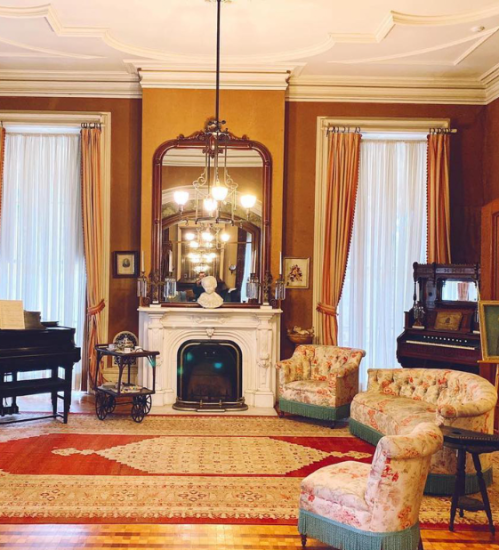
The Decoration of the Parlor and the choice and arrangement of the furniture reflect the changing role of women in the nineteenth century. Women as the embodiment of purity and high moral virtue was a theme which nineteenth-century popular culture adopted with obsessive fervor. Before the middle of the century the image of a woman was what it had been since the Middle Ages. She was the daughter of Eve, the embodiment of wantonness. Before the Industrial Revolution, misogynic literature always pictured women as less than human beings, closer to animals, and less able to control their lust by exercise of their intellect or moral powers. By the 1880s, the myth of pure Victorian woman was fully formed, and the transformation of woman’s image was complete. Late nineteenth-century reformers wrote that women had no libido; that, in fact, it was replaced by a “maternal instinct,” and that women only concepted to pleasures of the flesh to procreate. Women were also said to be the kinder, gentler gender which higher moral standards and greater-self-control. Men were thought of as smarter and more competent but more lustful and “primitive” with less ability to control their passions.

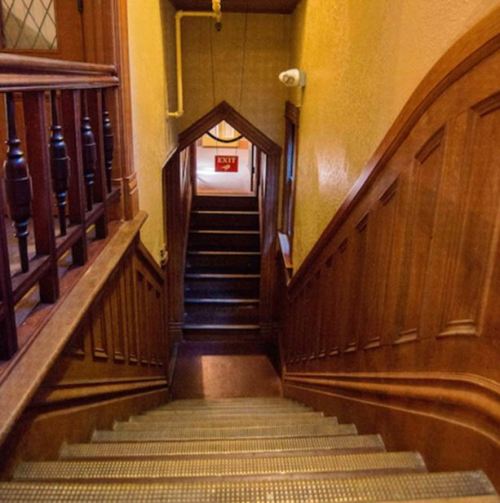
From the Winchester Mansion, there comes an account of a man wheeling a barrow from the garden door to the front door of the house across the lawn. He is seen at night, and does nothing but wheel the barrow hither and tither. There are reports of ghosts sweeping up leaves, or tending to fires, or simply sitting in an accustomed chair. There are also many reports of dead 18th century villagers or townspeople being “seen” on the estate which they had cared for all their lives. In 1989, a caretaker saw an employee who had called in sick by the gate of the mansion. He entered the garden and walked up palm avenue to the carriage house and disappeared when he entered the house. The employee had recently been taken to hospital and, on the caretaker remarking to her manager that he seemed much better, she was informed the he had died that afternoon. These phenomena suggest that the memory of human form is held in the terrain itself. These wraiths may be images on a rotating spool. Or perhaps they are held in the atmosphere, as if in a solution.
On 31 October 1990, the residents of the neighbourhood were surprised by strange sights in the sky. Between one and two o’clock in the morning was heard by some the “howling of wolves.” But then, on the sudden…appeared in the sky were orbs and shadowy figures. So amazing and terrifying the poor people that they could not give credit to their ears and eyes; they ran inside of their houses, some calling the police. When police arrived, they determine the noise was coming from the movie theater and the orbs and shadows were simply projector lights used to attacked customers, which had been obscured by cloud cover. However, some people believed that ghosts were in Mrs. Winchester’s mansion celebrating, and they could be seen leaving.

For further information about tours, including group tours, weddings, school events, birthday party packages, facility rentals, and special events please visit the website: https://winchestermysteryhouse.com/

Please visit the online giftshop, and purchase a gift for friends and relatives as well as a special memento of the Winchester Mystery House. A variety of souvenirs and gifts are available to purchase. https://shopwinchestermysteryhouse.com/

It is Well to Remember that the Revealing God is Also the Concealing God for One!

Visibility, significance, recognition! All that I had ever wanted when I took to the architectural design studio, all that I had ever wanted as a boy heading to Paris with a head full of dreams, all I had ever wanted I now had right here with my brothers and sisters! I had all that I have ever hoped for, and I had it here and now in this place and amongst my own people. The old human story simply did not matter. I had this, I had this moment, I had this recognition, and this visibility and this significance. And how could I ask for anything more? How could I look from right t left, at immortals who had witnessed all the epochs of recorded history, and want more than this? How could I gaze at immortals who had been drawn to this very spot by something more immense than they had ever witnessed, and long for more than the recognition they were now giving me? The victory of our own tribe to embrace one another, and let go of the hatred that had divided us for centuries, was my victory. After the house has schooled its tenants, there is still much uncertainty about the proper way to behave in this new and unique environment. What the house does not do, the neighbors finish off. By their example they indicate the code to be followed. Hence, if one person has a refrigerator, next-door thinks she should have one; if A has a BMW M5, B wants one too. #RandolphHarris 1 of 23

“If,” says Mrs. Abbot, “you make your garden one way, they will knock theirs to pieces to make theirs like it. It is the same with the curtains—if you put up new curtains, they have new curtains in a couple of months. And if someone buys a new Persian rug they have to hang it on the line so you can see it.” The struggles for possessions is one in which comparisons with other people are constantly made. Some of those who have achieved a more complete respectability look down on the others; those with less money resent the more successful and keep as far away from them as they can. “The whole answer—the whole trouble is, many men cannot earn enough. They have to hide in the closet or behind the curtains. They have got a certain amount of pride.” Resentment may also produce an aggressive spirit. “This place is all right for middle-class people, people with a bit of money. It is no good for less affluent people—I think they have all got money troubles, that is why they are so spiteful to each other.” We have been arguing that, the possession of a new house having sharpened the desire for other material goods, the striving for them becomes a competitive affair. The house is a major part of the explanation. However, there is more to it than that. In Bethnal Green people, as we said earlier, commonly belong to a close network of personal relationship. #RandolphHarris 2 of 23

These people know intimately dozens of other local people living near at hand, their school-friends, their work-mates, their pub-friends, and above all their relatives. They know them well because they have known them over a long period of time. Common family residence since childhood is the matrix of friendship. In this situation, Bethnal Greeners are not, as we see it, concerned to any marked extent with what is usually thought of as “status.” It is true, of course, that people have different incomes, different kinds of jobs, different kinds of houses—in this respect there is much less uniformity than at Greenleigh—even different standards of education. However, these attributes are not so important in evaluating others. It is personal characteristics which matter. The first thing they think of about William is not that he has a “fridge” and a BMW M5 sports sedan. They see him as a bad-tempered, or a real good sport, or the man with a way with women, or one of the best boxers of the Repton Club, or the person who got married to Ava last year. In a community of long-standing, status, in so far as it is determined by job and income and education, is more or less irrelevant to a person’s worth. He is judged instead, if he is judged at all, more in the round, as person with the usual mixture of all kinds of qualities, some good, some bad, many indefinable. He is more of a life-portrait than a figure on a scale. #RandolphHarris 3 of 23

People in Bethnal Green are less concerned with “getting on.” Naturally they want to have more money and a better education for their children. The borough belongs to the same society as the estate, one in which standards and aspirations are moving upward together. However, the urge is less compulsive. They stand well with plenty of other people whether or not they have net curtains and fine pram. Their credit with others does not depend so much on their “success” as on the subtleties of behavior in their many face-to-face relationships. They have the security of belonging to a series of small and overlapping groups, and from their fellows they get the respect they need. How different is Greenleigh we have already seen. Where nearly everyone is a stranger, there is no means of uncovering personality. People cannot be judged by their personal characteristics: a person can certainly see that his or her neighbor works in one’s back garden in one’s short sleeves and one’s wife goes down to the shops in a blue coat, with two canvas bags: but that is not much of a guide to character. Judgment must therefore rest on the trappings of the being rather than on the being oneself. If people have nothing else to go by, they judge from one’s appearance, one’s house, or even one’s Minimotor. One is evaluated accordingly. Once the accepted standards are few, and mostly to do with wealth, they become the standards by which “status” is judged. #RandolphHarris 4 of 23

In Bethnal Green it is not easy to give a man a single status, because he has so many; he has, in addition to the status of citizen, a low status as a scholar, high as a darts-player, low as a bargainer, and high as a story-teller. In Greenleigh, he has something much more nearly approaching one status because something much more nearly approaching one criterion is used his possessions. Or rather we should say that the family has one status. The small group which lives inside the same house hangs together, and where people are known as “from No. 22” or “37,” their identity being traced to the house which is the fixed entity, each one of them affect the credit of the other. The children, in particular, must be well dressed so that neighbors, and even more school friends and teachers, will think well of them, and of the parents. “We always see that the children look smart. At these new schools, you like them to go to school respectable. We like to keep them up to the standard out here.” The status is that of the family of marriage much more sharply than it is in Bethnal Green. In Bethnal Green the number of relatives who influence a person’s standing is much larger, and they are varied in their attributes. From a prominent local personality, a street-trader, say, a councilor, or a publican, a person can borrow prestige; but through another relative one may be associated with less enviable reputation. #RandolphHarris 5 of 23

One connection confers high status, another lone. It is therefore all the more difficult to give a person a single rating. On the other hand, the comparative isolation of the family at Greenleigh encourages the kind of simplified judgment of which we have been speaking. People at Greenleigh want to get on in the light of these simple standards, and they are liable to be more anxious about it just because they no loner belong to small local groups. Their relationships are window-to-window, not face-to-face. Their need for respect is just as strong as it ever was, but instead of being able to find satisfaction in actual living relationships, through the personal respect that accompanies almost any kind of respect is just as strong as it ever was, but instead of being able to find satisfaction in actual living relationships, through the personal respect that accompanies almost any steady human interaction, they have to turn the other kind of respect which is awarded, by some strange sort of common understanding, for the quantity and quality of possessions with which the person surrounds oneself. Those are the rules of the game and they are, under strong pressure from the neighbors, almost universally observed. Indeed, one of the most striking things about Greenleigh is the great influence the neighbors have, all the greater because they are anonymous. #RandolphHarris 6 of 23

Though people stay in their houses, they do in a sense belong to a strong compelling group. They do not now their judge personally but her influence is continuously felt. One might even suggest, to generalize, that the less the personal respect received in small group relations, the greater is the striving for the kind of impersonal respect embodied in a status judgment. The lonely man, fearing he is looked down on, becomes the acquisitive man; possession the balm to anxiety; anxiety the spur to unfriendliness. We took as out starting point people’s remarks—so frequent and vehement as to demand discussion—about the unfriendliness of their fellow residents. We have suggested two main explanation. Negatively, people are without the old relatives. Positively, they have a new house. In a life now house-centered instead of kinship centered, competition for status takes the form of a struggle for material acquisition. In the absence of small groups which join one family to another, in the absence of strong personal associations which extend from one household to another, people think that they are judged, and judge others, by the material standards which are the outward and visible mark of respectability. One may work toward enlightenment and inner freedom, to the aspiration which draws one most. Whatever helps consciousness come nearer to high moods is a useful spiritual path to someone. #RandolphHarris 7 of 23

One should take any approach which appeals to one, if it is morally worthy, and try to use what one can of it. Several different methods of spiritual development have been offered to humanity. Some have more merit than others and some are more effective than others. However, so much depends on the particular needs and status of each person, that the value of a method cannot be generalized with fairness. It is misleading to pick out any one way to the Overself and label it the best, or worse still, the only way. It is unfair to compare the merits of different ways. For the truth is that firstly each has a contribution to make, and finally each individual aspirant has one’s own special way. The claims that these simpler paths like devotion or repeating a declaration can lead to the goal, are neither true nor untrue. For they lead to the philosophic path which, in its own turn, leads directly to the goal. Is there a single teacher, prophet, messenger, or stain who has been universally acclaimed and universally followed? For that to be, all humankind would need the same outer background and inner status. Great or small there are certain differences between all persons. They cannot pursue the same ways, therefore we should let others take a different view in religion from ourselves. They very widely that it is an adventure for society if there exists as greater a diversity of approaches as possible—they are thus better able to suit particular needs. #RandolphHarris 8 of 23

Why should anyone be afraid of diversity in religious views, of variety in religious practices? Let heresies multiply! Let the sects flourish! For out of all this free competition, the seeker has a better chance to find truth. The modern seeker is fortunate in this: that one has a wealth of teachings to choose from—or by which to be bewildered. We must not only acknowledge the differences between beings but respect them. Consequently we must accept the fact of variations in responsive capacity and not demand that all should think alike, believe alike, behave alike. What is too much for one individual is too little for another. No universally applicable prescription can be given to suit everyone alike. All these paths should converge towards one another, as all must merge in the central point in the end. However different personal reactions will necessarily be with every individual seeker, there will still remain certain experiences, requirements, and conditions—and these are the most important ones—along one’s oath which must be the same for every other seeker too. Each being’s approach must inevitably be individualistic yet each will also share in common all the essential which constitute the Quest. Whether a being is a Zionist or a Zennist, whether one seeks the Christian Salvation or the Japanese Satori, the fundamental approach is more or less the same. #RandolphHarris 9 of 23

There is no cut and dried system or method which can be guaranteed to work successfully in every case. However, there are suggestions, hints, ideas which have been culled from the personal experiences of a widely varied, World-spread number of masters and aspirants. Since each being’s pat is peculiarly an individual one, no book can guide all one’s steps. A book may help one through some situations, inform one about the general course of inner development, and warn one against the probable mistake and chief pitfalls. Each being has to strive for this higher consciousness in one’s own way. Each path to it is unique. However, at the same time one may profitably avail oneself of the general instruction contained in writing like the present one. Let us now consider the innocence of the “enemy,” a typical young member of the Ohio National Guard, roughly around the age of 22. I am helped in this by a letter I received from a college girl whose brother was exactly in that position: I shall quote from this letter: “My younger brother Michael was afraid to answer the telephone in those says for fear it would be his National Guard Headquarters calling him for riot duty on one of the nearby campuses. Michael says that the rest of his group was afraid of a phone call as he. He was not at all sure the student protestors were wrong, and even if they were, the presence of the National Guard was no answer. #RandolphHarris 10 of 23

“If my brother had been called for riot duty, and if some irresponsible officer had provided him with a loaded gun, and if the confrontation had become strained, he may have shot a student…I think that both Allison Krause and the Guardsman who shot her were playing roles that did not belong to either of them.” Let us assume, with my correspondent, that Michael is mobilized and arrives on the Kent State campus. He picks up the fact that the students at Kent State had woefully neglected any real communication with the townspeople—indeed, had gone out of their way to irritate them. On Saturday nights, according to a dispatch in the New York Times, students would sit on the downtown sidewalk, making the townspeople walk around them to the accompaniment of obscenities, totally unaware, although it is hard to believe, of the degree of hatred this was engendering in the people of the town of Kent. Over a period of two days Michael sees one building burnt down, he gets only three hours sleep the night before, the students yell obscene jokes at him and pelt him with rocks as he is marched with his battalion through the taunting crowds. Shall we condemn Michael, our hypothetical young guardsman, as murderer? #RandolphHarris 11 of 23

If we do that—because he was the one who squeezed the trigger—and fold up our briefcases and go home, we are preventing ourselves from understanding a large segment of reality, and we are capitulating exactly at the point where we should press on the hardest. Michael’s sister, my correspondent, goes on to point out where she thinks the culprit is: “I think the country has evolved into a kind of massive unreality and fear…It is a kind of out-of-touchness which robes people of most of their alternative except survival.” There is no denying that this massive “unreality and fear” exists. In our day we tend to live out the state of mind that Camus predicted in his early novel, The Stranger, in which Meursault, the anti-hero, exists in a general state of semiconsciousness. He makes love to a girl as though both were half-asleep, and he finally shoots an Arab in the Sun on the desert in a condition of semiawareness that leaves us, as no doubt it left him, wondering whether he really shot the Arab or not. He is tried for murder. His crime is actually the murder of himself. What my correspondent calls this “massive unreality” and “out-of-touchness” makes every being a stranger to other beings as well as oneself. And the fact that it is the sickness of contemporary beings, who surrenders one’s consciousness in the face of the continual assaults on one’s senses, like surf in a perpetually stormy ocean, does not make our problem any easier. #RandolphHarris 12 of 23

However, you and I also make up this country which has become so filled with “massive unreality and fear.” When we think of the “country” or the “society” as at fault, we tend to posit the country as an anonymous “it” which does things to us, the people in it. It is then, in part, a convenient peg on which to hang our own projections. Thus we evade the issue on its deeper levels. I am not discounting the importance of social psychology, the study of the way groups takes on roles and use them for their various purposes of security. I am also aware of the effect of electrotechnics on the individual, of the mass impersonality of technology, and of the experience each of us undergoes as the sport of innumerable pressures operating on us in “a World we never made.” However, our society, our country, has this power because we as individuals capitulate to it; we give over our own power, as I have tried to point out earlier, and we then are offended because we are powerless. To that extent, we victimize ourselves. Our survival depends on whether human consciousness can be asserted, and with sufficient strength, to stand against the stultifying pressures of technological progress. If the country has evolved into a state of “massive unreality and fear,” it must be you and I who experience this unreality and fear. And so we must push on in our endeavor to understand the psychological uses of innocence and murder. #Randolphharris 13 of 23

The striving for power serves in the first place as a protection against helplessness, which as we have seen is one of the basic elements in anxiety. The neurotic is so averse to any remote appearance of helplessness or weakness in oneself that one sill shun situations which the normal person considers entirely commonplace, such as any acceptance of guidance, advice, or help, any kind of dependence on persons or circumstances, any giving in to or agreeing with others. This protest against helplessness does not arise in all its intensity at once, but increases gradually; the more the neurotic feels factually handicapped by one’s inhibitions, the less one is factually able to asset oneself. The weaker one factually becomes the more anxiously one has to avoid anything that has a faint resemblance to weakness. In the second place, the neurotic striving for power serves as a protection against the danger of feeling or being regarded as insignificant. The neurotic develops a rigid and irrational ideal of strength which makes one believe one should be able to master any situation, no matter how difficult, and should master it right away. This ideal becomes linked with pride, and as a consequence the neurotic considers weakness not only as a danger but also as a disgrace. One classifies people as either “strong” or “weak,” admiring the former and despising the latter. #RandolphHarris 14 of 23

One goes to extremes also in what one considers to be weakness. One has more or less contempt for all persons who agree with one or give in to one’s wishes, who have inhibitions or do not control their emotions so closely that they always show an impassive face. One despises the same qualities in oneself as well. One feels humiliated if one has to recognize the existence of anxiety or an inhibition in oneself, and thus despises oneself for having a neurosis and is anxious to keep this fact a secret. One also despises oneself for not being able to cope with it alone. The particular forms that such a striving for power will take depend upon what lack of power is most feared or despised. I shall mention a few expressions of this striving that are especially frequent. For one, the neurotic will desire to have control over others as well as over oneself. One wants nothing to happen that one has not initiated or approved of. This quest for control may take the attenuated form of consciously permitting the other to have full freedom, but insisting on knowing about everything one does, and feeling irritated if anything is kept a secret. Tendencies to control maybe repressed to such a degree that not only the person oneself, but even those about one, may be convinced of one’s greater generosity in allowing freedom to the other. #RandolphHarris 15 of 23

If a person represses one’s desire for control so completely one may, however, become depressed or have severe headaches or stomach upsets every time the other has an appointment with other friends or unexpectedly comes home late. Not knowing the cause of the disturbances one may accredit them to weather conditions, to an error in diet or similar irrelevant conditions. Much of what appears as curiosity is determined by a secret wish to control the situation. Also persons of this type are inclined to want to be right all the tie, and are irritated at being proved wrong, even if only in an insignificant detail. They have to know everything better than anyone else, an attitude which may at times be embarrassingly conspicuous. Persons who are otherwise serious and dependable, when confronted with a question to which they do not know the answer, may pretend to know, or may invent something, even if ignorance in this particular instance would not discredit them. Sometimes the emphasis is on the need to know in advance what will happen, to anticipate and predict every possibility. This attitude may go with a distaste for any situation involving uncontrollable factors. No risk should be taken. The emphasis on self-control shows in an aversion to being carried away by any feelings. #RandolphHarris 16 of 23

If he falls into love with her, the attraction which a neurotic woman feels for a man may suddenly turn into contempt. Patients of this type find it hard to allow themselves much drift in free associations, because that would mean losing control and letting themselves be carried away into unknow territory. I am going to talk with you tonight about something that is very close to my own thoughts—this something I have been thinking about for years in my own hear, and in the period when I spent two years in bed with tuberculosis up in the Adirondack mountains before there were any drugs for this disease—all of these things come together in these ideas I have been sharing with you tonight. They came, particularly, when I was interviewing, in New York City, student candidates to be trained in analytic institutions. I was on the committee for two groups, and so I interviewed for these two different groups. What I asked myself was, “What makes a good psychotherapist? What is there in a particular person that would tell us that here is somebody that can genuinely help other people in the fairly long training of the psychoanalyst?” It was quite clear to me that it was not adjustment—adjustment that we talked of so fondly when I was Ph.D. student, and so ignorantly. #RandolphHarris 17 of 23

I knew that the well-adjusted person who came in and sat down to be interviewed would not make a good psychotherapist. Adjustment is exactly what a neurosis is; and that is one’s trouble. It is an adjustment to nonbeing in order that some little being maybe preserved. An adjustment always flounders on the question—adjustment to what? Adjustment to a psychotic World, which we certainly live in? Adjustment so societies that are Faustian and insensitive? And then I looked further. We know very little about the effect of punishment on learning, because almost no truly scientific studies have been made of it on human beings. For instance, we do not know how much punishment is best for learning—and we do not know how much difference it makes as to who is giving the punishment, whether an adult learns best from a younger or an older person than oneself—or any things of that sort. Harry Stack Sullivan, who was the only psychiatrist born in America to contribute a new system that was powerful enough to have an influence, not only on psychiatry, but on psychology, sociology, and a number of other professions, was one of my teachers. We all revered him greatly. Dr. Sullivan was an alcoholic, and he was latently homosexual—he once proposed to Clara Thompson when he was drunk and got up very early the next morning to take it back. #RandolphHarris 18 of 23

Dr. Sullivan never could get along with any groups with more than two of three people. It dawned on me that mental problems are problems that always had their beginnings, and their cures, in interpersonal relationships. Consider Abe Maslow. He was not a therapist, but one of the great psychologists. Dr. Maslow had a miserable time of it. He came from an immigrant family in the slums; he was alienated from his mother and afraid of his father. In New York, groups often lived in ghettos, and Abe was beaten up by Italian and Irish boys in the vicinity (he was Jewish); he was underweight, and yet, this man, the man who had so many hellish experiences—was the one who introduced the system of peak experiences into psychology. Dr. Freud and Dr. Maslow are two of the most important people in the development of psychology. I want to propose a theory to you, and this is the theory of the wounded healer. I want to propose that we heal other people by virtue of our own wounds. Psychologists who become psychotherapist, psychiatrists, too, as far as that goes, are people who had, as babies and children, to be therapists for their own families. This is pretty well established by various studies. And I propose to carry that idea further and to propose that it is the insight that comes to us by virtue of our own struggle with our problems that lead us to develop empathy and creativity with human beings—and compassion. #RandolphHarris 19 of 23

There was a study made in England, at the University of Cambridge, of geniuses—great writers, great artists, and so on—and of the forty-seven that this woman took as her sample, eighteen had been hospitalized—in a mental hospital—or had been treated with lithium, or had electric shock. These were people that you know. Handel—his music came out of great suffering. Byron—you would think he did everything but suffer, but he was a manic depressive. Anne Sexton, who, I believe, later committed suicide, was a manic-depressive. Virginia Woolf, who I know committed suicide, was also troubled by depression. Robert Lowell, the American poet, was manic depressive. Now, what I enlarge that to say that there are positive aspects to all diseases, to all illness, whether it is mental or physical. We may say that some form of struggle is necessary to carry us to the depth out of which creativity comes. Therefore a certain amount of discipline and personal power must be accumulated to prevent physical, mental, and spiritual catabolism. One must develop a self-devotion which will instill self-love, self-respect, and beneficial thinking that will empower you to shatter obstacles as the God of your World. If you can work through the test of your own demons and your imaginations own worst fears all else will seem rudimentary and insignificant. #RandolphHarris 20 of 23

Just remember, you must be honest with yourself and work hard as hell (pun intended) to become something great. Indeed, we sometimes see obstacles as locked doors which keep us from uniting the various levels of our consciousness. However, awareness just moves around and the filter of perception changes. Operating from a higher state of awareness is not to be mistaken for uniting the isolated levels of consciousness. Consciousness cannot expand until it is first made whole and this is to oppose creation and all its limitations. It is a force which acts as the very key which unlocks the cages of imprisonment so that we can reach liberation by stepping into outer darkness which reunited the isolated frequencies of the light spectrum. Through this we not only better perceive reality but we are also better able to counter create though personal alchemical transmutation and spirituality. Feel your soul absorbing the isolated colors of the light spectrum and reuniting the consciousness which has been torn through creation. Jerome Kagan, a professor up at Harvard, made a long and intensive study of creativity, and what he concluded is that the artist’s main capacity, what he calls “his creative freedom” is not born within him. The creativity is made in the pain of adolescent loneliness, the isolation of physical disability. #RandolphHarris 21 of 23

We often expect people who experience the ultimate in horror in their background to be broken people. When we hear of what people have been through, we doubt they will survive. However, some not only survive, they become exceedingly creative and productive human beings. Individuals who have suffered calamitous events in the past can, and do, function later at average levels and may even function at higher-than-average levels. Relevant coping mechanisms may avert the potentially detrimental effects of calamitous experiences, but they may also transform these experiences into growth-producing experiences. Inmates who have had poor, unpampered childhoods adapted best to the concentration camps, whereas most of those who had been reared by permissive, wealthy parents were the first to die. Many of our most valuable people have come from the most calamitous early-childhood situations. Investigations of the childhoods of eminent people expose the fact that they did not receive anything like the kind of child rearing that a person in our culture is led to believe is healthy for children. Now, whether in spite of or because of these conditions, these children not only survived, but reached great heights of achievement, many after having experiences the most deplorable and traumatic childhoods. #RandolphHarris 22 of 23

There was a study also done right here in Berkeley of the long-term development of human beings. A group of psychologists followed people through from birth to 30 years of age. They followed 166 men and women through adulthood, and they were shocked by the inaccuracies of their expectations. They were wrong in about 66 percent of the cases, mainly because they had overestimated the damaging effects of early troubles. They had also not foreseen—this sentence is interesting to all of us—they also had not foreseen the negative effect of a smooth and successful childhood, that a degree of stress and challenge seemed to spur psychological strength and competence. The goal here is to allow the essence of God to flow through and operate within each level of our being or consciousness. In this way we can become fully open to gateways to his powers. As we build our faith the Holy Ghost will serve as our foundation. It will align us and our temple with the frequency of the Godhead to be employed and serve to raise your own level of spiritual power. This will further unite physical and spiritual discipline in order to create a dynamic synergy which will assist in tearing the veil between physical and spiritual realms. Powerful changes will begin to take place within you and your life experience as you begin to integrate and merge with these spiritual forces. “And a portion of that Spirit dwelleth in me, which giveth me knowledge, and also power according to my faith and desires which are in God,” reports Alma 18.35. #RandolphHarris 23 of 23

Have you visited us at #CresleighRanch yet? Stop by this week to tour Mills Station Residence 4! This home includes 4 bed / 3.5 bath, a #homehub, great room, 2-car garage with workshop space, and more.
Visit our website to explore this spacious home with our Interactive Floor Plan tool. Link in below!
https://cresleigh.com/mills-station/
#MillsStation
#RanchoCordova
#NewHomesForSale
#CresleighHomes

 Randolph Harris II International Institute