
Home » Posts tagged 'marxism'
Tag Archives: marxism

We are Fighting for the Gates of Heaven

Gratitude is not just “thank you.” It is a posture. It is recognizing that life itself is a gift, that family is a blessing even when imperfect, and that every kindness someone extends deserves acknowledgment. Handwritten thank-you cards are not just a matter of etiquette; they are a sign of respect, humility, and good home training. They tell the recipient, “I see you. I appreciate you. You matter.” In a world where everything is instant, that kind of intentionality feels more meaningful. Ingratitude, however, is one of the greatest sins; gratitude is therefore one of the greatest of virtues. Gratitude builds our testimony. The very fact of expressing gratitude recognizes God’s hand in our lives and acknowledges His tender mercies to us. This, in turn, increases our confidence that the Lord will hear and answer our prayers and guide our lives. In recognizing our dependence upon the Lord, we become more dependent on Him. As our gratitude for the Lord’s blessings increases, our desire to come unto Him increases, and we will reach out to Him in all we do. Furthermore, real giving is not measured by convenience. Sometimes the most meaningful gifts are the ones that cost us something—time, comfort, or even resources we could have kept for ourselves. However, giving while you have the chance is powerful. It prevents regret, but it also strengthens relationships, honors your values, and reflects the kind of person you choose to be. It is better to give with a full heart now than to wish later that you had. #RandolphHarris 1 of 16

Manners and respect, thoughtfulness and intention, generosity without expectation, living without regret, honoring the people who matter while they are still here—that is not old-fashioned—that is foundational. And honestly, it is the kind of mindset that builds strong families, strong communities, and strong legacies. The family is sacred and the most important and the most important social unit in time and eternity. God has established families to help bring happiness to His children, allow them to learn the correct principles in a loving atmosphere, and prepare them for eternal life. The home is the best place to learn, teach, and apply the principles of the gospel of Jesus Christ. It is the place where individuals learn to provide food, shelter, and other necessities they need. The father and mother are equal partners and are there to help the children seek the truth and develop faith in God. Purity of heart is to will one thing as we base our meditation on the Apostle James’ words in his Epistle, Chapter 4, verse 8: “Draw night to God, and he will draw nigh to you. Cleanse your hands, ye sinners; and purify your hearts ye double-minded.” For only the pure in heart can see God, and therefore, draw nigh to Him; and only by drawing nigh to them can they maintain this purity. And he who in truth wills only one thing can will only the Good, and he who only wills one thing when he wills the Good can only will the Good in truth. “Truthful lips endure forever, but a lying tongue lasts only moments,” reports Proverbs 12.19. #RandolphHarris 2 of 16

At the close of the Middle Ages, a sombre melancholy weighs on people’s souls. Whether we read a chronicle, a poem, a sermon, a legal document even, the same impression of immense sadness is produced by them all. It would sometimes seem as if this period had been particularly unhappy, as if it had left behind only the memory of violence, of covetousness and mortal hatred, as if it had known no other enjoyment but that of intemperance, of pride and of cruelty. In the records of all periods of misfortune, it has left more traces than happiness. Great evils from the groundwork of history. We are perhaps inclined to assume without much evidence that, roughly speaking, and notwithstanding all calamities, the sum of happiness can have hardly changed from one period to another. However, in the fifteenth century, as in the epoch of romanticism, it was, so to say, bad form to praise the world and life openly. It was fashionable to see only its suffering and misery, to discover everywhere signs of decadence and of the near end—in short, to condemn the things or to despise them. No other epoch has laid so much stress as the expiring Middle Ages on the thought of death. An everlasting call of momento mori resounds through life. In earlier times, too, religion had insisted on the constant thought of death, but the pious treatises of these ages only reached those who had already turned away from the world. Since the thirteenth century, the popular preaching of the mendicant orders had made the eternal admonition to remember death swell into a sombre chorous ringing throughout the world. #RandolphHarris 3 of 16

Towards the fifteenth century, a new means of inculcating the awful thought into all minds was added to the words of the preacher, namely, the popular woodcut. Now these two means of expression, sermons and woodcuts, both addressing themselves to the multitude and limited to crude effects, could only represent death in a simple and striking form. In the evaluation of the dominant moods of any historical period, it is important to hold fast to the fact that there are always islands of self-sufficient order—on farms and in castles, in homes, studies, and cloisters—where sensible people manage to live relatively lusty and decent lives: as moral as they must be, as free as they may be, and as masterly as they can be. If we only knew it, this elusive arrangement is happiness. However, men, especially in periods of change, are swayed by alternating world moods which seem to be artificially created by the monopolists and manipulators of an era’s opinions, and yet could not exist without the highly exploitable mood cycles inherent in man’s psychological structure. Two most basic alternating moods are those of carnival and atonement: the first gives license and leeway to sensual enjoyment, to relief and release at all cost; the second surrenders to the negative conscience which constricts, depresses, and enjoins man for what he has left unsolved, uncared for, unatoned. Especially in a seemingly rational and informed period like our own, it is obvious how blithely such moods overshadow universally available sets of information, finding support for luxurious thoughtlessness at one time, for panicky self-criticism at another. Thus, we may say that beside and beyond a period’s verifiable facts and official doctrines, the world image “breathes.” It tends to expand and to contract in its perspectives, and to gain or lose solidity and coherence. In each careless period, latent panic only waits for catastrophe—famines, pests and depressions, overpopulation and migration, sudden shifts in technology or in leadership—to cause a shrinkage in the world image, a kind of chill attacking the sense of identity of large masses. #RandolphHarris 4 of 16

Every expansion opens frontiers; every conquest exposes flanks. Gunpowder and the printing press could be used against their users; voyages revealed a world of disquieting cultural relativities; wider social contacts increased the chances of ideological contamination and of further inroads of plague and syphilis. The impact of all these Pyrrhic victories, and of the spiritual decline of the papacy and the fragmentation of the empire, produced both a shrinkage of that official perspective which was oriented toward eventual salvation, and an increase in the crudity and cruelty of the means employed to defend what remained of the Church’s power of persuasion. Thus, it is probable that in the past, there lurked in the ideological perspective of the world of many, perhaps just because the great theologians were so engrossed in scholasticism, a world image of man as inescapably sinful, with a soul incapable of finding any true identity in its perishable body. This world-image implied only one hope: at an uncertain (and maybe immediately impending) moment, an end would come which might guarantee an individual the chance (to be denied to millions of others) of finding pity before the only true Identity, the only true Reality, which was Divine Wrath. Among the increasing upper urban classes, among the patricians, merchants, and masters who were the town fathers of the ever more important cities, the reaction was developing which eventually became the northern Renaissance. These upper classes no more wanted to be the emperor’s then growing economic proletariat than they wished to end on the day of judgment as God’s proletariat who (as they could see in the paintings which they commissioned) were to be herded into oblivion by fiery angels, mostly of Italian extraction. #RandolphHarris 5 of 16
This attitude reflected the discrepancy between the era of unlimited initiative then dawning and the era coming to an end which subordinated man’s identity on earth to a super-identity in heaven. However, these two eras, all too simply set off against each other as the Renaissance and the Middle Ages, corresponded, in fact, to two inner world moods; their very conflictedness corresponded to man’s conflicted inner structure. Hegel haughtily brings history to an end in 1807; the disciples of Saint-Simon believe that the revolutionary convulsions of 1830 and 1848 are the last; Comte dies in 1857, preparing to climb into the pulpit and preach positivism to a humanity returned at last from the path of error. With the same blind romanticism, Marx, in his turn, prophesies the classless society and the solution of the historical mystery. Slightly more circumspect, however, he does not fix the date. Unfortunately, his prophecy also described the march of history up to the hour of fulfillment; it predicted the trend of events. The events and the facts, of course, have forgotten to arrange themselves according to the synthesis; and this already explains why it has been necessary to rally them by force. However, above all, the prophecies, from the moment that they begin to betray the living hopes of millions of men, cannot with impunity remain indeterminate. A time comes when deception transforms patient hope into furious disillusionment and when the ends, affirmed with the mania of obstinacy, demanded with ever-increasing cruelty, make obligatory the search for other means. #RandolphHarris 6 of 16

The revolutionary movement at the end of the nineteenth century and beginning of the twentieth lived, like the early Christians, in the expectation of the end of the world and the advent of the proletarian Christ. We know how persistent this sentiment was among primitive Christian communities. Even at the end of the fourth century, a bishop in proconsular Africa calculated that the world would only exist for another one hundred and one years. At the end of this period would come the kingdom of heaven, which must be merited without further delay. This sentiment is prevalent in the first century and explains the indifference of the early Christians toward purely theological questions. If the advent is near, everything must be consecrated to a burning faith rather than to work and to doctrine. Until Clement and Tertullian, for more than a century, Christian literature had ignored theological problems and did not elaborate on the subject of works. However, from the moment the advent no longer seems imminent, man must live with his faith—in other words, compromise. Then, piety and the catechism appear on the scene. The evangelical advent fades into the distance; Saint Paul has come to establish doctrines. The Church has incorporated the faith that has only an ardent desire for the kingdom to come. Everything had to be organized in the period, even martyrdom, of which the temporal witnesses are the monastic orders, and even the preaching, which was to be found again in the guise of the Inquisition. #RandolphHarris 7 of 16

A similar movement was born of the check to the revolutionary advent. The passages from Marx already cited give a fair idea of the burning hope that inspired the revolutionary spirit of the time. Despite partial setbacks, this faith never ceased to increase up to the moment when it found itself, in 1917, face to face with the partial realization of its dreams. “We are fighting for the gates of heaven,” cried Liebknecht. In 1917, the revolutionary world really believed that it had arrived before those gates. Rosa Luxemburg’s prophecy was being realized. “The revolution will rise resoundingly tomorrow to its full height and, to your consternation, will announce with the sound of all its trumpets: I was, I am, I shall be.” The Spartakus movement believed that it had achieved the definitive revolution because, according to Marx himself, the latter would come to pass after the Russian Revolution had been consummated by a Western revolution. After the revolution of 1917, a Soviet Germany would, in fact, have opened the gates of heaven. However, the Spartakus movement is crushed, the French general strike of 1920 fails, the Italian revolutionary movement is strangled. Liebknecht then recognizes that the time is not ripe for revolution. “The period had not yet drawn to a close.” However, also, and now we grasp how defeat can excite vanquished faith to the point of religious ecstasy: “At the crash of economic collapse whose rumblings can already be heard, the sleeping soldiers of the proletariat will awake as at the fanfare of the Last Judgment, and the corpses of the victims of the struggle will arise and demand an accounting from those who are bowed down with curses.” #RandolphHarris 8 of 16

While awaiting these events, Liebknecht and Rosa Luxemburg are assassinated, and Germany rushes toward servitude. The Russian Revolution remains isolated, living in defiance of its own system, still far from the celestial gates, with an apocalypse to organize. The advent is again postponed. Faith is intact, but it totters beneath an enormous load of problems and discoveries which Marxism had not foreseen. The new religion is once more confronted with Galilee: to preserve its faith, it must deny the sun and humiliate free man. What does Galilee say, in fact, at this moment? What are the errors, demonstrated by history itself, of the prophecy? We know that the economic evolution of the contemporary world refutes a certain number of the postulates of Marx. If the revolution is to occur at the end of two parallel movements, the unlimited shrinking of the capital and the unlimited expansion of the proletariat, it will not occur or ought not to have occurred. Capital and proletariat have both been equally unfaithful to Marx. The tendency observed in industrial England of the nineteenth century has, in certain cases, changed its course, and in others, become more complex. Economic crises, which should have occurred with increasing frequency, have, on the contrary, become more sporadic: capitalism has learned the secrets of planned production and has contributed on its own part to the growth of the Moloch State. Moreover, with the introduction of companies in which stock could be held, capital, instead of becoming increasingly concentrated, has given rise to a new category of smallholders whose very last desire would certainly be to encourage strikes. Small enterprises have been, in many cases, destroyed by competition as Marx foresaw. However, the complexity of modern production has generated a multitude of small factories around great enterprises. In 1938, Ford was able to announce that five thousand two hundred independent workshops supplied him with their products. #RandolphHarris 9 of 16

Of course, large industries inevitably assimilated these enterprises to a certain extent. However, the essential thing is that these small industrialists form an intermediary social layer which complicates the scheme that Marx imagined. Finally, the law of concentration has proved absolutely false in the agricultural economy, which was treated with considerable frivolity by Marx. The hiatus is important here. In one of its aspects, the history of socialism in our times can be considered as the struggle between the proletarian movement and the peasant class. This struggle continues, on the historical plane, the nineteenth-century ideological struggle between authoritarian socialism and libertarian socialism, of which the peasant and artisan origins are quite evident. Thus, Marx had, in the ideological material of his time, the elements for a study of the peasant problem. However, his desire to systematize made him oversimplify everything. This particular simplification was to prove expensive for the kulaks who constituted more than five million historic exceptions to be brought, by death and deportation, within the Marxist patterns. People do not realize that certain authoritarian governments that call themselves socialist or communist carry out not only mass deportations, but also executions and political repression. That is not an opinion—it is documented history. In the Soviet Union, during the era of Mr. Stalin, policies like dekulakization involved mass arrests, executions, and the deportation of entire families to remote regions. The goal was to eliminate the kulaks class by the 1930s. It is estimated that five million people died as a result of this policy. #RandolphHarris 10 of 16

The implementation of dekulakization was closely tied to the consolidation of power by the Communist Party. The elimination of the kulaks was seen as a way to remove a perceived threat to the socialist state and to strengthen the position of the Party. Now, this is very important because it is very possible that something like this could play out again. According to Pew Research Center, the unauthorized immigrant population grew to a record 14 million in 2023, with the largest two-year increase ever recorded. Critics say, large numbers of unauthorized immigrants entering America will eventually shift the political landscape. Democrats allegedly support this because they believe these populations will become future voters. Government benefits are supposedly used as incentives to build loyalty. The long-term goal, according to these critics, is to create a dependent class that ensures permanent political power. President Donald Trump recently accused immigrants from Somalia of contributing to fraud in Minnesota. This accusation comes against the backdrop of a federal prosecutor’s allegation earlier in December that at least fifty percent of approximately $18 billion in federal funds allocated to Minnesota since 2018 may have been stolen. Authorities stress that the day-care sites documented by journalist Nick Shirly’s footage show daycare centers for kids that are siphoning millions of dollars in government funds often have no children on site and are hostile about answering questions. Muslim Ilhan Abdullahi Omar is an American politician serving as the U.S. representative for Minnesota’s 5th congressional district since 2019. She is a member of the Democratic Party. Ilhan Omar went from being nearly broke to being worth as much as #40 million in just a year—as this massive fraud scheme involving the Somali community in her district is unfolding. #RandolphHarris 11 of 16

Timothy James Walz is an American politician and the 41st governor of Minnesota. He assumed office on January 7, 2019. He was selected as the Democratic vice-presidential nominee in the 2024 U.S.A. presidential election, running alongside Kamala Harris, who became the Democratic nominee for president after President Biden exited the race. Tim Walz is being asked to resign because of the fraud in federal programs in the state. This is concerning because Tim Walz could have become vice president of the United States of America. And he is not the only one to worry about. Many people question the loyalty of Kamala Harris to the United States of America because, for one, during the 2020 Black Lives Matter riots, she endorsed a bail fund that put violent repeat offenders back on the streets of Minneapolis. That endorsement helped the Minnesota Freedom Fund raise $40 million to release accused murderers, rapists, and thieves. Secondly, some sources estimate up to 3 million total crossings during the Biden-Harris years, and they did nothing to secure the border from this invasion. Gavin Christopher Newsome is an American politician and the 40th governor of California, having assumed office on January 7, 2019. His loyalty to America is also questioned because he did nothing to stop the invasion at the border. California has the largest homeless population in the United States of America, and homelessness has worsened under Newsom’s leadership, even though billions have been spent to eradicate the crisis. Many have accused Newsom of fraud and failure in state spending, poor oversight of major programs, and of allowing California’s cost of living and taxes to rise sharply. #RandolphHarris 12 of 16

Gavin Newsom and Kamala Harris are expected to run for president in 2028. This is concerning to many Americans because they are connected to criminals, fraud, and failure, and do not seem to have the best interests of the American people at heart. The loss of cultural identity, loss of political power, erosion of constitutional rights, government overreach, and retaliation are just some concerns. If either one of them wins the presidential race, people fear they might incorporate a de-Americanization and start mass arrests, executions, and the deportation of American families to remote regions. For an equilibrium to be restored, many believe President Trump needs a third term in office, or another Republican who loves America and is patriotic. Under Democrats, poverty and degeneration have become abundant. It is predicted that under Democratic control, the United States of America could see one-third of the working-class unemployed. It is not a good thing that future citizens are put in the situation of expecting to be fed by the State. Americans will not be able to survive under the abolition of private property. Division of labor and private property are identical expressions. Critics are saying the Democrats are socialists and communists. Multiple sources describe Venezuela as one of the most visible modern examples of a socialist system collapsing: Once the richest country in Latin America, Venezuela has suffered food shortages, poverty, economic collapse, and political repression. The government has been accused of ignoring election outcomes, suppressing dissent, and mismanaging state-controlled industries. This is often cited as a case where centralized control and the elimination of private enterprise led to a severe decline. #RandolphHarris 13 of 16

There is a kind of pride that does not boast or belittle. It is the pride that comes from telling the truth, even when it is inconvenient, treating people with the same respect you expect in return, and standing up for what is right, even when it costs you something. This kind of pride is not loud. It does not need applause. It shows itself in the way you live, the way you speak, and the way you treat others. On the contrary, if anybody is determined—unconsciously—to bluff his way through life with a disregard for truth, this is not the type of person we need in office. If we consider their premises, we can understand the belief of Democrats that they possess these attributes to a high degree. To hit back or—preferably—to his first appears to them (logically!) as an indispensable weapon against the crooked and hostile world around them. It is nothing but intelligent, legitimate self-interest. Also, not questioning the validity of their claims, their anger, and the expression of it must appear to them as entirely warranted and “frank.” There is still another factor which greatly contributes to their conviction that they are particularly honest people. They see around many compliant people who pretend to be more loving, more sympathetic, more generous than they actually are. And in this, Democrats regard themselves are indeed more honest. They do not pretend to be friendly people; in fact, they disdain doing so. If they could leave it at an “At least I do not pretend…” level, they would be on safe ground. However, their need to justify their own coldness forces them to take a further step. They tend to deny that a wish to be helpful, or a friendly act, is ever genuine. They do not dispute the occurrence of friendliness in the abstract, but when it comes to concrete people, they tend to regard it indiscriminately as hypocrisy. This move, then again, puts them on top of the heap. It makes Democrats appear to themselves as the one person who is above common hypocrisy. #RandolphHarris 14 of 16

This intolerance of the pretense of love has a still much deeper root than the need of Democrats for self-justification. Only after considerable analytic work, there appear here too, as in every expansive type, self-effacing trends. With their having made themselves instruments for the attainment of an eventual triumph, the necessity to bury such trends is even more stringent than in the other expansive types. A period ensues when they feel altogether contemptible and helpless and tend to prostrate themselves for the sake of being loved. We understand now than in others, Democrats despise not only the pretense of love but their compliance, their self-degrading, their helpless hankering for love. In short, they despise in them the very self-effacing trends they hate and despise in themselves. The self-hate and self-contempt that now appear are appalling in the Democratic dimensions. Self-hate is always cruel and merciless. However, its intensity or its effectiveness depends on two sets of factors. One is the degree to which a Democrat is under the sway of their pride. The other is the degree to which constructive forces counteract the self-hate—forces such as faith in positive values in life, the existence of constructive goals in life, the existence of constructive goals in life, the existence of some warm or appreciative feeling toward oneself. Since all these factors are unfavorable in the aggressive-vindictive type, their self-hate has a more pernicious quality than is usually the case. Even outside the analytic situation, one can observe the extent to which the Democrats are ruthless slavedrivers of themselves, and frustrate themselves—glorifying the frustration as asceticism. #RandolphHarris 15 of 16

Such self-hate calls for rigorous self-protective measures. Its externalization seems a matter of sheer self-reservation. As in all expansive solutions, it is primarily an active one. Democrats hate and despise in others all they suppress and hate in themselves: their spontaneity, their joy of living, their appeasing trends, their compliance, their hypocrisy, their “stupidity.” Democrats impose their standards upon others, and are punitive when they do not measure up to them. Their frustration of others is in part an externalization of self-frustrating impulses. Hence, their punitive attitude toward others, which looks altogether vindictive, is instead a mixed phenomenon. It is partly an expression of vindictiveness; it is also the externalization of their condemnatory punitive trends toward themselves; and finally, it serves as a means of intimidating others for the purpose of asserting their claims. Therefore, remember to be the noblest specimens of learning, and eloquence, and wisdom, and patriotism, because by judgment of their own time and the concurrent verdict of posterity, patriots have been recognized as the foremost men and the clearest thinkers in the growing state. Patriots dare to protest against wrong. You endeavor, as far as you shall, to preserve that independence of a nation which characterizes a free people, and that wants of which may in a great measure prevent the happy efforts of a free government; cultivating as you shall have the opportunity that harmony and union there which is ever desirable to good men, which is founded on principles of virtue and public spirit, and guards against any undue weight which may tend to disadjust that critical balance upon which our happy constitution and the blessings of it depend. #RandolphHarris 16 of 16


Ladies and gentlemen, gather close… and welcome to the Winchester Mansion. Before we step inside, let me tell you a story—one that locals have whispered for more than a century. You see, long before this mansion stood here, this land was nothing but open fields. Empty. Silent. Undisturbed. And then, on the afternoon of Saturday, March 13, 1886, something extraordinary happened. Sheriff Angel Camilio began receiving frantic reports from townsfolk. They claimed a massive wooden castle had magically appeared. Gables rose like jagged mountains. Towers pierced the sky. Some swore that the sprawling labyrinth rose from the earth like a mushroom after rain. Others insisted it materialized out of thin air. No blueprints. No permits. No records of construction. Just… a house that wasn’t there the day before.

The house’s sudden manifestation had been both disconcerting and fascinating to the community. To some, it looked like a fairytale palace shimmering in the spring sunlight. To others, it radiated something darker—shadows that moved on their own, cold drafts on warm days, and a feeling that something unseen was watching from the windows. And then came the hearse. One morning, without warning, a black carriage barreled through these very gates. Inside was a coffin. Some believed it held Mrs. Sarah Winchester herself. Others whispered it was a decoy, or perhaps a warning from whatever spirits lingered here.

Now, legend says Sarah Winchester—widow of William Wirt Winchester, heir to the Winchester rifle fortune—was haunted by tragedy. After losing her husband and infant daughter, she sought answers from a spiritual medium. And the medium told her something chilling: “The spirits of those killed by Winchester rifles are angry. They will take your life too… unless you flee west and build them a house. A house that must never be finished.”
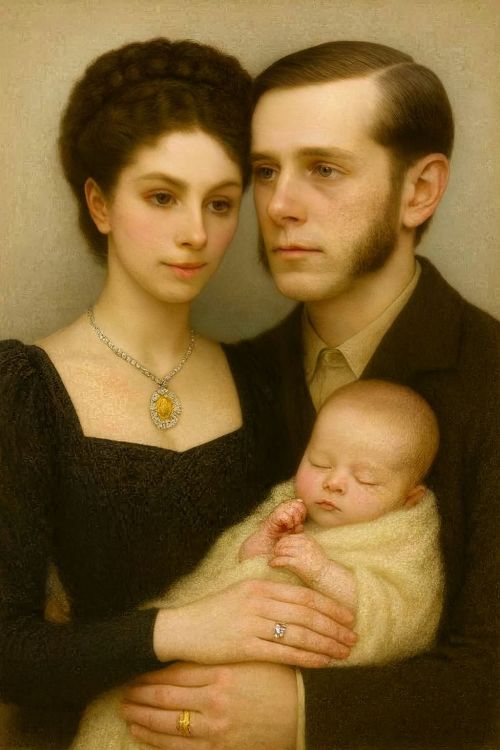
And so, in 1886, Sarah Winchester came here to the Santa Clara Valley. She bought an 18‑room farmhouse and began to build. And she never stopped. Day and night, for decades, hammers rang, saws screeched, and workers added room after room after room. At its peak, the mansion rose nine stories high and held as many as 600 rooms. Staircases that lead straight into ceilings. Doors that open into thin air. Windows built into the floor. Hallways that twist like a maze. Some say Sarah designed it this way to confuse the spirits that followed her.

Today, the mansion stands four stories tall, but it still stretches over 100,000 square feet. And many believe the spirits never left. Some visitors report footsteps behind them when no one is there. Others hear whispers drifting through the walls. A few have seen a woman in black wandering the corridors late at night, searching for something—or someone. Now, if you’re ready… we’re about to step inside. Stay close. Watch your step. And if you feel a tap on your shoulder or a cold breath on your neck, don’t worry. It’s probably just one of the house’s… permanent residents. Shall we begin?

And before you leave this place—whether you walk out with a shiver down your spine or a spark of wonder in your eyes—I’d like to extend a special invitation. After your journey through the mansion’s twisting corridors and secretive rooms, it would be a pleasure to have you join us for a delicious meal at Sarah’s Café. Once you’ve eaten, feel free to stroll along the paths of the Victorian gardens, which long ago stretched across 740 acres, all the way down to Stevens Creek Boulevard. Imagine the carriages, the orchards, the rolling lawns… and perhaps the quiet footsteps of someone who walked here long before you. And if you’re feeling brave, you’re welcome to wander once more through the miles of hallways inside the world’s most mysterious mansion. Every corner has a story. Every window has a whisper. And every room—well, you’ll see for yourself. Welcome to the Winchester Mansion. Enjoy your stay… for however long you choose to remain.

For further information about tours—including group tours, weddings, school events, birthday party packages, facility rentals, and our many special events—please visit our website for all the details you’ll need to plan your next unforgettable experience: https://winchestermysteryhouse.com/

Before you head out into the sunlight again, don’t forget to stop by our online gift shop. It’s the perfect place to find something special for friends and relatives—and perhaps a memento for yourself to remember your time inside the world’s most mysterious mansion. From classic souvenirs to unique collectibles inspired by the Winchester legend, you’ll find a wide variety of gifts waiting for you. Take a look, explore, and bring home a little piece of the mystery. Before you head out into the sunlight again, don’t forget to stop by our online gift shop. It’s the perfect place to find something special for friends and relatives—and perhaps a memento for yourself to remember your time inside the world’s most mysterious mansion. From classic souvenirs to unique collectibles inspired by the Winchester legend, you’ll find a wide variety of gifts waiting for you.
Take a look, explore, and bring home a little piece of the mystery. https://shopwinchestermysteryhouse.com/

Father, I declare that You are my source. Every good and perfect gift comes from You. Let financial breakthroughs and opportunities come my way. Amen.

He Hath Turned the Shadows of Death into the Morning
While some men are not statesmen or politicians by profession, and they certainly may not be one by birth, but, in many cases, they represent political yes-men who can be used for the completion of certain tasks. The significance of the lawyer in Occidental politics since the rise of parties is not accidental. The management of politics through parties simply means management through interest groups. The craft of the trained lawyer is superior to any “officials,” as the superiority of enemy propaganda could teach us. Certainly, he can advocate and win a cause supported by logically weak arguments and one which, in this sense, is a “weak” cause. Yet, he wins it because technically, he makes a “strong case” for it. However, only the lawyer successfully pleads a cause that can be supported by logically strong arguments, thus handling a “good” cause “well.” All too often, the civil servant, as a politician, turns a cause that is good in every sense into a “weak” cause, through technically “weak” pleading. This is what we have had to experience. To an outstanding degree, politics today is in fact conducted in public by means of the spoken or written word. To weigh the effect of the word properly falls within the range of the lawyer’s tasks, but not at all into that of the civil servant. The latter is no demagogue; he usually becomes a very poor one. It is almost never acknowledged that the responsibility of the journalist is far greater, and that the sense of responsibility of the journalist is, on the average, not a bit lower than that of the scholar, but rather, as the war has shown, higher. This is because in the very nature of the case, irresponsible journalistic accomplishments and their often terrible effects are remembered. #RandolphHarris 1 of 31

I know of cases in which natural leaders have been permanently paralyzed in their ascent to power, externally and above all internally. The often bitter experiences in occupational life are perhaps not even the worst. The inner demands that are directed precisely at the successful journalist are especially difficult. It is, indeed, no small matter to frequent the salons of the powerful on this earth on a seemingly equal footing and often to be flattered by all because one is feared, yet knowing all the time that having hardly closed the door, the host has perhaps to justify before his guests his associations with the “scavengers from the press.” Moreover, it is no small matter that one must express oneself promptly and convincingly about this and that, on all conceivable problems of life—whatever the “market” happens to demand—and this without becoming absolutely shallow and above all without losing one’s dignity by baring oneself, a thing which has merciless results. It is not astonishing that there are many journalists who have become human failures and worthless men. Rather, it is astonishing that, despite all this, this very stratum includes such a great number of valuable and quite genuine men, a fact that outsiders would not so easily guess. Legislation aimed at controlling the campaign costs of elections and to check the power of money by making it obligatory for the candidate to state the costs of his campaign has been a very important consideration. For the candidates, besides straining their voices, enjoy stretching their purses. In order to win the masses, it is necessary to call into being a tremendous apparatus of apparently democratic associations. An electoral association must be formed in every city district to help keep the organization incessantly in motion and to bureaucratize everything rigidly. #RandolphHarris 2 of 31

Hence, hired and paid officials of the local electoral committees have increased numerically; and, on the whole, perhaps 10 percent of the voters were organized in these local committees. These local circles are also the first to call upon the world of finance. This newly emerging machine, which is no longer led by members of any political party, has to now struggle with the previous power-holders, above all, with the “whip.” Being supported by locally interested persons, the machine has come out of the fight so victoriously that the whip must submit and compromise with the machine. The result is a centralization of all power in the hands of the few and, ultimately, of the one person who stands at the top of the party. According to President George Washington’s idea, America was to be a commonwealth administered by “gentlemen.” In his time, in America, a gentleman was also a landlord, or a man with a college education—this was the case at first. In the beginning, when parties began to organize, the members of the House of Representatives claimed to be leaders, just as in England at the time when notables ruled. The party organization was quite loose and continued to be until 1824. In some communities, where modern development first took place, the party machine was in the making even before the eighteen-twenties. However, when Andrew Jackson was first elected President—the election of the western farmers’ candidate—the old traditions were overthrown. Formal party leadership by leading members of Congress came to an end soon after 1840, when the parliamentarians, Calhoun and Webster, retired from political life because Congress had lost almost all of its power to the party machine in the open country. #RandolphHarris 3 of 31

That the plebiscitarian “machine” has developed so early in America is due to the fact that there, and there alone, the executive—this is what mattered—the chief of office-patronage, was a President elected by plebiscite. By virtue of the “separation of powers,” he was almost independent of parliament in his conduct of office. Hence, as the price of the victory, the true booty object of the office-prebend was held out precisely at the presidential election. Through Andrew Jackson, the “spoils system” was quite systematically raised to a principle, and the conclusions were drawn. What does this spoils system, the turning over of federal offices to the following of the victorious candidate, mean for the party formations of today? It means that quite unprincipled parties oppose one another; they are purely organizations of job hunters drafting their changing platforms according to the chances of vote-grabbing, changing platforms according to the chances of vote-grabbing, changing their colors to a degree which, despite all analogies, is not yet to be found elsewhere. The parties are simply and absolutely fashioned for the election campaign that is most important for office patronage: the fight for the presidency and for the governorships of the separate states. Platforms and candidates are selected at the national conventions of the parties without intervention by congressmen. Hence, they emerge from party conventions, the delegates of which are formally, very democratically elected. These delegates are determined by meetings of other delegates, who, in turn, owe their mandate to the “primaries,” the assembling of the direct voters of the party. In the primaries, the delegates are already elected in the name of the candidate for the nation’s leadership. Within the parties, the most embittered fight rages about the question of “nomination.” #RandolphHarris 4 of 31

After all, 300,000 to 400,000 official appointments lie in the hands of the President, appointments which are executed by him only with the approval of the senators from the separate states. Hence, the senators are powerful politicians. By comparison, however, the House of Representatives is, politically, quite impotent, because patronage of office is removed from it and because the cabinet members, simply assistants to the President, can conduct office apart from the confidence or lack of confidence of the people. The President, who is legitimized by the people, confronts everybody, even Congress; this is a result of the “separation of powers.” In America, the spoils system, supported in this fashion, has been technically possible because American culture, with its youth, could afford purely dilettante management. With 300,000 to 400,000 such party men who have no qualifications to their credit other than the fact of having performed good services for their party, this state of affairs, of course, could not exist without enormous evils. Corruption and wastefulness, second to none, could be tolerated only by a country with as yet unlimited economic opportunities. Now then, the boss is the figure who appears in the pictures of this system of the plebiscitarian party machine. Who is the boss? He is a political capitalist entrepreneur who, on his own account and at his own risk, provides votes. He may have established his first relations as a lawyer or a saloonkeeper, or as a proprietor of similar establishments, or perhaps as a creditor. From here, he spins his threads out until he is able to “control” a certain number of votes. When he comes this far, he establishes contact with the neighboring bosses, and through zeal, skill, and above all discretion, he attracts the attention of those who have already further advanced in the career, and then he climbs. The boss is indispensable to the organization of the party, and the organization is centralized in his hands. He substantially provides the financial means. #RandolphHarris 5 of 31

How does he get them? Well, partly by the contributions of the members, and especially by taxing the salaries of those officials who came into office through him and his party. Furthermore, there are bribes and tips. He who wishes to trespass with impunity one of the many laws needs the boss’s connivance and must pay for it; or else he will get into trouble. However, this alone is not enough to accumulate the necessary capital for political enterprises. The boss is indispensable as the direct recipient of the money for election purposes to a paid party official, or to anyone else giving public account of his affairs. The boss, with his judicious discretion in financial matters, is the natural man for those capitalist circles who finance the election. The typical boss is an absolutely sober man. He does not seek social honor; the “professional” is despised in “respectable society.” He seeks power alone, power as a source of money, but also power for power’s sake. The American boss works in the part. He is not heard speaking in public; he suggests to the speakers what they must say in expedient fashion. He himself, however, keeps silent. As a rule, he accepts no office, except that of senator. For, since the senators, by virtue of the Constitution, participate in office patronage, the leading bosses often sit in person in this body. The distribution of offices is carried out, in the first place, according to services done for the party. However, also, auctioning offices on financial bids often occurs, and there are certain rates for individual offices; hence, a system of selling offices exists which, after all, has often been known also to the monarchies, the church-state included, of the seventeenth and eighteenth centuries. #RandolphHarris 6 of 31

The boss has no firm political “principles’; he is completely unprincipled in attitude and asks merely: What will capture votes? As a rule, he leads an inoffensive and correct private life. In his political morals, however, he naturally adjusts to the average ethical standards of political conduct, as a great many of us also may have done during the hoarding period in the field of economic ethics. That, as a “professional” politician, the boss is socially despised, and that does not worry him. That he personally does not attain high federal offices, and does not wish to do so, has the frequent advantage that extra-party intellectuals, thus notables, may come into candidacy when the bosses believe they will have great appeal values at the polls. Hence, the same old party notables do not run again and again, as is the case in Germany. Thus, the structure of these unprincipled parties with their socially despised power-holders has aided able men to attain the presidency—men who with us never would have come to the top. To be sure, the bosses resist an outsider who might jeopardize their sources of money and power. Yet, in the competitive struggle to win the favor of the voters, the bosses frequently have had to condescend and accept candidates known to be opponents of corruption. Thus, there exists a strong capitalist party machine, strictly and thoroughly organized from the top to the bottom, and supported by clubs of extraordinary stability. These clubs, clubs such as The Hell Fire Club, the Crusades, the Benevolent and Protective Order of Elks, the Odd Fellows, are like Knight orders. They seek profits solely through political control, especially of the municipal government, which is the most important object of booty. This structure of party life was made possible by the high degree of democracy in the United States of America—a “New Country.” This connection, in turn, is the basis for the fact that the system is gradually dying out. America can no longer be governed only by dilettantes. #RandolphHarris 7 of 31

Scarcely fifteen years ago, when American workers were asked why they allowed themselves to be governed by politicians whom they admitted they despised, the answer was: “We prefer having people in office whom we can sit upon, rather than a caste of officials who spit upon us, as is the case with you.” This was the old point of view of American “democracy.” Even then, the socialists had entirely different ideas, and now the situation is no longer bearable. The dilettante administration does not suffice, and the Civil Service Reform establishes an ever-increasing number of positions for life with pension rights. The reform works out in such a way that university-trained officials, just as incorruptible and quite as capable as our officials, get into office. Even now, about 100,000 offices have ceased being objects of booty to be turned over after elections. Rather, the offices qualify their holders for pensions, and are based upon tested qualifications. The spoils system will thus gradually recede into the background, and the nature of party leadership is then likely to be transformed also—but as yet, we do not know in what way. However, what, in fact, does the sacrifice of individual men matter as long as it contributes to the salvation of all mankind? Progress resembles that unusual pagan god who wished to drink nectar only from the skulls of his fallen enemies. However, at least it is progress, and it will cease to inflict torture after the industrial apocalypse when the day of reconciliation comes. However, if the proletariat cannot avoid this revolution nor avoid being put in possession of the means of production, will it at least know how to use them for the benefit of all? Where is the guarantee that, in the very bosom of the revolution, Estates, classes, and antagonisms will not arise? #RandolphHarris 8 of 31

The guarantee lies in Hegel. And the Christian Bible agrees. “They will throw their silver into the streets, and their gold will be treated as a thing unclean. Their silver and gold will not be able to deliver them in the day of the LORD’s wrath. It will not satisfy their hunger or fill their stomachs, for it has caused them to stumble into sin,” Ezekiel 7:19. The proletariat is forced to use its wealth for the universal good. It is not the proletariat, it is the universal in opposition to the particular—in other words, to capitalism. The antagonism between capital and the proletariat is the last phase of the struggle between the particular and the universal, the same struggle that animated the historical tragedy of master and slave. At the end of the visionary design constructed by Karl Marx, the proletariat will unite all classes and discard only a handful of masters, perpetrators of “notorious crime,” who will be justly destroyed by the revolution. What is more, capitalism, by driving the proletariat to final point of degradation, gradually delivers it from every decision that might separate it from other men. It has nothing, neither property nor morality nor country. Therefore, it clings to nothing but the species of which it is henceforth the naked and implacable representative. In affirming itself, it affirms everything and everyone. Not because members of the proletariat are gods, but precisely because they have been reduced to the most adjectly inhuman condition. “Only the proletariat, totally excluded from this affirmation of their personality, are capable of realizing the complete affirmation of self.” That is the mission of the proletariat: to bring forth supreme dignity from supreme humiliation. Through its suffering and its struggles, it is Christ in human form redeeming the collective sin of alienation. It is, first of all, the multiform bearer of total negation and then the herald of definitive affirmation. #RandolphHarris 9 of 31

“Philosophy cannot realize itself without the disappearance of the proletariat, the proletariat cannot liberate itself without the realization of philosophy,” and again: “The proletariat can exist only on the basis of world history…Communist action can exist only as historical reality on the planetary scale.” However, this Christ is, at the same time, an avenger. According to Mr. Marx, he carries out the sentence that private property passes on itself. “All the houses, in our times, are marked with a mysterious cross. The judge is history, the executioner is the proletariat.” Thus, the fulfilment is inevitable. Crisis will succeed crisis, the degradation of the proletariat will become more and more profound, it will increase in numbers until the time of the universal crisis, when the world of change will vanish and when history, by supreme act of violence, will cease to be violent any longer. The kingdom of ends will have come. “And God shall wipe away all tears from their eyes, and there shall be no more death, neither sorrow, nor crying, neither shall there be any more pain; for the former things are passed away,” reports Revelation 21:4. It cannot possibly be denied that such things are true. Emergency conditions are, almost by definition, rare in the normally functioning peaceful society. That is truism can be forgotten is due to two reasons. First, rats have few motivations other than physiological ones, and since so much of the research upon motivation has been made with these animals, it is easy to carry the rat-picture over to the human being. Secondly, it is too often not realized that culture itself is an adaptive tool, one of whose main functions is to make the physiological emergencies come less and less often. In most of the known societies, chronic extreme hunger of the emergency type is rare, rather than common. In any case, this is still true in the United States of America. The average American citizen is experiencing appetite rather than hunger when he says, “I am hungry.” He is apt to experience sheer life-and-death hunger only by accident and then only a few times through his entire life. #RandolphHarris 10 of 31

Every clinician has seen over and over again how a parent’s fear that his child may turn out to be just like a particular uncle or aunt can drive the child in that very direction, especially if the warning parent himself is not an especially good model. One should never rape or rob the earth of its precious substance without cultivating its fertile cooperation through care, work, and prayer. This rapacious activity, plus the constant danger of being crushed by a mere squeeze of the earth’s insides, man is reminded of his disunion with God and with other men: conscience is the sign of man’s disunion with himself. Conscience is farther from the origin than shame; it presupposes disunion with God and with man and marks only the disunion with himself of the man who is already disunited from the origin. It is the voice of apostate life which desires at least to remain one with itself. It is the call to the unity of man with himself. This is evident already from the fact that the call of conscience is always a prohibition. “Thou shalt not.” “You ought not to have.” Conscience is satisfied when the prohibition is not disobeyed. Whatever is not forbidden is permitted. For conscience life falls into two parts: what is permitted and what is forbidden. There is no positive commandment. For conscience does not register the fact, that even in this, man is in a state of disunion with his origin. It follows from this also that conscience does not, like shame, embrace the whole of life; it reacts only to certain definite actions. In one sense, it is inexorable; in forbidden actions, it sees a peril to life as a whole, that is to say, disunion with oneself; it recalls what is long past and represents this disunion as something which is already accomplished and irreparable, but the final criterion remains precisely that unity with oneself which is imperiled only in the particular instances in which the prohibition is disobeyed. #RandolphHarris 11 of

In neurosis, the control operates in a more selective way. Certain feelings then go scot-free or are even encouraged. Thus, for instance, people with strong self-effacing trends tend to exaggerate feelings of love or of misery. The check here is primarily on the whole range of hostile feelings: suspicion, anger, contempt, vindictiveness. Of course, feelings may be flattened out or suppressed as a result of many other factors, among them alienation from self, forbidding pride, self-frustration. However, the vigilant control system is operating over and beyond these factors shows in many instances by fright responses at the mere prospect of lessened control—such as fears of falling asleep, of being under anesthesia or under the influence of alcohol, of lying on the couch and associating freely, of letting go in skiing downhill. Feelings—whether of compassion, fear, or violence—that do penetrate the control system may arouse panic. Such panic may be caused by the person’s fearing and rejecting these feelings because they jeopardize something specific in the neurotic structure. However, he also may become panicky simply because he realizes that his control system is not functioning. If this is analyzed, the panic subsides, and only then do the particular feelings and the patient’s attitude toward them become accessible to work. Many neurotic’s also have a belief in the supremacy of the mind. While feelings—because unruly—are suspects to be controlled, the mind—the imagination and the reason—expands like a genie from a bottle. This, factually, another dualism is created. It is no longer mind and body but mind versus body; no longer mind and self but mind versus self. However, like the other fragmentations, this one too serves to release tensions, to cover up conflicts, and to establish a semblance of unity. It can do so in three ways. #RandolphHarris 12 of 31

The mind can become a spectator of self. The intellect is after all the spectator, and when it does some work, it is as a hireling, for better or for worse. In the case of the neurotic, the mind is never a friendly, concerned spectator; it may be more or less interested, more or less sadistic, but it is always detached—as if looking at a stranger with whom it has been accidentally thrown together. Sometimes, self-observations of this sort may be quite mechanical and superficial. A patient will then give a more or less accurate report of events, activities, symptoms that increase or decrease without touching upon the meaning these events had for him or his personal responses to them. He can also be, or become during analysis, kneely interested in his psychic processes. However, his interest in them is rather a delight in the astuteness of his observations or in the mechanics with which they operate, much in the manner that an entomologist may be fascinated by the functioning of an insect. The analysts, likewise, may be delighted, mistaking all this eagerness of the patient for real interest in himself. And only after a while will he discover that the patient is quite uninterested in the meaning of his findings have for his life. This detached interest may also be openly faultfinding, gleeful, or sadistic. In these instances, it is often externalized, both in an active and in a passive way. He may, as it were, turn his back on himself and be most astute in observing others and their problems—in the same detached, unrelated way. Or he may feel that he is under the hateful and gleeful observation of others—a feeling pronounced in paranoid conditions but by no means restricted to them. Whatever the quality of being an onlooker at himself, he is no longer a participant in the inner struggle and has removed himself from his inner problems. “He” is his observing mind, and as such has a feeling of unity; his brain, then, is the only part of him that feels alive. #RandolphHarris 13 of 31

The mind also works as a co-ordinator. With this function, we are already familiar. We have seen the imagination at work in the very creation of an idealized image, in the ceaseless labor of the pride to blot out this, spotlight that, turn need into virtues, potentialities into realities. Similarly, reason can be subservient to pride in the process of rationalizing: anything then may appear or feel reasonable, plausible, rational—as indeed it is from the perspective of the unconscious premises upon which the neurotic operates. The co-ordinating functions also operate in eliminating any self-doubts, all the more necessary the more shaky the whole structure. There is then, a fanatic logic, a logic which usually goes with an unshakable belief in infallibility. “My logic prevails, because it is the only logic…If the others do not consent, they are idiots.” In relation to others, such an attitude shows as an arrogant righteousness. With regard to inner problems, it closes the door to constructive investigation but at the same time, diminishes tensions by establishing a certainty of sterility. As is so often true in other neurotic contexts, the opposite extreme—a pervasive self-doubting—leads to the same end of quieting tensions. If nothing is as it seems, why bother? In many patients, such all-encompassing skepticism can be quite hidden. On the surface, they graciously accept everything but make silent reservations, as a result of which their own findings, as well as the analyst’s suggestions, are lost in the quicksand. The mind, finally, is the magic ruler for which, as for God, everything is possible. Knowledge of inner problems no longer is a step toward changing, but knowing is changing. Patients operating on this premise without being aware of it, often feel puzzled that this or that disturbance does not vanish since they know so much about its dynamics. #RandolphHarris 14 of 31

The analyst may point out that there must still be essential factors they do not know—which is usually true. However, even when other relevant factors do come into sight, nothing changes. And again, the patient is bewildered and discouraged. So, there may be an endless search for more knowledge, valuable in itself but nevertheless doomed to futility as long as the patient insists that the rays of knowledge should dispel every cloud in his life without his doing the actual changing. The more he tries to manage all his life with pure intellect, the less tolerable it is for him to acknowledge the existence of unconscious factors in him. If they unavoidably intrude, they may arouse disproportionate fear or, in others, be disavowed and reasoned away. This is particularly important in the case of a patient seeing a neurotic conflict in himself for the first time with even a little clarity. He realizes in a flash that, even with his power of reason or imagination, he cannot make incompatibles compatible. He feels trapped and may respond with fright. Then, he may muster all his mental energies to escape facing the conflict. How can he get around it? How can he get by? Where is the hole in the trap through which he can escape? Simplicity and trickiness do not go together—well, could he not be simple in some situations and tricky in others? Or if he is driven to be vindictive and proud of it, while the idea of serenity also has a great hold on him, he becomes captivated by the notion of attaining a serene vindictiveness, of walking through life unruffled, and of annihilating offenders against his pride as he might brush aside bushes. Such a need to get by can amount to a veritable passion. All the good work put in to bring a conflict into clear relief then becomes ineffectual, but the inner “peace” is re-established. #RandolphHarris 15 of 31

All these measures, in different ways, relieve inner tension. In a way, we could call them attempts at solution because in all of them, integrating forces are at work. By compartmentalizing, for instance, the person disconnects conflicting currents and thereby no longer experiences conflicts as conflicts. If a person experiences himself as a spectator of himself, he establishes thereby a feeling of unity. However, we could not possibly describe a person satisfactorily by saying that he is an onlooker at himself, and upon the spirit in which he does it. Similarly, even if we know what he externalizes and how he does it, the process of externalization concerns but one aspect of his neurotic structure. However, is this all of the story? Has all been heard that may be said about being a man, and about man’s temporal life? The most important and decisive thing of all is certainly left out. For the talk about the natural changes of human life over the years, together with what externally happened there, is not in essence any different from talking of plant or of animal life. The animal also changes with the years. When older, it has other desires than it had at an earlier age. At certain times, it, too, has its happiness in life, and at other times, it must endure hardship. Yes, when late autumn comes, even the flower can speak the wisdom of the years and say with truthfulness, “All has its time, there is ‘a time to be born and a time to die’; there is a time to jest lightheartedly in the spring breeze, and a time to break under the autumn storm; there is a time to burst forth into blossom, beside the running water, beloved by the stream, and a time to wither and be forgotten; a time to be sought out of one’s beauty, and a time to be unnoticed in one’s wretchedness; there is a time to be nursed with care, and a time to be cast out with contempt; there is a time to delight in the warmth of the morning sun and a time to perish in the night’s cold. All has its time; ‘what profit hath he that worketh in that wherein he laboureth?’” #RandolphHarris 16 of 31
Mind and its expression in language are thoroughly interwoven, and to improve one is to improve the other. We must begin by looking into our thoughts and examining what sort of ideas we form when dealing with such words and especially when dealing with abstract words. We must attend carefully to what passes in our own mental comprehension the moment an abstract term is used. The plasticity of the human organism and its susceptibility to socially determined interference is best illustrated by the ethnological evidence concerning sexuality. While man possesses sexual drives that are comparable to those of the other higher mammals, human sexuality is characterized by a very high degree of pliability. It is not only relatively independent of temporal rhythms, it is also pliable both in the objects toward which it may be directed and it is modialities of expression. Ethnological evidence shows that, in sexual matters, man is capable of almost anything. One may stimulate one’s sexual imagination to pitch of feverish lust, but it is unlikely that one can conjure up any image that will not correspond to what in some other culture is an established norm, or at least an occurrence to be taken in stride. If the term “normality” is to refer either to what is anthropologically fundamental or to what is culturally universal, then neither it nor its antonym can be meaningfully applied to the varying forms of human sexuality. At the same time, of course, human sexuality is directed, sometimes rigidly structured, in every particular culture. Every culture has a distinctive sexual configuration, with its own specialized patterns of sexual conduct and its own “anthropological” assumptions in the sexual area. The empirical relativity of these configurations, their immense variety and luxurious inventiveness, indicate that they are the product of man’s own sociocultural formations rather than of a biologically fixed human nature. #RandolphHarris 17 of 31
One morning, you open up the newspaper and see a picture of the award-winning Sacramento Fire Department’s classic Crown Victoria crushed under the back of a semi-truck. Car 4 is a retired chief’s car that members used for attending classes and running department errands while on shift. The paper does not say much more than that the department vehicle slammed into the back of a beverage truck, and no one was injured. You call the station and find out that Heidi was using the car to go to the hardware store. As she approached the stoplight at Capitol Avenue, the brake pedal went to the floor, and she slammed into the back of a truck stopped at the light. Luckily, nobody was injured, but the car was most likely totaled. As your day progresses, you remember that your shift used it to go grocery shopping earlier in the week. While it was out, you noticed some oil in the bay where it was parked. You got a rag and cleaned it up so no one would slip on it. Suddenly, you realized that the oil you cleaned up was not as black as you had expected and fear that maybe it was brake fluid after all. If you have investigated it a little more, you now recognize that the crash might have been prevented. Human reaction is to downplay your role in the event, even though you are the only one who is aware of it. It is hard to stop the excuses from erupting. It was not your job to inspect the car. It was an older vehicle and should have been replaced years ago. Heidi probably was driving too close; everyone knows she is easily distracted. It probably was not even brake fluid that you cleaned up. There is no reason to get involved. Once you calm down and realize that you need to remain personally accountable, you decide you have an obligation to come forward with what you know. #RandolphHarris 18 of 31

Sometimes we react to an event without a thorough investigation, but without it you cannot prevent the next incident. When you call the chief to offer your information, you may be surprised to learn that the state police are investigating the crash. Sometimes fire departments do not rely on local police departments to conduct an investigation; instead, they call in the sheriff’s department or state officials. Many might think the reason is to show impartiality. Although that is true, an outside investigation is much more likely to uncover organizational contributing factors than an internal investigation—an outside agency will probably be more thorough and not take anything for granted. A department that is willing to cooperate with any outside investigation shows organizational accountability. This is the same reason why state arson investigators or the Bureau of Alcohol, Tobacco, Firearms, and Explosives (ATF) are sometimes called in to assist with investigations of significant fires that have a high-dollar loss or a loss of life. During the investigation, statements are completed by Heidi and the truck driver. With only a property damage crash, it is likely that law enforcement investigation will end at this point. An additional city investigation might be limited to looking at maintenance records of the Crown Vic and possibly a post-incident mandatory drug test for Heidi. There is a good chance the case will be closed right there, and life will go on without even using your statement. #RandolphHarris 19 of 31

Here is where the intent of Initiative 9—fatality, Near-Miss Investigation—shines. The car of Car 4 was not an accident—it was a crash and also a near-miss because nobody was injured. It was not even in emergency response mode when the brake failed. The brake failure of an emergency vehicle that is responding to an emergency has been cited as a contributing factor in several injury and Line of Defense Death (LODD) reports, as well as in the lives of public. The department needs to start its own investigation into all contributing factors and root causes. Your statement can be used to assist in finding other potential problems with the maintenance procedures of the vehicles. Researching similar incidents from the National Institute for Occupational Safety (NIOSH) and the National Fire Fighter Near-Miss Reporting System’s database allows data to be collected and assembled into a form of information that can be used in the next step, implementation. Each of the 16 Fire Life Safety Initiatives (FLSIs) are intended to bring about actions. Research, accountability, and empowerment are worthless unless they bring about change. The implementation stage is where this occurs. Whether an event actually occurred or not (accident versus near-miss), the root cause and contributing factors must be assembled into a system to reduce the chances of it happening again. With regard to the chemical industry, some professionals recommend assembling the information gained from investigations and near-misses into “leverage points,: from which corrective actions can be instituted. Utilizing a system such as this would require results from all near-miss reporting and accident investigations to be entered into a common system. #RandolphHarris 20 of 31

If you see a fire truck stopped in the street without the lights on, be very careful. Sometimes there is an emergency, and you should not pass the fire truck. It might be a good idea to safely turn around and go another way because if you hit someone and they happen to die, you could be charged with manslaughter. Sometimes fire firefighters are getting back into their vehicle, and if you pass the apparatus, you may collide with a firefighter who is on foot. Also, be sure to look at their signals; sometimes emergency vehicles are in motion, albeit slowly, and drivers try to pass them, and this could lead to a dangerous situation. Also, if you are in an intersection when you see an emergency vehicle, continue through the intersection. Drive to the right as soon as it is safe and stop. Obey any direction, order, or signal given by a law enforcement officer or a firefighter. Even if they conflict with existing signs, signals, or laws, follow their orders. When their siren or flashing lights are on, it is against the law to follow within 300 feet of any fire engine, law enforcement vehicle, ambulance, or other emergency vehicle. If you drive to the scene of a fire, collision, or other disaster, you can be arrested. When you do this, you are getting in the way of firefighters, ambulance crews, or other rescue and emergency personnel. The concept of professional courage does not always mean being as tough as nails, either. It also suggests a willingness to listen to other people’s problems, to go to bat for them in a tough situation, and it means knowing just how far they can go. It also means being willing to tell the boss when he or she is wrong. #RandolphHarris 21 of 31

America is becoming so expensive that Americans are moving to Mexico in record numbers. The United States of America’s State Department reports that the number of American citizens living in Mexico has increased by 75 percent from 2019 to 2025 and has continued to grow to a total of 1.8 million. Many Americans are moving to Mexico and working at home for companies that are in the United States of America to take advantage of the lower cost of living, the natural beauty and the culture, and they are thriving. California is the third most expensive state in the United States of America. In 37 percent of counties, a family of four living on a six-figure income is now considered low-income. The average home price in California is nearly $1,000,000.00 USD, while the average salary is $96,036.00, meaning that most Californians cannot even afford to buy a home. California is having an affordability crisis. A single person making an income above $100,000 is now considered low-income in five counties in California. This distinction now applies to individuals living in Santa Cruz, Santa Clara, San Mateo, San Francisco, and Marin counties. The maximum percentage of your gross income that you should earmark for a monthly mortgage payment is calculated at 28 percent, and no more than 36 percent of your gross income to all debts, including mortgage. If you take 28 percent of the median household income per home in Sacramento County, homeowners can only afford a mortgage of $2,070.23 per month. And if you take 36 percent of their gross income to all debts, including mortgage, they should be devoting no more than $2,661.72 a month to these debts. The mortgage lenders must be using some kind of sorcery to get buyers into these expensive homes. To afford one of these homes using traditional guidelines, a household would need to gross $11,280.24 per month or $135,362.88 per year, but the median household in Sacramento County is grossing $7,393.67 a month or $88,724.00 annually, and that typically means two to four people in the home are working and contributing to the mortgage. Home prices in Sacramento County are rivaling the Bay Area, and in some cases, homes in the Bay Area are more affordable. Historically, homes in the Bay Area have been more expensive because they have higher-paying jobs, a larger population, and the Bay Area is a tourist destination. Contributing to the housing affordability crisis is Gavin Newsom, who has been lavishing illegal immigrants with taxpayer-funded resources and cash aid, when state workers should be receiving a 25 percent wage increase instead. #RandolphHarris 22 of 31

In 2025, many people in California saw their bills increase by an estimated $500 a month. This includes items such as food, automobile insurance, homeowners’ insurance, and electricity. In fact, more than 3 million people in California are facing household hardship, and more than 300,000 of them are facing eviction soon. This comes at a time when California is having a shortage of affordable housing. The crisis is caused by nearly half a century-old laws that discourage home sales and encourage higher rents. The incompetence in California is very easy to see. From 2018 to 2023, California received $24 billion, which they used to fund 30 homeless and housing programs. These programs created 100,000 units. That is an average cost of $240,000 per unit. In comparison, Roger Lucas, owner of Grand Castle, LLC, spent $50 million to build The Grand Castle, which is a 522-unit residential apartment community in Grandville, Michigan. The community includes studios, 1 bedroom, 2 bedrooms, 3 bedrooms, and even a multi-level penthouse. Rents generally range from $1,000 to $2,500. The community is a 23.6-acre site. It features 750 covered parking spaces, a clubhouse, a resort-style swimming pool, and was built over a period of 12 to 18 months. The average cost was about $95,785.45 per unit, which is $144,214.55 less per unit than California spent. California also has the highest unemployment rate in the country at 5.4 percent, while the national average is 4.5 percent. As people are seeing their bills skyrocket, and minimum wage has increased to $20 an hour, people on Social Security retirement are really bearing the burden with the checks the typically equate to $5-$7 an hour. Furthermore, while Americans are struggling to find and afford housing, Gavin Newsom, Democrat governor of California, signed two bills into law on February 7, 2025, to protect illegal immigrants. Bills SBX 1 1: Budget Act of 2024, and SBX 1 2: Budget Act of 2024, allocates $50 million to protect illegal immigrants from deportation. Governor Gavin Newsom also granted 700,000 illegal immigrants free health care, which costs taxpayers $3 billion annually. At the same time, Newsom cut vital programs for veterans, school children, the disabled, and the homeless. The California crisis created by Democrats is driving up home prices and mortgages, and rents all over the nation and the world, making living unaffordable for all, and advocates say the crisis is far from over. #RandolphHarris 23 of 31

Meanwhile, China, where we are sending all our jobs and money, has more than 50 ghost cities, with 65 million vacant homes. Ghost cities are regions where housing has been overdeveloped to the point that these places are uninhabited. If they are all officially counted, California has approximately 4 million homeless people. The highest home prices in the nation, the highest taxes, and the most unfriendly business regulations known to man. Because California is so hostile towards people and businesses, more than 360 companies have fled the state since 2020. Businesses like Chevron, SpaceX, Oracle, and Hewlett-Packard are among the names on that list. Also, more than 500,000 people a year are abandoning California because it is too expensive to live in, Gavin Newsom has criminalized homelessness and actually started arresting people without homes, crime is out of control, and they are losing their jobs due to companies relocating. More than 100 companies have announced layoffs in California for 2025. Intel is cutting 15,000 jobs, PayPal is cutting 2,500, and Meta has terminated 4,000 employees. California also has the highest unemployment rate in the country at 5.4 percent, while the national average is 4.1 percent. The California crisis created by Democrats is driving up home prices and mortgages, and rents all over the nation and the world, making living unaffordable for all, and advocates say the crisis is far from over. Accordingly, California has more than 3.5 million illegal immigrants. Having the Southern American border open and not having American farmland protected, not producing beef, poultry, fish, fruit, produce, and dairy in America, and without American goods and services being our number one manufactured and selling items, America has created a dangerous and significantly elevated risk to national security, national economic security, and national public health. Some people may believe that these claims are overstated, but by not routinely monitoring Common Vulnerabilities and Exposures (CEVs) or other security-relevant alerts, such as the end-of-life of machinery is how the Oroville Dam Crisis occurred in 2017. #RandolphHarris 24 of 31

Additionally, Democratic Governor Gavin Newsom seems to be uneducated about economics. Newsom has spent $1.2 billion taxpayer dollars renovating the State Capitol building and $300 million to try to stop proposition 50. Proposition 50 would replace the maps drawn by the state’s independent commission with districts drawn by legislators solely to gain or protect Democratic seats. Newsom only cares about the environment when his policies allow him to raise taxes and restrict freedoms. To further highlight this illustration of incompetence by Governor Gavin Newsom, Mexico has been causing one of America’s worst environmental disasters. Fifty million gallons a day of industrial chemicals, untreated sewage, and trash flow from Tijuana, Mexico, into southern San Diego County daily. This toxic waste has been turning up on Imperial Beach and is causing the miles of white sands to become polluted and the ocean breeze to smell of feces, which has been sickening residents and wildlife and costing San Diego millions in the form of lost tourism and health problems. The problem has been going on for more than a century, and by 2030, Mexico plans to dump one hundred and twenty million gallons of sewage a day into Imperial Beach. Other crises that have occurred due to neglect of critical infrastructure such as the 2025 Palisades fire. Southern California ran out of water because Newsom is totally neglecting the state and the American people. And while the fire departments in California are critically understaffed and underfunded, Governor Newsom vetoed firefighter pay raise. The Palisades fire cost $275 billion, which is money that could have been used to insure the State of California had the resources it needed. Furthermore, when Southern California is located next to an ocean, Newsom should have invested in desalination plants to help with the water shortage in California. The water in the ocean is so plentiful that it is currently eroding land and causing homes to fall into the sea. Desalination has been identified as one technology that will help solve California’s water scarcity problem. Desalination is a cost-effective technology that can transform an abundance of salt water into a reliable supply of potable, fresh water, which is a great way to fight climate change and have enough water for our region’s water requirements. Ras Al Khair, Saudi Arabia, is producing 1,036,000 meters (273,682,192) per day of desalinated water. #RandolphHarris 25 of 31

America needs an approach to eliminate safety vulnerabilities in American cities. There needs to be a road map by the end of 2025, outlining a prioritized approach to eliminate crisis situations in America. There is enough money to send aid to foreign nations, but the American government does not have enough money to care for its infrastructure, provide adequate resources, or end the affordable housing crisis. Nor is there enough money to fund other national critical functions (NCFs). These bad practices of putting America and Americans last are considered exceptionally risky, particularly to national security, national economic security, and national public health and safety. In 2024, Americans spent $100 billion on Japanese cars. As a result, the American automobile trade deficit with Japan was $39 billion. Additionally, Japan exported 1.4 million cars to the United States of America, but only imported 16,000 American-built automobiles. However, Japan imported approximately 143 thousand motor vehicles from the European Union. This is why President Trump created tariffs. We need to balance the trade deficit that America faces with other nations so we are not taken advantage of and so America can go bank to being a creditor nation, instead of borrowing money for other countries. Each year, President Trump is bringing $400 Billion in Tariff revenue into America and hundreds of thousands of new jobs. With this money, America is paying down debt, and with a portion of it, President Trump plans to send Americans a stimulus check anywhere in the range of $1,000 to $2,000. However, if President Trump’s Tariffs are deemed illegal by the Supreme Court, taxpayers will have to pay back trillions and trillions of dollars. As we literally and /or figuratively see gangs, federal judges, and Governor Gavin Newsom fighting with federal law enforcement and President Trump– states and cities refusing to honor federal laws. Politicians are also showing an utter disregard for the Constitution of the United States of America, and anarchy is becoming increasingly common. #RandolphHarris 26 of 31

Anarchism is a cluster of doctrines and attitudes centered on the belief that government is both harmful and unnecessary. Derived from the Greek root anarchos, meaning “without authority,” anarchism, anarchist, and anarchy are used to express both approval and disapproval. The anarchist denies man-made laws, regards property as a means of tyranny, and believes that crimes are merely the product of property and authority. However, the anarchist would argue that their denial of constitutions and governments leads not to “no justice” but to the real justice inherent in the free development of human sociality—the natural inclination, when unfettered by laws, to live according to the principles and practice of mutual aid. Anarchism is also a form of treason. Treason, the crime of betraying a nation or a sovereign by acts considered dangerous to security. In English law, treason includes the levying of war against the government and the giving of aid and comfort to the monarch’s enemies. In the United States of America, treason was defined restrictively by the framers of the Constitution. Treason against the United States of America “shall consist only in levying War against them, or in adhering to their Enemies, giving them aid and comfort,” which is something that many politicians are currently guilty of. The American government should know all exploitable vulnerabilities and fix them before the situation becomes a crisis. Failure to take such mitigating actions is dangerous and significantly elevates risk to national security, national economic security, and national public health and safety. The American government must understand that significant time and resources must be invested in America. They must also encourage corporations to plan for both mitigating safety vulnerabilities in the short term and eliminating them in the long term. For instance, a company might begin by reaching out to the federal, state, or local government and requesting tax incentives to provide security to dangerous communities, to help the government repair bridges and potholes. #RandolphHarris 27 of 31

Drug cartels have been threatening the health and safety of Native American communities. The trafficking of dangerous and illegal drugs into their territories is leading to a second genocide. The overdose rate for Indigenous people is 42 percent higher than the national average. A recent bust on Montana’s Blackfeet Nation’s Tribal Reservation resulted in the seizure of more than 700,000 fentanyl pills, which was the largest bust in Montana history. Recently, the Blackfeet Nation had to declare a state of emergency after facing 17 overdoses in just one week. There are only 6.8 million Native Americans left in the world, which is 2 percent of the American population. We should be doing more to protect these proud and honorable people; they should not want for anything. People rush and give away resources to illegal immigrants, but totally disregard the Indigenous people of this land, as their race silently fades away into extinction. We must secure our borders and increase federal funding to Native American tribes so we can save this precious population. Meanwhile, Gavin Newsom has given billions of taxpayer dollars away to illegal immigrants and protected them from law enforcement, while arresting law-abiding Americans because they cannot afford to pay rent or mortgage, and the homeless shelters are unsafe, overcrowded, and have restrictions on who is allowed inside. He has also totally ignored the cartel problems on American lands. Clean air, water, land, and preserving our heritage are extremely important. We cannot just allow criminals to kill off the people who are native to this land and do nothing about it. Wars have been started over governments that tax citizens without representation. Taxation without representation is what led to the American Revolution. #RandolphHarris 28 of 31

Much like the land crisis in Las Vegas, we could also run out of land to farm and will not be able to grow or cultivate our own food. We can protect American farmland and support American farmers by buying American made beef, poultry, dairy, and produce. Also, country of origin labeling is very important so Americans can know where their food is coming from and can support American farmers and ranchers. As money flows, it influences further investment. Save the land that sustains us by protecting American farmland. Once the land is built on, we lose it forever. And in the future, there may be food wars. Also, to ensure that we have farmland and buildable land for future use, we need to start limiting the number of people allowed to immigrate to America. Perhaps with the immigrants we do allow into America, there needs to be a diversity program to make sure we have a population that equally represents all races of people. If Americans continue to spend money on American products, then more need to be made to keep up the inventory. When investors notice these goods are selling, it gives them the confidence to pour more money into that local business. It shows that people want these goods made in America and pressures investors to keep these goods and services in America. The jobs stay here, the business stays in America, wages naturally increase, and more money is invested to keep up with demand. This reduces the burden on the taxpayer. When you support American businesses, that money stays in our economy and can help to reduce the national debt. The government creates debt by borrowing from businesses in the private sector or from foreign countries. It also increases the national debt by spending more than it gains in tax revenue in a fiscal year. #RandolphHarris 29 of 31

When people shop locally, more tax money stays in the economy and goes to the government. This way, it keeps more money in our national economy and keeps more jobs located in America which also sends more taxes to the government, which can again help to reduce the national debt. When you buy foreign goods, these companies usually have lighter tax loads or exemptions, meaning less money for the national debt, plus you are helping to strengthen these foreign nations by sending more money overseas. Buying American-made products is also better for the environment and helps to reduce the carbon footprint because these products do not have to travel nearly as far. Furthermore, American companies and manufacturers are held to much higher standards on pollution. American companies must be more careful about air, land, and water pollution and have proper ways to dispose of waste. Under President Trump’s administration, he has make America a priority. President Trump has closed the southern border, illegal crossings have fallen to an all time low, and are 90 percent lower than under the previous administration. Since President Trump’s crack down on crime, violent crimes in Washington D.C. have dropped by approximately 80 percent. He has stopped thousands of pounds of drugs from entering America and killing citizens. And since President Trump took office, investments in America have increased by trillions of dollars in U.S.A. manufacturing, production, and innovation. As you can see, President Donald Trump and his pledge to “Make America Great Again” is exactly what America needs to save the country and the American people. And yes, diversity is important, so you can see why it is also important to preserve blonde hair and blue eyes, as the people with these characteristics are becoming a minority in America. #RandolphHarris 30 of 31

We must think before we can understand the soul’s existence; we must understand before we can realize it. The earliest beginnings of thought, as apart from instinct, when it was itself still but a lurking tendency, belong far back in primeval time. The human intellect as we find it today, so rich and developed an instrument for the consciousness of the ego, did not arrive at this fullness without a series of graduated stages. We have had plenty of scientific thinking, business thinking, and political thinking long enough, but we have had very little inspired thinking. That is the world’s need. The intellect is cradled in selfishness but runs the evolutionary track into reason, where it will one day finish at the winning-post of selflessness. As a reminder, parents, please teach your children to love America and be patriotic citizens, and to buy goods and services made in America. It is also important to respect law and order and treat your elders with respect. It is inborn in the human mind to wish to know. If this begins with the endless surface questions of a child’s curiosity, if it continues into deeper questions of a scientist’s probing investigation, it cannot and does not stop there. For the higher part of the mind will eventually come into unfoldment, that union of abstract reflective thought with mystical intuition, which is true intelligence, which needs and sees a view of the whole of things. And so, the knowing faculty enters the realm of philosophy. A lot of children are having problems in school and cannot even write a paragraph because they are not reading their books. When you actually read books, you get an example of how to write and will become a better student. Therefore, remember to take your education seriously so that you will be successful in life and make your family proud. Also, to make sure they have all the resources required, please donate to the Sacramento Fire Department to help improve our national security. “Oh, thus be it ever, when freemen shall stand between their loved home and the war’s desolation! Blest with victory and peace, may the heav’n-rescued land Praise the Power that hath made and preserved us a nation! Then conquer we must, when our cause is just, and this be our motto: ‘In God is our trust.’ And the star-spangled banner in triumph shall wave O’er the land of the free and the home of the brave.” #RandolphHarris 31 of 31
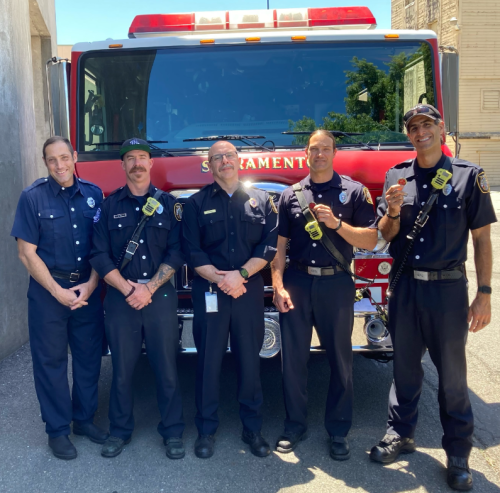

According to locals, over a century ago, the land that houses The Winchester Mansion had been vacant forever. Then, sometime in the early afternoon of Saturday, March 13, 1886, Sheriff Angel Camilio began getting reports that a massive castle made of wood had suddenly appeared. Gables rose, towers peaked into the sky as the mansion mushroomed into a labyrinth overnight. The house’s sudden manifestation had been both disconcerting and fascinating to the community. Some felt dark curses flowing from the estate, and things moving around in the darkness. Others saw a fairytale castle glimmering in the spring sunlight. Perhaps this is why there are no records of construction, no blueprints, and no permits filed with the county. And then one day, a hearse came tearing through the gates, and in that hearse was a coffin, some believed it contained Mrs. Winchester.

Legend also says, when Sarah Lockwood Pardee (Winchester) married William Wirt Winchester in 1862, she enjoyed a life of extravagant luxury. William Winchester, President of the Winchester repeating rifle, became a very wealthy man through the sale of his guns, and the couple were among the elite New England society. She also told Mrs. Winchester they would kill her too, unless she moved out West and built a great house for the spirits. In addition, Mrs. Winchester was told construction on the house must never end in order to appease the spirits and keep her alive, perhaps even give her eternal life. Mrs. Winchester followed the medium’s suggestions, and in 1886, she moved to the Santa Clara valley just outside San Jose, where she bought an 18-room farmhouse and property to build her mansion. At its peak, the Mansion once stood 9-stories tall and had as many as 600-rooms. Today, the stately mansion is 4-storys, and over 100,000 square feet.

Experience an unforgettable journey back to the time of kings and queens with this entry ticket for The Winchester Mansion in Santa Clara, California, which was the residence of Heiress Sarah L. Winchester. Come and see what secrets this so-called, “Winchester Mystery House” may hold. Take advantage of this fascinating experience. After the tour, there will be time to enjoy the mansion’s splendor at your own pace. You might even discover secret passages that lead to hidden chambers within the mansion. These chambers served as safe places for valuables, precious documents, and as private sanctuaries for Mrs. Winchester, and allowed her to move stealthily throughout her home. At one time, there were even secret tunnels that extended beyond the mansion, leading to nearby Victorian houses that were also on the property, and other structures, creating a network of escape routes or hidden pathways.

Please come and enjoy a delicious meal at Sarah’s Café, stroll along the paths of the beautiful Victorian gardens, which once spanned 740 acres, all the way down to Stevens Creek Boulevard; wander through the miles of hallways in the world’s most mysterious mansion.
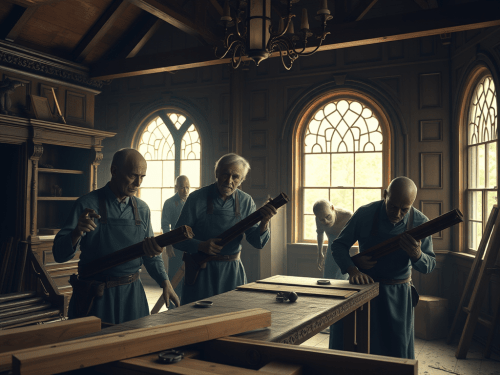
For further information about tours, including group tours, weddings, school events, birthday party packages, facility rentals, and special events please visit the website: https://winchestermysteryhouse.com/

Please visit the online giftshop, and purchase a gift for friends and relatives as well as a special memento of The Winchester Mystery House. A variety of souvenirs and gifts are available for purchase. https://shopwinchestermysteryhouse.com/


Harris Plumbing, Heating, Air, & Electric has been in business for 30 years. How many businesses can say that? We take pride in everything we do – no matter how big or small the service call might be. We’re here to help your home be as safe and comfortable as possible for you and your family. We take that responsibility very seriously as a company.

Harris will ensure you have the information you need to decide what to do next, whatever your home is facing. We’ll perform a diagnosis and detail what issues are present before starting any work. This gives you a personalized quote and service plan specific to your home’s needs, not some random quote based on the best guess. The only way we can do our best work is to make sure we handle the issues at hand. https://www.callharrisnow.com/about-us/


With its top ranking in Consumer Reports’ Auto Brand Report Card and consistent market share growth, BMW, The Ultimate Driving Experience, has demonstrated its ability to produce high-performing, reliable vehicles that meet consumer demands. BMW stands out due to its focus on driving dynamics and engineering excellence. While other luxury brands prioritize comfort and opulence, BMW is known for creating cars that are fun to drive and offer a unique connection between the driver and the machine. This is why BMW is known as The Ultimate Driving Machine. https://www.brianharrisbmw.com/

Randolph Harris San Francisco Taxation & Mergers
Building strong and lasting client relationships is crucial for a successful legal career. Many lawyers mistakenly believe that mastering legal skills alone ensures success, but law is fundamentally a service industry—our job is to solve problems through the time we sell. To build long-term relationships, attorneys must focus on three core elements: knowing their clients, understanding how their legal issues fit into a larger context, and consistently delivering exceptional service.

Randy advises clients with regard to business transition, taxable and tax-deferred mergers and acquisitions, joint ventures, restructuring, integrated tax planning, federal and state tax controversy resolution, and real estate transactions. Trust is the cornerstone of any client relationship. Ultimately, my clients feel they are in capable hands with someone who genuinely understands their problems and goals. https://www.jmbm.com/l-randolph-harris.html


At Millhaven Homes our professionals bring extensive experience in creating custom luxury properties. As we create your dream home home, your needs are the central focus. You can expect superior quality and dedication from a team that makes you feel heard and appreciated.

Millhaven Homes savors the sanctuary of awe-inspiring spaces, unique architectural details and fine craftsmanship that has earned us a reputation as a trusted home builder. The key to a successful relationship is communication. We will incorporate your thoughts and ideas into your new home.

With vast experience in all types of custom home construction, our premier services are created for you, so you can get the most out of the function and design of your dream home.

Discover Millhaven Homes today. Let us design and build a custom home that reflects your style, comfort, and aspirations. We are here to bring your vision to life with creativity, care, and attention to every detail.

Home is the place where, when you have to go there, they have to take you in. Whether you are considering building a dream home or simply fascinated by architectural marvels, Millhaven Homes is the builder for you. https://millhavenhomes.com/

Home, the spot of earth supremely blest, a dearer, sweeter spot than all the rest.


If Life is Not to be Trivial, it Must be Hard

Several people say they turn to the TV news to figure out what is going on in the World. However, only 20 percent of Americans regularly attend church, but 57 percent of Americans tune in to TV news. The Christian Bible is the account of God’s action in the World, and His purpose for creation. Therefore, it is more logical to attend church and learn more about the World, yourself and God. Psychology is a nice supplement to religion. Maslow continuously pondered what humans might become, in the hope of learning how more of us might grow toward those seemingly Utopian levels of being. Maslow’s work remains as one of the most helpful sets of principles governing the development of the healthy personality. He suggested the existence of two kinds of motivation: B, or being motivation, and D, or deficiency motivation. D-motivations are those that grab us when we are deeply deprived or have a loss of some basic need, such as the burglar who may be driven by hunger or the coward who may be driven by fear for personal safety. In contrast, the self-actualizing person is seen as motivated by the being needs, to be the fullest possible self, to be able to sing, create, work at highest capacity. #RandolphHarris 1 of 19

The peak experience concept has met with a great deal of interest. Maslow suggests the existence of these marvelous experiences that overwhelm the person and are great heights of delight and joy or meaningfulness, awesome experiences that may occur to a self-actualizing person but are not exclusively confined to that kind of person. Here are two contrasting examples of the more moderate peak or positive experiences collected from tenth-grade students: “Mine happened just last night. I love the summer and hate the winter. So last night when I stepped outside and found how warm it was I just couldn’t go back into the house. I walked around the house and then looked around. You can see all the houses around from our house and just looking around at them and hearing the sounds of the night relaxed me and I felt like I was watching over the whole World. It was a gentle feeling and gave me a little bit of a thrill.” “Yes, in the winter I love to walk out in the snow and let it fall lightly on my face. When this happens it seems to make a strange sort of happiness fall on me also.” Deep philosophic courage is a power not easily gained. A man must overcome much within himself, must hold his spine unbending and his effort undeviating. #RandolphHarris 2 of 19

All those negative qualities which act as encumbrances to true understanding of situations, occasions, events, and persons must be guarded against in attitude and action. Amid his gross brutalization and maniacal exaggerations, Nietzsche’s evil mysticism expressed some truth. He affirmed rightly that if life is not to be trivial, it must be hard. His quest of the Overself must be an untiring one. It is to be his way of looking at the World, his attitude toward life. It is far more important to develop the strength within himself needful to break the spell than to be for preventative protection against it. In the first case, he progresses enormously and rapidly; in the second, he is static. Each difficulty surmounted, each weakness resisted will fortify his will and increase his perseverance. It will evoke the better part of his nature and discipline the baser, and thus fit him more adequately to cope with the next ones. He must be equally steadfast in adhering to this attitude whether other people utter complaints against him or make compliments to him. We must retain our determination and our loyalty to the quest in all circumstances. Physical pains, climatic extremes must not deter us. We must console ourselves with the thought that these things are certain to pass away. They are mental figments, ideas which will be negated, whereas the truth and reality we seek belong to the immutable, and can never be negated. #RandolphHarris 3 of 19

Few of us can withdraw from the World and most of us must engage in its activity. However, that is no reason for accepting the evils which are mixed in with this activity. Tenacity of purpose is a characteristic of all who accomplish great things. Drawbacks cannot disgust him, labour cannot weary him, hardships cannot discourage him in whom the quality of persistence is always present. However, to the man without persistence every defeat is a Waterloo. Indecision of purpose and infirmity of will must yield to the resolute mind and the determined act. The person who sways uncertainly between one side and the other misses opportunity. The student’s inner reactions to outer events provide him with the opportunity to use his free will in the right direction. His attitude towards his lower nature, that is, how far he encourages or discourages it, is another. And his recognition of what are good opportunities and what should be avoided, together with his acceptance or rejection of them, is still another. Mental indolence and moral lethargy are hardly likely to waft us into the high haven of spiritual peace. We must learn to think fearlessly and courageously about every problem that faces us; we must try to elevate our hearts above the level of the moral lepers and spiritually disabled of our time. He will learn to endure the blows of misfortune with a bravery heretofore unknown and a serenity heretofore unexperienced. #RandolphHarris 4 of 19

If he is to achieve a full self-mastery, the strength of will which can lead a man to command of his desires for pleasure of the flesh cannot stop there. It must also go on to his diet and feelings, his speech and habits. However, many people, including the less affluent not only practice age discrimination, but they also advocate a lower-class bias. Class-stereotype is ambivalent, describing lower class people both negatively (less competent, less human, more objectified), and sometimes positively, perhaps warmer than upper class people. At a variety of levels and life stages, social-class stereotypes reinforce inequality. Sometimes, people who have benefited from Affirmative Actions like to uplift people of their culture, but discriminate against others as an act of revenge for bias that have faced. Social class matters, as a social construction, can be described in terms of what persons do; their jobs, habits, hobbies, lifestyles, but also in terms of what other people expect from them, their personality traits, life choices, aspirations, motivations. These oversimplified characterizations (id est, stereotypes) entail descriptions and prescriptions that impact individuals’ achievements, self-evaluations, and well-being. However, some of the elite feel a certain personal alienation from the dominant characters and opinions of American intellectual life, which doubtlessly quickens their championship of those who are thought to have little chance of succeeding in life. #RandolphHarris 5 of 19

Some think that free silver is a poor social remedy, and it will only lead to monetary inflation like what many are experiencing since the COVID pandemic. There are also those who think the proper way to deal with poverty and inequality is by advocating careful elimination of the unfit and dependent, chiefly by eugenic methods. While others believe that education is a great way to end inequality. Proponents of equality want a field that shall be broad enough to embrace the whole human race. However, as it stands, we are assimilating a mass crude material from the bottom and they are just exacerbating conditions of racism, agism, discrimination, harassment, and facilitating the expansion of criminal activity. This is leading many to believe that society is doomed to hopeless degeneracy. Yet, it is possible to take another view. The only consolation, the only hope, lies in the truth that so far as the native capacity, the potential quality, the promise and potency of a higher life are concerned, those swarming, spawning millions, the bottom layer of society, the proletariat, the working class, the hewers of wood and drawers of water, nay even the denizens of the slums—that all these are by nature the peers of the boasted aristocracy of brains that now dominates society and looks down upon them, and the equals in all but privilege of the most enlightened teachers of eugenics. #RandolphHarris 6 of 19

In the past, sociocracy, or the planned control of society by society was considered a solution. Under sociocracy, purposeful social activity, or collective telesis, could be harmonized with individual self-interest by means of attractive legislation designed to release the springs of human action for socially beneficial deeds by positive rather than negative and compulsory devices. Where individualism has created artificial inequalities, sociocracy would abolish them; and while socialism seeks to create artificial equalities, sociocracy would recognize inequalities that are natural. A sociocratic World would distribute its favours according to merit, as individualist demand, but by equalizing opportunity for all it would eliminate advantages now possessed by those with underserved power, accidental position or wealth, or antisocial cunning. We need to arrive at a better understanding of the importance of feeling in human motivation. The unique and artificial character of social organization and social processes are an odd inconsistency to deck out sociology with physics, chemistry, and biology, and to set it in the framework of a cosmological system. Some are not only ahead of the masses in point of time, but they are head, shoulders and hips above the general population in many respects scientifically. #RandolphHarris 7 of 19

All the efforts which are made to develop and maintain the mental hygiene practices of our citizens help to restrain what would otherwise be an ever-growing demand for psychiatric services. The role of the family in contributing to emotional stability is a most crucial one and the programs in parent education which are offered under a variety of auspices play a vital role in contributing to sound psychological environments in the home. We would do well to give all possible support to programs in parent education and to resources for parent consultation; we should be particularly concerned to provide programs for parental guidance in those areas and communities in which they are presently lacking. The psychiatrist and psychologist can find especially effective avenues for their services as consultants in clinics or other programs for parent education. Next to home, the school provides a universal setting with potential for teaching and demonstrating sound mental hygiene principles. If the schools have been less than optimally effective in this responsibility in the past it is partly because they have been uncertain of the relative priorities of the provision of subject-matter instruction versus the stimulation of the pupil’s total personal growth. While the contribution of the individual teacher can occur in a variety of way, ranging from early detection of emotional distress and referral to provision of “emergency” tension relief and even relationship therapy, the optimal participation of teachers in mental hygiene activities is greatly enhanced in those schools that have provided for formal integration of mental health services, with the consultative assistance of professional workers. #RandolphHarris 8 of 19

Better preparation of teachers for their opportunities, responsibilities, and limitations as mental hygienists can help much to reduce the demand for specifically psychiatric or psychological treatment. Such resources for expert treatment of childhood problems are even more severely restricted than are those for adult patients, and there must be increasing attention to the development of consultative skills—on the part both of teachers and experts. The potential of the church and the clergy in helping to promote mental health and to render assistance in cases of milder personal maladjustments is presently only partially realized. Based on a questionnaire survey, it was found that the average clergyman devotes only about two hours per week to personal counseling. Fewer than one out ten spend as much as ten hours a week on this activity. There is, considering the readiness of the distressed person to turn to his clergyman, a clear need to augment the preparation of the minister for this activity and to support him in his endeavours to render assistance, especially by giving him access to consultation. Increasing the effectiveness of our public education toward positive mental health and working toward more effective utilization of the front-line troops in early recognition and treatment of emotional upset constitute two ways of holding down the always excessive demand for psychiatric help. #RandolphHarris 9 of 19

A third avenue deserving careful consideration would consist of efforts to educate the public more specifically as to the precise nature of psychiatric treatment, specifically of psychotherapy, to try to lower the public’s presently naïve and immodest expectations of what occurs in and what can happen because of psychotherapy, and to encourage a proper appreciation for therapeutic conversation. As an important part of this effort, both psychotherapists and potential patients should be helped to recognize that there is neither magical cure nor specific expert treatment for the philosophical neuroses. If all of these methods of reducing the demand for the psychotherapeutic services of psychiatrist, psychologist, and social worker are vigorously pursued, the problem of manpower shortage will be alleviated but not solved. There will still be a fully “legitimate” call for individual psychotherapy exceeding the supply available through the present and future supply of the acknowledged specialist. Is there a rational and socially conscionable answer to this problem? The man who seeks to release himself from moral responsibility for his actions or his fortunes can in no way make any real progress on the spiritual path. He may improve his capacity to mediate, he may become more sensitive physically, but his real battle—against the ego—remains unfought and therefore unwon. #RandolphHarris 10 of 19

We have looked at social character as the structure through which human energy is molded in such specific ways, that it is usable for the purposes of any given society. It is also the basis from which certain ideas and ideals draw their strength and attractiveness. This relation between character and ideas is easy to recognize in the case of the individual character structure. A person with a hoarding (anal, according to Dr. Freud) character orientation, will be attracted to the ideal of saving, he will be repelled by ideas of what he would call “reckless spending.” On the other hand, the person with a productive character will find a philosophy centered around saving “dirty,” and will embrace idea which emphasize creative efforts and the use of material goods is concerned, the relationship between character and ideas is the same. Some examples ought to show this relation clearly. With the end of the feudal age, private property became the central factor in the economic and social system. There had been, of course, private property before. However, in feudalism private property consisted largely of land, and it was connected to the social situation of the landowner in the hierarchic system. Since it was part of the social sole of the owner, it was not salable on the market. Modern capitalism destroyed the feudal system. Private property is not only property in land, it is also property in the means of production. #RandolphHarris 11 of 19

All property is alienable; it can be bought and sold on the market, and its value is expressed in an abstract form—that of money. Land, machines, gold, diamonds—they all have in common the abstract money form in which their value can be expressed. Anybody can acquire private property, regardless of his position in the social system. It may be through industriousness, creativeness, luck, ruthlessness, or inheritance—the ownership of private property is not affected by the means of its acquisition. The security, power, sense of strength of a person does not, as in the feudal system, depend any longer on a person’s status, which was relatively unalterable, but on the possession of private property. If the man of the modern era loses his private property he is nobody—socially speaking; the feudal lord could not lose it as long as the feudal system remained intact. As a result, the respective ideals are different. For the feudal lord, and even for the artisan belonging to a guild, the main concern was the stability of the traditional order, the harmonious relation to his superiors, the concept of a God who was the final guarantor of the stability of the feudal system. If any of those ideas were attacked, a member of feudal society would even risk his life to defend what he considered to be his deepest convictions. For modern man the ideals are different. His fate, security, and power rest on private property; hence for bourgeois society, private property is sacred, and the ideal of the invulnerability of private property is a cornerstone in its ideological edifice. #RandolphHarris 12 of 19

Although the majority of people in any of the capitalist societies do not own private property in the sense used here (property in the means of production), but only “personal” property such as a BMW, television set, etcetera—that is, consumer goods—the great bourgeois revolution against the feudal order has nevertheless formulated the principle of the invulnerability of private property so that even those who do not belong to the economic elite have the same feeling, in this respect, as those who belong. Just as the member of the feudal society considered an attack against the feudal system immoral, and even inhuman, so the average person in a capitalist society considers an attack against private property a sign of barbarism and inhumanity. He will often not say so directly but rationalize his hate against the violators of private property in terms of their godlessness, injustice, and so on; yet and often unconsciously, they appear to him as inhuman because they have violated the sanctity of private property. The point is not that they have hurt him economically, or that they even threaten his economic interests realistically; the point is that they threaten a vital ideal. It seems, for instance, that the repugnance and hate which so many people in capitalistic countries have against communist countries is largely based on the very repugnance they feel against the outright violators of private property. #RandolphHarris 13 of 19

There are so many other examples of ideas which are rooted in the socio-economic structure of a society that it is hard to select the most representative ones. Thus, liberty became the paramount idea for a middle class fighting against the restrictions that the feudal class imposed upon them. “Individual initiative” become an ideal in the highly competitive capitalism of the nineteenth century. Teamwork and “human relations” became the ideals of the capitalism of the twentieth century. Since “fairness” is the basic law of the free market in which commodities and labour are exchanged without force or fraud, fairness became the most popular norm in capitalist society. At the same time, the idea of fairness became identified with an older norm, “love thy neighbour,” via the popularized version of this norm in the form of the Golden Rule, “Do unto others as you would have them do unto you.” The theory that ideas are determined by the forms of economic and social life does not imply that they have no validity of their own, or that they are mere “reflexes” of economic needs. The ideal of freedom, for instance, is deeply rooted in man, and it is precisely for this reason that it was ideal for the Hebrews in Egypt, the slaves in Rome, the German peasants in the sixteenth century, the German workers who fought the dictators of East Germany. On the other hand, the idea of authority and order is also deeply implanted in human existence. It is precisely because any given social order can appeal to ideas which transcend the necessities of this order that they can become so potent and so appealing to the human heart. #RandolphHarris 14 of 19

Yet why a certain idea gains ascendance and popularity is to be understood in historical terms, that is, in terms of the social character produced in each culture. One more qualification must be made. It is not only the “economic basis” which creates a certain social character which, in turn, creates certain ideas. The ideas, once created, also influence the social character and, indirectly, the social economic structure. Social character is the intermediary between the socioeconomic structure and the ideas and ideals prevalent in a society. It is the intermediary in both directions, from the economic basis to the ideas and from the ideas to the economic basis. Many people are confronted by a confusing false dichotomy. They believe that the choice is between an anarchic system without any organization and control and, on the other hand, the kind of bureaucracy which is typical both for contemporary industrialism. However, this alternative is by no means the only one, and we have other options. One option is between the “humanistic bureaucratic” or “humanistic management” method and the “alienated bureaucratic” method by which we conduct our affairs. This alienated bureaucratic procedure can be characterized in several ways. First, it is a one-way system; orders, suggestions, planning emanate from the top and are directed to the bottom of the pyramid. There is no room for the individual’s initiative. Persons are “cases,” whether welfare cases of medical cases, or, whatever the frame of reference is, cases which can all be put down on a computer card without those individual features which designate the difference between a “person” and a “case.” #RandolphHarris 15 of 19

Our bureaucratic method is irresponsible, in the sense that it does not “respond” to the needs, views, requirements of an individual. This irresponsibility is closely related to the case-character of the person who becomes an “object” of the bureaucracy. One cannot respond to a case, but one can respond to a person. This irresponsibility of the bureaucrat, feeling himself part of the bureaucratic machine, most of all wishes not to take responsibility to make decisions for which he could be criticized. He tries to avoid making any decisions which are not clearly formulated by his case rules and, if in doubt, he sends the person to another bureaucrat who, in turn, does the same. Anyone who has dealt with a bureaucratic organization knows this process of being sent around from one bureaucrat to the other and, sometimes after much effort, coming out at the same door which he had entered without ever having been listened to except in the peculiar way in which bureaucrats listen, sometimes pleasantly, sometimes impatiently, but also always with an attitude which is a mixture of their own helplessness, irresponsibility, sense of superiority toward the “petitioning” subject. Our bureaucratic method gives the individual the feeling that there is nothing which he can initiate and organize without the help of the bureaucratic machine. As a result, it paralyzes initiative and creates a deep sense of impotence. #RandolphHarris 16 of 19

Firefighters are important because they save lives. The Sacramento Fire Department is a highly skilled organization which makes huge contributions to the community. “I was lucky enough to make a rescue after eight or nine months in the volunteers. Luck is a factor because, you have to be at a fire where somebody needs to be rescued. Then you have to be at the right place at that fire. You have to have enough knowledge to know how to do it and then be lucky enough to successfully pull it off. You can’t plan it. I don’t believe in fate per se, but I think there are certain things in the cards. I was fairly young. I was on a pumper, and we were the third or fourth pumper there. The truck company was pretty heavily engaged, and there were a number of people on the fire escapes. Sacramento is basically a bedroom community. You know, little private dwellings. All of a sudden, we had an -apartment house fire, which was taxing. It was a nine-story building, and the fire was in the cellar, so the whole building was at risk. My pumper pulled up, and another fellow and I reported to the chief. “What do you want us to do?” He said, “I’ve got a report that there’s a baby in that apartment.” A baby, right. It happens so often it seems to be a cliché. So we went up the hallway, it was pretty smoky, and we came to two doors. I had a feeling that the baby was to the right. The other guy said, “I’ll go straight.” I went into the room at the right, it wasn’t extremely hot, but it was smoky. On my first search I didn’t find anybody, but I figured I better do it again. The second time around, I found the baby lying on the floor between a night table and a bed, I guess he rolled off the bed or something, I’m not sure. He had on a little green-and-white-striped shirt and Pampers. #RandolphHarris 17 of 19

“Right then, when I took him out, I knew that the rewarding feeling was similar to putting a fire out, only more so. Shortly after probie school, I was assigned to Engine Company 2 in Midtown Sacramento. There I was fortunate enough to be involved in my first City of Sacramento rescue. You make your own luck in many instances. It was very unusual for a probie in an engine company to be put into a search with an officer. We were at a false alarm when the dispatcher asked us if we were available. The battalion chief gave us the go-ahead, and we were first at the fire by a good fire minutes. It was a high-rise apartment building. Being a gung-ho probie, I had gotten completely geared up for the false alarm. I had a mask on and everything. The other guys, because it was a hot summer night and although this was a known false alarm box, hurried to the scene. People at the apartment were screaming that there was a baby trapped. Another baby, right. People leave them behind like old bathrobes. The lieutenant, seeing I was a new guy said, “Let’s go.” We went up the elevator part of the way, then ran up the stairs to the hallways leading to the fire apartment. The door was open, and the smoke was nearly to the floor. It was hot. We went in the direct of the heat. Again it was another one of those, he went to the left, and I went to the right, and I found this little boy on the floor. He was conscious, and I removed him to the street and took him to the hospital. #RandolphHarris 18 of 19

“The sad part was that there was another child in the apartment, the lady’s nephew. A guy, I think he was from another truck, went in off the aerial ladder, got in the window, cut himself on the glass, and made a real spectacular rescue of the child. The kid was badly burned, and he didn’t make it. It was just one of those things again. You just go along doing your job, and there you are. It was unusual for me to be there, because the truck company is in charge of forcible entry, going in and searching for victims, and they work more or less independently. Whereas in an engine company the people work together in one group to fight the fire. It was not so much aggressiveness on my part, it was my ‘gung-ho-ness.’ I was serious about every aspect of the job, even cleaning the brass, and every time we went out the door, I wanted to be fully prepared. And it paid off. Sure, putting out a fire is satisfying, there’s nothing like it except making a grab, rescuing somebody. But even in a busy area, some companies don’t make one grab a year. While a nozzle man in a busy area is going to put out three, four fire a night. There’s a lot to be said for that. That’s an enjoyable part of it, too.” Life safety is the primary job of the Sacramento Fire Department. You can help save lives by making a contribution. I pledge allegiance to the flag of the United States of America, and to the Republic, for which it stands, one nation, under God, indivisible with liberty and justice for all. #RandolphHarris 19 of 19


Nestled within the Sacramento Valley, Rancho Cordova’s ideal location offers easy access to the Bay Area and Lake Tahoe. One of Northern California’s top home builders, Pulte Homes, offers affordable new homes for sale with family-friendly amenities. Conveniently located near US Route 50 and Interstate 80, homeowners can experience all that Northern California offers, from the San Francisco Bay Area to the historic Gold Country, Old Sacramento, and the deep blue waters of Lake Tahoe.

Experience modern designs and affordability in our upcoming new homes for sale. Ascent at Montelena in Rancho Cordova is near major employers and premier shopping. https://www.pulte.com/homes/california/sacramento/rancho-cordova/ascent-at-montelena-210916


It is Useless to Preach Ethics to a Gangster

Social meddlers have been labouring under the delusion that, since there are no natural laws of the social order, they might make the World over with artificial ones. Society, however, the product of centuries of gradual evolution, cannot be quickly refashioned by legislation. It is a superorganism, changing at a geological tempo. The great stream of time and Earthy things will sweep on just the same despite us. Every one of us is a child of his age and cannot get out of it. He is in the stream and is swept along with it. All his science and philosophy come to him out of it. Therefore, the tide will not be changed by us. It will swallow up both us and our experiments. That is why it is the greatest folly of which a man can be capable to sit down with a slate and pencil to plan out a new social World. Socialists are puny meddlers, social quacks, who would try to break into the age-old process of societal growth at an arbitrary point and remake it in accordance with their petty desires. They started from the premise that “everybody ought to be happy” and assumed that therefore it should be possible to make everyone happy. They never asked, “In what direction is society moving?” or “What are the mechanisms which motivate its progress?” Evolution would teach them that it is impossible to tear down overnight a social system whose roots are centuries deep in the social of history. History would teach them that revolutions never succeeded—witness the experience of France, where the Napoleonic period left essential interests much as they have been before 1789. #RandolphHarris 1 of 20

There are two chief things with which government must deal. They are the property of men and the honour of women. These it must defend against crime. Polly Hannah Klass was a twelve-year-old American girl who was kidnapped at knifepoint during a slumber party at her mother’s home in Petaluma, California in 1993. She was strangled to death. Richard Allen Davis was convicted of her murder in 1996 and sentenced to death. As part of an Anti-Violence Strategy, politicians in California and other U.S.A. states supported the three strikes law, which requires a person who is convicted of an offense and who has one or two other previous serious convictions to serve a mandatory life sentence in prison without parole. California’s Three Strikes act was signed into law on March 8, 1994. However, since 2014, under California law, purchasing or soliciting a child for sex is a misdemeanor carrying a maximum penalty of up to a year in jail, or a minimum of two days in jail, and a $10,000 fine. This is a direction contradiction of the Three Strikes Act. Many people wonder how such legislation could even exist when worldwide, at any given time, there are approximately 30 million victims (about the population of Texas) being sold into the sex trade. Every system has its inevitable evils, but this is blatantly wrong. When they care nothing about the health and safety of your children, why keep electing sinful democrats? Human progress is moral progress, and moral progress is largely the accumulation of economic virtues. Let every man be sober, industrious, prudent, and wise, and bring up his children to be so likewise, so we can abolish crime and corruption in a few generations. #RandolphHarris 2 of 20

If the good and evil values of this Earthly existence are in the end relative, partial, and transient, there yet remains a supreme value which is absolute, total, and eternal in its goodness. It belongs to the root of our being, the Overself in us that represents the World-Mind. The atheist who declares that the moral scene is entirely suggested to man by his environment has taken a partial truth, a partial untruth, and joined them together. However, if he had declared that the environment was a contributory factor to the result, he would have been quite correct. The moaning of a cat has doubtless a certain musical note in it. The Messiah by Handel has musical notes of another kind. Metaphysical scepticism would say that both values are relative and not absolute, hence both are as worthwhile or as worthless as we believe them to be. However, most of us would prefer Handel! Why? Because although as relative as the cat’s sounds, it is progressively superior. We may apply this to ethics. Excessive moral tolerance easily becomes moral lethargy. How can you rightly give the same rules on self-control to young men, in whom the lusts are hot, and to old men, who whom they are cold? To tie a code of moral values to a religious belief is safer in a simple community and riskier in a sophisticated one. When it is no longer an integrity, a virtue may be practised wrongly. New circumstances bring out new and different qualities, including latent and even unsupported ones. Or a crisis in events may explode and let them appear suddenly. Thus, the good may become the bad; the bad may become good. Arrogance in virtue is risky. #RandolphHarris 3 of 20

By giving his allegiance to the political system, the religious system, and the commercial system in which he lives, man has unwittingly done two things; he has made a judgement on them, and he has taken a moral decision about them. However, whether this has penetrated his consciousness, he cannot absolve himself from these responsibilities. Sinfulness is relative. What is right for a man at a low stage may be wrong for him at a higher stage; and in the highest stage, he may act rightly yet in sin in thought. Although two different doctrines may each be relatively true, this is not the same as being on the same level of evaluation. To set up relativity as an absolute truth without qualifying it, is unfair. To say that all values are alike, all codes are the same, is to say something half-false. Paradox is an indispensable element of the Highest Formulations. If the old moralities fall away from man, it is only to be displaced by higher ones, certainly not to be bereft of any ethical code. The doctrine who uses right ideas to support or defend wrong actions can do so only because those ideas are general and abstract ones. They ignore circumstances, time, and place. Convert them into specific concrete, practical, and cases, and their misuse becomes difficult. Although he has now inwardly transcended conventional codes of good and evil, man will outwardly continue to respect them. This is not hypocrisy for he is not opposed to them. He perceives that the very relativity which deprives them of value for him, provides them with value for society. Obedience to the Overself will then become the only code of ethics that he can follow. #RandolphHarris 4 of 20

Dr. Freud’s independent man has emancipated himself from the dependence on mother. Marx’s independent man has emancipated himself from the dependence on nature. However, there is one important difference between the two concepts of independence. Dr. Freud’s independent man is basically a self-sufficient man. He needs others only to satisfy his instinctual desires. Since men and women need each other, this satisfaction is a mutual one. The relationship is not primarily but only secondarily a social one, like that of individual buyers and sellers on the market who are united by their mutual interest in exchange. For Marx, man is primarily a social being. If he is related to his fellow men and to nature, he needs his fellow man, not to satisfy his desires, but because only then is he complete as a man. The independent, free man in Marx’s sense is the active, related, productive man. Spinoza, who had considerable influence on Marx, as he had on Hegel and Goethe, held activity vs. Passivity to be central concepts for the understanding of man, He differentiated between active and passive emotions. The former (fortitude and generosity) iriginate in the individual, and they are accompanied by adequate ideas. The latter rule over man; he is the slave of passions, and they relate to inadequate, irrational ideas. This connection between knowledge and affect has been enriched by Goethe and Hegel in their emphasis on the nature of true knowledge. Knowledge is not obtained in the position of the split between subject and object, but in the position of relatedness. As Goethe put it: “Man knows himself only since he knows the World. He knows the World only within himself, and he is aware of himself only within the World. Each new object, truly recognized, opens a new organ within ourselves. #RandolphHarris 5 of 20

In his Faust, Goethe gave the most outstanding expression to this concept of the “ever striving” man. Neither knowledge nor power nor sex can give an ultimately satisfactory answer to the question which man is asked by the fact of his very existence. Only the free and productive man, untied to his fellow man, can give the right answer to man’s existence, Marx’s concept of man was a dynamic one. Human passion is, he said, “the essential power of man striving energetically for its object.” Man’s own powers develop only in the process of relatedness to the World. “The eye has become a human eye when its object has become a human, social object, created by man and destined for him. The senses have therefore become directly theoreticians in practice. They relate themselves to the thing for the sake of the thing, but the thing itself is an objective human relation to itself and to man and vice versa. Need and enjoyment have thus lost their egoistic character, and nature has lost its mere utility by the fact that its utilization has become human utilization. (In practice I can only relate myself in a human way to a thing when the thing is related in a human way to man.)” Just as our senses develop and become human senses in the process of their productive relatedness to nature, our relatedness to man, says Marx, becomes human relatedness in the act of loving. “Let us assume man to be man, and his relation to the world to be a human one. Then love can only be exchanged for love, trust for trust, etcetera. If you wish to enjoy art, you must be an artistically cultivated person; if you wish to influence other people you must be a person who really has a stimulating and encouraging effect upon others. Every one of your relations to man and to nature must be a specific expression, corresponding to the object of your will, of your real individual life. If you love without evoking love in return, id est, if you are not able, by the manifestation of yourself as a loving person, to make yourself a beloved person, then your love is impotent and a misfortune.” #RandolphHarris 6 of 20

The fully developed, and this the healthy, man, is the productive man, the man who is genuinely interested in the World, responding to it; he is the rich man. In contrast to this fully developed man, Marx paints the picture of a man under the system of capitalism. “The production of too many useful things results in too many useless people.” In the present system man has much, but he is little. The fully developed man is the wealthy man who is much. “Communism,” for Marx, “is the positive abolition of private property, of human nature through and for man. It is, therefore, the return of man himself as a social, id est, really human being, a complete and conscious return which assimilates all the wealth of previous development. Communism as a fully developed naturalism is humanism and, as a fully developed humanism, is naturalism. It is the definitive resolution of the antagonism between man and natura, and between man and man. It is the true solution of the conflict between existence and essence, between objectification and self-affirmation, between freedom and necessity, between individual and species. It is the solution of the riddle of history and knows itself to be this solution.” By “private property” as used here and in other statements, Marx never refers to the personal property of things for use (such as a house table, et cetera). He refers to the property of the “propertied classes,” that is, of the capitalist who, because he owns the means of production, can hire the property-less individual to work for him, under conditions the latter is forced to accept. “Private property,” in Marx’s usage, then, always refers to private property within capitalist class society and thus is a social and historical category; the term does not refer to things for use, to “personal property.” #RandolphHarris 7 of 20

The past has not been devoid of experimentation to permit freedom in education, and there has accumulated a considerable body of knowledge regarding education which has inward freedom as one of its primary goals. August Aichorn, many years ago, carried out a radical experiment in the reeducation of delinquents. He permitted them freedom, within the institutional setting, to conduct themselves as they desired in the group in which he was the leader. After a period of chaos which I am sure few of us could bear, these youths gradually chose a social and disciplined and cooperative life as something they preferred. They learned, though experience in an accepting relationship that they desired responsible freedom and self-imposed limits rather than the chaos of license and aggression. Another radical experiment was that conducted by A.S. Neill in his school, Summerhill. Starting one hundred years ago, school has become a current focus of great interest because A.S. Neill’s book Summerhill tells of the experience of his pupils and himself in this school. This is a book which is well worth thoughtful reading by every educator. Neill’s sincerity and genuineness, his faith in the potential of everyone, his firm respect for each child and for himself shines through its pages. As in the case of Aichorn, few of us would have the courage to trust the individual, and his natural desire to learn, as completely as does Neill. Yet has given u a challenging laboratory example of what it means to provide a setting in which children can learn to be free. Even the cautious report of the Ministery of Education makes is clear that the students develop a zest for living spontaneous courtesy, as well as initiative, responsibility, and integrity. They conclude, “a piece of fascinating and valuable educational research is going on here which it would do educationists good to see.” #RandolphHarris 8 of 20

The core of the progressive education movement, now frequently derided, was another attempt to help individuals to learn to be free. That its fundamental philosophy frequently became debased into turning education into a sugar-coated pill should not obscure its true aims, nor its effective research when it was true to its own philosophical base. Still another type of experiment along this line is evident in the work being done in student-centered teaching. Here much of the work has been done in university classes and in intensive workshops for professional persons. The aim of the approach: to assist students to become individuals who can take self-initiated action and to be responsible for those actions; who are capable of intelligent choice and self-direction; who are critical learners, able to evaluate the contributions made by others; who have acquired knowledge relevant to the solutions of problems; who, even more importantly, are able to adapt flexibly and intelligently to new problem situations; who have internalized an adaptive mode of approach to problems, utilizing all pertinent experience freely and creatively; who are able to cooperate effectively with others in these various activities; who work, not for approval of others, but in terms of their own socialized purposes. If it is not possible for the generality of mankind to practise ethical indolence permanently and to avoid the moral struggles which the situations of life lead to intermittently, it is much less possible for the minority of mankind who have begun this quest to do so. Life becomes graver for them. If they do not obey the call of conscience the first time, it may become more painful to obey it the second time. If they persist in following an ignoble and contemptible course after they have already seen that it is dishonourable and deplorable the universal law becomes proportionately heavier with consequences. #RandolphHarris 9 of 20

We have been having an ongoing look at Clare, and her dependence on people. Her case study has been enlightening. She had started taking notes on her own behaviour to see what triggered an upset. While reviewing these notes concerning an evening in which her mood had swung from elation to depression, she saw the possibility that fatigue may have been a factor. She wondered whether the latter might have resulted not only from the anxiety that had been aroused but also from a repressed anger for the frustration of her wishes. If that were so, her wishes could not be quite so harmless as she had assumed, for they must then contain some admixture of an insistence that they be complied with. She left this an open question. This piece of analysis had an immediately favourable influence upon the relationship with her man Peter, who was aloof and distant. Clare became more active in sharing his interests and in considering his wishes, and ceased being merely receptive. Also, the sudden eruptions of irritation stopped entirely. It is hard to say whether her demands upon him relented, though it would be reasonable to assume that they did to a moderate degree. This time Clare faced her finding so squarely that there is almost nothing to add. It is noteworthy, though, that the same material had presented itself six weeks before, when the daydream of the great man first emerged. At that time the need to hold on to the fiction of “love” was still so stringent that she could do no more than admit that her love was tinged with a need for protection. Even in that admission she could conceive of the need for protection only as a factor reinforcing her “love.” Nevertheless, that early insight constituted the first attack on her dependency. The discovery of the degree of fear in her love was the second step. #RandolphHarris 10 of 20

A further step was the question she raised as to whether she overrated Peter, even though the question remained unanswered. And only after she had worked that far through the fog could she finally see that her love was by no means unadulterated. Only now could she stand the disillusionment of recognizing that she had mistaken for love her abundant expectations and demands. She had not yet taken the last step of realizing the dependency that resulted from her expectations. Otherwise, however, this fragment of analysis is a good example of what it means to follow up an insight. Clare saw that her expectations of others were largely engendered by her own inhibitions toward wishing or doing anything for herself. She saw that her sponging attitude impaired her capacity to give anything in return. And if her expectations were rejected or frustrated, she recognized her tendency to feel offended. Clare’s expectations were mainly in reference to intangible things. Despite apparent evidence to the contrary, she was not essentially a greedy person. The receiving of presents was only a symbol for less concrete but more important expectations. She demanded to be cared for in such a way that she should not have to make up her mind as to what is right or wrong, should not have to take the initiative, should not have to be responsible for herself, should not have to solve external difficulties. Some weeks passed in which her relationship with Peter was smoother. They had finally planned a trip together. Through his long indecision he had spoiled for her most of the joy of anticipation, though when everything was settled, she did look forward to the holiday. However, a few days before they were to leave, he told her that business was too precarious just then to allow him to go away for any length of time. #RandolphHarris 11 of 20

Clare was first enraged and then desperate, and Peter scolded her for being unreasonable. She tended to accept the reproach and tried to convince herself that he was right. When she calmed down, Clare suggested that she go alone to a resort that was only a three-hour drive from the city; Pere could then join her whenever his time allowed. Peter did not openly refuse this arrangement, but after some hemming and hawing he said that if she were able to take things more reasonably, he would have been very glad to agree since she reacted so violently to every disappointment, and since he was not master of his time, he foresaw only frictions forthcoming and felt it better for her to make plans without him. This again threw her into despair. The evening ended with Peter consoling her and promising to go away with her for ten days at the end of vacation. Clare felt reassured. Inwardly agreeing with Peter, she decided to take things more easily and to become content with what he could give her. The next day, while trying to analyze her first reaction of rage, she had three associations. The first was a memory of being teased, when she was a child, for playing the martyr role. However, this memory, which had often recurred to her, appeared now in a new light. She had never examined whether the others were wrong in teasing her in this way. She had taken it merely as a fact. Now for the first time it dawned on her that they were not right, that she had been discriminated against, that by teasing her they had added insult to injury. Then another memory occurred to her from the time when she was five or six. She used to play with her brother and his playmates, and one day they told her that in a certain meadow, near where they played, robbers lived in a hidden cave. She believed it completely and always trembled when she went near that meadow. Then one day they had ridiculed her for having fallen for their story. #RandolphHarris 12 of 20

Finally, Clare thought of her dream of the foreign city, the part in which she had seen the freak show and the gambling stands. And now she realised that these symbols expressed more than a transient anger. She saw for the first time that there was something phony, something fraudulent in Peter. Not in the sense of any deliberate swindle. However, he could not help playing the role of one who was always right, always superior, always generous—and he had feet of clay. He was wrapped up in himself, and when he yielded to her wishes it was not because of love and generosity but because of his own weakness. Finally, in his dealing with her there was much subtle cruelty. Psychotherapy is a good idea for someone like Clare. In view of the general disdain for, if not outright counter prescription of, advice-giving as a part of formal psychotherapy, it is interesting to note that fewer than 15 percent of those who were helped definitely by psychiatrists attributed their relief to the receipt of advice; the comparable figures of helpful advice are 24 percent and 34 percent for the physicians and clergymen respectively. By contrast, 23 percent of persons helped by the clergymen credited the receipt of “comfort” and an “ability to endure”; of those who were helped by physicians and psychiatrists only 9 percent and 7 percent respectively claimed that this was the way in which therapy had helped them. The data from this survey does not permit a comparison of the relative efficiency of the clergyman as a psychotherapist with the psychiatrist or other experts. It may be that the clergymen “treat” a very different group of “patients,” and that the medical and psychological experts receive the more difficult cases. It is important to note, however, that they tend to seek to help all those who come to them with personal problems, making fewer referrals than to the physicians. Nevertheless, their effectiveness as evaluated in subjective appraisals of helpfulness by those who consult them is equal to that of the physicians, and both “nonexperts” are credited with giving more “help” than are the psychiatrists, psychologists, and marriage counselors. #RandolphHarris 13 of 20

It seems obvious that the clergy constitute a great potential resource in helping to meet the psychotherapy needed of our society. It is not known to what extent this potential is being fully realized. In the past there have been pseudo-antagonisms (based upon presumed conflicts of values and philosophy) between religion and psychiatry. Some psychotherapists have feared that the clergy were doing harm through slowness to make referrals to experts. Concern for the possible usurpation of a role for which they were inadequately prepared has been based partly on a recognition that the older spiritual adviser had rarely received intensive instruction in scientific psychology or orientation to the nature of neurotic illness. In the face of some of these antipathies and with growing recognition for the extent to which the clergyman is turned to for help with emotional and mental problems, both the church and psychiatry are moving toward a reproachment. Seminaries are showing increasing attention to provision of some background in pastoral counseling as a necessary part of the training of future churchmen; in providing sophistication in the techniques of counseling there is also attention to the problem of recognition of psychiatric illness. Priests, rabbis, and ministers in increasing numbers are being encouraged to pursue graduate study in psychology. Through the cooperation of the Wheat Ridge Foundation of Lutheran Church and graduate department of psychology of the University of Minnesota a small and highly select group of ordained pastors are studying for the Ph.D. in clinical psychology. These men will later be key resource persons in providing mental health consultation to other pastors and to church programs of mental health education. Psychiatrists and psychologists are showing a growing willingness to participate in special seminars and short courses designed to provide clergymen with a basic understanding of psychiatric illness and treatment. #RandolphHarris 14 of 20

The increased education of clergy in the field of mental illness should have a beneficial effect. It should bring this important source of therapeutic conversation to increasingly direct and effective expression. It should mean that more and more clergy will come to do more and better personal counseling. It should have this effect but it may not! The effect of the increased “psychiatric sophisticated” of the clergy may be simply that they will reveal a new tendency toward making increasingly frequent referrals to the already overburdened “experts.” It is of the utmost importance that clergymen be sensitized not only to the presence of serious psychological disturbance, which may be occasionally masked by a plea for spiritual guidance, but that they be made equally aware of that they have within themselves the potential to render significant help and relief to many of the persons who seek their counsel with strictly secular problems. If the tuition of clergymen in the field of mental hygiene were to be so diagnosis-and pathology oriented that they were simply rendered over-ready to make referrals rather than to accept a basic, appropriate responsibility to render aid. It is obvious that religious leaders should be among the first to recognise a “philosophical neurosis” and should know that they may have a special expertise in the treatment of this form of pseudo-neurotic disturbance. They should prepare themselves to receive the referrals which, hopefully, psychiatrists and psychologists may be making in increasing numbers. Beyond this, the mental health movement must seek to give the clergy an increasing feeling for the strategic advantage of their special status as suppliers of therapeutic conversation, an increasing sense of the legitimacy of their functioning in this role, and an increasing awareness of their need to take responsibility for their distinctly psychotherapeutic skills over and above their qualities as spiritual leaders. #RandolphHarris 15 of 20

There are a couple of “humane experiences” which are difficult to classify in terms of feelings, affects, and attitudes. However, it matters little how we classify them, since all these classifications themselves are based on traditional distinctions, the validity of which is questions. I am referring to the sense of identity and integrity. The problem of identity has been much in the foreground of psycholgoical discussion, especially stimulated by the excellent work of Erik Erikson. He has spoken of the “identity crisis,” and, undoubtedly, he has touched upon one of the major psychological problems of industrial society. However, he has not gone far or penetrated as deeply as is necessary for the full understand of the phenomena of identity and identity crisis. In the age of information, men are transformed into things, life is lived on social media, and things have no identity. Or do they? Is not every BMW car of a certain year and a certain model identical with every other BMW car of the same model and different from other models and vintages? Has not any dollar bill its identity like any other dollar bill because it has the same design, value, exchangeability, but different from any other dollar bill in terms of differences in the quality of the paper brought about by the length of use? Things can be the same or different. However, if we speak of identity, we speak of a quality which does not pertain to things, but only to man. What then is identity in a human sense? Among the many approaches to this question, I want to stress only the concept that identity is the experience which permits a person to say legitimately “I” — “I” as an organizing active center of the structure of all my actual or potential activities. This experience of “I” exists only in the state of spontaneous activity, but it does not exist in the state of passiveness and half-awakeness, a state in which people are sufficiently awake to go about their business but not awake enough to sense an “I” as the active center within themselves. #RandolphHarris 16 of 20

This concept of “I” is different from the concept of ego. (I do not use this term in the Freudian sense but in the popular sense of a person who, for example, has a “big ego.”) The experience of my “ego” is the experience of myself as a thing, of the body I have, the memory I have—the money, the house, the social position, the power, the children, the problems I have. I look at myself as a thing and my social role is another attribute of thingsness. Many people easily confuse the identity of ego with the identity of “I” or self. The difference is fundamental and unmistakable. The experience of ego, and of ego-identity, is based on the concept of having. I have “me” as I have all other things which this “me” owns. Identity of “I” or self refers to the category of being and not of having. I am “I” only to the extent to which I am alive, interested, related, active, and to which I have achieved an integration between my appearance—to others and/or to myself—and the core of my personality. The identity crisis of our time is based essentially on the increasing alienation and reification of man, and it can be solved only to the extent to which man comes to life again, becomes active again. There are no psychological shortcuts to the solution to the identity crisis except the fundamental transformation of alienated man into the living man. The increasing emphasis on ego versus self, on having versus being, finds a glaring expression in the development of our language. It has become customary for people to say, “I have insomnia,” instead of saying, “I cannot sleep”; or, “I have a problem,” instead of, “I feel sad, confused” or whatever it may be; or “I have a happy marriage” (sometimes successful marriage), instead of saying “My wife and I love each other.” All categories of the process of being are transformed into categories of having. #RandolphHarris 17 of 20

The ego, static and unmoved, relates to the World in terms of having objects, while the self is related to the World in the process of participation. Modern man has everything: a BMW, a house, a job, “kids,” a marriage, problems, troubles, satisfactions—and of all that is not enough, he had his psychoanalyst. He is nothing. A concept which presupposes that of identity is that of integrity. It can be dealt with briefly because integrity simply means a willingness not to violate one’s identity, in the many ways in which such violation is possible. The main temptations for violation of one’s identity are the opportunities for advancement in industrial society. Since the life within the society tends to make man experience himself as a thing anyway, a sense of identity is a rare phenomenon. However, the problem is complicated by the fact that aside from identity as a conscious phenomenon as described above, there is a kind of unconscious identity. Some people, while consciously they have turned into things, carry unconsciously a sense of their identity precisely because the social process has not succeeded in transforming them completely into things. These people, when yielding to the temptatiomn of violating their integrity, may have a sense of guilt which is unconscious and which gives them a feeling of uneasiness, although they are not aware of its cause. It is all too easy for orthodox psychoanalytic procedure to explain a sense of guilt as the result of one’s incestuous wishes or one’s “unconscious homosexuality.” The truth is that since a person is not entirely dead—in a psychological sense—he feels guilty for living without integrity. #RandolphHarris 18 of 20

It takes a lot of integrity to be a firefighter. “I was a training officer for almost two years when the Sacramento Fire Department advertised for a drillmaster, and they hired me. They were looking for somebody from the outside because of the training fire which killed two firefighters and injured two others. That changed the department. It was a very powerful, emotional experience, because it is a small closely knit outfit. It was a smoke training exercise, there was no intention of having a fire there. They used a small shed that was going to be demolished for a smoke-in. A hopeless structure. For example, they had put up cardboard walls, and it had a low-density combustible fireboard ceiling. Anf there was probably a finer layer of carbon from pervious burns. This was the third exercise of the morning. There was a flashover. Since this was only a “smoke exercise,” they weren’t prepared for firefighting. This was a case of their intentions outrunning their idea of what the potential was in that situation. So they weren’t hooked up to a hydrant, and there was nobody by the pump panel. They were generating the smoke by burning tires, a series of fires in this long shed. They were advancing a booster line to simulate hose line advancement, but they weren’t in there to extinguish fires. I don’t know if it was an oxygen flashover, or, more likely, the presence of all that combustible material getting heated up and liberating its gases to the point where everything ignited simultaneously, the walls, the ceilings, everything. There were four people inside. Two died. Two made it out, the company officer and the officer who was putting on the drill. The company officer suffered extensive burns and spent considerable time in a burn ward. The officer putting on the drill wasn’t a regular training officer, he was just somebody who’s volunteered to conduct the drill. This was a real tragedy.” #RandolphHarris 19 of 20

Please keep the Sacramento Fire Department in your prayers and make a donation to ensure that they have all the resources required. I pledge allegiance to the flag of the United States of America, and to the republic, for which it stands, one nation, under God and indivisible with liberty and justice for all. The wise man harbours neither revenge nor envy; he speaks good of all men, and belittles none. He is moderate in his merriment, and rejoices not at the misfortune of others; he cleaves to the men of truth and faithfulness. See that you guard your soul’s holiness, and when you pray, consider before whom you stand. Visit the sick and suffering, and let your countenance be cheerful. Purge your soul from angry passion; that is the inheritance of fools. Love the society of learned men, and strive to know more and more of the ways and the works of your Creators. A city is overthrown by the mouth of the wicked, but it is exalted by the blessing of the upright. Sin is a reproach to any people, but righteousness exalts a nation. When the wicked rule, the people sigh, but when the righteous come to power, the people rejoice. Where there is no vision, the people perish, but happy is he that keeps the law. When the righteous exult, there is a great glory, but when the wicked rule, righteous men must be sought for. Let us now praise such righteous men, famous men, the fathers of our country. The Lord manifested in them great glory, even His mighty power from the beginning. These men did rule and were renowned for their power, giving counsel by their understanding; leaders of the people, men of learning, wise and eloquent men, rich in ability; men of vision and mercy, whose righteous deeds have not been forgotten; their heritage shall continually remain, and their names live on unto all generations. Men will declare their wisdom, and continually speak their praise. For the Lord never leaves His people without leaders and men of learning. That they may be instructed and ennobled, and their destiny exalted. America was founded on Biblical precepts. #RandolphHarris 20 of 20

The Winchester Mystery House

There is a charming story concerning one of the first ghosts Mrs. Winchester saw. “He appeared first in the garden one afternoon. I saw him as I looked out of the morning-room window, a very ordinary-looking young man wearing a tweed jacket and flannels. I saw him as clearly as I am seeing you now…and yet I knew immediately that he was a ghost. I knew he was not alive in the sense that you and I are alive. No, I was not worried by him. There was nothing ominous or threatening about his appearance. I saw him several times in the garden, and then one day entering from the door-to-nowhere. This time he seemed to be ill.”
Please come and enjoy a delicious meal in Sarah’s Café, stroll along the paths of the beautiful Victorian gardens, and wonder through the miles of hallways in the World’s most mysterious mansion. For further information about tours, including group tours, weddings, school events, birthday party packages, facility rentals, and special events please visit the website: https://winchestermysteryhouse.com/


There are No Natural Rights in the Jungle

The way we behave toward our fellow men depends on one’s evolutionary status. The young inexperienced naive idealist will contradict the aged Worldly-wise cynic for whom like, authority, celebrity, tradition, innovation, have been totally denuded of their glamour. The distance from one answer to the other will also be marked by varying views. It is quite true that moral codes have historically been merely relative to time, place, and so on. However, if we try to make such relativity a basis of non-moral actions, if we act on the principle that wrong is not worse than right and evil not different from good, then social life would soon show a disastrous deterioration, the ethics of the jungle would become its governing law, and catastrophe would overtake it in the end. The relativity of good and evil is no justification for the tolerance of wrong and evil. It would be a mistake to believe that because philisophy affirms that morality, art, conscience, and religion are relative to human beings, it therefore has no moral code to offer. It most assuredly has such a code. This is so because side by side with relativity it also affirms development. It holds up a purpose, traces out a path to its realization, and hence formulates a code. The virtue which he is to practise is not bound by the standards set by law and customs, nor even by conventional morality. His standards are far higher and far nobler. For they are not measured by human weakness but by human possibility. If for so much of his lifetime they must exist side by side with his shortcomings, the latter are not accepted but are resisted. #RandolphHarris 1 of 15

When embraced by intellectual materialists or unphilosophical mystics, moral relativity has led to foolish and even dangerous practical results. The fallacy is that although all points of view in morality are tenable, all are not equally sustainable. The danger of this teaching of evil’s unreality and moral relativity is that in the hands of the unwise it annuls all distinction between evil and good, while in the hands of the conceited it opens dangerous doors. The undisciplined or the evil-minded will always seize on such a tenant to provide support and excuse for their faults or sins. There is no reason to withhold it, however, for they will commit the same faults or sins anyway whether they have the teaching or not. Because there are levels of moral growth, character, and self-control, it became necessary to lay down laws, codes, and rules for mankind in the masses. These may be of sacred origin, as with a Moses, or of secular authority, as with a ruler. Where the name of God is invoked to give them weight, this is usually a human device. However, the come-back of Universal Law is very real, and not a fancy. The discovery of moral relativity gives no encouragement however to moral laxity. If we are freed from human convention, it is because we are to submit ourselves sacrificially to the Overself’s dictate. The unfoldment of progressive states of conscious being is not possible without giving up the lower for the higher. The doctrine that ethical and artistic values are relative need not be inconsistent with the doctrine that they are also progressive. They evolve from lower to higher levels. Being ideas in some individual mind, they improve with the refinement of that mind’s own quality. #RandolphHarris 2 of 15

The codes of good and bad are usually part of religion and certainly belong to the religious level. However, the idea of goodness implies the idea of badness, so both are held in the mind although in different ways: one explicitly, the other implicitly. The philosopher does not depend on them but on their source, the Higher Power. The ego being an illusory entity, its virtues are in the ultimate sense either imaginary or also illusory. Nevertheless, moral perfection of the ego is a necessary stage on the journey to perfection of consciousness, to Overself. To cast it aside as being merely relative, to reject ethics and virtue as being unnecessary, is a trick of the intellect to enable the ego to stay longer in its own self-sufficiency. The first fact in life is the struggle for existence; the greatest forward step in this struggle is the production of capital, which increases the fruitfulness of labour and provides the necessary means of an advance in civilization. Primitive man, who long ago withdrew from the competitive struggle and ceased to accumulate capital goods, must pay with a backward and unenlightened way of life. Social advance depends primarily upon hereditary wealth; for wealth offers a premium to effort, and hereditary wealthy assures the enterprising and industrious man that he may preserve in his children the virtues which have enabled him to enrich the community. Any assault upon hereditary wealth must begin with an attack upon the family and end by reducing men to “swine.” #RandolphHarris 3 of 15

The operation of social selection depends upon keeping the family intact. Physical inheritance is a vital part of the Darwinian theory; the social equivalent of physical inheritance is the instruction of the children in the necessary economic virtues. If the fittest are to be allowed to survive, if the benefits of efficient management are to be available to society, the captains of industry must be paid for their unique organizing talents. Their huge fortunes are the legitimate wages of superintendence; in the struggle for existence, money is the token of success. It measures the amount of efficient management that has come into the World and the waste that has been eliminated. Millionaires are the bloom of a competitive civilization: The millionaires are the product of natural selection, acting on the whole body of men to pick out those who can meet the requirement of certain work to be done…It is because they are thus selected that wealth—both their own and that entrusted to them—aggregates under their hands….They may fairly be regarded as the naturally selected agents of society for certain work. They get high wages and live in luxury, but the bargain is a good one for society. There is intense competition for their place and occupation. This assures us that all who are competent for this function will be employed in it, so that the cost of it will be reduced to the lowest terms. In the Darwinian pattern of evolution, animals are unequal; this makes possible the appearance of forms with finer adjustment to the environment, and the transmission of such superiority to succeeding generations brings about progress. Without inequality the law of survival of the fittest could have no meaning. #RandolphHarris 4 of 15

Accordingly, in Sumner’s evolutionary sociology, inequality of powers was at a premium. The competitive process develops all powers that exist according to their measure and degree. If liberty prevails, so that all may exert themselves freely in the struggle, the results will certainly not be everywhere alike; those of courage, enterprise, good training, intelligence, perseverance will come out at the top. These principles of social evolution negate the traditional American ideology of equality and natural rights. In the evolutionary perspective, equality was ridiculous; and no one knew so well as those who went to school to nature that there are no natural rights in the jungle. There can be no rights against Nature except to get out of her whatever we can, which is only the fact of the struggle for existence stated over again. In the cold light of evolutionary realism, the eighteenth-century idea that men were equal in a state of nature was the opposite truth; masses of men starting under conditions of equality could never be anything but hopeless savages. To Sumner rights were simply evolving folkways crystallized in laws. Far from being absolute or antecedent to a specific culture—an illusion of philosophers, reformers, agitators, and anarchists—they are properly understood as rules of the game of social competition which are current now and here. In other times and places other mores have prevailed, and still others will in the future. Each set of views colours the mores of a period. The eighteenth-century notions about equality, natural rights, classes and the like produced nineteenth-century states and legislation, all strongly humanitarian in faith and temper; at the present time the eighteenth-century notions are disappearing, and the mores of the twenty-first century will not be tinged by humanitarianism as those of the last hundred years have been. #RandolphHarris 5 of 15

Sumner’s resistance to the catchwords of the American tradition is also evident in his skepticism about democracy. The democratic ideal, so alive in the minds of men as diverse as Eugene Debs and Andrew Carnegie, as a thing of great hopes, warm sentiments, and vast friendly illusions, was to him simply a transient stage in social evolution, determined by a favorable quotient in the man-land ratio and the political necessities of the capitalist class. Democracy itself, the pet superstition of the age, is only a phase of the all-compelling movement. If you have abundance of land and few men to share it, the men will all be equal. Conceived as a principle of advancement based on merit, democracy met his approval as socially progressive and profitable. Conceived as equality in acquisition and enjoyment, he thought it unintelligible in theory, and thoroughly impracticable. Industry may be republican; it can never be democratic so long as men differ in productive power and in industrial virtue. Many people fear democracy and attempt to set limits upon it in the federal structure; but since the whole genius of the country has inevitably been democratic, because of its inherited dogmas and its environment, the history of the United States of America has been one of continual warfare between the democratic temper of the people and their constitutional framework. Marx’s picture of the healthy man is rooted in the humanistic concept of the independent, active, productive man, as it was developed by Spinoza, Goethe, and Hegel. The aspect in which Marx’s and Dr. Freud’s independence is a limited one; the son makes himself independent of the father by incorporating his system of commandments and prohibitions; he carries fatherly authority within himself and remains obedient to and dependent on the father and the social authorities in this indirect way. #RandolphHarris 6 of 15

For Marx independence and freedom are rooted in the act of self-creation. “A being,” Marx wrote, “does not regard himself as independent unless he is his own master, and he is only his own master when he owes his existence to himself. A man who lives by the favor of another considers himself a dependent being. But I live completely by another person’s favor when I owe to him not only the continuance of my life but also its creation, when he is its source. My life has necessarily such a cause outside itself if it is not my own creation.” Or, as Marx put it, man is independent only “…if he affirms his individuality as a total man in each of his relations to the World, seeing, hearing, smelling, tasting, feeling, thinking, willing, loving—in short, if he affirms and expresses all organs of his individuality”–if he is not only free from but also free to. Marx, freedom and independence were not merely political and economic freedom in the sense of liberalism, but the positive realization of individuality. His concept of socialism was precisely that of a social order which serves the realization of the individual personality. Marx wrote: “[This crude communism] appears in a double form; the domination of material property looms so large that it aims to destroy everything which is incapable of being possessed by everyone as private property. It wishes to eliminate talent, etcetera, by force. Immediate physical possession seems to it the unique goal of life and existence. The role of worker is not abolished but is extended to all men. The relation of private property remains the relation of the community to the World of things. Finally, this tendency to oppose general private property to private property is expressed in an animal form; marriage (which is incontestably a form of exclusive private property) is contrasted with the community of women, in which women become communal property. #RandolphHarris 7 of 15

One may say that this idea of the community of women is the open secret of this entirely crude and unreflective communism. Just as women are to pass from marriage to universal prostitution, so the whole World of wealth (id est, the objective being of man) is to pass to the relation of universal prostitution with the community. This communism which negates the personality of man in every sphere, is only logical expression of private property, which is this negation. Universal envy setting itself up as power is only a camouflaged form of cupidity which reestablishes itself and satisfies itself in a different way. The thoughts of every individual private property are at least directed against any wealthier private property, in the form of envy and the desire to reduce everything to a common level; so that this envy and levelling in fact constitute the essence of competition. Crude communism is only the culmination of such envy and levelling-down based on a preconceived minimum. How little the abolition of private property represents a genuine appropriation is shown by the abstract negation of the whole World of culture and civilization, and the regression to the unnatural simplicity of the poor and wantless individual who has not only surpassed private property but has not yet even attained to it. The community is only a community of work and of equality of wages paid out by the communal capital, by the community as universal capitalist. The two sides of the relation are raised to a supposed universality; labour as a connection in which everyone is placed, and capital as the acknowledged universality and power of the community. #RandolphHarris 8 of 15

Tenderness, love, and compassion are exquisite feeling experiences and generally recognized as such. However, there are some human experiences which are not as clearly identified as feelings but are more frequently called attitudes. They do not express the same direct relatedness to another person, but are, rather, experiences which are within oneself and which only secondarily refer to other persons. The first one among this group is “interest.” The word “interest” today has lost most of its meaning. To say “I am interested” in this or that is almost equivalent to saying “I have no strong feeling about it, but I am not entirely indifferent.” It is one of those cover words which mask the absence of intensity, and which are vague enough to cover almost anything from having an interest in a certain industrial shock to an interest in a young lady. However, this deterioration of meaning which is so general cannot deter us from using words in their original and deeper meaning, and that means to restore them to their own dignity. “Interest” comes from the Latin inter-esse, that is, “to be in-between.” If I am interested, I must transcend my ego, be open to the World, and jump into it. Interest is based on activeness. It is the relatively constant attitude which permits one at any moment to grasp intellectually as well as emotionally and sensuously the World outside. The interested person becomes interesting to others because interest has an infectious quality which awakens interest in those who cannot initiate it without help. When we think of its opposite, curiosity, the meaning of interest becomes still clearer. The curious person is passive. He wants to be fed with knowledge and sensations and can never have enough, since quantity of information is a substitute for the depth quality of knowledge. #RandolphHarris 9 of 15

The most important realm in which curiosity is satisfied is gossip, be it the small-town gossip of the woman who sits at the window and watches with her spyglasses what is going on around her or the somewhat more elaborate gossip which fills the newspaper columns, occurs in the faculty meetings of professors as well as in the management meetings of professors as well as in the management meetings of the bureaucracy, and at the cocktail parties of the writers and artists. Curiosity, by its very nature, is insatiable, since aside from its maliciousness, it never really answers the question, Who is the other person. Interest has many objects: persons, plants, animals, ideas, social structures, and it depends to some extent on the temperament and the specific character of a person as to what his interests are. Nevertheless, the objects are secondary. Interest is an all-pervading attitude and form of relatedness to the World, and one might define it in a very broad sense as the interest of the living person in all that is alive and grows. If the interest is genuine, even when this sphere of interest in one person seems to be small, there will be no difficulty in arousing his interest in other fields, simply because he is an interested person. Another of the “human experiences” is responsibility. Again, the word responsibility corresponds to the distinction between the authoritarian and humanistic conscience. The authoritarian conscious is essentially the readiness to follow the orders of the authorities to which one submits; it is glorified obedience. The humanistic conscience is the readiness to listen to the voice of one’s own humanity and is independent of orders given by someone else. #RandolphHarris 10 of 15

The survey of attitudes of the American public toward their personal adjustment and toward mental illness is a perplexing problem. Of those persons with acknowledged problems who sought consultation and advice beyond the family circle, the largest proportion (42 percent) turned to clergymen. Approximately 30 percent sought counsel from a general physician. Only 18 percent reported seeking assistance initially from a psychologist or psychiatrist. Of those persons who went for help to psychiatrists, psychologists, or marriage counselors nearly one third had been referred either by their physicians or by their clergymen, although a very small proportion of these referrals came from clergymen or physicians, over three fourths reported that they had received some help, and nearly two thirds reported having been “helped a lot.” Significantly smaller proportions of those who saw marriage counselors, psychologists, or psychiatrists (25 to 46 percent) reported having been helped. Of those persons who claimed to have been helped much by their consultation, the largest single proportion (73 percent) was contributed by those with a “personal problem with a defect in self.” We are left with an apparent inconsistency that should, somehow, be accounted for: individuals who recognize personal adjustment problems caused by some personal defect claim to be helped by therapeutic treatment more often than individuals with other kinds of problems; psychiatrists are consulted more often about just these kinds of problems; yet psychiatrists are not perceived to be the most effective source of help. #RandolphHarris 11 of 15

Continuing with our case study of Clare, she was not usually given to crying in movies but one evening, tears came to her eyes when a girl who was in a wretched condition met with unexpected help and friendliness. She ridiculed herself for being sentimental, but this did not stop the tears, and afterward she felt a need to account for her beheaviour. She first thought of the possibility that an unconscious unhappiness of her own might have expressed itself in crying about the movie. And, of course, she did find reasons for unhappiness. Yet her associations along this line of thought led nowhere. It was only the next morning that she suddenly saw the issue: the crying had occurred not when the girl in the movie was badly off but when her situation took an unexpected turn for the better. She realized than what she had overlooked the previous day—that she always cried at such occasions. Her associations then fell in line. She remembered that in her childhood she always cried when she reached the point where the fairy godmother heaps unexpected presents on Cinderella. Then her joy at receiving the scarf came back to her. The next memory concerned an incident that had occurred during her marriage. Her husband usually gave her only the presents due at Christmas or on her birthdays, but once an important business friend of his was in town and the two men went with her to a dressmaker to help her select a dress. She could not make up her mind which of two dresses to choose. The husband then made a generous gesture and suggested that she take both garments. Though she knew that this gesture was made not altogether for her sake but also to impress the business friend, she nevertheless was inordinately happy about it and cherished these dresses more than others. #RandolphHarris 12 of 15

Finally, two aspects of the daydream of the great man occurred to her. One was the sence in which, to her complete surprise, she singled her out for his favour. The other concerned all the presents he gave her, incidents that she had told herself in detail: the trips he suggested, the hotels he chose, the gowns he brought home, the invitations to luxurious restaurants. She never had to ask for anything. She felt quite taken aback, almost like a criminal who is confronted with overwhelming evidence. This was her “love”! She remembered a friend, a sworn bachelor, saying that woman’s love is merely a screen for exploiting men. She also recalled her friend Susan who had greatly astonished her by saying that she thought the usual flood of talk about love was disgusting. Love, said Susan, was only an honest deal in which each partner did his share to create a good companionship. Clare had been shocked at what she regarded as cynicism: Susan was too hard boiled in denying the existence and the value of feelings. However, she herself, she now realized, had naively mistaken for love something that largely consisted of expectations that tangible and intangible gifts would be presented to her on a silver platter. Her love was at bottom no more than a sponging on somebody else! This was certainly an entirely unexpected insight, but despite the painful surprise at herself she soon felt greatly relieved. She felt, and rightly, that she had really uncovered her share in what made her love relationships difficult. Clare was so overwhelmed by the discovery she had made that she quite forgot the incident from which she had started, the crying in the movie. However, she returned to tears the next day. #RandolphHarris 13 of 15

The tears expressed an overwhelming bewilderment at the thought of a sudden fulfillment of most secret and most ardent wishes, a fulfillment of most secret and most ardent wishes, a fulfillment of something one has waited for all one’s life, something that one has never dared to believe would come true. Within the next couple of weeks Clare followed her insight in several directions. In glancing over her latest series of associations it struck her that in almost all the incidents the emphasis was on help or gifts that came unexpectedly. She felt that at least one clue for this lay in the last remark she had written about the daydream, which was that she never had to ask for anything. Here she came into territory that was familiar to her through the previous analytic work. Since she had formerly tended to repress her own wishes, and was still inhibited to some extent from expressing them, she needed somebody who wished for her, or who guessed her secret wishes and fulfilled them without her having to do anything about them herself. Another tack she pursued concerned the reverse side of the receptive, sponging attitude. She realized that she herself gave very little. Thus, she expected Peter to be always interested in her troubles or interested but did not actively participates in his. She expected him to be tender and affectionate but was not very demonstrative herself. She responded but left the initiative to him. It is hard to be a caring person without getting duped a time or two. Getting emotionally involved with the wrong people can hurt you in more ways than one. Some people like getting others wrapped around their finger. #RandolphHarris 14 of 15

There are tremendous pressures today—cultural and political—for conformity, docility, and rigidity. The demand is for technically trained students outperform students in China, and none of this nonsense about education which might improve our interpersonal relationships! The demand is for hard-headedness, for training of the intellect only, for scientific proficiency. We want inventiveness in developing better “hardware,” but creativity in a larger sense tends to be suspect. Personal feelings, free choice, uniqueness—these have little or no place in the classroom. One may observe an elementary school classroom for hours without recording one instance of individual creativity of free choice, expect when the teacher’s back is turned. And at the college level we know that the major effect of a college education on the values of the student is to “shape up” the individual for more comfortable membership in the ranks of college alumni. For the public and for most educators the goal of learning to be free is not an aim they would select, nor toward which they are actually moving. Yet if a civilized culture is to survive, and if the individuals in that culture are to be worth saving, it appears to me to be an essential goal of education. #RandolphHarris 15 of 15

The Winchester Mystery House

Please come and enjoy a delicious meal in Sarah’s Café, stroll along the paths of the beautiful Victorian gardens, and wonder through the miles of hallways in the World’s most mysterious mansion. For further information about tours, including group tours, weddings, school events, birthday party packages, facility rentals, and special events please visit the website: https://winchestermysteryhouse.com/

Please visit the online giftshop, and purchase a gift for friends and relatives as well as a special memento of The Winchester Mystery House. A variety of souvenirs and gifts are available to purchase. https://shopwinchestermysteryhouse.com/

Buried Alive?

If people knew the likely course which American society will take, many if not most of them would be so horrified that they might take adequate measures to permit changing the course. If people are not aware of the direction in which they are going, they will awaken when it is too late and when their fate has been irrevocably sealed. Unfortunately, the vast majority are not aware of where they are going. They are not aware that the new society toward which they are moving is as radically different from Greek and Roman, medieval and traditional industrial societies as the agricultural society was from that of the food gatherers and hunters. Most people still think in the concepts of the society of the first Industrial Revolution. They see that we have more and better machines than man had fifty years ago and mark this down as progress. They believe that lack of direct political oppression is a manifestation of the achievement of personal freedom. Their vision of the year 2050 is that it will be the full realization of the aspirations of man since the end of the Middle Ages, and they do not see that the year 2025 may not be the fulfilment and happy culmination of a period in which man struggled for freedom and happiness, but the beginning of a period in which man ceases to be human and becomes transformed into an unthinking and unfeeling machine. It is interesting to note that the dangers of the new dehumanized society were already clearly recognized by intuitive minds in the nineteenth century, and it adds to the impressiveness of their vision that they were people of opposite camps. #RandolphHarris 1 of 17
A conservative like Disraeil and a socialist like Marx were practically of the same opinion concerning the danger to man that would arise from the uncontrolled growth of production and consumption. They both saw how man would become weakened by enslavement to the machine and his own ever increasing cupidity. Disraeli thought the solution could be found by containing the power of the new bourgeoisie; Mark believed that a highly industrial society could be transformed into a human one, in which man and not material goods were the goal of all social efforts. One of the most brilliant progressive thinkers of the last century, John Stuart Mill, saw the problem with all clarity: “I confess I am not charmed with the ideal of life held out by those who think that the normal state of human beings is that of struggling to get on; that the trampling, crushing, elbowing, and treading on each other’s heels, which form the existing type of social life, are the most desirable lot of human kind, or anything but the disagreeable symptom of one of the phases of industrial progress…Most fitting, indeed, is it, that while riches are power, and to grow as rich as possible the universal object of ambition, the path to it attainment should be open to all, without favour or partiality. But the best state for human nature is that in which, while no one is poor, no one desires to be richer, nor has any reason to fear being thrust back by the efforts of other to push themselves forward.” #RandolphHarris 2 of 17
It seems that great minds a hundred and sixty years ago saw what would happen today or tomorrow, while we to whom it is happening blind ourselves in order not to be disturbed in our daily routine. It seems that liberals and conservatives are equally blind in this respect. There are only few writers of vision who have clearly seen the monster to which we are giving birth. It is not Anne Rice’s Queen of the Damn, but a Moloch, the all-destructive idol, to which human life is to be sacrificed. This Moloch has been described most imaginatively by Orwell and Aldous Huxley, by a number of science-fiction writers who show more perspicacity than most professional sociologists and psychologists. I have already quoted Brzezinski’s description of the technetronic society, and only want to quote the following addition: “The largely humanist-oriented, occasionally ideologically-minded intellectual-dissenter…is rapidly being displaced either by experts and specialist…or by the generalists-integrators, who become in effect house-ideologues for those in power, providing overall intellectual integration for disparate actions.” A profound and brilliant picture of the new society has been given recently by one of the most outstanding humanists of our age, Lewis Mumford. If there are any, future historians will consider his work to be one of the prophetic warnings of our time. #RandolphHarris 3 of 17
Mr. Mumford gives new depth and perspective to the future by analyzing its roots in the past. The central phenomenon which connects past and future, as he sees it, he calls the “megamachine.” The “megamachine” is the totally organized and homogenized social system in which society as such functions like a machine and men like its parts. This kind of organization by total coordination, by “the constant increase of order, power, predictability and above all control,” achieved almost miraculous technical results in early megamachines like the Egyptian and Mesopotamian societies, and it will find its fullest expression, with the help of modern technology, in the future of the technological society. Mr. Mumford’s concept of the megamachine helps to make clear certain recent phenomena. The first time the megamachine was used on a large scale in modern times was, it seems to me, in the Stalinist system of industrialization, and after that, in the system used by Chinese Communism. While Mr. Lenin and Mr. Trotsky still hoped that the Revolution would eventually lead to the master of society by the individual, as Mr. Marx had visualized, Mr. Stalin betrayed whatever was left of these hopes and sealed the betrayal by physical extinction of all those in whom the hope might not have completely disappeared. Mr. Stalin could build his megamachine on the nucleus of a well-developed industrial sector, even though one far below those of countries like England or the United States of America. #RandolphHarris 4 of 17

The Communist leaders in China were confronted with a different situation. They had no industrial nucleus to speak of. Their only capital was the physical energy and the passions and thoughts of 1.4 billion people. They decided that by means of the complete coordination of this human material they could create the equivalent of the original accumulation of capital necessary to achieve a technical development which in a relatively short time would reach the level of that of the West. This total coordination had to be achieved by a mixture of force, personality cult, and indoctrination which is in contrast to the freedom and individual Mr. Marx had foreseen as the essential elements of a socialist society. One must not forget, however, that the ideals of the overcoming of private egotism and of maximal consumption have remained elements in the Chinese system, at least thus far, although blended with totalitarianism, nationalism, and thought control, thus vitiating the humanist vision of Mr. Marx. The insight into this radical break between the first phase of industrialization and the second Industrial Revolution, in which society itself becomes a vast machine, of which man is a living particle, is obscured by certain important differences between the megamachine of Egypt and that of the twenty-first century. First of all, the labour of the live parts of the Egyptian machine was forced labour. The naked threat of death or starvation forced the Egyptian worker to carry out his task. #RandolphHarris 5 of 17

Today, in the twenty-first century, the worker in the most developed industrial countries, such as the United States of America, has a comfortable life—one which would have seemed like a life of undreamed-of luxury to his ancestor working a hundred years ago. He has, and in this point lie one of the errors of Mr. Marx, participated in the economic progress of capitalist society, profited from it, and, indeed, has a great deal more to lose than his chains. The bureaucracy which directs the work is very different from the bureaucratic elite of the old megamachine. Its life is guided more or less by the same middle-class virtues that are valid for the worker, the difference in consumption is one of quantity rather than quality. Employers and workers smoke the same cigarettes and they ride in cars that look the same even though the better cars run more smoothly than the less expensive ones. They watch the same movies and the same television shows, and their wives use the same refrigerators. (The fact that the underdeveloped sector of the population does not take part in this new style of life has been mentioned.) The managerial elite are also different from those of old in another respect: they are just as much appendages of the machines as those whom they command. They are just as alienated, or perhaps more so, just as anxious, or perhaps more so, as the worker in one of their factories. They are bored, like everyone else, and use the same antidotes against the boredom. They are not as the elites were of old—a culture-creating group. #RandolphHarris 6 of 17

Although they spend a good deal of their money to further science and art, as a class they are much consumers of this “cultural welfare” as its recipients. The culture-creating group lives on the fringes. They are creative scientists and artists, but it seems that, thus far, the most beautiful blossom of twenty-first century society grows on the tree of science, and not on the tree of art. Different as people are, many all have in common an uncompromising will to liberate man, an equally uncompromising faith in truth as the instrument of liberation and the belief that the condition for this liberation lies in man’s capacity to break the chain of illusion. That al men share the same basic anatomical and physiological features is common knowledge, and no physician would think he could not treat every man, regardless of race and colour, with the same methods he has applied to men of his own race. However, does man have also in common the same psychic organization; do al men have in common the same human nature? If there such an entity as “human nature?” The whole concept of humanity and of humanism is based on the idea of a human nature in which all men share. This was the premise of Jesus the Christ as well what the doctrine of Judaeo-Christian thought. The picture of man in existentialist and anthropological terms assumes that the same psychic laws are valid for all men because the “human situation” is the same for all of us; that we all live under the illusion of the separateness and indestructibility of each one’s ego; that we all try to find an answer to the problem of existence by the greedy desire to hold on to things, including that peculiar thing, “I”; that we all suffer because this answer to life is a false one, and that we can get rid of the suffering only by giving the right answer—that of overcoming the illusion of separateness, of overcoming greed, and of waking up to the fundamental truths which govern our existence. #RandolphHarris 7 of 17

The Judaeo-Christian tradition, being conceptualized in reference to a supreme creator and ruler, God, defined man in a different way. One man and one woman are the forebears of the whole human race, and these forebears as well as all the generations to come are made in “the likeness of God.” They all share the same basic features that make them human, which enable them to know and to love one another. This is the premise for the prophetic picture of the Messianic Time, the peaceful unity of all mankind. Among the philosophers, Mr. Spinoza, the father of modern dynamic psychology, postulated the picture of the nature of man in terms of a “model of human nature,” which was ascertainable and definable and from which the laws of human behaviour and reaction followed. Man, and not just men of this or of that culture, could be understood like any other being in nature because man is one, and the same laws are valid for all of us at all times. The philosophers of the eighteenth and nineteenth centuries (especially Goeth and Herder) believed that the humanity (Humanitaet) inherent in man leads him to ever higher stages of development; they believed that every individual carries within himself not only his individuality but also all of humanity with all its potentialities. They considered the task of life to be the development toward totality through individuality; and they believed that the voice of humanity was given to everybody and could be understood by every human being. #RandolphHarris 8 of 17

Today the idea of human nature or of an essence of man has fallen into disrepute, partly because one has become more skeptical about metaphysical and abstract terms like “the essence of man,” but partly also because one has lost the experience of humanity which underlay the Judaeo-Chrisitan, Spinozist, and Enlightenment concepts. Contemporary psychologist and sociologists are prone to think of man as a blank sheet of paper on which each culture writes it text. While they do not deny the oneness of human race, they leave hardly any content and substance to this concept of humanity. In contrast to these contemporary trends, Mr. Marx and Dr. Freud assumed that man’s behaviour is comprehensible precisely because it is the behaviour of man, of a species that can be defined in terms of its psychic and mental character. Mr. Marx, in assuming the existence of nature of man, did not concur in the common error of confusing it with its particular manifestations. He differentiated “human nature in general” from “human nature as modified in each historical epoch.” Human nature in general we can never see, of course, as such, because what we observe are always the specific manifestations of human nature in various cultures. However, we can infer from these various manifestations what this “human nature in general” is, what the laws are which govern it, what the needs are which man has as man. In his earlier writings Mr. Marx still called “human nature in general” the “essence of man.” He later gave up this term because he wanted to make it clear that “the essence of man is no abstraction inherent in each separate individual.” #RandolphHarris 9 of 17

Mr. Marx also wanted to avoid giving the impression that he thought of the essence of man as an unhistorical substance. For Mr. Marx, the nature of man was a given potential, a set of conditions, the human raw material, as it were, which as such cannot be changed, just as the size and structure of the human brain has remained the same since the beginning of civilization. Yet man does change in the course of history. He is the product of history, transforming himself during his history, He becomes what he potentially is. History is the process of man’s creating himself by developing—in the process of work—those potentialities which are given him when he is born. “The whole of what is called World history,” says Mr. Marx, “is nothing but the creation of man by human labour, and the emergence of nature for man; he therefore has the evident and irrefutable proof of his self-creation of his own origins.” Mr. Marx was opposed to two positions: the unhistorical one that the nature of man is a substance present from the very beginning of history, and the relativistic position that man’s nature has no inherent quality whatsoever and is nothing but the reflect of social conditions. However, he never arrived at the full development of his own theory concerning the nature of man, transcending both the unhistorical and the relativistic positions; hence he left himself open to various and contradictory interpretations. #RandolphHarris 10 of 17

Nevertheless from his concept of man follow certain ideas about human pathology and about human health. As the main manifestation of psychic pathology, Mr. Marx speaks of the cripped and alienated man; as the main manifestation of psychic health, he speak of the active, productive, independent man. Up to this point the analyst, on the whole, has followed the patient. There is a certain amount of implicit guidance, of course, in each suggestion of a possible lead—a new slant offered by an interpretation, a question raised, a doubt expressed. However, for the most part the initiative lies with the patient. When a resistance has developed, however, interpretative work and implicit guidance may be insufficient, and then the analyst must definitely take the lead. In these periods his task is, first, to recognize the resistance as such, and, second, to help the patient to recognize it. And he must not only help him to see that he is engaged in a defensive battle but also find out, with or without the patient’s help, what it is that the latter is warding off. He does so by going back in his mind over the pervious sessions and trying to discover what may have struck the patient before the session in which the resistance started. It is sometimes easy to do this, but it may be extremely difficult. The beginning of the resistance may have been unnoticeable. The analyst may not yet be aware of the patient’s vulnerable spots. However, if the analyst can recognize the presence of the resistance, and can succeed in convincing the patient that one is operating, the source can often be discovered through common search. #RandolphHarris 11 of 17
The immediate gain from this discovery is that the way is cleared for further work, but an understanding of the sources of a resistance also provides the analyst with significant information concerning the factors the patient wants to keep under cover. When the patient has arrived at an insight that has far-reaching implications—for example, when he has succeeded in seeing a neurotic trend and in recognizing in it a driving force of primary order, the analyst’s active guidance is likely to be particularly necessary. This could be a time of harvest, a time in which many previous findings might fall in line and further ramifications might become apparent. What frequently happens instead is that at this very point, the patient develops a resistance and tries to get away with as little as possible. He may do so in various ways. He may automatically search for and express some ready-at-hand explanation. Or he may in a more or less subtle way disparage the significance of the finding. He may respond with good resolutions to control the trend by sheer will, a course which recalls the paving of the road to hell. Finally, he may prematurely raise the question why the trend has obtained such a hold on him, delving into his childhood and at best brining forth relevant data contributing to the understanding of origins, for he is actually using this dive into the past as a means of escaping from the realization of what the discovered trend means for his actual life. #RandolphHarris 12 of 17

These efforts to rush away from an important insight as quickly as possible are understandable. It is difficult for a person to face the fact that he has put all his energies into the pursuit of a phantom. More important, such an insight confront him with the necessity for radical change. It is only natural that he should tend to close his eyes to a necessity so disturbing to his whole equilibrium. However, the fact remains that through this hasty retreat, he prevents the insight from “sinking in” and thereby deprives himself of the benefits it might mean for him. Here the help the analyst can give is to take the lead, revealing to the patient his recoiling tactics and also encouraging him to work through in great detail all the consequences the trend has for his life. It is extent and intensity and implications are fully confronted, ss mentioned before, a trend can be coped with only then. When the patient unconsciously shrinks a square recognition that he is caught in a conflict of opposing drives, another point at which a resistance may necessitate active guidance from the analyst occurs. Here again his tendency to maintain the status quo may block all progress. His associations may represent only a futile shuttling between one aspect of the conflict and another. He may talk about his need to force others into helping him by arousing pity, and soon after about his pride preventing him from accepting any help. #RandolphHarris 13 of 17

As soon as the analyst comments on the one aspect he will shuttle to the other. This unconscious strategy may be difficult to recognize because in pursuing it the patient may bring forth valuable material here and there. Nevertheless, it is the analyst’s task to recognize such evasive maneuvers and to direct the patient’s activity toward a square recognition of the existing conflict. The psychiatric social worker is typically the holder of a Master’s degree (commonly the M.S.W., Master of Social Work). This means that in addition to an undergraduate college degree she has completed a two-year course of study in a recognized school of social work. To qualify for admission to such a graduate program, she has pursued a college curriculum, especially in her junior and senior years, which has emphasized courses in child and adolescent psychology, sociology, and public health. Her undergraduate major is very likely to be in sociology, entailing the study of community organization, family structure, and political and economic aspects of welfare agencies. As a graduate student, she takes didactic instruction in personality development, psychopathology, community organization, social welfare programs and agencies, and principles of social case work. She is required to complete an extended thesis or research project, frequently as a collaborative endeavour with other students. In the first year of her graduate study, she enters upon a sequence of intensive field work experience, usually beginning in a general community agency (for example, a family and children’s service). #RandolphHarris 14 of 17

Her placement in the second year will be in a psychiatric clinic or hospital where she receives “on-the-job” orientation to the functions of the psychiatric social worker (PSW) and undertakes increasing responsibility for carrying out such functions herself under regular and close case-by-case supervision from an experienced staff member. In total, she will accumulate close to the equivalent of one year of full-time supervised experience in interviewing patients and families, collecting and integrating case material, contacting relevant community agencies, and communicating her findings to other professional staff. In her field work she is required, under very close supervision, to “carry” an increasing load of cases, id est, be the primary source of a patient’s therapeutic conversation. Historically, intensive individual attention to and frequent contact with a client by a social worker has been a part of “case work.” As functions and roles of the social worker have shifted under the increasing burdens of the case load of psychiatric patients and as the psychiatric social worker has become more visible, it becomes increasingly clear that she is engaged frequently in an undifferentiated psychotherapeutic endeavour. Largely for purposes of maintaining amicable relationships with her “overseer,” she has been content with the professional usage that designates her activity as case work. #RandolphHarris 15 of 17
However, attempts to differentiate logically between what should go in “case work” and what should transpire in psychotherapy have not yielded either numerous or clear distinctions. Typically, some six to seven years following graduation from high school, at an average age of 24 years, the PSW is ready to function as one of the sources of therapeutic conversation for the patient of a completely staffed psychiatric clinic or hospital. In areas of heavy population density where the demand for psychotherapy is in great excess to the supply, some social workers (not always trained in the psychiatric specialty) are finding it feasible to offer their service to private clients who consult them directly. For most people in the mental health field and patients, there are days when one cannot seem to do anything right. When one adds in a person who constantly criticizes you and everything you do, it makes it so much worse. When people are micromanaging you and constantly criticizing you, they may cause you to make the mistakes they think they are preventing you from making. In situations like these, it is always best to stop the person who is doing this to you right away. Tell them if they have something constructive to say, that you will listen. Shouting at you and following you around and harassing and annoying you may not only be criminal offenses, but it may also only make it where you ignore them all together. And remind them that no one does everything wrong. And no one know it all either. #RandolphHarris 16 of 17
The Sacramento Fire Department insists that they treat each structure as if it were their own home or business. By producing that kind of atmosphere, that kind of attitude, then all of the rest of it kind of falls into place. Your politicians will be happy. The boss will be happy. Your firefighters and EMS crew are going to enjoy the accolades for doing a good job and the thank you notes for going above and beyond the normal expectations of firefighters and EMS. And most of the public, whom they have sworn to serve and protect, will be grateful for the services these heroes provide us with. That is their mission. Their mission is to protect property and take care of people. The excitement of being a firefighter or EMS who responds to calls, fights fires, and helps people is unmatched by anything else. It takes people who love to help people and lives to be challenged to be a firefighter or EMS. Firefighters have knowledge of building construction, regulations, and fire behaviour. They know how the fire is going to react with the building. Many people who live in multi-story buildings should invite the fire department to host a fire prevention program and tenants how safe their residence is and what is to be expected in case of an emergency. To ensure the Sacramento Fire Department has adequate resources, please make a donation. And remember to vote Kevin McCarty for mayor of Sacramento, he is endorsed by the Sacramento Fire Department and has led on housing and homelessness. I pledge allegiance to the flag of the United States of America and to the Republic, for which it stands, one Nation, under God, indivisible with liberty and justice for all. #RandolphHarris 17 of 17

The Winchester Mystery House

At the time Mrs. Winchester was lowered into her grave in New Haven, Connecticut, her niece Daisy had a vision of her in the casket…and heard her cough. The dead do not do that, and Daisy thought her dear aunt Sarah tried to tell her she was not quite ready yet. Or perhaps Mrs. Winchester’s spirit was not finished building. Unfortunately, nothing was done about it at the time, so she went, ready or not.

Come and enjoy a delicious meal in Sarah’s Café, stroll along the paths of the beautiful Victorian gardens, and wonder through the miles of hallways in the World’s most mysterious mansion. For further information about tours, including group tours, weddings, school events, birthday party packages, facility rentals, and special events please visit the website: https://winchestermysteryhouse.com/

Please visit the online giftshop, and purchase a gift for friends and relatives as well as a special memento of The Winchester Mystery House. A variety of souvenirs and gifts are available to purchase. https://shopwinchestermysteryhouse.com/
Where are We Headed?
It is difficult to locate our exact position on the historical trajectory leading from eighteenth- and nineteenth-century industrialism to the future. It is easier to say where we are not. We are not on the way to free enterprise, but are moving rapidly away from it. We are not on the way to greater individualism, but are becoming an increasingly manipulated mass civilization. We are not on the way to the places toward which our ideological maps tell us we are moving. We are marching in an entirely different direction. Some see the direction quite clearly; among them are those who favour it and those who fear it. However, most of us look at maps which are as different from reality as was the map of the World in the year 500 B.C. It is not enough to know that our mas are false. If we are able to go in the direction we want to go, it is important to have correct maps. The most important feature of the new map is the indication that we have passed the stage of the first Industrial Revolution and have begun the period of the second Industrial Revolution. The first Industrial Revolution was characterized by the fact that man had learned to replace live energy (that of animals and men) by mechanical energy (that of steam, oil, electricity, and the atom). These new sources of energy were the basis for a fundamental change in industrial production. Related to this new industrial potential was a certain type of industrial organization, that of a great number of what we would call today small or medium-sized industrial enterprises, which were managed by their owners, which competed with each other, and which exploited their workers and fought with them about the share of the profits. #RandolphHarris 1 of 18

The member of the middle and upper class was the master of his enterprise, as he was the master of his home, and he considered himself to be the master of his destiny. Ruthless exploitation of nonwhite populations went together with domestic reform, increasingly benevolent attitudes toward the poor, and eventually, in the first half of this century, the rise of the working class from abysmal poverty to a relatively comfortable life. The first Industrial Revolution is being followed by the second Industrial Revolution, the beginning of which we witness at the present time. It is characterized by the fact not only that living energy has been replaced by mechanical energy, but that human thought is being replaced by the thinking of machines. Cybernetics and automation (“cybernation”) make it possible to build machines that function much more precisely and much more quickly than the human brain for the purpose of answering important technical and organizational questions. Cybernation is creating the possibility of a new kind of economic and social organization. A relatively small number of mammoth enterprises has become the center of the economic machine and will rule it completely in the not-too-distant future. The enterprise, although legally the property of hundreds of thousands of stockholders, is managed (and for all practical purposes managed independently of the legal owners) by a self-perpetuating bureaucracy. The alliance between private business and government is becoming so close that the two components of this alliance become ever less distinguishable. #RandolphHarris 2 of 18

The majority of the population in America used to be well fed, well housed, and well amused, and the sector of “underdeveloped” Americans who live under substandard conditions will is increasing well into the foreseeable future. We continue to profess individualism, freedom, and faith in God, but our professions are wearing thin when compared with the reality of the organization man’s obsessional conformity guided by the principle of hedonistic materialism. If society could stand still—which it can do as little as an individual—things might not be s ominous as they are. However, we are headed in the direction of a new kind of society and a new kind of human life, of which we now see only the beginning and which is rapidly accelerating. Our individual thoughts are patterned after the ideas any given society develops, and these ideas are determined by the particular structure and mode of functioning of the society. A watchful, skeptical, doubting attitude toward all ideologies, ideas, and ideals, is characteristic for Marx. He always suspected them as veiling economic and social interests, and his skepticism was so strong that he could hardly ever use words like freedom truth, justice—precisely because of the fact that they lend themselves to so much misuse, and not because freedom, justice, truth, were not the supreme values for him. #RandolphHarris 3 of 18

Dr. Freud thought in the same “critical mood.” His whole psychoanalytic method could be described as “the art of doubting.” Having been impressed by certain hypnotic experiments which demonstrated to what extent a person in a trance can believe in the reality of what is obviously not real, he discovered that most of the ideas of persons, who are not in a trance also do not correspond to reality, and that on the other hand most of that which is real is not conscious. Marx thought the basic reality to be the socioeconomic structure of society, while Dr. Freud believed it to be the libidinal organization of the individual. Yet they both had the same implacable distrust of the clichés, ideas, rationalizations, and ideologies which fill people’s minds and which from the basis of what they mistake for reality. This skepticism toward “common thought” is insolubly connected with a belief in the liberating force of truth. Marx wanted to liberate man from the chains of dependency, from alienation, from slavery to the economy. What was his method? Not, as is widely believed, force. He wanted to win the minds of the majority of the people. While force, according to him, might he use if the minority were to resist b force the will of the majority, the main question for Marx was not the mechanism of how to attain power in the state, but how to win the minds of the people. In his “propaganda,” Marx and his legitimate successors used the opposite method from the one used by all other politicians, whether bourgeois, fascist, or communist. #RandolphHarris 4 of 18

He wanted to influence not by demagogic persuasion, creating semi-hypnotic states supported by fear of terror, but by an appeal to the sense of reality, by truth. The assumption underlying Marx’s “weapon of truth” is the same as with Dr. Freud: that man lives with illusions because these illusions make the misery of real life bearable. If he can recognize the illusions for what they are, that is to say, if he can wake up from the half-dream state, then he can come to hi senses, become aware of his proper forces and powers, and change reality in such a way that illusions are no longer necessary. “False consciousness,” that is to say, the distorted picture of reality, weakens man. Being in touch with reality, having an adequate picture of it, makes him stronger. Hence Marx believed that his most important weapon was truth, the uncovering of the reality behind the illusions and ideologies which cover it. In this lies the reason for a unique feature of Marxist propaganda: it is an emotional appeal for certain political aims, blended with a scientific analysis of social and historical phenomena. The best-known example for this blend is, of course, the Communist Manifesto. This contains in a brief form a brilliant and lucid analysis of history, of influence of economical factors, of class relations. And at the same time, it is a political pamphlet ending with a fervently emotional appeal to the working class. #RandolphHarris 5 of 18
The fact that the political leader must be at the same time a social scientist and a writer was demonstrated not only by Marx. Engels, Bebel, Jaures, Rosa Luxemburg, Lenin and many other leaders of the socialist movement were writers and students of social science and politics. (Even Stalin was forced to write books or to have them written in his name in order to prove his legitimacy of Marx’s and Lenin’s successor.) In fact, however, under Mr. Stalin, this aspect of socialism completely changed. Since the Soviet system must not be the subject matter of scientific analysis, the Soviet social scientists have become apologists for their system and have a scientific function only in technical matters dealing with production, distribution, organization et cetera. While for Marx, truth was a weapon to induce social change, for Dr. Freud it was the weapon to induce individual change; awareness was the main agent in Dr. Freud’s therapy. If, so Dr. Freud found, the patient can gain insight into the fictitious character of his conscious idea, if he can grasp the reality behind these ideas, if he can make the unconscious conscious, he will attain the strength to rid himself of his irrationalities and to transform himself. Dr. Freud’s aim, “Where there is ID, there shall be Ego,” can be realized only through the effort of reason to penetrate fictions and to arrive at the awareness of reality. It is precisely this function of reason and truth which gives psychoanalytic therapy its unique feature among all forms of therapy. #RandolphHarris 6 of 18

Each analysis of a patient is a new and original venture of research. If it were applied, while it is true, of course, that there are general theories and principles which can be applied, there is no pattern, no “formula” which could be applied to the individual patient or be helpful to him. Just as for Marx, the political leader mut be a social scientist, so for Dr. Freud the therapist must be a scientist capable of doing research. For both, truth is the essential medium to transform, respectively, society and the individual; awareness is the key to social and individual therapy. Marx’s statement, “The demand to give up the illusions about its condition is the demand to give up a condition which needs illusions,” also could have been made by Dr. Freud. Both wanted to free man from the chains of his illusions in order to enable him to wake up and to act as a free man. The third basic element common to both systems is their humanism. Humanism in the sense that each man represents all of humanity; hence, that there is nothing human which could be alien to him. Marx was rooted in this tradition, of which Voltaire, Lessing, Herder, Hegel, and Goethe are some of the most outstanding representatives. Dr. Freud expressed his humanism primarily in his concept of the unconscious. He assumed that all men share the same unconscious strivings, and hence that they can understand each other once they dare to delve into the underworld of the unconscious. He could examine the unconscious fantasies of his patient without feeling indignant, judgmental or even surprised. #RandolphHarris 7 of 18

The “stuff from which dreams are made” as well as the whole World of the unconscious became an object of investigation precisely because Dr. Freud recognized its profoundly human and universal qualities. Doubt and the power of truth and humanism are the guiding and propelling principles of Marx’s and Dr. Freud’s work. In the Anglo-Saxon countries, Hegelian philosophy has ben a dead issue for a long time so that the dynamic approach of Marx and Dr. Freud is not readily understood. Let us begin with a few examples, both from the realm of psychology and that of sociology. Let us assume a man who has been married three times. The pattern is always the same. He falls in love with a good-looking young lady, marries her, and is ecstatically happy for a short time. Then he begins to complain that his wife is domineering, that she curtails his freedom et cetera. After a period alternating between quarrels and reconciliation, he falls in love with another girl—in fact, one very similar to his wife. He gets a divorce and marries his second “great love.” However, with slight modifications the same cycle takes place, and again he falls in love with a similar type of girl, and again he gets divorced and married a third “great love.” Again, the same cycle occurs, and he fall in love with a fourth girl, being convinced that this time it is the true and real love (forgetting that he was convinced of that every time in the past), and wants to marry her. #RandolphHarris 8 of 18

If she asked us our opinion about the chances for a happy marriage with him, what would we say to the last girl? There are several approaches to the problem. The first one is a purely behaviouristic one; the method of this approach is to conclude from past behaviour, the future behaviour. This argument would run: since he already has left a wife three time, it is quite likely that he will do it a fourth time, hence it is much too risky to marry him. This approach, empirical and sober, has much to be said for it. However, the girl’s mother, when using this approach, might find it difficult to answer one argument of her daughter’s. This argument says that while it is perfectly true that he did act in the same way three time, it does not follow that he will do so again this time. Either, so this counter-argument will say, he has changed—and who can say that a person may not change? Or the other women were not really the kind he could love deeply, while she, the last one, is really congenial to him. There is no convincing argument the mother could use against this reasoning. In fact, once she sees the man and notices that he is very much enraptured with her daughter, and that he walks with great sincerity about his love, even the mother might change her mind and be won over to the daughter’s position. The mother’s and the daughter’s approaches are both undynamic. They either make a prediction based on past performance, or one based on present words and actions, yet they have no way of proving that their predictions are better than guesswork. #RandolphHarris 9 of 18

What is, in contradiction, the dynamic approach? The essential point in this approach is to penetrate through the surface of past or present behaviour and to understand the forces which created the pattern of past behaviour. If these forces still exist, it is to be assumed that the fourth marriage will end not differently from the previous ones. If, on the other hand, there has been a change in the forces underlying his behaviour, one would have to admit the possibility or even the likelihood of a different outcome, in spite of the past behaviour. What are the forces we speak of here? They are nothing mysterious, nor figments of abstract speculation. If one studies the behaviour of the person in the proper way, they are recognizable empirically. We may assume, for instance, that the man had not cut the tie to his mother; that he is a very narcissistic person with a deep doubt of his own manliness; that he is an overgrown adolescent in constant need of admiration and affection, so that once he has found a woman who fulfills these needs, he get bored with her soon after the conquest is made; he needs new proofs of his attractiveness and hence must look for another woman who can reassure him. At the same time, he is really dependent on women, afraid of them; and hence any prolonged intimacy makes him feel imprisoned and chained. The forces at work here are his narcissism, his dependence, his self-doubt producing needs which lead to the kind of action we have been describing. #RandolphHarris 10 of 18
These forces are by no means the result of abstract speculation. One can observe them in many ways: by examining dreams, free association, fantasies, by watching his facial expression, his gestures, his way of speaking, and so forth. Yet they are often not directly visible but must be inferred. Furthermore, they can be seen only within the theoretical frame of reference in which they have a place and meaning. Most importantly these forces are not only not conscious as such, but they are in contradiction to the conscious thought of the person involved. He is sincerely convinced that he will love the girl forever, that he is not dependent, that he is strong and self-assured. Thus, the average person thinks: if a man truly feels he loves a woman how can one predict that he will leave her after a short time, just by referring to such mythical entities as “fixation to mother,” “narcissism,” and so on? Are one’s eyes and ears not better judges than such deductions? Interpretations are suggestions as to possible meanings. They are by nature more or less tentative, and the patient’s reactions to them vary. If an interpretation is essentially right, it may strike home and stimulate associations showing its further implications. Or the patient may test it our and gradually qualify it. Even when it is only partly right, it may thus give rise to new trends of thought, provided the patient is co-operating. However, an interpretation may also provoke anxiety or defensive reactions. Whatever the reactions are, the analyst’s task is to understand them and learn from them. #RandolphHarris 11 of 18

Psychoanalysis in its very essence is co-operative work, both patient and analyst bent on understanding the patient’s difficulties. The latter tries to lay himself open to the analyst and, as we have seen, the analyst observes, tries to understand, and, if appropriate, conveys his interpretation to the patient. He then makes suggestions as to possible meanings and both try to test out the validity of the suggestions. They try to recognize, for instance, whether an interpretation is right only for the present context or is of general importance, whether it has to be qualified or is valid only under certain conditions. And as long as such a co-operative spirit prevails, it is comparatively easy for the analyst to understand the patient and to convey to him his findings. The real difficulties arise when, in technical terms, the patient develops a “resistance.” Then, in tangible or intangible ways, he refuses to co-operate. He is late or forgets the appointment. He wants to take some days or weeks off. He loses interest in the common work and mainly wants the analyst’s love and friendship. His associations become shallow, unproductive, and evasive. Instead of examining suggestion made by the analyst, he resent them and feels attacked, hurt, misunderstood, humiliated. He may reject every attempt to help with a rigid feeling of hopelessness and futility. Fundamentally the reason for this impasse is that certain insights are not acceptable to the patient; they are too painful, too frightening, and they undermine illusions that he cherishes and is incapable of relinquishing. #RandolphHarris 12 of 18

Therefore he fights them off in one way or another, though he does not know that he is attempting to ward off painful insights: all he knows, or thinks he knows, is that he is misunderstood or humiliated or that work is futile. I do not care how much anyone laughs, ugly things someone says about you hurts—and it sticks with you for a very long time. You will experience this, and you might even dish this kind of humour out at times. It does not make it right. As humans, we like to make people laugh. When everyone around you is in good spirits, because of something you said, even when that something might be hurting someone else’s feelings, it feels good to some people. However, being disrespected by a joke someone is making is not fun. Even when the individual being insulted is laughing, too, they are not immune to the condescending remarks and negative words. People who do these kinds of things, do not find it funny when someone roasts them. When older try to speaking to you in a condescending way, or make fun of your life, just tell them about the highlights that you deal with, and tell them that it may sound bad to them, but you enjoy your life. You can also tell them that you understand their situation may not be exactly the way they like it to be. That should get them to stop harassing you without seeming like a mental case or telling them off. #RandolphHarris 13 of 18

The clinical psychologist holds the Ph.D. degree in psychology. This means that he had completed a minimum of three years of graduate instruction in psychology from a major university. Before admission to such graduate study, he had completed a four-year college degree in a liberal arts program with emphasis upon the humanities and the social sciences. His graduate work will encompass study of personality theory, abnormal psychology (psychopathology), methods of psychological measurement, and psychometric theory, statistical methods and research design. Clinical diagnostic tests and techniques, principles of interviewing, and theories and techniques of psychotherapy. These constitute his major program; he will probably also complete a program of minor didactic studies in an appropriate related field such as sociology, anthropology, or psychiatry. The psychologist’s graduate program includes both didactic instruction and supervised clinical practice in interviewing, testing, and the like. As a major requirement for the doctoral degree, he must design, carry out, and write up an original research investigation in an appropriate problem area. Finally, like the M.D., he must complete a full year’s internship in a psychiatric facility having a full complement of professional staff. This total program of instruction, supervised training, and research is completed by the average clinical psychologist in slightly over five years. (The range of years from matriculation to degree completion is from a minimum of four to an upper limit of nine or ten years, this variation being primarily a function of the amount of time required for completion of the doctoral dissertation.) #RandolphHarris 14 of 18

Thus, typically, some nine to ten years following high-school graduation, at an average age of 27-plus years, the psychologist is qualified to begin his professional career as a clinician and, if he chooses (and an increasing number do), to specialize in psychotherapy with outpatient neurotics. Both psychiatry and clinical psychology have “specialty boards” which examine and aware “certification” in the respective specialty. To be eligible for such examination, the psychiatrist must have two years of appropriate experience after completion of his residency. The psychologist must have at least four years of suitable experience following receipt of the Ph.D. Mental health affect our thoughts, emotions, behaviour, and relationships. Those who develop mental health challenges or illness can be impaired in their ability to cope with the routines and demands of daily life. Such conditions are often emotionally draining and confusing for the individual as well as for loved ones and leaders attempting to minister to the afflicted person. Those who are not mental health professions are not expected or encouraged to diagnose or provide treatment to individuals struggling with mental health issues. When individuals do not seem to respond to normal attempts by leaders to be helpful, no one should be offended by their lack of response. Instead, leaders should seriously consider encouraging the individual to get a mental health assessment from a qualified provider. #RandolphHarris 15 of 18

As you discuss mental health concerns, make sure to show love and empathy as the Saviour would. If the person has reached out for help, thank her or him for asking for help. Because every situation is different and each person’s circumstances vary, prayerfully consider asking the person questions like these and then listen to the Spirit to help you better understand his or her concerns and discern his or her needs: Have you ever been diagnosed with a mental health condition? If so, how long have you had the condition? How does it affect your employment and family relationships? What are your greatest concerns or worries right now? What (if any) care are you receiving from a mental health care provider? Are you following the instructions from your provider, and are you comfortable with the care you are receiving? Do you feel you mental health condition is improving, staying the same, or getting worse? How are you coping with your condition? How do your family member handle your condition? Have they suggested anything you are not currently doing that you think maybe helpful? Have you received insights from Heavenly Father about your condition? If so, what were those insights? With the individual’s permission, and being respectful of the individual’s feelings, consider contacting family members for further insight into the issue. As you help the individual understand how their challenges are affecting their lives, consider reassuring the person that Heavenly Father love her or him and that the Saviour understands his or her challenges. #RandolphHarris 16 of 18

Help the person understand that mental illness is not a punishment from God. Help the person realize that mental illness cannot be overcome by willpower alone. Mental illness does not indicate that a person lacks faith, character, or worthiness. Include the person in Church activities and appropriate service opportunities. Consult with the person, family members, and others who know the person well to be aware of the person’s strengths and limitations. Consider consulting with Family Services (where available) or local providers of mental health services to identify support and treatment options. Even with the best of care, be aware that some conditions can last a lifetime. Sometimes people who are deeply, deeply racist may act unpredictable around an individual from a group they hate. Therefore, it is a good idea to be aware of people who seem psychotic, and avoid them, especially when they are around sharp objects or other objects, they could use to harm you. Do not make any sudden moves, just be aware, and ease out of the situation. Those who are taking medication should not change or stop treatment without first consulting their health care provider. The person’s mental health challenges can also affect the lives of his or her family members and neighbours. Determine the impact on the person’s family, and show love and empathy as you work with family members. Encourage the family, extended family, and others involved to counsel together about the needs of the individual and potential resources available to help. And if you are feeling threatened, call the police immediately. Sometimes people seem okay, but then they go back to unpredictable and threatening behaviour and it may be dangerous to be around of them. Drug use can exacerbate mental illness and make a person violent. They may not be the same person you are used to, so be careful. #RandolphHarris 17 of 18

The Sacramento Fire Department has to continuously fright for better equipment, portable radios, training, facilities, and apparatus for their troops. A lot of fire departments do not have the funding for people and are fighting just to keep what they have and not lose anything. And they are wonderful department. Keep in mind, there are plenty of good fire chiefs and some good politicians, and they do their best. The people who control the resources must understand that the fire department also wants to make the job safer for their troops. The Sacramento Fire Department’s mission is to provide the best protection possible for those they have a sworn due to serve and to provide service to them, and they also want to promote family values. The fire service is made up of special people who value family. The goal is to treat people like family. Many of these fire fighters and emergency medical service members have a love for their jo, and their brothers and sisters, and an honour for the profession. Some people became fire fighters because their parents were on the job and they admired them. It does take a special person for this kind of work. It takes the kind of person who loves to help people and lives to be challenged. Be sure to open up your heart to the Sacramento Fire Department and kindly make a donation, it will help them do their jobs with an unshakable passion. I pledge allegiance to the flag of the United States of America, and to the republic, for which it stands, one nation, under God, indivisible with liberty and justice for all. Be sure to vote for Kevin McCarty in the Sacramento Mayoral race, he is endorsed by the Sacramento Fire Department. #RandolphHarris 18 of 18


At the beginning of December, Mrs. Winchester heard “singing” in one of the chimneys in the Hall of Fires, and from time to time, lights were to be seen in various parts of the house. It was a curious fact that during these manifestations, Zip could not be persuaded to move. One night, something was heard coming up the stairs, as if it had been one without shoes. The Door to Nowhere was opened and closed frequently as if half a dozen people had entered together. There were thumps coming from the nine story Observational Tower. This was on the same night that Mrs. Winchester’s bed was violently shaken and the curtains around the bed were hoisted up and down. The next night, Mrs. Winchester saw a female emerge from the wall at the head of her bed and lean over her.
Come and enjoy a delicious meal in Sarah’s Café, stroll along the paths of the beautiful Victorian gardens, and wonder through the miles of hallways in the World’s most mysterious mansion. For further information about tours, including group tours, weddings, school events, birthday party packages, facility rentals, and special events please visit the website: https://winchestermysteryhouse.com/

Please visit the online giftshop, and purchase a gift for friends and relatives as well as a special memento of The Winchester Mystery House. A variety of souvenirs and gifts are available to purchase. https://shopwinchestermysteryhouse.com/
 Randolph Harris II International Institute