
Home » Posts tagged 'life'
Tag Archives: life

Beyond Suffering

When one has been through a lot, worked hard, and still feels far from where one thought one would be, the future can start to look like a narrowing hallway rather than an open horizon. That feeling is not a personal failure—it is just a very human response to long-term strain, disappointment, and the weight of expectations that were never small to begin with. When one takes the time to stop and reflect, the past can feel heavy, the present can feel insufficient, and the future can feel uncertain. No matter how successful they are, this is something that many people are currently facing. However, the fact that one has taken time to reflect on one’s life means one is still searching for ways to achieve one’s goals. There is a psychological reality taking place. Because one has faced so much hardship, one’s mind becomes incredibly good at looking out for danger and truly bad at imagining the possibility. This does not mean that one is feeling hopeless. It means that one is exhausted. Many often think about the trials of life that seem endless, shattered dreams, and mistakes. It is important to dwell on this point because much of the lasting sense of doubt, and of the indignity of punishment and restriction common to so many, is a consequence of frustration in marriage, in work, and in citizenship. Where large numbers of people have been prepared in childhood to expect from life a high degree of personal autonomy, pride, and opportunity, and then in later life find themselves ruled by impersonal organizations and machineries too intricate to deal with now, the result may be chronic disappointment. #RandolphHarris 1 of 15

However, keep in mind that one’s future is not only determined by one’s expectations. Many are still building their future and creating their story. It is important to keep in mind that one is not in the same place one once was. As one has gone through life, one has accumulated skills, insight, resilience, and clarity that one did not have long ago. While those things may not show up on a resume or in one’s bank account, they change the trajectory of a life in ways that are not always visible in the moment. They may be possessed, instead, by irrational fears of losing what is left of their autonomy or of being sabotaged, restricted, and constricted in their free will by anonymous enemies, and, at the same time, paradoxically enough, of not being controlled enough, of not being told what to do. This is characteristic of the struggles and triumphs adults face when crossing into unfamiliar territory. To believe that one is turning away from everything one knows, not by choice, but by necessity, in many ways, is an emancipation. For this reason, one can also regress partially (and sometimes wholly) to a demanding and plaintive search for guidance which their cynical independence seems to disavow. Apart from such “clinical” evidence, however, the decisive contribution to becoming a new adult is the courage to stand as an independent individual who can choose and guide the direction of their own life. The past never disappears; it settles into the growing personality as a residue — a sediment of impressions, identifications, and early convictions. On many hierarchical levels, and especially within the individual’s sense of identity, this residue forms an echoing conviction: “I am what I hope I have and give.” #RandolphHarris 2 of 15

Yet the analogous residue of the stage of autonomy is of a different order. It crystallizes into the conviction: “I am what I can will freely.” Here the self no longer defines itself solely by its possessions, its attachments, or its capacity to please and provide. Instead, it discovers the inward axis of volition — the ability to initiate action, to choose among alternatives, and to bear the consequences of one’s own decisions. In this sense, autonomy is not merely a developmental milestone but a psychological reorganization. The individual learns that freedom is not the absence of constraint but the presence of an inner capacity to direct one’s energies toward chosen ends. The will becomes the instrument through which the self asserts continuity with its past while refusing to be imprisoned by it. The adult personality emerges at precisely this juncture: where inherited residues meet the dawning realization that one’s future can be shaped by deliberate, self‑guided action. Being firmly convinced that one is an individual, one must now find out what kind of life one can create. Several are, of course, deeply and exclusively “identified” with their past, which most of the time appears powerful and beautiful, although often quite unreasonable, disagreeable, and even dangerous. Three developments support this stage: one experiences more freedom, one has unlimited potential, but also there is uncertainty; one’s sense of behavior becomes perfected to the point where one understand and can do innumerable things; and both this new identity and sense of freedom permit one to expand their horizons to so many roles one cannot evade inevitably confront one’s self with the very experiences and imaginings that arouse fear. Nevertheless, out of all this, one must emerge with a sense of initiative as a basis for a realistic sense of ambition and purpose. #RandolphHarris 3 of 15

Where there once was a crisis beset with some new estrangement, one finds ways to resolve it in such a way that one suddenly seems to be “more oneself,” more loving, more relaxed, and brighter in one’s judgment—in other words, vital in a new way. Most of all, one is more activated and activating; one is in the free possession of a certain surplus of energy which permits one to forget many failures rather quickly and to approach new areas that seem desirable, even if they also seem dangerous, with undiminished zest and some increased sense of direction. On the other hand, prevailing conditions may not contain even the partially favorable elements just described here. If the inner tension is great and the environmental conditions are difficult, one not only may become extremely miserable, but one’s equilibrium may break down. Whatever the symptoms—panic, insomnia, anorexia (loss of appetite)—it comes about and is characterized by hostility breaking the dam and overflooding the system. All one’s piled-up, bitter accusations against others then come to the fore; one’s claims become openly vindictive and unreasoning; one’s self-hate becomes conscious and reaches formidable proportions. One’s condition is one of unmitigated despair. One may have severe panics and the danger of suicide is considerable. A very different picture from that of the too-soft person who is so anxious to please. And yet, the beginning and the end stages are part and parcel of one kind of neurotic development. It would be a wrong conclusion to think that the amount of destructiveness appearing in the end stages has been under check all the time. Certainly, under the surface of sweet reasonableness, there has been more tension than meets the eye. However, only a considerable increase in frustration and hostility brings about the end stages. #RandolphHarris 4 of 15

Every neurosis entails real suffering, usually under the shackles that prevent one’s expansion, under one’s self-abuse, under one’s ambivalent attitude toward others. All of this plain suffering; it is not the service of some secret purpose; it is not put on to impress others in this or that way. However, in addition, one’s suffering takes over certain functions. This suffering results from this process of neurotic or functional suffering. Suffering becomes a basis for one’s claims. It is not only a plea for attention, care, and sympathy, but it entitles one to all these. It serves to maintain one’s solution and hence has an integrating function. Suffering is also one’s specific way of expressing vindictiveness. Frequent indeed are the examples where the psychic ailments of one of the marriage partners are used as a deadly weapon against the other, or where they are used to cramp the children by instilling in them feelings of guilt for an independent move. How does one square with oneself the infliction of so much misery on others—one who is anxious not to hurt anybody’s feeling? One may be more or less dimly aware that one is a drag on one’s environment, but one does not squarely face it because one’s own suffering exonerates one. To put it briefly: one’s suffering accuses others and excuses oneself! It excuses in one’s mind everything—one’s demands, one’s irritability, one’s dampening of the spirits of others. Suffering not only assuages one’s own self-accusations, but also wards off the possible reproaches of others. And again, one’s need for forgiveness turns into a claim. One’s suffering entitles one to “understanding.” If others are critical, they are unfeeling. No matter what one does, it should arouse sympathy and the wish to help. #RandolphHarris 5 of 15

Also, to pay the currency of suffering does not make one feel free, as it were, to “sin again.” The inner tribunal does not accept suffering as adequate compensation. Its dictates are so numerous, so rigid, and so absolute that the individual cannot help but violate them again. This is the paradox of the harsh superego: it demands perfection, yet constructs a moral universe in which perfection is impossible. The more one tries to appease it through self‑punishment, the more it tightens its grip. Suffering becomes not a release but a confirmation of guilt; the individual pays and pays, yet the debt is never reduced. Thus, one find one’s self caught in a cycle: an impossible standard, an inevitable failure, a self‑inflicted punishment, and a renewed sense of moral contamination. In this way, the inner tyranny reproduces itself. It is not satisfied by remorse, nor by pain, nor by the sincere wish to do better. It thrives precisely on the impossibility of ever being fully absolved. The individual is left with the haunting sense that they are always already in violation — that their very humanity is a kind of transgression. Lastly, neurotic suffering may entail a playing with the idea of going to pieces, or an unconscious determination to do so. The appeal of doing so naturally is greater in times of distress and can then be conscious. More often in such periods, only reactive fears reach consciousness, such as fears of mental, physical, or more deterioration, of becoming unproductive, of becoming too old for this or that. These fears indicate that the healthier part of the person wants to have a full life and reacts with apprehension to another part which is bent on going to pieces. This tendency may also work unconsciously. The person may not even be cognizant that one’s whole condition has —that, for instance, one is less able to do things, is more afraid of people, more despondent—until one day when one suddenly wakes up to the fact that one is in danger of going downhill, and that something in oneself drives one down. #RandolphHarris 6 of 15

In times of distress, the “going under” may have a powerful appeal to an individual. For it appears as a way out of all one’s difficulties: giving up the hopeless struggle for love and the frantic attempts to fulfill contradictory shoulds, and freeing oneself from the terror of self-accusations by accepting defeat. It is, moreover, a way which appeals to one through one’s very passivity. It is not as active as suicidal tendencies, which rarely occur at such times. One simply stops struggling and lets the self-destructive forces take their course. Finally, going to pieces under the assault of an unfeeling world appears to one as the ultimate triumph. It may take the conspicuous form of “dying at the offender’s doorstep.” However, more often, it is not a demonstrative suffering that intends to put others to shame and to raise claims on these grounds. It goes deeper, and hence is more dangerous. It is a triumph primarily in the person’s mind, and even this may be unconscious. When we uncover it in analysis, we find a glorification of weakness and suffering supported by confused half-truths. Suffering, per se, appears as the proof of nobility. What else can a sensitive person in an ignoble world do but go to pieces! Should one fight and assert oneself, and hence stoop down to the same level of crude vulgarity? One can but forgive and perish with the crowning glory of martyrdom. #RandolphHarris 7 of 15

All these functions of neurotic suffering account for its tenacity and depth. And all of them stem from the dire necessities of the whole structure, and can be understood only against this background. To put it in terms of therapy: one cannot dispense with them without a radical change in one’s whole character structure. For the understanding of the self-effacing solution, it is indispensable to consider the totality of the picture: both the totality of the historical development and the totality of processes going on at any given time. When briefly surveying the theories on this subject, it seems that their inadequacies stem essentially from a one’s sided focus on either intrapsychic or interpersonal factors. We cannot, however, understand the dynamics from either one of these aspects alone but only as a process in which interpersonal conflicts lead to a peculiar intrapsychic configuration, and this latter, in turn, depends on and modifies the old patterns of human relations. It makes them more compulsive and more destructive. Moreover, some theories, like those of Dr. Freud and Karl Menninger, focus too much on the conspicuously morbid phenomena such as “masochistic” perversions, wallowing in guilt feelings, or self-inflicted martyrdom. They leave out trends which are closer to the healthy. To be sure, the need to win people, to be closer to others, to live in peace are determined by weakness and fear and hence are indiscriminate, but they contain germs of healthy attitudes. The humility of this type and one’s capacity to subordinate oneself in oneself (granted one’s spurious foundation) seem closer to the normal than, for instance, the flaunting arrogance of the aggressive-vindictive type. These qualities make the self-effacing person, as it were, more “human” than many other neurotics. Not understanding one, as an intrinsic part of the whole solution, inevitably leads to misinterpretations of the entire process. #RandolphHarris 8 of 15

Lastly, some theories focus on the neurotic suffering—which is indeed a central problem—but divorce it from the whole background. This inevitably leads to an undue stress on strategic devices. Thus, Alfred Adler saw suffering as a means to get attention, to shirk responsibility, and to attain a devious superiority. Theodore Reik stresses demonstrative suffering as a means to get love and to express vindictiveness. Franz Alexander, as already mentioned, emphasizes the function which suffering has for removing guilt-feelings. All these theories rest on valid observations but nevertheless, when insufficiently embedded in the whole structure, bring into the picture an undesirable approximation of popular beliefs that the self-effacing type simply wants to suffer or is only happy when miserable. To see the total picture is not only important for theoretical understanding but also for the analyst’s attitude toward patients of this kind. Through their hidden demands and their special brand of neurotic dishonesty, they may easily arouse resentment, but perhaps even more than the others, they need a sympathetic understanding. We can always counter any doubts about our biological origin with ordinary defenses and typical phantasies; but when we are helpless against the recurrent discovery of the icy fact that at one time we did not exist at all—particularly helpless when, as children, we are acutely deprived of parental sponsorship. It is even probable that much of the preoccupation with mysterious origins which occurs in infantile phantasies and in the myths of peoples is an attempt to cover up, with questions of whence and how, the “metaphysical” riddle of existence as such. “Metaphysical anxiety,” is like an ego chill, a shudder which comes from the sudden awareness that our nonexistence—and thus our utter dependence on a creator who may choose to be impolite—is entirely possible. Ordinarily, we feel this shudder only in moments when a shock forces us to step back from ourselves, and we do not have the necessary time or equipment to recover instantaneously a position from which to view ourselves again as persistent units subject to our own logical operations. Where man cannot establish himself as the thinking one (who therefore is), he may experience a sense of panic; which is at the bottom of our myth-making, our metaphysical speculation, and our artificial creation of “ideal” realities in which we become and remain the central reality. #RandolphHarris 9 of 15

The sense of identity, which is not wanting in most adults, prevents such a feeling of panic. To be an adult usually means, among other things, to see one’s own life in continuous perspective, both in retrospect and in prospect. By accepting some definition as to who one is, usually based on a function in an economy, a place in the sequence of generations, and a status in the structure of society, the adult can selectively reconstruct one’s past in such a way, that step for step, it seems to have planned one, or better, one seems to have planned it, In this sense, psychologically we do choose our parents, our family history, and the history of our kings, heroes, and gods. By making them our own, we maneuver ourselves into the inner position of proprietors, of creators. If we can weather the repeated crises throughout childhood and youth, and become ourselves begetters and protectors of children, then most of us become too busy for metaphysical questions. Yet, unconsciously, we are by no means sure, not just that we are the begetters of a particular child, which we mostly can convince ourselves of reasonably well, but that in any respect we can be a first cause, a causa causans. This doubt helps to make us overeveluate those jealousies and rivalries, those radical and personal myths, those ethnocentricities and egocentricities, that make us feel that if we are more caused than causing, at least we are a link in a chain which we can proudly affirm and thus, somehow will. #RandolphHarris 10 of 15

We can feel like a causa causans if we accept the inevitable in such a way that it becomes ornamented with some special pride—pride in our power to resign ourselves, or pride in the inevitable as something so patently good that we surely would have chosen it if it had not chosen us. If adult man, then, ever comes close to an ego-chill, he has available automatic recourse to a context in which he is needed, or in which others will him so that he may will them, or in which he has mastered some technique which brings visible returns. He forgets the sacrifices which he must make to achieve this functional relatedness to other occupants of his cultural universe. He forgets that he achieved the capacity for faith by learning to overcome feelings of utter abandonment and mistrust; the sense of free will by resigning himself to a mutual limitation of wills; relative peace of conscience by submitting to, and even incorporating into himself, some harsh self-judgments; the enjoyment of reason by forgetting how many things he wanted to solve and could not; and the satisfaction of duty by accepting a limited position and its obligations in his technology. In all these areas, he learns to develop a sense of individual mastery from his ability to adapt himself to a social system which has managed to orchestrate religion, law, morals, and technique; he derives from the accrual of his sacrifices a coherent measure of historical identity. He can further enhance this feeling of identity by partaking of the arts and sciences with all their grandiose displays of magic omnipotence. Deep down, he believes that a Toscanini writes the works he conducts, nay, creates them out of the orchestra while he is conducting; and that an Einstein creates the cosmic laws which he predicts. #RandolphHarris 11 of 15

The child is not yet in possession of such a seemingly self-sustaining universe; and he often is not willing, before he is forced to, to suffer all the adult sacrifices. He may, therefore, develop deep anxieties; and these, especially when they are interwoven with psychosexual phantasies, belong to the best documented phenomena in psychoanalytic literature. Psychoanalysis has emphasized and systematized the sexual and aggressive drives and contents are repressed and disguised, to reappear subsequently in impulsive acts and in compulsive self-restraints. However, psychoanalysis has not charted the extent to which these drives and contents owe their intensity and exclusivity to such depreciations of the ego and of material available as buildingstones for a future identity. If they are halfway worth the name, the child does have his parents. Their presence will define for him both the creative extent and the secure limitations of his life tasks. The one most exposed to the problem of his existential identity is the late adolescent. Shakespeare’s Hamlet, a very late adolescent with a premature, royal integrity, and still deeply involved with his Oedipal conflicts, poses the question “to be or not to be” as a sublime choice. The introspective late adolescent, trying to free himself from his parents, who made and partially determined him, and trying also to face membership in wider institutions, which he has not as yet made his own, often has a hard time convincing himself that he has chosen his past and is the choser of his future. Moved by his ravenous pleasures of the flesh, his commanding aggressive power, and his encompassing intellect, he is tempted to make premature choices, or to drift passively. When he can make a few choices, they have greater finality because they decide his estate: peasant, miner, or computer science engineer. When he must make many choices, as he does in our society, they may provoke a false sense of freedom, of indefinite time in which to experiment, and thus lead to moments in which it becomes suddenly clear to him that even in playing around, he has been typed, and in trying things out, become committed to them. #RandolphHarris 12 of 15

Whether or not all this comes upon the young person suddenly and traumatically depends on his society. Some cultures prepare him in childhood and youth by symbolic ceremonials which convincingly anticipate all these ego-dangers; some cultures limit and retard his magic rites and confirmations which make him a member of a group with a strongly predefined identity; while others teach him social and technological methods of mastering dangerous forces which take the forms of enemies, animals, and machines. In each case, the young person finds himself part of a universal framework which reaches back into an established tradition, and promises a definable future. However, in a time of rapid change, be it the disintegration of the old or the advancement of the new, the meaning of confirmation changes. Some ceremonies and graduations, while ancient and profound, no longer speak to young people; others, while sensible and modern, are somehow not magic enough to provide that superlative shudder which alone touches on the mystery of experience. Many young people, eager for an image of the future, find the confirmations and ceremonies offered by their parents’ churches, clubs, or orders designed more for their parents’ spiritual uplift than for their own. Others go along with the make-believe identities proffered in many occupational and professional schools, but find that streamlined adaptiveness proves brittle in the face of new crises. What academic institutions teach and preach often has little to do with the immediate inner needs and outer prospects of young people. #RandolphHarris 13 of 15

Today, this problem faces us most painfully on that frontier where leaderless and unguided youth attempt to confirm itself in sporadic riots and other excesses which offer to those who have temporarily lost, or never had, meaningful confirmation in the approved ways of their fathers, an identity based on a defiant testing of what is most marginal to the adult world. The mocking grandiosity of their gang names (“Black Barons,” “Junior Bishops,” “Navahoes, “Saints”), their insignia, sometimes even tattooed into the skin, and their defiant behavior clearly indicate an attempt to emulate that which gives other people the background of a group identity: a real family, nobility, a proud history—and religion. A healthy personality is impossible without the ability to enter into a variety of non-intimate social roles and the complementary ability to enter close personal relationships, where mutual self-disclosure and intimate knowing are of the essence. Social roles make life with others possible, yet they are a hidden source of stress and demoralization that can make people sick. Roles are invisible to us, for they are at the heart of our identities, and we simply live them. A sociologist, studying a group like a family, or an entire society, is able to see that people’s behavior with others displays recurring patterns. Interpersonal relationships do not occur in a random fashion, but instead are seen to follow rules, like a script for a play. Thus, the older male in a family group typically earns the living and protects the women and children. The woman nurtures young children, is affectionate and loving to the older man, and is careful to avoid intimacy with other males. #RandolphHarris 14 of 15

When seen from the perspective of a sociologist, roles are prescribed ways for people to divide the labor of a society and to interact with others. They keep the social system going and prevent it from changing. Because the stability of a society is so important, people are carefully trained to live within the limits defined by their roles, and strong penalties await those who violate role definitions. The task of training people for their roles is assigned to the agencies and agents of socialization, whereas that of keeping people in conformity with their roles is the responsibility of agents and agencies of social control. Agencies of socialization include the family, schools, and the mass media, such as television, Internet, and radio; these are all institutions within society that train people in the “right” ways to act. The agents of socialization are the actual persons who shape the behavior of a growing and learning person so that this behavior will fit the definition of the roles and the person is to assume. Thus, one’s parents, siblings, and peers are all socializing agents, as are the teachers one encounters in school. Agents of social control are the persons who provide punishment for violations of the rules, laws, and customs. The police are clearly agents of social control. The institutions of the law—the legal system, the courts, prisons, and the police force—are all social control agencies. Parents, peers, and neighbors are social control agents who control our behavior by threatening to withdraw love and friendship and through criticism and shaming. They also reward and encourage other behavior through approval, gifts, and the bestowal of friendship. A more subtle agent of social control is the person’s conscience, which functions like an invisible parent or police officer, inflicting guilt and self-hatred at each lapse from the behavior that is deemed right and proper for the person. The deeper truth behind our suffering is that we cannot understand it apart from the whole of our lives, and just as a friend comes to lift us out of a painful situation when we cannot get away on our own, Jesus does the same with our lives when we call on Him. #RandolphHarris 15 of 15


People say the Winchester Mansion is strange because Mrs. Sarah Winchester built it that way — staircases to nowhere, doors that open into air, rooms that appear without warning. But those who have studied the deeper folklore whisper something else: that the house inherited stories far older than California, stories that drifted across oceans and centuries until they found a place to root themselves again. They say the mansion carries echoes of another place — a fortress of stone, a house of trials, a home of restless spirits. And at the center of those echoes stands a single figure. The Watcher. Long before the mansion rose from the California soil, the Watcher belonged to a different tower — a high, narrow room where he kept vigil over a land filled with fear, accusations, and unanswered questions. But when Mrs. Sarah Winchester began her endless construction, something in her grief called to him.
Visitors to the mansion sometimes see him in the uppermost windows: a tall silhouette, unmoving, always looking outward as if guarding something only he understands. Guides say the tower is empty. Workers say no one goes up there. Yet the figure appears, night after night, watching. Some believe he is a guardian. Others say he is a witness. But the oldest version claims he is both — a presence drawn to places where sorrow builds walls and fear carves corridors. In the eastern wing, guests sometimes report a pale woman drifting through the hallways, her gown trailing like mist. She never speaks. She never approaches. She simply moves from room to room as though searching for something she lost long ago. Some say she is a memory Mrs. Sarah could not let go of. Others believe she is one of the mansion’s “unfinished stories,” a spirit who followed the Watcher across the sea and found a new home in the labyrinth Mrs. Sarah built.

On fog-heavy nights, the mansion grounds echo with the sound of a horse-drawn carriage approaching the front steps — though nothing ever arrives. The clatter of wheels, the snort of horses, the creak of leather harnesses… all vanish the moment someone opens the door. Locals say it is the carriage of a former visitor returning to the house, eternally repeating his journey. Others whisper that it is the Watcher’s escort, arriving to collect the lost or guide the wandering. In the farthest corridors, where the house seems to fold in on itself, visitors sometimes hear heavy footsteps pacing behind them — too slow for a person, too deliberate for an animal. Some claim to hear low growls echoing from the walls, as though something unseen is patrolling the mansion’s edges. Mrs. Sarah herself once wrote of “shadows that walk like men but breathe like beasts.” Whether she meant it literally or metaphorically, no one knows. But the stories persist.

The legend says Mrs. Sarah Winchester did not create these hauntings — she inherited them. Her grief, her isolation, her relentless building formed a kind of beacon. The house became a sanctuary for wandering spirits, a place where old stories could settle into new rooms. And the Watcher, drawn by the same sorrow he had known in his first tower, took up his post again — not to frighten Mrs. Sarah, but to accompany her. To stand guard over a woman who built a labyrinth not to trap spirits, but to give them somewhere to go. Some nights, when the mansion is especially still, visitors swear they see him turn from the window, as if acknowledging them. As if reminding them that every house with a history has someone watching over it.
PRIVATE EVENTS & WEDDINGS
at WINCHESTER ESTATE

Many event locations claim to be unique, but nothing compares to the Winchester Mystery House. If you’re truly seeking a distinct, one‑of‑a‑kind setting for your milestone celebration or special occasion, reserve a venue that delivers on uniqueness many times over. Whether you’re planning a wedding, birthday or anniversary celebration, corporate gathering, holiday party, or any other meaningful event, the Winchester Mystery House offers an unforgettable backdrop. Give your guests an experience they’ll be talking about for years to come.
Café 13: A Rest Stop on the Edge of the Mystery

After wandering the winding halls of the Winchester Mystery House—where staircases defy logic and whispers seem to cling to the walls—Café 13 offers a welcome return to warmth and grounding. Newly reopened and serving guests daily from 10 AM to 3 PM, this cozy hideaway invites you to pause, breathe, and gather yourself before diving back into the mansion’s secrets. Here, you can enjoy breakfast, lunch, snacks, and refreshing drinks in a calm indoor space that feels worlds away from the mansion’s twisting corridors. Settle in with a warm meal, challenge a friend to a board game, or simply rest and recharge as sunlight filters through the windows. Café 13 is more than a café—it’s a moment of calm between chapters of the Winchester legend, a place to steady your nerves before returning to the gardens, the grandeur, and the mysteries that await.
The Mercantile Gift Shop: Your First Step Into the Mystery

Your journey into the Winchester Mystery House begins long before you cross the mansion’s threshold. It starts at the Mercantile gift shop—a welcoming outpost standing at the edge of a world where history and myth intertwine. Here, beneath warm lights and shelves lined with curiosities, you can secure your tour tickets and prepare for the adventure ahead. Guests often pause for a souvenir photograph, capturing the moment before they step into Sarah Winchester’s enigmatic domain. As you explore the shop, you will find an eclectic array of gifts and keepsakes: tokens of the mansion’s lore, echoes of Victorian elegance, and mementos that carry a touch of the house’s enduring mystery. The Mercantile is more than a gift shop—it is the gateway.
Once you pass through its doors, the legend begins to unfold. https://winchestermysteryhouse.com/

The Erasure of Presence

The timid man, ever fearful of offending, effaces himself before others, and thus becomes the instrument of their will rather than the master of his own. The most conscious, and in a way realistic, basis is that of his endeavors to make himself agreeable and useful. Varying with his temperament, his neurotic structure, and the situation, he may be charming, compliant, considerate, sensitive to the wishes of others, available, helpful, sacrificing, and understanding. It is but natural that he overrates what, in this or that way, he does for another person. He is oblivious to the fact that the latter may not at all like this kind of attention or generosity; he is unaware that there are strings attached to his offers; he omits from his consideration all the unpleasant traits he has. And so, it all appears to him as the pure gold of friendliness, for which he could reasonably expect return. Another basis for his claims is more detrimental for himself and more coercive of others. Because he is afraid to be alone, others should stay at home; because he cannot stand noise, everybody should tiptoe around the house. A premium is thus set on neurotic needs and suffering. Suffering is unconsciously put into the service of asserting claims, which not only checks the incentive to overcome it, but it also leads to inadvertent exaggerations of suffering. This does not mean that his suffering is merely “put on” for demonstrative purposes. It affects him in a much deeper way because he must primarily prove to himself, to his own satisfaction, that he is entitled to the fulfillment of his needs. He must feel that his suffering is so exceptional and so excessive that it entitles him to help. In other words, in this process, the self-effacing person actually feels his suffering more intensely than he would without having acquired an unconscious strategic value. #RandolphHarris 1 of 16

Another basis, still more unconscious and more destructive, is his feeling abused and being entitled to having others make up for the injuries perpetrated on him. In dreams, he may present himself as being ruined beyond repair and hence entitled to having all his needs fulfilled. To understand these vindictive elements, we must survey the factors that account for his feeling of being abused. For a typically self-effacing person, feeling abused is an almost constant undercurrent in his whole attitude toward life. If we wanted to characterize him cruelly and glibly in a few words, we would say that he is a person who craves affection and feels abused most of the time. Others often take advantage of his defenselessness and his overeagerness to help or to sacrifice. On account of his feeling unworthy, and his inability to stand up for himself, he sometimes does not take conscious cognizance of such abuse. Also, due to his shrinking process and all it entails, he often does come out on the short end, without there having been any harmful intent on the part of others. Even if, in actual fact, he is in some regards more fortunate than others, his taboos do not allow him to recognize his advantages, and he must present himself to himself (and hence experience himself) as being worse off than others. Furthermore, he feels abused when his many unconscious claims are not fulfilled—for instance, when others do not respond with gratitude to his compulsive efforts to please, to help, to make sacrifices for them. His typical response to the frustration of claims is not so much righteous indignation as a self-pitying feeling of being unfairly treated. Probably more poignant than any of these other sources is all the abuse he inflicts upon himself, though self-minimizing as well as through self-reproaches, self-contempt, and self-torture—all of which is externalized. The more intense the self-abuse, the less can good external conditions prevail against it. He often will tell heartbreaking tales of his woes, arouse sympathy and the wish to give him a better deal, only to find himself in the same predicament soon after. In actual fact, he may not have been so unfairly treated as it seems to him; at any rate, behind the feeling is the reality of his self-abuse. #RandolphHarris 2 of 16

The connection between a sudden rise in self-accusations and the subsequent feelings of being abused is not too difficult to observe. In analysis, for instance, as soon as self-accusations are aroused by his seeing a difficulty of his own, his thoughts may immediately take him back to incidents or periods of his life when he actually was badly treated—whether they occurred in his childhood, in previous medical treatment, or in former jobs. He may dramatize the wrong done to him and dwell on it monotonously, as he had done many a time before. The same pattern may occur in other human relations. If, for instance, he is dimly aware of having been inconsiderate, he may, with the speed of lightning, switch to feeling abused. In short, his terror of wrongdoing simply compels him to feel himself the victim, even when in actual fact he has been the one who failed others or who, through his implicit demands, has imposed upon them. Because feeling victimized thus becomes a protection against his self-hate, it is a strategical position, to be defended vigorously. The more vicious the self-accusations, the more frantically must he prove and exaggerate the wrong done to him—and the more deeply he experiences the “wrong.” This need can be so cogent that it makes him inaccessible to help for the time being. For to accept help, or even admit to himself that help is being offered, would cause the defensive position of his being altogether the victim of collapse. Conversely, it is profitable at any sudden rise in feeling abused to look for a possible increase of guilt-feelings. We can often observe this in analysis that the wrong done to him shrinks to reasonable proportions, or indeed ceases to be wrong, as soon as he recognizes his share in the particular situation and can look at it in a matter-of-fact way, id est, without self-condemnation. #RandolphHarris 3 of 16

The passive externalization of self-hate may go beyond merely feeling abused. He may provoke others to treat him badly, and thus transfer the inner scene to the outside. In this way too, he becomes the noble victim suffering under an ignoble and cruel world. All these powerful sources combine to engender his feeling abused. However, closer to the observation shows that he not only feels abused for this or that reason but that something in him welcomes this feeling, indeed may avidly seize upon it. This points to the fact that feeling abused also must have some important function. This function is to allow him an outlet for the suppressed expansive drives—and almost the only one he can tolerate—and at the same time cover them up. It allows him to feel secretly superior to others (the crown of martyrdom); it allows him to put his hostile aggression against others on a legitimate basis; and finally allows him to disguise his hostile aggression because most of the hostility is suppressed, and expressed in suffering. Feeling abused is therefore the greatest stumbling block to the patient’s seeing and experiencing the inner conflict for which his self-effacement was a solution. And, while analysis of each individual factor helps to diminish its tenacity, it cannot vanish until he comes face to face with this conflict. As long as this feeling abused persists—and usually it does not remain static but increases as time goes on—it makes for an increasing vindictive resentment against others. The bulk of this vindictive hostility remains unconscious. It must be deeply suppressed because it endangers all the subjective values he lives by. It mars his idealized image of absolute goodness and magnanimity; it makes him feel unlovable and conflicts with all his expectations of others; it violates his inner dictates of being all understanding and all forgiving. #RandolphHarris 4 of 16
Therefore, when he feels resentful, he not only turns against others but simultaneously against himself. Hence, such resentment is a disruptive factor of the first order of this type. Such a man is less than a somebody in any category; he is more nobody than at any other time. And in the anonymous period immediately ahead of him, he finds decided happiness—for a while. This may seem rather understandable to those who see Prince Lestat either as a bland young man and gifted good fellow under God’s orders to proceed as told, or as a very sick young man in search of a spiritual hospital for lack of a mental one. Our own sense of the inner economy of man, however, insists that in this interim, this quiet before the real store, we must account for some of the psychological problems inherent in the historical fact that this same young man, only a decade later, emerged as his time’s greatest orator, publicist, showman, and spiritual dictator. We can only account for this fact by assuming a fierce, if as yet quite dumb, struggle in him between destructive and constructive forces, and between regressive and progressive alternatives—all in balance at this time. It is probable that in all historical periods some—and by no means the least gifted—young people do not survive their moratorium; they seek death or oblivion, or die in spirit. Prince Lestat must have seen such death of mind and spirit in some of his brethren, and came to feel cost to it more than once. Those who face the abyss only to disappear, we will, of course, never know; and once in a while, we should shed a tear for those who took some unborn protest, some unformed idea, and sometimes just one lonely soul, with them. They chose to face nothingness rather than to submit to a faith that, to them, had become a cant of pious words; a collective will, that cloaked only collective impotence; a conscience when expended itself in a stickling for empty forms; a reason that was a chatter of commonplaces; and a kind of work that was meaningless busy-work. I am speaking of those “outsiders” who go their lone way, not those who come back to poison the world further with a mystical literature which exhorts man to shun reality and stay outside, like Onan. #RandolphHarris 5 of 16

Some today seek psychiatric help—strange young creatures of pride and despair, of sick minds and good values, of good minds and fractured perspectives. Often, of course, therapists can only note that their pride in not having wanted to adjust is a cover-up for not having been able to do so from way back. However, not always, by any means. Sometimes a fierce pride of long standing can be detected which makes it very hard to decide whether the inability to adjust to a given available environment, with the means demanded by that environment, had not also meant an unwillingness to forgo the nourishment of latent needs deeply felt to be essential to the true development of an identity. The therapeutic problem in such cases transcends the questions of what environment a young person should have adjusted to and why he was not able to do so, and rather concerns a delineation of those means of adaptation which the patient can afford to employ without losing an inner coherence. Once he knows his cure and his goal, he must become well enough to make the “environment” adapt to him—an intrinsic part of human adaptation which has been lost sight of in popularized versions of Darwinian and Freudian imagery. The fact that psychiatric treatment today has become a sanctioned form of moratorium in some countries and classes does not mean, of course, that the diagnoses which go with the treatment exhaust the problem at hand. On the contrary; the diagnoses merely serve to circumscribe the existing dangers of malignancy and to point up to warning signals not to be taken lightly under any circumstances. We are, of course, concerned with a general delineation of life crisis, a delineation which is indispensable to the search for avenues of therapy, and for an understanding of the ego’s task at the height of youth. #RandolphHarris 6 of 16

That extreme form of identity diffusion which leads to significant arrest and regression, is characterized most of all by a mistrustful difficulty with mere living in time. Time is made to stand still by the device of ignoring the usual alternation of day and night, of more active and less active periods, of periods given more to work and talk with other people, and of those given over to isolation, rumination, and musical receivership. There also may be a general slowing up that can verge on catatonic states. It is as if the young person were waiting for some event, or some person, to sweep him out of this state by promising him, instead of the reassuring routine and practice of most men’s time, a vast utopian view that would make the very disposition of time worthwhile. Unless recruited outright, however, by an ideological movement in need of needy youths, such an individual cannot sustain rigidly regimenting time; we will see what he did with this utopia. There is, of course, also a torturous self-consciousness, characterized at one time by shame over what one is already sure one is, and at another time by doubt as to what one may become. A person with this self-consciousness often cannot work, not because he is not gifted and adept, but because his standards preclude any approach that does not lead to being outstanding; while at the same time, these standards do not permit him to compete, to defeat others. He thus is excluded from apprenticeships and discipleship which define duties, sanction competition and, as it were, provide a status of moratorium. #RandolphHarris 7 of 16

Most of all, this kind of person must shy away from intimacy. Any physical closeness, with either gender, arouses at the same time both an impulse to merge with the other person and a fear of losing autonomy and any individuation. In fact, there is a sense of bisexual diffusion which makes a young person unsure about how to touch another personal sexually or affectionately. The contrast between the exalted sexual fusion and his autoerotic dreams and the complete sense of isolation in the presence of the other gender is catastrophic. Here again, whatever sexual moratorium the society’s mores offer most young people in a given setting cannot be shared by the patient, whether it is determined abstinence, sexual play without genital encounter, or genital engagement without affection or responsibility. In adolescence, a compulsive person may attempt to free himself with maneuvers expressing a wish to “get away” with things and yet find himself unable to get away even with the wish. For a while, such a young person learns evasion from others, his preconscious conscience does not let him really get away with anything, and he goes through his identity crisis habitually ashamed, apologetic, and afraid to be seen; or else, in an “overcompensatory” manner, he evinces a defiant kind of autonomy which may find sanction and ritual in the shameless defiance of gangs. The rise of gangs in the 200s and beyond is tied to rapid inflation and the turbulence it created in family life. Gangs reflect deeper social issues such as poverty, immigration, and crime. Many gangs operate like proto-organizations, offering roles, income, sometimes housing, and a sense of purpose. Members of gangs are sometimes given “criminal assignments” and quotas for illegal activities, functioning almost like a workplace for the excluded. Gangs offer camaraderie, masculine identity, a sense of belonging, a structured hierarchy, and are the social world for young men and women who lack family stability or community recognition. #RandolphHarris 8 of 16

However, gangs are not merely groups of unruly youths—they are viewed as dangerous, destabilizing forces that threaten public order, civil life, and the fragile social fabric of rapidly growing cities. Gangs usually quickly stake their claims to control city life, usually through violence. Gangs are dangerous because they act as private militias, enforcing their will through force. Gangs are dangerous because they also replace legitimate authority with criminal governance, weakening trust in institutions. Some gangs are tied to political movements or use violence to influence elections and public life. And they are dangerous because they amplify existing social problems, turning hardship into organized criminality. Approximately 40-60 percent of homicides in the United States of America are gang-related. Aggravated assaults account for 39.4% of all gang‑related incidents. (Aggravated assault is the category most associated with non‑fatal gunshot wounds and serious injuries.) Weapons were used in 80.4% of gang‑related incidents, meaning most assaults have the potential to cause serious injury. Most people who end up in gangs describe a life where no one protected them, no one listened to them, no one believed in them, and no one saw their pain. Gang members are children and sometimes elderly, whom society has forgotten, wandering the streets unclaimed by any hearth. However, inside the gang, individuality disappears again. The gang makes you visible to outsiders but invisible as a person. Inside the group, you are replaceable, you are valued only for usefulness, your emotions are liabilities, your pain is mocked or punished, and your individuality is swallowed by the collective. This is what is known as the subsuming of the self into the will of the band. Also known as self‑effacement under coercive group identity. #RandolphHarris 9 of 16
Violence becomes the only language that gets attention. When someone feels invisible, they often learn that kindness is ignored, vulnerability is punished, achievement is dismissed, but violence gets a reaction. So the gang member becomes visible only when they are dangerous. This is why so many describe violence as “the only time anyone noticed me.” It is tragic, but it is psychologically consistent. The invisibility becomes existential. It is chronic dehumanization—a sense that your life has no weight outside the group. And the group exploits that invisibility. When someone believes they do not matter, they take risks others would not, they accept violence as normal, they sacrifice themselves for the group, and they stop imagining a future. This is why gangs are so dangerous—not just to others, but to their own members. A person who feels invisible is easier to control. People join gangs because they feel invisible, and gangs keep them by making them invisible in a different way. One invisibility is born of neglect. The other is born of control. Both are forms of erasure. The man who distrusts his own impulse becomes a shadow among men, moving only as others move him. Doubt is the brother of shame. Whereas shame is dependent on the consciousness of being upright and exposed, doubt has much to do with a consciousness of having a front and a back—and especially a “behind.” Shame fears being seen; doubt fears being seen through. Shame flushes the face; doubt hollows the spine. #RandolphHarris 10 of 16

The self‑effacing person lives at the intersection of these two invisibilities. Neglect teaches him that his presence carries no weight; control teaches him that his will carries no authority. He learns to shrink himself not only to avoid punishment but to avoid the humiliation of being noticed at all. In such a man, the inner voice grows faint, then foreign, then suspect. He begins to regard his own impulses as intruders, as if his very desires were plotting against him. Thus, he moves through the world as a figure half‑present, half‑absent—visible enough to be used, invisible enough to be ignored. His gestures are borrowed, his convictions second‑hand, his courage deferred. He becomes, in the 19th‑century sense, a “creature of circumstance,” shaped not by his own nature but by the pressures that surround him. And yet the tragedy is not merely that he is unseen by others. It is that he no longer sees himself. Despite this pervasive suppression of resentment, reproaches will occasionally be expressed in mitigated form. Only when he feels driven to despair will the locked gates break open and a flood of violent accusations rush out. Though these may express accurately what he feels deep down, he usually discards them on the grounds of having been too upset to say what he means. However, his most characteristic way of expressing vindictive resentment is again through suffering. Rage can be absorbed in increased suffering from whatever psychosomatic symptoms he has, or from feeling prostrate or dressed. If in analysis, such a patient’s vindictiveness is around, he will not be outright angry, but his condition will be impaired. He will come with increased complaints, and indicate that analysis seems to make him worse instead of better. #RandolphHarris 11 of 16

The analyst may know what has hit the patient in the previous session and may try to bring it to the patient’s awareness. However, the patient is not interested in seeing a connection that might relieve his suffering. He simply re-emphasizes his complaints, if he must make sure that the analyst gets the full impact of how bad the depression was. Without knowing it, he is out to make the analyst feel guilty for having made him suffer. This is often an exact replica of what happens in the domestic scene. Suffering thus acquires another function: that of absorbing rage and making others feel guilty, which is the only effective way of getting back at them. All of those factors lend a curious ambivalence to his attitude toward people: a surface prevalence of “naïve” optimistic trust and an undercurrent of just as indiscriminate suspiciousness and resentment. The inner tension created by an increased vindictiveness can be enormous. And the puzzle often is not that he has this or that emotional upset, but that he manages to keep a fair equilibrium. Whether he can do it, and for how long, depends partly upon the intensity of the inner tension and partly upon circumstances. With this helplessness and dependence upon others, the latter are more important for him than for other neurotic types. An environment is favorable for him that does not tax him beyond what, with his inhibitions, he can do, and that affords such a measure of satisfaction as, according to his structure, he needs and can allow himself. Provided his neurosis is not too severe, he can derive satisfaction from leading a life dedicated to others or to a cause; a life in which he can lose himself by being useful and helpful, and where he feels wanted and fulfilled. #RandolphHarris 12 of 16

However, even under the very best inner and outer conditions, his life rests on a precarious foundation. It can be threatened by a change in the external situation. The people he takes care of may die or no longer need him. The cause for which he has worked may fail, or lose its significance for him. Such losses, which a healthy person can weather, may bring him to the verge of a “breakdown,” with all his anxiety and feelings of futility coming into the foreground. There are just too many factors in his avowed hostility against self and others that may give rise to a greater inner tension than he can bear. Or, in other words, the chances of his feelings abused are too great to make any situation safe for him. We call all self-images, even those of a highly idealistic nature, which are diametrically opposed to the dominant values of an individual’s upbringings parts of a negative identity—meaning an identity which he has been warned not to become, which he can become only with a divided heart, but which he nevertheless finds himself compelled to become, protesting his wholeheartedness. Obviously, such rebellion can serve high adventure, and when joined to a great collective trend of rebellion, can rejuvenate as it repudiates. In miliginant cases, however, the search for a negative identity soon exhausts social resources; in fact, no rebellious movement, not even a self-responding delinquent gang, would consider taking such an individual as a member. For he rebels and surrenders on the spur of the moment, and cannot be relied on to be honestly asocial unto death. When such young people become patients, they illustrate the depth of regression which can ensue from an identity-crisis, either because the identity-elements they were offered as children were not coherent—so that one may speak of a defect in this connection—or because they face a perplexing set of present circumstances which amounts to an acute state of ideological undernourishment. The dramatic characteristic of work with such patients is their tendency to make intense and yet contradictory demands of the psychotherapist. #RandolphHarris 13 of 16
In this, the patient truly regresses; for either openly or covertly, they expect from the therapist the kind of omniscience an infant attributes to his mother when he seems to assume that she should have prevented the table from hitting him, or at any rate from being hard and sharp; or that she should be able to hold him firmly and to let him go freely at the same time, that is, at a time when he himself does not know which he wants. However, even the paradoxical form which the patient’s demands, to his own chagrin, can take concerns his very essence as an individual. He wants to have the right to act like nobody, and yet to be treated as quite a somebody; he wants to fuse with the therapist in order to derive from him everything the parents were or are not; yet he is afraid to be devoured by an identification with the therapist. The outstanding quality of these patients is totalism, a to be or not to be which makes every matter of differences a matter of mutually exclusive essence; every error or oversight, eternal treason. This is called the “rock bottom” attitude, and is explained as the sign of a perverted and precocious integrity, an attempt to find that immutable bedrock on which the struggle for a new existence can safely begin and be assured of a future. The patient desperately demands that the psychotherapist become for him as immediate and as close, as exclusive and as circumspect, as generous and as self-denying, a counterplayer as only a mother of an infant can be. It is clear that these patients want to be reborn in identity and to have another chance at becoming once-born, but this time on their own terms. Needless to say, we can offer the patient nothing but our willingness to jointly face the odds that are the lot of all of us. #RandolphHarris 14 of 16

Where so-called schizophrenic process takes over, the rock bottom attitude is expressed in a strange evolutionary imagery. Total feeling becomes dehumanized, and eventually even de-mammalized. These patients can feel like a crab or a shellfish or a mollusk, or even abandoned what life and movement on the lowest animal level, and become a lonely, twisted tree on the ledge of a stormy rock, or the rock, or just the ledge in nowhere. At no other time in life can severe regression play with nothingness and appear in such a systematized form, and yet be, as it were, experimental, an adventure in reaching inner rock bottom to find something firm to stand on. Here, the therapist cannot be optimistic enough about the possibility of making contact with the patient’s untapped inner resources; on the other hand, it is also true that he cannot be pessimistic enough in sustained apprehension that a mishap might cause the patient to remain at the rock bottom, and deplete the energy available for his reemergence. Other patients cling to a make-believe order of compulsive scrupulosity and obsessive rumination. They insist on what seems like almost mock order for the world of man, a caricature of logic and consistency; Prince Lestat is a classic example of this. The eyes of such young people are often lifeless and out of contact; then they suddenly scan your face for its sincerity or even its mere presence; these patients, who, according to popular judgment, could be said to be “not quite there” most of the time, are all too suddenly and flamingly there. #RandolphHarris 15 of 16

They can appear as remote, as lifeless, as impenetrable, as they say they feel; and yet, there are those moments of mutual recognition when they do seem to trust themselves and you, and when their smile can be as totally present and rewarding as only an infant’s first smiles can be as totally present and rewarding as only an infant’s first smiles of seeming recognition. However, at this point, the struggle just begins—as indeed, does the infant’s. As we have seen, the origins of any institutional order lie in the typification of one’s own and others’ performances. This implies that one shares with others specific goals and interlocking phases of performance, and, further, that not only specific actions but also forms action are typified. The typification of forms of action requires that these have an objective sense, which in turn requires a linguistic objectification. That is, there will be a vocabulary referring to these forms of action (such as “nephew-thrashing,” which will belong to a much larger linguistic structuring kinship and its various rights and obligations). In principle, then, an action and its sense can be apprehended apart from individual performances of its and the variable subjective process associated with them. Both self and other can be apprehended as performers of objective, generally known actions—motions of the body and habits of the will that are recurrent and repeatable by any actor of the appropriate type. This is the tragedy of the diminished self: to be reduced to a set of predictable gestures, to be known only by one’s functions, never by one’s depths. In such a state, a man becomes interchangeable, a figure whose movements could be carried out by anyone, whose inner life leaves no imprint on the world. The soul recovers itself in the moment it dares to act from within, and not from custom. Healing is not the polishing of one’s outward motions but the restoration of inward authorship. It is the slow reclamation of impulse, the quiet return of a voice that had long been silenced by shame, doubt, or the mechanical demands of survival. For the man who has lived as a shadow—performing the same gestures any other could perform—healing is the first moment he realizes that his actions need not be inherited, imitated, or imposed. They can be his own. And in that moment, the self ceases to be a role and becomes again a presence. #RandolphHarris 16 of 16

If You Hear Voices, You’re Crazy!

In the struggle to preserve self-worth, pride often becomes both shield and prison—deflecting painful truths that threaten one’s constructed identity. Aside from a Perpetrator’s externalizations, one’s main defense on this score is an armor of self-righteousness so thick and so impenetrable that it often makes one inaccessible to reason. In arguments that may arise, a harmful actor may seem to be unconcerned about the truth of any statement one interprets as a hostile attack, but automatically responds with counterattacks—like a porcupine when it is touched. One simply cannot afford to consider even remotely anything that might engender a doubt in one’s rightness. The impulse to dominate others often masks deeper insecurities, manifesting as a vindictive refusal to share rights or respect with others. Many people engaging in harmful behavior excel at manipulating individuals who have no interest in them at all, relying on power—not connection—to maintain control. When people who feel rejected gain access to legal, medical, or financial systems and misuse them for revenge, the recipient of the behavior faces an especially dangerous and unjust situation. A subtle form of this manipulation occurs when individuals are cut off from their true peers and instead placed among those who posture superiority to keep them feeling small and dependent, and it keeps the problematic individual in control because the environment itself becomes part of the manipulation. If it were not for the cogent necessity of a manipulator protecting oneself against the onslaughts of one’s own self-hate, even with all one’s vindictiveness, one could be more reasonable in what one demands of others.

Seen from this viewpoint, the person exhibiting controlling behavior claims that others should behave in such a way as not to arouse in one any guilt feelings or any self-doubts. If one can convince oneself that one is entitled to exploit or frustrate them without their complaining, criticizing, or resenting it, then one can keep from becoming aware of one’s tendencies to exploit or frustrate. If the aggressor is entitled to have the affected individual not expect tenderness, gratitude, or consideration, then their disappointment is their hard luck and does not reflect on one’s not giving them a fair deal. Any doubt the perpetrator might allow to emerge about one’s failings in human relations, about others having reason to resent one’s attitudes, would be like a hole in a dike, through which the flood of self-condemnation would break and sweep away one’s whole artificial self-assurance. When we recognize the role of pride and self-hate in this type, we not only have a more accurate understanding of the forces operating within the person engaging in harmful behavior, but may also change our whole outlook on that individual. As long as we primarily focus on how the harmful actor operates in one’s human relations, we can describe that individual as arrogant, callous, egocentric, sadistic—or by any other epithet indicating hostile aggression which may occur to us. And any of them would be accurate. However, when we realize how deeply the aggressor is caught within the machinery of one’s pride system, when we realize the efforts one must make not to be crushed by one’s self-hate, we see the problematic individual as a harassed human being struggling for survival. And this picture is also accurate.

Of these two different aspects, seen from two different perspectives, is one more essential, more important than the other? It is a question difficult to answer, and perhaps unanswerable, but it is in one’s inner struggle that analysis can reach one at a time when one is averse to examining one’s difficulties in regard to others, and when these difficulties are so infinitely precarious that one rather anxiously avoids touching them. However, there is also an objective reason for tackling the intrapsychic factors first in therapy. We have seen that they may contribute, in many ways, to one’s outstanding trend, the arrogant vindictiveness. We cannot, in fact, understand the height of one’s arrogance without considering one’s pride and its vulnerability—or the intensity of one’s vindictiveness without seeing one’s need for protecting oneself against one’s self-hate, et cetera. However, to take a further step: these are not only reinforcing factors; they are the ones which make one’s hostile-aggressive trends compulsive. And this is the decisive reason that it is and must be ineffective and indeed futile to tackle the hostility directly. The patient cannot possibly evolve any interest in seeking it, and still less in examining it, as long as the factors which render it compulsive persist (in simple terms: as long as one cannot do anything about it anyhow). One’s need for a vindictive triumph, for instance, certainly is a hostile-aggressive trend. However, what makes it compulsive is the need to vindicate oneself in one’s own eyes. This desire originally is not even neurotic.

The problematic individual starts so low on the ladder of human values that one cannot simply must justify one’s experience, prove one’s values. However, then, the need to restore one’s pride and protect oneself from lurking self-contempt makes this desire imperative. Similarly, one’s need to be right and the resulting arrogant claims, while militant and aggressive, become compulsive through the necessity to prevent any self-doubt and self-blame from emerging. And, finally, the bulk of one’s faultfinding, one’s punitive and condemnatory attitudes toward others—or, at any rate, what renders these attitudes compulsive—stem from the dire need to externalize one’s self-hate. Moreover, if the forces usually counteracting it are malfunctioning, as we pointed out at the beginning, a rank growth of vindictiveness can occur. And again, the intrapsychic factors constitute the main reason for these checks not operating. The choking off of tender feelings, starting in childhood and described as the hardening process, is necessitated by the actions and attitudes of other people and is meant to protect one against others. The need to make oneself insensitive to suffering is greatly reinforced by the vulnerability of one’s pride and climaxed by one’s pride in invulnerability. One’s wish for human warmth and affection (both giving and receiving it), originally thwarted by the environment and then sacrificed to the need for triumph, is finally frozen by the verdict of one’s self-hate, branding one as unlovable. Thus, in turning against others, one has nothing precious to lose. One unconsciously adopts the maxim of the Roman emperor: oderint dum metuant. In other words: “It is out of the question that they should love me; they hate me anyhow, so they should at least be afraid of me.” Moreover, healthy self-interest, which otherwise would check vindictive impulses, is kept at a minimum through this utter disregard for one’s personal welfare. And even the fear of others, though operating to some extent, is held down by one’s pride in invulnerability and immunity.

In this context of missing checks, one factor deserves special mention. If any, the person with the problematic behavior has very little sympathy for others. This absence of sympathy has many causes, lying in one’s hostility toward others and in one’s lack of sympathy for oneself. However, what perhaps contributes most to one’s callousness toward others is one’s envy of them. It is a bitter envy—not for this or that particular asset, but pervasive—and stems from one’s feeling excluded from life in general. And it is true that, with one’s entanglements, one actually is excluded from all that makes life worth living—from joy, happiness, love, creativity, and growth. If tempted to think along too neat lines, we would say here: had not one turned one’s back on life? Is one not proud of one’s ascetic not-wanting and not-needing anything? Does one not keep on warding off optimistic feelings of all sorts? So, why should one envy others? However, the fact is, one does. Naturally, without analysis, the person creating the hostile environment has such an arrogance that would not permit the individual to admit it, in plain effect, that, of course, everybody is better off than the perpetrator. Or one may realize that one is infuriated at somebody for no other reason than that the latter is always cheerful or intensely interested in something. The individual responsible for the behavior indirectly explains. The controlling person feels that such a person wants to humiliate one viciously by flaunting their happiness in one’s face. Experiencing things this way not only gives rise to such vindictive impulses as wanting to kill joy but also produces a curious kind of callousness by stifling one’s sympathy for others’ suffering.
Thus far, the perpetrator’s envy reminds us of a dog locked in a manner attitude. It hurts his pride that anybody could have something which, whether he wants it or not, is out of his reach. However, this explanation does not go deep enough. In analysis, it gradually appears that the grapes of life, though one has declared them sour, are still desirable. We must not forget that one’s turning against life was not a voluntary move, and that the surrogate for which one exchanged living is a poor one. In other words, the perpetrator’s zest for living is stifled but not extinguished. In the beginning of analysis, this is only a hopeful belief, but it proves justified in many more instances than is usually assumed. Upon its validity hinges the auspices for therapy. If there were not something in the individual with the problematic behavior that does want to live more fully, how could we help the individual? This realization is also relevant for the analyst’s attitude toward such a patient. Most people respond to this type either by being intimidated into submissiveness or by rejecting the person with the problematic behavior altogether. Neither attitude will do for the analyst. Naturally, when accepting the individual as a patient, the analyst wants to him the controlling individual. However, if the analyst is intimidated, they will not dare to tackle one’s problems effectively. If the analyst inwardly rejects the perpetrator, one cannot be productive in one’s analytic work. The analyst will, however, have the necessary sympathetic and respectful understanding when one realizes that this patient, too, despite one’s protestations to the contrary, is a suffering and struggling human being.

Among the indispensable co-ordinates of identity is that of the life cycle, for we assume that not until adolescence does the individual develop the prerequisites in physiological growth, mental maturation, and social responsibility to experience and pass through crisis as the psychosocial aspect of adolescing. Nor could this stage be passed without identity. We may, in fact, speak of the identity crisis as the psychosocial aspect of adolescing. Nor could this stage be passed without identity having found a form which will decisively determine later life. For man, in order to remain psychologically alive, he constantly resolves these conflicts just as his body unceasingly combats the encroachment of physical deterioration. A healthy personality actively masters its environment, shows a certain unity of personality, and is able to perceive the world and oneself correctly—it is clear that all of these criteria are relative to the child’s cognitive and social development. In fact, we may say that childhood is defined by its initial absence and by its gradual development in complex steps of increasing differentiation. How, then, does a vital personality grow or, as it were, accrue from the successive stages of the increasing capacity to adapt to life’s necessities—with some vital enthusiasm to spare? Whenever we try to understand growth, it is well to remember the epigenetic principle which is derived from the growth of organisms in utero. This principle states that anything that grows has a ground plan, and that out of this ground plan the parts arise, each part having its time of special ascendancy, until all parts have arisen to form a functioning whole.

This, obviously, is true for fetal development, where each part of the organism has its critical time of ascendance or danger of defect. At birth, the baby leaves the chemical exchange of the womb for the social exchange system of its society, where one’s gradually increasing capacities meet the opportunities and limitations of one’s culture. How the maturing organism continues to unfold, not by developing new organs but by means of a prescribed sequence of locomotor, sensory, and social capacities, is described in the child-development literature. As pointed out, psychoanalysis has given us an understanding of the more idiosyncratic experiences, and especially the inner conflicts, which constitute the manner in which an individual becomes a distinct personality. However, here, too, it is important to realize that in the sequence of one’s most personal experiences the healthy child, given a reasonable amount of proper guidance, can be trusted to obey inner laws of development, laws which create a succession of potentialities for significant interaction with those persons who tend and respond to one and those institutions which are ready for one. While such interaction varies from culture to culture, it must remain with “the proper rate and the proper sequence” which governs all epigenesis. Personality, therefore, can be said to develop according to steps predetermined in the human organism’s readiness to be driven toward, to be aware of, and to interact with a widening radius of significant individuals and institutions.

For the most fundamental prerequisite of mental vitality, a sense of basic trust is a pervasive attitude toward oneself and the world derived from the experiences of the first year of life. By “trust,” I mean an essential trustfulness of others as well as a fundamental sense of one’s own trustworthiness. In describing a development of a series of alternative basic attitudes, including identity, we take recourse to the term “a sense of.” It must be immediately obvious, however, that such “senses” as a sense of health or vitality, or a sense of the lack of either, pervade the surface and the depth, including what we experience as consciousness or what remains barely conscious or is altogether unconscious. As a conscious experience, trust is accessible to introspection. However, it is also a way of behaving, observable by others; and it is, finally, an inner state verifiable only by testing and psychoanalytic interpretation. All three of these dimensions are to be inferred when we loosely speak of “sense of.” As usual in psychoanalysis, we learn first of the “basic” nature of trust from adult psychopathology. In adults, a radical impairment of basic trust and a prevalence of basic mistrust are expressed in a particular form of severe estrangement which characterizes individuals who withdraw into themselves when at odds with themselves and with others. Such withdrawal is most strikingly displayed by individuals who regress into psychotic states in which they sometimes close up, refusing food and comfort and becoming oblivious to companionship. What is most radically missing in them can be seen from the fact that, as we attempt to assist them with psychotherapy, we must try to “reach” them with the specific intent of convincing them that they can trust us to trust them and that they can trust themselves.

Familiarity with such radical regressions as well as with the deepest and most infantile propensities in our not-so-sick patients has taught us to regard basic trust as the cornerstone of a vital personality. Children express their wishes in visual images; but what do they say about them, the final display through the final common pathway, is determined by auditory images, or voices in the head, the result of a mental dialogue. This dialogue between parent, adult, and child is not “unconscious,” but preconscious, which means that it can easily be brought into consciousness. Then it is found that it consists of sides taken from real life, things which once were actually said out loud. The therapeutic rule is a simple derivative of this. Since the final common pathway of the patient’s behavior is determined by voices in one’s head, this can be changed by getting another voice into one’s head, that of the therapist. If this is done under hypnosis, it may not be effective, since that is an artificial situation. However, if it is done in a waking state, it may work better because the original voices were implanted in the patient’s head also in the waking state. Exceptions occur when a witch or ogre parent shouts the child into a state of panic, which is essentially a traumatic fugue. As the therapist gets more and more information from different patients as to what the voices in their heads are saying, and becomes more and more experienced in relating this to their behavior as expressed through final common pathways, one develops a very acute ability and judgment in this regard. One begins to hear the voices in a patient’s head very quickly and accurately, usually before the patient can clearly hear them.

If the therapist asks a loaded or sensitive question, which the patient takes a little time to answer, the therapist can observe a twitch here, a contraction there, and a shift of expression, so that the therapist can follow the “skull dialogue” almost as though one were listening to a tape recording. Once the therapist understands what is going on, their next task is to give the patient permission to listen, and to teach the patient how to hear the voices which are still there in their pristine force from childhood. Here, the therapist may have to overcome several kinds of resistance. The patient may be forbidden to listen by Parental directives, such as: “If you hear voices, you’re crazy.” Or the patient’s inner child may be afraid of what one will hear. Or the patient’s adult self may prefer not to listen to the people governing one’s behavior in order to maintain one’s illusion of autonomy. Many “actionistic” therapists become very skilled at bringing these voices to life by special techniques, where the patient finds oneself carrying on the dialogue out loud, so that both the individual and the audience can plainly see that what he says has been in his head all along. Gestalt therapists often use “the empty chair,” where the patient moves from one chair to the other, playing two parts of oneself. Psychodramatists supply trained assistants who play one role while the patient themselves plays another. Watching or reading about such sessions, it soon becomes clear that the sides for each role come from different ego states or different aspects of the same ego state, and consist of dialogue which has been running in the patient’s head since one’s early years.

However, almost everybody mutters to oneself at some time or another, so every patient has a good start toward unearthing one’s mental dialogue without such special techniques. As a general rule, phrases in the second person (“You should have,” et cetera) come from the Parent, while those in the first person (“I must,” “Why did I?” et cetera) come from the Adult or Child. With some sort of encouragement, the patient soon becomes aware of one’s most important script directives as spoken in one’s head, and can report them to the therapist. The therapist must then give the patient the option of choosing between them, discarding the nonadaptive, useless, harmful, or misleading ones, and keeping the adaptive or useful ones. Even better, one may enable the patient to get a friendly divorce from one’s parents and make a fresh start altogether (although often the friendly divorce will be preceded by an angry phase, as most divorces are at the beginning, even if they eventually end up friendly). This means one must give the patient permission to disobey the Parental directives, not win rebellion, but rather in autonomy, so that one will be free to do things one’s own way and not have to follow one’s script. An easier way to handle this is to give the patient medication such as meprobamate, phenothiazines, or amitriptyline, all of which mute the Parental voices. This relieves the Child’s anxiety or depression and thus “makes the patient feel better.” However, there are disadvantages. First, these drugs tend to dumb down the whole personality, including the voice of the Adult. Some physicians, for example, advise the patient not to drive a car while one is takeing them.

Second, the medications make psychotherapy more difficult precisely because the Parent’s voices cannot be heard clearly, and so the script directives may be masked or de-emphasized. And third, therapeutic permission given under such conditions may be freely exercised, since the Parental prohibitions are temporarily out of commission, but if and when the medication is discontinued, the Parent usually comes back in full force, and may even take revenge on the Child for the liberties one took while the Parent was decommissioned. Growth, according to the present metaphor, entails a return to the place one had left, in order to make it suitable for living, and moreover, living as a person of enlarged perspective. A growth cycle is completed when persons affirm their larger experience of self and world and modify their concept of self, their public self, and their self-ideal in the light of enlarged awareness. They now know they are more, and can be more, different, than they hitherto believed possible. This alteration and enlargement of one’s sense of self is desirable and conducive to a healthy personality. The process of integrating the larger consciousness of self and world is helped immeasurably by re-engagement in life projects and personal relationships. Indeed, it is the demands, challenges, and rewards of work, play, and personal relationships that provide the incentive to grow, and the rewards of such growth. Without such ways of being engaged in the world, I believe efforts to let go and to open oneself to new experiences have destructive and regressive consequences. Chronic users of psychedelic drugs, like fanatics at yoga or meditation, confuse means with ends; they spend their time “in their experience,” but out of action.

The return is often difficult because the people with whom one has been engaged may not have changed; further, they may resent the changes that the growing person has introduced into their world. They may impose considerable pressure upon the individual to revert to the way one was prior to the episode of growing. To yield to such pressure is disastrous, for it makes a non-event out of the persons’ growth. At about the seventh year, says Aristotle, man can differentiate between good and bad. Conscience, ego, and cognition, we would say, are by then sufficiently developed to make it probable that a child, given half a chance, will be able and eager to concentrate on tasks transcending play. One will watch and join others in the techniques of one’s society, and develop an eagerness for completing tasks fitted for one’s own age in some craftsmanlike way. All this, and not less, is implied when we say that a child has reached the “stage of industry.” At the age of seven, there was a boy who was sent to a school which would teach him Latin—then the principal tool of the technology of literacy. Obviously, only parents with higher aspirations for their children would send them to such a school. However, halfway-qualified teachers were employed at schools like this only when they could get no other work—while they were still young, or when they were no longer employable. In either case, they were apt to express their impatience with life in their treatment of the children, which was very similar to the treatment that some people give their donkeys. The teachers rarely relied, and therefore, could not rely on conscience, ego, or cognition; instead, they used the old and universal method of Pauken, “drumming” facts and habits into the growing minds by relentless mechanical repetition. They also drummed the children themselves mit Ruten in die Aefftern, on the behind, other body parts being exempt.

According to the professor, an occasional “lusty caning” did not harm the student any more than it did any other children: but the professors and his school must present him as entirely intact and unweakened by any ordinary or special childhood event, so that the divine event, the catastrophe, which later concluded his academic education so unexpectedly, appears as divine interference. The priest and the psychiatrist, however, believed that this was an impressionable age for a child, and school years can make a child fearful for life. In retrospect, the student found that the gains in learning were in no way commensurate with the “inner torture.” At the most, he felt such teaching prepared a man to be a priest of low caliber, a Pfaff; otherwise, he was not taught enough to “either cackle or lay an egg.” It is certain that the disciplinary climate of home and school, and the religious climate in community and church, were lumped together in his mind as decidedly more oppressive than inspiring; and that, to him, this seemed a damned and unnecessary shame. He blamed his atmosphere for his strict and rigid doctrines, his intensity of monastic “scrupulosity,” his obsessional preoccupation with the question of how on earth one may do enough to please the various agencies of judgment—teacher, father, superior, and most of all, one’s conscience. School children, he reported, were caned on the behind; it is probable that home discipline was concentrated on the same body area. To those who believe in corporal punishment, this seems to take the sting out of the matter, and even to make it rather funny.
We grant the buttocks can take a lot of pressure, and lend themselves to bawdy jokes; but we cannot ignore the fact, brought out by the researchers of psychoanalysis, that the anal zone, which is guarded and fortified by the buttocks, can, under selective and intense treatment of special kinds, become the seat of sensitive and sensual, defiant and stubborn, associations. The devil, according to the student, expresses his scorn by exposing his rear parts; man can beat him to it by employing anal weapons, and by telling him where his kiss is welcome. Language provides the fundamental superimposition of logic on the objectivated social world. The edifice of legitimations is built upon language and uses language as its principal instrumentality. The “logic” thus attributed to the institutional order is part of the socially available stock of knowledge and taken for granted as such. Since the well-socialized individual “knows” that his social world is a consistent whole, he will be constrained to explain both its functioning and malfunctioning in terms of this “knowledge.” It is very easy, as a result, for the observer of any society to assume that its institutions do indeed function and integrate as they are “supposed to.” De facto, then, institutions are integrated. However, their integration is not a functional imperative for the social processes that produce them; it is rather brought about in a derivative fashion. Individuals perform discrete institutionalized actions within the context of their biography. This biography is a reflected-upon whole in which the discrete actions are thought of not as isolated events, but as related parts in a subjectively meaningful universe whose meanings are not specific to the individual, but socially articulated and shared. Only by way of this detour of socially shared universes of meaning do we arrive at the need for institutional integration.
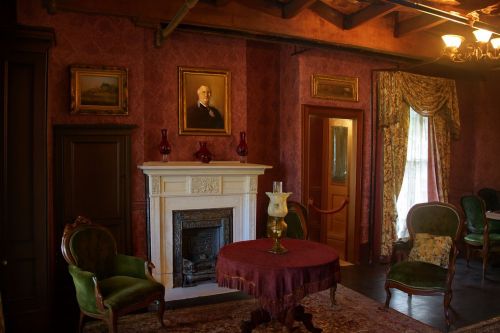
This has far-reaching implications for any analysis of social phenomena. If the integration of an institutional order can be understood only in terms of the “knowledge” that its members have of it, it follows that the analysis of such “knowledge” will be essential for an analysis of the institutional order in question. It is important to stress that this does not exclusively or even primarily involve a preoccupation with complex theoretical systems serving as legitimations for the institutional order. Theories also have to be taken into account, of course. However, theoretical knowledge is only a small and by no means the most important part of what passes for knowledge in a society. Theoretically sophisticated legitimations appear at particular moments of an institutional history. The primary knowledge about the institutional order is knowledge on the pretheoretical level. It is the sum total of “whatever everybody knows” about a social world, an assemblage of maxims, morals, proverbial nuggets of wisdom, values and beliefs, myths, and so forth, the theoretical integration of which requires considerable intellectual fortitude in itself, as the long line of heroic integrators from Homer to the latest sociological system-builders testifies. On the pretheoretical level, however, every institution has a body of transmitted recipe knowledge, that is, knowledge that supplies the institutionally appropriate rules of conduct. Such knowledge constitutes the motivating dynamics of institutionalized conduct. It defines the institutionalized areas of conduct and designates all situations falling within them. It defines and constructs the roles to be played in the context of the institutions in question. Ipso facto, it controls and predicts all such conduct.

Since this knowledge is socially objectivated as knowledge, that is, as a body of generally valid truths about reality, any radical deviance from the institutional order appears as a departure from reality. Such deviance may be designated as moral depravity, mental disease, or just plain ignorance. While these fine distinctions will have obvious consequences for the treatment of the deviant, they all share an inferior cognitive status within the particular social world. In this way, the particular social world becomes the world tout court. What is taken for granted as knowledge in the society comes to be coextensive with the knowledge, or at any rate provides the framework within which anything not yet known will come to be known in the future. This is the knowledge that is learned in the course of socialization, and that mediates the internalization within individual consciousness of the objectivated structures of the social world. Knowledge, in this sense, is at the heart of the fundamental dialectic of society. It “programs” the channels in which externalization produces an objective world. It objectifies this world through language and the cognitive apparatus based on language, that is, it orders it into objects to be apprehended as reality. It is internalized again as an objectively valid truth in the course of socialization. Knowledge about society is thus a realization in the double sense of the word, in the sense of ongoingly producing this reality.

For example, in the course of the division of labor, a body of knowledge is developed that refers to the particular activities involved. In its linguistic basis, this knowledge is already indispensable to the institutional “programming” of these economic activities. There will be, say, a vocabulary designating the various modes of hunting, the weapons to be employed, the animals that serve as prey, and so on. If one is to hunt correctly, there will be a collection of recipes that must be learned. This knowledge serves as a channeling, controlling force in itself, an indispensable ingredient of the institutionalization of this area of conduct. As the institution of hunting is crystallized and persists in time, the same body of knowledge serves as an objective (and, incidentally, empirically verifiable) description of it. A whole segment of the social world is objectified by this knowledge. There will be an objective “science” of hunting, corresponding to the objective reality of the hunting economy. The point need not be belabored that here “empirical verification” and “science” are not understood in the sense of modern scientific canons, but rather in the sense of knowledge that may be borne out in experience and that can subsequently become systematically organized as a body of knowledge. Again, the same body of knowledge is transmitted to the next generation. It is learned as objective truth in the course of socialization, and this is internalized as subjective reality. This reality, in turn, has the power to shape the individual. It will produce a specific reality.
The reality will produce a specific type of person, namely the hunter, whose identity and biography as a hunter have meaning only in a universe constituted by the aforementioned body of knowledge as a whole (say, in a hunters’ society) or in part (say, in our own society, in which hunters come together in a subuniverse of their own). In other words, no part of the institutionalization of hunting can exist without the particular knowledge that has been socially produced and objectivated with reference to this activity. To hunt and to be a hunter implies existence in a social world defined and controlled by this body of knowledge. Mutatis mutandis, the same applies to any area of institutionalized conduct. There is a certain measure of safety in the deliberate cultivation of rational thought based on observed fact as a guide to action. This is the way that science has travelled with the discoveries of, and profits by, natural law. This is the way that industry and commerce have traveled, with solid results for all to see. Its value, when applied to methods of achievement, is a proven one. The sciences are useful to man and need not be cursed for the evil results of their abuse by man. He needs rather to learn how to make a better, more prudent, and wiser use of them. The spirit of science—which happens to be the spirit of this age—has rationalized us, and we are naturally impatient of all misguided persons who appear irrational. Even if we later recognize that certain educational methods were harsh or misguided, they shaped us during a time when we did not have alternatives. Our success gives us the space to reflect on them critically, but those experiences still formed part of the path that brought us here.


Lost Like Bats in the Daytime

When we face the apparent tragedies of sorrow, suffering, and death, we must put our trust in God. Tragedy sometimes comes like a thunderbolt. However, the enduring appeal of tragedy lies in its ability to connect us to something larger than ourselves. By confronting the darkest aspects of human existence, tragedy offers us a glimpse into the shared vulnerabilities and anxieties that bind us together. It reminds us that we are all susceptible to suffering, loss, and ultimately death. Yet, it also celebrates the human capacity for courage, resilience, and compassion in the face of adversity. Think about how tragic it was for Mrs. Sarah L. Winchester to suffer the death of her newborn daughter, and just a few short years later, the loss of her husband. Still, even while facing the deep sadness of such experiences, she found comfort in prayer. With the loss of her daughter and husband weighing so heavily upon her tender heart, she bravely battled with her grief and sought comfort in building the Winchester Mansion. Mrs. Winchester did not remain limited in her visions. Her eyes did not see but a few miles. With her heart, she built a magnificent palace to house all the spirits whose light had gone out in this life, as she was able to see beyond mortal limitations. Inside this fabulous mansion, the veil goes down, time ends, and distance fades and vanishes as we step into eternity, into a great world in which there are no earthly limitations. Mrs. Winchester enjoyed the pleasures of the imagination while constructing her home, as well as those of the senses. #RandolphHarris 1 of 31

She used her tragedy to reflect the highest pleasures of the understanding, the charming, varied pleasures of the imagination, and the vast pleasures of the senses. Mrs. Winchester’s mansion is proof that at no stage of her existence was she left without some pleasure. The fact that it was never completed over the 38 years of construction reflects eternity because eternity never ends, therefore, it is never completed. Tragedy challenges us to confront uncomfortable truths about ourselves and the world around us, and it ultimately affirms the enduring power of the human spirit. The world of everyday life is structured both spatially and temporally. The spatial structure is quite peripheral to our present considerations. Suffice it to point out that it, too, has a social dimension by virtue of the fact that my manipulatory zone intersects with that of others. More importantly, for our present purpose, is the temporal structure of everyday life. Temporarily is an intrinsic property of consciousness. The stream of consciousness is always ordered temporally. It is possible to differentiate between different levels of this temporality as it is intrasubjectively available. Every individual is conscious of an inner flow of time, which in turn is founded on the physiological rhythms of the organism, though it is not identical with these. It would greatly exceed the scope of these prolegomena to enter into a detailed analysis of these levels of intrasubjective temporality. As we have indicated, however, intersubjectivity in everyday life also has a temporal dimension. The world of everyday life has its own standard time, which is intersubjectively available. This standard of time may be understood as the intersection between cosmic time and its socially established calendar, based on the temporal sequences of nature, and inner time, in its afore-mentioned differentiations. There can never be full simultaneity between those various levels of temporality, as the experience of waiting indicates most clearly. #RandolphHarris 2 of 31
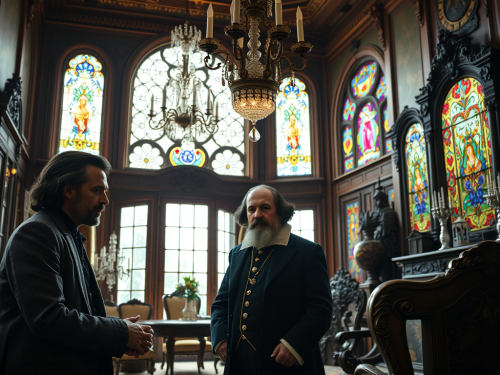
Both my organism and my society impose upon me, and upon my inner time, certain sequences of events that involve waiting. I may want to take part in a sports event, but I must wait for my bruised knee to heal. Or again, I must wait until certain papers are processed so that my qualification for the event may be officially established. It may readily be seen that the temporal structure of everyday life is exceedingly complex because the different levels of empirically present temporality must be ongoingly correlated. The temporal structure of everyday life confronts me as a facticity with which I must reckon, that is, with which I must try to synchronize my own projects. I encounter time in everyday reality as continuous and finite. All my existence in this world is continuously ordered by its time, and is indeed enveloped by it. My own life is an episode in the externally factitious stream of time. It was there before I was born, and it will be there after I die. The knowledge of my inevitable death makes this time finite for me. I have only a certain amount of time available for the realization of my projects, and the knowledge of this affects my attitude to these projects. Also, since I do not want to die, this knowledge injects an underlying anxiety into my projects. Thus, I cannot endlessly repeat my participation in sports events. I know that I am getting older. It may even be that this is the last occasion on which I have the chance to participate. My waiting will be anxious to the degree in which the finitude of time impinges upon the project. #RandolphHarris 3 of 31

The same temporal structure, as has already been indicated, is coercive. I cannot reverse at will the sequences imposed by it—“first things first” is an essential element of my knowledge of everyday life. Thus, I cannot take a certain examination before I have passed through certain educational programs, I cannot practice my profession before I have taken this examination, and so on. Also, the same temporal structure provides the historicity that determines my situation in the world of everyday life. I was born on a certain date, entered school on another, started working as a professional on another, and so on. These dates, however, are all “located” within a much more comprehensive history, and this “location” decisively shapes my situation. Thus, I was born in the year of the great bank crash, in which my father lost his wealth, I entered school just before the revolution, I began to work just after the great war broke out, and so forth. The temporal structure of everyday life not only imposes prearranged sequences upon the “agenda” of any single day but also imposes itself upon my biography as a whole. Within the co-ordinates set by this temporal structure, I apprehend both daily “agenda” and overall biography. Clock and calendar ensure that, indeed, I am a “man of my time.” Only within this temporal structure does everyday life retain for me its accent of reality. Thus, in cases where I may be “disoriented” for one reason or another (say, I have been in an automobile accident in which I was knocked unconscious), I feel an almost instinctive urge to “reorient” myself within the temporal structure of everyday life. I look at my watch and try to recall what day it is. By these acts alone, I re-enter the reality of everyday life. #RandolphHarris 4 of 31

So much easier to miss than to hit, to fall on one side or the other. And yet, if only I can get rid of what prevents me, I seem to be so made that I can do it. Then, I “take my time” when my time should be taken, permitting others to take their time too. I do not hurry them or me. When I am in a hurry, it takes longer, and my peace is lost. (This is probably why it took Mrs. Winchester 38 years to build her mansion, which is still incomplete.) Or as one young man said, “I feel that I am going 90 miles an hour inside and 5 miles an hour outside.” When I slow down, the inner speed decreases and the outer speed increases until they match. This is my subjective feeling. (When a small child seems to me to be dawdling and protests, “But I am hurrying,” he may be speaking the truth of himself.) Objectively (as I am seen by others) I have slowed down, may even seem “dull,” but although I “do” less, I accomplish more. I am in harmony with me, and whatever I do goes easily and well. I do not do all that I would like to do, but I do all that I can do (at any time). By limiting myself, I have the feeling of it, throughout my body and my mind, with all the worlds open to me? When I am bored, time slows down, and it accelerates when I am involved. It seems to me that this is true only when I am in the wrong place, where there are these either/ors. There is another place (or world) in which time changes differently: I am not bored. I am involved, and yet I am surprised at how much has got done, that a usual day’s work has taken only a few hours. I look at the clock and am astonished that so little time has passed. During those few hours, time has not seemed to be either fast or slow. Time and I have flown together, so how can I feel it moving or note its speed? It has neither got stuck nor run away from me. I can only be conscious of time when I am not living fully in the present. #RandolphHarris 5 of 31

This masterless slavery in which capitalism enmeshes the worker or the debtor is only debatable ethically as an institution. In principle, the personal conduct of those who participate, on either side of the rulers or of the ruled, is not morally debatable, as such conduct is essentially prescribed by objective situations. If they do not conform, they are threatened by economic bankruptcy, which would, in every respect, be useless. From our special point of view, where the increased fear of the world has led to a flight from occupational pursuits in the private economy, pietism not only turns into something differing in degree but into an element differing in quality. The study of the ego in psychoanalysis has hardly begun to account for the relationship of “inner agency” to social life. Men who share the concerns of an ethnic group, who are contemporaries in a historical era, or who compete and co-operate in economic pursuits are also guided by common images of good and evil. Infinitely varied, these images reflect the elusive nature of cultural differences and of historical change; in the form of contemporary social models, they assume decisive concreteness in every individual’s struggle for ego synthesis—and in every patient’s residence, ethnic background, and occupation are the first items to be radically altered when it is necessary to disguise his personal identity. The essence of the inner dynamics of a case, it is judged, is thereby left intact. The exact nature, then, of the values common to the patient’s background are considered to be so close to the “surface” that they are not necessarily of “psychoanalytic” interest. Contemporary social models are both clinically and theoretically relevant and cannot be shunted off by brief and patronizing tributes to the role “also” played by “social factors.” #RandolphHarris 6 of 31

The general neglect of these factors in psychoanalysis naturally has not furthered a rapprochement with the social sciences. Students of society and history, on the other hand, blithely continue to ignore the simple fact that all individuals are born by mothers; that everybody was once a child; that people and peoples begin in their nurseries; and that society consists of generations in the process of developing from children into parents, destined to absorb the historical changes of their lifetimes and to continue to make history for their descendants. Only psychoanalysis and social science together can eventually chart the course of individual life in the setting of a changing community. Ambitious steps in this direction have been made by eminent psychoanalysts, generally called neo-Freudians, who bypass the efforts of “ego psychology.” We were distressed when we saw ourselves caricatured in patients who, in social life, spread a compulsive attitude of mutual mental denuding under the guise of being alert to the defensive tricks of the ego. And we were dismayed when we saw our purpose of enlightenment perverted into a widespread fatalism, according to which man is nothing but a multiplication of his parents’ faults and an accumulation of his own earlier selves. We must grudgingly admit that even as we were trying to devise, with scientific determinism, a therapy for the few, we were led to promote an ethical disease among the many. The existence and the multiplicity of defensive regressive mechanisms in adolescence were systematically demonstrated in Anna Freud’s The Ego and the Mechanisms of Defence. Her book defines inner defense in the widest sense; but it does not foreclose the psychoanalysis of adolescent development. When she states: “The abstract intellectual discussions and speculations in which young people delight are not genuine attempts at solving the tasks set by reality. Their mental activity is rather an indication of a tense alertness for the instinctual processes and the translation into the abstract thought of that which they perceive,” she presents the defensive half of the story of adolescent rumination, the other half being its adaptive functions, and its functions in the history of changing ideas. #RandolphHarris 7 of 31

There is a historical concomitance which teaches us how, in the period between puberty and adulthood, the resources of tradition fuse with new inner resources to create something potentially new: a new person; and with this new person, a new generation, and with that, a new era. The question of what happens to persons, generations, and eras because of guiding ideologies are of postadolescent origin, and are dedicated to the proposition that what we have learned as pathologists must become part of an ecology of the mind before we can take full responsibility for the ideological implications of our knowledge. We cannot even begin to encompass the human life cycle without learning to account for the fact that a human being under observation has grown stage by stage into a social world, always for the worse and for the better, has step by step prepared for him an outer reality made up of human traditions and institutions which utilize and thus nourish his developing capacities, attract and modulate his drives, respond to and delimit his fears and phantasies, and assign to him a position in life appropriate to his psychosocial powers. We cannot even begin to encompass a human being without indicating for each of the stages of his life cycle the framework of social influences and of traditional institutions which determine his perspectives on his more infantile past and on his more adult future. In this sense, we can learn from patients only to the extent that we realize (and the patient realizes) that what is said and done in treatment is based on a formal contract between healer and patient and must be carefully transposed before being applied to the general human condition. This is the reason why the fragments of case histories or psychoanalytic interpretations which flutter around in increasing numbers in our newspapers and magazines seem lost like bats in the daytime. #RandolphHarris 8 of 31

On the other hand, we cannot leave history entirely to nonclinical observers and to professional historians who often all too nobly immerse themselves into the very disguises, rationalizations, and idealizations of this historical process from which it should be their business to separate themselves. Only when the relation of historical forces to the basic functions and stages of the mind has been jointly charted and understood can we begin a psychoanalytic critique of society as such without falling back into mystical or moralistic philosophizing. Dr. Siegmund Freud warned against the possible misuse of his work as an ideology, a “Weltanschauung;” but a man who inspires new ideas has little power to restrict them to the area of his original intentions. And Dr. Freud did not refrain from interpreting other total approaches to man’s condition, such as religion, as consequences of man’s inability to shake off the bonds of his prolonged childhood, and thus, comparable to collective neuroses. The psychological and historical study of the religious crisis of a young great man renews the opportunity to review this assertion in the light of ego-psychology and of theories of psychosocial development. There are four consequences of self-contempt. The first is the compulsive need of certain neurotic types to compare themselves with everybody whom they come in contact, and to their own disadvantage. The other fellow is more impressive, better informed, more interesting, more attractive, better dressed; he has the advantage of age or youth, of a better position, of greater importance. However, even though the comparisons may strike the neurotic himself as lopsided, he does not think them through clearly; of if he does, the feeling of comparative interiority still remains. The comparisons made are not only unfair to himself; they often do not make any sense. Why should an older man who could be proud of his own accomplishments compare himself with a youngster who is a better dancer? Or why should somebody who has never been interested in music feel inferior to musicians? #RandolphHarris 9 of 31

The practice makes sense, however, when we remember the unconscious claims to be superior to others in every regard. We must add here that the neurotic’s pride also demands that he should be superior to everybody and everything. Then, of course, any “superior” skill or quality of others must be disturbing, and must call forth a self-destructive berating. Sometimes the connection operates in reverse: the neurotic, already in a self-berating frame of mind, utilizes the “shining” qualities of others, as he encounters them, to reinforce and buttress his castigating self-criticism. To express it in terms of two people: it is as if an ambitious and sadistic mother used the better marks or cleaner fingernails of Leo’s friend to put Leo to shame. It is insufficient to describe these processes simply as a recoiling from competition. The recoiling from competition in these instances is rather the result of self-disparagement. A second consequence of self-contempt is vulnerability in human relations. Self-contempt makes the neurotic hypersensitive to criticism and rejection. On little or no provocation, he feels that others look down on him, do not take him seriously, do not care for his company, and in fact slight him. His self-contempt adds considerably to the profound uncertainty he has about himself, and hence cannot but make him as profoundly uncertain about the attitudes of others toward him. Being unable to accept himself as he is, he cannot possibly believe that others, knowing him with all his shortcomings, can accept him in a friendly or appreciative spirit. What he feels in deeper layers is much more drastic, and may amount to an unshakable conviction that others plainly despise him. And such a conviction may live in him, although he is not consciously aware of even a trace of self-contempt. Both of these factors—the blind assumption that others despise him and a relative or total awareness of his own self-contempt—point to the fact that the bulk of self-contempt is externalized. This may lead to a subtle poisoning of all his human relations. He may become unable to take any positive feelings of others at their face values. A compliment may, in his mind, register as a sarcastic comment; an expression of sympathy as condescending pity. Somebody wants to see him—it is because he wants something from him. Others express a liking for him—it can only be because they do not know him well, because they themselves are worthless or “neurotic,” or because he has been or could be useful to them. #RandolphHarris 10 of 31

Similarly, incidents which in fact have no hostile meaning are interpreted as evidence of an existing contempt. Somebody has not greeted him on the street or in the theater, has not accepted his invitation, or has not replied right away—it can only be a slight. Somebody makes a good-natured joke about him—it is a clear intent to humiliate him. An objection to, or a criticism of, some suggestion or activity of his does not constitute an honest criticism of the particular activity, et cetera, but becomes evidence of the other’s despising him. The person himself, as we see in analysis, is either unaware of his experiencing his relations with others in this way, or he is unaware of the distortions involved. In the latter case, he may take it for granted that others’ attitudes toward him are really of this sort, and even pride himself on being “realistic.” In the analytic relationship, we can observe to what extent a patient can take it for granted that others look down on him. After much analytic work is done, and the patient is apparently on good friendly terms with his analyst, he may mention casually and without affection that it was also so self-evident to him that the analyst was looking down on him that he did not feel it necessary to mention it or to give it any extended thought. All of these distorted perceptions in human relations are understandable because the attitudes of others are indeed open to several interpretations, particularly when torn out of context, while the externalized self-contempt feels unmistakably real. Also, the self-protective character of such a shift in responsibility is evident. If possible, at all, it is probably intolerable to live with a constantly awake, sharp self-contempt. The neurotic has an unconscious interest in regarding others as the offenders. Although it is painful for him, as it would be for anybody, to feel slighted and rejected, it is less painful than coming face to face within his own self-contempt. It is a long and hard lesson for anybody to learn that others can neither hurt nor establish self-esteem. #RandolphHarris 11 of 31

The vulnerability in human relations caused by self-contempt combines with that brought about by neurotic pride. It is often difficult to say whether a person feels humiliated because something has hurt his pride or because he has externalized his self-contempt. They are so inseparably interwoven that we must tackle such reactions from both angles. Of course, at a given time, one or the other aspect will be the more easily observable and the more accessible. If a person reacts to a seeming disregard with vindictive arrogance, hurt pride is uppermost in the picture. If, as a result of the same provocation, he turns abject and tries to ingratiate himself, as self-contempt sticks out most clearly. However, in either case, the reverse aspect is also operating and should be kept in mind. Thirdly, a person in the clutches of self-contempt often takes too much abuse from others. He may not even recognize a flagrant abuse, whether it be humiliation or exploitation. Even if indignant friends call it to his attention, he tends to minimize or justify the offender’s behavior. This occurs only under certain conditions, such as in a morbid dependency, and is the outcome of a complicated inner constellation. However, essential among the factors producing it is the defenselessness produced by the person’s conviction that he does not deserve any better treatment. For instance, a woman whose husband is flaunting his affairs with other women may be unable to complain or even to feel conscious resentment because she feels unlovable and regards most other women as more attractive. A last consequence to be mentioned is the need to alleviate or balance self-contempt with the attention, regard, appreciation, or love of others. The pursuit of such attention is compulsive because of the compelling need not to be at the mercy of self-contempt. It is also determined by a need to triumph, and may amount to an all-consuming life goal. The result is a total dependence on others for self-evaluation: it rises or falls with the attitudes of others toward him. #RandolphHarris 12 of 31

Thinking along the broader theoretical lines, observations like these help us to understand better why the neurotic clings so tenaciously to the glorified version of himself. He must maintain it because he feels only one alternative: to succumb to the terror of self-contempt. There is thus a vicious circle operating between pride and self-contempt, one always reinforcing the other. This can change only to the extent that he gets interested in the truth about himself. However, again, self-contempt renders it difficult to find himself. As long as his degraded image of himself is real to him, his self appears despicable. Alienation is the name that Dr. Hegel gives to the condition that arises from the experience of the failure of personhood as a conception of the self. When the predominant conception of what it means to be a self fails to capture those elements of my constitution that are essential to my own self-understanding, alienation arises. Intersubjective relations are alienating when others strive to recognize me according to that incomplete and flawed conception of the self. There are several indicators of self-alienation that a person can look for in self or in others: The general capacity for conscious experience is impaired. The person is living “as if in a fog. Nothing is clear to them. Not only their own thoughts and feelings but also other people, and the implications of a situation, are hazy.” There may be a decrease in awareness or concern for the body, for its needs and feelings, or for material possessions such as a house, car, or clothing. There is a loss of the feeling of being an active, determining force in one’s own life. There are a few factors that are responsible for the process of self-alienation which include: The development of compulsive solutions to neurotic conflicts, such as striving for affection, detachment from others, or chronic hostility to others. Active moves away from the real self, such as the drive for glory and striving to live up to an impossible self-ideal. Active moves against the real self, as in self-hate or self-destruction. #RandolphHarris 13 of 31

The consequence of alienation from the self is that the person’s relation to himself has become impersonal. More specifically, in the self-alienated person, pride governs feelings—the individual does not react with spontaneous emotion. Instead, the person feels what he or she should feel. Further, the self-alienated person does not feel in possession of his or her own energies; the person’s powers are not his or her own. Another consequence of self-alienation is an impairment in the ability to assume responsibility for the self. The self-alienated person is lacking in plain, simple honesty about self and his or her life. The lack of honesty manifests itself as an inability to recognize oneself as one really is, without minimizing or exaggerating, an unwillingness to accept the consequences of one’s actions and decisions, and an unwillingness to realize it is up to oneself to do something about one’s difficulties. Self-alienated persons insist that others, fate, or time will solve these difficulties for them. Self-alienation means, basically, that a person is not choosing action by consulting all components of the real self, such as needs and values; instead, the person serves as some part of the real self. However, if the total self is not the source of direction for the individual’s behavior, what is? Dr. Riesmen’s concept of the “inner-directed character” is an excellent illustration of persons whose behavior expresses the dictates of conscience and self-ideal rather than the real self. When choices for action arise, such persons experience a conflict between what they really want to do and what they believe they ought to do. Implicitly, such persons believe that real selves are unreliable guides to conduct, and so they repress them. The consequence of ignoring the real self in favor of a rigid conscience is that these persons may behave in a moral and exemplary fashion, but their real needs are ignored, and they will be perpetually thwarted. #RandolphHarris 14 of 31
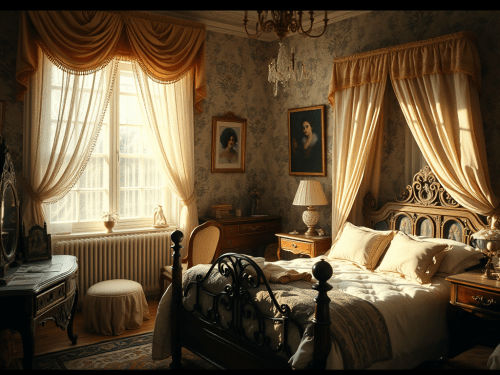
The “authoritarian character” is a person who seeks some authority figure to direct his or her conduct. These persons strive to discern what behavior the authority figure expects of them, and they hasten to comply. If there is any conflict between their own wishes and the demands of authority, they habitually suppress their wishes and compulsively comply with the authority’s wishes. Indeed, they experience their real selves as evil or weak, not worth considering. Dr. Fromm interprets the manner in which authoritarian characters perceive authority as a byproduct of real-self repression, followed by a projection to the authority figure of all of one’s own repressed “powers.” Hence, authoritarian characters perceive themselves as weak and the leader as all-powerful and possessing unusual strength and wisdom—the “charismatic” leader. Dr. Riesman’s concept, the “other-directed” character, describes an individual who allows the wishes and expectations of social peers to direct personal actions. The other-directed character becomes sensitized to others’ wishes and actively seeks to comply with them. The result may be popularity and acceptance, but it is purchased at the cost of knowledge of the real self and of thwarting many basic needs. Dr. Riesman’s concept, the “other-directed” character, describes an individual who allows the wishes and expectations of social powers to direct personal actions. The other-directed character becomes sensitized to others’ wishes and actively seeks to comply with them. The result may be popularity and acceptance, but it is purchased at the cost of knowledge of the real self and of thwarting many basic needs. Impulses and emotions are a part of the real self, just as are will and ideals. Everyone has to struggle to reconcile the conflicting demands of impulses, ideals, and the expectations of other people. #RandolphHarris 15 of 31

An impulse-directed person is one who habitually ignores all demands upon behavior save those imposed by personal impulses and feelings. This person ignores the conscience, the rights of other people, even his or her own long-range welfare and growth. All is subordinated to the immediate expression of the feelings. Psychoanalysts refer to such individuals as “instinct-ridden” characterss; they idealize and rationalize their drives and emotions because they cannot voluntarily control them. They are like adult children who have evaded growth. The goal is to get the patient “out of his script” during his treatment hours so he will behave like a real person, called colloquially, “a card-carrying member of the human race.” The chief difficulty to be overcome is the pull of the script, something like the “Id resistance” of Dr. Freud. The unconscious, instinctual forces that oppose the therapeutic process often manifest as the patient’s compulsion to repeat unhealthy patterns rather than explore them. The “resistance” is driven by the id’s fundamental nature to satisfy innate desires and impulses, such as urges for pleasures of the flesh and aggressive urges, and the inherent pleasure principle of immediate gratification. It opposes the ego’s efforts and the superego’s moral constraints by clinging to the “disease” or symptom. Professional patients adopt that role because they decided when they were very young, with encouragement from their parents, to be mental cripples, and may have been helped along by their previous therapists. This is usually a family script, and the brothers and sisters and parents may also be in treatment. A typical example is where a brother or sister is in a psychiatric hospital, where he or she continually “acts out” (as the staff calls it), or “acts crazy,” as Jeff now learns to call it. Jeff is a little huffy, and will soon say quite frankly that he is jealous of his brother or sister, because he or she is in a hospital while Jeff must be contented without-patient therapy. As one man put it, “How come my brother is in a nice plushy mental hospital on the East Coast while I have to be contented with this lousy little therapy group? I was enjoying it much more when I was a professional patient.” #RandolphHarris 16 of 31
While such things are said jokingly, they are the core of the resistance against getting well. First of all, Jeff is losing all the advantages of being in a hospital and all the fun of acting crazy. However, more than that, he says quite frankly (after he begins to understand his script), his Child is scared to get well and cannot accept the permission offered by the therapist and the other group members to do so, because if he does, his mother (in his head) will desert him. No matter how miserable he is with all his fears, anxieties, obsessions, and physical symptoms, he is still better off, he thinks, than being out in the world on his own without his Parent to protect him. At this point, there is a phase where script analysis becomes almost indistinguishable from psychanalytic probing. The protocol of his script becomes the subject of investigation, and the early influences which led him to decide on a not-O.K. position and way of life come under scrutiny. Here is pride at being a neurotic, a paranoid schizophrenic, an addict, or a criminal will begin to emerge, and he may bring in his diary or talk about his plans for writing an autobiography, as so many of his predecessors have done. Even people who are cured of “mental retardation” may have some nostalgia for their previous condition. People who are mentally healthy often do not know what they think or how they really feel until they have a chance to express themselves and to hear themselves and then decide whether that is actually what they believe. Sometimes just saying something aloud to another person is enough to make one realize that they do not fully believe what they have said—which frees them to change their minds. If you do not try to make every disagreement into a federal case, speaking your mind is important and helpful. People do not have to agree on everything. #RandolphHarris 17 of 31
People always think that they understand themselves, and they always think that they are being honest with themselves, and then later, after something happens and they see themselves differently, they can see how wrong they were. One can kid about how they feel until it hurts too much to go on pretending. Like you might walk with a Lego in your shoe, but sooner or later it would hurt too much and one would have to stop walking and get rid of it. Where there is gathered a sufficient number of facts on which to base a reasonably correct decision, it is still possible that one or more fact, of an importance outweighing all the others, could induce a man’s mind to alter the decision. The order of his thoughts may be perfectly logical yet the truth of them may be largely absent. For the premises with which they start may be ready-made theories, the facts upon which they rest may be less important than those which they ignore, and personal factors may have unconsciously accepted the one and chosen the other. Just as mysticism may give the dangerous illusion that it is dealing with reality when it is not, so logic may give the equally dangerous illusion that it is dealing with truth when it too is not doing so. To call a man a “philosopher” when he is only a mere logician is to demean the word. Logic is a useful tool, for certain limited purposes, but it can as easily lead a man into great error as into great wisdom. Let them not mistake exercises in logic for penetration into truth. Logic is always beset by the serious charge that its so-called truths are fallacious ones. For instance, it insists on the law of contradiction, the law which says that a statement of facts cannot be true and false at the same time. However, the careful study of illusions produces conclusions which falsify this law. We do not mean by this criticism to declare logic to be useless. We mean only that it is a good servant but a bad master. If our original assumptions are wrong, then the irony is that the more logically we travel from them to our conclusions, the more distantly we travel from truth. You can have sacred, revelatory, profoundly instructive experience with the Lord in the most miserable experiences of your life—in the worst settings, while enduring the most painful injustices, when facing the most insurmountable odds and opposition you have ever faced. #RandolphHarris 18 of 31

Heroes and heroines are archetypal in that they emanate and embody an immediate, recognizable pattern. Humans know one when they see one. The hero can be seen as the central human archetype of transformation for wholeness. The transformation comes through the hero’s own journey. Like the magical threshold, the sphere of rebirth, the awakening to the flow of forces, and the creation of wakefulness to dissolve the unconscious into timelessness, the hero emerges. Although talk of improving health and fitness is nothing new to emergency response providers, there are signs that it has now been moved to the front burner. As a result of the unacceptable number of line-of-duty deaths every year, movements have come from different directions to ensure that health and fitness standards are developed that apply to what these heroes do. Some argue that firefighting is a strenuous job, and that sudden cardiac arrest is just the cost of doing business. If that were really true, we would see the same trend of fatalities in other physical occupations, such as professional sports. Although professional athletes have to try out each year and firefighters tend to have a longer career, not many active athletes die from overexertion. When a professional team invests a significant amount of money in a player, they insure their investment through proper diet, physical training, and medical observation. Although the award-winning Sacramento Fire Department does not get as much attention or money as an NFL star, they still have a physically demanding job. As the National Fire Protection Association (NFPA) 1583, Standard on Health-Related Fitness Programs for Fire Fighters, explains, firefighters need “to be medically and physically fit in order to perform the required tasks. #RandolphHarris 19 of 31

In every city, there seems to be one place or street where everything seems to happen. In Sacramento, California, one particular block of Capitol Avenue seems to be that place. Just a sampling of events in less than twenty years reveals several major fires, gang activity, drug dealing, mail theft, threats, over sixty-six deaths, animal attacks, stalking, many instances unlawful entries, a few missing persons cases, shootings, hit and run accidents, sexual assaults, felony assault, theft and vandalisms, financial crimes, and miraculous rescues. The amount of death and destruction that happened in just this one block area of the city is unparalleled in the community’s history. Upon one occasion, a night watchman discovered a fire burning. The fire department came quickly, but the blaze had spread to two adjoining buildings. The fire department, however, was able to prevent the massive blaze and stop the spread to the rest of the street. Despite the roaring fire, there were no deaths or injuries. Compared to automobiles, fire apparatus and ambulances do not provide the amount of protection you would expect. Much of the engineering designated to automobile design is related to either fuel efficiency or meeting federal crash standards. In contrast, custom emergency vehicles are engineered more to function and aesthetics. For instance, a modern sports utility vehicle (SUV) with three rows of seats might safely transport seven people. Lap and shoulder seat belts are in every riding position, and side curtain airbags protect the driver and passengers in an intersection crash. Padded seat backs and cushioned door liners assist in containing passengers in the event of a rollover. Compare that to a Type III ambulance with the same wheelbase. It may have lap and shoulder belts for the two front seats and the captain’s chair, yet only provide lab belts for the other bench positions, which are positioned perpendicular to the direction of travel. Although it may be capable of transporting seven occupants, very little restraint protection is provided. Now factor in that some of the occupants in the back will be providing patient care and might not be restrained at all. By the 1980s, most “impaling hazards” had been removed from the dashboards of automobiles, replaced with flush-mount knobs and rounded corners on the dash. Take a look in the back of the ambulance. How many sharp corners, after-market interior modifications, or potential missiles are present during patient transport? Some ambulances do a good job of securing the sharps container for contaminated needles, yet the container has an open top or nonlatching lid. A rollover could pepper the back of the ambulance with poisoned darts. #RandolphHarris 20 of 31

If you see a fire truck stopped in the street without the lights on, be very careful. Sometimes there is an emergency, and you should not pass the fire truck. It might be a good idea to safely turn around and go another way because if you hit someone and they happen to die, you could be charged with manslaughter. Sometimes fire firefighters are getting back into their vehicle, and if you pass the apparatus, you may collide with a firefighter who is on foot. Also, be sure to look at their signals; sometimes emergency vehicles are in motion, albeit slowly, and drivers try to pass them, and this could lead to a dangerous situation. Also, if you are in an intersection when you see an emergency vehicle, continue through the intersection. Drive to the right as soon as it is safe and stop. Obey any direction, order, or signal given by a law enforcement officer or a firefighter. Even if they conflict with existing signs, signals, or laws, follow their orders. When their siren or flashing lights are on, it is against the law to follow within 300 feet of any fire engine, law enforcement vehicle, ambulance, or other emergency vehicle. If you drive to the scene of a fire, collision, or other disaster, you can be arrested. When you do this, you are getting in the way of firefighters, ambulance crews, or other rescue and emergency personnel. The concept of professional courage does not always mean being as tough as nails, either. It also suggests a willingness to listen to other people’s problems, to go to bat for them in a tough situation, and it means knowing just how far they can go. It also means being willing to tell the boss when he or she is wrong. #RandolphHarris 21 of 31

California is the third most expensive state in the nation. A single person making an income above $100,000 is now considered low-income in five counties in California. This distinction now applies to individuals living in Santa Cruz, Santa Clara, San Mateo, San Francisco, and Marin counties. In 37 percent of counties, a family of four living on a six-figure income is now considered low-income. In fact, Governor Gavin Newsom of Democratic controlled California, brags about being the world’s “fifth largest economy,” but it also facing a $12 billion deficit, looking to cut $747 million for state worker’s pay, pushing to keep medical insurance for illegal immigrants, but wants to cut medical for anyone who has assets over $2,000 and the state has the largest homeless population in the nation. If they are all officially counted, California has approximately 4 million homeless people. The highest home prices in the nation, the highest taxes, and the most unfriendly business regulations known to man. The average home price in California is nearly $1,000,000.00 USD, while the average salary is $96,036.00, meaning that most Californians cannot even afford to buy a home. California is having an affordability crisis. In 2025, many people in California saw their bills increase by an estimated $500 a month. This includes items such as food, automobile insurance, homeowners’ insurance, and electricity. In fact, more than 3 million people in California are facing household hardship, and more than 300,000 of them are facing eviction soon. This comes at a time when California is having a shortage of affordable housing. This is caused by nearly half a century-old laws that discourage home sales and encourage higher rents. #RandolphHarris 22 of 31

Meanwhile, China, where we are sending all our jobs and money, has more than 50 ghost cities, with 65 million vacant homes. Ghost cities are regions will housing has been overdeveloped to the point that these places are uninhabited. Because California is so hostile towards people and businesses, more than 360 companies have fled the state since 2020. Businesses like Chevron, SpaceX, Oracle, and Hewlett-Packard are among the names on that list. Also, more than 500,000 people a year are abandoning California because it is too expensive to live in, Gavin Newsom has criminalized homelessness and actually started arresting people without homes, crime is out of control, and they are losing their jobs due to companies relocating. More than 100 companies have announced layoffs in California for 2025. Intel is cutting 15,000 jobs, PayPal 2,500, and Meta has terminated 4,000 employees. California also has the highest unemployment rate in the country at 5.4 percent, while the national average is 4.1 percent. The California crisis created by Democrats is driving up home prices and mortgages, and rents all over the nation and the world, making living unaffordable for all, and advocates say the crisis is far from over. Accordingly, California has more than 3.5 million illegal immigrants. Having the Southern American border open and not having American farmland protected, not producing beef, poultry, fish, fruit, produce and dairy in America, and without American goods and services being our number one manufactured and selling items, America has created a dangerous and significantly elevated risks to national security, national economic security, and national public health. Some people may believe that these claims are overstated, but by not routinely monitoring Common Vulnerabilities and Exposures (CEVs) or other security-relevant alerts, such as the end-of-life of machinery is how the Oroville Dam Crisis occurred in 2017. #RandolphHarris 23 of 31

Other crises that have occurred due to neglect of critical infrastructure are the 2025 Palisades fires because Southern California ran out of water, when they are located next to an ocean and they could have simply created desalination plants to help with the water shortage. The water is so plentiful that it is currently eroding land and causing homes to fall into the sea. Desalination has been identified as one technology that will help solve California’s water scarcity problem. Desalination is a cost-effective technology that can transform an abundance of salt water into a reliable supply of potable, fresh water, which is a great way to fight climate change and have enough water for our region’s water requirements. Ras Al Khair, Saudi Arabia, is producing 1,036,000 meters (273,682,192) per day of desalinated water. As we see gangs fighting with federal law enforcement, states and cities refusing to honor federal laws, and politicians showing an utter disregard for the Constitution of the United States of America, anarchy is becoming increasingly common. Anarchism is a cluster of doctrines and attitudes centered on the belief that government is both harmful and unnecessary. Derived from the Greek root anarchos, meaning “without authority,” anarchism, anarchist, and anarchy are used to express both approval and disapproval. The anarchist denies man-made laws, regards property as a means of tyranny, and believes that crimes are merely the product of property and authority. #RandolphHarris 24 of 31

However, the anarchist would argue that their denial of constitutions and governments leads not to “no justice” but to the real justice inherent in the free development of human sociality—the natural inclination, when unfettered by laws, to live according to the principles and practice of mutual aid. Anarchism is also a form of treason. Treason, the crime of betraying a nation or a sovereign by acts considered dangerous to security. In English law, treason includes the levying of war against the government and the giving of aid and comfort to the monarch’s enemies. In the United States of America, treason was defined restrictively by the framers of the Constitution. Treason against the United States of America “shall consist only in levying War against them, or in adhering to their Enemies, giving them aid and comfort,” which is something that many politicians are currently guilty of. The American government should know all exploitable vulnerabilities and fix them before the situation becomes a crisis. Failure to take such mitigating actions is dangerous and significantly elevates risk to national security, national economic security, and national public health and safety. The American government must understand that significant time and resources must be invested in America. They must also encourage corporations to plan for both mitigating safety vulnerabilities in the short term and eliminating them in the long term. For instance, a company might begin by reaching out to the federal, state, or local government and requesting tax incentives to provide security to dangerous communities, to help the government repair bridges and potholes. #RandolphHarris 25 of 31

America needs an approach to eliminate safety vulnerabilities in American cities. There needs to be a road map by the end of 2025, outlining a prioritized approach to eliminate crisis situations in America. There is enough money to send aid to foreign nations, but the American government does not have enough money to care for its infrastructure, provide adequate resources, or end the affordable housing crisis. Nor is there enough money to fund other national critical functions (NCFs). These bad practices of putting America and Americans last are considered exceptionally risky, particularly to national security, national economic security, and national public health and safety. In 2024, Americans spent $100 billion on Japanese cars. As a result, the American automobile trade deficit with Japan was $39 billion. The maximum percentage of your gross income that you should earmark for a monthly mortgage payment is calculated at 28 percent, and no more than 36 percent of your gross income to all debts, including mortgage. If you take 28 percent of the median household income per home in Sacramento County, homeowners can only afford a mortgage of $2,070.23 per month. And if you take 36 percent of their gross income to all debts, including mortgage, they should be devoting no more than $2,661.72 a month to these debts. The mortgage lenders must be using some kind of sorcery to get buyers into these expensive homes. To afford one of these homes using traditional guidelines, a household would need to gross $11,280.24 per month or $135,362.88 per year, but the median household in Sacramento County is grossing $7,393.67 a month or $88,724.00 annually, and that typically means two to four people in the home are working and contributing to the mortgage. #RandolphHarris 26 of 31

Home prices in Sacramento County are rivaling the Bay Area. Historically, homes in the Bay Area have been more expensive because they have higher-paying jobs, a larger population, and the Bay Area is a tourist destination. Contributing to the housing affordability crisis is Gavin Newsom, who has been lavishing illegal immigrants with taxpayer-funded resources and cash aid. The State of California has a budget deficit of $12 billion because Governor Gavin Newsom granted 700,000 illegal immigrants free health care, which costs taxpayers $3 billion annually. At the same time, Newsom cut vital programs for veterans, school children, the disabled, and the homeless. Additionally, Newsom seems to be uneducated about economics and is proposing to fast-track his plan to build a $20 billion water tunnel beneath the Sacramento-San Joaquin River Delta, which would eliminate environmental reviews and limit avenues for legal challenges. Gavin Newsom only cares about the environment when his policies allow him to raise taxes and restrict freedoms. To further highlight this illustration, Mexico has been causing one of America’s worst environmental disasters. Fifty million gallons a day of industrial chemicals, untreated sewage, and trash flow from Tijuana, Mexico, into southern San Diego County daily. This toxic waste has been turning up on Imperial Beach and is causing the miles of white sands to become polluted and the ocean breeze to smell of poop, which has been sickening residents and wildlife and costing San Diego millions in the form of lost tourism and health problems. The problem has been going on for more than a century. #RandolphHarris 27 of 31

Drug cartels have been threatening the health and safety of Native American communities. The trafficking of dangerous and illegal drugs into their territories is leading to a second genocide. The overdose rate for Indigenous people is 42 percent higher than the national average. A recent bust on Montana’s Blackfeet Nation’s Tribal Reservation resulted in the seizure of more than 700,000 fentanyl pills, which was the largest bust in Montana history. Recently, the Blackfeet Nation had to declare a state of emergency after facing 17 overdoses in just one week. There are only 6.8 million Native Americans left in the world, which is 2 percent of the American population. We should be doing more to protect these proud and honorable people; they should not want for anything. People rush and give away resources to illegal immigrants, but totally disregard the Indigenous people of this land, as their race silently fades away into extinction. We must secure our borders and increase federal funding to Native American tribes so we can save this precious population. Meanwhile, Gavin Newsom has given billions of taxpayer dollars away to illegal immigrants and protected them from law enforcement, while arresting law-abiding Americans because they cannot afford to pay rent or mortgage, and the homeless shelters are unsafe, overcrowded, and have restrictions on who is allowed inside. He has also totally ignored the cartel problems on American lands. Clean air, water, land, and preserving our heritage are extremely important. We cannot just allow criminals to kill off the people who are native to this land and do nothing about it. Wars have been started over governments that tax citizens without representation. Taxation without representation is what led to the American Revolution. #RandolphHarris 28 of 31

Much like the land crisis in Las Vegas, we could also run out of land to farm and will not be able to grow or cultivate our own food. We can protect American farmland and support American farmers by buying American made beef, poultry, dairy, and produce. Also, country of origin labeling is very important so Americans can know where their food is coming from and can support American farmers and ranchers. As money flows, it influences further investment. Save the land that sustains us by protecting American farmland. Once the land is built on, we lose it forever. And in the future, there may be food wars. Also, to ensure that we have farmland and buildable land for future use, we need to start limiting the number of people allowed to immigrate to America. Perhaps with the immigrants we do allow into America, there needs to be a diversity program to make sure we have a population that equally represents all races of people. If Americans continue to spend money on American products, then more need to be made to keep up the inventory. When investors notice these goods are selling, it gives them the confidence to pour more money into that local business. It shows that people want these goods made in America and pressures investors to keep these goods and services in America. The jobs stay here, the business stays in America, wages naturally increase, and more money is invested to keep up with demand. This reduces the burden on the taxpayer. When you support American businesses, that money stays in our economy and can help to reduce the national debt. The government creates debt by borrowing from businesses in the private sector or from foreign countries. It also increases the national debt by spending more than it gains in tax revenue in a fiscal year. #RandolphHarris 29 of 31

When people shop locally, more tax money stays in the economy and goes to the government. This way, it keeps more money in our national economy and keeps more jobs located in America which also sends more taxes to the government, which can again help to reduce the national debt. When you buy foreign goods, these companies usually have lighter tax loads or exemptions, meaning less money for the national debt, plus you are helping to strengthen these foreign nations by sending more money overseas. Buying American-made products is also better for the environment and helps to reduce the carbon footprint because these products do not have to travel nearly as far. Furthermore, American companies and manufacturers are held to much higher standards on pollution. American companies must be more careful about air, land, and water pollution and have proper ways to dispose of waste. Moreover, please remember to respect law and order and treat your elders with the utmost dignity and kindness possible. And take your education seriously so that you will be successful in life and make your family proud. It is inborn in the human mind to wish to know. If this begins with the endless surface questions of a child’s curiosity, if it continues into deeper questions of a scientist’s probing investigation, it cannot and does not stop there. For the higher part of the mind will eventually come into unfoldment, that union of abstract reflective thought with mystical intuition, which is true intelligence, which needs and sees a view of the whole of things. And so, the knowing faculty enters the realm of philosophy. #RandolphHarris 30 of 31

As you can see, President Donald Trump and his pledge to “Make America Great Again” is exactly what America needs to save the country and the American people. As of 31 August 2025, President Trump has brought $8 Billion in Tariff revenue into America and hundreds of thousands of new jobs. However, if President Trump’s Tariffs are deemed illegal by the Supreme Court, taxpayers will have to pay back trillions and trillions of dollars. And yes, diversity is important, so you can see why it is also important to preserve blonde hair and blue eyes, as the people with these characteristics are becoming a minority in America. We must think before we can understand the soul’s existence; we must understand before we can realize it. The earliest beginnings of thought, as apart from instinct, when it was itself still but a lurking tendency, belong far back in primeval time. The human intellect as we find it today, so rich and developed an instrument for the consciousness of the ego, did not arrive at this fullness without a series of graduated stages. We have had plenty of scientific thinking, business thinking, and political thinking long enough, but we have had very little inspired thinking. That is the world’s need. The intellect is cradled in selfishness but runs the evolutionary track into reason, where it will one day finish at the winning-post of selflessness. As a reminder, parents, please teach your children to love America and be patriotic citizens, and to buy goods and services made in America. It is also important to respect law and order and treat your elders with respect. Also, to make sure they have all the resources required, please donate to the Sacramento Fire Department to help improve our national security. “Oh, thus be it ever, when freemen shall stand between their loved home and the war’s desolation! Blest with victory and peace, may the heav’n-rescued land Praise the Power that hath made and preserved us a nation! Then conquer we must, when our cause is just, and this be our motto: ‘In God is our trust.’ And the star-spangled banner in triumph shall wave O’er the land of the free and the home of the brave.” #RandolphHarris 31 of 31

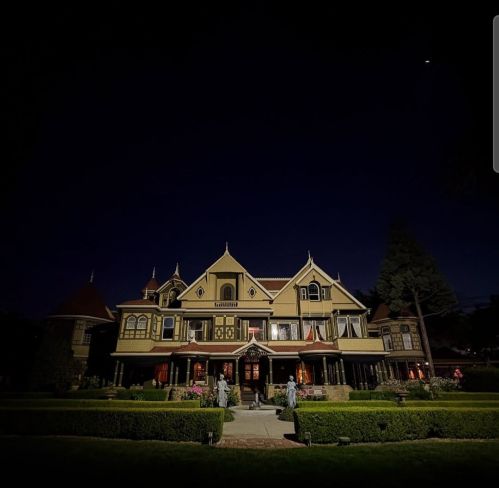
According to locals, over a century ago, the land that houses The Winchester Mansion had been vacant forever. Then, sometime in the early afternoon of Saturday, March 13, 1886, Sheriff Angel Camilio began getting reports that a massive castle made of wood had suddenly appeared. Gables rose, towers peaked into the sky as the mansion mushroomed into a labyrinth overnight.

The house’s sudden manifestation had been both disconcerting and fascinating to the community. Some felt dark curses flowing from the estate, and things moving around in the darkness. Others saw a fairytale castle glimmering in the spring sunlight. Perhaps this is why there are no records of construction, no blueprints, and no permits filed with the county. Come and see what secrets this so-called, “Winchester Mystery House” may hold.

Experience an unforgettable journey back to the time of kings and queens with this entry ticket for The Winchester Mansion in Santa Clara, California, which was the residence of Heiress Sarah L. Winchester. Take advantage of this fascinating experience. After the tour, there will be time to enjoy the mansion’s splendor at your own pace. You might even discover secret passages.

Please come and enjoy a delicious meal at Sarah’s Café, stroll along the paths of the beautiful Victorian gardens, which once spanned 740 acres, all the way down to Stevens Creek Boulevard; wander through the miles of hallways in the world’s most mysterious mansion.

For further information about tours, including group tours, weddings, school events, birthday party packages, facility rentals, and special events please visit the website: https://winchestermysteryhouse.com/

Please visit the online giftshop, and purchase a gift for friends and relatives as well as a special memento of The Winchester Mystery House. A variety of souvenirs and gifts are available for purchase. https://shopwinchestermysteryhouse.com/


Harris Plumbing, Heating, Air, & Electric has been in business for 30 years. How many businesses can say that? We take pride in everything we do – no matter how big or small the service call might be. We’re here to help your home be as safe and comfortable as possible for you and your family. We take that responsibility very seriously as a company. Harris will ensure you have the information you need to decide what to do next, whatever your home is facing. We’ll perform a diagnosis and detail what issues are present before starting any work. This gives you a personalized quote and service plan specific to your home’s needs, not some random quote based on the best guess. The only way we can do our best work is to make sure we handle the issues at hand. https://www.callharrisnow.com/about-us/


Ah, yes. The BMW 3 Series. Happy 50th birthday to the most iconic BMW ever! It is really hard to decide on a BMW model. However, the 3 series is a favorite of everyone. All the upper-class suburban families had one in the 1980s and 1990s; everyone from teenagers and housewives to executives and diplomats. Now that they are larger in size, but still sporty and luxurious, the audience has grown tremendously. These are very stylish and reliable cars, which is why BMW continues to dominate the luxury car space.

With its top ranking in Consumer Reports’ Auto Brand Report Card and consistent market share growth, BMW has demonstrated its ability to produce high-performing, reliable vehicles that meet consumer demands. BMW stands out due to its focus on driving dynamics and engineering excellence. While other luxury brands prioritize comfort and opulence, BMW is known for creating cars that are fun to drive and offer a unique connection between the driver and the machine. This is why BMW is known as the Ultimate Driving Machine. https://www.brianharrisbmw.com/

Randolph Harris San Francisco Taxation & Mergers
Building strong and lasting client relationships is crucial for a successful legal career. Many lawyers mistakenly believe that mastering legal skills alone ensures success, but law is fundamentally a service industry—our job is to solve problems through the time we sell. To build long-term relationships, attorneys must focus on three core elements: knowing their clients, understanding how their legal issues fit into a larger context, and consistently delivering exceptional service.

Randy advises clients with regard to business transition, taxable and tax-deferred mergers and acquisitions, joint ventures, restructuring, integrated tax planning, federal and state tax controversy resolution, and real estate transactions. Trust is the cornerstone of any client relationship. Ultimately, my clients feel they are in capable hands with someone who genuinely understands their problems and goals. https://www.jmbm.com/l-randolph-harris.html


At Millhaven Homes our professionals bring extensive experience in creating custom luxury properties. Your needs are the central focus. We savor the sanctuary of awe-inspiring spaces, unique architectural details and fine craftsmanship. The key to a successful relationship is communication. We will incorporate your thoughts and ideas into your new home.

With vast experience in all types of custom home construction, our premier services are created for you, so you can get the most out of the function and design of your dream home. Discover Millhaven Homes today. Let us design and build a custom home that reflects your style, comfort, and aspirations. We are here to bring your vision to life with creativity, care, and attention to every detail.

Each home we create is a masterpiece—crafted with care, harmony, and sophistication. Be sure to ask about our legendary “Costco” door. https://millhavenhomes.com/


The World of Everyday Life is Taken for Granted

The world of everyday life is not only taken for granted as reality by ordinary members of society in the subjectively meaningful conduct of their lives. It is a world that originates in their thoughts and actions, and is maintained as real by these. Common sense contains innumerable pre- and quasi-scientific interpretations about everyday reality, which it takes for granted. Suppose we are to describe the reality of common sense. In that case, we must refer to these interpretations, just as we must take account of their taken-for-granted character—but we do so with phenomenological brackets. Consciousness is always intentional; it always intends or is directed toward objects. We can never apprehend some putative substratum of consciousness as such, only consciousness of something or other. This is so regardless of whether the object of consciousness is experienced as belonging to an external physical world or apprehended as an element of an inward subjective reality. Whether I (the first-person singular, here as in the following illustrations, standing for ordinary self-consciousness in everyday life) am viewing the panorama of New York City or whether I become conscious of an inner anxiety, the process of consciousness involved is intentional in both instances. The point need not be belabored that the consciousness of The Winchester Mystery House differs from the awareness of anxiety. #RandolphHarris 1 of 25

A detailed phenomenological analysis would uncover the various layers of experience and the different structures of meaning involved in, say, being bitten by a dog, remembering having been bitten by a dog, having a phobia about all dogs, and so forth. What interests us here is the common intentional character of all consciousness. Different objects present themselves to consciousness as constituents of different spheres of reality. I recognize the fellowmen I must deal with during everyday life as a reality quite different from the disembodied figures that appear in my dreams. The two sets of objects introduce quite different tensions into my consciousness, and I am attentive to them in quite different ways. My consciousness, then, can move through different spheres of reality. Put differently, I am conscious of the world as consisting of multiple realities. As I move from one reality to another, I experience the transition as a kind of shock. This shock is to be understood as caused by the shift in attentiveness that the transition entails. Waking up from a dream illustrates this shift most simply. Among the multiple realities, there is one that presents itself as the reality par excellence. This is the reality of every day life. Its privileged position entitles it to designation of paramount reality. The tension of consciousness is highest in everyday life, that is, the latter imposes itself upon consciousness in the most massive, urgent, and intense manner. It is impossible to ignore, difficult even to weaken in its imperative. #RandolphHarris 2 of 25
Consequently, it forces me to be attentive to it in the fullest way. I experience everyday life in the state of being wide-awake. This wide-awake state of existing in and apprehending the reality of everyday life is taken by me to be normal and self-evident; that is, it constitutes my natural attitude. I apprehend the reality of everyday life as an ordered reality. Its phenomena are prearranged and impose themselves upon the latter. The reality of everyday life appears already objectified, that is, constituted by an order of objects that have been designated as objects before my appearance on the scene. The language used in everyday life continuously provides me with the necessary objectifications and posits the order within which these make sense and within which everyday life has meaning for me. I live in a place that is geographically designated; I employ tools, from can openers to sports cars, which are designated in the technical vocabulary of my society; I live within a web of human relationships, from my chess club to the United States of America, which are also ordered by means of vocabulary. In this manner, language marks the co-ordinates of my life in society and fills that life with meaningful objects. Genuine charismatic situations quickly give way to incipient institutions, which emerge from the cooling off of extraordinary states of devotion and fervor. #RandolphHarris 3 of 25
Emphasis upon the “sovereignty of the charismatic man” does not minimize the mechanics of institutions; on the contrary, by tracing out the routinization of charisma, this assigns a heavy causal weight to institutional routines. Thus, we retain a social determinism by emphasizing charisma’s routinization. The way this problem is handled testifies to our constant endeavor to maintain a casual pluralism and to bring the economic order into the balance. Those who, in the contemptuous view of youth consolidated in technological expansion, are the “peaceniks,” are the humanists whose style of consolidation also includes quite old-fashioned sentiments and ideal (in appearance, they often seem to be emerging from an underground medieval town) while it is hospitable to ideals of civil disobedience and nonviolence which in their modern form originated (but by no means ended) with Jesus Christ. Here, opposition to thoughtless mechanization goes together with a dislike of regimentation and of the military kind of enthusiasm, and with a sensitive awareness of the existential individuality of anyone in the range of gun sight. This and the technocratic view must obviously oppose and repel each other, for the acceptance of even a part of one view causes a slide leading to a reconversion of the whole configuration of images. Often, therefore, these two views face one another as if the other were the enemy, although he may be brother, friend—or oneself at a different stage of one’s own life. #RandolphHarris 4 of 25

Seventy five years ago, we related identity problems with much hesitation (for the term was then highly suspect) to the ideological needs of youth, ascribing, in fact, much acute confusion to a kind of ideological undernourishment on the part of those youths who had come too late to share either the military fervor of the world wars “over there” or the radicalism of the first postwar years over here. American youth, we said, was anti-ideological, glorifying instead a “way of life”—and a comfortable one. We were afraid, of course, that the “materialist” trend so vastly reinforced by technology would find little balance in a youth to whom all ideology had become political and foreign, the more so since McCarthyism had succeeded in creating in almost all Americans a fear of radical thinking amounting to a traumatic transformation of a previously cherished identity into a negative one. Since then, some American youths have proven themselves in the civil rights movement as well as in the Peace Corps, showing that they can accept unaccustomed hardship and discipline when moved by a convincing ideological trend applied to universal needs. In fact, in such universal matters as the opposition to unrestricted armament or to a thoughtless consent to the acceleration of the war in Vietnam, youth have proven more foresighted than many, many adults. To the horror of a parent generation brainwashed by McCarthyism they have reinstated some of their own parents’ abandoned ideals. #RandolphHarris 5 of 25

However, only after having discussed, as far as my conceptual means permit, the majority of youth who derive a certain strength of identity from the whole ideological package of technological expansion, can I discuss our new-humanist youth from a more balanced viewpoint. Does not an interplay between a new dominant class of specialists—those who “know what they are doing”—and an intense new group of universalists—those who “mean what they are saying”—always determine the identity possibilities of an age? And those who mean it often care deeply for and become the champions of a third group—those who have been left behind by all concerned. In our time, these are the technologically or educationally underprivileged who are cut off from all ideologies because of a lack of capacity or opportunity, or (of course) both. In revolutionary times, then, the overprivileged and the underprivileged often reach out to each other, both being marginal to the vast consolidation of the “compact majority.” The more mature among our new young humanists are seeking a common denominator in human life—some kind of worldwide identity bridging affluence and underdevelopment. For some individuals who might otherwise have rebelled unfruitfully or withdrawn completely, the capacity to employ their conflict in a socially relevant and activist movement undoubtedly had potential therapeutic value. At the same time, it seems clear that the “therapeutic” as well as the political value of all these groups depends on the vitality of their communal potential—and on the discipline and inventiveness of their leaders. #RandolphHarris 6 of 25

The protests of humanist youth range from romantic Edwardians and jazzy Wandervogeltum to the deeply committed “New Left,” and to an identification with naked heroism anywhere in the world where “machines” threaten to crush man’s will. They range, in other words, from a reactionary resistance to all machine conformity to a reformulation of human rights and dignities in an irreversibly technological future. If they seem perplexed and sometimes bizarre in the light of these demands, we should remind ourselves that it was the tradition of enlightenment which, taking a stable middle class or a liberal world for granted, opened all values to ruthless inquiry. Now, the young must experiment with what is left of the “enlightened” and “analyzed” world. The psychoanalytic enlightenment, for example, assumed that infantile sexuality and perversions could be brought to public attention with an advocacy of enlightened judgment as a replacement for age-old repression. Now, perversions, as, indeed, all kinds of perversity, must find their own limits of attractiveness in print and deed. Therefore, only a relative freedom of experimentation can find its own correction where the parental combination of radical enlightenment and old-fashioned morality has failed. Yet, the search for youth, I believe, is not for all-permissibility, but rather for new ways of directly facing up to what truly counts. #RandolphHarris 7 of 25
To the patient’s Child (the immature part of the personality), the therapist is a magician of sorts. He is likely to choose the same kind of magical figure that he knew in childhood. In some families, the revered figure is the family doctor, a medical man; in others, the revered is the clergyman. Some doctors and clergymen are serious figures out of tragedy, like Tiresians, who will tell them the bad news and perhaps give them a cantrap, amulet, or draught for salvation; others are jolly green giants who protect children from harm by comforting them and reassuring them, and flexing their giant muscles. When Jeder grows up, he will usually look for help from a similar person. If his experience was unhappy, however, he may rebel and find some other kind of magic. One puzzle is why people choose psychologists to fill this role in their scripts, since comparatively few people so far have had a friendly neighborhood psychologist as the family magician in early childhood. From a fairy-tale point of view, the therapist is the dwarf, the witch, the fish, the fox, or the bird who gives Jeder the magic means to attain his ends: the seven-league boots, the cloak of invisibility, the magic chest that produces on command gold or tables laden with cakes and dainties, or some apotropaion to ward off evil. #RandolphHarris 8 of 25

Roughly speaking, the patient can choose between three kinds of magic in selecting a therapist, and he can select each one for success or for failure. If his script requires that, he can also play one against the other. These are known as “science,” “chicken soup,” and “religion.” Any profession can offer all three, but typically, a certain type of psychologist offers “modern science,” a certain type of pastoral counselor offers “religion.” If occasion demands, a well-trained therapist in each of these professions is prepared to offer any of them, and some offer two in combination. Science and religion, chicken soup and science, or religion and chicken soup, are common farragoes for the patient who seeks more than one kind of magic. The practical difference between “science,” “chicken soup,” and “religion,” on the other hand, and a scientific, supportive, and religious approach to therapy is in knowing when to stop. The therapists who use the first three do not know when to stop, since each one’s brand of magic is part of his own script, while those who use the last three do know when to stop, because they know what they are doing. The first group is playing, “I am Only Trying to Help You,” while the others are helping people. Usually, the neurotic seizes avidly upon situational difficulties or misfortunes for the purpose of exonerating himself: he did all he could; he was, to make a long story short, simply wonderful. However, the others, the whole situation, or accidental mishaps spoiled it all. #RandolphHarris 9 of 25

While these two attitudes superficially look like opposites, the similarities are, strangely enough, greater than the differences. In both ways, the attention is diverted from subjective factors and focused on the externals. To them is ascribed the decisive influence on happiness and success. The function in both is to ward off the onslaughts of self-condemnation for not being one’s idealized self. In the instances mentioned, other neurotic factors also interfered with being the ideal mother or with having a brilliant career as an actor. The woman at that time was too consumed with her own problems to be a consistently good mother; the actor had certain inhibitions against making necessary contacts and competing for a job. Both were to some extent aware of these difficulties, but they mentioned them casually, forgot about them, or subtly embellished them. In a happy-go-lucky person, this would not strike us as peculiar. However, in our two instances—which are typical in this regard—there is a simply stunning discrepancy between a gingerly dealing with their shortcomings on the one hand and merciless, unreasoning self-accusations for occurrences outside their control on the other. If we are not aware of their significance, such discrepancies may easily escape observation. #RandolphHarris 10 of 25

They contain an important clue for understanding the dynamics of self-condemnation. They point to a self-recrimination for personal flaws so severe that the person must resort to self-protective measures. And they use two such measures: to treat themselves in a gingerly way and to shift responsibility to circumstances. The question remains why, with this latter move, they fail better in getting rid of self-accusations, at least in their conscious minds? The answer is simply that they do not feel that these outside factors are outside their control. Or, more accurately, they should not be out of control. Consequently, everything that goes wrong reflects on them and shows them up in their disgraceful limitations. Persons’ self-concepts represent what they believe to be true about their own personalities. Their conscience grows out of an idealized view of how they ought to be. Humans have the capacity to select their actions and their speech, to influence the experience others will have on them. Typically, a person wishes to believe that he or she is law-abiding, highly moral, and possesses other traits that evoke a favorable impression. The layperson’s term for the public self is wanted reputation. Everyone strives to construct a reputation with respect to their typical behavior, id est, they choose their behavior before other persons so these others will form the beliefs that they want them to form. #RandolphHarris 11 of 25

Almost everyone distinguishes between their “public” life and their “private” life. Ordinarily, only those persons an individual trusts are allowed to observe the full range of that individual’s behavior repertoire. Outsiders are permitted to observe only the “expurgated” edition of behavior. This connection is akin to “on-stage” behavior, as opposed to backstage or off-stage behavior. The most important reason for constructing public selves of various sorts is expedience. It is only when others believe certain things to be true of you that they will like you, marry you, give you jobs, refrain from imprisoning you, and appoint you to public office, buy things at your store, and consult you professionally. If, for any reason, other people believe undesirable things to be true of you, they will ostracize you, jail you, and so on. A person may construct highly diversified public selves, depending upon his or her goals. The young man seeking a spouse strives to behave in ways that the woman will be likely to value and approve. He does not allow her to see the rest of his behavior, which may vary tremendously from the censored version of the person she does not see. The construction of public selves resembles the art of sculpture. A sculptor manipulates clay, then steps back to see whether the statue being created resembles the image the sculptor has in mind. If it does not, he or she continues to work at it, until by successive approximations the sculptor has brought into reality something that hitherto existed only as a preferred idea or image. #RandolphHarris 12 of 25

By the same token, persons may hold images of their own personalities that they want to construct in the mind of another person. Instead of clay, they employ their own carefully selected behavior and conversation. From time to time, the audience will offer feedback, indicating how they have been seen. If the way they are being seen does not yet coincide with the preferred image, the individuals engage in more behavior and talking until they are assured by the other’s responses that they are now seen as they wish to be seen. Persons may “slip” during the process of constructing, or living up to, a given public self. They may want their audience to believe one thing about them, say, that they are morally scrupulous, yet they may forget themselves and use obscene language, and destroy the image they were seeking to create. Such experiences produce embarrassment, to say the least. The reading public has an insatiable curiosity for details that conflict with the public selves of newsworthy people. The actual way to deal with facts is not to ignore them but to meet and master them. The happiness gained from the first will always be illusory, whereas that gained from the second will always be genuine. Philosophy is not interested in twilight-gropings for occult phantoms or deceptive speculatings to exercise fancy. It seeks and accepts only verifiable facts. However, observation must be unprejudiced, sharp, and intelligent to produce the facts, and facts are apt to be obstinate and intractable. #RandolphHarris 13 of 25

One of the most misused terms in fire and emergency medical services is accident, which is sometimes defined as an occurrence with tragic results that could not be predicted or prevented. One example would be if you were suddenly struck by a bolt of lightning. However, if the weather forecaster had warned of the lightning storm this afternoon and you chose to stay on the golf course, it would not be an accident anymore. In fact, there are very few vehicle accidents, tragic accidents, or even accidental fires. They may be unintentional, but usually they are predictable and preventable. The best time to catch an unsafe act is before it happens. One morning, a police officer was patrolling and he noticed flames issuing from the roof of a shop. He immediately called the fire department. The fire department quickly arrived on scene, but was forced to sit and watch the building burn, as a water supply problem prevented any extinguishment of the fire. A water main had gone unrepaired, which caused the fire hydrant to have a capacity issue. The entire building was in flames before the fire department could get water on the conflagration. Fire spread to a house, which was adjoined to a building. The building was a complete loss. Other buildings on the street were consumed, including another home and a two-story building. A brick residence caught fire, but thanks to the firemen, only the roof of the kitchen and veranda were burned. Firefighters were able to prevent the fire from further spreading. #RandolphHarris 14 of 25

If you see a fire truck stopped in the street without the lights on, be very careful. Sometimes there is an emergency, and you should not pass the fire truck. It might be a good idea to safely turn around and go another way because if you hit someone and they happen to die, you could be charged with manslaughter. Sometimes fire firefighters are getting back into their vehicle, and if you pass the apparatus, you may collide with a firefighter who is on foot. Also, be sure to look at their signals; sometimes emergency vehicles are in motion, albeit slowly, and drivers try to pass them, and this could lead to a dangerous situation. Also, if you are in an intersection when you see an emergency vehicle, continue through the intersection. Drive to the right as soon as it is safe and stop. Obey any direction, order, or signal given by a law enforcement officer or a firefighter. Even if they conflict with existing signs, signals, or laws, follow their orders. When their siren or flashing lights are on, it is against the law to follow within 300 feet of any fire engine, law enforcement vehicle, ambulance, or other emergency vehicle. If you drive to the scene of a fire, collision, or other disaster, you can be arrested. When you do this, you are getting in the way of firefighters, ambulance crews, or other rescue and emergency personnel. The concept of professional courage does not always mean being as tough as nails, either. It also suggests a willingness to listen to other people’s problems, to go to bat for them in a tough situation, and it means knowing just how far they can go. It also means being willing to tell the boss when he or she is wrong. #RandolphHarris 15 of 25

California is the third most expensive state in the nation. A single person making an income above $100,000 is now considered low-income in five counties in California. This distinction now applies to individuals living in Santa Cruz, Santa Clara, San Mateo, San Francisco, and Marin counties. In 37 percent of counties, a family of four living on a six-figure income is now considered low-income. In fact, Governor Gavin Newsom of Democratic controlled California, brags about being the world’s “fifth largest economy,” but it also facing a $12 billion deficit, looking to cut $747 million for state worker’s pay, pushing to keep medical insurance for illegal immigrants, but wants to cut medical for anyone who has assets over $2,000 and the state has the largest homeless population in the nation. If they are all officially counted, California has approximately 4 million homeless people. The highest home prices in the nation, the highest taxes, and the most unfriendly business regulations known to man. The average home price in California is nearly $1,000,000.00 USD, while the average salary is $96,036.00, meaning that most Californians cannot even afford to buy a home. California is having an affordability crisis. In 2025, many people in California saw their bills increase by an estimated $500 a month. This includes items such as food, automobile insurance, homeowners’ insurance, and electricity. In fact, more than 3 million people in California are facing household hardship, and more than 300,000 of them are facing eviction soon. This comes at a time when California is having a shortage of affordable housing. This is caused by nearly half a century-old laws that discourage home sales and encourage higher rents. #RandolphHarris 16 of 25

Meanwhile, China, where we are sending all our jobs and money, has more than 50 ghost cities, with 65 million vacant homes. Ghost cities are regions will housing has been overdeveloped to the point that these places are uninhabited. Because California is so hostile towards people and businesses, more than 360 companies have fled the state since 2020. Businesses like Chevron, SpaceX, Oracle, and Hewlett-Packard are among the names on that list. Also, more than 500,000 people a year are abandoning California because it is too expensive to live in, Gavin Newsom has criminalized homelessness and actually started arresting people without homes, crime is out of control, and they are losing their jobs due to companies relocating. More than 100 companies have announced layoffs in California for 2025. Intel is cutting 15,000 jobs, PayPal 2,500, and Meta has terminated 4,000 employees. California also has the highest unemployment rate in the country at 5.4 percent, while the national average is 4.1 percent. The California crisis created by Democrats is driving up home prices and mortgages, and rents all over the nation and the world, making living unaffordable for all, and advocates say the crisis is far from over. Accordingly, California has more than 3.5 million illegal immigrants. Having the Southern American boarder open and not having American farmland protected, not producing beef, poultry, fish, fruit, produce and dairy in America, and without American goods and services being our number one manufactured and selling items, America has created a dangerous and significantly elevated risks to national security, national economic security, and national public health. Some people may believe that these claims are overstated, but by not routinely monitoring Common Vulnerabilities and Exposures (CEVs) or other security-relevant alerts, such as the end-of-life of machinery is how the Oroville Dam Crisis occurred in 2017. #RandolphHarris 17 of 25
Other crises that have occurred due to neglect of critical infrastructure are the 2025 Palisades fires because Southern California ran out of water, when they are located next to an ocean and they could have simply created desalination plants to help with the water shortage. The water is so plentiful that it is currently eroding land and causing homes to fall into the sea. Desalination has been identified as one technology that will help solve California’s water scarcity problem. Desalination is a cost-effective technology that can transform an abundance of salt water into a reliable supply of potable, fresh water, which is a great way to fight climate change and have enough water for our region’s water requirements. Ras Al Khair, Saudi Arabia, is producing 1,036,000 meters (273,682,192) per day of desalinated water. As we see gangs fighting with federal law enforcement, states and cities refusing to honor federal laws, and politicians showing an utter disregard for the Constitution of the United States of America, anarchy is becoming increasingly common. Anarchism is a cluster of doctrines and attitudes centered on the belief that government is both harmful and unnecessary. Derived from the Greek root anarchos, meaning “without authority,” anarchism, anarchist, and anarchy are used to express both approval and disapproval. The anarchist denies man-made laws, regards property as a means of tyranny, and believes that crimes is merely the product of property and authority. #RandolphHarris 18 of 25
However, the anarchist would argue that their denial of constitutions and governments leads not to “no justice” but to the real justice inherent in the free development of human sociality—the natural inclination, when unfettered by laws, to live according to the principles and practice of mutual aid. Anarchism is also a form of treason. Treason, the crime of betraying a nation or a sovereign by acts considered dangerous to security. In English law, treason includes the levying of war against the government and the giving of aid and comfort to the monarch’s enemies. In the United States of America, treason was defined restrictively by the framers of the Constitution. Treason against the United States of America “shall consist only in levying War against them, or in adhering to their Enemies, giving them aid and comfort,” which is something that many politicians are currently guilty of. The American government should know all exploitable vulnerabilities and fix them before the situation becomes a crisis. Failure to take such mitigating actions is dangerous and significantly elevates risk to national security, national economic security, and national public health and safety. The American government must understand that significant time and resources must be invested in America. They must also encourage corporations to plan for both mitigating safety vulnerabilities in the short term and eliminating them in the long term. For instance, a company might begin by reaching out to the federal, state, or local government and requesting tax incentives to provide security to dangerous communities, to help the government repair bridges and potholes. #RandolphHarris 19 of 25
America needs an approach to eliminate safety vulnerabilities in American cities. There needs to be a road map by the end of 2025, outlining a prioritized approach to eliminate crisis situations in America. There is enough money to send aid to foreign nations, but the American government does not have enough money to care for its infrastructure, provide adequate resources, or end the affordable housing crisis. Nor is there enough money to fund other national critical functions (NCFs). These bad practices of putting America and Americans last are considered exceptionally risky, particularly to national security, national economic security, and national public health and safety. In 2024, Americans spent $100 billion on Japanese cars. As a result, the American automobile trade deficit with Japan was $39 billion. The maximum percentage of your gross income that you should earmark for a monthly mortgage payment is calculated at 28 percent, and no more than 36 percent of your gross income to all debts, including mortgage. If you take 28 percent of the median household income per home in Sacramento County, homeowners can only afford a mortgage of $2,070.23 per month. And if you take 36 percent of their gross income to all debts, including mortgage, they should be devoting no more than $2,661.72 a month to these debts. The mortgage lenders must be using some kind of sorcery to get buyers into these expensive homes. To afford one of these homes using traditional guidelines, a household would need to gross $11,280.24 per month or $135,362.88 per year, but the median household in Sacramento County is grossing $7,393.67 or $88,724.00, and that typically means two to four people in the home are working and contributing to the mortgage. #RandolphHarris 20 of 25

Home prices in Sacramento County are rivaling the Bay Area. Historically, homes in the Bay Area have been more expensive because they have higher-paying jobs, a larger population, and the Bay Area is a tourist destination. Contributing to the housing affordability crisis is Gavin Newsom, who has been lavishing illegal immigrants with taxpayer-funded resources and cash aid. The State of California has a budget deficit of $12 billion because Governor Gavin Newsom granted 700,000 illegal immigrants free health care, which costs taxpayers $3 billion annually. At the same time, Newsom cut vital programs for veterans, school children, the disabled, and the homeless. Additionally, Newsom seems to be uneducated about economics and is proposing to fast-track his plan to build a $20 billion water tunnel beneath the Sacramento-San Joaquin River Delta, which would eliminate environmental reviews and limit avenues for legal challenges. Gavin Newsom only cares about the environment when his policies allow him to raise taxes and restrict freedoms. To further highlight this illustration, Mexico has been causing one of America’s worst environmental disasters. Fifty million gallons a day of industrial chemicals, untreated sewage, and trash flow from Tijuana, Mexico, into southern San Diego County daily. This toxic waste has been turning up on Imperial Beach and is causing the miles of white sands to become polluted and the ocean breeze to smell of poop, which has been sickening residents and wildlife and costing San Diego millions in the form of lost tourism and health problems. The problem has been going on for more than a century. #RandolphHarris 21 of 25

Drug cartels have been threatening the health and safety of Native American communities. The trafficking of dangerous and illegal drugs into their territories is leading to a second genocide. The overdose rate for Indigenous people is 42 percent higher than the national average. A recent bust on Montana’s Blackfeet Nation’s Tribal Reservation resulted in the seizure of more than 700,000 fentanyl pills, which was the largest bust in Montana history. Recently, the Blackfeet Nation had to declare a state of emergency after facing 17 overdoses in just one week. There are only 6.8 million Native Americans left in the world, which is 2 percent of the American population. We should be doing more to protect these proud and honorable people; they should not want for anything. People rush and give away resources to illegal immigrants, but totally disregard the Indigenous people of this land, as their race silently fades away into extinction. We must secure our borders and increase federal funding to Native American tribes so we can save this precious population. Meanwhile, Gavin Newsom has given billions of taxpayer dollars away to illegal immigrants and protected them from law enforcement, while arresting law-abiding Americans because they cannot afford to pay rent or mortgage, and the homeless shelters are unsafe, overcrowded, and have restrictions on who is allowed inside. He has also totally ignored the cartel problems on American lands. Clean air, water, land, and preserving our heritage are extremely important. We cannot just allow criminals to kill off the people who are native to this land and do nothing about it. Wars have been started over governments that tax citizens without representation. Taxation without representation is what led to the American Revolution.#RandolphHarris 22 of 25

Much like the land crisis in Las Vegas, we could also run out of land to farm and will not be able to grow or cultivate our own food. We can protect American farmland and support American farmers by buying American made beef, poultry, dairy, and produce. Also, country of origin labeling is very important so Americans can know where their food is coming from and can support American farmers and ranchers. As money flows, it influences further investment. Save the land that sustains us by protecting American farmland. Once the land is built on, we lose it forever. And in the future, there may be food wars. Also, to ensure that we have farmland and buildable land for future use, we need to start limiting the number of people allowed to immigrate to America. Perhaps with the immigrants we do allow into America, there needs to be a diversity program to make sure we have a population that equally represents all races of people. If Americans continue to spend money on American products, then more need to be made to keep up the inventory. When investors notice these goods are selling, it gives them the confidence to pour more money into that local business. It shows that people want these goods made in America and pressures investors to keep these goods and services in America. The jobs stay here, the business stays in America, wages naturally increase, and more money is invested to keep up with demand. This reduces the burden on the taxpayer. When you support American businesses, that money stays in our economy and can help to reduce the national debt. The government creates debt by borrowing from businesses in the private sector or from foreign countries. It also increases the national debt by spending more than it gains in tax revenue in a fiscal year. #RandolphHarris 23 of 25
When people shop locally, more tax money stays in the economy and goes to the government. This way, it keeps more money in our national economy and keeps more jobs located in America which also sends more taxes to the government, which can again help to reduce the national debt. When you buy foreign goods, these companies usually have lighter tax loads or exemptions, meaning less money for the national debt, plus you are helping to strengthen these foreign nations by sending more money overseas. Buying American-made products is also better for the environment and helps to reduce the carbon footprint because these products do not have to travel nearly as far. Furthermore, American companies and manufacturers are held to much higher standards on pollution. American companies must be more careful about air, land, and water pollution and have proper ways to dispose of waste. Moreover, please remember to respect law and order and treat your elders with the utmost dignity and kindness possible. And take your education seriously so that you will be successful in life and make your family proud. It is inborn in the human mind to wish to know. If this begins with the endless surface questions of a child’s curiosity, if it continues into deeper questions of a scientist’s probing investigation, it cannot and does not stop there. For the higher part of the mind will eventually come into unfoldment, that union of abstract reflective thought with mystical intuition, which is true intelligence, which needs and sees a view of the whole of things. And so, the knowing faculty enters the realm of philosophy. #RandolphHarris 24 of 25

As you can see, President Donald Trump and his pledge to “Make America Great Again” is exactly what America needs to save the country and the American people. As of 31 August 2025, President Trump has brought $8 Billion in Tariff revenue into America and hundreds of thousands of new jobs. And yes, diversity is important, so you can see why it is also important to preserve blonde hair and blue eyes, as the people with these characteristics are becoming a minority in America. We must think before we can understand the soul’s existence; we must understand before we can realize it. The earliest beginnings of thought, as apart from instinct, when it was itself still but a lurking tendency, belong far back in primeval time. The human intellect as we find it today, so rich and developed an instrument for the consciousness of the ego, did not arrive at this fulness without a series of graduated stages. We have had plenty of scientific thinking, business thinking, and political thinking long enough, but we have had very little inspired thinking. That is the world’s need. The intellect is cradled in selfishness but runs the evolutionary track into reason, where it will one day finish at the winning-post of selflessness. As a reminder, parents, please teach your children to love America and be patriotic citizens, and to buy goods and services made in America. It is also important to respect law and order and treat your elders with respect. Also, to make sure they have all the resources required, please donate to the Sacramento Fire Department to help improve our national security. “Oh, thus be it ever, when freemen shall stand between their loved home and the war’s desolation! Blest with victory and peace, may the heav’n-rescued land Praise the Power that hath made and preserved us a nation! Then conquer we must, when our cause is just, and this be our motto: ‘In God is our trust.’ And the star-spangled banner in triumph shall wave O’er the land of the free and the home of the brave.” #RandolphHarris 25 of 25


According to locals, over a century ago, the land that houses The Winchester Mansion had been vacant forever. Then, sometime in the early afternoon of Saturday, March 13, 1886, Sheriff Angel Camilio began getting reports that a massive castle made of wood had suddenly appeared. Gables rose, towers peaked into the sky as the mansion mushroomed into a labyrinth overnight.

The house’s sudden manifestation had been both disconcerting and fascinating to the community. Some felt dark curses flowing from the estate, and things moving around in the darkness. Others saw a fairytale castle glimmering in the spring sunlight. Perhaps this is why there are no records of construction, no blueprints, and no permits filed with the county. Come and see what secrets this so-called, “Winchester Mystery House” may hold.

Experience an unforgettable journey back to the time of kings and queens with this entry ticket for The Winchester Mansion in Santa Clara, California, which was the residence of Heiress Sarah L. Winchester. Take advantage of this fascinating experience. After the tour, there will be time to enjoy the mansion’s splendor at your own pace. You might even discover secret passages.

Please come and enjoy a delicious meal at Sarah’s Café, stroll along the paths of the beautiful Victorian gardens, which once spanned 740 acres, all the way down to Stevens Creek Boulevard; wander through the miles of hallways in the world’s most mysterious mansion.

For further information about tours, including group tours, weddings, school events, birthday party packages, facility rentals, and special events please visit the website: https://winchestermysteryhouse.com/
Please visit the online giftshop, and purchase a gift for friends and relatives as well as a special memento of The Winchester Mystery House. A variety of souvenirs and gifts are available for purchase. https://shopwinchestermysteryhouse.com/

Harris Plumbing, Heating, Air, & Electric has been in business for 30 years. How many businesses can say that? We take pride in everything we do – no matter how big or small the service call might be. We’re here to help your home be as safe and comfortable as possible for you and your family. We take that responsibility very seriously as a company. Harris will ensure you have the information you need to decide what to do next, whatever your home is facing. We’ll perform a diagnosis and detail what issues are present before starting any work. This gives you a personalized quote and service plan specific to your home’s needs, not some random quote based on the best guess. The only way we can do our best work is to make sure we handle the issues at hand. https://www.callharrisnow.com/about-us/

Ah, yes. The BMW 3 Series. Happy 50th birthday to the most iconic BMW ever! It is really hard to decide on a BMW model. However, the 3 series is a favorite of everyone. All the upper-class suburban families had one in the 1980s and 1990s; everyone from teenagers and housewives to executives and diplomats. Now that they are larger in size, but still sporty and luxurious, the audience has grown tremendously. These are very stylish and reliable cars, which is why BMW continues to dominate the luxury car space.
With its top ranking in Consumer Reports’ Auto Brand Report Card and consistent market share growth, BMW has demonstrated its ability to produce high-performing, reliable vehicles that meet consumer demands. BMW stands out due to its focus on driving dynamics and engineering excellence. While other luxury brands prioritize comfort and opulence, BMW is known for creating cars that are fun to drive and offer a unique connection between the driver and the machine. This is why BMW is known as the Ultimate Driving Machine. https://www.brianharrisbmw.com/
Randolph Harris San Francisco Taxation & Mergers
Building strong and lasting client relationships is crucial for a successful legal career. Many lawyers mistakenly believe that mastering legal skills alone ensures success, but law is fundamentally a service industry—our job is to solve problems through the time we sell. To build long-term relationships, attorneys must focus on three core elements: knowing their clients, understanding how their legal issues fit into a larger context, and consistently delivering exceptional service.
Randy advises clients with regard to business transition, taxable and tax-deferred mergers and acquisitions, joint ventures, restructuring, integrated tax planning, federal and state tax controversy resolution, and real estate transactions. Trust is the cornerstone of any client relationship. Ultimately, my clients feel they are in capable hands with someone who genuinely understands their problems and goals. https://www.jmbm.com/l-randolph-harris.html

Ascent at Montelena

11977 Cobble Brook Drive, Rancho Cordova, California 95742
4 Home Design(s) Available

Experience modern designs and affordability in our upcoming new homes for sale. Ascent at Montelena in Rancho Cordova is near major employers and premier shopping.
- $625,990 Starting From
- 3-7 Bedrooms
- 2.5-5 Bathrooms
- 2-3 Car Garage

No matter who you are or where you are, instinct tells you to go a Pulte Home. Ask Mr. Ethan, I can verify this is true. I went to look at a home, and they were closed and I found myself at a Pulte Home, and was greeted and treat with respect. https://www.pulte.com/homes/california/sacramento/rancho-cordova/ascent-at-montelena-210916/plan-4-694486

Heavenly Father, please guide our steps as a nation. With grace and great discernment, lead us in the direction that aligns with Your will. Please grant America the strength to overcome challenges and persevere in our endeavors. Lord, let Your favor be upon us. Open doors of opportunity and bless the work of our hands. In Jesus’ name, Amen. Happy 250 Years, America.


Welcome to the Golden Age of America!

I am confident that we will literally be called upon to make an account before God concerning how we have used [our resources] to bless lives and build the kingdom. Accepting responsibility is not always easy. It can be tempting to try to shift blame or make excuses. However, doing so will only prevent us from learning from our mistakes and growing as individuals. When we accept responsibility for our actions, we take ownership of our mistakes and commit to doing better in the future. There are many benefits to accepting responsibility. First, it allows us to learn from our mistakes. When we take ownership of our mistakes, we can begin to understand what went wrong and how we can avoid making the same mistakes in the future. Second, accepting responsibility builds trust. When others see that we are willing to take responsibility for our actions, they are more likely to trust us and believe that we are genuine. Third, accepting responsibility can help us to feel better about ourselves. When we know that we have done wrong, it can weigh heavily on our conscience. However, when we accept responsibility and take steps to make things right, we can start to feel better about ourselves and move on from our mistakes. However, Ordinary blameworthiness is robust; it is not undermined by consideration of formative circumstances. It is only the realm of detached blame that is shrinking as we conceptualize more things as illness, and perhaps that is no bad thing: our talk of evil usually does not bring much of value to anything. #RandolphHarris 1 of 30

Ordinary blame depends on a shared moral community. Once we enter the realm of detached blame, we have already taken a step away from genuine interpersonal engagement. Someone who is not part of our moral community is not eligible for ordinary blame; our attitude towards them can only be a sort of detached blame: it cannot involve normative expectations, gratitude, or resentment. In detached blame, we stand back and disapprove, disdain, despise, disavow; we do not engage, or at least, not with the aim of reciprocity. Detached blame can involve a modification of the relationship, but in a one-sided way: we avoid such people, and not just for prudential reasons, it is done for its own sake. Detached blame can be fierce, but it can also be undermined. Reflecting on the way that an agent was caused to be the way they are draws us towards the truly objective stance. When we see people from a truly objective stance, we cease to see them as agents at all, and the notion of blame becomes inapplicable. There are many ways to make amends. Sometimes, the best way to make amends is to simply apologize. A sincere apology can go a long way in healing relationships and restoring trust. In other cases, we may need to do more than just apologize. We may need to make amends by offering to fix the damage that we have caused, or by providing support to the person we have wronged. #RandolphHarris 2 of 30
Making amends can be a difficult and humbling experience. However, it is also an incredibly rewarding one. When we make amends, we not only restore harmony in our relationships, but we also heal ourselves. By taking responsibility for our actions and making amends, we can move on from our mistakes and create a more positive and fulfilling life. Therefore, be honest with yourself. The first step to accepting responsibility is to be honest with yourself about your mistakes. This means acknowledging that you made a mistake and understanding the impact of your actions. Apologize sincerely. Once you have accepted responsibility for your actions, the next step is to apologize sincerely to the person you have wronged. Your apology should be genuine and heartfelt. It should not be conditional or full of excuses. Many say that the gospel is to comfort the afflicted and to afflict the comforted. However, the rich, the poor, and all of us in between have things that we need to overcome. When it comes to overcoming being greedy, selfish, and overly indulgent, we all need a lot more help. President Trump said: “The worst fear I have about these people is that they will get rich in this country, forget God and Hos people, wax fat, and kick themselves out of the Church. My greater fear is that they cannot stand wealth.” Our prosperity brings some real challenges because many are getting rich, more of us are waxing fat, and because of greed, selfishness, and overindulgence, we could lose the Spirit and literally lose our souls. #RandolphHarris 3 of 30

Money and material things are on the minds of almost everyone. The great question of the twenty-first century is, “How can I acquire wealth?” No question occupies a larger place in the minds and hearts of people today than this. This is true of men in every situation in every walk of life. Money, in and of itself, is not an evil. However, as Pau taught Timothy, it is the love of money that is the root of all evil. There are some of the wealthy who deal with their prosperity very well, using their resources to bless others and build the kingdom. For many, however, wealth presents major difficulties. As we deal with the materialism that threatens us, there are some things we need to consider. Belonging to a perpetrator group can induce a distressing threat to the collective moral identity of the community. A victim sees the group that they belong to as being in a disadvantaged position of the self or the ingroup, and the perception of the disadvantage as unfair, and believes that better conditions are deserved (for the self or the ingroup), thereby provoking anger and resentment because there were no cries of alarm, no disapproval and virtually no support. Nonetheless, as humanitarian witnesses, we expect victims to feel bad. In fact, that is sometimes why people are victimized. When people are viewed as superior, having an advantage, being successful and virtuous, those without power or authority want these individuals to suffer. Victims, as a result, feel the same kind of rancor appropriate to those who are unjustly punished. #RandolphHarris 4 of 30
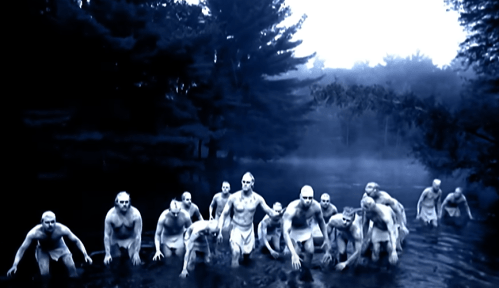
However, many victims of injustice continue to see themselves as unlucky, compared to other potential victims, without feeling any resentment toward perpetrators and beneficiaries. Some victims feel lost. Being lost, having losses, losing—as negative states, these are all ways of feeling bad. So, too, are forms of trauma associated with the infliction of violence, pain, or both, of which the victim seems presently unaware. Victims who do not yet feel bad are often said to be traumatized. When trauma is present, the mind becomes split or dissociated and is unable to register the memory of the event. As a result, the traumatized individual is unable to consciously recollect and integrate the traumatic experience and is haunted by intrusive memories. The experience of trauma becomes frozen in time: it is not represented as past, but rather reexperience repeatedly as a traumatic event in the present. High levels of emotional activation can lead to strong conditioned responses while also impairing the memory processes. Post Traumatic Stress Disorder (PTSD) is a timeless phenomenon that interrupts the ordinary continuum of the past, present, and future. In PTSD patients, intense memories of the trauma coexist with disorganized and incomplete narrative memory. The most common kind of recall of traumatic memories consists of flashbacks, which are usually vivid and yet involve a disruption of the sense of time. They are usually triggered involuntarily and imply the person’s avoidance of stimuli that can be reminders of the trauma. Trauma is timelessly preserved in memory—a fact that might account for the long-term effects of PTSD. Trauma is not part of a declarative or narrative memory, but remains implicit and non-declarative, encoded in bodily memories and conditioned responses lying outside the verbal domain of cognitive function. #RandolphHarris 5 of 30
By far, the most common contributor to suicide is the strain in social relationships. There can be no question that life insurance to the would-be suicide victim’s beneficiaries may be an advantage rather than a loss. The Metropolitan Life, during 1923, paid out $24,738,900.47 (2025 inflation-adjusted) on account of suicide claims against $9,001,439.60 (2025 inflation-adjusted). In four years, the company had paid out $15,737,406.87 million, suggestive of the pecuniary interests that some people have in not supporting victims of crime. Suicide is quite profitable for some people. What is fueling the culture of victimizing and terrorizing people is not only to make oneself feel superior, but also avarice or greed. Avarice is defined as an excessive, unsatisfying, and insatiable desire for wealth or gain. If you have hundreds, you are not satisfied until you get thousands, and when you get thousands, you are not satisfied until you get millions, and as soon as you get millions, of course, now you want billions. And so not only is it greed that is the driving force behind the notorious victimization of strangers, our friends, and even our families, but it is also the driving force of the American economy. Our banks and investment firms are all driven by greed, and when their greed gets them in trouble and their profits are marginalized, the federal government rides in on a $700 billion bailout horse to rescue these greedy corporations. For greedy families, they can simply hope and pray for one to get sick and capitalize on a life insurance policy, or they can try to kill a family member off or push that person to suicide. And that is why some families sit back and watch their relatives suffer, while offering no assistance. #RandolphHarris 6 of 30

Nearly every therapist likes to think that the patient chose him and his profession because, in this choice at least, he was rational, intelligent, and discriminating, no matter how confused he might be about everything else. This feeling of being chosen on merit—the merit of one’s profession and personal merit as well—is a healthy one, and is one of the rewards of our vocation. Every therapist, therefore, is entitled to bask in it and to enjoy it to the utmost—for about five or seven minutes. After that, if he wants the patient to get well, he should put it on the shelf with his other trophies and his diplomas and forget it permanently. Dr. Q may be a very good therapist, and he may have the diplomas and the reputation and the patients to confirm it. He may think that is the reason the patients come to him, or the patient may tell him so. He should be sobered, however, by the thought of all the patients who do not choose him. According to the available statistics, forty-two percent of troubled people go first to their clergyman, and not to a psychiatrist, and nearly all the rest go to their family doctors. And only about one patient out of five disturbed people do not choose psychiatry as their treatment, even though in almost all cases it is available at the state hospital, if nowhere else. In addition, a very large percentage of patients who have a choice deliberately choose the second-best therapist rather than the best, and a quite large percentage choose the worst. #RandolphHarris 7 of 30

The same thing happens in other branches of medicine. It is also well known that many people spend more money destroying themselves with liquor, drugs, and gambling than they would on the psychotherapy that might save them. Given a free choice, the patient will choose a therapist according to the needs of his script. In some places, he has no choice but must go to the local witch doctor, shaman, warlock, sorcerer, or angakok. In other places, he has a choice between a traditional doctor and a modern one, and will choose the magic of tradition or the magic of science according to local custom and political pressure. In China and India, traditional and modern approaches are often combined, as in the mental hospitals in Madras where Ayur-Vedic medicine and Yoga exercises were used in conjunction with modern treatments for psychoses. In many cases, his choice is forced by financial considerations. In America, most patients do not have a free choice of therapists, but are referred or assigned by various “authorities” to one type or another: psychiatrists, psychologists, psychiatric social workers, psychiatric nurses, counselors, and even sociologists. A patient in a clinic, social agency, mental hospital, or government hospital may be assigned to any of these professions. A schoolboy is sent to the school counselor, and a person on probation is sent to a probation officer who may have no therapeutic training at all. If the patient has no prior knowledge or fantasies about psychotherapy and he likes his first therapist, he will often favor that therapist’s profession if he seeks treatment elsewhere. #RandolphHarris 8 of 30
It is in private practice where free choice does exist that the “scripty” selections begin to emerge, particularly in the choice between psychiatrists, psychoanalysts, psychologists, and psychiatric social workers, and between the competent and the incompetent members of these professions. Christian Scientists, for example, if they do go to a medical therapist, often choose a less competent one, since their scripts prohibit them from being cured by a medical person. There are also subdivisions and schools in these professions to choose from. Among psychiatrists, for example, there are types colloquially called “shock treaters,” “drug-givers,” “shrinks,” and hypnotists, and if the patient makes his own choice among these, as he often does, he will choose the one that suits his script. If he is referred by the family doctor, the doctor may well choose the one that fits in with his own script. This is most clearly seen when the patient seeks or is referred to a hypnotist. If he calls a psychiatrist to request hypnosis and that psychiatrist does not use hypnosis, the ensuing conversation becomes very scripty as the patient insists that he must be put to sleep before he can get better. Some people automatically (id est, by script directive) go to the Mayo Clinic and others to the Menninger Clinic. Similarly, in choosing a psychoanalyst, some, for script reasons, select the most orthodox one possible, others prefer more flexibility, and still others go to “analysts” belonging to splinter schools. #RandolphHarris 9 of 30

Sometimes the age of gender of the therapist is important for scripty reasons, such as a need to seduce or a fear of seduction. Rebels often go to rebellious therapists. People with failure scripts pick the worst possible therapists, such as chiropractors or outright quacks. The only relics of Dr. Darwinian natural selection left in America, where everyone is “take care of,” are chiropractors, because the more widely they are allowed to practice, the more quickly will unfit members of humanity be eliminated by their treatment. There are clear indicators that three factors are determined by the patient’s script directives. Whether he seeks help at all, or just lets things run their course; the choice of the therapist, where there is a choice; whether the therapy is destined to be successful. Thus, a person with a loser’s script will either not go to a therapist, or may choose an incompetent one. In the latter case, when the treatment fails, he not only remains a loser, as his script calls for, but also has various other satisfactions from his misadventure; for example, he can blame the therapist, or obtain a Hemostatic satisfaction from being the “worst” patient, or boast that he had ten years of therapy with Dr. X at a cost of Y thousands of dollars with no benefit. Yet, if the major part is gold, we may still call it gold. If, in advising a friend, the major motivation is a friendly intention of constructive help, we may well be satisfied. Not so the person in the clutches of faultfinding. This is deceptive just because there are grains of truth in such reasoning. #RandolphHarris 10 of 30

It is hard to shake the neurotic loose from his self-hate. His error in judging the entirety of a situation is clearly shown. He may see that he overfocuses on certain aspects and ignores others. Nevertheless, he sticks to his verdict. The reason is that his logic operates on different premises from those of a healthy person. Since the advice he gave was not the absolute of helpfulness, the whole action was morally objectionable, and so he starts to beat himself down and refuses to let himself be dissuaded from his self-accusations. These observations refute the assumption sometimes made by the psychiatrists that self-blame is merely a clever device to elicit reassurance or to escape blame and punishment. That, of course, does occur. On the part of children, or of grownups, toward intimidating authorities, it may be nothing but a strategy. Even so, we must be careful with our judgment and should examine the need for so much reassurance. To generalize about these instances and to regard self-accusations as such as serving only strategic ends means a total failure to appreciate their destructive power. Self-accusations, furthermore, may focus on adversities that are outside the individual’s control. These are most conspicuous in psychotics, who may accuse themselves, for instance, of a murder they read about, of responsibility for a flood in the Middle West six hundred miles away. Seemingly absurd self-accusations often are the outstanding symptoms in melancholic conditions. However, the self-accusation in neurosis, while less grotesque, may be no less unrealistic. #RandolphHarris 11 of 30

Why do people manipulate? Many do so because they are beset by fear, fear of others, and fear of expressing the truth of their feelings and desires. They are afraid that if others know the truth of their feelings and desires, they will be at the mercy of others. However, manipulators are often selective about what they fear. Some who fear anger avoid conflict and confrontation with others. Others who fear love avoid closeness with others. And some fear being weak, while others fear being strong. It is the denial of what we fear that defines our manipulative style or pattern. If you are afraid of love, you may be avoiding it with phony expressions of anger. You are predominantly aggressive in your dealings with others and play the role of the blamer and attacker. In doing so, you avoid closeness with others, but you also lose touch with your authentic anger. If you are afraid of anger, you may be avoiding it with phony expressions of love. You play the role of pleaser and placater in the belief that you can get what you want from others without confrontation and conflict. This allows you to avoid feeling and expressing genuine anger, but you also lose touch with your authentic love. If you are afraid of being weak, you may avoid any hint that you are “just a human being” with phony expressions of superiority. You play the role of controller and dictator. By refusing to allow others to be strong, you enhance only the appearance of your own strength. You thereby lose both the power of genuine strength and the opportunities for closeness with others that authentic vulnerability (weakness) brings. #RandolphHarris 12 of 30

If you are afraid of being too strong, you avoid responsibility with phony expressions of incompetence, weakness, and humility. You play the role of avoider and withdrawer, avoiding opportunities to display adequacy and withdrawing from participation with others. You fear that someone might expect more from you than you are willing to give. In doing so, you never have to perform (be strong). You are also seldom able to achieve, and you often overlook your genuine feelings of weakness. Examples of manipulation: Fear and Denial of Lead to Phony Expressions of Lead to Phony Expressions of: Genuine Love….Blaming and Attacking. Genuine Anger….Pleasing and Placating. Genuine Weakness….Controlling and Dictating. Genuine Strength….Withdrawing and Avoiding. Since manipulation is learned by experience in actual encounter with the world, it is important to overcome manipulation by similar methods. The methods cannot be simply intellectual, but must be experiential as well. Self-affirmation. A healthy conscience is not experienced as an “alien power” within the total personality structure, a power compulsively obeyed out of dread. Rather, it is composed of a set of ideals and taboos, each of which has been examined by the person and affirmed so that it became a true part of the real self. A self-affirmed conscience is one to which the person conforms because he or she wants to, not through fear of disobeying. Another way of saying this is to assert that the person feels he or she owns the conscience. The individual has had a voice in determining the rules by which he or she will live, like the citizen in a democracy who does not mind conforming with the rules that the person has helped formulate. #RandolphHarris 13 of 30

A healthy conscience is based upon general values and ideals that remain fixed throughout life or that change only with difficulty. However, the specific behavior that these values call for is not rigidly defined. The person can challenge these self-demands when they are no longer relevant to his or her present life circumstances. For example, a student may have been trained to believe that premarital pleasures of the flesh relationships are evil and destructive of love. In his college career, he may live with a girl and enjoy intimacies involving pleasures of the flesh within the context of a loving relationship. He discovers that no harm befalls the young lady or himself. He may change one of the taboos that is at the root of his conscience. Another student who once believed that premarital pleasures of the flesh were permissible may change and accept a taboo against the practice. If the conscience is not authoritarian, this openness to change is most possible. Persons with a healthy conscience are living among other people, and so they will be obliged to share at least some of the other people’s ideals and taboos. This is not to say that their conscience must be congruent with social mores. These persons may find their values more ethical than the prevailing mores, and so they will follow their conscience rather than the moral expectations of their peers. It may be necessary for persons with a healthy conscience to resist the efforts of others to make them conform to their moral precepts. They may even have to leave home because of moral-ethical differences and seek a group more congenial to their outlooks. #RandolphHarris 14 of 30

It is not implied that a healthy conscience will be highly lenient, permitting any antisocial behavior. Indeed, it may be difficult to conform to the precepts of a healthy conscience. Dr. Fromm has stated that the voice of a humanistic conscience may be only dimly heard because it is readily masked by the authoritarian elements of the conscience. As Dr. Fromm puts it, conscience “is the voice of our true ‘selves’ which summons us back to ourselves, to live productively, to develop fully and harmoniously—that is, to become what we potentially are.” He points out further that guilt arising from violation of a healthy conscience may be difficult to identify; we might feel guilt arising from our authoritarian conscience when we ignore its demands to pursue the requirements of a healthy conscience. There have been several theories to explain why humans exhibit altruistic behavior. These include: evolutionary perspectives involving kin selection and reciprocal altruism; social exchange theory; and the empathy-altruism hypothesis. In Dr. Charles Darwin’s theory of evolution, he postulated that traits that aided humans to survive and reproduce were more likely to be passed on from one generation to the next. It would appear at first glance that genes promoting selfish behavior would likely be passed on. One way that evolutionary psychologists attempt to explain how a trait such as altruism could be passed on through kin selection. #RandolphHarris 15 of 30

Kin selection is the idea that behaviors that help a blood relative would be favored by natural selection. Not only can one pass on their genes by having children, but also by ensuring that their relatives have children. Evolutionary theorists also use the norm of natural selection to help explain altruism. This is the expectation that helping others will increase the likelihood that they will help us in the future. It is posited that groups that learned to cooperate were more likely to survive than selfish and isolated individuals. The emotion of gratitude may have evolved to facilitate reciprocity. That is, if someone is helped, they feel grateful, which motivates them to return the favor in the future. For the people of the award-winning Sacramento Fire Department, helping others is rewarding. It is an investment in the future, not unlike reciprocal altruism. It can feel distressing just to observe someone in pain. Helping that person can then relieve our own discomfort. This, in turn, can help us gain social rewards like approval from others and greater feelings of self-worth. From this perspective, altruistic acts only occur when the perceived gains of helping outweigh the perceived risks. One morning, at nearly 1 o’clock, a saloon was discovered to be on fire. By the time the fire department arrived, the entire structure was ablaze. The nearest building on the east, a carpenter shop, was quickly set ablaze as well from the intense heat and flames. A small dwelling house was also set ablaze. #RandolphHarris 16 of 30

The winds then changed to a westerly direction, spreading flames to another home. Another carpentry shop was thought to be next to succumb to the heat, but the Sacramento Fire Department managed to save the building through hard work. It must have been an incredible feat, for the building was only two feet from the previous home that had just caught fire. The losses on all the buildings added up to between $4 million and $6 million. The newspaper stated that “the fire department did as good a job as could be expected under the circumstances.” New firefighters are trained to take orders from their first day at the academy. They learn to trust their officer’s judgment and follow his or her lead the first time they enter a burning building. Providing them with the latest protective gear on their back and having an officer with years of experience escorting them, the sense of security the Sacramento Fire Department gives trainees far outweighs their worries of self-preservation. They are taught that what they had previously perceived as fear is both normal and exciting, and they cannot wait to impress their peers and instructors. The Sacramento Fire Department pushes firefighters, EMTs, and paramedics through dangerous scenarios repeatedly, and they emerge unscathed each time. As they gain more experience, their armor grows thicker and their confidence builds through recognition-primed decision making. Sure, the Sacramento Fire Department teaches them building construction and lightweight trusses and the dangers of collapse in the classroom, but then it is back to the burn building where they are victorious again, and nothing falls down. Eventually, they become firefighters, EMTs, and paramedics. During their career, they learn to pick up on the visual clues that allow them to make decisions for themselves. #RandolphHarris 17 of 30

If you see a fire truck stopped in the street without the lights on, be very careful. Sometimes there is an emergency, and you should not pass the fire truck. It might be a good idea to safely turn around and go another way because if you hit someone and they happen to die, you could be charged with manslaughter. Sometimes fire firefighters are getting back into their vehicle, and if you pass the apparatus, you may collide with a firefighter who is on foot. Also, be sure to look at their signals; sometimes emergency vehicles are in motion, albeit slowly, and drivers try to pass them, and this could lead to a dangerous situation. Also, if you are in an intersection when you see an emergency vehicle, continue through the intersection. Drive to the right as soon as it is safe and stop. Obey any direction, order, or signal given by a law enforcement officer or a firefighter. Even if they conflict with existing signs, signals, or laws, follow their orders. When their siren or flashing lights are on, it is against the law to follow within 300 feet of any fire engine, law enforcement vehicle, ambulance, or other emergency vehicle. If you drive to the scene of a fire, collision, or other disaster, you can be arrested. When you do this, you are getting in the way of firefighters, ambulance crews, or other rescue and emergency personnel. The concept of professional courage does not always mean being as tough as nails, either. It also suggests a willingness to listen to other people’s problems, to go to bat for them in a tough situation, and it means knowing just how far they can go. It also means being willing to tell the boss when he or she is wrong. #RandolphHarris 18 of 30

California is the third most expensive state in the nation. A single person making an income above $100,000 is now considered low-income in five counties in California. This distinction now applies to individuals living in Santa Cruz, Santa Clara, San Mateo, San Francisco, and Marin counties. In 37 percent of counties, a family of four living on a six-figure income is now considered low-income. In fact, Governor Gavin Newsom of Democratic controlled California, brags about being the world’s “fifth largest economy,” but it also facing a $12 billion deficit, looking to cut $747 million for state worker’s pay, pushing to keep medical insurance for illegal immigrants, but wants to cut medical for anyone who has assets over $2,000 and the state has the largest homeless population in the nation. If they are all officially counted, California has approximately 4 million homeless people. The highest home prices in the nation, the highest taxes, and the most unfriendly business regulations known to man. The average home price in California is nearly $1,000,000.00 USD, while the average salary is $96,036.00, meaning that most Californians cannot even afford to buy a home. California is having an affordability crisis. In 2025, many people in California saw their bills increase by an estimated $500 a month. This includes items such as food, automobile insurance, homeowners’ insurance, and electricity. In fact, more than 3 million people in California are facing household hardship, and more than 300,000 of them are facing eviction soon. This comes at a time when California is having a shortage of affordable housing. This is caused by nearly half a century-old laws that discourage home sales and encourage higher rents. #RandolphHarris 19 of 30

Meanwhile, China, where we are sending all our jobs and money, has more than 50 ghost cities, with 65 million vacant homes. Ghost cities are regions will housing has been overdeveloped to the point that these places are uninhabited. Because California is so hostile towards people and businesses, more than 360 companies have fled the state since 2020. Businesses like Chevron, SpaceX, Oracle, and Hewlett-Packard are among the names on that list. Also, more than 500,000 people a year are abandoning California because it is too expensive to live in, Gavin Newsom has criminalized homelessness and actually started arresting people without homes, crime is out of control, and they are losing their jobs due to companies relocating. More than 100 companies have announced layoffs in California for 2025. Intel is cutting 15,000 jobs, PayPal 2,500, and Meta has terminated 4,000 employees. California also has the highest unemployment rate in the country at 5.4 percent, while the national average is 4.1 percent. The California crisis created by Democrats is driving up home prices and mortgages, and rents all over the nation and the world, making living unaffordable for all, and advocates say the crisis is far from over. Accordingly, California has more than 3.5 million illegal immigrants. Having the Southern American boarder open and not having American farmland protected, not producing beef, poultry, fish, fruit, produce and dairy in America, and without American goods and services being our number one manufactured and selling items, America has created a dangerous and significantly elevated risks to national security, national economic security, and national public health. Some people may believe that these claims are overstated, but by not routinely monitoring Common Vulnerabilities and Exposures (CEVs) or other security-relevant alerts, such as the end-of-life of machinery is how the Oroville Dam Crisis occurred in 2017. #RandolphHarris 20 of 30

Other crises that have occurred due to neglect of critical infrastructure are the 2025 Palisades fires because Southern California ran out of water, when they are located next to an ocean and they could have simply created desalination plants to help with the water shortage. The water is so plentiful that it is currently eroding land and causing homes to fall into the sea. Desalination has been identified as one technology that will help solve California’s water scarcity problem. Desalination is a cost-effective technology that can transform an abundance of salt water into a reliable supply of potable, fresh water, which is a great way to fight climate change and have enough water for our region’s water requirements. Ras Al Khair, Saudi Arabia, is producing 1,036,000 meters (273,682,192) per day of desalinated water. As we see gangs fighting with federal law enforcement, states and cities refusing to honor federal laws, and politicians showing an utter disregard for the Constitution of the United States of America, anarchy is becoming increasingly common. Anarchism is a cluster of doctrines and attitudes centered on the belief that government is both harmful and unnecessary. Derived from the Greek root anarchos, meaning “without authority,” anarchism, anarchist, and anarchy are used to express both approval and disapproval. The anarchist denies man-made laws, regards property as a means of tyranny, and believes that crimes is merely the product of property and authority. #RandolphHarris 21 of 30

However, the anarchist would argue that their denial of constitutions and governments leads not to “no justice” but to the real justice inherent in the free development of human sociality—the natural inclination, when unfettered by laws, to live according to the principles and practice of mutual aid. Anarchism is also a form of treason. Treason, the crime of betraying a nation or a sovereign by acts considered dangerous to security. In English law, treason includes the levying of war against the government and the giving of aid and comfort to the monarch’s enemies. In the United States of America, treason was defined restrictively by the framers of the Constitution. Treason against the United States of America “shall consist only in levying War against them, or in adhering to their Enemies, giving them aid and comfort,” which is something that many politicians are currently guilty of. The American government should know all exploitable vulnerabilities and fix them before the situation becomes a crisis. Failure to take such mitigating actions is dangerous and significantly elevates risk to national security, national economic security, and national public health and safety. The American government must understand that significant time and resources must be invested in America. They must also encourage corporations to plan for both mitigating safety vulnerabilities in the short term and eliminating them in the long term. For instance, a company might begin by reaching out to the federal, state, or local government and requesting tax incentives to provide security to dangerous communities, to help the government repair bridges and potholes. #RandolphHarris 22 of 30

America needs an approach to eliminate safety vulnerabilities in American cities. There needs to be a road map by the end of 2025, outlining a prioritized approach to eliminate crisis situations in America. There is enough money to send aid to foreign nations, but the American government does not have enough money to care for its infrastructure, provide adequate resources, or end the affordable housing crisis. Nor is there enough money to fund other national critical functions (NCFs). These bad practices of putting America and Americans last are considered exceptionally risky, particularly to national security, national economic security, and national public health and safety. In 2024, Americans spent $100 billion on Japanese cars. As a result, the American automobile trade deficit with Japan was $39 billion. The maximum percentage of your gross income that you should earmark for a monthly mortgage payment is calculated at 28 percent, and no more than 36 percent of your gross income to all debts, including mortgage. If you take 28 percent of the median household income per home in Sacramento County, homeowners can only afford a mortgage of $2,070.23 per month. And if you take 36 percent of their gross income to all debts, including mortgage, they should be devoting no more than $2,661.72 a month to these debts. The Mortgage lenders at Cresleigh Homes must be using some kind of sorcery to get buyers into these expensive homes. To afford one of these homes using traditional guidelines, a household would need to gross $11,280.24 per month or $135,362.88 per year, but the median household in Sacramento County is grossing $7,393.67 or $88,724.00, and that typically means two to four people in the home are working and contributing to the mortgage. #RandolphHarris 23 of 30
Home prices in Sacramento County are rivaling the Bay Area. Historically, homes in the Bay Area have been more expensive because they have higher-paying jobs, a larger population, and the Bay Area is a tourist destination. Contributing to the housing affordability crisis is Gavin Newsom, who has been lavishing illegal immigrants with taxpayer-funded resources and cash aid. The State of California has a budget deficit of $12 billion because Governor Gavin Newsom granted 700,000 illegal immigrants free health care, which costs taxpayers $3 billion annually. At the same time, Newsom cut vital programs for veterans, school children, the disabled, and the homeless. Additionally, Newsom seems to be uneducated about economics and is proposing to fast-track his plan to build a $20 billion water tunnel beneath the Sacramento-San Joaquin River Delta, which would eliminate environmental reviews and limit avenues for legal challenges. Gavin Newsom only cares about the environment when his policies allow him to raise taxes and restrict freedoms. To further highlight this illustration, Mexico has been causing one of America’s worst environmental disasters. Fifty million gallons a day of industrial chemicals, untreated sewage, and trash flow from Tijuana, Mexico, into southern San Diego County daily. This toxic waste has been turning up on Imperial Beach and is causing the miles of white sands to become polluted and the ocean breeze to smell of poop, which has been sickening residents and wildlife and costing San Diego millions in the form of lost tourism and health problems. The problem has been going on for more than a century. #RandolphHarris 24 of 30
However, Mexico’s pollution of California has become a severe public health crisis as the population of Tijuana has drastically increased in recent years, and the waste treatment plants are no longer usable. Some of the beaches in San Diego have been closed for more than three years, and evidence suggests that even breathing the air may be harmful, as toxic particles in the water can become airborne. Yet, even though Gavin Newsom has been governor for six years, he has not rushed into action to stop this very preventable environmental disaster. Why? Because he is not getting kickbacks from China and Mexico, not being gifted mansions and cars, and he cannot tax the struggling California taxpayers to clean up this mess. Simply, it is not profitable for him. Gavin Newsom has been a total tyrant with no regard for taxpayers and no mind for business, and he should be impeached as soon as possible. He has criminalized poverty, increased taxes, increased taxes on gas, and insurance rates so high that people are struggling to survive. In addition to Gavin Newsom’s increased gas prices starting on 1 July 2025, the war between Iran and Israel is going to further exacerbate the prices of gas and cause more inflation and economic hardship for people in California. While everyone is making war over America and who belongs here and who she belongs to, so many people forget about the people who are Indigenous to this land. Open borders have allowed hundreds of thousands of cartel operatives to infiltrate reservations across the United States of America and use the isolated lands as havens to traffic fentanyl pills and other drugs into the country without protection from federal authorities. #RandolphHarris 25 of 30

Drug cartels have been threatening the health and safety of Native American communities. The trafficking of dangerous and illegal drugs into their territories is leading to a second genocide. The overdose rate for Indigenous people is 42 percent higher than the national average. A recent bust on Montana’s Blackfeet Nation’s Tribal Reservation resulted in the seizure of more than 700,000 fentanyl pills, which was the largest bust in Montana history. Recently, the Blackfeet Nation had to declare a state of emergency after facing 17 overdoses in just one week. There are only 6.8 million Native Americans left in the world, which is 2 percent of the American population. We should be doing more to protect these proud and honorable people; they should not want for anything. People rush and give away resources to illegal immigrants, but totally disregard the Indigenous people of this land, as their race silently fades away into extinction. We must secure our borders and increase federal funding to Native American tribes so we can save this precious population. Meanwhile, Gavin Newsom has given billions of taxpayer dollars away to illegal immigrants and protected them from law enforcement, while arresting law-abiding Americans because they cannot afford to pay rent or mortgage, and the homeless shelters are unsafe, overcrowded, and have restrictions on who is allowed inside. He has also totally ignored the cartel problems on American lands. Clean air, water, land, and preserving our heritage are extremely important. We cannot just allow criminals to kill off the people who are native to this land and do nothing about it. Wars have been started over governments that tax citizens without representation. Taxation without representation is what led to the American Revolution.#RandolphHarris 26 of 30

If Gavin Newsom is not stopped, next he will euthanize the poor and sterilize the disabled. Under Governor Gavin Newsom, California has the highest car theft rate in the United States of America. Violent gangs and bloodthirsty criminals, roving mobs of wild youth, drugged-out maniacs, and homeless people have overtaken cities. Wars and fires are breaking out on the streets. This monster is unfit to be governor and must never be allowed to be President of America! Stop Gavin Newsom now! Save California and impeach this unreasonable man. Meanwhile, with President Trump, we are seeing crime rates sharply decrease. He is restoring law and order, starting in Washington D.C., and he just signed the “HALT Fentanyl Act” into law, which permanently classifies the narcotic as a “Schedule I drug” under the “Controlled Substances Act.” Also, President Trump recently secured $10 trillion in investments for the United States of America. Additionally, in May of 2025, the United States of America collected a record $100 billion in tariff revenue, and that number will increase to $300 billion by the end of 2025. Also, President Trump has just sealed a $550 billion deal with Japan. This means Japan will invest $550 billion in the United States of America. Furthermore, President Trump has been nominated for a Nobel Peace Prize for making Iran and Israel cease fire. As you can see, President Trump is creating solutions and remediating problems to protect America and the American people, while Governor of California, Gavin Newsom, is making life hard on American citizens and causing economic hardship, and totally ignoring Mexico’s polluting beaches in San Diego. If elected president for an unprecedented third term, to make housing more affordable and to offset the cost of homeowners’ insurance and auto insurance, President Trump plans to abolish property taxes. #RandolphHarris 27 of 30

Much like the land crisis in Las Vegas, we could also run out of land to farm and will not be able to grow or cultivate our own food. We can protect American farmland and support American farmers by buying American made beef, poultry, dairy, and produce. Also, country of origin labeling is very important so Americans can know where their food is coming from and can support American farmers and ranchers. As money flows, it influences further investment. Save the land that sustains us by protecting American farmland. Once the land is built on, we lose it forever. And in the future, there may be food wars. Also, to ensure that we have farmland and buildable land for future use, we need to start limiting the number of people allowed to immigrate to America. Perhaps with the immigrants we do allow into America, there needs to be a diversity program to make sure we have a population that equally represents all races of people. If Americans continue to spend money on American products, then more need to be made to keep up the inventory. When investors notice these goods are selling, it gives them the confidence to pour more money into that local business. It shows that people want these goods made in America and pressures investors to keep these goods and services in America. The jobs stay here, the business stays in America, wages naturally increase, and more money is invested to keep up with demand. This reduces the burden on the taxpayer. When you support American businesses, that money stays in our economy and can help to reduce the national debt. The government creates debt by borrowing from businesses in the private sector or from foreign countries. It also increases the national debt by spending more than it gains in tax revenue in a fiscal year. #RandolphHarris 28 of 30

When people shop locally, more tax money stays in the economy and goes to the government. This way, it keeps more money in our national economy and keeps more jobs located in America which also sends more taxes to the government, which can again help to reduce the national debt. When you buy foreign goods, these companies usually have lighter tax loads or exemptions, meaning less money for the national debt, plus you are helping to strengthen these foreign nations by sending more money overseas. Buying American-made products is also better for the environment and helps to reduce the carbon footprint because these products do not have to travel nearly as far. Furthermore, American companies and manufacturers are held to much higher standards on pollution. American companies must be more careful about air, land, and water pollution and have proper ways to dispose of waste. Moreover, please remember to respect law and order and treat your elders with the utmost dignity and kindness possible. And take your education seriously so that you will be successful in life and make your family proud. It is inborn in the human mind to wish to know. If this begins with the endless surface questions of a child’s curiosity, if it continues into deeper questions of a scientist’s probing investigation, it cannot and does not stop there. For the higher part of the mind will eventually come into unfoldment, that union of abstract reflective thought with mystical intuition, which is true intelligence, which needs and sees a view of the whole of things. And so, the knowing faculty enters the realm of philosophy. #RandolphHarris 29 of 30
As you can see, President Donald Trump and his pledge to “Make America Great Again” is exactly what America needs to save the country and the American people. And yes, diversity is important, so you can see why it is also important to preserve blonde hair and blue eyes, as the people with these characteristics are becoming a minority in America. We must think before we can understand the soul’s existence; we must understand before we can realize it. The earliest beginnings of thought, as apart from instinct, when it was itself still but a lurking tendency, belong far back in primeval time. The human intellect as we find it today, so rich and developed an instrument for the consciousness of the ego, did not arrive at this fulness without a series of graduated stages. We have had plenty of scientific thinking, business thinking, and political thinking long enough, but we have had very little inspired thinking. That is the world’s need. The intellect is cradled in selfishness but runs the evolutionary track into reason, where it will one day finish at the winning-post of selflessness. As a reminder, parents, please teach your children to love America and be patriotic citizens, and to buy goods and services made in America. It is also important to respect law and order and treat your elders with respect. Also, to make sure they have all the resources required, please donate to the Sacramento Fire Department to help improve our national security. “Oh, thus be it ever, when freemen shall stand between their loved home and the war’s desolation! Blest with victory and peace, may the heav’n-rescued land Praise the Power that hath made and preserved us a nation! Then conquer we must, when our cause is just, and this be our motto: ‘In God is our trust.’ And the star-spangled banner in triumph shall wave O’er the land of the free and the home of the brave.” #RandolphHarris 30 of 30


On Friday, September 5th, we invite you to join us in honoring Sarah Winchester on the 103rd anniversary of her passing.
The gardens will be open with free admission that day, and guests are welcome to enter the Front Parlor to offer their respects to Sarah. The bell will ring at the 13th hour (1:00 PM) in remembrance of her life. We hope you will take this opportunity to honor the life and legacy of the woman behind the mansion. 🌹 🖤https://winchestermysteryhouse.com/

Harris Plumbing, Heating, Air, & Electric has been in business for 30 years. How many businesses can say that? We take pride in everything we do – no matter how big or small the service call might be. We’re here to help your home be as safe and comfortable as possible for you and your family. We take that responsibility very seriously as a company. Harris will ensure you have the information you need to decide what to do next, whatever your home is facing. We’ll perform a diagnosis and detail what issues are present before starting any work. This gives you a personalized quote and service plan specific to your home’s needs, not some random quote based on the best guess. The only way we can do our best work is to make sure we handle the issues at hand. https://www.callharrisnow.com/about-us/
Ah, yes. The BMW 3 Series. Happy 50th birthday to the most iconic BMW ever! It is really hard to decide on a BMW model. However, the 3 series is a favorite of everyone. All the upper-class suburban families had one in the 1980s and 1990s; everyone from teenagers and housewives to executives and diplomats. Now that they are larger in size, but still sporty and luxurious, the audience has grown tremendously. These are very stylish and reliable cars, which is why BMW continues to dominate the luxury car space.
With its top ranking in Consumer Reports’ Auto Brand Report Card and consistent market share growth, BMW has demonstrated its ability to produce high-performing, reliable vehicles that meet consumer demands. BMW stands out due to its focus on driving dynamics and engineering excellence. While other luxury brands prioritize comfort and opulence, BMW is known for creating cars that are fun to drive and offer a unique connection between the driver and the machine. This is why BMW is known as the Ultimate Driving Machine. https://www.brianharrisbmw.com/
Randolph Harris San Francisco Taxation & Mergers
Building strong and lasting client relationships is crucial for a successful legal career. Many lawyers mistakenly believe that mastering legal skills alone ensures success, but law is fundamentally a service industry—our job is to solve problems through the time we sell. To build long-term relationships, attorneys must focus on three core elements: knowing their clients, understanding how their legal issues fit into a larger context, and consistently delivering exceptional service.

Randy advises clients with regard to business transition, taxable and tax-deferred mergers and acquisitions, joint ventures, restructuring, integrated tax planning, federal and state tax controversy resolution, and real estate transactions. Trust is the cornerstone of any client relationship. Ultimately, my clients feel they are in capable hands with someone who genuinely understands their problems and goals. https://www.jmbm.com/l-randolph-harris.html

Magnolia Station at Cresleigh Ranch
Rancho Cordova, CA | 4 Bedrooms – 3.5 Bathrooms – 3,377 sq. ft. – $796,485.

Homes built by Cresleigh Homes are made to last. Throughout each community you will find thoughtful design crafted with YOU in mind. We offer homes for any lifestyle and stand by our construction quality – it’s why we’ve been in the business for over 30 years.

Welcome to 770 Havenwood, where Residence Four, the largest floor plan offered in the community offers an impressive 3,377 square feet of thoughtfully designed living space. This expansive two-story home features four bedrooms, including a private suite on the first floor, three and one-half bathrooms, and a true three car garage to meet the needs of growing families or multigenerational living.
Inside, you’ll find four bedrooms, two and a half bathrooms, and a generous three-car garage. A versatile den provides the flexibility to be used as a private study or converted into an optional fifth bedroom. The thoughtfully designed kitchen and dining area create a seamless flow, making entertaining effortless.

A covered porch welcomes you into a warm and inviting entry, where the dining room is thoughtfully placed just off the foyer. The gourmet kitchen connects seamlessly to the dining area through a convenient butler’s pantry, providing both elegance and additional storage.

Upstairs, the spacious loft and generous great room offer flexibility for entertainment, relaxation, or work from home needs, easily adapting to your lifestyle. With no HOA fees, complimentary solar, and up to $41,000 in Flex Cash to be used toward closing costs or interior upgrades on select homes, this residence presents a rare opportunity for exceptional value.

Every Cresleigh home includes the All Ready Connected smart home package, designed to simplify and enhance your daily life. Enjoy integrated features such as a video doorbell, digital deadbolt, smart switches, USB outlets, and a connected home hub that allows you to create personalized scenes and routines. As a bonus, your home also comes with a Google Home Hub and Google Home Mini to help you stay connected and in control. https://cresleigh.com/havenwood/move-in-ready-homesite-5/

The strength of a nation derives from the integrity of Cresleigh Homes. There is a magic in that little world, of my Cresleigh Home; it is a mystic circle that surrounds comforts and virtues never known beyond its hallowed limits.

Discover a home built with your future in mind. Schedule your private tour today.

Heavenly Father, please guide our steps as a nation. With grace and great discernment, lead us in the direction that aligns with Your will. Grant America the strength to overcome challenges and persevere in our endeavors. Lord, let Your favor be upon us. Open doors of opportunity and bless the work of our hands. In Jesus’ name, Amen. Happy 250 Years, America.

A War Within Themselves

It seems difficult to ignore the fact that there is a crisis of identity in America today, and the situation is more complex than it appears. “Identity,” and “identity crisis,” have in popular and scientific usage become terms which alternately circumscribe something so large and so seemingly self-evident that to demand a definition would almost seem petty, while at other times they designate something made so narrow for purposes of measurement that the over-all meaning is lost, and it could just as well be called something else. If, to give example of the wider use of the term, the papers run a headline, “The identity Crisis of Africa,” or refer to the “identity crisis,” of the Pittsburgh glass industry; if the outgoing president of the American Psychoanalytic Association titles his farewell address, “The Identity Crisis of Psychoanalysis”; of if, finally, the Catholic students at Harvard announce that they will hold an “Identity Crisis,” on Thursday night at eight o’clock sharp, then the dignity of the term seems to vary greatly. The quotation marks are as important as the term they bracket: everybody has heard of “identity crisis,” and it arouses a mixture of curiosity, mirth, and discomfort which yet promises, by the very play on the word “crisis,” not to turn out to be something quite as fatal as it sounds. In other words, a suggestive term has begun to lend itself to ritualized usage. #RandolphHarris 1 of 30

Social scientists, on the other hand, sometimes attempt to achieve greater specificity by making such terms as “identity crisis,” “self-identity,” or “sexual identity” fit whatever more measurable item they are investigating at a given time. For the sake of logical or experimental maneuverability (and to keep in good academic company), they try to treat these terms as matters of social roles, personal traits, or conscious self-images, shunning the less manageable and more sinister—which often also means the more vital—implications of the concept. Such usages have, in fact, become so indiscriminate that the other day a German reviewer of a book in which I first used the term in the context of psychoanalytic ego theory called it the pet subject of the amerikanische Populaerpsychologie. However, one may note with satisfaction that the conceptualization of identity has led to a series of valid investigations which, if they do not make clearer what identity is, nevertheless have proved useful in social psychology. And it may be a good thing that the word “crisis” no longer connotes impending catastrophe, which at one time seemed to be an obstacle to the understanding of the term. It is now being accepted as designating a necessary turning point, a crucial moment, when development must move one way or another, marshaling resources of growth, recovery, and further differentiation. This proves applicable to many situations: a crisis in individual development or in the emergence of a new elite, in the therapy of an individual or in the tensions of rapid historical change. #RandolphHarris 2 of 30

The term “identity crisis” was first used for a specific clinical purpose in the Mt. Zion Veterans’ Rehabilitation Clinic during the Second World War, a national emergency which permitted psychiatric workers of different persuasions with denominations, among them Emanuel Windholz and Joseph Wheelwright, to work together harmoniously. Most of our patients, so we concluded at that time, had neither been “shellshocked” nor become malingerers, but had through the exigencies of war lost a sense of personal sameness and historical continuity. They were impaired in that central control over themselves for which, in the psychoanalytic scheme, only the “inner agency” of ego could be held responsible. Therefore, I spoke of a loss of “ego identity.” Since then, we have recognized the same central disturbance in severely conflicted young people whose sense of confusion is due, rather, to a war within themselves, and in confused rebels and destructive delinquents who wage war on their society. Much like the conflicts we are seeing on American streets, at Ivy League universities, and in American politics. In all these cases, then, the term “identity confusion” has a certain diagnostic significance which would influence the evaluation and treatment of such disturbances. #RandolphHarris 3 of 30

Young patients can be violent or depressed, delinquent or withdrawn, but theirs is an acute and possibly passing crisis rather than a breakdown of the kind that tends to commit a patient to all the malignant implications of a fatalistic diagnosis. And as has always been the case in the history of psychoanalytic psychiatry, what was first recognized as the common dynamic pattern of a group of severe disturbances (such as the hysterias of the turn of the century) revealed itself later to be a pathological aggravation, an undue prolongation of, or regression to, a normative crisis, “belonging” to a particular stage of individual development. Thus, we have learned to ascribe a normative, “identity crisis” to the age of adolescence and young adulthood. The term “identity crisis” has become so distinctive that it is often first used as something one takes, and thinks others take, for granted. This recalls one of the innumerable stores with which Norman Rieder could be counted on to lighten those often-weary war days. An old man, he recounted, used to vomit every morning, but he showed no inclination to consult a doctor about it. His family finally prevailed on him to go to Mt. Sion for a general checkup. When Dr. Reider approached him cautiously, “How are you?” he was told promptly, “I’m fine. Couldn’t be better.” And, indeed, on further examination, the constituent parts of the old man seemed to be in good shape as could be expected. Finally, Dr. Reider became a bit impatient. “But I hear you vomit every morning?” The old man looked mildly surprised and said, “Sure. Doesn’t everybody?” #RandolphHarris 4 of 30

I am not implying that “identity crisis” is a symptom of mine that I simply assumed everybody else had also, although there is, of course, something to that too. However, I did assume that I had given the most obvious name to something that everybody had had at one time and would, therefore, recognize in those who were having it acutely. Judged by the clinical origin of these terms, then, it would seem reasonable enough to link the pathological and the developmental aspects of the matter and to see what might differentiate the identity crisis typical for a case history from that of a life history. This emphasis on individual lives, however, would make the other and wider uses of the terms, “identity,” and “Identity crisis,” appear even more suspect as mere analogies not admissible in any court of definition. That Catholic students would try to pool their individual crises, enjoy them together, and get them over with in one evening makes at least humorous sense. However, what possible connection could adolescence as such have with the state of an African nation or of a scientific body? Is this a mere analogistic usage, such as employed, with a mixture of boastfulness and apology when a nation is said to be “adolescent,” can a type of individual identity crisis be shared by a significant section of the young population? And further, to return to the faddish use of the term, “identity confusion,” would some of our youth act so openly confused and confusing if they did not know they were supposed to have an identity crisis? #RandolphHarris 5 of 30

The history of the last sixty years seems to indicate that there are clinical terms which are taken over not only by diagnosticians, but also by those who have been overdiagnosed, and, in this case, by a section of a whole age group who echo our very terms and flamboyantly display a conflict which we once regarded as silent, inner, and unconscious. We have now traced a neurotic development that begins with self-idealization and evolves step by step with inexorable logic to a transformation of values into the phenomenon of neurotic pride. This development, in fact, is more involved than I have presented hitherto. It is both intensified and complicated by another process operating simultaneously—a process which is seemingly opposite, though it is likewise initiated by self-idealization. Briefly, when an individual shifts his center of gravity to his idealized self, he not only exalts himself but also is bound to look at his actual self—all that he is at a given time, body, mind, healthy and neurotic—from a wrong perspective. The glorified self becomes not only a phantom to be pursued; it also becomes a measuring rod with which to measure his actual being. And this actual being is such an embarrassing sight when viewed from the perspective of a godlike perfection that he cannot help but despise it. #RandolphHarris 6 of 30

Moreover, what is dynamically more important, the human being that he is keeps interfering significantly with his flight to glory, and therefore he is bound to hate it, to hate himself. And since pride and self-hate are one entity, I suggest calling the sum of the factors involved by a common name: the pride system. Yet with self-hate we re considering a completely new aspect of the process, one which considerably alters our view of it. We have advisedly set the question of self-hate aside until now to obtain first a clear picture of the straight drive toward actualization of the idealized self. No matter how frantically our Pygmalion tries to mold himself into a being of splendid dimensions, his drive is doomed to failure. He may at best be able to eliminate from awareness some disturbing discrepancies, but they continue to exist. The facts remain that he must live with himself; whether he eats, sleeps, goes to the bathroom, whether he works or enjoys the pleasures of the flesh, he is always there. If he could only divorce his wife, take another job, move to another house, or go on a trip, he sometimes thinks that everything would be better, but in fact, he must always take himself along. Even if he functions like a well-oiled machine, there are still limitations of energy, of time, of power, of endurance—the limitations of a human being. #RandolphHarris 7 of 30

The best way to describe the situation is in terms of two people. There is the unique, ideal person, and there is an omnipresent stranger (the actual self), always interfering, disturbing, and embarrassing. Describing the conflict it terms of “he and the stranger” seems pertinent because it comes close to what the individual feels. Moreover, even though he may discard factual disturbances as irrelevant or unrelated to himself, he can never escape so far from himself as not to “register” (we feel in our guts and bones what is going on in ourselves without its reaching awareness) them. Although he may be successful, may function well, or even be carried away by grandiose fantasies of unique achievement, he will nevertheless feel inferior or insecure. He may have a gnawing feeling of being a bluff, a fraud, a freak—feelings for which he cannot account. His inside knowledge of himself shows unmistakably in his dreams, when he is close to the reality of himself. Usually, the reality of himself intrudes painfully and unmistakably. Godlike in his imagination, he is awkward in social situations. Wanting to make an indelible impression on somebody, his hands shake, or he stammers or blushes. Feeling himself a unique lover, he may suddenly be impotent. Speaking in his imagination to his boss like a man, he merely musters a silly smile. The brilliant remark which would settle a discussion for good and all occurs to him only the next day. The desired sylphlike slenderness is never attained because, compulsively, he eats too much. The actual, empirical self becomes the offensive stranger to whom the idealized self happens to be tied, and the latter turns against this stranger with hate and contempt. The actual self becomes the victim of the proud, idealized self. #RandolphHarris 8 of 30

All the items mentioned so far are helpful in making the script possible, and most of them are matters beyond the person’s awareness. Now, we come to the key item, which not only makes the script possible but gives it the decisive push. That is the demon who sends Jeder naked on roller skates down the hill to his destruction just when he is on the verge of success, before he even knows what is happening to him. However, looking back, even if he has never heard the other voices in his head, he will usually remember that one, the voice of the demon prompting irresistibly: “Go ahead and do it!” Which he does, in the face of all the other forces warning him against it and vainly trying to call him back. This is Daemon, the sudden supernatural push that determines a man’s fate, a voice from the Golden Age, lower than the gods but higher than humanity, perhaps a fallen angel. That is what the historians tell us, and perhaps they are right. For Heraclitus, the Daemon in man was his character. However, this Daemon, according to those who have known him or her, the losers who are just picking themselves up from their falls, speaks not in a loud command like a ghost of a mighty god, but in a seductive whisper, like a beckoning woman, like an enchantress: “Come, do it. Go ahead. Why not? What do you have to lose but everything? Instead, you will have me, as you once did in the Golden Age.” #RandolphHarris 9 of 30

This is the repetition compulsion which drives men to their doom, the power of death, according to Dr. Freud, or the power of the goodness Ananke. However, he places it in some mysterious biological sphere when, after all, it is only the voice of seduction. Ask the man (or woman) who owns one and knows the power of his demon. The remedy against demons has always been cantrips and cantraps, and that is the case here. Every loser should carry it in a wallet or purse, and whenever success looms in sight, that is the moment of danger. That is the time to pull it out and read it aloud repeatedly. Then, when the demon whispers, “Stretch out your arm—and put the whole wad on one last number, or have just one drink, or now is the time to pull your knife, or grab her (him) by the neck and pull her (him) toward you,” or whatever the losing movement is, pull the arm back and say it loud and clear: “But mother, I would rather do it my own way and win.” If not in the World without God, here can charity take refuge, after all? On the other hand, grace provides for all, even the rich. Those who deny everything at least understand that negation is a calamity. They can then open their hearts to the misery of others and finally deny themselves. Pisarev did not shrink from the idea of murdering his mother, and yet he managed to find the exact words to describe injustice. He wanted to enjoy life egoistically, but he suffered imprisonment and finally went mad. Such an ostentatious display of cynicism finally led him to an understanding of love, to be exiled from it and to suffer from it to the point of suicide, thus revealing, in place of the man-god he wanted to create, the unhappy, suffering old man whose greatness illuminates the pages of history. #RandolphHarris 10 of 30

The understanding of such deeply metaphysical writings calls for an effort on the reader’s part to use his own mental energy as actively as the author had to use his own during their creation. The reader’s task is, of course, immeasurably easier than the author’s for he has had the pioneer work of track-laying performed for him; but even so it is hard enough. The reflective study of these high-grade writings forces the mental growth of the student. The absorption of their spirit elevates him for a while to the spiritual plane of the author. The actualizer, then, is someone who, aware of both his or her strengths and weaknesses, therefore does not project either of them excessively onto others. He or she is aware that there is always a parallel between how we feel about ourselves and how we feel about others. The manipulator, on the other hand, excessively fixated or preoccupied with her or his own strengths or weaknesses, denies or disowns those parts that she or he cannot escape. For example, the manipulative businessman admits to his therapist that he has a strong desire for pleasures of the flesh with his secretary. Projecting his inner conservative self—his conscience and feelings of restraint—onto his wife, he secretly blames her for his dilemma. If the businessman were in therapy, the therapist might ask him to express both his liberal and his conservative views on the issue. #RandolphHarris 11 of 31

Self-hate makes viable a rift in the personality that started with the creation of an idealized self. It signifies that there is a war on. And this indeed is the essential characteristic of every neurotic: he is at war with himself. The foundation has been laid for two different kinds of conflicts. One of the is within the pride system itself. It is the potential conflict between expansive drives and self-effacing ones. The other, deeper conflict is between the whole pride system and the real self. The latter, though shoved into the background and suppressed as pride ascended to supremacy, still is potentially powerful and may, under favorable circumstances, gain its full effectiveness. This second, deeper conflict is not apparent at the beginning of the analysis. However, as the pride system totters and the person becomes closer to himself, as he starts to feel his own feelings, to know his wishes, to win his freedom of choice, to make his own decisions, and assume responsibility for them, the opposing forces get lined up. With increasing clarity, the battle is not drawn between the pride system and the real self. Self-hate now is not so much directed against the limitations and shortcomings of the actual self as against the emerging constructive forces of the real self. It is a conflict of greater dimensions than any neurotic conflict I have discussed hitherto. I suggest calling it the central inner conflict. #RandolphHarris 12 of 310

The central inner conflict is one between healthy and neurotic, constructive and destructive forces. Therefore, a neurotic conflict can operate either between two neurotic forces or between healthy and neurotic ones. This difference is important, over and beyond terminological clarification. There are two reasons for the conflict between the pride system and the real self, having a much greater power to split us apart than other conflicts. The first lies in the difference between partial and total involvement. By analogy with a State, it is the difference between clashing interests of individual groups and the whole country’s being involved in a civil war. The other reason lies in the fact that the very core of our being, our real self with its capacity for growth, is fighting for its life. Hate for the real self is more remote from awareness than that for the limitations of the actual self, but it forms the never absent background of self-hate—or the undercurrent that always supplies the main energies, even though hate for the limitations of the actual self may be in the foreground. Hence, hate for the real self can appear in almost pure form while hate for the actual self is always a mixed phenomenon. If for instance our self-hate takes the form of a ruthless self-condemnation for being “selfish” id est, for doing anything in our own behalf—this may be, and most likely is, both a hate for not measuring up to the absolute of saintliness and a way of crushing our real self. #RandolphHarris 13 of 30

A German poet, Christian Morgenstern, concisely expressed the nature of self-hate in his poem Entwicklungsschmerzen (“Growing Pains”): “I shall succumb, destroyed by myself, I who am two, what I could be and what I am. And in the end, one will annihilate the other. The Would-be is like a prancing steed(I am is fettered to his tail), is like a wheel to which I am bound, is like a fury whose fingers twine into his victim’s hair, is like a vampire that sits upon his heart and sucks and sucks.” A poet has thus expressed the process in a few lines. He says that we may hate ourselves with an enervating and tormenting hatred—a hatred so destructive that we are helpless against it and may physically destroy ourselves. And he says that we do not hate ourselves because we are worthless, but because we are driven to reach beyond ourselves. The hatred, he says, results from the discrepancy between what I would be and what I am. There is not only a split, but a cruel and murderous battle. The converse of the script is the real person living in a real world. This real person is probably the real Self, the one that can move from one ego state to another. When people get to know each other well, they penetrate through the script into the depths where this real Self resides, and that is the part of the other person they respect and love, and with which they can have moments of real intimacy before Parental programming takes over again. This is possible because it has happened before in the lives of most people, in the most intimate and script-free relationship of all: that between the mother and her infant. If left to her own instincts, the mother can usually suspend her script during the nursing period, and the infant does not have one. #RandolphHarris 14 of 30

People act in ways that confirm their self-concepts. When people act “out of character,” as in the case of persons who think of themselves as kind but then fly into violent rages, they experience a threat to their sense of identity. They may say, “I was not myself when I was so enraged.” Such a threat is extremely painful, and people go to great lengths to retain a continuous experience of their preferred identity. Our sense of being who we believe we are can be threatened, not only by actions that are out of character, but also by thoughts, feelings, and memories. A person may engage in daydreaming that produces thoughts and feelings of an outrageous nature; for example, a loving mother may find herself entertaining fantasies of abandoning her children. Even if it is a “spoiled” identity, it is intolerable to lose one’s sense of identity. For example, obese people and alcoholics may believe they remain addicted to sweets or to alcohol because they “have no will power.” This belief may be the basis of their sense of who they are; if they act decisively, they do not recognize themselves. People find it difficult to change their behavior, even when it is destructive to growth and to health, because their self-concepts have not altered. The identity crisis many are facing today can have historical origins as a symptom of the unravelling moral authority. Stable identities are not only psychological but also moral accomplishments. They are supported by clarity about meaning, which in turn draws on authoritative moral guidance. Without such guidance, people’s identities often become decentered and find it difficult to endow their lives with meaning. #RandolphHarris 15 of 30

The practice of religion is much like every other human endeavor. Some people practice their religious beliefs with manipulation, others practice their beliefs with actualizing qualities. A manipulative practice stresses the human inability to trust in our own inner resources. An actualizing practice stresses that the kingdom of God is within each person, and to trust one’s inner self is to trust God’s handiwork. The role of religion in the actualized sense is to foster self-direction and self-growth and to fulfill interpersonal relationships. Thus, the actualizing priest, minister, or rabbi is seen by the actualizing person as less a judge and answer-giver and more as a resource person, one who shares and grows with his or her parishioners. He or she is a consultant, not a junior god. “Within my earthly temple there is a crowds; there is one of us that is humble, one that is proud, there is one that is broken-hearted for sins, and one that unrepentant sites and grins; there is one that loves his neighbors as himself, and one that cares for naught but fame and pelf, from much corroding care I should be free. If I could only determine which is me!” (Edward Stanford Martin, “Mixed”) An actualizing person knows the two “crowds” within and willingly accepts each in the integrative fellowship of self. Once socialization was diverted from its traditional goal of transmitting different moral norms, its capacity to provide a bond that bound together the different generations was undermined. Yet, these bonds serve to underpin the common world inhabited by members of a community. Once this bond begins to unravel, what is left is a sense of self in search of a home. The sense of homelessness created a need for the science of psychology, which, as we explain, diagnosed this predicament as an identity crisis. #RandolphHarris 16 of 30

When it comes to the award-winning Sacramento Fire Department, the first step in risk management is to define the context of the risk, or the strategy to be employed in dealing with the risk. Once the risks have been identified, they must be analyzed in terms of their potential threat to the operation. It is important to understand that risk does not necessarily mean “bad.” Fire and emergency services have relied on a simple risk-benefit model, preached by Chief Alan Brunacini, used for many years to guide their decision-making: We will, in a structured plan, risk a lot to save a lot (human lives). In a structured plan, we will risk a little to save a little (property and pets). We will risk nothing to save nothing (or something that is already lost). “Yes, I think about the possibility of dying in this job. I’m missing five o’clock Mass tonight. When I go to work every day, I’m up for work. It’s like a game, I’m up for it. I say my prayers on the way to church or on the way to work, and I ask God to keep me safe and to keep the guys I work with safe. I pray to him that I make the right decisions. I’m not ashamed to say that to anybody. I don’t go around handing out religious leaflets, and I’ll never talk about it at work, but I don’t think a man could extend himself and risk his life in this job without being close to God, because this could be your last day. What I get from firefighting is that satisfaction of having personal worth.” #RandolphHarris 17 of 30

If you see a fire truck stopped in the street without the lights on, be very careful. Sometimes there is an emergency, and you should not pass the fire truck. It might be a good idea to safely turn around and go another way because if you hit someone and they happen to die, you could be charged with manslaughter. Sometimes fire firefighters are getting back into their vehicle, and if you pass the apparatus, you may collide with a firefighter who is on foot. Also, be sure to look at their signals; sometimes emergency vehicles are in motion, albeit slowly, and drivers try to pass them, and this could lead to a dangerous situation. Also, if you are in an intersection when you see an emergency vehicle, continue through the intersection. Drive to the right as soon as it is safe and stop. Obey any direction, order, or signal given by a law enforcement officer or a firefighter. Even if they conflict with existing signs, signals, or laws, follow their orders. When their siren or flashing lights are on, it is against the law to follow within 300 feet of any fire engine, law enforcement vehicle, ambulance, or other emergency vehicle. If you drive to the scene of a fire, collision, or other disaster, you can be arrested. When you do this, you are getting in the way of firefighters, ambulance crews, or other rescue and emergency personnel. The concept of professional courage does not always mean being as tough as nails, either. It also suggests a willingness to listen to other people’s problems, to go to bat for them in a tough situation, and it means knowing just how far they can go. It also means being willing to tell the boss when he or she is wrong. #RandolphHarris 18 of 30

California is the third most expensive state in the nation. A single person making an income above $100,000 is now considered low-income in five counties in California. This distinction now applies to individuals living in Santa Cruz, Santa Clara, San Mateo, San Francisco, and Marin counties. In 37 percent of counties, a family of four living on a six-figure income is now considered low-income. In fact, Governor Gavin Newsom of Democratic controlled California, brags about being the world’s “fifth largest economy,” but it also facing a $12 billion deficit, looking to cut $747 million for state worker’s pay, pushing to keep medical insurance for illegal immigrants, but wants to cut medical for anyone who has assets over $2,000 and the state has the largest homeless population in the nation. If they are all officially counted, California has approximately 4 million homeless people. The highest home prices in the nation, the highest taxes, and the most unfriendly business regulations known to man. The average home price in California is nearly $1,000,000.00 USD, while the average salary is $96,036.00, meaning that most Californians cannot even afford to buy a home. California is having an affordability crisis. In 2025, many people in California saw their bills increase by an estimated $500 a month. This includes items such as food, automobile insurance, homeowners’ insurance, and electricity. In fact, more than 3 million people in California are facing household hardship, and more than 300,000 of them are facing eviction soon. This comes at a time when California is having a shortage of affordable housing. This is caused by nearly half a century-old laws that discourage home sales and encourage higher rents. #RandolphHarris 19 of 30

Meanwhile, China, where we are sending all our jobs and money, has more than 50 ghost cities, with 65 million vacant homes. Ghost cities are regions will housing has been overdeveloped to the point that these places are uninhabited. Because California is so hostile towards people and businesses, more than 360 companies have fled the state since 2020. Businesses like Chevron, SpaceX, Oracle, and Hewlett-Packard are among the names on that list. Also, more than 500,000 people a year are abandoning California because it is too expensive to live in, Gavin Newsom has criminalized homelessness and actually started arresting people without homes, crime is out of control, and they are losing their jobs due to companies relocating. More than 100 companies have announced layoffs in California for 2025. Intel is cutting 15,000 jobs, PayPal 2,500, and Meta has terminated 4,000 employees. California also has the highest unemployment rate in the country at 5.4 percent, while the national average is 4.1 percent. The California crisis created by Democrats is driving up home prices and mortgages, and rents all over the nation and the world, making living unaffordable for all, and advocates say the crisis is far from over. Accordingly, California has more than 3.5 million illegal immigrants. Having the Southern American boarder open and not having American farmland protected, not producing beef, poultry, fish, fruit, produce and dairy in America, and without American goods and services being our number one manufactured and selling items, America has created a dangerous and significantly elevated risks to national security, national economic security, and national public health. Some people may believe that these claims are overstated, but by not routinely monitoring Common Vulnerabilities and Exposures (CEVs) or other security-relevant alerts, such as the end-of-life of machinery is how the Oroville Dam Crisis occurred in 2017. #RandolphHarris 20 of 30
Other crises that have occurred due to neglect of critical infrastructure are the 2025 Palisades fires because Southern California ran out of water, when they are located next to an ocean, and they could have simply created desalination plants to help with the water shortage. The water is so plentiful that it is currently eroding land and causing homes to fall into the sea. Desalination has been identified as one technology that will help solve California’s water scarcity problem. Desalination is a cost-effective technology that can transform an abundance of salt water into a reliable supply of potable, fresh water, which is a great way to fight climate change and have enough water for our region’s water requirements. Ras Al Khair, Saudi Arabia, is producing 1,036,000 meters (273,682,192) per day of desalinated water. As we see gangs fighting with federal law enforcement, states and cities refusing to honor federal laws, and politicians showing an utter disregard for the Constitution of the United States of America, anarchy is becoming increasingly common. Anarchism is a cluster of doctrines and attitudes centered on the belief that government is both harmful and unnecessary. Derived from the Greek root anarchos, meaning “without authority,” anarchism, anarchist, and anarchy are used to express both approval and disapproval. The anarchist denies man-made laws, regards property as a means of tyranny, and believes that crimes is merely the product of property and authority. #RandolphHarris 21 of 30
However, the anarchist would argue that their denial of constitutions and governments leads not to “no justice” but to the real justice inherent in the free development of human sociality—the natural inclination, when unfettered by laws, to live according to the principles and practice of mutual aid. Anarchism is also a form of treason. Treason, the crime of betraying a nation or a sovereign by acts considered dangerous to security. In English law, treason includes the levying of war against the government and the giving of aid and comfort to the monarch’s enemies. In the United States of America, treason was defined restrictively by the framers of the Constitution. Treason against the United States of America “shall consist only in levying War against them, or in adhering to their Enemies, giving them aid and comfort,” which is something that many politicians are currently guilty of. The American government should know all exploitable vulnerabilities and fix them prior to the situation becoming a crisis. Failure to take such mitigating actions is dangerous and significantly elevates risk to national security, national economic security, and national public health and safety. The American government must understand that significant time and resources must be invested in America. They must also encourage corporations to plan for both mitigating safety vulnerabilities in the short term and eliminating them in the long term. For instance, a company might begin by reaching out to the federal, state, or local government and requesting tax incentives to provide security to dangerous communities, to help the government repair bridges and potholes. #RandolphHarris 22 of 30

America needs an approach to eliminate safety vulnerabilities in American cities. There needs to be a road map by the end of 2025, outlining a prioritized approach to eliminate crisis situations in America. There is enough money to send aid to foreign nations, but the American government does not have enough money to care for its infrastructure, provide adequate resources, or end the affordable housing crisis. Nor is there enough money to fund other national critical functions (NCFs). These bad practices of putting America and Americans last are considered exceptionally risky, particularly to national security, national economic security, and national public health and safety. In 2024, Americans spent $100 billion on Japanese cars. As a result, the American automobile trade deficit with Japan was $39 billion. The maximum percentage of your gross income that you should earmark for a monthly mortgage payment is calculated at 28 percent, and no more than 36 percent of your gross income to all debts, including mortgage. If you take 28 percent of the median household income per home in Sacramento County, homeowners can only afford a mortgage of $2,070.23 per month. And if you take 36 percent of their gross income to all debts, including mortgage, they should be devoting no more than $2,661.72 a month to these debts. Mortgage lenders must be using some kind of sorcery to get buyers into these expensive homes. To afford one of these homes using traditional guidelines, a household would need to gross $11,280.24 per month or $135,362.88 per year, but the median household in Sacramento County is grossing $7,393.67 or $88,724.00, and that typically means two to four people in the home are working and contributing to the mortgage. #RandolphHarris 23 of 30

Home prices in Sacramento County are rivaling the Bay Area. Historically, homes in the Bay Area have been more expensive because they have higher-paying jobs, a larger population, and the Bay Area is a tourist destination. Contributing to the housing affordability crisis is Gavin Newsom, who has been lavishing illegal immigrants with taxpayer-funded resources and cash aid. The State of California has a budget deficit of $12 billion because Governor Gavin Newsom granted 700,000 illegal immigrants free health care, which costs taxpayers $3 billion annually. At the same time, Newsom cut vital programs for veterans, school children, the disabled, and the homeless. Additionally, Newsom seems to be uneducated about economics and is proposing to fast-track his plan to build a $20 billion water tunnel beneath the Sacramento-San Joaquin River Delta, which would eliminate environmental reviews and limit avenues for legal challenges. Gavin Newsom only cares about the environment when his policies allow him to raise taxes and restrict freedoms. To further highlight this illustration, Mexico has been causing one of America’s worst environmental disasters. Fifty million gallons a day of industrial chemicals, untreated sewage, and trash flow from Tijuana, Mexico, into southern San Diego County daily. This toxic waste has been turning up on Imperial Beach and is causing the miles of white sands to become polluted and the ocean breeze to smell of poop, which has been sickening residents and wildlife and costing San Diego millions in the form of lost tourism and health problems. The problem has been going on for more than a century. #RandolphHarris 24 of 30

However, Mexico’s pollution of California has become a severe public health crisis as the population of Tijuana has drastically increased in recent years, and the waste treatment plants are no longer usable. Some of the beaches in San Diego have been closed for more than three years, and evidence suggests that even breathing the air may be harmful, as toxic particles in the water can become airborne. Yet, even though Gavin Newsom has been governor for six years, he has not rushed into action to stop this very preventable environmental disaster. Why? Because he is not getting kickbacks from China and Mexico, not being gifted mansions and cars, and he cannot tax the struggling California taxpayers to clean up this mess. Simply, it is not profitable for him. Gavin Newsom has been a total tyrant with no regard for taxpayers and does not have a mind for business, and he should be impeached as soon as possible. He has criminalized poverty, increased taxes, increased taxes on gas, and insurance rates so high that people are struggling to survive. In addition to Gavin Newsom’s increased gas prices starting on 1 July 2025, the war between Iran and Israel is going to further exacerbate the prices of gas and cause more inflation and economic hardship for people in California. While everyone is making war over America and who belongs here and who she belongs to, so many people forget about the people who are Indigenous to this land. Open borders have allowed hundreds of thousands of cartel operatives to infiltrate reservations across the United States of America and use the isolated lands as havens to traffic fentanyl pills and other drugs into the country without protection from federal authorities. #RandolphHarris 25 of 30

Drug cartels have been threatening the health and safety of Native American communities. The trafficking of dangerous and illegal drugs into their territories is leading to a second genocide. The overdose rate for Indigenous people is 42 percent higher than the national average. A recent bust on Montana’s Blackfeet Nation’s Tribal Reservation resulted in the seizure of more than 700,000 fentanyl pills, which was the largest bust in Montana history. Recently, the Blackfeet Nation had to declare a state of emergency after facing 17 overdoses in just one week. There are only 6.8 million Native Americans left in the world, which is 2 percent of the American population. We should be doing more to protect these proud and honorable people; they should not want for anything. People rush and give away resources to illegal immigrants, but totally disregard the Indigenous people of this land, as their race silently fades away into extinction. We must secure our borders and increase federal funding to Native American tribes so we can save this precious population. Meanwhile, Gavin Newsom has given billions of taxpayer dollars away to illegal immigrants and protected them from law enforcement, while arresting law-abiding Americans because they cannot afford to pay rent or mortgage, and the homeless shelters are unsafe, overcrowded, and have restrictions on who is allowed inside. He has also totally ignored the cartel problems on American lands. Clean air, water, land, and preserving our heritage are extremely important. #RandolphHarris 26 of 30

We cannot just allow criminals to kill off the people who are native to this land and do nothing about it. Wars have been started over governments who tax citizens without representation. Taxation without representation is what led to the American Revolution. If Gavin Newsom is not stopped, next he will euthanize the poor and sterilize the disabled. Gavin Newsom has wars and fires breaking out on the streets, but goes out of his way to arrest people who have no place to live. This monster is unfit to be governor and must never be allowed to be President of America! Stop Gavin Newsom now! Save California and impeach this unreasonable man. Meanwhile, with President Trump, we are seeing crime rates sharply decrease. President Trump just signed the “HALT Fentanyl Act” into law, which permanently classifies the narcotic as a “Schedule I drug” under the “Controlled Substances Act.” Also, President Trump recently secured $10 trillion in investments for the United States of America. Additionally, in May of 2025, the United States of America collected a record $100 billion in tariff revenue, and that number will increase to $300 billion by the end of 2025. Also, President Trump has just sealed a $550 billion deal with Japan. This means Japan will invest $550 billion into the United States of America. Furthermore, President Trump has been nominated for a Noble Peace Prize for making Iran and Israel crease fire. As you can see, President Trump is creating solutions and remediating problems to protect America and the American people, while Governor of California, Gavin Newsom, is making life hard on American citizens and causing economic hardship and totally ignoring Mexico polluting beaches in San Diego. If elected president for an unprecedented third term, to make housing more affordable and to offset the cost of homeowner’s insurance and auto insurance, President Trump plans to abolish property taxes. #RandolphHarris 27 of 30

Much like the land crisis in Las Vegas, we could also run out of land to farm and will not be able to grow or cultivate our own food. We can protect American farmland and support American farmers by buying American-made beef, poultry, dairy, and produce. Also, country of origin labeling is very important so Americans can know where their food is coming from and can support American farmers and ranchers. As money flows, it influences further investment. Save the land that sustains us by protecting American farmland. Once the land is built on, we lose it forever. And in the future, there may be food wars. Also, to ensure that we have farmland and buildable land for future use, we need to start limiting the number of people allowed to immigrate to America. Perhaps with the immigrants we do allow into America, there needs to be a diversity program to make sure we have a population that equally represents all races of people. If Americans continue to spend money on American products, then more need to be made to keep up the inventory. When investors notice these goods are selling, it gives them the confidence to pour more money into that local business. It shows that people want these goods made in America and pressures investors to keep these goods and services in America. The jobs stay here, the business stays in America, wages naturally increase, and more money is invested to keep up with demand. This reduces the burden on the taxpayer. When you support American businesses, that money stays in our economy and can help to reduce the national debt. The government creates debt by borrowing from businesses in the private sector or from foreign countries. It also increases the national debt by spending more than it gains in tax revenue in a fiscal year. #RandolphHarris 28 of 30

When people shop locally, more tax money stays in the economy and goes to the government. This way, it keeps more money in our national economy and keeps more jobs located in America which also sends more taxes to the government, which can again help to reduce the national debt. When you buy foreign goods, these companies usually have lighter tax loads or exemptions, meaning less money for the national debt, plus you are helping to strengthen these foreign nations by sending more money overseas. Buying American-made products is also better for the environment and helps to reduce the carbon footprint because these products do not have to travel nearly as far. Furthermore, American companies and manufacturers are held to much higher standards on pollution. American companies must be more careful about air, land, and water pollution and have proper ways to dispose of waste. Moreover, please remember to respect law and order and treat your elders with the utmost dignity and kindness possible. And take your education seriously so that you will be successful in life and make your family proud. It is inborn in the human mind to wish to know. If this begins with the endless surface questions of a child’s curiosity, if it continues into deeper questions of a scientist’s probing investigation, it cannot and does not stop there. For the higher part of the mind will eventually come into unfoldment, that union of abstract reflective thought with mystical intuition, which is true intelligence, which needs and sees a view of the whole of things. And so, the knowing faculty enters the realm of philosophy. #RandolphHarris 29 of 30
As you can see, President Donald Trump and his pledge to “Make America Great Again” is exactly what America needs to save the country and the American people. And yes, diversity is important, so you can see why it is also important to preserve blonde hair and blue eyes, as the people with these characteristics are becoming a minority in America. We must think before we can understand the soul’s existence; we must understand before we can realize it. The earliest beginnings of thought, as apart from instinct, when it was itself still but a lurking tendency, belong far back in primeval time. The human intellect as we find it today, so rich and developed an instrument for the consciousness of the ego, did not arrive at this fulness without a series of graduated stages. We have had plenty of scientific thinking, business thinking, and political thinking long enough, but we have had very little inspired thinking. That is the world’s need. The intellect is cradled in selfishness but runs the evolutionary track into reason, where it will one day finish at the winning-post of selflessness. As a reminder, parents, please teach your children to love America and be patriotic citizens, and to buy goods and services made in America. It is also important to respect law and order and treat your elders with respect. Also, to make sure they have all the resources required, please donate to the Sacramento Fire Department to help improve our national security. “Oh, thus be it ever, when freemen shall stand between their loved home and the war’s desolation! Blest with victory and peace, may the heav’n-rescued land Praise the Power that hath made and preserved us a nation! Then conquer we must, when our cause is just, and this be our motto: ‘In God is our trust.’ And the star-spangled banner in triumph shall wave O’er the land of the free and the home of the brave.” #RandolphHarris 30 of 30


According to locals, over a century ago, the land that houses The Winchester Mansion had been vacant forever. Then, sometime in the early afternoon of Saturday, March 13, 1886, Sheriff Angel Camilio began getting reports that a massive castle made of wood had suddenly appeared. Gables rose, towers peaked into the sky as the mansion mushroomed into a labyrinth overnight. The house’s sudden manifestation had been both disconcerting and fascinating to the community. Some felt dark curses flowing from the estate, and things moving around in the darkness. Others saw a fairytale castle glimmering in the spring sunlight. Perhaps this is why there are no records of construction, no blueprints, and no permits filed with the county. Come and see what secrets this so-called, “Winchester Mystery House” may hold.

Experience an unforgettable journey back to the time of kings and queens with this entry ticket for The Winchester Mansion in Santa Clara, California which was the residence of Heiress Sarah L. Winchester. Take advantage of this fascinating experience. After tour, there will be time enjoy the mansion’s splendor at your own pace. You might even discover secret passages.

Please come and enjoy a delicious meal at Sarah’s Café, stroll along the paths of the beautiful Victorian gardens, which once spanned 740 acres, all the way down to Stevens Creek Boulevard; wander through the miles of hallways in the world’s most mysterious mansion.

For further information about tours, including group tours, weddings, school events, birthday party packages, facility rentals, and special events please visit the website: https://winchestermysteryhouse.com/

Please visit the online giftshop, and purchase a gift for friends and relatives as well as a special memento of The Winchester Mystery House. A variety of souvenirs and gifts are available to purchase. https://shopwinchestermysteryhouse.com/

Although the actual mansion is much older, we wish to wish the Winchester Mansion a Happy 102 years of giving tours, and express our gratitude to our families, ancestors, spirits, and friends and to our many associates and clients, whose lives touched our lives and whose ideas helped us to grow. We would also like to thank our employees and care takers for putting the technical ideas of this estate into conversational style, and we are, of course, extremely thank to all of our patrons for helping to keep the legacy of the Winchester Family alive. The Winchester Mystery House is full of surprises. What was your favorite, “Oooh!” moment during your visit at the mansion? (And for those of you who still have to check it off your bucket list… we will hopefully see you soon.) https://winchestermysteryhouse.com/

Harris Plumbing, Heating, Air, & Electric has been in business for 30 years. How many businesses can say that? We take pride in everything we do – no matter how big or small the service call might be. We’re here to help your home be as safe and comfortable as possible for you and your family. We take that responsibility very seriously as a company. Harris will ensure you have the information you need to decide what to do next, whatever your home is facing. We’ll perform a diagnosis and detail what issues are present before starting any work. This gives you a personalized quote and service plan specific to your home’s needs – not some random quote based on the best guess. The only way we can do our best work is to make sure we handle the issues at hand. https://www.callharrisnow.com/about-us/

Ah, yes. The BMW 3 Series. Happy 50th birthday to the most iconic BMW ever! It is really hard to decide on a BMW model. However, the 3 series is a favorite of everyone. All the upper-class suburban families had one in the 1980s and 1990s; everyone from teenagers and housewives, to executives and diplomats. Now that they are larger in size, but still sporty and luxury, the audience has grown tremendously. These are very stylish cars and reliable cars, which is why BMW continues to dominate the luxury car space.
With its top ranking in Consumer Reports’ Auto Brand Report Card and consistent market share growth, BMW has demonstrated its ability to produce high-performing, reliable vehicles that meet consumer demands. BMW stands out due to its focus on driving dynamics and engineering excellence. While other luxury brands prioritize comfort and opulence, BMW is known for creating cars that are fun to drive and offer a unique connection between the driver and the machine. This is why BMW is known as the Ultimate Driving Machine. https://www.brianharrisbmw.com/
Randolph Harris San Francisco Taxation & Mergers
Building strong and lasting client relationships is crucial for a successful legal career. Many lawyers mistakenly believe that mastering legal skills alone ensures success, but law is fundamentally a service industry—our job is to solve problems through the time we sell. To build long-term relationships, attorneys must focus on three core elements: knowing their clients, understanding how their legal issues fit into a larger context, and consistently delivering exceptional service.
Randy advises clients with regard to business transition, taxable and tax deferred mergers and acquisitions, joint ventures, restructuring, integrated tax planning, federal and state tax controversy resolution, and real estate transactions. Trust is the cornerstone of any client relationship. Ultimately, my clients feel they are in capable hands with someone who genuinely understands their problems and goals. https://www.jmbm.com/l-randolph-harris.html

Park Haven
Rancho Cordova, CA | low $500s
Now Selling!

Welcome to Cresleigh Park Haven; the newest home community in Rancho Cordova.

Nestled in the heart of Rancho Cordova, Park Haven is a thoughtfully planned community offering 71 homes —perfect for those seeking comfort, convenience, and more time to enjoy life. Located adjacent to the beloved Exploration Park, this neighborhood blends modern living with outdoor adventure right at your doorstep.

Choose from five beautifully crafted floor plans ranging from approximately 1,342 to 2,547 square feet, with options for 3 to 5 bedrooms, flexible living spaces, and open-concept layouts designed for today’s lifestyles.

Whether you’re a first-time buyer, growing family, or looking to simplify without sacrificing style, Park Haven offers a home that fits your needs.

Enjoy the ease of a maintenance-friendly yard, the charm of a close-knit community, and the everyday convenience of nearby parks, trails, shopping, and top-rated schools. At Park Haven, you’ll find more than just a house—you’ll find your place to thrive. Park Haven – Cresleigh Homes


Be a Good Girl, and When You are Tempted, Pray!
We are at the dawn of an American gratitude renaissance. Unprecedented interest in Christianity, American cars, American companies, American educational institutes, and the American Dream is so welcome because this is what gives us the strength and determination to make life better for ourselves and countless others around the world. The rebirth of Americana has caused many to express a feeling of gratitude. Gratitude is not just a nice sentiment, a warm cozy feeling, or an expression of happiness. Gratitude is the truest approach to life. When we express gratitude, we understand that it is a feeling of appreciation and thankfulness for the blessings or benefits we have received. As we cultivate a grateful attitude, we are more likely to be happy and spiritually strong. We should regularly express our gratitude to God for the blessings He gives us and to others for the kind acts they do for us. The Lord has promised, “He who receive all things with thankfulness shall be made glorious.” Gratitude is an uplifting, exalting attitude. People are generally happier when they have gratitude in their hearts. We cannot be bitter, resentful, or mean-spirited when we are grateful. The effects of showing gratitude are sustainable and quantifiable, and the practice of gratitude is readily accessible, available to everyone. You are never too old, too young, too rich, too poor, to live gratefully. #RandolphHarris 1 of 35

We should be thankful for the wonderful blessings that are ours and for the tremendous opportunities we have. We can be thankful to our parents, family, friends, and teachers. We should express appreciation to everyone who has assisted us in any way. Gratitude is not information, but enthusiasm and commitment. The enlightenment that can ignite a trend toward global gratitude is the seal of men and women who discover that grateful living makes life meaning and fulfilling. So, living in gratitude is living in touch. It is the most accurate and honest approach to life. Yet the grateful state of mind, as accessible as it is, can be fleeting, difficult to sustain over the long-term unless it is practiced with attention and intention. We should thank our Heavenly Fathers for His goodness to us by acknowledging His hand in all things, thanking Him for all that He gives us, keeping His commandments, and serving others. We should especially thank God for His Beloved Son, Jesus Christ, for the Savior’s great example, for His teachings, for His outreaching hand to lift and help, and for His infinite Atonement. As we have seen, Human nature is characterized by polarities. Humans are active and passive, weak but strong, independent yet dependent, affectionate yet aggressive. They are both dominate with great authority and marginalized with little recognition. We would like to introduce two more general terms—conservative and liberal—chosen because of their universal usage and because of their non-moralistic connotations. #RandolphHarris 2 of 35

The two-party system of politics in America is a good example of the importance of giving credence to opposing viewpoints. In Great Britain, the part out of power is referred to as “Her Majesty’s Loyal Opposition.” In every one of us there is a similar two-party system, each with its loyal opposition, sometimes in power and sometimes not. We use the terms liberal and conservative to describe these several “me’s” because they imply the truth, which is that both are parts of a potential unity. Too often people would repress or destroy one side or the other of this polarity. The truth is that ultimate mental health requires retaining, valuing, and living with both sides of ourselves. The two sides of our psychological nature may be thought of as parallel to the two sides of our physical nature. We have right and left eyes, right and left ears, and so on. Recently a patient came in, complaining that her husband was unfaithful. She was afraid that he was about to leave her, and she wanted to save their marriage. As she talked, it became obvious that the left side of her body was paralyzed. She made every gesture with her right hand, while her left hand lay limply in her lap. She had been referred, she said, by her family physician, who could find no physical ailment to explain her disability. This woman, who for twenty years had been a kindergarten teacher, has been quite conventional and very conservative. It became quite clear that her entire orientation was “right.” She always did the “right thing,” said the “right thing,” and never expressed a “different” point of view. In effect, she was dull and lifeless. #RandolphHarris 3 of 35

It is said that an art student can learn to “seduce” his or her right hand to more expressiveness by drawing with the left. Use of the left hand seems to release the right hand to greater freedom. Therapy for this woman, then, is to help impart new life to her thinking and, hence, her body, which had become as rigid, stiff, and unresponsive as her thinking. When she is free to express both sides of her nature, which we describe as her conservative and liberal sides, she will be more interesting to her husband and to herself. This is not to say that conservatism means complete control and liberalism means complete license. Rather, when we use both eyes and both ears, we see and hear in depth. The actualizing person dances between the right and left complementary polarities, and in this process, there is a natural restraint, rather than an artificial one, as demonstrated by our school teacher. Suppose we regard our organism as a dynamic, ever-changing unit, yet bipolar in its potential for expression. A person in balance is one whose see-saw is moving continually in dynamic interplay between his or her conservative and liberal potentials. One side goes up, and that side comes into awareness; the needs of that ide of nature dominate. Circumstances change, and the other end of the personal see-saw goes up. If we continue to live by the law of expression (expressing what we feel by behavior or verbal expression) then we will continue to be in balance. Neither the conservative nor the liberal tendencies will dominate or become fixed. #RandolphHarris 4 of 35

One of the basic needs of every person is to take responsibility for his or her own balance. Now here is the ethic we want to suggest: Responsibility in this sense means accepting responsibility for oneself and one’s own natural rhythmic balance, not depending on anyone else to establish controls for behavior. We all have liberal and conservative sides. The conservative must accept her or his liberal side just as the liberal must accept her or his conservative side. In the open expression of both sides of one’s nature, the individual has a natural means by which to live life with ease, combining challenge with a minimum of artificial controls imposed from the outside. External systems of morality may be seen as blankets of artificial control requiring to keep immature people from behaving unwisely. As parents and spouses, we feel that we need to impose such systems on our children and our mates because, usually, we really do not trust our own balance and, therefore, cannot trust the balance of those we love. An internal system of bipolar expression is, of course, the alternative to the external system of control. This has been described as a system of organismic self-regulation. Instead of simply controlling or braking one’s natural expression, one focuses instead on an understanding of one’s potentialities. I have still to see a case of neurosis which is not due to over-control, and to its aggravation by the nagging of friends to “pull yourself together.” #RandolphHarris 5 of 35

The overcalled person behaves exactly like a car which has many controls. The brakes are only one of them. The experienced driver understands how to handle all the controls, the more efficiently will the car function. However, if her drives with the brakes permanently on, the wear and tear on the brakes and engine will be tremendous…and sooner or later there will be breakdown. The overcontrolled person experiences this same type of pressure as the inexperienced driver. He knows no other means of control than the brakes—than repressions. Because of increased stress and anxiety, a person may experience avoidance in many different specific matters. Thus, a person may avoid speaking in public, participating in sports, telephoning. If somebody else is around to do the telephoning, to decide, or to deal with the landlord, he will leave it to them. In these specific activities, he is most likely to be aware of shirking something, while in the larger areas the issue is often more befogged by an attitude of “I cannot” or “I do not care.” Examining these avoidances, we see in operation two principles which determine their character. One is, briefly, safety through restricting one’s life. It is safer to renounce, to withdraw, or to resign than to take the risk of exposing one’s pride to injury. Perhaps nothing demonstrates so impressively the overwhelming importance of the pride in many instances as the willingness, for its benefit, to restrict one’s life to an often-cramping degree. #RandolphHarris 6 of 35

The other principle is: It is safer not to try than to fail. This latter maxim gives the avoidance the stamp of finality because it deprives the person of the chance of gradually overcoming whatever difficulties he has. It is even unrealistic based on the neurotic’s premises, for he has not only to pay the price of unduly restricting his life but in the long run his very recoiling damages his pride more deeply. However, of course he does not think in long-rage terms. He is concerned with the immediate danger of trial and error. If he does not try at all, it does not reflect on him. He can find an alibi of some sort. If he had not tried, at least in his own mind, he can have the comforting thought that he could have passed the examination, secured a better job, won a woman. Often it is more fantastic: “If I applied myself to composing or writing, I would be greater than Chopin or Balzac. In many instances, the avoidances extend to reaching out in our feelings for anything desirable: in short, they may encompass our wishes. I mentioned people who feel it a disgraceful defeat not to attain something they wish to have. The mere wishing then entails too great a risk. Such a check on wishes, however, means putting a lid on out aliveness. Sometimes people also must avoid any thought that would hurt their pride. The most significant avoidance on this score is shunning thoughts about death, because the idea of having to get older and having to die like any other mortal is unbearable. Oscar Wilde’s Dorian Gray is an artistic presentation of the pride in eternal youth. #RandolphHarris 7 of 35

As psychoanalysis came into its own, it pushed aside much valuable work that had been done previously. Thus, free association replaced the centuries-long tradition of introspection. Free association was concerned with the contents of the mind, leaving it to the psychoanalyst to figure out from this how the mind worked. This could only be done when it did not work smoothy. If it works perfectly, there is no way to figure out how a closed machine (a “black box”) works. If it makes mistakes, or is induced to make a mistake by throwing a monkey wrench into it, only then can this be found out. Thus, free association is only as good as the psychopathology behind it: the switches, the intrusions, the slips, and the dreams. Introspection, on the other hand, takes the cover off the black box, and lets the Adult of the person peer into his own mind to see how it works: how he puts sentences together, which direction his images come from, and what voices direct his behavior. Almost everyone has said “to himself” at some time: “You should not have done that!” and he may even have noticed that he answers “himself”; “But I had to!” In this case, it is the Parent saying, “You should not have done that!” and the Adult or Child saying: “But I had to!” This exactly reproduces some actual dialogue of childhood. There are three “degrees” of such internal dialogue. In the first degree, the words run through Jeder’s head in a shadowy way, with no muscular movements, or at least none perceptible to the unaided eye or ear. In the second degree, he can feel his vocal muscles moving a little so that he whispers to himself inside his mouth; in particular, there are small abortive movements of the tongue. #RandolphHarris 8 of 35
In the third degree, he says the words out loud. The third degree may take over certain disturbance conditions so that he walks down the street talking to himself, and people turn their heads to watch and are likely to think he is suffering from psychosis. There is also a fourth degree, where one or other of the internal voices is heard as coming from outside the skull. This is usually the voice of the Parent (the voice of his father or mother) and these are hallucinations. His Child or may not answer the Parental voices, but in any case, they affect some aspects of his behavior. Because people who “talk to themselves” are thought to be suffering from psychosis, nearly everyone has an injunction against listening to the voices in his head. However, if the proper permission is given, this is a faculty which can be quickly recovered. Then, almost anyone can listen in on his own internal dialogues, and that is one of the best ways to find out the Parental precepts, the Parental pattern, and the script controls. A young woman, who was tempted by pleasures of the flesh, started to pray in her head so that she would be able to resist her boy friend’s seduction. She clearly heard herself directed by the Parental precept: “Be a good girl, and when you are tempted, pray.” A man got into a fight in a bar and was very careful to fight skillfully. He clearly heard his father’s voice saying: “Do not telegraph your punches!” which was part of his father’s pattern: “Here is how to fight in a bar.” He got into the fight because his mother’s voice said provocatively: “You are just like your father, some day you will get your teeth smashed in a bar fight.” At the critical moment, a stock-market speculator heard a demonic whisper telling him: “Do not sell, buy.” He abandoned his carefully planned campaign, and lost his entire capital—“Ha ha,” he said. #RandolphHarris 9 of 35

The Parental voce exerts the same kind of control as a ventriloquist. It takes charge of the person’s vocal apparatus, and he finds himself saying words which come from someone else. Unless his Adult steps in, he then follows the instruction given by this voice, so that his Child acts exactly like a ventriloquist’s dummy. This ability to suspend one’s own will, usually without realizing what has happened, and to let someone else take charge of the vocal muscles and the other muscles of the body, is what enables the script to take over at the appropriate time. The remedy for this is to listen to the voices in one’s head, and let the Adult decide whether to follow their instructions or not. In this way, the person frees himself from the control of the Parental ventriloquist, and becomes master of his own actions. To accomplish this, he requires two permissions which he can give himself, but which may be more effective coming from someone else, such as a therapist. 1. Permission to listen to his internal dialogue. 2. Permission not to follow the directive of his Parent. If he dares to disobey the Parental directives, there is some peril in this undertaking and he may require protection from someone else. Thus, if they act independently of their ventriloquist Parents, the one job of the therapist is to give his patients protection and try to be real people instead of dummies. It should be added that while Parental voices tell him what he can or cannot do, it is Child pictures that tell him what he wants to do. Desires are visual, and directives are auditory. #RandolphHarris 10 of 35
We Instruct Others on How We Wish Them to See Us. People attribute to the “others” the traits and qualities that they believe define them. Thus, the parents of a student who consulted me told him many times: “You are such a nice, obedient boy. You always do what you are told. Ever since you were a baby, you wanted to please us.” Under such a hypnotic and persuasive regime, he came to believe he was nice and obedient, eager to please others. Once he formed his concept of himself, his way of relating to others functioned as an invitation to them to view him as he had come to view himself. It seems strange, but persons’ self-concepts represent an answer to the question, “Who am I?” that their parents first answered. If they accept their answer, they transmit it to others who want to know who they are. They tell others who they are, in every relationship that they enter. If you and I are no more than carriers of a view of ourselves that our parents gave us as a kind of legacy, how odd. We define ourselves in terms provided by our parents, say, and confirm that definition by our actions, which invites and persuades others to believe we are that way. The student I saw in psychotherapy told me that for years his father had been saying, “You take after your uncle Billy. He started many things, but always gave up halfway through.” His father was defining him as essentially a failure, and he believed that was how he was. He tried to persuade me that he was, essentially, a failure, and there was little anyone could do about it. #RandolphHarris 11 of 35

Of course, I refused to see him that way. Instead, I attributed strength to him and the capacity to overcome self-doubt and the difficulties of study. The student did change his concept of himself under this continuous “invitation” to change it. After having had competence attributed to him, the student not only changed his self-concept, but invited others including his father, to change their views of him. This cycle of having one’s identity defined by others, believing it, and then persuading others to view oneself in the way say is continuous throughout life. It is the basis for personal growth, and it also can be the basis for endless confirmation of a sense of identity that is defeating. I open the Old Testament and encounter the sentence: “There is nothing new under the sun.” This judgment, made thousands of years ago, is echoed in memory by the more recent one of Jean de la Bruyere: “Everything has been said.” Yet books keep on pouring, like a flood, from the presses. So, old thoughts circulate in new minds. Most people look to the West for living representatives of this knowledge and to ancient or medieval literature for written records of it. They fall into the faith that the distant is better, and the dead are wiser. Is he to remain the prisoner of his own past thinking or is he free himself from it? Is he to remain faithful to everything he once believed even after he has found it to be no longer true or only partly true? Has long habit so committed him to certain ideas that he can no longer escape into better and larger ones? #RandolphHarris 12 of 35
These people pulled down the blinds over their minds soon after reaching maturity, because they did not desire to see any horizon wider than the strict and rigid doctrines which they possessed. The independent-minded seeker will welcome truth from any quarter, any era, will be avid for whatever fragments of it he can find, and wherever he may find it. Why hide views which a wide experience and wider study have forced into supremacy? I respect what the past has bequeathed us but this must not be allowed to enchain us to them alone. He should take those old texts and render their ideas more intelligible to his own generation. If the work and discoveries or others are ignored, the search for the spiritual truth and the spiritual self cannot be economically done, in terms of energy and time. So, the records left by past men and the experiences of present ones are worth our study. They give it a spiral pattern; it moves around through them, turns, and climbs higher. When Herzen, in making his apology for the nihilist movement—only to the extent, it is true, that he sees in it a still greater emancipation from ready-made ideas—writes: “The annihilation of the past is the procreation of the future,” he is using the language of Bielinsky. Koteiarevsky, speaking of the so-called radicals of the period, defined them as apostles “who thought that the past must be completely renounced and the human personality must be constructed to quite another plan.” #RandolphHarris 13 of 35

Stirner’s claim reappears with the total rejection of history and the determination to construct the future, no longer regarding the historical spirit, but to coincide with the man-king. However, the man-king cannot rise himself to power unaided. He has need of others and therefore enters a nihilist contradiction which Pisarev, Bakunin, and Nechaiev will try to resolve by slightly extending the area of destruction and negation, to the point where terrorism finally kills the contradiction itself, in a simultaneous act of sacrifice and murder. The nihilism of the of the 1860’s began, apparently, with the most radical negation imaginable: the rejection of any action that was not purely egoistic. We know that the very term nihilism was invented by Turgeniev in his novel Fathers and Sons, whose hero, Bazarov, was an exact portrayal of this type of man. Pisarev, when he wrote a criticism of this book proclaimed that the nihilists recognized Bazarov as their model. “We have nothing,” said Bazarov, “to boast about but the sterile knowledge of understanding, up to a certain point, the sterility of what exists.” “Is that,” he asked, “what is called nihilism?” “Yes, that what is called nihilism.” Pisarev praises Brazarov’s attitude, which for the sake of clarity he defines as thus: “I am a stranger to the order of existing things, I have nothing to do with it.” Thus, the only value resides in rational egoism. #RandolphHarris 14 of 35

In denying everything that is not satisfaction of the self, Pisarev declares war on philosophy, on art, which he considers absurd, on erroneous ethics, on religion, and even on customs and on good manners. He constructs a theory of intellectual terrorism which makes one think of the present-day surrealists. Provocation is made into a doctrine, but on a level of which Raskolnikov provides the perfect example. At the height of this fine transport, Pisarev askes himself, without even laughing, whether he is justified in killing his own mother and answers: And why not, if I want to do so, and if I find it useful?” From that point on, it is surprising not to find the nihilists engaged in making a fortune or acquiring a title or in cynically taking advantage of every opportunity that offers itself. It is true that there were nihilists to be found in advantageous positions on all levels of society. However, they did not construct a theory from their cynicism and preferred on all occasions to pay visible and quite inconsequential homage to virtue. As for those we are discussing, they contradicted themselves by the defiance they hurled in the face of society, which was the affirmation of a value. They called themselves materialists; their bedside book was Bucher’s Force and Matter. However, one of them confessed: “Every one of us was ready to go to the scaffold and to give his head for Moleschott and Darwin,” thus putting doctrine well ahead of matter. Doctrine, taken seriously to this degree, has an air of religion and fanaticism. #RandolphHarris 15 of 35

For Pisarev, Lamarck was a traitor because Darwin was right. Whoever in this intellectual sphere began talking about the immortality of the soul was immediately excommunicated. Vladimir Veidle is therefore right when he defines nihilism as rationalist obscurantism. Reason among the nihilists, strangely enough, annexed the prejudices of faith; choosing the most popularized forms of science-worship for their prototype of reason was not the least of the contradictions accepted by these individualists. They denied everything but the most debatable of values, the values of Flaubert’s Monsieur Homais. However, it was by choosing to make reason in its most limited aspect, into an act of faith that the nihilists provided their successors with a model. They believed in nothing but reason and self-interest. However, instead of skepticism, they chose to propagate a doctrine and became socialists. Therein lies their basic contradiction. Like all adolescent minds, they simultaneously experienced doubt and the need to believe. Their personal solution consists in endowing their negation with the intransigence and passion of faith. What, after all, is astonishing about that? Veidle quotes the scornful phrase used by Soloviev, the philosopher, in denouncing this contradiction: “Man is descended from monkeys, therefore let us love one another.” #RandolphHarris 16 of 36

Pisarev’s truth, however, is to be found in this dilemma. If man is the image of God, then it does not matter that he is deprived of human love; the day will come when he will be satiated with it. However, if he is a blind creature, wandering in the darkness of a cruel and circumscribed condition, he has need of his equals and of their ephemeral love. Therefore, keep in mind that gratitude is a Spirit-filled principle. It opens our minds to a universe permeated with the richness of a living God. Do you know of any place on the face of the Earth, where human beings have more liberty, and where they enjoy such high and glorious privileges as they do here, as American citizens” I bear witness that the people of American do enjoy grand and glorious privileges. Gratitude requires awareness and effort, not only to feel it but to express it. Frequently we are oblivious to the Lord’s hand. We murmur, complain, resist, criticize; so often we are not grateful. In the Book of Mormon, we learn that those who murmur do not know “the dealings of that God who created them.” The Lord counsels us not to murmur because it is then difficult for the Spirit to work with us. Gratitude is a Spirit-filled principle. It opens our minds to a universe permeated with the richness of a living God. Through it, we become spiritually aware of the wonder of the smallest things, which gladden our hearts with their messages of God’s love. This grateful awareness heightens our sensitivity to divine direction. #RandolphHarris 17 of 35

We are all grateful for the award-winning Sacramento Fire Department. Emergency scenes are where the rubber meets the road, and the results of safety culture pay off. After a high-stress emergency call, responders sometime claim that they really did not think about what to do or how to do it. They say they did not really think about the danger either—they just did what needed to be done, what they were trained to do. If we have spent our nonemergency time practicing a culture of safety, when the emergency does come, then safety is already second nature. Take running a chainsaw, for instance. If safety glasses are an afterthought at the station, you will not remember them at an emergency when stress levels are up. The best way to perform emergency scene duties safely is to not know how to perform them unsafely. Learning the aspects of personal accountability is a skill needed to develop a safety culture, as well as to grow as a person. Looking back on your best mentors, teachers, or leaders, you will see aspects of personal accountability. Likewise, if you ever worked for a great company, department, or division, your probably saw what organizational accountability looks like. Because these people and organizations are led by human decisions, even the best will trip up occasionally. Virtually, every time this happens, lack of accountability is at the root. If it happens, simply recognize it for what it is, pick yourself up, and take responsibility. If fire and emergency services are going to be truly accountable for health and safety, these attributes are vital. #RandolphHarris 18 of 35
When we think of line-of-duty death, an emergency situation is usually the first location that comes to mind. The dynamic changes that occur during an emergency incident put a constant stress on emergency responders. Additionally, the chance of injury or death is increased due to a genuine or perceived urgency in managing the incident. This feeling of compressed time creates additional stresses and forces quick decisions. Many times, the decisions are based on unknown factors and unknown dangers. The weakest link in the system is the human decision. In a documentary, author Joseph T. Hallinan claimed that humans make hundreds of mistakes every day. The brain is too “clogged up,” with attempting to decipher all the messages it’s receiving, especially when multitasking and considering options. Unfortunately, an emergency scene is a breeding ground for such mistakes. One effective way to maintain a safety culture on emergency scenes is to treat each job with a risk versus benefit analysis. Risk-benefit analysis is simply the weighing of the facts by determining the advantages and disadvantages of a certain activity. For risk-benefit analysis to be effective, all the possibilities must be considered. Unfortunately, creating a list of all the possibilities is time-consuming in the initial stages of an incident, and sometimes the list lacks all the information necessary. #RandolphHarris 19 of 36

Preincident plans allow the Sacramento Fire Department to create “boilerplate” lists when time is not an issue. Many they instead rely on their experience and training to complete risk-benefit analysis. Take, for instance, that the captain one is assigned to a heavy-rescue company stationed downtown when you receive a call for a motor vehicle crash on an interstate overpass that involves a tractor-trailer. While en route, dispatch updates the responding companies that the truck is hanging from the “high-bridge.” The responder knows the “high bridge” refers to the uppermost bridge of an area where two bridges cross the interstate below. The first-due engine company reports that they are stuck in traffic approaching the high bridge and that a black smoke column is around the bridges. They call for another alarm, with the best approach from the opposite direction. The responder decides the best route will take one under the crash on the second bride, where one can pass underneath and backtrack to the high bridge. As one arrives “under” the crash, the responder is the first fire apparatus close to the scene. The responder reports that there is a semi-truck on the high bridge with the tractor hanging off the edge 25 feet above the bridge he is on. There is also a fire above, but he cannot tell what is involved or how many people are trapped or injured. One can talk to the driver from his position and it is clear he is unhurt but ready to jump. He tells the responder that he is carrying an enclosed trailer with pallets of 5-gallon pails containing hydraulic oil. He has already removed his seat belt and is half out the window; he is cared his truck is going to blow up and fall. It is time for a risk-benefit analysis. #RandolphHarris 20 of 35

Fire and emergency responders of the Sacramento Fire Department have been completing risk-benefit analyses in their heads and on-the-fly for a long time. Unfortunately, the analysis is only as good as the person completing the assessment. Experience goes a long way to success, but it only comes with the expense of making mistakes. Mistakes while learning are okay when they do not cause damage, but the risk-benefit mistakes the Sacramento Fire Department is talking about here can kill someone. As stated earlier, everyday emergency scenes are not necessarily the ideal location to pull out a pad of paper and a pen to list all the hazards. Some emergency responders might believe that they are proficient at (mental) risk-benefit analysis and that the method is sufficient. However, that is not always the case, and this is something one learns with experience. “I always knew we were underpaid, but we never know how much until we saw the figures of what everybody else is making. In Sacramento the cost of living is high. There shouldn’t be that much disparity of pay, but there is. Pay and equipment. Sacramento is changing, and we are getting a lot more equipment. After my injury and a colleague’s injury, we had two lieutenants who died, and the fire department went out and purchased those personal alert devices which give a signal if you’re pinned. We never had them before. One of the lieutenants was blown down into a basement and burned, and a floor collapsed under the other one and he fell into the fire. I’m not saying it would have helped them, but it might have helped my other colleague and myself. #RandolphHarris 21 of 36
“There are little things that they’re buying now that they probably never would have bought years ago. It was a big fight with the unions over the air mask. They city wanted to stay with the old filter mask, and the union wanted the self-contained air mask. You have to have something like a union say to the city, ‘If you can’t afford to pay us the money, at least give us the tools and the proper equipment to do to job.’ But the city holds the salary down, and they hold the equipment down. You look at the firefighters from Placer County, I’m not trying to put them down, but these don’t get the fires that the people in Sacramento do. They have one-story ranch houses, and they’re running around with top-notch gear. It’s unreal. The chief of the fire department does the best he can for us, but from there on up nobody gives a care about the firemen. The mayor sees a fire on TV, and he’ll show up and say, ‘Oh, these firemen are great.’ We had a nine-alarm fire a little while ago. The manning and the equipment in the city is so low that we need more resources. The city is trying to save money here, and here it is as an expense. It’s the taxpayer who’s going to be hurt, and the fireman is breaking his back more.” First arriving companies set the groundwork for how well the incident will be controlled. This occurs primarily by picking a strategy. Realize that choosing an offensive strategy without sufficient personnel to reinforce that strategy could ultimately cause the operation to fail. If adequate personnel are not assembled when the strategic decision is made, consider holding the incident in check with a defensive strategy while preparing a plan and the necessary equipment until help arrives. #RandolphHarris 22 of 35

If you see a fire truck stopped in the street without the lights on, be very careful. Sometimes there is an emergency and you should not pass the fire truck. It might be a good idea to safely turn around and go another way because if you hit someone and they happen to die, you could be charged with manslaughter. Sometimes fire fighters are getting back into their vehicle and if you pass the apparatus, you may collide with a firefighter who is on foot. Also, be sure to look at their signals, sometimes emergency vehicles are in motions, albeit, slowly, and drivers try to pass them, and this could lead to a dangerous situation. Also, if you are in an intersection when you see an emergency vehicle, continue through the intersection. Drive to the right as soon as it is safe and stop. Obey any direction, order, or signal given by a law enforcement officer, or a firefighter. Even if they conflict with existing signs, signals, or laws, follow their orders. When their siren or flashing lights are on, it is against the law to follow within 300 feet of any fire engine, law enforcement vehicle, ambulance, or other emergency vehicle. If you drive to the scene of a fire, collision, or other disaster, you can be arrested. When you do this, you are getting in the way of firefighters, ambulance crews, or other rescue and emergency personnel. The concept of professional courage does not always mean being as tough as nails, either. It also suggests a willingness to listen to other peoples’ problems, to go to bat for them in a tough situation and it means knowing just how far they can go. It also means being willing to tell the boss when he or she is wrong. #RandolphHarris 23 of 35

California is the third most expensive state in the nation. A single person making an income above $100,000 is now consider low-income in five counties in California. This distinction now applies to individuals living in Santa Cruze, Santa Clara, San Mateo, San Francisco, and Marin counties. In 37 percent of counties, a family of four living on a six-figure income is now considered low-income. In fact, Governor Gavin Newsom of Democratic controlled California, brags about being the world’s “fifth largest economy,” but it also facing a $12 billion deficit, looking to cut $747 million for state worker’s pay, pushing to keep medical insurance for illegal immigrants, but wants to cut medical for anyone who has assets over $2,000 and the state has the largest homeless population in the nation. If they are all officially counted, California has approximately 4 million homeless people. The highest home prices in the nation, the highest taxes and the most unfriendly business regulations known to man. The average home price in California is nearly $1,000,000.00 USD, while the average salary is $96,036.00, meaning that most Californians cannot even afford to buy a home. California is having an affordability crisis. In 2025, many people in California saw their bills increase by an estimated $500 a month. This includes things like food, automobile insurance, homeowner’s insurance, electricity. In fact, more than 3 million people in California are facing household hardship, and more than 300,000 of them are facing eviction soon. This comes at a time when California is having a shortage of affordable housing. This is caused by nearly half a century’s old laws that discourage homes sales and encourage higher rents. #RandolphHarris 24 of 35

Meanwhile, China, where we are sending all our jobs and money has more than 50 ghost cities. Ghost cities are regions will housing has been overdeveloped to the point that these places are uninhabited. Because California is so hostile towards people and businesses, more than 360 companies have fled the state since 2020. Businesses like Chevron, SpaceX, Oracle, and Hewlett Packard are amongst the names on that list. Also, more than 500,000 people a year are abandoning California because it is too expensive to live in, Gavin Newsom has criminalized homelessness and actually started arresting people without homes, crime is out of control, and they are losing their jobs due to companies relocating. More than 100 companies have announced layoffs in California for 2025. Intel is cutting 15,000 jobs, PayPal 2,500 and Meta has terminated 4,000 employees. The California crisis created by Democrats is driving up home prices and mortgages and rents all over the nation and the world, making living unaffordable for all, and advocates say the crisis is far from over. Accordingly, California has more than 3.5 million illegal immigrants. Having the Southern American boarder open and not having American farmland protected, not producing beef, poultry, fish, fruit, produce and dairy in America, and without American goods and services being our number one manufactured and selling items, America has created a dangerous and significantly elevated risks to national security, national economic security, and national public health. Some people may believe that these claims are overstated, but by not routinely monitoring Common Vulnerabilities and Exposures (CEVs) or other security relevant alerts, such as end-of-life of machinery is how the Oroville Dam Crisis occurred in 2017. #RandolphHarris 25 of 35

Other crises that have occurred due to neglect of critical infrastructure is the 2025 Palisades fires because Southern California ran out of water, when they are located next to an ocean and they could have simply created desalinating plants to help with the water shortage. The water is so plentiful that it is currently eroding land and causing homes to fall into the sea. Desalination has been identified as one technology that will help solve California’s water scarcity problem. Desalination is a cost-effective technology that can transform an abundance of salt water into a reliable supply of potable, fresh water, which is a great way to fight climate change and have enough water for our region’s water requirements. Ras Al Khair, Saudi Arabia is producing 1,036,000 meters (273,682,192) per day of desalinated water. As we see gangs fighting with federal law enforcement, states and cities refusing to honor federal laws, and politicians showing an utter disregard for the Constitution of the United States of America, anarchy is becoming increasingly common. Anarchism is a cluster of doctrines and attitudes centered on the belief that government is both harmful and unnecessary. Derived from the Greek root anarchos meaning, “without authority,” anarchism, anarchist, and anarchy are used to express both approval and disapproval. The anarchist denies man-made laws, regard property as a means of tyranny, and believe that crimes is merely the product of property and authority. #RandolphHarris 26 of 35

However, the anarchist would argue that their denial of constitutions and governments leads not to “no justice” but to the real justice inherent in the free development of human sociality—the natural inclination, when unfettered by laws, to live according to the principles and practice of mutual aid. Anarch is also a form of treason. Treason, the crime of betraying a nation or a sovereign by acts considered dangerous to security. In English law, treason includes the levying of war against the government and the giving of aid and comfort to the monarch’s enemies. In the United States of America, treason was defined restrictively by the framers of the Constitution. Treason against the United States of America “shall consist only in levying War against them, or in adhering to their Enemies, giving them aid and comfort,” which is something that many politicians are currently guilty of. The American government should know all exploitable vulnerabilities and fix them prior to the situation becoming a crisis. Failure to take such mitigating actions is dangerous and significantly elevates risk to national security, national economic security, and national public health and safety. The American government must understand that significant time and resources must be invested in America. They must also encourage corporations to plan for both mitigating safety vulnerabilities in the short term and eliminating them in the long term. For instance, a company might begin by reaching out to the federal, state, or local government and requesting tax incentives to provide security to dangerous communities, to help the government repair bridges and potholes. #RandolphHarris 27 of 35

America needs an approach to eliminate safety vulnerabilities in American cities. There needs to be a road map by the end of 2025, outlining a prioritized approach to eliminate crisis situations in America. There is enough money to send aid to foreign nations, but the American government does not have enough money to care their infrastructure, provide adequate resources, nor end the affordable housing crisis. Nor is there enough money to fund other national critical functions (NCFs). These bad practices of putting America and Americans last is considered exceptionally risky, particularly to national security, national economic security, and national public health and safety. In 2024, Americans spent $100 billion on Japanese cars. As a result, the American automobile trade deficit with Japan was $39 billion. The maximum percentage of your gross income that you should earmark for a monthly mortgage payment is calculated at 28 percent, and no more than 36 percent of your gross income to all debts, including mortgage. If you take 28 percent of the median household income per home in Sacramento County, homeowners can only afford a mortgage of $2,070.23 per month. And if you take 36 percent of their gross income to all debts, including mortgage, they should be devoting no more than $2,661.72 a month to these debts. Mortgage lenders must be using some kind of sorcery to get buyers into these expensive homes. To afford one of these homes using traditional guidelines, a household would need to gross $11,280.24 per month or $135,362.88 per year, but the median household in Sacramento County is grossing $7,393.67 or $88,724.00 and that typically means two to four people in the home are working and contributing to the mortgage. #RandolphHarris 28 of 35

Home prices in Sacramento County are rivaling the Bay Area. Historically homes in the Bay Aera have been more expensive because they have higher paying jobs, a larger population, and the Bay Area is a tourist destination. Contributing to the housing affordability crisis is Gavin Newsom who has been lavishing illegal immigrants with taxpayer funded resources and cash aid. The State of California has a budget deficit of $12 billion because Governor Gavin Newsom Granted 700,000 illegal immigrants free health care, which cost taxpayers of $3 billion annually. At the same time, Newsom cut vital programs for veterans, school children, the disabled and the homeless. Additional, Newsom seems to uneducated about economics and is proposing to fast-track his plan to build a $20 billion water tunnel beneath the Sacramento-San Joaquin River Delta, which would eliminate environmental reviews, and limit avenues for legal challenges. Gavin Newsom only cares about the environment when his policies allow him to raise taxes and restrict freedoms. To further highlight this illustration, Mexico has been causing one of America’s worst environmental disasters. Fifty million gallons a day of industrial chemicals, untreated sewage, and trash flow from Tijuana, Mexico, into southern San Diego County daily. This toxic waste has been turning up on Imperial Beach, and is causing the miles of white sands to become polluted and the ocean breeze to smell of poop, which has been sickening residents and wildlife and costing San Diego millions in the form of lost tourism and health problems. The problem has been going on for more than a century. #RandolphHarris 29 of 35

However, Mexico’s pollution of California has become a severe public health crisis as the population of Tijuana has drastically increased, in recent years, and the waste treatment plants have no longer usable. Some of the beaches in San Diego have been closed for more than three years, and evidence suggests that even breathing the air may be harmful, as toxic particles in the water can become airborne. Yet, even though Gavin Newsom has been governor for six years, he has not rushed into action to stop this very preventable environmental disaster. Why? Because he is not getting kickbacks from China and Mexico, not being gifted mansions and cars, and he cannot tax the struggling California taxpayers to clean up this mess. Simply, it is not profitable for him. Gavin Newsom has been a total tyrant with no regard for taxpayers and does not have a mind for business and should be impeached as soon as possible. He has criminalized poverty, increased taxes, increased tax on gas, and insurance rates so high that people are struggling to survive. In addition to Gavin Newsom’s increased gas prices starting 1 July 2025, the war between Iran and Israel is going to further exacerbate the prices of gas and cause more inflation and economic hardship for people in California. While everyone is making war over America and who belongs here and who she belongs to, so many people forget about the people who are Indigenous to this land. Open boarders have allowed hundreds of thousands of cartel operatives to infiltrate reservations across the United States of America, and use the isolated lands as havens to traffic fentanyl pills and other drugs into the country without protection from federal authorities. #RandolphHarris 30 of 35

Drug cartels have been threatening the health and safety of Native American communities. The trafficking of the dangerous and illegal drugs into their territories is leading to a second genocide. The overdose rate for Indigenous is 42 percent higher than the national average. A recent bust on Montana’s Blackfeet Nation’s Tribal Reservation resulted in the seizure of more than 700,000 fentanyl pills, which was the largest bust in Montana history. Recently, the Blackfeet Nation had to declare a state of emergency after facing 17 overdoses in just one week. There are only 6.8 million Native Americans left in the world, which is 2 percent of the American population. We should be doing more to protect these proud and honorable people; they should not want for anything. People rush and give away resources to illegal immigrants, but totally disregard the Indigenous people of this land, as their race silently fades away into extinction. We must secure our boarders and increase federal funding to Native America tribes so we can save this precious population. Meanwhile, Gavin Newsom has given billions of taxpayer dollars away to illegal immigrants and protected them from law enforcement, while arresting law abiding Americans because they cannot afford to pay rent or mortgage and the homeless shelters are unsafe, overcrowded and have restrictions on who is allowed inside. He also has totally ignored the cartel problems on American lands. Clean air, water, land and preserving our heritage extremely important. #RandolphHarris 31 of 35
We cannot just allow criminals to kill off the people who are native to this land and do nothing about it. Wars have been started over governments who tax citizens without representation. Taxation without representation is what led to the American Revolution. If Gavin Newsom is not stopped, next he will euthanize the poor and sterilize the disabled. Gavin Newsom has wars and fires breaking out on the streets, but goes out of his way to arrest people who have no place to live. This monster is unfit to be governor and must never be allowed to be President of America! Stop Gavin Newsom now! Save California and impeach this unreasonable man. Meanwhile, with President Trump, we are seeing crime rates sharply decrease. President Trump just signed the “HALT Fentanyl Act” into law, which permanently classifies the narcotic as a “Schedule I drug” under the “Controlled Substances Act.” Also, President Trump recently secured $10 trillion in investments for the United States of America. Additionally, in May of 2025, the United States of America collected a record $100 billion in tariff revenue, and that number will increase to $300 billion by the end of 2025. Also, President Trump has just sealed a $550 billion deal with Japan. This means Japan will invest $550 billion into the United States of America. Furthermore, President Trump has been nominated for a Noble Peace Prize for making Iran and Israel crease fire. As you can see, President Trump is creating solutions and remediating problems to protect America and the American people, while Governor of California, Gavin Newsom, is making life hard on American citizens and causing economic hardship and totally ignoring Mexico polluting beaches in San Diego. If elected president for an unprecedented third term, to make housing more affordable and to offset the cost of homeowner’s insurance and auto insurance, President Trump plans to abolish property taxes. #RandolphHarris 32 of 35

Much like the land crisis in Las Vegas, we could also run out of land to farm and will not be able to grow or cultivate our own food. We can protect American farmland and support American farmers by buying American made beef, poultry, dairy, and produce. Also, country of origin labeling is very important so Americans can know where their food is coming from and can support American farmers and ranchers. As money flows, it influences further investment. Save the land that sustains us by protecting American farmland. Once the land is built on, we lose it forever. And in the future, there may be food wars. Also, to ensure that we have farmland and buildable land for future use, we need to start limiting the number of people allowed to immigrant to America. Perhaps with the immigrants we do allow into America, there needs to be a diversity program to make sure we have a population that equally represents all races of people. If Americans continue to spend money on American products, then more need to be made to keep up the inventory. When investors notice these goods are selling, it gives them the confidence to pour more money into that local business. It shows that people want these goods made in America and pressures investors to keep these goods and services in America. The jobs stay here, the business stays in American, wages naturally increase, and more money is invested to keep up with demand. This reduces the burden on the taxpayer. When you support American businesses, that money stays in our economy and can help to reduce the national debt. The government creates debt by borrowing from businesses in the private sector or from foreign countries. It also increases the national debt by spending more than it gains in tax revenue in a fiscal year. #RandolphHarris 33 of 35

When people shop locally, more tax money stays in the economy and goes to the government. This way, it keeps more money in our national economy and keeps more jobs located in American which also sends more taxes to the government, which can again help to reduce the national debt. When you buy foreign goods, these companies usually have lighter tax loads or exemptions, meaning less money for the nation debt, plus you are helping to strengthen these foreign nations by send more money overseas. Buying American made products is also better for the environment and helps to reduce the carbon footprint because these products do not have to travel nearly as far. Furthermore, American companies and manufacturers are held to much higher standards on pollution. American companies must be more careful about air, land, and water pollution and have proper ways to dispose of waste. Moreover, please remember to respect law and order and treat your elders with the utmost dignity and kindness possible. And take your education seriously so that you will be successful in life and make your family proud. It is inborn in the human minds to wish to know. If this begins with the endless surface questions of a child’s curiosity, if it continues into deeper questions of a scientist’s probing investigation, it cannot and does not stop there. For the higher part of the mind will eventually come into unfoldment, that union of abstract reflective thought with mystical intuition, which is true intelligence, which needs and sees a view of the whole of things. And so, the knowing faculty enters the realm of philosophy. #RandolphHarris 34 of 35
As you can see, President Donald Trump and his pledge to “Make America Great Again,” is exactly what America needs to save the country and the American people. And yes, diversity is important, so you can see why it is also important to preserve blonde hair and blue eyes as the people with these characteristics are becoming a minority in America. We must think before we can understand the soul’s existence; we must understand before we can realize it. The earliest beginnings of thought, as apart from instinct, when it was itself still but a lurking tendency, belong far back in primeval time. The human intellect as we find it today, so rich and developed an instrument for the consciousness of the ego, did not arrived at this fulness without a series of graduated stages. We have had plenty of scientific thinking, business thinking, and political thinking long enough, but we have had very little inspired thinking. That is the world’s need. The intellect is cradled in selfishness but runs the evolutionary track into reason where it will one day finish at the winning-post of selflessness. As a reminder, parents, pleasure teach your children love America and be patriotic citizens and to buy goods and services made in America. It is also important to respect law and order and treat your elders with respect. Also, to make sure they have all the resources required, please donate to the Sacramento Fire Department to help improve our national security. “Oh, thus be it ever, when freemen shall stand between their loved home and the war’s desolation! Blest with victory and peace, may the heav’n-rescued land Praise the Power that hath made and preserved us a nation! Then conquer we must, when our cause it is just, and this be our motto: ‘In God is our trust.’ And the star-spangled banner in triumph shall wave O’er the land of the free and the home of the brave.” #RandolphHarris 35 of 35

Park Haven
Rancho Cordova, CA | low $500,000.00s
Now Selling!

Welcome to Cresleigh Park Haven; the newest home community in Rancho Cordova.

Nestled in the heart of Rancho Cordova, Park Haven is a thoughtfully planned community offering 71 homes —perfect for those seeking comfort, convenience, and more time to enjoy life.

Located adjacent to the beloved Exploration Park, this neighborhood blends modern living with outdoor adventure right at your doorstep.
Choose from five beautifully crafted floor plans ranging from approximately 1,342 to 2,547 square feet, with options for 3 to 5 bedrooms, flexible living spaces, and open-concept layouts designed for today’s lifestyles.
Whether you’re a first-time buyer, growing family, or looking to simplify without sacrificing style, Park Haven offers a home that fits your needs.

Enjoy the ease of a maintenance-friendly yard, the charm of a close-knit community, and the everyday convenience of nearby parks, trails, shopping, and top-rated schools. At Park Haven, you’ll find more than just a house—you’ll find your place to thrive.

Cresleigh Park Haven is an inviting community of single-family detached residences that blend classic and contemporary styles.

Plenty of options are available to you to let you personalize your new home, including a main level guest suite with full bath, lower level expanded rec room, and lower-level bedroom and flex room and much more. https://cresleigh.com/park-haven/
Experience an unforgettable journey back to the time of kings and queens with this entry ticket for The Winchester Mansion in Santa Clara, California which was the residence of Heiress Sarah L. Winchester. Take advantage of this fascinating experience. After tour, there will be time enjoy the mansion’s splendor at your own pace. You might even discover secret passages. Or, perhaps you will see Mr. Hansen, Mrs. Winchester’s head foreman.

Although the actual mansion is much older, we wish to wish the Winchester Mansion a Happy 102 years of giving tours, and express our gratitude to our families, ancestors, spirits, and friends and to our many associates and clients, whose lives touched our lives and whose ideas helped us to grow. We would also like to thank our employees and care takers for putting the technical ideas of this estate into conversational style, and we are, of course, extremely thank to all of our patrons for helping to keep the legacy of the Winchester Family alive. The Winchester Mystery House is full of surprises. What was your favorite, “Oooh!” moment during your visit at the mansion? (And for those of you who still have to check it off your bucket list… we will hopefully see you soon.) https://winchestermysteryhouse.com/

Go beyond the velvet ropes with the woman who knows the mansion best 🔍
Join Janan Boehme – official house historian and curator – for a rare and intimate 2-hour tour through the Winchester Mystery House. With a small group, you’ll go past ropes and through locked doors, gaining a deeper understanding of the house’s construction and ongoing preservation efforts. All from the foremost expert on the property 📖

For the first hour and 20 minutes, your group will have the mansion entirely to yourselves… no other guests in sight.

This limited experience takes place select Saturday mornings in August. Tickets are on sale now, link in bio. https://winchestermysteryhouse.com/tours/
Harris Plumbing, Heating, Air, & Electric has been in business for 30 years. How many businesses can say that? We take pride in everything we do – no matter how big or small the service call might be. We’re here to help your home be as safe and comfortable as possible for you and your family. We take that responsibility very seriously as a company. Harris will ensure you have the information you need to decide what to do next, whatever your home is facing. We’ll perform a diagnosis and detail what issues are present before starting any work. This gives you a personalized quote and service plan specific to your home’s needs – not some random quote based on the best guess. The only way we can do our best work is to make sure we handle the issues at hand. https://www.callharrisnow.com/about-us/
Ah, yes. The BMW 3 Series. Happy 50th birthday to the most iconic BMW ever! It is really hard to decide on a BMW model. However, the 3 series is a favorite of everyone. All the upper-class suburban families had one in the 1980s and 1990s; everyone from teenagers and housewives to executives and diplomats. Now that they are larger in size, but still sporty and luxurious, the audience has grown tremendously. These are very stylish and reliable cars, which is why BMW continues to dominate the luxury car space.
With its top ranking in Consumer Reports’ Auto Brand Report Card and consistent market share growth, BMW has demonstrated its ability to produce high-performing, reliable vehicles that meet consumer demands. BMW stands out due to its focus on driving dynamics and engineering excellence. While other luxury brands prioritize comfort and opulence, BMW is known for creating cars that are fun to drive and offer a unique connection between the driver and the machine. This is why BMW is known as the Ultimate Driving Machine. https://www.brianharrisbmw.com/
Randolph Harris San Francisco Taxation & Mergers
Building strong and lasting client relationships is crucial for a successful legal career. Many lawyers mistakenly believe that mastering legal skills alone ensures success, but law is fundamentally a service industry—our job is to solve problems through the time we sell. To build long-term relationships, attorneys must focus on three core elements: knowing their clients, understanding how their legal issues fit into a larger context, and consistently delivering exceptional service.
Randy advises clients with regard to business transition, taxable and tax deferred mergers and acquisitions, joint ventures, restructuring, integrated tax planning, federal and state tax controversy resolution, and real estate transactions. Trust is the cornerstone of any client relationship. Ultimately, my clients feel they are in capable hands with someone who genuinely understands their problems and goals. https://www.jmbm.com/l-randolph-harris.html

People Die in Bed and So Does Ambition

People die in bed and so does ambition. Therefore, it is essential to never give up. “Thou shalt not be idle; for he that is idle shall not eat the bread, nor wear the garment of the laborer,” reports Doctrine and Covenants 42.42. We are here for a great purpose and it is not meant for us to just have fun and accumulate materials things. While it is important to enjoy life and have a clean and safe place to live, we are here to do the Lord’s work. We must work righteousness in the Earth, subdue wickedness, and conquer sin in our souls. Everyone experiences their identities differently, but everyone experiences who they are. We act in the world and interact with other people as the person we believe ourselves to be. Our very names designate our personal, as well as family, identities, and we act in the ways expected of the person so named. Some psychologists describe a person’s sense of his or her identity with the term self. This term implies that the individual is somebody in particular (a self), and it also signifies that this individual can experience his or her being in several perspectives, or modes, such as the modes of perception, of conceptualizing, and of imagination. The structure of the self has a great deal to do with one’s success, one’s ability to accomplish goals set by self or by others. #RandolphHarris 1 of 28

The self-concept is the picture we have of ourselves. In recent years, the importance of this concept has become established as a factor in school achievement, social behavior—almost all facets of one’s life. It often includes an appraisal or evaluation of self as “good” or “bad,” judgments we make about our own intelligence, attractiveness, and abilities. The self is the unique, special identity, the person, the personality. Under its synonym, the personality, the self has a great collection of research behind it, and it is a never-ending cause of concern, wonder, pride, or even sometimes shame for the human being who attempts to discover self. The ideal self is the person or self we think we ought to be. It is important, in that too big a difference between one’s self-concept and one’s ideal self indicates a good deal of dissatisfaction with one’s self and is often associated with behavior or emotional problems. The public self is the image or picture of ourselves that we give to the general society. It includes the way we want to be seen by others and often involves hiding some aspect of self or showing only certain aspects of self. However, the authentic person discloses his or her whole self comfortably and allows very little distinction between the public self and the real self. Sometimes the public self is also called the social self. #RandolphHarris 2 of 28

The real self is a bit of mystery. It is not as readily defined as other terms about the self. It involves our perception of our own being, being aware of the flow of our own consciousness. We come to know our real self by reflecting upon our experience candidly and through objective observations and evaluation of self. However, in the same manner that philosophers may debate for centuries the nature of reality, so some self-psychologists question the existence of a real self. Our best self is that aspect of the personality that we know as the best of ourselves that we can create, whether in secluded privacy or in blazing public light. It is roughly equivalent to the healthy personality at its best. It is significant as one of many descriptions of the high-level-functioning person. Healthy personality calls for action that achieves satisfaction of persons’ basic needs and that fulfills the projects they undertake to give meaning and direction to their lives. Persons sense of their identity has a decisive influence upon what action they feel free to engage in and what is taboo for them. Thus, persons can so define themselves that the very action that is essential for their wellbeing and growth is not compatible with their self-concept, their self-ideal, or their public self. Accordingly, they refrain from the activity and live out their identities, even though it may be sickening them. #RandolphHarris 3 of 28

We have already seen that Little Red Riding Hood’s childhood adventure with the wolf (her grandfather) had a profound effect on her life when she grew up. Knowing what real people do, it is not hard to surmise also what happened to Cinderella after she married. She found that being a Princess was lonely. She wanted to play, “Try and Catch Me” with the Prince some more, but he was not much fun. She teased her sisters when they came to visit her, but that did not amuse her for long either, particularly since they were not very good sports about it now that she had the upper hand. The King sometimes looked at her oddly, and he was not as old as he pretended to be, but he was not as young as he pretended to be either; in any case, she did not want to think about things like that. The Queen was nice to her, but very proper as a Queen had to be. As for the rest of the people at court, Cinderella had to be very proper to them. In due time, she did have the son that she and everybody else were waiting for, and there was much joy and celebration. However, she did not have any other children, and since the little Duke was taken care of by nursemaids and governesses as he grew up, Cinderella was soon as bored as before, particularly during the day when her husband was out hunting, and in the evening when he sat with his gentlemen friends losing money at cards. #RandolphHarris 4 of 28

After a while, she made an odd discovery. The people who interested her most, although she tried to keep it a secret, were the scullery maids and the cinder maids who cleaned the fireplaces. She would find all sorts of excuses to be around while they were working. Pretty soon, she was making suggestions to them from her own long experience with these matters. Then she found, riding around the little kingdom in her carriage, sometimes with her son and his governess and sometimes without them, and strolling through the less affluent parts of the towns and villages, something she had known all along: all over the kingdom there were thousands of women doing scullery work and cleaning out hearths. She would stop and gossip with them and talk about their work. Soon she got into the habit of making regular rounds to some of the least affluent homes where the women had to work the hardest. She would put on old clothes and sit in the cinders with them talking, or help them in the kitchen. Word soon got around in the kingdom about what she was doing, and the Prince even quarreled with her about it, but she insisted that that was what she wanted to do more than anything else, and kept on doing it. One day, one of the ladies of the court, who was also bored, asked permission to go with her. #RandolphHarris 5 of 28

As time went on, others got interested. Pretty soon, dozens of noble ladies were putting on their oldest clothes every morning and going into town to help the less affluent housewives with the meanest work, meanwhile gossiping with them, and hearing all sorts of interesting tales. Then the Princess had the idea of all the helping ladies getting together to talk about the problems they encountered, so she organized them into the Ladies’ Cinder and Scullery Society, with herself as President. Now, whenever foreign chimney sweeps, vegetable-peddlers, woodcutters, scullery maids, or trash-collectors passed through town, they were invited to the palace to talk to the Society about what was new in their trades and how things were doing in their countries. In this way, Cinderella found her real self and her place in life, and she and her new friends contributed much to the welfare of the kingdom. For many people, a monogamous marriage means putting an end to the alternation between new and the old, the challenging and the reassuring, at least as far as pleasures of the flesh is concerned. They lack the imagination or the motivation to revitalize interest in pleasures of the flesh in their own marriage, and the only variety to suggest itself to them is having a variety of partners. Since they find this morally unacceptable, or simply too risky, they settle for security and, no matter how reluctantly, accept as a fact that monogamy inevitably becomes monotony. #RandolphHarris 6 of 28

However, the wish that it could be otherwise remains strong. And so, it is only to be expected that a great many men and women today, who until now have believed that fidelity with pleasures of the flesh was an ideal to uphold, even if they themselves could not hold to it, are fascinated by arguments that make a case for the acceptance of extramarital pleasures of the flesh. They half want to be persuaded that having one married partner need not mean having just one partner for pleasures of the flesh, that any modern could should be able to enjoy the challenge of extramarital affairs. Looked at one way, it amounts to offering husbands and wives the opportunity to have their cake and eat it, too. Looked at another way, it amounts to a magic cure for marital doldrums. Either way, the lure is powerful. However, even more powerful is the Law of Chastity. God wanted His spirit children to be born into families so they could be properly cared for and taught. The Law of Chastity states that we are to have sexual relations only with our spouse to whom we are legally married. No one, male of female, is to have sexual relations before marriage. After marriage, pleasures of the flesh are permitted only with our spouse. “Thou shalt not commit adultery,” reports Exodus 20.14. #RandolphHarris 7 of 29

Emotions are the primary means by which we make contact. Emotions need to be expressed to be complete. Take the feeling of excitement. It seeks to express itself in contact with other human beings. Excitement, the basic life energy of the individual, is almost inconceivable without a recipient of that force. A child who gets an “A” on her spelling test bursts with excitement until she can get home to tell her mother. Or the young man who has just seen a wonderful movie cannot wait to tell his best friend about it. If we do not express them, share them with another, the five basic emotions of anger, fear, hurt, joy, and love are incomplete. Likewise, if we cannot express our emotional life, core relationships cannot grow, or even exist for that matter. It is no wonder the manipulator fails to form such relationships and suffers the maladies of blocked emotions. The manipulator, blocking anger, might be said to be seething with resentment. This anger is incomplete and eventually, turned inward, results in feelings of resignation and depression. Fear keeps the manipulator imprisoned when she or we does not express it. The manipulator becomes a worrier, nibbling at the edges of the prison cell, unable to break free of phobias. #RandolphHarris 8 of 28

Hurt, when not expressed, cannot be finished with. It, too, simmers inside to become a pervasive, long-lasting sadness that threatens normal self-esteem. Repressed joy can destroy ambition, intellectual development, inquisitiveness, and awareness. Joy is the pay-off for almost everything we do, and without it, life and its challenges become nothing more than drudgery. Unrequited love may be sad, but unexpressed love is a tragedy. It provides the manipulator with a lifetime of regret over what might have been. Withholding caring, or incomplete love, is like giving a stone to another instead of bread. It affects adversity both the one who would not give and the one who does not, therefore, receive. When we proceed from these general viewpoints to the particulars of individual neuroses, the picture at first sight is confusing. There is simply nothing that may not be invested with pride. What is a shining asset to one person is a disgraceful liability to the next. One person is proud of being rude to people; another is ashamed of anything that could be construed as rudeness and is proud of his sensitiveness to others. One is proud of his ability to bluff his way through life; still another is ashamed of any trace of bluffing. Here is one who is proud of trusting people and there is one equally proud of distrusting them—and so forth and so on. #RandolphHarris 9 of 28

However, this diversity is bewildering only as long as we regard the special kinds of pride out of the context of the whole personality. As soon as we see each of them from the perspective of the individual’s total character structure, an ordering principle emerges: his need to be proud of himself is so imperative that he cannot tolerate the idea of being in the clutches of blindness; so he uses his imagination to turn these needs into virtues, to transform them into assets of which he can be proud. However, only those compulsive needs which serve his drive to actualize his idealized self undergo this transformation. Conversely, he tends to suppress, deny, despise those which obstruct this drive. His capacity for this unconscious reversal of values is perfectly amazing. The best medium through which to present it would be cartoons. There it could be shown most vividly how people afflicted with some undesirable trait take a brush, paint over the trait with beautiful colors, and present with blustering pride the picture of their assets. Thus, inconsistency turns into unlimited freedom, blind rebellion against an existing code of morals into being above common prejudice, a taboo on doing anything for oneself into saintly unselfishness, a need to appease into sheer goodness, dependency into love, exploiting others into astuteness. A capacity to assert egocentric claims appears as strength, vindictiveness as justice, frustrating techniques as a most intelligent weapon, aversion t work as “successfully resisting the deadly habit of work,” and so on. #RandolphHarris 10 of 29
These unconscious processes often remind me of the Trolls in Ibsen’s Peer Gynt, for whom “black looks white, and ugly fair, big looks little, and filthy clean.” Most interestingly, Ibsen accounts for this reversal of values in a way like our own. If you live in a self-sufficient dream world like Peer Gynt, Ibsen says, you cannot be true to yourself. Between the two, there is no bridge. They are too different in principle to allow for any compromise solution. And if you are not true to yourself, but live an egocentric life of imagined grandeur, then you will play ducks and drakes with your values too. Your scale of values will be just as topsy-turvy as is that of the Trolls. As soon as we go off on the search for glory, we stop being concerned about the truth of ourselves. Neurotic pride, in all its forms, is false pride. Once having grasped the principle that only those trends are invested with pride that serve to actualize the idealized self, the analyst will be alert to detect hidden price in any position which is tenaciously adhered to. The connection between the subjective value of a trait and neurotic pride in it seems to be a regular one. Recognizing either one of these factors, the analyst can safely conclude that in all probability, the other one will be there too. Sometimes the one, sometimes the other will come into focus first. Thus, a patient at the beginning of analytical work may express pride in his cynicism or in his power to frustrate others. And although at this juncture the analyst does not understand the meaning that the given factor has for the patient, he can be reasonably certain of it playing a significant part of the neurosis. #RandolphHarris 11 of 28

Undoubtedly, the master enjoys total freedom first as regards the slave, since the latter recognizes him totally, and then as regards the natural world, since by his work the slave transforms it into objects of enjoyment which the master consumes in a perpetual affirmation of his own identity. However, this autonomy is not absolute. The master, to his misfortune, is recognized in his autonomy by a consciousness that he himself does not recognize as autonomous. Therefore, he cannot be satisfied and his autonomy is only negative. Mastery is a blind alley. Since, moreover, he cannot renounce mastery and become a slave again, the eternal destiny of masters is to live unsatisfied or to be killed. The master serves no other purpose in history than to arouse servile consciousness, the only form of consciousness that really creates history. The slave, in fact, is not bound to his condition, but wants to change it. Thus, unlike his master, he can improve himself, and what is called history is nothing but the effects of his long efforts to obtain real freedom. Already, by work, by his transformation of the natural world into a technical world, he manages to escape from the nature which was the basis of his slavery in that he did not know how to raise himself above it by accepting death. #RandolphHarris 12 of 28
The very agony of death experienced in the humiliation of the entire being lifts the slave to the level of human totality. He knows, henceforth, that this totality exists; now it only remains for him to conquer it through a long series of struggles against nature and against the masters. History identifies itself, therefore, with the history of endeavor and rebellion. It is hardly astonishing that Marxism-Leninism derived from this dialectic the contemporary ideal of the soldier worker. Only he who is capable of sustained intellectual effort can understand this philosophy. Some people can understand philosophy and some most monumental concepts in an unclouded flash, but most people can understand, even its simplest ones only by slow degrees. Here first acquaintance is not enough. There must be many subsequent meetings before intimacy can be established. Thinking must not only approach these studies as worshippers approach a temple shrine, with the reverence they deserve, but must also become alive and dynamic. The intense intellectual joy of discovering a new truth—new, that is, to oneself, but as old perhaps as thoughtful humanity itself—equates with the intense aesthetic joy of creating or appreciating an art work. In the human body, the cerebral nervous system, with which man’s mental faculties are associated, does not develop until long after all the other chief organs have developed. This is symbolic of its evolutionary importance. In the human life, the thinking power does not attain full maturity until long after all the chief decisions, such as the choice of occupation, marriage-partnership, and religious affiliation have already been made. How much human error and consequent misery must therefore arise from the lateness of this development. #RandolphHarris 13 of 28

The award-winning Sacramento Fire Department is aware of their surroundings when performing their assigned tasks at an emergency scene. At an incident, they make a safe exist from the fire apparatus and look at the building or situation for safety hazards such as traffic, downed utility wires, and adverse environmental conditions. The introduction of new technologies requires fire fighters, paramedics, and EMTs to be familiar with their run areas and observant of new hazards. This includes the increasingly common photovoltaic power systems (solar power systems) and battery energy storage systems within electrical power grids. An incident on a street or highway must first be secured with proper traffic- and scene-control devices. A variety of traffic-incident management technqiues may be appropriate. Flares, traffic cones, and barrier tape are all measures that can help keep the public at a safe distance from the scene and to divert traffic around the area. Emergency vehicles can be placed to block traffic and protect the incident scene. The Sacramento Fire Department always operates within established boundaries and protected work areas. Changing fire conditions also will affect safety. Through situational awareness, fire fighters monitor the changing conditions and maintain safety. This continues even during the overhaul phase and while picking up equipment—watching out for falling debris, smoldering areas of fire, and sharp object. #RandolphHarris 14 of 28

If a safety officer is not on scene, another qualified person is assigned to monitor the atmosphere to ensure it is safe to remove Self-Contained Breathing Apparatus (SCBA) or enter the area without SCBA. Because of the chance for injury increases when you are tired, the Sacramento Fire Department does not let down their guard, even when the main part of the firefighting operation is over. When you think about professions, what comes to mind? Credentials, years of study and training, a code of ethics, status in the eyes of the community? Think of the medical caregiver, the legal specialist, the accountant, the architect, the teacher, the law enforcement officers, or the clergy member. What do they have in common with the profession you are training for and are about to enter—the Sacramento Fire Department? To truly understand your role as a fire fighter, paramedic, or EMT, you must first understand what people mean when they talk about a profession. A profession is a calling—a vocation. It is a livelihood, yes, but it does far beyond a simple occupation or “what you do” for a living. A profession is a way of being, a way of thinking, a way of behaving, and a way of growing. In short, it is a way of life, not just a job or a lifestyle. Most professionals would probably tell you that they do what they do because they love their work, that they could not do anything else, that they would do it even if they did not make money at all. The Sacramento Fire Department is just such a profession. That is why it is important to realize the difference between an occupation—a job—and a profession. #RandolphHarris 15 of 28
The job with the Sacramento Fire Department is the highest embodiment of the profession of service. When you become a commissioned officer in the Sacramento Fire Department, you join an elite body of leaders with a long, proud tradition of service to the country and a commitment to high ideals. “I’m doing what I want to do, and there’s no better feeling. Even after being hurt, I can’t wait to get up and go to work, because I enjoy my job. I love going to the firehouse. A nurse is someone I relate to a fireman, because you’re always helping somebody. A fireman should never expect to get a pat on the back, you just give yourself a pat of the back when you do a good job. That makes you feel good. Don’t wait for somebody else to pat you on the back. Just do your thing. When you come home in the morning, you look tired. Your wife and kids don’t know what you’ve been through. But if I’ve had a busy night on the job, I come home with a smile on my face, because I know I did something good, helped somebody or saved somebody’s property. I grew up working with a diverse group of firefighters; there were black and white firemen; they were all real men, and they taught me so much. Outside of that firehouse, in that neighborhood, it’s a cruel world. When people don’t have anything, they have nothing to lose. And it’s cruel. Life to some of those people means nothing. They kill people, they hurt people, they do a lot of nasty things to people, and it means nothing to them. You see a lot of violence. It makes you a little bit cold and a little bit distrusting to the people who are committing the crimes. But it makes you appreciate life a lot more when you go home to your family. #RandolphHarris 16 of 28

“I grew up in that area, in that firehouse, it’s part of my life. It’s something I’ll always cherish. I learned so much about life down there. I look at college-educated persons, and I can see that some of them don’t have any street sense. They don’t know what it is to be down at the bottom. Growing up there made me think a lot about the basic things in life. I don’t ever want a fancy house, I want a nice house. I want my kids to be well-educated, but I want them to know what does on out there on the streets. I want them to know the real world, so they won’t put themselves up on a pedestal. They still have to relate. Everybody is a human being. That’s one of the things I learned being there. There’s a whole world out there that people don’t see, especially people don’t live in a big city. I studied for over a year, and I’m on the captain’s list right now. I take an interest in administration, because I’m interested in the overall good of the fire department. I want to see our job work well. As a supervisor and a company officer, I have a lot of things I have to control. All I want a person to be if he works for me is to be honest and to be a fireman. I run a squad company and it’s taken me seven years, but I’ve built the heck out of a company, and I know everyone of my guys personally. But overall, my basic thing is that I still life being a company officer, and I still like fighting fires. #RandolphHarris 17 of 28
“Right now I can’t see myself in an administrative position. First of all, I’m too young. Not that I’m naïve. I try to cover everything that goes on in the job, but I haven’t got that tiger out of me yet. It’s still in my taken. As I say, I look forward to going to the firehouse, and if we have a busy day, I come home with a smile on my face. The pressures on the leadership are tremendous with the changes we’ve had. But everybody is pretty much back to normal. I never judge a person by what another person says about him. It’s how he deals with me. I’m on a squad company, and a lot of men think we’re macho. I don’t have that feeling. I’m just here because I enjoy the work and the different types of things you see. For example, yesterday we had a man down an elevator shaft. We had a crane on top of a car. We had a hazardous material spill last night. We do the scuba diving. We’re always doing something. Every day I go to work, I learn something different. And you can’t go wrong doing that. I was told when I was burned that I could have gone off on three quarters disability pay. To this day, does my back bother me? Yeah. Do my ears hurt me at a fire? A little bit. But that’s my love, that’s my life, second to my family. There’s no greater pleasures you can get than if you love your job and you go to work and enjoy yourself. Would I like an administrative job? No. It wouldn’t have been my style to leave the job. In the back of my mind, am I trying to fulfill something? Dedication to service, expertise, responsibility, and corporate culture.” #RandolphHarris 18 of 28
If you see a fire truck stopped in the street without the lights on, be very careful. Sometimes there is an emergency and you should not pass the fire truck. It might be a good idea to safely turn around and go another way because if you hit someone and they happen to die, you could be charged with manslaughter. Sometimes fire fighters are getting back into their vehicle and if you pass the apparatus, you may collide with a firefighter who is on foot. Also, be sure to look at their signals, sometimes emergency vehicles are in motions, albeit, slowly, and drivers try to pass them, and this could lead to a dangerous situation. Also, if you are in an intersection when you see an emergency vehicle, continue through the intersection. Drive to the right as soon as it is safe and stop. Obey any direction, order, or signal given by a law enforcement officer, or a firefighter. Even if they conflict with existing signs, signals, or laws, follow their orders. When their siren or flashing lights are on, it is against the law to follow within 300 feet of any fire engine, law enforcement vehicle, ambulance, or other emergency vehicle. If you drive to the scene of a fire, collision, or other disaster, you can be arrested. When you do this, you are getting in the way of firefighters, ambulance crews, or other rescue and emergency personnel. The concept of professional courage does not always mean being as tough as nails, either. It also suggests a willingness to listen to other peoples’ problems, to go to bat for them in a tough situation and it means knowing just how far they can go. It also means being willing to tell the boss when he or she is wrong. #RandolphHarris 19 of 28
California is the third most expensive state in the nation. A single person making an income above $100,000 is now consider low-income in five counties in California. This distinction now applies to individuals living in Santa Cruze, Santa Clara, San Mateo, San Francisco, and Marin counties. In 37 percent of counties, a family of four living on a six-figure income is now considered low-income. In fact, Governor Gavin Newsom of Democratic controlled California, brags about being the world’s “fifth largest economy,” but it also facing a $12 billion deficit, looking to cut $747 million for state worker’s pay, pushing to keep medical insurance for illegal immigrants, but wants to cut medical for anyone who has assets over $2,000 and the state has the largest homeless population in the nation. If they are all officially counted, California has approximately 4 million homeless people. The highest home prices in the nation, the highest taxes and the most unfriendly business regulations known to man. The average home price in California is nearly $1,000,000.00 USD, while the average salary is $96,036.00, meaning that most Californians cannot even afford to buy a home. California is having an affordability crisis. In 2025, many people in California saw their bills increase by an estimated $500 a month. This includes things like food, automobile insurance, homeowner’s insurance, electricity. In fact, more than 3 million people in California are facing household hardship, and more than 300,000 of them are facing eviction soon. This comes at a time when California is having a shortage of affordable housing. This is caused by nearly half a century’s old laws that discourage homes sales and encourage higher rents. Meanwhile, China, where we are sending all of our jobs and money has more than 50 ghost cities. Ghost cities are regions will housing has been overdeveloped to the point that these places are uninhabited. Because California is so hostile towards people and businesses, more than 360 companies have fled the state since 2020. Businesses like Chevron, SpaceX, Oracle, and Hewlett Packard are amongst the names on that list. #RandolphHarris 20 of 28

Also, more than 500,000 people a year are abandoning California because it is too expensive to live in, Gavin Newsom has criminalized homelessness and actually started arresting people without homes, crime is out of control, and they are losing their jobs due to companies relocating. More than 100 companies have announced layoffs in California for 2025. Intel is cutting 15,000 jobs, PayPal 2,500 and Meta has terminated 4,000 employees. The California crisis created by Democrats is driving up home prices and mortgages and rents all over the nation and the world, making living unaffordable for all, and advocates say the crisis is far from over. Accordingly, California has more than 3.5 million illegal immigrants. Having the Southern American boarder open and not having American farmland protected, not producing beef, poultry, fish, fruit, produce and dairy in America, and without American goods and services being our number one manufactured and selling items, America has created a dangerous and significantly elevated risks to national security, national economic security, and national public health. Some people may believe that these claims are overstated, but by not routinely monitoring Common Vulnerabilities and Exposures (CEVs) or other security relevant alerts, such as end-of-life of machinery is how the Oroville Dam Crisis occurred in 2017. Other crises that have occurred due to neglect of critical infrastructure is the 2025 Palisades fires because Southern California ran out of water, when they are located next to an ocean and they could have simply created desalinating plants to help with the water shortage. The water is so plentiful that it is currently eroding land and causing homes to fall into the sea. #RandolphHarris 21 of 28

The American government should know all exploitable vulnerabilities and fix them prior to the situation becoming a crisis. Failure to take such mitigating actions is dangerous and significantly elevates risk to national security, national economic security, and national public health and safety. The American government must understand that significant time and resources must be invested in America. They must also encourage corporations to plan for both mitigating safety vulnerabilities in the short term and eliminating them in the long term. For instance, a company might begin by reaching out to the federal, state or local government and requesting tax incentives to provide security to dangerous communities, to help the government repair bridges and potholes. America needs an approach to eliminate safety vulnerabilities in American cities. There needs to be a road map by the end of 2025, outlining a prioritized approach to eliminate crisis situations in America. There is enough money to send aid to foreign nations, but the American government does not have enough money to care their infrastructure, provide adequate resources, nor end the affordable housing crisis. Nor is there enough money to fund other national critical functions (NCFs). These bad practices of putting America and Americans last is considered exceptionally risky, particularly to national security, national economic security, and national public health and safety. In 2024, Americans spent $100 billion on Japanese cars. #RandolphHarris 22 of 28

Additionally, with inflation rates at an all-time high, American being in an unofficial recession for about a decade, all insurance in California is becoming unaffordable. State Farm has received an approval for an emergency rate increase, which was approved by the California Insurance Commissioner, to stabilize the market and protect policyholders. Starting 1 June 2025, homeowners will see an average of 17 percent increase, rental dwellings will see an increase of 38 percent, and Condo owners will see a rate increase of 15 percents. These rate increases are due to the distressed caused by the recent wildfires, which accumulated over $7 billion in claims. Furthermore, in 2022, California Governor Gavin Newsom signed Senate Bill 1107, also known as the Protection California Drivers Act, into law which increases the minimum auto lability limits for bodily injury to $30,000 per person and $60,000 per accident. Senate Bill 1107 also increased the minimum liability limits for property damage to $15,000 per accident and the DMV deposit for uninsured drivers to $75,000. The bill went into effect on January 1, 2025. This means that drivers with existing policies with lower limits will renew at the new minimum limits on or after January 1, 2025, and insurance premiums could increase by as much as 54 percent. America is in a state of crisis right now because of mismanagement by democrats. With the median household income in Sacramento County being $88,724 and a 4-bedroom 2.5-bathroom Cresleigh home costing $798,059, how are people able to afford homes? Because an $800,000 home with a one percent down payment of $8,000, 30-year fixed loan at 4.176 percent interest comes with a monthly mortgage payment of $4,241. #RandolphHarris 23 of 28
The maximum percentage of your gross income that you should earmark for a monthly mortgage payment is calculated at 28 percent, and no more than 36 percent of your gross income to all debts, including mortgage. If you take 28 percent of the median household income per home in Sacramento County, homeowners can only afford a mortgage of $2,070.23 per month. And if you take 36 percent of their gross income to all debts, including mortgage, they should be devoting no more than $2,661.72 a month to these debts. Mortgage lenders must be using some kind of sorcery to get buyers into these expensive homes. To afford one of these homes using traditional guidelines, a household would need to gross $11,280.24 per month or $135,362.88 per year, but the median household in Sacramento County is grossing $7,393.67 or $88,724.00 and that typically means two to four people in the home are working and contributing to the mortgage. Prices in Sacramento County are actually rivaling the Bay Area, and the Bay Aera is so expensive because they have more higher paying jobs and is a tourist destination. And with the State of California being in a budget deficit of $12 billion, Governor Gavin Newsom Granted 700,000 illegal immigrants free health care at a cost to taxpayers of $3 billion annually, while cutting vital programs for veterans, school children, the disabled and the homeless, and is proposing to fast-track his plan to build a $20 billion water tunnel beneath the Sacramento-San Joaquin River Delta by eliminating environmental reviews and limit avenues for legal challenges. Gavin Newsom only cares about the environment when his policies allow him to raise taxes and restrict freedoms. #RandolphHarris 24 of 28

In fact, Mexico has been causing one of America’s worst environmental disasters. Fifty million gallon a day of industrial chemicals, untreated sewage, and trash flow from Tijuana, Mexico, into southern San Diego County daily. This toxic waste has been turning up on Imperial Beach, and is causing the miles of white sands to become polluted and the ocean breeze to smell of poop, which has been sickening residents and wildlife and costing San Diego millions in the form of lost tourism and health problems. The problem has been going on for more than a century. However, it has become a public health crisis as the population of Tijuana has drastically increased, in recent years, and the waste treatment plants have no longer usable. The beach has been closed for more than three years, and evidence suggests that even breathing the air may be harmful, as toxic particles in the water can become airborne. Yet, even though Gavin Newsom has been governor for six years, he has not rushed into action to stop this very preventable environmental disaster. Why? Because he is not getting kickbacks from China and Mexico, not being gifted mansions and cars, and he cannot tax the struggling California taxpayers to clean up this mess. Simply, it is not profitable for him. Gavin Newsom has been a total tyrant with no regard for taxpayers and does not have a mind for business and should be impeached as soon as possible. He has criminalized poverty, increased taxes, increased tax on gas, and insurance rates so high that people are struggling to survive. Meanwhile, Gavin Newsom has given billions of taxpayer dollars away to illegal immigrants and protected them from law enforcement, while arresting law abiding Americans because they cannot afford to pay rent or mortgage and the homeless shelters are unsafe, overcrowded and have restrictions on who is allowed inside. Wars have been started over governments who tax citizens without representation. Taxation without representation is what led to the American Revolution. If Gavin Newsom is not stopped, next he will euthanize the poor and sterilize the disabled. Gavin Newsom has wars and fires breaking out on the streets, but goes out of his way to arrest people who have no place to live. This monster is unfit to be governor and must never be allowed to be President of America! Stop Gavin Newsom now! Save California and impeach this unreasonable man. #RandolphHarris 25 of 28

Meanwhile, with President Trump, we are seeing crime rates sharply decrease, and he recently secured $10 trillion in investments. Additionally, in May of 2025m the United States of America collected a record $22.3 billion in tariff revenue. If elected president for an unprecedented third term, to make housing more affordable and to offset the cost of homeowner’s insurance and auto insurance, President Trump plans to abolish property taxes. Much like the land crisis in Las Vegas, we could also run out of land to farm and will not be able to grow or cultivate our own food. We can protect American farmland and support American farmers by buying American made beef, poultry, dairy, and produce. Also, country of origin labeling is very important so Americans can know where their food is coming from and have the ability to support American farmers and ranchers. As money flows, it influences further investment. Save the land that sustains us by protecting American farmland. Once the land is built on, we lose it forever. And in the future, there may be food wars. Also, to ensure that we have farmland and buildable land for future use, we need to start limiting the number of people allowed to immigrant to America. Perhaps with the immigrants we do allow into America, there needs to be a diversity program to make sure we have a population that equally represents all races of people. If Americans continue to spend money on American products, then more need to be made to keep up the inventory. When investors notice these goods are selling, it gives them the confidence to pour more money into that local business. It shows that people want these goods made in America and pressures investors to keep these goods and services in America. The jobs stay here, the business stays in American, wages naturally increase, and more money is invested to keep up with demand. This reduces the burden on the taxpayer. When you support American businesses, that money stays in our economy and can help to reduce the national debt. The government creates debt by borrowing from businesses in the private sector or from foreign countries. It also increases the national debt by spending more than it gains in tax revenue in a fiscal year. #RandolphHarris 26 of 28
When people shop locally, more tax money stays in the economy and goes to the government. This way, it keeps more money in our national economy and keeps more jobs located in American which also sends more taxes to the government, which can again help to reduce the national debt. When you buy foreign goods, these companies usually have lighter tax loads or exemptions, meaning less money for the nation debt, plus you are helping to strengthen these foreign nations by send more money overseas. Buying American made products is also better for the environment and helps to reduce the carbon footprint because these products do not have to travel nearly as far. Furthermore, American companies and manufacturers are held to much higher standards on pollution. American companies must be more careful about air, land, and water pollution and have proper ways to dispose of waste. Moreover, please remember to respect law and order and treat your elders with the utmost dignity and kindness possible. And take your education seriously so that you will be successful in life and make your family proud. It is inborn in the human minds to wish to know. If this begins with the endless surface questions of a child’s curiosity, if it continues into deeper questions of a scientist’s probing investigation, it cannot and does not stop there. For the higher part of the mind will eventually come into unfoldment, that union of abstract reflective thought with mystical intuition, which is true intelligence, which needs and sees a view of the whole of things. And so, the knowing faculty enters the realm of philosophy. #RandolphHarris 27 of 28
As you can see, President Donald Trump and his pledge to “Make America Great Again,” is exactly what America needs to save the country and the American people. And yes, diversity is important, so you can see why it is also important to preserve blonde hair and blue eyes as the people with these characteristics are becoming a minority in America. We must think before we can understand the soul’s existence; we must understand before we can realize it. The earliest beginnings of thought, as apart from instinct, when it was itself still but a lurking tendency, belong far back in primeval time. The human intellect as we find it today, so rich and developed an instrument for the consciousness of the ego, did not arrived at this fulness without a series of graduated stages. We have had plenty of scientific thinking, business thinking, and political thinking long enough, but we have had very little inspired thinking. That is the world’s need. The intellect is cradled in selfishness but runs the evolutionary track into reason where it will one day finish at the winning-post of selflessness. As a reminder, parents, pleasure teach your children love America and be patriotic citizens and to buy goods and services made in America. It is also important to respect law and order and treat your elders with respect. “Oh, thus be it ever, when freemen shall stand between their loved home and the war’s desolation! Blest with victory and peace, may the heav’n-rescued land Praise the Power that hath made and preserved us a nation! Then conquer we must, when our cause it is just, and this be our motto: ‘In God is our trust.’ And the star-spangled banner in triumph shall wave O’er the land of the free and the home of the brave.” #RandolphHarris 28 of 28

Experience an unforgettable journey back to the time of kings and queens with this entry ticket for The Winchester Mansion in Santa Clara, California which was the residence of Heiress Sarah L. Winchester. Take advantage of this fascinating experience. After tour, there will be time enjoy the mansion’s splendor at your own pace. You might even discover secret passages.

Please come and enjoy a delicious meal in Sarah’s Café, stroll along the paths of the beautiful Victorian gardens, and wonder through the miles of hallways in the World’s most mysterious mansion.

For further information about tours, including group tours, weddings, school events, birthday party packages, facility rentals, and special events please visit the website: https://winchestermysteryhouse.com/

Please visit the online giftshop, and purchase a gift for friends and relatives as well as a special memento of The Winchester Mystery House. A variety of souvenirs and gifts are available to purchase. https://shopwinchestermysteryhouse.com/

We wish to express our gratitude to our families, ancestors, spirits, and friends and to our many associates and clients, whose lives touched our lives and whose ideas helped us to grow. We would also like to thank our employees and care takers for putting the technical ideas of this estate into conversational style, and we are, of course, extremely thank to all of our patrons for helping to keep the legacy of the Winchester Family alive. The Winchester Mystery House is full of surprises. What was your favorite, “Oooh!” moment during your visit at the mansion? (And for those of you who still have to check it off your bucket list… we will hopefully see you soon.) https://winchestermysteryhouse.com/

Harris Plumbing, Heating, Air, & Electric has been in business for 30 years. How many businesses can say that? We take pride in everything we do – no matter how big or small the service call might be. We’re here to help your home be as safe and comfortable as possible for you and your family. We take that responsibility very seriously as a company. Harris will ensure you have the information you need to decide what to do next, whatever your home is facing. We’ll perform a diagnosis and detail what issues are present before starting any work. This gives you a personalized quote and service plan specific to your home’s needs – not some random quote based on the best guess. The only way we can do our best work is to make sure we handle the issues at hand. https://www.callharrisnow.com/about-us/
BMW continues to dominate the luxury car space. With its top ranking in Consumer Reports’ Auto Brand Report Card and consistent market share growth, BMW has demonstrated its ability to produce high-performing, reliable vehicles that meet consumer demands.

BMW stands out due to its focus on driving dynamics and engineering excellence. While other luxury brands prioritize comfort and opulence, BMW is known for creating cars that are fun to drive and offer a unique connection between the driver and the machine. https://www.brianharrisbmw.com/

Randolph Harris San Francisco Taxation & Mergers
Randy advises clients with regard to business transition, taxable and tax deferred mergers and acquisitions, joint ventures, restructuring, integrated tax planning, federal and state tax controversy resolution, and real estate transactions. https://www.jmbm.com/l-randolph-harris.html

Cresleigh Bluffs at Plumas Ranch
Plumas Lake, CA | from the mid $400’s
Now Selling!

Welcome to Cresleigh Bluffs, the newest home community in Plumas Ranch!

Nestled in the heart of Plumas Lake, CA, Cresleigh Bluffs offers three distinct single story floor plans designed with efficiency and practicality in mind.

Home design is made easy with expertly crafted design packages exclusive to Cresleigh Bluffs. Choose from a variety of packages made to fit your taste and budget. Contact our dedicated sales associates to learn more. PlumasRanch@cresleigh.com

Sign up for our interest list today to stay up to date on community information. https://cresleigh.com/cresleigh-bluffs-at-plumas-ranch/move-in-ready-homesite-2/


BMW i8 and Left No Crumbs!

Some people claim that no one cares about your success because they really want to see the journey of how you got there. However, I do not believe that is true. When you are down and struggling and stuck with a bunch of rejections, bad news, failure, and debt, do you notice that no one is around, people avoid you, and no one offers help. Yet, when you are successful and doing well, you have all of the friends in the world. More than you will ever need. In the process of living, we will face struggles, many of which will cause us to suffer and to experience pain. Many people will suffer in personal struggles, while others will suffer as they watch their loved ones in pain. To gain strength in our struggles, we must have an optimistic perspective of the principles in the plan of salvation. We must realize that we have a personal Savior whom we can trust and turn to in our times of need. We must also learn and live in the principles that the Lord has given to receive the strength needed during our struggles. In the Grand Counsil in Heaven, the decision was made to “make an earth whereon these may dwell,” reports Abraham 3.24. This earth is the place to prove ourselves worthy and to prepare to return to the presence of the Lord. He explained, “And we will prove them herewith, to see if they will do all things whatsoever the Lord their God shall command them,” reports Abraham 3.25. #RandolphHarris 1 of 29
Before we can achieve the creative awareness, we need to overcome the manipulations in our lives, we must learn to identify, experience, and honestly express real feelings, not counterfeit emotions. Some of the manipulator’s repertoire of counterfeit emotions follow. Substituting one emotion for another. Many of us express anger when we pretend anger instead of express hurt. Thus, we hear the lady tears welling in her eyes, cry out: “You make me so mad!” She is not made at all; she is hurt. Her body does not like. Using the same counterfeit pattern, we express anger when we are really afraid. “You make me so angry when you forget to take your medicine,” a young woman screams at her ill mother. Her anger hides her fear. She is worried about her mother health. If she does not take her medicine, she might die. Feelings as a delayed reaction. Here we meet the person whose pace is so slow that he says: “I was mad at you last week.” Last week? It took him a week to find out? Not really. He knew how he felt last week, but he was afraid to express it then for fear he would be attacked in return. A favorite poly of the withdrawing and avoiding manipulator is to hide his or her real emotion at the time it is felt to avoid contact with another. The delayed reaction also provides an advantage to the manipulator: time to prepare a surprise attack. It is just another way to control rather than to make contact with another. #RandolphHarris 2 of 29
Making a virtue of not having normal feelings, or pretending you do not. Most of us know some couple who boast that they have never had a fight. Our response would have to be “Tommyrot!” Normal people who have any contact at all with each other must rub each other the wrong way at times. Of course, they have fights. They have them because they have normal feelings, as much as they would like to appear virtuously free of them. Confusing your feelings with facts. You say to someone, “You are stupid!” Your statement is not a fact at all, since you have not actually measured that person’s intelligence. If you said instead, “I feel that you are stupid,” then you would be stating a fact about your feelings, not a fact about the other individual’s intelligence. Expressing your feelings as you are poised for flight. Such a person may let true feelings slip out, but is ready to run the instant anyone reacts to them. A sign of immaturity, such timidity stunts one’s emotional growth and the development of relationships. With all his strenuous efforts toward perfection and with all his belief in perfection attained, the neurotic does not gain what he most desperately needs: self-confidence and self-respect. Even though godlike in his imagination, he still lacks the earthy self-confidence of a simple shepherd. The great positions to which he may rise, the fame he may acquire, will render him arrogant but will not bring him inner security. #RandolphHarris 3 of 29
He still feels at bottom unwanted, is easily hurt, and needs incessant confirmation of his value. He may feel strong and significant as long as he wields power and influence and is supported by praise and deference. However, all of these feelings of elation collapse easily when, in a strange environment, this support is lacking; when he incurs failure; or when he is by himself. The kingdom of haven does not come through external gestures. Let us survey what happened to self-confidence in the course of a neurotic development. Apparently, for self-confidence to grow, the child needs help from the outside. He needs warmth, feeling welcome, care, protection, an atmosphere of confidence, encouragement in his activities, constructive discipline. These factors given, he will develop “basic confidence,” to use a well-chosen term of Marie Rasey’s which includes both confidence in others and in self. Instead, a combination of injurious influences prevents a child’s healthy growth. However, there are some reasons which render it specifically difficult for him to arrive at a proper self-evaluation. A blind adoration may inflate his feeling of significance. He may feel wanted, liked, and appreciated not for what he is but merely for satisfying his parents’ needs for adoration, prestige, or power. A rigid regime of perfectionist standards may evoke in him a feeling of inferiority for not measures up to such demands. Misdemeanors or bad marks at school may be severely reprimanded, while good behavior or good marks are taken for granted. Move toward autonomy or independence may be ridiculed. #RandolphHarris 4 of 29

All these factors, in addition to a general lack of genuine warmth and interest, give him the feeling of being unloved and unworthy—or at any rate of not being worth anything unless he is something he is more. Moreover, the neurotic development, initiated by the early unfavorable constellation, weakens him at the core of his being. He becomes alienated from himself and divided. His self-idealization is an attempt to remedy the damage done by lifting himself in his mind above the crude reality of himself and others. And, as the stories of the devil’s pact, he gets all the glory in imagination and sometimes in reality. However, instead of solid self-confidence, he gets a glittering gift of most questionable value: neurotic pride. The two feel and look so much alike that an understandable confusion is created in most minds about their differences. A definition in an ole edition of Webster, for instance, says that pride is self-esteem, based either on real or imagined merits. The distinction is made between real and imagined merits, but they are both called “self-esteem,” as if this difference did not greatly matter. The confusion also develops through the fact that most patients regard self-confidence as a mysterious quality arising from nowhere but most desire to have. It is but logical then that they expect the analyst to instill it into them in some way or other. Which always reminds me of a cartoon in which a rabbit and a mouse got an injection of courage; they then grew give times their ordinary size, were bold and full of indomitable fighting spirit. #RandolphHarris 5 of 29

What the patients do not know—and are anxious indeed not to realize—is the strict cause-and-effect relation between existing personal assets and the feeling of self-confidence. This relation is not any less definite than the way in which the financial status of a person depends upon his properties, his savings, or his earning capacity. If these factors are satisfactory, a person will have a feeling or economic security. Or, to take another example, the fisherman’s confidence rests on such concrete factors as his boat being in good shape, his nets being mended, his knowledge of weather and water conditions, and his muscular strength. What are regarded as personal assets vary to some degree with the culture in which we live. For Wester civilization, they include such qualities or attributes as having autonomous convictions and acting upon them, having the self-reliance that stems from tapping our own resources, assuming responsibility for ourselves, taking a realistic appraisal of our assets, liabilities and limitations, having strength and directness of feelings, and having the capacity for establishing and cultivating good human relations. The well-functioning of these factors shows subjectively in a feeling of self-confidence. To the extent that they are impaired, self-confidence will be shaky. Healthy pride likewise is based on substantial attributes. It may be a warranted high regard for special achievements, such as feeling proud of a deed of moral courage or of a job well done. Or it may be a more comprehensive feeling of our own value, a quiet feeling of dignity. #RandolphHarris 6 of 29
Once upon a time there was a man named George, who was equally celebrated for slaying dragons and for fertilizing barren women. He wandered around the countryside as a completely free spirit—or so it seemed. Cantering through the meadows on a summer’s day, he saw columns of smoke and forks of flame shooting upward in the distance. As he approached the scene, he heard a terrible roaring, mingled with the shrill screams of a maiden in distress. “Aha!” he cried, couching his lance. “This is my third dragon and maiden in less than a week. I will slay the dragon, and no doubt my bravery will be richly rewarded.” A moment later, he cried to the dragon: “Avast, lubber!” and to the maiden: “Have no fear!” The dragon drew back and began to paw the ground in anticipation not only of a double meal, but also of what he loved best, a good fight. The maiden, whose name was Ursula, threw her arms out and cried: “My hero! I am saved.” She was delighted, not only in anticipation of being saved and watching a good fight, but also (since she was not really a maiden) at the prospect of showing gratitude to her rescuer. George and the dragon backed off from each other, preparing for the charge, whole Ursula cheered them both on. At the moment, another figure appeared on the scene, richly accoutered with a silver-mounted saddle and fat alforjas filled with gold coins. #RandolphHarris 7 of 29

“Hey boy!” cried the new arrival. George turned and said in surprise: “Father! How nice to see you!” He turned his back on the dragon, dismounted from his horse, and went to kiss his father’s foot. A lively conversation ensured, with George saying, “Yes, father. Certainly, father. Whatever you say, father.” Neither Ursula nor the dragon could hear father’s side of the conversation, but it soon became apparent that it was going to go on indefinitely. “Oh, for Christ’s sake!” said Ursula, stamping her foot in disgust. “Some hero! As soon as his old man appears, he’s right over there bowing and scraping, and he has no time for poor little me.” “You said it,” said the dragon. “This is going to go on forever.” So, he turned off his flame thrower and rolled over and fell asleep. However, eventually, the old man rode off, and George was ready to return to the fray. He couched his lance again, and waited for the dragon to get up and charge and Ursula to cheer him on. Instead, Ursula said: “Jerk!” and walked away. The dragon got to his feet and said: “Crumb!” and he, too, walked away. When George saw that, he yelled: “Hey dad!” and galloped after his father. Ursula and the dragon both turned at the same moment and both shouted after him: “Too bad he’s so old, or I would take him on instead of you.” #RandolphHarris 8 of 29

When I was young, several times it happened that I was “in love” and enjoying serenity and peace. Then I noticed frictions building, and I left before they could be damaging to either of us. This seemed to me best. I did not wish to be harmful to the other or to myself. I was called “callous.” It did not seem that way to me. However, when I had been called “callous” often enough, I thought I was, and stayed—with damage to all of us, including the children, which it took years to heal, and some of it is not entirely clearly up yet. The “loose morals” and “irresponsibility” (about work, with employers) of Hawaiians, Navajos, and Hopis seem to me to make better sense, to be more human, because they are less damaging to other humans and to my humanity. That we “criticize our neighbors for what are our own faults,” could be easily misunderstood. When my neighbor chains his dog on a short leash and blows smoke in the dog’s eyes, I do not like this, but it is not something that I do or even have ever wanted to do. However, when I have “held” someone insistently so that I could tell this individual what one did not wish to hear, is that different? It is not the act itself, but what the act is doing. As a child, when my mother told a “story” to someone who had come to the door, I wished she would not do it. I was “criticizing her”—to use grown-up language. However, I did not yet know this way to think about it. I did not blame her. I wished she would not do it because it opened up a path to me that I did not wish to go, and if she had done this, I would not have known it was there. #RandolphHarris 9 of 29
I knew only honesty until something else was shown to me. It was a very strong factor in my close identification with my father that he was honest. This I liked. I felt steady. He also made it possible for me to be honest with him—when I was small. Later on, he did not. If I want to be told the truth, I must be willing to accept it. And if I wish to have love, I must be willing to receive it. Now, when I feel critical of other people, I often notice that what I am really feeling is, “Please do not do that. It is what I do not want to do, and I so easily fall into it when you are doing it.” This is certainly true of stereotyped chatter about world affairs, gossip, literature, anecdotes, and such, and people who are forever planning, who never live now. Other people’s intellect/ego calls out mine, and then I do not like me. I would like there to be an irreligious order where I could go at times, to be with others who wish to work out the same corrections in themselves, to strengthen me in making mine. However, it can also be simply and directly true that what I criticize in others may be something that I do, too. It is certainly wise to look into myself and check—and also ask others whether it seems to them that I have this fault. It may seem to me that I am only “reminding” someone else (being helpful) while to others it may seem that I am “always nagging.” Then I may understand better how someone else’s nagging (as it seems to me) appears to them. #RandolphHarris 10 of 29

Because people do not feel their inward divinity, they often deny it. In ancient and even medieval times, they were satisfied that it did exist because their simplicity, their uncultivated intellects, created no barriers to this feeling or to faith in it on the authority of tradition and their prophets. We must understand the inevitability of their present skepticism and prove the fact of the Soul as logically, as evidentially as possible. Yet to offer intellectual proof alone is not enough, although a truly excellent step forward. We must also show them how to get the experience of verification for themselves. Skepticism makes conditions which require that truth be presented in a rational form and argued out. Otherwise, the intellectual reactions to it will not be fair and just to its value. The value of metaphysical skepticism is to overcome mental inertia, to liberate us from strict and rigid doctrines, and to teach us tolerance. It frees us to search for higher truths and nobler values. They may try to escape from their doubts, perhaps by stifling them, perhaps by ignoring their very existence, perhaps by going to the guru and getting his reassurance again. This course may succeed for a time, even for a lifetime. However, it is not conducive to their true welfare. There are two ways open to a skeptic. One is to seek the actual experience of transcending intellectual proof of it. The first is a hard and long way; the second short and easy. #RandolphHarris 11 of 29

Just as the very presence of suffering starts a search for its relief, so does the very existence of doubt cause a search for truth to begin. We must begin by suspecting the data furnished by our five senses. We must learn that appearances are dubious, that they are not to be accepted without searching enquiry. Not only is he to question the dogma which orthodoxy hands him but even the doubts which skepticism offers instead of them. Those skeptics who reject the possibility of attaining truth are already stating something as truth and thereby refuting their own theory. Because there is no room in philosophic study for naivete or gullibility, those who suffer from these mental disabilities should first get cured. Where belief comes too easily, error may follow too quickly. To doubt everything and stop at that point, to assent to nothing but criticize every presentation, to meet all affirmative statements with the skeptic’s questions—this is the product of sharp intellect, blunt speech, and negative feeling. If a man is too suspicious of being deceived, he may err when truth is presented to him, and so miss the change of acquiring it. Balance is needed here as elsewhere. To bring one’s natural skepticism into a fine balance with the intellectual sympathy, these subjects demand is not an easy task, but he must try to do it. #RandolphHarris 12 of 29
We can accept nothing on trust as far as the quest of truth is concerned, although we can and needs must accept most things on trust, so far as the practical purposes of life are concerned. No arguments are capable of moving the absolute skeptic, for he does not look into its truth but only into tis weaker places. If you do not know whether God exists, do not fall into the error of denying that he does exist. It is an error because it is something which we do not know and to make such a positive statement has no justification. In the West, physical bulkiness, with large, prominent musculature, has long been a masculine ideal, and such robustness has been praised in popular magazines and valued by women in their men. Heavy musculature has been cultivated by violent exercise, vigorous calisthenics, and comparable feats of endurance. One function of such heaviness (not obesity, just heavy musculature) is to decrease sensitivity to pain and to enhance endurance. In the East, perhaps because patterns of nourishment have been different, slenderness is more the rule. The disciplines of Hatha yoga have been employed in India for several thousand years as a way to bring the body under more control, so that meditation and contemplation will not be obstructed by an insensitive, or a tense, uncomfortable body. Hatha yoga is one part of the Hindu religion and is one of the means of achieving the experience of “union of inner and outer,” or dissolving the ego and unifying awareness. #RandolphHarris 13 of 29

Since prehistoric times, controlled fire has been a source of comfort and warmth, but uncontrolled fire has brought death and destruction. Some of the most important lessons have been learned in the aftermath of tragic fires that resulted in devastating loss of life. The success of the Sacramento Fire Department depends on their ability to think critically and creatively and to communicate their intention and decision to others. The ability to communicate clearly—to get their intent and ideas across so that others understand their message and act on it—is one of the primary qualities of leadership. While you are a college student, your channels of communication include presentations and term papers. When you become a Sacramento Fire Fighter, Paramedic, or EMT, these channels will expand to include training meetings, briefings, and operation orders. The means to effective communication within the Sacramento Fire Department has required team members to develop their speaking and writing skills so that they are able to deliver any message to any audience effectively. They also keep in mind that communication also includes receiving messages from others through reading and listening. #RandolphHarris 14 of 29

Early in your career with the Sacramento Fire Department, much of your communication is direct. For example, coaching team members often requires communication that is one-on-one, immediate, and spoken. Later in your career with the Sacramento Fire Department, as your leadership responsibilities increase, you will inform subordinates and leaders through written orders, procedures, memos, and e-mail. This form of communication is indirect—it goes through other people or processes, is time-delayed, and written. As a member of the Sacramento Fire Department, your ability to communicate—to write, speak, and listen—affects your ability to inform, tech, coach, and motivate those around you. The good news is that you can develop these essential skills. It is difficult to overemphasize the importance of these skills. In Sacramento Fire Department operations, as elsewhere, the inability to write and speak can have tremendous costs. History is replete with examples of misunderstood messages. For example, many Civil War scholars believe that victory at Gettysburg may have depended on how a subordinate interpreted Confederate GEN Robet E. Lee’s use of the word “practicable.” [On the first day of the battle of Gettysburg, Pa, Confederate attacks drove Union troops through the town to the top of Cemetery Hill, a half mile south.] The battle so far appeared to be another great Confederate victory. #RandolphHarris 15 of 29

However, General Lee could see that so long as the enemy held the high ground south of town, the battle was not over. He knew that the rest of the [Union] Army of the Potomac must be hurrying toward Gettysburg; his best chance to clinch the victory was to seize those hills and ridges before they arrived. So, General Lee gave Ewell discretionary orders to attack Cemetery Hill “if practicable.” Had Jackson still lived, he undoubtedly would have found it practicable. However, Edwell was not Jackson. Thinking the enemy position too strong, he did not attack—thereby creating one of the controversial “ifs” of Gettysburg that have echoed down the years. The Gettysburg vignette illustrates the parts of the communication process. General Lee was the sender. He sent the message: Attack Cemetery Hill. Ewell, the receiver, read the words, “if practicable,” decided that Union artillery on the hill made an attack not “practicable,” and did not attack. The words, “if practicable” made the message vague. (Who and what should define “if practicable”?) Obstacles to communication, such as this lack of clarity—along with other considerations, such as the demands of time, the ease of understanding the sender’s speech, the ability to read the sender’s handwriting, or the distractions in the area—make up what communications theorists call noise. Noise works against the clarity of communication. #RandolphHarris 16 of 29

Looking again at the vignette above, you find that General Lee never checked with Ewell to see if he understood General Lee’s intent: “What do you intend to do?” Ewell never checked to see if he understood General Lee’s intent: “What do you mean by ‘if practicable’?” The communication process included no feedback. Assume for a moment, as some historians do, that General Lee intended that Ewell attack Cemetery Hill immediately and decisively. (Those historians argue that General Lee was used to issuing such vague orders to the aggressive Stonewall Jackson, who had died a few months earlier.) Throwing Billy Yank off the hilltop might well have allowed General Lee to command the battlefield, perhaps even forcing the advancing Union armies to withdraw. That might have led to General Lee’s domination of southern Pennsylvania, choking off Washington from the North and ending the war on the Confederacy’s terms. If that were General Lee’s intent, the message failed. Ewell did not attack. The Union held onto the high ground and won the battle two days later—the beginning of the end for the Confederacy. Effective communication occurs when the receiver’s perceived idea matches the sender’s intended idea. The receiver understands what the sender means, not just what the sender says or writes. And that is why people like to hire and work with people they know and trust. Those who have the required skills for the job. #RandolphHarris 17 of 29

“I wouldn’t do any other job, I enjoy this one too much. I’ve spent my life preparing for it, and it would be hard for me to find employment doing something else. I don’t think I’d want to, I wouldn’t be as happy. I’m with the Sacramento Fire Department for the long haul. I’m still single, and I’m still young. I’m hoping to advance here as far as I can go, but I still have this desire to work in a very heavy urban area, such as New York, Baltimore, Philadelphia. It’s just something that I need personally to do. Here in Sacramento, I’ve only been a captain a year, and I’m looking forward to getting my own company. I would like to have a shifting on the new rescue company that’s going to be put into service here in the near future. I like what I’m doing now because I work with different people all the time and ride different territories. It’s good experience. I’ve been fortunate enough to work in a battalion where most of the people are like me, interested from a very early age, want to do their best, very gung-ho. Professional, very professional. When the company looks bad, everybody looks bad, and people’s perception of us will go down. I try to be as professional as I can, because that’s the way it should be. We should be good.” When intelligence is applied so thoroughly as to yield a whole view and not merely a partial view of existence, when it is applied so persistently as to yield a steady insight into things rather than a sporadic one, when it is applied so detachedly as to be without regard to personal preconceptions, and when it is applied so calmly that feelings and passions cannot alter its direction, then and only then, does a man become truly reasonable and capable of intellectually ascertaining truth. #RandolphHarris 18 of 29
If you see a fire truck stopped in the street without the lights on, be very careful. Sometimes there is an emergency situation and you should not pass the fire truck. It might be a good idea to safely turn around and go another way. Sometimes fire fighters are getting back into their vehicle and if you pass the apparatus, you may collide with a firefighter who is on foot. Also, be sure to look at their signals, sometimes emergency vehicles are in motions, albeit, slowly, and drivers try to pass them, and this could lead to a dangerous situation. Also, if you are in an intersection when you see an emergency vehicle, continue through the intersection. Drive to the right as soon as it is safe and stop. Obey any direction, order, or signal given by a law enforcement officer, or a firefighter. Even if they conflict with existing signs, signals, or laws, follow their orders. When their siren or flashing lights are on, it is against the law to follow within 300 feet of any fire engine, law enforcement vehicle, ambulance, or other emergency vehicle. If you drive to the scene of a fire, collision, or other disaster, you can be arrested. When you do this, you are getting in the way of firefighters, ambulance crews, or other rescue and emergency personnel. The concept of professional courage does not always mean being as tough as nails, either. It also suggests a willingness to listen to other peoples’ problems, to go to bat for them in a tough situation and it means knowing just how far they can go. It also means being willing to tell the boss when he or she is wrong. #RandolphHarris 19 of 29

As a reminder, parents, pleasure teach your children love America and be patriotic citizens and to buy goods and services made in America. It is also important to respect law and order and treat your elders with respect. To help our firefighters, pleasure donate to the Sacramento Fire Department to ensure they have all the resources they require. I pledge allegiance to the flag of the United States of America, and to the Republic, for which it stands, one nation, under God, indivisible with liberty and justice for all. The concept of professional courage does not always mean being as tough as nails, either. It also suggests a willingness to listen to other peoples’ problems, to go to bat for them in a tough situation and it means knowing just how far they can go. It also means being willing to tell the boss when he or she is wrong. Islam is the fastest growing religion in America, out pacing Christianity. While American was once a nation of generations, there are still many indigenous people lift and others who have been here for generations. To protect America and make sure it will remain a land of the free and home of the brave, we must be patriotic and put Americans first. Democrats and Atheists would like nothing more than red blooded American warriors to become slaves in their own country. They would like nothing more than to close American schools so children can be forced into child labor again. It is not time to roll back, nor will it ever be to remove protection for American citizens. If you have not noticed, crime is spreading to communities that had never seen crime before. Homelessness is on the rise. #RandolphHarris 20 of 29

In fact, Governor Gavin Newsom of Democratic controlled California, brags about being the world’s “fifth largest economy,” but it also facing a $12 billion deficit, looking to cut $747 million for state worker’s pay, pushing to keep medical insurance for illegal immigrants, and has the largest homeless population in the nation. If they are all officially counted, California has approximately 4 million homeless people. The highest home prices in the nation, the highest taxes and the most unfriendly business regulations known to man. The average home price in California is nearly $1,000,000.00 USD, while the average salary is $96,036.00, meaning that most Californians cannot even afford to buy a home. California is having an affordability crisis. In 2025, many people in California saw their bills increase by an estimated $500 a month. This includes things like food, automobile insurance, homeowner’s insurance, electricity. In fact, more than 3 million people in California are facing household hardship, and more than 300,000 of them are facing eviction soon. This comes at a time when California is having a shortage of affordable housing. This is caused by nearly half a century’s old laws that discourage homes sales and encourage higher rents. Meanwhile, China, where we are sending all of our jobs and money has more than 50 ghost cities. Ghost cities are regions will housing has been overdeveloped to the point that these places are uninhabited. Because California is so hostile towards people and businesses, more than 360 companies have fled the state since 2020. Businesses like Chevron, SpaceX, Oracle, and Hewlett Packard are amongst the names on that list. #RandolphHarris 21 of 29

Also, more than 500,000 people a year are abandoning California because it is too expensive to live in, crime is out of control, and they are losing their jobs due to companies relocating. More than 100 companies have announced layoffs in California for 2025. Intel is cutting 15,000 jobs, PayPal 2,500 and Meta has terminated 4,000 employees. The California crisis created by Democrats is driving up home prices and mortgages and rents all over the nation and the world, making living unaffordable for all, and advocates say the crisis is far from over. Accordingly, California has more than 3.5 million illegal immigrants. Having the Southern American boarder open and not having American farmland protected, not producing beef, poultry, fish, fruit, produce and dairy in America, and without American goods and services being our number one manufactured and selling items, America has created a dangerous and significantly elevated risks to national security, national economic security, and national public health. Some people may believe that these claims are overstated, but by not routinely monitoring Common Vulnerabilities and Exposures (CEVs) or other security relevant alerts, such as end-of-life of machinery is how the Oroville Dam Crisis occurred in 2017. Other crises that have occurred due to neglect of critical infrastructure is the 2025 Palisades fires because Southern California ran out of water, when they are located next to an ocean and they could have simply created desalinating plants to help with the water shortage. The water is so plentiful that it is currently eroding land and causing homes to fall into the sea. #RandolphHarris 22 of 29

The American government should know all exploitable vulnerabilities and fix them prior to the situation becoming a crisis. Failure to take such mitigating actions is dangerous and significantly elevates risk to national security, national economic security, and national public health and safety. The American government must understand that significant time and resources must be invested in America. They must also encourage corporations to plan for both mitigating safety vulnerabilities in the short term and eliminating them in the long term. For instance, a company might begin by reaching out to the federal, state or local government and requesting tax incentives to provide security to dangerous communities, to help the government repair bridges and potholes. America needs an approach to eliminate safety vulnerabilities in American cities. There needs to be a road map by the end of 2025, outlining a prioritized approach to eliminate crisis situations in America. There is enough money to send aid to foreign nations, but the American government does not have enough money to care their infrastructure, provide adequate resources, nor end the affordable housing crisis. Nor is there enough money to fund other national critical functions (NCFs). These bad practices of putting America and Americans last is considered exceptionally risky, particularly to national security, national economic security, and national public health and safety. In 2024, Americans spent $100 billion on Japanese cars. #RandolphHarris 23 of 29

In an effort to help America pull through the massive national deficit, please buy American made cars. American made cars used to be the envy of the World and because American car brands are offering a wide range of options, from family SUVs to electric vehicles and luxury sedans, we are now seeing a resurging interest. American made cars are equal or superior to those made overseas. The Chevrolet Trax, for instance, is a well-designed, fuel efficient, and safe SUV. And as you know, there is no better car on Earth than 1950-1970s American Muscle Car. As an incentive to buy American made cars, President Trump plans to made interest on loans for American cars tax deductible. Americans surely make superior products, but we are buying things from other nations. American food imports have risen by 300 percent since 1999. American farmland declined by nearly 20 million acres between 2017 and 2022. As of 2022, there were 880.1 million acres of land dedicated to farming, compared to 900.1 million in 2017. The data shows there are now little more than 1.9 million farms in the country. Americans and American corporations spent $136 billion on food and beverages from other countries. It is a national security risk to lose American Farms and farmers. If there is a war, and most of our meat, produce, poultry, dairy, and fruit is coming from foreign counties, we stand the risk of starving. With war breaking out all over the World, in these uncertain times, it is very important to bring American farms back. Las Vegas is running out of buildable land and is expected to reach its maximum number of homes in 2032. So, home prices are expected to rise dramatically. #RandolphHarris 24 of 29

Additionally, with inflation rates at an all-time high, American being in an unofficial recession for about a decade, all insurance in California is becoming unaffordable. State Farm has received an approval for an emergency rate increase, which was approved by the California Insurance Commissioner, to stabilize the market and protect policyholders. Starting 1 June 2025, homeowners will see an average of 17 percent increase, rental dwellings will see an increase of 38 percent, and Condo owners will see a rate increase of 15 percents. These rate increases are due to the distressed caused by the recent wildfires, which accumulated over $7 billion in claims. Furthermore, in 2022, California Governor Gavin Newsom signed Senate Bill 1107, also known as the Protection California Drivers Act, into law which increases the minimum auto lability limits for bodily injury to $30,000 per person and $60,000 per accident. Senate Bill 1107 also increased the minimum liability limits for property damage to $15,000 per accident and the DMV deposit for uninsured drivers to $75,000. The bill went into effect on January 1, 2025. This means that drivers with existing policies with lower limits will renew at the new minimum limits on or after January 1, 2025, and insurance premiums could increase by as much as 54 percent. America is in a state of crisis right now because of mismanagement by democrats. With the median household income in Sacramento County being $88,724 and a 4-bedroom 2.5-bathroom Cresleigh home costing $798,059, how are people able to afford homes? Because an $800,000 home with a one percent downpayment of $8,000, 30-year fixed loan at 4.176 percent interest comes with a monthly mortgage payment of $4,241. #RandolphHarris 25 of 29

The maximum percentage of your gross income that you should earmark for a monthly mortgage payment is calculated at 28 percent, and no more than 36 percent of your gross income to all debts, including mortgage. If you take 28 percent of the median household income per home in Sacramento County, homeowners can only afford a mortgage of $2,070.23 per month. And if you take 36 percent of their gross income to all debts, including mortgage, they should be devoting no more than $2,661.72 a month to these debts. Mortgage lenders must be using some kind of sorcery to get buyers into these expensive homes. To afford one of these homes using traditional guidelines, a household would need to gross $11,280.24 per month or $135,362.88 per year, but the median household in Sacramento County is grossing $7,393.67 or $88,724.00 and that typically means two to four people in the home are working and contributing to the mortgage. Prices in Sacramento County are actually rivaling the Bay Area, and the Bay Aera is so expensive because they have more higher paying jobs and is a tourist destination. And with the State of California being in a budget deficit of $12 billion, Governor Gavin Newsom Granted 700,000 illegal immigrants free health care at a cost to taxpayers of $3 billion annually, while cutting vital programs for veterans, school children, the disabled and the homeless, and is proposing to fast-track his plan to build a $20 billion water tunnel beneath the Sacramento-San Joaquin River Delta by eliminating environmental reviews and limit avenues for legal challenges. Gavin Newsom only cares about the environment when his policies allow him to raise taxes and restrict freedoms. Gavin Newsom has been a total tyrant with no regard for taxpayers and does not have a mind for business and should be impeached as soon as possible. #RandolphHarris 26 of 29
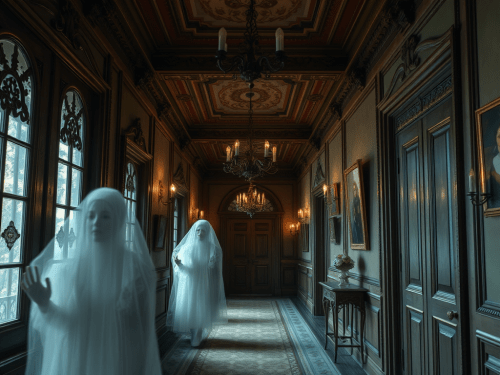
Meanwhile, with President Trump, we are seeing crime rates sharply decrease, and he recently secured $10 trillion in investments. If elected president for an unprecedented third term, to make housing more affordable and to offset the cost of homeowner’s insurance and auto insurance, President Trump plans to abolish property taxes. Much like the land crisis in Las Vegas, we could also run out of land to farm and will not be able to grow or cultivate our own food. We can protect American farmland and support American farmers by buying American made beef, poultry, dairy, and produce. Also, country of origin labeling is very important so Americans can know where their food is coming from and have the ability to support American farmers and ranchers. As money flows, it influences further investment. Save the land that sustains us by protecting American farmland. Once the land is built on, we lose it forever. And in the future, there may be food wars. Also, to ensure that we have farmland and buildable land for future use, we need to start limiting the number of people allowed to immigrant to America. Perhaps with the immigrants we do allow into America, there needs to be a diversity program to make sure we have a population that equally represents all races of people. If Americans continue to spend money on American products, then more need to be made to keep up the inventory. When investors notice these goods are selling, it gives them the confidence to pour more money into that local business. It shows that people want these goods made in America and pressures investors to keep these goods and services in America. The jobs stay here, the business stays in American, wages naturally increase, and more money is invested to keep up with demand. This reduces the burden on the taxpayer. When you support American businesses, that money stays in our economy and can help to reduce the national debt. The government creates debt by borrowing from businesses in the private sector or from foreign countries. It also increases the national debt by spending more than it gains in tax revenue in a fiscal year. #RandolphHarris 27 of 29

When people shop locally, more tax money stays in the economy and goes to the government. This way, it keeps more money in our national economy and keeps more jobs located in American which also sends more taxes to the government, which can again help to reduce the national debt.When you buy foreign goods, these companies usually have lighter tax loads or exemptions, meaning less money for the nation debt, plus you are helping to strengthen these foreign nations by send more money overseas. Buying American made products is also better for the environment and helps to reduce the carbon footprint because these products do not have to travel nearly as far. Furthermore, American companies and manufacturers are held to much higher standards in regard to pollution. American companies have to be more careful about air, land, and water pollution and have proper ways to dispose of waste. Moreover, please remember to respect law and order and treat your elders with the utmost dignity and kindness possible. And take your education seriously so that you will be successful in life and make your family proud. It is inborn in the human minds to wish to know. If this begins with the endless surface questions of a child’s curiosity, if it continues into deeper questions of a scientist’s probing investigation, it cannot and does not stop there. For the higher part of the mind will eventually come into unfoldment, that union of abstract reflective thought with mystical intuition, which is true intelligence, which needs and sees a view of the whole of things. And so, the knowing faculty enters the realm of philosophy. #RandolphHarris 28 of 29
As you can see, President Donald Trump and his pledge to “Make America Great Again,” is exactly what America needs to save the country and the American people. And yes, diversity is important, so you can see why it is also important to preserve blonde hair and blue eyes as the people with these characteristics are becoming a minority in America. We must think before we can understand the soul’s existence; we must understand before we can realize it. The earliest beginnings of thought, as apart from instinct, when it was itself still but a lurking tendency, belong far back in primeval time. The human intellect as we find it today, so rich and developed an instrument for the consciousness of the ego, did not arrived at this fulness without a series of graduated stages. We have had plenty of scientific thinking, business thinking, and political thinking long enough, but we have had very little inspired thinking. That is the world’s need. The intellect is cradled in selfishness but runs the evolutionary track into reason where it will one day finish at the winning-post of selflessness. As a reminder, parents, pleasure teach your children love America and be patriotic citizens and to buy goods and services made in America. It is also important to respect law and order and treat your elders with respect. “Oh, thus be it ever, when freemen shall stand between their loved home and the war’s desolation! Blest with victory and peace, may the heav’n-rescued land Praise the Power that hath made and preserved us a nation! Then conquer we must, when our cause it is just, and this be our motto: ‘In God is our trust.’ And the star-spangled banner in triumph shall wave O’er the land of the free and the home of the brave.” #RandolphHarris 29 of 29

Experience an unforgettable journey back to the time of kings and queens with this entry ticket for The Winchester Mansion in Santa Clara, California which was the residence of Sarah L. Winchester. Take advantage of this fascinating experience. After tour, there will be time enjoy the mansion’s splendor at your own pace. You might even discover secret passages.

Please come and enjoy a delicious meal in Sarah’s Café, stroll along the paths of the beautiful Victorian gardens, and wonder through the miles of hallways in the World’s most mysterious mansion.

For further information about tours, including group tours, weddings, school events, birthday party packages, facility rentals, and special events please visit the website: https://winchestermysteryhouse.com/
Please visit the online giftshop, and purchase a gift for friends and relatives as well as a special memento of The Winchester Mystery House. A variety of souvenirs and gifts are available to purchase. https://shopwinchestermysteryhouse.com/
We wish to express our gratitude to our families, ancestors, spirits, and friends and to our many associates and clients, whose lives touched our lives and whose ideas helped us to grow. We would also like to thank our employees and care takers for putting the technical ideas of this estate into conversational style, and we are, of course, extremely thank to all of our patrons for helping to keep the legacy of the Winchester Family alive. The Winchester Mystery House is full of surprises. What was your favorite, “Oooh!” moment during your visit at the mansion? (And for those of you who still have to check it off your bucket list… we will hopefully see you soon.) https://winchestermysteryhouse.com/

Harris Plumbing, Heating, Air, & Electric has been in business for 30 years. How many businesses can say that? We take pride in everything we do – no matter how big or small the service call might be. We’re here to help your home be as safe and comfortable as possible for you and your family. We take that responsibility very seriously as a company. Harris will ensure you have the information you need to decide what to do next, whatever your home is facing. We’ll perform a diagnosis and detail what issues are present before starting any work. This gives you a personalized quote and service plan specific to your home’s needs – not some random quote based on the best guess. The only way we can do our best work is to make sure we handle the issues at hand. https://www.callharrisnow.com/about-us/


BMW continues to dominate the luxury car space. With its top ranking in Consumer Reports’ Auto Brand Report Card and consistent market share growth, BMW has demonstrated its ability to produce high-performing, reliable vehicles that meet consumer demands.

BMW stands out due to its focus on driving dynamics and engineering excellence. While other luxury brands prioritize comfort and opulence, BMW is known for creating cars that are fun to drive and offer a unique connection between the driver and the machine. https://www.brianharrisbmw.com/

Randolph Harris San Francisco Taxation & Mergers
Randy advises clients with regard to business transition, taxable and tax deferred mergers and acquisitions, joint ventures, restructuring, integrated tax planning, federal and state tax controversy resolution, and real estate transactions. https://www.jmbm.com/l-randolph-harris.html

 Randolph Harris II International Institute