
Home » Posts tagged 'imaginary friend'
Tag Archives: imaginary friend

What the F–Business Must be Conducted with Glass Pockets!

Although you make think “What the F!” has a negative connotation, it is not a curse word. It means “What the Ferry!” It is what Ferry calls his live resonation radio show. Ferry Coresten is one of the most talented disc jockeys in the World. Mr. Coresten is Dutch disc jockey, record producer and remixer. Defining, understanding, and discovering the conditions that lead to peace is an intellectual challenge with a long and rich traditional with the social sciences. Nevertheless, it remains central today, not simply for academics but to the broader populations as well. The notion that peace is at hand as soon as there is no ongoing, large-scale organized violence is not only the most common idea today but also a way of viewing peace that goes back at least to antiquity. We sometimes achieve peace through military preparations and deterrence, or the military defeat of adversaries. The quantitative research on conflict, violence, and peace is an already large subject area within the social sciences, and it is undergoing yet another growth spurt in the aftermath of 9/11, with increasing discussion of terrorism, restriction of civil liberties, torture, invasion, insurgency, counterinsurgency, revolution, counterrevolution, mass protest, and protest policing. Many people think we already live in a police state, but they have not seen anything yet. In 2007, alarm companies did not want to install security cameras on homes because they warned home owners that footage could be obtained by anyone and put on the Internet without their consent, but now people are going as far as having cameras places in their home that security companies monitor. Before long, the streets and highways in the United States of American will be full of license plate readers, which automatically issues tickets for speeding, which will make the road less safe as less officers will be out to stop illegal vehicles and vehicle violating law. #RandolphHarris 1 of 20

We will also have police drones patrolling neighbourhoods, roads, and highways recording information and acting as law enforcement agents, so there will be virtually no privacy and anything that is done can be pulled up and reviewed for later enforcement of the law. Therefore, it is critical to study peace as something more than merely the absence of overt violence. Peace is defined only as the absence of some violent actions. This form of peace, as “no violence,” can range from brutal dictatorships to democracies that fully respect human rights, from states that remain at peace only for brief periods of time between recurring bought of violence to societies that have not experienced overt hostilities for hundreds of years, and from states that consistently remain prepared for “hot” conflict to those that do not consider preparing for it. If peace is an inherent dichotomy, then war and genocide are the opposite. Personal relationship, closeness and warmth, Christian community—these are just what I have experienced in East Germany when I have visited. Over the years the society has always come through with insightful and perceptive judgments. The new paradigm of just peacemaking is grounded in the historical experience of people who have lived in the face of oppression, violation of their basic rights, and the nuclear threat, and who, together with political scientist, Christian ethicists, and activists, fashioned realistic steps of peacemaking that enabled them to begin living in the time after the Cold War even before the Wall came down. Though oppressed and constricted, they began to live our future. Because the paradigm is grounded in realistic but persistent hope-creating experience, attention must be paid to critical perspectives external to Christian faith; and since the heart of the story is consent to all God’s creating and the practice of forgiveness and love, an ethic is to be tested by its ability to be inclusive rather than to repress important standards of human life, or other members of the human community. #RandolphHarris 2 of 20

We have all known we needed to develop new methods for achieving change without violence. Now we have seen nonviolent revolutions in Iran (where the revolution was nonviolent but not the subsequent regime) in Philippines, in Argentina, throughout Eastern Europe, and in the peoples’ defeat of the coup in the Soviet Union, and there is hope for them in South Africa and perhaps Palestine (where parts of the movement are nonviolent, and other parts are not). Human rights movements must refrain from violence. They must take the beneficial action of clearly articulating the human rights that need to be established. The breakdown of the medieval system of feudal society had one main significance for all classes of society: the individual was left alone and isolated. He was free. This freedom had a twofold result. Man was deprived of the security he had enjoyed, of the unquestionable feeling of belonging, and he was torn loose from the World which had satisfied his quest for security both economically and spiritually. He felt alone and anxious. However, he was also free to act and to think independently, to become his own master and do with his life as he could—not as he was told to do. However, according to the real life situation of the members of different social classes, these two kind of freedom were of unequal weight. Only the most successful class of society profited from rising capitalism to an extent which gave them real wealth and power. They could expand, conquer, rule and amass fortunes as a result of their own activity and rational calculations. #RandolphHarris 3 of 20

This new aristocracy of money, combined with that of birth, was in a position where they could enjoy the fruits of the new freedom and acquire a new feeling of mastery and individual initiative. On the other hand, they had to dominate the masses and to fight against each other, and thus their position, too, was not free from a fundamental insecurity and anxiety. But, on the whole, the positive meaning of freedom was dominant for the new capitalist. It was expressed in the culture which grew on the social of the new aristocracy, the culture of the Renaissance. In its art and in its philosophy it expressed the new spirit of human dignity, will, and mastery, although often enough despair and skepticism also. The same emphasis on the strength of individual activity and will is to be found in the theological teachings of the Catholic Church in the late Middle Ages. The Schoolmen of that period did not rebel against authority, they accepted its guidance; but they stressed the positive meaning of freedom, man’s share in the determination of his fate, his strength, his dignity, and the freedom of his will. On the other hand, the lower classes, the poor population of the cities, and especially the peasants, were impelled by a new quest for freedom and an ardent hope to end the growing economic and personal oppression. They had little to lose and much to gain. They were not interested in dogmatic subtleties, but rather in the fundamental principles of the Christian Bible: brotherliness and justice. Their hopes took active form in a number of political revolts and in religious movements which were characterized by the uncompromising spirit typical of the very beginning of Christianity. #RandolphHarris 4 of 20

Rising capitalism, although it made also for their increased independence and initiative, was greatly a threat. In the beginning of the sixteenth century the individual of the middle class could not yet grain much power and security from the new freedom. Freedom brought isolation and personal insignificance more than strength and confidence. Besides that, he was filled with burning resentment against the luxury and power of the wealthy classes, including the hierarchy of the Roman Church. Protestantism gave expression to the feelings of insignificance and resentment; it destroyed the confidence of man in God’s unconditional love; it taught man to despise and distrust himself and others; it made him a tool instead of an end; it capitulated before secular power and relinquished the principle that secular power is not justified because of its mere existence if it contradicts moral principles; ad in doing all this it relinquished elements that had been the foundations of Judaeo-Christian tradition. Its doctrines presented a picture of the individual, God, and the World, in which these feelings were justified by the belief that the insignificance and powerlessness which an individual felt came from the qualities of man as such and that he ought to feel as he felt. Thereby the new religious doctrines not only gave expression to what the average member of the middle class felt, but, by rationalizing and systematizing this attitude, they also increased and strengthened it. However, they did more than that; they also showed the individual a way to cope with his anxiety. They taught him that by fully accepting his powerlessness and the evilness of his nature, by considering his whole life an atonement for his sins, by the utmost self-humiliation, and also by unceasing effort, he could overcome his doubt and his anxiety; that by complete submission he could be loved by God and could at least hope to belong to those whom God has decided to save. #RandolphHarris 5 of 20

Protestantism was the answer to the human needs of the frightened, uprooted, and isolated individual who had to orient and to relate himself to a new World. The new character structure, resulting from economic and social changes and intensified by religious doctrines, became in its turn an important factor in shaping the further social and economic development. Those very qualities which were rooted in this character structure—compulsion to work, passion for thrift, the readiness to make one’s life a tool for the purposes of an extra personal power, asceticism, and a compulsive sense of duty—were character trait which became productive forces in capitalistic society and without which modern economic and social development are unthinkable; they were the specific forms into which human energy was shaped and in which it became one of the productive forces within the social process. To act in accord with the newly formed character traits was advantageous from the standpoint of economic necessities; it was also satisfying psychologically, since such action answered the needs and anxieties of this new kind of personality. To put the same principle in more general terms: the social process, by determining the mode of life of the individual, that is, his relation to others and to work, molds his character structure; new ideologies—religious, philosophical, or political—result from and appeal to this changed character structure and thus intensify, satisfy, and stabilize it; the newly formed character traits in their turn become important factors in further economic development and influence the social process; while originally they have developed as a reaction to the threat of new economic forces, they slowly become productive force, furthering and intensifying the new economic development. #RandolphHarris 6 of 20

The system of rules and their enforcement itself must first establish a reputation for integrity and efficacy. This takes a long time and strict supervision even given much good will. In many countries, the great difficulties experienced by the governments of most transition economies in their attempts at such reputation-building require attempts of the top levels of the government at making and enforcing reliable governance systems. However, they can be ruined by some middle-level officials who attempt to make quick profit from their newfound power. There are evident problems of this in most transition economies. Also, in the phase when the system of rules in imperfect but improving, it can offer better outside payoffs to the participants in the prevailing relation-based system. By thus increasing their incentives to cheat their current partners, it can worsen the outcomes of the relation-based system. The policies required to initiate a transition from low-income equilibrium to a state of rapid growth may be qualitatively different from those required to reignite growth for a middle-income country. At low levels of income, with reasonable institutions and reasonable policies, it may be easy to achieve high growth up to semi-industrialization. However, the institutional requirements of reigniting growth in a middle-income country can be significantly more demanding. Growth starting from a low level can be achieved using relation-based governance in small communities of traders with good relationships and information networks, so long as the state does not actually inhibit such developments with its policies. However, to go beyond the middle-income level requires greater integration into a large economy, where relation-based governance is inadequate. The necessary shift toward rule-based governance is more demanding because it must overcome the additional problems of collective action, vested interest and so on. #RandolphHarris 7 of 20

How might such investment in the framework of rules get made? In 1898, when Elbert Gary and J. Pierpont Morgan started Federal Steel, they took the then unusual step of issuing quarterly reports because both men believed that corporations issuing publicly traded securities had to account for their financial performance. At first there was no public process such as external audits to guarantee the truthfulness of these accounts; presumably Mr. Morgan’s own reputation and integrity, acquired in the prevailing relation-based system of finance, gave them credibility. However, the public gradually found that inadequate, perhaps because others entering the arena of raising finance from the general public did not have the same reputation. A few years later, then president Theodore Roosevelt said that he would not “accept the publication of what some particular company chooses to publish as a favor, instead of demanding what we think ought to be published from all companies as a right” (Strouse 2000, p. 439). And still later, Mr. Morgan said that “business in the twentieth century would have to be conducted with glass pockets” (Strouse 2000, p. 600). This episode serves to emphasize the endogeneity of verifiability, and the value of making more information publicly verifiable. Forces operate on the other side to undermine a relation-based system when it comes into contact with other rule-based systems. If capital-owners in the relation-based system become able to invest abroad under a rule-based system and earn the going return there, that will raise the outside opportunities of the participants in each ongoing repeated game of relation-based finance, and thereby unravel its tacit cooperation equilibrium. #RandolphHarris 8 of 20

Similarly, as improvements in transportation technology or lowering of trade barrier with other countries, or liberalization of regulation within or across countries, bring a relation-based production system into contact with other economies and other markets, its firms will discover better opportunities outside their previous relationships; this can undermine the previous repeated game equilibrium. If or when a relation-based economy needs to import capital, whether financial or direct investment, it will find it difficult to do so. Unless foreigners are misinformed or gradually develop relationships with host-country businesses, they will be reluctant to lend. Conversely, firms in a relation-based system may be reluctant to borrow from lenders who are not part of their relation network, for fear that the strangers may withdraw their capital suddenly. So, if it needs foreign capital, a relation-based economy may fail to grow unless it changes over successfully to a rule-based system where anyone can invest with the confidence that the only uncertainties will be those arising from natural economic shocks, not those of borrowers’ strategic default or fraud or lenders’ capital flight. Of course the difficulties of brining together two such different systems of financial transactions are not insurmountable. Intermediaries can develop relations on both sides, and profit by providing these services for a fee. The Rothschilds did this in Europe with great success for over a century, literally be having relations on both or all sides. #RandolphHarris 9 of 20

In the second half of the nineteenth century, the United States of America was a major capital importer. This was facilitated by the Morgans—Junius S. operating in London and J. Pierpont in New York—who established a relation-based chain of trust between borrowers in the United States of America and lenders in the United Kingdom and Europe. In modern times, Hong Kong served a similar role, dealing with lenders—Western ones on a basis of rules and overseas Chinese ones on the basis of relations—and with borrowers—investing firms in mainland China on a basis of relations. In countries shaken by the Third Wave, the truly poor no longer necessarily have numbers on their side. In a good many countries they—like everyone ese—have become a minority. Not only is majority rule therefore no longer adequate as a legitimating principle, it is no longer necessarily humanizing or democratic in societies moving into the Third Wave. Second Wave ideologues routinely lament the breakup of mass society. Rather than seeing in this enriched diversity an opportunity for human development, they attack it as “fragmentation” and “Balkanization” and attribute it to the aroused “selfishness” of minorities. This trivial explanation substitutes effect for cause. For the rising activism of minorities is not the result of a sudden onset of selfishness; it is, among other things, a reflection of the needs of a new system of production which requires for its very existence a far more varied, colourful, open and diverse society than any we have ever known. We can either resist the thrust toward diversity, in a futile last-ditch effort to save our Second Wave political institutions, or we can acknowledge diversity and change those institutions accordingly. #RandolphHarris 10 of 20

The former strategy can only be implemented by totalitarian means and must result in economic and cultural stagnation; the latter leads toward social evolution and a minority-based twenty-first-century democracy. To reconstitute democracy in Third Wave terms, we need to jettison the frightening but false assumption that increased diversity automatically brings increased tension and conflict in society. Indeed, the exact reverse can be true. Conflict in society is not only necessary, it is, within limits, desirable. If one hundred men all desperately want the same brass ring, they may be forced to fight for it. On the other hand, if each of the hundred has a different objective, it is far more rewarding for them to trade, cooperate and form symbiotic relationships. Given appropriate social arrangements, diversity can make for a secure and stable civilization. It is the lack of appropriate political institutions today that unnecessarily sharpens conflict between minorities to the knife-edge violence. It is the lack of such institutions that makes the majority harder and harder to find. The answer to these problems is not to stifle dissent or to charge minorities with selfishness (as though the elites and their experts are not similarly self-interested). The answer lies in imaginative new arrangements for accommodating the legitimating diversity—new institutions that are sensitive to the rapidly shifting needs of changing and multiplying minorities. Someday future historians may look back on voting and the search for majorities as an archaic ritual engaged in by communicational primitives. #RandolphHarris 11 of 20

Today however, in a dangerous World, we cannot afford to delegate total power to anyone, we cannot surrender even the weak popular influence that exists under majoritarian systems, and we cannot allow tiny minorities to make vast decisions that tyrannize all other minorities. This is why we must drastically revise the crude Second Wave methods by which we pursue the elusive majority. We need new approaches designed for a democracy of minorities—methods whose purpose is to reveal differences rather than to paper them over with forced or fake majorities based on exclusionary voting, sophistic framing of the issues or rigged electoral procedures. We need, in short, to modernize the entire system so as to strengthen the role of diverse minorities, yet permit them to form majorities. In Second Wave societies, voting to determine the popular will provide an important source of intermittent feedback for the ruling elites. When conditions for one reason or another became intolerable for the majority, and fifty-one percent of the voters registered their pain, the elites could, at a minimum, shift parities, alter policies, or make some other accommodations. Even in yesterday’s mass society, however, the fifty-one percent principle was a decidedly blunt, purely quantitative instrument. Voting to determine the majority tells us nothing about the quality of people’s views. It can tell us how many people at a given moment want X, but not how badly they want it. Above all, it tells us nothing about what they would be willing to trade off for X—crucial information in a society made up of many minorities. #RandolphHarris 12 of 20

When a minority feels so threatened or attaches such life-and-death significance to a single issue that its views should perhaps receive more than ordinary weight, nor does it signal us then. In a mass society these well-known weaknesses of majority rule were tolerated because, among other things, most minorities lacked strategic power to disrupt the system. In today’s finely wired society, in which all of us are members of minority groups, that is no longer true. For a de-massified Third Wave society, the feedback systems of the industrial past may be considered too crude. Thus we will have no use voting and the polls in a radically new way. Also, because the de-massification and redistribution of media outlets, we are no longer creating stars as famous Worldwide as Aaliyah, Britney Spears, Beyonce, Paris Hilton, Brad Pitt, Tyson Beckford, Tyra Banks, Jennifer Lopez, or Lucy Lui. Fortunately, Third Wave technologies provide pathways toward Third Wave democracy. They reopen, in a startling new context, fundamental issues that our founders considered two hundred years ago. These technologies make possible new, hitherto impractical forms of democracy. Although the transition from the problem phase to the proposal phase of planning is usually gradual, the formulation of proposals is qualitatively distinct from the definition of public and problem. Proposals are creative responses; they call for imagination, invention, even genius. The making of proposals has to be properly timed, not coming too early in the planning process. For any given problem there may be a number of solutions, and thus new potentialities of divergence are introduced into the public’s discussion. #RandolphHarris 13 of 20

If those who make proposals are anxious that they be accepted or at least taken seriously and attended to, they should ideally wait until a public has become quite clear and coherent s to the nature of its problem and its desire to act. This is especially true when a proposal is likely to threaten this or that section of the public’s interest; a premature proposal is more easily exiled from discussion by an alter minority, or even without opposition may lose force, when its relevance is not yet apparent. Perhaps the proposal phase could be said to begin where “to act or not to act” ceases to be the question and consideration turns to serious alternatives. It ends when the proposal or proposals go before a policy-making body for decision. If the outcome is to be a full-fledged proposal of the planning type, during the interim a considerable number of developments ideally must occur. During this phase, proposals may be legion, running from the most casual sort of suggestion to massive reports prepared by many experts and taking years of work. If it is to deserve serious considerations, despite such variation in their elaborateness, the proposal must contain some basic elements. There must be a statement of an effective and feasible way of solving the problem as it has been defined. An estimate of the resources, human and material, required for carrying out the proposal. A schedule of the rate at which these recourses will be applied. A statement of certain quantitative goals for achievement within the schedule set. #RandolphHarris 14 of 20

Any proposal containing these elements is a planning proposal, and is often called a plan, sometimes with the name of its author prefixed, exempli gratia, the Marshall Plan (although technically it does not become a plan until it has been subject to a policy commitment, and then of course it becomes a program). The injection of proposals into the public’s discussion of the problem is frequently, at first, on what might be called an amateur basis. While each serious proposal may contain the four essential elements, their development is neither elaborate nor exact. The multiplicity of proposals and their rudimentary nature, given a strong feeling of concern, then quite readily lead to a conscious demand for more careful study of the situation and comparative examination of the proposals. Then, and not before then in most cases, is the appropriate time for commencing the formal organization of the public. At this point, another custom is often to constitute some expert committee, commission, or board and to charge it with making a study and some definite recommendations for action. The composition of the more successful committees tends to be drawn, with certain exceptions, from all the significant elements in the public to which the situation is a problem. To give them their charge may call for further definition of the appropriate scope of the planning area. This calls for judgment and may itself be a matter of disagreement. If action is truly desired, the planning area ought to be confined to those to whom the situation is definitely a problem in which they are actively involved, and it ought not to include everyone who might potentially experience some consequence from the action taken. #RandolphHarris 15 of 20

After admitting the possibility of deception in supernatural things, and a doubt has come into mind whether certain “experiences,” either personal or otherwise, were of God after all, the next stages are: The discovery of the deception. Light and truth alone can make free, and when once a doubt comes in and the man opens his mind to the truth that he is as liable to be deceived as anyone else, then to the mind and attitude light is given (John 3.21). Sometimes the specific deception is seen at once, but more often the discovery is gradual, and patience is needed while the light slowly dawns. Certain fact in connection with various experiences of the past, which the believer has failed to note, may now emerge into the light, and the half-truths which the Adversary had used to deceive are clearly seen: the twisting of words, the wrenching of sentences out of their context in the Scriptures—all come into a view as the light is given. Then comes: the acknowledgement of the deception. This is now imperative. The truth must not only be faced but owned up to, so that things are called by their right names, and the father of lies defeated by the weapon of truth. The Book of Mormon and the Christian Holy Bible keeps one from sin, and draws one near to virtue. You shall teach diligently the word of God to your children. The moral World is maintained by the instruction of our young; their education shall not be interrupted even to rebuild the Temple. When parents encourage their children to study The Book of Mormon and the Christian Holy Bible, their influence lives beyond the grave. #RandolphHarris 16 of 20

One who has studied in one’s youth may be compared to writing set down on new parchment; but one who begins to study when one is old, is like writing set down on re-used parchment. If one studies The Book of Mormon and the Holy Christian Bible in one’s youth, its words are woven into the texture of one’s life. Train a child in the way one should go, and when one is older, one will not depart from it. As long as the voices of children resound with the study of The Book of Mormon and the Holy Chistian Bible, no enemy can triumph over America. The Book of Mormon and the Holy Christian Bible are each a Tree of Life; happy are they who understand its teachings, and fulfill God’s commandments. The significance of the Cross and the Resurrection of Jesus as the Christ can be summed up in one word: salvation. One can be saved from many things, but salvation is salvation from the ultimate negativity. Salvation is healing for healing means reuniting that which is estranged, giving a center to what is split, overcoming the split between God and man, man and his Worl, man and himself. It is the revelation of the New Being in Jesus as the Christ which brings salvation. Consequently, where there is revelation, there is salvation, for the revelation of the ground of being transforms and heals. Revelation and salvation are identified. The revelational history of mankind—preparatory revelation before the appearance of the New Being, and receiving revelation afterwards—testifies that men have shared in the healing power of the New Bring, or else they would have succumbed to the destructive tendencies of existential estrangement and have ceased to exist. #RandolphHarris 17 of 20

Traditional theology has presented the rigid alternatives of total condemnation and total salvation. However, we reject them both, for, although the healing power of the New Being is never absent, even those who experience it are healed but fragmentarily. The divine act overcomes estrangement by removing guilt, and man reacts by accepting reconciliation. The effects of atonement are threefold, and together they constitute the meaning of salvation: Regeneration, Justification, and Sanctification, or, in Tillichian terminology, participation, acceptance, and transformation. Regeneration stresses the objective power of the New Being to grasp estranged mankind and draw it into itself. Man participates in the new reality revealed in Christ only by being seized by it. Thus, Regeneration is the new state of things, the new eon, which the Christ brought; the individual enters it, and in so doing he himself participates in it and is reborn through participation. Since Regeneration is participation in the objective power of the New Being, it precedes Justification, for faith as the state of being grasped by the divine presence is not a human act, but the work of the Spirit. Justification is acceptance. It is the act of God by which He accepts sinful man in spite of his guilt. It is also the act of man by which man accepts God’s saving mercy. Indeed, there is nothing in man which enables God to accept him. However, man must accept just this. He must accept that he is accepted; he must accept acceptance. This in spite of his anxiety, man accepts God’s justifying act. In spite of is the paradox of simual peccator, simul Justus. #RandolphHarris 18 of 20

As a divine act, Regeneration and Justification are one, for Regeneration is the actual reunion of the estranged, and Justification is its paradoxical character. Sanctification is distinct from both of them in the sense that a process is distinguished from the event in which it is initiated. Sanctification is the process in which the New Being transforms both individuals and communities. Sanctification, as transformation, takes place both within religion and outside it in the secular realm. Up to now emphasis has been laid upon the individual man as the one who is saved. However, our vision is broader than that. At the crucifixion of Jesus the sun was darkened, the temple veil split, rocks cracked, and the dead rose. Nature was in an uproar, and the event at Golgotha is one which concerns the Universe, including all nature and history. The Christ cannot be restricted to one area; Christology must be cosmic. Salvation extends to the whole World, and World means nature as well as man. It is through man, the microcosm, that the saving power of the New Being reaches out to the Universe. The tragedy of nature is bound to the tragedy of man, as the salvation of nature and nature is in man. Consequently, the impact of the Spiritual Presence upon beings inferior to man is indirect and, in a quantitative sense, severely limited. However, in a qualitative sense it is enormous. Salvation is found within the Kingdom of God which embraces the Universe. It is the place where there is complete transparency of everything for the divine to shine through it. In His fulfilled kingdom, God is everything for everything. Salvation, the healing of the disrupted, is brought about by love, for love is the drive towards the unity of the separated. The New Being is the love of Jesus who is the Christ, reuniting estranged mankind with its ground. The Spiritual Presence manifests itself as love. After distinguishing divine love from human love, we come to an understanding that man’s love for God is the drive toward the reunion of the separated. #RandolphHarris 19 of 20

However, since salvation is an act of God, God’s love must first extend to man and grasp him. The distinction between faith and love disappears, for being grasped by God in faith and adhering to Him in love is one and the same state of creaturely life. We belong to the Old Creation, and the demand made upon us by Christianity is that we also participate in the New Creation. What is this New Being? The only thing that counts, regardless of faith, is the union with Him in whom the New Reality is present. No religion matters—only a new state of things. The New Creation—this is our ultimate concern; this should be our infinite passion—the infinite passion of every human being. This matters; this alone matters ultimately. In comparison with it everything else, even religion or non-religion, even Christianity or non-Christianity, matters very little—and ultimately nothing. And now again we ask: What is this New Being? It is a renewal of the Old which has been corrupted, distorted, split, and almost destroyed. Therefore, we can speak of the New in terms of a re-newal: The threefold “re,” namely, re-conciliation, re-union, re-surrection. The word “resurrection” has for many people the connotation of dead bodies leaving their graves or other fanciful images. However, resurrection means the victory of the New state of things, the New Being born out of death of the Old. Resurrection is not an event that might happen in some remote future, but it is the power of the New Being to create life out of death, here and now, today and tomorrow…Resurrection happens now, or it does not happen at all. It happens in us and around us, in soul and history, in nature and Universe. The message of Christianity is not Christianity, but a New Reality. A New state of things had appeared, it still appears; it is hidden and visible, it is there and it is here. Accept it, enter into it, let it grasp you. And like God saves all, the Fire Department will rescue you no matter how rich or poor you are, no matter or age, or what you look like or where you live! Be sure to thank your local heroes, and feel free to make donations to them, they are understaffed and underfunded. #RandolphHarris 20 of 20

MAGNOLIA STATION AT CRESLEIGH RANCH
Rancho Cordova, CA | low USD $600,000.00s
Now Selling!

Models now open at Magnolia Station! Located at the corner of Rancho Cordova Parkway and Douglas Road, residents of Cresleigh Ranch will benefit from a brand new neighborhood with convenient access to the new Raley’s Shopping Center, Sunrise Boulevard, and much more!

Magnolia Station will include 81 homesites and five distinct plans ranging from 2,200 – 3,700 square feet; including three single story plans! Each plan has been thoughtfully designed to include features such as: Generations Suite, Optional Offices/Dens, Extended Great Rooms, and more! https://cresleigh.com/magnolia-station/residence-2/

P.S. The limo is not cheap. Wor

Everyone is Afraid of the Dark
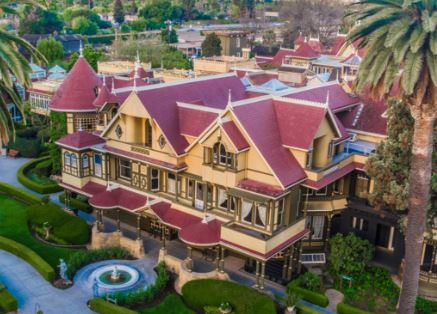
Magnolias, orange trees, thick evergreen and palm trees sprouted from the sweeping lawns growing tall, as their green leaves beautifully filled the sky providing shade from the hot sun. Shielded behind the lush proliferation of gardens stood gorgeous Llanada Villa built in the Queen Anne Victorian style with soaring roofs and columned porticoes. The farmland provided crops for food. It was Sunday January, 1888, and the famers and servants were buoyant with excitement, undampened by undue religious solemnity. Good nature was inescapable that Sunday. Conversation abounded with joy and optimism. Several planters, dressed in gloves, hats, and cravat, strolled my estate. The road bustled with carriages and horses; men and women strolled along the green lawns in their Sunday finery; and the servants hunted and played games in the field. Somehow, in the midst of it all, I had grown tired and went to my bedroom to rest. It was past midnight when I awoke, and when I looked out the moon was rising over the Observational Tower. I heard a battle, but I could not see it for the smoke and flames, and the broken marble battering me from all sides. Doors were broken from their hinges, and the light bulbs exploded, and in the darkness, I was thrown against the walls or the floors. I felt an intense heat pass over me, and I struggled to get to my feet as the broken and fragmented tiles swirled about the chamber. Ghastly screams came from Arkie, the son of one of the farmers. “I have seen an evil thing this night,” he said. “Tell me what you have seen,” I replied. Arkie told me everything he had seen. “The estate was covered with smoke, through which, through which flashes were incessant, whilst the air seemed filled with shell, whose sharp explosions, with the hurling of their fragments hurling between flashes. Flashes that lit up the night sky. #RandolphHarris 1 of 9

“We were at war against a monstrous progeny of demon-possessed men and women, wearing velvet tunics and stockings, and marvelous cloaks trimmed in rare fur. They brandished huge glittering swords. The fountains bulled over, flowing with blood. Several of the servant fled through the streets, yards, and orchards, many taking refuge in the Victorian cottages, outbuildings, and mansion already filled with the wounded and dying. The smoke was so dense we could not perceive an object ten feet in front of us. The gloom of the moment was beyond description. We felt and heard the tread of our enemy, our minds were in tumult, whether to lie still, to yield, or to die fighting. I jumped in and found myself confronted by a giant’s sword pointed by my breast. I grasped the blade and reversed the handle of my sword in a twinkle and offered to surrender. The beast said in the excitement, he thought I had run him through and he dropped his sword.” I was so thankful for each servant who fought for my home, their families, and their way of life, even though death was knocking on their door. A few days later, it was a dark moonless night, and as silent as a tomb. Arkie was still shaken up by the events that had recently taken place. There was a terrible fear, a physiological fear. Something beyond life that I was able to catch for a second. The air was cold now, icy all around me. It suddenly felt as though time stood still and yet as a foggy substance silently closed in the air was getting cold enough to freeze the blood. My nose, face, hands and feet felt ice cold. I was standing in silence, as I watched what was unfolding before my eyes. This misty essence was swirling noiselessly around us as we stood, observing a steam so fine the scene felt surreal. Along with the white mist came a whirl of emotions and confusion. What was happening in my home? I braced myself for some hellish effects. It swirled around us as though blown by a high wind, rising above our heads and dropping as it was moving quickly and yet we felt only a gentle breeze. #RandolphHarris 2 of 9
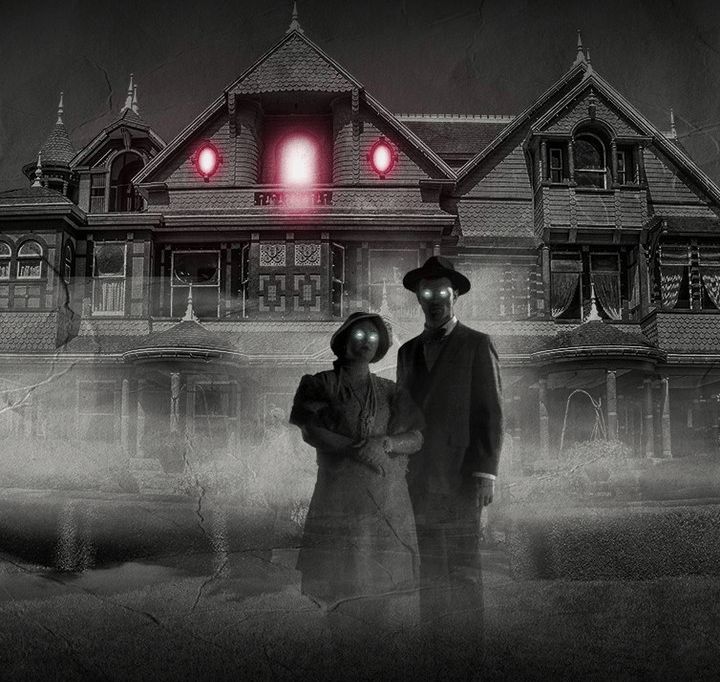
Like a scene from the spectral World, the abnormal foggy essence swirled in vortex shapes and at time, it resembled horses running past us, but the curtains did not move, though we felt air currents around us. We felt vulnerable and somewhat uneasy. I could not for my life keep back a loud scream—the second I had emitted that night. It echoed and echoed through the dim vaultings of my mansion, and I had to choke back a flood of reaction that threated to burst out. Arkie saw a pale figure heading toward him as he ran from the parlor. He quivered when the thing growled at him. It stood out like white chalk on a black board, moving in darkness, seeking. It moved rapidly and just as suddenly as it have moved through the gallery, it suddenly was gone. When I looked around, I saw nothing of the foggy mist that surrounded and chilled us to the bone; it had vanished. The room was clear and felt warmer. What seemed like a long time in the fog had only been a few short minutes! When Arkie and I talked, we were both in awe at what we had experienced. Words were few as we tried to make sense of the incident. Arkie’s hair used to be dark brown, with grizzled streaks about the temples; in less than a month from that day he was a gray as badger, and he has never been quite the same man since that night. I do not believe anybody had ever felt so much sheer hell in one night. Gargoyles and chimeras, we saw all sorts of things, as if it was some passage from the Middle Ages. Arkie said my home repelled him more and more every day, and frightened him, as its features and expressions developed in a way he did not like; in a way that was not human. He felt like a ghoul had been feeding on his soul. He proceeded to leave the hose and suddenly jumped back a foot and started to cry. A dark figure draped in a black tattered robe with a deep hood that concealed his face stoop there, blocking the entrance. My heart sank centuries away as the soul goes as the awful, blasphemous horror touched quite beyond the power of words to classify. I shivered slightly. #RandolphHarris 3 of 9

“What are you?” Arkie cried out desperately to the figure robed in black. There was only silence. He knew the horrible figure we be upon us soon. He flung his sword at the figure in black, and the dark robed figured answered back by point a half-rotted finger at Arkie. The sword flew backwards from his hand. He quickly spun around only to find, to his surprise, that the dreadful ghoul had not emerged from the hallway yet, but we could hear it coming. Arkie’s eyes widened in horror and his heart sank further as he looked to see that his sword hung in the air. Utter fear and hopelessness played on his mind. The ghoul was breathing like a wild beast; and I heard an evil sound also, with blows of something violently driven through flesh and bone, as the sword moved on its own, staking Arkie in the heart. I cried out for mercy as the ghoul approached, but was frozen in fear. Its deathly yellow eyes looked on me with hate and savage hunger. Yellow ooze dripped from its frightful maw. And its long fingernails danced in my hair, before it devoured what remained. As the ghoul kneeled, gnawing at Arkie’s head as a child nibbles at a stick of candy, the shadowy specter looked at me and spoke with it’s a hollow voice, saying “There is no shame in what you have done. Your former life is behind you.” I felt that any moment it might drop its present pray and seek a juicier morsal. But, the nearly eight-foot ghoul grabbed the blood-soaked sword and fled with it. This strange proceeding gave rise to many inquiries. Only a few could answer them. My home is dreaming gorgeously and overflowing with wonder and terror and escapes from the commonplace. It can truly catch the night spirit of antique horror, terror, as well a beauty from life. The haunting apparitions were seldom completely human. Occasionally things would leap through open windows at night, or could be seen squatting on the chest of sleepers, worrying at their throats. The utter inhumanity and callous cruelty of the things torture the brain and flesh. #RandolphHarris 4 of 9
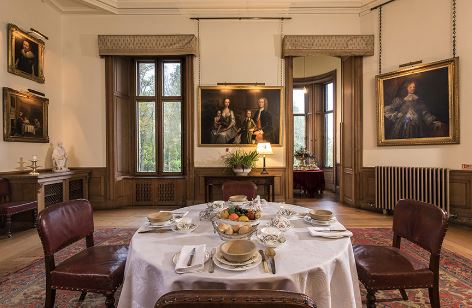
Unlocking the front doors, one is ushered into decorative hallways with splendid mahogany paneling—thrilling and suggestive of the time. Ancient paneled rooms, or simple vaults of masonry, there is even a narrow staircase the leads to the ceiling where a ghost is said to reside. Servants have felt temperature changes upon entering the room and sensed an unknown presence next to them. Others have glimpsed the blasphemous shapes that lope and trot and crawl up the stairs and through the ceiling. We saw the demons themselves and were afraid of them. My shocked scream had waked unaccustomed echoes in the labyrinth. It was more of the physical than the spiritual. I was paralyzed for an instant. I heard a faint scurrying sound somewhere, and a series of squeals or beats in a direction I could not determine. Then there came a subdued sort of clatter which somehow set me all in gooseflesh—a furtive, groping kind of clatter. It was like heavy wood falling on stone or brick—wood on brick—what did that make me think of? It came again, and louder. There was a vibration as if the wood had fallen farther than it had fallen before. After that followed a sharp grating noise. The archaic tunnels in my basement touched graveyard and witch-den. But whatever was in them was devilish anxious to get out. Accidents had happened, but I have never seen what I saw this night—that creature was neither alive nor dead, it abided neither above ground nor in the grave. It was a colossal and nameless blasphemy with glaring red eyes, and it held in bony claws a thing that had been a man. However, it was not even the fiendish apparition that made such an immortal fountainhead of all panic—not that, nor the face with its pointed ears, bloodshot eyes, flat nose and drooling lips. It was not the scaly claws nor the mould-caked body, nor the half-hooved feet—none of these, through any one of them might well have driven an excitable man to madness. It was the curse, the impious, the unnatural endless cycle of terror. #RandolphHarris 5 of 9

These monsters were there—they glared and gnawed and gnawed and glared—and I knew that only a suspension of Nature’s laws would ever let a person be terrorized like this—it was truly some glimpse of the netherworld which no mortal unsold to the Fiend has ever endured. I had to hide this well-established horror-World which I saw fully, brilliantly, squarely and unfalteringly. Fair sized rooms, with wooden floors and furnished were bricked up with extreme care, to conceal the ghastly demons and nauseous monstrosities that leered around from every side of the rooms. I always knew William, no matter how beautiful and pure he was, was not strictly human. Either he was born in strange shadow, or he had found a way to unlock the forbidden gate. There are secrets, you know, which might come down from old Salem times, Cotton Mather tells even stranger things. In the Dark Ages, belief in apparitions, vampires, hell hounds, and demons were commonplace. While belief in ghosts declined in the eighteenth century, it was revitalized in the nineteenth century with the Society of Psychical research. While culture differ in their beliefs about what happens after death, most cultures believe that a ghost can return to the World of the living, with either good or bad intent. In Western cultures, it is most commonly believed that a ghost is the soul of the deceased who cannot find peace or does not know they are dead, leading them to haunt places where they lived or died or objects that caused their death, sometimes they even haunt bloodlines. It may be that they have unfinished business on the Earthly plane, perhaps to protect a loved one, or impart information or reenact the death. I do not think that any power on Earth could make anyone speak of what happened in my home, even old priests were too frightened to look in. #RandolphHarris 6 of 9

It has been said that Mrs. Winchester slept in a different bedroom every night, supposedly in order to confuse evil spirts. Mrs. Winchester was deeply concerned with the welfare of her servants and their families. They were well paid and often additionally rewarded with gifts, even homes, or real estate and lifetime pensions. The full scope of her generosity charity and many kind acts will forever remain unknwn and such was her sincere desire. Her donations were never made public. She contributed to charities of all faiths. In 1911 in New Haven, Connecticut, she established the William Wirt Winchester Memorial Sanitorium for Tuberculosis (also known as low consumption), endowing it with $1,200,000.00 (2023 inflation adjusted $38,540,084.21). Visitors to The Winchester Mystery House are bound to run into others who are curious about the spirit World. It may seem that our intents have been to weave a cloak of vindication and protection covering our lady’s eccentricities, so many to this day still unexplainable. In truth, volumes could be written extolling her many virtues and justifying the construction of one of the largest and most significant architectural structures in the World. Still the Question remains—Why? Why? The enigma of The Mystery House that tragedy and a rifle built is perhaps unanswerable. The present generation must weigh and draw its own conclusions about this Valley’s most interesting, most controversial, most unappreciated and surely our most mysterious First Lady! No one will ever know, but this beautiful and bizarre mansion has, we think, allowed Mrs. Sarah L. Winchester, Lady of Mystery, to achieve a unique kind of eternal life. #RandolphHarris 7 of 9

The spirit World and the human World were once so closely interwoven as to be indivisible. Look at monument, such as The Winchester Mystery House, that our ancient predecessors erected, and the traditions devised, to house, honour, and succor the dead. We still retain enough of our ancestors’ belief that our dead are aware of how we treat them, that we try to ensue they do not have anything thing to complain about. And we listen with widening eyes and quickening heartbeats to the stories told about the ghost that exist and have been recorded throughout time. The Winchester Mystery Houses catches the overtones of the soul, and you will not find those in a modern or renovated home because it has had no time to pick memories and attract local spirits. Placed like Mrs. Sarah L. Winchester’s home was not merely made, but it actually grew. Generation after Generation lived there and felt and died there, and in days when people were not afraid to live and feel and die. This house has stood for almost two centuries and what it has witnessed would make a modern house crumbled into powder. What do modern know of life and the forced behind it? This mansion once had a set of tunnels that kept it in touched with over Victorian houses on the estate. There is hardly a month that you do not read of carpenters finding bricked-up arches and wells leading nowhere in this or that old section of the house. During the time of the construction of this mansion, there were witches and what their spells summoned; pirated and what they brought in from the sea; smugglers; privateers—and I tell you, people knew how to live, and how to enlarge the bounds of life, in the old time! #RandolphHarris 8 of 9

While cleaning the mansion one night, a tour guide noticed a man in 19th century clothes, very pale, with pale blue eyes approaching the Venetian Dining Room. The tour guided continued to work until the mane came very close and stood directly over him. Becoming a bit uneasy at the man’s silence, the tour guide finally asked him, without looking of, if he wished to tour the mansion. When the “guest” did not reply, the tour guide stopped dusting underneath the table, and looked up at the silent man. The man’s face was contorted with rage; his lips moved furiously and he gestured as if he were shouting, but he made no sound. The tour guide fell onto the floor. Before he could turn and flee, the guest disappeared. Terrified, the tour guide ran until he came to an assistant manager. “I saw a ghost,” the tour guide grasped, out of breath. “The ghost of one of the carpenters has come back.” The ghost appeared in August of 2006, to another tour guide. He had entered the Daisy Bedroom and found a fellow tour guide leaning against the wall. Surprised by his presence, he had begun to question the man when he melted into the wall. When he reported the incident, one of his coworkers dismissed it as imagination. A few days later, two tour guides saw the same carpenter. They were locking up the mansion and the lights had not been off more than a few minutes when the sound of footsteps caused both tour guides to stop in their tracks. Before either of them could move, a door swung open and a young man entered. He gestured wildly and seemed to be shouting at the two tour guides, neither of whom could testify that any sound issued from the angry visitor. When one of the tour guides turned on the light, the figure faded before their astonished eyes. They quickly had the mansion secured and order all exists guarded. Guards reported that no person had attempted to leave the building. After the guards had conducted a search of the rooms, they were convinced that their visitor had not been a living man. #RandolphHarris 9 of 9
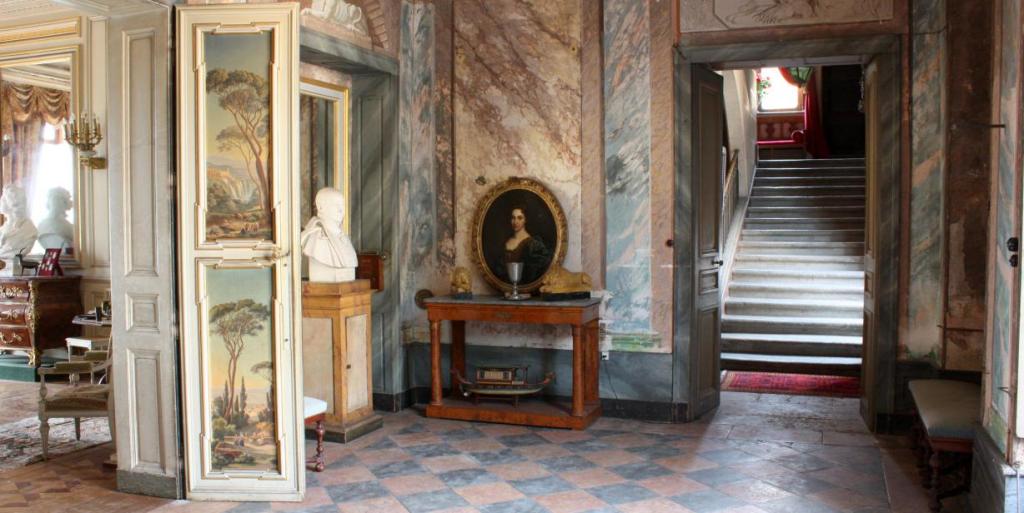
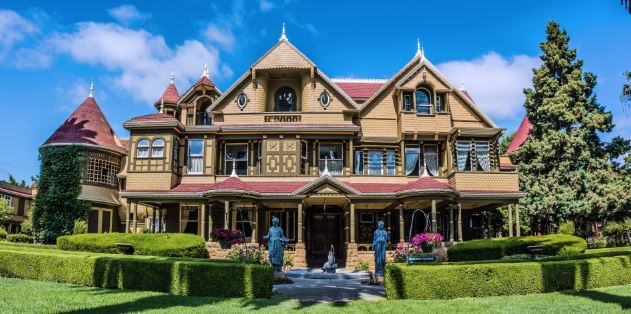
The room count of California’s most mysterious mansion has just increased by one, rounding out at 161 chambers (that we know of). Preservationists at The Winchester Mystery House in San Jose have found a previously unknown room in the attic of the house, and in it was a pump organ, a dress form, a sewing machine, a Victorian sofa, and several paintings.

For further information about tours, including group tours, weddings, school events, birthday party packages, facility rentals, and special events please visit the website: https://winchestermysteryhouse.com/
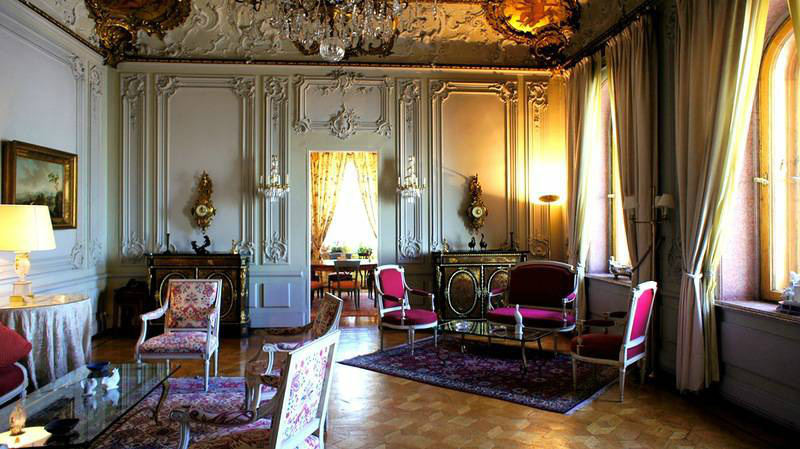
Please visit the online giftshop, and purchase a gift for friends and relatives as well as a special memento of The Winchester Mystery House. A variety of souvenirs and gifts are available to purchase. https://shopwinchestermysteryhouse.com/

If you forget to purchase something during your visit, you can order any gift item by calling 408-247-2000 and charging them to your credit card. You can also place an order through the mail. Be sure to include a daytime telephone number with area code. Write to: Winchester Mystery House.

An Artifact from Another Level of Being

The silence closed in. Something was building in Llanada Villa. Something was happening in the very air itself. Something changed in the golden glow of a late autumn afternoon. And as I heard the music, a long stab of terror drove through my heart. I assented to the window. As I looked out, I saw a handsome old-fashioned carriage, with a troop of couriers and footmen. I saw the slim figure of the pale gentleman in black, as he held a thick velvet cloak. He looked about him at the others as he went on, his voice ringing clear in the silence. “Never such a place as this has existed before. A place where demons have been invented by aggrieved souls. I wondered if Mrs. Winchester was perhaps a member of the Freemasons, or some other secret society. Maybe she holds some exalted rank.” I felt a great shudder pass through me at these words. However, there had been a conviction in those appalling words. Secret societies were very fashionable just then. Secret societies and psychiatry were the contrasting en vogue activities of the moment. I folded my arms and leaned against the frame of the door, obscuring for the moment the light behind me. I had an urge to venture outside, to walk in silence amongst the trees. However, the fruit orchard was dark enough even in daylight; by moonlight it would be all too easy to imagine terrors—as I keep imagining I can hear soft footsteps moving across the floor above my head. But when I sit on the sofa to listen, I hear only the beating of my heart. I walked for hours examining the trees and the splendid fruit that would be harvested. Before long, I was overtaken by night while still in the fruit orchard. Utterly bewildered and overcome with fatigue, I had lain down near the root of a large plumb tree and fallen into a dreamless sleep. #RandolphHarris 1 of 8

It was hours later, in the very middle of the night, that one of God’s mysterious messengers, gliding ahead pronounced the awakening word in my ear. Waking from a deep sleep at night in the midst of what seemed like a forest, front among the tree on either side I caught broken and incoherent whispers in a strong tongue which I partly understood. They seemed to me fragmentary utterances of a monstrous conspiracy against my body and soul. It was now long after nightfall, yet the interminable fruit orchard through which I journeyed was lit with a wan glimmer having no point of diffusion, for in its mysterious lamination nothing cast a shadow. A shallow pool in the guttered depression of an old well met my eye with a crimson gleam. I stooped and plunged my hand into it. It stained by fingers; it was blood! Blood, I then observed, was about me everywhere. The fallen fruit showed blots and splashes of blood. The girds of the orchards were pitted and spattered as with red rain. Defiling the trunks of the trees were broad maculations of crimson, and blood dripped like dew from their foliage. All this I observed with a terror which seemed not incompatible with the fulfillment of a natural expectation. It seemed to me that it was all in expiation of some crime. So frightful was the situation—the mysterious light burned with so silent and awful a menace; the noxious plants, the trees that by common consent are invested with a melancholy or baleful character, so openly in my sight conspired against my peace; from overhead and all about came so audible and startling whispers and the sighs of creatures so obviously not of Earth—that I could endure no longer, and with a great effort to break some malign spell that bound my faculties to silence and inaction, I screamed with the full strength of my lungs! #RandolphHarris 2 of 8

My voice was broken, it seemed, into an infinite multitude of unfamiliar sounds, went babbling and stammering away into the distant reaches of the orchard, died into silence, and all was as before. Despair succeeded hope. Gratitude gave place to curse. As I preceded down the path, sobbing quietly to myself, in the misery of fear, the stern light of the Observational Tower became a tiny speck, yellower but scarcely bigger than some of the stars, which here and there shone between the clouds. Nearly twenty minutes passed, and my fatigue began to change to exhaustion. The overpowering sense of the inevitable pressed upon me. With the weariness came a strange comfort. On, and on I went through the thicket of trees. I knew of my probable presence in the spirit World. The moon, then in her third quarter, pushed out from behind the concealing clouds and shed a pale, soft glitter upon my mansion. My last appeal had been heard. I made it home. About half an hour after getting home, I still felt energized but I began to feel a sensation around my forehead as I have many times since. I suddenly felt weak. I went in and sat at the foot of my bed and passed out. I have never been given to fainting or passing-out spells, but I did not fall asleep—I passed out cold. When I woke up, I had no concept of time. When I woke up, a low, wild peal of laughter broke out at a measuresless distance away, and growing even louder, seemed approaching ever nearer; a soulless, heartless, and unjoyous laugh, like that of loon; a laugh which culminated an unearthly shout close at hand, then died away by slow gradations, as if the accursed being that uttered it had withing over the verge of the World whence it had come. #RandolphHarris 3 of 8

Sitting here in my temple of a house, I felt trapped and compromised, and even terrified. I got a feeling that the presence was still nearby and had not moved. A strange sensation began slowly to take possession of my body and my mind. I could not say which, if any, of my sense were affected; I felt it rather as a consciousness—a mysterious mental assurance of some overpowering presence—some supernatural malevolence different in kind from the invisible existences that swarmed about me, and superior to them in power. I knew that it had uttered that hideous laugh. And now it seemed to be approaching me; from what direction I did not know—dated not conjecture. All my former fears were forgotten and merged in the gigantic terror that now held me in thrall. Powers were traversing my haunted mansion. My senses were heightened as I found myself starting into the sharply dawn face and blank, dead eyes of my own mother, standing white and silent in the garments of the grave! The apparition confronting me—the thing so like, yet so unlike my mother—was horrible! It stirred no lover nor longing in my heart; it came unattended with pleasant memories of a golden past—inspired no sentiment of any kind; all the finer emotions were swallowed up in fear. I turned to turn and run from before it, but my legs were as lead; I was unable to life my feet from the floor. My arms hung helpless at my sides; of my eyes only I retained controlled, and these I dared not remove from the lusterless orbs of the apparition, which I knew was not a soul without a body, but that most dreadful of all existences infesting my haunted mansion—a body without a soul! #RandolphHarris 4 of 8

In its blank state was neither love, nor pity, nor intelligence—nothing to which to address an appeal for mercy. For a time, which seemed so long that the World grew gray with age and sin, and the haunted forest, having fulfilled its purpose in this monstrous culmination of its terrors, vanished out of my consciousness with all its sights and sounds, the apparition stood within a pace, regarding me with a mindless malevolence of wild brute; then thrust its hand forward and sprang upon me with appalling ferocity! The act released my physical energies without an unfettering my will; my mind was still spellbound, but my powerful body was and agile limbs, endowed with a blind, insensate life of their own, resisted stoutly and well. For an instant I seemed to see this unnatural contest between a dead intelligence and a breathing mechanism only as a spectator. Despite my struggles—despite my strength and activity, which seemed wasted in a void, I felt the cold fingers close upon my throat. Brorne backward to the floor, I saw above me the dead and drawn face within a hands breadth of my own. Its eyes were shallow to the point of blankness, and then all was black. Until I awoke, the passage outside my room had been pitch dark. Now the gasoliers illuminated the hall, but the glass was so blackened that they yielded only a dim, murky light. The air was stale and close. Expecting at every turn to find a housemaid awaiting me with a smile, I made my way through the gloom to the landing. The double doors to the gallery stood open. Along each wall, a row of wavering light receded. Transom windows shone with a faint cold light; higher still, the ceiling was shrouded in darkness. Some twenty feet away from me, candles burned upon a small round table, lighting of the face of the pale man and Mrs. Haas. “Ah, there you are, my dear,” said he, just as if he had last seen my five minutes—rather than several days—ago. I moved reluctantly to join them. #RandolphHarris 5 of 8

Mrs. Haas, resplendent in crimson silk and displaying a large expanse of white bosom, greeted me with disdain. Behind them, the wall at the far end of my gallery was dominated by the immense fireplace, and the armour towering in the shadows beside it. The sword glittered beneath its gloved hand; in the shifting light it seemed alert, alive, watchful. Within the fireplace was a massive chest of dark metal. “Dr. Cottam was about to tell us,” said Mrs. Haas impatiently, “of a discovery he had made amongst your late husband’s papers.” He spoke as if I had kept them waiting. “Indeed I was.” His tone was as cordial as ever, but with an edge of anticipation. His teeth caught the light as he smiled; the pupils of his eyes shone like twin flames. “Now, in going through his study the other day, I found a page of notes you must have missed after relocating from New Haven—scrawled in haste, and sometimes quite impenetrable—which had slipped behind a row of books.” On the table was a crumpled sheet of paper. “I shall not weary you with the tale of my efforts to decipher this. He believed that if he were inside the armour when lighting struck, he would pass unharmed into the next World, jut as the risen body, according to Scripture, will ascend to Heaven upon the day of judgement.” “Oh dear Heavens,” cried Mrs. Haas. “Mrs. Winchester, I have been dying for a grand tour of your estate. My companion Dr. Cottam is rather a bore with such foolish tales of science fiction!” “There is a theory, you know, that the basis of spirit may be electrical. For spirits to communicate with the living,” expressed Dr. Cottam, the man with the very pale face. #RandolphHarris 6 of 8
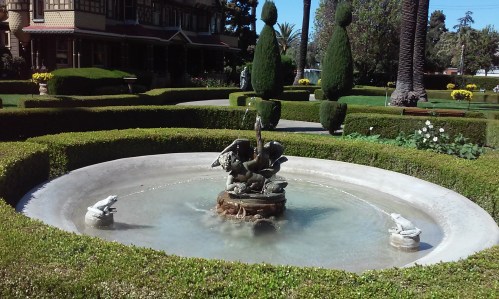
“Dr. Cottom, I have begun to wonder whether your obsession with William Winchester is not, perhaps, quite as mad as I assumed,” explained Mrs. Haas, “but I do wish to get on with this tour. Mrs. Winchester has already delayed us several hours after he invitation, and I am growing quit weary.” “Well, Mrs. Haas, as I do recall, Gods are often said to wield lightening; and whilst this represents primitive awe at the power of nature, it may also shroud a genuine intuition. The same applies to the spiritualist practice of linking hands around a table. Ghosts and spirits are generally depicted as emanations of light; one thinks of St. Elmo’s fire or the very rare phenomenon of ball lightning…a far fetched analogy, you may say, but just as a magnetic field will cause a heap of iron filings to arrange themselves into a complex pattern, so the soul, the vital principle—call it what you will—animates the Earthly body. Might it not be that the vital principle is electrical, perhaps in some subtler form that science has not yet grasped?” said Dr. Cottam. “Dr. Cottam, while your theories are very fascinating, I fear Mrs. Haas is growing impatient and I should like to give her a tour now,” I explained. I liked Mrs. Haas more and more every minute. Her gossip, without being ill-natured, was extremely diverting to me, who had been so long out of the great World. I thought what life she would give to my sometimes-lonely evenings at home. There was a ball going on in the Grand Ballroom, this house seemed to run itself sometimes, which would not be over until the morning sun had almost reached the horizon. It pleased the Grand Duke to dance till then, so loyal people could not go away, or think of bed. #RandolphHarris 7 of 8
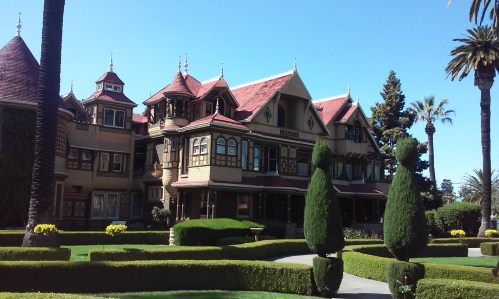
We had just got through a crowded parlor, when Dr. Cottam asked me what had become of Mrs. Haas. I though she had been by his side, and he fancied she was by mine. The fact was, we had lost her. All my efforts to find her were in vain. I feared that she had mistaken, in the confusion of the momentary separation from us, other people for her new friends, and had, possibly, pursued and lost them in the extensive grounds which were thrown open to us. Morning broke. It was clear daylight before I gave up my search. It was not till near two o’clock next day that we heard anything of Mrs. Haas. At about that time a servant knocked at my door, to say that he had been earnestly requested by a young, who appeared to be in great distress, to make out where she could find Mrs. Winchester and Dr. Cottam. There could be no doubt, notwithstanding the slight inaccuracy that my friend had turned up. I had a housemaid go to the guest room and summon Dr. Cottam. I went down to the parlor and reunited with Mrs. Haas. She told me a story to account for having failed to recover us for so long. Very late, she said, she made a detour and wandered around, not before long becoming afraid and getting lost. She got into the Crystal Bedroom in despair of finding us, and had then fallen into a deep sleep which, long as it was, had hardly sufficed to recruit her strength after the fatigues of the ball. It the midst of my perplexities, an anxiety of far more urgent kind presented itself. My dear friend began to lose her looks and health, and that in manner so mysterious, and even horrible, that I became thoroughly frightened. #RandolphHarris 8 of 8

People, since as long ago as the 1800s, have reported a vast array of unexplained events, experiences, and sightings at what is now known as The Winchester Mystery House. Over the years, people have reported bone-chilling sightings ghosts, angels, demons, fairies, giants, orbs, lights, mist, vampires, witches, warlocks and werewolves. In 2007, a man was attending Santa Clara University, and he was lucky enough to get hired as a tour guide at The Winchester Mystery House. He had no sooner moved into his apartment and had the telephone installed when he received a call warning him never to return to Sacramento again. During a later call, a woman with a high-pitched voice informed “G” that he was being kept under surveillance by a group who felt that he had acted unjustly in the past by not returning things to their proper owners. G emphasized that he had led a very quiet life as an undergraduate.
Yet he probably received 30 or more telephone calls from anonymous voices advising him not to return to Sacramento. The voices reprimanded him for having taken something that did not belong to him. G said that he did not carry anything with him that was from Sacramento and did not often visit the beautiful city, and he seldom discussed his life with any but a few of his closet acquaintances. He wondered who could have possibly taken such a long-term interest in him? About the third year after working at The Winchester Mystery House, a guest unknown to him stopped to say hello. G knew that such an act was hardly unusual, since guests will often do this to find out interest facts about tour guides and secrets about Sarah L. Winchester’s mansion. However, he noticed the boy was strangely inquisitive. G was astonished when the teenager drew a design on a piece of paper that he had seen somewhere in the mansion. He smiled at G, then asked if he knew what the symbol meant.

When G pressed the boy, in turn for some answers, the guest threw away the design, laughed, and said that he was just fooling around, that he did not mean anything about it. G never saw the alleged guest again. He descried him to a could of tour guides, but no one was able to identify him. After several years of watching at The Winchester Mystery House, G graduated from University. He had not been in possession of his diploma for more than four days when someone rang his apartment and scolded him for taking things that did not belong to him. The voice told G that he should always leave things where they were. He reported to his supervisors that he kept receiving mysterious calls. On one occasion the voice told G that he has discovered a strange key to other dimensions, but the entities had long since reclaimed it. However, apparently, some spirit masqueraders were determined that he should never forget the day he came into contact with an artifact from another level of being. What is The Winchester Mystery House?

And please be sure to check out the online gift store: https://shopwinchestermysteryhouse.com/


Is the Soul’s Health More Important than All the Powers of this World?

I cannot say that truth is stranger than fiction, because I have never had acquaintance with either. Whoever is without guile, let one lie down with the lion and the lamb and be not ashamed of one’s nakedness; for they shall put a ring upon one’s hand and shoes upon one’s feet; and all that was one’s father’s shall be one’s and also all that one’s mother and one’s sister hath, and likewise the mote that is in one’s brother’s eye. For it is easier for a rich man to go through the eye of a camel than for another man to break the Sabbath day and keep it holy. If this astonishing conquest itch were limited to intellectual postures, it would be one thing. However, of course the contemporary mining and polluting of the industrial lands bring forward far more concrete realities. Our Faustian pact with Mephistophelian “sci-tech” goes back a long way. It is an insufficiently realized fact that the contemporary scientific attitude was first nurtured in the bosoms of mystical societies of seventeenth-century England, as the contemporary British scholar Frances Yates has pointed out in a number of valuable studies. Long before this, the pioneering philosopher of the specifically modern cast of organized inquiry, Francis Bacon, had called in his “Fable of Proteus” for a virtually sadistic approach to the natural World: If any skillfull minister of nature shall apply force to nature, and by design torture and vex it in order to its annihilation, it on the contrary, being brought to this necessity, changes and transforms itself into a strange variety of shapes and appearances; for nothing but the power of the Creator can annihilate it or truly destroy it…And that methods of torturing or detaining will prove the most effective and expeditious which makes use of manacles and fetters; id est lays hold and works upon matter in the extremist degree. #RandolphHarris 1 of 20

That is an amazing attitude, and one quickly discernible in every aspect of modern life. However, suppose that nature, or at least the Earth as a whole, may not be entirely inert. Can we assume that it would be completely in accord with many of the things we are doing in it? Supposed that, in future generations, the most gifted minds were to find their soul’s health more important than all the powers of this World; suppose that, under the influence of the metaphysic and mysticism that is taking the place of Rationalism today, the very elite of intellect that is now concerned with the machine comes to be overpowered by a growing sense of its Satanism (it is the step from Roger to Bacon to Bernard of Clairvaux)—then nothing can hinder the end of this grand drama that has been a play of intellects, with hands as mere auxiliaries. It is a good thing that in some cases stupidity is not painful because more of us would be in pain and have to admit we need help. As the 1960s faded into the more staid 1970, lurid media accounts of Satanic activity and ritualistic murders became sporadic. However, in 1975, the wire services began to pick up stories that cattle ranchers in Colorado and other western sates were increasingly concerned about the safety of their herds, large numbers of animals having been bizarrely slaughtered. And these are very similar crimes, it would be similar to owning a car dealership and someone stealing all of your cars and no insure to reimburse the loss. So, the cattle were apparently not being killed for food, as little of the meat had been touched, but, in many cases, the blood had apparently been drained and the “private” organs and lips had been surgically removed. To add to the mystery, no footprints, animal or human, were found around the carcasses. #RandolphHarris 2 of 20

Speculation about the identity of the culprits ranged from UFOs to secret government experiments. A movie Endangered Species, was even produced, postulating the latter theory. Then in Arkansas, several head of cattle were found dead near sites that exhibited evidence of ritualistic activity—and Satanic cultists, who from the beginning were suspected villains, supplanted extraterrestrials and Uncle Sam as the most popular explanation for the rash of killings. As reports of the number of mutilations increased and alarm among ranchers spread, animal pathologists were called in to investigate. Not only did they find the cattle mortality rate no higher than normal, but autopsies on the animals determined that in almost all cases the cattle had died from natural causes, or by predatory attack, and that the mutilation had been the postmortem work of scavengers, not cultists. Teeth, not knives, had been used to remove “private” organs and lips, those parts being attacked because they were the softest and most accessible. Then, amid hundreds of similarly discredited reports, several mutilations in Idaho and Montana were determined to have indeed been the work of a knife-wielder. There, evidence gathered by law enforcement officials implicated several Satanic cults operating in those states. The cults, which up to that time had allegedly preferred dogs and cats as sacrificial victims, had read about the mutilations in the papers and decided to add cattle to their ritual list. The work of the copycat cultists turned out to be truly a case of life imitating art. An astrologer named Dan Fry, host of Minneapolis radio program called Cosmic Age, admitted on a Texas talk show that he had made up the cattle mutilation rumor as a joke, but things had snowballed when the story was repeated as fact by the Huston Post and picked up from there by the wire services. Thus had Fry created an “urban legend.” #RandolphHarris 3 of 20

An “urban legend” is a term coined by contemporary folklorists to describe a popular story that spreads swiftly by word of mouth and is soon accepted as truth. These folk tales are always reported as having actually happened, often to the friend of a friend, which is what keeps them “immediate.” When the media picks up such stories and prints them as fact, as it did with the cattle mutilation stories, they acquire a further stamp of truth, which is why people point out that the news is not always true and is someone’s perspective and viewers should be advised to use critical thinking and ask question and do their own research. However, once again, cattle mutilations are baffling law enforcement and ranchers. FOX News published a story August 11, 2022 about the serial crime spree leaving a dozen cattle mutilated. “Mutilations differ from typical livestock deaths because the carcasses are found with body parts removed in an unusual fashion,” states Charles Couger of FOX News. In San Luis more than 10,000 mutilations have betwixt ranchers and investigators across the United States of America for decades. Nonetheless, a recent study by Psychology Today of reported “trick or treat poisonings on Halloween failed to turn up one serious injury and found that, in almost every case, the tamperings were the work of the child victim himself, in an attempt to get attention from parents and friends. Yet every Halloween, newspapers print warnings about tampered treats. And, in the mid-1980s, tales of Satanic animal mutilations have began to resurface from California to Alabama, despite the protests of investing game and animal control officials who have said that, in almost all the cases, the animal deaths were the work of predators or poachers. #RandolphHarris 4 of 20

The Devil, after all, has been an old favorite subject of urban legends. In 1977, for instance, the rumor was widely circulated in fundamentalist circles that the secret of McDonald’s success was that the chain donated portion of its profits each year to the Church of Satan. Corroboration of the Satanic tithing allegedly came from no less a personage than McDonald’s owner, Ray Kroc, who was reputed to have admitted to the diabolic connection while appearing on the Phil Donahue shows. In Fact, Kroc had been a guest on the Donahue show in May of 1977, but his most startling admission had been his intention to introduce the McDonald’s “Filet o’ Fish” in Cincinnati. The idea of a Satanic “pact”—trading one’s soul for Earthly wealth—is an ancient one, and it cropped up again in 1980 when rumors surfaced that the Proctor & Gamble moon-and-starts trademark was in reality a Satanic symbol, and that the company was run by Satanists. The story went that the owners of Proctor & Gamble long ago made a pact with the Devil that ensured the company’s success in exchange for putting Satan’s logo on all its products. “Proof” cited for this ludicrous claim was that a company executive had revealed the demonic truth on Donahue or 60 Minutes, depending on the version. It mattered little that Donahue and spokesmen for 60 Minutes denied any such interview ever took place. Neighbors told neighbors that they had talked to someone who saw the show, or heard it from someone who heard it from someone, etcetera. By mid-1982, Proctor’s consumer services department was getting 15,000 calls a month from people wanting to know about the company’s Satanic connections. Eventually, a counter-publicity campaign was launched, but in the end, the company wound up changing its logo. #RandolphHarris 5 of 20
A serious argument about what is most profoundly modern leads inevitably to the conclusion that the study of the problem of Socrates is one thing most needful. It was Socrates who made Nietzsche and Heidegger looks to the pre-Socratics. For the first time in four hundred years, it seems possible and imperative to begin all over again, to try to figure out what Plato was talking about, because it might be the best thing available. The history of classics since the Renaissance has consisted in momentary glimpses of the importance of Greece for man as man, everywhere and always, followed by long periods of merely scholarly study without any sufficient reason for it, living off the gradually dying energy provided by the original philosophic dynamos. Up to Nietzsche, the neglect of and contempt for Plato and Aristotle was the result of a belief that what they tried to do could be done much better. That is why Socrates was always in good repute. He was the skeptical seeker after the way to knowledge by means of unaided reason. He was not tired to any solution or system and thus could be seen s the originator and the inspirer who did not constrain the freedom of posterity. The current contempt for Plato and Aristotle is of an entirely different kind, for it is allied to contempt for Socrates. He corrupted them; they did not pervert him. We did not progress from Socrates, but he marked the beginning of the decline. Reason itself is rejected by philosophy itself. Thus the common thread of the whole tradition has been broke, and with it the raison d’etre od the university as we know it. #RandolphHarris 6 of 20

Thus is was no accident that Heidegger came forward just after Hitler’s accession to power to address the university community in Freiburg as the new rector, and urged commitment to National Socialism. His argument was not without subtlety and its own special kind of irony, but in sum the decision to devote wholeheartedly the life of the mind to an emerging revelation of being, incarnated in a mass movement, was what Heidegger encouraged. That he did was not a result of his political innocence but a corollary of his critique of rationalism. That is why I have entitled this section “From Socrates’ Apology to Heidegger’s Rektoratsrede.” The university began in spirit from Socrates’ contemptuous and insolent distancing of himself from the Athenian people, his refusal to accept any command from the Athenian people, his refusal to accept any command from them cease asking, “What is justice? What is knowledge? What is a god?” and hence doubting the common opinions about such questions, and in his serious game (in the Republic) of trying to impose the rule of philosophers on an unwilling people without respect for their “culture.” The university may have come near to its death when Heidegger joined the German people—especially the youngest part of that people, which he said had already made an irreversible commitment to the future—and put philosophy at the service of German culture. If I am right in believing that Heidegger’s teachings are the most powerful intellectual force in our times, then the crisis of the German university, which everyone saw, is the crisis of the university everywhere. It may be thought that I have devoted too much space to this idiosyncratic history of the university. However, the university, of all institutions, is most dependent on the deepest beliefs of those who participate in its peculiar life. #RandolphHarris 7 of 20

Our present educational problems cannot seriously be attributed to bad administrators, weakness of will, lack of discipline, lack of money, insufficient attention to the three R’s, or any of the common explanations that indicate things will be set aright if we professors would just pull up our socks. All these things are the result of a deeper lack of belief in the university’s vocation. One cannot say that we must defend academic freedom when there are grave doubts about the principles underlying academic freedom. To march out to battle on behalf of the university may be noble, but it is only a patriotic gesture. Such gestures are necessary and useful for nations, but they do little for universities. Thought is all in all for universities. Today there is precious little thought about universities, and what there is does not unequivocally support the university’s traditional role. In order to find out why we have fallen on such hard times, we must recognize that the foundations of the university have become extremely doubtful to the highest intelligences. Our petty tribulations have great causes. What happened to the universities in Germany in the thirties is what has happened and is happening everywhere. The essence of it all is not social, political, psychological or economic, but philosophic. And, for those who wish to see, contemplation of Socrates is our most urgent task. This is properly an academic task. Some technologies come in disguise. Rudyard Kipling called them “technologies in repose.” They do not look like technologies, and because of that they do their work, for good or ill, without much criticism or even awareness. This applies not only to IQ tests and to polls and to all systems of ranking and grading but to credit cards, accounting procedures, and achievement tests. It applies in the educational World to what are called “academic courses,” as well. #RandolphHarris 8 of 20

A course is a technology for learning. I have “taught” about two hundred of them and do not know why each one lasts exactly fifteen weeks, or why each meeting lasts exactly one lasts exactly one hour and fifty minutes. If the answer is that this is done for administrative convenience, then a course is a fraudulent technology. It is put forward as a desirable structure for learning when in fact it is only a structure for allocating space, for convenient record-keeping, and for control of faculty time. The point is that the origin of a raison d’etre for a course are concerned from us. We come to believe it exists for one reason when it exists for quite another. One characteristic of those who live in a Technopoly is that they are largely unaware of both the origins and the effects of their technologies. Perhaps the most interesting example of such lack of awareness is the widespread belief that modern business invented the technology of management. Management is a system of power and control designed to make maximum use of relevant knowledge, the hierarchical organization of human abilities, and the flow of information from bottom to top and back again. It is generally assumed that management was created by business enterprises as a rational response to the economic and technological demands of the Industrial Revolution. However, research by Alfred Chandler, Sidney Pollard, and especially Keith Hoskin and Richard Macve reveals a quite different picture and leads to a startling conclusion: modern business did not invent management; management invented modern business. The most likely place for management to have originated is, of course, in Great Britain in the late eighteenth and early nineteenth centuries. However, there is no evidence that British industry knew anything about management as late as 1830, nor did there exist anything approximating a “managerial class.” #RandolphHarris 9 of 20

Management was created in the United States of America “out of the blue,” as Hoskin and Macve say. It was not a creation of any obvious needs of American industry, which was only a marginal force in the World economy in the mid-nineteenth century. The roots of management may be traced to a new educational system, introduced in 1817 to the United States Military Academy by the academy’s fourth superintendent, Sylvanus Thayer. Thayer made two innovations. The first, borrowed from the Ecole Polytechnique in Paris, was to grade examinations by giving numerical marks. As I have previously noted, the grading of student papers originated in Cambridge University towards the end of the eighteenth century, and the practice was taken up by several schools on the Continent. Thayer’s use of this technology is probably the first instance of it in America. As every teacher knows, the numerical mark changes the entire experience and meaning of learning. It introduces a fierce competition among students by providing sharply differentiated symbols of success and failure. Grading provides an “objective” measure of human performance and creates the unshakable illusion that accurate calculations can be made of worthiness. The human being becomes, to use Michel Foucault’s phrase, “a calculable person.” Thayer’s second innovation, apparently his own invention, was a line-and-staff system. He divided the academy into two divisions, each organized hierarchically. As Hoskin and Macave describe it: “Daily, weekly and monthly reports were required, all in writing. There were continual relays of written communication and command, going from the bottom to the top of each line, before being consolidated and passed to the central ‘Staff Office.’” #RandolphHarris 10 of 20

Thayer rejected the traditional leader’s role of direct, visible command. He ruled indirectly through the medium of written reports, charts, memos, personnel files, etcetera, not unlike the way a modern CEO functions. We do not know how most of the two hundred cadets at the academy reacted to Thayer’s new system (which Hoskin and Macve term the “grammatocentric principle,” meaning that everything was organized around the use of writing). However, we do know that two of them, Daniel Tyler and George Whistler, were impressed. Both were in the graduating class of 1819, and took with them their lieutenant’s rank and Thayer’s general approach to organizations. Desert Rose Industries and other manufacturers can make almost anything quickly and at low cost. That includes the tunneling machines and other equipment that made the subway system they use for shipping. Digging a tunnel from coast to coast now costs less than digging a single block under New York City used to. It was not expensive to get a deep-transit terminal installed in their basement. Just as the tents are not mere bundles of canvas, these subways are not slow things full of screeching, jolting metal boxes. They are magnetically levitated to reach aircraft speeds—as experimental Japanese trains were in the late 1980s—making it easy for Carl and Maria to give their customers quick service. There is still a road leading to the plant, but nobody’s driven a truck over it for years. They only take in materials that they will eventually ship out in products, so there is nothing left over, and no wastes to dump. One corner of the plant is full of recycling equipment. There are always some obsolete parts to get rid of, or things that have been damaged and need to be reworked. These get broken down into simpler molecules and out back together again to make new parts. #RandolphHarris 11 of 20

The gunk in the manufacturing ponds is water mixed with particles much finer than silt. The particles—fasteners, computers, and the rest—stay in suspension because they are wrapped in molecular jackets that keep them there. This uses the same principle as detergent molecules, which coat particles of oily dirt to float them away. Though it would not be nutritious or appetizing, one could drink the tent mix and be no worse for it. To one’s body, the parts and their jackets, and even the nanomachines, would be like so many bits of grit and sawdust. (Grandma would have called it roughage.) Carl and Maria get their power from solar cells in the road, which is the only reason they bothered having it paved. In back of their plant stands what looks like a fat smokestack. All it produces, though, is an updraft of clean, warm air. The darkly paved road, baking in the New Mexico sun, is cooler than one might expect: it soaks up solar energy and makes electricity, instead of just heat. Once the power is used, it turns back into heart, which has to go somewhere. So the heat rises from their cooling tower instead of the road, and the energy does useful work on the way. Some products, like rocket engines, are made more slowly and in a single piece. This makes them stronger and more permanent. The tents, though, do not need to be superstrong and are just for temporary use. A few days after the tents go up, the earthquake victims start to move out into new housing (permanent, better-looking, and very earthquake-resistant). The tents get folded and shipped off for recycling. Recycling things built this way is simple and efficient: nanomachines just unscrew and unsnap the connectors and sort the parts into bins again. The shipments Desert Rose gets are mostly recycled to begin with. There is no special labeling for recycled materials, because the molecular parts are the same either way. #RandolphHarris 12 of 20

For convenience (and to keep the plant small), Carl and Maria get most of their parts prefabricated, even those they can make almost anything. They can even make more production equipment. In one of their manufacturing ponds, they can put together a new cabinet full of special-purpose assemblers. They do this when they want to make a new type of part in-house. Like parts, the part-assemblers are made by social-purpose assemblers. Carl even can make big vats in medium-size vats, unfolding them like tents. If Desert Rose Industries needed to double capacity, Carl and Maria could do it in just a few days. They did this once for a special order of stadium sections. Maria got Carl to recycle the new building before its shadow hurt their cactus garden. Now, let us focus on mining knowledge. Even these changes, however, are dwarfed by China’s ravenous pursuit of wealth-relevant know-how. China has become a World leader in the creation, purchase—and theft—of data, information and knowledge. As far back as the winter of 1983, soon after Deng Xiaoping shut the door on the Maoist past, we personally witnessed Chinese scientists in Beijing reverse-engineering computers and carrying out the country’s earliest experiments with fiber optics in Shanghai. The available facilities were primitive, dirty, and freezing. China was still wretchedly not very well-off financially. However, its leaders, even then, understood the importance of technology—and piracy. #RandolphHarris 13 of 20

Today the picture is dramatically different. Up-to-date research labs are proliferating, the country’s total expenditure on research and development (R&D) amounted to about 2.79 trillion yuan (about $441.13 billion) in 2021, which is 14.2 percent year-on-years. After deducting price factors, China’s R&D spending in 2021 rose 9.4 percent year-on-year. And as we have noted in the past, thousands of United States of America—trained Chinese scientists are heading back to China. In five years, America will still be the World center of corporate research. However, China will outrank Britain, Germany, and Japan. Add China’s sharklike appetite for data, information and ideas from the outside World. To do business in China, foreign companies usually have had to transfer technology—and many agreed to do so in return for even limited access to the huge Chinese market. Nor is this hunger for know-how narrowly restricted to technology. As formerly Communist China entered into broader economic relationships with the West, it also sought practical knowledge about capitalist management, finance and business in general. As of 2022, there are 46 MBA programs offered in China—many in partnership with leading American schools such as MIT, UC/Berkeley and Northwestern. Less formally, knowledge is transferred by the more than 600,000 international students who now live and work in China—in sharp contrast to the days when foreigners were likely to be labeled spies or allowed to enter only as part of closely monitored tourist groups. Behind China’s amazing drive, therefore, we find radically changed attitudes toward all three of the deep fundamental central to economies of the future—further evidence of its intention to create the World’s leading knowledge-based economy. #RandolphHarris 14 of 20

Taken together, facts like these suggest an unstoppable China on a short, double-quick march to superpowerdom. Beijing, however, knows better. Recently, China watchers have begun to spin dark scenarios. Those include the possibility that China could suffer a financial crisis like the one that hit the rest of Asia in 1997-98, for example. Or that it will go through a series of ups and downs that it will attempt to mitigate with Keynesian measures. Alternatively, worriers point to a possible convergence of other troubles—an energy breakdown, and environmental crisis or something else. Or, worse, yet, a war with Taiwan in which both sides hurl missiles at each other, destabilizing the new Asia. Any or all of these could hammer the global economy in the years immediately head. One of the most pessimistic assessments of China’s future is that the nation will collapse, the revolution has grown old, the discontent of the people is explosive, state-owned enterprises are dying, Chinese banks will fail, and that ideology and politics restrain progress—and that is only part of the list. However, experts are saying the same about America. If this is true, the global financial system might have to be wheeled into the intensive-care ward. Investors, corporations and central banks around the World could all be traumatized. The price of T-shirts and toys might drop still further in the corner Wal-Mart. However, hundreds of millions of workers around the World—from iron-ore miners in Brazil to bankers in Manhattan or Tokyo—would be looking for jobs. These scenarios are dire enough. However, they overlook more startling possibilities. “They will throw their money in the streets, tossing it out like worthless trash. Their silver and gold will not save the on that day of the LORD’s anger,” reports Ezekiel 7.19. #RandolphHarris 15 of 20

The info-wars cast the corporation—and the work that does on in it—into a new light. Forget, for a moment, all conventional job descriptions; forget ranks; forget departmental functions. Think of the firm, instead, as a beehive of knowledge processing. In the day of the smokestack it was assumed that workers knew little of importance and that relevant information or intelligence could be gathered by top management or a tiny staff. The proportion of the work force engaged in knowledge processing was tiny. Today, by contrast, we are finding that much of what happens inside a firm is aimed at replenishing its continually decaying knowledge inventory, generating new knowledge to add to it, and upgrading simple data into information and knowledge. To accomplish this, employees constantly “import,” “export,” and “transfer” data and information. Some employees are essentially importers. These “OUT-IN” people gather information from outside the company and deliver it to their co-workers inside. Market researchers, for example,” are OUT-INers. Studying consumer preferences in the external World, they add value by interpreting what they learn, and then deliver new, higher-order information to the firm. Public relations people do the reverse. They market the firm to the World by collecting information internally and disseminating or exporting it to the outside World. They are IN-OUTers. House accounts are basically IN-IN people, gathering most of their information from inside the firm and transferring it internally as well. Good salespeople are two-way RELAYS. They disseminate information, but also collect it from outside and then report it back to the firm. #RandolphHarris 16 of 20

These functions relate to flows of data, information, or knowledge. Cutting across them is a set of functions that have to do with upgrading the stock of data, information, and knowledge that the firm and its people already possess. Some mind-workers are creators, capable of finding new, surprising juxtapositions of ideas, or putting a fresh spin on an old idea; other “edit” new ideas by matching them against strategic requirements and practical considerations, then deleting those that are irrelevant. In reality, we all do all these things at various times. However, while different functions emphasize one or another, no conventional job descriptions or management texts deal with such distinctions—or their implications for power. At almost every step in this knowledge processing, some people or organizations gain, and others lose, an edge. Thus, conflicts—tiny, sometimes highly personal info-wars—are fought over things like who will or will not be invited to a meeting, whose names appear on the routing slip, who reports information to a superior directly and who, by contrast, is asked to leave it with a secretary, and so forth. These organizational battles—“micro info-wars,” so to speak—are hardly novel. They are a feature of all organizational life. They take on new significance, however, as the super-symbolic economy spreads. Since the value added through smart knowledge-processing is critical in the new system of wealth creation, 21st-century accountants will find ways to assess the new economic value added by various informational activities. The performance ratings of individuals and units may well take into account their own contribution to knowledge enhancement. #RandolphHarris 17 of 20

Today, a geologist who funds a huge oil strike is likely to be well rewarded by the company for adding to its reserves. Tomorrow, when knowledge resources are recognized as the most important of all, employee remuneration may well come to hinge, at least in part, on the success of each individual in adding value to the corporate knowledge reserve. In turn, we can expect even more sophisticated power struggles for the control of knowledge assets and the processes that generate them. We are already witnessing the beginnings of a change in management assumptions about the functions of the work force. Thus, all employees are increasingly expected to add not merely to the firm’s knowledge of assets in general, but to its competitive intelligence arsenal as well. A company tht does CI work for both U.S. and Japanese firms, the Japanese take a far more wholistic view of intelligence than do the Americans. While Japanese executives regard information collection as a routine part of their jobs, if you ask a typical Harvard M.B.A., it is the company librarian’s job. That narrow assumption, however, is fading. At General Mills every employee is expected to engage in competitive intelligence gathering. Even janitors when buying supplies are supposed to ask vendors what competing firms are buying and what they are doing. Telephone companies in the United States of American runs seminars and distribute literature explaining the methods and benefits to CI to their executives. Bayer even rotates executives through its CI staff to teach them the importance of this kind of information collection. GE links CI directly into its strategi planning. #RandolphHarris 18 of 20

Pushed to extremes, such measures inch us toward the nation of the corporation as a total info-war fighting machine. Every science is a mutilated octopus. If its tentacles were not clipped to stumps, it would feel it ways into disturbing contacts. To a believer, the effect of the contemplation of science is of being in the presence of the good, the true, and the beautiful. However, what he is awed by is mutilation. To our crippled intellects, only the maimed is what we call understandable, because the unclipped ramifies into all other things. According to my aesthetics, what is mean by beautiful is symmetrical deformation. In very various strata of Iranian literature from the most ancient texts of the Avesta to the poetry of Firduis, we find elements of the saga of the primeval king Yima or Yama, a figure transmuted from primeval Indo-Aryan tradition into Indian and Iranian mythology. He “whose gain is like the sun,” the “great shepherd”—he has rightly been explained as the ancient shepherd-god of the Persians seen through the eyes of the peasant—is born immortal, but become mortal through his offence. The highest god, Ahura Mazdah, invited him to tend and protect religion, his, Ahura Mazdah’s religion, and then, when Yima has declared himself unfit for this, he bids him foster, multiply and guard the World, his, Ahura Mazdah’s World. This Yima is prepared to do; he assumes dominion over the World and it shall be a World in which none of the destructive powers will have a part, neither cold nor hot wind, nor sickness, nor death. Already previously he had besought the gods with sacrifices to grant him that in his real man and cattle should be released from death, and water and trees from drought. #RandolphHarris 19 of 20

He besought them to let him become the ruler of all countries, them shall take all evil from off Ahura Mazdah’s creatures. This is now granted him. Three hundred year elapse, and since none of the creatures dies the Earth overflows “with small cattle and great cattle and dogs and birds and red flaming fires.” Called by Ahura Mazdah, Yima advances “to light, at midday, towards the path of the sun” and, with the gold-embellished goad and friendly incantation received from the god, urges on the Earth to stretch apart until it has become greater by a third of its size. This is repeated twice more: the Earth has now doubled its size, and all creatures live upon it at their pleasure. However, now Ahura Mazdah gathers together the gods and the best men, Yima at their peak. To him he announces that upon the World given over to materiality (here it sounds as though, in consequence of Yima’s refusal, it was devoid of spirituality) there will descend the greater winter, which will first cover it in snow and then flood it in the thaw, so that no creature will be able any more to put its feet upon the ground. Then Yima is instructed to erect a mighty pen, like a citadel, and to secure therein the seed of the best and most beautiful of all living and growing things. It is done. Then, however, Yima vouchsafes the access of demonry, which he had hitherto held in coercion, and takes the lie into his mind by lauding and blessing himself. Immediately the regal glory, the lustre of good-fortune, which has till then irradiated his brow, leaves him in the shape of a raven and he becomes mortal. “And I would not that ye think that I know of myself—not of the temporal but of the spiritual, not of the carnal mind but of God,” reports Alma 36.4. #RandolphHarris 20 of 20

Cresleigh Homes
Ever find yourself drooling 🤤 over the kitchens in Nancy Meyers films like “Something’s Gotta Give”? Well, move over Nancy – there’s a new obsession worthy kitchen…

In our new home at #PlumasRanch! The Meadows Residence 2 floor plan has the gleaming fixtures, the sparkling countertops, and the spacious cabinets to create the landscape of your dreams.

Now, time for dinner! You’ll love the Cresleigh’s masterplan amenities. Suburban life has been recreated in a way that embraces the communities rich history and stunning landscape.

The Fixed is Better than the Evolutionary

They appeared as though out of nowhere, or so it must have seemed to the countless pedestrians who came across the black-clad missionaries hawking their books and pamphlets on the streets of major U.S. cities. They were members of The Process, Church of the Final Judgment. Their message was one of Apocalyptic prophecy infused with an odd theology of Christian/Satanic reconciliation. Of their origins, intentions and activities, there has been much dispute and allegation. One thing, however, remains certain: The Process has left an indelible watermark upon the post-psychedelic era, and have become a part of that era’s urban folklore. The Process is characterized as a cult that never quite got off the ground and which experienced a major theological and organizational schism from the mid-1970s. Some allude that their existence is a sort of modern Thuggee or Satanic underground, in which the Process is a central organizing factor. There used to be and still may be a family residence for The Process house in the Haight-Ashbury region of San Francisco, California. There was rumored to be a lot of dark goings-on within. The Process was allegedly part of a vast cryptocracy of serial murders who supposedly had links with the police and judicial establishment, thereby evading responsibility for their cultic crimes. However, The Process nor its founders were every personally accused of these crimes—but there is an overall impression that they are guilty nonetheless. The Process is known for having “chant sessions,” “midnight meditations,” and other activities. They at one time and still may have The Process coffee house in Chicago. The Process discusses how soulless technology and bureaucracy has imposed on our lives. Ecology had not yet become the catch slogan yuppie materialists, yahoo politicians and quarterly stockholder reports. #RandolphHarris 1 of 22

Much like now, people felt constricted under the thumb of a debased age in which advertising slogans supplanted poetry, contractual agreements replaced love, and televangelism masqueraded as spirituality. Unlike the alien and decadent garb of the Guru cults from the East, The Process had a distinctly Westerly, neo-Gothic exterior: Neatly-trimmed shoulder-length hair and equally neat beards, all set-off by tailored magician’s capes with matching black uniforms. My earliest memories of The Process are associated with bitter subzero nights, accompanied by a group of friends as we hurried down deserted back streets on Chicago’s North side, a section of the city where some of the last remaining cobblestones had not yet been covered with asphalt. The glitter of stars could still be seen in the night sky as the mercury vapor lamps had not yet been installed there. Process headquarters was a four-story Victorian house that also doubled as living quarters for the majordomos of the Chicago chapter. We entered that bitter chill Winter night past the yellow exterior porch lights and encountered several young men in black uniforms with black caps who stood talking to a small group of people in conventional clothes. A tall thin man with a neat fringe of beard greeted us cheerfully with the salutation, “As It Is.” I rejoindered, “So Be It.” I asked him about the coffee house some other Processians told me about, and he directed us toward a back room, where we would find a staircase leading to the coffee house in the basement. Were descended the narrow, curving stairs to a room in the basement where some music emanated from. “As It Is,” hailed an attractive, petite woman with an upper-class British accent. “So Be It,” we replied. She seated us at a table and gave us menus. We ordered tea and listened to the recorded folk music of John Renbourn and Pentangle. It seemed the perfect accompaniment to the setting. The coffee house was low ceilinged, with curtains hanging on the ground-level windows. Second-hand tables, chairs and benches comprised the sparse décor. A candle burned in the center of each table. #RandolphHarris 2 of 22

Several days earlier I had run into a pretty young woman with an English accent dressed in Process garb on Wabash Avenue Downtown Chicago. She handed me a leaflet listing the group’s activities and invited us to the group’s coffee house. Later that day I stopped by at a psychedelic head shop where I was hawking my poster art. One of the workers was familiar with the Process and showed me the Fear issue. The colors and graphics were very eye-catching and impressively put-together, and I pored over its contents. At the coffee house we experienced no hard-sell proselytizing, in fact we were all a bit disappointed until it was announced that the “Sabbath assembly” was to begin in several minutes on the top floor of the house. Anticipating the adventure of it, we climbed the narrow stairs to the unfinished attic of the building, the roof-beams and wooden rafters rising sharply to the roof’s steep peak. A could dozen people were already seated in a semi-circle on floor cushions. At the center of the circle was a low round table upon which a black and red altar cloth hung down to the floor in neat folds. In front of the windows hung a back curtain with a red Goat of Mendes in its center. To its left was a large gong. To one side of the altar was a steel container of water, to the other side a steel container with a burning pyre. Standing in front of the goat’s head symbol was a man wearing a tabard, a ceremonial device such as a Catholic or Anglican priest might wear. In the center of the tabard was a symbol of a sort of omega confirmation. We were to learn later that this man was called the Sacrifist. At the entrance of the room stood another man dressed in an ankle-length black robe underneath a tabard. On the center of it was the Process Symbol of Four P’s, which formed a swastika-like device. #RandolphHarris 3 of 22

This celebrant was known as the Evangelist. The Sacrifist carried a red-leather bound book at his side and the Evangelist a similar one of black. By the early 1970s, the decline of the counterculture and the use of hallucinogens led to a waning popular interest in the occult. Spiritual realization and wicca groups lost membership as people once more became fixated on material goals. The “me” generation, forerunners of the yuppies, came into prominence. For a while, groups like the Church of Satan, which exhorted egotism and a pragmatic, selfish brand of ritual magic, thrived, but by 1975, interest in all magical groups dropped as the economy took an upturn and people got what they wanted through more practical means. Around the Zarathustrian doctrine, which it resists it, the question grows and grows, till the West Iranian religion develops the myth of Zurvan, Time Unbonded in reply. We only know it from a later version, but its original content is unmistakable. Zurvan arises out of the primal sleep, as it seems, and sacrifices murmuring (the song of the generation of the gods, of which we know through Herodotus, is presumably meant), for a thousand years, to obtain the son, Ahura Mazdah, who would create Heaven and Earth. It would be beside the point to ask to whom he is sacrificing: similarly without recipient, the primeval Indian gods also sacrifice (or sacrifice themselves) that out of them may arise the World. After all the vain sacrifice, Zurvan is overcome by doubt: “What avails sacrifice? Perhaps being is not?” Then arose two in the womb: the Wise Lord from the sacrifice, from the doubt the Wicked Spirit. But Zurvan is obviously “fluid” deity. Evil arises in him through his Fall. He does not choose, he doubts. Doubt is unchoice, indecision. Out of it arises evil. #RandolphHarris 4 of 22

We must note that the Wicked Spirit, Angra Mainyu, the well-known Ahriman, is here not the son of Ahura Mazdah, but his brother; Ahura Mazdah, Ormuzd, is, however, no longer a primal god, he enters at the beginning into being, and now precisely as the Only-good One. Thus here too the twins stand in radical antithesis to one another, but here, in contradistinction to the twin-myth of the Avesta, the antithesis of the one to the other is not explicitly stated, nor is the coming World-process between the two of them announced; we hear nothing of good and evil and their mutual relationship; we merely watch the appearance of the protagonists in the nascent cosmic conflict. Yet by what is recounted of the primal god himself we are led not less deep than there, and perhaps deeper, into the sphere of the question what good and evil are. There is was deception and truth, deception in sense of being deceptive, truth in the sense of being true, which confronted one another; here doubt of being is the evil, the good is “knowledge,” belief in being, against which Zurvan transgresses. Here it is ultimately a question of fidelity and infidelity to being. However, some within the Zurvan community could not tolerate the notion of a divine Fall. Of these, some supposed that the time-god had gone astray as to being at a particular moment, but that from the beginning something bad, either bad thinking or a corruption of the essence, had been admixed into him, and from this evil made its start; these are evidently reverting to the Avestic doctrine, though a modified form. However, others said Zurvan brought forth both, in order to mingle good with evil, from which it is clearly inferred that only through the gradated abundance of such inter-mixtures can the full manifoldness of things arise; here the fundament of the Iranian tradition is abandoned: good and evil are no longer irreconcilable principia, but utilizable qualities, before whose utilisability the question of an absolute worth and worthlessness vanishes. #RandolphHarris 5 of 22

The fundament of another tradition is adopted, when in the opinion of a third of these sects Ahriman is an outcast angel who was cursed for his disobedience. About that, so end the report in this connection, much can be said. However, there is a fragment of the Avesta which runs: “All good thoughts, all good words, all good deed, I do consciously. All evil thoughts, all evil words, all evil deeds, I do unconsciously.” From here a path leads to the psychological problem of evil, as it first evolved in early Christendom. The character of the experience Socrates represents is important because it is the soul of the university. The rich drama of Socrates, the early philosopher, who came to the attention of the city because he was a philosopher, presents all the questions of freedom of thought from all the angles, without any kind of doctrinairism, and hence provides us with a fresh view of the importance and also of the difficulties of such freedom. From the Republic, which really takes seriously only the demands of knowledge, to the Laws, which gives full attention to the competing demands of political life, Socrates as perfecter and as dissolver of the community reveals all the facets of his activity. The difficulty he and the other philosophers contend with from the law is not to be confounded with society’s prejudice against outsiders, dissenters or nonconformists but is, at least apparently, a result of an essential opposition between the two highest claims of a man’s loyalty—his community and his reason. That opposition can only be overcome if the state is rational, as in Hegel, of if reason is abandoned, as in Nietzsche. However that may be, we have a record, unparalleled in its detail and depth, of this first appearance of philosophy, and we can apprehend the natural, or at least primitive, responses to it, prior to philosophy’s effect on the World. This provides a view of the beginning at a time when we may be witnessing the end, partly because we no longer know that beginning. #RandolphHarris 6 of 22

The poetry written about Socrates by Plato and Xenophon is already in the defensive mode, a rehabilitation of the condemned man. The first statement of the city’s reaction to Socrates is made by Aristophanes. What luck Socrates had! Not only did he command the pens of Plato and Xenophon; he also was the central figure of the greatest work of the consummate genius of the comedy. The Clouds often arouses indignation in those who care little for Socrates but think serious matters are not laughing matters. Socrates’ fate and Aristophanes’ possible contribution to it trouble them. However, Socrates was probably not of their persuasion. He laughed and joked on the day of his death. He and Aristophanes share a certain levity. Aristophanes does present a ridiculous Socrates and takes the point of view of the vulgar, to whom Socrates does look ridiculous. However, Aristophanes also ridicules the vulgar. Reading him we, indeed, laugh at the wise as do the unwise, but we also laugh at the unwise as to the wise. Above all we laugh at the anger of the unwise against the wise. The Socrates of The Clouds is a man who despises what other people care about and cares about what they despise. He spends his life investigating nature, worrying about gnats and stars, denying the existence of the gods because they are not to be found in nature. His maps have only a tiny dot where Athens looms large to its citizens. Law and convention (nomos) mean nothing to him, because they are not natural but manmade. His companions are pale-faced young men totally devoid of common sense. In this academy, which has established itself in the free atmosphere of Athens, these eccentrics carry on their activities without appearing to be other than harmless cranks. #RandolphHarris 7 of 22

They are poor, without any fixed means of support. Socrates receives gifts and apparently countenances minor thefts, literally to keep body and soul together. There is no morality, but they are not vicious people, because their only concern is their studies. Socrates is utterly indifferent to honor or luxury. Aristophanes recaptures for us the absurdity of a grown man who spends his time thinking about gnats’ anuses. We have been too persuaded of the utility of science to perceive how far the scientist’s perspective is from that of a gentleman, how shocking and petty the scientist’s interests appear to a man who is concerned with war and peace, justice, freedom and glory. Aside from the occasional surfacing of an adolescent outlaw group, such as the Black Magic Cult in Northglenn, or a similar cult of high schoolers in Lake County, Illinois, in 1972, and a flurry of rumors of Satanic cattle sacrifices in the Midwest, all was quiet on the Satanic front. As we stood in front of the goat’s head altar at The Process house, slowly our eyes adjusted to the light of white and red candles. After a moment of hushed silence, the two began to chant: “Contact reaching to the stars through the spirit of Christ; knowledge of the Universe, He is the way of life.” Sacrifist: “The Final Reckoning.” Evangelist: “An End a New Beginning.” Sacrifist: “Christ and Satan joined!” Evangelist: “The Lamb and the Goat.” Together: “Pure Love, descended from the Pinnacle of Heaven, united with Pure Hatred raised from the Depths of Hell.” Sacrifist: “Repayment of the Debt.” Evangelist: “Fulfillment of the Promise.” Sacrifist: “All Conflicts are Resolved.” Evangelists: “An End and a New Beginning.” Sacrifist: “The End of Hell and the Beginning of Heaven.” Evangelists: “The End of Darkness and the Beginning of Light.” Sacrifist: “The End of War and the Beginning of Peace.” Evangelist: “The Hatred and the Beginning of Love.” Sacrifist: “The End is Now. The Beginning is yet to come.” #RandolphHarris 8 of 22

After the pronouncements, we read a series of positive and up-tempo hymns from books that had been passed around. Another Processian got up and read Process material concerning the Gods Jehovah, Lucifer, Satan and Christ, and their respective roles in the Universe. Another Processian strummed a guitar in accompaniment. At the conclusion, the Sacrifist rung the gong. The Evangelist began reciting and was followed by more singing. The gong sounded again and the Sacrifist spoke: “All those Initiates who wish to rededicate their lives on the service of Christ and the three great Gods of the Universe, come forward and kneel before me.” A woman got up from the circle and knelt before the Sacrifist, and the Sacrifist continued: “In the name of the Lord Christ, and in the name of the Lord Satan, I accept you as an initiate of The Process, Church of the Final Judgment. As It Is.” The kneeling initiate countered: “So Be It.” My friends and I discussed our experience at Process headquarters could only agree that it was pleasant, but we had not yet drawn any hard conclusions. In the following months I noticed the presence of biker-types at the coffee hose, who seem to be employed as bodyguards for the headquarters. Little of a theological nature was discussed at the coffee house, and occasionally a Processian would play guitar and sing Process-inspired songs, much of it beautifully melodic. In the Spring the Victorian headquarters on Demming Place was set aside as living quarters for full-time members and was thereafter closed to the general public. Public activities were moved to a newly acquired lost above a store in Chicago’s Old Town District on North Wall Street. Old Town, like Greenwich Village and Haight-Ashbury, was the countercultural headquarters. #RandolphHarris 9 of 22

Focusing on the nation, problems arise when a politician appears to have little chance of reflection. The problem becomes even more acute with a lame duck. From the point of view of the public, a Politian facing an end of career can be dangerous because of the increased temptation to seek private goals rather than maintain a pattern of cooperation with the electorate for the attainment of mutually rewarding goals. Since the turnover of political leaders is a necessary part of democratic control, the problem must be solved another way. Here, political parties are useful because they can be held accountable by the public for the acts of their elected members. The voters and the parties are in a long-term relationship, and this gives the parties an incentive to select candidates who will not abuse their responsibilities. And if a leader is discovered giving in to temptation, the voters can take this into account in evaluating the other candidates of the same party in the next election. The punishment of the Republican party by the electorate after Watergate shows that parties are indeed held responsible for the defections of their leaders, which is something many politicians should keep in mind. In general, the institutional solutions to turnover need to involve accountability beyond the individual’s term in a particular position. In an organizational or business setting, the best way to secure this accountability would be to keep track not only of the person’s success in that position, but also the state in which the position was left to the next occupant. For example, if an executive sought a quick gain by double-crossing a colleague just before transferring to a new plant, this fact should be taken into account in evaluating that executive’s performance. #RandolphHarris 10 of 22

Cooperation Theory has implications for individual choice as well as for the design of institutions. Speaking personally, one of my biggest surprises in working on this project has been the value of provocability. I came to this project believing one should be slow to anger. The results of the Prisoner’s Dilemma indicates that it is actually better to respond quickly to a provocation. It turns out that if one waits to respond to uncalled for defections, there is a risk of sending the wrong signal. The longer defections are allowed to go unchallenged, the more likely it is that the other player will draw the conclusion that defection can pay. And the more strongly this patterned is established, the harder it will be to break it. The implication is that it is better to be provocable sooner, rather than later. The success of TIT FOR TAT certainly illustrates this point. By responding right away, it gives the quickest possible feedback that a defection will not pay. The response to potential violations of arms control agreements illustrates this point. Russian has occasionally taken step which appear to be designed to probe the limits of its agreement with the United States of America. The sooner the United States of America detects and responds to these Russian probes, the better. Waiting for them to accumulate only risks the need for a response so large as to evoke yet more trouble. The speed of response depends upon the time required to detect a given choice by the other players. The shorter this time is, the more stable cooperation can be. A rapid detection means that the next move in the interaction comes quickly, thereby increasing the shadow of the future as represented by the parameter. For this reason, the only arms control agreement which can be stable are those whose violations can be detected soon enough. The critical requirement is that violations can be detected before they can accumulate to such an extent that the victim’s provocability is no longer enough to prevent the challenger from having an incentive to defect. #RandolphHarris 11 of 22

The results concerning the value of provocability are complemented by the theoretical analysis of what it takes for a nice rule to be collectively stable. In order for a nice rule to be able to resist invasion, the rule must be provocable by the very first direction of the other individual. Theoretically, the response need not come immediately, and it need not occur with certainty, but it must have a real probability of coming eventually. The important thing is that the other individual does not wind up having an incentive to defect. Of course, provocability has a danger. The danger is that is the other individual does try a defection, retaliation will lead to further retaliation, and the conflict will degenerate into an unending strong of mutual defections. This can certainly be a serious problem. For example, in many cultures blood feuds between clans can continue to undimished for years and even generations (Black-Michaud 1975). This continuation of the conflict is due to the echo effect: each side responds to the other’s last defection with a new defection of its own. One solution is to find a central authority to police both sides, imposing a rule of law. Unfortunately this solution is often not available. And even when there is a rule of law, the costs of using the courts for routine affairs such as enforcement of business contracts can be prohibitive. When the use of a central authority is impossible or too expensive, the best method is to rely on a strategy which will be self-policing. Such a self-policing strategy must be provocable, but the response must not be too great lest it lead to an unending echo of defections. For example, suppose that Russia (then the Soviet Union) in conjunction with the other Warsaw Pact countries undertakes a partial mobilization of its armed forces throughout Eastern Europe. This mobilization would give the Soviets an added advantage if conventional war were to break out. #RandolphHarris 12 of 22
A useful response from NATO would be to increase its own state of alter. If additional troops moved from the Soviet Union to Eastern Europe, NATO should respond with additional troops moved from the United States of America. It is also recommended that this type of response be automatic so that it can be made clear t the Soviets that such increases in NATO readiness are standard procedure and take place only after Soviet mobilizations. It is also recommended that the response be limited, say one American division moved for every three Soviet divisions mobilized. In effect, this would help limit the echo effects. Limited provocability is a useful feature of a strategy designed to achieve stable cooperation. While TIT FOR TAT responds with an amount of defection exactly equal to the other’s defection, in many circumstances the stability of cooperation would be enhanced if the response were slightly less than the provocation. Otherwise, it would be all too easy to get into a rut of unending responses to each other’s last defection. There are several ways for an echo effect to be controlled. One way is for the individual who first defected to realize that the other’s response need not call for yet another defection. For example, the Soviets might realize that NATO’s mobilization was merely a response to their own, and hence need not be regarded as threatening. Of course the Soviets might not see it that way, even if the NATO response was automatic and predictable. Therefore, it is also useful if the NATO response is somewhat less than proportional to the Soviet mobilization. Then if the Soviet response is also somewhat less than the NATO mobilization, the escalation of preparations can become stabilized, and then possibly reversed for a return to normal. #RandolphHarris 13 of 22

Fortunately, friendship is not necessary for cooperation to evolve. As the trench warfare example demonstrates, even antagonists can learn to develop cooperation based upon reciprocity. The requirement for the relationship is not friendship, but durability. The good thing about international relations is that the major powers can be quite certain they will be interacting with each other year after year. Their relationship may not always be mutually rewarding, but it is durable. Therefore, next year’s interactions should cast a large shadow on this year’s choices, and cooperation has a good chance to evolve eventually. Foresight is not necessary either, as the biological examples demonstrate. However, without foresight, the evolutionary process can take a very long time. Fortunately, humans do have foresight and use it to speed up what would otherwise be a blind process of evolution. The individuals who were able to use the result of the first round in the Prisoner’s Dilemma, including the value of reciprocity, to anticipate what would work well on the second round end up gaining foresight. Foresight pays off with substantially more rewarding results. The result for the second round of negotiations is typically more sophisticated than the first. Cooperation based upon reciprocity was firmly established. The various attempts at exploitation of the unsophisticated entries of the first round all failed in the environment of the second round, demonstrating that the reciprocity of strategies like TIT FOR TAT is extraordinarily robust. Perhaps it is not too much to hope that people can use the surrogate experience of these rules to learn the value of reciprocity for their own Prisoner’s Dilemma interactions. #RandolphHarris 14 of 22

Once the word gets out that reciprocity works, it becomes the thing to do. If you expect others to reciprocate your defections as well as your cooperations, you will be wise to avoid trying to start any trouble. Moreover, you will be wise to defect after someone else defects, showing that you will not be exploited. Thus you too will be wise to use a strategy based upon reciprocity. So will everyone else. In this manner the appreciation of the value of reciprocity becomes self-reinforcing. Once it gets going, it gets stronger and stronger. This is the essence of the ratchet effect which was established in a past reports: once cooperation based upon reciprocity gets established in a population, it cannot be overcome even by a cluster of individuals who try to exploit the others. The establishment of stable cooperation can take a long time if it is based upon blind forces of evolution, or it can happen rather quickly if its operations can be appreciated by intelligent individuals. The empirical and theoretical results of these reports might help people see more clearly the opportunities for reciprocity latent in their World. Knowing the concepts that accounted for the results of the two rounds of the Prisoner’s Dilemma, and knowing the reasons and conditions for the success of reciprocity, might provide some additional foresight. We might come to see more clearly that there is a lesson in the fact that TIT FOR TAT succeeds without doing better than anyone with whom it interacts. It succeeds by eliciting cooperation from others, not by defeating them. We are used to thinking about competitions in which there is only one winner, competitions such as football or chess. However, the World is rarely like that. In a vast range of situations mutual cooperation can be better for both sides than mutual defection. The key to doing well lies not in overcoming others, but in eliciting their cooperation. #RandolphHarris 15 of 22

Today, the most important problems facing humanity are in the arena of international relations, where independent, egoistic nations face each other in a state of near anarchy. Many of these problems take the form of an iterated Prisoner’s Dilemma. Examples can include arms races, nuclear proliferation, crisis bargaining, and military escalation. Of course, a realistic understanding of these problems would have to take into account many factors not incorporated into the simple Prisoner’s Dilemma formulation, such as ideology, bureaucratic policies, commitments, coalitions, mediation, and leadership. Nevertheless, we can use all the insights we can get. From the ancient Greeks to contemporary scholarship all political theory addresses one fundamental question: How can the human race, whether for selfish or more cosmopolitan ends, understand and control the seemingly blind forces of history? In the contemporary World this question has become especially acute because of the development of nuclear weapons. The advice to players of the Prisoner’s Dilemma might serve as good advice to national leaders as well: do not be envious, do not be the first to defect, reciprocate both cooperation and defection, and do not be too clever. Likewise, techniques we have discussed for promoting cooperation in the Prisoner’s Dilemma might also be useful in promoting cooperation in international politics. The core of the problem of how to achieve rewards from cooperation is that trial and error in learning is slow and painful. The conditions may all be favorable for long-run developments, but we may not have the time to wait for blind processes to move us slowly toward mutually rewarding strategies based upon reciprocity. Perhaps if we understand the process better, we can use our foresight to speed up the evolution of cooperation. #RandolphHarris 16 of 22

Though HAGOTH, with program that could detect if someone over the phone was being dishonest, has virtually disappeared, its idea survives—for example, in the machines called “lie detectors.” In American these are taken very seriously by police officers, lawyers, and corporate executive who ever more frequently insist that their employees be subjected to lie-detector tests. As for intelligence tests, they not only survive but flourish, and have been supplemented by vocational aptitude tests, creativity test, mental-health tests, tests that base attractions on pleasures of the flesh, and even material compatibility tests. One would think that two people who have lived together for a number of years would have noticed for themselves whether they get along or not. However, in Technopoly, these subjective forms of knowledge have no official status, and must be confirmed by tests administered by experts. Individual judgments, after all, are notoriously unreliable, filled with ambiguity and plagued by doubt. Tests and machines are not. Philosophers may agonize over the questions “What is truth?” “What is intelligence?” “What is the good life?” However, in Technopoly there is no need for such intellectual struggle. Machines eliminate complexity, doubt, and ambiguity. They work swiftly, they are standardized, and the provide us with numbers that you can see and calculate with. They tell us that when eight green lights go on someone is speaking the truth. That is all there is to it. They tell us that a score of 136 means more brains than a score of 104. This is Technopoly’s version of magic. #RandolphHarris 17 of 22

What is significant about magic is that it directs our attention to the wrong place. And by doing so, evokes in us a sense of wonder rather than understanding. In Technopoly, we are surrounded by the wondrous effects of machines and are encouraged to ignore the ideas embedded in them. Which means we become blind to the ideological meaning of our technologies. In considering here the ideological biases of medical technology, let us begin with a few relevant facts. Although the U.S.A. and England have equivalent life-expectancy rates, American doctors perform six times ad many cardiac bypass operations per capita as English doctors do. American doctors perform more diagnostic tests than doctors do in France, Germany, or England. An American woman has two to three times the chance of having a hysterectomy as her counterpart in Europe; 60 percent of the hysterectomies performed in America are done on women under the age of forty-four. American doctors do more prostate surgery per capita than do doctors anywhere in Europe, and the United States of America leads the industrialized World in the rate of cesarean-section operations—50 to 200 percent higher than in most other countries. When American doctors decide to forgo surgery in favor of treatment by drugs, they give higher dosages than doctors elsewhere. They prescribe about twice as many antibiotics as do doctors in the United Kingdom and commonly prescribe antibiotics when bacteria are likely to be present, whereas European doctors tend to prescribe antibiotics only if they know that the infection is caused by bacteria and is also serious. American doctors use far more X-rays per patient than doctors in other countries. #RandolphHarris 18 of 22

In one review of the extent of X-ray use, a radiologist discovered cases in which fifty t one hundred X-rays had been taken of a single patient when five would have been sufficient. Other surveys have shown that, for almost one-third of the patients, the X-ray could have been omitted or deferred on the basis of available clinical data. We have been able to use basic principles to design and build a simple molecule that folds up the way we want it to. This is really the first real example of a design protein structure, designed from scratch, not by taking an already existing structure and tinkering with it. Although scientists do the work, the work itself is really a form of engineering. The process makes this clear: After you have made it, the next step is to find out whether our protein did what you expected it to do. Did it fold? Did it pass ions across bilayers [such as cell membranes]? Does it have a catalytic function [speeding specific chemical reactions]? And that is tested using the appropriate experiment. More than likely, it will not have done what you wanted it to do, so you have to find out why. Now, a good design has in it a contingency plan for failure and helps you learn from mistakes. Rather than designing a structure that would take a year or more to analyze, you design it so that it can be assayed for given function or structure in a matter of days. Many groups are pursuing design today, including academic researchers like Jane and Dave Richardson at the Duke University, Bruce Erickson at the University of North Carolina, and Tom Blundell, Robin Leatherbarrow, and Alan Fersht in Britain. The successes have stated to roll in. Japan, however, is unique in having an organization devoted exclusively to such projects: the Protein Engineering Research Institute (PERI) in Osaka. In 1990, PERI announced the successful designs and construction of de novo protein several times larger than any built before. #RandolphHarris 19 of 22

Extra-intelligence can squeeze untold billions of fat and waste out of the economy. It potentially represents an enormous leap forward—the substitution of brainpower and imagination not merely for capital, energy, and resources, but for brutalizing labor as well. However, whether extra-intelligence produces a “better” way of life will depend partly on the social and political intelligence that guides its overall development. The more automated and extra-intelligent our networks become, the more human decision-making is hidden from view, and the more dependent we all become on preprogrammed events based on concepts and assumptions that few understand and that are sometimes not even willingly disclosed. Before long the power of computers will leap forward because f parallel processing, artificial intelligence, and other studding innovations. Speech recognition and automatic translation will, no doubt, come into wide use, along with high-definition visual displays ad concert-class sounds. The same networks now routinely carry voice, data, imagines, cable, Internet, and other information in other forms. All this raises profound philosophical questions. Some see in all this the coming monopolization of knowledge. The moment of truth comes when the matter of the ownership and control of the new information banks…[strikes] with a vengeance. This is the specter of a global private monopoly of information. That fear is now far too simple. The issue is not whether one giant global private monopoly will control all information—which seems highly unlikely—but who will control the endless conversations and reconversions of it made possible by extra-intelligence, as data, information, and knowledge flow through the nervous system of the super-symbolic economy. #RandolphHarris 20 of 22

Baffling new issues about the uses and misuses of knowledge will arise to confront business and society as a whole. They will no longer simply reflect Bacon’s truth that knowledge is power, but the higher level of truth that, in the super-symbolic economy, it is knowledge about knowledge that counts most. I.T. and telecommunications, however, are not the only advanced technologies that can contribute to a real war on poverty. India has one of the most successful operational space programs running in the developing World, with capabilities to design, develop, fabricate and launch its own communications and remote sensing satellite. It is also planning to send a scientific payload to go around the moon using its own rocket. Once more, this may seem irrelevant to the less affluent—your land is subject to sudden flooding or you are among the thousands saved from drowning with the help of satellite-based disaster-warning systems and remote sensing technologies. Or if you are among the 100,000 patients of the Regional Cancer Center in Thiruvananthapuram who once had to travel extremely long distance, often more than one, and at high cost, for treatment or follow-up care. The RCC has now set up six peripheral centers. All six are teleclinics linked to the main facility by the Internet—and the number of necessary follow-up visits has fallen by more than 30 percent. The Indian Space Research Organization has also created satellite links between big, multi-specialty hospitals and eight remote healthy centers to allow the exchange of patients’ records, imagines and data from medical instruments, along with live video and audio contact. All this means that doctors in central locations can help guide medics in the remote rural villages. #RandolphHarris 21 of 22

In biotechnology, India could generate $5 billion and up to a million new jobs in the coming five years. India’s Insurance Regulatory and Development Authority has agreed to allow insurance firms to put money into biotech, and the government has made it easier for foreign venture capitalist to invest. It is in this sector, as we will see shortly, that some of the most important tools for the reduction of poverty may well be found. And not just in India. Many of the advances we see in India are still either experimental or limited. They are patchy and not yet systemically integrated. However, as more pieces of the knowledge-based wealth system are laid in place and begin to interact and reinforce one another, their payoffs will increase combinatorially, if not exponentially, as happened in the past when different components of the industrial wealth system—social, institutional, political and culture—came together. India faces many of the same social, political and cultural challenges we find in China—corruption, infirmary, massive environmental problems, the need for institutional reinvention and generational conflict, to name a few. Externally, while China worries about Taiwan, India worries about a shaky, nuclear-armed Pakistan and the ever-bloody struggle against Muslim secessionists in Kashmir. What is more, and unlike China ate present, India faces caste conflict and intermittent murderous battles between Hindu and Muslim fanatics. Despite all this, India knows it cannot delay a fresh assault on poverty—and it cannot win that attack with smokestacks alone. It also cannot win so long as most of its population remains doomed to a low-productivity peasant existence, no matter how much small-scale “appropriate technology” is introduced. Neither a Second Wave strategy nor a First Wave strategy is enough. “Believest thou that there is no God? I say unto you, Nay, thou knowest that there is a God, but thou lovest that lucre more than Him,” reports Alma 11.24. #RandolphHarris 22 of 22

Cresleigh Homes

When it comes to innovative, liveable design, our home at Mills Station (Residence 2) offers tons of options for customization!

In this home, you’ll find the Owner’s suite on the first floor (perfect for multi-generational living OR a home that can adapt along with you) and two additional bedrooms in the “pop-top” second story.

We’ve got everything you need and more in this home! Personalize this home with an array of popular finishes and fixtures! https://cresleigh.com/mills-station/residence-2/

This beautiful new community showcases our Cresleigh Ranch collection. Don’t miss the final opportunity to purchase at Mills Station at Cresleigh Ranch.

It Would Save My Life—That’s All!

In 1839 down-at-heels artist who gave lessons in drawing was asked by a pupil whether payment of a ten-dollar fee would be helpful. The art teacher—a something dabbler in the mysteries of the electromagnetism—replied. “It would save my life, that’s all.” Samuel F.B. Morse had already proved that he could send coded messages along an electric wire. However, it was not until four years later, by dint of strenuous lobbying, that Mores managed to persuade the United States of America’s Congress to appropriate $30,000 to build a telegraph line between Washington and Baltimore. It was on the opening of that earliest line that Morse sent his historic telegram—“What hath God wrought!” With that Morse opened the age of telecommunications and triggered one of the most dramatic commercial confrontations of the 19th century. He started a powerful process that is still unfolding in our time. Today, even as the battle of the supermarket checkout counters intensifies, a larger conflict is shaping up, centered on control of what might be called the electronic highways of tomorrow. Because so much of business now depends on getting and sending information, companies around the World have been rushing to link their employees through electronic networks. These networks form the key infrastructure of the 21st century, as critical to business success and national economic development as the railroads were in Morse’s era. Some of these are “local area networks,” or LANs, which merely hook up computers in a single building or complex. Others are globe-girdling nets that connect CitiBank people the World over, or help Hilton reserve its hotel rooms and Hertz its cars. Every time McDonald’s sells a Big Mac or a McMuffin, electronic data are generated. McDonald’s is the World’s leading global foodservice retailer with over 38,000 restaurants in over 100 countries, McDonald’s operates no fewer than 20 different networks to collect, assemble, and distribute information. #RandolphHarris 1 of 20

Du Pont’s medical sales force plugs laptops into its electronic mail network, and Sara Lee depends on its nets to put L’eggs hosiery onto the shelves. Volvo links 20,000 terminals around the World to swap market data. DEC’s engineers exchange design information electronically Worldwide. IBM alone connection over 355,000 terminals around the World through a system called VNET, which in 1987 handled an estimated 5 trillion characters of data. By itself, a single part of that system—called PROFS—saved IBM the purchase of 7.5 million envelopes, and IBM estimates that without PROFS it would need nearly 40,000 additional employees to perform the same work. Networking has spread down to the smallest businesses. With some 250 million PCs in use in the United States of America, Wang now advertises its networking equipment over the radio, sandwiching its commercials about “connectability” between Bach and suites and Beethoven symphonies. Companies daily grow more dependent on their electronic nets for billing, ordering, tracking, and trading; for the exchange of design specification, engineering drawings, and schedules; and for actually controlling production lines remotely. Once regarded as purely administrative tools, networked information systems are increasingly seen as strategic weapon, helping companies protect established markets and attack new ones. The race to build these networks has taken on some of the urgency that accompanied the great age of railroad construction in the 19th century, when nations became aware that their fate might be tied to the extensiveness of their rail systems. #RandolphHarris 2 of 20

Yet the power-shifting implications of this phenomenon are only dimly perceived by the public. To appreciate their significance, it helps to glance back to what happened after Samuel Morse strung the first telegraph network. By the mid-19th century Morse franchises had built thousands of miles of telegraph lines. Competing companies sprang up, networks grew, and an intense race began to connect major cities to one another across the continent. Stringing its wires along railroad rights of way, a company called Western Union began gobbling up smaller companies. Within eleven years its lines reached from one end of America to the other, and its capital had shot up from $500,000 to $41,000—a bank-boggling amount in those days. Soon its subsidiary, the Gold & Stock Telegraph Company, was providing high-speed information for investors and gold speculators—paving the way for today’s Dow Jones or Nikkei. At a time when most messages were still carried across the continent in saddlebags or railway cars, Western Union had a stranglehold on the means of advanced communications. Success, as usual, bred corporate arrogance. Thus, in 1876, when a voice teacher named Alexander Graham Bell patented the first telephone, Western Union tried to laugh it off as a joke and a fad. However, as public demand for telephone service soared, Western Union made it clear it was not about to surrender its monopoly. A knockdown conflict ensured, and Western Union did everything possible to kill or capture the newer technology. It hired Thomas Edison to invent alternatives to the Bell technology. Its lawyers fought Bell in court. It hired Thomas Edison to invent alternatives to the Bell technology. Its lawyers fought Bell in court. “At another level,” writes Joseph C. Goulden, author of Monopoly, “Western Union barred Bell from the right-of-way monopolies it owned for its wires along highways and railroads. #RandolphHarris 3 of 20

“Western Union had its instruments in every major hotel, railway station, and newspaper office in the nation, under terms which forbade installations of telephones. A Bell manager in Philadelphia was forbidden to erect lines anywhere in the city; his workers frequently were jailed on complaints sworn by Western Union. The telegraph company’s political influence in Washington kept Bell phones from federal offices.” Despite all this, Western Union failed, swept aside not so much by its smaller antagonist as by the business World’s desperate hunger for better communications. In turn, the winner of that corporate power struggle grew into the biggest privately owned business the World had ever seen—the American Telephone & Telegraph Company (AT&T). During the Worldwide Great Depression in the 1930s, a satirical French movie called Le Million showed two farmers sitting at an outdoor bistro savouring glasses of Bordeaux. When the waiter gives them the check, l’addition, one farmer reaches into a sack and hands him a chicken. The waiter returns with change, putting two eggs on the table, at which point the farmer picks up the eggs and places one back as the trip, or pourboire. The absurdity perfectly captures the realities of life for millions in economies where money loses its value, as it did not so long ago in Southeast Asia, Russia, and Argentina. However, tomorrow we may not wait for crises to engage in moneyless transactions. Barter, long regarded as impractical in complex markets, is being given new life. For the average person, the word barter calls to mind images of a primitive society or of small-scale personal exchanges. A lawyer writes a will for a friend who gives him a tennis lesson in return. So many of these transactions occur daily and are so natural that they pass for favors. However, economically speaking, they are in fact minor forms of barter. #RandolphHarris 4 of 20

However, barter is also big business. While reliable global statistics are hard to come by because definitions vary, according to Forbes, “it is estimated that more than 60 percent of all Forbes 500 companies use barter. Even heavyweights, including General Electric, Marriott, and Carnival Cruise Lines have been known to barter goods or services.” Fortune reports that two thirds of all major global companies regularly engage in barter and have set up departments specifically to handle such deals. In Argentina in 2002, as the economy tanked and auto sales melted away, Toyota and Ford agreed to accept grain in payments for cars. When Ukraine racked up a massive debt for natural gas, Russia took eight Tu-160 Blackjack bombers as partial payment. Russia swapped three billion dollars worth of Stolicnaya vodka for Pepsi-Cola syrup. Other governments have put on the barter block everything from alpaca cloth to zinc. At the global level, according to Bernard Lietaer, formerly chief planner of Belgian central bank and one of the architects of the euro, international corporate barter, otherwise known as countertrade, is in “common use among no less than 200 countries around the World, with a volume that now ranges from $800 billion to $1.2 trillion a year.” And barter growth is accelerating. One reason is that we may be heading into decades of tempestuous economic conditions. Say Lietaer, major currencies today are “exhibiting a volatility that is presently four times higher than it 1971.” High volatility suggests that an increasing number of countries will find themselves facing periodic foreign-exchange shortages. Bater gives governments and business a way to trade when no one wants their own nation’s currency. When currencies oscillate wildly, it is also a way to reduce risk. When countries agree to exchange goods or services in lieu of money, currency risk is essentially eliminated. #RandolphHarris 5 of 20

Until now, the main objection to barter has been the difficulty of matching what one person wishes to sell with what another has to offer in return—what economists have called a necessary “coincidence of needs.” However, the rise of the Internet radically reduces these impediments, making it almost instantly possible to locate potential trading partners around the World and expanding the variety of barterable items. Not only is it easier—given today’s remarkable financial networks—to find a partner for a two-sided trade, but the ready availability of data and global communications makes it possible to match the simultaneous offerings and needs of multiple participants. This points toward more complex but far bigger barter deals in days to come. How big? Big enough to replace money within this lifetime? “There is no reason products and services could not be swapped directly by consumers and producers through a direct exchange—essentially a massive barter economy.” That conclusion comes from Mervyn King, formerly deputy governor of the Bank of England. Combine (1) the rise of para-money; (2) the growth of barter; (3) the increase of intangibility; (4) the spread of ever-more-complex global financial networks; and (5) radical new technologies soon to be deployed. Set these against (6) a World economy that is highly leveraged, rocked by largely unregulated speculation; and (7) the coming decades f seismic changes in the World geopolitical framework, and conventional, industrial-age money may not disappear—but it may become a collector’s item. Today, as these forces converge, we also find scattered small-scale experiments with alternate currencies, mostly at a community level, often combined with elements of barter. However, crypto currency was hyped when it first came out, but its value has decrease nearly 60 percent since its peak and now most people are likely to lose money when investing in it. #RandolphHarris 6 of 20

A program pioneered in Ithaca, New York, and now copied in dozens of other communities allows consumers and merchants to use chits rather than real currency to exchange goods and services for everything ranging from rent and medical bills to theater tickets. Another system, created by Edgar Cahn and detailed in his book Time Dollars, lets people build up service credits for, say, taking an elderly neighbour shopping, which can then be used to obtain babysitting from another participant in the network. In their own ways, all of these ventures seek to recognize and give quasi-monetary value to the many economic contributions made by prosumers. Considering the vast new opportunities opened by electronic exchange, it may be possible to expand on such community-based experiments and develop large-scale alternative currencies for certain kinds of prosumer activity. At the opposite end of the spectrum, the Terra Project calls for a superanational currency based not on gold or wildly floating exchange rates but on a basket of internationally traded commodities and services. The larger questions facing us, however, involve not only the fate of money but, as we have seen, the future of property, capital and markets—and their interactions—as well. They involve the shift from wage labour toward “portfolio work” and self-employment; from handcraft prosuming to technology-based prosuming; from profit-based production toward open-source contributions to software, medicine to value based on ideas, images, symbols and models inside billions of brains. They involve completely altered uses of time, space and knowledge—among the deepest fundamental of wealth. How might the growing links between unpaid prosumer production in the non-money economy and the paid production in the money economy affect capitalism? #RandolphHarris 7 of 20

What happens to capitalism when its most important input is not scarce, but essentially limitless and non-rival? What happens to capitalism when a growing proportion of property becomes not only intangible, but doubly intangible? Faced with these changes, as the Third Wave of change supplants industrialism and spread far beyond its origins in the United States of America, capitalism faces a crisis of redefinition. When that revolutionary redefinition is completed, will what remains still be capitalism? I know that the millions of people who migrate to and the other country that try to copy America sure hope so. When I was fifteen years old, I saw the University of Chicago for the first time and somehow sensed that I had discovered my life. I had never before seen, or at least had not noticed, buildings that were evidently dedicated to a higher purpose, not to necessity or utility, not merely to shelter or manufacture or trade, but to something that might be an end in itself. The Middle West was not known for the splendor of its houses of worship or its monument to political glory. There was little visible reminiscence of the spiritual heights with which to solicit the imagination or the admiration of young people. The longing for I knew not what suddenly found a response in the World outside. It was, surely, the World outside. Although the Gothic buildings were magnificent, they are not as grand as the ones in Europe. However, they pointed toward a road of learning that leads to the meeting place of the greats. There one finds examples of a sort not likely to be seen around one, without which one could neither recognize one’s own capacities nor know how wonderful it is to belong to the species. This imitation of styles of faraway lands and ages showed an awareness of lack of, and a respect for, the substance expressed by those styles. #RandolphHarris 8 of 20

These buildings were a bow to the contemplative life by a nation addicted more than any other to the active life. The pseudo-Gothic was much ridiculed, and nobody build like that anymore. Even though it is not authentic, they should continue to build that way. To me it was and remains an expression of what we are, especially since some of these buildings were created with authentic elements from ancient Egypt, Athens, and Medieval Europe. However, one wonders whether the vulture critics had as good an instinct about out spiritual needs as the vulgar rich who paid for the buildings. This nation’s impulse is toward the future, and tradition seems more of a shackle to it than an inspiration. Reminiscences and warnings from the past are our only monitor as we careen along our path. Those despised millionaires who set up a university in the midst of a city that seems devoted only to the American goals paid tribute to what they had neglected, whether it was out of a sense of what they themselves had missed, or out of bad conscience about what their lives were exclusively devoted to, or to satisfy the vanity of having their names attached to the enterprise. (What feeds a man’s vanity teaches as much about him as anything.) Education was an American thing, and not only technical education. For me the promise of these buildings was fully kept. From the moment I became a student there, it seemed plausible to spend all m time thinking about what I am, a theme that was interesting to be but had never appeared a proper or possible subject of study. In high school I had seen many of the older boys and girls go off to the state university to become doctors, lawyers, social workers, teachers, the whole variety of professions respectable in the little World in which I lived. #RandolphHarris 9 of 20

The university was part of growing up, but it was not looked forward to as a transforming experience—nor was it so in fact. No one believed that there were serious ends of which we had not heard, or that there was a way of studying our ends and determining their rank order. In short, philosophy was only a word, and literature a form of entertainment. Our high schools and the atmosphere around them puts us in this frame of mind. However, a great university presented another kind of atmosphere, announcing that there are questions that ought to be addressed by everyone but are not asked in ordinary life or expected to be answered there. It provided an atmosphere of free inquiry, and therefore excluded what is not conducive to or is inimical to such inquiry. It made a distinction between what is important and unimportant. It protected the tradition, not because tradition is tradition but because tradition provides models of discussion on a uniquely high level. It contained marvels and made possible friendships consisting in shared experiences of those marvels. Most of all there was the presence of some authentically great thinkers who gave living proof of the existence of theoretical life and whose motives could not easily be reduced to any of the baser ones people delight in thinking universal. They had authority, not based on power, money or family, but on natural gifts that properly compel respect. The relations among them and between them and students were the revelation of a community in which there is a true common good. In a nation founded on reason, the university was the temple of the regime, dedicated to the purest use of reason and evoking the kind of reverence appropriate to an association of free and equal human beings. #RandolphHarris 10 of 20

The years have taught me that much of this existed only in my youthful and enthusiastic imagination, but not so much as one might suppose. The institutions were much more ambiguous than I could have suspected, and they have proved much frailer when caught in contrary winds than it seemed they would be. However, I did see real thinkers who opened up new Worlds for me. The substance of my being has been informed by the books I learned to care for. If fortune had not put me into a great university at one of its greatest moments, they accompany me every minute of every day of my life, making me see much more and be much more than I could have seen or been. I have had teachers and students such as dreams are made on. And most of all I have friends with whom I can share thinking about what friendship is, with whom there is a touching of souls and in whom works that common good of which I have just spoken. All of this is, of course, mixed with the weaknesses and uglinessess that life necessarily contains. None of it cancels the low in man. However, it informs even that low. None of my disappointments with the university—which is after all only a vehicle for contents in principle separable from it—has ever made me doubt that the life it gave me was anything other than the best one available to me. Never did I think that the university was properly ministerial to the society around it. Rather I thought and think that society is ministerial to the university, and I bless a society that tolerates and supports an eternal childhood for some, a childhood whose playfulness can in turn be a blessing to society. Falling in love with the idea of the university is not a folly, for only by means of it is one able to see what can be. Without it, all these wonderful results of the theoretical life collapse back into the primal slime from which they cannot re-emerge. The facile economic and psychological debunking of the theoretical life cannot do away with its irreducible beauties. However, such debunking can obscure them, and has. #RandolphHarris 11 of 20

When driving a car, one’s nervous system becomes linked with the vehicle in a very basic way. If the driver decides to brake, the body performs a complex sequence of maneuvers with the brake, accelerator and steering wheel, all acting as sense-extension. The vehicle becomes body-like and responds in body-like fashion to the driver’s thoughts. If the driver decides to accelerate, the brain signals the foot which responds by signaling the accelerator, which responds by increasing fuel flow, which enacts a series of events that causes the vehicle to increase speed. In a sense, the car is the driver’s body and is directly controlled by the driver’s brain and central nervous system. The driver “feels” other objects external to the vehicle and judges distances from the car in a manner crudely analogous to the operations involved in judging one’s environment from the physical body. The difference is that the signal flow from the brain to the auto is indirect and is impeded by the physical separation of the operator’s appendages from the appropriate control mechanisms. A little over a decade ago, there was talk of an experimental automobile braking system which was to be engaged by simply lifting an eyebrow, cutting in half the reaction time of a conventional brake system and reducing physical effort and mechanical work. As we designed increasingly subtle mechanisms responsive to heat, pressure, and biological signals, we appear to be approaching a time when “willing” a machine into action will be relatively common. The separate steps between thought and realization of a desire goal begin to blur and finally disappear. Signal flow between organic and mechanical units linked in a system gradually becomes continuous and unbroken. #RandolphHarris 12 of 20
This trend toward continuous communications has resulted in the transfer of the machine operator’s work from “…the level of muscular activity to the level of perception, memory and thought—to internal mental processes.” MIT mathematician Norbert Wiener (1894-1964) noted that the Industrial Revolution concerned the machine primarily as an alternative to human muscle. According to Lewis Mumford in The Pentagon of Power, “Man’s biological emergence during the last two million years has, indeed, accelerated; and it has done so mainly in one direction, in the enlargement of the nervous system, under an increasingly unified cerebral direction.” Machines make the body expendable. If machines have accomplished nothing else, they have reduced the human self to the brain and central nervous system. The history of simple tools is a chronology of extension and articulation of human functions. Tools, originally conceived about two million years ago as crude adjuncts of the body to increase its power and efficacy, are passive participants in accomplishing work. A machine is merely a supplemental limb; this is the be-all and end—all of machinery. Tools connected in series produce machines. Machinery has gone a step beyond the tool in that it is capable of varying degrees of automatism (self-regulated activity without human participation), contingent behavior (decision making) and reaction to sensory stimulus through artificial organs. Mechanical history involves not only extension but replacement of human acidity. Mumford has actually called that machine “…a sort of minor organism, designed to perform a single set of functions.” You might say that extension of the limb evolved into extensions of the brain. #RandolphHarris 13 of 20

Technology improves itself in a Darwinian way, as seen in the electronic marketplace, where unfit contraptions become extinct every year. As technology absorbs more and more human work, the line separating biology and mechanics gradually becomes less distinct. Though we are still toolmakers and our “logic engines” are still tools in the general sense of the word, the context has changed. No one living at the time of Hero of Alexandria had any idea that five machines he defined would have produced offspring capable of instantaneous logarithmic calculation or incorporated into the body as working parts. By World War II, machines were exhibiting behaviour originally thought to be characteristic of primitive life. Early guided missiles were designed with the idea of goal-seeking and scanning in mind, which “had combined as the essential mechanical conception of a working model that would behave very much like a simple animal. Throughout history, limited tools have limited achievement. Leonardo da Vinci’s sixteenth-century chain drives and ball bearings were theoretically workable, yet never worked in their inventor’s lifetime. Charles Babbage’s nineteenth-century mechanical computer suffered the same fate. The problem? Both inventors needed precisely machined parts that (though readily available today) were beyond the manufacturing technology of their times. Physicist David Miller recounts how a sophisticated integrated circuit design project at TRW counts how a sophisticated integrated circuit design project at TRW hit similar limits in the early 1980s: “It all came down to whether a German company could col their glass lenses slowly enough to give us the accuracy we needed. They couldn’t.” #RandolphHarris 14 of 20

In the molecular World, tool development again paces progress, and new tools can bring breathtaking advances. Mark Pearson, director of molecular biology for Du Pont, has observed this in action: “When I was a graduate student back in the 1950s, it was a multiyear problem to determine the molecular structure of a single protein. We used to say, ‘One protein, one career.’ Yet now the time has shrunk from a career to a decade to a year—and in optimal cases to a few months.” Protein structures can be mapped atom by atom by studying X-ray reflections from layers in protein crystals. Pearson observes that “Characterizing a protein was a career-long endeavor in part because it was so difficult to get crystals, and just getting the material was a big constraint. With new technologies, we can get our hands on the material now—that may sound mundane, but it is a great advance. To the people in the field, it makes all the difference in the World.” Improved tools for making and studying proteins are of special importance because proteins are promising building blocks for first-generation molecular machines. At one end of what we might think of as the spectrum of personal experience, there is the occasional momentous event. Emotionally engulfing. Intellectually overpowering. These experiences happen to everyone, but they are relatively rare. Between these “highs,” life moves along from routine experience to routine experience, flowing one into the next, developing the overall pattern that is life’s true content. When you sit down at a café with a friend, you do not need to have a highly excitable and joyful emotional experience to be worthwhile. Perhaps nothing will happen in that hour or two. No exclamations of passion. No news of dire events. No shoot-outs at the next table or in the street. Perhaps you will explore some obscure detail in your friend’s feelings or personal history. Perhaps you will merely converse or watch the passing parade. Perhaps you will explore some obscure detail in your friend’s feelings or personal history. Perhaps you will muse about fashion. Most coffeehouse conversations, like the rest of life, will go more or less that way. #RandolphHarris 15 of 20

Ordinary life contains speaks and valleys of experience, highs and lows, long periods of dormancy, many periods of quiet, indecision, ambiguity, resolution, failed resolution. All of these fit into a wide pattern that is the way of life is actually lived. Included within this pattern are occasional highlighted events: great shocks, unexpected eruptions, sudden achievements. Life would be frustrating without such catharsis and excitement, but life would be bizarre and maddening if it had too many of these peak events. Much of the nervousness in the World today in both individual and national life may be attributable to the destiny and power of the experiences that are prearranged for our consumption. Too much happens too fast to be absorbed and integrated into an overall pattern of experience. It is no accident that the World outside television has concentrated increasingly on large and cathartic events. All artificial environments and the consumer life encourage focus on peak events. When nature is absent, so is natural subtlety. Personal attunement to slower, nature-based rhythms is obscured. We focus on the “hits” that are provided, and these reduce more and more to commodities. Every commodity is advertised as offering a bigger and better and more powerful experience than the one that preceded it. Since life’s experiences have been reduced to packaged commodities, like the chimpanzee in the lab, that is what we seek. Television, in addition to being the prime exponent of the commodity life, makes a direct contribution to distorting life in the direction of highlighted experience by choosing its contents to fit this pattern. It is a technological necessity that it do so. Since television is such a vague and limited medium, so unlikely to produce much of any response in a viewer, producers must necessarily divide all the content into two distinct categories: peaks and troughs, the highlighted and the routine, always choosing the former and not the latter. #RandolphHarris 16 of 20

In this way, the choices in content match the technical bias toward artificial unusualness and also the tendencies of the wider commodity-based, artificial environment. The programming bias is always toward the more vivid, more powerful, more cathartic, more definite, “clean” peaks of content. The result, not the process. The bizarre, rather than the unusual. When we think about territorial systems, suppose that a single individual using a new strategy is introduced into one of the neighbourhoods of a population where everyone else is using a native strategy. One can say that the new strategy territorially invades the native strategy if every location in the territory will eventually convert to the new strategy. Then one can say that native strategy is territorially stable if not strategy can territorially invade it. All this leads to a rather strong result: it is no harder for a strategy to be territorially stable than it is to be collectively stable. In other words, the conditions that are needed for a strategy to protect itself from takeover by an invader are no more stringent in a territorial social system than they are in a social system where anyone is equally likely to meet anyone else. If a rule is collectively stable, it is territorially stable. The proof of this proposition gives some insight into the dynamics of a territorial system. Suppose there is a territorial system in which everyone is using a native strategy that is collectively stable, except for one individual who is using a new strategy. Now consider whether a neighbour of the newcomer would ever have reason to convert to the newcomer’s strategy. Since the native strategy is collectively stable, the newcomer cannot be scoring as well when surrounded by natives as a native who is surrounded by natives is scoring. However, every neighbour of the newcomer actually does have a neighbour who is also a native and who is entirely surrounded by other natives. Therefore no neighbour of the newcomer will find the newcomer’s neighbours will retain their own native strategy, or, what amounts to the same thing, will convert to the strategy of their native neighbours. #RandolphHarris 17 of 20

Therefore, the new strategy cannot spread in a population of collectively stable strategies, and consequently a collectively stable strategy is also territorially stable. The proposition that a collectively stable rule is territorially stable demonstrates that protection from invasion is at least easy in a territorial system as in a freely mixing system. One implication is that mutual cooperation can be sustained in a territorial system by a nice rule with no greater requirement on the size by a nice rule with no grater requirement on the size of the discount parameter relative to the payoff parameters than it takes to make that nice rule collectively stable. Even with the help of a territorial social structure to maintain stability, a nice rule is not necessarily safe. If the shadow of the future is sufficiently weak, then no nice strategy can resist invasion even with the help of territoriality. In such a case, the dynamics of the invasion process can sometimes be extremely intricate and quite fascinating to look at. Meanies spreading in a population of TIT FOR TAT goes something like this: there is an initial situation of one mean person in the population, by generation 1, there are five meanies. By generation 7 most of the community is mean, while the nice people being a very small minority. In this case, the shadow of the future has been made quite weak. By generation 19, the meanies have practically taken over, and finding a pocket of nice people extremely rare. The meanies colonize the original TIT FOR TAT population, forming a fascinating patten of long borders and bypassed islands of cooperators. Another way of looking at the effects of territoriality is to investigate what happens when the players are using a wide variety of more or less sophisticated strategies. #RandolphHarris 18 of 20

The Biblical tale of the flood is started when the wickedness of man is so great on Earth and all the imagery of the designs of his heart only evil the whole day, and He repents of having made man. God Himself speaks: He does not wish again to curse the Earth on account of man, “for the imagery of man’s heart is evil from his youth.” Scripture has at its core such a powerful mythology that even the residue of that mythology is still sufficient to serve as an exacting control mechanism for some people. It provides, first of all, a theory about the mean of life and therefore rules on how one is to conduct oneself. With apologies to Rabbi Hillel, who expressed it more profoundly and in the time it takes to stand on one leg, the theory is as follows: There is one God, who created the Universe and all that is in it. Although humans can never fully understand God, He has revealed Himself and His will to us throughout history, particularly through His commandments and the testament of the prophets as recorded in the Bible. The greatest of these commandments tell us that humans are to love God and express their love for Him through love, mercy, and justice to our fellow humans. At the end of time, all nations and humans will appear before God to be judged, and those who have followed His commandments will find favour in His sight. Those who have denied God and the commandments will perish utterly in the darkness that lies outside the presence of God’s light. To borrow from Hillel: That is the theory. All the rest is commentary. Those who believe in this theory—particularly those who accept the Bible as the literal word of God—are free to dismiss other theories about the origin and meaning of life and to give minimal weight to the facts on which other theories are based. Moreover, in observing God’s laws, and the detailed requirements of their enactment, believers receive guidance about what books they should not read, about what plays and films they should not see, about what music they should not hear, about what subjects their children should not study, and so on. #RandolphHarris 19 of 20

For strict fundamentalists of the Bible, the theory and what follows from it seal them off from unwanted information, and in that way their actions are invested with meaning, clarity, and they believe, more authority. “These children that come at you with knives, they are your children. You taught them. I didn’t teach them…I am whoever you make me, but what you want is a fiend; you want a sadistic fiend, because that is what you are,” say Charles Manson. Many people try to persuade the youth to follow religion and come and meet Jesus Christ, but some to not accept the invitation and become Worldly. A lot of people are disenchanted and have dropped out from main stream society. As they do, the converge to partake in their own great social experiment. They were alienated by the sterility of a technological society that elevated scientific materialism and rational planning as its ultimate ideals, yet could not solve basic problems such as poverty and economic injustice. They were frustrated by the hypocrisy and failures of religious and political institutions that preached Christian tolerance, yet supported the ecology-shearing practices of big business, racial intolerance, and the horrors of the 2020 riots. They sought solace in an atavistic romanticism. En masse, they “turned in, turned on, and dropped out.” This counterculture was a full-fledged revolt against the American technocracy, social form in which an industrial society reaches the peak of its organizational integration. In an attempt to blot out the vision of a “brave new World,” in which corporate profits supersede all other goals, these youths came together in an attempt at a utopian tribal society, in which man was in harmony with the environment, and in which the needs of all members of the tribe would be taken care of willingly, without government coercion. “Therefore we did pour out our souls in prayer to God, that He would strengthen us and deliver us out of the hands of our enemies, yea, and also give us strength that we might retain our cities, and our lands, and our possession, for the support of our people,” reports Alma 58.10. #RandolphHarris 20 of 20

Cresleigh Homes

Welcome to a master crafted Cresleigh home! 4th of July celebrations = enjoying time spent outdoors. 🙌

We just love using the best materials in the business. What does your dream home look like?

The wide open floor plan makes a perfect family space in the Riverside Residence 1.

We might never get over the spacious backyards at Riverside Residence 1! They’re perfect for BBQs, get-togethers, and some good ole’ fashion TAG with the kiddos!

We hope you’re enjoying the holiday! 🇺🇸 https://cresleigh.com/cresleigh-riverside-at-plumas-ranch/move-in-ready-homesite-70/

A Haven in a Heartless World

A torrent of oncoming technologies will make possible endless further varieties of para-money. Thus, cards may soon let us decide how much fungibility we want. The Arab Malaysian Bank in Kuala Lampur has offered a card to Muslim customers that disallows use in massage parlors or nightclubs. Before long, activist political movements, for example, may issue millions of “boycott cards” that are fully fungible—except that they cannot be used to buy Nikes, Shell gasoline, clothes from the Gap or products of other companies on their hit list. Wives or husbands might program restrictions on a free-spending spouse’s card. Or parents may give their children cards that cannot be used to buy candy, alcohol, tobacco—of fast food. Above average weight individuals wishing to avoid fast-food fat-food but finding it hard to resist may get help from a pay card they themselves can program to block any payment to Pizza Hut or Taco Bell—or all fast-food vendors. Make a resolution, quit carrying more than a dollar’s worth of cash and let your card help stiffen your resolve. Even newer technologies are making cards themselves obsolete. In many countries, cell phones and watches are already the equivalent of electronic wallets. Containing a chip or a virtual card provided by a participating bank, the phone can authorize the retailer to make a withdrawal from your account. Such phones are already used at high-end clothing stores, restaurants, vending machines, supermarkets, and train stations, among other locations. No one expects to kill cash anytime soon, but they are hoping to eventually remove paper currency from the market. New technologies pose a parallel death threat to cards as well as cash. Three new converging forces will provide an even greater variety of payment options. #RandolphHarris 1 of 20

First are new technologies to verify a user’s identity. A rash of increasingly reliable identification methods are coming into use. In Japan, for example, the largest credit-card issuer, JBC, has introduced a system that identifies individuals by the unique pattern of blood vessels in a finger. Banks and card issuers, using research accelerated by the fight against terrorism, are also exploring other biometric methods, including retinal scanning and voice and face recognition. Second are new wireless technologies, too numerous and rapidly changing to detail here. And third, across the board, are dramatic advances in miniaturization. Drawing on innovations in all three of these fields, many companies, including Sony, Philips, Sun Microsystems and IBM, are working on striking alternative to conventional plastic, and virtual cards seem to be the way to go. Virtual cards are essential the same as debt and credit cards, with the exception that there is no physical card. One just goes to their banking online system, requests a card and the details you need are given to you to make an online transaction or to use your phone as a method of payment in the store. I suppose many stores will eventually allow customers to physical enter their virtual card payment methods manually. Credit cards are just a physical variant of identity, so anyway you can identify someone can be a way to pay for things. So much technology is coming out that it is hard for retailers to keep up with. Blend these technologies together with the Gage principle, and it is not difficult to imagine the eventual implantation in out pinky, say, of a minute chip that would make it possible to purchase anything at any time from any place by simply activating it. A pinky chip could wirelessly assure a retailer that we are who we claim to be, supply a bank-account number and simultaneously authorize the bank to pay the appropriate amount. The phrase “giving someone the finger” could take on fresh meaning. #RandolphHarris 2 of 20

This rapid diversification of both payment methods and degrees of fungibility reflects the advanced economy’s overall move away from the one-size-fits-all mass society of the industrial past. Even more radical possibilities have entered the World’s economy such a Bitcoin, Ethereum, and Litecoin. Sony has also been considering creating a currency of its own for use inside the company. That could permit a Sony unit in China, for instance, to do business with sister units in Japan or elsewhere without first exchanging foreign earnings into yen. The main objective would be to reduce currency risk. A further possibility would be to create a joint currency with other companies such as BMW or Chevy. The dollar may not remain a low-risk haven for foreign investors forever. And unlikely as it may seem today, the day could come when one would rather have an electronic pocketful of Microsoft “Gateses” or Sony “Moritas” than euros or dollars. Or a currency collectively backed by the Fortune 500—or, someday, the Xinhua 500. Among their other functions, para-monies are designed to speed up or slow down payment. Thus, credit cards encourage delayed payment (in return for an interest charge, of course). Debit cards, rather than delaying payment, speed it, immediately deducting the purchase price from the cardholder’s bank account. The emerging new wealth system also opens the path to radical changes in how, and especially when, we are paid to work. In the industrial past, workers were typically paid intermittently, at the end of a week or month. Most still are. This means that employers have a week’s or month’s free use of money actually owed to the employees. This “float” is the equivalent of an interest-free loan from workers to their employers. Conversely, utility bills, for example, are usually paid after the customer has already received a month’s worth of electricity or gas. In this case, the customer is the beneficiary of float. #RandolphHarris 3 of 20

In the larger economy, some companies and industries—publishers of subscriber magazines, for example—live on float. However, float, regarded by some economists as inefficient for the economy as a whole, may be on its way out. Once companies and customers are all adequately wired up or wirelessly interconnected and we pay pills electronically, we may see utility providers demand streaming payment—a contract to allow their computer to electronically such payments out of our equally electronic bank accounts moment by moment as we use their services. They would get their money sooner, would be able to use or invest it earlier and could—theoretically, at least—reduce the price they charge us. We may also see groups of workers demanding to be paid electronically minute by minute for the work they do, rather than waiting for paydays. Streaming pay and payments are the natural parallel of the move in advanced knowledge-based economies from batch or intermittent production to continuous-flow, 24/7 operations. And the more instantaneous the in-stream of paychecks and the out-stream of payments, the closer the effects are to direct cash transactions. These accelerating innovations have given rise to many forecasts suggesting the “death of money.” At one time, these may have seemed fanciful. However, are they? So many forces are changing power relationships in Japan as well. According to Alex Stewart, author of a definitive report on Japanese distribution systems, “retailers are now the dominant force within the distribution industry,” while “manufacturers have to rely increasingly on retailers to interpret the needs of the marketplace.” George Fields is chairman and CEO of ASI Market Research (Japan). According to Fields, in Japan “distribution no longer means putting something on the self. It is now essentially an information system.” Distribution anywhere, he notes, “will no longer be a chain of inventory points, passing goods along the line, but an information link between the manufacturer and the consumer.” #RandolphHarris 4 of 20

What Fields is perhaps too police to say, and what the Japanese in particular feel uncomfortable in making explicit, is that this transformation will dethrone many of the “shoguns” of industry in Japan. In Japan, too, power will shift toward those firms or industrial sectors that know best how to win the info-wars. However, the battle between manufacturers and retailers is only beginning, and it is not a two-sided struggle. The real-life tug-of-war has drawn many others into the battle zone—everyone from banks and computer manufacturers to truckers and telephone companies. Squeezed between manufacturers and retailers are wholesalers, warehousers, transport firms, and others, each engaging in a fiercely competitive war-against-all, wielding advanced information and communications technologies at the main weapons. Moreover, what we have seen so far is only the opening skirmish, and manufacturers themselves are mounting important counter-offensives—selling through alternative channels outside the store (direct mail, for example), using computers and telecommunications to set up their own vertically integrated distribution systems, buying up retail stores, and attempting to leapfrog technologically, to get ahead of the retailers. Information flowing from these technologies will transform all our production and distribution systems, creating vast power vacuums that completely new groups and institutions are already racing to fill. Throughout history, people have worked to achieve better control of matter, to convince atoms to do what we want them to do. This has gone on since before people learned that atoms exist, and has accelerate ever since. Although different industries use different materials and different tools and methods, the basic aim is always the same. They seek to make better things, and make them more consistently, and that means better control of the structure of matter. From this perspective, nanotechnology is just the next, natural step in a progression that has been underway for millennia. #RandolphHarris 5 of 20

Nano technology is unpredictable and it goes to the heart of important questions: “How will this technology be developed? Who will do it? Where? When? In ten years? Fifty? A hundred? Will this happen in my lifetime?” The answers will depend on what people do with their time and resources, which in turn will depend on what goals they think are most promising. Human attitudes, understanding, and goals will make all the difference. Nanoscience is the study of structures and material on an ultra-small scale. A nanometre is one billionth of a metre. The physical and chemical properties of matter change at the nano level. Nanotechnology has the potential to revolutionize a diverse range of fields, from health care to manufacturing. The safety of nanomaterials and nanotechnology is still being debated, tested, and assessed. Nanoscience is an emerging area of science which involves the study of materials on an ultra-small scale and the novel properties that these materials demonstrate. Nanoscience has the potential to reshape the World around us. It could lead to revolutionary breakthroughs in fields ranging from manufacturing to health care. However, what is nanoscience, how does it work and how could it help change our lives? Nanoscience is the study of structures and materials on an ultra-small scale, and the unique and interesting properties these materials demonstrate. Nanoscience is cross disciplinary, meaning scientists from a range of fields including chemistry, physics, biology, medicine, computing, materials science and engineering are studying it and using it to better understand our World. Nanotechnology (also sometimes called molecular manufacturing), on the other hand, is the design, production and application of structures, devices and systems at the nanoscale. So essentially one is studying nanomaterials and their properties and the other is using those materials and properties to create something new or different. #RandolphHarris 6 of 20

The nanoscale is the dimensional range of approximately 1 to 100 naometres. However, what does this really mean? Well, it is so tiny that it might take a moment to get your head around. Take a look at the back of your hand. Using just your eyes you can focus down to a scale of 1 centimetre to 1 millimetre. At this scale the skin looks flat. However, get out a magnifying glass and you can see it is actually wrinkly with cracks and folds. The magnifying glass allows you to study the fine structure of the skin at less than a millimetre (or one-thousandth f a metre). If you were to look more closely with a microscope, you could examine the cells that make up your skin. Now you are working at the scale of micrometres (one-thousandth of a millimetre), sometimes referred to as the microworld. Cells and bacteria are measures in micrometres, and electronic components on a silicon chip are usually around 1 micrometre in size. To reach the nanoworld you have to go smaller again. A nanometre (nm) is 10^-9, which is one-thousandth of a micrometre, or one-billionth of a metre. This is the scale at which we measure atoms and the molecules they make. By manipulating and moving atoms around, we can create new things. Think of nanotechnology, then, as being a bit like construction…only on a tiny scale. Nanotechnology may seem like something out of the future, but in fact, many everyday products are already made using nanotechnology. Sunscreen is a product of nanotechnology. Nanoparticles have been added to sunscreen for years to make them more effective. Two particular types of nanoparticles commonly added to sunscreen are titanium dioxide and zinc oxide. These tiny particles are not only high effective at blocking UV radiation, they also feel lighter on the skin, which is why modern sunscreens are nowhere near as think and gloopy as the sunscreens used in the past. #RandolphHarris 7 of 20

Nanotechnology is even used in textiles. Nanoparticles of silica can help to create fabrics that repel water and other liquids. Silica can be added to fabrics either by being incorporated into the fabric’s weave or sprayed onto the surface of the fabric to create a waterproof or stainproof coating. So if you have ever noticed how liquid forms little beads on waterproof clothing-beads that simply roll off the fabric rather than being absorbed—that is thanks to nanotechnology. Carbon nanotubes are close to replacing silicon as a material for making smaller, faster and more efficient microchips and devices, as well as lighter, more conductive and stronger quantum nanowires. Graphene’s properties make it an ideal candidate for the development of flexible touchscreens. A new semiconductor developed by Kyto University makes it possible to manufacture solar panels that double the amount of sunlight converted into electricity. Nanotechnology also lowers costs, produces stronger and lighter wind turbines, improves fuel efficiency and, thanks to the thermal insulation of some nanocomponents, can save energy. The properties of some nanomaterials make them ideal for improving early diagnosis and treatment of neurodegenerative diseases or cancer. They are able to attack cancer cells selectively without harming other healthy cells. Some nanoparticles have also been used to enhance pharmaceutical products such as sunscreen. Air purification with ions, wastewater purification with nanobubbles or nanofiltration systems for heavy metals are some of its environmentally-friendly applications. Nanocatalysts are also available to make chemical reactions more efficient and less polluting. When it comes to food, nanobiosensors could be used to detect the presence of pathogens in food or nanocomposites to improve food production by increasing mechanical and thermal resistance and decreasing oxygen transfer in packed products. #RandolphHarris 8 of 20

Researchers play a central role in the development of nanotechnology. They tend to work on what they think is interesting, which depends on what they think is possible, which depends on the tools they have or—among the most creative researchers—on the tools they can see how to make. Our tools shape how we think: as the saying goes, when all you all you have is a hammer, everything looks like a nail. New tools encourage new thoughts and enable new achievements, and decisions about tool development will pace advances in nanotechnology. This field will exceed $125,000,000,000 USD globally by 2024. Nanotechnology is really a great idea because if you recall, graphene—modified carbon is harder than steel, lighter than aluminum and almost transparent. We tend to focus on money, technology, housing, jobs, and cars so much that this may cause some people to become cold. However, consider the family. As it developed in Europe in the late eighteenth century, its theory included the premise that individuals need emotional protection from a cold and competitive society. The family became, as Christopher Lasch calls it, a haven in a heartless World. Its program included (I quote Lasch here) preserving “separatist religious traditions, alien languages and dialects, local lore and other traditions.” To do this, the family was required to take charge of the socialization of children; the family became a structure, albeit an informal one, for the management of information. It controlled what “secrets” of adult life would be allowed entry and what “secrets” would not. There may be readers who can remember when in the presence of children adults avoided using certain words and did not discuss certain topics whose details and ramifications were considered unsuitable for children to know. A family that does not or cannot control the information environment of its children is barely a family at all, and may lay claim to the name only by virtue of the fact that its members share biological information through DNA. #RandolphHarris 9 of 20

In fact, in many societies a family was just that—a group connected by genetic information, itself controlled through the careful planning of marriages. In the West, the family was as an institution for the management of nonbiological information began with the ascendance of print. As books on every conceivable subject becomes available, parents were forced into the roles of guardians, protectors, nurturers, and arbiters of taste and rectitude. Their function was to define what it means to be a child by excluding from the family’s domain information that would undermine its purpose. That the family can no longer do this is, I believe, obvious to everyone. Courts of law, the school, and the family are only three of several control institutions that serve as part of a culture’s information immune system. The political party is another. As a young man growing up in a Democratic household, I was provided with clear instructions on what value to assign to political events and commentary. The instructions did not require explicit statement. They followed logically from theory, which was, as I remember it, as follows: Because people need protection, they must align themselves with a political organization. The Democratic Party was entitled to our loyalty because it represented the social and economic interests of the working class, of which our family, relatives, and neighbors were members (except for one uncle who, though a truck driver, consistently voted Republican Party represented the interests of the rich, who, by definition, had no concern for us. The theory gave clarity to our perceptions and a standard by which to judge the significance of information. The general principle was that information provided by Democrats was always to be taken seriously and, in all probability, was both true and useful (expect if it came from Southern Democrats, who were helpful in electing presidents). #RandolphHarris 10 of 20

Information provided by Republicans was often balderdash to many non-Democrats and was only useful only to the extent that it confirmed how self-serving some Republican were considered to be. The rule of law is an oversimplification. A curriculum is an oversimplification. So is a family’s conception of a child. That is the function of theories—to oversimplifying, and thus to assist believers in organizing, weighting, and excluding information. Therein lies the power of theories. Their weakness is precisely because they oversimplify, they are vulnerable to attack by new information. When there is too much information to sustain any theory, information becomes essentially meaningless. The most imposing institution for the control of information are religion and that state. They do their work in a somewhat more abstract way than do courts, schools, families, or political parties. They manage information through the creation of myths and stories that express theories about fundamental questions: why are we here, where have we come from, and where are we headed? I have already alluded to the comprehensive theological narrative of the medieval European World and how its great explanatory power contributed to a sense of well-being and coherence. Perhaps I have not stressed enough the extent to which the Bible also served as an information control mechanism, especially in the moral domain. The Bible gives manifold instructions on what one must do and must not do, as well as guidance on what language to avoid (on pain of committing blasphemy), what ideas to avoid (on pain of committing idolatry). Necessarily but perhaps unfortunately, the Bible also explained how the World came into being in such literal detail that it could not accommodate new information produced by the telescope and subsequent technologies. #RandolphHarris 11 of 20

The trials of Galileo and, three hundred years later, of Scopes were therefore about the admissibility of certain kinds of information. Both Cardinal Bellarmine and William Jennings Bryan were fighting to maintain the authority of the Bible to control information about the profane World as well as the sacred. In their defeat, more was lost than the Bible’s authority in defining and categorizing moral behavior was also weakened. When the World’s population reached five billions the Earth was heavily burdened to support it. However, wars, pestilences and famines brought relief, from time to time, and in some degree reduced the prodigious pressure. The memorable benefaction of the year 508, which was a famine reinforced by a pestilence, swept away sixteen hundred millions of people in nine moths It was not much, but it was something. The same is all that can be said of its successors of later periods: The burden of population grew heavier and heavier and more and more formidable, century by century, and the gravity of the situation created by it was steadily and proportionately increased. After the age of infancy, few died. The average of life was 600 years. The cradles were filling, filling, filling—always, always, always; the cemeteries stood comparatively idle, the undertakers have but little traffic, they could hardly support their families. The death-rate was 2250 in the 1,000,000. To the thoughtful this was portentous; to the light-witted it was matter for brag! These latter were always comparing the population of one decade with that of the previous one and hurrahing over the might increase—as if that were an advantage to the World; a World that could hardly scratch enough out of the Earth to keep itself from starving. And yet, worse was to come! Necessarily our true hope did not and could not lie in spasmodic famine and pestilence, whose effects could be only temporary, but in war and physicians, whose help is consistent. #RandolphHarris 12 of 20

Self-perception and self-relationship are the peculiarly human, the irruption of a strange element into nature, the inner lot of man. Here also, then, the demoniac, whose desire is toward us, as a woman’s is towards a man—to arouse this association in the reader, one of the phrases God addressed to Eve is incorporated in His speech to Kain—is first to be encountered directly; from this point too it first become accessible and demonstrable to us in the World. Here, at the inner threshold, there is of course no further room for disposition; the struggle must now be fought out. In contradistinction to the first humans, Kain does not reply to God’s address, He refuses to account to him for this deed. He refuses to fact the demon at the threshold he thus delivers himself up to the latter’s “desire.” Intensification and confirmation of indecision is decision to evil. So Kain murders. He speaks to his brother, we are not told what he says’ he goes with him into the field; he strikes him dead…Why? No motive, not even jealousy, is sufficient to explain the monstrous deed. We must remember that it is the first murder: Kain does not yet know that such a thing exists, that one can murder, that if one strikes a person hard enough one strikes him dead. He does not yet know what death and killing are. It is not a motive that is decisive, but an occasion. In the vortex of indecision Kain strikes out, at the point of greatest provocation and least resistance. He does not murder, he was murdered. When God’s curse—again in words which refer back to the cursing of the first humans and lead over and beyond it—sends him forth from the ploughed fields to be “a fugitive and a vagabond on Earth,” he is allotting him a destiny which is the incarnate representation of what took place within his soul. #RandolphHarris 13 of 20

What is so paradoxical is that our language is the product of the extraordinary thought and philosophical greatness at which this cursory and superficial survey has done nothing more than hint. There is a lifetime and more of study here, which would turn out impoverishing certitudes into humanizing doubts. To return to the reasons behind our language and weigh them against the reasons for other language would in itself liberate us. I have tried to provide the outline of an archeology of our souls as they are. We are like unenlightened shepherds living on a site where great civilizations once flourished. The shepherds play with the fragments that pop up to the surface, having no notion of the beautiful structures of which they were once a part. All that is necessary is a careful excavation to provide them with life-enhancing models. We need history, not to tell us what happened, or to explain the past, but to make the past alive so that it can explain us and make a future possible. This is our educational crisis and opportunity. Western rationalism had culminated in a rejection of reason. Is this result necessary? Many will say that my reports of the decisive influence of Continental, particularly German, philosophy on us are false or exaggerated and that, even if it were true that all this language comes from the course to which I attribute it, language does not have such effects. However, the language is all around us. Its sources are also undeniable, as is the thought that produced the language. We know how the language was popularized. I need only think of my Amherst students or my Atlanta taxi driver to be persuaded that the categories of the mind determined the perceptions. If we can believe tht Calvinist “worldviews” made capitalism, we can also credit the possibility that overpowering visions of German philosophers are preparing the tyranny of the future. #RandolphHrris 14 of 20

I must reiterate that Rousseau, Kant, Hegel and Nietzsche are thinkers of the very highest order. This is, in fact, precisely my point. We must relearn what this means and also that there are others who belong in the same rank. Nations, businesses, tribes, and birds are examples of individuals which often operate mainly within certain territories. They interact much more with their neighbors than with those who are far away. Hence their success depends in large part on how well they do in their interactions with their neighbors. However, neighbors can serve another function as well. A neighbor can provide a role model. If the neighbor is doing well, the behavior of the neighbor can be imitated. In this way successful strategies can spread throughout a population, from neighbor to neighbor. Territories can be thought of in two completely different ways. One way is in terms of geography and physical space. For example, the live-and-let-live system in trench warfare might have spread from part of the front line to adjacent parts. Another way of thinking about territories is in terms of an abstract space of characteristics. For example, a business might market a soft drink with a certain amount of sugar and a certain amount of caffeine. The “neighbors” of this soft drink are other drinks on the market with a little more or less sugar, or a little more or less caffeine. Similarly, a political candidate might take a position on a liberal/conservative dimension and a position on an internationalism/isolation dimension. If there are many candidates vying with each other in an election, the “neighbors” of the candidate are those with similar positions. Thus territories can be abstract spaces as well as geographic spaces. Colonization provides another mechanism in addition to imitation by which successful strategies can spread from place to place. If the location of a less successful strategy was taken over by an offspring of a more successful neighbor, colonization would occur. #RandolphHarris 15 of 20
However, whether strategies spread by imitation or colonization, the idea is the same: neighbors interact and the most successful strategy spreads to bordering locations. The individuals remain fixed in their locations, but their strategies can spread. To make this process amenable to analysis, it must be formalized. For illustrative purposes, consider a simple structure of territories in which the entire territory is divided up so that each individual has four neighbors, one to the north, one to the east, one to the south, and one to the west. In each “generation,” each individual attains a success score measured by its average performance with its four neighbors. Then if an individual has one or more neighbors who are more successful of them (or picks randomly among the best in case of a tie among the most successful neighbors). Territorial social structures have many interesting properties. One of them is that that it is at least as easy for a strategy to protect itself from a takeover by a new strategy in a territorial structure as it is in a nonterritorial structure. If the newcomer does better with a native than a native does with another native, a single individual using a new strategy can invade a population of natives. If no strategy can invade the population of natives, then the native strategy is said to be collectively stable. “And it was by faith that the three disciples obtained a promise that they should not taste death; and they obtained not the promise until after their faith. And neither at any time hath any wrought miracles until after their faith; wherefore they first believed in the Son of God. And there were many whose faith was so exceedingly strong, even before Christ came, who could not be kept from within the veil, but truly saw with their eyes the things which they had beheld with an eye of faith, and were glad,” reports Ether 12.17-19. #RandolphHarris 16 of 20

Pop Art demonstrated that the boundaries between art and mass media (exempli gratia ads and comics) are dissolving. Its perfunctory and mass-produced look is that of the whole society and the detached, blank quality of Warhol and his products sum it up. Banal, morally weightless, depersonalized images, cynically manipulated by a fashion-conscious marketing stratagem: the nothingness of modern art and its World revealed. The proliferation of art styles and approaches in the 60s—conceptual, minimalist, performance, et cetera—and the accelerated obsolescence of most art brought the “postmodern” era, a displacement of the formal “purism” of modernism by an electric mix from past stylistic achievements. This is basically a tired, spiritless recycling of used-up fragments, announcing that the development of art is at an end. Against the global devaluing of the symbolic, moreover, it is incapable of generating new symbols and scarcely even makes an effort to do so. Occasional critics, like Thomas Lawson, bemoan art’s current inability “to stimulate the growth of really troubling doubt,” little noticing that a quite noticeable movement of doubt threatens to throw over art itself. Such “critics” cannot grasp that art must remain alienation and as such must be superseded, that art is disappearings because the immemorial separation between nature and art is a death sentence for the World that must be voided. Deconstruction, for its part, announced the project of decoding Literature and indeed the “texts,” or systems of signification, throughout all culture. However, this attempt to reveal supposedly hidden ideology is stymined by its refusal to consider origins or historical causation, an aversion it inherited from structuralism/poststructuralism. Derrida, deconstruction’s seminal figure, deals with language as solipsism, consigned to self-interpretation; he engages not in critical activity but in writing about writing. Rather than a de-constructing of impacted reality, this approach is merely a self-contained academicism, in which Literature, like modern painting before it, never departs from concern with its own surface. #RandolphHarris 17 of 20

Meanwhile, since Piero Manzoni canned his own feces and sold them in a gallery and Chris Burden had himself shot in the arm and crucified to a Volkswagen, we see in art ever more fitting parables of its end, such as the self-portraits drawn by Anastasi—with his eyes closed. “Serious” music is long dead and popular music deteriorates; poetry nears collapse and retreats from view; drama, which moved from the Absurd to Silence, is dying; and the novel is eclipsed by non-fiction as the only way to write seriously. In a jaded, enervated age, when it seems to speak is to say less, art is certainly less. Baudelaire was obliged to claim a poet’s dignity in a society which had no more dignity to hand out. A century and more later how inescapable is the truth of that condition and how much more threadbare is the consolation or station of “timeless” art. Adorno began his last book thus: “Today it goes without saying that nothing concerning art goes without saying, much less without thinking. Everything about art has become problematic: its inner life, its relation to society, even its right to exist.” But Aesthetic Theory affirms art, just as Marcuse’s last work did, testifying to despair and to the difficulty of assailing the hermetically sealed ideology of culture. And although other “radicals,” such as Habermas, counsel that the desire to abolish symbolic mediation is irrational, it is becoming clearer that when we really experience with out hearts and hands the sphere of art is shown to be pitiable. In the transfiguration we must enact the symbolic will be left behind and art refused in favor of the real. Play, creativity, self-expression and authentic experience will recommence at that moment. With TV, the Technical Events Test is extremely subversive to television. This is one reason I have asked you to do it. As people become aware of the degree to which technique, rather than anything intrinsically interesting, keeps them fixed to the screen, withdrawal from addiction and immersion can begin. I have seen this happen with my own children. Once I had put them to the task of counting and timing these technical events, their absorption was never the same. #RandolphHarris 18 of 20
When viewers become alert to the technology being used upon them, they can separate technique from content. With the effects of technique stripped away, the true content of the program has to stand on its own. In the case of advertising, it falls apart. Regular programming also assumes its true worth and it is often even less than you may have imagines was possible. As you become able to pull back out of the immersion in the TV set, you can widen your perceptual environment to again include the room you are in. Your feelings and personal awareness are rekindled. With self-awareness emerging you can perceive the quality of sensory deadness television induces, the one-dimensionality of its narrowed information field, and arrive at an awareness of boredom. This leads to channel switching at first and eventually to turning off the set. Any act that breaks immersion in the fantastic World of television is subversive to the medium, because without the immersion and addiction, its power is gone. Brainwashing ceases. As you watch advertising, you become enraged. The great German dramatist Bertolt Brecht used the term “alienation” to describe this process of breaking immersion. Writing during the early thirties, Brecht used the term to mean the shattering of theatrical illusion. By breaking immersion in the fantasy the theater-goer becomes self-aware and attains a mental attitude that allows discernment, criticism, thought and political understanding of the material on display. Without “alienation,” involvement is at an unconscious level, the theater-goer absorbing rather than reflecting and reacting. Brecht argued that becoming lost or immersed in the words, fantasies and entertainments of theater was preparation for similar immersion in the words and fantasies of theatrical leadership: Hitler. Brecht, like Walter Benjamin, felt that the entire development of art during the thirties furthered ways of mind suitable for autocracy. #RandolphHarris 19 of 20

Brecht developed his concept of “alienation” in order to break the form of the theatrical relationship. To accomplish this, he would interrupt the line of the theatrical action; or have the actors step out of their parts to speak directly to the audience personally or politically; or add such elements as placards. In films, he would put words on the screen to explain the meaning of a scene that might otherwise have been received as “entertainment,” thereby shattering unconscious absorption. In Brechtian terms, if an actor developed a character in such a way that the audience became absorbed in the character rather than the meaning of the character, then the actor would have failed. The goal was that each member of the audience become aware that he or she is in a theater, that actors are performing, that the characters are created on purpose to convey a message, and that the massage applies directly to each person in the audience. In this way, theater had the capacity to become educational in a revolutionary way, capable of moving people to actions. Without this shattering of illusion, Brecht felt, theater remains an example of mindless immersion within an autocratic format. And yet, because theater involves a live public performance, the possibilities for technically created illusion are far fewer than in film of television. It is this very quality of “alienation” from the illusion, the experience of self-awareness, that advertisers and program producers go to such lengths to avoid. They may not actually be thinking to themselves: “I have got to keep these viewers hyped and away from boredom or I’ll lose them.” Instead, they define some production values as “good television” and others as “bad television.” They will do anything they can to develop and keep your fixed gaze and total involvement. They have found that technical tricks do better than content because, as we have seen, the content loses too much in the translation through the medium to be engrossing on its own. However, they do also choose content for its immersive and hyperactive value. In addition to shattering your normal perceptual patterns by artificially unusual imagery, dragging your mind and awareness forward, never allowing stasis or calm or a return to self-awareness, producers must also make program choices that fit the process. #RandolphHarris 20 of 20

Cresleigh Homes

“But tomorrow may rain so, I’ll follow the sun” – The Beatles 🎶

We’ll follow the sun through those giant windows at our #CresleighRanch home at #MillsStation – this is Residence 2, Lot #104…and it’s ready for its new owner!

Sunshine yellow footstools aren’t required, but they’re a nice touch – we can’t wait to see how you decorate.

Keep in mind that the primary suite is downstairs and offers a deep soaker up, full sized window, and a shower that provides a spa like retreat. https://cresleigh.com/mills-station/residence-2/

Nothing Like this Has Ever Happened Before

Knowledge has always been a factor in the creation of wealth. However, in no previous wealth system has the knowledge sector played so dominant a role. Today we are seeing an explosive growth in the amount, variety and complexity of knowledge needed to design, produce and deliver value in every market. As a result, the market for data, information and knowledge is itself growing exponentially. Consumers devour endless amounts of information, misinformation and disinformation on every conceivable subject, from business and finance to news and entertainment, health and religion, pleasures of the flesh and sports. Companies burn through nonstop flows of data about their customers, competitors and suppliers. Scientists and researchers collect findings and formulas from all over the World. Knowledge has always been hard to define, but as we use it here, it includes not just printed texts or computer data but whispered secrets, visual images, stock tips and other intangibles. No one today knows precisely how large the knowledge sector is, and controversy rages over what to include or exclude. However, never before has so much money passed from hand to hand in exchange for knowledge, its component data and information—or for obsoledge. The knowledge market, however, is not merely expanding. It is simultaneously morphing, owing once more to changes at the deep-fundamental level of the wealth system. Never has the collection, organization and dissemination of everything from the rawest of data to the most abstract and sophisticated knowledge moved through society and the marketplace at such click speeds. This parallels and even exceeds the accelerative processes we see in every sector of the economy. Time is compressed to nanoseconds. Simultaneously, dissemination crosses all boundaries, expanding the spatial reach of knowledge in all its forms. #RandolphHarris 1 of 21

Even more important are changes in our knowledge about knowledge and in the way know is organized, with long-standing disciplinary divisions going up in flames. In earlier wealth systems, access to economically valuable knowledge was severely limited. Today much of it flashes nonstop across hundreds of millions of screens and monitors in offices, kitchens and dorm rooms from Manhattan to Mumbai. In agrarian societies for thousands of years, peasants needed to know about planting a patch of land, predicting bad weather, storing harvested crops. This knowledge was local, spread by word of mouth and basically unchanging. In industrial economies, workers and managers alike required non-local knowledge from more sources about more things. However, economically valuable knowledge—about, say, advances in metallurgy—needed relatively infrequent updating. Today, by contrast, much knowledge becomes obsoledge almost before it is delivered. The range of subject matter is constantly broadening. The sources are multiplying. And they may originate in any part of the World. What we are seeing, then, are self-reinforcing, interacting changes that transform the relationships among not products but whole market sectors. Yet even the cumulative impact of all of these is dwarfed in long-term significance by the emergence of an entirely new, previously impossible marketplace. Virtually every traditional market sector—whether for land, labour, capital, things, services, experiences, or knowledge—now has a virtual twin. In effect, the great, global cybermarket adds a second layer on top of every conventional marketplace. Nothing like this has ever happened before. #RandolphHarris 2 of 21

At the turn of the last century, the dot-com collapse briefly made e-commerce a dirty word among investors as headlines proclaimed the death of online business: DOT-COMS FLAME OUT…THE PARTY’S OVER…DOT.COM DISASTER…BOOM TO BUST IN SECONDS FLAT…THE CRAZE COLLAPSES…THE END OF INTERNET TIME. However, as with the Idaho baby revived an hour after being pronounced dead, eager naysayers buried e-commerce too soon. In 2003, consumers around the World were buying some $250 billion worth of products through e-markets that did not, and could not, exist even twenty years ago—something like $40 worth a year for every person on the planet. In 2021, retail e-commerce sales amounted to approximately $4.9 trillion U.S.A. dollars Worldwide. This figure is forecast to grow by 50 percent over the next four years, reaching about $7.4 trillion dollars by 2025. In 2021, the reported total value of retail trade e-commerce sales in the United States of America amounted to $870 billion dollars. Further, they offer no clue to the real size, power and potential of online market or exchanges for direct business-to-business transactions, as e-commerce sales may be even high than reported because the Commerce Department number does not necessarily include these other services. However, the number for all retail sales in the United States of America is drastically larger at an annual total of $6.6 trillion dollars. Thirteen airlines, ranging from All Nippon and KLM Royal Dutch to Lufthansa, Air New Zealand and Northwest, created Aeroxchange, the virtual equivalent of a medieval fair, to display their wares and make deals. Today’s thirty-three members buy parts from four hundred online vendors in thirty counties with an annual revenue of $ 8 million. Similar electronic exchanges now exist for many industries, including automotive, utilities, chemicals, defense, health care, restaurants, all kinds of repair services and spare parts. #RandolphHarris 3 of 21

This global move to a knowledge-based wealth system should not be measured merely in terms of stock-market prices and the diffusion of technology. It is much more profound, and threatens capitalism as it has, until now, been described. As the Third Wave, knowledge-intensive wealth system spreads to Asia and other parts of the World, they, too, will see revolutionary changes in their property bases, capital formation, markets and—as we will see next—in money itself. The People’s Bank of China is building a yuan reserve with five other nations, including Indonesia, Malaysia, Hong Kong, Singapore, and Chile, with each contributing 15 billion yuan, about $2.2 billion, to the Renminbi Liquidity Arrangement, China’s central bank said in a statement Saturday. “When in need of liquidity, participating central banks would not only be able to draw down on their contributions, but would also gain access to additional funding through a collateralized liquidity window,” the bank said. According to the report, the funds will be stored with the Bank for International Settlements. Russian and China have been attempting to develop a new reserve currency with other BRICS countries, Russian President Vladimir Putin explained last week. The basket of currencies would present a United States of America-dominated International Monetary Fund alternative and include contributions from Brazil, Russian, India, China, and South Africa. “The matter of creating the international reserve currency based on the basket of currencies of our countries is under review,” Putin explained to the BRICS Business Forum on 22 June 2022. He went on to say, “We are ready to openly work with all fair partners.” Meanwhile, China’s foreign-exchange reserves—the World’s largest—grew last month for the first time in 2022, state data showed. The nation’s reserves rose by $80.6 billion to reach #.313 trillion. At the same time, the United States of America’s dollar has reached a 20-year high in recent weeks. #RandolphHarris 4 of 21

In March, reports emerged of a Saudi oil deal priced in yuan. An economist told us that a deal done without dollars could signal unease in relaying too heavily on the USA’s currency. “While any deal would be symbolic, the Chinese are not alone in the search for a nondollar reserve currency,” Aleksandar Tomic previously explained. “Other countries’ need for dollars exposed them to the UAS financial sector, and consequently gives the United States of American political leverage.” Not long ago it was announced that the Smithsonian Institution of Washington, D.C., one of the most prestigious museums in the World, was considering the purchase of a small diner in New Jersey. It was the plan of the Smithsonian to move this little restaurant to Washington, make it part of the museum, perhaps even operate it, to illustrate the synthetic materials used during a certain period in American life. The plan was never carried out. For many Americas the roadside diners exercised a nostalgic fascination. Many a 1930s Hollywood scene took place in a diner. Hemingway’s famous story “The Killers” is set in a diner. So, quite beyond illustrating the uses of vinyl and Formica, there was a certain logic to the Smithsonian’s surprising idea. However, if the Smithsonian ever wishes to show what American meant to the outside World in the 1950s, the dead center of the 20th century, it should buy and relocate not a diner but a supermarket. Pushing a car down a brightly lit supermarket aisle was a weekly ritual for a majority of American families. The supermarket with its glistening, packed shelves became a symbol of plenty in a hungry World. It was a marvel of American business and was soon emulated the World over. Today the supermarket is still there, but, largely unnoticed by the public, it has become a battlefield in the information wars—one of many raging throughout the business World today. #RandolphHarris 5 of 21

From one end of the United States of America to the other, a multibillion-dollar tug-of-war today pits giant manufacturers like Nabisco, Revlon, Procter & Gamble, General Foods, and Gillette, once at the top of the industrial heap, against the lowly retail stores that put their products into the customer’s shopping bag. Fought at the checkout counter, this battle gives a glimpse of things to come in the super-symbolic economy. In the early days of the supermarket the big food processors and manufacturers would send their thousands of salespeople across the country to call on these stores and push their various lines of food, cosmetics, soft drinks, cleaning supplies, and the like. Every day, thousands of negotiations occurred. In this day-to-day dickering, sellers had the edge. They carried with them the clout of their giant firms, which even the largest supermarket chains could not match. Each of these megafirms was a commanding presence in its chosen markets. The Gillette Company, for instance, until the late 1970s sold six out of every ten razor blades used in the United State of America. When the French firm Bic, the World’s largest maker of ballpoint pens and disposable cigarette lighters, challenged Gillette on its home turf with a line of disposable razor blades, Gillette fought back and wound up with 40 to 50 percent of the U.S.A disposable market. Bic was left with under 10 percent. Gillette operated outside its own country too. Today, Gillette has company locations in forty-six countries and manufacturing plants in twenty-seven, spread across the globe from Germany and France to the Philippines. When a Gillette salesperson came to call, the supermarket listed hard—or else. #RandolphHarris 6 of 21

From the 1950s into the 1980s, the balance of power, with the giant manufacturers at the top and the wholesalers and retailers at the bottom, remained essentially unchanged. One of the reasons for manufacturer-power was control of information. At the peak of this dominance, these manufacturers were among the heaviest mass advertisers in America. This gave them effective command of the information reaching the consumer. Gillette was particularly astute. It spent heavily to advertise razor blades or shaving cream on TV broadcasts of baseball’s World Series. It plugged its perfumes on the televised Miss America Pageant. Gillette typically ran six “marketing cycles” in the course of a year, each with a big backup ad campaign. This was called “pull-through” marketing—designed to “pull” customers into the store aisles and wipe the shelves clean in no time. These campaigns were so effective, supermarkets could hardly afford not to carry the Gillette products. In turn, success at the cash register meant that Gillette, like the other big firms, could order its own supplies in bulk, at reduced prices. In this way, by coordinating production and distribution with the mass media, manufacturers by and large came to dominate al the other players in the production cycle—farmers and raw material suppliers as well as retailers. In fact, the Gillette man (rarely a woman) could often dictate to the store how many blades it would buy, what types, how they would be displayed, when they would be delivered, and, not infrequently, what the price would be. This was economic power in actions, and it could not have existed without the pivotal control of information. It was Gillette, after all, not the retailer, who touted the advantages of Foamy or Gel shaving cream on television, or showed stubble-faced athletes using Gillette blades to get a clean shave. What the World knew about these products it learned from Gillette. #RandolphHarris 7 of 21

Moreover, if Gillette controlled the information going to the consumer, it also collected information from the consumer. At every stage, Gillette simply knew more than any of its retailers about how, when, and to whom its products would sell. Gillette knew when its advertising would appear on television, when new products were to be launched, what price promotions it would offer, and it was able to control the release of all this information. In short, Gillette and the other mass manufacturers stood between the retailer and the customer, feeding information under their exclusive control, to both. This control played a critical, though largely overlooked, role in maintaining the traditional dominance of the manufacturer vis-à-vis the store. And it paid off. There was a time when Campbells Soup did not even take the trouble to list a phone number on its salespeople’s calling cards. “No use calling them,” vice-president of the Grand Union supermarket chain points out. “They never name deals.” Similarly, when Gillette’s salesman came to the store to sell, he knew what he was talking about. The buyer did the listening. Now, while on the subject, it is also a great time for everyone to think about having some kind of life insurance policy, no matter how young or mature you are. Even kids, teens, young adults, and mature adults should be insured. Many parents have policies for their children, but if you are a young adult or mature, it is a good idea to think about getting your own life insurance policy. Globe Life is a very friendly, safe and professional company to buy a policy from. They offer policies with monthly rates for adults for $3.49 and $2.17 for children. Coverages range from $5,000 to $100,000 and there is no medical exam, and no waiting period. Even if you just buy the lowest cost policy, it is better than having nothing. #RandolphHarris 8 of 21

That way, if the unthinkable happens, you will not be a burden on your family, and can maybe even get a large enough policy to pay not only for funeral costs, but also to leave some money behind for your wife, kids, parents, sibling, family members, maybe even a friend or a charity. Having life insure is very important and it is way to make sure your loved ones and/or property are taken care of and your bills are paid in case you get called home to Heaven. And remember, even a small policy is better than no policy, and some cost less than a bottle of juice. So check out Globe Life, you will be happy you are not leaving your loved ones to the fate of the World. In considering how the evolution of cooperation could have begun, some social structure was found to be necessary. In particular, in a population of meanies who always defect, they cannot be invaded by a single individual using a nice strategy such as TIT FOR TAT. However, if the invaders had even a small amount of social structure, things could be different. If they came in a cluster so that they had even a small percentage of their interaction with each other, then they could invade the population of meanies. There are also four factors that we will discuss over the next few days that can give rise to interesting types of social structure, which includes: labels, reputation, regulation, and territoriality. A label is a fixed characteristic of an individual such as gender or skin colour, which can be observed by the other player. This is why when people are upset, they usually find something about you mean to day that is different from a characteristic they possess. It does not mean that is what they truly think, it could be that they just want to hurt your feelings because they are hurting. Differences and labels can give rise to stable forms of stereotyping and status hierarchies. However, not all stereo types are bad. #RandolphHarris 9 of 21
The reputation of an individual is malleable and comes into being when another individual has information about the strategy that the first one has employed with other individuals. Reputations give rise t a variety of phenomena, including incentives to establish a reputation as a bully, and incentives to deter others from being bullies. Regulation is a relationship between a government and governed. Governments cannot rule only through deterrence, but must instead achieve the voluntary compliance of the majority of the governed. Therefore regulation gives rise to the problems of just how stringent the rules and the enforcement procedures should be. Finally, territorially occurs when players interact with their neighbours rather than with just anyone. It can give rise to fascinating patterns of behaviour as strategies spread through a population. People often related to each other in ways that are influenced by observable features such as gender, age, skin color, hair style, and style of dress. These cues allow a player to begin an interaction with a stranger with an expectation that the stranger will behave like others who share these same observable characteristics. In principle, then, these characteristics can allow an individual to know something useful about the other individual’s strategy even before the interaction begins. This happens because the observed characteristics allow an individual to be labeled by others as a member of the group with similar characteristics. This labeling, in turn, allows the inferences about how that individual will behave. The expectations associated with a given label need not be learned from direct personal experience. The expectations could also be formed by secondhand experiences through the process of sharing of anecdotes. The interpretations given to the cues could even be formed through genetics and natural selection, as when a turtle is able to distinguish the gender of another turtle and respond accordingly. #RandolphHarris 10 of 21

A label can be defined as a fixed characteristic of an individual that can be observed by other individuals when the interaction begins. When there are labels, a strategy can determine a choice based not only on the history of the interaction so far, but also upon the label assigned to the other person. One of the most interesting but disturbing consequences of labels is that they can lead to self-confirming stereotypes. To see how this can happen, suppose that everyone has either a Blue label or a Green label. Further, suppose that both groups are nice to members of their own group and mean to members of the other group. For the sake of concreteness, supposed that members of both groups employ TIT FOR TAT with each other and always defect with members of the other group. And supposed that the discount parameter is high enough to make TIT FOR TAT a collectively stable strategy. Then a single individual, whether Blue or Green, can do no better than to do what everyone else is doing and be nice to one’s own type and mean to the other type. This incentive means that stereotypes can be stable, even when they are not based on any objective differences. The Blues believe that the Greens are mean, and whenever they meet a Green, they have their beliefs confirmed. The Greens think that only others Green will reciprocate cooperation, and they have their beliefs confirmed. If you try to break out of the system, you will find that your own payoff falls and your hopes will be dashed. So if you become a deviant, you are likely to return, sooner or later, to the role that is expected of you. If your label says you are Green, others will treat you as a Green, and since it plays for you to act like Greens act, you will be confirming everyone’s expectations. This kind of stereotyping has two unfortunate consequences: one obvious and one more subtle. #RandolphHarris 11 of 21

The obvious consequence of stereotyping is that everyone is doing worse than necessary because of mutual cooperation between the groups could have raised everyone’s score. A more subtle consequence comes from any disparity in the numbers of Blues and Greens, creating a majority and a minority. In this case, while both groups suffer from the lack of mutual cooperation, the members of the minority group suffer more. No wonder marginalized groups tend to suffer more. No wonder people who are not members of the non-dominant group often seek defensive isolation. Some may even seek to take over a location. To see why, suppose that there are eighty Greens and twenty Blues in a town, and everyone interacts with everyone else once a week. Then for the Greens, most of their interactions are within their own group and hence result in mutual cooperation. However, for the Blues, most of their interactions are with the other group (the Greens), and hence result in pushing mutual defection. Thus, the average score of the minority Blues is less than the average score of the majority Greens. This effect will hold even when there is a tendency for each group to associate with its own kind. The effect still hold because if there are certain number of times a minority Blue meets a majority Green, this will represent a larger share of the minority’s total interactions than it does of the majority’s total interactions. The result is that labels can support stereotypes by which everyone suffers, and the minority suffers more than the rest. Labels can lead to another effect as well. They can support status hierarchies. For example, supposed that everyone has some characteristic, such as height or strength or skin tone, that can be readily observed and that allows a comparison between two people. For simplicity imagine that there are no tie values, so that when two people meet it is clear which one has more of the characteristic which one has less. #RandolphHarris 12 of 21

Now supposed that everyone is a bully toward those beneath them and meek toward those above them. Can this be stable? Yes, and here is an illustration. Suppose everyone uses the following strategy when meeting someone beneath them: alternate defection and cooperation unless the other individual defects even once, in which case never cooperate again. This is being a bully in that you are often defecting, but never tolerating a defection from the other individual. And suppose that everyone uses the following strategy when meeting someone above them: cooperate unless the other defects twice in a row, in which case never cooperate again. This is being meek in that you are tolerating being a sucker on alternating moves, but it is also being provocable in that you are not tolerating more than a certain amount of exploitation. This pattern of behaviour sets up a status hierarchy based on the observable characteristic. The people near the top do well because they can lord it over nearly everyone. Conversely, the people near the bottom are doing poorly because they are being meek to almost everyone. It is easy to see why someone near the top is happy with the social structure, but is there anything someone near the bottom can do about it acting alone? Actually there is not. The reason is that when the discount parameter is high enough, it would be better to take one’s medicine every other move from the bully than to defect and face unending punishment. Therefore, a person at the bottom of the social structure trapped. He or she is doing poorly, but would do even worse by trying to advance in the system. The futility of isolated revolt is a consequence of the immutability of the other individuals’ strategies. A revolt by a low-status individual might alter their behaviour under duress, then this fact should be taken into account by a lower-status individual contemplating revolt. #RandolphHarris 13 of 21

However, this consideration leads the higher-status individual to be concerned with their reputation for firmness. To study this type of phenomena, one needs to look at the dynamics of reputations. Life-style was first popularized here to describe and make acceptable the lives of people who do attractive things that are frowned upon by society. It was identical to counterculture. Two great expressions in the American usage, draped in the authority lent by their philosophic genealogy, provided moral warrant for people to live exactly as they please. Counterculture, of course, enjoyed the dignity attaching to culture, and was intended as a reproach to the bourgeois excuse for a culture we see around us. What actually goes on in a counterculture or a life-style—whether it is ennobling or debasing—makes no difference. No one is forced to think through one’s practices. It is impossible to do so. Whatever you are, whoever you are, is the good. All this is testimony to the amazing power, about which Tocqueville speaks, of abstractions in a democratic society. The mere words change everything. It is also a commentary on our moralism. What begins in a search if not precisely for selfish pleasures—historians of the future will not look back on us as a race of hedonists who knew how to “enjoy,” in spite of all our talk about it—then at least for avoidance of and release from suffering or distress, transmogrified into a life-style and a right, becomes the ground of moral superiority. The comfortable, unconstrained life is morality. One can see this in so many domains across the whole political spectrum. Self-serving is expressed as, and really believed to be, disinterested principle. When one looks at the earnest, middle-class proponents of birth control, abortion, and easy divorce—with their social concern, their humorless self-confidence and masses of statistics—one cannot help thinking that all this serves them very well. This is not to deny the reality of the problems presented by too many children for the poor, the terrible consequences of assaults and battered wives. #RandolphHarris 14 of 21

However, none of those problems really belongs to the middle classes, who are not reproducing themselves, are rarely assaulted or battered, but who are the best-rewarded beneficiaries of what they themselves propose. If one of their proposals entailed a sacrifice of freedom or pleasure for them or their class, they would be more morally plausible. As it is, all their proposals contribute to their own capacity to choose, in the contemporary sense of choice. Motives that could easily be so flawed should not be, but are, the basis for moral smugness. It this case, as in so many others, making relations involving pleasures of the flesh becomes identical to morality. I fear that the most self-righteous of Americans nowadays are precisely those who have most to gain from what they preach. This is made all the more distasteful when their weapons are constructed out of philosophic teachings the intentions of which are the opposite of theirs. Life in civilization is lived almost wholly in a medium of symbols. Not only scientific or technological activity but aesthetic activity consists largely of symbol processing. The laws of aesthetic form are cannon of symbolization, often expressed quite unspiritually. It is widely averred, for example, that a limited number of mathematical figures account for the efficacy of art. There is Cezanne’s famous dictum to “treat nature by the cylinder, the sphere and the cone,” and Kandinsky’s judgment that “the impact of the acute angle of a triable on a circle produced an effect no less powerful than the finger of God touching the finger of Adam in Michelangelo.” The sense of a symbol, as Charles Pierce concluded, is its translation into another symbol, thus an endless reproduction, with the real always displaced. Though at is not fundamentally concerned with beauty, its inability to rival nature sensuously has evoked many unfavorable comparisons. #RandolphHarris 15 of 21

“Moonlight is sculpture,” wrote Hawthorne: Shelley praised the “unpremeditated art” or the skylark; Verlaine pronounced the sea more beautiful than all the cathedrals. And so on, with sunsets, snowflakes, flowers, et cetera, beyond the symbolic products of art. Jean Arp, in fact, termed “the most perfect picture” nothing more than “a warty, threadbare approximation, a dry porridge.” Why then would one respond positively to art? As compensation and palliative, because our relationship to mature and life is so deficient and disallows an authentic one. As Motherlant put it, “One gives to one’s art what one has not been capable of giving to one’s existence.” It is true for artist and audience alike; art, like religion, arises from unsatisfied desire. Technopoly is a state of culture. It is also a state of mind. It consists in the deification of technology, which means that the culture seeks its authorization in technology, finds its satisfactions in technology, and takes its order from technology. This requires the development of a new kind of social order, and of necessity leads to the rapid dissolution of much that is associated with traditional beliefs. Those who feel most comfortable in Technopoly are those who are convinced that technical progress is humanity’s supreme achievement and the instrument by which our most profound dilemmas may be solved. They also believe that information is an unmixed blessing, which through its continued and uncontrolled production and dissemination offers increased freedom, creativity, and peace of mind. The fact that information does none of these things—but quite the opposite—seems to change few opinions, for such unwavering beliefs are an inevitable product of the structure of Technopoly. In particular, Technopoly flourishes when the defenses against information break down. #RandolphHarris 16 of 21

The relationship between information and the mechanism for its control is fairly simple to describe: Technology increases the available supply of information. As the supply is increased, control mechanisms are strained. Additional control mechanisms are themselves technically, they in turn further increase the supply of information. When the supply of information is no longer controllable, a general breakdown in psychic tranquility and social purpose occurs. Without defenses, people have no way of finding meaning in their experiences, lose their capacity to remember, and have difficulty imagining reasonable futures. One way of defining Technopoly, then, is to say it is what happens to society when the defenses against information glut have broken down. It is what happens when a culture, overcome by information generated by technology, tries to employ technology itself as a means of providing clear direction and humane purpose. The effort is mostly doomed to failure. Though it sometimes possible to use a disease as a cure for itself, this occurs only when we are fully aware of the processes by which disease is normally held in check. The dangers of information on the loose may be understood by the analogy of an individual’s biological immune system, which serves as a defense against the uncontrolled growth of cells. Cellular growth is, of course, a normal process without a well-functioning immune system, and organism cannot manage cellular growth. It becomes disordered and destroys the delicate interconnectedness of essential organs. An immune system, in short, destroys unwanted cells. All societies have institutions and techniques that function as does a biological immune system. Their purpose is to maintain a balance between the old and the new, between novelty and tradition, between meaning and conceptual disorder, and they do so by “destroying” unwanted information. #RandolphHarris 17 of 21

We have art in order not to perish of Truth. Its consolation explains the widespread preference for a metaphor over a direct relationship to the genuine article. If pleasure were somehow released from every restraint, the result would be the antithesis of art. In a dominated life freedom does not exist outside of art, however, and so even a tiny, deformed fraction of the riches of being is welcome. “I create in order not to cry,” revealed Klee. This separate realm of contrived life is both impotent and in complicity with the actual nightmare that prevails. In its institutionalized separation it corresponds to religion and ideology in general, where its elements are not, and cannot be, actualized; the work of art is a selection of possibilities unrealized except in symbolic terms. Arising from the sense of loss referred to above, it conforms to religion not only by reason of its confinement to an ideal sphere and its absence of any dissenting consequences, but it can hence be no more than thoroughly neutralized critique at best. Frequently compared to play, art and culture—like religion—have more often worked as generators of guilt and oppression. Perhaps the ludic function of art, as well as its common claim to transcendence, should be estimated as one might reassesses the meaning of Versailles: by contemplating the misery of the workers who perished draining it marshes. Clive Bell pointed to the intention of art to transport us from the plane to the daily struggle “to a World of aesthetic exaltation,” paralleling the aim of religion. Malraux offered another tribute to the conservative office of art when he wrote that, without art works civilization would crumble “within fifty years…” becoming “enslaved to instincts and to elementary dreams.” Hegel determined that art and religion also have “this in common, namely, having entirely universal matters as content.” This feature of generality, of meaning without concrete reference, serves to introduce the notion that ambiguity is a distinctive sign of art. #RandolphHarris 18 of 21

Advertisers are the high artists of the medium. They have gone further in the technologies of fixation than anyone else. However, the lesson has also been learned by producers of the programs, and finally, by politicians. During the Trump-Biden presidential campaign, at the point that Biden was gaining on Trump with incredible rapidity, the technical-events ratio between the commercials of the two was about four to one in favour of Trump. If Trump had spent a little more advertising money, and if the campaign had gone on another few days, I believe Trump kept excelling past Biden, no matter what the messages within their commercials. Because of the central role television now plays in campaigning, advertising technique has become more important than content in the American political arena. The fact that advertising contains many more technical events per minute than commercial programming is significant from another, more subtle perspective. Advertising starts with a disadvantage with respect to the programming. It must be more technically interesting than the program or it will fail. That is, advertising must itself become a highlighted moment compared with what surrounds it. If advertising failed to work on television, then advertisers would cease to sponsor the programs, leading, at least as things are presently structure, to the immediate collapse of television’s economic base. If the programs, leading, at least as thing are presently structured, to the immediate collapse of television’s economic base. If the programs ever become too interesting, that will be the end of television. The ideal relationship between program and commercial is that the programing should be just as interesting enough to keep you interested but not so interesting as to actually dominate the ads. This applies to technique as well as content. Now, when it comes to nanotechnology, if these ideas about nanotechnology had some fatal flaw, life might be much simpler. If only molecules could not be used to form machines, or the machines could not be used to build things, then we might be able to keep right on going with our crude technologies: our medicine that does not heal, our spacecraft that does not open a new frontier, our oil crises, our pollution, and all the limits that keep us from trading familiar problems for strange ones. #RandolphHarris 19 of 21

Especially if they purport to bring radical change, most new ideas are wrong. It is not unreasonable to hope that these wrong. From years of discussions with chemists, physicists’, and engineers, it is possible to compile what seems to be a complete list of basic, critical questions about whether nanotechnology will work. The questioners generally seem satisfied with answers. Will thermal vibrations mess things up? The earlier scenarios describe the nature of thermal vibration and the problems it can cause. Designing nanomachines strong enough and stiff enough to operate reliably despite thermal vibration is a genuine engineering challenge. However, calculating the design requirements usually requires only simple textbook principles, and these requirements can be met for everything we have described in these reports about nanotechnology. Will quantum uncertainty mess things up? Quantum mechanics says that particles must be described as small smears of probability, not as points with perfectly defined locations. That is, in fact, why the atoms and molecules in the simulations felt so soft and smooth: their electrons are smeared out over the whole volume of the molecule, and these electrons clouds taper off smoothly and softly toward the edges. Atoms themselves are a bit uncertain in position, but this is a small effect compared to thermal vibrations. Again, simple textbook principles apply, and well-designed molecular machines will work. Will loose molecules mess things up? Chemist work with loose molecules in liquids, and they naturally tend to picture molecules as flying around loose. It is possible to build nanomachines and molecular manufacturing systems that work in this sort of environment (biological mechanisms are an existence proof), but in the long run, there will be no need to do so. The Silicon Valley Faire simulation gives the right idea: Systems can be built with no loose molecules, making nanomechanical design much easier. If no molecules are loose inside a machine, then loose molecules cannot cause problems there. #RandolphHarris 20 of 21

Speaking of problems, the fierce Cherubim drove Adam and Eve from the Garden with their swords of flame. And what had they done? They meant no harm. They were unenlightened, and did as other children might do. They could not know it was wrong to disobey the command, for the words were strange to them and they did not understand them. They did not know right from wrong—how should they know? They could not, without the Moral Sense; it was not possible. If they had been given the Moral Sense first—ah, that would have been fairer, that would have been kinder: then they should be to blame if they disobeyed. However, to day to those poor unenlightened children words which they could not understand, and then punish them because they did not do as they were told—ah, how can that be justified? They knew no more than this littlest child of yours knows with its four years—oh, not so much, one would think. Would I say to the baby, “If thou touchest this bread I will overwhelm thee with unimaginable disaster, even to the dissolution of thy corporeal elements,” and when it took the bread and smiled up in your face, thinking no harm, as not understanding those strange words, would one take advantage of its innocence and strike it down with the mother-hand it trusted? Whoso knoweth the mother-heart, let one judge if one would do that thing. Adam says Eve’s brain is turned by her troubles, and that she became wicked. Eve says, “I am as I am; I did not make myself.” After the gates had been shut, Adam and Eve became rich in learning. They learned hunger, thirst, and cold; they knew pain, disease and grief; they learned hate, rebellion and deceit; they learned remorse, the conscious that persecutes guilt and innocence alike, making no distinction. They learned right from wrong, a product of the Moral Sense, and it became their possession. The whole of God’s speech can only be translated conjecturally, the most likely version being: “Why art thou worth? Why is thy countenance fallen? Is it no so: if thou purposest good, bear it aloft, but if thou dost not purpose good—sin before the door, a beast lying in wait, unto thee his desire, but prevail thou over him.” “And U, being fifteen years of age ad being somewhat of a sober mind, therefore I was visited of the Lord, and tasted and knew of the goodness of Jesus,” reports Mormon 1.15. #RandolphHarris 21 of 21


Enjoy the harmony of your home. Savor gatherings with the great open plan living, and create great memories for generations to come.

There is a large gormet kitchen, dining room, breakfest room, den, flex room, and there is even an option for a GenSmart Suite with separate Bedroom and Bathroom with a Powder Bath downstairs.

You will love taking full advantage of the Lounging Loft , and the generous sized secondary Bedrooms and Laundry Room.

The most spectacular of all is the Private Primary Suite with grand Bathroom and walk-in closet.

And remember, the kitchen, dining, and indoor/outdoor living areas transition pleasantly into each other, making entertaining as loving and inclusive as your Cresleigh Home.

Conveniently located near shopping, dining, recreational activities, and more, Welcome to the family.

We Can Always Go to the Opera Between the Office and Bed

Anyone reading this page has an amazing skill called literacy. It comes as a shock sometimes to remember that all of us had ancestors who were illiterate. Not stupid nor ignorant, but invincibly illiterate. Simply to read was a fantastic achievement in the ancient World. Saint Augustine, writing in the 5th century, refers to his mentor, Saint Ambrose, the Bishop of Milan, who was so learned that he could actually read without moving his lips. Perhaps he had telepathic powers? For this astonishing feat he was regarded as the brainiest person in the World. Not only were most of our ancestors illiterate, they were also “innumerate,” meaning they could not do the simplest arithmetic. Those few who could were deemed downright dangerous. A marvelous warning attributes to Augustine holds that Christians should stay away from people who could add or subtract. It was obvious they have “made a covenant with the Devil to darken the spirit and to confine man in the bonds of Hell”—a sentiment with which many a fourth-grade math student today might agree. It was not until a thousand years later that we find “reckoning masters” teaching pupils bound for commercial careers. What is underscores is that many of the simplest skills taken for granted in business today are the product of centuries and millennia of cumulative cultural development. Knowledge from China, from India, from the Arabs, from Phoenician traders, as well as from the West, is an unrecognized part of the heritage relied on today by business executive all over the Word. Successive generations have learned these skills, adapted them, transmitted them, and then slowly built on the result. All economic systems sit upon a “knowledge base.” All business enterprises depend on the preexistence of this socially constructed resource. #RandolphHarris 1 of 23

When calculating the “inputs” needed from production, unlike capital, labour, and land, it is usually neglected by economists and business executives. Yet this resource—partly paid for, partly exploited free of charge—is now the most important of all. At rare moments in history the advance of knowledge has smashed through old barriers. The most important of these breakthroughs has been the invention of new tools for thinking and communication, like the ideogram…the alphabet…the zero…and in our century, the computer. Nearly fifty years ago anyone with the slenderest ability to use a computer was described in the popular press as a “mathematical wizard” or a “giant brain,” exactly as Saint Ambrose was in the age of moving lips. Today we are living through one of those exclamation points in history when the entire structure of human knowledge is once again trembling with change as old barriers fall. We are not just accumulating more “facts”—whatever they may be. Just as we are now restructuring companies and whole economies, we are totally reorganizing the production and distribution of knowledge and the symbols used to communicate it. What does this mean? It means that we are creating new networks of knowledge…linking concept to one another in startling ways…building up amazing hierarches of inference…spawning new theories, hypotheses, and images, based on novel assumptions, new languages, codes, and logics. Businesses, governments, and individuals are collecting and storing more sheer data than any previous generation in history (creating a massive, confusing gold mine for tomorrow’s historians). However, more important, we are interrelating data in more ways, giving them context, and thus forming them into information; and we are assembling chunks of information into larger and larger models and architectures of knowledge. #RandolphHarris 2 of 23

None of this implies that the data are correct; information, true; and knowledge, wise. However, this does imply vast changes in the way we see the World, create wealth, and exercise power. Not all this new knowledge is factual or even explicit. Much knowledge, as the term is used here, is unspoken, consisting of assumptions piled atop assumptions, of fragmentary models, of unnoticed analogies, and it includes not simply logical and seemingly unemotional information data, but values, the products of passion and emotion, not to mention imagination and intuition. It is today’s gigantic upheaval in the knowledge base of society—not computer hype of mere financial manipulation—that explains the rise of a super-symbolic economy. The presumed close connection among information, reason, and usefulness began to lose its legitimacy toward the mid-nineteenth century with the invention of the telegraph. Prior to the telegraph, information could be moved only as fast as a train could travel: about thirty-five miles per hour. Prior to the telegraph, information was sought as part of the process of understanding and solving particular problems. Prior to the telegraph, information tended to be of local interest. Telegraphy changed all of this, and instigated the second stage of the information revolution. The telegraph removed space as an inevitable constraint on the movement of information, and, for the first time, transportation and communication were disengaged from each other. In the United States of America, the telegraph erased state lines, collapsed regions, and, by wrapping the continent in an information grid, created the possibility of a unified nation-state. However, more than this, telegraphy created the idea of context-free information—that is, the idea that the value of information need not be tied to any function it might serve in social and political decision-making and action. #RandolphHarris 3 of 23

The telegraph made information into a commodity, a “thing” that could be bought and sold irrespective of its uses or meaning. However, it did not do so alone. The potential of the telegraph to transform information into a commodity might never have been realized except for its partnership with the penny press, which was the first institution to grasp the significance of the annihilation of space and the saleability of irrelevant information. In fact, the first known use of the telegraph by a newspaper occurred one day after Samuel Morse gave his historic demonstration of the telegraph’s workability. Using the same Washington-to-Baltimore line Morse had constructed, the Baltimore Patriot gave its readers information about action taken by the House of Representatives on the Oregon issue. The paper concluded its report by noting, “…we are thus enabled to give our readers information from Washington up to two o’clock. This is indeed the annihilation of space.” Within two years of this announcement, the fortunes of newspapers came to depend not on the quality or utility of the news they provided but on how much, from what distances, and at what speed. And, one must add, with how many photographs. For, as it happened, photography was invented at approximately the same time as telegraphy, and initiated the third stage of the information revolution. Daniel Boorstin has called it “the graphic revolution,” because the photograph and other iconographs brought on a massive intrusion of images into the symbolic environment: photographs, prints, posters, drawings, advertisements. The new imagery, with photography at its forefront, did not merely function as a supplement to language but tended to replace it as our dominant means for construing understanding, and testing reality. #RandolphHarris 4 of 23

By the end of the nineteenth century, advertisers and newspapermen had discovered that a picture was worth not only a thousand words but, in terms of the sales, many thousands of dollars. As a whole, modern society is more multifaceted, diverse, connected, and vocal than ever before in history. Two major forces enable this current reality: a rapid rate of change and massive personalization of products and services. The confluence of these two factors is evidence of the Knowledge Era. Change is happening constantly, yet governments, industries, companies, and people embrace (and adapt to) change at varying rates. This difference in rates of change is called desynchronization. Times marked by desynchronization tend to produce great innovation and creativity—as well as great conflict and turmoil. Compounding the opportunities and challenges, our Knowledge Era is also characterized by demassification—products and services produced in large quantities, but individually tailored for niche groups, people, and special interests. Where this convergence of desynchronization and demassification becomes particularly interesting (and challenging) is where information becomes the commodity being personalized and disseminated at varying paces. A little-noticed consequence of this growing customization of products is a parallel customization of prices in the marketplace—that is, a shift from standard fixed prices for standard products to tiered or negotiable prices for the same item. In pre-industrial markets, buyers and sellers typically haggled over price, as they still do in much of the less affluent World today. By contrast, in mass production economies, “one size fits all” was paralleled by “one price fits all.” Today, in yet another Hegelian flip-flop, we are moving back toward flexible, personal pricing. #RandolphHarris 5 of 23

As any traveler knows, U.S.A. airline-ticket prices for the same seat on the same flight can vary madly. In one not-surprising case, the same seat was offered for fifteen different amounts. Using “alternative” or “dynamic” pricing models, sellers now manipulate price according to distribution channel, time and individual customer characteristics. The growing personalization of pricing is underscored by the phenomenal success of eBay and other online sites in which prices are set by auction. In fact, in everything from hotel bookings to hardware, Beanie Babies, boats, cars, computers and clothing, we see a proliferation of specialized auction markets. Priceline went a step father with the so-called reverse auction, in which brand-indifferent buyers post the price they are willing to pay and let the sellers come to them. Other specialized variations quickly followed. Auctions, in turn, give rise to yet another niche market-a specialized “payment service” for their participants. An ad from Western Union shows a pleased-as-punch online payment-service customer—clearly not a Metropolitan Museum curator—next to the headline: “Bought a velvet matador painting.” Customers pricing will continue to spread for several convergent reasons. For sellers, customized or semi-customized products do not all cost the same amount to make or provide. Computers can handle the added complexity of multiple pricing schemes. And sellers can now collect more and more detailed information about individual consumers. For buyers, the day has come when individualized online “bots” or “agents” crawl the Web, armed with the power to match the most complex and individualized specs against the lowest price. There is a deeper reason as well. Fixed pricing—ideal for industrial mass production—works best in relatively stable or slowly changing markets. And that is the last thing to expect in the years to come. #RandolphHarris 6 of 23

Today’s technology mostly works with matter in a few basic forms: gases, liquids, and solids. Though each form has many varieties, all are comparatively simple. Gases, as we have seen, consist of molecules ricocheting through space. A volume of gas will push against its walls and, if not walled in, expand without limit. Gases can supply certain raw material for nanomachines, and nanomachines can be used to remove pollutants from air and turn them into something else. Gases lack structure, so they will remain simple. Liquids are somewhat like gases, but their molecules cling together to form a coherent blob that will not expand beyond a certain limit. Liquids will be good sources of raw materials for nanomachines because they are denser and can carry a wide range of fuels and raw materials in solution (the pipe in the molecular-processing hall contained liquid). Nanomachines can clean up polluted water as easily as air, removing and transforming noxious molecules. Liquids have more structure than gases, but nanotechnology will have its greatest application to solids. Solids are diverse. Solid butter consists of molecules stronger than steel, but the molecules cling to one another by the weaker forces of molecular stickiness. A little heat increases thermal vibrations and makes the solid structure disintegrate into a blob of liquid. Butterlike materials would make poor nanomachines. Metals consist of atoms held together by stronger forces, and so they can be structurally stronger and able to withstand higher temperatures. The forces are not very directional, though, and so planes of metal atoms can slip past one another under pressure; that is why spoons bend, rather than break. This ability to slip makes metals less brittle and easier to shape (with crude technology), but it also weakens them. Only the strongest, hardest, highest-melting-point metals are worth considering as parts of nanomachines. #RandolphHarris 7 of 23

Diamond consists of carbon atoms held together by strong, directional bonds, like the bonds down the axis of a protein chain. These directional bonds make it hard for planes of atoms to slip past one another, making diamond (and similar material) very strong indeed—ten to a hundred times stronger than steel. However, the planes cannot easily slip, so when the material fails it does not bend, it breaks. Tiny cracks can easily grow, making a large object seem weak. Glass is similar material: glass windows seem weak—and a scratch makes glass far weaker—yet thin, perfect glass fibers are widely used to make composite materials stronger and lighter than steel Nanotechnology will be able to build with diamond and similar strong materials, making small, flawless fibers and components. In engineering today, diamond is just beginning to be used. Japan has pioneered a technology for making diamond at low pressure, and a Japanese company sells a speaker with excellent high-frequency response—the speaker cone is reinforced with a light, stiff film of diamond. Diamond is extraordinary stuff, made from inexpensive materials like natural gas. U.S.A. companies are scrambling to catch up. All these materials are simple. More complex structures lead to more complex properties, and begin to give some hint of what molecular manufacturing will mean for materials. What if you strung carbon atoms in long chains with side-groups, a bit like a protein chain, and linked them into a big three-dimensional mesh? If the chains were kinked so that they could not pack tightly, they would coil up and flop around almost like molecules in a liquid, yet the strong bonds would keep the overall mesh intact. Puling the whole network would tend to straighten the chains, but their writing motions would tend to coil them back up. This sort of network has been made: it is called rubber. #RandolphHarris 8 of 23

Rubber is weaker mostly because the network is irregular. When stretched, first one chain breaks, then another, because they do not all become taut at the same time to share and divide the load. A more regular mesh would be as soft as rubber at first, but when stretched to the limit would become stronger than steel. Molecular manufacturing could make such stuff. The natural World contains a host of good materials—cellulose and lignin in wood, stronger-than-steel proteins in spider’s silk, hard ceramics in grains of sand, and more. Many products of molecular manufacturing will be designed for great durability, like sand. Others will be designed to fall apart easily for easy recycling, like wood. Some may be designed for uses where they may be thrown away. In this last category, nanotailored biodegradables will shine. With care, almost any sort of product from a shoe to computer-driven nanomachines can be made to last for a good long time, and then unzip fairly rapidly and very thoroughly into molecules and other bits of stuff all kinds normally found in the soil. This gives only a hint of what molecular manufacturing will make possible by giving better control of the structure of solid matter. The most impressive applications will not be superstrong structural materials, improved rubber, and simple biodegradable materials: these are uniform, repetitive structures not greatly different from ordinary materials. These materials are “stupid.” When pushed, the resist, or the stretch and bounce back. If you shone light on them, they transmit it, reflect it, or absorb it. However, molecular manufacturing can do much more. Rather than heaping up simple molecules, it can build material from trillions of motors, ratchets, light-emitters, and computers. Muscle is smarter than rubber because it contains molecular machines: it can be told to contact. #RandolphHarris 9 of 23

The products of molecular manufacturing can include materials able to change shape, colour, and other properties on command. When a dust mote can contain a supercomputer, materials can be made smart, medicine can be made sophisticated, and the World will be a different place. We will discuss smart material more in the near future. Art, like language, is a system of symbolic exchange that introduces exchange itself. It is also a necessary device for holding together a community based on the first symptoms of unequal life. Tolstory’s statement that “art is a means of union among men, joining them together in the same feeling,” elucidates art’s contribution to social cohesion at the dawn of culture. Socializing rituals required art; art works originated in the service of ritual; the ritual production of an art and the artistic production of ritual are the same. “Music,” wrote Aaliyah Haughton, “is what unifies.” As the need for solidarity accelerated, so did the need for ceremony; art also played a role in its mnemonic function. Art, with myth closely following, served as the semblance of real memory. In the recesses of the caves, earliest indoctrination proceeded via the paintings and other symbols, intended to inscribe rules in depersonalized, collective memory, especially the memory of obligations, as the beginning of civilized mortality. Once the symbolic process of art developed it dominated memory as well as perception, putting its stamp on all mental functions. Cultural memory meant that one person’s actions could be compared with those of another, including portrayed ancestors, and future behavior anticipated and controlled. Memories became externalized, akin to property but not even the property of the subject. #RandolphHarris 10 of 23

Art turns the subject into object, into symbol. The shaman’s rile was to objectify reality; this happened to outer nature and to subjectivity alike because alienated life demanded it. Art provided the medium of conceptual transformation by which the individual was separated from nature and comminated, at the deepest level, socially. Art’s ability to symbolize and direct human emotion accomplished both ends. What we were led to accept as necessity, in order to keep ourselves oriented in nature and society, was at base the invention of the symbolic World, the Fall of Man. As Adam and Eve puzzled over the words Good, Evil, Death, Adam said, “Come, maybe we can find Satan. He might know these things.” Then Satan came forth, still gazing upon Eve and admiring, and said to her—“You have not seen me before, sweet creature, but I have seen you. I have seen all the animals, but in beauty none of them equals you. Your hair, your eyes, your face, your flesh-tints, your form, the tapering grace of your white limps—all are beautiful, adorable, perfect.” It have her pleasure, and she looked herself over, putting out a foot and a hand and admiring them; then she naively said—“It is a joy to be so beautiful. And Adam—he is the same.” Even turned him about, this way and that, to show him off, with such guileless pride in her pale blue eyes, and he—he took it all as just matter of course, and was innocently happy in it, and said, “When I have flowers on my head it is better still,” Eve said, “It is true—you shall see,” and she flitted hither and thither like a butterfly and plucked flowers, and in a moment laced their stems together in a glowing wreath and set it upon his head; then tip-toed and gave it a pat here and there with her nimble fingers, with each pat enhancing its grace and shape, none knows how, or why it should so result, but it in there is a law somewhere, though the delicate art and mystery of it is her secret alone, and not learnable by another; and when at last it was to her mind she clapped her hands for pleasure, then reached up and kissed him—as pretty a sight, taken altogether, as in his experience as he had seen. #RandolphHarris 11 of 23

Satan then thought to himself about the words Eve wanted to know and if he should tell her. Satan said to Eve, “How should you know pain? Pain is not of your World; pain is impossible to you; you have never experienced a physical pain. Reduce that to a formula, a principle, and what have we? This: Things which are outside our orbit—our own particular World—things which by our constitution and equipment we are unable to see, or feel, or otherwise experience—cannot be made comprehensible to us in words. There you have the whole thing in a nutshell. It is a principle, it is axiomatic, it is a law. Now do you understand?” Of course Eve missed the point. Necessarily she would. Yet her effort was success for Satan, for it was a vivid confirmation of the truth of what he had been saying. Axiomatic was for the present a thing outside of the World of her experience, therefore it had no meaning for her. Satan continued: “Fear. Naturally you would not know it. You have not felt it, you cannot feel it, it does not belong in your World. With a hundred thousand words I should not be able to make you understand what fear is. How then am I to explain Death to you? You have never seen it, it is foreign to your World, it is impossible to make the word mean anything to you, so far as I can see. In a way, it is a sleep—but death is a long sleep—very long.” Satan knew that some day Eve would know what a pathetic truth it was to experience death. He knew that some day, she would say, out of a broken heart, “Come to me, oh, Death, the compassionate! Step me in thy merciful oblivion, of refuge of the sorrowful, friend of the forsaken and the desolate!” Then Satan said aloud, “But this sleep is eternal.” #RandolphHarris 12 of 23

The word went over her head Necessarily it would. “Eternal. Ah, that also is outside your World, as yet. There is no way to make you understand it.” It was a hopeless case. Words referring to things outside her experience were a foreign language to her, and meaningless. She was like a little baby whose mother say to it, “Do not put your finger in the candle-flame, it will burn you.” Burn—it is a foreign word to the baby, and will have no terrors for it until experience shall have revealed its meaning. It is not worth while for mamma to make the remark, the baby will goo-goo cheerfully, and put its fingers in the pretty flame—once. After these private reflections Satan had, he knew it was no way he could explain eternal to make Eve understand. The World must be mediated by art (and human communication by language, and being by time) due to division of labour, as seen in the nature of the ritual. The real object, in its particularity, does not appear in ritual; instead, an abstract one is used, so that the terms of ceremonial expression are open to substitution. The conventions needed in division of labour, with its standardization and loss of the unique, are those of ritual, of symbolization. The process is at base identical, based on equivalence. Production of goods, as the hunter-gatherer mode is gradually liquidated in favour of agriculture (historical production) and religion (full symbolic production), is also ritual production. The agent, again, is the shaman-artist, en-route to priesthood, leader by reason of mastering one’s own immediate desires via the symbol. All that is spontaneous, organic, instinctive is to be neutered by art and myth. Good and evil is difficult. They have place in a moral kingdom only. Some have no morals. Morals are based on a system of law which distinguishes between right and wrong, good morals and bad. These things do not exit for many, and no one can make them clearly understand. #RandolphHarris 13 of 23

Obedience to constituted authority is a moral law. Suppose Adam should forbid you to put your child in the river and leave it there overnight—would you put the child there? If they wanted to, some people would. It is because they do not know any better; they have no idea of duty, command, obedience, these things also have no meaning for them. In their present estate they are in no possible way responsible for anything they do or say or think. They are what the law calls incompetent and cannot be held responsible for their actions because of a mental defect. Now, this incompetent and insanity ruling brings up a very good question. If most adults under 25 not fully mature, and people under the age of 18 do not have fully developed brains, can they truly be held responsible for their actions, or legally engage in contracts? TIT FOR TAT may be an effective strategy for an egoist to use, but it is a moral strategy for a person or a country to follow? The answer depends, of course, on one’s standard for morality. Perhaps the most widely accepted moral standard is the Golden Rule: Do unto others as you would have them do unto you. In the context of the Prisoner’s Dilemma, the Golden Rule would seem to imply that you should always cooperate, since cooperation is what you want from others. This interpretation suggests that the best strategy from the point of view of mortality is the strategy of unconditional cooperation rather than TIT FOR TAT. The problem with his view is that turning the other cheek provides an incentive for the other individual to exploit you. Unconditional cooperation can not only hurt you, but it can hurt other innocent bystanders with whom the successful exploiters will interact later. #RandolphHarris 14 of 23

Unconditional cooperation tends to spoil the other individual; it leaves a burden on the rest of the community to reform the spoiled individual, suggesting that reciprocity is a better foundation for morality than is unconditional cooperation. The Golden Rule would advise unconditional cooperation, since what you would really prefer the other play to do is to let you get away with some defections. Yet, basing a strategy on reciprocity does not seem to be the height of morality either—at least not according to our everyday intuitions. Reciprocity is certainly not a good basis for a morally aspiration. Yet it is more than just the morality of egoism. It actually helps not only oneself, but others as well. It helps others by making it hard for exploitative strategies to survive. And not only does it help others, but it asks no more for oneself than it is willing to concede to others. A strategy based on reciprocity can allow the other individual to get the reward for mutual cooperation, which is the same payoff it gets for itself when both strategies are doing their best. The insistence on no more than equality is a fundamental property of many rules based upon reciprocity. It is most clearly seen in the performance of TIT FOR TAT in the Prisoner’s Dilemma. It always lets the other individual defect first, and no one really comes out ahead because it will never defect more times than the other individual will. TIT FOR TAT wins not by doing better than the other individual, but by eliciting cooperation from the other individual. In this way, TIT FOR TAT does well by promoting the mutual interest rather than by exploiting the other’s weakness. A moral person could not do much better. What gives TIT FOR TAT its slightly unsavory taste is its insistence on an eye for an eye. This is rough justice indeed. However, the real issue is whether there are any better alternatives. #RandolphHarris 15 of 23

In situations where people can rely on a central authority to enforce the community standards, there are alternatives. The punishment might fit the crime without having to be as painful as the crime itself was. When there is no central authority to do the enforcement, the individuals must rely on themselves to give each other the necessary incentives to elicit cooperation rather than defection. In such a case the real question is just what form this enticement should take. The trouble with TIT FOR TAT is that once a feud gets state, it can continue indefinitely. Indeed, many feuds seem to have just this property. For example, in Albania and the Middle East, a feud between families sometimes goes on for decades as one injury is repaired by another, and each retaliation is the start of the next cycle. The injuries can echo back and forth until the original violation is lost in the distant past. This is a serious problem with TIT FOR TAT. A better strategy might be to return only nine-tenths of a tit for a tat. This would help dampen the echoing of conflict and still provide an incentive to the other player not to try any gratuitous defections. It would be a strategy based on reciprocity, but would be a bit more forgiving than TIT FOR TAT. It is till rough justice, but in a World of egoists without central authority, it does have the virtue of promoting not only its own welfare, but the welfare of others as well. A community using strategies based upon reciprocity can actually police itself. By guaranteeing the punishment of any individual who tires to be less than cooperative, the deviant strategy is made unprofitable. Therefore the deviant will not thrive, and will not provide an attractive model for others to imitate. This self-policing feature gives you an extra private incentive to teach it to others—even those with whom you will never interact. #RandolphHarris 16 of 23

Naturally, you want to teach reciprocity to those with whom you will interact so that you can build a mutually rewarding relationship. However, even if you never interact with that person, you also have a private advantage from another person using reciprocity, the other’s reciprocity helps to police the entire community by punishing those who try to be exploitive. And this decreases the number of uncooperative individuals you will have to deal with in the future. So teaching the use of nice strategies based upon reciprocity helps the pupil, helps the community, and can indirectly help the teacher. No wonder that an educational psychologist, upon hearing of the virtues of TIT FOR TAT, recommended teaching reciprocity in the schools. There is no fixed nature, just different levels of spirituality. The coming to awareness of the infrastructure of culture is deadly to culture because of the crisis of a civilization. Sublimation has lost its creative or molding power, and now there is desiccated culture and besmirched nature. However, I do not think this was how it was received by Americans. They were titillated and really took the Fall of Man as an early manifesto of the sexual liberation movement. Even the most distinguished talents, or especially the most distinguished talents, suffer from these obscure longings repressed by society. There is nothing so bad about them; and people should not be intimidated by public opinion, should learn to accept themselves. They have nothing to fear but fear itself. In short, a lot of people have to “come out of the closet.” The is a need to be open about repressed desires, which, because of the climate of our time, has to come out in a tragic grab, lacerating themselves, weeping and wailing. #RandolphHarris 17 of 23

In order to be sexually liberated, we must be sueprmen, beyond good and evil. To the extent that such self-expression might be someone intention, it has to be the sign of one’s own decadence, one’s creative impotence, and desire to escape responsibility in aimless creature, as opposed to creator, pleasures. The sexual interpretations of art and religion so powerfully made by Nietzsche, and less powerfully but more popularly made by Dr. Freud, had a corrupting effect on Americans. They noticed the sublime less than the pleasures of the flesh in sexual sublimation. What in Nietzsche was intended to lead the heights was used here to debunk the heights in favor of present desire. Any explanation of the higher in terms of the lower has that tendency, especially in a democracy, where there is envy of what makes special claims, and the good is supposed to be accessible to all. And this is one of the deep reasons why Dr. Freud found such an immediate audience in America. For all of the Continental sturm und drang, he belied in nature, and nature as Locke taught it, animal nature. He just added pleasures of the flesh to work to compose his formula for healthy living—“love and work”—for he really could not explain love. This is what we were raised to believe. It accords with science rather than relying, as does Nietzsche, on poetic vapors. There is a solid ground, one that appeals to our native empiricism, in his interpretation of what eros really wants. Moreover, science rather than poetry is our preferred means of talking about the obscene. All this, plus the promise of some kind of satisfaction of our desires and relief from our miseries, made Dr. Freud a winner from the outset, the most accessible of all the great Continentals. This is manifestly connected with the idea that the process of the first birth is only made possible by special divine intervention, presumably at the time of the initial labour-pains, for reason also every firstborn of man and beast, as the “breaking open of the womb,” belongs to God. #RandolphHarris 18 of 23

However, only here is it directly indicated that God Himself assists a firstborn into the World, and just this firstborn is the first murderer. The beief, not formulated conceptually till a late date, that God set man in the World as a primordially free being has here found its strangest and most fearful expression. Dr. Freud provided the centrality of pleasures of the flesh in public life, which is so characteristic of our day. He ultimately seemed too moralistic, not open enough. However, all one had to do was imagine new social structures that demanded less repression for their functioning. This was where Marx was useful. Or one could simply forget about the problems concerning the relation between eros and culture, or else posit a natural harmony between the two. Dr. Freud, riding the crest of a wave of German philosophy, enabled Americans to think the satisfaction of their desires for pleasures of the flesh was the most important element of happiness. He provided rationalization for instinct, although this was surely not his intention. Sex immigrated to the United States of America with the special status given those who make scientific and literary contributions to our culture. However, when it got here, it behaved just like everything else American. Gone was the plaintive tone, the poetry, the justification based on civilization’s dependence on sublimation. Just as we have cut away the camouflage disguising economic needs—such as the Parthenon and Chartres—in order to concentrate efficiently on those needs themselves, so we demystified desires for pleasures of the flesh, seeing them for that they really are, in order to satisfy them more efficiently. This brought into the Lockean World the second focus of human nature, the one concentrated on by Rousseau and those he influenced. #RandolphHarris 19 of 23

The basic rights are “life, liberty, and the pursuit of property and sex.” “Give us your poor, our sexually starved…” Dr. Freud made it possible to consider repression of pleasures of the flesh a medical complaint, and therefore endowed it with the prestige automatically enjoyed by anything having to do with health in a nation devoted to self-preservation. There is a tendency to neglect Rousseau’s reminder that one does not die from not satisfying this hunger, and that even great seducers’ lusts can be calmed by the certainty of the death penalty. Thus we demystify economy and sexuality, satisfying their primary demands, taking away what our philosophy tells us is their creative impulse, and then we complain we have no culture. We can always go to the opera between office and bed. In Russian they are dependent on operas from the bad old days, because tyranny prevents artistic expression; we are dependent on the same operas, because the thirsts that produced the artistic need have been slacked. I cannot forget the Amherst freshman who asked in naïve and good-natured bewilderment, “Should we go back to sublimation?” To the sugar-free diet substitute, as it were. This is what happened in America to the sublime, in all of the subtle meanings given to it from Rousseau and Kant to Nietzsche and Dr. Freud. I was charmed by the lad’s candor but could not regard him as a serious candidate for culture. Because we have all come to take the unnecessary to be necessary, we have lost all sense of necessity, either natural or cultural. To get an idea of the extent to which television is dependent upon technical tricks to maintain your interest, I suggest you try the following experiment, which I call the Technical Events Test. Put on your television set and simply count the number of times there is a cut, a zoom, a superimposition, a voice-over, the appearance of words on the screen—a technical event of some kind. #RandolphHarris 20 of 23

You will find it goes something like this. You are looking at a face speaking. Just as you are becoming accustomed to it, there is a cut to another face. (technical event) Then there might be an edit back to the first fact. (technical event) Intercut with the scenes might be some other parallel line of the story. It may be a series of images of someone in a car racing to meet the people on that street we have just visited. (technical event) The music rises. (technical event) And so on. Each technical event—each alteration of what would be natural imagery—is intended to keep your attention from waning as it might be otherwise. The effect is to lure your attention forward like a mechanical rabbit teasing a greyhound. Each time you are about to relax your attention, another technical event keeps your attached. The luring forward never ceases for very long. If it did, you might become aware of the vacuousness of the content that can get through the inherent limitations of the medium. Then you would be aware of the boredom. If, for example, the camera made no movements and there was no cutting in time and place; if one camera merely sat in one place and recorded the entire length of a conversation, including all the pauses, redundancies, diversions, inaction—the way conversations happen in real life and real time—you would be disinclined to watch for very long. The program would have to be hours long before much of anything happened. Television cannot wait for this, so it stimulates your interest technically. One you actually try the Technical Events Test you will probably find that in the average commercial television program, there are eight or ten technical events for every sixty-second period. That is, the flow of natural imagery is interrupted eight or ten times every minute, sometimes much more often than that. #RandolphHarris 21 of 23

You may also find that there is rarely a period of twenty seconds without any sort of technical event at all. That may give you an idea of the extent to which producers worry about whether the content itself can carry your interest. One can only guess at the effect upon viewers of these hyperactive images, aside from fixating attention on the television set. Dr. Matthew Dumont mentioned that these technical effect help cause hyperactivity among children. They must surely also contribute to the decline of attention span and the inability to absorb information that comes muddling along at natural, real-life speed. To be constantly buffeted by bizarre and impossible imagery cannot help but produce stress in viewers. To have one’s attention interrupted every ten seconds must jar mental processes that were otherwise attuned to natural, personal informational rhythms in which such interruptions would be literally maddening. Therefore, perhaps it is best not to watch the news at all, and this might suggest why people who read books and the newspaper tend to be more relations and more intelligent. Leaving the television set to go outdoors, or to have an ordinary conversation, becomes unsatisfying. One wants action! Life become boring, and television interesting, all as a result of a system of technical hypes. Meanwhile, the speed and activity of commercial programming are further exaggerated in advertising When you try the Technical Events Test on a few thirty-or sixty-second television commercials you will find that advertising has roughly twice the technical action of the already hyped-up programs that the ads interrupt. On the average, a thirty second commercial will have from ten to fifteen technical events. There is almost never a six-second period without a technical event. What is more, the technical events in advertising have much more dimension than those in the programming. #RandolphHarris 22 of 23

In addition to the camera zooms, pans, rolls, and cuts, they are far more likely to have words flashing on and off the screen, songs going on and off, and cartoon characters doing bizarre things, voice-overs, shots from helicopters and so on. The television is a lot like occult subjection. Since occult subjection is a religious issue, the treatment is not to be found in psychiatry or psychotherapy. A person who has become occultly subjected has at the same time become the object and target of demonic forces. Help lies neither with the doctor nor with the theologian. No one really knows what the supernatural is or how to control it, and that is what makes it so scary. Television is the same, its light can cause harm to the human body and mind that goes beyond radiation, it can also distort plant life making things grown abnormally tall and skinny, or distorted and large. And the results of the method of programming on the human mind is as of yet unknown. This suggests that people need to control themselves, not the guns, and spend less time watching television, stop worshipping that false idol God warned you about. Jesus Christ alone can help and deliver. The only place where freedom can be found is at the cross of Calvary, not with a politician. It was there that deliverance and redemption was bought for all mankind. Yet to the human mind the cross is a scandal and an offence. Nevertheless, deliverance is not so much a matter of reason than faith, as we find it revealed in the New Testament. Faith in Christ overcomes the powers of darkness. Christ came as the light of the World and the darkness cannot overcome the light. It was for this purpose that the Son of God appeared that He might destroy the works of darkness. Christ on the cross overcame and conquered all the powers of evil. “Oh, how merciful is out God! And now behold, since it has been as much as we could do to get our strains taken away from us, and our awords are made bright, let us ide them away that they may be kept bright, as a testimony to our God at the last day, r at the day that we shall be brought to stand before Him to be judged, that we have not stained our swords in the blood of our brethren since He imparted His words unto us and has made us clean thereby,” reports Alma 24.15. #RandolphHarris 23 of 23

Cresleigh Homes

Now that we’re all moved into our Residence 2 home at #CresleighRanch, it’s nothing but sunshine and blue skies. 😎

Now, we know that a well designed home can’t bring good weather…but it certainly delivers a great mood! 😆

The main floor study offers the privacy you need to focus on work, homework or pratice your guitar skills. https://cresleigh.com/mills-station/residence-2/
#CresleighHomes


The World We Live in is Very Nearly Incomprehensible to Most of Us

Not all social innovators share a taste for democracy, civility, and nonviolence. Fanatics—religious, political, and just plain psychotic—can also set up shop as social entrepreneurs. Indeed, some terrorist organizations run schools and hospitals on the side to justify and disguise their fund-raising. And of course, as with all human behaviour, even the best-intentioned entrepreneurialism can produce unanticipated negative effects. Nevertheless, while we should not overestimate what social entrepreneurs can accomplish, even in democracies, it would be an even more egregious mistake to underestimate them. For it is through their experiments—successful and otherwise—that model for new types of institutions can arise. They are a key R&D lab in the battle to design a better future. However, their value in any society, indeed their very existence, depends on the degree of tolerance by a state and society for internal debate, dissent and deviation from convention. Social entrepreneuring and innovation in general cannot thrive where they are suppressed by government, as in North Korea; by religious police, as in Iran or Saudi Arabia; or simply by the overweening force of tradition. In the United States of America, by contrast, they have found a receptive host. American social critics and religious leaders may bridle at the breakdown of traditional values and the emergence of an “anything goes” ethic that may, in fact, verge on decadence. However, such fears are counterbalanced by America’s openness, its celebration of experiment and innovation and its willingness to risk investing in new technologies, products, organizational forms and ideas—trait that have fueled the development of the knowledge-based economy since the 1950s. #RandolphHarris 1 of 18

It is easy to discredit or diminish this rise by pointing out that it now takes two breadwinners in a family to maintain a middle-class standard. Skeptics point to inequalities of income and call attention to America’s deficits, debt, job exportation, homelessness and other economic weaknesses. Foreign policy aside, one could continue in business, the new technologies were never accompanied by massive 1930s-style unemployment. In fact, the predominantly knowledge-based economy in the United States of America today employs more than twice as many people as the industrial economy employed after World War II. And underemployment rates in the year 2022 have been consistently lower in the United States of America than in Europe, which has moved forward more slowly. A close look at America’s problems will reveal that many, if not most, of these shortcomings arise from the fact that, while the nation’s old industrial economy and social structure are vanishing, their replacements are only half-built. The material improvements noted earlier were matched to a degree by marked achievements in quality life. According to the U.S. Environmental Protection Agency, “Pollution from industrial sources and municipal sewage treatment plants has plummeted. By any measure—pounds of pollution prevented, stream segments improved, fisheries restored—tremendous reductions of pollution from point sources have occurred, resulting in substantial improvement in water quality from coast to coast.” Since 1970, moreover, “aggregate emissions of the six principal pollutants have been cut by 48 percent.” In addition, 45 percent of all paper used in the United States of America is now recycled, as are 63 billion aluminum cars. #RandolphHarris 2 of 18

Again, any data can be tortured to confess what the issuer wishes them to say, and the struggle against the destruction of nature is still in its infancy in a country in which powerful industrial lobbies successfully resist needed changes. America’s refusal to sign the Kyoto Protocol outraged millions around the World. Nevertheless, here, too, the greatest environmental challenges to the United States of America—and to the World in general—come from low-tech assembly lines, furnaces and smokestacks, the “satanic mills” of the industrial age, and not from the less tangible activities on which the knowledge-based wealth system is founded. Finally, the dramatic economic and environmental changes in the United States of America have been accompanied by important social changes as well. Despite its many problems, America today is less racist, less sexist, and more aware of the immense contributions brought to its shores in earlier generations by immigrants from Africa, Asia, Europe, and Latin America. American television, whatever its shortcomings, now as never before stars people of colour. American supermarkets are filled with ethnic foods from all over the World that are enjoyed by shoppers of every national origin. All this represents the growing internal diversification of its culture, products and people and the social acceptance of these changes. This is the good news for and from the country leading the World toward a new civilization based on revolutionary wealth. We are seeing a rise of a new knowledge-based wealth system and the new civilization of which it is a part. It has been about the deep fundamentals that underlie economic and civilizational change. It is about the role of time, space and knowledge in our lives and in tomorrow’s World. #RandolphHarris 3 of 18

It is about the obsolescence of industrial-age economics and the looming threats to truth and science. It is not just about wealth but about how wealth fits within, and changes, they very civilization of which it and we are a part. These developments, taken together, require nothing less than a complete rethinking of the role and nature of wealth in the World. And that presents us with three inescapable questions. Can capitalism, as we know it, survive the transition to revolutionary wealth? Can we, in fact—and not just in the United Nations blah-blah resolutions—actually break the back of global poverty? Finally, how will the spread of the knowledge-based economies redraw the map of World power? These are important inflammatory questions to discuss. One day while Ronald Reagan was still in the White House a small group assembled around the table in the Family Dining Room to discuss the long-range future of America. The group consisted of eight well-known futurists and was joined by the Vice President and three of Reagan’s top advisers, among them Donald Regan, the President’s newly appointed chief of staff. The meeting had been convened by the author at the request of the White House, and opened with the statement that while futurists differed on many technological, social, and political issues, there was common agreement that the economy was going through a deep transformation. The words were hardly voiced when Donald Regan snapped, “So you think we’re going to go around cutting each other’s hair and flipping hamburgers! Aren’t we going to be a great manufacturing power anymore?” Remembered more for his “kiss and tell” memoirs than his performance in office, Regan subsequently was sacked after a nasty fight with Nancy Reagan, the First Lady. However, this was his very first day on the job, and he hurled the gauntlet onto the highly polished table amid the dishes. #RandolphHarris 4 of 18

The President and Vice President looked around expectantly for a reply. Most of the males at the table seemed taken aback by the brusqueness and immediacy of his attack. If we wanted the United States of American to become a great manufacturing power again, there has to be a high percentage of people working in American factories on American soil. Explaining the difference between traditional manufacturing methods and the way Macintosh computers are produced, the United States of American was surely one of the greatest food producers in the World—with fewer than 2 percent of the work force engaged in agriculture. In fact, throughout this century, the more its farm labour force has shrunk relative to other sectors, the stronger, not weaker, the United States of America has become as an agricultural power. Why could not the same be true of manufactures? However, this is not to say that we are doing a good job of supporting our farmers or manufactures. We need to buy produce that is made in America only, and products the are manufactured in America only to keep our country strong and safe. Moreover, the handwriting is clear: Because American population and the labour force are both likely to expand, and because many American manufacturers automated and reorganized in the 1980s, the shrinkage of factory employment relative to the total must continue. While the United States of America, is likely to generate 5,000 new jobs a day for the next decade and only about 500 new jobs a day are created in the manufacturing sector. A similar process has been transforming the European and Japanese economies as well. #RandolphHarris 5 of 18

Nevertheless, even now Donald Regan’s words are still occasionally echoed by captains of badly run American industries, union leaders with dwindling membership rolls, and economists of historians who beat the drum for the importance of manufacture—as though anyone had suggested the reverse. The self-perpetuated myth that America is going to lose its manufacturing base has led to loony proposals like those in the recent business magazine which called for the United States of America to impose a 20 percent tariff on “all imports” and to prohibit the foreign purchase of any American company. Behind much of this hysteria is the notion that the shift of employment from manual work to service and mental-sector jobs is somehow bad for the economy and that a small manufacturing sector (in terms of jobs) leaves the economy “hollowed out.” Such arguments recall the views of the French physiocrats of the 18th century who, unable to imagine an industrial economy, regarded agriculture as the only “productive” activity. When speaking about society, it is good to remember that the precise level of forgiveness that is optimal depends upon the environment. In particular, if the main danger is unending mutual recriminations, then a generous level of forgiveness is appropriate. However, if the main danger is from strategies that are good at exploiting easygoing rules, then an excess of forgiveness is costly. While the exact balance will be hard to determine in a given environment, the evidence of the tournament suggests that something approaching a one-for-one response to defection is likely to be quite effective in a wide range of settings. Therefore it is good advice to a person to reciprocate defection as well as cooperation. It is also good not to be too clever. #RandolphHarris 6 of 18

In deciding whether to carry an umbrella, we do not have to worry that the clouds will take our behaviour into account. We can do a calculation about the chance of rain based on past experience. Likewise, in a business negation, we can safely assume that firm will pick the most aggressive move in a merger that can be found, and we can act accordingly. Therefore it pays for us to be as sophisticated and as complex in our analysis as we can. However, unlike the clouds, the other firm can respond to your own choices. And the other firm in a Prisoner’s Dilemma should not be regarded as someone who is out to defeat you. The other firm will be watching your behaviour for signs of whether you will reciprocate cooperation or not, and therefore your own behaviour is likely to be echoed back to you. Rules that try to maximize their own score while treating the other player as a fixed part of the environment ignore this aspect of the interaction, no matter how clever they are in calculating under their limiting assumptions. Therefore, if you leave out the reverberating process in which the other player is adapting to you, it does not pay to be cleaver in modeling the other firm’s management team, you are adapting to them and they are adapting to your adaptation and so on. This is a difficult road to follow with much hope for success. Certainly none of the more or less complex rules submitted in either round of negotiations was very good at it. Another way of being too clever is to use a strategy of “permanent retaliation.” This is the strategy of cooperating as long as the other management team cooperates, but then never again cooperating after a single defection by the other. Since this strategy is nice, it does well with other nice rules. And since it does well with rules which were not very responsive, such as the completely random rule. #RandolphHarris 7 of 18

However, with many others it does poorly because it gives up too soon on rules that try an occasional defection, but are ready to back off once punished. Permanent retaliation may seem cleaver because it provides the maximum incentive to avoid defection. However, it is too hard for its own good. There is yet a third way in which some of the business negotiation strategies are too clever: they employ a probabilistic strategy that is so complex that it cannot be distinguished by the other strategies from a purely random choice. In other words, too much complexity can appear to be total chaos. If your firm is using a strategy which appears random, then your firm also appears unresponsive to the other firm. If your team is unresponsive, the other firm has no incentive to cooperate. So being so complex as to be incomprehensible is very dangers. Of course, in many human situations a firm using a complex rule can explain the reasons for each choice to the other firm. Nevertheless, the same problem arises. The other firm may be dubious about the reasons offered when they are so complicated that they appear to be made up especially for that occasion. In such circumstances, the other firm may well doubt that there is any responsiveness worth fostering. The other firm may thus regard a rule that appears to be unpredictable as unreformable. This conclusion will naturally lead to defection. One way to account for TIT FOR TAT’s great success in the merger is that it has great clarity: it is eminently comprehensible to the other firm. When you are using TIT FOR TAT, the other firm has an excellent chance of understanding what you are doing. Your one-for-one response to any defection is an easy pattern to appreciate. Once this happens, the other firm can easily see that the best way to deal with TIT FOR TAT is to cooperate with it. #RandolphHarris 8 of 18

Assuming that the acquisition is sufficiently likely to continue, and there is no better plan when meeting a TIT FOR TAT strategy than to cooperate now so that the firm will be the recipient of a cooperation on the very next strategy. In a merger or acquisition, it does not always pay to be so clever. In the iterated Prisoner’s Dilemma, your firm benefitted from the other firm’s cooperation. The trick is to encourage that cooperation. A good way to do it is to make it clear that you will reciprocate so you do not end up with a hostile takeover. Words can help here, but as everyone knows, actions speak louder than words. That is why the easily understood actions of TIT FOR TAT are so effective. “The last man” interpretation of the bourgeois is reinforced by a certain ambiguity in the meaning of the word “bourgeois.” Bourgeois is associated in the popular consciousness, especially in America, with Marx. However, there is also the bourgeois as the enemy of the artists. The capitalist and the philistine bourgeois are supposed to be the same, but Marx presents only the economic side, assuming, without adequate warrant, that it can account for both the moral and esthetic deformities of the bourgeois described by the artists, and for the artists themselves. Doubt that this treatment of the bourgeois and the artist really works is one of the prime motives of those attracted to Nietzsche, whose central theme is the artist. As I have said many times and, in many ways, most of the great European novelists and poets of the last two hundred years were men of the Right; and Nietzsche is in that respect merely their complement. For them the problem was in one way or another equality, which has no place for genius. #RandolphHarris 9 of 18

Thus they are the exact opposite of Marx. However, somehow he who says he hates the bourgeoisie can be seen to be a friend of the Left. Therefore when the Left got the idea of embracing Nietzsche, it got, along with him, all the authority of the nineteenth-and twentieth-century literary tradition. Goethe and Flaubert and Yeats hated the bourgeoisie—so Marx was right: these writers simply had not recognized that the bourgeoisie could be overcome by the proletariat. And Nietzsche, taken from the correct angle, can be said to be a proponent of the Revolution. When one reads the early Partisan Review, edited entirely by leftists, one sees its unlimited enthusiasm for Joyce and Proust, whom they were introducing to this country, apparently in the opinion that they represented the art of the socialist future, although these artists thought the future of art lay in the opposite direction. The later Marxists in Germany were haunted by the idea of culture, repelled by the vulgarity of the bourgeoisie, and perhaps wondering whether they could still write out a blank check to culture in the socialist future. They wanted to preserve past greatness, of which they were much more conscious than their predecessors. Their Marxism had really shrunk back within the confines of the traditional hatred of the bourgeois, plus a vague hope that the proletariat would bring about cultural renewal or refreshment. One can easily see this in Adorno. However, it is also easy to see that in Sarte and Merleau-Ponty, too, the bourgeois is the real concern. The working-class Marxists still thought about the surplus value and other such authentic Marxist concerns. The intellectuals were obsessed by culture and, as Leszek Kolakowshi has so aptly pointed out, found themselves without a proletariat. This is why the students of the sixties were so welcome to many of them. However, so were they to Heidegger. They reminded him of something. #RandolphHarris 10 of 18

It is well to point out, in addition, that as prosperity increased, the less affluent began to become ebbourgeoise. Instead of an increase in class consciousness and strife, there was a decrease. One could foresee a time, at least in the developed countries, when everybody would be a bourgeois. So another prop was knocked out from under Marxism. The issue is not really rich and poor but vulgarity. Marxists were coming perilously close to the notion that egalitarian man as such is bourgeois, and that they must join him or become culture snobs. Only an absolutely unsubstantiated dogma that the bourgeois worker is just an illness of our economic system and a product of false consciousness keeps them from saying, as did Tocqueville, that this is the nature of democracy and that you must accept it or rebel against it. Any such rebellion would not be Marx’s revolution. One might be tempted to assert that these advanced Marxists are just too cultured for egalitarian society. They only avoid that recognition by calling it bourgeois. Although it is clear that “social science” is a vigorous ally of Technopoly and must therefore be regarded with a hostile eye, I occasionally pay my respects to its bloated eminence by inflicting a small experiment on some of my colleagues. Like many other social-science experiments, this one is based on deceit and exploitation, and I must rely on the reader’s sense of whimsy to allow its point to come through. The experiment is best conducted in the morning when I see a colleague who appears not to be in possession of a copy of The New York Times. “Did you read the Times this morning?” I ask. If my colleague says, “Yes,” there is no experiment that day. However, if the answer is “No,” the experiment can proceed. “You ought to check out Section C today,” I say. “There’s a fascinating article about a study done at the University of Minnesota.” “Really? What’s it about?” is the usual reply. #RandolphHarris 11 of 18

The choices at this point are almost endless, but there are two that produce rich results. The first: “Well, they did this study to find out what foods are best to eat for losing weight, and it turns out that a normal diet supplemented by chocolate eclairs eaten three times a day is the best approach. It seems that there’s some special nutrient in the eclairs—encomial dioxin—that actually uses up calories at an incredible rate.” The second changes the theme and, from the start, the university: “The neurophysiologists at Johns Hopkins have uncovered a connection between jogging and reduced intelligence. They tested more than twelve hundred people over a period of five years, and found that as the number of hours people jogged increased there was a statistically significant decrease in their intelligence. They don’t know exactly why, but there it is.” My role in the experiment, of course, is to report something quite ridiculous—one might say, beyond belief. If I play my role with a sense of decorum and collegial intimacy, I can achieve results worth reporting: about two-thirds of the victims will believe or at least not wholly disbelieve what I have told them. Sometimes they say, “Really? Is that possible?” Sometimes they do a double-take and reply, “Where’d you say that study was done?” And sometimes they say, “You know, I’ve heard something like that.” I should add that for reasons that are probably worth exploring I get the clearest cases of credulity when I use the University of Minnesota and John Hopkins as my sources of authority; Stanford and MIT give only fair results. There are several conclusions that might be drawn from these results, one of which was expressed by H.L. Mencken fifty years ago, when he said that there is no idea so stupid that you can’t find a professor who will believe it. This is more an accusation than an explanation, although there is probably something to it. (I have, however, tried this experiment on nonprofessors as well, and get roughly the same results.) #RandolphHarris 12 of 18

Another possible conclusion was expressed by George Bernard Shaw, also about fifty years ago, when he wrote that the average person today is about as credulous as was the average person in the Middle Ages. In the Middle Ages, people believed in the authority of their religion, no matter what. Today, we believe in the authority of our science, no matter what. However, there is still another possibility, related to Shaw’s point but off at a right angle to it. It is, in any case, more relevant to understanding the sustaining power of Technopoly. It means that the World we live in is very nearly incomprehensible to most us. There is almost no fact, whether actual or imagined, that will surprise us for very long, since we have no comprehensive and consistent picture of the World that would make the fact appear as an unacceptable contradiction. We believe because there is no reason not to believe. And I assume that the reader does not need the evidence of my comic excursion into the suburbs of social science to recognize this. Abetted by a form of education that in itself has been emptied of any coherent World-view, Technopoly deprives us of the social, political, historical, metaphysical, logical, or spiritual bases for knowing what is beyond belief. That is especially the case with technical facts. And the ways of technology, like the ways of God, are awesome. Individual molecules still move too quickly to see. So, to add one more cheat to the simulation, you issue the command “Whoa!” and everything around seems to slow down by a factor of ten. On the surface, you now can see thermal vibrations that had been too quick to follow. All around, air molecules become easier to watch. They whiz about as thick as raindrops in a storm, but they are the size of marbles and bounce in all directions. They are also sticky in a magnetlike way, and some are skidding around on the wall of the nanocomputer. #RandolphHarris 13 of 18

When you grab one, it slips away. Most are like two fused spheres, but you spot one that is perfectly round—it I an argon atom, and these are fairly rare. With a firm grip on all sides to keep it from shooting away like a watermelon seed, you pinch it between your steel-strong fingers. It compresses by about 10 percent before the resistance is more than you can overcome. It springs back perfectly and instantly when you relax, then bounces free of your grip. Atoms have an unfamiliar perfection about them, resilient and unchanging, and they surround you in think swarms. At the base of the wall is a churning blob that can only be a droplet of water. Scooping up a handful for a closer look yields a swarm of molecules, hundreds, all tumbling and bumbling over one another, but clinging in a coherent mass. As you watch, though, one breaks free of the liquid and flies off into the freer chaos of the surrounding air: the water is evaporating. Some slide up your arm and lodge in the armpit, but eventually skitter away. Getting ride of all the water molecules takes too much scraping, so you command “Clean me!” to dry off. Ronald Reagan once said, “If you’ve seen one redwood, you’ve seen them all.” A movie actor and politician, Reagan had doubtless struggled with the question of the reproducibility of himself. Perhaps, he like other commodities, lost his essence in reproduction and so did not notice that all redwoods are not the same. At the time of his remark, I was working with the Sierra Club on the campaign to keep some of the virgin redwoods, many of which had been growing since before the time of Christ, from being cut down by logging companies. Everyone thought the Reagan statement typical of the problem. A great many human being could not understand that there is a difference between the original, old-growth trees and the replanted redwoods the companies would exhibit on their tree farms. #RandolphHarris 14 of 18

Not caring about the old trees, the lumber companies could put out pamphlets that discussed the trees in cosmetic terms. One horrible example was their argument that “all most people really want is for trees along the highway to be saved, so they can stop their cars, and pose for snapshot next to a redwood.” The lumber companies may have been more right than wrong. Removed from direct contact with the old trees, their aura, their power, their life, their message about potentialities of the planet, many people may have found Reagan’s statement and the lumber company position plausible. To offset this, we worked to convey a sense of what was being lost. We attempted to do this through the media. We carried around photos of the great old groves: moody, magical, somber, awesome, and attempted to place them in the newspapers, magazines and on television. Some outlets carried them and some did not, but it was clear that it did not really matter whether they were reproduced in the media. They did not “work.” Too much was lost in the translation. More than anything, they lost their “aura,” the mood that surrounds them and the quality of their existence that can be captured only in their presence. Then we started doing the opposite. We carried around photos of acres of stumps where hundreds of redwoods had been cut down. I do not know if you have ever seen a field of tree stumps, but it is a horrific sight, not unlike a battlefield. Fortunately, however, it has very high visual definition, conveys a broad-band emotion—horror—and does not have the problem of conveying aura, since everything is dead. #RandolphHarris 15 of 18

When we carried these latter photos around, the media grabbed them. They even dispatched their own crews to redwood country to expand on what we had brought. That is the moment I learned that death is a much better subject for television than life. And so when television decided to concentrate upon images of dead bodies in Vietnam, it came as no surprise to me. In the cases of both redwoods and Vietnam, images of death finally aroused the public. Images of life—whether the trees themselves, or the finely tuned Vietnamese culture and sensibility—accomplished nothing. They were far too complex, too subtle. They involved too many senses. Most of all, they required a conveyance of aura. Since none of this was possible on television, they only put people to sleep. In separating images from their source, thereby deleting their aura, television, photography and film also remove the images from their context of time and place. The images which arrive in your home may have been shot yesterday or a week ago, on location or in a studio. By the time you see them, they are not connected to those places or those times. They have been separated from all connection. All the images arrive in sequence with equal validity. They exist only in the here and now. They are floating equally in space. This situation inevitably provides another advantage for advertising relative to virtually any other kind of television information. Human beings and living creatures exist in process. From one year to the next they are different. What is more, human culture, government, religion, and art are also in process. Explaining a human being or a culture or a political system requires no such historical perspective. Explaining products do not grow organically, they are fashioned whole and complete in the here and now. #RandolphHarris 16 of 18

You see products in one stage of their life cycle. That is their only stage until they start falling apart in your home. This is not to say that products have no history. A new BMW M5 with a V-10 engine represents a historical change from a Model T. However, you do not need to know the history to understand the BMW. And the BMW itself, the one you buy, does not grow or change. Products can be understood completely and totally in the here and now. they are pure information, free of time and free of place. When product images are placed on television in sequence with real events of the World, whose contexts of time and place are deleted by television, products obtain an equality they would otherwise lack. This gives products far more significance in the viewer’s mind than any direct experience of them would. That advertising achieves a validity effectively equal to that of real events of the World is only one bizarre result of the separation of images from time and place. Another is that it becomes impossible for a viewer to be certain that the information which is presented on television every actually happened. Many facts reported on television are totally wrong. Ignoring for a moment that television does not correct its own reports, sometimes newspapers do, and that allows one the opportunity to correct it in one’s mind. Like Broadway theater, capitalism has been pronounced dead countless times—usually in the depths of a depression or at the peak of runaway inflation. Indeed, there are those who say if capitalism could survive the repeated financial upheavals of the nineteenth century and the Great Depression of the 1930s, its regenerative ability will keep it going no matter what. Capitalism, they tell us, is here to stay, while other American traditions may be on their way out. However, what is they are wrong? No other human creation lasts forever. So why suppose that capitalism is eternal? And what if regeneration runs away with itself? In fact, today every key feature of capitalism, from property, capital and markets to money itself, is becoming nearly unrecognizable. #RandolphHarris 17 of 18

The results of their transformation will directly impact who owns what, the work we will do, how we will be paid, our roles as consumers, the stocks we will invest in, how capital will be allocated, the struggle between CEOs, employees and shareowners, and ultimately the rise and fall of countries across the World. Property, capital, markets and money has a relationship to power. We often focus on the changes since then in each of these, changes that pose critical challenges not just to our personal welfare but to capitalism’s very survival. The picture that emerges should shake up its friends and enemies alike. Property is the place to start because property is the origin of the capital on which capitalism itself is based. And both are now morphing into something new and strange. Property has often been described as “a thing or things belonging to someone.” However, dictionaries can be wrong, and property never was just a thing or things. No matter how thing-like or tangible, property has always had an intangible aspect as well. A house, a car or a camera is not property if it is unprotected by laws and social norms, and if anyone can snatch it away from you at any time and use it for any purpose. In capital-rich countries there is, in addition to protected legal rights and rules of ownership, an immense system in place that helps convert property to investable capital, which, in turn, stimulates economic development and wealth creation. This system consists of a vast, ever-changing knowledge base that lists who owns what, tracks transactions, helps hold people accountable for contacts, provides credit information and is integrated nationally so that users are not limited to doing business locally. This adds to the value of property. No such highly developed information systems are found in capital-poor counties. It is the intangible aspects—not just the physical aspects alone—that define property and give it value. However, we are seeing that today’s knowledge-based wealth system calls the very concept of property into doubt—and capitalism alone with it. #RandolphHarris 18 of 18

Cresleigh Homes
Welcome to our home – this one is #MillsStation Residence 3! 💖

We can’t wait for you to see this 2,394 square ft floor plan that prioritizes space and flexibility – there’s even room in the garage for an optional workshop!
The den can convert to an office or playroom – and you can fully enjoy the NorCal indoor/outdoor lifestyle with the covered patio and sliding glass door.
Want to live with living with luxury and a fabulous sense of serene privacy? Time to make moves to a home that feels uniquely YOU. 👍
#CresleighHomes
#CresleighRanch

 Randolph Harris II International Institute