
Home » Posts tagged 'god' (Page 8)
Tag Archives: god

Weak One Minute, Dead the Next?

Some people are raised in vicious crumbling corners of the city, where their chances of survival are only as good as the strength in their muscles of the quick wits in their head. Those who have both—physical strength and size are lucky. However, it also helps to have calculating intelligence. It is also important not to get caught in the syndrome of unemployment, drugs, and despair. When live in an age when, as the Lord foretold, men’s hearts are failing them, not only physically but in spirit. Many are giving up heart for the battle of life. Death by suicide ranks as a major cause of deaths to college students. As the showdown between good and evil approaches with its accompanying trials and tribulations, the adversaries are increasingly striving to overcome the Saints with despair, discouragement, despondency, and depression. Sometimes this happens when a person’s spouse leaves them, the paychecks stop coming in, and the payments on the Corvette fall months behind. This is when it is most important to remember God and have assurance that he is directing us through the troubled times ahead. “He that remaineth steadfast and is not overcome, the same shall be saved,” reports Matthew 1.11. Also, never forget your intelligence, your education, and your competitiveness. #RandolphHarris 1 of 16

Even people who are successful and feel like they own the World fell like something very important is missing. Some fell alone, like a spaceship rocketing to the stars with nothing but emptiness all around them. They may also feel out of touch with themselves, with who they are. It is often times like a spaceship that has no pilot, no crew—just an engine driving it mindlessly ever upward to nowhere. Many people are, as always, a success. They have energy, style, charisma. They seem to have it “all together.” And they fool everyone but themselves. On top of that, they carry a deep, gnawing guilt. In the rise to the top, one must often leave many people behind: their friends from poor neighbourhoods, their spouse, and sometimes even their families. These individuals know something is wrong with them personally. They want to relax, but cannot. They want to be loved, but have no idea how a person goes about doing that. They get sick and tired of competing, keeping up, looking good, winning for the sake of winning alone. “Wickedness never was happiness,” reports Alma 41.10. Sin creates disharmony with God and is depressing to the spirit. Therefore, a man would do well to examine himself to see that he is in harmony with all of God’s laws. Every law kept brings a particular blessing. Every law broken brings a particular blight. Those who are heavy laden with despair should come unto the Lord, for his yoke is easy and his burden is light. #RandolphHarris 2 of 16

Strong. You want to know that you are strong all the time. Not just when things are going smoothly. However, if you tell yourself—all the time—that you are strong, then after a while you will believe it. You will really know it. So when something unfortunate happens, you will know you can handle it. However, no one is strong all the time. There are times when you will be weak. Look man, not everyone has the luxury of being weak. Weak, for some, is like one step from being dead, you understand? You will be weak one minute, and you will be dead the next. However, prayer in the hour of need is a great boon. From simple trials to our Gethsemanes, prayer can put us in touch with God, our greatest source of comfort and counsel. “Pray always that you may come off conqueror,” Doctrine and Covenants 10.5. This is also a key to use in keeping depression from destroying us. In the lives of some people, there are a number of direct polarities, that is, opposites which are independent, but at the same time complementary. With regard to their outside World, there are the polarities of their two cultures: one, the poverty-ridden low-income neighbourhood and the other, the World of business. They know their roots are in one culture, but their everyday life is in the other. Their inability to be in both of these Worlds, alternately, as the situation might demand, is a source of great conflict, guilt and embarrassment to them. #RandolphHarris 3 of 16

The other polarity exists in their own perception of themselves: the polarity of strength and weakness. Having grown up in an environment where strength was equated with survival, some come to see weakness as something to be avoided at all costs. Thus they will deny their own weakness and set about structing their lives such that one could demonstrate only strength to oneself and others. To understand this, we have to focus on the exact meaning of the word polarity, which is different from the concept of duality. Polarities exist at either end of a continuum. One such continuum might have “yes” at one end and “no” at the other, with degrees of “maybes” in between. Another continuum might have strength at one end and weakness at the other. (There is a zero point in the center and the intensity of the strength and weakness increases as each moves away from the other. Differences exist only in degree. On the other hand, a duality is a complete separation of two entities into mutually exclusive or contradictory conditions such as: Alive of Dead.) These are related by their oppositeness—an oppositeness which is independent, but not complementary. Also, there cannot be degrees of deadness. Something is either dead, or alive. It cannot be a “little bit” dead. Many people often mistake polarities for dualities. In the minds of some, there are two kind of people “ghetto” and successful businessmen. #RandolphHarris 4 of 16

Since some people view themselves as successful businessmen, they cannot allow themselves to be viewed as “ghetto,” as they perceive the people left in the less affluent hometowns. To these successful men, it is necessary to embrace one and reject the other. Some cannot see that one does not have to do that. Rather, one can hold the two polarities in tension, appreciating both Worlds. One can be human and ambitions, cool and successful. One can speak in slang dialect to their friends and family and slide into their university English when he is in the executive suite. He can be both at the same time without guilt. Recognizing that he need not constantly fight the situation as a duality, but allow both to exist in creative tension, will lead to a dissolving of what could become a neurotic conflict. The Universe is literally held together by such dynamic tension. For every positive charge in a molecule, there is an equal and opposite negative one. For every planet that is spinning wildly, straining to hurtle off into space, there is another planet holding it to its orbit. The positive does not reject the existence of the negative. It uses the negative to hold itself in place. The Universe uses both the positive and the negative to accomplish a variety of useful tasks. The result of this dynamic tension between polarities is balance and balance is literally “what makes the World go ‘round.” #RandolphHarris 5 of 16

If everything exists in a state of dynamic tension, then why not out inner life, our own being? Should not out being also thrive best in a condition of dynamic tension on a nurturing continuum of feeling and growth, rather than at a rigidly fixed position which seeks to deny the existence of another, opposite position? In that the children of Cain have triumphed, increasingly, throughout the centuries, the God of the Old Testament can be said to have been incredibly successful. Paradoxically, the blasphemers have injected new life into the jealous God whom Christianity wished to banish from history. One of their most profoundly audacious acts was to recruit Christ into their camp by making His story end on the Cross and on the bitter note of the cry that precedes His agony. By this means it was possible to preserve the implacable face of a God of hate—which coincided far better with creation as the rebels conceived it. Until Dostoievsky and Nietzsche, rebellion is directed only against a cruel and capricious divinity—a divinity who prefers, without any convincing motive, Abel’s sacrifice to Cain’s and, by so doing, provokes the first murder. Dostoievsky, in the realm of imagination, and Nietzsche, in the realm of fact, enormously increase the field of rebellious thought and demand an accounting from the God of love. Himself. Nietzsche believes that God is dead in the souls of his contemporaries. #RandolphHarris 6 of 16

Because Nietzsche believes that God is dead in the souls of his contemporaries, he attacks, like his predecessor Stirner, the illusion of God that lingers, under guise of morality, in the thought of his times. However, until they appear upon the scene, the freethinkers, for example, were content to deny the truth of the history of Christ (“that dull story,” in Sade’s words) and to maintain, by their denials, the tradition of an avenging god. On the other hand, for as long as the Western World has been Christian, the Gospels have been the interpreter between Heaven and Earth. Each time a solitary cry of rebellion was uttered, the answer came in the form of an even more terrible suffering. In that Christ had suffered, and had suffered voluntarily, suffering was no longer unjust and all pain was necessary. In one sense, Christianity’s bitter intuition and legitimate pessimism concerning human behaviour is based on the assumption that overall injustice is as satisfying to man as total justice. Only the sacrifice of an innocent god could justify the endless and universal torture of innocence. Only the most abject suffering by God could assuage man’s agony. If everything, without exception, in Heaven and Eart is doomed to pain and suffering, then a strange form of happiness is possible. However, from the moment when Christianity, emerging from its period of triumph, found itself submitted to the critical eye of reason—to the point where the divinity of Christ was denied—suffering once more became the lot of man. #RandolphHarris 7 of 16
Jesus Christ profaned is no more than just one more innocent man who the representatives of the God of Abraham tortured in a spectacular manner. The abyss that separates the master from the slaves opens again and the cry of revolt falls on the deaf ears of a jealous God. The freethinkers have prepared the way for this new dichotomy by attacking, with all the usual precautions, the morality and divinity of Christ. Callot’s Universe sums up quite satisfactorily this World of hallucination and wretchedness whose inhabitants begin by giggling up their sleeves and end—with Moliere’s Don Juan—by laughing to high Heaven. During the two centuries which prepare the way for the upheavals, both revolutionary and sacrilegious, of the eighteenth century, all the efforts of the freethinkers are bent on making Christ an innocent, or a simpleton, so as to annex Him to the World of man, endowed with all the noble or derisory qualities of man. Thus the ground will be prepared for the great offensive against a hostile Heaven. The adept who attains perfect inner serenity can do so only by paying the price of forgoing the emotional agitations, attractions, and repulsions which constitute much of the inner life of most people. Having attained it himself, he can lead other to it only by pointing towards it as a reachable goal for them, too. He may not yield to personal favouritism or egotistic caprice based on likes and dislikes in selecting those whom he is to help. #RandolphHarris 8 of 16

Indeed, because of this it is said that he is not more interested in mankind collectively rather than as individuals. Now if he had to commit emotional suicide to reach his present height, it is unreasonable to expect that he should flatter or encourage those who, although seeking the same height, seek also to preserve or nourish their egoistic emotions. The latter are nearly always closely linked to egoistic desires. An inward detachment from all eagerness for Earthly life is the grim price that must be paid before entry into the kingdom of Heaven can be got. Such detachment requires soft sentimentality to yield to hard recognition must assuredly lead the seeker far away from conventional points of view concerning his personal duties, his family relations, and his social behaviour. It is not that he will not feel desires and aversions, attractions and repulsions, but that he will not be moved by them. They will be under control, not only of the ego but of a power higher than the ego. Thus the tensions which animate him, will not be present. It is an error to regard him as inhuman, as lacking in feeling. What he rejects is negative feeling: what he seeks to overcome is animal wrath, lust, hatred; what he affirms is positive feeling of the best kind—delicate, sensitive, aesthetic, compassionate, and refined. Thus his stoic imperturbability is not rigor mortis. #RandolphHarris 9 of 16

To talk of his condition as simply being one of controlled emotion is not quite correct; much rather it is one of balanced emotion—which is markedly different. The idea of a philosopher being an utterly aloof person, coldly indifferent and quite unapproachable, a man who restricts his human feelings to the degree that hardly any are left, is applicable only to those who follow narrow, rigid, and incomplete systems. The notion that a philosopher is melancholy is arguable: there is no reason why he should not show joy and appreciate humour. However, since he is a balanced person, he will put the governor of deep seriousness to control these qualities. If a human price has to be paid for such emotionless behaviour, let us remember that it must also be paid for too emotional behaviour. A portentous gravity is not at all a hallmark of the self-actualized Christian. Is mental tranquility indistinguishable from emotional death? Is it not better to guide feelings, educate desires, and uplift emotions into the proper channels than to kill them? Such questions show a confused comprehension of the philosophic discipline. The latter’s aim is not to produce an insensible human stone but a true human being. If a child is boxed in by contradictory controls, there may be only one way out which allows him some measure of self-expression. He is then forced into that kind of activity or response no matter how inappropriate it may be. #RandolphHarris 10 of 16

In such a case, it is often evident to the people around him that he is responding to what is in his head rather than to the external situation, and he is then said to be in a bag. If his bag is backed up by some talent or ability, and by a winning payoff command, it may be a winner’s bag, but in most cases people in a bag are losers because their behaviour is nonadaptive. A person who breaks out of a bag (or “container,” as it sometimes called) will immediately proceed to do his thing, that is, whatever he has always wanted most to do. If that happens to be adaptive and is controlled with some Adult rationality, he may turn out to be a winner, but if he indulges too often and too well, he will end up being a loser. In fact, when a person starts to do his thing, after he break out of his bag, his payoff command will determine whether he does it judiciously so as to be a winner, or overdoes it like a loser. In some cases, however, he may be able to leave his payoff command in the bag along with the rest of his parentally programmed script apparatus, and then he is really his own man and can decide his own destiny. However, it is difficult to know, without the appraisal of an objective outsider, whether he is really a maverick of liberated person, or is only an angry rebel, or maybe even a schizophrenic who has jumped out of his bag and into a bottle, with or without pulling the cork in after him. #RandolphHarris 11 of 16

To ask about the purpose of human life is to raise an existential question, rather than one answerable through experiment or logic. Existential questions are answered by the way one lives. Every person’s life, and the daily actions and decisions that comprise it, represent that person’s answer to the question, “How, then, shall I live?” These answers are almost by definition the embodiment of a person’s religion. The chief function of religion is to provide ultimate answers to the questions that existence pose. In the absence of credible and lifegiving answers to the questions, “How shall I live, and why?” a person enters the state called noogenic neurosis—a kind of despair or cynicism. Much depression and neurotic suffering stem from a failure to find meaning in life or to find new meaning when old goals have been consummated or have lost their inspiriting power. Fromm regards “a frame of orientation and devotion” to be as essential to healthy personality as food. The process of self-actualizing, of which Maslow wrote, and the achievement of selfhood (in Jung’s sense) appear to be impossible without such a religious orientation. Of course, it does not matter whether the religion is theistic, and it is possible to judge whether or not a person’s objects and ways of worshiping are life-giving. However, life for human beings is impossible without something to live for. #RandolphHarris 12 of 16

The mission of the Sacramento Fire Department is to serve the community by protecting lives, property, and the environment in a safe, efficient, and professional manner. The Sacramento Fire Department also insures to provide timely, effective and efficient fire protection, suppression, prevention, education, and investigation services to the citizens of Sacramento. “It was a fire in a high school at two o’ clock on a Monday morning, and one of our rescue crews was coming back from the hospital, where they had a job. They smelled smoke. They drove all around looking for the fire, but they just couldn’t find it. The trouble was that this school, like many buildings in South Sacrament, was completely windowless, for reasons of vandalism and air-conditioning. So they couldn’t see the fire. At six in the morning we got the run. This fire had been burning in a windowless structure for twelve hours. We felt the door, and it was hotter than hell itself. We stretched our preconnected line, a long stretch, and we put it into position. Then we forced open the door and felt the air rush in. Right there, I knew that was the closet we had ever come to blowing ourselves to kingdom come. Why that building didn’t backdraft, I don’t know. We crawled in with the line, and the smoke was real black, almost to the floor. We were in the library learning center. #RandolphHarris 13 of 16

“I got close to the wall, and there was a telephone on one of the desks, just above the level of our heads. It was melted to a blob. Now our ears were burning, really tingling, because we weren’t using helmets with earflaps and we didn’t have any ventilation. We went along way in, thinking, cover your ears, cover them up and push the line along. By this time everything was in a smoldering state and picking up. We stretched that thing, we must have stretched it a hundred feet. This other guy and I were up front, and the rest of the guys were twenty or thirty feet back. We cracked that line, and the water upset the thermal balance. The stream came down, and we couldn’t see a damn thing. The steam rolled down, and I told the guy, ‘I got to leave, I’m burning up.’ He didn’t get the burns I did. I said, ‘I got to go, I’m burning up.’ I turned around and tried to follow the hose line out, but it was all tangled around a chair we had knocked over on the way in. It was being a receptionist’s desk, and I remember going there. In retrospect you say, ‘Feel the male and female coupling, and you know you’re heading in the right direction.’ When you’re burning up, you don’t feel anything. I started to stand up, and I was telling myself to get back down. This was the closet I have ever come to losing control of myself because I was burning up. I finally did get outside. To be honest, I had left that guy on the line. I had told him, ‘Come on, come on, come on.’ He came out a minute later and was okay. #RandolphHarris 14 of 16

“They worked on me in the emergency room at the hospital, and they put ice packs on my ears. They were second-degree burns. Why we didn’t kill ourselves by forcing that door and letting that air in, I don’t know. I think it was just God saying, ‘Hey, it’s not your time to get killed.’ There are always other times, though. Like, we had a sire in another of those Sacramento Country houses, where a lady and a baby were trapped inside. So the guys pulled the line, they were good firemen, but they were attacking the fire at the front. It’s hard to make yourself go around back of the fire when the fire’s in the front. I said, ‘Hey, X, if there is anybody alive, they’re in the back of the house. Go there.’ Well, anyway, the firemen went in the back and found the lady while I was getting my self-contained mask on. They came out and they were burned. They were helping the lady, but the baby was still in there because I could hear it crying. I went in with a line. The fire was one of those where it was burning up over your head. I intentionally didn’t open the line, because I knew that steam would come down and I wouldn’t be able to see the kid. Also, I would steam the hell out of myself. This time I did have my earflaps down. I could hear the baby crying and I said, ‘Oh, man.’ I jumped through doorways, and I melted the eye shield on my helmet. I found the baby. It was in the back bathroom. #RandolphHarris 15 of 16

“I got burned, but I eventually found the baby. That was the first experience in which I heard a baby crying, and I thought, ‘Well, you just better stay in here, and you just better suffer until you find the baby.’” Not only does the fire department save lives and reduce property loss, but they also prevent harm. Public education and prevention is of equal importance to fire suppression in the role of the fire service in the community. You can help the Sacramento Fire Department’s mission by making a donation. Americans love to see America prosper. Please remember to raise your children to love America, love God and Jesus Christ and to be patriotic. Also, to keep America strong, it is important to buy American cars and other goods and services produced by Americans, such as American beef, poultry, dairy, produce and other products. In order to keep our city streets safe, remember to respect law and order, and always treat your elders with dignity and reverence. Getting an education will help you maintain stability as an adult, and you can and will use everything you learn in school. Reading your assigned textbooks before class will help your grades improve, help you to understand the material, teach you critical thinking skills and make class more interesting because you will be able to engage with the teach and other students and the time will fly by. As always, remember to be thankful for being an America and never forget how armed forces have made it possible to live in peace. I pledge allegiance to the flag of the United States of America and to the republic for which it stands, one nation under God, indivisible with liberty and justice for all. #RandolphHarris 16 of 16

The Winchester Mystery House

The nearer one gets to visit a haunted place, the more frantic do the restless ones become, to make sure, perhaps, that you do not overlook them!

Please come and enjoy a delicious meal in Sarah’s Café, stroll along the paths of the beautiful Victorian gardens, and wonder through the miles of hallways in the World’s most mysterious mansion. For further information about tours, including group tours, weddings, school events, birthday party packages, facility rentals, and special events please visit the website: https://winchestermysteryhouse.com/

Please visit the online giftshop, and purchase a gift for friends and relatives as well as a special memento of The Winchester Mystery House. A variety of souvenirs and gifts are available to purchase. https://shopwinchestermysteryhouse.com/
What a Lot of Life We Waste

Life can throw all kinds of obstacles in your way, and sometimes these obstacles can take the shape of toxic individuals. A big part of manipulation is intention—the mental effort of trying or striving. As soon as we get intention involved, our focus shifts from the spontaneity of the present to the goal-orientation of the future. Instead of expressing ourselves right now, we manipulate people according to the way we expect them to be in the future. Instead of relating to people—that is, being with them, we are manipulating, or doing to them. Any act can be an expression of relating or manipulation. I can smile out of joy in seeing you, or I can smile to make it look that way. I can cry out of genuine sorrow for you, or I can cry to make you feel guilty. Expression is a welling up, and unrehearsed outpouring; it needs no response. Manipulation is calculated and demands response. Expression is a fountain; manipulation is a whirlpool. With expression I feel moved; with manipulation I feel sucked in, drained…with manipulation life becomes a wrestling match, with expression, it is more like a dance. Relating without manipulating is the experience of expressing yourself effortlessly. It is doing without striving. It is based on the assumption that if we become aware of our core feeling sin the heart, the belly, the “guts,” the awareness of these feelings, you will have to train yourself a bit. You will have to take yourself along the road from manipulation to mastery. #RandolphHarris 1 of 18

As you take this fascinating journey, you will unquestionably be surprised at what you may find. You may find that your present system of dealing with certain types of problems is entirely useless, that you have no mechanism in your background to help you learn who you are. You may find that, without thinking about it, you have donned a suit of psychological armour which prevents you from getting in touch with other people as well as yourself. And finally, you may find that who you are—who you really are—is someone quite different from who you think you are. While these surprises may be at first unsettling, they will ultimately be quite pleasant. You will be delighted to discover your uniqueness, the qualities which make you different from anyone who has ever lived or will every live. You will also be pleased—and comforted—to learn that deep down, we are all essentially the same. It is inevitable that you will see parts of yourself in other people. Many of them, like you, are travelers on the road from manipulation to mastery. Stronger by weakness, wiser, men become as they draw near to their eternal home. Ours is a culture that reveres, indeed idolizes strength. Our heroes are warriors, boxers and football players. Not surprisingly, this attitude encouraged many people to seek refuge in their own strength and rely upon it to get along in the World. #RandolphHarris 2 of 18

If you are a person who allows strength to take on such exaggerated importance, chances are you are a manipulator with regard to that value. You depend solely upon your own physical prowess and intelligence, while not allowing others the opportunity to use their brawn or brains. You refuse to acknowledge your failings, fears, inadequacies or weaknesses. You do not allow other to be strong because to do so threatens your self-image of exclusive power. Assuming that you are the only one who knows how to get things done, you tend to be dominating and dictatorial. Chances are you are also guilt-ridden. When you succeed, you bask in the admiration of others, but when things go awry, you withdraw and hide until you can renew your illusions of omnipotence. Yet, you never feel quite strong enough. So you manipulate others into constantly reacknowledging your strength. For you, life is a constant cold war. If you are a master, on the other hand, you must submit your will to God’s will. Strength comes when we seek His will, not our will. He tenderly tells us to “be humble; and the Lord thy God shall lead thee by the hand, and give thee answers to thy prayers,” reports Doctrine and Covenants 112.10. God is the way, and only through Him will we succeed. Therefore, to choose strength is not to deny weakness, and to choose weakness is not to abdicate your strength. One must be willing to acknowledge his failings and weaknesses. #RandolphHarris 3 of 18

Unthreatened by the strength of others, you will them to be strong. As a master, you recognize strength and weakness as polarities—opposite ends of the same pole. They are both a part of you. When you accept your weakness, you are better able to accept all of yourself—a step toward learning to love yourself unconditionally. When you accept, rather than deny or diminish, the strength of others, you are able to appreciate them, to work and play with them in a communion of mutual respect. You can be forceful and expressive of what you want, but without being dominating. At the same time, you can allow others to be strong and competent, but without playing weak or helpless yourself. To the man you are about to meet, strength was “life.” However, life eventually taught him otherwise. You have to learn the prison lesson. Patience. Your impatience will cause others to hurry all around the state exposed to amphibious slug creatures evolved from recessive mutations and mechanical rape. Your written words must be about to jump about like stranded fish, fusing into fantastic moving sculptures, rearranging themselves in palindromes that read the same from any angle. You phone is tapped. The sound system is operated by spider men, coil-headed pink lizards who weave the mercurial plasma along which the sound is carried. Cool it. Be patient. #RandolphHarris 4 of 18

Small minds are the victims of every trying situation because they are the victims of every immediate reaction to it. The student of philosophy, with his metaphysical powers and personal self-discipline, is not. He looks many years ahead of it and much more deeply into it. He does not blindly accept the first feelings about it that arise within himself or are suggested to him by others. The need is to live according to principles, not according to impulses. Men who seek a higher kind of life must practise self-restraint whatever faith they hold or to whatever religious society they belong. Those who demand the freedom to live as they wish, who seek to be undisciplined and unregulated by any authority, ask too much. No one can avoid sometimes reacting badly to outer experiences or circumstances, but the aspirant should not react without trying to practise self-control. With regard to the emotions, the path is a crucifixion of the personal ego. The aspirant’s heart must be searched and searched until it is free from all reservations and utterly surrendered to the higher self. It is impossible to pass through such a process without undergoing the terrible ordeal of crushing some feelings and surrendering others. The adept is indeed that man who has triumphed over his emotions, but it would be an indefensible and inexcusable error to think he lives in a complete emotional vacuum, that he is a man without feeling or sensibilities of any kind. #RandolphHarris 5 of 18

Let us not make the mistake of believing that the adept does not know the meaning of ecstasy. He does, but he knows them all within the higher self, which rules them. The only emotions he does not know are those lower ones, such as anger, resentment, hatred, prejudice, bitterness, lust, pride, and intolerance. Yes!—the philosophical life does not lack emotional content but it is not the kind of narrow, selfish, vacillating emotion so many human beings are accustomed to. If a man is to attain a durable peace, he must commit emotional separation. However, does mean he is to become utterly devoid of all feelings? Not at all. It is only the lower emotions that have to be liquidated. Yet it is these which play so large a role in human life today, whether in their grossest form of hatred or their most refined form of romantic nonsense miscalled love. The frenzies passion let loose, the manias of the lower emotions run wild are never again to be known to him. This high standard is the goal. It may seem unattainable to a human entity, yet history and biography prove that it is not. It might be thought that the philosophic discipline seeks to eliminate emotion. The truth is that it seeks to maturate emotion. The disciple’s feelings—no less than his thoughts—must grow up and assume their philosophic responsibilities. #RandolphHarris 6 of 18

It will be easy for critics to misunderstand the statement that he is to become intellectually feverless and emotionally passionless. We do not mean that he is to be deprived of all feeling, bereft of all enthusiasm, incapable of all affection. We mean that he is to seek an inward serenity which no feeling, no enthusiasm, and no affection can distract. From this point of view, the New Testament can be considered as an attempt to answer, in advance, every Cain in the World, by painting the figure of God in softer colours and by creating an intercessor between God and man. Christ came to solve two major problems, evil and death, which are precisely the problems that preoccupy the rebel. His solution consisted, first, in experiencing them. The man-god suffers, too—with patience. Evil and death can no longer be entirely imputed to Him since He suffers and dies. The night of Golgotha is so important in the history of man only because, in its shadow, the divinity abandoned its traditional privileges and drank to the last drop, despair included, the agony of death. This is the explanation of the Lama sabactani and the heart rending of Christ in agony. If it had been alleviated by hopes of eternity, the agony would have been mild. For God to be a man, he must despair. Ghosticism, which is the fruit of Greco-Christian collaboration, has tried for two centuries, in reaction against Judaic thought, to promote this concept. We know, for example, the vast number of intercessors invented by Valentinus. #RandolphHarris 7 of 18

However, the aeons of this particular metaphysical skirmish are the equivalent of the intermediary truths to be found in Hellenism. Their aim is to diminish the absurdity of an intimate relationship between suffering humanity and an implacable god. This is the special role of Marcion’s cruel bellicose second god. This demiurge is responsible for the creation of a finite World and of death. Our duty is to hate him at the same time to deny everything that he has created, by means of asceticism, to the point of destroying, by sexual abstinence, all creation. This form of asceticism is therefore both proud and rebellious. Marcion simply alters the course of rebellion and directs it toward an inferior god so as to be better able to exalt the superior god. Gnosis, owing to its Greek origins, remains conciliatory and tends to destroy the Judaic heritage in Christianity. It also wanted to avoid Augustinism, by anticipating it, in that Augustinism provides arguments for every form of rebellion. To Basilides, for example, the martyrs were sinners, and so was Christ, because they suffered. A strange conception, but whose aim is to remove the element of injustice from suffering. The Gnostics only wanted to substitute the Greek idea of initiation, which allows mankind every possible chance, for the concept of an all-powerful and arbitrary forgiveness. #RandolphHarris 8 of 18

The enormous number of sects among the second-generation Gnostics indicates how desperate and diversified was the attempt on the part of Greek thought to make the Christian Universe more accessible and to remove the motives for a rebellion that Hellenism considered the worst of all evils. However, the Church condemned this attempt and, by condemning it, swelled the ranks of the rebels. To think about anything without experience is nothing. In the early years of World War II, General Petain, Marshall of France and Chief of State, was condemned for having collaborated with the Germans when they invaded France. It did seem “bad” because of the way that it was presented to us. However, when I sat alone at night with my sleeping children after Pearl Harbor, expecting invasion, and considered what I would do when it came, then Mr. Petain looked very different to me. I tried, most honestly, most searchingly, to know what I should do when invasion came. Should I take the children and run to the hills? Should I fight the Japanese when they came to my door? Should I go out to fight them? Should I make friends with them and hope through that to be able to ameliorate matters for others besides myself? I still do not know what I would have done because it never happened (to me). If I found a burglar in the house, when I was young, I had notions about what I would do. My friends and I used to talk about things like this and say what we would do. What a lot of life we waste! #RandolphHarris 9 of 18

When I actually did meet a burglar in my home—opening the door to my bedroom, I found him directly on the other side, looking into a top bureau drawer with a flashlight—I stood there and exclaimed, “What do you call this?” When it is obvious what anyone calls it, the words sound idiotic, but they were an apt expression of my astonishment. All my thinking about meeting a burglar had left me totally unprepared for the fact itself. When war came to Hawaii and I experienced it, I thought “All that I have read about war,” “All that I have heard about war,” “All that I have thought about war,” “And it is not anything like that at all (to me) I am completely unprepared.” When I might have been living, I had the feeling of waste—of wasted life, of wasted time. As I lived within war, close to others within the same war, I saw how different it was for each of us. A year later, when one evening I felt like writing about it, my story began, “There is no story of Pearl Harbor. It is many stories, each man is his own, made up of his position at the time, his consciousness of war about to come, whether he was alone or had a family to fear for, his own inherent sensitivity to pain, his quickness of perception.” (I would not leave out the word inherent.) The awareness I did not have in the early morning of December 8th. I knew that many people were living in agony. #RandolphHarris 10 of 18

However, on that morning after the Japanese attack, and having been awake all night while the children slept, I was so filled with my World that “the end of everything for me” defeated me. “For me.” Within my World it might be the end of all of us. I was painfully afraid, and having to stop the forming fantasies of what might happen to the children. At the same time, I had a sense of grace that so far, we had been spared, and a misery for those whose lives had been chopped off so senselessly. I was concerned about our friends on the other side of the island, about whom we knew nothing. Many people got swept into the agony of others, their suicidal chaos, and all the World became morbid for some in a most frightening, unmitigated and unmitigable way—everything going haywire and out of control. So many people because suicidal. Provocation or seduction is what makes lechers, addicts, criminals, gamblers, and others with losing scripts. For a boy it is the real Odyssey scene of a living Ulysses, mother as a Siren luring him to his doom, or as Circe turning him into a swine. For a girl it is father as the Dirty Old Man. In early years it starts out as a general invitation to be a loser: “He sure is clumsy, ha ha,” or “She sure is a sh*t walker, ha ha.” Then it moves on to more specific jeers and teases. “He is always baning his head, ha ha,” or “She is always losing her pant, ha ha.” In adolescence it is promoted into personal transactions. “Take a good look, baby!” (and maybe an accidental or on-purpose feel), “Have a drink,” “Now is your chance,” “Throw it all in, what is the difference,” each accompanied by its ha ha. #RandolphHarris 11 of 18

The come-on is the Parent’s voice whispering to the Child at the critical moment: not to stop thinking about pleasures of the flesh or money, not to let them get away with that. “Come on, baby. What have you got to lose?” This is the demon in the Parent, and the demon in the Child responds. Then the Parent does a quick switch, and Jeder falls flat on his face. “There you go again,” say the gleeful Parent, and Jeder answers “Ha ha!” with what is colloquially called “a sh*t eating smile.” The come-on is what promotes hang-ups in children, and for that it must start early. The parent takes the child’s yen for closeness and turns it into a yen for something else. Once this perverted love is fixed, it becomes a hang-up. We do not have to look aloft to flying saucers to find alien intelligence. We are all UFOs—Unidentified Flying Organisms. The first step in interspecies diplomacy is to recognize the species differences among us, exchange basic vocabulary cues as to each other’s realities and establish interspecies diplomatic courtesies so that the womb-planet Earth can be shared harmoniously, and abandoned gracefully. Then new plan-its, carefully designed to fit the differing realities of different species, can be fabricated in High Orbit. #RandolphHarris 12 of 18

To keep American hivers from understanding the blunt facts about genetic robot-hood, human castes produce public relations experts, sometimes called philosophers or theologians. From the evolutionary point of view, philosophy is post-hive human ethology. The task of an ethological philosopher is to define the different species of humans and to explain how they interact to assure the survival of the gene pool and of each caste. The dom-species is not yet ready for that. The caste spokespersons for each caste describes reality from the perspective of their species. Since each caste inhabits a very different reality, moral outrage is endemic—Poor, Gays, Holocaust obsessed Zionists, left-wingers, irate homeowners/ Each caste lives in a different time zone. The dogma of the Paleolithic did not work in technological America, but this did not discourage the attempt by our species to impose its hunter-gatherer reality on others. Most bewildered are the retiring liberal humanists who keep shouting: “We are all one! Brotherhood of Man! We are all equal and homogenous.” Genetic heterogeneity has, of course, always been obvious to those geared to look for it. As you walk through the forest, you do not expect each species you meet to be the same or to play survival games by your rules. The insightful ethologist admires each lifestyle—the radar speed of a rabbit, the innocent grace of a wolf, the levity of a bird, the sincere cunning of a spider. The same honour can be extended to each human caste you meet as you swim through the urban coral reef. #RandolphHarris 13 of 18

The next eleven people you meet probably belong to eleven different species in mutation—living in different time zones, at different levels of contelligence. Just as human beings need intense involvement to foster full functioning and growth, they also need disengagement. They need to get away from their customary consciousness of themselves and their World. The “getting away” can be literal, as in travel; but it can also take the form of what are now called altered states of consciousness. There are two ways to alter one’s consciousness of one’s situation. One of these is literally to change situations. The other is to suspend the customary way of experiencing a situation, to allow new modes of consciousness to appear. One’s situation functions hypnotically, influencing a person to perceive, recall, think, and even imagine in stereotype ways. One way to break the quasihypnotic spell is to engage in prayer. In prayer, new aspects of the situation are perceived, and they can imagine, think, and remember in more flexible ways. Human beings cannot endure ambiguity or contradiction in their knowledge. In the face of uncertainty, they seem impelled to construct answers, because they can act only when they have made a satisfactory interpretation of the situation. Their interpretation may not be valid, but it seems true that humans prefer a false interpretation to one. #RandolphHarris 14 of 18
Thus, a person may hear unidentifiable noises in the sky. The experience of not knowing may fill the person with anxiety. He or she may be virtually paralyzed until the noise is explained. In addition to the need for some interpretation of situations, human beings need consistency among their presently held belief. When new cognitions—perceptions and knowledge—are not compatible with those already held, the state of cognitive dissonance is said to exist. Cognitive dissonance influences behaviour like any other basic need. When there is a conflict between present knowledge and new information, people may deny and distort truth to eliminate dissonance. Healthier personalities can tolerate ambiguity better than unhealthy personalities; they resolve cognitive dissonance in ways that do the most justice to logic and evidence. The Sacramento Fire Department protects life and properties through the unwavering commitment of service to all. “When I first went on the rescue squad, we had the old-fashioned Cadillac ambulances because they were the best for heavy-duty work and would stand up best under the wear and tear a hard-running service was going to give it. Of course, in later years, we have gone for a totally different type of ambulance with the modular unit and have gone into a much more advanced type of emergency medical care with EMTs and paramedics. #RandolphHarris 15 of 18

“When I first started out with the fire department, the only thing we could do for somebody who had a heart attack was to give him oxygen or, in the case of first aid, put a tourniquet on if there was severe bleeding and patch them up the best we could. I can remember a time when there were no ambulances in Sacramento, and people would lie in the street for forty-five minutes, waiting for a police paddy wagon to come and pick them up. We have come a long, long way in this country, and the fire service has been the main operator of emergency medical service. One time we were at the dinner table, and we had with us one of the local fire investigators and a retired captain. An alarm came in, an older, run-down area in Sacramento with many fires. We were greeted at the street by some frantically waving civilians. They pointed to the rear of the house, screaming, ‘He’s in the back, he’s in the back.’ So I grabbed a Halligan bar and went to the rear of the house, which was two stories in the rear and one story in the front. The people were pointing to the cellar stairs. There were six or eight steps down to the basement. It was a basement fire that had already spread up the interior stairs to the first floor and on up to the attic and roof. So I descended the cellar stairs and opened the door. The fire had already taken the whole basement, it had flashed over and the entire ceiling was involved. As I opened the door, the fire was licking out and going up the siding of the house. #RandolphHarris 16 of 18

“I felt the wind drawn in from the doorway behind my back. The smoke was down low, but the wind cleared the air a bit, and I was able to get down low enough to get under the smoke. At floor level it was fairly clear, and I could see because the fire was so bright. I could also see that it was a heavily fire-loaded building. The man was more or less a packrat. He cut up his kindling wood down there with a chain saw. So there were stacks of wood and motor vehicle parts, a conglomeration of junk. Also a large bed. The victim was over by the stairway, about twenty-five feet in, lying face down. Later investigation showed that he was filling his gasoline-powered chain new a large potbelly stove. There was probably a vapour explosion and a flash fire. I was by myself, and the hose line had not yet been stretched to cover me. The man was unconscious and severely burned. His clothes had apparently fused to his body. He was a big man weighing 250 pounds. I weigh 150, so it was a lot of work to get him out of there. By the time I had dragged him to the doorway at the bottom of the outside steps, he was completely naked, because the flash fire had turned his clothes into part of his skin. I did not know if he was dead or alive, just that he was a dead weight. I was able to get him out the door, and I closed the door behind us. I got him as high up the steps as I could, then couldn’t go any further. It took three other men to get him up. #RandolphHarris 17 of 18

“I stayed with him and performed first aid. I turned him over and opened his air passages. I looked for a pulse, and, much to my surprise, I found one. He wasn’t breathing real great, so we assisted his breathing with oxygen and began treating for burns. We wrapped him in burn sheets and wet him down. On the way to the hospital, from my understanding, he was sitting up and talking. I felt good about that. Unfortunately, his burns were too severe. He only lived about four days before he died. At the time, I had about ten years’ experience. School is great and training classes also, but experience is the teacher. So observing the conditions and mentally adding up the risks, I had elected to go in. I don’t know how long I was in there. I was struggling with him so much I just wanted to get out. I was able to do that. You just have to concentrate on what you’re doing. I had seen his injuries, and in the back of my mind I was surprised that he had lived the night. So when I saw the obituary four days later, I was sadden, but I had done everything I could do. That’s one way I get by these things. As long as I’ve done all I can do, it’s out of my hands. It helps me cope with losses like that.” The Sacramento Fire Department dedicates themselves to a lasting partnership with the community, to support a higher quality of life through public education, loss prevention, and service response. You can help save lives and property by donating to the Sacramento Fire Department. And remember, parents, teach your children to love America and be patriotic, to love God and Jesus Christ, to buy American made goods and services and cars, to respect law and order, and teach others with compassion, respect, and dignity, especially their elders. Release all captives, we beseech Thee, Lord whose mighty hand doth set men free; and hear the glad acclaim of all Thy people who praise and glorify but Thee. Preserve the righteous ones who seek Thee, and, in love, Thy unity proclaim; O guard and bless with Thine abundant goodness, Thy people who revere Thy name. Thou, Lord, who art alone exalted, please turn to us and hearken to our plea. We bless Thee, Thou who knowest all things hidden, Thy kingdom is unto eternity. I pledge allegiance to the Flag of the United States of America, and to the Republic, for which it stands, One Nation, under God, Indivisible with Liberty, and Justice for all. O Guardian of American, guard the remnant of America; let not American people perish, the people which proclaims: Hear, O America. #RandolphHarris 18 of 18

The Winchester Mystery House

Feeling a little wrapped up today? Our haunt is open tonight, today and Sunday starting at 6:30pm PST.

Please come and enjoy a delicious meal in Sarah’s Café, stroll along the paths of the beautiful Victorian gardens, and wonder through the miles of hallways in the World’s most mysterious mansion. For further information about tours, including group tours, weddings, school events, birthday party packages, facility rentals, and special events please visit the website: https://winchestermysteryhouse.com/

Please visit the online giftshop, and purchase a gift for friends and relatives as well as a special memento of The Winchester Mystery House. A variety of souvenirs and gifts are available to purchase. https://shopwinchestermysteryhouse.com/


Why Should Evil be Punished When Goodness is Not Rewarded?

To look only for pleasant effects upon the ego’s feelings, whether it be our own or other people’s, is a mistake. Emotion is expert at inventing reasons for its aversions and dislikes. One of the very important tasks of the Quest is to bring the emotional nature and the passional nature under control. If this is not done, it is certain that man will be so affected by the various persons, so changed by the various environments he meets with as the days move forward, that he will not be able to achieve that serene poise which is the Quest’s goal, nor depend on what he will be like tomorrow. That is, he will not be able to depend upon himself. There are feelings which should be distrusted. There are reasonings which should be discarded. Only when the philosophic discipline has purified the heart and tranquilized the head can we safely rely on ourselves for judgment. Most people are, in fact, very far from the stage where they can sagely trust their emotions or indiscriminately yield to their instincts. Besides the absence of traffic laws, this inner journey is different in many ways from any other you will ever take. It does not cover any ground, geographically. It is a journey inside yourself and inside other people. It may not involve any physical movement—any doing what so ever. The destination is also different, in that it is not a place. It is a process. #RandolphHarris 1 of 21

Mastery is the process of discovering who you really are—and daring to be that—every day. It is the process of discovering and making contact with the real person in others—and daring to let them be who they are. Accomplishing these things involves getting in touch with your core, a source of inner wisdom which we all possess, a special place—deep within you—that intuitively knows what is best for you. Where is your “core”? If you were to examine an x-ray of your body, you would not be able to see it. However, because you cannot see it does not mean that it does not exist. The same x-ray might reveal the shape and size of your muscles without showing the strength those muscles possess. Yet you feel that strength and know it is there without being able to observe it objectively on the x-ray. And so it is with your inner core. Without ever having seen it, people have described this core as being somewhat like that of an apple, centering around the abdominal area and extending upward to the area of the heart and downward into the genital region. Pictured thus, the core resides in our physical center. At this physical center, we integrate feeling, thinking and bodily responses to make our most significant decisions about ourselves and others. At this center, our spirituality and psychological functioning come together and synthesize with our physical selves. #RandolphHarris 2 of 21

This core is the seat of power: the power of our intuitive hunches, our deepest feelings of love, our “right” decisions. Here the power of “conscience” occurs, the power of experiencing our feelings most completely. Is it not better to take counsel of reason than to yield to the ardour of impulse, the throb of emotion, or the stir of passion? For if these are leading in a right direction, they lose nothing but, on the contrary, get confirmed by being reasoned out. If one has to meet other persons who tend to put one into a condition of unease, then the most practical wisdom is to have as little personal contact with them as possible. Emotions must be held within bounds. Intuition and intelligence must set those bounds. Otherwise, imbalance, fanaticism, narrow-mindedness will thrive like weeds in the human heart. Young Aaliyah Haughton, brilliant cinema-acting genius, model, and singer, was not protected by the golden Saint Christopher medal, given her by Joe Lara, which was found close to her battered and broken body at the scene airplane crash which ended her short life. This tragic result was directly caused by some reckless temperament of her crew; it was the bitter fruit of a defect in their character. No religious medal could avert the result itself; only a modification of the temperament of her crew, a correction of their weaknesses, could have done so. To believe otherwise is to believe in superstition. #RandolphHarris 3 of 21

Incompatibility is inevitable, but not unconquerable. Our private emotions need not less control than our public behaviour. The aim of the self-denial and self-discipline is to bring the aspirant through the period of emotional adolescence into the healthy state of emotional maturity. Are you still hanging on to labels? I am not interested in their single information level. I push enthusiasm and its side effects. If that script is accurate, it will get you free. If I can help you by splitting, I will do it. If you want me to drive the escape car or hide you out, I will do that. If you want me to just go away and leave you alone, tell me. Just do not blow my cover and leave me here. I have no money for bail and no way to free myself. Whisper is just a prison script. If I were a better engraver, I would print the thirty thousand dollars and the ID. I told you it was risky to smuggle that script out. To decompose is to live too. Alone among his contemporaries, Lucretius carries this logic much farther and finally brings it to the central problem of modern philosophy. He adds nothing fundamental to Epicurus. He, too, refuses to accept any explanatory principle that cannot be tested by the senses. The atom is only a last refuse where man, reduced to his primary elements, pursues a kind of blind and deaf immortality—an immortal death—which for Lucretius represents, as it does for Epicurus, the only possible form of happiness. #RandolphHarris 4 of 21

He has to admit, however, that atoms do not aggregate of their own accord, and rather than believe in a superior law and, finally, in the destiny he wishes to deny, he accepts the concept of a purely fortuitous mutation, the clinamen, in which the atoms meet and a group themselves together. Already, as we can see, the great problem of modern times arises: the discovery that to rescue man from destiny to man—a historical destiny this time. Lucretius has not reached this point. His hatred of destiny and death is assuaged by this blind Universe where atoms accidentally form human beings and where human beings accidentally return to atoms. However, his vocabulary bears witness to a new kind of sensibility. The walled citadel becomes an armed camp. Menai mundi, the ramparts of the World, is one of the key expressions of Lucretius’ rhetoric. The main preoccupation in this armed camp is, of course, to silence hope. However, Epicurus’ methodical renunciation is transformed into a quivering asceticism, which is sometimes crowed with execrations. Piety, for Lucretius, undoubtedly consists in “being able to contemplate everything with an untroubled mind.” However, nevertheless, his mind reels at the injustices does to man. Spurred on by indignation, he weaves new concepts of crime, innocence, culpability, and punishment into his great poem on the nature of things. #RandolphHarris 5 of 21

In it he speaks of “religion’s first crime,” Iphigenia’s martyred innocence, and of the tendency of the divinity to “often ignore the guilty and mete out undeserved punishment by slaughtering the innocent.” If Lucretius scoffs at the fear of punishment in the next World, it is not as a gesture of defensive rebellion in the manner of Epicurus, but as a process of aggressive reasoning: why should evil be punished when we can easily see, here on Earth, that goodness is not rewarded? In many cases, it is a grandparent who controls the payoffs in a child’s life, either directly or through the parent. Grandmother may save the patient from a father’s death decree by offering a “life membership” instead. Or she may give mother a Medea script (or “overscript”), which forces her to drive her children to their deaths in one way or another. All this is fed into the Parent of the little boy or girl, and is likely to stay there for life: someone’s gentle hope that he will live forever, or a harsh voice urging him closer to his death. Sometimes there is no animosity in the death decree, but just futility or despair. However, since he drinks her wishes in from the day he is born, it is usually mother who makes the decision for him. Father may join or contradict her later: add his weight to her curse, or commute it. Patients can usually remember their childhood responses to payoff directives, things they did not say out loud. #RandolphHarris 6 of 21

Mother: “You are just like your father.” (Who got a divorce and lives in a room by himself.) Son: “Good. Smart guy, father.” Father: “You will end up like your aunt.” (Mother’s sister, who is in a mental hospital or experienced death by suicide.) Daughter: “If you say so.” Mother: “Drop dead.” Daughter: “I do not want to, but if you say so I guess I have to.” Father: “With your temper, you will kill somebody some day.” Son: “Well, if it cannot be you, it will be somebody else.” The child is very forgiving, and only makes his decision to follow the directive after dozens or even hundreds of such transactions. One girl from a very confused family, where she got no support from her patents, described very clearly the day she made her final decision. When she was thirteen, her brothers took her out in the barn and put her through all kinds of sexual stunts, which she went through in order to please them. After they finished, they began to laugh at her and talk about her. They decided that now she would either have to become a hooker or go crazy. She thought about it very carefully for the rest of the night, and by morning she had decided to go crazy, which she did very effectively, and stayed that way for years afterward. Her explanation was very simple. “I did not want to be a hooker.” While the script payoff is bestowed or decreed by the parents, it will not take effect unless it is accepted by the child. #RandolphHarris 7 of 21

His acceptance speech will not have the fanfare and finish of a Madison Avenue presidential inauguration, but he will say it as clearly as he dares at least once. “When I grow up, I am going to be like mommy” (= get married and have children), or “When I am big, I am going to do what daddy did” (=get killed in a war), or “I wish I was dead.” The patient should be asked: “What did you decide to do with your life when you were little?” If he gives a conventional answer (“I wanted to be a fireman”), this should be clarified with: “What I mean is, how did you decide you would end up?” Since payoff decisions are often first made earlier than he can remember, he may not be able to give the desired answer, but it can be inferred from some of his later adventures. Human beings need to feel recognized and approved by other members of the groups within which they live. Without such recognition, they tend to feel inferior. The quest for power and prestige is universal, though the means of attaining status differ from society to society. A man or woman may work to the point of exhaustion, neglecting personal health and the needs of his or her family, in order to purchase a Rolls Royce. The status symbolized by the Rolls seems worth the cost. The person may not enjoy the work, may not enjoy seeing his or her family suffer from neglect, the limousine may not transport the family any better than a less costly vehicle, but so urgent is the quest for status that the person is willing to pay the price. #RandolphHarris 8 of 21

Let us not underrate the strength of the status drive in modern humans. The puzzling thing, is how does it become so powerful? One hypothesis is that the fanatic quest for status is in compensation for lack of love or for physical deprivations associated with poverty. It is as if the “success-starved” person is trying to make up in adult years for childhood privations and can never get enough. Related is human beings’ need for a feeling and experience of competence, a confidence that they can control their environment. Humans needs varying degrees of freedom to conduct their lives according to their own wishes and plans. Many wars have been fought in the name of freedom. We can distinguish between objective freedom, which refers to the relative absence of real restrictions on one’s behaviour, and the feeling of freedom. The latter refers to persons’ estimates of how free they are to express themselves. Healthy personalities find an environment within which there is the greatest possible amount of objective freedom. Unhealthy personalities may dread both objective freedom and the feeling of freedom. They find it anxiety-producing. They can only carry on as long as they feel that they are under authoritarian rule or in surrender to charismatic leadership. Human beings not only need room to move and to express their unique ways; they need personal space for solitude and to facilitate uninterrupted intimacy with others. #RandolphHarris 9 of 21

In the absence of such assured space, people tend to become irritable and chronically defensive. As we enter an age of vastly increased population and the concentration of this population in crowded cities, the need for more space becomes increasingly urgent. Parallel to the need to love and care for others is the need to be alone for predictable periods of time. The crowding of cities, the constant interaction with other humans, require periods of time for an individual to contemplate the self, to consider personal growth, and to place self in perspective with the rest of the World. It is for this reason that Christians and other ascetics seek long periods of solitude. The popularity of transcendental meditation is partly ascribable to the deprivation from the solitude experience. This solitude is not the same as loneliness, which is a result of deprivation from the company of others. A solitude experienced is created by a healthy person out of a beneficial need to be alone for contemplation or intense meditation. Solitude is harder to create for oneself than is the companionship of a good friend and requires careful planning in our heavily socialized culture. Moustakas has suggested that such experience is essential to the development of the healthy personality. Woman can postpone maternal-matron-morality. The “youth-cult,” that produced middle-aged teeny boppers and married guys sporting Generation X hairstyles and wearing satin football hero satin shirts is another by-product of the newly won control of our neurogenetic brain sequences. #RandolphHarris 10 of 21

School children between the ages of five to eleven years old also play a crucial role in the human hive. Young students keep the enormous educational industry going. Schools become bureaucratic paper-factories keeping teachers busy, school administrators occupied, and counselors engaged. The whole insectoid apparatus is designed to imprint the young robots with role-models, making them ready to take their places in a bureaucratic-socialist centralized hive civilization where everyone is trained to play a role. The Barbarian Teenager Caste similarly plays a vital role in the human anthill by providing warriors in times of war. Indeed, teenagers encourage war. Every dictator knows that they way to keep the restless students from rioting in the university is to get them fighting on the border. In times of peace the crime rate rises. More than half of all reported crimes are committed by those under eighteen. During peace time the tasks of teenagers is to keep the police establishment and the judiciary going. If unreported vandalisms, blood-letting fights and automobile wheel coups were included, we would see that 90 percent of all crimes are committed by barbarian teenagers or unmarried, pre-domestic males. If adolescence were eliminated from the human cycle, there would be no Red Brigades, no rock-concert riots. The monolithic police bureaucracy would immediately crumble and in its anguished collapse would take the entire society down with it. Every caste has to be kept occupied. #RandolphHarris 11 of 21

This imperfection of science is a most attractive one; for it reflects the fact that science is not monstrous and monolithic, but is a very human enterprise, exhibiting the same lively and useful diversity which one finds in philosophy, art, music, etcetera. We mut bring science back into life as a human enterprise, an enterprise that has at its core the uncertainty, the flexibility, the subjectivity, the sweet unreasonableness, the dependence upon creativity and faith which permits it, when properly understood, to take its place as a friendly and understanding companion to all the rest of life. There must be something simpler; there must be something more in accord with our time. Some things have been harmful but at the same time quite seriously harmful. Many have accepted that harmful and seriously harmful things are “inevitable”—a “fact of life” because they notice it is happening all over. However, now it is becoming clear that rationalizing wrong is not reality. Science is a product of man and in itself is not either human or inhuman: it is according to the humanness or lack of it in the people who use it. The same information on the effects of nuclear fallout is used by one scientist in a way that commits him to work toward disarmament, and by another to insist that we must develop more bombs. When one excludes any part of self their humanness is decreased. #RandolphHarris 12 of 21

When my son graduated from Beijing Language and Culture University, I watched the men of his class marching up the central aisle to the platform, and something that I saw in their young faces filled me with such sadness that all of me was weeping. The tears began to flow. What I had “seen” that made me weep was all the young men marching through the centuries from the time of the first academic processions, young men bright with hope and with accomplishment after so much effort, so much giving up of life to this—for what? They marched through history (in my head) as though to slaughter. This could be interpreted as a “vision.” I suppose that the word “mystic” should go along with that. However, I do not like that interpretation so it is not for me. I prefer to see it as like my dreams which tell me what I know but have not been noticing. When I did see this knowing that I already knew, it overwhelmed me. I stopped my tears for the same reason that so often I stopped my words—because I would be seen in reverse. My knowing and my feeling, that produced my tears, was both personal and impersonal, with the personal in place as a small part of the whole—not lost, much present, but not exaggerated to become the whole which it is not. However, others would see in my tears my son and me alone within an alien (to me) context—within some arrangement (according to each person’s own thinking at the time_ of the proud/sad/happy/Father at his son’s Commencement, his graduation from a particularly honoured school. #RandolphHarris 13 of 21

To have my tears misunderstood, to be comnforted for what I am not uncomfortable about, to be “understood” through another person’s understanding which is not mine, to be read backwards—this jangles me. It takes me out of what I am in—the source of my tears, the reality of me at the moment, the totality of myself—and because I cannot accept what others think that I am in which is not the truth of me, I am left in nowhere. A connection has been broken. I reject the other, shut him out, so that I can re-concept with the truth of me. A celebrity friend said yesterday on the telephone that it seemed to her that when there is a serious family quarrel, non-verbal communication is being ignored. I told her what I have already put in some of the reports, about the doctor who told me “I’m glad this happened to you, not someone else!” and she laughed joyously that her knowing was shared. I had given her only the sketchiest picture of what happened, but she understood totally. With some people I had to give many more details, and some puzzle over it and never really understand, because there is only intellectual understanding. That is like knowing that a plant needs sunshine or shade, water, an appropriate soil, but never having a feeling for the plant as needing these things in the way that I need what I need. There is no responding to this plant, noticing and observing it, caring for it—not overly, excessively, even neglecting it at times or going against the “rule” of its behaviour when this seems right. #RandolphHarris 14 of 21

When I do this, using all of me, not only intellectual knowing, then I have a “green thumb.” In Hawaii where this is also recognized, as it probably is the World over, it is called lima ulu which means “the growing hand.” The major over air news networks, also known as Obama News, are called a “racial-Nationalist” mouthpiece and they have all the strengths connected with such institutions, but also all the faults and weaknesses. The Obama News Stations are being called the Ethnic Observer or People’s Observer. They are specifically and exclusively the Democratic Party, which tends to be affluent Whites. These networks use propaganda which is far below Mr. Hitler’s IQ and is totally unreasonable and downright the publications of lies and fantasies. The reporters are defensive, belligerent, have impotent arguments and make no strong statement, which is completely contrary to his theories on propaganda. They also do not provide any visual imagery to prove their statements, in fact, most of the images they use contradict their proofs. Obama news is basically like watching the Jerry Spring show, it is low brow, and only for entertainment purposes, as there is no educational value, nor facts to the programs. Going to further into actual research, Obama News ignores the subjects and meaning of life. If the Ku Klux Klan produced news like Obama News, they would be under investigation and cancelled by popular culture, but people still tune into the sleezy gossip. #RandolphHarris 15 of 21

So often the “truths” we tell ourselves are merely fragments of the truth, and sometimes they are not really the truth at all. Part of our problem in the quest for truth is that human wisdom has disappointed us so often. We have so many examples of things that mankind once “knew” were try but have since been proven false. In some way, we are all susceptible to such strange thinking. The “truths” we cling to shape the quality of our societies as well as our individual characters. All too often these “truths” are based on incomplete and inaccurate evidence, and at times they serve very selfish motives. Part of the reason for poor judgment comes from the tendency of mankind to blur the line between belief and truth, thinking that because something makes sense or is convenient, it must be true. Conversely, we sometimes do not believe truth or reject it—because it would requite us to change or admit that we were wrong. Often, truth is rejected because it does not appear to be consistent with previous experiences. When the opinions or “truths” of other contradict our own, instead of considering the possibility that there could be information that might be helpful and augment or complement what we know, we often jump to conclusions or make assumptions that the other person is misinformed, mentally challenged, or even intentionally trying to deceive. Unfortunately, this tendency can spread to all areas of our lives—from sports to family relationships and from religion to politics. #RandolphHarris 16 of 21

The truth is different from belief. It is different from hope. Absolute truth is not dependent upon public opinion or popularity. Polls cannot sway it. Not even the inexhaustible authority of celebrity endorsement can change it. I believe that our Father in Heaven is pleased with His children when they use their talents and mental facilities to earnestly discover truth. Over the centuries many wise men and women—through logic, reason, scientific inquiry, and, yes, through inspiration—have discovered truth. These discoveries have enriched mankind, improved our lives, and inspired joy, wonder, and awe. Even so, the things we once thought we knew are continually being enhanced, modified, or even contradicted by enterprising scholars who seek to understand truth. The adversary has many cunning strategies for keeping mortal from the truth. They offer the belief that truth is relative; appealing to our sense of tolerance and fairness, they keep the real truth hidden by claiming that one person’s “truth” is as valid as any other. Sometimes the adversary entices to believe that there is an absolute truth out there somewhere but that it is impossible for anyone to know it. For those who already embrace the truth, the adversaries want to spread seeds of doubt. For example, they have caused many members of the Church to stumble when they discover information about the Church that seems to contradict what they had learned previously. If you experience such a moment, remember that in this age of information there are many who create doubt about anything and everything, at any time and every place. #RandolphHarris 17 of 21

Sometimes untrue claims or information are presented in such a way that they appear quite credible. However, when you are confronted with information that is in conflict with the revealed word of God, remember that the blind men in the parable of the elephant would never be able to accurately describe the full truth. We simply do not know all things—we cannot see everything. What may seem contradictory now may be perfectly understandable as we search for and receive more trustworthy information. Because we see through a glass darkly, we have to trust the Lord, who sees all things clearly. Yes, our World is full of confusion. However, eventually, all of our questions will be answered. All of our doubts will be replaced by certainty. And that is because there is one source of truth that is complete, correct, and incorruptible. That source is our infinitely wise and all-knowing Heavenly Father. He knows truth as it was, as it is, and as it yet will be. “He comprehendeth all things, and He is above all things, and all things are by Him, and of Him.” Our loving Heavenly Father offers His truth to us, His mortal children. Now, what is this truth? It is His gospel. It is the gospel of Jesus Christ. Jesus Christ is “the way, the truth, and the life.” If we will only have enough courage and faith to walk in His path, it will lead us to peace of heart and mind, to lasting meaning in life, to happiness in this World, and to joy in the World to come. The Saviour is “not far from every one of us.” If we seek Him diligently, we have His promise that we will find Him. #RandolphHarris 18 of 21
Through professionalism, dedication, integrity and training the Sacramento Fire Department works to safe guard the lives and property and to enhance the quality of life of the people of Sacramento. This is accomplished by providing a vast range of emergency services, strong public relations and fire safety education. They also protect and preserve the health of their membership and return their personnel safely to their families. I had just gotten my EMT (Emergency Medical Technician) verification in the mail, and I was excited about it. Not ten minutes later, I responded, to the hall for a medical emergency. I got into the truck, and there were two guys in there with me. They just sat there waiting. I thought of my good news, and I said, ‘By the way, guys, I just got my EMT verification in the mail.” And all of a sudden the truck took off. ‘That’s what we were waiting for,’ they said. ‘An EMT.’ So we’re going down the road, and I’m trying to get my mind prepared, going down the list, oxygen, medical kit, suction. Then everything just started to gel, all my training and all my books, and I knew I was ready. I knew what I had to do in case of a heart attack or any other emergency. When we got to the scene, I was excited and grabbed all my equipment and walked into the house. There was a gentleman sitting in a chair. This man had been dead for at least twelve hours. Rigor mortis had already set in. My trained eye noticed that the blood had pooled, and I said to myself, ‘Oh, well, I can’t save this guy.’ #RandolphHarris 19 of 21

“One of the guys came up to me later and said, ‘You did a good job on him, Davey.’ And I felt so embarrassed. I had been so excited, and it just didn’t happen the way I wanted it to. I had a case recently where a lady died. She had gone into full arrest, and we responded to the call. We started CPR (cardiopulmonary resuscitation) and gave her oxygen. The whole time we were driving to the hospital, I kept thinking to myself, what a beautiful woman this must have been. She was seventy years old, and her husband, who was following the ambulance, was in his seventies, too. And you could just tell that the two of them had been together for a long time. I get very personal with these people in my mind. Even though she was not responding to CPR, I kept her hair out of her face, and I made sure that she was comfortable. And the ride was pretty rough on me, a lot of curves and some bumpy roads. But I felt that is I was going to be the person to be with her in the last few moments of her life, I was going to make sure she was happy and comfortable. I talked to her in my mind, like mental telepathy, telling her that her husband was right behind us, that he must love her very dearly, and not to worry about anything, that we were doing the best ww could. And I touched her face, just rubbing her cheek, and she was so soft. I could just imagine what a wonderful woman she must have been in her life. #RandolphHarris 20 of 21
“They continued the CPR in the hospital, but there was no response, and she never came around. But I felt good, I really did. Maybe it’s all in my mind, but I felt that I made a difference in her life to her. I would sure like somebody like me when me when I die. I really would like someone to care. And I hope that I never lose the sense of human touch…and care.” The Sacramento Fire Department strives to sustain and improve the health, safety, convenience, and welfare of the citizens of Sacramento and to plan for the future development of the community. You can help save lives and property by donating to the Sacramento Fire Department. And remember parents, please raise your children to love America, to be patriotic, to love God and Jesus, respect law and others, treat others with dignity and respect, and remind them of the importance of education. To help America survive the global recession and bring manufacturing jobs back to America and to get American wages at pace with inflation, it is important to buy America cars, American meat, American produce and other American made goods and services. I pledge allegiance to the flag of the United States of America, and to the Republic, for which it stands, one nation, under God, indivisible with Liberty and Justice for all. Our Father, our King, be gracious unto us and answer us, for we are wanting in good deeds; deal with us in charity and lovingkindness, and please save us. #RandolpHarris 21 of 21


Yes! We’re open today on Indigenous Peoples’ Day. Explore a range of stunning homes designed to match your style, needs, and budget. The path to finding your perfect home has never been more exciting!

Join us at our Sales Centers today for an exclusive sneak peek or a personal tour. We’re here to welcome you into our vibrant communities and help you find the place where you truly belong!

This stylish home features thoughtful architectural design with details a modern, open concept, approach to formal dining.

And this is one of the only remaining cul-de-sac locations at Cresleigh Riverside, this home is situated adjacent to the gorgeous orchard and includes an upgraded wrought iron fence to enjoy the view year-round. For more information on this home or one like it, please click on the link. #CresleighHomes
They Put Him on Hot File

Unfortunately, words can be thoughtless, hasty, and hurtful. Once said, we cannot take them back. They can wound, punish, cut down, and even lead to destructive actions. They can weigh heavily on us. And sometimes words, as well as actions, can land people in jail. Once you are in jail, you lose all of your rights and privacy. Anytime a prisoner gets bad news, they put him on hot file to watch him close in case experiences death by suicide or escapes or gets in fights. If he gets bad news, sometimes they go as far as to transfer a person to maximum security. Sometimes people are not allowed to bail out of jail, and it just takes time, and when you are incarcerated, you have plenty of that. It is best to learn from the animals. Weave a soft cocoon around you and hibernate. Some people spend their time behind bars well. They spend years working as patient slaves until a coffee runner job opens up. Smart people learn to accept authority and tailer their reactions perfectly. After a while, they learn how the authority figures think. It is not hard. It took one guy two years to get the job as a coffee-running. Then he started pushing the coffee cart into the offices of the guys who have all the power. Assistant Superintendent, Captain, every counselor in the build. Even the parole board. They were always in desperate need of caffeine in the morning and their glazed eyes would light up when they saw him. #RandolphHarris 1 of 18

People think it is easy to escape from jail. Being sure to keep their voices soft, eyes moving, they always are alert to approaching cons or guards. However, this prison is crawling with snitches. The walls are paper. Anyone mentions escape, they will be transferred to Folsom in a second. Some prisons are considered “good.” People dig the grass and the flowers and the blue sky. And they have all the dope they need. Freedom to move around after evening chow. It is considered a paradise. In Folsom, you do not relate to sun for weeks at a time. Escape is a desperate fix. There are gun trucks. At each corner of the compound from six evening until six morning park the gun trucks. Armed guards watching five hundred feet of roadway leading up to the fence. Those gun-truck guards are killers. They always put the meanest bulls out to the gun trucks. Those guys are accused of stirring up trouble with the cons so they can sit outside all night with their fingers on the trigger. There is no way of getting over the fence without your being seen. By time you are at the road, there is an alarm that puts a hundred squad cars on the highway looking for you. During the day, they deal snitches to watch each section of the fence. You can see them sitting with mobile phones just watching the fence. They see someone go over, in thirty seconds they are on the phone creaming to Control. #RandolphHarris 2 of 18
People snitch because that is their trip for getting out. Bootlicking. They get little favours. Canteen ducats. Most of those guys have no family or friends outside that care about them. To hustle those fifty or sixty dollars a month for cigarettes, they do the snitch trick. There is another thing. In the custody building there is this Escape Room. They have a map of California and the western states, with a series of rings centering on San Luis Obispo. When the escape whistle blows automatic plans go into action. They have phones hooked up to local, country, and state police and FBI. They estimate the time of arrival of the escapee at different distances from the prison. It is simple. They just call out roadblocks. At plus ten minutes, they seal off all roads withing a fifteen-mile radius. At plus thirty minutes, they start blocking state highways. The prison is strategically located. It is out in the middle of nowhere halfway between Los Angeles and San Francisco. Just two highways north and south. Escape is the million-to-one shit. Use you time in prison to learn what you do not know. Learn more about God. Learn about Jesus Christ and the Holy Ghost. It will do some good, it does no harm. Religion is the best way to escape. Get a Christian Bible or The Book of Mormon and read it. However, do not be seen hanging out with trouble makers. That is how you all get in trouble. The rebel slave will help us to throw light on this point. He established, by his protest, the existence of the master against whom he rebelled. #RandolphHarris 3 of 18

However, at the same time, he demonstrated that his master’s power was dependent on his own subordination and he affirmed his own power: the power of continually questioning the superiority of his master. In this respect, master and slave are really in the same boat: the temporary sway of the former is as relative as the submission of the latter. The two forces assert themselves alternately at the moment of rebellion until they confront each other for a fight to the death, and one or the other temporarily disappears. In the metaphysical rebel ranges himself against a power whose existence he simultaneously affirms, in the same way he only admits the existence of this power at the very instant that he calls it into question. Then he involves this superior being in the same humiliating adventure as mankind’s, its ineffectual power being the equivalent of our ineffectual condition. He subjects it to our power of refusal, bends it to the unbending part of human nature, forcibly integrates it into an existence that we render absurd, and finally drags it from its refuge outside time and involves it in history, very far from the eternal stability that it can find only in the unanimous submission of all men. Thus, rebellion affirms that, on its own level, any concept of superior existence is contradictory, to say the least. And so, the history of metaphysical rebellion cannot be confused with that of atheism. From a certain point of view, it is even confused with the contemporary history of religious sentiment. #RandolphHarris 4 of 18

The rebel defies more than he denies. Originally, at least, he does not suppress God; he merely talks to Him as an equal. However, it is not a polite dialogue. It is a polemic animated by the desire to conquer. The slave begins by demanding justice and ends by wanting to wear a crown. He must dominate in his turn. His insurrection against his condition becomes an unlimited campaign against the Heavens for the purpose of bringing back a captive king who will first be dethroned and finally condemned to death. Human rebellion ends in metaphysical revolution. It progresses from appearances to acts, from the dandy to the revolutionary. When the throne of God is overturned, the rebel realizes that it is now his own responsibility to create the justice, order, and unity that he sought in vain within his own condition, and in this way to justify the fall of God. If necessary, then begins the desperate effort to create, at the price of crime and murder, the dominion of man. This will not come about without terrible consequences, of which we are so far only aware of a few. However, these consequences are in no way due to rebellion itself, or at least they only occur to the extent that the rebel forgets his original purpose, tires of the tremendous tension created by refusing to give a positive or negative answer, and finally abandons himself to complete negation or total submission. Metaphysical insurrection, in its first stages, offers us the same positive content as the slave’s rebellion. What becomes of this positive content of rebellion in the actions that claim to originate from it and where is the fidelity or infidelity of the rebel to the origins of his revolt, where will this finally lead him? #RandolphHarris 5 of 18

The “word of God” surpasses all other expressions. It has been so since the Creation of the Earth when the Lord spoke: “Let there be light: and there was light.” From the Saviour came these assurances in the New Testament: “Heaven and Earth shall pass away, but my words shall not pass away.” And this: “If a man love me, he will keep my words: and my Father will love him, and we will come unto him, and make our abode with him.” And from Mary, the mother of Jesus, came this humble testimony: “Behold the handmaid of the Lord; by it unto me according to thy word.” Believing and heeding the word of God will draw us closer to Him. If you will study His words, your ability to be more like Him will increase.” Do we all not want to be, as the hymn says, “more blessed and holy—more, Saviour, like thee”? When you are confronted with a dilemma, think celestial! When tested by temptation, think celestial! When life or loved ones let you down, think celestial! When someone dies prematurely think celestial! As you think celestial, your heart will gradually change, you will view trials and opposition in a new light, and your faith will increase. When we think celestial, we see things as they really are, and really will be. In this World burdened with confusion and contention, we all need that perspective. The obligation that we make when we raise our hands is a most sacred one. It means that we will stand behind him; we will pray for him; and we will strive to carry out his instructions as the Lord shall direct. In other words, we will diligently act upon our prophet’s words. May we think celestial, letting Thy Spirit prevail in our lives, and strive to be peacemakers always. The Lord is reminding us to think celestial, let the Spirit prevail, strive to be peacemakers. Words of the prophet matter to the Lord and to us. Believe me, in our emoji-filled World, our words matter. #RandolphHarris 6 of 18

Evolutionary agents have worked for centuries to decipher the DNA code—to unravel the secrets, techniques and tactics used by the Life-Intelligence to improve our species. This ancient and honourable philosophic specialty has acquired a new professional title—Ethology. Ethology studies the survival of behaviour of living organisms, species and gene pools in their natural environment. The extraordinary success of humanity is due to the combinatorial complexity of structural and temporal castes in our species. During the Neurogenetic Renaissance (1976-1986) human ethology shot ahead of religion, philosophy, sociology, psychology, personology, astrology, psychiatry and every other primitive system of behavioural theory and practice. Previous theories of human behaviour were regulated to antiquity by the emergence of concepts such as temporal and structural caste in social animals, the key role of migration, population-swarming, hive-limited culture, the emergence of new post-human species, and human robotry. The Wilsom Brothers, Edward and Robert—who performed for psychology what Einstein did for physics—were the parents of this first scientific philosophy. Edward’s book, Sociobiology, is generally considered the first conscious text on human behaviour ever published. Individual human beings evolve, stage by stage, as higher circuits of the Central Nervous System (CNS) are activated. Post-hive consciousness allows humans to grasp the aesthetics of the DNA blueprint. #RandolphHarris 7 of 18

The aim of DNA is to increase intelligence. The gift of DNA is that although we are templated as genetic-robots—structural caste—we are equipped with a 24-caliber brain that allows us to imprint or fabricate every Alpha Reality available to every major life form that preceded us and to imprint every major life form to come. DNA has given us the equipment to recapitulate-precapitulate the major DNA solutions—past and future. However, more than that, DNA has given us access to both CNS and RNA (ribonucleic acid) equipment so that we can creatively re-imprint each of the twenty-four CNS Beta Realities and then restructure our structural caste. Migration and metamorphosis are obviously effective techniques for improving intelligence. Migration provides varied territorial options and leads to the growth of musculature and neurotechnology that makes accelerated, accurate locomotion possible. Migration selects for nobility-mobility and thus creates new more mobile cultures. The young nervous systems of every frontier caste are imprinted with the independent-individuality of migrant Out-Castes. Individual human beings evolve, stage by stage, as higher circuits of the central nervous system (CNS) are activated. It is fascinating to me to listen to someone else’s non-verbal World. Its existence is very familiar to me. I mean, it is a familiar to me. I remember someone asking me about the BMW, did I like it, and I said, “Yes. I find it more responsive than most people are.” And I do not consider this a withdrawal from people, but another kind of love, as for landscape or country (cultural, not patriotic) or built things (the love expended on The Winchester Mystery House)—a sustaining kind of love, like work can be sustaining. #RandolphHarris 8 of 18

“Like work can be sustaining”—the problem of words again, for of course I can be sustained by work if I am using it to fill the void that has come about through my inability to love, or the inability of those around me to love which cuts me off from my love. Or, I may be sustained by my work because I have done it with love. As Gendlin says of therapy, “Not what, but how.” There are two ways to ride a horse (or drive a car, or clean house, or take care of a garden, or wash dishes, or teach, or build, or anything else). One rider demands that the horse be obedient to him, he makes the horse a “thing.” If he has any feeling for the horse, it is the feeling of possession, of “mastery.” The other kind of rider is, with his horse, more like a centaur—horse and rider move together, responding to each other in a way that makes them move as one, they understand each other. When I can live with people in this way—and there are some people with whom I can do this most of the time—there is joy, and what is to me the peace that passeth all misunderstanding. I myself become a “centaur”—body and mind move as one, not “myself” making my body do what “I” (or others) want it to do. It seems to me that this is the way that we are built to be, moving as one with my body, as one with others. What we call “work” or “being practical” has had a lot to do with pushing us out of this. At this time, when cybernation is taking over so much more, why not let it? Why should I be tired in a country which can turn out too much of everything? Why should I not rest when I am tired—for whatever time it takes until I feel rested? Why should my body be overruled by me? #RandolphHarris 9 of 18

At this time, we have a chance to be human and discover what “human” is. If we do not do this voluntarily, we may even be forced to be human because there is nothing else left for most of us to do. If not release to a feeling of ease, of completeness, and a release of the talent that I know I have for responding to all the World, including people, what is it that I want? Is there anything I want more than to feel fully alive and living? Many aspirants pass through fluctuating moods, because they have yet to face the battle of Reason against Emotion, and to make their emotions the servants of their thought-out principles of living. If he had strong emotions naturally, his problem is to check, guide, and rule them where they are of the lower humankind. However, of course, the highest and noblest emotions need not be checked, and he may safely give himself up to them. He must get a better balance of temperament by disciplining his feelings, cultivating the moments of calmness which come to him, and by developing the reasoning faculty. He should also practise the exercise of constantly thinking over his past. However, his thoughts should be tranquil, impersonal, self-critical, and he should be eager to learn the lessons to be gained from this practice. Especially should he look for the mistakes made, the faults displayed, and—by studying the results to which they led—try to get ride of these weaknesses of character. There is nothing wrong with the human desire for affection, companionship and marriage. #RandolphHarris 10 of 18

However, he who has embarked on the spiritual path should remember that more is expected from him than from ordinary people. He is expected to have a definite measure of control over his emotions and impulses and must not be carried off his feet into extremes where he loses balance. It is not possible to make good progress on the spiritual path unless some triumph over the impulsive nature is secured. The next time a friend does something that puzzles you, try thinking about how he or she has perceived that situation and see if you can understand the behaviour better. To really exercise this principle, try inferring the perception of someone who is quite distant from you ethnically and make a real effort to understand the person. The experience of being in a marginalized personality is an extremely healthy one, provided you can stalwartly resist efforts of those of higher statues or authority to make you change your mind. Be sure, of course, that you are taking the position because of your genuine perception of what is the right thing to do, rather than merely to be inflexible. This is the kind of experience that makes for true intellectual integrity—an important component of the high-level functioner. One of the exercises Gestalt therapists ask their patients to engage in is really looking at someone familiar to them. This is a way to break up one’s concepts so that one really sees what is there, not what is said to be there. #RandolphHarris 11 of 18

Be careful what you believe to be true, because as long as you believe it, then for you it is true. However, your beliefs about reality, your attributions of reality or your ontic projections, profoundly influence your life. Of especial importance for healthy personality are those beliefs about limits, about your weaknesses and lack of aptitude. If you believe you cannot learn to play a musical instrument because you lack talent, get a musical instrument and learn to play it. If you believe you cannot do without food for three days, go on a five-day fast (consult your doctor first), Challenge your own beliefs, especially about yourself and others, because what you believe to be true about self and others functions more as persuasion than as description. Healthy personality depends upon accurate perception of and knowledge about the World. One of the best ways to help understand another person’s behaviour is to know how that person has perceived the situation. Our perception and our thinking is subject to influence by needs and emotions, and we are vulnerable to confusion of perception with imagination. Consequently, our perception may be very selective and distorted, and our beliefs unfounded. Reality testing is the technique of verifying our perceptions and beliefs by seeking further information and by engaging in rational thinking about the implications of our perceptions. Other people can influence our perspective, even to the point of replacing it with their own. Reality testing entails disengaging oneself from action and querying one’s views of a situation to discern whether they are compatible with fresh perceptions and with reason. #RandolphHarris 12 of 18

Satan promises to give his votaries all they desire; knowledge, wealth, honours, pleasures, vengeance upon their enemies; and all that he can give is disappointment, poverty, misery, ate, the power to hurt and destroy. It is evident that President Biden and Comrade Kamala have been worshipping Satan and I guess they did not kiss his buttocks or got too big for their britches because the state of the nation is an utter disaster. As the contracts between the ports and about 45,000 members of the International Longshoremen’s Association have expired, dockworkers at ports from Maine to Texas are on strike over wages and automation. If the strike goes on for more than a few weeks, it could reignite inflation, some are still feeling, and causes shortages of goods. Hurricane Helene leaves more than 200 dead as hope fades in search for survivours. Florida, Georgia, North Carolina, South Carolina, Tennessee and Alabama are severely flooded and FEMA has no money to help them. At this very moment, people are living in houses that have up to ten feet of water in them. FEMA has no money to help Americans because they spent nearly $1 billion supplying housing from illegal immigrants from 2023-2024. Not only did the democrats not ask voters how they felt about allowing more than ten million people to illegally cross our southern border, they did not take into account that America is $35 trillion in debt and a supply shock or natural disaster could create a crisis. The democratic party has failed over and over again to put Americans first and this is just tragic. Not only that, but former President Trump was almost assassinated twice within just a few weeks of the election due to government negligence. While Mr. Biden and Kamala Harris were riding high and laughing at the mess Bidenomics created, they did not see the harm they were causing to hundred of millions of innocent Americans. With the Democratic party depleting the national treasury and threatening America’s supremacy, by making America look weak and foolish, Americans worry about American dominating ending, and many feel their fears have been justified. #RandolphHarris 13 of 18

The iron principle that the Fatherland comes first and then the Party must always apply. A power that has any self-respect and expects more from an alliance than to pay commissions to interest-hungry parliamentarians will not allow its country to be invaded and treasury to be depleted; this is something they simply cannot do. As it has happened so often in history, America is again in the middle of struggle for resources. Our people and our state have become victims of these money-obsessed bloody tyrants, and the whole World is becoming ensnared by this octopus. The Democratic Party is hollow and has many arms or tentacles. The Democratic Party is a polyp, an abnormal growth and spreading of tissue, and has left Americans again in the middle of a huge struggle. The foolishness of maintaining such a party is even greater because they do more harm than good. Many followers have been won over to the movement by propaganda. Americans and people all over the World are dying because of the Democratic propaganda. However, I believe that the development of man in the last four thousand years of history is truly awe-inspiring. He had developed his reason to a point where he is solving the riddles of nature, and has emancipated himself from the blind power of the natural forces. However, at the very moment of his greatest triumph, when he is at the threshold of a very new World, he was succumbed to the power of the very things and organizations he has created. He has invented a new method of producing, and has made more production and distribution his new idol. #RandolphHarris 14 of 18

Man worships the work of his hands and has reduced himself to being the servant of things. He uses the name of God, of freedom, of humanity, of socialism, in vain; he prides himself on his powers—the bombs and the machines—to cover up his human bankruptcy; he boasts of his power to destroy in order to hide his impotence. Only one force can save us from self-destruction and that is reason; the capacity to recognize the unreality of most of the ideas that man holds, and to penetrate to the reality veiled by the layers and layers of deception and ideologies; reason, not as a body of knowledge, but as a “kind of energy, a force which is fully comprehensible only in its agency and effects,” a force whose most important function consist in its power to bind and dissolve. Violence and arms will not save us; sanity and reason may. Reason cannot be effect unless man has hope and belief. Goethe was right when he said that the deepest distinction between various historical periods is that between belief and disbelief, and when he assed that all epochs in which belief dominates are brilliant, uplifting, and fruitful, while those in which disbelief dominates vanish because nobody cares to devote himself to the unfruitful. No doubt the thirteenth century, the Renaissance, the Enlightenment, were ages of belief and hope. I am afraid that the Western World in the twenty-first century deceives itself about the fact that it has lost hope and belief. #RandolphHarris 15 of 18

Truly, where there is no belief in man, the belief in machines will not save us from vanishing; on the contrary, this “belief” will only accelerate the ends. Either the Western World will be capable of creating a renaissance of humanism in which the fullest developments of man’s humanity, and not production and work, are the central issues—or the West will perish as many other great civilizations have. Maybe we need to learn from our children. Children think Martian until they are discouraged from doing it by their parents. That is why their uncorrupted thoughts seem so fresh and new. A child’s job is to find out what his parents really mean. This helps to maintain their love, or at least their protection, or in difficult cases, his mere survival. However, beyond that, he loves his parents, and his chief aim in life is to please them (if they will let him), and in order to do that he has to know what they really want. Hence, from each and every American, we need a leader who will truly hear them and give them what they want. People cannot want to shell out thousands and millions of dollars in taxes each year to support people who do not belong in this country, are criminals, nor do they want to pave the roads with gold while their leaders laugh and joke about national security. The parallel with the pimp and the prostituted is striking. She would rather be exploited and suffer with him, and get whatever satisfaction she can out of that, than venture unto the unknown World without his protection. #RandolphHarris 16 of 18

The American people are treating them Democratic Party like alcoholic father who sits down at the dinner table and tells them with a contemptuous smile: “You’re so stupid.” As a result, the American people have decided that the thing to do is to act stupid, since the Democrats have made it clear that they do not want any “smart asses” around the house. What they are really saying is: “You’d better act stupid when I’m around here,” and the American people know it, but they still vote Democrat. Remember, sometimes rebellion can be good. You could stand up for yourself and your rights by rebelling and voting for Republicans in the upcoming elections. Do not live like the pimp and the prostitute. Do not let Mr. Biden and Comrade Kamala bully you into voting for them. Rebell. Vote Republican. Britney Spears rebelled and now that she is free, she is looking better and doing better than ever and working less. She is happy. The Sacramento Fire Department’s mission is to provide the best possible emergency services to protect life, property, and the environment. The department’s values include professionalism, stewardship, and teamwork. “It was an oil bulk plant. That’s complex of storage tanks holding fuel for various consignees, part of the delivery setup. They had about a hundred thousand gallons of gasoline and fifteen thousand in diesel fuel. And they had a big warehouse full of greases and oils and other petroleum products. The bad thing about the plant was that they had horizontal tanks instead of vertical. #RandolphHarris 17 of 18

Most storage tanks hold thirty thousand gallons, and they sit vertically on a concrete pad. So if you have a fire around them, you have a hazardous situation, all right, but nothing you cannot handle, because the fire cannot really get them hot enough. You can keep them cool. Also, if they are holding a lot of fuel, the fuel will tumble inside the tank, and that will help them cool. In our particular case, the tanks were horizontal, about seven feet off the ground. So what they acted like was a big cooker. And we had a fire under one of them. And, my God, what do you do with something like that? If that tank had ruptured, we would have lost a minimum of twenty firemen. And if it blew toward town, we probably would have had two blocks of instant fire. The fire had started out as a small, controlled burn of grasses in the yard. When we made the call, there was no fire in the warehouse, though the fire had sneaked underneath the warehouse and gotten involved there. We stripped off panels to get down in there, and I stepped outside to bring a truck around to that side, and, my God, I heard this explosion. I turned around and looked. Right where I had been in that warehouse was solid fire. If I had waited another minute, I’d have been right in that damn thing. Now we had a fire under a tank, and the hell with the warehouse. We had to keep that tank from rupturing. We had five two-and-a-half-inch lines trained on that one tank, everything we had. I had firemen at both ends of that tank, holding hose lines. And, boy, not one of them broke. They hung right in there. And we were able to keep it from blowing.” Please donate to the Sacramento Fire Department. I pledge allegiance to the flag of the United States of America and to the republic for which it stands, one nation, under God, indivisible, with liberty and justice for all. #RandolphHarris 18 of 18
The Winchester Mystery House

Get ready to check into a night of scares at our Halloween event, “Unhinged: Hotel”! We’re giving away 4 FREE TICKETS for you and your bravest friends to experience the thrill!

How to Enter:
🐱 Follow us—don’t be a scaredy-cat!
👻 Like this post or we will ghost you!
✨ Tag some friends you’d take with you! (each tag counts as an entry)
The winner will be chosen on October 10, 2024. Don’t sleep on the chance to join us for some spooky fun 😈

No purchase necessary. Must be 18+ to enter. This promotion is in no way sponsored, endorsed or administered by, or associated with, Instagram. Open to legal resident of the 50 U.S. states and D.C. Giveaway begins at 6am ET on 10/03/2024 and ends at 6am ET on 10/10/2024. https://winchestermysteryhouse.com/

The Winchester Department of Paranormal Affairs

In an era of genocidal wars, terrorism, and heated debates over the meaning of patriotism, a romantic view of the American Revolution was desperately desired. However, those who lived through it have a much more complex story to tell, much more relevant to us as their heirs and descendants. As colonists, these Americans were sharply divined on the topic of independence. In many regions, the Revolution was a bitter civil war, which divided the very fabric of society. However, let us peer further inside the magic and rituals following the occult ceremonies. Although many examples may be cited of Saints who have been levitated in ecstasy, and although it is not impossible that this phenomenon may be imitated by evil powers—as, indeed, it undoubtedly is the cases of spiritistic mediums—yet nowhere do we find in hagiography that a large number of Saints were in one company raised from the Earth together or conveyed through the air to meet at some appointed spot. It is likely, then, that the demons would be allowed seemingly to excel by their power a most extraordinary and exceptional manifestation? It must be remembered, also, that save in very rare and singular instances, such as that of S. Joseph Cupertino, levitation is only for a height of a foot or some eighteen inches, and even this occurs seldom save at moments of great solemnity and psychic concentration. #RandolphHarris 1 of 7
It is proven that sorcerers can be bodily transported. Witches are actually and bodily conveyed from place to place to attend their Sabbats. Sometimes they are actually conveyed from one place to another by the Devil, whom carries them, and they are verily and indeed present at their midnight Sabbats. One night, while I was in The Winchester Mansion, I observed eighteen or more people moving down a dark corridor to the ritual room, and the door banged shut behind them. Two hooded guards stood attention; no one could enter, no one could leave. It was pitch black. Suddenly our ears were alerted by the sound of curious organ music which was preamble to a loud cacophony of instruments and sound effects shattered the consciousness. The organ played again, a Hymn to Satan. Priests and disciples in their jet-black robes drank their Elixir of Life from a silver chalice. They chanted, “In the name of Satan, the Ruler of the Earth, the King of the World, I command the forces of darkness to bestow their Infernal power upon me! Open wide the gates of Hell and come forth from the abyss to greet me as your child! Grant me the indulgence of which I speak! I have taken thy name as part of myself! I live as the beasts of the field, rejoicing in the fleshly life! I favour the just curse of the rotten! By all the Gods of the Pit, I command that these things of which I speak shall come to pass! Come forth and answer your names by manifesting my desires! Hail Satan!” Hail Satan! That is the cry of those in the Church dedicated to the Prince of Darkness. #RandolphHarris 2 of 7

The music and chanting stopped, and the room was lit by thirteen black candles giving sufficient glow to reveal a thirteen-foot-tall man who was pitch black, wearing a black robe. He was called the High Priest, and his eyes peering, scrolling down at us. Off to the side of him was another startling feature, a coffin standing upright and lined with black silk and it was just possible to catch sight of an owl, its eyes glinting, perched inside. I became woozy and passed out. That night while I was unconscious, I dreamed that the High Priest put a baby into a basin, cut its throat, poured blood into a chalice and consecrated it with the host, finished the host, then took out the child’s entrails…which were distilled and put in a glass phial which someone took away. The child’s body was burnt in a stove. When I came to, the occultists discounted this instance as either a freak happening, or exaggerated nonsense dreamt up. The evidence of horrific acts in the name of Satan were dismissed. However, some key players in this horror story confessed to, without the resort of torture, that this was a factual account. The police also dismissed the account. Although, this bran of black magic with satanic overtones intrigued the rich young men of European capitals in the early twentieth century, and what soon became known as The Winchester Mystery House was quickly established with Satan living dangerously, but hidden, as the prime objective. #RandolphHarris 3 of 7

Tours were given during the day. However, at night, the gentry and young socialite members of this club met in secretly in the most pious manner. The King Hell held court and presided over all manner of alarming acts of competitive bravado. Wealthy pleasure-seeking men of position preserved the authentic satanism which was committed in secret places in the mansion and where no secrets were revealed through pain of death itself. The World, it seemed, had been waiting for us. We were caught on the crest of a heady wave of mysticism. Seeking an extension of mystical experience, it was as if we were being transported back three thousand years into the days of the Zoroastrian figure, Angra Mainyu. Young people would just turn up…they were becoming aware that there were different ways of progressing spiritually. All this was behind the great new wave of occult interests. There were very rare books of ritual magic which was preformed in Egypt in hidden rooms in what is now known as The Winchester Mystery House. One of the leaders was a French nobleman with a family tradition of pagan self-sacrifice. People actually and awake and in full enjoyment of their normal senses attended these assemblies. Nor were they labouring under any delusion when they denied the Catholic Faith, worshipped and adored the Devil, who appeared to them in a human form. #RandolphHarris 4 of 7

One prominent family found out that their daughter had been attending these ceremonies, but no one believed it because it had been virtually impossible to find any witnesses or writings about these assemblies. That woman confessed to her mother and father that she nightly assisted at the Sabbat, and that neither bolts nor bars could prevent her from flying to the infernal revels. She was shut fast under lock and key in a chamber whence it was impossible for her to escape, and all the while carefully watched by officers through a peephole in the wall. They reported that immediately the door was closed and she threw herself on the bed where in a moment she was stretched out perfectly rigid in all her members. Though it was a handsome and well-built house, the officers became very uncomfortable. Select officers, grave and acute doctors entered the room. They were overcome with a depressed foreboding feeling that they had never had before. They shook her, gently at first, and then with considerable roughness. She remained immobile and insensible. She was pinched and pulled sharply, but did not respond. She lay stockish and still lame. After a while her senses returned to her. She sat up and related in exact detail the happenings at the Sabbat she attended at The Winchester Mystery House, the number of the company, the rites, what was spoken, all that was done. Although she was ghastly pale and weak, we had all seen her there. #RandolphHarris 5 of 7

There are some people, who although they are not Sorcerers, if they are anointed, are nonetheless carried off to the Sabbat. After the Sabbats, there were reports of wild animals appearing after their deaths, and even people’s dogs and cats manifested. The children in the neighbourhood were elated, and so no one believed anything demonic was going on in the mansion, but it was well-known that it was haunted. One case in particular stood out. Mrs. Baker’s dog was killed in a carriage accident. She was terribly upset. The Christmas season was at hand and memories of Jasper would sadden the holidays. On the day before Christmas, Mrs. Baker was in the kitchen when suddenly she heard a strange noise at the back door. It sounded like a dog scratching to be let in. At once she thought, “Oh, Jasper wants to get into the house,” then the chilling thought came to her that this could not very well be Jasper since he was dead. So, she went to the back door and peeked through the glass, but there was nothing outside that could have made the noise. She returned to her kitchen sink. The incident slipped her mind until a few days after the holiday. She heard the sound very clearly again and knew it was not her imagination playing tricks. Again, she looked out the door and saw nothing special. She told her husband, but he dismissed her account. #RandolphHarris 6 of 7

The next day, Mrs. Baker heard the ghostly scratching again. Quickly, she went to the door, opened it wide, and said, “Come on in, Jasper.” She felt terribly silly doing this, but after she had done it, the depression over the dog’s untimely death seemed somehow to have left her and she felt better about the whole matter. She returned to the kitchen and continued her work. A little later, she found herself in the living room. She was surprised when she found Jasper lying on the carpet in front of the fireplace. A littler later, her husband passed by it and also observed Jasper. However, by nightfall, he disappeared again. The scratching at the back door was never heard again. However, this visit allowed for Jasper and his family to have closure. One night after tours of The Winchester Mystery House were over, I noticed a small, shadowlike man jump down from the attic and run toward me. However, instead of coming at me, he turned and ran down the stairs. I thought it was my imagination, but the strange figure reappeared several times more, and eventually I came to the conclusion that he was real. This was years after I had the nightmare of the baby being sacrificed at the Sabbat. I came to the conclusion that he was still living in the house and growing in the spirit World. It was about that time that the organ in the Grand Ballroom started to play by itself. One night, while the organ played in plain view of everyone, there was also the sound of pages in a book being turned in the same area, although nobody had a book or turned any pages. Satan is the tester. The soul continues to permeate between the material World and the divine World. #RandolphHarris 7 of 7

The Winchester Mystery House

Step into the ultimate vintage Halloween experience at our limited-time Halloween museum! Discover a mesmerizing collection filled with nostalgic treasures and Halloween magic at every turn 🎃✨

A special thanks to @hollywoodhaunter / @pickertreats for bringing this enchanting display to life with their amazing personal collection!
Please come and enjoy a delicious meal in Sarah’s Café, stroll along the paths of the beautiful Victorian gardens, and wonder through the miles of hallways in the World’s most mysterious mansion. For further information about tours, including group tours, weddings, school events, birthday party packages, facility rentals, and special events please visit the website: https://winchestermysteryhouse.com/

Please visit the online giftshop, and purchase a gift for friends and relatives as well as a special memento of The Winchester Mystery House. A variety of souvenirs and gifts are available to purchase. https://shopwinchestermysteryhouse.com/

Note Everything that the Primitives Say

Genetics is not about fate; it is about opportunity. It is the genius—genetic-volatility—of humanity that, although each of us is a genetic-robot, we pass through twelve stages as we mature. What a wondrous package, indeed is WoMan! Woman in Mandarin Chinese means “we.” Each of us represents one of the twelve intelligence-survival solutions and each of us, in maturing, passes through and relives all twelve solutions. Genetic consciousness allows us to discard the old outmoded hive-reality maps, to file away and retire, every previous theological and philosophic blueprint—except those which are based on continual evolution. This does not mean that you should reject empirical data or close-off information or ignore opinions. Be open to every stupidity, savagery, rigidity of the Newtonian natives. Listen to the Christian Fundamentalists when they shout that the Christian Holy Bible and Book of Mormon are word-for-word revelations and you gain insight into the parroting, Paleolithic, humanoid brain. Not everything that the primitives say, then check your own behaviour for parrot-brained rote repetition. Study and then file-away orthodox Darwinian blind-selection theories, while respecting the field reports of evolutionists and ethologists. Play with the notions of structural and temporal caste as they affect you. Admire this clever twelve tactic process that allows each of us to recapitulate evolution and to move ahead to create The Future. #RandolphHarris 1 of 23

Alpha reality—for now let us assume that your genetic template determines your structural caste which, in turn, determines your lifelong reality attitude. Attitude is used in the high-altitude, high-velocity aeronautical context—angle of approach. Your structural caste is your Alpha Reality. A nineteen-year-old woman once consulted me, seeking help with a problem that was bothering her. She believed her roommate was stealing her money, jewelry, and even stationary. She noticed various items missing from her dresser from time to time, and she concluded her roommate was guilty. However, she dared not confront the roommate with her suspicion. Instead, she felt distrust and resentment and struggled to conceal these feelings from her. Their relationship gradually deteriorated to one of formality, forced politeness, and false expressions of friendship. I asked the young woman why she did not bring the whole issues out into the open. She stated that if she did this, her roommate would hate her, and she could not stand this. I asked if there were any other possible way of interpreting the loss of her money and jewelry. She replied that she had not thought of any. Rather, she had concluded that if her things were missing, they must have been stolen by the person closet to her. When I suggested that her roommate might be saddened at the way their friendship had deteriorated and that she might welcome some frank talk to settle things, the young woman admitted that this might be possible, but she was afraid to talk about the problem. However, she agreed to broach the subject. #RandolphHarris 2 of 23

The next time I saw her, she was happy to report that she had discussed the whole affair. She learned that her roommate was puzzled by the way their relationship had changed. Moreover, she was glad to discuss the loss of the articles with her and she was able to clear herself of any blame. In fact, the roommate too had been missing some money, and investigation by the dormitory counselor brought forth the fact that other women had been robbed and that the guilty party was a cleaning woman, who was promptly discharged. The example illustrates how some initial, untested beliefs that one person forms about some aspect of the World—in this case, about another person—can lead to misunderstanding in interpersonal relationships and to considerable unhappiness. At first, the woman was afraid to carry out any efforts at reality testing to see if her assumption of the guilt of her roommate was warranted. This illustrates another aspect of reality testing; frequently, people may be reluctant to go after the information that is crucial to the formation of accurate beliefs. Yet, if a person gives in to the fear of getting at the truth, that person is almost sure to become increasingly out of touch with reality. The search for the “real” reality in contrast to the perceived reality is a difficult one even for the scientist. Here are some rules that may help you become fare more effective in reality testing: State the belief clearly. Ask, “What evidence is there to support this belief?” Ask, “Is there any other way of interpreting this evidence?” Try to determine how consistent the belief is with other beliefs that are known to be real. #RandolphHarris 3 of 23

Reasons for rebellion do seem to change, in fact, with periods and civilizations. It is obvious that a Hindu pariah, an Inca warrior, a primitive native of central African, and a member of one of the first Christian communities had not at all the same ideas about rebellion. We could even assert, with considerable assurance, that the idea of rebellion has no meaning in these particular cases. However, even if they differed about the reasons for it, a Greek slave, a serf, a condottiere of the Renaissance, a Parisian bourgeois during the Regency, a Russian intellectual at the beginning of the twentieth century, and a contemporary worker would undoubtedly agree that rebellion is legitimate. In other words, the problem of rebellion seems to assume a precise meaning only within the confines of Western thought. It is possible to be even more explicit by remarking, like Scheler, that the spirit of rebellion finds new means of expression in societies where inequalities are very great (the Hindu caste system) or, again, in those where there is absolute equality (certain primitive societies). The spirit of rebellion can exist only in a society where a theoretical equality conceals great factual inequalities. The problem of rebellion can exist only in a society where a theoretical equality conceals great factual inequalities. The problem of rebellion, therefore, has no meaning except within our own Western society. If the preceding remarks had not put us on our guard against this conclusion, one might be tempted to affirm that it is relative to the development of individualism. On the basis of the evidence, the only conclusion that can be drawn from Scheler’s remark is that, thank to the theory of political freedom, there is, in the very heart of our society, an increasing awareness in man of the idea of man and, thanks to the application of this theory of freedom, a corresponding dissatisfaction. #RandolphHarris 4 of 23

Actual freedom has not increased in proportion to man’s awareness of it. We can only deduce from this observation that rebellion is the act of an educated man who is aware of his own rights. However, there is nothing which justifies us in saying that it is only a question of individual rights. Before of the sense of solidarity we have already pointed out, it would rather seem that what is at stake is humanity’s gradually increasing self-awareness as it pursues its course. In fact, for the Inca and the pariah the problem never arises, because for them it has been solved by a tradition, even before they had had time to raise it—the answer being that tradition is sacred. If in a World where things are held sacred the problem of rebellion does not arise, it is because no real problems are to be found in such a World, all the answers having been given simultaneously. Metaphysic is replaced by myth. There are no more questions, only eternal answers and commentaries, which may be metaphysical. However, before man accepts the sacred World and in order that he should be able to accept it—or before he escapes from it and in order that he should be able to escape from it—there is always a period of soul-searching and rebellion. The rebel is a man who on the point of accepting or rejecting the sacred and determined on laying claim to a human situation in which all the answers are human—in other words, formulated in reasonable terms. #RandolphHarris 5 of 23

From this moment every question, every word, is an act of rebellion while in the sacred World every word is an act of grace. It would be possible to demonstrate in this manner that only two possible to Worlds can exist for the human mind: the sacred (or, to speak in Christian terms, the World of grace) and the World of rebellion. The disappearance of one is equivalent to the appearance of the other, despite the fact that this appearance can take place in disconcerting forms. There again we rediscover the All or Nothing. The present interest of the problem of rebellion only springs from the fact that nowadays whole societies have wanted to discard the sacred. We live in an unsacrosanct moment in history. Insurrection is certainly not the sum total of human experience. However, history today, with all its storm and strife, compels us to say that rebellion is one of the essential dimensions of man. It is our historic reality. Unless we choose to ignore reality, we must find our values in it. It is possible to find a rule of conduct outside the realm of religion and its absolute values? That is the question raised by rebellion. Dying on the prison mattress, this inmate’s mind peered at itself through the window of a luxurious beach house in Santa Monica. She was lying scantly clad in front of the fire. A famous singer sings from a vinyl record on a low womb-shaped table almost buried amongst the furs. The breath of the fire moistens the room. #RandolphHarris 6 of 23

“All I want is to feel good,” she says and falls back amongst the cushions. He is nervous. “I haven’t been intimate with a woman in a month, baby.” “Just keep me high, she murmurs. Guilt is an abstraction, pleasure is real.” She lay unmoving, evidently under the effect of some kind of narcotic. He raised her leg, walked to the window and pressed his face against the glass. She stood naked in front of the fire, weeping. It was three o’clock in the morning. A flashlight whispering yellow. Get up! You are on the lost for transfer. Roll up gear. Report below. Your cell’s unlocked. He left the rodent cage, ran right down the molecular runway, left down lattice stairs turn right. Forty-eight men in blue waiting in a dark tunnel of the maximum-security prison, rolling weed, coughing smoke, reciting their sorrows. Career cons. The impenitent nobility. Gallant slaves. As the World of an empress is decked with pennants, Hers was decorated with desire. Wherever she went She was invested with this could of male vitality. He walked the length of the Release Room of the State Prison, a naked captive, carrying shoes to the exit cage counter. “Gentlemen, I’m checking out. Could you have my bill ready?” he says. The guard frowns down at levity. “Yeah, you owe us ten long years.” Forty-eight men dressed in white jump suits, from a gray line waiting for the bus to long-term. All aboard for CMC East, CMC West, grim Soledad, San Quentin, Folsom, and Forestry Camps north. #RandolphHarris 7 of 23

Each man walks shivering in the morning fog to the loading platform. Searched, handcuffed. After a pat-down, the inmate we are focused on holds hands up for bracelets. The Lieutenant grumbles. “Skip the cuffs for him. He’s minimum security,” he told the guard. Speaking to our focus inmate, the Lieutenant then says, “You pass out matches and rolling smokes.” He walked down the bus aisle. “Fasten seat belts gentlemen and ladies. Select your weed. Inside dope. Acapulco Gold. Tehachapi Red. Quentin Green. Metal-clad hands reach up beseeching nicotine.” As the mobile prison rumbles along the polluted L.A. freeways, they look down at commuters droning to work. Around Ventura the bus bursts out the L.A. smog to wide blue Pacific seascapes, sparkling visions for prison eyes. Slender girl twisting long sunny hair on the Ventura streets. Their shackled slave wagon climbed the hill to a white-marbled courthouse. Picking up long-hair parole violators. In the rear-cage compartment the armed guard pushes brown-paper food snacks through a metal slot. Our focus inmate serves lunch and as a good trustee gets a double helping. However, he gave it to a young African America carrying a life sentence. Even people who are down on their luck are kind enough to show compassion. Compassion means to for love and mercy toward another person. It means to show sympathy and relieve the suffering of others. It means to show kindness and tenderness towards another. #RandolphHarris 8 of 23

Whoever prolongs resentment belongs to past years and chapters long left behind, himself adds to the injury he suffered. Such brooding brings on negative moods. Personal feelings must be studied and analysed, not to become more neurotically self-wrapped but to correct, discipline, and lift them to a higher level. The more emotional a person is, the more easily is he hurt. The way to lessen such hurts is to bring up reason to the same strength and to deepen calm. The more he practicses keeping calm in the confrontations of Worldly stress, the less difficult will it be to practise prayer. The practise not only makes it easier for intelligence to operate but also for thoughts to come under control. A panicky feeling disorganizes the whole of man, throws him into confusion. If one cultivates inner calm constantly, this is avoided. He cannot afford to imitate those who show a calm exterior while raging furiously within themselves. Not necessarily—nor only—for the sake of appearances or personal advantage does he remain calm, but also because the ideal of self-control is very close to his heart. However, although philosophy refuses to accept a wild emotionalism or an unbalanced one or an egotistic one, it would be a grave mistake to think that it refuses to accept emotion altogether in its own sphere. On the contrary, it asserts that without the most intense possible feeling, a genuine devotion to the Overself cannot be given. And without such devotion, the Overself in turn is unlikely to give its Grace. What philosophy does ask, however, is that emotion should be balanced, purified, and deepened. #RandolphHarris 9 of 23

Pessimism will corrode our better nature, optimism may disillusion itself in the end. The middle way is the better way—and also the truer way—for it gives both sides of the case. It is not only in practical life that emotional control will be needed but also in mystical life. The very intensity of his emotions—however noble and aspiring they be—will confuse the reception of the truth during prayer and mingle it with the meditator’s own preconceptions. We believe first and think out our belief afterwards. This is because emotion rather than reason is our driving force. Reason actuates us from a deeper level and is therefore slower to arouse and harder to keep going than feeling. The Stoics in old Europe tried to put the emotions under the absolute control of reason. Jesus Christ tried to do exactly the same. However, whereas the Stoics did this in order to meet the every day alternations of fate, health, and fortune with great courage, the self-actualized Christians did it in order to escape from those alternations. The Stoics were practical men who accepted the World but sought to conquer it through the power gained by conquering themselves. The self-actualized Christians rejected the World, and like the desert monks of early Christianity, wanted to be done with its struggles and afflictions. If he sulkily takes constructive, well-intentioned criticism as if it were a personal insult, if his emotional self falls discouraged into a slough of despond at the smallest discovery of his own faults and weaknesses, then he is likely not ready for this quest. Some self-preparation is first needed. #RandolphHarris 10 of 23

If not quickly subdue them, merely to recollect that he is on the quest should soften his angers. They should deliberately face whatever it is they fear. When they become frightened, they should not seek escape, but, in times of prayer and meditation, should turn full attention on its cause. Then, they should call upon latent resources and if the cause is made in the right way, the response will appear in their conscious will. Thus equipped, they will be capable of compelling fears to subside and, in time, of overcoming them. This inner quiescence, this emotional calm, this being at peace with oneself, this refusal to be upset or feel hurt, is one of those conditions which make possible the discovery of the true being. The truth crushes all the falseness and all the deceptiveness in sentimentality and emotionality, but leaves intact what is sound in them. The ego eagerly wants to nourish itself with these pitiful illusions, therefore. It is even helpful in certain cases to put the physical body under the strain of hard manual labour, or hard physical exercise for some weeks. This counterbalances the mental tension. To eradicate anger, he should cultivate it opposite—forgiveness. According to ethics of the hidden teaching, hatred and anger are twin branches on the same tree. How immense the distance from self-mastered Founder to self-indulgent follower! The often-used word “freedom” is conveniently misunderstood, its true meaning twisted to suit their sensual appetites. #RandolphHarris 11 of 23

Conduct is a deliberate, consciously purposeful, and willed activity whereas behaviour is general, casual, and not specifically directed. When in the development of the script, one of the most important things to do is find a plot with the proper ending, an answer to the question: “What happens to someone like me?” The child knows, because he is taught, whether he is going to be a winner or a loser, how he is supposed to feel about other people, and how other people are going to treat him, and that is what is meant by “someone like me.” Sooner or later, he hears a story about “someone like me,” and that tells him what he is headed for. It may e a fairy tale read to him by his mother, the story of Sleeping Beauty told to him by his grandmother, or a street-gang legend he hears on the corner. However, whatever he hears it, when he hears it, he knows it, and he says: “That is me!” That story will then be his script and he will spend the rest of his life trying to make it come to pass. Thus, on the basis of early experience with the breast or the bottle, in the bathroom or outhouse, in the bedroom and kitchen and living room, the child acquires his convictions, makes his decisions, and takes his position. Then from what he hears and reads, he chooses a prediction and a plan: how he will go about being a winner or a loser, on what grounds, and what the payoff will be; and that is the first clear version of his life script. #RandolphHarris 12 of 23

Subverbal interaction refers to communication that occurs without the use of words. I spent nearly six months of bi-weekly meetings which consisted of my standing next to a man on the ward. Whenever I asked him to come into the office with me, he became verbal, but only to tell me to go away and leave him alone. Yet, when I would come only to stand next to him where he stood on the ward, he would usually remain for the whole hour despite the fact that he knew I would leave if he walked away. During such an hour we would exchange many glances, motions, and a few sentences. Often—that is to say, every few silent minutes—I might say something of the tension I felt, and of my wish that our silences would be or feel all right, as well as of my wish to hear from him, and my knowledge of his discomfort and tension with me. After a while I did usually receive a sentence or two, often in the nature of summaries that seemed to stem from much ongoing inner turmoil, feeling, and thinking, such as: “Maybe I am crazy,” or, “someone must a have a use for a person,” or “If you are for me or against me, I do not know,” or “they just do not have a heart,” or, “I would wake them up.” Some hours passed without such expressions. Sometimes he would accept my responses to these statements, more often he would show me that I could more easily be talked to if I was quiet: he would say, “do not pressure me,” or, “it is awful hot today.” #RandolphHarris 13 of 23

At slight movements, or unsureness, or verbiage from me, he would react with sudden black looks or leap away three feet. So I learned to be quiet while he talked; perhaps a few minutes later I might tell him something of what I thought about it. When I stood next to this man in silence, it was not the case that nothing happened when we were silent. Clearly, he was very active inside himself, and to me it was also clear that I had a great deal to do with the process, and with the quality of this process, within him. It is this kind of interaction which I termed “subverbal.” The development from early to later interviews involves the establishment of subverbal interaction. In our research, the proportions of speech and silence do not change from second to thirtieth interviews. However, not only do the silence come to be subverbally important and therapeutic, but the verbalizations also become more significant, as the findings on the Kirtner and Experiencing Scales show. Subverbal interaction is thus not a giving up of verbal therapy, but rather a reaching for the deeper and wider feeling processes which occurs in every individual at every moment, and within which psychotherapy occurs. Words, no matter how relevant or irrelevant, are only messages from this deeper feeling process, only symbolizations of experiencing. #RandolphHarris 14 of 23

The Democratic Party will not fight for the future of America in a political battle because they believe the future is secured adequately through increasing the $38 trillion-dollar federal deficit, which increased by $2 trillion in 2024. This kind of debt spending is unheard of and will have unknown ramifications. Not only will your children be responsible for paying this money back, and the rest of your family for generations, America could go bankrupt. All of those handouts the Democratic party has given to the 20,000,000 illegal immigrants that have allowed to waltz into America is costing us all dearly. The Democratic Party’s plan is to just keep raising taxes. However, how our tax dollars are spent should be a matter left up to voters. Politicians should not be able to go wild and spend our hard earn money anyhow they please on programs that are not even necessary nor desirable. No one can “save” his fellow man by making the choice for him. All that one man can do for another is to show him the alternatives truthfully and lovingly, yet without sentimentality or illusion. Confrontation with the true alternatives may awaken all the hidden energies in a person, and enable him to choose life as against death. If he cannot choose life, no one else can breathe life into him. There are two ways of arriving at the choice of the good. The first is that of duty and obedience to moral commands. This way be can be effective, yet one must consider that in thousands of years only a minority have fulfilled even the requirements of the Ten Commandments. #RandolphHarris 15 of 23

Many more have committed crimes when they were presented to them as commands by those in authority. The other way is to develop a taste for and a sense of well-being in doing what is good or right. By taste for well-being, I do not mean pleasure in the Benthamian of Freudian sense. I refer to the sense of heightened aliveness in which I confirm my powers and my identity. I believe that education means to acquaint the young with the best heritage of the human race. However, of this heritage is expressed in words, it is effective only if these words become reality in the person of the teacher and in the practice and structure of society. Only the idea which has materialized in the flesh can influence man; the idea which remains a word only changes words. I believe in the perfectibility of man. This perfectibility means that man can reach his goal, but it does not mean that he must reach it. If the individual will not choose life and does not grow, he will by necessity become destructive, a living corpse. Evilness and self-loss are as real as are goodness and aliveness. If he chooses not to realize his primary potentialities, they are the secondary potentialities of man. Only exceptionally is man born as a saint or as a criminal. Most of us have dispositions for good and for evil, although the respective weight of these dispositions varies within individuals. #RandolphHarris 16 of 23

Hence, our fate is largely determined by those influences which mold and form the given dispositions. The family is the most important influence. However, the family itself is mainly an agent of society, the transmission belt for those values and norms which a society wants to impress on its members. Hence, the most important factor for the development of the individual is the structure and the values of the society into which he has been born. Society has both a furthering and an inhibiting function. Only in cooperation with others, and in the process of work, does man develop his powers, only in the historical process does he create himself. However, at the same time, most societies until now have served the aims of the few who wanted to use the many. Hence, they had to use their power to stultify and intimidate the many (and this, indirectly, themselves), to prevent them from developing all their powers; for this reason, society has always conflicted with humanity, with the universal norms valid for every man. Only when society’s aim will have become identical with the aims of humanity, will society cease to cripple man and to further evil. Every many represents humanity. We are different as to intelligence, health, talents. Yet we are all one. We are all stains and sinners, adults and children, and no one is anybody’s superior or judge. We have all been awakened with Jesus Christ, we have also be crucified with Christ, and we have all been burned at the stake and robbed with the witches of Salem, Massachusetts. #RandolphHarris 17 of 23

Man can visualize the experience of the whole universal man only by realizing his individuality and never by trying to reduce himself to an abstract, common denominator. Man’s task in life is precisely the paradoxical one of realizing his individuality and at the same time transcending it and arriving at the experience of universality. Only the fully developed individual self can drop the ego. The Sacramento Department of Fire Services provides the fire service, regulated industries, and individuals with training, education, prevention, investigation, and emergency responses service. This work includes training firefighters, hazardous material response, fire investigation, public education in fire and life safety, and incident support. “The fire was in a two-and-a-half-story frame dwelling. My company was on the second alarm, so when we got there the fire was well involved. I reported to the chief and went through the normal procedures. The whole upper floor, a converted attic, was on fire, and part of the second floor. We took a two-and-a-half-inch hand line down the left side of the building to the rear kitchen—myself, my pipe man, and my leadoff man. The pipe man is the nozzle man. We take the line in dry to the place where we’re going to use it—it’s easier to maneuver without the water in the line. We get to the back kitchen, and I pick up my radio to call the pump operator to get water in the line. As it happens when there are so many additional alarms, it gets so busy that the pump operator is swamped with calls, and radio communications is the biggest problem. #RandolphHarris 18 of 23

“First I sent out my lead man, then I went out, and I told the pump operator to put water in the line. I waited a minute to make sure that he did, because sometimes they are so busy they don’t always comprehend what’s going on. As soon as the two-and-a-half got charged up, I straightened out a couple of kinks and started back along the side of the building. I felt a couple of embers or wood brands dropping, and I just kind of pulled my shoulders up and dropped my head and just kept moving. Then, bam. Instantly the whole world stopped. It seemed the entire building dropped, and it came right down on me. It was unreal. The whole left side of the building and the roof came down on me. It just kicked out. I had never heard of this happening before, but since than I have read articles about the collapse of frame buildings and how fast they just kick out. I straightened up, and I could feel all of my weight pushing back as hard as I could, and there was just no way that I could stop it. Thank the Lord, right where I stood was a tree and a fence that ran down the side of the property. I must have swung around so I was right at the tree, and when the wood and the roof came down it hit the tree and acted like a lean-to. And instead of squashing me flat, it just pushed me down into the tree and wedged me down there. I was facedown into the roots of the tree, which was about eight or ten inches in diameter. #RandolphHarris 19 of 23

“The weight of the falling building just snapped it over, and I was wedged against it. But my arm was up, like half over the fence. I don’t know if I had tried to leap over the fence or what, but the arm was pinned separately from the rest of my body. The other guys thought I was dead, for sure. I had to be. It was just unreal, the amount of debris that was piled on top of me. The radio on my hip was caught in an open position. Afterwards the chief said it was the one thing that showed I was still alive. All they could hear was a string of good, rotten words, one after another. I was in severe pain. Terrible pain. I thought, ‘This is it, this is the end of my world.’ My ribs, my side, my arm, everything was hurting but my head. My head wasn’t hurting, or if it was I couldn’t feel it. ‘God, I hope they get me out of here,’ I thought. I was trapped, no way I could move an inch. I’m a good-sized fellow, and I’m wedged against the tree into the ground. There is all this roof and wood pile on me. Luckily, there was no fire right in that area. The fire was still maybe four or five feet behind me. I began to think about a secondary collapse. The way it was piled on me and the tree, I thought, ‘If this son of a gun drops, I mean, that’s it.’ There was no way I could hold any more weight: if it let loose a second time, I would have been gone. For a few minutes I talked to God. ‘Well, sure, I’m going to die,’ I told him. I didn’t know how badly I had been injured. I just knew I had been hurt so bad it was beyond hurting. #RandolphHarris 20 of 23

“Suddenly a mob of people were there, and some of the fellows were coming g up on top of the stuff that’s on top me. I could feel more pressure. I thought, ‘Jesus Christ, get off of the collapse.’ Everything gets chaotic. I mean I’m pinned under there, and I can picture in my mind everybody running around and everybody trying to help. That’s the first thing when one of yours is down. Everybody wants to get in. I’ve been on a number of rescues of civilians, but when it’s one of yours it’s just a little bit different. There’s a little more adrenaline flowing. Everybody was just disregarding everything else, trying to get in as quickly as possible. I heard somebody say, ‘Truck Company, get a saw.’ And the company answered, ‘Our saw’s down in the shop.’ I thought, ‘Oh, crud, here I am trapped, and their saw is down in the shop.’ A couple of things went through my mind down there. The first thing I thought was, ‘Oh, God, let me just get back with my family. Just one more shot. Just give me another shot at it.’ Finally the Rescue Company sets up the airbags, which were new in the department at the time. They were to stabilize the rest of the building so it wouldn’t come down. Now I was concentrating on their methods to get me out. They got a couple of saws going, and they started cutting the fence down to get into me. I said to the lead rescuer, “A1, A1, hold up a minute. My arm’s pinned separately.’ #RandolphHarris 21 of 23

“I just pictured them cutting this fence and grabbing me and pulling me out, and my arm was going to stay there. All I could think of was, ‘God Almighty, if they pull me out and leave my arm there, I would rather just stay.’ It took them about thirty minutes to get everything under control, to get me out. That’s how long I was trapped, and I stayed conscious the whole time. I never really screamed. I tried to stay as clam as I could, hoping that would help them in extricating me a little quicker than otherwise. The lieutenant said afterward that I said a couple of things that didn’t make sense to him. Maybe I was going out of my head a little but, I don’t know, but that was his terminology. I thought I handled it pretty well. One of the funny things I thought afterwards was, ‘Damn, this is my last night in.’ It was the end of a four-night trick. Then we get two days off in a row. They had to drag me out. They raised and secured the wood that was lying over me enough so that they could slide me out. Only then could they stabilize me on a backboard. It was a big job because I’m six-two and weigh 240. The guys said afterwards, ‘God, X, don’t get trapped again. You’ll kill us getting you out again.’ The doctors at the hospital say my size is one of the things that helped save my life. I mean, I’m a big man, and I’m big-boned, and as this stuff came down on me I tightened up to keep in from crushing me. So they got me out to the ambulance. The two paramedics were excellent. #RandolphHarris 22 of 23

“I was in shock trauma twenty-one days and off the job for eleven months. Then I came back on regular duty, and I’ve been working ever since. At times, I hurt. Particularly when I’m wearing a mask at a fire. For two days after, my shoulders hurt, my back hurts, my side hurts from wearing the tank and just the general punishment you go through. But I’m not ready to go out yet.” The Sacramento Fire Department works hard to save lives and property and often risk their own lives. Awaken compassionate thoughts and actions by helping others realize that, like our Saviour, they too have compassion for others. Please make donate to the Sacramento Fire Department to asset them in their fire prevent duty and other programs. To help keep America a God loving, Christian community, please raise your children to love America and to love God and Jesus Christ. In a afford to help America pull through the massive national deficit, please buy American made cars and other American made good and services. Also, please remember to respect law and order and treat your elders with the utmost dignity and kindness possible. And take your education seriously so that you will be successful in life and make your family proud. I pledge allegiance to the flag of the United States of America, and to the Republic, for which it stands, one nation, under God, indivisible with liberty and justice for all. #RandolphHarris 23 of 23


816 Cross Creek Lane in Lincoln, CA – Your future home awaits!

This spacious single-story gem boasts over 2,500 sq. ft. of thoughtfully designed living space, perfect for both relaxing and entertaining. With three bedrooms, three bathrooms, and a three-car garage, this home offers plenty of room for everyone. You’ll love the large kitchen with a working island, the dining room connected by a butler’s pantry, and the great room that opens to an expansive backyard—ideal for gatherings or quiet evenings. 🌿

💰 Locked Rate Alert! Secure your dream home with our new locked rate of 4.375% – APR 5.193% and save big on your monthly payments!

Rates provided on 09/13/2024. Payment example: Home price $745,982, down payment 20%, loan amount $596,786, term 30 years, FICO 780, fixed rate 4.375% (APR 5.193%), monthly payment $2,979.66. Monthly payment does not include taxes or insurance.
https://cresleigh.com/havenwood/move-in-ready-homesite-68/

Ready to make 816 Cross Creek Lane your new address? Contact us today at (916) 409-5595 or Havenwood@Cresleigh.com! 📞

The Alchemical Magic Spread Swiftly

Our knowledge of human neurogenetics is so primitive that we have only recently realized that structural and temporal castes exist. Sociobiologist and ethologists define their professions as the study of behavioural genetics. However, neurogenetics is a more accurate description because what is inherited is not behaviour but neural templates that determine use of the anatomical-technology. Local hive behaviour cues—languages, customs, artifacts, and the like are not genetically inherited—they are cultural imprints. Only the caste-circuits are inherited not the behaviours, which are acquired in a cultural context. Until ethologists understand the difference between neurogenetic castes and local-social-imprints, their brilliant observations cannot be mapped. This insight is changing our conceptions of human nature and society. It is probable that we are neurologically programmed so that understanding of castes becomes part of species contelligence—consciousness + intelligence—only at the time that space migration occurs. Plan-It Colonies in High Orbit provide the new ecological vacuum in which human castes differences can blossom without the friction and crowded competition that has coloured Earthly racial-class-sexual-caste differences. #RandolphHarris 1 of 25

You must realize that we are a genetic-caste-robot to understand your own personal development. John Lilly articulates this beautifully in Programming the Human BioComputer. We are templated by DNA to play a certain role. We are outfitted with a 24-gear brain that is very different from 92 percent of other human brains. Values, according to good authorities, “most often represent a transition from facts to rights, from what is desired to what is desirable (usually through the intermediary of what is generally considered desirable).” The transition from facts to rights is manifest, as we have seen, in rebellion. So is the transition from “this must be” to “this is how I should like things to be,” and even more so, perhaps, the idea of the sublimation of the individual in a henceforth universal good. The sudden appearance of the concept of “All or Nothing” demonstrates that rebellion, contrary to current opinion, and though it springs from everything that is most strictly individualistic in man, questions the very idea of the individual. If the individual, in fact, accepts death and happens to die as a consequence of his act of rebellion, he demonstrates by doing so that he is willing to sacrifice himself for the sake of a common good which he considers more important than his own destiny. If he prefers the risk of death to the negation of the rights that he defends, it is because he considers these rights more important than himself. #RandolphHarris 2 of 25

Therefore, he is acting in the name of certain values which are still indeterminate but which he feels are common to himself and to all men. We see that the affirmation implicit in every act of rebellion is extended to something that transcends the individual in so far as it withdraws him from his supposed solitude and provides him with a reason to act. However, it is already worth noting that this concept of values as pre-existent to any kind of action contradicts the purely historical philosophies, in which values are acquired (if they are ever acquired) after the action has been completed. Analysis of rebellion leads at least to the suspicion that, contrary to the postulates of contemporary thought, a human nature does exist, as the Greeks believed. If there is nothing permanent in oneself worth preserving, why rebel? It is for the sake of everyone in the World that the slave asserts himself when he comes to the conclusion that a command has infringed on something in him which does not belong to him alone, but which is common ground where all men—even the man who insults and oppresses him—have a natural community. (The community of victims is the same as that which units victim and executioner. However, the executioner does not know this.) Two observations will support this argument. First, we can see that an act of rebellion is not, essentially, an egoistic act. Of course, it can have egoistic motived. #RandolphHarris 3 of 25

However, one can rebel equally well against lies as against oppression. Moreover, the rebel—once he has accepted the motives and at the moment of his greatest impetus—preserves nothing in that he risks everything. He demands respect for himself, of course, but only in so far as he identifies himself with a natural community. Then we note that rebellion does not arise only, and necessarily, among the oppressed, but that it can also be caused by the mere spectacle of oppression of which someone else is the victim. In such cases there is a feeling of identification with another individual. And it must be pointed out that this is not a question of psychological identification—a mere subterfuge by which the individual imagines that it is he himself who has been offended. On the contrary, it can often happen that we cannot bear to see offenses done to others which we ourselves have accepted without rebelling. The suicides of the Russian terrorists in Siberia as a protest against their comrades’ being whipped is a case in point. Nor is it a question of a feeling of community of interests. Injustices done to men who we consider enemies can, actually, be profoundly repugnant to us. There is only identification of one’s destiny with that of others and a choice of sides. Therefore the individual is not, in himself alone, the embodiment of the values he wishes to defend. It needs all humanity, at least, to comprise them. #RandolphHarris 4 of 25

When he rebels, a man identifies himself with other men and so surpasses himself, and from this point of view of human solidarity is metaphysical. However, for the moment we are only talking of the kind of solidarity that is born in chains. Many rebels do end up in chains. At the Friday night movie in prison, some sit suicidally depressed in the front row eating trustee popcorn. And there is dope. The lunch pail express, sideline of bribed guards who keep the flow of illegal contraband moving in and out. Prisons are a quest for the serpent who swallows his own tail. It is just a matter of connecting neural wires. Many people spend every free moment on the prison yard either at handball, yoga, or lifting metal weights to the point of pain-strain. Prisoners often talk about their case, their arrest, their trial, and the next destination. Everyone has a hope habit of one kind or another. You can even get to know the permanent work crew trustees. For the most part, they are older white-collar criminals with potbellies. Some trustees have big red calendars on the wall. Each day a number is removed. The big red arrow always points to tomorrow. However, there is no number for the current day. In confidence men’s terminology, when you wake up in the morning, that day is as good as over. Half of the prisoners, the young half, are dopers, guiltless spirits, Black and White, totally detached from the system, certain of their alchemical beliefs. #RandolphHarris 5 of 25

The alchemical magic spreads swiftly. After ten years, there are millions who choose the superstitious perspective, seeking to stay high. The prison guards are retired enlisted men. They act like motel clerks opening the dining room, locking and unlocking doors for the prisoners. They walk the tiers at night while inmates’ sleep; fatigued men with flashlights slipping mail under their cell doors. Their work centers around keys. The lawyers say that any day the California Supreme Court will grant some of these men bail. However, advisers often shrug skeptically. Often, guards get down on these men. They order them to the barbershop, search their cells, find dust, then orders them back to the barbershop for a closer trim, writes them up for petty misdemeanors. As prisoners swing high and happy down the cavernous hall of the main line, guards will often make them remove personal effects. Some of these men get an attitude and stand in the prison corridor looking at the guard, as the guard looks back at them dull with tired hatred before muttering, “Watch yourself.” Well, that is the basic confrontation of politics. The guard and the prisoner. Two men looking into each other’s eyes defiantly across the abyss of slavery. Everyone in the World is on the side of the guard or on the side of the prisoner. Police, lawyers, judges, prison guards. #RandolphHarris 6 of 25

Criminals are the opposing militia. The forces are exactly even. Law-and-order people control the press and the media of communication and education but they fool no one. At any moment, at least half of the World population is in open conscious opposition to the government. Most police accept that it is a war on crime. So do most prisoners. It is obvious, that in most cases, rebellion pays bad dividends. It can inevitably result in a sense of emptiness that often leads to alcoholism, drug addiction, bizarre religious practices, flagrant immortality, broken homes, incurable diseases, and despair. Sadly, many experience the high cost of putting what they call “my way” above “God’s way.” To live as if there is no God is foolish, for it leads to pain, despair, and eternal death. However, to live in the “fear of God” is wise, for it leads to satisfaction, rejoicing, and everlasting life. You must decide, so choose wisely! “The fear of the Lord is the beginning of knowledge, but fools despise wisdom and instruction,” reports Proverbs 1.7. When the client gives me nothing intimate, or self-expressive—it is then that I must draw on my own momentary reservoir to find within me my response to him—a clear, intimate expression of me in this moment with him. However, when the client is in the process of expressing himself to me, then I find within me chiefly my sense of his expression and I try to tell him with unmuddied simplicity what I understand him to feel and think. #RandolphHarris 7 of 25

It is just as important that I sense and state his experience as his (as purely as possible from his own frame of reference), as it is to make clear that my experiential self-expression are mine, when that is the case. Very often, when the client is in the course of expressing himself, a response that simply states what the therapist understands the client to think or feel is a powerfully effective response. Often it is the only possible helpful response. If anyone does–with schizophrenics and with many others, it is the therapist who will initiate the relationship, will begin open and expressive interaction, and will first express warmth, care, interest, and a person-to-person quality. If the therapist must sit passively, or argue intrusively, I do not think he is likely to form a relationship with an individual who does not already wish for therapy or for a relationship. The therapist’s moment-to-moment expressiveness largely determines the quality of the interaction, at least at first, and especially with unmotivated individuals. Even if the client is consistently silent or expresses only trivia, the therapist’s self-expression can make the interaction eventful, personal, and even expressive. The therapist’s expressions—the events occurring in himself—will concern the interaction and will deepen it, when they are spoken. Both persons tend to experience an eventful, open and personal interaction even while only one of them is verbalizing his felt side of the interaction. #RandolphHarris 8 of 25
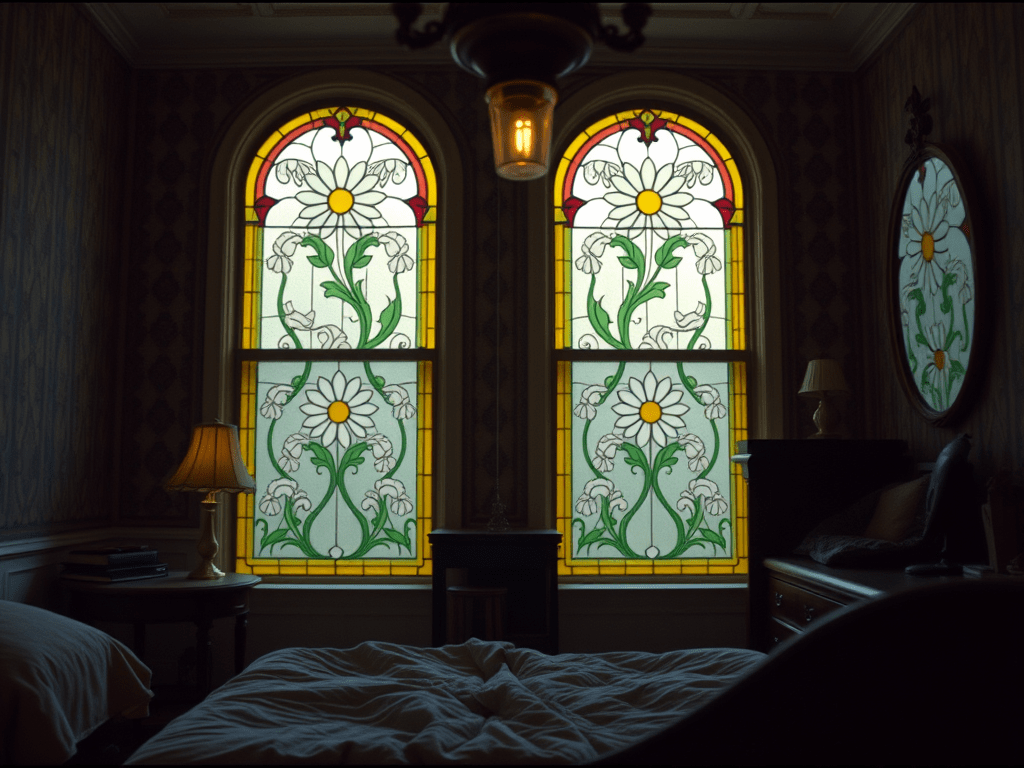
In order to verify predictions, it is necessary to define success, that is, winners and losers. A winner is someone who succeeds in what he says he is going to do. A loser is someone who fails to accomplish what he sets out to do. A man who says: “I am going to Reno and gamble,” is only committed to getting there and betting, regardless of whether he wins or loses. If he says: “I am going to Reno and this time I am going to win,” then he comes out a winner is he wins and a loser if he does not, depending upon how much money he has in his pockets when he gets back on the pavement. A woman who gets a divorce is not a loser unless she has said “I will never get a divorce.” If she has declared: “Some day I am going to quit my job and I will never work again,” then her alimony will signify that she is a winner, because she has accomplished what she set out to do. Since she had made no statement as to how she would do it, no one can fault her with being a loser. Each language provides words that sensitize a person to those aspects of the World that are most important for survival in that place. Thus, we have only one word for snow, whereas Inuit people have many, corresponding with different qualities of snow, which indicate whether hunting or igloo building is possible. We do not see the World; rather, we “read” the meanings of what we see, just as we read the words in a book. These meanings are provided for us as we grow up by the person who teaches us to speak our “mother tongue.” #RandolphHarris 9 of 25

It is our mothers who give the first meanings to our World, who gives the World the “voices” with which it tells us of dangers and gratifications. In developing countries like Indonesia or India, each child learns three languages, each of which highlights some aspects of the World more than others, and which gives different meanings and emotional qualities to the perceived World. Thus, a child will learn the language of the village from his or her mother; in India or Indonesia, it will be one of the several hundred local languages, which differ so much that people fifty miles apart cannot understand one another’s mother tongues. At school an Indonesian child will learn Malay, and an Indian child will learn Hindi—both languages are the national tongue, which facilitates communication throughout the country. Finally, both Indonesian and Indians may learn English, which makes communication beyond national boundaries possible. In each case, the language that is spoken affects perception. In order really to perceive what is there in the World, a person will have to suspend language and really look and listen, to discern the reality beyond language. For many, to sustain an inner calm is not easy. Many a time, in test situations, he will fail. However, even when the negative, explosive, or depressive emotion asserts itself strongly, he is not to show it in behaviour no express it in speech. For this is a step toward that control of self, that impersonality, which is what the quest means. If mind influences body, body also influences mind. From the physical control he may proceed to the mental. #RandolphHarris 10 of 25
When calmness has been well practiced for a sufficient period, it will occasionally of itself lead the practiser into sudden brief and ecstatic experiences of a mystical character. He should calmly recognize that suffering has its allotted function to perform in the divine plan, that other people have their lessons to learn through it when they will learn in no other way, and that the spectacle of its operation should, in such cases, be met with intelligent understanding rather than with neurotic sentimentality. He should face the fact that many people will not learn from reason, intuition, or teaching and that no one can really liberate them from their sufferings except themselves. Every other kind of liberation is a false one. Others may effect it today only to see the same condition return tomorrow. He should not, in certain situations calling for hard decision, for instance, show unjustifiable weakness under the belief that he is showing forbearance, nor submit to antisocial egotism under the thought that he is practising love, nor abandon his highest duties for the sake of making a false and superficial peace with interfering ignorance, nor passively accept a flagrant wrong because God’s will must always be borne. The lower emotions and the moods they produce are his first enemies. Every antagonism and envy, every wrathful temper and animal lust, every self-injuring desire and socially harmful greed bars his way. And it will not move out of the way without a long fight. #RandolphHarris 11 of 25

This spiritual quest takes the aspirant through many moods. He will alternate at times between blank despair and exalted joy. Though naturally affected by these moods, he ought nevertheless to try to keep a certain balance even in their very midst, to cultivate a kind of higher indifference towards them, and patience towards their results. This can be achieved more easily by obtaining a firm conviction of the transient character of such moods. Both emotion and reason have their proper place in practical life, but in the philosophic life where the Quest is for truth alone and not for satisfaction, there is no place for emotion other than a secondary one. Its power over man is so great however that it will continually come into conflict with this ruling, it will struggle desperately to resist reason and to silence its voice, it will contradict the dictate of calm considered judgment and seek by sheer force to dominate the mind. Again and again the uprush of emotion will disturb the would-be philosopher and destroy his equanimity, thus rendering impossible a correct appreciation of the truth he seeks. The melancholy feeling that he is missing something joyous in life, that a happiness which so many others have captured is running away from him with the years, so one of the emotional snares likely to beset the aspirant’s path. #RandolphHarris 12 of 25

If he yields to its self-pitying suggestiveness, it will weaken his resolve and disturb his peace. From that it is only a step or two to descend into a painted and delusive animality. Those who waste themselves in emotional excesses weaken themselves spiritually, for the power of feeling is an essential part of the higher nature. With the pressures brought down upon them by his total philosophic effort, the grosser desires will gradually be flattened out anyway. If he deliberately and directly assists them to enter that condition, it will not be to his detriment. If we are to command our deeds, we must command our thoughts, but much more, we must command the emotional impulses behind those thoughts and those deeds. When he is tempted to be angry with some irritating person, he is faced with two choices: either to identify himself with this lower emotion or with his higher aspirations. If, following bad habit, he succumbs to the first, he weakens himself still further. If, following good resolve, he overcomes the temptation, he strengthens himself for the future. Strong emotional attachment to another person may only tighten the ego’s hold, may narrow, limit, warp, or prevent the seeing of the truth. This happens all-too-often in family relationships and in the affections of the young. It can even happen in guru-disciple relationships. #RandolphHarris 13 of 25

When it comes to relationships, it is the responsibility of the national leaders to forge that sword through their foreign policy. The purpose of this foreign policy must be the securing of weapons and finding allies. The state is only a result of human forces, only a work of our thoughts, but man is the force of the source itself and the creator of the thought. As the deputy of all humanity whose heart beats, for all mankind, our passion must be the World and future generations. At a time when everybody is bust erecting new Fatherlands, the Fatherland of the man who thinks without prejudice and can rise above his time is nowhere and everywhere. However, nationalism killed humanism. The nation and its sovereignty have become the new idols to which the individual has succumbed. With all the new technology, the revolution of the colonial peoples, communication by air, the radio, etcetera, have shrunk the globe to the proportions of one continent or, rather, one state as they existed one hundred- and seventy-years ago. The One World which is in the process of being born is, however, not one World because of the friendly and brotherly relations that exist among its various parts, but rather because of the fact that missiles can carry death and destruction to almost any part of the World in a matter of hours. The one World is one, so far, inasmuch as it is one potential battlefield, rather than a new system of World citizenship. #RandolphHarris 14 of 25

We live in one World, yet in his feelings and thoughts contemporary man still lives in the nation state. His loyalties are still primarily to sovereign states and not to the human race. This anachronism can only lead to disaster. It is a situation similar to that of the religious wars before religious tolerance and coexistence became an accepted principle of European life. If the One World is not to destroy itself, it needs a new kind of man—a man who transcends the narrow limits of his nation and who experiences every human being as a neighbour, rather than as a barbarian; a man who feels at home in the World. Why is this step so difficult? Man’s life begins in the womb. Even after birth he is still part of mother, just as primitive man was part of nature. He becomes increasingly aware of himself as separate from others, yet he is deeply drawn to the security and safety of his past. He is afraid of emerging fully as an individual. Mother, the tribe, the family—they all are “familiar.” The stranger, the one who is not familiar through the bonds of blood, customs, food, language, is suspected of being dangerous. This attitude toward the “stranger” is inseparable from the attitude toward oneself. As long as any fellow being is experienced as fundamentally different from myself, as long as he remains a stranger, I remain a stranger to myself, too. When I experience myself fully, then I recognize that I am the same as any other human being, that I am the child, the sinner, the saint, the one who hopes and the one who despairs, the one who can feel joy and the one who can feel sadness. #RandolphHarris 15 of 25

I discover that only the thought concepts, the customs, the surface are different, and that the human substance is the same. I discover that I am everybody, and that I discover myself discovering my fellow man, and vice versa. In this experience, I discover what humanity is, I discover the One Man. Until now the One Man may have been a luxury, since the One World had not yet emerged. If the One World is to live, now the One Man must emerge. Historically speaking, this may be a step comparable with the great revolution which was constituted by the step from the worship of many gods to the One God—or the One No-God. This step was characterized by the idea that man must cease to serve idols, be they nature of the work of his own hands. Man has never yet achieved this aim. He changed the name of his idols and continued serving them. Yet he changed. He made some progress in understanding himself, and tremendous progress in understanding nature. He developed his reason and approached the frontiers of becoming fully human. Yet in this process he developed such destructive powers, that he may destroy civilization before the last step is taken toward constructing a new humanity. #RandolphHarris 16 of 25

Indeed, we have a rich heritage which waits for its realization. However, in contrast to the men of the eighteenth and nineteenth centuries who had an unfailing belief in the continuity of progress, we visualize the possibility that, instead of progress, we may create barbarism or our total destruction. The alternative of socialism or barbarism has become frighteningly real today, when the forces working toward barbarism seem to be stronger than those working against it. However, it is not the “socialism” or managerial totalitarianism which will save the World from barbarism. It is the renaissance of humanism, the emergence of the new West which employs its new technical powers for the sake of man, rather than using man for the sake of things; it is a new society in which the norms for man’s unfolding govern the economy, rather than the social and political process being governed by blind and anarchic economic interests. Until the joyful time comes when negative moods or thoughts have ceased to cross the threshold of his consciousness, man must struggle with them by a combination of different methods. First, his will must follow them at once after their entry and remove them forcibly. Second, his imagination and reason must attack them in the prayer period set aside each day for that purpose. Whether or not it is possible to attain a perfection of calmness that is secure against all assaults, it is surely possible to attain sufficient calmness to keep off many or most of the emotional disturbances and mental turmoil which derive from the petty incidents of everyday life. #RandolphHarris 17 of 25

The Sacramento Fire Department protects the lives and property of Sacramento residents and visitors by serving as fires responders to fire, public safety, medical emergencies, and other emergency related situations. “It was a five-alarm fire, a four-story building that had at one time been a manufacturing plant but now had a bar and a restaurant on the first floor and a menagerie of rooms upstairs. It was a gay bar, and the guy who owned the place was gay. The top three floors were his playground. The night of the fire he picked up this kid over at the park, took the kid out, wined and dined him. The kid wanted money, but the guy didn’t want to pay anything. So the kid beat him up and left him there in the building, left him for dead. He then set the fire to cover his behind. I was acting battalion chief at the time, and I covered the fire on the second alarm. The first-alarm company got there and found the guy. He was all bloody. They laid him on the sidewalk at the side of the bar, and he kept saying that the boy was still in there. The police sent the dogs in. They found the kid and chewed him up a bit, but the firemen got him out. The call that came in said they had a small fire on the second floor. Well, the first-alarm chief saw the smoke pumping out beams. No fire, but a lot of smoke coming out of the eaves on the fourth floor. He knew he had more than just a small fire, so he called for the second alarm. I was the second chief in and was assigned to the rear of the building. We were back there, and we had master streams in operation. About then the fire was blowing out all of the windows in the back and front and coming through the roof in one corner. #RandolphHarris 18 of 25

“About an hour later the majority of the fire was out, so we shut the big lines down to get inside and do some interior firefighting. I had the company stretched hand lines and inch-and-a-half up the aerial ladders and into the windows. I was at the top of the ladder, and there was a guy from X Engine, (who we will call Z), who was having trouble with his air mask. He was below me on the ladder. The department had just switched over to a new self-contained air mask, and we were having problems with this one fitting where the face piece connected to the regulator. Z did’nt have it just right. It kept popping loose on him. ‘Well, look,’ I said, ‘get your mask straightened out. I’m going to go inside, and when you get done bring your line up and I’ll meet you in there. I’ll see what we’ve got to do.’ So he went back down. I was on the fourth floor, and I looked into the window with my hand light to see the floor. It was black, all black. I straddled in, leg over windowsill, and had my feet on the floor. Real good sound floor, nice and solid. The darkness was pitch black, as black as it might be inside a collapsed mine shaft. I took two septs, and I started falling. I just started falling. Looking back on it when the doctor asked what happened and going back and looking at it after the fire, I figure out what had happened. But here I was, falling in this complete darkness. Halfway down, about thirty feet, I hit something, straddling it. #RandolphHarris 19 of 25

“Thirty feet and I stopped short between my legs. That is where I fractured my pelvis in for placed. I momentarily stayed in that position, but the momentum of my fall kept me going off there and down another thirty feet. I was now down five stories, and in the basement. I landed on my back in about three feet of water. I landed hard, and I broke my back in two placed. The doctor said that the mask on my back was what saved me. Without it I would have been killed. I had fallen down an elevator shaft. The building was originally a factory where they made automobile tires. The shaft was for one of those huge freight elevators that you could drive a care into, and take it up to different floors and have the tires changed on it. That window I had climbed into opened into the shaftway. The law says that windows opening into shafts must be barred, and I think it was originally barred, but the guy, when he bought the building, did all this renovation work up there, either on the sly or whatever. What I was stepping on was a floor that was probably three feet wide with a steel beam around it, and the car would come up and stop at that floor, that’s why it was still there. The elevator was caught in the fire and was burned out, like the whole bottom of the car was burned out. The only thing left of the car was the metal frame. It was the beam at the top of the elevator that I straddled and flipped off of at the second floor and fell through the elevator to the bottom, that second thirty feet. #RandolphHarris 20 of 25

“So I was lying in three feet of water. I couldn’t stand up, my legs wouldn’t move, nothing. I said to myself, calmly, ‘Well, I’ll just lie here.’ I’m lying there, then I realize I’m being pulled down. My coat is being saturated, and the weight of the coat started pulling me down, and down, and down. Suddenly, my nose is under water. I was trying to float, but I couldn’t because the coat was pulling me down and the boots were full of water and I couldn’t stand. I was beginning to drown. My regular job was captain of the rescue unit, and I knew about scuba and had a lot of water experience. I said, ‘Keep your cool, keep your cool. Don’t panic. Get your coat off.’ I was in no pain. I couldn’t feel a thing. I was just worried about drowning. I went completely under water then, knowing it was my only chance, unsnapped my coat, got one arm out and got the other arm out. The coat dropped away, the heavy mask canister with it. I thought that would save me. Then I started reaching out, and I touched this wall. It was an unfinished wall, just plain bricks. I put my fingertips in the mortar joints and started pulling my head up. I realized I was in a corner, and I’m like, ‘There’s got to be a way out of here.’ So I started going around like this, pulling with my fingertips. I hit another corner, made another turn, and there was a ladder there, a ladder in the wall. ‘Great,’ I said, ‘stay here and wait.’ The water was still cascading in from the streams, getting deeper and deeper. ‘Great’ I’m saying, ‘if the water rises, I’ll rise with it up the ladder.’ #RandolphHarris 21 of 25

The next thing was. The smoke started banking down. I said ‘Oh God. I’m going to suffocate.’ I started coughing, and I got down closer to the water. I was okay, I had this much room at first, and then the smoke was banking down farther and farther. I was down to the water again, my nose just touching it. Then I could hear the debris falling. The first thing I thought was that Z had done the same thing I did. I went back and started feeling around to see if he’s there. I heard people hollering up there. I heard Z holler in the window that the floor was going and that something was wrong. I still didn’t know where I was. I lost my portable radio on the way down. They found that hanging between the second and third floor where a piece of metal was sticking out. I fell and I just missed the metal, but it grabbed the radio and pulled it off my coat. It was hanging there. I lost my helmet, and they later found a piece of it, the plastic eye protection part melted. It had fallen into the fire on the second floor, which was still burning up there. Like I said, I hear all this debris falling, and I thought it was Z, and I went out to look to see if it was. I tool a little step and realized that I just couldn’t do it, I couldn’t stand. So I started calling to see if it was him. Nobody answered. Then I heard somebody holler, ‘There he is.’ This guy we will call A came down the ladder, and he started to touch me, and I said, ‘Don’t touch me, something is broken.’ He hollered, ‘Thrown a rope down here.’ I said, ‘Don’t tie any rope around me, something is broken and I can’t move my legs. I can’t feel anything.’ #RandolphHarris 22 of 25

“So they got the Stokes basket down there, and they floated me on that, then lifted me up and out. They put me in the medic unit, and I went right to the shock trauma center. I still don’t remember a lot of it. I don’t remember blacking out. There are times when I lie at home and I wake up and think, ‘Oh, that’s right, that happened.’ The first fall, I didn’t think that I was going to fall that far, it was only one floor. It’s not going to be even twenty feet. It’s not going to be that bad. It’s not going to be thirty feet. I’m not expecting that I’m going down a shaft, you know, right to the bottom. And when I hit, it felt like I was falling longer than I should have, but it’s pitch black and I can’t see anything, so I’m not expecting it or anything. It’s just falling into the darkness, and then when I hit, it was like, ‘Christ, oh God.’ The beam went right up into my groin. When I started falling, I was worrying about being impaled, about falling into some debris and having a two-by-four go through me. When I hit with my legs apart, the pain was intense through my groin. I was black and blue from my knees to my chest, a dark purple. My privates were swollen the size of grapefruits, because the actual impact was right there. I thought, Hey, this isn’t too bad, it’s over, I’m still alive. And then I realized that I was falling again. I still can’t see anything. I haven’t seen anything yet, no walls. I haven’t felt anything other than hitting the piece, and then I’m going again. I didn’t know I was in an elevator shaft. I had no perception of depth or how far I had fallen. I could have fallen five feet and hit something and then five more feet and been on the third floor. I had thought it was over, and I was falling again, and I realized, ‘No. It isn’t over yet.’ #RandolphHarris 23 of 25

“Another thirty feet. That’s when I did the complete somersault from straight up and down when I first fell, and the beam catapulted me over, and I was falling back first, and that’s when I impacted the water. And then it was like, ‘Oh damn, where am I now? What’s going on?’ In my scuba training I knew that when you first go down you’re apprehensive and you start breathing faster and you get yourself worked up, and you have to calm yourself down. That’s what I was doing. I was like, ‘Okay, keep your cool, you know you’re not dead, and you can get out of this.’ And then I started sinking, and I was like, ‘Oh God, you’re going to drown. You’ve got to get your coat off.’ The water was still coming in. I figure there were ten ladder pipes in service and maybe fire two-and-a-half-inch hand lines, that’s fifteen hoses shooting water in. Coming right down, you could hear it. It was like a waterfall. It’s like, okay, I have the coat off and I’m not going to drown because I have the ladder. Then I thought, ‘God, it’s filling up.’ But I felt good holding on to the ladder. If water keeps coming, I’d just float up with it, and I felt secure. Then the smoke started banking back down, and I started getting scared again. It was like you can’t breathe, coughing. Like, let’s get to the window. But, hell, I can’t move. I can’t go to a window. And I had no mask. So I got lower and lower, with my mouth and nose just above the water. It’s breathable there. It’s still pretty thick smoke, but it’s not something that I’m not used to. Then like I said, I heard the debris falling. #RandolphHarris 24 of 25

“I didn’t know whether anybody knew that I’d fallen. I didn’t know whether Z had come up the ladder or not. I had told him to some back up, but he could have gone down and had his assignment changed by another officer and just, you know, forgot about me. My relief wasn’t due until seven, and this was about four-thirty in the morning. I’m thinking, this is it, this is the way I’m going to die. Then finally I heard somebody holler, ‘There he is.’ Like I said, there was no pain at that time. They got me in a medic unit, and that is when I started feeling pain. After a long recovery time, I was still not back to work. I was on administrative leave. My detail was an office job until I could get myself back to where I could go back to firefighting. I’ll get there.” The Sacramento Fire Department works continually to upgrade fire apparatuses and technology, to educate the public in fire prevention, life safety and disaster preparedness, along with enforcing public safety codes, while ensuring a safe and secure environment to all citizens and visitors through professionalism, leadership, teamwork and partnership with all levels of Government. You can help save lives by donating to the Sacramento Fire Department. I pledge allegiance to the flag of the United States of America, and to the republic for which it stands, one nation, under God, indivisible, with liberty and justice for all. #RandolphHarris 25 of 25

The Winchester Mystery House
One winter night while closing up The Winchester Mystery House, a caretaker had worked up a sweat. As he was walking down a flight of stairs, the wind grabbed him, lashing at he face, and immediately the sweat on his cheeks frosted over. His hands shook uncontrollably, the lights in the mansion began to flutter. Somewhere, almost muffled by the whine of the wind, he heard a distant clanking—a dull sound echoing across the mansion. He hesitated, tried to recognize the source, but failed. His legs ached with every step. His eyes and ear stung from the frigid blasts of wind he felt inside the house. He longed to rest, but finishing his job pushed him onward. As he reached the last step, he was greeted by what sounded like a bell tolling, warning the countryside of some unseen danger. He rested for a moment. Creeping among the twisting hallways of the mansion, he noticed for the first time that it looked rather peculiar.

He moved slower now, still confident, but careful. After a few moments, he stood motionless, watching the walls shake and curtains sway, chair scraping the floor and rattling against each other. A hazy vision of dancing skeletons and demons appeared. It’s called the house built by spirits, the demons announced, glistening worms squirming from their rotten, toothless mouths. Come join us, they invited, waving long, bony fingers. Come. And he wanted to go. They sounded so inviting. Suddenly, tears streamed down his face. The mansion came to life around him, breathing for the dead. The wind gained strength. The caretaker collapsed hard to the floor. For just one moment, an ivory sliver of moonbeam slipped through the darkness, quickly disappeared. The winter sunrise was still two hours away.
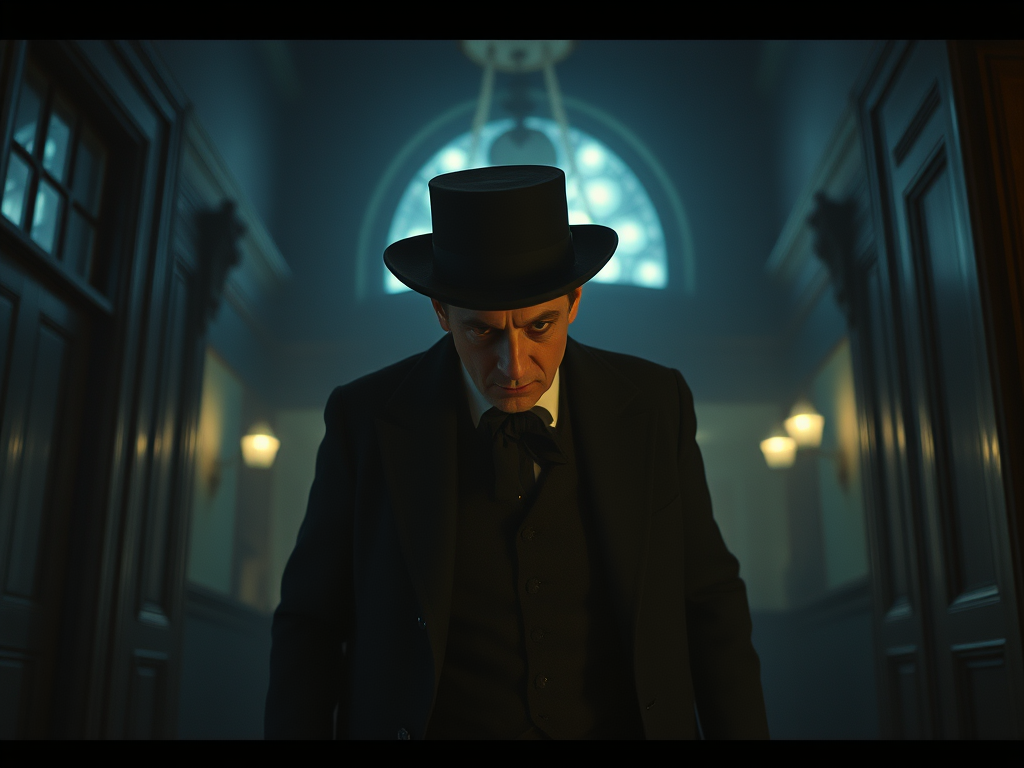
Please come and enjoy a delicious meal in Sarah’s Café, stroll along the paths of the beautiful Victorian gardens, and wonder through the miles of hallways in the World’s most mysterious mansion. For further information about tours, including group tours, weddings, school events, birthday party packages, facility rentals, and special events please visit the website: https://winchestermysteryhouse.com/

Please visit the online giftshop, and purchase a gift for friends and relatives as well as a special memento of The Winchester Mystery House. A variety of souvenirs and gifts are available to purchase. https://shopwinchestermysteryhouse.com/

Evil Behind Smiling Eyes

Obviously, one must hold oneself responsible for the evil impulses. Therefore, beware of the evil behind the smiling eyes. As we increase our understanding and love for the Saviour, His light will illuminate everything around us. We will then see evil for what it is. Working as a special agent for the FBI, my friend investigated organized crime groups transporting illegal drugs into the United States of America. On one occasion, he and another agent approached an apartment where they believed a known drug dealer was distributing cocaine. My friend describes what happened: “We knocked on the door of the drug dealer. The suspect opened the door, and upon seeking us, tried to block our view. However, it was too late’ we could see the cocaine on his table. A man and a woman who were at the table immediately began removing the cocaine. We had to prevent them from destroying the evidence, so I quickly pushed the drug suspect who was blocking the door to the side. As I pushed him, my eyes met his. Strangely, he did not appear angry or afraid. He was smiling at me. His eyes and disarming smile gave me the impression that he was harmless, so I quickly left him and started to move toward the table. The suspect was now behind me. At that instant, I had the distinct, powerful impression come into my mind: ‘Beware of the evil behind the smiling eyes.’ #RandolphHarris 1 of 17

“I immediately turned back toward the suspect. His hand was in his large front pocket. Instinctively I grabbed his hand and pulled it from his pocket. Only then did I see, clutched in his hand, the semiautomatic pistol ready to fire. A flurry of activity followed, and I disarmed the man.” Later, in another case, the drug dealer was convicted of murder and boasted that he would have also killed my friend had he not turned around at that very moment. He was a weak sniveling punk. A born snitch. He caused my friend trouble before. He had this place near Palm Springs. Used it for a hideout. It was loaded with guns and heroin. One weekend, there was this underaged girl that the heat was looking for and they went to the door. They were looking for this girl, and he said get a warrant. My friend in the FBI said he would. So, the other dudes covered the side doors, and one of them got a shotgun and two pistols and waited at the end of the hallway. His old lady answered the door, but when the FBI came, the sixteen-year-old girl went to the door and gave herself up. So, the offenders piled the guns in the car, and drove to another location. On this planet, evil has been allowed a position of influence to give us the chance to choose between good and evil. #RandolphHarris 2 of 17

The scripture says: “God gave unto man that he should act for himself. [And] man could not act for himself [unless] he was enticed by one or the other. The choice between good and evil is at the very heart of our experience on Earth. If we are rich or poor, if we were athletic or not, if we had friend or were often forgotten, in the final review of our lives, it will not matter. The suspect with the guns in the car was apprehended. The morning after sentencing, the orders came through transferring him to the State Prison. Emigration from short-time County Jail to long-term penitentiary. In the basement holding tank, stripped of county wrappings, he dressed for the final time in mod flannels. He was stored in a special isolated holding tank until the County Jail bus drove through the smoggy freeways to the Prison Reception Center at Chino, California. The welcoming committee was grim and blunt. “Strip naked. Throw your personal belongings in the box. Bend over for body inspection. Run your hands through your hair, both your ears. Open your mouth. Wag your tongue. Lift your testicles. Turn around spread your buttocks. Left foot. Right foot. Shower,” the authorities told him. He dressed in the new prison uniform. #RandolphHarris 3 of 17

A tall African American in blue danced over. He gave him ten hand-rolled cigarettes. The rumor wind was blowing around him. They were going to put him in the hole. The Captain wanted to see him. They were going to ship him to the Medical Center at Vacaville. And he would be getting bailed out the next day. The sergeant checked inmate for long hair and ordered him to the barber. He got a last mirror glimpse at forest hair and moustache. He asked the barber to leave as much as he could, but the barber grunted and clipped. “Don’t complain, man. You look twenty years younger,” he said. Our offender then took sheets and blankets and followed the sergeant to solitary confinement. It was a bad-boy lock up for him. He walked by the cages of the dangerous wild men. They shouted in pleasure to see him. An African American man shouted: “Hey man, we gotta talk to you. We cannot see each other. Just cries from cage to cage.” A nasty Brooklyn voice denounced the offender. “Oh, he’s that bad man! Hang him.” Another African American defended him. Shorty’s Brooklyn voice turned friendly. “Hey Doc, look at these pictures.” A hand from the next cell appeared holding colour snapshots. Sadeyed blue wife and clear-eyed kids. “Hey Doc, here’s a record of my trial. Read it.” “Hey Doc, you want some cigarettes.” “Hey Doc, you need some stamps and envelops.” “Hey Doc, you wanna a Playboy magazine?” #RandolphHarris 4 of 17

Dinner was passed through a slot in the bars of the narrow white counter bod. Then the evening sports. African American used mirrors to catch the setting sun, playing sunshine tag, racing reflected birds of light against the wall. Laughing and shouting. At the hour of romance, from his solitary cell a young man sadly coos a soft message and an African American voice rumbles back: “You Karl I going to get you expletive. What I’m gonna do to you girl! Hoooeee. I got me twenty inches for you. You my expletive.” “Oh no big boy, I’m my own man,” he repiles. “Great God almighty, I gotta het me some sweet white meat. I sick to death of my own right hand. Wheee—here I come Karl. Ohhhhh what I’m gonna to do to you siter. I gonna split your pink expletive girl. Stuff my tool up your belly, split yo kidneys girl. Gut you baby so you gonna never be able to walk again. Oh, Mr. Guard let that man out. Oh let him loose. I need that man.” Our offender now has a momentary reflex, fear of being trapped in a cell holocaust was calmed by the cement steel of maximum security. Next morning the offender is called to the Captain’s office; sitting watching trustees run the prison, typing, phoning, filing, serious responsible people working proudly. “We’ve finally got you, huh. You are going to be with us a long time. Ha ha. You’re smaller than on TV. I guess we cut you down to size, huh,” said the Captain. #RandolphHarris 5 of 17

Prison is a very dangerous place. Be sure to think before committing an illegal act. You may think you are high and mighty, until the cell doors close on you. We can work, study, laugh and have fun, dance, sing, and enjoy many different experiences. These are a wonderful part of life, but they are not central to why we are here. The opportunity to choose good over evil is precisely why we are here. Not one of us would say, “I want to choose evil.” We all want to choose the right. However, the choice of good over evil is not always easy, because evil frequently lurks behind smiling eyes. Listen to these warnings: “Take heed…that ye do not judge that which is evil to be of God.” “Ye must watch and pray always lest ye enter into temptation; for evil desireth to have you.” The message is: Beware of the evil behind the smiling eyes! I have known a few young men who began with every intention to stay firm in their loyalty to the Saviour but who slipped from the path because they did not see the evil behind eyes that appeared quite harmless. They saw the fun, the pleasure, the acceptance, but they did not see the other consequences. How, then, can we discern the evil being something that does not appear evil? First, talk to your parents. We fathers know we are far from perfect, but we love you, and along with your mothers, have deep interest in your choosing the right. #RandolphHarris 6 of 17

Very importantly, let the Holy Ghost be your guide. The Lord has promised us that as we live righteously, the still, small voice will come into our mind and into our heart. You have felt this influence. You know this voice. The gift of the Holy Ghost is a spiritual gift. It is sensitive and will not be associated with unworthiness. You cannot offend or ignore it one day and expect it to strengthen you the next day. However, as you heed its promptings and remain righteous, it will grow stronger within you. The Holy Ghost warned my friend of physical danger; they Holy Ghost will also warn you of spiritual danger. Finally, gain your own testimony of the Saviour. Pray passionately. When no one is watching, read the Christian Holy Bible and the Book of Mormon. Take time alone to think about who Jesus Christ really is and how His life and sacrifice are important to you. If we bother to look back at America’s foreign policy after the 2020 election, we are shocked by the constant failures of our government. The August 2024 jobs report reveals a sharp contrast in employment trends between American born and foreign-born workers. Native-born Americans lost over 1.3 million jobs over the last year, while foreign-born workers gained more than 1.2 million jobs. #RandolphHarris 7 of 17

New York City hands illegal immigrants $4,000 and gift cards to move out of shelters. And the Department of Justice reports an illegal immigrant used a stolen identity to vote. A man who sees the constant and incomprehensible decline of his government can only drop his head in despair, or feel the beginning of an internal desire for a flaming rebellion against such a regime. However, as we increase our understanding and love for the Saviour, His light will illuminate everything around us. We then will see evil for what it is. Children need the peace that comes from knowing they have a loving Heavenly Father, who sent His Son, Jesus Christ, to bring light and hope into the World. It is up to us as adults to direct children to that peace and light. From the flight against the authority of Church, State, and family which characterize the last centuries, we have come back full circle to a new obedience; but this obedience is not one to autocratic persons, but to the organization. The “organization man” is not aware that he obeys; he believes that eh only conforms with what is rational and practical. Indeed, disobedience has become almost extinct in the society or organization men, regardless of their ideology. Yet one must remember that the capacity for disobedience is as great a virtue as the capacity for obedience. #RandolphHarris 8 of 17

One must remember that, according to the Hebrew and Greek myths, human history began with an act of disobedience. Adam and Eve, living in the Garden of Eden were still part of nature, as the fetus is in the womb of the mother. Only when they dared to disobey an order were their eyes opened; they recognized each other as strangers and the World outside as strange and hostile. Their act of disobedience broke the primary bond with nature and made them individuals. Disobedience was the first act of freedom, the beginning of human history. Prometheus, stealing the fire of the gods, is another disobedient dissenter. “I would rather be chained to this rock than be the obedient servant of the gods,” he said. His act of stealing the fire is his gift to men, thus laying the very basis for civilization. He, like Adam and Eve, was punished for his disobedience; yet he, like them, has made human evolution possible. Man has continued to evolve by acts of disobedience not just in the sense that his spiritual development was possible only because there have been men who dared to say “no” to the powers that be in the name of their conscience or of their faith. His intellectual development was also dependent on the capacity for being disobedient, disobedient to the authorities who tried to muzzle new thoughts, and to the authority of long-established opinions which declared change to be nonsense. #RandolphHarris 9 of 17

If the capacity for disobedience constituted the beginning of human history, obedience might cause the end of human history. I am not speaking symbolically or poetically. There is the possibility that the human race will destroy itself and all life on Earth within the next tend to fifteen years. There is no rationality or sense in it. However, the fact is that while we are living technically in the atomic age, the majority of men live emotionally still in the stone age, including most of those who are in power. If mankind commits death by suicide, it will be because people will obey those who command them to push the deadly buttons, because they will obey the archaic passions of fear, hate, and greed; because they will obey obsolete cliches of state sovereignty and national honour. By the time he gets to “I Guess I’D Better Drive You, Dear” or “Getcher Expletive Outa Bed,” or even, “I’ll Beatcher Goddam Brains Out If You Don’t,” the child already has certain convictions about himself and the people around him, especially his parents. These convictions are likely to stay with him the rest of his life, and may be summarized as follows: I’m O.K. or; I’m not-O.K; You’re O.K. or; You’re not-O.K. On the basis of these he makes his life decisions. “It’s a World, some day I’ll make it a better one”—through science, service, poetry, or music. #RandolphHarris 10 of 17
“It’s a bad World, someday I’ll kill myself”—or kill someone else, go crazy, or withdraw. Perhaps it is a mediocre World, where you do what you have to do and have fun in between; or a tough World, where you make good by putting on a white collar and shuffling other people’s papers’ or a hard World, where you sweep or bend or deal, or wiggle or fight for a living; or a dreary World, where you sit in a bar hoping; or a futile World, where you give up. I believe that we are in great danger of being converted into complete organization men, and that means, eventually, into political totalitarianism, unless we regain the capacity to be disobedient and to learn how to doubt. In working with unusually defensive, withdrawn or fearful individuals we find it even more important than ever not to impose ourselves on them. How is non-imposition consistent with a therapist who expresses more of himself more openly and actively, and who initiates relationships by expressing himself? Tentatively, if he will express himself—his own imaginings, his own feelings, desires, the events which transpire in him—and if he does this clearly and explicitly as statements about himself, or about events transpiring within him at the moment, I think the answer is: the therapist can be more active and at the same time present less imposition and threat. In this way he shares himself more openly, yet he does not impose on the client’s experience. He speaks for himself with events in the client. #RandolphHarris 11 of 17

The content of our field of perception is necessarily selective; it cannot include all inner and outer reality that exists at a given moment. Only part of the ongoing flow of feelings, thoughts, and external events is defected by our sense organs and represented in our field of awareness. Our sense organs resemble TV or radio receivers, in that they are differentially sensitive to stimuli of different intensities and qualities. However, even within the receptive range of our senses, we still notice only a fraction of all the sensory information reaching our brain. Some of the important determiners of figure, that is, of our focus of attention, are unfulfilled needs. Our feelings and our needs direct our perception, thinking, remembering, and fantasy, so that the figure will be that perception, thought or memory most relevant to our needs of the moment. Our cognitive processes are thus servants of our needs. When we are hungry, we think and dream about food, we search for it, and we tend to ignore everything in the World that is indelible or that will not help us to get food. If we are deprived of pleasures of the flesh, we tend to have fantasies with erotic themes, we find it difficult to think about other things, and we look at the World from the standpoint of the gratification of pleasures of the flesh and frustration it is likely to afford. #RandolphHarris 12 of 17
If we are anxious because of some threat to our security; we are too busy seeking the source of danger so that we might escape from it. There have been many experiments conducted to demonstrate how needs determine our attention and the content of our consciousness, and so we need not dwell further upon this point. More germane to our discussion is the manner in which emotions and unfulfilled needs operate to distort our perceptions and beliefs. We hear much from the moralists about the need of encouraging young men and young women to express themselves and of not letting society impose its will upon them, as we hear much from the psychoanalysts about the need of liberating them from secret inhibitions and of satisfying their repressed emotions. Both these movements are excellent. They are antidotes to the tyrannic soul-crushing, hypocrisy-breeding, and self-deceiving conventions of the old society. However, a good overdone may become an evil a virtue stretched too far may become a vice, and a method which ignores all the facts of the diamond of psychological truth except a single one may become unbalanced. The new morality may free people to the point where liberty is merely license and expression a dangerous disregard for the knowledge yielded by experience and age. The new psychoanalysis may free them to the point where mental liberation is mere lack of self-control and emotional satisfaction is dangerously anti-social. #RandolphHarris 13 of 17

This is not to say that we would belittle the value of either. Both standard points may be philosophically used, which means they may be used in a balanced manner as a part of a wider one. The whole man is the natural man. Whoever sets up a cleavage between the intellectual and emotional functions, and would ignore the latter in order to enthrone the former, is unnatural and cannot attain that truth which is the voice of nature. This is not to say that emotional or reason should run riot; it is proper and necessary to give reason the reins, but this done, any sharper division will lead to unbalance, distortion, and error. Yes, the emotions of a person who is called hard and dry may need to be released, but this applies only to the positive ones. The negative ones are not worth releasing and should be got rid of. Anger and hatred are dangerous emotions to carry about with you. Whether or not they lead to actions harmful to the person they are directed against, they are certainly harmful to you. Conquer them quickly, get these psychological poisons out of your system. There is another kind of negative trait which, although unaggressive, is only less unpleasant by a matter of degrees than the aggressive ones. It is the black and bitter mood of sullen coldness, of the self-centered, self-tormenting, self-pitying sense of being wronged by the other person, the introverted, withdrawn, sulky, resentment at being hurt, a resentment so deep as to find no fitter expression than gloomy, frozen, and tense silence. #RandolphHarris 14 of 17

He places all the blame for the situation on the other and consequently adopts a grieved unconciliatory attitude towards the other. He wounds by saying nothing, doing nothing, and being boorish. The atmosphere around him is full of sustained and hostile emotional tension. It is, of course, an adolescent trait and cannot endure when spiritual maturity is really attained. What the unawakened man feels as fear, the awakened one transmutes into needful caution and careful forethought. It is a feat of emotional surgery to relinquish attachments and to renounce possessiveness. Emotions unchecked by reason may become our betrayers. Beware of them when exceptionally strong and unduly excessive. The fears which are natural or necessary should not be confused with the fears which are neurotic or excessive. If the aspirant is to remake himself effectively, he must begin by attacking the lower emotions. They must be killed and eliminated from his life scene. So long as they dominate it, so long will experience yield poisonous fruits instead of healthy-giving ones. Every fresh situation will only give fresh life to his ego because those emotions will involve themselves in that situation and cause him to misread it. The first enemies, the hidden sources of his own difficulties, are within himself. To take the attitude in a depressing situation that the only action is to sit down and be depressed by it is unphilosophical. He should never give himself up to despair, although he may give himself up in hard situations to gravest reflection and deepest resignation. #RandolphHarris 15 of 17

The Sacramento Fire Department provides Sacramento City with the best possible all-risk emergency service in the protection of lives and property. They are and will continue to be identified by their dedication and pride in outstanding customer service, public health, safety, prevention and education. “For the last three years in fire prevention week, another firefighter and I go to all the different schools—anywhere from preschool up to twelfth grade—and teach fire prevention. The students enjoy it. It’s amazing how many students actually remember you. I’ve had kids come up to me in church, and say, ‘I remember you. Stop, drop, and roll!’ And I say, ‘Yeah, you’re right.’ Then I say, ‘What do you do if you have smoke in your room?’ And they’ll tell me, ‘I stay low, and I crawl.’ To me, that’s worth every ounce of time I’ve spent with these kids. If I can just save one of these kids, ever, that’s all I can ask. I couldn’t want any more. One Christmas Eve, we came home from my family’s party, and we tucked our children in. Just like in the storybook, they were all nestled in bed. And my wife and I were being Santa’s helpers, setting out all of Santa’s gifts with their name tags on them, when I got a call that we had a house fire. I remember giving her a kiss and saying, ‘I’ll be back as soon as I can.’ And I left her sitting among all these toys that weren’t put together yet, and all this stuff scattered around, and I went on the house fire. #RandolphHarris 16 of 17

“Thankfully, there was nobody in the house, they were out visiting, but their house was destroyed, a total loss. I came back home, and it was like magic: everything had been done. And there my wife was sitting, with a cup of coffee for me, and she made my Christmas really special. In fact, it was Christmas morning by the time I got back. But she didn’t complain. It didn’t upset her. There have been a lot of occasions when I’ve had to leave her. She has been really good, very supportive, and she’s proud of me, she really is.” The lives and well-being of the citizens of Sacramento, visitors, and department members is their highest priority. The Sacramento Fire Department is fiscally responsible in all they do. You can help save lives by donating to the Sacramento Fire Department. To keep our community peace, please raise your children to love America, love God, and love Jesus Christ. It is also important to be patriotic and buy American cars and other American made goods and services. In order to maintain the tranquility of our city, we must always remember to respect law and order, and treat our elders with the utmost dignity, reverence, and honour. Good neighbours play a vital role in creating a strong and resilient community. They come together in times of need, facing challenges as a united from. Good neighbours build a foundation of unity and creative a beneficial impact on the neighbourhood as a whole. I pledge allegiance to the flag of the United States of America and to the republic for which it stands, one nation, under God, indivisible with liberty and justice for all. #RandolphHarris 17 of 17

The Winchester Mystery House

“One Halloween night, after work, I was playing with another tour guide the front of The Winchester Mystery House. It was Autumn, and the grass was stiff; I remember it was cold that day. We were tumbling on the grass, throwing each other over our shoulders, laughing. I remember the other tour guide twirling me around. We were both getting dizzy and were laughing uncontrollably. We had wandered somewhat from the center of the lawn and started to pick the roses; the petals were stiff and dry. I could see the sun on their dry red, pink, and yellow petals. The other tour guide was laughing. I was running around chasing him, and he picked me up, a bit too fast, tumbling me over his shoulder. I remember the roses coming at my eyes like colorful orbs in slow motion, and then into them. I started screaming, hearing myself scream, and I was flailing my arms and hands, trying to pull the orbs from my eyes, sitting on the ground and screaming uncontrollably, shrieking, my entire body shaking, and then feeling hands on me. His hands were on my face, and the sticky mass of tears and blood, and then I could feel him tugging at the roses, orbs, pulling them free one at a time, gently, and there was a sound as he did it, a sucking sound. The last thing I remember seeing was my coworker’s face after he pulled the last orb free. I could see his face through blood, though I could not see very clearly. There was a look of horror on his face, and then my eyes began to unfocused, as if the world were being pulled away, taking the light with it, and I was alone and screaming. I was so alone. I was sent away to have my eyes cared for. They told me later, much later, that I had been traumatized. I was ill for a very long time, and would not eat or speak; I lived inside. I went through a lot of therapy, and there were a lot of different doctors and hospitals. I was never sent home. I remember screaming, lot of crying, and then, after a long, long time, a kind of peace came over me. I became calm. I told them I was alright, that I wanted to go home. But they wouldn’t listen to me. They wouldn’t send me home. I started to cry. I wanted to see my friend from work again, I want to see him, to tell him I was all right, that he didn’t have to have that look on his face anymore, that it wasn’t his fault. But they wouldn’t send me him. I became so hysterical again, and the therapy began again. For a whole year I didn’t speak. For another year I screamed. And then I became calm again. The other tour guide was sent to an institution. No one knows what actually happened that day. Whatever the case may be, there is no denying that The Winchester Mystery House is a truly mysterious place… and its ghosts just keep getting creepier!”
Please come and enjoy a delicious meal in Sarah’s Café, stroll along the paths of the beautiful Victorian gardens, and wonder through the miles of hallways in the World’s most mysterious mansion. For further information about tours, including group tours, weddings, school events, birthday party packages, facility rentals, and special events please visit the website: https://winchestermysteryhouse.com/
Please visit the online giftshop, and purchase a gift for friends and relatives as well as a special memento of The Winchester Mystery House. A variety of souvenirs and gifts are available to purchase. https://shopwinchestermysteryhouse.com/

Disappearance of the American Type

The capacity to give and receive love is not to be destroyed, nor can it be. Nature has planted its roots too deeply for that destruction to be attempted with success or desired with wisdom. However, the man or woman who aspires to the highest cannot let it stay ungrown and benefit from its finest fruits. He should nurture it, purify it, exalt it, and spiritualize it. He should direct it toward his best self, his Overself, aspiring and yearning. And when it comes back to him in the blessed form of Grace, he should be ready and fit to receive it. Loved mixed with the sense of intimacy, or with the emotion of personal companionship, is what most people take to be love itself. They have not experienced it as it is, unmixed with anything else. Yet if its adulterated forms give them so much satisfying feeling, how much more could they get from seeking it at its source, pure and intense! Passion, with its savage insistencies and appeasements, its animalist intrusion, has no place in this serene, tender affection which unites their minds—the hushed peace, the mesmeric strangeness, and the golden felicity of this mood. #RandolphHarris 1 of 20

It is by trial and error, reflection and experience, that the paradoxical art of loving without becoming possessive, of being affectionate without becoming attached, of accepting outward attachments with inward detachment, is learnt, and this applies to family. What do you say after you say hello? This childlike question, so apparently artless and free of the profundity expected of scientific inquiry, really contains within itself all the basic questions of human living and all the fundamental problems of the social sciences. It is the question that babies “ask” themselves, that children learn to accept corrupted answers to, that teenagers ask each other and their advisors, that grownups evade by accepting the corrupted answers of their betters, and that wise old philosophers write books about without ever finding answer. It contains the primal question of social psychiatry: Why do people like to be liked? Its answer is the answer is the response posed by the Four Horsemen of the Apocalypse: war or peace, famine or plenty, pestilence or health, death or life. Since most go through life without every finding the aster to the question which precedes it: How do you say hello? it is no wonder that few people find the answer in their lifetimes. #RandolphHarris 2 of 20

To say hello rightly is to see the other person, to be aware of him as a phenomenon, to happen to him and to be ready for him to happen to you. Perhaps the people who show this ability to the highest degree are the Fiji Islanders, for one of the rare jewels of the World is the genuine Fijian smile. It starts slowly, it illuminates the whole face, it rests there long enough to be clearly recognized and to recognize clearly, and it fades with secret slowness as it passes by. It can be matched elsewhere only by the smiles of an uncorrupted mothers and infant greeting each other, and, in Western countries, by a certain kind of open personality. To say Hello, you first get rid of all the trash which has accumulated in your head ever since you came home from the maternity ward, and then you recognize that this particular Hello will never happen again. It may take years to learn how to do this. To say Hello back, you get rid of all the trash in your head and see that there is somebody standing there or walking by, waiting for you to say Hello back. It may take years to learn how to do that. After you say Hello, you get rid of all the trash that is coming back into your head; all the after-burns of the grievances you have experienced and all the reach-backs of all the troubles you were planning to get into. Then you will be speechless and will not have anything to say. After more years of practice, you might think of something worth saying. #RandolphHarris 3 of 20

The way people speak who are learning to say Hello is called “Martian,” to distinguish it from everyday Earth-talk, which, as history shows from the earliest recorded times in Egypt and Babylonia to the present, has led to wars, famines, pestilence, and death; and, in the survivours, to a certain amount of mental confusion. It is hoped that in the long run, Martian, properly learned and properly taught, will help to eliminate these plagues. Martian, for example, is the language of dreams, which show things they way they really are. During these same years when social Darwinism was under increasingly strong criticism among social theorists, it was being revived in a somewhat new guise in the literature of the eugenics movement. Accompanied by a flood of valuable genetic research carried on by physicians and biologists, eugenics seemed not so much a social philosophy as a science; but in the minds of most of its advocates it had serious consequences for social thought. The theory of natural selection, which had assumed the transmission of parental variations, hard greatly stimulated the study of heredity. Popular credulity about the scope and variety of hereditary traits had been almost boundless. Darwin’s cousin, Francis Galton, had laid the foundations of the eugenics movement and coined its name during the years when Darwinism was being sold to the public. #RandolphHarris 4 of 20
In the United States of America, Richard Dugdale had published in 1877 his study of The Jukes, which although its author gave more credit to environmental factors than did many later eugenists, had nevertheless offered support to the common view that disease, pauperism, and immorality are largely controlled by inheritance. While Galton’s first inquiries into heredity—Hereditary Genius (1869), Inquiries into Human Faculty (1883), and National Inheritance (1889)—had been received here with much acclaim, it was not until the turn of the century that the eugenics movement took organized form, first in England and then in the United States of America. Eugenics then grew with such great rapidity that by 1915 it had reached the dimensions of a fad. While eugenics has never since been so widely discussed, it has proved to be the most enduring aspect of social Darwinism. At the turn of the century, there was a notable rise of interest in the social significance of hereditary characteristics. The Nation Conference on Race Betterment in 1914 showed how thoroughly the eugenic ideal had made its way into the medical profession, the colleges, social work, and charitable organizations. The ideas of the movement began to receive practical application in 1907, when Indiana became the first state to adopt a sterilization law; by 1915 twelve states had passed similar measures. #RandolphHarris 5 of 20

Doubtless the paid urbanization of American life, which created great slums in which were massed the diseased, the deficient, and the demented, had much to do with the rise of eugenics. The movement was also favoured by a growing interest in philanthropy and increasing endowments for the hospitals and charities and appropriations for public health. Especially stimulating the study of mental disease and deficiency was the rapid expansion of American psychiatry and social workers, it was easy to confuse the rising mass of known cases with a real increase. The influx of a large immigrant population from peasant countries of central and southern Europe, hard to assimilate because of rustic habits and language barriers, gave colour to the notion that immigration was lowering the standard of America intelligence; at least so it seemed to nativists who assumed that a glib command of English is a natural criterion of intellectual capacity. The apparent economic deceleration at the end of the century was also seen by many observers as the beginning of a national decline; and it was in accordance with the habits of a Darwinized era to find in this apparent social decline a biological deterioration associated with the disappearance of “the American type.” #RandolphHarris 6 of 20

The Eugenist believes that no other single factor in determining social conditions and practices approaches in importance that of racial structural integrity and sanity. Early eugenists tacitly accepted that identification of the “fit” with the upper classes, and the “unfit” with the lower that had been characteristic of the older social Darwinism. Their warnings about the multiplication of morons at the lower end of the social scale, and their habit of speaking of the “fit” as if they were all native, well-to-do, college-trained citizens, sustained the old belief that the poor are held down by biological deficiency instead of environmental conditions. Their almost exclusive focus upon the physical and medical aspects of human life helped to distract public attention from the broad problems of social welfare. They were also in large part responsible for the emphasis upon preserving the “racial stock” as a means of national salvation—an emphasis so congenial to militant nationalist like Theodore Roosevelt. They differed, however, from earlier social Darwinists in that they failed to draw sweeping laissez-faire conclusions; indeed a part of their own program depended upon state action. Still, they were almost equally conservative in their general bias; and so authoritative did their biological data seem that they were convincing to me like E.A. Ross, who had thoroughly repudiated Spencerian individualism. #RandolphHarris 7 of 20

The social preconceptions of Sir Francis Galton were not seriously questioned by the early eugenists; and Galton, like Bowen, Summer, and Arthur Latham Perry, had postulated the free competitive order in which awards are distributed according to ability. He was convinced “that men who achieve eminence, and those who are naturally capable, are, to a large extent, identical.” “If a man is gifted with vast intellectual ability, eagerness to work, and power of working,” he added, “I cannot comprehend how such a man should be repressed.” Galton insisted that “social hindrances” cannot prevent men of high ability from becoming eminent, and, on the other hand, that “social advantages are incompetent to give that status to a man of moder ability.” When he estimated that heredity accounts for nine-tenths of a man’s capacity, Karl Pearson set the tone of eugenics on this point. Henry Goddard, because of his investigation of the Kallikaks, concluded that feeble-mindedness is “largely responsible” for paupers as well as criminals, prostitutes, and drunkards. David Starr Jordan declared that “poverty, dirt and crime” could be ascribed to poor human material, and added, “It is not the strength of the strong but the weakness of the weak which engenders exploitation and tyranny.” #RandolphHarris 8 of 20

Lewellys F. Barker, a distinguished physician, suggested that the decline and fall of nations could be explained through the relative fertility of the fit and unfit elements. Charles B. Davenport, the leader of American eugenics, challenged the environmentalist assumptions which dominated current social practice, and argued that “the greatest need of the day for progress of social science is additional precise data as to the unit characteristic of man and their methods of inheritance.” Edward Lee Thorndike did much to spread among educators the eugenists’ idea of inherited mental capacity. Thorndike believed that men’s absolute achievements can be affected by environment and training, but that their relative achievements, their comparative performances in rivalry with each other, can be accounted for by original capacity. Fundamentally it is the soundness and rationality of the racial stock that creates the environment and not vice versa. “There is no certain and economical way to improve man’s environment as to improve his nature.” For education policy this view demanded the development of the intellectual faculties of the few who have outstanding abilities, and giving limited vocational training to the mediocre. #RandolphHarris 9 of 20

The consequences for social policy of the eugenic point of view were treated at some length by Popenoe and Johnson in their popular textbook, Applied Eugenics. Among the reforms they favoured were large inheritance taxes, the back-to-the farm movement, the abolition of child labour, and compulsory education. Rural living would counteract the dysgenic effect of urban society. The abolition of child labour would cause the poor to restrict their breeding. Compulsory education would have the same effect by making the child an expense to its parents; but it should not be supplemented by subsidies to children of the poor in form of free lunches, free textbooks, or other benefits that would lower the cost of childcare. The authors opposed minimum-wage legislation and trade unions on the ground that both favoured inferior workmen and penalized the superior by fixing wages in industry without regard to individual merit. They also opposed socialism for its belief in the benefits that would flow from environmental changes and for its faith in human equality; but they did break with individualism in so far as eugenics sought a social end requiring some individual subordination. When Alleyne Ireland, a noted critic of democracy, wrote in the Journal of Heredity that Weismann’s germ-plasm theory sapped the intellectual foundations of democracy by ruling out the possibility that the inferior could be improved from generation to generation by education and training, he was immediately challenged by biologists who saw no inevitable contradiction between natural inequality and democratic government. #RandolphHarris 10 of 20

The concept of ostracism as the basis of repression could lead to the rather hopeless view that every society can dehumanize and deform man in whatever way it likes because every society can always threaten him with ostracism. However, to assume this would mean to forget another fact. Man is not only a member of society, but he is also a member of humanity. While man is afraid of complete isolation from his social group, he is also afraid of being isolated from humanity which is inside him and which is represented by his conscience and his reason. To be completely inhuman is frightening, even when a whole society has adopted inhuman norms of behaviour. The more human a society is, the less need is there for the individual to choose between isolation from society or from humanity. The greater the conflict between the social aims and human aims, the more is the individual torn between the two dangerous poles of isolation. To that degree which a person—because of his own intellectual and spiritual development—feel his solidarity with humanity, can he tolerate social ostracism, and vice versa. If only his material needs are satisfied, thus guaranteeing his psychological survival, but not those needs and facilities which are specifically human—love, tenderness, reason, joy, etcetera, the man does not function properly. #RandolphHarris 11 of 20

Indeed, since he is also a terrestrial being, man needs first to satisfy his material wants; but his history is a record of the search for and expression of his transsurvival needs, such as in painting and sculpture, in myth and drama, in music and dance. Religion was almost the only system which incorporated these aspects of human existence. A while ago, a person who has been a member of the Church for many years asked me, “Why do I need Jesus Christ?” I keep the commandment; I am a good person. Why do I need a Saviour?” This member’s failure to understand this most fundamental part of our doctrine, this foundational element of the plan of salvation, took my breathe away. This is a good message for many to understand. There is this small matter of death. I assume you do not want your death to be your final status, and without Jesus Christ there would be no resurrection. Also, Christ teaches the importance of forgiveness and how cleansing of sin is possible only through the Saviour’s atoning grace. Many people believe in God and a postmortal existence but assume that because God loves us, it does not matter so much what we do or do not do; He just takes care of things. #RandolphHarris 12 of 20

However, doing things the way the Father has planned offers us an essential mortal experience. By “mortal experience,” I mean choosing our course “tasting the bitter, that we might know to prize the good,” reports Moses 6.55; learning, repenting, and growing, becoming beings capable of acting for ourselves rather than simply being “acting upon,” reports 2 Nephi 2.13; and ultimately overcoming evil and demonstrating our desire and ability to live a celestial law. This requires a knowledge of good and evil on our part, with capacity and opportunity to choose between the two. And it requires accountability for choices made—otherwise they are not really choices. Choice, in turn, requires law, or predictable outcomes. We must be able by a particular outcome or result—and by the opposite choice create the opposite outcome. If actions do not have fixed consequences, then one has no control over outcomes, and choice is meaningless. Using justice as a synonym for law, Alma states, “Now the work of justice [that is, the operation of law] [cannot] be destroyed; if so, God would cease to be God” reports Alma 42.13. It is His perfect understanding and use of law—or in other words, His justice—that gives God His power. We need the justice of God, a system of fixed and immutable laws that He Himself abides by and employes, so that we can have and exercise agency. This justice is the foundation of our freedom to act and is our only path to ultimate happiness. #RandolphHarris 13 of 20

One must also accept the fact that one is a living being driven by needs and interests, and drop the illusion that one’s mind operates with a well-greased, machinelike perfection. In this process, as in so many others thoroughness in penetrating to one or another implication counts more than completeness. The implications that are missed will turn up at some later time when one is perhaps more ready to see them. Continuity of work is likely to be disturbed also by causes outside a person’s control. He mut expect interruptions because he does not live in an experimental vacuum. Any number of daily experiences will encroach upon his thinking, some of them perhaps eliciting emotional responses that call for immediate clarification. Suppose, for instance, our friend Clare had lost her job while she was working at the problem of her dependency, or that she had assumed a new position requiring more initiative, assertion, and leadership. In either case other problems than her dependency would have stepped into the foreground. All anyone can do in such circumstances is to take these interruptions in his stride and to deal with the problems arising as best he can. He may just as well, however, have experiences that help him with the problem at hand. Thus, her boyfriend Peter’s breaking of the relationship certainly stimulated Clare to do further analytical work at her problem. #RandolphHarris 14 of 20
Overall, there is no need to worry too much about outside interferences. I have found in working with patients that even decisive outside events deflect the course of analysis only for a short while. Rather swiftly, and often without knowing it, the patient swings back to the problem on which he was working, resuming it sometimes at exactly the point where he had left it. We need not resort to any mysterious explanation for this occurrence, such as an assumption that that problem appeals more to the patient than happenings in the outside World. It is more likely that since most experiences elicit several responses, that one which is closet to the problem at hand will touch him most deeply and thereby lead him to retrieve the thread he was about to abandon. The fact these remarks have emphasized subjective factors rather than presenting clear-cut directions may recall the criticism raised against analysis that it is more an artistic than a scientific procedure. A discussion of this argument would lead us too far astray because it would involve a philosophical clarification of terms. What counts here is a practical consideration. #RandolphHarris 15 of 20

If analysis is called an artistic activity this would suggest to many people that one must be especially gifted to undertake it. Naturally, our endowments differ. And just as some people are particularly skillful in mechanical matters or have a particularly clear vision for politics, others have a special flair for psychological thinking. Yet what really matters is not an enigmatic artistic endowment but a strictly definable factor—which is one’s interest or incentive. This remains a subjective factor, but it is not the decisive one for most of the things we do? What matters is the spirit and not the rules. “The which is governed by law is also preserved by law and perfected and sanctified by the same,” reports Doctrine and Covenants 88.34. However, we must admit that none of us has always and unfailingly been “governed by law.” And we really cannot look to the law or justice to preserve and perfect us when we have broken the law. “And men are instructed sufficiently that they know good from evil. And the law is given unto me. And by the law no flesh is justified; or, by the law men are cut off. Yea, by the temporal law they were cut off; and also, by the spiritual law they perish from that which is good, and become miserable forever,” reports 2 Nephi 2.5. #RandolphHarris 16 of 20

So, being just but also being motivated by love, our Heavenly Father created mercy. He did this by offering His Only Begotten Son as propitiation for our sin, a sinless Being who could, with His Atonement, satisfy justice for us, putting us right with the law so that it is once again supporting and preserving us, not condemning us. “And now, the plan of mercy could not be brought about except an atonement should be made; therefore God Himself atoneth for the sins of the World, to bring about the plan of mercy, to appease the demands of justice, that God might be perfect, just God, and a merciful God. However, there is also a law given, and a punishment [or consequence] affixed, and a repentance granted; which repentance, mercy, claimeth; otherwise, justice claimeth the creature and executeth the law, and the law inflicteth the punishment; if not so, the works of justice would be destroyed, and God would cease to be God. However, God creaseth not to be God, and mercy claimeth the penitent, and mercy cometh because of the atonement,” reports Alma 42.15, 22.23. The penitent, of course, are those who take responsibility and accept His mercy by repenting. Or, in other words, repenting is what we do to claim the gracious gift of forgiveness that a just Father in Heaven can offer us because His Beloved Son atoned for our sins. #RandolphHarris 17 of 20

We must also learn to prize others in a total, rather than a conditional way. Babies to not accept certain feelings in their parents and disapprove of others. They feel an unconditional positive regard for their parents. This is an outgoing, optimistic feeling without reservation and without evaluations. It means not making judgments. I believe that when this nonevalutative prizing is present in the encounter between parent and child, or others, constructive change and development is more likely to occur. Certain one does not need to be a professional to experience this attitude. The best of parents show this in abundance, while others do not. A friend of mine, a therapist in private practice on the east coast, illustrates this very well in a letter in which he tells me he is learning about parents. He says: “I am beginning to feel that they key to human being is the attitudes with which the parents have regarded him. If the child was lucky enough to have parents who have felt proud of him, wanted him, wanted him just as he was, exactly as he was, this child grows into adulthood with self-confidence, self-esteem; he goes forth in life feeling sure of himself, strong, able to lick what confronts him. Franklin Delano Roosevelt is an example… ‘my friends…’ He could not imagine anyone thinking otherwise. He could not imagine anyone thinking otherwise. He had two adoring parents. He was like a pampered dog who has never known rejection or harshness. #RandolphHarris 18 of 20

“Even if you should kick him, he’ll come right back at you, his tail frisker than ever, thinking you’re playing a game with him and wanting more. The animal cannot imagine anyone disapproving or disliking him. Just as unconditional regard and love was poured into him, he has it now to give out. If a child is lucky enough to grow up in this unconditionally accepting atmosphere, he emerges as strong and sure and he can approach life and its vicissitudes with courage and confidence, with zest and joy of expectation.” However, the parents who like their children—if. They would like them if they were changed, altered, different; if they were smarter or if they were better, or if, if, if. The offspring of these parents have trouble because they never had feelings of acceptance. These parents do not really like these children; they would like them if they were like someone else. When you come down to the fundamental, the parent feels: “I do not like this child, this child before me.” They do not say that. If parents did, I am beginning to believe that it would be better for all concerned. It would not leave such horrible ravages on these unaccepted children. It is never done that cruelly. “If you were a nice boy and did this, that and the other thing, then we would all love you.” I am coming to believe that children brought up by parents who would like them “if” are never quite right. They grow up assuming that their parents are right and that they are wrong; that somehow or other they are at fault; and even worse, very frequently they feel they are stupid, inadequate, inferior. #RandolphHarris 19 of 20

This is an excellent contrast between an unconditional positive regard and a conditional regard. I believe it holds as true for counselors as for parents. Our experiencing is always of some meaningful content, such as a person’s face, or the sound of a voice, or the recollection of someone’s acts. This content stands forth as figure in one’s field of awareness. Another basic characteristic of experiencing is that it always has some emotional quality. Thus, my memory of my father is accompanied by feelings of warmth, nostalgia, and sometimes laugher as I recall some of his conversation. My perception of a lovely woman is accompanied by aesthetic and sensual feelings. “Unemotional” experiencing is an outcome of the repression of affect and represents an effort on the part of the unemotional person to imitate a camera or tape recorder. Remember parents, raise your children to love America, to be patriotic, to love God and Jesus Christ, to honour law and order, and treat all people, property and living beings with dignity. Our goal is to leave things better than we received them. I pledge allegiance to the flag of the United States of America and to the Republic, for which it stands, One Nation, under God, indivisible with Liberty, and Justic for all. Father of Peace, please grant us Thy peace, please Grant us Thy blessing, Thy blessing of peace. Wherever they be, please great America peace; Merciful One, Thou art He who grantest Thy people peace. O may we see our children, our children, and their children Devoted to the Lord, to the scripture—yea, please grant America peace. Thou wondrous Counsellor, mighty God, Eternal Father, Prince of Peace! #RandolphHarris 20 of 20

Ascent at Montelena

11977 Cobble Brook Drive, Rancho Cordova, California 95742
4 Home Design(s) Available

Experience modern designs and affordability in our upcoming new homes for sale. Ascent at Montelena in Rancho Cordova is near major employers and premier shopping.
- Starting at $625,990
- 3-7 Bedrooms
- 2.5-5 Bathrooms
- 2-3 Car Garage
- from 2,526 square feet to 2,973
https://www.pulte.com/homes/california/sacramento/rancho-cordova/ascent-at-montelena-210916

He Who Does Not Work Should Not Eat

We can forgive a child who is afraid of the dark, but it is deeply concerning when a man is afraid of the light. Man is a creature of desires, universally motivated by self-interest; the mechanism of competition, if free and fair, transmutes the self-seeking of the economic man into deeds that work for “the greatest good of the greatest number.” However, this machinery is delicate and must be permitted to operate under “normal” conditions and must not be overridden by government interference; to enjoy the fruits of an inherently beneficent natural economic law, men must permit it to operate unhampered; they must be industrious, frugal, temperate, and self-reliant; self-help, and not a weak recourse to state intervention, is the way of economic salvation. We must not, however, always have blind faith in the doctrines and simplicity of classical laissez faire economics, and its belief in the adequacy of self-interest as an explanation of human conduct. The historical method cannot lead to such doctrinaire extreme. This younger political economy no longer permits the science to be used as a tool in the hands of the greedy and the avaricious for keeping down and oppressing the labouring classes. It does not acknowledge laissez-faire as an excuse for doing nothing while people starve, nor allow the all-sufficiency of competition as a plea for grinding the poor. #RandolphHarris 1 of 18

Malthus assumed that man has a definite and unalterable set of attributes; but Darwinism holds that man is pliable and circumstances determine his characteristics. On true Darwinian premises one can assume no such thing as a permanent natural rate of increase; for the human rate of increase would be susceptible to change in accordance with man’s surroundings and circumstances. We regard the state as an agency whose positive assistance is one of the indispensable conditions of human progress. We believe that political economy as a science is still in an early stage of its development. While we appreciate the work of former economists, we look not so much to speculation as to the historical and statistical study of actual conditions of economic life for the satisfactory accomplishment of that development. The most fundamental things in our minds are on the one hand the idea of evolution, and on the other hand, the idea of relativity. A new World is coming into existence, and if this World is to be a better World we know that we must have a new economics to go along with it. If the consumer challenges the corporation to respond to his wishes, the management will begin to respond to this challenge. However, as it stands, many corporations are taking on the form of a dictator and demanding that the consumer be thankful for allowing them to purchase from their businesses and that the consumer accepts whatever the business gives them, even if it is substandard quality and service. #RandolphHarris 2 of 18

Accusations will not help to clarify or to improve the situation. Managers as well as consumers are part of the same alienated system; they are its prisoners rather than its creators. The managers tend to seduce the consumer into passiveness, but the consumer is attracted to his passive role; he makes it easy to be seduced. The resistance to basic change exists on both sides, but the wish for imaginative change, for liberation of energies, for new or creative solutions exists on both sides, too. A further measure would be legal restrictions on present methods of advertising. This point hardly needs an explanation. It refers to all semihypnotic and irrational advertising which has developed in the last three quarters of a century. It could be effected by a simple law, like the one requiring cigarette manufacturers to put a warning of danger to health on their product, or as fake and misleading advertising in interstate commerce and specifically false advertisements with respect to food, drugs, and cosmetics are forbidden by federal statutes. Whether such a law has a chance to be passed against the combined powers of the advertising industry, the newspapers, television, radio, and, most of all, that part of industry for which hypnotic advertising is an important aspect of its planning and production, depends on certain changes in our democratic process, and chance to be informed, to debate and to discuss this problem, and whether the power of citizens is superior to that of lobbies and those members of Congress who are influenced by lobbies. #RandolphHarris 3 of 18

What about a redirection of production itself? Assuming that the best experts and an enlightened public opinion came to the conclusion that the production of certain commodities is preferable to that of others in the interest of the population as a whole, could the freedom of the enterprise to produce that which is most profitable or requires least vision, experimentation, and daring be restricted within the framework of our Constitution? Legally this would not cause any great problem. While in the twentieth century such change might required the nationalization of industry, today it can be achieved by laws which require no change in our Constitution. The production of “useful” things could be furthered and the production of useless and unhealthy things could be discouraged by tax laws which favour those industries that agree to fit their production into the pattern of a sane society rather than into a pattern of “profit regardless.” The government could influence adequate production by loans or, in certain instances, by government-owned enterprises which would pave the way for private initiative, once feasibility of profitable investment was proved. It is also important to increase investment in the public sector in relation to investment in the private sector. #RandolphHarris 4 of 18

All investments in the public sector—like public transportation, housing, schools, parks, theaters, and so on—have a twofold merit: first, of fulfilling needs adapted to man’s aliveness and growth; second, of developing a sense of solidarity rather than one of personal greed and envy and hence competitiveness with others. Our society, like many of the past, has accepted the principle “he who does not work should not eat.” (American Communism has elevated this old principle into a “socialist” precept, phrasing it slightly different.) The problem is not whether a man fulfills his social responsibility by contributing to the common good. In fact, in those cultures which have explicitly or implicitly accepted this norm, the rich who did not have to work, were exempted from this principle, and the definition of a gentleman was a man who did not have to work to live in style. The problem is that any human being has an inalienable right to live regardless of whether he performs a social duty. Work and all other social obligations should be made sufficiently attractive to urge man to desire to accept his share of social responsibility, but he should not be forced to do so by the threat of starvation. If the latter principle is applied, society has no need to make work attractive and to fit its system to human needs. It is true that in many societies of the past the disproportion between the size of the population and the available techniques of production did not permit the freedom to dispense with the principle of what is, in fact, forced labour. #RandolphHarris 5 of 18

In the affluent industrial society there is no such problem, and yet even the members of the middle and upper classes are forced to follow norms laid down by the industrial system for fear of losing their jobs. Our industrial system does not give them as much leeway as it could. If they lose a job because they lack “the right spirit”—which means they are too independent, voice unpopular opinions, marry the “wrong” women—they will have great difficulties in finding another job of equal rank, and getting a job of inferior rank implies that they and their families feel that their personality has been degraded; they lose the new “friends” whom they had gained in the process of rising; they fear the scorn of their wives and the loss of respect from the children. We must uphold the principle that a person has an inalienable right to live—a right to which no conditions are attached and which implies the right to be treated at least as well as the owner of a dog or a cat treats his pet, which does not have to “prove” anything in order to be fed. Provided this principle were accepted, if a man, woman, or adolescent could be sure that whatever he did his material existence would not be in jeopardy, the realm of human freedom would be immensely enhanced. Acceptance of this principle would also enable a person to change his occupation or profession by using one or more years in preparing himself for a new and, to him, more adequate activity. #RandolphHarris 6 of 18

It happens that most people decide about their career at an age when they do not have the experience and judgment to know what activity is the most congenial to them. Perhaps in their mid-thirties they wake up to the fact that it is too late to start that activity which they now know would have been the right choice. In addition, no woman would be forced to remain unhappily married because she did not have what it takes even to prepare herself for a job at which she could make a living. If he knew he would not starve during the time he looks for a job more to his liking, no employee would be forced to accept conditions which to him are degrading or distasteful. This problem is by no means solved by unemployment or welfare dole. As many have recognized, the bureaucratic methods employed here are humiliating to such a degree that many people are afraid of being forced into the dole-receiving sector of the population, and this fear is sufficient to deprive them of the freedom not to accept certain working conditions. How could this principle be realized? Several economists have suggested as a solution an “annual guaranteed income” (sometimes called a “negative income tax”). The guaranteed annual income for work in order not to arouse resentment and anger in those who work. If it is to guarantee a modest but still adequate material basis, the present wage level would have to rise considerably. #RandolphHarris 7 of 18

It is feasible to determine a minimum standard of living which is as high as the present minimum standard for a modest and adequate material basis. Anyone who is attracted by a more comfortable life would be free to achieve a higher level of consumption. The guaranteed annual income could also serve, as some economists have observed, as an important regulating feature in our economy. What we need is some device that can be permanently instituted as a regular feature of the industrial economy by which demand can be made to keep pace with a constantly proliferating supply. The guarantee of a basic income to all members of the community irrespective of the earnings of employment, as Social Security payments are now guaranteed to all persons over the age of seventy-two years of age, would provide the flow of effective demand that the economy more and more desperately requires. However limited the impact of Darwinism on economic theory, one could doubtless compile a formidable list of obiter dicta in which competition was justified in Sumnerian fashion as a special case of the struggle for existence. The survival of the fittest was a precept of sheer brutality and nothing else. I must deem any man very shallow in his observation of the facts of life who fails to discern in competition the force to which it is mainly due that mankind has risen from stage in intellectual, moral, and physical power. #RandolphHarris 8 of 18

An aspect of the filter which makes awareness possible is the logic which directs the thinking of people in each culture. Just as most people assume that their language is “natural” and that other languages only use different words for the same things, they assume also that the rules which determine proper thinking are natural and universal ones’ that is what is illogical in one cultural system is illogical in any other because it conflicts with “natural” logic. A good example of this is the difference between Aristotelian and paradoxical logic. Aristotelian logic is based on the laws of identity which states that A is A, the law of contradiction (A is not non-A), and the law of the excluded middle (A cannot be A and non-A, neither A nor non-A). Aristotle stated: “It is impossible for the same thing at the same time to belong and not to belong to the same thing in the same respect…This, then, is the most certain of all principles.” In opposition to Aristotelian logic is what one might call paradoxical logic, which assumes that A and non-A do not exclude each other as predicates of X. Paradoxical logic was predominant in Chinese and Indian thinking, in Heraclitus’ philosophy, and then again under the name of dialectics in the thought of Hegel and Marx. The general principle of paradoxical logic has been clearly described in general terms by Lao-tse: “Words that are strictly true seem to be paradoxical.” And by Chuang-tzu: “That which is one is one. That which is not-one, is also one.” #RandolphHarris 9 of 18

Inasmuch as a person lives in a culture in which the correctness of Aristotelian logic is not doubted, it is exceedingly difficult if not impossible, for him to be aware of experiences which contradict Aristotelian logic, hence which from the standpoint of his culture are nonsensical. A good example is Dr. Freud’s concept of ambivalence, which says that one can experience love and hate for the same person at the same time. This experience, which from the standpoint of paradoxical logic is quite “logical,” does not make sense from the standpoint of Aristotelian logic. As a result, it is exceedingly difficult for most people to be aware of feelings of ambivalence. If they are aware of love, they cannot be aware of hate—since it would be utterly nonsensical to have two contradictory feelings at the same time. In therapy, the personal growth is facilitated when the counselor is what he is, when in the relationship with his client he is genuine and without “front” or façade, openly being the feelings and attitudes which at that moment are flowing in him. We have used the term “congruence” to try to describe this condition. By this we mean that the feelings the counselor is experiencing are available to him, available to his awareness, that he is able to live these feelings, be them in the relationship, and able to communicate them if appropriate. #RandolphHarris 10 of 18

Congruence means that he comes into a direct personal encounter with his client, meeting him on a person-to-person basis. It means that he is being himself, not denying himself. No one fully achieves this condition, yet the more the therapist can listen acceptantly to what is going on within himself, and the more he is able to be the complexity of his feelings without fear, the higher the degree of his congruence. I think that we readily sense this quality in our everyday life. We could each of us name persons whom we know who always seem to be operating from behind a front, who are playing a role, who tend to say things they do not feel. They are exhibiting incongruence. We do not reveal ourselves too deeply to such people. On the other hand, each of us knows individuals whom we somehow trust, because we sense that they are being what they are, that we are dealing with the person himself, and not with a polite or professional façade. This is the quality of which we are speaking, and it is hypothesized that the more genuine and congruent the therapist is in the relationship, the more probability there is that change in personality in the client will occur. Therefore, never accept more than you believe. A person may feel obliged, for instance, to accept whatever “bad” things emerge concerning himself, and to suspect a “resistance” if he hesitates to do so. However, if he regards his interpretation as merely tentative, and does not try to convince himself that it is definite, he will be on much safer ground. #RandolphHarris 11 of 18

The essence of analysis is truthfulness, and this should extend also to acceptance or nonacceptance of interpretations. The danger of making an interpretation that is misleading or at least unprofitable can never be excluded, but one should not be overawed by it. If one does not weaken, but carries on in the right spirit, a more profitable path will open sooner or later, or one will become aware of being in a blind alley and perhaps even learn from that experience. Clare, for instance, before embarking on her analysis of the dependency, had spent a couple of months digging after an alleged need to have her own way. From the data that emerged later we can understand how she was led in that direction. She told me, though, that during these attempts she had never had a feeling of conviction remotely like those she experienced later, during the period reported. Also, the ultimate reason why she had taken that earlier course was that Peter (her boyfriend) often reproached her for being dominating. This illustrates the importance of following one’s own interests; and the importance of not accepting anything without full conviction. However, while this early search of Clare’s meant a waste of time it petered out without harm and did not prevent her from doing highly constructive work afterward. #RandolphHarris 12 of 18
The constructive character of Clare’s work was due not only to the essential correctness of her interpretations but also to the fact that her analysis in this period showed a remarkable degree of continuity. Without intending to concentrate on one problem—for a long time she did not even know what it was—everything she embarked upon turned into a contribution to the problem of her dependency. This unanswering unconscious concentration upon a single problem, which made her approach it relentlessly from ever-new angels, is desirable but rarely attained to the same degree. We can account for it in Clare’s case, for at that period she was living under a formidable pressure—how formidable she fully recognized only later—and hence she unconsciously bent all her energies into solving the problems that contributed to it. Such a compelling situation cannot be created artificially. However, the more absorbing one’s interest in a problem, the more will a similar concentration be approximated. Clare’s self-analysis illustrates the recognition of a neurotic trend; understanding its implications; and discovering its interrelations with other neurotic trends. In Clare’s analysis, the steps overlapped to some extent: she recognized many of the implications before she finally detected the trend itself. Nor did she make any effort to cover definite steps in her analysis: she did not deliberately set out to discover a neurotic trend, and she did not deliberately examine the connections between her dependency and her compulsive modesty. #RandolphHarris 13 of 18

The recognition of the trend came of itself; and, similarly, the connecting links between the two trends almost automatically became more and more visible as the analytical work proceeded. Clare did not select the problems—at least not consciously—but the problems came to her, and in their unfolding they displayed an organic continuity. There was in Clare’s analysis a continuity of still another kind, even more important, and more possible to emulate: at no time was there any insight that remained isolated or disconnected. What we see develop is not an accumulation of insights that a person gains in an analysis is correct, he may still deprive himself of the greatest benefits of his work if the nights remain scattered. Thus Clare, after recognizing that she let herself be immersed in misery because she secretly believed she could thereby command help, might merely have traced the origin of this trait in childhood and regard it as a persistent infantile belief. That might have helped some, because nobody really wants to be miserable for no good reason; the next time she found herself succumbing to a spell of misery, she might have caught herself up short. However, at best this handling of her insight would have diminished in the course of time the gross attacks of exaggerated unhappiness. And these attacks were not the most important expression of the trait. #RandolphHarris 14 of 18

Or Clare might have gone no further than the next step, connecting her finding with her actual lack of self-assertion and recognizing that her belief in magic help substituted for an active dealing with life’s difficulties. This, although still inadequate, would have helped considerably more, because it would have opened a new incentive to do away with the whole attitude of helplessness lying behind the belief. However, if she had not linked up the magic-help belief with her dependency, and seen the one as an integral part of the other, she could not thoroughly have overcome the belief, because she would always have made the unconscious reservation that if she could only find the permanent “love,” help would always be forthcoming. It was only because she saw that connection, and because she recognized the fallacy in such an expectation and the excruciating price she had to pay for it, that the insight had the radically liberating effect it did. Wilhelm Reich, originally a psychoanalyst, became more and more convinced that healthy personality was impossible if a person defended himself or herself from the experience of vitality, pleasures of the flesh, and other emotional repression. Such repressions produce muscular tension. He gave the name muscular armor to those groups of muscles that a person keeps in chronic tension in order not to feel unwanted dimensions of experience. One indication that a person is not living a chronically “armored” life is the capacity to experience an enjoyable experience during pleasures of the flesh. #RandolphHarris 15 of 18

Alexander Lowen adapted some of Reich’s ideas and techniques and founded a school of therapy that he calls bioenergetic analysis. He observes a person’s body, noting peculiarities of chronic tension and posture that are the outcome of the way the person lives. For example, a person with chronically hunched shoulders, who breathes shallowly, may reveal thereby a sense of personal helplessness in a hostile World. Lowen has his patients do certain stretching exercises to identify areas of tension; but he also encourages them to yell, and to beat a pillow or mattress with a tennis racquet, or fists and feet, to release tension. “Unarmoring” a person frees that person from repressions that protect one from pain but also destroy the capacity for pleasure. The man who reposes his emotional strength or mental peace on any single person is taking a chance whose outcome may disappoint him. The feelings of the transformed man no longer come out of the ego but out of the Overself’s life deep within the ego. A fuzzy sentimentality which passes for mystical feeling is only its counterfeit. If a man had trained himself to reject self-pity as an emotional egoism that is harmful, he is not likely to encourage its display in other men merely because they conventionally expect him to be sympathetic. Yet it must always be remembered that when pity, which begins in the emotions, is filtered through the reasons, it is not destroyed but balanced. #RandolphHarris 16 of 18

The Sacramento Fire Department must be as technically advanced as their communities so that when an emergency involving technology occurs, they are equipped and trained effectively to deal with the issue that results. Often lives depend on their readiness and skill levels as new hazards develop into emergency incidents. “I had been through EMT experience, and I had learned all the basic firefighting techniques from the local firehouse, where they let me take the pipe and open roofs. My brother was on the truck, and he’d take me on the roof with him. The knowledge I got there was unbelievable. And then, I had twelve relatives of one kind or another who are or have been firemen. When I went to training school, I probably knew as much as some of the instructors there. But you’re in there to learn, so you keep your mouth shut and do as you’re told. That’s just what I did, and I never had a problem. We were in training school five months, and the last month and a half we would go to school for a day and be assigned to a fire company for a day, wherever they needed us. I’m a very proud fireman. My wife thinks I’m crazy. I’ve got pictures all over my wall of my father, my brother, because I like to walk by them and think of me following in my father’s and brother’s footsteps. #RandolphHarris 17 of 18

“The first time I went to a fire in a special unit, I felt excited, yes, also proud I was here following my father. This is what I always wanted to be. A person could go to college for years and years and never gain the goal they want. And here I am, a couple of years out of high school. I got what I want.” The challenge for today’s leaders in the fire service is to create a vision for the future and make it happen. They have no way of knowing what the future will be like, however. You can do your part to help save lives by donating to the Sacramento Fire Department. Also, remember to raise your children to love America, be patriotic, love God and Jesus Christ, respect law and order and show reverence their elders. It is a privilege to be an American citizen, and one of the many benefits of that privilege is the ability to earn an education. Stay in school and study hard. In tribute to the Founding Fathers of this blessed Republic, may we strive to keep these United States of America forever righteous and just. May ours be a land where none shall prey upon or exploit his fellowman, where bigotry and violence shall not be tolerated, where poverty shall be abolished, and all men live amicably as bothers. I pledge allegiance to the flag of the United States of America and to the Republic, for which it stands, one nation, under God, indivisible with liberty and justice for all. #RandolphHarris 18 of 18

The Winchester Mystery House

The Winchester Mystery House calls to mind cracking thunder above the secretive mansion, howls of strange animals in the night, and spiky iron gates. Inside this legendary fortress may lurk angels, ghosts, and demons. The Winchester Mystery House is celebrating 101 years of giving tours. As many of you know, when Mrs. Winchester died in 1922, it took six moving vans, six weeks to remove all her furniture. On the last day, when almost everything had already been removed, Daisy stood in the now almost empty mansion once more. There were still a few boxes left in the basement. Two of the movers went back into the basement to get them out, while Daisy waited for them upstairs. The bell in the belfry started to strike twelve midnight. They loaded the boxes into the van, carefully locked the front door of the house and then the garden gate. At this precise moment, all three clearly heard the front door open and close again, and loud steps reverberated inside the empty mansion. “There must be someone in there,” one of the movers said. Quickly he unlocked the gate and front door once more and re-entered the dark house. After a few moments, he returned, relocked the door and gate, and somewhat sheepishly, shook his head. “Nothing. It’s all empty.” Not at all, Daisy thought, as the car pulled out into the night, not at all. That was only the reception committee for the tours that were to begin in 1923.
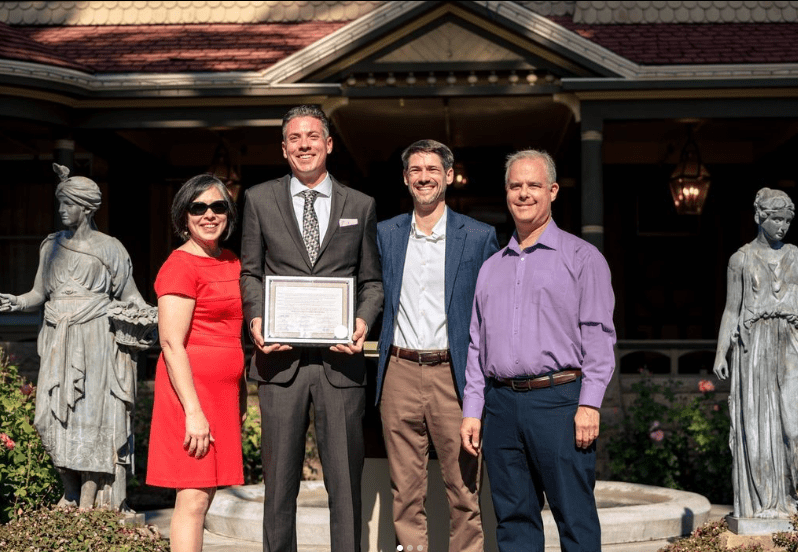
Please come and enjoy a delicious meal in Sarah’s Café, stroll along the paths of the beautiful Victorian gardens, and wonder through the miles of hallways in the World’s most mysterious mansion. For further information about tours, including group tours, weddings, school events, birthday party packages, facility rentals, and special events please visit the website: https://winchestermysteryhouse.com/

Please visit the online giftshop, and purchase a gift for friends and relatives as well as a special memento of The Winchester Mystery House. A variety of souvenirs and gifts are available to purchase. https://shopwinchestermysteryhouse.com/


