
Home » Posts tagged 'Epimetheus'
Tag Archives: Epimetheus
Paradise Canyon–How the Earth Began

Many of us assume, almost without question, that we can trust in reality of what we see. The religions of ancient Greece and Rome are extinct. The so-called divinities of Olympus have not a single worshipper among the living (none that we know of). However, in theology and literature and taste, the gods of the ancient World still hold their place, and will continue to hold it, for they are too closely connected with the finest productions of poetry and art, both ancient and modern, to pass into oblivion. The Greeks also perfected the sculptural art of relief as a means to decorate and embellish the beauty of their great architectural achievements. We propose to tell the stories relating to them which have come down to us from the ancients and which are alluded to by modern poets, essayists, and orators. The Dawn, the Sun, and the Moon were supposed to rise out of the Ocean, on the eastern side, and to drive through the air, giving light to gods and humans. The stars also, except those forming the Wain of Bear, and others near them, rose out of and sank into the stream of the Ocean. There, the sun-god (Ra or Helios) embarked in a winged boat, which conveyed him around by the northern part of the Earth, back to his place of rising in the east.

These stories are fascinating, and I would like to believe they are true. That may sound a little unusual, but my vision of space and time may be different than most. I think that Earth is much like a carriage, which over time evolved into a powerful car. So it is possible that there were many gods on Earth, and they did all of these things, but as time went by and technology changed, so did the Earth, but for your sake, these are just myths and nice stories. The creation of the World is a problem naturally fitted to excite the liveliest interest in people, its inhabitants. The ancient pagans, not having the information on the subject, which we derive from the pages of Bible Scriptures, had their own way of reporting the story. Before Earth, and Sea, and Heaven were created, all things wore one aspect, to which we give the name of Chaos—a confused and shapeless mass, nothing but dead weight, in which, however, slumbered the seeds of things. Earth, Sea, and Air were all missed up together; so the Earth was not solid, the sea was not fluid, and the air was not transparent. God and Nature at last interposed and put an end to this discord, separating Earth from Sea, and Heaven from both. The fiery part, being the lightest, sprang up and formed the skies; the air was next in weight and place. The Earth, being heavier, sank below, and the water took the lowest place, and buoyed up the Earth.

Here, some god—it is not known which—gave his good offices in arranging and disposing the Earth. He appointed rivers and bays their places, raised mountains like the Sierra in Tahoe, scooped out valleys like Sacramento and San Jose, distributed woods which appears similar to Yosemite in California, and fountains akin to those of Grand Cascade in Peterhof near Saint-Petersburg, fertile farms not so much like Knott’s Berry Farm, but more similar to Harris Farms, and stony plains, which resemble the Grand Canyon. The air being cleared, the stars began to appear, fishes took possession of the sea, birds of the air, and four-footed beast on land, although some animals are bipedal humanoids. However, a nobler animal was wanted, and modern humans, also known as homo sapiens were made. It is unknown whether the Creator made him of divine materials, or whether in the Earth, so lately separated from Heavenly seeds. Prometheus took some of this Earth, and kneading it up with water, made man in the image of the gods. He gave him an upright stature, so that while all other animals turn their faces downward and look to the Earth, he raises his to Heaven and gazes on the stars.

Prometheus was one of the Titans, a gigantic race, who inhabited the Earth, before the creation of man. To him and his brother Epimetheus was committed the office of making man, and providing him and all other animals with the faculties necessary for their preservation. Epimetheus undertook to do this, and Prometheus was to overlook his work, when it was done. Epimetheus accordingly proceeded to bestow upon the different animals the various gifts of courage, strength, swiftness, sagacity; wings to one, claws to another, a shelly covering to a third, excreta. However, when man came to be provided for, who was to be superior to all other animals, Epimetheus had been so prodigal of his resources that he had nothing left to bestow upon him. In his perplexity he resorted to his brother Prometheus, who, with the aid of Minerva, went up to heaven, and lighted his torch at the Chariot of the Sun, and brought down fire to man. With this gift, man was more than a match for all other animals. It enabled him to make weapons wherewith to subdue them; tools with which to cultivate the Earth; to warm his dwelling, so as to be comparatively independent of climate; and finally, to introduce the arts and to coin money, the means of trade and commerce.

Woman was not yet made. The story is that Jupiter made her and sent her to Prometheus and his brother, to punish them from their presumption in stealing fire from heaven’ and man, for accepting the gift. The first woman was named Pandora. She was made in Heaven, every god contributing something to perfect her. Venus gave her beauty, Mercury persuasion, Apollo music, and it was said that Pandora would sometimes have white hair and at other times, it was jet black. Thus equipped, she was conveyed to Earth and presented to Epimetheus, who gladly accepted her, though cautioned by his brother to beware of Jupiter and his gifts. Epimetheus had in his house a jar, in which were kept certain noxious articles, for which, in fitting man for his new abode, he had had no occasion. Pandora was seized with an eager curiosity to know what this jar contained; and one day she slipped off the cover and looked in. Forthwith there escaped a multitude of plagues for hapless man—such as gout, rheumatism, and colic for his body, and envy, spite and revenge for his mind—and scattered themselves far and wide. Pandora hastened to replace the lid; however, alas! The whole contents of the jar had escaped, one thing only excepted, which lay at the bottom, and that was hope. So we see to this day, whatever evils are abroad, hope never entirely leaves us; and while we have that, no number of other ills can make us completely wretched. Another story is that Pandora was sent in good faith, by Jupiter, to bless man; that she was furnished with a box, containing her marriage blessing. She opened the box incautiously, and the blessing all escaped, hope only excepted.

The World being thus furnished with inhabitants, the first age was an age of innocence and happiness, called the Golden Age. Truth and right prevailed, though not enforced by law, nor was there any magistrate to threaten to punish. The forest had not yet been robbed of its trees to furnish timbers for vessels, nor had men-built fortification round their towns. There were no such things as swords, spears, or helmets. The Earth brought forth all things necessary for man, without his labor in ploughing or sowing. Perpetual Spring reigned, flowers sprang up without seed, the rivers flowed with milk and wine, and yellow honey distilled from the oaks. Then succeeded the Silver Age, inferior to the Golden, but better than that of Brass. Jupiter shorted the Spring and divided the year into seasons. Then, first, men had to endure the extremes of heat and cold, and houses became necessary. Caves were the first dwellings, and leafy coverts of the woods, and huts woven of twigs (switches). Crops would no longer grow without planting. The farmer was obliged to sow the seed, and the toiling ox to draw the plough. Next came the Brazen Age, more savage of temper and readier to the strife of arms yet not altogether wicked. The hardest and worst was the Iron Age. Crime burst in like a flash flood; modesty, truth, and honor fled. In their places came fraud and cunning, violence, and the wicked love of gain. Then seamen spread sails to the wind, and the trees were torn from the mountains to serve for keels to ships, and vex the face of Ocean. The Earth, which till now had been cultivated in common, began to be divided off into possessions.
Men, however, were not satisfied with what the surface could produce, but must dig into its bowels, and draw forth from thence the ores of metals. Mischievous iron, and more mischievous gold, was produced. War sprang up, using both as weapons; the guest was not safe in his friend’s house; and sons-in-law and fathers-in-law, brothers and sisters, husbands and wives could not trust one another. Sons whisked their fathers dead, that they might come to the inheritance; family love lay prostrate, it seemed that all were doomed; Earth was wet with slaughter, and the gods abandoned it, one by one, till Astraea (the goddess of innocence and purity) alone was left, and finally also took her departure. After leaving Earth, Astraea was placed among the stars, where she became the constellation Virgo-the Virgin. This is the same thing people with high incomes do when neighborhoods fall victim to savages, they leave them behind and let them decay. Jupiter, seeing this state of things, burned with anger. He summoned the gods to council. They obeyed the call and took the road to the palace of Heaven. He summoned the gods to council. The road, which any one may see in a clear night, stretches across the face of the sky and is called the Milky Way (a galaxy, not candy bar). Along the road stand the places of the illustrious gods; the common people of the skies live apart, on either side. Jupiter addressed the assembly. He set forth on the frightful condition of things on Earth and closed by announcing this intention to destroy the whole if its inhabitants, and provide a new race, unlike the first, who would be more worthy of life and much better worshippers of the gods.

So saying he took a thunderbolt, and was about to launch it at the World, and destroy it by burning; but recollecting the danger that such a conflagration might set heaven itself on fire, he changed his plan and resolved to drown it. The north wind, which scatters the clouds, was chained up; the south was sent out, and soon covered all the face of Heaven with a cloak of pitchy darkness. The clouds, driven together, resound with a crash; torrents of rain fall; the crops are laid low; the year’s labor of husbandman perishes in an hour. However, Jupiter, not satisfied with his own waters, calls on his brother Neptune to aid him with the flood. Neptune lets loose the rivers and pours them over the land. At the same time, he heaves the land with an earthquake, much stronger then the magnitude 6.0, which cost Napa, California $1 Billion in damages, and brings in the reflux of the ocean over the shores. Flocks, herds, men and houses are swept away, and temples, with their sacred enclosures, profaned. If any edifice remained standing, it was overwhelmed, and its turrets lay hid beneath the waves. Now all was sea, sea without shore. This was much more devastating than 2011 Tsunami, in Japan, which was triggered by a magnitude 9.0 earthquake, as the waves engulfed the planet. (To digress for a moment, hundreds of U.S. sailors, who took part in rescue efforts, following Japan’s earthquake and tsunami, were exposed to dangerous levels of radiation, and have filed a class action lawsuit against the Tokyo Electric Power Company, and the federal judge has ruled it can go forward. ) Here and there, an individual remained on a projecting hilltop, and a few, in boats, pulled the oar where they had lately driven the plough. The fishes swim among the treetops; the anchor is let down into a garden. Where the graceful lamps played but now unwieldy sea calves gambol.

The wolf swims among the sheep, the yellow lions and tigers struggle in the water. The strength of the wild boar serves him not, nor his swiftness the stag. The birds fall with weary wing into the water, having found no land for resting place. These living beings whom the water spared fell a prey to hunger. Parnassus, a Greek god, alone, of all the mountains, overtopped the waves; and there Decalion, and his wife Pyrrha, of the race of Prometheus, found refuge—he a just man, and she a faithful worshipper of the gods. Jupiter, when he saw none left alive but this pair, and remembered their harmless lives and pious demeanor, ordered the north winds to drive away the clouds, and disclose the skies to Earth, and Earth to the skies. Neptune also directed Triton to blow on his shell and sound a retreat to the waters. The waters obeyed, and the sea returned to its shores, and the rivers to their channels. Then Deucalion thus addressed Pyrrha: “Oh, wife, only surviving woman, joined to me first by the ties of kindred and marriage, and now by a common danger, would that we possessed the power of our ancestor Prometheus, and could renew the race as he first made it; however, as we cannot, let us seek younder temple, and inquire of the gods what remains for us to do.” Deucalion and Pyrrha entered them temple, deformed as it were with slime, and approached the alter, where no fire burned. There they fell prostrate on Earth and prayed the goddess to inform them how they might retrieve their miserable affairs.

The oracle answered, “Depart from the temple with head veiled and garments unbound, and cast behind you the bones of your mother.” They heard the words with astonishment. Pyrrha first broke silence: “We cannot obey; we dare not profane the remains of our parents.” Deucalion and Pyrrha sought the thickest shades of the wood, and revolved the oracle in their minds. At length, Deucalion spoke: “Either my sagacity deceives me, or the command is one we may obey without impiety. The Earth is the great parent of us; and I think this is what the oracle means. At least, it will do no harm to try.” They veiled their faces, unbound their garments, and picked up stones, and cast them behind. The stones (wonderful to relate) began to grow soft, and assume shape. By degrees, they put on a rude resemblance to human form, like a block half-finished in the hands of the sculptor. The moisture and slime that were about them became flesh; the stony part became bones; the veins remained veins, retaining their name, only changing their use. Those thrown by the hand of the man became men, and those by the woman became women. It was a hard race, and well adapted to labor, as we find ourselves to be at this day, giving plain indications of our origin.

(The comparison of Eve to Pandora is too obvious. Lovelier than Pandora, whom the gods Endowed with all their gifts; and O, too like in sad event, when to the unwise son of Japhet brought by Hermes, she ensnared mankind with her fair looks, to be avenged on him who had stile Jove’s authentic fire.) Prometheus and Epimetheus were sons of Japhet. Prometheus has been a favorite subject with the poets. He is represented as the friend of mankind, who interposed in their behalf when Jove was increased against them and who taught them civilization and the arts. However, in so doing, he transgressed the will of Jupiter, he drew down on himself the anger of the ruler of gods and men. Jupiter had him chained to a rock on Mount Caucasus, where a vulture preyed on his liver, which was renewed as fast as devoured. This state of torment might have been brought to an end at any time by Prometheus, if he had been willing to submit to his oppressor; for he possessed a secret which involved the stability of Jove’s throne, and if he would have revealed it, that he disdained to do. He has therefore become the symbol of magnanimous endurance of unmerited suffering, and strength of will resisting oppression. The slime with which the Earth was covered by the waters of the flood produced an excessive fertility, which called forth every variety of production, good and bad. Among the rest, Python, an enormous serpent, crept forth, the terror of the people, and lurked in the caves of Mount Parnassus. Looking for idol hands to possess, “Be sober, be vigilant; because your adversary the devil, as a roaring lion, walks about, seeking whom he may devour.” 1 Peter 5:8.

The Winchester Mystery House
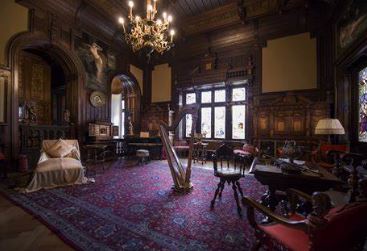
Strange happenings often occur while visiting The Winchester Mystery House. https://winchestermysteryhouse.com/
 Randolph Harris II International Institute