
Home » Posts tagged 'book-review' (Page 2)
Tag Archives: book-review

Much Was Forbidden Knowledge
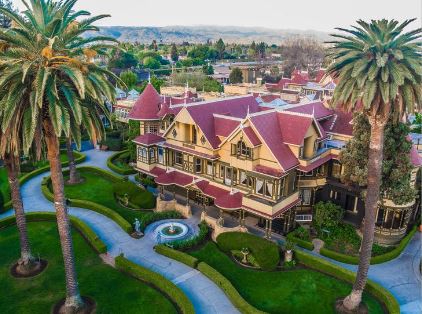
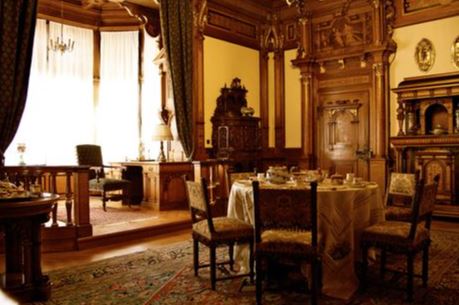
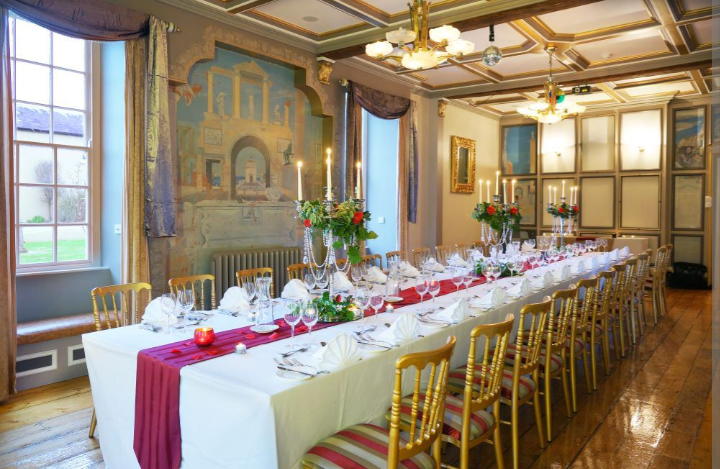
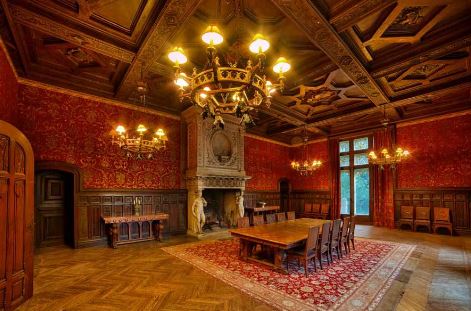
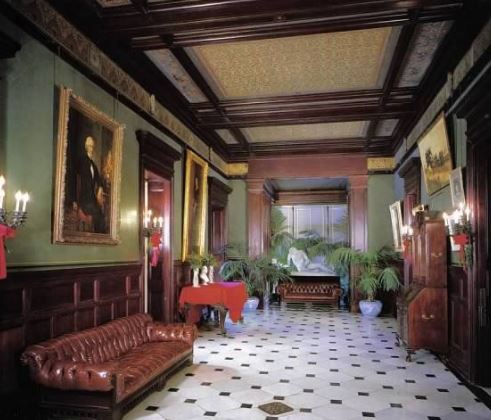
It was a grim winter’s night and rain pelted the windows. Horses clacked slowly along the cobblestone roads. There was a perpetual teasing wind from below like departing spirits of the dead. I had dinner in the Venetian Dinning Room in front of the fireplace. The windows suddenly lit up, and a few instants later there was a crash of thunder from outside. A sword that had previously hung on the wall, clearly was suspended in the middle of the room with its point towards me. About a minute later, it fell to the ground with a loud noise. The great candles in the hall were burning down to their sockets. One by one they spluttered out. A ghostly, flickering light fell upon the floor. As I pressed forward, I became conscious that my way was haunted by invisible existences whom I could not definitely figure to my mind. From among the walls on either side, I caught broken and incoherent whispers in a strange tongue which I partly understood. It was now nightfall, yet the interminable labyrinth was lit with a wan glimmer having no point of diffusion, for in its mysterious lamination nothing cast a shadow. A shallow pool in a depression on the floor, as from mop water, met my eye with a crimson gleam. I stopped and plunged my hand into it. It stained my fingers; it was blood! Blood, I then observed, was about me everywhere. It was spattered everywhere. Defiling the furniture, and blood dripped like dew from the ceiling. All this I observed with a terror which seemed not incompatible with the fulfillment of a natural expectation. #RandolphHarris 1 of 8

To the menaces and mysteries of my home my surrounding consciousness was an added horror. So frightful was the situation—the mysterious light burned with so silent and awful a menace that my home took on a melancholy or baleful character, so openly my sight conspired against my peace; from overhead and all about came so audible and startling whispers and the sighs of creatures so obviously not of Earth—that I could endure it no longer. On approaching the Morning Room, I noticed that a light was on and the door open, although I distinctly remembered having left it shut. I walked into the room pushed aside the heavy draperies at the entrance to the room itself, and stopped in amazement. In the middle of the room, a single lamp plainly revealed a stranger behind the large chair; the man wore a tall black hat and a dark billowing velvet coat. In the light from the hearth his probing eyes glowed red. He possessed a face so cadaverous and death-mask-like, that it set me screaming! I could not detect even the faintest whiff of a soul. Lightning flashed again, and I learned forward to hear his words over the loud thunder. His voice broken, it seemed, into an infinite multitude of unfamiliar sounds, went babbling and stammering away into the distant reaches of the mansion, died into silence, and all was before. Standing under one of the gaslights in the mansion, he said: “I will not submit unheard. There may be powers that are not malignant traveling through this accursed spiritual fortress. I shall leave them record and an appeal. I shall relate my wrong, the persecutions that I endure—I, a helpless mortal.” #RandolphHarris 2 of 8
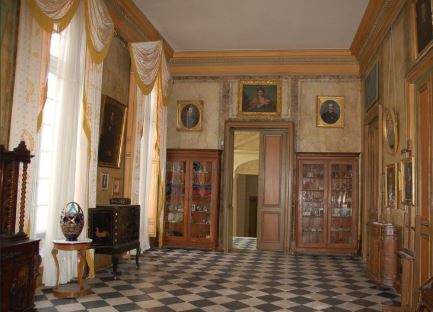
The man then walked off toward the dark room at the other end of the hall. Then I realized my visitor had dissolved into thin air. There was no one in the dark room. The door was securely locked. The skylight, 150 feet above ground, could not very well have served as an escape route to anyone human. I thought more about the mysterious forces…“How can this be happening to me! I deserve better for God’s sake! I am innocent for God’s sake! Dear God help me to restore all that I have lost. Make us happy again, make us ourselves again, raise my daughter and husband from the dead, snatched by supreme ghouls from the crypts, and return them to our home and make the name of Winchester a name of pride.” The thought of being lost in utter darkness without my loved ones amidst this mysterious labyrinth World of nightmares. A further flash of thunder seemed to split the Heavens wide open. From the open space in the narrow corridor, a glow was coming from the door on my right. In a moment I had reached it and was standing in the secret library, trembling with relief, and watching the sputterings of the lamp which had brought me to safety. Then I noticed a small door at the father end of the room, and clamed myself enough to approach it and examine the crude-sign chiseled above. It was only a symbol, but it filled me with vague spiritual dread. Outside, the night sky was riven yet again by a dart of lighting. The large roof windows of the attic shook in their frames as the gale beat at them. I took a deep breath and raised my lamp higher. A wave of nameless fright rolled out to meet me, but I yielded to no whim and deferred to no intuition. There was nothing alive here to harm me. #RandolphHarris 3 of 8
Although the room had no furniture save a table, and a single chair, I deciphered a huge pentagram in the center of the floor, with a plain circle about three feet wide half way between this and each corner. In one of these four circles, near where a black robe had been flung carelessly thrown on the floor. Connecting stairs and a secret rest room had long been walked up in the many structural changes in the mansion. Only the window of the walled-up room was still visible from the outside. It was in this area that I felt that restless spirits were trapped. Walled in like demons sleeping through the day and close to the premises for roaming through the night. I allowed myself to rest for half an hour, listening to the thunder roar and thump in the Heavens above. The flickering light of the lamps made the room seem almost as if it were malevolently alive. Another thunderbolt crashed across the Heavens, and I screamed of fear. As the echoes of my scream died away, I leaned forward in my chair, watching the shadows floating in front of my eyes. There was no need to tell all the dismal and horrid thoughts that flitted through my head as I ran. When I made it to the Observational Tower, I clambered to the top as quick as I could to take breath and look out upon my estate if by chance I would see anything. However, a moment’s rest I must have. I had run a mile through my home at least. Nothing whatever was visible ahead of me, and I was just turning to go down to the main part of the house, when I heard what I can only call a laugh: and if you can understand what I mean by a breathless, a lungless laugh, you have it; but I do not suppose that you can. #RandolphHarris 4 of 8

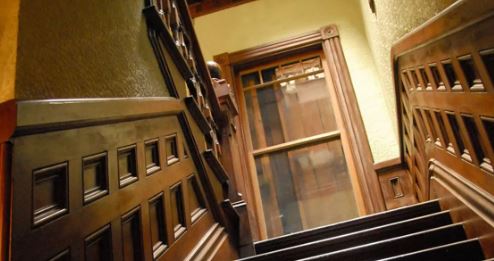
It came from below, and swerved through the halls. That was enough. I walked down the stairs. There was a carpenter at the bottom. You do not need to be told that he was dead. His tracks showed that he had run along the hallway, had turned sharp round the zig zag stairs, and, small doubt of it, must have dashed straight into the wall, and his teeth and jaws were broken to bits. I only glanced over his face. At the same moment, suddenly I felt another presence in the room, and I could not breathe anymore. Zip started to bark and insist that I follow him out of the room. I distinctly felt someone there. I went straight up to my room. I had my bath, and went and lay down on my bed, and slept for about ten minutes. It was as quiet, as quiet as only a country house can be. Soon I was in a deep trance on the other side. I saw things and people the ordinary eye could not perceive. I was walking around. There was a man lying dead in the middle of the room. Small nose, not too much hair in front. There was a plant near him. He came here to die. He was here to find a place to rest. He usually stays in the Crystal Bedroom. With the fern. By the bed. I broke out of trance and had facial stiffness, as well as pain in the shoulder. The curtains of my bed were violently agitated, accompanied with a loud and almost indescribable motion of rings. However, the curtain, four in number, to prevent their motion, were tied up, each in one large knot. Every curtain in the bed was agitated, and the knots thrown and whirled about with such rapidity that it would have been unpleasant to be within the sphere of their action. This lasted about two minutes, as if it were a wild beast seeking freedom. I also heard footsteps walking by me and around me, and was, also, conscious of candles burning near me, but could see nothing. #RandolphHarris 5 of 8
A low, wild pal of laughter broke out at a measureless distance away; I paused a moment, and rappings started; I suddenly opened the door, with a candle in my hand, yet I swear I could see nothing. I have been in one of the rooms which has a large modern wind, when, from the noises, knockings, blows on the bed, and rattling of the curtains, I really did begin to think the whole chamber was falling in. And growing ever louder, the laugher seemed approaching ever nearer; a soulless, heartless, and unjoyous laughter, like that of the loon; a laugh which culminated in an unearthly shout close at hand, then died away by slow gradations, as if the accursed being that uttered it had withdrawn over the verge of the World whence it had come. However, I felt that this was not so. A strange sensation began slowly to take possession of my body and my mind. I could not have said which, if any, of my sense was affected; I felt it rather as a conscious—a mysterious mental assurance of some overpowering presence—some supernatural malevolence different in kind from the invisible existences that swarmed about me, and superior to them in power. I knew that it had uttered that hideous laugh. And now it seemed to be approaching me; from what direction I did not know—dared not conjecture. All my former fears were forgotten or merged in the gigantic terror that now held me in thrall. Powerless to cry out, I found myself staring into the sharply draw white face and blank, dead eyes of a phantom. #RandolphHarris 6 of 8
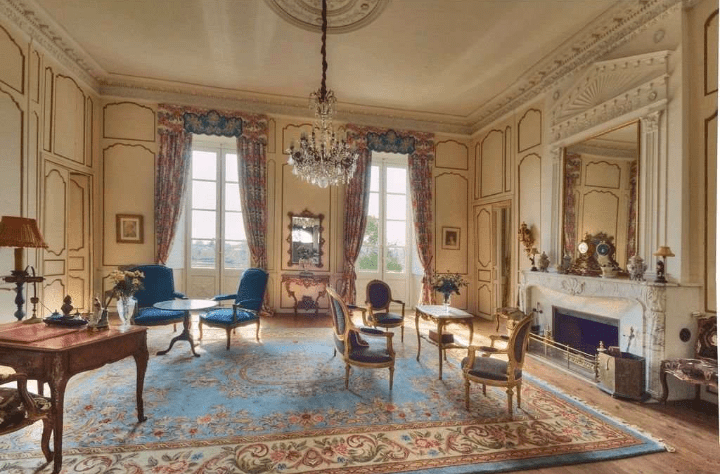
The darkness filled me. Whatever my thoughts had been, they so possessed me that I observed not the lapse of time. I came to my senses an unknown time later to find myself in a brightly lit room with a pleasant fragrance. Someone was wiping my forehead with a damp cloth. For a few minutes, I simply enjoyed the sensation, not thinking about the terror I had experienced, but the memories flooded back. Confused thoughts and troubled emotions ran through my mind. “Wh-Where am I?” “Mrs. Winchester, you’re in the new east wing of your home.” Now I recognized the voice. “Uta!” I said. “But how did I…?” “I found you,” said Uta. “I hadn’t seen you for days, and was worried about you, so the day after the great storm I scoured the mansion looking for you. You were lying in a mass of blood and broken glass and rainwater. I…” Uta paused momentarily, clearly still upset from the experience—“I thought you were dead.” A little later I felt a warm spoon against my lips and instinctively opened my mouth to let a little of the soup dibble in. Under Uta’s care, I slowly regained my health, but it was another ten days before I was well enough to make my way around the garden. When I reached the Daisy Bedroom, I paused for a moment and looked around. From here there was no sign that anything at all unusual had taken place thirteen nights ago. #RandolphHarris 7 of 8
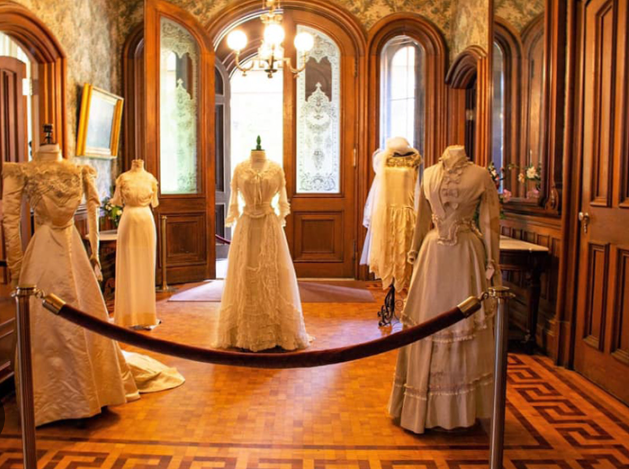
I began to climb the stairs, feeling in my pocket for the key. At the door to no-to-nowhere, I forced myself to calm down, taking several deep, measured breaths before putting the key in the lock. Suddenly there was a terrible, godless wail from the pits whose inhuman cadences rose, and feel rhythmically in the distance through the darkness. “What on Earth was that?” I exclaimed. Then a huge hand grabbed me. The door swung open with a creak, and I saw a ghost standing there. A woman appeared, she had long blonde hair, was wearing a long white night dress, was frail and ethereal, old age had rendered her thin and somehow tired. And yet, her eyes had an unusual bright sparkle in them that belied her frail and aged appearance. She walked very softly through the threshold of the door and sat down inside. She put her hand on her forehead and said, “Will you please help me? A looter has taken my tombstone, and now my soul is unable to find rest.” The bewildering character of the swirling flood of spirits caused confused thoughts and troubled emotions to run through my mind. I sighed and relaxed slightly. I turned around to reach for a lamp. My back was not turned for more than a second. However, when I looked up at my mysterious visitor, the lady was gone. I quickly walked down the hallway, everything was suffused with a soft, red glow in which I then saw my own shadow projected before me. Ceaseless buffetings of a most tempestuous wind made me feel weary. #RandolphHarris 8 of 8
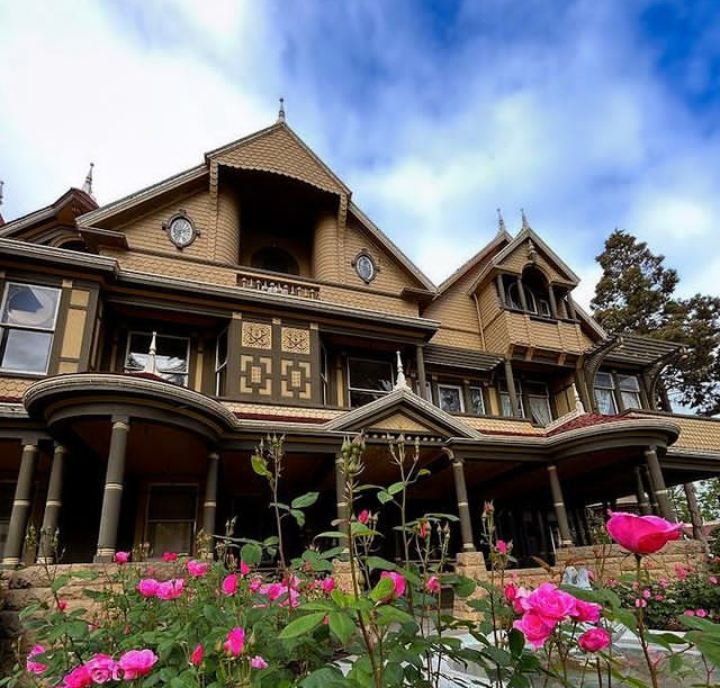
If you live in New Haven Connecticut, you are well aware of the hell and brimstone variety preaching, and are bound to hear about the devil now and again. To some people, the devil is real, and they will give you an argument filled with fervour and Bible quotations to prove that he exists. Mrs. Winchester had a beautiful face like a mask. A porcelain-cosmetic mask. Mrs. Winchester was not one of those who were impressed by demonic outbursts, however, and she could not care less whether there was a devil or not. She had grown up in a well-to-do family and spent her adult years in the World of business. At age nineteen, she met and married Mr. William Wirt Winchester, and they had a short, but happy life together. There was one child, and at first, no problems, and no difficulties whatever. She was always active in her husband’s manufacturing business. After she gave birth to her first child, Annie Winchester, Mr. Winchester decided to slow down, it was just as well that she started to enjoy life a little more fully, until tragedy struck.
Back in her early years, Mrs. Winchester had what are now called ESP (extra sensory perception) experiences. When she talked to a person, she would frequently know what that person would answer before the words were actually spoken. It scared the young girl, but she refused to think about it. Her parents’ home was a thirty-room mansion in a good section of New Haven. It was just a pleasant house without any history whatever of either violence or unhappiness. And yet, frequently she would hear strange rappings at night, raps that did not come from the pipes or other natural sources. Whenever she heard those noises, she would simply turn to the wall and pretend she did not hear them, but in her heart, she knew they were there. Then one-night, young Sarah was awakened from a deep sleep by the feeling of a presence in her room. She sat up in bed and looked out. There, right in front of her bed, was the kneeling figure of a man with extremely dark eyes and a pale face. She thought that he was from another time or place. After rubbing her eyes, Sarah looked again, but the apparition was gone.
Before long, Sarah had accepted the phenomenon as simply a dream, but again she knew this was not so, and she was merely accommodating her sense of logic. However, what had the stranger been? Surely, the house was not haunted. Besides, she did not believe in ghosts. Young Sarah had no idea that this was the beginning of the accursed invasion from beyond. Six weeks later, she had another supernormal experience. Again alone in her parents home, with all the doors locked, she saw a strange man. Quickly she reached for a candle to examine her visitor, but he had vanished. From the day on, Mrs. Winchester heard strange noises, frequent banging about the mansion, and uncanny feelings and chills in certain areas of the hose. On one occasion, Mrs. Winchester clearly heard someone coming up the stairs leading up to the attic. She went to see who it was, but no one came. The steps were those of an unseen man! Mrs. Winchester had no idea who the ghost could be. She was reluctant to discuss her experiences with other people let they think her mad, yet she was healthy and realistic and was quite sure of her memories.
As many know, after the death of her new born daughter and husband, Mrs. Winchester moved to Santa Clara Valley and spent nearly 40 years, of non-stop construction, building one of the most beautiful and complex mansions in the World. It is possible that some ghost followed her, and others manifested because she was born with extra sensory perception (ESP). After her death, two serious young men went to stay in the house to see if what they were saying about the Winchester Mansion was true. They had sleeping bags and stayed up in one of the attics. It was a chilly December night in 1931, and everything seemed just right for ghost. Would they be lucky in their quest? They did not have to wait long to find out. “As soon as we entered the room, we heard strange noises on the roof They were indistinct and could have been animals, I thought at first. We went off to sleep until my partner woke me up hurriedly around three in the morning. I distinctly heard human footstep on the roof. They slid down the side to a lower level and then to the ground where they could be heard walking in leaves and into the night. Nothing could be seen from the window and there was nobody up on the roof. We were the only ones in the house that night, so it surely must have been ghosts.” After a while, a gruff man’s voice was heard: “Get out…get out of my house.” There were additional requests for the two men to get out of his house. And finally, they left. Evidently the ghosts did not approve the sale of the house by Mrs. Winchester’s executors, but wanted it to stay in her family. Perhaps that is why it remains unoccupied by humans.
Come and enjoy a delicious meal in Sarah’s Café, stroll along the paths of the beautiful Victorian gardens, and wonder through the miles of hallways in the World’s most mysterious mansion. For further information about tours, including group tours, weddings, school events, birthday party packages, facility rentals, and special events please visit the website: https://winchestermysteryhouse.com/
Please visit the online giftshop, and purchase a gift for friends and relatives as well as a special memento of The Winchester Mystery House. A variety of souvenirs and gifts are available to purchase. https://shopwinchestermysteryhouse.com/
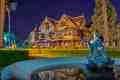
Why Art Thou So Foolish and Fearful!

I was spending the first week of January alone in Llanada villa. A combination of circumstances had driven me to this drastic course: my nearest relations were enjoying winter sports abroad, and the friends who had been kindly anxious to replace them had an infectious complaint in the house. Doubtless I might have found someone else to keep company with me. “However,” I reflected, “most of them have made up their parties, and, after all, it is only for three or four days at most that I have to fend for myself, and it will be just as well if I can get a move on with my blueprints. I might she the time by going down to the garden and listening to my estate about plans to incorporate in the architecture.” The first day alone in Llanada Villa, it was so stormy that I got no father the designing stained-glass windows. As I sat in the Hall of Fires, I felt uncomfortable, and this feeling persisted. I felt like I was being watched by some unseen force, and my nerves began to tense under the strain. I reflected on how some of my staff had left not because they wanted to but because they were driven, driven by forces greater than themselves that they could not resist. On this very night, I had seen vivid apparition of my butler, then miles away, in San Francisco. He was a plump, amicable man who I distinctly saw walking down the hall in a bathrobe, with blooding running down his leg. A small pool of blood was forming on the floor. The frightened me terribly. My hair stood up on my head and chills shook my body. The apparition looked so stern that my heart failed me, and I wished myself anywhere but there, though I had before been summoning up my courage. “Good Heaven,” said I to myself, “give me the courage to stand before this spirit. O soften him, or harden me!” I knew this was a glimpse into eternity. #RandolphHarris 1 of 5

The following day, I received news that my butler, Chaleb Heroldsbach, had died after being attacked by a dog. My home is built in what some have called a “trinity triangle,” it has forged a mystical link with other pilgrimage sites and is supposed to help bring the Devil’s power on Earth to an end. This is being prevented by Satan, however, with the help of The Curse of the Winchester Fortune. That evening, I was awakened at three o’clock in the morning, seemingly for no reason with the same uncanny feeling that something was wrong. Being a sensible person, I put all my energies into polishing furniture and getting newly added rooms into proper condition. However, somewhere not so far away, a baby was crying: a mournful wail of a sound that—though it was surely human—reminded me of the noises the coyotes would make some nights. After a few moments of listening, the baby’s cry seemed to falter for a moment, and I feared it would fade completely before I could find the little darling. Then, the infant seemed to find a new seam of grief to mine, and the wail rose up again, more plaintive than ever. I was alone, but trying to figure out which direction the sound was coming from. I mused for a moment, and realized a lifetime of suffering had caught up with me. I knew in my heart that I deserved to know everything, after all I have been through. I have earned the truth. Maybe the dead are close to the threshold of reality in this house. I only know it is real. I have seen them. Others have seen them. They are hybrids. Sometimes there is a kind of beauty in them. However, sometime all I see is ugly sin. #RandolphHarris 2 of 5

The sky was dark and cloudy, and by the time I woke up, I could hear a steady soaking rain pounding on the roof. I was preparing breakfast in one of the kitchens. As I was buttering a piece of toast, I happened to glance up toward the doorway. There, immaculately dressed, stood a man. The stranger, I noticed, wore shiny black shoes, black pants, and a white shirt. I could see him so clearly that I could make out the way the man’s jet-black hair was parted. Immediately, I was shocked that he had somehow entered my house, and I was about to greet him, when it occurred to me that I had not heard the door opening or any other sound—no footsteps, nothing. I turned around to grab my revolver, but by the time I turned around, the man was gone like a mist. I was not too frightened by what I had witnessed, I was growing accustomed to apparitions. I had often wondered what had taken place a century and a half on the land this eighteen-room farmhouse I purchased was on, and what the former owner really had been. However, it is fortunate that they carpenters were all strong men of action and simple, orthodox religionists, for with more subtle introspectiveness and mental complexity they would have fared ill indeed. Herford Hulsmann was the most disturbed; but even he outgrew the darkest shadow, and smothered memories in prayer. While I was alone, I did my best in the blotting out of unwholesome images, and was thankful that the carpenters, Daisy, and other caretakers would be returning to Llanada Villa soon. #RandolphHarris 3 of 5

My house was not altogether liked by sensitive people because of the sounds heard here at night. It was said that I entertained strange visitors, and the lights seen from my windows were not always the same colours. The knowledge I displayed concerning long-dead persons and long-forgotten events was considered distinctly unwholesome. Frau Maassen swore that on 13 June 1889, in the fruit orchard, that “forty Witches and the Blacke Man were wont to meete in the Woodes behind Mrs. Winchester’s house.” Then several people claimed to have found William’s unfinished manuscript in his handwriting, couched in a cipher none could read. After a year of possessed this manuscript, Mr. Maassen had intensely and feverishly tried to decipher, he never stated whether or not he had succeeded. I confronted Mr. Maassen, “Why are you so foolish and fearful! You have done no harm! What, if you fear an unjust judge, when you are innocent, would you do before a just one, if you were guilty? Have courage, Mr. Maassen; you know the worst! And how easy a choice poverty and honesty is, rather than plenty and wickedness.” “Mrs. Winchester, do not let your heart ake for me?—I am sure mined flutters about like a new-caught bird in a cage,” said Mr. Maassen. “O how can wicked men seem so steady and untouched with such black hearts, while poor innocents stand, like malefactors, before them!” Mr. Maassen cheered himself up; but yet I could tell his poor heart sunk, and his spirits were quite broken. Everything that stirred, he thought was to call her to her account. Shortly after, he restored to a sojourn abroad, and did not return to claim his lands. #RandolphHarris 4 of 5

Mr. Maassen had apparently been careful to destroy most of his correspondence, but the citizens who took action in 1892 found and preserved a few letters and papers which excited their wonder. There were cryptic formulae and diagrams in his and other hands which Mr. Maassen either copied with care or had photographed, and one extremely mysterious letter was written in blood. I had to learn to live with my ghosts, especially considering some of these had ben here before me. Perhaps some of these ghosts could even become friendly. One night at dinner, Daisy, myself and Zip were enjoying stuffed pheasant, when an enormous crash shook the house. It felt as if a boulder had fallen on the parlour floor. When we rushed to the parlour, everything was in order, nothing misplaced. We said a silent prayer for the souls of the disturbed. However, moments later, things got worse. The lights started going off and on by themselves. When we tried to return to the dining room and finish supper, the atmosphere was so thick that we could not get near the table. Enveloped by the strong vibrations, I felt myself levitating, and when I came to my senses, I was lying on the floor. I had given Daisy such a scare. Daisy clearly senses the presences of the spirits and she started to cry. “Oh, God, it can’t be true, Aunt Sarah,” she said. With a piercing scream, she ran up the stairs, weeping out of control. #RandolphHarris 5 of 5


“I have great trouble, and some comfort, to acquaint you with. The trouble is, that my good lady began to have her bad nights, and complained to me and other persons, in particular what discomfort she suffered from her pillow and bedclothes. She said she must buy some to suit her, and should do her own marketing. And accordingly brought home a parcel which she said was of the right quality, but where she bought it we had then no knowledge, only they were marked in thread with a coronet and a bird. The merchant said they were of a sort not commonly met with and very fine, and Mrs. Winchester said they were the comfortablest she ever used, and she slept now both soft and deep. Also the feather pillows were the best sorted and her head would sink into them as if they were a cloud: which I have myself remarked several times when I came to wake her of a morning, her face being almost hid by the pillow closing over it. I had never any communication with Dr. Wayland after I came back to Llanada Villa, but one day when he passed me in the garden and asked me whether I was not looking for another service, to which I answered I was very well suited where I was, but he said I was a tickleminded maidan and he doubted not he should soon hear I was on the World again, which indeed proved true.”
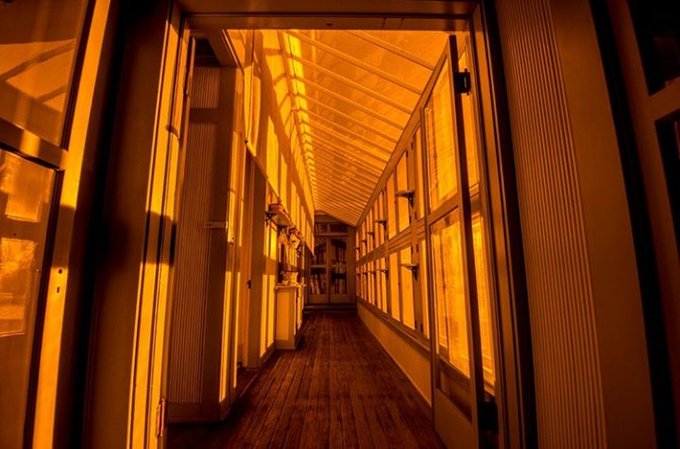
Dr. Wayland is next taken up where she left off.
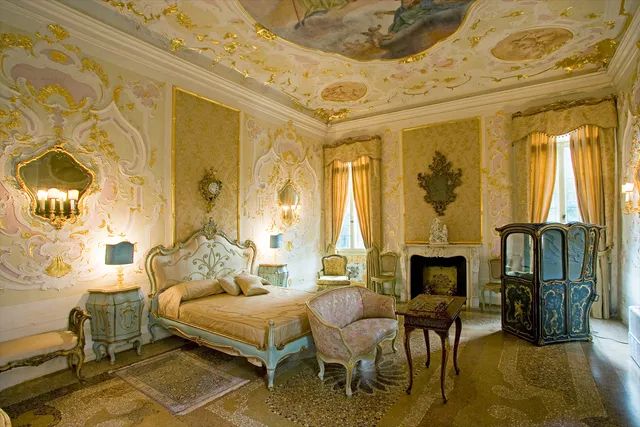
“On the 5th I was called up out of my bed soon after it was light—that is about five—with a message that Mrs. Winchester was dead or dying. Making my way to her house, I found there was no doubt which was the truth. All the persons in the house expect the one that let me in were already in her chamber and standing about her bed, but none touching her. She was stretched in the midst of the bed, on her back, without any disorder, and indeed had the appearance of one ready laid out for burial. Her hands, I think, were even crossed on her breast. The only thing not usual was that nothing was to be see of her face, the two ends of the pillow or bolster appearing to be closed quite over it. These I immediately pulled apart, at the same time rebuking those present for not at once coming to the assistance of their master. However, I was informed that only one person had stayed with her until her dying moment and most had fallen asleep. She looked at me and shook her head, having no more hope than myself that there was anything but a corpse before us. Indeed it was plain to anyone possessed of the least experience that Mrs. Winchester was not only dead, but had died of suffocation. Nor could it be conceived that her death was accidentally caused by the mere folding of the pillow over her face. How should she not, feeling the oppression, have lifted her hands to put it away? whereas not a fold of the sheet which was closely gathered about her, as I now observed, was disordered.

“I could tell no more, at least without opening the body, then we already knew. As to any person entering the room with evil purpose (which was the next point to be cleared), it was visible that the bolts of the door were burst from their stanchions, and the stanchions broken away from the door-post by main forced; and there was a sufficient body of witness, the smith among them, to testify that this had been done but a few minutes before I came. The chamber being, moreover, at the top of the house, the window was neither easy of access nor did it show any sign of an exist made that way, either by marks upon the sill or footprints below upon soft mould. My evidence forms of course part of the report of the inquest, the large organs were in a healthy state and there was coagulation of blood in various parts of the body. My verdict was ‘Death by visitation of spirits.’ Upon further consideration, I think I can divine a reason for Mrs. Winchester’s death. It related to the rifling of her mansion. This is the property of a noble family. The outrage was not that of a natural death. The object, it seemed likely, was theft. The account is blunt and terrible. I shall not quote it here. A dealer in San Francisco suffered heavy penalties as a receiver of stolen goods in connexion with the affair.
“Mrs. Winchester has left us all much grieved for the loss of her; for she was a good lady, and kind to all her caretakers. Much I feared, that as I was taken by her ladyship to wait upon her person, I should be quite destitute again. Mrs. Winchester has given mourning and a year’s wages to all her caretakers; and she game me with her own hand four golden guineas, and some silver, which were in her pocket when she died. And I sent Daisy those four guineas for her comfort; for Providence will not let me want: and so you may pay some old debt with part, and keep the other part to comfort yourself.” Come and enjoy a delicious meal in Sarah’s Café, stroll along the paths of the beautiful Victorian gardens, and wonder through the miles of hallways in the World’s most mysterious mansion. For further information about tours, including group tours, weddings, school events, birthday party packages, facility rentals, and special events please visit the website: https://winchestermysteryhouse.com/
Please visit the online giftshop, and purchase a gift for friends and relatives as well as a special memento of The Winchester Mystery House. A variety of souvenirs and gifts are available to purchase. https://shopwinchestermysteryhouse.com/
What if I Do Not Believe in Ghosts?
Once when I was little, my dad took me to this placed called Sodom Hill. It must be some kind of gateway because the curious thing is, you feel like you are driving down a hill along this road. This was the first time that I believe I saw a ghost. As our carriage passed by Saint Mary Parish, a woman was standing near the church, starring at us. However, she was really looking at my father. Though the weather was warm, she was wearing a long black dress beneath a hooded cloak. She was hugging herself, and she looked cold. Beneath the hood, her face was pale, and even from a distance I could tell that she was distresses. And she was very beautiful. The hood slipped down to her shoulders. I saw her hair was red. Her dark eyes were trusting and innocent. And suddenly I knew where I had seen her before. Onn the Rocky Hill-Glastonbury Ferry. She had been weeping on deck. The beautiful maiden with the red hair kept staring at my father. He did not notice. I was curious to know if my father could see the woman. I said, “Father, what is that pretty tree over there? By the tower of the church?” I pointed toward the woman. The woman saw me point. She looked at me, questioningly, but only for a moment. Then she looked back at my father. The woman did not care if I was being immodest. She just looked through me, just as she had on the deck of the ferry. How had she gotten here, and what did she want from me and my father? All this seemed to take forever. However, I do not think more than a minute passed before my father said to me, “What tree? I don’t see any trees near the tower of the church.” #RandolphHarris 1 of 5

“Father, what do you see?” I asked. “The lawn,” he said. I watched him for a sign. I could not believe that he could not see the lady with crimson hair near the tower of the church. “Nothing else? I said. “No one?” “Nothing,” he replied. “No one? Who would be there?” When I looked again there was no one there. The woman had vanished. I felt as if I had lost something. “What’s wrong?” said my father. “Nothing,” I said. “I think I must have been having a daydream.” “Poor Sarah,” said my father. “It must be the sun. Let’s get you inside and get you something to drink.” We made our way back home. My mother was in the garden, kneeling down among the tall plants and rut niblicks. My father poured me some milk and gave me a cracknel, baked by my mother. “Eat this,” he said. “It’ll help you get your strength back.” My father nibbled on one himself. I told myself: No man sees a ghost and starts nibbling a cookie like nothing happened. If he said there was no woman near the tower of the church, it meant he had not seen her. It meant something was seriously wrong with me. I had not been feeling all that well lately. I felt as if the colours of everything had gotten a little brighter, and sounds a little louder, and when people speak to me, their voices have a tiny echo, like I am hearing them from the far end of a tunnel. It does not happen all of the time. I have these little spells, and then they pass, and I am normal again. Spirits whispered in the rustling leaves, ghost lurked in the murky nooks, the deep baying of a hound floated up out of the distance, an owl answered with his sepulchral note. #RandolphHarris 2 of 5
Millions of spiritual creatures walk the Earth unseen, both when we wake and when we sleep. What place do these spirit beings hold in the scheme of creation which by some are thought neither to have stood fast when the rebel angels fell, nor to have joined with them to the full pitch of their transgression? It was the middle of the moonlight in October night with heavy rain underfoot, I was sitting by the fire—it was a cold evening—and I stretched out my hand towards the warmth, and just then the fire-irons, or at least the poker, fell over towards me with a great clatter. There resourced over the estate and the surrounding land a series of cries which brought sleepy heads to every window; we all saw a ghost ship. It was a 26-gun frigate. There were distant gunshots, and I could feel the throb of titanic and thunderous words resounding in the upper air. Muskets flashed and cracked, and the flaming ship fell to the ground. A second flaming thing appeared, and a shriek of human origin was plainly distinguished. Then just before dawn when a howling darkness descended upon the ships and they vanished. As I ran up the stairs, I hit what felt like an ice wall and was momentarily stopped in my tracks. The air around me became instantly chilled, and although every fireplace was lit, I was cold and could see my breathe. I was then able to get up the last six steps, but when I turned around, I saw an opalescent fog crystalize into the form of a woman. She wore a long dress, and a hat, and when she turned towards me, I realized in was the woman with red hair that I had seen at the tower of the church with my father when I was a child. In her face, I could see uncountable horrors and sorrows written in the depth of her dark eyes. She then vanished, and the air around me returned to its warm state. #RandolphHarris 3 of 5
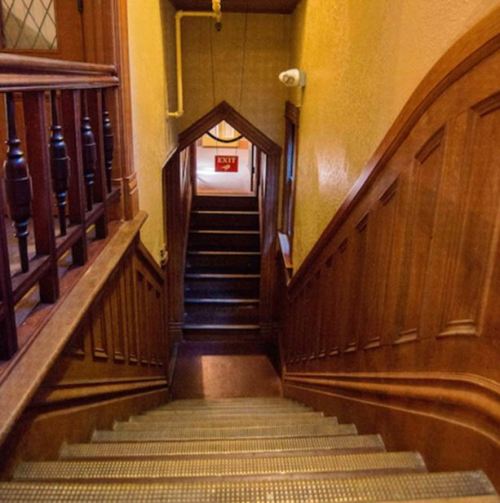
There was certainly a time when I was so much harassed by my dreams that I could not keep them to myself, but would tell them to my friends. There was a dream which had come to me several times of late, and even more than once in a night. It was to this effect, that I seemed to myself to wake under an extreme compulsion to rise and go outdoors. So I would dress myself and go down to the garden door. By the door there stood a spade which I must take, and go out into the garden, and at a particular place in the boxwood hedges, somewhat clear, and upon which the moon shone (for there was always in my dream a crescent moon), I would feel myself forced to dig. And after some time, the spade would uncover something light-coloured, which I would perceive to be a stiff, linen or woolen, and this I must clear with my hands. It was always the same: of the size of a man and shaped like the chrysalis of a moth, with the folds showing a promise of an opening at one end. I could not describe how gladly I would have left all at this stage and run to the house, but I mist not escape so easily. So with many groans, and knowingly only too well what to expect, I parted these folds of stuff, or, as it sometimes seemed to be, membrane, and disclosed a head covered with a smooth pink skin, which breaking as the creature stirred, show me my own face in a state of death. Upon ever recurrence of this dream, I woke and found myself, as it were, fighting for my breath. #RandolphHarris 4 of 5
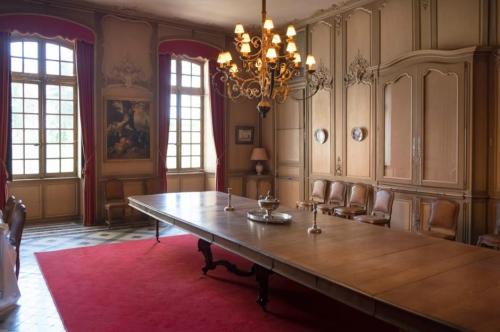
Moments later a chill wind blew up. It produced a kind of clutching, amorphous fear beyond that of the tomb or the charnel-house. Close upon it came the awful voice which no hapless hearer will ever be able to forget. It thundered out of the sky like a doom, and windows rattled as its echoes dies away. It was deep and musical; powerful as a bass organ, but evil as the forbidden books in the secret library. What it said, no one can tell, for it spoke in an unknown tongue. Objects were being hurled about the room. Puddles of water appeared on the floor. The sheet and blankets were torn off the bed. Then I was alarmed when I heard a very loud vibration as if a hole were being drilled through the all. I went into the chamber next to mind and saw that a Victorian fireplace had been ripped from its casing and hurled upon the floor. A wailing distinctly burst out. It was almost articulate, though no one could trace the exact words; and at one point it seemed to verge toward the confines of diabolic and hysterical laughter. Then a yell of utter, ultimate fright and stark madness wrenched from scores of demon throats—a yell which came strong and clear despite the depth from which it must have burst; after which a darkness and silence ruled all things. Spirals of acrid smoke ascended, though no flames appeared. This must have been the witches’ Sabbath. Death does not mean that your loved one’s have left your mind, and your mind sends messages to your eyes that sometimes have nothing to do with what you actually see. #RandolphHarris 5 of 5

The Winchester Mystery House
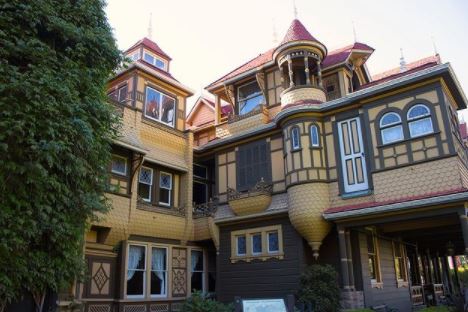
Santa Clare Valley was in an uproar after the death of Mrs. Winchester. On Wednesday (October 3, 1923) consequently on the circulation of a report that the household goods of Sarah Winchester were being smashed and removed by some unknown agency. All day long crowds of excited people wended their way towards the Winchester Mansion, drawn thither by the accounts of the mysterious occurrences said to have been witnessed by the inmates and others. “As I enter the door I myself saw an eleven-foot-tall 18th century George I burl walnut longcase clock by James Marwick levitate several feet into the air before relocating itself to the other side of the room. After hearing what the folks had to say, I was joining in the conversation, when a late 18th century crystal chandelier began to raise in a slanting direction over my head and then fell as my feet, smashing into bits. I had not the slightest belief in the supernatural. I cannot account for what I saw. No one was nearer to the chandelier than myself and, as far as I saw, there was no cause for the phenomenon. The room was dimly lighted by a lamp. We were talking about things, and the caretaker were saying, “It is a very mysterious thing,” with his back turned Neoclassical Italian Crystal vase suddenly flew up slantingly over his head, and fell down and smashed at his feet. The caretaker looked at the mess on the floor, and thinking the devil was in the place, he left and went home. About half-a-dozen people were in the parlour whilst these things happened.

Come and enjoy a delicious meal in Sarah’s Café, stroll along the paths of the beautiful Victorian gardens, and wonder through the miles of hallways in the World’s most mysterious mansion. For further information about tours, including group tours, weddings, school events, birthday party packages, facility rentals, and special events please visit the website: https://winchestermysteryhouse.com/
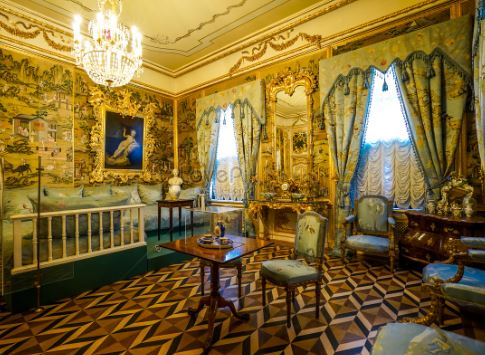
Please visit the online giftshop, and purchase a gift for friends and relatives as well as a special memento of The Winchester Mystery House. A variety of souvenirs and gifts are available to purchase. https://shopwinchestermysteryhouse.com/

This is a Journey Not Meant for the Faint of Heart
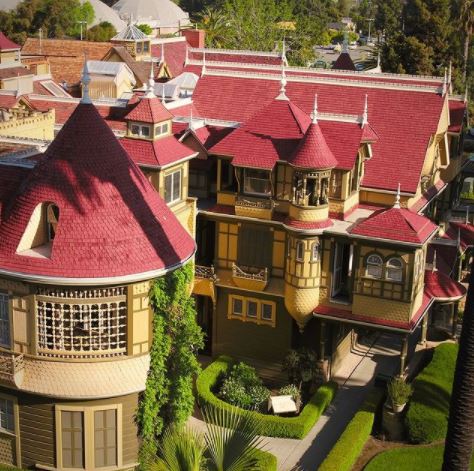
Welcome to The Winchester Mystery House. If you choose to visit, you will find out things you never knew existed. This is a journey not meant for the faint of heart. Secrets of darkness will be revealed, some of which you may leave you baffled. You may even find out what lies behind the eyes of what seem to be innocent people. This labyrinth represents a journey. A pilgrimage of change, growth, discovery, movement, transformation. This house was continuously expanding Mrs. Winchester’s vision of what is possible by stretching her soul, as she was learning to see clearly and deeply. Listening to her intuition and taking courageous architectural challenges at every step along the way, whether it be on easy riser or stains to the ceiling. Mrs. Winchester knew she was on the right path, exactly where she wanted to be. Moving forward as each turret rose and dormer was crowned, and the house expanded nine stories, shaping Llanada Villa into a magnificent legend of triumph, healing, courage, mystery, beauty, and power. This fortress is an ancient symbol that represents union with the eternal. The hallways create an illusion of walking in circles, yet never passing by the same room more than once. It is believed that the miles and long and twisting hall in The Winchester Mystery House were used as pathways of prayer and meditation. Llanada Villa is a metaphour of Mrs. Winchester’s journey. This house is a living memorial, a sacred space; it is a puzzle that allows each and every one of us to solve the enigma of Mrs. Winchester. However, once you enter, there is no way out. #RandolphHarris 1 of 4

To understand The Winchester Mystery House one needs intuition, creativity, and imagery. If you do not get lost along the way, as some have disappeared into the fabric of this home, this is a journey to the center of the Victorian Ear and then back out into the modern World. The archetype has symbols incorporated into the architecture and floors of this gothic pilgrimage which date back centuries. Perhaps the most impressive features are the steeply pitched roofs, the plush gardens, or ornate hand craved wood details. The nine-story tower, which was removed in 1906, was said to reach 328 feet into the style. The Winchester Mystery House is also just as famous for its several stained glass windows and one of the double hung wooden windows. These remarkable windows, the most complete collection of ancient stained-glass windows in America, are particularly celebrated for their vibrant colours. Many of the stained-glass windows remain in position, but some were removed and kept sage in an onsite museum. If the pilgrims were seeking redemption, they would often crawl along the route to the Witches Cap, or go to the height of the nine-story tower for repentance, or as an attempt to be closer to God. In some cases, walking the labyrinth would symbolize an actual pilgrimage of the Holy Land known as America, and came to be known as the “Chemin de New World,” or road of the New World. The wings of the Winchester Mansion and nonstop construction have a deep symbolic meaning, including representing the six days of Creation, the Holy Spirit, or simply enlightenment. #RandolphHarris 2 of 4
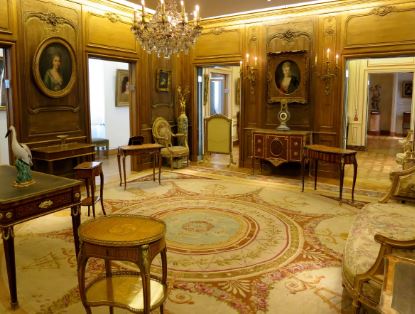
One of the most unusual names attached to the Winchester Mansion is “Llanda Villa,” which means small village. No matter how forbidding some of the dark places in the house are, people have used labyrinths throughout history—often surprisingly, to stay safe. In 1923, a man knocking down a wall inside The Winchester Mystery House made an amazing find. He discovered a human unexplored area of the mansion—that had been forgotten for decades. There was a long hallways and secrets rooms where some suspected Mrs. Winchester would go for solitude. There were also kitchens, storage rooms, and even schools and séance rooms. Thick stone doors were used to seal off the entrance to some of the rooms. In this sprawling mansion are several miles of passage ways, galleries, and chambers. One of the most amazing chambers is the Blue Séance Room, which has been a place of worship since about 1896. It was once lit by a huge chandelier made with glass-like crystals, and had an altar, statues, and detailed cloth sheets with architectural details on them. The Winchester Mystery House is hauntingly beautiful. After the death of Mrs. Winchester, the movers wondered would the prevail against encroaching malevolence, as some were entangled in the inescapable clutches of shadows. The people of the town spread rumours about an evil presence that was said to be hiding within the shadows of the basement. They spoke of lost and vengeful souls who were tormented by their past. There are secret passages in the walls, honeycombing the mansion, making it a kind of parallel universe within. To this day, something lives in the basement and in the attics, there are strange apparitions. #RandolphHarris 3 of 4
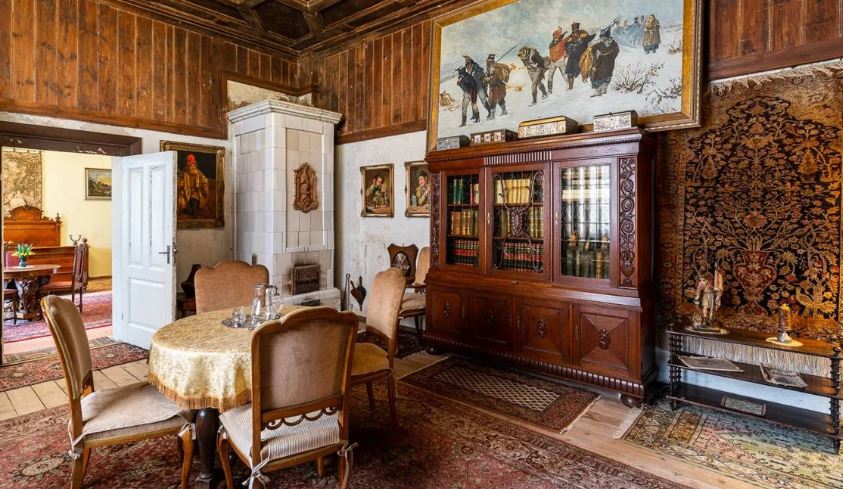
Within the framework of this medieval teratology, there is an “otherness.” Many have traversed an upward or downward path, with monsters becoming either saintly, angelic beings, or animals and demons. Sometimes these entities are reabsorbed into the into the soul of the house in a blink of an eye. Although there have been intrusive forensic investigations of the house, the growing mystery of what lies behind the walls and beneath the floors is still unknown. The ghosts are indifferent to material barriers; they can pass through solid objects and manifest themselves in defiance of dimensional logic. This house is a border between life and death. An entire unknown World exists. The door-to-nowhere is at times closed, bolted, pad-locked. At others, it is open, that is to say wide open. The walls, ceilings, and floors are home to the invisible but audible lives that are carried on beyond them and can evoke some of the familiar moods of the vast castles and monasteries of the Gothic romance. The “roar” that can be heard in the house must be the scream of a spirit as it was torn from its body. It represents the terror, the crisis, the pain, and individual suffering the spirits that call this house home live with. On 16 January 2024, a caretaker was walking along the upstairs landing in the afternoon when he heard footsteps behind him; he turned and saw the figure of a man that promptly disappeared. He saw the same man on other occasions; he was wearing an old fashion suit and cowboy hat and was carrying a shotgun. Later, on seeing photographs he realized it was Oliver Winchester. Objects often disappear, and reappear in other places. Most curiously of all, books appear out of nowhere. One evening a caretaker found a collection of books stacked at the top of the stairs to the ceiling. These books were of some age, and were of a historical nature. #RandolphHarris 4 of 4
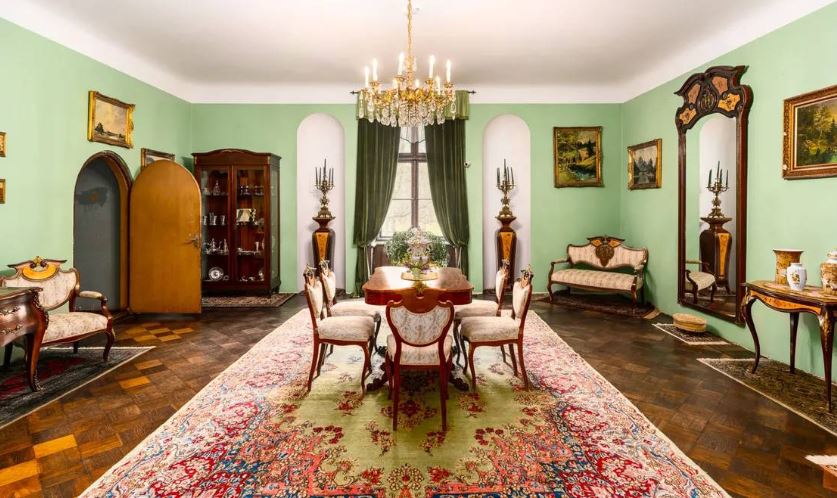
For further information about tours, including group tours, weddings, school events, birthday party packages, facility rentals, and special events please visit the website: https://winchestermysteryhouse.com/
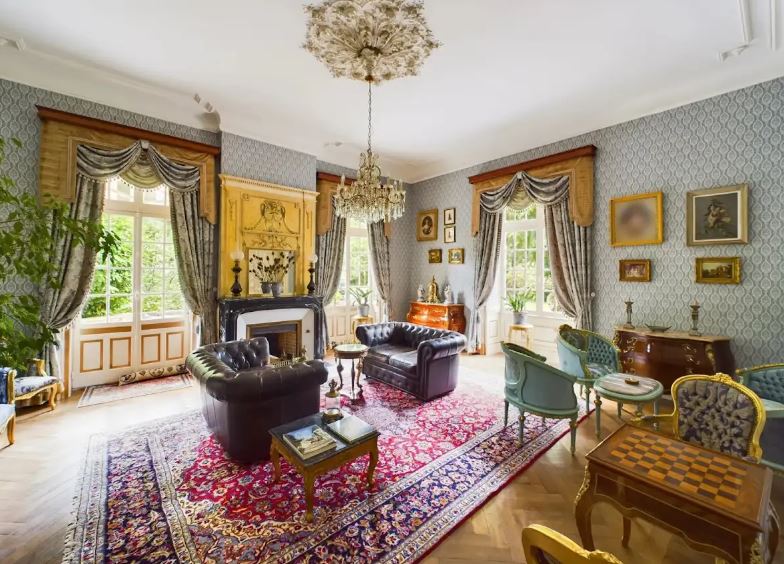
Please visit the online giftshop, and purchase a gift for friends and relatives as well as a special memento of The Winchester Mystery House. A variety of souvenirs and gifts are available to purchase. https://shopwinchestermysteryhouse.com/

What are the Fact and the Realistic Possibilities?
The Western powers, like the communists, talk in terms of choice between capitalism and communism. This alternative is almost the one thing the two camps agree on. The facts are, however, more complex. Capitalism in the middle of the twentieth century is not the capitalism of individual initiative, minimal state activity, et cetera, that it was in the nineteenth century. Both the Russian and the Chinese types of communism—different from the Marxist socialism they pretend to resemble. What are the facts and the realistic possibilities? First, we must recognize that the underdeveloped countries, in the long run, will not choose capitalism for both economic and psychological reasons. They cannot choose a system that was developed in Europe over several hundreds of years, in response to the particular historical conditions of that continent. These underdeveloped countries need a system which fulfills these conditions: first, economic power must be taken from the small cliques who use it only for their own interests and without regard for the needs of the majority of the population; second, the economy must follow a plan that allocates resources in the interest of, and for the optimal development of the entire economy. The cardinal point is that the alternative in the underdeveloped countries is precisely not that between capitalism and communism, an alternative which Russia, China and the Democratic party are fond of proposing, but that the alternative is which kind of socialism will they choose: the Russian state managerialism, the Chinese anti-individualistic communist, or a humanistic, democratic socialism, which attempts to combine the necessary minimum of bureaucratic centralization with the optimum of individual initiative, participation and responsibility. #RandolphHarris 1 of 19
If the West insist on the communist-capitalist alternative, if it allies itself with outmoded reactionary regimes which are doomed by history, then it will help Russian—or more likely China—to grain the leadership of two-thirds—and within a generation, almost four-fifths of the human race. The less affluent people of the World will believe that they must choose the way which is allowing China to develop at twice the rate of India, provided there is no other alternative. However, in spite of all China’s propaganda, there is plenty of evidence that the Chinese way of complete and ruthless regimentation is not what most of these people prefer. The wish for freedom and independence is not—as it is sometimes alleged—a relatively recent Western discovery; it is a deep-rooted need in the very existence of man, but it is not the only one. If it has to compete with hunger, fear, and hopelessness, most people—in the East and in the West—will be willing to sell out their desire for freedom. The question is whether such a choice can be avoided. Furthermore, even if millions of unaffluent people in all these countries have lived, thus far, under such abysmal conditions of hunger and hopelessness that at the moment they cannot be fully interested in freedom, this has less political significance than many people believe. The history of the underdeveloped countries is being made by relatively small groups of an educated, middle-class elite, who do appreciate the danger and the evils of totalitarianism. It is in fact quite remarkable how well India and other parts of Asia as well as of Latin America and Africa have stood up against the seduction of communism. However, if the necessary fundamental reforms are not made, it is also clear that the younger generation will become increasingly impatient. #RandolphHarris 2 of 19
It is thought by some that the only solution for the underdeveloped countries is democratic-socialist systems, adapted to the needs of each country, and varying accordingly just as Yugoslavia varies from India, is by no means a theoretical construction. The fact is that, as Mr. Barnett puts it, “Marxism has had a deep and widespread influence among intellectuals in many countries in the area [South and Southeast Asia]. Most of the leaders in South and Southeast Asia subscribe to ‘socialism’ of one kind or another. Many hope to create societies which can best be described as ‘socialism’ democracies,’ combining free and representative government with varying degrees of state economic planning. For the most part, they still look primarily to the West for their models, and they are attempting to adapt Western experience to their own needs, but few accept any specific Western model without qualification, and they have encountered great difficulties in attempting to transplant Western institutions in their countries. Many, while rejecting communism as a system of power, have felt that the Communists’ experience in Russia and China has considerable relevance to their own problems.” The problem is whether these leaders can eventually find a democratic-socialist pattern which will show achievements comparable to those of China, or whether they will have to accept the Communist solution which they would prefer to avoid. Their decision depends at least as much on the attitude of the West as it does on Communist propaganda. #RandolphHarris 3 of 19

So far, the West has been the most effective propagandist for the Communists, by insisting that the Communists, by insisting that the Communist are the true heirs of Marx, and that there is no alternative other than capitalism. The United States of America has made this error more than Europe, because Europe is at least familiar with democratic socialist ideas and parties, which up to 1960 have ruled at one time or another, since 1918, in Great Britain, France, Germany, Belgium, Italy, the Netherlands, Denmark, Norway, Sweden, and Iceland. In many of these countries the socialists were defeated in recent years because the conservative parties adopted part of the socialist program, and because the socialists themselves stagnated in the midst of plenty. However, it would be a serious mistake to believe that socialism in the underdeveloped countries is finished because it is at the moment on the defensive in the rich countries. In fact it may be considered one of the most important tasks of democratic socialism in the underdeveloped countries and to interpret it to the West. There is an objection to the idea suggested here which is serious enough to warrant immediate attention. This objection runs along the following lines: if it is the aim of the underdeveloped countries to achieve economic well-being within a few generations, if they want to build an industry of their own and provide the majority of their inhabitants with a standard of living that can at least be compared with the less affluent European countries, how can they do it except in the way China does: totalitarian organization, persuasion, and mass suggestion? #RandolphHarris 4 of 19

Are their leaders not forced to create a spirit of fanaticism and fear in order to sustain voluntary underconsumption and currency manipulation? This is not necessarily so. There is, of course, the problem of mobilizing the human energy to achieve a far higher economic productivity than these countries have now. The West officially claims that the hope of monetary gain is the most important way, and no doubt, this motive is effective within a certain frame of reference. (The Russians also agree—in practice.) However, there are other ways of mobilizing human energy. There is the Chinese way of total mobilization of brain, heart, and brawn by force and suggestion; and this way seems to work, although at the expense of fundamental human values. There is still another way, which democratic, humanist socialism offers: an appeal to the sense of self-respect, individual initiative, social responsibility, and pride of the individual. If such an appeal were merely ideological and fictious it would have no real and lasting effect. However, if it is based on the real possibilities the system offers for these qualities to develop; if furthermore, such an appeal is made in a system that has a plan and in which individual effort contributes to the progress of the society as a whole, then, I believe, that human energy can be mobilized to an extent comparable to totalitarian systems. Yugoslavia does not have a two-party system or elections in the Western sense, it has no political terror and its system furthers individual activity and responsibility and encourages decentralization. #RandolphHarris 5 of 19
Not only the psychic needs and desires of the broad masses matter, but also the character structure of the educated middle-class elite. What is their motivation? It is necessarily that of material wealth, the Western businessman’s motivation in the nineteenth, twentieth, and twenty-first centuries? If this is so, the only possible outcome can be that of corrupt government bureaucracies. For if it is wealth the leaders of underdeveloped countries are after, they will have to enrich themselves at the expense of the masses—possible only through deceit and oppression. However, there are many examples that wealth is by no means the only motivating force for the new elites, and, in fact, for some old ones. The governing groups in Yugoslavia and Egypt, the very top leadership in India, and the leadership in China, according to all reports, are not corrupt. (Their privileges are definitely limited, and not arrived at through theft and bribery.) What is apparently a strong motivation among these new leaders is a pride in their skill in administration and organization. In contrast to the traditional monetary motivation of the entrepreneur, the new elites are motivated by the same factors that motivate many professional men and women in our system: the satisfaction of applying an acquired skill and of obtaining useful results. We in the West often forget that satisfaction in workmanship, in the successful application of one’s skills, can be at least as strong an incentive as profit. In addition to the individual satisfaction rooted in skillful performance, the new elites need and often have another potent satisfaction—that of a sense of social obligation and solidarity with the broad masses of their respective countries. #RandolphHarris 6 of 19
This usually takes the form of national pride; whether we think of China, or of Egypt, or of any one of the newly awakened countries, they are led by men and women with a genuine national feeling, often bordering on an irrational nationalism. Professional and national pride, together with a sense of social justice and responsibility, may be said to be the most important motivations of the new leaders of many of the underdeveloped countries. From a psychological standpoint, these motivations are just as potent and as real as the desire for money and the lust for power; they are just as much a part of human nature as the latter ones. What matters is which kind of motivation a given society encourages and furthers, or, to put it differently, what kind of personality will rise to the top. The question arises whether the new elite is more prone to accept the Russian, the Chinese, or a democratic form of socialism. This is difficult to answer. However, one thing seems certain: which course the new elite will take depends on two factors, one psychological and one economic. These new leaders are proud and sensitive; they resent the treatment they have been given by the Western powers for more than a century. (The Russians leaders showed the same kind of sensitivity, especially before they had achieved their present success.) They have not forgotten the humiliation of the opium war, the slave trade, the American “banana policy,” and the American aid to Ukraine. They react in a perfectly normal way, being sensitive and even sometimes supersensitive and thus prone to take an aggressive anti-Western posture when the West continues to treat them with overt or slightly hidden arrogance. The tone of moral superiority toward the underdeveloped countries, which permeates many of our statements, serves only to create a deep antagonism toward the West, and to increase their tendency to unite with the Communist bloc. #RandolphHarris 7 of 19
Which are the conditions that are responsible for necrophilia? From the standpoint of Dr. Freud’s theory one must expect that the strength of the life and death instincts (respectively) remain constant, and that for the death instinct there is only the alternative of its being turned either outward or inward. Hence environmental factors can account only for the direction which the death instinct takes, not for its intensity. If, on the other hand, one follows the hypothesis presented here, one must ask this question: Which factors make for the development of the necrophilous and the biophilous orientations in general; and more specifically, for the greater or lesser intensity of the death-loving orientation in a given individual or group? The most important condition for the development of love of life in the child is for one to be with people who love life. Love of life is just as contagious as love of death. It communicates itself without words, explanations, and certainly without any preaching that one ought to love life. It is expressed in gestures more than ideas, in the tone of voice more than in words. It can be observed in the whole atmosphere of a person or group, rather than in the explicit principles and rules according to which they organize their lives. Among the specific conditions necessary for the development of biophilia, here are a few of the following ones: warm, affectionate contact with others during infancy; freedom, and absence of threats; teaching—by example rather than by preaching—of the principles conducive to inner harmony and strength; guidance in the “art of living”; stimulating influence of and response to others; a way of life that is genuinely interests. #RandolphHarris 8 of 19
The very opposite of these conditions furthers the development of necrophilia: growing up among death-loving people; lack of stimulation; fright; condition which make life routinized and uninteresting; mechanical order instead of one determined by direct and human relations among people. As to the social conditions for the development of biophilia, it is evident that they are the very conditions which promote the trends mentioned above with regard to individual development. It is possible, however, speculate further and include a fraction of these other factors. Perhaps the most obvious factor is that of a situation of abundance versus scarcity, both economically and psychologically. As long as most of man’s energy is taken up by the defense of one’s life against attacks, or to ward off starvation, love of life must be stunted, and necrophilia fostered. Another important social condition for the development of biophilia lies in the abolition of injustice. This refers to a social situation in which one social class exploits another, and imposes conditions on it which do not permit the unfolding of a rich and dignified life; or in other words, were one social class is not permitted to share with others in the same basic experience of living; in the last analysis, by injustice I refer to a social situation in which a human is not an end in oneself, but becomes a means for the ends of another human. Finally, a significant condition for the development of biophilia is freedom. However, “freedom from” political shackles is not a sufficient condition. If love for life is to develop, there must be freedom “to”; freedom to create and to construct, to wonder and to venture. Such freedom requires that the individual be active and responsible, not a slave or a well-fed cog in the machine. #RandolphHarris 9 of 19
Love of life will develop most in a society where there is: security in the sense that the basic material condition for a dignified life are not threatened, justice in the sense that nobody can be an end for the purposes of another, and freedom in the sense that each human has the possibility to be an active and responsible member of society. A point of particular importance is even a society in which security and justice are present might not be conducive to love of life if the creative self-activity of the individual is not furthered. It is not enough that humans are not slaves; if social conditions further the existence of automatons, the result will not be love, but love of death. Theoretically, Dr. Freud’s disbelief in a wish for self-development is linked up with his postulate that the “ego” is a weak agency tossed about among the claims of instinctual drive, of the outside World and of the forbidding conscience. Ultimately, however, I believe that the two formulations of analytical goals are expressions of different philosophical beliefs as to the nature of humans. The deepest source of a man’s or woman’s philosophy, the one that shapes and nourishes it, is faith or lack of faith in humankind. If one has confidence in human beings and believes , that something fine can be achieved through them, one will acquire ideas about life and about the World which are in harmony with one’s confidence. Lack of confidence will generate corresponding ideas. Dr. Freud recognized that some degree of self-analysis is possible, for he did also analyze his own dreams. However, even if we grant that there is sufficient incentive for self-analysis there is still the question whether it can be undertaken by a “layman” who has not the necessary knowledge, training, and experience. #RandolphHarris 10 of 19
With all due respect for the role of specialization in cultural development, too much awe of specialization can paralyze initiative. We are all too inclined to believe that only a politician can understand politics, that only an auto science engineer can repair an Ultimate Driving Machine, that only a trained gardener can prune trees. Of course, a trained person can perform more quickly and more efficiently than an untrained person, and in many instances the latter will fail entirely. However, the gap between a trained and an untrained person is often regarded as wider than it is. Faith in specialization can easily turn into blind awe and stifle any attempt at new activity. General considerations of this kind are encouraging. However, in order to arrive at a proper evaluation of the technical possibility of self-analysis we must visualize in concrete detail what constitutes the equipment of a professional analyst. In the first place, the analysis of others demands an extensive psychological knowledge of the nature of unconscious forces, the forms of their manifestation, the reasons responsible for their power, the influence wielded by them, the ways of unearthing them. In the second place, it demands definite skills, which must be developed by training and experience: the analyst must understand how to deal with the patient; one must know with a reasonable degree of certainty which factors in the maze of material presented should be tackled and which left out for the time being; one must have acquired a highly developed ability to “feel into” the patient, a sensitivity to psychic undercurrents that is almost a sixth sense. #RandolphHarris 11 of 19
Finally, the analysis of others demands a thorough self-knowledge. In working with a patient the analyst has t project oneself into a strange World, with its own peculiarities and its own laws. And there is considerable danger that one will misconstrue, mislead, perhaps even inflict positive injury—not through bad will but through the carelessness, ignorance, or conceit. Therefore not only must one have a thorough familiarity with one’s tools, and skill in using them, but equally important, one must be straightened out in one’s relations to self and others. Since all three of these requirements are indispensable, nobody who does not fulfill them should assume the responsibility involved in analyzing others. These requirements cannot be automatically attributed to self-analysis as well, because analyzing ourselves is in certain essential points different from analyzing others. The difference most pertinent here is the fact that the World that each of us represents is not strange to ourselves; it is, in fact, the only one we really know. True enough, a neurotic person has become estranged from large parts of this World and has an impelling interest not to see parts of it. Also there is always the danger that in one’s familiarity with oneself that one will take certain significant factors too much for granted. However, the fact remains that it is one’s World, that all the knowledge about it is there somehow, that on need only observe and make use of one’s observation in order to gain access to it. #RandolphHarris 12 of 19

If one is interested in recognizing the sources of one’s difficulties, if one can overcome one’s resistances to recognizing them, one can in some respect observe oneself better than an outsider can. After all, one lives with oneself day and night. In one’s chances to make self-observations one might be compared with an intelligent nurse who is constantly with a patient; and analyst, however, sees the patient at best only for an hour each day. The analyst has better methods for observation, and clearer viewpoints from which to observe and to make inferences, but the nurse has opportunities for a wide range of observation. This fact constitutes an important asset in self-analysis. Indeed, it reduced the first of the requirements demanded of a professional analyst and eliminates the second: in self-analysis less psychological knowledge is demanded than in the analysis of others, and we do not need at all the strategical skill that is necessary in dealing with any other person. The crucial difficulty in self-analysis lies not in these field but in the emotional factors that blind us to unconscious forces. That the main difficulty is emotional rather than intellectual is confirmed by the fact that when analysts analyze themselves they have not such a great advantage over the layman as we would be inclined to believe. On theoretical grounds, then, I see no stringent reason why self-analysis should not be feasible. Granted that many people are too deeply entangled in their own problems to be able to analyze themselves; granted that self-analysis can never approximate the speed and accuracy of analytical treatment by an expert; granted that there are certain resistances that can be surmounted only with outside help—still, all of this is no proof that in principle the job cannot be done. #RandolphHarris 13 of 19
The patients who may be readily counted, whose illness is of such nature as to lead to hospitalization, are not the ones under primary consideration here. Rather, it is the unnumbered mass of lesser sufferers, the partial cripples, with whom we are concerned. These are the individuals who are emotionally maladjusted and psychologically disordered but whose mental illness permits them to lead a tortuous existence outside the hospital walls. Only a very rough approximation of their total number is possible. They are partially enumerable as those chronic visitors to physician’s offices with complains that are vague, anatomically and physiologically irrational, and unsupported by any findings of actual organic defect. These are the recalcitrant 50 to 70 percent of the general practitioner’s case load who are sooner or later labeled “neurotic.” Included also in the extramural population of psychiatric cases are those persons who are seen on an outpatient basis in public mental hygiene clinics of social agencies and by private psychiatrists and psychologists. These too are countable. Most present-day authorities are not content to let the realm of mental illness be bounded by these recordable patients. They practice the delicate art of extrapolation and arrive at estimates of the “real sum” of mentally sick persons in the total population. In such activity they are not out of step with general practice in the field of public health which recognizes that there are multiple factors determining whether a given case of a specific disease ever comes to formal diagnosis. Thus, it is logically descriptive to speak of the person known to carry the active tubercle bacillus in his or her lungs as having had tuberculosis even before one was X-rayed, visited a physician, or had a formal diagnosis of one’s symptoms. After such a diagnosis, it is appropriate to recognize that the individual has been ill. #RandolphHarris 14 of 19
The disease does not begin its existence, except in a very arbitrary and formal sense, with the occurrence of diagnosis. Accordingly, it is not at all fictional to think of the total incidence of a disease such as tuberculosis, which William Writ Winchester had a fatal encounter with, as composed of those recorded, diagnosed cases plus an additional estimated number of undiagnosed cases. Biometric experts have developed methods for rather exact estimating of the number of such putative cases, utilizing among other factors data on the number of cases that come to diagnosis per period of time and the prior duration of the illness as indicated by the stage of symptoms at the time of diagnosis. Similarly, it is appropriate to conceive of the total number of mentally ill at any given time as composed of those institutionalized and otherwise recorded cases plus an estimated number of individuals who carry the “germs” of mental illness and have manifest symptoms, but have not yet come to diagnosis. Recent surveys of probability samples of urban and rural populations presented some degree of psychic symptomatology and to the equally startling finding that less than 20 percent were free of any sign of emotional distress. The ultimate negative is a hinderer: “We would fain have come unto you…but the ultimate negative hindered us” reports 1 Thessalonians 2.18, wrote Pual, who was able to discern between the hindering of the ultimate negative and the restraining of the Holy Spirit of the ultimate concern (Acts 16.6). This again means knowledge, and power to discern the ultimate negative’s workings and schemings and the obstacles which it places in the paths of the children of the ultimate concern—obstacles which look so “natural” and so like “providence” that numbers meekly bow their heads and allow the Hinderer to prevail. #RandolphHarris 15 of 19
Power to discern comes by knowledge that the ultimate negative can hinder; by observing the objective of the hindrances, and by close observations of its methods along this line. For example, is it the ultimate concern or the ultimate negative withholding money from missionaries preaching the gospel of Calvary, and giving abundance to those who preach error and teachings which are the outcome of the spirit of antichrist? Is it the ultimate concern or the ultimate negative urging a family to move their residence, without reasonable grounds, to another neighbourhood, when it involves the removal of another member from a strategic vantage-ground of service to the ultimate concern, with no other worker to take one’s place? Is it the ultimate concern or the ultimate negative leading Christians to put first their health, comfort, social position in their decisions, rather than the needs and the exigencies of the kingdom of the ultimate concern? Is it the ultimate concern or the ultimate negative who hinders service for the ultimate concern through members of a family making objections, or through troubles in business which give no time for such service, or through property losses, et cetera? Knowledge of the Hinderer means victory by prayer over one’s schemes and workings. The believer should therefore know one’s wiles. #RandolphHarris 16 of 19
Up to now we have examined the fact of the manifestation of the Kingdom of God through the appearance of the Christ in a moment of Kairos. Since the reception of Christian revelation constitutes the manifest churches, they are the representatives of the Kingdom of God within history and thereby play a twofold role: they actively contribute to the pursuit of the aim of history, and they struggle against the forces of profanization and demonization which seek to frustrate this purpose. To accomplish this task, to create the new in history and to withstand the profane and the demonic, the churches draw upon the power of the New Being which is their foundation. The churches as the embodiments of the Spiritual Community comprise only persons, but as representatives of the Kingdom of God they stand for all dimensions of life, including the animate and inanimate World of nature. This wider representative function is fulfilled through the sacraments: To the degree in which a church emphasizes the sacramental presence of the divine, it draws the realm’s preceding spirit and history, the inorganic and organic universe, into itself. For the Kingdom of God symbolizes not only society, but also the multidimensional life of the whole universe. The churches have a history, but instead of speaking “the history of the churches,” we prefer the phrase “the history of the church” in order to emphasize that the many churches are embodiments of the one Spiritual Community, despite their paradoxical ambiguities. In the light of this fact, one must admit that church history is at no point identical with the Kingdom of God and at no point without manifestation of the Kingdom of God. #RandolphHarris 17 of 19
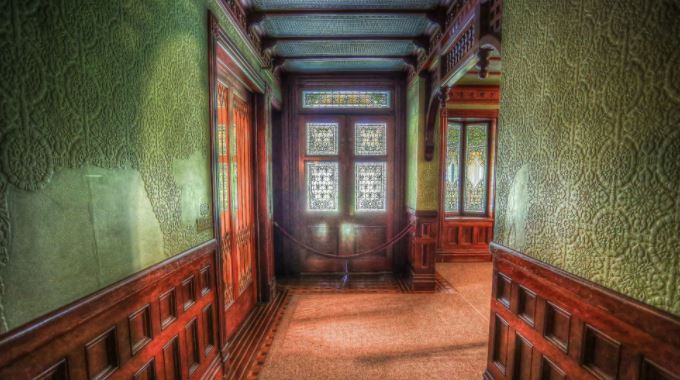
Although the church is the representative of the Kingdom of God, the two cannot be simply identified because the riddle of the church history, namely, the ambiguity of the church as spelled out in its historical dimension. The riddle of church history can be expressed in a series of questions. Why is the church, in principle universal, effectively restricted to a particular civilization? How account for the rise within Christianity itself of secular movements, such as humanism and communism? Why has the unity of the church been splintered? How explain so much profanization of the holy in church history both by Roman Catholic ritualization and Protestant secularization? What is the cause of the history of demonization in the church, from the early persecution of heretics, through the religious wars, through the fanatical stubbornness of fundamentalism, through the tyranny of Protestant orthodoxy, to the infallibility of the pope? In the face of this riddle, this scandal, one must ask: What does church history mean? Two statements can be made in reply. First, church history cannot be identified with the history of salvation or sacred history. “Sacred history is in church history but is not limited to it, and scared history is not only manifest in but also hidden by church history. It is the everlasting paradox of the church that it conceals the Kingdom of God as well as reveals it. Secondly, church history has one quality which shines through even its most distorted phases: “…it has in itself the ultimate criterion against itself—the New Being in Jesus as the Christ.” Consequently, “the presence of this criterion elevates the churches above any other religious group, not because they are ‘better’ than others, but because they have a better criterion against themselves and, implicitly, also against other groups.” #RandolphHarris 18 of 19
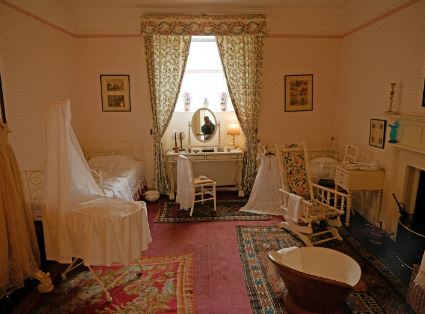
The struggle of the Kingdom of God within history is above all a struggle within the bosom of its own representatives, for the reformation of a profanized and demonized church is never ended. Church history, however, judges not only itself, but also non-church history or World history. The influence of church history upon World history is seen where it produces an uneasy conscience in those who have received the impact of the New Being but follow the ways of the old being. Church history is not the Kingdom of God, but the Christian civilization which it begets is a continual reminder of it. Must not all philosophy in the end bring to light the presupposition upon which the movement of reason rests: our belief in the “I” as substance, as the sole reality according to which we attribute reality to things generally? The oldest “realism” finally comes to light—at the same time as the entire religious history of humankind is recognized as the history of the soul superstition. There is a limit here: our thinking itself involves that belief (with its distinction between substance and accident, deed and doer, et cetera); letting go of it means no longer being allowed to think. That a belief, however necessary it may be for the preservation of a creature, has nothing to do with truth, one can see, for example, in the fact that we have to believe in time, space, and motion, but without feeling constrained to grant them absolute reality. I pledge allegiance to the flag of the United States of America, and to the Republic, for which it stands, One Nation, Under God, Indivisible, with Liberty and Justice for all. Nations that defy Thy law of justice and of love, that stir up hate against the weak, estranging human from human, that crush the stranger in their midst and shed one’s blood for gain, and follow their unrighteous ways that lead to strife and war, such nations still to evil are enslaved, but Thou, through us, shalt bring to judgement all their wicked ways. Please keep the Sacramento Fire Depart and your hearts and prayers this season, for they are not receiving all of their resources. If it is possible, please make a donation. It will be much appreciated. #RandolpHarris 19 of 19
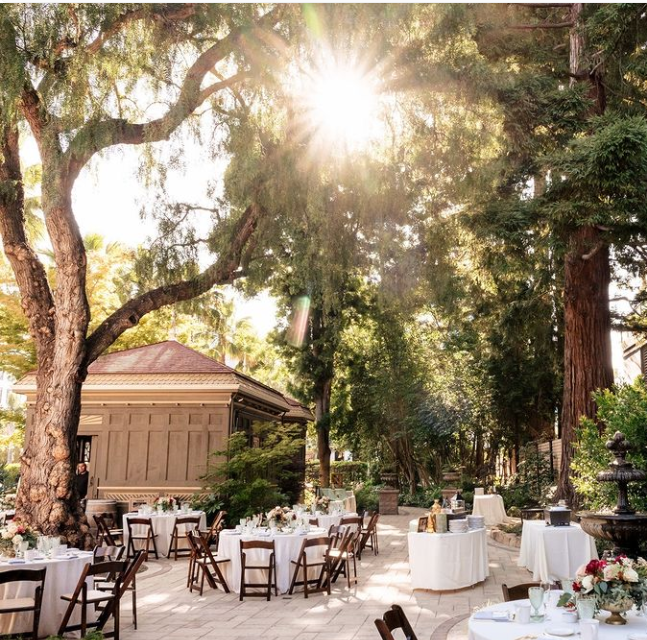
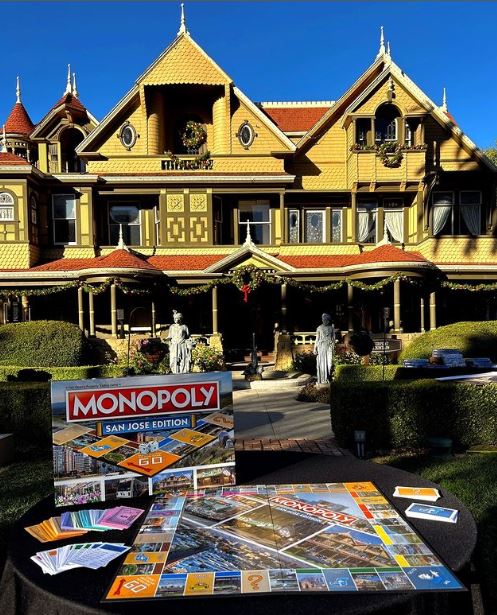
The greatest contributor among the health-food pioneers in the Victorian Ear was Gail Borden. City people were being poisoned by tainted milk every day. Mr. Borden discovered that by evaporating much of the water from milk and canning the result, the milk did not have to be refrigerated. The cows could live a healthy, country life while the consumers could stay far away in the city, hence Mr. Borden’s famous slogan for Carnation milk: “from contented cows.”
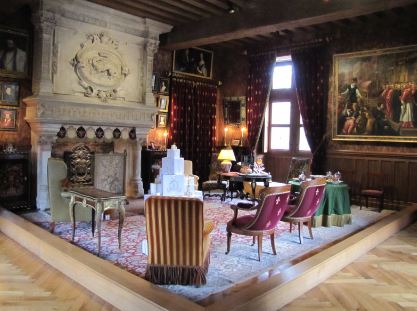
The other strong influences on late nineteenth-century eating was the home-economics movement. Well-educated, middle-class nonimmigrant women not only created a profession of their own, but also sought to Americanize the less affluent. Home economists and social workers tried to teach immigrant women about nutrition and tried to wean them away from the “hot,” spicy cuisine of their homelands. The favourite foods of the home economics movement were gelatin salads and boiled dressings. A blanket of white cause covering a slab of boneless protein was the ideal dish. Salads were orderly, encased, cool, and controllable rather than hot, sloppy, and sensuous.

Jello, after all, is a Victorian product invented during the 1890s by the Genesee Pure Food Company of Leroy, New York. This change in cuisine was not all one-way bullying. Cookbooks like Fannie Farmer’s and Mrs. Beeton’s as well as manners books like Emily Post’s, were eagerly bought by immigrant women who wanted to fit into American culture. These books gave advice on food, eating, and household management to Europeans who wanted to know how things were “done” in America.
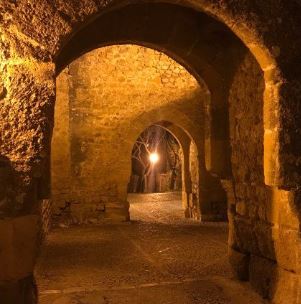
For further information about tours, including group tours, weddings, school events, birthday party packages, facility rentals, and special events please visit the website: https://winchestermysteryhouse.com/

Please visit the online giftshop, and purchase a gift for friends and relatives as well as a special memento of the Winchester Mystery House. A variety of souvenirs and gifts are available to purchase. https://shopwinchestermysteryhouse.com/
 Randolph Harris II International Institute