
Home » Posts tagged 'Architecture'
Tag Archives: Architecture

Today We Begin the Harrowing Story
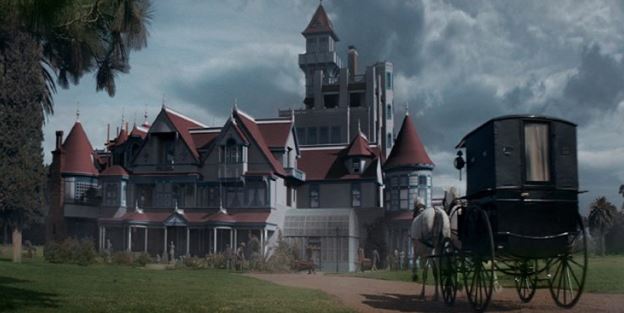
I have many beautiful art glass windows in my house, but the most expensive in the house was specially designed for me by Tiffany’s of New York. I originally installed it in an outside wall, but later added a series of rooms that blocked off all direct sunlight. There is a peculiar apparition that is seen in the window itself. The form seen is that of a figure dressed in white walking across the window. At first there was only one figure, and then thirteen appeared. The figures began to move across the window long before the carpenters noticed them. They did so as many as twenty or thirty times a day, and would stop shortly after noon. Of the three figures, one was a man, stone was a woman, and one was a child. the man was an average commonplace British tradesman, obese, pompous, and slow. He wore rather baggy gray shepherd’s-check trousers, not over-clean black frock coat, unbuttoned in the front, and a drab waistcoat with a heavy brassy Albert chain, and a square pierced bit of metal dangling down as an ornament. A frayed top hat and a faded brown overcoat with a wrinkled velvet collar. Altogether, look as I would, there was nothing remarkable about the man save his blazing red head and the expression of extreme chagrin and discontent upon his features. The woman was very distinct in appearance. She was tall and very graceful. The two-year-old boy showed signs of disturbed behaviour, laughed hysterically and talked of “funny drinks.” The order of the apparitions in the window had a slight variation: the mother came alone from the northside of the window, and having gone about halfway across, she would stop, turn around, and wave her arms towards the quarter whence she had come. #RandolphHarris 1 of 9

This gesture was answered by the entry of the father with the child. Both parents then bent over the child, and seemed to bemoan his fate; but the mother was always the most endearing in her gestures. The father then moved towards the other side of the window, taking the child with him, leaving the mother in the center of the window, from which she gradually retired to the north corner, whence she had come, waving her hand, as though making signs of farewell, as she retreated. After some little time she again appeared, bending forward, and evidently anticipating the return of the father and son, who never failed to reappear from the south side of the window where they had disappeared. The same gestures of distress and despair were repeated, and then all three retired together to the north side of the window. One evening, about nine o’clock, I was at the south-west door with Mr. Hansen. As I was unlocking it, I said, “Did you ever find anybody locked in here by accident?” “Mrs. Winchester, twice I saw shadows moving in that beautiful window. What a noise they did make!” Mr. Hasen then waited, leaning against the pillar, and watched the light wavering along the length of the landing. Mr. Hansen said they were well worthy seeing. “I suppose,” he said, as we walked toward the steps to the third floor, “that you’re too much used to going about here at night to feel nervous—but you must get a start every now and then, don’t you, when a book falls down or a door swings to?” “No, Mr. Hansen, I can’t say I think much about noises, not nowadays: I’m much more afraid of finding an escape of gas or a burst in the stove pipes than anything else. Still there have been times, years ago. #RandolphHarris 2 of 9

“If you have an have half an hour to spare, sir, when we get back down to the second floor, Mr. Hansen, I could tell you about a tomb that was unearthed. I will not begin now; it strikes cold here, and we do not want to be dawdling about all night.” “Of course, Mrs. Winchester, I should like to hear it immensely.” “Very well, sir, you shall. Now if I might put a question to you,” I went on, as we passed down the hallway of the third floor, “in my little local guide—and not only there, but in the little book on Llanada Villa in the series—you will find it stared that this portion of the mansion was erected previous to the twelfth century. Now of course I should be glad enough to take that view, but—mind your step, sir—but, I put it to you—doe the lay of the stone here in this portion of the wall (which I tapped with my key), does it to your eye carry the flavour of what you might call Saxon masonry? No, I thought not; no more it does to me: now, if you will believe me, I have said as much to the other carpenters. However, there it is, I suppose every one’s got their opinions.” The discussion of this peculiar trait of human nature occupied Mr. Hansen almost up to the moment when we returned to the second floor. Usually the apparitions appeared during musical performances in the Grand Ballroom, and especially during one long eight-line hymn, when—for the only occasion without the child—the two parents rushed on (in stage phrase) and remained during the whole hymn, making the most frantic gestures of despair. Indeed the louder the music in that hymn, the more carried away with their grief did they seem to be. #RandolphHarris 3 of 9
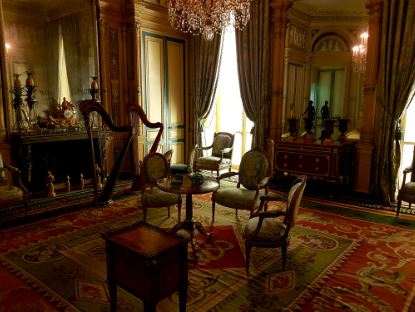
Nothing could be more emphatic than the individuality of the several figures; the manner of each had its own peculiarity. If the stained glass were removed, I do not doubt that a much plainer view would be obtained. I think so, because the nearer the center of the window, where the stained glass was thickest, there the less distinct were the forms. It was like catching glimpses of them through leaves. However, nearer the edge of the window, where the colours were less bright, they were perfectly distinct; and still more so on the pane of unstained glass at the edge. There they seemed most clear, and gave one the impression of being real persons, not shadows. Mental disturbance, it is true, will age one rapidly; but the face of Mr. Hasen since working on this project had taken on a subtle cast which only the very aged normally acquired. While standing on the landing looking at the window, I noticed his respiration and heart action had a baffling lack of symmetry; the voice was lost, so that no sounds above a whisper were possible. His skin had a morbid chill and dryness. Of course, we were witnessing the most remarkable and perplexing incident in the whole spectacle. When the father and the child had taken their departure, the mother waved her hands, and after walking slowly to the very edge of the window, turned round whilst on the pane of unstained glass and waved her arm towards the other two with what one would call a stage gesture, and then I most distinctly saw, and emphatically declare I did see, the arm bare nearly to the shoulder, with beautiful folds of drapery hanging from it like a picture of a Greek vase. Nothing could be plainer than the drag of the robes on the ground after the figures as they retired at the edge of the window, where the clear glass was, previous to going out. #RandolphHarris 4 of 9
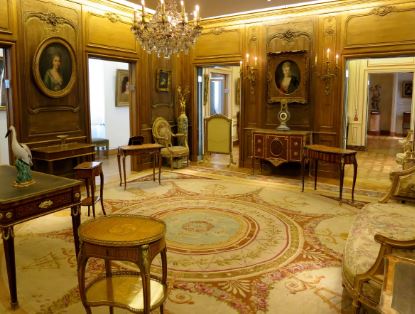
The impression produced was that one saw real persons in the air, for though the figures were seen on the window, yet they gave one the impression of walking past the window outside, and not moving upon the glass. I am not inclined to think that the trees outside the mansion at the east end can originate the appearance by any optical illusion produced by waving branches. I could see their leaves rustling in the air, and their movement was evidently unconnected with the appearance and movement of the figures. So I began making enquires on my estate. I discovered that several people had indeed seen the shapes upon the glass. One spoke of a female figure with a slightly skipping step. Another servant said he saw an ancient gravestone from the window. The belief that the tree beside the Tiffany window were somehow responsible for the optical illusion was soon dashed; the trees were cut down, but the figures appeared still. One correspondent wrote to me in the winter of 1889, explain that “as I have no faith in ghost, I have been most wishful to have the matter cleared up. On 25 March 1687, the land you now own was involved in a remarkable satanic horror story. A young girl came to the farmhouse for help, saying that she wanted to get away from a group of satanists who had threatened to kill her. She confessed to the owner that she had murdered her own baby in ‘frenzied ritual.” He befriended the girl, twenty-three-year-old Caludia, and allowed her to stay in his home. She kept telling him that she couldn’t stand hearing the screams of her children inside of her head. And on April 20th, 1687, she died from an overdose of Laudanum and postmortem examination revealed thirteen scars and burns on her body which he tended to and which supported her claims of having been involved in satanic ritual. #RandolphHarris 5 of 9

“Further, Claudia left a 13-page diary in which she said he had been involved with a satanic group since she was hired to work on a nearby farm at age thirteen and her writings went on to make incredible claims. She described how she went to coven meetings with a boy named Dorian whom she had met while living on the farm. The boy’s mother was a High Priestess and his father was The Master—a known satanic term for the leading member of the group. She described other practice which are known to be common in satanic altar initiations—that of having her armed pricked and blood drained into a chalice from which it was drunk. ‘Much sexual perversion went on that night…later I learned more of Satan and practiced my arts calling on my power of darkness. Satan had become my Lord and Master.’ Later she described how she aborted a baby she was expecting by Dorian then made the claim that Dorian himself was sacrificed by his own father in retribution, and how she was forced to watch as he was hung upside down. She claimed to have seen other sacrifices of many new born babies, stabbing them at orgies in which Laudanum was taken heavily. She also appeared to have had another child of her own which was also offered up for sacrifice. At her inquest of 13 May, the midwife recorded an open verdict after the she noted that Claudia’s body had signs which confirmed she had given birth at least once, and had been subject to sexual abuse. The constables took up the case, but no charges were brought and the investigation was closed without further action.” #RandolphHarris 6 of 9
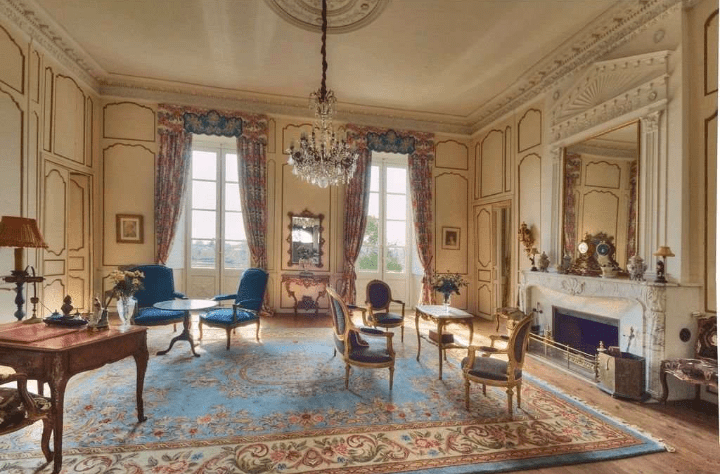
I was shocked of these allegations which seemed to be more than enough to inspire the most lurid of headline writers, more than to testify to the credibility of all who were proffering these dramatic and barely believable accounts of satanic abuse. Everything these people said was being taken as gospel in the village because the allegations were coming from the mouths of so-called experts. However, there were claims of rampant satanic worship in Nova Albion at this time, which was documented by English charters led by Sir Francis Drake for England. There were horrifying claims that fifty women were suffering from the after-effects of cannibalism and an average of ten occult survivors a week were being sacrificed. Dr. Harley said he read of several cases recorded by Theodorous de Bry where children had been killed. There were, of course, also several stories concocted around these three figures in my home. Some said that they issued from the grave beside the east window. Other said that they were victims of the plague, and were burned outside where this window now stands. It may or may not be relevant that the figures seemed to appear when the sound of the organ and of voices raised in song. The case was thoroughly investigated in 1889 by Dr. Robert Radakovic of The Ghost Club, where it was revealed that Llanda Villa had been “haunted” for two or three hundred years by the same figure or figures. Optical tests on the possible patterns of light and reflection had come to no results. It was remarked that “the ghost has been seen from the inside while outside nothing was visible.” #RandolphHarris 7 of 9
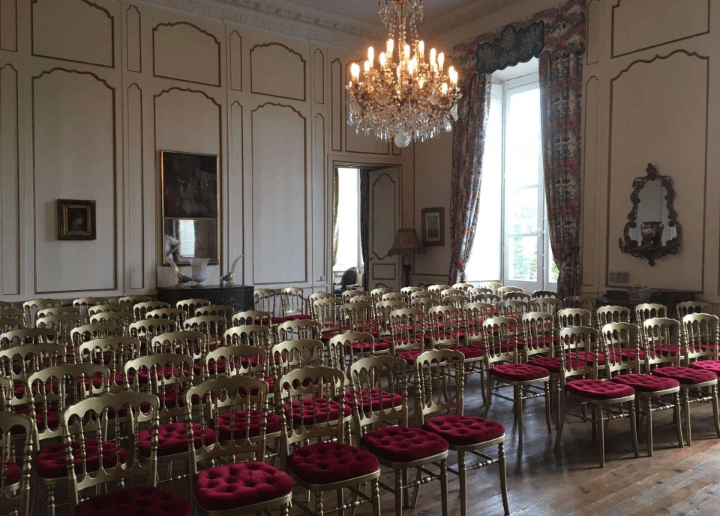
The interior of Lalanda Villa was much altered in the late nineteenth century, and a complex of rooms was built behind this haunted window. However, no satisfactory explanation has ever been given for the strange phenomena reported here. While designing Lalanda Villa, I was gaining my tastes from the venerable town around me, and from the relics of the past which filled every corner of my mansion. With the years, my devotion to ancient things increased; so that history, genealogy, and the study of gothic architecture, furniture, and craftsmanship at length crowded everything else from my sphere of interests. These tastes are important to remember for they outwardly concealed knowledge of bygone matters so that one would have fancied the they are literally transferred to a former age through some obscure short of autohypnosis. However, the true madness, I am certain, came with a later change; after the portrait and ancient papers of Saint Adalrich the Duke of Alsacre had been unearthed. Some terrible invocations being chanted under strange and secret circumstances; after certain answers to these invocations had been plainly indicated, and a frantic letter penned under agonizing and inexplicable conditions; after the wave of vampirism and the ominous legends of Neustria; and after the farmer’s memory commenced to exclude contemporary images whilst his voice failed and his physical aspect underwent the subtle modification so many subsequently noticed. He was later diagnosed with porphyria. And a final investigation resulted which virtually proved the authenticity of the papers and of their monstrous implications at the same time that those papers were borne forever from human knowledge. Loving antiquities so keenly, the papers and portrait were secretly concealed. #RandolphHarris 8 of 9
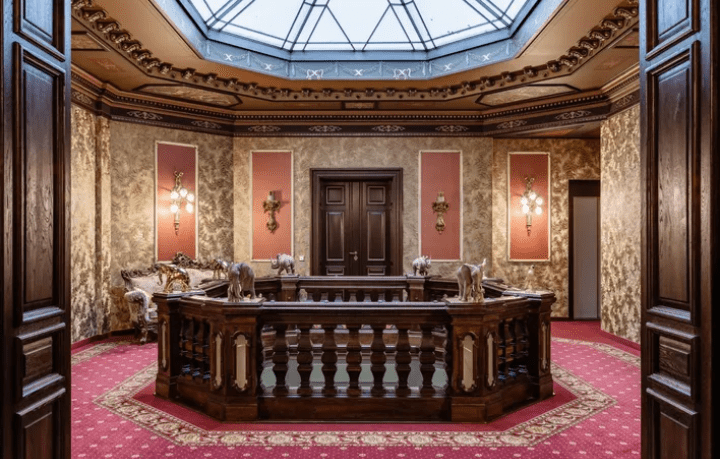
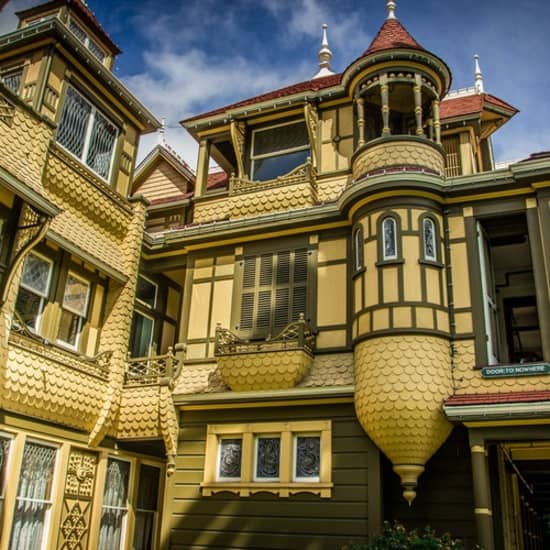
Bedroom fashions changed dramatically over the Victorian years due to several factors. Early in the period, homes were heated by fireplaces and therefore could be uncomfortable in the colder mothers, although a heated bedroom was considered an indulgence and windows were left open during the winter. In reality, only the rich had fireplaces in their bedrooms. Still, one had to keep warm while asleep and bed drapery, consisting variously of canopies, tents, and other enclosures used to shut out drafts, was essential, as was heavy draper on windows. Even doors had decorative, but also functional, drapes called portieres that served to keep out drafts when covering the door.
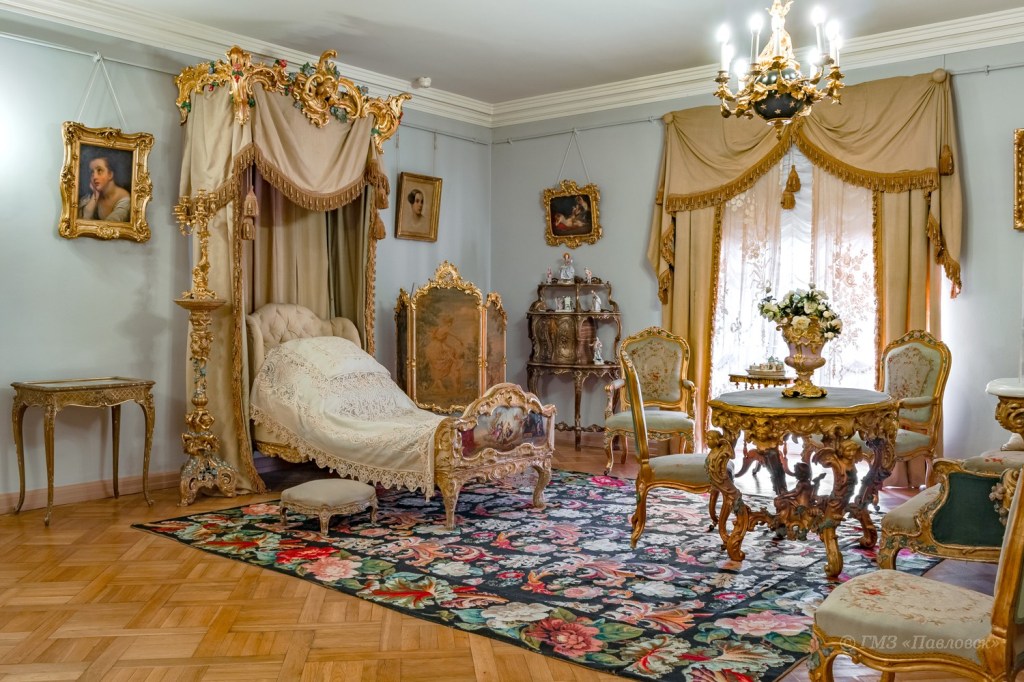
Mrs. Winchester was wealthy and her wealth and prosperity were even envied among the elite. She had no less than 47 fireplaces in her home. By the end of the century, two things had changed that affected bedroom styles. First, coal and woodburning parlour stoves came into use, were more efficient at heating a house, and could be installed in any room. (Central heating, though available after the Civil War, was really only for the very rich.). Secondly, and more importantly, was an increased knowledge of diseases, germs, and bacteria and how to combat them. Plenty of fresh air with good circulation, and the elimination of materials such as bed draper that not only impeded air circulation but provided a place for dust and bacteria to collect were deemed essential. Since the bedroom served as the place where daily and weekly ablutions were performed (until bathrooms became separate entities), and as a birthing and maternity room, it was important that it have a healthy environment.
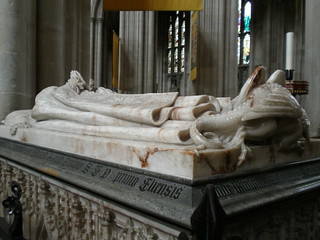
Styles of bedroom furniture were affected by this new found interest in and concern for prevention of illness and diseases. The classic English styles of Sheraton, Chippendale, and Hepplewhite migrated from the eighteenth century into the Victorian period. Tall, four-poster canopied beds enclosed the sleeper in heavy drapes of wool or lined damask of velvet, a carryover from the time when houses were built without corridors, and enclosures around the bed were needed for privacy, as well as warmth. By the time mid-century had arrived, the full enclosure had receded to the half-tester, or half-canopy, from which hung draperies that covered only the head and shoulders. Fully enclosed beds were now considered unhygienic, as they limited air circulation and the yards of fabric attracted dust. Dust ruffles and window valances were also discarded in the same house cleaning. In the southern climates, netting was still necessary to protect against insects, and its slightness did not impede air movement.
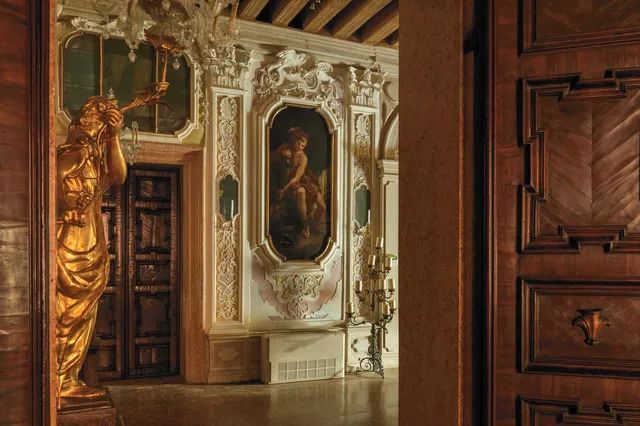
Gothic Revival furniture was the style into the 1840s and its massiveness was particularly suited to bedrooms. Closets were not an architectural feature at this time; clothing was stored in large cabinets called armories or wardrobes, usually with double, mirrored, and washstand, topped with marble or wood, were manufactured for middle-class homes in the cottage style. “Spool” beds were popular, nicknamed “Jenny Lind beds” because the Swedish Nightingale was rumoured to have slept in when she toured the United States of America. Made of less costly woods like maple or pine, the simple furniture could be elaborately painted with floral or foliage patterns. The well-to-do preferred the more opulent style of Rococo Revival or Renaissance Revival in woods or walnut, mahogany, or rosewood with carvings and applied moldings. As with other furniture in the house, golden oak, promoted by the Arts and Crafts Movement, was popular at the end of the century. Additional pieces of furniture found in the bedroom were writing desks, chaises, or other upholstered furniture.
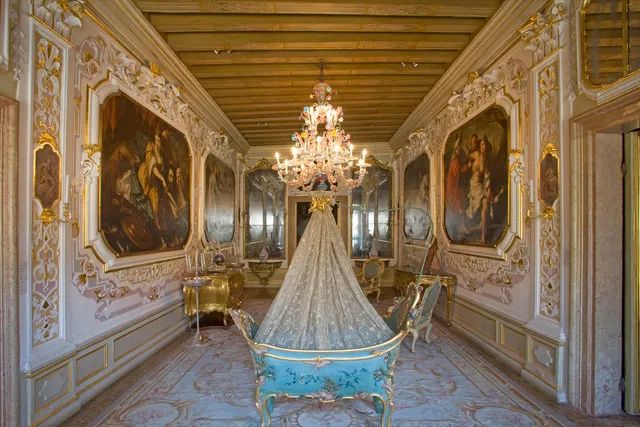
For further information about tours, including group tours, weddings, school events, birthday party packages, facility rentals, and special events please visit the website: https://winchestermysteryhouse.com/

Please visit the online giftshop, and purchase a gift for friends and relatives as well as a special memento of The Winchester Mystery House. A variety of souvenirs and gifts are available to purchase. https://shopwinchestermysteryhouse.com/
The “Everyone Welcome” Signs in the Front of the Churches Should Add “Except People Like Us”—We are Not Wanted!

Know this, and I mean it from the heart. I hold back what I think I should hold back and nothing more than that. Take your Aunt Queen and Nash to dinner at the Grand Luminiere Café tonight. Take my advice on that. Religious ties in Graystone Hills are either very tenuous or non-existent. Only 71 percent of the families claim any religious connections; many of these are merely “in spirit.” More than 9 families out of 10 have no connection with a church, and active hostility toward churches, ministers, and pious people is encountered more frequently than real or professed church work. Aunt Queen epitomized the situation when she said bitterly, “The ‘Everyone Welcome’ signs in the front of the churches should add except people like us’—we are not wanted.” She was right—they are not wanted by the congregations and several of the ministers. Ministers in the high-prestige churches (Federated, Methodist, and Lutheran) indicate they have no objections to class V persons coming to service and participating in church activities, but they know that members of the congregation resent the presence of these people; so they do not encourage their attendance. Ministers in the low-ranking churches do not believe that their people resent the presence of class V’s in church activities. #RandolphHarris 1 of 20

Three ministers related stories about unpleasant experiences they had with certain of these families before they earned that it is wise to “follow the line of least resistance” and let them alone. Four frankly stated that these people are beyond help, as far as the ministers are concerned, and they do not try to reach them in any way. Seven reported that if they are asked, they officiate at funerals, weddings, and baptisms; two refuse to perform these rites on religious grounds. The church schedules reveal that attendance at religious services and participation in auxiliary church activities are limited, with few exceptions, to the higher-ranking classes. Ninety-eight percent of the class V father are either completely unknown to the ministers or do not attend church if they are known. Five attend church services rarely or irregularly; not one is categorized as a “church worker.” The participation figures for the mothers are little different: 90 percent either are unknown or do not attend church; 7 percent attend services either rarely or irregularly; 3 percent are reported to be church workers. These church workers are in the Pentecostal, Pilgrim Holiness, and Church of God congregations that meet in abandoned stores, lofts, and private homes. Even the Free Methodists, who are largely class VI’s, apparently do not welcome too intimate contact with those women in their strivings for salvation through good work. #RandolphHarris 2 of 20

One minister cynically said with reference to them, “You will find in the churches these women who shout the longest and loudest about sin—hours on end—while their husbands are out lying with some harlot. Their extensive leisure time is spent in the community or in nearby ones, since they have little money to spend in travel; neither are their automobiles in good enough repair to stand the rigor of long trips. The men and boys are more mobile than the women and girls; when they leave the community, it is usually in search of work, adventure, often to avoid the sheriff. When the family goes away, it generally carries its belongings with it in a search for economic betterment. In these periodic moves, it usually encounters the same kind of conditions, so it comes back after a few months or years. Possibly as many as one-fourth of the families drift in and out of the community. These floating families have a more or less fixed routine which they follow in the course of the years. They may go to Michigan in the Summer to pick and pack fruit, on to Wisconsin for the cranberry season, then back to Graystone Hills for the Winter and early Spring. The younger children may enroll in school, the older boys try to find work in the bowling alley or on barges that ply the river; the girls and women find work as maids, cleaning women, or dishwashers until the family decides to move. #RandolphHarris 3 of 20

Class V persons are almost totally isolated from organized community activities. A few men claim memberships in veterans’ organizations, but they neither pay dues nor attend meetings. Workers in the Mill belong to the union, since this is a closed shop; the others follow lines of work not organized by the unions. Time has little value in the daily routine. Even getting to work on time and staying on the job are not too highly regarded. Employers complained bitterly about their loose work habits. They claim that these people come to work at irregular times, leave when they feel like it, and lay off on the least excuse. Since they do not participate in the organized community affairs, hours off the job are spent they way the person chooses without too much interference from neighbors. Leisure is expanded in loafing around the neighborhood, in downtown district, along the river, and at home. Their social life consist of informal visits between neighbors, gossip, petty gambling, visits to the less expensive theaters, going to town, drinking in the home or public taverns, with now and again a fist fight. The family is so loosely organized that members usually go their own way in search of amusement or pleasure. The cliques are severely age- and sex-graded; men associate with men and women with women, except in their ubiquitous play involving pleasures of the flesh. #RandolphHarris 4 of 20

Organized dinners and parties where guests are invited to the home on a Saturday night are unknown. Festive gatherings take place on Sunday when many branches of the family unite for a brief spell on merrymaking. The low-ranking taverns are filled on Saturday nights with class V’s of all ages who gather there for their big social night. Small children are kept up until after midnight in the hot, smoke-filled, poorly lighted, noisy “poor man’s night club.” Young couples wander in and out; often preliminary passes are made in preparation for a later seduction. Almost every Saturday night the police are called to some low-ranking tavern to break up a fight between half-drunk customers. The police, sheriff, prosecuting attorney, and judge know these families from frequent contact through the years, whereas the ministers and school officials may be only slightly acquainted with them. Between 2010 and 2017, 8 percent of the mothers and 46 percent of the fathers had been convicted once or more in the local courts. Public drinking, disorderly conduct, family neglect, and sex offenses were the charges against the women; they averaged 1.5 convictions each. The men were more or less chronic offenders who were convicted of habitual public drunkenness, 49 percent ; miscellaneous offenses, 30 percent; offenses against property, 12 percent; sex and family neglect, 9 percent. #RandolphHarris 5 of 20

They averaged 4.1 convictions each in eight years covered by reliable court records. Their misdeeds are prominently written up in the newspaper. If they do not reach they paper, they are known by some persons in the higher classes who delight in telling about them to their acquaintances. However, it is not neurotic to have conflicts. At one time or another our wishes, our interests, our convictions are bound to collide with those around us. And just as such clashes between ourselves and our environment are a commonplace, so, too, conflicts within ourselves are an integral part of human life. An animal’s actions are largely determined by instinct. Its mating, its care for its young, its search for food, its defenses against danger are more or less prescribed and beyond individual decision. In contrast, it is the prerogative as well as the burden of human beings to be able to exert choice, to have to make decisions. We may have to decide between desires that lead in opposite directions. We may, for instance, want to be alone but also want to be with a friend; we may want to study medicine but also to study music. Or there may be a conflict between wishes and obligations: we may wish to be with a lover when someone in trouble needs our care. We may be divided between desires to be in accord with others and a conviction that would entail expressing an opinion antagonistic to them. #RandolphHarris 6 of 20

We may be in conflict, finally, between two sets of values, as occurs when we believe in taking on a hazardous job in wartime but believe also in our duty to our family. The kind, scope, and intensity of such conflicts are largely determined by the civilization in which we live. If the civilization is stable and tradition bound, the variety of choices presenting themselves are limited and the range of possible individual conflicts narrow. Even then they are not lacking. One loyalty may interfere with another; personal desires may stand against obligations to the group. However, if the civilization is in a stage of rapid transition, where highly contradictory values and divergent ways of living exist side by side, the choices the individual has to make are manifold and difficult. One can conform to the expectations of the community or be a dissenting individualist, be gregarious or live as a recluse, worship success or despise it, have faith in strict discipline for children or allow them to grow up without much interference; one can believe in a different moral standard for men and women or hold that same should apply for both, regard relations in pleasures of the flesh as an expression of human intimacy or divorce them from ties of affection; one can foster racial discrimination or take the stand that human values are independent of color of skin or the shape of noses—and so on and so forth. #RandolphHarris 7 of 20

There is so doubt that choices like these have to be made very often by people living in our civilization, and one would therefore expect conflicts along these lines to be quite common. However, the striking fact is that most people are not aware of them, and consequently do not resolve them by any clear decision. More often than not they drift and let themselves be swayed by accident. They do not know where they stand; they make compromises being aware of doing so; they are involved in contradictions without knowing it. I am referring here to normal persons, meaning neither average nor ideal but merely non-neurotic. There must, then, be preconditions for recognizing contradictory issues and for making decisions on that basis. These preconditions are fourfold. We must be aware of what our wishes are, or even more, of what our feelings are. Do we really like a person or do we only think we like one because we are supposed to? If a parent dies, are we really sad, or do we only go through the motions? Do we really wish to become a lawyer or a doctor or does it merely strike us as a respectable and profitable career? Do we really want our children to be happy and independent or do we only give lip service to the idea? Most of us would find it difficult to answer such simple questions: that is, we do not know what we really feel or want. #RandolphHarris 8 of 20

Since conflicts often have to do with convictions, beliefs, or moral values, their recognition would presuppose that we have developed our own set of values. Beliefs that are merely taken over and are not a part of us hardly have sufficient strength to lead to conflicts or to serve as a guiding principle in making decisions. When subjected to new influences, such beliefs will easily be abandoned for others. If we simply have adopted values cherished in our environment, conflicts which in our best interest should arise do not arise. If, for instance, a son has never questioned the wisdom of a narrow-minded father, there will be little conflict when the father wants him to enter a profession other than the one he himself prefers. A married man who falls in love with another woman is actually engaged in a conflict; but when he has failed to establish his own convictions about the meaning of marriage he will simply drift along the path of least resistance instead of facing the conflict and making a decision one way or the others. Even if we recognize a conflict as such, we must be willing and able to renounce one of the two contradictory issues. However, the capacity for clear and conscious renunciation is rare, because our feelings and beliefs are middle, and perhaps because in the last analysis most people are not secure and happy enough to renounce anything. #RandolphHarris 9 of 20

Finally, to make a decision presupposed the willingness and capacity to assume responsibility for it. This would include the risk of making a wrong decision and the willingness to bear the consequences without blaming others for them. It would involve feeling, “This is my choice, my doing,” and presupposed more inner strength and independence than most people apparently have nowadays. To explain the phenomenon of indiscriminate relations with both genders on the basis of a given bisexuality is to my mind a misconstruction. There are in these cases no indications of a genuine leaning toward the same gender. The seemingly homosexual trends disappear as soon as a sound self-assertion has taken the place of anxiety, just as indiscrimination in reference to the opposite gender also disappears. What has been said of bisexual attitudes can also throw some light on the problem of homosexuality. In fact there are many intermediate stages between the described “bisexual” type and a definitely homosexual type. In the history of the latter there are definite factors which account for the fact that one excludes a person of the opposite gender as a sexual partner. Of course, the problem of homosexuality is much too intricate to allow an understanding from one point of view alone. Suffice it to say here that I have not yet seen a homosexual person in whom the factors mentioned in the bisexual group were not also present. #RandolphHarris 10 of 20

In the last few years it has been pointed out by several psychoanalytical writers that sexual desires may be reinforced because sexual excitement and satisfaction serve as an outlet for anxiety and for pent-up psychic tensions. This mechanistic explanation may be valid. I believe, however, that there are also psychic processes which lead from anxiety to increased sexual needs, and that it is possible to recognize these processes. This belief is founded both on psychoanalytic observation and on a study of the history of such patients in conjunction with their character traits outside the sexual sphere. Patients of the type may become passionately infatuated with the analyst at the beginning, impetuously demanding some return of love. Or they may maintain a considerate aloofness during analysis, transferring their need for sexual closeness to some person outside who, as evidenced by the fact that one resembles the analyst or by the fact that the two are identified in dreams, is made to serve as a substitute. Or finally, such persons’ need to establish a sexual contact with the analyst may appear exclusively in dreams or in sexual excitement during the interview. The patients are often utterly amazed by these unmistakable signs of sexual desire, because they neither feel attracted by the analyst nor are in any way fond of him or her. #RandolphHarris 11 of 20

In fact, sexual attraction emanating from the analysts plays no perceptible role, nor in the sexual temperament of such patients more impetuous or uncontrollable than that of others, nor is their anxiety greater or less than that other patients. What characterizes them is a deep disbelief in any kind of genuine affection. They are thoroughly convinced that the analyst is interested in them only for ulterior motives, if at all, that in one’s secret heart one despises them, and that probably one will do them more harm than good. Because of neurotic hypersensitivity reactions of spite, anger and suspicion occur in every psychoanalysis, but in these patients of particularly strong sexual needs these reactions form a permanent and rigid attitude. They make it seem that there is an invisible but impenetrable wall between analysts and patient. When confronted with a difficult problem of their own their first impulse is to give up, to break off the psychoanalysis. The picture they present is analysis is an exact replica of what they have been doing all their life. The difference is only that before the analysis they were able to escape the knowledge of how thin and intricate their personal relations actually were, the fact that they easily became involved sexually helped to confuse the situation and to lead them to believe that their readiness to establish sexual contacts meant that they were having good human relationships in general. #RandolphHarris 12 of 20

Caught at so many of us are in the strangling grip of conflicts—however unacknowledged—our inclination is to look with envy and admiration on people whose lives seem to flow along smoothly without being disturbed by any of this turbulence. The admiration may be warranted. These may be the strong ones who have established their own hierarchy of values, or who have acquired a measure of serenity because in the course of years of conflicts and the need for decision have lost their uprooting power. However, the outward appearance may be deceptive. More often, due to apathy, conformity, or opportunism, the people we envy are incapable of truly facing conflict or truly trying to resolve it on the basis of their own convictions, and consequently have merely drifted or been swayed by immediate advantage. To experience conflicts knowingly, though it may be distressing, can be an invaluable asset. The more we face our own conflicts and seek out our own solutions, the more inner freedom and strength we will gain. Only when we are willing to bear the brunt can we approximate the ideal of being the captain of our ship. A spurious tranquility rooted in inner dullness is anything but enviable. It is bound to make us weak and an easy prey to any kind of influence. When conflicts center about the primary issues of life, it is all the more difficult to face them and resolve them. #RandolphHarris 13 of 20

However, provided we are sufficiently alive, there is no reason why in principle we should not be able to do so. Education could do much to help us to live with greater awareness of ourselves and to develop our own convictions. A realization of the significance of the factors involved in choice would give us ideals to strive for, and in that a direction for our lives. When a person is neurotic, the difficulties always inherent in recognizing and resolving a conflict are immeasurably increased. Neurosis, it must be said, is always a matter of degree—and when I speak of “a neurotic” I invariable mean “a person to the extent that one is neurotic.” For one awareness of feelings and desires is at a low ebb. Often the only feeling experienced consciously and clearly are reactions of fear and anger to blows dealt to vulnerable spots. And even these may be repressed. Such authentic ideals as do exist are so pervaded by compulsive standards that they are deprived of their power to give direction. Under the sway of these compulsive tendencies the faculty to renounce is rendered impotent, and the capacity to assume responsibility for oneself all but lost. The attitudes I have mentioned are so regularly found together that whenever a patient at the start of a psychoanalysis begins revealing sex desires, fantasies or dreams concerning the analyst I am prepared to find particularly deep disturbances in one’s personal relations. #RandolphHarris 14 of 20

It is in accord with all observations on this score that the gender of the analyst is comparatively irrelevant. Patients who have worked successively with a man and a woman analyst may have identically the same curve of reaction toward both. In these cases it may therefore be a grave mistake to take at their face value homosexual wishes expressed in dreams or otherwise. Thus in general, just as “all is not gold that glitters,” so also “all is not sexuality that looks like it.” A great part of what appears as sexuality has in reality very little to do with it, but is an expression of the desire for reassurance. If this is not taken into consideration one is bound to overestimate the role of sexuality. The individual whose sexual needs are enhanced under the unrecognized stress of anxiety is inclined naively to ascribe the intensity of one’s sexual needs to one’s innate temperament, or to the fact that one is free from conventional taboos. In doing so one commits the same error as those who overestimate their need for sleep, imagining that their constitutions require ten hours of sleep or more, while actually their enhanced need for sleep may be determined by a variety of pent-up emotions; sleep may serve them as a means of withdrawing from all conflicts. The same applies to compulsive eating or drinking. #RandolphHarris 15 of 20

Eating, drinking, sleep, sexuality, all constitute vital needs; their intensity varies not only with the individual’s constitution, but with many other conditions, such as climate, absence or presence of other conditions, such as climate, absence or presence of other satisfactions, absence or presence of external stimulations, degree of strenuous work, existing physical conditions. However, also all of the needs may be increased by unconscious factors. The connection between sexuality and the need for affection throws light on the problem of sexual abstinence. How well sexual abstinence can be endured varies with the culture and the individual. In the individual it may depend on several psychic and physical factors. It is easy to understand, however, that an individual who needs sexuality as an outlet for the sake of allaying anxiety will be particularly incapable of enduring any abstinence, even of short duration. These considerations lead to certain reflections on the role that sexuality plays in our culture. We tend to look with a certain pride and satisfaction on our liberal attitude toward sexuality. Certainly there has been a change for the better since the Victorian age. We have greater freedom in sexual relations and a greater capacity for satisfaction. The latter point is particularly true for women; frigidity is no longer considered a normal condition in women, but is generally recognized as a deficiency. #RandolphHarris 16 of 20

In spite of the change, however, the improvement is not quite so far-reaching as we might think, because a great deal of sexual activity today is more an outlet for psychic tensions than a genuine sexual drive, and is therefore to be regarded more as a sedative than as genuine sexual enjoyment or happiness. The cultural situation is reflected also in psychoanalytical concepts. It is one of the great achievements of Dr. Freud that he contributed so much to giving sexuality its due importance. In detail, however, many phenomena are accepted as sexual which are really the expression of complex neurotic need for affection. For example, sexual desires concerning the analyst are usually interpreted as repetitions of sexual fixation on father or mother, but often they are not genuine sexual wishes at all, but a reaching out for some reassuring contact to allay anxiety. Therefore, some doctors may have overplayed the Oedipus complex. The patient, to be sure, often relates associates or dreams—expressing for affection or shelter. Even if the desires concerning the analyst were understood as a direct repetition of similar desires toward the father or mother, this would be no proof that the infantile tie to the parents was itself a genuine sexual tie. #RandolphHarris 17 of 20

There is plenty of evidence that adult neuroses all the features of the Oedipus complex, may have existed in childhood, but this is less frequently the case than Dr. Freud assumes. However, the Oedipus complex is brought about by the child clinging to one parent for the sake of reassurance. Yet, it ignores the female counterpart. We call women who may be attracted to their father’s girls with “daddy issues.” But what is the term for girls who seem to have an attraction to their mothers and express excessive demands for unconditional love, jealous, possessiveness, hatred because of rejection, which are characteristic of the neurotic need for affection. This is also a neurotic formation. Do not fall into the trap of expressing disgust with these people, or exhibiting spite or hatred. Allow them to have their space to act out. Your life will become more blessed, and your blessings will be grounded. The increasing intensity of your spiritual experience will make the experiences more real increasing faith in self while your physical reality will see more malleable through your soul work. This is a major part of this infernal science of becoming. It helps to enforce the process of unifying the dense physical self with the potential unlimited possibility. Instead of being fearful you should see your visions for prosperity as opportunities to destroy imposed fate through prayer. Remembering this at all times…the life experience is nothing but a series of opportunities to exercise power. #RandolphHarris 18 of 20

Having faith in God keeps the powerful forces of protection active. This is a much needed insurance policy when walking a path such as this. It will help to absorb and consume any malign energies that may seek your destruction as your personal power develops through alchemical transmutation. The oppositional forces then become fuel for ascent. This will create indirect doorways for others to awaken from spiritual sedation. Keep in mind that the realms of hell are sentient and subjective in that they are based on the personal fears of each individual. What really differs is the fact that by applying these principles our consciousness begins to assimilate obvious yet severely neglected fundamental spiritual truths. We need to come to understand that when creating changes within self for the sake of empowerment our external reality also begins to shift reflecting that internal empowerment. Wen working toward creating external shifts within our external reality our spirit is also empowered by simply exercising our own divine power. There is no difference in the end. Either way the end result is empowerment through an increase in efficiency of the life experience through the manifestation of desired change. #RandolphHarris 19 of 20

Wealth and poverty are of the same energy. The only difference is how the specific energy is being applied. Understand that whenever a light is shined a shadow is cast. To perceive unlimited possibility, you must become the eye between the reflector and reflected. Therefore, it is not just about removing the illusion of external divinity but rather usurping and taking back that power as your own birthright. In essence this ritual is designed to destroy the concept of external divinity altogether so that one becomes the center of creation and destruction within their own subjectivity reality. Remember that self-discipline is an avenue which makes your desire and intent law! If it is your desire to do something and you do not do it, then you weaken the potency of your will and intent. This will further ensnare you with limitation and program yourself for failure. Wait until you are ready to commit. This is a working of devoting your intent toward peering deep within self and pulling divine power into these deepest depths. Throughout this time frame you must act accordingly within the World. Strive to become something greater by setting goals and achieve. This rite by itself, as simple as it is, may make you or break you. “May the Lord our God, who has redeemed us and made us free, keep you continually in his presence; yea, and may he favor this people, even that ye may have success,” reports Alma 58.41. #RandolphHarris 20 of 20

Cresleigh Homes
Oh hello, Brighton Station Residence 3! 👋 This floor plan offers 3 different elevations, 4 bed/3.5 bath, including a master bedroom and 4th bedroom suite with optional bathtub and “California Room” upgrades. ☀️ Visit our website to view this floor plan in depth with our Interactive Floor Plan tool. Link in below!

https://cresleigh.com/brighton-station/residence-3/
#NewHomes
#BrightonStation
#CresleighRanch
#CresleighHomes

 Randolph Harris II International Institute