
Home » #WinchesterMysteryHouse (Page 21)
Category Archives: #WinchesterMysteryHouse

Intrepid Delver into the Forbidden

Tuesday afternoon came and waned to the twilight. It was a peculiar time; something new was astir, something that was quite unlike the tranquility of the past, something that was very strange indeed, but was felt everywhere. The unknown things had begun to close in on me with a whole new degree of determination. I knew all too well of the things which must be lurking nearby. I began to fear that I might not sleep tonight, so certain was I that I was surrounded by the tortured spirits of those who had not yet been allowed to cross the veil to the other side. Here they remained, crying aloud, desperate to be heard, causing disarray and torment in my home as they longed to be released to the peace of eternal rest. I wore a pale expression. Staring at the floor beneath me, there were myriads of claw-prints in the hallway, with human prints among them. Clutching a bloody handkerchief, I was half afraid for myself. Sorcery from the Middle Ages has been violently unmaksed in Llanada Villa and the whole craft has been exposed in its darkest colours and most abominable manifestations. I had indeed been cursed, but it had been carefully hidden and scrupulously concealed. Trembling, I was terrified at the horror I knew was sure to come my way. #RandolphHarris 1 of 6

I fell asleep quite soon after going to bed, but it was a fitful and unhappy sleep. My dreams were full of nightmares of dark debaucheries. There were foul and hideous mysteries of lust which neither human intercourse nor the employ of a mechanical property can explain. Howbeit, I am fully aware what unspeakable horror lurked in the blackness beyond. When I rose up and wandered along the gallery, I was hopeless. I tried to estimate how long I had been asleep, but all I knew was that it seemed days and weeks, and yet it was plain that this could not be, for my candles were not gone yet. I was cruelly tired. I sat down and fastened my candle to the wall. I turned on the lights and walked toward the kitchen. Although my home was quite empty, I had an eerie sensation of not being alone. Hurriedly, I walked to the front door. Glancing backward into the dark recesses of my home, upon which I saw an apparition of a man, staring at me with piercing black eyes. He wore a wool shirt. He seemed to smile at me, and I called, “I beg your pardon, but who are you?” However, the figure never moved or reacted. “What are you doing here?” I demanded, all the while looking at him. There was no answer, and suddenly my courage left me, as the icy touch of an unseen hand caressed my cheek. #RandolphHarris 2 of 6

I ran down the central hallway, until abruptly stopping at the end. Tenderly, my fingers ran over the brass trim on the heavy mahogany door. Nervously turning the handle, I reluctantly pushed open the door and waited for my eyes to adjust to the darkness. As the door swung inward, there was a rush of bone chilling air. Stepping inside, I heard a crying baby. Immediately recognizing the cry of my own child. Standing alone in the pitch-black room, I turned toward where the sounds were coming from. Every step felt as if I was walking in cold tar. A sense of desperation took hold of me, as I struggled to find the child. However, the closer I seemed to get, the more distant the sound became. A sense of desperation overcame me, as the cries faded, and dark shadows began swiftly darting around the room. I found myself quietly walking back downstairs. To my right was the stair railing which went around the top of the stairs at a turn in the hallways which led to an interior-opening balcony space, overlooking the front door at the downstairs hall, with a view of the beautiful chandelier hanging over the foyer. As I walked down the stairs, I was fearful that something would happen. That is when I heard a terrible shriek. The bloodcurdling sound was that of a lunatic. The atmosphere within my home changed, the walls came alive. Its appetite whetted by the taste of human blood. The horror overcame me. #RandolphHarris 3 of 6

In stark loneliness of night, hurtling between somber, darkened rooms that quivered with unknown, invisible life. I could see some horror lurking in my mind’s eye. Perhaps my clairvoyant sense assisted me, but in these great halls, along the long corridors, in the gloomy cold there was an ancient and lingering pain. The wind whistled and shrieked and moaned, as if the dead had collected to fight the battle of their race. I was being pursued, the forced of hell were gathering against me. It was cold in the echoing corridors. I hurried along them, trying out doors on each side. The handles were covered in thick dust. Each one I tried seemed to be locked, so I made my way to another floor. There were hundreds more doors to try. After an hour, I sat down on the top step and closed my eyes. For some minutes I sat motionless, listening to my own heartbeat. With my head full of thoughts, I went through a doorway. Finding myself in a luxurious suite of rooms, with walls of dark mahogany panels, filled with exquisite antique furniture and paintings. Thick dust covered everything, and enormous cobwebs were suspended from every corner. The silence of centuries now hung in the air. I sat down on a soft, velvet-covered couch, and for some reason started feeling very sleepy. It was as if there were some curious force in the room—a force which was impossible to resist. I lay back on the couch, and went into a sort of trance. #RandolphHarris 4 of 6

When I came to, the room was darkened. Within its shadowy depths, I saw the white blur of a man’s face and hands; and in a moment I had crossed to greet the figure who had tried to speak. Dim though the light was, I perceived that this was a very sick man. There was a touch of the pitiful in the limp, lifeless way his lean hands rested in his lap. He had on a loose dressing-gown, and was swathed around the head and high around the neck with a vivid yellow scarf or hood. And then I saw that he was trying to talk in a hacking whisper. It was a hard whisper to catch at first, since the grey moustache concealed all movements and the lips, something in its timbre disturbed me greatly. I was also trying to ignore certain shadowy, indistinct shapes that might have been living creatures; I was trying to ignore my mounting fear. I realized that the man before me, what appeared to be a human figure—was it? A man? A tall, stiff-poised man? Or was it an apparition? Along this desolate gallery. I felt a stab of fear as I made a swift decision to run—not to turn back but to increase my speed and pass the mysterious brooding figure. Even though I saw that this figure was acutely aware of me, I had dismissed him as a dream. Touched with horror, yet empowered by it, by a rush of adrenaline like a flame through my veins, I did not slacken my speed, and veered through hallways and rooms until I was safe. #RandolphHarris 5 of 6
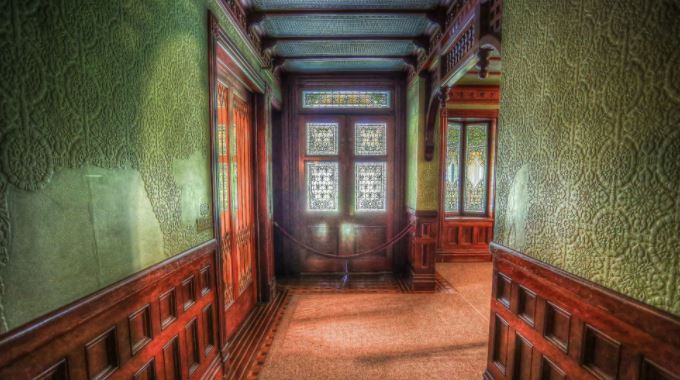
I climbed the stairs to the third floor, my heart pounding violently in my chest not in warning, not in caution but urging me on! And so, opening the door to the Celestial Bedroom, and so stepping breathless inside that room, I dared to switch on a light; a dim, yellow bulb in a bedside lamp; I stood beside my enormous, canopied bed. On my pillow there was the heavy imprint of a head, a concave shadow. I stared, not certain what I saw. My hand reached out; groping; I dared to touch the figure—pushing gently at the smooth, naked shoulder that, with the attached torso, fell away from the shadowed lower body, and from the neck and head; the head, a bald, blank head, rolled to one side on the pillow; one of the limbs, the shapely left leg, had fallen away from the body, as if its joints had become brittle with time, and lay at a grotesque angle perpendicular to the thigh. I saw clearly that the thing was not human and was not alive. Objects seemed to move across the room like conscious entities; the sounds of their footfalls having something about it like a loose, hard-surfaced clattering. Running to the drawing room, I summoned Zip. My precious darling was always here to comfort me. I decided that it may be a good idea to get some fresh air. Wagging his tail, he was more than happy to oblige. May was in its full beauty. The evenings were exquisite. The wild cherry was in flower. Zip and I walked every evening in the garden and we would sit till nightfall in the arbour, as I poured out my thoughts and feelings to him. We had poetic moments. #RandolphHarris 6 of 6

The Winchester Mystery House

A real nightmare occurs when you experience a frightening encounter with something strange and unknown, and you know without question that you are not asleep, that you are not dreaming. You know with every ounce of your being that the chilling encounter is real. The events that were described were actual experiences and encounters and were not legends and folklore. One must clearly understand and fully realize the shuddering horror and heart-sick dismay that exists when there is any sort of commerce between human beings and evil spirits, which is the very core and kernel of Witchcraft. All too often, nowadays, the orthodox doctrine of the Powers of Darkness are forgotten or ignored. In the first place, the name Devil is commonly given to the fallen angels, who are also called demons.

The chief of the demons is called the Devil. The Devil and other demons were created by God naturally good; but they themselves became evil. It is also remarkable that for an account of the Fall of the angels, which happened before the creation of the World, we must turn to the last book in the Bible, the Apocalypse of St. John. “And there was a great battle in Heaven, Michael and his angels fought with the dragon, and the dragon fought and his angels: and they prevailed not, neither was their place found any more in Heaven. And that great dragon was cast out, that old serpent, who is called the Devil, and Satan, who seduceth the whole World; and he was cast down unto the Earth, and his angels were thrown down with him” (Apocalypse xxi. 7-9). Once you open the door to the unknown, it may be hard to close again.

Come and enjoy a delicious meal in Sarah’s Café, stroll along the paths of the beautiful Victorian gardens, and wonder through the miles of hallways in the World’s most mysterious mansion. For further information about tours, including group tours, weddings, school events, birthday party packages, facility rentals, and special events please visit the website: https://winchestermysteryhouse.com/

Please visit the online giftshop, and purchase a gift for friends and relatives as well as a special memento of The Winchester Mystery House. A variety of souvenirs and gifts are available to purchase. https://shopwinchestermysteryhouse.com/

Life on Earth Cannot be Achieved Unless We are Thoroughly Virtuous
When we reach the Olympian heights and stand to survey the scenes of our long struggles, we shall then not regret that we were tried, tempted, and tortured by conflicting desires, for without them we should only have become mechanically good. Even our sufferings turn to sympathy. The human infant enters directly into an evaluating transaction with his World, appreciating or rejecting his experiences as they have meaning for his own actualization, utilizing all the wisdom of his tiny but complex organism. We seem to lose this capacity of direct evaluation, and come to behave in those ways and to act in terms of those values which will bring us social approval, affection, esteem. To buy love we relinquish the valuing process. Because the center of our lives now lies in others, we are fearful and insecure, and must cling rigidly to the values we have introjected. However, if life or therapy gives us favourable conditions for continuing our psychological growth, we move on in something of a spiral, developing an approach to values which partakes of the infant’s directness and fluidity but goes far beyond him in its richness. It our transactions with experience we are again the locus or source of valuing, we prefer those experiences which in the long run are enhancing, we utilize all the richness of our cognitive learning and functioning, but at the same time we trust the wisdom of our organism. All ethical paths are twofold inasmuch as they must consist of the acquirement of virtues and the expulsion of vices. #RandolphHarris 1 of 18

The less a mental conflict appears in open consciousness, the more dangerous does it become. Man has within him an organismic basis for valuing. To the extent that he can be freely in touch with his valuing process in himself, he will behave in ways which are self-enhancing. We even know some of the conditions which enable him to be in touch with his own experiencing process. In therapy, such openness to experience leads to emerging value directions which appear to be common across individuals who are thus in touch with their experiencing come to value such directions as sincerity, independence, self-direction, self-knowledge, social responsivity, social responsibility, and loving interpersonal relationships. When individuals move in the direction of psychological maturity, or more accurately, move in the direction of becoming open to their experiencing, a new kind of emergent universality of value directions becomes possible. Such a value base appears to make for the enhancement of self and others, and to promote a positive evolutionary process. The greatness of character is tested just as much by the temptations for ego display in success as it is by failure. Many moral precepts have been preached to mankind but few practical instructions in the matter of how to carry out those precepts have been given him. Is it true, as so many say, that character is stubbornly resistant to change? #RandolphHarris 2 of 18

When the acquisition of new attributes, tendencies, and traits are natural, it is the grown man’s character that is in reference here, not the phases grades and adjustments of childhood and adolescence. If the idea of reincarnation is accepted, then the personality of ever man must inevitably change with time. Those who are willing to practise such hard self-discipline form an elite among mankind. Character is as easily imperilled by the briberies of wealth and luxury as by those of poverty and lack. “If he (the infant) could understand it, he would laugh at our concern over values. How could anyone fail to know what he liked or disliked, what was good for him and what was not?’ When I read that, I remember my friend saying to me so often when I was young, “You’re lucky.” You always known what you want.” I thought a person must be crazy not to. Later in life, I was baffled and confused because I could not seem to know what I wanted. In my own terms, I had gone crazy. In trying to find my way out of this, I went two ways at once: a search inside myself for what had gone wrong, and a search outside myself for something to believe that would set me right. The outside search was a flop. I never did find anything that I could entirely go along with. The inside search was rewarding, and it was there that I found I did not need to believe anything at all. #RandolphHarris 3 of 18
Everything that I needed was right inside me. Only when it helped me to get in touch with what was inside was when the outside was useful. However, when I did get in touch with my inner valuing again, it was terribly hard to trust it, because in important ways it went against what everyone says. The more I use it, the more I trust it, and when I am really close to other people, I find their built-in pathfinders (organismic valuing) agree with me. The difference between the outside and the inside view goes like this: When my son was at college, he got picked up for driving a BMW Roadster with an excess number of passengers, some of them on the running board, and was fined $285.97 dollars. This hurt. He had worked a good deal since the age of nine. At college, he had a tuition scholarship but was otherwise supporting himself by having several jobs and he was helping me too, as I was sick in bed for several years. To him, $285.97 was a days’ labour. It hurt to pay the fine, but he did not resent this. He knew what the laws were, and knew that he had broken it. He accepted his own responsibility for what happened. However, at the police station he was told that he was irresponsible. This really seared him. He was made to feel bad, and this made him very resentful. At the same time, he was confused, which is probably worse than anything else. Several years later, when he was in graduate school in another state, two policemen came to our door asking for money for the Fourth of July fireworks display. Although we did not have much money then, either, we really loved those fireworks, and he freely gave them $5500. #RandolphHarris 4 of 18

As I see it, he was not irresponsible. He was driving the other boys only two blocks from a dorm to the athletic field, in an area where there was very little and no fast traffic. He was alert to the fact of the young men on the running board and he also knew their own alertness and ability to look after themselves. He had made himself responsible. To me, it is not responsible to drive sixty miles an hour in accord with the speed limit when stretches of the road have become unsafe for driving at that speed, or weather conditions make it hazardous. A person who does that goes exclusively by the rule, instead of including his own noticing, his own awareness, and when there is a wreck he is sure he has “done nothing wrong.” The bad road was what did it, or the weather. It seems to me that I am responsible when I am responsible to everything around me, and that the opposite is the Eichmanns who have “done nothing wrong” because they did what they were told to do. When I had been in the hospital for a month, five days after leaving it I had to go to see the doctor whose office was in a private clinic. While I was waiting to see him, I realized that I was slipping from the chair, and the only way that I could keep myself in it was to hold tightly to the arms. I was not sure how long I could hold on, and noticed that I was getting woozy in the head. #RandolphHarris 5 of 18
I got myself up and to the desk, where I had to lean over the chest-high counter and hook my fingers on the opposite edge to keep myself from slipping to the floor. I told one of the nurses that I needed to lie down. She asked me, “Who is your doctor?” “Do you have an appointment?” “Wat is your clinic number?” What did any of that have to do with a sick person who needed to lie down? That must have been obvious quite apart from my telling her so. She was neither a cold person nor a wicked one, not in most respect was she stupid. She had made herself a “responsible” person who abides by the rules, and her “responsibility” was to her job as it was defined by the administration, not to the immediate need of another human being. Like Eichmann. My predicament in the clinic is so prevalent in our society that I think there cannot be anyone who has not run into something similar—perhaps hundreds of times—plus all the others that one hears about, like the child who was brought to a police stations because he had been bitten by a rattlesnake, and he was left sitting there while the cops tried to find out where his home was, so they would know which hospital to send him to. Everybody knows about things like this, but nobody does anything about it. It can really make a person scared. Habit, weakness, and desire may prevent one from following behind the philosopher as he walks his lonely road, as they may prevent him from recognizing the logic of the philosopher’s teaching. His human weaknesses need to be recognized, admitted, and looked at in the face realistically. #RandolphHarris 6 of 18

To fail to see one’s weaknesses is to walk over marsh and quagmire, bog and quicksand. They need not frighten him away from the quest for they represent opportunities to grow, material to be worked upon for his ultimate benefit. The attempt to escape from such problems by first refusing to look at them, and second, by refraining from the efforts needed to deal with them, leads only to their prolongation and enlargement later on. What can be done to humanize the technological society? First of all, we must ask ourselves what it is to be human—that is, what is the human element which we have to consider as an essential factor in the functioning of the social system. This undertaking goes beyond what is called “psychology.” It should more properly be called a “science of man,” a discipline which deals with the data of history, sociology, psychology, theology, mythology, physiology, economics, and at, as far as they are relevant to the understanding of man. Man was—and still is—easily seduced into accepting a particular form of being human as his essence. To the degree to which this happens, man defines his humanity in terms of the society with which he identified himself. However, while this has been the rule, there have been exceptions. There were always men who looked beyond the dimensions of their own society—and whole they may have been called fools or criminals in their time they are the roster of great men as far as the record of human history is concerned—and visualized something which can be universally human and which is not identical with what a particular society assumes human nature to be. There were always men who were bold and imaginative enough to see beyond the frontiers of their own social existence. #RandolphHarris 7 of 18

Th decrease of instinctual determinism the higher we go in animal evolution, reaching its lowest point in man, in whom the force of instinctual determinism moves toward the zero end of the scale is a condition of human existence. The tremendous increase in size and complexity of the brain in comparison with body weight, in the second half of the Pleistocene is another condition of human existence. This enlarged neocortex is the basis for awareness, imagination, and all those facilities such as speech and symbol-making which characterize human existence. Man, lacking the instinctual equipment of the animal, is not as well equipped for flight or for attack as animals are. He does not “know” in fallibly, as the salmon knows where to return to the river in order to spawn its young and as many birds know where to go south in the winter and where to return in the summer. His decisions are not made for him by instinct. He has to make them. He is faced with alternatives and there is a risk of failure in every decision he makes. The price that man pays for consciousness is insecurity. He can stand his insecurity by being aware and accepting the human condition, and by the hope that he will not fail even though he has no guarantee of success. He has no certainty; the only certain prediction he can make is: “I shall die.” Man is born as a freak of nature, being within nature and yet transcending it. He has to find principles of action and decision-making which replace the principles of instinct. He has to have a frame of orientation which permits him to organize a consistent picture of the World as a condition for consistent actions. He has to fight not only against the dangers of dying, starving, and being hurt, but also against another danger which is specifically human: that of being insane. #RandolphHarris 8 of 18

In other words, man has to protect himself not only against the danger of losing his life but also against the danger of losing his mind. The human being, born under the conditions described here, would indeed go mad if he did not find a frame of reference which permitted him to feel at home in the World in some form and to escape the experience of utter helplessness, disorientation, and uprootedness. There are many ways in which man can find a solution to the task of staying alive and of remaining sane. Some are better than others and some are worse. By “better” is meant a way conducive to greater strength, clarity, joy, independence; and by “worse” the very opposite. However, more important than finding the better solution is finding some solution which is viable. The foregoing thought raise the problem of man’s malleability. Some anthropologist and other observers of man have believed that man in infinitely malleable. At first glance, this seems to be so. Just as he can eat meat or vegetables or both, he can live as a slave and as a free man, in scarcity or abundance, in a society which values love and one which values destruction. Indeed, man can do almost anything, or, perhaps better, the social order can do almost anything to man. The “almost” is important. Even f the social order can do everything to man—starve him, torture him, imprison him, or overfeed him—this cannot be done without certain consequences which follow from the very conditions of human existence. #RandolphHarris 9 of 18
Man, if utterly deprived of all stimuli and pleasure, will be incapable of performing work, certainly any skilled work. The recent experiments with sensory deprivation show that extreme forms of the absence of stimuli to which man can respond are able to produce symptoms of severe mental illness. If he is not that utterly destitute; if you make him a slave, he will tend to rebel; if life is too boring, he will tend to be violent; if you make him into a machine, he will tend to lose all creativity. Man in this respect is not different from animals or from inanimate matter. You may get certain animals into the zoo, but they will not reproduce, and others will become violent although they are not violent in freedom. A similar fact has been discovered in psychotic patients who live on farms or in nonprisonlike conditions. They showed little violence under these conditions or noncoercion; this proved that the alleged reason for their previous prisonlike treatment, that is, their violence, produced the very result which the treatment was supposed to reduce or to control. You can heat water above a certain temperature and it will become steam; or cool it below a certain temperature and it will become solid. However, you cannot make steam by lowering its temperature. #RandolphHarris 10 of 18

The history of man shows precisely what you can do to man and at the same tie what you cannot do. If man were infinitely malleable, there would have been no revolutions; there would have been no change because a culture would have succeeded in making man submit to its patterns without his resistance. However, man, being only relatively malleable, has always reacted with protest against conditions which made the disequilibrium between the social order and his human needs to drastic or unbearable. The attempt to reduce this disequilibrium and the need to establish a more acceptable and desirable solution is at the vey core of the dynamism of the evolution of man in history. Man’s protest arose not only because of material suffering; specifically human needs, and are an equally strong motivation for revolution and the dynamics of change. Obviously, it is not the man who has much, but the man who is much that is the fully developed, truly human man. However, this is indeed one of the most drastic examples of man’s capacity for distortion and rationalization that Marx is attacked by the spokesmen for capitalism because of his allegedly “materialistic” aims. Not only is this not true, but what is paradoxical is that the same spokesmen for capitalism combat socialism by saying that the profit motive—on which capitalism is based—is the only potent motive for human creative activity, and that socialism could not work effectively because it excludes the profit motive as the main stimulus in the economy. #RandolphHarris 11 of 18

If one considers that Russian communism has adopted this capitalist thinking, and that for Russian managers, workers, and less affluent, the profit motive is by far the most important incentive in the present Russian economy, then all this is even more complex. Not only in practice but often also in theoretical statements about human motivation, the Russian system and the capitalist system agree with each other, and both are equally in contradiction to Marx’s theories and aims. If man does not overcome his infantile strivings and develop a mature genital orientation, he is torn between the desires of the child within himself and the claims which he makes as a grown-up person. The neurotic symptom represents a compromise between infantile and grown-up needs, while the psychosis is that form of pathology in which the infantile desires and phantasies have flooded the grown-up ego, and thus there is no more compromise between the two Worlds. Marx, of course, never developed a systematic psychopathology, yet he speaks of one form of psychic crippledness which to him is the most fundamental expression of psychopathology and which to overcome is the goal of socialism: alienation. What does Marx mean by alienation (or “estrangement”)? The essence of this concept, which was first developed by Hegal, is that the World (nature, things, others, and he himself) have become alien to man. He does not experience himself as the subject of his own acts, as a thinking, feeling, loving person, but he experiences himself only in the things he has created, as the object of the externalized manifestations of his powers. He is in touch with himself only by surrendering himself to the products of his creation. #RandolphHarris 12 of 18

Hegel, taking God as the subject of history, had seen God in man, in a state of self-alienation and in the process of history God’s return to himself. The animal instincts are valid and have their assigned place, but the cerebral ones have even more validity and a higher place, while the spiritual ones should be elevated above the other two. The mind is the real root of the tree of character which, despite its thousands of branches, leaves, and fruits, possesses but this single root. If man is to improve himself, he must improve his acts of will, his objects of desire, and his subjects of thought. This means an entire psychological re-education which will involve much work upon himself. Those who desert the quest’s moral ideals but not its mystical exercises, who seek to gain selfish victories over the rights and minds of others by the use of mental or occult power, become evil-doers and suffer an evil end. Theirs is the way of the left-hand path, of black magic, and of the sin against the Holy Ghost. Until retribution falls upon them in the end, they bring misery and misfortune to all who accept their influence. Those who struggle in the work-a-day World need to learn what their higher duty is rather than what metaphysical truth is. They need a stimulant to the practice of righteousness rather than a stimulant to the analysis of intellectual subtleties. From the point of view of philosophy, we ought not to be virtuous merely because of baits of peace and contentment and lessened suffering which dangle from virtue itself, but because they very purpose of life on Earth cannot be achieved unless we are thoroughly virtuous. #RandolphHarris 13 of 18

When it comes to self-analysis one must proceed beyond insights that are within easy reach and inevitably encounter “resistances,” to expose oneself to all kinds of painful uncertainties and hurts and to take up the battle with these opposing forces. And this requires a different spirit from that which serves in occasional work. There the incentive pressure is the pressure of some gross disturbance and the wish to resolve it. Here, though the work starts under a similar pressure, the ultimate driving force is the person’s unrelenting will to come to grips with himself, a wish to grow and to leave nothing untouched that prevents growth. It is a spirit of ruthless honesty toward himself, and he can succeed in finding himself only to the extent that it prevails. There is, of course, a difference between the will to be honest and the capacity to be so. Any number of times he will be unable to measure up to this ideal. If he were always transparent to himself, there may be some consolation, however, in the fact that no analysis would be necessary. Furthermore, if he carries on with a measure of consistency, the capacity for honesty will gradually increase. Each obstacle surmounted means gaining territory within himself and therefore makes it possible to approach the next with greater inner strength. Feeling at a loss as to how to go about it, the person who is analyzing himself, however conscientious, may understate the work with a kind of artificial zest. He may resolve, for instance, to analyze all his dreams from now on. #RandolphHarris 14 of 18

Dreams, according to Dr. Freud, are the royal road to the unconscious. That remains true. However, unfortunately, if there is not a full knowledge of all the territory around it, it is a road that is easily lost. For anyone to try his skill at interpreting dreams without some understanding of the factors operating within himself at the time is haphazard, hit-or-miss play. Even if the dream itself is seemingly transparent, interpretation may then degenerate into intellectual guesswork. Even a simple dream may permit of various interpretations. For instance, if a husband dreams of his wife’s death the dream my express a deep unconscious hostility. On the other hand, it may mean that he wants to separate from her and, since he feels incapable of taking this step, her death appears as the only possible solution; in this case the dream is not primarily an expression of hatred. Or, finally, it may be a death wish provoked by a merely transitory rage which had been repressed and found its expression in the dream. The problems opened up are different in the three interpretations. In the first one the question would be the reason for the hatred and for its repression. In the second it would be why the dreamer does not find a more adequate solution. In the third it would be the circumstances of the actual provocation. It is easy to confuse respectable conventionality with authentic virtue. Although philosophy wags no finger in smug portentous moralizing, it respects the validity of karmic consequences, the getting-back of what is given out, and also the need to begin curbing the ego, its desires and passions, as a preliminary to crushing it. There is solid factual ground for the excellent ethical counsel give to all humanity by Jesus as the Christ and Sokrates. #RandolphHarris 15 of 18
Many of the stupid, overworded objections to the so-called impracticability of ethical idealism will be disarmed and disproved. He will ruefully wake up to the fact that the mentality which begins by imagining rigid restrictions on what can be done to construct a better life ends by imposing them. Leaving out the essential parts of a story is called beating around the bush. You want to bend the truth in such a way that it hides the significant parts of the story. When it comes to telling the truth or lying, lying—or even omitting key details—just prolongs the inevitable. All of our virtues come from the divine source. They are incomplete and imperfect copies of the abstract and original archetypes, the idea of the spirit behind each particular virtue. This is one reason why the path of being, thinking, and practising the Good, as far as he is able, becomes, for the unbelieving man, as much and as valuable a spiritual path as any offered by religion. Ethical practice is the best ethical precept. Merly telling man to be kind and not cruel is utterly futile. They must be given adequate reasons to justify this precept. Only as men become convinced that their further fortune and happiness or distress and trouble are closely connected with their obedience to these higher laws—and particularly the universal laws—will they discover that not only is virtue its own reward but also adds to peace of mind. He will find that there is no other way, and will do better to come to it in the beginning than in the end. He must learn to cooperate with the World-Idea, the planetary will, or suffer from its whips. The choice is between animal-human and spiritual-human. #RandolphHarris 16 of 18

There is a young man who comes from a very white-collar background. He descended from two generations of private-college professors. It was always the expectation in his family that he would go to college for four years and wind up becoming a doctor or a lawyer. He was always book smart and read a great deal, but was not physically inclined. Not really into sports or anything like that. He family moved out of the Midwest when he was very young. He was never involved in any kind of violence because his personal philosophy was opposed to it. In college, he majored in public health and then went on to work for the public health department. He has a passion for emergency medical care, and was in the middle of classes for getting his certificate as an emergency medical technician. And though that perhaps public ambulance work was what he wanted to get into. Eventually he became very interested in the fire department and would often visit and get to know the crew. He got to hang out at the station and would take his books down there when the dorms became too noisy. After reading all of the magazine, at the age of twenty-one, he applied to three different departments and was called by one of them. When he told his parents that he was dropping out of college to become a firefighter, they were shocked. #RandolphHarris 17 of 18

His parents expected him to finish college and take on an office job. His mother feared his life would be in mortal danger. She began looking at the daily fire reports in the local paper, and she realized that for every working fire there were several hundred false alarms, little calls and trash fires. His dad had his reservations, but he found out that the son of on of his schoolteacher had gotten a degree from a prestigious college in California and had then joined the Sacramento Fire Department. He had a degree in biology, but he was in the fire department and was making good money, and really enjoyed what he was doing. In the end, his parents accepted the life choices he made and were satisfied. Sometimes he works twenty-four-hour days, on the old eighty-four-hour system. This firefighter never got injured badly. However, he did get cuts and burns, but nothing too serious. However, he is still very young. Many people are inspired to become firefighters for many different reasons. Please make sure to donate to the Sacramento Fire Department to ensure they have all the resources they need to protect the community. You definitely want someone who has the energy and determination to save you when your life is one the line. Before judging your fellowman, put yourself in his place. The spirit of God takes delight in him who has won the favour of his fellowmen. Say little and do much, and receive everyone with a cheerful countenance. I pledge allegiance to the flag of the United States of America and to the Republic, for which it stands, one Nation, under God, Indivisible with Liberty and Justice for all. Do not separate yourself from the community; in a place where there are no men, stive to be a man. #RandolphHarris 18 of 18

The Winchester Mystery House

Happy Easter! Lord GOD, who hast formed man out of nothing to Thine own image and likeness, and me also, unworthy sinner as I am, deign, I pray Thee, to bless and sanctify this water, that it may be healthful to my body and soul, that all delusion may depart from me. O Lord God, Almighty and Ineffable, who didst lead forth Thy people from the land of the Garden of Eden didst cause them to pass dry-sod over the Pacific Ocean! Grant that I may be cleansed by this water from all my sins, and may appear innocent before Thee. Amen.

Come and enjoy a delicious meal in Sarah’s Café, stroll along the paths of the beautiful Victorian gardens, and wonder through the miles of hallways in the World’s most mysterious mansion. For further information about tours, including group tours, weddings, school events, birthday party packages, facility rentals, and special events please visit the website: https://winchestermysteryhouse.com/

Please visit the online giftshop, and purchase a gift for friends and relatives as well as a special memento of The Winchester Mystery House. A variety of souvenirs and gifts are available to purchase. https://shopwinchestermysteryhouse.com/
Where’s My Winchester?
The first crack of thunder broke over Llanada Villa, in a middle of a dream, as it often did, just as I would enter deep sleep. I opened my eyes. A flash of lightning shone through the skylight. A cloud of bats shuttered to life and flew carelessly into the night. My heart raced from excitement and fear. The demon spirit had awakened, had come back from its long dormancy. It brings them into its fold, tribe by tribe, race by race, growing as the night grows when the sun touches the western horizon. Streaming blood as army after army had joined in tragic battle. It was so full of anger and greed, so delighting in murder and war. This is a house wrapped in magical stasis built by spirits who live through all eternity. A house that contains condemned souls—the demons of the Winchester Rifle. As one crosses its thresholds, there is a vague feeling of passing through the shredded clouds of war. I could always feel its blood, hot blood coursing through the walls and floors. The demon spirit felt deep withing itself, summing its powers. The cunning war like black magic. At night, Llanda Villa looked dark and ominous. The immense, nine-story mansion looming up from the middle of nowhere. I rose from my palatable bed and drew a bath, sat motionless for hours before dressing by candlelight. My headdress was adorned with pearls and gemstones. I descended into the darkness, silently. So great was the chamber’s size. In the flickering flame-light, sorrow washed over me. I walked through my palace, passing by tapestries, frizzes and tiles, and rich furnishings that had given me my little pleasures. #RandolphHarris 1 of 5
Wolves bayed malevolently in the darkness of the night. The hallway was suffused with a dense fog. Not a ray of light came in the high, black windows. I heard heavy steps approaching: clump, clump, clump. There was a rattling of chains and a clanking of bolts. Then very slowly, a door creaked open. I could not even begin to guess; and never before had I seen anything which struck me as so strangely and unmistakably alien to this World. The Devil appeared. It made me shiver to recognise him. His face was obscured by a long, brown beard, and a large black hat. However, nothing could obscure the fact that his eyes flashed red in the blackness of night. The most blood-curdling and blasphemous whispers of things reverberated in a kind of mad half-existence before the Earth and the other inner Worlds of the solar system were made. He rose from the ground and began to float high in the air toward the tower. Like some monstrous bird he rose, and hovered fluttering in space awhile. His body whirled and turned in the air and the walls were bespattered with black gouts of blood. The door-to-nowhere flew open of its own accord, trembling on its hinges. And when the devil flew out, the door slammed shut behind him so hard that the noise echoed across the mansion, like nails being banged into a coffin. The most blood-curdling and blasphemous whispers of things reverberated in a kind of mad half-existence before the Earth and the other inner Worlds of the solar system were made and drawn back through nameless aeons and inconceivable dimensions. These streams of life had trickled down and become entangled with the destinies of our own Earth. #RandolphHarris 2 of 5

I knew no one would be able to understand the fears that had come from the curse of the Winchester Rifle and I was ready to do anything in my power to keep people away from these wild spirits by continuing to be to appease them. Even after time has dulled the impression and made my half question my own experience and horrible doubts, as I walked out into this passage, facing me is another room, then the stairhead, then two more rooms, one looking out to the back, the other to the south. At the south end of the passage is a widow, to which I went, considering with myself that it was rather a shame to waste this moment of solitude. I thought I would take just five minutes to looking at other rooms in the passage, which I had never seen. So I explored. The room facing the Daisy Bedroom was undisturbed; the two next to me on the side of the passage were gay and clean, both with several windows. Remained the south-west room, opposite to the last which I had entered. This was locked; but I was in a mood of quite indefensible curiosity, and feeling confident that there could be no dark secrets in a place so easily got, I proceeded to fetch the key of my own room, and when that did not answer, to collect the eyes of the other three. One of them fitted, and I opened the door. The room had two windows looking south and west. Here there were bare boards; no pictures, no washing-stand, only a bed, in the farther corner: an iron bed, with mattress and bolster, covered with a bluish check counterpane. #RandolphHarris 3 of 5

As featureless a room as you can well imagine, and yet there was something that made me close the door very quickly and yet quietly behind me and lean against the window-sill in the passage, actually quivering all over. It was this, that under the counterpane someone lay, and not only lay, but stirred. That it was some one and not some thing was certain because the shape of the head was unmistakable on the bolster; and yet was covered, and no one lies with covered head but a dead person; and this was not dead, not truly dead, for it heaved and shivered. What was to be done? First, lock the door at all costs. Very gingerly I approached it and bending down listened, holding my breath; perhaps there might be a sound of heavy breathing, and a prosaic explanation. There was absolute silence. However, as with a rather tremulous hand, I put the key into its hold and turned it, it rattled, and on the instant a stumbling padding tread was heard coming towards the door. I fled like a rabbit to my room and locked myself in: futile enough, I knew it was; would doors and locks be any obstacle to what I suspected? but it was all I could think of at the moment, and in fact nothing happened; only there was a time of acute suspense—followed by a misery of doubt as to what to do. These morbidities were an incarnated nightmare. My home was in possession of secrets deeper and more dizzying than any formerly known to man. There was always something loafing arounds corners, practising insidious deeds. A cultivated male voice then said, “Et cum exspirasset puer, deposuerunt corpus de cruce, et nescitur qua ratione, euiscerarunt corpusculum; dicitur autem, quod ad magicas artes exercendas.” #RandolphHarris 4 of 5

It was with a trace of genuine dread and reluctance that I listened to these words. The morbid echo winging its way across unimaginable abysses from unimaginable demonic dimensions. It stunned me as I listened in a sort of abstracted daze. It seemed plain that there were ancient and elaborate alliances between my home and hidden forces from other Worlds. This led to a lot of horrified speculation. In the way it happened, a boy named Dobber, who was the son of one of the farmers disappeared from the estate in the late summer and was not reported missing; nor was any trace ever found of him in the hose or on the grounds; through we all found ourselves looking for him. I wandered through distant corridors and rooms in the house discovering part of it I had never seen before; ascending narrow, creaking staircases, poking into closets, peering into attics. Outside I found myself drawn to the barns, the grape vines, wisteria arbors with their look of romance, the plush green lawns that extended for acres like an inland sea. Yet Dobber’s features were beginning to fade in my memory. At times I thought I could hear a faint, reproachful voice calling out Mrs. Winchester! and when I would pause, it would fade into the incessant wind. I wondered if that had been him in the room I was too afraid to enter? The floor boards were creaking, and there was an eerie atmosphere about it. #RandolphHarris 5 of 5
The Winchester Mystery House
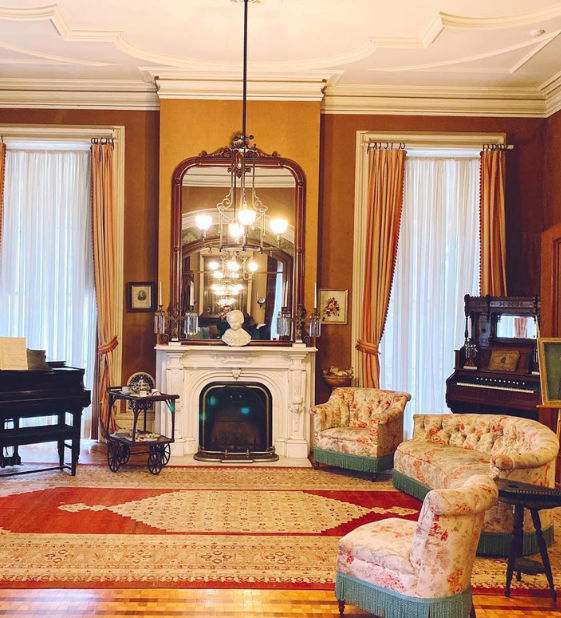
A series of remarkable occurrences, which have caused great excitement in The Winchester Mystery House, have taken place over the years. While a gust was chatting with a caretaker downstairs, a young girl walked up the stairs by herself. In one of the upstairs parlours, she saw a man sitting in a chair in the corner. She assumed he was another caretaker. When she turned around to ask him a question about the room, he was gone. Since she had not heard him leave, that seemed odd to her, especially as the floorboards would creak with every step. However, being young, she did not pay too much attention to this peculiarity. A moment later; however, he reappeared. As soon as she saw him, she asked the question she had on her mind. This time he did not disappear but answered her in a slow, painstaking voice that seem to come from far away. When he had satisfied her curiosity about the room, he asked her some questions about herself, and finally asked the one which stuck in her mind for many years afterward—“Is Mrs. Winchester building the Observational Tower?” The young lady was taken aback at this question. She was young, but she knew that Mrs. Winchester passed away in 1922. Tactfully, she told him this, and added that tower had been removed after the 1906 Earthquake. At this information, the man looked stunned and sat down again in the chair. As the young lady watched him in fascinated horror, he faded away.
Come and enjoy a delicious meal in Sarah’s Café, stroll along the paths of the beautiful Victorian gardens, and wonder through the miles of hallways in the World’s most mysterious mansion. For further information about tours, including group tours, weddings, school events, birthday party packages, facility rentals, and special events please visit the website: https://winchestermysteryhouse.com/

Please visit the online giftshop, and purchase a gift for friends and relatives as well as a special memento of The Winchester Mystery House. A variety of souvenirs and gifts are available to purchase. https://shopwinchestermysteryhouse.com/

If Man Has Entered the Gates of Hell, He Has Left Behind His Own Humanity

Human nature comprises some deep characteristics which yearn to satisfy particular needs and impulses, such as aggression, the ego that drives him towards pleasurable experiences, the need for love, and avoidance of pain in all areas of life. When considering as an essential factor in the functioning of the social system, this undertaking goes beyond what is called “psychology.” It should more properly be called a “science of man,” a discipline which deals with the data of history, sociology, psychology, theology, mythology, physiology, economic, and art, as far as they are relevant to the understanding of man. Man was—and still is—easily seduced into accepting a particular form of being human as his essence. To the degree to which this happens, man defines his humanity in terms of the society with which he identifies himself. However, while this had been the rule, there have been exceptions. There were always men who looked beyond the dimensions of their own society—and while they may have been called fools or criminals in their time, they are the roster of great men as far as the record of human history is concerned—and visualized something which can be called universally human and which is not identical with what a particular society assumes human nature to be. There were always men who were bold and imaginative enough to see beyond the frontiers of their own social existence. #RandolphHarris 1 of 21

Man has been defined as Homo faber—the tool maker. Indeed, man is a tool maker, but our ancestors before they were fully human were tool makers too. Man has been defined as Homo sapiens, but in this definition all depends on what is meant by sapiens. To use thought for the purpose of finding better means for survival and ways to achieve what we want—this capacity animals also have, and there is at best a quantitative difference been men and animals as far as this kind of achievement is concerned. If, however, one means by sapiens knowledge in the sense of thought which tries to understand the core of phenomena, thought that penetrates from the deceptive surface to what is “really real,” thought the purpose of which is not to manipulate but to comprehend, then Homo sapiens would, indeed, be a correct definition of man. Man has been defined as Homo ludens—man the player, play meaning nonpurposeful activity transcending the immediate needs for survival. Indeed from the time of the creators of the cave paintings to the present day, man has indulged in nonpurposeful activities. There are two other definitions of man that we should add. One: Homo negans—man who say “no,” although most men say “yes” when their survival or their advantage requires it. From a statistical standpoint on human behaviour, man should be called, rather, the yes-man. However, from the standpoint of the human potential, man is distinguished from all other animals by his capacity to say “no,” by his affirmation of truth, love, integrity, even at the expense of physical survival. #RandolphHarris 2 of 21

Another definition of man would be Homo eperans—the hoping man. To hope is an essential condition of being human. If man has given up all hope, he has entered the gates of hell—whether he knows it or not—and he has left behind his own humanity. Perhaps the most significant definition of the species characteristic of man has been given by Marx, who defined it as “free, conscious activity.” Probably more such definitions could be added to the ones just mentioned, but they still do no justice to the question: What does it mean to be human? They emphasize only certain elements of being human without trying to give a more complete and systematic answer. Any attempt to give an answer will immediately meet with the objection that at the very best such an answer is no more than metaphysical speculation, perhaps poetic, but at any rate the expression of subjective preference rather than a statement of any definitely ascertainable reality. These last words call to mind the theoretical physicist who might speak of his own concepts in terms of an objective reality and yet disclaim any final statement he might make about the nature of matter. Indeed, even if human evolution were to far transcend the present point of history, in which man has hardly begun to be fully human, no final statement about what is means to be human can be made now: it is possible that it may never be made. However, a skeptical attitude toward the possibility of making final statements about the nature of man does not mean that a number of statements cannot be made which have a scientific character, that is to say, which draw conclusions from observing the facts, conclusions which are correct in spite of the fact that the motivation to find the answer was the wish for a happier life. On the contrary, the function of Reason is to promote the art of life. #RandolphHarris 3 of 21

What knowledge can we draw on in order to answer the question, what does it mean to be human? The answer cannot lie in the direction which such answers have often taken: that man is good or bad, loving or destructive, gullible or independent, et cetera. Obviously, man can be all this just as he can be musical or tone-deaf, sensitive to painting or colour-blind, a saint or a rascal. All these and many other qualities are various possibilities of being human. In fact, they are all within each one of us. To be fully aware of one’s humanity means to be aware that, “Homo sum, nil humani a me alienum puto” (I am a man and nothing human is alien to me); that each one carries all of humanity within himself—the saint as well as the criminal: as Goethe put it, that there is no crime of which one cannot imagine oneself to be the author. All these manifestations of humanity are not the answer to what does it mean to be human. They are only answering the question, how different can we be and yet be human? If we want to know what it means to be human, we must be prepared to find answers not in terms of different human possibilities, but in terms of the very conditions of human existence from which all these possibilities spring as possible alternatives. These conditions can be recognized as a result not of metaphysical speculation but of the examination of the data of anthropology, history, child psychology, individual and social psychopathology. #RandolphHarris 4 of 21

The hopeless pessimist who asserts that men cannot improve their inborn character, that they will be exactly the same faulty creatures at sixty that they were at twenty, may be right about some men but is certainly wrong about others. Every Quester who tries hard enough proves him wrong. Character may be bettered by bettering conduct, which is visible, just as it may by bettering feeling, which is not. If the check to a weakness, a shortcoming, an undesirable impulse, or a negative emotion is given instantly, if retreat from it is made before it has time to swell and strengthen, victory is very largely assured. He need not be too ashamed because he has felt these things, provided he pulls himself together. They are what he has inherited from past births, plus what he has picked up in the present one, and it is inevitable or “natural” that he should experience them. Even the saints have endured them repeatedly, but those who conquered in the end knew this trick instantly outwitting the enemy. He will undergo periods of purification, when the animal appetites such as lust and gluttony, and the animal passions such as wrath and hate, will have to be brought under better control. The discipline involved is both a kind of penance for past sins and a preparation for future enlightenment. It may be that these baser attributes need to be pushed up out of latency near the surface, in order to deal with them more effectually. If so, this will come about through some sort of crisis. He need not be distressed for it will be ultimately beneficent. #RandolphHarris 5 of 21

The ability to throw negative thoughts out of his mind is so valuable that a deliberate and daily effort to cultivate it is well worthwhile. This is as true of one’s self-originated thought as of those picked up from outside, whether unwittingly from other persons, or absorbed through susceptibility from environments. Anyone can go on living but not everyone can go on living worthily. We are all imperfect and the making of mistakes is to be expected. The mishandling of problems need not surprise us and the yielding to weaknesses is a common experience. Let us grant all this, but it does not excuse us from being bereft of the desire for self-improvement, of the aspiration for self-ennoblement, or of the search for self-enlightenment. Man has an animal body, shared certain instinctive reactions, desires, and passion with other animals. However, mentally and morally there are creative impulses, functions, ideas, and ideals which increasingly separate him from them as he develops and put him on a higher plane. The ethical standards of the disciple are, or should be, as far beyond those of conventional good men, as their standards are beyond those of evil men. He may have to pass successively through the three stages of intemperate idealism, disappointed idealism, and philosophic idealism. The last is as balanced and discerning as the first is not. The faults of character and defects in personality which bar advancement in the quest will also bar advancement in other spheres of human life. #RandolphHarris 6 of 21

Being in him, these advancements will inevitably bring their results on the physical plane in the time of course. They will manifest themselves in his business or career, his home or social relations. It is not too much to say, therefore, that the self-improvement brought about by the quest’s discipline will be to his advantage in other ways. In persons who are moving toward greater openness to their experiencing, there is an organismic commonality of value directions. These common value directions are of such kinds as to enhance the development of the individual himself, of others in his community, and to make for the survival and evolution of his species. It has been a striking fact of my experiences that in therapy, where individuals are valued, where there is greater freedom to feel and to be, certain value directions seem to emerge. These are not chaotic directions but instead have a surprising commonality. This commonality is not dependent on the personality of the therapist, for I have seen these trends emerge in the clients of therapists sharply different in personality. This commonality does not seem to be due to the influences of any one culture, for I have found evidence of these directions in cultures as divergent as those of the United States of America, Holland, France, and Japan. I like to think that this commonality of value directions is due to the fact that we all belong to the same species—that just as a human infant tends, individually, to select a diet similar to that selected by other human infants, so a client in therapy tends, individually, to choose value directions similar to those chosen by other clients. If they were genuinely free to choose, as a species there may be certain elements of experience which tend to make for inner development and which would be chosen by all individuals. #RandolphHarris 7 of 21

A few of the values I see in my clients as they move in the direction of personal growth and maturity: They tend to move away from facades. Pretenses, defensiveness, putting up a front, tend to be negatively values. They tend to move away from “oughts”. The compelling feeling of “I ought to do or be thus and so” is negatively valued. The client moves away from being what he “ought to be,” no matter who has set that imperative. They tend to move away from meeting the expectations of others. Pleasing others, as a goal in itself, is negatively valued. Being real is positively valued. The client tends to move toward being himself, being his real feelings, being what he is. This seems to be a very deep preference. Self-direction is positively valued. The client discovers an increasing pride and confidence in making his own choices, guiding his own life. One’s self, one’s own feelings come to be positively valued. From desiring some fixed goal, clients come to prefer the excitement of being a process of potentialities being born. Perhaps more than all else, the client comes to vaule an openness to all of his inner and outer experience. To be open to and sensitive to his own inner reactions and feelings, the reactions and feelings of others, and the realities of the objective World—this is a direction which he clearly prefers. This openness becomes the client’s most valued resource. Sensitivity to others and acceptance of others is positively valued. The client comes to appreciate others for what they are as he has come to appreciate himself for what he is. #RandolphHarris 8 of 21

Finally, deep relationships are positively valued. To achieve a close, intimate, real, fully communicative relationship with another person seems to meet a deep need in every individual, and is vey highly valued. These then re some of the preferred directions which I have observed in individuals moving toward personality maturity. Though this list is inadequate and to some degree perhaps inaccurate, it holds exciting possibilities. I find it significant that when individuals are prized as persons, the values they select do not run the full gamut of possibilities. I do not find, in such a climate of freedom, that one person comes to value fraud and murder and thievery, while another values a life of self-sacrifice, and another values only money. Instead there seems to be a deep and underlying thread of commonality. I dare to believe that when the human being is inwardly free to choose whatever he deeply values, he tends to value those objective, experiences and goals which make for his own survival, growth, and development, and for the survival and development of others. I hypothesize that it is characteristic of the human organism to prefer such actualizing and socialized goals when he is exposed to a growth-promoting climate. In any culture, given a climate of respect and freedom in which he is valued as a person, the mature individual would tend to choose and prefer these same value directions. This is a highly significant hypothesis which could be tested. Though the individual of whim I am speaking would not have a consistent or even stable system of conceived values, the valuing process within him would lead to emerging value directions which would be constant across cultures and across time. #RandolphHarris 9 of 21

Another implication I see is that individuals who exhibit the fluid valuing process I have tried to describe, whose value directions are generally those I have listed, would be highly effective in the ongoing process of human evolution. If the human species is to survive at all on this globe, the human being must become more readily adaptive to new problems and situations, must be able to select that which is valuable for development and survival out of new and complex situations, and if he is to make such selections; he must be accurate in his appreciation of reality. The psychologically mature person, I have described has the qualities which would cause him to value those experiences which would make for the survival and enhancement of the human race. He would be a worthy participant and guide in the process of human evolution. Finally, it appears that we have returned to the issue of universality of values, but by a different route. Instead of universal values “out there,” or a universal value system imposed by some group—philosophers, rulers, or priests—we have the possibility of universal human value directions emerging from the experiencing of the human organism. Evidence from therapy indicates that both personal and social values emerge as natural, and experienced, when the individual is close to his own organismic valuing process. If he can learn again to be in touch with it, the suggestion is that though modern man no longer trusts religion or science or philosophy nor any system of beliefs to give him his values, he may fund an organismic valuing base within himself, and it will prove to be an organized, adaptive and social approach to the perplexing value issues which face all of us. #RandolphHarris 10 of 21

With the existence of three apparently different kinds of psychotherapists, we may ask if the different processions provide a range of backgrounds in respect to social class origins sufficient to make possible “natural understanding” across the full range of cultural variables represented in the client population. A second, closely related question is: Does there appear to be evidence of a meaningful division of labour, or assortative mating, such that the differential backgrounds of clients show some degree of appropriate relationship to the differential backgrounds of therapists? With a view to the possibilities suggested by these questions, this we investigated the distribution of certain biographical and sociocultural factors in samples representative of psychiatrist, psychologist, and social workers. Mental illness is a cultural universal. Persons who show recognizable patterns of deviant behaviour are found in every culture. A pattern is recognized as a set of behaviours that are deviant with respect to the modal behaviours of the individual’s group and that are repeated in different members of the group. The level of complexity of social organization or the degree of civilization achieved may vary widely; the society may be urban or rural, industrial or agrarian, nomadic or settled—but in every carefully studied sociocultural group (defined as a collection of persons having functional membership in a community and out of that membership deriving common and interdependent responsibility and shared interests) the sometime occurrence of one or more patters of deviant behaviour has been noted. #RandolphHarris 11 of 21

The specific content and detailed form of the “insanity” reflects peculiarities of the particular culture in which it occurs. In respect to content, mental illness can be seen easily to have the quality of cultural relativity. It is in part this act of the cultural relativity of the content of emotional disorder that leads some authorities to claim that “mental illness” is not a scientific concept but rather a “convenient myth” which “has outlived whatever usefulness it might have had.” Cultural relativity in the definitions of what is conforming behaviour and what is sick (id est, non-conforming) behaviour does not negate the universality of the phenomenon of disordered behaviour; as a broad phenomenon which appears repeatedly within all cultures it is accessible to scientific inquiry. The amount of awareness of emotionally based disturbances in personality has varied over time and varies today from culture to culture. In earliest history apparently only the most deranged behaviours achieved sufficient attention to be recorded. As civilizations have prospered and as the arts of inquiry have become more sensitive, there has been growing recognition of more subtle expressions of psychological disorder. With the extension of the domain of mental illness there have been a parallel increase in the complexity and sophistication of explanations of emotional symptomatology. #RandolphHarris 12 of 21

When considering neurosis, we look at a case study of a man called Tom. Tom was a medical assistant to a great clinician. He was deeply interested in his work and was favoured by his chief. A genuine friendship had developed between them, and they often lunched together. Once after such a luncheon Tom had a mild stomach upset which he ascribed to the food, without giving it further attention. After the next luncheon with the chief he felt nauseous and faint, considerably worse than the first time. He had his stomach examined but there was no pathological finding whatever. Then the disturbance occurred a third time, now with a painful sensitivity to smells. Only after the third luncheon did it strike him that all these upsets had occurred when he was eating with the director. As a matter of fact he had felt constrained with the director recently, sometimes not knowing what to talk about. And he knew the reason. His research work had led him in a direction which was opposite to the direction which was opposite to the director’s convictions. In recent week he had become more firmly convinced of his own findings. He had wanted to talk with the chief but somehow never got around to doing it. He was aware of procrastinating but the old man was rather rigid in scientific matters and did not easily tolerate dissension. Tom have showed aside his concern by telling himself that a good talk would solve everything. If the stomach upset had to do with fears, he reasoned, then his fears must be much greater than he had admitted to himself. #RandolphHarris 13 of 21

He sensed that this was so and simultaneously had two proofs of it. One was that while having these thoughts he suddenly started to feel ill, just as he had felt after the luncheons. The other was that he realized just as suddenly what had started his reaction. During the luncheon in which the illness had first developed the director had made derogatory remarks about the ingratitude of Tom’s predecessor. He had expressed his resentment against these young fellas, who learned much from him and then left and did not even bother to keep in touch with him on scientific matters. All that Tom felt consciously at that moment was sympathy for the chief. He had repressed his knowledge that actually what the director could not tolerate was that the predecessor had gone his own independent way. Thus Tom became aware that he has closed his eyes to an existing danger, and he also recognized the extent of his fears. His work was creating a real danger to his good relationship with the director, and thereby a danger to his career. The old man might really turn against him. He felt somewhat panicky at this thought and wondered if it might be better for him to check his findings once more—or even forget about them. It was only a brief thought, but it showed him a flash that this was a conflict between his scientific honesty and the immediate exigencies of his career. By repressing his fears he had pursued an ostrich policy, the purpose of which was to avoid having to make a decision. With that insight he felt free and relieved. He knew it was a hard decision but did not doubt that it would be in favour of his conviction. #RandolphHarris 14 of 21

This story was not an example of self-analysis but merely an example of how great the temptation sometimes is not to be straight with oneself. Tom was a friend of mine, an unusually well-balanced fellow. Even though it is possible that he had certain hidden neurotic tendencies, such as a need to deny any fears, these did not make him a neurotic person. It might be objected that the very fact of his unconsciously shirking a decision was an expression of a deeper neurotic disturbance. However, there is certainly no sharp borderline between healthy and neurotic, and therefore it seems preferable to leave it as a matter of emphasis and regard Tom for all practical purposes as a healthy person. This episode would then represent a situational neurosis, that is, a neurotic upset caused primarily by the difficulties in a particular situation and lasting only so long as the conflict is not consciously faced and solved. Despite the fact that a critical estimate has been given of the results attained in each of these examples, they might, when regarded together, elicit an overoptimistic impression about the potentialities of occasional self-analysis, an impression that one can easily stumble over an insight and pick up something precious. A who feels helplessly caught in his neurotic entanglements tends to hope against hope for a miracle. It should be understood clearly that it is impossible to cure a severe neurosis, or any essential part of it, by occasional self-analysis. #RandolphHarris 15 of 21

The neurotic personality is not a piecemeal conglomeration—to use the expression of Gestalt psychologists—of disturbing factors, but has a structure in which each part is intricately interrelated to each other part. It is possible through occasional work at oneself to grasp an isolated connection here or there, to understand the factors immediately involved in an upheaval and to remove a peripheral symptom. However, to bring about essential changes it is necessary to work through the whole structure, that is, it requires a more systematic analysis. This occasional analysis, by its very nature, contributes but little to comprehensive self-recognition. Each problem that is clarified automatically introduces a new one. If these leads that offer themselves are not picked up the insights necessarily remain isolated. As a therapeutic method occasional self-analysis is entirely adequate for the situational neurosis. Also in mild neuroses it can yield very satisfactory results. However, in more intricate neuroses it is little more than a leap in the dark. At the very best it can do no more than release a tension here or there, or illuminate at random the meaning of one or another disturbance. Furthermore, while most people lie at least a few times each day, it is not those little white lies that hurt others. It is the big morbid ones that cause pain and destruction that we need to think about. Some deceptions occur to keep from hurting someone’s feelings. Other deceptions can change your life. We all also have lies that we tell to ourselves. Sometimes we tell lies to help us try harder at things in life. #RandolphHarris 16 of 21

Now, historical materialism is not at all a psychological theory; its main postulate is that the way in which man produces determines his practice of life, his way of living, and this practice of life determines his thinking and the social and political structure of his society. Economy in this context refers not to a psychic drive, but to the mode of production; not to a subjective psychological but to an objective socioeconomic factor. Marx’s idea that man is formed by his practice of life was not a new as such. However, in Marx’s system what was new is that he analyzed in detail what these institutions are, or rather, that the institutions themselves were to be understood as part of the whole system of production which characterizes a given society. Various economic conditions can produce different psychological motivations. One economic system may lead to the formation of ascetic tendencies, as early capitalism did; another economic system to the preponderance of the desire to save and hoard, as nineteenth century capitalism did; still another, to the preponderance of the desire for spending and for ever-increasing consumption, as twenty-first capitalism does. There is only one quasi-psychological premise in Marx’s system: man must first of all eat and drink, have shelter and clothing, before he can purse politics, science, art, religion, etcetera. #RandolphHarris 17 of 21

Therefore the production of the immediate material means of subsistence, and consequently the degree of economic development attained by a given society, form the foundation upon which social and political institutions, and even art and religion, have been evolved. Man himself, in each period of history, is formed in terms of the prevailing practice of life which in turn is determined by his mode of production. All this does not mean, however, that the drive to produce or consume is man’s main motivation. On the contrary, Marx’s main criticism of capitalist society is precisely that this society makes the wish to “have” and to “use” into the most dominant desire in man; Marx believed that a man who is dominated by the desire to have and to use is a cripped man. His aim was a socialist society organized in such a way that not profit and private property, but the free unfolding of man’s human powers are man’s dominate aims. Not the man who has much, but the man who is much is the fully developed, truly human man. Where the Overself lives fully in man, he will not need to consider whether an act is righteous or not. Righteous acts will flow spontaneously from him and no other kind will be possible. However, for a beginner to practise prematurely such nonresistance to his impulses would be dangerous and foolish. Woman have a greater power in possessing the power of love. She can lift and redeem men, succor and save them, or degrade and destroy them. However, with this power comes great responsibility. #RandolphHarris 18 of 21

Being a firefighter also comes with great responsibility. However, many people do not know much about the lives of firefighters. One firefighter says he lived in a small apartment with his parent growing up. The bathtub was in the kitchen, and the fire escape in the front, a small yard with a clothesline, no washing machines or dryers in those days. When he was twelve, he spotted a car on fire. He pulled the firebox and waited for the apparatus to come. When the fire was out, he talked with the firemen, and they invited him to the firehouse. As a result, he had been associating with the fire service since he was a pre-teen. He never got in trouble, never had a police record, no drugs. His mother and father both worked, and so hi grandfather took care of him. He really did not have much family life, and spent most of his time at the firehouse. The firefighters helped him with his homework, and would make sure he got home before curfew. After he grew up a little, the fire department would let him come with them to put fires out. During the summer, he would go to camp and run cross-county, and learn how to swim. He eventually became a lifeguard and joined the swim team, winning All-American for two consecutive years. Then he joined the Navy and became a Navy diver and even trained for the Olympics. Eventually he wound up going to the Military Olympics, but could not compete because he and three other guys came down with food poisoning. His father worked in a manufacturing plant where grain was processes and would have to carry hundred-pound sacks from the factor down to the river, over a ramp, and load them on the barges. #RandolphHarris 19 of 21

The young man felt sorry for his father because he had to work so hard. His mother work at an electrical equipment factory wiring sockets and other things. She used to come home at night and tears and he could not understand why until he saw her hands. She had pin holes all over them from the wires that penetrated her fingers. The firefighters became so attached to the young man that they would let him sleep over at the firehouse on weekends. He started listening to fire calls on the radio, and one night they heard a third alarm on Broadway. He ran over to the firehouse as use used to do. It was raining and it was cold, and he helped the Engine pack some hose in the truck. The lieutenant would give him a ride home sometimes, and other firehouses would invite him to come and hang out with them. Although it was against rules and regulations, they stuck their neck out for the young man and did their best to look out for him and made sure he was safe and well cared for. He really enjoyed shining the brass on the old engine and would help out around the house. The men at the firehouse became like fathers to him, and treated him with respect. However, sometimes the guys would blow him off and his feelings would get hurt. When he grew up, he took care of two boys as well as the firefighters took care of him. He would take them home, contribute to their lives, and helped keep them out of trouble and away from drugs. #RandolphHarris 20 of 21
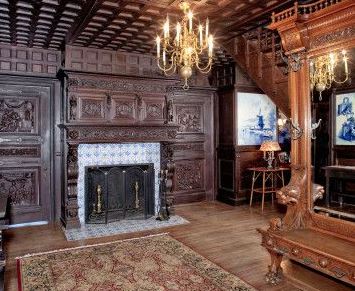
As a result, the two boys are doing good. Other guys saw what he was doing and got involved with the same kids, taking them home, taking them to picnics, taking them to amusement parks. Times were different and there was a lot of compassion in the city, a lot of morale, a lot of unity. So, the young man the fire department took, not only mentored two boys, but he stayed out of trouble because he wanted to be a firefighter and figured a police record would disqualify him from the job. He did not have many friends his age, only a couple. One night, he did not go out with his friends, and went to the firehouse instead. A really good friend of his was killed that night by a hit-and-run car. He jumped off a crane into the street, and a car hit him and kept going. He reflected on how it might have been him. He attributes a lot of his staying out of trouble to hanging around the firehouse. The Sacramento Fire Department has been serving the community of Sacramento since the mid-1800, please be sure to make a donation to them. They really care about the community and the people in it. Honour a man not for his possession alone; honour him most for the use he makes of them. When a man departs this World, neither silver nor gold, nor precious stones accompany him; he is remembered only for his love of learning and his good need. Happy is the man who is rich in good deeds, for he shall be honoured in life, and be remembered along afterwards for his goodness. I pledge allegiance to the flag of the United States of America, and to the Republic, for which it Stands, one Nation, Under God, Indivisible with Liberty and Justice for all. #RandolphHarris 21 of 21
The Winchester Mystery House

In The Winchester Mystery House there are connecting stairs and a “secret rest room” once used by Mrs. Winchester, which had long been walled up in the many structural changes in the historical mansion. Only the window of the walled-up room is still visible from the outside. It is in this area that psychics feel that the restless spirit of Mrs. Winchester is trapped. They believe she sleeps during the day and close to the premises for roaming and night. In the spring of 1968, the ghost of Mrs. Winchester made her initial appearance in the mansion. It was a warm night, and the caretakers were leaving. Suddenly, they were shocked at the amount of light coming from the skylight, they judged the time to be about midnight. They had the uncanny feeling of not being alone in the room. As their eyes got used to the darkness, they clearly distinguished the figure of a petite woman, gliding across the floor. Behind her, there was a man staring at a cabinet. Then he opened the cupboard, looked in it, and closed it again. Getting hold of himself, one of the caretakers noticed that the woman wore a black dress of the kind worn in the last century, and the man a white shirt and dark cravat of the same period. It never occurred to him that they were anything but people; he thought they were actors dressed as Mr. and Mrs. Winchester.

The woman then turned to her companion as if to say something, but did not, and walked off toward the dark room at the other end of the hallway. Then man then went back to the cabinet and leaned on it, head in hand. By now, the caretakers regained their wits and thought the intruders must be burglars, although they could not figure out how they entered the mansion, since it had been locked from the inside! Making a fist, one of the caretakers struck at the stranger, yelling, “Put your hands up!” His voice could be heard clearly along the corridors. Nursing his injured wrist, he realized that his visitors had dissolved into thin air. There was no one in the dark room. The door was securely locked. The skylight, on the third floor, could not very well have served as an escape route to anyone human. By now, the care takers knew Mr. Winchester and Mrs. Winchester had paid them a visit. Come and enjoy a delicious meal in Sarah’s Café, stroll along the paths of the beautiful Victorian gardens, and wonder through the miles of hallways in the World’s most mysterious mansion. For further information about tours, including group tours, weddings, school events, birthday party packages, facility rentals, and special events please visit the website: https://winchestermysteryhouse.com/

Please visit the online giftshop, and purchase a gift for friends and relatives as well as a special memento of The Winchester Mystery House. A variety of souvenirs and gifts are available to purchase. https://shopwinchestermysteryhouse.com/

A Manchurian Candidate Allowing the Country to be Invaded, Corrupted, and Bankrupted

Faulty characters and faulty habits can be changed by the Secret Path as the coming of the sun changes winter to spring. Greed will slowly turn to goodwill, cruelty will make its exit to allow for the incoming of kindness, and all-around self-control will gradually replace weakness. The faithful application of these teachings must inevitably influence the entire make-up of a man, and influence it most certainly for the better. He must begin this preparatory work on himself by an analysis of character. This requires a sincere, honest appraisal, a rigorous search for truth, not easy when vanity, for instance, may masquerade as duty among his motives. There is a great feeling of uncertainty and anxiety that besets the life of a man who wants to make his way up the ladder of the big corporation. He can fall at any point; he can fail to reach the aspired goal and become a failure in the eyes of his family and friends. However, this anxiety increases his wish for certainty. If he fails in spite of the certainty his methods of decision making offer him, he at least need not blame himself. The same need to be certain exists in the realm of thoughts, feeling, and aesthetic appreciation. By the growth of literacy and of the mass media, the individual learns quickly which thoughts are “right,” which behaviour is correct, which feeling is normal, which taste is “in.” All he has to do is to be receptive to the signals of the media, and he can be certain not to make a mistake. The fashion magazines tell what style to like and the book clubs what books to read, and to top it all, recent methods of finding proper marriage partners are based on the decisions of computers. #RandolphHarris 1 of 20

Our age has found a substitute for God: the impersonal calculation. This new god has turned into an idol to whom all men may be sacrificed. A new concept of the scared and unquestionable is arising: that of calculability, probability, factuality. We must address ourselves now to the question, If we give the computer all the facts, what is wrong with the principle that the computer can make the best possible decisions about future action? What are facts? Even if correct and not distorted by personal or political bias, not only can facts be meaningless they can be untrue by their very selection, taking attention away from what is relevant, or scattering and fragmenting one’s thinking so much that one is less capable of making meaningful decisions the more “information” one has received. The selection of facts implies evaluation and choice. The awareness of this is a necessary condition of making rational use of facts. The basis of all authority is the supremacy of fact over thought. Yet this contrast of fact and thought can be conceived fallaciously. For thought is a factor in the fact of experience. Thus the immediate fact is what it is, partly by reason of the thought involved in it. Facts must be relevant. However, relevant to what or to whom? If I am informed that A has been in prison for having wounded a rival in a state of intense jealousy, I have been informed about a fact. I can formulate the same information by saying that A was in jail, or that A was (or is) a violent man, or A was (or is) a jealous man; yet all these facts say little about A. #RandolphHarris 2 of 20

Maybe A is a very intense man, a proud man, a man of great integrity; maybe my factual information fails to inform that when he speaks with children his eyes light up and he is concerned and helpful. This fact may have been omitted because it did not seem relevant to the datum of this crime; besides, it is—as yet—difficult for the computer to register a certain expression in a man’s eyes, or to observe and code the fine nuances of the expression of his mouth. “Facts” are interpretations of events, and the interpretation presupposes certain concerns which constitute the event’s relevance. The crucial question is to be aware of what my concern is and hence of what the facts have to be in order to be relevant. Am I the man’s friend, or a detective, or simply a man who wants to see the total man in his humanity? Aside from being aware of my concern, I would have to know all the details about the episode—and even then perhaps the details would not tell me how to evaluate his act. Nothing short of knowing him, in his individuality and suchness, his character—including the elements he himself may not be aware of—would permit me to evaluate his act; but in order to be well informed, I would also have to know myself, my own value system, what of it is genuine and what of it is ideology, my interests—selfish or otherwise. The fact, presented merely descriptively, may make me either more or less informed, and it well known that there is no more effective way of distortion than to offer nothing but a series of “facts.” #RandolphHarris 3 of 20

When we speak of facts pertaining to political and social life, what holds true in this example of how to evaluate one episode in the life of a man is all the more complicated and consequential. If we show for a fact that Communists are taking steps to assume power in America by inserting a Manchurian candidate as president to allow the country to be invaded, corrupted, and bankrupted, does this fact imply that they threaten to conquer the United States of America or the World? Would the latter mean that they threaten the “existence” of the free World? Does a threat to the “existence” to the United States of America mean a threat to the physical existence of Americans, or to our social system, or to our freedom of expression and action, or does it mean that they want to replace our elite in the area with one of their own? Which of these possible outcomes would justify or demand the possible destruction of 344 million Americas, or all of life? The “fact” of Communist threats assumes a different meaning according to the evaluation of the total strategy and planning of the Communists. However, who are the Communists? The Russian government, South America, the Chinese government, most democrats and some republicans, or who? With the way things are going, not only will President Xi Jinping be the next president of America, but also the commander of chief of the World! The one fact from which we start means nothing without the evaluation of the whole system, which means an analysis of a process in which we as observers are also included. #RandolphHarris 4 of 20
Eventually, the very fact of having decided to select certain events as facts has an effect on ourselves. By this decision we have committed ourselves to move in a certain direction, and this commitment determines our further selection of facts. The same holds true for our opponents. They also are influenced by their own selection of facts, as well as by ours. However, not only the facts themselves are selected and ordered according to values; the programing of the computer itself is based on built-in and often unconscious values. The principle that the more we produce the better is in itself a value judgment. If instead we believed that our system should be conducive to optimum human activeness and aliveness, we would program differently and other facts would become relevant. The illusion of the certainty of the computer decision, shared by a large sector of the public and by man decision makers, rests upon the erroneous assumptions (a) that facts are objective “givens,” and (b) that the programing is norm-free. “Normative” planning must precede “strategic” and “tactical” planning. All planning, whether with or without the use of computers, depends on the norms and values that underlie the planning. Planning itself is one of the most progressive steps the human race has taken. However, if it is “blind” planning, in which man abdicates his own decision, value judgment, and responsibility, it can be a curse. #RandolphHarris 5 of 20
If it is alive, responsive, “open” planning, in which the human ends are in full awareness and guiding the planning process, it will be a blessing. The computer facilitates planning tremendously, but its use does not really alter the fundamental principles of the proper relationship between means and ends; only its abuse will. As a man, it is not essential to discover and correct these faults. As a seeker, such discovery and such correction are primary duties. The code of conduct which philosophy asks its votaries to practise, the set of values which it determines for them, the endeavour to transcend themselves which it inspires—these elevate the mind into nobility, grandeur, and reverence. To abstain from favoured foods is a hard test; to abstain from carnal intercourse is still harder one. To the common mind, devoid of metaphysical faculty, this may seem far enough to travel. However, to the developed mind the hardest of all tests must yet be undergone—to abstain from egoistic thought, feeling, and action. The more the character is purified, the easier it is to practise meditation. The more the lower nature holds a man, the shorter will be the period of time in which he will be able to hold attention on the Overself. It is a great beginning of the real quest when he comes to the clear perception that the lusts, gluttonies, wraths, and passions have been lodged in him and have lived in his self yet are not him; that they are morbid creations which can be starved, exorcised, and expelled just as surely as they have been fed, nourished, and embraced. #RandolphHarris 6 of 20
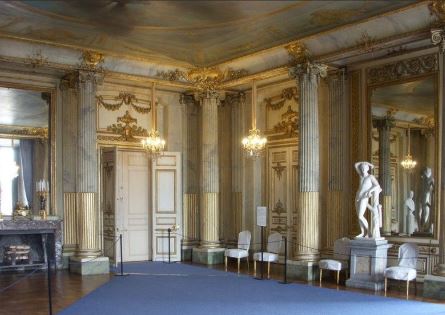
What separate the lower appetites of man from his higher aspirations? The beast must obey blindly its group instinct, the human need not. He can choose between doing the same as the animal or holding himself back to think, reason, and arrive at a considered decision. The lower nature does not let him keep this mood of high resolve long. Not many days pass before it seeks to discourage him. For the old cravings, the desire habits, and the emotional tendencies are still there. Soon they begin to trouble him again. “Why try?” his lower nature despondently tells him, “Why torment yourself uselessly? You can only fail in the end.” This it creates the expectancy of failure and turns his high adventure into a dismal ordeal. Only a fixed vigilant determination and correct approach will bring forth that inner consent to the new disciplinary habits so necessary to success. Only by re-educating his tendencies and gradually making them quite willing to conform to the right way of living can the lower nature be beaten. To the extent that anything lifts men up out of their animality, it serves a higher purpose. This is true of athletic training and religious aspiration, of social codes and personal self-respect. For in the end they must turn their minds away from the passions which they share with the sub-human kingdom to the fulfilment of their higher human possibilities and destiny. The honourable man who lives by a decent code of ethics has to be surpassed by the seeker, since he believes in a life and goal which I still more honourable. #RandolphHarris 7 of 20

Freedom is a tremendous word whose meaning goes much beyond the average man’s idea of it. He is not free who is in bondage to narrow prejudice, strong attachment, unruled desire, and spiritual ignorance. The same strength which is put into negative qualities like fear, grief, revenge, and discord—to a man’s own detriment—can be put into beneficial ones like courage, cheerfulness, fortitude, benevolence, and calmness, to his own benefit. He is to work for the day when his character will be utterly transformed, when he will be incapable of meanness or animality, when he will live in constant awareness of the idea. There is an organismic base for an organized valuing process within the human individual. It is hypothesized that this base is something the human being shares with the rest of the animate World. It is part of the functioning life process of any healthy organism. It is the capacity for receiving feedback information which enables the organism continually to adjust behaviour and reactions so as to achieve the maximum possible self-enhancement. This valuing process in the human being is effective in achieving self-enhancement to the degree that the individual is open to the experiencing which is going on within himself. I have tried to give two examples of individuals who are close to their own experiencing; the tiny infant who has not yet learned to deny in his awareness the processes going on within; and the psychologically mature person who has learned the advantages of this open state. #RandolphHarris 8 of 20

One way of assisting the individual to move toward openness to experience is through a relationship in which he is prized as a separate person, in which the experiencing going on within him is emphatically understood and valued, and in which he is given the freedom to experience his own feelings and those of others without being threatened in doing so. This proposition obviously grows out of therapeutic experience. It is a brief statement of the essential qualities in the therapeutic relationship. There are already some empirical studies, of which the one by Barrett-Lennard is a god example, which gives support to such a statement. One case study we should consider is one of Billy. Billy, a healthy, strong, intelligent, and successful lawyer, consulted me because of a fear of high places. He had a recurring nightmare in which he was pushed from a bridge or tower. He felt dizzy when he sat in the first row of a theater balcony and when he looked down from high windows. Also, he sometime felt panicky before he had to appear in court or before he met important clients. He had worked up from a poor environment and was afraid of not being able to maintain the good position he had attained. The feeling often crept up on him that he was putting on a bluff and that it would be found out sooner or later. He could not account for this fear because he believed himself as intelligent as his colleagues; he was a good speaker and usually could convince others by his arguments. #RandolphHarris 9 of 20

Because he talked frankly about himself we managed to see in a few interviews the outlines of a conflict between, on the one side, ambition, assertiveness, a desire to put something over on others, and, on the other side, a need to maintain the appearance of a jolly straight fella who did not want anything for himself. Neither side of the conflict was deeply repressed. He had merely failed to realize the strength and the contradictory nature of these strivings. Once they were brought into sharp focus, he recognized squarely that he actually did not put a bluff. He then spontaneously drew the connection himself between this inadvertent swindle and the dizziness. He aw that he craved to attain a higher place in life but did not quite dare admit to himself how ambitious he really was. If other realized his ambition, he was afraid that they would turn against him and push him down and therefore he had to show a front of being a jolly good fella to whom money and prestige did not mean much. Being nevertheless an essentially honest person, he was dimly aware of some bluff, which in turn had made him apprehensive of being “found out.” This clarification sufficed to remove the dizziness, which was a translation of his fears into physical terms. #RandolphHarris 10 of 20

He then had to leave town. We had not touched upon his fear of public performances and of meeting certain clients. I advised him to observe the conditions under which his “stage fright” was increased or decreased. Sometime later I received this report. He had first thought that the fear appeared when the case he presented or the argument he had used was debatable. However, search in this direction did not lead very far, though he felt distinctly that he was not wholly wrong. Then he had a bad break which, however, proved to be a good break for his own efforts at understanding. He had prepared a difficult brief not too carefully, but was only moderately apprehensive about presenting it in court, for he knew that the judge had fallen ill, and that the one who would substitute was strict and unbending. He tried to console himself with the reminder that after all the second judge was far from vicious or tricky, but this did not diminish his rising anxiety. Then he thought of my advice and tried to let his mind run freely. First an image appeared of himself as a small boy smeared from head to toe with chocolate cake. He was at first baffled by this picture, but then recalled that he was going to be punished but got away with it because he was so “cute” and his mother had to laugh about it. The theme of “getting by” persisted. Several memories emerged of times when he was not prepared at school, but got by. Then he thought of a teacher of history who he wanted. He could still feel the hatred. #RandolphHarris 11 of 20

The class had to write a theme about the French Revolution. When returning the papers the teacher criticized his for being replete with high-sounding phrases but devoid of solid knowledge; he cited one of those phrases and the others roared with laughter. Bill had felt acutely humiliated. The English teacher had always admired his style but the history teacher seemed impervious to his charm. The phrase “impervious to his charm” took him by surprise, because he had meant “impervious to his style.” He could no help feeling amused because the word “charm” expressed his true meaning. Sure enough, the judge was like the history teacher, impervious to his charm or his power of speech. That was it. He was accustomed to rely on his charm and his facility with words to “get by” instead of being thoroughly prepared. As a result he became panicky whenever he visualized a situation in which this tool would be ineffective. Since Bill was not deeply entangled in his neurotic trends he was able to draw the practical consequence of this insight: to sit down and work more carefully on the brief. He even went a step farther. He realized to what extent he used his charm also in relationships with friends and women. Briefly, he felt that they should be under the spell of his charm and therefore overlook the fact that he did not give much of himself in any relationship. He linked this finding with our discussion by realizing that he had discovered another bluff, and he finished with the realization that he must “go straight.” #RandolphHarris 12 of 20
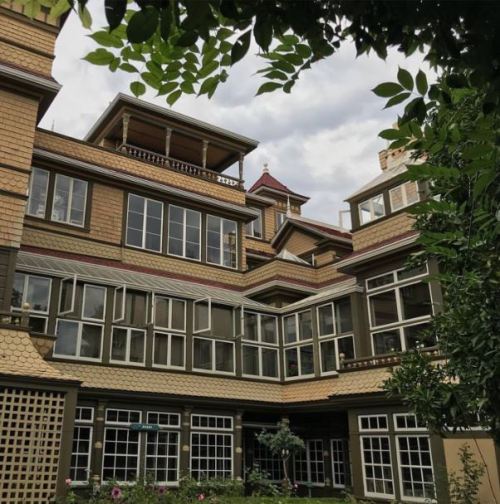
Apparently he was able to do so to a considerable extent, because since that episode, which I not six years ago, his fears have practically disappeared. This result resembles the one attained by John (from past reports) when he overcame his headaches, but it must be evaluated differently. The headaches, as indicated before, were a peripheral symptom. They can be so designated by virtue of two facts: since they were infrequent and not severe they did not essentially disturb him; and they had not assumed any secondary function. John’s real disturbances, as revealed in a subsequent analysis, lay in a different direction. Bill’s fears, on the other hand, were the result of a crucial conflict. They did not disable him but they interfered with significant activities in vital areas of his life. John’s headaches disappeared without any concomitant change in his personality, the only change being a slightly greater awareness of anger. Bill’s fears vanished because he recognized their source in certain contradictory trends in his personality and, more important, because he was able to change these trends. Here again, a in John’s case, the results seem greater than the efforts that produced them. However, again on closer examination the disparity is not so great. It is true that with comparatively little work Bill managed not only to get rid of disturbances serious enough to jeopardize his career in the long run, but also to recognize a few important facts about himself. #RandolphHarris 13 of 20

Bill saw that he had presented a somewhat deceptive front to himself and to others, that he was much more ambitious than he had admitted to himself, that he tended to attain his ambitious goals through his wits and his charm rather than through solid work. However, in evaluating this success we must not forget that Bill, in contrast to John and Harry, was essentially a physically healthy person with only mild neurotic trends. His ambition and his need to “get by” were not deeply repressed and did not have a rigid compulsive character. His personality was so organized that he could modify them considerably as soon a he recognized them. Dropping for a moment the effort to attain a scientific understanding of Bill’s predicaments, one might regard him simply as a person who had tried to make life too easy for himself and who could do better when he realized that his way did not work. Bill’s insights were sufficient to remove certain gross fears. However, even in this most successful short cut many questions are left open. What exactly is the meaning of the nightmare about being pushed down from a bridge? Was it necessary for Bill that he alone should be on top? Did he want to push others down because he could not tolerate any competition? And was he therefore afraid others might do the same to him? Was his fear of high places only a fear of losing the position he gained, or was it also a fear of falling down from a height of fictitious superiority—as it usually is in phobias of this kind? #RandolphHarris 14 of 20

Furthermore, why did he not put in an amount of work commensurate with his faculties and his ambition? Did this laziness result only from the repression of his ambition, or did he feel that it would detract from his ambition, or if he made adequate efforts, did he feel that it would detract from the repression of his ambition—that only mediocre people have to work? And why did he give so little of himself in his relations with others? Was he too engrossed in himself—or perhaps too contemptuous of others—to be able to experience much spontaneous emotion? Whether it would be necessary, from the point of view of therapy, to pursue all such supplementary questions is another matter. In Bill’s case, it is possible that the little analysis done had farther reaching effects than the removal of conspicuous fears. It is possible that it set going something that might be called a beneficent circle. By recognizing his ambition and by putting in more work he would actually anchor his ambitions on a more realistic and more solid basis. Thereby he would feel more secure and less vulnerable and less in need of his bluff. By relinquishing the false front he would feel less constrained and less afraid of being found out. All of these factors might considerably deepen his relationships with others, and this improvement would also add to his feeling of security. Such a beneficent circle may have been set in motion even though the analysis was not complete. If the analysis had searched out all the untouched implications, it would almost certainly have had this effect. #RandolphHarris 15 of 20
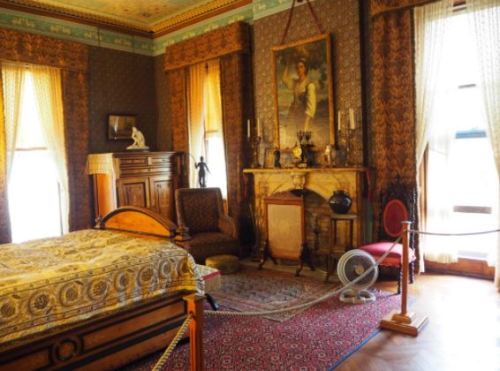
There is little quarrel with the notion that careful training and intensive supervised experience contribute significantly to the preparation of the skilled psychotherapist. It may be asked if there are factors of life history, personality, and social background that the therapist-to-be bring to his training that may contribute to enhance or to limit his future therapeutic endeavours. Differences in these factors could serve either to increase or reduce the effects of the differences in the formal training of the psychiatrist, psychologist, and social worker. The capacity for and the condition of “understanding” a patient is generally held to be of key importance in the establishment, maintenance, and successful direction of a therapeutic relationship. If it happens that therapist and client have certain identities in their respective social histories there is possible a spontaneous empathy, a preformed rapport that can facilitate the mutual acceptance of each by the other and, more importantly, may serve continuously as a catalyst for the stream of communication, spoken and upspoken, which is the medium of therapy. Safely shutting down a bully is something the three different kinds of psychotherapists can help one with. We do not recommend physical violence. Safely shutting down a bully is what we are going for here. In this way, you utilize the help of others. Go the route of getting others involved, even the authorities if need be. Stand up tall, stay firm. If a person is being rude, suggest that perhaps you two have gotten off on the wrong foot, and that calling names will not help the situation. #RandolphHarris 16 of 20

If for instance, the person harassing you starts making threatening gestures, like pounding his hand on his fist, use your mobile phone to take a quick picture of him doing this. It is important to record any physical sign of intimidation. For every manipulative action, there is a consequence. The harshest of them all is the consequence of losing you. The thing about manipulators is that they mentally record every action you do when they have manipulated you or attempted to. If you say you will call the authorities if the bully hits you, and he does go through with the physical harm, you had better call the authorities and let them handle it. Make sure to bring down all the consequences on him that the law allows. You might be the one who gets through to him or her that it is just not worth bullying and hurting people physically. You might even save their next would-be victim from harm. You are not trying to control the manipulator, but you are trying to control how you react to those manipulations. If they think you have a weakness that they can take advantage of, just like the wind, a master manipulator will change directions and come at you from another way. We all have weaknesses; they key to keep them hidden around manipulators is to watch what you say. Say what you mean, only what you will go through with. Sometimes it is best to say nothing and just walk away. When you show an individual that there are consequences for harassing you, they may try even harder. Therefore make it known that those consequences will have an impact on their future. Be calm. Be articulate. Be assertive and sure of yourself so they will stop using you as an easy target. #RandolphHarris 17 of 20

Not everyone grew up rich. Some people come from big families, were disabled in the war, and are very thankful for pensions. Today, a lot of people are saying they need help, they need this, they want that. It is important to be thankful for everything you have, the opportunity to go to school and live that you are living, the opportunity to work. Once when he was a little kid, one firefighter remembers very well going to a firehouse. One of the firemen showed him the remnants of a watch, a new kind of watch that had been melted down into a wad of black plastic. It had come out of a fatal fire caused by someone smoking in bed. That stuck in his mind. When was sixteen, some of the kids who were eighteen were trying to get involved with the volunteer fire department. He looked at them with admiration and knew that it was something he wanted to do. His father was a lieutenant at the time. Later, when he got old and his arthritis progressed, he had to retire. Twice he was almost killed on the job. However, he was not a big story teller. He never told his son fire stories until he was older, and he said he wanted to enter the fire department. His father tried to teach him things. He said, “Son, you watch out for those truss roofs, because when one component fails the whole roof and parapet will come down, and they will kill you.” One time his dad was in a fire in a three-story building. It had a very high parapet which concealed the bowstring truss roof behind it. He was operating the turntable of the ladder truck, and he had two guys in the basket. It was really smoky. He saw a crack developing in this parapet. #RandolphHarris 18 of 20

Everybody ever quickly got away, because you could see what was going to happen. His dad stayed there and swung that snorkel boom away and got those two guys in the basket out of the way just as the wall came down. It buried his dad. Just buried him. One of the things that fell on him was an electrical transformer, and he had an electrical burn across his groin from a wire landing right there. The wires were sparking, and the other guys were afraid to jump right in. Then some fire chief, who had a truckman’s belt on, had them attach a rope to the belt, and he said, “I’m going to start digging the bricks off this guy. And if something happens to me, yank me back.” Well, as soon as he took off the first couple of brick, they could see that the was not going to be electrocuted, and they all jumped in, and they puled all of the bricks off his dad. He was in bad shape. In critical condition. They were just about ready to drill holes in his head. This young man’s father was one of the first guys to wear a helmet with a neckstrap. You know, there was a lot of talk against the strap, saying one will fall through the floor and it will strangle you. His dad said that the first brick would have hit him on the head and the rest of them would have killed him. That helmet stayed on his head. Many firefighters with the Sacramento Fire Department have a legacy or social commitment to help out the community. Therefore, think about fire safety. Do your best to prevent fires. Even if you make it out of a burning building, the people rescuing you may not. #RandolphHarris 19 of 20

When people think of the fire department, they think of someone rushing into buildings and saving lives, but that is not the only thing in it by a long shot. When my son Leo was two years old, after we built our house in Kelowna and moved in, when the dog would annoy him, he would run into the kitchen and hide in a tall, narrow cabinet to get away from home. Keep in mind, when there is a fire, some kids are afraid of it. Often times they will hide somewhere in the house to get away from the sirens, the flames, and the smoke and incorrectly think they are safe, and no one may ever find them. Also, some fires have killed dozens of firefighters. It is a horrible sight to transport people who are burnt to a crisp. Many people who survive fires also come out of them wounded. The Sacramento Fire Department is doing something terribly important, something everybody respects. You can sense that it is very important. However, sometimes firefighters end up in the hospital because of heat exhaustion. The Sacramento Fire Department has always been around. If possible, please make a donation to ensure these men and women receive the proper resources. I pledge allegiance to the flag of the United States of America and to the Republic, for which it stands, one nation, under God, Indivisible with Liberty and Justice for all. Get up early, work hard, mind your own business, save your money, buy a Cadillac and live on the nice side of town. #RandolphHarris 20 of 20
The Winchester Mystery House

The Winchester Mystery House exists beyond ordinary time, and it is so beautiful, yet bizarre as to inspire fear even in the hearts of an unimaginative populace. On April 22, 2001, there was a mysterious wildness in the mansion, that none might listen without apprehension. A caretaker heard vociferous thumping on the wall next to the bed Mrs. Winchester died in with ululation so horrible and unearthly that he was terrified and baffled. The sounds of knocking then started coming from under the bed; when he knocked on the wooden bedstead, the unknown visitant replied in kind. Then something appeared from beneath the bed. Three days later, he was found quietly sleeping in the basement. The caretakers who found him noticed in his pale blue eyes there was a certain gleam of peculiar quality. He raved of things he did not understand and could not interpret; things which he claimed to have experienced, but which he could not have learned through any normal or connected narration.

Come and enjoy a delicious meal in Sarah’s Café, stroll along the paths of the beautiful Victorian gardens, and wonder through the miles of hallways in the World’s most mysterious mansion. For further information about tours, including group tours, weddings, school events, birthday party packages, facility rentals, and special events please visit the website: https://winchestermysteryhouse.com/

Please visit the online giftshop, and purchase a gift for friends and relatives as well as a special memento of The Winchester Mystery House. A variety of souvenirs and gifts are available to purchase. https://shopwinchestermysteryhouse.com/

Was it from a Past Life, or Maybe from a Dark Night?
Some things defy human understanding and simply cannot be explained. Perhaps one day we will be able to rise beyond Earthly shadows and discover the secrets of the dead. For centuries, spiritists have believed that there is a portal leading from life to death and from death to life. Souls depart from the World every day, and souls on the other side of the veil can cross over into our World. The World of the living. My home has become a twilight of supernatural occurrences. Its rooms possess many dreadful secrets, ghastly inhabitants, for it is a place where ghosts and other terrors walk. The thick air in Llanda Villa is filled with anxiety, and screams, swearing, shouting echo from the rooms beyond with nerve-jarring regularity. And then, prayers of desperation. Most distressing of all is once one starts up the easier risers, quick shadows loom, and flight becomes impossible, as the moments tick painfully. Often as I walked the halls of my labyrinth soul searching, I could feel a cold breeze creeping in. It lifts my hair and, in that moment, I feel the dance of cold fingers along my spine. But was it anything to fear? A young man, Tobey, nineteen years of age, who had been staying in my home and working as a farmhand. He was really close to the supernatural phenomena—visible and tangible—that he speculated so grotesquely about it; and for another thing, he was amazingly will to make a long and ample confession. This youth avowed that some months before, when he was in bed, the chamber door opened, and a maiden, Athena, whom he loved, stealthily entered the room. To his surprise she informed him that she had been driven from her chamber and had taken refuge with him.
Although he more than suspected some delusion, after a short while he consented to her solicitations and passed a night of unbounded indulgence in her arms. Before dawn, however, the visitant revealed the true nature of the deceit, and the young man realized he had lain with a succubus. None the less such was his doting folly that the same debauchery was repeated night after night, until struck with terror and remorse, he sought the priest to confess and be delivered from this admonition. “This monstrous connexion lasted several months; but at last God delivered him by my humble means, and he was truly penitent for his sins.” Not infrequently the Devil or the familiar assigned to the new witch at the Sabbat when she was admitted must obviously have been a man, once of the assembly, who either approached her in come demoniacal disguise or else embraced her without any attempt at concealment of his individuality, some lusty varlet who would afterwards hold himself at her disposition. For we must always bear in mind that throughout this era, there is often much in the evidence which may be explained by the agency of human beings; not that this essentially meliorates their offenses, for they were all bond-slaves of Satan, acting under his direction and by the inspiration of hades. When the fiend has ministers devoted to his service there is, perhaps, less need for his interposition in propria persona. I might say, with all proper modesty, that the subject of anthropology and folklore is by no means strange to me. It is no news to me that talks of demons and hidden races are as old as mankind.
Howbeit, again and again in these cases we meet with that uncanny quota, by no means insignificant and unimportant, which seemingly admits of no solution save by the materialization of evil intelligences of power. And detailed as is the evidence we possess, it not unseldom becomes a matter of great difficulty, when we are considering a particular case, to decide whether it be an instance of a witch having had actual commerce and communion with the fiend, or whether she was cheated by the devils, who mocked her, and allowing her to deem herself in overt union with them, thus led the wretch on to misery and death, duped as she was by the father of lies, sold for a delusion and by profitless endeavour in evil. There are, of course, also many cases which stand on the border-line, half hallucination, half reality. The Devil knows all the Witches. He takes a female shape to pleasure the Sorcerers. Other reasons why the Devil (had to do) with warlocks and witches. The unnatural physical coldness of the Demon is well known by witches in every country of Europe throughout the centuries. In some cases, there was full materialization due to the ectoplasmic emanations. Ectoplasm is the touch of cold and viscous mass comparable to contact with a reptile, and this certainly seem to throw a flood of light upon the what I have experienced in my home. In 1888 a young housemaid said that the Devil who appeared to her as a dark swarthy youth “was colder than man. I fand his nature als cold, a spring-well-water, uerie cold, as yce.”

One night, unable to sleep, I was staring out through my bedroom window at the moonlit lawn. From the shrubbery there emerged what I at first thought was some trick of the shadows. Then I saw that it was some great. It was too far away for me to be able to see it clearly, but I imagined that it turned its head to look up at my window—to look directly at me. Then, in a blink of an eye, it was moving at impossible speed across the silver grass until it was lost from my sight. I have certain evidence that monstrous things do indeed live on this estate and in rooms which nobody visits. The voices my servants here in my home have nearly scared them paralysed by reason. I know what most people think of one who tells about “hearing voices”—but before anyone draws conclusions, they have to experience it for themselves. It is true—terribly true—that there are non-human creatures watching us all the time; with spies among us gathering information. If we let them alone, they will not hurt us. If we get too curious about them, no one can say what will happen. Because of what I have discovered, I think they mean to get rid me. That is what the Boston medium has explained. There is a great diamond with unknown hieroglyphics half worn away which I found in a safe that my husband had locked away in his office; and after I took it home, everything became different. Our one-month-old daughter died, and fifteen years later, William suffered a mysterious and tragic death. If I stop construction on Llanada Villa, they will kill me. This is why I have urged my staff to hush about the supernatural aspects of my home.

People must be kept away from my estate, the front doors must never be opened, and in order to effect this, their curiosity ought not be aroused any further. Heaven knows there is peril enough anyway, with promoters and real estate men flooding Santa Clara with herds of summer people to overrun the wild places and cover the hills with cheap bungalows. Those creatures have a way of tampering with things around here. There is a sullen, furtive fellow named Arkie, who is a farmer on my estate, whom I believe is a spy for the dark lord. Little by little they are trying to cut me off from our World because I know too much about their World. They have the most amazing way of finding out what I do. Furthermore, I would hardly dare sell this house to anybody now that the ghastly demons have made it their home. I have invited my niece Daisy to live with me, and given her a trust fund to ensure that this estate will always remain in our family and will be well taken care of. As I sit here glancing through documents neatly arranged in stacks on the cherrywood table, I was growing more anxious. As the hour passed and the whitely steaming sun moved lethargically through the sky, I grew calm again. Mr. Hasen was out mowing and tending the enormous lawn, which invariably grows back more lushly within a few days. However, it seemed strange to me that he had halted so suddenly, with a field of lawn left to mow.
With his arms raised at his sides, Mr. Hasen’s posture tense, vigilant; his face, shrouded in shadow, showing no animation. “Mr. Hansen?” Tobey blundered forward, unthinking. Seeing, in that instant, that the figure confronting him was not Mr. Hansen but—the demon-without-a-face. Tobey stood paralysed, transfixed. For it might have seemed to him that this was buy a symptom of the insomnia of which he had grown fatally proud: a nightmare figure standing before him which he had imagined into being; a dream of his and not “real”; or, if “real,” as the atrocities in the mansion were real, in some way not related to him. He had not time to cry out for help before the creature lunged at him, swiping with its hands as a maddened bear might swipe savagely and blindly; so much heavier and stronger than Tobey, Tobey was knocked to the ground as if he were a small child and not a nineteen-year-old young man. Except for the sounds of the nocturnal insects there was silence, for the demon did not speak, nor could Tobey scream, his breath choked off as the-demon-without-a-face crouched over him where he had fallen, raining blows upon his unprotected head, clawing and tearing at his face, tearing away the flesh of his face as Tobey fell, and fell, into the Earth beneath the wild grasses of The Winchester Estate. My staff ran hither and thither until they found hi body. So then they laid the body across a horse, and they say it was all they could manage to keep the beast from bolting away from the time they were in sight of the tree, for it seemed to be mad with fright.
However, they managed to bind the eyes of the horse and lead it down through the fruit orchards to the village street; and there, just by the big tree where the stocks are found, they found a lot of women gathered, and a boy lying in the middle, as white as paper, and not a word could they get out of him, good or bad. So they saw there was something worse to come, and they made the best of their way up the lane to Dr. Meckelburg’s house. And when they got near that, the horse they were leading seem to go mad again with fear, and reared up and screamed, and struck out with its fore-feet and the man that was leading it was as near as possible being killed, and the dead body fell off its back. So Mr. Dillenburg bid them get those horse away as quick as might be, and they carried the body straight into the living-room, for the door stood open. And then they saw what it was that had given the poor boy such a fright, and they guessed why the horse went made, for you know horses cannot bear the smell of dead blood. There was a long table in the room, more than the length of a man, and on it there lay the body of Dr. Meckelburg. The eyes were bound over with a linen band and the arms were tied across the back and the feet were bound together with another band. However, the fearful thing was that the breast being quite bare, the bone of it was split through from the top downwards with an axe! Oh, it was a terrible sight; not one there but turned faint and ill with it, and had to go out into the fresh air. Even Mr. Dillenburg, who was what you might call a hard nature of a man, was quite overcome and said a prayer for strength in the garden.

At least they laid out the other body as best they could in the room, and searched about to see if they could find out how such a frightful thing had come to pass. And in the cupboards they found a quantity of herbs and jars with liquors, and it came out, when people that understood such matters had looked into it, that some of these liquor were drinks to put a person asleep. And they had little doubt that that wicked young man had put some of this into Dr. Meckelburg’s drink, and then used him as he did, and, after that, the sense of his sin had come upon him and he had cast himself away. Well now, you could not understand all the law business that had to be done by the coroner and the magistrates; but there was a great coming and going of people over it for the next day or two, and then the people of the parish got together and agreed that they could not bear the thought of those two being buried in the churchyard alongside of Christian people; for I must tell you there were papers and writings found in the drawers and cupboards that Mr. Dillenburg and some other clergymen looked into; and they put their names to a paper that said these men were guilty, by their own allowing, of the dreadful in of idolatry; and they feared there were some in the neighbouring places that were not free from wickedness, and called upon them to repent, lest the same fearful thing that was to come to these men should befall them also; and then they burnt those writing.
So then, Mr. Dillenburg was of the same mind as the parishioners, and late one evening twelve men that were chosen went with him to that evil house, and with them they took two biers made very roughly for the purpose and two pieces of black cloth, and down at the cross-road, there were other men waiting with torches, and a pit dug, and a great crow of people gathered together from all round about. And the men that went to the cottage went in with their hats on their heads, and four of them over with the black cloths, and no one said a word, but they bore them down the lane, and they were cast into the pit and covered over with stone and Earth, and then Mr. Dillenburg spoke to the people that were gathered together. My butler was there, for he had come back when he heard the news, and he said he never should forget the strangeness of the sight, with the torches burning and those two black things huddled together in the pit, and not a sound from any of the people, except it might be a child or a woman whimpering with the fright. And so, when Mr. Dillenburg had finished speaking, they all turned away and left them lying there. They say horses do not like the spot even now, and I have heard there was something of a mist or a light hung about for a long time after, but I do not know the truth of that. However, I do know this, that next day my butler’s business took him past the opening of the lane, and he saw three or four little knots of people standing at different places along it, seemingly in a state of mind about something; and he rode up to them, and asked what was the matter.

And they ran up to him and said, “Oh, Sir, it’s the blood! Look at the blood!” and kept on like that. So he got off his horse and they showed him, and there, in four places, I think it was, he saw great patches in the road, of blood; but he could hardly see it was blood, for almost every spot of it was covered with great black bats, that never changed in their place or moved. And that blood was what had fallen out of Dr. Meckelburg’s body as they bore it down the lane. Well, my butler could not bear to do more than just take in the nasty sight so as to sure of it, and then he said to one of those men that was there, “Do you make haste and fetch a basket or a barrow full of clean Earth out of the churchyard, and spread it over these places, and I’ll wait here till you come back.” And very soon he came back, and the old man that was sexton with him, with a shovel and the Earth in a hand-barrow: and they set it down at the first of the places and made ready to cast the Earth upon it; and as soon as ever they did that, what do you think? the bats that were on it rose up in the air in a kind of a solid could and moved off up the lane towards the house, and the sexton (he was parish clerk as well) stopped and looked at them and said to my Butler, “Lord of Darkness, sir,’ and no more would he say. And just the same it was at other places, every one of them.
My butler them made up his mind that no one was going to live in that cottage again, or yet use any of the things that were in it: so, though it was to be done away with, and anyone that wished could bring a faggot to the burning of it; and that is what was done. They built a pile of wood in the living-room and loosened the thatch so as the fire could take good hold, and then set it alight; and as there was no brick, only the chimney-stack and the oven, it was not long before it was all gone. I seem to remember seeing the chimney, but after a few years, it fell down. You may be sure that for a long time the people said Dr. Meckelburg and Tobey were seen about, the one of them in the wood and both of them where the house had been, or passing together down the lane, particularly in the winter of the year and at autumn-time. I cannot speak of that, though if we were sure there are such things as ghost, it would seem likely that people like that would not rest quiet. However, I can tell you this, that one evening in the month of January, I had been taking a long walk on my estate and picking flowers and had not taken any particular notice of where I was going. And on a sudden I cried out. I had felt a sharp prick on the back of my hand, and I snatched it to me and saw a black bat on it, and struck it with the other hand and killed it. I had never seen a bat like that before. And then I looked about, and lo and behold if I was not in the very lane, just in front of the place where that house stood, and, as they told me after, just where the men set down the biers a minute when they bored them out of the garden.

You may be sure I made haste away from there; for I was wholly upset finding myself there. Whether there was anything about there more than I could see I shall never be sure: perhaps it was partly the venom of that horrid bat’s bite that was working on me that made me feel so strage; for, dear me, how that poor arm and hand of mine did swell up, to be sure! I am afraid to tell you how large it was round! and the pain of it, too! Nothing Dr. Wayland could put on it had any power over it, and it was not until he was persuaded by our old nurse to get the wise man to come and look at it, that I got any peace at all. However, he seemed to know about it, and said I was not the first that had been taken that way. “When the sun’s gathering his strength,” he said, “and when he’s in the height of it, and when he’s beginning to lose his hold, and when he’s in his weakness, them that haunts about that lane had best to take heed to themselves.” However, what it was he bound on my arm and what he said over it, he would not tell us. After that I soon got well again, but since then I have heard often enough people suffering much the same as I did; only of late years it does not seem to happen but very seldom: and maybe things like that do die out in the course of time. (One can interpret this story in many ways, of course. If it really occurred, and there were a number of accounts of it in existence that leads me to believe that there is a basis of fact to this, then perhaps we are dealing with a case of prophecy on the part of Mrs. Winchester.)

The Winchester Mystery House
The ancient folklore, while cloudy, evasive, and largely forgotten by the present generation, is of a highly singular character, and obviously reflects the influence of still earlier Victorian tales. I know it well, though I had never been in the Santa Clara Valley in the Victorian era, through the exceedingly rare monograph of Mrs. Sarah L. Winchester, which embraces material orally obtained prior to 1906 among the oldest people of the state. This material, moreover, closely coincided with tales which I personally heard from elderly rustics in the Santa Clara Valley. Briefly summarized, it hinted at hidden demonic beings which lurked somewhere among The Winchester Estate—in the deep woods, and the dark corners of the mansion where hallways lead to unknow parts of the hose. These beings were seldomly glimpsed, but evidences of their presence were reported by the staff of the mansion who ventured farther than the usual pathways of the mansion or deep into the home where even Mrs. Winchester shunned. There were queer footprints on the floors and ceilings, claw marks in the wall, blood spatter on the windows. There were, too, certain rooms of problematical nature, with more than the average quota of curious foot prints leading both toward and away from the walls—if indeed the direction of these prints indicated that something or someone was walking through the walls.

If the stray accounts of these things had not agreed so well, it would have been less uncomfortable. As it was, nearly all the rumours had several point in common; averring that these creatures sometimes walked on their legs, and sometimes they were composed of a mist and able to fly. On one occasion they were spied in considerable numbers, in the Grand Ball Room. One specimen was seen flying—departing from the chimney at night and vanishing in the sky after it had been instantly silhouetted by the full moon. These things seemed content, on the whole, to let mankind alone; though they were at times held responsible for the disappearance of servants and venturesome individuals—especially uninvited persons who came too close to The Winchester Mansion or too close to secrets inside of the house. People would look at Mrs. Winchester’s home with a shudder, even when not recalling how many people had been lost. However, while according to the earliest legends the demons would appear to have harmed only those trespassing on their privacy; there were later accounts of their curiosity respecting men, and of their attempts to loot the mansion. There were tales of the queer bloody claw prints seen around the windows in the morning, and of occasional disappearances in regions of the obviously haunted estate.

Tales, besides, echoes of haunting voices deep in the mansion, and of children, while sneaking to get a closer glimpse of Mrs. Winchester and her home, frightened out of their wits by things seen or heard. In the final layer of legends—the layer just preceding the decline of superstition and the abandonment of close contact with the dreaded estate—there are shocked references to housemaids and farmers who at some period of life appeared to have undergone a repellent mental change, and who were shunned and whispered about as mortals who had sold themselves to the Devil. In America, it seemed to be a fashion about 1800 to accuse eccentric and wealthy recluses of being allies of Satan or representatives of the abhorred things. As to what thing things were—explanations naturally varied. The common name applied to the was demons. The inquiry was made whether a demon may thus attack a man or woman, whose obsession would be suffered if the subject were wholly bent on entering The Winchester Mansion without permission. It is certain that—whatever doubters may say—there exist such demons, incubi and succubi that it is most rash to advance the contrary. Wherefore the men or women who suffer these impudicities are the sinners who either invite demons…or who freely consent to demons when the evil spirits tempt them to commit such abominations.
That these and other abandoned wretches may be violently assaulted by the demon we cannot doubt…and I myself have known several persons who although they were greatly troubled on account of their crimes, and utterly loathed this foul intercourse with the demon, were nevertheless compelled sorely against their will to endure these assaults of Satan. Perhaps the bulk of Puritan settlers set them down bluntly as familiars of the devil, and made them a basis of awed theological speculation. Those with Celtic legendry in their heritage—mainly the Scotch-Irish element of Santa Clara, and their kindred who had settled in Oakland—linked them with the malign fairies and “little people” of the bogs and raths, and protected themselves with scraps of incantation handed down through many generations. While Native Americas had the most fantastic theories of all. While different tribal legends differed, there was a marked consensus of belief in certain vital particulars; it being unanimously agreed that the creatures were not native to this Earth. It was bad to get near them, and sometimes young hunters who went onto the estate never came back.

It was not good either, to listen to what they whispered at night in the fruit orchards with voices that contained the echo of death. All the legendry, of course, white and Native American alike, died down during the nineteenth century, except for occasional flareups. The ways of the people of the Santa Clara Valley became settled; once their habitual paths and dwellings were established according to a certain fixed plan, they remembered less and less what fears and avoidances had been linked to The Winchester Estate, but they still knew that there had been fears and avoidances. After the death of Mrs. Winchester of the 760 acres of land she had, her estate was sold and only retained 161 acres of land, one acre for ever room that remained in the house. And The Winchester Mansion and its land were left deserted. Save during infrequent local scares, only wonder-loving grandmothers whispered of beings dwelling in that mansion. It is so rash and inept to deny these (things) that so to adopt this attitude, you must needs reject and spurn the most weighty and consider judgements of the mot holy and authoritative writers, you mut wage war upon man’s sense and consciousness, whilst at the same time you expose your ignorance of the power of the Devil and the empery evil spirits may obtain over man.

The reason evil spirits appear as incubi and succubi would seem to be that they inflict a double hurt on man, both in his soul and body, and it is a supreme joy to devils thus to injure humankind. A demon assumes the form of the succubus…This is the explicit teaching of the theologians. It has often been known by most certain and actual experience that women in spite of their resistance have been overpowered by demons. This is a most solemn and undoubted fact not only proved by actual experience, but also by the opinion of all the ages, whatever some few doctors and legal writers may suppose. Even if such horrors ever could have taken place in the dark ages—those vague Dark Ages!—men say, “they would never be permitted now.” It may not impertinently be inquired how demons or evil intelligences, since they are pure spiritual beings, cannot act of coition. However, evil intelligence is able to animate the corpse of some human being, male or female, as the case may be, or that, from the mixture of other materials he shapes for himself a body endowed with motion, by means of which he is united to the human being: “ex mixtione aliarum materiarum effingit sibi corpus, quod mouet, et mediante quo homini unitur.”

In the first instance, advantage might be taken, no doubt, of a person in a mediumistic trance or hypnotic sleep. However, the second explanation seems by far the more probable. Can we not look to the phenomena observed in connexion with ectoplasm as an adequate explanation of this? It must fairly be admitted that this explanation is certainly born out by the phenomena of the materializing séance where physical forms which may be touched and handled are built up and disintegrated again in a few moments of time. Mrs. Winchester, in a symposium, gives certain of her own experiences that go far to prove the partial re-materialization of the dead by the utilization of the material substance and ectoplasmic emanation of the living. And if disembodied spirits can upon occasion, however, rare, thus materialize, why not evil intelligences whose efforts at corporeality are urged and aided by the longing thoughts and concentrated will power of those who eagerly seek them? Emperor Lucifer, Master and Prince of Rebellious Spirits, I adjure thee, as the representative of the mighty living God, and by the power of Emanuel, his only Son, who is thy master and mine, and by the virtue of His precious blood, which He shed to redeem mankind from thy chains, I command thee to quit thine abode, wheresoever it may be, and manifest here and now. Esta es Buena parati. Esta parati lo toma. Placet Priape? Qui sub arboris coma soles sacrum reuincte pampino caput ruber sedere cum rubente fascino.

Come and enjoy a delicious meal in Sarah’s Café, stroll along the paths of the beautiful Victorian gardens, and wonder through the miles of hallways in the World’s most mysterious mansion. For further information about tours, including group tours, weddings, school events, birthday party packages, facility rentals, and special events please visit the website: https://winchestermysteryhouse.com/

Please visit the online giftshop, and purchase a gift for friends and relatives as well as a special memento of The Winchester Mystery House. A variety of souvenirs and gifts are available to purchase. https://shopwinchestermysteryhouse.com/

Here We Ascend from Earth to Heaven
From time to time man’s higher self will show him his own moral face as in a glass. However, it will only show him that side of it which is the worst as well as the least-known one. He will have to look at what is thus exposed to him in all its stark fullness and hidden reality, only because he has to reeducate himself morally to a degree far beyond the ordinary. The experience may be painful, but it must be accepted. He has involved the Overself, now its light has suddenly been thrown upon him. He has invoked the Overself, now its light has suddenly been thrown upon him. He is now able to see his ego, his lower nature, as it has not hitherto shown itself to him. All its uglinesses are lit up and revealed for what they really are. By thus showing up its true nature and evil consequences, this experience is the first step to making the ego’s conquest possible. He should begin with the belief that his own character can be markedly improved and with the attitude that his own efforts can lessen the distance between its present condition and the ideal before him. It is a prime rule that quality of character and education of conscience are more important than nature of belief. And this is much more applicable to would-be philosophers than to would-be religionists. Many students are haunted by a bad idea of undesirable character, and should try five methods for expelling it: attend to an opposing good idea; face the danger of the consequences of letting the bad idea emerge in action; become inattentive to the bad idea; analyse its antecedents and so paralyze the sequent impulse; coerce the mind with the assistance of bodily tension. #RandolphHarris 1 of 20

However, philosophy does not trust to developed reason alone to control emotion and subjugate passion. It trusts also to psychological knowledge and metaphysical truth, to developed will and creative meditation, to counter-emotions and the prayer for Grace. All these different elements are welded into one solid power working for him. Just as the writer turns his experiences of society to writing use and creates art out of the best and worst of them, so the disciple turns his experiences of life to spiritual use and creates wisdom or goodness out of them. And just as it is harder for the author to learn to live what he writes than learn to write what he lives, so it is harder for the disciple to convert his studies and meditations, his reflections and intuitions, into practical deeds and beneficial accomplishments than to receive these thoughts themselves and make them his own. The valuing process which seems to develop in this more mature person is in some ways very much like that in the infant, and in some ways quite different. It is fluid, flexible, based on this particular moment, and the degree to which this moment is experienced as enhancing and actualizing. Values are not held rigidly, but are continually changing. The painting which last year seemed meaningful now appears uninteresting, the way of working with individuals which was formerly experienced as good now seems inadequate, the belief which then seemed true is now experiences as only partly true, or perhaps false. #RandolphHarris 2 of 20

It is not so much that we have to change ourselves as to give up ourselves. We are so imperfect and faulty, so selfish and weak, so sinful and ignorant, that giving up our own selves means being more than willing to part with what is not worth keeping. However, to what are we to give them up and how are we to do it? We are to invoke the higher self, request it daily to take possession of our hearts, minds, and wills, and to strive actively to purify them. Much of our striving will be in the form of surrendering egoistic thoughts, impulses, and feelings by crushing them at the moment of birth. In that way we slowly give up our inner selves and submit the conduct of our outer selves to a higher will. If he fails to pass a test, or if he succumbs to a temptation, he should realise that there must be a defect in character or mentality which made such a failure possible. Even though the test or temptation has been provided by the adverse powers, he ought not to lay the blame upon them but upon himself. For then he will seek out and destroy the defect upon which the blame really rests. After all, there must have been a corresponding inner weakness in him to have permitted him to become the victim of a temptation. Consequently it is often better not to ask for protection against the temptation. This simply hides and covers over the weakness and permits it to remain in his mental makeup. #RandolphHarris 3 of 20

It is better to ask for the strengthening of his own willpower, to cultivate it through a creative meditation excecise special directed to the purpose: he should picture the arousal and hardening of this willpower during the very moments of temptation by seeing himself emerge victorious by his own forces. As my class of prospective teachers learned, general principles are not as useful as sensitive discriminating reactions. One says, “With this little boy, I just felt I should be very firm, and he seemed to welcome that, and I felt good that I had been. But I’m not that way at all with the other children most of the time.” She was relying on her experiencing of the relationship with each child to guide her behaviour. I have already indicated, in going through the examples, how much more differentiated are the individual’s reactions to what were previously rather solid monolithic introjected values. In another way the mature individual’s approach is like that of the infant. The locus of evaluation is again established firmly within the person. It is his own experience which provides the value information or feedback. This does not mean that he is not open to all the evidence he can obtain from other sources. However, it means that this is taken for what it is—outside evidence—and is not as significant as his own reactions. Thus he may be told by a friend that a new book is very disappointing. He reads two unfavourable reviews of the book. Thus his tentative hypothesis is that he will not value the book. Yet if he reads the book his valuing will be based upon the reactions it stirs in him, not on what he has been told by others. #RandolphHarris 4 of 20

There is also involved in this valuing process a letting oneself down into the immediacy of what one is experiencing, endeavouring to sense and to clarify all its complex meanings. I think of a client who, toward the close of therapy, when puzzled about an issue, would put his head in his hands and say, “Now what is it that I’m feeling? I want to get next to it. I want to learn what it is.” Then he would wait, quietly and patiently, trying to listen to get close to himself. In getting close to what is going on within himself, the process is much more complex than it is in the infant. In the mature person, it has much more scope and sweep, for there is involved in the present moment of experiencing the memory traces of all the relevant learnings from the past. This moment has not only its immediate sensory impact, but it has meaning growing out of similar experiences in the past. It has both the new and the old in it. So when I experience a painting or persons, as well as the new impact of this particular encounter. Likewise the moment of experience contains, for the mature adult, hypotheses about consequences. “I feel now that I would enjoy a drink, but past learnings indicate that I may regret it in the morning.” “It is not pleasant to express forthrightly my negative feelings to this person, but past experience indicates that in a continuing relationship it will be helpful in the long run.” Past and future are both in this moment and entering into the valuing. #RandolphHarris 5 of 20

I find that in the person I am speaking of (and her again we see a similarity to the infant) the criterion of the valuing process is the degree to which the object of the experience actualizes the individual himself. Does it make him a richer, more complete, more fully developed person? This may sound as though it were a selfish or unsocial criterion, but it does not prove to be so, since deep and helpful relationships with others are experienced as actualizing. Like the infant, too, the psychologically mature adult trusts and uses the wisdom of his organism, with the difference that he is able to do so knowingly. If he can trust all of himself, he realizes his feeling and his intuitions may be wiser than his mind, that as a total person he can be more sensitive and accurate than his thoughts alone. Hence he is not afraid to say—“I feel that this experience (or this thing, or this direction) is good. Later I will probably know why I feel it is good.” He trusts the totality of himself. It should be evidence from what I have been saying that this valuing process in the mature individual is not an easy or simple thing. The process is complex, the choices often very perplexing and difficult, and there is no guarantee that the choice which is made will in fact prove to be self-actualizing. However, because whatever evidence exists is available to the individual, and because he is open to his experiencing, errors are correctable. If a chosen course of action is not self-enhancing this will be sensed and he can make an adjustment or revision. He thrives on a maximum feedback interchange, and thus, like the gyroscopic compass on a ship, can continually correct his course toward becoming more of himself. #RandolphHarris 6 of 20

One example that first set me to considering the possibility of self-analysis was Erich. Erich was a physician who came to me for analysis because of attacks of panic, which he tried to allay by taking morphine and cocaine; also he had spells of exhibitionistic impulses. There was no doubt that he had a severe neurosis. After some months of treatment, he went away on a vacation, and during this time he analysed by himself an attack of anxiety. The beginning of this piece of self-analysis was accidental, as it was in the case of John, whom we discussed in the previous reports. The starting point for Erich was a severe attack of anxiety, apparently provoked by a real danger. Erich was climbing a mountain with his girl. It was strenuous climbing but not dangerous as long as they could see clearly. It became perilous, however, when a snowstorm arose and they were enveloped in a thick fog. Erich then became short of breath, his hear pounded, he became panicky and finally had to lie down to rest. He did not give the incident any thought but vaguely ascribed the attack to his exhaustion and to the actual danger. If we want to be, this is an example, by the way, of how easily we may be satisfied with wrong explanations, for Erich was physically strong and anything but a coward in the face of an emergency. The next day they went on a narrow path hewn into the steep, rocky wall of the mountain. The girl went ahead. The heart pounding started again when Erich caught himself at a thought or impulse to push her down the cliffs. That naturally startled him, and, besides, he was devoted to her. #RandolphHarris 7 of 20

Erich thought first of Dreiser’s American Tragedy, in which the boy drowns hi girl in order to get rid of her. Then he thought of the attack of the previous day and barely recaptured a similar impulse he had checked it as it as it arose. He remembered clearly, however, a mounting irritation against the girl before the attack, and a sudden wave of hot anger, which he had pushed aside. This, then, was the meaning of the attack of anxiety: an impulse of violence born out of a conflict between a sudden hatred on the one hand, and, on the other, his genuine fondness for the girl. He felt relieved, and also proud for having analysed the first attack and stopped the second. Erich, in contrast to John, went a step farther, because he felt alarmed by his recognition of hatred and a murderous impulse toward the girl he loved. While continuing to walk he raised the question why he should want to kill her. Immediately a talk they had had the previous morning recurred to him. The girl had praised one of his colleagues for his clever dealing with people and for being a charming host at a party. That was all. And that could not have aroused this much hostility. Yet when thinking about it, he felt a rising anger. Was he jealous? However, there was no danger of losing her. This colleague, though, was taller than he, and non-Jewish (on both points he was hypersensitive), and he did have a clever tongue. #RandolphHarris 8 of 20

While Erich’s thoughts were meandering along these lines, he forgot his anger against the girl and focused his attention on comparing himself with the colleague. Then a scene occurred to him. He was probably four or five years old, and had tried to climb a tree but could not. His older brother had climbed it with ease and teased him from above. Another scene came back vividly when his mother praised this brother and he was left out. The older brother was always ahead of him. It must have been the same thing that infuriated him yesterday: he still could not stand to have any man praised in his presence. With this insight he lost his tenseness, could climb easily, and again felt tender toward the girl. Compared with the first example, the second achieved in one way more and in another less. Despite the greater superficiality of John’ self-analysis, he did take one step that Erich did not take. When John had accounted for the only particular situation, he did not rest satisfied: he recognised the possibility that all his headaches might result from a repressed anger. Erich did not go beyond the analysis of the one situation. It did not occur to him to wonder whether his finding had a bearing on other attacks of anxiety. On the other hand, the insight that Erich arrived at was considerably deeper than John’s. The recognition of the murderous impulse was a real emotional experience; he found at least an inkling of the reason for his hostility; and he recognized the fact that he was caught in a conflict. #RandolphHarris 9 of 20

In the second incident, too, one is astonished at the number of questions not touched upon. Granting that Erich became irritated at praise of another man, whence the intensity of the reaction? If that praise was the only source of his hostility, why was it such a threat to him as to arouse violence? Was he in the grip of an excessively great and excessively vulnerable vanity? If so, what were the deficiencies in him that needed so much covering up? The rivalry with the brother was certainly a significant historical factor, but insufficient as an explanation. The other side of the conflict, the nature of his devotion to the girl, is entirely untouched. Did he need her primarily for her admiration? How much dependency was involved in his love? Were there other sources of hostility toward her? What are the motivating forces which make man act in certain ways, the drives which propel him to strive in certain directions? It seems as if the answer to this question Marx and Dr. Freud find themselves furthest apart and that there is an insoluble contradiction between their two systems. Marx’s “materialistic” theory of history is usually understood to mean that man’s main motivation is his wish for material satisfaction, his desire to use and to have more and more. This greed for material things as man’s essential motivation is then contrasted with Dr. Freud’s concept according to which it is man’s appetite for pleasures of the flesh which constitutes his most potent motivation for action. #RandolphHarris 10 of 20

The desire for property on the one hand and the desire for satisfaction involving pleasures of the flesh on the other seem to be the two conflicting theories as far as much motivation is concerned. That this assumption is an oversimplifying distortion as far as Dr. Freud is concerned follows from what has been already said about this theory. Dr. Freud sees man as motivated by contradictions; by the contradiction between his striving for pleasures of the flesh and his striving for survival and mastery of his environment. When Dr. Freud later posited another factor which conflicted with the one’s already mentioned—the super-ego, the incorporated authority of the father and the norms he represented, this conflict became even more complicated. For Dr. Freud, then, man is motivated by forces conflicting with each other and by no means only by the desire for satisfactions of pleasures of the flesh. Dr. Freud again thought in terms of contradiction, that between the “life instinct” and the “death instinct” as the two forces battling constantly within man and motivating his actions. The cliché of Marx’s theory of motivation is even more drastic distortion of his thinking than the cliché of Dr. Freud’s. The distortion begins with the misunderstanding of the term “materialism.” This term and its counterpart, “idealism,” have two entirely different meanings, depending on the context in which they are applied. When applied to human attitudes, one refers to the “materialist” as one who is mainly concerned with the satisfaction of material strivings, and to the “idealist” as one who is motivated by an idea, that is, a spiritual or ethical motivation. #RandolphHarris 11 of 20
However, “materialism” and “idealism” have entirely different meanings in philosophical terminology, and “materialism” must he used in this meaning when one refers to Marx’s “historical materialism” (a term which, in fact, Marx himself never used). Philosophically, idealism means that one assumes ideas form the basic reality, and that the material Word which we perceive by means of our senses has no reality as such. For the materialism prevalent at the end of the nineteenth century matter was real, not ideas. Marx, in contrast to this mechanical materialism (which was also underlying Dr. Freud’s thinking), was not concerned with the causal relationship between matter and mind but with understanding all phenomena as results of the activity of real human beings. “In direct contrast to German philosophy,” Marx wrote, “which descends from the Heaven to Earth, here we ascend from Earth to Heaven. That is to say, we do not set out from what men imagine, conceive, in order to arrive at man in the flesh. We set out from real active men and on the basis of their real life process we demonstrate the development of the ideological reflexes and echoes of this life process.” Marx’s “materialism” implies that we begin our study of man with the real man as we find him, and not with his ideas about himself and the World by which he tries to explain himself. In order to understand how this confusion between personal and philosophical materialism could have arisen in the case of Marx, we must proceed further and consider Marx’s so-called “economic theory of history.” This term has been misunderstood to mean that, according to Marx, only economic motives determine man’s actions in the historical process; in other words, the “economic” factor has been understood to refer to a psychological, subjective motive, that of economic interests. #RandolphHarris 12 of 20

In government policy and strategy, the ideal is that foreign policy—and that means also military planning—are freed from the arbitrariness of the human will an entrusted to a computer system, which tells the “truth” since it is not fallible like men, nor has it any ax to grind. The ideal is that all foreign policy and military strategy are based on computer decision, and this implies that all the facts are known, considered, and made available to the computer. With this method, doubt becomes excluded, although disaster is by no means necessarily avoided. However, if disaster does happen after the decisions are made on the basis of unquestionably “facts,” it is like an act of God, which one must accept, since man cannot do more than make the best decision he knows how to make. It seems tome that these considerations are the only terms in which one can answer this puzzling question: How is it possible for our policy and strategy planners to tolerate the idea that at a certain point they may give orders the consequences of which will mean the destruction of their own families, most of America, and “at best” most of the industrialized World? If they rely on the decision the facts seem to have made for them, their conscience is cleared. However dreadful the consequences of their decisions may be, they need not have qualms about the rightness and legitimacy of the method by which they arrived at their decision. They act on faith, not essentially different from the faith on which the actions of the inquisitors of the Holy Office were based. #RandolphHarris 13 of 20

Like Dostoevsky’s Grand Inquisitor, some may even be tragic figures who cannot act differently, because they seen o other way of being certain that they do the best they can. The alleged rational character of our planners is basically not different from the religiously based decisions in a prescientific age. There is one qualification that must be made: both the religious decision, which is a blind surrender to God’s will and the computer decision, based on the faith in the logic of “facts,” are forms of alienated decisions in which man surrenders his own insight, knowledge, inquiry, and responsibility to an idol, be it God or the computer. The humanist religion of the prophets knew no such surrender; the decision was man’s. He had to understand his situation, see the alternatives, and then decide. True scientific rationality is not different. The computer can help man in visualizing several possibilities, but the decision is not made for him, not only in the sense that he can choose between the various models, but also in the sense that he must use his reason, relate to and respond to the reality with which he deals, and elicit from the computer those facts which are relevant from the standpoint of reason, and that means from the standpoint of sustaining and fulfilling man’s aliveness. The blind and irrational reliance on computer decision becomes dangerous in foreign policy as well as strategic planning when done by opponents, each of whom works with his own data-processing system. He anticipates the opponent’s moves, plans his own, and constructs scenarios for the X possibilities of moves on both sides. #RanolphHarris 14 of 20

He can construct his game in many ways: that of his side winning, a stalemate, or both losing. However, if either “wins” it is the end of both. While the purpose of the game is to achieve a stalemate, the rules of the game make a stalemate unlikely. Both players, by their methods and their need for certainty, give up the way which has been that of precomputer diplomacy and strategy: the dialogue—with its possibility of give and taken, open or veiled withdrawal, compromise, or even surrender when that is the only rational decision. With the present method, the dialogue, with all its possibilities for avoiding catastrophe, is ruled out. The action of the leaders is fanatical because it is pursued even to the point of self-destruction, although in a psychological sense they are not fanatics, because their actions are based on an emotion-free belief in the rationality (calculability) of the computer methods. There is a correlation with job of the psychologist. The clinical psychologist is exposed didactically (and casually, like any sentient person, through a myriad of cultural media) to the Freudian theory of psychopathology and to Freudian principles of psychoanalysis. If we focus too heavily on computer-based information and decision making, we risk alienating ourselves from our humanity and becoming psychopaths. This is why psychology focuses on the human relationships and communication. The goal is to help people become fully human. The psychologist, unlike the social worker and psychiatrist, is more likely to have his Freudian garden sprinkled from the watering cans of the dozen or so recognized variations on the theme, but the exfoliation does not serve to weaken his appreciation of Dr. Freud’s discoveries or his recognition of the fundamental principles of analytic therapy. #RandolphHarris 15 of 20

And, in the quiet of the consulting room, face-to-face with a candidate for therapeutic conversation, there are multiple reasons (ranging from the sheer pertinence and richness of the psychopathological concepts to the broadly social “prestige” of analytically oriented therapy) that cause the psychologist to tend to think and behave, in that moment of truth, more like a psychiatrist or social worker, and less like a psychologist. There are a few striking general consequences of the over-arching role of psychoanalytic doctrine in the preparation of current psychotherapists: a belief that psychoanalysis is the most powerful of all forms psychotherapy and that its primary limitation and restriction as the “therapy of choice” for psychoneurosis is a function of its cost and limited supply, not of its general appropriateness; a belief that distinctly psychoanalytically oriented psychotherapy is the next best to psychoanalysis; a belief that truly effective psychotherapy must be intensive, id est, it must entail frequent therapeutic sessions (usually weekly) over a long period of time; a belief that the gaining of insight by the patient is a primary goal and result of therapy; a belief that the major mechanism of therapy is in the nature of the therapist-patient relationship; a belief that the prognosis for psychotherapy rests upon the suitability of the patient which is defined generally in the same term as the good candidate for psychoanalysis. These generally accepted orientations, stemming from a shared theoretical bias, lead to common administrative and therapeutic practices on the part of psychiatrist, psychologist, and social worker. #RandolphHarris 16 of 20

There is a common preference to do “intensive” psychotherapy and there are common predilections (leading possibly to subtle therapeutic attitudes and maneuvers of which the therapist may be aware) to keep the patient “in treatment.” A fascinating side-effect of this peculiar bias has been a cluster of studies by psychologists which aim to identify at the outset jut which patients will remain in treatment and which will break off. The purpose of such studies could be to identify the short-term client with a view to providing a specific therapeutic experience for him. Generally, however, the implicit assumption in these studies is that patients who break off after only a few sessions are “failures” and could not possibly have derived any benefit from their limited exposure. The goal appears to be to find ways of selecting “good” patients for therapy, id est, those who come back interminably. (Contrary to what many experts might predict, the sudden administrative termination of “interminable” psychotherapy cases does not appear to precipitate acute disintegration.) If such psychological studies should achieve a high level of predictive accuracy, it would become possible for an increasing portion of psychotherapeutic time to be devoted to a decreasing number of patients! (Perhaps this is a rare example of an instance in which we may be thankful that the accuracy of psychometric prediction is not greater.) #RandolphHarris 17 of 20
Another result of the common theoretical bias is that all of these expert therapists have a marked preference to provide their services to the same sample (a very small portion of the total population of persons in need of psychological assistance). These “ideal” patients are not prominent among the clients of public clinics and hospitals. By contrast, the typical supplicant to a community psychiatric facility may present a set of attributes (such as level of education and verbal facility) that discourage the “depth-oriented” therapist from feeling that he can either effectively (or usefully?” establish a really therapeutic relationship. As a consequence, they are apt with such patients to effect the sort of brief and “incomplete” therapy of which they are disdainful. During therapy sessions, many patients often ask “How do I say no and mean it?” The basic rule here is to never go back on your answer of no. And the secret to this is not to allow anyone to continue to ask the same question you have already given the answer of no to. The way to enforce this is to add a consequence to asking the same question again. With a child, it is easy. “Ask again, you will not get any dessert after dinner.” An adult might be a little harder. If you put your mind to it, I am sure you can think of something they would not want to give up just so they could bug you about your answer. It has been said that ideas rule mankind. This is but a half-truth, but be as it may, it can be unhesitantly asserted that ideals rule the traveler on the quest. If they do not, then he is not embarked on the quest. However, an ideal is only an abstract conception. #RandolphHarris 18 of 20

Unselfishness, freedom, goodness, and justice are intangibles, and their practical application has altered from age to age according to the conditions prevailing in different times and places. An ideal must have a concrete shape or it becomes sterile. The Sacramento Fire Department has many ideals that are concrete. One person cannot rise in the ranks through the fire department without the support and respect of a large group of people. They do not let political opportunism interfere with the running of the fire department or the running of their lives. The Sacramento Fire Department has had a great line of chiefs of department. The chief of department is the highest uniform position, a competitive civil service position, and once an individual makes it, he or she is secure in the job and outside the authority of the mayor’s office. He or she represents safety of the city’s public. In critical situations the chief of the department is the person with responsibility. There is something that happens to a person when one becomes a firefighter. That something is that one begins to care about what one is doing, about the person one works with, and about the department’s reputation in ways that surprises, a depth of feeling that is entirely new. It is what feeling that enables people to enter burning buildings, and it is that feeling that will preserve the histories of fire departments throughout the land. It becomes a part of the human being, and part of every action. Any intelligent person can see that a firefighter is on the street to help people. #RandolphHarris 19 of 20

In a car accident, if you pull the alarm the fire engines usually come faster than the ambulance. The firefighter will pull somebody out of the car, it does not matter what kind of a mess the victim is in. One is well trained in emergency situations. The firefighter knows how to deal with people. One knows when to move an injured person and when not to, when to put on a splint and when not to. One is trained to make a fast assessment of an emergency situation. When a firefighter arrives at a fire and sees people on the fire escape in the front of the building, one automatically knows there will be people on the back fire escape and in trouble inside the building. One knows to think about what is not immediately seen. One is there only to help, and one is asked to help in all kinds of situations—not only fires but accidents, drug overdoses, shootings, knifings, injuries from whatever cause. So a young person coming out of high school sees all this, and asks oneself, “What is it that I really want to do?” And the fire department winds up getting the best people. Be sure to make a donation to the Sacramento Fire Department to ensure they receive the necessary resources. I pledge allegiance to the flag of the United States of America, and to the republic for which it stands, one nation, Under God, indivisible with liberty and justice for all. #RandolphHarris 20 of 20

The Winchester Mystery House
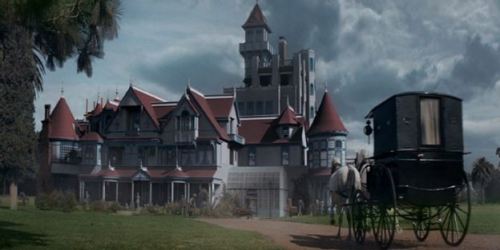
Kaefer lived in upstate New York. In 2007 a friend showed him a brochure concerning The Winchester Mystery House, and the house intrigued him. Since he was traveling to the Silicon Vallery, he decided to pay The Winchester Mystery House a visit. With his family, he drove to the house and parked the car in the parking lot. At that moment he had an eerie feeling that something was not right. Mind you, Kaefer had not been to the house before, had no knowledge about it, nor any indication that anything unusual occurred in it. The group of visitors was quite small. In addition to him and his family, there were two young college boys and one other couple. Even though it was a sunny day, Kaefer felt cold. “I felt a presence before we entered the house and before we heard the story from the guide,” he explained. “If I were a host there, I wouldn’t stay there alone for two consecutive minutes.” Kaefer had been to so many old houses and restorations before but had never felt as he did at The Winchester Mystery House.
It is not surprising the Sarah L. Winchester should be the subject of a number of psychic accounts. Probably the best known (and most frequently misinterpreted) story concerns Mrs. Winchester’s vision which came to her during the late 1800s. Mrs. Winchester was in the habit of meditating in her Blue Séance Room at times and saying her prayer when she was quite alone. On one of those occasions, she returned to the Daisy Bedroom more worried than usual. As she busied herself with her papers, she had the feeling of a presence in the room. Looking up, she saw opposite her a singularly handsome man. Since she had given orders not to be disturbed, she could not understand how he had gotten into the room. Although she questioned him several times, the visitor would not reply. As she looked at the apparition for what it was, she noticed it was her late husband and became more and more entranced with him, unable to make any more. Finally, she heard a voice saying, “Sarah, I love you.” At the same time, William Winchester extended his arm toward the east, and Mrs. Winchester saw what to her appeared like a blue mist at some distance.

As the mist dissipated, she saw various new additions to her mansion, a wide veranda and generous use of expansive windows and French doors, which offered views in every direction. A raised foyer directly overlooking the formal dining room and the living area. Special features like fireplaces with mini bricks, built-in shelves, a morning room, a door that opened to a two story fall into the garden, a staircase leading to an option third-floor area. And an exterior that boasts delicately turned rails and decorated upside-down columns. A unique gazebo projection off the covered porch to the north of the plan. She then noticed a dark, shadowy angel standing in the room of the witches’ cap, taking gold flakes out of water and sprinkling them on the wall. Then a dark cloud rose from the ground and enveloped her home. Sharp flashes of lightening became visible at intervals in the cloud. At the same time, Mrs. Winchester heard the anguished cries of departed souls. Next, William showed her an Observational Tower and legions of legions of angels descended from the Heavens, and William faded away.

Come and enjoy a delicious meal in Sarah’s Café, stroll along the paths of the beautiful Victorian gardens, and wonder through the miles of hallways in the World’s most mysterious mansion. For further information about tours, including group tours, weddings, school events, birthday party packages, facility rentals, and special events please visit the website: https://winchestermysteryhouse.com/

Please visit the online giftshop, and purchase a gift for friends and relatives as well as a special memento of The Winchester Mystery House. A variety of souvenirs and gifts are available to purchase. https://shopwinchestermysteryhouse.com/

They Were Bloodsuckers—As Distasteful as Bedbugs!
The disciple who wishes to make real progress must attack, weaken, and ultimately destroy certain bad traits of character. Among them is the trait of jealousy of his fellow disciples. It is not only an unpleasant thought but may also end in disastrous consequences. It often leads to wrathful moods and raging spells. It not only harms the other disciple but always does harm to the sinner himself. It is caused by an unreasonable sense of possessiveness directed towards the teacher which does not understand that love should give freedom to him, not deny it to him. The pursuit of moral excellence is immeasurably better than the pursuit of mystical sensations. Its gains are more durable, more indispensable, and more valuable. I believe that over time most people accumulate the introjected patterns by which we live. In this fantastically complex culture of today, the patterns we introject as desirable or undesirable come from a variety of sources and are often highly contradictory in their meanings. Desires for pleasures of the flesh and behaviours are mostly bad. The sources of this construct are many—parents, church, teachers. Disobedience is bad. Here parents and teachers combine with the military to emphasize this concept. To obey is good. To obey without questions is even better. Making money is the highest good. The sources of this conceived value are too numerous to mention. Learning an accumulation of scholarly facts is highly desirable. Browsing and aimless exploratory reading for fun is undesirable. The source of these last two concepts is apt to be in school, the education system. #RanolphHarris 1 of 20
Abstract art or “pop” art, or “op” art is good. Here the people we regard as sophisticated are the originators of the value. Communism is utterly bad. Here the government is a major source. To love thy neighbour is the highest good. This concept comes from the church, perhaps from the patents. Cooperation and teamwork are preferable to acting alone. Here companions are an important source. Cheating is clever and desirable. The peer group again is the origin. Coca-Colas, chewing gum, electric refrigerators, and Ultimate Driving Machines are utterly desirable. This conception comes not only from advertisements, but is reinforced by people all over the World. From Jamacia to Japan, from Copenhagen to Kowloon, the “Coca-Cola culture” has come to be regarded as the acme of desirability. This is a small and diversified sample of the myriads of conceived values which individuals often introject, and hold as their own, without ever having considered their inner organismic reactions to those patterns and objects. I believe it will be clear from the foregoing that the usual adult—I feel I am speaking for most of us—has an approach to values which has these characteristics: The majority of his values are introjected, from other individuals or groups significant to him, but are regarded by him as his own. The source of locus of evaluation on most matters lies outside himself. The criterion by which his values are set is the degree to which they will cause him to be loved or accepted. These conceived preferences are either not related at all, or not clearly related, to his own process of experiencing. #RandolphHarris 2 of 20

Often there is a wide and unrecognized discrepancy between the evidence supplied by his own experience, and these conceived values. Because these conceptions are not open to testing in experience, he must hold them in a rigid and unchanging fashion. The alternative would be a collapse of his values. Hence his values are “right”—like the law of the Medes and the Persians, which changeth not. Because they are untestable, there is no ready way of solving contradictions. If he has taken in from the community the conception that money is the summum bonum and from the church the conception that love of one’s neighbour is the highest value, he has no way of discovering which has more value for him. Hence a common aspect of modern life is living with absolutely contradictory values. We calmly discuss the possibility of dropping a hydrogen bomb on Russia, but then find tears in our eyes when we see headlines about the suffering of one small child. Because he has relinquished the locus of evaluation to others, and had lost touch with his own valuing process, he feels profoundly insecure and easily threatened in his values. If some of these conceptions we destroyed, what would take their place? This threatening possibility makes him hold his value conceptions more rigidly or more confusedly, or both. #RandolphHarris 3 of 20

I believe that this picture of the individual, with values mostly introjected, held as fixed concepts, rarely examined or tested, is the picture of most of us. By taking over the conceptions of others as our own, we lose contact with the potential wisdom of our own functioning, and lose confidence in ourselves. Since these values constructs are often sharply at variance with what is going on in our own experiencing, we have in a very basic way divorced ourselves from ourselves, and this accounts for much of modern strain and insecurity. This fundamental discrepancy between the individual’s concepts and what he is actually experiencing, between the intellectual structure of his values and the valuing process going on unrecognized within him—this is a part of the fundamental estrangement of modern man from himself. This is a major problem for the therapist. There are five ways in which the human being progressively views his own self and consequently five graduated ethical stages on his quest. First, as an ignorant materialist he lives entirely within his personality and hence for personal benefit regardless of much hurt caused to others in order to secure this benefit. Second, as an enlightened materialist he is wrapped in his own fortunes but does not seek them at the expense of others. Third, as a religionist he perceives the impermanence of the ego and, with a sense of sacrifice, he dines his self-will. Fourth, as a mystic he acknowledges the existence of a higher power, God, but finds it only within himself. Fifth, as a philosopher he recognizes the universality and the oneness of being in others and practices altruism with joy. #RandolphHarris 4 of 20

However, after all, these qualities are not only the negative prerequisites of spiritual realization. They are not realization itself. Their attainment is to free oneself from defects that hinder the attainment of higher consciousness, not to possess oneself of true consciousness. The act must illustrate the man, the deed must picture the attitude. It is thus only that thought becomes alive. The more I travel and observe the more I come to believe that the only men who will make something worthwhile of philosophy are the men who have already made something worthwhile of their personal lives. The dreamers and cranks will only fool themselves, the failures and alibi chasers will only become confirmed in their fantasies. Many people talk mysticism or play with psychism so long as either promises them wonderful powers which most other people have not got or wonderful experiences which most other people do not have. However, when they come to philosophy and find that it demands from them a renovation of their entire character, they are seized with fear and retreat. Philosophy I not for such people, for it does not conform to their wishes. It tells them what they do not like to hear. It disturbs their egoistic vanity and troubles their superficial serenity when it throws a glaring spotlight to their lower nature, their baser motives, and their ugly weaknesses. #RandolphHarris 5 of 20

While the aspirant fails to take an inventory of his weaknesses and consequently fails to build into his character the attributes needed, much of hi mediation will be either fruitless or a failure or even harmful. That it is not enough for men to think truth, that they mut also feel it, is a statement with which mot scientists, being intellect-bound, would disagree. However, artist, mystics, true philosophers, and religious devotees would accept it. People must be taught to be good and do good before they are taught to venture into the maze of the real World. And even when they emerge safely from a territory where so many lose themselves utterly, religions is useful in brining them back to ethical values albeit now of a much higher kind because it is based on utter unselfishness. For love must marry knowledge, pity must shed its warm rays upon the cold intellect. Enlightenment of others must be the price of one’s own enlightenment. These things are not easily felt by the mystic, who is often too absorbed in his own ecstasies to notice the miseries of others, or by the metaphysician, who is often too tied by his own verbosity to his hard and rigorous logic to realize that mankind is not merely an abstract noun but is made up of flesh-and-blood individuals. The philosopher however finds these benign altruistic needs to be an essential part of truth. Consequently the salvation which he seeks—from ignorance and the attendant miseries that dog its steps—is not for himself but for the whole World. #RandolphHarris 6 of 20
It does not necessarily mean that he has faults to repair or weaknesses to overcome. It may mean that there is some lack in him, some quality or capacity that he needs to cultivate. The real choice, decision, judgment, is made n the subconscious mind. Impulses come from it and character is formed in it. Despite all the repetitious assertions that there is no go, that the person is a fiction, that the goal is pure being unsullied by the self-illusion, here—in the various manifested signs of an individual character in a separate body—is evidence to the contrary. Accept fully and without demur your self-made universal consequences, even to the extent of refraining from asking to be forgiven your sins, for it is just a result. Ask instead to be shown how to overcome the weakness which had been the cause. Singly if that proves enough, combined is not, when negative or degrading or weakening suggestions enter his mind, from whatever source, he can deal with them in two ways. The first is to tense his will and by a beneficial commanding mental act master the suggestion and drive it away. The second is to turn away into its opposing idea and dwell firmly on that until the suggestion vanishes altogether. If, in spite of using these methods he is still defeated, then he can try remembering the Overself. Can he still carry out the evil suggestion while thinking of that serene divine presence? By aspiring to it for help and protection as fervently as he can, the negative idea may disintegrate like the ash of a piece of firewood. #RandolphHarris 7 of 20

A habit change or a thought change which is made under someone else’s persuasion and not out of inner need brought into the open by that other person, is only a surface one and will fade and fall away. If in some ways he learns to lessen egoism and practise humility, in other ways he gains a larger easier assurance. If he is now willing, to a certain extent, to be deflated, he feels he is standing nonchalantly and calmly on firmer ground than before. Perhaps this is all a play, not to be taken too seriously, for the real trial, the worst test, the last great agony, will come later—either through the terrible loneliness of the Dark Night of the Soul, or the painful crucifixion of the ego before Ascension, Liberation, and Fulfilment. If each attack of adverse force, each temptation that tries a weakness, is instantly met with the Shorth Path attitude, he will have an infinitely better chance of overcoming it. The secret is to remember the Overself, to turn the battle over to IT. Then, what he is unable to conquer by himself, wil be easily conquered for him by the higher power. The question is whether he is to accept he baser weaknesses as human or whether he is to struggle against them as unworthy of a human being. We must so centralize our own consciousness as to render it strong against the onslaughts of outside suggestion, immune to the promptings of crowd and the dictation of places. Thus we learn to be our own true self not only at home, where it is easy, but also in the street and in others’ homes, where it is hard. Thus we become truly individualizes. Thus we are always serene among the anxious, good amongst the wicked. #RandolphHarris 8 of 20

Like a rock so firmly embedded that it cannot be moved by human force but can only be blasted by dynamite, his moral character must be embedded in the great Truth. Some individuals are fortunate in going beyond the picture I have just given, developing further in the direction of psychological maturity. We see this happen in psychotherapy where we endeavour to provide a climate favourable to the growth of the person. We also see it happen in life, whenever life provides a therapeutic climate for the individual. When we concentrate on this further maturing of a value approached as I have seen in therapy, a few things become evident. In the first place let me say somewhat parenthetically that the therapeutic relationship is not devoid of values. Quite the contrary. When it is most effective, it seems to me, it is marked by one primary value: namely, that this person, this client, has worth. He as a person is valued in his separateness and uniqueness. It is when he senses and realizes that he is prized as a person that he can slowly begin to value the different aspects of himself. Most importantly, he can begin, with much difficulty at first, to sense and to feel what is going on within him, what he is feeling, what he is experiencing, how he is reaching. He uses his experiencing as a direct referent to which he can turn in forming accurate conceptualizations and as a guide to his behaviour. As his experiencing becomes more and more open to him, as he is able to live more freely in the process of his feelings, then significant changes begin to occur in his approach to values. It begins to assume many of the characteristics it had in infancy. #RandolphHarris 9 of 20
Perhaps I can indicate this by reviewing a few of the brief examples of introjected values which I have given, and suggesting what happens to them as the individual comes closer to what is going on within him. The individual in therapy looks back and realizes, “But I enjoyed pulling my sister hair—and that doesn’t make me a bad person.” The student failing chemistry realizes, as he gets close to his own experiencing—“I don’t value being a doctor, even though my parents do; I don’t like chemistry; I don’t like taking steps toward being a doctor; and I am not a failure for having these feelings.” The adult recognizes that desires for pleasures of the flesh and behaviour may be richly satisfying and permanently enriching in their consequences, or shallow and temporary and less than satisfying. He goes by his own experiencing, which does not always coincide with the social norms. He considers art from a new value approach. He says, “This picture moves me deeply, means a great deal to me. It also happens to be an abstraction, but that is not the basis for my valuing it.” He recognizes that this communist book or person has attitudes and goals which he shares as well as ideas and values which he does not share. He realizes that at times he experiences cooperation as meaningful and valuable to him, and that at other times he wishes to be alone and act alone. #RandolphHarris 10 of 20

As the examples will indicate, the disturbances that produce an attempt at examination may be acute or of long standing; they may result predominantly from actual difficulties inherent in a situation or they may be expressions of a chronic neurosis. Compared with the preconditions for a systematic self-analysis, those for occasional analysis are moderate. It suffices to have some psychological knowledge, and this need not be book knowledge but may be gained from ordinary experience. The only indispensable requirement is a willingness to believe that unconscious factors may be sufficiently powerful to throw the whole personality out of gear. To put it negatively, it I necessary not to be too easily satisfied with ready-at-hand explanations for a disturbance. A man, for instance, who has become inordinately upset about being cheated. A person suffering from an acute depression must be skeptical about explaining his state on the basis of World conditions. Habitual forgetting of appointments is not very well explained by saying that one is too busy to remember. It is particularly easy to brush aside those symptoms that are not obviously psychic in character, such as headaches to weather conditions, fatigue to overwork, stomach upsets to spoiled food or gastric ulcers, without even considering the possibility that psychic factors are involved. This attitude may be assumed because of sheer ignorance, but also it is a characteristic neurotic tendency in persons who cannot tolerate the idea of any unevenness or flaw in themselves. #RandolphHarris 11 of 20

At the other extreme are those who are convinced that every disturbance is psychic in origin. For such a person it is out of the question that he might be tired because of an overdose of hectic work, that he might have caught a cold because he was exposed to a too vigorous infection. He cannot tolerate the idea that any external factor can have the power to affect him. If any disturbance befalls him it is because he himself has brought it about; and if a symptom is psychic in origin it is in his own power to remove it. Needles to say, both attitudes are compulsive and the most constructive attitude is somewhere between them. We may feel genuinely concerned about World conditions, though such a concern should drive us into action and not into a depression. We may feel tired because of too much work and too little sleep. We may have headaches because of a bad eye condition or a brain tumor. Certainly no physical symptom should be attributed to psychic factors before the medical explanation is thoroughly investigated. The important point is that with full regard for the plausible explanation one should also take a good look into one’s emotional life. Even if the difficulty is a case of flu it might be helpful, after giving it the proper medical attention, to raise the question whether some unconscious psychic factors were present, operating to lower resistance to infection or to retard recovery. #RandolphHarris 12 of 20
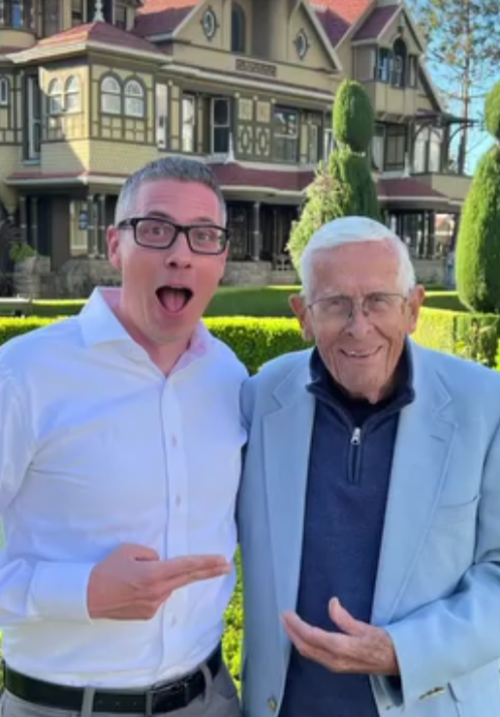
With these general considerations are borne in mind, it will help us understand case studies. To further highlight this illustration, John, a good-natured businessman, apparently happily married for five years, suffered from diffuse inhibitions and “inferiority feelings” and in recent years had developed occasional headaches without any detectable physical basis. He had not been analyzed but he was fairly familiar with the psychoanalytic way of thinking. Later he came to me for analysis of a rather intricate character neurosis, and his experience in working alone was one of the factors that convinced him of the possible value of psychoanalytic therapy. When he started to analyze his headaches, it was without intending to do so. He, his wife, and two friends went to a musical comedy and he developed a headache during the play. This struck him as queer because he had felt well before going to the theater. At first, with some irritation, he ascribed his headache to the fact that the play was bad and the evening was a waste of time, but he soon realized that after all one does not get headaches from a bad play. Now that he thought about it, the play was not so bad after all. However, of course, it was nothing compared with the play of Shaw’s that he would have preferred. These last words stuck in his mind—he “would have preferred.” Here he felt a flash of anger and saw the connection. He had been overruled when the choice between the plays was up for discussion. It was not even much of a discussion: he felt he should be a good sport, and what did it matter anyhow. #RandolphHarris 13 of 20
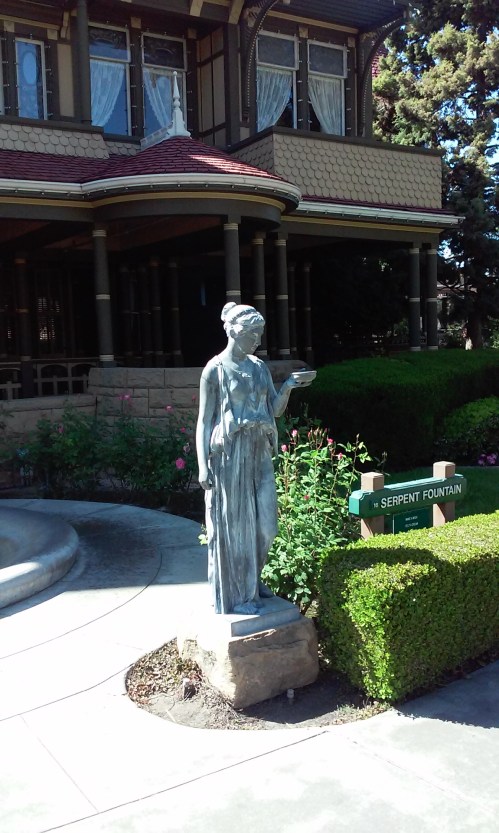
Apparently it had mattered to him, however, and he had been deeply angry about being coerced. With that recognition, the headache was gone. He realized also that this was not the first headache that originated in this way. There were bridge parties, for instance, which he hated to join but was persuaded to do so. He was startled to discover this connection between repressed anger and headaches, but he gave it no further thought. A few days later, however, he work up early, again with a splitting headache. He had attended a staff meeting of his organization the night before. They had been drinking afterward, and at first he accounted for the headache by telling himself that probably he had drunk too much. With that he turned on the other side and tried to fall asleep again, but he could not. A fly buzzing around his face irritated him. At first the irritation was barely noticeable, but it grew rapidly to full-blown anger. Then he recalled a dream or a dream fragment: he had squashed two bedbugs with a piece of blotting paper. The blotting paper had many holes. As a matter of fact, he remembered that the holes were all over the paper and formed a regular pattern. This reminded him of tissue paper that he had folded as a child, for cutting out patterns. He was quite taken by their beauty. An incident emerged in which he had shown the tissue to his mother, expecting admiration, but she had paid only perfunctory attention. The blotting paper then reminded him of the staff meeting. There he had scribbled on paper because he felt bored. No, he had not merely scribbled; he had drawn small caricatures of the chairman and of his opponent. #RandolphHarris 14 of 20

The word “opponent” struck him, because he had not consciously regarded that person as an opponent. A resolution had been voted on, about which he felt vaguely uneasy. However, he saw no clear objection to it. Hence the objection he had raised was actually not to the point. It was weak and made no impression. Only now he realized that they had put something over on him, for the acceptance of the resolution meant a lot of tedious work for himself. They had been so clever that it had escaped him. At this point he suddenly laughed because he recognized the meaning of the bedbugs. The chairman and the opponent—they were bloodsuckers, as distasteful as bedbugs. Also, he was as afraid of bedbugs as he was of these exploiters. Well, he had taken revenge—at least in his dream. Again the headache vanished. One three subsequent occasions he searched for a hidden anger as soon as the headache started, found the anger and then lost his headache. After that the headaches disappeared entirely. In reviewing this experience one is struck at first by the lightness of the labour in comparison with the result attained. However, miracles occur in psychoanalysis as seldom as anywhere else. Whether a symptom can be easily removed depends on its function in the whole structure. It this case the headaches had not assumed any further role, such as preventing John from doing things he was afraid of doing or resented doing, or serving as a means of demonstrating to others that they had given offense or inflicted injury, or serving as a basis for demanding special consideration. #RandolphHarris 15 of 20

If headaches or any other symptoms have assumed important functions such as these, their cure will require long and penetrating work. One will then have to analyze all the needs they satisfy and they will probably not disappear until the work is practically finished. In John’s case they have not assumed any such functions, and probably resulted merely from tension increased by the repressed anger. The extent of John’s accomplishment is diminished also by another consideration. It was a gain, certainly, to be rid of the headaches, but it seems to me that we are inclined to overrate the significance of such gross, tangible symptoms and to underrate the importance of less tangible psychic disturbances, such as, in this case, John’s alienation from his own wishes and opinions and his inhibition toward self-assertion. In these disturbances, which later proved to be highly significant for his life and his development, nothing was changed by his work. All that happened was that he became somewhat more aware of rising angers and that his symptoms disappeared. Actually, any of the incidents that John happened to analyze could have yielded more insight than he gained from them. Thus in his analysis of the anger that emerged during the musical comedy, there were numerous questions that he failed to touch on. What was the real nature of his relationship with his wife? Was the compatibility, of which he was proud, due only to compliance on his part? Was she domineering? Or was he merely hypersensitive to anything resembling coercion? #RandolphHarris 16 of 20

Furthermore, why did he repress his anger? Was it necessary because of a compulsive need for affection? Was he apprehensive of a rebuke from his wife? Did he have to maintain an image of himself as a person who was never disturbed by “trifles”? Was he afraid of having to fight for his wishes? Finally, was he really only angry at the others for having overruled him, or was he primarily angry at himself for having given in because of sheer weakness? The analysis of the anger following the staff meeting might also have opened up further problems. When they were jeopardized, why was he not more alert to his own interests? Again, was he afraid to fight for them? Or had the anger such dimensions—squashing the bedbugs—that it was safer to repress it altogether? Also, did he lay himself open to exploitation by being too compliant? Or did he experience something as exploitation which was actually merely a legitimate expectation of his condition? Furthermore, what about his wish to impress others—the memory of expecting admiration from his mother? Was his failure to impress his colleagues an essential element in his anger? And to what extent was he angry at himself for having been so unassertive? None of these problems was touched upon. When he had discovered the effect of repressed anger at others, John let the matter rest. After a lifetime of World-wandering, after a varied experience among different faces of people and in different classes of society, we have come to the firm and settled conviction that what is most to be looked for in a man is character. The best test of character is neither intellectual hairsplitting nor emotional, wordy gush, not high-flown idealistic professions, nor flowery mystical pretensions, but deeds. #RandolphHarris 17 of 20

The Sacramento Fire Department has saved the community from so many disasters. On one occasion, there was a small fire in a closet on the fourth floor of a building. There was a lot of smoke, but there seem to be just a bunch of papers and rubbish in there. What no one knew was that it had purposely been set and that there was a lot of gasoline poured onto the closet floor and the floor of a near bathroom. Three members from the engine company were in the room, but none of them smelled the gasoline because of the smoke. The three guys started to extinguish the fire just as the heat got to the gasoline. The gasoline exploded, and the whole room went on fire. Two of the guys got to the door and were safe, but the fire expanded so rapidly, it cut the third guy off, and he ended up at the window. Unless you have had the experience, you will never believe how quickly a fire can move through a room, two rooms, three rooms. This firefighter we will call number 1, was at the window yelling, and Ladder 1 began to put it tower ladder up. That is a long boom with a platform at the end of it, with room enough for four or five fighters to stand. There were two firefighters on the platform, raising it. As it reached the third floor, firefighter number 1, now framed in the fourth-floor window, was on fire, and he could not wait the extra five seconds for the tower ladder to get him. He was forced to jump. He jumped into the bucket and hit one of the guys there, Lt. 1, breaking his leg. However, even with a broken leg, Lt. 1 was able to grab an extinguishing can and put out the flames on the burning firefighter. Fire fighter number 1 had his fire-safe coat on, but it was the clothes beneath it, his pants and his shirt, that were on fire. All this happened from a very little fire in a closet in a multi-family, low-rise, housing building. #RandolphHarris 18 of 20
When the firefighter was visited at the Burn Center, he was terribly burned on his arms and shoulders, and on the bottom part of his body around his buttocks and the backs of his legs. He was very courageous. You would have to be in such a situation. You really do muster up extraordinary strength in times of personal crisis. There is a spiritual part of firefighters, and when they get hurt seriously, they realize how fragile they are as human beings, and they rely on this spirituality to bring forth the dignity of their souls. This firefighter was in great pain, but he was also very funny. He said his wife was concerned about his being in the burn center with all these beautiful nurses. However, e reassured her. He said that a nurse who is tearing the burned layers of skin off your body, inch by painful inch, no matter how gorgeous she is, is never going to be thought of as anybody but a person who is tearing off the top layer of your skin, inch by painful inch. Sometimes people get killed. Every firefighter has to deal with the death of a brother or sister firefighter at some point in his or her life. In America, a firefighter dies in the line of duty every other day. Many have been to several funerals. It is hard to look at the surviving children of firefighters and thinking that they will live with the memory of their father giving his life in a job that cared about him. The only standing room one will find at a firefighter’s funeral is out in the street, down the block. A firefighter recalled when 11 firefighters died in the line of duty. It was a terrible scene when they were searching for the bodies. Firefighters could recall the bodies coming out, one by one. #RandolphHarris 19 of 20

As if the bodies were passing were passing in review, the hundreds of firefighters who were there took off their helmets. The floors of the building had collapsed, taking these firefighters down into the bowels of the fire. There was quiet in the immediate vicinity as their bodies came out. When it came time for the funerals, many firefighters were dismayed at how little the city had done to make those thousands of visiting firefighters welcome. The firehoses alone had taken them in, given them something to eat, and made them feel at home. Therefore, before to show your support for the Sacramento Fire Department by voting for Assembly Member Kevin McCarty. He is endorsed by the Sacramento Fire Department, and his focus is on affordable housing and getting people without homes into a home. A vote for McCarty is a way of showing support for the Sacramento Fire Department. And if you can, please make a donation to the Sacramento Fire Department and keep those who have been injured, disabled, or killed on the job in your prayers. I pledge allegiance to the flag of the United States of America, and to the republic, for which it stands, one nation, under God, indivisible, with liberty and justice for all. Though it is not incumbent upon you to complete the work, you are not free from doing all you possibly can to honour God. Judge a man by his deeds, and you will not be led to false judgment. Say little and do much, for by your deeds shall you be judged. If you are wise and rich, let your good deeds reveal your wisdom and wealth. Honour a man for what he is; but honour him more for what he does. #RandolphHarris 20 of 20

Many people have laughed at caretakers for believing in ghosts. Skeptics think the noises to be the product of their over-active imaginations. However, they also begin to hear them when they spent time in The Winchester Mystery House. One skeptic reported after hearing them, “the groans, squeaks, tingling and knockings were frightful enough.” One caretake was locking up the mansion one night, when there came a sound from one of the six kitchens as of a large lump or lumps of coal being splintered and smashed onto the floor. He and one of the other caretakers went through the entire mansion, but could find nothing to explain the sounds; no guests were in the house. Upon hearing the sound of bottles breaking beneath the stairs, when no one was in the house, they ran in fright into an office.
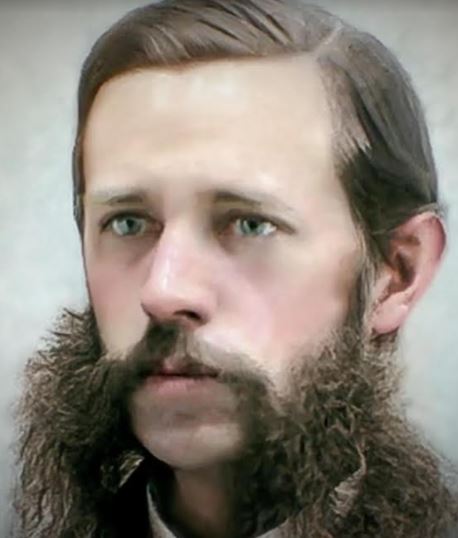
Then they heard the sound of a man walking slowly past them; then going down the grand staircase, then up the back stairs and up the stairs to the ceiling. Soon after this, they heard in the corner of a room, as it were the violent rocking of a cradle; as far as anyone knows, no cradle has ever been in the house. Two caretakers were sitting in one of the dining rooms, on a later occasion, when they heard the sound of loud raps coming from the outside of the door and on the ceiling overhead.

Come and enjoy a delicious meal in Sarah’s Café, stroll along the paths of the beautiful Victorian gardens, and wonder through the miles of hallways in the World’s most mysterious mansion. For further information about tours, including group tours, weddings, school events, birthday party packages, facility rentals, and special events please visit the website: https://winchestermysteryhouse.com/

Please visit the online giftshop, and purchase a gift for friends and relatives as well as a special memento of The Winchester Mystery House. A variety of souvenirs and gifts are available to purchase. https://shopwinchestermysteryhouse.com/

You are Not the Problem!

Life on Earth did not happen by mistake. You are here as part of God’s plan of happiness for all of us. Little by little, in tranquil moments or in deliberate meditation, there will come to one the revelation of errors in conduct and thought which, until then, one did not know were errors. Values refer to the tendency of any living beings to show preference in their actions, for one kind of object or objective rather than another. This preferential behaviour is called “operative values.” It need not involve any cognitive or conceptual thinking. It is simply the value of choice which is indicated behaviourally when the organism select one object, rejects another. When the earthworm, placed in a simple Y maze, chooses the smooth arm of the Y, instead of the path which is paved with sandpaper, he is indicating an operative value. A second use of the term might be called “conceived values.” This is the preference of the individual for a symbolized object. Usually in such a preference there is anticipation of foresight of the outcome of behaviour directed toward such a symbolized object. Usually in such a preference there is anticipation or foresight of the outcome of behaviour directed toward such a symbolized object. A choice such as “Honesty is the best policy” is such a conceived value. A final use of the term might be called “objective value.” People use the word in this way when they wish to speak of what is objectively preferable, whether or not it is in fact sensed or conceived of as desirable. #RandolphHarris 1 of 18
The living human being has, at the outset, a clear approach to values. He prefers some things and experiences, and rejects others. We can infer from studying his behaviour that he prefers those experiences which maintain, enhance, or actualize his organism, and rejects those which do not serve this end. What him for a bit: Hunger is negatively valued. His expression of this often comes through loud and clear. Food is positively valued. However, when he is satisfied, food is negatively valued, and the same milk he responded to so eagerly is now spit out, or the breast which seemed so satisfying to the infant is now rejected as he turns his head away from the nipple with an amusing facial expression of disgust and revulsion. He values security, and holding and caressing which seem to communicate security. He values new experience for its own sake, and we observe this in his obvious pleasure in discovering his toes, in his searching movements, in his endless curiosity. He shows a clear negative valuing of pain, bitter tastes, sudden loud sounds. All of this is commonplace, but let us look at these facts in terms of what they tell us about the infant’s approach to values. It is first of all a flexible, changing, valuing process, not a fixed system. He likes food and dislikes the same food. He values security and rest, and rejects it for new experience. What is going on seems best described as an organismic valuing process, in which each element, each moment of what he is experiencing is somehow weighed, and selected or rejected, depending on whether, at this moment, it tends to actualize the organism or not. #RandolphHarris 2 of 18

This complicated weighing of experience is clearly an organismic, not a conscious or symbolic function. These are operative, not conceived values. However, this process can none the less deal with complex value problems. I would remind you of the experiment in which young infants had spread in front of them a score of more of dishes of natural (that is, unflavoured) foods. Over a period of time they clearly tended to value the foods which enhanced their own survival, growth, and development. If for a time a child gorged himself on starches, this would seen be balanced by a protein “binge.” If at times he chose a diet deficient in some vitamin, he would later seek out foods rich in this very vitamin. He was utilizing the wisdom of the body in his value choices, or perhaps more accurately, the physiological wisdom of his body guided his behavioural movements, resulting in what we might think of as objectively sound value choices. Another aspect of the infant’s approach to value is that the source of locus of the evaluating process is clearly within himself. Unlike many of us, he knows what he likes and dislikes, and the origin of these value choices lies strictly within himself. He is the center of the valuing process, the evidence for his choices being supplied by his own senses. He is not at this point influenced by what his parents think he should prefer, or by what the church says, or by the opinion of the latest “expert” in the field, or by the persuasive talents of an advertising firm. It is from within his own experiencing that his organism is saying in non-verbal terms, “This is good for me.” “That is bad for me.” “I like this.” “I strongly dislike that.” He would laugh at our concern over values, he could understand it. How could anyone fail to know what he liked and disliked, what was good for him an what was not? #RandolphHarris 3 of 18

What happens to this highly efficient, soundly based valuing process? By what sequence of events do we exchange for the more rigid, uncertain, inefficient approach to value which characterizes most of us as adults? The infant needs love, wants it, tends to behave in ways which will bring repetition of this wanted experience. By this brings complications. He pulls baby sister’s hair, and finds it satisfying to hear her wails and protests. He then hears that he is a “naughty, bad boy,” and this may be reinforced by a time out. He is cut off from affection. As this experience is repeated, and many, many others like it, he gradually learns that what “feels good” is often “bad” in the eyes of others. Then the next step occurs, in which he comes to take the same attitude toward himself which the others have taken. Now, as he pulls his sister’s hair, he solemnly intones, “Bad, bad boy.” He is introjecting the value judgment of another, taking it has his own. He has deserted the wisdom of his organism, giving up the locus of evaluation and is trying to behave in terms of values set by another, in order to hold love. Or take another example at an older level. A boy senses, though perhaps not consciously, that he is more loved and prized by his parents when he thinks of being a doctor than when he thinks of being an artist. Gradually he introjects the values attached to being a doctor. He comes to want, above all, to be a doctor. Then in college he is baffled by the fact that he repeatedly fails in chemistry, which is absolutely necessary to becoming a physician, in spite of the fact that the guidance counselor assure him he has the ability to pass the course. Only in counseling interviews does he begin to realize how completely he has lost touch with his organismic reactions, how out of touch he is with his own valuing process. #RandolphHarris 4 of 18

Let me give another instance from a class of mine, a group of prospective teachers. I asked them at the beginning of the course, “Please list for me the two or three values which you would most wish to pass on to the children with whom you will work.” They turned in many value goals, but I was inspired by some of the items. Several listed such things as “to speak correctly,” “to use good English, not to use work like ain’t.” Others mentioned neatness—“to do things according to instructions”; one explained her hope that “When I tell them to write their own names in the upper right-hand corner with the date under it, I want them to do it that way, not in some other form.” I confess I was somewhat appalled that for some of these girls the most important values to be passed on to pupils were to avoid bad grammar, or meticulously to follow teacher’s instructions. I felt baffled. Certainly these behaviours had not been experienced as the most satisfying and meaningful element in their own lives. The listings of such values could only be accounted for by the fact that these behaviours had gained approval—and thus had been introjected as deeply important. Perhaps these several illustrations will indicate that in an attempt to gain or hold love, approval, esteem, the individual relinquishes the locus of evaluation which was his in infancy, and places it in others. He learns to have a basic distrust for his own experiencing as a guide to his behaviour. He learns from others a large number of conceived values, and adopts them as his own, even though they may be widely discrepant from what he is experiencing. Because these concepts are not based on his own valuing, they tend to be fixed and rigid, rather than fluid and changing. #RandolphHarris 5 of 18

To analyze oneself occasionally comparatively easy and sometimes productive of immediate results. Essentially it is what every sincere person does when he tries to account for real motivations behind the way he feels or acts. If anything, without knowing much about psychoanalysis, a man who has fallen in love with a particularly attractive or wealth girl could raise with himself the question whether vanity or money plays a part in his feeling. A man who has ignored his better judgement and given in to his wife or his colleagues in an argument could question in his own mind whether he yielded because he was convinced of the comparative insignificance of the subject at stake or because he was afraid of an ensuing fight. I suppose people have always examined themselves in this way. And many people do so who otherwise tend to reject psychoanalysis entirely. The principal domain of occasional self-analysis is not the intricate involvements of the neurotic character structure, but the gross manifest symptoms, the concrete and usually acute disturbance which either strikes one’s curiosity or commands one’s immediate attention because of its distressing character. Thus the examples reported in this report concern a functional headache, an acute attack of anxiety, a lawyer’s fear of public performances, an acute functional stomach upset. However, a startling dream, the forgetting of an appointment, or an inordinate irritation at a taxidriver’s trivial cheating might just as well elicit a wish to understand oneself—or, more precisely, to discover the reasons responsible for that particular effect. #RandolphHarris 6 of 18

This latter distinction may seem hairsplitting, but actually is expresses an important difference between occasional grappling with a problem and systematic work at oneself. The goal of occasional self-analysis is to recognize those factors that provoke a concrete disturbance, and remove them. The broader incentive, the wish to be better equipped to deal with life in general, may operate here too, but even if it plays some role it is restricted to the wish to be less handicapped by certain fears, headaches, or other inconveniences. This is in contrast to the much deeper and more beneficial desire to develop to the best of one’s capacities. One of the greatest factors of the importance for the understanding of man’s behaviour in present society: man’s need for certainty. Man is not equipped with a set of instincts that regulate his behaviour quasi-automatically. He is confronted with choices, and this means in all-important matters with grave risks to his life if his choices are wrong. The doubt that besets him when he must decide—often quickly—causes painful tension and can even seriously endanger his capacity for quick decisions. As a consequence, man has an intense need for certainty; he wants to believe that there is no need to doubt that the method by which he makes his decisions is right. In fact, he would rather make the “wrong” decision and be sure about it than the “right” decision and be tormented with doubt about its validity. This is one of the psychological reasons for man’s belief in idols and political leaders. They all take out doubt and risk from his decision making; this does not mean that there is not a risk for his life, freedom, etcetera, after the decision has been made, but that there is no risk that the method of his decision making was wrong. #RandolphHarris 7 of 18

For many centuries certainty was guaranteed by the concept of God. God, omniscient and omnipotent, had not only created the World but also announced the principles of human action about what which there was no doubt. The church “interpreted” these principles in detail, and the individual, securing his place in the church by following its rules, was certain that, whatever happened, he was on the way to salvation and to eternal life in Heaven. In the Luteran-Calvinistic branch of Christian theology, man was taught not to be afraid of the risk of using false criteria for his decision making in a paradoxical way. Luther, belittling man’s freedom and the role of his good works, taught that they only decision man has to make is to surrender his will totally to God, and thus to be released of the risk of making decisions on the basis of his own knowledge and responsibility. In Calvin’s concept, everything is predestined, and man’s decision does not really matter; yet his success is a sign that he is one of then chosen. With the beginning of the scientific approach and the corrosion of religious certainty, man was forced into a new search for certainty. At first, science seemed to be capable of giving a new basis for certainty. This was so for the rational man of the last centuries. However, with the increasing complexities of life, which lost all human proportions, with the growing feeling of individual powerlessness and isolation, the science-oriented man ceased to be a rational and independent man. He lost the courage to think for himself and to make decisions on the basis of his full intellectual and emotional commitment to life. He wanted to exchange the “uncertain certainty” which rational thought can give for an “absolute certainty”: the alleged “scientific” certainty, based on predictability. #RandolphHarris 8 of 18
This certainty is guaranteed not by man’s own unreliable knowledge and emotions but by the computers which permit prediction and become guarantors of certainty. Take as an example the planning of the big corporation. With the help of computers, it can plan ahead for many years (including the manipulation of man’s mind and taste); the manager does not have to rely any more on his individual judgment, but on the “truth” that is pronounced by the computers. The manager’s decision may be wrong in its results, but he need not be distrustful of the decision-making processes. He feels that he is free to accept or reject the result of computer prognostication, but for all practical purposes, he is as little free as a pious Christian was to act against God’s will. He could do it, but he would have to be out of his mind to take the risk, since there is not a greater source of certainty than God—or the computerized solution. This need for certainty creates the need of what amounts to blind belief in the efficacy of the method of computerized planning. The managers are relieved from doubt, and so are those who are employed in the organization. It is precisely the fact that man’s judgment and emotions allegedly do not interfere with the process of decision making that gives the computer-based planning its godlike quality. Those ancient social organisms of production are, as compared with bourgeois society, extremely simple and transparent. However, they are founded either on the immature development of man individually, who has not yet served the umbilical cord that unites him with his fellow man in a primitive tribal community, or upon direct relations of subjection. They can arise and exit only when development of the productive power of labour has not risen beyond a low state, and when, therefor, the social relations within the sphere of material life, between man and man and between man and nature, are correspondingly narrow. #RandolphHarris 9 of 18

This narrowness is reflected in the ancient worship of Nature, and in the other elements of the popular religions. The religious reflex of the real World can, in any case, only then finally vanish when the practical relations of everyday life offer to man none but perfectly intelligible and reasonable relations with regard to his fellow men and to nature. The life-process of material production does not strip off its mystical veil until it is treated as production by freely associated men, and is consciously regulated by them in accordance with a settled plan. This, however, demands for society a certain material groundwork or set of conditions of existence which in their turn are the spontaneous product of a long and painful process of development. Man, as a race, slowly emancipates himself from mother nature through the process of work, and in this process of emancipation he develops his intellectual and emotional powers and grows up, becomes an independent and free man. When he will have brought nature under his full and rational control, and when society will have lost its antagonistic class character, “prehistory” will have ended, and a truly human history will begin in which free men plan and organize their exchange with nature, and in which the aim and end of all social life is not work and production, but the unfolding of man’s powers as an end in itself. This is the realm of freedom in which man will be fully united with his fellow men and with nature. The problem of human evolution is an essentially tragic one. Whatever man did, it ended in frustration; if he should return to become a primitive again, he would have pleasure, but no wisdom; if he goes on as a builder of ever more complicated civilizations, he becomes wiser, but also unhappier and sicker. #RandolphHarris 10 of 18

Clearly, evolution is an ambiguous blessing, and society does as much harm as good. History is a march toward man’s self-realization; society, whatever the evils produced by any given society may be, is the condition for man’s self-creation and unfolding. The “good society” becomes identical society of good men, that is, of fully developed, sane, and productive individuals. When it comes to psychologist, they even study the theory of theories and are provided at least with a modest ability to differentiate between “good” theories and “poorer” theories, qua theories. The impact of his exposure to methods for investigation of psychological phenomena, within the context of multiple theories that overlap only partially, should fit him with a generally critical orientation toward any univocal explanation of the mysteries of the human personality. And in seminars, in publications, in case conferences it is typically the psychologist, not the social worker or psychiatrist, who is dubious that an orthodox psychoanalytic formulation either truly accounts for the observed pathology or necessarily points to the optimal treatment. This is a generalization about psychologists as students of behaviour theory and personality. It must be recognized that there are some graduate departments of psychology in which the training of the clinical psychologist is as theoretically biased, id est, psychoanalytically oriented, as is that of the average psychiatrist or social worker. #RandolphHarris 11 of 18

Contrary to what the manipulator wants you to think, you are not the problem. You might be their problem as you will not conform to what they want you to, but you are not the problem. However, it is hard to deal with abusers and other types of manipulators because they are masters at blame-shifting. Somehow, in any argument, they are adamantly more capable of convincing victims that they are at fault, than victims are at realizing they are the victims of the entire debacle. Victim blaming is a manipulative tactic used by abusers to convince themselves and their victims that the problems lie with the other person, not with them. The ploy is very clever and effective. Beware of the tendency to play the game of “Find the bad guy,” in your intimate relationships. It is never healthy to use someone as a scapegoat for your problems. If you are in a relationship with someone needs to make you the “bad guy,” then be aware of what is going on and do not allow yourself to accept that mantle. The best way to understand victim blaming is to realize that two concepts are at play: Projection and judgmentalism. Projection occurs when one person displaces his or her own characteristics onto another person. An abusive person will “project” his or her own attributes on to the other person, particularly in a conflict. The main reason victims get in fights or arguments with abusers is because the abusers cause the problem in the first place by saying or doing something that engenders a negative emotional reaction in another person. #RandolphHarris 12 of 18

The abuser may be rude, hurtful, hostile, or act in some other relationship-destroying manner. It takes superhuman strength to keep from being triggered by the anger-provoking tactics of an abusive or manipulative person. Once you have been triggered by the abuser, you may make one small mistake in speaking, or you may even commit the heinous crime of yelling back and defending yourself! Heavens forbid you have a reaction to a hostile instigation! And once you do react supposedly inappropriately you have just given the abuser a gift. He can now capitalize on your reaction and use it as the evidence that the problem resides with you. Therefore, do not take the bait. The abuser is trying to flip the script. Reminder yourself that you do not need to defend yourself because you did not do anything wrong. The other concept, along with projection, that your abuser is using is judgmentalism. When people use judgmentalism as a strategy, they are trying to make you a subordinate. Abusers are incapable of healthy human connections. They suffer from attachment issues, and true to form, they must sabotage any semblance of healthy attachment. This is why the term “interpersonal violence” is sued to describe domestic violence. It is abuse of an interpersonal relationship. Victim blaming keeps the abuser emotionally safe by projecting his interpersonal problems on to the other person, preventing insight and potential growth (not to mention resolution of the problem at hand.) It also helps the abuser feel personally superior and smug as he believes that it is his role to judge the victim. #RandolphHarris 13 of 18

Ideas influence their thinker himself; thoughts react on their generator if they are intensely held, deeply felt, and frequently born. Thus they help to form tendencies and shape character. The aspirant can take advantage of this truth. His moral thought and metaphysical ideation will be so deep and earnest that they will converge upon his emotional feeling, when that has been sufficiently purified, and coalesce with it. Thus they become part of his inner being. If he is to realize his higher purpose in life, each aspirant has to struggle with the demon inside himself. Nature seeks to achieve its own ends, which renders it indifferent to all personal ends. It considers no man’s feelings but only his level of development, that he might be raised to a higher one. The only greatness he may rightfully seek is a secret one. It is not power over others that he should strive for, but power over himself. He will have to grow into this higher consciousness. No other way exists for him. He has not only to be brave enough to accept the aloneness that comes with every serious advance in the quest, but also strong enough to endure it. If it is wrong in ethical theory, how can anything be right in Worldly practice? The value of such study is immense. It involves a re-education of the whole mind of man. It strikes at the root of his ethical ignorance and destroys the selfishness and greed which are its malignant growths. #RandolphHarris 14 of 18
Mentally, man can do what no animal can do. He can consider conduct from a purely ethical standpoint; he can struggle at heart between right and wrong, self and selflessness. Every man betrays himself for what he is. He can hide his thoughts and dissemble his feelings, but he cannot hide his face. Therein are letters and words which tell plainly what sort of a man he really is. However, few there be who can read in this strange language. Character can be changed. As if by magic, he who habitually contemplates such exalted themes finds in time that his whole outlook is altered and expanded. The new outlook will gradually strongly establish itself within him. As a man thinks in his hear so is he. As is one’s thoughts, so one becomes; this is the eternal secret. What is to be done where a weakness becomes abnormally strong, overpowering the will and forcing him to do what his better nature rejects? The cure in the end must be based on his willingness to regard it as something not really part of himself, something alien and parasitic. If there is to be any way out toward freedom from it, he must stop identifying himself with the weakness. The key to right conduct is to refuse to identify himself with the lower nature. The hypnotic illusion that it is really himself must be broken: the way to break it is to deny every suggestion that comes from it, to use the will in resisting it, to use the imagination in projecting it as something alien and outside, to use the feelings in aspiration towards the true self, and the mind in learning to understand what it is. #RandolphHarris 15 of 18

The Sacramento firefighters like going to work, and there are few jobs at any level of pay about which this can be said with such certainty. They have to learn building laws, and the different types of building construction—frame, brick, steel, and the old cast-irons. Firefighters learn about the different kinds of windows—regular windows, casement windows, and the nonopening ones in skyscrapers—and the different locks people use to secure themselves from the harsh realities of the outside World—standard bolt locks, digital locks, police locks that lock on either side of the door, and fox locks, which have bars going down into the floor life flying buttresses. They have to learn the multitudinous knots used for moving equipment and people, and a whole communications system, the signals and alarms, the differences between “ten-four” and “ten-twenty-two.” They studied water hydraulics, the laws that govern the movement of water rushing through a two-and-a-half-inch hose and coming out of a one-inch nozzle. Outdoors, they learned about tools, everything from how to swing an ax to how to pull a hook and how to use your weight on a battering ram. They learned about the motorized tools, the power saw, the pneumatic tools and jacks used in collapse situations. Then there was the practical work of fighting the fire itself in controlled situations, where firefighters had to crawl into a room and pull out an inanimate 150-pound synthetic human being and carry it down six flights of stairs after taking a beating from the smoke. Later in the afternoon they had to carry ladders from one side of the street to the other. #RandolphHarris 16 of 18

On one call, there was a fire on the third floor of a tenement building, going really goodly. It had evidently been cooking for a long time, because by the time the fire department got there the fire fully involved this apartment of five or six rooms. There was this long hallway, and the firefighters ran in crouching positions into the fire with an inch-and-a-half hose. They got to the end of the hallways, one of the firefighters opened up the hose and led the way into the room there. Immediately, a large part of the ceiling came down on one of them, knocking his helmet off. Embers went down his neck and back, and he was burned pretty severely. So, with the nozzle still in his hand, he shut it off, made a complete U-turn, and started back out of the room. When he got out into the hall, the embers had died out, and he had a lifetime three-inch burn down his neck from hairline to shoulder blade. The interesting thing is, he hardly mind getting hurt in the fire. A gash on his arm that took twelve stitches, a burn on his neck, a broken wrist, to him it was just a badge of courage that reinforced the things he believed about firefighting and reinforced his confidence in himself to do a tough, challenging, and dangerous job. Once this firefighter got hurt pulling a hose over a barbed wire fence. He had to tug so hard that he pulled a ganglion, or nerve center, in his back. It was one of the most painful things that he ever experienced. It was difficult to treat. He had to lie on his stomach in bed for three months, doing everything in that position, eating, reading, writing notes, watching television. #RandolphHarris 17 of 18
Finally a doctor shot a whole bunch of cortisone into his back, which completely relived the pain, and finally he was able to go back to work. The cortisone never disappeared, though, and still moves around. He still feels the pain from time to time, especially when he is tired. There is an overriding awareness of the possibility of getting badly hurt, because they see it around them all the time. Firefighters see people getting disabled permanently, and they learn not to take even the smallest fire for granted. Be sure to open your hearts to the Sacramento Fire Department and let them know the community is thankful by making a donation. Also, assembly member Kevin McCarty is running for mayor of Sacramento, he is endorsed by the Sacramento Fire Department, and two of his goals are creating more affordable housing and getting homeless people into homes. A vote for McCarty is a way of showing support for the City of Sacramento and the Sacramento Fire Department. I pledge allegiance to the flag of the United States of America and to the Republic for which it stands, one nation, under God, indivisible with liberty and justice for all. Be wise not only in words, but in deeds; mere knowledge is not the goal, but action. Know the God of your fathers, and serve Him by your deeds. Let not your wisdom exceed your deeds, least you be like a tree with many branches but few roots. If the thoughts of your heart be pure, it is likely that so will be the words of your hand. Accustom yourself to do good; before long it will become your chief delight. One good deed leads to another, as every evil deed leads to more wrong-doing. If others do good through you, their deeds will be accounted to you as your own. #RanolphHarris 18 of 18

The Winchester Mystery House

A caretaker was hire to work at The Winchester Mystery House. Although she had never been to the mansion before, she was recruited for her skills in architecture and historical preservation. As she entered the library and explained that the beautiful ask paneling had been taken from trees that once surrounded the estate, she became restless. She knew very well that it was the kind of feeling that forewarned her of some sort of psychic event. As she was looking over toward a fireplace, farmed by two candelabra, she suddenly saw a very tall, white-haired man in a long black frock coat standing next to it. One elbow rested on the mantel, and his head was in his hand, as if he were pondering something very important. The caretaker was not at all emotionally involved with the house. In fact, the guided tour bored her, and she would have preferred to be outside in the stables, since she had a great interest in horses and nature. Her imagination did not conjure up what she saw: she knew in an instant that she was looking at the spirit of William Wirt Winchester. Because of the restless feelings that came over her while working in the mansion almost induced her to go into a trance several times, she decided to quit her job in a hurry.

Come and enjoy a delicious meal in Sarah’s Café, stroll along the paths of the beautiful Victorian gardens, and wonder through the miles of hallways in the World’s most mysterious mansion. For further information about tours, including group tours, weddings, school events, birthday party packages, facility rentals, and special events please visit the website: https://winchestermysteryhouse.com/

Please visit the online giftshop, and purchase a gift for friends and relatives as well as a special memento of The Winchester Mystery House. A variety of souvenirs and gifts are available to purchase. https://shopwinchestermysteryhouse.com/

That Beard…those Eyes…God, Who are You?

The sun was buried in tattered clouds. There were thunderstorms so powerful the Earth and sky seemed locked in convulsions; lightning raked the sky, revealed its depths cavernous and sinister. My home was surrounded by dens, shadowy evergreen forests alternating with flowers shimmering with colour—the pale blue of hepatica and chicory, the vivid yellow of daisies, and an array of roses. The sky, massed with angry clouds, had darkened almost to twilight; the temperature had plummeted at least twenty degrees; the harsh, stinging rain began to fall harder, smelling of light. Once through the door, I felt remarkably lighter, freer; as if gravity had miraculously lessened; that curious sensation you feel when stepping into water, as it begins to buoy you up. And just where there were a few beams in the ceiling, I saw at a distance a white thing that looked like a man through a mysterious mist, and I was in two minds about going further into my home, but I did, and made out as I came near that it was a man. A man dressed in a sort of white gown, he was hanging by his neck to one of the wooden beams, quite, quite dead: and near his feet there lay on the floor a hatchet all in a gore of blood. I grabbed my own throat, and violently suppressed a scream. What a terrible sight that was for anyone to come upon in their sacred place! I was nearly out of my wits: I dropped everything I was carrying and ran as hard as ever I could straight to my bedroom. #RandolphHarris 1 of 5

However, I was astonished even further. The door to my room had been flattened out on the landing, blasted from its frame by a mighty blow from inside. Splinters of wood dangled around the opening. I tiptoed into the room, stepping on the door. The wood groaned. Controlling my fear, I took another pace. As soon as I was inside, I relaxed. My senses told me that I was alone. Wherever the created might have gone, it was not here. Terrible shaken, I got into bed and tried to fall asleep. Then, about three o’clock, above my head, I distinctly heard the shuffling of feet, as if two people were fighting and struggling. I also felt a presence in my room, and something touching my feet. I pulled the blanket back and was shocked. I did not dream it. I saw it—him. A man, a thing like a man, without a face—standing over my bed. Over my bed, in the night; in the moonlight; the shape of a man, a man’s head, yet where the face would be—raw blank featureless skin. Startled beyond belief. I went upstairs to look, but there was nothing there, but on the wall of the room upstairs, there was a red spot that looked like blood. On my way back downstairs, I saw something out the window. There was a man walking along the drive. I came outside onto the terrace. I saw him—it—in the moonlight. It was a, a thing like a man—a man with no face. He—it—did not have any gun. It was just walking. However, not walking like a normal man. Along the drive there, and into the grass. Like it knew where it was going, it was not in any hurry. A thing-without-a-face. #RandolphHarris 2 of 5

I admit I was scared half to death. There is some lingering evil which pervades not only inside of my house, but even the outside is not immune. Under these uncomfortable circumstances, I relaxed as well as I could. The house became unusually cold, and I became aware of something rushing about the room in wild, frantic circles. I spoke up, saying, “Can I help you?” However, the rushing about became even more frantic. I then asked what was wrong and what could be done. Yet, no communication was possible. When I saw that I could not communicate with the then entity, I closed my eyes and thought it over for a moment. I told the apparition that it was welcome to stay. There was a snapping sound, and the room suddenly became quiet and warm again. A great column of figures ascended darkly into the ceiling for what seemed a very long period of time, and with a very complete measure of reality as most are accustomed to gauge reality. Then suddenly they were gone. And, once they were gone and the immediate wonder of their great presence had passed, fear came down upon me with a cold rush. Esoteric meaning of this lonely and haunted mansion suddenly flamed up within me, and I began to tremble dreadfully. I took a quick look around—a look of horror that came near to panic—calculating vainly ways of escape; and then, realizing how helpless I was to achieve anything really effective, I crept back silently into my room and lay down, burying my had as deeply as possible beneath the blankets to deaden the sound of the terrifying wind. #RandolphHarris 3 of 5

As though further to convince me that I had not been dreaming, I remember that it was a long time before I fell again into a troubled and restless sleep; and even then, only part of me slept, and underneath there was something that never quite lost consciousness, but lay alert and on the watch. Then suddenly, I jumped with a genuine start of terror. It was not the wind nor thunder that awoke me, but the slow approach of something that cased the sleeping portion of me to grow smaller and smaller till at last it vanished altogether, and I found myself sitting bolt upright—listening. The strange terror grew so insupportable that lit the lamp at my bedside. Contrary to my expectation this gave me no relief. I sat there nervously wide awake as though I had not slept at all. It seemed to me that there was a great weight upon the surface of my body. I felt clammy with cold and shivered. The light seemed rather a danger, for I reflected that it would shine out under the door, disclosing my presence to whatever evil thing might lurk outside. Subject to horrors of the imagination, I thought what a monstrous fear must be which seeks in darkness security from malevolent existence of the night. That is to spring to close quarters with an unseen enemy—the strategy of despair! Extinguishing the lamp I pulled the bed-clothing about my head and lay trembling in silence, unable to shriek, forgetful to pray. In this pitiable state I must have lain for what you call hours. Terror had settled definitely upon the house. The shadows of the night seemed to engulf the phantom-haunted mansion. #RandolphHarris 4 of 5

The following evening, as I was walking along the hallways, on the second floor, my way was blocked by a big man who glared at me with ice-cold eyes. For a moment I was so struck with horror at the eyes thus revealed that I noted nothing else. They were black, those eyes, deep, twin caves of abysmal blackness, in hideous contrast to the snow-white hair and beard and deathly, marble-like flesh. They were deeply sunken in their orbits, and were entirely destitute of iris. The apparition spoke of a curse which hovered over my house, told me of my coming end. In that state he was carried out of the window in the room next to where I was, and brought in at my window. The distance between the windows was about seven feet, and there was not the slightest foothold between them, nor was there more than a twelve-inch projection to each window, which served as a ledge to put flowers on. I heard the window in the next room lifted up, and almost immediately after I saw the apparition floating in the air outside my window. Many a poor wretch who was generally supposed to have committed suicide had in truth been seized by the Fiend and strangled by him. On the next day, the housemaid was visited by wandering noises. She had churned some butter and, having put it on a tray, she carried it into the dairy. Whereupon she heard a knocking on the self, where several puncheons of milk stood, first above the shelf, and then below. So she ran away for life. On another occasion when I was in the kitchen, the housekeep, who was preparing a grapefruit for breakfast, found that one half had disappeared and could be found neither in the kitchen nor in the scullery. She selected two apples to take its place, and laid them on the table beside her; immediately the missing grapefruit flew past her ear and fell before her and the apples vanished. Some ten minutes later, they were found on the scullery table. #RandolphHarris 5 of 5
Mrs. Winchester was often suspended above Earth, sometimes to a height of tree, sometimes to a height of four inches; the same phenomenon has been recorded by eye-witnesses in many instances throughout the centuries.

Come and enjoy a delicious meal in Sarah’s Café, stroll along the paths of the beautiful Victorian gardens, and wonder through the miles of hallways in the World’s most mysterious mansion. For further information about tours, including group tours, weddings, school events, birthday party packages, facility rentals, and special events please visit the website: https://winchestermysteryhouse.com/
Please visit the online giftshop, and purchase a gift for friends and relatives as well as a special memento of The Winchester Mystery House. A variety of souvenirs and gifts are available to purchase. https://shopwinchestermysteryhouse.com/
 Randolph Harris II International Institute