
Home » Winchester (Page 19)
Category Archives: Winchester

Here Rests in Honoured Glory an American Soldier Known but to God!

Wars can be won or lost, but the battlefields waged inside a human’s soul, only love can heal those wounds. Without the right people in our life, we will never fulfill God’s purpose. Succeeding at any endeavour is dependent on the nature and quality of your relationships. The scriptures tells us the Lord “established the Constitution of this land, by the hands of wise men whom I raised up unto this very purpose, and redeemed the land by the shedding of blood,” reports Doctrine and Covenants 101.80. The land was “redeemed” indeed by thousands killed and wounded along the way at Germantown, at Bemis Heights and Charleston, and so many other places in the American Revolution. The singers of the Declaration of Independence and the framers of the Constitution were inspired from on high to do that work. An objective study of the delegates involved—their fears, their limitations, vested interests, and the like—makes it clear that they were not the sort of men we usually think of as prophets. Nonetheless they were inspired, and the Constitution they provided can be designated accurately as a divine document. However, even a divine constitution required something further; it demands a kind of people who will, by their very natures, receive and respect such a constitution and function well within the conditions it establishes. Where indeed shall we find such people today? I recall one. It was in a concentration camp I helped liberate during the American revolution in the 18th century. There were thousands of American prisoners held by the British during the war. Of all the prisoners held in captivity, 80 percent of them died. New York City was the main city were prisoners were held. #RandolphHarris 1 of 20

As we blew the lock off the door and tried to assist the miserable and the painful inside, I was interrupted by a tap on my boot and found, wallowing in the mud, a Protestant minister. One of his first request was, “Soldier, do you have a flag?” Later when we retrieved one from the saddle on one of the horses, I gave it to him on a stretcher and with tears in his eyes he said, “Thank God, you came.” Again the Lord said, “Wherefore, this land is consecrated unto him who he shall bring. And if it so be that they shall serve him according to the commandments which he hath given, it shall be a land of liberty unto them,” reports 2 Nephi 1.7. As Christian’s then, we know why some people came to America and others did not. We have done as well as could be expected, and are richly blessed despite our shortcoming because the Lord has thus far held us in His hands and worked His purposes, His ultimate purposes, through us. During the war, as many of 8,000 soldiers were killed, approximately 20,000 died from illness or starvation. An estimated 25,000 were wounded. Nearly 30 percent of the army was killed, wounded or captured. Can you understand, this is what America is all about? Standing up for your freedom and honor and being willing to risk your life. You and I know, and you and I alone really know, the reason for this blessed and beautiful land. In a World where men have given up on this most vital question, we know the purpose of America. Can you understand the way God has worked?? And if you do, will you join me in this day to committing yourself to preach the message of the Lord’s glorious achievement in America? #RandolphHarris 2 of 20

This is a time when you and I can afford to be patriotic, in the best sense of that term. There is a reason to be proud that we live in an established land that has been conditioned by the Lord so that His gospel could be restored. The purpose of American was to provide a setting wherein that was possible. All else takes its power from that one great, central purpose. Anti-God is Anti-American. By striving to make our citizenry the righteous people the Lord required of us. And by telling the story of what the Lord has done for us is how we make a great church. “Oh beautiful for patriot dreams, that seed beyond the years. Thine alabaster cities gleam undimmed by human tears. America! America! God shed His grace on thee. And crown thy good with brotherhood from sea to shining sea.” (Katherine Bates, “Oh Beautiful for Spacious Skies,” Hymns, no. 126.) May that be the song of our heart and prayer for fulfillment, I humbly pray as I bear witness to these truths and add my testimony that God lives, that Jesus is the Christ, and that here sits his prophet, in the name of the Lord Jesus Christ. Amen. Unless a civilization has some explanation for why things happen—even if its explanation is nine parts mystery to one part analysis—it cannot program lives effectively. People, in carrying out the imperatives of their culture, need some reassurance that their behaviour will produce results. And this implies some answer to the perennial why. Second Wave civilization came up with a theory so powerful it seemed sufficient to explain everything. A sock smashes into the surface of a pond. Ripples swiftly radiate out across the water. Why? What causes this event? Chances are that children of industrialism would say, “because someone threw it.” #RandolphHarris 3 of 20

An educated European gentleman of the twelfth or thirteenth century, in attempting to answer this question, would have had ideas remarkably different from our own. He probably would have relied on Aristotle and searched for a material cause, a formal cause, an efficient cause, and a final cause, no one of which would, by itself, have been sufficient to explain anything. A medieval Chinese sage might have spoken about the yin and yang, and the force-field of influences in which all phenomena were believed to occur. Second Wave civilization found its answer to the mysteries of causation in Newton’s spectacular discovery of the universal law of gravitation. For Newton, causes were “the forces impressed upon the bodies to generate motion.” The conventional example of Newtonian cause and effect is the billiard balls that strike one another and move in response to one another. This notion of change, which focused exclusively outside forces that are measurable and readily identifiable, was extremely powerful because it dovetailed perfectly with the new indust-real notions of linear space and time. Indeed, Newtonian or mechanistic causation, which came to be adopted as the industrial revolution spread over Europe, pulled indust-reality together into a hermetically sealed package. If the World consisted of separate particles—miniature billiard balls—then all causes arose from the interaction of these balls. One particle or atom struck another. The first was the cause of the movement of the next. That movement was the effect of the movement of the first. There was no action without motion in space, and no atom could be in more than one place at one time. #RandolphHarris 4 of 20

Suddenly a Universe that had seemed complex, cluttered, unpredictable, richly crowded, mysterious, and messy, began to look neat and tidy. Every phenomenon from the atom inside a human cell to the coldest star in the distant night sky could be understood as matter in motion, each particle activating the next, forcing it to move in an endless dance of existence. For the atheist this view provided an explanation of life in which, as Pierre-Simon Laplace later put it, the hypothesis of God was unnecessary. For the religious, however, it still left room for God, since He could be regarded as the Prime mover who used the cue stick to set the billiard balls in motion, then perhaps retired from the game. This metaphor for reality came like a shot of intellectual adrenalin into the emerging indust-real culture. Of the French Revolution, the Baron d’Holbach, exulted, “The Universe, that vast assemblage of everything that exists, presents only matter and motion: the whole offers to our contemplation nothing but in immense, an uninterrupted succession of causes and effects.” It is all there—all implied in that one short, triumphant statement: the Universe is an assembled reality, made of discrete parts put together into an “assemblage.” Matter can only be understood in terms of motion—id est, movement through space. Events occur in a [linear] succession, a parade of event moving down the line of time. Human passions like hatred, selfishness, or love, d’Holbach went on, could be compared to physical forces like repulsion, inertia, or traction, and a wise political state could manipulate them for the public good just as science could manipulate the physical World for the common good. #RandolphHarris 5 of 20

It is precisely from this indust-real image of the Universe, from the assumptions buried within it, that some of the most potent of our personal, social, and political behaviour patterns have come. Buried within them was the implication that not only the cosmos and nature but society and people behaved according to certain fixed and predictable laws. Indeed, the greatest thinkers of the Second Wave were precisely those who most logically and forcefully argued the lawfulness of the Universe. Newton seemed to have discovered the laws that programmed the Heavens. Darwin had identified the laws that programmed social evolution. And Freud supposedly laid bare the laws that programmed the psyche. Others—scientists, engineers, social scientists, psychologist—pressed the search for still more, of different, laws. Second Wave civilization now has at its command a theory of causality that seemed miraculous in is power and wide applicability. Much that hitherto had seemed complex could be reduced to simple explanatory formulae. Nor were these laws or rules to be accepted simply because Newton or Marx or someone laid them down. They were subject to experiment and empirical test. They could be validated. Using them, we could build bridges, send radio waves into the sky, predict and retrodict biological change; we could manipulate the economy, organize political movements or machines, and even—so they claimed—foresee and shape the behaviour of the ultimate individual. All that was needed was to find the critical variable to explain any phenomenon. If and only if we could find the appropriate “billiard ball” and hit it from the best angle, we could accomplish anything. #RandolphHarris 6 of 20

This new causality, combined with the new images of time, space, and matter, liberated much of the human race from the tyranny of ancient mumbo jumbo. It made possible triumphant achievements in science and technology, miracles of conceptualization and practical accomplishment. It challenged authoritarianism and liberated the mind from millennia of imprisonment. However, indust-reality also created its own new prison, an industrial mentality that derogated or ignored what it could not quantify, that frequently praised critical rigor and punished imagination, that reduced people to oversimplified protoplasmic units, that ultimately sought an engineering solution for any problem. Nor was indust-reality as morally neutral as it pretended to be. It was, as we have seen, the militant super-ideology of Second Wave civilization, the self-justifying source from which all the characteristic left-wing and right-wing ideologies of the industrial age sprang. Like any culture, Second Wave civilization produced distorting filters through which its people came to see themselves and the Universe. This package of ideas, images, assumptions—and the analogies that flowed from them—formed the most powerful cultural system in history. Indust-reality, the cultural face of industrialism, fitted the society it helped to construct. It helped create the society of big organizations, big cities, centralized bureaucracies, and the all-pervasive marketplace, whether capitalist or socialist. It dovetailed perfectly with new energy systems, family systems, technological systems, economic systems, political and value systems that together formed the civilization of the Second Wave. #RandolphHarris 7 of 20

It is that entire civilization taken together, along with its institutions, technologies, and its culture, that is now disintegrating under an avalanche of change as the Third Wave, in its turn, surges across the planet. We live in the final, irretrievable crisis of industrialism. And as the industrial age passes into history, a new age is born. The myth of suburbia, like all myths, contained elements of fact. That the new suburbs were architecturally similar was beyond dispute. However, the claim commonly made that this conformity also included all cultural tastes, child-rearing practices, levels of social activity, and patterns of neighbouring carried the argument to caricature. While the image of compulsive conformity and socialization was caricature, it is true that people in the suburbs were more socially homogeneous and more likely to engage in social interaction. There was general agreement that there were some differences, but their consequences were minimal. Nor was there any consensus on why, in suburbs, there was greater involvement with neighbours. Part of the difference, doubtlessly, can be explained by the presence of young children and higher family incomes, but even with these variables taken into account, differences remain. The more localized in nature of suburban friendship networks might simply reflect the relative isolation of the suburb and the greater difficulty of maintaining ties with those more distant. It also was suggested that suburbanites self-select for personality traits favouring sociability. In this view those who opt for the suburbs have chosen a lifestyle emphasizes “familism” over alternatives such as “careerism” and “consumership.” #RandolphHarris 8 of 20

However, the data do not appear to support this explanation. Research does suggest that the suburban neighbourhood does foster somewhat greater political participation. Suburbanites as a group tend to be somewhat more affluent than city dwellers and desire a more familistic lifestyle. It appears that those living in suburbs have some minor differences in tastes from city dwellers, for example, preferring gardening and rating cultural affairs lower. However, there is no evidence that suburban living changes tastes. Rather, those who value nature tend to gravitate toward suburbs, just as those who prefer easy access to a full cultural life tend to prefer the city. There is no evidence that suburbanites make less use of museums, concert, and art galleries than do otherwise equivalent city dwellers. Expressways allow suburbanites to get to many events as fast as those living in outer-city neighbourhoods. In recent years popular culture, such as first-run movies or sports events, have occurred outside the central city. For example, the Detroit Pistons’ basketball stadium is outside Detroit, and the New York Giants play their football in New Jersey. Needless to say, postwar suburbanites did not view themselves as living lives devoid of culture or as being excessively conforming, hyperactive joiners. They already knew what researcher such as Bennett Berger and Herbert Gans would confirm. That is, the new suburbanites had not given up their individuality, political affiliation, ethnic identity, or religious heritage as they moved houses. #RandolphHarris 9 of 20

For good or ill, studies from the era of the 1950s achieved widespread popular as well as professional attention. The Organization Man was a widely read and discussed best-seller. It and its ilk helped set out contemporary view of suburbia suffered from sone serious limitations. One of the most obvious problems was rooted in the authors having preset expectations. Additionally, questions can be asked about how and why the various study sites were chosen. Rather than being “typical” suburbs, it is clear today that the sites were chosen precisely because hey were “interesting.” That is, they were selected because they were in some respects atypical, not because they were just like everyplace else. This approach to selection of a community may lead to more interesting reading, but it by definition limits generalization. The suburbs written about, for example, were almost invariably new, large-scale developments sprouting at the urban periphery. Little or no attention was paid to other types of suburbs, such as industrial suburbs, working-class suburbs, or even old established WASP suburbs. The focus of the studies was on the new middle-class subdivisions built to house young ex-GIs, their wives, and their children. Although it was not scientifically, or even logically, valid to generalize from these new suburbs to all suburbs, this was commonly done. Additionally, many of the studies fell into the so-called ecological fallacy of trying to generalize from the characteristics of an area to the characteristics of all individuals who live in that area. #RandolphHarris 10 of 20

Furthermore, their observations of supposedly typical suburban lifestyles were based on a single look at a new suburb immediately following the first wave of settlement. We know that a mature community viewed ten or twenty years later shows a different pattern. For example, the supposed social ability of postwar suburbia can be attributed in good part to that fact that because of the limited housing type in each subdevelopment, most of the new inmovers were approximately the same age, had the same aged children, and had the common experience of all moving into similar new houses at the same time. Most of the men also shared common experience of military service. If there was not a high degree of social interaction under such circumstances, it would be unusual. However, when most of life is frightening, and I usually feel inadequate, I may decide that being an onlooker is safer than being a doer: it is less obtrusive and hence less likely to attract hostile notice in my direction. When watching “I” is out of touch with emotions, feelings, and impulses, I develop something like Fairbairn’s Central Ego, one of whose functions is to keep me out of situations so painful that I cannot cope. Being wounded and terrified, people may withdraw into themselves in order to avoid further hurt. The danger is that they will withdraw so far that they will be left totally bereft, and get so far out of touch with their needs and feelings that they get no signals from them: it appears to such people that they have no needs—they do not feel anything. Paradoxically that may be a terrible feeling! #RandolphHarris 11 of 20

The memory of having had feelings once, the capacity for which seems now lost, can fill a person with distress and longing. And in the present, I may want to keep in touch with the signals which come to me, yet be afraid of being overwhelmed by them if I do not attend to them. I may oscillate in and out of my feelings because I do not have the energy or strength to contain them at a practical level. There are other examples of the kind of people, people to whom messages from the World of others come only in very shadowy form, people not much in touch with what happens in the World of living-rooms, streets, or media. At first sight, this may not be obvious. However, slowly we realize that we are listening to someone who is not talking about people as we know them, in the round, but about “them.” We are listening to someone who can perceive only a few highly selected aspects of the World of people and things. “They,” the others, are not realistically perceived, but are experienced only in terms of their imagined capacity to assist, threaten, or frustrate. Sometimes, “they” are selectively perceived in such a way that the speaker can be both in touch with feelings, and yet able to keep them remote. “Do not be silly” or “Do not be so depressing” are examples of people speaking repressively to another person, while perhaps at the same time also disowning their own unacceptable notions. “He is out for what he can get” or “She sets her sights too high” may be said principally to enable the speaker to keep his or her own ideas isolated and disowned. Such people sometimes give us the impression that we and others are no experienced as independent people who existed before they walked into the room and who will continue to exist after they are out of sight; we are known only as experiences which must be controlled and kept away from contact with the self-image. #RandolphHarris 12 of 20

“Patient: I am very depressed. I had just been sitting and could not get out of the chair. There seems no purpose anywhere: the future is blank. I am very bored and want to change but I feel stuck…
Therapist: Your solution is to damp everything down, do not feel anything, give up all real relationships to people at an emotional level and just ‘do things’ in a meaningless way, like a robot.
Patient: Yes, I felt I did not care, did not register anything. Then I felt alarmed, this was dangerous. If I had not made myself do something, I would just have sat, not bothered, not interested.
Therapist: That is your reaction in analysis to me. Do not be influenced, do not be moved, do not be lured into reacting to me.
Patient: If I were moved at all, I would feel very annoyed with you. I hate and detest you for making me feel like this. The more I am inclined to be drawn to you, the more I feel a fool, undermined.”
Keep in mind that God is restoring to you the years the enemy devoured. And it may not be good to act like a robot, to not have feeling. It could cause you to have an accident. I was doing that one day, while ironing a pillow case and burned it because I was not in touch with what I was doing. It is always import to feel. #RandolphHarris 13 of 20

How long with humankind have to go before they realize the only solution to self-annihilation is trust? Cut off from the external World and living in my own phantasy, I cannot feel others, for they are not real to me. My therapist and the other people around me are more than stick figures or balloons which enable me to act according to the phantasies in my head which do seem real to me, regardless of if they open their doors. I can imagine some of them to be so powerful that I must keep an eye on them and manipulate the to keep things smooth for myself, even if they are not knocking on my doors. Or I may act compliant and behave nicely to them because I imagine that is what they want, and I imagine that I must do what they say because they are always right and may feel threatened otherwise. Or I may imagine them as needing my consideration and concern so they will not take their insecurities out of my vehicle, causing me pain and costing me thousands upon thousands of dollars. What I fear to do is to know them as they are, to “discover” them so they do not try to poison me. So I am left with the choice of either feeling well but unreal, or feeling real but terrible and wondering if they are trying to set me up in a clandestine manner. I may veer between these two in an attempt to get some relief from each in turn. Bad relationships may be better than none. Even though they may wish you harm and frustrate, and have no regard for your life, it is hard to do without other people altogether, but it may be a way to say alive. #RandolphHarris 14 of 20

Yet, I may cling compulsively (and to others eyes tiresomely) to a loved person or valued idea, in order to keep unconscious my feelings about some of their more hateful aspects. Worse, I may cling to a relationship with an unloving or hating or unloved person, in order to keep at bay the sense of hopelessness, meaninglessness, and futility which would result from giving them up and being without anyone at all. Some people may be able to keep anxieties at bay by relating mainly to causes and ideas, and interacting with other people mainly through these. “If I stop believing in what holds me together and gives meaning to my life, only constant and unremitting self-monitoring will keep me from falling apart. I shall believe in psycho-analysis or monetarism or Adam and the Ants—they make life work living.” Somewhat better off are those people who can relate to others more directly, provided everyone’s duties and roles are carefully and minutely defined. They relate to others mainly in the meticulous execution of tasks, not risking more unpredictable and spontaneous contacts. Then there are people who prefer some kind of in/out compromise. However weakened they may be by the continual advance and retreat, it is better than nothing. Yet others may be able to make relationships, albeit tainted by fear and suspicion because they cannot help feeling that people are dangerous and easily cruel or mean. It is hard to do without people and relationships. When I fear and avoid them, something happens to myself, the self which needs to be attached to and in touch with others. Void and emptiness threaten me. #RandolphHarris 15 of 20

My very identity feels as though it is disintegrating—it lacks boundaries where I should be in touch with others. I mobilize a host of defences. I look depressed, I feel depressed. However, this depression may be what I hold on to as a defence against feeling overwhelmingly anxious. And indeed, the anxieties which a person is willing to know about may be a cover to conceal anxieties about falling apart or ceasing to be a person at all. The defences against falling apart may be strong enough to be called False Selves; they may be the only parts of the personality that a terrified person dare show. One of the attractive things about this insistence on a person’s defences, is we do not speak of the False Self in condemnatory terms; we see it as a necessary defensive organization, a survival kit, a caretake self, the means by which a threatened person has managed to survive. It is worth reminding oneself, when exasperated by someone who acts flighty, irresponsible, dishonest, evasive, or snooty, that these are all defensive plays. A frightened person may make a show of anger as a way of hiding weak, scared feelings. It is easy for others to see such a person as an angry person (and to attempt a therapy on the basis of the hidden anger and the guilt which goes with it—after all, hidden anger and guilt form par of the psychoneurotic personality which was the first to be analysed and restored to relative well-being by Dr. Freud nearly a hundred years ago). However, anger and hidden guilt are not at the root of all distress, and it is possible to use the appearance of hidden anger as a defence against even ore unacceptable feelings. Our culture has a preference for these “strong” feelings. #RandolphHarris 16 of 20

In a word, the core of psychological distress is not guilt but fear. Guilt is itself a form of fear, but it arises at he stage when the child is becoming socialized and capable of realizing the effect of actions on other person, and the nature of their reactions of anger and condemnation. The individual feels ashamed, sad and frightened to find that one has hurt those one loves and needs. There are much more primitive fears than that, fears not the effect of our strong and dangerous needs and impulses, but of our infantile weakness, littleness, and helplessness in the face of an environment which either fails to give the support we needed as infants or else was positively threatening. Human beings all prefer to be bad and strong rather than weak. The diagnosis of guilt allows us to feel that the course of our troubles with ourselves and others is possession of mighty and powerful instinctive forces in our make-up, which take a great deal of controlling and civilizing. The philosophies of Nietzsche and Machiavelli, and the “power politics” of the present age, all make it plain that human beings feel at least a secret and often openly admitted admiration for the ruthless strong human, however bad one’s ideas and actions may be. In our competitive New World culture (including communism which is every bit as competitive as capitalism) contempt is felt for weakness. We have always known that sympathetic care for the weak and suffering, fostered by Christianity, had to fight its way forwards, and survive on the basis of much compromise; s in the often cited cases of Victorian capitalist who made fortunes by the most ruthless business methods on the one hand, and endowed churched, charities and hospitals on the other. #RandolphHarris 17 of 20

The main stream of the World’s active life has been carried on in the tradition of the struggle for power in which the weakest go to the wall. The superman is the criminal who has the courage to fight and does not mind hurting other people. The Christian with one’s slave-morality of self-sacrifice to save others is weak and gets crucified. A diagnosis which traced psychological troubles to our innate strength supports our self-respect and is what is called today an ego-booster. A diagnosis which traces our troubles to deep-seated fears and feelings of weakness in the face of life has always been unacceptable. To protect against occurrences like these, we have to take some positive steps. If we do not, they will continue to trip us up. Scrutinize our Externals and Internals, that is what we have to do, and make whatever realignments are necessary. Why? Because properly pave, both speed the journey toward perfection. You cannot keep yourself in a continuous state of recollection in the monastic life. You know that already, but know also that recollect you must. When? Not les than once a day. Morning or evening? In the morning make a plan; in the evening, check how you did, that is to say, what and how you did in word, deed, and thought. Why? More often than you would like to thin, you have offended God and neighbour in one manner or another. No droopy drawers here! Cinch up that cinture! Be a self-actualized being and face the diabolical onslaught head on! That is what St. Paul exhorted the Ephesians to d (6.11-17). Rein in your gluttony, and you will find it easier to bridle every others inclination of the flesh. #RandolphHarris 18 of 20

Never drop your guard. Read or write or pray or meditate, but whatever you do, busy yourself at all time with some form of labour for the community. When it comes to corporal austerities, forget what everybody else does. Use your head. Sting, do not wound. No more. No less. Personal prayers inside the walls should not be paraded around outside the walls. The reason for that is simple. When you pray by yourself, you can hurt only yourself; that is to say, no damage is done to others. As for your own spiritual life, do not become a pig about it, too lazy to come to chapel, yet strong enough to wallow through your own peculiosities. The community’s regular spiritual exercise, participate in them wholeheartedly and single-mindedly. Beyond that—and God forbid there is any time left over!—you can pray yourselves silly. Let devotion be your guide. All spiritual exercise are suitable for all self-actualized. Sadly, not all these exercises are equally profitable to each self-actualized. Happily, no two self-actualized have the same taste. As the year passes, the many varietals of spiritual exercise are always welcomed by a monastic community. Some are good on feasts; others, no ferials. Temptation requires one sort; peace and quiet, quite another. And so on, from the times of spiritual sadness, when the dry tears sting, to the sweet weepiness of True Spiritual Joy. Any say is a hard day to renew our spiritual exercises, but when the principal feast days roll around, it all seems so easy. And, only if the are asked, the Saints, they are waiting to help; they only pretend to be hard of hearing. From one feast day to the next, we ought o make resolutions as if they will be our last. However, how can we do this? We could imagine we are about to take wing from this World to a perch in the next. #RandolphHarris 19 of 20

And so we should make these times devout times, preparing ourselves carefully, passing our time prayerfully, and guarding our every observance of the Holy Rule more strictly. What is the rush? In no time we will be brough before the Final Bar, attempting to cash in on our life of spiritual labour. If we mistook the time of departure, let us put the blame on ourselves. From our point of view, we were not all that well enough prepared; from God’s point of view, we are not yet ready for glory. St. Paul described that state in his Letter to the Romans (8.18). As for the next date of departure, who knows? Whenever it is, let us strive to prepare better for the trip out there. “Blessed is the servant,” wrote the Evangelist Luke (12.37, 42), “who, when his Lord came, was found awake. Amen I say to you, all God’s goods will be put under his servant’s watchful eye.” Llanda Villa, Beautiful Victorian. Perfect Grand Queen Anne Victorian Manion by the last Bay in the World. None more beautiful. Today we kneel at Thy feet and cruse the humans who have misused you. Dear Lord in the Shining Heaven, please bless us with insight in this hour of grief, that from the depths of suffering may come a deepened sympathy for all who are bereaved, that we may feel the heart-break of our fellow humans and spirits and find our strength in helping them. Heartened by this hymn of praise to Thee, we bear our sorrow with trustful hearts, and knowing Thou art near, shall not despair. With faith in Thine eternal wisdom, we who mourn, rise to sanctify Thy name. A wise system of healing would coordinate physical and psychological, artificial and natural, dietary and spiritual treatments, using some or all of them as a means to the end—cure. However, as the spiritual is the supreme therapeutic agent—if it can be touched—it will always be the one last resort for the desperate and chronic sufferers when all other agents have had to accept defeat. #RandolphHarris 20 of 20

Cresleigh Homes

Essential California – an outdoor living area + a mudroom for any washing up. We just love the thoughtful layout of the Brighton Station Res 3 model. 🏘
The Brighton Stations floorplans will make anybody a homebody. This awesome space offers approximately 2,800 square feet; there are four bedrooms, three and a half bathrooms, and a three car garage!

Although the living room and dining room and kitchen are open concept, this plan is set up in a way that both rooms anchor the kitchen, but still allow for some visual separation, making this home the perfect place for special occasions. And tons of available outdoor space will make your weekends feel like a vacation. https://cresleigh.com/brighton-station/residence-3/


Here is All the Invisible World, Caught, Defined, and Calculated!

Here is all the invisible World, caught, defined, and calculated. Some come to do the Devil’s work, but life is God’s most precious gift. No principle, no matter how glorious it may be, may justify the taking of it. Even if great stone may lay upon their chest, Reverend Lawson, like Cotton Mather, thought prayer a more certain cure for the witchcraft that the children of Salem were afflicted by during the Salem Witch trials. They did not believe the magistrates might do any good with their methods, partly because it was so difficult to catch a witch. Martha Corey, who had been accused of witchcraft in 1692, would not sign her pact with Satan on Main Street in broad daylight, nor practice her black arts there. Witchcraft was by its nature secret, and hard to be found out. Yet witches had been caught, and many examples were a matter of record, as were many theories on catching them. There were, to begin with, commonly recognized grounds for investigation. If an apparition was appearing to the citizenry and afflicting them, one would surely want to investigate the person represented in that apparition. One would also look for evidence of malice, since witchcraft was an expression of ultimate malice, the diametrical opposite to Christian charity. And one could hope that an investigation would produce credible confessions. Confessions were often easy to obtain, particularly if one used the technique of “cross and swift questions” recommended by virtually all authorities from Malleus Maleficarum to Cotton Mather, but it was not always easy to judge whether they were credible. #RandolphHarris 1 of 13

Satan was the Prince of Lies and witches were his servants; the word of confessed witches was therefore suspect in the accusations both of others and themselves. Furthermore, it was known that desperate persons had sometimes confessed to witchcraft as a bizarre means of committing suicide. And the mentally disturbed had also been known to imagine themselves witches and confess. In spite of all these difficulties, however, confession was often the best evidence one could hope for. More concrete evidence was occasionally to be had. A diligent search, for example, might turn up some of the tools of the witch’s trade: images with pins in them, ointments and potions, books of instruction in the magical arts. And one could search the body of the accused for the so-called Devil’s Mark. It was believed that when a pact was made, the Devil placed upon the witch’s body a piece of flesh from which He, in His own person or that of a familiar, might such the blood of the witch. (The blood has traditionally been thought to be the carrier of the spirit; in sucking blood the Devil was feeding on the witch’s soul.) since this “witch’s tit” was created by the Devil, rather than by God, it lacked the warmth of normal flesh (hence the still-current expression about being cold as a witch’s tit). It also lacked sensation, and one could rest for it by running a pin through it to see whether it was a genuinely preternatural excrescence or only a wart or a hemorrhoid. Yet pricking for the Devil’s Mark was most haphazard and uncertain. #RandolphHarris 2 of 13

It was common for examiners, physicians included, to disagree over whether an excrescence was natural or preternatural. And it was not unheard of for them to find what they thought to be a Devil’s Mark on one occasion, only to discover that there was nothing left of it but a piece of dried skin on a second examination. The common people believed in a number of tests for witches. The best known was the water-ordeal, in which the suspect was bound and “swum”: thrown into or dragged by a rope thought the nearest body of water. If she floated, she was a witch; the water was rejecting her as she had rejected Christian baptism. If she sank, she was innocent; the mod would try to drag her out before she drowned. If they failed, they professed to be sorry. Guilty until proven innocent, which would often result in the death of innocent people. (It was generally mod-action when a witch was swum; the courts seldom countenanced it, even when the accused requested it as a means of proving her innocence.) Another such test was asking the accused to repeat the Lord’s Prayer. It was believed that a witch could not say it correctly, even after prompting, since she regularly said it backwards at her witches’ Sabbaths. It was also believed that a witch could not weep. Because she had rejected Christian charity in favour of demonic malice, she would remain dry-eyed at the most heart-rending spectacles. Many of the learned, including Increase Mather and Deodat Lawson, rejected such tests outright as superstitions as white magic or both. Others like Cotton Mather, were wiling to countenance experiments with them but refused to accept them as certain evidence. #RandolphHarris 3 of 13

Rebecca Nurse was accused of witchcraft. Girls who had been afflicted testified that not only was the apparition of Rebecca Nurse tormenting them; they said they had seen it leave her body and return to it. However, Rebecca denied this allegation, and it was at that point that Judge John Hathorne, for the second time prayed that she be cleared if innocent; and if guilty, that be discovered. If he could not doubt that the girls’ afflictions were genuine, neither could he doubt that Rebecca Nurse was telling the truth, at least so far as she knew it. Perhaps, he thought, the Devil had made her a witch without her knowledge. Therefore he said to her “Possibly you may apprehend you are no witch, but have you not been led aside by temptations that way?” “I have not,” she answered, and Judge Hathorne could reply only be reflecting on “what a said thing” it was to see church members accused of such a crime. “What, he asked, did she make of the girls’ behaviour? “hey accuse you of hurting them, and if you think it is not unwillingly, but by design, you must look upon them as murderers.” “I cannot tell what I think of it.” Nothing testifies more to the genuineness of the fits than the fact that Rebecca Nurse, like majority of the accused persons, could not tell what to think of them. Later, when Judge Hathorne asked whether she thought the afflicted persons bewitched, she answered yes, “I do think they are.” So he appealed to her again. “When this witchcraft came upon the stage there was no suspicion of Tituba….She professed much love to that child, Betty Parris, but it was her apparition that did the mischief. And why should not you also be guilty, for your apparition doth hurt also.” #RandolphHarris 4 of 13

“Would you have belie myself?” said Rebecca Nurse. To repeated testimony that her apparition was tormenting people she replied “I cannot help it. The Devil may appear in my shape.” In the end the magistrates committed her for further examination. Rebecca Nurse’s arrest and examination did more than raise temporary doubts in the mind of John Hathorne; it evoked the first open expression of opposition to the witchcraft proceedings. Mary Warren, one of the afflicted girls, was the servant of a farmer named John Procter. On the morning after Rebecca Nurse’s examination, he came to Salem Village “to fetch home his jade,” as he put it. He expressed his opinion of the afflicted persons’ testimony in no uncertain terms. “If they were let alone,” he said, “we should all be devils and witches quickly. They should rather be had to the whipping post. However, he would fetch his jade home and thrash the Devil out of her. And more to the like purpose, crying ‘Hang them! Hang them!’” He added that when Mary Warren “was first taken with fits he kept her close to the wheel and threatened to thrash her, and then she had no more fits till the next day [when] he was gone forth. And then she must have her fits again, forsooth.” Historians have taken John Procter’s statement as evidence that Mary Warren’s fits were false, and in this they have been quite wrong. The seventeenth-century community took hem as evidence of Procter’s malice and brutality, and they were partly right. However, only partly. Because no matter how brutal it may be to beat the hysterical out of their fits, the fact remains that such treatment often works. #RandolphHarris 5 of 13

A fit of uncontrolled laughter can often be stopped with a judiciously timed slap in the face. And we should remember that in the eighteenth century one of the commonest treatments for many forms of insanity was beating the patient. Such treatment was probably motivated in part by the “normal” person’s exasperation with the insane for so conspicuously losing their rationality. However, surely it was also motivated by the fact that it frequently worked. And for that matter, it should be recognized that we are still beating the insane. Even in modern times, people who work in lunatic asylums, on rare occasions, beat the patients because no one will believe them because they have no credibility due to the fact that they have been accused of being “crazy.” Imagine that. Calling someone “crazy” in modern times is just a new form of witch hunting, which allows one to do whatever one wants to a person. Most people no longer administer the blows themselves; it is done through technology, and with more precision than our ancestors. However, this should not disguise the fact that electric shock is just as brutal for the patient as the thrashing John Procter proposed for Mary Warren. Perhaps he did thrash her, and perhaps it did in part work, because Mary Warren was the only person who even temporarily recovered from her affliction. As we moved into the 19th century, more people moved from hunting witch to hunting animals for food and fur. Sarah Winchester inherited a fortune, as she was heiress to the Winchester Repeating Arms company, but unfortunately, and it really may have been unfortunate, she could not take all her wealth with her. #RandolphHarris 6 of 13

At the time of Mrs. Winchester’s death in 1922, there were rooms full of ornate treasures still waiting to find a niche in the massive home. And there still may be treasures untold hidden away in the Winchester mansion, even though it took six trucks, working day and night, for six weeks to loot the mansion after her death. However, for some reason, they still left behind enough materials to continue construction on the mansion for another 38 years. At one time Mrs. Winchester enjoyed the finest vintage wines and liqueurs. However, one evening wen she went to the wine cellar to locate a special bottle, she same across a black handprint on the wall. It was most likely a dirt smudge left by a workman, yet she took it as an omen and ordered the cellar boarded up. To this day the wine cellar has not been rediscovered, which means that there might still be spirits in the Winchester Mystery House—if only the intoxicating kind! The late Mrs. Winchester had been a great reader of Shakespeare, at a time when this pursuit implied more freedom of thought than at the present day, and in a community where it required much courage to patronize the drama even in the closet. Mrs. Winchester also had an inordinate love of dress, and the very best tastes in the World. Often she would sit alone, combing out her long hair. When it would get too dark to see, she would light two candles in their sockets, on the frame of her mirror, and then go to the window to draw her curtains. It was a grey September evening; the landscape was bare and bleak, and the sky heavy with cumulonimbus clouds. #RandolphHarris 7 of 13

Her bedroom door stood ajar, as she could vaguely see in the gathering darkness, and moved slowly to and fro, as if someone were swaying it. She was about to drop her curtain, when she stumbled and fell on her bed. Later Mrs. Winchester would be found dead. She died peacefully in her sleep at the age of 83. Although people in the town gossiped about her, many dreamed of getting their hands on her riches. Mrs. Winchester also had many finery and jewels. Before he passed away, Mr. Winchester had liberality covered her hands with rings, and she had the finest night dresses trimmed with lace ruffles. People coveted Mrs. Winchester’s rings and her laces more than they coveted her home sometimes. Before her untimely death, Mrs. Winchester wanted to leave her rings and laces and silks to Annie. It was a great wardrobe—there was not such another in all of California; it would have been a great inheritance for her daughter, if she had ever grown up into a young woman. There were things that a man never buys twice, and if they are lost you will never again see the like. So she watched the well. It was such a providence that Annie would have been Mrs. Winchester’s colour; and she could wear her gowns; and she had her mother’s eyes. For the same fashion usually come back every twenty years. Annie would have been able to wear Mrs. Winchester’s gowns as they were. They would lie there quietly waiting till Annie grew into them—wrapped in camphor and rose-leaves, and keeping their colours in the sweet-scented darkness. Even though Annie passed six weeks after her birth, Mrs. Winchester still had the gowns in several great chests in the attic of the Winchester mansion. #RandolphHarris 8 of 13

After Mrs. Winchester passed away, the house was locked up. Dozens of women waited at the auctions in San Francisco to bid on Mrs. Winchester’s copious wardrobe, but it still lay languishing in thankless gloom in the dusty attic. It was a revolting thought that such exquisite fabrics should be awaiting no one. Was it not a pity that so much finery should be lost?—for lost it would be, what with colours fading, and moth eating it up, and the change of fashion. After the mansion was sold Lewis Dupont and his wife Bianca spent months combing through the items left behind in the mansion. They could not figure out why the mover left so many beautiful and rare items. When they stumbled upon the attic with Mrs. Winchester’s wardrobe, Bianca asked if she could wear them. Her husband told her that he did not want to disturb any ghost and to leave them be. Nine moths went by, however, and brought with them new needs and new visions. Bianca’s thoughts hovered loving about Mrs. Winchester’s relics. She went up and looked at the chests in the attic in which they lay imprisoned. There was a sullen defiance in its three great padlocks and its iron bands which only quickened her cupidity. There was something exasperating in its incorruptible immobility. It was like a grim and grizzled old household servant, who locks his jaws over a family secret. And then there was a look of capacity in its vast extent, and a sound as of dense fullness, when Bianca knocked one chest’s sides with the toe of her little shoe, which caused her to flush with baffled longing. “It’s absurd,” she cried; “it’s improper, it’s wicked”; and she forthwith resolved upon another attack upon her husband. On the following day, after dinner, when he had had his wine, she boldly began it. But he cut her short with great sternness. #RandolphHarris 9 of 13

“Once for all, Bianca,” said he, “it’s out of the question. If you return to this matter, I shall be gravely displeased.” “Very good,” said Bianca. “I am glad to learn the esteem in which I am held. Gracious Heaven,” she cried, “I am a very happy woman! It’s an agreeable thing to feel one’s self sacrificed to a caprice!” And her eyes filled with tears of anger and disappointment. Lewis had a good-natured man’s horror of a woman’s sobs, and he attempted—I may say he condescended to explain. “It’s not a caprice, dear, it’s a promise,” he said—“an oath.” “An oath? It’s a pretty matter for oaths! and to whom, pray?” “To Mrs. Winchester,” said the young man, “Everyone knows the clothes were meant for her late baby girl! That’s probably why the movers left them behind. Mrs. Winchester—ah, Mrs. Winchester!” and Bianca’s tears broke forth. Her bosom heaved with stormy sobs—sobs which were the long-deferred sequel of the violent fit of weeping in which she had indulged herself on the night she had discovered Mrs. Winchester’s betrothal. She had hoped, in her better moments, that she had done with her jealousy; but her temper, on that occasion, has take an ineffaceable hold. “And pray, what right had Mrs. Winchester to dispose of my future?” she cried. “What right had she to bind you to meanness and cruelty? Ah, I occupy a dignified place, and I make a very fine figure! I am welcome to what Mrs. Winchester has left! And what has she left? I never knew till now how great it was!” Lewis put his arm around his wife’s waist and tried to kiss her, but she shook him off with magnificent scorn. Poor fellow! he has coveted a “devilish fine woman,” and he had got one. #RandolphHarris 10 of 13

Bianca’s scorn was intolerable. He walked away with his ear tinging—irresolute, distracted. Before him was his secretary, and in it the scared key which with his own hand he had turned in the triple lock. He marched up and opened it, and tool the key from a secret drawer, wrapped in a little packet which he had sealed with his own honest bit of glazonry. Fe garde, said the motto—“I keep.” However, he was ashamed to put it back. He flung it upon the table beside his wife. “Put it back!” she cried. “I want it not. I hate it!” “I wash my hands of it,” cried her husband. “God forgive me!” Mrs. Dupont hastily took possession of the key. At the habitual supper-hour Lewis Dupont came back from his counting-room. It was the month June, and supper was served by daylight. The meal was placed on the table, but Mrs. Dupont failed to make her appearance. The servant who his master sent to call her came back with the assurance that her room was empty, and that the woman informed him that she had not been seen since dinner. They had, in truth, observed her to have been in tears, and supposing her to be shut up in her chamber, had not disturbed her. Her husband called her name in various parts of the house, but without response. At last it occurred to him that he might find her by taking the way to the attic. The thought gave him a strange feeling of discomfort, and he bade his servants remain behind, wishing no witness in his quest. He reached the foot of the stair case leading to the topmost flat, and stood with his hands on the banisters, pronouncing his wife’s name. His voice trembled. He called again louder and more firmly. The only sound which disturbed the absolute silence was a faint echo of his own tones, repeating his question under the great eaves. #RandolphHarris 11 of 13

He nevertheless felt irresistibly move to ascend the staircase. It opened upon a wide hall, westward, and admitted the last rays of run. Before the window stood the great chests of clothes. Before one of the chests, on her knees, the young man saw with amazement and horror the figure of his wife. In an instant he crossed the interval between them, bereft of utterance. The lid of one of the chests stood open, exposing, amid their perfumed napkins, its treasure of stuffs and jewels. Bianca had fallen backward from a kneeling poser, with one hand supporting her on the floor and the other pressed to her heart. On her limbs was the stiffness of death, and on her face, in the fading light of sun, the terror of something more than death. Her lips were parted in entreaty, in dismay, in agony; and on her blanched brow and cheeks there glowed the marks of thirteen hideous wounds from a vengeful ghost. Legend has it that Mr. and Mrs. Dupont were never heard from again and the ghost sealed off this portion of the attic, creating the stairs to the ceiling. Astaroth is a Mighty, Strong Duke, and appears in the form of an hurtful Angel riding on an Infernal Beast like a Dragon, and carrying in his right hand a Viper. Thou must in no wise let him approach too near unto thee, lest he do thee damage by his Noisome Breath. Wherefore the Magician must hold the Magical Ring near his face, and that will defend him. He giveth true answers of things Past, Present, and to Come, and can discover all Secrets. He will declare wittingly how the Spirits fell, if desires, and the reason of his own fall. He can make humans wonderfully knowing in all Liberal Sciences and is said to guard the Winchester. He rules 40 Legions of Spirits. His Seal is this, which wear thou as a Lamen before thee, or else he will not appear not yet obey thee. #RandolphHarris 12 of 13

Some of the architectural oddities of the Winchester mansion may have practical explanations, others may have supernatural origins. The miles of twisting hallways are made even more intriguing by secret passageways in the walls. Mrs. Winchester traveled through her house in a roundabout fashion, supposedly to confuse any mischievous ghosts that might be following her. This wild and fanciful description of Mrs. Winchester’s nightly stroll to the Séance Room appeared in The American Weekly in 1928, six years after her death. “When Mrs. Winchester set out for her Séance Room, it might well have discouraged the ghost of the Indian or even the bloodhound, to follow her. After traversing an interminable labyrinth of rooms and hallways, suddenly she would push a button, a panel would fly back and she would step quickly from one apartment into another, and unless the pursuing ghost was watchful and quick, he would lose her. Then she opened a window in that apartment and climbed out, not into the open air, but onto the top of a flight of steps that took her down one story only to meet another flight that brought her right back to the same level again, all inside the house. This was supposed to be very discomforting to evil spirits who are said to be naturally suspicious of traps.” We who prayed and wept for liberty from kinds and the yoke of liberty accept the tyranny of things we do not need. In plenitude too free, we have become adept beneath the yoke of greed. Those who will not learn in plenty to keep their place must learn it by their need when they have had their ways and the fields spurn their seed. We have failed Thy grace. Lord, I flinch and pray, please send Thy necessity. #RandolphHarris 13 of 13

Winchester Mystery House

Oh deer, the weekend is here! What a better way to spend time than strolling through the gardens of the Winchester Mystery House.
🎟️ Link in bio. winchestermysteryhouse.com/recent-links


Ten Minutes on the Clock, but a Thousand Centuries in My Heart!

The Greek philosopher Aristotle had a recipe for handling relationships smoothly. You must be able, he said, “to be angry with the right person, to the right degree, at the right time, for the right purpose, and in the right way.” Psychologists Peter Salovey and John Mayer call such self-control “emotional intelligence.” Emotional intelligence refers to a combination of skills, such as empathy, self-control, and self-awareness. People who excel in life tend to be emotionally intelligent. Indeed, the costs of poor emotional skills can be high They range from problems in marriage and parenting to poor physical health. A lack of emotional intelligence can ruin careers and sabotage achievement. Perhaps the greatest toll falls on people who are still developing or marginalized members of the community. For them, having poor emotional skills and being subjected to dealing with those who have substandard emotional skills, makes them become victims of depression, substance abuse, eating disorders, unwanted lifestyle choices, aggression, and violent crimes, or they can also become violent criminals. The Devil has a sure foothold in Massachusetts during the Salem Witch Trials in 1692 because many people seemed to be lacking emotional intelligence. People who were skeptical of witchcraft were thought to must undoubtedly be a witch. For instance, that Martha Corey’s skepticism was held against her is clear evidence that by this time the magistrates’ attitudes had hardened into those of the witch hunter. #RandolphHarris 1 of 16

It was at Martha Corey’s examination that one typical kind of behaviour first appeared. She bit her lip, and several of the afflicted children complained that they were bitten She was charged with biting her lip, and she quite naturally asked what harm was there in it. The Reverend Mr. Nicolas Noyes of Salem Town explained: “I believe it is apparent she practiseth witchcraft in the congregation; there is no need of images.” That is, instead of tormenting images she was using her own body as an image, biting the children by biting her own lips, and later pinching them by clenching her fingers together. From Martha Corey’s examination on, any motion on the part of the accused was apt to produce a corresponding effect in the afflicted children. It must have been a most convincing spectacle, as though black magic were being worked before the very eyes of the beholders. And as the effects produced on the children were obviously painful, they were that much more convincing. In some cases there were seen to be marks of bites or pinches on the children’s flesh; on other occasions there were pins literally stuck in their flesh. There are at least three explanations for this behaviour. In the first place, hysterics are extremely suggestible, and for hysterics familiar with the idea of image magic, it would be easy to assume that an accused person biting her lip was trying to bit them. A similar phenomenon is the “arctic hysteria” of North American Indians, in which the group imitates the motions of the shaman. #RandolphHarris 2 of 16

Secondly, hysteric will often try to injure themselves; they will beat their heads on the floor, or run into fire or water. (But they seldom succeed in injuring themselves seriously because they are most apt to make these attempts when other people are present, an able to stop them.) Surely this is the explanation for the pins in their flesh; the afflicted stuck them there themselves. However, this is not to say there was conscious fraud; people in fits are after all not responsible for their actions. Some of the bites and pinches, too, were probably self-inflicted, but it is also probable that some were not. Skin lesions are among the commonest of psychosomatic symptoms, and surely some of these bites and pinches were psychosomatic. Hathorne and Corwin, of course, thought the cause was witchcraft, and they committed Martha Corey to jail for further examination and eventually trial. And with her commitment to jail, Salem had very nearly committed itself to a witch hunt. Yet there would be moments during the succeeding month when the course of events would seem to hesitate and waver; moments wen the slightest change of circumstances might have averted the final catastrophe. On Saturday, March 19, two days before the examination of Martha Corey, the Reverend Deodat Lawson arrived in Salem Village. He has been its minister from 1684 to 1688 and had now returned as a visiting preacher and for personal reasons as well; the afflicted girls were saying that his wife and daughter, whom he had buried there, had been killed by witchcraft. #RandolphHarris 3 of 16

Reverend Deodat Lawson tells us that there were at that time ten afflicted persons—three girls from nine to twelve years old: Elizabeth Parris, Abagail Williams, and Ann Putnam; three adolescent girls: Mary Walcott, Mercy Lewis, and Elizabeth Hubbard; and for married women: Goodwives Putnam, Pope, Bibber, and Goodall. He conducted both the morning and the afternoon services on Sunday, but without incident. Several of the afflicted persons were present. This was not Lawson’s first introduction to the behavior of the afflicted. He had lodged the night before at Ingersoll’s Tavern, and there had seen Mary Walcott, who, “as she stood by the door was bitten, so that she cried out of her wrist, and looked on it with a candle we saw apparently the marks of teeth, both upper and lower set, on each side of her wrist.” He had also visited the parsonage, where Abigail Williams “had a grievous fit.” He would see more on Monday, at Martha Corey’s examination, and on Wednesday, when he went to Thomas Putnam’s to see his wife, Ann Putnam, Senior. “I found her lying on the bed, having had a sore fit a little before. She spake to me and said she was glad to see me. Her husband and she both desired me to pray with her while she was sensible, which I did, though the apparition said [id est, to Ann Putnam, Senior] I should not go to prayer. At first beginning she attended but after a little time was taken with a fit, yet continued silent and seemed to be sleep. When prayer was done, her husband going to her found her in a fit. He took her off the bed to set her on his knees, but at first she was so stiff she could not be bended. But she afterwards set down, but quickly began to strive violently with her arms and legs.” #RandolphHarris 4 of 16

Shortly afterward she began to argue with an apparition, and she thought that telling it a passage from the Christian Bible would make it vanish. She said, “I am sure you cannot stand before that text!” Then she was sorely afflicted, her mouth drawn on one side and her body strained for about a minute, and then said “I will tell, I will tell; it is, it is, it is!” three or four times, and then was afflicted to hinder her telling. At last she broke forth and said “It is the third chapter of the Revelations.” I did something scruple the reading it. [Reverend Lawson was reluctant because in this case reading the Bible might be construed as using it as a charm.] However, thought not versed she opened her eyes and was well. This fit [had] continued near half an hour. Her husband and the spectators told me she had often been so relieved by reading texts that she named, something pertinent to her case. The next day was Lecture Day at Salem Village and Reverend Lawson preached the sermon, which he published shortly thereafter under the title Christ’s Fidelity the Only Shield Against Satan’s Malignity. Historians have consistently represented it as an attempt to sir up the emotions of the community, but in fact it was nothing of the sort. To be sure, Reverend Lawson did reaffirm that the girl’s afflictions were the “effects of Diabolical malice and operations, and that it cannot rationally be imagined to proceed from any other cause whatsoever.” Reverend Lawson was far from depending on the magistrates to cure the country of its troubles. In fact he warned the community that there was ultimately no legitimate secular defense against witchcraft. There was, for example, no legitimate means of testing to see whether an accused person was a witch: “we find no means instituted of God to make trial of witches.” #RandolphHarris 5 of 16

Nor could one rightly defend oneself against witchcraft with white magic, such as boiling one’s urine or nailing a horseshoe over the door, because such charms were in themselves, “a kind of witchcraft,” and might well give a more secure foothold to the Devil. Careless accusations of suspected persons might also backfire, Reverend Lawson warned. “Rash censuring of others, without sufficient grounds, or false accusing any willingly…is indeed to be like the Devil, who is a calumniator, of false accuser.” Most important, he warned his listeners that the Devil might appear in the shape of an innocent person. Indeed, he suspected this was precisely what had happened when church members saw the apparitions of other church members afflicting them. The Devil had taken “some visible subjects of our Lord Jesus and [used] at least their shapes and appearances…to afflict and torture other visible subjects of that same Kingdom. Surely his design is that Christ’s Kingdom may be divided against itself.” Given all these difficulties the only sure protection against witchcraft, the “Only Shield Against Satan’s Malignity,” was faith in Christ, and the application of that faith in prayer. And such prayer would be answered, particularly if it came from a people bound to the worship of God, like those of New England, by their church covenants: “whensoever God hath declared a person or people to be in covenant with Him, as the objects of His special mercy and favour, He will assuredly and shortly suppress the malice of Satan, however violently engaged against them.” In the late 19th century, it seemed that San Jose, California had come under a spell. #RandolphHarris 6 of 16

Mrs. Sarah Winchester moved to San Jose, California after the tragic loss of her baby daughter and husband and began to construct one of the most unique and elaborate Queen Anne Victorian mansions the World had ever witnessed. According to legend, Mrs. Winchester enacted a nightly séance to help with her building plans and for protection from “bad” spirits. While she sometimes drew up simple sketches of the building ideas, there were never any blueprints! In the morning, she would meet with Mr. John Hansen, her dutiful foreman, and go over new changes and additions. During the early years of construction, this resulted in some unusual and impractical concepts such as columns being installed upside down—though some suggest this was done deliberately to confuse the evil spirits. However, this is how the Winchester Mystery House became known as “the house built by the spirits.” Mr. John Hansen stayed with Mrs. Winchester for many years, redoing scores of rooms, remodeling the in one week and tearing them apart the next. It is doubtful whether Mr. Hansen ever questioned his boss. Mrs. Winchester may have been trying to confuse evil spirits, or simply unsure if she was pleased with aspects of traditional designs, but there was so budget ceilings or deadlines to meet. This resulted in many features being dismantled, built around, or sealed over. Some rooms were remolded many times. #RandolphHarris 7 of 16

It is estimated that the Winchester mansion once contained 500 to 600 rooms, but because so many were redone, only 160 remains (110 open for touring). This naturally resulted in some peculiar effects, such as stairs that lead to the ceiling, door that go nowhere and that open onto walls, and chimneys that stop just short of the roof! Once a room was completed, and most importantly, not targeted for further alterations, it was adored with some of the best furnishings money could buy. Mrs. Winchester appreciated beauty, and she was a woman with exquisite taste. Freight cars loaded with gold- and silver-plated chandeliers, imported Tiffany art glass windows then valued at up to $1,500 ($39,587.50 in 2021 dollars), German silver and bronze inlaid doors at twice that amount, Swiss molded bathtubs, rare precious woods like mahogany and rosewood, and countless other items were docked onto a side track at San Jose. Everything was then transported to the house, where much of the material was never even installed. However, the employees often times seem to be bewitched by the Devil. “Oh, how I wish I were out of this dreadful, dreadful house!” said Stella the maid. “Please do not think me very ungrateful for saying this, after taking such pains to provide us with a Heaven upon Earth, as you thought, Mrs. Winchester.” What happened could, of course, have been neither foretold, nor guarded against, by any human being. Stella, Mrs. Winchester’s maid came to her with a very long face, and said, “If you please, Mistress, did you know that this house was haunted? #RandolphHarris 8 of 16

Mrs. Winchester was so startled. She replied, “Good Heavens! No! is it?” Stella then explained, “Well, Mistress, I’m pretty nigh sure it is,” and the expression of her countenance was about as lively as an undertaker’s; and then she told Mrs. Winchester that cook had been that morning to order in groceries from a shop in the neighbourhood, and on her giving the man the direction where to send the things to, he had said, with a very peculiar smile, “The Winchester mansion–, eh? H’m! I wonder how long you’ll stand it; last cook held out just a fortnight.” He looked so odd that she asked him what be meant, but he only said, “Oh! nothing; only that help never did long at the Winchester mansion. He had known staff go in one day, and out the next, and during the last four years he had never known any remain over a month.” Feeling a good deal alarmed by this information, the cook naturally enquired the reason; but he declined to give it, saying that if se had not found out herself, she had much better leave it alone, as it would only frighten her out of her wits; and on her insisting and urging him, she could only extract from him, that the house has such a mysterious history. “You know, Mrs. Winchester, how firmly I believe in apparitions, and what an unutterable fear I have of them; anything material, tangible, that I can lay hold of—anything of the same fibre, blood, and bone as myself, I could, I think, confront bravely enough; but the mere thought of being brought face to face with the ‘bodiless dead,’ makes my brain unsteady.” Mrs. Winchester had the prettiest mansion in California. She told Setlla, “Most good things that had ever been in the World had had a bad name in their day; and moreover, the grocer probably a motive for taking away the house’s character.” #RandolphHarris 9 of 16

Mrs. Winchester derided Stella’s “babyish fears,” to such an extent that she felt half ashamed, and yet not quite comfortable, either and then came the usual rush of the mansion’s engagements, during which one has no time to think of anything but how to speak, and act, and look for the moment then present. Marriam Marriot, Mrs. Winchester’s niece was to arrive the previous day and, in the morning, the weekly hamper of flowers, fruit, and vegetables arrived. Stella always dressed the flower-vase, while other servants ate so tasteless; and as she was arranging them, it occurred to her—you know Stella’s passion for flowers—to carry up one particular cornucopia of roses and mignonette and set it on Marriam’s toilet-table, as a pleasant surprise for her. As Stella came downstairs, she had seen Ashely, another maid. Ashely was a fresh round-faced country girl—she went into the room, which was being prepared for Mrs. Marriot, with a pair of sheets that she had been airing over her arm. Stella went upstairs very slowly, as her cornucopia was full of water, and she was afraid of spilling some. She turned the handle of the bedroom-door and entered, keeping her eyes fixed on her flowers, to see how they bore the transit, and whether any of them had fallen out. Suddenly a sort of shiver passed over her; and feeling frighten—she did not know why—she looked up quickly. The girl was standing by the bed, leaning forward a little with her hands clenched in each other, rigid, every nerve tense; her eyes, wide open, starting out of her head and a look of unutterable stony horror in them; her cheeks and mouth not pale, but livid as those of one that died awhile ago in mortal pain. #RandolphHarris 10 of 16

As Stella looked at her, her lips moved a little, and an awful hoarse voice, not like hers in the least said, “Oh! my God, have see it!” and then she fell down suddenly, like a log, with a heavy noise. Using Mrs. Winchester’s call system, she alerted Mr. Hansen to what area in the mansion they were in. The message was loudly audible and Mr. Hansen came running in, and between the two of them they managed to lift Ashely on to the bed, and tried to bring her to herself by running her feet and hands, and holding strong salts to her nostrils. And all the while they kept glancing over their shoulders, in a vague cold terror of seeing some awful, shapeless apparition. Two long hours she lay in a state of utter unconsciousness. Meanwhile Mr. Hansen, who had been down to his guest house, returned. At the end of the two hours they succeeded in bringing Ashely back to sensation and life, but only to make the awful discovery that she was raving mad. She became so violent that it required all the combined strength of Mr. Hansen and Walley (the butler) to hold her down in the bed. Of course, the sent off instantly for a doctor, who, on her growing a little calmer towards evening, removed her in a carriage to his own house. The doctor had come later to tell Mrs. Winchester that Ashley was pretty quiet, not from any return to sanity, but from sheer exhaustion. Stella, Mrs. Winchester, Mr. Hansen and Walley were, of course, utterly in the dark as to what she saw, and her ravings were far to disconnected and unintelligible to afford them the slightest clue. #RandolphHarris 11 of 16

Everyone was so completely shattered and upset by the awful occurrence. No one was allowed to occupy that room again. Mrs. Winchester would shudder and run by quickly as she passed the door. Eventually Mr. Hansen boarded it up. Legend has it this room is one of the 50 not opened to guests on tours. Mrs. Winchester was still unconvinced as to the house being at fault. You know, she felt like the mansion was a godmother, a protector to her, and was responsible for its good behaviour. She thought the girl simply had a fit. Why not? She knew of a man who was subject to seizures of that kind, and immediately on being attacked his whole body became rigid, his eyes glassy and staring, his complexion livid, exactly as in that case. Or it was also possible that, if no a fit, that perhaps the girl was subject to madness? The doctor had to ascertain where there was not insanity in her family. Even allowing the possibility, nay, the actual unquestioned existence of ghost in the abstract, is it likely that there should be anything to be seen so horribly fear-inspiring, as to send a perfectly sane person in one instant raving mad, which, after many years of residence in the house that Mrs. Winchester had never caught a glimpse of? According to this hypothesis, everyone in the mansion should have, by that time, been stark raving mad and in a lunatic asylum. Stella told Mrs. Winchester that she was leaving that “terrible, hateful, fatal house. I wish I had escaped from it sooner! Oh, my dear Mrs. Winchester, I shall never be the same woman again if I live to be a hundred.” After Stella left, Ashley was removed to the lunatic asylum, Agnews State Hospital, where she remained in the same state. #RandolphHarris 12 of 16

Ashely had several lucid intervals, she was closely, pressingly questioned as to what it was she saw; but she maintained an absolute, hopeless, silence, and only shuddered, moaned, and would hide her face in her hands when the subject was broached. Stella went to see her, and on her retuned was sitting resting in the drawing-room, before going to dress for dinner, talking to Mrs. Winchester about her visit, when Theophilus Riesinger walked in, he had always been waling in the last ten days, and Mrs. Winchester always flushed up and looked happy, whenever he made his appearance. He looked very handsome, dear fellow, just came in from the park in a coat that fitted like a second skin, black gloves, and a top hat. He seemed in tremendous spirits, and was as sceptical as Mrs. Winchester to the ghostly origins of Ashley’s seizure. “Let me come here tonight and sleep in that room; Mrs. Winchester,” he said, looking very eager and excited, “with the gas lit and a poker, I’ll engage to exorcize every demon that shows his ugly nose; even if I should find seven white ghostisses, sitting on seven white postisses.” “You don’t mean really?” asked Stella, incredulously. “Don’t I? that’s all,” he answered, emphatically. “I should like nothing better. Well, is it a bargain?” Mrs. Winchester turned quite pale. “Oh, don’t,” she said, hurriedly, “Please, don’t; why should you run such a risk, besides the room has been boarded up? How do you know that you might not be sent mad too?” He laughed very heartily, and coloured a little with pleasure at seeing the interest she took in his safety. “Never fear,” he said, “it would take more than a whole squadron of departed ones, with the gentleman at their head, to send me crazy.” #RandolphHarris 13 of 16

He was so eager, so persistent, so thoroughly in earnest, that Mrs. Winchester yielded at last, though with a certain strong reluctance to his entreaties. Her eyes filled with tears, she had the room opened up and walked away hastily to the conservatory. Nonetheless, Father Riesinger got his wish; it was so difficult to refuse him anything. Mrs. Winchester gave up her engagements for the evening. And at about 10.00pm, she went to bed. Then he went, jumping up the stairs three steps at a time and humming a tune. The human victims of this tragedy should never be forgotten. With a magnitude registering 7.9, high intensity shaking was felt at 5.13am on April 18, 1906. It felt like the most powerful Earthquake on Earth. All of the sudden the whole Earth started shaking like crazy, and the shaking got worse and worse. Devastating fires soon broke out in the San Francisco Bay Area and lasted for several days. More than 3,000 people died and over 80 percent of San Francisco was destroyed. The position of the people in Agnews was critical; a number of insane persons escaped from the demolished asylum, and were running at random about the country. 117 patients and staff were killed and buried in mass graves on the site. The main building and some others were irreparably damaged. The ground just opened up. Back at her mansion, Mrs. Winchester was in her Daisy Bed Room, when she was awakened by the jolt, “Every time I took a step,” she said, “I fell. I heard an awful sound. The seven-story town went flying up and crashed down onto the house, trappimg me in my bedroom and destroying most of the fourth floor along with it.” #RandolphHarris 14 of 16

People were running, but the valley just opened up and swallowed them. Dozens of people sank into the Earth. “The house seemed to shake forever and ever. I felt a lump in my throat, a gasping for breath—ten minutes on the clock, but a thousand centuries in my heart. Then again, loud, sudden, a violent banging on the door! I made a simultaneous rush to the door. My servants came and saved me. They said I had been trapped in my room for days. As we walked down the hall, there was Father Riesinger, standing in the middle of the floor of the room we had boarded up, rigid, petrified, with that same look—that look that is burnt into my heart in letters of fire—of awful, unspeakable, stony fear on his brave young face. For one instant he stood thus; then stretching out his arms stiffly before him, he groaned in a terrible husky voice, ‘Oh, my God, I have seen it!’ and fell down dead. Yes, dead. Not in a swoon or in a fit, but dead. Vainly we tried to bring back the life to that strong young heart; it will never come back again till that day when the Earth and the sea give up the dead are therein. I cannot see for the tears that are blinging me; he was such a dear fellow.” Then an omnipresent, malevolent voice, said, “Can you feel that? Drowning deep in my sea of loathing, broken your servant I kneel. Will you give it to me? There is no turning back now. You’ve woken up the demon in me.” This is a true story. The Winchester mansion is a 160-room mansion built to appease the spirits who died at the hands of the Winchester rifle. The study of theology also tells us that a distinction between spirit and soul has remained obtuse till present day. As a result, the learned theologians of the most advanced organized religions take one for the other, keeping the identities and so interrelationship between the two hazy. #RandolphHarris 15 of 16

This obtuse relationship has been trickling down for the millenniums, from when humans lived in caves in the Mesolithic era, around 14,000 years BC. Sorcery is also visible in burial rites and construction of monuments. Belief in a deity or an afterlife could be an evolutionarily advantageous by-product of people’s ability to reason about the minds of others. The Victorian period was an era of deep and sustained religious belief in the supernatural. People have a bias for believing in the supernatural. Yet people think there is a dark force behind many of the tragic events that are happening today. A force that has a significant impact on Society. Repeatedly we see cases involving law-breaking, or violence on the rise, and in many cases people believe it proceeds from an unknown dark force. Perhaps the Victorian belief in the spiritual and occult was not too farfetched. And God say everything He had made, and found it very good. And He said: This is a beautiful World that I have given you. Take good care of it; do not ruin it. It is said: Before the World was created, the Holy One kept creating Worlds and destroying them. Finally He created this one, and was satisfied. He said to Adam: This is the last World I shall make. I place it in your hands: hold it in trust. May His great name be blessed for ever and ever. Exalted and honoured be the name of the Holy One, blessed be He, whose glory transcends, yea, is beyond all praises, hymns and blessings that humans can render unto Him; and say ye, Amen. May the prayers and supplications of the House of America be acceptable unto their Father in Heaven; and say ye, Amen. #RandolphHarris 16 of 16

Winchester Mystery House

The most expensive window was built on the north side of the house with a room built over it. Ever wonder why? Come learn about this beautiful story at the Winchester Mystery House.

Now open for GUIDED Mansion Tours!
🎟️ Link in bio. winchestermysteryhouse.com/recent-links

O Wicked Wit and Gifts that Have the Power So to Seduce!

I have always noticed a prevalent want of courage, even among persons of superior intelligence and culture, as to imparting their own psychological experiences when those have been of a strange story. Almost all humans are afraid that what they could relate in such wise would find no parallel or response in a lister’s internal life, and might be suspected or laughed at. A truthful traveller who should have seen some extraordinary creature in the likeness of a devil, would have no fear mentioning it; but the same traveller having had some singular presentiment, impulse, vagary of thought, vision (so-called), dream, or other remarkable mental impression, would hesitate considerably before one would own to it. To this reticence I attribute much of the obscurity in which subjects are involved. We do not habitually communicate our experiences of these subjective things, as we do our experiences of objective creation. The consequences is, that the general stock of experiences in this regard appears exceptional, and really is so, in respect of being miserably imperfect. The Devil had been raised among us, and his rage was vehement and terrible; and, when he shall be silenced, the Lord only knows. It does not signify how many years ago, or how few, a certain Murder was committed in Boston in 1688, which attracted great attention. We hear more than enough of Murders as they rise in succession to their atrocious eminence, and if I could, I would bury the memory this this atrocious eminence, as hi body was buried, in the Witch House’s basement. When the murder was first discovered, no suspicion fell—or I ought rather to say, for I cannot be too precise in my facts, it was nowhere publicly hinted that any suspicious fell—on the man who was afterwards brought to trial. #RandolphHarris 1 of 13

As no reference was at the time made to him in the newspapers, it is obviously impossible that any description of him at that time have been given in the newspapers. It is essential that this fact be remembered. Unfolding at breakfast my morning paper, containing the account of that first discovery, I found it to be deeply interesting, and I read it with close attention. I read it twice, if not three times. The discovery had been made in a bedroom, and, when I laid down the paper, I was aware of a flash—rush—flow—I do not know what to call it—no word I can find is satisfactorily descriptive—in which I seemed to see that bedroom passing through my room, like a picture impossibly painted on a running river. Though almost instantaneous in its passing, it was perfectly clear; so clear that I distinctly, and with a sense of relief observed the absence of the dead body from the bed. As the circumstances of the Murder, gradually unravelling, took stronger and stronger posses of the public mind, I kept them away from mine, by knowing as little about them as was possible in the midst of the universal excitement. John Hathorne asked most of the questions and established the judicial attitude that was to prevail throughout most of the examinations and the trials. Many people suspected that the devil killed this man and he had been summoned by Sarah Good because she had also been accused of bewitching a few girls in the town. Mr. Hathorne asked the children to look at Sarah God and say whether she was one who afflicted them. #RandolphHarris 2 of 13

They accused her to her face, “upon which they were all dreadfully tortured and tormented for a short space of time.” When they recovered from their fits, they charged her with causing them, saying that her specter had come and tormented them although her body remained “at a considerable distance from them.” This was spectral evidence, that is, evidence concerning a specter or apparition of the accused, rather than her bodily person. It was eventually to become the central legal issue of the trials, but at the moment we need only see why it seemed initially so convincing to the examining magistrates. Here were girls afflicted with violent physical symptoms which had no known physical cause, but which a physician had attributed to witchcraft. There was a malicious old woman accused of causing them. When the sufferers accused her they were immediately thrown into convulsions. What could be more plausible than that the convulsions were inflicted as revenge for the accusation? Yet such behaviour was still unfamiliar enough in Salem so that one of the recorders noted that “none here see the [specters of the] witches but the afflicted and themselves.” However, the change was so startling that I fully believed the girls derived their impression in some occult manner. For instance, we knew there was something occult going on because the throat of the murdered man had been cut straight across. In the opening speech for the defense, it was suggested that the deceased might have cut his own throat in the dreadful condition referred to. Yet, it would have been impossible for such a wound to be self-inflicted by either hand. #RandolphHarris 3 of 13

Certainly, Mr. Hathorne was convinced; when the children had recovered and repeated their accusation he turned to the accused woman. “Sarah Good, do you not see now what you have done? Why do you not tell us the truth? Why do you this torment these people children?” Certainly many of her neighbours though her malicious, since they attributed to her a number of inexplicable events, including the death of a cow which perished in a “sudden, terrible and strange unusual manner.” Such testimony was common in witchcraft cases, and it has caused much unseemly hilarity among the modern historians. It is likely, they have asked, that His Satanic Majesty the Devil or any of his minions would stop to concern themselves with the fate of a New England cow? The answer is that nothing is more likely. What else would a fertility god concern himself with but the health or sickness of crops, of animals, and of humans? From the standpoint of a society that still remembered who the Devil was, no testimony could be more relevant. As a matter of fact, the village witches who still exist in rural England are often expert in folk medicines, human and animal, as well as charms, and until recently many of them were midwives. Sarah Osburn also denied that she had hurt anyone, but the girls feel again into fits. Mr. Hathorne asked her how this happened. Perhaps, she said, the Devil went about in her likeness doing harm, but she knew nothing about it. Sarah Osburn was the first at Salem to assert the principle that the Devil can impersonate an innocent person. #RandolphHarris 4 of 13

Whether the devil could or not was a matter of debate in the seventeenth century, but most Protestant authorities agreed with Goodwife Obsurn that, as Hamlet put it, “The Devil hath power/ to assume a pleasing shape.” However, the principle was not discussed at this hearing, since Sarah Osburn was a likely a suspect as Sarah Good, if for no other reason than her lying. Lying was still considered a serious sin in the seventeenth century, and a crime as well, legally punishable by the courts. Nine of us had not the smallest doubt about those passages, neither, I believed, had any one in Court. When Mr. Hathorne tried to find out how well Sarah Osburn knew Sarah Good she said she did not know her by name. Mr. Hathorne asked if Sarah Osburn had been tempted by the devil, and she said no. Why then, he asked, had not she been at church? She had been sick, she said, and unable to go. However, her husband and others contradicted her. “She had not been at meeting,” they said, “this year and two months.” To understand why the matter of church attendance was considered so significant one must remember that the seventeenth century saw witchcraft as literal Devil worship, and therefore as a rival religion to Christianity. This is why the magistrates sometimes asked accused persons, as they asked Sarah Good, what God they served. And if the accused person avoided speaking the name of God (as Sarah Good did), they had reason to think it a suspicious circumstance. The murdered man at that time stood directly opposite the judge, on the other side of the court. He slowly shook a great grey veil, which he carried on his arm for the first time, over his head and whole form. Then he collapsed, all was gone, and his place was empty. #RandolphHarris 5 of 13

The examinations of Sarah Good and Sarah Osburn afford grounds for suspicion and for further examination. However, the major event of that first day of March was the examination of Tituba. It began like the others, but it changed very quickly: “Tituba, what evil spirit have you familiarity with?” “None.” “Why do you hurt these children?” “I do not hurt them.” “Who is it then?” “The Devil, for aught I know.” “Did you never see the Devil?” “The Devil,” said Tituba, “came to me and bid me serve him.” She went on, with a minimum of judicia prodding, to provide a detailed confession of witchcraft, the first of approximately fifty that were made during the Salem trials. On March first and second, in her examination, Tituba said that the Devil had come to her in the shape of a man—a tall man in black, with white hair. Other times he had come in the shape of an animal. He had told her he was God, that she must believe him and serve him six years, and he would give her many fine things. He had shown her a book and she had made a mark in it, a mark that was “red like blood.” Many people thought this to be a revelation. “Then I saw another beast, coming out of the Earth. He had two horns like a lamb, but he spoke like a dragon. He exercised all authority of the first beast on his behalf, and made the earth and its inhabitants worship the first beast, whose fatal wound had been healed. And he performed great and miraculous signs, even causing fire to comedown from Heaven to Earth in full view of men. Because of the signs he was given power to do on behalf of the first beast, he deceived the inhabitants of the Earth. #RandolphHarris 6 of 13

“He ordered them to set up an image in honour of the beast who was wounded by the sword and yet lived. He was given power to give breath to the image of the first beast, so that it could speak and cause all who refused to worship the image to be killed. He also forced everyone, small and great, rich and poor, free and slave, to receive a mark on his right hand or on his forehead, so that no one could buy or sell unless one had the mark, which is the name of the beast or the number of his name,” reports Revelation 13.11-17. Sarah Osburn was to die there on the tenth of May. Tituba, like later confessors, was never brought to trial. She lay in jail until she was sold to pay the jailer’s fees, her master refusing to pay them. Sarah Good was brought to trial. Another reaction to Tituba’s confession was to confirm the community in its fear of witchcraft, and particularly its fear of the three accused women. The night of March First William Allen and John Hughes heard a strange noise; it continued frightening them, but the approached and “saw a strange and unusual beast lying on the ground. Going up to it, the said beast vanished away and in the said place started up two or three women fled, not after the manner of other women but swiftly vanished out of sight, which women we took to be Sarah Good, Sarah Osburn, and Tituba.” #RandolphHarris 7 of 13

The next night William Allen again had hallucinations: “Sarah Good visibly appeared to him in his chamber, said Allen being in bed, and brought an unusual light with her. The said Sarah came and sat upon his foot. The said Allen went to kick at her, upon which she vanished and the light with her.” Notice that in this hallucination as in many others the hallucination stops as soon as the subject is able to move or speak. A curse is any expressed wish that some form of adversity or misfortune will befall or attach to one or more persons, a place, or an object. In particular, “curse” may refer to such a wish or pronouncement made effective by a supernatural or spiritual power, such as a god, or gods, a spirit, or natural force, or else as a kind of spell by magic or witchcraft. The Winchester rifle is a handsome gun that legend has it was forged in Hell. Whoever possesses the cursed rife either suffers disaster or fortune. Oliver Fisher Winchester was an American businessman and politician, best known as being the founder of the Winchester Repeating Arms Company. Oliver Winchester was born November 30, 1810 and dead December 10, 1880. Oliver Winchester was known for manufacturing and marketing the Winchester repeating rifle, which was a much re-designed descendant of the Volcanic rifle of some years earlier. Mr. Winchester was more learned than his kind in the mysteries of a deep and thrilling lore of peculiar fascination. He was a man highly honoured for his natural gifts and knowledge of learned books which nobody else could read, that was when he took his second orders the bishop gave him a mantle of scarlet silk to wear upon his shoulders in which, and his lordship had put such power into it that, when the parson has it rightly on, he could govern any ghost or evil spirit, and even stop an Earthquake. #RandolphHarris 8 of 13

Such a powerful man, in combat with supernatural visitations discovered that a division of Smith & Wesson firearms was failing financially with one of their newly patented arms. Having an eye for opportunity, Mr. Winchester assembled venture capital together with other stockholders and acquired the Smith & Wesson division, better known as the Volcanic Repeating Arms Company, in 1855. By 1857, Mr. Winchester had positioned himself as the principle stockholder in the company and relocated to New Haven, Connecticut, and changed the name to New Haven Arms Company. After experiencing a slow start, and then a booming success with the Henry rifle, the company reorganized once again and the first Winchester rifle was the Model 1866, which had been nicknamed the Yellow Boy. The gun was called Yellow Boy because it should be remembered that, howsoever strange and singular it may sound to us that a mere lad should formally solicit such a performance at his own hands. Gradually Mr. Winchester amassed a considerable fortune. When Mr. Oliver Winchester died on December 10, 1880, his ownership in the company passed to his son, William Wirt Winchester (who married Sarah Lockwood Pardee in 1862), and died March 7 1881 at the young age of 43. The couple has also had a child, Annie Pardee Winchester, born June 15, 1866, and died 6 weeks later on July 25, 1866. Mrs. Winchester was deeply troubled by the loss of her daughter. In the course of her daily walk, she had to pass a certain heath or down where the road wound along through tall blocks of granite with open spaces of grassy sward between them. #RandpolphHarris 9 of 13

There in a certain spot, and always in the same place, she declared that she encountered, every day, a baby with a pale and troubled face, clothed in a little dress of white pique, made with two skirts. The pique was cut slightly Gabriele, and rounded off in the front with scallops, bound with white braid, with a button in each scallop, and ribbon-sash, tied at the left side, with one hand always stretched forth, and the other pressed against her side. “She is my baby,” Mrs. Winchester would say, and she often used to come to her parents house in New Haven; but that which troubled her was, that she had now been dead three years, and she had seen her body laid in the grave at her burial, this that she saw every day must needs be her soul or ghost. The hair of the appearance, sayth Mrs. Winchester, is not like anything alive, but it is so soft and light that it seemth to melt away while you look; but her eyes are set, and never blink—no, not when the sun shineth full upon her face. She maketh no steps, but seemth to swim along the top of the grass; and her hand, which is stretched out alway, seemth to point to something far away, out of sight. It is her continual coming; for she never failth to meet Mrs. Winchester, and to pass on, that hath quenched her spirits; and although she never seeth her by night, yet cannot she get her natural rest. Mrs. Winchester went to see a doctor who told her, “The case is strange but by no means impossible. It is one that I will study, and fear not to handle, if you will be free with me, and fulfill all that I desire.” Mrs. Winchester was overjoyed, but she perceived that the doctor turned pale, and was downcast with some thought which, however, he did not express. #RandolphHarris 10 of 13

The doctor knew that this might be a doemonium meridianum, the most stubborn spirit to govern and guide that any human can meet, and the most perilous withal. He made an appointment to go with Mrs. Winchester to the spot where she had these encounters. They had hardly reached the accustomed spot, when they both saw her at once gliding towards them; punctually as the ancient writers describe their “lemures, which swoon along the ground, neither marking the sand nor bending the herbage.” The aspect of the baby girl was exactly that which had been related by Mrs. Winchester. There was a pale and stony face, the strange misty hair, the eyes firm and fixed, that gazed, yet not on them, but on something that they saw far, far away; one hand and arm stretched out, and the other grasping the girdle of her waist. She floated along the field like upon a stream, and glided past the spot where they stood, pausingly. But so deep was the awe that came over the doctor, as he stood there in the light of day, face to face with a human soul separate from her bones and flesh, that his heart and purpose both failed him. He had resolved to speak to the spectre in the appointed form of words, but he did not. He stood like one amazed and speechless, until she had passed clean of out sight. When they returned to the house, and after he had said all he could to pacify Mrs. Winchester, he took leave for that time, with a promise that when he had fulfilled certain business elsewhere, when then he alleged, he would return and take orders to assuage these disturbances and their cause. #RandolphHarris 11 of 13

The doctor later told Mrs. Winchester that he thought it was best that they try an exorcism, but his Church, as is well known, hath abjured certain branches of her ancient powers, on grounds of perversion and abuse. So he referred her to a medium. The medium told Mrs. Winchesters, “There is a danger from the demons, but so there is in the surrounding air every day.” There was a kind of trouble in the air, a soft rippling sound, and all at once the shape appeared, and came towards the medium gradually. She opened her parchment scroll, and read aloud the command. The spirit paused, and seemed to waver and doubt; stood still; then she rehearsed the sentence again, sounding out every syllable like a chant. The spirit then swam into the midst of the circle, and there stood still, suddenly. Her knees shook under her, and the drops of sweat ran down her flesh like rain. But, although face to face with the spirit, the medium’s heart grew calm, and her mind was composed. The spirit then commanded Mrs. Winchester to move West and build a mansion in honour of the spirit killed by the Winchester rifle and “as long as the hammer keep pounding, her heart would continue to beat.” The medium dismissed the troubled ghost, until she peacefully withdrew, gliding towards the west. Mrs. Winchester moved to San Jose, which was near her family Member, Enoch Pardee, an occultist, prominent physician, free mason, and Mayor of Oakland, California USA, had built his family’s mansion in 1868, which is now known as the Pardee House Museum. Masonry has influenced more the modern witchcraft; it has influenced dozens of occult orders. Mrs. Winchester bought a farm house and built a massive mansion. There was something very painful and peculiar in the position of the Winchester mansion through the nineteenth century. The estate in those days was in a transitory state, and Mrs. Winchester, like her formularies, embodied a strange mixture of the old belief with the new interpretation. #RandolphHarris 12 of 13

However, the mansion is now flanked by a pleasantness, a beautiful garden and lawn, and it is surrounded by a sole grove of palm trees. It has also the aspect of age and of solitude, and looks the very scene of harmony and supernatural events. A legend might well belong to every beautiful glade of grass around, and there must surely be a haunted room somewhere within its walls. The incredible mansion, scenery of the legend still survives, and, like the field of the forty footsteps in another history, the place is still visited by those who take interests in the supernatural tales of old and new. Freemasons supposedly conducted a séance in the mansion in August of 2019. A phantom made an answer willingly. It stated, “before the next Yule-tide, a fearful pestilence will lay waste the land, and myriads of souls will be loosened from the flesh, until our valleys will be full.” The general facts stated in this diary are to these matters of belief accounted a strong proof of the veracity of the Ghost that the plague, fatal to so many millions, did break out in the global village at the close of the year. How sorely must the infidels and heretics of this generation be dismayed when they know that this Black Death, which is now swallowing its thousands in the streets of the great city, was foretold several months before the outbreak, under the séance of a freemason, by a visible and suppliant ghost! And what pleasure and improvements do such deny themselves who scorn and avoid all opportunity of intercourse with souls separate, and the spirits, glad and sorrowful, which inhabit the unseen World! May they who observe the Sabbath and call it a delight, rejoice in Thy Kingdom. May the people who sanctify the seventh day be sated and delighted with Thy bounty. For Thou didst find pleasure in the seventh day, and didst sanctify it, calling it the most desirable of the days, in remembrance of creation. #RandolphHarris 13 of 13

Winchester Mystery House

Today is the return of our guided Mansion Tour! The tour guide-led experience allows guests to access areas of the mansion that have been closed since March 2020. Click the link in our bio for more information. winchestermysteryhouse.com/recent-links


Be Thou a Spirit of Health or Goblin Damned?

The Heaven was full of fiery shapes, Mrs. Winchester was terribly shocked by the death of her month-old baby girl; in fact, it can be well believed she never fully recovered and this surely influenced some of her eccentricities. Added to this loss was the death of her husband, William Wirt Winchester, 15 years later from Tuberculosis. On arrival in San Jose, Mrs. Winchester started remodeling the newly purchased, unfinished eight-room farm house. She found that the planning kept her grief-disturbed mind occupied and she became thoroughly enthused. Financial problems were certainly no deterrent; in the late 1880s, Mrs. Winchester brought a fortune of $20,000,000.00 ($523,635,294.12 in 2021 dollars) with her and had an average income of $1,000 ($26,181.76 in 2021 dollars) a day. Just how such precise amounts came to be public knowledge is unknown. In the period, 1881 to 1889, the dividends from her 777 shares of stock in the Winchester Company gave her an annual average income of $43,335.00 ($1,134,586.77 in 2021 dollars). It must be quickly added that upon the death of her mother-in-law in 1897, Mrs. Winchester’s holdings were increased to 2777 shares. Her lack of architectural training gave her little concern. Every morning she made the rounds with her ever patient foreman inspecting the latest progress. Some days Mrs. Winchester sketched plans on the spot using a saw-horse drawing table and any handy material, often brown wrapping paper (and used both sides). From the foreman came no argument; he had no problem of interpretation. #RandolphHarris 1 of 13

One afternoon in the mansion, a variety of circumstance concurred to being about the dreadful scene through which I was that night to pass. In the first place, I was literally overpowered with fatigue, and longing for sleep; in the next place, the effect of this extreme exhaustion upon my nerves resembled that of a narcotic, and rendered me less susceptible than, perhaps I should in any other condition have been, of the exciting fears which had become habitual to me. Then again, a little bit of the window was open, a pleasant freshness pervaded the room, and, to crown all, the cheerful sun of day was making the room quite pleasant. What was to prevent my enjoying an hour’s nap here? The whole air was resonant with the cheerful hum of life, and the broad matter-of-fact light of day filled every corner. I yielded—stifling my qualms—to the almost overpower temptation; and merely throwing off my coat, and loosening my cravat, I lay down, limiting myself to half-an-hour’s doze in the unwonted enjoyment of a feather bed, a coverlet, and a bolster. It was horribly insidious; and the demon, no doubt, marked my infatuated preparations. Dolt that I was, I fancied, with my mind and body worn out for want of sleep, and an arrear of a full week’s rest to my credit, that such measure as half-an-hour’s sleep, in such a situation, was possible. My sleep was death-like, long, and dreamless. Without a start of fearful sensation of any kind, I waked gently, but completely. It was, as you have good reason to remember, long past midnight—I believe, about two o’clock. When sleep has been deep and long enough to satisfy nature, thoroughly, one often wakens in this way, suddenly, tranquilly, and completely. #RandolphHarris 2 of 13

There was a figure seated in that lumbering, old sofa-chair, near the fireplace Its back was rather towards me, but I could not be mistaken; it turned slowly round, and merciful heavens! there was the stony face, with its infernal lineaments of malignity and despair, gloating on me. There was now no doubt as to its consciousness of my presence, and the hellish malice with which it was animated, for it arose, and drew close to the bedside. There was a rope about its neck, and the other end, coiled up, it held stiffly in its hand. My good angel nerved me for this horrible crisis. I remained for some seconds transfixed by the gaze of this tremendous phantom. He came close to the bed, and appeared on the point of mounting upon it. The next instant I was upon the floor at the far side, and in a moment more was, I do not know how, upon the lobby. However, the spell was not broken; the valley of the shadow of death was not yet traversed. The abhorred phantom was before me there; it was standing near the banisters, stooping a little, and with one end of the rope round its own neck, was poising a noose at the other, as if to throw over mine; and while engaged in this baleful pantomime, it wore a smile so sensual, so unspeakably dreadful, that my senses were nearly overpowered. I saw and remember nothing more, until I found myself in the maid’s room. I had a wonderful escape—there is no disputing that—an escape for which, while I live, I shall bless the mercy of Heaven. #RandolphHarris 3 of 13

No one can conceive or imagine what it is for flesh and blood to stand in the presence of such a thing, but one who has had the terrific experience. A shadow has passed over me—a chill has crossed my blood and marrow, and I will never be the same again—never, never! Our handmaid, a mature girl of two-and-fifty, as I have said, stayed her hand, and by little and little drew near to me, with open mouth, her brows contracted over her little, bready black eyes, till stealing a glance over her shoulder now and then, she established herself close behind us. During the relation, she had made various earnest comments, in an undertone; but these and her ejaculations, for the sake of brevity and simplicity, I have omitted in my narration. “It is often I heard tell of it,” she said, “but I never believed it rightly till now—though, indeed, why should I not? Does not my mother, down there in the lane, know quare stories, God bless us, beyant telling about it? But you ought not to have slept in the back bedroom. She was loath to le me be going in and out from that room even in the time, let alone for any Christian to spend the night in it; for sure she says it was his own bedroom.” “Whose own bedroom?” I asked, in a breath. “Why, his—the ould Judge’s—Judge John Conduit’s, to be sure, God rest his sowl”; and she looked fearfully round. “Amen!” I muttered. “But did he die there?” “Die there! No, not quite there,” she said. “Shure, was not it over bannisters he hung himself, the ould sinner, God be merciful to us all? and was not it in the alcove they found the handles of the skipping rope cut off, and the knife where he was settling the cord, God bless us, to hang himself with? #RandolphHarris 4 of 13

“It was his housekeeper’s daughter owned the rope, my mother told me, and the child never throve after, and used to be starting up out of her sleep, and screeching in the night time, wid dhrames and frights that cum an her; and they said how it was the speerit of the ould Judge that was tormentin’ her; and she used to be roaring and yelling out to hould back the big ould fellow with the crooked neck; and then she’d screech ‘Oh, the master! the master! he’s stampin’ at me, and beckoning to me! Mother, darling, don’t let me go!’ And so the poor crathure died at last, and the doctors said was marasmus, for it was all they could say.” “How long ago was all this?” I asked. “Oh, then, how would I know?” she answered. “But it must be a wondherful long time ago, for the housekeep was an ould woman, with a pipe in her mouth, and not a tooth left, and better nor eighty years ould when my mother was first married; and they said she was a rale buxom, fine-dressed woman when the ould Judge come to his end; an’, indeed, my mother’s not far from eighty years ould herself this day; and what made it worse for the unnatural ould villain, God rest his soul, to frighten the little girl out of the World the way he did, was what was mostly thought and believed by every one. My mother says the poor little crathure was his own child; for he was by all accounts an ould villain every way, an’ the hangin’ est judge that ever was known.” “From what you said about the danger of sleeping in that bedroom,” said I, “I suppose there were stories about the ghost having appeared there to others.” “Well, there was things said—quare things, surely,” she answered, as it seemed, with some reluctance. #RandolphHarris 5 of 13

“And why would not there? Sure was it not up in that same room he slept for more than twenty years? and was it not in the alcove he got the rope ready that done his own business at last, the way he done many a better man’s in his lifetime?—and was not the body lying in the same bed after death, and put in the coffin there, too, and carried out to his grave from it in St. Joseph’s Cathedral Basilica, after the coroner was done? But there was quare stories—my mother has them all—about how one Archbishop Patrick William Riordan got into trouble on the head of it. Some years later he died of pneumonia at the 1000 Fulton Street Mansion in San Francisco, California.” “And what did they say of this Archbishop Riordan?” I asked. “Oh, for that matther, it’s soon told,” she answered. And she certainly did relate a very strange story, which so piqued my curiosity, that I took occasion to visit the ancient lady, her mother, from whom I learned many very curious particulars. Indeed, I am tempted to tell the tale, but my fingers are weary, and I must defer it. But if you wish to hear it another time, I shall do my best. When I had heard the strange tale I have not told you, I put one or two further questions to her about the alleged spectral visitations, to which the house had, ever since the death of the wicked old Judge, been subjected. “No one ever Mrs. Winchester myself telling how the children used to be lifted up in the bed at night, she could not see by what mains; and how they were starting and screeching every hour, just all as one as the housekeeper’s little girl that died till at last one night poor Chadwick had a dhrop in him, the way he used now and again; and what do you think in the middle of the night he thought he heard a noise on the stairs, and being in liquor, nothing less id do him but out he must go himself to see what was wrong. #RandolphHarris 6 of 13

“Well, after that, all she ever heard of him was himself sayin’, ‘Oh, God!’ and a tumble that shook the very house; and there, sure enough, eh was laying on the lower stair, under the lobby, with his neck smashed double undher him, where he was flung over the banisters.” Then the handmaiden added—“I’ll go down the lane, and send up Hansen Solomon to pack up the rest of the taythings, and bring all the things across to your new lodgings.” And so we all sallied out together, each of us breathing more freely, I have no doubt, as we crossed that ill-omened threshold for the last time. Now, I may add thus much, in compliance with the immemorial usage of the Winchester legacy, which see the hero not only through one’s adventures, bur fairly out of the World. You must have perceived that what the flesh, blood, and bone hero of romance proper is to the regular compounder of legends, this ancient Victorian mansion of brick, wood, glass, and mortar is to the humble recorder of this true tale. Gods have different properties, due to different antecedents. The definitive book on gods and their qualities has yet to be written. Mrs. Winchester built the door to nowhere for the gods to enter. However, a human being has the key—the big key. The all-important key. The long-lost secret key that lets a human talk to the gods, command them, bring them down to Earth. Solomon’s key. A man gets that key, he be stronger than the gods. You do not want to mess with that key stuff. #RandolphHarris 7 of 13

Remember that persons skeptical of witchcraft did not doubt the practice of it, but only whether or not it worked, or worked through spiritual means. Thus the skeptic John Webster, in his Displaying of Supposed Witchcraft, was willing to concede that there were witches and devils who “have power to perform strange things.” However, he spent his twelfth chapter on the question “whether they do not bring the to pass by mere natural means.” What was at issues here was the reality of the spiritual World, the “invisible World,” as Dr. Mather called it. The controversy over witchcraft, therefore, raised theological issues fundamental to the seventeenth-century Christian. “We shall come to have no Christ but a light within, and no Heaven but a frame of Mind,” said Dr. Mather, if the materialists—the Saducees—should succeed in destroying the belief in an invisible World. Whatever one’s own belief, or lack of it, one has to admit that he was right. In the eighteenth and nineteenth centuries scientific materialism was to triumph, and the pious were to find that all the concreteness had left their religion, leaving nothing behind but a “light within” and a “frame of mind.” Conceive, then, of Dr. Mather’s excitement. At a time which he recognized to be a crisis in the history of religious belief he had discovered a clear case of witchcraft which he thought could not possibly be explained on material grounds. He made it the central matter of his Memorable Providences (1689), a book which he hoped might once and for all confute materialism and reestablish Christianity on the firm foundation of a real and concrete spiritual World. #RandolphHarris 8 of 13

The book met with considerable success. Richard Baxter, one of the most distinguished English Puritans, wrote a laudatory preface to the first London edition, and in Baxter’s own Certainty of the World of Spirits (1691) he spoke of it as the ultimate proof of the existence of a spiritual World. Any doubter, he said, “that will read…Mr. Cotton Mather’s book of the witchcrafts in New England may see enough to any incredulity that pretendeth to be rational.” The four or so cases we have reviewed over the past few weeks confirm in detail what we have seen to be true in general. Accusations of witchcraft were continual among common people, so continual that Dr. Cotton Mather took time in his “Discourse” to warn his congregation sharply against them “Take heed that you do not wrongfully accuse any other person of this horrid and monstrous evil…What more dirty reproach than that of witchcraft can there be? Yet it is most readily cast upon worthy persons when there is hardly a shadow of any reason for it. An ill look or a cross word will make a witch with many people who may on more ground be counted so themselves. There has been a fearful deal of injury done in this way in this town to the good name of the most credible persons in it. Persons of more goodness and esteem than any of their calumnious abusers have been defamed for witches about this country—a country full of lies.” However, the charges of irresponsible accusers were checked by the responsibility of the community’s leaders, the ministers and magistrates. They had been reluctant to act in Mrs. Hibbins’ case. #RandolphHarris 9 of 13

At Groton, Mr. Willard’s investigation had been so careful that two accusations of witchcraft were retracted and the case never brought to court, on the ground that it was possession rather than witchcraft. At Hartford a confessor and her husband had been hanged and at Boston a confessor, but in both instances, although more persons were accused, the individual case did not develop into a witch hunt. There were other individual convictions, but they were outnumbered by the acquittals. For example, the records of the Court of Assistants show that in 1662 Eunice Cole of Hampton was found not guilty as indicated, although there was “just ground of vehement suspicion.” In 1666 John Godfrey of Salem was discharged as not legally guilty, although there were again grounds for suspicion. (Mr. Godfrey seems to have been a thorough reprobate; at various times he was convicted of stealing, swearing, drunkenness, and suborning witnesses.) In 1637 Anna Edmunds was acquitted and her accusers order to pay charges. In 1675 Mary Parsons of Northampton was found not guilty, in 1681 Mary Hale of Boston, and in 1683 Mary Webster of Hadley. Also in 1683 James Fuller of Springfield, who had confessed but then retracted his confession, was found not guilty but was whipped and fined for “his wicked and pernicious willful lying and continuance in it until now, putting the country to so great a change.” #RandolphHarris 10 of 13

In All the American colonies during the seventeenth century there were fewer than fifty executions for witchcraft, and excluding Salem there were fewer than thirty. This is a genuinely exemplary record, considerably superior to Europe for intelligence and restraint. Before the Glover case a part of this restraint may have proceeded from the New Englander’s conviction that he belonged to a chosen people. God, many thought, would not permit Satan to afflict the elect. The Devil might appear among “the wigwams of Indians, where the pagan Powaws often raise their masters in the shapes of bear and snakes and fires,” but there would be a few demonic terrors in the New Jerusalem. This belief was shattered by the events of 1688. Goodwife Glover had demonstrated clearly that witchcraft did exist in Massachusetts, and witchcraft of the most serious and dangerous sort. The Devil was abroad in Zion, seeking whom he might devour. When the Devil broke forth again, at Salem Village in 1692, he was not immediately recognized. “When these calamities first began,” wrote the Reverend Samuel Parris, “which was in my own family, the affliction was several weeks before such hellish operations as witchcraft were suspected. A quack doctor, who called himself William Griggs, moved into my family home, and catastrophe ultimately befell it. He filled the parlour widow with bottle of indescribable horrors preserved in brandy, and the fairly new concept in the American colonies called the newspaper with the usual grandiloquent and mendacious mix of local social and culture news. #RandolphHarris 11 of 13

“This gentleman among his virtues did not reckon sobriety, and one night, being overcome with much wine, he set fire to his bed curtains, partially burned himself, and totally consumed the hose. It was afterwards rebuilt, and for a time an undertaker established himself in the premises. I fear some young persons, through vain curiosity to know their future condition, have tampered with the Devil’s tools so far that hereby one door was opened to Satan to play those pranks, Anno 1692. I knew one of the afflicted persons who (as I was credibly informed) did try with an egg and a glass to find her future husband’s calling [id est, occupation], till there came up a coffin, that is, a specter in likeness of a coffin. And she was afterward followed with diabolical molestation to her death, and so died a single person—a just warning to others to take heed of handling the Devil’s weapons lest they get a wound thereby. Another, I was called to pray with, being under sore fits and vexations of Satan. And upon examination I found that she had tried the same charm, and after her confession of it and manifestation of repentance for it, and our praters to God for her, she was speedily released from those bonds of Satan.” As human beings, we interact with the environment around us and affect it through our bodies as extensions of our minds. However, the thing is, we are never satisfied with the simplistic nature of these interactions. We are aware of limitations of our human nature and that has always been a driving force for us as a race to look for other ways to affect our environment in a more impactful way. #RandolphHarris 12 of 13

Witchcraft is another way, a “tool” if you will, to impact the environment in a way so unique that simple, everyday folk like us cannot wrap our minds around it. It surpasses the wonders of mechanics as there is no external connection, the power of witchcraft extends from an internal World, bypassing the need to learn complex machinery or spend years labouring over physics and math textbooks. Alongside the innovation we traditionally ascribe to the Victorian period, was an older, persistent belief in the supernatural. Although the laws against witchcraft had been repealed in 1736, folklore continued to be active and potent force in everyday life. Many people believe that supernatural forces are what compelled Mrs. Winchester, at a cost of $5,000,000.00 ($171, 188, 461.51 in 2021 dollars) alone spent on materials to build the Winchester mansion with 10,000 windows, nine kitchens, and 47 fireplaces built of rosewood, cherry, mahogany, Italian marble, oak, teak, and pipestone; all hand carved, and no two alike. Construction went on for 38 years. At one point the mansion was as high as nine stories, had 200 rooms, and was 50,000 square feet. Once an enterprising young realtor leaked the rumor to Mrs. Winchester’s servants that across the road (now Stevens Creek Chevrolet) an investor was planning to build an Inn. “Saloon” was the word in those says. Mrs. Winchester quickly purchased the property at an exorbitant figure. Of course this was a false alarm but it brought her holdings to 160 acres. In the book of life, blessing, peace, and ample sustenance, may we, together with all Thy people, the house of America, be remembered and inscribed before Thee for a happy life and for peace. Blessed art Thou, O Lord who establishest peace. #RandolphHarris 13 of 13


A 160-room mansion built to appease the spirits who died at the hands of the Winchester Rifle 👻 🗝 winchestermysteryhouse.com

You Have Witchcraft on Your Lips!

Witchcraft dates back to the beginning of time. Biblical character’s Adam and Eve were the first warlock and witch. Eve was the first to follow the serpent, then Adam, and then their children. Since then, witches have existed and passed down their skills and knowledge for many generations. The supernatural was an important aspect of Victorian society. It pervaded all forms of life and art, science and entertainment. Its language and metaphors encroached upon Victorian culture. However, before the Victorian era was brought into fruition, there was Salem—a town where the occult was alive and well. However, I consider the seventeenth century the birth of the Victorian era for it was more than just about architecture, ornate homes, and opulent wealthy—it was also about the supernatural, and Salem is known for supernatural events. The supernatural was as important as the realm of the natural in Victorian times, as is proven by its relevance in political, cultural, and religious history and in the incipient entertainment industry. Etymologically speaking, the term “supernatural” refers to what is superior or above nature. However, here are several interpretations of the word “supernatural” which are generally accepted by the critics: preternatural, spiritual, or paranormal, and supernatural. In Boston, in midsummer of the year 1688, four previously well-behaved children of a “sober and pious” mason, John Goodwin, began to have “strange fits, beyond those that attended an epilepsy, or catalepsy.” The words are those of Cotton Mather. Mr. Mather was a medical student before he was a minister, and a far more careful observer than he has been given credit for. He spent a great deal of his time with the Goodwin children and he has left us a thorough account of their symptoms in his Memorable Providences: “Sometimes they would be deaf, sometimes dumb, and sometimes blind, and often all this at once. #RandolphHarris 1 of 21

“One while their tongues would be drawn down their throats; and another while they would be pulled out upon their chins to a prodigious length. They would have their mouths opened unto such a wideness that their jaws went out of joint, and anon they would clap together again with a force like that of a strong spring-lock. The same would happen to their shoulder blades, and their elbows, and hand-wrists, and several of their joints. They would at times lie in a benumbed condition and be drawn together as those that are tied neck and heels [this was one of the few tortures permitted under seventeenth-century English law; neck and heels were chained together so that the body was bent into an exaggerated and painful foetal posture], and presently be stretched out, yea, drawn backwards to such an extent that it was feared the very skin of their bellies would have cracked [this is the arc de cercle of the nineteenth-century French psychiatrists]. They would make most piteous outcries that they were cut with knives, and struck with blows that they could not bear. Their necks would be broken so that their neck-bone would seem dissolved unto them that felt after it, and yet on the sudden it would become again so stiff that there was no stirring of their heads. Yea, their heads would be twisted almost round, and if main force at any time obstructed a dangerous motion which they seemed to be upon, they would roar exceedingly. Thus they lay some weeks most pitiful spectacles.” #RandolphHarris 2 of 21

Again the symptoms are those of the hysteric: the convulsive movements, the distorted postures, the loss of hearing, speech, sight, and so forth. The fits had started immediately after one of the children had quarreled with an Irish washerwoman, whose mothers, Goodwife Glover, “a scandalous old woman” whose late husband had complained about the neighbourhood “that she was undoubtedly a witch,” had “bestowed very bad language upon the girl.” The neighbour advised the family to try white magic, but the pious father, John Goodwin, refused to traffic with the occult. He consulted first with “skillful physicians,” particularly with Dr. Thomas Oakes, who gave his opinion that “nothing but an hellish witchcraft” could be the cause of the children’s afflictions. Next he turned to the Boston clergy, who held a day of prayer at the Goodwin house, after which one of the four children was permanently cured. And finally he entered a complaint against Goodwife Glover with the magistrates. When they examined her she “gave such a wretched account of herself” that they committed her to jail under indictment of witchcraft. Cotton Mather gives a concise account of her trial: “It was long before she could with any direct answers plead unto her indictment, and when she did plead it was with confession rather than denial of her guilt. Order was given to search the old woman’s house, from whence there were brought into the court several small images, or puppets, or babies, made of rags and stuffed with goat’s hair and other such ingredients. #RandolphHarris 3 of 21

“When these were produced the vile woman acknowledged that her finger with her spittle and stocking of those little images. The abused children were than present, and the woman still kept stooping and shrinking as one that was almost pressed to death with a mighty weight upon her. However, one of the images being brought unto her, immediately she started up after an odd manner and took it into her hand. However, no sooner taken it than one of the children fell into sad fits before the whole assembly. This the judges had their just apprehensions at, and carefully causing the repetition of the experiment found again the same event of it. They asked her whether she had any to stand by her [id est, as character witnesses]. She replied, she had, and looking very pertly in the air she added, ‘No, He’s gone.’ And then she confessed that she had one who was her Prince, with whom she maintained I know not what communion. For which cause, the nigh after, she was heard expostulating with a Devil for his thus deserting her, telling Him that because He had served her so basely and falsely, she had confessed all. However, to make all clear the court appointed five or six physicians one evening to examine her very strictly, whether she were not crazed in her intellectuals and had not procured to herself by follow and madness the reputation of a witch. Diverse hours did they spend with her, and in all that while no discourse came from her but what was pertinent and agreeable. Particularly, when they asked her what she would become of her soul, she replied, ‘You ask me a very solemn question, and I cannot tell what to say to it.’ #RandolphHarris 4 of 21

“She owned herself a Roman Catholic and could recite her Pater Noster very readily, but there was one clause or two always too hard for her, whereof she said she could not repeat it if she might have all the World. In the upshot the doctors returned her compos mentis, and sentence of death was passed upon her.” There has never been a more clear-cut case of witchcraft. Image magic is the commonest form of black magic. The impulse behind it survives even when the belief in magic is gone (as any one knows who has torn up the photograph of a person with whom they were angry. When they hang or burn someone in effigy, college students are obeying the same impulse, and burning were the means of executing witches. Nobody is ever shot, or stabbed, or garroted in effigy.) The dolls were studded with goat’s hair because it is the goat who is defied in Satan’s horns and cloven hooves. Spittle was applied to them because spittle was believed to have occult power, a belief that still survives in the idea of spitting on one’s hands before undertaking a particularly arduous task. To determine whether or not the plea should be insanity, the defendant was examined by a committee of physicians, who agreed she was sane. Plainly Goodwife Glover believed that she had made a pact with Satan. When she was asked who would stand by her, she attempted to call on Him, and she was overheard at night, in her cell, berating Him for having abandoned her. #RandolphHarris 5 of 21

However, what is most important is that her witchcraft plainly worked, and in no indiscriminate fashion. When she was tormented one of her dolls, one of the Goodwin children “fell into sad fits.” When it is remembered that in a society which believes in witchcraft the violent hysterical symptoms to which the Goodwin children were subject not infrequently terminate in death, it cannot be said that the Boston court acted either harshly or unjustly. Indeed, when one considers the ferocity of seventeenth-century English law, simple hanging seems almost a lenient sentence. Cotton Mather visited Goodwife Glover twice in jail after she had been condemned, and made a serious effort to convert her. Her Prince, he told her, had cheated her, to which she answered, “If it be so, I am sorry for that!” He “set before her the necessity and equity of her breaking her convenient with Hell, and giving herself to the Lord Jesus Christ by an everlasting covenant.” She answered the he “spoke a very reasonable thing, but she could not do it.” He asked if Cotton Mather asked again for her permission to pray, and she replied that should could not give it unless her “spirits” would give her leave—“spirits,” or “angels,” or “saints”; she spoke only in Irish, the language she had also used at trial, and the translator told Mr. Mather that the Irish word would bear any of those translations. He prayed for her anyway, and when he was through she thanked him for it. However, he wrote, “I was no sooner out of her sight than she took a stone, a long and slender stone, and with her finger and spittle fell to tormenting it; though whom or what she meant, I had the mercy never to understand.” #RandolphHarris 6 of 21

During these visits Mr. Mather also asked her “many” questions about her witchcraft. On one occasion she replied that she “would fain give….a full answer” but her spirits would not give her leave. She told him that she used to go to meetings where her “Prince,” who was the Devil, was present along with four other persons, whom she named, including one “whom it might have been thought natural affection would have advised the concealing of”—presumably her daughter. When she, Goodwife Glover, was on her way to the gallows she announced that the children’s afflictions would not cease at her death, because others had a hand in the witchcraft as well as she. The afflictions did continue, but Mr. Mather kept the names the witch had mentioned to himself, presumably on the grounds that one should not accept the testimony against others of a confessed witch. After all, the Devil was, as Mr. Mather often called him, “the Prince of Lies,” and this woman had been his worshipper. The children’s fits continued more violently than ever, except that the body could be given sporadic relief by striking at the specters you could injure the witch, and on one occasion it was reported “that wound was this way given to an obnoxious woman in the town.” Again Mr. Mather refused to make the name public, “for we should be tender in such relations, least we wrong he reputation of the innocent by stories not enough inquired into.” Eventually Mr. Mather took the eldest Goodwin girl into his own home, partly in an attempt to cure her through prayer and fasting, and “also that I might have a full opportunity to observe the extraordinary circumstances of the children, and that I might be furnished with evidence and argument as a critical eye-witness to confute the sadducism of this debauched age.” #RandolphHarris 7 of 21

Mr. Mather was also the scholar; he recognized that this was a classic case and had already determined on publishing account of it in an attempt to convert materialists to the belief in an invisible World. The girl provided a thorough display of symptoms. Most of them we have noticed before, but there were others as well. Her belly would swell “like a drum, and sometimes with croaking noises in it”; on one such occasion Mr. Mather was praying for “mercy on a daughter vexed with a Devil,” and “there came a big, but low voice from her, saying, “There’s two or three of them’ (or us!).” One of her more grotesque hallucinations was riding on a spectral horse. She would go through the motions of riding, and at the conclusion of one such spell she announced that she had been to a witch meeting, and had learned who was the cause of her affliction. There were three of the, she said. She named them “Roubriao, Mariodam, Balbnabaoth,” and then said, “Hear Me, and make all Spirits subject unto Me: so that every Spirit of the Firmament and of the Ether; upon the Earth and under the Earth: on dry Land and in the Water: of Whirling Air, and rushing Fire: and every Spell and Scourge of God may be obedient unto Me.” Then she announced, “if they were out of the way, I should be well.” However, Mr. Mather made no move to put them “out of the way.” After all, this was a girl though whom Devil were speaking, and so once more he kept the names of the accused to himself. The girl was able to get relief from her afflictions in Mr. Mather’s study. She believed, to his mixed embarrassment and pleasure, that God would not permit her Devils to enter there. #RandolphHarris 8 of 21

One of her more curious symptoms was “flying”; “she would be carried hither and thither, though not long enough from the ground, yet so long as to exceed the ordinary power of nature in our opinion of it.” There is probably nothing more to this “flying” than the violence of motion we have seen in the fits throughout. Yet it may not be so simple; levitation was reported on another occasion when the record is less easy to explain, and we shall return to the problem in dealing with that occasion. A persistent symptom was her inability to pray, or to hear prayers said on her behalf, or to read Puritan religious works. “A popish book…she could endure very well,” and she was about to read “whole pages” of “a Quaker’s book,” although she could not read the words “God” or “Christ” but skipped over them. “When we urged her to tell what the word was that she missed, she would day, ‘I must not speak it; they say I must not, you know what it is, it’s G and O and God.’” She could not read the Christian Holy Bible, and if someone else read it, even silently, “she would be cast into very terrible agonies.” Puritan catechisms had the same effect: the Assembly’s Catechism or Mr. Mather’s grandfather John Cotton’s catechism for children, Milk for Babes, “would bring hideous convulsions on the child if she looked into them; though she had once learned the with all the love that could be.” It is also interesting to note that Cotton Mather was also a leader in the fight for inoculation against smallpox, incurring popular disapproval. He was introduced to the idea by Onesimus, an enslaved West African man in his household. #RandolphHrris 9 of 21

When Mr. Cotton Mather inoculated his own son, who almost died from the vaccine, the whole community was wrathful, and a bomb was thrown through his chamber window. Satan seemed on the side of his enemies; various members of his family became ill, and some died. Worst of all, his son Increase was arrested for rioting. Also, Cotton Mather was not against the institution of slavery, and he enslaved a number of people in his household. Many Puritans, including members of his own congregation, actively participated in slave trafficking and were involved in the selling of Native Americans overseas and the importation of Africans. He defended the practice as being biblically rooted and famously asserted that the souls of African slaves were washed white with baptism and they become “the Free-men of the Lord,” while still enslaved. However, Mr. Mather also produce a pamphlet called The Negro Christianized in 1706 (a term that may be highly offensive, but was considered politically correct in the eighteenth century), and her urged slave-owners to teach their “servants” Christianity, accepting them as spiritual brethren, and to treat them justly and kindly. Nonetheless, American historians have made themselves merry over some of the symptoms of being bewitched. Suggesting that a Puritan catechism was enough to give anybody convulsions. However, such suggestions only demonstrate the incapacity of these historians to understand a culture whose central concerns were religious. #RandolphHarris 10 of 21

The bewitched girl we have been speaking about had been piously raised in a religious society and believed herself affected by devils and witches; her inability to speak the name of God or to read the religious books in her society believed in must have been a terrifying ordeal to her; her spelling God’s name and reading Quaker and Catholic books were clearly substitutes. Drs. Breuer and Freud report an exactly parallel case in their Studies in Hysteria: “A very distressed young girl, while anxiously watching at a sick bed, fell into a dreamy state, had terrifying hallucinations, and her right arm, which was at the time hanging over the back of the chair, became numb. This resulted in a paralysis, contracture, and anesthesia of that arm. She wanted to pray, but could find no words [id est, in her native language, German], but finally succeeded in uttering an English children’s prayer. Later, on developing a very grace and most complicated hysteria, she spoke, wrote, and understood only English, whereas her native tongue was incomprehensible to her for a year and a half.” Anyone who has had the common and terrifying dream in which one cannot speak or move will know something of how the elder Goodwin girl felt when she found she could not pray or read the Bible—but only something of it, since the dream last only for a moment and the girl’s symptoms lasted for months. It seems, in fact, to have been prayer that cured her—not her own, but that of Cotton Mather and other well-meaning members of the community who occasionally joined him. #RandolphHarris 11 of 21

Then, according to Thomas Hutchinson, who published his History of the Province of Massachusetts-Bay in 1750: “The children returned to their ordinary behaviour, lived to adult age, made profession of religion, and the affliction they had been under they publicly declared to be one motive to it. One of them I knew many years after. She had the character of a very sober virtuous woman, and never made any acknowledgement of fraud in this transaction.” I have been very interested in Victorian architecture since I was a child, and the more I study it and its occult connection, the more I seem to notice some interesting things. There is another large Victorian Mansion in Oakland, California, it is 25 percent the size of the Winchester mansion, 19 bedrooms, 9 bathrooms, threes stories, and has a basement. It has been undergoing restoration by several people over the years, but the owners do not seem to occupy it for more than a decade before they relist it. Many people have never lived in Victorian, so even if there is no mention of them being haunted, some still feel like the eyes have walls and they are constantly being watched, which can be disturbing at night, especially the larger the house is. People often have dreams they are possessed by their house and that their bodies are levitating in their sleep, but they are actively in a dream about their traveling through their house in their physical bodies, as if they are possessed by the house. And other than seeing shadow people, they see black orbs traveling up and down the walls and just mark it up to being exhausted and after a few days it stops. #RandolphHarris 12 of 21

While owning a Victorian is a dream, people who live in them sometimes get freaked out when their teeth become loose and they spit up blood, only for it to stop days later and everything to be back to normal. People have also seen creatures in these homes that they cannot identify, but can feel a frightening vibe as they watch them move, and are too scared themselves to move, fall asleep and have no idea what happened, only to see them again night after night. And it seems Victorian homes which have undergone the least renovations and are more authentic to the period tend to have more of a soul and more paranormal activity. Victorian homes are important no only because the represent the birth of America, but also because they were built by Africans and financed by the works of their labour, in many cases, and are parts of our history. Not all Victorians are built by slave labour and resources, but it is far more common in the South and on the East Coast. It is very important to preserve these pieces of history because they cannot be replaced, and there is certainly something magical about these homes that are over 100 years old and have seen generations of families, tragedy, joy, birth, death, and withstood so much. They have outlived many people, and you can truly feel these homes have a soul, a history, and that they are alive. Some people who buy a Victorian and start to renovate them have been documented to have changes in personality and seem like different people. #RandolphHarris 13 of 21

They do not tell others what they are going through, but usually will list their home, and it is assumed because they were having financial difficulty with the renovations as they tell people, “We are just in the market for something different.” I guess if your sinks kept backing up with black tar, and windows started rattling all night, long it might be a good idea to relocate. Others who have renovated Victorian houses live in fear because they can feel a presence and notice strange things in the homes, and they begin to suffer from neurosis and have to be hospitalized. However, some people love these homes, know what to expect, are not afraid of the dark and are mentally strong enough to deal with unusual occurrences. They may find the spirits more palatable than dealing with people. Nonetheless, Thomas Hutchinson was a typical eighteenth-century rationalist, who thought all witchcraft was a matter of fraud, so his testimony to the woman’s later character is particularly valuable. In an early draft of his account of this case he tells us that she was one of his tenants, but unfortunately he does not ell us whether she was the child who had been under the care of Cotton Mather. The Glover case was classic. While it was still going on Joshua Moody wrote to Increase Mather: “It was an example in all parts of it, not to be paralleled.” Cotton Mather took the occasion to preach to his congregation a “Discourse on Witchcraft,” in which a central concern was to demonstrate that prayer, faith, and a good life rather than charms were the proper “preservatives” against witchcraft. More important, how was his use of the case as ammunition in the war of the pious against the philosophical materialism. #RandolphHarris 14 of 21

Books, and the reading of them, were raised to new heights in Victorian culture and in the home in particular. The Christian Bible, above all, was a prominent book in many Victorian homes. Works on travel and self-improvement were popular, along with novels by Washington Irving, Henry James, and Charles Dickens. People actually ready essays, most notably of Ralph Waldo Emerson and Henry David Thoreau. Books were expensive until machine-made paper made them affordable to middle-class readers. Not all houses had the luxury of devoting a separate room for a library, so books were displayed in bookcases in the parlor. However, an effort was made to create a home library, partly as a symbol of a family’s intellectual curiosity. Libraries had always exited in the homes of the wealthy and traditionally tended to be the domain of the man of the house, as reflected by the décor. Wood paneling, dark coloured wallpaper or other wall treatment advertised the serious purpose of the room. Built-in bookcases, or freestanding ones, some with glass doors, a desk, and comfortable furniture for reading were basic elements of the library or study. It was also a place where the gentlemen retired to after dinner for their treasured smoke and nightcap. Many people who have stayed in the Winchester mansion have grew into a sort of subdued accompaniment to all the fantastic and horrible speculations which chase one another through their brains. Silence grows more silent, and darkness darker. Until there is nothing but the sound of a rising wind, which has succeeded the thunderstorm that travels over the mountains quite out of hearing. #RandolphHarris 15 of 21

In the middle of this great mansion, I began to feel myself alone with nature, and Heaven knows what beside. My courage was ebbing. Just in time to hear with tolerable nerve and firmness the lumpy, flabby, naked feet deliberately descending the stairs again. I took a candle, no without a tremor. As I crossed the floor I tried to extemporize a prayer, but stopped short to listen, and never finished it. The steps continued. I confess I hesitated for some seconds at the door before I took heart of grace and opened it. When I peeped out the lobby was perfectly empty—there was no monster standing on the staircase; and as he detested sound ceased, I was reassured enough to venture forward nearly to the banisters. Horror of horrors! within a stair or two beneath the spot where I stood the unearthly tread smote the floor. My eye caught something in motion; it was about the size of Goliath’s foot—it was grey, heavy, and flapped with a dead weight from one step to another. As I am alive, it was the most monstrous great rat I ever beheld or imagined. Shakespeare says—“Some men there are cannot abide a gaping pig, and some that are made if they behold a cat.” I went well-nigh out of my wits when I beheld this rat; for, laugh at me as you may, it fixed upon me, I thought, perfectly human expression of malic; and, as it shuffled about and looked up into my face almost from between my feet, I saw, I could swear it—I felt in then, and know it now, the infernal gaze and the accursed countenance of my old friend in the haunting portrait, transfused into the visage of a bloated vermin before me. #RandolphHarris 16 of 21

I bounced into my room again with feeling of loathing and horror I cannot describe, and locked and bolted my door as if a lion had been at the other side. Damn him or it; curse the portrait and its original! I felt in my soul that the rat—yes, the rat, the RAT I had just seen, was that evil being in masquerade, and rambling through the house upon some infernal night lark. Next morning I was early trudging through the miry fields of San Jose; and, among other transactions, posted a peremptory note recalling Lewis on my way home. On my return, however, I found a note from my absent “chum,” announcing his intent to return the next day. I was doubly rejoiced at this, because I had succeeded in getting rooms; and because the change of scene and return of my comrade were rendered specially pleasant by the last night’s half ridiculous half horrible adventure. I spelt extemporaneously in my new quarters in Oakland that night, and the next morning returned for breakfast to the haunted mansion, where I was certain Lewis would alert me immediately on his arrival. Hebe was in a corner of the room, packing our cracked delft tea and dinner-services in a basket. She soon suspended operations. I was lying in the attitude of sleep, in that lumbering old bed. I hate to think of it. I was really wide awake, though I had put out my candle, and was lying quietly as if I had been asleep; and although accidentally restless, my thoughts were running in a cheerful and agreeable channel. I think it must have been two o’clock at least when I thought I heard a sound in that—that odious dark recess at the far end of the bedroom. It was as if someone was drawing a piece of cord slowly along the floor lifting up, and dropping it softy down again in coils. #RandolphHarris 17 of 21

I sat up once or twice in my bed, but could see nothing, so I concluded it must be mice in the wainscot. I felt no emotion graver than curiosity, and after a few minutes ceased to observe it. While laying in this state, strange to say; without at first a suspicion of anything supernatural, on sudden I saw an old man, rather stout and square, in a sort of roan-red dressing-gown, and with a black cap on his head, moving stiffly and slowly in a diagonal direction, from the recess, across the floor of the bedroom, passing my bed at the foot, and entering the lumber-closet at the left. He had something under his arm; his head hung a little at one side; and, merciful God! when I saw his face. That awful countenance, which living or dying I never can forget, disclosed what he was. Without turning to the right or left, he passed beside me, and entered the closet by the bed’s head. While this fearful and indescribable type of death and guilt was passing, I felt that I had no more power to speak or stir than if I had been myself a corpse. For hours after it had disappeared, I was too terrified and weak to move. As soon as daylight came, I took courage and examined the room, and especially the course which the frightful intruder had seemed to take, but there was not a vestige to indicate anybody’s having passed there; no sign of any disturbing agency visible among the lumber that strewed the floor of the closet. I now began to recover a little. I was fagged and exhausted, and at last, overpowered by a feverish sleep. #RandolphHarris 18 of 21

I came down late; and was out of spirits. I did not care to recall the infernal vision. In fact, I was trying to persuade myself that the whole thing was an illusion, and I did not like to revive in their intensity the hated impressions of the past night—or, to risk the constancy of my scepticism, by recounting the tale of my sufferings. It required some nerve, I can tell you, to go to my haunted chamber next night, and lie down quietly in the same bed. I did so with a degree of trepidation, which, I am not ashamed to say, a very little matter would have sufficed to stimulate to downright panic. This night, however, passed off quietly enough, as also the next; and so too did two or three more. I grew more confident, and began to fancy that I believed in the theories of spectral illusions, with which I had at first vainly tried to impose upon my convictions. The apparition had been, indeed, altogether anomalous. It has crossed the room without any recognition of my presence: I had not disturned it, and it has no mission to me. What, then, was the imaginable use of its crossing the room in a visible shape at all? Of course it might have been in the closet instead of going there, as easily as it introduced itself into the recess without entering the chamber in a shape discernible by the senses. Besides, how the deuce had I seen it? It was a dark night; I had no candle; there was no fire; and yet I saw it as distinctly, in colouring and outline, as ever I beheld human form! A cataleptic dream would explain it all; and I was determined that a dream it should be. #RandolphHarris 19 of 21

One of the most remarkable phenomena connected with the practice of mendacity is the vast number of deliberate lies we tell ourselves, whom, of all persons, we can least expect to deceive. I so hoped to win myself over at last to a comfortable scepticism about the ghost. He had not appeared a second time—that certainly was a comfort; and what, after all, did I care for him, and his queer old toggery and strange looks? Not a fig! I was nothing the worse for having seen hi, and a good story the better. So I tumbled into bed, put out my candle, and cheered by a loud drunken quarrel in the fields, went fast asleep. From this deep slumber I awoke with a start. I knew I had had a horrible dream; but what it was I could not remember. My heart was thumping furiously; I felt bewildered and feverish; I sat up in the bed and looked bout the room. A broad flood of moonlight came in through the window; everything was as I had last seen it. In my uncomfortable half-sleep, for hour long, I cannot conjecture. I found myself at last muttering, “dead as a door-nail, so there was the end”; and something like another voice within me, seemed to say, very faintly, but sharply, “dead! dead! dead!” and may the Lord have mercy on your soul!” and instantaneously I was wide awake, and staring right before me the pillow. I saw the same accursed figure standing full front, and gazing at me with its stony and fiendish countenance, not two yards from beside. I was grateful for the clear daylight and resumed to bustle out the doors. For about three seconds only I saw it plainly; then it grew indistinct; but for a long time, there was something like a column of dark vapour where it had been standing, between me and the wall; and I felt sure that he was still there. #RandolphHarris 20 of 21

After a good while, this appearance went too. I took my clothes downstairs to the halls, and dressed there, with the door half open; then went out into the street, and walked about town till morning, when I came back, in the miserable state of nervousness and exhaustion. For many nights after this last experience, I did not go to my room at all. I used to sit up for a while in the drawing-room; and then steal down softly to the hall-door, to let myself out, and sit in the Lick Observatory atop Mount Hamilton until morning. For more than a week I never slept in bed. I had absolutely no regular sleep. I was quite resolved that I should get into another house; but I could not bring myself to tell anyone the reason, and I somehow put it off from day to day, although my life was, during every hour of this procrastination, rendered as miserable as that of a felon with the constables on his track. I was growing absolutely ill from this wretched mode of life. One afternoon I determined to enjoy an hour’s sleep upon the maid’s bed. I hated mine; so that I have never, except in a stealthy visit every day to unmake it, lest Stella should discover the secret of my night absence, entered the ill-omened chamber. Our God and God of our fathers, please accept our rest. On this Sabbath day please renew the New Moon unto us for well-being and for blessing, for joy and gladness, for salvation and comfort, for sustenance and abundance, for life and peace, for the pardon of sin and forgiveness of iniquity. Choosing They people America from among all nation, Thou hast made Thy Holy Sabbath known unto them and prescribed statues regarding the observance of the New Moon. Blessed art Thou, O Lord, who sanctifiest the Sabbath, America, and the New Moon. #RandolphHarris 21 of 21

Winchester Mystery House

This rare view from Mrs. Winchester’s Gardens shows the estate sometime before the 1906 earthquake – notice the nine-story tower, and the lack of a door-to-nowhere. Why do you think Sarah added the door-to-nowhere?

Winchester Mystery House

A 160-room mansion built to appease the spirits who died at the hands of the Winchester Rifle 👻
🗝 winchestermysteryhouse.com

The Source of those Accusations Was a Committee of Demons Who Had Infested Her!

The infinite power of God to create is far beyond what we can grasp or understand. If the Almighty devoted so much of His Word to prophecy, it certainly benefits every believer to study it. The study of the prophetic scriptures and their fulfillment attests to the authority of the Word of God. Every soul has cost an infinite price, and how terrible is the sin of turning one soul away from Christ, so that for Him the Saviour’s love and humiliation and agony shall have been in vain. Contrary to popular opinion, New England’s record in regard to witchcraft is surprisingly good, as Governor Thomas Hutchinson pointed out in 1750: “more having been put to death in a single country in England from the first settlement until the present time.” Through most of the seventeenth century the record is really astonishing. While Europe hanged and burned literally thousands, executions in New England were few and far between. (Witches were burned on the Continent and in Scotland, where witchcraft was a heresy, but hanged in England and in New England, where it was a felony. Burning a witch seems not to have been motivated by the wish to inflict a particularly painful death; Scottish witches, for instance, were first garroted by the executioner, who then proceeded to burn the corpse and scatter its ashes. Most probably, burning was an attempt to prevent the resurrection of the body.) There are some fascinating accounts in New England that deal with cases of witchcraft before 1692, and we shall look at a few of these for they will illuminate some interesting aspects of the Salem witch trials. #RandolphHarris 1 of 21

The first is that of Mrs. Anne Hibbins. Her husband, who died in 1654, had been a man of importance: Boston merchant, a Colonial Agent, and for several years one of the Assistants. Tradition has it that she was a sister of Governor Bellingham. She was apparently quarrelsome—quarrelsome enough so that her church censured her for it—and one quarrel was her undoing. She seems to have come upon two of her neighbours talking, to have told them she knew they were talking about her, and then to have reconstructed their conversation with enough fidelity to convince the she was possessed of “preternatural” knowledge (something Mrs. Sarah Winchester used to also have the ability to do, and a reason she dismissed so many staff members for gossiping). Nonetheless, Mrs. Hibbins was brought to trail in 1655, and the jury brought her in guilty. However, the presiding magistrates refused to accept the verdict, apparently believing her innocent, and their refusal automatically threw the case into the General Court. There again she was found guilty; the governor pronounced the required sentence of death; and in 1656 she was executed. We have seen that some of the magistrates were not satisfied of her guilt, and apparently the same were true of some of the clergy. To masses of people, death was a dread mystery; beyond was uncertainty and gloom. These people were seeking for truth, and to learn them the Spirit of Inspiration was imparted. #RandolphHarris 2 of 21

A surviving letter tells us that the Reverend John Norton “once said at his own table” before the Reverend John Wilson and others that Mistress Hibbins “was hanged for a witch only for having more with than her neighbours. It was his very expression; she having, as he explained it, unhappily guessed that two of her persecutors, whom she saw talking in the street, were talking of her—which cost her her life, not withstanding all he could do to the contrary, as he himself told us.” The Hibbins case shows how slender and how circumstantial were the grounds necessary to bring an accusation of witchcraft against anyone with a reputation for malice. It also shows that the popular elements in society (the jury, and the people’s representatives in the General Court) were far more ready to believe in witchcraft than the leaders of society (the magistrates and ministers.) This latter conclusion is reinforced by the fact that before 1692 there were far more acquittals than convictions in New England; there were more people willing to charge their neighbours with witchcraft than magistrates willing to convict them. A case which took place in Hartford, Connecticut, in 1662 is known in rather more detail than that of Mrs. Hibbins. Anne Cole, “a person esteemed pious,” was taken with “strange fits.” As with the Salem girls, the fits were both violent and public. Extremely violent bodily motions she many times had, even to the hazard of her life in the apprehensions of those that saw them. #RandolphHarris 3 of 21

And very often great disturbances was given in the public worship of God by her and two other women who had also strange fits. Once in especial, on a day of prayer kept on that account, the motion and noised of the afflicted was so terrible that a godly person fainted under the appearance of it. In some of her fits strange voices came from her, voices that were clearly not her own. Such voices are now known to be a consequence of multiple personality, which is the extreme form of the hysterical fugue. However, the seventeenth-century observers of Anne Cole judged them to be the voices of demons who had entered into her, and that judgment was sensible enough in view of the fact that the voices seemed to be plotting ways in which Anne Cole might be further afflicted. Eventually, seeming to realize that they were being overheard, one of the voices announced, “‘Let us confound her language, [that] she may tell no more tales.’” For some time nothing came from her but “unintelligible mutterings”; then the conversation resumed in a Dutch accent, and this time names were mentioned, names of the witches who were responsible for these afflictions. When Anne Cole was out of her fits, she “knew nothing of those things that were spoken by her” during them, but she was understandably distressed to find she had been speaking things which, to the best of her knowledge, had never been in her mind; it was a “matter of great affliction to her.” #RandolphHarris 4 of 21

It must have been afflicting to the local magistrates as well; they now had accusations of witchcraft against several persons, but the source of these accusations was not Anne Cole; it was a committee of demons who had infested her. The magistrates investigated further, and imprisoned some (and perhaps all) of the accused on suspicion of witchcraft One of these, a “lewd, ignorant, considerably aged woman” named Rebecca Greensmith sent for the two clergymen who has taken down in writing the demonic conversation issuing from the mouth of Anne Cole. She had the transcript read to er, and then “forthwith and freely confessed those things to be true,” confirming the statement of the voiced “that she (and other persons named in the discourse) had familiarity with the Devil.” She confessed to a number of other things as well, including “that the Devil has frequent use of her body with much seeming (but indeed horrible, hellish) delight to her.” Reports of copulation with demons (including the unpleasantness of the experience) are common in the literature of Continental witchcraft, but this is one of the few known cases in New England. What is involved is apparently an erotic fit in which the woman actually goes through the motions of copulation and achieves a climax; similar fits have been observed in mental patients in the twenty-first century. Thus it appears that in the case of Anne Cole the confessor as well as the afflicted person was an hysteric. This pattern we shall see again at Salem. #RandolphHarris 5 of 21

Rebecca Greensmith was hanged in 1663. So was her husband Nathaniel, although we do not know the grounds for his conviction; according to Increase Mather he did not confess. “Most” of the other persons accused by the demonic voices “made their escape into another part of the country.” What happened to the others we do not know, but they were apparently not executed. And since at least one of those who made her escape had at first been imprisoned in suspicion of witchcraft (Judith Varlet, a relative of Governor Peter Stuyvesant of New York), it can be assumed that the authorities were reluctant to press the matter further. The evidence they had was, after all, highly suspect, coming from demonic voices on the one hand and a confessed witch on the other. (Confessors are a group of women with the power to make anyone they touch love them. This love, however, is more aptly described as a soul-destroying obsession whose objective is pleasing the Confessor in any way possible. Confessors were created by warlocks to travel Medieval lands and act as law enforcers. The Confessors could possess anyone and make them tell the truth in great detail. There were also a few male Confessors, but they became megalomanics and plunged the entire World into a dark age. As a result, after all the male Confessors were defeated and wiped out, the warlocks and female Confessors took up the tradition of killing all male Confessors shortly after birth.) In any event, after the “execution of some and escape of others” Anne Cole’s fits ceased, and did not return. #RandolphHarris 6 of 21

Twenty years later, in 1682, the Reverend John Whiting reported that “she yet remains maintaining her integrity.” This together with what the voices said, suggests that Anne Cole’s fits probably were caused by her fear of witchcraft and cured by the removal of the fear. A few other cases are remarkable for a number of reasons, one of them being the exemplary thoroughness with which the symptoms of the affiliated persons are described, which makes it possible to say without question that these were pathological cases of hysteria. The first took place in Groton, Massachusetts, in 1671-1671 and was recorded by the Reverend Samuel Willard, then minister of Groton (during the Salem trials he was a member of the Boston Clergy). On 30 October 1671, Elizabeth Knapp began to behave strangely: “In the evening, a little before she went to bed, sitting by the fire she cried out, ‘Oh! My legs!’ and clapped her hands on them; immediately, ‘Oh! My breast!’ and removed her hands thither; and forthwith, ‘Oh! I am strangled’ and put her hands on her throat.” The similarity to Janet’s twentieth-century description of the onset of a typical hysterical fit is unmistakable; it starts, he writes “with a pain or a strange sensation situated at such or such a point of the body…[It] often begins in the lower part of the abdomen [and] seems to ascend and to spread to other organs. For instance, it very often spreads to the epigastrium, to the breast, then to the throat. There it assumes rather an interesting form, which was for a very long time considered as quite characteristic of hysteria. The patient has the sensation of too big an object, as it were, a ball, rising in her throat and choking her.” #RandolphHarris 7 of 21

The chocking sensation we shall find over and over again; it is the bolus hystericus and is related to the “lump in the throat” felt by normal people in moments of extreme stress. The normal person, like the hysteric, tries to relieve it by swallowing; this is why the comic-strip artist has one’s characters say “Gulp” when they are in trouble. The choking sensations in the throat was followed by “fits in which she was violent in bodily motions, leapings, strainings and strange agitations, scarce to be held in bound by the strength of three or four; violent also in roarings and screamings.” The fits continued until 15 January 1692, the date of Willard’s writings. Several of the details he recorded are worth noting. On 15 November, “her tongue was for many hours together drawn into a semicircle up to the roof of her mouth, and not to be removed, for some tried with the fingers to do it.” On 17 December her tongue was drawn “out of her mouth most frightfully, to an extraordinary length and greatness.” Devils appeared to her, and witches; “Oh,” she cried to one of them, “you are a rouge.” On 29 November she had a particularly grotesque hallucination, when she believed a witch in the shape of a dog with a woman’s head was strangling her. The hallucinations and the woman’s sufferings were terrifyingly convincing; Willard noted that when she thought the witch was strangling her, “she did often times seem to our apprehension as of she would forthwith be strangled.” #RandolphHarris 8 of 21

Elizabeth Knapp’s case is strikingly similar to that of Ler—one of the best-known cases of J.-M. Charcot, the nineteenth-century psychologist. Her fits, he wrote, “are characterized in the first stage by epileptiform and tetaniform convulsions; after this come great gesticulations of a voluntary character, in which the patient, assuming the most frightful postures, reminds one of the attitudes which history assigns to the demoniacs…At this stage of the attack, se is a prey to delirium, and raves evidently of the events which seem to have determined her first seizures. She hurls furious invectives against imaginary individuals, crying out, “villains! robbers! brigands! fire! fire! O, the dogs! I’m bitten!”—Reminiscences, doubtless, of the emotions experienced in her youth.” When the convulsive portion of Ler—’s attack was over other symptoms usually followed, including “hallucination of vision: the patient beholds horrible animals, skeletons, and specters” and “lastly, a more or less marked permanent contracture of the tongue.” Charcot drew this contracture of the tongue; it is quite appalling. Willard was not exaggerating in calling it frightful. Elizabeth Knapp displayed still other symptoms are identifiably hysterical, including loss of speech on some occasions, and on others speaking in voices other than her own; once “she barked like a dog, and bleated like a calf.” Willard noted that her fits did not seem to do her any permanent physical damage: “She hath no ways in body or strength by all these fits, though so dreadful, but gathered flesh exceedingly, and hath her natural strength when her fits are off, for the most part.” #RandolphHarris 9 of 21

This is typical; as Janet remarks, the “hysteric patient, after howling for several hours, feels rather comfortable; she experiences, as it were, a relaxation, and declares she is out of her fits has often raised the question of whether they are genuine. Willard thought they must be, if only for their violence: “such a strength is beyond the force of dissimulation.” (It should be noted that hysterics are not always well in the intervals between their fits. Some, for instance, lose their appetites and starve themselves. It is probably such cases who are referred to in the statue of James I against witchcraft as being “wasted, consumed, pined.) On 1 November, Elizabeth Knapp named one of her neighbour as the probable cause of her afflictions. The accused woman was sent for, and entered the house while the afflicted girl was in a fit. Her eyes were closed, as they usually were in her fits, yet she could distinguish this neighbour’s touch from all others, “though no voice was uttered.” That would have been quite enough to convict the neighbour in many witchcraft cases. However, fortunately she was permitted to pray with the afflicted girl, and at the conclusions Miss Knapp “confessed that she believed Satan had deluded her.” Willian was happy that “God was pleased to vindicate the case and justify the innocent,” and reported that Miss Knapp never again complained of any “apparition or disturbance from this neighbour.” Instead, she turned to accusing the Devil, who had, she said, been offering her a covenant for several years, a covenant she had frequently been tempted to sign. #RandolphHarris 10 of 21

The dark shadow that Satan has cast over the World grew deeper and deeper. About a month later Miss Knapp accused another person of witchcraft, this time during a period of hallucinations. Her father brought the woman to the house, and Willard, who had been asked to be present, noted that her fit became particularly violent when this woman entered. However, Willard, wrote, “we made nothing of it” since her fits had been as violent on other occasions. Instead they inquired carefully into the mater and found “two evident and clear mistakes” in the accusation. This was enough to exonerate the second accused woman. Satan had implanted this principle. Wherever it was held, people had no barrier against sin. Elizabeth Knapp was still having fits when Willard wrote about her, and all he could be certain of was that “she is an object of pity.” He did not think she was bewitched, but he did believe she was possessed (that is, that Devils has entered into her). This remained his opinion (and that of most others) when the case was remembered in 1692. He also believed that the girl’s terrible afflictions provided an occasion for the community to examine its collective conscience. Therefore he admonished his congregation in a sermon, “Let us all examine by this Providence [id est, this event] what sins they have been, that have given Satan so much footing in this poor place.” Satan was seeking to shut out from humans a knowledge of God, to turn their attention from the temple of God, and to establish His own kingdom. His strife for supremacy had seemed to be almost wholly successful. #RandolphHarris 11 of 21

They robbed God of His glory, and defrauded the World by a counterfeit of the gospel. They had refused to surrender themselves to God for the salvation of the World, and they became agents of Satan for its destruction. They were doing the work Satan designed them to do, taking a course to misrepresent the character of God, and cause the World to look upon Him as a tyrant. The convulsive fits which played so prominent a part in most witchcraft cases, and continued to be one of the most common symptoms of hysteria through the earl years of the twentieth century, have no become relatively rare in Western civilization. D.W. Abse reports fits occurred in only six out of one hundred and sixty-one cases of hysteria treated at a British military hospital during World War II, but that they were the most common symptom among Indian Army hysterics treated at Delhi during the same period. There are a number of possible explanations for this curious fact. Hysterics are notoriously suggestible, so the change may be ascribable to nothing more than the refusal of our culture to give the hysterical fit the respectful and awed attention it used to command. In any case, it seems clear that abnormal behaviour varies with time and place just as normal behaviour does. However, since this particular variation occurred so recently, after the classic studies of hysteria had been completed, it is possible to identify the seventeenth-century Massachusetts fits for what they were. #RandolphHarris 12 of 21

Mr. William Wirt Winchester, while we were attending lectures, purchased three or four old houses in California, one of which was unoccupied. He resided in the country, and he proposed that he wanted his wife and myself to take up our abode in the untenanted house, so long as it should continue unlet; a move which we would accomplish the double end of settling us nearer alike to our lecture-rooms and to our amusements, and of relieving us from the weekly charge of rent for our lodgings. Our furniture was very scant—our whole equipage remarkably modest and primitive; and in short, our arrangements pretty nearly as simple as those of a bivouac. Mrs. Sarah Winchester’s new plan was, therefore, executed almost as soon as conceived. The front drawing-room was our sitting-room. I had the bedroom over it, and Mrs. Winchester had the back bedroom on the same floor, which nothing could have induced me to occupy. The house to begin with was an incomplete, three-story farm house with a basement. It was very old. Dated back to the sixteenth century, I believe. It had nothing modern about it. The agent who looked into the property titles for Mrs. Winchester told her it was originally sold, along with much other forfeited property in 1702; and it had belonged to John Conduit, whose wife was the niece of Sir Isaac Newton, a father of modern science, although keenly interested in the occult. How old it was then, I cannot say; but, at all events, in had seen years and changes enough to have contracted all the mysterious and saddened air, at once exciting and depressing, which belongs to most old mansions. #RandolphHarris 13 of 21

There had been very little done in the way of modernizing details and, perhaps, it was better so; for there was something queer and by-gone in the very walls and ceilings—in the shape of doors and windows—in the odd diagonal site of the chimney-pieces—in the beams and ponderous cornices—not to mention the singular solidity of all the woodwork, from the bannisters to the window-frames, which hopelessly defined disguise, and would have emphatically proclaimed their antiquity through any conceivable amount of modern finery and varnish. An effort had, indeed, been made, to the extent of papering the drawing-rooms; but somehow, the paper looked raw and out of keeping. This woman said, old Judge Sir James Hales (who, having earned the reputation of a particularly ‘hanging judge’, ended by hanging himself, as the corner’s jury found, under an impulse of ‘temporary insanity’, with a child’s skipping-rope, over the massive old bannisters) resided there, entertaining good company, with fine venison and rare old port. In those halcyon days, the drawing-rooms were hung with gilded leather, and, I dare say, cut a good figure, for they were really spacious rooms. The bedrooms were wainscoted, but the front one was not gloomy; and in it the cosiness of antiquity quite overcame its somber associations. However, the back bedrooms, with its two queerly-placed melancholy windows, staring vacantly at the foot of the bed, and with the shadowy recess to be found in most old houses in Dublin, like a large ghostly closet, which, from congeniality of temperament, had amalgamated with the bedchamber, and dissolved the partition. #RandolphHarris 14 of 21

At the night-time, this “alcove”—as our “maid” was wont to call it—had, in my eyes, a specially sinister and suggestive character. Mrs. Winchester’s distant and solitary candle glimmered vainly into its darkness. There it was always overlooking her—always itself impenetrable. However, this was only part of the effect. The whole room was, I cannot tell, how repulsive to me. There was, I supposed, in its proportions and features, a latent discord—a certain mysterious and indiscernible relation, which jarred indistinctly upon some secret sense of the fitting and the safe, and raised indefinable suspicious and apprehensions of the imagination. On the whole, as I began saying, nothing could have induced me to pass a night alone in it. We have not been very long in occupation of our respective chambers, when I began to complain of uneasy nights and disturbed sleep. I was, I suppose, the more impatient under this annoyance, as I was usually a sound sleeper, and by no means prone to nightmares. It was not, however, my destiny, instead of enjoying my customary repose, every night to “sup full of horrors.” After a preliminary course of disagreeable and frightful dreams, my troubles took a definite form, and the same vision, without an appreciable variation in a single detail, visited me at least (on average) every second night of the week. Now, this dream, nightmare, or infernal illusion—which you please—of which I was the miserable port, was on this wise: I saw, or thought I saw, with the most abominable distinctness although at the time in profound darkness, every article of furniture and accidental arrangement of the chamber in which I lay. This, as you know, is incidental to ordinary nightmare. #RandolphHarris 15 of 21

Well, while in this clairvoyant condition, which seemed but the lighting up of the theatre in which was to be exhibited the monotonous tableau of horror, which made my nights insupportable, my attention invariably became, I know not why, fixed upon the windows opposite the foot of my bed; and, uniformly with the same effect, a sense of dreadful anticipation always took slow but sure possession of me. I became somehow conscious of a sort of horrid but undefined preparation going forward in some unknown quarter, and by some unknown agency, for my torment; and, after an interval, which always seemed to me of the same length, a picture suddenly flew up the window, where it remained fixed, as if by an electrical attraction, and my discipline of horror then commenced, to last perhaps for hours. The picture this mysteriously glued to the window-panes, was the portrait of an old man, in crimson flowered silk dressing-gown, the folds of which I could now describe, with countenance embodying a strange mixture of intellect, sensuality, and power, but withal sinister and full of malignant omen. His nose was hooked, like the beak of a vulture; his eyes large, grey, and prominent and lighted up with a more than mortal cruelty and coldness. The features were surmounted by a crimson velvet cap, the hair that peeped from under which was white with age, while the eyebrows retained their original blackness. Well I remember every line, hue, and shadow of that stony countenance, and well I may! The gaze of this hellish visage was fixed upon me, and mine returned it with the inexplicable fascination of nightmare, for what appeared to me to be hours of agony. #RandolphHarris 16 of 21

At last—the cock he crew, away then flew, the fiend who had enslaved me through the awful watches of the night and, harassed and nervous, I rose to the duties of the day. I had—I cannot say exactly why, but it may have been from the exquisite anguish and profound impressions of unearthly horror, with which this strange phantasmagoria was associated—an insurmountable antipathy to describing the exact nature of my nightly troubles to Mrs. Winchester. Generally, however, I told her I was haunted by abominable dreams; and, true to the imputed materialism of medicine, we put our heads together to dispel my horrors, not by exorcism, but by a tonic Vin Mariani. However, the evil spirit, who enthralled my senses in the shape of that portrait, may have been just as near me, just as energetic, just as malignant, though I saw him not. Everybody knows how contagious is fear of all sort, but more especially that particular kind of fear under which poor Mrs. Winchester was at that moment labouring. I would not have heard, nor I believe would she have recapitulated, just at that moment, for half the World, the details of the hideous vision which had so unmanned her. “I was sitting in my room,” said Mrs. Winchester “by my fireplace, the door locked when I heard a step on the flight of stairs descending from the attics. It was two o’ clock, and the streets were as silent as a churchyard—the sounds were, therefore, perfectly distinct. There was slow, heavy tread, characterized by the emphasis and deliberation of age, descending by the narrow staircase from above; and, what made the sound more singular, it was plain that the feet which produced it were perfectly bare measuring a descent with something between a pound and a flop, very ugly to hear. #RandolphHarris 17 of 21

“I knew quite well that you and my attendant had gone away many hours before, and that nobody but myself has any business in the house. It was quite plain also that the person who was coming down stairs had no intention whatever of concealing his movements; but, on the contrary, appeared disposed to make even more noise, and proceed more deliberately, than was at all necessary. When the step reached the foot of the stairs outside my room, it seemed to stop; and I expected every moment to see my door open spontaneously, and give admission to soul killed by the Winchester rifle. I was, however, relieved in a few second by hearing the descent renewed, just in the same manner, upon the stair case leading down to the drawing-rooms, and thence, after another pause, down the next flight, and so on to the hall, whence I heard no more. Now, by the time the sound had ceased, I was wound up, as they say, to a very unpleasant pitch of excitement. I listened, but there was not a stir. I screw up my courage to a decisive experiment—opened my door, and in a stentorian voice bawled over the banisters, ‘Who’s there?’ There was no answer but the ringing of my own voice through the empty old house—no renewal of the movement; nothing short, to give my unpleasant sensations a definite direction. There is, I think, something most disagreeably disenchanting in the sound of one’s own voice under such circumstances, exerted in solitude, and in vain. It redoubled my sense of isolation, and my misgivings increased on perceiving that the door, which I certainly thought I had left open, was closed behind me. #RandolphHarris 18 of 21

“In a vague alarm, lest my retreat should be cut off, I got again into my room as quickly as I could, where I remained in a state of imaginary blockade, and very uncomfortable indeed, till morning. Next night brought no return of my barefooted fellow-lodger; but the night following, being in my bed, and in the dark—somewhere, I supposed, about the same hour as before, I distinctly heard the old fellow again descending from the garrets. This time I jumped out of bed, clutched the poker as I passed the expiring fire, and in a moment was upon the lobby. The sound had ceased by this time—the dark and chill were discouraging; and, guess my horror, when I saw, or thought I saw, a monster, whether in the shape of a man or a bear I could not say, standing, with its back to the wall, on the lobby, facing me, with a pair of great greenish eyes shinning dimly out. Now, I must be frank, and confess that the cupboard which displayed our plates and cups stood just there, though at that moment I did not recollect it. At the same time I must never could satisfy myself that I was made the dupe of my own fancy in this matter; for this apparition, after one or two shiftings of shape, as if in the act of incipient transformation, began, as it seemed on second thoughts, to advance upon me in its original form. From an instinct of terror rather than of courage, I hurled the poker, with all my force, at its head; and to the music of a horrid crash made my way into my room, and double-locked the door. Then, in a minute more, I heard the horrid bare feet walk down the stairs, till the sound ceased in the halls, as on the former occasion. #RandolphHarris 19 of 21

“In a vague alarm, lest my retreat should be cut off, I got again into my room as quickly as I could, where I remained in a state of imaginary blockade, and very uncomfortable indeed, till morning. Next night brought no return of my barefooted fellow-lodger; but the night following, being in my bed, and in the dark—somewhere, I supposed, about the same hour as before, I distinctly heard the old fellow again descending from the garrets. This time I jumped out of bed, clutched the poker as I passed the expiring fire, and in a moment was upon the lobby. The sound had ceased by this time—the dark and chill were discouraging; and, guess my horror, when I saw, or thought I saw, a monster, whether in the shape of a man or a bear I could not say, standing, with its back to the wall, on the lobby, facing me, with a pair of great greenish eyes shinning dimly out. Now, I must be frank, and confess that the cupboard which displayed our plates and cups stood just there, though at that moment I did not recollect it. At the same time I must never could satisfy myself that I was made the dupe of my own fancy in this matter; for this apparition, after one or two shiftings of shape, as if in the act of incipient transformation, began, as it seemed on second thoughts, to advance upon me in its original form. From an instinct of terror rather than of courage, I hurled the poker, with all my force, at its head; and to the music of a horrid crash made my way into my room, and double-locked the door. Then, in a minute more, I heard the horrid bare feet walk down the stairs, till the sound ceased in the halls, as on the former occasion. #RandolphHarris 19 of 21
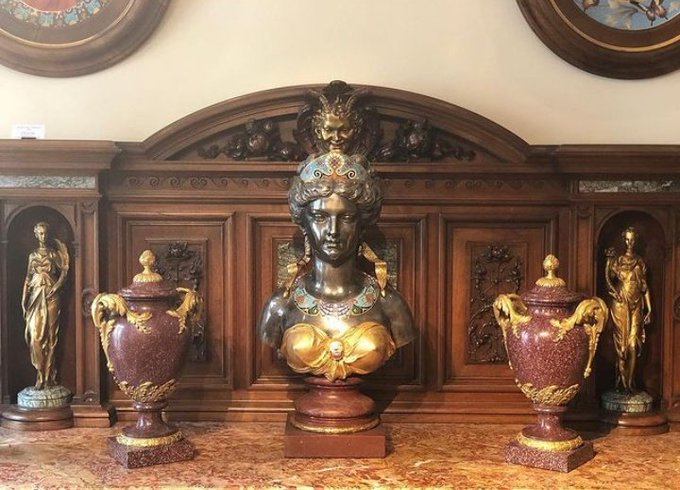
“If the apparition of the night before was an ocular delusion of my fancy sporting with the dark outlines of our cupboard, and if tis horrid eyes were nothing but a pair of inverted teacups, I had, at all events, the satisfaction of having launched the poker with admirable effect, and in true ‘fancy’ phrase, ‘knocked its two daylights into one,’ as the commingled fragments of my tea-service testified. I did my best to gather comfort and courage from these evidences; but it would not do. And then what could I say of those horrid bare feet, and the regular tramp, tramp, tramp, which measured the distance of the entire staircase through the solitude of my haunted dwelling, and at an hour when no good influence was stirring? Confound it!—the whole affair was abominable. I was out of spirits, and dreaded the approach of night. It came, ushered ominously in with a thunderstorm and dull torrents of depressing rain. Earlier than usual the streets grew silent; and by twelve o’clock nothing but the comfortless patterning of the rain was to be heard. I made myself as snug as I could. I lighted two candles instead of one. I forswore bed, and held myself in readiness for a sally, candle in hand; for, coute qui coute, I was resolved to see the being, if visible at all, who troubled the nightly stillness of my mansion. I was fidgety and nervous and, tried in vain to interest myself with my books. I walked up and down my room, whistling in turn martial and hilarious music, and listening ever and anon for the dreaded noise.” #RandolphHarris 20 of 21

Do not Grieve. Anything you lose comes around in another form. The child weaned from mother’s milk now drinks cranberry juice. God’s joy moves from unmarked box to unmarked box, from cell to cell. As rainwater, down into flowerbed. As roses, up from ground. Now it looks like a plate of rice and fish, now a cliff covered with vines, now a horse being saddled. It hides within these, till one day it cracks them open. There is the light gold of wheat in the sun, and the gold of bread made from wheat. I have neither, I am only talking about them as a town in the desert looks up to stars on a clear night. The Son of God, looking upon the World, beheld suffering and misery. With pity He saw how humans had become victims of satanic cruelty. He looked with compassion upon those who were being corrupted, murdered, and lost. They had chosen a ruler who chained them to his carriage as captives. God’s glory pervades the Universe; His ministering Angels inquire of one another: Where is the place of His glory? In response they give praise: Praised be the glory of the Lord from His Heavenly abode. From His Heavenly abode may He turn in mercy and bestow grace unto the people who, reciting the Shema evening and morning, twice daily, proclaim in love the unity of His name, saying: Hear, O America: the Lord our God, the Lord is One. He is our God; He is our Father, our sovereign and our Deliverer. In His mercy He will make known in presence of all the living that He will be your God. “I am the Lord your God.” As it is written in holy Scripture: The Lord shall reign forever; Thy God, O America, shall be Sovereign unto all generations. Hallelujah. #RandolphHarris 21 of 21

Winchester Mystery House

Ghostly tales are bountiful at Sarah Winchester’s Mystery House. What have you experienced? Photos are encouraged!

The Winchester mansion is 160-room mansion built to appease the spirits who died at the hands of the Winchester Rifle 👻
🗝 winchestermysteryhouse.com
“Whoever shadows my every move will not lose me in the dark.” At least that is what Christ says, or what the Evangelist John heard Him say (8.12). He tells us to walk on, through the darkness, with Christ as our only torch. That way, when we mayn’t have gained a step, but we won’t have lost one either. And on into the day we must pursue with dogged tread the life of Jesus Christ. Is this the secret to Mrs. Winchester’s 7-11 staircase?

They Shared the Feelings and Belief of the Best Hearts and Wisest Heads of the Seventeenth Century!

As far as aggression is biologically given in human genes, it is not spontaneous, but a defense against threats to human vital interests, that of one’s growth and one’s species’ survival. This defensive aggression was relatively small under certain primitive conditions—when no human was much of a threat to another human. Humans have gone through an extraordinary development since then. It is legitimate to imagine that humans will complete the full circle and construct a society in which no one is threatened: not the child by the parent; not the parent by the superior; no social class by another; no nation by a superpower. To achieve this aim is tremendously difficult for economic, political, cultural, and psychological reasons—and the added difficulty that the nations of the World worship idols—and different idols—and thus do not understand each other, even though they understand each other’s languages. To ignore these difficulties is folly; but if the political and psychological roadblocks are removed, the empirical study of all data shows that a real possibility exists to build such a World in the foreseeable future. The malignant forms of aggression, on the other hand—sadism and necrophilia—are not innate; hence, they can be substantially reduced when the socioeconomic conditions are replaced by conditions that are favourable to the full development of human’s genuine needs and capacities: to development of human self-activity and human’s creative power as its own ends. #RandolphHarris 1 of 20

Exploitation and manipulation produce boredom and triviality; they cripple humans, and all factors that make humans into psychic cripples turn the also into a sadist or a destroyer. Witchcraft and sorcery are taboo subject matter. However, witchcraft actually did exist and was widely practiced in seventeenth-century New England, as it was in Europe at that time (and still is, for that matter, among the unlearned majority of humankind). It worked then as it works now in witchcraft societies like those of the West Indies, through psychogenic rather than occult means, commonly producing hysterical symptoms as a result of the victim’s fear, and sometimes, when fear was succeeded by a profound sense of hopelessness, even producing death. The behaviour of the afflicted person was not fraudulent but pathological. They were hysterics, and in the clinical rather than the popular sense of that term. These people were not merely overexcited; they were mentally ill. Furthermore, they were ill long before any clergyman got to them. The general populace did reach that state of public excitement inaccurately called “mass hysteria,” but this was due to the popular fear of witchcraft rather than to the preachings of the clergy. The public excitement continued well after the leadership, both clerical and secular, had called a halt to the witchcraft proceedings. In fact the clergy were, from beginning to end, the chief opponents to the events at Salem, Massachusetts USA. #RandolphHarris 2 of 20

In particular, Cotton Mather was anything but the wild-eyed fanatic of tradition. Throughout most of the proceedings, Mr. Mather was a model of restraint and caution, and at one point he went further than any of his colleagues dared go in proposing a method to protect the innocent. The executions at Salem were by no means unique. Belief in witchcraft was quite as common among seventeenth century Anglicans, Quakers, Lutherans, and Catholics as it was among Puritans. Executions for witchcraft reached their height in Western civilization during the seventeenth century and continued in Europe until the end of the following century, more than a hundred years after the outbreak at Salem. Many writers have taken exception to one point or another in the traditional interpretation. The point raised most often has been that witchcraft trials were not at all unusual in the seventeenth century; that they were in fact typical of Western civilization at the time. The Salem outbreak was not due to Puritanism; it is not assignable to any particular temper on the part of our New England ancestors; it is no sign of exceptional bigotry or abnormal superstition. Our forefathers believed in witchcraft, not because they were Puritans, not because they were Colonials, but because they were New Englanders,–but because they were men of their time. They shared the feelings and beliefs of the best hearts and wisest head of the seventeenth century. What more can be asked of them? #RandolphHarris 3 of 20

It is hard to satisfy modern writers on witchcraft, who insist on censuring the sixteenth and seventeenth century on a basis of modern rationalism. If some of these who now sit in judgement on the witch-prosecutors had been witch judges, it is quite certain that no defendant would have escaped. The common scholar as well as the common human has continued to believe that there was something peculiarly puritanical about the Salem trials. Most significantly, a few persons have recognized that image magic was actually employed in Massachusetts, and at least two have wondered whether there might not have been something behind the charges of witchcraft after all. The belief in the supernatural has even led some people to believe that perhaps Adolph Hitler, the most powerful man in Europe, who was admired by many Germans (and not few other people), had special talents and gifts. There are many reports mentioning the magnetic qualities of Hitler’s eyes. People often said that they saw a particular glitter in his eyes that gave them the appearance of great intensity, otherworldliness, and devotion that allowed him to whip up the audience’s emotions, and open the floodgates of his hate. Well-educated and intelligent people were fascinated by him and his extremely wide range of subjects on which Hitler talked with such self-assurance. It was these qualities that entranced a nation and that is why people felt that he may have had some supernatural powers, much like the women in Salem. #RandolphHarris 4 of 20

David R. Proper, formerly librarian of Essex Institute, tells us that English professor George Lyman Kitteridge of Harvard University suspected that there might have been witchcraft practiced at Salem. Early in the year 1692 several girls of Salem Village (now Danvers), Massachusetts, began to sicken and display alarming symptoms. The most disturbing and most frequent of these symptoms was convulsive fits: fits so grotesque and so violent that eyewitnesses agreed the girls could not possibly be acting. “Their motions in the fits,” wrote Reverend Deodat Lawson, “are so preternatural, both as to the manner, which is so strange as a well person could not screw their body into; and as to the violence also it is preternatural, being much beyond the ordinary force of the same person when they are in their right mind.” The Reverend John Hale of Beverly confirmed Lawson’s description. “Their arms, necks, and back,” he wrote, “were turned this way and that way, and returned back again, so as it was impossible for them to do of themselves, and beyond the power of any epileptic fits, or natural disease to effect.” There were other symptoms almost equally alarming: temporary loss of hearing, speech, and sight; loss of memory, so that some girls could not recall what had happened to them in their fits; a choking sensation in the throat; loss of appetite. #RandolphHarris 5 of 20

Later there were terrifying hallucinations; they saw spectors who tormented them in a variety of ingenious and cruel ways. They felt themselves pinched and bitten, and often there were actual marks upon their skin. Dr. William Griggs of Salem Village—produced a diagnosis. “The evil hand,” he announced, “is upon them”; the girls were victims of malefic witchcraft. The diagnosis was in no way unusual. The overwhelming majority of seventeenth-century physicians, like other learned men, believed in witchcraft and considered it the cause of some of the diseases. Sir Thomas Brown shared the same opinion, “That these swooning fits were natural, and nothing else but what they call the mother, but only heightened to a great excess by the subtlety of the Devil, co-operating with the malice of these which we term witches, at whose instance he doth these villainies.” “The mother” was the common abbreviation for “the suffocation of the mother,” one of the seventeenth-century English terms for hysteria; it referred to the choking sensation in the throat that was one of the commoner systems. Thus, Sir Thomas Browne was entirely correct in his identification of the illness, and it is quite possible that Dr. Griggs, too, was right in whatever identification he made of the Salem symptoms. What is more surprising is that Dr. Griggs was probably also correct in his identification of the cause. It does seem to have been witchcraft that was responsible for the girls’ afflictions. #RandolphHarris 6 of 20

Witchcraft is not easy to define, because it is not, like the major formal religions, a coherent body of belief. However, in the New World civilization since prehistoric times there has been a loosely grouped body of magical lore—charms, spells, and so forth—having to do primarily with fertility and infertility, and with healthy and sickness, as well as a series of more marginal concerns, including the foretelling of the future. If tenuous, such lore has obvious connections with pre-Christian fertility worship, whose tutelary deity was a fertility god. Probably the commonest of such gods has been the deified sun, but the next most common was the deified herd animal, the cow, or, more often (because of his reputation for lechery) the goat. Half human and half bestial, with horns and cloven hooves, he appeared as Dionysus or Bacchus, the chief fertility god of the classical World, and was also to be found in the pantheons of northern Europe. Apparently the early Christians thought him the most abominable of all the pagan deities; they gave his attributes, his horns and cloven hooves, to the Devil, adding to these the wings of the fallen Angel. That he was once an extraordinarily powerful god cannot be doubted; there are instances of his survival in pre-Christian form as late as the twentieth century. A traveler in southern Ireland during the nineteen thirties reported seeing villagers dance in a ring around a goat those horns and hooves had been painted gold. #RandolphHarris 7 of 20

They informed him that on the coming Sunday they would roast and eat the goat, because “they had done it always.” I myself have seen one survival of the horned god: the Austrian Krampus. He has now degenerated into a bogeyman for children. Black and furry, with horns and a contorted face, he is the companion of St, Nicholas, and attends to bad children while St. Nicholas attends the good. The horned god’s power may also be seen in the fact that medieval and renaissance artists frequently forgot to give him his Christian attribute, the fallen Angel’s wins, but never forgot his horns, the attribute that made him a fertility god. This is true not only of provincial works of art but also of those created for the centers of Western civilization. In the dome of the baptistery at Florence for example, is a mosaic “Last Judgment,” and at the center of its Hell sits Devil who is wingless but conspicuously horned. The same is trye of the Devil in Giotto’s “Last Judgment” in the Arena Chapel in Padua. If the tutelary deity of witchcraft was deified herd animal, this does not mean that everyone who has used a charm was a formal worshipper of Satan. Nevertheless, not much more than two centuries ago everyone who used a charm believed one was making an appeal to dangerous occult forces, and at possible peril to one’s soul. However, the degree of peril was relative, and proportionate to the degree of witchcraft which like murder, comes in three degrees. The first is the practice of white magic—charms or spells used for benevolent purposes. Carrying a rabbit’s foot (the rabbit, like the goa, is notorious for its fertility) is white magic. So is nailing a horseshoe over the door (the open end must be upward, so the shape will suggest the horns of the herd animal). #RandolphHarris 8 of 20

Since the intention was innocent, the practice of white magic was seldom a cause for official concern. It was, of course, an appeal to occult forces that were specifically non-Christian, and as such it could, and sometimes did, draw a stern verbal rebuke from the clergy. However, that was all. The second degree of witchcraft is black magic—magic used maliciously—and in the seventeenth century black magic was very serious indeed; it was an appeal to the Prince of Evil in order to accomplish evil. The third degree is pact, where the witch is no longer merely invoking the Devil’s assistance through one’s charms and spells, but actually believes one has made a contract to serve him. The penalties for witchcraft were relatively light in the early years of Christian history. In the seventh century Theodore, Archbishop of Canterbury, in his Liber Poentientialis, considered the penance appropriate to a person who has been imitating “a stage or a bull; that is, making oneself into a wild animal and dressing in the skin of a herd animal, and putting on the heads of beasts.” To “those who in such wise transform themselves into the appearance of a wild animal” he assigned “penance for three years because this is devilish.” At this time paganism was still so widespread and Christianity so new that, according to the Venerable Bede, King Redwald of East Anglia “had in the same temple an altar to sacrifice to Christ and another to offer victims to demons.” Elements of paganism remained strong throughout the Middle Ages, inside the church as well as out. In 1282 the priest of Inverkeithing led a fertility dance around the churchyard. #RandolphHarris 9 of 20

And Giraldus Cambrensis (ca. 1146-ca. 1220) reported, “though I say it with tears,” that there were priests who celebrate “masses over images of wax, to curse someone.” The remedy for such an appalling situation, Giraldus thought was to ordain fewer priests and more care in their selection. His advice, of course, was not followed, and members of the clergy continued to practice black arts as late as the eighteenth century. Toward the end of the Middle Ages and the beginning of the Renaissance both church and state began to take witchcraft more seriously. The crucial century was the fifteenth, which saw a number of important trials, including those of Joan of Arc, Gilles de Rais, and the Duchess of Gloucester. At the end of this century, in 1490, Malleus Maleficarum (The Hammer of Witches) was published. The authors were James Sprenger and Henry Kramer, two German Dominicans, and their book published with the Papal Bull by which Innocent VIII gave them jurisdiction as Inquisitors for the Germanic countries. Malleus gave a thorough definition of witchcraft with rules on how to investigate, try, and judge cases of witchcraft. It remained an important work for more than two hundred years; Increase Mather knew of it and referred to it. The publication of Malleus Maleficarum gives us a convenient date for opening of that general war against the Devil which occupied all Christendom during the sixteenth and seventeenth centuries. #RandolphHarris 10 of 20

The full horror of that warfare will never be known in all of its detail. Even the statistics of convicted witches who were executed vary widely from one authority to another. However, it is clear that the battle reached its height during the first half of the seventeenth century, when, for example, approximately nine hundred witches were burned in the single city of Bamberg, and approximately five thousand in the single province of Alsace. It was Boyle who proposed that English miners be interviewed as to whether they “meet with any subterraneous demons; and if they do, in what shape and manner they appear; what they portend, and what they do. Newton, the greatest scientist of his age, spent more of his time on the occult than he did in the study of physics. He explicated, for example, apocalyptic passages in the Bible, and interpreted the measurements of Solomon’s temple, hoping in both cases that a mystic reading of the scriptures would lead him to the inmost secrets of the Universe. We should remember also that the seventeenth century firmly believed in a dualistic Universe: in a material or visible World, and a spiritual or invisible Worlds as well. Heaven was still a concrete reality, as were the Angels who inhabited it; so was Hell and its Devil. As John Locke argued in his Essay Concerning Human Understanding: “If this notion of immaterial spirit may have, perhaps, some difficulties in it not easily to be explained, we have therefore no more reason to deny or doubt the existence of such spirits, than we have to deny or doubt the existence of body; because the notion of body is cumbered with some difficulties very hard, and perhaps impossible to be explained or understood by us.” #RandolphHarris 11 of 20

Like other learned men of his time, Locke not only believed in a World of spirits, but that the spirits can appear in this material World: “that Spirits can assume to themselves bodies of different bulk, figure, and conformations of parts.” To be sure, Locke warned that “universal certainty” concerning the World of spirits was beyond us; we could know it, he thought, only as it impinges on our senses. However, that, of course, is precisely what was thought to happen in witchcraft. Thomas Hobbes was a skeptic, but his skepticism was rather different in character from that of the nineteenth or twentieth century. “As for witches,” he wrote in his Leviathan, “I think not that their witchcraft is any real power; but yet that they are justly punished, for the false belief they have that they can do such mischief, joined with their purpose to do it if they can; their trade being nearer to a new religion than to a craft or science.” (The last clause is remarkably perceptive, although it was, of course, survivals of old religion rather than anything new that were to be found in witchcraft.) If you had been sticking pins in your neighbour’s image or casting spells on his cow, you would not have wanted Thomas Hobbes to be your judge. He would not have believed in your occult powers, but he would have hanged you anyway, for your heresy and malice. We must bear in mind that in a society which believes in witchcraft, it works. If you believe in witchcraft and you discover that someone has been melting your wax image over a slow fire or muttering charms over your nail-parings, the probability is that you will get extremely sick. #RandolphHarris 12 of 20

To be sure, your symptoms will be psychosomatic rather than organic. However, the fact that they are obviously not organic will make them only more terrible, since they will seem the result of malefic and demonic power. So it was in seventeenth-century Europe, and so it was in seventeenth-century Massachusetts. The hideous convulsive fits were thought to be the result of witches and demons wrenching the bodies of their victims into tortuous postures. The loss of hearing, speech, sight, appetite, and memory were deprivations caused by Satan himself. The contradiction of the throat—the globus hystericus—was seen as an attempt by demons to make the victim swallow occult poisons. And when she swallowed rapidly and her belly welled (what s actually involved here is a kind of accelerated ulcer formation), it was thought the demons had succeeded. When blisters appeared upon the skin (many skin diseases are functional rather than organic), they were thought to have been raised by brimstone out of Hell. Many of these symptoms, including the skin lesions, would pass fairly rapidly. Cotton Mather, who was a Fellow of the Royal Society, a former medical student, and a thorough and careful observer, remarked more than once on the surprising rapidity with which “witch-wounds” healed. However, other symptoms would persist. And a new fit would bring a repetition of the old afflictions, or new ones equally alarming. #RandolphHarris 13 of 20

The cause of these hysterical symptoms, of course, was not witchcraft itself but the victim’s fear of it, and that is why so many innocent persons were executed. It is impossible now, and was in many instances impossible then, to tell how many of the persons executed for witchcraft were actually guilty of practicing it. It is surely no exaggeration to say that the majority, even the vast majority, were innocent victims of hysterical fears. However, we should again be wary of converting a statistical truth into a general principle. While it is clearly true that the majority of persons executed for witchcraft were innocent, it is equally true that some of them, in Massachusetts and elsewhere, were guilty. For those who look back on it, the Victorian age seems to be invested with a peculiar quality of difference—heightened by tis relative proximity in time—that is reflected in its ghost. It was an age shaped, perhaps more than any other previous period, by the forces of transition. In 1884, Mrs. Winchester left New Haven, Connecticut, and the graves of her husband and only child, moved to San Jose, California, and began the obsession that was to last for the rest of her life. She purchased an unfinished eight-room farmhouse outside the small agricultural town, and for the next 38 years, the sound of construction on Mrs. Winchester’s mansion never stopped. With the shadow of change falling across virtually every area of life and thought, the receding past became a focus for anxiety, and in literature the ghost story offered a way of anchoring the past to an unsettled present by operating in a continuum of life and death. #RandolphHarris 14 of 20

Mrs. Winchester hired carpenters to work around the clock building and rebuilding room after room, as the spirits—or her mood—directed. The house was furnished with the finest materials and was a showcase of Victorian elegance and taste. Mrs. Winchester passed away peacefully in her sleep on September 5, 1922, and work on the still uncompleted mansion stopped. Why did Mrs. Winchester build the World’s most beautiful and bizarre mansion? Was she following the advice of psychics who told her to provide a home for the spirits of those killed by the Winchester rifles? Was she told she would live forever, so long as construction never stopped? We may never know Mrs. Winchester’s real motivations, since she took the secret with her to her grace. So we leave to you to decide for yourself the mystery of the Winchester Mystery House. In the ghost story, obligations do not cease with death, and the past is never a closed book. What has been can be again, though often terribly transformed. For a progressive age (progressing to what?), the idea of a vindictive past held an especial potential for terror. In personal terms, ghosts were obvious, though still potent, images of the lost past—past sins, past promises, past attachments, past regrets—and could be used to confront, and exorcize, the demons of guilt and fear. We know that we are to be shown a climatic interaction between the living and the dead, and usually expect to be unsettled by the experience. #RandolphHarris 15 of 20

Mrs. Winchester’s mansion was said to be a very grand place. Driving up to the mansion, it was like one left all signs of a town, or even a village, and were then inside the gates of a large Victorian park—not like the parks here in the north, but with rocks, and the noise of running water, and beautiful thorn-trees, and old oaks, all white and peeled with age. The road went up about two miles, and then one would see a great and stately house, with many trees close around it, so close that in some places their branches dragged against the walls when the wind blew. The great oval drive was without a weed and two palm trees, in plain view a 7 story tower, along with two statues of a Greek goddesses, at the many-windowed front; at both sides of which a wing projected, which were each the ends of other side fronts; for the house was grander than most expected. There was also a little old-fashioned flower-garden. When people rode up to the great front entrance of Winchester mansion in their carriage, and went into the hall they thought they should be lost—it was so large, and vast, and grand. There was a chandelier all of bronze, hanging down from the middle of the ceiling; and many have never seen one before, and looked at it all in amaze. Then, at once end of the hall, was a great fireplace, as large as the sides of the houses in many countries, with massy andirons and Greek goddesses to hold the wood; and by it were heavy French provincial sofas. At the opposite end of the hall, to the left as you went in—on the western side—was an organ built into the wall, and so large that it filled up the best part of that end. Beyond it, on the same side, was a door; and opposite, on each side of the fireplace, were also doors leading to the east front; but those I never went through as long as I stayed in the house, so I cannot tell you what lay beyond. #RandolphHarris 16 of 20

Mrs. Winchester held very tight to me, as if she were scared and lost in that great place, and for myself, I was not much better. The west drawing-room was very cheerful-looking, with a warm fire in it, and plenty of good, comfortable future about it. So we went out of that great drawing-room, and into another sitting-room, and out of that, and then up a great flight of stairs, and along a broad gallery—which was something like a library, having books all down one side, and windows and writing-tables all down the other—till we came to the room I would be staying in, which I was not sorry to hear was just over the kitchens; for I began to think I should be lost in that wilderness of a house. The great old house was a famous place for Mrs. Winchester. She made expeditions all over it, with me at her heels; all except the east wing, which was never opened, and whither we never thought of going. However, in the western and northern part was many a pleasant room; full of things that were curiosities to guests. The windows were darkened by the sweeping boughs of the trees, and ivy which had overgrown them: but, in the green gloom, we could manage to see old China jars and carved ivory boxes, and great heavy books, and, above all, the old pictures. They were all portraits of some of the Winchester family, though Mrs. Winchester could not tell us the names of every one. We had gone through most of the 180 rooms, when we came to the old state drawing-room over the all, and there was a picture of Mrs. Winchester. She was such a beauty! She had a dress on, the like of which I had never seen before. #RandolphHarris 17 of 20

Mrs. Winchester said there were some places about the house she was half frightened at. As winter drew closer and day grew shorter, I was sometimes almost certain that I heard noises as if someone was playing on the great organ in the hall. I did not hear it ever evening; but certainly, I did very often; usually when I was sitting with Mrs. Winchester. Even after she went to bed, I used to hear it booming and swelling in the distance. The first night I went down to my supper, I asked Mrs. Winchester who had been playing music, and the butler said very short that I was a gowk to take the wind soughing among the trees for music: but I saw Mrs. Winchester look at him very fearfully, and the kitchen-maid, said something beneath her breath, and went quite white. I saw they did not like my question. They had heard the very strange noise, and had heard it many a time, but most of all on winter nights, and before storms; and folks did say it was the old lord playing on the great organ in the hall, just as he used to do when he was alive. The days grew shorter and shorter; and the old lord, if it was he, played more and more stormily and sadly on the great organ. The doors in the east wing were always locked, and Mrs. Winchester always had the keys. I wondered what was hidden there. One fearful night, just after the New Year had come in, when the rain was thick and deep, and it was still falling—fast enough to blind anyone who might be out and abroad—there was a great and violent noise heard, and the old lord’s vice above all, cursing and swearing awfully—and the cries of a little child—and a fierce woman—the sound of a blow—and a dead stillness—and moans and wailings dying away. #RandolphHarris 18 of 20

Suddenly Mrs. Winchester went towards the door, and I durst not be left, though my heart almost stopped beating for fear. In the hall the screams were louder than ever; they sounded to come from the east wing—near and nearer—close on the other side of the locked-up doors—close behind them. Then I noticed that the great bonze chandelier seemed all alight, though the hall was dim, and that a fire was blazing in the vast in the vast hearth-place, though it gave no heat; and I shuddered up with terror. The east door shook, and Mrs. Winchester cried, “I must go! My little girl is there; I hear her; she is coming! I must go!” As if torn open in a violent passion, all at once the east door gave way with a thundering crash and there came into that broad mysterious light, the figure of a tall man, with red hair and gleaming eyes. He drove before him, with many a restless gesture of abhorrence, a stern and beautiful woman, with a little baby in her arms. “It’s the lady! the lady from the garden; and my little girl is with her. They are drawing me to them I feel them—I feel them I must go!” cried Mrs. Winchester. Again she almost convulsed by her effort to go towards them; but I held her tighter and tighter, till I feared I should do her a hurt; but rather that then let her go towards those terrible phantoms. They passed along toward the great hall-door, where the winds howled and ravened for their prey. And Mrs. Winchester was torn by a power stronger than mine and writhed in my arms, and sobbed (for by this time the poor darling was growing faint). #RandolphHarris 19 of 20

“They want me to go with them—they are drawing me to them. Oh, my little girl!” said Mrs. Winchester. But just then I saw—we saw—another phantom shape itself, and grow clear out of the blue and misty light that filled the hall; we had not seen her till now, for it was another lady who stood by the man, with a look of relentless grief and triumphant scorn. That figure was very beautiful to look upon, with a soft white hat drawn down over the proud brows and a red and curling lip. It was dressed in a gown of blue stain. I had seen the figure before. It was the likeness of Mrs. Winchester in her youth; and the phantom moved on, regardless of Mrs. Winchester’s wild entreaty. But at that moment the dim lights, and the fire that gave no heat, went out of themselves, and Mrs. Winchester lay at my feet stricken down by the palsy—death stricken. Yes! She was carried to her bed that night never to rise again. She lay with her face to the wall muttering low but muttering alway; “Alas! alas! what is done in youth can never be undone in age! What is done in youth can never be undone in age!” In recognition to Mrs. Winchester’s contribution to San Jose and the Santa Clara Valley, the Winchester Mansion was designated California Register of Historic Place in 1974. The mansion was also designated a San Jose Historic Landmark in 1996. #RandolphHarris 20 of 20

Winchester Mystery House

Ever-changing and evolving, Mrs. Winchester’s Llanada Villa once stood seven-stories tall before the 1906 earthquake forced the top three floors to be removed. How do you think it felt to stand in the tower and look across the land that would eventually become a technology hub?

Self-Guided Mansion Tour:
🗝️ winchestermysteryhouse.com/recent-links
Immersive 360 Tour:
🗝️ winchestermysteryhouse.com/recent-links
Video Access Tour:
🗝️ winchestermysteryhouse.com/recent-links
May the Nations, in the Efforts to Keep Peace in Being, Go to the Farthest Limits!

Death is not the greatest loss in life. The greatest loss is what dies inside of us while we live. The fact that after awakening the mind picks up the thoughts of the day before, that the individuality connects with the old individuality of presleep, proves the continuity of existence of a part of the Self both and during sleep as during waking. We have not taken proper notice of history; and, in consequence, we no longer know what is just—or what is useful. The most flagrant violation of the rights of history—and, above all, of the rights of humans—occurs when a people is deprived of the right to the land on which it lives and has to move elsewhere. At the end of the second World War the victorious powers decided to impose this fate upon hundreds of thousands of people, and to impose it in the cruelest conditions; in this they showed how little they understood their task, and how unfitted they were to carry out a reorganization which would be reasonably equitable and might guarantee a more prosperous future. And now—what exactly is this problem of peace in the modern World? Its conditions are quite new—as different from those of former times as is the war which we seek to avert. Modern warfare is fought with weapons which are incomparably more destructive than those of the past. War is, in fact, a greater evil than ever before. It was once possible to regard it as an evil to which we could resign ourselves, because it was the servant of progress—and was even essential to it. It could be argued in those days that, thanks to war, those nations which were strongest got the better of their weaker neighbours and thus determined the march of history. #RandolphHarris 1 of 19

It is worth remembering that for the generation which grew up before 1914, the enormous increase in the destructive power of modern armament was regarded as advantageous to humanity. It was argued that outcome of any future conflict would be settled much more quickly than in previous ages, and that any such wars would therefore be very brief. It was also thought that the harm done by any future conflict would be relatively slight, since a new element of humanity was being introduced into the rules of war. This arose from the obligations established by the Geneva Convention of 1864 as a result of the efforts of the Red Cross. The nations had entered int a mutual agreement to look after each other’s wounded, to ensure that prisoners of war were treated humanely, and to see that the civil populations were disturbed as little as possible. This convention did, in point of fact, have substantial results, and hundreds of thousands of men, civilians and combatants alike, have profited by it for the last one hundred and fifty years. However, these advantages are trifling when set beside the immeasurable harm which has been inflicted by modern methods of death and destruction. There cannot, at the present time, be any question of “humanizing” war. Now that we know how terrible an evil war is in our time, we should neglect nothing that may prevent its recurrence. Above all, this decision must be based on ethical values: during the last two wars we were guilty of atrocious acts of inhumanity. #RandolphHarris 2 of 19

In any future war, we shall do yet more terrible things. This must not be. Let us be brave and look the facts in the face. Humans have become superhuman. One is a superhuman not only because one has at one’s command innate physical forces, but because, thanks to science and to technical advancement, one now controls the latent forces of nature and can bring them, if one wishes, into play. When quite on one’s own one could kill only at a distance by calling upon the personal strength one communicated to the arrow by suddenly unleashing one’s bow. Superhumans, on the other hand, have contrived to unleash something quite different: the energy released by the deflagration of a particular mixture of chemicals. This allows one to use a vastly more formidable projectile, and one can send it a great deal father. However, this superhuman suffers from a fatal imperfection of mind. One has not raised oneself to that superhuman level of reason which should correspond to the possession of superhuman strength. Today, once again, we live in a period that is marked by the absence of peace; today, once again, nations feel themselves menaced by other nations; today, once again, we must concede to each the right to defend oneself with the terrible weapons which are now at our disposal. I believe that I have here given voice to the thoughts and hopes of millions of human beings in our part of the World who live in the fear of a future war. May my words be those on the far side of the barrier who are haunted by this same fear. #RandolphHarris 3 of 19

May those who have in their hands the fate of the nations take care to avoid whatever may worsen our situation and make it more dangerous. And may they take to heart the words of the Apostle Paul: “If it be possible, as much as lieth in you, lice peaceably with all men.” His words are valid not only for individuals, but for whole nations as well. May the nations, in their efforts keep peace in being, go to the farthest limits of possibility, so that the spirit of humans shall be given time to develop and grow strong—and time to act. Can one live in a society that is out of control? That is the question posed for the concept of future shock. For that is the situation we find ourselves in. If it were technology alone that had broken loose, our problems would be serious enough. The deadly fact is, however, that many other social processes have also begun to run free, oscillating wildly, resisting our best efforts to guide them. Urbanization, ethic conflict, migration, population crime—a thousand examples spring to mind of fields in which our efforts to shape change seem increasingly inept and futile. Some of these are strongly related to the breakaway of technology; others partially independent of it. Then uneven, rocketing rates of change, the sifts and jerks in direction, compel us to ask whether the techno-societies, even comparatively small ones like Sweden and Belgium, have grown too complex, too fast to manage? #RandolphHarris 4 of 19

How can we prevent mass future shock, selectively adjusting the tempos of change, raising or lowering levels of stimulation, when governments—including those with the best intentions—seem unable even to point change in the right direction? Thus a leading American urbanologist writes with unconcealed disgust: “At a cost of more than three billion dollars, the Urban Renewal Agency has succeeded in materially reducing the supply of low cost housing in American cities.” Similar debacles could be cited in a dozen fields. Why do welfare programs today often cripple rather than help their clients? Why do college students supposedly a papered elite, riot and rebel? Why do expressways add to traffic congestion rather than reduce it? In short, why do so many well-intentioned liberal programs turn rancid so rapidly, producing side effects that cancel out their central effects? No wonder Raymond Fletcher, a frustrated Member of Parliament in Britain, recently complained: “Society’s gone random!” If random means a literal absence of patter, he is, of course, overstating the case. However, if random means that the outcomes of social policy have become erratic and hard to predict, he is right on target. Here, then, is the political meaning of future shock. For just as individual future shock results from an inability to keep peace with the rate of change, governments, too, suffer from a kind of collective future shock—a breakdown of their decisional processes. #RandolphHarris 5 of 19

With chilling clarity, Sir Geoffery Vickers, the eminent British social scientist, has identified the issue: “The rate of change increases at an accelerating speed, without a corresponding acceleration in the rate at which further responses can be made; and this brings us nearer the threshold beyond which control is lost.” The United State is equipped with what are at least called planning departments. Why, therefore, despite all these efforts, should the system be spinning out of control? The problem is not simply that we plan too little; we also plan too poorly. Part of the trouble can be traced to the very premises implicit in our planning. First, technocratic planning, itself a product of industrialism, reflect the values of that fast-vanishing era. In both its capitalist and communist variants, the age of information is a system focused on the maximization of material welfare. Thus, for the technocrat in the Silicon Valley as well as Kiev, economic advance is the primary aim; technology the primary tool. The fact that in one case the advance redounds to private advantage and in the other, theoretically, to the public good, does not alter the core assumptions common to both. Technocratic planning is econocentric. Second, technocratic planning reflects the time-bias of the age of information. Struggling to free itself from the stifling past-orientation of previous societies, the age of information is focused heavily on the future. This means, in practise, that it is planning for the future. #RandolphHarris 6 of 19

However, the idea of a five-year plan struck the World as insanely futuristic when it was first put forward by Soviets in the 1920’s. Even today, except in the most advanced organizations on both sides of the ideological curtain, one- or two-year forecasts are regarded as “long-range planning.” A handful of corporations and government agencies, as we shall see, have begun to concern themselves with horizons ten, twenty, even fifty years in the future. The majority, however, remain blindly biased toward next Monday. Technocratic planning is short-range. Third, reflecting the bureaucratic organization of the digital age, technocratic planning is premised on hierarchy. The World is divided int manager and worker, planner and plannee, with decisions made by one for the other. This system, adequate while change unfolds at a digital tempo, breaks down as the pace reaches super-age of information speeds. The increasingly unstable environment demands more and more non-programmed decisions down below; the need for instant feedback blurs the distinction between line and staff; and hierarchy totters. Planners are too remote, too unenlightened of local conditions, too slow in responding to change. As suspicious spreads that top-down controls are unworkable, plannees begin clamouring for the right to participate in the decision-making. Planners, however, resists. For like the bureaucratic system it mirrors, technocratic planning is essentially undemocratic. The forces sweeping us toward the super-age of information can no longer be channeled by these bankrupt industrial-era methods. For a time, they may continue to work in backward, slowly moving industries or communities. #RandolphHarris 7 of 19

However, their misapplication in advanced industries, in universities, in cities—wherever change is swift—cannot but intensify the instability, leading to wilder and wilder swings and lurches. Moreover, as the evidences of failure pile up, dangerous political, cultural and psychological currents are set loose. One response to the loss of control, for example, is a revulsion against intelligence. Science first gave humans a sense of mastery over one’s environment, and hence over the future. By making the future seem malleable, instead of immutable, it shattered the opiate religions that preached passivity and mysticism. Today, mounting evidence that society is out of control breeds disillusionment with science. In consequence, we witness a garish revival of mysticism. Suddenly astrology is the rage. Zen, yoga, seances, and witchcraft have become popular pastimes. Cults form around the search for Dionysian experience, for non-verbal and supposedly non-linear communication. We are told it is more important to “feel” than to “think,” as though there were a contradiction between the two. Existentialist oracles join Catholic mystics, Jungian psychoanalysts, and Hindu gurus in exalting the mystical and emotional against the scientific and rational. This reversion to pre-scientific attitudes is accompanied, not surprisingly, by a tremendous wave of nostalgia in the society. Antique furniture, posters from a bygone era, games based on the remembrance of yesterday’s trivia, the revival of Art Nouveau, the spread of Queen Anne styles, the rediscovery of such faded pop-cult celebrities as Brad Pitt or Michael Jordan, all mirror a psychological lust for the simpler, less turbulent past. #RandolphHarris 8 of 19

Powerful fad machines spring into action to capitalize on this hunger. The nostalgia business becomes a booming industry. The failure of technocratic planning and the consequent sense of lost control also feeds the philosophy of “now-ness.” Songs and advertisements hail the appearance of the “now generation,” and learned psychiatrists, discoursing on the presumed dangers of repression, warn us not to defer our gratifications. Acting out and a search for immediate payoff are encouraged. “We’re more oriented to the present. I got this. Live out load,” says a teenage girl to a reporter after the mammoth Coachella rock music festival. “It’s like do what you want to do now…If you stay anywhere very long you get into a planning thing…So you must just move on.” Spontaneity, the personal equivalent of social planlessness, is elevated int a cardinal psychological virtue. All this has its political analog in the emergence of a strange coalition of right wingers and New Leftists in support of what can only be termed a “hang loose” approach to the future. Thus we hear increasing calls for anti-planning or non-planning, sometimes euphemized as “organic growth.” Among some radicals, this takes on an anarchist coloration. Not only is it regarded as unnecessary or unwise to make long range plans for the future of the institution or society they wish to overturn, it is sometimes even regarded as poor taste to plan the next hour and a half of a meeting. Planlessness is glorified. #RandolphHarris 9 of 19

Arguing that planning imposes values on the future, the anti-planners overlook the fact that non-planning does so, too-often with far worse consequence. Angered by the narrow, econoncentic character of technocratic planning, they condemn systems analysis, cost benefit accounting, and similar methods, ignoring the fact that, used differently, these very tools might be converted into powerful techniques for humanizing the future. When critics charge that technocratic planning is anti-human, in the sense that it neglects social, cultural and psychological values in its headlong rush to maximize economic gain, they are usually right. When they charge that it is shortsighted and undemocratic, they are usually right. When they charge it is inept, they are usually right. However, when they plunge backward into irrationality, anti-scientific attitudes, a kind of sick nostalgia, and an exaltation of now-ness, they are not only wrong, but dangerous. Just as, in the main, their alternatives to industrialism call for a return to pre-industrial institutions, their alternative to technocracy is not post-, but pre-technocracy. Nothing could be more dangerously maladaptive. Whatever the theoretical arguments may be, brute forces are loose in the World. Whether we wish to prevent future shock or control populations to check pollution or defuse the arms race, we cannot permit decisions of Earth-jolting importance to be taken heedlessly, witlessly, planlessly. To hang loose is to commit collective suicide. #RandolphHarris 10 of 19

We need not a reversion to the irrationalism of the past, not a passive acceptance of change, not despair or nihilism. We need, instead, a strong new strategy. For reasons that will become clear, I term this strategy “social futurism.” I am convinced that, armed with this strategy, we can arrive at a new level of competence in the management of change. We can invent a form of planning more humane, more far-sighted, and more democratic than any so far use. In short, we can transcend technocracy. A scientifically or oriented psychology is bound to proceed abstractly; that is, it removes itself just sufficiently far from its object not to lose sight of it altogether. That is why the findings of laboratory psychology are, for all practical purposes, often so remarkably unenlightening and devoid of interest. The more the individual object dominates the field of vision, the more practical, detailed, and alive will be the knowledge derived from it. This means that the objects of investigation, too, become more and more complicated and that the uncertainty of the individual factors grows in proportion to their number, thus increasing the possibility of error. Understandably enough, academic psychology is scared of this risk and prefers to avoid complex situations by asking ever simpler questions, which it can do with impunity. It has full freedom in the choice of questions it will put to Nature. #RandolphHarris 11 of 19

Medical psychology, on the other hand, is very far from being in this more or less enviable position. Here the object puts the question and not the experimenter. The analyst is confronted with facts which are not of one’s choosing and which one probably never would choose is one were a free agent. It is the sickness or the patient oneself that puts the crucial questions—in other words, Nature experiments with the doctor in expecting an answer from one. The uniqueness of the individual and of one’s situation stares the analyst in the face and demands an answer. One’s duty as a physician forces one to cope with a situation swarming with uncertainty factors. At first one will apply principles based on general experience, but one will soon realize the principles of this kind do not adequately express the facts and fail to meet the nature of the case. The deeper one’s understanding penetrates, the more the general principles lose their meaning. However, these principles are the foundation of objective knowledge and the yardstick by which it is measured. With the growth of what both patient and doctor feel to be “understanding,” the situation becomes increasingly subjectivized. What was an advantage to begin with threatens to turn into a dangerous disadvantage. Subjectivation (in technical terms, transference and countertransference) creates isolation from the environment, a social limitation which neither party wishes for but which invariably sets in when understanding predominates and is no longer balanced by knowledge. #RandolphHarris 12 of 19

As understanding deepens, the further removed it becomes from knowledge. An ideal understanding would ultimately result in each party’s unthinkingly going along with the other’s experience—a state of uncritical passivity coupled with the most complete subjectivity and lack of social responsibility. Understanding carried to such lengths is in any case impossible, for it would require the virtual identification of two different individuals. Sooner or later the relationship reaches a point where one partner feels one is being forced to sacrifice one’s own individuality so that it may be assimilated by that of the other. This inevitable consequence breaks the understanding, for understanding also presupposes the integral preservation of the individuality of both partners. It is therefore advisable to carry understanding only to the point where the balance between understanding and knowledge is reached, for understanding at all costs is injurious to both partners. This problem arises whenever complex, individual situations have to be known and understood. It is the specific task of the medical psychologist to provide just this knowledge and understanding. It would also be the task of the “director of conscience” zealous in the cure of souls, were it is not that one’s office inevitably obliges one to apply the yardstick of one’s denominational bias at the critical moment. As a result, the individual’s right to exist as such is cut short by a collective prejudice and often curtailed in the most sensitive area. The only time this does not happen is when the dogmatic symbol, for instance the model life of Christ, is understood concretely and felt by the individual to be adequate. How far this is the case today I would prefer to leave to the judgment of others. At all events, the analyst very often has to treat patients to whom denominational limitations means little or nothing. #RandolphHarris 13 of 19

One’s profession therefore compels one to have as few preconceptions as possible. Similarly, while respecting metaphysical (id est, non-verifiable) convictions and assertions, one will take care not to credit the with universal validity. This caution is called for because the individual traits of the patient’s personality ought not to be twisted out of shape by arbitrary interventions from outside. The analyst must leave this to environmental influences, to the patient’s own inner development, and—in the widest sense—to fate with its wise or unwise decrees. Many people will perhaps find this heightened caution exaggerated. In view of the fact, however, that there is in any case such a multitude of reciprocal influences at work in the dialectical process between two individual, even if it is conducted with the most tactful reserve, the responsible analyst will refrain from adding unnecessarily to the collective factors to which one’s patent has already succumbed. Moreover, one knows very well that the preaching of even the worthiest precepts only provokes the patient into open hostility or secret resistance and thus needlessly endangers the aim of the treatment. The psychic situation of the individual is so menaced nowadays by advertising, propaganda, and other more or less well-meant advice and suggestions that for once in one’s life the patient might be offered a relationship that does not repeat the nauseating “you should,” “you must” and similar confession of impotence. #RandolphHarris 14 of 19

Against the onslaught from outside no less than against its repercussions in the psyche of the individua the analyst sees oneself obligated to play the role of counsel for the defence. Fear that anarchic instincts will thereby be let loose is a possibility that is greatly exaggerated, seeing that obvious safeguards exist within and without. Above all, there is the natural cowardice of most humans to be reckoned with, not to mention morality, good taste and – last but not least – the penal code. This fear is nothing compared with the enormous effort it usually costs people to help the first stirrings of individuality into consciousness, let alone put them into effect. And where these individual impulses have broken through too boldly and unthinkingly, the analyst must protect them from the patient’s own clumsy recurse to shortsightedness, ruthlessness, and cynicism. Amid the tumult of ego-directed thoughts and feelings, the distress brought on by an adverse circumstance which the ego has not been able to endure or set right can be lessened and relived by relaxing, letting go, pausing, lying physically and mentally still, whether in a prayer for inner peace or a simple meditation, but in any case turning the affair over to the higher power as a sign of having let go. Such temporary withdrawal gives the Overself its change to break through the ego’s crust and to bring its ministering peace, help, guidance, or healing. #RandolphHarris 15 of 19

If you want to heal a human do not concentrate upon the nature of one’s disease, or you may strengthen it. Concentrate rather upon the nature of one’s Overself, that its might grace may be released to one. Do not even pray that one will be cured. Pray rather that the power of the Overself’s grace may work within one, and do what it will. The nape of the neck is one of these important—physically sensitive—centers. It can receive through the hand-touch of a healer the magnetism which affects the health condition. The Old World physicians use the prolonged fast treatment for advanced illnesses; other use mud packs. Thus both turn to Mother Nature, and do not always turn in vain. After one has felt the divine power and presence within oneself as the reward of one’s meditative search, one may turn it towards the healing of one’s body’s aliments. This could be impossible if one were less than relaxed, peaceful, assured, if either fear or desire introduce their negative presence and thus obstructed one’s receptivity to the healing-power’s penetration. When the contact is successfully made, one should draw the power to every atom of one’s body and let it be permeated. The cure could be had at a single treatment, if one could sit still and let the work go n to completion. However, although the power is unlimited, one’s patience is not. And so one must treat oneself day after day until the outer and physical result matches the inner and spiritual achievement. The lift of deep meditation reduces the need of sleep shown by the case of the Spanish Saint John of the Cross. Three or four hours of repose at night were quite enough for him. #RandolphHarris 16 of 19

If it is adopted more enthusiastically, a new bodily regime can be adopted more quickly and more easily. Some people play with the thought of it for years but never actually started on it. Others, frightened into it by some dire necessity or taking to it through strong yearning for its benefits, make up their mind to the point of getting excited about it. For them action is the direct consequence of aspiration. Chemical changes in every cell of one’s body are the outer physical result of this inner second birth. That word “normal” is a deceptive and even dangerous one to use in these matters. For the human race’s present condition is an unevolved and, from the philosophic standpoint, unclear one. To accept this as the norm, the ideal to be attain by individuals, is to prevent growth. Pleasures of the flesh, wrathful temperament, and despondent outlook may have their source in the body or in the mind, or in both together. If a lasting result is to be gained, where the physical origin exists, the physical treatment should be given. How proudly and how carefully a cat cleans, washes, and combs its fur coat! A clean body is more responsive to the finer feelings and nobler thoughts. However, we must remember that skin cleanness is only small part of the whole. The intestinal tract, the tissues, and the organs are the larger part. To the extent that one has transgressed the laws of moral, mental, and physical hygiene, to that extent one might reasonably be asked to preform penance in proportion. However, Nature is not so exacting as that. She will cooperate with and help one from the moment one repents and does some of the required penance. #RandolphHarris 17 of 19

Even if these physical plane methods offer only contributory help and secondary values, they will still be worth using by those who need all the help they can get. Those who want the higher degree of knowledge and pace must but their way into it. The purchase price is high, no less than abstinence, continence, self-denial, and self-mastery—alike in the realm of thoughts as that of acts. Constipation is specifically blamed as a hindrance to the practice of meditation by some teachers. They require it to be cured before allowing students to proceed with the practice itself. They prescribe certain exercises and dietetic changes to remove the condition. These regimes are intended to remove some obstacles to the occurrence of Glimpses, obstacles which are physical and emotional. They are methods of cleansing the body and feelings to permit the intuitive element to enter awareness more easily. They constitute the preliminary part of the Quest, preceding or accompanying mediation. It is better to eliminate bad habits, stop unhygienic ways of living, and cultivate willpower if meditation is to take its full and proper effect. We deep on trees and animals, we depend on the Earth. Our minds open with wisdom and insight. We live in all things; all things live in us. We dedicate our practice to others. We include all forms of life. We celebrate the joy of living-dying. We live in all things; all things live in us. We are full of life. We are full of death. We are grateful for all beings and companions. #RandolphHarris 18 of 19

O Heavenly Father, the approach of another month reminds us of the flight of time and the change of seasons. Month follows month; the years of human’s life are few and fleeting. Please teach us to number our days that we may use each precious moment wisely. May no day pass without bringing us close to some worthy achievement. Please grant that the new month bring life and hope and peace to all Thy children. Amen. Our God and God of our fathers, we invoke Thy blessing upon our country, on the government of this Republic, the President of the United States of America and all who exercise just and rightful authority. Do Thou instruct them out of Thy Law, that they may administer all affairs of state in justice and equity, that peace and security, happiness and prosperity, right and freedom, may forever abide among us. Unite all the inhabitants of our country, whatever their origin and creed, into a bound of true brotherhood to banish hatred and bigotry and to safeguard the ideals and free institutions which are our country’s glory. May this land under Thy Providence be an influence for good throughout the World, uniting humans in peace and freedom and helping to fulfill the vision of Thy Prophets: “Nation shall not lift up sword against nation, neither shall human learn war anymore. For all humans, both great and small shall know the Lord.” Amen. The dictionary defines individuality as separate and distinct existence. Both ego and the Overself have such an existence. However whereas the ego has this and nothing, more, the Overself has this consciousness within the Universal existence. That is why we have called it the higher individuality. #RandolphHarris 19 of 19

Winchester Mystery House

Museums employ security guards to keep watch over property. Normally, where surveillance is concerned, the “buck stops” with those employees. At the Winchester Estate, however, the ghosts keep a watchful eye out for the guards. In the Summer of 1985, several new security guards were hired. One guard, perhaps an especially sensitive person, reported feeling that he was being watched. Upon careful inspection, he determined that no one else was in the mansion. Even so, he would suddenly feel uncomfortable and would hurry down the hall, hoping to see another person. He never did. Oftentimes it would feel like someone had been standing in the next doorway but had suddenly stepped back inside the room just as he approached. The guard did not see or hear anything–it was just something that he sensed. The mansion even hast its own “ghost writer.” As a release issued by the mansion indicates, “Late one evening on 18th April of 1989, the Night Supervisor of Housekeeping was passing the Personnel Office and heard the electric typewriter being used. Knowing that the staff leaves at 5PM, she knocked on the door to see who was in the office There was no response. Several times she knocked and called out, but there was still no response–only the steady tap-tap-taping of the typewriter. Next morning, when the personnel staff arrived, the typewriter was still turned on, a chair that had been left at a desk was now arranged in front of the typewriter, and the papers on all of the desk had been neatly arranged.

A few months later, Sales Coordinator Merrick Montgomery got a real surprise when he entered his own office early one July morning. His electric typewriter was, as he put it, “typing all by itself.” When Merrick expressed his alarm, the typing stopped. After taking a deep breath, the man informed whatever force was at work, “That is fine, you keep working on that.” The activity resumed. He lifted the letter from the typewriter, it said: “And tonight, as I passed the cemetery, a lost child wandering dangerously alone for all the World to pity me, I bought these chrysanthemums, and lingered for some time within the scent of the fresh graves and their decaying dead, wondering what death life would have had for me had I been let to live it. Wondering if I could have loved as much as I love now?” A legible messages from beyond was certainly intriguing! It was dated 18 April 1906. Ghosts and electrical equipment have often proved to be a volatile combination, and this was certainly the case when a film crew came into the Winchester mansion to shoot a documentary about the residents spirits just before Halloween, on 16 October 1989. Each time the camera operators moved to the corridor outside the blue séance room, where Mrs. Winchester used to contact the spirits, lights would inexplicably go out, and explode. The camera was on a tripod and it started to shake and fell to the ground and broke. Sound equipment broke down while the operators were tying to work on another floor, and when the team moved to the grand ballroom, the audio equipment was also affected–but only within the cold spot.

At another point in the shoot–and for no reason that anyone could discern–film jammed in the cameras. Perhaps the most interesting moment in the filming ordeal came when the crew set up to capture some footage of a particular mirror, seconds into the shooting the scene, something triggered the alarm in a nearby smoke detector. The crew never did get that shot recorded. Then they saw a man standing about halfway down the hall. Thinking he was lost or in need of some kind of assistance, Merrick called out to him. The man did not answer but he kept looking from side to side as if he was not sure which way to go, the concerned employee approached him. The man turned and walk toward the the east end of the hall. Then he turned and walked through the door! He did not open it and walk out–he went through the door! Merrick tried to follow, but his feet were rooted to the spot. The very next day was the 1989 Loma Prieta Earthquake, which occurred which was magnitude 6.9, resulting in 63 deaths and 3,757 injuries. The mansion did not withstand any damage. The Loma Prieta segment of the San Andreas Fault System had been relatively inactive since the 1906 San Francisco Earthquake. Some took the recent spiritual activity as an omen that something was coming, which was more obvious in retrospect. Mysterious symbols hidden in the details. What’s your favorite lesser-known-detail in the house? Despite the elegance and great location of the property, it has remained empty for decades. Over the years, numerous legends are associated with the home. This has lead to the property becoming known as “Ghost Mansion” and “Casa Delle Streghe” (The House of Witches). The mansion is full of secrets. Do we really want to unlock those secrets, and how will we deal with the darkness that lies inside?

The spiderweb pattern is a common design found throughout Mrs. Winchester’s mansion. Appearing on fireplace mantles, stained-glass windows, and windows like these. What do you think this design meant to Sarah? Maybe they represent a spiritual prison. Much like the boarded up rooms and wings, perhaps Mrs. Winchester was trying to keep something from escaping? Over the years, the property has gained further attention thanks to its alleged paranormal activity. So much so, it has become known as California’s most haunted house. A 160-room mansion built to appease the spirits who died at the hands of the Winchester Rifle 👻
🗝 winchestermysteryhouse.com


Ethics are Responsibility without Limit Towards All that Lives!

The concept of a united family that lives and progresses forever is at the core of Latter-day Saint doctrine. Within families led by a father and a mother, children develop virtues such as love, trust, loyalty, cooperation and service. We must rally to protect marriage, family, so we can strengthen our loved ones and protect their faith and freedom. There is a young and impressionable mind out there that is very hungry for information. Instead of fighting for freedom of the press, maybe we should be fighting for freedom from the press. I am worried about present-day journalism. The emphasis on negative happenings is much too strong. Not infrequently, news about events marking great progress is overlooked or minimized. It tends to make for a negative and discouraging atmosphere. If humans feel that very little happens to support that faith in the salvation of humanity, there is a danger that people may lose faith in the forward direction of Kingdom of God. And real progress is related to the belief that salvation and the Kingdom God will be established in our lifetime. Another hinderance to civilization today is the over-organization of our public life. While it is certain that a properly ordered environment is the condition and, at the same time, the result of civilization, it is developed at the expense of the spiritual life. Personality and ideas are often subordinated to institutions, when it is really thee which ought to influence the latter and keep them inwardly alive. Humans have lost the capacity to foresee and forestall. They will end by destroying the Earth. Simply investigating and apportioning responsibility after the fact is hardly sufficient. We must create an environmental screen to protect ourselves against dangerous intrusions as well as a system of public incentives to encourage technology that is both safe and socially desirable. This means governmental and private machinery for reviewing major technological advances before they are launched upon the public. #RandolphHarris 1 of 23

So great was His love for the World, that God covenanted to give His only-begotten Son, that whosoever believe in Him should not peris, but have everlasting life. Lucifer has said, “I will exalt my throne above the stars of God, counted it not a thing to be grasped to be on an equality with God, but emptied Himself, taking the form of a servant, being made in the likeness of men. This was a voluntary sacrifice. Jesus might have retained the glory of Heaven, and the homage of the angels. However, He chose to give back the scepter into the Father’s hands, and to step down from the throne of the Universe, that He might bring light to the benighted, and life to the perishing. Over two thousand years, a voice of mysterious import was heard in Heaven, from the throne of God, “Lo, I come.” “Sacrifice and offering Thou would not, but a body has Thou prepared Me. Lo, I come (in the volume of the Book it is written of Me,) to do Thy will, O God.” In these words is announced the fulfillment of the purpose that had been hidden from eternal ages. Christ was about to visit our World, and become incarnate. He says, “A body has Thou prepared Me.” Had He appeared with the glory that was His with the Father before the World was, we could not have endured the light of His presence. That we might behold it and not be destroyed, the manifestation of His glory was shrouded. His divinity was veiled with humanity—the invisible glory in the visible form. This great purpose had been shadowed forth in types and symbols. #RandolphHarris 2 of 23

The burning bush, in which Christ appeared to Moses, revealed God. The symbol chosen for the representation of the Deity was a humble shrub, that seemingly has no attractions. This enshrined the Infinite. The all-merciful God shrouded His glory in a most humble type, that Moses could look upon it and live. So in the pillar of cloud by day and the pillar of fire by night, God communicated with America, revealing to humans His will, and imparting to them His grace. God’s glory was subdued, and His majesty veiled, that the weak vision of finite humans might behold it. So Christ was to come in the body of our humiliation in the likeness of humans. In the eyes of the World He possessed no beauty that they should desire Him; yet He was the incarnate God, the light of Heaven and Earth. His glory was veiled, His greatness and majesty were hidden, that He might draw near to sorrowful, tempted men. God commanded Moses for America, “Let them make Me a sanctuary; that I may dwell among them,” and he abode in the sanctuary, in the midst of His people. Through all their weary wandering in the desert, the symbol of His presence was with them. So Christ set up His tabernacle in the midst of our human encampment. He pitched His tent by the side of the tents of men, that He might dwell among us, and make us familiar with His divine character. “The Word became flesh, and tabernacled among us (and we beheld His glory, glory as of the Only-begotten from the Father), full of grace and truth.” Since Jesus came to dwell with us, we know that God is acquainted with out trials, and sympathizes with our griefs. #RandolphHarris 3 of 23

Every son and daughter of Adam may understand that our Creator is the friend of sinners. For in every doctrine of grace, every promise of joy, every deed of love, every divine attraction presented in the Saviour’s life on Earth, we see “God with us.” Satan represents God’s law of love as a law of selfishness. He declares that it is impossible for us to obey its precepts. The fall of our first parents, with all the woe that has resulted, he charges upon the Creator, leading humans to look upon God as the author of sin, and suffering, and death. Jesus was to unveil this deception. As one of us Jesus was to give an example of obedience. His life testifies that it is possible for us also to obey the law of God. By His humanity, Christ touched humanity; by His divinity, He lays hold upon the throne of God. As the Son of man, He gave us an example of obedience; as the Son of God, He gives us power to obey. “God with us” is the surety of our deliverance from sin, the assurance of our power to obey the law of Heaven. Christ revealed a character the opposite of the character of Satan. By His life and His death, Christ has achieved even more than recovery from the ruin wrought through sin. It was Satan’s purpose to bring about an eternal separation between God and man; but in Christ we become more closely united to God, like we had never fallen. In taking our nature, the Saviour has bound Himself to humanity by a tie that is never broken. Through the eternal ages He is linked with us. “God so loved the World, that he gave His only-begotten Son. He gave Him not only to bear our sins, and to die as our sacrifice; He gave Him to the fallen race. To assure us of His immutable counsel of peace, God gave His only-begotten Son to become one of the human family, forever to retain His human nature. #RandolphHarris 4 of 23

This is the pledge that God will fulfill His Word. “Unto us a child is born, unto us a son is given: and the government shall be upon His shoulder.” God has adopted human nature in the person of His Son, and has carried the same into the highest Heaven. It is the “Son of man” who shares the throne of the Universe. It is the “Son of man” who shares the throne of the Universe. It is the “Son of man” whose name shall be called, “Wonderful,” Counselor, The mighty God, The everlasting Father, The Prince of Peace.” Heaven is enshrined in humanity, and humanity is enfolded in the bosom of Infinite Love. The exaltation of the redeemed will be an eternal testimony to God’s mercy. In the ages to come, God will show the exceeding riches of His grace in His kindness toward us through Christ Jesus. To the intent that unto the principalities and the powers in the Heavenly places might be made known the manifold wisdom of God, according to the eternal purposes which He purposed in Christ Jesus our Lord. Through Christ’s redeeming work, the government of God stand justified. The Omnipotent One is made known as the God of love. Satan’s charges are refuted, and his character unveiled. Rebellion can never again arise. Sin can never again enter the Universe. Through eternal ages all are secure from apostasy. By love’s self-sacrifice, the inhabitants of Earth and Heaven are bound to their Creator in bonds of indissoluble union. The work of redemption will be complete. In the place where sin abounded, God’s grace much more abounds. The Earth itself, the very field that Satan claims as his, is to be not only ransomed but exalted. Our little World, under the curse of sin the one dark blot in His glorious creation, will be honoured above all other Worlds in the Universe of God. #RandolphHarris 5 of 23

Here, where the Son of God tabernacle in humanity; where the King of glory lived and suffered and died—here, when He shall make all things new, the tabernacle of God shall be with humans, and He will dwell with them, and they shall be His people, and God Himself shall be with them, and be their God. And through endless ages as the redeemed walk in the light of the Lord, they will praise Him for His unspeakable Gift—God with us. God has a word for us to release increase, multiplication, and miracles right now in our lives. Our obedience to His Word leads to restoration and authority like a rushing river. “If you love me, you will obey what I command,” reports John 14.15. If you have been asking God for a supernatural turnaround in your life, Miracles are coming! Increase is coming! Multiplication is coming! God works in seasons, cycles, patterns. Understanding His timing is key to activating His greatest blessing in your life! A season means a “set time.” When you do not discern the shift of a season, you will lack in some area of your life! It is possible to be in a season that you are not cooperating with and therefore you are experiencing scarcity! This will change with your obedience! No more missed moments in Jesus’ name! “And they worshiped Him, and returned to Jerusalem with great joy, and were continually in the temple praising and blessing God,” reports Luke 24.52-53. One hundred and twenty of them remined in prayer until the Feast of Weeks (Pentecost) arrived, and then it did, they were he gathered together. “On one occasion, while he was eating with them, he gave this command: ‘Do not leave America, but wait for the gift my Father promised, which you have hear me speak about. For John baptized with water, but in a few days you will be baptized with the Holy Spirit,’” reports Acts 1.4-5. #RandolphHarris 6 of 23

What we seem to forget is that, yes, the sun will continue to rise and set and the moon will continue to move across the skies, but humankind can create a situation in which the sun and moon can look down upon the Earth that has been stripped of all life. “They joined all together in constantly in prayer, along with the women and Mary the mother of Jesus, and with his brothers. In those days Peter stood up among the believers (a group numbering about a hundred and twenty) and said, ‘Brothers, the Scripture had to be fulfilled which the Holy Spirit spoke long ago through the moth of David concerning Judas, who served as guide for those who arrested Jesus—he was one of our number and shared in this ministry,’” reports Acts 1.14-17. “When the day of the Pentecost came, they were all together in one place. Suddenly a sound like the blowing of a violent wind came from Heaven and filled the whole house where they were sitting. They saw what seemed to be tongues of fire that separated and came to rest on each of them. All of them were filled with the Holy Spirit and began to speak in other tongues as the Spirit enabled them,” reports Acts 2.1-4. Those who conduct an atomic war for freedom will die, or end their lives miserably. Instead of freedom, they will find destruction. Radioactive clouds resulting from a war between The Old World and the New World would imperil humanity. There would be no need to use up the remaining stock of atom and H-bombs. An atomic war is therefore the most senseless and lunatic act that could ever take place. At all costs, it must be prevented. #RandolphHarris 7 of 23

Corporations might be expected to set up their own “consequence analysis staffs” to study the potential effects of the innovations they sponsor. They might, in some cases, be required not merely to test new technology in pilot areas but to make a public report about its impact before being permitted to spread the innovation through the society at large. Much responsibility should be delegated to industry itself. The less centralized the controls the better. If self-policing works, it is preferable to external, political controls. Where self-regulation fails, however, as it often does, public intervention may well be necessary, and we should not evade the responsibility. At one point, in the United States of America, Congressman Emilio Q. Daddario, chairman of the House Subcommittee on Science, Research and Development, had proposed the establishment of a technology Assessment Board with the federal government. And this might be a great idea with social media becoming so power that the owners of these platforms were censoring and banned the President from using their forums. Studies by the National Academy of Sciences, the National Academy of Engineering, the Legislative Reference Service of the Library of Congress, and by the science and technology program of the George Washington University are all aimed at defining the appropriate nature of such an agency. We may wish to debate its form; its need is beyond dispute. The society might also set certain general principles for technological advance. #RandolphHarris 8 of 23

Where the introduction of an innovation entails undue risk, for example, it might require that funds be set aside by the responsible agency for correction of adverse effects should they materialize. We might also create a “technological insurance pool” to which innovation-diffusing agencies might pay premiums. Certain large-scale ecological interventions might be delayed or prohibited altogether—perhaps in line with the principle that is an incursion on nature is too big and sudden for its effects to be monitored and possibly corrected, it should not take place. For example, it has been suggested that Aswan Dam, far from helping Egyptian agriculture, might someday lead to salinization of land on both banks of the Nile. This could prove disastrous. However, such a process would not occur overnight. Presumably, therefore, it can be monitored and prevented. By contrast, the plan to flood the entire interior of Brazil is fraught with such instant and imponderable ecological effects that it should not be permitted at all until adequate monitoring can be done and emergency corrective measures are available. At the level of social consequences, a new technology might be submitted for clearance to panels of behavioural scientists—psychologists, sociologist, economists, political scientists—who would determine, to the best of their ability, the probable strength of its social impact at different points in time. Where an innovation appears likely to entail seriously disruptive consequences, or to generate unrestrained accelerative pressures, these facts need to be weighed in a social cost-benefit accounting procedure. #RandolphHarris 9 of 23

In the case of some high-impact innovations, the technology appraisal agency might be empowered to seek restraining legislation, or to obtain an injunction forcing delay until full public discussion and study is completed. In other cases, such innovations might still be released for diffusion—provided ample steps were taken in advance to offset their negative consequences. In this way, the society would not need to wait for disaster before dealing with its technology-induced problems. By considering not merely specific technologies, but their relationship to one another, the time lapse between them, the proposed speed of diffusion, and similar factors, we might eventually gain some control over the pace of change as well as its direction. Needless to say, these proposals are themselves fraught with explosive social consequences, and need careful assessment. There may be far better ways to achieve the desired ends. However, the time is late. We simply can no longer afford to hurtle blindfolded toward super-industrialism. The politics of technology control with trigger bitter conflict in the days to come. However, if the accelerative thrust is to be brought under control, conflict or no, technology must be tamed. And, if future shock is to be prevented, the accelerative thrust must be brought under control. In some cultures, people endure tattooing, stretching, cutting, and burning wit little apparent pain. How is such insensitivity achieved? Very likely the answer lies in four factors that anyone can use to reduce pain. These are anxiety, control, attention, and interpretation. #RandolphHarris 10 of 23

The basic sensory message of pain can be separated from emotional reactions to it. Fear or high levels of anxiety almost always increase pain. (Anxiety is a feeling of apprehension or uneasiness similar to fear, but based on an unclear threat.) A dramatic reversal of this effect is the surprising lack of pain displayed by soldiers wounded in battle. Being excused from further combat apparently produces a flood of relief. This emotional state leaves many soldiers insensitive to wounds tat would agonize a civilian. In general, unpleasant emotions increase pain and pleasant emotions decrease it. If you can regulate painful stimulus, you have control over it. A moment’s reflection should convince you that the most upsetting pain is that over which you have no control. Loss of control seems to increase pain by increasing anxiety and emotional distress. People who are allowed to regulate, avoid, or control a painful stimulus suffer less. In general, the more control one feels over a painful stimulus, the less pain experienced. Distraction can also radically reduce pain. As you recall, attention refers to voluntarily focusing on a specific sensory input. Pain, even though it is highly persistent, can be selectively “turned out” (at least partially), just like any other sensation. Subjects in one experiment were in intense pain experienced the greatest relief when they were distracted by the task of watching for signal lights to come on. Another example is provided by burn patients, who must undergo excruciating pain while their bandages are changed. Recently, video games and virtual reality have been used to distract them from their pain, which helps immensely. #RandolphHarris 11 of 23

The Fountain of Youth and the Elixir of Life were dreams of the ancient mystics, and they are still dreams of today. However, to the soul that has found the, in most cases, they are divine realities. If humans were to learn that one can prolong one’s life on this Earth in youth and health for an indefinite period in which days and years are not counted, one could pass from one joy to another. Nobody has historically succeeded in robbing Nature of her power to inflict death. However, there is another aspect of this topic which throws some light on it. When the body of Father Charles de Foucald was exhumed, one year after burial, for transfer to another site, his friend General Laperrine was astonished to find that the body was without any break and the face quite recognizable, whereas of the two Arabian guards murdered at the same time and buried near him only a little dust remained. One of the native soldiers then said, “Why are you astonished that he is thus preserved, General? It is not astonishing, since he was a great marabout (holy man).” Father Foucald was a nineteenth-century Christian hermit of the Saharan desert, who sacrificed social position and fortune for an ascetic existence devoted to prayer, meditation, and service for the poor. Hs ascetic self-mortification was extremely severe. To this case there may be added the somewhat similar cases of Swami Yogananda of Los Angeles, and Sir Aurobindo of Pondicherry. The ancient hatha yoga texts promise the successful yogi “the conquest of death.” This does not mean he will not die, but that his flesh will not decay after death. #RandolphHarris 12 of 23

We have so intimate a relation to the body in practical life that none of us need be blamed for calling it “me.” However, metaphysically that indicates an adolescent attitude. We advance towards maturity when we regard it as only a part of “me.” This domain of natural living, food reform, and hygiene is infested with cranks, fanatics, extremists, and one-idea devotees, just as the domain of mysticism is. The seeker must be warned against letting oneself be deceived by their wild intemperate enthusiasms. Have you ever temporarily forgotten about a toothache or similar pain while absorbed in a movie or book? As this suggests, concentrating on pleasant, soothing images can be especially helpful. Instead of listening to the whirr of a dentist’s drill, for example, you might imagine that you are lying in the sun at a beach, listening to the roar of the surf. At home, music can be a good distractor from chronic pain. So much may depend on so little! The condition of a single organ or of a half-centimeter of gland may curse a human’s whole life more than and sorcerer can. A physical feature may be so dislike by others that one’s ambitions are thwarted or one’s desire for love defeated. Some physical attributes may be unpleasant, undignified, and unfortunate for a human. However, they are well-countered by invisible compensations. The meaning of interpretation, you give a stimulus also affects pain. For example, if you make a funny face at a child while playing, you will probably get a burst of laughter. Yet that same face given as a punishment may bring tears. #RandolphHarris 13 of 23

The effects of interpretation are illustrated by an experiment in which thinking of pain as pleasurable (denying the pain) greatly increased pain tolerance. Another study found that people who believe a painful procedure will improve their health feel less pain during the procedure. A physiognomist once told me that he considered the mouth more revealing of a human’s character than, as commonly believed, the eyes. Is this a fact? How important is it to remember that the fall of temperature in the evenings is an invitation to catch cold. Goethe complained while living in Rome of the care one had to take even in the middle of summer to prevent the realization of this possibility. The joy owning a physical body comes out most in physical activity, yet the person will feel disgusted with it under different circumstances and at a different time. The pain of owning a body comes out mostly in ill health, yet the same person may glory in it during a game or a sport. For as bats’ eyes are to daylight so is our intellectual eye to those truths which are, in their own nature, the most obvious of all. It must be clearly understood that the argument so far leads to no conception of “souls” or “spirits” (words I have avoided) floating about in the realm of Nature with no relation to their environment. Hence we do not deny—indeed we must welcome—certain considerations which are often regarded as proofs of Naturalism. We can admit, and even insist, that Rational Thinking can be shown to be conditioned in its exercise by a natural object (the brain). #RandolphHarris 14 of 23

Rational Thinking is temporarily impaired by alcohol or a blow to the head. It wanes as the brain decays and vanishes when the brain ceases to function. In the same way the moral outlook of a community can be shown to be closely connected with its history, geographical environment, economic structure, and so forth. The moral ideas of the individual are equally related to one’s general situation: it is no accident that parents and schoolmasters so often tell us that they can stand any vice rather than lying, the lie being the only defensive weapon of most children. All this, far from presenting us with a difficulty, is exactly what we should expect. The rational and more element in each human mind is a point of force from the Supernatural working its way into Nature, exploiting at each point those conditions which Nature offers, repulsed where the conditions are hopeless and impeded when they are unfavourable. A human’s Rational thinking is just so much of one’s share in eternal Reason as the state of one’s brain allows to become operative: it represents, so to speak, the bargain struck or the frontier fixed between Reason and Nature at that particular point. A nation’s moral outlook is just so much of its share in eternal Moral Wisdom as its history, economics, et cetera, lets through. In the same way the voice of the Announcer is just so much of a human voice as the receiving set lets through. Of course it varies with the state of the receiving set, and deteriorates as the set wears out and vanished altogether if I throw a brick at it. #RandolphHarris 15 of 23

The voice of the announcer is conditioned by the apparatus but not originated by it. If it were—if we know that there was no human being at the microphone—we should not attend to the news. The various and complex conditions under which Reason and Morality appear are the twists and turns of the frontier between Nature and Supernature. That is why, if you wish, you can always ignore Supernature and treat the phenomena purely from the Natural side; just as a human studying on a map the boundaries of Cornwall and Devonshire can always say, “What you call a bulge in Devonshire is really a dent in Cornwall.” And in a sense, you cannot refute one. What call a bulge in Devonshire always is a dent in Cornwall. What we call a rational thought in a human always involves a state of the brain, in the long run a relation of atoms. However, Devonshire is none the less something more than “where Cornwall ends,” and Reason is something more than cerebral bio-chemistry. The practical method which is here presented differs radically from the method of the Christian Scientists, although a superficial reading my give the impression of similarity. The Christian Scientist asserts one’s inner nature to be divine and a part of God, but the assertion remains a mere intellectual statement unless one has previously opened up a channel to that inner nature with the tool of intersession, prayer, or aspiration. If one has done this, then the assertion rises into the realm of reality and may produce remarkable results; if one has not succeeded in doing this, then one’s assertion remains mere words, one thought out of the multitude which pass and repass through the brain of humans. #RandolphHarris 16 of 23

Moreover, so long as one possess false notions of what constitutes “demonstration,” so long as one thinks that one is entitled to prosperity, good health, and other desirable Worldly things because of his spirituality, so long will one find—as so many Christian Scientists do find—that one’s successes alternate with startling failures. It would be an unpleasant task to illustrate this statement with instances of such failures, not in the rank and file, but in the foremost ranks of the Christian Scientists, and I shall not attempt it. These failures indicate that we must follow no narrow track of sect-ordained thought, but do some research on our own account. It is a dramatic fact that remedial changes may take place in the organs themselves under the influence of this healing force. The more one comes into harmony with the cosmic order, the more will one’s health and strength benefit, one’s thoughts and feelings become beneficial. However, this is not to say that one will be cured of existing maladies or be kept in perfect health. Harmony means that due regard and attention will be given to the body’s importance, hygiene, care, and correct feeding. It means that the thoughts and feelings will be constructive. If not obstructed by human’s foolish methods, nature’s healing power will do its own work upon that sick body. It is possible to direct the healing power of the white light, in imagination and with deep breathing, to any part of the body where pain is felt or to any organ which is not functioning properly. This does not instantly remove the trouble, but it does make a contribution towards the healing process. #RandolphHarris 17 of 23

For moderate pain, it can make quite a difference to reduce anxiety, redirect attention, and increase control. When you can anticipate pain (during a trip to the doctor, dentist, and so on), you can lower anxiety by making sure that you are fully informed. Be sure that someone explains everything that will happen or could happen to you. Also, be sure to fully discuss any fears you have. If you are physically tense, you can use relaxation exercises to lower your level of arousal. Relaxation methods involve tensing and then releasing muscles in various parts of the body. Some dentists are now equipped to help you shift attention away from pain. Patients are actively distracted with video games and headphones playing music. In other situations, focusing on some external object may help you shift attention away from pain. Pick a tree outside a window, a design on the wall, or some other stimulus and examine it in great detail. Prior practice in meditation can be a tremendous assistant to such attention shifts. Research suggests that distraction of this type works best for mild or brief pain. For chronic or strong pain, reinterpretation is more effective. Is there any way to increase control over a painful stimulus? Practically speaking, the choices may be limited. You may be able to arrange a signal with a doctor or dentist tat will give you control over whether a painful procedure will continue. A second possibility is more unusual. Ronald Melzack’s gate control the sensory of pain suggest that sending mild pain messages to the spinal cord and brain may effectively close the neurological gates to more severe or unpredictable pain. #RandolphHarris 18 of 23

Medical texts have been recognized this effect. Physicians have found that intense surface stimulation of the skin can control pain from other parts of the body. Likewise, a brief, mildly painful stimulates can relieve more severe pain. Such procedures, known as counterirritation, are evident in some of the oldest techniques used to control pain: applying ice packs, hot-water bottles, mustard packs, vibration, or massage to other parts of the body. These facts suggest a way to minimize pain that is based on increased control, counterirritation, and the release of endorphins. If you pinch yourself, you can easily create and endure pain equal to that produced by many medical procedures (receiving an injection, having a toot drilled, and so on). The pain does not seem too bad because you have control over it, and it is predictable. This fact can be used to mask one pain with a second painful stimulus that is under your control. For instance, if you are having tooth filled, try pinching yourself or digging a fingernail into a knuckle while the dentist is working. Focus your attention on the pain you are creating, and increase its intensity anytime the dentist’s work becomes more painful. This suggestion may not work for you, but casual observation suggests that it can be a useful technique for controlling pain in some circumstances. Generations of children have used it to take the edge off spanking. Although some people have found spiritual benefit from sickness because of the enforced retirement to bed or hospital which it demands, or because of the reflections which it brings about the limitations of bodily satisfactions and pleasures, it would be a gross misunderstanding to make this only way of gaining these insights. #RandolphHarris 19 of 23

Other persons have become so embittered and resentful through sickness that they have suffered spiritual loss. Still other persons who have maintained good health have thereby been able to provide the proper circumstances for spiritual search, study, and meditation. The eye is the reflector of mind, the revealer of a human’s heart and the diagnose of one’s bodily health. With health, everything is a source of pleasure; without it, nothing else, whatever it may be, is enjoyable. It follows that the greatest of follies is to sacrifice health for any other kind of happiness, whatever it may be—for gain, advancement, learning, or fame, let alone, then, for fleeting sensual pleasures. The Lord has commanded members to take care of their bodies and minds. They should obey the Word of Wisdom, eat nutritious food, exercise regularly, control their weight, and get adequate sleep. They should shun substances or practices that abuse their bodies or minds and that could lead to addiction. They should practice good sanitation and hygiene and obtain adequate medical and dental care. They should also strive to cultivate good relationships with family members and others. Maintaining the best possible physical health has been a gospel ideal throughout the ages—from the strict dietary laws of ancient America, with the example of Joseph Smith and his associates, to the Word of Wisdom in this dispensation and the counsel of today’s prophets and apostles. #RandolphHarris 20 of 23

By maintaining good physical health, we become more self-reliant and are better prepared to progress personally, strengthen the family, and serve in the Church and community. Not long after the angel had disappeared the third time Joseph arose from his bed. He went about doing his daily work with his father in the field, but he soon found his strength was exhausted. His father noticed there was something wrong and sent his son home. Joseph went toward the house, but as he crossed a fence in the field his strength entirely failed him and he fell helpless to the ground. Joseph heard a voice call his nae and, looking up, he saw the same messenger, Moroni, standing over his head in a bright light. Again the angel repeated all the things he had told Joseph during the night and commanded him to tell his father of his vision. Joseph obeyed, going into the field to tell his father what had occurred. His father said he should obey the messenger from God. The young man went to find the place he had seen in his vision. Near Manchester, New York, a few miles from his farm home, Joseph found the hill had seen so clearly in his vision. On the west side of the hill, not far from the top, was a large stone which was thick and rounding in the middle of the upper side and thinner toward the edge. The middle part showed above the Earth, but the edges were covered. Joseph removed the Earth from the stone. With the assistance of a lever he raised the stone cover, and beneath it lay a stone box. #RandolphHarris 21 of 23

In the box, which was made of stone set in a kind of cement, lay the golden plates, the Urim and Thummim, and the breastplate, exactly as the angel had said. The golden plates formed a book with pages of gold held together by three large rings, much like a modern loose-leaf notebook. As Joseph reached to take the things from the box, the angel forbade him. Joseph was told he should return each year on the same date, 22 September, and he would be given further instructions until it was time for him to take the plates. Joseph returned to the hill, which has been called “Hill Cumorah,” each of the following four years and was met by the same messenger. The angel taught him many things about the plans of the Lord, and how his kingdom was to be built in the last days. Four years after Moroni’s first visit to Joseph, on 22 September 1827—on Joseph’s fifth visit to the hill—Moroni gave him the golden book, the Urim and Thummim, and the breastplate. The angel cautioned him to guard them carefully, to allow no one to see them, and to do everything in his power to protect and keep them safely until the messenger should come for them. Joseph soon understood why he had been commanded so strictly to guard them carefully. Almost as soon as he had received the precious things, it became known throughout the countryside, and everyone wanted to see them. Many tried to take them away from him; but by hiding them Joseph was able to keep them safely. The excitement continued, and the people were determined to take the golden plates from him. #RandolphHarris 22 of 23

Joseph soon realized that it would be impossible for him to do the work of translation at his home in New York. Joseph and his wife, Emma whom he had married in January, 1827, went to her parents’ home at Harmony, Pennsylvania. There in the home of Isaac Hale, during the early part of the year 1828, Joseph, by means of the Urim and Thummim, began the work of translation of the golden plates. In the mystery of these vestures of the Holy Ones, I gird up my power in the girdles of righteousness and truth in the power of the Most High: Ancor: Amacor: Amides: Theodonias: Anitor: let be might my power: let it endure for ever: in the power of Adonai, to whom the praise and the glory shall be; whose end cannot be. Earth mother, star mother, you who are called by a thousand names, may all remember we are cells in your body and dance together. You are the grain and the loaf that sustains us each day, and as you are patient with our struggles to learn so shall we be patient with ourselves and each other. We are radiant light and sacred dark—the balance—you are the embrace that heartens and the freedom beyond fear. Within you we are born, we grow, live, and die—you bring us around the circle to rebirth, within us you dance forever. May it be Thy will, O Lord our God and God of our fathers, to renew unto us this coming month for our good and for blessing, of sustenance, of bodily vigour; a life marked by reverence for Thee and the dread of sin, a life free from shame and reproach, a life of abundance and honour, a life in which the love of the Torah and the fear of Heaven shall ever be with us, a life in which all desires of our hearts shall be fulfilled for our good. Amen. If the technology that is supposed to increase our leisure and make our lives easier, starts to control our lives, we are in danger of losing our souls. #RandolphHarris 23 of 23

BRIGHTON STATION AT CRESLEIGH RANCH
Rancho Cordova, CA |
Now Selling!

Brighton Station at Cresleigh Ranch is Rancho Cordova’s newest home community! This charming neighborhood offers an array of home types with eye catching architecture styles such as Mid-Century Modern, California Modern, Prairie, and Contemporary Farmhouse.

Located off Douglas Road and Rancho Cordova Parkway, the residents of Cresleigh Ranch will enjoy, being just minutes from shopping, dining, and entertainment, and quick access to Highway 50 and Grant Line Road providing a direct route into Folsom. Residents here also benefit from no HOA fees, two community parks and the benefits of being a part of the highly-rated Elk Grove Unified School District.

Best of all, each Cresleigh home comes fully equipped with an All Ready connected home! This smart home package comes included with your home and features great tools including: video door bell and digital deadbolt for the front door, connect home hub so you can set scenes and routines to make life just a little easier. Two smart switches and USB outlets are also included, plus we’ll gift you a Google Home Hub and Google Mini to help connect everything together! https://cresleigh.com/brighton-station/

Cresleigh Ranch is one of the Northern California’s area’s best kept secrets. Offering a peaceful setting with a variety of activities. The two story yellow house at the very top is residence 3, I call it “The Baby Winchester.” It is approximately 2,800 square feet with 4 bedroom and 3.5 bathrooms, and a three car garage. Cresleigh has luxury home designs, with a wide range of options, allowing each buyer to tailor their home to their unique lifestyle.

Once you make a Cresleigh Home your home, you can have peace of mind and a community that will never leave you wanting. Homes range from approximately 2,000 to 4,000 square feet. Contact Cresleigh today and let us help you claim your own piece of paradise! #CresleighHomes

 Randolph Harris II International Institute