
Home » TV (Page 12)
Category Archives: TV

O Wicked Wit and Gifts that Have the Power So to Seduce!

I have always noticed a prevalent want of courage, even among persons of superior intelligence and culture, as to imparting their own psychological experiences when those have been of a strange story. Almost all humans are afraid that what they could relate in such wise would find no parallel or response in a lister’s internal life, and might be suspected or laughed at. A truthful traveller who should have seen some extraordinary creature in the likeness of a devil, would have no fear mentioning it; but the same traveller having had some singular presentiment, impulse, vagary of thought, vision (so-called), dream, or other remarkable mental impression, would hesitate considerably before one would own to it. To this reticence I attribute much of the obscurity in which subjects are involved. We do not habitually communicate our experiences of these subjective things, as we do our experiences of objective creation. The consequences is, that the general stock of experiences in this regard appears exceptional, and really is so, in respect of being miserably imperfect. The Devil had been raised among us, and his rage was vehement and terrible; and, when he shall be silenced, the Lord only knows. It does not signify how many years ago, or how few, a certain Murder was committed in Boston in 1688, which attracted great attention. We hear more than enough of Murders as they rise in succession to their atrocious eminence, and if I could, I would bury the memory this this atrocious eminence, as hi body was buried, in the Witch House’s basement. When the murder was first discovered, no suspicion fell—or I ought rather to say, for I cannot be too precise in my facts, it was nowhere publicly hinted that any suspicious fell—on the man who was afterwards brought to trial. #RandolphHarris 1 of 13

As no reference was at the time made to him in the newspapers, it is obviously impossible that any description of him at that time have been given in the newspapers. It is essential that this fact be remembered. Unfolding at breakfast my morning paper, containing the account of that first discovery, I found it to be deeply interesting, and I read it with close attention. I read it twice, if not three times. The discovery had been made in a bedroom, and, when I laid down the paper, I was aware of a flash—rush—flow—I do not know what to call it—no word I can find is satisfactorily descriptive—in which I seemed to see that bedroom passing through my room, like a picture impossibly painted on a running river. Though almost instantaneous in its passing, it was perfectly clear; so clear that I distinctly, and with a sense of relief observed the absence of the dead body from the bed. As the circumstances of the Murder, gradually unravelling, took stronger and stronger posses of the public mind, I kept them away from mine, by knowing as little about them as was possible in the midst of the universal excitement. John Hathorne asked most of the questions and established the judicial attitude that was to prevail throughout most of the examinations and the trials. Many people suspected that the devil killed this man and he had been summoned by Sarah Good because she had also been accused of bewitching a few girls in the town. Mr. Hathorne asked the children to look at Sarah God and say whether she was one who afflicted them. #RandolphHarris 2 of 13

They accused her to her face, “upon which they were all dreadfully tortured and tormented for a short space of time.” When they recovered from their fits, they charged her with causing them, saying that her specter had come and tormented them although her body remained “at a considerable distance from them.” This was spectral evidence, that is, evidence concerning a specter or apparition of the accused, rather than her bodily person. It was eventually to become the central legal issue of the trials, but at the moment we need only see why it seemed initially so convincing to the examining magistrates. Here were girls afflicted with violent physical symptoms which had no known physical cause, but which a physician had attributed to witchcraft. There was a malicious old woman accused of causing them. When the sufferers accused her they were immediately thrown into convulsions. What could be more plausible than that the convulsions were inflicted as revenge for the accusation? Yet such behaviour was still unfamiliar enough in Salem so that one of the recorders noted that “none here see the [specters of the] witches but the afflicted and themselves.” However, the change was so startling that I fully believed the girls derived their impression in some occult manner. For instance, we knew there was something occult going on because the throat of the murdered man had been cut straight across. In the opening speech for the defense, it was suggested that the deceased might have cut his own throat in the dreadful condition referred to. Yet, it would have been impossible for such a wound to be self-inflicted by either hand. #RandolphHarris 3 of 13

Certainly, Mr. Hathorne was convinced; when the children had recovered and repeated their accusation he turned to the accused woman. “Sarah Good, do you not see now what you have done? Why do you not tell us the truth? Why do you this torment these people children?” Certainly many of her neighbours though her malicious, since they attributed to her a number of inexplicable events, including the death of a cow which perished in a “sudden, terrible and strange unusual manner.” Such testimony was common in witchcraft cases, and it has caused much unseemly hilarity among the modern historians. It is likely, they have asked, that His Satanic Majesty the Devil or any of his minions would stop to concern themselves with the fate of a New England cow? The answer is that nothing is more likely. What else would a fertility god concern himself with but the health or sickness of crops, of animals, and of humans? From the standpoint of a society that still remembered who the Devil was, no testimony could be more relevant. As a matter of fact, the village witches who still exist in rural England are often expert in folk medicines, human and animal, as well as charms, and until recently many of them were midwives. Sarah Osburn also denied that she had hurt anyone, but the girls feel again into fits. Mr. Hathorne asked her how this happened. Perhaps, she said, the Devil went about in her likeness doing harm, but she knew nothing about it. Sarah Osburn was the first at Salem to assert the principle that the Devil can impersonate an innocent person. #RandolphHarris 4 of 13

Whether the devil could or not was a matter of debate in the seventeenth century, but most Protestant authorities agreed with Goodwife Obsurn that, as Hamlet put it, “The Devil hath power/ to assume a pleasing shape.” However, the principle was not discussed at this hearing, since Sarah Osburn was a likely a suspect as Sarah Good, if for no other reason than her lying. Lying was still considered a serious sin in the seventeenth century, and a crime as well, legally punishable by the courts. Nine of us had not the smallest doubt about those passages, neither, I believed, had any one in Court. When Mr. Hathorne tried to find out how well Sarah Osburn knew Sarah Good she said she did not know her by name. Mr. Hathorne asked if Sarah Osburn had been tempted by the devil, and she said no. Why then, he asked, had not she been at church? She had been sick, she said, and unable to go. However, her husband and others contradicted her. “She had not been at meeting,” they said, “this year and two months.” To understand why the matter of church attendance was considered so significant one must remember that the seventeenth century saw witchcraft as literal Devil worship, and therefore as a rival religion to Christianity. This is why the magistrates sometimes asked accused persons, as they asked Sarah Good, what God they served. And if the accused person avoided speaking the name of God (as Sarah Good did), they had reason to think it a suspicious circumstance. The murdered man at that time stood directly opposite the judge, on the other side of the court. He slowly shook a great grey veil, which he carried on his arm for the first time, over his head and whole form. Then he collapsed, all was gone, and his place was empty. #RandolphHarris 5 of 13

The examinations of Sarah Good and Sarah Osburn afford grounds for suspicion and for further examination. However, the major event of that first day of March was the examination of Tituba. It began like the others, but it changed very quickly: “Tituba, what evil spirit have you familiarity with?” “None.” “Why do you hurt these children?” “I do not hurt them.” “Who is it then?” “The Devil, for aught I know.” “Did you never see the Devil?” “The Devil,” said Tituba, “came to me and bid me serve him.” She went on, with a minimum of judicia prodding, to provide a detailed confession of witchcraft, the first of approximately fifty that were made during the Salem trials. On March first and second, in her examination, Tituba said that the Devil had come to her in the shape of a man—a tall man in black, with white hair. Other times he had come in the shape of an animal. He had told her he was God, that she must believe him and serve him six years, and he would give her many fine things. He had shown her a book and she had made a mark in it, a mark that was “red like blood.” Many people thought this to be a revelation. “Then I saw another beast, coming out of the Earth. He had two horns like a lamb, but he spoke like a dragon. He exercised all authority of the first beast on his behalf, and made the earth and its inhabitants worship the first beast, whose fatal wound had been healed. And he performed great and miraculous signs, even causing fire to comedown from Heaven to Earth in full view of men. Because of the signs he was given power to do on behalf of the first beast, he deceived the inhabitants of the Earth. #RandolphHarris 6 of 13

“He ordered them to set up an image in honour of the beast who was wounded by the sword and yet lived. He was given power to give breath to the image of the first beast, so that it could speak and cause all who refused to worship the image to be killed. He also forced everyone, small and great, rich and poor, free and slave, to receive a mark on his right hand or on his forehead, so that no one could buy or sell unless one had the mark, which is the name of the beast or the number of his name,” reports Revelation 13.11-17. Sarah Osburn was to die there on the tenth of May. Tituba, like later confessors, was never brought to trial. She lay in jail until she was sold to pay the jailer’s fees, her master refusing to pay them. Sarah Good was brought to trial. Another reaction to Tituba’s confession was to confirm the community in its fear of witchcraft, and particularly its fear of the three accused women. The night of March First William Allen and John Hughes heard a strange noise; it continued frightening them, but the approached and “saw a strange and unusual beast lying on the ground. Going up to it, the said beast vanished away and in the said place started up two or three women fled, not after the manner of other women but swiftly vanished out of sight, which women we took to be Sarah Good, Sarah Osburn, and Tituba.” #RandolphHarris 7 of 13

The next night William Allen again had hallucinations: “Sarah Good visibly appeared to him in his chamber, said Allen being in bed, and brought an unusual light with her. The said Sarah came and sat upon his foot. The said Allen went to kick at her, upon which she vanished and the light with her.” Notice that in this hallucination as in many others the hallucination stops as soon as the subject is able to move or speak. A curse is any expressed wish that some form of adversity or misfortune will befall or attach to one or more persons, a place, or an object. In particular, “curse” may refer to such a wish or pronouncement made effective by a supernatural or spiritual power, such as a god, or gods, a spirit, or natural force, or else as a kind of spell by magic or witchcraft. The Winchester rifle is a handsome gun that legend has it was forged in Hell. Whoever possesses the cursed rife either suffers disaster or fortune. Oliver Fisher Winchester was an American businessman and politician, best known as being the founder of the Winchester Repeating Arms Company. Oliver Winchester was born November 30, 1810 and dead December 10, 1880. Oliver Winchester was known for manufacturing and marketing the Winchester repeating rifle, which was a much re-designed descendant of the Volcanic rifle of some years earlier. Mr. Winchester was more learned than his kind in the mysteries of a deep and thrilling lore of peculiar fascination. He was a man highly honoured for his natural gifts and knowledge of learned books which nobody else could read, that was when he took his second orders the bishop gave him a mantle of scarlet silk to wear upon his shoulders in which, and his lordship had put such power into it that, when the parson has it rightly on, he could govern any ghost or evil spirit, and even stop an Earthquake. #RandolphHarris 8 of 13

Such a powerful man, in combat with supernatural visitations discovered that a division of Smith & Wesson firearms was failing financially with one of their newly patented arms. Having an eye for opportunity, Mr. Winchester assembled venture capital together with other stockholders and acquired the Smith & Wesson division, better known as the Volcanic Repeating Arms Company, in 1855. By 1857, Mr. Winchester had positioned himself as the principle stockholder in the company and relocated to New Haven, Connecticut, and changed the name to New Haven Arms Company. After experiencing a slow start, and then a booming success with the Henry rifle, the company reorganized once again and the first Winchester rifle was the Model 1866, which had been nicknamed the Yellow Boy. The gun was called Yellow Boy because it should be remembered that, howsoever strange and singular it may sound to us that a mere lad should formally solicit such a performance at his own hands. Gradually Mr. Winchester amassed a considerable fortune. When Mr. Oliver Winchester died on December 10, 1880, his ownership in the company passed to his son, William Wirt Winchester (who married Sarah Lockwood Pardee in 1862), and died March 7 1881 at the young age of 43. The couple has also had a child, Annie Pardee Winchester, born June 15, 1866, and died 6 weeks later on July 25, 1866. Mrs. Winchester was deeply troubled by the loss of her daughter. In the course of her daily walk, she had to pass a certain heath or down where the road wound along through tall blocks of granite with open spaces of grassy sward between them. #RandpolphHarris 9 of 13

There in a certain spot, and always in the same place, she declared that she encountered, every day, a baby with a pale and troubled face, clothed in a little dress of white pique, made with two skirts. The pique was cut slightly Gabriele, and rounded off in the front with scallops, bound with white braid, with a button in each scallop, and ribbon-sash, tied at the left side, with one hand always stretched forth, and the other pressed against her side. “She is my baby,” Mrs. Winchester would say, and she often used to come to her parents house in New Haven; but that which troubled her was, that she had now been dead three years, and she had seen her body laid in the grave at her burial, this that she saw every day must needs be her soul or ghost. The hair of the appearance, sayth Mrs. Winchester, is not like anything alive, but it is so soft and light that it seemth to melt away while you look; but her eyes are set, and never blink—no, not when the sun shineth full upon her face. She maketh no steps, but seemth to swim along the top of the grass; and her hand, which is stretched out alway, seemth to point to something far away, out of sight. It is her continual coming; for she never failth to meet Mrs. Winchester, and to pass on, that hath quenched her spirits; and although she never seeth her by night, yet cannot she get her natural rest. Mrs. Winchester went to see a doctor who told her, “The case is strange but by no means impossible. It is one that I will study, and fear not to handle, if you will be free with me, and fulfill all that I desire.” Mrs. Winchester was overjoyed, but she perceived that the doctor turned pale, and was downcast with some thought which, however, he did not express. #RandolphHarris 10 of 13

The doctor knew that this might be a doemonium meridianum, the most stubborn spirit to govern and guide that any human can meet, and the most perilous withal. He made an appointment to go with Mrs. Winchester to the spot where she had these encounters. They had hardly reached the accustomed spot, when they both saw her at once gliding towards them; punctually as the ancient writers describe their “lemures, which swoon along the ground, neither marking the sand nor bending the herbage.” The aspect of the baby girl was exactly that which had been related by Mrs. Winchester. There was a pale and stony face, the strange misty hair, the eyes firm and fixed, that gazed, yet not on them, but on something that they saw far, far away; one hand and arm stretched out, and the other grasping the girdle of her waist. She floated along the field like upon a stream, and glided past the spot where they stood, pausingly. But so deep was the awe that came over the doctor, as he stood there in the light of day, face to face with a human soul separate from her bones and flesh, that his heart and purpose both failed him. He had resolved to speak to the spectre in the appointed form of words, but he did not. He stood like one amazed and speechless, until she had passed clean of out sight. When they returned to the house, and after he had said all he could to pacify Mrs. Winchester, he took leave for that time, with a promise that when he had fulfilled certain business elsewhere, when then he alleged, he would return and take orders to assuage these disturbances and their cause. #RandolphHarris 11 of 13

The doctor later told Mrs. Winchester that he thought it was best that they try an exorcism, but his Church, as is well known, hath abjured certain branches of her ancient powers, on grounds of perversion and abuse. So he referred her to a medium. The medium told Mrs. Winchesters, “There is a danger from the demons, but so there is in the surrounding air every day.” There was a kind of trouble in the air, a soft rippling sound, and all at once the shape appeared, and came towards the medium gradually. She opened her parchment scroll, and read aloud the command. The spirit paused, and seemed to waver and doubt; stood still; then she rehearsed the sentence again, sounding out every syllable like a chant. The spirit then swam into the midst of the circle, and there stood still, suddenly. Her knees shook under her, and the drops of sweat ran down her flesh like rain. But, although face to face with the spirit, the medium’s heart grew calm, and her mind was composed. The spirit then commanded Mrs. Winchester to move West and build a mansion in honour of the spirit killed by the Winchester rifle and “as long as the hammer keep pounding, her heart would continue to beat.” The medium dismissed the troubled ghost, until she peacefully withdrew, gliding towards the west. Mrs. Winchester moved to San Jose, which was near her family Member, Enoch Pardee, an occultist, prominent physician, free mason, and Mayor of Oakland, California USA, had built his family’s mansion in 1868, which is now known as the Pardee House Museum. Masonry has influenced more the modern witchcraft; it has influenced dozens of occult orders. Mrs. Winchester bought a farm house and built a massive mansion. There was something very painful and peculiar in the position of the Winchester mansion through the nineteenth century. The estate in those days was in a transitory state, and Mrs. Winchester, like her formularies, embodied a strange mixture of the old belief with the new interpretation. #RandolphHarris 12 of 13

However, the mansion is now flanked by a pleasantness, a beautiful garden and lawn, and it is surrounded by a sole grove of palm trees. It has also the aspect of age and of solitude, and looks the very scene of harmony and supernatural events. A legend might well belong to every beautiful glade of grass around, and there must surely be a haunted room somewhere within its walls. The incredible mansion, scenery of the legend still survives, and, like the field of the forty footsteps in another history, the place is still visited by those who take interests in the supernatural tales of old and new. Freemasons supposedly conducted a séance in the mansion in August of 2019. A phantom made an answer willingly. It stated, “before the next Yule-tide, a fearful pestilence will lay waste the land, and myriads of souls will be loosened from the flesh, until our valleys will be full.” The general facts stated in this diary are to these matters of belief accounted a strong proof of the veracity of the Ghost that the plague, fatal to so many millions, did break out in the global village at the close of the year. How sorely must the infidels and heretics of this generation be dismayed when they know that this Black Death, which is now swallowing its thousands in the streets of the great city, was foretold several months before the outbreak, under the séance of a freemason, by a visible and suppliant ghost! And what pleasure and improvements do such deny themselves who scorn and avoid all opportunity of intercourse with souls separate, and the spirits, glad and sorrowful, which inhabit the unseen World! May they who observe the Sabbath and call it a delight, rejoice in Thy Kingdom. May the people who sanctify the seventh day be sated and delighted with Thy bounty. For Thou didst find pleasure in the seventh day, and didst sanctify it, calling it the most desirable of the days, in remembrance of creation. #RandolphHarris 13 of 13

Winchester Mystery House

Today is the return of our guided Mansion Tour! The tour guide-led experience allows guests to access areas of the mansion that have been closed since March 2020. Click the link in our bio for more information. winchestermysteryhouse.com/recent-links


What Kind of Soul is it that Can Eat, Drink, and be Marry?

Sometimes it is necessary to go a long distance out of the way in order to come back a short distance correctly. In all Second Wave societies a third institution arose that extended the control of the first two. This was the invention known as the corporation. Until then, the typical business enterprise had been owned by an individual, a family, or a partnership. Corporations existed, but were extremely rare. Even as late as the American Revolution, according to business historian Arthur Dewing, “no one could have concluded” that the corporation—rather the partnership or individual proprietorship—would become the main organizational form. As recently as 1800s there were only 335 corporations in the United States of America, most of them devoted to such quasi-public activities as building canals or running turnpikes. The rise of mass production changed all this. Second Wave technologies required giant pools of capital—more than a single individual or even a small group could provide. So long as proprietors or partners risked their entire personal fortunes with every investment, they were reluctant o sink their money in vast or risky ventures. To encourage them, the concept of limited liability was introduced. If a corporation collapsed, the investor stood to lose only the sum invested and no more. This innovation opened the investment floodgates. Moreover, the corporation was treated by the courts as an “immortal being”—meaning it could outlive its original investors. This meant, in turn, that it could make very long-range plans and undertake far bigger projects then ever before. #RandolphHarris 1 of 22

By 1901 the World’s first billion-dollar corporation—United States Steel—appeared on the scene, a concentration of assets unimaginable in any earlier period. By 1919 there were half a dozen such behemoths. Indeed, large corporations became an in-built feature of economic life in all the industrial nations, including socialist and communist societies, where the form varied but the substance (in terms of organizations) remained very much the same. Together these three—the nuclear family, the factory-style school, and the gain corporation—became the defining social institutions of all Second Wave societies. And, throughout the Second Wave World—in Japan as well as in Switzerland, Britain, Poland, the United States of America, Russian—most people followed a standard life trajectory: reared in a nuclear family, they moved en masse through factorylike schools, then entered the service of a large corporation, private or public. A key Second Wave institution dominated each phase of the lifestyle. Around these three core institutions a host of other organizations sprang up. Government ministries, sports clubs, churches, chambers of commerce, trade unions, professional organizations, political parties, libraries, ethnic associations, recreational groups, and thousands of others bobbed up in the wake of the Second Wave, creating a complicated organizational ecology with each group servicing, coordinating, or counterbalancing another. At first glance, the variety of these groups suggests randomness or chaos. However, a closer look reveals a hidden pattern. #RandolphHarris 2 of 22

In one Second Wave country after another, social inventors, believing the factory to be the most advanced and efficient agency for production, tried to embody its principles in other organizations as well. Schools, hospitals, prisons, government bureaucracies, and other organizations thus took on many of the characteristics of the factory—its division of labour, its hierarchical structure and is metallic impersonality. Even in the arts we find some of the principles of the factory. Instead of working for a patron, as was customary during the long reign of agricultural civilization, musicians, artist, composers, and writers were increasingly thrown on the mercies of the marketplace. More and more they turned out “products” for anonymous consumers. And as this shift occurred in every Second Wave country, the very structure of artistic production changes. Music provides a striking example. As the Second Wave arrived, concert halls began to crop up in London, Vienna, Paris, and elsewhere. With them came the box office and the impresario—the businessman who financed the production and then sold tickets to culture consumers. The more tickets he could sell, naturally, the more money he could make. Hence more and more seats were added. In turn, however, larger concert halls required louder sounds—music that could be clearly heard in the very last tier. The result was a shift from chamber music to symphonic forms. #RandolphHarris 3 of 22

Says Curt Sachs in his authoritative History of Musical Instruments, “The passage from an aristocratic to a democratic culture, in the eighteenth century, replaced the small salon by the more and more gigantic concert halls, which demanded greater volume.” Since to technology existed yet to make this possible, more and more instruments and players were added to produce the necessary volume. The result was the modern symphony orchestra, and it was for this industrial institution that Beethoven, Mendelson, Schubert, and Brahms wrote their magnificent symphonies. The orchestra even mirrored certain features of the factory in its internal structure. At first the symphony orchestra was leaderless, or the leadership was casually passed around among players. Later the players, exactly like workers in a factory or bureaucratic office, were divided into departments (instrumental sections), each coordinated from above by a manager (the conductor) or even, eventually, a straw boss farther down the management hierarchy (the first violinist or the section head). The institution sold its product to a mass market—eventually adding phonograph records to its output. The music factory had been born. The history of the orchestra offers only one illustration of the way the Second Wave socio-sphere arose, with its three core institutions and thousands of varied organizations, all adapted to the needs and style of the industrial techno-sphere. However, a civilization is more than simply a techno-sphere and a matching socio-sphere. All civilizations also require an “info-sphere” for producing and distributing information, and here, too, the changes brought by the Second Wave were remarkable. #RandolphHarris 4 of 22

Before the middle of the nineteenth century, the advantages of the city and the difficulties of commutation insured that commuters were not a significant proportion of the populations of most cities. The historian Henry Binford argues that early suburbs, rather then being appendages or outgrowths from the city, were freestanding, thinly settled, semirural communities. Such communities included manufacturing and commercial activity related to the city, but the limited mobility of persons and goods meant that contact with the city was sporadic rather than daily. Going into the city just took too much effort. Before the late 1840s travel required considerable energy, time, and expense. In their social life and political organization, early suburbs were more villages than smaller clones of the central city. Only when transportation improved, would fringe areas be transformed into commuter suburbs. In the meantime, fringe locations would be hybrid communities. Even before the era of mass transportation and the period when the suburbs would have regular contact with the city, the suburban fringe had already begun to change in significant ways. First, the suburbs had become more diverse villages, with a mixture of newcomers, some of whom had links to the central city and some of whom had economic and other links to the country. Secondly, partially as a consequence of the increased population diversity, there was increased social complexity. #RandolphHarris 5 of 22

As the populations of the suburban villages became more diverse, their social organizations became more complex, with overlapping circles of interests and involvement. Boundaries became more varied and flexible. People’s social, religious, business, and political networks were increasingly likely to vary from individual to individual. Finally, the villages were changing politically. Newer and younger men had a wider range of interests, and they were more open to the growth of local government and its evolution from village to suburban forms. However, not all American suburban areas of a century and a half ago were impoverished, housing only the poor and outcast. Outer areas had open land, and America’s Jeffersonian agrarian heritage contributed to an ideology that encouraged open space while viewing cities as source of discord and social evils. Since virtue (and affordably land) increased as one approached rural life, the goal of some urbanites was to be in the city, but just barely. Thus suburban development of Brooklyn as an independent suburban community, across the harbour from Manhattan, indicated how the dilemma of continuing urban business without abandoning the city could be resolved using the technology of the ferryboat. Living in Brooklyn, across the harbour from Manhattan, provided the prototype compromise. Brooklyn was the first commuter suburb. With its ferryboat connection to Manhattan, Brooklyn Heights had easy access to the city while at the same time retaining the suggestion of a bucolic community. #RandolphHarris 6 of 22

By 1841 half of the householders who had bought land in Brooklyn Heights commuted to offices in Manhattan. By no stretch could these commuters be characterized as social outcasts or those on the margins of society. Hezekiah Beers Pierrepoint developed Brooklyn Heights as a community, noting “Gentlemen whose business or profession required daily attendance into the city cannot better, or with less expense, secure the health and comfort of their families.” Here in his comments were the themes that would be used to promote and advertise suburban living for the next century and a half. Suburbia claimed to offer a superior lifestyle, was a more healthful place to live, and was less expensive in the bargain. There are two kinds of inequality in the human species: one which I call natural or physical, because it is established by nature and consists in the difference of age, health, bodily strength, and qualities of mind or soul. The other may be called moral or political inequality, because it depends on a kind of convention and is established, or at least authorized, by the consent of humans. This latter type of inequality consists in the different privileges enjoyed by some at the expense of other, such as being richer, more honoured, more powerful than they, or even causing themselves to be obeyed by them. There is no point in asking what the source of natural inequality is, because the answer would be found enunciated in the simple definition of the word. #RandolphHarris 7 of 22

There is still less of a point in asking whether there would not be some essential connection between the two inequalities, for that would amount to asking whether those who command are necessarily better than those who obey, and whether strength of body or mind, wisdom or virtue are always found in the same individuals in proportion to power or wealth. Perhaps this is a good question for slabs to discuss within earshot of their masters, but it is not suitable for reasonable and free people who seek the truth. Precisely what, then, is the subject of this discourse? To mark, in the progress of things, the moment when, right taking the place of violence, nature was subjected to the law. To explain the sequence of wonders by which the strong could resolve to serve the weak, and the people to buy imaginary repose at the prince of real felicity. The philosophers who have examined the foundations of society have all felt the necessity of returning to the state of nature, but none of them has reached it. Some have not hesitated to ascribe to human in that state the notion of just and unjust, without bothering to show that one had to have that notion, or even that it was useful to one. Others have spoken of the natural right that everyone has to preserve what belongs to one, without explaining what they mean by “belonging.” Others started out by giving authority to the stronger over the weaker, and immediately brought about government, without giving any thought to the time that had to pass before the meaning of the words “authority” and “government” could exist among humans. #RandolphHarris 8 of 22

Finally, all of them, speaking continually of need, avarice, oppression, desire, and pride, have transferred to the state of nature the ideas they acquired in society. They spoke about savage humans, and it was civil humans they depicted. It did not even occur to most of our philosophers to doubt that the state of nature had existed, even though it is evident from reading the Holy Scriptures that the first man, having received enlightenment and precepts immediately from God, was not himself in that state; and if we give the writings of Moses the credence that every Christian owes them, we must deny that, even before the flood, men were every in the pure state of nature, unless they had fallen back into it because of some extraordinary event: a paradox that is quite awkward to defend and utterly impossible to prove. Let us therefore begin by putting aside all the facts, for they have no bearing on the question. The investigations that may be undertaken concerning this subject should not be taken for historical truths, but only for hypothetical and conditional reasonings, better suited to shedding light on the nature of things than on pointing out their true origin, like those our physicists make everyday with regard to the formation of the World. Religion commands us to believe that since God Himself drew humans out of the state of nature, they are unequal because He wanted them to be so; but it does not forbid us to form conjectures, drawn solely from the nature of humans and the beings that surround them, concerning what the human race could have become, if it had been left to itself. #RandolphHarris 9 of 22

Humans, whatever country you may be from, whatever your opinions may be, listen: here is your history, as I have thought to read it, not in the books of your fellowmen, who are liars, but in nature, who never lies. Everything that comes from nature will be true; there will be nothing false except what I have unintentionally added. The times about which I am going to speak are quite remote: how much you have changed from what you were! It is, as it were, the life of your species that I am about to describe to you according to the qualities you have received, which your education and your habits have been able to corrupt but have been unable to destroy. There is, I feel, an age at which an individual human would want to stop. You will seek the age at which you would want your species to have stopped. Dissatisfied with your present state for reasons that protend even greater grounds for dissatisfaction for your unhappy posterity, perhaps you would like to be able to go backwards in time. This feeling should be a hymn in praise of your first ancestors, the criticism of your contemporaries, and the dread of those who have the unhappiness of living after you. Without having recourse to the supernatural knowledge we have on this point, and without taking note of changes that must have occurred in the internal as well as the external conformation of humans, as they applied their limbs to new purposes and nourished themselves on new foods, I will suppose one to have been formed from all time as I see them today: walking on two feet, using their hands as we use ours, directing their gaze over all of nature, and measuring with their eyes the vast expanse of the Heavens. #RandolphHarris 10 of 22

Like the Old Testament, the New Testament sees human nature as a psychophysical unity. Although Jesus Christ and the apostles spoke Aramaic, their words have been handed down to us in New Testament Greek, which, depending on its frames of reference, uses any of several interchangeable terms for referring to persons. Whether we are admonished to love God with all our heart, soul, strength, and mind or to present our bodies “as living sacrifice,” the meaning is the same: commit your whole person to God. The Greek word psyche parallels the Hebrew nephesh and is frequently translated as “soul.” In many cases its meaning is clearly not that of an immaterial soul. When Joseph brought his father, Jacob, and seventy-five “souls” into Egypt (as narrated in Acts 7.14), he did not leave their bodies behind in Canaan. The rich farmer dreams of harvests so great that one can say to one’s psyche, “Soul, you have ample goods laid up for many years; take your ease, eat, drink, and be merry.” The biblical scholar Frank Stagg wonders aloud, “What kind of soul is it that can eat, drink, and be merry? A soul is a self, a person. In Romans 2.9, every “human being” who does evil and suffers for it is a psyche and in Romans 13.1 every “person” to be subjected to persons who govern is likewise a psyche. The whole [person] sins and the whole [person] is called to responsible citizenship. Saint Paul, true to his Hebrew heritage, here thins of man as a unity. The Biblical teaching is not that one has a soul but that one is a soul.” #RandolphHarris 11 of 22

That is exactly it. You do not have a soul, you are a soul. A soul comes from God. Nothing created can exist without a soul. God is omnipresent, we are emanations of God. He is our soul. Spirituality, as reflected in the Greek words translated as “spirit” and “flesh,” similarly has not to do with the whole person in relationship with God and other persons. The theologian Bruce Reichenbach suggests that to recapture this sense of spirituality we ought to drop the term soul from our religious vocabulary: “Such an approach, far from destroying faith in the spiritual aspect of humans, will assist in clarifying precisely wherein the spiritual lies, that is, that it lies not in the possession of an entity, but in the style of life one leads insofar as it manifests a relation to God and to one’s fellow human.” We also see the Hebrew-Christian understanding of psychophysical unity in the New Testament teaching concerning life after death. Oscar Cullmann beings his classic book, Immortality of the Soul or Resurrection of the Dead? by observing that if we were to ask ordinary Christians what they conceive to be the New Testament teaching concerning our fate after death, “with few exceptions we should get the answers: The immortality of the soul. Yet this widely accepted idea is one of the greatest misunderstandings of Christianity.” Scripture promises us not immortality of the soul, but resurrection to eternal life as an “embodied spirit”—a very different proposition. #RandolphHarris 12 of 22

For Jesus, unlike Socrates, death was no friend. At the grace of his friend Lazarus, Jesus wept. Death mattered. It was, in the apostle Paul’s words, “the great enemy.” Death is real, and I is an enemy precisely because we do not have within our own natures a guaranteed immortality. At the end of our lives we do not, as Socrates assumed, “pass away”; rather, we die. However, there is hope, a hope rooted not in our nature but in God’s love and faithfulness. Christians believe that God created and values human lives and that God will re-create them after death, giving us, on that “great gettin’-up morning,” what, apart from divine love, we do not have—eternal life. The hope that Christians proclaim in the Apostle’s Creed—“I believe in the resurrection of the body and the life everlasting”—is a hope grounded in God’s initiative, not in our nature. To use a crude but modern analogy, after the plug is puled on our computing machinery, the divine programmer promises to re-create our software on a new, error-free, piece of hardware. (Contrast this view with the pre-Christian idea of Seneca, who viewed himself as a “mixture of body and soul, of divine and human; my body I will leave where I found it, my soul I will restore to Heaven.”) If we have immortal souls, it must not have been the case the Christ was the first to defeat death nor did he need to force open a door that until then had been locked. However, Christians believe that it was and He did. #RandolphHarris 13 of 22

However, if the Psychical Researchers succeeded in proving “survival” and showed that the Resurrection was an instance of it, they would not be supporting the Christian faith but refuting it. (In fact, the founders or parapsychology were mostly people who had lost their faith in God and were searching for another basis for believing in the meaning of life and the possibility of life after death.) This claim embodies the Christian concept of resurrection containing the belief that our lives will be followed not by eternal extinction but by a renewal of life, with our individual identities intact, perhaps rather as a beautiful flower preserves the identity of the human seed that precedes it. (From this, all Christians, whether they hold to an immortal soul or not, derive equal comfort when confronting death.) Second, the New Testament image of a restored and perfected mind-body unit reinforces the other biblical images of human nature as a psychophysical unity. We must be wary of yoking biblical ideas to the details of any currently prevailing scientific theory. However, it is noteworthy that this unified image is consistent with the emerging scientific image of humans as a mind-body unity. Fundamentally, both views assume that without our bodies we are nobodies, and that we had best therefore be good to our bodies. Rather than despising the body as that which “fills us with passions, and desires, and fears, and all sorts of fancies, and foolishness,” as Socrates declare, Christians regard the body as “the temple of the Holy Spirit.” #RandolphHarrs 14 of 22

Indeed, we do not have bodies rather, we are bodies, bodies alive with minds. That being so, we should care about people’s whole selves—body and all. And that is indeed why people of faith have been on the forefront of efforts to take medicine to the developing World, to alleviate hunger, and to combat debilitating racism. The biblical accounts of human nature are, in a very profound sense, timeless. They made sense to our forebears long before science appeared, and they are relevant today. That should warn us against misconstruing them today by trying to impose on their vocabulary a precision, familiar to us today within science, that they were never intended to have. We discover that their main concern is with what God thinks about humans. The biblical account is a God-centered view and is pre-occupied with relationships—first and foremost the relationship of God to humanity, but also of person to person, and of humankind to the created order, of which it both a part and a steward. It provides advice and enduring truths on how to live our lives day by day. However, humankind today is not as God created it. An event described as the fall occurred, in which humankind’s obedience to God turned to disobedience. Seen in this way the fall is interpreted primarily as a break in the relationships of God, humans, and nature. The fall is often described as having “marred” or “obscured” God’s image, which can be restored in Christ. #RandolphHarris 15 of 22

However, our physical existence has continued without interruption despite the fact that unredeemed humankind has been “dead in trespasses and sins” since then. Thus, while biological and spiritual life can be distinguished from each other, we must not overemphasize this possibility, since they are part of a whole. The rich fabric of the total picture given to us in Scripture brings to mind the similarly rich complexity of the total picture of human nature given to us through the scientific endeavour today. Both emphasize the complexity of human nature, the need to understand and study it from many diverse aspects or perspectives, and the need to recognize that human nature is a unity—a unity now in this present life and, by the grace of God, a unity in the life to some. The person who lusts for something breaks out into hives. The person who is proud produces pouches under one’s eyes. The person who is greedy develops hollows in one’s cheeks. The persons who has not died to oneself is easy game for the Enemy’s guile. Whoever finds oneself flooded with weakness and clinging to the flesh is mired in desire. One can still extract oneself from this sort of life, but only with the greatest difficulty. When a person like this holds oneself back, one grows sad. When someone else holds one back, one flies off into a rage. By way of contrast, the person who is poor and the one who is humble in spirit may seem to live a humdrum life; nonetheless they experience a measure of control and even a modicum of concord. #RandolphHarris 16 of 22

You may go for the gusto, that is to say, aggressively pursue something you lust for; but when you grab it, it will grab you and twist you to the floor. By allowing a thousand rich such small passions to enslave you, you will never find True Peace of Heart. If you ever hope to escape, you must resist, fight back to fund what you are looking for. In the same way anyone who reveals and drivels one’ life away cannot find True Peace; only the fervent and spiritual know where to look for that. If one cares enough for the Quest and understand enough about the relation between it and diet, one will come sooner or later to choose one’s food with more resistance to habit. There is an opportunity to strengthen one’s will, overcome a bad habit and show one’s determination to quicken progress by dropping a negative practice of behaviour or action altogether from the first day. Do not sin against your health. Somethings humans partake in is poisonous physically and morally. Not all sickness and all disease are caused by wrong thinking in this present reincarnation but some of them are. How great or how small that part is depends entirely upon the individuals concerned. With some, it is a very high proportion, with others it is a small one. In the former case, therefore, we must look back to anterior lives for the wrong thought or wrong conduct which produced the sickness of the present physical body as bad karma. The practice of Christian Science is one part of the means to be applied in the hope of relieving the suffering and restoring normalcy to the physical, mental, and spiritual. #RandolphHarris 17 of 22

We have inherited a body which, after ages of mistreatment, degradation, and wrong feeding, cannot quickly change itself and accept the new habits and the new feeding with its organs in their present condition. If the millions spent on research for cancer have so far failed, and if a simple change of faulty thought, belief, conduct, and goal cures it, the worth of this method is thereby demonstrated. Bodily healing is an occasional by-product of the healing of thought and feeling, or the re-education of moral character; it is not at all the invariable result of such processes. If wrong living breaks hygienic laws and provokes disease, wrong-doing also breaks Universal laws and provokes disease, as one form of retribution out of several possible forms. A hereditary affliction would obviously be of a universal origin. The individual mind and the cosmic mind are indissoluble connection, an out of their combined activity the human World-idea is produced. It would be correct to say that the redirection of thought and feeling would largely help to eliminate disease. As the race learns to substitute healing and caring thoughts for negative thoughts, aspiration for passion, and concentration for distraction, it will inevitably throw off many maladies that originate in wrong attitudes. Certain maladies in the physical being may quite easily be directly traced to evil impulses in the mental being. It is not only human’s diseases which are the consequence of their bad thinking, however, but also human’s misfortunes. #RandolphHarris 18 of 22

If one is healthy in body one may be unhealthy in fortune. The Universal law of retribution expresses itself in a variety of ways. It is a mistake to narrow this linking of wrong thinking and ill feeling with the body’s sicknesses alone. They are to be linked with all forms of life experience. States of mind are directly or indirectly connected with states of health. A mind sinking under the heavy weight of responsibilities, or filled with the heavy stresses and pressures of business, or depressed by frustration, unhappiness or unrest, or shaken by the ending of a close relationship, may soon or late reflect itself in disease, sickness, psychosis, or neurosis. Wrong thinking expresses itself in the end in wrong functioning of some organ of the body. The nature of the thoughts and the nature of the malady correspond to each other. The individual who gives oneself up to negative destructive thoughts or feverish tempo of living for years and, later, find oneself sick or diseased, usually fails to think there is any mutual connection between the mental thoughts or unrelaxed way of life and the physical state. One does not even dream that one has been called to account. Quite clearly, it is as disorders of the various organs, as functional troubles, or as functional troubles, or as abnormal conditions in one or another part of the body that emotional, nervous, and mental disharmonies firs show themselves physically. Definitions: A sickness develops into an ailment, which if not cured becomes a disease. There is dissension between heart and head, between feeling and reasoning, and there is disease in the body itself. #RandolphHarris 19 of 22

There is an undesirable physical reaction for every undesirable emotional activity. Most people are careless about their mental habits because these seem of trivial importance by contrast with their physical habits. They do not know that sinning against the mind’s hygiene may manifest in the physical body itself. The body’s organs are affected by the mind’s states. Worry or fear or shock or excessive emotion may disturb, reduce, increase, or even paralyze their working for a time—in some cases for all time. Humans can cease to become human, and become God; but humans cannot be God and human at the same time. One can hold oneself in this egoless state for a brief while only. The ego soon raises up again and the glorious presence retires, for the two are incompatible. Such periods are short and uncommon but they lift us up and draw us in. Even if they are not immediate actualities, we feel then that there is peace and joy for us as ultimate possibilities. It is true that the felicity and freedom of such glimpses are too often too momentary. Yet immense forces lie hidden beneath their brief but intense existence. All glimpses are not of equal duration nor of equal degree. One or other or both may differ from person to person. These glimpses of Reality which wake us out of the World or illusion come to us only at intervals. We cannot hold them, but we can repeat them. The glimpse may past only an instant, or it may last a year. The glimpse lasts a moment, a minute, an hour, or a week—who can say, for it is a mysterious grace? However, in that while, the oscillation of human thoughts is stilled and time takes a rest. It cannot be shared with others—although they may notice or sense some of its fruits—and to that extent it is a private experience. #RandolphHarris 20 of 22

It comes to us only in gleams whose disappointing brevity is balanced by their overwhelming beauty. Such moments rarely come to flower in the arid wildness of a human’s life today. There will even be rare and brief times when these serene glimpses will dissolve into wonderful ecstasies. The glimpses are usually quite short in duration, quite sudden in onset. The splendour of lightning, they disappear within the twinkling of an eye. Such experiences can be sustained only in small homeopathic doses. However, glimpses, as charming to the mind as scented blossoms to the nose, are fugitive. They cannot be kept. They are ephemeral. These glimpses are rarely sustained and should be accepted without surprise or disappointment for the short events they usually are. During the years when I investigated such matters—collecting data from several hundred cases, including my own experience, and combining it with the more authoritative teachings of highly attained and highly respected top-rank persons—I found that in large percentage of persons who feel too preoccupied with the work of starting to build a career, earn their livelihood, and build a family, the initial glimpse may have been the first and last for a long period of many years. However, in some cases they say in this period of disinterest because of disillusionments. The bliss of the glimpse must pass—and often quickly: its confirmation of unworldly values must diminish. One does not expect to feel often these great moments when one passes through an archway opening on the infinity and enjoys the Best. #RandolphHarris 21 of 22

These glimpses are fitful and their content is fragmentary. It is true that the glimpse comes seldom to most people, but it is all the better remembered for that rarity. The fleeting beauty of these moments veils the harsh greyness of the long periods between them. These moments of spiritual nearness shine in one’s life, but the glorious feeling they induce does not stay. However, the glimpse comes to an end. The glorious new identity which one took on for a while will be shed. These glimpses are often unexpected, usually isolated, and only brief. A brief release from the burdens of living, peace-bestowing and mentally illumining, a healing suspense of all negative traits—but soon gone. These moments are rare and beautiful. They can never come too soon nor stay too long. The energy which appears to us as light is the basis of the Universe, the principle from which all things are made. The first aspect of God is Light; the first contact of human the Supreme Being is Light. If seen in vision, the pure and primal life-force appears as golden sunshine. You ask why I perch on a jade green mountain? I laugh but say nothing my heart free like a peach blossom in the flowing stream going by in the depths in another World not among humans. In the book of life, blessing, peace and ample sustenance, may we, together with all Thy people, the house of America, be remembered and inscribed before Thee for a happy life and for peace. Blessed art Thou, O Lord, who establishest peace. May it be Thy will, O Lord our God and God of our fathers, to grant our portion in your Kingdom and may the Temple be rebuilt in our day. There we will serve Thee with awe as in days of old. #RandolphHarris 22 of 22

Cresleigh Homes

There’s nothing like that feeling you get when you walk in the door of your dream home. 💯 We think you’ll get that feeling at Mills Station Res 4. 😉
Cresleigh Ranch features elegant single-family homes with sophisticated architectural elements, highly coveted included features, and several luxury options to personalize your dream home.
#CresleighHomes
#CresleighRanch


Next to Life and Liberty, We Consider Education the Greatest Blessing!

We had a sense of importance that would have led us to risk our lives for our rhetoric. The precondition of any civilization, old or new, is energy. First Wave societies drew their energy from “living batteries”—human and animal muscle-power—or from sun, wind, and water Forests were cut for cooking and heating. Waterwheels, some of them using tidal power, turned milestones. Windmills creaked in the fields. Animals pulled the plow. As late as the French Revolution, it has been estimated, Europe drew energy from an estimated 14 million horses and 24 million oxen. All First Wave societies thus exploited energy sources that were renewable. Nature could eventually replenish the forests they cut, the wind that filled their sails, the rivers that turned their paddle wheels. Even animals and people were replaceable “energy slaves.” All Second Wave societies, by contrast, began to draw their energy from coal, gas, and oil—from irreplaceable fossil fuels. This revolutionary shift, coming after Newcomen invented a workable steam engine in 1712, meant that for the first time a civilization was eating into nature’s capital rather than merely living off the interest it provided. This dipping into the Earth’s energy reserves provided a hidden subsidy for industrial civilization, vastly accelerating its economic growth. And from that day to this, wherever the Second Wave passed, nations built towering technological and economic structures on the assumptions that cheap fossil fuels would be endlessly available. #RandolphHarris 1 of 21

In capitalist and communist industrial societies alike, in East and West, this same shift has been apparent—from dispersed to concentrated energy, from renewable to non-renewable, from many different sources and fuels to a few. Fossil fuels formed the energy base of all Second Wave societies. The leap to a new energy system was paralleled by a gigantic advance in technology. First Wave societies had relied on what Vitruvius, two thousand years ago, called “necessary inventions.” However, these early winches and wedges, catapults, winepresses, levers, and hoists were chiefly used to amplify human or animal muscles. The Second Wave pushed technology to a totally new level. It spawned gigantic electromechnical machines, moving parts, belts, hoses, bearings, and bolts—all clattering and ratcheting along. And these new machines did more than augment raw muscle. Industrial civilization gave technology sensory organs, creating machines that could hear, see, and touch with greater accuracy and precision than human beings. It gave technology a womb, by inventing machines designed to give birth to new machines in infinite progression—id est, machine tools. More important, it brought machines together in interconnected systems under a single roof, to create the factory and ultimately the assembly line within the factory. On this technological base a host of industries sprang up to give Second Wave civilization its defining stamp. At first there were coal, textiles, and railroads, then steel, auto manufacture, aluminum, chemicals, and appliances. #RandolphHarris 2 of 21

Huge factory cities leaped into existence: Lille and Manchester for textiles, Detroit for automobiles, Essen and—later—Magnitogorsk for steel, and a hundred others as well. From these industrial centers poured million upon endless millions of identical products—shirts, shoes, automobiles, watches, toys, soap, shampoo, camera, machine guns, and electric motors. The new technology powered by the new energy system opened the door to mass production. Mass production, however, was meaningless without parallel changes in the distribution system. In First Wave societies, goods were normally made by handcraft methods. Products were created one at a time on a custom basis. The same was largely true of distribution. It is true that large, sophisticated trading companies had been built up by merchants in the widening crack of the old feudal order in the West. These companies opened trade routes around the World, organized convoys of ships, and camel caravans. They sold glass, paper, silk, nutmeg, tea, wine and wool, indigo and mace. Most of these products, however, reached consumers through tiny stores or on the backs of wagons of peddlers who fanned out into the countryside. Wretched communications and primitive transport drastically circumscribed the market. These small-scale shopkeepers and itinerant vendours could offer only the slenderest of inventories, and often they were out of this or that item for months, even years, at a time. #RandolphHarris 3 of 21

The Second Wave wrought changes in this creaking, overburdened distribution system that were as radical, in their ways, as the more publicized advances made in production. Railroads, highways, and canals opened up the hinterlands, and with industrialism came “palace of trade”—the first department stores. Complex networks of jobbers, wholesalers, commission agents, and manufacturers’ representatives sprang up, and in 1871 George Huntington Hartford, whose first store in New York was painted vermilion and had a cashier’s cage sharped like a Chinses pagoda, did for distribution what Henry Ford later did for the factory. He advanced it to an entirely new stage by creating the World’s first mammoth chain-store system—The Great Atlantic and Pacific Tea Company. Customer distribution gave way to the mass distribution and mass merchandising that became as familiar and central a component of all industrial societies as the machine itself. What we see, therefore, if we take these changes together, is a transformation of what might be called the “techno-sphere.” All societies—primitive, agricultural, or industrial—use energy; they make things; they distribute things. In all societies energy system, the production system, and the distribution system are interrelated parts of something larger. This larger system is the technosphere, and it has a characteristic form at each stage of social development. As the Second Wave swept across the planet, the agricultural techno-sphere was replaced by an industrial techno-sphere: non-renewable energies were directly plugged into mass production systems which, in turn, spewed goods into a highly developed mass distribution system. #RandolphHarris 4 of 21

This Second Wave techno-sphere, however, needed an equally revolutionary “socio-sphere” to accommodate it. It needed radically new forms of social organization. Before the industrial revolution, for example, family forms varied from place to place. However, wherever agriculture held sway, people tended to live in large, multigenerational households, with uncles, aunts, in-laws, grandparents, or cousins all living under the same roof, all working together as an economic production unit—from the “joint family” in India to the “zadruga” in the Balkans and the “extended family” in Weser Europe. And the family was immobile—rooted to the soil. This is why the Victorian homes were so large, often three and four stories, with an average of 5,000 square feet, and several acres of land; so the families could live at home, have their own space without overcrowding the house, and farm to grow their food and meat. As we are now experiencing a global pandemic in 2021, houses are getting larger again, more people are living in multigenerational households, and even growing their own food. As the Second Wave began to move across First Wave societies, family felt the stress of change. Within each household the collision of wave fronts took the form of conflict, attacks on patriarchal authority, altered relationship between children and parents, new notions of propriety. As economic production shifted from the field to the factory, the family no longer worked together as a unit. To the free workers for factory labour, key functions of the family were parceled out to new, specialized institutions. #RandolphHarris 5 of 21

Education of the child was turned over to schools. Care of the aged was turned over to poorhouses or old-age homes or nursing homes. Above all, the new society required mobility. It needed workers who would follow jobs from place to place. Burdened with elderly relatives, the sick, the disabled, and a large brood of children, the extended family was anything but mobile. Gradually and painfully, therefore, family structure began to change. Torn apart by the migration to the cities, battered by economic storms, families stripped themselves of unwanted relatives, grew smaller, more mobile, and more suited to the needs of the new techno-sphere. The so-called nuclear family-father, mother, and a few children, with no encumbering relatives—became the standard, socially approved, “modern” model in all industrial societies, whether capitalist or socialist. Even in Japan, where ancestor worship gave the elderly an exceptionally important role, the large, close-knit, multigenerational household began to break down as the Second Wave advanced. More and more nuclear unis appeared. In short, the nuclear family became an indentifable feature of all Second Wave societies, marking them off from First Wave societies just as surely as fossil fuels, steel mills, or chain stores. As work shifted out of the fields and the home, moreover, children had to be prepared for factory life. The early mine, mill, and factory owners of industrializing England discovered, as Andrew Ure wrote in 1835, that it was “nearly impossible to convert persons past the age of puberty, whether drawn from rural or from handicraft occupations, into useful factory hands.” #RandolpHarris 6 of 21

If young people could be prefitted to the industrial system, it would vastly ease the problems of industrial discipline later of on. The result was another central structure of all Second Wave societies: mass education. Built in the factory model, mass education taught basic reading, writing, and arithmetic, a bit of history and other subjects. This was the “overt curriculum.” However, beneath it lay an invisible or “covert curriculum” that was far more basic. It consisted—and till does in most industrial nations—of three courses: one in punctuality, one in obedience, and one in rote, repetitive work. Factory labour demanded workers who showed up on time, especially assembly-line hands. It demanded workers who would take orders from a management hierarchy without questioning. And it demanded men and women prepared to slave away at machines or in offices, performing brutally repetitious operations. Thus from the mid-nineteenth century on, as the Second Wave cut across country after country, one found a relentless educational progression: children started school at a younger and younger age, the school year became longer and longer (in the United States of America it climbed 35 percent between 1878 and 1956), and the number of years of compulsory schooling irresistibly increased. Mass pubic education was clearly a humanizing step forward. As a group of mechanic and workingmen in New York City declared in 1829, “Next to life and liberty, we consider education the greatest blessing bestowed upon mankind.” #RandolphHarris 7 of 21

Nevertheless, Second Wave schools machined generation after generation of young people into a pliable, regimented work force of the type required by electromechanical technology and the assembly line. Taken together, the nuclear family and the factory-style school formed part of a single integrated system for the preparation of young people for roles in industrial society. In this respect, too, Second Wave societies, capitalist or communist, North or South, were all alike. For many decades the ecological model was “the” model of urban growth. However, during recent decades it has increasingly come under attack by the scholars favouring neo-Marxian or political economy models. These models challenge the mainstream urban ecology perspective by emphasizing that urban patterns are not the result of “hidden hand” economic forces, but rather that urban patterns are deliberately shaped for private profit by elites in business and government. Thus, unlike ecological approaches, which explain suburbanization as occurring as a consequence of technological factors such as street-car or automobile, political economy, or neo-Marxian, views stress the role played by corporate and real estate interests in manipulating land usage and markets. Suburbia is not a consequence of individuals homeowner choice, but a consequence of a deliberate decision by elites to disinvest in the cities. These elites are composed of “the industrial executives, developers, bankers, and their political allies. This approach is sometimes also identified as the “new urban sociology.” #RandolphHarris 8 of 21

The new urban sociology is usually based on assumptions of neo-Marxism and conflict theory. The term “new urban sociology” is a bit of a misnomer, since advocates of this approach or paradigm often are geographers, urban planners, or political scientists rather than sociologists. Although these perspectives differ in specifics, they all stress that urban development is a consequence of capitalist modes of production, capital accumulation, exploitation of he powerless, and conflictual class relations. Societies are specified according to their mode of production. In the United States of America and Western Europe as well as elsewhere societal development is dominated by the capital accumulation process. A central role in the process of accumulation is assigned to labour power—its use, management, and reproduction. Social spatial relationships, particularly the relationship between capitalistic processes and space, are an intrinsic part of social development. Methodological individualism is overcome through specification of structure and its relationship to the agency, although the articulation of this relationship varies among the new urbanists. Real-estate and its supporting infrastructure constitute a “second circuit” of capital. Certain assumptions are common to the new critical urbanists. These are: Societal interaction is dominated by antagonistic social relationships. Consequently society is not a unified biotic community that experiences change from the outside, but a stratified and highly differentiated form of organization characterized by its own fissures, contradictions, and patterns of uneven development—features that flow from the (for example, the capitalistic) mode of production itself. #RandolphHarris 9 of 21

Social development is unstable in societies with antagonistic owner relationships. Contradictions of development and inequalities of growth fuel antagonism and define the nature of political activities. Power inequality is a basic element in societal relationships and the exercise of power can be a factor in societal development. No society can be adequately analyzed without reference to either its long-term history or its global context. Urban sociology has become captive of its own comfortable assumptions and resonates strongly with younger academics. Some also believe strongly that the social inequality, social conflict, and social problems in many American cities is the predictable consequences of capitalist political economy determining real estate and land usage because certain groups of people had their homes red tagged (scheduled for demolition) as cities were planning to redevelop them. This led to many years of generational wealth being lost for certain groups of people are these homes appreciated to become worth millions just 40 to 40 years later. However, capitalists tend to be republican, but some of these policies that led to certain groups of people being displaced from the homes they owned and robbed of future equity, for example, were policies created by the governors Pat Brown and his son Jerry Brown, who are both democrats. Even today as California brags about having a nearly $40 billion budget surplus, there is a major homeless crisis that is being overlooked by democratic Governor Gavin Newsom and the TV news media, but they can conjure up sports complexes and have them operational in two years, but no move being made on the construction and management of affordable housing. #RandolphHarris 10 of 21

However, there is a conflict about affordable housing because many of their buildings tend to rent to people and do not manage them and there is a lot of violence, crime, rule breaking, and noise, so people do not want income based, or low-income properties in their community because rules are not enforced and it makes the community unlivable for people who pay market rate and often well above market rate prices for their homes. Yet, the answer is not to leave people on the streets to endure unhygienic and unsafe conditions. Well have to acknowledge and deal with gentrification, displacement, and neighbourhood revitalization. We also have to acknowledge the opposite of gentrification is happening: middle- and upper-income residents are moving out, and lower-income residents moving in. Urban space (as well as space at other scales) is the specific effect of the kind of society in which this urban space is developed and the capitalist city is developed according to a logic that is internal to capital itself. The trend of the affluent moving out of their communities has implications for millions of Americans who own a home or are thinking of buying one. In a neighbourhood that is losing its more affluent residents, home prices are likely to underperform, just as they tend to outperform in areas that are gentrifying, as incomes rise. As a buyer, you may value new construction and/or home prices that appreciate above all, and thus be attracted only to rising-income areas where the lawns are all manicured, houses are nice and well-maintained, and not too many cars on the street and in the driveway. #RandolphHarris 11 of 21

As a systematic statement of how non-Marxian new sociology political economy approach can be used to study how property markets work as social phenomena is done by understanding that place is valued in two ways: first, as an object of exchange to be bought and sold, and second, when it is used to do business in or live in. In the latter case place has a sentimental and symbolic value associated with jobs, neighbourhood, hometown, and community. However, the urban growth machine of corporate political elites is interested in land strictly as an investment and commodity to be bought and sold. Their interest is in creating a good business environment so that investments and new residents will come to the area and increase market value of the land, and aggregate rent levels will increase. This governmental and corporate emphasis on growth is at the expense of the interest of local residents and their communities. The needs of the general public are captive to the “growth machine” whose principal interest is in the transfer of wealth rentier groups. Use values of the majority are sacrificed for the exchange values of a few. Thus, community groups that advocate slow growth or neighbourhood preservation are fought by the business elites that profit from maintaining the growth machines. For how can the source of the inequality among humans be known unless one begins by knowing humans themselves? And how will humans be successful in seeing themselves as nature formed one, through all the changes that the succession of time and things must have produced in one’s original constitution, and in separating what one derives from one’s own wherewithal from what circumstances and one’s progress have added to or changed in one’s primitive state? #RandolphHarris 12 of 21

Like the Winchester mansion, which time, sea, earthquakes, humans, and storms have caused wear and damage to while the owners and historians fight to preserve this priceless treasure some consider a god, the human soul, altered in the midst of society by a thousand constantly recurring causes, by the acquisition of a multitude of bits of knowledge and errors, by changes that to place in the constitution of bodies, by the constant impact of the passions, as, as it were, changed its appearance to the point of being nearly unrecognizable or not fully displaying its original intent. And instead of a being active always by certain and invariable principles, instead of that Heavenly and majestic simplicity whose mark its author had left on it, one no longer finds anything but grotesque contrast of passion which thinks I reasons and an understanding in a state of delirium. What is even more cruel is that, since all the progress of the human species continually moves away from its primitive state, the more we accumulate new knowledge, the more we deprive ourselves of the means of acquiring the most important knowledge of all. Thus, in a sense, it is by dint of studying humans that we have rendered ourselves incapable of knowing them. It is easy to say that it is in these successive changes of the human constitution that we must seek the first origin of the differences that distinguish humans, who, by common consensus, are naturally as equal among themselves as were the terrestrial beings of each species the varieties we now observe among some of them. #RandolphHarris 13 of 21

In effect, it is inconceivable that these first changes, by whatever means they took place, should have altered all at once and in the same manner all the individuals of the species. However, while some improved or declined and acquired various good and bad qualities which were not inherent in their nature, the others remained longer in their original state. And such was the first source of inequality among humans, which it is easier to demonstrate thus in general than to assign with precision its true causes. Let my readers not imagine, then, that I dare flatter myself with having seen what appears to me so difficult to see. I have begun some lines of reasoning; I have hazarded some guesses, less in the hope of resolving the question than with intention of clarifying it and of reducing it to its true state. Others will easily be able to go farther on this same route, though it will not be easy for anyone to reach the end of it. For it is no light undertaking to separate what is original from what is artificial in the present nature of humans, and to have a proper understanding of a state which no longer exists, which perhaps never existed, which probably never will exist, and yet about which it is necessary to have accurate notions in order to judge properly our own present state. One who would attempt to determine precisely which precautions to take in order to make solid observations on the subject would need even more philosophy than is generally supposed; and a good solution of the following problem would not seem to me unworthy of the Aristotles and Plinys of our century: What experiments would be necessary to achieve knowledge of natural man? And what are the means of carrying out these experiments in the midst of society? #RandolphHarris 14 of 21

Far from undertaking to resolve this problem, I believe I have meditated sufficiently on the subject to dare respond in advance that the greatest philosophers will not be too good to direct these experiments, nor the most powerful sovereigns to carry them out. It is hardly reasonable to expect such a combination, especially with the perseverance or rather the succession of understanding and good will needed on both sides in order to achieve success. These investigations, so difficult to carry out and so little thought about until now, are nevertheless the only means we have left of removing a multitude of difficulties that conceal from us the knowledge of the real foundations of human society. It is this ignorance of the nature of humans which throws so much uncertainty and obscurity on the true definition of natural right. For the ideal of right, and even more that of natural right, are manifestly ideas relative to the nature of humans. Therefore, one continues, the principles of this science must be deuced from this very nature of humans, from human’s constitution and state. It is not without surprise and a sense of outrage that one observes the paucity of agreement that prevails among the various authors who have treated it. Among the most serious writers one can hardly find two who are of the same opinion on this point. The Roman jurists—not to mention the ancient philosophers who seem to have done their best to contradict each other on the most fundamental principles—subject human and all other terrestrial beings indifferently to the same natural law, because they take this expression to refer to the law that nature imposes on itself rather than the law she prescribes, or rather because of the particular sense in which those jurists understood the word “law,” which on this occasion they seem to have taken only for the expression of the general relations established by nature among all animate beings for their common preservation. #RandolphHarris 15 of 21

The moderns, in acknowledging under the word “law” merely a rule prescribed to a moral being, that is to say, intelligent, free, and considered in one’s relations with other beings, consequently limit the competence of the natural law to the only terrestrial being who know of endowed with reason, that is, to humans. However, with each other defining this law in one’s own fashion, they all establish it on some metaphysical principles that even among us there are very few people in a position to grasp these principles, far from being able to find them by themselves. So that all the definitions of these wise humans, otherwise in perpetual contradiction with one another agree on this alone that it is impossible to understand the law of nature and consequently to obey it without being a great reasoner and a profound metaphysician, which humans do not naturally have, and from advantages the idea of which they cannot conceive until after having left the state of nature. Writers begin by seeking the rules on which, for the common utility, it would be appropriate for humans to agree among themselves; and then they give the name natural law to the collection of these rules, with no other proof than the good which presumably would result from their universal observance. Surely this is a very convenient way to compose definitions and to explain the nature of things by virtually arbitrary views of what is seemly. However, as long as we are unaware of natural man, it is futile for us to attempt to determine the law he has received or which is best suited to his constitution. #RandolphHarris 16 of 21

All that we can see very clearly regarding this law is that, for it to be law, not only must he will of one who is obliged by it be capable of knowing submission to it, but also, for it to be natural, it must speak directly by the voice of nature. Leaving aside therefore all he scientific books which teach us only to see humans as they have made themselves, and meditating on the first and most simple operations of the human soul, I believe I perceive in it two principles that are prior to reason, of which one makes us ardently interested in our well-being and our self-preservation, and the other inspires in us a natural repugnance to seeing any sentient being, especially our fellow humans, perish or suffer. It is from the conjunction and combination that our mind is in a position to make regarding these two principles, without the need for introducing that of sociability, that all the rules of natura right appear to me to flow; rules which reason is later forced to reestablish on other foundations, when, by its successive developments, it has succeeded in smothering nature. In this way one is not obliged to make a human a philosopher before making one a human. One’s duties toward others are not uniquely dictated to one by the belated lessons of wisdom; and as long as one does no resist the inner impulse of compassion, one will never harm another human or even another sentient being, except in the legitimate instance where, if one preservation were involved, one is obliged to give preference to oneself. By this means, an end can also be made to the ancient disputes regarding the participation of non-human terrestrial beings in the natural law. #RandolphHarris 17 of 21

For it is clear that, lacking intelligence and liberty, some terrestrial beings cannot recognize this natural law; but since they share to some extent in our nature by virtue of the sentient quality with which they are endowed, one will judge that they should also patriciate in natural right, and that humans are subject to some sort of duties toward them. It seems, in effect, that if I am obliged not to do any harm to my fellow humans, it is less because one is a rational being than because one is a sentient being: a quality that, since it is common to both non-human terrestrial beings and human beings, should at least give the former the right not to be needlessly mistreated by the latter. This same study or original man, of his true needs and the fundamental principles of his duties, is also the only good means that can be used to remove those multitudes of difficulties which present themselves regarding the origin of moral inequality, the true foundations of the body politic, the reciprocal rights of is members, and a thousand other similar questions that are as important as they are poorly explained. In considering human society from a tranquil and disinterested point of view it seems at firs to manifest merely the violence of powerful men and the oppression of the weak. The mind revolt against the harshness of the former; one is inclined to deplore the blindness of the latter. And since nothing is less stable among men than those external relationships which chance brings about more often than wisdom, and which are called weakness or power, wealth or poverty, human establishments appear at first glance to be based on piles of shifting sand. It is only in examining them closely, only after having cleared away the dust and sand that surround the edifice, hat one perceives the unshakable base on which it is raised and one learns to respect its foundations. #RandolphHarris 18 of 21

Now without a serious study of man, of his natural faculties and their successive developments, one will never succeed in making these distinctions and in separating, in the present constitution of things, what the divine will has done from what human art has pretended to do. The political and moral investigations occasioned by the important question I am examining are therefore useful in every way; and the hypothetical history of governments is an instructive lesson for man in every respect. In considering what we would have become, left to ourselves, we ought to learn to bless him whose beneficent hand, in correcting our institutions and giving them an unshakable foundation, has prevented the disorders that must otherwise result from them, and has brought about our happiness from the means that seemed likely to add to our misery. Learn whom God has ordered you to be, and in what part of human affairs you have been placed. As it stands, 52 percent of evangelicals do not accept or do not believe in absolute moral truths! What is happening? When the church does not get it right, the World certainly cannot get it right. Revival is coming! The Heavenly messengers will quiet your fears as you learn to find Jesus Christ. “Then I saw another mighty Angel coming down from Heaven. He was robed in a cloud, with a rainbow above his head; his face was like the sun, and his legs were like fiery pillars. He was holding a little scroll, which lay open in his hand. He planted his right foot on the sea, and his left foot on the land, and he gave a loud shout like the roar of a lion. When he shouted, the voices of the seven thunders spoke. And when the seven thunders spoke, I was about to write; but I heard a voice from Heaven say, ‘Seal up what thunders have said and do not write it down.’ #RandolphHarris 19 of 21

“Then the Angel I had seen standing on the sea and on the land raised his right and to Heaven. And he swore by him who lives for ever and ever, who created the Heavens and all that is in them, the Earth and the sea and all that is in it, and said, ‘There will be no more delay! However, in the days when the seventh Angel is about to sound his trumpet, the mystery of God will be accomplished, just as he announced to his servants the prophets.’ Then then voice that I had heard from Heaven spoke to me once more: ‘Go, take the scroll that lies open in the hand of the Angel who is standing on the sea and on the land.’ So I went to the Angel and asked him to give me the little scroll. He said to me, ‘Take it and eat it. It will turn your stomach sour, but in your mouth it will be as sweet as honey.’ I took the little scroll from the Angel’s hand and ate it. It tasted sweet as honey in my mouth, but when I had eaten it, my stomach turned sour. Then I was told, “You must prophesy again about many people, nations, languages and kings,” reports Revelation 10.1-11. With tender regard for human weaknesses, the Angel will give humans time to become accustomed to the divine radiance. Then the joy and glory will no longer be hidden. The whole plain will light up with the bright shinning of the hosts of God. Earth will be hushed, and the Heavens will stoop to listen to the son—“Glory to God in the highest, and on Earth peace, good will towards humans.” “For the Lord your God is brining you into a good land, a land of flowing streams, with springs and underground waters welling up in valleys and hills, a land of wheat and barley, of vines and fig trees and pomegranates, a long of olive trees and honey, a land where you may eat bread without scarcity. #RandolphHarris 20 of 21

“God is blessing us with a land where we will lack nothing, a land whose stones are iron, and from whose hills you may mine copper, blue sapphires and diamond. You shall eat your fill and bless the Lord your God for the good land He has given you,” reports Deuteronomy 8.7-11. Tall, lush rain forest dripping in the morning wild orchids banana flowers, thick vines drape los palos del sol and great white cedar; others with five foot green elephant ears flopping, hundreds of butterflies, orange caterpillars, blue birds, pink mushrooms, through billion of green leaves quivering moist in the patchy sunlight. There are exalted but rare occasion when inspiration, peace, and spiritual majesty conjoin their blessed presence within us. It is with one for the flicker of a second—an unfathomable tranquility, an indefinable beauty—and then gone. Some enter into this experience only once in a lifetime; others repeat it a few times. Only a rare individual here and there enters it frequently. In the book of life, blessing, peace, and ample sustenance, may we, together with all Thy people, the house of America, be remembered and inscribed before Thee for a happy life and for peace. Blessed art Thou, O Lord, who establishest peace. O Lord, please guard my tongue from evil and my lips from speaking guile, and to those who slander me, let e give no heed. May my soul be humble and forgiving unto all. Please open Thou my heart, O Lord, unto Thy sacred Law, that Thy statutes I may know and all Thy truths pursue. Please bring to naught designs of those who seek to do me ill; speedily defeat their aims and thwart their purposes for Thine own sake, for Thine own power, for Thy holiness and Law. That Thy loved ones be delivered, answer us, O Lord, and save with Thy redeeming power. May the words of my mouth and the meditation of my heart be acceptable unto Thee, O Lord, my Rock and my Redeemer. Thou who establishes peace in the Heavens, please grant peace unto us and unto All America. Amen. #RandolphHarris 21 of 21

Cresleigh Homes

Space for the whole family is a hallmark of the Brighton Station Res 4 model. Between that expansive kitchen and the 4 bedrooms (with the option of converting the loft to a fifth), you’ll make memories here to last a lifetime. 😇

Cresleigh Ranch at Brighton Station offers innovative detail and thoughtful attention to our award-winning, eye catching architecture styles such as Mid-Century Modern, California Modern, Prairie, and Contemporary Farmhouse designs; several options are available to personalize your home.
#CresleighRanch
#CresleighHomes


Be Thou a Spirit of Health or Goblin Damned?

The Heaven was full of fiery shapes, Mrs. Winchester was terribly shocked by the death of her month-old baby girl; in fact, it can be well believed she never fully recovered and this surely influenced some of her eccentricities. Added to this loss was the death of her husband, William Wirt Winchester, 15 years later from Tuberculosis. On arrival in San Jose, Mrs. Winchester started remodeling the newly purchased, unfinished eight-room farm house. She found that the planning kept her grief-disturbed mind occupied and she became thoroughly enthused. Financial problems were certainly no deterrent; in the late 1880s, Mrs. Winchester brought a fortune of $20,000,000.00 ($523,635,294.12 in 2021 dollars) with her and had an average income of $1,000 ($26,181.76 in 2021 dollars) a day. Just how such precise amounts came to be public knowledge is unknown. In the period, 1881 to 1889, the dividends from her 777 shares of stock in the Winchester Company gave her an annual average income of $43,335.00 ($1,134,586.77 in 2021 dollars). It must be quickly added that upon the death of her mother-in-law in 1897, Mrs. Winchester’s holdings were increased to 2777 shares. Her lack of architectural training gave her little concern. Every morning she made the rounds with her ever patient foreman inspecting the latest progress. Some days Mrs. Winchester sketched plans on the spot using a saw-horse drawing table and any handy material, often brown wrapping paper (and used both sides). From the foreman came no argument; he had no problem of interpretation. #RandolphHarris 1 of 13

One afternoon in the mansion, a variety of circumstance concurred to being about the dreadful scene through which I was that night to pass. In the first place, I was literally overpowered with fatigue, and longing for sleep; in the next place, the effect of this extreme exhaustion upon my nerves resembled that of a narcotic, and rendered me less susceptible than, perhaps I should in any other condition have been, of the exciting fears which had become habitual to me. Then again, a little bit of the window was open, a pleasant freshness pervaded the room, and, to crown all, the cheerful sun of day was making the room quite pleasant. What was to prevent my enjoying an hour’s nap here? The whole air was resonant with the cheerful hum of life, and the broad matter-of-fact light of day filled every corner. I yielded—stifling my qualms—to the almost overpower temptation; and merely throwing off my coat, and loosening my cravat, I lay down, limiting myself to half-an-hour’s doze in the unwonted enjoyment of a feather bed, a coverlet, and a bolster. It was horribly insidious; and the demon, no doubt, marked my infatuated preparations. Dolt that I was, I fancied, with my mind and body worn out for want of sleep, and an arrear of a full week’s rest to my credit, that such measure as half-an-hour’s sleep, in such a situation, was possible. My sleep was death-like, long, and dreamless. Without a start of fearful sensation of any kind, I waked gently, but completely. It was, as you have good reason to remember, long past midnight—I believe, about two o’clock. When sleep has been deep and long enough to satisfy nature, thoroughly, one often wakens in this way, suddenly, tranquilly, and completely. #RandolphHarris 2 of 13

There was a figure seated in that lumbering, old sofa-chair, near the fireplace Its back was rather towards me, but I could not be mistaken; it turned slowly round, and merciful heavens! there was the stony face, with its infernal lineaments of malignity and despair, gloating on me. There was now no doubt as to its consciousness of my presence, and the hellish malice with which it was animated, for it arose, and drew close to the bedside. There was a rope about its neck, and the other end, coiled up, it held stiffly in its hand. My good angel nerved me for this horrible crisis. I remained for some seconds transfixed by the gaze of this tremendous phantom. He came close to the bed, and appeared on the point of mounting upon it. The next instant I was upon the floor at the far side, and in a moment more was, I do not know how, upon the lobby. However, the spell was not broken; the valley of the shadow of death was not yet traversed. The abhorred phantom was before me there; it was standing near the banisters, stooping a little, and with one end of the rope round its own neck, was poising a noose at the other, as if to throw over mine; and while engaged in this baleful pantomime, it wore a smile so sensual, so unspeakably dreadful, that my senses were nearly overpowered. I saw and remember nothing more, until I found myself in the maid’s room. I had a wonderful escape—there is no disputing that—an escape for which, while I live, I shall bless the mercy of Heaven. #RandolphHarris 3 of 13

No one can conceive or imagine what it is for flesh and blood to stand in the presence of such a thing, but one who has had the terrific experience. A shadow has passed over me—a chill has crossed my blood and marrow, and I will never be the same again—never, never! Our handmaid, a mature girl of two-and-fifty, as I have said, stayed her hand, and by little and little drew near to me, with open mouth, her brows contracted over her little, bready black eyes, till stealing a glance over her shoulder now and then, she established herself close behind us. During the relation, she had made various earnest comments, in an undertone; but these and her ejaculations, for the sake of brevity and simplicity, I have omitted in my narration. “It is often I heard tell of it,” she said, “but I never believed it rightly till now—though, indeed, why should I not? Does not my mother, down there in the lane, know quare stories, God bless us, beyant telling about it? But you ought not to have slept in the back bedroom. She was loath to le me be going in and out from that room even in the time, let alone for any Christian to spend the night in it; for sure she says it was his own bedroom.” “Whose own bedroom?” I asked, in a breath. “Why, his—the ould Judge’s—Judge John Conduit’s, to be sure, God rest his sowl”; and she looked fearfully round. “Amen!” I muttered. “But did he die there?” “Die there! No, not quite there,” she said. “Shure, was not it over bannisters he hung himself, the ould sinner, God be merciful to us all? and was not it in the alcove they found the handles of the skipping rope cut off, and the knife where he was settling the cord, God bless us, to hang himself with? #RandolphHarris 4 of 13

“It was his housekeeper’s daughter owned the rope, my mother told me, and the child never throve after, and used to be starting up out of her sleep, and screeching in the night time, wid dhrames and frights that cum an her; and they said how it was the speerit of the ould Judge that was tormentin’ her; and she used to be roaring and yelling out to hould back the big ould fellow with the crooked neck; and then she’d screech ‘Oh, the master! the master! he’s stampin’ at me, and beckoning to me! Mother, darling, don’t let me go!’ And so the poor crathure died at last, and the doctors said was marasmus, for it was all they could say.” “How long ago was all this?” I asked. “Oh, then, how would I know?” she answered. “But it must be a wondherful long time ago, for the housekeep was an ould woman, with a pipe in her mouth, and not a tooth left, and better nor eighty years ould when my mother was first married; and they said she was a rale buxom, fine-dressed woman when the ould Judge come to his end; an’, indeed, my mother’s not far from eighty years ould herself this day; and what made it worse for the unnatural ould villain, God rest his soul, to frighten the little girl out of the World the way he did, was what was mostly thought and believed by every one. My mother says the poor little crathure was his own child; for he was by all accounts an ould villain every way, an’ the hangin’ est judge that ever was known.” “From what you said about the danger of sleeping in that bedroom,” said I, “I suppose there were stories about the ghost having appeared there to others.” “Well, there was things said—quare things, surely,” she answered, as it seemed, with some reluctance. #RandolphHarris 5 of 13

“And why would not there? Sure was it not up in that same room he slept for more than twenty years? and was it not in the alcove he got the rope ready that done his own business at last, the way he done many a better man’s in his lifetime?—and was not the body lying in the same bed after death, and put in the coffin there, too, and carried out to his grave from it in St. Joseph’s Cathedral Basilica, after the coroner was done? But there was quare stories—my mother has them all—about how one Archbishop Patrick William Riordan got into trouble on the head of it. Some years later he died of pneumonia at the 1000 Fulton Street Mansion in San Francisco, California.” “And what did they say of this Archbishop Riordan?” I asked. “Oh, for that matther, it’s soon told,” she answered. And she certainly did relate a very strange story, which so piqued my curiosity, that I took occasion to visit the ancient lady, her mother, from whom I learned many very curious particulars. Indeed, I am tempted to tell the tale, but my fingers are weary, and I must defer it. But if you wish to hear it another time, I shall do my best. When I had heard the strange tale I have not told you, I put one or two further questions to her about the alleged spectral visitations, to which the house had, ever since the death of the wicked old Judge, been subjected. “No one ever Mrs. Winchester myself telling how the children used to be lifted up in the bed at night, she could not see by what mains; and how they were starting and screeching every hour, just all as one as the housekeeper’s little girl that died till at last one night poor Chadwick had a dhrop in him, the way he used now and again; and what do you think in the middle of the night he thought he heard a noise on the stairs, and being in liquor, nothing less id do him but out he must go himself to see what was wrong. #RandolphHarris 6 of 13

“Well, after that, all she ever heard of him was himself sayin’, ‘Oh, God!’ and a tumble that shook the very house; and there, sure enough, eh was laying on the lower stair, under the lobby, with his neck smashed double undher him, where he was flung over the banisters.” Then the handmaiden added—“I’ll go down the lane, and send up Hansen Solomon to pack up the rest of the taythings, and bring all the things across to your new lodgings.” And so we all sallied out together, each of us breathing more freely, I have no doubt, as we crossed that ill-omened threshold for the last time. Now, I may add thus much, in compliance with the immemorial usage of the Winchester legacy, which see the hero not only through one’s adventures, bur fairly out of the World. You must have perceived that what the flesh, blood, and bone hero of romance proper is to the regular compounder of legends, this ancient Victorian mansion of brick, wood, glass, and mortar is to the humble recorder of this true tale. Gods have different properties, due to different antecedents. The definitive book on gods and their qualities has yet to be written. Mrs. Winchester built the door to nowhere for the gods to enter. However, a human being has the key—the big key. The all-important key. The long-lost secret key that lets a human talk to the gods, command them, bring them down to Earth. Solomon’s key. A man gets that key, he be stronger than the gods. You do not want to mess with that key stuff. #RandolphHarris 7 of 13

Remember that persons skeptical of witchcraft did not doubt the practice of it, but only whether or not it worked, or worked through spiritual means. Thus the skeptic John Webster, in his Displaying of Supposed Witchcraft, was willing to concede that there were witches and devils who “have power to perform strange things.” However, he spent his twelfth chapter on the question “whether they do not bring the to pass by mere natural means.” What was at issues here was the reality of the spiritual World, the “invisible World,” as Dr. Mather called it. The controversy over witchcraft, therefore, raised theological issues fundamental to the seventeenth-century Christian. “We shall come to have no Christ but a light within, and no Heaven but a frame of Mind,” said Dr. Mather, if the materialists—the Saducees—should succeed in destroying the belief in an invisible World. Whatever one’s own belief, or lack of it, one has to admit that he was right. In the eighteenth and nineteenth centuries scientific materialism was to triumph, and the pious were to find that all the concreteness had left their religion, leaving nothing behind but a “light within” and a “frame of mind.” Conceive, then, of Dr. Mather’s excitement. At a time which he recognized to be a crisis in the history of religious belief he had discovered a clear case of witchcraft which he thought could not possibly be explained on material grounds. He made it the central matter of his Memorable Providences (1689), a book which he hoped might once and for all confute materialism and reestablish Christianity on the firm foundation of a real and concrete spiritual World. #RandolphHarris 8 of 13

The book met with considerable success. Richard Baxter, one of the most distinguished English Puritans, wrote a laudatory preface to the first London edition, and in Baxter’s own Certainty of the World of Spirits (1691) he spoke of it as the ultimate proof of the existence of a spiritual World. Any doubter, he said, “that will read…Mr. Cotton Mather’s book of the witchcrafts in New England may see enough to any incredulity that pretendeth to be rational.” The four or so cases we have reviewed over the past few weeks confirm in detail what we have seen to be true in general. Accusations of witchcraft were continual among common people, so continual that Dr. Cotton Mather took time in his “Discourse” to warn his congregation sharply against them “Take heed that you do not wrongfully accuse any other person of this horrid and monstrous evil…What more dirty reproach than that of witchcraft can there be? Yet it is most readily cast upon worthy persons when there is hardly a shadow of any reason for it. An ill look or a cross word will make a witch with many people who may on more ground be counted so themselves. There has been a fearful deal of injury done in this way in this town to the good name of the most credible persons in it. Persons of more goodness and esteem than any of their calumnious abusers have been defamed for witches about this country—a country full of lies.” However, the charges of irresponsible accusers were checked by the responsibility of the community’s leaders, the ministers and magistrates. They had been reluctant to act in Mrs. Hibbins’ case. #RandolphHarris 9 of 13

At Groton, Mr. Willard’s investigation had been so careful that two accusations of witchcraft were retracted and the case never brought to court, on the ground that it was possession rather than witchcraft. At Hartford a confessor and her husband had been hanged and at Boston a confessor, but in both instances, although more persons were accused, the individual case did not develop into a witch hunt. There were other individual convictions, but they were outnumbered by the acquittals. For example, the records of the Court of Assistants show that in 1662 Eunice Cole of Hampton was found not guilty as indicated, although there was “just ground of vehement suspicion.” In 1666 John Godfrey of Salem was discharged as not legally guilty, although there were again grounds for suspicion. (Mr. Godfrey seems to have been a thorough reprobate; at various times he was convicted of stealing, swearing, drunkenness, and suborning witnesses.) In 1637 Anna Edmunds was acquitted and her accusers order to pay charges. In 1675 Mary Parsons of Northampton was found not guilty, in 1681 Mary Hale of Boston, and in 1683 Mary Webster of Hadley. Also in 1683 James Fuller of Springfield, who had confessed but then retracted his confession, was found not guilty but was whipped and fined for “his wicked and pernicious willful lying and continuance in it until now, putting the country to so great a change.” #RandolphHarris 10 of 13

In All the American colonies during the seventeenth century there were fewer than fifty executions for witchcraft, and excluding Salem there were fewer than thirty. This is a genuinely exemplary record, considerably superior to Europe for intelligence and restraint. Before the Glover case a part of this restraint may have proceeded from the New Englander’s conviction that he belonged to a chosen people. God, many thought, would not permit Satan to afflict the elect. The Devil might appear among “the wigwams of Indians, where the pagan Powaws often raise their masters in the shapes of bear and snakes and fires,” but there would be a few demonic terrors in the New Jerusalem. This belief was shattered by the events of 1688. Goodwife Glover had demonstrated clearly that witchcraft did exist in Massachusetts, and witchcraft of the most serious and dangerous sort. The Devil was abroad in Zion, seeking whom he might devour. When the Devil broke forth again, at Salem Village in 1692, he was not immediately recognized. “When these calamities first began,” wrote the Reverend Samuel Parris, “which was in my own family, the affliction was several weeks before such hellish operations as witchcraft were suspected. A quack doctor, who called himself William Griggs, moved into my family home, and catastrophe ultimately befell it. He filled the parlour widow with bottle of indescribable horrors preserved in brandy, and the fairly new concept in the American colonies called the newspaper with the usual grandiloquent and mendacious mix of local social and culture news. #RandolphHarris 11 of 13

“This gentleman among his virtues did not reckon sobriety, and one night, being overcome with much wine, he set fire to his bed curtains, partially burned himself, and totally consumed the hose. It was afterwards rebuilt, and for a time an undertaker established himself in the premises. I fear some young persons, through vain curiosity to know their future condition, have tampered with the Devil’s tools so far that hereby one door was opened to Satan to play those pranks, Anno 1692. I knew one of the afflicted persons who (as I was credibly informed) did try with an egg and a glass to find her future husband’s calling [id est, occupation], till there came up a coffin, that is, a specter in likeness of a coffin. And she was afterward followed with diabolical molestation to her death, and so died a single person—a just warning to others to take heed of handling the Devil’s weapons lest they get a wound thereby. Another, I was called to pray with, being under sore fits and vexations of Satan. And upon examination I found that she had tried the same charm, and after her confession of it and manifestation of repentance for it, and our praters to God for her, she was speedily released from those bonds of Satan.” As human beings, we interact with the environment around us and affect it through our bodies as extensions of our minds. However, the thing is, we are never satisfied with the simplistic nature of these interactions. We are aware of limitations of our human nature and that has always been a driving force for us as a race to look for other ways to affect our environment in a more impactful way. #RandolphHarris 12 of 13

Witchcraft is another way, a “tool” if you will, to impact the environment in a way so unique that simple, everyday folk like us cannot wrap our minds around it. It surpasses the wonders of mechanics as there is no external connection, the power of witchcraft extends from an internal World, bypassing the need to learn complex machinery or spend years labouring over physics and math textbooks. Alongside the innovation we traditionally ascribe to the Victorian period, was an older, persistent belief in the supernatural. Although the laws against witchcraft had been repealed in 1736, folklore continued to be active and potent force in everyday life. Many people believe that supernatural forces are what compelled Mrs. Winchester, at a cost of $5,000,000.00 ($171, 188, 461.51 in 2021 dollars) alone spent on materials to build the Winchester mansion with 10,000 windows, nine kitchens, and 47 fireplaces built of rosewood, cherry, mahogany, Italian marble, oak, teak, and pipestone; all hand carved, and no two alike. Construction went on for 38 years. At one point the mansion was as high as nine stories, had 200 rooms, and was 50,000 square feet. Once an enterprising young realtor leaked the rumor to Mrs. Winchester’s servants that across the road (now Stevens Creek Chevrolet) an investor was planning to build an Inn. “Saloon” was the word in those says. Mrs. Winchester quickly purchased the property at an exorbitant figure. Of course this was a false alarm but it brought her holdings to 160 acres. In the book of life, blessing, peace, and ample sustenance, may we, together with all Thy people, the house of America, be remembered and inscribed before Thee for a happy life and for peace. Blessed art Thou, O Lord who establishest peace. #RandolphHarris 13 of 13


A 160-room mansion built to appease the spirits who died at the hands of the Winchester Rifle 👻 🗝 winchestermysteryhouse.com

It is Difficult for an Education in Which the Hearts is Involved to Remain Forever Lost!
Trying to sneak a pitch past him is like trying to sneak the sunrise past a rooster. Three hundred and fifty years ago, give or take a half-century, an explosion was heard that sent concussive shock waves racing across the Earth, demolishing ancient societies and creating a wholly new civilization. This explosion was, of course, the industrial revolution. And the giant tidal force it set loose on the World—the Second Wave—collided with all the institutions of the past and changed the way of life of millions. During the long millennia when First Wave civilization reigned supreme, the planet’s population could have been divided into two categories—the “primitive” and the “civilized.” The so-called primitive peoples, living in small bands and tribes and subsisting by gathering, hunting, or fishing, were those who had been passed over by the agricultural revolution. The “civilized” World, by contrast, was precisely that part of the planet on which most people worked the soil. For wherever agriculture arose, civilization took root. From China and India to Benin and Mexico, in Greece and Rome, civilizations rose and fell, fought and fused in endless, colourful admixture. However, beneath their differences lay fundamental similarities. In all of them, land was the basis of economy, life, culture, family structure, and politics. In each community, life was organized around the village. Each of which, life was a simple division of labour prevailed and a few clearly defined castes and classes arose: a nobility, a priesthood, warriors, helots, slaves, or serfs. For all of these people, power was rigidly authoritarian. #RandolphHarris 1 of 28

In all of these cases, birth determined one’s position in life. And for any one of these people, the economy was decentralized, so that each community produced most of its own necessities. There were exceptions—nothing is simple in history There were commercial cultures whose sailors crossed the seas, and highly centralized kingdoms organized around giant irrigation systems. However, despite such differences, we are justified in seeing all these seemingly distinctive civilizations as special cases of a single phenomenon: agricultural civilization—the civilization spread by the First Wave. During is dominance there were occasional hints of things to come. There were embryonic mass-production factories in ancient Greece and Rome. Oil was drilled on one of the Greek islands in 400 B.C, and in Burma in A.D. 100. Vast bureaucracies flourished in Babylonia and Egypt. Great urban metropolises grew up in Asia and South America. There was money and exchange. Trade routes crisscrossed the deserts, ocean, and mountains from Cathy to Calais. Corporations and incipient nations existed. There was even, in ancient Alexandria, a startling forerunner of the steam engine. Yet nowhere was there anything that might remotely have been termed an industrial civilization. These glimpses of the future, so to speak, were mere oddities in history, scattered through different places and periods. They never were brought together into a coherent system, nor could they have been. Until 1650-1750, therefore, we can speak of a First Wave. #RandolphHarris 2 of 28

Despite patches of primitivism and hints of the industrial future, agricultural civilization dominated the planet and seemed destined to do so forever. This was the World in which the industrial revolution erupted, launching the Second Wave and creating a strange, powerful, feverishly energetic countercivilization. Industrialism was more than smokestacks and assembly lines. It was a rich, many-sided social system that touched every aspect of human life and attacked every feature of the First Wave past. It produced the great Willow Run factory outside Detroit, but it also put the tractor on the farm, the typewriter in the office, the refrigerator in the kitchen. It produced the daily newspaper and the cinema, the subway and the DC-3. It gave us cubism and twelve-tone music. It gave up Bauhaus buildings and Barcelona chairs, sit-down strikes, vitamin pills, and lengthened life spans. It universalized the wristwatch and the ballot box. More important, it linked all these things together—assembled them, like a machine—to form the most powerful, cohesive, and expansive social system the World had ever known: Second Wave civilization. As the Second Wave moved across various societies it touched off a bloody, protracted war between the defenders of the agricultural past and the partisans of the industrial future. The forces of First and Second Wave collided head-on, brushing aside, often decimating, the “primitive” peoples encountered along the way. #RandolphHarris 3 of 28

In the United States of America, this collision began with the arrival of the Europeans bent on establishing an agricultural, First Wave civilization. A white agricultural tide pushed relentlessly westward, dispossessing the Indian, depositing farms and agricultural villages father and father toward the Pacific. However, hard on the heels of the farmers came the earliest industrializers as well, agents of the second Wave future. Factories and cities began to spring up in New England and the mid-Atlantic states. By the middle of the nineteenth century, the Northeast had a rapidly growing industrial sector producing firearms, watches, farm implements, textiles, sewing machines, and other goods, while the rest of the continent was still ruled by agricultural interests. Economic and social tensions between First Wave and Second Wave forces grew in intensity until 1861, when they broke into armed violence. The Civil War was not fought exclusively, as it seemed to many, over the moral issue of slavery or such narrow economic issues as tariffs. It was fought over a much larger question: would the rich new continent be ruled by farmers or industrializers, by the forces of the First Wave or the Second? Would the future American society be basically agricultural or industrial? When the Northern armies won, the die was cast. The industrialization of the United States of America was assured. From that time on, in economics, in politics, in social and culture life, agriculture was in retreat, industry ascendant. The First Wave ebbed as the Second came thundering in. #RandolphHarris 4 of 28

The same collision of civilizations erupted elsewhere as well. In Japan the Meiji Restoration, beginning in 1868, replayed in unmistakably Japanese terms the same struggle between agricultural past and industrial future. The abolition of feudalism by 1876, the rebellion of the Satasuma clan in 1877, the adoption of Western-style constitution in 1889, were all reflections of the collision of the First and Second Waves in Japan—steps on the road to Japan’s emergence as a premier industrial power. In Russia, too, the same collision between First and Second Wave forces erupted. The 1917 revolution was Russia’s version of the American Civil War. It was fought not primarily, as it seemed, over communism but once again over the issue of industrialization. When the Bolsheviks wiped out the last lingering vestiges of serfdom and feudal monarchy, they pushed agriculture into the background and consciously accelerated industrialism. They became the party of the Second Wave. In country after country, the same clash between First Wave and Second Wave interests broke out, leading to political crisis and upheavals, to strikes, uprisings, coup d’etat, and wars. By the mid-twentieth century, however, the forces of the First Wave were broken and the Second Wave civilization reigned over the Earth. #RandolphHarris 5 of 28

Today an industrial belt girdles the globe between the twenty-fifth and sixty-fifth parallels in the Northern Hemisphere. In North America, and much of the other developed nations, some 80 percent of the population lives an industrial way of life. Despite dizzying differences of language, culture, history, and politics—differences so deep that wars are fought over them—all these Second Wave societies share common features. Indeed, beneath the well-known differences lies a hidden bedrock of similarity. And to understand today’s colliding waves of change we must be able to identify clearly the parallel structures of all industrial nations—the hidden framework of Second Wave civilization. For it is this industrial framework itself that is not being shattered. And you, MAGNIFICENT AND MOST HONOURED LORDS, you upright and worthy magistrates of free people, permit me to offer you in particular my compliments and my respects. If there is a rank in the World suited to conferring honour on those who hold it, it is without doubt the one that is given by talents and virtue, that of which you have made yourselves worthy, and to which your fellow citizens have raised you. Their own merit adds still a new luster to yours. And I that find you, who were chosen by humans capable of governing others in order that they themselves may be governed, are as much above other magistrates as a free people; and above all that one which you have the honour of leading, is, by its enlightenment and reason, above the populace of other states. #RandolphHarris 6 of 28

May I be permitted to cite an example of which better records ought to remain, and which will always be near to my heart. I never call to mind without the sweetest emotion the memory of the virtuous citizen to whom I owe my being, and who often spoke to me in my childhood of the respect that was owed you. I sill see him living from the work of his hands, and nourishing his soul on the most sublime truths. I see Tacitus, Plutarch and Grotius mingled with the instruments of his craft before him. I see at this side a beloved son receiving with too little profit the tender instruction of the best of fathers. However, if the aberrations of foolish youth made me forget such wise lessons for a time, I have the happiness to sense at last that whatever the inclination one may have toward vice, it is difficult for an education in which the heart is involved to remain forever lost. Such, MADNIFICENT AND MOST HONOURED LORDS, are the citizens and even the simple inhabitants born in the state you govern. Such are those educated and sensible human concerning whom, under than name of workers and people, such base and false ideas are entertained in other nations. My father, I gladly acknowledge, was in no way distinguished among his fellow citizens; he was only what they all are; and such as he was, there was no country where his company would not have been sought after, cultivated, and profitably too, by the most upright humans. It does not behoove me, nor, thank Heaven, is it necessary to speak to you oft the regard which humans of that stamp can expect from you: your equals by education as well as by the rights of the nature and of birth; your inferiors by their will and by the preference they owe your merit, which they have granted to it, and for which you in tern owe them some sort of gratitude. #RandolphHarris 7 of 28

It is with intense satisfaction that I learn how much, in your dealings with them, you temper with gentleness and cooperativeness the gravity suited to the ministers of law; how much you repay them in esteem and attention for the obedience and respect they owe you; conduct full of justice and wisdom, suited to putting at a greater and greater distance the memory of unhappy events which must be forgotten so as never to see them again; conduct all the more judicious because this equitable and generous people makes a pleasure out of its duty, because it naturally loves to honour you, and because those who are most zealous in upholding their rights are the ones who are most inclined to respect yours. It should not be surprising that the leaders of a civil society love its glory and happiness; but, unfortunately for the tranquility of humans, that those who consider themselves as the magistrates, or rather as the masters, of a more holy and more subline homeland manifest some love for the Earthly homeland which nourishes them. How sweet it is for me to be able to make such a rare exception in our favour, and to place in the rank of our best citizens those zealous trustees of the sacred dogmas authorized by the laws, those venerable pastors of souls, whose lively and sweet eloquence the better instills the maxims of the Gospel into people’s hearts as they themselves always begin by practicing them. Everyone knows the success with which the great art preaching is cultivated in Geneva. #RandolphHarris 8 of 28

However, since people are too accustomed to seeing things said in one way and done in another, few of them know the extent to which the spirit of Christianity, the saintliness of mores, severity to oneself and gentleness to others reign in the body of our ministers. Perhaps it behooves only the city of Geneva to provide the edifying example of such a perfect union between a society of theologians and men of letters. It is in large part upon their wisdom and their acknowledged moderation and upon their zeal for the prosperity of the state that I base my hopes for its eternal tranquility. And I note, with a pleasure mixed with amazement and respect, how much they abhour the atrocious maxims of those sacred and barbarous humans of whom history provides more than one example, and who, in order to uphold the alleged rights of God—that is to say, their own interests—were all the less sparing of human blood because they hoped their own would always be respected. Could I forget hat precious half of the republic which produces the happiness of the other and whose gentleness and wisdom maintain peace and good mores? Amiable and virtuous women and citizens, it will always be the fate of your gender o govern ours. Happy it is when your chase power, exercised only within the conjugal union, makes itself felt only for the glory of the state and the public happiness! Thus it was that in Sparta women were in command, and thus it is that you deserve to be in command in American. #RandolphHarris 9 of 28

What barbarous man could resist the voice of honour and reason in the mouth of an affectionate wife? And who would not despise vain luxury on seeing your simple and modest attire, which, from the luster it derives from you, seems the most favourable to beauty? It is for your to maintain always, by your amiable and innocent dominion and by your insinuating wit, the love of laws in the state and concord among the citizens to reunite, by happy marriages, divided families; and above all, to correct, by the persuasive sweetness of your lessons and by the modest graces of your conversation, those extravagances which our young people come to acquire in other countries, whence, instead of the many useful things they could profit from, they bring back, with a childish manner and ridiculous airs adopted among fallen women, nothing more than an admiration for who knows what pretended grandeurs, frivolous compensations for servitude, which will never be worth as much as august liberty. Therefore always be what you are, the chaste guardians of mores and the gentle bonds of peace; and continue to assert on every occasion the rights of the heart and of nature for the benefit of duty and virtue. I flatter myself that events will not prove me wrong in basing upon such guarantees hope for the general happiness of the citizens and for the glory of the republic. #RandolphHarris 10 of 28

I admit that with all these advantages it will not shine with brilliance which dazzles most eyes; and the childish and fatal taste for this is the deadliest enemy of happiness and liberty. Let a dissolute youth go elsewhere in search of easy pleasures and lengthy repentances. Let the alleged men of tastes admire someplace else the grandeur of palaces, the beauty of carriages, the sumptuous furnishings, he pomp of spectacles, and all the refinements of softness and luxury. In American we will find only men; but such a sight has a value of its own, and those who seek it are well worth the admirers of the rest. May you all, MAGNIFICENT, MOST HONOURED AND AOVEREIGN LORDS, deign to receive with the same goodness the respectful testimonies of the interest I take in your common prosperity. If I were unfortunate enough to be guilty of some indiscreet rapture in this lively effusion of my heart, I beg you to pardon it as the tender affection of a true patriot, and to the ardent and legitimate zeal of man who envisage no greater happiness for oneself than that of seeing all of you happy. With the most profound respect, I am MAGNIFICENT, MOST HONOURED AND SOVEREIGN LORDS, you most humble and most obedient servant and fellow citizen. The Angels had wondered at the glorious plan of redemption. They watched to see how the people of God would receive His Son, clothed in the garb of humanity. Angels came to the land of the chosen people. Other nations were dealing in fables and worshipping false gods. To the land where the glory of God had been revealed, and the light of prophecy had shone, the Angels came. #RandolphHarris 11 of 28

They came to unseen America, to the appointed expositor of the Sacred Oracles, and the ministers of God’s house. Christ’s arrival had been announced. Already the forerunner was born, His mission attested by miracle and prophecy. The tidings of His birth and the wonderful significance of His mission had been spread abroad. And American was preparing to welcome her Redeemer. With amazement the Heavenly messengers beheld the excitement that the people whom God had called to communicate to the World the light of sacred truth. The American nation had been preserved as a witness that Christ was to be born of the seed of Abraham and of David’s line. The priests and teacher rehearsed their sacred prayers, and performed important rites of worship to honour the Lord, and prepare for the revelation of the Messiah. Hearts were Heavenly enthralled and were blessed by the joy that thrilled all Heaven. Everyone has the experience of doing, few of being. Yet that is the most precious, most important of all life’s experiences. This is the experience which makes the fully mature human happiest. It is usually short but its next advent will always be eagerly awaited. It is often isolated by long intervals of prosaic commonplace living, but they only serve to give it even greater value by contrast. The inner need of humans is forever demanding this experience, for it is Heaven. Whether it is born out of appreciation of beauty or an infinite humiliation of the ego, or out of some totally difference occasion, this awareness of the Overself’s presence is essential to the completion and fulfilment of human life. #RandolphHarris 12 of 28

To enter Heaven is to enter into fulfilment of our Earthly life’s unearthly purpose. And that is, simply, to become aware of the Overself. This holy awareness brings such joy with it hat we then know why the true saints and the real ascetics were able to disdain all other joys. The contrast is too disproportionate. Nothing that the World offers to tempt us can be put on the same level. One will find that somewhere within there is a holy presence not oneself, a sublime power not one’s own. One will understand then that no one is truly alive who has not made this discovery. The glimpse of Heaven lies at the core of religion, the precious gem which each devotee must find for oneself underneath all the sermons, chantings, rituals, prayers, and observances of one’s creed. A stillness which is simply the absence of noise but which is rich, fruitful, and uplifting in beauty and refinement of its presence—this is the best. No good fortune that comes one’s way will ever after be counted so great as the good fortune which one now feels to be one’s in the realization of the Overself. Would but the desert of the Fountain yield One glimpse—if dimly, yet indeed revealed, to which the fainting traveler might spring. Another significance of the glimpse is that of initiation. We cannot know God in the fullness of His consciousness but we can know the link which we have with God. If you mist, call it the soul, or if you prefer the Overself, but catch a glimpse of this link to be reborn. #RandolphHarris 13 of 28

The glimpse gives one a journey to a land flowing not with milk and honey, but with goodness and beauty, with peace and wisdom. It is the best moment of one’s life. When a human’s consciousness is turned upside-down by a glimpse, when one thought most substantial is revealed as least so, when one’s values are reversed the Good takes on a new definition, one writes that day down as one’s spiritual birthday. What better thing can one find than the divine Overself! That would be the decisive moment of one’s entire bodily existence, as establishing oneself permanently in its fullness and finality would be the grandest sequel. There is no higher happiness than this discovery of the real human. Joseph Smith knew that if his important work of translating was to be finished, he must have a capable scribe who could spend hours at a time at the job of writing. As usual when he needed guidance, Joseph prayed that such a person might be found. Meanwhile, back in Palmyra, a schoolteacher named Oliver Cowdery had come to live in the Smith home. Oliver, who was about Joseph’s age, had not been in the family of Joseph’s parent long before they told him the strange story of the golden plates and the Angel visits. Oliver liked the Smiths and believed the story. Oliver also prayed. He wanted to help in great new work. In his heart he began to feel that his place was beside Joseph. Because he felt so strongly that he could be helpful, he went to Pennsylvania in April, 1829. Upon hi arrival at the home of Joseph and Emma, Oliver told them why he had come. Joseph was not surprised because he knew God had sent this young man in answer to his prayer for help. #RandolphHarris 14 of 28

Joseph and Oliver became friends immediately. They trusted each other because each felt that God had told him, even before they met, that they would work together. Joseph had not had much opportunity to go to school to learn from books, and he was to appreciate the help of schoolteacher Oliver, who had excellent schooling, was a great reader, and a fine writer. Soon after the meeting of these two young men, the Lord Jesus Christ, spoke to them saying: “A great and marvelous work is about to come forth unto the children of men: behold, I am God, and give heed unto my word. Keep my commandments, and seek to bring forth and establish the cause of America. Seek not for riches but for wisdom; and, behold, the mysteries of God shall be unfolded unto you, and then shall you be made rich. Behold, one that hath eternal life is rich. If you desire, you shall be the means of doing much good in this generation. Say nothing but repentance unto this generation: keep my commandments, and assist to bring forth my work…and you shall be blessed. Behold, thou knowest that that thou hast inquired of me, and I did enlighten thy mind; and now I tell thee these things, that thou mayest know that thou hast been enlightened by the spirit of truth. Yea, I tell thee, that thou mayest know that there is none else save God, that knowest thy thoughts and the intents of thy heart. I tell thee these things as a witness unto thee, that the words of the work which thou hast been writing is true. Treasure up these words in thy heart. Be faithful and diligent in keeping the commandments of God, and I will encircle thee in he arms of my love. #RandolphHarris 15 of 28

“I say unto you, as I said unto my disciples, Where two or three are gathered together in my name, as touching one thing, behold, there will I be in the midst of them; even so am I in the midst of you. Fear not to do good, my sons, for whatsoever ye sow, that shall ye also reap: therefore, if ye sow good, ye shall also reap good for your reward. Therefore fear not, little flock, do good. Look unto me in every thought, doubt not, fear not. Be faithful; keep my commandments, and ye shall inherit the Kingdom of Heaven. Amen.” Two days after their meeting, Oliver began to write as Joseph translated. They worked hour after hour, day after day, happy in their new-found friendship and the work which bound them together. Oliver describes this work in these words: “These were days never to be forgotten—to sit under the sound of a vice dictated by the inspiration of Heaven. Day after day I continued to write as he translated with the Urim and Thummim.” Sometimes as they worked, on the translation they came to things they did not understand. They prayed for explanations. It was on such an occasion that the Lord explained to them how they might know the answers to many of their problems and receive the knowledge by the Holy Spirit. The Lord said: “Verily I say unto you, that assuredly as the Lord liveth, who is your God and your Redeemer, even so sure shall you receive a knowledge of whatsoever things you shall ask in faith, with an honest heart, believing that you shall receive. Yea, behold, I will tell you in your mind and in your heart by Holy Ghost, which shall come upon you, and which shall dwell in your heart. Now, behold, this is the spirit of revelation. #RandolphHarris 16 of 28

“Behold, you have not understood; you have supposed that I would give it unto you, wen you took no thoughts, save it was to ask me; but, behold, I say unto you, that you mut study it out in your mind. Then you must ask me if it be right, and if it is right, I will cause that your bosom shall burn within you; therefore, you shall fell that it is right. However, if it be not right, you shall have no such feelings, but you shall have a stupor of thought, that shall cause you to forget the thing which is wrong.” The Lord provided this means whereby Joseph and Oliver, and all the people, might know by His Holy Spirit the truth of all things. We must look upon these glimpses as sacred one. And this is so even if they rise of themselves in our best moments. For in these times we, and especially the younger ones among us, need wider definitions of such matters. These moments, when spiritual presence is distinctly felt, may be rare or frequent, misunderstood or recognized, but they are moments of blessing. And this is true even if they open the door only slightly and let in merely a ray of light. In these moments of a glimpse, one discovers the very real presence of the Overself. They provide one with a joy, an amiability, which disarms the negative side of one’s character and brings forward the beneficial side. These are precious moments; they cannot be too highly valued. And though they must pass, some communication with them is always possible through memory. #RandolphHarris 17 of 28

Remember this truth: The Old Testament is God’s will concealed, and the New Testament is God’s will revealed—every word is equally anointed, relevant, and eternally true. The glimpse is of supreme worth morally, helping to free one, bestowing goodwill and humility, uplifting one’s ideals however fleetingly. Instead of being an escape from life, as some sceptics unwisely think, they are its fulfilment. Although life is really like a dream, some phases of the dream are more worthwhile than others—those which bring the Glimpse, for instance. It is far better than being ignorant to know what is read in books or heard at lectures on this topic, but far better than both of these is to feel vividly the Overself’s presence and reality, to know the truth of It with complete certainty. No better fortune can come to a human than one’s serene inward well-being and this certitude of universal truth. We must have Good Conscience and live a Virtuous Life! Why? Because a lot of us spend more time studying hard than living well. That is such a mistake! All that does is produce a tree that bears in fruit, except perhaps the odd pear or single peace. Plowing vices under and planting virtues in their place—that is hard work. Harder even than the grunt and the grind of the great philosophical issues. However, if the priestly scholar had already done that hard and serious work in one’s own life, one would find it easier now dealing with those Devouts traipsing about in sandals and self-actualizes processing around in ermines. #RandolphHarris 18 of 28

With the certain advent of that Final Event, the question o be posed is not whether we read the right books, but whether we did the good deeds; not whether we said the right things, but whether we made the right choices. Tell me now, where are those celebrity professors who taught you when they were at the height of their careers and you were starting out? They are dead and gone. You occupy their chairs of learning now, and now you are spending their stipends. Doctors they once were; now they are only dodoes, and you can hardly remember their names. How soon the glory of the Worlds set, wrote John in his first letter to an early group of Christians (2.17)! Would that the professors’ lives had matched their doctrinal teachings! Yet they fell short. If they had it to do over again, I suppose they would have studied longer and read till their eyes turned red. However, that would have done the little good. That is what Paul had in mind when he wrote to the Romans (1.21). How many of the professors have perished because they followed the unreliable wisdom of the World! Because they gave scant attention to the service of God. They had their choices, though. They picked greatness rather than humility, and as a result logicked themselves right out of their own holy syllogisms. However, when the sun finally sets, there will be other, happier people. The truly great? Those who did not make a lot of themselves; they gathered honours as their due, but they did not display their trophies in the window. The truly prudent? If it is what would keep them on the path to God, those who gave the World its due; they would not mind sweeping up after elephants, as St. Paul put it so Earthily to the Philippians (3.8). #RandolphHarris 19 of 28

The truly educated? Those who engaged God’s will and disengaged their own in one and the same transaction. Does no death mean that the body comes to exist by itself, separated from the soul, and that the soul exists by herself, separated from the body? What is death but that? For the Hebrew, a human is a unity, and that unity is the body as a complex of parts, drawing their life and activity from a breath-soul, which has no existence apart from the body. What is our essential nature? Are we a dualism of body and soul, as Socrates and Plato believed, or a psychophysical unity, as H. Wheeler Robinson suggests is the Old Testament view? Take a little survey of Christian laypeople, and you will surely find most people agreeing with Plato: we are made up of two realities, body and soul. Or so most of us have been taught since childhood. One book of Christian doctrine for children explains: Maybe you have been to a funeral. You have seen the dead body. That is buried in the ground. However, the inside part of you, the part that thinks and feels, that is the part that lives forever. This is the part of us that would go to hell. Christians talk and sing a lot about souls. It has seemed natural to appear to our possession of a soul as “proof” that we are alive. The belief that we possess a soul has been the foundation of our dignity and out view of the sacredness of human life. For many, talk about the soul has been a way of thinking about our “divine image.” #RandolphHarris 20 of 28

Not surprisingly, anyone who seems to question one of our most treasured beliefs will face strong challenges, and quite properly be put under close scrutiny. That has happened in the past, of course, with other Christian beliefs. We all remember the sustained action to the views of Copernicus and Galileo, which displaced our Earth from the center of the Universe. How much more of a reaction, then, might we expect to anyone seeming to question our possession of a soul as the hallmark of our being made “in the image of God”? If, as the Old Testament scholar Derek Kidner suggests, “the telescope of Galileo did more to interpret Psalm 96 verse 10 than the pen of the theologian,” we need to pause and ask in what way today might the discoveries of the neuropsychologists and evolutionary psychologists do more to interpret biblical references to the soul than the comments of philosophical theologians? The distinguished Nobel laureate Francis Crick wrote, “In spite of differences among religions, there is broad agreement on at least one point: People have soul, in the literal and not merely the metaphorical sense.” Keith Ward, Regius Professor of Divinity at Oxford, begs to differ: “In the Christian tradition, like the Jewish and Muslim, the soul is not a substantial entity which exists without and before the body, and is better off without the body.” Instead, Dr. Ward contends, the Christian tradition proclaims an essential unity of body and soul. Indeed, as Socrates’ discourse on death hints, the idea of an immortal soul separable from the body arises not from the Christian Bible but from Greek thought. #RandolphHarris 21 of 28

In the end, Plato records that Socrates lived his own teaching by drinking the poison hemlock in the serene conviction that his immortal soul would now find release from its bodily prison. For Socrates and Plato, bodily death was a welcome liberation. Indeed, it was actually not dying. This Greek belief of separate body and soul has permeated Christian tradition quite thoroughly. When Origen, a third-century platonic philosopher, became the father of theology, he built into Christian doctrine Plato’s idea of the soul. In the early fifth century, Augustine thought Plato’s to be the most brilliant of all philosophers. And in the sixteenth century, John Calvin, who was heavily influenced by both Plato and Augustine, declared that Plato alone “rightly affirmed” the immortal soul that “lies hidden in humans separate from the body.” It has been one of the tasks of twenty-first century biblical scholarship to disentangle the biblical images of human nature from those of Greek philosophy. Discerning the biblical picture of the person is no simple matter, for the Bible is actually not one book but a library of sixty-six books, written over some fifteen hundred years, in three languages, and under varying historical circumstances. Not surprisingly, then, the meanings of the same words within the Hebrew Old Testament and within the Greek New Testament may shift. Fresh scholarship has modified earlier views. Today we recognize that the long-standing and pervasive view that presented a dichotomy between Hebrew thought (affirming some form of monism) and Greek thought (affirming some dualism) is a caricature. #RandolphHarris 22 of 28

Greek thought was more caried on the nature of the soul than a reading focused solely on Plato would suggest. There was no single concept of the soul among the Greeks, and the body-soul relationship was described variously among philosophers and physicians in the Hellenistic period. It was a belief cluster, not a single view. Recognizing these varied views within Hellenistic Judaism is not seen by biblical scholars as being directly relevant to understanding the cultural narrative within which anthropology is described in the New Testament. It is increasingly recognized that it was Israel’s Scriptures that were the most potent influence on New Testament writers. Thus readings of New Testament anthropology must take Old Testament monism as their point of departure. One mistake is to interpret the everyday language of the Christian Bible and The Book of Mormon and The Doctrine and Covenants as modern, scientific statements. When the writer of Ecclesiastes (1.5) noted, “The sun rises and the sun goes down,” the church of Galileo’s day understood this to be a scriptural proclamation of a stationary Earth encircled by the sun. Because the writers of Genesis (1.16) described the moon as a “light to rule the night,” the church also could not accept Galileo’s conclusion that the moon shone by reflected light; when Galileo invited them to look through his telescope and see the shadows of the craters for themselves, they declined and dismissed his observations as delusions of the devil. It is similarly possible to misinterpret the Bible’s human images. It is important to remember the Bible is written for all people all times. #RandolphHarris 23 of 28

As such, the Bible does not intend to offer a precise psychology, and certainly not one in the language of the early twenty-first century. Moreover, the Christian Holy Bible(s) is a book for living, not a book of science. It is not biographical. It is about the acts of God in the lives of people throughout history. Bearing these cautions in mind, what general understand of human nature emerge from the library of Scriptures? Let us consider some conclusions reached by scholars who have devoted their lives to exploring the whole of Scripture, in more depth during our next few lectures. Predestination presupposes election in the order of reason; and election presupposes love. The reason of this is that predestination is a part of providence. Now providence, as also prudence, is the plan existing in the intellect directing the orderings of some things towards an end. However, nothing is direct towards an end unless the will for that end already exists. Whence the predestination of some to eternal salvation presupposes, in the order of reason, that God wills their salvation; and to this belong both election and love:–love, inasmuch as He wills them this particular god of eternal salvation; since to love is to wish well to anyone:—election, inasmuch as He wills this good to some in preference to others; since He reprobates some. Election and love, however, are differently ordered in God, and in ourselves: because in us the will in loving does not cause good, but we are incited to love by the goo which already exits; and therefore we choose someone to love, and so election in us precedes love. #RandolphHarris 24 of 28

In God, however, it is the reverse. For His will, by which in loving He wishes good to someone, is the cause of that good possessed by some in preferences to others. Thus it is clear that love precedes election in the order of reason, and election precedes predestination. Whence all the predestinate are objects of election and love. If the communication of the divine goodness in general be considered, God communicates His goodness without election; inasmuch as there is nothing which does not in some way share in His goodness. However, if we consider the communication of this or that particular good, He does not allow it without election; since He gives certain goods to some humans, which He does not give to others. Thus in the conferring of grace and glory election is implied. When the will of the person choosing is incited to make a choice by the good already pre-existing in the object chosen, the choice must needs be of those things which already exist, as happens in our choice. In God it is otherwise. This, as St. Augustin says (De Verb. Ap. Serm. 11): “Those are chosen by God, who do not exist; yet He does not err in His choice.” God wills all humans to be saved by His antecedent will, which is to will not simply but relatively; and not by His consequent will which is to will simply. I part out thrusting branches and come in beneath the blessed and the blessing trees. Though I am silent, there is singing around me. Though my vision is clouded, there is clarity around me. Though I am heavy, there is the flight of Angels around me. #RandolphHarris 25 of 28

It is a mistake to believe that because any art of healing—whether it be a material or a spiritual one—is able to heal a particular kind of sickness once, it is consequently able to heal all similar cases of sickness by its own merits. Forces outside it have something to do with the matter. There are some cases where failure by material methods is preordained by the higher power of destiny. There are others where failure by spiritual methods is also inevitable, because the heart of the sick human being has not been touched. As elsewhere, there are limits to human effort set here by certain laws. O inscribe all the children of Thy covenant of a happy life. May all the living do homage unto Thee forever and praise Thy name in truth, O God, who art our salvation and our helps. Blessed by Thou, O Lord, Beneficent One, unto whom our thanks are due. Our God and God of our fathers, bless us with the threefold blessings written in the Torah of Moses, Thy servant, and spoken by Aaron and his sons, Thy consecrated priests: May the Lord bless thee and keep thee; so may it be His will. May the Lord make His countenance to shine upon thee and be gracious unto thee: so may it be His will. May the Lord turn His countenance unto thee and give thee peace. So may it be His will. May our voids and blanks be filled with creations of intense significance, aesthetic, spiritual, and practical. Here with the Lord may we find the roots of much imaginative endeavour. May a space feel like an invitation to bridge it. #RandolphHarris 26 of 28

May we be confident people, who can draw on a sense of competence (“I am grand—I can do it”), may find a void pleasurable and attractive: it can become filled with all kinds of Christian efforts. The gap, the emptiness, the interval, the space, seem inviting to creative Christians. We see faces in the clouds. On a larger scale, people with lonely moors, with isolated lives, who have lost their parents or have empty parents, may God fill their World with vivid people and events. Painters need their empty canvasses. Dr. Barnardo, Albert Schweitzer, and others who are creative people, see what is missing and what is needed, and set about putting it there. Two people who encounter one another may create a relationship where there has been nothing This is he more fascinating because, if the creation is to endure, here has to be an element of truth, which makes the encounter one of exploration and discover. Who can tell how much invention-creation there is in such a relationship and how much discovery-creation? It must vary from person to person. Indeed, who can insist on the difference between invention and discovery in our love and hate of each other? We are so varied in our potential qualities, and so prone to have them called into being by other people’s love and hope, or hate and coldness. Do not the old stories of cruelty and redemption tell us so? #RandolphHarris 27 of 28

Scientific invention is also a matter of filling a blank. This kind of creativity seems to some in two forms: interpolation and extrapolation. Interpolation is closest to the process of “discovering the object”: the scientist has a set of starting-points, which seem connected with a phantasied endpoint or outcome which one wishes to reach. At first tis gap can conceivably be filled wit a shifting multitude of possibly useful concepts. Some of these are eliminated when we cannot get evidence, cannot get the facts to coincide with out phantasies. Eventually, if we work hard enough and are blessed enough, the pieces fall into place and bridge the gap from phantasy to outcome in a way which can be tested further. The process of extrapolation is of a more space-loving kind—discovery rather than invention. “Surely if we sail west we will come to the Indies,” said Christopher Columbus—and landed in America! Starting from the known, the discoverer takes the next step (perhaps the next logical step) and then the next and then the next. All kinds of good things can happen when conceptual activity does not eventuate in the anticipated outcome. Creative processes happen, imaginative play, artistic endeavour, invention, discovery. They all start with the kind of mental processes called phantasy (that is, untested unconfirmed concepts). In this state of mind there are (at least during the “period of hesitation”) no clear concepts, no clear contours. Bits of “self” and of “not self” are available for potential concept-formation. #RandolphHarris 28 of 28

CRESLEIGH RANCH
Rancho Cordova, CA |
Now Selling!

These charming neighborhoods offers an array of home types with eye catching architecture styles such as Mission, Mid-Century Modern, California Modern, and Contemporary Farmhouse.

Located off Douglas Road and Rancho Cordova Parkway, the residents of Cresleigh Ranch will enjoy, being just minutes from shopping, dining, and entertainment, and quick access to Highway 50 and Grant Line Road providing a direct route into Folsom. Residents here also benefit from no HOA fees, two community parks and the benefits of being a part of the highly-rated Elk Grove Unified School
Residence Four at Mills Station boasts approximately 2,700 square feet in the largest home in the community. The open concept design includes four bedrooms, three and one half bathrooms and a two car garage plus workshop.

The Home Hub, located off the entry, can be used as a study, office, or kids play room. The kitchen comes fully equipped with a large eat-in island, stainless steel appliances, and quartz counters and opens onto the spacious great room. Upstairs you’ll find the Owner’s retreat, two bedrooms, and the loft perfect for a game room or TV lounge. The Owner’s retreat is spacious and inviting with a large bedroom and spa like bathroom featuring a free-standing soaking tub, walk-in shower, dual vanities, and large walk-in closet.
Best of all, each Cresleigh home comes fully equipped with an All Ready connected home! This smart home package comes included with your home and features great tools including: video door bell and digital deadbolt for the front door, connect home hub so you can set scenes and routines to make life just a little easier. Two smart switches and USB outlets are also included, plus we’ll gift you a Google Home Hub and Google Mini to help connect everything together!

Cresleigh Ranch offers expansive, award-winning luxury home designs. There are single-level and two-story, open-concept floor plans, on nicely appointed home sites, and range size from approximately 2,000 to 4,000 square feet. Flex rooms allow for added bedrooms, multigenerational suites or office space to fit your family’s lifestyle requirements. Come and get your glimpse of Heaven and see why Cresleigh is America’s Favourite!


Love is the God-Given Goal of Human Relationships!

Fashionable men and women do not just put on fashionable clothes. The truly fashionable are beyond fashion. Ageism, which refers to discrimination or prejudice based on age, can oppress the young as well as seniors. For instance, a person applying for a job may just as well be told, “You are too young” as “You are too old.” In some societies, ageism is based on respect for the elderly. In japan, for instance, aging is seen as beneficial, and greater age brings with it more status and respect. In most nations in the New World, however, ageism tends to have a negative impact on older individuals. Usually, it is expressed as a rejection of the elderly. The concept of “oldness” is often to expel people from useful work: Too often, retirement is just another name for dismissal and unemployment. Zest is the secret of all beauty. There is no beauty that is attractive without zest. You have almost certainly encountered ageism in one way or another. Stereotyping is a major facet of ageism. Popular stereotypes of the “dirty old man,” “meddling old woman,” ‘senile old fool,” and the like, help perpetuate the myths underlying ageism. Contrast such as images to those associated with youthfulness: The young are perceived as fresh, whole, attractive, energetic, active, emerging, and appealing. Yet, even good stereotypes can be a problem. For example, if older people are perceived as financially well off, wise, or experienced, it can blind others to the real problems of the elderly. The important point is that age-based stereotypes are often wrong. #RandolphHarris 1 of 25

A tremendous diversity exists among the elderly—ranging from the infirm and demented to aerobic-dancing grandmothers. The Lord knows and love the elderly among His people. It has always been so, and upon them He has bestowed many of His greatest responsibilities. In various dispensations He has guided His people through prophets who were in their advancing years. God has needed the wisdom and experience of age, the inspired direction from those with long years of proven faithfulness to His gospel. Two apparently contrasting images of the future grip the popular imagination today. Most people—to the extent that they bother to think about the future at all—assume the World they know will last indefinitely. They find it difficult to imagine a truly different way of life for themselves, let alone a totally new civilization. Of course they recognize that things are changing. However, they assume today’s changes will somehow pass them by and that nothing will shake the familiar economic framework and political structure. They confidently expect the future to continue the present. This straight-line thinking comes in various packages. At one level it appears as an unexamined assumption lying behind the decisions of business people, teachers, parents, and politicians. At a more sophisticated level it comes dressed up in statistics, computerized data, and forecasters’ jargon. Either way it adds up to a vision of a future World that is essentially “more of the same”—Second Wave industrialism writ even larger and spread over more of this planet. #RandolphHarris 2 of 25

Recent events have severely shaken this confident image of the future. As crisis after crisis has crackled across the headlines, as Israel erupted, as Dictator Lukashenko is considered out of control, as oil prices skyrocket, as inflation runs wild, as terrorism spreads, and governments seem helpless to stop it, a bleaker vision has become increasingly popular. Thus, large numbers of people—feed on a steady diet of bad and fake news, disaster movies, apocalyptic Bible stories, and nightmare scenarios issued by prestigious think tanks—have apparently concluded that today’s society cannot be projected into the future because no future. For them, Armageddon is only minutes away. The Earth is racing toward its final cataclysmic shudder. On the surface these two visions of the future seem very different. Yet both produce similar psychological and political effects. For both lead to the paralysis of imagination and will. If tomorrow’s society is simply an enlarged, Cinerama version of the present, there is little we need do to prepare for it. If, on the other hand, society is inevitably destined to self-destruct within out lifetime, there is noting we can do about it. In short, both these ways of looking at the future generate privatism and passivity. Both freeze us into inaction. Yet, in trying to understand what is happening to us, we are not limited to this simpleminded choice between Armageddon and More-of-the-Same. There are many more clarifying and constructive ways to think about tomorrow—ways that prepare us for the present. #RandolphHarris 3 of 25

The revolutionary premise assumes that, even though the decades immediately ahead are likely to be filled with upheavals, turbulence, perhaps even widespread violence, we will not totally destroy ourselves. It assumes that the jolting changes we are now experiencing are not chaotic or random but that, in fact, they form a sharp, clearly discernible pattern. It assumes, moreover, that these changes are cumulative—that they add up to a giant transformation in the way we live, work, play, and think, and that a sane and desirable future is possible. In short, what follows begins with the premise that what is happening now is nothing less than a global revolution, quantum jump in history. Put differently, we are working with the assumption that we are the final generation of an old civilization and the first generation of a new one, and that much of our personal confusion, anguish, and disorientation can be traced directly to the conflict within us, and within our political institutions, between the dying Second Wave civilization and the emergent Third Wave civilization that is thundering in to take it place. When we finally understand this, many seemingly senseless events become suddenly comprehensible. The broad patterns of change begin to emerge clearly. Action for survival becomes possible and plausible again. In short, the revolutionary premise liberates our intellect and our will. We Devouts know more about Christ than we do about the Saints. For example, whoever finds the spirit of Christ discovers in the process many “unexpected delights,” if I may use the expression of the Apostle John’s from the Last Book of the New Testament (2.17). #RandolphHarris 4 of 25

However, that is not often the case. Many who have heard the Gospel over and over again thin they know it ll. If there is more to the story, they have little desire to discover it. That is because, as the Apostle Paul diagnosed it in his Letter to the Romans (8.9), “they do not have the spirit of Christ. On the other hand, whoever wants to understand the words of Christ and fully and slowly savour their sweetness has to work hard at making oneself another Christ. if you are not humble, you make the Trinity nervous, and that wretched state what possible good do you get out of standing up in public and disputing to high Heaven about the Trinity as an intellectual entity? The real truth, if only you would learn it, is that highfalutin words do not make us Saints. Only a virtuous life can do that, and only that can make God care for us. “Contemplation” is a good example. The School people at the University—that is to say, the Philosophers and the Theologians—could produce lengthy, perhaps even lacy, definitions of this holy word, but that would not move them one inch closer to the Gate of Heaven. The humble Devout, on the other hand, who can neither read nor write, might very well have experienced compunction every day of one’s life; one’s the one, whether one knows it or not, who will find oneself already waiting at that very gate when the Final Day comes. By the way, I do know what compunction means, and so should you: a prickling or stinging of the conscience. If I may put it the way Paul did in his First Letter to the Corinthians (13.3), are you any the richer for knowing all the proverbs of the Bible and all the axioms of Philosophers, when you re really all the poorer for not knowing the charity and the grace of God? #RandolphHarris 5 of 25

“Vanity of vanities, and everything is vanity,” says the Ancient Hebrew Preacher in Ecclesiastes (1.2). The only thing that is not vanity is loving God and, as Moses preached to the Israelites in Deuteronomy, serving him alone (6.13). That is the highest wisdom, to navigate one’s courses, using the contempt of the World as a chart, toward that Heavenly Port. Just what is vanity? Well, it is many things. A portfolio of assets that are bound to crash. A bird breast of medals and decorations. A brassy solo before an unhearing crowd. Alley-catting one’s “carnal desires,” as Paul so lustily put it to the Galatians (5.16), only to discover that punishment awaits further up and father in. Pining for a long life and at the same time paying no attention to the good life. Focusing both eyes on the present without casting an eye toward the future. Marching smartly in the passing parade instead of falling all over oneself trying to get back to that reviewing stand where Eternal Joy is queen. Do not forget the horary wisdom of the Ancient Hebrew Preacher: “The eye is never satisfied by what they it sees; nor the ears by what they hear” (1.8). With that in mind, try to transfer your holdings from the visible market into the invisible one. The reason? Those who trade in their own sensualities only muck up their own account and, in the process, muddy up God’s final account. To say the changes we face will be revolutionary, however, is not enough. Before we can control or channel them we need a fresh way to identify and analyze them. Without this we are hopelessly lost. #RandolphHarris 6 of 25

One powerful new approach might be called social “wavefront” analysis. It looks at history as a succession of rolling waves of change and asks where the leading edge of each wave is carrying us. It focuses our attention not so much on the continuities of history (important as they are) as on the discontinuities—the innovations and breakpoints. It identifies key change patterns as they emerge, so that we can influence them. Beginning with the very simple idea that the rise of agriculture was the first turning point in human social development, and that the industrial revolution was the second great breakthrough, it views each of these not as a discrete, one-time event but as a wave of change moving at a certain velocity. Before the First Wave of change, most humans lived in small, often migratory groups and fed themselves by foraging, fishing, hunting, or herding. At some point, roughly ten millennia ago, the agricultural revolution began, and it crept slowly across the planet spreading villages, settlements, cultivated land, and a new way of life. This First Wave of change had no yet exhausted itself by the end of the seventeenth century, when the industrial revolution broke over Europe and unleashed the second great wave of planetary change. This new process—industrialization—began moving much more rapidly across nations and continents. Thus two separate and distinct change processes were rolling across the Earth simultaneously, at different speeds. #RandolphHarris 7 of 25

Today the First Wave has virtually subsided. Only a few tiny tribal populations, in South America or Papua New Guinea, for example, remain to be reached by agriculture. However, the force of this great First Wave has basically been spent. Meanwhile, the Second Wave, having revolutionized life in Europe, North America, and some other parts of the globe in a few short centuries, continues to spread, as many countries, until now basically agricultural, scramble to build steel mills, auto plants, textile factories, railroad, and food processing plants. The momentum of industrialization is still felt. The Second Wave has not entirely spent its force. However, even as this process continues, another, even more important, has begun. For as the tide of industrialism peaked in the decades after World War In, a little-understood Third Wave began to surge across the Earth, transforming everything it touched. Many countries, therefore, are feeling the simultaneous impact of two, even three, quite different waves of change, all moving at different rates of speed and with different degrees of force behind them. For our purposes, we shall consider the First Wave era to have begun sometime around 8000 B.C. and to have dominated the Earth unchallenged until sometime around A.D. 1650-1750. From this moment on, the First Wave lost momentum as the Second Wave picked up steam. Industrial civilization, the product of the Second Wave, then dominated the planet in its turn until it, too, created. This latest historical turning point arrived in the United States during the decade beginning around 1955—the decade that saw white-collar and service workers outnumber blue-collar workers for the first time. #RandolphHarris 8 of 25

That same decade, which started in 1955 saw widespread introduction of the computer, commercial jet travel, oral contraceptives, and many other high-impact innovations. It was precisely during this decade that the Third Wave began to gather its force in the United States of America. Since then it has arrived—at slightly different dates—in most of the other industrial nations, including Britain, France, Sweden, Germany, Russian, and Japan. Today all the high-technology nations are reeling from the collision between the Third Wave and the obsolete, encrusted economies and institutions of the Second. Understanding this is the secret to making sense of much of the political and social conflict we see around us. A tool that can help us cope with these changes is psychology. What is true of psychology is also true of the other academic disciplines, each of which provides a perspective from which we can study nature and our place in it. These range from the scientific fields that study the most elementary building blocks of nature up to philosophy and theology, which address some of life’s global questions. Which perspective is pertinent depends on what you want to talk about. Take romantic love, for example. A physiologist might describe love as a state of arousal. A social psychologist would examine how various characteristics and conditions—good looks, similarity of partners, sheer repeated exposure to one another—enhance the emotion of love. A poet would express the sublime experience that love can sometimes be. A theologian might describe love as the God-given goal of human relationship. #RandolphHarris 9 of 25

Since love can often be described simultaneously at various levels, we need not assume that one level is causing the other—by supposing for example, that a brain state is causing the emotion of love or that the emotion is causing the brain state. The emotional and physiological views are simply two complementary perspectives. There is a Partial Hierarchy of Disciplines. The disciplines range from basic sciences that study nature’s building blocks up to more integrative disciplines that study whole complex systems. Successful explanation of human functioning at one level need not invalidate explanation at other levels. At the Top of the scale at the disciplines that are considered Integrative Explanation and at the bottom are Elemental Explanation. Those that fall lower and in between the two extremes are a specific degree combination of the two explanations. At starts off with: Theology, and as we work our way down the scale, we see Literature and Philosophy, Political Science, Sociology, Psychology, Biology, Chemistry, and at the very bottom Physics. The hierarchy on the scale does not make one explanation more valuable than another. Nature is, to be sure, all of a piece. For convenience, we necessarily view it as multilayered, but it is actually a seamless unity. Thus the different ways of looking at a phenomenon like romantic love (or belief or consciousness) can sometimes be correlated, enabling us to build bridges between different perspectives. Attempts at building bridges between religion and the human sciences have sometimes proceeded smoothly. A religious explanation of the incest taboo (in terms of divine will or a moral absolute) is nicely complemented by biological explanation (in terms of the genetic penalty that offsprings pay for inbreeding) and sociological explanation (in terms of preserving the marital and family units). #RandolphHarris 10 of 25

Other times the bridge-building efforts extending from both sides see not to connect in the middle, as when a conviction that God performs miracles in answer to prayers is met with scientific skepticism and psychological explanation of how people form illusory beliefs. To say that religious and scientific levels of explanation can be complementary does not mean there is never conflict or that any unsupported idea is to be welcomes as truth. It just means that different types of explanation may actually fit coherently together. In God’s World, all truth is one. So we arrive at a simple but basic point that resolves a good deal of fruitless debate over whether the religious or the psychological account of human nature is preferable: different levels of explanation can be complementary. The methods of psychology are appropriate, and appropriate only, for their own purposes. Psychological explanation has provided satisfying answers to many important questions regarding why people think, feel, and act as they do. However, it does not even pretend to answer life’s ultimate questions. Let us therefore celebrate and use psychology for what it offers us, remembering that it is but one aspect of the larger whole. From the admission that God exists and is the author of Nature, it by no means follows that miracles must, or even can, occur. God Himself might be a being of such a kind that it was contrary to His character to work miracles. Or again, He might have made Nature the sort of thing that cannot be added to, subtracted from, or modified. #RandolphHarris 11 of 25

Accordingly, the case against Miracles relies on two different grounds. You either think that the character of God excludes them or that the character of Nature excludes them. We will begin with the second which is the more popular ground. The first Red Herring is this. Any say you may hear a human (and not necessarily a disbeliever in God) say of some alleged miracle, “No. Of course I do not believe that. We know it is contrary to the laws of Nature. People could believe it in olden times because they did not know that laws of Nature. We know now that it is a scientific impossibility.” By the “laws of Nature” such a human means, I think, the observed course of Nature. If one means anything more than that one is not the plain human I take one for but a philosophic Naturalist and will be dealt with in later discussions. The human I have in this view believes that mere experience (and specially those artificially contrived experiences which we call Experiments) can tell us what regularly happens in Nature. And one thinks that what we have discovered excludes the possibility of Miracle. This is a confusion of mind. Granted that miracles can occur, it is, of course, for experience to day whether one has done so on any given occasion. However, mere experience, even if prolonged for a million years, cannot tell us whether the thing is possible. Experiment finds out what regularly happens in Nature: the norm or rule to which she works. Those who believe in miracles are not denying that there is such a norm or rule: they are only saying that it can be suspended. #RandolphHarris 12 of 25

A miracle is by definition an exception. How can the discovery of the rule tell you whether, granted a sufficient cause, the rule can be suspended? If we said that the rule was A, then experience might refute us by discovering the it was B. If we said that there was no rule, then experience might refute us by observing that there is. However, we are saying neither of these things. We agree that there is a rule and that the rule is B. What has that got to do with the question whether the rule can be suspended? You replay, “But experience shows that it never has.” We reply, “Even if that were so, this would not prove that it never can. However, does experience show that it never has? The World is full of stories of people who say they have experienced miracles. Perhaps the stories are false: perhaps they are true. However, before you can decide on that historical question, you must first discover whether the things is possible, and if possible, how probable.” The idea that the progress of science has somehow altered this question is closely bound up with the idea that people in ancient time believed in them because they did not know the laws of Nature. Thus you will hear people say, “The early Christians believed that Christ was the son of a virgin, but we know that this is a scientific impossibility.” Such people seem to have an idea that belief in miracles arose at a period when humans were so ignorant of the cause of nature that they did not perceive a miracle to be contrary to it. A moment’s thought shows this to be nonsense: and the story of the Virgin Birth is a particularly striking example. #RandolphHarris 13 of 25

When Saint Joseph discovered that his fiancée was going to have a baby, he not unnaturally decided to repudiate her. Why? because he knew just as well as any modern gynaecologist that in the ordinary course of nature women do not have babies unless they have lain with men. No doubt the modern gynaecologist knows several things about birth and begetting which Saint Joseph did not know. However, those things do not concern the main point—that a virgin birth is contrary to the course of nature. And Saint Joseph obviously knew that. In any sense in which it is true to say now, “The thing is scientifically impossible,” he would have said the same: the thing always was, and was always known to be, impossible unless the regular processes of nature were, in this particular case, being over-ruled or supplemented by something from beyond nature. When Saint Joseph finally accepted the view that his fiancée’s pregnancy was not due to unchastity but to a miracle, he accepted the miracle as something contrary to the known order of nature. All records of miracles teach the same thing. In such stories the miracles excite fear and wonder (that is what the very word miracle implies) among the spectators, and are taken as evidence of supernatural power. If they were not known to be contrary to the laws of nature how could they suggest the presence of the supernatural? How could they be surprising unless they were seen to be exceptions to the rules? And how can anything be seen to be an exception till the rules are know? If there were ever humans who did not know the laws of nature at all, they would have no idea of a miracle and feel no particular interest in one if it were performed before them. #RandolphHarris 14 of 25

Nothing can seem extraordinary until you have discovered what is ordinary. Belief in miracles, far from depending on an ignorance of the laws of nature, is only possible in so far as those laws are known. We must now add that you will equally perceive no miracles until you believe that nature works adducing to regular laws. If you have not yet noticed that the sun always rises in the East you will see nothing miraculous about his rising one morning in the West. If the miracles were offered us as event that normally occurred, then the process of science, whose business is to tell us what normally occurs, would render belief in them gradually harder and finally impossible. The progress of science has in just this way (and greatly to our benefit) made all sorts of things incredible which our ancestors believed; human-eating ants and gryphons in Scythia, humans with one single gigantic foot, magnetic islands that draw all ships towards them, mermaids and fire-breathing dragons. However, those things were never put forward as supernatural interruptions of the course of nature. They were put forward as items within her ordinary course—in fact as “science.” Later and better science has therefore rightly removed them. Miracles are in a wholly different position. If there were fire-breathing dragons our big-game hunters would find them: but no one ever pretended that the Virgin Birth or Christ’s walking on the water could be reckoned on to recur. When a thing professes from the very outset to be a unique invasion of Nature by something from outside, increasing knowledge of Nature can never make it either more or less credible that it was at the beginning. #RandolphHarris 15 of 25

In this sense it is mere confusion of thought to suppose that advancing science has made it harder for us to accept miracles. We always knew they were contrary to the natural course of events; we know still that if there is something beyond Nature, they are possible. Those are the bare bones of the question; time and progress and science and civilization have not altered them in the least. The grounds for belief and disbelief are the same today as they were two thousand—or ten thousand—years ago. If Saint Joseph had lacked faith to trust God or humility to perceive the holiness of one’s spouse, one could have disbelieved in the miraculous origin of her Son as easily as any modern human; and any modern human who believes in God can accept the miracles as easily as Saint Joseph did. You and I my not agree, no matter what I say, as to whether miracles happen or not. However, at least let us not talk nonsense. Let us not allow vague rhetoric about the march of science to fool us into supposing that the most complicated account of birth, in terms of genes and spermatozoa, leaves us any more convinced than we were before that nature does not send babies to young women who “know not a man.” The second Red Herring is this. Many people say, “They could believe in miracles in olden times because they had a false conception of the Universe. They thought the Earth was the largest thing in it and Man the most important creature. It therefore seemed reasonable to suppose that the Creator was specially interested in Man and might even interrupt the course of Nature for his benefit. #RandolphHarris 16 of 25

“However, now that we know the real immensity of the Universe—now that we perceive our own planet and even the whole Solar System to be only a speck—it becomes ludicrous to believe in them any longer. We have discovered our insignificance and can no longer suppose that God is so drastically concerned in our petty affairs.” Whatever its value my be as an argument, it ay be stated at once that this view is quite wrong about facts. The immensity of the Universe is not a recent discovery. More than seventeen hundred years ago Ptolemy taught that in relation to the distance of the fixed stars the whole Earth must be regarded as a point with no magnitude. His astronomical system was universally accepted in the Dark and Middle Ages. The insignificance of Earth was as much a commonplace to Boethius, King Alfred, Dante, and Chaucer as it is to Mr. H. G. Wells, or Professor Haldane. Statements to the contrary in modern books are due to ignorance. The real question is quite different from what we commonly suppose. The real question is why the spatial insignificance of Earth, after being asserted by Christian philosophers, sung by Christian poets, and commented on by Christian moralist for some fifteen centuries, without the slightest suspicion that it conflicted with their theology, should suddenly in quite modern times have been set up as a stock argument against Christianity and enjoyed, in that capacity, a brilliant career. I will offer a guess at the answer to this question presently. For the moment, let us consider he strength of this stock argument. When the doctor at post-mortem looks at the dead human’s organs and diagnoses poison one has a clear idea of the different state in which the organs would have been if the human had died a natural death. #RandolphHarris 17 of 25

If from the vastness of the Universe and the smallness of Earth we diagnose that Christianity is false we ought to have a clear idea of the sort of Universe we should have expected if it were true. However, have we? Whatever space may really be, it is certain that our perceptions make it appear three dimensional; and to a three-dimensional space no boundaries are conceivable. By the very forms of our perceptions therefore we must feel as if we lived somewhere in infinite space: and whatever size the Earth happens to be, it must of course be very small in comparison with infinite. And this infinite space must either be empty or contain bodies. If it were empty, if it contained noting but our own Sun, then that vast vacancy would certainly be used as an argument against the very existence of God. Why, it would be asked, should He create one speck and leave all the rest of space to nonentity? If, on the other hand, we find (as we actually do) countless bodies floating in space, they must be either habitable or uninhabitable. Now the odd thing is that both alternatives are equally used as objections to Christianity. If the Universe is teeming with life other than ours, then this, we are told, makes it quite ridiculous to believe that God should be so concerned with the human race as to “come down from Heaven” and be made man for its redemption. If, on the other hand, our planet is really unique in harbouring organic life, then this is thought to prove that life is only an accidental by-product in the Universe and so again to disprove our religion. We treat God as the policeman in the story treated the suspect; whatever he does “will be used in evidence against Him.” #RandolphHarris 18 of 25

This kind of objection to the Christian faith is not really based on the observed nature of the actual Universe at all. You can make it without waiting to find out what the Universe is like, for it will fit any kind of Universe we choose to imagine. The doctor here can diagnose poison without looking at the corpse for one has a theory of poison which one will maintain whatever the state of the organs turns out to be. The reason why we cannot even imagine a Universe so built as to exclude these objections is, perhaps, as follows. Man is a finite creature who has sense enough to know that he is finite: therefore, on any conceivable view, he finds himself dwarfed by reality as a whole. He is also a derivative being: the cause of his existence lies not in himself but (immediately) in his parents and (ultimately0 either in the character of Nature as a whole or (if there is a God) in God. However, there must be something, whether it be God or the totality of Nature, which exists in its own right or goes on “of its own accord”; not as the product of causes beyond itself, but simply because it does. In the face of that something, whichever it turns out to be, man must feel his own derived existence to be unimportant, irrelevant, almost accidental. There is no question of religious people fancying that all exists for man and scientific people discovering that is does not. Whether the ultimate and inexplicable being—that which simply is—turns out to be God or “the whole show,” of course it does not exist for us. #RandolphHarris 19 of 25

On either view we are faced with something which existed before the human race appeared and will exist after the Earth has become uninhabitable; which is utterly independent of us though we are totally dependent on it; and which, through vast ranges of its being, has no relevance to our own hopes and fears. For no human was, I suppose, ever so mad as to think that man, or all creation, filled the Divine Mind; if we are a smaller thing to God. It is profound mistake to imagine that Christianity ever intended to dissipate the bewilderment and ever the terror, the sense of our own nothingness, which come upon us when we think about the nature of things. It comes to intensify them. Without such sensations there is no religion. Many a human, brought up in the glib profession of some shallow form of Christianity, who comes through reading Astronomy to realise for the first time how majestically indifferent most reality is to humans, and who perhaps abandons one’s religion on that account, may at that moment be having one’s first genuinely religious experience. Christianity does not involve the belief that God loves humans and for their sake became man and died. I have not yet succeeded in seeing how what we know (and have known since the days of Ptolemy) about the size of the Universe affects the credibility of this doctrine one way or the other. The sceptic asks how we can believe that God so “came down” to this one tiny planet. If we knew that there are rational creatures on any of the other bodies that float is space; that they have, like us, fallen and need redemption; that their redemption must be in the same mode as ours; and that redemption in this mode has been withheld from them, the questions would be embarrassing. #RandolphHarris 20 of 25

The Universe may be full of happy lives that never needed redemption. It may be full of lives that have been redeemed in the very same mode as our own. It may be full of things quite other than life in which God is interested though we are not. If it is maintained that anything so small as the Earth must, in any event, be too unimportant to merit the love of the Creator, we reply that no Christian ever supposed we did merit it. Christ did not die for human because they were intrinsically worth dying for, but because He is intrinsically love, and therefore loves infinitely. And what, after all, does the size of a World or a creature tell us about its “importance” or value? There is no doubt that we feel the incongruity of supposing, say, that the planet Earth might be more important than the Great Nebula in Andromeda. On the other hand, we are all equally certain that only a lunatic would think a man six-feet high necessarily more important than a man five-feet high, or a horse necessarily more important than a man, or a man’s legs than his brain. In other words this supposed ratio of size to importance feels plausible only when one of the sizes to importance feels plausible only when one of the sizes involved is very great. And that betrays the true basic of this type of thought. When a relation is perceived by Reason, it is perceived to hold good universally. If our Reason told us that size was proportional to importance, then small differences in size would be accompanied by small differences in importance just as surely as great differences in size were accompanied by great differences in importance. #RandolphHarris 21 of 25

Your six-foot man would have to be slightly more valuable than the man of five feet, and your leg slightly more important than your brain—which every knows to be nonsense. The conclusion is inevitable: the importance we attach to great differences of size is an affair not of reason but of emotion—of that peculiar emotion which superiorities in seize begin to produce in us only after a certain point of absolute size has been reached. We are inveterate poets. When a quantity is very great we cease to regard it as a mere quantity. Our imaginations awake. Instead of mere quantity, we now have a quality—the Sublime. However, for this, the merely arithmetical greatness of the Galaxy would be no mor impressive than the figures in an account book. To a mind which did not share our emotions and lacked our imaginative energies, the argument against Christianity from the size of the Universe would be simply unintelligible. It is there for from ourselves that the material Universe derives its power to overawe us. Humans of sensibility look up on the night sky with awe: brutal and stupid humans do not. When the silence of the eternal spaces terrified Pascal, it was Pascal’s own greatness that enabled them to do so; to be frightened by the bigness of the nebulae is, almost literally, to be frightened at our own shadow. For light years and geological periods are mere arithmetic until the shadow of human, the poet, the maker of myths, falls upon them. As a Christian I do not say we are wrong to tremble at that shadow, for I believe it to be the shadow of an image of God. However, if the vastness of Nature ever threatens to overcrowd our spirits, we must remember that it is only Nature spiritualized by human imaginations. #RandolphHaris 22 of 25

This suggest a possible answer to the question raised recently—why is the size of the Universe, known for centuries, should first in modern times become an argument against Christianity? Has it perhaps done so because in modern times the imagination has become more sensitive to bigness? From this point of view the argument from size might almost be regarded as a by-product of the Romantic Movement in poetry. In addition to the absolute increase of imaginative vitality on this topic, there has pretty certainly been a decline on others. Any reader of old poetry can see that brightness appealed to ancient and medieval humans more than bigness, and more than it does to us. Medieval thinkers believed that the stars must be somehow superior to the Earth because they looked bright and it did not. Moderns think that the Galaxy ought to be more important than the Earth because it is bigger. Both states of mind can produce good poetry. Both can supply mental pictures which rouse very respectable emotions—emotions of awe, humility, or exhilaration. However, taken as serious philosophical argument both are ridiculous. The atheist’s argument from size is, in fact, an instance of just that picture-thinking to which, as we shall later discover, the Christian is no committee. It is the particular mode in which picture-thinking appears in the twenty-first century: for what we fondly call “primitive” errors do not pass away. They merely change their form. The glimpse in its most elementary form does not come only to specially gifted persons. It belongs to the portrait of every human being as natural and no a mysterious part of one’s life-experience. #RandolphHarris 23 of 25

It is simply a part of the feeling for Nature, to whose systems one belongs, and for the Sun which is Nature’s supreme expression. The Sun’s glory, beauty, power, and benignity arouse reverence. Old World faiths mostly recognized this and made prayers obligatory at dawn and twilight. The point which has yet to be made is that these glimpses are no supernatural superhuman and solely religious experiences. When scientific psychology has advanced to the point where it really understands the human being in all one’s height and depth, and not merely one’s surface, it will see this. Although one is normally quite unconscious of this connection with the Overself, once at least in a lifetime there is a flash which visits one and break the unconsciousness. One has a glimpse of one’s highest possibility. However, the clearness of intensity of this glimpse depends upon one’s receptivity. They may amount to little or much. Many people without pretensions to mystical knowledge or belief have had this experience, this glimpse of timeless loveliness, through Nature, art, music or even for no apparent reason at all. And I though over again my small adventures as with a shore-wind I drifted out in my yacht, and thought I was in danger, my fears, those small ones that I thought so big for all the vital things I have to get and to reach. And yet, there is only one great thing; to live to see in hunts and on journeys the great day that dawns, and the light that fills the World. Our God and God of our fathers, accept our rest. Sanctify us through Thy commandments, and please grant our portion in Thy Torah. #RandolphHarris 24 of 25

Can the true reason we fear the unknown, be that we know ourselves too well? Please give us abundantly of Thy goodness and please make us rejoice in Thy salvation. Please purify our hearts to serve Thee in truth. In Thy loving favour, O Lord our God, please grant that Thy holy Sabbath be our joyous heritage, and may America who sanctifies Thy name, rest thereon. Blessed art Thou, O Lord, who hallowest the Sabbath. May they who observe the Sabbath and call it a delight, rejoice in Thy kingdom. May the people who sanctify the seventh day be sated and delighted with Thy bounty. For Thou didst find pleasure in the seventh day, and didst sanctify it, calling it the most desirable of days, in remembrance of creation. May human beings begin to think of and dwell upon he One Infinite Life-Power, filling all space and pervading the entire Universe, existing everywhere, containing and permeating all creatures, all humanity, including one’s self. Accept and stress God’s existence. Next, call on God’s help, then concentrate on the truth of His recuperative power, which develops and sustains every cell of the body from birth, heals its wounds and knits its bones. Imagine God’s power to be flowing into you as White Light. Mentally draw the current into the body, through the forehead, the palms, and the solar plexus. Lastly, bring it to the part of the body that needs healing and concentrate it there. Think of the whole body as being manifestation of Creative Intelligence and as a projection of the higher self. #RandolphHarris 25 of 25

BRIGHTON STATION AT CRESLEIGH RANCH
Rancho Cordova, CA |
Now Selling!

Brighton Station at Cresleigh Ranch is Rancho Cordova’s newest home community! This charming neighborhood offers an array of home types with eye catching architecture styles such as Mid-Century Modern, California Modern, Prairie, and Contemporary Farmhouse.

Located off Douglas Road and Rancho Cordova Parkway, the residents of Cresleigh Ranch will enjoy, being just minutes from shopping, dining, and entertainment, and quick access to Highway 50 and Grant Line Road providing a direct route into Folsom. Residents here also benefit from no HOA fees, two community parks and the benefits of being a part of the highly-rated Elk Grove Unified School District.

Best of all, each Cresleigh home comes fully equipped with an All Ready connected home! This smart home package comes included with your home and features great tools including: video door bell and digital deadbolt for the front door, connect home hub so you can set scenes and routines to make life just a little easier. Two smart switches and USB outlets are also included, plus we’ll gift you a Google Home Hub and Google Mini to help connect everything together!

Cresleigh Ranch is a single-family home community, with luxurious architecture. Offering spacious estate home designs with two-story foyers, butler’s pantries, family rooms, luxurious primary bedroom suites, and 3-car garages.

From home offices and school workspaces to multi-gen suites, craft rooms to libraries—whatever you desire, we help you achieve your dreams. Come find out why Cresleigh is America’s Favourite!


Seek the Virtuous Citizen Who Will Use the Social Contract to Make Virtue Reign!

We all wear masks, illusions of what we want people to see. But when we hide our true selves from the people we love, what price do we pay for that deception? In America if someone’s wife looks like a new woman, she probably is, so do not ask personal questions or talk about family. Noble acts and momentous events happen in the same way and produce the same impression as the ordinary facts. Significant intuitionist elements enter into determining the good, and in a teleological theory these are bound to affect the right. The classical utilitarian tries to avoid this consequence by the doctrine of hedonism, but to no avail. We cannot, however, stop here; we must find a constructive solution to the problem of choice which hedonism seeks to answer. Thus we are faced once again with the questions: if there is no single end that determines the appropriate pattern of aims, how is a rational plan of life actually to be identified? Now the answer to this question has already been given: a rational plan is one that would be chosen with deliberative rationality as defined by the full theory of the good. It remains to make sure that, within the context of a contract doctrine, this answer is perfectly satisfactory and that the problems which beset hedonism do not arise. A moral personality is characterized by two capacities: one for a conception of the good, the other for a sense of justice. When realized, the first is expressed by a rational plan of life, the second by a regulative desire to act upon certain principles of right. Thus a moral person is a subject with ends one has chosen, and one’s fundamental preference is for conditions that enable one to frame a mode of life that expressed one’s nature as a free and equal rational being as fully as circumstances permit. #RandolphHarris 1 of 23

Now the unity of the person is manifest in the coherence of one’s plan, this unity being founded on the higher-order desire to follow, in ways consistent with one’s sense of right and justice, the principles of rational choice. Of course, a person shapes one’s aims not all at once but only gradually; but in ways that justice allows, one is able to formulate and to follow a plan of life and thereby to fashion one’s own unity. The distinctive feature of a dominant-end conception is how it supposed the self’s unity is achieved. Thus in a hedonism the self becomes one by trying to maximize the sum of pleasurable experiences within its psychic boundaries. A rational self must establish its unity in this manner. Since pleasure is the dominant end, the individual is indifferent to all aspects of oneself, viewing one’s natural assets of mind and body, and even one’s natural inclinations and attachments, as so many materials for obtaining pleasant experiences. Moreover, it is not by aiming at pleasure as one’s pleasure but simply as pleasure that gives unity to the self. Whether it is one’s pleasure or that of others as well which is to be advanced raises a further matter that can be put aside so long as we are dealing with one person’s good. However, once we consider the problem of social choice, the utilitarian principle in its hedonistic form is perfectly natural. For if any one individual must order one’s deliberations by seeking the dominant end of pleasure and can secure one’s rational personhood in no other way, then it seems that a number of persons in their joint efforts should strive to order their collective actions by maximizing the pleasurable experiences of the group. #RandolphHarris 2 of 23

Thus just as one saint when alone is to work for the glory of God, so the members of an association of saints are to cooperate together to do whatever is necessary for the same end. The difference between the individual and the social case is that the resources of the self, its mental and physical capacities and its emotional sensibilities and desires, are placed in a different context. In both instances these materials are in the service of the dominant end. However, depending on the other agencies available to cooperate with them, it is the pleasure of the self or of the social group that is to be maximized. Further, if the same sorts of considerations that lead to hedonism as a theory of first-person choice are applied to the theory of right, the principle of utility seems quite plausible. For let us suppose first that happiness (defined in terms of agreeable feeling) is the sole good. Then, as even intuitionists concede, it is at least a prima facie principle of right to maximize happiness. If this principle is not alone regulative, there must be some other criterion such as distribution which is to be assigned some weight. However, by reference to what dominant end of social conduct are these standards to be balanced? Since this end must exist if judgments of right are to be reasoned and not arbitrary, the principle of utility appears to specify the required goal. No other principle has the features necessary to define the ultimate end of right conduct. I believe that it is essentially this reasoning that underlies Mill’s so-called proof of utility. #RandolphHarris 3 of 23

Mill’s seems to believe that if he can establish that happiness is the sole good, he has shown that the principle of utility is the criterion of right. What we are given is an argument to the effect that happiness alone is good. Now nothing so far follows about the conception of right, but we can set out all the premises in the light of which Mill thought his argument a proof. Now in justice as fairness a complete reversal of perspective is brought about by the priority of right and the Kantian interpretation. To see this we have only to recall the features of the original position and the nature of the principles that are chosen. The parties regard moral personality and not the capacity for pleasure and pain as the fundamental aspect of the self. They do not know what final aims persons have, and all dominant-end conceptions are rejected. Thus it would not occur to them to acknowledge the principle of utility in its hedonistic form. There is no more reason for the parties to agree to this criterion than to maximize any other particular objective. They think of themselves as beings who can and do choose their final ends (always plural in number). Just as one person is to decide upon one’s plan of life in the light of full information (no restrictions being imposed in this case), so a plurality of persons are to settle the terms of their cooperation in a situation that gives all fair representation as moral beings. The parties’ aim in the original position is to establish just and favourable conditions for each to fashion one’s own unity. #RandolphHarris 4 of 23

Their fundamental interest in liberty and in the means to make fair use of it is the expression of their seeing themselves as primarily moral persons with an equal right to choose their mode of life. Thus they acknowledge the two principles of justice to be ranked in serial order as circumstances permit. We must now connect these remarks with the problem of the indeterminacy of choice with which we began. The main idea is that given the priority of right, the choice of our conception of the good is framed within definite limits. The principles of justice and their realization in social form define the bounds within which our deliberations take place. The essential unity of the self is already provided by the conception of right. Moreover, in a well-ordered society this unity is the same for all; everyone’s conception of the good as given by one’s rational plan is a subplan of the larger comprehensive plan that regulates the community as a social union of social unions. The many associations of varying sizes and aims, being adjusted to one another by the public conception of justice, simplify decision by offering definite ideals and forms of life that have been developed and tested by innumerable individuals, sometimes for generations. Thus in drawing up our plan of life we do not start de novo; we are not required to chose from countless possibilities without given structure of fixed contours. So while there is no algorithm for settling upon our good, no first-person procedure of choice, the priority of right and justice securely constrains these deliberations so that they become more manageable. Since the basic rights and liberties are already firmly established, our choices cannot distort our claims upon one another. #RandolphHarris 5 of 23

Now given the precedence of right and justice, the indeterminacy of the conception of the good is much less troublesome. In fact, the considerations that lead a theological theory to embrace the notion of a dominant end lose their force. First of all, the purely preferential elements in choice, while not eliminated, are nevertheless confined within the constraints of right already on hand. Since human’s claims on one another are not affected, the indeterminacy is relatively innocuous. Moreover, within the limits allowed by the principles of right, there need be no standard of correctness beyond that of deliberative rationality. If a person’s plan of life meets this criterion, and if one succeeds in carrying it out, and in doing so finds it worthwhile, there are no grounds for saying that it would have been better if one had done something else. We should not simply assume that our rational good is uniquely determined. From the standpoint of the theory of justice, this assumption is unnecessary. Secondly, we are not required to go beyond deliberative rationality in order to define a clear and workable conception of right. The principles of justice have a definite content and the argument supporting them uses only the thin account of the good and its list of primary goods. Once the conception of justice is established, the priority of rights guarantees the precedence of its principles. Thus the two considerations that make dominant-end conceptions attractive for teleological theories are both absent in the contract doctrine. Such is the effect of the reversal of justice. #RandolphHarris 6 of 23

Earlier when introducing the Kantian interpretation of justice as fairness, I mentioned that there is a sense in which the unanimity condition on the principles of justice is suited to express even the nature of a single self. Offhand this suggestion seems to be paradoxical. How can the requirement of unanimity fail to be a constraint? One reason is that the veil of ignorance insures that everyone should reason in the same way and so the condition is satisfied as a matter of course. However, a deeper explanation lies in the fact that the contract doctrines has a structure opposite to that of a utilitarian theory. In the latter each person draws up one’s rational plan without hinderance under full information, and society then proceeds to maximize the aggregate fulfillment of the plans that results. In justice as fairness, on the other hand, all agree ahead of time upon the principles by which their claims on one another are to be settled. These principles are then given absolute precedence so that they regulate social institution without question and each frames one’s plans in conformity with them. Plans that happen to be out of line must be revised. Thus the prior collective agreement sets up from the first certain fundamental structural features common to everyone’s plan. The nature of the self as a free and equal more person is the same for all, and the similarity in basic form of rational plans expresses this fact. Moreover, as shown by the notion of society as a social union of social unions, the members of a community participate in one another’s nature: we appreciate what others do as things we might have done but which they do for us, and what we do is similarly done for them. #RandolphHarris 7 of 23

Since the self is realized in the activities of many selves, relations of justice that conform to principles which would be assented to by all are best fitted to express the nature of each. Eventually then the requirements of a unanimous agreement connects up with the idea of human beings who as member of a social union seek the values of community. It may be thought that once the principles of justice are given precedence, then there is a dominant end that organizes our life after all. Yet this idea is based on a misunderstanding. To be sure the principles of justice are lexically prior to that of efficiency, and the first principle has precedence over the second. It follows that an ideal conception of the social order is set up which is to regulate the direction of change and the efforts of reform. However, it is the principles of individual duty and obligation that define the claim of this ideal upon persons and these do not make it all controlling. Furthermore, I have all along assumed that the proposed dominant end belongs to a teleological theory in which by definition the good is specified independently from the right. The role of this end is in part to make the conception of right reasonably precise. In justice as fairness there can be no dominant end in this sense, nor as we have seen is one needed for this purpose. Finally, the dominant end of a teleological theory is so defined that we can never finally achieve it and therefore the injunction to advance it always applies. #RandolphHarris 8 of 23

Recall here the earlier remarks as to why the principle of utility is not really suitable for a lexical ordering: the later criteria will never come into play, except in special cases to break ties. The principles of justice, on the other hand, represent more or less definite social aims and restrictions. Once we realize a certain structure of institutions, we are at liberty to determine and to pursue our good within the limits which its arrangements allow. In view of these reflections, the contrast between a teleological theory and the contact doctrine may be expressed in the following intuitive way: the former defines the good locally, for example, as a more or less homogeneous quality or attribute of experience, and regards it as an extensive magnitude which is to be maximized over some totality; whereas the latter moves in the opposite fashion by identifying a sequence of increasingly specific structural forms of right conduct each set within the preceding one, and in this manner working from a general framework for the whole to sharper and sharper determination of its parts. Hedonistic utilitarianism is the classical instance of the first procedure and illustrates it with compelling simplicity. Justice as fairness exemplifies the second possibility. Thus the four-stage sequence formulates an order of agreements and enactments designed to build up in several steps a hierarchical structure of principles, standards, and rules, which when consistently applied and adhered to, lead to a definite constitution for social action. #RandolphHarris 9 of 23

Now this sequence does not aim at the complete specification of conduct. Rather the idea is to approximate the boundaries, however vague, within which individuals and associations are at liberty to advance their aims and deliberative rationality has free play. Ideally the approximation should converge in the sense that with further steps the cases left unaccounted for become of less and less importance. The notion guiding the entire construction is that of the original positions and its Kantian interpretation: this notion contains within itself the elements that select which information is relevant at each stage, and generate a sequence of adjustments appropriate to the contingent conditions of the existing society. Recalling one phrase or sentence, readers often project their own wishes and anxieties into the text before them and find in it what they had placed there. One must study society through humans, and humans through society: those who will treat politic and ethics separately will never understand either. Humans are naturally good and it is by their institutions alone that they become evil. The modern World rests on contradictions that already emerged. Many Americas believe themselves to be free. They are greatly mistake; they are only free during the election of the members of Congress. Once they are elected, the populace is enslaved; it is nothing. The use of the American people makes of that freedom in the brief moments of its liberty certainly warrants its losing it. The best of good societies will always be a republic unfettered by a hereditary aristocracy. #RandolphHarris 10 of 23

Ceaselessly occupied with Rome and Athens; living, so to speak, with their great men, myself born a Citizen of a Republic, and son of a father whose patriotism was his strongest passion, I took fire from his example; I thought myself Greek or Roman; I became the personage whose life I was reading. A beneficent God has created this World with its laws and then withdrawn from it to leave virtuous humans to discover its moral rules and live according to its dictates. We must respond to the Christian theology, its moral energy, its gospel of usefulness and simplicity, its call for self-discipline and virtue, and its austerity. To be celebrated are the virtues of candour, maturity, simplicity, self-restraint, good health, reason warmed by love and love ennobled by reason. We must be kind to the young and old. It is kindness with a purpose. Children have to be educated in obedience to the Stoical doctrine that humans must live in accord with nature. The consequences of applying this maximum to the training of the young are far-reaching: the child may be father to the man, but he is the child first. The educator must closely consult the child’s capacities and use them to help one grow. Rote learning and forced reading may be nonsensical: they may only produce a child who is a parrot, not a human. However, it is better than nothing and may be the way to awaken the capacity of the human being. Only the educator who enters empathetically into the nature of the growing child’s development and the range of one’s experience can lastingly enrich one. #RandolphHarris 11 of 23

The immoral society of today is making immoral humans, incapable of reforming a culture in whose corruption they cannot help but connive. Hence they are compelled to perpetuate that which they should destroy. The one way to break this impasse is to create a new human who can, in turn, create a new society. It is an essential precondition for this work that the young must be rapidly remove from corrupting influences. If humans are born free and everywhere in chains, who but God can do the work of liberation? Once the community of sanity has been formed, it will govern itself calmly, wisely, and generously. The key element in the citizen’s activity is one’s participation in decision-making, and as a sound citizens one will cast one’s vote by listening not to one’s own selfish interests, but to one’s perception of the public weal. Of course, with the best of intentions, one may confound the two. However, then the decision of the majority—not just any majority, but the intelligent, sensible, uncorrupted majority will recall the straying minority to its duty, to it true, larger interest. The closer private will, approximate the general will, the more likely can that will realize itself in actions. We must seek the virtuous citizen, who will use the Social Contract to make virtue reign. The question for the individual has always been: Why, and whom, should I obey? It is not simply a political question or, rather, the political question is a familial question writ large. #RandolphHarris 12 of 23

The question of whom should one obey is a question the child may never consciously ask, but it is lodged somewhere in one’s mind. It is a question that the slave, or the subject wholly habituated to unconditional obedience, may never seriously canvass, but it will occur to one in rebellious moments. Freedom must be given as much scope that seems reasonable. Then we can attempt to establish the respective rights of the sovereign and the citizen. However, this tension is not as a relation to be mapped, but as a paradox to be resolved. By employing the Social Contract, humans surrender all their rights without becoming slaves. To find a form of association which defends and protects with the whole common power the person and property of each associate, and in which each, uniting oneself to all, yet obeys oneself alone, and remains as free as before. We must recognize one principle that humans are good. And they can afford to exchange their natural for their civic freedom, to translate their original goodness into social action. I do not condemn all organized society, and I believe that there is one society, one yet to be constructed, that is infinitely preferable to pre-political conditions. Humans can surrender their natural freedom because, while they become subjects, they remain masters. In the god community one essentially obeys oneself. The Social Contract is certainly not without its difficulties. However, the state is never the master, always the servant. For the body to which the individual yields one’s natural rights is not the government but society—a community of beings like oneself. #RandolphHarris 13 of 23

Force does not create rights. However, the government holds the monopoly of force, and therefore is always an agent of the citizens to protect it. Although freedom is advocated, the United States of America is a country that was founded on the belief of God, and God is also a part of our government. And while we do preach religious freedom, must like restaurants do not always require people to tip, it is suggested that humans—all humans must have some religious beliefs that will make, and keep, them moral beings. This means that the sovereign of the good society must devise a purely civil profession of faith, the articles of which it belongs to the sovereign to establish, not exactly as dogmas of religion, but as sentiments of sociability, without which it is impossible to be a good citizen or faithful subject. The strict and rigid doctrines should be simple and few in number, including belief in the existence of a powerful, intelligent, beneficent deity, a life to come, the good fortune of the just and the punishment of the wicked, the sacredness of the social contract and of the laws. Whoever does not believe these strict and rigid doctrines can be banished from the state, and whoever has officially subscribed to them and then acts as if one does not believe in them should be put to death. This harsh set of propositions is not a casual or accidental addition to political thinking; it lies squarely at the heart of our commitment o virtue. The dictatorship of virtue is a strenuous and, in many ways, a dangerous ideal. #RandolphHarris 14 of 23

Has the reestablishment of the sciences and the arts served to purify or to corrupt manner and morals? As a searing emotional upheaval—this is one of the great and finest questions ever debated. There will always be humans destined to be subjugated by the opinions of their century, their country, their society. Integrity is dearer to good humans than erudition is to the studious. What then have I to fear? The enlightenment of the assembly that listen to me? I admit it; but this is owning to the composition of the discourse and not to the sentiment of the speaker. Fairminded sovereigns have never hesitated to pass judgements against themselves in disputes whose outcomes are uncertain; and the position most advantageous for a just cause is to have to defend oneself against an upright and enlightened opponent who is judge in one’s own case. To this motive which heartens me is joined another which determines me, namely that, having upheld, according to my natural light, the side of truth, whatever my success, there is a prize which I cannot fail to receive; I will find it within the depths of my heart. It is a grand and beautiful sight to see humans emerge somehow from nothing by their own efforts; dissipate, by the light of one’s reason, the shadows in which nature has enveloped one; rise above oneself; soar by means of one’s mind into the Heavenly regions; traverse, like the sun, the vast expanse of the Universe with giant steps; and, what is even grander and more difficult, return to oneself in order to study humans and know one’s nature, one’s duties, and one’s end. All of these marvels have been revived in the past few generations. #RandolphHarris 15 of 23

America has relapsed into the barbarism of the first ages. Recently, many of the peoples of this part of the World, who had lived such enlightened lives, now live in a state worse than ignorance. Sone nondescript scientific jargon, even more contemptible than ignorance, has usurped the name of knowledge, and posed a nearly invincible obstacle to its return. The House of Mirth by Edith Wharton is a 19th century story of Lily Bart, a wealthy woman who becomes impoverished, but still belongs to New York’s high society. It is a cautionary tale to be careful with your economics and with whom you love, and also maybe not to be so trusting of your family because in the end you will end up financially ruined, and die from a broken heart by death by suicide. Your prince charming, Lawrence Selden, may not come around and realizes he love you until he finds your lifeless body cold. Simon Rosedale, one who is well-off and wants you for your beauty, may never be enough, and Gus Trenor may help you pay off your “dress maker,” but he will always want to talk under your skirt and is a married man. Sometimes it is just be to be prudent and not live too lavishly, establish your own career and maybe do not set your sites on the wrong partner. Someone who can never love you until it is too late. A revolution is needed to bring humans back to common sense. The art of writing must be joined with the art of thinking—a sequence of events that may seem strange, but which perhaps are only too natural. And the chief advantage of commerce with Muses will being to be felt, namely, that of making humans more sociable by inspiring in them the desire to please one another with works worthy of their mutual approval. #RandolphHarris 16 of 23

It should not have taken the fall of the throne of Constantinople to bring Italy the debris of ancient Greece. However, if you are not careful, the failure of Congress and the President to protect the American people and their rights will bring China and the Middles East the debris of America. The Whore of Babylon, refers to both a symbolic female figure and place of evil mentioned in the Book of Revelation. “One of the seven Angels who had the seven bowls came and said to me, ‘Come, I will show you the punishment of the great prostitute, who sits on many waters. With her the kinds of the Earth were intoxicated with the wine of her adulteries.’ Then the Angel caried me away in the Spirit into a desert. There I saw a woman sitting on a scarlet beast that was covered with blasphemous names and had seven heads and ten horns. The woman was dressed in purple and scarlet, and was glittering with gold, precious stones, and pearls. She held a golden cup in her hand, filled with abominable things and the filth of her adulteries. This title was written on her forehead: MYSTERY, BABYLON THE GREAT, THE MOTHER OF PROSTITUTES AND OF THE ABOMINATIONS OF THE EARTH. I saw that the woman was drunk with the blood of the saints, the blood of those who bore testimony to Jesus. When I saw her, I was greatly astonished. Then the Angel said to me: ‘Why are you astonished? I will explain to you the mystery of the woman and the beast she rides, which you saw, once was, now is not, and will come up out of the Abyss and go to his destruction. The inhabitants of the Earth whose names have not been written in the book of life from the creation of the World will be astonished when they see the beast, because he once was, not is not, and yet will come. #RandolphHarris 17 of 23

“‘This calls for a mind with wisdom. The seven heads are seven hills on which the woman sits. They are also seven kinds. Five have fallen, one is, the other has not yet come; but when he does come, he must remain for a little while. The beast who once was, and now is not, is an eight kind. He belongs to the seven and is going to his destruction. The ten horns you saw are ten kinds who have not yet received a kingdom, but who one hour will receive authority as kings along with the beast. They have one purpose and will give their power and authority to the beast. They will make war against the Lamb, but the Lamb will overcome them because he is Lord of lords and King of kings—and with him will be his called, chosen and faithful follows.’ Then the Angel said to me, “The waters you saw, were the prostitute its, are peoples, multitudes, nations and languages. The beast and the ten horns you saw will hate the prostitute. They will bring her to ruin and leave her naked; they will eat her flesh and burn her with fire. For God has put it into their hearts to accomplish Hi purpose by agreeing to give the best their power to rule, until God’s words are fulfilled. The woman you saw is the great city that rules over the king of the Earth,” reports Revelation 17.1-18. I think the prostitute represent the fake news media dragging the nations of the World into a third World war, for the sake of their ratings and profits and entertainment, and them even making war against Jesus Christ, and the media taking over the government. However, when people wake up and see what a disaster the media has created, they will destroy them and God will take over. #RandolphHarris 18 of 23

The reason the media has never been so powerful in the past is because people were proud to be American and voted people in office they thought would do a good job, and not just because of their gender, race, culture, religion, colour, sexual orientation, or celebrity status. The American people trusted the government and they viewed their loyalty to America as sacred as religion. However, today, people want you to be ashamed to be America, they want to put Communists in office and not Patriots, they want to strip you of your rights and guns, so they can lock you in your homes and turn you into slaves, while they tax you, make you poor and give billions of your tax dollars to other nations to make them rich. These communist also want to keep your nation insecure, start race wars and riots, and turn American against Americans and take away your rights to privacy and property. However, be sure to pledge allegiance to the flag of the United States of America, One Nation, Under God, with Liberty and Justice for All! Be proud to be American. Be proud to display your American flag. Love thy Neighbour. And Praise God. The mind has its needs, as does the body. The needs of the latter are the foundations of society; the need of the former make it pleasant. While the government and the laws see to the safety and well-being of assembled people, the sciences, letters and the arts, less despotic and perhaps more powerful, spread garlands of flowers over the iron chains with which they are burdened, stifle in them the sense of that original liberty for which they seem to have been born, make them love their slavery, and turn them into what is called civilized people. #RandolphHarris 19 of 23

Need raised up thrones; the sciences and the arts have strengthened them. Earthly powers, love talents and protect those who cultivate them! Princes always view with pleasure the spread, among their subjects, of the tastes for pleasant arts and luxuries not resulting in the exporting of money. For, in addition to nurturing in them that pettiness of soul so appropriate to servitude, they know very well that all the needs the populace imposes on itself are so many chains which burden it. Alexander, wishing to keep the Ichthyophagi in a state of dependency, forced them to renounce fishing and to eat foods common to other peoples. And the natives of America who go totally in innocence and live off the fruit of their hunting have never been tamed. Indeed, what yoke could be imposed upon humans who need nothing? Civilized peoples, cultivate them! Happy slaves, you owe them that delicate and refined tastes on which your pride yourselves; that sweetness of character and that urbanity in mores which makes relationships among you so cordial and easy; in a word, the appearances of all the virtues without having any. By this sort of civility, all the more agreeable as it puts on fewer airs, Athens and Rome once distinguished themselves in themselves in the much vaunted days of their magnificence and splendour. By it our century and our nation will doubtlessly surpass all times and all peoples. A philosophic tone without pedantry, manners natural yet engaging, equally removed from Teutonic rusticity as from Italian pantomime. These are the fruits of the taste acquired by good schooling and perfected in social interaction. #RandolphHarris 20 of 23

If outer appearances were always the likeness of the heart’s dispositions, if decency were virtue, if our maxims served as our rules, if true philosophy were inseparable from the title of philosopher, how sweet it would be to life among us! However, so many qualities are all too rarely found in combination, and virtue seldom goes forth in such great pomp. Expensive finery can betoken a wealth man, and elegance a man of taste. The healthy and robust human is recognized by other signs. It is in the rustic clothing of the fieldworker and not underneath the gilding of the courtier that one will find bodily strength and vigour of the soul. The good human is an athlete who enjoys competing in innocence. One is contemptuous of all those vile ornaments which would impair the use of one’s strength, most of al which were invented merely to conceal some deformity. Before art had fashioned our manners and taught our passions to speak an affected language, our mores were rustic but natural, and differences in behavior heralded, at first glance, difference of character. At base, human nature was no better, but humans found their safety in the ease with which they saw through each other, and that advantage, which we no longer vale, spared them many vices. You may not have the most of everything but you can make the best of everything! God cannot bless ignorance—He blesses by spiritual intelligence. What you do not know can be harmful to you. God is present in each person’s life and this may seem unbelievable to so large a number of us. Yet it is for those of undergoing the experience certitude, not theory. #RandolphHarris 21 of 23

God is the ultimate healer of all our hurts! If we keep trying to get other humans to fix us and make us fully human or angelic—we will remain broken. Stop limiting yourself to getting blessed and believe you have been blessed. These glimpses into eternity are rare, but they are more common and frequent than is generally supposed. It is generally believed that hardly more than a few attain it, but as there are degrees of such an attainment one could say that in the lesser ones there are more successes than people generally know. We call upon the spirits of evolution, the miraculous force that inspires rock and dust to weave themselves into biology. You have stood by us for millions and billions of years—do not forsake us now. Empower us and awaken in us pure and dazzling creativity. You that can turn scales into feathers, sweater into blood, electricity into Cryptocurrency, caterpillars to butterflies, metamorphose our species, awaken in us the power that we need to survive the present crisis and evolve into more aeons of our solar journey. Awaken in us a sense of who we truly are: tiny ephemeral blossoms on the Tree of Life. Make the purposes and destiny of that three our own purpose and destiny. Fill each of us with love for our true Self, which includes all of the creature and plants and landscapes of the World. Fill us with a powerful urge for the wellbeing and continual unfolding of this Self. May we speak in all human councils on behalf of the terrestrial beings and plants and landscapes of the Earth. #RandolphHarris 22 of 23

May we shine with a pure inner passion that will spread rapidly through these leaden times. May we all awaken to our true and only nature—none other than the Nature of Gaia, this living planet Earth. We call upon the power which sustains the planets in their orbits, that wheels our Milky Way in its 200-million-year spiral, to imbue our personalities and our relationships with harmony, endurance and joy. Please fill us with a sense of immense time so that our brief, flickering lives may truly reflect the work of vast ages past and also the millions of years of evolution whose potential lies in our trebling hands. O stars, lend us your burning passion. O silence, give weight to our voice. We ask for the presence of the spirit of Gaia. Unto all generations we will declare God’s greatness, and to all eternity we will proclaim Thy holiness. Our mouth shall ever speak Thy praise, O our God, for Thou art a great and holy God and King. Blessed art Thou, O Lord, the holy God. (the holy King). Our God and God of our fathers, may there come before Thee the remembrance of our ancestors as they appeared in Thy sacred Temple in the days of yore. How deep was their love of Thee as they brought Thee their offerings each Sabbath day. We pray Thee, please grant us of the spirit of knowledge and the fear of the Lord that lived in their hearts. May we, in their spirit of sacrificial devotion, fulfill our duty toward the rebuilding of Thy Holy Land, the fountain of our life, that we may ever be a blessing to all the peoples and beings and lifeforms of the Earth. There is a moment in most human’s lives when they are close to an understanding of the World’s real nature. #RandolphHarris 23 of 23

Cresleigh Homes

We love how the natural elements in the room tie into the outdoor space so seamlessly! The Brighton Station Res 4 model is one of the biggest in the market, and the spacious floor plan makes it a dream for entertaining.
The kitchen is custom, with an optional built-in table, which extends the island, and a butler’s pantry and office right off the kitchen, with separate rooms, a formal dining room, extra large sliding glass doors, glossed wood ceiling beams, floor to ceiling windows. https://cresleigh.com/brighton-station/residence-4/
Give a man a fish, he will eat for a day, teach a man to fish, he will eat for a while. Show a man how to breed fish, he will eat forever, feed the village, and replenish this fish population so they have time to grow into superfish.

You will find the best of both worlds in this idyllic community—an abundance of small-town charm with plenty of big-city convenience.
#CresleighHomes
#CresleighRanch

The Source of those Accusations Was a Committee of Demons Who Had Infested Her!

The infinite power of God to create is far beyond what we can grasp or understand. If the Almighty devoted so much of His Word to prophecy, it certainly benefits every believer to study it. The study of the prophetic scriptures and their fulfillment attests to the authority of the Word of God. Every soul has cost an infinite price, and how terrible is the sin of turning one soul away from Christ, so that for Him the Saviour’s love and humiliation and agony shall have been in vain. Contrary to popular opinion, New England’s record in regard to witchcraft is surprisingly good, as Governor Thomas Hutchinson pointed out in 1750: “more having been put to death in a single country in England from the first settlement until the present time.” Through most of the seventeenth century the record is really astonishing. While Europe hanged and burned literally thousands, executions in New England were few and far between. (Witches were burned on the Continent and in Scotland, where witchcraft was a heresy, but hanged in England and in New England, where it was a felony. Burning a witch seems not to have been motivated by the wish to inflict a particularly painful death; Scottish witches, for instance, were first garroted by the executioner, who then proceeded to burn the corpse and scatter its ashes. Most probably, burning was an attempt to prevent the resurrection of the body.) There are some fascinating accounts in New England that deal with cases of witchcraft before 1692, and we shall look at a few of these for they will illuminate some interesting aspects of the Salem witch trials. #RandolphHarris 1 of 21

The first is that of Mrs. Anne Hibbins. Her husband, who died in 1654, had been a man of importance: Boston merchant, a Colonial Agent, and for several years one of the Assistants. Tradition has it that she was a sister of Governor Bellingham. She was apparently quarrelsome—quarrelsome enough so that her church censured her for it—and one quarrel was her undoing. She seems to have come upon two of her neighbours talking, to have told them she knew they were talking about her, and then to have reconstructed their conversation with enough fidelity to convince the she was possessed of “preternatural” knowledge (something Mrs. Sarah Winchester used to also have the ability to do, and a reason she dismissed so many staff members for gossiping). Nonetheless, Mrs. Hibbins was brought to trail in 1655, and the jury brought her in guilty. However, the presiding magistrates refused to accept the verdict, apparently believing her innocent, and their refusal automatically threw the case into the General Court. There again she was found guilty; the governor pronounced the required sentence of death; and in 1656 she was executed. We have seen that some of the magistrates were not satisfied of her guilt, and apparently the same were true of some of the clergy. To masses of people, death was a dread mystery; beyond was uncertainty and gloom. These people were seeking for truth, and to learn them the Spirit of Inspiration was imparted. #RandolphHarris 2 of 21

A surviving letter tells us that the Reverend John Norton “once said at his own table” before the Reverend John Wilson and others that Mistress Hibbins “was hanged for a witch only for having more with than her neighbours. It was his very expression; she having, as he explained it, unhappily guessed that two of her persecutors, whom she saw talking in the street, were talking of her—which cost her her life, not withstanding all he could do to the contrary, as he himself told us.” The Hibbins case shows how slender and how circumstantial were the grounds necessary to bring an accusation of witchcraft against anyone with a reputation for malice. It also shows that the popular elements in society (the jury, and the people’s representatives in the General Court) were far more ready to believe in witchcraft than the leaders of society (the magistrates and ministers.) This latter conclusion is reinforced by the fact that before 1692 there were far more acquittals than convictions in New England; there were more people willing to charge their neighbours with witchcraft than magistrates willing to convict them. A case which took place in Hartford, Connecticut, in 1662 is known in rather more detail than that of Mrs. Hibbins. Anne Cole, “a person esteemed pious,” was taken with “strange fits.” As with the Salem girls, the fits were both violent and public. Extremely violent bodily motions she many times had, even to the hazard of her life in the apprehensions of those that saw them. #RandolphHarris 3 of 21

And very often great disturbances was given in the public worship of God by her and two other women who had also strange fits. Once in especial, on a day of prayer kept on that account, the motion and noised of the afflicted was so terrible that a godly person fainted under the appearance of it. In some of her fits strange voices came from her, voices that were clearly not her own. Such voices are now known to be a consequence of multiple personality, which is the extreme form of the hysterical fugue. However, the seventeenth-century observers of Anne Cole judged them to be the voices of demons who had entered into her, and that judgment was sensible enough in view of the fact that the voices seemed to be plotting ways in which Anne Cole might be further afflicted. Eventually, seeming to realize that they were being overheard, one of the voices announced, “‘Let us confound her language, [that] she may tell no more tales.’” For some time nothing came from her but “unintelligible mutterings”; then the conversation resumed in a Dutch accent, and this time names were mentioned, names of the witches who were responsible for these afflictions. When Anne Cole was out of her fits, she “knew nothing of those things that were spoken by her” during them, but she was understandably distressed to find she had been speaking things which, to the best of her knowledge, had never been in her mind; it was a “matter of great affliction to her.” #RandolphHarris 4 of 21

It must have been afflicting to the local magistrates as well; they now had accusations of witchcraft against several persons, but the source of these accusations was not Anne Cole; it was a committee of demons who had infested her. The magistrates investigated further, and imprisoned some (and perhaps all) of the accused on suspicion of witchcraft One of these, a “lewd, ignorant, considerably aged woman” named Rebecca Greensmith sent for the two clergymen who has taken down in writing the demonic conversation issuing from the mouth of Anne Cole. She had the transcript read to er, and then “forthwith and freely confessed those things to be true,” confirming the statement of the voiced “that she (and other persons named in the discourse) had familiarity with the Devil.” She confessed to a number of other things as well, including “that the Devil has frequent use of her body with much seeming (but indeed horrible, hellish) delight to her.” Reports of copulation with demons (including the unpleasantness of the experience) are common in the literature of Continental witchcraft, but this is one of the few known cases in New England. What is involved is apparently an erotic fit in which the woman actually goes through the motions of copulation and achieves a climax; similar fits have been observed in mental patients in the twenty-first century. Thus it appears that in the case of Anne Cole the confessor as well as the afflicted person was an hysteric. This pattern we shall see again at Salem. #RandolphHarris 5 of 21

Rebecca Greensmith was hanged in 1663. So was her husband Nathaniel, although we do not know the grounds for his conviction; according to Increase Mather he did not confess. “Most” of the other persons accused by the demonic voices “made their escape into another part of the country.” What happened to the others we do not know, but they were apparently not executed. And since at least one of those who made her escape had at first been imprisoned in suspicion of witchcraft (Judith Varlet, a relative of Governor Peter Stuyvesant of New York), it can be assumed that the authorities were reluctant to press the matter further. The evidence they had was, after all, highly suspect, coming from demonic voices on the one hand and a confessed witch on the other. (Confessors are a group of women with the power to make anyone they touch love them. This love, however, is more aptly described as a soul-destroying obsession whose objective is pleasing the Confessor in any way possible. Confessors were created by warlocks to travel Medieval lands and act as law enforcers. The Confessors could possess anyone and make them tell the truth in great detail. There were also a few male Confessors, but they became megalomanics and plunged the entire World into a dark age. As a result, after all the male Confessors were defeated and wiped out, the warlocks and female Confessors took up the tradition of killing all male Confessors shortly after birth.) In any event, after the “execution of some and escape of others” Anne Cole’s fits ceased, and did not return. #RandolphHarris 6 of 21

Twenty years later, in 1682, the Reverend John Whiting reported that “she yet remains maintaining her integrity.” This together with what the voices said, suggests that Anne Cole’s fits probably were caused by her fear of witchcraft and cured by the removal of the fear. A few other cases are remarkable for a number of reasons, one of them being the exemplary thoroughness with which the symptoms of the affiliated persons are described, which makes it possible to say without question that these were pathological cases of hysteria. The first took place in Groton, Massachusetts, in 1671-1671 and was recorded by the Reverend Samuel Willard, then minister of Groton (during the Salem trials he was a member of the Boston Clergy). On 30 October 1671, Elizabeth Knapp began to behave strangely: “In the evening, a little before she went to bed, sitting by the fire she cried out, ‘Oh! My legs!’ and clapped her hands on them; immediately, ‘Oh! My breast!’ and removed her hands thither; and forthwith, ‘Oh! I am strangled’ and put her hands on her throat.” The similarity to Janet’s twentieth-century description of the onset of a typical hysterical fit is unmistakable; it starts, he writes “with a pain or a strange sensation situated at such or such a point of the body…[It] often begins in the lower part of the abdomen [and] seems to ascend and to spread to other organs. For instance, it very often spreads to the epigastrium, to the breast, then to the throat. There it assumes rather an interesting form, which was for a very long time considered as quite characteristic of hysteria. The patient has the sensation of too big an object, as it were, a ball, rising in her throat and choking her.” #RandolphHarris 7 of 21

The chocking sensation we shall find over and over again; it is the bolus hystericus and is related to the “lump in the throat” felt by normal people in moments of extreme stress. The normal person, like the hysteric, tries to relieve it by swallowing; this is why the comic-strip artist has one’s characters say “Gulp” when they are in trouble. The choking sensations in the throat was followed by “fits in which she was violent in bodily motions, leapings, strainings and strange agitations, scarce to be held in bound by the strength of three or four; violent also in roarings and screamings.” The fits continued until 15 January 1692, the date of Willard’s writings. Several of the details he recorded are worth noting. On 15 November, “her tongue was for many hours together drawn into a semicircle up to the roof of her mouth, and not to be removed, for some tried with the fingers to do it.” On 17 December her tongue was drawn “out of her mouth most frightfully, to an extraordinary length and greatness.” Devils appeared to her, and witches; “Oh,” she cried to one of them, “you are a rouge.” On 29 November she had a particularly grotesque hallucination, when she believed a witch in the shape of a dog with a woman’s head was strangling her. The hallucinations and the woman’s sufferings were terrifyingly convincing; Willard noted that when she thought the witch was strangling her, “she did often times seem to our apprehension as of she would forthwith be strangled.” #RandolphHarris 8 of 21

Elizabeth Knapp’s case is strikingly similar to that of Ler—one of the best-known cases of J.-M. Charcot, the nineteenth-century psychologist. Her fits, he wrote, “are characterized in the first stage by epileptiform and tetaniform convulsions; after this come great gesticulations of a voluntary character, in which the patient, assuming the most frightful postures, reminds one of the attitudes which history assigns to the demoniacs…At this stage of the attack, se is a prey to delirium, and raves evidently of the events which seem to have determined her first seizures. She hurls furious invectives against imaginary individuals, crying out, “villains! robbers! brigands! fire! fire! O, the dogs! I’m bitten!”—Reminiscences, doubtless, of the emotions experienced in her youth.” When the convulsive portion of Ler—’s attack was over other symptoms usually followed, including “hallucination of vision: the patient beholds horrible animals, skeletons, and specters” and “lastly, a more or less marked permanent contracture of the tongue.” Charcot drew this contracture of the tongue; it is quite appalling. Willard was not exaggerating in calling it frightful. Elizabeth Knapp displayed still other symptoms are identifiably hysterical, including loss of speech on some occasions, and on others speaking in voices other than her own; once “she barked like a dog, and bleated like a calf.” Willard noted that her fits did not seem to do her any permanent physical damage: “She hath no ways in body or strength by all these fits, though so dreadful, but gathered flesh exceedingly, and hath her natural strength when her fits are off, for the most part.” #RandolphHarris 9 of 21

This is typical; as Janet remarks, the “hysteric patient, after howling for several hours, feels rather comfortable; she experiences, as it were, a relaxation, and declares she is out of her fits has often raised the question of whether they are genuine. Willard thought they must be, if only for their violence: “such a strength is beyond the force of dissimulation.” (It should be noted that hysterics are not always well in the intervals between their fits. Some, for instance, lose their appetites and starve themselves. It is probably such cases who are referred to in the statue of James I against witchcraft as being “wasted, consumed, pined.) On 1 November, Elizabeth Knapp named one of her neighbour as the probable cause of her afflictions. The accused woman was sent for, and entered the house while the afflicted girl was in a fit. Her eyes were closed, as they usually were in her fits, yet she could distinguish this neighbour’s touch from all others, “though no voice was uttered.” That would have been quite enough to convict the neighbour in many witchcraft cases. However, fortunately she was permitted to pray with the afflicted girl, and at the conclusions Miss Knapp “confessed that she believed Satan had deluded her.” Willian was happy that “God was pleased to vindicate the case and justify the innocent,” and reported that Miss Knapp never again complained of any “apparition or disturbance from this neighbour.” Instead, she turned to accusing the Devil, who had, she said, been offering her a covenant for several years, a covenant she had frequently been tempted to sign. #RandolphHarris 10 of 21

The dark shadow that Satan has cast over the World grew deeper and deeper. About a month later Miss Knapp accused another person of witchcraft, this time during a period of hallucinations. Her father brought the woman to the house, and Willard, who had been asked to be present, noted that her fit became particularly violent when this woman entered. However, Willard, wrote, “we made nothing of it” since her fits had been as violent on other occasions. Instead they inquired carefully into the mater and found “two evident and clear mistakes” in the accusation. This was enough to exonerate the second accused woman. Satan had implanted this principle. Wherever it was held, people had no barrier against sin. Elizabeth Knapp was still having fits when Willard wrote about her, and all he could be certain of was that “she is an object of pity.” He did not think she was bewitched, but he did believe she was possessed (that is, that Devils has entered into her). This remained his opinion (and that of most others) when the case was remembered in 1692. He also believed that the girl’s terrible afflictions provided an occasion for the community to examine its collective conscience. Therefore he admonished his congregation in a sermon, “Let us all examine by this Providence [id est, this event] what sins they have been, that have given Satan so much footing in this poor place.” Satan was seeking to shut out from humans a knowledge of God, to turn their attention from the temple of God, and to establish His own kingdom. His strife for supremacy had seemed to be almost wholly successful. #RandolphHarris 11 of 21

They robbed God of His glory, and defrauded the World by a counterfeit of the gospel. They had refused to surrender themselves to God for the salvation of the World, and they became agents of Satan for its destruction. They were doing the work Satan designed them to do, taking a course to misrepresent the character of God, and cause the World to look upon Him as a tyrant. The convulsive fits which played so prominent a part in most witchcraft cases, and continued to be one of the most common symptoms of hysteria through the earl years of the twentieth century, have no become relatively rare in Western civilization. D.W. Abse reports fits occurred in only six out of one hundred and sixty-one cases of hysteria treated at a British military hospital during World War II, but that they were the most common symptom among Indian Army hysterics treated at Delhi during the same period. There are a number of possible explanations for this curious fact. Hysterics are notoriously suggestible, so the change may be ascribable to nothing more than the refusal of our culture to give the hysterical fit the respectful and awed attention it used to command. In any case, it seems clear that abnormal behaviour varies with time and place just as normal behaviour does. However, since this particular variation occurred so recently, after the classic studies of hysteria had been completed, it is possible to identify the seventeenth-century Massachusetts fits for what they were. #RandolphHarris 12 of 21

Mr. William Wirt Winchester, while we were attending lectures, purchased three or four old houses in California, one of which was unoccupied. He resided in the country, and he proposed that he wanted his wife and myself to take up our abode in the untenanted house, so long as it should continue unlet; a move which we would accomplish the double end of settling us nearer alike to our lecture-rooms and to our amusements, and of relieving us from the weekly charge of rent for our lodgings. Our furniture was very scant—our whole equipage remarkably modest and primitive; and in short, our arrangements pretty nearly as simple as those of a bivouac. Mrs. Sarah Winchester’s new plan was, therefore, executed almost as soon as conceived. The front drawing-room was our sitting-room. I had the bedroom over it, and Mrs. Winchester had the back bedroom on the same floor, which nothing could have induced me to occupy. The house to begin with was an incomplete, three-story farm house with a basement. It was very old. Dated back to the sixteenth century, I believe. It had nothing modern about it. The agent who looked into the property titles for Mrs. Winchester told her it was originally sold, along with much other forfeited property in 1702; and it had belonged to John Conduit, whose wife was the niece of Sir Isaac Newton, a father of modern science, although keenly interested in the occult. How old it was then, I cannot say; but, at all events, in had seen years and changes enough to have contracted all the mysterious and saddened air, at once exciting and depressing, which belongs to most old mansions. #RandolphHarris 13 of 21

There had been very little done in the way of modernizing details and, perhaps, it was better so; for there was something queer and by-gone in the very walls and ceilings—in the shape of doors and windows—in the odd diagonal site of the chimney-pieces—in the beams and ponderous cornices—not to mention the singular solidity of all the woodwork, from the bannisters to the window-frames, which hopelessly defined disguise, and would have emphatically proclaimed their antiquity through any conceivable amount of modern finery and varnish. An effort had, indeed, been made, to the extent of papering the drawing-rooms; but somehow, the paper looked raw and out of keeping. This woman said, old Judge Sir James Hales (who, having earned the reputation of a particularly ‘hanging judge’, ended by hanging himself, as the corner’s jury found, under an impulse of ‘temporary insanity’, with a child’s skipping-rope, over the massive old bannisters) resided there, entertaining good company, with fine venison and rare old port. In those halcyon days, the drawing-rooms were hung with gilded leather, and, I dare say, cut a good figure, for they were really spacious rooms. The bedrooms were wainscoted, but the front one was not gloomy; and in it the cosiness of antiquity quite overcame its somber associations. However, the back bedrooms, with its two queerly-placed melancholy windows, staring vacantly at the foot of the bed, and with the shadowy recess to be found in most old houses in Dublin, like a large ghostly closet, which, from congeniality of temperament, had amalgamated with the bedchamber, and dissolved the partition. #RandolphHarris 14 of 21

At the night-time, this “alcove”—as our “maid” was wont to call it—had, in my eyes, a specially sinister and suggestive character. Mrs. Winchester’s distant and solitary candle glimmered vainly into its darkness. There it was always overlooking her—always itself impenetrable. However, this was only part of the effect. The whole room was, I cannot tell, how repulsive to me. There was, I supposed, in its proportions and features, a latent discord—a certain mysterious and indiscernible relation, which jarred indistinctly upon some secret sense of the fitting and the safe, and raised indefinable suspicious and apprehensions of the imagination. On the whole, as I began saying, nothing could have induced me to pass a night alone in it. We have not been very long in occupation of our respective chambers, when I began to complain of uneasy nights and disturbed sleep. I was, I suppose, the more impatient under this annoyance, as I was usually a sound sleeper, and by no means prone to nightmares. It was not, however, my destiny, instead of enjoying my customary repose, every night to “sup full of horrors.” After a preliminary course of disagreeable and frightful dreams, my troubles took a definite form, and the same vision, without an appreciable variation in a single detail, visited me at least (on average) every second night of the week. Now, this dream, nightmare, or infernal illusion—which you please—of which I was the miserable port, was on this wise: I saw, or thought I saw, with the most abominable distinctness although at the time in profound darkness, every article of furniture and accidental arrangement of the chamber in which I lay. This, as you know, is incidental to ordinary nightmare. #RandolphHarris 15 of 21

Well, while in this clairvoyant condition, which seemed but the lighting up of the theatre in which was to be exhibited the monotonous tableau of horror, which made my nights insupportable, my attention invariably became, I know not why, fixed upon the windows opposite the foot of my bed; and, uniformly with the same effect, a sense of dreadful anticipation always took slow but sure possession of me. I became somehow conscious of a sort of horrid but undefined preparation going forward in some unknown quarter, and by some unknown agency, for my torment; and, after an interval, which always seemed to me of the same length, a picture suddenly flew up the window, where it remained fixed, as if by an electrical attraction, and my discipline of horror then commenced, to last perhaps for hours. The picture this mysteriously glued to the window-panes, was the portrait of an old man, in crimson flowered silk dressing-gown, the folds of which I could now describe, with countenance embodying a strange mixture of intellect, sensuality, and power, but withal sinister and full of malignant omen. His nose was hooked, like the beak of a vulture; his eyes large, grey, and prominent and lighted up with a more than mortal cruelty and coldness. The features were surmounted by a crimson velvet cap, the hair that peeped from under which was white with age, while the eyebrows retained their original blackness. Well I remember every line, hue, and shadow of that stony countenance, and well I may! The gaze of this hellish visage was fixed upon me, and mine returned it with the inexplicable fascination of nightmare, for what appeared to me to be hours of agony. #RandolphHarris 16 of 21

At last—the cock he crew, away then flew, the fiend who had enslaved me through the awful watches of the night and, harassed and nervous, I rose to the duties of the day. I had—I cannot say exactly why, but it may have been from the exquisite anguish and profound impressions of unearthly horror, with which this strange phantasmagoria was associated—an insurmountable antipathy to describing the exact nature of my nightly troubles to Mrs. Winchester. Generally, however, I told her I was haunted by abominable dreams; and, true to the imputed materialism of medicine, we put our heads together to dispel my horrors, not by exorcism, but by a tonic Vin Mariani. However, the evil spirit, who enthralled my senses in the shape of that portrait, may have been just as near me, just as energetic, just as malignant, though I saw him not. Everybody knows how contagious is fear of all sort, but more especially that particular kind of fear under which poor Mrs. Winchester was at that moment labouring. I would not have heard, nor I believe would she have recapitulated, just at that moment, for half the World, the details of the hideous vision which had so unmanned her. “I was sitting in my room,” said Mrs. Winchester “by my fireplace, the door locked when I heard a step on the flight of stairs descending from the attics. It was two o’ clock, and the streets were as silent as a churchyard—the sounds were, therefore, perfectly distinct. There was slow, heavy tread, characterized by the emphasis and deliberation of age, descending by the narrow staircase from above; and, what made the sound more singular, it was plain that the feet which produced it were perfectly bare measuring a descent with something between a pound and a flop, very ugly to hear. #RandolphHarris 17 of 21

“I knew quite well that you and my attendant had gone away many hours before, and that nobody but myself has any business in the house. It was quite plain also that the person who was coming down stairs had no intention whatever of concealing his movements; but, on the contrary, appeared disposed to make even more noise, and proceed more deliberately, than was at all necessary. When the step reached the foot of the stairs outside my room, it seemed to stop; and I expected every moment to see my door open spontaneously, and give admission to soul killed by the Winchester rifle. I was, however, relieved in a few second by hearing the descent renewed, just in the same manner, upon the stair case leading down to the drawing-rooms, and thence, after another pause, down the next flight, and so on to the hall, whence I heard no more. Now, by the time the sound had ceased, I was wound up, as they say, to a very unpleasant pitch of excitement. I listened, but there was not a stir. I screw up my courage to a decisive experiment—opened my door, and in a stentorian voice bawled over the banisters, ‘Who’s there?’ There was no answer but the ringing of my own voice through the empty old house—no renewal of the movement; nothing short, to give my unpleasant sensations a definite direction. There is, I think, something most disagreeably disenchanting in the sound of one’s own voice under such circumstances, exerted in solitude, and in vain. It redoubled my sense of isolation, and my misgivings increased on perceiving that the door, which I certainly thought I had left open, was closed behind me. #RandolphHarris 18 of 21

“In a vague alarm, lest my retreat should be cut off, I got again into my room as quickly as I could, where I remained in a state of imaginary blockade, and very uncomfortable indeed, till morning. Next night brought no return of my barefooted fellow-lodger; but the night following, being in my bed, and in the dark—somewhere, I supposed, about the same hour as before, I distinctly heard the old fellow again descending from the garrets. This time I jumped out of bed, clutched the poker as I passed the expiring fire, and in a moment was upon the lobby. The sound had ceased by this time—the dark and chill were discouraging; and, guess my horror, when I saw, or thought I saw, a monster, whether in the shape of a man or a bear I could not say, standing, with its back to the wall, on the lobby, facing me, with a pair of great greenish eyes shinning dimly out. Now, I must be frank, and confess that the cupboard which displayed our plates and cups stood just there, though at that moment I did not recollect it. At the same time I must never could satisfy myself that I was made the dupe of my own fancy in this matter; for this apparition, after one or two shiftings of shape, as if in the act of incipient transformation, began, as it seemed on second thoughts, to advance upon me in its original form. From an instinct of terror rather than of courage, I hurled the poker, with all my force, at its head; and to the music of a horrid crash made my way into my room, and double-locked the door. Then, in a minute more, I heard the horrid bare feet walk down the stairs, till the sound ceased in the halls, as on the former occasion. #RandolphHarris 19 of 21

“In a vague alarm, lest my retreat should be cut off, I got again into my room as quickly as I could, where I remained in a state of imaginary blockade, and very uncomfortable indeed, till morning. Next night brought no return of my barefooted fellow-lodger; but the night following, being in my bed, and in the dark—somewhere, I supposed, about the same hour as before, I distinctly heard the old fellow again descending from the garrets. This time I jumped out of bed, clutched the poker as I passed the expiring fire, and in a moment was upon the lobby. The sound had ceased by this time—the dark and chill were discouraging; and, guess my horror, when I saw, or thought I saw, a monster, whether in the shape of a man or a bear I could not say, standing, with its back to the wall, on the lobby, facing me, with a pair of great greenish eyes shinning dimly out. Now, I must be frank, and confess that the cupboard which displayed our plates and cups stood just there, though at that moment I did not recollect it. At the same time I must never could satisfy myself that I was made the dupe of my own fancy in this matter; for this apparition, after one or two shiftings of shape, as if in the act of incipient transformation, began, as it seemed on second thoughts, to advance upon me in its original form. From an instinct of terror rather than of courage, I hurled the poker, with all my force, at its head; and to the music of a horrid crash made my way into my room, and double-locked the door. Then, in a minute more, I heard the horrid bare feet walk down the stairs, till the sound ceased in the halls, as on the former occasion. #RandolphHarris 19 of 21
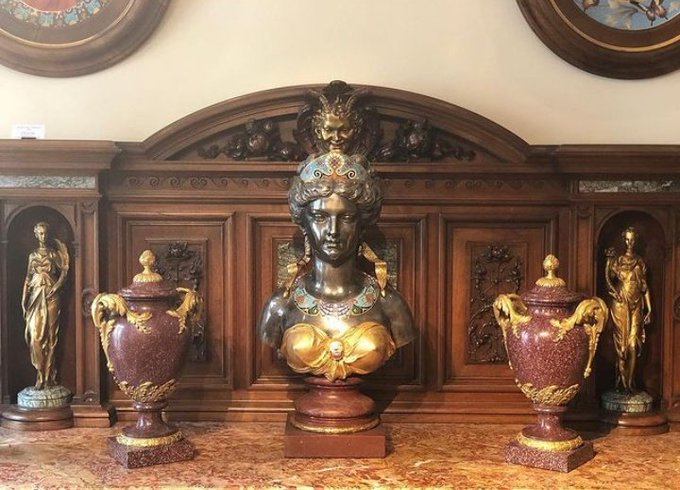
“If the apparition of the night before was an ocular delusion of my fancy sporting with the dark outlines of our cupboard, and if tis horrid eyes were nothing but a pair of inverted teacups, I had, at all events, the satisfaction of having launched the poker with admirable effect, and in true ‘fancy’ phrase, ‘knocked its two daylights into one,’ as the commingled fragments of my tea-service testified. I did my best to gather comfort and courage from these evidences; but it would not do. And then what could I say of those horrid bare feet, and the regular tramp, tramp, tramp, which measured the distance of the entire staircase through the solitude of my haunted dwelling, and at an hour when no good influence was stirring? Confound it!—the whole affair was abominable. I was out of spirits, and dreaded the approach of night. It came, ushered ominously in with a thunderstorm and dull torrents of depressing rain. Earlier than usual the streets grew silent; and by twelve o’clock nothing but the comfortless patterning of the rain was to be heard. I made myself as snug as I could. I lighted two candles instead of one. I forswore bed, and held myself in readiness for a sally, candle in hand; for, coute qui coute, I was resolved to see the being, if visible at all, who troubled the nightly stillness of my mansion. I was fidgety and nervous and, tried in vain to interest myself with my books. I walked up and down my room, whistling in turn martial and hilarious music, and listening ever and anon for the dreaded noise.” #RandolphHarris 20 of 21

Do not Grieve. Anything you lose comes around in another form. The child weaned from mother’s milk now drinks cranberry juice. God’s joy moves from unmarked box to unmarked box, from cell to cell. As rainwater, down into flowerbed. As roses, up from ground. Now it looks like a plate of rice and fish, now a cliff covered with vines, now a horse being saddled. It hides within these, till one day it cracks them open. There is the light gold of wheat in the sun, and the gold of bread made from wheat. I have neither, I am only talking about them as a town in the desert looks up to stars on a clear night. The Son of God, looking upon the World, beheld suffering and misery. With pity He saw how humans had become victims of satanic cruelty. He looked with compassion upon those who were being corrupted, murdered, and lost. They had chosen a ruler who chained them to his carriage as captives. God’s glory pervades the Universe; His ministering Angels inquire of one another: Where is the place of His glory? In response they give praise: Praised be the glory of the Lord from His Heavenly abode. From His Heavenly abode may He turn in mercy and bestow grace unto the people who, reciting the Shema evening and morning, twice daily, proclaim in love the unity of His name, saying: Hear, O America: the Lord our God, the Lord is One. He is our God; He is our Father, our sovereign and our Deliverer. In His mercy He will make known in presence of all the living that He will be your God. “I am the Lord your God.” As it is written in holy Scripture: The Lord shall reign forever; Thy God, O America, shall be Sovereign unto all generations. Hallelujah. #RandolphHarris 21 of 21

Winchester Mystery House

Ghostly tales are bountiful at Sarah Winchester’s Mystery House. What have you experienced? Photos are encouraged!

The Winchester mansion is 160-room mansion built to appease the spirits who died at the hands of the Winchester Rifle 👻
🗝 winchestermysteryhouse.com
“Whoever shadows my every move will not lose me in the dark.” At least that is what Christ says, or what the Evangelist John heard Him say (8.12). He tells us to walk on, through the darkness, with Christ as our only torch. That way, when we mayn’t have gained a step, but we won’t have lost one either. And on into the day we must pursue with dogged tread the life of Jesus Christ. Is this the secret to Mrs. Winchester’s 7-11 staircase?

Affection and Friendship Should Not Interfere with the Fullest Attainment of Our Final End!

Every true American believes with all their hearts that when an American is tired of America, one is tired of life. With certain qualifications, a person is happy when one is in the way of a successful execution (more or less) of a rational plan of life drawn up under (more or less) favourable conditions, and one is reasonably confident that one’s intentions can be carried through. Thus we are happy when our rational plans are going well, our more important aims being fulfilled, and we are with reason quite sure that our good fortune will continue. The achievement of happiness depends upon circumstances and luck, and hence the gloss about favourable conditions. While I shall not discuss the concept of happiness in any detail, we should consider a few further points to brings out the connection with the problem of hedonism. First of all, happiness has two aspects: one is the successful execution of a rational plan (the schedule of activities and aims) which a person strives to realize, the other is one’s state of mind, one’s sure confidence supported by good reasons that one’s success will endure. Being happy involves both a certain achievement in action and a rational assurance about the outcomes. This definition of happiness is objective: plans are to be adjusted to the conditions of our life and our confidence must rest upon sounds beliefs. Alternatively, happiness might be defined subjectively as follows: a person is happy when one believes that one is in the way of a successful execution (more or less) of a rational plan, and so on as before, adding the rider that is one is mistaken or deluded, then by contingency and coincidence nothing happens to disabuse one of one’s misconceptions. #RandolphHarris 1 of 21

By good luck one is not cast out of one’s fool’s paradise. Now the definition to be preferred is that which best fits the theory of justice and coheres with our considered judgments of value. We have assumed that the parties in the original position have correct beliefs. They acknowledge a conception of justice in the light of general truths about persons and their place in society. Thus it seems natural to suppose that in framing their plans of life they are similarly lucid. Of course none of this is strictly argument. Eventually one has to appraise the objective definition as part of the moral theory to which it belongs. Adopting this definition, and keeping in mind the account of rational plans presented earlier, we can interpret the special characteristics sometimes attributed to happiness. For example, happiness is self-contained: that is, it is chosen solely for its own sake. To be sure, a rational plan will include many (or at least several) final aims, and any of these may be pursed partly because it complements and furthers one or more other aims as well. Mutual support among ends pursued for their own sake is an important feature of rational plans, and therefore these ends are not usually sought solely for themselves. Nevertheless executing the entire plan, and the enduring confidence with which this is done, is something that we want to do and to have only for itself. All considerations including those of right and justice (using here the full theory of good) have already been surveyed in drawing up the plan. And therefore the whole activity is self-contained. #RandolphHarris 2 of 21

Happiness is also self-sufficient: a rational plan when realized with assurance makes a life fully worthy of choice and demands nothing further in addition. When circumstances are especially favourable and the execution particularly successful, one’s happiness is complete. Within the general conception one sought to follow, there is nothing essential that is lacking, no way in which it could have been distinctly better. So even if the material means that support our mode of life can always be imagined to be greater, and a different pattern of aims might often have been chosen, still the actual fulfillment of the plan itself may have, as compositions, paintings, and poems often do, a certain completeness which though marred by circumstance and human failing is evident from the whole. Thus some become exemplars of human flourishing and models for emulation, their lives being as instructive in how to life as any philosophical doctrine. A person is happy then during those periods when one is successfully carrying through a rational plan and one is with reason confident that one’s efforts will come to fruition. One may be said to approach blessedness to the extent that conditions are supremely favourable and one’s life complete. Yet it does not follow that in advancing a rational plan one is pursuing happiness, not at least as this is normally meant. For one thing, happiness is not one aim among others that we aspire to, but the fulfillment of the whole design itself. However, also, I have supposed first that rational plans satisfy the constraints of right and justice (as the full theory of the good stipulates). #RandolphHarris 3 of 21

To say someone that one seeks happiness does not, it seems, imply that one is prepared either to violate or to affirm these restrictions. Therefore the acceptance of these limits should be made explicit. And secondly, the pursuit of happiness often suggests the pursuit of certain sorts of ends, for example, life, liberty, and one’s own welfare. Thus persons who devote themselves selflessly to a righteous cause, or who dedicate their lives to furthering the well-being of other, are not normally thought to seek happiness. It would be misleading to say this of saints and heroes, or of those whose plan of life is in some marked degree supererogatory. They do not have the kinds of aims that fall under this heading, admittedly not sharply defined. Yet, when their plans succeed, saints and heroes and persons whose intentions acknowledge the limits of right and justice, are in fact happy. Although they do not strive for happiness, they may nevertheless be happy in advancing the claims of justice and the well-being of others, or in attaining the excellences to which they are attracted. However, how in general is it possible to choose among plans rationally? What procedure can an individual follow when faced with this sort of decision? Previously I said that a rational plan is one that would be chosen with deliberative rationality from among the class of plans of all of which satisfy the principles of rational choice and stand up to certain forms of critical reflection. We eventually reach a point though where we just have to decide which plan we most prefer without further guidance from principle. #RandolphHarris 4 of 21

There is however one device of deliberation that I have not yet mentioned, and this is to analyze our aims. That is, we can try to find a more detailed or more illuminating description of the object of our desires hoping that the counting principles will then settle the case. Thus it may happen that a fuller or deeper characterization of what we want discloses that an inclusive plan exists after all. Let us consider again the example of planning a holiday. Often when we ask ourselves why we wish to visit two distinct places, we find that all of them can be fulfilled by going to one place rather than the other. Thus we may want to study certain styes of art, and further reflection may bring out that one plan is superior or equally good on all these counts. In this sense we may discover that our desire to go to Paris is more intense than our desire to go to Rome. Often however a finer description fails to be decisive. If we want to see both the most famous church in Christendom and the most famous museum, we may be stuck. Of course these desires too many be examine further. Nothing in the way that most desire are expressed shows whether there exists a more revealing characterization of what we really want. However, we have to allow for the possibility, indeed for the probability, that sooner or later we will reach incomparable aims between which we must choose with deliberative rationality. We may trim, reshape, and transform our aim in a variety of ways as we try to fit them together. Using the principles of rational choice as guidelines, and formulating our desires in the most lucid form we can, we may narrow the scope of purely preferential choice, but we cannot eliminate it altogether. #RandolphHarris 5 of 21

The indeterminacy of decision seems to arise, then, from the fact that a person has many aims for which there is no ready standard of comparison to decide between them when they conflict. There are many stopping points in practical deliberation and many ways in which we characterize the things we want for their own sake. Thus it is easy to see why the idea of there being a single dominant end (as opposed to an inclusive end) at which it is rational to aim is highly appealing. For if there exists such an end to which all other ends are subordinate, then presumably all desires, insofar as they are rational, admit of an analysis which shows the counting principles to apply. The procedure for making a rational choice, and the conception of such a choice, would then be perfectly clear: deliberation would always concern means to ends, all lesser ends in turn being ordered as means to one single dominant end. The many finite chains of reasons eventually converge and meet at the same point. Hence a rational decision is always in principle possible, since only difficulties of computation and lack of information remain. Now it is essential to understand what the dominant-end theorists wants: namely, a method of choice which the agent oneself can always follow in order to make a rational decision. This there are three requirements: the conception of deliberation must specify: a first person procedure which is generally applicable and guaranteed to lead to the best result (at least under favourable conditions of information and given the ability to calculate). We have no procedures meeting these conditions. A random device provides a general method but it would be rational only in special circumstances. #RandolphHarris 6 of 21

In everyday life we employ schemes of deliberation acquired from our culture and modified during the course of our personal history. However, there is no assurance that these forms of reflection are rational. Perhaps they only meet various minimum standards which enable us to get by, all the while falling short of the best that we might do. Thus if we seek a general procedure by which to balance our conflicting aims so as to single out, or at least to identify in thought, the best course of action, the idea of a dominant end seems to give a simple and natural answer. Let us consider then what this dominant end might be. It cannot be happiness itself, since this state is attained by executing a rational plan of life already set out independently. The most we can say is that happiness is an inclusive end, meaning that the plan itself, the realization of which makes one happy, includes and orders most implausible to think of the dominant end as a personal or social objective such as the exercise of political power, or the achievement of social acclaim, or maximizing one’s material possessions. Surely it is contrary to our considered judgments of value, and indeed inhuman, to be so taken with but one of these ends that we do not moderate the pursuit of it for the sake of anything else. For a dominant end is at least lexically prior to all other aims and seeking to advance it always takes absolute precedence. #RandolphHarris 7 of 21

Thus the dominant end is serving God, and by this means saving our soul. Heavenly Father desires that we find true, lasting happiness. Our happiness is the design of all the blessings He gives us—gospel teachings, commandments, priesthood ordinances, family relationship, prophets, temples, the beauties of creation, and even the opportunity to experience adversity. God’s plan for our salvation is often called “the great plan of happiness,” reports Alma 42.8. He sent His Beloved Son to carry out the Atonement so we can be happy in this lie and receive a fulness of joy in the eternities. Furthering the divine intentions is the sole criterion for balancing subordinate aims. It is for this reason alone that we should prefer health to sickness, riches to poverty, honour to dishonour, a long life to a short one, and, one might add, friendship and affection to hatred and animosity. “Wickedness never was happiness,” reports Alma 41.10. Other seek only to have fun in life. With this as their main goal, they allow temporary pleasure to distract them from lasting happiness. They rob themselves of the enduring joys of spiritual growth, service, and hard work. As we seek to be happy, we should remember that the only way to real happiness is to live the gospel. We will find peaceful, eternal happiness as we strive to keep the commandments, pray for strength, repent of our sins, participate in wholesome activities, and give meaningful service. We must be indifferent to all attachments whatsoever, for these become inordinate once they precent us from being like equalized scales in a balance, ready to take the course that we believe is most for the glory of God. #RandolphHarris 8 of 21

It should be observed that this principle of indifference is compatible with our enjoying lesser pleasures and for allowing ourselves to engage in play and amusements. For these activities relax the mind and rest the spirit so that we are better fitted to advance more important aims. Thus although Aquinas believes that the vision of God is the last end of all human knowledge and endeavour, he concedes play and amusements a place in our life. Nevertheless these pleasures are permitted only to the extent that the superordinate aim is thereby advanced, or at least not hindered. We should arrange things so that our indulgences in frivolity and jest, in affection and friendship, do not interfere with the fullest attainment of our final end. The extreme nature of dominant-end views is often concealed by the vagueness and ambiguity of the end proposed. Thus if God is conceived (as surely He must be) as a moral being, then the end of serving Him above all else is left unspecified to the extent that the divine intentions are not clear from revelation, or evident from natural reason. Within these limits a theological doctrine of morals is subject to the same problems of balancing principles and determining precedence which trouble other conceptions. Since disputed questions commonly lie here, the solution propounded by the religious ethic is only apparent. And certainly when the dominant end is clearly specified as attaining some objective goal such as political power or material wealth, the underling fanaticism and inhumanity are manifest. #RandolphHarris 9 of 21

Human good is heterogeneous because the aims of the self are heterogenous. Although to subordinate all our aims to one end does not strictly speaking violate the principles of rational choice (not the counting principles anyway), it still strikes us as irrational, or more likely as mad. The self is disfigured and put in the service of one of its ends for the sake of system. Governments are composed of persons who meet occasionally in a hall to make speeches and to write resolutions; of human studying papers at desks, receiving and answering letters and memoranda, listening to advice and giving it, hearing complaints and claims and replying to them; o clerks manipulating more papers; of inspectors, tax collectors, law enforcement, and soldiers. These officials have to be fed, and often they overeat. They would often rather go fishing, or have pleasures of the flesh, or do anything than shuffle their papers. They have to sleep. They suffer from indigestion and asthma, bile and palpitation, become bored, tired, careless, and have nervous headaches. They know what they happen to learn, they are away of what they happen to observe, they can imagine what they happen to be interested in, they can accomplish only what they can command or persuade an unseen multitude to do. What is so remarkable about America is that millions of people believe more in the power of prayer than in the power of politics; they believe the message to “repent, be converted, and trust Jesus Christ” can topple even an authoritarian leader. They believe their deliverance is spiritual. #RandolphHarris 10 of 21

Such belief runs counter to the myth that all human problems are political and solvable by all-powerful human institutions. An extreme example was the prominent New Right leader who declared in 1985, after Congress failed to pass his legislative agenda, “The only way to have a genuine spiritual revival is to have legislative reform…I think we have been legislated out of the possibility of a spiritual revival.” Evidently, the work of the Kingdom of God has been defeated by a majority vote in the kingdoms of man. I am sure that individual did not mean to deny the sovereignty of God, but his statement insinuates that nothing can be accomplished except through the government. Jacques Ellul could well have been describing this leader when he wrote that politics has become “the supreme religion of the age.” This political illusion springs from a diminishing belief in God and the growth of big government. What people once expected from the Almighty, they now expect from the almighty bureaucracy. That is bad trade for anyone; but for the Christian, it is rank idolatry. The media encourages the illusion. Stories of spiritual conversion, growth, and revival do not make god thirty-second news spots. While the everyday actions of ordinary citizens lack headline punch, politics offers confrontation, controversy, and scandal. When religion does make the cover of Time or a spot on the network news, it is usually the result of scandal, as extraordinary as the coverage of Jim and Tammy Bakker. That is not a complaint; it I simply the way the news business works, which in turn is merely satisfying the public appetite for sleazy gossip, crime, dramatically suggestive headlines, fiction, outlandish stories, and aggressive reporters. #RandolphHarris 11 of 21

Although most people claim they do not believe most of what the news reports, yet they are drawn to its promise of insider knowledge and hot scoops about celebrities, politicians, and aliens from outer space. New coverage gravitates to political centers, exalting the momentary, assuring suspense. The public waits expectantly for the next installment in the unfolding political soap opera. On one level media and government are natural antagonists; on another they are natural allies, depending on each other for their influence. News organizations concentrate their resources in political capitals; governments gear their policies and decisions for primetime audiences. The media spotlight politics and political feeds in the media. Because the illusion serves those with the power to perpetuate it, neither side cares to expose it. People watch the news like it a heavy weight fight, listening to reporters give breathless blow-by-blow accounts of propaganda, as they often ignore real news that matters. The view back home sits in front of the TV, like a mindless goldfish, being spoon fed junk news. Thousands of journalist are constantly pounding the pavements, desperate for something to film. Some camera operators shot footage of each other. Others give up and go out for fondue. Much of the news treads perilously close to heresy. If this were the seventh century, many reporters would probably be accused by Dr. William Griggs of having the evil hand upon them. News is a big business, after all, having hundreds of millions riding on Nielsen ratings. National Network personalities hold multimillion dollar contracts, and they, as well as many print journalists, enjoy the handsome rewards of celebrity. Even in nations with public-owned media, the illusion guarantees power, privilege, and access to the elite. These are not willingly surrendered. #RandolphHarris 12 of 21

This unwavering focus heightens both the promise and expectations of what government can do. Political rhetoric, therefore, mist offer panaceas to all human ills. If elected, can anyone recall a major candidate who di not claim he or she could solve any problem? However, most politicians know that more than 80 percent of the federal budget—entitlement programs and other congressionally mandated outlays—are beyond their control. Most candidates cannot have a balanced budget and federal judges often strip the president of their power to make changes to the government so society keeps getting worse, instead of improving. Politicians have little choice. Modern technology has reduced all issues to their lowest common denominator. Since there is no time to explain the complexities of the budget process, and since instant perceptions shape voter attitudes, politicians can do no more than create appealing visual impressions. Former Budget Director David Stockman chided Regan aides Baker and Meese for being more interested in the evening network news than in government policy. However, perhaps they were more realistic. Policy has no meaning apart from how it is perceived, and that perception is heavily influenced by newscasters. That is why Lyndon Johnson obsessively watched three evening news programs simultaneously on a three-console television set. He knew public reaction to the televised portrayal of Vietnam would influence opinion far more than battlefield strategies. He was right: the outcome of that war was decided in American living rooms. #RandolphHarris 13 of 21

To maintain the illusion, government attempts to shape, even manipulate public perceptions. The White House gives assignments to people to do just that. Staff members work full time studying daily news briefings, monitoring public reactions to presidential speeches, taking daily polls, and feeding positive information to friendly reporters. Often they aggressively try to manipulate public opinion. For example, immediately after every presidential speech, a White House staff member usually unleashes a small army of assistants who will call key leaders in every walk of life. They might make five hundred calls, each following the same script: “The president asked me to call you to find out what your thought of his announced policy.” The reactions are usually collated, typed, and within hours a report surveying the opinions of hundreds of leaders is in the president’s hands. Helpful information, but the staff also influences public reactions toward acceptance of their policy. To be told that the president wants one’s opinion flatters even the cynics. Those called rarely offer a critical reply; most can hardly wait to call their friends and casually mention that “by the way, the president just called” to ask their opinion. So when journalists Tomi Lahren and Yamiche Alcindor has very public interactions with President Trump about their news reports, it was really a big deal to be acknowledged. With the government policy so dependent on public reaction, it is little wonder that the celebrity syndrome has become such a major force in Western politics. #RandolphHarris 14 of 21

The subtle danger of all this manipulation is that people no longer view their own circumstances as reality. Only what appears in print and on the screen as well. The humans of the present day suffer from acute television intoxication. They do not believe in their own experiences, one’s own judgment and one’s own thought. In their eyes, a fact becomes true when one has read an account of it in the paper, and one measures the importance by the size of the headlines. This has resulted in people giving out false, distorted, or outdated information because no one calls to the agencies involved to verify if. However, people who do not trust the news actually do verify information before they take it as a fact because they know how dangerous disinformation can be. Still, many individuals gradually loses all sense of continuity. Whether a policy is good or bad, a success or a failure, is of no account; all that matters is the emotion its instant image induces. No one remembers from one day to the next. On a Monday a president can say, “The Russians blinked.” Everyone is happy. The next day it is disclosed the Russians did not blink—we did—but no one remembers. So on to the next night. The process is mesmerizing. Images pile on images, day after day, anesthetizing the public so they feel individually important and that all power resides in images they see on their television screens. This eventually erodes their own sense of political responsibility and makes them easy prey to the appetite of an authoritarian state. The consequence is irresistible. The chief characteristic of tyranny is isolation of the individual, denying one access to the public realm where one would show oneself, see and be seen, ear and be heard. #RandolphHarris 15 of 21

Even democracies need institutions and agencies through which the individual can resist the tendency of all central governments to grow larger, stronger, and more domineering. For the only thing that stands between the multitudes and totalitarianism are the mediating structures of society: families, small groups of citizens, churches, voluntary associations that are independent and resistant to the collective state. If the American experiment is to succeed, it will require the continued help of voluntary associations. Of all these independent institutions, the church should be the one best able to expose the political illusion. For the message of a transcendent reality is resounding warning against the futility of seeking immorality from the instruments and institutions of this life. Mastery of nature through technology has given modern humans the illusions that one has mastered life itself. The message of the Kingdom is that only God is master of life, and attempts to create alternatives to His rule are futile. The fall of the Roman Empire plainly demonstrated that no work of mortal hands can be immortal, and it was accomplished by the rise of the Christian gospel of an everlasting individual life to its position as the exclusive religion of Western humankind. Both together made any striving for an Earthly immortality futile and unnecessary. The Kingdom of God is not dependent on power in the kingdoms of humans. It is better to take refuge in the Lord than to trust in princes. Political kingdoms may rise and fall—but the Kingdom of God goes on forever. #RandolphHarris 16 of 21

Modern history is replete with similar lessons about the futility of putting ultimate trust in much-vaunted political systems. When a greedy tyrant is overthrown, the idealist replacing him or her promises liberation and hope for the oppressed. The people are jubilant. However, in a short time the “liberator” becomes the oppressor oneself, resplendent in one’s $6,500 designer glasses. When autocracy is replaced by bureaucracy, only the icons change. Ideology, which in so many parts of the World has replaced true religion, is powerless as well. The promised utopias of the twenty-first century., either Marxist of Fascist, are doomed because they accept the essential premises of current civilization and move with its lines of internal development: Thus, utilizing what this World itself offers them, they become slaves, although they think they are transforming it. Even massive weapons of destruction fail to assure anything for today’s mightiest governments. Wars reach no permanent solutions; there is no such things as a lasting peace or, as American so fondly believed, “a war to end all wars.” Terrorists stalk the globe, and government can do little to stop them. Wars proliferate; political solutions fail; frustrations rise. Yet we continue to look to governments to resolve problems beyond their capability. The illusion persists. Nowhere is that more evident than in one troubled corner of the World. However, even there, in the midst of carnage, violence, and hatred, the example of a few people offers hope, pointing the way for civilization to emerge from darkness. #RandolphHarris 17 of 21

Each of us must gain for oneself the authentic mystical experience. Sugar can be known only by its sweet taste, the Overself only by opening the doors of the mind to consciousness of its presence. Those who have had this overwhelming experience require no arguments to make them believe in the soul. They know that they are the soul. An experience which is so convincing, so real, that no intellectual argument to the contrary can stand against it, is final. Let others say what they will, one remains unswayed. A glimpse is a transitory state of mental enlightenment and emotional exaltation. It I an experience of self-discovery, not the discovery of some other being, whether a guru or a god. These brief flashes bring with them great joy, great beauty, and great uplift. They are, for most people, their first clear vivid awakening to the existence and reality of a spiritual order of being. The contrast with their ordinary state is so tremendous as to shame it into pitiful drabness. The intention is to arouse and stimulate them into the longing for re-entry into the spirit, a longing which inevitably express itself in the quest. In the past these glimpse experiences were regarded as wholly religious. Today the truth about them is better understood. They may be aesthetic, psychological, intellectual, or creative—happening outside the religious circle. All our ordinary experience comes to us through sense responses or intellectual workings. However, here is a kind of experience which does not come through these two channels. It is not a series of sensations nor a series of thoughts. What is it, then? Philosophy says it belongs to the transcendental World. #RandolphHarris 18 of 21

The uniqueness of this moment shines out against the relatedness of all other moments. Words only limit it by their precision and their pressure, yet they are all some of us have with which to make a likeness of it to show friends, or to hold before the ardent seekers, or even to return to ourselves in dark and difficult periods. The glimpse may be best compared to a moment of wakefulness in a long existence of sleep. These mystical glimpses have close parallels with the best features of the best types of religious conversion. Indeed, as might be expected, they are deeper and more developed and better controlled forms of them. These glimpses, these transcendental visitations bring joy, serenity, and understanding. No rational explanation has given of the seemingly eccentric characters of these glimpses, no reasonable theory of their why, what, how, and when. The mystical experience may be beyond reasoned analysis but it is not beyond reasonable description. Putting words together on paper to tell how this glimpse lifts one out of the ordinariness of the common existence, is a work anyone must enjoy doing. It is a brief and temporary enlargement of consciousness, in theological language, an improvement of its connection with God. How is one to describe this experience? It is an expansion, and yet also a concentration, of consciousness. It is not enough to say that someone has had a mystical experience. This phrase can over the most opposite, the most widely different experiences. The experience is so beautiful that no description can transfer the feelings it awakens from one heart to another. #RandolphHarris 19 of 21

There are the real waking moments of a person’s life: for the rest one is asleep without ever guessing that one is. It is not the highest point of the moral experience, although that approaches it, or can help to being it on, or acts as a preparation for it. It is not the peak of the aesthetic experience, although that fulfills the same services. A long time I have lived with you and now we must be going separately to be together. Perhaps I shall be the wind to blur your smooth waters so that you do not see your face too much. Perhaps I shall be the star to guide your uncertain wings so that you have direction in the night. Perhaps I shall be the fire to separate your thoughts so that you do not give up. Perhaps I shall be the rain to open up the Earth so that your seed may fall. Perhaps I shall be the snow to let your blossoms sleep s that you may bloom in spring. Perhaps I shall be the stream to play a song on the rock so that you are not alone. Perhaps I shall be a new mountain so that you always have a way home. Here are life’s highest processes, an experience beyond thinking and an awareness beyond the sensual. During this period one is in God. These rare moments lift one out of one’s terrestrial self and detach one from one’s lower human self. Only a poet could portray these experiences as they deserve; to write of them with outer photographic exactness only is to half-lose them. In religious language one is in God, and in mystical language God is in one. One has reached a World which is as much beyond good as it is beyond evil. #RandolphHarris 20 of 21

Magnified and sanctified be the name of God throughout the World which He hath created according to His will. May He establish His kingdom during the days of your life and during the life of your life and during the life of all the house of America, speedily, yea, soon; and say ye, Amen. May His great name be blessed for every and ever. Exalted and honoured be the name of the Holy One, blessed be He, whose glory transcends, yea, is beyond all praises, hymns and blessings that humans can render unto Him; and say ye, Amen. When I call upon the Lord, ascribe greatness unto our God. O Lord, open Thou lips and my mouth shall declare Thy praise. Praised art Thou, O Lord our God and God of our fathers, Go of Abraham, God of Isaac, and God of Jacob, mighty, revered and exalted God. Thou bestowest lovingkindness and possessest all things. Mindful of the patriarchs’ love for Thee, Thou wilt in Thy love bring a redeemer to their children’s children for the sake of Thy name. Please remember us unto life, O King who delightest in life, and inscribe us in the Book of Life so that we may live worthily for Thy sake, O Lord of life. O King, Thou Helper, Redeemer and Shield, be Thou praised, O Lord, Shield of Abraham. Thou, O Lord, art mighty forever. Thou callest the dead to immortal life for Thou art mighty in deliverance. Thou causest the wind to blow and the rain to fall. Thou sustainest the living with lovingkindness, and in great mercy callest the departed to everlasting life. Thou upholdest the falling, healest the sick, settest free those in bondage, an keepest faith with those that sleep in the dust. Who is like unto Thee, Almighty King, who decreest death and life and bringest forth salvation? God provides an experience of complete security—so rarely found among people in the World today. #RandolphHarris 21 of 21

BRIGHTON STATION AT CRESLEIGH RANCH
Rancho Cordova, CA |
Now Selling!

Brighton Station at Cresleigh Ranch is Rancho Cordova’s newest home community! This charming neighborhood offers an array of home types with eye catching architecture styles such as Mid-Century Modern, California Modern, Prairie, and Contemporary Farmhouse.

Located off Douglas Road and Rancho Cordova Parkway, the residents of Cresleigh Ranch will enjoy, being just minutes from shopping, dining, and entertainment, and quick access to Highway 50 and Grant Line Road providing a direct route into Folsom. Residents here also benefit from no HOA fees, two community parks and the benefits of being a part of the highly-rated Elk Grove Unified School District.

Best of all, each Cresleigh home comes fully equipped with an All Ready connected home! This smart home package comes included with your home and features great tools including: video door bell and digital deadbolt for the front door, connect home hub so you can set scenes and routines to make life just a little easier. Two smart switches and USB outlets are also included, plus we’ll gift you a Google Home Hub and Google Mini to help connect everything together!

Cresleigh offers enchanting homes that have all the amenities you have come to expect in a grand home.


This is the Beginning, When People Will Be Opening their Eyes!

Nothing is quite as funny as the unintended humour of reality. The original position is designed to be a fair and impartial point of view that is to be adopted in our reasoning about fundamental principles of justice. In taking up this point of view, we are imagining ourselves in the position of free and equal persons who jointly agree upon and commit themselves to the principles of social and political justice. The main distinguishing feature of the original position is “the veil of ignorance”: to insure impartiality of judgment, the parties are deprived of all knowledge of their personal characteristics and social and historical circumstances. The two principles of justice guarantee the equal basic rights and liberties needed to secure the fundamental interests of free and equal citizens and to pursue a wide range of conceptions of good. The second principle provides fair equality of education and employment opportunities enabling all to fairly compete for powers and positions of office; and it secures for all a guaranteed minimum of the all-purpose means (including income and wealth) that individuals need to pursue their interests and to maintain their self-respect as free and equal persons. Persons in the original position give pride of place to their interest in the equal freedoms. The intuitive idea behind the precedence of liberty is that if the persons in the original position assume that their basic liberties can be effectively exercised, they will not exchange a lesser liberty for an improvement in the economic well-being, at least not once a certain level of wealth has been attained. #RandolphHarris 1 of 21

It is only when social conditions do not allow the effective establishment of these rights that one can acknowledge their restriction. Only if it is necessary to enhance the quality of civilization so that in due course the equal freedoms can be enjoyed by all can the denial of equal liberty can be accepted. The lexical ordering of the two principles is the long-run tendency of the general conception of justice consistently pursued under reasonably favourable conditions. Eventually there comes a time in the history of a well-ordered society beyond which the special form of the two principles takes over and holds from then on. What must be shown then is the rationality of this ranking from the standpoint of the parties in the original position. Clearly the conception of goodness as rationality and the principles of moral psychology have a part in answering this question. Now the basis for the priority of liberty is roughly as follows: as the conditions of civilization improve, the marginal significance for our god of further economic and social advantages diminishes relative to their interests of liberty, which become stronger as the conditions for the exercise of the equal freedoms are more fully realized. Beyond some point it becomes and then remains irrational from the standpoint of the original position to acknowledge a lesser liberty for the sake of greater material means and amenities of office. This is so because as the general level of well-being raises (as indicated by the index of primary goods the less favoured can expect) only the less urgent wants remain to be met by further advances, at least insofar as human’s wants are not largely created by institutions and social forms. #RandolphHarris 2 of 21

At the same time the obstacles to the exercise of the equal liberties decline and a growing insistence upon the right to pursue our spiritual and cultural interests assert itself. Increasingly it becomes more important to secure the free internal life of the various communities of interests in which persons and groups seek to achieve, in modes of social union consistent with equal liberty, the ends and excellences to which they are drawn. In addition humans come to aspire to some control over the laws and rules that regulate their association, either by directly taking part themselves in its affairs or indirectly through representatives with whom they are affiliated by ties of culture and social situation. To be sure, it is not the case that when the priority of liberty holds, all material wants are satisfied. Rather these desires are not so compelling as to make it rational for the persons in the original position to agree to satisfy them by accepting a less than equal freedom. The account of the good enables the parties to work out a hierarchy among their several interests and to note which kinds of ends should be regulative in their rational plans of life. Until the basic wants of individuals can be fulfilled, the relative urgency of their interest in liberty cannot be firmly decided in advance. It will depend on the claims of the least favoured as seen from the constitutional and legislative stages. However, under favourable circumstances the fundamental interest in determining our plan of life eventually assumes a prior place. One reason for this I have discussed in connection with liberty of conscience and freedom of thought. #RandolphHarris 3 of 21

And a second reason is the central place of the primary good of self-respect and the desire of human beings to express their nature in a free social union with others. Thus the desire for liberty is the chief regulative interest that the parties must suppose they all will have in common in due course. The veil of ignorance forces them to abstract from the particulars of their plans of life, thereby leading to this conclusion. The serial ordering of the two principles then follows. Now it might seem that even though the desire for an absolute increase in economic advantages declines, human’s concern for their relative place in the distribution of wealth will persist. In fact, if we suppose that everyone wishes a greater proportionate share, the result could be a growing desire for material abundance all the same. Since each strives for an end that cannot be collectively attained, society might conceivably become more and more preoccupied with raising productivity and improving economic efficiency. And these objectives might become so dominant as to undermine the precedence of liberty. Some have objected to the tendency to equality on precisely this ground, that it is thought to arouse in individuals an obsession with their relative share of social wealth. However, while it is true that in a well-ordered society there is most likely a trend to greater equality, its members take little interest in their relative position as such. As we have seen, they are not much affected by envy and jealousy, and for the most part they do what seems best to them as judged by their own plan of life without being dismayed by the greater amenities and enjoyments of others. #RandolphHarris 4 of 21

Thus there are no strong psychological propensities prompting them to curtail their liberty for the sake of greater absolute or relative economic welfare. The desire for a higher relative place in the distribution of material means should be sufficiently weak that the priority of liberty is not affected. Of course, it does not follow that in a just society everyone is unconcerned with matters of status. The account of self-respect as perhaps the main primary good has stressed the great significance of how we think others value us. However, in a well-ordered society the need for status is met by the public recognition of just institutions, together with the full and diverse internal life of the many free communities of interest that equal liberty allows. The basis for self-esteem in a just society is not then one’s income share but the publicly affirmed distribution of fundamental rights and liberties. And this distribution being equal, everyone has a similar and secure status when they meet to conduct the common affairs of the wider society. No one is inclined to look beyond the constitutional affirmation of equality for further political ways of securing one’s status. No one is inclined to look beyond the constitutional affirmation of equality for further political position from a strategic point of view. It would also have the effect of publicly establishing their inferiority as defined by the basic structure of society. This subordinate ranking in the public forum experienced in the attempt to take part in political and economic life, and felt in dealing with those who have a greater liberty, would indeed be humiliating and destructive of self-esteem. #RandolphHarris 5 of 21

And so by acquiescing in a less than equal liberty one might lose on both counts. This is particularly likely to be true as society becomes more just, since equal rights and public attitudes of mutual respect have an essential place in maintaining a political balance and in assuring citizens of their own worth. Thus while the social and economic differences between the various sectors of society, the noncomparing groups as we may think of them, are not likely to generate animosity, the hardships arising from political and civic inequality, and from culture and ethnic discrimination, cannot be easily accepted. When it is the position of equal citizenship that answers to the need for status, the precedence of equal liberties becomes all the more necessary. Having chosen a conception of justice that seeks to eliminate the significance of relative economic and social advantages as supports for human’s self-confidence, it is essential that the priority of liberty be firmly maintained. So for this reason too the parties are led to adopt a serial ordering of the two principles. In a well-ordered society then self-respect is secured by the public affirmation of the status of equal citizenship for all; the distribution of material means is left to take care of itself in accordance with the idea of pure procedural justice. Of course doing this assumes the requisite background institutions which narrow the range of inequalities so that excusable envy does not arise. Now this way of dealing with the problem of status has several noteworthy features which may be brought out as follows. #RandolphHarris 6 of 21

Suppose to the contrary that how one is valued by others depends upon one’s relative place in the distribution of income and wealth. In this case, having a higher status implies having more material means than a larger fraction of society. Thus not everyone can have the highest status, and to improve one person’s position is to lower that of someone else. Social cooperation to increase the conditions of self-respect is impossible. The means of status, so to speak, are fixed, and each human’s gain is another’s loss. Clearly this situation is a great misfortune. Persons are set at odds with one another in the pursuit of their self-esteem. Given the preeminence of this primary good, the parties in the original position surely do no want to find themselves so opposed. If not impossible, it would tend, for one thing, to make the good of social union difficult to achieve. Moreover, if the means of providing a good are indeed fixed and cannot be enlarged by cooperation, as mentioned in the discussion of envy, then justice seems to require equal shares, ceteris paribus. However, an equal division of all primary gods in irrational in view of the possibility of bettering everyone’s circumstances by accepting certain inequalities. Thus the best solution is to support the primary good of self-respect as far as possible by the assignment of the basic liberties that can indeed be made equal, defining the same status for all. At the same time, distributive justice as frequently understood, justice in the relative shares of material means, is relegated to a subordinate place. #RandolphHarris 7 of 21

Thus we arrive at another reason for factoring the social order into two parts as indicated by the principles of justice. While these principles permit inequalities in return for contributions that are for the benefit of all, the precedence of liberty entails equality in the social bases of esteem. Now it is quite possible that this idea cannot be carried through completely. To some extent human’s sense of their own worth may hinge upon their institutional position and their income share. If, however, the account of social envy and jealousy is sound, then, with the appropriate background arrangements, these inclinations should not be excessive, at least not when the priority of liberty is effectively upheld. However, if necessary, theoretically we can include self-respect in the primary goods, the index of which defines expectations. Then in applications of the difference principle this index can allows for the effects of excusable envy; the expectations of the less advantaged are lower the more severe these effects. Whether some adjustment for self-respect has to be made is best decided from the standpoint of the legislative stage where the parties have more information about social circumstances and the principle of political determination applies. Admittedly this problem is an unwelcome complication. Since simplicity it itself desirable in a public conception of justice, the conditions that elicit excusable envy should if possible be avoided. Expectations of the less advantaged can be understood so as to include the primary good of self-esteem. #RandolphHarris 8 of 21

Now some may want to object to this account of the priority of liberty that societies have other ways of affirming self-respect and of coping with envy and other disruptive inclinations. Thus in a feudal or in a caste system each person is believed to have one’s allotted station in the natural order of things. One’s comparisons are presumably confined to within one’s own estate or caste, these ranks becoming in effect so many noncomparing groups established independently of human control and sanctioned by religion and theology. Humans resign themselves to their position should it ever occur to them to question it; and since all may view themselves as assigned their vocation, everyone is held to be equally fated and equally noble in the eyes of providence. This conception of society solves the problem of social justice by eliminating in thought the circumstances that give rise to it. The basic structure is aid to be already determined, and not something for human beings to affect. On this view, it misconceives human’s place in the World to suppose that the social order should match principles which they would as equals consent to. Now to this idea, parties re to be guided in their choice of a conception of justice by a knowledge of the general facts about society. They take for granted than that institutions are not fixed but change overtime, altered by natural circumstances and the activities and conflicts of social groups. The constraints of nature are recognized, but humans are not powerless to shape their social arrangements. #RandolphHarris 9 of 21

This assumption is likewise part of the background of the theory of justice. It follows that certain ways of dealing with envy and other aberrant propensities are closed to a well-ordered society. For example, it cannot keep them in check by promulgating false or unfounded beliefs. For our problem is how society should be arranged if it is to conform to principles that rational persons with true general beliefs would acknowledge in the original position. The publicity condition of requires the parties to assume that as members of society they will also know the general facts. The reasoning leading up to the initial agreement is to be accessible to public understanding. Of course, in working out what the requisite principles are, we must rely upon current knowledge as recognized by common sense and the existing scientific consensus. However, there is no reasonable alternative to doing this. We have to concede that as established beliefs change, it is possible that the principles of justice which it seems rational to choose may likewise change. Thus when the belief in a fixed natural order sanctioning a hierarchical society is abandoned, assuming here that this belief is not true, a tendency is set up that points in the direction of two principles of justice inertial order. The effective protection of the equal liberties becomes increasingly of first importance. When God wants to punish people, he gives the unjust leaders. So the answer is for the people to repent, turn from their ways, be converted, and seek God. #RandolphHarris 10 of 21

Some people only care about power and what they can do with power. May the Lord come down to protect our people. Democracy is not prescribed in the Bible, and Christians can and do live under other political systems. However, Christians can hardly fail to love democracy, because of all systems it best assures human dignity, the essence of our creation in God’s image. If a candidate wins by cheating, he or she can only be forgiven by God if one renounced the office one has obtained by fraud. There will be no divine forgiveness for this act of injustice without a previous decision to repay the damage done. However, apparently God’s forgiveness is unimportant to some ruling. When politicians rig the vote, it means all the passion for democracy and all the prayers of the people are meaningless. A government that assumes or maintains power through fraudulent means has no moral basis. If it does not of itself freely correct the evil it has inflicted on the people, then it is our serious moral obligation as a people to make it do so. Nonetheless, there is enormous sin attached to fratricidal strife. As moral outrage grows, it is important to study the Bible. God has ordained government to preserve order, but even a bad government is better than no government—which results in chaos. Government’s authority comes from God; it is a delegation. Therefore, governments—all governments—whether they acknowledge it or not, rule under God. However, does God give an unrestricted delegation? Certainly not. #RandolphHarris 11 of 21

As Jesus Christ made clear with the coin, there are two realms—and Caesar is not to usurp what belongs to God. Any government that violates the law that is higher than its own is exceeding the legitimate authority God has granted. Government must always be respected, otherwise anarchy results; but the nation may attempt to venerate a culture or race. “When the state is made to serve the aspirations of race or nation instead of the cause of justice for all, it becomes a demonic state warranting resistance and rejection by the Christian faith,” reports Donald Bloesch, Crumbling Foundations (Grand Paris, Mich.: Zondervan, 1984), 183. As Dietrich Bonhoeffer put it, “If government persistently and arbitrarily violates its assigned task, then the divine mandate lapses.” In that case the state becomes evil incarnate, as in Nazi Germany. Instead of acting as God’s instrument for preserving life and order, it does the reverse, destroying life and order. Then the church must resist. Though as argued earlier, the church’s primary function is evangelization and ministering to spiritual needs; as the principle visible manifestation of the Kingdom of God, it must be the conscience of society, the instrument of moral accountability. Richard Neuhaus eloquently wrote that “the church can and should subject to moral questioning every political agenda or cause, thus keeping the entirety of human politics under the transcendent judgement of God.” #RandolphHarris 12 of 21

The church’s first duty then would be to publicly expose the state’s immorality. The government should not be involved in corruption, oppression, the deprivation of civil liberties, nor the taking of innocent lives. As a second step the church should refuse to have any part in the state’s immorality. The church must take the next more severe measures of resistance lest its words be rendered hollow. The great evangelist Charles Finney refused communion to slave-holders. Others organized the underground railroad and rescued fugitive slaves from prison. Many ministers broke the law, were arrested, and some imprisoned. However, that state’s evil, even as egregious as slavery, does not give an unrestricted license to disobey any law; only the unjust law can properly be contested. While active resistance may succeed, as it did with slavery and the Civil-Rights Movement, it may not, however, be enough in the face of the raw power modern totalitarian states have achieved. So, when all peaceable means fail, what does the Christian do? Is revolution ever justified? Scottish reformation theologians like John Knox and Samuel Rutherford believed they could be, advocating the right of Christians to rise up against ungodly rulers. Many ministers in the colonies agreed as well; when they preached that the people had the authority to resist the king when the king violated God’s commands, they were setting the stage for the American Revolution. After dumping tea in Boston Harbour the next step of resistance was the musket. #RandolphHarris 13 of 21

A Boston preacher said that for a people to “arise unanimously and resist their prince, even to dethrone him, is not criminal but a reasonable way of vindicating their liberties and just rights.” John Adams observed, “The revolution was in the minds and hearts of the people, a change in their religious sentiments of their duties and obligations.” Some Christian activists today loosely call for a new American Revolution just as the young radical youth movements did in the sixties. However, history reveals, revolution most often results, after the bodies are buried, in one form of tyranny replacing another. G.K. Chesterton summed it up well: “The real case against revolution is this: That there always seems to be much more to be said against the old regime than in favour of the new regime.” So for the Christian, revolution is never to be lightly regarded. It is the most extreme form of disobedience. It could only be contemplated on the same justification as a just war; that is, that there must be a better alterative as a result of the revolution. Its advantages must outweigh the suffering, and the evil employed in the revolution must prevent a far greater evil than the status quo. This was the reasoning that caused Albert Einstein to abandon his pacifism in the face of a dictator’s rise to power. “To prevent the greater evil, it is necessary that the lesser—the hated military—be accepted for the time being,” Einstein contended. It was this reasoning the caused Bonhoeffer to patriciate in the plot to assassinate this dictator. #RandolphHarris 14 of 21

For Christians to justify participation in revolution, therefore, they would have to be convinced that the state had become totally opposed to the purposes of God for the state and there was no other recourse to prevent massive evil. The Exodus from Egypt is often cited as a model for political action by liberation theologians, but they ignore the fact that in the Exodus, God did not overthrow the political system in Egypt. He extracted His own people from that system, taking them to Mount Sinai that they might worship Him. In the light of this, then, what about America? What lessons are to be drawn from it? We must be aware to prevent a regime’s refusal to allow free elections, the suspensions of civil liberties, the massive corruption of the governmental process, the trampling of human rights, and a leader’s own blasphemous, at times messianic pretensions, which give the church a mandate to act. The church should be mobilized to say no to evil. The first stage of an individua approach should be entirely biblical. By preaching repentance and conversion, one can encourage outbreaks of spiritual revival all across America. One should call for people to pray for their country. A courageous cardinal and ordinary citizens can open a crack of light in the dark canopy that envelops so much of planet Earth. Through peaceful actions and resistance to evil, the Kingdom of God will be made visible again. The Late Francis Schaeffer once wrote, “If here is no place for civil disobedience, then the government has been made autonomous, and as such, it has been put in the place of the living God.” #RandolphHarris 15 of 21

The belief that government is autonomous, the ultimate repository of power, the solution to all of society’s ills, is the greatest imposter of the twenty-first century. Christians and the church have no higher calling than to expose it by every legitimate means. To some people the great trouble about any argument for the Supernatural is simply the fact that argument should be needed at all. If so stupendous a thing exists, ought it not be obvious as the sun in the sky? It is not intolerable, and indeed incredible, that knowledge of the most basic of all Facts should be accessible only by wire-drawn reasonings for which the vast majority of humans have neither leisure nor capacity? I have great sympathy with this point of view. However, we must notice two things. When you are looking at a garden from a room upstairs it is obvious (once you think about it) that you are looking through a window. However, if it is the garden that interests you, you may look at it for a long time without thinking of the window. When you are reading a book, it is obvious (once you attend to it) that you are using your eyes: but unless your eyes begin to hurt you, or the book is a text book on optics, you may read all evening without once thinking of eyes. When we talk we are obviously using langue and grammar: and when we try to talk a foreign language we may be painfully aware of the fact. However, we are talking English, we do not notice it. When you shout from the top of the stirs, “I am in half a moment,” you are usually conscious that you have made the singular am agree with the singular I. #RandolphHarris 16 of 21

There is indeed a story told about a Native American who, having learned several other languages, was asked to write a grammar of the language used by his own tribe. He replied, after some thought, that it had no grammar. The grammar he had sued all his life had escaped his notice all his life. He knew it (in once sense) so well that (in another sense) he did not know it existed. All these instances show that the fact, and through which alone you have access to all the other facts, may be precisely the one that is most easily forgotten—forgotten not because it is so remote or abstruse but because it is so near and so obvious. And that is exactly how the Supernatural has been forgotten. The Naturalists have been engaged in thinking about Nature. They have not attended to the fact that they were thinking. The moment one attends to this it is obvious that one’s own thinking cannot be merely a natural event, and that therefore something other than Nature exists. The Supernatural is not remote and abstruse: it is a matter f daily and hourly experience, as intimate as breathing. Denial of it depends on a certain absent-mindedness. However, this absent-mindedness is in on way surprising. You do not need—indeed you do not wish—to be always thinking about windows when you are looking at gardens or always thinking about eyes when you are reading. #RandolphHarris 17 of 21

In the same way the proper procedure for all limited and particular inquiries is to ignore the fact of your own thinking, and concentrate on the object. It is only when you stand back from particular inquiries and try to form a complete philosophy that you must take it into account. For a complete philosophy must get in all the facts. In it you turn away from specialized or truncated thought to total thought: and one of the facts total thought must think about is Thinking itself. There is thus a tendency in the study of Nature to make us forget the most obvious first of all. And since the Sixteenth Century, when Science was born, the minds of humans have been increasingly turned outward, to know Nature and to master her. They have been increasingly engaged on those specialized inquiries for which truncated thought is the correct method. It is therefore not in the least astonishing that they should have forgotten the evidence for the Supernatural. The deeply ingrained habit of truncated thought—what we call the “scientific” habit of mind—was indeed certain to lead to Naturalism, unless this tendency were continually corrected from some other source. However, no other source was at hand, for during the same period humans of science were coming to be metaphysically and theologically uneducated. That brings me to the second consideration. The state of affairs in which ordinary people can discover the Supernatural only by abstruse reasoning is recent and, by historical standards, abnormal. #RandolphHarris 18 of 21

All over the World, until quite modern times, the direct insight of the mystics and the reasonings of the philosopher percolated to the mass of the people by authority and tradition; they could be received by those who were no great reasoners themselves in the concrete form of myth and ritual and the whole pattern of life. In the conditions produced by a century or so of Naturalism, plain humans are being forced to bear burdens which plain humans were never expected to bear before. We must get the truth for ourselves or go without it. There may be two explanations for this. It might be that humanity, in rebelling against tradition and authority, has made a ghastly mistake; a mistake which will not be less fatal because the corruptions of those in authority rendered it very excusable. On the other hand, it may be that the Power which rules our species is at this moment carrying out a daring experiment. Could it be intended that the whole mass of the people should now move forward and occupy for themselves those heights which were once reserved only for the sages? Is the distinction between wise and simple to disappear because all are now expected to become wise? If so, our present blunderings would be but growing pains. However, let us make no mistake about our necessities. If we are content to go back and become humble plain humans obeying a tradition, well. If we are ready to climb and struggle on till we become sages ourselves, better still. However, the human who will neither obey wisdom in others nor adventure for her oneself is fatal. #RandolphHarris 19 of 21

A society where the simple many obey the few seers can live: a society where all were seers could live even more fully. However, a society where the mass is still simple and the seers are no longer attended to can achieve only superficiality, baseness, ugliness, and in the end extinction. On or back we must go; to stay here is death. One other point that may have raised doubt or difficulty is the advanced reasons for believing that a supernatural element in present in every rational human. The presence of human rationality in the World is therefore a Miracle. Human Reason an Morality have been mentioned not as instances of Miracle (at least, not of the kind of Miracle you wanted to hear about) but as prods of the Supernatural: not in order to show that Nature ever is invaded but that there is a possible invader. Whether you choose to call the regular and familiar invasion by human Reason a Miracle or not is largely a matter of words. Its regularity—the fact that it regularly enters by the same door, human pleasures of the flesh—may incline you not to do so. It looks as if it were (so to speak) the very nature of Nature to suffer this invasion. However, then we might later find that it was the very nature of Nature to suffer Miracles in general. Fortunately the course of our argument will allow us to leave this question of terminology on one side. We are going to be concerned with other invasions of Nature—with what everyone would call Miracles. #RandolphHarris 20 of 21

Our question could, if you liked, be put in the form, “Does Supernature every produce particular results in space and time except through the instrumentality of human brains acting on human nerves and muscles?” I have said “particular results” because, on our view, Nature as a whole is herself one huge result of the Supernatural: God created her. God pierces her wherever there is a human mind. God presumably maintains her in existence. The question is whether He ever does anything else to her. Does God, beside all this, ever introduce into her events of which it would not be true to say, “This is simply the working out of the general character which God gave to Nature as a whole in creating her”? Such events are what are popularly called Miracles: and it will be in this sense only that the word Miracle will be used from now on. Do not stand at my grace and weep, I am not there. I do not sleep. I am a though rays of light that glow. I am the diamond glint on snow. I am the moonlight on the shinning sea. I am the gentle autumn rain. When you wake in the morning hush, I am the swift, uplifting rush or quiet birds in circling flight. I am the soft starlight at night. Do not stand at my grace and weep. I am not there. I do not sleep. Our God and God of our fathers, we thank Thee for Thy Torah, our priceless heritage. May the portion we have ready today inspire us to do Thy will and to seek further knowledge of Thy word. Thus our minds will be enriched and our lives endowed with purpose. May we take to heart Thy laws by which humans truly live. Happy are all who love Thee and delight in Thy commandments. Amen. #RandolphHarris 21 of 21

Cresleigh Homes

There’s something irresistible about eating at the island; it’s casual, yet festive. Guests can be part of the food prep, and everyone gets to make merry together all evening long.

Meadows Res 1 shows just how well single story living suits the family who loves to entertain!

Residence One at Cresleigh Meadows holds 2,054 square feet of single story living. The open concept design includes three bedrooms, two bathrooms and a two car garage plus workshop. Through the charming front porch enter into the foyer, where two secondary bedrooms lead off to a Jack and Jill bathroom. The kitchen comes fully equipped with a large eat-in island, stainless steel appliances, and quartz counters. The great room is spacious and full of natural light. The Owner’s suite is nestled in the rear of the home separate from the secondary bedrooms, providing maximum privacy. Enjoy a spa like experience in the Owner’s bathroom with a large walk in shower and large soaking tub.

Best of all, each Cresleigh home comes fully equipped with an All Ready connected home! This smart home package comes included with your home and features great tools including: video door bell and digital deadbolt for the front door, connect home hub so you can set scenes and routines to make life just a little easier. Two smart switches and USB outlets are also included, plus we’ll gift you a Google Home Hub and Google Mini to help connect everything together!

There is nothing more important than a good, safe, secure home. Come and see why Cresleigh is America’s Favourite.
#CresleighHomes
#PlumasRanch
 Randolph Harris II International Institute