
Home » toilet technology (Page 6)
Category Archives: toilet technology

By the Way of King Diamond and Diamond Baby

Black metal, as a 1990s phenomenon, is a creature with an identity largely distinct from its parent heavy metal music. Growing like a poisonous fungus away from the light of mainstream media and interest, it developed its own bizarre sounds, imagery and philosophies. Fostered upon a diet of xeroxed fanzines with names like Thanatograpy (after Thanatos, Greek god of death), Hammer of Damnation and Baphomet, its teenage male exponents were keen to make their mark with a genre too willfully obnoxious for outsiders. Visually, bands tried to outdo each other with outrageously macabre or offensive imagery: fire-breathing; tattered black clothing or robes; blood-soaked or naked flesh; medieval weaponry; bullet belts and spiked leather; insane calligraphy—spattered with profane images—which rendered band names illegible or scarcely identifiable. The most striking black-metal “fashion statement,” however, was the sepulchral black-and-white make-up worn by many bands which became known as “corpse paint”—a mutated offspring of the theatrical greasepaint worn by KISS in the 1970s, by way of King Diamond. At the movements genesis, few band members had racked up enough years of experience to excel at their instruments in the traditional fashion—instead, they concentrated on producing unearthly, crazed, bizarre sounds with guitars, drums, the human voice and keyboards. Specialist independent record labels, founded by fans or the bands themselves, sprang up as a truly international underground: Osmose Productions in France; Blackground Records 2.0 and Wild Rags in America; Candlelight Records in Spain. The list continues to proliferate to the present day, but the most influential of all was a small Scandinavian label called Deathlike Silence—of which, much more later. #RandolphHarris 1 of 21
One of the more arresting rock artists of the early 1990s bridged the gap between the musical extremes of black metal and rock “n” roll’s demonic roots in the blues. Far subtler than most black metal bands, Glenn Danzig still operated at the infernal end of the spectrum. An anomaly who stubbornly refused to bow to the expectations of either purists or populists, Danzig began his career at the height of the punk revolution in 1977 as vocalist for New Jersey band the Misfits. No ordinary punk band, Danzig’s classic rock “n” roll delivery gave a quasi-1950s feel to their abrasive sound, while they spurned the usual punk look in devour of an all-year-round Halloween image. Sporting monstrous black quiffs they dubbed “devil locks,” the Misfits often took the stage in skeletal garb—indeed, Danzig’s skull make-up was prescient of the “corpse paint” popular among the 1990s black metal bands. The Misfits were one of the first punk bands whose songs possessed a strong gothic undercurrent. Many reflected their love of fascinating schlock movies, such as “Teenagers from Mars” and “Return of the Fly,” but others were genuinely disturbing explorations of hat and violence. Their second recording, Bullet, featured a song entitled “Hollywood Babylon,” inspired by magus and film-maker Kenneth Anger, while another track included an authentic Latin chant for effecting a werewolf transformation. In what was to become a familiar pattern, Danzig tired of the more tongue-in-cheek aspects of the Misfits, forming Samhain (pronounced “Sow-En”—the precursor to Halloween, a Celtic festival dedicated to fire and death) who released their first album, Initium, in 1984. This was a stark journey into primal evil, threatening rhythms and bleak guitars combining with Danzig’s lupine vocals to create a musical beast that howled at the World. It was all too bleak for most audiences and, in 1987, the vocalist dissolved the band in order to enter his third incarnation—called simply Danzig. #RandolphHarris 2 of 21

Danzig was in many ways the singer’s most innovative project, as well as the most overtly Satanic. Voodoo blues as deep and black as Mississippi mud met predatory heavy metal, with vocal style redolent of early rock “n” roll’s late-fifties/early-sixties crooners. Typically, Glenn Danzig’s insistence on treating his Satanic subject matter without a trace of irony did not endear him to the press. Short, powerfully built, with raven black hair and prominent side-burns, the music media dubbed him as “Evil Elvis” or, more irreverently, “Fonzig.” Some audiences were also perplexed: younger black metal fans wanted a less subtle Satanism, while rock fans who appreciated Danzig’s musical approach found his lyrical preoccupation off-putting. Nevertheless, the ban attracted a dedicated fan base, appreciative of a familiarity with demonic subject matter that most shock-horror rockers could only envy. Nietzschean howls of defiance against the Creator, such as “Godless,” complemented more traditional takes on hellish suffering like “Tired of Being Alive.” At his quietest, Danzig was at his most sinister—like the poet William Blake, Danzig identified love as “a Devil’s thing.” In 1994, when MTV picked up on the video for the anthemic “Mother, the band received mainstream attention; in the same year, an uncompromising Glenn Danzig released a solo project entitled Black Aria: an album of quasi-classical music retelling the story of Satan’s fall from grace. In 1996, after four albums of powerfully-infernal rock music, Danzig took his eponymus band in a new direction. BlackAcidDevil was predominantly an industrial record, many fans mourning the passing of the classic Danzig sound and dismissing at as “poor man’s Nine Inch Nails.” In truth, when the industrial grind is layered with the dark velvet of Danzig’s seductive tones—as on “Come to Silver,” an exploration of temptation—then the material becomes really interesting. #RandolphHarris 3 of 21
The indifferent sales and reviews that greeted BlackAcidDevil tested Danzig’s already-strained relationship with the music business. He let the band slip back into the cult status he was perhaps happiest with, and began spending the money he had made from his musical career on other projects—most notably a comic-book company named Verotik. As the company’s name suggests, these comics are crammed with violence and erotica, combined with the fascination for all things infernal that has become Glenn Danzig’s trademark. Scripting many of the comic-strips himself, Danzig introduced overly devilish characters, like the vamp Satanika, to stake his claim as one of the main modern contributors to Satanic popular culture. On the continent of Europe, particularly in the Norwegian capital, Oslo, things were being taken to a less subtle extreme. Deathlike Silence was an independent record label owned by a young man who re-named himself Euronymous—according to some folklore traditions, a cannibalistic demon with skin the bluish-black colour of a meatfly’s carapace—who also ran a dank, dingy specialist record store named Helvete (meaning “Hell”) and founded a band called Mayhem. Mayhem formed in 1984, just as the original black metal scene was peaking, debuting with a demo called Pure Fucking Armageddon and an album called Deathcrush. Interest in Satanic imagery, with its attendant gothic spikes-and-leather garb, was faltering among audiences at this time, but Mayhem clung onto its uncompromising style. They sounded like a rawer, more grinding version of Venom, screaming and thundering between militaristic marches and growling rage. As the tastes of young underground fans in the 1990s swung further towards the diabolical excess, Euronymous’ obsessive dedication made him a potent force on the newly-burgeoning black metal scene. #RandolphHarris 4 of 21
During the early 1990s, Euronymous’ store became the focus for a small circle of likeminded Scandinavian metal fans who all started their own bands. This loose group named itself variously the Black Metal Circle, Satanic Terrorists or Black Metal Mafia, and was influenced by the supposedly Satanic doctrines of Euronymous—based around a vague reading of the biblical concept of war between Heaven and Hell. For Euronymous, siding with Satan meant endorsing everything that was considered evil, spiteful, hateful. Hate motivated his philosophy, coloured by the cold, depressive morbidity that characterizes the negative edge of the Scandinavian psyche. All of the releases on Deathlike Silence were stamped with the “Anti-Mosh” symbol (moshing is a raucously combative form of dancing common to thrash and death metal fans). Around the symbol were stamped the messages “No Mosh,” “No Core” (a reference to the hardcore punk revival), “No Trends” and “No Fun”—these sentiments taking against those metal audiences who were introducing splashes of gaudy mainstream colour, in the form of Bermuda shorts, baseball caps and skateboards. In the center of the “No Moshing” symbol was a red line struck through those figures Euronymous professed to hate most: Scott Burns, the Florida-based record producer whose work had come to dominate the death metal scene, and curiously, Anton LaVey. Euronymous divorced himself from all Satanic tradition, loathing LaVey because of the Church of Satan’s philosophy of self-empowerment and individualism. Euronymous’ simple faith expressed all that was negative: a cold core for violent code of self-destructive nihilism. Joining Mayhem in their isolated World of hate were several other extreme bands. Burzum—chiefly a vehicle for Count Grishnackh (given name Kristian Vikernes, though he legally changed his first name to Varg, Norwegian for “wolf”), who had lived in the damp, lightless cellar of the Helvete record shop for some time—were a prominent presence. Burzum were an odd blend of frustrated insanity and strange, sad, ambient mood music, pained pathos and gibbering fury—oddly effective, but distinctly disturbed. #RandolphHarris 5 of 21

Founder member Grishnackh took his name from one of the evil “orc” characters in J.R.R. Tolkien’s fantasy trilogy The Lord of the Rings, while Burzum meant “darkness” in the orcish language conceived by Tolkien. Perverse as this seems, it should be remembered that The Bible is just a book of stories—in this light, perhaps using The Lord of the Rings as the basis for an (im)moral philosophical code is not wholly ludicrous. However, it does an infernal philosopher’s credibility no favours to identify too closely with “hobbits” (glorified goblin). Grishnackh’s personal mythology combined the darkness-versus-light motifs of “mystic quest”/sword-and-sorcery sagas with the violent Viking tradition he believed true Northern Europeans belonged to. While this seems symptomatic of Scandinavia’s peripheral removal from—and distorted imitation of—Western pop culture, it also has an authentic dark side. As is common among Norse pagan revivalists, the Black Metal Circle began to espouse race-based Nazi political views. (Though totalitarian-loving Euronymous also expressed admiration for communist despots and Cambodian genocidalist Pol Pot.) Also pivotal in this new movement were the bands Emperor, Immortal, Enslaved and Arcturus. The last to join Euronymous’s Norwegian cadre were Dark Throne, who had already recorded one death metal album, Soulside Journey, in 1990. In the following year, they disowned their debut, donned corpse-paint and joined the “Satanic Mafia” with their album A Blaze in the Northern Sky. If Euronymous exemplified the nihilistic hate at the heart of the Black Metal Circle, and Burzum represented its violent Norse/Nazi fantasies, then Dark Throne symbolized the Circle’s isolation and sociopathic need for solitude. Taking their country’s sombre, anti-social reputation to extremes, the band never met to record, spoke little, and spent increasing periods alone in the frost-bitten Norwegian wilderness. #RandolphHarris 6 of 21

In the spring of 1991, Mayhem’s vocalist died: a Swede who, by way of black comedy, had re-named himself “Dead.” Dead blew his head off with a shotgun, leaving a note to day that he felt he was not of this World, but belonged instead to the cold solitude of the forest. He also apologized for the mess. As in common with obsessively inward-looking groups like the Black Metal Circle, a crisis of this type either causes the grouping to dissolve, or re-enforces their convictions. The latter instance applied, and the Circle hailed Dead as a hero. Euronymous, who found the corpse, rushed out for a camera to take his final photograph of Dead before altering the authorities—claiming a morsel of brain to make into soup and a fragment of skull to fashion into a necklace. At this point, the Black Metal Circle were no longer merely a group of disaffected teens and early-twentysomethings, but a subculture who believed themselves to be at the center of significant, apocalyptic events. Euronymous’ demented, anti-social rants were making him a regular feature in the underground metal fanzines; despite the continued indifference of the global music media, black metal was rising from the grassroots across the World. The “legend of Dead” contributed to a growing international interest in extreme, Scandinavian Satanic metal, with Deathlike Silence treating the grim event as a grotesque promotional gimmick. For the first time, European countries bordering the Mediterranean also began throwing up a slew of black metal acts—most notably the Greek band Rotting Christ. In contrast to the could hatred of the Northerners, the Southern European scene was inclined to a less self-destructive, more LaVeyan approach—though Anton LaVey would have regarded many of them as blasphemy-fixated novices, struggling to topple the repressive Christianity that dominates their culture. #RandolphHarris 7 of 21

Much of black metal is supposed to be inspired by demons. They cannot be any worse than human being, right? Many of them just have never possessed a body of their own. They are souls who have been lurking around before humanity. Before the dinosaurs. They are the darkness. The reason God created life so that life could flourish and grow and rest when it is dark. Demon possession is a condition in which one or more evil spirits or demons inhabit the body of a human being and can take complete control of their victim at will. By temporarily blotting out one’s consciousness, they can speak and act through one as their complete slave and tool. The inhabiting demon (or demons) comes and goes much like the proprietor of a house who may or may not be “at home.” When the demon is “at home,” one may precipitate an attack. In these attacks the victim passes from one’s normal state of possession. The condition of the afflicted person in the “possessed” state varies greatly. Sometimes it is marked by depression and deep melancholy, sometimes by vacancy and stupidity that resemble idiocy. Sometimes the victim may be ecstatic or extremely malevolent and wildly ferocious. During the transition from the normal to the abnormal state, the victim is frequently thrown into a violent paroxysm, often falling to the ground unconscious, foaming at the mouth with symptoms similar to epilepsy or hysteria. The intervals between attacks vary greatly from an hour or less to months. Between attacks, the subject may be healthy and appear normal in every way. The abnormal or demonized stages can last a few minutes or several days. Sometimes the attacks are mild; sometimes they are violent. If they are frequent and violent, the health of the subject suffers. The chief characteristic of demon possession or demonomania is the automatic projection of a new personality in the victim. During attack the victim’s personality is completely obliterated, and the inhabiting demon’s personality takes over completely. #RandolphHarris 8 of 21

The inhabiting demon uses the victim’s body as a vehicle for one’s own thoughts, words, and acts. The demon even speaks out of the victim’s mouth and declares emphatically that one is a demon. Frequently one gives one’s name and dwelling place. The new personality reveals itself in a different voice and sometimes uses a different language or dialect on a completely different educational or cultural level. Pronouns are used to emphasize the new personality. The first personal pronoun consistently designates the inhabiting demon. Bystanders are addressed in the second person. The victim is referred to in the third person and looked upon during the attack as unconscious and for all practical purposes as nonexistent during this interval. Demonomania should be clearly differentiated from the insanity in which a person imagines oneself to be someone else, often a famous personality such as Liz Taylor, Julius Caesar, of William Randolph Hearst. The demoniac, when in the demonized state characterized by the new personality, speaks and acts in all respects like a completely different person. By contrast, the insane person is one’s own diseased self, one’s assumed personality being a transparent unreality. In cases of demon possession the new personality clearly and constantly recognizes the distinct existence and individuality of its “possessed” victim, speaking of that victim in the third person, an element entirely lacking in cases of insanity. Because various inadequate theories have left demon possession largely unexplained, it is quite probable that some patients in mental hospitals are demon possessed rather than insane. This was the conviction of the famous nineteenth-century specialist in mental diseases, Dr. Forces Benignus Winslow (1810-1874). He correctly recognized the demoniac by a strange duality; and by the fact that, when temporarily relived from the oppression of the demon, he is frequently able to describe the force which takes control of one and compels one to act and speak shamefully. #RandolphHarris 9 of 21

While in the demonized state many persons give evidence of knowledge which cannot be accounted for naturally. The demon who takes control of the body of one’s victim is obviously the source of the superhuman knowledge. While demon possessed, many persons recognize the Lord Jesus Christ as the Son of God, and display an aversion to and a fear of Him (Mark 1.23-24; 5.7). The case of Mrs. Winchester, who lived in Santa Clara County, illustrates how a woman came under demon domination through practicing séances. Being centered within our own God like power is of utmost importance. Even when evoked to create change directly, keep in mind that you are the God that wields these powers for the cause of Counter Creation. Just be careful! As a God you will be tested and so how these powers are wielded is a powerful initiatic test in its own right. Mrs. Winchester was in her Blue Séance Room, she lite a candle on her left first, and then a candle on her right. A sacred serpent was sacrificed over the wood sigil and the blood was left to drain upon the idol. Then the body of the serpent was encircled around it, she chanted “I do invocate and conjure thee, O Spirit, Sabnock; and being with power armed from the SUPREME MAJESTY, I do strongly command thee, by BERALANENSIS, BALADACHIENSIS, PAUMACHIA, and APOLOGIAE SEDES; by the most Powerful Princes, Genii, Liachidae, and Ministers of the Tartarean Abode; and by the Chief Prince of the Seat or Apologia in the Ninth Legion, I do invoke thee, and by invocating conjure thee. And being armed with power from the SUPREME MAJESTY, I do strongly command thee, by Him Who spake and it was done, and unto whom all creatures be obedient. Also I, being made after the image of GOD, endued with power from GOD and created according unto His will, do exorcise thee by that most mighty and powerful name of GOD, EL, strong and wonderful; O thou Spirit Sabnock. And I command thee and Him who spake the Word and HIS FIAT was accomplished and by all the names of God. #RandolphHarris 10 of 21

“Also by the names ADONAI, EL, ELOHIM, ELOHI, EHYEH, ASHER EHYEH, ZABAOTH, ELION, IAH, TETRAGRAMMATON, SHADDAI, LORD GOD MOST HIGH, I do exorcise thee and do powerfully command thee, O thou Spirit Sabnock, that thou dost forthwith appear unto me here before this Circle in a fair human shape, without any deformity or tortuosity. And by this ineffable name, TETRAGRAMMATON IEHOVAH, do I command thee, at which being heard the elements are overthrown, the air is shaken, the sea runneth back, the fire is quenched, the Earth trembleth, and all the hosts of the celestials, terrestrials, and infernals do tremble together, and are troubled and confounded. Wherefore come thou, O Spirit Sabnock, forthwith, and without delay, from any or all parts of the World wherever thou mayest be, and make rational answers unto all things that I shall demand of thee. Come thou peaceably, visibly, and affably, now, and without delay, manifesting that which I shall desire. For thou art conjured by the name of the LIVING and TRUE GOD, HELIOREN, wherefore fulfill thou my commands, and persist thou therein unto the end, and according unto mine interest, visibly and affably speaking unto me with a voice clear and intelligible without any ambiguity. I do invocate, conjure, and command thee, O thou Spirit Sabnock, to appear and to show thyself visible unto me before this Circle in fair and comely shape, without any deformity or tortuosity; by the name and in the name IAH and VAU which Adam heard and spake; and by the name of God, AGLA, which Lot heard and was saved with his family; and by the name IOTH, which Jacob heard from the angels wrestling with him, and was delivered from the hand of Esau his brother; and by the name ANAPHAEXTON which Aaron heard and spake and was made wise; and by the name ZBAOTH, which Moses named and all the rivers were turned into blood; and by the name ASHER EHYEH ORISTON, which Moses named, and all the rivers brought forth frogs, and they ascended into the house, destroying all things. #RandolpHarris 11 of 21
“And by the name ELION, WHICH Moses named, and there was a great hail such as had not been since the beginning of the World; and by the name ADONAI, which Moses named, and there came up locusts, which appeared upon the whole land, and devoured all which the hail had left; and by the name SCHEMA AMATHIA which Ioshua called upon, and the sun stayed his course; and by the name ALPHA and OMEGA, which Daniel named, and destroyed Bel, and slew the Dragon; and in the name EMMANUEL, which the three children, Shadrach, Meshach and Abed-nego, sang in the midst of the fiery furnace, and were delivered; and by the name HAGIOS; and by the SEAL OF ADONI; and by ISCHYROS, ATHANATOS; and by these three secret names, AGLA, ON, TETRAGRAMMATION, do I adjure and constrain thee. And by these names, and by all other names of the LIVING and TRUE GOD, the LORD ALMIGHTY, I do exorcise and command thee, O Spirit Sabnock, even by Him Who spake the Word and it was done, and to Whom all creatures are obedient; and by the dreadful judgments of GOD; and by the uncertain Sea of Glass, which is before the DIVINE MAJESTY, mighty and powerful; by the four beasts before the throne, having eyes before and behind; by the fire round about the throne; by the holy angels of Heaven; and by the mighty wisdom of GOD; I do potently exorcise thee, that thou appearest here before this Circle, to fulfill my will in all things which shall seem good unto me; by the Seal of BASDATHEA BALDACHIA; and by this name PRIMEUMATON, which Moses named, and the Earth Opened, and did swallow up Kora, Dathan, and Abiram. Wherefore thou shalt make faithful answers unto all my demands, O Spirit Sabnock, and shalt perform all my desires so far as in thine office thou art capable hereof. Wherefore, come thou, visibly, peaceably, and affably, now without delay, to manifest that which I desire, speaking with a clear and perfect voice, intelligibly, and to mine understanding. #RandolphHarris 12 of 21

“Tbatlu! Bualu! Tulatu! Labusi! Ubisi!—Let thee also appear and being before me the Spirit of Sabnock. Sovar, merciless leader of Divs come forth! Inner eye behold the demon before me. Sovar awaken! Rise up within that I may compel the rise of the fallen ones and devour the very essence of the Holy Angel Shahrewar! I stand alone as the embodiment of the Adversary known as Ahriman, the Black Dragon of Chaos and becoming! I devour the natural order of stasis brought forth by Ahura Mazda and forge my destiny through the power of the Black Sun! Taromat, beautiful Div or rebellion come forthy! Inner eye behold the demoness before me. Toramat awaken! Rise up within that I may compel the rise of the fallen ones and devour the very essence of the Holy Angel Spandarmad! Ahirman, Lord of Darkness divine, I thank you for your presence within this unholy temple of counter creation. I have offered you the life of this noxious creature as a gateway to your manifestation within this realm to stand before me! You are Angra Mainyu who is the Lord of counter creation, whom has brought forth the mountains to the plains! You have brought forth the beasts to the field and the creatures of the night! Ahriman with your infernal blessing I ask that you would bring forth the baneful powers of the wolf kin to fill this oil with their essence that it may be compelled according to my will! I offer my nails as fangs which will devour that which stands in my way! I offer my hair to embody their predatory essence! I give my blood as a gateway to empower them to act within this world according to my will and purpose!” Then Mrs. Winchester heard the distant howling of wolves and she perceived their phantom shadows as they began to surround her and encroach. She was focused on Sabnock and dared not fear that which she had just conjured. SABNOCK—of course is the Forty-third Spirit of the Winchester Mansion. He is a Marquis, Mighty, Great, and Strong, appearing in the Form of an Armed Soldier with a Lion’s Head, riding on a pale-coloured horse. His office is to build high Towers, Castles and Cities, ad to furnish them with Armour, etcetera. Also he can conflict Men for many days with Wounds and with Sores rotten and full of Worms. He giventh Good Familiars at the request of the Exorcist. Commandth 50 Legions of Spirits; and his Seal is this, etcetera. #RandolphHarris 13 of 21

Mrs. Winchester fell down unconscious, frothing at the mouth, and was carried to her room, outside where the crescent hedge is planted. A doctor was called in gave her large doses of medicine to no avail. He left and refused to have anything more to do with the case as he saw with in hours gables and towers rise, wings of the mansion extended right before his eyes, and gardens grow from sprouts and spring up to mature plants and trees before night fall. For five of six days Mrs. Winchester raved wildly, and her staff and friends were in great distress. In desperation they proposed giving Mrs. Winchester more medicine. However, the demon, speaking through her, replied: “Any amount of medicine will be of no use.” Daisy then implored, “If medicine will be of no use, what shall we do?” The demon replied, “Burn incense to me, and submit yourself to me, and all will be well.” The staff knelt down and worshiped the demon, imploring him to torment Mrs. Winchester no longer. During that time Mrs. Winchester was in a state of complete unconsciousness. A little later when the demon drove Mrs. Winchester to renewed frenzy, her distraught staff repeated their promise to worship and serve him. They also promised that they would urge their Mrs. Winchester to do likewise. When Mrs. Winchester regained consciousness, she reluctantly consented to do so. The demon gave explicit directions regarding the proposed worship. On the first and fifteenth of each month, incense was to be burned, food offered, and the require prostration made before the shrine of himself, SABNOCK. Periodically the demon came, sometimes every few days, sometimes after a month’s lapse. Each time, Mrs. Winchester felt fluttering of her heart, a sense of overwhelming fear, and inability to control herself. She would quietly as Daisy to fetch a neighboring woman whenever the demon came. The two would burn incense to the demon in Mrs. Winchester’s stead and receive his directives, which they then communicated to the possessed. #RandolphHarris 14 of 21

Although these communications were spoken by the Mrs. Winchester’s (the victim) lips, she was completely unaware of them, since she was in the demonized state. The demon often bade the audience not to be afraid, protesting he would not harm them, but rather help them in various ways. He declared he would instruct the victim in the healing art, so that people would flock to her and be cured of their sickness. This soon proved true, although may diseases were not under the demon’s control. Apparently only those afflicted by evil spirits were completely cured. Mrs. Winchester’s long-ill child was not helped. The demon declared he controlled many inferior spirits. He also frequently outlined his plan for Mrs. Winchester’s life and work. He promised he would help her grow more proficient as a healer, and the people would compensate her for her services. Gifts thus earned were donated to the nearby ancient pagan temple. As certain parts of the Winchester mansion would appear but once every seventeen years, SABNOCK was never seen save on the eve of some awful calamity, visitors to the mansion had a very slight chance of seeing his physical body. There could be no doubt though of the existence of the mansion and SABNOCK, for everybody knows he was one of the greatest of the giants during his natural lifetime, nor could any better evidence be asked then the facts that he guided Mrs. Winchester into turning stone, wood, and class into the World’s most beautiful and bizarre mansions. The door-to-nowhere was also known as Lovers’ Leap;” from which Mrs. Winchester once flung herself when she was a state of deep morning, and survived unharmed. The path SABOCK made from the door-to-nowhere to the mountains was used by him when he would leave his island and come to shore. Upon being informed of the variety and amount of legendary material collected about the Winchester mansion and Mrs. Winchester’s doings, many people unhesitatingly pronounced the entire assortment condemned all the gathered treasures as creations of the supernatural. #RandolphHarris 15 of 21
It was very well beknown that in them old days there were giants in plenty hereabouts, but they did not make the make an appearance at the estate very often. But everyone knows that there were giants, because if there were not, no one would know of them at all. They were just like human beings, except in the matter of size, and one of them could make a dozen like men that live now. When they walked, they carried oak trees for sticks and lived in the forest of the giants, and carved the mountain and caves. (It should be noted that spiritistic visions of this nature are quite likely to occur in the course of reading occult literature. Sometimes people mistake these visions for genuine religious experiences. However, it is again a case of Satan disguising himself as an angel of the light.) Yet, there are more than 20,000 accounts of spirits, ghost, angels and demons being seen in the Winchester mansion. The uncanny phenomena places one under a charm. The pattern of the courts during this early period in the 1800s was erratic, sometimes convicting, sometimes throwing cases out of court for lack of evidence, something awarding damages for slander to those who had been maligned as witches by accusers. This vacillation sprang from the fact that the judicial bodies that heard the causes were not religious but secular, and therefore had little competence in dealing with matters that were primarily religious. As far as control was concerned, in adhering to the principles of congregationalism, the responsibility for suppressing heresy and enforcing religious behavior within the communities went to the state. The trial judges were not the sure, steadfast, confident Dominican Inquisitors or Protestant prosecutors of the Old World, but merely secular officials of the valley who had been forced into the position of trying heresy for lack of anyone else to do it. Mary Johnson, who was hired at the Winchester mansion in 1887, as a cook, admitted have had “familiarity with the Devil” and was executed by the state. She confession to have pleasures of the flesh with demons and other sorted things. She made no mention of mass meetings; rather, her Devil seems to have been a personal one, coming to her assistance when needed. #RandolphHarri 16 of 21
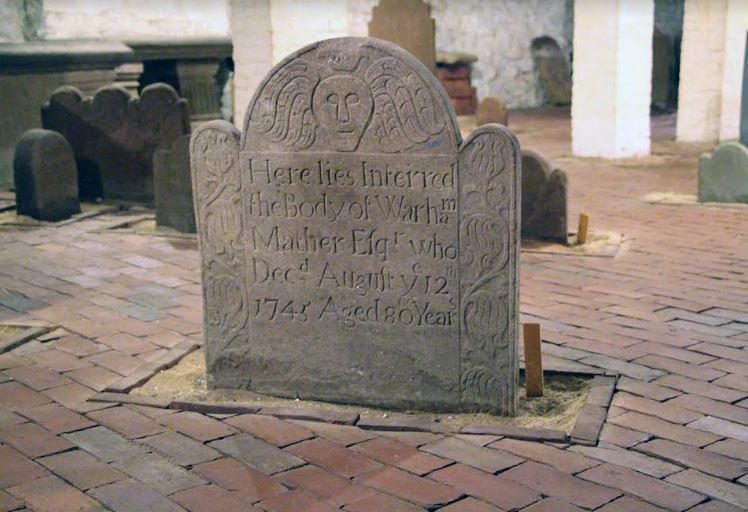
Dolls were sometimes used as a means of projecting curses, and Mary said she had attended meetings with Satan and his consorts. Witches’ pact with Satan was attributed as part of God’s inscrutable plan of the Universe. The Puritan settlers in Santa Clara Valley believed in the doctrine of Original Sin wholeheartedly; their pessimistic outlook proclaimed that all men were unworthy until God saw fit to bestow His grace upon them. They believed that the God allowed the Devil to afflict not only the guilty but also anybody else that might happen to get in the way. If He had to teach misguided humans a lesson, He might punish an entire community for the sins of the most wicked in that community. And it appeared to the God-fearing Puritans that He was doing just that. The Puritans were highly intolerant and has a paranoiac distrust of other religious groups, some were farmers at the Winchester mansion, and did not always like the rituals that were performed, but they were very loyal and protective of Mrs. Winchester. Many of the people who worked at the Winchester mansion were often under suspicion of witchcraft. The Puritans came to the Winchester mansion because they felt it was a true kingdom of God on Earth, and they could help Mrs. Winchester live peacefully. However, what they found was something different. They found that the vast acres of the estate had bitterly cold winters, and the terrain could be inhospitable. They found themselves in a wilderness, surrounded by demonic tribes whom they considered to be the legions of Hell incarnate. Having come to settle in this last stronghold of the Devil, they were plagued by him constantly for the very reason that they were God’s chosen people, thus the most likely target for unholy temptation. The fact that the new settlers in the Santa Clara Valley were being attacked by Satan seemed incontestable. The estate was ravaged by smallpox, and had suffered constant harassment by envious local town’s people and demonic tribes. Mrs. Winchester wondered what she had done to offend God that He should allow the Devil such free range. She experimented with the spirits to bring peace to her life and home. #RandolphHarris 17 of 21

Mrs. Winchester had an answer: Judgment Day was at hand and Satan was therefore stepping up his activities in one last desperate move. It was simply the nova-like burst of the energy from a dying star. She glibly stated that “there will again be an unusual Range of the Devil among us, a little before the Second Coming of the Lord, which will be to give the last stroke in destroying the works of the Devil.” This theory found wide acceptance among the servants and laity of Santa Clara Valley, for not only did it offer a simple explanation for all their maladies and misfortunes, but it also gave them hope, promising cooly a quick end to their hardships. Satan is most able to seduce human in periods o great discontent, for human, in times of poverty and affliction, will turn knowingly to whatever hands will feed them. The valley had had a difficult time of it up to that time, and famines had reduced the population drastically. However, as if labouring under the most severe environmental handicaps was not enough, Puritan perfectionism went even further in making life unbearable. In seeking to establish a holy kingdom, according to Heaven’s law, self-indulgence in any form was strictly repressed. Severe punishments were meted out for drinking, swearing, and licentiousness; in Santa Clara, it was a punishable offense to walk on the streets on Sunday, except when going to and from church. And witches, people possessed by demons, and others also attended church to blend in and keep the peace. On top of it all, there stood the Calvinistic doctrine of election, holding that as soon as man was born, eh was judged to be headed for either Heaven or Hell, this choice being made according to God’s immutable law. However, even if a human thought oneself to be damned, the civil punishment for one’s indulgence were still exacted upon one. It was into this environment that the waters of the witchcraft flood would soon pour. The good people of Santa Clara clearly saw signs of Satanic activity in their midst, and an investigation was launched. #RandolphHarris 18 of 21
Mrs. Winchester confessed to having attended witches’ Sabbaths and of having met with the Devil, who was a tall, black man from New Haven, Connecticut. Soon the witch fever spread, and more people from the valley became posses by demons. The common belief was that at that time witches, when entering into a Covenant with Satan, because the owners of specters, with the help of which they could do harm to any person of their choosing. People believe that God—the Alpha and Omega was both God and Satan. That He has a soul and character. He is not just this futile entity but someone you can see many aspects to. Some people fled to Satanism because they had to deal with so much evil from Christians that they wanted another source of power to exalt them. Satanism is supposed to be something to be something secret, something people do not know anything of. One goes to America and in the telephone directory one can see “Church of God,” “Church of Jesus,” and “Church of Satan.” One calls, and a person answers: “Church of Satan, how may I help you?” One thinks, “This is not Satanism!” The Church of Satan deny Satan, they say He does not exist, yet they act as if He dd, they rebel against God. They call themselves Satanists because He also rebelled against God, but they are basically light and life worshipping individualists. Well, the phone is tapped, so I think you better write what you know. Some people have disappeared. And of course the normal grave yard desecration. Anne Winchester’s headstone was recently stolen, but replaced. Normal people just disappear and never show up again. It could have a Satanic connection. Every human is life, and some hate life, especially human life. That is why people disappeared. These people may have disappeared for some form of sacrifice. Something like that would be called a Satanic murder. The murder is the ritual sacrifice. These murders gain power from whoever was responsible. Everybody has their own aura, and auras can be stolen by sacrificing an individual, this allows one to gain more power. #RandolphHarris 19 of 21
Places of worship, such as churches, have their own spirit—the Winchester Mystery House, for example, has been worshipped in for maybe hundreds of years and has thus gained a lot of spirit in that time, it could qualify as a church and gain charitable tax exemption. But that is not the point. A person who sacrifices that will gains a lot of power and grows stronger. Some people fear the Winchester mansion, because there are a lot of different energies. There is fear, terror and suspense, but others feel a lot of light, happiness, and goodness. Sometimes the energy is mixed. Anton LaVey really surprises me. If your every rea his work, he seems very intelligent and not scary at all, but I guess it depends on what one reads. I have read parts of his Bible, and it is very straightforward, it is stuff people tell their kids every day. Stand up for yourself and do not let people run you over. I think that the Winchester mansion should also open on nights of a full Moon, not just Friday the 13th. During the full Moon, there is a lot of energy and symbolic value. A lot of people believe in the full Moon and a lot of people believe in virgins. That makes both the full Moon and the virgin more powerful because of belief in them. God was first and He created the World. Of course, a lot of scientists would deny that. However, I would challenge their view because I believe God used evolution, which is why it took so long, which is why we have evidence like dinosaur bones. Yet, some Gnostic Christians have suggested Satan created the World. Everybody will be taken as slaves except the warlords. Euronymus, who we talked about earlier, was murdered in August 1993, Aaliyah 2001. Some say that is a month when sacrifices are made. Grishnackh killed Euronymous, and a few hours later, he was laughing and joking, saying, “Ha ha, Euronymous is dead, I’m going to dance and piss on his grave.” It reminded of the jokes Howard Stern made about Aaliyah. It was not funny. These are not the rantings of someone who is all there. Grishnackh talked about the dynamite he had and how he was going to blow things up. Basically, they took things to illogical extremes, but it all made sense in their own heads. #RandolphHarris 20 of 21
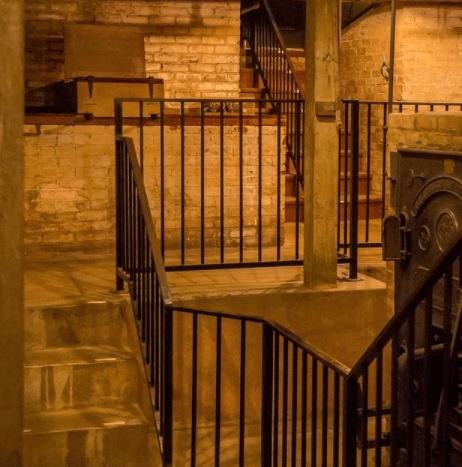
It is possible when dabbling with occultism for one to make an unconscious contract with the powers of darkness. The gift of discernment is absolutely necessary in life. It is generally not wise to lay one’s hands on a person who is occultly subjected. The retuning spirits will often attempt to creep back under the guise of some pious camouflage. It is in this way that evil can often enter unnoticed into one’s Christian life. A maid at the Winchester mansion once accepted the invitation of one of her coworkers to attend some spiritistic meetings. At first she felt as though she had gain something from going along to the meetings but later on she began to notice some psychic changes taking place in herself. She began to notice some psychic changes taking place in herself. She began to suffer from depression which resulted in her consulting a neurologist. During the course of the treatment she was committed to a lunatic asylum. However, as her condition improved, she could no longer attend the spiritistic séances. At the hospital the chaplain came to see her through his help and counsel she was able to make a complete recovery. One of the farmers at the estate wanted to see if charms actually worked, and some of them He. He practiced in the basement of the Winchester mansion. He drew a magic circle on the ground and drew some other magic symbols in the circle. He then used a charm three times in order to invoke the spirit. However, no spirit came. Yet, as he repeated, the charm he fell down in the magic circle and lay there unconscious for some time. The result was that for several weeks following this event he was semi-paralysed and drained of all his physical strength and will-power. After a few weeks, he died. Frequently identified as a common spot where the “wheelbarrow Ghost” is sighted, Steam Alley is one of the most well-known paranormal hot-spots in the mansion. Have you ever seen anything in the basement? #RandolphHarris 21 of 21

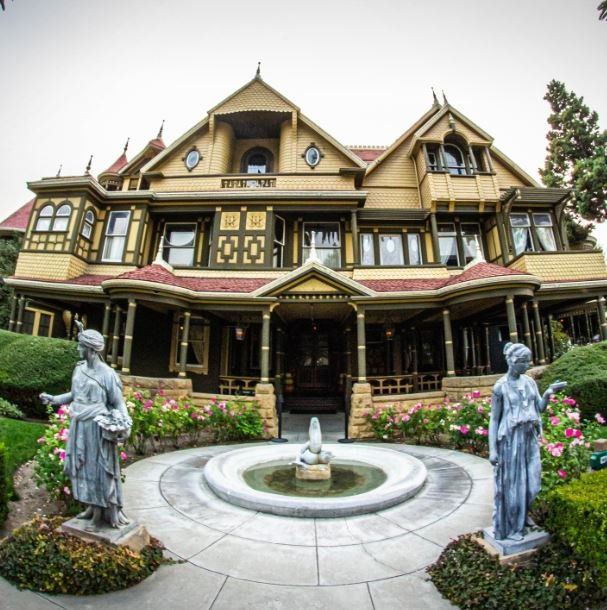
Some stroll Sarah’s lovely gardens this Memorial Day Weekend. There is a beautiful parrot which Mrs. Winchester used to pet, it talks! He is supposed to be happy and impudent, and talks and laughs and screeches all the time. Maybe you may catch a glimpse at this wooded, flowery estate. It is such a beautiful spectacle, all of that life and grace and animation, and sun-smitten flash and sprinkle of rich colour.

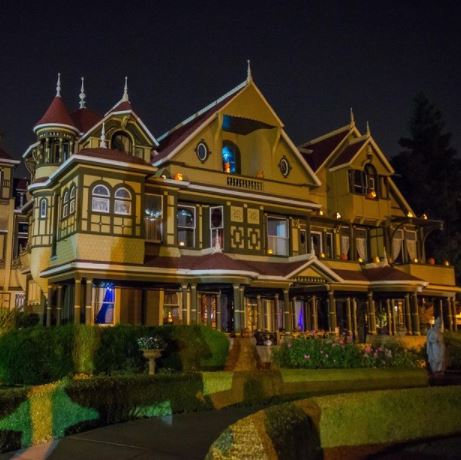
This impressive mansion dates back to the 1880s, when it was developed by Sarah Winchester and the spirits, whose project enobed and enriched the community. It once had a nine-story military watchtower. Mrs. Winchester further developed the grounds of the 160 room mansion, introducing a Victorian garden at the hands of World renowed architect Gino Coppede around the turn of the century.

These adaptions made this idyllic mansion a unique asset, tinged with the signs and influences of eclecticism and Liberty, juxtaposed to the ancient Architectural characteristics of its medieval heritage. This mansion presents itself as impressive and spectacular. The building now spreads on four floors plus the basment, for a total of approximently 25,000 feet square.

There is lovely gift shop and cafe, and it is also an ideal venue for hosting private events, conventions and/or ballrooms are located on the back overlooking the internal garden with its panoramic position which glows thanks to its night-time lighting.
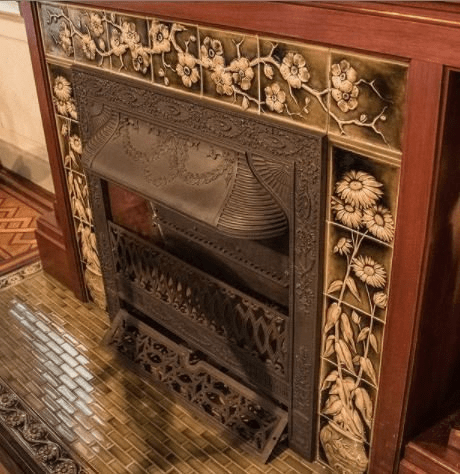
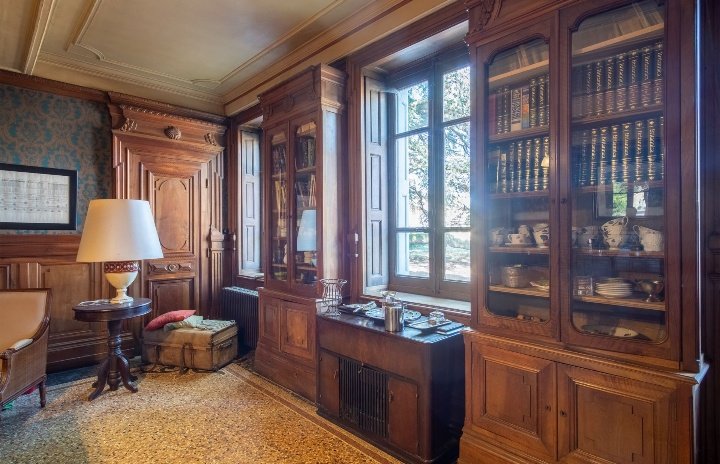
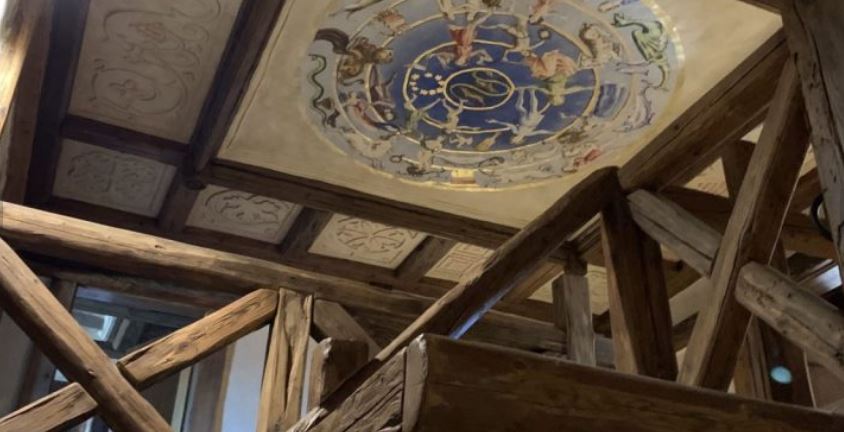
Inside the property there are splendid rooms filled with historial furniture, decorated ceilings and flamboyant fireplaces, vaulted ceilings and richly frescoes walls. In addition, there are several bedrooms, nine kitchens. and thirteen bathrooms, which made the structure a perfect luxurious accommodation for guests, and is now a tourist destination.

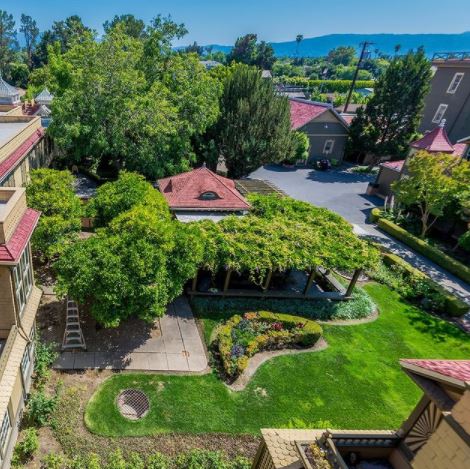
This mansion is located within a private park of 4 acres and elegant Nineteenth-century Victorian-gardens, that offer areas of wide lawns, and further green spaces. There is also a parking area, with free parking. Currently used to host guided tours and private events and functions. The enitre porperty sits at a close distance from the mall, hotels, and resturants. The high-fashion outlet complex and gourmet food has brought further development and tourism to Santa Clara County. https://www.winchestermysteryhouse.com/


Summoning Devils on Film and in Real Life

Much like the Winchester mansion and Mrs. Winchester, the Hellfire Clubs and medieval Sabbat believed that devils and demons should not be stern masters or slaves, but welcome house-guest, which is why Mrs. Winchester built what is now known as the Winchester Mystery House. It is easy to imagine how the combined grief of losing both a child and a spouse could be very crippling. However, if you had $20,000,000.00 (2022 inflation adjusted $556,305,882.35) and all the time in the World to help you cope, can you imagine what you would do? Mrs. Sarah L. Winchester’s response to the deaths of her child and husband left a bizarre and impressive architectural reflection of her psyche. The fascinating story of the Winchester Mystery House has its roots in the personal tragedies suffered by Mrs. Winchester and in the legacy of the Winchester rifle, “The Gun that Won the West.” The Winchester Mansion raised its castellated walls and towers in every direction commanding magnificent prospects; like emeralds in a setting of deeper green, gemmed the surface of the surface of the rural landscape and contributed to increase the beauty of scenery not surpassed in the World. Ages ago the voice of prayer and the song of praise used to ascend from this sacred estate. Presented on the estate was a happy country, none better calculated to inspire love and harmony. However, there was a lack of happiness in the circumstances of life for Mrs. Winchester. At first glance, there seems to be no degree of truth in this statement because of all the riches she inherited and her beautiful mansion. Many people assumes that for the rich, enjoying their riches, are likely to be contented and to look no further than this World. There were also a group of seven Victorian houses on the estate, not connected to the main house, of goodly size, and a Holy Cross. The seven Victorian Houses which, according to tradition, were built there under Mrs. Winchester’s direction, along with a graveyard on her 760 acres of land. #RandolphHarris 1 of 15

In the garden of the mansion was a curious stone cross, of considerable size, evidently monumental, though the inscription has been so defaced as to be illegible. On the front of the cross there is a deep indentation much resembling that made by the hoof of a cow in soft Earth, the bottom of the indentation being deepest at the sides and somewhat ridged in the middle. Concerning this cross and the depression in its face, the following legend was related by one of the farmers on the estate. “Mrs. Winchester built this mansion, houses, and the church, you see. When she lived, she owned all the land round about. But there was a devil here. If you had meet him on the grounds, you would know in a minute that it was himself and no other that was in it, and so make ready, either for to run away from him, or to fight him with praying as fast as you can, because, you see, it is no use for to strive with the devil any other way, seeing that no weapon can make the last dint on his carriage. In them days, and before the mansion was built, I am telling you, the devil was all as one as a man, a tall felly like a soldier, with a high hat coming to a pint and feathers on it, and fine boots and spurs and a short red jacket with a cloak over his shoulder and a sword by his side, as fine as any gentleman of the good old times. So he used to go about the country, desiring men and women, the latter being his choice as being easier to deceive, and taking them down with him to his own place, and it was a fine time he was having entirely, and everything his own way. As soon as Mrs. Winchester started construction on her mansion, the devil took up his quarters there, to make it as sure as he could. But when he heard what Mrs. Winchester was doing, a four-story mansion, of 500 or 600 rooms, and a nine-story observation tower, he came out to see the castle was rising before his eyes. He heard the construction singing and started cursing to himself, and at 5.13am on Wednesday April 18th, 1906, Satan stomped his cloven hoof into the ground causing a 7.9 Earthquake and brought down that tower. #RandolphHarris 2 of 15
After the Earthquake, while the devil was laying about in the bushes a-watching the work, and the tower of the big mansion was lifting itself above the trees, this time just not as high as it used to be. Everyone knows that Satan is slicker than a weasel, and has a memory like a miser’s box that takes in everything and lets nothing go out. When you do anything, sore a bit that it scrapes the devil, and he hugs it close till a time comes when he can make a club have it to bate you with, and so he does. You may think it is queer, but it is no wonder to one that understands it, for the devil can take any shape he pleases and look like any one he wants to, and so he does for the purpose of tempting us poor sinners to destruction, but there is one thing by which he always knows; when you have given up to him or when you have beaten him on the face, no matter which, he has got to throw off the disguise that is on him and show you who he is, and when he does it, it is not the elegant, dressed-up devil that you see and that I was just telling you about, but the rale, old, black anger with a rancorous, without a haporth of rages to the back of him, and his horns and tail a sticking out, and his eyes as big as an oxen’s and shinning like fire, and great bat’s wings on him, and, saving your presence, the most nefarious smell of sulfur you have smelled. However, before, he looks all right, no matter what face he has, and it is only the goodness of God that the devil is bound for to show himself to you, because, Glory be to God, it is his will that humans shall know who they are dealing with, and if they give up to the devil, and after finding out who is in it, go on with the bargain they have made, sure the fault is their own, and they go to hell with their eyes open, and if they bate him, he has got to show himself for to let them see what they have escaped. #RandolphHarris 3 of 15
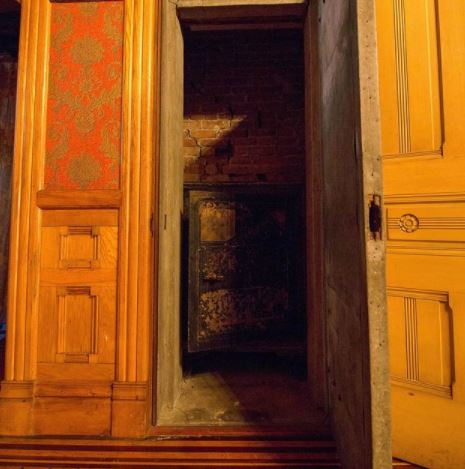
Satan was flying around the Winchester mansion, there were the farmers all along the day job, and the construction workers were building as fast as they could and a bottle of holy water were at their side to throw at the devil when he would come. So he went from the and would fly back and forth watching then working, and they restored the Winchester mansion. Old beliefs die hard, especially when their speedy demise is a consummation devoutly to be wished. Magic is only a physical or psychological effect that has yet to be explained, which means for many it is uncomfortable to entertain now. All good occultists must be skeptical—believe nothing in preference to believing everything. All proto-sciences could be defined as magic. You can see the ritual chamber as a kind of intellectual decompression of chamber to prepare your mind for other atmospheres. People who limit themselves to the occult curricula and profess to be wizards are laughable—magic is an interdisciplinary pursuit. You must consider all the options—investigating like a police officer. To perform a summoning, for example, would involve finding the right environment, appropriate retrieval cues, the right atmospheric conditions. The effects of magic are demonstrable. A lot of simple magic is just to do with self-confidence, how much your antennae are up, how open you are to the World around you. Rituals and magical words are not necessary, merely tools or exercises to help train your mind. Scientists are now coming to the conclusion that there is a lot more interconnectedness between man and his environment than they originally supposed, which is a basic occultic concept. The only really dangerous characters are the ones who think they are generational Satanists and their grandfather told them with his dying breath what to do, or whatever. There are a lot of armies of one out there, a lot of coffee-bar revolutionaries. New information technology has bred a lot of desktop Satanists and bulletin boards mean that cyberspace seems to be just full of Satanists. The Christian heretics rarely get much further than designing letterheads. #RandolphHarris 4 of 15
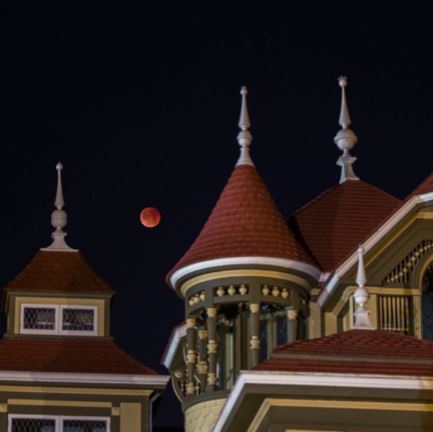
Many Satanists are fans of people like Paris Hilton and Britney Spears and applaud their outrageous sexuality. They are also huge fans of Aaliyah for making that film Queen of the Damned. Many Satanists are quietly applying Church of Satan philosophy to their lives in their own fashion in a very real way. The best thing they could ask for is that people pass them a nod of respect. In the modern World, the spirit of the age often looms down upon us in strange, distorted forms from the cinema screen. Major production companies spend millions of dollars trying to trap the latest cultural trends on celluloid, while audiences make surprise blockbusters from movies which—accidentally or otherwise—tap into the anxieties and enthusiasms of the day. In the late 1960s and 1970s, 2000s the films which came to be regarded as four “Satanic blockbusters”—Rosemary’s Baby (1968), The Exorcist (1973), The Omen (1976), and Queen of the Damned (2002)—all took the box-office by storm, transforming themselves into cultural phenomena which attracted public interest far beyond that of most “mere” films. Cinema has been the most potent legend factory of the centuries. Despite constant predictions that TV would devour the silver screen, the spectable and ceremony of the cinema helped retain its status as the most sacred of modern temples. Film presents a super real version of the World—louder, larger, essentially more mythic. More people take cues on how to live, love, fight—even on how to die—from the silver screen than from the pulpit or the gospels. Pagan worship is alive and well and being practised at your local multiplex, with Hollywood stars as the gods of our age. And, just as cinema has given us new gods, so it has supplied us with a new hierarchy of devils. The relationship between Satan and the silver screen is a notable one. The father of fantastic cinema was a Frenchman named Georges Melies, who made delightful short films crawling with demons and devils. Melies was himself a Faustian figure, a stage conjurer and photographic illusionist who appeared out of the rump of the French Decadent era. Summoning devils on film, he defended this new sorcery in time-honoured fashion as “white magic.” #RandolphHarris 5 of 15

In The Laboratory of Mephistopheles (1897), Melies made Satan’s head detach itself and float around the room—to the enchantment and horror of audiences in darkened “picture palaces, resembling nothing so much as séance chambers. Hollywood’s dream factory was not even at the planning stage by the turning of the century, but the pioneer of US cinema, Edwin Porter (partner of the man who virtually invented the movies, Thomas Edison), produced his own version of Faust and Marguerite in 1900. The most striking cinematic fantasies came from Germany at this point—stark, angular exercises in shadow and nightmare. The Student of Prague was an updated version of the well-worn Faust tale, based on an Edgar Allan Poe story, which transformed the lead from an ambitious academic to a devil-may-care student and Mephistopheles into a rakish devil called Scapinelli. The story was retold onscreen in 1913, 1926, and 1936. The 1926 version was by the master of German Expressionist cinema, F.W. Murnua—the last film he made before leaving his artistic roots for Hollywood, where he met with a tragically early death. As a minor masterpiece, it was a suitably grandiose climax to a career which produced Nosferatu (1922), the first gothic vampire film. Now, it is always important to be safe on the road and sometimes to listen to the heartfelt advice of others. Jayne Mansfield, a buxom B-move actress died in a tragic car crash with her lawyer in and lover Sam Brody. Brody had disliked his beloved’s new guru from the start, and the friction led to LaVey placing a ritual curse on his rival. The Black Pope (Anton LaVey) warned the pugnacious lawyer—known to be a dangerous driver—that he would suffer a series of automobile accidents. It was no great surprise when a car crash ensued—but it made World headlines for taking the life of Jayne Mansfield, as well as the top of her cranium. LaVey grimly stated that on the night preceding the crash, as he cut out a newspaper clipping of Jayne, he accidently snipped off the top of the blonde beauty’s head. (By the way, I had no idea The Black Pope was dead, until today. I feel he is very much still alive. I have always felt like he is here, in San Francisco in his black church.) #RandolphHarris 6 of 15
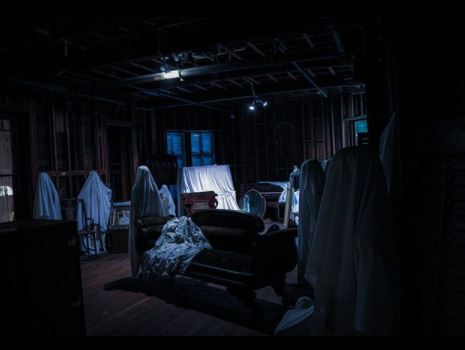
The physical phenomena of spiritism are often closely connected with psychical manifestations, such as spiritistic visions, automatic writing, speaking in a trance, materializations, table lifting, tumbler moving and excursions of the psyche. There is no doubt that today, as in the time of Isaiah (Isaiah 6.1-5), Ezekiel (Ezekiel 1.4-28), Paul (Acts 9.1-8), Peter (Acts 10.9-16), and John (Revelation 1.10-18), God may give His people a genuine vision, particularly in great times of great stress. However, genuine experiences of this nature are always accompanied by true spiritual grace and modesty. Sensationalism betrays a lack of authenticity. Unfortunately, genuine experiences are rare, and counterfeit ones about. Christian counselors find that the “ratio is about nine to one over the genuine experiences.” Mrs. Winchester used to have visions. She reported that she saw visions of Christ at night, and it left her feeling a sense of uneasiness and fear. The so-called visions of Christ were mediumistic. They came as a warning. Weeks after the visions started, Mrs. Winchester saw her husband William Wirt Winchester’s spirit departing from his body as he expired in 1881. The visions of Mrs. Winchester bear evidence of the occult, as do the visions of Joseph Smith (1805-1844), who fathered Mormonism. Many of the founders and promulgators of modern cults have had alleged visions from God. However, some say these visions promote “doctrines of demons” (1 Timothy 4.1) among the credulous and those unable to discern spirits (1 Corinthians 12.10; 1 John 4.1-2). When humans depart from God’s Word, they supposedly expose themselves to demon imposture and deception. Automatic writing—some persons endowed with mediumistic powers are able—either in a waking state or trance to write letters, words, or sentences which spiritists consider to be message from the spirit World. This is how Mrs. Winchester came up with the architecture of her mansion, the blueprints were often dictated to her in her Blue Séance room as she took down the notes on napkin. Also, the persistent pain in her legs and back vanished whenever she sat down and dictated these blueprints. #RandolphHarris 7 of 15
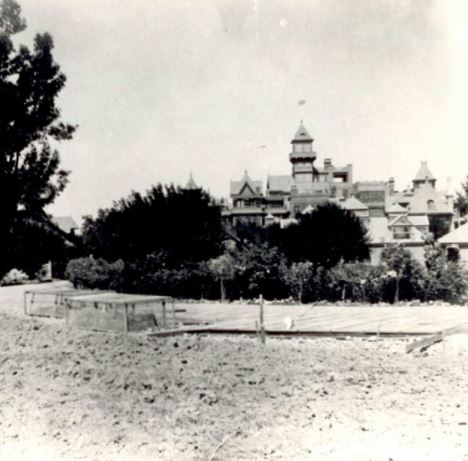
One day as Mrs. Winchester was taking dictation, a spirit named Apollonius Tyannaeus appeared and said, “In the name of the Lord Jesus, our blessed and exalted Savior.” The spirit then told the woman that she had been chosen by God for special revelations. She would become a prophetess and bless humankind with these revelations. The case is patently that of a simple farm woman turned indeed into a spiritistic writing medium. Rudolf Tischner, a parapsychologist, points out the danger of automatic writing when practiced in immoderation. Although he regards these writing phenomena only as “motoric break up the integrated psychic structure with ensuing peril to mental and physical health. This simply means that occult enslavement can result from mediumistic writing, or from dependence upon the Ouija board or other spiritistic devices to obtain alleged messages from the spirit World. Speaking in a trance—a trance is a condition in which a spiritistic medium loses consciousness and passes under the control of demonic power to effect alleged communication with the dead. The demon (or demons) takes over and actually speaks through the spiritistic medium, deceptively imitating the deceased. As a result this ruse innumerable spiritistic clairvoyants claim communication with the dead, often with famous deceased people allegedly appearing to speak to the living. One evening, Mrs. Winchester went into a trace and soon the “Apostle Paul” approached and preached to the audience. The apostle was not visible but only spoke through the medium who lay in trance. Some critic said it was only another constant instance of deception by demons who ape the deceased but cannot produce them. Other believe it was real. Perhaps the most remarkable phenomena of spiritism are materializations. These are supernatural appearances and disappearances of material images in connection with the activities of a spiritistic medium. #RandolphHarris 8 of 15

Materializations have been exhaustively studied and photographed and have been found to be manifestations of various degrees of teleplastic morphogenesis. The first stage is the evolution of a gauzelike substance of rubbery consistency from the body cavities of the medium. The second stage is the forming of the various parts of the body in outline—arms, head, etcetera. Frequently in the case of teleplastic forms of this kind, a threadlike connection is maintained with the medium. The third stage consists of the composition into completely outlined forms, which are visible as phantoms near the medium. These three stages of materialization manifest purely visual phenomena. The fourth stage displays telekinetic phenomena. There is an energy output from the teleplasm (telekinesis), such as the ringing of a bell, at night, passers-by heard ghostly music wafting from the dark mansion. The bell in the belfry high in the gables tolled regularly at midnight to summon incoming flights of spirits. Later it tolled again to warn these visitors to return to their sepulchers. However, once a week, these departed ones relaxed and danced in the Great Ball Room. In other stages of materializations come automatic writing of a typewriter, and the automatic playing of a musical instrument. In addition to the active energy output of the materialization, there is frequently a passive pain experience of the teleplasm. The fifth stage of the materialization is the penetration of material substance. To his phase belong “apports,” that is, the appearing and disappearing of objects in closed rooms or chests and containers. From locked and cemented containers, for example, enclosed coins are brought out, or stones and other objects fall inexplicably from the ceiling. This often happens in the Winchester mansion, as documented by Mrs. Winchester. In this stage many mediums allegedly have the ability to penetrate solid material substance while they are in a trance. While Mrs. Winchester sat in a small cabinet, a phantom built itself up on the floor outside the cabinet and formed itself into a male person, who moved in and out among the participants of the séance. While the materialization extended his hand to one of those present and she held it, dematerialization began to occur before the eyes of all the participants. Soon there was only a lump on the floor and this rolled up into the cabinet. #RandolphHarris 9 of 15
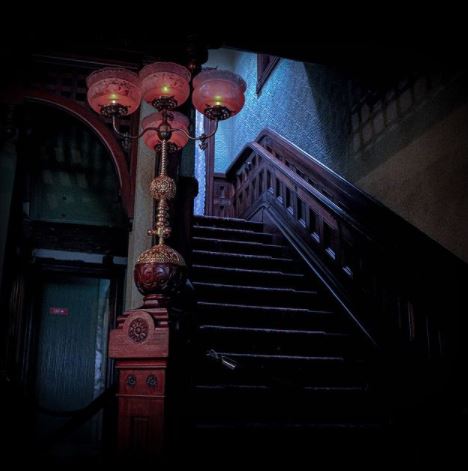
Another example is during a séance, Mrs. Winchester was able to call and help the materializing of the spirit of the deceased German romantic poet, Johann Ludwig Uhland (1787-1862). At the memorable séance a white phantasm was seen, from which the audience demanded a poem. Instead of reciting a poem, the phantasm tore a page from a book in the library. With a pencil from a briefcase in the room, secured through the leather without opening the briefcase, the hand jotted down a few verses and vanished. The page was left and still exists. The examination of the mysterious writing by a graphologist proved to be sensational. He confirmed the ghost writing to be actually the handwriting of the deceased poet. Afterward there was a trial in Berlin over the ownership of the page. The court awarded it to the medium, who afterward kept it among her prized possessions. The phenomena of materialization and dematerialization in case of strong mediums illustrated the conversion of psychic energy into matter and matter changed back again into psychic energy. The problem is illustrated by nuclear physics. Einstein’s formula (E==MC^2), energy is equal to mass times the speed of light squared, simply declares that it is theoretically possible to convert energy to mass and back again to energy. We have historical evidence of materializations. Missionaries claim that Mrs. Winchester’s mansion was never actually built, but that it materialized itself on the grounds, and (re)construction only began after the Earthquake caused by Satan. Some say this mansion is to be regarded as a miracle of Satan (2 Thessalonians 2.8-10; Revelation 13.15). Many people used to wonder how Mrs. Winchester used to travel so fast back and forth from San Jose to San Francisco to pick up items she ordered from overseas. Researchers believed that she would be spiritually transported miles away, and this may have been an example of this phenomenon or simply a miracle of transportation of unaltered physical body. It is debatable rather if these are miracles of God or that of Satan. God says He is the Alpha and the Omega. I wonder what that means? #RandolphHarris 10 of 15
Mrs. Winchester was said to possess tremendous occult gift and was reported to be able to make tables fly through the air for a space of one hundred feet. Above all, she was extremely adept in telekinesis, materialization, levitation, and black magic. Where Satan’s power remains virtually unchecked, miracles of evil supernaturalism abound. In Victorian days, the supernatural predated the mass hysteria about Satanism. As you may know, long before Mrs. Winchester arrived in California, there was a Devil worshipping conspiracy at large. However, her mansion seamlessly blends the ordinary and nightmarishly surreal. It is a rare treat for fans of demonic conspiracy and occult synchronicity. Some people have believed themselves to be demonically possessed after visiting the Winchester Mystery House, others claimed to have spoken to Mrs. Winchester directly. Directors of the Queen of the Damned claimed that the film was a makeshift occultic ritual, and Aaliyah unleashed the demon within herself. They also said the film poses some kind of supernatural power and they had to edit and voiceover a lot of the footage because not only did the characters act their own version of the script, but there were also some subliminal sounds and images on print. When many of these errors were re-examined, they also saw footage of the original Winchester mansion on the negatives, but rumors began that the original print had been withdrawn, replaced by an expurgated cut to protect the filmgoers from the movie’s insidious effects. The powers behind these manifestations were no doubt demonic. The director faced a terrible psychic assault on 25th August 2001, before they finished filming the movie. However, when the reel was played, the directors found they had all the footage they needed, even some they did not remembering filming. It was so intensified that the demonic oppression became that he was compelled to give up making other Anne Rice books into movies, especially after Aaliyah’s plane crashed later that evening. Although the film was unfished, with the blessing of her family, it was released to the public in February of 2002. #RandolphHarris 11 of 15

Certain psychic clairvoyants claim that their souls can travel great distances at their command. They always said she makes a room come alive. Much like Mrs. Winchester, Aaliyah had a lot of psychic phenomena around her death. When directors took photos of Aaliyah and Queen Akasha to a clairvoyant, while concentrating on the photographs, the medium declared that one of the women was apparently dead, while the other one, reportedly killed in 2001, was still alive. After more concentration, the clairvoyant said: “I can get in touch with this woman (pointing to Queen Akasha). I see her in a great stone building southeast of Ireland.” By psychic excursion and by psychometry (selecting an object belonging to the missing person and beginning to search from there) the clairvoyant was able to establish contact by occult assistance. The cinema is the Devil’s lantern. In March of 1922, Mrs. Winchester said, “Though it should be borne in the mind that in the persecution of witches many women were put to death on the latter charge, albeit they were really benefactors of the human race; the more so as their skill in simples and knowledge of the medicinal virtue of herbs must have added in no small degree to the resources of our present pharmacopoeia.” In August of 1807 an extraordinary affair took place in the house of Mrs. Winchester. She had a cow which continued to give milk as usual, but of late no butter could be produced from it. An opinion was unfortunately instilled into the mind of Mrs. Winchester, that whenever such a thing occurred, it was occasioned by the cow having been bewitched. Her belief in this was strengthened by the fact that every woman on this estate was able to relate some story illustrative of what she had seen or heard of in times gone by with respect to the same. At length the Mrs. Winchester was informed of a woman named Mary Butters, who resided in Oakland at the Cohen Bray House. Mrs. Winchester went to her, and brought her to mansion for the purpose of curing the cow. About ten o’ clock that night war was declared against the unknown magicians. #RandolphHarris 12 of 15
Mary Butters ordered old Klaus and a young man named Konrad to go out to the cow-house, turn their waistcoats inside out, and in that dress to stand by the head of the cow until she sent for them, while the butler, the made, and an old woman named Klara Lee remained in the house with her. Klaus and his ally kept their lonely vigil until daybreak, when, becoming alarmed at receiving no summons, they left their post and knocked at the door, but obtained no response. They then looked through the kitchen window, and to their horror saw the four inmates stretched on the floor as dead. They immediately burst in the door, and found that the butler and the maid were actually dead, and the sorceress and Mrs. Winchester nearly so. The latter soon afterwards expired; Mary Butters was thrown out on a dung-heap, and a restorative administered to her in the shape of a few hearty kicks, when had the desired effect. The house had a sulphureous smell, and on the fire was a large pot in which were milk, needles, pins, and crooked nails. At the inquest held at the Winchester mansion on the 19th of August, Jurors stated that the three victims had come by their deaths from suffocation, owning to Mary Butters having made use of some noxious ingredients, after the manner of a charm, to recover the sick cow. She was up to The Great Asylum for the Insane, but was discharged by proclamation. Her various of the story was that a black man (usually indicates a demon or the devil, not one of African descent) was summoned through the floor with a huge club, with which he killed the three person and stunned herself. This paranoid horror fantasies terrified the congregations, as well as the gross superstition displayed by the participants as for its tragical ending, yet it seems to have aroused no feelings in the greater community than those of risibility and derision. However, there is also another version of events. #RandolphHarris 13 of 15

A farm-hand had brought an action against Mrs. Winchester for wages alleged to be due to him. It transpired in the course of the evidence that on one occasion he had been set to banish witches that were troubling the cows. His method of working illustrates the Winchester case. All left the house except Mrs. Winchester, and the farm-hand, who locked himself in, closed the windows, stopped al keyholes and apertures, and put sods on top of the chimneys. He then placed a large pot of sweet milk on the fire, into which he threw rows of pins that had never been used, and three packages of needles; all were allowed to boil together for half an hour, and, as there was no outlet for the smoke, the farm-hand narrowly escaped being suffocated. If the forces of darkness triumph, it is a warning not a celebration. Many religious people come close to depicting what evangelists are preaching from their pulpits, or TV shows. Does it not seem strange for fundamentalist Christians to attack them as sinful and dangerous? Sin sells, in a way that the bland platitudes of Christian morality never will. Many of these popular and historical figures will be remember long after the credits have rolled. You could say that it is an “inside job.” Satanism sells, it captures the metaphysics of fear. People like to be haunted and scared, but only when they consent to it. No one wants their house broken into, their children kidnapped, their cars constantly vandalized, or to be attack by a hate group who haunts them like demons of the night. People simply want to tune into a scarry movie or visited a haunted house and leave the fear behind when they walk out the door or turn the TV off. They do not want to fear for the lives like Sharon Tate did for years without anyone to protect them. Humans are often more harmful than any ghost, devil or demon you can ever imagine meeting. Satan, speaking through a beautiful serpent—perhaps as a parakeet “talks” to us—promises know that would make Eve “like God” if she would eat the fruit of the tree forbidden by God. #RandolphHarris 14 of 15

Meanwhile, if the view of the power and knowledge of the people is that “Satan” is evil and not themselves, what can human beings do? Persist being evil, or resist the “devil,” and allow him to feel from them? Or is it they cling to evil because the darkness comes from their insidious mind and depleted soul? Note that it is useless to try to resist the devil unless you have first submitted yourself to God! Maybe YOU are the evil, not Satan. Sitting there, manufacturing all these evil days, so you can laugh at the pain and suffering you have inflicted on others to make yourself feel better. Is that of Satan, or is that YOUR nature on display. It is estimated that there are about 100 million adherents to spiritism in the World. The word “spiritism” comes from the Latin “spiritus,” spirit. The movement of spiritism represents the endeavour to communicate with the dead in the spirit World. Historically, spiritism can also be traced back over thousands of years. We have testimonies concerning it in the Old Testament in 1 Samuel 28, and Deuteronomy 18. It is also evidenced in the history of the Christian Church. Spiritism seems to be strongly connected with religion and religions. In so-called Christian countries such a variety of spiritistic forms, and such a range of associated psychic troubles exist, that the need for clarification is a pressing issue. What God do you really worship for “Satan disguises himself as an angel of the light. So it is not strange if his servants also disguise themselves as servants of righteousness,” reports 2 Corinthians 11.14-15. In other words, many of you Christians who claim to serve “God” do evil things and then blame the devil when you are disguising yourselves as children of the light. And you do not repent because you do not fear punishment nor hell, so you must be children of your “devil” and not of God. We live in a World which has turned its back on God. The reason some people fear Jesus is because they feel unworthy, it is not because they are evil. This conviction of inner unworthiness is not to be confused with a feeling of fear. However, people who suffer from schizophrenia and like to go around lying, the psychiatrist will be interested in the question whether the practicing of spiritism was rather the effect than the cause of the ensuing mental and emotional disorders. #RandolphHarris 15 of 15

Winchester Mystery House
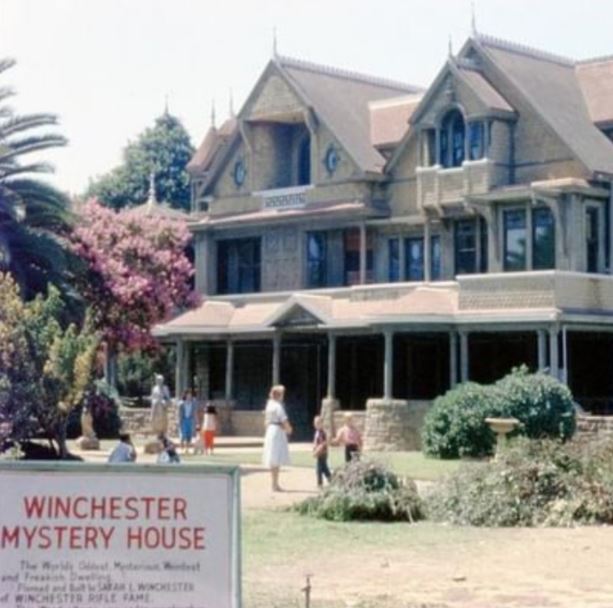
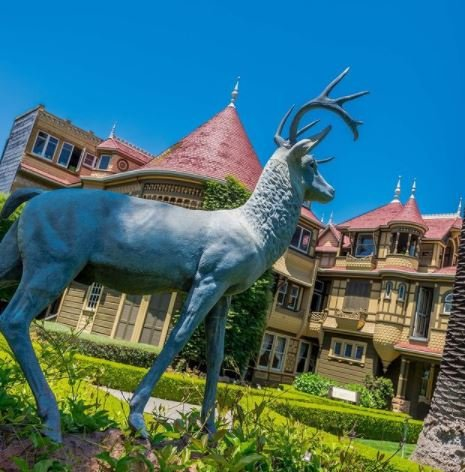
The front gardens of the Winchester Mystery House looked different in the 1970’s! The gardens were restored to what they are today about ten years later.
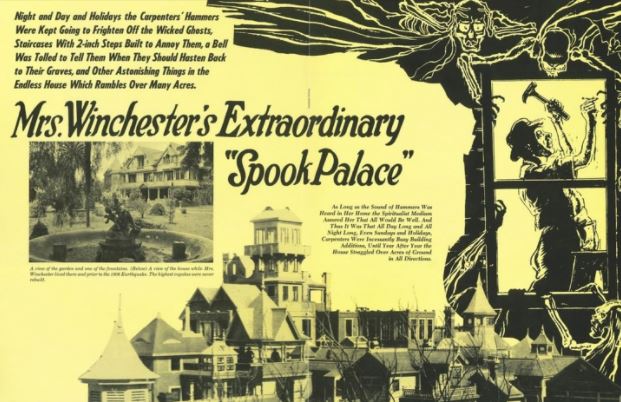
The sign reads: “The world’s oddest, mysterious, weirdest, and freakish dwelling. Planned and built by Sarah L. Winchester of Winchester Rifle Fame”
Have you ever listened to Alessandro Moreschi sing “Ave Maria,” at night in the Winchester Mystery House? Try it and let me know what you experience. I heard ghosts appear, people have cried and screamed, and some love it. I think I would probably run outside. He sounds like a ghost.

Come Explore the Victorian Gardens this weekend! Open all weekend until 4PM.

A 160-room mansion built to appease the spirits who died at the hands of the Winchester Rifle 👻

Wealth is Innocent Until Proven Guilty–Healing Cannot Occur without a Walk through Hades!

I live in the intermediate reaches of love. Not the best place, but certainly not the worst. I should count myself fortunate. Be alert. Love is where you find it. Do not be blinded by your categories. Loves comes unexpectedly in many forms. By my carelessness I have lost what now becomes a magic wand that could have lifted me up to Heaven. No one to blame but myself. I am the sole agent of my ruin. It is worthwhile to look to the Parmenides and the Gospel of John. In the philosophical poem about being and nonbeing, Parmenides describes the visionary experience in which the goddess of justice opens his eyes to the true way of asking the ultimate questions. He derives his insight from a kind of revelatory act which takes away his blindness to the truth, and guides him not to a better method of research (although this is an important consequence of his insight), but to a way of life as a whole. In the Fourth Gospel we find passages in which truth is being. Jesus Christ says, “I am the truth.” There are others which state that truth can be done, those who do the truth will recognize the truth. Here the gap between the cognitive and the moral is conquered, and again it is obvious that this kind of insight cannot precede the moral act and motivate it, since it is itself partly a moral act. A modern analogy to these ideas is provided by the psychotherapeutic experience. It clearly shows the difference between detached knowledge and participating insight. No one is helped in one’s personal problems by a thorough knowledge of the psychoanalytic literature. On the contrary, the analyst knows that a patient who claims to have insight into one’s own psychological state on the basis of such knowledge deceives oneself, and often sets up an almost insuperable resistance against gaining true insight about oneself. Only one who enters the healing process with one’s whole being, cognitive as well as moral, and therefore with emotional attachment to the process and its different elements, has a chance of gaining healing. #RandolphHarris 1 of 20

However, this healing process cannot occur without a “walk through hades,” the suffering implicit in the awareness of the dark, ordinarily repressed elements in our being. Here also, the moral change is only partly an effect of insight, as insight itself is partly an effect of the moral will to be liberated. There is another concept by which classical Greek humanism attempted to answer the question of moral motivation. It is the concept of eros as used by Plato. Eros is defined as the mystical quality of love. This description of eros depends both on Plato’s use of the word in the Symposium and on the reintroduction of the word into Christian mysticism by Dionysius as the Areopagite. Eros for Plato is a mediating power, elevating the human mind out of existential bondage into the realm of pure essences, and finally to the essence of all essences—the idea of the good that is, at the same time, the idea of the beautiful and the true. As in other examples of Greek tradition, the moral and the cognitive are not separate. Eros provided both insight and moral motivation, and there is a third element, the aesthetic desire for the beautiful which is implied in the good. This goal can be attained by eros as a divine-human power that transcends the moral command without denying it. Eros is the transmoral motivation for moral action. To be impelled by eros can also be described as being grasped by that toward which eros drives. And thus we return to the principle of love. It is one of the qualities of love that concerns us here—the mystical, the drive toward reunion with essential being in everything, ultimately with the good as the principle of being and knowing (in Platonic terms). Love in all its qualities drives toward reunion. Eros, as distinct from philia and libido, drives toward reunion with things and persons in their essential goodness and with the good itself. #RandolphHarris 2 of 20

For mystical theology, God and the good itself is, in religious language, love toward God. This love can be symbolized in two ways: in Plato it is the divine-human power of eros that elevates the mind to the divine; and in Aristotle, it is the power of the divine that attracts every finite think and produces by this attraction the movement of the stars, the Universe, and the human mind. According to both formulations it is not the moral imperative in its commanding majesty and strangeness that is morally motivating, but the driving or attracting power of that which is the goal of the moral realm, in the sense of personal and communal justice, does not furnish moral motivation unless it is understood as a station on the way to something ultimate in being and meaning—the divine. And the aim of everything finite is to participate in the life of the divine. And the aim of everything finite is to participate in the life of the divine. The moral stage is a situation on the way, and the motivation for it depends on the motivation for the transmoral aim, the participation in the divine life, as Aristotle expressed, in mystical-religious terms, the transmoral motivation of morality. Again I should like to point out a contemporary analogy in the realm of therapeutic psychology. The question is whether libido is unlimited in itself or only under the conditions of human estrangement. Our line of thought decides for the latter (as opposed to Dr. Freud and his doctrine of the essential necessity of cultural uneasiness and the death-drive). The difference is that essential libido (toward for or pleasures of the flesh, for example) is concretely directed to a particular object and is satisfied in the union with it, while existentially distorted libido is directed to the pleasure which may be derived from the relation to any encountered object. This drives existential libido boundlessly from object to object, while the essential libido is fulfilled if union with a particular object is achieved. #RandolphHarris 3 of 20

This distinguishes the lover from the “Don Juan,” and agape-directed libido from undirected libido. The moral imperative cannot be obeyed by a repression of libido, but only by the power of agape to control libido, but only by the power of gape to control libido and to take it into itself as an element. Eros is a divine-human power. It cannot be produced at will. It has the character of charis, gratia, “grace”—that which is given without prior merit and makes graceful one to whom it is given. It is useful to remember the origins of the word “grace,” because it plays an immense role in Christian religion and theology, and its meaning and relevance have become incomprehensible for most contemporaries both inside and outside the church. Graces are divine gifts, independent of human merit, but dependent on the human readiness to receive them. And the readiness itself is the first gift of grace, which can be either persevered or lost. Theology has distinguished between “common” grace that works in all realms of life and in all human relations, and the special grace bestowed upon those who are grasped by the new reality that has appeared in the Christ. In both respects, the problem of moral motivation is decisive. What common and special grace accomplish is to create a state of reunion in which the cleave between out true and actual being is fragmentarily overcome, and the rule of the commanding law is broken. Where there is grace there is no command and no struggle to obey the command. This is true of all realms of life. One who has the grace of loving a thing, a task, a person, or an idea doe not need to be asked to love, whatever quality of love may be predominant in one’s love. A reunion of something separated has already taken place, and with it a partial fulfillment of the moral imperative. #RandolphHarris 4 of 20

As a gift of grace, it is not produced by one’s will and one’s endeavour. One simply receives it. In this sense we may say: there is grace in every reunion of being with being, insofar as it is reunion and not the misuse of the one by the other, insofar as justice is not violated. Elements of grace permeate everyone’s life. Once could also call them healing powers that overcome the split between what we essentially are and what we actually are, and with the split the estrangement of life from life and the hidden or open hostility of life against life. Whenever elements of grace appear, the moral command is fulfilled. What was demanded now is given. However, what was given can be lost. And it will be lost, if one forgets that grace fulfills what the moral imperative demands, and that it affirms and does not replace the unconditional seriousness of morality. Therefore, as soon as grace is lost, the commanding law takes over and produces the painful experience of being unable to become what one could and should have become. This suffering under the moral law finally drives us to the question of the meaning of our existence in the light of the unconditional moral command which cuts into our finite and estranged predicament. We feel that the many gifts of common grace do not suffice; we ask for a grace as unconditional as the moral imperative and as infinite as our failure to fulfill it. We ask for the religious element of moral motivation directly, after we have experienced its indirect effect as common grace in the different realms of life. This Christian message is above all a message of grace. There is no religion without this element. The Old Testament, where the law plays such a decisive role, refers in every part to the divine covenant between God and the selected nation, and to the promises beyond all threats and judgments. We might cite similar examples from many other religions. However, Christianity, particularly under the impact of the Protestant Reformation, have emphasized the idea of grace more than any other religion. #RandolphHarris 5 of 20

Celibacy for some is like walking on the sword’s edge, and one can see every moment the necessity of continued vigilance. Many people are not blessed with a propensity for celibacy. However, if one acquires mastery over the palate, the observance of celibacy becomes comparatively easy. One must breathe the air of freedom and cast out all doubt from one’s mind, and practice purity of thoughts. Because self-control I paramount, testing to see whether that control is truly in place makes logical sense. One must grow to empathize with others on many issues. The concept of grace in Christian thought contains a polarity between the element of forgiveness and the element of fulfillment. The former can be expressed as the forgiveness of sins or—in a paradoxical phrase—the acceptance of the unacceptable. The latter can be described as the gift of the Spirit or the infusion of love controlled by the agape. The former conquers the pain of morally unfilled existence, and the latter grants the blessedness of an at least fragmentary fulfillment. Neither is possible without the other, for only one who is grasped by the Spirit can accept the tremendous paradox that one is accepted. Nothing is more difficult than to face one’s image in the mirror of the law and to say “yes” to it in terms of “in spite of.” It demands much grace to reach this state. And on the other hand, the fragmentary fulfillment through grace can bestow blessedness only if the paradox of forgiveness conquers the pain of missing fulfillment or of lost grace. Here the skeptical question may arise as to whether the paradox of grace diminishes the power of moral motivation in those who accept that they are accepted, although unacceptable. It is a very old question, used against Paul as well as against Augustine, against Luther as well as against Calvin, and against the Reformation as a whole by the humanists and the evangelical radicals. #RandolphHarris 6 of 20

It is a justified question insofar as it points to the possibility of converting the paradox of grace into a cover for lawlessness. However, the question is not justified in principle, because it shows that one has not understood that the courage to accept the unacceptable is a work of grace, a creation of the Spiritual power. Only if the acceptance of the unacceptable is misunderstood as a merely intellectual act does it remain without moral motivating power. Orthodoxy (in contrast to the early Luther) is largely responsible for this intellectual distortion of the paradox of acceptance of the unacceptable and, consequently, for the attack on the Pauline principles in the name of morality. The question of moral motivation can be answered only transmorally. For the law demands, but cannot forgive; it judges, but cannot accept. Therefore, forgiveness and acceptance, the conditions of the fulfillment of the law, must come from something above the law, or more precisely, from something in which the split between our essential being and our existence is overcome and healing power has appeared. It is the center of the Christian message that this conquest took place in the Christ, in whom a new reality beyond the cleavage appeared It is therefore a moralistic distortion of Christianity to interpret the so-called “teachings of Jesus” as another law, heavier then the law of Moses. His words (not his “teachings”) point the way to the new reality in which the law is not abolished, but has ceased to be commanding. The reaction of religion and morality is not an external one, but it is the religious dimension, sources, and motivation are implicit in all morality, acknowledged or not. Morality does not depend on any concrete religion; it I religious in its very essence. The unconditional character of the moral imperative, love as the ultimate source of the moral commands, and grace as the power of moral motivation are the concepts through which the question of the relation of religion and morality is fundamentally answered. #RandolphHarris 7 of 20

Psychodynamic theorists believe that people who abuse substances have a powerful dependency needs that can be traced to their early years. They claim that when parents fail to satisfy a young child’s need for nurturance, the child is likely to grow up depending excessively on others for help and comfort, trying to find the nurturance that was lacking during the early years. If this search for outside support includes experimentation with a drug, the person may well develop a dependent relationship with the substance. Some psychodynamic theorists also believe that certain people respond to their early deprivations by developing a substance abuse personality that leaves them particularly prone to drug abuse. Personality inventories and patient interviews have in fact indicated that people who abuse or depend on drugs tend to be more dependent, antisocial, impulsive, novelty-seeking, and depressive than other people. These findings are correlational, however, and do not clarify whether such personality traits lead to drug use or whether drug use causes people to be dependent, impulsive, and the like. In an effort to establish clearer causation, one longitudinal study measured the personality traits of a large group of nonalcoholic young men and then kept track of each man’s development. Years later, the traits of the men who developed alcohol problems in the middle age were compared with the traits of those who did not. The men who developed alcohol problems had been more impulsive as teenagers and continued to be so in middle age, a finding suggesting that impulsive men are indeed more prone to develop alcohol problems. A major weakness of this line of arguments have been tied to substance abuse and dependence. In fact, different studies point to different “key” traits. Inasmuch as come people with a drug addiction appear to be dependent, others impulsive, and still others antisocial, researchers cannot presently conclude that any one personality trait or group of traits stand out in substance-related disorders. #RandolphHarris 8 of 20

Our subject is the present waste of human resources. Yet this waste is nothing new. Considering our wonderful faculties and powers, people on the average have never accomplished much. Regarded just as machines of virtue, pleasure, wisdom, battle, or friendship, we have always operated at a tiny fraction of capacity. This is evident if we contrast how people usually hang around with how people come across in emergencies, or when they are enthusiastic, or when they are calmly absorbed. Children find the average inactivity very painful and they nag, “What can I do? Tell me something to do.” Adolescents are restive hanging around, and they think up ways to make trouble. Adults are inured to it, and Schopenhauer claimed that boredom is a metaphysical attribute of the World as Will. Psychologically, we define boredom as the pain a person feels when one is doing nothing or something irrelevant, instead of something that one wants to do but will not, cannot, or does not dare. Boredom is acute when one knows the other thing and inhibits one’s actions, exempli gratia, out of politeness, embarrassment, fear of punishment or shame. Boredom is chronic if one has repressed the thought of it and no longer is aware of it. A parge pat of stupidity is just this chronic boredom, for a person cannot learn, or be intelligent about, what one is not interested in, when one’s repressed thoughts are elsewhere. (Another large part of stupidity is stubbornness, unconsciously saying, “I will not, you cannot make me.”) Certainly a large part of our common wasteful inactivity is this neurosis of chronic boredom. Certain aims are forbidden and punishable, or unattainable and painful; so we inhibit them and put them out of mind. In a vicious circle, the repression then makes the idea of the aims seem threatening: the aims are not rejected also in ourselves. So we are bored and inactive. We see how boredom easily turns into apathy, the lack of incentive. #RandolphHarris 9 of 20

At first this Sunday-afternoon neurosis, of lively children brought to a pause, is worse among the middle class than among the poor, for the middle class is less permissive, it has stricter standards to maintain and more expensive furniture to protect. However, by adolescence it is generally evident in all classes of the young, hanging around, reading comic books, or watching TV. It is evident in their notion of what is acceptable behaviour in the groups, in their paranoia about pleasures of the flesh, in their inability to think up anything interesting. Their hearts are elsewhere and they do not remember where. Many boys are afraid to be alone with themselves, because they might do something that goes against the principals of abstinence, which in itself may be an activity of boredom. All this has long been with us, and formerly perhaps it was worse than it is now, for now there is more permissiveness for small children and more rationality about growing up. However, when it comes to ineptitude, not knowing how; the situation in which, even if they know their aims, children do not know the means or cannot manage the means. I propose that in this respect our present system is uniquely bad and getting worse. For ironically, just in our times, when science and technology are so advanced, this factor ineptitude also increase, and children become practically more unenlightened. How many can take this essential step of a moral about-turn? Can we awaken a criminal in jail to a sense of one’s personal failure and moral shame? Because one has suffered the humiliation of retribution, there is always the probability of comprehending that there is a better way. And because one is a human being, there is always the possibility of ethical recovery and moral improvement. Those who believe that they can solve such a problem as criminality on a merely practical basis alone are wrong. #RandolphHarris 10 of 20

Experience will teach them that it is inseparable from a moral one, too. For if the criminal really repents, then our duty is to forgive one. A moral shift on one’s part should lead to a practical shift on ours. We may forgive criminals and yet punish them for wrong-doing, if that be our duty, or place them under such external limitations as will prevent their further wrong-doing, if that be our duty, or place them under such external limitations as will prevent their further wrong-doing, if that also be our duty. The two are not contradictory. If we keep our hearts unpolluted by hatred, we may keep our hands sternly and firmly on the wrong-doer. This is included in what is meant as the skillful performance of action. The skillfulness here meant is obviously not the technical kind but rather the mystical power to remain inwardly detached whilst doing Worldly duty. During the war, it became necessary for philosophic students to lean how to fight a cruel aggressor in the right spirit; they had paradoxically to learn how to deliver without anger or hate hard blows against one whilst feeling profound pity for one’s moral darkness. However, philosophic students are few. It is useless to ask humanity in its present state of evolution to behave on this high plane. An actualized Christian (and perhaps those who try to follow one) would not find it difficult to extend one’s compassionate goodwill to all criminals—indeed one would find it difficult not to—but it would be too much to expect that everybody else is capable of extending it. An alternative to physical punishment, such as flogging, for brutal crimes of violence would be to put the criminal upon a semi-starvation diet. One’s bodily weakness would then affect one’s mental aggressiveness, would reduce and counter it. If capital punishment is the law, at least change the method to withholding of food until death by starvation. #RandolphHarris 11 of 20

The rise of a de-massified civilization brings to the surface deep, unsettling questions about the future of majority rule and the entire mechanistic system of voting to express preferences. Someday future historians may look back on voting and the search for majorities as an archaic ritual engaged in by communicational primitives. Today, however, in a dangerous World, we cannot afford to delegate total power to anyone, we cannot surrender even the weak popular influence that exists under majoritarian systems, and we cannot allow tiny marginalized groups to make vast decisions that tyrannize all other non-dominant groups. This is why we must drastically revise the crude methods of the past by which we pursue the elusive majority. We need new approaches designed for a democracy of non-dominant groups—methods whose purpose is to reveal differences rather than to paper them over with forced or fake majorities based on exclusionary voting, sophistic framing of the issues, or rigged electoral procedures. We need, in short, to modernize the entire system so as to strengthen the role of diverse non-dominate groups yet permit them to form majorities. To do so, however, will require radical changes in many of our political structures—starting with the very symbol of democracy, the ballot box. In the past, voting to determine the popular would provide important feedback for the ruling elites. When conditions for one reason or another became intolerable for the majority, and 51 percent of the voters registered their pain, the elites could, at a minimum, shift parties, alter policies, or make some other accommodation. Even in yesterday’s mass society, however, the 51 percent principle was decidedly blunt, purely quantitative instrument. Voting to determine the majority tells us nothing about the quality of people’s views. It can tell us how many people, at a given moment, want X, but not how badly they want it. #RandolphHarris 12 of 20

Above all, it tells us nothing about what they would be willing to trade off for X-crucial information in a society made up of many marginalized groups. Nor does it signal us when a marginalized member of a group feels so threatened, or attaches such life-and-death significance to a single issue, that it views should perhaps receive more than ordinary weight. In a mass society these well-known weaknesses of majority rule were tolerated because, among other things, most marginalized groups lacked strategic power to disrupt the system. In today’s finely wired society, in which all of us are members of minority groups, that is no longer true. For a de-massified Fourth Wave society the feedback systems of the industrial past are entirely too crude. Thus we will have to use voting, and the polls, in a radically new way. Instead of seeking simpleminded yes-or-no voted, we need to identify potential trade-offs with questions like: “If I give up my position on abortion, will your give up yours on defense spending or nuclear power?” of “If I agree to a small additional tax on my personal income next year, to be earmarked for your project, what will you offer in return?” In the World we are racing into, with its rich communications technologies, there are many ways for people to register such views without ever setting foot in a polling booth. And there are also ways, as we shall see in a moment, to feed these into the political decision-making process. We may also want to de-rig our voting laws to eliminate anti-minority biases. There are many ways to do this. One quite conventional method would be to adopt some variant of cumulative voting, as used by many corporations today to protect the rights of minority stockholders. Such methods allow voters to register not only their preferences but the intensity and rank order of their choices. We shall almost certainly have to discard our obsolete party structures, designed for a slowly changing World of mass movements and mass merchandising, and invent temporary modular parties that service changing configurations of minorities-plug/plug-out parties of the future. #RandolphHarris 13 of 20

We may, for instance, need to provide arenas in which different minorities, on a rotating, perhaps even random basis, are brought together to trade problems, negotiate deals, and resolve disputes. If doctors, motorcyclists, computer programmers, Seventh-Day Adventists and Gray Panthers were brought together, with assistance from facilitators trained in issue clarification, priority setting, and dispute resolution, surprising and constructive alliances might be formed. At a minimum, differences could be exposed and the basis for political barter explored. Such measures will not (and should not) eliminate all conflict. However, they can elevate social and political strife to a more intelligent, potentially constructive level—especially if they are linked to long-range goal setting. Today the very complexity of issues inherently provides a greater variety of bargainable points. Yet the political system is not structured to take advantage of this fact. Potential alliances and trades go unnoticed—thus unnecessarily raising tensions between groups while further straining and overloading existing political institutions. Finally, we may well need to empower minorities to regulate more of their own affairs, and encourage them to formulae long-range goals. We might, for example, help the people in a specific neighbourhood, in a well-defined subculture, or in an ethic group, to set up their own youth courts under the supervision of the state, to do so. Such institutions would build community and identity, and contribute to law and order, while relieving the overburdened government institutions of unnecessary work. We may, however, find it necessary to go far beyond such reformist measures. To strengthen minority representation in a political system designed for a de-massified society, we may even eventually have to elect at least some of our officials in the oldest way of all: by drawing lots. #RandolphHarris 14 of 20

Thus some people have seriously suggested choosing members of the legislature or parliament of the future the way we choose jury members or armies today. Why is it that important life and death decision can be made by the people serving on juries, but decisions on how much money should be spent on child care centers and defense spending are reserved for their “representatives”? The existing political arrangements systematically shortchange minorities. Poor people, young people, smart but inarticulate people, and many other groups are similarly disadvantaged. Nor is this merely true of the United States of American. Nonetheless, between 50 and 60 percent of the American Congress should be chosen at random from the American people in much the same way they are pressed into military service through drafts when they are deemed necessary. Startling as the suggestion is at first blush, it forces us to consider seriously whether randomly chosen representatives would (or could) do worse than those chosen through today’s methods. If we let ourselves imagine freely for the moment, we can come up with many other surprising alternatives. Indeed, we now have the techniques necessary to choose far more truly representative samples than the jury system or the draft, with their preferential exclusions, ever did. We can build an even more innovative congress or parliament of the future—and do it, paradoxically, with less disturbance of tradition. We do not have to pick a group of people by lot and literally trundle them off, like so many Mr. Smiths, to Washington, London, Bonn, Paris, or Moscow. We could, if we chose, keep our elected representatives, allowing them, however, to cast only 50 percent of the votes on any issue, while turning the other 50 percent of the votes over to a random sample of the public. #RandolphHarris 15 of 20

By using computers, advanced telecommunications, and polling methods, it has become simple not only to select a random sample of the public but to keep updating that sample from day to day and to provide it with up-to-the-minute information on the issues at hand. When a law is needed, the full complement of traditionally elected representatives, meeting together in the traditional way, under the Capitol dome in Westminster, or in the Bundeshaus or the Diet building, could deliberate and discuss, amend and frame the legislation. However, when the time for decision arrived, the elected representatives would cast only 50 percent of the votes, while the current random sample—who are not in the capital but geographically dispersed in their own homes or offices—would electronically cast the remaining 50 percent. Such a system would not merely provide a more representative process than “representative” government ever did, but would strike a devastating blow at the special interest groups and lobbies who infest the corridors of most parliaments. Such groups would have to lobby the people—not just a few elected officials. Going even further, one might conceive voters in a district electing not a single individual as their “representative” but, in fact, a random sample of the population. This random sample could “serve in Congress” directly—as though it were a person—its opinions statistically tallied into votes. Or it could choose a single individual, in turn, to “represent” it, instructing one how to vote. Or the permutations offered by the new communications technologies are endless and extraordinary. Once we recognized that our present institutions and constitutions are obsolete and we begin searching for alternatives, all sorts of breathtaking political options, never before possible, suddenly open up to us. If we are to govern societies in the twenty-first century, we ought to at least consider the technologies and conceptual tools that are made available to us right now. #RandolphHarris 16 of 20

What is important here are not these specific suggestions. By working at it together, we can no doubt come up with far better ideas, easier to implement, less drastic in design. What is important is the general path we choose to travel. We can fight a losing battle to suppress or submerge today’s burgeoning minorities, or we can reconstitute our political systems to accommodate the new diversity. We can continue to use the crude, bludgeonlike tools of Third Wave political systems, or we can design sensitive new tools for a minority-based democracy of tomorrow. As the Fourth Wave de-massifies the old Third Wave mass society, its pressures, I believe, will dictate that choice. For if politics were “pre-majoritarian” during the First Wave, and “majoritarian” during the Second, they are likely to be “mini-majoritarian” tomorrow—a fusion of majority rule with minority power. Wealth has a future. Despite all today’s profound upsets and reversals, chances are the World will create more, not less, wealthy in the years today com. However, that is not universally regarded as a good thing. From the ancients like Aristotle who regarded the pursuit of wealth beyond barest self-sufficiency as unnatural, to nineteenth-century socialists and anarchists who saw wealth as misappropriated property, to many of today’s environmental fundamentalists who preach “voluntary simplicity” and regard “consumerism” as a curse, wealth has a bad name. Unlike a defendant in an American courtroom, wealth does not enjoy a presumption of innocence. Yet wealth, in itself, is neutral. Which is why, in these pages, wealth is innocent until proven guilty. What matters is who has it and has not got it and what purposes it serves. Wealth is above all an accumulation of possibilities. Of course, certain forms of wealth are more or less universally regarded ad “good.” Health. A strong and loving family. Respect from those we respect. Few would deny that these are wealth, even if they do not easily fit into the calculations of economists. #RandolphHarris 17 of 20

In everyday usage, however, the term usually refers, all too narrowly, to financial assets, and often carries a connotation of excess. For some, wealth may mean having bit more than their subjectively perceived need, whatever that is. For others no amount suffices. Among the less affluent, matters are less subjective. For the mother whose child is starving, a daily handful of rice may be wealth beyond measure. Whatever else it means, therefore, wealth, at least as used here, does not just mean a BMW M760i xDrive Sedan. Nor is wealth synonymous with money, as popular misconception might have it. Money is only one of many tokens or symbolic expression of wealth. In fact, wealth can sometimes buy things money cannot. To understand the future of wealth—our own or anybody else’s—in the fullest sense, we need to start with its very origin: Desire. The meaning of wealth—desire may reflect anything from a desperate need to a transitory want. In either case, wealth is anything that satisfies the craving. It applies balm to the itch. It may, in fact, gratify more than one desire at a time. We may want a touch of beauty on our living room wall. A painting, even an inexpensive reproduction, may provide a small surge of pleasure every time we pause to look at it. The same work of art may simultaneously fulfill our desire to impress visitors with our splendid good taste or our social importance. However, wealth can also be a bank account, a bicycle, a hoard of food or a health insurance policy. In fact, we can roughly define wealth as any possession, shared or not, that has what economists call “utility”—it provides us with some form of well-being or can be traded for some other form of wealth that does. In any case, wealth is the child of desire. Which is yet another reason some people detest the very thought of it. Managers of desire—some religions, for example, stigmatize desire. Ascetic beliefs propagate passivity in the face of poverty and tell us to seek happiness by reducing, rather than fulfilling, our desires. #RandolphHarris 18 of 20

Want less. Live without. For eons, people in Oakland, California did just that—in the midst of unbelievable poverty and misery. By contrast, Protestantism, when it arose in the West, sent, if anything, the opposite message. Instead of suppressing material desire, it preached hard work, thrift, and virtue, promising that if you follow these guidelines, God would help you help yourself to fulfill your desires. The West very largely adopted those values and grew wealthy. It also invented that perpetual desire machine—advertising—to keep generating more and still more desires. Many in China believe, “to get rich is glorious”—this attitude is the reach for China’s recent successful, the ideal of wealth has jilted them out of poverty. In the United States of America, TV screes blare financial advice. Ads for stockbrokers and publications like Money and The Wall Street Journal erupt from the screen. Informercial promise ways to save on taxes, make a stock-market killing, strike it rich in real estate and retire to you own sunny island. An enormous barrage of messages legitimatizes and promotes desire. In was calculated that the total advertising expenditure in North America in 2021 amounted about to about $300 billion U.S.D. However, the spending increased by 19 percent that year. The total advertising expenditure in Japan amounted to 6.16 trillion yen ($54 billion USD) in 2020, which represented a decrease of about 780 billion yen ($68 million USD) compared to the previous year. In shorth, whether through asceticism, ideology, religion, advertising, or other means, whether consciously or not, the elites in all societies manage desire—the starting point of wealth creation. Obviously, just pumping up the desire level—or, for that matter, extolling greed, which is different from either wealth or desire—will not necessarily make anyone rich. Cultures that promote desire and pursue wealth do not necessarily attain it. On the other hand, cultures that preach the virtues of poverty usually get precisely what they pray for. #RandolphHarris 19 of 20

O my brothers of the wilderness, my little brothers, may the Master of Life who made you, in the form of the quarry provide you with a forever home; so there may be peace between the World and thy spirit. “The [empty-headed] fool has said in his heart, There is no God. They are corrupt, they have done abominable deeds; there is none that does good or right. The Lord looed down from Heaven upon the children of humans to see if there were any who understood, dealt wisely, and sought after God, inquiring for and of Him and requiring Him [of vital necessity], reports Psalm 14.1-2. Blessed art Thou, O Lord our God, King of the Universe, who hast kept us in life, and hast preserved us, and enabled us to reach this season. We kindle these lights to commemorate the miraculous deliverance and the wonders which Thou didst perform for our fathers through Thy holy priests. During all the blessed days of life, lights are sacred and are not to be used for ordinary purposes; we are only to behold them. We kindle these lights to offer thanks and praise to Thy name for Thy miracles, Thy deliverances and Thy wonders. I will lift up mine eyes unto the mountains; from whence shall my help come? My help cometh from the Lord, who made Heaven and Earth. He will not suffer thy foot to be moved, he that keepeth thee will not slumber. Behold, He that keepeth America doth neither slumber nor sleep. The Lord is thy keeper; the Lord is thy shade upon they right hand. The Sun shall not smite thee by day, nor the Moon by night. The Lord shall keep thee from all evil; He shall keep thy soul. The Lord shall guard thy going out and thy coming in, from this time forth and forever. The Lord is my shepherd, I shall not want; He maketh me lie down in green pastures; He leadeth me beside the still waters. He restoreth my soul; He guideth me in straight paths for His name’s sake. Yea, though I walk through the valley of the shadow of death, I will fear no evil, for Thou art with me; Thy rod and Thy staff, they comfort me. Thou preparest a table before me in the presence of mine enemies; Thou hast anointed my head with oil; my cup runneth over. Surely goodness and mercy shall follow me all the days of my life’ and I shall dwell in the house of the Lord forever. #RandolphHarris 20 of 20

Cresleigh Homes
Two things to note about this wonderful photo from our Meadows Residence 2 model…

✨ 2022 will see the rise of green as a neutral!

✨ Statement walls will always be one of our favorite ways to decorate. They say you found someone new, but that won’t stop my loving you.

Guess I could find another home, too. But I don’t want no one but you. How could I leave without regret?

A Cresleigh Home is not easy to forget. I long to know the feeling of you sweet embrace, but when we are face to face I just look at you. https://cresleigh.com/cresleigh-meadows-at-plumas-ranch/residence-2/

Ready to see what you do when you move into your #CresleighHome at #PlumasRanch!

Witches, Warlock, and Ghost in the Mansion of Mrs. Winchester!

Some people call themselves witches, and believe that they are able to contact and utilize powers from the invisible realm. However, there are many questions about witchcraft. Is it merely a game some people play? Is it beneficial to humanity? Or is it evil and dangerous? Universities all over the World are offering courses in occultism, and teams of scientists are investigating reports of mysterious magical phenomena all over the globe. They are baffled by some of the amazing incidents they encounter, and admit that present scientific knowledge cannot account for them. The Word of God may not provide a specific explanation for every problem one may encounter as one studies Satan, Satanism, and witchcraft, but it sheds much light on these subjects and offers practical guidelines by which God’s children can avoid dangers inherent in occultism. An unexpected and amazing development of this enlightened age is the resurgence of interest in Satan and an increase in occultic activity. A few years ago, most people assumed that the devil was dead, in the same manner that some theologians recently have affirmed the death of God. It is now becoming increasingly apparent that these reports were premature. Satan is very much alive, and is actively involved in today’s World. Though many scientists and philosophers still scoff at the idea of a personal devil, highly educated people all over the World meet regularly to worships Satan. Some groups, having dedicated themselves to the service of the devil, have committed brutal sacrificial slayings, while others engage in vile acts of immorality. Witchcraft, seances, and fortunetelling, for many years limited to areas of ignorance and superstition, are now discussed in highly respected magazines. Newspapers carry horoscopes, and multitudes consult them seriously every day. Prominent people have received a great deal of publicity by reporting the reception of personal messages from the spirits of the dead. The late Bishop Pike, for example, published a widely-read book telling of seances in which he purportedly talked with his dead son who had committed suicide. #RandolphHarris 1 of 16

Others, claiming the ability to foretell the future, also have become the objects of widespread interest, and have name Jeane Dixon comes to mind. She reportedly communicated with Mrs. Winchester who wanted to continue the restoration of her mansion. Mrs. Dixon is considered a prophetess by many people, and top leaders in government industry consult her for information about the future. In Europe today, more people are making a livelihood through the practice of occultism than the total number engaged in the Christian ministry. Belief in the existence of an unseen spiritual realm to be entered at death, and which has an influence upon human life, has captivated the minds of multitudes. The millions involved with occultism are unaware of the real nature of these mysterious and dangerous areas of investigation, and refuse to turn to the one source of truth regarding the kingdom of darkness. The Bible, the holy Word of God, reveals the true nature of the supernatural. It teaches that two real spiritual Worlds exist, one good and the other evil. It tells us that God is a Spirit (John 4.24), and that a great number of angels called “ministering spirits” (Hebrews 1.14) worship Him in Heaven and carry out His assignments upon Earth. The other invisible kingdom is evil, and is under the direction of Satan, who controls an organized host of wicked spirit beings. They are a formidable foe arrayed against God and His people, and the apostle Paul declared, “For we wrestle not against flesh and blood, but against principalities, against powers, against the rulers of the darkness of this World, against spiritual wickedness in high places,” reports Ephesians 6.12. All that can be known about the devil’s origin, fall, and present activity is to be found in the Bible. Although it does not specifically answer every question we may ask, it tells us the important facts about him and his kingdom. He was once a glorious, sinless creature, but he rebelled against God, was cast out of Heaven to Earth, and now leads his great army of spirit beings in a futile attempt to defeat God and destroy His people. #RandolphHarris 2 of 16

The devil was created an angelic being of great beauty and splendor and at one time had great favour with God. Ezekiel describes him in his sinless state as follows, “Son of man, take up a lamentation upon the king of Tyre, and say unto him, Thus saith the Lord God: Thou sealest up the sum, full of wisdom, and perfect in beauty. Thou hast been in Eden, the garden of God; every precious stone was thy covering, the sardius, topaz, and the diamond, the beryl, the onyx, and the jasper, the sapphire, the emerald, and the carbuncle, and gold; the workmanship of thy timbrels and of thy flutes was prepared in thee in the day thou wast created. Thou art the anointed cherub that covereth, and I have seen thee so; that wast upon the holy mountain of God; thou hast walked up and down in the midst of the stones of fire. Thou wast perfect in thy ways from the day that thou wast created, till iniquity was found in thee,” Ezekiel 28.12-15. Although the prophet was addressing these words primarily to an Earthly ruler, the king of Tyre, it is apparent that the full meaning of this prophecy is not exhausted by its reference to a flesh-and-blood monarch. The ultimate subject of Ezekiel’s words was Satan, the real instigator of the king’s pride and cruelty. Many Bible students reject this interpretation of Ezekiel’s dirge. They consider this viewpoint to be untenable and imaginative, and prefer to consider the prophet’s description to be a highly figurative portrayal of the king of Tyre. Some even say this lamentation incorporates a well-known Tyrian myth about a primeval being who lived in the “Garden of God” until he was expulsed for pride and rebellion. It is unlikely, however, that the inspired prophet would incorporate a myth into his message of judgment. Then, too, many prophetic pronouncements contained a double perspective. Isaiah, for example, after giving a stern warning of impending disaster, told Ahaz that the Lord would give a sign that the message he had spoken was true. “Therefore the Lord himself shall give you a sign; behold, the virgin shall conceive, and bear a son, and shall call his name Immanuel. Butter and honey shall he eat, and choose the good. For before the child shall know to refuse the evil, and choose the good, the land that thou abhorrest shall be forsaken by both her kings,” reports Isaiah 7.14-16. #RandolphHarris 3 of 16

The fourteenth verse is a definite reference to Christ, the virgin-born Son of God, but verses fifteen and sixteen point to Maher-shalal-hash-baz, the infant son of Isaiah whose birth and early years are described in the following chapter. Before the lad was three years old, Pekah and Rezin, king of Israel and Syria, had been executed as the prophet had predicted. Since this type of double reference is common in the prophetic Scriptures, it should not be thought strange that Ezekiel, in pronouncing judgment upon the king of Tyre, should also be alluding to Satan, who motivated the Earthly monarch to his sinful pride and cruelty. The prophet declared that in his original state Satan was a creature of great wisdom and beauty. He portrays the devil as having been in Eden, the garden of God, and describes him as having been lavishly adorned with jewels at that time. The translation in our King James Version also speaks of the “timbrels” and “flutes” prepared by him on the day he was created, and some Bible students have inferred from this that he had great musical ability and was given charge of the Heavenly choirs which sang their praises to God. The Hebrew words, however, are difficult to translate, and most students are convinced that the words rendered “timbrels” and “flutes” more likely refer to the gold settings and engravings of his ornamental attire. “Every precious stone was thy covering, the sardius, topaz, and the diamond, the beryl, the onyx, and the jasper, the sapphire, the emerald, and the carbuncle, and gold; the workmanship of thy timbrels and of thy flutes was prepared in thee in the day that thou wast created,” reports Ezekiel 28.13. This exalted creature is also declared to be “the anointed cherub that covereth,” reports Ezekiel 28.14, which indicates that God appointed him to have a place of special prominence in connection with his throne. The remainder of the verse, “thou wast upon the holy mountain of God; thou hast walked up and down in the midst of the stones of fire,” indicates that before his sin, he was in the immediate presence of God’s glorious holiness. #RandolphHarris 4 of 16

In fact, Satan may have been the most exalted of all the angels, and the memory of this former glory could have been the reason Michael did not dare “bring against him a railing accusation,” (Jude 9). Dr. Eric Sauer suggests the possibility that even before God created man, He committed to Lucifer a position of authority in relation to the Earth and its surrounding planets. For this reason, Satan is called the “god of this World” in the New Testament. In England and Scotland during the mediaeval and later periods of its existence, witchcraft was an offence against the laws of God and man; in Celtic Ireland dealing with the unseen were not regarded with such abhorrence, and indeed had the sanction of custom and antiquity. Consequently, when the Anglo-Normans came over, they found that the native Celts had no predisposition towards accepting the view of the witch as an emissary of Satan and an enemy of the Church, though they fully believed in supernatural influences of both good and evil, and credited their Bards and Druids with the possession of powers beyond the ordinary. The persecution of witches did not cease in the countries where that the growth and spread of witchcraft made headway—far from it; on the contrary it was kept up with unabated vigour. Infallibility was transferred from the Church to the Bible; the Roman Catholic persecuted the witch because Supreme Pontiffs had stigmatized her as a heretic and an associate of Satan, while the Protestant acted similarly because Holy Writ contained the grim command, “Thou shalt not suffer a witch to live.” The evil that was wrought by such amongst an unenlightened and superstitious people can be well imagined; unbelievers would be converted, while the credulous would be rendered more secure in their credulity. In the 16th century, during the rule of the Commonwealth Parliament thirty thousand witches were put to death in England. Even as late as 1690 torture was judicially applied to extract evidence, for in that year a Jacobite gentleman was questioned by the boots. However, Scotland, even at its worst, fades into insignificance before certain parts of the Continent, where torture was used to an extent and degree that can only be termed hellish; the appalling ingenuity displayed in the various methods of applying the “question extraordinary” seems the work of demons rather than of Christian, and makes one blush for humanity. #RandolphHarris 5 of 16

Nonetheless, the punishment of death by fire for witchcraft or sorcery was not employed to any extend in Ireland. We have one undoubted instance, and a general hint of some others as a sequel to this. How the two witches were put to death in 1578 we are told, but probably it was by hanging. Subsequent to the passing of the Act of 1586, the method of execution would have been that for felony. On the Continent the stake was in continual request. In 1514, three hundred persons were burnt alive for this crime at Como. Between 1615 and 1635, more than six thousand sorcerers were burnt in the diocese of Strasburg, while, if we can credit the figures of Bartholomew de Spina, in Lombardy a thousand sorcerers a year were put to death for the space of twenty-five years. The total number of person executed in various ways for this crime has, according to the Encyclopedia Britannica, been variously estimated at from one hundred thousand to several millions; if the latter figure be too high undoubtedly the former is too low. In the persecution of those who practised magical arts, no rank or class in society was spared; the noble equally with the peasant was liable to torture and death. This was especially true of the earlier stages of the movement when sorcery rather than witchcraft was the crime committed. For there is a general distinction between the two, though in many instances they are confounded. Sorcery was, so to speak, more of an aristocratic pursuit; the sorcerer was the master of the Devil (until his allotted time expired), and compelled him to do his bidding: the witch generally belonged to the lower classes, embodied in her art many practices which lay on the borderland between good and evil, and was rather the slave of Satan, who almost invariably proved to be a most faithless and unreliable employer. Anybody might become a victim of the witch epidemic; noblemen, scholars, monks, nuns, titled ladies, bishops, clergy—none were immune from accusation and condemnation. Behind the veil of all the hieratic and mystical allegories of ancient doctrines, behind the darkness and strange ordeals of all initiations, under the seal of all sacred writings, in the cryptic emblems of our old books on alchemy, in the ceremonies practised at reception by all secret societies, there are found indications of a doctrine which is everywhere the same and everywhere carefully concealed. #RandolphHarris 6 of 16

According to alchemists, the souls of the dead can be pinned into homunculi. A homunculi is a very small human being or humanoid creature; a supposed microscopic but fully formed human being which a fetus was formerly believed to develop. Much that passed current in the west as White (id est permissible) Magic was only a disguised goeticism, and many of the resplendent angels invoked with divine rites reveal their cloven hoofs. It is not too much to say that a large majority of past psychological experiments were conducted to establish communication with demons, and that for unlawful purposes. The pentagram is a symbol of faith, a symbol of the five elements Spirit, Air, Earth, Water, and Fire (one for each point), and the circle (the Universe) contains and connects them all. The Golden Ratio is the number 1.61803399, represented by the Greek letter Phi, and considered truly unique in its mathematical properties, prevalence throughout nature, and its ability to achieve a perfect aesthetic composition. It is integral to the pentagram. Shorter and longer sections of each line exist in golden ratio. If you look at God’s fingers and the general position of the bodies in Michelangelo’s fresco, you will see pentagrams. After Mrs. Winchesters mysterious disappearance in 1922, the mansion of emptied of her belongings. It took six trucks working around the clock for six weeks to move all of her furniture out. Many people say not only was it a lot of stuff, but the movers would get lost in the mansion. Nonetheless, some things were left behind. From time to time the mansion was rented out. A young couple Oliver Hall and Ethel Taylor rented the place, but the story of what happened is very fascinating. No one ever thought that Ethel Taylor would marry Oliver Hall; but he thought differently, and things which Oliver Hall intended had a queer way of coming to pass. He asked her to marry him before he went Yale. She laughed and refused him. #RandolphHarris 7 of 16

The Next time Oliver came home, he asked her again. However, she laughed, tosses her luscious blonde locks, and refused again. A third time he asked her; she said it was becoming a confirmed bad habit, and laughed at him more then ever. Oliver was not the only man who wanted to marry her, but his attempts were like an elephant, at whose clumsy feats were considerably amusing. Ethel was the belle of the Santa Clara Valley, and every one was in love with her more or less; it was a sort of fashion, like masher collars or Inverness capes. Therefore everyone was very annoyed as surprised when Oliver Hall walked into the Bank of Italy Building and invited everyone to his wedding. “Your wedding?” “You do not mean it?” “Who is the happy fair? When is it to be?” Oliver Hall filled his pipe and lighted it before he replied. Then he said—“I am sorry to deprive you fellow of your only joke—but Miss Taylor and I just let the Winchester mansion and are to married at the estate in April. “You do not mean it?” “He has got the mitten again, and its turned his head.” “No,” he said, rising “I see it is true. Lend me a pistol someone—or a first class fare to other end of Nowhere. Hall has bewitched the only pretty girl in our twenty-mile radius. Was it a mesmerism, or a love-potion, Oliver?” “Neither, sir, but a gift you will never have—perseverance—and the best luck a man ever had in this World. It is so glorious to know of a surety that now we can think, feel, speak, act—above all, love one another—haunted by no counteracting spell, responsible to no living creature for our life and our love.” There was something in his voice that silenced everyone, and all chaff of the other fellows failed to draw him further. The queer thing about it was that when we congratulated Miss Taylor, she blushed and smiled, and dimpled, for all the World as though she were in love with him, and had been in love with him all the time. They had been laughing very heartily, cherishing the mirth, as it were like those who caress a lovely bird that had been frightened out of its natural home and grown wild and rare in its visits, only tapping at the lattice for a minute, and then gone. Women are strange creatures. #RandolphHarris 8 of 16

In Santa Clara everyone who was anyone was asked to the wedding at Llanada Villa. Many people were truly more interested in the trousseau than the bride herself. The coming marriage was much canvasses at afternoon tea-tables, and at the Bank of Italy over the saddler’s, and the question was always asked: “Does she care for him?” The best man used to ask that question in the early days of their engagement, but after a certain evening in April, the pause between the acts, when the house was half-darkened, and the laughter died away made him never ask that question again. “How cold is it,” said John, the best man, shivering. Oliver shivered too; but not with cold, it was more like the involuntary sensation at which people say, “Someone is walking over my grave.” He said so, jestingly. “Hush, Oliver,” whispered John, and again the draught of cold air seemed to blow right between them. The next week, John was coming home from the Bank of Italy through the churchyard. Their church was on a thyme-grown hill, and the turf about it is so thick and soft that one’s footsteps are noiseless. He made no sound as he vaulted the low lichened wall, and threaded his way between the tombstones. It was at the same instant that he heard Oliver Hall’s voice, and saw his face. Ethel was siting on a low flat gravestone with the full splendour of the western sun upon her mignonne face. Its expression ended, at once and for ever, any question of her love of Oliver; it was transfigured to a beauty John should not have believed possible, even to that beautiful little face. Many people said she was like a reincarnation of Mrs. Winchester. Oliver lay at Ethel’s feet, and it was his voice that broke the stillness of the golden April evening. “This spring is cold for you, my love. I half wish we had taken courage, and sailed once more for Hispaniola. My dear, my dear, I believe I should come back from the if you wanted.” John coughed at once to indicate his presence, and passed on into the shadow fully enlightened. “Oh, no—oh, no! No mor of the sea. Llanada Villa is perfect for me,” she said, with another and stronger shoulder. #RandolphHarris 9 of 16

“Ethel,” he said at last, rousing himself, with a half-smile, “I think I must have grown remarkably attractive. Look! half the glasses opposite are lifted to our box. It cannot be to gaze at me, you know. Do you remember telling me I was the ugliest fella you ever saw?” “Oh, Oliver!” Yet it was quite true—she had thought him so, in far back, strange, awful times, when she, a girl of sixteen, had her mind wholly filled with one idea!—one insane, exquisite dream; when she brought her innocent child’s garlands, and sat him down under one spreading magnificent tree, which trees of the Victorian garden at Llanada Villa, until she felt its dews dropping death upon her youth, and her whole soul withering under its venomous shade. “Oh, Oliver!” She cried once more, looking fondly on his beloved face, where no unearthly beauty dazzled, no unnatural calm repelled; where all was simple, noble, manly, true. “My dearly beloved, I thank Heaven for that dear ‘ugliness’ of yours. Above all, though blood runs strong, they say , I thank Heaven that I see you no likeness to—” Oliver knew what name she meant, though for a whole year past—since God’s mercy made it to them only a name—they had ceased to utter it, and let it die wholly out of the visible World. The wedding was to be early in April. Two days before, John had to run up town on business. The train was late, of course, for they were on the South-Eastern, and as he stood grumbling with his watch in his hand, who should he see but Oliver Hall and Ethel Taylor. They were walking up and down the unfrequent end of the platform, that he obtrusively passed the pair with his Gladstone, and took the corner in a first-class smoking-carriage. He did this with as good an air of not seeing them as he could assume. John prided himself on his discretion, but if Oliver were traveling alone he wanted his company. He had it. “Hullo, old man,” came his cheery voice as he swung his bad into John’s carriage; “here is luck; I was expecting a dull journey!” “Where are you off to?” John asked, discretion still bidding him turn his eyes away, though he saw, without looking, that hers were red-rimmed. #RandolphHarris 10 of 16

“To old San Francisco,” he answered, shutting the door and leaning out for a last word with his sweetheart. He stood—clasping her hand secretly and hard; then he grew quitter; until, as the drop-scene fell, the same cold air swept past them. It was as if someone fresh from the sharp sea-wind had entered the box. “Oh, I wish you would not go, Oliver,” she was saying in a low, earnest voice. “I feel certain something will happen.” “Do you think I should let anything happen to keep me, and the day after tomorrow our wedding-day?” “Do not go,” she answered, with a pleading intensity which would have sent anyone’s Gladstone on to the platform and one after it. However, Oliver Hall was made differently; he rarely changed his opinion, never his resolutions. He only stroked the little ungloved hands that lay on the carriage door. “I must go, Ethel, The old boy’s have been awfully good to me, and now he is dying I must go and see him, but I shall come home in time for—” the rest of the parting was lost in a whisper and in the rattling lurch of the starting rain. “You are sure to come?” she spoke as the train moved. “Nothing shall keep me,” he answered; and they steamed out. After he had seen the last of the little figure on the platform he leaned back in his corner and kept his silence for a minute. When he spoke it was to explain to John that his godfather, whose heir he was, lay dying in Le Petit Trianon, some fifty miles away, and had sent for Oliver, and Oliver felt bound to go. “I shall be surely back tomorrow,” he said, “or, if not, the day after, in heaps of time. Thank Heaven, one has not to get up in the middle of the night to get married nowdays!” “And supposed Mr. Koshland dies?” “Alive or dead I mean to get married on Thursday!” Oliver answered, as he unfolded Oakland Tribune. At the Third and Townsend Depot they said their “goodbye,” and he got out and John saw him ride off; John went to Berkeley, where he stayed the night. #RandolphHarris 11 of 16

When John got home the next afternoon, a very wet one, by the way, his sister greeted him with—“Where is Oliver Hall?” “Goodness knows,” he answered testily. Every man, since Cain, has resented that kind of question. “I thought you might have heard from him,” she went on, “as you are to give him away tomorrow.” “Is he not back,” I asked, for I had confidently expected to find him at Llanada Villa. “No, John,”—his sister Alexis always had a way of jumping to conclusions, expecially such conclusion as were least favourable to her fellow-creatures—“he has not returned, and, what is more, you may depend upon it he will not. You mark my words, there will be no wedding tomorrow.” His sister Alexis has the power of annoying him which no other human being possess. “You mark my words,” John retorted with asperity, “you had better give up making such a thundering idiot of yourself. There will be more wedding tomorrow than ever, you will take first part in.” A prophecy which, by the way, came true. However, though, John could snarl confidently to his sister, he did not feel so comfortable when, late that night, standing on the door step of the Winchester mansion, heard the Oliver had not returned home. Filled with German superstitions, the young man grew almost pale, but kept a courteous calmness. There was nothing too ghastly or terrible for his own imagination to conjure up. John went home gloomily through the rain. Next morning brought a brilliant blue sky, gold sun, and all such softness of air and beauty of cloud as to make up a perfect day. However, he woke with a vague feeling of having gone to bed anxious, and of being rather averse to facing that anxiety in the light of full wakefulness. However, with his shaving-water came a note from Oliver which relieved his mind and sent him to the Winchester mansion with a light heart. Ethel was in the garden. He saw her blue gown through the hollyhocks as the mansion’s gates swung behind him. So he did not go up to the mansion, but turned aside down the turfed path. “He has written to you too,” she said, without preliminary greeting, when John reached her side. #RandolphHarris 12 of 16

“Yes, I am to meet him at the station at three, and come straight back to the mansion.” Her face looked pale, but there was brightness in her eyes, and a tender quiver about the mouth that spoke of renewed happiness. “Mrs. Koshland begged him so to stay another night that he had not the heart to refuse,” she went. “He is so kind, but I wish he had not stayed.” John was at the station at half-past two. He felt rather annoyed with Oliver. It seemed a sort of slight to the beautiful young lady who loved him, that he should come as it were out of breath, and with the dust of travel upon him to take her hand, which some of them would have given the best years of their lives to take. However, when the three o’clock train glided in, and glided out again having brought no passengers to their little station, John was more than annoyed. There was no other train for thirty-five minutes; he calculated that, with much hurry, he might just get back to the mansion in time for the ceremony; but, oh, what a fool to miss that first train! What other man could have done it? That thirty-five minutes seemed like a year, as he wandered round the station reading the advertisements and the time-tables, and the company’s bye-laws, and getting more and more angry with Oliver Hall. This confidence in his own power of getting everything he wanted the minute he wanted it was leading him too far. John hated waiting. After no sight of Oliver, he flung himself into the carriage that he had brough for him. “Drive to the mansion!” he said, as someone shut the door. “Mr. Hall has not come by this train.” Anxiety now replaced anger. What had become of the man? Could he have been suddenly taken will? John had never known Oliver to have an illness in his life. And even so, he might have telegraphed. Some awful accident must have happened. Maybe his corpse was picked up off a wreck, and committed to the deep—in the Gulf of Mexico. The thought that he had played her false never—no, not for a moment, entered John’s head. #RandolphHarris 13 of 16

Yes, something terrible had happened to Oliver, and on John lay the task of telling his bride. John almost wished the carriage would upset and break his head so that someone else might tell her, not Joh, who—but that is nothing to do with the story. It was five minutes to four as they drew up to the gate of the Winchester mansion. A double row of eager onlooker lined the path of the palm avenue. John sprang from the carriage and passed up between them. The estate’s gardener had a good front place near the door. He stopped. “Are they waiting still, Thomas?” he asked, simply to gain time, for of course he knew they were by the waiting crowd’s attentive attitude. “Waiting, sir? No, sir, why it must be over by now.” “Over! Then Mr. Hall has come?” ‘To the minute, sir; must have missed you somehow, and I say, sir,” lowering his voice, “I never see Mr. Oliver the bit so afore, but my opinion is he has been drinking pretty free. His clothes was all dusty and his face a sheet. I tell you I did not like the looks of him, with never a look or a word for none of us; him that was always such a gentleman!” I had never heard Thomas make so long a speech. The crowd in at mansion wee talking in whispers and getting ready rice and slippers to throw at the bride and bridegroom. The ringers were ready with their hands on the ropes to rung out the merry peal as the bride and bridegroom should come out. A murmur from the Winchester mansion announced them; out they came, Thomas was right. Oliver Hall did not look himself. There was dust on his coat, his hair was disarranged. He seemed to have been in some row, for there was a black mark above his eyebrow. He was deathly pale. However, his pallor was not greater than that of the bride, who might have been carved in ivory—dress, veil, orange blossoms and all. As they passed out the ringers stooped—there were six of them—and then, on the ears expecting the gay wedding peal, came the slow tolling of the Winchester Bell. A thrill of horror at so foolish a jest from the ringers passed through all the guests. #RandolphHarris 14 of 16

However, the ringers themselves dropped the ropes and fled like rabbits down the belfry stairs. The bride shuddered, and grey shadows came about her mouth, but the bridegroom led her on down the path where the people stood with the handfuls of rice; but the handfuls were never thrown, and the wedding-bells never rang. In vain the ringers were urged to remedy their mistake: the protested with many whispered expletives that they would see themselves further first. In a hush like the hush in the chamber of death the bridal pair passed into their carriage and its door slammed behind them. Then the tongues were loosed. A babel of anger, wonder, conjecture from the guests and spectators. “If I had seen his condition, sir,” said old Seymour to me as we drove off, “I would have stretched him on the floor of the mansion, sir, by Heaven I would, before I would have let him marry my daughter!” Then he put his head out of the window. “Drive like fury,” he cried to the coachman; “do not spare the horses.” He was obeyed. They passed the bride’s carriage. John forbore to look at it, and old Seymour turned his head away and swore. They reached reception hall before it. They stood in the hall doorway, in the blazing afternoon sun, and in about half a minute, they heard the wheels crunching the gravel. When the carriage stopped in the front of the steps old Seymour and John ran down. “Great Heaven, the carriage is empty! And yet—” he had the door open in a minute, and this is what he saw—No sign of Oliver Hall; and of Ethel, his wife only a huddled heap of white satin lying half on the floor of the carriage and half on the seat. “I drove straight here, sir,” said the coachman, as the bride’s father lifted her out; “and I will swear no one got out of the carriage.” We drove back to the Winchester mansion, and carried her back into the house in her bridal dress, and drew back her veil. #RandolphHarris 15 of 16

Her face. No one would ever forget. White, white and drawn with agony and horror, bearing such a look of terror as no one has never seen except in dreams. And her hair, her radiant blonde hair, it was white like snow. As John and her father stood, both half mad with horror and mystery of it, a body came up the avenue—a telegraph boy. They brought the orange envelop to John. He tore it open. “Mr. Hall was thrown from his horse on his way to the station at half-past one. Killed on the spot!” And he was married to Ethel Taylor in the Winchester Mansion at half-past three, in the presence of fifty guests. “I shall be married, dead or alive!” What had passed in that carriage on the drive to the reception hall? No one knows—no one will ever know. Oh, Ethel! Oh, my dear!” Before a week was over they laid her beside her husband in the Oak Hill Memorial Park on the northern most hill in the San Juan Bautista Hills of South San Jose. Thus was accomplished Oliver Hall’s wedding. Whether or not one believes in superstitions about spirits, it is hard to dismiss the unusual events that have taken place at this estate. Just like the original construction, restoration and maintenance work at Winchester Mystery House is never complete. The actual amount of materials requires is staggering. For example, it takes over 20,000 gallons of pain to cover the exterior—and by the time the workers have finished, they have to start all over again! Continuous work is being done on the massive structure, with carpenters, painters, and gardeners toiling away just like they did during Mrs. Winchester’s day. The sons, grandsons, and great grandson of Mrs. Winchester’s original employees have been some of these workmen! The restoration work is very demanding. Although you can still find spots where the cracked plaster has not been fixed after the 1906 Earthquake, almost everything will eventually be restored. This has been left like this on purpose, like a frozen moment in time, to show people how Mrs. Winchester lived there. An ongoing search continues for fine examples of the period furnishings, similar to what Mrs. Winchester herself would have used. Her original furnishings were auctioned off after her death and never have been recovered. The job of overseeing the restoration is a painstaking one. The historical accuracy of every project is researched and approved by the Restoration Board of Directors. Winchester Mystery House receives no funds from any government agency; the continuous restoration and maintenance programs are funded entirely from tour, café, and gift shop revenues. Since 1973, millions of dollars have been invested to ensure that this unique landmark will be preserved as the premier showcase of the Santa Clara Valley’s gracious past. #RandolphHarris 16 of 16

Winchester Mystery House

The Witches Cap 🧙🏼♀️- named for it’s conical resemblance of a witches hat. Many famous mediums claim this room was “important” to Sarah Winchester, although we do not know what it was used for. How did you feel when you experienced the Witches Cap for the first time? winchestermysteryhouse.com


What a Lovely Day for a Bit of Mystery!

It is rare for people to be asked the question which puts them squarely in front of themselves. I hear your words, My dear Devout; now you hear Mine. You will find them not only suasive, but also persuasive. In fact, they exceed in wisdom all the accumulated knowledge of Philosophy since the World began. My particular words for you today are “spirit and life.” My Beloved Disciple recorded them in his Gospel (6.63), but Humanity cannot seem to make any sense out of them. Important words, they should not be exegeted smugly, if I may allude to that hoary Preacher of Ecclesiastes (9.17), but listened to respectfully. That is to say, they should be received with all humility and yet great affection. Our seventeenth-century ancestors differed from us in most ways, but in nothing did they differ more than in their attitude toward the truth. In this they were closer to the Middle Ages than to us. For them a lie—a breaking of one’s faith—was the worst of sins. Today, many do not regard lying as a serious moral wrong. If the word “morality” is mentioned we think immediately of our bodily appetites, especially of pleasures of the flesh, barbiturates, paraphernalia, liquor and contraband. If the word “morality” is mentioned we think immediately of our bodily appetites very seriously—perhaps too seriously—but we do not regard lying as a mortal sin. We are one of the few civilizations in which entire professions (TV news media, for example, and public relations) are seriously devoted to bending the truth. Dante, in his Divine Comedy, divided sins into three kinds: those of lust, those of violence, and those of fraud. #RandolphHarris 1 of 13

The sins of lust—those we tend to take most seriously—were those that Dante thought most trivial; the sins of fraud—which we take lightly—were for Dante the worst of all. To create a “credibility gap” as our revealing phrase has it (as though the only relevant issue is whether a statement will compel belief), to lie, was for the medieval humans to break one’s faith, and it was faith which constituted the bonds between humans and their fellow humans, between humans and the state, between humans and God. To lie was to reduce all the most valuable relationships of life to chaos. And the seventeenth-century Puritan, like Dante, was still living by his faith. Just how important the truth was to the seventeenth-century Puritan may be gathered from the fact that all of the innocent persons who were executed—and the majority of those executed were innocent—could have saved themselves by lying. After the first execution—that of Bridget Bishop—took place in June it became obvious to everyone that persons who confessed, like Tituba and Dorcas Good, were not being brought to trial. Thus any suspected person might have one’s life by confessing. Twenty people died, nineteen of them hanged and one pressed for refusing to plead. Bridget Bishop, Mammy Redd, and George Burroughs were three of these. One cannot be at all certain of the guilt or innocence of several more. However, at least a dozen now seem to be clearly innocent. Twelve people, and probably more, chose to die rather than belie themselves. It is impressive evidence of the Puritan’s attachment to the truth. #RandolphHarris 2 of 13

Yet it was not really so simple as that, because the truth was not easy to find in Salem in 1692. The greatest difficulty was created by the genuineness of the afflicted persons’ fits. Their sufferings were so convincing that they often shook the confidence of the accused. One example is William Hobbes, who began by stoutly denying that he had anything to do with the afflicted girls’ convulsions. When he looked at them they fell down in fits, and Hathorne accused him of overlooking them (id est, of he evil eye), yet still he denied it. Abigail Williams cried out that she saw his specter going to hunt Mercy Lewis “and immediately said Mercy fell into a fit and diverse others.” “Can you now deny it?” said Hathorne. “I can deny it to my dying day,” said William Hobbes. However, he did not. Here, after all, were people in hideous convulsions, and saying that his specter was the cause. How could this be? Hathorne suggested that the Devil might be able to use Hobbes’ specter because of Hobbes’ sins; he had not observed either public or private worship. Might not the Devil have taken advantage of that? Hobbes “was silent a considerable space—then said yes.” The girls’ fits shook not only Hobbes’ confidence in himself, but also his confidence in his daughter Abigail, the wild young girl who had boasted that she had sold herself “body and soul to the Old Boy.” Hathorne wanted to know whether Hobbes had not known for a long time that his daughter was a witch. “No, sir,” was the reply. “Do you think she is a witch now?” asked Hathorne. And all that Hobbes could say was, “I do no know.” #RandolphHarris 3 of 13

Abigail Faulkner’s experience was similar. At her first examination, on August 11, she firmly denied that she had anything to do with the girls’ afflictions. When she looked at them they fell down in fits, and Hathorne asked her, “Do you not see?” Yes, she saw. However, she had nothing to do with it. Yet she would not doubt that the girls were suffering, and saw no reason to doubt their word that it was her specter afflicting them. Therefore the Devil must be appearing in her form: “It is the Devil does it in my shape.” However, by August 30 she was no longer so sure of her innocence. It was true, she said, that she had been angry at what people said when her cousin, Elizabeth Johnson, had been arrested. She had felt malice toward the afflicted persons then because they were the cause of her cousin’s arrest. She has wished them ill, and “her spirit being raised she did pinch her hands together.” Perhaps the Devil had taken advantage of that to pinch the girls, thus exploiting her malice. Even those whose confidence was not shaken bore testimony to the impressiveness of the fits. Mary Easty knew that has had not bewitched the girls, and she was confident as well of the innocence of her sisters, Rebecca Nurse and Sarah Cloyse. Yet she had to grant that there was something preternatural in the girls’ behaviour. “It is an evil spirit,” she said, “but whether it be witchcraft I do not know.” Even George Burroughs, who had been audacious enough to boast of occult powers, found himself stunned by the girls’ behaviour. “Being asked what he thought of these things he answered it was an amazing and humbling Providence, but he understood nothing of it.” #RandolphHarris 4 of 13

Indeed, these courtroom fits were so convincing that most of the indictments were for witchcraft committed during the preliminary examination rather than for the offenses named in the original complain. The typical order of events in the Salem witchcraft cases was: the swearing out of a complaint for acts of witchcraft; a preliminary examination during which the afflicted persons had convulsive fits; an indictment for acts of witchcraft performed during the preliminary examination; and the trial. The direct cause of these fits, in the courtroom or out of it, was, of course, not witchcraft itself, but the afflicted person’s fear of witchcraft. If fits were occasioned by fear of someone like Bridget Bishop, who was actually practicing witchcraft, they might also be occasioned by fear of someone who was only suspected of practicing it. We are what we always were in Salem, but now the little crazy children are jangling the keys of the kingdom, and common vengeance writes the law! The Winchester Estate had belonged to the family ever since the reign of George Washington, and there was a curious old wing and a cloistered quadrangle still remaining of the original edifice, and in excellent preservation. The rooms at the end of the house were ornate, and somewhat darksome and gloomy, it is true; but, though rarely used they were perfectly habitable, and were of service on great occasions when the Winchester was crowded with guests. The central portion of the Winchester had been rebuilt in the reign James K. Polk, and was of noble and palatial proportions. The southern wing, and a long music-room with thirteen tall narrow daisy-stained glass windows added on to it, were as modern as the time. Altogether, the Winchester was a very splendid mansion with 160 rooms, 2,000 doors, 10,000 windows, 47 stairways, 47 fireplaces, 13 bathrooms, 6 kitchens, and even once had a nine-story tower. It was one of the chief glories of our country. All the land in the Winchester estate, and for a long way beyond its boundaries, belonged to the Winchester family. #RandolphHarris 5 of 13

The Winchester estate grounds actually expanded all the way down to Steven’s Creek Boulevard. The community church was once within the park walls. The former estate was actually much larger than it is today, it was composed of 500 to 600 rooms at one time, but the 1906 Earthquake brought down the nine-story tower and much of the fourth floor with it. The death of William Wirt Winchester left his son, William Wirt Winchester II, unprovided for, and he was fain to go out into the bleak unknown World, and earn his living in a position of dependence—a dreadful thing for a Winchester to be obliged to do. Out of respect for the traditions and prejudices of his race, he made it his business to seek employment abroad, where the degradation of one solitary Winchester was not so likely to inflict shame upon the ancient house to which he belonged. Happily for himself, he had been carefully educated, and had industriously cultivated the usual modern accomplishments in the calm retirement of the University of Cambridge. He was so fortunate as to obtain a situation at Vienna, in a German family of high rank; and remained there for seven years, laying aside year by year a considerable portion of his liberal salary. When his pupils had grown up, his kind mistress procured for him a still more profitable position at St. Petersburg, where he remained for five more years, at the end of which time he yielded to a yearning that had been long growing upon him—an ardent desire to see his dear old country home once more. He loved the soil from which he had sprung. In all of her letter for some time past, his mother, Mrs. Winchester begged that whenever he felt himself justified in coming home, he would pay a long visit to the Winchester Estate. #RandolphHarris 6 of 13

“I wish you could come home at Christmas,” she wrote, in the autumn of the year of which I am speaking. “We shall be very gay, and I expect all kinds of pleasant people at the Winchester. When he arrived there, the Old Winchester was in its glory, at about nine o’clock on a clear starlit night. A light frost whitened the broad sweeping lawns, 12,000 boxwood hedges that were winding through the garden, and the other 1,500 plants, trees and shrubs. From the music room at the end of the southern wing, to the heavily framed gothic windows of the old rooms on the north, there shone one blaze of light. The scene was reminiscent of some unusual place in a German legend; and young William half expected to see the lights fade out all in a moment, and long shingled façade wrapped in sudden darkness. The old butler, whom he remembered from his very infancy, and who did not seem to have grown a day older during his twelve years’ exile, came out of the dining-room as the footman opened the hall-door for him, and gave him a cordial welcome, nay insisted upon helping to bring in his portmanteau with his own hands, an act of unusual condescension, the full force of which was felt by his subordinates. “It is a real treat to see your pleasant face once more, William,” said this faithful retainer, as he assisted William to take off his travelling-cloak. “You have not aged a day since you used to live at the Winchester twelve year ago, and you are looking uncommon well; and, Lord love your heart, sir, how pleased they all will be to see you!” They arrived at last at a very comfortable room—a square tapes-tried chamber, with high ceiling support by a great mahogany beam. The room looked cheery enough, with a bright fire roaring in the wide chimney; but it had a somewhat ancient aspect, which the superstitiously inclined might have associated with possible ghosts. “We are in the East Wing, are we not?” young William asked. “This room seems quite strange to me. if I have ever been here before, I doubt it.” #RandolphHarris 7 of 13

“Very likely not, sir. Yes, this is the old East Wing that your mother once had boarded up. Your window looks out into the old stable-yard, where the kennel used to be in the time of your grandfather, when the Winchester was even a finer place than it is now. We are so full of company this winter, you see, sir, that we are obliged to make use of all these rooms. You will have no need to feel lonesome. There is Captain and Mrs. Foster in the next room to this, and the two Miss Griffins in the blue room opposite.” (Some believe that reopening the East Wing is what upset the spirits and caused the 1906 Earthquake.) Young William admired the perfect comfort of his chamber. Every modern appliance had been added to the ornate and ponderous furniture of an age gone by, and the combination produced a very pleasant effect. As he awoke in the morning and opened the door, Mrs. Winchester sailed in, looking radiant in a dark-green velvet dress richly trimmed with old point lace. Above her beauty, she had a charm of expression which was to most more rare and delightful than her beauty of feature and complexion. She put her arms around her son, and hugged him. “I have only this moment been told of your arrival, my dear William,” she said; “you look just like your father. My dear child, I have been looking forward so anxiously to your coming, and I should not have liked to see you for the first time before all those people. Welcome home. Remember, William, this house is always to be your home, whenever you have need of one.” William, being a hunting man. Had, indeed, a secret horror of the sport; for more than one scion of the house had perished untimely in the hunting-field. #RandolphHarris 8 of 13

The family had not been altogether a lucky one, in spite of its wealth and prosperity. It was not often that goodly heritage had descended to the Winchesters or their only son, William. Death in some form or other—on too many occasions a violent death—had come between the heir and his inheritance. And when one pondered on the dark pages in the story of the house, many wonder if Mrs. Winchester was ever troubled by morbid forebodings about her only and fondly loved son. Was there a ghost at the Winchester—that spectral visitant without which the state and plendour of a grand old house seem scarcely complete? Yes, many have heard vague hints of some shadowy presence that had been seen on rare occasions within the precincts of the Winchester mansion. Those whom were questioned were prompt to assure investigators that they had seen nothing. They had heard stories of the past—foolish legends, most likely, not worth listening to. On the property, there was once a stable-yard, a spacious quadrangle, surrounded by the closed doors of stable and dog-kennels: low massive buildings of grey stones, with the ivy creeping over them here and there, and with an ancient moss-grown look, that gave them a weird kind of interest. This range of stabling must have been disguised for a long time. The stables that were more recently used were a pile of handsome red-brick buildings at the other extremity of the house, to the rear of the music room, and forming a striking feature in the back view of the Winchester. According to legend, some believed that spectral entities, had been haunting the Winchester estate for centuries. Several large black dogs, with eyes large as saucers, or something flaming, appear and disappear, often without a trace. In many of the legends, the dogs are malevolent: assaulting guests, frightening livestock to death, attacking other dogs, and heralding death or disaster. Perhaps that is why the heirs of Winchester who have come to an untimely end have all died tragically. Oliver Winchester was killed in a dual. William Winchester I was murdered; and William Winchester II broke his back on his return home to the Winchester Estate. #RandolphHarris 9 of 13

The butler concealed the death of William Winchester II from Sarah, telling her simply that he was called away and said he would never return. Her heart was so broken that she wrote him out of existence, as if her had never been born. After the heartbreaking news that her only son has abandoned her, Mrs. Winchester was sitting in her blue séance room; half meditating, half dozing, mixing broken snatches of thought with brief glimpses of dreaming, when she was startled into wakefulness by a sound that was strange to her. It was a huntsman’s horn—a few low plaintive noes on a huntsman’s horn—notes which had a strange far-away sound, that was more unearthly than anything her ears ever heard. She thought of the music in Der Freischutz; but the weirdest snatch of melody Weber ever wrote had not so ghastly a sound as these few simple noes conveyed to her ear. She stood transfixed, listening to that awful music. It had grown dusk, her fire was almost out, and the room in shadow. As she listened, a light suddenly flashed on the wall before her. The light was as unearthly as the sound—a light that never shone from Earth or Sky. She ran to the window; for his ghastly shimmer flashed through the window upon the opposite wall. The great gates of the stable-yard were open, and men in scarlet coats were riding in, a pack of hounds crowding in before them, obedient to the huntsman’s whip. The whole scene was gleams of a lantern carried by one of the men. It was this lantern which had shone upon the tapestried wall. She saw the stable doors opened one after another; gentlemen and grooms alighting from their horses; the dogs driven into their kennel; the helpers hurrying to and fro; and that strange wan lantern-light glimmering hither and tither was the gathering dusk. #RandolphHarris 10 of 13

However, there was no sound of horse’s hoof or of human voices—not one yelp or cry from the vicious looking hounds with flaming eyes. Since those faint far-away sounds of the horn had died out in the distance, the ghastly silence had been unbroken. As Mrs. Winchester stood at her window quite calmly and watched while the group of men and animals in the yard below noiselessly dispersed. There was nothing supernatural in the manner of their disappearance. The figures did not vanish nor melt into empty air. One by one she saw the horses led into their separate quarters; one by one the redcoats strolled out of the gates, and the grooms departed, some one way, some another. The scene, but for its noiselessness, was natural enough; and had she been a stranger in her own home, she might have fancied that those figures were real—those stables in full occupation. However, she knew that stable-yard and all its range of building to have been disused for more than half a century. Could she believe that, without an hour’s warning, the long-deserted quadrangle could be filled—the empty stalls tenanted? Had some hunting-party from the neighbourhood sought shelter there, glad to escape the pitiless rain? That was impossible, she thought. And yet the noiselessness, the awful sound of that horn—the strange unearthly gleam of that lantern! A cold sweat broke out on her forehead, and she trembled in every limb. Mrs. Winchester was pale as a ghost and trembling. Mrs. Winchester had kept the secret. That evening, the butler came to her. “Mrs. Winchester, there is no use in trying to hide it from you any longer. Your son was killed in the hunting-field, brought home dead one December night, an hour after his father and the rest of the party had come home to the Winchester. He was found by a labouring-man, poor lad, lying in a ditch with his back broken, and his horse beside him staked.” #RandolphHarris 11 of 13

Shortly after Mr. Winchester Sr. never rode to hounds again, though he was passionately fond of hunting. Dogs and horses were sold, and the north quadrangle had been empty from that day. Some evil have come upon the Winchester mansion, it was not in human power to prevent its coming. Some had beheld the shadows of the dead. Sudden terror overcomes some visitors, even to this day. There are reports of an ominous danger, as people’s hearts grow cold while on tour. Staff have been startled by seeing a man, with is hat in his hand not in evening costume; a man with a pale anxious-looking face, peering cautiously into the room. Their first thought is of evil; but in the next moment than man disappears, and they see no more of him. Sometimes when flowers are placed in the house, people see the drooping moments later and lights dying out one by one in the brass sconces against the walls. It is no wonder Mrs. Winchester shut herself from the outer World, burying herself almost as completely as a hermit in its cell. While great wealth brings some people joy, there is some times a hefty fee. Be careful what you wish for, you never know who or what you might invite in your doors. I invoke and move thee, O thou Spirit Gusion and being exalted above ye in the power of the Most High, I say unto thee, Obey! in the name Beralensis, Baldachinesis, Paumachia, and Apologiae Sedes: and of the mighty ones who govern, spirits, Liachidae and ministers of the House of Death: and by the Chief Prince of the seat of Apologia in the Ninth Legion, I do invoke thee and by invoking conjure thee. And being exalted above ye in the power of the Most High, I say unto thee, Obey! in the name of him who spake and it was, to whom all creatures and things obey. #RandolphHarris 12 of 13

Moreover I, whom God made in the likeness of God, who is the creator according to his living breath, stir thee up in the name which is the voice of wonder of the mighty God, El, strong and unspeakable, O thou Spirit Gusion. And I say to thee obey, in the name of him who spake and it was; and in every one ye, O ye names of God! Moreover in the names Adonai, El, Elohim, Elohi, Ehyeh Asher Ehyeh, Zabaoth, Elion, Iah, Tetragrammaton, Shaddai, Lord God Most High, I stir thee up; and in our strength I say Obey! O Spirit Gusion. Appear unto His servants in a moment; before the circle in the likeness of man; and visit me in peace. And in the ineffable name Tetragrammaton Iehovah, I say, Obey! whose mighty sound being exalted in power the pillars are divided, the winds of the firmament groan aloud; the sire burns not; the Earth moves in Earthquakes; and all things of the house of Heaven and Earth and the dwelling-place of darkness are as Earthquakes, and are in torment, and are confounded in thunder. Come forth, O Spirit Gusion, in a moment: let thy dwelling-place be empty, apply unto us the secrets of Truth and obey my power. Come forth, visit us in peace, appear unto my eyes; be friendly: Obey the living breath! For I stir thee up in the name of God of Truth who liveth for ever, Helioren. Obey the living breath, therefore continually unto the end as my thoughts appear to my eyes: therefore be friendly: speaking the secrets of Truth in voice and in understanding. Let it be so, Truefold, whatever ill news has come to us we will hear it together. He put is arm round his wife’s waist. Both were pale as marble, both stood in stony stillness waiting for the bow that was to fall upon them. It is said that perhaps you will see a glimpse of Mrs. Winchester and Mr. Winchester, Sr., while on tour, if you repeat the invocation thirteen times before your visit. Life is broken for her, there hah passed a glory from Earth, and that upon all pleasures and joys of this World she looks with the solemn calm of one for whom all things are dark with the shadow of a great sorrow. #RandolphHarris 13 of 13

Winchester Mystery House

A 160-room mansion built to appease the spirits who died at the hands of the Winchester Rifle 👻
We’re one week away from Friday the 13th! Missed out on tickets for Flashlight Tours? Don’t worry, we have ghoulishly fun plans All Hallows’ Eve 👻🎃🍿🏠
All Hallows’ Eve:
👉 link in bio. 🗝 winchestermysteryhouse.com

If Speak You Must, then Let Loose Your Own Wretched Spiritual Condition!

My Dear Winchester—We have had a terrible shock this morning. Jean did not come down to breakfast, and Clara went to see if she was ill. We heard her scream, and rushing up, there was poor Jean sitting at the old bureau, quite dead. She had fallen forward on the desk, and her housekeeping-book was crumpled up under her. She had been so all night long, we suppose, for she was not undressed, and was quite cold. The doctors say it was disease of the heart.

We would like to believe that everything we think and say is right, but we cannot. That is because we do not have grace enough or sense enough. Of course, there is a wit in each of us, but even this is dimmed through negligence. What we really fail to notice is that we are losing our interior vision. How do you know?? When we act so daily, and the excuses we cook up are so abysmal! When we explode with passion and think, no I am not angry, I am just defending the faith. When we peck at the peccadillos of others, and our own whoppers we let pass unchallenged, as the Evangelist Matthew has pointed out (7.3)! When we ponder what we will put up with from others, but pay little attention to how much others will have to put up with from us! Is there a moral anywhere in this? Whoever wants one’s own actions to be tolerably received would do well not to judge the behaviour of others so intolerably. Whoever has an interior life should put the spiritual care of oneself before the care of others. You will never be internal and devout until you hold your tongue about others. If speak you must, then let loose your own wretched spiritual condition. If you focus entirely on your relationship to God, precious little of the hubbub of the World will be able to penetrate your recollection. When you have that vacant stare in your eye, you might well ask yourself, before someone else does, just where are you? When you have run through everything the World has to offer, why, if I may echo Matthew (16.26), do you seem to have advance to the real? The moral? #RandolphHarris 1 of 21

If you want True Peace and True Union, then you just have to postpone everything else and attend to your own case. If only you drag your torso away from every temporal festival, you will make spiritual progress. When you put a value on each temporal thing, you will lose spiritual ground. All of which means, you can keep nothing as your own nothing big, nothing small, nothing nice, nothing new; that is to say, nothing except God and everything that smacks of God. However, all hose lovely creaturely consolations that came your way, what about them? Forget about them! The soul that loves God loathes everything that is not God. God Eternal, God Immense, “fulling all the space,” as Jeremiah phrased it (23.24); the soul’s solace, the heart’s True Joy. Although already a thriving business—having sold over 100,000 lever-action repeaters by the early 1880s—Winchester was ready to expand its market with different-action firearms. The Hotchkiss, a bolt action designed by American inventor Benjamin B. Hotchkiss and produced in hopes of military sales, appeared in 1883. In the same year, Winchester bought the rights to the falling block single-shot rifle invented and patented by John M. Browning. Spawned by the Browning connection with Winchester, the single-shot appeared in the Winchester catalogue for 1885. The single-shot would not reach the market until 1885 and remained in product line until approximately 1920. There are so many variations in calibers, barrels, overall configurations, finishes, triggers, sights, and other feature that sportsmen, the military, and target shooters were all offered every variety of possible use for a single-shot rifle. #RandolphHarris 2 of 21

The number of cartridge chamberings for this model exceeds that of any other firearm made by Winchester: approximately sixty-five. The single-shot was made at a time when target shooting was as popular as golf is today and a major match like the Creedmoor (on New York’s Long Island) was very much the Masters of its day. Not only were the single-shots beautifully constructed and of a solid, virtually unbreakable design, but they were phenomenally accurate, used in international matches which were shot at distances up to 1,000 yards, with exquisitely constructed open sights and finely built tubular scope sights. The champion target shooters were international celebrities, and elaborate trophies were designed and built by such silversmiths as Gorham and Tiffany. The Browning-Winchester single-shot rifles were also a favourite of sportsmen-hunters as the wide selection of chamberings meant that cartridges were available for every type of North American game animal. Then, as now, hunters preferred the simplicity and reliability of a single-shot mechanism, as well as the challenge of having only one shot available, without the rapid-repeating capability of magazine arms. Taking a grizzly bear with a nonrepeating rifle required cool nerves and a steady hand. When Oliver Winchester brought out a John Browning design, the company certainly got its money’s worth. The $8,000.00 ($231,230.64 inflation adjusted for 2021) went a long way with the single shot. The Winchester rifles were highly successful. In June of 1888, John and Matt Browning were issued a patent for a slide-action magazine rifle, which—as the Model 1890—became Winchester’s first rifle of that type. #RandolphHarris 3 of 21

The model 1890, in two basic grades only (Sporting Rifle and Fancy Sporting Rifle, all having 24-inch octagonal barrels and rifle-style steel buttplates), remained in production through 1932, with a total production of nearly 850,000. The 1890 was Winchester’s all-time sales leader in .22 rimfire, and many 1890s are still in use around the World today. As an economical version of the Model 1890, the factory brought out the 1906 pump-action. And the 1906 thereby also became the factory’s first rifle advertised and sold which accommodated the three cartridges interchangeably. A further sales factor was that all Model 1906s featured takedown capability. Serial numbering on the 1906 was in its own range, and, like the 1890, the 1906 achieved an extraordinary sales total—nearly 850,000 made—before being discontinued in 1932. Hundreds of thousand of Winchester rifles were produced and they were assembled in what is called the Winchester Complex, which is in New Haven, Connecticut USA. In 1862, William Wirt Winchester, the son of Oliver Fisher Winchester, married Sarah Lockwood Pardee. (Oliver Fisher Winchester was a very wealthy and prominent man, not only the owner of Winchester Repeating Arms, but also Lieutenant Governor of Connecticut.) Sarah and William’s life together was happy, and they moved in the best of New England society. However, in 1866, disaster struck when their infant daughter, Annie died of the then mysterious childhood disease marasmus. Mrs. Winchester fell into a deep sadness. Fifteen years later, her husband William Wirt Winchester who was at the time president of Winchester Repeating Arms Company suffered a premature death. #RandolphHarris 4 of 21

Mrs. Winchester inherited 777 shares of Winchester Repeating Arms Company, and $20,000,000.00 ($532,737,254.90 inflation adjusted for 2021). She was told she could rest assure that her life was not in danger and by building a house similar to the Winchester Complex, which was 3,250,000 square feet, would give her eternal life. Now, no one really knows how much the Winchester’s were worth. In 1915, for instance, they may a deal with the British government in the sum of $47,500,000.00 ($1,277,778,217.82 inflation adjusted for 2021), so Mrs. Winchester’s inheritance was just a fraction of their cumulative wealth. In the late 1800s, the Santa Clara Valley presented sweeping visas of rural open space. It was a serene setting for Mrs. Winchester to begin her building project. In 1884 she purchased an unfinished eighteen-room farm house just three miles west of San Jose—and over the next thirty-eight years she produced the sprawling complex we know today as the Winchester Mystery House. The death of the child cannot be explained on natural grounds except by suggesting that there was something wrong with it quite unrelated to the father’s experience. However, there is eloquent testimony about evidence of the power of witchcraft. There were known to witches in New Haven, Connecticut in 1646. A servant named Mary Johnson was accused of being a witch. Others were known to practice black magic. However, it did not occur to anyone to notice that the evidence suggested that the malignant power must also reside not only in the witch but in the charms hey use or in the Devil’s power that lay behind them, since they worked equally well whether they were manipulated by a confessed witch or by a Godly magistrate. I am a believer of words, I believe everything depends on who says them. What if the direful creatures, whose report lingers in these tales of the Winchester, should have an origin far older still? What if they were the remnants of a vanishing period of the Earth’s history long antecedent to the birth of mastodon and iguanodon; a stage, namely, when the World, as we call it, had not yet become quite visible, was not yet so far finished as to part from the invisible World that its mother, and which, on its part, had no then become quite invisible—was only almost such. #RandolphHarris 5 of 21

When, as a credible consequence, strange shapes of those now invisible regions, of Eden and Hell, might be expected to gloom out occasionally from the awful Fauna of an ever-generating World upon that one which was being born of it. Hence, the life-periods of a World being long and slow, some of these huge, unformed bulks of half-created matter might, somehow, like the megatherium of later times, a baby creation to them, roll at age-long intervals, clothes in a might terror of shapelessness into the half-recognition of human beings, whose consternation at the uncertain vision were barrier enough to prevent all further know of its substance. Ever since I was born, I suppose the changes of a World are not to be measured by the changes of its generations. When one’s discrimination is no greater than to lump everything marvellous—demons, Angels, kelpies, ghosts, vampires, doppelgangers, witches, fairies, nightmares under the one head of ghost—it upsets the reappearing of the of the departed. It matters very little whether we believe in ghost, or not, provided that we are ghosts—that within this body, which so many people are ready to consider their own very selves, their lies a ghostly embryo, at least, which has an inner side to it God only can see, which says I concerning itself, and which will soon have to know whether or not it can appear to those whom it has left behind, and thus solve the question of ghosts for itself, at least. Is telling a person about a ghost, affording one the source of one’s conviction? It is the same as a ghost appearing to one? Not at all. The impression may be deeper and clearer on your mind than any fact of the next morning will make. Not everyone can feel it, but the person who does is convinced. It cannot be conveyed. It is something you have to experience. #RandolphHarris 6 of 21

In the year 1825 Oliver Fisher Winchester fell in love. This was before he met and married his wife Jane Ellen Hope. Here are notes from his journal: Well, I was walking along Chapel Street, and feeling a little bewildered in consequence—for it was quite the dusk of the evening. There was a haze in the air, when, from the crossing that cuts off the corner in the direction of Crown Street, just as I was about to turn towards it, a lady stepped upon the kerbstone of the pavement, looked at me for a moment, and passed—an occurrence not very remarkable, certainly. However, the lady was remarkable and so was her dress. I am not good at observing, and I am still worse at describing dress, therefore I can only say that hers reminded me of an old picture—that is, I had never seen anything like it, except in old pictures. She had no bonne, and looked as if she had walked straight out of an ancient drawing-room in her evening attire. The next instant I met a man on the crossing, who stopped and addressed me. So betwixt was I that, although I recognized his voice as one I ought to know, I could not identify him until he got closer, which I did instinctively in the act of returning his greeting. At the same time, I glanced over my shoulder after the lady. She was nowhere to be seen. “What are you looking at?” asked Gary James. “I was looking after that lady,” I answered, “but I cannot see her.” “What lady?” said James, with just a touch of impatience. “You must have seen her,” I retuned. “You were not more than three yards behind her.” “Where is she then?” “She must have gone down one of the areas, I think. However, she looked a lady, though an old-fashioned one.” “Have you been dining?” asked James, in a tone of doubtful enquiry. “No,” I replied, not suspecting the insinuation; “I have only just come from the Museum.” “Then I advise you to call on your medical man before you go home.” “Medical man!” returned; “I have no medical man. What do you mean? I never was better in my life.” #RandolphHarris 7 of 21

“I mean that there was no lady. It was an illusion, and that indicates something wrong. Besides, you did not know me when I spoke to you. “That is nothing,” I returned. “I had just taken a moment to recall your name.” “How was it you saw the lady, then?” The affair was growing serious under by friend’s interrogation. I did not a all like the idea of his supposing me subject to hallucinations. So I answered, with a laugh, “Ah! to be sure, that explains it. I was just confused.” It was a drizzly afternoon in the beginning of the last week of October when I left the two of New Haven. I hard hardly left the town, and the twilight had only in a post-chaise to ride to East Haven, the property of my friend’s father. I had hardly left the town and the twilight had only begun to deepen, when, glancing from one of the windows of the chaise, I fancied I saw, between me and the hedge, the dim figure of a horse keeping pace with us. I thought, in the first interval of unreason, that it was a shadow from my own horse, but reminded myself the next moment that there could be no shadow where there was no light. When I looked again, I was at the first glance convinced that my eyes had deceived me. At the second, I believed once more that a shadowy something, with the movements of a horse in harness, was keeping pace with us. I turned away again with some discomfort, and not till we had reached an open moorland road, whence a little watery light was visible on the horizon, could I summon up courage enough to look out once more. Certainly then there was nothing o be seen, and I persuaded myself that it had been all a fancy. As we turned into the avenue that led up to East Haven, I found myself once more glancing nervously out the window. #RandolphHarris 8 of 21

The moment the trees were about me, there was, if not a shadowy horse out there by the side of the chaise, yet certainly more than half that conviction in here in my consciousness. When I saw my friend, however, standing on the doorstep, dark against the glow of the hall fire, I forgot all about it; and I need not add that I did not make it a subject of conversation when I entered, for I was well aware that it was essential to a man’s reputation that his senses should be accurate, though his heart might without prejudice swarm with shadows, and his judgment be a very stable of hobbies. I was kindly received. Mrs. James had been dead for some years, and Florence Ida, the eldest of the family, was at the head of the household. She had two sisters, little more than girls. The father was a burly, yet gentlemanlike Yorkshire squire, who ate well, drank well, looked radiant, and hunted twice a week. In this pastime his son joined him when in the humour, which happened scarcely so often. I, who had never crossed a horse in my life, took his apology for not being able to mount me very coolly, assuring him that I could rather loiter about with a book than be in at the death of the best-hunted werewolf or Hellhound in East Haven. I very soon found myself a home with the James’s; and very soon again I began to find myself no so much at home; for Miss James—Florence Ida as I soon ventured to call her—was fascinating. There was an empty place in my heart. Florence’s figure was graceful, and her face was beautiful. Order was a very idol with her. Hence the house was too tidy for any sense of comfort. If you left a book on the table, you would, on retuning to the room a moment after, find it put aside. What the furniture of the drawing-room was like, I never saw; for not even on Christmas Day, which was the last day I spent there, was in uncovered. Everything in it was kept in bibs and pinafores. Even the carpet was covered with a slippery sheet of brown holland. Mr. James never entered that room, and therein was wise. Gary remonstrated once. She answered him quite kindly even playfully, but no change followed. #RandolphHarris 9 of 21

What was worse, she made very wretched tea. Her father never took tea; neither did Gary. I was rather fond of it, but I soon gave it up. Everything her father partook of was first-rate. Everything else was somewhat poverty-stricken. My pleasure in Florence’s society prevented me from making practical deductions from such trifles. The first day of November was a very lovely day, quite one. I was sitting in a little arbour I had just discovered, with a book in my hand—not reading, however, but day-dreaming—when, lifting my eyes from the ground, I was startled to see, through a thin shrub in from of the arbour what seemed the form of an old lady seated, apparently reading from a book on her knee. The sight instantly recalled the lady from Chapel Street. I started to my feet, and then, clear of the intervening bush, saw only a great stone such as abounded on the moors in the neighbourhood, with a lump of quartz set on top of it. Some childish taste had put it there for ornament. Smiling at my own folly, I say down again, and reopened my book. After reading for a while, I glanced up again, and once more started to my feet, overcome by the fancy that there verily sat the lady reading. You will say it indicated an excited condition of the brain. Possibly; but I was, as far as I can recall, quite collected and reasonable. I was almost vexed this second time, and sat down once more to my book. Still, every time I looked up, I was startled afresh. I doubt, however, if the trifle is worth mentioning, or had any significance even in relation to what followed. I wondered if Florence practiced witchcraft. There were others who may or may not have practiced it—the evidence is insufficient—but who had clearly used their reputation for occult power to gain illegitimate personal ends. #RandolphHarris 10 of 21

Gary said that Florence had been dabbling in the occult for years; about five years ago he said she had borrowed a book on palmistry, containing rules on how to know the future. However, he told her it was an evil book and evil art. His charity was wasted, however, since Florence continued telling people’s futures, somethings through reading their faces as well as through reading their palms. Fortunetelling is often only white magic. However, it easily becomes black magic when it concerns itself with the time or manner of the subject’s death. After dinner I strolled out by myself, leaving father and son over their claret. I did not drink wine; and from the lawn I could see the windows of the library, whither Florence commonly retired from the dinner-table. It was a very lovely soft night. There was no moon, but the stars looked wider awake than usual. Dew was falling, but the grass was not yet wet, and I wandered about on it for half and hour. The stillness was somehow strange. It had a wonderful feeling it as if something were expected—as if the quietness were the mould in which some even or other was about to be cast. Even then I was a reader of certain sorts of recondite lore. Suddenly I remembered that this was the eve of All Souls. This is the night on which all the faithful departed, those baptized Christians who are believed to be in purgatory because they died with the guilt of less sin on their souls, came out of their graves to visit their old homes. “Poor dead!” I thought with myself; “have you any place to call a home now? If you have, surely you will not wander back here, where all you have called home has either vanished or given itself to others, to be their home now and yours no more! What an awful doom the old fancy has allotted you! To dwell in your graves all he year, and creep out, this one night, to enter at the midnight door, left open for welcome! A poor welcome truly!—just an open door, a clean-swept floor, and a fire to warm your rain-sodden limbs! The household asleep, and the houseplace swarming with the ghost of ancient times—the miser, the spendthrift, the profligate, the coquette—for the good ghosts sleep, and are troubled with no walking like yours! Not one man, sleepless like yourself, to question you.” #RandolphHarris 11 of 21

“Yet who can tell?” I went on to myself. “It may be your hell to return thus. It may be that only on this one night of the year you can show yourself to one who can see you, but that the place were wicked is the Hades to which you are doomed for ages.” I thought and thought till I began to feel the air alive about me, and was enveloped in the vapours that dim the eyes of those who strain them for one peep through the dull mica windows that will not open on the World of ghosts. At length I cast my fancies away, and feld from them to the library in hopes that no one would raise the Devil to kill or bewitch me. There were many books of fortune-telling and grimoires, of course, full of diagrams. The bodily presence of Florence made the World of ghosts appear shadowy indeed. “What a reality there is about a bodily presence.” I said to myself, as I took y chamber-candle in my hand. “But what is there more real in a body?” I said again, as I crossed the hall. “Surely nothing,” I went on, as I ascended the broad staircase to my room. “The body must vanish. If there be a spirit, that will remain. A body can but vanish. A ghost can appear.” I woke in the morning with a sense of such discomfort as made me spring out of bed at once. When I looked at my watch after I was dressed, I found I had risen an hour earlier than usual. I groped my way downstairs to spend the hour before breakfast in the library. No sooner was I seated with the book than I heard the voice of Florence scolding the butler, in no very gentle tones, for leaving the garden door open all night. The moment I heard this, the strange occurrences I am about to relate began to dawn upon my memory. #RandolphHarris 12 of 21

The door had been open the night long between All Saints and All Souls. In the middle of the night I awoke suddenly. I knew it was not the morning by the sensations I had, for the night feels altogether different from the morning. It was quite dark. My heart was beating violently, and I either hardly could or hardly dared breathe. A nameless terror was upon me, and my sense of hearing was, apparently by the force of its expectation, unnaturally roused and keen. There it was—a slight noise in the room!—slight, but clear, and with an unknown significance about it! It was awful to think it would come again. I do believe it was only one of those creaks in the timers which announced the torpid, age-long, skin flow of every house back to the dust—a motion to which the flow of the glacier is as a torrent, but which is no less inevitable and sure. Day and night it ceases not; but only in the night, when house and heart are still, do we hear it. No wonder it should sound fearful! for we are we not the immortal dwellers in ever-crumbling clay? The clay is no near us, and yet not of us, that it is every movement starts a fresh dismay. For what will its final ruin disclose? When it falls from about us, where shall we find that we have existed all the time? My skin tingled with the bursting of the moister from its pores. Something was in the room besides me. Sometimes apparitions had the reputation for torture and the torture included choking. People should teach their children to fear God, should come to persuade poor creatures to give their souls to the Devil. A confused, indescribable sense of utter loneliness, and yet awful presence, was upon me, its blood did cry for vengeance against me. Nobody seemed to have noticed that the specters differed about the means by which the supposed murders were done. The Devil himself did no know so far. This presence was mingled with a dreary, hopeless desolation, as of burnt-out love and aimless life. All at once I found myself sitting up. The terror that a cold hand might be laid upon me, or a cold breath blow on me, or a corpselike face bend down through the darkness over me, had broken my bonds!—I would meet half-way whatever might be approaching. The moment that my will burst into action the terror began to ebb. #RandolphHarris 13 of 21

The room in which I slept was a large one, perfectly dreary with tidiness. I did not know till afterwards that it was Florence’s room, which she had given up to me rather than prepare another. The furniture, all but one article, was modern and commonplace. I could not help remarking to myself afterwards how utterly void the room was of the nameless charm of feminine occupancy. I had seen nothing to wake a suspicion of its being a lady’s room. The article I have excepted was an ancient bureau, elaborate and ornate, which stood on one side of the large bow window. They very morning before, I had seen a bunch of keys hanging from the upper part of it, and had peeped in. Finding, however, that the pigeon-holds were full of papers, I closed it at once. I should have been glad to use it, but clearly it was not for me. At that bureau the figure of a woman was now seated in the posture of one writing. A strange dim light was around her, but whence I proceeded I never thought of enquiring. As if I, too, had stepped over the bourne, and was a ghost myself, all fear was now gone. I got out of bed, and softly crossed the room to where she was seated. “If she should be beautiful!” I thought—for I had often dreamed of a beautiful ghost that was pleased with me. The figure did not move. She was looking at the faded brown paper. “Some old love-letter,” I thought, and stepped nearer. So cool was I now, that I actually peeped over her shoulder. With mingled surprise and dismay I found that the dim page over which she was bent was that of an old account-book. Ancient household records, in rusty ink, held up to the gliosis of the waning moon, which shone through the parting in the curtains, their entries of shillings and pence!—Of pounds there was not one. #RandolphHarris 14 of 21

No doubt pounds and fathers are much the same in the World of thought—the true spirit-World; but in the ghost-World this eagerness over shillings and pence must mean something awful! To think that coins which had since been worn smooth in other pockets and purses, which had gone back to the Mint, and been melted down, to come out again and yet again with the heads of new kings and queens—that diners, eaten by the worms—that polish for the floors inches of whose thickness had since been worn away—that the hundred nameless trifled of a life utterly vanished, should be perplexing, annoying, and worst of all, interesting the soul of a ghost who had been in Hades for centuries! The writing was very old-fashioned, and e words were contracted. I could read nothing but the moneys and one single entry—“Corinths Vs.” Currans for a Christmas puffing, most likely! Ah–, poor lady! the pudding and not the Christmas was her care; not the delight of the children over it, but the beggarly pence which it cost. And she cannot get it out of her head, although her brain was “powdered all as thin as flour” ages ago in the mortar of Death. “Alas, poor ghost!” It needs no treasure hoard left behind, no floor stained with the blood of the murdered child, no wickedly hidden parchment of landed rights. Was this a demonic conspiracy? Witches cannot send the Devil to torment people by making a covenant with the Devil. Some people in this town had a lot of evidence against them for trafficking in the occult. In fact, if you recall, during the Salem Witch Trials, renegade members of the clergy had played a large part in the history of witchcraft in fact and in fiction. It should be recalled that Morgan le Fey, King Arthur’s sister, was supposed to have learned her evil craft in the nunnery where she was educated, that Benvenuto Cellini’s sorcerer-friend was a priest, and that a renegade priest is supposed to be necessary to the performance of Black Mass. An old account-book is enough for the hell of the house-keeping gentlewoman! She never lifted her face, or seem to know that I stood behind her. I left her, and went into the bow window, where I could see her face. I was right there. It was the same lady I had met at Chapel Street, walking in front of Gary James. #RandolphHarris 15 of 21

Her withered lips went moving as if they would have uttered words she had the breath been commissioned thither; her brow was contracted over her thin nose; and once and again her shining forefinger wen up to her temple as if she were pondering some deep problem of humanity. How long I stood gazing at her I do not know, but at last I withdraw to my bed, and left her struggling to solve that which she could never solve thus. It was the symbolic problem of her own life, and she had failed to read it. I remember nothing more. She may be sitting there still, solving at the insolvable. I should have felt no inclination, with the broad sun of the squire’s face, the keen eyes of Gary James, and the beauty of Florence before me at the breakfast table, to say a word about what I had seen, even if I had not been afraid of the doubt concerning my sanity which the story would certainly awaken. What with the memories of the night, I passed a very dreary day, dreading the return of the night, for, cool as I had been in her presence, I could not regard the possible reappearance of those ghost with equanimity. I had a belly ache. Gary James said he would take a pipe of tobacco and light it. I told him that I thought it was not lawful. [The idea that this remedy was unlawful is probably a result of the use of tobacco in it. Tobacco was an “Indian Weed” and used in Indian ceremony and medicine. The Puritans, like other seventh-century Christians, thought the Indians to be Devil worshippers and thought of their medicine men as magicians.] He said it was lawful for man or beast. However, when the night did come, I slept soundly to the morning. The next day, not being able to read with comfort, I went wandering about the place, and at length began to fit the outside and inside of the house together. #RandolphHarris 16 of 21

The house was a large and rambling edifice, parts of it very old, parts comparatively modern. I first found a beautiful stained-glass window, which looked out back. It was kind of a countercharm and verged on black magic because it was supposed not only to break the witch’s spell but to injure the witch or compel her presence. Below this window, on one side, there was a door. I wondered whiter it led, but found it locked. At the moment Gary James approached from the stables. “Where does this door lead?” I asked him. “I will get the key,” he answered. “It is rather a queer old place. We used to like it when we were children.” “There is a stair, you see,” he said, as he threw the door open. “It leads up over the kitchen.” I followed him up the stair. “There is a door into your room,” he said, “but it is always locked now. And here is Grannie’s room, as they call it, though why, I have not the least idea,” he added, as he pushed open the door of an old-fashioned parlour, smelling very musty. A few old books lay on a side table. A china bowl stood besides them, with some shrivelled, scented rose-leaves in the bottom of it. The cloth that covered the table was riddled by moths, and the spider-legged chairs were covered with dust. A conviction seized me that the old bureau must have belonged to this room, and I soon found the place where I judged it must have stood. However, the same moment I caught sight of a portrait on the wall above the spot I had fixed upon. “Good Lord!” I caried, involuntarily, “that is the very lady I met at Chapel Street!” “Nonsense!” said Gary James. “Old-fashioned ladies are like babies—they all look the same. That is a very old portrait.” “So I see,” I answered. “It is like a Zucchero.” “I don’t know whose it is,” he answered hurriedly, and I thought he looked a little queer.” #RandolphHarris 17 of 21

“Is she one of the family?” I asked. “They say so; but who or what she is, I don’t know. You must ask Jean,” he answered. “The more I looked at it,” I said, “the more I am convinced it is the same lady.” “Well,” he returned with a laugh, “my old nurse used to say she was rather restless. But it’s all nonsense.” “That bureau in my room looks about the same date as this furniture.” I remarked. “It used to stand just there,” he answered, pointing to the space under the picture. “Well, I remember with what awe we used to regard it; for they said the old lady kept her accounts at it still. We never dared touch the bundles of yellow papers in the pigeon-holes. I remember thinking Jean a very heroine once when she touched one of them with the tip of her forefinger. She had got yet more courageous by the time she had it moved into her own room.” “hen that is your sister’s room I am occupying?” I said. “Yes.” “I am ashamed of keeping her out of it.” “Oh! she’’ do well enough.” “If I were she though,” I added, “I would send that bureau back to its own place.” “What do you mean, Oliver? Do you believe ever old wife’s tale that ever was told?” “She may get a fright some day—that’s all! I replied. He smiled with such an evident mixture of pity and contempt that for the moment I almost disliked him; and feeling certain that Florence would receive any such hint in a somewhat similar manner, I did not feel inclined to offer her any advice with regard to the bureau. Little occurred during the rest of my visit worthy of remark. Somehow or other I did not make much progress with Florence. I believe I had begun to see into her character a little more, and therefore did not get deeper in love as the days went on. #RandolphHarris 18 of 21

I know I became less absorbed in her society, although I was still anxious to make myself agreeable to her—or perhaps, more properly, to give her a favourable impression of me. I do not know whether she perceived any difference in my behaviour, but I remember that I began again to remark the pinched look of her nose, and to be a little annoyed with her for always putting aside my book. At the same time, I daresay I was provoking, for I never was given to tidiness myself. At length Christmas Day arrived. After breakfast, the squire Mr. James, and the two girls arranged to talk to church. Florence was not in the room at the moment. I excused myself on the ground of a headache, for I had had a bad night. When they left, I went up to my room, threw myself on the bed, and was soon fast asleep. How long I slept I do not know, but I work again with that indescribable yet well-known sense of not being alone. The feeling was scarcely less terrible in the daylight than it had been in the darkness. With the same sudden effort as before, I sat up in the bed. There was the figure at the open bureau, in precisely the same position as on the former occasion. However, I could not see it so distinctly. I rose as gently as I could, and approached it, after the first physical terror. I am not a coward. Just as I got near enough to see the account book open on the folding cover of the bureau, she started up, and, turning, revealed the face of Florence. She blushed crimson. “I beg your pardon, Mr. Winchester,” she said, in great confusion; “I thought you had gone to church with the rest.” “I had lain down with a headache, and gone to sleep,” I replied. “But forgive me, Miss James,” I added, for my mind was full of the dreadful coincidence, “don’t you think you have been better at church than balancing your accounts on Christmas Day?” “The better day the better deed,” she said, with a somewhat offended air, and turned to walk from the room. #RandolphHarris 19 of 21

“Excuse me, Florence,” I resumed, very seriously, “but I want to tell you something.” She looked conscious. It never crossed me, that perhaps she fancied I was going to make a confession. Far other things were then in my mind. For I thought how awful it was, if she too, like the ancestral ghost, should have to do an age-long penance of haunting that bureau and those horrid figures, and I had suddenly resolved to tell her the whole story. She listened with varying complexion and face half turned aside. When I had ended, which I fear I did with something of a personal appeal, she lifted her head and looked me in the face, with just a slight curl on her thin lip, and answered me. “If I had wanted a sermon, Mr. Winchester, I should have gone to church for it. As for the ghost, I am sorry for you.” So saying she walked out of the room. The rest of the day I did not find very merry I pleaded my headache as an excuse for going to be early. How I hated the room now! Next morning, immediately after breakfast, I took my leave of East Haven. If I lost a wife at all, it was a stingy one. I should have been ashamed of her all my life long. However, extravagant runs the rich, and the stingy robs the poor. I have kept up my friendship with her brother. All he knows about the matter is, that either we had a quarrel, or she refused me—he is not sure which. I must say for Florence, that she was no tattler. Well, here is a letter I had from Gary James this very morning, I will read I to you. My Dear Winchester—We have had a terrible shock this morning. Jean did not come down to breakfast, and Clara went to see if she was ill. We heard her scream, and rushing up, there was poor Jean sitting at the old bureau, quite dead. She had fallen forward on the desk, and her housekeeping-book was crumpled up under her. She had been so all nigh long, we suppose, for she was not undressed, and was quite cold. The doctors say it was disease of the heart. #RandolphHarris 20 of 21

Some people thought the ghost had come to tell that she had hidden away money in some secret place in the old bureau, one would see why she was permitted to come back. And of course, those wretched accounts were not over and done with, you see. That is the misery of it. Good night. Then I walked out into the wind. We who have lost our sense and our senses—our touch, our small, our vision of who we are; we who frantically force and press all things, without rest for body or spirit, hurting our Earth and injuring ourselves: we call a halt. We want to rest. We need to rest and allow the Earth to rest. We need to reflect and to rediscover the mystery that lives in us, that is the ground of every unique expression of life, the source of the fascination that calls all things to communion. We declare a Sabbath, a space of quiet; for simply being and letting be; for recovering the great, forgotten truths; for learning how to live again. Our God and God of our fathers, please accept our rest. Please Sanctify us through Thy commandments, and grant our portion in Thy Torah. Please give us abundantly of Thy goodness and make us rejoice in Thy salvation. Please purify our hearts to serve Thee in truth. In Thy loving favour, O Lord our God, please grant that Thy holy Sabbath be our joyous heritage, and may America who sanctified Thy name, rest thereon. Blessed art Thou, O Lord, who halowest the Sabbath. O Lord our God, be gracious unto Thy people America and accept their prayer. Please restore America and accept their prayer. Please restore the worship to Thy sanctuary and please receive in love and favour the supplication of America. May the worship of thy people be ever acceptable unto Thee. #RandolphHarris 21 of 21

Winchester Mystery House

Things are looking up for a tour through the Winchester Mystery House. Will you be visiting us today? he Explore More Tour is officially open! Tour areas of the iconic mansion that had never been accessible to the public before. This is a 160-room mansion built to appease the spirits who died at the hands of the Winchester Rifle 👻
🗝 winchestermysteryhouse.com


O Wicked Wit and Gifts that Have the Power So to Seduce!

I have always noticed a prevalent want of courage, even among persons of superior intelligence and culture, as to imparting their own psychological experiences when those have been of a strange story. Almost all humans are afraid that what they could relate in such wise would find no parallel or response in a lister’s internal life, and might be suspected or laughed at. A truthful traveller who should have seen some extraordinary creature in the likeness of a devil, would have no fear mentioning it; but the same traveller having had some singular presentiment, impulse, vagary of thought, vision (so-called), dream, or other remarkable mental impression, would hesitate considerably before one would own to it. To this reticence I attribute much of the obscurity in which subjects are involved. We do not habitually communicate our experiences of these subjective things, as we do our experiences of objective creation. The consequences is, that the general stock of experiences in this regard appears exceptional, and really is so, in respect of being miserably imperfect. The Devil had been raised among us, and his rage was vehement and terrible; and, when he shall be silenced, the Lord only knows. It does not signify how many years ago, or how few, a certain Murder was committed in Boston in 1688, which attracted great attention. We hear more than enough of Murders as they rise in succession to their atrocious eminence, and if I could, I would bury the memory this this atrocious eminence, as hi body was buried, in the Witch House’s basement. When the murder was first discovered, no suspicion fell—or I ought rather to say, for I cannot be too precise in my facts, it was nowhere publicly hinted that any suspicious fell—on the man who was afterwards brought to trial. #RandolphHarris 1 of 13

As no reference was at the time made to him in the newspapers, it is obviously impossible that any description of him at that time have been given in the newspapers. It is essential that this fact be remembered. Unfolding at breakfast my morning paper, containing the account of that first discovery, I found it to be deeply interesting, and I read it with close attention. I read it twice, if not three times. The discovery had been made in a bedroom, and, when I laid down the paper, I was aware of a flash—rush—flow—I do not know what to call it—no word I can find is satisfactorily descriptive—in which I seemed to see that bedroom passing through my room, like a picture impossibly painted on a running river. Though almost instantaneous in its passing, it was perfectly clear; so clear that I distinctly, and with a sense of relief observed the absence of the dead body from the bed. As the circumstances of the Murder, gradually unravelling, took stronger and stronger posses of the public mind, I kept them away from mine, by knowing as little about them as was possible in the midst of the universal excitement. John Hathorne asked most of the questions and established the judicial attitude that was to prevail throughout most of the examinations and the trials. Many people suspected that the devil killed this man and he had been summoned by Sarah Good because she had also been accused of bewitching a few girls in the town. Mr. Hathorne asked the children to look at Sarah God and say whether she was one who afflicted them. #RandolphHarris 2 of 13

They accused her to her face, “upon which they were all dreadfully tortured and tormented for a short space of time.” When they recovered from their fits, they charged her with causing them, saying that her specter had come and tormented them although her body remained “at a considerable distance from them.” This was spectral evidence, that is, evidence concerning a specter or apparition of the accused, rather than her bodily person. It was eventually to become the central legal issue of the trials, but at the moment we need only see why it seemed initially so convincing to the examining magistrates. Here were girls afflicted with violent physical symptoms which had no known physical cause, but which a physician had attributed to witchcraft. There was a malicious old woman accused of causing them. When the sufferers accused her they were immediately thrown into convulsions. What could be more plausible than that the convulsions were inflicted as revenge for the accusation? Yet such behaviour was still unfamiliar enough in Salem so that one of the recorders noted that “none here see the [specters of the] witches but the afflicted and themselves.” However, the change was so startling that I fully believed the girls derived their impression in some occult manner. For instance, we knew there was something occult going on because the throat of the murdered man had been cut straight across. In the opening speech for the defense, it was suggested that the deceased might have cut his own throat in the dreadful condition referred to. Yet, it would have been impossible for such a wound to be self-inflicted by either hand. #RandolphHarris 3 of 13

Certainly, Mr. Hathorne was convinced; when the children had recovered and repeated their accusation he turned to the accused woman. “Sarah Good, do you not see now what you have done? Why do you not tell us the truth? Why do you this torment these people children?” Certainly many of her neighbours though her malicious, since they attributed to her a number of inexplicable events, including the death of a cow which perished in a “sudden, terrible and strange unusual manner.” Such testimony was common in witchcraft cases, and it has caused much unseemly hilarity among the modern historians. It is likely, they have asked, that His Satanic Majesty the Devil or any of his minions would stop to concern themselves with the fate of a New England cow? The answer is that nothing is more likely. What else would a fertility god concern himself with but the health or sickness of crops, of animals, and of humans? From the standpoint of a society that still remembered who the Devil was, no testimony could be more relevant. As a matter of fact, the village witches who still exist in rural England are often expert in folk medicines, human and animal, as well as charms, and until recently many of them were midwives. Sarah Osburn also denied that she had hurt anyone, but the girls feel again into fits. Mr. Hathorne asked her how this happened. Perhaps, she said, the Devil went about in her likeness doing harm, but she knew nothing about it. Sarah Osburn was the first at Salem to assert the principle that the Devil can impersonate an innocent person. #RandolphHarris 4 of 13

Whether the devil could or not was a matter of debate in the seventeenth century, but most Protestant authorities agreed with Goodwife Obsurn that, as Hamlet put it, “The Devil hath power/ to assume a pleasing shape.” However, the principle was not discussed at this hearing, since Sarah Osburn was a likely a suspect as Sarah Good, if for no other reason than her lying. Lying was still considered a serious sin in the seventeenth century, and a crime as well, legally punishable by the courts. Nine of us had not the smallest doubt about those passages, neither, I believed, had any one in Court. When Mr. Hathorne tried to find out how well Sarah Osburn knew Sarah Good she said she did not know her by name. Mr. Hathorne asked if Sarah Osburn had been tempted by the devil, and she said no. Why then, he asked, had not she been at church? She had been sick, she said, and unable to go. However, her husband and others contradicted her. “She had not been at meeting,” they said, “this year and two months.” To understand why the matter of church attendance was considered so significant one must remember that the seventeenth century saw witchcraft as literal Devil worship, and therefore as a rival religion to Christianity. This is why the magistrates sometimes asked accused persons, as they asked Sarah Good, what God they served. And if the accused person avoided speaking the name of God (as Sarah Good did), they had reason to think it a suspicious circumstance. The murdered man at that time stood directly opposite the judge, on the other side of the court. He slowly shook a great grey veil, which he carried on his arm for the first time, over his head and whole form. Then he collapsed, all was gone, and his place was empty. #RandolphHarris 5 of 13

The examinations of Sarah Good and Sarah Osburn afford grounds for suspicion and for further examination. However, the major event of that first day of March was the examination of Tituba. It began like the others, but it changed very quickly: “Tituba, what evil spirit have you familiarity with?” “None.” “Why do you hurt these children?” “I do not hurt them.” “Who is it then?” “The Devil, for aught I know.” “Did you never see the Devil?” “The Devil,” said Tituba, “came to me and bid me serve him.” She went on, with a minimum of judicia prodding, to provide a detailed confession of witchcraft, the first of approximately fifty that were made during the Salem trials. On March first and second, in her examination, Tituba said that the Devil had come to her in the shape of a man—a tall man in black, with white hair. Other times he had come in the shape of an animal. He had told her he was God, that she must believe him and serve him six years, and he would give her many fine things. He had shown her a book and she had made a mark in it, a mark that was “red like blood.” Many people thought this to be a revelation. “Then I saw another beast, coming out of the Earth. He had two horns like a lamb, but he spoke like a dragon. He exercised all authority of the first beast on his behalf, and made the earth and its inhabitants worship the first beast, whose fatal wound had been healed. And he performed great and miraculous signs, even causing fire to comedown from Heaven to Earth in full view of men. Because of the signs he was given power to do on behalf of the first beast, he deceived the inhabitants of the Earth. #RandolphHarris 6 of 13

“He ordered them to set up an image in honour of the beast who was wounded by the sword and yet lived. He was given power to give breath to the image of the first beast, so that it could speak and cause all who refused to worship the image to be killed. He also forced everyone, small and great, rich and poor, free and slave, to receive a mark on his right hand or on his forehead, so that no one could buy or sell unless one had the mark, which is the name of the beast or the number of his name,” reports Revelation 13.11-17. Sarah Osburn was to die there on the tenth of May. Tituba, like later confessors, was never brought to trial. She lay in jail until she was sold to pay the jailer’s fees, her master refusing to pay them. Sarah Good was brought to trial. Another reaction to Tituba’s confession was to confirm the community in its fear of witchcraft, and particularly its fear of the three accused women. The night of March First William Allen and John Hughes heard a strange noise; it continued frightening them, but the approached and “saw a strange and unusual beast lying on the ground. Going up to it, the said beast vanished away and in the said place started up two or three women fled, not after the manner of other women but swiftly vanished out of sight, which women we took to be Sarah Good, Sarah Osburn, and Tituba.” #RandolphHarris 7 of 13

The next night William Allen again had hallucinations: “Sarah Good visibly appeared to him in his chamber, said Allen being in bed, and brought an unusual light with her. The said Sarah came and sat upon his foot. The said Allen went to kick at her, upon which she vanished and the light with her.” Notice that in this hallucination as in many others the hallucination stops as soon as the subject is able to move or speak. A curse is any expressed wish that some form of adversity or misfortune will befall or attach to one or more persons, a place, or an object. In particular, “curse” may refer to such a wish or pronouncement made effective by a supernatural or spiritual power, such as a god, or gods, a spirit, or natural force, or else as a kind of spell by magic or witchcraft. The Winchester rifle is a handsome gun that legend has it was forged in Hell. Whoever possesses the cursed rife either suffers disaster or fortune. Oliver Fisher Winchester was an American businessman and politician, best known as being the founder of the Winchester Repeating Arms Company. Oliver Winchester was born November 30, 1810 and dead December 10, 1880. Oliver Winchester was known for manufacturing and marketing the Winchester repeating rifle, which was a much re-designed descendant of the Volcanic rifle of some years earlier. Mr. Winchester was more learned than his kind in the mysteries of a deep and thrilling lore of peculiar fascination. He was a man highly honoured for his natural gifts and knowledge of learned books which nobody else could read, that was when he took his second orders the bishop gave him a mantle of scarlet silk to wear upon his shoulders in which, and his lordship had put such power into it that, when the parson has it rightly on, he could govern any ghost or evil spirit, and even stop an Earthquake. #RandolphHarris 8 of 13

Such a powerful man, in combat with supernatural visitations discovered that a division of Smith & Wesson firearms was failing financially with one of their newly patented arms. Having an eye for opportunity, Mr. Winchester assembled venture capital together with other stockholders and acquired the Smith & Wesson division, better known as the Volcanic Repeating Arms Company, in 1855. By 1857, Mr. Winchester had positioned himself as the principle stockholder in the company and relocated to New Haven, Connecticut, and changed the name to New Haven Arms Company. After experiencing a slow start, and then a booming success with the Henry rifle, the company reorganized once again and the first Winchester rifle was the Model 1866, which had been nicknamed the Yellow Boy. The gun was called Yellow Boy because it should be remembered that, howsoever strange and singular it may sound to us that a mere lad should formally solicit such a performance at his own hands. Gradually Mr. Winchester amassed a considerable fortune. When Mr. Oliver Winchester died on December 10, 1880, his ownership in the company passed to his son, William Wirt Winchester (who married Sarah Lockwood Pardee in 1862), and died March 7 1881 at the young age of 43. The couple has also had a child, Annie Pardee Winchester, born June 15, 1866, and died 6 weeks later on July 25, 1866. Mrs. Winchester was deeply troubled by the loss of her daughter. In the course of her daily walk, she had to pass a certain heath or down where the road wound along through tall blocks of granite with open spaces of grassy sward between them. #RandpolphHarris 9 of 13

There in a certain spot, and always in the same place, she declared that she encountered, every day, a baby with a pale and troubled face, clothed in a little dress of white pique, made with two skirts. The pique was cut slightly Gabriele, and rounded off in the front with scallops, bound with white braid, with a button in each scallop, and ribbon-sash, tied at the left side, with one hand always stretched forth, and the other pressed against her side. “She is my baby,” Mrs. Winchester would say, and she often used to come to her parents house in New Haven; but that which troubled her was, that she had now been dead three years, and she had seen her body laid in the grave at her burial, this that she saw every day must needs be her soul or ghost. The hair of the appearance, sayth Mrs. Winchester, is not like anything alive, but it is so soft and light that it seemth to melt away while you look; but her eyes are set, and never blink—no, not when the sun shineth full upon her face. She maketh no steps, but seemth to swim along the top of the grass; and her hand, which is stretched out alway, seemth to point to something far away, out of sight. It is her continual coming; for she never failth to meet Mrs. Winchester, and to pass on, that hath quenched her spirits; and although she never seeth her by night, yet cannot she get her natural rest. Mrs. Winchester went to see a doctor who told her, “The case is strange but by no means impossible. It is one that I will study, and fear not to handle, if you will be free with me, and fulfill all that I desire.” Mrs. Winchester was overjoyed, but she perceived that the doctor turned pale, and was downcast with some thought which, however, he did not express. #RandolphHarris 10 of 13

The doctor knew that this might be a doemonium meridianum, the most stubborn spirit to govern and guide that any human can meet, and the most perilous withal. He made an appointment to go with Mrs. Winchester to the spot where she had these encounters. They had hardly reached the accustomed spot, when they both saw her at once gliding towards them; punctually as the ancient writers describe their “lemures, which swoon along the ground, neither marking the sand nor bending the herbage.” The aspect of the baby girl was exactly that which had been related by Mrs. Winchester. There was a pale and stony face, the strange misty hair, the eyes firm and fixed, that gazed, yet not on them, but on something that they saw far, far away; one hand and arm stretched out, and the other grasping the girdle of her waist. She floated along the field like upon a stream, and glided past the spot where they stood, pausingly. But so deep was the awe that came over the doctor, as he stood there in the light of day, face to face with a human soul separate from her bones and flesh, that his heart and purpose both failed him. He had resolved to speak to the spectre in the appointed form of words, but he did not. He stood like one amazed and speechless, until she had passed clean of out sight. When they returned to the house, and after he had said all he could to pacify Mrs. Winchester, he took leave for that time, with a promise that when he had fulfilled certain business elsewhere, when then he alleged, he would return and take orders to assuage these disturbances and their cause. #RandolphHarris 11 of 13

The doctor later told Mrs. Winchester that he thought it was best that they try an exorcism, but his Church, as is well known, hath abjured certain branches of her ancient powers, on grounds of perversion and abuse. So he referred her to a medium. The medium told Mrs. Winchesters, “There is a danger from the demons, but so there is in the surrounding air every day.” There was a kind of trouble in the air, a soft rippling sound, and all at once the shape appeared, and came towards the medium gradually. She opened her parchment scroll, and read aloud the command. The spirit paused, and seemed to waver and doubt; stood still; then she rehearsed the sentence again, sounding out every syllable like a chant. The spirit then swam into the midst of the circle, and there stood still, suddenly. Her knees shook under her, and the drops of sweat ran down her flesh like rain. But, although face to face with the spirit, the medium’s heart grew calm, and her mind was composed. The spirit then commanded Mrs. Winchester to move West and build a mansion in honour of the spirit killed by the Winchester rifle and “as long as the hammer keep pounding, her heart would continue to beat.” The medium dismissed the troubled ghost, until she peacefully withdrew, gliding towards the west. Mrs. Winchester moved to San Jose, which was near her family Member, Enoch Pardee, an occultist, prominent physician, free mason, and Mayor of Oakland, California USA, had built his family’s mansion in 1868, which is now known as the Pardee House Museum. Masonry has influenced more the modern witchcraft; it has influenced dozens of occult orders. Mrs. Winchester bought a farm house and built a massive mansion. There was something very painful and peculiar in the position of the Winchester mansion through the nineteenth century. The estate in those days was in a transitory state, and Mrs. Winchester, like her formularies, embodied a strange mixture of the old belief with the new interpretation. #RandolphHarris 12 of 13

However, the mansion is now flanked by a pleasantness, a beautiful garden and lawn, and it is surrounded by a sole grove of palm trees. It has also the aspect of age and of solitude, and looks the very scene of harmony and supernatural events. A legend might well belong to every beautiful glade of grass around, and there must surely be a haunted room somewhere within its walls. The incredible mansion, scenery of the legend still survives, and, like the field of the forty footsteps in another history, the place is still visited by those who take interests in the supernatural tales of old and new. Freemasons supposedly conducted a séance in the mansion in August of 2019. A phantom made an answer willingly. It stated, “before the next Yule-tide, a fearful pestilence will lay waste the land, and myriads of souls will be loosened from the flesh, until our valleys will be full.” The general facts stated in this diary are to these matters of belief accounted a strong proof of the veracity of the Ghost that the plague, fatal to so many millions, did break out in the global village at the close of the year. How sorely must the infidels and heretics of this generation be dismayed when they know that this Black Death, which is now swallowing its thousands in the streets of the great city, was foretold several months before the outbreak, under the séance of a freemason, by a visible and suppliant ghost! And what pleasure and improvements do such deny themselves who scorn and avoid all opportunity of intercourse with souls separate, and the spirits, glad and sorrowful, which inhabit the unseen World! May they who observe the Sabbath and call it a delight, rejoice in Thy Kingdom. May the people who sanctify the seventh day be sated and delighted with Thy bounty. For Thou didst find pleasure in the seventh day, and didst sanctify it, calling it the most desirable of the days, in remembrance of creation. #RandolphHarris 13 of 13

Winchester Mystery House

Today is the return of our guided Mansion Tour! The tour guide-led experience allows guests to access areas of the mansion that have been closed since March 2020. Click the link in our bio for more information. winchestermysteryhouse.com/recent-links


Next to Life and Liberty, We Consider Education the Greatest Blessing!

We had a sense of importance that would have led us to risk our lives for our rhetoric. The precondition of any civilization, old or new, is energy. First Wave societies drew their energy from “living batteries”—human and animal muscle-power—or from sun, wind, and water Forests were cut for cooking and heating. Waterwheels, some of them using tidal power, turned milestones. Windmills creaked in the fields. Animals pulled the plow. As late as the French Revolution, it has been estimated, Europe drew energy from an estimated 14 million horses and 24 million oxen. All First Wave societies thus exploited energy sources that were renewable. Nature could eventually replenish the forests they cut, the wind that filled their sails, the rivers that turned their paddle wheels. Even animals and people were replaceable “energy slaves.” All Second Wave societies, by contrast, began to draw their energy from coal, gas, and oil—from irreplaceable fossil fuels. This revolutionary shift, coming after Newcomen invented a workable steam engine in 1712, meant that for the first time a civilization was eating into nature’s capital rather than merely living off the interest it provided. This dipping into the Earth’s energy reserves provided a hidden subsidy for industrial civilization, vastly accelerating its economic growth. And from that day to this, wherever the Second Wave passed, nations built towering technological and economic structures on the assumptions that cheap fossil fuels would be endlessly available. #RandolphHarris 1 of 21

In capitalist and communist industrial societies alike, in East and West, this same shift has been apparent—from dispersed to concentrated energy, from renewable to non-renewable, from many different sources and fuels to a few. Fossil fuels formed the energy base of all Second Wave societies. The leap to a new energy system was paralleled by a gigantic advance in technology. First Wave societies had relied on what Vitruvius, two thousand years ago, called “necessary inventions.” However, these early winches and wedges, catapults, winepresses, levers, and hoists were chiefly used to amplify human or animal muscles. The Second Wave pushed technology to a totally new level. It spawned gigantic electromechnical machines, moving parts, belts, hoses, bearings, and bolts—all clattering and ratcheting along. And these new machines did more than augment raw muscle. Industrial civilization gave technology sensory organs, creating machines that could hear, see, and touch with greater accuracy and precision than human beings. It gave technology a womb, by inventing machines designed to give birth to new machines in infinite progression—id est, machine tools. More important, it brought machines together in interconnected systems under a single roof, to create the factory and ultimately the assembly line within the factory. On this technological base a host of industries sprang up to give Second Wave civilization its defining stamp. At first there were coal, textiles, and railroads, then steel, auto manufacture, aluminum, chemicals, and appliances. #RandolphHarris 2 of 21

Huge factory cities leaped into existence: Lille and Manchester for textiles, Detroit for automobiles, Essen and—later—Magnitogorsk for steel, and a hundred others as well. From these industrial centers poured million upon endless millions of identical products—shirts, shoes, automobiles, watches, toys, soap, shampoo, camera, machine guns, and electric motors. The new technology powered by the new energy system opened the door to mass production. Mass production, however, was meaningless without parallel changes in the distribution system. In First Wave societies, goods were normally made by handcraft methods. Products were created one at a time on a custom basis. The same was largely true of distribution. It is true that large, sophisticated trading companies had been built up by merchants in the widening crack of the old feudal order in the West. These companies opened trade routes around the World, organized convoys of ships, and camel caravans. They sold glass, paper, silk, nutmeg, tea, wine and wool, indigo and mace. Most of these products, however, reached consumers through tiny stores or on the backs of wagons of peddlers who fanned out into the countryside. Wretched communications and primitive transport drastically circumscribed the market. These small-scale shopkeepers and itinerant vendours could offer only the slenderest of inventories, and often they were out of this or that item for months, even years, at a time. #RandolphHarris 3 of 21

The Second Wave wrought changes in this creaking, overburdened distribution system that were as radical, in their ways, as the more publicized advances made in production. Railroads, highways, and canals opened up the hinterlands, and with industrialism came “palace of trade”—the first department stores. Complex networks of jobbers, wholesalers, commission agents, and manufacturers’ representatives sprang up, and in 1871 George Huntington Hartford, whose first store in New York was painted vermilion and had a cashier’s cage sharped like a Chinses pagoda, did for distribution what Henry Ford later did for the factory. He advanced it to an entirely new stage by creating the World’s first mammoth chain-store system—The Great Atlantic and Pacific Tea Company. Customer distribution gave way to the mass distribution and mass merchandising that became as familiar and central a component of all industrial societies as the machine itself. What we see, therefore, if we take these changes together, is a transformation of what might be called the “techno-sphere.” All societies—primitive, agricultural, or industrial—use energy; they make things; they distribute things. In all societies energy system, the production system, and the distribution system are interrelated parts of something larger. This larger system is the technosphere, and it has a characteristic form at each stage of social development. As the Second Wave swept across the planet, the agricultural techno-sphere was replaced by an industrial techno-sphere: non-renewable energies were directly plugged into mass production systems which, in turn, spewed goods into a highly developed mass distribution system. #RandolphHarris 4 of 21

This Second Wave techno-sphere, however, needed an equally revolutionary “socio-sphere” to accommodate it. It needed radically new forms of social organization. Before the industrial revolution, for example, family forms varied from place to place. However, wherever agriculture held sway, people tended to live in large, multigenerational households, with uncles, aunts, in-laws, grandparents, or cousins all living under the same roof, all working together as an economic production unit—from the “joint family” in India to the “zadruga” in the Balkans and the “extended family” in Weser Europe. And the family was immobile—rooted to the soil. This is why the Victorian homes were so large, often three and four stories, with an average of 5,000 square feet, and several acres of land; so the families could live at home, have their own space without overcrowding the house, and farm to grow their food and meat. As we are now experiencing a global pandemic in 2021, houses are getting larger again, more people are living in multigenerational households, and even growing their own food. As the Second Wave began to move across First Wave societies, family felt the stress of change. Within each household the collision of wave fronts took the form of conflict, attacks on patriarchal authority, altered relationship between children and parents, new notions of propriety. As economic production shifted from the field to the factory, the family no longer worked together as a unit. To the free workers for factory labour, key functions of the family were parceled out to new, specialized institutions. #RandolphHarris 5 of 21

Education of the child was turned over to schools. Care of the aged was turned over to poorhouses or old-age homes or nursing homes. Above all, the new society required mobility. It needed workers who would follow jobs from place to place. Burdened with elderly relatives, the sick, the disabled, and a large brood of children, the extended family was anything but mobile. Gradually and painfully, therefore, family structure began to change. Torn apart by the migration to the cities, battered by economic storms, families stripped themselves of unwanted relatives, grew smaller, more mobile, and more suited to the needs of the new techno-sphere. The so-called nuclear family-father, mother, and a few children, with no encumbering relatives—became the standard, socially approved, “modern” model in all industrial societies, whether capitalist or socialist. Even in Japan, where ancestor worship gave the elderly an exceptionally important role, the large, close-knit, multigenerational household began to break down as the Second Wave advanced. More and more nuclear unis appeared. In short, the nuclear family became an indentifable feature of all Second Wave societies, marking them off from First Wave societies just as surely as fossil fuels, steel mills, or chain stores. As work shifted out of the fields and the home, moreover, children had to be prepared for factory life. The early mine, mill, and factory owners of industrializing England discovered, as Andrew Ure wrote in 1835, that it was “nearly impossible to convert persons past the age of puberty, whether drawn from rural or from handicraft occupations, into useful factory hands.” #RandolpHarris 6 of 21

If young people could be prefitted to the industrial system, it would vastly ease the problems of industrial discipline later of on. The result was another central structure of all Second Wave societies: mass education. Built in the factory model, mass education taught basic reading, writing, and arithmetic, a bit of history and other subjects. This was the “overt curriculum.” However, beneath it lay an invisible or “covert curriculum” that was far more basic. It consisted—and till does in most industrial nations—of three courses: one in punctuality, one in obedience, and one in rote, repetitive work. Factory labour demanded workers who showed up on time, especially assembly-line hands. It demanded workers who would take orders from a management hierarchy without questioning. And it demanded men and women prepared to slave away at machines or in offices, performing brutally repetitious operations. Thus from the mid-nineteenth century on, as the Second Wave cut across country after country, one found a relentless educational progression: children started school at a younger and younger age, the school year became longer and longer (in the United States of America it climbed 35 percent between 1878 and 1956), and the number of years of compulsory schooling irresistibly increased. Mass pubic education was clearly a humanizing step forward. As a group of mechanic and workingmen in New York City declared in 1829, “Next to life and liberty, we consider education the greatest blessing bestowed upon mankind.” #RandolphHarris 7 of 21

Nevertheless, Second Wave schools machined generation after generation of young people into a pliable, regimented work force of the type required by electromechanical technology and the assembly line. Taken together, the nuclear family and the factory-style school formed part of a single integrated system for the preparation of young people for roles in industrial society. In this respect, too, Second Wave societies, capitalist or communist, North or South, were all alike. For many decades the ecological model was “the” model of urban growth. However, during recent decades it has increasingly come under attack by the scholars favouring neo-Marxian or political economy models. These models challenge the mainstream urban ecology perspective by emphasizing that urban patterns are not the result of “hidden hand” economic forces, but rather that urban patterns are deliberately shaped for private profit by elites in business and government. Thus, unlike ecological approaches, which explain suburbanization as occurring as a consequence of technological factors such as street-car or automobile, political economy, or neo-Marxian, views stress the role played by corporate and real estate interests in manipulating land usage and markets. Suburbia is not a consequence of individuals homeowner choice, but a consequence of a deliberate decision by elites to disinvest in the cities. These elites are composed of “the industrial executives, developers, bankers, and their political allies. This approach is sometimes also identified as the “new urban sociology.” #RandolphHarris 8 of 21

The new urban sociology is usually based on assumptions of neo-Marxism and conflict theory. The term “new urban sociology” is a bit of a misnomer, since advocates of this approach or paradigm often are geographers, urban planners, or political scientists rather than sociologists. Although these perspectives differ in specifics, they all stress that urban development is a consequence of capitalist modes of production, capital accumulation, exploitation of he powerless, and conflictual class relations. Societies are specified according to their mode of production. In the United States of America and Western Europe as well as elsewhere societal development is dominated by the capital accumulation process. A central role in the process of accumulation is assigned to labour power—its use, management, and reproduction. Social spatial relationships, particularly the relationship between capitalistic processes and space, are an intrinsic part of social development. Methodological individualism is overcome through specification of structure and its relationship to the agency, although the articulation of this relationship varies among the new urbanists. Real-estate and its supporting infrastructure constitute a “second circuit” of capital. Certain assumptions are common to the new critical urbanists. These are: Societal interaction is dominated by antagonistic social relationships. Consequently society is not a unified biotic community that experiences change from the outside, but a stratified and highly differentiated form of organization characterized by its own fissures, contradictions, and patterns of uneven development—features that flow from the (for example, the capitalistic) mode of production itself. #RandolphHarris 9 of 21

Social development is unstable in societies with antagonistic owner relationships. Contradictions of development and inequalities of growth fuel antagonism and define the nature of political activities. Power inequality is a basic element in societal relationships and the exercise of power can be a factor in societal development. No society can be adequately analyzed without reference to either its long-term history or its global context. Urban sociology has become captive of its own comfortable assumptions and resonates strongly with younger academics. Some also believe strongly that the social inequality, social conflict, and social problems in many American cities is the predictable consequences of capitalist political economy determining real estate and land usage because certain groups of people had their homes red tagged (scheduled for demolition) as cities were planning to redevelop them. This led to many years of generational wealth being lost for certain groups of people are these homes appreciated to become worth millions just 40 to 40 years later. However, capitalists tend to be republican, but some of these policies that led to certain groups of people being displaced from the homes they owned and robbed of future equity, for example, were policies created by the governors Pat Brown and his son Jerry Brown, who are both democrats. Even today as California brags about having a nearly $40 billion budget surplus, there is a major homeless crisis that is being overlooked by democratic Governor Gavin Newsom and the TV news media, but they can conjure up sports complexes and have them operational in two years, but no move being made on the construction and management of affordable housing. #RandolphHarris 10 of 21

However, there is a conflict about affordable housing because many of their buildings tend to rent to people and do not manage them and there is a lot of violence, crime, rule breaking, and noise, so people do not want income based, or low-income properties in their community because rules are not enforced and it makes the community unlivable for people who pay market rate and often well above market rate prices for their homes. Yet, the answer is not to leave people on the streets to endure unhygienic and unsafe conditions. Well have to acknowledge and deal with gentrification, displacement, and neighbourhood revitalization. We also have to acknowledge the opposite of gentrification is happening: middle- and upper-income residents are moving out, and lower-income residents moving in. Urban space (as well as space at other scales) is the specific effect of the kind of society in which this urban space is developed and the capitalist city is developed according to a logic that is internal to capital itself. The trend of the affluent moving out of their communities has implications for millions of Americans who own a home or are thinking of buying one. In a neighbourhood that is losing its more affluent residents, home prices are likely to underperform, just as they tend to outperform in areas that are gentrifying, as incomes rise. As a buyer, you may value new construction and/or home prices that appreciate above all, and thus be attracted only to rising-income areas where the lawns are all manicured, houses are nice and well-maintained, and not too many cars on the street and in the driveway. #RandolphHarris 11 of 21

As a systematic statement of how non-Marxian new sociology political economy approach can be used to study how property markets work as social phenomena is done by understanding that place is valued in two ways: first, as an object of exchange to be bought and sold, and second, when it is used to do business in or live in. In the latter case place has a sentimental and symbolic value associated with jobs, neighbourhood, hometown, and community. However, the urban growth machine of corporate political elites is interested in land strictly as an investment and commodity to be bought and sold. Their interest is in creating a good business environment so that investments and new residents will come to the area and increase market value of the land, and aggregate rent levels will increase. This governmental and corporate emphasis on growth is at the expense of the interest of local residents and their communities. The needs of the general public are captive to the “growth machine” whose principal interest is in the transfer of wealth rentier groups. Use values of the majority are sacrificed for the exchange values of a few. Thus, community groups that advocate slow growth or neighbourhood preservation are fought by the business elites that profit from maintaining the growth machines. For how can the source of the inequality among humans be known unless one begins by knowing humans themselves? And how will humans be successful in seeing themselves as nature formed one, through all the changes that the succession of time and things must have produced in one’s original constitution, and in separating what one derives from one’s own wherewithal from what circumstances and one’s progress have added to or changed in one’s primitive state? #RandolphHarris 12 of 21

Like the Winchester mansion, which time, sea, earthquakes, humans, and storms have caused wear and damage to while the owners and historians fight to preserve this priceless treasure some consider a god, the human soul, altered in the midst of society by a thousand constantly recurring causes, by the acquisition of a multitude of bits of knowledge and errors, by changes that to place in the constitution of bodies, by the constant impact of the passions, as, as it were, changed its appearance to the point of being nearly unrecognizable or not fully displaying its original intent. And instead of a being active always by certain and invariable principles, instead of that Heavenly and majestic simplicity whose mark its author had left on it, one no longer finds anything but grotesque contrast of passion which thinks I reasons and an understanding in a state of delirium. What is even more cruel is that, since all the progress of the human species continually moves away from its primitive state, the more we accumulate new knowledge, the more we deprive ourselves of the means of acquiring the most important knowledge of all. Thus, in a sense, it is by dint of studying humans that we have rendered ourselves incapable of knowing them. It is easy to say that it is in these successive changes of the human constitution that we must seek the first origin of the differences that distinguish humans, who, by common consensus, are naturally as equal among themselves as were the terrestrial beings of each species the varieties we now observe among some of them. #RandolphHarris 13 of 21

In effect, it is inconceivable that these first changes, by whatever means they took place, should have altered all at once and in the same manner all the individuals of the species. However, while some improved or declined and acquired various good and bad qualities which were not inherent in their nature, the others remained longer in their original state. And such was the first source of inequality among humans, which it is easier to demonstrate thus in general than to assign with precision its true causes. Let my readers not imagine, then, that I dare flatter myself with having seen what appears to me so difficult to see. I have begun some lines of reasoning; I have hazarded some guesses, less in the hope of resolving the question than with intention of clarifying it and of reducing it to its true state. Others will easily be able to go farther on this same route, though it will not be easy for anyone to reach the end of it. For it is no light undertaking to separate what is original from what is artificial in the present nature of humans, and to have a proper understanding of a state which no longer exists, which perhaps never existed, which probably never will exist, and yet about which it is necessary to have accurate notions in order to judge properly our own present state. One who would attempt to determine precisely which precautions to take in order to make solid observations on the subject would need even more philosophy than is generally supposed; and a good solution of the following problem would not seem to me unworthy of the Aristotles and Plinys of our century: What experiments would be necessary to achieve knowledge of natural man? And what are the means of carrying out these experiments in the midst of society? #RandolphHarris 14 of 21

Far from undertaking to resolve this problem, I believe I have meditated sufficiently on the subject to dare respond in advance that the greatest philosophers will not be too good to direct these experiments, nor the most powerful sovereigns to carry them out. It is hardly reasonable to expect such a combination, especially with the perseverance or rather the succession of understanding and good will needed on both sides in order to achieve success. These investigations, so difficult to carry out and so little thought about until now, are nevertheless the only means we have left of removing a multitude of difficulties that conceal from us the knowledge of the real foundations of human society. It is this ignorance of the nature of humans which throws so much uncertainty and obscurity on the true definition of natural right. For the ideal of right, and even more that of natural right, are manifestly ideas relative to the nature of humans. Therefore, one continues, the principles of this science must be deuced from this very nature of humans, from human’s constitution and state. It is not without surprise and a sense of outrage that one observes the paucity of agreement that prevails among the various authors who have treated it. Among the most serious writers one can hardly find two who are of the same opinion on this point. The Roman jurists—not to mention the ancient philosophers who seem to have done their best to contradict each other on the most fundamental principles—subject human and all other terrestrial beings indifferently to the same natural law, because they take this expression to refer to the law that nature imposes on itself rather than the law she prescribes, or rather because of the particular sense in which those jurists understood the word “law,” which on this occasion they seem to have taken only for the expression of the general relations established by nature among all animate beings for their common preservation. #RandolphHarris 15 of 21

The moderns, in acknowledging under the word “law” merely a rule prescribed to a moral being, that is to say, intelligent, free, and considered in one’s relations with other beings, consequently limit the competence of the natural law to the only terrestrial being who know of endowed with reason, that is, to humans. However, with each other defining this law in one’s own fashion, they all establish it on some metaphysical principles that even among us there are very few people in a position to grasp these principles, far from being able to find them by themselves. So that all the definitions of these wise humans, otherwise in perpetual contradiction with one another agree on this alone that it is impossible to understand the law of nature and consequently to obey it without being a great reasoner and a profound metaphysician, which humans do not naturally have, and from advantages the idea of which they cannot conceive until after having left the state of nature. Writers begin by seeking the rules on which, for the common utility, it would be appropriate for humans to agree among themselves; and then they give the name natural law to the collection of these rules, with no other proof than the good which presumably would result from their universal observance. Surely this is a very convenient way to compose definitions and to explain the nature of things by virtually arbitrary views of what is seemly. However, as long as we are unaware of natural man, it is futile for us to attempt to determine the law he has received or which is best suited to his constitution. #RandolphHarris 16 of 21

All that we can see very clearly regarding this law is that, for it to be law, not only must he will of one who is obliged by it be capable of knowing submission to it, but also, for it to be natural, it must speak directly by the voice of nature. Leaving aside therefore all he scientific books which teach us only to see humans as they have made themselves, and meditating on the first and most simple operations of the human soul, I believe I perceive in it two principles that are prior to reason, of which one makes us ardently interested in our well-being and our self-preservation, and the other inspires in us a natural repugnance to seeing any sentient being, especially our fellow humans, perish or suffer. It is from the conjunction and combination that our mind is in a position to make regarding these two principles, without the need for introducing that of sociability, that all the rules of natura right appear to me to flow; rules which reason is later forced to reestablish on other foundations, when, by its successive developments, it has succeeded in smothering nature. In this way one is not obliged to make a human a philosopher before making one a human. One’s duties toward others are not uniquely dictated to one by the belated lessons of wisdom; and as long as one does no resist the inner impulse of compassion, one will never harm another human or even another sentient being, except in the legitimate instance where, if one preservation were involved, one is obliged to give preference to oneself. By this means, an end can also be made to the ancient disputes regarding the participation of non-human terrestrial beings in the natural law. #RandolphHarris 17 of 21

For it is clear that, lacking intelligence and liberty, some terrestrial beings cannot recognize this natural law; but since they share to some extent in our nature by virtue of the sentient quality with which they are endowed, one will judge that they should also patriciate in natural right, and that humans are subject to some sort of duties toward them. It seems, in effect, that if I am obliged not to do any harm to my fellow humans, it is less because one is a rational being than because one is a sentient being: a quality that, since it is common to both non-human terrestrial beings and human beings, should at least give the former the right not to be needlessly mistreated by the latter. This same study or original man, of his true needs and the fundamental principles of his duties, is also the only good means that can be used to remove those multitudes of difficulties which present themselves regarding the origin of moral inequality, the true foundations of the body politic, the reciprocal rights of is members, and a thousand other similar questions that are as important as they are poorly explained. In considering human society from a tranquil and disinterested point of view it seems at firs to manifest merely the violence of powerful men and the oppression of the weak. The mind revolt against the harshness of the former; one is inclined to deplore the blindness of the latter. And since nothing is less stable among men than those external relationships which chance brings about more often than wisdom, and which are called weakness or power, wealth or poverty, human establishments appear at first glance to be based on piles of shifting sand. It is only in examining them closely, only after having cleared away the dust and sand that surround the edifice, hat one perceives the unshakable base on which it is raised and one learns to respect its foundations. #RandolphHarris 18 of 21

Now without a serious study of man, of his natural faculties and their successive developments, one will never succeed in making these distinctions and in separating, in the present constitution of things, what the divine will has done from what human art has pretended to do. The political and moral investigations occasioned by the important question I am examining are therefore useful in every way; and the hypothetical history of governments is an instructive lesson for man in every respect. In considering what we would have become, left to ourselves, we ought to learn to bless him whose beneficent hand, in correcting our institutions and giving them an unshakable foundation, has prevented the disorders that must otherwise result from them, and has brought about our happiness from the means that seemed likely to add to our misery. Learn whom God has ordered you to be, and in what part of human affairs you have been placed. As it stands, 52 percent of evangelicals do not accept or do not believe in absolute moral truths! What is happening? When the church does not get it right, the World certainly cannot get it right. Revival is coming! The Heavenly messengers will quiet your fears as you learn to find Jesus Christ. “Then I saw another mighty Angel coming down from Heaven. He was robed in a cloud, with a rainbow above his head; his face was like the sun, and his legs were like fiery pillars. He was holding a little scroll, which lay open in his hand. He planted his right foot on the sea, and his left foot on the land, and he gave a loud shout like the roar of a lion. When he shouted, the voices of the seven thunders spoke. And when the seven thunders spoke, I was about to write; but I heard a voice from Heaven say, ‘Seal up what thunders have said and do not write it down.’ #RandolphHarris 19 of 21

“Then the Angel I had seen standing on the sea and on the land raised his right and to Heaven. And he swore by him who lives for ever and ever, who created the Heavens and all that is in them, the Earth and the sea and all that is in it, and said, ‘There will be no more delay! However, in the days when the seventh Angel is about to sound his trumpet, the mystery of God will be accomplished, just as he announced to his servants the prophets.’ Then then voice that I had heard from Heaven spoke to me once more: ‘Go, take the scroll that lies open in the hand of the Angel who is standing on the sea and on the land.’ So I went to the Angel and asked him to give me the little scroll. He said to me, ‘Take it and eat it. It will turn your stomach sour, but in your mouth it will be as sweet as honey.’ I took the little scroll from the Angel’s hand and ate it. It tasted sweet as honey in my mouth, but when I had eaten it, my stomach turned sour. Then I was told, “You must prophesy again about many people, nations, languages and kings,” reports Revelation 10.1-11. With tender regard for human weaknesses, the Angel will give humans time to become accustomed to the divine radiance. Then the joy and glory will no longer be hidden. The whole plain will light up with the bright shinning of the hosts of God. Earth will be hushed, and the Heavens will stoop to listen to the son—“Glory to God in the highest, and on Earth peace, good will towards humans.” “For the Lord your God is brining you into a good land, a land of flowing streams, with springs and underground waters welling up in valleys and hills, a land of wheat and barley, of vines and fig trees and pomegranates, a long of olive trees and honey, a land where you may eat bread without scarcity. #RandolphHarris 20 of 21

“God is blessing us with a land where we will lack nothing, a land whose stones are iron, and from whose hills you may mine copper, blue sapphires and diamond. You shall eat your fill and bless the Lord your God for the good land He has given you,” reports Deuteronomy 8.7-11. Tall, lush rain forest dripping in the morning wild orchids banana flowers, thick vines drape los palos del sol and great white cedar; others with five foot green elephant ears flopping, hundreds of butterflies, orange caterpillars, blue birds, pink mushrooms, through billion of green leaves quivering moist in the patchy sunlight. There are exalted but rare occasion when inspiration, peace, and spiritual majesty conjoin their blessed presence within us. It is with one for the flicker of a second—an unfathomable tranquility, an indefinable beauty—and then gone. Some enter into this experience only once in a lifetime; others repeat it a few times. Only a rare individual here and there enters it frequently. In the book of life, blessing, peace, and ample sustenance, may we, together with all Thy people, the house of America, be remembered and inscribed before Thee for a happy life and for peace. Blessed art Thou, O Lord, who establishest peace. O Lord, please guard my tongue from evil and my lips from speaking guile, and to those who slander me, let e give no heed. May my soul be humble and forgiving unto all. Please open Thou my heart, O Lord, unto Thy sacred Law, that Thy statutes I may know and all Thy truths pursue. Please bring to naught designs of those who seek to do me ill; speedily defeat their aims and thwart their purposes for Thine own sake, for Thine own power, for Thy holiness and Law. That Thy loved ones be delivered, answer us, O Lord, and save with Thy redeeming power. May the words of my mouth and the meditation of my heart be acceptable unto Thee, O Lord, my Rock and my Redeemer. Thou who establishes peace in the Heavens, please grant peace unto us and unto All America. Amen. #RandolphHarris 21 of 21

Cresleigh Homes

Space for the whole family is a hallmark of the Brighton Station Res 4 model. Between that expansive kitchen and the 4 bedrooms (with the option of converting the loft to a fifth), you’ll make memories here to last a lifetime. 😇

Cresleigh Ranch at Brighton Station offers innovative detail and thoughtful attention to our award-winning, eye catching architecture styles such as Mid-Century Modern, California Modern, Prairie, and Contemporary Farmhouse designs; several options are available to personalize your home.
#CresleighRanch
#CresleighHomes


Success Means Never Having to Admit You are Unhappy!

As one went to Europe to see the living past, so one must visit Southern California to observe the future. They say in Hollywood if you want messages, you go to Western Union. The doctors thought you should really stay a few centuries more to be sure we have stabilized your condition. I really do not recommend you leaving us at this time. In Hollywood, success is relative. The closer the relative, the greater the success. Many people are recommending that California comes with a warning sign of the city limits: WARNING! PROCEED NO FURTHER! WARD O FOR BIPLOAR CONDITIONS. OCCUPANTS MAY BE VIOLENT. THEY NEED VRAYLAR However, I am telling you to ignore that and come on in. Look, buddy, it is dangerous to get out of bed in the morning. Are you a mortal in a desperate situation or are you not? Then come in here. This is your last resort, babe. However, of course it is up to you. The primary insight is a human’s awareness that one’s destiny is not synonymous with one’s daily experiences. You who have been through so much suffering, have tasted this inner freedom from outward events. You know there have been times when, according to the rules, you should have been smashed to the ground by what occurred. In such moments you were surprised by yourselves. You have the feeling you were being lifted up inwardly, as though the spiritual were triumphing over the material. You recognized a sort of happiness—if it can be called that—a happiness which would have been hidden by an unbroken succession of good days. #RandolphHarris 1 of 22

You began to understand what the apostle Paul meant when he said, “Though our outward man perish, yet the inward man is renewed day by day.” The peace of God begins when this fleeting experience can be preserved and turned into a permanent conviction. It is harder for us today to feel near God among the streets and houses of the city than it is for country folk. For them the harvested fields bathed in the autumn mists speak of God and His goodness far more vividly than any human lips. If we really want to labour in the true spirit, to hope, to keep silent, and to work alone—that is what we must learn to do. However, what exactly does it involve, this plowing? The plowman does not pull the plow. He does not push it. He only directs it. This is just how events move in our lives. We can do nothing but guide them straight in the direction which leads to our Lord Jesus Christ, striving toward him, and the furrow will plow itself. The paths into which God leads humankind are shrouded in darkness for us. There are only two ground rules. They go together, and each taken by itself is enigmatic. The first is that all sin requires atonement. The second is that all progress demands sacrifice, which has to be paid for by the lives of those chosen to be offered up. We sense this more than we understand. We do not subscribe to the belief that the divine soul has somehow gone astray and got enslaved by the terrestrial body. One’s higher self is not polluted by one’s own pollutions any more than sunlight is affected by the foul places in which it often shines. #RandolphHarris 2 of 22

The natural kiss is the kiss which will be given if moral or prudential considerations do not intervene. In all the examples of Natures means what happens “of itself” or “of its own accord”: what you do not need to labour for; what you will get if you take no measures to stop it. The Greek work for Nature (Physis) is connected with the Greek verb “to grow”; Latin Natura, which the verb “to be born.” The Natural is what springs up, or comes forth, or arrives, or goes on, of its own accord: the given, what is there already; the spontaneous, the unintended, the unsolicited. The higher self affects the ego but is not affected by it. Its existence goes on quite independently of the serialized Earth appearances of the ego, and persists when the other ceases. The insensitive can never know it, and may roundly deny it, but the others sometimes receive unforgettable glimpses for which they give thanks to God for years after. Just as space is unaffected equally by evil deeds or virtuous actions of humans, so the Overself is unaffected by the character or conduct of the ego. It is neither made worse by the ego’s wrong-doing nor better by its righteousness. “I am the way, the Truth,” announced Jesus Christ. Who is this I? In the narrow and shallower sense, it is the master. In the broader and deeper sense, it is the Christ-self within the spiritual consciousness. Why did Jesus Christ say, “I am my Father are one,” but yet a little later add, “The Father is greater than I?” The answer is that Jesus the man had attained complete harmony with His higher Self and felt himself one with it, but the universal Christ-principle will always be greater than the man himself; the Overself will always transcend the person. #RandolphHarris 3 of 22

Although I is still identified with one, since it is one’s own mind at its best level, it is immensely grander, wiser, and nobler than one. It is an entity greater, nobler, wiser, and stronger than oneself yet mysteriously and inseparably linked to oneself; it is indeed one’s super-self. Our bodies are born at some point of time and somewhere in space but their essence, the Overself, is birthless, timeless, and placeless. This is a human’s true individuality, not that mentally constructed “I” (which deludes one into acceptance as such). It is never anything else than its own perfect self, never contrary to its own unique and infinite nature. It is true that we are but poor and faulty, sadly limited, and miserably shrunken expressions of the divine spirit. Nevertheless, we are expression of it. Thus no thoroughgoing Naturalist believes in free will: for free will would mean that humans beings have the power of independent action, the power of doing something more or other than what was involved by the total series of events. And any such separate power of originating events is what the Naturalist denies. Spontaneity, originality, actions “on its own,” is a privilege reserved for “the whole show,” which one calls Nature. The Supernaturalist agrees with the Naturalist that there must be something which exists in its own right; some basic Fact whose existence it would be nonsensical to try to explain because this Fact is itself the ground or starting-point of all explanations. However, one does not identify this Fact with “the whole show.” #RandolphHarris 4 of 22

There is a tendency of Christian Science to enter a region of misunderstanding the moment it attempts to apply its true principles to things of this Earth. There is a time in the far past of the human race, a time now lost in the dim mists of antiquity, when the life of humans was stretched to a number of years far in excess of hat it is today. That time has been hinted at by horary legends of a Golden Age and by biblical stories of a pre-Flood race. Such a time will return in the cyclic course of our planet’s history, but naturally it is far-off in the future. Nature herself is in no hurry. She has plenty of time to accomplish her purposes. And in those days humans will again have a normal life-span of maybe one thousand years. There exists in the Old World a certain ancient knowledge—which promises its votaries astonishing benefits in longevity. This age-old art is similar to alchemy of medieval Europe, when humans sought rigorously in experiments for the elixir of life. It is of such antiquity that those who hand it down tell us it was born just after the time when the legendary gods had ceased to walk this Earth. The exponents have almost disappeared from the World, but the tradition is so widespread throughout the Old World that solitary individuals still practise it in remote and unfrequented places. So difficult are the exercises which belong to this system, so labourious are its practices, so ascetic the self-discipline which it involves, that one can understand why it has almost faded out of existence. #RandolphHarris 5 of 22

It performs strange feats such as reanimating dead bodies, stopping blood circulation and lung action, permitting knives and daggers to be run like skewers through living flesh without harming it and with an extremely rapid drying of blood (do NOT try this!), and even the burial alive of an enriched body beneath the ground and its safe resurrection several hours or some day later. The principal basis of these feats consists in making certain changes in the breath rhythm, changes which involve such risk to life and health that we are not prepared to assume the responsibility of describing here the exercises for the development of such powers. It is also necessary to live a celibate and chaste existence, to refrain from expending energy in Worldly work and business, and to reduce diet to an astonishing minimum. Because they demand a special and severely ascetic training which is the work of several years devoted wholly to this austere task, such feats are necessarily uncommon. The ordinary layperson could hardly be expected to find the time for such training, nor is there any necessity for one to do so. These displays are certainly spectacular but have primarily only scientific, medical, and theatrical values rather than a general one. Meanwhile, Nature has set her brief term to the human body, and those whose attachment to the body is not overweening will resignedly accept that terms while the others must do so unwillingly. However, this is a different matter—living in the flesh body for ever and ever, a notion which must seem insupportable to many who find the present brief term of human’s existence quite enough for them to cope with. #RandolphHarris 6 of 22

If Nature cared so much to preserve the physical body of humans, she would not introduce Earthquakes, eruptions, hurricanes, famines, pestilences, and floods into the scheme of things. The fact that she does do so indicates rather that she regards one’s body as being only a fragment of the human, not as the full human oneself. Some had the idea, of course, that in ancient times, sin and sickness would also have disappeared from the World, so that our existence would be a halcyon one. It is a pretty picture, but human’s true home is not in the tabernacle of flesh; it is elsewhere. The fleshly body is but a temporary abiding place at best, and when humans have arrived at a state of perfect spirituality one will abandon it and use a vehicle more consonant with one’s higher condition, an electromagnetic body that will more easily and more faithfully represent one. Yes, death will be conquered, but not in the way that Christian Scientists imagine. It will be conquered firstly, by extending the duration of human life to a constantly increasing period; and secondly, by completely abandoning the physical body for a subtler one. The clear real inner human—one’s spiritual being—is undying and immortal. When many began to consider that inner being in relation to its transient Earthly tenement, the body, they become confused and misunderstand the nature of that relationship. The hour of every human’s death is fixed by a higher will than one’s own, by that power which some call destiny but which itself takes its rise out of the Infinite Power, and no Christian Science practitioner or ordinary physician has ever “saved” the life of anyone. #RandolphHarris 7 of 22

A human’s own Overself fixes the dates of certain major events in one’s life prior to the moment when one utters one’s first cry as a babe, and the date of one’s death is but one of those appointed hours. Perhaps, if the choose, some people have the option to reschedule; others do not. At this point, not in the sky, nor in the depths of the ocean, nor by entering the caverns of the mountain, nowhere in the World can such a place be found where a human might dwell without being overpowered by death. However, “in those days humans will seek death and will not find it; they will desire to die, and death will flee from them,” Revelation 9.6. We are as birds on the wheel of the Universe. For all our loud tweeting, it still rolls along on its own path. And yet these people confidently imagine they set the great Laws of Destiny at naught, and interfere with the workings of the Cosmic Plan. In that sense there might be several “Natures.” This conception must be kept quite distinct from what is commonly called “plurality of Worlds”—id est, different solar systems or different galaxies, “island Universes” existing in widely separated parts of a single space and time. These, however remote, would be parts of the same Nature as our own sun: it and they would be interlocked by being in relations to one another, spatial and temporal relations and causal relations as well. Ans it is just this reciprocal interlocking within a system which makes it what we call a Nature. Other Natures might not be spatio-temporal at all: or, if any of them were, their space and time would have no spatial or temporal relation to ours. #RandolphHarris 8 of 22

It is just this discontinuity, this failure of interlocking, which would justify us in calling them different Natures. This does not mean that there would be absolutely no relation between them; they would be related by their common derivation from a single Supernatural source. They would, in this respect, be like different novels by a single author; the events in one story have no relation to the events in another except that they are invented by the same author. To find a relation to between them you must go right back to the author’s mind: there is no cutting across from anything. However, God might bring the two Natures into partial contact at some particular point: that is, He might allow selected events in the one to produce results in the other. There would thus be, at certain points, a partial interlocking; but this would not turn the two Natures into one, for the total reciprocity which makes a Nature would still be lacking, and the anomalous interlocking would arise not from what either system was in itself but from the Divine act which was brining them together. If this occurred each of the two Natures would be “supernatural” in relation to the other: but the fact of their contact would be supernatural in a more absolute sense—not as being beyond this or that Nature but beyond any and every Nature. It would be one kind of Miracle. The other kind would be Divine “interference” not by bringing together of two Natures, but simply. However, God may never interfere with the natural system He created. He may never cause His natural systems to impinge on one another. #RandolphHarris 9 of 22

If the movements of the individual units are events “on their own,” events which do not interlock with all other evens, then these movements are not part of Nature. It would be, indeed, too great a shock to our habits to describe them as super-natural. I think we should have to call them sub-natural. However, all our confidence that Nature has no doors, and no reality outside herself for doors to open on, would have disappeared. There is apparently something outside her, the Subnatural; it is indeed from this Subnatural that all events and all “bodies” are, as it were, fed into her. And clearly if she thus has a back door (door to nowhere) opening on the Subnatural, it is quite on the cards that she may also have a front door opening on the Supernatural—and events might be fed into her at that door, too. The movements of individual units are permanently incalculable to us, not that they are in themselves random and lawless. All possible knowledge, then, depends on the validity of reasoning. Unless human reasoning is valid, no science can be true. To be caused is not to be proved. Wishful thinkings, prejucides, and delusions of madness, are all caused, but they are ungrounded. Indeed to be caused is so different from being proved that we behave in disputation as if they were mutually exclusive. The mere existence of causes for a belief is popularly treated as raising a presumption that it is groundless, and the most popular way of discrediting person’s opinion is to explain them causally—“You say that because (Cause and Effect) you are a capitalist, or a hypochondriac, or a mere man, or a woman.” This implication is that is causes fully account for a belief, then, since causes work inevitably, the belief would have had to arise wither it had grounds or not. We need not, it is felt, consider grounds for something which can be fully explained without them. #RandolphHarris 10 of 22

The Universal and Infinite cannot be packed into the personal and finite, your demand, natural though it be, is unreasonable. God Himself knows not what He is, for He is not a “what.” So why ask a mere human? Just as there is a sun hidden behind the sun, the divinity which animates it, so in the human being there is a Mind within the mind—and that is one’s Overself. The personality is always limited and chained, the higher individuality always infinite and free. Each human is the expression of this infinite life-power. One’s awareness of life in the five senses will rest upon another and inner awareness. A second and hidden self will thus seem to support one’s outer one. The true I yields quite a different feeling, experience, and consciousness from the familiar physical ego. There is a deeper level of every human’s mind which is not subject to one’s passions, not moved by one’s desires, not affected by one’s sense. It is not possible for the timeless, spaceless, formless Overself to be degraded into activity by its time-bound, space-tied, form-limited offspring the person. The essence of human beings is not one’s Earthly body. Nor is it the ghostly duplicate of that body, as many spiritists and some religionists think. The Overself is the Higher mind in humans, one’s divine soul as distinguished from one’s human-terrestrial nature. It is the same as Plato’s “nous.” The true unchanging self is apart from any historical era and is not dependent on outer changes of custom and form. The aim of the mystic is to know what one is, apart from one’s physical body, one’s lower emotion, one’s personal ego; it is to know one’s inner-most self. #RandolphHarris 11 of 22

When this aim is successfully realized, one knows then with perfect certitude that one is a ray of the divine sun. How shall one know and understand that this very awareness, of which so small is the fragment that one experiences, is a limited and conditioned part of the Great Awareness itself, of God? The inhabitant of this fleshly body, including its accompanying invisible “ghost,” is a sacred one. There, within and yet behind one’s personal consciousness, is this other sphere of one’s own being into which one must one day be re-born as a Blue Jay from an egg. This is one’s best self; this is what one really is under all the defects. The relation between response and stimulus is utterly different from that between knowledge and truth known. Our physical vision is a far more useful response to light than that of the cruder organisms which have only a photo-sensitive spot. God is older than Nature, and from it the orderliness of Nature, which alone enables us to know her, is derived. The human mind in the acts of knowing is illuminated by Divine reason. It is set free, in the measure required, from the huge nexus of non-rational causation; free from this to be determined by the truth known. And, if there were any, the preliminary processes within Nature which led up to this liberation were designed to. At the frontier where the “outer World” ends and what I should ordinarily call “myself” begins, we find a great deal of traffic but it is all one-way traffic. It is a matter of daily experience that rational thoughts induce and enable us to alter the course of Nature—of physical nature when we use mathematic to build bridges, or of psychological nature when we apply arguments to alter our own emotions. #RandolphHarris 12 of 22

We succeed in modifying physical nature more often and more completely than we succeed in modifying psychological nature, but we do at least a little to both. On the other hand, Nature is quite powerless to produce rational thought: not that she never modifies our thinking but that the moment she does so, it ceases (for that very reason) to be rational. The problem is whether you or I can be such a self-existent Reason. This question almost answers itself the moment we remember what existence “on one’s own” means. It means that kind of existence which Naturalists attribute to “the whole show” and Supernatiralists to God. Human minds, then, are not only supernatural entities that exist. They do not come from nowhere. Each has come into Nature from Supernature: each has its tap-root in an eternal, self-existent, rational Being, whom we call God. Each offshoot, or spearhead, or incursion of that Supernatural reality into Nature. It seems that human thought is not God’s but God-kindled. I must hasten, however, that we are considering miracles, not about everything. I am attempting no full doctrine of man: and I am not in the least trying to smuggle in an argument for the “immortality of the soul.” The earliest Christian documents give a casual and unemphatic assent to the belief that the supernatural part of a human survives the death of the natural organism. However, they are very little interested in the matter. What they are intensely interested in is the restoration or “resurrection” of the whole composite creature by a miraculous divine act: and until we have come to some conclusion about miracles in general, we shall certainly not discuss that. #RandolphHarris 13 of 22

At this stage the supernatural element in humans concerns us solely as evidence that something beyond Nature exists. The dignity and destiny of humans has, at present, nothing to do with the argument. We are interested in humans only because their rationality is the little tell-tale rift in Nature which shows that there is something beyond or behind her. In a pond whose surface was completely covered with scum and floating vegetation, there might be a few waterlilies. And you might of course be interested in them for their beauty. However, you might also be interested in them because from their structure you could deduce that they had stalks underneath which went down to roots in the bottom. The Naturalist thinks that the pond (Nature—the great event in space and time) is of an indefinite depth—that there is nothing but water however far you go down. My claim is that some of the things on the surface (id est, in our experience) show the contrary. These things (rational minds) reveal, on inspection, that they at least are not floating but attached by stalks about the bottom. Therefore the pond has a bottom. It is not pond, pond for ever. Go deep enough and you will come to something that is not pond—to mud and Earth and then to rock and finally the whole bulk of Earth and the subterranean fire. God and Nature have come into a certain relation. They have, at the very least, a relation—almost, in one sense, a common frontier—in every human mind. #RandolphHarris 14 of 22

Reason saves and strengths my whole system, psychological and physical, whereas that whole system, by rebelling against Reason, destroys both Reason an itself. The military metaphor of a spearhead was apparently ill-chosen. The supernatural Reason enters my natural being not like a weapon—more like a beam of light which illuminates or a principle of organization which unifies and develops. Our whole picture of Nature being “invaded” (as if by a foreign enemy) was wrong. When we actually examine one of these invasions it looks much more like the arrival of a king among his own subjects or a mahout visiting his own elephant. The elephant may run amuck, Nature may be rebellious. However, from observing what happens when Nature obeys it is almost impossible not to conclude that it is her very “nature” to be a subject. All happens as if she had been designed for that very role. Not all help from the individual can, or necessarily should come from groups. In many cases, what the change-pressed person needs most is one-to-one counseling during the crisis of adaption. In psychiatric jargon a “crisis” is any significant transition It is roughly synonymous with “major life change.” Today, persons in traditional crisis turn to a variety of experts—doctors, marriage counselors, psychiatrists, the pastor, witches, warlocks, the spirits, God, Jesus Christ, vocational specialists and others—for individualized advice. Yet for many kinds of crisis there are no appropriate experts. Who helps the family or the individual faced with the need to move to a new city for the third time in five years? #RandolphHarris 15 of 22

Who is available to counsel a leader who is up- or down-graded by a reorganization of one’s club or community organization? Who is there to help the secretary just bounced back to the typing pool? People like these are not sick. They neither need nor should receive psychiatric attention, yet there is, by large, no counseling machinery available to them. Not only are there many kinds of present-day life transitions for which no counseling help is provided, but the invasion of novelty will slam individuals up against wholly new kinds of personal crises in the future. And as the society races toward heterogeneity, the variety of problems will increase. In slowly changing societies the types of crises faced by individuals are more unfirm and the sources of specialized advice more easily identifiable. Sometimes you just need to turn to God, Allah, Buddha, or whoever your peaceful, confident, all-loving and powerful Overself is for healing. The crisis-caught person went to one’s priest, Paris Hilton, one’s witch doctor or one’s local chief. Today personalized counseling services in the high technology countries have become so specialized that we have developed, in effect, second-layer advice-givers who do nothing but counsel the individual about where to seek advice. These referral services interpose additional red tape and delay between the individual and the assistance one needs. By the time help reached one, one may have already made a crucial decision—and done so badly. #RandolphHarris 16 of 22

So long as we assume that advice is something that must come from evenmore specialized professionals, we can anticipate ever greater difficulty. Moreover, so long as we base specialties on what people “are” instead of what they are “becoming” we miss many of the real adaptive problems altogether. Conventional social service systems will never be able to keep up. The answer is a counterpart to the situational grouping system—a counseling set-up that not only draws on full-time professional advice givers, but on multitudes of lay experts as well. We must recognize that what makes a person an expert in one type of crisis is not necessarily formal education, but the very experience of having undergone a similar crisis oneself. To help tide billions of people over the difficult transitions they are likely to face, we shall be forced to “deputize” large numbers of non-professional people in the community—business people, students, teachers, workers, and others—to serve as “crisis counselors.” Tomorrow’s crisis counselor will be experts not in such conventional disciplines as psychology or health, but in specific transitions such as conventional disciplines as psychology or healthy, but in specific transitions such as relocation, job promotion, divorce, or subcult-hopping. Armed with their own recent experience, working on a volunteer basis or for minimal pay, they will set aside some small part of their time for listening to other people talk out their problems, apprehensions, and plans. In return, they will have access to others for similar assistance in the course of their own adaptive development. #RandolphHarris 17 of 22

Once again, there is nothing new about people seeking advice from one another. What is new is our ability, through the use of computerized systems, to assemble situational groups swiftly, to match up individuals with counselors, and to do both wit considerable respect for privacy and anonymity. We can already see evidence of a move in this direction in the spread of “listening” and “caring” services. In Davenport, Iowa, lonely people can dial a telephone number and be connected with a “listener”—one of a rotating staff of volunteers who control the telephone twenty-four hours a day. The program, initiated by a local commission on the aging, is similar to, but not the same as, the Care-Ring service in New York. Care-Ring charges its subscribers a fee, in return for which they receive two check-in calls each day at designated times. Subscribers provide the service with the names of their doctors, a neighbour, their building superintendent, and a close relative. In the even they fail to respond to a call, the service tries again half an hour later. If they still do not respond, the doctor is notified and a nurse is dispatched to the scene. Care-Ring services are now being franchised in other cities. In both these services we see forerunners of the crisis-counseling system of the future. Under that system, the giving and getting of advice becomes not a “social service” in the usual bureaucratic, impersonal sense, but a highly personalized process that not only helps cement the entire society together in a kind of “love network”—an integrative system based on the principle of “I need you as much as you need me.” #RandolphHarris 18 of 22

Situational grouping, and person-to-person crisis counseling are likely to become a significant part of everyone’s life as we all move together into the uncertainties of the future. There is a powerful, life-changing revelation God wants you to understand! The Principle of Stewardship. Good stewardship will lead to health, favour, and responsibility that God desires to put into your hands for the Kingdom of God! May each of us chose to love the Lord and follow His paths to happiness. More than anything else, Heavenly Father desires our true and lasting happiness. Our happiness is the design of all the blessings God gives us—gospel, teachings, commandments, priesthood ordinances, family relationships, prophets, temples, the beauties of creation, and even the opportunity to experience adversity. He sent His Beloved Son to carry out the Atonement so we can be happy in this life and receive a fulness of joy in the eternities. People everywhere are looking for something. In their own way, what they are really looking for is happiness. As with truth itself, however, many are kept from happiness “because they know not where to find it,” reports Doctrine and Covenants 123.12. Because they do not know where to find true and lasting happiness, they look for it in things that actually bring temporary pleasure only—buying things, seeking honour and praise from the World through inappropriate behaviour, or focusing on physical beauty and attractiveness. Pleasure is often confused with happiness. It seems that the more people seek temporary pleasure, the less happy they become. Usually, pleasure endures for only a short time. #RandolphHarris 19 of 22

You may get that transitory pleasure, yes, but you cannot find joy, you cannot find happiness. Happiness is found only along that well beaten track, narrow as it is, though straight, which leads to eternal life. Unfortunately for many, happiness is elusive. Scientists know that it is more than simply positive mode, happiness is a state of well-being that encompasses living a good life—that is, wit a sense of meaning and deep satisfaction. Research shows that happiness is not the result of bouncing from one experience to the next. Instead, achieving happiness typically involves a long-sustained effort for something more important in life. Happiness is determined by habits, behaviours, and thought patterns that we can directly address wit intentional actions. Much of our happiness is actually under personal control. God’s love speaks to us in our hearts and tries to work through us in the World. We must listen to it as to a pure and distant melody that comes across the noise of the World’s doings. Some say, “When we are grown up, we would rather think of other things.” However, the voice of love with which God speaks to us in the secret places of the heart, speaks to us when we are young so that our youth may be really youth, and that we may become the children of God. Happy are those who listen. Virtue, which is a pattern of thought and behaviour based on high moral standards. It encompasses chastity and moral purity, which qualify you to enter the Lord’s holy temples. #RandolphHarris 20 of 22

Virtuous people possess a quiet dignity and inner strength. They are confident because they are worthy to receive and be guided by the Holy Ghost. Virtue begins in the heart and mind, and it is the accumulation of thousands of small decisions and actions each day. “Let virtue garnish thy thoughts unceasingly; then shall thy confidence wax strong in the presence of God; and the doctrine of the priesthood shall distil upon thy soul as the dews from Heaven. The Holy Ghost shall be thy constant companion, and thy scepter an unchanging scepter of righteousness and truth; and they dominion shall be an everlasting dominion, and without compulsory means it shall flow unto thee forever and ever,” reports Doctrine and Covenants 121.45-46. If you listen, you will hear the sound of the Kingdom of God in the air as no generation ever could before. The ultimate questions of our life transcend knowledge. One riddle after another surrounds us. However, the final question of our being has but one concern, and it decides our fate. Again and again, we are thrown back to it. What will become of our will? How does it find itself in the will of God? The highest insight humans can attain is the yearning for peace, for the union of one’s will with an infinite will, one’s human will with God’s will. Such a will does not cut itself off and live in isolation like a puddle that is bound to dry up when the heart of summer comes. No, it is like a mountain stream, relentlessly splashing its way to the river, there to be swept on to the limitless ocean. #RandolphHarris 21 of 22

You know of the disease in Central Africa called sleeping sickness, there also exists a sleeping sickness of the soul. Its most dangerous aspect is that one is unaware of its coming. That is why you have to be careful. As soon as you notice the slightest sign of indifference, the moment you become aware of the loss of a certain seriousness, of longing, of enthusiasm and zest, take its as a warning. If you live superficially, you should realize that your soul suffers. People need times in which to concentrate, when they can search their inmost selves. It is tragic that most human have not achieved this feeling of self-awareness. And finally, when they hear the inner voice they do not want to listen anymore. They carry on as before so as not to be constantly reminded of what they have lost. However, as for you, resolve to keep a quiet time both in your homes and where within these peaceful walls when the bells ring on Sundays Then your souls can speak to you without being drowned out by the hustle and bustle of everyday life. Do not let your hearts grow numb. Stary alert. It is your soul which matters. O Lord our God, on this festive day we recall that on Sinai Thou didst reveal Thyself, and through Thine immortal words didst weld our people into a nation through Torah. Standing before the sacred scrolls of Thy law, we here renew the ancient covenant with our fathers, pronouncing again their memorable words: “All that the Lord hath spoken we will do.” Help us t discern the wisdom of Thy precepts so that we may heed Thy commandments. May Thy Torah ever inspire us, guiding and leading us in the paths of justice and peace. Amen. #RandolphHarris 22 of 22

Winchester Mystery House

Llanada Villa has changed quite a bit since Sarah Winchester began construction in 1884. Despite a tragedy-ridden life, her generosity, ingenuity, and passion left an endless mark on the Santa Clara Valley. How many times have you visited Mrs. Winchester’s creation?

Even after months of distancing, the air of bizarre energy still flows through the house after the sun sets.
We’re open for Self-Guided Mansion Tours!

Is this the New Phenomenon? Running Away from America and Running Away from Emotion?

Every time you win, you are reborn; when you lose, you die a little. Becoming number one is easier than remaining number one. The definition of the good is purely formal. It simply states that a person’s good is determined by the rational plan of life that one would choose with deliberative rationality from the maximal class of plans. Although the notion of deliberative rationality and the principles of rational choice rely upon concepts of considerable complexity, we still cannot derive from the definition of rational plans alone what sorts of ends these plans are likely to encourage. In order to draw conclusions about these ends, it is necessary to take note of certain general facts. First of all, there are the broad features of human desires and needs, their relative urgency and cycles of recurrence, and their phases of development as affected by physiological and other circumstances. Second, plans must fit the requirements of human capacities and abilities, their trends of maturation and growth, and how they are best trained and educated for this or that purpose. Moreover, I shall postulate a basic principle of motivation which I shall refer to as the Aristotelian Principle. Finally, the general facts of social interdependency must be reckoned with. The basic structure of society is bound to encourage and support certain kinds of plans more than others by rewarding its members for contributing to the common good in ways consistent with justice. #RandolphHarris 1 of 24

Taking account of these contingencies narrows down the alternative plans so that the problem of decision becomes, in some cases anyway, reasonably definite. To be sure, as we shall see, a certain arbitrariness still remains, but the priority of right limits it in such a way that it is no longer a problem from the standpoint of justice. Taking account of these contingencies narrows down the alterative plans so that the problem of decision becomes, in some cases anyway, reasonably definite. To be sure, as we shall see, a certain arbitrariness still remains, but the priority of right limits it in such a way that it is no longer a problem from the standpoint of justice. The general facts about human needs and abilities are perhaps clear enough and I shall assume that common sense knowledge suffices for our purpose here. Before taking up the Aristotelian Principle, however, I should comment briefly on the human goods (as I shall call them) and the constraints of justice. Given the definition of a rational plan, if not a central place in our life, we may think of these goods as those activities and ends that have the features whatever they are that suit them for an important. Since in the full theory rational plans must be consistent with the principles of justice, the human goods are similarly constrained. Thus the familiar values of personal affection and friendship, meaningful work and social cooperation, the pursuit of knowledge and the fashioning and contemplation of beautiful objects, are not only prominent in our rational plans but they can for the most part be advanced in a manner which justice permits. #RandolphHarris 2 of 24

Admittedly to attain and to preserve these values, we are often tempted to act unjustly; but achieving these ends involves no inherent injustice. In contrast with the desire to cheat and to degrade others, doing something unjust is not included in the description of the human goods. The social interdependency of these values is shown in the fact that not only are they good for those who enjoy them but they are likely to enhance the good of others. In achieving these ends we generally contribute to the rational plans of our associates. In this sense, they are complementary goods, and this accounts for their being singled out for special commendation. For to commend something is to praise it, to recount the properties that make it good (rational to want) with emphasis and expressions of approval. These facts of interdependency are further reasons for including the recognized values in long-term plans. For assuming that we desire the respect and good will of other persons, or at least to avoid their hostility and contempt, those plans of life will tend to be preferable which further their aims as well as our own. Turning now to our present topic, it will be recalled that the Aristotelian Principle runs as follows: others things equal, human beings enjoy the exercise of their realized capacities (their innate or trained abilities), and this enjoyment increases the more the capacity is realized, or the greater its complexity. #RandolphHarris 3 of 24

Aristotelian Principle denotes that enjoyment and pleasure are not always by any means the result of returning to a healthy or normal state, or of making up deficiencies; rather many kinds of pleasure and enjoyment arise when we exercise our faculties; and that the exercise of our natural power is a leading human good. Further, the idea that the more enjoyable activities and the more desirable and enduring pleasures spring from the exercise of greater abilities involving more complex discriminations is not only compatible with Aristotle’s conception of the natural order, but something like it usually fits the judgments of value he makes, even when it does not express his reasons. The intuitive idea here is that human beings take more pleasures in doing something as they become more proficient at it, and of two activities they do equally well, they prefer the one calling on a larger repertoire of more intricate and subtle discriminations. For example, chess is a more complicated and subtle game than checkers, and trigonometry is more intricate than algebra. Thus the principle say that someone who can do both generally prefers playing chess to playing checkers, and that one would rather study trigonometry than algebra. We need not explain here why the Aristotelian Principle is true. Presumably complex activities are more enjoyable because they satisfy the desire for variety and novelty of experience, and leave room for feats of ingenuity and invention. They also evoke the pleasures of anticipation and surprise, and often the overall form of the activity, its structural development, is fascinating and beautiful. #RandolphHarris 4 of 24

Moreover, simpler activities exclude the possibility of individual style and personal expression which complex activities permit or even require, for how could everyone do them in the same way? If we are to find our way at all, that we should follow our natural bent and the lessons of our past experience seems inevitable. Each of these features is well illustrated by chess, even to the point where grand masters have their characteristic style of play. Whether these considerations are explanations of the Aristotelian Principle or elaboration of its means, I shall leave aside. I believe that nothing essential for the theory of the good depends upon this question. It is evident that the Aristotelian Principle contains a variant of the principle of inclusiveness. Or at least the clearest cases of greater complexity are those in which one of the activities to be compared includes all the skills and discrimination of the other activity and some further ones in addition. Once again, we can establish but a partial order, since each of several activities may require abilities not used in the others. Such an ordering is the best that we can have until we possess some relatively precise theory and measure of complexity that enables us to analyze and compare seemingly disparate activities. I shall not, however, discuss this problem here, but assume instead that our intuitive notion of complexity will suffice for our purposes. #RandolphHarris 5 of 24

The Aristotelian Principle is a principle of motivation. It accounts for many of our major desires, and explains why we prefer to do some things and not others by constantly exerting an influence over the flow of our activity. Moreover, it expresses a psychological law governing changes in the pattern of our desires. Thus the principle implies that as a person’s capacities increase over time (brought about by physiological and biological maturation, for example, the development of the nervous system in a young child), and as one trains these capacities and learns how to exercise them, one will in due course come to prefer the more complex activities that one can now engage in which call upon one’s newly realized abilities. The simpler things one enjoyed before are no longer sufficiently interesting or attractive. If we ask why we are willing to undergo the stresses of practice and learning, the reason may be (if we leave out of account external rewards and penalties) that having had some success at learning things in the past, and experiencing the present enjoyments of the activity, we are led to expect even greater satisfaction once we acquire a greater repertoire of skills. As we witness the exercise of well-trained abilities by others, these displays are enjoyed by us and arouse a desire that we should be able to do the same things ourselves. We want to be like those persons who can exercise the abilities that we find latent in our nature. #RandolphHarris 6 of 24

Thus it would appear that how much we learn and how far we educate our innate capacities depends upon how great these capacities are and how difficult is the effort of realizing them. There is a race so to speak, between the increasing satisfaction of exercising greater realized ability and the increasing strains of learning as the activity becomes more strenuous and difficult. Assuming that natural talents have an upper bound, whereas the hardships of training can be made more severe without limit, there must be some level of achieved ability beyond which the gains from a further increase in this level are just offset by the burdens of the further practice and study necessary to bring it abut and to maintain it. Equilibrium is reached when these two forces balance one another, and at this point the effort to achieve greater realized capacity ceases. It follows that if the pleasures of the activity increase too slowly with rising ability (an index let us suppose of a lower level of innate ability), then the correspondingly greater efforts of learning will lead us to give up sooner. In this case we will never engage in certain more complex activities not acquire desires by taking part in them. When we combine the effects of decisional stress with sensory and cognitive overload, we produce several common forms of individual maladaptation. For example, one widespread response to high-speed change is outright denial. The Denier’s strategy is to “block out” unwelcome reality. #RandolphHarris 7 of 24

When the demand for decisions reaches crescendo, one flatly refuses to take in new information. Like the disaster victim whose face registers total disbelief, Th Denier, too, cannot accept the evidence of one’s senses. Thus one concludes that things really are the same, and that all evidences of change are merely superficial. One finds comfort in such cliches as “young people were always rebellious” or “there is nothing new on the face of the Earth,” or “the more things change, the more they stay the same.” An unknowing victim of future shock, The Denier sets oneself up for personal catastrophe. One’s strategy for coping increases the likelihood that wen one finally is forced to adapt, one’s encounter with change will come in the form of a single massive life crisis, rather than a sequence of manageable problems. A second strategy of the future shock victim is specialism. The Specialist does not block out all novel ideas or information. Instead, one energetically attempts to keep pace with change—but only in a specific narrow sector of life. Thus we witness the spectacle of the physician or financier who makes use of all the latest innovations in one’s profession, but remains rigidly closed to any suggestion for social, political, or economic innovation. The more universities undergo paroxysms of protest, the more ghettos go up in flames, the less one wants to know about them, and the more closely one narrows the slits through which one sees the World. Superficially, one copes well. However, one, too, is running the odds against oneself. One may awake one morning to find one’s specialty obsolete or else transformed beyond recognition by events exploding outside one’s field of vision. #RandolphHarris 8 of 24

A third common response to future shock is obsessive reversion to previously successful adaptive routines that are now irrelevant and inappropriate. The Reversionist sticks to one’s previously programmed decisions and habits with strict doctrines and covenants desperately. The more change threatens from without, the more meticulously one repeats past modes of action. One’s social outlook is regressive. Shocked by the arrival of the future, one offers hysterical support for the not-so-status quo, or one demands, in one masked form or another, a return to the glories of yesteryear. The Barry Goldwaters and George Wallaces of the World appeal to one’s quivering gut through the politics of nostalgia. Police maintained order in the past; hence, to maintain order, we need only supply more police. Authoritarian treatment of children worked in the past; hence, the troubles of the present spring from permissiveness. The middle-aged, right-wing reversionst yearns for simple, ordered society of the small town—the slow-paced social environment in which one’s old routines were appropriate. Instead of adapting to the new, one continues automatically to apply the old solutions, growing more and more divorced from reality as one does so. If the older reversionist dreams of reinstating a small-town past, the youthful, left-wing reversionst dreams of reviving an even older social system. #RandolphHarris 9 of 24

This accounts for some of the fascination with rural communes, the bucolic romanticism that fills the posters and the poetry of the hippie and post-hippie subcultures, the deification of Che Guevara (identified with mountains and jungles, not with urban or post-urban environments), the exaggerated veneration of pre-technological societies and the exaggerated contempt for science and technology. For all their fiery demands for change, at least some sectors of the left share with the Wallacites and Goldwaterites a secret passion for the past. Just as their Indian headbands, their Edwardian capes, their Deerslayer boots and gold-rimmed glasses mimic various eras of the past, so, too, their ideas. Turn-of-the-century terrorism and quaint Black Flag anarchy are suddenly back in vogue. The Rousseauian cult of the noble savage flourishes anew. Antique Marxist ideas, applicable at best to yesterday’s industrialism, are hauled out as knee-jerk answers for the problems of tomorrow’s super-industrialism. Reversionism masquerades as revolution. Finally, we have the Super-Simplifier. With old heroes and institutions toppling, with strikes, riots, and demonstrations stabbing at one’s consciousness, one seeks a single neat equation that will explain all the complex novelties threatening to engulf one. Grasping erratically at this idea or that, one becomes a temporary true believer. This helps account for the rampant intellectual faddism that already threatens to outpace the rate of turnover in fashion. McLuhan? Prophet of the electric age? Levi-Strauss? Wow! Marcuse? Now I see it all! The Maharishi of Whatchmacallit? Fantastic! Astrology? Insight of the ages! #RandolphHarris 10 of 24

The Super-Simplifer, groping desperately, invests every idea one comes across with universal relevance—often to the embarrassment of its author. Alas, no idea, not even mine or thine, is omni-insightful. However, for the Super-Simplifer nothing less than total relevance suffices. Maximization of profits explains America. The Communist conspiracy explains race riots. Participatory democracy is the answers. Permissiveness (or Dr. Spock) are the root of all evil. This search for a unitary solution at the intellectual level has its parallels in action. Thus the bewildered, anxious student, pressured by parents, uncertain of one’s draft status, nagged at by an educational system whose obsolescence is more strikingly revealed every day, forced to decide on a career, a set of values, and a worthwhile life style, searches wildly for a way to simplify one’s existence. By turning on to LSD, Methedrine or heroin, one performs an illegal act that has, at least, the virtue of consolidating one’s miseries, but that will only make them worse and lead to jail, addiction, and possibly death. One trades a host of painful and seemingly insoluble troubles for one big problem, thus radically, if temporarily, simplifying existence. The teenage girl who cannot cope with the daily mounting tangle of stresses may choose another dramatic act of super-simplification: running for homecoming queen. Like drug abuse, being homecoming queen may vastly complicate her life later, but it immediately plunges all her other problems into relative insignificance. #RandolphHarris 11 of 24

Violence, too, offers a “simple” way out of burgeoning complexity of choice and general overstimulation. For the older generation and the political establishment, police truncheons and military bayonets loom as attractive remedies, a way to end dissent once and for all. Many political extremists and racial vigilantes both employ violence to narrow their choices and clarify their lives. For those who lack an intelligent, comprehensive program, who cannot cope with the novelties and complexities of blinding change, terrorism substitutes for thought. Terrorism may not topple regimes, but it removes doubts. Most of us can quickly spot these patterns of behaviour in others—even in ourselves—without, at the same time, understanding their causes. Yet information scientists will instantly recognize denial, specialization, reversion and super-simplification as classical techniques for coping with overload. All of the dangerously evade the rich complexity of reality. They generate distorted images of reality. The more the individual denies, the more one specializes at the expense of wider interests, the more mechanically one reverts to past habits and policies, the more desperately one’s super-simplifies, the more inept one’s responses to the novelty and choice flooding into one’s life. The more one relies on these strategies, the more one’s behaviour exhibits wild erratic swings and general instability. Every information scientist recognizes that some of these strategies may, indeed, be necessary in overload situations. #RandolphHarris 12 of 24

Yet, unless the individual begins with a clear grasp of relevant reality, and unless one begins with cleanly defined values and priorities, one’s reliance on such techniques will only deepen one’s adaptive difficulties. These preconditions, however, are increasingly difficult to meet. Thus the future shock victim who does employ these strategies experiences a deepening sense of confusion and uncertainty. Caught in the turbulent flow of change, called upon to make significant, rapid-fire life decisions, one feels not simply intellectual bewilderment, but disorientation at the level of personal values. As the pace of change quickens, this confusion is tinged with self-doubt, anxiety and fear. One grows tense, tires easily. One may fall ill. As the pressures relentlessly mount, tension shades into irritability, anger, and sometimes, senseless violence. Little events trigger enormous responses; large events bring inadequate responses. Pavlov many years ago referred to this phenomenon as the “paradoxical phase” in the breakdown of the dogs on whom he conducted his conditioning experiments. Subsequent research has shown that humans, too, pass through this stage under the impact of overstimulation, and it may explain why riots sometimes occur even in the absence of serious provocation, why, as though for no reason, thousands of teenagers at a resort will suddenly go on the rampage, smashing windows, heaving rocks and bottles, wrecking cars. It may explain why pointless vandalism is a problem in all of the techno-societies, to the degree that an editorialist in the Japan Times passionately reported: “We have never before seen anything like the extensive scope that these psychopathic acts are indulged in today.” #RandolphHarris 13 of 24

And finally, the confusion and uncertainty wrought by transience, novelty and diversity may explain the profound apathy that de-socializes millions, old, and young alike. This is not the studied, temporary withdrawal of the sensible person who needs to unwind or slow down before coping anew with one’s problems. It is total surrender before the strain of decision-making in conditions of uncertainty and overchoice. Affluence makes it possible, for the first time in history, for large numbers of people to make their withdrawal a full-time proposition. The family man who retreats into his evening with the help of a few martinis and allows televised fantasy to narcotize him, at least works during the day, performing a social function upon which others are dependent. One’s is a part-time withdrawal. However, for some (not all) hippie dropouts, for many of the surfers and lotus-eaters, withdrawal is full-time and total. A check from an indulgent parent may be the only remaining link with the larger society. On the beach at Matala, a tiny sun-drenched village in Crete, are forty or fifty caves occupied by runaway American troglodytes, young men and women who, for the most part, have given up any further effort to cope with the exploding high-speed complexities of life. Here decisions are few and time plentiful. Here the choices are narrowed. No problem of overstimulation. No need to comprehend or even to feel. A reporter visiting them in 1968 brought them news of the assassination of Robert F. Kennedy. Their response: silence. “No shock, no rage, no tears. Is this the new phenomenon? Running away from America and running away from emotion? I understand uninvolvement, disenchantment, even noncommitment. But where has all the feeling gone?” #RandolphHarris 14 of 24

If he understood the impact of overstimulation, the apathy of COVID-19 and guerrilla wars going on in American cities, the blank face of the disaster victim the intellectual and emotional withdrawal of the culture shock victim, the reporter might understand where all the feeling has gone. For these young people, and millions of others—the confused, the violent, and the apathetic—already evince the symptoms of future shock. They are its earliest victims. In order to free the fiction of the sovereign State—in other words, the whims of the chieftains who manipulate it—from every wholesome restriction, all sociopolitical movements tending in this direction invariably try to cut the ground from under religion. For, in order to turn the individual into a function of the State, one’s dependence on anything else must be taken from one. Religion means dependence on and submission to the irrational facts of experience. These do not refer directly to social and physical conditions; they concern far more individual’s psychic attitude. However, it is possible to have an attitude to the external conditions of life only when there is a point of reference outside them. Religion gives, or claims to give, such a standpoint, thereby enabling the individual to exercise one’s judgment and one’s power of decision. It builds up a reserve, as it were, against the obvious and inevitable force of circumstances to which everyone is exposed who lives only in the outer World and has no other ground under one’s feet except the pavement. If statistical reality is the only one, then that is the sole authority. There is then only one condition, and since no contrary condition exists, judgment and decision are not only superfluous but impossible. Then the individual is bound to be a function of statistics and hence a function of the State or whatever the abstract principle of order may be called. #RandolphHarris 15 of 24

Religion, however, teaches another authority opposed to that of the “World.” The doctrine of the individual’s dependence on God makes just as high a claim upon one as the World does. It may even happen that the absoluteness of this claim estranges one from the World in the same way as one is estranged from oneself when one succumbs to the collective mentality. One can forfeit one’s judgment and power of decision in the former case (for the sake of religious doctrine) quite as much as in the latter. This is the goal which religion openly aspires to unless it compromises with the State. When it does do, I prefer to call it not “religion” but a “creed.” A creed gives expression to a definite collective belief, whereas the word religion expresses a subjective relationship to a certain metaphysical, extramundane factors. A creed is a confession of faith intended chiefly for the World at large and is thus an intermundane affair, while the meaning and purpose of religion lie in the relationship of the individual to God (Christianity, Judaism, Islam) or to the path of salvation and liberation (Buddhism). From this basic fact all ethics is derived, which without the individual’s responsibility before God can be called nothing more than conventional morality. Since they are compromises with mundane reality, the creed have accordingly seen themselves obliged to undertake a progressive codification of their views, doctrines, and customs, and in so doing have externalized themselves to such an extend that the authentic religious element in them—the living relationship to and direct confrontation with their extramundane point of reference—has been thrust into the background. #RandolphHarris 16 of 24

The denominational standpoint measures the worth and importance of the subjective religious relationship by the yardstick of traditional doctrine, and where this is not so frequent, as in Protestantism, one immediately hears talk of pietism, sectarianism, eccentricity, and so forth, as soon as anyone claims to be guided by God’s will. A creed coincides with the established Church or, at any rate, forms a public institution whose members include not only true believers but vast numbers of people who can only be described as “indifferent” in matters of religion and who belong to it simply by force of habit. Here the difference between a creed and a religion becomes palpable. Let no one imagine that contact with the Overself is a kind of dreamy reverie or peasant, fanciful state. It is a vital relationship with a current of peace, power, and goodwill flowing endlessly from the invisible center to the visible self. Although it is true that the Overself is the real guardian angel of every human being, we should not be so foolish as to suppose its immediate intervention in every trivial affair. On the contrary, its care is general rather than particular, in the determination of long-term phases rather than day-by-day events. Its intervention, if that does occur, will be occasion by or will precipitate a crisis. There is a knowing element in man, the real knower which makes intellectual knowing possible and which is Consciousness-by-itself. #RandolphHarris 17 of 24

It is that part of man which is fundamental, real, undying, and truly knowing. This is the element in the human being that is covered with mystery, which is why, to some extent, the ancient pagan religious secret or semi-secret organized institutional attempts to penetrate it were titled “The Mysteries.” What could be closer to a human than one’s own be-ing? What could be more inward than the core of one’s self-awareness? Knowledge of law, language, or history can be collected and becomes a possession but knowledge of the Overself is not at all the same. It is something one must be: it owns us, we do not have it. Stillness is both a sign that sense and thought, body and intellect, have been transcended and a symbol of the consciousness of the presence of the Overself. “As I have loved you, so you must love one another,” reports Jesus Christ. This commandment is a central law of the Kingdom. This law of the Kingdom is what motivates Christians to serve the good of society. Certainly it motivated Christians of the nineteenth center when they spearheaded most of our nation’s significant works of mercy and moral betterment. They founded hospitals, colleges, and schools; they organized social choice programs and fed the hungry; they campaigned to end abuses ranging from dueling to slavery. Though much of this work has now been taken over by government agencies, Christians provided the original impetus. Today, Christians still contribute the bulk of resources for private charities of compassion. #RandolphHarris 18 of 24

This is not to say that all good deed are done by Christians or that all Christians do good deeds. Sacrificial deeds are often done for other than religious motives, of course. However, in those instances the actions depend on the individual’s personal reasons. Motive is crucial. In one instance it is an individual choice—a choice that often wavers or falters. For the Christian it is a matter of obedience to God’s commandments; it is not choice, but necessity. It is, in fact, their dual citizenship that should, as Augustine believes, make Christians the best of citizens. Not because they are more patriotic or civic-minded, but because they do out of obedience to God that which others do if they choose or if they are forced. And their very presence in society means the presence of a community of people who live by the Law behind the law. Even as unreligious a figure as modern educator John Dewey recognized that “the church-going classes, those who have come under the influence of evangelical Christianity form the backbone of philanthropic and social interest, of social reform through political action, of passivism, of popular education. They embody and express the spirit of kindly good will towards [those] in economic disadvantage.” A study shows that forty-six percent of those in the United States of America who describe themselves as “highly spiritually committed” work among the poor, the infirm, or the elderly—twice as many as those describing themselves as “highly uncommitted” spiritually. #RandolphHarris 19 of 24

The Holy Ghost was called by Origen “the active force of God.” This is its mystery, that seeing all, it is itself seen by none. Whatever humans may say about it will not be enough to describe it properly, justly, accurately. All such efforts will be clumsy but they will not be useless. They will be suggestive, offer clues perhaps, each in its own way. What is its consciousness like? If we use our ordinary faculties only, we may ponder this problem for a lifetime without discerning its solution for it is evident that we enter a realm where the very questioner oneself must disappear as soon as one crosses the frontier. The personal “I” must be like a mere wave in such an ocean, a finite center in incomprehensible infinitude. It would be impossible to realize what mind-in-itself is so long as we narrow down the focus of attention to the personal “I”-thought. For it would be like a wave vainly trying to collect and cram the whole ocean within itself, while refusing to expand its attention beyond its own finite form. All that one knows and experiences are things in this World of five senses. The Overself is not within their sphere of operation and therefore not to be known and experienced in the same way. This is why the first real entry into it must necessarily be an entry into no-thing-ness. The mystical phenomena and mystical raptures happen merely on the journey to this Void. It is a consciousness where the “here” is universal and the “now” is everlasting. There is a sense of the total absence of time, a feeling of the unending character of one’s inner being. #RandolphHarris 20 of 24

The being which one finds at the end of this inner search is an anonymous one. One may ask for a name but one will not get one. One must be satisfied with the obscure response: “I Am That I Am!” The Overself is there, but it is hidden within our conscious being. Only there, in this deep atmosphere, do we come upon the mirage-free Truth, the illusion-free Reality. There are deep places in human’s hearts and minds into which they rarely venture. And yet treasures are hidden there—flashes of intuition, important revelations, extra strengths, and above all a peace out of this World. It is Conscious Silence. The Knowing or Self-awareness of the Overself is never absent; it is always seeing. Yes, your guardian angel is always present and always the secret witness and recorder of your thoughts and deeds. Whether you go down into the black depths of hell or ascend to the radiant heights of Heaven, you do not walk alone. “Let your light shine before men, that they may see your good deeds and praise your Father in Heaven,” reports Matthew 5.16. To accomplish works of mercy and justice, however, Christians do not rely on government, but on their own penetration of society as “salt and light.” This too is in obedience to a command of God that orders them to be the “salt of the Earth” and “light of the World”—the great cultural commission of the Kingdom. In Hebrew times salt was rubbed into meat to prevent it from spoiling. In the same way the citizen of the Kingdom is “rubbed in” to society as its preservative. #RandolphHarris 21 of 24

Citizens of the Kingdom, therefore, form what Edmund Burke called “the little platoons,” mediating structures between the individual and government that carry out works of justice, mercy, and charity. The presence of Christians in society also helps break the endless cycle of evil and violence in the World. For example, the generations-old conflicts of Northern Ireland and the Middle East and American thrive on fake news, hatred and bigotry, the basest of human instincts, which in turn beget violence, which begets more violence. Only forgiveness and love can break this cycle, and only the Kingdom of God orders its citizens to take such radical steps. God commands His people to forgive those who hurt or wrong hem and to love their enemies. Though “turning the other cheek” may sound like weakness, or impractical idealism, in reality, it takes raw courage and is the most powerful weapon for restoring civil tranquility—far surpassing any bayonet or legislation. No conquering army can destroy evil; at best it can suppress it. However, when men and women are reconciled by the Law of the Kingdom, evil is defeated. Wherever they happen to be, in wide-scattered countries, widely different climates, and far-apart centuries, humans have experienced this divine presence. What does this show? That it is not dependent on place and hour, not subject to the laws of space-time. #RandolphHarris 22 of 24

Deep down in the mind and feeling of humans is the mysterious Godlike Essence seemingly too deep—alas!—for the ordinary human, who therefore lets oneself be content with hearing from others about it and thus only at second hand. If we believe in or know of the reality of the Overself, we must also believe or know that our everyday, transient life is actively rooted in its timeless being. It is the life-giving, body-healing, or occult-power-bestowing force in humans. It is not a theoretical conception but a quickening, transforming power. Thee I invoke, the Bornless one. Thee, that didst create the Earth and the Heavens: Thee, that didst create the Night and the Day. Thee, that didst create the Darkness and the Light. Thou art Osorronophris: Whom no human has seen at any time. Thou art Jabas. Thou art Japos: Thou hast distinguished between the Just and the Unjust. Thou didst make the Female and the Male. Thou didst produce the Seed and the Fruit. Thou didst form Men to love one another, and to hate one another. I am Mosheh Thy Prophet, unto Whom Thou didst commit Thy Mysteries, the Ceremonies of Ishrael: Thou didst produce the moist and the dry, and that which nourisheth all created Life. Hear Thou Me, for I am the Angel Paphro Osorronophris: this is Thy True Name, handed down to the Prophets of Ishrael. Hear Me, and make all Spirits subject unto Me: so that every Spirit of the Firmament and of the Ether; upon the Earth and under the Earth: on dry Land and in the Water: of Whirling Air, and of rushing Fire: and every Spell and Scourge of God may be obedient unto Me. #RandolphHarris 23 of 24

I invoke Thee, the Almighty and Invisible God: Who dwellest in the Void Place of the Spirit:–the Lord is my strength and my song, there is not a part of Thou not rich in offering: each eye a fest, your grace a banquet, you blessings soft rubies in the night. For those who wish to stare back in time and gaze upon the earliest moments of the Universe, I say, look no father than God to witness all the marvels unfolding in creation. For in the Heaven are embodied bits of the floating soul like galactic wonder in brief eclipse, and God has become my salvation. Hark! Rejoicing and triumph in the tents of the righteous: “The right hand of the Lord doeth valiantly. The right hand of the Lord is exalted; the right had of the Lord doeth valiantly.” I shall not die, but live, and recount the works of the Lord. The Lord hath indeed chastened me, but He hath not given me over unto death. Open to me the gates of victory; I will enter them; I will give thanks unto the Lord. This is the gate of the Lord; the righteous shall enter it. I will give thanks unto Thee, for Thou hast answered me and art become my salvation. The stone which the builders rejected is become the chief cornerstone. By the grace of the Lord has this been done; it is marvelous in our eyes. This is the day which the Lord hath made; on it we will rejoice and be glad. We beseech Thee, Lord, do Thou save us! We beseech Thee, O Lord, do Thou save us! We beseech Thee, O Lord, do Thou prosper us! We beseech Thee, O Lord, do Thou prosper us! Blessed be one that comes in the name of the Lord; we bless you from the house of the Lord. #RandolphHarris 24 of 24

CRESLEIGH HOMES AT PLUMAS RANCH

Plumas Ranch is now selling! Register to join our interest list and stay up to date with all the latest information. Plumas Ranch offers three distinct communities to choose from: Riverside, Meadows, and Bluffs. Home sizes range from 1,740 to over 3,400 square feet with up to five bedrooms, three and one half bathrooms, and three-car garages available. Like all Cresleigh floorplans, their layouts are creative, versatile, and envisioned to maximize every available foot of space.

Popular design elements include open floor plans, large kitchen islands, and flex spaces are staples in Cresleigh homes. Additional game rooms, bedroom space and three-car garages provide other custom possibilities.

Gain the freedom of large home sites and the extra space and flexibility with Cresleigh Riverside. Homeowners will love the convenient commuter access to nearly Sacramento and Yuba City.

Best of all, each Cresleigh home comes fully equipped with an All Ready connected home! This smart home package comes included with your home and features great tools including: video door bell and digital deadbolt for the front door, connect home hub so you can set scenes and routines to make life just a little easier. Two smart switches and USB outlets are also included, plus we’ll gift you a Google Home Hub and Go. https://cresleigh.com/cresleigh-riverside-at-plumas-ranch/

The Cresleigh Homes Plumas Ranch Collection includes award-winning single-family home designs featuring warm, modern styling. Choose from a variety of flexible floor plans built with Cresleigh’ commitment to quality, value, and sophisticated architecture.

 Randolph Harris II International Institute