
Home » Tianjin (Page 3)
Category Archives: Tianjin

What the F–Business Must be Conducted with Glass Pockets!

Although you make think “What the F!” has a negative connotation, it is not a curse word. It means “What the Ferry!” It is what Ferry calls his live resonation radio show. Ferry Coresten is one of the most talented disc jockeys in the World. Mr. Coresten is Dutch disc jockey, record producer and remixer. Defining, understanding, and discovering the conditions that lead to peace is an intellectual challenge with a long and rich traditional with the social sciences. Nevertheless, it remains central today, not simply for academics but to the broader populations as well. The notion that peace is at hand as soon as there is no ongoing, large-scale organized violence is not only the most common idea today but also a way of viewing peace that goes back at least to antiquity. We sometimes achieve peace through military preparations and deterrence, or the military defeat of adversaries. The quantitative research on conflict, violence, and peace is an already large subject area within the social sciences, and it is undergoing yet another growth spurt in the aftermath of 9/11, with increasing discussion of terrorism, restriction of civil liberties, torture, invasion, insurgency, counterinsurgency, revolution, counterrevolution, mass protest, and protest policing. Many people think we already live in a police state, but they have not seen anything yet. In 2007, alarm companies did not want to install security cameras on homes because they warned home owners that footage could be obtained by anyone and put on the Internet without their consent, but now people are going as far as having cameras places in their home that security companies monitor. Before long, the streets and highways in the United States of American will be full of license plate readers, which automatically issues tickets for speeding, which will make the road less safe as less officers will be out to stop illegal vehicles and vehicle violating law. #RandolphHarris 1 of 20

We will also have police drones patrolling neighbourhoods, roads, and highways recording information and acting as law enforcement agents, so there will be virtually no privacy and anything that is done can be pulled up and reviewed for later enforcement of the law. Therefore, it is critical to study peace as something more than merely the absence of overt violence. Peace is defined only as the absence of some violent actions. This form of peace, as “no violence,” can range from brutal dictatorships to democracies that fully respect human rights, from states that remain at peace only for brief periods of time between recurring bought of violence to societies that have not experienced overt hostilities for hundreds of years, and from states that consistently remain prepared for “hot” conflict to those that do not consider preparing for it. If peace is an inherent dichotomy, then war and genocide are the opposite. Personal relationship, closeness and warmth, Christian community—these are just what I have experienced in East Germany when I have visited. Over the years the society has always come through with insightful and perceptive judgments. The new paradigm of just peacemaking is grounded in the historical experience of people who have lived in the face of oppression, violation of their basic rights, and the nuclear threat, and who, together with political scientist, Christian ethicists, and activists, fashioned realistic steps of peacemaking that enabled them to begin living in the time after the Cold War even before the Wall came down. Though oppressed and constricted, they began to live our future. Because the paradigm is grounded in realistic but persistent hope-creating experience, attention must be paid to critical perspectives external to Christian faith; and since the heart of the story is consent to all God’s creating and the practice of forgiveness and love, an ethic is to be tested by its ability to be inclusive rather than to repress important standards of human life, or other members of the human community. #RandolphHarris 2 of 20

We have all known we needed to develop new methods for achieving change without violence. Now we have seen nonviolent revolutions in Iran (where the revolution was nonviolent but not the subsequent regime) in Philippines, in Argentina, throughout Eastern Europe, and in the peoples’ defeat of the coup in the Soviet Union, and there is hope for them in South Africa and perhaps Palestine (where parts of the movement are nonviolent, and other parts are not). Human rights movements must refrain from violence. They must take the beneficial action of clearly articulating the human rights that need to be established. The breakdown of the medieval system of feudal society had one main significance for all classes of society: the individual was left alone and isolated. He was free. This freedom had a twofold result. Man was deprived of the security he had enjoyed, of the unquestionable feeling of belonging, and he was torn loose from the World which had satisfied his quest for security both economically and spiritually. He felt alone and anxious. However, he was also free to act and to think independently, to become his own master and do with his life as he could—not as he was told to do. However, according to the real life situation of the members of different social classes, these two kind of freedom were of unequal weight. Only the most successful class of society profited from rising capitalism to an extent which gave them real wealth and power. They could expand, conquer, rule and amass fortunes as a result of their own activity and rational calculations. #RandolphHarris 3 of 20

This new aristocracy of money, combined with that of birth, was in a position where they could enjoy the fruits of the new freedom and acquire a new feeling of mastery and individual initiative. On the other hand, they had to dominate the masses and to fight against each other, and thus their position, too, was not free from a fundamental insecurity and anxiety. But, on the whole, the positive meaning of freedom was dominant for the new capitalist. It was expressed in the culture which grew on the social of the new aristocracy, the culture of the Renaissance. In its art and in its philosophy it expressed the new spirit of human dignity, will, and mastery, although often enough despair and skepticism also. The same emphasis on the strength of individual activity and will is to be found in the theological teachings of the Catholic Church in the late Middle Ages. The Schoolmen of that period did not rebel against authority, they accepted its guidance; but they stressed the positive meaning of freedom, man’s share in the determination of his fate, his strength, his dignity, and the freedom of his will. On the other hand, the lower classes, the poor population of the cities, and especially the peasants, were impelled by a new quest for freedom and an ardent hope to end the growing economic and personal oppression. They had little to lose and much to gain. They were not interested in dogmatic subtleties, but rather in the fundamental principles of the Christian Bible: brotherliness and justice. Their hopes took active form in a number of political revolts and in religious movements which were characterized by the uncompromising spirit typical of the very beginning of Christianity. #RandolphHarris 4 of 20

Rising capitalism, although it made also for their increased independence and initiative, was greatly a threat. In the beginning of the sixteenth century the individual of the middle class could not yet grain much power and security from the new freedom. Freedom brought isolation and personal insignificance more than strength and confidence. Besides that, he was filled with burning resentment against the luxury and power of the wealthy classes, including the hierarchy of the Roman Church. Protestantism gave expression to the feelings of insignificance and resentment; it destroyed the confidence of man in God’s unconditional love; it taught man to despise and distrust himself and others; it made him a tool instead of an end; it capitulated before secular power and relinquished the principle that secular power is not justified because of its mere existence if it contradicts moral principles; ad in doing all this it relinquished elements that had been the foundations of Judaeo-Christian tradition. Its doctrines presented a picture of the individual, God, and the World, in which these feelings were justified by the belief that the insignificance and powerlessness which an individual felt came from the qualities of man as such and that he ought to feel as he felt. Thereby the new religious doctrines not only gave expression to what the average member of the middle class felt, but, by rationalizing and systematizing this attitude, they also increased and strengthened it. However, they did more than that; they also showed the individual a way to cope with his anxiety. They taught him that by fully accepting his powerlessness and the evilness of his nature, by considering his whole life an atonement for his sins, by the utmost self-humiliation, and also by unceasing effort, he could overcome his doubt and his anxiety; that by complete submission he could be loved by God and could at least hope to belong to those whom God has decided to save. #RandolphHarris 5 of 20

Protestantism was the answer to the human needs of the frightened, uprooted, and isolated individual who had to orient and to relate himself to a new World. The new character structure, resulting from economic and social changes and intensified by religious doctrines, became in its turn an important factor in shaping the further social and economic development. Those very qualities which were rooted in this character structure—compulsion to work, passion for thrift, the readiness to make one’s life a tool for the purposes of an extra personal power, asceticism, and a compulsive sense of duty—were character trait which became productive forces in capitalistic society and without which modern economic and social development are unthinkable; they were the specific forms into which human energy was shaped and in which it became one of the productive forces within the social process. To act in accord with the newly formed character traits was advantageous from the standpoint of economic necessities; it was also satisfying psychologically, since such action answered the needs and anxieties of this new kind of personality. To put the same principle in more general terms: the social process, by determining the mode of life of the individual, that is, his relation to others and to work, molds his character structure; new ideologies—religious, philosophical, or political—result from and appeal to this changed character structure and thus intensify, satisfy, and stabilize it; the newly formed character traits in their turn become important factors in further economic development and influence the social process; while originally they have developed as a reaction to the threat of new economic forces, they slowly become productive force, furthering and intensifying the new economic development. #RandolphHarris 6 of 20

The system of rules and their enforcement itself must first establish a reputation for integrity and efficacy. This takes a long time and strict supervision even given much good will. In many countries, the great difficulties experienced by the governments of most transition economies in their attempts at such reputation-building require attempts of the top levels of the government at making and enforcing reliable governance systems. However, they can be ruined by some middle-level officials who attempt to make quick profit from their newfound power. There are evident problems of this in most transition economies. Also, in the phase when the system of rules in imperfect but improving, it can offer better outside payoffs to the participants in the prevailing relation-based system. By thus increasing their incentives to cheat their current partners, it can worsen the outcomes of the relation-based system. The policies required to initiate a transition from low-income equilibrium to a state of rapid growth may be qualitatively different from those required to reignite growth for a middle-income country. At low levels of income, with reasonable institutions and reasonable policies, it may be easy to achieve high growth up to semi-industrialization. However, the institutional requirements of reigniting growth in a middle-income country can be significantly more demanding. Growth starting from a low level can be achieved using relation-based governance in small communities of traders with good relationships and information networks, so long as the state does not actually inhibit such developments with its policies. However, to go beyond the middle-income level requires greater integration into a large economy, where relation-based governance is inadequate. The necessary shift toward rule-based governance is more demanding because it must overcome the additional problems of collective action, vested interest and so on. #RandolphHarris 7 of 20

How might such investment in the framework of rules get made? In 1898, when Elbert Gary and J. Pierpont Morgan started Federal Steel, they took the then unusual step of issuing quarterly reports because both men believed that corporations issuing publicly traded securities had to account for their financial performance. At first there was no public process such as external audits to guarantee the truthfulness of these accounts; presumably Mr. Morgan’s own reputation and integrity, acquired in the prevailing relation-based system of finance, gave them credibility. However, the public gradually found that inadequate, perhaps because others entering the arena of raising finance from the general public did not have the same reputation. A few years later, then president Theodore Roosevelt said that he would not “accept the publication of what some particular company chooses to publish as a favor, instead of demanding what we think ought to be published from all companies as a right” (Strouse 2000, p. 439). And still later, Mr. Morgan said that “business in the twentieth century would have to be conducted with glass pockets” (Strouse 2000, p. 600). This episode serves to emphasize the endogeneity of verifiability, and the value of making more information publicly verifiable. Forces operate on the other side to undermine a relation-based system when it comes into contact with other rule-based systems. If capital-owners in the relation-based system become able to invest abroad under a rule-based system and earn the going return there, that will raise the outside opportunities of the participants in each ongoing repeated game of relation-based finance, and thereby unravel its tacit cooperation equilibrium. #RandolphHarris 8 of 20

Similarly, as improvements in transportation technology or lowering of trade barrier with other countries, or liberalization of regulation within or across countries, bring a relation-based production system into contact with other economies and other markets, its firms will discover better opportunities outside their previous relationships; this can undermine the previous repeated game equilibrium. If or when a relation-based economy needs to import capital, whether financial or direct investment, it will find it difficult to do so. Unless foreigners are misinformed or gradually develop relationships with host-country businesses, they will be reluctant to lend. Conversely, firms in a relation-based system may be reluctant to borrow from lenders who are not part of their relation network, for fear that the strangers may withdraw their capital suddenly. So, if it needs foreign capital, a relation-based economy may fail to grow unless it changes over successfully to a rule-based system where anyone can invest with the confidence that the only uncertainties will be those arising from natural economic shocks, not those of borrowers’ strategic default or fraud or lenders’ capital flight. Of course the difficulties of brining together two such different systems of financial transactions are not insurmountable. Intermediaries can develop relations on both sides, and profit by providing these services for a fee. The Rothschilds did this in Europe with great success for over a century, literally be having relations on both or all sides. #RandolphHarris 9 of 20

In the second half of the nineteenth century, the United States of America was a major capital importer. This was facilitated by the Morgans—Junius S. operating in London and J. Pierpont in New York—who established a relation-based chain of trust between borrowers in the United States of America and lenders in the United Kingdom and Europe. In modern times, Hong Kong served a similar role, dealing with lenders—Western ones on a basis of rules and overseas Chinese ones on the basis of relations—and with borrowers—investing firms in mainland China on a basis of relations. In countries shaken by the Third Wave, the truly poor no longer necessarily have numbers on their side. In a good many countries they—like everyone ese—have become a minority. Not only is majority rule therefore no longer adequate as a legitimating principle, it is no longer necessarily humanizing or democratic in societies moving into the Third Wave. Second Wave ideologues routinely lament the breakup of mass society. Rather than seeing in this enriched diversity an opportunity for human development, they attack it as “fragmentation” and “Balkanization” and attribute it to the aroused “selfishness” of minorities. This trivial explanation substitutes effect for cause. For the rising activism of minorities is not the result of a sudden onset of selfishness; it is, among other things, a reflection of the needs of a new system of production which requires for its very existence a far more varied, colourful, open and diverse society than any we have ever known. We can either resist the thrust toward diversity, in a futile last-ditch effort to save our Second Wave political institutions, or we can acknowledge diversity and change those institutions accordingly. #RandolphHarris 10 of 20

The former strategy can only be implemented by totalitarian means and must result in economic and cultural stagnation; the latter leads toward social evolution and a minority-based twenty-first-century democracy. To reconstitute democracy in Third Wave terms, we need to jettison the frightening but false assumption that increased diversity automatically brings increased tension and conflict in society. Indeed, the exact reverse can be true. Conflict in society is not only necessary, it is, within limits, desirable. If one hundred men all desperately want the same brass ring, they may be forced to fight for it. On the other hand, if each of the hundred has a different objective, it is far more rewarding for them to trade, cooperate and form symbiotic relationships. Given appropriate social arrangements, diversity can make for a secure and stable civilization. It is the lack of appropriate political institutions today that unnecessarily sharpens conflict between minorities to the knife-edge violence. It is the lack of such institutions that makes the majority harder and harder to find. The answer to these problems is not to stifle dissent or to charge minorities with selfishness (as though the elites and their experts are not similarly self-interested). The answer lies in imaginative new arrangements for accommodating the legitimating diversity—new institutions that are sensitive to the rapidly shifting needs of changing and multiplying minorities. Someday future historians may look back on voting and the search for majorities as an archaic ritual engaged in by communicational primitives. #RandolphHarris 11 of 20

Today however, in a dangerous World, we cannot afford to delegate total power to anyone, we cannot surrender even the weak popular influence that exists under majoritarian systems, and we cannot allow tiny minorities to make vast decisions that tyrannize all other minorities. This is why we must drastically revise the crude Second Wave methods by which we pursue the elusive majority. We need new approaches designed for a democracy of minorities—methods whose purpose is to reveal differences rather than to paper them over with forced or fake majorities based on exclusionary voting, sophistic framing of the issues or rigged electoral procedures. We need, in short, to modernize the entire system so as to strengthen the role of diverse minorities, yet permit them to form majorities. In Second Wave societies, voting to determine the popular will provide an important source of intermittent feedback for the ruling elites. When conditions for one reason or another became intolerable for the majority, and fifty-one percent of the voters registered their pain, the elites could, at a minimum, shift parities, alter policies, or make some other accommodations. Even in yesterday’s mass society, however, the fifty-one percent principle was a decidedly blunt, purely quantitative instrument. Voting to determine the majority tells us nothing about the quality of people’s views. It can tell us how many people at a given moment want X, but not how badly they want it. Above all, it tells us nothing about what they would be willing to trade off for X—crucial information in a society made up of many minorities. #RandolphHarris 12 of 20

When a minority feels so threatened or attaches such life-and-death significance to a single issue that its views should perhaps receive more than ordinary weight, nor does it signal us then. In a mass society these well-known weaknesses of majority rule were tolerated because, among other things, most minorities lacked strategic power to disrupt the system. In today’s finely wired society, in which all of us are members of minority groups, that is no longer true. For a de-massified Third Wave society, the feedback systems of the industrial past may be considered too crude. Thus we will have no use voting and the polls in a radically new way. Also, because the de-massification and redistribution of media outlets, we are no longer creating stars as famous Worldwide as Aaliyah, Britney Spears, Beyonce, Paris Hilton, Brad Pitt, Tyson Beckford, Tyra Banks, Jennifer Lopez, or Lucy Lui. Fortunately, Third Wave technologies provide pathways toward Third Wave democracy. They reopen, in a startling new context, fundamental issues that our founders considered two hundred years ago. These technologies make possible new, hitherto impractical forms of democracy. Although the transition from the problem phase to the proposal phase of planning is usually gradual, the formulation of proposals is qualitatively distinct from the definition of public and problem. Proposals are creative responses; they call for imagination, invention, even genius. The making of proposals has to be properly timed, not coming too early in the planning process. For any given problem there may be a number of solutions, and thus new potentialities of divergence are introduced into the public’s discussion. #RandolphHarris 13 of 20

If those who make proposals are anxious that they be accepted or at least taken seriously and attended to, they should ideally wait until a public has become quite clear and coherent s to the nature of its problem and its desire to act. This is especially true when a proposal is likely to threaten this or that section of the public’s interest; a premature proposal is more easily exiled from discussion by an alter minority, or even without opposition may lose force, when its relevance is not yet apparent. Perhaps the proposal phase could be said to begin where “to act or not to act” ceases to be the question and consideration turns to serious alternatives. It ends when the proposal or proposals go before a policy-making body for decision. If the outcome is to be a full-fledged proposal of the planning type, during the interim a considerable number of developments ideally must occur. During this phase, proposals may be legion, running from the most casual sort of suggestion to massive reports prepared by many experts and taking years of work. If it is to deserve serious considerations, despite such variation in their elaborateness, the proposal must contain some basic elements. There must be a statement of an effective and feasible way of solving the problem as it has been defined. An estimate of the resources, human and material, required for carrying out the proposal. A schedule of the rate at which these recourses will be applied. A statement of certain quantitative goals for achievement within the schedule set. #RandolphHarris 14 of 20

Any proposal containing these elements is a planning proposal, and is often called a plan, sometimes with the name of its author prefixed, exempli gratia, the Marshall Plan (although technically it does not become a plan until it has been subject to a policy commitment, and then of course it becomes a program). The injection of proposals into the public’s discussion of the problem is frequently, at first, on what might be called an amateur basis. While each serious proposal may contain the four essential elements, their development is neither elaborate nor exact. The multiplicity of proposals and their rudimentary nature, given a strong feeling of concern, then quite readily lead to a conscious demand for more careful study of the situation and comparative examination of the proposals. Then, and not before then in most cases, is the appropriate time for commencing the formal organization of the public. At this point, another custom is often to constitute some expert committee, commission, or board and to charge it with making a study and some definite recommendations for action. The composition of the more successful committees tends to be drawn, with certain exceptions, from all the significant elements in the public to which the situation is a problem. To give them their charge may call for further definition of the appropriate scope of the planning area. This calls for judgment and may itself be a matter of disagreement. If action is truly desired, the planning area ought to be confined to those to whom the situation is definitely a problem in which they are actively involved, and it ought not to include everyone who might potentially experience some consequence from the action taken. #RandolphHarris 15 of 20

After admitting the possibility of deception in supernatural things, and a doubt has come into mind whether certain “experiences,” either personal or otherwise, were of God after all, the next stages are: The discovery of the deception. Light and truth alone can make free, and when once a doubt comes in and the man opens his mind to the truth that he is as liable to be deceived as anyone else, then to the mind and attitude light is given (John 3.21). Sometimes the specific deception is seen at once, but more often the discovery is gradual, and patience is needed while the light slowly dawns. Certain fact in connection with various experiences of the past, which the believer has failed to note, may now emerge into the light, and the half-truths which the Adversary had used to deceive are clearly seen: the twisting of words, the wrenching of sentences out of their context in the Scriptures—all come into a view as the light is given. Then comes: the acknowledgement of the deception. This is now imperative. The truth must not only be faced but owned up to, so that things are called by their right names, and the father of lies defeated by the weapon of truth. The Book of Mormon and the Christian Holy Bible keeps one from sin, and draws one near to virtue. You shall teach diligently the word of God to your children. The moral World is maintained by the instruction of our young; their education shall not be interrupted even to rebuild the Temple. When parents encourage their children to study The Book of Mormon and the Christian Holy Bible, their influence lives beyond the grave. #RandolphHarris 16 of 20

One who has studied in one’s youth may be compared to writing set down on new parchment; but one who begins to study when one is old, is like writing set down on re-used parchment. If one studies The Book of Mormon and the Holy Christian Bible in one’s youth, its words are woven into the texture of one’s life. Train a child in the way one should go, and when one is older, one will not depart from it. As long as the voices of children resound with the study of The Book of Mormon and the Holy Chistian Bible, no enemy can triumph over America. The Book of Mormon and the Holy Christian Bible are each a Tree of Life; happy are they who understand its teachings, and fulfill God’s commandments. The significance of the Cross and the Resurrection of Jesus as the Christ can be summed up in one word: salvation. One can be saved from many things, but salvation is salvation from the ultimate negativity. Salvation is healing for healing means reuniting that which is estranged, giving a center to what is split, overcoming the split between God and man, man and his Worl, man and himself. It is the revelation of the New Being in Jesus as the Christ which brings salvation. Consequently, where there is revelation, there is salvation, for the revelation of the ground of being transforms and heals. Revelation and salvation are identified. The revelational history of mankind—preparatory revelation before the appearance of the New Being, and receiving revelation afterwards—testifies that men have shared in the healing power of the New Bring, or else they would have succumbed to the destructive tendencies of existential estrangement and have ceased to exist. #RandolphHarris 17 of 20

Traditional theology has presented the rigid alternatives of total condemnation and total salvation. However, we reject them both, for, although the healing power of the New Being is never absent, even those who experience it are healed but fragmentarily. The divine act overcomes estrangement by removing guilt, and man reacts by accepting reconciliation. The effects of atonement are threefold, and together they constitute the meaning of salvation: Regeneration, Justification, and Sanctification, or, in Tillichian terminology, participation, acceptance, and transformation. Regeneration stresses the objective power of the New Being to grasp estranged mankind and draw it into itself. Man participates in the new reality revealed in Christ only by being seized by it. Thus, Regeneration is the new state of things, the new eon, which the Christ brought; the individual enters it, and in so doing he himself participates in it and is reborn through participation. Since Regeneration is participation in the objective power of the New Being, it precedes Justification, for faith as the state of being grasped by the divine presence is not a human act, but the work of the Spirit. Justification is acceptance. It is the act of God by which He accepts sinful man in spite of his guilt. It is also the act of man by which man accepts God’s saving mercy. Indeed, there is nothing in man which enables God to accept him. However, man must accept just this. He must accept that he is accepted; he must accept acceptance. This in spite of his anxiety, man accepts God’s justifying act. In spite of is the paradox of simual peccator, simul Justus. #RandolphHarris 18 of 20

As a divine act, Regeneration and Justification are one, for Regeneration is the actual reunion of the estranged, and Justification is its paradoxical character. Sanctification is distinct from both of them in the sense that a process is distinguished from the event in which it is initiated. Sanctification is the process in which the New Being transforms both individuals and communities. Sanctification, as transformation, takes place both within religion and outside it in the secular realm. Up to now emphasis has been laid upon the individual man as the one who is saved. However, our vision is broader than that. At the crucifixion of Jesus the sun was darkened, the temple veil split, rocks cracked, and the dead rose. Nature was in an uproar, and the event at Golgotha is one which concerns the Universe, including all nature and history. The Christ cannot be restricted to one area; Christology must be cosmic. Salvation extends to the whole World, and World means nature as well as man. It is through man, the microcosm, that the saving power of the New Being reaches out to the Universe. The tragedy of nature is bound to the tragedy of man, as the salvation of nature and nature is in man. Consequently, the impact of the Spiritual Presence upon beings inferior to man is indirect and, in a quantitative sense, severely limited. However, in a qualitative sense it is enormous. Salvation is found within the Kingdom of God which embraces the Universe. It is the place where there is complete transparency of everything for the divine to shine through it. In His fulfilled kingdom, God is everything for everything. Salvation, the healing of the disrupted, is brought about by love, for love is the drive towards the unity of the separated. The New Being is the love of Jesus who is the Christ, reuniting estranged mankind with its ground. The Spiritual Presence manifests itself as love. After distinguishing divine love from human love, we come to an understanding that man’s love for God is the drive toward the reunion of the separated. #RandolphHarris 19 of 20

However, since salvation is an act of God, God’s love must first extend to man and grasp him. The distinction between faith and love disappears, for being grasped by God in faith and adhering to Him in love is one and the same state of creaturely life. We belong to the Old Creation, and the demand made upon us by Christianity is that we also participate in the New Creation. What is this New Being? The only thing that counts, regardless of faith, is the union with Him in whom the New Reality is present. No religion matters—only a new state of things. The New Creation—this is our ultimate concern; this should be our infinite passion—the infinite passion of every human being. This matters; this alone matters ultimately. In comparison with it everything else, even religion or non-religion, even Christianity or non-Christianity, matters very little—and ultimately nothing. And now again we ask: What is this New Being? It is a renewal of the Old which has been corrupted, distorted, split, and almost destroyed. Therefore, we can speak of the New in terms of a re-newal: The threefold “re,” namely, re-conciliation, re-union, re-surrection. The word “resurrection” has for many people the connotation of dead bodies leaving their graves or other fanciful images. However, resurrection means the victory of the New state of things, the New Being born out of death of the Old. Resurrection is not an event that might happen in some remote future, but it is the power of the New Being to create life out of death, here and now, today and tomorrow…Resurrection happens now, or it does not happen at all. It happens in us and around us, in soul and history, in nature and Universe. The message of Christianity is not Christianity, but a New Reality. A New state of things had appeared, it still appears; it is hidden and visible, it is there and it is here. Accept it, enter into it, let it grasp you. And like God saves all, the Fire Department will rescue you no matter how rich or poor you are, no matter or age, or what you look like or where you live! Be sure to thank your local heroes, and feel free to make donations to them, they are understaffed and underfunded. #RandolphHarris 20 of 20

MAGNOLIA STATION AT CRESLEIGH RANCH
Rancho Cordova, CA | low USD $600,000.00s
Now Selling!

Models now open at Magnolia Station! Located at the corner of Rancho Cordova Parkway and Douglas Road, residents of Cresleigh Ranch will benefit from a brand new neighborhood with convenient access to the new Raley’s Shopping Center, Sunrise Boulevard, and much more!

Magnolia Station will include 81 homesites and five distinct plans ranging from 2,200 – 3,700 square feet; including three single story plans! Each plan has been thoughtfully designed to include features such as: Generations Suite, Optional Offices/Dens, Extended Great Rooms, and more! https://cresleigh.com/magnolia-station/residence-2/

P.S. The limo is not cheap. Wor

Llanada Villa—A Haunted History

Llanada Villa is a symbol of Victorian wealth and style. I built it using architects from the spiritual World. It is among one of the most haunted sites in the World. The more solid a home is, the more attractive it is to ghostly energy. It is not until I enter the house, however, that the melancholy really hits me. There are shadows everywhere, and even when it is empty, I am never alone. The stairs creak as I climb them. The house groans, as if it is alive. Even during the summer, when it is dark, nearly full night, I awaken in a chill room to the knowledge of a presence. Over by the window, there is a figure. I hold my breath, paralyzed by fear; I cannot move, cannot cry out. The dim apparition turns to me, my heart hammers—and suddenly it vanishes. As the room warms again, some deep and unexplained anxiety possessed me. It takes a few moments to realize the lingering scent in the air is William’s cologne. Then, trailing thinly through the dying crunch of the carriage wheels, I hear the curious little wail of the child’s crying, with the effect, wholly unaccountable, that it may be Annie. Every nerve in my body shot its bolt electrically, bringing me to my feet with a tingling of unequivocal alarm. Absolutely, the water ran into my eyes. I recalled their distress and deaths this morning, and it had gone into me like a knife. All through the day, indeed, had run this nightmare quality of terror and vision. However, as it came as anticlimax somehow—a sudden revelation of the mystery and excitement pulsed beneath the quiet of the stifling summer day. I fear for them. For I loved Willam best and would never marry again, and I mourned the sweet, short, tragic life of my infant daughter. #RandolphHarris 1 of 6

I was high-strung, ultra-sensitive, and it seemed to me that no one understood me, least of all my honest, tender-heated servants. The haze of the August lay over that big garden like a blanket; the wonderful flowers, which were my delight, hung motionless; the lawns, so soft and thick, cushioned all other sounds; only limes and huge clumps of guelder roses hummed with humming birds. Through this muted atmosphere of heat and haze the sounds of the child’s crying floated faintly to my ears—from a distance. Indeed, I heard this phantom child. The sound coming from the Forbidden Wing. A faintness then came over me at once, a faintness as of death, when I heard here there, where I was too terrified to go. In a hearty voice I called out to her, “Annie, my dear, I love you and miss you, please come back to me.” I only wished some spell could compel her to materialize and ran into the open arms of her fond mother. I stepped back swiftly from the hallway. The crying disappeared, and I heard no more. I felt comfort, somewhat, because I believe she had been reunited with her father in the afterlife. I looked out upon the magnificent rose garden, with its rich luxuriance, and glanced over at the thick wood of evergreen trees and, glimmering beyond, the orchard meadow, where the lambs played. I felt Llanada Villa’s spell and it haunted me. I heard it crying in an Earthly voice, and I gave it food in the form of constant expansion and ornate features. And in return, a leap extraordinarily feelings and a hint of dark, undiscovered truth became present in the atmosphere. I lay there on my bed in horror with words I could not say, but I think some power of darkness trooped across the room. #RandolphHarris 2 of 6

The way my mansion sprang to life proves, I think, that it was alive. The blood rushed from my heart as I listened. I remember that my knees shook. With a sense of nightmare certainly that left me too weak to resist its suggestion, indeed, to argue or reason it away, this certainty came with its full, blast of conviction; and the only way I can put it into words, since nightmare horror really is not properly tellable at all, seems this: that there was something missing in the Forbidden Wing of my home; something lacking that it ever searched for; something once found and taken, that would turn it rich and living as the rest. Its vibrating emotion of fearful anticipation had developed, as this house was weeping along in the Forbidden Wing. If souls could be made visible, I would stake my life upon the fact that Llanada Villa was looking to devour one or many. It was a supreme, conscious artist in the science of taking the fruits of others’. It vampired, knowingly, everyone with whom came in contact with the Forbidden Wing; leaving them exhausted, tired, listless, or soulless. In that section of the home, you could feel its presence draining you; it possessed your mind, took your strength, your words, your very breath and used them for its own benefit and aggrandizement. You felt that Llanada Villa was dangerous owing to the facile way it absorbed into itself all loose vitality that anyone had. The windows were its eyes and the groans and cries its voice and its presence had the power to devitalize you. Life, it seemed, not highly organized to resist, must shrink from Llanada Villa’s too near approach and hide away for fear of being appropriated, for fear, that is, of—death. #RandolphHarris 3 of 6

People are so wrapped up in their obsession about the treasures Llanada Villa possesses, that they are totally unaware of its stalking shadow, prowling through the East Wing. Haunting the parlors, hallways, and chambers. No one knows when it will come upon them with some silent, compelling trick of drawing out all your reserves—then swiftly pocketing them. At first you would be conscious of taunt resistance; this would slowly shade off into weariness; the will would become flaccid; then you either ran away or yielded—agree to all it said with a sense of weakness pressing ever closer upon the edges of collapse. It is a matter of life or death. Thirteen times that Forbidden Wing has descended to slash the throats and bodies of servants, staff or guests. August the 13th, 1886 was the date of the first butchery. They found him lying there with thirteen stab wounds. A ghastly murder. On August 31st, 1886, another victim. The press became interested. The Valley’s inhabitants were more deeply interested still. Who was this unknown killer who prowled in the midst of Llanada Villa and struck at will in the deserted hallways of the Forbidden Wing? And what was more important—when would he strike again? No one saw him or heard him. The atrocious nature of the slaying was the subject for shocking speculation. However, guards working on expansion of Llanada Villa in the dawn would stumble across the hacked and horrid thing that was its handiwork. He never gave out. Some instinct taught him how to protect himself from that. To humans beings, I mean, Llanada Villa never gave out. So this is how I saw him—a great human sponge, crammed and soaked with the life, or proceeds of life, absorbed from others—stolen. As people roamed the labyrinth, Llanada Villa carried out these accumulations of the life of others. #RandolphHarris 4 of 6

This evening, my eye wandered through my home, amid rich opulence of the ornate features. I watched the white mist and blue lights appear. I had never felt a night so stifling, motionless. It lay there waiting. The house was waiting—waiting for another soul. A sudden kind of darkness came, taking the summer brilliance out of everything, and that was caused by troops of small black shadows racing about us—to attack. Everything was awful—shirting the edge of things unspeakable, and so charged with danger that I could not keep my voice from trembling when I spoke. A chambermaid was cleaning, I warned her to stay out of the Forbidden Wing. I watched her hard, bleak face; I noticed how thin she was, and the curious, oily brightness of her steady eyes. They did not glitter, but they drew you with a sort of soft, creamy shine like Eastern eyes. And everything she said or did announce what I dare to call the suction of her presence. Her nature achieved this result automatically. Before five minutes had passed, however, I was aware of one thing only. Her mind focused exclusively upon the forbidden wing, and so vividly that I marveled. The Forbidden Wing started vibrating with the acquire vitality of others, as she was lured out of my presence, and went into that Wing of yawning emptiness, waiting and eager to be filled. Llanada Villa scented his prey. This active center was so dangerous that I had it sealed off, but when the chambermaid did not make it to work the next day, we all knew what happened. Yes, they followed the blood trail. They found her, in the Forbidden Library. She lay there very quietly, limbs neatly arranged. #RandolphHarris 5 of 6

Months passed. A year. The immediate interest died, but not the memory. They said Llanada Villa was haunted, which it was, but it was also an entity of its own. A carpenter died in the Forbidden Wing under mysterious circumstances; I had foreseen his death in a vision. You can see how easily a woman with a weak heart could be frightened literally to death. I had to stage a séance. Afterall, perhaps I would witness something remarkable. After the party arrived, sometime during the night, a stranger confronted me with a pistol, took my diamonds, forced himself into the Forbidden Wing. But then came the final irony: lightening struck the wing of the mansion. They fate he succumb to, I would not wish on my worst enemy. I do not believe he was instantly reduced to ashes, as the coroner concluded; men have been struck in the open, after all, and survived. Most likely the heat of the lightning set fire to his clothing, and the body burned slowly away, as with spontaneous combustion, so vividly described by Dickens, except that in case the combustion occurred within a confined space, and so was more complete. And there, ladies and gentlemen, you have it. We shall never know what became of my diamonds; I suspect that they are lying in some undiscovered hollow in the Forbidden Wing. As I rose unsteadily to my feet, and the room seemed to sway around me, we moved slowly down the long expanse of the gallery and out into the deeper chill of the mansion, where the servant immediately began to apologise for the evening’s ordeal. Someone had made up the fire in my room, and as soon as I bolted the door, I lit the two dusty candles on the mantelpiece, and lay down fully clothed, with the lantern on a chair beside me. As the warmth crept back into my veins, the mysterious sounds echoed from the Forbidden Wing and I fell into a deep sleep. #RandolphHarris 6 of 6


There are so many ghosts at the historic Winchester Mystery House in Santa Clara, California that the entities often get together to hold dances in the Grand Ballroom. A tour guide who worked at the mansion for two years, claimed to have watched a group of 10 to 12 ghosts dressed in the style of 1890, having a dance in the unfinished Ballroom (part of the house which requires a special tour to see). It was only after she watched them for a while that the tour guide realized that there was something very strange about the costumed dancers. No one paid the slightest attention to her. Everyone appeared to ignore her when she spoke. Then she noticed that there was something very eerie about their eyes, kind of dark and hollow. The ghostly figures did not seem to mind the intrusion of her physical presence. The tour guide wondered if she were observing the recreation of some past scene that had once occurred in the mansion. She remembered that they swung their partners round and round and seemed to be having a great time.
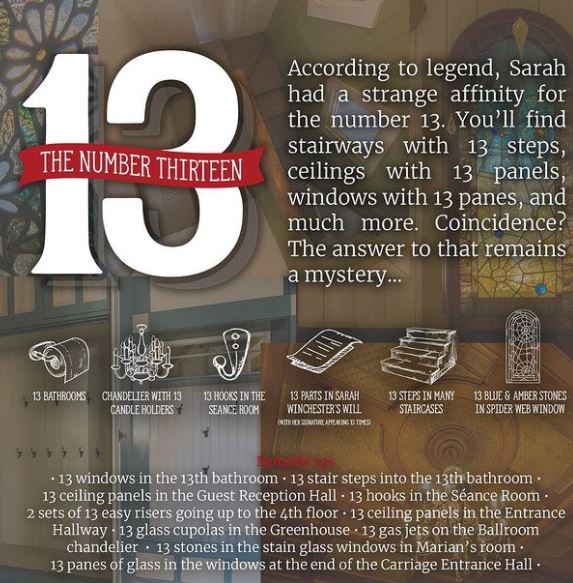
The Diasy Bedroom, the room Mrs. Sarah L. Winchester was trapped in during the 1906 earthquake received the most nominations for “most haunted” in the mansion. The conservators first became aware that strange things happened in The Daisy Bedroom when workers came in to restore it in 1985. Later, as they walked by the room with a psychically talented researcher, the man stopped suddenly and said, “There’s something going on in that room! I feel it strongly.” They immediately halted restoration plans. Three months later, during a tour, a woman found her young so carrying on an animated conversation with someone in the room. “Don’t you see her, Mommy?” the boy askes incredulously. “Don’t you see the lady by the window?” There used to be a diary filled with guest experiences with ghost through the years at The Winchester Mystery House.

For further information about tours, including group tours, weddings, school events, birthday party packages, facility rentals, and special events please visit the website: https://winchestermysteryhouse.com/

Please visit the online giftshop, and purchase a gift for friends and relatives as well as a special memento of The Winchester Mystery House. A variety of souvenirs and gifts are available to purchase. https://shopwinchestermysteryhouse.com/
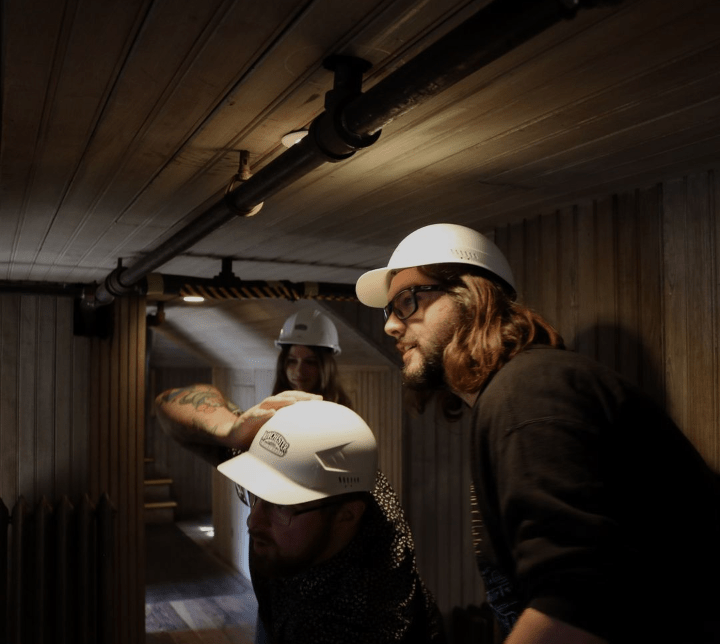
If you forget to purchase something during your visit, you can order any gift item by calling 408-247-2000 and charging them to your credit card. You can also place an order through the mail. Be sure to include a daytime telephone number with area code. Write to: Winchester Mystery House.

Money Can Buy Happiness for Some

Some people are still nice and happy. Happiness is a mental or emotional state of wellbeing characterized by optimistic or pleasant emotions ranging from contentment to intense joy. Media and advertising are selling happiness as a utopian experience. And more and more people interpret it as bliss. The popular misconception is that happiness is looking gorgeous, laughing all day long, coming by the way driving fancy cars, et cetera. However, bliss is a rare out-of-body moment and not a routine. Consider it as a beautiful vacation, but no matter how amazing the holiday is, one must return home because home is a constant anchor in our lives. We learn how to navigate through every other complex emotion by our state of being. If we re not in the best of space, we will end up making decisions that will further prolong a state of being to an unexpected duration. Most people gauge their happiness with the barometer of their feeling. If it is sadness, they feel they would make efforts to feel better. Feelings are tools to carve a state of mind. There are many actions that fluctuate the state of being we are in, particularly that of happiness. Drawing a sense of comparison with others, overthinking about the past, allowing situations to get the better of oneself are some of the factors that tend to make us happy. Happiness, as a state of mind, is cultivated over time. It is something that can be practiced with time and strengthened like a muscle; the effort is not to find it so much but rather to maintain a state of mind. #RandolphHarris 1 of 20

When we tend to outsource our happiness or hyperlink it to circumstances externally, we heavily rely upon the success of those scenarios to achieve happiness as a goal. It is only then happiness gets mistaken to be a by-product of situations rather than an ingredient in the action to be executed. We anticipate its arrival and chase it with all our might. Happiness is not determined by what is happening around you but rather by what is happening inside of you. Most people depend on others to gain happiness, but the truth is, it always comes from within. Happiness means different things to various people, but we think it is a state of wellbeing and contentment. Happy people, too, can be sad or disappointed, but they do not let it hamper their long-term mood. Happy individuals are more likely than their less happy peers to have fulfilling marriages, and relationships, high incomes, superior work performance, community involvement, robust health, and even a long life. Happy and unhappy people generally have the same number of adverse events in their lives. It is their interpretation or approach toward tragic events where the major difference lies. Optimistic people try to negotiate an action plan to equilibrize negative situations in their lives, whereas, on the other hand, pessimists are more likely to complain about circumstances and then step into the quicksand of negativity or cynicism, perhaps even depression. In many ways, our hope is our knowledge. A doctor with a highly coveted medical degree, not believing that he will be able to treat his patients, will end up not using his knowledge to his advantage. #RandolphHarris 2 of 20

Similarly, if he is not definite about being able to sell the products or fearing it will not rain, a farmer will not sow seeds at the beginning of his agricultural season. Optimism and pessimism are evaluative styles of reacting to life events that determine a positive vs. negative mood and all-embracing or all-excluding behaviour. Individuals with optimistic explanations of life try to look for the good in the bad; they generally feel happier and more equipped to handle challenges and do not self-label themselves as failures as the advent of every setback. Optimists tend to analyse how much of the situational they could control and how much was beyond their grip. Optimism is a form of positive thinking, allowing our interactions to have a positive spin resulting in better health, longer lives, long-lasting relationships, and healthier babies. There is no single great strategy to come with adversities. Most happy people adapt to how they respond to a situation and are ore agile in circumstances that may otherwise lead to emotional gymnastics. There is a lot to be learned from how well we cope with adversities. Human beings can cope pretty well with really bad things. We are finding that people who deal best with adversity are people who have flexible responses. They have multiple coping strategies, which is part of what we think of as mental health. Happy people also accept that adversity allows them to strengthen their coping skills. Without any challenges, one will hardly be able to evaluate one’s response. Therefore, happy people learn from each setback and bounce more resolutely. Over time, they are able to read situations and behave appropriately. #RandolphHarris 3 of 20

Money along cannot compensate for happiness. It allows one to live comfortably or feel secure. However, it is that all one needs to rise on the happiness metrics? Perhaps not. Out of 4,000 millionaires interviewed said that if you want you and your heirs to be happier, you should give your money away and let them make it on their own. (However, you will notice none of them do this and they continue to squeeze every penny they can get out of consumers.) Money helps procure resources to meet our basic needs, but more money does not always guarantee more happiness. Making money oneself instead of inheriting it resulted in people with peers with equal wealth feeling a bit happier. The pursuit of wealth demands multitasking on other fronts of an individual’s life. It means balancing working overtime with spending time with family, traveling for business trips to hanging out with friends, juggling weekend work mode with pursuing personal hobbies, cutting down on vacations, or lazing around with a high-pressure need to meet deadlines. Apart from the bank account, a person may have a limited circle to share that money with. However, a person not managing their financial foothold well will also crumble under the pressure of paying bills, living hand to mouth, and eventually feeling miserable. The honest answer to the question of whether money can or cannot buy happiness is that every individual is different. Each person makes decisions prioritizing what they need most. As long as our sense of value of life, people around us, and the World overall is not dictated by the currency in our wallet, we shall be able to create a fulfilling life. #RandolphHarris 4 of 20

No matter what your personality type is, you can embody happiness. Extrovert find happiness through their external Worlds and feel energized through the social circles they are part of. Introverts, on the other hand, find contentment in their inner Worlds. Going for a walk, sitting by themselves, painting, or reading a book might comfort them in a similar fashion as it does an extrovert in public interaction. Despite the numerous comparisons between whether one is better than the other, what a lot of studies vouch for is that the key factor in happiness amidst both personality types is to accept oneself, create a quality tribe that you can trust and not marinate one’s mind in other people’s way of living. It might work for them, but because there is no formula for happiness, you are free to discover your own route to it. If there are people who are happy permanently, it is debatable. Yet, there definitely exist people who are genuinely satisfied with their lives. There are people who feel good about life more often than others. This regular happiness mode labels them as happy people. There are people who acknowledge the happy people around them and celebrate them for their characteristics. These characteristics, when analysed, show the common thread of similar values, mechanisms, and behaviour traits running across all the people. Happy people exist because they choose to. While there are a million things that spark joy if we allow ourselves the time just to pause and look around, below, we have jotted down a few that we keep going back to, id est, our happiness trail and where to find them. #RandolphHarris 5 of 20

The expert who is skilled in getting attention, provoking discussion, and dramatizing problems plays an indispensable role in the planning process in an agency, family, or group, and deserves perhaps more honour than one gets, since too often one is treated as one who troubles the sleep of others. Poets and prophets may be indispensable as movers of opinion and intolerable as team mates. The unquestioning assurance with which we habitually assume that everyone knows what is meant by social problem attests that we are dealing here with one of the valid preconceptions of our culture. Yet our and other cultures show that what is problematical to some people is not so to others. In our culture, circumstances such as the condition of the weather and the coming of death are regarded as natural and inevitable concomitants of human existence. They cannot be changed or improved, they are not subject to progress, nothing can be done about them except to submit and adjust to them; they are not problems. The problematical situation is one where it appears that something can be done, something which is defined by the comparison of a better future and a worse present. Thus the concept of problems is closely linked historically and culturally with the idea of progress and the increase of man’s power over nature. To the extent tht the laboratories of General Electric raise hopes of regulating rainfall, the weather will become a problem. Thus, in the most advanced cultures almost any state of affairs can potentially be treated as a problem. #RandolphHarris 6 of 20

In considering matter like ill health, it may at first appear that for a state of affairs to be defined as problematic, it must inflict discomfort upon someone. Certainly it is true that many actions carried on by planning bodies are of this order; they are aimed at correcting some deficiency or restoring some status quo ante. It is also true, on the other hand, if they can be said to originate in any form of distress at all, that many actions of planning bodies originate only in that “divine discontent” created by an awareness of a discrepancy between what is an what might be. For propaganda purposes, it may be an advantage to publish each problem as an evil to be disposed of, rather than a good to be attained. However, it must be noted how in the planning process it is often the unfolding of new possibilities that crates the problem, not the intensification of some threat of pain. Failure to recognize the prospect of continuous, dynamic change leads not to planning but to fire-fighting, not to cumulative advance in power and technique but to stagnant routine. The definition of problems in terms of the progressive setting of new and positive goals is thus one of the major distinctions between the planning and the therapeutic approach to the conduct of family agencies. Also, the therapy, as well as the charity approach, is likely to assume the existence of a natural order. According to this view, problems arise when something goes wrong with the natural order. Some external disturbance is said to interfere with normal functioning, and the problem is assumed solved when the natural order is restored. #RandolphHarris 7 of 20

The planning approach, in contrast, denies the assumption of some pre-existent natural order, and construes the social order as the product or construction of purposeful human activity. There is no valid question of whether to plan or not to plan, but only of which plans are good and which plans are bad. The structure of all human organizations—from the smallest to the largest—is taken as the embodiment of certain rules of the game which have been invented or accepted by their participants. Problems from this point of view require some reconstitution of the group to accomplish some change of purpose. From the therapeutic point of view, it is common to speak of “society as the patient.” However, from the planning point of view, all parties affected by the problem are equally patients and therapists, who are engaged not in restoring their constitution but a sacred attitude toward the structure of the social order, the planning approach takes a very secular attitude. Personality likewise becomes problematic when it is viewed as a construction from the elements of experience. The basic assumption of all research on the development of personality is that ultimately something can be done about it, something distinguishable in terms of better and worse. How much can be done, of course, is not ascertainable a prior but only by exploration and experiment. As the reflection of the social order in which it occurs, personality can be no more a “natural order” than the rules of the game which constitute the social order. The identity of Americans is a social problem in 2023. #RandolphHarris 8 of 20

We have so far spoken mainly of the anxiety and of the feeling of powerlessness pervading the personality of the member of the middle class. We must now discuss another trait which we have only touched upon very briefly: his hostility and resentment. That the middle class developed intense hostility is not surprising. Anybody who is thwarted in emotional and sensual expression and who is also threatened in his very existence will normally react with hostility; as we have seen, the middle class as a whole and especially those of its members who were not yet enjoying the advantages of rising capitalism were thwarted and seriously threatened. Another factor was to increase their hostility: the luxury and power which the small group of capitalists, including the higher dignitaries of the Church, could afford to display. An intense enby against them was the natural result. However, when hostility and envy developed, the members of the middle class could not find the direct expression which was made possible for the lower classes. These hated the rich who exploited them, they wanted to overthrow their power, and could thus afford to feel and to express their hatred. The upper class also could afford to express aggressiveness directly in the wish for power. The members of the middle class were essentially conservative; they wanted to stabilize society and not uproot it; each of them hoped to become more prosperous and to participate in the general development. Hostility, therefore, was not to be expressed overtly, nor could it even be felt consciously; it had to be repressed. #RandolphHarris 9 of 20

Repression of hostility, however, only removes it from conscious awareness, it does not abolish it. Moreover, the pent-up hostility, not finding any direct expression, increases to a point where it pervades the whole personality, one’s relationship to others and to oneself—but in rationalized and disguised forms. Mr. Luther and Mr. Calvin portray this all-pervading hostility. Not only in the sense that these two men, personally, belonging to the ranks of the greatest haters among the leading figures of history, certainly among religious leaders; but, which is more important, in the sense that their doctrines were coloured by this hostility and could only appeal to a group itself driven by an intense, repressed hostility. The most striking expression of this hostility is found in their concept of God, especially in Mr. Calvin’s doctrine. Although we are all familiar with this concept, we often do not fully realize what it means to conceive of God as being as arbitrary and merciless as Mr. Calvin’s God, who destined part of mankind to eternal damnation without any justification or reason except that this act was an expression of God’s power. Mr. Calving himself was, of course, concerned with the obvious objections which could be made against this conception of God; but the more or less subtle construction he made to uphold the picture of a just and loving God do not sound in the least convincing. This picture of a despotic God, who wants unrestricted power over men and their submission and humiliation, was the projection of the middle class’s own hostility and envy. #RandolphHarris 10 of 20

Hostility or resentment also found expression in the character of relationships to others. The main form which it assumed was moral indignation, which has invariably been characteristic for the lower middle class from Mr. Luther’s time to Mr. Hitler’s. While this class was actually envious of those who had wealth and power and could enjoy life, in terms of moral indignation and in the conviction that these superior people would be punished by eternal suffering. However, the hostile tension against others found expression in still other ways. Mr. Calvin’s regime in Geneva was characterized by suspicion and hostility on the part of everybody against everybody else, and certainly little of the spirit of love and brotherliness could be discovered in his despotic regime. Mr. Calvin distrusted wealth and at the same time had little pity for poverty. In the later development of Calvinism warnings against friendliness towards the stranger, a cruel attitude towards the poor, and a general atmosphere of suspiciousness often appeared. Aside from the projection of hostility and jealousy onto God and their indirect expression in the form of moral indignation, one other way in which hostility found expression was in turning it against oneself. We have seen how ardently both Mr. Luther and Mr. Calvin emphasized the wickedness of man and taught self-humiliation and self-abasement as the basis of all virtue. What they consciously had in mind was certainly nothing but an extreme degree of humility. #RandolphHarris 11 of 20

However, to anybody familiar with the psychological mechanisms of self-accusation and self-humiliation there can be no doubt that this kind of “humility” is rooted in a violent hated which, for some reason or other, is blocked from being directed toward the World outside and operates against one’s own self. In order to understand this phenomenon fully, it is necessary to realize that the attitudes toward others and toward oneself, far from being contradictory, in principle run parallel. However, while hostility against others is often conscious and can be expressed overtly, hostility against oneself is usually (except in pathological cases) unconscious, and finds expression in indirect and rationalized forms. One is a person’s active emphasis on his own wickedness and insignificance, of which we have just spoken; another appears under the guise of conscience or duty. Just as there exists humility which has nothing to do with self-hatred, so there exist genuine demands of conscience and a sense of duty which are not rooted in hostility. This genuine conscience forms a part of integrated personality and the following of its demands is an affirmation of the whole self. However, the sense of “duty” as we find it pervading the life of modern man from the period of Reformation up to present in religious or secular rationalization, is intensely coloured by hostility against the self. #RandolphHarris 12 of 20

“Conscience” is a slave driver, put into man by himself. It drives him to act according to wishes and aims which he believes to be his own, while they are actually the internalization of external social demands. It drives him with harshness and cruelty, forbidding him pleasure and happiness, making his whole life the atonement for some mysterious sin. It is also the basis of the “inner Worldly asceticism” which is so characteristic in early Calvinism and later Puritanism. The hostility in which this modern kind of humility and sense of duty is rooted explains also one otherwise rather baffling contradiction: that such humility goes together with contempt for others, and that self-righteousness has actually replaced love and mercy. Genuine humility and a genuine sense of duty towards one’s fellow men could not do this; but self-humiliation and self-negating “conscience” are only one side of an hostility, the other side of which is contempt for and hatred against others. The hostility of man against himself is contained in the superego. The superego was originally the internalization of an external and dangerous authority. Unless regeneration by the Holy Spirit and the indwelling of the Spirit means sinlessness, and the present possession of a resurrection body, not every part of a believer is yet renewed and freed by the redemption of Calvary from the effects of the Fall. HENCE THERE IS GROUND FOR THE POSSIBLE OPERATION OF DECEIVING SPIRITS. #RandolphHarris 13 of 20

Since absolute sinlessness and the present possession of the resurrection body are not taught in the Scriptures as attainable while on Earth, the chance of deception is logically and reasonably possible—even while the spirit and heart of man is renewed by the Holy Spirit. If we come to facts of experience, the proofs are so abundant as to be beyond our capacity to handle in the limited space of this essay, not only in the unregenerated World but in those who are undoubtedly children of God and spiritual believers. If we knew ourselves and our actual condition as sinners, s depicted in God’s Word, we would be in greater safety from the enemy. It is the ignorance of our true condition even with the new life from God implanted in us, and our blind confidence of safety without an intelligent basis for that assumption, which lays us open to being deceived by Satan through our very certainty of being free from his deception. Since the government and public schools no longer instill patriotism in Americans, it is your jobs as parents to teach your children to be patriotic and to buy American cars. Back in the 1950s, housekeepers would brag about teaching the children they took care of to be the first in the neighbourhood to memorize the pledge of allegiance. However, today’s kids are taught by the TV how to sing theme songs to their favourite cartoons. Let us not forget to remind our children of what an honour it is to live in America and to be an American. “Christology is a function of soteriology.” The Christ who brings the New Being is a unique event which saves the whole of humanity and the whole of the Universe. The task of Christology is to work out the universal significance of this simple and unrepeatable historic fact. #RandolphHarris 14 of 20

The New Testament account supplies the concrete details of an individual, personal life, whole the Christological symbols convey the universal significance of the Christ. Thus, myth and symbols are the very language of religion, and to demythologize “would silence the experience of the holy.” Two central Christological symbols reveal the significance of Jesus as the Christ: the Cross, which symbolizes His subjection to existence, and the Resurrection, which symbolized His Victory over it. The Cross and the Resurrection are mutually interdependent, for the triumph of the Resurrection supposes the death on the Cross, and the Cross would have been no different from the death of any other man if the Christ had not risen. Building on this close relationship, we establish the Cross as the paradigm according to which the Resurrection is to be understood. The Cross is both an event and a symbol or, better, a symbol based on an event. As the crucifixion story of Jesus, it enjoys a comparatively high degree of historical probability. As the Cross of Jesus who is the Christ, it is the myth of the bearer of the new eon who suffers the death of a convict and slave under the powers of that old eon which He is to conquer. The Resurrection must be viewed in the same way, as event and symbol, but with this difference, that the New Testament reports of the factual element of the Resurrection are far more mysterious and uncertain than those of the crucifixion. #RandolphHarris 15 of 20

The resurrection system was a familiar one in ancient religions, but a real experience made it possible for the disciples to apply the known symbol of resurrection to Jesus, thus acknowledging Him definitely s the Christ. This experienced event brought the certainty that He who is the bringer of the new eon cannot finally have succumbed to the power of the old eon. The physical resurrection of the body of Jesus, holds that the soul of Jesus first appeared to His disciples, which allowed them to communicate with the dead. However, the full resurrection revived the whole personality, body and soul. It was a negativity which was overcome, and this negativity was not the death of one man, but the disappearance of Him in whom the New Being was manifest. By His death he disappeared from the present experience of the disciples. Jesus of Nazareth became indissolubly united with the reality of the New Being. He is present wherever the New Being is present. In this way the concrete individual life of man Jesus of Nazareth is raised above transitoriness into the eternal presence of God as Spirit. The Resurrection is the restitution of Jesus as the Christ, a restitution which is rooted in the personal unity between Jesus and God ad in the impact of this unity on the minds of the apostles. The experience of the New Being in Jesus as the Christ had to come first, but, after the death of Jesus, the disciples’ experience of His living presence restored Him to His Christhood. Faith in the Resurrection of the Christ does not depend upon historical research or theological theories. Certainty can come only from faith, and faith assures us the victory of Jesus the Christ over the conditions of existence. #RandolphHarris 16 of 20

Faith is based on the experience of being grasped by the power of the New Being through which the destructive consequences of estrangement are conquered. It is certainty of one’s own victory over the death of existential estrangement which creates the certainty of the Resurrection of the Christ as event and symbol; but it is not historical conviction or the acceptance of biblical authority which creates this certainty. Jesus of Nazareth is the medium of the final revelation because He sacrifices Himself completely to Jesus as the Christ. The Christ possesses perfect unity with God. However, since Jesus of Nazareth is only the bearer of this revelation, He must not point to Himself, but to the ground of being. The Cross says No to Jesus while revealing the Yes of the Christ’s unbroken union with God. In other words, the Cross is the symbol of the Protestant principle. When it comes to the criterion of faith, that symbol is most adequate which expresses not only the ultimate but also its own lack of ultimacy. Jesus could not have been the Christ without sacrificing Himself as Jesus to Himself as the Christ. What is particular in Him (Jesus) is that He Crucified the particular in himself for the sake of the Universal. This liberates His image from bondage both to a particular religion…and to the religious sphere as such. #RandolphHarris 17 of 20

With this image, particular yet free from particularity, religious yet free from religion, the criteria are given under which Christianity must judge itself. Moreover, the No of the Cross applies equally to the followers of the Christ: No finite being can attain the infinite without being broken as He who represented the World, and its wisdom and its power, was broken on the Cross. And, finally, of special interest to us, theonomy is based upon the Protestant principle, the Yes and the No of the Cross. For Jesus the Christ overcomes autonomy by His transparency to the ground of being (the Yes), and He resists heteronomy by the humiliation of His death (the No). One who delights in the Lord shall be like a tree planted by streams of waters, that bring forth its fruit in its season, and whose lead does not wither; and whatever one does one shall prosper. Teach me, O Lord, Thy way, that I may walk in Thy truth; make my heart firm to revere Thy name. Open my eyes that I may behold the wonders of Thy Holy Christian Bible. O my way be directed to observe Thy statutes. Guide me in Thy truth, and teach me, for Thou art the God of my salvation. Thy word is a lamp unto my feet, and a light unto my path. Teach me to do Thy will, for Thou art my God. Thy teachings ever make for righteousness; give me understanding, and I shall live. The only real poverty is poverty of mind. Reverence for God is the beginning of wisdom, and the knowledge of the Eternal is true understanding. Where there is no knowledge, there is no reverence for God; where there is no reverence for God, there is no true knowledge. The Book of Mormon and Holy Christian Bible endows man with modesty and reverence. And taches one to be virtuous, pious, upright and faithful. #RandolphHarris 18 of 20

Expressing the beliefs of his revolutionary generation, it was Mr. Jefferson, once again, who asserted that governments must behave with “absolute acquiescence in the decisions of the majority.” The United States of America and Europe—still at the dawn of the Second Wave era—were just beginning the long process that would turn them eventually into industrial mass societies. The concept of majority rule perfectly fit the needs of these societies. Our present mass democracy is the political expression of a mass production, mass consumption, mass education, mass media, mass society. Today, as we have seen, we are leaving industrialism behind and rapidly becoming a de-massified society. In consequence it is growing increasingly difficult—often impossible—to mobilize a majority or even a governing coalition. In the United States of America, I do not see the basis for any positive majority on anything today. In the place of a highly stratified society in which a few major blocs ally themselves to form a majority, we have a configurative society—one in which thousands of minorities, many of them temporary, swirl and form highly novel, transient patterns, seldom coalescing into a consensus of major issues. The advance of Third Wave civilization thus weakens the very legitimacy of many existing governments. The Third Wave also challenges all of our conventional assumptions about the relationships of majority rule to social justice. Throughout the era of Second Wave civilization in fight for majority rule was humane and liberating. In still-industrial countries like Africa today, it remains so. In Second Wave societies, majority rule almost always meant a fairer break for the poor. For the poor were the majority. As an economy expands or as it trade with other countries grows, a point will come when the present value of the social benefits of shifting toward a more rule-based governance will exceed the costs of the required investment. However, the switch need not occur at the optimal point. #RandolphHarris 19 of 20

There are many reasons why the political and economic realities will delay the shift. First and foremost, the fixed costs of rule-based governance are a public investment; therefore society must solve a collective-action problem to put such a system in place. This is not automatic; there are the usual problems of free riding, underestimation of the benefits to future generations in today’s political process, and the veto power held by those who stand to lose from the change. Even when public investment for a rule-based system has been made, people used to the relation-based system who want to switch must make some private investments to learn the rules and their operation. Their benefit from the switched will depend on how many others make the switch. This positive feedback externality can lean to too few switchers, or even a lock-in that keeps the old system in use. In turn, the expectation of this can reduce the social benefits of the changeover and therefore delay or deter the initial public investment. The benefits of the new system may be unequally distributed, and some participants may even lose. The reputational capital in the relation-based system is an asset that would become worthless in a pure rule-based system, so incumbents stand to lose from the change and will therefore resists it by political means. They currently successful businesspeople and financiers, who are almost by definition the heaviest users of the existing relation-based system, are also usually active participants in the political process, and adept at marshaling their special interests in an organized way. They can also stall and frustrate a government’s attempts at reform. And it seems like if a Republican wants to take office in California, where 30 percent of residents are poor or near poor, and 12.3 percent are below the poverty line, they will have to focus on policies to help the poor and on family values. The same holds true for the President of America. The middle class is at 50 percent and has consistently been shrinking since a peak of 61 percent in 1971. Currently, 12 percent of Americans are poor. #RandolphHarris 20 of 20

CRESLEIGH HOMES HAVENWOOD | HOMESITE 67

Home Site 67 is a Residence Four plan, the largest home offered in Cresleigh Havenwood. This two-story, 3,377 square foot home features four bedrooms, including one suite on the first floor, three and one half bathroom, and a true three-car garage.

The covered porch provided a warm entry and the dining room is located right off the entry way. The Kitchen is connected through the Butler’s Pantry providing ample storage. The great room and loft upstairs allow for various uses that will suit your family and lifestyle.

This home includes over $50,000 in options and upgrades
• Durable luxury vinyl plank flooring throughout the first floor
• Gray Shaker Cabinetry with Soft-Close Doors & Drawers
• Over Island Pendants and Under-Cabinet Lighting
• Gourmet Kitchen option with upgraded appliances
• Stainless Steel Farm Sink and Upgraded Faucet
• Flat Screen Prewire in Great Room
• Owned Solar

Best of all, each Cresleigh home comes fully equipped with an All Ready connected home! This smart home package comes included with your home and features great tools including: video door bell and digital deadbolt for the front door, connect home hub so you can set scenes and routines to make life just a little easier. Two smart switches and USB outlets are also included, plus we’ll gift you a Google Home Hub and Google Home Mini! https://cresleigh.com/havenwood/


Humankind Cannot Bear Very Much Reality

We live in a labyrinthine World of puzzling objects, enigmatical events, and practically unintelligible (sometimes even mystical) relationships that we cannot hope ever to comprehend entirely. A word is a slur when it is when it means to express strong negative attitudes towards members of a group, attitudes in some sense grounded in nothing more than membership in the group. A slur against a group of people, for example, is a word which speakers know (and as competent speakers are expected to know) is used to insult and display contempt for an individual based on race, religion, gender, sexuality, disability, age and so forth. What makes a word a slur I that it is used to do certain things, that has a certain illocutionary potential. Given what slurs are used to do, it is no surprise tht their use often achieves extreme effect on their targets—humiliation, subjection, shame. Slurs can be used without displaying contempt or causing hurt. This happens, for example, when a slur is appropriated by its targets: it is an insult to no one, save perhaps the individual for who the slur is aimed as uses it as a term to identify themselves. A slur can be self-ascribed to record one’s status as a victim of discrimination or worse. There need beno racism in an epithet’s use by comedians to make fun or criticize various attitude and behaviours of both one who slurs and one who I slurred. One may use a slur in order to teach someone that it is a word which should not be used. And an epithet can sometimes be used non-offensively in indirect discourse or narrative to portray someone else’s racist remark or attitude. The use of slurs often reflects a complicated web of attitudes, including discomfort about or fear of what seemed pronounced physical and cultural differences. #RandolphHarris 1 of 19

Truth is, and has always been, a central topic in philosophy. Direct interest in the word true itself may ebb and flow, but it is never far from center stage. We tend to assume that truthfulness and morality go together in a clear and simple way. In an ordinary community of morally decent people there is a need for trust and community standards for telling the truth, but ordinary community, unlike the ideal scientific community, must continually face the ambiguous problem of when to tell how much of what truth and to whom. Telling the whole truth about everything to everybody all the time is an impossibility but even if it were possible, it probably would not be desirable. Deception is a touchy subject. We should all repudiate all harmfully exploitative deceptions such as consumer fraud, insider trading, the misuse of public office and public trust for self-interest, kids hiding their dope and alcohol and pregnancies from their parents, husbands and wives cheating on each other, large-scale tax evasion, the false and vicious reason of racism and sexism, TV news reporters preying on vulnerable, semiliterate audiences, marijuana and cigarette advertising, and so on. The list of reprehensible exploitations is enormous and grows longer daily. As children we are taught to revere the principle of truth telling before we have achieved a clear understanding of what truth is. For a child, how is the truth different from a captivating story tht takes us off into other vivid realities? From saying things that make people feel good? From whatever saves us when we are in danger? Truth, fantasy, goodness, happiness, excitement are not automatically separated in the thoughts of young children. Children have to be taught to isolate truth and truth telling for special treatment. #RandolphHarris 2 of 19

As our experiences widen, however, we also learn through wonderfully indirect and subtle means that truth telling, like every other moral principle, has its drawback in practice, and sometimes we have to pass over it in our calculations for getting on as decent and successful human beings. Deception is found in every culture (only attitudes toward it differ), probably because it provides advantage in carrying out one’s intentions, and because it offer a chance to escape confrontations without having to fight. We humans are active, creative mammals who can represent what exists as if it did not, and what does not exist as if it did. And we do this easily and routinely. Concealment, obliqueness, silence, outright lying—all help to hold Nemesis at bay; all help us abide to large helpings of reality. T.S. Eliot was right when he reminded us that “Humankind/Cannot bear very much reality.” In civilization no less than in the wilderness, survival at the water hole does not favor the fully exposed and unguarded self. Deception, it seems, is a vital part of practical intelligence. Much of human interaction is take up with the giving and getting of impressions, which are composed of some plain truth and some fancy, some display and some concealment, something said and something suggested, something focused and something blurred. All this for the purpose of getting done what you want to do. Lying requires a reason while telling the truth does not. Truthfulness in statements which cannot be avoided is the formal duty of an individual to everyone, however great may be the disadvantage occurring to oneself or another. #RandolphHarris 3 of 19

Thus the definition of a life as merely an intentional untruthful declaration to another person does not require the additional condition that it must harm another. For a lie always harms another; if not some other particular human, still it harms mankind generally, for it vitiate the source of the law itself. Things happen; we witness some aspects of an event from a particular vantage point; we interpret what we have taken in with our senses; we discover or compose an acceptable meaning from that subjectivity limited rendering of “fact”; express an edited, personalized version of the result, to a selected audience, at a chosen time, if we want to. There is a vast psychological distance between the “things that happen” and what we are later able to say about them, no matter how sincerely we try to be objective and to get it right. Lifelong uncertainty about the “truth” is an attribute of human sensibility; it is a product of the interplay of memory and imagination, history and choice. Truth is fully present in our experiences. We can know truth. However, the multifarious and discordant sentiments which divine mankind, afford a great temptation to skepticism, and many are carried away by it. The open enemies of the gospel take occasion from hence to justify their rejection of it: many of its professed friend have written as if they thought, that to be decided, amidst so many minds and opinions, were almost presumptuous. The principle, if not the only use of which they would make of these differences is, to induce a spirit of moderation and charity, and to declaim against bigotry. #RandolphHarris 4 of 19

To say nothing at present how these terms are perverted and hackneyed in a certain cause, let two things be seriously considered—First, Whether this was the use made by the apostles of the discordant opinions which prevailed in their times, even amongst those who “acknowledged the divinity of our Saviour’s mission?” In differences amongst Christians which did not affect the kingdom of God, nor destroy the work of God, it certainly was: Such were those concerning means, drinks, and days, in which the utmost forbearance was inculcated. However, it was otherwise in differences which affected the leading doctrines and precepts of Christianity. Forbearance in these cases would, in the account of the sacred writers, have been a crime. If Christianity be of God, and He have revealed His will in the holy scriptures, light is come into the World, though the dark minds of sinful creatures comprehend it not. It does not follow, because many wander in mazes of fruitless speculation, that there is not a way to plain that a way-faring man or one who “walketh in the truth,” though a fool, shall not err. The numerous sects among the Greeks and Romans, and even among the Jews, at the time of our Saviour’s appearing, did not prove that there was no certain knowledge to be obtained of what was truth. Our Lord considered Himself as speaking plainly, or He would not have asked the Jews as he did, “Why do ye not understand my speech?” The apostles and primitive believers saw their way plainly: and though we cannot pretend to the extraordinary inspiration which was possessed by man of them; yet, if we humbly follow their light, depending on the ordinary teachings of God’s Holy Spirit, we shall see ours. #RandolphHarris 5 of 19

Truth, we may be certain, is the same thing as what in the scriptures is denominated “the gospel,” “the common salvation,” “the common faith,” “the faith once delivered to the saints,” “the truth as it is in Jesus,”; and what this is, may be clearly understood by the brief summaries of the gospel, and of the faith of the primitive Christians, which abound in the New Testament. Of the former the following are a few of many examples: “God so loved the World the He gave His only begotten Son, that whosoever believeth in Him should not perish, but have everlasting life—The Son of Man came to seek and save that which is loft—I am the way, the truth, and the life: no man cometh unto the Father but by me—To Him give all the prophets witnesses, that through His name whosoever believeth in Him shall receive remission of sins—We preach Christ crucified, to the Jews a stumbling-block, and to the Greeks foolishness; but to them that believe, the wisdom of God, and the power of God—I determined not to know anything among you, save Jesus Christ, and Him crucified—Moreover, brethren, I declare unto you the gospel which I preached unto you, which also ye have received, and wherein ye find; by which also ye are saved, if ye hold fast what I preached to you, unless ye have believed in vain: for I delivered unto you first of all that which I also received, how that Christ died for our sins, according to the scriptures; and that He was buried, and the He rose again the third day, according to the scriptures—This is a faithful saying, and worthy of all acceptation, that Christ came into the World to save sinners, of whom I am chief—This is the record, that God hath given to us eternal life, any other: for there is none other name under Heaven given among men, whereby we must be saved.” #RandolphHarris 6 of 19
If language have any determinate meaning, it is here plainly taught the mankind are not only sinners, but in a lost and perishing condition, without help or hope, but what arises from the free grace of God, through the atonement of His Son; the He died as our substitute; that we are forgiven and accepted only for the sake of what He hath done and suffered; that in his person and work all evangelical truth concentrates; that the doctrine of salvation for the chief of sinners through His death, was so familiar in the primitive times, as to become a kind of Christian proverb, or “saying;” and that on “standing,” and final “salvation.” In this doctrine be received, Christianity is received: If not, the record which God hath given of His Son is rejected, and He Himself treated as a lair. When this doctrine is received in the true Spirit of it, (which it never is by a sinner ready to perish) all those fruitless speculations which tend only to bewilder the mind, will be laid aside; just as malice, and guile, and envies, and evil-speaking are laid aside by Him who is born of God. They will fall off from the mind, like the coat of the chrysalis, of their own accord. Many instances of this are occurring. Persons who, after having read and studied controversies, and learned first to one opinion and then to another, till their minds have been lost in uncertainty, have at length been brought to think of the gospel, not as a matter of speculation, but as that which seriously and immediately concerned them: and embracing it as good news to them who are ready to perish, have not only found rest to their fouls, but all their former notions have departed from them, as a dream when one awaketh. #RandolphHarris 7 of 19

The Christological problem begins when men realize they are estranged and wonder about a new reality with the power to conquer existence, but it does not end with the simple acceptance of Jesus as the Christ. The baptismal confession that Jesus is the Christ is the text of which the Christological dogma is the commentary. The dogma has a twofold purpose: to affirm and defend the Christian message against distortion, and to express it in conceptual terms. The first function guards the substance; the second function imparts form. The aim of the early conciliar Christological formulas was to preserve both the Christ-character and the Jesus-character of the event of Jesus as the Christ. The homoousion of Nicaea maintained the Christ-character against the Arians who would make Jesus a semi-divine being. Chalcedon warded off the attacks of the monophysites upon the Jesus-character of the Christ. Both councils succeeded in affirming and defending the substance of the Christian message, but they did so in spite of the inadequate intellectual tools of the two-natures theory. The task of present-day Protestant Christology is the development of new forms to express the substance of Nicaea and Chalcedon. However, the basic inadequacy lies in the term “nature.” When applied to man, it is ambiguous; when applied to God it is wrong. “Human nature” can mean three things: essential or created nature, existential or estranged nature, and an ambiguous unity of the two. All three meanings can be applied to Jesus as the Christ, although the second must be qualified insofar as estrangement, while remaining a real possibility, is taken into the unity with God. #RandolphHarris 8 of 19

Because of this ambiguity and need for qualification, it is imperative to dismiss altogether the term “human nature” in relation to Christ and replace it by a description of the dynamics of His life. The term “divine nature” must be understood as that which makes God what He is, His essence. However, God also has existence, or, more exactly, He is beyond both essence and existence. “Divine nature,” cannot be applied to the Christ precisely because the New Bing is not beyond essence and existence, but in existence. The Christ is a personal life in a definite period of history, subject to birth and death, temptation and finitude. The assertion that Jesus as the Christ is the personal unity of a divine and a human nature must be replaced by the assertion that in Jesus as the Christ the eternal unity of God and man has become historical reality. This is better than the two natures which lie beside each other like blocks and whose unity cannot be understood at all. In Spirit Christology, we understand that God was in Jesus the Christ because the divine Spirit totally grasped His human spirit. In this sense, one can speak of the faith of the Christ which is the state of being grasped unambiguously by the Spiritual Presence. However, although the Spirit is unambiguously present in the Christ, His faith still has a fragmentary character due to the fact tht He is subjected to the conditions of existence. Two important implications follow from Spirit Christology. First, it is not the spirit of the man Jesus that makes Him the Christ, but the Spirit of God, and thus the dangers of a Jesus-theology are avoided. #RandolphHarris 9 of 19

And secondly, the Spiritual Presence in history is the same as the Spiritual presence in the Christ; hence, He is not an isolated event, but touches the whole history through the activity of the spirit. Admittance of the possibility of deception is in the stage in break of truth upon the mind, although it may sometimes precede the doubt. To admit the possibility of being deceived—or mistaken—in any aspect of new experience or action, or even view of truth, is really a possibility which should be acknowledged by every believer; and yet so subtle is the deception of the enemy tht almost invariably the attitude of each one is tht though “others” may be open to deception, he or she is the exception to the rule. This certainty of personal exception is so deep-seated with the most visibly deceived person that the longest battle is simply to obtain entrance to the mind for the one thought of possible deception in any point at all. The believer seems armed with unshaken assurance that though others may be misled, he certainly is not; he “beholdeth the mote” in his brother’s eye and is blind—blind to the “beam” in his own. However, an open attitude to truth says, “Why not I as well as others? May not my assurance of safety be a deception of the enemy, as much as the deception I see in others?” Why all believers should admit the possibility of deception by deceiving spirits may be considered just here: The primary fact to be recognized by every human being is the complete and utter ruin of the first creation at the Fall—when the First Adam admitted the poison of the serpent, which permeated and corrupted his whole being beyond repair. #RandolphHarris 10 of 19

The utter corruption of the human race as a consequence is unmistakably declared in the New Testament: “The old man, which waxeth corrupt after the lusts of deceit,” reports Ephesians 4.22. “Being darkened in their understanding; alienated from the life of God,” reports Ephesians 4.18. “We all once lived in the lusts of flesh, doing the desires of the flesh and of the thoughts, and were by nature the children of wrath, even as the rest,” reports Ephesians 2.3. Thus the Apostle Paul described the whole race of man, Gentile and Jew, Pharisee and Publican: In all, he said, “the prince of the power of the air” has operated, as “the spirit that now worketh in the sons of disobedience.” All agencies plan, as do all persons and families; planning in the generic sense distinguishes us humans from creatures who cannot transcend the immediate. However, planning in the specific sense of highly modern attainments in social organization is what we mean when we speak of the planning stage in family agencies. In the long history of man’s ascent toward rationality in social affairs, conscious awareness of the planning process in action agencies ranks as a major invention. The image of the competent man is out of place except in the context of modern planning. The generalized outlines of the democratic planning process which follows should not be taken as a recommendation that every family agency should immediately plunge into the planning stage. Planning by a family agency is not unlike the planning by a person of his career. When the aim of an agency is personal development, there are many reasons why its planning method should self-consciously follow a model which permits the agency to transform itself by its own operations. #RandolphHarris 11 of 19

Since Dr. Cooley in 1902, if not long before, many thinkers have held that human nature and the social order reflect each other. There have been divergent opinions whether the line of causation runs from personality to community (“human nature writ large”), or whether the person as microcosm incorporates as habit the regular recurrences which constitute the institutional fabric of society. The developmental view conceives a spiral of interaction between the careers of persons and institutions. It is the obligation of the family agency that adopts the aim of optimal development to maintain this nexus in a dynamic sense. To keep the parallel always in mind can cumulatively influence multitudes of decisions. In concrete terms, the action of agencies, families, and individuals is not a constant flow; it is episodic, organized in fairly regular, qualitatively distinguishable sequences. As a unit of reference, the behavior of each of the three can usefully be brought together in a conceptual analysis of the planning process that is applicable to all three levels of abstraction. To study the phases of the planning process, as seen in the furthest advanced of the family agencies, is to see in enlarged detail what in family or personal living may be only implicit or rudimentary. However, from this enlargement of the social act one can then derive clues and questions which are relevant when observing the smallest sequence of interpersonal behaviour. #RandolphHarris 12 of 19

Before there is an agency, or planning, or the possibility of planning, there must be a public with a problem. The public and the problem are defined in reference to each other. They never stand alone, and cannot be defined alone. A problem always belongs to some group of people, and generally speaking any group comes into existence as a group because its members feel that they are confronted by a common problem or problems. However, an outside expert cannot always determine what constitutes the problem of a group. And yet the problem exists and arguments may abound as to how to define it. Alternatively, a certain state of affairs may be a problem to an observer without being regarded as a problem to those whom it seems to affect. If a state of affairs affecting a number of people is also to become the problem of the group, then the members of the group must participate in defining the problem. Otherwise it is not their problem and they are not likely to feel responsible for its solution. The expert may assist in the recognition and clarification of a problem, but must be prepared for his interpretations to be rejected. Each phase of the planning process, when fully developed in a community or a large institution, employs a characteristic type of document. In this first or problem phase, such a document functions primarily to call attention to a problem and to convince the public involved that something ought to be done about it. The definition of what ought to be done occurs in later phases of the planning process, and yet in the successful attention-getting and definition of the problem, the outlines of later phases vaguely emerge. #RandolphHarris 13 of 19

On this account, the importance of the problem phase of planning is often underestimated; that is, action goes off without adequate preparation. Even more often, the importance of getting the public involved and committed to solution of the problem is underestimated. Yet it is the arousal of concern, and participation in the definition of the problem as their problem, which motivates the public to act. Effort in the Calvinist doctrine had still another psychological meaning. The fact that one did not tire in that unceasing effort and that one succeeded in one’s moral as well as one’s secular work was a more or less distinct sign of being one of the chosen ones. The irrationality of such compulsive effort is that the activity is not meant to create a desired end but serves to indicate whether or not something will occur which has been determined beforehand, independent of one’s own activity or control. This mechanism is a well-known feature of compulsive neurotics. Such persons when afraid of the outcome of an important undertaking may, while awaiting an answer, count the windows of houses or trees on the street. If the number is even, a person feels that thing will be right; if the number is uneven, it is a sign that he will fail. Frequently this doubt does not refer to a specific instance but to a person’s whole life, and the compulsion to look for “signs” will pervade it accordingly. Often the connection between counting stones, playing solitaire, gambling, and so on, and anxiety and doubt, is not conscious. A person may play solitaire out of a vague feeling of restlessness and only an analysis might uncover the hidden function of his activity: to reveal the future. #RandolphHarris 14 of 19

In Calvinism this meaning of effort was part of the religious doctrine. Originally it referred essentially to moral effort, but later on the emphasis was more and more on effort in one’s occupation and on the results of this effort, that is, success or failure in business. Success became the sign of God’s grace; failure, the sign of damnation. These considerations show that the compulsion to unceasing effort and work was far from being in contradiction to a basic conviction of man’s powerlessness; rather was it the psychological result. Effort and work in this sense assumed an entirely irrational character. They were not to change fate since this was predetermined by God, regardless of any effort on the part of the individual. They served only as a means of forecasting the predetermined fate; while at the same time the frantic effort was a reassurance against an otherwise unbearable feeling of powerlessness. This new attitude towards effort and work as an aim in itself may be assumed to be the most important psychological change which has happened to man since the end of the Middle Ages. In every society man has to work if he wants to live. Many societies solved the problem by having the work done by slaves, thus allowing the free man to devote himself to “nobler” occupations. In such societies, work was not worthy of a free man. In medieval society, too, the burden of work was unequally distributed among the different classes in the social hierarchy, and there was a good deal of crude exploitation. However, the attitude toward work was different from that which developed subsequently in the modern era. #RandolphHarris 15 of 19

Work did not have the abstract character of producing some commodity which might be profitably sold on the market. One worked in response to a concrete demand and with a concrete aim: to earn one’s livelihood. There was, as Max Weber particularly has shown, no urge to work more than was necessary to maintain the traditional standard of living. It seems that for some groups of medieval society work was enjoyed as a realization of productive ability; that many others worked because they had to and felt this necessity was conditioned by pressure from the outside. What was new in modern society was that men came to be driven to work not so much by external pressure but by an internal compulsion, which made them work as only a very strict master could have made people do in other societies. The inner compulsion was more effective in harnessing all energies to work than any outer compulsion can ever be. Against external compulsion there is always a certain amount of rebelliousness which hampers the effectiveness of work or makes people unfit for any differentiated task requiring intelligence, initiative, and responsibility. The compulsion to work by which man was turned into his own slave driver did not hamper these qualities. Undoubtedly capitalism could not have been developed had not the greatest part of man’s energy been channeled in the direction of work. There is no other period in history in which free men have given their energy so completely for one purpose: work. The drive for relentless work was one of the fundamental productive forces, no less important for the development of our industrial system than steam and electricity. #RandolphHarris 16 of 19

The obsolescence of many of today’s governments is not some secret we alone have discovered. Nor is it a disease of America alone. The fact is that building a Third Wave civilization on the new wreckage of Second Wave institutions involves the design of new, more appropriate political structures in many nations at once. This is a painful yet necessary project that is mind-staggering in scope and will no doubt take decades to complete. In all likelihood it will require a protracted battle to radically overhaul the United States of America’s Congress, the House of Commons, and the House of the Lord, the French Chamber of Deputies, the Bundestag, the Diet, the giant ministries and entrenched civil services of many nations, their constitutions and court systems—much of the unwidely and increasingly unworkable apparatus of existing representative governments. Nor will this wave of political struggle stop at the national level. Over the months and decades ahead, the entire “global law machine”—from the United Nations at one end to the local city or town council at the other—will eventually face a mounting, ultimately irresistible demand for restructuring. All these structures will have to be fundamentally altered, not because they are inherently evil or even because they are controlled by this or that class or group, but because they are increasingly unworkable—no longer fitted to the needs of a radically changed World. To build workable governments anew—and to carry out what may well be the most important political task of our lifetimes—we will have to strip away the accumulated cliches of the Second Wave era. And we will have to rethink political life in terms of three key principles. #RandolphHarris 17 of 19

Indeed, these may well turn out to be the root principles of the Third Wave governments of tomorrow. Business in a relation-based system will expand at those margins where diminishing returns set in most slowly. This will mean preserving the closeness of the relation, even at the cost of undertaking a new activity that is not economically so close—not such a good complement in production or consumption. In such a system we will see diversified conglomerates whose component parts have nothing in common except common ownership by a closely knit extended family or similar network. One does indeed see such hodgepodge family empires in many less-developed countries (LDCs), for example India and Turkey. The South Korean chaebol, and the Japanese zaibatsu and their successor keiretsu, are also causes in point. Even in advanced industrial countries with rule-based governance, there are incentives to build diversified conglomerates—tax systems with double taxation of dividends make it costly to take profits out of the corporate sector and therefore artificially lower the cost of reinvesting retained earnings, and agency problems allow to management to indulge in its tastes for running large empires. However, in smaller and LCDs where relation-based governance prevails, the incentives to expand into seemingly unrelated activities are that much stronger. Another way to express this is to day that a relation-based system has a larger benefit of internal finance from the supply side. Thisbenefit is usually looked at from the demand side—the needs of a firm’s finance for investment are met at lower costs from retained earnings than from external borrowing. #RandolphHarris 18 of 19

However, the return to retained earnings is higher if reinvested within the firm than is possible from investments in external markets. Where borrowing and lending between different firms and their owner occurs, it will tend to be within some identifiable group defined by links that enable enforcement of implicit contracts based on reputation. This suggests that the “crony capitalism” that is observed in many LDCs (and condemned by outsiders) may have it place within their governance structure. Of course you deal with, and lend to, cronies. Non-cronies may defraud you and run away with your money; having no relation with them, you would have no recourse. “Crony socialism” existed under the central planning systems in socialist economies, and continued in the transition period. However, this compartmentalization of capital markers has a cost; it constrains that movement of capital to its most productive uses in response to changing conditions. Therefore it comprises another source of diminishing returns for the relation-based system. Transition to a rule-based system would allow more efficient reallocation of capital to take advantage of productive opportunities outside the group. Finally, although a relation-based system has low fixed costs, it can have large sunk costs—the reputational capital that makes time-separated transactions credible has to be built up, and is valuable. The combination of large sunk costs, and the small size of the economy where relation-based governance usually prevails, can create high entry barriers. Therefore one should expect to see high concentrations, or even monopolies, in such systems. That is indeed observed, not only in finance and production, but also in trade. #RandolphHarris 19 of 19

CRESLEIGH HAVENWOOD
Lincoln, CA | from the high $600s
Now Selling!

No appointment needed! Cresleigh Havenwood features four distinct floor plans ranging from 2,293 – 3,377 square feet and offering up to five bedrooms. Each plan has been thoughtfully designed and includes great features such as single story homes, guest suites, optional offices, garage workshops, and more!

Get the most out of your new home with Cresleigh’s All Ready smart home featuring all the connectivity needed to keep your house running. Best of all, each Cresleigh home comes with owned solar included!

Located off of Virginiatown Road and McCourtney Road, residents of the 83 homesites of Cresleigh Havenwood will benefit from a brand new neighborhood in the charming City of Lincoln. Palo Verde Park, is just down the street and there’s plenty of recreation to take part in all around town. https://cresleigh.com/havenwood/

Havenwood is renowned for its magnificently peaceful and pristine community, where modern establishments harmoniously coexist with the historical community.

Everyone is Afraid of the Dark

Magnolias, orange trees, thick evergreen and palm trees sprouted from the sweeping lawns growing tall, as their green leaves beautifully filled the sky providing shade from the hot sun. Shielded behind the lush proliferation of gardens stood gorgeous Llanada Villa built in the Queen Anne Victorian style with soaring roofs and columned porticoes. The farmland provided crops for food. It was Sunday January, 1888, and the famers and servants were buoyant with excitement, undampened by undue religious solemnity. Good nature was inescapable that Sunday. Conversation abounded with joy and optimism. Several planters, dressed in gloves, hats, and cravat, strolled my estate. The road bustled with carriages and horses; men and women strolled along the green lawns in their Sunday finery; and the servants hunted and played games in the field. Somehow, in the midst of it all, I had grown tired and went to my bedroom to rest. It was past midnight when I awoke, and when I looked out the moon was rising over the Observational Tower. I heard a battle, but I could not see it for the smoke and flames, and the broken marble battering me from all sides. Doors were broken from their hinges, and the light bulbs exploded, and in the darkness, I was thrown against the walls or the floors. I felt an intense heat pass over me, and I struggled to get to my feet as the broken and fragmented tiles swirled about the chamber. Ghastly screams came from Arkie, the son of one of the farmers. “I have seen an evil thing this night,” he said. “Tell me what you have seen,” I replied. Arkie told me everything he had seen. “The estate was covered with smoke, through which, through which flashes were incessant, whilst the air seemed filled with shell, whose sharp explosions, with the hurling of their fragments hurling between flashes. Flashes that lit up the night sky. #RandolphHarris 1 of 9

“We were at war against a monstrous progeny of demon-possessed men and women, wearing velvet tunics and stockings, and marvelous cloaks trimmed in rare fur. They brandished huge glittering swords. The fountains bulled over, flowing with blood. Several of the servant fled through the streets, yards, and orchards, many taking refuge in the Victorian cottages, outbuildings, and mansion already filled with the wounded and dying. The smoke was so dense we could not perceive an object ten feet in front of us. The gloom of the moment was beyond description. We felt and heard the tread of our enemy, our minds were in tumult, whether to lie still, to yield, or to die fighting. I jumped in and found myself confronted by a giant’s sword pointed by my breast. I grasped the blade and reversed the handle of my sword in a twinkle and offered to surrender. The beast said in the excitement, he thought I had run him through and he dropped his sword.” I was so thankful for each servant who fought for my home, their families, and their way of life, even though death was knocking on their door. A few days later, it was a dark moonless night, and as silent as a tomb. Arkie was still shaken up by the events that had recently taken place. There was a terrible fear, a physiological fear. Something beyond life that I was able to catch for a second. The air was cold now, icy all around me. It suddenly felt as though time stood still and yet as a foggy substance silently closed in the air was getting cold enough to freeze the blood. My nose, face, hands and feet felt ice cold. I was standing in silence, as I watched what was unfolding before my eyes. This misty essence was swirling noiselessly around us as we stood, observing a steam so fine the scene felt surreal. Along with the white mist came a whirl of emotions and confusion. What was happening in my home? I braced myself for some hellish effects. It swirled around us as though blown by a high wind, rising above our heads and dropping as it was moving quickly and yet we felt only a gentle breeze. #RandolphHarris 2 of 9
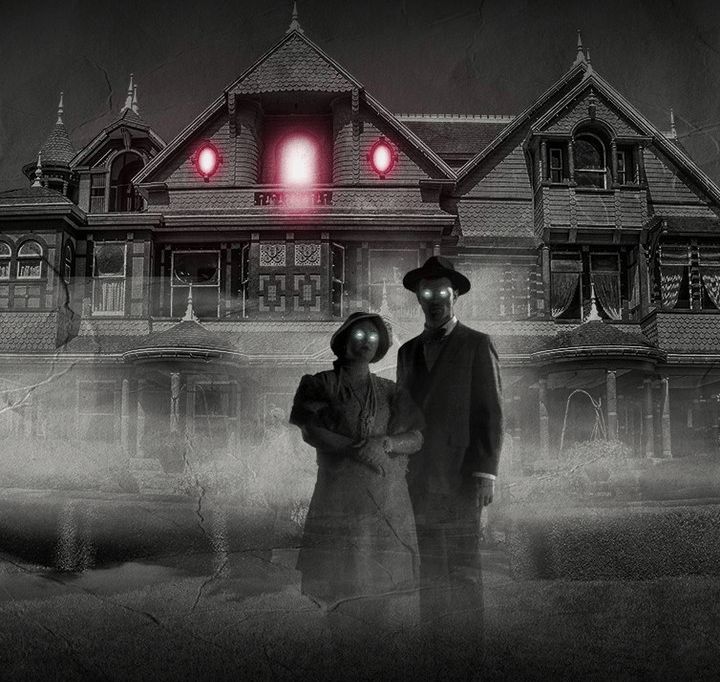
Like a scene from the spectral World, the abnormal foggy essence swirled in vortex shapes and at time, it resembled horses running past us, but the curtains did not move, though we felt air currents around us. We felt vulnerable and somewhat uneasy. I could not for my life keep back a loud scream—the second I had emitted that night. It echoed and echoed through the dim vaultings of my mansion, and I had to choke back a flood of reaction that threated to burst out. Arkie saw a pale figure heading toward him as he ran from the parlor. He quivered when the thing growled at him. It stood out like white chalk on a black board, moving in darkness, seeking. It moved rapidly and just as suddenly as it have moved through the gallery, it suddenly was gone. When I looked around, I saw nothing of the foggy mist that surrounded and chilled us to the bone; it had vanished. The room was clear and felt warmer. What seemed like a long time in the fog had only been a few short minutes! When Arkie and I talked, we were both in awe at what we had experienced. Words were few as we tried to make sense of the incident. Arkie’s hair used to be dark brown, with grizzled streaks about the temples; in less than a month from that day he was a gray as badger, and he has never been quite the same man since that night. I do not believe anybody had ever felt so much sheer hell in one night. Gargoyles and chimeras, we saw all sorts of things, as if it was some passage from the Middle Ages. Arkie said my home repelled him more and more every day, and frightened him, as its features and expressions developed in a way he did not like; in a way that was not human. He felt like a ghoul had been feeding on his soul. He proceeded to leave the hose and suddenly jumped back a foot and started to cry. A dark figure draped in a black tattered robe with a deep hood that concealed his face stoop there, blocking the entrance. My heart sank centuries away as the soul goes as the awful, blasphemous horror touched quite beyond the power of words to classify. I shivered slightly. #RandolphHarris 3 of 9

“What are you?” Arkie cried out desperately to the figure robed in black. There was only silence. He knew the horrible figure we be upon us soon. He flung his sword at the figure in black, and the dark robed figured answered back by point a half-rotted finger at Arkie. The sword flew backwards from his hand. He quickly spun around only to find, to his surprise, that the dreadful ghoul had not emerged from the hallway yet, but we could hear it coming. Arkie’s eyes widened in horror and his heart sank further as he looked to see that his sword hung in the air. Utter fear and hopelessness played on his mind. The ghoul was breathing like a wild beast; and I heard an evil sound also, with blows of something violently driven through flesh and bone, as the sword moved on its own, staking Arkie in the heart. I cried out for mercy as the ghoul approached, but was frozen in fear. Its deathly yellow eyes looked on me with hate and savage hunger. Yellow ooze dripped from its frightful maw. And its long fingernails danced in my hair, before it devoured what remained. As the ghoul kneeled, gnawing at Arkie’s head as a child nibbles at a stick of candy, the shadowy specter looked at me and spoke with it’s a hollow voice, saying “There is no shame in what you have done. Your former life is behind you.” I felt that any moment it might drop its present pray and seek a juicier morsal. But, the nearly eight-foot ghoul grabbed the blood-soaked sword and fled with it. This strange proceeding gave rise to many inquiries. Only a few could answer them. My home is dreaming gorgeously and overflowing with wonder and terror and escapes from the commonplace. It can truly catch the night spirit of antique horror, terror, as well a beauty from life. The haunting apparitions were seldom completely human. Occasionally things would leap through open windows at night, or could be seen squatting on the chest of sleepers, worrying at their throats. The utter inhumanity and callous cruelty of the things torture the brain and flesh. #RandolphHarris 4 of 9
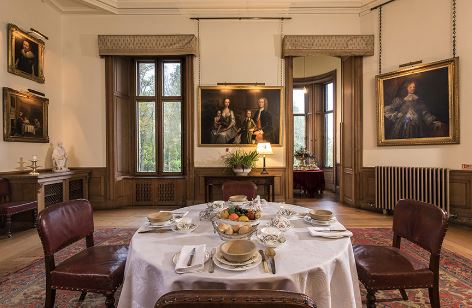
Unlocking the front doors, one is ushered into decorative hallways with splendid mahogany paneling—thrilling and suggestive of the time. Ancient paneled rooms, or simple vaults of masonry, there is even a narrow staircase the leads to the ceiling where a ghost is said to reside. Servants have felt temperature changes upon entering the room and sensed an unknown presence next to them. Others have glimpsed the blasphemous shapes that lope and trot and crawl up the stairs and through the ceiling. We saw the demons themselves and were afraid of them. My shocked scream had waked unaccustomed echoes in the labyrinth. It was more of the physical than the spiritual. I was paralyzed for an instant. I heard a faint scurrying sound somewhere, and a series of squeals or beats in a direction I could not determine. Then there came a subdued sort of clatter which somehow set me all in gooseflesh—a furtive, groping kind of clatter. It was like heavy wood falling on stone or brick—wood on brick—what did that make me think of? It came again, and louder. There was a vibration as if the wood had fallen farther than it had fallen before. After that followed a sharp grating noise. The archaic tunnels in my basement touched graveyard and witch-den. But whatever was in them was devilish anxious to get out. Accidents had happened, but I have never seen what I saw this night—that creature was neither alive nor dead, it abided neither above ground nor in the grave. It was a colossal and nameless blasphemy with glaring red eyes, and it held in bony claws a thing that had been a man. However, it was not even the fiendish apparition that made such an immortal fountainhead of all panic—not that, nor the face with its pointed ears, bloodshot eyes, flat nose and drooling lips. It was not the scaly claws nor the mould-caked body, nor the half-hooved feet—none of these, through any one of them might well have driven an excitable man to madness. It was the curse, the impious, the unnatural endless cycle of terror. #RandolphHarris 5 of 9

These monsters were there—they glared and gnawed and gnawed and glared—and I knew that only a suspension of Nature’s laws would ever let a person be terrorized like this—it was truly some glimpse of the netherworld which no mortal unsold to the Fiend has ever endured. I had to hide this well-established horror-World which I saw fully, brilliantly, squarely and unfalteringly. Fair sized rooms, with wooden floors and furnished were bricked up with extreme care, to conceal the ghastly demons and nauseous monstrosities that leered around from every side of the rooms. I always knew William, no matter how beautiful and pure he was, was not strictly human. Either he was born in strange shadow, or he had found a way to unlock the forbidden gate. There are secrets, you know, which might come down from old Salem times, Cotton Mather tells even stranger things. In the Dark Ages, belief in apparitions, vampires, hell hounds, and demons were commonplace. While belief in ghosts declined in the eighteenth century, it was revitalized in the nineteenth century with the Society of Psychical research. While culture differ in their beliefs about what happens after death, most cultures believe that a ghost can return to the World of the living, with either good or bad intent. In Western cultures, it is most commonly believed that a ghost is the soul of the deceased who cannot find peace or does not know they are dead, leading them to haunt places where they lived or died or objects that caused their death, sometimes they even haunt bloodlines. It may be that they have unfinished business on the Earthly plane, perhaps to protect a loved one, or impart information or reenact the death. I do not think that any power on Earth could make anyone speak of what happened in my home, even old priests were too frightened to look in. #RandolphHarris 6 of 9

It has been said that Mrs. Winchester slept in a different bedroom every night, supposedly in order to confuse evil spirts. Mrs. Winchester was deeply concerned with the welfare of her servants and their families. They were well paid and often additionally rewarded with gifts, even homes, or real estate and lifetime pensions. The full scope of her generosity charity and many kind acts will forever remain unknwn and such was her sincere desire. Her donations were never made public. She contributed to charities of all faiths. In 1911 in New Haven, Connecticut, she established the William Wirt Winchester Memorial Sanitorium for Tuberculosis (also known as low consumption), endowing it with $1,200,000.00 (2023 inflation adjusted $38,540,084.21). Visitors to The Winchester Mystery House are bound to run into others who are curious about the spirit World. It may seem that our intents have been to weave a cloak of vindication and protection covering our lady’s eccentricities, so many to this day still unexplainable. In truth, volumes could be written extolling her many virtues and justifying the construction of one of the largest and most significant architectural structures in the World. Still the Question remains—Why? Why? The enigma of The Mystery House that tragedy and a rifle built is perhaps unanswerable. The present generation must weigh and draw its own conclusions about this Valley’s most interesting, most controversial, most unappreciated and surely our most mysterious First Lady! No one will ever know, but this beautiful and bizarre mansion has, we think, allowed Mrs. Sarah L. Winchester, Lady of Mystery, to achieve a unique kind of eternal life. #RandolphHarris 7 of 9

The spirit World and the human World were once so closely interwoven as to be indivisible. Look at monument, such as The Winchester Mystery House, that our ancient predecessors erected, and the traditions devised, to house, honour, and succor the dead. We still retain enough of our ancestors’ belief that our dead are aware of how we treat them, that we try to ensue they do not have anything thing to complain about. And we listen with widening eyes and quickening heartbeats to the stories told about the ghost that exist and have been recorded throughout time. The Winchester Mystery Houses catches the overtones of the soul, and you will not find those in a modern or renovated home because it has had no time to pick memories and attract local spirits. Placed like Mrs. Sarah L. Winchester’s home was not merely made, but it actually grew. Generation after Generation lived there and felt and died there, and in days when people were not afraid to live and feel and die. This house has stood for almost two centuries and what it has witnessed would make a modern house crumbled into powder. What do modern know of life and the forced behind it? This mansion once had a set of tunnels that kept it in touched with over Victorian houses on the estate. There is hardly a month that you do not read of carpenters finding bricked-up arches and wells leading nowhere in this or that old section of the house. During the time of the construction of this mansion, there were witches and what their spells summoned; pirated and what they brought in from the sea; smugglers; privateers—and I tell you, people knew how to live, and how to enlarge the bounds of life, in the old time! #RandolphHarris 8 of 9

While cleaning the mansion one night, a tour guide noticed a man in 19th century clothes, very pale, with pale blue eyes approaching the Venetian Dining Room. The tour guided continued to work until the mane came very close and stood directly over him. Becoming a bit uneasy at the man’s silence, the tour guide finally asked him, without looking of, if he wished to tour the mansion. When the “guest” did not reply, the tour guide stopped dusting underneath the table, and looked up at the silent man. The man’s face was contorted with rage; his lips moved furiously and he gestured as if he were shouting, but he made no sound. The tour guide fell onto the floor. Before he could turn and flee, the guest disappeared. Terrified, the tour guide ran until he came to an assistant manager. “I saw a ghost,” the tour guide grasped, out of breath. “The ghost of one of the carpenters has come back.” The ghost appeared in August of 2006, to another tour guide. He had entered the Daisy Bedroom and found a fellow tour guide leaning against the wall. Surprised by his presence, he had begun to question the man when he melted into the wall. When he reported the incident, one of his coworkers dismissed it as imagination. A few days later, two tour guides saw the same carpenter. They were locking up the mansion and the lights had not been off more than a few minutes when the sound of footsteps caused both tour guides to stop in their tracks. Before either of them could move, a door swung open and a young man entered. He gestured wildly and seemed to be shouting at the two tour guides, neither of whom could testify that any sound issued from the angry visitor. When one of the tour guides turned on the light, the figure faded before their astonished eyes. They quickly had the mansion secured and order all exists guarded. Guards reported that no person had attempted to leave the building. After the guards had conducted a search of the rooms, they were convinced that their visitor had not been a living man. #RandolphHarris 9 of 9
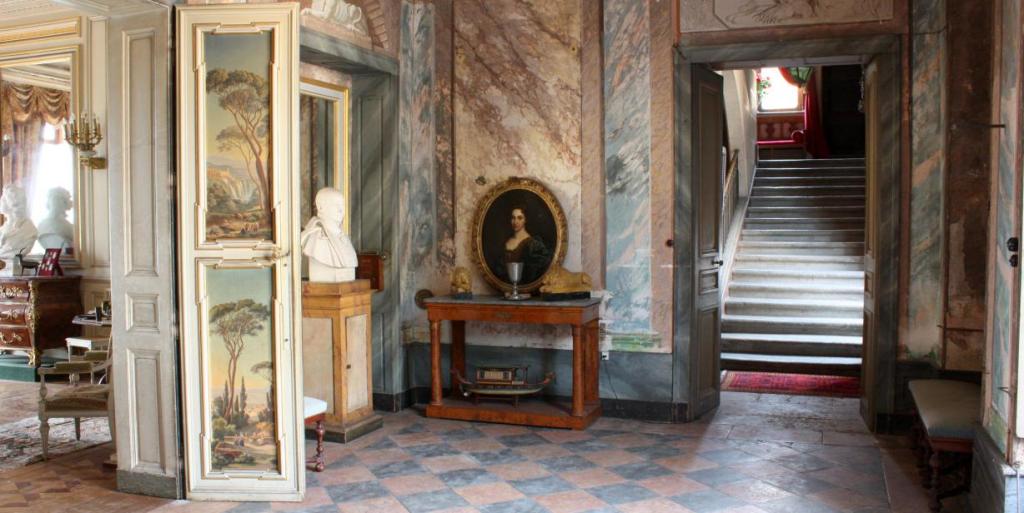

The room count of California’s most mysterious mansion has just increased by one, rounding out at 161 chambers (that we know of). Preservationists at The Winchester Mystery House in San Jose have found a previously unknown room in the attic of the house, and in it was a pump organ, a dress form, a sewing machine, a Victorian sofa, and several paintings.
For further information about tours, including group tours, weddings, school events, birthday party packages, facility rentals, and special events please visit the website: https://winchestermysteryhouse.com/
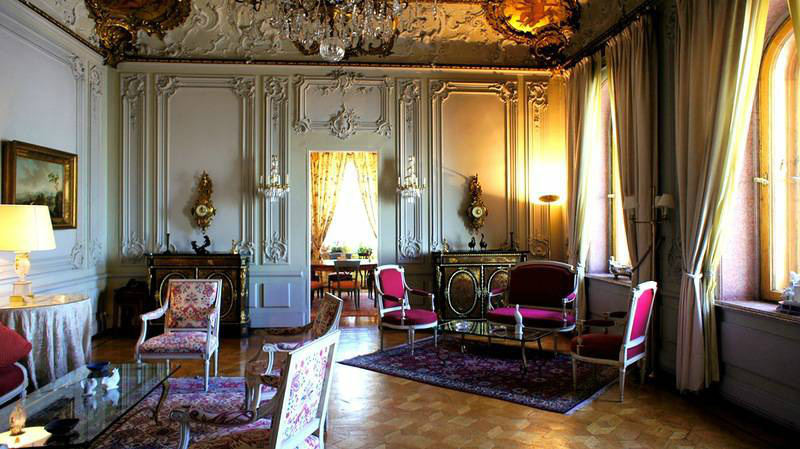
Please visit the online giftshop, and purchase a gift for friends and relatives as well as a special memento of The Winchester Mystery House. A variety of souvenirs and gifts are available to purchase. https://shopwinchestermysteryhouse.com/

If you forget to purchase something during your visit, you can order any gift item by calling 408-247-2000 and charging them to your credit card. You can also place an order through the mail. Be sure to include a daytime telephone number with area code. Write to: Winchester Mystery House.

Legend of The Winchester Mystery House
It is well-know that my mansion is haunted. In all of the valley, not one person of unbiased mind entertains a doubt of it. I was sitting in the chair. It seemed I had been asleep forever, but I had not been sleeping at all. The day was sunny and cool. The grass greening all the expanse in its front seemed to grow with a natural and joyous exuberance, and the flowers blossomed in a lovely fashion. Full of charming lights and shadows and populous with pleasant-voiced birds, the well-manicured evergreen trees no longer struggled to run away, but bent reverently beneath their blessings of sun and song. Even the stained-glass windows were an expression of peace and contentment, due to the light within. Over the fruit orchards, the visible heat danced with a lively tremor incompatible with the gravity which is an attribute of the supernatural. Ghosts bridge the past to the present; they speak across the seemingly insurmountable barriers of death and time, connecting us to what was lost. They often give us hope for a life beyond death and because of this help us to cope with loss and grief. Their presence is the promise that we do not have to say goodbye to our loved ones right away and that what was left undone in one’s life might yet be finished. However, Llanada Villa was horribly haunted. A haunted house is a memory palace come to life—a physical space that retains memories that might otherwise be forgotten. Many ghost sighting and other mysterious incidents revolve around the stair cast to the ceiling. Many of my guest have confided that they get dizzy, have trouble breathing, and feel a pressing need to leave the house. Death lingers in the air. The walls are shrouds, enfolding every space in exquisite darkness. #RandolphHarris 1 of 5
While sitting in the parlor, enjoying a cup of tea, a bone chilling, piercing hold took hold of me. Suddenly rain fell steadily, splashing on the ground beneath the window and lying in pools upon the sodden grass. Except for an occasional glimpse of bare branches gliding through the mist, there was nothing to be seen beyond the window, but grey, swirling vapour; I looked up more than once from the pages of John Bunyan’s narrative and felt the hair rise on the back of my neck before the warmth of the fire brought me back to The Pilgrim’s Progress. Every now and then the Heavens were torn asunder by vivid lightning. The blackness of the storm had become merged in darkness of the night, and the weird sounds of a wolf echoed around the estate. There was something so weird and uncanny about the whole thing that it gave me a turn and made me feel quite faint. Halloween was the night, according to the belief of millions of people, when the devil was abroad, graves were opened, and the dead came forth and walked. When evil things of Earth and air and water held revel. The floor shook as though thousands of horses thundered across it. A flash of forked lightning lit up the whole expanse of the Heavens. I heard a mingling of dreadful sound, and the air seemed reverberant with the howling of wolves. The last sight that I remembered was a vague, white, moving mass, as all of the souls killed by the Winchester Rifle sent out the phantoms, and that they were closing in on me through a white cloudiness. #RandolphHarris 2 of 5
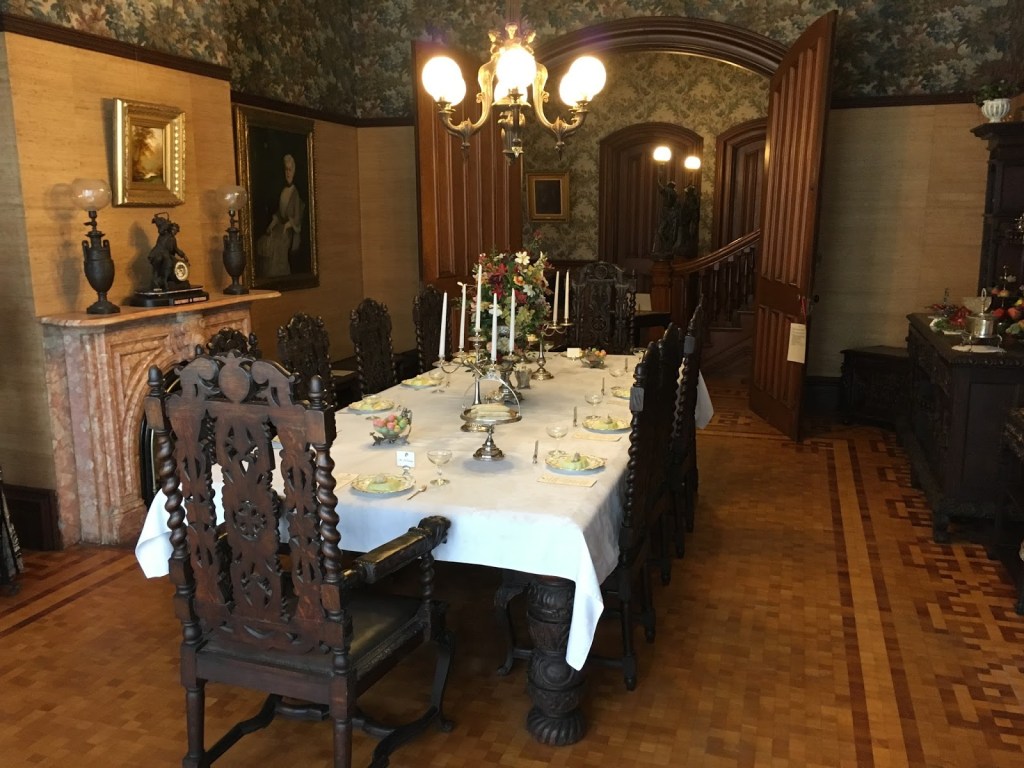
Gradually there came a sort of vague beginning of consciousness, then a sense of weariness that was dreadful. For a time I remembered nothing, but solely my sense returned. My feet seemed absolutely racked with pain, yet I could not move them. They seemed to be numbed. There was an icy feeling down my spine. It was a nightmare—a physical nightmare, if one may use such an expression—for some heavy weight on my chest made it difficult for me to breathe. This period of semi-lethargy seemed to remain a long time, and as it faded away I must have slept or swooned. Then came a sort of loathing, like the first stage of sea-sickness, and a while desire to be free from something—I knew not what. A vast stillness enveloped me, as though all the World were asleep or dead. For another spell of time, I was powerless. Lights and shadows moved in the mansion. There were dark whispers. I was white as a sheet and shaking so that I could hardly stand. The agony clawed at my innermost soul. Dazed and frightened, this is a deathly place; I have never felt so cold. Shadows darted along the walls. Coals glowed in the fireplace nearby. Though the fire had been burning for hours, it made little impression upon the deathly chill of the gallery. My footsteps reverberated as I there were a dozen people pacing in the gallery. The floor creaked. I was not aware of any draught, yet every so often the flames would sway in unison, as if someone had passed along the floor below. The heat of the fire was diminishing perceptibly. Every sound—the creak of a chair, the crackling of the coals—seemed an intrusion upon the deathly stillness of the gallery. #RandolphHarris 3 of 5
The light strengthened and changed, darkening from yellow to orange to a fiery blood-red glow. As it did so, I became aware of a low, vibrant humming, like the sound of bees swarming; I could not tell where it was coming from. A voice said, “Do not move, upon your lives.” Dazzling white light filled the gallery, followed by an instant later by a thunderclap that shook the whole house and left me blinded and deafened, with diamond patterns of the leadlighting etched upon my vision. As the after-image faced I realized that all of the candles had gone out; beyond the faint glow of the fire at my side, the darkness was absolute. Then came the sound of hurrying feet from the library. A shaft of light spilled across the floor; the connecting door flew open. The lights all went out and I was plunged into impenetrable darkness. A misty pillar of light hovered for a moment in the void and then opened, with a movement like the unfurling of wings, into a shimmering figure that detached itself from the chandelier—now dimly visible in the glow—and glided toward me. It had no face, no form, only a veil of light floating over emptiness. I could not move, could not breathe. I heard the sound of the library door opening, and footsteps approaching. The apparition shimmered to a halt. “Will you speak to me?” I cried. “I may…not stay”—the voice, though faint and indistinct said “but will you not shake hands…” growing fainter with each word—“for friendship’s sake?” The footsteps came closer; the dim outline of a man passed between me and the apparition. Light swirled; a glowing armed appeared, but there was no hand, only an empty sleeve, and when I tried to grasp the arm, my own hand passed straight through it! #RandolphHarris 4 of 5
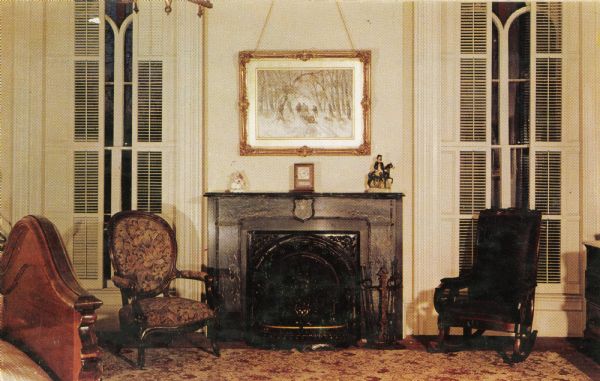
With a cry of despair, I flung both arms around the apparition. For an instant, man and spirit were united; then darkness engulfed them, and I knew no more. When I came to my sense, the coals were crackling in a grate nearby. I was lying, I realized, where I had fallen on the gallery floor, but with a cushion beneath my head. I have had a terrible dream, I thought, turning my head away from the glare. “Mrs. Winchester,” Elizabeth the housemaid said, “I am truly sorry. I should have never left you alone, but I was scared.” “I do not understand,” I said to Elizabeth. “Did you mesmerize me? Did I dream the lightening?” “No, Mrs. Winchester,” she replied. “Everything happened exactly as your perceived.” Lights were burning along the walls, but the floor I where I was laying was still in near darkness. I took Elizabeth’s arm and rose unsteadily to my feet. I straightened my hair and brushed the dust from my cloak. “You feasted on my soul and cast a spell over me!,” I said. The moon rose high. I was very weak, and my heart was beating so slowly that I was almost like a woman fainting. Slowly I turned my head, but Elizabeth was not there. Fear seized me suddenly, a fear unspeakable and unknown. The hour dragged themselves through the twilight and darkness and moonrise. But in the chilly dawn, I lay as one half dead upon my bed. Then came the fear, the awful nameless, panic, the mortal horror that guards the confines of the World we see not, neither know of as we know of other things, but which we feel when its icy chill freezes our bones and stirs our hair with the touch of a ghostly hand. #RandolphHarris 5 of 5
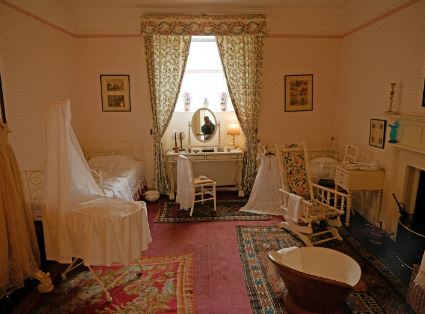
Some houses are more haunted than others. If you account the sheer number of sightings at The Winchester Mystery House, it is one of the busiest places in the World! The phantoms sometimes look like normal, living, breathing human beings. However, then some of these specters abruptly evaporate, without leaving a trace. Sometimes it is hard to believe in ghost even when you have seen them with your own eyes. But at The Winchester Mystery House, spirits come calling down those miles of twisting hallways, and after a visit, there will never be a such thing as a simple tour of a Victorian Mansion. https://winchestermysteryhouse.com/

And please be sure to check out the online gift store: https://shopwinchestermysteryhouse.com/

Cure that Sense of Entitlement

Thought is a vital force or energy which is being developed and which had produced such startling results in the last century, as to bring about a World which would be absolutely inconceivable to man during the days of slavery. If the results have been secured by organizing mental powers over the last hundred years, imagine what can be done in the next hundred. This is why we need to avoid the nihilistic idea that we are living in the last day. The people who repeat this mantra are also the ones who pontificate most loudly about the law of attraction. We have to learn to be genuine in our beliefs and know that we can have a beneficial impact on the future. We do not have to accept things they way they are, but we can make them better. It is clear, therefore, that thought of abundance will respond only to similar thoughts: the wealth of the individual is seen to be what he inherently is. Affluence within is found to be the secret of attraction for affluence to manifest in the outside World. The ability to produce is found to be the real source of wealth of the individual. It is for this reason that he who has his heart in his work is certain to meet with unbounded secrets. He will give and continually give, and the more he gives the more he will receive. Thought is the energy by which the law of attraction is brought into operation, which eventually manifests in abundance in the lives of men. The source of all power, as of all weakness, is from within; the secret of all success as well as all failure is likewise from within. Golden opportunities of life will be strewn across your path, and the power will come unbidden, circumstances will be in your favour, and you will feel the power of the ultimate concern. #RandolphHarris 1 of 18

Many affluent college students make it a point to hide the fact that their families are wealth, because they believe that members of the opposite gender may approach or treat them nicely not because they are interesting and attractive, but simply because they have money. We have worked with young people who consciously choose to live in a more modest apartment than they can afford, or avoid spending too much money on clothes or entertainment, specifically because they do not want to give potential romantic interests any hint regarding their actual financial status. This strategy does seem to provide some reassurance to affluent young people when they are meeting new people, or when they are going out on a first or second date. Clearly, however, as dating relationships develop and progress, it will become more and more difficult to avoid having one’s financial status become apparent. People naturally ask you questions about where you grew up, and where you went to high school. At some point, your date will probably ask you about your parents—maybe just about how you like them, but also more than likely about who they are and what they do. New friends are also quite likely to ask you what you like to do for fun, and they will be curious about the places you have been. These are perfectly normal questions, and you certainly should not interpret them as specific effects to extract data from you on your family’s financial status. Although we certainly understand any desire you may have not to flaunt your wealth as a means of attracting attention, we strongly believe that you should be honest when you answer such questions. To be less than honest is to convey the message that your distrust of others’ intentions is your paramount concern in making new acquaintances, and this would be likely to be perceived as reflecting poorly on you. #RandolphHarris 2 of 18

Students of a high caliber are more attracted to affluent institutions than to poor ones. The major reason is that affluent institutions pay higher salaries, which enable them to recruit better faculties. Some of this may result from a feedback effect that raises the resources for faculty recruitment of institutions with superior reputations among outstanding students. The beta weight indicates that affluence also has some direct effect on student preferences, independent of other conditions. A possible interpretation of this new effect is that superior facilities and better fellowships in affluent institutions attract brighter, more serious students, although the possibility that wealth as such and its symbolic value make an institution preferable cannot be excluded. Large academic institutions are preferred by able students because they can afford better faculties and have more diverse departments than small institutions, but large size itself, independent of these attractive conditions usually associated with it, detracts from the appeal of an institution or higher education to students. In other words, size has a beneficial gross and a negative net effect on capable students, furthering another parallel with the pattern of influences on qualified faculty. The process of mediating the indirect effects of size are similar but not identical, partly because faculty qualifications are the dependent variable in one but an intervening variable in the other case. Bright students are attracted to large academic institutions by their many diverse departments, array of cultures, and by the superior faculties that their higher salaries recruit. These attractions tend to overcome the preferences of good student for small, less impersonal colleges if conditions were the same (indicated by the negative beta weight) and make large institutions more popular among them (indicated by their positive simple correlation). #RandolphHarris 3 of 18

The natural or “mortal mind” view of life and the World is almost always the exact opposite of what is the real spiritual truth and fact. Metaphysics tell us that the visible World is an inverted reflection of the real. If the it is inverted, it is natural, until our spiritual or inner eyes are opened to the truth, for us to see things as the exact opposite of what they really are. Therefore it is not surprising to find that, whereas the moral or terrestrial mind of the senses, thinks the World is the real thing and the mind only a shadow, the real TRUTH is, that mind and spirit are real and eternal, and the visible World but a transient and impermanent thing which has no actual reality. Such being the case then the only thing that really matters is what is in the mind or what is not in the mind. If we have a belief in evil, and thoughts of evil, in our mind, then we have evil in our life. If, however, we can cast the thought of, and belief in, evil out of our mind then it will cease to appear in our life. By raising ourselves above the sensuous life and realizing our permanent World of Mind and there denying evil, poverty, failure, pain, sickness, unhappiness, or whatever our trouble may be, we vanquish the thought which is the cause of all our troubles. Then whatever we affirm will take their place. If we deny “evil,” then we follow by affirming “good,” if we deny sickness, then we affirm prosperity and affluence. By denials we can take out all the evil, care, fear and worry out of our lives and build up in their place by means of affirmations, perfect good, success, affluence, happiness, health, love, peace and courage. Everything being in the mind, then everything that is take out of the mind is take out of life, and everything that is put into the mind comes into life. #RandolphHarris 4 of 18

Thus it is possible with mathematical accuracy and certainty to recreate the life, to cast out all the undesirable and to build up in its place only the beautiful, the good, the true. Life is what we make it. We can make it like Heaven itself, full to the brim with all that is good and beautiful, or we can turn it into a perfect Hell. Therefore do not accept the suggestions of those, who having failed in life, proceed to call it hard names. We can make life a continual joy, if we create a Heaven within us by the quality of our thinking and mental processes. All that we see in life, all that we experience, yeah, even life itself, is but the outward expression of the life within. The life within is built up by our thinking. You will have seen by this time the purpose and value of affirmations. Affirmations are concentrated thoughts. Back of each affirmation is a strong emotion and this gives it tremendous driving force. Not only do affirmations impress the sub-conscious mind thus producing action in accordance with the Will, but they project outwards from the mind into space, attract forces and help from other sources and bring them to minister and bless. Not only so but they also arouse the subliminal mind to inspire, to create, to impart wisdom. By the use of affirmations all the finer forces are aroused to action and the life is transformed from weakness or ineffectiveness to strength or purposefulness. By the use of affirmations, the Will is strengthened until it become so strong all else has to bend to it. By the use of affirmations, the body is strengthened and make healthy, and exercise and body culture become a pleasure instead of a duty. #RandolphHarris 5 of 18

To bring whatever it is that you want into your life, you must develop an insatiable desire for it. That means, for a while, it is all that matters. You vigilantly watch the ego-mind; you refuse to be taken off track. You know your direction and you will allow nothing to move you from it. At that point, all obstacles are viewed as challenges to be overcome, with each one giving you’re a renewed sense of focus. You meet difficulties with the mindset that there is always a way to overcome them, and moreover, you are committed to finding it. You approach, go though, and attend to your outcome without the option of gripping or complaining. You keep moving forward: you make it a “must” and as a result, it will happen. Guaranteed! Affluence means wealth. It means having plenty, so that you are not wanting. It means being connected into the flow of goods and resources so that you are regularly refreshing your abundance even as you use it up. I know people living utterly simple material lives who seem radiant with well-being and happiness. Material wealth should never be desired as an end, but simply as a means of accomplishing an end. Success is contingent upon a higher ideal than the mere accumulation of riches, and he who aspires to sch success must formulate an ideal for which he is willing to stive. However, it is no fun to run out of rent money or cash to go buy groceries. Let us not be delusional; money counts! On the other hand, a lot of money brings a lot of responsibility; you must pay attention to your money or you lose it, and you can easily fall victim to worry about your money rather than enjoying it. So keep this desire for cash and possessions in perspective with the other equal needs. #RandolphHarris 6 of 18

Whatever you desire for yourself, affirm it for others, and it will help you both. You reap what you sow. If you send out thoughts of love and health, they return to you like bread cast upon waters. People who are friends to others find that they indeed have friends. Radiate love and happiness to those you encounter, and this love and happiness will be radiated back to you. True relationship abundance is both deep and wide. Ideally you have a deep resonance with family, and you and your intimate partner have broad goodwill toward those you come into contact with. A valid formula will produce successful results every time and for everyone. You just have to follow it. Life provides a wonderful opportunity to seek our talents and interests. It is well to remember, however, that “all have not every gift given unto them; for there are many gifts, and every man is given a gift by the Spirit of God,” reports Doctrines and Covenants 46.11. In our searching, it is important to seek guidance of the Spirit to discover skills we should develop. Once we have decided what we really want to do, the Lord has given us a formula for achieving our eternal and temporal goals: “For he will give unto the faithful line upon line, precept upon precept; and I will try you and prove you herewith,” reports Doctrines and Covenants 98.12. The Lord reminds us that real success will only come only to the faithful—those who have sincere determination to achieve their goals. The second part of that formula reminds us that learning is often a slow process and comes line upon lone, one step at a time. The Lord offers kind encouragement when He says, “Wherefore, be not weary in well-doing, for ye are laying the foundation of a great work. And out of small things proceedeth that which is great,” reports Doctrines and Covenants 64.33. We must learn to be patient with ourselves while pushing to new levels of achievement or knowledge. It is important to take time occasionally to remind ourselves of what we are trying to do. #RandolphHarris 7 of 18

Thoughts of courage, power, confidence, and hope all produce a corresponding state. All we have to do is let our light shine; the more energy we can radiate, the more rapidly shall we be enabled to transmute undesirable conditions into sources of pleasure and profit. Health and wellness are issues for most of us, and material abundance can mean absolutely nothing when we are seriously sick. Therefore focusing on and manifesting long-term health must be a vital aspect of this program. How can you maximize wellness each and every day, and also regain your health if you lose it? It is now well proven that the thoughts you chronically hold in your mind generate parallel emotional and physiological conditions in your body that either support good health or undermine it. You have perhaps read or seen medical reports on how stress and anxiety, depression and anger, when rehearsed over a long period of time not only become contagious, but also progressively reduce your immune system’s ability to maintain optimum health. When your thoughts become uplifted, progressive, constructive, courageous, noble, kind, or in any other way desirable, you set in motion vibrations which bring about mental, moral, and physical health. The only real power which you can have is the power to adjust yourself to divine and unchangeable principles. You cannot change the Infinite, but you can come into an understanding of natural laws and adjust your thought faculties with the Universal Thought. Your ability to cooperate with this Omnipotence will indicate the degree of success with which you meet. Your expectation determines everything. If you expect nothing, you shall have nothing: if you demand much, you shall receive the greater portion. The World is harsh only as you fail to assert yourself. #RandolphHarris 8 of 18

It is important to belief in your inner reality and broadcast this perfection out to your cellular presence, so that beyond your conscious awareness the infinite unconscious power of the Universe can be working to heal you. And if you are currently healthy, regularly tap into your desire to stay healthy and broadcast this desire and inner faith and harmony to your soul. Inner harmony is the foundation of health. The knowledge of your ability to consciously radiate health, strength, and harmony will bring you into a realization that there is nothing to fear, because you are in touch with Infinite Strength. Regardless of age or health, it is important for all of us to learn to come to peace with the cycle of life and death, and make the best of life while it is still in our possession. One can develop the ideal image of life’s experiences that last for life. We must learn to manifest whatever kind of environment we desire. Although we may be tried to see how determined we are to life our ideal lives, if we persevere, the windows of Heaven truly open in many ways and our providing takes place. Our faith in the Saviour and trust in His words will continue to grow. We will find the most desirable of all our goals will take the most determination to achieve but will be worth every effort. This process can work in reverse and bring loss of spirituality if we are not careful. If we commit sins, we are tried with feelings of regret and remorse. And if we do not heed those feelings and change, further sins come more easily. The result is withdrawal of the Spirit and loss of potential blessings. #RandolphHarris 9 of 18

A life with inner peace and happiness can also be ours if we are willing to earn it. It is marvelous to develop this way of living while you are still very young. You have many years to develop even further great spiritual strength and understanding by applying what the Lord has taught us. Entitlement is not the person who keeps trying to please one’s boss but either lacks the skill or the clear instruction from management to perform well, and who is therefore always getting poor job evaluations. Entitlement is the person whose poor job evaluations result from one’s refusal to invest one’s full energy and commitment in one’s job and who consistently underperforms, not because one lacks the skills or has not received clear instructions from management but simply because one sees no reason to; individuals like this believe that they deserve that paycheck for reasons completely unrelated to how well one performs, an that the company is luck to have him or her. Entitlement is not the spouse who feels inadequate because one’s partner is always expressing one’s frustration with their marriage and with the role one plays in it, even though one tries hard and wants things to be better. Entitlement is the spouse who feels inadequate because one’s partner is always expressing one’s frustration with their marriage and with the role one play in it, even though one tries hard and wants things better. Entitlement is the spouse who thinks everything going wrong in their marriage is their partner’s fault, and that if one does not shape up, one might lose the other. Since one has already made all the contributions to their marriage one needs just to be on the basis of who one is, one’s completely justified in just sitting back now and waiting for one’s spouse to fix whatever is wrong, without any help from their partner. #RandolphHarris 10 of 18

There are many more illustrations, but the many faces of entitlement will always have at least most of these characteristic: An attitude of being special—“I’m exception—and in fact, I’m far greater value to this marriage (of family, or company) than the rest of them, and that’s why I deserve special treatment. They’re lucky to have me.” An attitude of being owed, of deserving something—“I didn’t create this situation—they’re the ones who are always complaining. So why should I do all the work, or even any of it? As far as I’m concerned, I should just stay in my office till they’ve cleaned up this mess. And my bonus had better not be any smaller than any of the others because of it.” A refusal to accept responsibility—“Why do they want me to pay rent? I didn’t ask to be born. Besides, this will still be their house after I move out. And I can’t pay rent anyway, because I don’t have a job. None of the dead-end jobs around here are worthy my time and effort and there’s no reason I should do my own laundry—Mom has to do hers and Dad’s anyway—she can just do mine at the same time. It’s no extra work.” A denial of one’s impact on others—“Sometimes my husband and kid’ lack of responsibility bothers me, and I say exactly what I feel. I’m telling them the truth. I don’t sugarcoat it and I don’t tone down my language, my volume, or how long I talk. They overreact to what I’m saying, and that’s their problem. It’s a free country, and I can say what I need to say.” Whatever the cause of the sense of entitlement, the end result is that the person believes that one does not have to ply by the rules of responsibility, ownership, and commitment. And the end result of entitlement is predictable: The entitled person feels good and live badly, while those around one feel bad about the situation but have more successful relationships and careers. #RandolphHarris 11 of 18

It is tempting to make excuses for our loved ones (or ourselves) who evidence an attitude of entitlement, but the only effective response is to take responsibility, not to make excuses. People’s life experiences may influence them toward entitlement. However, they do not create entitlement. Many people who have suffered greatly in life, experiencing poverty, child abuse, and chaos, still take responsibility for their lives and choices, blaming no one. And there are individuals who have had it all—love, support, opportunity—who nevertheless see themselves as “owed”—by life, by society, by those around them. If you have an entitled person in your life, you may feel responsible for the part you may have played in influencing that attitude, or you may simply feel compassion for their circumstances. And it is certainly possible that you have made mistakes in your relationship with them. It is possible that life may have thrown them curves. However, those mistakes, those obstacles of life, do not create irresistibly an entitlement attitude; if they did, then all people who experiences those things would approach life with an attitude of entitlement, and they do not. At some point in life, people choose entitlement. They direct themselves toward an entitled viewpoint. Why? Ultimately, it is because—at least in their view—it is the easy way. Entitlement has become a serious problem in our society, and it is not getting better. It is impossible to calculate its cost in lack of company productivity, family success, relational love, emotional health, and spiritual vibrancy. Our World suffers greatly from a culture that supports entitlement. The disease is not limited to any age or socioeconomic demographic. #RandolphHarris 12 of 18

Entitled people are not easy to be around. Their attitude and their behaviour produce consequences none of us wants to experience. People who live around an employee, a coworker, a spouse, or a child who feels “above it all” generally feel disconnected and alienated from the entitled individual. We all find it hard to relate to someone who thinks one is superior in some way to the rest of the human race and therefore should not have to play by the rules. One father told me, “I remember being full of myself in my youth. But I did care about how I impacted my friends and family. My daughter’s level of entitlement is something entirely else. I cannot relate to it. She simply does not care how she affects us in the family, much less how she is impacting her future. I fear she may end up homeless or confined to a psychiatric ward.” God expects us to spend time and energy carrying our loads of responsibility for family, finances, and other challenges. That is how a successful life works. So what happens when someone in your life takes little ownership of their own load, leaving you to make up the difference? You feel angry, which makes sense. You feel that everything is “not right,” because it truly is not right. All of us exhibit some level of entitlement attitudes, even highly responsible and giving people. It is just part of the human condition. However, when one deems something worthwhile, be it a career or financial dream, a great family or marriage or some self-care goal, one has two ways to go about it. Entitlement directs one to give the minimum, find the shortcut, and think only of one’s self. However, the more rational path takes the opposite track. This habit focuses on doing whatever is best to reach the good goal, even if it is difficult, uncomfortable, takes longer, and requires more energy. #RandolphHarris 13 of 18

A sense of entitlement (which is the polar opposite of a sense of responsibility) is endemic among children today. It is fostered by our demanding, narcissistic society where wants are confused with needs and where everyone seems focused on the notion that one deserves what everyone else has without working for it. Youth grow up in a reality-show World, thinking of themselves as the central character on television. They even adopting the same attitudes of some of their favourite stars and try to act out TV shows. And they believe they are worthy of not having limits, boundaries, nor discipline. The entitlement problem affects one’s education as one feels that they do not have to work for their grades. It affects relationships because people expect their parents to live their lives for them, well into adulthood. A sense of entitlement impacts one’s ability to set reasonable goals because when one is entitled the World is owned to them. It has an effect on their health and their safety because they feel entitled to eat what they want, go to bed when they want, and do things they know is not safe. Drawing realistic lines between deserving and undeserving matters a lot in our individual lives. While we might feel jealous of the kid who either works for a new car or gets a new car—and a free ride in other areas of life, too—we have to remember opportunity costs. Everyone has to give up something to receive whatever it is they have. And just like you, how long are you going to continue to harp on what someone else has? You could spend your entire life jealous over someone else’s blessings and still not happy when you obtain the same thing because you are not happy with yourself, your life. #RandolphHarris 14 of 18

The closer we are to Jesus Christ in the thoughts and intents of our hearts, the more we appreciate His innocent suffering, the more grateful we are for the grace and forgiveness and the more we want to repent and become like Him. Our absolute distance from Heavenly Father Jesus Christ is important, but the direction we are heading is even more crucial. God is more pleased with repentant sinners who are trying to draw closer to Him than with self-righteous, faultfinding individuals who, like the Pharisees and scribes of old, do not realize how badly they need to repent. Whatever our current direction or distance to Heavenly Father and Jesus Christ, we can choose to turn toward Them and draw closer to Them. They will help us. The close to the Saviour we draw, the more our faith increases, and we are able to make and keep covenants, and have the Holy Ghost with us. We must also act in faith, responding to the spiritual direction we receive. All of these elements come together in the sacrament. Indeed, the best way I know to draw closer to God is to prepare conscientiously and partake worthily of the sacrament each week. Although a variety of life experiences can elicit feelings of gratitude, gratitude prototypically stems from the perception of a beneficial personal outcome, not necessarily deserved or earned, that is due to the actions of another person. People who have gratitude feel a warm sense of appreciation for somebody or something, a sense of goodwill toward that person or thing, and a disposition to act that flows from appreciation and goodwill. The virtue of gratitude is the willingness to recognize that one has been the beneficiary of someone’s kindness, whether the emotional response is present or not. #RandolphHarris 15 of 18

The practice of gratitude is not in any way a denial of life’s difficulties. We live in troubling times, and do doubt you have experienced many challenges, uncertainties, and disappointments in your own life. Nor does the practice of cultivating gratitude deny the truth that old age, sickness, and death are certain. Rather, gratitude practice is useful because it turns the mind in such a way that enables you to live into life. Having access to the joy and wonderment of life is the antidote to feelings of scarcity and loss. It allows you to meet life’s difficulties with an open heart. The understanding you gain from practicing gratitude frees you from being lost or identified with either the negative or the positive aspects of life, letting you simply meet life in each moment as it rises. There are numerous ways to use mindfulness to cultivate gratitude. Of course, you acknowledge your appreciation when things are going well. However, even more helpful is to notice those things for which you are grateful when you find yourself in a contracted physical or emotional state. I often instruct students to respond to a difficult situation by acknowledging that the situation is difficult, but always to have the faith that they can find a legal, ethical, and virtuous way to escape from it. The best way to get out of a bad situation, however, is not to get into one. We need to know right from wrong and set great examples for our children. When you look at how much griping you are doing versus how much gratitude you feel, you may realize how far off your emotional response is from your real situation. Gratitude for the grace of conscious embodiment evolves into the practice of selfless gratitude, in which your concerns slowly but surely shift from being mostly about yourself and those close to you to being about all living beings. #RandolphHarris 16 of 18

As this occurs you need less and less in the way of good fortune. It becomes enough that there are those who are happy, who are receiving love, who are safe, and who have a promising future. It is not a state of gratitude, you are able to rejoice that joy exists amid all life’s suffering. You realize that pain and joy are part of a mysterious whole. When this state of selfless gratitude starts to flourish, one’s mind becomes more spacious and quiet, and one’s heart receives its first tastes of release from fear and wanting. Commitment reflects one’s values, intentions, and priorities; therefore it fosters clarity. In contrast, attachment is an unwholesome mental state in which one becomes overly identified with a desired outcome. The more centered and free from grasping one’s mind is, the better able one is to sustain a commitment over time and to make clear decisions along the way. You are also less likely to cause harm in pursuing your goals. If you truly want to achieve something, be unswerving in your commitment to moving toward your goal but be flexible in your mind about the outcome. Let us be honest. Most of our attachments are not derived from lofty goals or heartfelt commitments. They are about feeding our ego, expressing our views and opinions, pleasing our senses, and being seen as we wish to be seen. Or they are about not being uncomfortable, not having to endure things that irritate us, and not feeling physical or emotional pain. All of this mundane attachment accounts for a great deal of the chaos in our lives, and it does not actually help us get what we want! It is pretty much a total waste of precious energy and a major cause of disappointments. #RandolphHarris 17 of 18

Practicing generosity is the intention to find release from attachment and egoism by giving freely of whatever you have of value. What you have to give may be material in nature or it may be your time, energy, or wisdom. Committing to kindness eradicates the attachment that comes from feelings of scarcity and separateness. Paradoxically, practicing bigheartedness is also self-liberation, yet it is not self-centered. True generosity arises out of unconditional caring and compassion for another. It does not mean self-sacrifice or recklessly giving everything away. Such acts are actually grandiosity disguised as generosity. The form your generosity takes is up to you, as it can only come from your values and what you have to offer. Remember, it is your authentic intentions that matters, even if it is imply a sincere wish that in time you will become more spontaneously generous. Generosity means practicing generous behaviour in all aspects of your life, not just giving away money or sharing material possession. Certainly the emotional impulse to practice generosity most easily arises when you participate in providing sustainability for others, whether it is shelter, food, clothe, or medicine. However, with less immediate life needs, such as education, safety, or earning a living, the appropriate form of generosity may be a gift of your time. When it comes to intangibles such as justice and dignity, it may be most appropriate to voice your support. Generosity is, along with compassion, a cornerstone of mindful association. #RandolphHarris 18 of 18

CRESLEIGH HAVENWOOD
Lincoln, CA | from the high $600s
Now Selling!

Home Site 66 is a Residence Three, the largest of the single story homes offered in Cresleigh Havenwood. At 2,827 square feet you’ll be hard pressed to a contemporary floorplan that offers this much space.

There are four bedrooms, two and one half bathrooms, and a three car garage. Utilize the den as your own private study or playroom. The Dining Room and Kitchen are well situated to make entertaining a breeze.

The location of the Owner’s Suite makes it feel like a separate wing from the rest of the home allowing for maximum privacy and retreat.

This home includes over $34,000 in options and upgrades including:
• Durable luxury vinyl plank flooring throughout the first floor
• White Shaker Cabinetry with Soft-Close Doors & Drawers
• Over Island Pendants and Under-Cabinet Lighting
• Upgraded Appliances
• Flat-Screen pre-wire in Great Room
• Additional Upper Cabinetry at Drop Zone
• Owned Solar

Best of all, each Cresleigh home comes fully equipped with an All Ready connected home! This smart home package comes included with your home and features great tools including: video door bell and digital deadbolt for the front door, connect home hub so you can set scenes and routines to make life just a little easier. Two smart switches and USB outlets are also included, plus we’ll gift you a Google Home Hub and Google Home Mini! https://cresleigh.com/havenwood/quick-move-homesite-66/


The Marks of Estrangement

Until the fifth century A.D., much of western Europe lay within the Roman Empire, a vast collection of territories including parts of the Middle East and North Africa. In Europe itself during the centuries of Roman rule, much of the native Celtic population had become highly Romanized in its culture (6-7), political allegiance and legal practices. However, in the last few centuries of the Roman Empire, the Germanic tribes which had long lived on the eastern fringes of the European provinces moved into the Romanized lands in large numbers. This wave of “barbarian” invasions, along with severe political and economic problems, gradually killed off the Roman Empire, which was replaced by a number of Germanic successor kingdoms, including those of the Franks in Gual (modern France), the Visigoths in Spain, the Ostrogoths in Italy, the Burgundians in and around what is now Switzerland, and the Anglo Saxons in England. The Germanic tribes brought with them a very different society from that of Rome. Whereas Roman civilization was highly urbanized, to further highlight this illustration, the Germans had until then seldom settled even in villages. The Romans had a long history of written legislation; the Germans used a system of customary law which had not yet been written down. Different practices regarding marriage and family can be seen in the extracts from Roman and Germanic law. Centuries of contact between the Germans and the empire, however, had wrought changes on both sides, and now, as the Germans settled in what had long been Roman territory, further mingling of the two cultures occurred. The Germanic Kingdoms which were established inside the old boundaries of the now defunct empire were by no means entirely Germanic in their ethnic makeup of their culture. #RandolphHarris 1 of 18

Even more influential than Roman tradition in this process of change was the religion of the late Roman Empire. Christianity had originated in Palestine, where a small group of Jewish people believed that the wandering Jewish preacher, Jesus, who had been executed by the Roman authorities early in the first century A.D., was the “Christ,” the son of God and saviour of humanity. They based their faith in part on the sacred books of the Jewish religion, but also created their own new Scriptures as they recorded the events of Jesus’ life and wrote letters to each other. Although Christians were persecuted at first by both the Jewish religious authorities and the Roman government, their religion survived and spread. In the year 313 it received approval from the Roman emperor Constantine, and in the late fourth century it became the official religion of the empire. The cultural initiative of the late Roman Empire passed from pagan writers to Christian theologians such as St. Jerome and St. Augustine of Hippo, who explored the details of Christian belief and laid the foundation for church law. It was the Christian church, too, which filled the vacuum in leadership during the fifth century, as the Roman World faced widespread military, political and economic crises and the Roman government crumbled. Bishops began to provide the services for which the government had once been responsible; in particular, the Bishop of Rome came to assume a prominent role in Italy, so much so that as the “pope” he was eventually recognized as the leader of the church throughout the western Mediterranean regions. Clergymen and monks also preserved what ancient learning survived the fall of the Roman Empire in the west, and throughout most of the Middle Ages. #RandolphHarris 2 of 18

The church was eager to convert the pagan Germans to Christianity. It accomplished this through intensive mission work and through alliances with Germanic kings, queens, and nobles, who saw advantages to themselves in allying with the existing authority in their new territories. Christian beliefs, including ideas about women, marriage, and family, had already mingled with Roman traditions. Now Christian views were adopted by the Germanic settlers as well. Thus the three main ingredients of medieval European civilization had come together: the Roman, the Germanic and the Christian. The period from the fifth century to the eleventh is often designated the “Early Middle Ages.” This is the time sometimes known as the “Dark Ages” –in part because of the collapse of Roman civilization, with the loss of much classical knowledge, but also because relatively few historical sources remain to tell us of the events of these years. The documents which do survive include the laws which the Germanic and Celtic societies did write down and the works of historians such as Gregory of Tours. Much of the essential character of medieval Europe was already apparent in this early period, especially in religious matters. Monasteries and convents, for example, came to play a key role in economic and cultural life, and many noble families dedicated sons and daughters to the religious life, in which they lived according to monastic “rule” such as that of Caesarius of Arles. Women were encouraged to be nuns, but their other options in the church—serving as deaconesses or in partnership with husbands who were priest—were closed off by the decisions of church councils and by more insidious attitudes. #RandolphHarris 3 of 18

The councils established “canon law” or church law, which regulated the lives of members of the clergy and many aspects of private life for laypeople. For most of the laity, canon law was enforced by the local priest, who heard one’s confession regularly and assigned penance for one’s sins. Thus the church gradually succeeded in imposing on secular society its standards of behaviour in areas such as marriage. The relative stability of the position of craftsmen and merchants which was characteristic in the medieval city, was slowly undermined in the late Middle Ages until it completely collapsed in the sixteenth century. Already in the fourteenth century—or even earlier—an increasing differentiation within the guilds had started and it continued in spite of all efforts to stop it. Some guild members had more capital than others and employed five or six journeymen instead of one or two. Soon some guild admitted only persons with a certain amount of capital. Others became powerful monopolies trying to take every advantage from the monopolistic position and to exploit the customer as much as they could. On the other hand, many guild members became impoverished and had to try to earn some money outside of their traditional occupation; often they became small traders on the side. Many of them had lost their economic independence and security while they desperately clung to the traditional ideal of economic independence. In connection with this development of the guild system, the situation of the journeymen degenerated from bad to worse. While in the industries of Italy and Flanders a class of dissatisfied workers existed already in the thirteenth century or even earlier, the situation of the journeyman could become a master, many of them did. #RandolphHarris 4 of 18

However, as the number of journeymen under one master increased, the more capital was needed to become a master and the more the guilds assumed a monopolistic and exclusive character, the less were the opportunities of journeymen. The deterioration of their economic and social position was shown by their growing dissatisfaction, the formation of organizations of their own, by strikes and even violent insurrections. What has been said about the increasing capitalistic development of the craft guilds is even more apparent with regard to commerce. While medieval commerce had been mainly a petty intertown business, national and international commerce grew rapidly in the fourteenth and fifteenth centuries. Although historians disagree as to just when the big commercial companies started to just when the big commercial companies started to develop, they do agree that in the fifteenth century they became more and more powerful and developed into monopolies, which by their superior capital strength threatened the small businessman as well as the consumer. The reform of Emperor Sigismund in the fifteenth century tried to curb the power of the monopolies by means of legislation. However, the position of the small dealer became more and more insecure; he “had just enough influence to make his complaint heard but not enough to compel effective action.” The indignation and rage of the small merchant against the monopolies was given eloquent expression by Mr. Luther in his pamphlet “On Trading and Usury,” printed in 1524. “They have all commodities under their control and practise without concealment all the tricks that have been mentioned; they raised and lower prices as they please and oppress and ruin all the small merchants, as the pike the little fish in the water, just as though they were lords over God’s creatures and free from all the laws of faith and love.” #RandolphHarris 5 of 18
These words of Mr. Luther’s could have been written today. The fear and rage which the middle class felt against the wealthy monopolists in the fifteenth and sixteenth centuries is in many ways similar to the feeling which characterized the attitude of the middle class against monopolies and powerful capitalists in our era. The role of capital was also growing in industry. One remarkable example is the mining industry. Originally the share of each member of a mining guild was in proportion to the amount of work he did. However, by the fifteenth century, in many instances, the shares belonged to capitalists who did not work themselves, and increasingly the work was done by workers who were paid wages and had no share in the enterprise. The same capitalistic development occurred in other industries too, and increased the trend which resulted from the growing role of capital in the craft guilds and in commerce: growing division between poor and rich and growing dissatisfaction among the poor classes. As to the situation of the peasantry the opinions of historians differ. Yet, it seems notwithstanding these evidences of prosperity, the condition of the peasantry was rapidly deteriorating. At the beginning of the sixteenth century very few indeed were independent proprietors of the land they cultivated, with representation in the local diets, which in the Middle Ages was a sign of class independence and equality. The vast majority were Hoerige, a class personally free but whose land was subject to dues, the individuals being liable to services according to agreement…It was the Hoerige who were the backbone of all the agrarian uprisings. This middle-class peasant, living in a semi-independent community near the estate of the lord, became aware that the increase of dues and services was transforming him into a state of practical serfdom, and the village common into a part of the lord’s mannor. #RandolphHarris 6 of 18

Now, let us focus upon religion a little more before we move on. The emphasis upon the ontological basis of the paradox of freedom and responsibility subtly shifts to the meaning of the fate, contained in the idea of “original sin” from a historical to an ontological one. With this shift the emphasis falls upon the fatefulness of sin rather than upon responsibility. When we replace the myth of Genesis with ontological insights, the danger is that the mystery of evil is solved too neatly, with the result that temporal existence itself is considered evil. However, the use of ontology opens to freedom as it is to destiny. Therefore, ontology does not necessarily identify finitude and evil. Creation is not an unfinished work that can be completed only by a touch of evil. Created finite freedom falls universality and consequently the unavoidable, but not logically. The universality and consequently the unavoidability of the fall is not derived from “ontological speculation,” but from a realistic observation of man, his heart, and his history. Some of the greatest philosophers (Mr. Plato, Mr. Origen, Mr. Kant, and Mr. Schelling), attempting to reconcile freedom and evil, conceived the myth of the transcendent fall. Theology, once it rejects a literal interpretation of Genesis, must boldly re-examine universal sinfulness. The supralapsarian Calvinists had the courage to affirm that is God creates, His creation will turn against Him, although their position is tainted with the demonic when they make Adam fall by divine decree. Theology must take seriously, and thus ontologically, the universality of sin. If the problem is posed in terms of guilt, we find that the inevitability of a guilty conscience the normal consequence of man’s finite freedom, even in what he considers his best deed nonbeing is present and prevents it from being perfect. #RandolphHarris 7 of 18

A good conscience is impossible: Only self-deception can give a moral conscience, since it is impossible not to act since every action implies guilt. However, again, the guilt is not finitude as such, but rather the self-assertiveness of the finite being in its pride, concupiscence, and separation from its ground. A down-to-Earth example of the guilt which attaches to the transition from essence to existence is the severing of family connections: We cannot cut the ties with our family without being guilty. However, the question is: Is it willfulness which demonically disrupts the family communion, or is it the step toward independence and one’s own understanding of the will of God which divinely liberates us from the bondage to our family? We never know the answer with certainty. We must risk tragic guilt. What are the characteristics of human existence as a result of the Fall? In general terms they are as follows: The state of existence is the state of estrangement. Man is estranged from the ground of his being, from other beings, and from himself. The transition from essence to existence results in personal guilt and universal tragedy. In more specific terms, they are estrangement and sin, two closely related, but not identical concepts. Estrangement means that man as he exists is not what he essentially is and ought to be. However, the special force of estrangement is the connotation that man belongs to that form which he is cut off. For separation presupposes an original unity. It is impossible to unite that which is essentially separated. Without an ultimate belongingness no union of one thing with another can be conceived. Just as nonbeing depends upon being, and the negative depends upon the positive, so estrangement depends upon union. Unity embraces both itself and estrangement, and the latter is overcome by reunion. #RandolphHarris 8 of 18
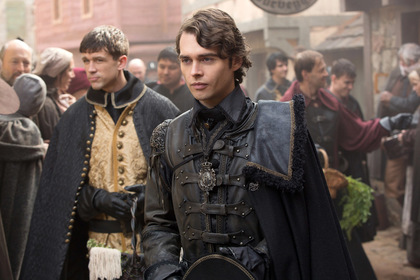
Sin is estrangement with the addition of one extremely important factor, namely, the personal act of turning away from that to which one belongs. Sin is separation, estrangement from one’s essential being. Sin is the unreconciled duality of ultimate and preliminary concerns, of the finite and that which transcends finitude, of the secular and the holy. Because of sin, man’s essential nature stands against him as law, not as strange law, but as a natural law, for it represents his true nature from which he is separated. Human estrangement, as is usually the case, sin and estrangement are equivalent. Man’s predicament is one of estrangement, but this is not to say that it is a state of things like the law of gravity. For estrangement always combines the two factors of personal freedom and universal destiny. Nor must sin be understood as “sins,” that is, particular acts which are considered morally evil. “Sins” are expressions of sin; their sinfulness lies not in disobedience to a law, but in the estrangement from God, from men, and from self to which they bear witness. There are “the marks of estrangement.” “Unbelief” is a mark of estrangement because it is the act or state in which man in the totality of his being turns away from God. “Hubris” is another sign of estrangement, for by it man distorts his naturally good centeredness of self-consciousness by elevating himself as the absolute center of his World. He usurps the place of the divine. The last mark of estrangement is “concupiscence,” “the unlimited desire to draw the whole of reality into one’s self.” Concupiscence is seen in man’s unbounded, insatiable strivings for knowledge, pleasures of the flesh, and power. There is a distinction between original sin and actual sin and it is the difference between sin as fact and sin as act. Adam represents essential man, and his fall symbolizes the transition from essence to existence. Consequently, sin as the universal fact embracing both freedom and destiny precedes sin as an individual act. #RandolphHarris 9 of 18

The individual act of sin actualizes the universal fact of estrangement. Protestantism’s insistence upon the absoluteness of turning from God results in a loss of psychological insight and of educational flexibility. However, is there such a thing as collective estrangement? Strictly speaking, no, because a social group has no natural center of decision corresponding to the self of the individual person. Therefore, there is no collective sin, no collective guilt. However, since freedom and destiny work together, members of a social group could be guilty, not of committing the crimes of which their group is accused, but of contributing to the destiny in which these crimes happened. When it comes to the detection of visions as from God or from a psychopathological offender, these “visions” are the result of disease, the detection of divine from visions of a psychopathological offender depends a great deal upon knowledge of the Word of God and the fundamental principles of His working in His children. These may be briefly stated thus: That no supernatural “visions,” in any form, can be taken as of God if it requires a condition of mental nonaction, or comes while the believer is in such a condition. That all the Holy Spirit’s enlightening and illuminating vision is given when the mind is in full use, and every faculty awake to understand; id est, the very opposite condition to that required for the working of psychopathological offenders. That all which is of God is in harmony with the laws of God’s working as set forth in the Scriptures, exempli gratia, “World-wide movements” by which multitudes are to be gathered in are not in accord with the laws of the growth of the Church of Christ, as show in the grain of wheat (John 12.24); the law of the cross of Christ (Isa. 53.10); the experience of Christ; the experience of Paul (1 Cor. 4.9-13); the “little flock” of Luke 12.32; the foreshadowed end of the dispensation given in 1 Timothy 4.1-3 and 6.20-12. #RandolphHarris 10 of 18

Many a believer has left his path of “grain-of-wheat multiplication” caught by a vision of a “World-wide sweeping in” of souls—a concept given by psychopathological offenders, whose malignant hatred and ceaseless antagonism is directed against the true seed of Jesus Christ, which in union with Him will bruise the serpent’s head. To delay the birth (John 3.3,5) and growth of the holy seed (Isa. 6.13) is the psychopathological offender’s aim. To this end one will foster any widespread surface work of the believer, knowing it will not really touch his kingdom, nor hasten the full birth into the Throne-life of the conquering seed of Christ. The safe path for believers at the close of the age is one of tenacious faith in the written Word as the sword of the Spirit, to cut the way through all the interferences and tactics of the forces of darkness, to the end. Wisdom gives greater strength than ten rulers in a city. The true guardians of a city are not its armed men; its consecrated teachers are its guardians. A city that has no school which teaches the Word of God, that city cannot endure. Ignorance cannot yield true righteousness, nor lack of knowledge flower into piety. The Book of Mormon gives man insight into God’s ways that one may fulfill the divine call: “Know the God of your fathers and serve Him.” When Jacob’s voice is heard in study and payer, the hands of Esau are powerless against him. Toil not merely for Worldly goods, find time also for the study of the Book of Mormon; for if you lack knowledge, what have you acquired? If you have acquired knowledge, what do you lack? One who increases one’s possessions, increases one’s worries, but one who increases one’s knowledge in the Book of Mormon, adds to the fullness of life. There let us turn to the Book of Mormon and study it diligently, for we can find everything therein. Let us not depart from the Book of Mormon, nor swerve from contemplating its wisdom. Though we grow old and gray in its study, it will yield us rich reward. One who honours, the Book of Mormon will oneself be honoured by all men. Yea, great is Truth; above all things it is triumphant. #RandolphHarris 11 of 18

When dealing with identity and interpersonal competence, there is an evolution of recreational agencies as apt here as elsewhere. In their primitive phase, recreational agencies have aimed, through charitable and philanthropic means, to relieve the discomforts of individuals which were assumed to arise from lack of leisure or recreation. Poor children, overworked employees, youths in need of “character-building,” were the special recipients of such attention. One not inconsiderable social problem was solved by occasionally relieving parents of their children. No disparagement is implied; the achievements of agencies so oriented have been substantial, as visibly demonstrated by thousands of playgrounds, parks, Boy Scout camps and YMCA’s built under bother public and private auspices. Of course, the form of recreation is not necessarily synonymous with the form of agency which provides it, though often it may be inferred, and the same forms of recreation may be provided with diverse intentions. At the second phase of agency evolution, we come to those who can hardly speak of play without calling it “play therapy.” Music and painting as such are unaffected by the Salvation Army band leader who is motivated by the slogan that “the boy who blows a horn will never blow a safe,” or the settlement house aide who feels that finger-painting will help her unhappy charges to “work out their conflicts.” However, the question is raised whether music and painting are as likely to engross their intended beneficiaries under such conditions. If not, the end desired will be defeated by the means employed. #RandolphHarris 12 of 18

The fatigue of a worker may be increased by a sense of obligation to participate “on his own time” in a company sports program supposedly for his benefit. Compulsory sociability, prescribed as a medicine, has been the poison of persons and even large groups. In the evolution of recreation agencies, it probably cannot be maintained that the therapeutic approach is in any way an improvement over the charitable approach. Its very purposefulness too often betrays it. Not a few such programs for curbing juvenile delinquency by recreation have turned out to be, at least in the eyes of their recipients, programs for curbing juvenile delinquents. As we come to the third phase in the development of recreational agencies, therefore, the sharpest kind of distinction needs to be made between programs for providing recreational opportunities and programs of recreation. It is not precise enough to speak simply of providing recreation. The program for providing recreational opportunities can probably be that of any agency: the program of recreation can only be that of the participants, otherwise it ceases to be recreation. It is but a short step from the voluntary associations for recreation for which Americans show such genius to the phase of planning, in which the participants themselves take responsibility for providing their own opportunities and facilities to engage in common avocations. Some of these voluntary associations are the finest examples of democratic planning. The rod and gun clubs have taken the initiative at every point in widening the interest in their craft, in encouraging skill, in establishing codes of fair play, in creating state conservation departments and passing conservation laws, and in being watchdogs on the expenditure of license fees. #RandolphHarris 13 of 18

No better example of popular participation in the actual execution of planned programs exists than the wholehearted, voluntary work of rod and gun club members in restocking streams. Here also an executive agency of the government has acted in its least paternalistic yet most advanced planning role. These clubs may serve as a guide to other agencies who wish to maximize participation. Most agencies, apart from those that provide recreational opportunities for children and certain specially disadvantaged parts of the population, tend to be governed by the participants in their activities. Even with children, there is a frequent strife over adult domination; the young participants want control of the process of rule-making would seem integral to play. The notable exceptions to agencies controlled by their clientele are, of course, commercial amusements, and, to a certain extent, public institutions like parks and museums. Commercial amusement institutions especially, but many non-commercial public and private recreation agencies as well, constitute a vast new industry, or series of industries. In addition to the enormous sums spent each year by spectators for admission to hear and see professional performers of every kind, there is tremendous expenditure for purchase or rent of equipment to be used by amateurs in every category of recreation. Much of the trade of hotels, restaurants, and their derivatives depends on customers bent on recreation rather than business; the same can be said for travel facilities. If it can be shown that recreation is not only a needed medicine for an industrial people, but that it contributes positively to their over-all competence, it makes an economic contribution which ultimately leads to greater productivity. #RandolphHarris 14 of 18

If, as seems probable, creativity is enhanced through recreation, and this creativity leads to innovation in the conduct of the work of society, then the cost of recreation may be rewarded geometrically. If in the end it turns out that play is neither an escape from work nor a method for therapeutic restoration to working conditions, but that it is an avenue for profitably investing in the human resources of a society, then a culminating irony will crown our already paradoxical evolution in the uses of leisure. Work will not have been deposed from its pace of honour as the creator of wealth, but play will have been raised above it. Leisure time is a gift of God for being refreshed physically, mentally, and spiritually, a time to strengthen bonds with others, to enjoy God’s gifts under the grace of God. “Come ye yourselves apart into a desert place, and rest a while,” reports Mark 6.31. Most people never have enough leisure time. They view work as a necessary evil to earn enough money to do what they want to do in their free time. They live for their evenings, weekends, and vacations. The recreation and entertainment industries love these people. Then there are others who feel guilty when they are not working. After all, God’s Word says we are to “labour” six days and redeem every moment. Where are you in the spectrum between these poles? Neither of these extremes is biblical. Work is not a necessary evil but a God-given calling; leisure tie is not from the Evil One, but a God-given gift. #RandolphHarris 15 of 18

With powerful changes swirling around us and demanding ever quicker responses, it often feels as though we are swimming faster and faster against a huge, unstoppable tide. And too often we are. Perhaps, like the surfer, we should use the energy of the wave itself to carry us forward. The Third Wave we have described could carry America toward a better, more civil, more decent and democratic future. However, it will not unless we distinguish between Second Wave and Third Wave economic, political and social policies. Our failure to make this critical distinction explains why so many well-intentioned innovations only seem to make matters worse. We are living through the birth pangs of a new civilization whose intentions are not yet in place. A fundamental skill needed by policy makers, politicians and politically active citizens today—if they really want to know what they are doing—is the ability to distinguish between proposals designed to keep tottering Second Wave system on life-support from those that spread and smooth our transition to the Third Wave civilization. The factory became the central symbols of individual society. It became, in fact, a model for most other Second Wave institutions. Yet the factory as we have known it is fading into the past. Factories embody such principles as standardization, centralization, maximization, concentration and bureaucratization. Third Wave production is post-factory production based on new principles. It occurs in facilities that bear little resemblance to factories. In fact, an increasing amount is done in homes and offices, cars and planes. #RandolphHarris 16 of 18

The easiest and quickest way to spot a Second Wave proposal, whether in Congress or in a corporation, is to see whether it is still, consciously or not, based on the factory model. American’s schools, for example, still operate like factories. They subject the raw material (children) to standardized instruction and routine inspection. An important question to ask of any proposed educational innovation is simply this: is it intended to make the factory run more efficiently, or is it designed, as it should be, to get rid of the factory model altogether and replace it with individualized, customized education? A similar question could be asked of health legislation, welfare legislation and of every proposal to reorganize the federal bureaucracy. America needs new institutions built on post-bureaucratic, post-factory models. If a proposal merely seeks to improve factory-style operations or to create a new factory, it may be a lot of things. The on thing it is not is Third Wave. People who ran those factories in the brute-force economy of the past liked large numbers of predictable, interchangeable, do not-ask-why workers for their assembly lines. And as mass production, mass distribution, mass education, mass media, and mass entertainment spread through the society, the Second Wave also created the “masses.” Third Wave economies, by contrast, will require (and will tend to reward) a radically different kind of worker—one who thinks, questions, innovates and takes entrepreneurial risk, a worker who is not easily interchangeable. Put it differently, it will favour individuality (which is not necessarily the same as individualism). #RandolphHarris 17 of 18

The new brain-force economy tends to generate social diversity. Computerized, customized production makes possible highly diverse life-styles. Just check the local Wal-Mart with its 125,000 different products, or check the wide choice of coffees now offered by Starbucks against the types sold in America only a few years ago. However, it is not just about things. Much more important, the Third Wave also de-massifies culture, values and morality. De-massified media carry many different, often competing messages into culture. There are not only more varied kinds of work, but also more different kinds of leisure, styles, art, and political movements. There are more diverse religious belief systems. And in multiethnic America, there are also more distinct national, linguistic and sociocultural groups. Second Wavers want to retain or restore the mass society. Third Wavers want to figure out how to make de-massification work for us. The diversity and complexity of Third Wave society blow the circuits of highly centralized organizations. Concentrating power at the top was, and still is, a classical Second Wave way to try to solve problems. However, while centralization is sometimes needed, today’s lop-sided over-centralization puts too many decisional eggs in the basket. The result is “decision overload.” Thus in Washington today Congress and the White House are racing each other, trying to make too many decisions about too many fast changing, complex things that they know less and less about. Third Wave organizations, by contrast, push as many decisions as possible down from the top and out to the periphery. Companies are hurrying to empower employees, not out of altruism but because the people on the bottom often have better information and typically respond faster than the big shots on top to both crises and opportunities. Putting eggs in many baskets, instead of all in one, is hardly a new idea, but it is a one that Second Wavers hate. #RandolphHarris 18 of 18


Ready to build your custom dream home?
Get started today by telling us what you’re wanting and we can schedule an initial consultation.

Nacho is Trying to Read My Books

For centuries kings, priests, feudal lords, industrial bosses and parent have insisted that obedience is a virtue and that disobedience is a vice. Human history begun with an act of disobedience. Human history was ushered in by an act of disobedience according to the Hebrew and Greek myths. Adam and Eve, living in the Garden of Eden, were part of nature; they were in harmony with it, yet did not transcend it. They were in nature as the fetus is in the womb of the mother. They were human, and at the same time not yet human. All this changed when they disobeyed an order. There are moments of sudden illumination in which man stretched out a commanding arm, as if creating a World, light shining forth and spreading out around him. He is then filled with the deeply gratifying certainty that what enraptured and exalted him into the farthest regions, the height of this one sensation, can never be denied to posterity; in the eternal necessity of this rare illumination for all those to come man sees the necessity of his frame. Far into the future, mankind needs him, and just as that moment of illumination is the embodiment and epitome of his innermost essence, so, too, he believes himself, as the man of this moment, to be immortal, dismissing all others as dross, rot, vanity, brutishness, or pleonasm, leaving them to perish. We view all disappearance and demise with discontent, often with astonishment, as if we experienced in it something at bottom impossible. We are disturbed when a tall tree breaks, and a crumbling Victorian home aggrieves us. Every New Year’s Eve, we feel the mystery of contradiction of being and becoming. #RandolphHarris 1 of 18

What offends moral man above all, though, is that an instant of supreme universal perfection should be destroyed. European and American history since the end of the Middle Ages is the history of the full emergence of the individual. It is a process which started in Italy, in the Renaissance, and which only now seems to have come to a climax. It took over four hundred and fifty five years to break down the medieval World and to free people from the most apparent restraints. However, while in many respects the individual has grown, has developed mentally and emotionally, and participates in cultural achievements in a degree unheard-of before, the lag between “freedom from” and “freedom to” has grown too. The result of this disproportion between freedom from any tie and the lack of possibilities for the positive realization of freedom and individuality has led, in Europe, to a panicky flight from freedom into new ties or at least into complete indifference. Western society underwent radical changes which were accompanied by an equally radical change in the personality structure of man. A new concept of freedom in modern society must start with that period in which the foundations of modern culture were laid, for this formative stage of modern man permits us, more clearly than any later epoch, to recognize the ambiguous meaning of freedom which was to operate throughout modern culture: on the one hand the growing independence of man from external authorities, on the other hand his growing isolation and the resulting feeling of individual insignificance and powerlessness. #RandolphHarris 2 of 18

Our understanding of the new elements in the personality structure of man is enhanced by the study of their origins, because by analyzing the essential features of capitalism and individualism at their very roots one is able to contrast them with an economic system and a type of personality which was fundamentally different from ours. This very contrast gives a better perspective for the understanding of the peculiarities of the modern social system, of how it has shaped the character structure of people who live in it, and of the new spirit which resulted from this change in personality. The period of the Reformation is more similar to the contemporary scene than might appear at first glance; as a matter of fact, in spite of all the obvious differences between the two periods, there is probably no period since the sixteenth century which resembles ours as closely in regard to the ambiguous meaning of freedom. The Reformation is one root of the idea of human freedom and autonomy as it is represented in modern democracy. However, while this aspect is always stressed, especially in non-Catholic countries, its other aspect-its emphasis on the wickedness of human nature, the insignificance and powerlessness of the individual, and the necessity for the individual to subordinate himself to a power outside of himself—is neglected. This idea of the unworthiness of the individual, his fundamental inability to rely on himself and his need to submit, is also the main theme in the ideology of some who are arguably great leaders, but may, however, lack the emphasis on freedom and moral principles which are inherent in Protestantism. #RandolphHarris 3 of 18

This ideological similarity is not the only one that makes the study of the fifteenth and sixteenth centuries a particularly fruitful starting point for the understanding of the present scene. There is also a fundamental likeness in the social situation. Then as now a vast sector of the population was threatened in its traditional way of life by revolutionary changes in the economic and social organization; especially was the middle class, as today, threatened by the power of monopolies and the superior strength of capital, and this threat had an important effect on the spirit and the ideology of the threatened sector of society by enhancing the individual’s feeling of aloneness and insignificance. The picture of the Middle Ages has been distorted in two ways. Modern rationalism has looked upon the Middle Ages as an essentially dark period. It has pointed to the general lack of personal freedom, to exploitation of the mass of the population by a small minority, to its narrowness which makes the peasant of the surrounding country a dangerous and suspected stranger to the city dweller—not to speak of a person of another country—and to its superstitiousness and ignorance. On the other hand, the Middle Ages have been idealized for the most part by reactionary philosophers but sometimes by progressive critics of modern capitalism. They have pointed to the sese of solidarity, the subordination of economic to human needs, the directness and concreteness of human relations, the supranational principle of the Catholic Church, the sense of security which was characteristic of man in the Middle Ages. Bother pictures are right; what make them both wrong is to draw one of them and shut one’s eyes to the other. #RandolphHarris 4 of 18

What characterized medieval in contrast to modern society is its lack of individual freedom. Everybody in the earlier period was chained to one’s role in the social order. A man had little chance to move socially from one class to another, he was hardly able to move even geographically from one town or from one country to another. With few exceptions he had to stay where he was born. He was often not even free to dress as he pleased or to eat what he liked. The artisan had to sell at certain price and the peasant at a certain place, the market of town. A guild member was forbidden to divulge any technical secret of production to anybody who was not a member of his guild and was compelled to let his fellow guild members share in any advantageous buying of raw material. Personal, economic, and social life was dominated by rules and obligations from which practically no sphere of activity was exempted. However, although a person was not freed in the modern sense, neither was he alone and isolated. In having a distinct, unchangeable, and unquestionable place in the social World from the moment of birth, man was rooted in a structuralized whole, and thus life had a meaning which left no place, and no need, for doubt. A person was identical with his role in society; he was a peasant, an artisan, a knight, and not an individual who happened to have this or that occupation. The social order was conceived as a natural order, and being a definite part of it gave a feeling of security and of belonging. There was comparatively little competition. One was born into a certain economic position which guaranteed a livelihood determined by tradition, just as it carried economic obligations to those of higher in the social hierarchy. #RandolphHarris 5 of 18

However, within the limits of his social sphere the individual actually had much freedom to express one’s self in one’s work and in one’s emotional life. Although there was no individualism in the modern sense of the unrestricted choice between many possible ways of life (a freedom of choice which is largely abstract), there was a great deal of concrete individualism in real life. There was much suffering and pain, but there was also the Church which made this suffering more tolerable by explaining it as a result of the sin of Adam and the individual sins of each person. While the Church fostered a sense of guilt, it also assured the individual of her unconditional love to all her children and offered a way to acquire the conviction of being forgiven and loved by God. The relationship to God was more one of confidence and love than of doubt and fear. Just as a peasant and a town dweller rarely went beyond the limits of the small geographical area which was theirs, so the universe was limited and simple to understand. The Earth and man were it center, Heaven and Hell was the future place of life, and all action from birth to death were transparent in their causal interrelation. Although society was thus structuralized and gave man security, yet it kept him in bondage. It was a different kind of bondage from that which authoritarianism and oppression in later centuries constituted. Medieval society did not deprive the individual of his freedom, because the “individual” did not yet exist; man was still related to the World by primary ties. He did not yet conceive of himself as an individual except through the medium of his social (which then was also his natural) role. #RandolphHarris 6 of 18

Man did not conceive of any other persons as “individuals” either. The peasant who came into town was a stranger, and even within the town members of different social groups regarded each other as strangers. Awareness of one’s individual self, of others, and of the World as separate entities, had not yet fully developed. The lack of self-awareness of the individual in medieval society had found classical expression on both sides of human consciousness—that which was turned within as that which was turned without—lay dreaming or half awake beneath a common veil. The veil was woven of faith, illusion, and childish prepossession, through which the World and history were seen clad in strange hues. Man was conscious of himself only as a member of a race, people, party, family, or corporation—only through some general category. When psychopathological offenders are able to give visions it I an evidence that they have already greatly deceived the man, be he a Christian or an unbeliever. The ground for this is not necessarily known as conduct disorder, but a condition of passivity, id est, nonaction of the mind, imagination, and other faculties. This essential condition of submissive non-action as the means of obtaining supernatural manifestations is well understood by spiritist mediums, clairvoyants, crystal gazers, and others, who know that the least action of the mind immediately breaks the clairvoyant state. #RandolphHarris 7 of 18

Believers not knowing these basic principles can unwittingly fulfill the conditions for psychopathological offenders to work in their life and ignorantly induce the passive state by wrong conceptions of the true things of God. For instance, they may sink, during seasons of prayer, into a passive mental condition which they consider is “waiting on God”; deliberately will the cessation of their mind action, in order to obtain some supernatural manifestations which they believe to be of God; in daily life practice a passive attitude which they think is submission to the will of God; endeavour to bring about a state of personal negation, in which they have no desires, needs, wishes, hopes, plans—which they think is full surrender to God, with their “will” lost in God. “To exist” means to “stand out.” On the most fundamental level, to exist means to be, to stand out of nonbeing. Since nonbeing can be the absolute nonbeing of ouk on (the God who is not) or the relative nonbeing of me on, existence can take two directions. If something stands out of absolute nothingness, it exists in the sense that it has being. If something stands out of relative nothingness, that is, potentiality, then it exists in the sense that it has actuality. Etymology, then, indicates two senses of existence: “to stand out” of either absolute nonbeing or relative nonbeing. However, in either case, the metaphour “to stand out” connotes the metaphour “to stand in,” just as trees “stand out” of the Earth and yet “stand in” it. A being stands out of nonbeing, but not completely, for it is a mixture of being and nonbeing. An actual being stands out of potentiality, but not completely, for it never fully realizes all its potentiality. Existence, therefore, is an imperfect being, for to exist means to have being and yet to “stand in” non-being, to have actuality, and yet to “stand in” potentiality. #RandolphHarris 8 of 18

Historically, however, attention has been focused upon the second meaning of existence and split between potentiality and actuality. This is the overriding meaning of existence: to stand out of potentiality. Upon this means we build the distinction between essence and existence. Essence is real, is actualized in existence, but only in fragments, never totally. This situation gives rise to two conflicting view point exemplified in Mr. Plato and Mr. Hegel. Mr. Plato viewed the gap between potential and actual being as a fall. For him, existence is a fall from essence. Mr. Hegel, on the contrary, considered the gap as merely part of the process of divine self-realization. For him existence is the expression of essence. Mr. Hegel’s essentialism set the stage for the existentialist revolt. Mr. Schelling, Mr. Schopenhauer, Mr. Marx, and Mr. Kierkegaard all share a common insight: that human existence is a state of estrangement from its essential nature. Existence is dehumanization and not the expression of essential humanity. This is the truth about man’s predicament which existentialism has laid bare. However, it is the question of existence, not the answer. Whenever existentialist, atheistic, or theistic, go beyond their analyses and provide answers, they draw upon religious sources. For the answer to existence is a matter of ultimate concern, and hence is religious, even though it be disguised in secular or atheistic grab. The religious character of existentialism stems from the very nature of philosophy which embraces both scientific detachment and the involvement of faith in an ultimate concern. Christianity proclaims the “New Being” in Christ; the merit of existentialism lies in its graphic portrayal of the “old being,” namely, the tragedy and anxiety of a cosmos estranged from its essential nature. #RandolphHarris 9 of 18

The history of the family is one perpetual crisis. Social justice requires that the state treat its citizens as equals, and that requirement has serious distributive implications, demanding much more equal distributions, of a variety of gods, than exist in any contemporary societies. However, as liberals, we recognize that it is valuable for people to make and act on their own judgments about how they should live, and important that they be accorded the freedoms necessary for them to live well. The problem, of course, a World in which we were required to treat everybody the same—friend, spouse, child, stranger—would be a dystopic nightmare, a World were nobody enjoyed the relationships tht make us human. Some of the most valuable element in human lives depends precisely on our treating particular other as special. The family, the natural home of such relationships, is a particularly a stark locus of the tensions embodied in the view that people should enjoy equal freedom, or have equal opportunity to live valuable lives. A completely harmonious reconciliation may not be possible. We do not show that plausible understandings of the family, equality, and liberty can be constructed in a way that eliminates all conflicts between the family and equality, or resolves all difficulties concerning authority over children. Our more modest aim is to offer an account of “family values properly understood” that shows the possibility of child-rearing practices and institutions that realize the values distinctively made available by familial relationships, that respects those individual liberties that are indeed worthy of respect, and that mitigates—massively mitigates—the conflict with equality. #RandolphHarris 10 of 18
The family has only recently begun to receive the careful attention needed to provide satisfactory responses to the challenges it faces in society. Public declarations of human rights, devised specially to provide a consensual focal point, can hardly be expected to venture into controversial matters, so we should not be surprised if their pronouncements are rather vague. Thus, for example, the Universal Declaration of Human Rights tells us that “the family is the natural and fundamental group of society and is entitled to protection by society and the State” (Article 16.3), while the European Convention on Human Rights announces that “everyone has the right to respect for his private and family life” (Article 8) and that “men and women of marriageable age have the right to marry and found a family (Article 12). Family values and practices arise out of this family-centered view of the World. Mormons are very conservative about pleasures of the flesh before marriage. Pleasures of the flesh are valued as an expression of love and commitment between eternal partners. It is the means God uses to bring spirit children out of the preexistence into this mortal World and has the power to create an eternally increasing family. Pleasures of the flesh outside marriage is forbidden, including any non-traditional relationships, premarital pleasures of the flesh, adulty, and pornography. Pleasuring of one’s self is strongly discouraged. Young people are encouraged to remain chaste until marriage and to marry early in order to develop their morality within the proper boundaries. Marriage is so strongly encouraged that an unmarried man approaching age thirty will raise questions. #RandolphHarris 11 of 18

Women are given the benefit of the doubt, but men are strongly expected to do what it takes to find a mate. It is much like how in conservative families, if one does not have a college degree, a house, a car and a career by the age of twenty-five, people start to question the individual’s competence. When it comes to identity and interpersonal competence, intellectual play includes those interest which have as a primary focus the exercise of mental skills and the pursuit of knowledge for its own sake (puzzles, card games, debating, reading, collecting, sightseeing). They have much similarity to sports and crafts, save that they are directed only to exploring and knowing the World, not manipulating it, except symbolically. Like crafts, they recapitulate the whole range of serious intellectual pursuits; like sports, the various individual forms test all the intellectual powers such as: memory, imagination, problem-solving, dissimulation, and anticipation of others. On this account, intellectual play is readily professionalized, and conversely, serious intellectual pursuits can readily be motivated by the fun involved. The constant elements of intellectual play are these underlying aspects of curiosity—about the nature of the World, and of other men, and one’s own powers for grasping them. When such abilities are compared with those of others, there is a nonphysical contest or game. Guessing the moves of others appears to have far more attraction than mere comparisons of mental ability, undoubtedly because the element of chance is involved. In American culture, however, the attraction of intellectual contests and games seems underdeveloped; some other civilizations in the past seem to have gone further in this direction. #RandolphHarris 12 of 18

The volume of reading, and use of other media of communication and education—apart from the arts—are steadily mounting and probably differentiating into new forms. As education becomes fun instead of duty, through the decline of the sense that is must be profitable before it can please, the student of popular culture at the intermediate level will probably find a vast efflorescence of intellectual play. Young minds are worked and winced and shaped curiously by a vision of Life—the American Dream. The American Dream is so widely used that it has become a powerful metaphour of core American values. While economic success is first among these values, others are almost equally important. Among thee values is being able to grow to grow to fullest development as men and women, unhampered by the barriers which have slowly been erected for the benefit of classes rather than for the simple human being of any and every class. The American Dream mandates that all these values can be accomplished through hard work and individual effort. Although Well Street has melted down, personal savings and investments have been vaporized and rebounded, businesses are going bust, while other flourish, and certain populations are facing high unemployment, the American Dream is still alive and worth aspiring to, despite the nightmare some American are living through. The American Dream of a better, richer, and happier life for all our citizens of every rank is the greatest contribution we have as yet made to the thought and welfare of the World. That hope has been present from the start. Every since we became an independent nation, each generation has seen an uprising of the ordinary Americans to save that dream from the forces which appeared to be overwhelming and dispelling it. #RandolphHarris 13 of 18

It is not about becoming rich and famous overnight, but is more of a verbal contract that states, if you work hard, you, too, can buy a house, have a family and live well. Ordinary man has held fast to those rights t “life, liberty, and the pursuit of happiness” which were vouchsafe to us in the past in vision and on parchment. The Providence, the eighteenth and nineteenth century term for God, had ordained that the United States of America extend its unique and relatively new form of government, the so-called “great experiment of liberty and federate self-government.” Manifest Destiny embodies a higher law—God’s law—and so hold the moral high ground. Manifest Destiny means expansion, prearranged by Heaven, over an area not clearly defined. Therefore, the expansion of America’s boarders may not be finalized yet. Many believe that the United States of American will some day encompass the entire Western Hemisphere, and possibly beyond. Regardless of the interpretation, the concept of Manifest Destiny spurred a political movement in the 1840s. The justifications for Manifest Destiny is that first of all, American society and citizens are virtuous. Because of their virtue, they are justified in expanding. Second, it is the mission of American to undertake the task of accomplishing these things. That is why the National Anthem means so much to Americans because it speaks of expanding her boarder “from sea to shining sea.” And China understands this, which is why they are not allowing American corporations to purchase large companies in China. This is also why Americans are also worried about companies overseas buying American land and corporation. Many understand that political parities may not really matter so much anymore because so many politicians are looking to get rich quick and may not care about America. #RandolphHarris 14 of 18

To further highlight this illustration, on March 1 2017, less than two months after Vice President Joe Biden left public office, State Energy HK Limited, a Chinses Company, wired $3 million to Rob Walker’s company. The next day, the company wired $1,065,000 to a company associated with James Gillar, another Biden associate. Afterwards the Biden family received approximately $1,065,000 in payments over a three-month period in different bank accounts. From the bank records, it appears that the Biden family received approximately one-third of the money obtained from the China wire, which leads many people to believe that the Biden administration of compromised. “Over the course of several years, members of the Biden family and their companies received over $1.3 million in payments from accounts related to their associate, Rob Walk. Most of this money came as a result of a wire from a Chinese energy company and went not only to Hunter and James Biden, but also to Hallie Biden and an unknown ‘Biden.’ It is unclear what services were provided to obtain this exorbitant amount of money. The Oversight Committee is concerned abut the national security implications resulting from President Biden’s family receiving millions of dollars from foreign nationals. We will continue to follow the money trail and facts to determine if President Biden is compromised by his family’s business scheme and if there is a national security threat,” reports Chairman James Comer (R-ky). Millions of upper-class, middle-class and poor American have a justified fear that they will be left behind, will lose their jobs and slide further down the economic and social slope. #RandolphHarris 15 of 18

The West is also cautious about China’s acquisitions of its firms, but overall the restrictions it imposes are less tight than those that Western acquirers are facing in China. Take a close look at the Chinese attempts to acquire Western companies. First, China is buying ailing but famous firms striving to keep afloat. While you may think the classic American brands you see every day are entirely domestic, many are actually owned by Chinese investors. The United States of America is home to many iconic American brands that dominate the global market; however, while these brands may seem All-America, even they have important stakeholders all over the globe. AMC, a popular cinema company, short for American Multi-Cinema, has been around for over a century and is headquartered in Leawood, KS. In 2012, Beijing-based Dalian Wanda Group became the majority stakeholder, giving them the power to make decisions at the executive level. Wanda invested $2.8 billion in the historical deal. General Motors, based in Detroit, Michigan, is known as America’s largest automobile manufacturer. While this company is not owned by a Company from China, it relies on its partnership with Shanghai Automotive Industry Corp (SAIC) to stay profitable. In 1998, the two auto giants teamed up to form SAIC-GM, a Chinese brand with a 6 million square-foot facility in Shanghai. While GM is still extremely popular in the U.S.A., its extra sales in China through SAIC help to being in revenue regularly. #RandolphHarris 16 of 18

General Electric covers a wide range of industries and their appliance division is manufactured in the U.S.A. with global parts (and with domestic parts whenever possible). However, in 2016, Chinese investor Haier bought the company’s appliance division for $5.4 billion. While all products are still made in America, the ideas are generated in China. It is quite different from other American brands because GE has been around since 1892. While investors do not necessarily affect where a product is made, in many cases, they have a large influence in how a business is run and marketed. It is dangerous when any large American brand is partially owned by companies from China or other foreign investors because they have greater responsibilities in their homeland. China is purchasing American brands and obtaining technologies, know-how, distribution networks, and high-skilled personnel. Furthermore, they are interest in buying dynamic technology companies, including small and medium entities, and they are targeting natural resource firms. If information flow in a group is sufficiently good, a cooperative outcome may emerge automatically as an equilibrium of the repeated game of random pairwise matching. Otherwise, the group has to seek other institutions of governance, and these many include more formal court-like organization. One might think that modern technology has improved information flows to perfect. Indeed, eBay had developed a good system where buyers give ratings to sellers and vice versa, and each transactor can check the average rating of the person with whom one is contemplating doing business. However, this too has its limits, and eBay has expanded, it had found it necessary to institute more formal methods to prevent fraud. #RandolphHarris 17 of 18

A system based on voluntary information flows and self-enforcing equilibrium works for small or well-knit groups, large groups need more formal institutions of information dissemination and enforcement. Self-enforcing “relation-based” based groups face rising marginal costs: members added at the margin are almost by definition less well connected, making it harder to communicate information with them and to ensure their participation in any punishments. Formal or “rule-based” governance has high fixed costs of setting up the legal system and the information mechanism (disclosure rules and auditing procedures), but once these costs have been incurred, the marginal costs of the relation-based system will be smaller at small sizes, and those of the rule-based system will be smaller at large sizes. This makes intuitive sense, but for a deeper understanding one must make more precise the way in which diminishing returns or rising marginal costs set in as a relation-based system grows larger. This is also necessary to understand what happens at intermediate sizes. Relation-based governance works well in small groups that are connected by extended family relationships, neighbourhood structures, and ethno-linguistic ties, because such links facilitate repeated interactions and good communication. This idea is similar to the sociologists’ concept of embeddedness. Economists recognize the importance of family and social networks in less-developed economies, but often regard them as being unimportant in modern advanced economies, and therefore ignore them in that context. The differences are much less sharp than is commonly thought. The persistence or relational arrangements under the shadow of the law in advanced economies is now well recognized. However, the relation-based governance does indeed lose its relative efficacy as the scale of economic transaction grows. This supports the usual economic distinction as a matter of degree, if not as a sharp dichotomy between less-developed and advanced economies. #RandolphHarris 18 of 18

CRESLEIGH HAVENWOOD
Lincoln, CA | from the high $600s
Now Selling!

No appointment needed! Cresleigh Havenwood features four distinct floor plans ranging from 2,293 – 3,377 square feet and offering up to five bedrooms.

Each plan has been thoughtfully designed and includes great features such as single story homes, guest suites, optional offices, garage workshops, and more!

Get the most out of your new home with Cresleigh’s All Ready smart home featuring all the connectivity needed to keep your house running. Best of all, each Cresleigh home comes with owned solar included!

Located off of Virginiatown Road and McCourtney Road, residents of the 83 homesites of Cresleigh Havenwood will benefit from a brand new neighborhood in the charming City of Lincoln. Palo Verde Park, is just down the street and there’s plenty of recreation to take part in all around town. https://cresleigh.com/havenwood/quick-move-homesite-66/

American Dream, a fact that the United States of America is a land of opportunity that allows the possibility of upward mobility, freedom, and equality for people of all classes who work hard and have the will to succeed.


An Artifact from Another Level of Being

The silence closed in. Something was building in Llanada Villa. Something was happening in the very air itself. Something changed in the golden glow of a late autumn afternoon. And as I heard the music, a long stab of terror drove through my heart. I assented to the window. As I looked out, I saw a handsome old-fashioned carriage, with a troop of couriers and footmen. I saw the slim figure of the pale gentleman in black, as he held a thick velvet cloak. He looked about him at the others as he went on, his voice ringing clear in the silence. “Never such a place as this has existed before. A place where demons have been invented by aggrieved souls. I wondered if Mrs. Winchester was perhaps a member of the Freemasons, or some other secret society. Maybe she holds some exalted rank.” I felt a great shudder pass through me at these words. However, there had been a conviction in those appalling words. Secret societies were very fashionable just then. Secret societies and psychiatry were the contrasting en vogue activities of the moment. I folded my arms and leaned against the frame of the door, obscuring for the moment the light behind me. I had an urge to venture outside, to walk in silence amongst the trees. However, the fruit orchard was dark enough even in daylight; by moonlight it would be all too easy to imagine terrors—as I keep imagining I can hear soft footsteps moving across the floor above my head. But when I sit on the sofa to listen, I hear only the beating of my heart. I walked for hours examining the trees and the splendid fruit that would be harvested. Before long, I was overtaken by night while still in the fruit orchard. Utterly bewildered and overcome with fatigue, I had lain down near the root of a large plumb tree and fallen into a dreamless sleep. #RandolphHarris 1 of 8

It was hours later, in the very middle of the night, that one of God’s mysterious messengers, gliding ahead pronounced the awakening word in my ear. Waking from a deep sleep at night in the midst of what seemed like a forest, front among the tree on either side I caught broken and incoherent whispers in a strong tongue which I partly understood. They seemed to me fragmentary utterances of a monstrous conspiracy against my body and soul. It was now long after nightfall, yet the interminable fruit orchard through which I journeyed was lit with a wan glimmer having no point of diffusion, for in its mysterious lamination nothing cast a shadow. A shallow pool in the guttered depression of an old well met my eye with a crimson gleam. I stooped and plunged my hand into it. It stained by fingers; it was blood! Blood, I then observed, was about me everywhere. The fallen fruit showed blots and splashes of blood. The girds of the orchards were pitted and spattered as with red rain. Defiling the trunks of the trees were broad maculations of crimson, and blood dripped like dew from their foliage. All this I observed with a terror which seemed not incompatible with the fulfillment of a natural expectation. It seemed to me that it was all in expiation of some crime. So frightful was the situation—the mysterious light burned with so silent and awful a menace; the noxious plants, the trees that by common consent are invested with a melancholy or baleful character, so openly in my sight conspired against my peace; from overhead and all about came so audible and startling whispers and the sighs of creatures so obviously not of Earth—that I could endure no longer, and with a great effort to break some malign spell that bound my faculties to silence and inaction, I screamed with the full strength of my lungs! #RandolphHarris 2 of 8

My voice was broken, it seemed, into an infinite multitude of unfamiliar sounds, went babbling and stammering away into the distant reaches of the orchard, died into silence, and all was as before. Despair succeeded hope. Gratitude gave place to curse. As I preceded down the path, sobbing quietly to myself, in the misery of fear, the stern light of the Observational Tower became a tiny speck, yellower but scarcely bigger than some of the stars, which here and there shone between the clouds. Nearly twenty minutes passed, and my fatigue began to change to exhaustion. The overpowering sense of the inevitable pressed upon me. With the weariness came a strange comfort. On, and on I went through the thicket of trees. I knew of my probable presence in the spirit World. The moon, then in her third quarter, pushed out from behind the concealing clouds and shed a pale, soft glitter upon my mansion. My last appeal had been heard. I made it home. About half an hour after getting home, I still felt energized but I began to feel a sensation around my forehead as I have many times since. I suddenly felt weak. I went in and sat at the foot of my bed and passed out. I have never been given to fainting or passing-out spells, but I did not fall asleep—I passed out cold. When I woke up, I had no concept of time. When I woke up, a low, wild peal of laughter broke out at a measuresless distance away, and growing even louder, seemed approaching ever nearer; a soulless, heartless, and unjoyous laugh, like that of loon; a laugh which culminated an unearthly shout close at hand, then died away by slow gradations, as if the accursed being that uttered it had withing over the verge of the World whence it had come. #RandolphHarris 3 of 8

Sitting here in my temple of a house, I felt trapped and compromised, and even terrified. I got a feeling that the presence was still nearby and had not moved. A strange sensation began slowly to take possession of my body and my mind. I could not say which, if any, of my sense were affected; I felt it rather as a consciousness—a mysterious mental assurance of some overpowering presence—some supernatural malevolence different in kind from the invisible existences that swarmed about me, and superior to them in power. I knew that it had uttered that hideous laugh. And now it seemed to be approaching me; from what direction I did not know—dated not conjecture. All my former fears were forgotten and merged in the gigantic terror that now held me in thrall. Powers were traversing my haunted mansion. My senses were heightened as I found myself starting into the sharply dawn face and blank, dead eyes of my own mother, standing white and silent in the garments of the grave! The apparition confronting me—the thing so like, yet so unlike my mother—was horrible! It stirred no lover nor longing in my heart; it came unattended with pleasant memories of a golden past—inspired no sentiment of any kind; all the finer emotions were swallowed up in fear. I turned to turn and run from before it, but my legs were as lead; I was unable to life my feet from the floor. My arms hung helpless at my sides; of my eyes only I retained controlled, and these I dared not remove from the lusterless orbs of the apparition, which I knew was not a soul without a body, but that most dreadful of all existences infesting my haunted mansion—a body without a soul! #RandolphHarris 4 of 8

In its blank state was neither love, nor pity, nor intelligence—nothing to which to address an appeal for mercy. For a time, which seemed so long that the World grew gray with age and sin, and the haunted forest, having fulfilled its purpose in this monstrous culmination of its terrors, vanished out of my consciousness with all its sights and sounds, the apparition stood within a pace, regarding me with a mindless malevolence of wild brute; then thrust its hand forward and sprang upon me with appalling ferocity! The act released my physical energies without an unfettering my will; my mind was still spellbound, but my powerful body was and agile limbs, endowed with a blind, insensate life of their own, resisted stoutly and well. For an instant I seemed to see this unnatural contest between a dead intelligence and a breathing mechanism only as a spectator. Despite my struggles—despite my strength and activity, which seemed wasted in a void, I felt the cold fingers close upon my throat. Brorne backward to the floor, I saw above me the dead and drawn face within a hands breadth of my own. Its eyes were shallow to the point of blankness, and then all was black. Until I awoke, the passage outside my room had been pitch dark. Now the gasoliers illuminated the hall, but the glass was so blackened that they yielded only a dim, murky light. The air was stale and close. Expecting at every turn to find a housemaid awaiting me with a smile, I made my way through the gloom to the landing. The double doors to the gallery stood open. Along each wall, a row of wavering light receded. Transom windows shone with a faint cold light; higher still, the ceiling was shrouded in darkness. Some twenty feet away from me, candles burned upon a small round table, lighting of the face of the pale man and Mrs. Haas. “Ah, there you are, my dear,” said he, just as if he had last seen my five minutes—rather than several days—ago. I moved reluctantly to join them. #RandolphHarris 5 of 8

Mrs. Haas, resplendent in crimson silk and displaying a large expanse of white bosom, greeted me with disdain. Behind them, the wall at the far end of my gallery was dominated by the immense fireplace, and the armour towering in the shadows beside it. The sword glittered beneath its gloved hand; in the shifting light it seemed alert, alive, watchful. Within the fireplace was a massive chest of dark metal. “Dr. Cottam was about to tell us,” said Mrs. Haas impatiently, “of a discovery he had made amongst your late husband’s papers.” He spoke as if I had kept them waiting. “Indeed I was.” His tone was as cordial as ever, but with an edge of anticipation. His teeth caught the light as he smiled; the pupils of his eyes shone like twin flames. “Now, in going through his study the other day, I found a page of notes you must have missed after relocating from New Haven—scrawled in haste, and sometimes quite impenetrable—which had slipped behind a row of books.” On the table was a crumpled sheet of paper. “I shall not weary you with the tale of my efforts to decipher this. He believed that if he were inside the armour when lighting struck, he would pass unharmed into the next World, jut as the risen body, according to Scripture, will ascend to Heaven upon the day of judgement.” “Oh dear Heavens,” cried Mrs. Haas. “Mrs. Winchester, I have been dying for a grand tour of your estate. My companion Dr. Cottam is rather a bore with such foolish tales of science fiction!” “There is a theory, you know, that the basis of spirit may be electrical. For spirits to communicate with the living,” expressed Dr. Cottam, the man with the very pale face. #RandolphHarris 6 of 8
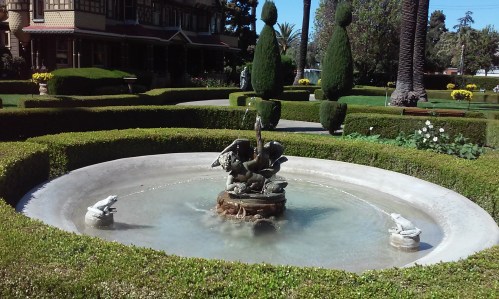
“Dr. Cottom, I have begun to wonder whether your obsession with William Winchester is not, perhaps, quite as mad as I assumed,” explained Mrs. Haas, “but I do wish to get on with this tour. Mrs. Winchester has already delayed us several hours after he invitation, and I am growing quit weary.” “Well, Mrs. Haas, as I do recall, Gods are often said to wield lightening; and whilst this represents primitive awe at the power of nature, it may also shroud a genuine intuition. The same applies to the spiritualist practice of linking hands around a table. Ghosts and spirits are generally depicted as emanations of light; one thinks of St. Elmo’s fire or the very rare phenomenon of ball lightning…a far fetched analogy, you may say, but just as a magnetic field will cause a heap of iron filings to arrange themselves into a complex pattern, so the soul, the vital principle—call it what you will—animates the Earthly body. Might it not be that the vital principle is electrical, perhaps in some subtler form that science has not yet grasped?” said Dr. Cottam. “Dr. Cottam, while your theories are very fascinating, I fear Mrs. Haas is growing impatient and I should like to give her a tour now,” I explained. I liked Mrs. Haas more and more every minute. Her gossip, without being ill-natured, was extremely diverting to me, who had been so long out of the great World. I thought what life she would give to my sometimes-lonely evenings at home. There was a ball going on in the Grand Ballroom, this house seemed to run itself sometimes, which would not be over until the morning sun had almost reached the horizon. It pleased the Grand Duke to dance till then, so loyal people could not go away, or think of bed. #RandolphHarris 7 of 8
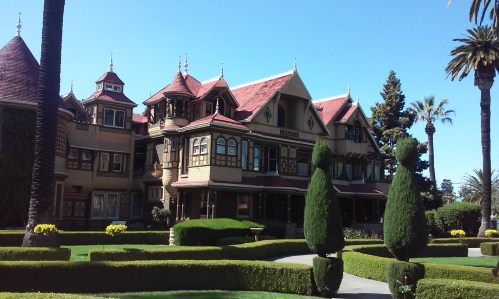
We had just got through a crowded parlor, when Dr. Cottam asked me what had become of Mrs. Haas. I though she had been by his side, and he fancied she was by mine. The fact was, we had lost her. All my efforts to find her were in vain. I feared that she had mistaken, in the confusion of the momentary separation from us, other people for her new friends, and had, possibly, pursued and lost them in the extensive grounds which were thrown open to us. Morning broke. It was clear daylight before I gave up my search. It was not till near two o’clock next day that we heard anything of Mrs. Haas. At about that time a servant knocked at my door, to say that he had been earnestly requested by a young, who appeared to be in great distress, to make out where she could find Mrs. Winchester and Dr. Cottam. There could be no doubt, notwithstanding the slight inaccuracy that my friend had turned up. I had a housemaid go to the guest room and summon Dr. Cottam. I went down to the parlor and reunited with Mrs. Haas. She told me a story to account for having failed to recover us for so long. Very late, she said, she made a detour and wandered around, not before long becoming afraid and getting lost. She got into the Crystal Bedroom in despair of finding us, and had then fallen into a deep sleep which, long as it was, had hardly sufficed to recruit her strength after the fatigues of the ball. It the midst of my perplexities, an anxiety of far more urgent kind presented itself. My dear friend began to lose her looks and health, and that in manner so mysterious, and even horrible, that I became thoroughly frightened. #RandolphHarris 8 of 8

People, since as long ago as the 1800s, have reported a vast array of unexplained events, experiences, and sightings at what is now known as The Winchester Mystery House. Over the years, people have reported bone-chilling sightings ghosts, angels, demons, fairies, giants, orbs, lights, mist, vampires, witches, warlocks and werewolves. In 2007, a man was attending Santa Clara University, and he was lucky enough to get hired as a tour guide at The Winchester Mystery House. He had no sooner moved into his apartment and had the telephone installed when he received a call warning him never to return to Sacramento again. During a later call, a woman with a high-pitched voice informed “G” that he was being kept under surveillance by a group who felt that he had acted unjustly in the past by not returning things to their proper owners. G emphasized that he had led a very quiet life as an undergraduate.
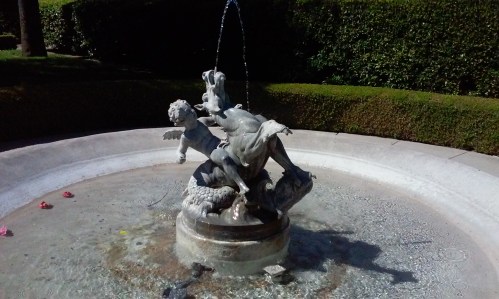
Yet he probably received 30 or more telephone calls from anonymous voices advising him not to return to Sacramento. The voices reprimanded him for having taken something that did not belong to him. G said that he did not carry anything with him that was from Sacramento and did not often visit the beautiful city, and he seldom discussed his life with any but a few of his closet acquaintances. He wondered who could have possibly taken such a long-term interest in him? About the third year after working at The Winchester Mystery House, a guest unknown to him stopped to say hello. G knew that such an act was hardly unusual, since guests will often do this to find out interest facts about tour guides and secrets about Sarah L. Winchester’s mansion. However, he noticed the boy was strangely inquisitive. G was astonished when the teenager drew a design on a piece of paper that he had seen somewhere in the mansion. He smiled at G, then asked if he knew what the symbol meant.

When G pressed the boy, in turn for some answers, the guest threw away the design, laughed, and said that he was just fooling around, that he did not mean anything about it. G never saw the alleged guest again. He descried him to a could of tour guides, but no one was able to identify him. After several years of watching at The Winchester Mystery House, G graduated from University. He had not been in possession of his diploma for more than four days when someone rang his apartment and scolded him for taking things that did not belong to him. The voice told G that he should always leave things where they were. He reported to his supervisors that he kept receiving mysterious calls. On one occasion the voice told G that he has discovered a strange key to other dimensions, but the entities had long since reclaimed it. However, apparently, some spirit masqueraders were determined that he should never forget the day he came into contact with an artifact from another level of being. What is The Winchester Mystery House?

And please be sure to check out the online gift store: https://shopwinchestermysteryhouse.com/

 Randolph Harris II International Institute