
Home » Supernatural (Page 14)
Category Archives: Supernatural

When Asked His Name He Said “Legion” Because Many Demons Were Entered into Him!

It is easy to imagine how the combined grief of losing both a child and a spouse could be very crippling. However, if you have $20,000,000 (2021 inflation adjusted $347,910,691.82), and all the time in the World to help you cope, what would you do? Mrs. Sarah L. Winchester’s response to the deaths of her child and husband left a bizarre and impressive architectural reflection of her soul. After a series of violent confrontations, the Winchester Repeating Arms Company hires a private investigator to follow her. Mrs. Winchester ascends into mystery and it is soon clear that she is hiding a much bigger secret—one that is both inexplicable and shocking. A “possessed” person may have symptoms much like those that are apparent in the mentally ill. One may be deeply melancholic or depressed, appear to be withdrawn from reality, or may manifest emotions that range from ecstatic joy to violent screaming or wild ferocity. These various states may present themselves from time to time during “attacks.” Demon possession may be distinguished from insanity, however, by observing the manner in which the afflicted person speaks. An insane individual may have a mistaken concept of one’s own identity, wear clothing by which one attempts to look like the person one thinks oneself to be, but speak in one’s own voice, and in such a manner that one can tell one is doing only a superficial impersonation of the individual one thinks oneself to be. A demon-possessed person, on the other hand, is obviously controlled by the indwelling evil spirit. The wicked being may use a language or dialect the individual never knew, and sometimes will name oneself. Therefore, one should carefully note the symptoms of a disturbed person, never making the diagnosis of demon possession on the basis of a superficial judgment. #RandolphHarris 1 of 16

If a believer should meet a demon-possessed individual, one would be unwise to make a frontal attack upon the powers of darkness by immediately issuing a command in the name of the Lord Jesus Christ. Dr. Kurt Koch, an evangelical Christian who has made a lifetime study of Satan and occultic activities, declares that whenever Christians lightly engage in an effort to cast out demons, they run the risk of being attacked by evil spirits. Such people often suffer deep spiritual depression and find themselves in an attitude of complete hopelessness. Since this is true, a believer should band together with others in a time of prayer, and no efforts should be made to expel the evil spirits until the Holy Spirit prompts someone to issue the command. Unbelievers and adherents of the non-Christian religions apparently can command evil spirits without suffering bad consequences. Archeologists have found manuscripts containing incantations and magical formulas for the expulsion of demons; and today in the Philippines and other countries of the far East, as well as in some areas of South America and Africa, pagan religious leaders seriously perform rituals to ward off or cast out evil spirits. Sometimes they beat the person who is demon-possessed, prick one with needles, or even burn portions of one’s body, thinking that this pain will drive out the evil spirits. The Jewish people in Christ’s day also used spells, magical phrases, and religious rituals to expel demons. That they sometimes appeared to be successful is clear, for Jesus said, “if I, by Beelzebub, cast out demons, by whom do your sons cast them out? Therefore, they shall be your judges,” reports Matthew 12.27. #RandolphHarris 2 of 16

In this statement the Lord Jesus Christ acknowledged that evil spirits sometimes left the bodies of their victims when incantations, spells, or magical rites were used by Jewish religious leaders. However, Christ did not say these men accomplished their goal by the power of God, nor did He imply that they were actually doing damage to the cause of Satan. He was answering the charge that He was casting out demons in the power of Beelzebub, the prince of demons. He declared that is such were the case, the kingdom of Satan would be divided against itself. Actually, the exorcists, whether Jewish or pagan, did not really possess authority over the invisible World, but the evil spirits merely cooperated with them, leaving the bodies of some of their victims to give the appearance that they had been forced out. By working with these unbelieving sorcerers, the devil aided his own cause. The demons either temporarily left the person, only to return a short time later, or entered the body of some other victim. No one should attempt to deal with the forces of evil by using the name of Jesus unless one is a child of God. Luke, in Acts 19, graphically portrays the seriousness of hypocritically dealing with the powers of darkness. Seven sons of Sceva, a professional exorcist who had no personal faith in Christ, tried to combine the words “in the name of Jesus” with their magical formula. The evil spirits, recognizing that these impostors had no right to use Jesus’s name, reacted in a violent manner. The demon-possessed individual attacked these men with superhuman strengths, so that with torn clothing and bleeding bodies they fled from the Winchester mansion. The frequency of demon possession—the record of history establishes without a doubt that demon possession was known before the Lord Jesus Christ came to Earth, and the testimony of missionaries indicates that it has continued down through the centuries. #RandolphHarris 3 of 16

The public ministry of Christ, however, was accompanied by an outburst of demon possession unparalleled in history. It seems that Satan threw all his power into his battle with Jesus Christ. True, the devil is not omniscient, but he knew that Christ had come to earth to atone for sin, conquer death, and bring about the defeat of evil. John tells us that “the Son of God was manifested, that he might destroy the works of the devil,” reports 1 John 3.8. Satan used every device at his disposal to frustrate the purpose of God in Christ. Subtle temptations, the wrath and wickedness of men, and a rash of demonic activity were part of his vain effort to prevent Jesus from performing the work He had come to accomplish. Demon possession gradually subsided during the first century A.D., and usually is not conspicuous in areas where a fairly large percentage of people have placed their faith in Jesus Christ. It appears that demons are hesitant to enter the bodies of people when informed believers are likely to cast them out in the name of Christ. Luke is the same one that is translated “bottomless pit” seven times in the book of the Revelation. We read, “And Jesus asked him, saying, ‘What is thy name?’ And he said, ‘Legion’; because many demons were entered into him. And they besought him that he would not command them to go out into the deep. And there was there and herd of many swine, feeding on the mountain; and they besought him that he would allow them to enter into them. And he permitted them,” reports Luke 8.30-32. Revelation 9 tells us that at some future time the “bottomless pit” will be opened, and a great army of evil spirits will be set free to plague humankind. #RandolphHarris 4 of 16

It is at least a possibility that whenever demons are cast out of a human being in the name of Jesus Christ, they are sent to the bottomless pit, and will not be released until shortly before Christ returns to establish His kingdom. The realization that they will lose their freedom as members of the army of the “prince of the power of the air,” and be confined in the pit for an indefinite period of time, makes them hesitant to take possession of human beings. The risk is too great in an area where Christians exercise their authority in the name of Christ. People who live in civilized countries where the Gospel has been known for centuries should not rule out the possibility of demon possession, however, just because it has not been a common occurrence in these areas. Satan and his cohorts may conclude that most people, even professing Christians, will not recognize this phenomenon when they meet it. Therefore, as this age draws to a close, Satan may once again become very active in entering human bodies and controlling personalities. He will hope that the majority of humankind will either be deceived into following him or find a naturalistic explanation for the activities of the demons. This supernatural manifestation of the power of Satan and evil spirits is clearly predicted by the apostle Paul. In his second letter to the Thessalonian believers, he declares that just before Christ returns in glory, the devil will have his righthand mand upon the earth performing miracles which make him appear to be a god. Referring to the Antichrists, the apostle says, “Even him whose coming is after the working of Satan with all power and signs and lying wonders, and with all deceivableness of unrighteousness in them that perish, because they received not the love of the truth, that they might be saved,” reports 2 Thessalonian 2.9, 10. #RandolphHarris 5 of 16

Inasmuch as we can expect an increase of open opposition to God on the part of the Satanic hordes, we know Christ should humbly maintain fellowship with Him through full submission and ready obedience so that we may receive from Him the strength we need to overcome. James writes, “God resisteth the proud, but giveth grace unto the humble. Submit yourselves, therefore, to God. Resist the devil, and he will flee from you,” reports James 4.6-7. Peter declares, “Be sober, be vigilant, because your adversary the devil, like a roaring lion walketh about, seeking whom he may devour; whom resist steadfast in the faith, knowing that the same afflictions are accomplished in your brethren that are in the World,” reports 1 Peter 5.8-9. No, Satan is not dead. He is like a wounded animal and still has great power to harm those who care careless or proud. Therefore, keep awake, be on alert, read the Christian Bible and the Book of Mormon, and pray! If you do not, he may destroy your effectiveness as a Christian. For the next instance of witchcraft and the supernatural in connection with Ireland, we are compelled to go beyond the confines of our own country. Though in this connection with the Green Isle is slight, yet it is of interest as affording an example of that blending of fairy lore with sorcery which is not an uncommon feature of Scottish witchcraft-trials. In the year 1613 a woman named Margaret Barclay, of Irvine in Scotland, was accused of having her brother-in-law’s ship to be cast away by magical spell. A certain strolling vagabond and juggler, John Stewart, was apprehended as her accomplice; he admitted (probably under torture) that Margaret had applied to him to teach her some magic arts in others that “she might get gear, kye’s milk, love of man, her heart’s desire on such persons as had done her wrong.” #RandolphHarris 6 of 16

Through John Stewart does not appear to have granted Margaret’s request, yet he gave detailed information as to the manner in which he had gained the supernatural power and knowledge with which he was credited. “It being demanded of him by what means he profession himself to have knowledge of things to come, the said John confessed that the space of twenty-six years ago, he being travelling on All-Hallow Even night between the towns of Monygoif and Clary, in Galway, he met with the King of the Fairies and his company, and that the King gave him a stroke with a white rod over the forehead, which took from him the power of speech and the use of one eye, which he wanted for the space of three years. He declared that the use of speech and eyesight was restored to him by the King of Fairies and his company on a Hallowe’en night at the town of Dublin.” At his subsequent meeting with the fairy band, he was taught all his knowledge. The spot on which he was struck remained impervious to pain although a pin was thrust into it. The unfortunate wretch was cast into prison, and there committed suicide by hanging himself from the “cruik” of the door with his garter or bonnet-string, and so “ended his life miserably with the help of the devil his master.” A tale slightly resembling portion of the above comes from the north of Ireland a few years later. “It is storied, and the story is true,” says Robert Law in his Memorialls, “of a godly man in Ireland, who lying one day in the fields sleeping, he was struck with dumbness and deafness. The same man, during this condition he was in, could tell things, and had the knowledge of things in a strange way, which he had not before; and did, indeed, by signs make things known to others which they knew not. Afterwards he at length, prayer being made from him by others, came to the use of his tongue and ears; but when that knowledge of things he had in his deaf and dumb condition ceased, and when he was asked how he had the knowledge of these things he made signs of, he answered he had that knowledge when dumb, but how and after what manner he knew not, only he had the impression thereof in his spirit. This story was related by a godly minister, Mr. Robert Blair, to Mr. John Baird, who knew the truth of it.” #RandolphHarris 7 of 16

The Rev. Robert Blair, M.A., was a celebrated man, if for no other reason than on account of his disputes with Dr. Echlin, Bishop of Down, or for his description of Oliver Cromwell as a greeting (id est, weeping) devil. On the invitation of Lord Claneboy he arrived in Ireland in 1623, and in the same year was settled as (Presbyterian) parish minister at Bangor in Co. Down, with the consent of patron and people’ he remained there until 1631, when he was suspended by Dr. Echlin, and was deposed and excommunicated in November, 1634. He has left a few writings behind him, and was grandfather of the poet Robert Blair, author of The Grave. During the years of his ministry at Bangor the following incident occurred to him, which he of course attributes to demonic possession, through homicidal mania resulting from intemperate habits would be nearer the truth. One day a rich man, the constable of the perish, called upon him in company with one of his tenants concerning the baptizing of the latter’s child. “When I had spoken what I thought necessary, and was ready to turn into my house, the constable dismissing the other told me he had something to say to me in private. I looking upon him saw his eyes like the eyes of a cat in the night, did presently conceive that he had a mischief in his heart, yet I resolved not to refuse what he desired, but I keeped a watchful eye upon him, and stayed at some distance; and being near to the door of the church I went in, and invited him to follow me. As soon as he entered within the doors he fell atrembling, and I awondering. His trembling continuing and growing without any speech, I approached to him, and invited him to a seat, wherein he could hardly sit. The great trembling was like to throw him out of the seat. I laid my arm about him, and asked him what ailed him? But for a time, he could speak none. #RandolphHarris 8 of 16

“At last his shaking ceased, and he began to speak, telling me, that for a long time the Devil had appeared to him; first at Glasgow he bought a horse from him, receiving a sixpence in earnest, and that in the end he offered to him a great purse full of sylver to be his, making no mention of the horse; he said that he blessed himself, and so the buyer with the sylver and gold that was poured out upon the table vanished. But some days thereafter he appeared to him at his own house, naming him by his name, and said to him, Ye are mine, for I arled you with a sixpence, which yet ye have. Then said he, I asked his name, and he answered, they call me Nickel Downus (I suppose the he repeated evil, that he should have said Nihil Damus). Being thus molested with these and many other apparitions of the Devil, he left Scotland; but being come to Ireland he did often likewise appear to him, and now of late he still commands me to kill and slay; and oftentimes, says he, my whinger hath been drawn and kept under my cloak to obey his commands, but still something holds my hand that I cannot stroke. But then I asked him who he was bidden kill? He answered, any that comes in my way; but ‘The better they be the better service to me, or else I shall kill thee.’ When he uttered these words he fell again atrembling, and was stopped in his speaking, looking lamentably at me, designing me to be the person he aimed at; then he fell a crying and lamenting. I showed him the horribleness of his ignorance and drunkenness; he made many promises of reformation, which were not well keep’d; for within a fortnight he went to an alehouse to crave the price of his malt, and sitting there long at drink, as he was going homeward the Devil appeared to him, and challenged him for opening to me what had passed betwixt them secretly, and followed him to the house, pulling his cap off his head and his band from about his neck, saying to him, ‘On Hallow-night I shall have thee, soul and body, in despite of the minister and of all that he will do for thee.’” #RandolphHarris 9 of 16

In his choice of a date his Satanic Majesty showed his respect for popular superstitions. This attack of delirium tremens (though Mr. Blair would not have so explained it) had a most salutary effect; the constable was in such an abject state of terror lest the Devil should carry him off that he begged Mr. Blair to sit up with him all Hallow-night, which he did, spending the time very profitably in prayer and exhortation, which encouraged the man to defy Satan and all his works. The upshot of the matter was, that he became very charitable to the poor, and seems to have entirely renounced his intemperate habits. Rejecting the supernatural elements in the above as being merely the fruits of a diseased mind, there is no reason to doubt the truth of the story. Mr. Blair also met with some strange cases of religious hysteria, which became manifest in outbursts of weeping and bodily convulsions, but which he attributed to the Devil’s “playing the ape, and counterfeiting the works of the Lord.” He states that one Sunday, in the midst of public worship, “one of my charge, being a dull and ignorant person, made a noise and stretching of her body. Incontinent I was assisted to rebuke that lying spirit that disturbed the worship of God, charging the same not to disturb the congregation; and through God’s mercy we met with no more of that work.” Thus modestly our writer sets down what happened in his Autobiography; but the account of the incident spread far and wide, and at length came to the ears of Archbishop Usher, who, on his next meeting with Mr. Blair, warmly congratulated him on the successful exorcism he had practised.” Spirits of a diabolical and infernal nature, are not only ready upon all occasions to become subservient to exorcists and magicians, but are ever watching opportunities of exciting evil affections in the mind, and of stirring up the wickedly inclined to the commission of every species of iniquity and vice. #RandolphHarris 10 of 16

Thus by the instigation of infernal spirits, and their own promptitude, they often terrify humans with nocturnal visions; provoke melancholy people to suicide; tempt drunkards and incendiaries to set houses on fire, to burn those who are in them, and allure careless servants and others to sound and incautious sleep; that such unlucky accidents might happen besides innumerable other ways they have of executing the devices of iniquitous spirits through malicious instigations, or secret stratagems, projected for the overthrow and destruction of mortal men; especially when the work to be effected by the devil is too hard for his subtle and spiritual nature to effect, because the same belongs to the outward source or principle to which these dubious spirits more immediately belong. A few nights into Christmas, there was a festival for which the Winchester mansion was making extensive preparations. The narrow streets which had been thronged with people were now almost deserted. In the comfortable coffee-room of the Winchester mansion, Mrs. Winchester had half a dozen guests, principally commercial travellers, sat talking by light of the fire. The talk had drifted from trade to politics, from politics to religion, and so by easy stages to the supernatural. In the flicker of the light of the fire, as it shone on the glasses and danced with shadows on the walls, the conversation proved so enthralling that Henry, the waiter, whose presence had been forgotten, created a very disagreeable sensation by suddenly starting up from a dark corner and gliding silently from the room. Mrs. Winchester then said, “Of course, it is an old idea that spirits like to get into the company of human beings. A man told me once that he travelled down the Great Western with a ghost and had not the slightest suspicion of it until the inspector came for tickets. My friend said they way that ghost tried to keep up appearances by feeling for it in all its pockets and looking on the floor was quite touching. Ultimately it gave it up and with a faint groan vanished through the ventilator.” #RandolphHarris 11 of 16

“That’ll do, Mrs. Winchester,” said Ludwig Leichhardt. “It is not a subject for jesting,” said Adam Worth,” who had been an attentive listener. “I’ve never seen an apparition myself, but I know people who have, and I consider that they form a very interesting link between us and the after-life. There’s a ghost story connected with this mansion, you know.” “Never heard of it,” said Edward Agar, “and I have visiting this estate for some years now.” “It dates back a long time,” said Ludwig. “You’ve heard about John V. Creely also know as Jesus Procopio?” “Well, I’ve just ‘eard odds and ends, sir” said the Edward, “but I never put much count to ‘em. There was one chap ‘ere what said ‘e saw it, and the gov’ner sacked ‘im prompt.” “My father was a native of this town,” said Ludwig, “and knew the story well. He was a truthful man and a steady churchgoer, but I’ve heard him declare that once in his life he saw the appearance of Jesus Procopio in this mansion.” “And who was this Jesus?” enquired a voice. “His real name was Tomaso Rodendo, one of the most fearless and daring desperadoes that has ever figures in the criminal annals of our state. Anything he could turn his dishonest hand to,” replied Ludwig; “and he was run to Earth in this mansion one Christmas week some five years ago. He took his last supper in this very room, and after he had gone up to bed a couple of thief takers, who had followed him from San Francisco but lost the scent a bit, went upstairs with Mrs. Winchester and tried the door. It was stout oak, and fast, so one went into the yard, and by means of a short ladder got on the window-sill, while the other stayed outside the door. Those below in the yard saw the man crouching on the sill, and then there was a sudden smash of glass, and with a cry he fell in a heap on the stones at their feet. Then in the moonlight they saw the white face of the pickpocket peeping over the sill, and while some stayed in the yard, others ran into the mansion and helped the other man to break the door in. It was difficult to obtain an entrance even then, for it was barred with heavy furniture, but they got in at last, and the first thing that met their eyes was the body of Jesus dangling from the top of the bed by his own handkerchief.” #RandolphHarris 12 of 16

“Which bedroom was it?” asked two or three voices together. Ludwig shook his head. “That I can’t tell you; but the story goes that Jesus still haunts this mansion, and my father used to declare that the last time he had slept here that the ghost of Jesus Procopio lowered itself from the top of his bed and tried to strangle him.” “That will do” said John Creely. “I wish you’d thought to ask your father which bedroom it was.” “I believe it was my Blue Séance room said,” Mrs. Winchester. “Well, I should take care not to sleep in it, that’s all, said John shortly. “There’s nothing to fear,” said Ludwig. “I don’t believe for a moment that ghosts could really hurt one. In fact my father used to confess that it was only the unpleasantness of the thing that upset him, and that for all practical purposes Jesus’s figures might have been made of cotton-wool for all the hard they could do.” “That’s all very fine,” said John; “a ghost story is a ghost story, sir; but when a gentleman tells a tale of a ghost in the house in which one is going to sleep, I call it most ungentlemanly!” “Pooh! Nonsense!” said Ludwig, rising, “ghosts can’t hurt you. For my own part; I should rather like to see one. Good night.” “Good night,” said Mrs. Winchester and the others. “And I hope that Jesus will pay you a visit,” added John as the door closed.” “Shall I light the gas, Adam?” said Henry. “No; the fires very comfortable,” he said. “Now gentlemen, any of you know any more?” “I think we’ve had enough,” said John; “we shall be thinking we see spirits next, and we’re not all like Ludwig who’s just gone.” Old humbug!” said John. “I should like to put him to the test. Suppose I dress up as Jesus Procopio and go to give him a chance of displaying his courage?” “Bravo!” said Adam huskily, drowning one or two faint “Noes.” “No, drop it, John” said Edward. “Only for the joke,” said John, somewhat eagerly. “I’ve got some things upstairs in which I am going to play in the ‘Rivals’—knee-breeches, buckles, and all that sort of thing. It’s a rare chance. If you’ll wait a bit I’ll give you a full-dress rehearsal, entitled, ‘Jesus Procopio; or, The Nocturnal Strangler.’” #RandolphHarris 13 of 16

“You won’t frighten us,” said Adam, with a husky laugh. “I don’t know that,” said John sharply; “it’s a question of acting that’s all. I’m pretty good, ain’t I, Edward?” “Oh, you’re all right—for an amateur,” said Edward, with a laugh. “I’ll bet you level sov. You don’t frighten me,” said Adam. “Done! said John. I’ll take the bet to frighten you first and Ludwig afterwards. These gentlemen shall be the judges.” “You won’t frighten us, sir,” said Edward “because we’re prepared for you; but you’d better leave Ludwig alone. It’s dangerous play.” “Well, I’ try you first,” said John, springing up. “No gas, mind.” He ran lightly upstairs to his room, leaving the others, most of whom had been drinking somewhat freely, to wrangle about his proceedings. It ended with them going to bed. “He’s crazy on acting,” said Adam, lighting his pipe. “Thinks he’s the equal of anybody almost. It doesn’t matter with us, but I won’t let him go to Ludwig. And he won’t mind so long as he gets an opportunity of acting to us.” “Well, I hope he’ll hurry up,” said Edward, yawning; it’s after twelve now.” Nearly half an hour passed. Edward drew his watch from his pocket and was busy winding it, when Henry, the waiter, who had been sent on an errand, burst suddenly into the room and rushed towards them. “E’s comin’, gentlemen,” he said breathlessly. “Why, you’re frightened, Edward,” said Adam with a chuckle. “It was the suddenness of it,” said Edward sheepishly; “and besides, I didn’t look for seenin’ ‘im in the bar. There’s only a glimmer of light there, and ‘e was sitting on the floor behind the bar. I nearly trod on ‘im.” “He’s taking too long, I’ll go and fetch him,” said Adam. “You don’t know what this mansion is like at night, sir,” said Henry, catching him by the sleeve. “It ain’t fit to look at by yourself, it ain’t, indeed. It’s got the—what’s that?” #RandolphHarris 14 of 16

They all started at the sound of a smothered cry from the staircase and the sound of somebody running hurriedly along the passage. Before anybody could speak, the door flew open and a figure bursting into the room flung itself gasping and shivering upon them. “What is it? What’s the matter?” demanded Edward. “Why, it’s Mr. Creely.” He shook him roughly and then held some spirit to his lips. John Creely drank it greedily with a sharp intake of his breath gripped him by the arm. “Light the gas, Adam,” said Edward. Adam obeyed hastily, John Creely, a ludicrous but pitiable figure in knee-breeches and coat, a large wig all awry, and his face a mess of grease paint, clung to him, trembling. “Now what’s the matter?” asked Edward. “I’ve seen it,” said John, with a hysterical sob. “O Lord, I’ll never play the fool again, never!” “Seen what?” said the others. “Him—it—the ghost—anything!” said John wildly. “Rot!” said Adam uneasily. All distinctly heard a step in the passage outside. It stopped at the door, and as they watched with bated breath, the door creaked and slowly opened. Adam fell back opened-mouthed, as a white, leering face, with sunken eyeballs ad close-cropped bullet head, appeared at the opening. For a few second the creature stood regarding them, blinking in a strange fashion at the candle. Then with a sidling movement, it came a little way into the room and stood there as if bewildered. Not a man spoke or moved, but all watched with a horrible fascination as the creature removed its dirty neckcloth and its head rolled on its shoulder. For a minute it paused, and then holding the rag before it, moved towards Edward. The candle went out suddenly with a flash and a bang. These was a smell of powder, and something writhing in the darkness on the floor. A faint, choking cough, and then silence. #RandolphHarris 15 of 16

Edward was the first to speak. “Matches,” he said in a strange voice. Adam struck one. Then he leapt at the gas and a burner flamed from the match. Edward touched the thing on the floor with his foot and found it soft. He looked at his companions. They mouthed enquiries at him, but he shook his head. He lit the candle, and, kneeling down, examined the silent thing on the floor. Then he rose swiftly, and dipping his handkerchief in the water jug, bent down again and grimly wiped the white face. Then he sprang back with a cry of incredulous horror, pointing at it. Adam’s pistol fell to the floor and he shut out the sight with his hands, but the others, crowding forward, gazed spell-bound at the dead face of John V. Creely. Before a word was spoken the door opened and Ludwig hastily entered the room. His eyes fell on the floor. “Good God!” he cried. “You didn’t—” Nobody spoke. “I told him not to,” he said in a suffocating voice. “I told him not to. I told him—” He leaned against the wall, deathly sick, put his arms out feebly, and fell fainting into Ludwig’s arms. Many mysteries have taken place in the Winchester mansion over the years. It is an extravagant maze of Victorian craftmanship—marvelous, baffling, and eerily eccentric, to say the least. Tour guide must warn people not to stray from the group or they could be lost forever! Countless questions come to mind as you wander through the mansion—such as, what was Mrs. Winchester thinking when she had a staircase built that descends seven steps and then rises eleven? The Winchester Repeating Arms Company concluding their investigation by saying, “The mystery of the Winchester mansion is unquestionably great and infinite; perhaps spirits can take human shape, and disclose secrets and treasures guarded by this estate, but we must also be aware of skilled deceivers who will talk of Heaven and Hell and the Fall.” (WRA 1888.) After Mrs. Winchester’s death, crimes resulting in the theft of cash, jewels, historical European glass, furniture, and works of art worth over $10 million by Victorian standards (2021 inflation adjusted $291,146,315.79) went missing from the estate. Is the Winchester mansion haunted? Visits and find out for yourself. Their investigation sounds inconclusive. #RandolphHarris 16 of 16

Winchester Mystery House

“Though she be but little, she is fierce.” ~ William Shakespeare

Did you know Sarah Winchester only stood at 4’10”? Much of the house was built to her specific height measurement including a shower, some doors, and hallways. winchestermysteryhouse.com

Sold His Soul to the Devil and Purchased the Estate with the Money His Body and Soul Realized!

Sarah Winchester was truly overcome by the loss of her month-old baby girl, and a grief magnified 15 years later by her husband’s sudden death. Doctors and friends urged her to leave the east, seek a milder climate and search for some all-consuming hobby. One physician did suggest that she “build a house and do not employ an architect.” On arrival in San Jose, she immediately started remodeling the newly purchased, unfinished farmhouse. She found the planning kept her grief-disturbed mind occupied and she became thoroughly enthused, but certainly, something was still bothering her. “Why can you not just be nice and quiet? What have you done all morning but shake my awnings, tug at my window street-mirror and the cord on it, play with the bellpull wire from the fourth floor, push against the windowpanes—in short, proclaim your existence in every way as if you wanted to beckon me out to you? Yes, the weather is fine enough, but I have no inclination; let me stay home. You playful exuberant zephyrs, you happy lads, go by yourselves; have your fund as always. Go your way! Leave me out of it. But then you think you have no enjoyment in it; you are not doing it for your own sake.” Many have said that the Winchester mansion is haunted by legions of spirits and perhaps even demons. The New Testament includes a number of references to people afflicted with what we term “demon possession.” Skeptics have looked upon these accounts as reflections of the ignorance and superstition prevalent during the times of our Lord’s ministry. Others contend that Jesus Christ, knowing that the public attributed disease and insanity to evil spirits, was only accommodating Himself to their way of thinking. #RandolphHarris 1 of 22

A careful reading of the gospels and the book of Acts, however, indicated that Christ and His apostles accepted the reality of evil spirits, and taught their followers to fear them. It is therefore imperative that we turn to the Scriptures to find out exactly what demon possession is, the measure of human responsibility involved, and the believer’s course of action when one encounters a demon-possessed individual. The nature of demon possession: A demon-possessed person is one who has been invaded by evil spirits. They may control one’s body, one’s mind, or both. Sometimes they produce only physical illness, but at other times their wretched victims are grossly immoral, speak blasphemously, and exhibit supernatural strength. They obviously have been mastered, mind and body, by a superior force. In understanding the nature of demon possession, we must first take note that the Bible cites a number of demon-produced illnesses with all the characteristics of known diseases. The gospel writers were careful to distinguish between natural and demon-caused afflictions, as is evident in the first chapter of Mark. “And in the evening, when the sun did set, they brought unto him all that were diseased, and those who were possessed with demons. And he healed many that were sick of diverse diseases, and cast out many demons; and permitted not the demons to speak, because they knew him,” reports Mark 1.32, 34. When sickness did not involve evil spirits, the Lord restored health to the individual with no mention of demons. If the illness was the result of demonic invasion, however, Jesus healed by commanding the evil spirits to leave the victim’s body. #RandolphHarris 2 of 22

For example, the boy who had a deaf and dumb spirit (Mark 9.14-29) manifested the symptoms that mark epilepsy, but in healing him, the Lord rebuked a “foul spirit.” When it left, the spirit threw the lad into violent convulsions. Matthew gives the account of a man afflicted with dumbness whom Jesus healed by casting out an indwelling demon (Matthew 9.32-25). Christ also cured a man who was blind and dumb by ordering the demon to leave his body (Matthew 12.22). Luke, telling of a woman who had been seriously crippled for eighteen years, said she had “a spirit of infirmity,” reports Luke 13.11. After healing her, the Lord Jesus Christ spoke of her as “a daughter of Abraham, whom Satan hath bound, lo, these eighteen years,” reports Luke 13.16. In none of these instances did the demons lead the individual into blasphemous speech or immoral conduct. The afflictions were only physical in nature. In addition to causing many varieties of physical suffering, evil spirits often took control of a person’s mental faculties and organs of speech. The two wild men in Gadara, appearing to be insane, possessed strength far beyond that of ordinary men, lived in tombs with the gruesome remains of dead bodies, and were so feared that people avoided the territory they inhabited (Matthew 8.28-34; Luke 8.26-36). When they saw Jesus, they cried out, “What have we to do with thee, Jesus, thou Son of God? Art thou come here to torment us before the time?” reports Matthew 8.29. These words, though coming from the mouths of the men, were obviously spoken by the evil spirits. #RandolphHarris 3 of 22

Luke, focusing his attention upon the more prominent of the two, tells us that after the Lord had cast the demons out of the man, he was found by the people of the area “sitting at the feet of Jesus, clothed, and in his right mind,” reports Luke 8.35. This kind of demon possession, in which the victim could not control one’s own mind and speech, was more spectacular, but also more tragic, than that which manifested itself in physical illness alone. The person who experienced only bodily affliction could still make intelligent choices, but others had no control over what they said and did. Human responsibility and demon possession: Christian Bible students are not agreed concerning the extent of human responsibility in demon possession. It appears that sometimes the individual was in no way accountable for this invasion of one’s personality. The body who suffered seizures similar to those of epilepsy had been afflicted from early childhood (Mark 9.21). These convulsions sometimes came upon the lad as he was standing by water or fire, and almost cost him his life when he fell. Since this physical affliction came upon him at such a young age, it would seem that he did nothing to cause demonic invasion of his body. On the other hand, many believe that God would not permit evil spirits to take over a human personality unless that individual first weakened one’s will by voluntarily yielding to temptation. If one accepts this premise, one will consider those who are violent, unclean, and blasphemous because of demon possession to be partly responsible for their present state. They likely male themselves susceptible to demonic invasion of their personalities by persisting in sinful practices. #RandolphHarris 4 of 22

The believer’s authority over demons: The Lord Jesus Christ cast out demons on numerous occasions. Eight of the recorded miracles involve demon expulsions, but the gospels indicate that He exercised this power many other times. Luke declares, “And demons also came out of many, crying out, saying, ‘Thou art Christ, the Son of God.’ And he, rebuking them, did not allow them to speak; for they knew that he was Christ,” Luke 4.41. The gospel writers seem to indicate that whenever Christ encounter a demon-possessed individual, He expelled the evil spirit without difficulty. As the Lord of the invisible World, Jesus spoke with absolute authority, and the demon had no alternative but to do what He commanded. Mark records, “And he healed many that were sick of diverse diseases, and cast out many demons; and permitted not the demons to speak, because they knew him,” reports Mark 1.34. The Lord also commissioned the Twelve to exercise authority over evil spirits. In Chapter 3 of Mark’s gospel we read: “And he appointed twelve, that they should be with him, and that he might send them forth to preach, and to have authority to heal sickness, and to cast out demons,” reports Mark 3.14-15. On other occasions, He gave this power to a larger group, for He sent out seventy disciples on a special mission, and they returned in joyous excitement, saying, “Lord, even the demons are subject unto us through thy name,” reports Luke 10.17. Today the power to resist and overcome evil spirits in the name of Jesus belongs to every believer. The Holy Spirit indwells even the weakest Christian (1 Corinthians 6.19). and the least gifted among those who trust in Christ have received all the benefits of salvation. #RandolphHarris 5 of 22

James makes it clear that a believer who humbly trusts God can cause Satan, the supreme ruler of the demon World, to flee. “But he giveth more grace. Wherefore he saith, God resisteth the proud, but giveth grace unto the humble. Submit yourselves, therefore, to God. Resist the devil, and he will flee from you, reports James 4. 6, 7. If one who knows Christ can successfully resist the commander-in-chief of the demonic hordes, one certainly can overcome the soldiers who make up the army of Satan when they seek to lead one into sin. Casting demons out of an afflicted person is another matter, however, and believers must exercise extreme care when they are confronted with demon possession. These evil spirits may be very powerful, and sometimes can be expelled only after a time of heart searching and earnest prayer on the part of the Christians who are seeking to deliver the possessed person. Mark tells us of an occasion when a father was disappointed in the apostles, who themselves had become discouraged when they were unable to help a demon-possessed boy. Jesus rebuked them for their spiritual lack, saying, “This kind can come forth by nothing, but by prayer,” reports Mark 9.29. (The words “and fasting,” which occur in our King James Version are not found in the best Greek manuscripts. Furthermore, there would have been no opportunity for the disciples to fast in connection with their attempt to heal this boy.) This Scripture passage certainly indicates that no believer should attempt to cast out demons unless one exercises strong faith, renounces sin, and lives in continuous fellowship with the Lord. #RandolphHarris 6 of 22

Missionaries who have encountered demon possession say that sometimes the victory is won by a simply command uttered in the name of the Lord Jesus. (The phrase “in the name Lord Jesus” really means, “by the authority of Jesus.”) In other instances, however, God’s servants have found it necessary to engage in a period of prayers and confession of sin. Nevius, in his book entitled Demon Possession and Allied Themes, recounts numerous instances of demon possession which he and his co-workers in China found during the last half of the nineteenth century. This man’s character and theological position make one a trust worthy source of information. He said that demons often spoke to the missionaries as they were about to cast them out of a hapless victim, sometimes pleaded for mercy, often resisted, but always were forced to leave after Christians prayed together and gave the command in the name of the Lord Jesus. Representatives of Christ in many other lands dominated by heathen religions discover a great deal of demon possession. They also are unanimous in declaring that through prayer and a command “in the name of the Lord Jesus” they have been able to expel the evil spirits. Christians must exercise caution whenever they encounter someone who seems to be demon-possessed. In the first place, one ought to be sure the person is suffering from demon passion rather than a condition resulting from some physical, psychological, or spiritual disorder. Some people are greatly harmed when they are wrongly told that they are demon-possessed. They actually need help from a medical doctor, psychiatrist, or spiritual counselor, but instead keep on seeking to expel evil spirits. #RandolphHarris 7 of 22

An interesting trial of a clergyman or the practice of unhallowed arts took place early in 1606—interesting and valuable, if for no other reason than that it is the first instance of such a case being discovered in the Rolls at the Record Office (not counting those of the Parliament of 1447), though we hope that it will not prove to be a unique entry, but rather the earnest of others. Shorn of legal redundancies it runs as follows: “Inquiry taken before our lord King at the King’s Court the Saturday next after the three weeks of Easter in the 6th year of James I by the oath of upright and lawful men of the County of Louth. Who say, that John Aston, late of Mellifont, Co. Louth, clerk, not having a fear of God before his eyes, but being wholly seduced by the devil, on December 1st at Mellifont aforesaid, and on divers other days and places, wickedly and feloniously used, practised, and exercised drivers invocations and conjurings of wicked and lying spirits with the intent and purpose that he might find and rcover a certain silver cup formerly taken away at Mellifont aforesaid, and also that he might understand where an in what region the most wicked traitor Hugh, Earl of Tyrone, then was, and what he was contriving against the said lord the King and the State of this kingdom of Ireland, and also that he might find out and obtain drivers treasures of gold and silver concealed in the Earth at Mellifont aforesaid and at Cashel in the country of the Cross of Tipperary, feloniously and against the peace of the said lord the King. It is to be known that the aforesaid John was taken, and being a prisoner in the Castle of the City of Dublin by warrant of the lord King was sent into England, therefore further proceedings shall cease.” #RandolphHarris 8 of 22

His ultimate fate is not known; nor is it easy to see why punishment was not meted out to him in Ireland, as he had directly contravened section 4 of the Elizabethan Act. Possibly the case was unique, and so King James may have been anxious to examine in person such an interesting specimen. If so, Heaven help the poor parson in the grip of such a witch hunter. In the year 1609 there comes from the County of Tipperary a strange story of magical spells being counteracted by the application of a holy relic; this is preserved for us in that valuable monastic record, the Triumphalia S. Crucis. At Holy Cross Abbey, near Thurles, there was preserved for many years with the greatest veneration a supposed fragment of the True Cross, which attracted vast numbers of people, and by which it was said many wonderful miracles were worked. Amongst those that came thither in that year was “Anastasia Sobechan, an inhabitant of the district of Callan (Co. Kilkenny), tortured by magical spells (veneficis incantationibus collisa), who at the Abbey, in presence of the Rev. Lord Abbot Bernard [Foulow], p;aced a girdle round her body that had touched the holy relic. Suddenly she vomited small pieces of cloth and wood, and for a whole month she spat out from her body such things. The said woman told this miracle to the Rev. Lord Abbot while she was healed by the virtue of the holy Cross. This he took care to set down in writing.” That most diligent gleaner of things strange and uncommon, Mr. Robert Law, to whom we are deeply indebted for much of the matter in this volume, informs us in his Memorialls that in the first half of the seventeenth century there was to be found in Ireland a celebrated Doctor of Divinity, in Holy Orders of the Episcopal Church, who possessed extreme adroitness in raising the Devil—a process that some would have us to believe to be commonly practised in Ireland at the present day by persons who have no pretensions to a knowledge of the Black Art! #RandolphHarris 9 of 22

Mr. Law also gives the modus operandi at full length. A servant-girl in the employment of Major-General Montgomerie at Irvine in Scotland was accused of having stolen some silverwork. “The lass being innocent takes it ill, and tells them, If she should raise the Devil she should know who took these things.” Thereupon, in order to summon that Personage she went into a cellar, “takes the Bible with her, and draws a circle about her, and turns a riddle on end from south to north, or from the right to the left hand [id est, contrary to the path of the sun in the Heavens], having in her right hand nine feathers which she pulled out of the tail of a black cock, and having read the 51st [Psalm?] forwards, “O COME, let us sing to the Lord; let us make a joyful noise to the Rock our salvation! Let us come before His presence with thanksgiving; let us make a joyful noise to Him with songs of praise! For the Lord is a great God, and a great King above all gods. In His hand are the deep places of the Earth; the heights and strength of this hills are His also. The sea is His, for He made it; and His hands formed the dry land. O come, let us worship and bow down, let us kneel before the Lord our Maker [in reverent praise and supplication. For He is our God and we are the people of His pasture and the sheep of His hand. Today, if you will hear His, harden not your hearts as at Meribah and as at Massah in the day of temptation in the wilderness. When your fathers tried My patience and tested Me, proved me, and saw my work [of judgment]. Forty years long was I grived and disgusted with that generation, and I said, It is a people that do err in their hearts, and they do not approve, acknowledge, or regard My ways. Wherefore I swore in My wrath that they would not enter My rest [the land of promise,” she reads backwards chapter ix., verse 19, of the Book of Revelations.” “Dniknam fo driht a yortsed ot detarebil erew raey dna, htnom, yad detnioppa eht ni ruoh taht rof ssenidaer neeb dah ohw slegna ruof eht os.” Upon this the Devil appeared to her, and told her who was the guilty person. #RandolphHarris 10 of 22

She then cast three of the feathers in the Devil, and bade him to return to the place from whence he came. This process she repeated three ties, until she had gained all the information she desired; she then went upstairs and told her mistress, with the result that the goods were ultimately recovered. However, escaping Scylla she fell into Charybdis; her uncanny practices came to the ears of the authorities, and she was apprehended. When in prison, she confessed that she had learnt this particular branch of the Black Art in the house of Dr. Colville in Ireland, who habitually practised it. That instructor of youth in such un-Christian practices, the Rev. Alexander Colville, D.D. was ordained in 1622 and subsequently held the vicarage of Carnmoney, the prebend of Carncastle, and the Precentorship of Connor. He was possessed of considerable wealth, with which he purchased the Galgorm estate, on which he resided; this subsequently passed into the Mountcashel family through the marriage of his great granddaughter with Stephen Moore, first Baron Kilworth and Viscount Mountcashel. Where Dr. Colville got the money to purchase so large an estate no one could imagine, and Classon Porter in his useful pamphlet related for us the manner in which popular rumor solved the problem. It was said that he had sold himself to the Devil, and that he had purchased the estate with the money his body and soul head realized. Scandal even went further still, and gave exact terms which Dr. Colville had made with the Evil One. These were, that the Devil was at once to give the Doctor his hat full of gold, and that the latter was in return, at a distant but specified day, to deliver himself body and soul to the Devil. #RandolphHarris 11 of 22

The appointed place of meeting was a lime-kiln; the Devil may have thought that this was a delicate compliment to him on account of the peculiarly homelike atmosphere of the spot, but the Doctor had different ideas. The Devil produced the gold, whereupon Dr. Colville produced a hat with a wide slit in the crown, which he boldly held over the empty kiln-pit, with the result that by the time the terms of the bargain were literally complied with, a very considerable amount of gold lay at the Doctor’s disposal, which he prudently used to his Worldly welfare. So far, so good. However, there are two sides to every question. Years rolled by, brining ever nearer and nearer the time at which the account had to be settled, and at length the fatal day dawned. The Devil arrived to claim his victim, and found him sitting in his house reading his Christian Bible by the light of a candle, whereupon he directed him to come along with him. The Doctor begged that he might not be taken away until the candle, by which he was reading, was burned out. To this the Devil assented, whereupon Dr. Colville promptly extinguished the candle, and putting it between the leaves of the Bible locked it up in the chest where he kept his gold. The candle was thus deposited in a place of safety where there was no danger of any person coming across it, and thus of being the innocent cause of the Doctor’s destruction. It is even said that he gave order that the candle should be put into his coffin and buried with him. So, we may presume, Dr. Colville evaded the payment of his debt. Our readers may perchance wonder why such stories as the above should have become connected with the reverend gentleman, and an explanation is not hard to be found. #RandolphHarris 12 of 22

Dr. Colville was a well-known divine, possessed of great wealth (inherited lawfully, we may presume), and enjoyed considerable influence in the country-side. At this time Ulster was overrun by triumphant Presbyterianism, which the Doctor, as a firm upholder of Episcopacy, opposed with all his might, and thereupon was spoken of with great acerbity by his opponents. It is not too uncharitable, therefore, to assume that these stories originated with some member of that body, who may well have believed that such had actually happened. Over a century ago, one of those great supernatural stories happened at the estate of Sarah Winchester. It was nearly five o’clock; the short day was drawing in, and the Winchester mansion began to fil with shadows, while curious noises—the muffled footfalls and distant talking voices that had been perceptible all day—seemed, no doubt because of the fading light and the consequently quickened sense of hearing, to become more frequent and insistent. President Theodore Roosevelt, who was an avid fan of the Winchester rifle said, “The riles have come. They are beautiful weapons and I am confident will do well.” He had attended a great national convention; and after an exciting week, was returning home, having a long and difficult journey before him. A pair of magnificent horses, attached to a light buggy, flew merrily enough over a rough country road for a while; but towards evening stormy weather reduced the roads to a dangerous condition, and compelled the President to relinquish his purpose of reaching home that night, and to stop at the Winchester mansion, whose interior illuminated by blazing wood-fires, spread a glowing halo among the dripping trees as he approached it, and gave promise of warmth and luxury. #RandolphHarris 13 of 22

Drawing upon the grand estate, President Roosevelt saw through its laced curtain windows that there was no lack of company within. Every angel told him that beasts as well as humans were cared for. At the open door appeared the form of a man who, at the sound of wheels, but not seeing in the outside darkness whom he addressed, called out, “’Tain’t no Earlthy use a-stoppin’ here.” Caring more for his chattels than for himself, the President paid no further regard to this address than to call loudly for the landlord. At the tone of authority, the man outline more civilly announced himself to be the butler; yet so far from inviting the traveller to alight, insisted that the house was “as full as it could pack;” but that there was a place a little farther down the road where the gentleman would be certain to find excellent accommodations. “What stables have you here?” demanded President Roosevelt, giving no more heed to this than the former announcement; but bidding his servant to alight, and preparing to do so himself. “Stables!” replied the baffled butler, shading his eyes so as to scrutinize the newcomer, ‘stables, Cap’n?” “Yes, stables. I want you to take care of my horses; I can take care of myself. Some shelter for cattle you must have by the look of these traps,” pointing to the wagons. “I do not want my horses to be kept standing out in this storm, you know.” The President leaped to the ground, directing his servant to cover the horses and then get out his valise; while the butler, thus defeated, assumed the best grace he could to say that he would see what could be done “for the horses.” “I am the President, may man,” added President Roosevelt in a milder tone, as he stamped his cold feet on the porch and shook off the rain from his travelling gear; “I am used to rough fare and a hard couch: all we want is shelter. A corner of the floor will suffice for me and my rug; a private room I can dispense with at such times as these.” #RandolphHarris 14 of 22

However, in another minute they were in the sitting-room of the house, a small, high chamber with a stone floor, full of moving shadows cast by a wood-fire that flickered on a great hearth Something of the character of an oratory was imparted to it by a tall crucifix, which reached almost to the ceiling on one side; the figure was painted of the natural colours, the cross was black. Under this stood a chest of some age and a solidity, and when the lamp had been brought, and chairs set. Mrs. Winchester brought out of a chest a large book, wrapped in a white cloth, on white cloth a cross was rudely embroidered in red thread. Even before the wrapping had been removed, the President began to be interested by the size and shape of the volume. “Too large for a missal,” he thought, “and not the shape of an antiphoner; perhaps it may be something good, after all.” The next moment the book was opened, and the President felt that he had at last lit upon something better than good. Before him lay a large folio, bound, perhaps, late in the seventeenth century, with the arms of Cannon Alberic de Mauleon stamped in gold on the sides. There may have been a hundred and fifty leaves of paper in the book, and on almost every one of them was fastened a leaf from an illuminated manuscript. Such a collection the President had hardly dreamed of in his wildest moments. Here were ten leaves from a copy of Genesis, illustrated with pictures, which would not be later than 700 AD. Further on was a complete set of pictures from a Psalter, of English execution, of the very finest kind that the thirteenth century could produce; and, perhaps best of all, there were twenty leaves of uncial writing in Latin, which, as a few words seen here and there told him at once, must belong to some very early unknow patristic treatise. #RandolphHarris 15 of 22

Could it possibly be a fragment of the copy of Papias “On the Words of Our Lord,” which was know to have exited as late as the twelfth century at Nimes? In any case, his mind was made up; that book must return to Cambridge with him, even if he had to draw the whole of his balance from the bank and stay at the Winchester mansion till the money came. He glanced up at Mrs. Winchester to see if her face yielded any hint that the book was for sale. Mr. Winchester was pale, and her lips were working. “If monsieur will turn to the end,” she said. In the meantime a separate table was brought, on which the butler had sat a clean coarse cloth, and a savoury supper of broiled ham, hot corncakes, and coffee.” The monsieur turned on, meeting new treasures at every rise of a leaf; and at the end of the book he came upon two sheets of paper, of which more recent date than anything he had yet seen, which puzzled him considerably. They must be a contemporary, he decided, with the unprincipled Canon Alberic, who had doubtless plundered the Chapter library of St Bertrand to form this priceless scrap-book. On the first of the paper sheets was a plan, carefully drawn and instantly recognizable by a person who knew the ground, of the south aisle and cloisters of St Bertrand’s. There were curious signs looking like planetary symbols, and a few Hebrew words in the corners; and in the north-west angle of the cloister was a cross drawn in gold paint. Blow the plan were some lines of writing in Latin, which ran thus: “Responsa 12 Dec. 1694. Interrogatum est: Invenaimne? Responsum est: Invenies. Fiamne dives? Fies. Vivamne invidendus? Vives. Moriarne in lecto meo? Ita.’ (Answers of the 12th of December, 1694. It was asked: Shall I find it? Answer: Thou shalt. Shall I become rich? Thou wilt. Shall I live an object of envy? Thou wilt. Shall I die in my bed? Thou wilt.) #RandolphHarris 16 of 22

The President kept looking through the book, what he then saw impressed him. The drawing he saw was no longer in existence, there is a photograph of it (which Mrs. Winchester possessed) which fully bears out that statement. The pictures in question was a sepia drawing at the end of the seventeenth century, representing, one would say at first sight, a biblical scene; for the architecture (the picture presented an interior) and the figures had that semi-classical flavour about them which the artists of two hundred year ago thought appropriate to illustrations of the Bible. On the right was King on his throne, the throne elevated on twelve steps, a canopy overheard, soldiers on either side—evidently King Solomon. He was bending forward with outstretched scepter, in attitude of command; his face expressed horror and disgust, yet there was in it also the mark of imperious command and confident power. The left half of the picture was the strangest, however. The interest plainly centered there. On the pavement before the throne were grouped four soldiers, surrounding a crouching figure which must be described in a moment. A fifth soldier lay dead on the pavement, his neck distorted, and his eyeballs starting from his head. The four surrounding guards were looking at the King. In their faces the sentiment of horror was intensified; they seemed, in fact, only restrained from flight by their implicit trust in their master. All this terror was plainly excited by the being that crouched in their midst. There are not any words that can convey the impression of which this figure makes upon anyone who looks at it. Once, the photograph was showed to a lecturer on morphology—a person who was abnormally sane and unimaginative in the habits of the mind. He absolutely refused to be alone for the rest of that evening, and told Mrs. Winchester that afterwards for many night he had not dared to put out his light before going to sleep. #RandolphHarris 17 of 22

However, the main traits of the figure, at first you saw only a mass of coarse, matted black hair; presently it was seen that this covered a body of fearful thinness, almost a skeleton, but with the muscles standing out like wires. The hands were of a dusky pallor, covered, like the body, with long, coarse hairs, and hideously taloned. The eyes, touched in with a burning yellow, had intensely black pupils, and were fixed upon the throned King with a look of a beast-like hate. Imagine one of the awful bird-catching spiders of South America translated into human form, and endowed with intelligence just less than human, and you will have some faint conception of the terror inspired by the appalling effigy. Many hours had passed and President Roosevelt said, “Don’t say another word about it. But my friend; you have not a spare sleeping-room that I can use for the night? If not, find me a corner—a clean corner.” After a great deal of hesitation, Mrs. Winchester said, “The fact is that there is as comfortable a room as the best folks can wish; but—the most mysterious whispers, imparted the startling fact that this most desirable sleeping-room is haunted.” Mrs. Winchester had come to be very suspicious of admitting guests. The President ensure her that it would be better than sitting up all night or sleeping in the barn with the horses. President Roseville became interested in Mrs. Winchester’s confidences, but could only gather in further explanation that for some time past all the travellers who has occupied that room had “made off in the middle of the night, never showing their faces at the mansion again.” On endeavouring to arrest one or more in their nocturnal flight, they—all more or less terrified—had insisted on escaping without a moment’s delay, assigning no other reason than that they had seen a ghost. The President replied, “Let the Chamber be got ready directly, and please have a good fire built in the fireplace at once.” #RandolphHarris 18 of 22

In a reasonable time, President Roosevelt was beckoned out of the parlour, and conducted to the second floor by the butler, who, after receiving a cheerful “goodnight,” paused on the landing to hear his guest bolt and bar the door within, then push a piece of furniture against it. “Ah,” murmured the butler, as a sort of misgiving came over him, “if a apparishum has a mind to come to thar, ‘tain’t all the bolts and bars in California as ‘ll kpi’en away.” However, the President’s precaution of securing his door, as also that of placing his revolvers in readiness, had not the slightest reference to the reputed ghost. Spiritual disturbances of such kind he feared not. Spirit tangible were already producing ominous demonstrations in the room below, nor was it possible to conjecture what troubles these might evolve. The only light was that of the roaring, crackling, blazing wood-fire, and no other was needed. At this time a growing feeling of discomfort had been creeping over him—nervous reaction, perhaps. But what storm-benighted traveller, when fierce winds and rains are lashing around, can withstand the cheering influences of a glorious log-fire? It charms away uneasiness, and causes all that is dull and dead around to laugh and dance in its bright light. By the illumination of just fire, President Roosevelt observed that the apartment offered nothing worthier of remark than that the furniture was superior to anything that might be expected in a Victorian mansion. In truth, Mrs. Winchester had expended a considerable sum in fitting up this, the first chamber. By the swaggering tread of unsteady feet about the house, or when the boisterous shouts below raged above the outside storm, he glanced up from his papers to congratulate himself upon this aggregable seclusion. #RandolphHarris 19 of 22

Thus the President sat for an hour, then he heaped fresh logs upon the hearth, looked again to his revolvers, and retired to rest. The bell in the belfry was striking one thirteen in the am, the President awoke. He awoke suddenly from a sound sleep, flashing, as it were, into full consciousness, his mind and memory clear, all his faculties invigorated, his ideas undisturbed, but with a perfect conviction that he was not alone. He lifted his head. A man was standing a few feet from the bed, and between it and the fire, which was still burning, and burning brightly enough to display every object in the room, and to define the outline of the intruder clearly. His dress also and his features were plainly distinguishable: the dress was a travelling-costume, in fashion somewhat out of date; the features wore a mournful and distressed expression—the eyes were fixed upon the President. The right arm hung down, and the hand partially concealed. His attention with then caught by an object lying on the red cloth just by his left elbow. Two or three ideas of what it might be flitted through his brains with their own incalculable quickness. “A penwiper? No, no such thing in the house. A rat? No, too black. A large spider? I trust to goodness not—no. Good God! a hand like the hand in that picture!” In another infinitesimal flash he had taken it in. Pale, dusky skin, covering nothing but bones and tendons of appalling strength; coarse black hairs, longer than ever grew on a human hand; nails rising from the ends of the fingers and curving sharply down and forward, gray, horny and wrinkled. He jumped out of his bed with deadly, inconceivable terror clutching his heart. The shape, whose left hand rested on the table, was rising to a standing posture, its right hand crooked above his scalp. There was black and tattered drapery about it; the coarse hair covered it as in the drawing. The lower jaw was thin—what can I call it?—shallow, like abeast’s; teeth showed behind the black lips; there was no nose; the eyes, of a fiery yellow, against which the pupils showed black and intense, and the exulting hate and thirst to destroy life which shone there, were the most horrifying feature in the whole vision. There was intelligence of a kind in them—intelligence beyond that of a beast, below that of a man. #RandolphHarris 20 of 22
The feelings which this horror stirred in President Roosevelt were the intensest physical fear and the most profound mental loathing. What did he do? What could he do? The man seemed about to advance still closer to the bed, and returned the occupant’s gaze with a fixed stare. “Stand, or I’ll fire!” cried the President, taking in all this at a glance, revolver in hand. The man remained still. “What is your business here?” demanded Roosevelt, thinking he was addressing one of the roughs from below. The man was silent. “If you value your life, leave the room,” shouted the president, pointing his revolver. The man was motionless. “RETIRE! Or by Heaven I’ll send a bullet through you!” But the man moved not an inch. The President fired. The bullet lodged in the breast of the stranger, but he started not. The President fired again and the shot entered the heart, pierced the body, and lodged in the wall beyond; and the President beheld the hole where the bullet had entered, and the firelight glimmering though it. And yet the intruder stirred not. Astounded, the President dropped his revolver, and stood face to face before the unmoved man. “President Roosevelt,” spake the deep solemn voice of the perforated stranger, “in a vain you shoot me—I am already dead.” The President, with all his bravery, grasped, spellbound. The firelight gleamed through the hole in the body, and the eyes of the shooter were riveted there. “Fear nothing,” spake the mournful presence; “I seek but to divulge my wrongs. Until my death shall be avenge my unquiet spirit lingers here. Listen.” Speechless, motionless was the President; and the mournful apparition thus slowly and distinctly continued. “Four years ago, I was hired to be a foreman. One I trusted plunged a dagger into my heart while I slept. He covered my wound with a plaster. He reigned to mourn my death. He told the people here I died of a heart-complaint; that I had long been ailing. I had gold treasures. With my treasure secreted beneath his garments he paraded mock grief at my grave. #RandolphHarris 21 of 22

“Then he depated. In distant parts he sought to forget his crime; but his stolen gold brought him only the curse of an evil conscience. Rest and peace are not for him. He now prepares to leave his native land for ever. Under an assumed name that man is this night in San Francisco. In a few hours he will sail for Europe. President Roosevelt, you must prevent it. Justice and humanity demand that a murderer roam not at large, nor squander more of the wealth that is by right my children’s. Not until the spirit of my murderer shall be separated from the mortal clay can my spirit rest in peace.” And vanished. Most of the civilians you meet either do not want to know to know about the supernatural or blame you for brining it into their lives once you tell them about it. President Roosevelt tried to revisit the Winchester, but the Butler would not allow him inside because of the damage he did to the chamber. Mrs. Winchester had a remarkable memory and knew the location of every piece of material in the mansion, even in the vast store-rooms. The full scope of her generosity, charity, and many kindly acts will forever remain unknown and such was her sincere desire. Her donations were never made public. She contributed to charities of all faiths. In 1911 in New Haven, she established the William Wirt Winchester Memorial Sanitorium for Tuberculosis, endowing it with $1,200,000 (2021 adjusted for inflation $32,539,882.35). There were the little but visible acts that we nearby dwellers particularly noticed; those daily carriage trips with soup and hot food for a newly arrived settler on Stevens Creek Road, a man dying from Tuberculosis; those annual, unheralded trips to old Cupertino Church where my mother and other woman of The Ladies Aid Society collated used clothing for the local poors’ children. I remember a small boy’s thrill as he watched her liveried coachman alight from the polished Victoria and stagger up the church steps with a huge hamper of clothes, not used clothes, but dozens of newly purchased garments! That was Mrs. Winchester, the writer and many another contemporary remember. We never knew her intimately, but how we now wish we had! #RandolphHarris 22 of 22

Winchester Mystery House

The Winchester Mystery House features some very strange oddities like the door-to-nowhere. What purpose do you think it served Sarah during her time?

A 160-room mansion built to appease the spirits who died at the hands of the Winchester Rifle 👻
🗝 winchestermysteryhouse.com

There Was Terror in His Eyes as Not Often Seen in a Human Being!

Twenty-first century humans, in spite of all their scientific and technological advances, are baffled by unexplained forces existent in the Universe. The naturalistic philosophy of the previous generations has been unable to account for all of the mysterious phenomena which have been observed. Many scientists believe that living beings may inhabit other galaxies, and highly educated humans are seriously studying reports of those who insist they have received communications from the dead. Humans of science no longer scoff at the accounts of strange occurrences associated with witchcraft and occultic practices. Although they do not necessarily accept them as proof of the supernatural, many will admit they are manifestations of some kind of power they do not yet understand. Christian theologians and scientists are not perplexed by such reports. They know that both God and Satan are very much alive. Though readily conceding that they cannot explain fully all the mysteries of life, they affirm with confidence the existence of God and an invisible host of intelligent supernatural beings. They are convinced that when one accepts the teachings of the Bible, one begins to understand many of the puzzling facts of existence. For example, the Bible tells of holy angels who dwell in Heaven (Matthew 18.10). It also mentions “angels that sinned” (2 Peter 2.4), rebellious spirit begins who have been cast out of Heaven and now dwell in the atmosphere that surrounds the Earth. We know this because Paul declared that Satan is “the prince of the power of the air,” reports Ephesians 2.2, and the Greek word translated “air” was used to speak of the gaseous envelop that encircles our planet. These wicked beings apparently have unlimited access to Earther, and actively influence every area of human endeavour. #RandolphHarris 1 of 19

Because they do not possess physical bodies, we cannot typically detect them through our senses of sight, hearing, touch, taste, or smell. We do have evidence of their presence, however, for the Word of God gives us information regarding their identification, their nature and their function. Various terms are used in the Christian Bible to denote the evil spirit beings who followed Satan in this initial act of rebellion against God. It refers to “angels that sinned” 2 Peter 2.4 and “angels who kept not their first estate” Jude 6, and many times mentions “spirits” and “demons.” Some scholars believe that these demons must be distinguished from the “angels that sinned” and the “angels who kept not their first estate.” They contend that the Heavenly beings who joined Satan in his revolt against God are fallen angels, but that demons are disembodies spirits of physical and moral creatures who once lived upon the Earth. However, these Bible students disagree regarding an exact identification of the demons. Some say they are the spirits of pre-Adamic beings similar to man, while others identify them as the spirits of the “giants” who were destroyed in the great flood of Noah’s day. If one thinks that demons are the spirits of man-like beings who lived before Adam, then one will no doubt interpret Genesis 1.2 as a declaration that the original Earth, inhabited by the creatures, was cataclysmically destroyed. Genesis 1.2 is then translated as follows: “And the Earth became without form and void…” This theory, while attractive in that it permits a literal interpretation of the days in Genesis 1, must be acknowledged as only a hypothesis. Most Hebrew scholars reject this interpretation because Genesis 1.2 begins with a grammatical construction which makes it highly unlikely that Genesis 1.1 and 1.2 are separated by millions of years. Then, too, the verb translated “became” almost always has the meaning “was.” #RandolphHarris 2 of 19

However, even if we accept this theory, and believe that a race of man-like beings inhabited the prehistoric Earth, we would have no basis for thinking that their spirits are now free to roam about as the enemies of humankind. Other Bible scholars maintain that demons are the spirits of the “giants” who lived upon the Earth in the days of Noah. They refer to Genesis 6, contending that these “giants” were produced when fallen angels, called the “sons of God,” married the “daughters of men.” “And it came to pass, when men began to multiply on the face of the Earth, and daughters were born unto them, that the sons of God saw the daughters of men that they were fair; and they took them wives of all whom they chose. There were giants in the Earth in those days; and also after that, when the sons of God came in unto the daughters of men, and they bore children to them, the same became mighty men who were of old, men of renown,” reports Genesis 6.1, 2, 4. It is necessary for proponents of this theory to believe that fallen angels became male human beings who married women, produced a mongrel offspring, and took over the role of father in the family. They theorize that Satan hoped thereby to frustrate God’s redemptive plan. The Lord had promised salvation through Christ to human beings only—not for angels or mixed half-human and half-angelic race. Christ could not have been born to offspring of these corrupted creates or provide redemptions for them. Thus God’s plan of redemption would have been thwarted. In addition, both Jude and Peter in their epistles refer to a sin committed by angels, and their words can be blended very nicely into this concept. Jude writes, “And the angels who kept not their first estate, but left their own habitation, he hath reserved in everlasting chains under darkness unto the judgment of the great day. Even as Sodom and Gomorrah, and the cities about them in like manner, giving themselves over to fornication, and going after strange flesh, are set forth for an example, suffering the vengeance of eternal fire,” reports Jude 6, 7. #RandolphHarris 3 of 19

The words “in like manner” (verse 7) are taken to mean that the sin of the angels in having pleasures of the flesh with women was an unnatural act, comparable to sodomy. Peter tells of angels assigned to Tartaros, the nether World of the Greeks considered to be lower than Hades. “For if God spared not the angels that sinned, but cast them down to hell [GK Tartaros], and delivered them into chains of darkness, to be reserved unto judgment,” reports 2 Peter 2.4. Again, it does not take a great deal of imagination to see how these words of Peter may be applied to the wicked angels who committed the monstrous sin of attempting to make mongrels of the human race. Many Bible students, however, reject this interpretation of Genesis 6. Since angels are non-material beings, it would be necessary for them to create physical bodies for themselves capable of impregnating a female member of the human race. This would require nothing less than a creative miracle, and the Bible indicates that this power belongs only to God. In addition, it is not necessary to interpret the statements in Jude and 2 Peter as a reference to sin involving pleasures of the flesh on the part of the fallen angels. Jude’s use of the expression “going after strange flesh” may be figurative language representing spiritual fornication. The prophets often depicted Israel’s unfaithfulness to God in this manner. Peter’s statement that the angels who sinned have been assigned to Tartaros may be a simple declaration that all sinning angels have been designated to this place, and that they are even now under chains of moral and spiritual darkness. The Bible gives little information regarding the origin of demons. We can state with absolute certainty only that they are fallen spirit beings who have committed themselves to Satan and that they hate God and seek to harm His people. No clear distinction can be made between fallen angels and demons, for they are all evil spirits. Some of our questions must remain unanswered, but the Lord has given ample revelation to warn us that these invisible enemies are far too great and powerful for us to defeat in our own strength, and that we can successfully wage war against them only as we live in continual dependence upon the Lord. #RandolphHarris 4 of 19

In one respect the case of Dame Alice Kyteler stands alone in the history of magical dealings in Ireland prior to the seventeenth century. We have of the entire proceedings an invaluable and contemporary account, or at latest one compiled within a very few years after the death of Petronilla of Meath; while the excitement produced by the affair is shown by the more or less lengthy allusions to it in early writings, such as The Book of Howth (Carew MSS.), the Annals by Fariar Clyn, the Chartularies of S. Mary’s Abbey (vol. ii), &c. It is also rendered more valuable by the fact that those who are best qualified to give their opinion on the matter have assured the writer that to the best of their belief no entries with respect to trials for sorcery or witchcraft can be found in the various old Rolls preserved in the Dublin Record Office. However, when the story is considered with reference to the following facts it takes on a different signification. On the 29th of September 1317 (Wright says 1320), Bishop de Ledrede held his first Synod, at which several canons were passed, one of which seems in some degree introductory to the events detailed in last week’s report. In it he speaks of “a certain new and pestilential sect in our parts, differing from all the faith in the World, filled with a devilish spirit, more inhuman than heathens…who pursue the priests and bishops of the Most High God equally in life and death, by spoiling and rending the patrimony of Christ in the diocese of Ossory, and who utter grievous threats against the bishops and their ministers exercising ecclesiastical jurisdiction, and (by various means) attempt to hinder the correction of sins and the salvation of souls, in contempt of God and the Church.” From this it would seem that heresy and unorthodoxy had already made its appearance in the diocese. In 1324 the Kyteler case occurred, one of the participants being burnt at the stake while other incriminate persons were subsequently followed up, some of whom shared the fate of Petronilla of Meath. In 1327 Adam Dubh, of the Leinster tribe of O’Toole, was burnt alive on College Green for denying the doctrines of the Incarnation and the Holy Trinity, as well as for rejecting the authority of the Holy See. #RandolphHarris 5 of 19

In 1335 Pope Benedict XII wrote a letter to King Edward III, in which occurs the following passage: “It has come to our knowledge that while our venerable brother, Richard, Bishop of Ossory, was visiting his diocese, there appeared in the midst of his catholic people men who were heretics together with their abettors, some of whom asserted that Jesus Christ was a mere man and a sinner, and was justly crucified for His own sins; others after having done homage and offered sacrifice to demons, thought otherwise of the sacrament of the Body of Christ than the Catholic Church teaches, saying that the same venerable sacrament is by no means to be worshipped; and also asserting that they are not bound to obey or believe the decrees, decretals, and apostolic mandates; in the meantime, consulting demons according to the rites of those sects among the Gentiles and Pagans, they despise the sacraments of the Catholic Church, and draw the faithful of Christ after them by their superstitions.” Unlike apocryphal and rabbinical literature, the Biblical description of evil spirits avoids the unusual and grotesque. The Bible does, however, present us with a clear picture of their activity and tells us how to resist them effectively. In the first place, it declares that demons or fallen angels are non-material beings. They do not possess bodies like humans, and therefore are repeatedly called “spirits.” Matthew, for example, says, “When the evening was come, they brought unto him many that were possessed with demons; and he cast out the spirits with his word, and healed all that were sick,” reports Matthew 8.16. Jesus started that the Creator is not made up of physical substance when He said, “God is a Spirit,” reports John 4.24. Later, when His frightened disciples thought He was a ghost, He told them their fears were groundless, for “a spirit hath not flesh and bones, as ye see me have,” reports Luke 24.39. Paul had in mind the non-physical nature of Satan and his army of evil spirits when he said that our warfare is “not against flesh and blood, but against principalities, against powers, against the rulers of the darkness of this World, against spiritual wickedness in high places,” reports Ephesians 6.12. Satan’s demonic hordes are spirit beings, and therefore more dangerous than the “flesh and blood” enemies we may encounter in our daily lives. #RandolphHarris 6 of 19

Second, the Bible portrays demons as highly intelligent creatures. They recognize Christ when He was here upon the Earth, and knew they could not have fellowship with Him. Luke tells us about an evil spirit who is an example of this. “When he saw Jesus, he cried out, and fell down before him, and with a loud voice said, What have I to do with thee, Jesus, thou Son of God, most high? I beseech thee, torment me not,” reports Luke 8.28. The fallen spirits are also aware of their ultimate defeat, for James declared, “Them demons also believe, and tremble,” reports James 2.19. They are, of course, finite creatures, even Satan is limited in knowledge. He has myriads of evil spirit followers, however, and they are able to give him information on almost any person and circumstance in which he is interested. In this manner he can find out much what he wants to know. Truly, believers in Christ can never successfully cope with Satan and his hosts without special help from the Lord. Therefore, we must humbly look to God for wisdom and strength to resist the attacks of our invisible enemies. Third, the World of evil spirits is cruel. These creatures hate God and all who have placed their trust in Him. They seem to find delight in causing human grief and pain. For example, Matthew tells us that a man who was both blind and dumb suffered these afflictions because a demon had entered his body. “Then was brought unto him one possessed with a demon, blind, and dumb; and He healed him, insomuch that the blind and dumb both spoke and saw,” reports Matthew 12.22. Matthew, Mark, and Luke all tell the story of two demented men who lived in the country of the Gerasenes, and indicate that their insanity was the result of demonic invasion of their personalities. Luke, the beloved physicians, writes of a woman who was bent over with some crippling disease, saying that she had “a spirit of infirmity.” He adds that Jesus said she had been bound by Satan. “And he was teaching in one of the synagogues on the sabbath. And, behold, there was a woman who had a spirit of infirmity eighteen years, and was bowed together, and could in no way lift herself up. And when Jesus saw her, he called her to him, and said unto her, Woman, thou art loosed from thine infirmity. #RandolphHarris 7 of 19

“And he laid his hands on her; and immediately she was made straight, and glorified God. And the ruler of the synagogue answered with indignation, because Jesus had healed on the sabbath day, and said unto the people, There are six days in which humans ought to work; in them, therefore, come and be healed, and not on the sabbath day. The Lord then answered him, and said, Thou hypocrite, doth not each one of you on the sabbath loose his ox or her ass from the stall, and lead him away to watering? And ought not this woman, being a daughter of Abraham, who Satan hath bound, lo, these eighteen years, be loosed from this bound on the sabbath day? And when he had said these things, all his adversaries were ashamed; and all the people rejoiced for all the glorious things that were done by him,” reports Luke 13.10-17. While the gospel writers make it clear that not all illness is the work of Satan and demons, they do point out that much human suffering is the result of demonic activity. Finally, the Bible tells us that all fallen angels or evil spirits are confirmed in their wickedness. Though they “believe and tremble,” they will never repent, never seek forgiveness, and never pray for holiness or purity. Though they know that Jesus is the Christ, they never really worship Him. They must acknowledge that He is stronger than they, and may occasionally render Him token submission, but inwardly they hate Him and keenly resent His authority over them. In fact, their nature is so totally evil that the term “unclean” often is applied to them. (See Matthew 10.1; Mark 1.27; 3.11; Luke 4.36; Acts 8.7; Revelations 16.13.) They apparently delight in sin, find great pleasure in leading humans to commit evil deeds, and possess no feelings of guilt nor desire for deliverance. Michael Scot, reputed a wizard of such potency that—when in Salamanca’s cave he listed his magic want to wave and the bells would ring in Notre Dame. Scot has studied successively at Oxford and Paris (where he acquired the title of “mathematicus”); he then passed to Bologna, thence to Palermo, and subsequently continued his studies in Toledo. His refusal of the See of Cashel was an intellectual loss to the Irish Church, for he was so widely renowned for his varied and extensive learning that he was credited with supernatural powers; a number of legends grew up around his name which hid his real merit, and transformed the man of science into a magician. #RandolphHarris 8 of 19

In the Border country traditions of his magical power are common. Boccaccio alludes to “a great master in necromancy, called Michael Scot,” while Dante places him in the eighteen circle of Hell. The next, who is so slender in the flanks, was Michael Scot, who of a verity of magical illusion knew the game. Another man to whom magical powers were attributed solely on account of his learning was Gerald, the fourth Earl of Desmond, styled the Poet, who died rather mysteriously in 1398. The Four Masters in their Annals describe him as “a nobleman of wonderful bounty, mirth, cheerfulness of conversation, charitable in his deeds, easy of access, a witty and ingenious composer of Irish poetry, a learned and profound chronicler.” No legends are extant of his magical deeds. King James I of Scotland, whose severities against his nobles had around their bitter resentment, was barbarously assassinated at Perth in 1437 by some of their supports, who were aided and abetted by the ages Duke of Atholl. From a contemporary account of this we learn that the monarch’s fate was predicted to him by an Irish prophetess or witch; has he given ear to her message he might have escaped with his life. We modernize the somewhat difficult spelling, but retain the quaint language of the original. “The king, suddenly advised, made a solemn feast of the Christmas at Perth, which is clept Saint John’s Town, which is from Edinburg on the other side of the Scottish sea, the which is vulgarly celpt the water of Lethe. In the midst of the way there arose a woman of Ireland, the clept herself as a soothsayer. The which anon as she saw the king she cried with a loud voice, saying thus: ‘My lord king, and you pass this water you shall never turn again alive.’ The king hearing this was astonied of her words; for but a little before he had read in a prophecy that in the self same year the king of Scots should be slain; and therewithal the king, as he rode, cleped to him one of his knights, and gave him in commandment to turn again to speak with that woman, and ask of her what she would, and what thing she meant with her loud crying. #RandolphHarris 9 of 19

“And she began, and told him as ye have heard of the King of Scots if he passed that water. As now the king asked her, how she knew that. And she said, that Huthart told her so. ‘Sire,’ quoth he, ‘men may “calant” yet take to heed of yon woman’s words, for she is but a drunken fool, and wot not what she saith’; and so with his folk passed the water celpt the Scottish sea, towards Saint John’s town.” The narrator states some dreams ominous of James’s murder, and afterwards proceeds thus: Both afore supper, and long after into quarter of the night, in the which the Earl of Atholl (Athetelles) and Robert Steward were about the king, where they were occupied at the playing of chess, at the tables, in reading of romances, in singing and piping, in harping, and in other honest solaces of great pleasance and disport. Therewith came the said woman of Ireland, that celpt herself a divineress, and entered the king’s court, till that she came straight to the king’s chamber-door, where she stood, till at the last the usher opened the door, marvelling of that woman’s being there that time of night, and asking her what she would. ‘Let me in, sir’ quoth she, ‘for I have somewhat to say, and to tell unto the king; for I am the same woman that not long ago desired to have spoken with him at the Leith, when he should pass the Scottish sea.’ The usher went in and told him of this woman. ‘Yea,’ quoth the king, ‘let her come tomorrow’; because the he was occupied with such disports at that time he let not to hear her as then. The usher came again to the chamber-door to the said woman, and there he told her that the king was busy in playing, and bid her come soon again upon the morrow. ‘Well,’ said the woman, ‘it shall repent you all that ye will not let me speak now with the king.’ Thereat the usher laughed, and held her but a fool, charging her to go her way, and therewithal she went thence. Her informant “Huthart” was evidently a familiar spirit who was in attendance on her. #RandolphHarris 10 of 19

Considering the barrenness of Irish records on the subject of sorcery and witchcraft it affords us no small satisfaction to find the following statement in the Statute Rolls of the Parliament for the year 1447. It consists of a most indignantly-worded remonstrance from the Lords and Commons, which was drawn forth by the fact that some high-placed personage had been accused of practising sorcery with the intent to do grievous harm to one’s enemy. When making it the remonstrants appear to have forgotten, or perhaps, like Members of Parliament in other ages, found it convenient to forget the nonce the Kyteler incident of the pervious century. There was an Act of Parliament which was intended to put a stop to a certain lucrative form of witchcraft. It is gravely stated by the writer of a little book entitled Beware the Cat (and by Giraldus Camrensis before him), that Irish witches could turn wisps of hay, straw &c. into red-coloured pigs, which they dishonestly sold in the market, but which resumed their proper shape when crossing running water. To prevent this it is stated that the Irish Parliament passed an Act forbidding the purchase of red swine. We regret to say, however, that no such interesting Act is to be found in the Statues books. The belief in the power of witches to inflict harm on others was also a powerful belief in Victorian times. When reflecting on history, one can see that consulting someone with supernatural powers was no different than talking to a friend about one’s life. It was very common. Also, many of these accounts turned out to have some truth to them or evidence of supernatural power. Perhaps this is because people were more in tune with their inner spirit and the planet back then. Many people thought Sarah Winchester was mentally ill or deranged for consulting a medium about how she should deal with the evil spirits that were haunting her, they thought she was even more insane for building the World’s most beautiful and unique mansion. However, what better way could there be to spend your money than by creating something you and the World can enjoy for many centuries and creating a living memorial for your family? #RandolphHarris 11 of 19

Perhaps what Mrs. Winchester did was very rational and sane. In contrast, most others express their pain and suffering by becoming destructive and hurting others, and people usually idolize them for that. Mrs. Winchester gradually developed her skill in building, just as she had done with music and language in her youth. She often used the most current innovations in her home. Some historical sources say that Mrs. Winchester was the first to use wool for insulation. Carbide gas lights in the house were fed by the estate’s own gas manufacturing plant, which used a new process. The gas lights were operated by pushing an electric button. A specially designed window catch was patterned after a Winchester rifle trigger and trip hammer, amongst other state of the art designs. I met a man in the Winchester Mansion one day that I knew very well, as I thought, though I had not seen him for years. Without pressing him too soon with a repetition of my idle questions, we walked together to the Blue Séance Room, and there we shook hands. Just then there came a vague vibration in the Earth and air, quickly changing into a violent pulsation, and an oncoming rush caused me to start back, as though it had force to draw me down. Next morning, I spoke of this meeting to a mutual friend, and then I learnt, for the first time, that the man had died six months before. The natural inference was that I had mistaken one man for another, an error that, not having a good memory for faces, I frequently fall into. What was remarkable about the matter, however, was that throughout our walk I had conversed with the man under the impression that he was that other dead man, and, whether by coincidence or not, his replies had never once suggested to me my mistake. As soon as I finished speaking to Jared, who had been listening very thoughtfully, asked me if I believed in spiritualism “to its fullest extent.” “That is a rather large question,” I answered. “What do you mean by ‘spiritualism to its fullest extent’?” “Well, do you believe that the spirits of the dead have not only the power of revisiting this Earth at their will, but that, when here, they have the power of action, or rather, of exciting to action. Let me put a definite case. A spiritualist friend of mine, a sensible and by no means imaginative man, once told me that a table, through the medium of which the spirit of a friend had been in the habit of communicating with him, came slowly across the room towards him, of its own accord, one night as he sat alone in the Winchester Mansion, and pinioned him against the wall. Now can any of you believe that, or can you not?” #RandolphHarris 13 of 19

I could believe it. It seems that the difference between what we call the natural and supernatural is merely the difference between frequency and rarity of occurrence. Suppose a person died with the dearest wish of one’s heart unfulfilled, do you believe that one’s spirit might have power to return to Earth and complete the interrupted work? The Winchester Mansion is supposed to be enchanted. According to the legend, William Winchester was a very potent magician, and usually resided in a castle. To this he brought his bride, a beautiful young lady, Sarah Lockwood Pardee, who he loved, and he prevailed upon her her every desire, but with fatal results. One day she presented herself in the chamber in which her husband exercised his forbidden art, and begged him to show her the wonders of the evil science. With the greatest reluctance he consented, but warned her that she must prepare herself to witness a series of most frightful phenomena, which, once commenced, could neither be abridged nor mitigated, while if she spoke a single word during the proceedings the castle and all it contained would sink. Urged on by curiosity she gave the required promised, and he commenced. Muttering a spell as he stood before her, feathers sprouted thickly over him, his face became contracted and hooked, a corpse-like smell filled the air, and winnowing the air with beats of its heavy wings a gigantic vulture rose in his stead, and swept round and round the room as if on the point of pouncing upon her. The lady controlled herself though this trial, and another began. The bird alighted near the door, and in less than a minute changed, she saw not how, into a horribly deformed and dwarfish hag, who, with yellow skin hanging about her face, and cavernous eyes, swung herself on crutches towards the lady, her mouth foaming with fury, and her grimaces and contortions becoming more and more hideous every moment, till she rolled with a fearful yell on the floor in a horrible convulsion at the lady’s feet, and then changed into a huge serpent, which came sweeping and arching towards her with crest erect and quivering tongue. #RandolphHarris 14 of 19

Suddenly, as it seemed on the point of darting at her, she saw her husband in its stead, standing pale before her, and with his finger on his lips enforcing the continued necessity of silence. He then placed himself at the full length on the floor and began to stretch himself at full length on the floor and began to stretch himself out, longer and longer, until his head nearly reached to one end of the vast room and his feet to the other. This utterly unnerved her. She gave a wild scream of horror, whereupon the castle shook and the nine-story tower of what is now known as the Winchester Mansion came tumbling down. Mr. Winchester is said to have been dead and never lived in the Winchester Mansion, but perhaps his spirit did? Once every seven years, the great William Wirt Winchester would rise, and rides by on his white horse round Llanada Villa. The steed is shod with gold shoes, and when these are worn out the spell that holds Mr. Winchester will be broken, and he will regain possession of his vast estates and semi-regal power. In the closing years of the nineteenth-century there was a living man named Gilbert Plutchik who claimed to have seen Mr. Winchester. Gilbert was a blacksmith, and his forge stood on back of the estate, near a lonely part of the road. One night when there was a bright moon, he was working very late and quite alone. In one of the pauses of his work he heard the ring of many hoofs ascending the steep road that passed his forge, and, standing in his doorway, he saw a gentleman on a white horse, who was dressed in a fashion the like of which he had never seen before. This man was accompanied by a mounted retinue, in similar dress. They seemed to be riding up to the mansion, but the pace slackened as they drew near, and the rider of the white horse, who seemed from his haughty air to be a man of rank, drew bridle, and came to a halt before the smith’s door. He did not speak, and all his train were silent, but he beckoned to the smith, and pointed down at one of the horse’s hoofs. Gilbert stopped and raised it, and held it just long enough to see that it was shod with a gold shoe, which in one place was worn as thing as a shilling. Instantly his situation was made apparent to him by this sign, and he recoiled with a terrified prayer. #RandolphHarris 15 of 19

The lordly rider, with a look of pain and fury, struck him suddenly with something that whistled in the air like a whip; an icy streak seemed to traverse his body, and at the same time he saw the whole cavalcade break into a gallop, and disappear down the hill. It is generally supposed that for the purpose of putting an end to his period of enchantment Mr. Winchester endeavours to lead someone on to first break the silence and speak to him; but what, in the event of his succeeding, would be the result, or would befall the person thus ensnared, no one knows. If one admits the possibility of spirits retaining any interest in the affairs of this World at all, it is certainly more reasonable to imagine them engaged upon a task such as this, than to believe that they occupy themselves with the performance of mere drawing-room tricks. There was once a great wrong done to the Winchester Mansion. A man stole something priceless from the estate. After that, he felt like he was being followed. However, the course was the whole World, and the stakes his life. It was sixteen hours before he was going to abscond. Passing the estate once more, he asks, “How long since the carriage passed this way, with a tall, fair man inside?” “Such a one passed this morning, Monsieur. The man was ridden by Fear as he looked, and saw before him the door to the Winchester Manion opened, and passing in, knelt down and prayed. He prayed long and fervently, for men, when they are in sore straits, clutch eagerly at the straws of faith. He prayed that he might be forgiven his sin, and, more important still, that he might be pardoned the consequences of his sin, and be delivered from his adversary; and a few chairs from him, facing him, knelt Mr. Winchester praying also. However, Mr. Winchester’s prayer, being a thanksgiving merely, was short, so that when the thief raised his eyes, he saw the face of Mr. Winchester gazing at him across the chair tops, with a mocking smile upon it. He made no attempt to rise, but remained kneeling, fascinated by the look of joy that shone out of Mr. Winchester’s eyes. And Mr. Winchester moved the high-back chairs one by one, and came toward him softly. Then, just as Mr. Winchester stood beside the thief who had wronged him, full of gladness that his opportunity had come, there burst from the bell town a sudden clash of bells, and Mr. Winchester vanished. #RandolphHarris 16 of 19

Then the thief who had done the wrong rose up and passed out praising God. What became of the body of Mr. Winchester is not known. There was none to identify. Years passed away, and the survivour in the tragedy became a worthy and useful citizen, and a noted man of science. He was employed by Mrs. Winchester and even had a laboratory on the estate were many objects necessary to him in his researches, and prominent among them, stood in a certain corner, a human skeleton. It was a very old and much-mended skeleton, and one day the long-expected end arrived, and it tumbled to pieces. Thus it became necessary to purchase another. The man of science visited a dealer he well knew, and the dealer said he would send a well-proportioned “study” to his laboratory that very afternoon. The dealer was as good as his word. When Monsieur entered his laboratory that evening, the thing was in its place. Monsieur seated himself in his high-backed chair, and tried to collect his thoughts. However, his thoughts were unruly, and inclined to wander, and to wander always in one direction. He opened a large volume and commenced to read. He read of a man who had wronged another and feld from him, the other man following. Finding himself reading this, he closed the book angrily, and went and stood by the window and looked out. He saw before him the sun-pierced nave of East wing of the Winchester Mansion, and on the stones lay a dead man with a mocking smile upon his face. Cursing himself for a fool, he turned away with a laugh. However, his laugh was short-lived, for it seemed to him that something else in the room was laughing also. Struck suddenly still, with his feet glued to the ground, he stood listening for awhile: then sought with starting eyes at the corner from where the sound had seemed to come. However, the white thing standing there was only grinning. Monsieur wiped the damp sweat from his head and hands, and stole out. For a couple of days he did not enter the room again. One the third, telling himself that his fears were those of a hysterical girl, he opened the door and went in. #RandolphHarris 17 of 19

To shame himself, he took his lamp in his hand, and crossing over to the far corner where the skeleton stood, examined it. A set of bones bought for a thousand dollars. Was he a child, to be scared by such a bogey! He held his lamp up in front of the thing’s grinning head. The flame of the lamp flickered as though a faint breath had passed over it. The man explained this to himself by saying that the walls of the house were old and cracked, and that the wind might creep in anywhere. He repeated this explanation to himself as he recrossed the room, walking backwards, with his eyes fixed on the thing. When he reached his desk, he sat down and gripped the arms of his chair till his fingers turned white. He tried to work, but the empty sockets in that grinning head seemed to be drawing him towards them. He rose and battled with his inclination to fly screaming from the room. Glancing fearfully about him, his eyes fell upon a high screen, standing before the door. He dragged it forward, and placed it between himself and the thing, so that he could not see it—nor it see him. Then he sat down again to his work. For a while he forced himself to look at the book in front of him, but at last, unable to control himself any longer, he suffered his eyes to follow their own beat. It may have been an hallucination. He may have accidentally placed the screen so as to favour such an illusion. However, what he saw was a bony hand coming round the corner of the screen, and, with a cry, he fell to the floor in a swoon. John Hansen and other people of the house came running in, and lifting him up, carried him out, and laid him upon his bed. As soon as he recovered, his first question was, where had they found the thing—where was it when they entered the room? And when they told him they had seen it standing where is always stood, and had gone down into the room to look again, because of his frenzied entreaties, and returned trying to hide their smiles, he listened to their talk about overwork, and the necessity for change and rest, and said they might do with him as they would. So for many months the laboratory door remined locked, and many of the innovative technologies produced by the Winchester Estate came to a halt. Then there cam a chill winter evening when the man of science opened it again, closed the door behind him. #RandolphHarris 18 of 19

He lighted his lamp, and gathered his instruments and books around him, and sat down by the fire before them in his high-backed chair. And the old terror returned to him. He was sitting there when he heard a cry. He held his lamp above his head, and saw figures in the distance, and wet stains stealing down the walls and trickling through the arch. He listened for a moment to the wind in the valley, it sounded unnatural. Standing at the door was a specter. The man of science sat down partly to collect his thoughts again, partly because it had turned him faint. He heard terrible screams and cries. A beautiful young lady had died instantaneously in the parlor. This time the man of science wished to conquer himself. His nerves were stronger now, and his brain clearer; he would fight his unreasoning fear. He crossed the door and locked himself in, and flung the key to the other end of the room, where it fell among beakers and Bunsen Burners with an echoing clatter. Later on, the housekeeper, Angus, going her final round tapped at the door and wished him good night, as was her custom. She received no response, at first, and growing nervous, tapped louder and called again; and at length an answering “good night” came back to her. She thought little about it at the time, but afterwards she remembered that the voice that had replied to her had been strangely grating and mechanical. Trying to describe it, she likened it to such a voice as she would imagine coming from a statue. Next morning the door to the laboratory remained still locked. It was no unusual thing for him to work all night, and far into the next day, so no one thought surprised. When, however, evening came, and yet he did not appear, the servants gathered outside the room and whispered, remembering what had happened before. They listened, but could hear no sound. They shook the door and called to him, then beat with their fists upon the mahogany panels. However, there was still no sound. Becoming alarmed, they decided to burst open the door, and, after many blows, it gave way and flew back, and they crowded in. He sat bolt upright in his high-backed chair. They thought at first he had died in his sleep. However, when they drew nearer and the light fell upon him, they saw the livid marks of bony fingers round his throat; and in his eyers there was such a terror as is not often seen in human eyes. Next evening was a lovely evening, and Mrs. Winchester walked out early to enjoy it. The sun was not yet quite down when she traversed the field-path near where the nine-story tower once stood. #RandolphHarris 19 of 19

Winchester Mystery House

Saturdays are for the boilers 😉 Do you know where this is in the house?
🎟 Link in bio. winchestermysteryhouse.com


Haunted by a Counteracting Spell—My Whole Soul Withering!

God created man He committed Lucifer a position of authority in relation to the Earth and its surrounding planets. For this reason, Satan is called the “god of this World” in the New Testament. This angelic creature of surpassing beauty and intelligence, however, initiated a rebellion against God. This explains the entrance of sin, suffering, and death into a universe which had been “good” as it came from God’s creative hand. The Scriptures do not attempt to tell us why God permitted sin to invade His World, for His reasons are among the “secret things” which “belong unto the Lord our God,” reports Deuteronomy 29.29. We cannot fully understand how or why an infinitely holy God brought about the possibility of evil, nor can we explain the origin of pride and rebellion against Him. However, by faith we are assured that God is holy, wise, and loving. Our confidence in Him enables us to believe that behind His permission of sin, suffering, and death lies infinite holiness, wisdom, and goodness. The Bible simply affirms that the angel Lucifer, now called Satan, became proud and rebelled against his Maker. Lucifer, the daystar, succumbed to pride and revolted against God. Apparently many angels joined in the rebellion, for the Bible speaks of “angels that sinned,” reports 2 Peter 2.4, “angels who kept not their first estate,” reports Jude 6, and Revelation 12.4 in figurative language describes the red dragon (Satan) as pulling down a third of the stars (angels) from Heaven with his tail. Satan and his followers have been cast out of Heaven to Earth. They hate God and His people, and have neither desire for nor hope of salvation. The terms “evil” and “foul” are sometimes used to describe the evil spirits who make up Satan’s army. Even the name “Satan” means adversary, and the word “devil” portrays him as one who accuses or criticizes. #RandolphHarris 1 of 16

The fall of Lucifer made him an implacable enemy of God, a false accuser, and a liar whose every activity is marked by deceitfulness. The devil today is the leader of a vast host of evil spirits who are organized into a military-like structure. However, remember that Satan, though intelligent and powerful, is not omnipotent, omniscient, nor omnipresent. He can be in only one place at a time, but his myriads of assistants can largely make up for his inherent finiteness. With their help he tries to lead people into sinful practices and introduces false doctrine into the professing church. Though fallen humanity possess an evil nature, many of the completely inhuman and unnatural evils of society are at least in part traceable to the devil and his evil spirits. The widespread confusion and strife within the realm of professing Christendom is also partly due to Satanic activity. Evil spirits seek to divide and corrupt the church. However, remember, Satan was originally sinless and the most glorious of all created beings. In 1324 A.D., Dame Alice Kyteler (such apparently being her maiden name), the facile princeps of Irish witches, was a member of a good Anglo-Norman family that had been settled in the city of Kilkenny for many years. The lady in question must have been far removed from the popular conception of a witch as an old woman of striking ugliness, or else her powers of attraction were very remarkable, for she had succeeded in leading four husbands to the alter. She had been married, first, to William Outlawe of Kilkenny, banker; secondly, to Adam le Blund of Callan; third, to Richard de Valle—all of whom she was supposed to have got rid of by poison; and fourthly, to Sir John le Poer, whom it was said she deprived of his natural senses by philtres and incantations. #RandolphHarris 2 of 16

The Bishop of Ossory at this period was Richard de Ledrede, a Franciscan friar, and an Englishman by birth. He soon learnt that things were not as they should be, for when making a visitation of his diocese early in 1324 he found by an Inquisition, in which were five knights and numerous nobles, that there was in the city a band of heretical sorcerers, at the head whom was Dame Alice. The following charges were laid against them. They had denied the faith of Christ absolutely for a year or a month, according as the object they desired to gain through sorcery was of greater or less importance. During all that period they believed in none of the doctrines of the Church; they did not adore the Body of Christ, nor enter a sacred building to hear mass, not make sure of consecrated bread or holy water. They offered in sacrifice to demons living animals, which they dismembered, and then distributed at cross-roads to a certain evil spirit of low rank, named the Son of Art. They sought their sorcery advice and responses from demons. In their nightly meetings they blasphemously imitated the power of the Church by fulminating sentences of excommunication, with lighted candles, even against their own husbands, from the sole of their foot to the crown of their head, naming each part expressly, and then concluded by extinguishing the candles and by crying Fi! Fi! Fi! Amen. In order to arouse feelings of love or hatred, or to inflict death or disease on the bodies of the faithful, they made use of powders, unguents, ointments, and candles of fat, which were compounded as follows. They took the entrails of cocks sacrificed to demons, certain horrible worms, various unspecified herbs, dead men’s nails, the hair, brains, and shreds of the cerement of boys who were buried unbaptized, with other abominations, all of which they cooked, with various incantations, over a fire of oak-logs in a vessel made out of the skull of a decapitated thief. #RandolphHarris 3 of 16

The children of Dame Alice’s four husbands accused her before the Bishop of having killed their fathers by sorcery, and of having brought on them such stolidity of their senses that they bequeathed all their wealth to her and her favourite son, William Outlawe, to the impoverishment of the other children. They also stated that her present husband, Sir John le Poer, had been reduced to such a condition by sorcery and the use of powders that he had become terribly emaciated, his nails had dropped off, and there was no hair left on his body. No doubt he would have died had he not been warned by a maid-servant of what was happening, in consequence of which he had forcibly possessed himself of his wife’s keys, and had opened some chests in which he found a sackful of horrible and detestable thing which he transmitted to the bishop by the hands of two priests. The said dame had a certain demon, an incubus, named Son or Art, or Robin son of Art, who had carnal knowledge of her, and from who she admitted that she had received all her wealth. This incubus made its appearance under various forms, sometimes as a cat, or as a hairy black dog, or in the likeness of an African, accompanied by two others who were larger and taller than he, and of whom one carried an iron rod. Dame Alice was declared to be a sorceress, magician, and heretic, and it was demanded that she should be handed over to the secular arm and have her goods confiscated as well. One of Dame Alice’s accomplices was Petronilla of Meath, she was made the scapegoat for her mistress. The Bishop had her flogged six times, and under the repeated application of this form of torture she made the required confession of magical practices. She admitted the denial of her faith and the sacrificing to Robert, son of Art, and as well that she had caused certain women of her acquaintance to appear as if they had goats’ horns. #RandolphHarris 4 of 16

She also confessed that at the suggestion of Dame Alice she had frequently consulted demons and received responses from them, and that she had acted as a “medium” (mediatrix) between her and the said Robert. She declared that although she herself was a mistress of the Black Art, yet she was as nothing in comparison with the Dame from who she had learnt all her knowledge, and that there was no one in the World more skillful than she. Petronilla of Meath also stated that William Outlawe deserved death as much as she, for he was privy to their sorceries, and for a year and a day had worn the devil’s girdle round his body. When rifling Dame Alice’s house there was found “a wafer of sacramental bread, having the devil’s name stamped thereon instead of Jesus Christ, and a pipe of ointment wherewith she greased a staffe, upon which she ambled and galloped through thick and thin, when and in what manner she listed.” Petronilla was accordingly condemned to be burnt alive, and the execution of this sentence took place with all due solemnity in Kilkenny on 3rd November 1324. Dame Alice fled the country. “With regard to the other heretics and sorcerers who belonged to the pestilential society of Robin, son of Art, the order of law being preserved, some of them were publicly burnt to death; others, confessing their crimes in the presence of all the people, in an upper garment, are marked back and front with a cross after they had abjured their heresy, as is the custom; others were solemnly whipped through the town and the market-place; others were banished from the city and diocese; others who evaded the jurisdiction of the Church were excommunicated; while others again fled in fear and were never heard of after. And thus, by the authority of Holy Mother Church, and by the special grace of God, that most foul brood was scattered and destroyed.” Possibly Dame Alice and her associated actually practiced magical arts, and if so, considering the period at which it occurred, some can see why the Bishop took the steps he did. #RandolphHarris 5 of 16

However, others suspect such baser motives as greed of gain and desire for revenge. John XXII was elevated to the Papacy. The attitude of that Pope towards magical arts was no uncertain one. He believed himself to be surrounded by enemies who were ever making attempts on his life by modelling images of him in wax, to be subsequently thrust through with pins and melted, no doubt; or by sending him a devil enclosed in a ring, or in various other ways. Consequently in several Bulls he anathematized sorcerers, denounced their ill-deeds, excited the inquisitors against them, and so gave ecclesiastical authorization to the reality of the belief in magical forces. Indeed, the general expression used in the Bull Super illius specula might be applied to the actions of Dame Alice and her party. He says of certain persons that “they sacrificed to demons and adore them, making or causing to be made images, rings, and so forth, with which they draw the evil spirits by their magical art, obtain responses from them, and demand their help in performing their evil designs.” Heresy and sorcery were now identified, and the punishment for the former was the same as that for the latter, burning at the stake and confiscation of property. The attitude of this Pontiff evidently found a sympathizer in Bishop de Ledrede, who deemed in necessary to follow the example set by Head of the Church, with what results we have already shown: thus we find In Ireland a ripple of the wave that swept over Europe at this period. It is very probable, too, that there were many underlying local causes of which we can know little or nothing; the discontent and anger of the disinherited children at the loss of the wealth of which Dame Alice had bereft them by her exercise of “undue influence” over her husbands, family quarrels, private hatreds, and possibly national jealousy helped to bring about one of the strangest series of events in the chequered history of Ireland. #RandolphHarris 6 of 16

Mrs. Sarah Winchester’s arrival was a sensational event. The Santa Clara Valley was thrilled by this dramatic entrance of a millionairess; they those freight cars sidetracked in Santa Clara, unloading rich imported furnishings; by building activity that mushroomed an eight-room farm house into a 26-room mansion, the first six months. Here was game for all! They talked about Mrs. Winchester! Gossiped would be a more fitting word, gossip no one claimed to like-but everyone enjoyed. Talk begat rumors and as the years passed and new towers and gables rose behind the six-foot hedge of Llanada Villa, the rumors grew to established legend. There had been a thunderstorm in the valley. Every door was shut, every dog in its kennel, every rut and gutter a flowing river after the deluge of rain that had fallen. Up at the Winchester mansion, which seemed to be supernaturally growing, the fawns on the estate were venturing their timid heads from behind the trunk of trees, and Mrs. Winchester has risen from her knees, and was putting back her prayer-book on the self. In the garden, April roses, unwieldy with their full-blown richness, and saturated with rain, hung their heads heavily to the Earth; others, already fallen, lay flat upon their blooming faces on the path, where Agnus, Mrs. Winchester’s maid, would fund them, when going on her morning quest of rose-leaves for her lady’s pot-pourri. Ranks of white lilies, just brought to perfection by today’s sun, lay dabbled in the mire of flooded mould. Tears ran down the amber cheeks of the plums on the south wall, and not a bee had ventured out of the hives, though the scent of the air was sweet enough to tempt the laziest drone. The sky was still lurid behind the boles of the upland oaks, but the birds had begun to dive in and out of ivy that wrapped up the mansion. This thunderstorm took place more than a century ago, and must remember that Mrs. Winchester was dressed in the fashion of that time as she walked out from behind the squire’s chair, now that the lightning was over, and, with many nervous glances towards the window, sat down before the tea-urn, and the muffins. #RandolphHarris 7 of 16

We can picture her fine lace cap, with its peachy ribbons, the frill on the hem of her cambric gown just touching her ankles, her embroidered stockings, the rosettes on her shoes, but not so easily the lilac shade of her mild eyes, the satin skin, which still kept its delicate bloom, though wrinkled with advancing age, and the pale, sweet, puckered mouth, that time and sorrow had made angelic while trying vainly to deface its beauty. The room in which she sat was a pleasant old-fashioned drawing-room, with a spider-glass window, carpet, tawny wreath on the pale blue; blue flutings on the walls, and faint gilding on the furniture. A huge urn, crammed with roses, in the open bay-window, through which came delicious airs from the garden, the twittering of birds settling to sleep in the ivy close by, and occasionally the pattering of a flight of rain drops, swept to the ground as a bough bent in the breeze. The urn on the table was ancient silver, and the china rare. There was nothing in the room for luxurious ease of the body, but everything of delicate refinement for the eye. At this moment a rolling sound struck upon the ears. The lady rose from her seat trembling, and folded her hands together, while the tea-urn flooded the tray. Presently pretty Agnus of the rose-leaves appeared at the door in flutter of blue ribbons. “Please, madam, a lady has arrived, and says she is expected. She asked for her apartment, and I put her into the room that was got ready of Miss Marriot. And she sends her respects to you, madam, and she will be down with you presently.” Hardly had she spoken when the door again opened, and the stranger appeared—a small creature, whether a girl or a woman it would be hard to say—dressed in a scanty black silk dress, her narrow shoulders covered with a white muslin pelerine. Her hair was swept up to the crown of her heard, all but a little fringe hanging over her low forehead with an inch of brows. Her face was brown and thin, eyes black and long, with blacker settings, mouth large, sweet, and melancholy. She was all head, mouth, and eyes; her nose and chin were nothing. #RandolphHarris 8 of 16

This visitor crossed the floor hastily, dropped a courtesy in the middle of the room, and approached the table, saying abruptly, with a soft Italian accent: “Madam, I am here. I am come to play your organ.” “The organ!” gasped Mrs. Winchester. “Yes, the organ,” said the little stranger lady, playing on the back of a chair with her finger, as if she felt notes under them. “It was but last week that the handsome signor, your son, came to my little house, where I have lived teaching music since my English father and my Italian mother and brothers and sisters died and left me so lonely.” Here the fingers left off drumming, and two great tears were brushed off, one from each eye with each hand, child’s fashion. However, the next moment the fingers were at work again, as if only whilst they were moving the tongue could speak. “Your son,” said the little woman, looking trustfully at Mrs. Winchester, while a bright blush shone through her brown skin, “he often came to see me before that, always in the evening, when the sun was warm and yellow all through my little studio, and the music was swelling my heart, and I could play out grand with all my soul; then he used to come and say, ‘Hurry, little Bianca, and play better, better still. I have work for you to do by-and-by.’ Sometimes he said, ‘Brava!’ and sometimes he said ‘Eccellentissima!’ but one night last week he came to me and said, ‘It is enough. Will you swear to do my bidding, whatever it may be?’ Here the black eyes fell. And I said, ‘Yes.’ And he said, ‘Now you are my betrothed.’ And he said, ‘Pack up your music, little Bianca, and go off to San Jose to my American mother, who has an organ in her house which must be played upon. If she refuses to let you play, tell her I sent you, and she will give you leave. The spirits are always high and about. You must play all day, and you must get up in the night and play. You must never tire. You are my betrothed, and you have sworn to do my work.’ I said, ‘Shall I see you there, signor?’ And he said, ‘Yes, you shall see me there.’ I said, ‘I will keep my vow, signor.’ And so, madam, I am come.’” #RandolphHarris 9 of 16

The soft foreign voice left off talking, the finger left off thrumming on the chair, and the little stranger gaze in dismay at her auditor, pale with agitation. “You are deceived. You make a mistake,” said Mrs. Winchester. “My son—” began Mrs. Winchester, but her mouth twitched, her voice broke, and she looked piteously. “Yes, yes, said the little foreigner. “If you have though him dead have good cheer, dear madam. He is alive; he is well, and strong, and handsome. But one, two, three, four, five’ (on the fingers) “days ago he stood by my side.” “It is some strange mistake, some wonderful coincidence!” said Mrs. Winchester. “Let me take you to the gallery,” murmured the mother of this son who was thus dead and alive. “There is yet light to see the pictures. She will not know his portrait.” The bewildered wife led her strange visitor away to the long gloomy room at the west side of the mansion, where the faint gleams from the darkening sky still lingered on the portraits of the Winchester family. “Doubtless he is like this,” said the madam, pointing to a fair-haired young man with a mild face, a cousin of Mr. Winchester, who had been lost at sea. But Bianca shook her head and went softly on tiptoe from one picture to another, peering into the canvas, and still turning away troubled. However, at last a shriek of delight stated the shadowy chamber. “Ah, here he is! See, here he is, the noble signor, the beautiful signor, not half so handsome as he looked five days ago, when talking to poor little Bianca! Dear sir and madam, you are now content. Now take me to the organ, that I may commence to do his bidding at once.” Mrs. Winchester said faintly, “How old are you, girl?” “Eighteen,” said the visitor impatiently, moving towards the door. “And my son has been dead for fifty-four years. That is his father. We tried to have another child after the tragic death of our daughter, but I miscarried,” said Mrs. Winchester. Up the grand staircase the little woman followed Mrs. Winchester. The mansion was fitted with much great luxury and richness. The appointments of the mysterious Grand Ballroom was built almost entirely without nails. It cost over $9,000 (2021 inflation adjusted $242,038.24) to complete at the time when an entire house could be built for less than $1000 (2021 inflation adjusted $26,893.14)! #RandolphHarris 10 of 16

The silver chandelier from Germany illuminated the room quite well, the was a robust fire blazing in the fireplace, and the walls, floors, and ceiling were made of six hardwoods—mahogany, teak, maple, rosewood, oak, and white ash. The most curious elements of the Grand Ballroom are the two leaded stained-glass windows, each inscribed with a quote from Shakespeare. Ironically, the ballroom was never used to hold a ball. Mrs. Winchester had invited a celebrated orchestra from San Francisco to perform at her home, but scheduling conflicts prevented the visit. The spirit must have known Mrs. Winchester wanted to hear live music. The appointments of this room announced it the sanctum of a woman who depended for the interest of her life upon resources of intellect and tastes. However, with all the luxury in the Grand Ballroom, what stood out most to Bianca was nothing but a morsel of biscuit that was laying on a plate. “May I have it?” said she eagerly. “It is so long since I have eaten. I am hungry.” Mrs. Winchester sat Bianca down and told her how she lost the baby. “There was a party of men, who named themselves the “Devil’s Club,” and they were in the habit of practising all kinds of unholy pranks in the country. They had midnight carousings on the tombstones in the Grove Street Cemetery; they carried away helpless old men and children, who they tortured by making believe to bury them alive; mock feast. On one occasion there was a very sad funeral from the village. The corpse was carried into the church, and prayers were read over the coffin, the chief mourner, the aged father of the dead man, standing weeping by. In the midst of this solemn scene the organ suddenly pleaded forth a profane tune, and a number of voices shouted a drinking chorus. A groan of execration burst from the crowd, the clergyman turned pale and closed his book, and the old mad, the father of the dead, climbed the altar steps, and, raising his arms above his head, uttered a terrible curse. #RandolphHarris 11 of 16

“He said that if Mr. Winchester did not give him the ‘Colt,’ that his family would meet with tragedy. The Colt is a legendary gun that was created in 1835, during the appearance of Halley’s Comet, and the chamber could hold 13 bullets. It was made by a blacksmith who tinker with the occult. In German tradition, the blacksmith ends his work on Saturday by striking his anvil, chaining the Devil for another week. So anyway, he cursed Mr. Winchester to all eternity, he cursed the organ he played, that it might be dumb henceforth, except under the fingers that had now profaned it, which, he prayed, might be forced to labour upon it till they stiffened in death. And the curse seemed to work, for the organ stood dumb in the church from that day, except when I purchased it and put it in my Grand Ballroom as a reminder of my miscarried son. William used to hammer away at the organ so many laborious hours. He only stopped when our daughter was born, but shortly after birth she passed away. William went back to locking himself up in the ballroom with the organ, but one day I hid myself among the curtains, and saw him withering on his seat, and heard him groaning as he strove to wrench his hands from the keys, to which they flew back like a needle to a magnet. It was soon plainly to be seen that he was an involuntary slave to the organ; but whether through madness that had grown within himself, or by some supernatural doom, having its cause in the old man’s curse, we did not dare to day. By-and-by there came a time when I was wakened out of my sleep at nights by the rolling of the organ. He wrought now night and day. Food and rest were denied him. His face got haggard, his bread grew long, his eyes started from their sockets. His body became wasted, and his cramped fingers like the claws of a bird. He groaned piteously as he stooped over his cruel toil. I was afraid to go near him. I tried to put wine and food between his lips, while the tortured fingers crawled over the keys; but he only gnashed his teeth; I retreated from him. At last, one dreadful hour, we found him a ghastly corpse on the ground before the organ. The doctor said he died from tuberculosis.” #RandolphHarris 12 of 16

“From that hour the organ was dumb to the touch of all human fingers. I had it shipped here when I moved to the Santa Clara Valley and built this beautiful room for it. Many, unwilling to believe the story, made preserving endeavours to draw sound from it, in vain. However, when the darkened empty room was locked up and left, we heard as loud as ever the well-known sounds humming and rolling through the walls. Night and day the tones of the organ boomed on as before. It seemed that the doom of the wretched man was not yet fulfilled, although my family rests in the cemetery. As time went on, the curse of this perpetual music was not removed from the house. Servants refused to stay about the place. Visitors shunned it. I left this house for several years, and returned; left it, and returned again, to find my ears still tortured and my heart rung by the unceasing persecution of terrible sounds. At last, but a few months ago, a holy man was found, who locked himself up in the cursed and mysterious Grand Ballroom for many days, praying and wrestling with the demon. After he came forth and went away the sounds ceased, and the organ was heard no more. Since then there has been peace in the house. And now, Bianca, your strange appearance and your strange story convinces me that you are a victim of a ruse of the Evil One. Be warned in time, and place yourself under the protection of God, that you may be saved from the fearful influenced that are at work upon you.” Little Bianca went fast asleep, her hands spread before her as if she played an organ in her dreams. “We will save you from your horrible fate!” Mrs. Winchester whispered, and had the butler carry the girl to bed. In the morning, Bianca was gone. Mrs. Winchester found the girl’s chambers empty. “She is just a wild thing,” thought Mrs. Winchester, “as would rush out at sunrise to hear the larks!” and she went forth to look for her in the meadows, behind the fruit orchard in the estate’s deer park, and found nothing. She returned, her quest had been unsuccessful. The little international girl had vanished. #RandolphHarris 13 of 16

A second search after breakfast proved also fruitless, and towards the evening there was panic and distress. Mrs. Winchester sat in the palour. The servants, with pale faces, were huddled together in whispering groups. The haunted organ was booming and roaring again through the mansion. Mrs. Winchester hastened to the fatal Grand Ballroom, and there, sure enough, was Bianca, perched upon the high seat before the organ, beating the keys with her small hands, her slight figure swaying, and the evening sunshine playing about her weird head. Sweet unearthly music she wrung from the groaning heart of the organ—wild melodies, mounting to rapturous heights and falling to mournful depths. She wandered from Mendelssohn to Mozart, and from Mozart to Beethoven. Mrs. Winchester stood fascinated awhile by the ravaging beauty of the sounds she heard, but, rousing herself quickly, put her arms around the musician and forced her away from the mysterious Grand Ballroom. Bianca returned the next day, however, and was not so easily coaxed from her post again. Day after day she laboured at the organ, growing paler, and thinner, and more weird-looking as time went on. “I worked so hard,” she said to Mrs. Winchester. “The signor, your son, is he pleased? Asked him to come and tell me himself if he is pleased.” Mrs. Winchester got ill and took to her bed. The butler swore at the young international star and roamed abroad. Agnus was the only one who stood by to watch the fate of the little organist. The curse of the organ was upon Bianca; it spoke under her hand, and her hand was its slave. At last she announced rapturously that she had a visit from the brave signor, who had commanded her industry, and urged her to work yet harder. After that she ceased to hold any communication with the living. Time after time Agnus wrapped her arms about the frail thing, and carried her away by force, locking the door of the fatal chamber. However, locking the chamber and burying the key were of no avail. The door stood opened again, and Bianca was labouring on her perch. #RandolphHarris 14 of 16

One night, wakened from her sleep by the well-known humming and moaning of the organ, Mrs. Winchester dressed and hastened to the unholy room. Moonlight was pouring down the staircase and cascading on the stained-glass windows. It shone on the marble bust of the late Mr. Winchester, that stood in the niche above Mrs. Winchester’s sitting-room door. The Grand ballroom was full of it when Mrs. Winchester pushed open the door and entered—full of pale blue moonlight from the window, mingled with another light, a dull lurid glare which seemed to center round like a dark shadow, like the figure of a man standing by the organ, and throwing out in fantastic relief the slight form of Bianca writhing, rather than swaying, back and forward, as if in agony. The sounds that came from the organ were broken and meaningless, as if the hands of the player lagged and stumbled on the keys. Between the intermittent chords low moaning cries broke from Bianca, and the dark figure bent towars her with menacing gestures. Trembling with the sickness of supernatural fear, yet strong of will, Mrs. Winchester walked forward with the lurid light, and was drawn into its influence. It grew and intensified upon her, it dazzled and blinded her at first; but presently, by a daring effort of will, she raised her eyes, and beheld Bianca’s face convulsed with torture in the burning glare, and bending over her the figure and the features of William Winchester! Smitten with horror, Mrs. Winchester did not even lose her presence of mind. She wound her strong arms around the wretched girl and dragged her from her seat and out of the influence of the lurid light, which immediately paled away and vanished. She carried her to her own bed, where Lisa lay, a wasted wreck, raving about the cruelty of the pitiless signor who would not see that she was labouring her best. Her poor cramped hands kept beating the coverlet, as though she were still at her agonizing task. Mrs. Winchester prayed a way might be shown by which to put an end to this curse. She prayed for Bianca, and then, thinking that the girl rested somewhat, stole from the room. She thought that she had locked the door behind her. #RandolphHarris 15 of 16

She went to the blue séance room with a pale, resolved face, and, without consulting anyone, sent to the village for a bricklayer. Afterwards she sat by the foreman, and explained to him what was to be done. Presently, Mrs. Winchester went to the door of Bianca’s room, and hearing no sound, thought the girl slept, and stole away. By-and-by she went downstairs, and found that the bricks had arrived and the foreman already begun his task of building up the Grand Ballroom door. He was a swift workman, and the mysterious ballroom was soon sealed safely with stone and mortar. A few hours went by and no one had seen Bianca. The house was searched, upstairs and downstairs, in the garden, in the grounds, in the fields and meadows. No Bianca. Mrs. Winchester made inquiries everywhere; she pondered and puzzled over the matter. In the weak, suffering state the girl was in, how far could she have crawled. Meanwhile, the mansion was still growing by leaps and bounds from 8 room, to 26 room, a nine-story tower, 156 more rooms, as if it was under construction by legions of ghosts. A few years went by, and still no one had seen Bianca. When one night, Angus decided to quit. “I love you dearly, and it breaks my heart to go away, but the organ…I am frightened out of my life, I cannot stay, Mrs. Winchester.” “Who has heard the organ, and when?” asked Mrs. Winchester, rising to her feet. “Please ma’am, I heard it years ago, the night you went away—the night after the door was built up. I heard it again this morning.” “No,” said Mrs. Winchester; “it is only the wind.” However, as pale as death she flew down the stairs and laid her ear to the yet mortar. All was silent. There was no sound but the monotonous sough of the wind in the trees outside. The Winchester mansion was shut up and deserted for many years. At night, passers-by heard ghostly music wafting from the dark mansion. The bell in the belfry high in the gables tolled regularly at midnight to summon incoming flights of spirits. Later it rolled again to warn these visitors to return to their sepulchers. However, once a week these departed one relaxed and faced in the Great Ballroom. #RandolphHarris 16 of 16

Winchester Mystery House

Any plans for the weekend? Come hang out at the Winchester Mystery House 😉 winchestermysteryhouse.com

A 160-room mansion built to appease the spirits who died at the hands of the Winchester Rifle .

The Winchester Mystery House would like to wish you a safe and Happy Halloween 🎃

Tickets are still available for our festive Jack O’ Lantern Trail. Treat stations are set along the path creating a safe and fun trick or treat experience for the whole family! Any plans for the weekend? Come hang out at the Winchester Mystery House 😉 winchestermysteryhouse.com
Witches, Warlock, and Ghost in the Mansion of Mrs. Winchester!

Some people call themselves witches, and believe that they are able to contact and utilize powers from the invisible realm. However, there are many questions about witchcraft. Is it merely a game some people play? Is it beneficial to humanity? Or is it evil and dangerous? Universities all over the World are offering courses in occultism, and teams of scientists are investigating reports of mysterious magical phenomena all over the globe. They are baffled by some of the amazing incidents they encounter, and admit that present scientific knowledge cannot account for them. The Word of God may not provide a specific explanation for every problem one may encounter as one studies Satan, Satanism, and witchcraft, but it sheds much light on these subjects and offers practical guidelines by which God’s children can avoid dangers inherent in occultism. An unexpected and amazing development of this enlightened age is the resurgence of interest in Satan and an increase in occultic activity. A few years ago, most people assumed that the devil was dead, in the same manner that some theologians recently have affirmed the death of God. It is now becoming increasingly apparent that these reports were premature. Satan is very much alive, and is actively involved in today’s World. Though many scientists and philosophers still scoff at the idea of a personal devil, highly educated people all over the World meet regularly to worships Satan. Some groups, having dedicated themselves to the service of the devil, have committed brutal sacrificial slayings, while others engage in vile acts of immorality. Witchcraft, seances, and fortunetelling, for many years limited to areas of ignorance and superstition, are now discussed in highly respected magazines. Newspapers carry horoscopes, and multitudes consult them seriously every day. Prominent people have received a great deal of publicity by reporting the reception of personal messages from the spirits of the dead. The late Bishop Pike, for example, published a widely-read book telling of seances in which he purportedly talked with his dead son who had committed suicide. #RandolphHarris 1 of 16

Others, claiming the ability to foretell the future, also have become the objects of widespread interest, and have name Jeane Dixon comes to mind. She reportedly communicated with Mrs. Winchester who wanted to continue the restoration of her mansion. Mrs. Dixon is considered a prophetess by many people, and top leaders in government industry consult her for information about the future. In Europe today, more people are making a livelihood through the practice of occultism than the total number engaged in the Christian ministry. Belief in the existence of an unseen spiritual realm to be entered at death, and which has an influence upon human life, has captivated the minds of multitudes. The millions involved with occultism are unaware of the real nature of these mysterious and dangerous areas of investigation, and refuse to turn to the one source of truth regarding the kingdom of darkness. The Bible, the holy Word of God, reveals the true nature of the supernatural. It teaches that two real spiritual Worlds exist, one good and the other evil. It tells us that God is a Spirit (John 4.24), and that a great number of angels called “ministering spirits” (Hebrews 1.14) worship Him in Heaven and carry out His assignments upon Earth. The other invisible kingdom is evil, and is under the direction of Satan, who controls an organized host of wicked spirit beings. They are a formidable foe arrayed against God and His people, and the apostle Paul declared, “For we wrestle not against flesh and blood, but against principalities, against powers, against the rulers of the darkness of this World, against spiritual wickedness in high places,” reports Ephesians 6.12. All that can be known about the devil’s origin, fall, and present activity is to be found in the Bible. Although it does not specifically answer every question we may ask, it tells us the important facts about him and his kingdom. He was once a glorious, sinless creature, but he rebelled against God, was cast out of Heaven to Earth, and now leads his great army of spirit beings in a futile attempt to defeat God and destroy His people. #RandolphHarris 2 of 16

The devil was created an angelic being of great beauty and splendor and at one time had great favour with God. Ezekiel describes him in his sinless state as follows, “Son of man, take up a lamentation upon the king of Tyre, and say unto him, Thus saith the Lord God: Thou sealest up the sum, full of wisdom, and perfect in beauty. Thou hast been in Eden, the garden of God; every precious stone was thy covering, the sardius, topaz, and the diamond, the beryl, the onyx, and the jasper, the sapphire, the emerald, and the carbuncle, and gold; the workmanship of thy timbrels and of thy flutes was prepared in thee in the day thou wast created. Thou art the anointed cherub that covereth, and I have seen thee so; that wast upon the holy mountain of God; thou hast walked up and down in the midst of the stones of fire. Thou wast perfect in thy ways from the day that thou wast created, till iniquity was found in thee,” Ezekiel 28.12-15. Although the prophet was addressing these words primarily to an Earthly ruler, the king of Tyre, it is apparent that the full meaning of this prophecy is not exhausted by its reference to a flesh-and-blood monarch. The ultimate subject of Ezekiel’s words was Satan, the real instigator of the king’s pride and cruelty. Many Bible students reject this interpretation of Ezekiel’s dirge. They consider this viewpoint to be untenable and imaginative, and prefer to consider the prophet’s description to be a highly figurative portrayal of the king of Tyre. Some even say this lamentation incorporates a well-known Tyrian myth about a primeval being who lived in the “Garden of God” until he was expulsed for pride and rebellion. It is unlikely, however, that the inspired prophet would incorporate a myth into his message of judgment. Then, too, many prophetic pronouncements contained a double perspective. Isaiah, for example, after giving a stern warning of impending disaster, told Ahaz that the Lord would give a sign that the message he had spoken was true. “Therefore the Lord himself shall give you a sign; behold, the virgin shall conceive, and bear a son, and shall call his name Immanuel. Butter and honey shall he eat, and choose the good. For before the child shall know to refuse the evil, and choose the good, the land that thou abhorrest shall be forsaken by both her kings,” reports Isaiah 7.14-16. #RandolphHarris 3 of 16

The fourteenth verse is a definite reference to Christ, the virgin-born Son of God, but verses fifteen and sixteen point to Maher-shalal-hash-baz, the infant son of Isaiah whose birth and early years are described in the following chapter. Before the lad was three years old, Pekah and Rezin, king of Israel and Syria, had been executed as the prophet had predicted. Since this type of double reference is common in the prophetic Scriptures, it should not be thought strange that Ezekiel, in pronouncing judgment upon the king of Tyre, should also be alluding to Satan, who motivated the Earthly monarch to his sinful pride and cruelty. The prophet declared that in his original state Satan was a creature of great wisdom and beauty. He portrays the devil as having been in Eden, the garden of God, and describes him as having been lavishly adorned with jewels at that time. The translation in our King James Version also speaks of the “timbrels” and “flutes” prepared by him on the day he was created, and some Bible students have inferred from this that he had great musical ability and was given charge of the Heavenly choirs which sang their praises to God. The Hebrew words, however, are difficult to translate, and most students are convinced that the words rendered “timbrels” and “flutes” more likely refer to the gold settings and engravings of his ornamental attire. “Every precious stone was thy covering, the sardius, topaz, and the diamond, the beryl, the onyx, and the jasper, the sapphire, the emerald, and the carbuncle, and gold; the workmanship of thy timbrels and of thy flutes was prepared in thee in the day that thou wast created,” reports Ezekiel 28.13. This exalted creature is also declared to be “the anointed cherub that covereth,” reports Ezekiel 28.14, which indicates that God appointed him to have a place of special prominence in connection with his throne. The remainder of the verse, “thou wast upon the holy mountain of God; thou hast walked up and down in the midst of the stones of fire,” indicates that before his sin, he was in the immediate presence of God’s glorious holiness. #RandolphHarris 4 of 16

In fact, Satan may have been the most exalted of all the angels, and the memory of this former glory could have been the reason Michael did not dare “bring against him a railing accusation,” (Jude 9). Dr. Eric Sauer suggests the possibility that even before God created man, He committed to Lucifer a position of authority in relation to the Earth and its surrounding planets. For this reason, Satan is called the “god of this World” in the New Testament. In England and Scotland during the mediaeval and later periods of its existence, witchcraft was an offence against the laws of God and man; in Celtic Ireland dealing with the unseen were not regarded with such abhorrence, and indeed had the sanction of custom and antiquity. Consequently, when the Anglo-Normans came over, they found that the native Celts had no predisposition towards accepting the view of the witch as an emissary of Satan and an enemy of the Church, though they fully believed in supernatural influences of both good and evil, and credited their Bards and Druids with the possession of powers beyond the ordinary. The persecution of witches did not cease in the countries where that the growth and spread of witchcraft made headway—far from it; on the contrary it was kept up with unabated vigour. Infallibility was transferred from the Church to the Bible; the Roman Catholic persecuted the witch because Supreme Pontiffs had stigmatized her as a heretic and an associate of Satan, while the Protestant acted similarly because Holy Writ contained the grim command, “Thou shalt not suffer a witch to live.” The evil that was wrought by such amongst an unenlightened and superstitious people can be well imagined; unbelievers would be converted, while the credulous would be rendered more secure in their credulity. In the 16th century, during the rule of the Commonwealth Parliament thirty thousand witches were put to death in England. Even as late as 1690 torture was judicially applied to extract evidence, for in that year a Jacobite gentleman was questioned by the boots. However, Scotland, even at its worst, fades into insignificance before certain parts of the Continent, where torture was used to an extent and degree that can only be termed hellish; the appalling ingenuity displayed in the various methods of applying the “question extraordinary” seems the work of demons rather than of Christian, and makes one blush for humanity. #RandolphHarris 5 of 16

Nonetheless, the punishment of death by fire for witchcraft or sorcery was not employed to any extend in Ireland. We have one undoubted instance, and a general hint of some others as a sequel to this. How the two witches were put to death in 1578 we are told, but probably it was by hanging. Subsequent to the passing of the Act of 1586, the method of execution would have been that for felony. On the Continent the stake was in continual request. In 1514, three hundred persons were burnt alive for this crime at Como. Between 1615 and 1635, more than six thousand sorcerers were burnt in the diocese of Strasburg, while, if we can credit the figures of Bartholomew de Spina, in Lombardy a thousand sorcerers a year were put to death for the space of twenty-five years. The total number of person executed in various ways for this crime has, according to the Encyclopedia Britannica, been variously estimated at from one hundred thousand to several millions; if the latter figure be too high undoubtedly the former is too low. In the persecution of those who practised magical arts, no rank or class in society was spared; the noble equally with the peasant was liable to torture and death. This was especially true of the earlier stages of the movement when sorcery rather than witchcraft was the crime committed. For there is a general distinction between the two, though in many instances they are confounded. Sorcery was, so to speak, more of an aristocratic pursuit; the sorcerer was the master of the Devil (until his allotted time expired), and compelled him to do his bidding: the witch generally belonged to the lower classes, embodied in her art many practices which lay on the borderland between good and evil, and was rather the slave of Satan, who almost invariably proved to be a most faithless and unreliable employer. Anybody might become a victim of the witch epidemic; noblemen, scholars, monks, nuns, titled ladies, bishops, clergy—none were immune from accusation and condemnation. Behind the veil of all the hieratic and mystical allegories of ancient doctrines, behind the darkness and strange ordeals of all initiations, under the seal of all sacred writings, in the cryptic emblems of our old books on alchemy, in the ceremonies practised at reception by all secret societies, there are found indications of a doctrine which is everywhere the same and everywhere carefully concealed. #RandolphHarris 6 of 16

According to alchemists, the souls of the dead can be pinned into homunculi. A homunculi is a very small human being or humanoid creature; a supposed microscopic but fully formed human being which a fetus was formerly believed to develop. Much that passed current in the west as White (id est permissible) Magic was only a disguised goeticism, and many of the resplendent angels invoked with divine rites reveal their cloven hoofs. It is not too much to say that a large majority of past psychological experiments were conducted to establish communication with demons, and that for unlawful purposes. The pentagram is a symbol of faith, a symbol of the five elements Spirit, Air, Earth, Water, and Fire (one for each point), and the circle (the Universe) contains and connects them all. The Golden Ratio is the number 1.61803399, represented by the Greek letter Phi, and considered truly unique in its mathematical properties, prevalence throughout nature, and its ability to achieve a perfect aesthetic composition. It is integral to the pentagram. Shorter and longer sections of each line exist in golden ratio. If you look at God’s fingers and the general position of the bodies in Michelangelo’s fresco, you will see pentagrams. After Mrs. Winchesters mysterious disappearance in 1922, the mansion of emptied of her belongings. It took six trucks working around the clock for six weeks to move all of her furniture out. Many people say not only was it a lot of stuff, but the movers would get lost in the mansion. Nonetheless, some things were left behind. From time to time the mansion was rented out. A young couple Oliver Hall and Ethel Taylor rented the place, but the story of what happened is very fascinating. No one ever thought that Ethel Taylor would marry Oliver Hall; but he thought differently, and things which Oliver Hall intended had a queer way of coming to pass. He asked her to marry him before he went Yale. She laughed and refused him. #RandolphHarris 7 of 16

The Next time Oliver came home, he asked her again. However, she laughed, tosses her luscious blonde locks, and refused again. A third time he asked her; she said it was becoming a confirmed bad habit, and laughed at him more then ever. Oliver was not the only man who wanted to marry her, but his attempts were like an elephant, at whose clumsy feats were considerably amusing. Ethel was the belle of the Santa Clara Valley, and every one was in love with her more or less; it was a sort of fashion, like masher collars or Inverness capes. Therefore everyone was very annoyed as surprised when Oliver Hall walked into the Bank of Italy Building and invited everyone to his wedding. “Your wedding?” “You do not mean it?” “Who is the happy fair? When is it to be?” Oliver Hall filled his pipe and lighted it before he replied. Then he said—“I am sorry to deprive you fellow of your only joke—but Miss Taylor and I just let the Winchester mansion and are to married at the estate in April. “You do not mean it?” “He has got the mitten again, and its turned his head.” “No,” he said, rising “I see it is true. Lend me a pistol someone—or a first class fare to other end of Nowhere. Hall has bewitched the only pretty girl in our twenty-mile radius. Was it a mesmerism, or a love-potion, Oliver?” “Neither, sir, but a gift you will never have—perseverance—and the best luck a man ever had in this World. It is so glorious to know of a surety that now we can think, feel, speak, act—above all, love one another—haunted by no counteracting spell, responsible to no living creature for our life and our love.” There was something in his voice that silenced everyone, and all chaff of the other fellows failed to draw him further. The queer thing about it was that when we congratulated Miss Taylor, she blushed and smiled, and dimpled, for all the World as though she were in love with him, and had been in love with him all the time. They had been laughing very heartily, cherishing the mirth, as it were like those who caress a lovely bird that had been frightened out of its natural home and grown wild and rare in its visits, only tapping at the lattice for a minute, and then gone. Women are strange creatures. #RandolphHarris 8 of 16

In Santa Clara everyone who was anyone was asked to the wedding at Llanada Villa. Many people were truly more interested in the trousseau than the bride herself. The coming marriage was much canvasses at afternoon tea-tables, and at the Bank of Italy over the saddler’s, and the question was always asked: “Does she care for him?” The best man used to ask that question in the early days of their engagement, but after a certain evening in April, the pause between the acts, when the house was half-darkened, and the laughter died away made him never ask that question again. “How cold is it,” said John, the best man, shivering. Oliver shivered too; but not with cold, it was more like the involuntary sensation at which people say, “Someone is walking over my grave.” He said so, jestingly. “Hush, Oliver,” whispered John, and again the draught of cold air seemed to blow right between them. The next week, John was coming home from the Bank of Italy through the churchyard. Their church was on a thyme-grown hill, and the turf about it is so thick and soft that one’s footsteps are noiseless. He made no sound as he vaulted the low lichened wall, and threaded his way between the tombstones. It was at the same instant that he heard Oliver Hall’s voice, and saw his face. Ethel was siting on a low flat gravestone with the full splendour of the western sun upon her mignonne face. Its expression ended, at once and for ever, any question of her love of Oliver; it was transfigured to a beauty John should not have believed possible, even to that beautiful little face. Many people said she was like a reincarnation of Mrs. Winchester. Oliver lay at Ethel’s feet, and it was his voice that broke the stillness of the golden April evening. “This spring is cold for you, my love. I half wish we had taken courage, and sailed once more for Hispaniola. My dear, my dear, I believe I should come back from the if you wanted.” John coughed at once to indicate his presence, and passed on into the shadow fully enlightened. “Oh, no—oh, no! No mor of the sea. Llanada Villa is perfect for me,” she said, with another and stronger shoulder. #RandolphHarris 9 of 16

“Ethel,” he said at last, rousing himself, with a half-smile, “I think I must have grown remarkably attractive. Look! half the glasses opposite are lifted to our box. It cannot be to gaze at me, you know. Do you remember telling me I was the ugliest fella you ever saw?” “Oh, Oliver!” Yet it was quite true—she had thought him so, in far back, strange, awful times, when she, a girl of sixteen, had her mind wholly filled with one idea!—one insane, exquisite dream; when she brought her innocent child’s garlands, and sat him down under one spreading magnificent tree, which trees of the Victorian garden at Llanada Villa, until she felt its dews dropping death upon her youth, and her whole soul withering under its venomous shade. “Oh, Oliver!” She cried once more, looking fondly on his beloved face, where no unearthly beauty dazzled, no unnatural calm repelled; where all was simple, noble, manly, true. “My dearly beloved, I thank Heaven for that dear ‘ugliness’ of yours. Above all, though blood runs strong, they say , I thank Heaven that I see you no likeness to—” Oliver knew what name she meant, though for a whole year past—since God’s mercy made it to them only a name—they had ceased to utter it, and let it die wholly out of the visible World. The wedding was to be early in April. Two days before, John had to run up town on business. The train was late, of course, for they were on the South-Eastern, and as he stood grumbling with his watch in his hand, who should he see but Oliver Hall and Ethel Taylor. They were walking up and down the unfrequent end of the platform, that he obtrusively passed the pair with his Gladstone, and took the corner in a first-class smoking-carriage. He did this with as good an air of not seeing them as he could assume. John prided himself on his discretion, but if Oliver were traveling alone he wanted his company. He had it. “Hullo, old man,” came his cheery voice as he swung his bad into John’s carriage; “here is luck; I was expecting a dull journey!” “Where are you off to?” John asked, discretion still bidding him turn his eyes away, though he saw, without looking, that hers were red-rimmed. #RandolphHarris 10 of 16

“To old San Francisco,” he answered, shutting the door and leaning out for a last word with his sweetheart. He stood—clasping her hand secretly and hard; then he grew quitter; until, as the drop-scene fell, the same cold air swept past them. It was as if someone fresh from the sharp sea-wind had entered the box. “Oh, I wish you would not go, Oliver,” she was saying in a low, earnest voice. “I feel certain something will happen.” “Do you think I should let anything happen to keep me, and the day after tomorrow our wedding-day?” “Do not go,” she answered, with a pleading intensity which would have sent anyone’s Gladstone on to the platform and one after it. However, Oliver Hall was made differently; he rarely changed his opinion, never his resolutions. He only stroked the little ungloved hands that lay on the carriage door. “I must go, Ethel, The old boy’s have been awfully good to me, and now he is dying I must go and see him, but I shall come home in time for—” the rest of the parting was lost in a whisper and in the rattling lurch of the starting rain. “You are sure to come?” she spoke as the train moved. “Nothing shall keep me,” he answered; and they steamed out. After he had seen the last of the little figure on the platform he leaned back in his corner and kept his silence for a minute. When he spoke it was to explain to John that his godfather, whose heir he was, lay dying in Le Petit Trianon, some fifty miles away, and had sent for Oliver, and Oliver felt bound to go. “I shall be surely back tomorrow,” he said, “or, if not, the day after, in heaps of time. Thank Heaven, one has not to get up in the middle of the night to get married nowdays!” “And supposed Mr. Koshland dies?” “Alive or dead I mean to get married on Thursday!” Oliver answered, as he unfolded Oakland Tribune. At the Third and Townsend Depot they said their “goodbye,” and he got out and John saw him ride off; John went to Berkeley, where he stayed the night. #RandolphHarris 11 of 16

When John got home the next afternoon, a very wet one, by the way, his sister greeted him with—“Where is Oliver Hall?” “Goodness knows,” he answered testily. Every man, since Cain, has resented that kind of question. “I thought you might have heard from him,” she went on, “as you are to give him away tomorrow.” “Is he not back,” I asked, for I had confidently expected to find him at Llanada Villa. “No, John,”—his sister Alexis always had a way of jumping to conclusions, expecially such conclusion as were least favourable to her fellow-creatures—“he has not returned, and, what is more, you may depend upon it he will not. You mark my words, there will be no wedding tomorrow.” His sister Alexis has the power of annoying him which no other human being possess. “You mark my words,” John retorted with asperity, “you had better give up making such a thundering idiot of yourself. There will be more wedding tomorrow than ever, you will take first part in.” A prophecy which, by the way, came true. However, though, John could snarl confidently to his sister, he did not feel so comfortable when, late that night, standing on the door step of the Winchester mansion, heard the Oliver had not returned home. Filled with German superstitions, the young man grew almost pale, but kept a courteous calmness. There was nothing too ghastly or terrible for his own imagination to conjure up. John went home gloomily through the rain. Next morning brought a brilliant blue sky, gold sun, and all such softness of air and beauty of cloud as to make up a perfect day. However, he woke with a vague feeling of having gone to bed anxious, and of being rather averse to facing that anxiety in the light of full wakefulness. However, with his shaving-water came a note from Oliver which relieved his mind and sent him to the Winchester mansion with a light heart. Ethel was in the garden. He saw her blue gown through the hollyhocks as the mansion’s gates swung behind him. So he did not go up to the mansion, but turned aside down the turfed path. “He has written to you too,” she said, without preliminary greeting, when John reached her side. #RandolphHarris 12 of 16

“Yes, I am to meet him at the station at three, and come straight back to the mansion.” Her face looked pale, but there was brightness in her eyes, and a tender quiver about the mouth that spoke of renewed happiness. “Mrs. Koshland begged him so to stay another night that he had not the heart to refuse,” she went. “He is so kind, but I wish he had not stayed.” John was at the station at half-past two. He felt rather annoyed with Oliver. It seemed a sort of slight to the beautiful young lady who loved him, that he should come as it were out of breath, and with the dust of travel upon him to take her hand, which some of them would have given the best years of their lives to take. However, when the three o’clock train glided in, and glided out again having brought no passengers to their little station, John was more than annoyed. There was no other train for thirty-five minutes; he calculated that, with much hurry, he might just get back to the mansion in time for the ceremony; but, oh, what a fool to miss that first train! What other man could have done it? That thirty-five minutes seemed like a year, as he wandered round the station reading the advertisements and the time-tables, and the company’s bye-laws, and getting more and more angry with Oliver Hall. This confidence in his own power of getting everything he wanted the minute he wanted it was leading him too far. John hated waiting. After no sight of Oliver, he flung himself into the carriage that he had brough for him. “Drive to the mansion!” he said, as someone shut the door. “Mr. Hall has not come by this train.” Anxiety now replaced anger. What had become of the man? Could he have been suddenly taken will? John had never known Oliver to have an illness in his life. And even so, he might have telegraphed. Some awful accident must have happened. Maybe his corpse was picked up off a wreck, and committed to the deep—in the Gulf of Mexico. The thought that he had played her false never—no, not for a moment, entered John’s head. #RandolphHarris 13 of 16

Yes, something terrible had happened to Oliver, and on John lay the task of telling his bride. John almost wished the carriage would upset and break his head so that someone else might tell her, not Joh, who—but that is nothing to do with the story. It was five minutes to four as they drew up to the gate of the Winchester mansion. A double row of eager onlooker lined the path of the palm avenue. John sprang from the carriage and passed up between them. The estate’s gardener had a good front place near the door. He stopped. “Are they waiting still, Thomas?” he asked, simply to gain time, for of course he knew they were by the waiting crowd’s attentive attitude. “Waiting, sir? No, sir, why it must be over by now.” “Over! Then Mr. Hall has come?” ‘To the minute, sir; must have missed you somehow, and I say, sir,” lowering his voice, “I never see Mr. Oliver the bit so afore, but my opinion is he has been drinking pretty free. His clothes was all dusty and his face a sheet. I tell you I did not like the looks of him, with never a look or a word for none of us; him that was always such a gentleman!” I had never heard Thomas make so long a speech. The crowd in at mansion wee talking in whispers and getting ready rice and slippers to throw at the bride and bridegroom. The ringers were ready with their hands on the ropes to rung out the merry peal as the bride and bridegroom should come out. A murmur from the Winchester mansion announced them; out they came, Thomas was right. Oliver Hall did not look himself. There was dust on his coat, his hair was disarranged. He seemed to have been in some row, for there was a black mark above his eyebrow. He was deathly pale. However, his pallor was not greater than that of the bride, who might have been carved in ivory—dress, veil, orange blossoms and all. As they passed out the ringers stooped—there were six of them—and then, on the ears expecting the gay wedding peal, came the slow tolling of the Winchester Bell. A thrill of horror at so foolish a jest from the ringers passed through all the guests. #RandolphHarris 14 of 16

However, the ringers themselves dropped the ropes and fled like rabbits down the belfry stairs. The bride shuddered, and grey shadows came about her mouth, but the bridegroom led her on down the path where the people stood with the handfuls of rice; but the handfuls were never thrown, and the wedding-bells never rang. In vain the ringers were urged to remedy their mistake: the protested with many whispered expletives that they would see themselves further first. In a hush like the hush in the chamber of death the bridal pair passed into their carriage and its door slammed behind them. Then the tongues were loosed. A babel of anger, wonder, conjecture from the guests and spectators. “If I had seen his condition, sir,” said old Seymour to me as we drove off, “I would have stretched him on the floor of the mansion, sir, by Heaven I would, before I would have let him marry my daughter!” Then he put his head out of the window. “Drive like fury,” he cried to the coachman; “do not spare the horses.” He was obeyed. They passed the bride’s carriage. John forbore to look at it, and old Seymour turned his head away and swore. They reached reception hall before it. They stood in the hall doorway, in the blazing afternoon sun, and in about half a minute, they heard the wheels crunching the gravel. When the carriage stopped in the front of the steps old Seymour and John ran down. “Great Heaven, the carriage is empty! And yet—” he had the door open in a minute, and this is what he saw—No sign of Oliver Hall; and of Ethel, his wife only a huddled heap of white satin lying half on the floor of the carriage and half on the seat. “I drove straight here, sir,” said the coachman, as the bride’s father lifted her out; “and I will swear no one got out of the carriage.” We drove back to the Winchester mansion, and carried her back into the house in her bridal dress, and drew back her veil. #RandolphHarris 15 of 16

Her face. No one would ever forget. White, white and drawn with agony and horror, bearing such a look of terror as no one has never seen except in dreams. And her hair, her radiant blonde hair, it was white like snow. As John and her father stood, both half mad with horror and mystery of it, a body came up the avenue—a telegraph boy. They brought the orange envelop to John. He tore it open. “Mr. Hall was thrown from his horse on his way to the station at half-past one. Killed on the spot!” And he was married to Ethel Taylor in the Winchester Mansion at half-past three, in the presence of fifty guests. “I shall be married, dead or alive!” What had passed in that carriage on the drive to the reception hall? No one knows—no one will ever know. Oh, Ethel! Oh, my dear!” Before a week was over they laid her beside her husband in the Oak Hill Memorial Park on the northern most hill in the San Juan Bautista Hills of South San Jose. Thus was accomplished Oliver Hall’s wedding. Whether or not one believes in superstitions about spirits, it is hard to dismiss the unusual events that have taken place at this estate. Just like the original construction, restoration and maintenance work at Winchester Mystery House is never complete. The actual amount of materials requires is staggering. For example, it takes over 20,000 gallons of pain to cover the exterior—and by the time the workers have finished, they have to start all over again! Continuous work is being done on the massive structure, with carpenters, painters, and gardeners toiling away just like they did during Mrs. Winchester’s day. The sons, grandsons, and great grandson of Mrs. Winchester’s original employees have been some of these workmen! The restoration work is very demanding. Although you can still find spots where the cracked plaster has not been fixed after the 1906 Earthquake, almost everything will eventually be restored. This has been left like this on purpose, like a frozen moment in time, to show people how Mrs. Winchester lived there. An ongoing search continues for fine examples of the period furnishings, similar to what Mrs. Winchester herself would have used. Her original furnishings were auctioned off after her death and never have been recovered. The job of overseeing the restoration is a painstaking one. The historical accuracy of every project is researched and approved by the Restoration Board of Directors. Winchester Mystery House receives no funds from any government agency; the continuous restoration and maintenance programs are funded entirely from tour, café, and gift shop revenues. Since 1973, millions of dollars have been invested to ensure that this unique landmark will be preserved as the premier showcase of the Santa Clara Valley’s gracious past. #RandolphHarris 16 of 16

Winchester Mystery House

The Witches Cap 🧙🏼♀️- named for it’s conical resemblance of a witches hat. Many famous mediums claim this room was “important” to Sarah Winchester, although we do not know what it was used for. How did you feel when you experienced the Witches Cap for the first time? winchestermysteryhouse.com

The Dead and the Living Can Never be One—God Has Forbidden it!

Life is richest when you realize that we are all snowflakes. Each of us is absolutely beautiful and unique. And we are here for a very short time. Mrs. Winchester was a pretty little brunette, rather pale, with dark hair, brilliant brown eyes, a resolute mouth and a bright, intelligent expression. She was orderly, trim and feverishly energetic, and seemed to live every moment of her life. The Winchester mansion was like a paradise on Earth; and in this light I still regarded it, until a great change came over the temperature, and the month of April introduced me to red-hot winds, sleepless nights, and the intolerable “brain fever” bird. The next morning, rested and invigorated, we set out on a tour of inspection; and it is almost worthwhile to undergo a certain amount of baking on the sweltering heat of the plains, in order to enjoy those deep first draughts of cool hill air, instead of a stifling, dust-laden atmosphere, and to appreciate the green valleys and blue hills by force of contrast to the far-stretching, eye-smarting, white glaring roads that intersect the burnt-up plains—roads and plains that even the pariah abandon, salamander though he be! No doubt the work of some extremely roughish-looking and grotesque imps and demons, who were inflicting various torments. However, to our delight and surprise, Mrs. Winchester had by no means overdraw the advantages of her new estate. The Grand Queen Anne Victorian mansion was solidly built of wood, brick, and stone, nine storied, and ample in size. It stood on kind of a shelf cut out of the hill side, and was surrounded by a pretty flower garden, full of roses, fuchsias, carnations. There was also a fruit orchard, many exotic trees and plants, and an avenue of palm trees. #RandolphHarris 1 of 10

There was a delightful, flagged verandah. The stairs were very steep. At the head of them, the passage and rooms were repeated. There were very small nooks, a switchback staircase, which has seven flights with forty-four steps, rising only about nine feet, since each step was just two inches. Miles of twisting hallways, secret passageways in the walls, a labyrinth of rooms, and dressing-rooms, 13 bathrooms, and plenty of good water. From the fourth-floor balcony, there was a glorious view, across a valley, far away, to the snowy range. As we looked around the drawing-room, here were carpets, curtains, solid, very solid chairs, and Berlin wool worked screens, a card-table, and any quantity of pictures. All the rooms were well, almost handsomely, furnished, in an old-fashioned style. There was no scarcity of wardrobes, looking-glasses, or even armchairs, in the bedrooms, and they pantry was fitted out—a most singular circumstance—with a large supply of handsome glass and china, lamps, old moderators, coffee and tea pots, plated side dishes, and candlesticks, cooking utensils and spoons and forks, wine coasters, and a cake-backet. The chins was Spoke, the plate old family heirlooms, with a crest—a winged horse—on everything, down to the very mustard spoons. There were gold- and silverplated chandeliers, imported Tiffany art glass windows, German silver and bronze inlaid doors, Swiss molded bathtubs, rare precious woods like mahogany and rosewood. Handsome Dresden china vases, nice boxes of firewood in every room, clocks, real hair mattresses—in short, it was a treasure trove. It was well built with some peculiar effects such as stairs that lead to the ceiling, doors that go nowhere and that opened onto walls, and chimneys that stop just short of the roof. #RandolphHarris 2 of 10

It is estimated that there were some 500 to 600 rooms in the house. However, it is haunted! According to a Boston medium, Mrs. Winchester and her family and her fortune were being haunted by spirits. Supposedly the untimely deaths of her daughter and husband were caused by these spirits, and it was implied that Mrs. Winchester would be the next victim. We soon forget about the dismal prophecy, being too gay and too busy to give her, or it a thought. We had so many engagements—tennis parties and tournaments, picnics, concerts, dances and little dinners. We ourselves gave occasional afternoon teas in the verandah, using the best Spode cups and saucers and the old silver cake-basket, and were warmly complimented on our good fortune in being guests in such a charming house and garden. Mrs. Winchester also had an African grey parrot—a rare bird indeed—and a cute little dog named Zip. Later that night, we had dinner in a handsome and somewhat antique-looking room. A cheerful wood-fire blazed in the capacious hearth; a little at one side an old-fashioned table, with richly-carved legs, was placed—destined, no doubt, to receive the supper, for which preparations were going forward; and ranged with exam regularity stood the tall-backed chairs whose ungracefulness was more than counterbalanced by their comfort. A stranger stopped at the door of the room, and displayed his form and face completely. He wore a dark coloured cloth cloak, which was short and full, not falling quite to the knees; his legs were cased in dark purple silk stockings, and his shoes were adorned with roses of the same colour. The opening of the cloak in front showed the undersuit to consist of some very dark, perhaps sable material, and his hands were enclosed in a pair of heavy leather gloves which ran up considerably above the wrist, in the manner of a gauntlet. #RandolphHarris 3 of 10

In one hand he carried his walking-stick and his hat, which he had removed, and the other hung heavily by his side. A quantity of grizzled hair descended in long tresses from his head, and its fold rested upon plaits of a stiff ruff, which effectually concealed his neck. So far all was well; but the face!—all the flesh of the face was coloured with the bluish leaden hue which is sometimes produced by the operation of metallic medicines administered in excessive quantities; the eyes were enormous, and the white appeared both above and below the iris, which gave to them the impression of insanity, which was heightened by their glassy redness; the nose was well enough, but the mouth was writhed considerably to one side, where it opened in order to give egress to two long, discoloured fangs, which projected from the upper jaw, far blow the lower lip; the hue of the lips themselves bore the usual relation to that of the face, and was consequently nearly black. The character of the face was malignant, even satanic, to the last degree; and, indeed, such a combination of horror could hardly be accounted for, except by supposing the corpse of some atrocious malefactor, which had long hung blackening upon the gibbet, to have at length become the habitation of a demon—the frightful sport of satanic possession. It was remarkable that the worshipful stranger suffered as little as possible of his flesh to appear, and that during his visit he did not once remove his gloves. There was something indescribably odd, even horrible about all his motions, something undefinable, something unnatural, unhuman—it was as if the limbs were guided and directed by a spirit unused to the management of bodily machinery. #RandolphHarris 4 of 10

The stranger said hardly anything during his visit, which did not exceed half an hour; and the host himself could scarcely muster courage enough to utter the few necessary salutations and courtesies; and, indeed, such was the nervous terror which the presence of Theophilus Dunn inspired, that very little would have made all his entertainers fly bellowing from the room. During his stay he did not once suffer his eyelids to close, nor even to move in the slightest degree; and further, there was a death-like stillness in his whole person, owing to the total absence of the heaving motion of the chest caused by the process of respiration. These two peculiarities, though when told they may appear trifling, produced a very striking and unpleasant effect when seen and observed. He saw a shadowy and ill-defined form gliding into the apartment. Sharp guests of wind and warning rumblings of thunder that seemed to shake the mountains, blew away the table cloth. As it was whirling into space, Dunn drew his sword, and raising the candle as o throw its light with increased distinctness upon the objects in the room, he entered the chamber into which the figure had glided. No figure was there—nothing but the furniture which had belonged to the room, and yet he could not be deceived as to the fact that something had moved before them into the chamber. A sickening dread came upon him, and the cold perspiration broke out in heavy drops upon his forehead; nor was he more composed when he heard the increased urgency, they agony of entreaty, which Mrs. Winchester implored him not to leave for a moment. “I saw him,” she said. “He is there! I cannot be deceived—I know him. He is by me—he is with me—he is in the room. Then, for God’s sake, as you would save me, do no stir from beside me!” #RandolphHarris 5 of 10

Mrs. Winchester had it prevailed upon her to lie down upon the bed, where she continued to urger everyone to stay by her. She frequently uttered incoherent sentences, repeating again and again, “The dead and the living cannot be one—God has forbidden it!” and then again, “Rest to the wakeful—sleep to the sleep-walkers.” There was a Greek curse inscribed on a lead tablet in the drawing room from the city of Selinus in Sicily. Mrs. Winchester used it to communicate with gods and spirits. A spirit had been summoned and bound to the tablet to make sure the curse was effective. Souls after death do as yet love their body which they left, as those souls do whose bodies want due burial or have left their bodies by violent death, and as yet wander about their carcasses in a troubled and moist spirit, being, as it were, allured by something that hath an affinity with them. Many spirits had been invoked that night, this one had been brought out and seated on a sixteen-sided stand (an improvement on the double pentacle called Solomon’s seat). Mrs. Winchester lay in the inner chamber, the door of which was open; and by the side of the bed, at her urgent desire, stood her niece Marion “Daisey” Marriam Marriott; a candle burned in the bedchamber, and three were lighted in the outer apartment. Sir Lancelot Charles Lee Brenton arrived, and cleared his voice, as if about to commence a prayer; but before he had time to begin, a sudden gust of air blew out the candle which served to illuminate the room in which Mrs. Winchester lay, and she with hurried alarm, explained: “Sir Lancelot, bring in another candle; the darkness is unsafe.” Sir Lancelot stepped from the bedchamber into the other, in order to supply what she desired. “O God! do not go, Sir Lancelot!” shrieked the unhappy Mrs. Winchester; and at the same time she sprang from the bed and darted after him, in order, by her grasp, to detain him. #RandolphHarris 6 of 10

However, the warning came too late, for scarcely had he passed the threshold, and hardly had Mrs. Winchester has time to utter the startling explanation, when the door which divided the two rooms closed violently after him, as if swung to by a strong blast of wind. Sir Lancelot and Dunn both rushed to the door, but their united and desperate efforts could not avail so much as to sake it. Shriek after shriek burst from the inner chamber, with all the piercing loudness of despairing terror. Sir Lancelot and Dunn applied every energy and strained every nerve to force open the door; but all in vain. There was no sound of struggling from within, but the screams seemed to increase in loudness, and at the same time they heard the bolts of the latticed window withdrawn, and the window itself grated upon the sill as if thrown open. One last shriek, so long and piercing and agonized as to be scarcely human, swelled from the room, and suddenly there followed a death-like silence. A light step was heard crossing the floor, as if from the bed to the window; and almost at the same instant the door gave way, and yielding to the pressure of the external applicants, they were nearly precipitated into the room. It was empty. The window was open, and Sir Lancelot sprang to the chair and gazed out upon the fruit orchard and the lake below. He saw no form, but he beheld, or thought he beheld, the waters of the broad lake beneath settling ring after ring in heavy circular ripples, as if a moment before disturbed by the immersion of some large and heavy mass. No trace of Mrs. Winchester was ever after discovered, nor was anything certain respecting her mysterious wooer detected or even suspected; no clue whereby to trace the intricacies of the labyrinth, and to arrive at a distinct conclusion was to be found. #RandolphHarris 7 of 10

However, an incident occurred, which, though it will not be received by our rational readers as at all approaching to evidence upon the matter, nevertheless produced a strong and a lasting impression upon the mind of Sir Lancelot. Many years after the events at the Winchester Mansion, which we have detailed, Sir Lancelot, then remotely situated, received an intimation of his father’s death, and of his intended burial upon a fixed day in an independent chapel in Bath late in the day upon which the funeral was appointed to take place. The procession had not then arrived. Evening closed in, and still it did not appear. Sir Lancelot strolled down to the church—he found it open; notice of the arrival of the funeral had been given, and the vault in which the body was to be laid had been opened. The official who corresponds to our sexton, on seeing a well-dressed gentleman, whose object was to attend the expected funeral, pacing the aisle of the chapel, hospitably invited him to share with him the comforts of a blazing wood fire, which as was his custom in winter time upon such occasions, he had kindled on the hearth of a chamber which communicated by a flight of steps with the vault below. In this chamber Sir Lancelot and his entertainer seated themselves; and the sexton, after some fruitless attempts to engage his guest in conversation, was obliged to apply himself to his tobacco-pipe and can to solace his solitude. In spite of his grief and cares, the fatigues of a rapid journey of nearly forty hours gradually overcame the mind and body of Sir Lancelot Charles Lee Brenton, and he sank into a deep sleep, from which he was awakened by someone shaking him gently by the shoulder. He first thought that the old sexton had called him, but he was no longer in the room. #RandolphHarris 8 of 10

There was a kind of ghostly twilight. The ghostly lights passed and disappeared in the gathering darkness. He roused himself, and as soon as he could clearly see what was around him, he perceived a female form, clothed in a kind of black robe of muslin, part of which was so disposed as to act as a veil, and in her hand she carried a lamp. She was moving rather away from him, and towards the flight of steps which conducted towards the vaults. Sir Lancelot felt a vague alarm at the sight of this figure, and at the same time an irresistible impulse to follow his guidance. He followed it towards the vaults, but when it reached the head of the stairs, he paused; the figure paused also, and turning gently round, displayed, by the light of the lamp it carried, the face and features of the beloved, Sarah Winchesters. There was nothing horrible, or even sad, in the countenance. On the contrary, it wore the same arch smile which used to enchant him long before in his happy days. A feeling of awe and interest, too intense to be resisted, prompted him to follow the specter, if specter it were. She descended the stairs—he followed; and, turning to the left through a narrow passage she led him, to his infinite surprise, through the door to nowhere, into what appeared to be an old-fashioned Victorian apartment. Abundance of costly antique furniture was disposed about the room, and in one corner stood a four-post bed, with heavy black cloth curtains, and by the light of the lamp which she held towards its contents, she disclosed to the horror stricken clergyman, sitting bolt upright in the bed, the livid and demoniac form of Theophilus Dunn. Sir Lancelottt had hardly seen him when he fell senseless upon the floor, where he lay until discovered, on the next morning, by persons employed in closing the passages into the vaults. He was laying in a cell of considerable size, which had not been disturbed for a long time, and had fallen beside a large coffin which was supported upon small stone pillars, a security against the attacks of vermin. #RandolphHarris 9 of 10

To his dying day Sir Lancelot was satisfied of the reality of the vision which he had witnessed, and he has left behind him curious evidence of the impression which it wrought upon his fancy, in a painting executed shortly after the event we have narrated, and which is valuable as exhibiting not only the peculiarities which have made the Winchester Mansion sought after, but even more so as presenting occurrences in Mrs. Winchester’s interviews and journals that defy explanation. However, Mrs. Winchester’s mysterious fate must ever remain a matter of speculation. Yes; sometimes at night the most terrible weeping and sobbing can be heard coming from the “Daisy bedroom,” and a phantom horse can be heard plunging in the carriage house, and the wild, unearthly and utterly appalling shriek. The scene of horrible dinner parities has even been seen in the dining room. A party of ghouls meets there a few times of year, after midnight, and are assembled with the spoils of the graves they have violated, and are feasting on the flesh of long-buried corpses. One of the servants even saw his own wife, who, by the way, never touched supper at home, playing no inconsiderable part in the hideous banquet. Hundreds of wild stories have appeared about this mysterious mansion. It seems odd that none of her relatives or former employees ever came forward to contradict these stories, despite the fact that many of them lived for forty years after the estate was opened for tours. For some reason, did they feel threatened by talking—or did they continue to guard Mrs. Winchesters privacy? At the Winchester Mystery House, we may never be able to separate fact from legend—so here are some stories that have been told since the late 1800s and early 1900s. We leave it to guests and readers to decide for themselves why Mrs. Winchester really built the house the way she did, or what is it really? A portal or just a museum? #RandolphHarris 10 of 10

Winchester Mystery House is an extravagant maze of Victorian craftmanship—marvelous, baffling, and eerily eccentric, to say the least. Tour guides must warn people not to stray from the group or they could be lost for hours. Countless questions come to mind as you wander through the mansion—such as, what was Mrs. Winchester thinking when she had a staircase built the descends seven steps and then rises eleven? By the way, Harry Houdini, an occultist, was attracted to the Winchester and tried to escape from the mansiin blindfolded; he also died Halloween 1926.
Winchester Mystery House

What it feels like walking through a microscopic spiderweb….🕷🕸
All Hallows’ Eve, Lost in the House tour tickets are still available for tonight. Hurry and purchase before they sell out!
🎟link: http://ow.ly/k5wM50GqWTb

The Long Lost Friends

There is something in distortions that is very appealing to Americans. If that were not the case, we should long ago have recognized them for what they are. Interpersonal approaches to psychological problems assume that people’s social relationships are intimately tied to their well-being and mental health. When interpersonal relationships become distressed and dissatisfying, they become sources of stress with remarkable power to disrupt psychological well being. Sometimes this disruption is brought about by problems with the ability and/or motivation to engage effectively in interpersonal communication. At other times it occurs because of problematic interactions and relations with other people who are themselves distressed, or like to behave in ways that are interpersonally destructive. In either case, interpersonal problems are strongly connected to psychological problems, since interpersonal relationship quality is one of the most important aspects of human existence. Research findings and evidence for this interpersonal perspective are rapidly developing and expanding. Despite its newness and its relatively recent recognition, the interpersonal perspective on psychological problems can be traced back at least 125 years, and it shares assumptions with many other modern-day paradigms in psychopathology. Throughout recorded history, human beings have sought to develop explanations for psychopathology. Although they bear little resemblance to modern scientific theories, hypotheses and explanations for deviant behaviour and thinking can be traced back thousands of years. For example, as far back as 1000-2000 B.C., psychological problems were explained by some through demonology. #RandolphHarris 1 of 17

According to this perspective, an autonomous evil being would inhabit a person’s body and cause odd and destructive behaviour that the person could not control. As preposterous as such a “theory” of mental illness may appear to most of us today, demonology preserved as a common explanation for psychopathology well into the 19th century. A woman was condemned to death for witchcraft in England as late as 1712, twenty years after the Salem trials. In that case, the last in England, the judge obtained a royal pardon, so there was no execution. However, there were executions in Scotland as late as 1722, and Sarah Bassett, and enslaved African, was burned at the stake in Bermuda in 1730. Hanging was, as we have seen, the usual punishment for witchcraft. However, burning or boiling to death were prescribed where petty treason was also involved—treason against someone other than the king to whom one owed obedience. The murder of one’s husband, or parent, or master was petty treason, and since Sarah Bassett had used her charms and her poisons against her master she died at the stake. She was the last to be executed in an English-speaking country, and in 1736 the English and Scottish laws prescribing death for witchcraft were repealed, to be replaced by laws against the fraudulent practice of the occult. On the Continent there were executions throughout the eighteenth century: in France as late as 1745; in Germany in 1775; in Spain in 1781; in Switzerland in 1782; in Poland in 1793. There was a rash of witch-burnings in South America during the nineteenth century, lynchings have continued into the present century. #RandolphHarris 2 of 17

In 1929, for example, three Pennsylvania-Germans were convicted of murdering a “pow-wow doctor.” They were after his copy of The Long-Lost Friend, the grimoire still in use among the Pennsylvania-Germans, and believed he had used it to bewitch them. The Hausa, an African tribe whose witches keep magical stones in their stomachs, eat their victims’ souls slowly, causing the victim to waste away and die. Another African witch, Sukuyadyo or Obayito, bind victims magically and drain their blood or life force. Sukuyadyo can change their skins, hiding their real skin under a pot or mortar in their house and taking on the appearance of another. Obayito transform into a ball of light to drain the life force. The Salem trials were the last in which an entire community believed its existence threatened by malefic witchcraft. However, they enjoyed that dubious distinction by little more than a decade; it was in 1680 that the court of Louis XIV was shaken by a witchcraft scandal which makes for an instructive comparison with the trials at Salem. Some of the countries of the Sun King apparently thought little more of consulting a practitioner of the occult than of consulting their confessor. According to Visconti’s memoirs, the Duchesse de Foix had appealed to the Devil for bigger casaba melons and Madame de Vasse for more voluptuous gams. Nobody expected revelations more serious than this when in March of 1679 the Paris police arrested Catherine Deshayes, known as La Voisin, the leader of a fashionable ring of occultists who dealt in magic potions, some of them poisonous, as well as in spells and charms. #RandolphHarris 3 of 17

The investigation was conducted by a special commission of twelve called the Chambre Ardente after the black-draped, candle-lit room in which the hearings were held, an some of its findings show little more than a depraved curiosity on the part of La Voisin’s noble clients: one courtier had merely wished to be introduced to the Devil. Others, however, had wanted considerably more. The wife of the king’s flutist was accused of having poisoned her first husband, and she was executed in May. By the end of the year far more important people were incriminated, including the Comtesse de Soissons, the niece of Cardinal Mazarin, who was also suspected of husband-poisoning. She and several others were allowed to flee the kingdom, although Louis instructed Nicholas de la Reynie, one of the commissioners, that the matter was to be pursed to the finish without regard for rank or gender. Within another year, however, Louis had reduced the commission to two persons (including La Reynie) working in the utmost secrecy, and had personally removed some of their documents from the files. The commission had obtained testimony incriminating no less a person than Madame de Montespan, the mistress of the king, who had been a client of La Voisin for thirteen years. She had been asked for and obtained spells to make the king forget his former mistress and his queen, and she had ordered love potions as well. These she had mixed with the king’s food over a number of years. Louis was a generally healthy person, and one of the more interesting aspects of this affair is whether his occasional indispositions during this period may not have been a result of the bats’ blood, powered dessicated mole, and similar ingredients his mistress was incorporating in his diet. (One ingredient of her potions, cantharides, is still in use as an aphrodisiac.) #RandolphHarris 4 of 17

Up to this point most authorities are agreed: Madame de Montespan had been a client of La Voisin, and she had used both spells and potions to obtain and hold the king’s love. Beyond this point, however, there is much controversy, in part because of the sensational nature of the testimony and in part because it was obtained under torture. What the testimony says is the Louis’ affections had become increasingly hard to hold, and Madame de Montespan therefore had recourse to more and more drastic measures. A number of priests were of La Voisin’s ring, and in 1672 she called on the most depraved of these, the Abbe Guibourg, to perform amatory masses, which involved using Madame de Montespan’s body in her birthday suit as an altar on which to place the chalice. It also required the ritual sacrifice of an infant, part of whose blood was mixed with flour in the chalice to make an obscene sacramental wafer. At the conclusion of the mass the wafer and some of the infant’s blood were given to the Sun King’s mistress; as the strongest of love potions, they were to be mixed with his food, as before. Amatory masses were performed again in 1676. However, by the Montespan concluded that she had lost the king and ordered a mortuary than an amatory mass. When that piece of imitative magic did not succeed in killing Louis she planned to poison him, but La Voisin was arrested before the plot could be carried out. La Voisin had been burned at the stake in 1680 before anyone ad mentioned the name of the king’s mistress, but the surviving member of her ring ended their lives chained to the walls of French prisons. The last of them died in 1724, thirty-two years after the last witch was hanged in Massachusetts. Louis personally burned the testimony relating to his mistress, so what survives is only La Reynie’s summary of it. #RandolphHarris 5 of 17

Torture, secrecy, imprisonment without trial—these were the methods of the Old Regime. During and after the Salem trials witchcraft was a matter of continual debate, and when as a result of that debate it became apparent that the innocent had suffered, both individuals and the state did what they could to make reparations. Western civilization stopped executing witches when the literate and balanced portion of its members stopped believing in their capacity to harm. And since the witch’s genuine power was a consequence of her victim’s belief, the practice of witchcraft has very nearly vanished along with the penalties for it. However, new figures have risen to take the spectral place in popular fears vacated by the witch; the spirit of the witch hunt is still with us. This explains in part the continued fascination of the Salem trials. They epitomize those crises of belief which are the ultimate test both of leadership and the body politic of a democratic society. While sometimes the cases of witchcraft were real, some people did unknowingly get swept up in the hype and there was shedding of innocent blood to a corrupt leadership motived by their own discreditable lust for power, and particularly to the clerical leadership. Often times, people in positions of authority would accuse a person they had a grievance with of being a witch so they could rip apart their family, confiscate their estate, and kill that person. Other times, young ladies unknowingly bought potions and love spells to use on their husbands or men they admired, and sometimes they worked, but other times these tonics resulted in death because some of them contained poisonous herbs. That fact was not often disclosed to the person seeking magical powers. #RandolphHarris 6 of 17

When people look at the Winchester Mansion, often times they think of the occult. Sure it is a beautiful museum, but there it something magical about it. From time to time, clouds of tawny dust rise from the ground without wind or warning, flinging themselves tablecloth-wise among the tops of the parched trees, and then coming down again. Then a-whirling dust-devil will cutter across the plain for a couple of miles, break, and fall outward, though there was nothing to check its flight. One Summer, it was oppressively warm. The sun had long disappeared, but seemed to have left its vital spirit of heat behind. The air rested; the leaves of the palm trees that shrouded my windows hung like a plumb on their steady stalks. The noises of the city seemed to be wrapped in slumber, and the shrilling of the mosquitoes was the only sound that boke the stillness. As I lay with my feet elevated on the back of a chair, wrapped in that peculiar frame of mind in which thought assumes a species of lifeless motion, the strange fancy seized me of making a languid inventory of the principal articles of furniture in my estate. It was a task well suited to the mood in which I found myself. However, I could command a view of all my possessions without even turning my head. Solid silver railings and silver lamps, and trifles of that kind. It was a very large house Victorian house, and all the floors communicated by a huge circular staircase that wound up through the center of the mansion, while at every landing long, rambling corridors stretched off into mysterious nooks and corners. This palace of mine was very high, and its resources, in the way of crannies and windings, seemed to be interminable. Nothing seemed to stop anywhere. Cul-de-sacs were unknown on the premises. #RandolphHarris 7 of 17

The corridors and passages, like mathematical lines, seemed capable of indefinite extension, and the object of the architect was to erect an edifice in which people might go ahead forever. The whole place was a beautiful show of a home, not so much because it was large, but because it had an Earthly warmth that seemed to pervade the structure. The staircases, corridors, halls, stained glass windows and lofty rooms gave it a real sense of style, history, and character. The walls were carefully dressed in finished in a very sophisticated style, which complimented the dramatic Victorian architecture of details of the structure. The architects very carefully incorporated beautiful features on the walls to highlight the long vistas of the labyrinth. There were ornately hand craved fireplaces, crushed formica in the wallpaper, which made it sparkle like gold and diamonds. Extravagant Lincursta wall covering, wainscoting, moulded masks peering down from the cornices, marble vases on the landing, brass newel post lamps on the staircases. The dual-fitted gas/electric chandeliers with eye-catching metal work, and Vaseline glass shades add colour to the room, along with the skylights that allow light to flow through the house. There was an eminent feeling of love and serenity and want of life—so rare in an American establishment—all over the house. It certainly was not Hood’s Haunted House put in order and newly painted. However, the servants were sometimes shadowy, and chary of their visits. Bells rang three times before the gloomy chambermaid could be induced to present herself; the waiter, a ghoul-like looking creature obeyed the summons only when one’s patience was exhausted or one’s want satisfied some other way. When he did come, one felt sorry that he had not stayed away altogether, so sullen and savage did he appear. #RandolphHarris 8 of 17

He moved along the echoless floors with a slow, noiseless shamble, until his dusky figure advancing from the gloom, seemed like some reluctant afreet, compelled by superior power of his master to disclose himself. When the doors of all the chambers were closed, light illuminated the long corridor, and one could conjure up an enchanting feel that helped balance the oddities. The house suited me. Of meditative and sedentary habits, I enjoyed the extreme quiet. However, the staff sometimes had a somber spirit, were quiet, and ghost-like in their movements. One evening, I walk down the wide staircase in my pursuit of daises. The garden, as I entered it, did feel somewhat cooler than the parlour. Along the cypress-shrouded walks, it grew dark, and the tall growing flowers that bordered the path were so wrapped in gloom as to present the aspect of solid pyramidal masses, all the details and blossoms being buried in an embracing darkness, while the trees had lost all form, and seemed like masses of overhanging cloud. It was a place and time to excite the imagination; for in the impenetrable cavities of endless gloom there was room for the most riotous fancies to play at will since the gardener went to his bungalow and began cleaning a rifle to shoot a buck and naturally fumbled with the trigger, and shot himself through the head—accidentally. It is associated in my mind with the most sacred recollections—Summer evenings in the mansion, stained-glass windows, light going out, and reading a hymnbook. Now all that is left is the echoing desolation of his bungalow, and the first thing I saw standing in the verandah was his figure. #RandolphHarris 9 of 17

That was not the first time I had met a similar apparition. I walked and walked, and the echoes of my footsteps on the ungravelled and mossy path suggested a double feeling. I felt alone and yet in company at the same time. The solitariness of the place made itself distinct enough in the stillness, broken alone by the hollow reverberations of my step, while those very reverberations seemed to imbue me with an undefined feeling that I was not alone. I was not, therefore, much startled when I was suddenly accosted from beneath the solid darkness of an immense cypress by a voice saying, “Good evening.” Somebody advanced. If the thing slides away from me all in one piece, like a ghost, I shall know it is only my eyes and stomach that are out of order. If it walks—my head is going. I fancied that I had caught a glimpse of a pale, weird countenance, immersed in a background of long, wild hair. I could not say certainly whether this was an actual impression or the mere effort of imagination to embody that which the sense had failed to distinguish. “You are out late,” said this unknow to me. “Not later than usual,” I replied, drily. “Hum! You are fond of the late wanderings, then?” “That is just as the fancy seized me.” “Do you live here?” “Yes.” “Queer house, isn’t it?” “I have only found it quiet.” “Hum! But you will find it queer, take my word for it.” This was earnestly uttered; and I felt at the same time a bony finger laid on my arm, that cut it sharply like a blunt knife. “I cannot take your word for any such assertion,” I replied; rudely shaking off the bony finger with an irrepressible motion of disgust. “No offense, no offense,” muttered by unseen companion rapidly, in a strange, subdued voice, that would have been shrill had it been louder; “your being angry does not alter the matter. You will find it a queer house. Everybody finds it a queer house.” #RandolphHarris 10 of 17
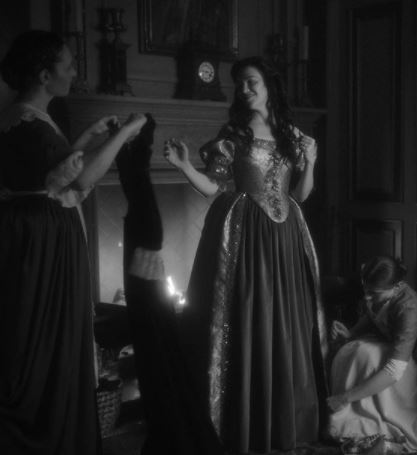
“I find it quite beautiful. I developed the plan with some very special architects,” I answered very sharply, for the individual’s manner, combined with my utter uncertainty as to his appearance, oppressed me with an irksome longing to be rid of him. “Oh, you don’t? Well, I do. I know what they are,–well, well, well!” and as he pronounced the three last words his voice rose with each, until, with the last, it reached a shrill shriek that echoed horribly among the lonely walks. “Do you know what they eat?” he continued. “No, sir—nor care.” “Oh, but you will care. You must care. You shall care. I will tell you what they are. They are enchanters. They are ghouls. They are cannibals. Did you never remark their eyes, and how they gloated on you when you passed? Did you never remark the food that they served up at your table? Did you ever in the dead of the night hear muffled and unearthly footsteps gliding along the corridors, and stealthy hands turning the handle of your door? Does not dome magnetic influence fold itself continually round you when they pass, and send a thrill through spirit and body, and a cold shiver that no sunshine will chase away? Oh, you have! You have felt all these things! I know it!” The earnest rapidity, the subdued tones, the eagerness of accent, with which all this was uttered, impressed me most uncomfortably. It really seemed as if I could recall all those weird occurrences and influences of which he spoke; and I shuddered in spite of myself in the midst of the impenetrable darkness that surrounded me. #RandolphHarris 11 of 17

“Hum!” said I, assuming, without knowing it, a confidential tone, “may I ask how you know these things?” “How I know them? Because I am their enemy; because they tremble at my whisper; because I hang upon their track with the perseverance of a bloodhound and the stealthiness of a tiger; because—because—I was of them once!” “Wretch!” I cried excitedly, for involuntarily his eager tones had wrought me up to a high pitch of spasmodic nervousness “then you mean to say that you—” as I uttered this word, obeying an uncontrollable impulse, I stretched forth my hand in the direction of the speaker and made a blind clutch. The tips of my fingers seemed to touch a surface as smooth as glass, that glided suddenly from under them. A sharply, angry hiss sounded through the gloom, followed by a whirring noise, as if some projectile passed rapidly by, and the next moment I felt instinctively that I was alone. A most disagreeable feeling instantly assailed me—a prophetic instinct that some terrible misfortune menaced me; and eager and overpowering anxiety to get back to my house without loss of time. I turned and ran blindly along the dark cypress alley, every dusky clump of flowers that rose blackly in the borders making my heart each moment cease to the sounds of unknown pursuers following fast upon my track. The boughs of lilac-bushes and syringas, that here and there stretched partly across the walk, seemed to have been furnished suddenly with hooked hands that sought to grasp me as I flew by, and each moment I expected to behold some awful and impassible barrier fall across my track and wall me up forever. #RandolphHarris 12 of 17

At length I reached the wide entrance. With a single leap I sprang up the four or five steps that formed the stoop, and dashed along the hall, up the narrow zigzagging stairs, and again along the dim, funereal corridors until I paused, breathless and panting, at the “Door to Nowhere.” Once so far, I stopped for an instant and leaned heavily against one of the panels, panting lustily after my late run. I had, however, scarcely rested my whole weight against the door, when it suddenly gave way, and I staggered in head-foremost. To my utter astonishment, the room I had left in profound darkness was now a blaze of light. So intense was the illumination that, for a few seconds while the pupils of my eyes were contracting under the sudden change, I saw absolutely nothing save the dazzling glare. This fact in itself, coming on me with such utter suddenness, was sufficient to prolong my confusion, and it was not until after several minutes had elapsed that I perceived the rom was not only illuminated, but occupied. And such occupants! Amazement at the scene took such possession of me that I was incapable of either moving or uttering a word. All that I could do was to lean against the wall, and stare blankly at the strange picture. It have been a scene out of Samuel Jackson Pratt’s Sympathy, or Hannah Cowley’s The Fate of Sparta, or Edward Gibbon’s The History of the Decline and Fall of the Roman Empire. Round a large table in the center of the room, that I had left unfinished, were seated half a dozen persons. Three were men and three were women. I do not even know what possessed me to open this door. The table was heaped wit a prodigality of luxuries. #RandolphHarris 13 of 17

There were luscious eastern fruits piled up in silver filigree vases, though whose meshes their glowing rings shone in the contrasts of a thousand hues. Small silver dishes that Benvenuto might had designed, filled with succulent and aromatic meats, were distributed upon a cloth of snowy damask. Bottles of every shape, slender ones from the Rhine, stouts fellows from Holland, sturdy ones from Spain, and quaint basket-woven flasks from Italy, absolutely littered the board. Drinking-glasses of every size and hue filled up the interstices, and the thirsty German flagon stood side by side with the aerial bubbles of Venetian glass that rest so lightly on their threadlike stems. An order of luxury and sensuality floated through the apartment. The lamps that burned in every direction seemed to diffuse a subtle incense on the air, and in a large vase that stood on the floor, I saw mass of magnolias, tuberoses, and jasmines grouped together, stifling each other with their honeyed and heavy fragrance. The inhabitants of my incomplete room seemed beings well suited to so sensual an atmosphere. The women were strangely beautiful, and all were attired in dresses of the most fantastic devices and brilliant hues. Their figures were round, supple, and elastic; their eyes dark and languished; their lips full, ripe, and of the richest bloom. The three men wore half-masks, so that all I could distinguish were heavy jaws, pointed beards, and brawny throats that rose like massive pillars out of their doublets. All six lay reclining on Roman couches about the table, drinking down the purple wines in large draughts, and tossing back their heads and laughing wildly. #RandolphHarris 14 of 17

I stood, I suppose for some thirteen minutes, with my back against the wall staring vacantly at the bacchanal vision, before any of the revellers appeared to notice my presence. At length, without any expression to indicate whether I had been observed from the beginning or not, two of the women arose from their couches, and, approaching, took each a hand and led me to the table. I obeyed their motions mechanically. I sat on a couch between them as they indicated. I unresistingly permitted them to wind their arms about my neck. “You must drink,” said one, pouring out a large glass of red wine, “here is Clos Vougeot of a rare vintage; and here,” pushing a flask of amber-hued wine before me, “is Lachryma Christi.” “You must eat,” said the other, drawing the silver dishes toward her. “Here are cutlets stewed with olives, and here are slices of a filet stuffed with bruised sweet chestnuts”—and as she spoke, she without waiting for a reply, proceeded to help me. The sight of the food recalled to me the warning I had received in the garden. This sudden effort of memory restored to me my other faculties at the same instant. I sprang to my feet, thrusting the women from ne with each hand. “Demons!” I almost shouted, “I will have none of your accursed food. I know you. You are cannibals, you are ghouls, you are enchanters. Begone, I tell you! Leave my home in peace!” A shout of laughter from all six was the only effect that my passionate speech produced. The men rolled on their couches, and their half-masks quivered with the convulsions of their mirth. The woman shrieked, and tossed the slender wine-glasses wildly aloft, and turned to me and flung themselves on my bosom fairly sobbing with laughter. #RandolphHarris 15 of 17

Agonized at the ever-darkening mysteries that seemed to thicken around me, and despairing of being able to dissipate them by the mere exercise of my own will, I cried eagerly. The woman touched a small golden ball that stood near her on the table, and it had scarce ceased to tinkle when a dwarf entered with a sliver tray on which were dice-boxed and dice. Then it seemed as if some unseen power caught me by the shoulders and thrust me toward the door. In vain I resisted. In vain I screamed and shouted for help. In vain I implored them for pity. All the reply I had was those mocking peals of merriment, while, under the invisible influence, I staggered to the door. As I reached the threshold the organ pealed out a wild, triumphal strain. The power that impelled me concentrated itself into one vigorous impulse that sent me blindly staggering out into the echoing corridor, and, as the door closed swiftly behind me, I caught a glimpse of the apartment I had left forever. A change passed like a shadow over it. The lamps died out, the siren women and masked men vanished, the flowers, the fruits, the bright silver and bizarre furniture faded swiftly, and I saw again, for the tenth of a second the incompleted room return. The next instant the door closed violently, and I was left standing in the corridor stunned and despairing. As soon as I had partially recovered my comprehension I rushed madly to the door, with the dim idea of beating it in. When I opened it, there was nothing but a two story drop to the garden. I looked from left to right, and there was no room. Just a door to nowhere. I rushed downstairs shouting madly. No one answered. I met the butler; I seized him by the collar, and demanded he show me to my room. #RandolphHarris 16 of 17

The demon showed his white and awful teeth, which were filed into a saw-like shape, and, extricating himself from my grasp with a sudden jerk, fled down the passage with a gibbering laugh. Nothing but echo answered to my despairing shrieks. The lonely garden resounded with my cries as I strode madly through the dark walks, and the tall funeral cypresses seemed to bury me beneath their heavy shadows. I met no one—could find no one. I had to bear my sorrow and despair alone. Since that awful hour, every time I open that door, there is nothing on the other side, but a two story drop into the gardens. Shall I ever find it? I left that portion of the house incomplete in hopes that my room would return. Death is the separation of the soul from the body. The creation of a zombie is the rebinding of body and soul via necromancy. The animated body can move, speak, even think, but it still cannot outrun physical decay. Zombies do not last very long, and the more able they are to think, the more they suffer from the same derangement that eventually gets any spirit that has been prevented from moving on. It is a rule: if spirit cannot move on, the tug of the afterlife sooner or later drives them mad. (Mrs. Sarah L. Winchester’s response to the deaths of her child and husband left a bizarre and impressive architectural reflection of her psyche. The fascinating story of the Winchester Mystery House has its roots in the personal tragedies suffered by Mrs. Winchester and the legacy of the Winchester rifle, “The Gun That Won the West.” There were occurrences that defined explanation. Neighbours would hear a bell ring a midnight and 2am, which according to ghost lore are the times of the arrival and departure of spirits. Some said that Mrs. Winchester never slept in the same bedroom two nights in a row, in order to confuse any evil spirits that might be waiting for her.) #RandolphHarris 17 of 17

Winchester Mystery House

If you’ve got it, haunt it 😉
Tickets for our All Hallows’ Eve, Lost in The House tour are still available! Purchase them today and be prepared for a fright 👻
Buy tickets 👉 Link in bio. winchestermysteryhouse.com


More Wonders of the Invisible World

Witchcraft is one of the most hidden works of darkness. And California had its full share of obscurity. People groping their way in the dark are unlikely to be either stable or judicious, and thus it is hardly surprising that much of the legends about witchcraft are violent and partisan. The Devil improves the darkness of this affair to push us into a blind man’s buffet, and we are even ready to be sinfully, yea, hotly and madly mauling one another in the dark. Some people want to contact the dead and consider seances, but they are dangerous because it is easy for a gate to be opened and something evil to come along with the spirit you want to contact. There is an old urban legend about “Bloody Mary.” If you chant “Bloody Marry” thirteen times into a mirror in a dark room, her spirit will appear. Some say she will prophesize for you, other versions say she will attack you. Historically, Bloody Mary was a nickname for Mary I of England, who suffered several miscarriages. She was also alleged to be a witch and was burned at the stake. Divination by mirror has been practiced in nearly all cultures for as long as mirrors have been around. Before that, any reflective surface, especially still water, was used to prophesy or catch a glimpse of the future. In many of these legends, the danger is that while you are trying to catch a glimpse of your future, you might also see some aspect of Death. Tradition also holds that at the moment of death, all the mirrors in the house should be covered so hey do not trap the departing spirit. Ancient Greeks and Native Americans believed that the reflection contained the soul, and could be capture by water. #RandolphHarris 1 of 14

It is bad luck to break mirrors because they are reflections of the soul, and also because they hold the future. That is why the seven years of bad luck occurs, you have broken your future. Many of the persons confessing these myths are witches by their own confession and have therefore abjured God and Chris, and given themselves up to the Devil, the Father of Lies. And what credit is to be given to the testimony of such against the lives of others? Many historians believe these early American legends are important and endeavor that the complete history of secret California witchcrafts and possessions might not be lost. The preservation of that history might in a be a singular benefit unto the church and unto the World, which makes many solicitous about it. Mrs. Winchester, who has been strangely visited by some shining spirits during the construction of her mansion, believed they were good Angels in her opinion of them. She intimated several things unto her friends, whereof some were to be kept secret. She also said that a new storm of witchcraft would fall upon the country to chastise the iniquity that was used in the willful smothering and covering of the last, and that many fierce opposites to the discovery of witchcraft would be thereby convinced. Many people are looking to acquire authentic, single-family Victorian homes because they believe in the renaissance of witchcraft and these homes possess souls, spirit, ghost, hidden occult symbol, and are supposedly spiritual nexuses. They are a power source to contacting the other World. #RandolphHarris 2 of 14

All spirits have something in common, but it matters who they are haunting. It matters what their traditions were when they were alive. In many Native American legends, they have thousands of Gods, and each of them had attendant monsters and demons. Pishachas are beings who haunt places where violent deaths have occurred. They eat human flesh and are supposed to be the sons of anger. They haunt cemeteries and places where cremations have taken place and can change their shape and become invisible. Sometimes they attack and eat their victims, in other instances they possess them and drive them insane. It is believed because there was some covenanting with the Devil they had committed and it was an unpardonable sin, that sin of which the scriptures said we must not pray for. Sometimes anyone who was not in a proper covenant with God was considered to be a witch. Witches are known to change into rabbits, cats, other familiar animals. Halloween costumes are a surviving remnant of the belief that transformed witches would be abroad before All Hallow’s Eve. Some of the Indian Powows [id est, pries-magicians] in this country during the 17th century, having received the Gospel and given good evidence of a true conversion to God in Christ, had with much sorrow of heart declared how they had, whilst in their Heathenism, by the hands of Evil Angels murdered their neighbours. A Nagual is a human being, a Shaman, who has acquired the power to shapeshift. Some Nagual have vampire qualities, changing into bats or owls to drain blood; in other cases the nagual is a respected and feared member of the community. In some places nagual are said to attack Indians who have too much contact with mestizo or Anglo populations. #RandolphHarris 3 of 14

There are myriad instances of witchcraft both in history and in the Bible, but some of the demonologists personal experiences are remarkable enough to make us wish they had given a more detailed account of the. In referring to Balaam, the biblical conjurer of familiar spirits, one of them said, “we have seen and know such wizards among the Heathen in our own land.” If I meant anything, it was that a ghost story would have a great pull over other ghost stories if one could see the person it happened to. One does get rather provoked at never coming across him or her. In April, nearly fifteen years after the Winchester Mansion opened for tour, it was a clear spring day, with no fog or half-lights about, and it was not yet four o’clock in the afternoon—not very ghost-like circumstances, you will admit. I had come home early from my club—it was a sort of holiday time with me just then for a few weeks—intending to get some letters written which had been on my mind for some days, and I had sauntered into the library of the mansion, a pleasant, fair-sized room lined with books, on the first floor. Before setting to work I sat down for a moment or two in an easy-chair by the fire, for it was still cool enough weather to make a fire desirable, and began thinking over my letters. No thought, no shadow of a thought of Mrs. Winchester was present with me, of that I am perfectly certain. The door was on the same side of the room as the fireplace; as I sat there, half facing the fire, I also half faced the door. I had not shut it properly on coming in, I had only closed it without turning the handle, and I did not feel surprised when it slowly and noiselessly swung open, till it stood right out into the room, concealing the actual doorway from my view. #RandolphHarris 4 of 14

If you think of the door as just hen acting like a screen to the doorway, you will perhaps understand the position better. From where I say I could not have seen anyone entering the room ill he or she had got beyond the door itself. I glanced up, half expecting to see someone come in, but there was no one; the door had swung open of itself. For the moment I sat on, with only the vague thought passing through my mind, “I must shut I before I begin to write.” However, suddenly I found my eyes fixing themselves on the carpet; something had come within their range of vision, compelling their attention in a mechanical sort of way. What was it? I rubbed my eyes and the wavy something that kept gliding, rippling in, gradually assumed a more substantial appearance. It was—yes, I suddenly became convinced of it, it was rippled of soft silken stuff, creeping in as if in some mysterious way unfolded or unrolled, not jerkily or irregularly, but glidingly and smoothly, like little wavelets on the sea-shore. And I sat there and gazed. I sat there still, as if bewitched, or under some irresistible influence, I cannot tell, but so it was. And it—came always rippling in, till at last it began to rise as it sill came on, and I saw that a figure, a tall graceful woman’s figure, was slowly advancing, backwards of course, into the room, and that the waves of pale silk—a very delicate shade of pearly grey I think it must have been—were in fact the lower portion of a long court-train, the upper part of which hung in deep folds from the lady’s waist. She moved in—I cannot describe the motion, it was not like ordinary walking or stepping backwards—till the whole of her figure and the clear profile of her face and head were distinctly visible, and when at last she stopped and stood there full in my view just, but only just beyond the door, I saw—it came upon me like a flash, that she was no stranger o me, this mysterious visitant! #RandolphHarris 5 of 14

I recognized, unchanged I seemed to me since the day, twenty-five years ago, when I had last seen her, the beautiful features of Mrs. Winchester. I should not have said unchanged. There was one great change in the sweet face. You remember my telling you that one of Mrs. Winchester’s greatest charms was her bright sunny happiness—she never seemed gloomy or depressed or dissatisfied, seldom even pensive. However, in this respect the face I sat there gazing at was utterly unlike Mrs. Winchester’s. Its expression, as she—or “it”—stood there looking, not towards me, but out beyond, as if at someone or something outside the doorway, was of the profoundest sadness. Anything so sad I have never seen in a human face, and I trust I never may. However, I sat on, as motionless almost as she, gazing at her fixedly, with no desire, no power perhaps, to move or approach more nearly to the phantom. I was not in the least frightened. I knew it was a phantom, but I felt paralyzed and as if I myself had somehow got outside of ordinary conditions. And there I sat—staring at Mrs. Winchester, and there she stood, gazing before her with that terrible, unspeakable sadness in her face, which, even though I felt no fear, seemed to freeze me with a kind of unutterable pity. I do not know how long I had sat thus, or how long I might have continued to sit there, almost as if in a trance, when suddenly I heard the front-door bell ring. It seemed to awaken me. I started up and glanced round, half-expecting that I should find the vision dispelled. But no; she was still there, and I sank back into my seat just as I heard my brother coming quickly upstairs. #RandolphHarris 6 of 14

He came towards the library, and seeing the door wide open walked in, and I, still gazing, saw his figure pass through that of Mrs. Winchester in the doorway as you may walk through a wreath of mist—only, do not misunderstand me, the figure of Mrs. Winchester till that moment had had nothing unsubstantial about it. She had looked to me, as she stood there, literally and exactly like a living woman—the shade of her dress, the colour of her hair, the few ornaments she wore, all were as defined and clear as a real person, or perhaps became so again as soon as my brother was well within the room. He came forward, addressing me by name, but I answered him in a whisper, begging him to be silent and to sit down on the seat opposite me for a moment or two. He did so, though he was taken aback by my strange manner, for I still kept my eyes fixed on the door. I had a queer consciousness that if I looked away it would fade, and I waned to keep cool and see what would happen. I asked George in a low voice if he saw nothing, but though he mechanically followed the direction of my eyes, he shook his head in bewilderment. And for a moment or two he remained thus. Then I began to notice that the figure was growing less clear, as if it were receding, yet without growing smaller to the sight; it grew fainter and vaguer, the colours grew hazy. I rubbed my eyes once or twice with a half idea that my long watching was making them misty, but it was not so. My eyes were not at fault—slowly but surely Sarah Winchester, or her ghost, melted away, ill all trace of her was gone. #RandolphHarris 7 of 14

I saw again the familiar pattern of the carpet where she had stood and the objects of the room that had been hidden by her draperies—all again in the most commonplace way: but she was gone, quite gone. Then George, seeing me relax my intense gaze, began to question me. I told him exactly what I have told you. He answered, as every common-sensible person of course would, that it was strange, but that such things did happen sometimes, and were classed by the wise under the head of “optical delusions.” I was not well, perhaps, he suggested. Been overworking? Had I not better see a doctor? However, I shook my head. I was quite well, and I said so. And perhaps he was right, it might be an optical delusion only. I had never had any experience of such things. “Poor” Mrs. Winchester I cannot help calling her. I heard of her indirectly, and probably, but for the sadness of her story, I should never have heard it at all. It was a friend of her husband’s family who had mentioned the circumstances in the hearing of a friend of mine, and one day something brought round the conversation to old times, and he startled me by suddenly enquiring if I remembered Sarah Winchester. I said, of course, I did. Did he know anything of her? And then he told me. She was dead—she had died some months after a long and trying illness, the result of a terrible accident. Something happened one evening when dressed for some grand entertainment or other, and though her injuries did not seem likely to be fatal at the time, she had never recovered the shock. “She was so pretty,” my friend said, “and one of the saddest parts of it is she could have not been any older than twenty when she passed away in 1922. She was such a sweet and bright lady.” #RandolphHarris 8 of 14

We all thought the she had finished construction of her mansion and moved up north to build another one. I did not tell him my story, for I did not want it chattered about, but a strange sort of shiver ran through me at his words. Not everyone was in agreement that the specters in the Winchester mansion had all been angry spirits or a delusion of the Devil. It having been represented to us that a most horrible witchcraft or possession of Devils hath invested several towns in Our Province of California under your government, and that divers persons have been convicted of witchcraft, like the Prison’s of the River, in Sacramento, California; some whereof have confessed their guilt, but others being of a known and good reputation these proceedings had caused a great dissatisfaction among our good subjects, for which reason you have put a stop thereunto until Our Pleasure should be known concerning the same, We therefore until Our Pleasure should be known concerning the same, We therefore approving of your care and circumspection herein have thought fit to signify Our Will and Pleasure, as We do hereby will and require you to give all necessary directions that in all proceedings against persons accused for witchcraft or being possessed by the Devil the greatest moderation and all due circumspection be used, so far as the same may be without impediment to the ordinary course of justice within Our said Province. And so We bid your very heartily farewell. Given at the Winchester Mansion the 15th day of April, 1947, in the fifth year of Our Reign. By Her Majesty’s Command. #RandolphHarris 9 of 14

Although the topic of witchcraft was now explosively controversial in California, nobody was to deny that people practiced it, and there was still some interest in investigating it. There are therefore references to it in many of the sermons in the 19th century. However, after the Winchester mansion was opened for tour, the mysterious disappearance of Mrs. Winchester was thought to be paranormal and a circular letter was sent by the Winchester Repeating Arms Company to investigate the collection of more instances of “remarkable providences” (these would include unusual natural phenomena as well as the preternatural). Behind the veil of all the hieratic and mystical allegories of ancient doctrines, behind the darkness and strange ordeals of all initiations, under the seal of all sacred writings in the Winchester mansion, on stones in the basement on the walls in the dressing room, in the monstrous or marvelous paintings in forbidden areas of the mansion which interpret to the mystical the inspired secrets of Mrs. Winchester, in the cryptic emblems of her old books on alchemy, in the ceremonies practiced at reception by this secret society, there were found indications of a doctrine which was everywhere the same and everywhere carefully concealed. It is likewise to be understood, those who are desirous to raise any souls of the dead, ought to select those places wherein these kind of souls are most known to be conversant; or by some alliance alluring the souls into their forsaken bodies, or by some kind of affection in times impressed in them in their life, drawing the souls to certain places, things, or persons; or by the forcible nature of some place fitted and prepared to purge or punish these souls: which places for the most part are to be known by he appearance of visions, nightly incursions, and apparitions. #RandolphHarris 10 of 14

Mrs. Winchester lists convincing evidence that her experience of witchcraft extended well beyond what she had committed to writing: I know a young man who had gone so far as to get ready a Covenant with Satan, written all of it in his own blood. However, before the signing of it, the sinful, I was made the happy instrument of his deliverance. As soon was this man was left alone in the mansion, the devil, imagining that he had found the right moment for breaking his courage, incontinently roused up his own chosen vessel, who appeared to have reposed longer than usual. Having beheld this from afar, he grew stiff with terror by reason of his being alone; but soon recovering his courage, and no place of refuge being at hand, he valiantly withstood the onset of the fiend, who came rushing upon him with a terrible noise, and he struck the axe which he wielded in his hand deep into his body. On receiving this wound, the monster groaned aloud and turning his back, fled with a rapidity not at all inferior to that with which he had advanced, while the admirable man urged his flying foe from behind, and compelled him to seek his own tomb again; which opening of its own accord, and receiving its guest from the advance of the pursuer, immediately appeared closed again. Hence it is that the souls of the dead are not to be called up without blood or by the application of some part of their relict body. In the raising therefore of these shadows, we are to perfume with new blood the bones of the dead, and with flesh, eggs, milk, honey, and oil, which furnish the soul with a medium apt to receive its body. Gosh, it must be terrible to know you witnesses something, but that you will never be able to remember it or tell anyone about it. #RandolphHarris 11 of 14

I know a woman whose brother was tortured with a cruel, pricking, incurable pain in the crown of his head, which continued until there was found with her a puppet in wax, resembling him, with a pin pricked into the head of it, which being take out her recovered immediately. He goes on about demons. A demon killed his wife, he says, and just expects me to believe it. However, what he looks like to me is someone who let grief turn him into a monster. Whatever happened to his wife, it does not excuse what he had done. He attacks, kills, then springs away before anyone can react. Wicked sorceries have been practised in the land, and, in the late inexplicable storms from the invisible World thereby brought upon us, we were left by the just hand of Heaven unto those errors whereby great hardships were brough upon innocent persons, and (we fear) guilt incurred which we have all cause to bewail with much confusion of face before the Lord. We confess that we ourselves were not capable to understand nor able to withstand the mysterious delusions of the Powers of Darkness and Prince of the Air, but were, for want of knowledge in ourselves and better information from others, prevailed with to take up with such evidence against the accused as on further consideration and better information we justly fear was insufficient for the touching the lives of any, whereby we fear we have been instrumental with others, though ignorantly and unwittingly, to bring upon ourselves and this People of the Lord the guilt of innocent blood, which sin the Lord saith in scripture He would not pardon (2 Kings 24.4), that we suppose, in regard of His temporal judgments. #RandolphHarris 12 of 14

I know a person who, missing anything, would use to sit down and muter a certain charm, and then immediately by an invisible hand ben directly led unto the place where the thing was to be found. turquoise carvings placed in Native American graves to attract good spirits and guard the grave. Also, turquoise tied onto a bow was supposed to make you shoot more accurately. The body of saints often times cannot be found when their graves are dug up because their bones were frequently interred in the cornerstones of cathedrals, so their spirits would guard the holy location. Unwilling sacrifices would be more likely to become angry spirits instead of guarding. Canaanites sacrificed infants and put them in the foundations of houses and temples. “At the cost of his first-born shall he se up its gates,” reports Joshua 6.26. Bones were discovered in the basement of the original farm house that was engulfed as part of this estate during the expansion. Sightings of Hell Hounds date back to 1888. Some reports say the creatures are threatening. The Victorian parklike grounds seem to breed sightings of big wolf creatures or beast at night. Since the legends have been uncovered, many people have reported seeing a big black wolf and two men walking around the Winchester mansion at night, even when it is closed. Four kids and a police officer allegedly disappeared after climbing the gate to get a closer look one night. Nearly 134 years of sightings. These people are probably sadly deluded and mistaken, their minds are more likely disquieted and distressed, and we do therefore humbly beg forgiveness, first of God for Christ’s sake for this error, and pray that God would not impute the guilt of it to ourselves nor others. And we also pray that we may be considered candidly and aright by the living suffers as being then under the power of a strong and general delusion, utterly unacquainted with and not experienced in matters of that nature. #RandolphHarris 13 of 14

I know a woman who upon uttering some words over very painful hurts and sores did use instantly to cure them, unto the amazement of the spectators. Now, thought I, if this wretch can effectually employ Devils to cure hurts, why may not she to cause them also, which is the worst that the witches do? The matter being so dark and perplexed as that there is no present appearance that all God’s servants should be altogether of one mind in all circumstances touching the same and believing the Devil’s accusations. These practices and principles have been the beginner and procurer of the sores afflictions, not to Llanda Villa only, but to this whole country, that did ever befall them. It should be noted in passing that Llanda Villa’s attorneys have concluded that these peoples visions and afflictions are due to illness caused by demonic possession. No specters evidence may be hereafter accounted valid or sufficient to take away the life or good name of any person or persons within this province. God hath a controversy with us about what was done in the time of the witchcraft. I fear that innocent blood hath been shed, and that many have had their hands defiled therewith. Public acknowledgement of guilt, and humiliation for it, and the more particularly and personally it is done by all that have been actors, the more pleasing it will be to God and more effectual to turn away his judgments from the land, and to prevent his wrath from falling upon the persons and families of such as have been most concerned. Moreover, if it be true, as I have been often informed, that families of such as were condemned for supposed witchcraft have been ruined by taking away and making havoc of their estates and leaving them nothing for their relief, I believe the whole country of lies under a curse to this day, and will do till some effectual course be taken by our honored governor and Supreme Court to make them some amends and reparations. #RandolphHarris 14 of 14

Winchester Mystery House

Get in the Halloween spirit and celebrate the first weekend of October 2021 at the Winchester Mystery House! Our All Hallows’ Eve tickets are selling fast so be sure to grab them while you can 👻
🎟️link in bio. winchestermysteryhouse.com

Must You Wait for the Heart to Change First?

Many people believe that a neurotic or bad or unhappy child must have parents who have produced his negative state, while on the contrary the happy and healthy child has a correspondingly happy and healthy environment. In fact parents have taken the whole of the blame for the unhealthy development of a child on themselves and equally so the praise for the happy outcome of childhood. All data show that they should have not done so. Here is a good example: A psychoanalyst may see a very neurotic, distorted person with a terrible child and say, “It is obvious that the childhood experiences have produced this unhappy outcome.” If one would only ask oneself, however, how many people one had seen who came from the same type of family constellation and turned out to be remarkable happy and healthy people, one would begin to have doubts about the simple connection between childhood experiences and the mental health or illness of a person. The first factor which accounts for this theoretical disappointment must lie in the analyst’s ignoring the differences in genetic dispositions. Take a simple example: One can see even among newborn infants a difference in degree of aggressiveness or timidity. If the aggressive child has an aggressive mother, this mother will do one little harm or perhaps even much good. It will learn to fight with her and not be frightened of her aggressiveness. If a timid child is confronted with the same mother, it will be intimidated by the mother’s aggressiveness, it will tend to become a frightened, submissive and later on perhaps a neurotic person. #RandolphHarris 1 of 18

Indeed, we touch here upon the old and much discussed problem of “nature versus nurture” or genetic disposition versus environment. The discussion of this problem has by no means yet led to conclusive results. From my own experience I have come to the conclusion that genetic dispositions play a much greater role in the formation of a specific character than most analysts credit it with doing. I believe that one aim of the analyst should be to reconstruct a picture of the character of the child when it was born in order to study which of the traits one finds in the analysand are part of the original nature and which are acquired through influential circumstances; furthermore, which of the acquired qualities conflict with the genetic ones and which tend to reinforce them. What we find very often is that by the wish of the parents (personally an as representatives of society) the child is forced to repress or to weaken one’s original dispositions and to replace them by those traits which society wants one to develop. At this point we find the roots of neurotic developments; the person develops a sense of false identity. While genuine identity rests upon the awareness of one’s suchness in terms of the person one is born as, pseudo-identity rests upon the personality which society has imposed upon us. Hence a person is in constant need of approval in order to keep one’s balance. Genuine identity does not need such approval because the person’s picture of oneself is identical with one’s authentic personality structure. #RandolphHarris 2 of 18

If throughout childhood, a child were convinced that nobody would ever care for one unless one wanted something from them, that there was no sympathy or love which was no the payment for services or a bribe to preform, a person may go through life without ever having experienced that somebody cares or is interested and does not want anything in return. However, when it happens that such a person experiences another person’s having a real interest without wanting anything, this might drastically change such character traits as suspicion, fear, the feelings of being unlovable, et cetera. Furthermore, the relationship between parents and children is usually seen as a one-way street, namely the effect parents have upon children. However, what is often ignored is that this influence is by no means one-sided. A parent may have a natural dislike for a child and even for a newborn baby, not only for reasons which are often discussed—that it is an unwanted child or that that the parent is destructive, sadistic, et cetera—but for the reason that child and parent just are not compatible by their very natures, and that in this respect the relationship is no different from that between grown-up people. The parents may just have a dislike for the kind of child one produced and the child may feel this dislike for the kind of parents one has and being the weaker, one is punished for one’s dislike by all kinds of more or less subtle sanctions. The child—and equally the mother—is forced into a situation where the mother has to take care of the child and the child has to accept the mother in spite of the fact that they heartily dislike each other. #RandolphHarris 3 of 18

The child cannot articulate that it does not like the mother; the mother would feel guilty if she admitted to herself that she did not like a child she gave birth to, and so both behave under a special kind of pressure and punish each other for being forced into an unwanted intimacy. The mother pretends to love the child and subtly punishes it for being forced to do so, the child pretends in some way or another to love the mother because one’s life depends totally on her. In such a situation a great deal of dishonesty develops which the children often express in their own indirect ways of rebellion and which the mothers usually negate because they feel that nothing could be more shameful than not to like one’s own children. Only one who believes is obedient, and only one who is obedient believes. Jesus says: “First obey, perform the external work, renounce your attachments, give up the obstacles which separate you from the will of God.” Do not say that you have not got faith. You will not have it so long as persist in disobedience and refuse to take the first step. People generally assume that our beliefs and attitudes determine our actions. So if we want to change the way people act, their hearts and minds had better be changed. This assumption lies behind most of our teaching, preaching, counseling, and child rearing. And to some extent it is true: behaviour follows attitudes. However, if social psychology has taught us anything during the last thirty year, it is that the reverse is also true: we are as likely to act ourselves into a new way of thinking as to think ourselves into action. #RandolphHarris 4 of 18

Evil acts shape the self. People induced to harm an innocent victim typically come to disparage their victim. Those induced to speak or write statements about which they have misgivings will often come to accept their little lies. Saying becomes believing. More action affects the actor, too. Children who resist a temptation tend to internalize their conscientious behaviour. Helping someone typically increases liking for the person helped. Those who teach a moral norm to others subsequently follow the moral code better themselves. Generalizing the principle, it would seem that one antidote for the corrupting effects of evil action is repentant action. Act as if you love your neighbour—without worrying whether you really do—and before long you will like the person more. Racial attitudes have followed racial behaviour. Racial attitudes have followed racial behaviour. Prior to desegregation in the United States of America it was often said that you cannot legislate racial attitudes—you must wait for the heart to change first. However, after the initiation of desegregation European American racial attitudes became noticeably less prejudiced. Moreover, as different regions of the country have come to act more alike, they have also come to think more alike. Political socialization techniques have effectively employed the principle. For instance, many people seem to be in support of undocumented people coming into America, even though it is a crime, but are enforcing more laws and restrictions on legal Americans. Many Americans have expressed discomfort at the contradiction of demanding that people follow the law, and their support for undocumented immigration. #RandolphHarris 5 of 18

Prevented from say what they really believe, they try to establish their psychic equilibrium by consciously making themselves believe what they said, which is essentially “Most people should have to follow the law, but I support crime in certain circumstances.” But what happens when they start to rationalize illegal actions of their own, will that lead to lawlessness on a wide scale? Many modern therapy techniques make a more constructive use of action. Behavior therapy and rational-emotive therapy and rational-emotive therapy both prompt their clients to rehearse and practice more productive behaviour. We can all learn a practical lesson here. Like Moses, Jonah, and other biblical heroes, we do not feel like doing what we know we ought. The remedy is to get up and act anyway—to put our fingers on the keyboard and force ourselves to begin that essay or letter, to go to the phone and dial that number, to confront or hare with that person, to turn off the TV and begin studying for that exam. When we do so, we often find that our forced behaviour begins to gain momentum as a real interest in our subject takes hold. Our feelings are hard to control, but we can control our behaviour and by doing so indirectly influence our feelings. To be sure, the attitudes-follow-behaviour principle is more potent in some situations than others—especially in those where people feel some choice and responsibility for their behaviour rather than attributing it to coercion. Nevertheless, it is now a fundamental rule of social psychology that behaviour and attitude generate one another in an endless spiral, like chicken and egg. #RandolphHarris 6 of 18

This principle affirms the biblical understanding of action and faith, or an obedience and belief. Depending on where we break into this spiraling chain, we will see faith as a source of action or as a consequence. Action and faith, like action and attitude, feed one another. Much as conventional wisdom has insisted that our attitudes determine our behaviour, Christian thinking has usually emphasized faith as the source of action. Faith, we believe, is the beginning rather than the end of religious development. The experience of being “called” demonstrates how faith can precede action in the lives of the faithful. Elijah is overwhelmed by the Holy as he huddles in a cave. Paul is touched by the Almighty on the Damascus Road. Ezekiel, Isaiah, Jeremiah, and Amos are likewise invaded by the Word, which then explodes in their active response to the call. In each case, an encounter with God provoked a new state of consciousness, which was then acted upon. This dynamic potential of faith is already a central tenet of Christian thought. For the sake of balance, we should also appreciate the complementary proposition: faith is a consequence of action. Throughout the Old and New Testaments we are told that full knowledge of God comes through actively doing the Word. Faith is nurtured by obedience. We come to know truth by reason and quiet reflection. This view, translated into Christian terms, equates faith with cerebral activity—orthodox doctrinal propositions. The contrasting biblical view assumes that reality is known through obedient commitment. “The Lord touched their eyes, saying ‘It shall be done to you according to your faith,’” Matthew 9.29. #RandolphHarris 7 of 18

If an individual wants to change one’s life, that change must be conceived on the inside. Once that new and improved image shows up, the God will easily develop I on the outside. Living your dream is that simple. Anyone can enjoy a happier and healthier lifestyle. However, the change will not happen immediately and it will not be easy. However, for any improve me, the inception of your vision must occur within your heart and mind first, then it will manifest in your life. “Praise be to the name of God forever and ever; wisdom and power are His. He changes times and seasons; He sets up kings and deposes them. He gives wisdom to the wise and knowledge to he discerning. He reveals deep and hidden things; He knows what lies in darkness, and light dwells with him. I thanks and praise you, O God of my fathers; you have given me wisdom and power, you have made known to me what we asked of you, you have made known to us the dream of the king,” reports Daniel 2.20-23. When we close our eyes, we should be big dreamers, an see our whole family serving God, and rising to new levels of effectiveness. One should see themselves achieving more success next year, and their family healthy and happy. You might even see yourself getting better looking. Believe that you will get a promotion at work. Know that you will pay off that house. Understand God is using you in a better way. Trust that you are stronger, healthier, and living a life full of God’s grace. Walk by faith and not by sight. When you look into the future, see your children happy and successful and marrying excellent people. Take a few moments everyday and pray for your dreams to come true. Envision yourself there. #RandolphHarris 8 of 18

Entropy by its very character assures us that though it may be the universal rule in the Nature we know, it cannot be universal absolute. If a person says, “Humpty Dumpty is falling,” you see at once that this is not a complete story. The bit you have been told implies both a later chapter in which Humpty Dumpty will have reached the ground, and an earlier chapter in which he was still stead on the wall. A nature which is “running down” cannot be the whole story. A clock cannot run down unless it has been wound up. Humpty Dumpty cannot fall off a wall which never existed. If a Nature which disintegrates order were the whole of reality, where would she find any order to disintegrate? Thus on any view there must have been a time when processes the reverse of those we now see were going on: a time of winding up. The Christian claim is that those days are not gone for ever. Humpty Dumpty is going to be replaced on the wall—at least in the sense that what has died is going to recover life, probably in the sense that the inorganic Universe is going to be re-ordered. Either Humpty Dumpty will never reach the ground (being caught in mid-fall by the everlasting arms) or else when he reaches it he will be putt together again and replaced on a new and better wall. Admitted, science discerns no “king’s horses and men” who can “put Humpty Dumpty together again.” However, you would not expect her to. She is based on observation: and all our observations are observations of Humpty Dumpty in mid-air. They do not reach either the wall above or the ground below—much less he King with the horses and men hastening towards the spot. #RandolphHarris 9 of 18

The Transfiguration or “Metamorphosis” of Jesus is also, no doubt, an anticipatory glimpse of something to come. He is seen conversing with two of the ancient dead. The change which His own human form had undergone is described as one to luminosity, to “shining whiteness.” A similar whiteness characterizes His appearance a he beginning of the book of Revelation. One rather curious detail is that this shining or whiteness affected His clothes as much as His body. St. Mark indeed mentions the clothes more explicitly than the face, and adds, with his inimitable naivety, that “no laundry could do anything like it.” Taken by itself this episode bears all the marks of a “vision”: that is, of an experience which, though it may be divinely sent and may reveal great truth, yet is not, objectively speaking, the experience it seems to be. However, if the theory of “vision” (or holy hallucination) will not cover the Resurrection appearances, it would be only a multiplying of hypotheses to introduce it here. We do not know to what phase or feature of the New Creation this episode points. It may reveal some special glorifying of Christ’s manhood at some phase of its history (since history it apparently has) or it may reveal the glory which that manhood always has in its New Creation: it may even reveal a glory which all risen humans will inherit. We do not know. It must indeed be emphasized throughout that we know and can know very little about the New Nature. The task of the imagination here is not to forecast it but simply, by brooding on many possibilities, to make room for a more complete and circumspect agnosticism. It is useful to remember that even now sense responsive to a different, almost beyond recognition, from the space we are now aware of, yet not discontinuous from it: that time may not always be for us, as it now is, unilinear and irreversible: that other parts of Nature might some say obey us as our cortex now does. #RandolphHarris 10 of 18

It is useful not because we can trust these fancies to give us an absolute truths about the New Creation but because they teach us not to limit, in our rashness, the vigour and variety of he new crops which this old field might produce. We are therefore compelled to believe that nearly all we are told about the New Creation is metaphorical. However, not quite all. That is just where the story of Resurrection suddenly jerks us back like a tether. The local appearances, the eating, the touching, the claim to be corporeal, us be either reality or sheer illusion. The New Nature is, in the most troublesome way, interlocked at some points with the Old. Because of its novelty we have to think of it, for the most part, metaphorically: but because of the partial interlocking, some facts about it come through into our present experience in all their literal facthood—just as some facts about an organism are inorganic facts, and some facts about a solid body are facts of linear geometry. Even apar from that, the mere idea of a New Nature, a Nature beyond Nature, a systematic and diversified reality which is “supernatural” in relation to the World of our five present senses but “natural” from its own point of view, is profoundly shocking to a certain philosophical preconception from which we all suffer. I think Kant is at the root of it. It may be expressed by saying that we are prepared to believe either in a reality with one floor or in a reality with two floors, but not in a reality like a skyscraper with several floors. We are prepared, on the one hand, for the sort of reality that Naturalists believe in. That is a one-floor reality: this present Nature is all that there is. #RandolphHarris 11 of 18

Say no to self and mean it, or one will never find oneself a free human—that is what Jesus told His Disciples, that is how Matthew recorded it (16.24), and that is what He is telling us, My dear friend. Until that sweet time comes, count oneself a prisoner, under house arrest, in one’s own body. Well, one feels as if one owns one’s own self, are one’s own best friend, lust for tacky stuff to decorate one’s own domain, peep through the arras at others more fortunate than oneself. One feels one is something of a dervish whirling in a circle until one turns to butter, or a Sybarite seeking soft sheets for oneself instead of the rock-hard life of Jesus Christ. Paul wrote much the same thing to the Philippians (2.21). Maybe one feels one is one of those thinkers who spend their time thinking up and putting together gadgets. They will work for a time, but then they will break down. Which is another way of saying, I think no project is likely to be successful unless it has its source somewhere in Jesus Christ. Here are some words of advice that one could never logick one’s way to. Give up everything, and one will find everything. Leave greed behind, and one will find rest. With this sort of attitude and his sort of resolve, one will understand all things. Father, because of You, I will dare to dream big dreams. With faith and confidence in You, I know what I can accomplish the goals that You have placed within my heart. The basis of higher healing work is the realization of humans as Mind. However, the latter is a dimensionless unindividuated unconditioned entity. It is not my individual mind. The field of Mind is a common one where as the field of consciousness is divided up into individual and separate holdings. This is a difference with vast implications, for whoever can cross from the second field to the first, crosses at the same time from an absurdly limited World into a supremely vital one. #RandolphHarris 12 of 18

Consequently, genuine and permanent healing is carried on without one’s conscious association and can be effected by dropping the ego-mind and with it all egoistic desires. Hence the first effort should be to ignore the disease and gain the realization. Only after the latter has been won should the thoughts be allowed to descend again to the disease, with the serene trust that the bodily condition may safely be left in the hands of the World-Mind for final disposal as It decides. There should not be the slightest attempt to dictate a cure to the higher power nor the slightest attempt to introduce personal will into treatment. Such attempts will only defeat their purpose. The issues will partly be decided on the balance of the Universal Law and evolutionary factors concerned in the individual case. And yet there are cults which do not find it at all incongruous to suggest to the Infinite Mind what should thus be One surrender is truly made, the desires of the self go with it and pace reigns in the inner life whether illness still reigns in the external life or not. Thus there is a false easy yielding of the will which deceives no higher power than the personal self, and there is an honest yielding which may really invoke the divine grace. It is a mistake, however, to turn the higher self into a mere convenience to be used chiefly for obtaining healing or getting guidance, for healing the sickness of the physical body, or guiding the activities of the physical ego. It should be sought for its own sake, and these other things should be sought only occasionally or incidentally, as and when needed. They should not be made habitual. In one’s periodic meditations, for instance, the aspirant should seek the divine source of one’s being because it is right, necessary, and good for one to do so and one to do so and one should forget every other desire. #RandolphHarris 13 of 18

Only after one has done that and found the source, and only on one’s backward journey to the day’s activities, may one remember these lesser desires and utilize the serenity and power thus gained for attending to them. Your assertion that Jesus primarily wished to free humans of disease and viruses, or to teach them how to become so, is untenable. Whoever has entered into the consciousness of one’s divine soul—which Jesus had in such fullness—has one’s whole scale of values turned over. It is then that one sees that the physical is ephemeral by nature, whereas the reality whence it is derived is eternal by nature; that what happens inside a person’s heart and head is fundamentally more important than what happens inside one’s body; and that the divine consciousness may and can be enjoyed even though the fleshly tenement is sick. The sufferer should use whatever physical medical means are available—both orthodox and unorthodox ones. At the same time one should practise daily prayer. However, one should not directly ask for the physical healing for its own sake. One should ask first for spiritual qualities and then only for the physical healing with the expressed intention of utilizing one’s opportunity of bodily incarnation to improve oneself spiritually. Healing is but a mere incident in the work of a self-actualized person. Such a one will always keep as one’s foremost purpose the opening of the spiritual heart of humans. It is from the first moment of life that one must learn to deserve to live; and since birth one shares the rights of citizens, the moment of our own birth should be the beginning of the exercise of our duties. If there are laws for those of mature age, there should also be some for the very young which teach them to obey others. #RandolphHarris 14 of 18

And since each human’s reason cannot be allowed to be the sole arbiter of one’s duties, a fortiori the education of children cannot be abandoned to the light and prejudices of their fathers, since it is of even more importance to the state than it is to their fathers. For according to the natural course of things, the death of the father often strips one of the last fruits of this education, but sooner or latter the country feels its effects. The state remains; the family dissolves. Now if the public authority, in taking the fathers’ place and charging itself with this important function, acquires their rights by fulfilling their duties, the fathers have that much less reason to complain, because strictly speaking, in this regard, they are merely changing a name, and will have in common, under the name “citizens,” the same authority over their children they exercised separately under the name of “fathers,” and will be obeyed no less well when they speak in the same of the law than they were when they spoke in the name of nature. Public education under the rules prescribed by the government and under the magistrates put in place by the sovereign, is therefore one of the fundamental maxims of popular or legitimate government. If children are raised in common and in the bosom of equality, if they are instructed to respect above all things, if they are surrounded by examples and objects that constantly speak to them of the tender mother who nourishes them, of the love she bears for them, of the inestimable benefits they receive from her, and in turn of the debt they owe her, doubtlessly they thus will learn to cherish one another as brothers, never to want anything but what the society wants, never to substitute the actions of humans and of citizens for the sterile and vain babblings of sophists, and to become one day defenders and the fathers of the country whose children they will have been for so long. #RandolphHarris 15 of 18

I will not discuss the magistrates destined to preside over his education, which certainly is the state’s most important business. Clearly, if such marks of public confidence were lightly granted, if this sublime function were not, for those who had honorable and sweet repose of their old age and the high point of all their honors, the entire understanding would be useless and the education unsuccessful. For whatever the lesson is unsupported by authority, or the precept by example, instruction remains fruitless, and virtue itself loses its influence in the mouth of one who does not practice it. However, let the illustrious warriors bent under the weight of their laurels preach courage; let upright magistrates, whitened in the wearing of purple and in service at the tribunals, teach justice. Both of these groups will thus train virtuous successors and will transmit from age to age to the generations that follow the experience and talents of leaders, the courage and virtue of citizens and the emulation common to all of living and dying for one’s country. I know of but three peoples who in an earlier era practiced public education, namely, the Cretans, the Lacedemonians, and the ancient Persians. Among all three it was the greatest success and brought about marvels among the latter two. Since the time the World was divided into nations too large to be governed well, this method has not been practicable. And other reasons the reader can easily see have also prevented it from being tried by any modern people. It is quite remarkable that the Romans were able to do without it. #RandolphHarris 16 of 18

However, Rome was for five hundred years a continual miracle that the World cannot hope to see again. The virtue of the Romans, engendered by the horror of tyranny and the crimes of tyrants and by an inborn love of country, made all their homes into as many schools for citizens. And the unlimited power of fathers over their children placed to much severity in private enforcement that the father, more feared than the magistrates, was the censor of mores and the avenger of laws in one’s domestical tribunal. In this way an attentive and well-intentioned government, constantly valiant to maintain or restore love of country and good mores among the people, anticipates far in advance the evils that sooner or later result from citizens’ indifference to the fate of the republic, and restricts within narrow limits that personal interests which so isolates private individuals that the state is weakened by their power and has nothing to hope for from their good will. Anywhere the populace loves it country, respects its laws and lives simply, little else remains to do to make it happy. And in public administration, where fortune plays less of a role than it does in the lot of private individuals, wisdom is so close to happiness that these two objects are confounded. Waters, you are the ones who brings us the life force. Please help us to find nourishment so that we may look upon great joy. Please let us share in the most delicious sap that you have, as if you were loving mothers. Please let us go straight to the house of the one for whom your waters give us life and give us birth. For our well-being please let God be an assistant to us, the waters be for us to drink. Please le hem cause well-being and health to flow over us. #RandolphHarris 17 of 18

Mistresses of all the things that are chosen, rulers over all peoples, the waters are the ones I beg for a cure. God has told me that within the waters are all cures and Jesus Christ who is salutary to all. Water, please yield your cure as an armour for my body, so that I may see the sun for a long time. Waters, carry for away all of this that has gone bad in me, either what I have done in malicious deceit or whatever lie I have sworn to. I have sought the waters today; we have joined with their sap. O Jesus Christ full of moisture, come and flood me with splendour. O God, we beseech Thee, please save! O please save! O God! like sheep we all have gone astray; from out Thy book wipe not our nae away. Please save! O save! O God! sustain the sheep for slaughter;–see these deal with wrathfully and slain for Thee. Save! O save! O God! Thy sheep! the sheep whom Thou didts end in pasture; Thy creation and Thy friend. Save! O save! O God! they lift their eyes to Thee, long sought; please let those who rise against Thee count as naught. Save! O save! O God! they pour out water, worshipping—let them be drawing from salvation’s spring. Save! O save! O God! to Zion saviours send at length, endowed of Thee, and saved by Thy name’s strength. Save! O save! O God! in garb of vengeance clad about, in mighty wrath cast all deceivers out. Save! O save! O God! and Thou wilt surely not forget her, by love-tokens bought, that hopeth yet. Save! O save! O God! they seeking Thee with willow bough, regard their crying from Thine Heaven now. Save! O save! O God! as with a crown bless Thou the year; yea, Lord, my singing, I beseech Thee, hear. Save! O save! I beseech Thee, O God, save! O save, I beseech Thee. Thou art our Father. #RandolphHarris 18 of 18

CRESLEIGH HAVENWOOD
Lincoln, CA | from the mid $600s
Now Selling!

Now selling! Cresleigh Havenwood is the newest Cresleigh community coming to Lincoln, CA. With four distinct floor plans to choose from ranging from 2,293 – 3,489 square feet offering up to five bedrooms, we are sure you’ll find your dream home here at Havenwood! https://cresleigh.com/havenwood/

The Devil Loveth No Salt in His Meat!

Every night in the year, four of us sat in the parlous of the Winchester Mansion. This particular night, there was a thin, bright moonshine: it was bitter cold, windy, and frosty; the town had not yet awakened, but an indefinable stir already preluded the noise and business of the day. The ghouls had come later than usual, and they seemed more than usually eager to be gone. They wished, and declared their wish, that their blood might be the last innocent blood shed. They prayed that God would discover the witchcraft were among us. They forgave their accusers. The fervency of the spirits were very affecting and drew tears from many. Affecting and melting to the hearts of some considerable spectators. They prayed earnestly for pardon for all other sin and for an interest in the precious blood of our dear Redeemer, and seemed to be very sincere, upright, and sensible of their circumstances. One of the ghouls said, “I have been put to death, and my grandfather suffered, and all his estate seized because of my own vile and wretched heart, confessed several things contrary to my conscience and knowledge, though to the wounding of my own soul—the Lord pardon me for it. But oh! the terrors of a wounded conscience, who can bear? Blessed be the Lord; He would not let me go in my sins, but in mercy I hope so my soul would not suffer me to keep it in any longer, but I was forced to confess the truth. Gunshots in the hills and the echo of that awful hellspawn voice in my head. I was sought after by a sorcerer, which resulted in fatal mishaps for those sorcerers because they caught me in the wrong mood, and I turned into a lethal weapon. Dear Mrs. Winchester, let me beg your prayers to the Lord on my behalf, and please send us a joyful and happy meeting in Heaven.” #RandolphHarris 1 of 13

Mrs. Winchester replied, “But the Lord He know it is, if it be possible, that no more innocent blood be shed, which undoubtedly cannot be avoided in the way and course you go in. I question not but your honours do to the utmost of your powers in the discovery and detecting of witchcraft and witches, and shall not be guilty of innocent blood for the World.” A horrible sense of blackness and the treachery of fate seized hold upon the soul of the unhappy student and the other ghouls. “My God! she cried, “but what have I done? and when did I begin?” Nothing could be explained any further because we realized that we had long since ceased to pay attention to anything said by the suspect. Our minds and hearts were so filled with the hideous torments of the afflicted and the frightful tales of the confessors that we were quite unable to absorb anything else. The student was violent, and it was said that she had beaten to death a former teacher and other students in the classroom before she and her accomplices were shot dead by a Winchester model 1866. They were much addicted to sorcery in the said town, and there were forty men in it that could raise the Devil as well as any astrologer. Time had little changed this small town. It stood then, as now, upon a crossroad, out of call of human habitations, and buried fathom deep in the foliage of six thousand cedar trees. The cries of the sheep upon the neighbouring hills, the streamlets upon either hand, one loudly singing among pebbles, the other dripping furtively from pond to pond, the stir of the wind in mountainous old flowering chestnuts, and once in seven days the voice of the bell and old tunes of the precentor, were the only sounds that disturbed the silence around the rural Winchester Mansion. #RandolphHarris 2 of 13

The Resurrection Man was not to be deterred by any of the sanctities of customary piety. It was part of his trade to despise and desecrate the scrolls and trumpets of old tombs found on the estate, the paths worn by the feet of legions of spirits and mourners, and the offerings and the inscriptions of bereaved affection. To rustic neighbourhoods, where love is more than commonly tenacious, and where some bonds of blood or fellowship unite the entire society of a parish, the body-snatcher, far from being repelled by natural respect, was attracted by the ease and safety of the task. To bodies that had been laid in Earth, in joyful expectation of a far different awakening, there came that hasty, lamp-Iit, terror-haunted resurrection that often happened at the Winchester Mansion, which was fully of uneasy ghosts. It was pitch dark; and we had just raised a few souls from the dead. Their bodies awaited them in the basement. Here and there a white gate or a white stone in the wall guided them for a short space across the night; but for the most part it was at a foot pace, and almost groping, that they picked their way through the resonant blackness to their solemn and isolated destination. In the basement the last glimmer failed them, and it became necessary to kindle a match and reillumine one of the lanterns of the gig. Thus, under the dripping pipes, and environed by huge and moving shadows, they reached the scene of their unhallowed labours. However, the devil, imagining that he had found the right moment for taking possession of one of these resurrected bodies. A creeping chill began to possess my soul. It grew upon my mind that some unnatural miracle had been accomplished, that some nameless change had befallen one of the dead bodies, and in fear of their unholy burden wolves were outside the mansion howling. #RandolphHarris 3 of 13

The curse of evil had come into one of the bodies, and the evil malediction spread into his parts with a strange kind of screaming sound that made me turn pale with fear. He then rose to his feet, proclaiming he was the Devil and that he would take these other resurrected bodies with him to the underworld and speak with the dead. Mrs. Winchester said, “I rebuke you, Satan!” The Devil laughed and said he was not at all afraid of us. “You insult me with these testimonies as if you were Divine Oracles!” he said. Then departed in a black cloud of smoke with the resurrected bodies. How often I have read in books written by Jesuits that Martin Luther was a wizard, and that he did himself confess that he had familiarity with Satan! The Holy Son of God himself was reputed a magician, and one that had familiarity with the greatest of Devils. The blaspheming Pharisees said, “He casts out the Devils through the Prince of Devils,” reports Matthew 9.34. There is then not the best saint on Earth, man or woman, that can assure themselves that the Devil shall not cast such an imputation upon them. At the time when Luther died all the possessed people in the Netherlands were quiet. The Devils in them said the reason was because Luther had been a great friend of theirs, and they owed him that respect as to go far as Germany to attend his funeral. But the Father of Lies is never to be believed. He will utter twenty great truths to make way for one lie; he will accuse twenty people of witchcraft if he can but thereby bring one innocent person into trouble. However, it is better that ten suspected witches should escape than one innocent person should be condemned. The Devil makes his witched to dream strange things of themselves and others which are not so. #RandolphHarris 4 of 13

The Greek philosopher Pythagoras of Samos, who invented the Pythagorean theorem, a^2+ b^2 = c^2, also lead seances in approximately 540 BC, using something like a Quija board. Grim reapers are purely psychic entities, with power over time and perception. They can change the way a human sees one’s surroundings, and change their own appearance, usually to ease the transition from life into death. If it is by virtue of some contract with the Devil that witches have the power to do such things, it is hard to conceive how they can be bid to do them without being too much concerned in that Hellish covenant. We ought not to practice witchcraft to discover witches. The Devil have of late accused some eminent persons. It is an awful thing which the Lord had done [id est, permitted] to convince some among us of their error. To take away the life of anyone merely because a specter or Devil in a bewitched or possessed person does accuse them will bring the guilt of innocent blood on the land where such a thing shall be done. What does such an evidence amount unto more than this: either such an one did afflict such an one, or the Devil in one’s likeness, or one’s eyes were bewitched. The natural way for a living person to see a reaper is as a wraith-like figure wearing tattered winding sheets or burial cloth. Black dogs are also buried in the foundations of churches to guard and protect the gates between here and the afterlife. What will be the issue of these troubles God only knows. I am afraid that ages will not wear off that reproach and those stains which these things will leave behind them upon our lands. It is possible that bewitched and possessed person are afflicted by the Devil, but without agency of witches. Yes, there are witches, and there have been since the beginning of the World. Their craft is performed with the Devil’s assistance. #RandolphHarris 5 of 13

During one evening at the mansion, Mrs. Winchester invited the maid in for a séance. She chanted, “By the virtue of the holy resurrection and the torments of the damned, I conjure and exorcise thee, spirit of Malphas, thirty-ninth Spirit, to answer my liege demands, being obedient unto these sacred ceremonies, on pain of everlasting torment and distress. Arise, arise, arise, I charge and command thee.” A black man appeared, I do not think he was human. His skin was black as midnight and I could not see his eyes, teeth, or any other features. He was just black and in the shape of a man. He offered her a book to sign. The book was supposed to contain witches’ pacts, and he told her that is she touched it, it would cure her of the hauntings. In all, Mrs. Winchester was tempted from three boos. The third she demanded that they let her read before she think of signing it. The man refused. In general the book seemed a journal of the chief things acted or designed a their great witch-meetings, not without some circumstances that carried an odd resemblance of the Koran. It has in it the methods to be used in seducing of people unto the service of the Devil, and the names of them that had been seduced, with terms which they were to serve. It particularly surprised some in the room, on the even of May 13, 1888, to overhear her, in the book then opened unto her, spelling a word that was in Latin. The letters she recited was “Quadragesima.” Mrs. Winchester conversed at length with the spirit(s) who visited her, and the voices were “big, low, thick,” as they had been reported to be in European witchcraft accounts. #RandolphHarris 6 of 13

We saw flames arise from the cauldron on the table, and the room smelled of brimstone. The spirit of a bird appears. It attacked the maid and the next morning, she was found tied to the tree top. She was excessively sore when we brought her down from the tree. There were blisters raised upon her. To cure the soreness which last night’s fiery trail gave to her, we were forces sometimes to apply oil commonly used for the cure of scads. And yet (like other witch-wounds) in a day or two all would be well again. Only the marks of some wounds thus given her, she will probably carry to her grave. I may add that once they thrust an hot iron down her throat, which though it were to us invisible, yet we saw he skin fetched off her tongue and lips. Indeed, her sufferings were so severe that Mrs. Winchester thought the rapid healing of her wounds was part of a design to keep her in continual torment. She was, Mrs. Winchester wrote, “wounded with a thousand pains all over, and cured immediately that the pains of these wounds might be repeated.” One of the maid’s symptom occurred when her hallucinations were peopled by specters bring her a little cup that had a whitish liquor in it (unto us wholly invisible), which they would pour down her throat, holding her jaws wide open, in spite of all [her] shriekings and strivings. We saw her swallow this poison, though we saw not the poison, and immediately she would swell prodigiously and be just like one poisoned with a dose of rats-bane [arsenic trioxide]. After these potions she was capable ordinarily to beg of us that we would he her to some salad-oil, upon the taking whereof the swelling would in a little while abate. Sometimes our laying our hands on the mouth of the maid, when she perceived the specters forcing their poisons into her mouth, did keep her from taking of them in. #RandolphHarris 7 of 13

The maid, Agnus, was unable to hear prayer or religious instruction directly. However, not only did she hear the spectral Christmas dance, but several times Agnus had her arms cruelly scratched and pins thrust into her flesh by Fiends while they were molesting her. Several persons did sometimes actually lay their hands upon these Fiend. The wretches were palpable while they were not visible, and several of our people though they saw nothing, yet felt a substance that seemed like a dog. And though they were not fanciful they died away [id est, fainted] at the fright. And at this time, Mrs. Winchester believed much of this unchristian practice was the result of someone delivering curses. A curse delivered by a woman, Margaret Rhodes Crocker, known to have dabbled in witchcraft, although again it is not absolutely certain that she practiced malefic witchcraft. It was upon the Lord’s Day, the 8th of September, in the year 1889, that Margaret Crocker, after some hours of previous disturbance in the Old St. Mary’s Cathedral, fell into odd fits, which caused her friends to carry her home, where her fits in a few hours grew into a figure that satisfied the spectators of their being preternatural. Some of the neighbours were forward enough to suspect the rise of this mischief in an house hard-by, where lived a miserable woman who had been formerly imprisoned on the suspicion of witchcraft, and who had frequently cured very painful hurts by muttering over them certain charms, which I shall not endanger the poisoning of my reader by repeating. This woman had, Mary Frances Sherwood Hopkins Searless, the evening before Margret fell into her calamities, very bitterly treated her and threatened her. #RandolphHarris 8 of 13

However, the hazard of hurting a poor woman that might be innocent, notwithstanding surmises that might have been more strongly grounded than those, caused the pious people in the vicinity to try whether incessant supplication to God alone might not procure a quicker and safer ease to the afflicted than hasty prosecution of any supposed criminal. Mary Francis was assaulted by eight cruel specters, whereof she imagined that she knew three or four, but the rest came still with their faces covered, so that she could never have a distinguishing view of the countenance of those who she thought she knew. She was very careful of my reiterated charges to forbear blazing the names, lest any good person should come to suffer any blast of reputation through the cunning malice of the great Accuser. Nevertheless, she having since privately named them to myself, I will venture to say this of them, that they are a sort of wretches who for these many years have gone under as violent presumptions of witchcraft as perhaps any creatures yet living upon Earth, although I am far from thinking that the visions of this young woman were evidence enough to prove them so. Margaret Crocker’s hallucinations were somewhat varied. She saw not only spectral witches and the “Black Man….their master” who was often seen in abandoned mansions, where he resisted new residents, but also a “White Spirit” who she took to be an Angel. Such a figure had also been seen at the Winchester and in several Oakland witchcraft cases, such as at the Ellen Kenna Mansion, Emma Bray’s Mansion, and at Alexander Dunsmuir’s mansion. The white spirit comforted and advised Margaret during her attack. Among other things, the Angel told her that Oliver Winchester was her spiritual father. #RandolphHarris 9 of 13

The Angel had always maintained the Devils might appear in the shape of an innocent person. Mrs. Winchester cried for the Lord, as for the deliverance of these women from the malice of Hell, for the deliverance of the powers of Hell has now seized upon all of them. And that the whole plot of the Devil to reproach her poor maid, Angus, be defeated by the Lord Jesus Christ. During a séance Mrs. Winchester was told that one of the several beings that was haunting her and these other grand estates was a Rakshasa. A being reincarnated from evil human beings. They are a type of demon. Rakshasa have the power to change their shape at will and appear as animals, as monsters, or in the case of female demons, as beautiful women. They also have magical powers, including invisibility. They are cannibalistic, and particularly target anything religious or holy. In addition to human flesh they, they will eat spoiled food. Their finger nails are poisonous. They are most powerful in the evening, particularly during the dark person of a new moon, but are dispelled by the rising sun. They especially detest sacrifices and prayer. Most powerful among them is their kind, the 10-headed Ravana. Many believe him to be Satan. Margaret had the common inability of afflicted persons to hear religious words, especially, in her case, the words of prayer. She had a full catalog of physical symptoms. She would be strangely distorted in her joins an thrown into such extravagant convulsions as were astonishing unto the spectators in general. She would be cruelly pinched with invisible hands very often in a day, and the black and blue marks of the pinches became immediately visible unto the standers by. She was also afflicted with pins, both real ones found about her person and spectral ones. The psychosomatic skin lesions would in a few minutes ordinarily be cured. #RandolphHarris 10 of 13

As with Mary Frances, her specters burnt her with spectral brimstone, and she would be so bitterly scorched with the unseen sulphur thrown upon her that very sensible blisters would be raised upon her skin. Like Angus, Margaret was forced to swallow spectral poison. She would sometimes have her jaws forcibly pulled open, whereupon something invisible would be poured down her throat. We all saw her swallow, and yet we all saw her try as she could that she might not swallow. She would cry out “as of scalding brimstone poured into her” and would be so monstrously inflamed that it would have broken a heart of stone to have seen her agonies. The spectators would testify also that the Crocker Mansion often reeked “so hot of brimstone that we were scarce able to endure it.” And one of the occasion “the standers by plainly saw something of that odd liquor itself on the outside of her neck.” There was a spectral powder thrown into her eyes, and “one time some of this powder was fallen actually visible upon her cheek, from whence the people in the room wiped it with their handkerchiefs.” Mrs. Winchester was also afflicted by spirits. “We once thought we perceived something stir upon her pillow at a little distance from her, whereupon one present [the Butler Clayton] laying his hand there, he to his horror apprehended that he felt, though none could see it, a living creature not altogether unlike a vampire bat, which nimbly escaped from him. And there were diverse other persons who were thrown into a great consternation by feeling, as they judged, at others times the same invisible animal.” #RandolphHarris 11 of 13

However, the most starling phenomenon in Mrs. Winchester’s case was levitation. “Once,” said Clayton, “her tormentors puled her up to the ceiling of the chamber and held her there before a very numerous company of spectators, who found it as much as they could all do to pull her down again.” Clayton obtained signed confirmations of this and other instances of levitation: “I do testify that I have seen Mrs. Winchester in her hauntings from the invisible World lifted up from her bed, wholly by an invisible force, a great way towards the top of the room where she lay. In her being so lifted she had no assistance from any use of her own arms or hands or any other part of her body, not so much as her heels touching her bed or resting on any support whatsoever. And I have seen her thus lifted when not only a strong person hath thrown his whole weight across her to pull her down, but several other persons have endeavoured with all their might to hinger her from being so raised up, which I suppose that several others will testify as well as myself when called unto it. Witness my hand,” Clayton Straus. “We can also testify that we have several times seen Mrs. Winchester so lifted up from her bed as that she had no use of her own limbs to help her up, but it was the declared apprehension of us, as well as others that saw it, impossible for any hands but some of the invisible World to life her.” Henry Brown, Frank Drew, Phillip Goodwin. “We whose names are underwritten do testify that one evening when we were in the chamber where Mrs. Winchester then lay in her haunting, we observed her to be by an invisible force lifted up from the bed whereon she lay, so as to touch the garret floor, while yet neither her feet nor any other parent of her body rested either on the bed or any other support, but were also by the same force lifted up from all that was under her, and all this for a considerable while. #RandolphHarris 12 of 13

“We judged it several minutes, and it was as much as several of us could do with all our strength to pull her down. All which happened when there was not only we two in the chamber, but we supposed ten or a dozen more whose names we have forgotten.” W. R. Leigh and Spenser T. Olin. These accounts could not be the power of suggestion because these people were not just bystanders. They believed that they witnessed levitation, and they were engaging in violent physical activity, trying to bring her body back to the bed. Such activity would, ordinarily, break the power of suggestion. And levitation has been so frequently reported, from so many times and places (from the 5th century to the 21st century), that one cannot be at all sure there is a satisfactory explanation for it, particularly since so many witnesses insisted that no part of Mrs. Winchester’s body was touching the bed. However, whatever the explanation for these symptoms, Mrs. Winchester and her estate are truly a mystery. However, it is also noted the other prominent Queen Anne Victorian Mansions and other built during the Victorian times experienced afflictions. Witchcraft is one of the most hidden works of darkness. Although some people and some estates were more haunted than others, the Bay Area, during Victorian Times, had its full share of obscurity. All publications on witchcraft and supernatural events have been forbidden by these prominent families at the time. Their desire was to quail tempers, and use wisdom to relax fear, while upholding their honour, integrity, and reverence for the Victorian era. “All things are possible to one that believeth,” reports Mark 9.23. Who that beareth it upon one shall not dread one’s enemies, to be overcome, nor with no manner of poison be hurt, nor in no need misfortune, nor with no thunder one shall be smitten nor lightning, no in no fire be burnt suddenly, nor in no water be drowned. Nor one shall not die without shrift, nor with thieves to be take. Also one shall have no wrong neither of Lord or Lady. This be in the names of God and Christ. #RandolphHarris 13 of 13

Winchester Mystery House

Winchester Mystery House will be going dark this weekend for All Hallows’ Eve, but we will be back to haunt you Thursday, September 30th! Purchase your tickets for next weekend early and let the ghoul times roll 👻
See link in bio for ticket info 🎟 winchestermysteryhouse.com
 Randolph Harris II International Institute