
Home » suburbs (Page 30)
Category Archives: suburbs

Summoned to Join the Waiting Throng of His Ancestors

Underneath all the stories there does lie something differ from the tales. How different? In this—that the thing which is invoked is an object of a different nature, however it may put on the appearance of the most beautiful and bizarre mansion in all of the World or indulge in its servants their human appetites. It is cold, it is hungry, it is mysterious, it is illusory. The warm blood of its visitors does not satisfy it. It wants something more and other; it wants “obedience,” it wants “souls,” and yet it pines for matter. The Winchester Mansions cost five million valuable dollars (2022 inflation adjusted $146,685,714.29 USD), with a million ($29,337,142.86) alone spent on materials. It contained 600 rooms with 160 still remaining, and has 10,000 windows, nine kitchens, and 47 fireplaces built of rosewood, cherry, mahogany, Italian marble, oak, teak, and pipestone; all hand-carved, and no two alike. For 38 years, 1884-1922, the sound of saw and hammer never ceased. Commonly, 16 carpenters were employed at one time, some having worked for 20 years without change. They produced the largest, most complicated and exclusively private residence in the United States of America. There are five different heating systems and three elevators. Some of the 13 bathrooms lacked privacy; they have glass doors! One rambling room has four fireplaces and five hot-air registers. A spiral stairway has 42 steps, each two inches high. Other stairways melt into blank walls. A second story door opens into the great outdoors and a 20-foot step. A linen closet has the area of a three-room apartment; a nearby cupboard is less than one-inch deep. A skylight is placed in the middle of a room, in the floor! Another floor is apparently a series of trap-doors. The visitor must stoop through one door to enter, the next gives clearance for an eight-foot giant. Many stairway turnposts are set upside down. Entire walls are built entirely of half-inch, “half-round” strips.

Everywhere prevails that strange deference to the number 13; 13 stairsteps, 13 hangers in closet, 13 wall panels, 13 lights in the chandeliers, 13 windows to a rom and if necessary to make that number, some placed in an inside wall. Perplexity is leavened by extravagant Victorian beauty scattered along each crooked path of exploration, but what else would you expect from the house built by spirits? It was not peaceful, but filled with demons in the shape of succulent young maidens. No casual visitor can see it all. In 1923, occupants gone, it was opened. The Inquisitors were certain that they had uncovered Satan’s lair. The number 13 has undoubtedly possessed great fascination for man throughout his historic and prehistoric past, and has taken on the aspects of a mystical number, embedded in his collective unconscious, just as the number 7 has been for time immemorial a number possessed of magical properties. Since 13 is the number following the perfect cycle of 12, it is symbolic of death or the unknown. It is quite possible that some covens might have been fixed at thirteen members. However, the evidence from the witch trials tends to corroborate the view that the number of members in covens varied, depending on how many members showed up. At night, passers-by heard ghostly music wafting from the dark mansion. Secrecy was imperative, for discovery meant certain death. The Devil himself invariably presided at the important Sabbats, in the personage of the Grand Master of the region. Seated on a black throne, Satan began the meeting by reading the roll call of members from a book he had in his possession. As their names were pronounced, witches reported their activities—their magical success or failure—since the last Sabbat. After the roll call, the Devil admitted new members. The initiate had to enter the cult of one’s own free will. The Devil demanded at the meetings that the witches bring children to the Sabbats for conversion.

The initiation requirement was that the initiate had to make a pact with the Devil, which usually involved signing a contract to do Satan’s work for a specified period of time. This vow of obedience usually employed as a writing fluid the blood of the signer, which was extracted from the arm or the finger. The symbolism behind this part of the ceremony is clear, blood being a traditional symbol for the life force, or the soul. The participants lined up in order to pay homage to Satan. The traditional bowing was followed by the osculum infame, of “Kiss of Shame,” a ritual kiss planted on the Devil where the sun don’t shine. After the black mass, the feast began. Some accounts state that the food was abundant and delicious, consisting of succulent meats, bread, and spirits. Most of the guests gorged themselves with food and drink before leaving the feast to dance. The dancing in the Grand Ball Room was an important part of the ceremony. Whoever stumbled on the occasion of this celebration must have seen something very unbelievable. They saw incoming flights of spirits glowing with sulfurous flames, and the Hand of Glory itself—the human hand with the fingers ignited as candles. They saw even a devil god, monstrously masked, with a candle spluttering between its horns. Then the bell in the belfry high in the gables tolled again to warn these visitors to return to their sepulchres. But once a week these departed ones relaxed and danced in the Great Ball Room. But even after the guests had departed, something it had spawned lived on, and the chanting could still be heard echoing through the caverns of the Winchester mansion. This left many in Santa Clara County bound together by a nihilistic belief that the World was in the throes of a bloody apocalypse, slowly purifying the overpopulated planet. From the mansion, doctrines from the dark undercurrents of the movement had rise to the surface: social Darwinism, the idea that the brutal laws of natural selection applied not just to the natural World but to human society.

There is so much of delicacy in this subject, that the mere resolve to handle it at all might seem to imply a lack of the sensitiveness necessary to its understanding; and it is certain that the more reverent the touch, the more irresistible will figure its opportunity to the common scepticism which is boneslave to its five senses. Mrs. Winchester was an heiress. She managed her considerable estate. She was an opened flower who had been left a green bud—a thing so rare and flawless that it seemed a sacrilege for Earthly passions to converse of her. She loved her husband dearly, wholly, it was plain. And for her part, fearless as nature, she made no secret of her love. She absorbed in, a captive to, William from the movement she met him and forever. What man could have resisted, on first appeal, the attraction of such a beauty, the flower of a radiant soul? The two were betrothed; William’s cup of happiness was brimmed. They were man and wife before God. She never doubted or questioned their mutual bondage, and would have died a maid for his sake. Something of sweet exultation only seemed to quicken the leap in her body, that her faith in her dear love was vindicated. But the joy came to an upset when Mrs. Sarah Winchester lost her daughter only four weeks after her birth. And about a decade later, Mr. William Winchester died in his early 40s. This destroyed Mrs. Winchester utterly. Psychics told her she was cursed by the Winchester fortune. Lonely in her huge mansion, unearthly cries of seabirds answered the questions of her widowed heart. She worked, sweet in charity, among her servants, a beautiful unearthly presence; and was especially to be found where infants and the troubles of child-bearing women called for her help and sympathy. Mrs. Winchester was so sweet a sanity; and indeed, many often noticed that her estate bred the souls of mysticism.

Guest once saw a mermaid bathing in the fountain at the Winchester mansion. At least, that was their instant impression. The creature sat coiled on the strand, combing her hair—that was certain, for they saw gold-green tresses of it whished by her action into rainbow threads. It appeared as certain that her upper half was flesh and her lower fish, and it was only on their nearer approach that this latter resolved itself into a pale green skirt, roped, owing to her posture, about her limbs, and the hem fanned out at her feet into a tail fin. It was plain enough now; yet the illusion for the moment had quite startled onlookers. As they came near, she paused in her strange business to canvass them. It was Mrs. Winchester herself. They guests had never seen so lovely a creature. Her eyes, as they regarded, were something to haunt a dream: so great in tragedy—not fathomless, but all in motion near their surfaces, it seemed, with green and rooted sorrows. They were the eyes of an Undine late-humanized, late awakened to the rapturous and troubled knowledge of the woman’s burden. Her forehead was most fair, and the glistening thatch divided on it like a golden cloud revealing the face of a wondering angel. They passed, and the rose garden stile their vision. The beautiful sight was gone when they returned. The Winchester mansion was full of ancient memories and apparitions. Mrs. Winchester’s manner was still quite youthfully thrilling. One morning succeeding the night after her guests had arrived, after breakfast she invited her guest to a séance in her Blue Séance Room, but even as guests spoke to her, her pretty features wavered and vanished. Where she had been, a gleam of iridescent dust seemed to show one moment before it sank and was extinguished in the falling cloud. Heaping an eternal chaos with nothingness, never to be seen again. But she left the sweetest memory behind her, for human charity, and an elf-like gift of loveliness.

When a family had moved into the Winchester mansion, both the husband and wife heard ghost like phenomena in the house. At night they heard footsteps about the house and at the weekend of Easter they heard such a lot of crashing and knocking that is sounded as if all the furniture was being smashed to pieces. On investigation they found nothing disturbed at all. The noises continued at other times and several guests heard them although they had never been told that the mansion was haunted. The residents prayed continuously about the disturbances and finally they decided to command the invisible powers in the name of Jesus to depart from the mansion. One morning this while it was still dark, they heard a noise as if all the bricks in the basement were being trapped, and this was followed by another noise comparable to hundreds of pigeons flying away. The man was now convinced that the ghosts had left. Later while investigating the possible causes of the ghost, it was discovered that this was the mansion of the spiritist Mrs. Sarah Winchester, who was cursed by the souls taken by the Winchester rifle. When it comes to a genuine haunting, the appearances always have their roots in the occult activity of those ho have previously lived in the house, and, although ghosts associated with particular places are more persistent than ghosts or apparitions associated with particular people. The occurrences are not to be explained away by some scientific explanation or other, but a metaphysical answer has to be sought for to understand the whole truth. The ghosts in the Winchester mansion are so vividly real and yet so fantastically original as to make an impression sometimes exceedingly startling. Some are kind, humorous, some grotesque, and some awe-inspiring even to sublimity, and chief among the last class is the weird-wailing Banshee, that sings by night her mournful cry, giving notice to the people who hear her that one of them will soon to be called to the spirit World.

The Banshee is really a disembodied soul, that of one, who, in life, was strongly attached to the family, or who had good reason to hate all its members. Thus, in different instances, the Banshee’s song may be inspired by opposite motives. When the Banshee loves those who she calls, the song is a low, soft chant, giving notice, indeed, of the close proximity of the angel of death, but with a tenderness of tone that reassures the one destined to die and comforts the survivors; rather a welcome than a warning, and having in its tones a thrill of exultation, as though the messenger spirit were bringing glad tidings to one summoned to join the waiting throng of his ancestors. If, during her lifetime, the Banshee was an enemy of the family, the cry is the scream of a fiend, howling with demoniac delight over the coming death-agony of another of her foes. There exists a belief that the spirits of the dead are not taken from Earth, nor do they lose all their former interest in Earthly affairs, but enjoy the happiness of the saved, or suffer the punishment imposed for their sins, in the neighborhood of the scenes among which they lived while clothed in flesh and blood. At particular crises in the affairs of mortals, these disenthralled spirits sometimes display joy and grief in such a manner as to attract the attention of living men and women. At weddings they are frequently unseen guests; at funerals they are always present; and sometimes, at both weddings and funerals, their presence is recognized by aerial voices or mysterious much know to be of unearthly origin. The spirits of the good wander with the living as guardian angels, but the spirits of the bad are restrained in their actions, and compelled to do penance at or near the places where their crimes where committed. Some are chained at the bottom of lakes, others are buried under ground, others confined in mountain gorges; some hang on the sides of precipices, others are transfixed on the tree-tops, while others haunt the homes of their ancestor, all waiting till the penance has been endured and the hour of release arrives.
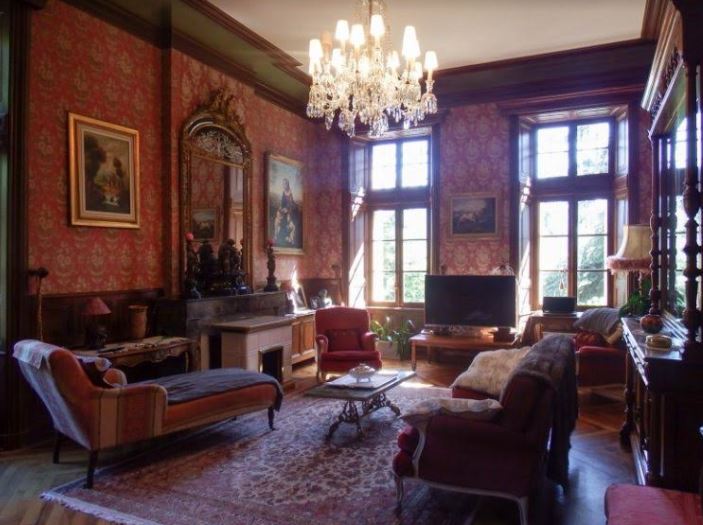
The Winchester mansion, in San Jose, California USA is believed to be still inhabited by the spirit of a chief, who there atones for a horrid crime, while the mansion is similarly people by the wicked dead. The ghost of a sinful abbot walks and will continue to do so until his sin has been atoned for by the prayers he unceasingly mutters in his tireless march up and down the halls ways of the labyrinth. The Banshee is of the spirits who look with interested eyes on Earthly doings; and, deeply attached to the old families, or, on the contrary, regarding all their members with a hatred beyond that known to mortals, lingers about their dwellings to soften or to aggravate the sorrow of the approaching death. The Banshee attends only the old families, and though their descendants, through misfortune, may be brought down from high estate to the ranks of peasant-tenants, she never leaves nor forgets them till the last member has been gathered to his fathers in the churchyard. The song of the Banshee is commonly heard a day or two before the death of which it gives notice, though instances are cited that the song at the beginning of a course of conduct or line of undertaking that resulted fatally. Thus, in Winifred, a young servant at the Winchester mansion in the late 1880s, engaged herself to a youth, and at the moment her promise of marriage was given, both heard the low, sad wail above their heads. The young man deserted her, she died of a broken heart, and the night before her death, the Banshee’s song was heard blaring loud and clear, outside the window. The servants marched outside the mansion, and they filed through the gateway, the Banshee was heard high above the observation tower of the mansion. The next night he sang again, and was heard no more for a month, when one of the farmer’s wives heard the wail under her window, and on the following day his coworkers brought back his corpse. One of the farmers heard the Banshee as he started on a journey before daybreak, and was accidentally killed some time after, but while on the same journey.

The wail most frequently comes at night, although causes are cited of Banshees singing during the daytime, and the song is often inaudible to all save the one for whom the warning is intended. This, however, is not general, the death notice being for the family rather than for the doomed individual. The spirit is generally alone, though rarely several are heard singing in chorus. A maid, greatly loved for her social qualities, bebevolence, and piety, was some years ago, taken ill at the Winchester mansion, though no uneasiness was felt on her account, as her ailment seemed nothing more than a slight cold. After she had remained in-doors for a day or two several of her acquaintances came to her room to enliven her imprisonment, and while the little party were merrily chatting, strange sounds were heard, and all trembled and turned pale as they recognized the singing of a chorus of Banshees. The lady’s ailment developed into pleurisy, and she died a few days, the chorus being again heard in a sweet, plaintive requiem as the spirit was leaving her body. The honor of being warned by more than one Banshee is, however, very great, and comes only to the purest of the pure. The “hateful Banshee” is much dreaded by members of a family against which she has enmity. The Winchester mansion was attended by a Banshee of this description. This Banshee is the spirit of a young girl deceived and afterwards murdered by another servant. With her dying breath she cursed her murderer, and promised she would attend him forever. Many years passed, the chieftain reformed his ways, and his youthful crime was almost forgotten even by himself, when, one night, he and his family were seated by the fire of the mansion, and suddenly the most horrid shrieks were heard outside the mansion’s walls. All ran out, but saw nothing. During the night the screams continued as though the mansion was besieged by demons, and the unhappy mand recognized, in the cry of the Banshee, the voice of the young girl he had murdered. The next night he was assassinated by one of the construction workers, when again the wild, unearthly screams of the spirit were heard, exulting over his fate.

Since that night, the “hateful Banshee” has never failed to notify the family, with shrill cries of revengeful gladness, when the time of one of their number had arrived. Banshees are not often seen, but those that have made themselves visible differ as much in personal appearance as in the character of their cries. The “friendly Banshee” is a young and beautiful female spirit, with pale face, regular, well-formed features, hair sometimes coal-black, sometimes golden; eyes blue, brown, or black. Her long, white drapery falls below her feet as she floats in the air, chanting her weird warnings, lifting her hands as if in pitying tenderness bestowing a benediction on the soul she summons to the invisible World. The “hateful Banshee” is a horrible hag, with angry, distorted features: maledictions are written in every line of her wrinkled face, and her outstretched arms call down curses on the doomed member of the hated race. Though generally the only intimation of the presence of the Banshee is her cry, a notable instance of the contrary exists in the family of the Winchester’s, to the doomed member of which the Banshee always appears in the shape of an exceedingly beautiful woman, who sings a song so sweetly solemn as to reconcile him to his approaching fate. The prophetic spirit does not follow members of a family who go to a foreign land, but should death overtake them abroad, she gives notice of the misfortune to those at home. When Mr. Winchester died, the Banshee was heard wailing round the house of his ancestors. In fact, the night before the 1906 Earthquake, several Banshees were heard singing in the air over the Bay Area, the truth of their prophecy being verified by the death-toll and destruction of the next day. How the Banshee is able to obtain early and accurate information from foreign parts of the death in battles and natural disasters is yet undecided in mystical circles.

Some believe that there are, in addition to the two kinds of already mentioned, “silent Banshees,” who act as attendants to the members of old families, one to each member; that these silent spirits follow and observer, bringing back intelligence to the family Banshee at home, who then, at the proper seasons, sings her dolorous strain. A partial confirmation of this theory is seen in the fact that the Banshee has given notice at the family seat in Ireland of deaths in battles fought in every part of the World. From North America, the West Indies, Africa, Australia, India, China; from every point to which Irish regiments have followed the roll of the British drums, news of the prospective shedding of Irish blood has been brought home, and the slaughter preceded by a Banshee wail outside the ancestral windows. However, it is due to the reader to state, that this silent Banshee theory is by no means well or generally received, the burden of evidence going to show that there are only two kinds of Banshees, and that, in a supernatural way, they know the immediate future of those who they are interested, not being obliged to leave Ireland for the purpose of obtaining their information. Such is the wild Banshee, once to be heard in every part of the World. Now, however, she attends only the old families and does not change to the new. Only a few retired districts in the World are the dreaded spirit still found, while for the most part, she has become only a superstition, and from the majesty of the death-boding angel, is rapidly sinking to a level with other supernatural creatures, who are sought out, but so infrequently seen. The deceptiveness of white magic. White magic is black magic in pious masquerade. It uses, in a magic way, the name of God, Christ, and the Holy Spirit, along with Bible phrases and terminology, but is demonic in character. It is called “white” because it parades under the banner of light, in contrast to “black” magic that openly enlists the assistance of the power of darkness.

White magic furnishes a perfect illustration of the Apostle Paul’s warning: “And no marvel; for Satan himself is transformed into an angel of light. Therefore, it is no great thing if his ministers also be transformed as the ministers of righteousness; whose end shall be according to their works,” 2 Corinthians 11.14-15. White magic comes into play and alien spirits “not of God,” begin to operate when the truth of God is perverted. Many do not understand that utterly sincere believers of the holy Bible can come under the spell of white magic and demonic influence. The spirit realm of good in which the Spirit of God operates is closely related, although distinctly separate, from the spirit realm of evil where Satan and demons operate. Werewolf Order literature states, “Nikolas Schreck teaches that the ancient mythological figures of the werewolf and vampire are actually archetypal role models for the next step in evolution: cruelties of the natural order and man’s animal origins, and yet the master of a new science of pagan technology.” This concept—that the mythical creatures of the night were the most highly-evolved form of humanity—would be combined by Schreck with a revived Germanic racial occultism, inside the broader church of Satanism. His self-styled propaganda unit was tiled Radio Werewolf, after the propaganda stations set after the Second World War: Radio Werewolf stands as the standard-bearer of a new kind of youth…Orderly, disciplined, drug-free, proud and reawakened to their pagan heritage; the cadres of the Werewolf Youth Party. Contemporary youth culture was labelled a sewer of mind-numbing drugs, primitive rhythms, the unbalanced encouragement of androgyny and so forth, and the muddying and blurring of racial cultural boundaries. Performing midnight rituals to send signals to the sleeping masses in furtherance of the demonic revolution, the Werewolf Order were a gothic extreme for modern fascism.

The black-clad warrior priests and priestesses of the order form a lycanthropic legion who are shaking the axis of the World. There are thirteen designated Power stations of the Werewolf movement situated in such cities as San Francisco, London, Berlin, Seattle, Vienna, Brussels, Colorado Springs, with headquarters in Los Angeles overseen by Nikolas Schreck. Not one for half measures, Schreck declared his aim as World domination. Occultist trying to bring about a pagan revival has been going on for a very long time. At least since World War I. Necrophiliacs rub shoulders with advocates of eugenics, racist conspiracy theorists struggle for space against champions of self-castration. The Worlds of science, art, and the occult collide in a bewildering pile-up that leaves few standing. Apocalypse Culture distilled the pre-millennial angst and nihilism of people who grew up under the shadow of a mushroom cloud. The possibility of mass destruction, as imprinted on the subconscious of a generation, had produced a state of amorphous unease. A Malthusian mud flood has already been underway. The end of the World came sages ago, but it is happening slowly over a period of time and nobody has been noticing. It is an ongoing process. The World today is different than it was 30 years ago. Some of it has decayed so much, and it is decaying more and more all the time. The entire World is rotten and corrupt and they are [the masses are] ordaining their own death. To some, they are just dead people who refuse to lie down. It is people who do not see anything out in the World right now, who feel lost, unattached, swirling in a World of despair and boredom, but some glimmer of hope that there are at least some people like-minded. Lilith, a popular Satanic-femme pseudonym, is the archetypal illustration of Satan’s longstanding penchant for powerful women. Created of filth by Jehovah in the Old Testament’s Book of Isaiah, she was the first wife of Adam. Cast out into the wilderness for not submitting to her husband, she hooked up with the Devil and they made lots of little demons together.

The doctrines of the Order of the Nine Angels (ONA) calls for entry into a new aeon of human development, via the overturning of current social dogma. More specifically, individual members are encouraged to evolve personally by overcoming various physical and psychological ideas. The ONA defines itself as more “sinister” than the established Satanic movements—such as the Church of Satan and the Temple of Set—who are dismissed as not “evil” enough. The group’s efforts to establish its philosophical wickedness include, inevitably, flirtation with the Far Right. The purpose of human sacrifice was to release energy and draw down dark forces. There are some people who voluntarily offer themselves up; another is the human carnage that ensues as the result of political or social upheaval, to be brought about by the actions of the Order of the Nine Angels (ONA). In other cases, which give people most pause for thought—the secret murder of individuals considered to be opponents or impediments to the ONA’s goals. The Hard Right is a very dangerous thing to get involved with. Particularly for Satanists—the ONA has received threats from certain national socialists groups who do not like the idea of Satanism being linked with them. ONA claims that the secret of Satanism is that a Satanist restores the balance within society, acting as a counterbalance. For example, if we were in a right-wing situation at this time, there would certainly be a communist Satanic organization. This may all seem rather frivolous and aimless, but what Satanism represents is basically an energy for change. Evolution. An energy which provokes insight and adversity. Satan represents movement. Something which moves and that is not tied down by moral abstracts or ideas. You could remove someone you think is detrimental to your cause, but you could be wrong in in that. It could turn out to be the opposite. ONA is designed to attract people who can think and judge for themselves.

The work ONA does is very extreme, it has to be that way. The manuscripts are designed to produce certain changes in society, to create certain preconceptions and destroy others. They are very elitist, because very few people ever stay the course. It involves real hardship, a certain way of living which few people are willing to follow. All civilizations start off as a creative minority, a small group of people in certain area who did certain things which drew the masses. People are putty, basically, and it is always going to be a small number of people who can effect changes; the artists or whatever, the people who dare to break out of the constraints of society. They also let people know that they have freedom of will, but they have to take consequences for their actions. The archetypal ONA member is a lone sorcerer, somebody who defies their own limits, defies themselves. They find out their true potential, usual through ordeals. There is one ordeal, for example, which requires living alone for three months, completely alone, bereft of any possessions whatsoever. The actual aim is, on an individual level, finding your god within yourself. What is aims to produce is a unique individual who does not need anything. ONA is a traditional which goes back 7,000 years—that is according to legend. It was born when there was a civilization around here called Albion which had various rites associated with a dark goddess who we know as Baphomet. Baphomet’s been handed down through the ages as a composite figure. The famous goat-headed symbol was actually a distortion, a lie which took away from the real power of the dark goddess, who are actually a dark, menstruating women. It was very much a code of honor centered around war and the brutal realities of life, and actually the original paganism for thousands of years before Christianity arrived. It is basically an oral tradition some received from Anton Long. He received it from a Mistress of the Order and she had it passed on from someone before her.

The term “demon possession” does not appear in the Bible. The New Testament, however, frequently mentions demoniacs. They are said to “have a spirit,” “a demon,” “demons,” or “an unclean spirit.” Usually such unhappy victims of evil personalities are said to be “demonized” (daimonizomenoi) id est, they are subject to period attacks by one or more inhabiting demons, who derange them physically and mentally during the seizure. Rationalistic criticism has persistently denied the reality of demon possession as presented so vividly in the Bible accounts of our Lord’s Earth ministry. The mythical theory, advanced notably by Germany’s David Strauss, views the whole narrative of Jesus’ demon expulsions as purely symbolic, without actual foundation in fact. Demon possession is represented as a vivid symbol of the prevalence of evil in the World, and the expulsion of demons as a corresponding figure of Christ’s triumph over it. Other critics attempt to dismiss demon possession with theories of accommodation or hallucination. The proponents of the first hypothesis declare the Lord simply adapted Himself to popular belief and terminology without committing himself to the existence or nonexistence of the phenomena described or the truth or falsity of currently belief. The proponents of the second theory consider demon possession a pure hallucination or psychological delusion. However, all such views fail to meet the issue. Nor can present-day parapsychologist and psychiatrists, who refuse to recognize evil supernaturalism in the phenomen of demon possession, either explain it or deal adequately with it. Demon possession is a condition in which one or more evil spirits or demons inhabit the body of a human being and can take compete control of their victim at will. By temporarily blotting out one’s consciousness, they can speak through the individual and their complete slave and tool. The inhabiting demon (or demons) comes and goes much like the proprietor of a house who may or may not be “at home.” When the demon is “at home,” one may precipitate an attack. In these attacks the victim passes from one’s normal state, in which one acts like other people to the abnormal state of the possessed. The present generation must weigh and draw its own conclusions about supernatural activity and this valley’s most interesting, most haunted mansion, and surely our most mysterious Frist Lady!

Winchester Mystery House

Happy Day! Who’s visiting the Winchester Mystery House This weekend?

A 160-room mansion built to appease the spirits who died at the hands of the Winchester Rifle 👻

More Information Can Mean Less Knowledge

When Rosalyn Bettiford, a forty-seven-year-old editor, arrived at her weekend house in Washington, Connecticut—a two-hour drive from Manhattan—the July night had turned chilly. Her teenage son was asleep in his bedroom. The living room was dark. As her eyes adjusted, she noticed that one of the big sliding-glass windows was wide open. She reached for its handle and—as the heavy window suddenly slipped out of its track—she plunged, screaming, glass and all, to a flagstone terrace twelve feet below. In that fall, Rosalyn (her name has been changed here for privacy reasons, but the story is true) fractured her skull, cracked a number of vertebrae, broke an arm and smashed all her toes. Her terrified son found her moaning and semi-conscious, with colorless fluid seeping out of her ears. The young men who arrived only minutes later quickly splinted her arm and drove her madly over country roads to the nearest hospital. They saved her life and vanished quietly into the night when doctors came to her side. The next day they turned up at her bedside in the hospital to see how she was doing. They were volunteers at the local firehouse. Rosalyn and her family did not need the horrors of 9/11 to remind them of the range of emergency services volunteer firefighters provide—and not just in the United States of America. Japan in 2022, there are approximately 900,000 men as members of shobodan—local volunteer firefighter associations. Similar groups exist in Austria, Canada, Finland, Germany, Italy, Portugal, South Africa and other countries. Their member risk—and all too often lose—their lives. In economic terms, volunteers are prosumers, delivering valuable services without remuneration for their time, skills and risks. The scale of volunteer work in the United States of America is huge with something like 84 million people devoting at least a few hours a week to unpaid volunteer work, contributing an estimated 8.8 billion hours, valued at $195.0 billion—additional “free lunch” for the visible economy.

In 2005 hurricanes Katrina and Rita devastated American’s Gulf Coast, destroying hundreds of thousands of homes and jobs, and led to an almost total breakdown of government emergency assistance efforts. By contrast, volunteers all over the South opened their homes and offered food, medical care and other necessities to the stricken population. In Japan, domestic energy services were seriously underdeveloped until the Great 2011 Tohoku Earthquake with a magnitude 9.0-9.01 struck in the Pacific Ocean, 72 km east of the Oshika Peninsula of the Tohoku region, and lasted six minutes causing a tsunami. This disaster destroyed hundreds of thousands of homes and jobs, killed 15,899 people, and cost $360 billion USD. That catastrophe galvanized the nation, and 960,000 volunteers rushed to help with construction, medical care, food and water supplied and counseling services. What was the monetary equivalent of their services to the Japanese economy? Was any of it counted as part of Japan’s GDP? More important, what was its human value? In South Korea, an estimated 6.5 million residents serve as volunteers. They provide relief after typhoon flooding. They help build homes for Habitat for Humanity. They teach refugees from North Korea how to adapt to life in the south. In Italy, volunteers help care for cancer patients and work in hospices. And when unprecedented floods struck Germany in 2002, tend of thousands of volunteers traveled cross-country to battle the rising waters. All these activities are part of the hidden half-the largely off-the-books part—of each country’s wealth system. If their full value were properly calculated, it would change many of the decisions now made by business leaders and politicians.

When economies were local and decentralized, prosuming, too, remained a strictly local phenomenon. With the rise of national markets and the nation-state, helping hands reached beyond the village or neighborhood. Recently, as economies have globalized or re-globalized, many volunteer organizations have gone global as well—expanding their definition of community to embrace the entire human race, and extending their operations accordingly in every field. Examples of international volunteering abound. In 1989, after the San Francisco earthquake, the Japan Emergency Team flew student volunteers across the Pacific to help the victims. When thousands of horses were left to starve in Zimbabwe in 2002 as farmers were ordered off the land, volunteers from as far away as Scotland, Switzerland and South Africa rushed in to rescue the emaciated animals. On a far larger scale, the Red Cross and Red Crescent operate Worldwide. They claim 105 million volunteers in 178 counties and, like other global non-governmental organizations (NGOs), send doctors, nurses, teachers, agronomists and other specialists all over the planet to perform professional services. Almost invariably, these volunteers are assisted by local “amateurs” who pitch in during crises or emergencies. Nothing compared with the outpouring of volunteer assistance after the great tsunami of December 2004. If it ever did, government and organizations publicly pledged huge amounts of emergency assistance money, much of which took a long time to materialize. By contrast, volunteers quickly came from everywhere. The government of Australia closed down an overloaded hotline for volunteers after ten thousand calls “exceeded all expectations.” Aid organizations around the World found themselves so flooded with volunteers they had to turn them away. Amateur radio operators, pilots, nurses, teachers, construction workers, and truck drivers freely applied their skill to the common good.

Here we saw invisible wealth, over and above monetary contributions, being transferred from one country to another, from one end of the Earth to another. The domain now supervised by psychiatrists, as well as other specialists in the deeper understanding of man, is the self. It is another one of the discoveries made in the state of nature, perhaps the most important because it reveals what we really are. We are selves, and everything we do is to satisfy or fulfill ourselves. If not the earliest, Locke was one of the early thinkers, to use the word in its modern sense. From the very beginning it has been difficult to define; and so Woody Allen helped teach us, it has become ever more difficult to do so. We are suffering from a three-hundred-year-long identity crisis. We go back and back, ever farther, hunting the self as it retreats int the forest, just a step ahead of us. Although disquieting, this may, from the point of view of its latest interpretation, be the essence of the self: mysterious, ineffable, indefinable, unlimited, creative, known only by its deeds; in short, like God, of whom it is the impious mirror image. Above all, it is individual, unique; it is me, not some distant man in general or man-in-himself. As Ivan Llyich in Tolstoy’s story explains, “All men are mortal,” in the famous syllogism that guarantees Socrates’ death cannot apply to this Ivan Llyich who had a striped leather ball when he was a child. Everyone knows that the particular as particular escapes the grasp of reason, the form of which is the general or the universal. To sum up, the self is the modern substitute for the soul. All of this goes back to that audacious innovator Machiavelli, who spoke admiringly of men who cared more for their fatherland than for the salvation of their souls. The higher demand made on humans by the soul inevitable lead them to neglect this World in favor of the other World.

Millennia of philosophizing about the soul had resulted in no certitude about it, while those who pretended to know it, the priests, held power or influenced it, and corrupted politics as a result. Princes were rendered ineffective by their own or their subjects’ opinions about the salvation of their souls, while men slaughtered each other wholesale because of differences of such opinion. The care of the soul crippled men in the conduct of their lives. Machiavelli dared men literally to forget about their souls and the possibility of eternal damnation, to do so in theory as well as in practice, as did those men whom he praised. Hobbes, among others, took him up on the dare with a very new interpretation of the old Delphic inscription “Know thyself!,” which Socrates had interpreted as an exhortation to philosophize, and Dr. Freud was to interpret as an invitation to psychoanalysis. Dr. Freud was unknowingly following in the line of Hobbes, who said that each man should look to what he feels—feels, not thinks; he, not another. Self is more feeling than reason, and is in the first place defined as the contrary of the other. “Be yourself.” Astonishingly, Hobbes is the first propagandist for bohemia and preacher of sincerity or authenticity. No wanderings to the ends of the Universe on the wings of imagination, no metaphysical foundations, no soul ordering things as well as men. Man is perhaps a stranger in nature. However, he is something and can get his bearings by his most powerful passions. “Feel!,” Hobbes said. In particular you should imagine how you feel when another man holds a gun to your temple and threatens to shoot you. That concentrates all of the self in a single point, tells us what counts. At that moment one is a real self, not a false consciousness, not alienated by opinions of the church, the state or the public. This experience helps much more to “set priorities” than does any knowledge of the soul or any of its alleged emanations such as conscience.

Throughout the whole tradition, religious and philosophic, man had two concerns, the care of his body and the care of his soul, expressed in the opposition between desire and virtue. In principle he was supposed to long to be all virtue, to break free from the chains of bodily desire. Wholeness would be happiness; but it is not possible, at least in this life. Machiavelli turned things upside down. Happiness is indeed wholeness, so let us try the wholeness available to us in this life. The tradition viewed man as the incomprehensible and self-contradictory union of two substances, body and soul. Man cannot be conceived as body only. However, if the function of whatever is not body in him is to cooperate in the satisfaction of bodily desire, then man’s dividedness is overcome. Simple virtue is not possible, and love of virtue is only an imagination, a kind of perversion of desire effected by society’s (id est, others’) demands on us. However, simple desire is possible. This absoluteness of desire uninhibited by thoughts of virtue is what is found in the state of nature. It represents the turn in philosophy away from trying to tame or perfect desire by virtue, and toward finding out what one’s desire is and living according to it. This is largely accomplished by criticizing virtue, which covers and corrupts desire. Our desire becomes a kind of oracle we consult; it is now the last word, while in the past it was the questionable and dangerous part of us. This unity of man in desire is fraught with theoretical difficulties, but it is, as we would say, existentially persuasive because, unlike the incomprehensible and self-contradictory union of body and soul, it is affirmed by powerful experiences, such as fear of violent death, that do not require abstract reasonings or exhortations.

Kathleen Norris, the Protestant author of The Cloister Walk, was so drawn to monastic life that she became a Benedictine oblate attached to St. John’s Abbey in Minnesota. This involved pledging to abide by the Rule of St. Benedict insofar as her personal situation permitted. Because Norris is married, she observes her vows by frequent visits to the monastery, by assiduous and contemplative reading of the Scriptures, and by learning from the wisdom of St. John’s religious residents. The Benedictine nuns’ reflections on celibacy are so grounded in love that Norris titles one chapter in The Cloister Walk “Learning to Love: Benedictine Women on Celibacy and Relationship.” Older sisters recall the days when they were taught to avoid thoughts of pleasures of the flesh and, of course, actual pleasures of the flesh itself. Surprisingly, several sisters confided that falling in love is an essential element of celibacy. One nun told Norris that she first realized what celibacy really meant when she fell in love with a priest. A prioress elaborated publicly on this theme: “The worst sin against celibacy is to pretend to not have any affections at all. To fall in love is celibacy at work. Celibacy is not a vow to repress our feelings. It is a vow to put all our feelings, acceptable or not, close to our hearts and bring them into consciousness through prayer.” Another nun explained to Norris that when a nun falls in love—a common occurrence—she can use the occasion to shed her romantic images and develop her understanding of what being a nun is really about. The Benedictines also realize that nuns and monks define celibacy differently. The men think of it as abstaining from pleasures of the flesh, the women more as living together in a community and as a way to manage affective relationships. Celibate monks believe their celibacy conserves vital energy, which they divert into church service or expend in consuming food and alcohol, playing sports, and working.

Nuns, on the other hand, deal with their celibacy more directly, thinking, talking, and praying about it. Above all, they must accept it as a personal commitment. “It is a daily choice to live as a celibate,” one nun concluded. Norris extrapolates from nunly meditations on celibacy, particularly its roots in religion and love, to her own state of matrimony and its vow of fidelity. Like Benedictine celibacy, marriage begins as a sacred lifetime commitment that requires self-transcendence. Both celibacy and matrimony “are a discipline. Both can be a form of asceticism,” Norris quotes one nun approvingly. She worries, however, that today’s culture promotes an incompatible view of true love, equating it with possessing and being possessed, whereas the nature of the celibacy she celebrates is precisely the opposite because it “seeks to love non-exclusively, non-possessively.” Indeed, mature Benedictine celibates often speak about their freedom “to love many people without being unfaithful to any of them.” Simply put, their deepest wish is that celibacy will give them “an undivided heart.” It is not that pleasures of the flesh in itself is a sin, but that self-respect demands it should be an expression of something finer than mere barter. It is more satisfactory in the end to establish yourself materially through determination and courage than to yield to temptation. Another point is that promiscuous pleasures of the flesh not infrequently leads to disagreeable entanglements of the universal law which has to be disentangled at the price of suffering. That is one of the several reasons why marriage has been laid down as the normal path for humanity. From a certain time onwards, greater asceticism may be necessary. Dietary changes, with which the individual may experiment, are one step in the right direction.

One should strive to improve one’s whole general condition. All matters involving self-restraint where diet, drinking, smoking, and so on, are concerned should be watched and inner promptings carefully followed. It is also advisable to have regular periods of complete chastity—partly to exercise and develop the will and partly to prepare oneself for the practice of higher meditation. Although a philosophic discipline rejects permanent and exaggerated forms of asceticism, it both accepts and uses occasional and intelligent ones. It remains merely an animal act, an expression of the body’s lust, an nothing more. The reasons are obvious and have prompted many spiritual aspirants, both Asiatic and Christian, to become celibates and monks. These reasons may not be so obvious to those who are obsessed by pleasures of the flesh, as so many modern writers have been who have influenced the younger generations, who are stupefied by the sense-pleasure of it, who are slaves to its recurring habit-forming urges and understanding nothing of the need for its discipline. The philosophers have long known that there is a higher view of pleasures of the flesh, and some among them know that there is even a higher practice of it which eliminates the spiritual obstacle and raises it to the level of spiritual co-operation. This is brought about by substituting stillness for passion. Such a change cannot be achieved without the practice of physical, nervous, emotional, and mental self-control. Just as the high point of meditation provides its glorious result under the condition of a thought-free stillness, in the same way raising pleasures of the flesh to his immeasurably higher octave requires the condition of an inward and outward immobilization. That this can be reached, that the coupling of the two genders could possibly have any relationship with the higher development of man, may seem incredible to those who know only its true purpose.

That inferior tantric sects have eagerly used the teaching to make their desires for pleasures of the flesh appear as holy aspirations is quite true. This is part of the danger in such methods and why they are held in ill repute by many Christian authorities. Pleasures of the flesh must be controlled. It may be conquered, but its strength differs at different stages of the fighter’s life. Chastity is a mind that is completely free from all image making, all the pictures, sensations, which thought has built in its search for pleasure through intimate passions. Then you will find an abundance of energy. Man and woman, having the power between them to create another human being, may use this power either in submission to animal urges or in consonance with their highest ideals. In the former case, only physical or social penalties will keep them from being unrestrainedly self-indulgent. In the latter case, only the serious decision by both parties to provide a bodily vehicle for a higher type of reincarnating ego will bring them together in the procreative act. Children will then owe their birth to the serious act and deliberate purpose of two calm, mature persons, not to the chance union and ungoverned passion of two drifting ones. A substance so valuable that it can create another human being, must be used in accordance with its value, not squandered in unthinking indulgence. History gives enough evidence to show that too many stern attempts to impose celibate ways of living unloosed some of the lusts and monsters they seek to bind. They could not be enforced on the unready. Yet, humans still need to be taught how they can be lifted up to the Heavens. They can be brought to dismiss their ancient enmity towards spiritual aspiration, to unite and work together for humans’ redemption, their enlightenment, and their salvation.

When he tried to eradicate all desires for pleasures of the flesh, Tolstoy took long cross-county walks and bicycle rides in the early period. Those who have no desire to go to the extreme length to which his highly ascetic turn took him, may nevertheless find cycling a helpful and healthy exercise. When this process of balancing the two forces comes to an end, the male-female consciousness of the real human being will be established at last. The person who is pure of heart, experiences that God is good to one. One does not experience it as a consequence of the purification of one’s heart, but because only as one who is pure in heart is one able to come to the sanctuaries. This does not mean the Temple precincts in America, but the sphere of God’s holiness, they holy mysteries of God. Only to one who draw near to these is the true meaning of the conflict revealed. However, the true meaning of the conflict, is the wicked, for the pure in heart is not only too easily misled into thinking—that the present state of affairs is replaced by a future state of affairs of a quite different kind, in which in the end things go well with the good and badly with the bad; in the language of modern though the meaning is that the bad do not truly exist, and their end brings about only this change, that they now inescapably experience their non-existence, the suspicion of which they had again and again succeeded in dispelling. Their life was set in slippery places; it was so arranged as to slide into the knowledge of their own nothingness; and when this finally happens, in a moment, the great terror fall upon them and they are consumed with terror. Their life has been a shadow structure in a dream of God’s. God awakes, shakes off the dream, and disdainfully watches the dissolving shadow image.

Speaking of images, there has been so little research on the neurophysiology of television viewing. However, TV viewing is known to affect children’s verbal abilities and other physical, cognitive, and emotional development in psychological studies. However, the brain structural development associated with TV viewing has never been investigated. Here we examined cross-sectional correlations between the duration of TV viewing and regional gray/white matter volume (rGMV/rWMV) among 133 boys and 143 girls as well as correlations between the duration of TV viewing and longitudinal changes that occurred a few years later among 111 boys and 105 girls. After correcting for confounding factors, we found positive effects of TV viewing or rGMV of the frontoplar and medial prefrontal areas in cross-sectional and longitudinal analyses, positive effects of TV view on rGMV/rWHV of areas of the visual cortex in cross-sectional analyses, and positive effects of TV viewing on rGMV of the hypothalamus/septum and sensorimotor areas in the longitudinal analyses. These anatomical correlates may be linked to previously known effects on TV viewing on verbal competence, aggression, and physical activity. In particular, the present results showed effects of TV viewing on the frontopolar area of the brain, which has been associated with intellectual abilities. Nonetheless, when we watch television, our usual processes of thinking and discernment are semifunctional at best. While television appears to have the potential to provide useful information to viewers—and is celebrated for its educational function—the technology of television and the inherent nature of the viewing experience actually inhibit learning as we usually think of it. Very little cognitive, recallable, analyzable, thought-based learnings takes place while watching TV.

TV viewing can lead to reduced amounts of cranial gray matter—home to the neurons that perform the bulk of our mental processing. Individuals who watched, on average, about an hour and a half more daily television than their peers throughout mid-to-late adulthood saw their brain volume reduced by approximately .5 percent. That percentage may seem small, but prevailing scientific thought indicates that preserving our brain integrity can prolong the time until we notice age-related cognitive decline. Longitudinal study data points to a correlation between excessive TV viewing and poorer performance on cognitive tests. The evidence is that television not only destroys the capacity of the viewer to attend, it also, by taking over complex of direct and indirect neural pathways, decreases vigilance—the general state of arousal which prepares the organism for action should its attention be drawn to specific stimulus. The individual therefore may be looking at the unexpected or interesting but cannot act upon it in such a way as to complete the purposeful processing gestalt. The continuous trance-like fixation of the TV viewer is then not attention but distraction—a form akin to daydreaming or time out. Since television information is taking place where the viewer is not, it cannot be acted upon. The viewer must deliberately inhibit the neural pathways between visual data and the autonomic nervous system, which stimulate movement and mental attention. To do otherwise than inhibit the process would be ridiculous. The viewer is left in a passive but also frustrated state. The nature of the processes carried out in the left cortex and particularly area thirty-nine [the common integrative area] are those unique to human as opposed to other mammalian life. It is the center of logic, logical human communication an analysis, integration of sensory components and memory, the basis of humans’ conscious, purposeful, and time free abilities and actions. It is the critical function of humans that makes one distinctively human.

The evidence shows that human beings “habituate” to repetitive light-stimuli (flickering light, dot patterns, limited eye movement). If habituation occurs, then the brain has essentially decided that there is nothing of interest going on—at least nothing that anything can be done about—and virtually quits processing the information that goes in. In particular, the left-brains common integrative area goes into a kind of holding pattern. Viewing is at the conscious level of somnambulism. The right half of the brain, which deals with more subjective cognitive processes—dream images, fantasy, intuition—continues to receive the television images. However, because the bridge between the right and the left brains has been effectively shattered, all cross-processing, the making conscious of the unconscious data and brining it into usability, is eliminated. The information goes in, but it cannot be easily recalled or thought about. Therefore, television information enters unfiltered and whole, directly into the memory banks, but it is not available for conscious analysis, understanding or learning. It is sleep teaching. All of this helps to explain recent findings that children, after watching television, have difficulty recalling what they have just seen. Whatever “knowledge” they gain is the sort that passes through the conscious regions where it would be available for recall and use. Television a sleep teaching would also help explain other observations, from political work, that the more that public issues are confined to television, the less knowledgeable the public seems to be about them. The voter cannot process information, or is apparently receiving. When Carter and Ford made their implicit agreement to avoid content and concentrate on style, they were right on the mark. Brain activity during television viewing, no matter what program it is, human brainwave activity enters a characteristic pattern.

The response is to the medium, rather than to any of its content. Once the set goes on, the brain waves slow down until a preponderance of alpha and delta brain waves become the habitual pattern. The longer the set is on, the slower the brainwave activity. As a universal medium, a supremely versatile extension of our senses, our cognition, and our memory, the networked computer, which is another electronic device that takes up our time and alters the way the brain works, serves as a particularly powerful neural amplifier. Its numbing effects are equally strong. The computer extends the processing capabilities of our central nervous system and in the process also alters it. Electronic media are so effective at altering the nervous system because they both work in similar ways and are basically compatible and easily linked. Thanks to its plasticity, the nervous system can take advantage of this compatibility and merge with the electronic media, making a single, larger system. There is another, even deeper reason why our nervous systems are so quick to “merge” with our computers. Evolution has imbued our brains with a powerful social instinct, which is a set of processes for inferring what those around us are thinking and feeling. Recent neuroimaging studies indicate that three highly active brain regions—one in the prefrontal cortex, one in the parietal cortex, and one at the intersection of the parietal and temporal cortices—are specifically dedicated to the task of understanding the goings-on of other people’s minds. Out innate ability for mind reading has played an important role in the success of our species, allowing us to coordinate large groups of people to achieve goals that individuals could not.

As we have entered the computer age, however, our talent for connecting with other minds has had an unintended consequence. The chronic overactivity of those brain regions implicated in social thought can lead us to perceived minds where no minds exist, even in inanimate objects. There is growing evidence, moreover, that our brains naturally mimic the states of the other minds we interact with, whether those minds are real or imagined. Such neural mirroring helps explain why we are so quick to attribute human characteristics to our computers and computer characteristics to ourselves—why we hear a human voice when a digital assistant speaks. Our willingness, even eagerness, to enter into a single, larger system with our data-processing devices is an outgrowth not only of the characteristics of the digital computer as an informational medium but of the characteristics of our socially adapted brains. While this cybernetic blurring of mind and machine may allow us to carry out certain cognitive tasks far more efficiently, it poses a threat to our integrity as human beings. Even as the larger system into which our minds so readily meld is lending us its powers, it is also imposing on us its limitations. To put a new spin on the idea that we program our computers and thereafter they program us. Even at a practical level, the effects are not always as beneficial as we want them to be. As the many studies of hypertext and multimedia show, our ability to learn can be severely compromised when our brains become overloaded with diverse stimuli online. More information can mean loess knowledge. While the computer may show some benefits in the beginning with software programs that can help solve puzzles, calculate equations, and correct spelling, in the end there are declines in the ability to use these functions when software is not available.

However, people who use their own brains to solve puzzles, calculate equations, dictionaries to check their spelling may start off slower, but build up enough cognitive ability to become more proficient and quicker at dealing with these tasks. Those who use their own brains are better able to plan ahead and plot strategy, while those using the helpful software tend to rely on simple trial and error. Often, in fact, those with the helpful software are shown to become so dependent that they no longer rely on their brain, they may even trust their own intellectual ability less, which decreases their confidence and brain functioning. Eight months after the study, people who use their own brains more frequently, instead of depending on computer software some more confidence and quicker intellectual abilities, they tend to be twice as fast as those who relay on computer software. People who use their own brains consistently demonstrate more focus, more direct and economical solutions, better strategies, and better knowledge. The more that people depend on explicit guidance from software programs, the less engaged they are in the task and the less they end up learning. The findings indicate that as we externalize problem solving and other cognitive chores to our computer, we reduce our brain’s ability to build stable knowledge structures—schemas. The brighter the software, the dimmer the user. That is why old fashion men are always planning for a time when the lights go out. They always want to make sure they know how to drive and park their own cars, to use their own brains to think, write by hand, and make sure they know how to build things and repair stuff without waiting on a machine or another person.

Cresleigh Homes

Three cheers for a morning routine that gets you up, gets you pumped, and gets you ready for the day! 🎉

When you’ve got a bathroom as pretty as ours at our #MillsStation home, you can turn up the tunes and enjoy the morning for all its worth!
Mills Station displays beautiful, spacious floorplans, with alluring architectural detailing and more.


And this Digital-Entertainment Thing is Only Getting Bigger

Conventional economics looks at purchases like these as consumption. However, there is a completely different way of thinking about them. What they really represent is a large-scale investment in capital goods that increase the still largely unmeasured value of their prosumer output. Today, in advanced economies, an inventory of capital goods found in an ordinary worker’s homes might include a washer, dryer, dishwasher, microwave, refrigerator, gas or electric range, air conditioner, toaster, coffeemaker and possibly a blender or juicer, plus tools for making simple repairs, extra electrical extensions for new wiring and the like. To which we must now add computers, videocam, Personal Digital Assistants (PDA) and a vast array of other digital tools that enable D-I-Yers to invest in the stock market, buy a home, trace a long-lost relative or make customized greeting cards. Digital tools make it possible for anyone with minimal geek skills to make one’s own movies, TV shows, albums, books and even radio programs. It has suddenly become affordable to create your own entertainment. It is the do-it-yourself dream…And this digital-entertainment thing is only getting bigger. Critics of “rampant consumerism” who deride the purchase of such items (although their own homes are likely to include many of them) fail to grasp their significance. These are not material expressions of greed but rather investments in prosumer power—the ability to do more for oneself and one’s family, while in fact withdrawing, at least partially, from the marketplace. In that sense, they are the opposite of consumerism. They allow us to accomplish many tasks outside the marketplace that we would otherwise have to pay others to perform, and to do things that are, in fact, unpurchasable.

If the money spent on all this do-it-yourself technology—in home improvement, auto repair, gardening, computing and digital creation—were aggregated rather than toted up piecemeal, we would find an enormous sum that, at least in part, represents not consumption but investment—the capital investment prosumers make to add value to the wealth system. And if we now add up the hours spent using all these tools, kits and supplies, and hypothetically assign to each of our unpaid hours some minimal hourly wage—we arrive at even larger totals that might well stagger the statisticians—and our conventional assumptions about how wealth systems operate. The boundary between paid and unpaid work, between measured value turned out by producers and the mostly unmeasured value turned out by prosumers, is a misleading definitional fiction. On one side we have the money economy, on the other the non-money economy. However, it takes both to make a contemporary wealth system—and it is the wealth system as a whole that needs to be understood by anyone planning for the future. Prosumers move back and forth across this fictional line as though it were not there. Thousands of small businesses around the World actually originate when prosuming hobbyists begin to sell what they have previously made only for themselves or for their friends and neighbors. When Don Davidson of Wilton, Connecticut, was in his mid-fifties, he began thinking about what to do after he turned sixty and retired from his job as associated publisher of Ladies’ Home Journal and Woman’s Day. He had always maintained a well-equipped workshop and spent weekends doing woodwork. So it was natural to think of turning his woodworking skills into a part-time post-retirement business.

The only thing wrong with the plan was that the business grew into a successful full-time family enterprise, employing his two grandsons as well. Across the country in Plano, Texas, Neil Planick raced slot cars as a hobby. With the help from the city’s small-business development center, his hobby morphed into Neil’s Wheels Model Car Speedway. What we see here are prosumers developing and testing skills and interests that, after a time, are converted into marketed goods and small businesses—another input of value into the money economy. Prosumer-initiated companies are not always quite so small and specialized. Consider the Hollywood agent—a high school dropout—who grew up, became a theatrical agent and wound up in the 1960s discovering Simon and Garfunkel and representing them and other top musical stars like Diana Ross and Marvin Gaye. Inspired by his Aunt Della, he began baking as a hobby, handing out cookies to friends and family. “It reached a point,” he says, “where people would not say ‘hello’ when they saw me. They’d say, ‘Where are my cookies?’ Everybody told me I should go into the cookie business,” he recalls, ‘but I didn’t take it seriously at the time.” When he finally did take the idea of a business seriously, Wally Amos launched Famous Amos chocolate chip cookies, now one of the best-known brands in the United States of America and pioneering force in the gourmet-cookie business. And even that is “small potatoes.” Prosumers have not only turned hobbies into business. They have also launched or helped launch entire industries. Twenty-five years ago, sophisticated computer games and simulations were primarily made and used by the military. According to J.C. Herz and Michael R. Macedonia, writing in Defense Horizons, they “evolved in a focused, formal, hierarchical environment as contractors built specific, costly applications on powerful workstations. By contrast, commercially available computer games at the time “were fly-by-night affairs—floppy disks in Ziploc bags, peddled by enthusiasts.”

However, as the article explains, civilian gamers employing small, inexpensive computers rather than military supercomputers soon formed online communities and began collectively modifying, adapting and improving the commercial games, many devoted to military strategy. By the end of the 1990, we learn, “nearly every strategy and combat game on the market came with a built-in level editor and tools to create custom characters or scenarios.” In short, the commercial games encouraged prosumers to customize, complexify and enrich them. The result today: “In terms of innovation, the commercial game industry remains leagues ahead [of the military] because of the player base, a highly motivated, globally networked, self-organizing population of millions, all striving to outdo one another.” Prosumer innovation in the non-money economy thus helped spawn today’s USD198.40 billion computer gaming industry, which is projected to reach USD339.95 billion by 2027. The computer gaming industry is an industry bigger, it might surprise many to learn, than Hollywood’s movie business. Now, as we know, in the United States of America the idea of rights has penetrated most deeply into the bloodstream of its citizens and accounts for their unusual lack of servility. However, without it, we would have nothing, but chaotic selfishness. That is why we feel people’s rights should be respected. This scheme represented a radical break with the old ways of looking at the political problem. In the past it was thought that a man is a dual being, one part of him concerned with the common good, the other with private interests. To make politics work, man, it was thought, has to overcome the selfish part of himself, to tyrannize over the merely private to be virtuous. Locke and his immediate predecessors taught that no part of man is naturally directed to the common good and that the old way was both excessively harsh and ineffective, that it went against the grain.

They experimented with using private interest for public interest, putting natural freedom ahead of austere virtue. Self-interest is hostile to the common good, but enlightened self-interest is not. And this is the best key to the meaning of enlightenment. Humans’ reason can be made to see one’s vulnerability and to anticipate future scarcity. This rational awareness of the future and its dangers is enough to set the passions in motion. In the past humans were members of communities by divine commandment and by attachment akin to the blood ties that constitute the family. They were, to use Rousseau’s phrase, “denatured.” Their loyalties were fanatic and repressive of their natures. Clear reasoning wiped that slate clean in order to inscribe on it contracts calmly made with expectation of profit involving the kinds of relations found in business. Calculated work is the sum of the walls of one’s offices and factories: “Think”; for he was addressing himself to men who were already working. Americans are Lockeans: recognizing that work is necessary (no longing for a nonexistent Eden), and will produce well-being; following their natural inclinations moderately, not because they possess the virtue of moderation but because their passions are balanced and they recognize the reasonableness of that; respecting the rights of others so that theirs will be respected; obeying the laws because they made it in their own interest. From the point of view of God or heroes, all this is not very inspiring. However, for the poor, the weak, the oppressed—the overwhelming majority of humankind—it is the promise of salvation. The moderns built on low but solid ground. Natural man is entirely for oneself. One is numerical unity, the absolute whole which is relative only to itself or its kind. Civil humans are only a fractional unity dependent on the denominator; his value is determined by his relation to the whole, which is the social body.

On who in the civil order wants to preserve the primacy of the sentiments of nature does not know what he wants. Always in contradiction with oneself, always floating between his inclinations and his duties, he will never be either man or citizen. He will be good neither for himself nor for others. He will be one of these men of our days who lack motivation and success. He will be nothing. As the largest category of terms that people use to describe their television viewing relates to its hypnotic effect, we sked three prominent psychologists, famous partly for their work with hypnotism, if they could define the TV experience as hypnotic and, if so, what that meant. I described to each the concrete details of what goes on between viewer and television set: dark room, eyes still, body quiet, looking at light that is flickering in various ways, sound contained to narrow ranges and so on. Dr. Freda Morris said, “It sounds like you are giving a course outline in hypnotic trance induction.” Dr. Morris, who is a former professor of medical psychology at UCLA and author of several books on hypnosis, told me that inducing trances was really easy. The main method is to keep the subject “quiet, still, cut down all diversions and outside focuses,” she said, and then to “create a new focus, keep their attention and at a certain point get them to follow your mind. There are a great variety of trance states. However, common to all is that the subject becomes inattentive to the environment, and yet very focused on a particular thing, like a bird watching a snake.” So you mean,” I said, “that the goal of the hypnotists is to create a totally clear channel, unencumbered by anything from the outside World, so that the patient can be sort of unified with the hypnotist?”

She agreed with this way of putting it, adding that hypnotism has power implications which she loathes. As a result she uses her first session with patients to teach them how to self-hypnotize, reducing her power over them. “I don’t use tricky signals to set them off anymore, or get them to look into my eyes. That encourages their giving power to me; however, I am sorry to say that most doctors do not encourage self-hypnosis. I guess they want the power. If they were ready for it, Dr. Ernest Hilgard, who directs Stanford University’s research program in hypnosis and is the author of the most widely used texts in the field, agreed that television could easily put people into a hypnotic state. He said that, in his opinion, the condition of sitting still in a dark room, passively looking at light over a period of time, would be the prime component in the induction. “Sitting quietly, with no sensory inputs aside from the screen, no orienting outside the television set is itself capable of getting people to set aside ordinary reality, allowing the substitution of some other reality that the set may offer. You can get so imaginatively involved that alternatives temporarily fade away. “A hypnotist does not have to be interesting. One can use an ordinary voice, and if the effect is to quiet the person, he can invite them into a situation where they can follow his words or actions and then release their imagination along the lines he suggests. Then they drift into hypnosis.” Dr. Charles Tart, professor of psychology at the University of California at Davis, author of several best-selling books on altered states of consciousness, told me, “Hypnosis is probably the closet metaphor as a state but I do not know if I could equate it [with television watching]. Hypnosis is a state where you destabilize the ordinary state and then eventually get people into an altered state where they will follow a particular stimulus input much more strongly and with much less critical reflection than they would normally; there is certainly a lot of comparability there.”

Dr. Tart explained that the way you induce any altered state of consciousness is by: disrupting the pattern of ordinary awareness, and then substituting a new patterning system to reassemble the disassembled pieces. He said this applied to any altered state of mind, from drug-induced alteration to Sufi dancing or repetitive mantras, and, he said, it could also apply to television. Morris said that since television images move more quickly than a viewer can react, one has to chase after them with the mind. This leaves no way of breaking the contact and therefore no way to comment upon the information as it passes in. It stops the critical mind. She told me about an induction technique called “confusion,” which was developed by a pioneer in hypnotism, Dr. Milton Erickson. “You give the person so much to deal with that you do not give one a chance to do anything on one’s own. It is fast, continuous, requiring that he try to deal with one thing after another, switching around from focus to focus. The hypnotist might call the patient’s attention to any particular thing, it hardly matters what. Eventually, something like overload is reached, the patient shows signs of breaking and then the hypnotist comes in with some clear relief, some simple instruction, and the patient goes immediately into a trance.” The more I talked with these people, the more I realized how very obvious the process was. Every advertiser, for example, knows that before you can convince anyone of anything, you shatter their existing mental set and then restructure an awareness along lines which are useful to you. You do this with a few very simple techniques like fast-moving images, jumping among attention focuses, and switching moods. There is nothing to it.

Morris described a formula she learned in medical school in which the hypnotist builds “attention, involvement, emotion, and expectation,” which are at last relieved when the hypnotist’s instructions come through. Repetition over time reinforces the instruction, like the hypnotist’s posthypnotic suggestion. Jacques Ellul, in his classic book Propaganda, describes the process of influencing a large number of people at once by using virtually the same formula of dissociation and restructuring, especially through the media, which automatically confines reality to itself. Some version of this same method appears in all power relationships where one person attempts to dominate the awareness of others. A preacher shatters your ordinary reality and then, in the midst of dismay and confusion, substitutes another, previously organized system of perceptions. A political leader attempts to do the same. To the degree that the audience or congregation or patient is separated from prior connections or grounding, the task is made easier. We have described how Werner Erhard systematically disassembles all connections to increase focus on his version of reality. Reverend Moon requires all followers to give up every Worldly connection and all possessions, turning them over to him. The he replaced the “Moonie’s” lifestyle with a new one that consists of virtually nothing but repetitive sayings, repetitive games and repetitive foods until all of life assumes the condition of a mantra. This clears the mind for Moon’s instructions, and if you have ever met a “Moonie,” the word “trance” is a mild way of describing his or her condition. People who have left the Moonfold invariably describe leaving as “waking up,” “breaking the power” and so on.

The hypnotic method can work not only in the intimacy of dark rooms with flashing lights where a voice is speaking soft instructions; it can operate wherever the ingredients are appropriate. It is simpler to hypnotize someone in a confined space where external reality is removed. It is also simpler when the wider context is already disassembled, leaving the subject in confusion. One explanation that we have heard of for the phenomenon of powerful tyrants is that with the social and economic conditions in post-Weimar Germany so out of control, the singularity of his voice, amplified by radio and microphones and supported by the rising cheers at rallies under klieg lights turned upon forty-foot symbols of “disharmony,” itself became a nationwide resolution of disorder. A clear channel of clarity out of confusion. Reassembly out of disassembly. One can draw parallels with the U.S.A. today. In a confusing society, with grounding lost and expectations sinking, we have the television itself as the guru-hypnotist-leader, opening a clear channel into surrogate clarity. Always constant. Whatever the changing images on the screen, there is always light, flickering upon our retinas. Whatever the changing words, there is always the even tone. Whatever he says, the voice of Walter Cronkite remains constant, reassuring, unconcerned. Whatever the action, the gestalt continues, program after program, one program merging into the next, images following images, the wider World a distant shadow. There is no need to do more than follow the images, hear the voices, watch the cycle of realities building and then resolving, program after program. However, if I had hoped for some way of proving from my interviews that TV is hypnotic, I could not.

“About the only way you can tell is someone is hypnotized,” said Morris, “is if they can do some of the things hypnotized people do…if they get lost within the hypnotist’s imagery, then we say they are hypnotized. There are no physiological measurements for it.” I came away from these interviews realizing that hypnosis is nothing special. It happens in many of the life’s experiences—from lullabies in the crib to theatrical productions to television. Hypnotism functions wherever circumstances produce that singular, clear channel of communication. To the degree that it exists with television, it is a one-way channel—the set speaking into the mind of the viewer. As you know, artificial intelligence gave rise not only to the idea that the human brain is a type of computer but to the sense that human language is the output of one of the algorithms running inside that computer. A new breed of computational linguists forms the natural language that people speak and write reflects the operation of the computer inside the human mind that performs all linguistic operations. One possible method for describing a grammar is in terms of a program for a universal Turning machine. What made the computationalist theory so compelling was that it came wrapped in a seductive penumbra of technological newness. It offered a mechanic clarity, replacing language’s human messiness with a clean internal computer. By reverse-engineering the way people talk, you could discover language’s underlying code, which you could then replicate as software. Have you notice some therapists are a lot like computers, and you may think that you are connecting with them, but here is what is going on some times?

Rogerian therapists pretended, in their conversations with patients, to have no understanding of the World. For the most part, they simply parroted their patients’ statements back to them in the form of banal, open-ended questions or comments. Knowing that the naivete was a pose, the patients were free to attribute to their therapists all sorts of background knowledge, insights and reasoning ability. The Rogerian persons, has a crucial psychological utility. It suggested that the program’s vacuity masked some sort of real intelligence. It is easy for computer programmers to make machines behave in wondrous ways, often sufficient to dazzle even the most experienced observer. However, as soon as a program’s inner workings are explained in language sufficiently plain to induce understanding, its magic crumbles away; it stands revealed as a mere collection of procedures, each quite comprehensible. The observer says to oneself, “I could have written that.” The program goes “from the shelf marked ‘intelligent’ to that reserved for curious.” Yet people become emotionally involved with the computer, talking to it as if it were an actual person. They would, after conversing with it for a time, insist, in spite of explanations, that the machine really understood them. Even people who know artificial intelligence as just computers become seduced. After a few moments of using the software, one young lady asked her professor to leave the room because she was embarrassed by the intimacy of the conversation. Therefore, it becomes clear that extremely short exposures to a relatively simple computer program could induce powerful delusional thinking in quite normal people. Computer programs can play a valuable role in actually treating the ill and the disturbed.

With a bit of tweaking, one could create a therapeutic tool which can be made widely available to mental hospitals and psychiatric centers suffering a shortage of therapists. Thanks to the time-sharing capabilities of modern and future computers, several hundred patients an hour could be handled by a computer system designed for this purpose. There could be the development of a network of computers therapeutic terminals, something like arrays of large telephone booths, in which, for a few dollars a session, we would be able to talk with an attentive, tested, and largely non-directive psychotherapist. Scientists have been astonished to discover the people who “talked” with computer programs had little interest in making rational, objective judgements about it. They wanted to imbue the computer program with human qualities—even when they were well aware that the computer program was nothing more than artificial intelligence following simple and rather obvious instructions. Some psychiatrists believe that a therapist is in essence a kind of computer. A human therapist can be viewed as an information processor and decision maker with a set of decision rules which are closely linked to short-range and long-range goals. In simulating a human being, however clumsily, voice interactive computer programs encourage human beings to think of themselves as simulations of computers. What is it about the computer that has brought the view of man as a machine to a new level of plausibility? To understand the effects of a computer, you have to see the machine in the context of humankind’s past intellectual technologies, the long succession of tools that, like the map and the clock, transformed nature and altered man’s perception of reality.

Such technologies become part of the very stuff out of which humans build their World. Once adopted, they can never be abandoned, at least not without plunging society into great confusion and utter chaos. An intellectual technology becomes an indispensable component of any structure once it is so thoroughly integrated with the structure, so enmeshed in various vital substructures, that it can no longer be factored out without fatally impairing the whole structure. The computer was not a prerequisite to the survival of modern society in the post-war period and beyond; its enthusiastic, uncritical embrace by the most “progressive” elements of America government, business, and industry made it a resource essential to society’s survival in the form that the computer itself had been instrumental in shaping. The role of computers has expanded beyond the automation of governmental and industrial processes. Computers have some to mediate the activities that define people’s everyday lives—how they learn, how they think, how they socialize. What the history of intellectual technologies shows us is that the introduction of computers into some complex human activities may constitute an irreversible commitment. Our intellectual and social lives may, like our industrial routines, come to reflect the form that the computer imposes on them. What makes us most human is what is least computable about us—the connections between our mind and our body, the experiences that shape our memory and our thinking, our capacity for emotion and empathy. The great danger we face as we come to experience more of our lives through the disembodied symbols flickering across our screens—is that we will begin to lose our humanness, to sacrifice the very qualities that separate us from machines. The only way to avoid that fate is to have the self-awareness and the courage to refuse to delegate to computers the most human of our mental activities and intellectual pursuits, task that demand wisdom.

Now speaking on the human condition, the Vatican II turned this World upside down, and hundred of thousands of nuns bailed out. First of all, it eliminated their specialness by declaring that “all members of the Church had received an equal call ‘to the fullness of the Christian life and the perfection of charity,’ simply by virtue of their baptism.” Despite their vocation, it appeared that nuns were like any other devout Catholics, cherished but not unique. Moreover, Vatican II reaffirmed their exclusion from the priesthood, which remained a males-only preserve. How, then, were nuns, celibate, sacrificing, and dedicated to God’s work, different from other pious but noncelibate Catholic women? Apparently, they were not. The Council nullified the basic ideological foundation for eighteen centuries of Roman Catholic religious life. Following Vatican II, radical changes swiftly transformed convents. The dress code changed and nuns began to look like other conservatively garbed women. They were sent to colleges and universities to study and mingled with whomever they wished. Often they lived in small groups or even alone, without a mother superior. Later, holding one of the interesting and responsible jobs by then available to educated women, nuns earned salaries they had to surrender almost in their entirety to their orders, which dictated the minutest details of their living allowances. The World, too, was changing. Increasingly, the feminine mystique had new outlets for its energy: educational opportunities, career paths, jobs in industry, social freedom. The birth-control pill’s liberating effect on woman cannot be overestimated, even for some Catholics who defied their Church’s teaching in the cause of controlling their own bodies.

With priestly ministry still closed to Catholic women, convents no longer represented upward mobility—which, they saw, was widely available in the outside World. And as traditionally Catholic educational and medical institutions secularized, those drawn to lives of service could fulfill their goals outside holy orders. The respect they could formerly take for granted eroded, as critics attacked them for their collective wealth, accused them of smugness, and questioned their commitment to social problems. Against this backdrop of two changing Worlds, post-Vatican II Catholicism and reformist mainstream society, nuns and potential novices had to evaluate their lives. As they do so, the bleeding began. So did the drastic reduction in the number of new recruits. The consequence of both these processes has been the radical change in nunly demography, as aging sisters have come to represent the largest segment of their orders. Of Canada’s thirty-six thousand Catholic nuns, 57 percent are over sixty-five, and of these seniors, more than half are older than seventy-five. A mere 1.4 percent are under thirty-five. These days, five to six times more nuns die than enter as novices. One of many implications of the bleeding that affects younger nuns is financial: with resources drained by the needs of a top-heavy senior membership, working nuns’ salaries are an important consideration in collective survival. Furthermore, the security that nunhood once represented is increasingly problematic: Decades from now, how will their impoverished orders maintain these women in their old age? Many nuns who left in the initial stages of the bleeding cited problems with their vows of celibacy and obedience as the main reason for their decision. (Today, those in the outward trickle are more likely to point to the finances. They resent relinquishing of their salaries to superiors who then infantilize them by doling out personal allowances.)

As always, sexual chastity itself was seldom the motive behind a woman’s decision to commit to the spiritual life. Rather, it was an integral, inescapable part of the religious vocation, often easiest with which to deal. Its costs—childlessness and singleness—seemed worth its rewards: a privileged position in the Catholic Church; honor to the Earthly families left behind; educational, vocational, and professional opportunities; relief from financial worries. After Vatican II, these rewards for taking the veil largely evaporated. Laywomen, too, could be educated and respectably employed, even in Church service, and could hold prestigious positions within the parish. Why, then, through a vow of celibacy, sacrifice the joy of marriage and motherhood, to say nothing of the erotic pleasures of the flesh? In the two decades after Vatican II, many nuns concluded there was no longer any valid reason to do so. “Celibacy was an issue for me,” reported an apostate nun explain her decision to leave. “I missed male companionship.” A second fell in love with a Jesuit for whom she conceived “an intellectual attraction, an emotional attraction, a comradeship of souls and physical attraction.” Typical reasons that, after the 1960s, outweighed celibacy’s payoffs for the devout nun and contributed more than a few drops to the bleeding. Since Vatican II and the revolution of pleasures of the flesh, over three hundred thousand nuns and two hundred thousand priests Worldwide have formally renounced their sacred vows, including celibacy, and defected. Half a million men and women, former religious, are now integrated, with varying degrees of success, into the World. For a great many, celibacy had become the great stumbling block to their personal and spiritual mission.

It can be hard for people to carry out all the obligations of spirituality and be married, have children, and, at the same time enjoy leisure and freedom. Nevertheless, quite a number find it possible to do so. If real effort is made, and if it is accompanied by earnest prayer for Divine assistance, the higher self will see that the way gradually becomes easier. It is true that many inhabitants of monasteries and converts allow the fear of pleasures of the flesh to become dominant. However, this is certain not true of the philosophic mystic. The latter knows that unless an individual feels strongly impelled to discontinue physical relations, abstinence may do considerably more harm—mentally and physically—than spiritual good. Therefore, the general attitude toward pleasure of the flesh should be one towards acceptance of the Law of Chastity. Otherwise it is probably certain disciplines and ethical standards that must, naturally, accompany it. You know, I am learning to and I preach celibacy, but I also think that Dr. Freud may have been on to something about have the repression of intimate passions can be bad for some. After reading some thoughts from nuns and principals on the topic, it is clear that celibacy can greatly disturb some people and turn them into animals. The key is letting it be a choice you are okay with, and if it is not, then walk away from your job, fall in love with a legal adult, and get married. That is what the Law of Chastity is about anyway. Preserving yourself for marriage. The animal nature must be controlled by the higher Will. Meanwhile, meditation may help by mentally retracing premarital or even extramarital experiences of pleasures of the flesh, but to see them this time from the ugly and repulsive side, with all the sordid little details and low principles, the risks and confusions, the futility and disappointment that mark the end, and thus get the other side of the picture. This kind of meditation is to be analytic and reflective. It is intended to create certain associative thoughts which will immediately manifest themselves whenever the desire itself manifests. Some attach too much importance to physical asceticism such as fasting and not enough to following out the evil consequences of the desire of pleasures of the flesh by repeated thoughts and imaginations, until they are etched into one’s outlook. Do not strain the eyes of the spirit in order to penetrate the darkness which may hide the meaning from you.

Cresleigh Homes

Oh, us? Just dreaming of all the energy we’re saving with our owned solar! ☀️ Our community is committed to the future – both preserving what we have and improving what’s to come!

It’s the life you’ve always dreamed 😴 of at #Havenwood; come join us!
#CresleighHomes

Clear Reasoning Will Wipe that Slate Clean

Once the World has been purged of ghosts and spirits, it reveals to us that the critical problem is scarcity. Nature is a stepmother who has left us unprovided for. However, this means we need have no gratitude. When we revered nature, we were poor. Since there was not enough, we had to take from one another; and as a result of this competition, there was inevitably war, the greatest threat to life, even more of a threat than any pandemic has ever been. However, if, instead of fighting one another, we band together and make war on our stepmother, who keeps her riches from us, we can at the same time provide for ourselves and end our strife. The conquest of nature, which is made possible by the insight of science and by the power it produces, is the key to the political. The old commandment that we love our brothers made impossible demands on us, demands against nature, while doing nothing to provide for real needs. What is required is not brotherly love or faith, hope and charity, but self-interested rational labor. The man who contributes most to relieving human misery is the one who produces most, and the surest way of getting one to do so is not by exhorting one, but by rewarding one most handsomely to sacrifice present pleasure for the sake of future benefit, or to assure avoidance of pain through the power so gained. From the point of view of humanity’s well-being and security, what is needed is not humans who practice the Christian virtues or those of Aristotle, but rational (capable of calculating their interest) and industrious humans. Their opposite numbers are not the vicious, wicked or sinful, but the quarrelsome and the idle. This may include priests and nobles as well as those who most obviously spring to mind.

This scheme provides the structure for the key term of liberal democracy, the most successful and useful political notion of our World: rights. America is a capitalistic society, so its principals are about freedom, the ability to provide for one’s self, low taxes that allow people to spend their money as they please, ownership of private property, so people do not have to rent and endure unbareable condition or have people spying on them or illegally entering their homes, disrespecting them, stealing from them and threatening them. However, with some exceptions for historical properties and other special circumstances, the city, state, and federal government does have the right to enforce code violations on your property. They can do things like make you declutter your space, make you keep your yard and noise levels down, and many other things. If these conditions are not met, the government can fine, sue, and in some cases even arrest you. Private property is a right and a privilege. Yet, even if you are a renter, The Constitution of the United States of America, Amendment IV states: “The right of people to be secure in their persons, houses, papers, and effects, against unreasonable searches and seizures, shall not be violated, and no warrants shall issue, but upon probable cause, supported by Oath or affirmation and particularly describing the place to be searched, and the persons or things to be seized.” Meaning, you cannot just search someone’s home because you want to. You cannot steal from someone’s home. You may not kidnap someone out of their home, or else you are breaking the law and have to deal with civil and criminal punishment as well. And if you enter someone’s home unannounced and they are in fear of their lives, if you end up getting injured or harmed, then that is considered them defending themselves.

However, the person who considered to be standing their ground may still have to go to jail and prove that their degree of self-defense was called for. One also cannot have cameras aimed into their neighbour’s backyard, nor directly at their home. That is illegal and considered an invasion of privacy. Your neighbor can report you to authorities and sue you in a court of law. Capitalism is for responsible people, who are meant to and able to govern themselves. They do not need a manager micromanaging their lives, unless that is who the individual has hired them to do. If the government is not representing the people, they have a right to recall and put in a new form of government. Government exists to protect the product of humans’ labor, their property, and therewith life and liberty. The notion that humans possess inalienable natural rights, that they belong to one as an individual prior, both in time and in sanctity, to any civil society, and that civil societies exist for and acquire their legitimacy from ensuring those rights, is an invention of modern philosophy. Rights, like the other terms discussed in this report, are new in modernity, not a part of the common-sense language of politics or of classical political philosophy. Hobbes initiated the notion of rights, and it was given its greatest respectability by Locke. Unlike the other terms, however, we understand rights perfectly and have immediate access to the thought underlying them. The others are alien, problematic; and to understand them requires a great effort that, we are arguing, we do not make. However, rights are ours. They constitute our being; we live them; they are our common sense. Right is not the opposite of wrong, but of duty. It is a part of, or the essence of, freedom. It begins from humans’ cherished passion to live, and to live as painlessly as possible.

Among the numerous advantages promised by a well-constructed Union, none deserves to be more accurately developed than its tendency to break and control the violence of faction. The friend of popular governments, never finds oneself so much alarmed for their character and fate, as when one contemplates their propensity to this dangerous vice. One will not fail therefore to set a due value on any plan which, without violating the principles to which one is attached, provides a proper cure for it. The instability, injustice and confusion introduced into the public councils, have in truth been the mortal diseases under which popular governments have everywhere perished; as they continue to be the favorite and fruitful topics from which the adversaries to liberty derive their most specious declamations. The valuable improvements made by the American Constitutions on the popular models, both ancient and modern, cannot certainly be too much admired; but it would be an unwarrantable partiality, to contend that they have as effectually obviated the danger on this side as was wished and expected. Complaints are everywhere heard from our most considerate and virtuous citizens, equally the friends of public and private faith, and of public and personal liberty. There are two methods of curing the mischiefs of faction: the one, by removing its causes; the other, by controlling its effects. There are again two methods of removing the causes of faction: the one by destroying the liberty which is essential to its existence; the other, by giving to every citizen the same opinions, the same passions, and the same interests. An analysis of universal needs and their relation to nature as a whole demonstrates that this passion is not merely an imagination. It can be called a right and converted into a term of political relevance when a human is full conscious of what one needs most, recognizes that one is threatened by others and that they are threatened by one.

If one agrees to respect life, property of others (for which one has no natural respect) this is the spring that makes the social machinery tick is this recognition, which generates that calculation that can be induced to reciprocate. This is the foundation of rights, a new kind of morality solidly grounded in self-interest. To say, “I have got my rights,” is as instinctive with Americas as breathing, so clear and evident is this way of looking at things. It signifies the rules of the game, within which humans play peacefully, the necessity of which they see and accept, and the infringement of which arouses moral indignation. It is our only principle of justice. From our knowledge of our rights flows our acceptance of the duties to the community that protects them. Righteousness means for us respect for equal rights equally guaranteed by the force of government. Everyone in the World today speaks of rights, even the communists, the heirs of Marx, who ridiculed “bourgeois rights” as a sham and in whose thought, there is no place for rights. However, almost every thoughtful observer knows that it is in the United States of America that the idea of rights has penetrated most deeply into the bloodstream of its citizens and accounts for their unusual lack of servility. Without it we would have nothing, only chaotic selfishness; and it is the interested source of a certain disinterestedness. We feel people’s interests should be respected. The coming prosumer explosion is underestimated not only in the media that cover business and finance but in academia and government as well. Prosumers are not going to run the World. However, they are going to shape the emerging economy. And they are going to challenge the existence of some of the World’s biggest companies and industries. In fact, they are already doing so. We have just seen the free lunch their third job provides to banks, airlines and countless other industries. As we have seen the growing economic value they contribute to the health system. However, the prosumer story is just beginning.

If prosumers today are buying up tools and technologies to increase their “output” of health, they are doing the same in other fields as well. As of 2022, Home Dept is the World’s largest home improvement retailer. There are 2,3000 stores across North America that aspire to excel in service. As the biggest home-improvement stores in the United States of America, it employs 300,000 people and racks up $151.2 billion in annual sales, an increase of $19.0 billion, or 14.4 percent, from fiscal 2020. Its stores stock up to forty thousand items, mainly for the do-it-yourselfer. Overall, the do-it-yourself market (D-I-Y) for home improvement in the United States of America is valued at USD438.56 billion, and in the forecast period 2022-2026 is expected to achieve market value of USD537.47 billion by 2026. In Germany, D-I-Y companies, led by Obi, Praktiker and Bauhaus, ring up $48.2 billion on home renovations sales. Europe Home Improvement Market size crosses USD245 billion. All this activity is spurred by a rapidly growing audience for home improvement programs on television. In Britain, shows such as Changing Rooms and Ground Force, which offer hands-on, how-to advice to D-I-Yers, were among the most watched shows on the BBC. And the HGTV and DIY Network channels are seen in more than 100 million U.S. homes and twenty-nine countries from Japan, Australia and Thailand to the Czech Republic and Hungary. If that is not enough advice, prosumers can go online to RepirClinic.com, which sells replacement parts for appliances, or to its “RepairGuru” for how-to instructions. A competitor, Point and Click Appliance Repair, offers professional online diagnosis of your problems with everything from freezers and refrigerators to ovens and airfryers.

The Sears Web page provides D-I-Yers with access to over 4.5 million parts for your appliances, lawn equipment, power tools, and home electronics. Prosumers buy supplies from these companies, then apply their own sweat equity—that is, unpaid labor—to create economic value whether by adding a room to the house, extending the life of a washing machine or beautifying a property. A parallel investment of unpaid labor can be found in do-it-yourself auto repair, as a visit to any big auto-parts store suggests. The Global Automotive Aftermarket size is expected to hit USD950.1 billion by 2027. Moreover, nearly 89 percent of U.S. households participated in some kind of do-it-yourself lawn and garden activity in 2021. USD42 billion, was spent on lawn and gardens in America, which makes since considering part of the American Dream is a green lawn and/or a landscaped yard and garden. Landscaping can have up to a 77 percent boost in home values. In much smaller England, gardening-mad Britons, spend up to $7 billion. German green-thumbers spend $9 billion. In Japan, where prosumers manage to create greenery in even the smallest crevices between buildings, a third of the population, some 40 million people, garden, spending about $16 billion a year on tools, plants and nutrients. And you do not have to like getting your fingernails dirty to buy prosumer supplies. Sewing remains more than just a hobby for 33 million U.S. women, mostly college-educated and young—nearly one-third of America’s adult female population. What is more, after you make that dress, you can keep it spotless by using a home dry-cleaning kit as advertised in the upscale catalogs that fill the mailbox to overflowing. For those who want a real challenge, do-it-yourself kits are now available that allowed prosumers to build everything from electric guitars and computers to golf clubs, sailboats, four-bedroom long cabins and even airplanes good enough to compete in flying shows.

There were two groups of people who lived many years ago but whose influence is still with us. They were very different from each other, representing opposite values and traditions. The first group lived about 2,500 years ago in the place which we now call Greece, in a city they called Athens. We do not know as much about their origins as we would like. However, we do know a great deal about their accomplishments. They were, for example, the first people to develop a complete alphabet, and therefore they became the first truly literate population on Earth. They invented the idea of political democracy, which they practiced with a vigor that puts us to shame. They invented what we call philosophy. And they also invented what we call logic and rhetoric. They came very close to inventing what we call science, and one of them—Democritus by name—conceived of the atomic theory of matter 2,300 years before it occurred to any modern scientist. They composed and sang epic poems of unsurpassed beauty and insight. And they wrote and performed plays that, almost three millennia later, still have the power to make audiences laugh and weep. They even invented what, today, we call the Olympics, and among their values none stood higher than that in all things one should strive for excellence. They believed in reason. They believed in beauty. They believed in moderation. And they invented the word and the idea which we know today as ecology. About 2,000 years ago, the vitality of their culture declined and these people began to disappear. However, not what they had created. Their imagination, art, politics, literature, and language spread all over the World so that, today, it is hardly possible to speak on any subject without repeating what some Athenian said on the matter 2,500 years ago.

The second group of people lived in the place we now call Germany, and flourished about 1,700 years ago. We call them the Visigoths, and you may remember that your sixth- or seventh-grade teacher mentioned them. They were spectacularly good horsemen, which is about the only pleasant thing history can say of them. They were marauders—ruthless and brutal. Their language lacked subtlety and depth. Their art was crude and even grotesque. They swept down through Europe destroying everything in their path, and they overran the Roman Empire. There was nothing a Visigoth liked better than to burn a book, desecrate a building, or smash a work of art. From the Visigoths, we have no poetry, no theater, no logic, no science, no humane politics. Like the Athenians, the Visigoths also disappeared, but not before they had ushered in the period known as the Dark Ages. It took Europe almost a thousand years to recover from the Visigoths. Now, the Athenians and the Visigoths still survive, and they do so through us and the ways in which we conduct our lives. All around us—in this hall, in this community, in our city—there are people whose way of looking at the World reflects the new way of the Athenians, and there are people whose way is the way of the Visigoths. I do not mean, of course, that our modern-day Athenians roam abstractedly through the streets reciting poetry and philosophy, or that the modern-day Visigoth are killers. I mean that to be an Athenian or a Visigoth is to organize your life around a set of values. An Athenian is an idea. And a Visigoth is an idea. To be an Athenian is to hold knowledge and, especially, the quest for knowledge in high esteem. To contemplate, to reason, to experiment, to question—these are, to an Athenian, the most exalted activities a persona can perform. To a Visigoth, the quest for knowledge is useless unless it can help you to earn money or to gain power over other people.

To be an Athenian is to cherish language because you believe it to be humankind’s most precious gift. In their use of language, Athenians strive for grace, precision, and variety. And they admire those who can achieve such skill. To Visigoth, one word is as good as another, one sentence indistinguishable from another. A Visigoth’s language aspires to nothing higher than the cliché. To be an Athenian is to understand that the thread which holds civilized society together is thin and vulnerable; therefor, Athenians place great value on tradition, social restraint, and continuity. To an Athenian, bad manners are acts of violence against the social order. The modern Visigoth cares very little about any of this. The Visigoths think of themselves as the center of the Universe. Tradition exists for their own convenience, good manners are an affection and a burden, and history is merely what is in yesterday’s newspaper. To be an Athenian is to take an interest in public affairs and the improvement of public behavior. Indeed, the ancient Athenians had a word for people who did not. The word was idiotes, from which we get our word “idiot.” A modern Visigoth is interested only in one’s own affairs and has no sense of the meaning of community. And, finally, to be an Athenian is to esteem the discipline, skill, and taste tht are required to produce enduring art. Therefore, in approaching a work of art, Athenians prepare their imagination through learning and experience. To a Visigoth, there is no measure of artistic excellence except popularity. What catches the fancy of the multitude is good. No other standard is respected or even acknowledge by the Visigoth. Now, it must be obvious what all of this has to do with you. Eventually, like the rest of us, you must be on one side or the other. You must be an Athenian or Visigoth.

Of course, it is much harder to be Athenian, for you must learn how to be one, you must work at being one, whereas we are all, in a way, natural-born Visigoths. That is why there are so many more Visigoths than Athenians. And I must tell you that you do not become an Athenian merely by attending school or accumulating academic degrees. My father-in-law was one of the most committed Athenians I have ever known, and he spent his entire adult life working as a dress cutter on Seventh Avenue in New York City. On the other hand, I know physicians, lawyers, and engineers who are Visigoths of unmistakable persuasion. And I must also tell you, as much in sorrow as in shame, that at some of our great universities, perhaps even this one, there are professors of whom we fairly say they are closet Visigoths. And yet, you must not doubt for a moment that a school, after all, is essentially an Athenian idea. There is a direct link between the cultural achievements of Athens and what the faculty at this university is all about. I have no difficulty imagining that Plato, Aristotle, or Democritus would be quite at home in our classrooms. A Visigoth would merely scrawl obscenities on the way. And so, whether you were aware of it or not, the purpose of your having been at this university was to give you a glimpse of the Athenian way, to interest you in the Athenian way. We know on this day how many of you will choose that way and how many will not. You are young and it is not given to us to see your future. However, I will tell you this, I can never wish for your no higher compliment than that in the future it will be reported that Athenians mightily outnumber the Visigoths. Now, when you are watching television and believe you are looking at pictures, you are actually looking at the phosphorescent glow of three hundred thousand tiny dots. There is no picture there. These dots seem to be lit constantly, but in fact they are not. All the dots go off thirty times per second, creating what is called the flicker effect of television, which is similar to strobe or ordinary fluorescent light.

For many years conventional wisdom held that since this flickering happens at a rate beyond the so-called flicker-fusion rate of the human eye, we do not consciously note it, and we presumably are not affected by it. However, recent discoveries about the biological effects of very minor stimuli, and the growing incidence of television epilepsy among those particularly sensitive to flicker, have shown that whether we consciously note flicker or not, our bodies react to it. A second factor is that even when the dots go “on,” not all of them are lit simultaneously. Which dots are on determines the picture. In a sense, the television screen is like a newspaper photograph or the image on a film, which are also comprised of dots, except that the television dots are lighted one at a time according to the scanning system that starts behind the screen. Proceeding along a line from the upper-right-hand portion of your screen across the top to the left, the scan lights some dots and skips others, depending upon the image to be conveyed. Then the scan goes down another line, starts at the right again and goes across to the left and so on. What you perceive as a picture is actually an image that never exists in any given moment but rather is constructed over time. You perception of it is as an image depends upon your brain’s ability to gather in all the lit dots, collect the image they make on your retina in sequence, and form a picture. The picture itself, however, never existed. Unlike ordinary life, in which whatever you see actually exists outside you before you let it in through your eyes, a television image gains its existence only once you have put it together inside your head. As you watch television you do not “see” any of this fancy construction work happening. It is taking place at a rate faster than the nerve pathways between your retina and the portion of your brain that “sees” can process them.

You can only see things happening within a range of speeds. This is because five million years of human evolution developed our eyes to process only that data which were concretely useful. Until this generation, there was no need to see anything that moved at electronic speed. Everything that we humans can actually do anything about moves slowly enough for us to see. Even though you do not see every dot go on and off in sequence, these events are happening. Your retina receives the light continuously and your brain cells record their reception. The only thing that does not happen continuously is the translation of the energy into images inside your head. That happens only at about ten times per second. Television is sending its sequential images at thirty times per second. A few years ago, there was a big fuss about advertisers exploiting the differential in these rates. A technique called subliminal advertising places images within the dot-scan sequence at a speed which is faster than sight. You get hit with the ad, but you cannot process this fast enough, so you do not know the ad is registering. Your seeing process are plodding along at noneletronic speed while the advertisers have access to electronic speed. Your brain gets the message, but your conscious mind does not. According to those who have used the technique, it communicates well enough to affect sales. For entire hours or more per day that the average person is watching television, the repetitive process of constructing images out of dots, following scans, and vibrating with the beats of the set and the exigencies of electronic rhythm goes on. It was this repetitive, nonstop requirement to reconstruct images that are consciously usable that caused McLuhan to call television “participatory,” another unfortunate choice of words. It suggests exactly the opposite of what is going on.

I wish he has said “overpowering.” The word “participatory” has been passed around at thousands of cocktail parties, misleading people to assume if they only could have managed to get through McLuhan’s books, they would have discovered that their innate feeling (anecdotal evidence) that the experience is passive and that is “deadens my mind” was somehow wrong. In fact, watching television is participatory only in the way the assembly line or a hypnotist’s blinking flashlight is. Eventually, the conscious mind gives up noting the process and merges with the experience. The body vibrates with the beat and mind gives itself over, opening up to whatever imagery is offered. The Net, much like the TV, always provides a bounty of useful information and research tools, but its constant interruptions scatter some people’s thoughts and words. This may cause some to write in disconnected spurts. This makes it clear that big changes are in order. It may be good to take a vacation and disconnect and enjoy nature. However, the dismantling of one’s online life is always painful. For months, some experience how their synapses howls for their Net fix. Many will sneak back on and click the “check for new mail” button. Occasionally, some will go on a daylong Web binge. However, in time the cravings will subside, and one will find one’s self able to type at one’s keyboard for hours on end or to read through a sense academic paper without their mind wandering. Some old, disused neural circuits will spring back to life, some newer, Web-wired ones were quieting down. Then one will feel generally calmer and more in control of one’s thoughts—less like an animal in a lab pressing a lever and more like, well, a human being. One’s brain will be able to breathe again. For many people who are self-employed and have returned to the electronic cottage, they have the option of disconnecting. However, most people do not.

If they wanted to escape the network, the Web is so essential to their work and social lives that they could not. The internet, as its proponents rightly remind us, makes for variety and convenience; it does not force anything on you. Only it turns out it does not feel like that at all. We do not feel as if we had freely chosen our online practices. We feel instead that they are habits we have helplessly picked up or that history has enforced, that we are not distributing our attention as we intend or even like to. The question, really, is not whether people can still read or write the occasional book. Of course they can. When we begin using a new intellectual technology, we do not immediately switch from one mental mode to another. The brain is not binary. An intellectual technology exerts its influence by shifting the emphasis of our thought. Although even the initial users of the technology can often sense the changes in their patterns of attention, cognition, and memory as their brans adapt to the new medium, the most profound shifts play out more slowly, over several generations, as the technology becomes ever more embedded in work, leisure, and education—in all the norms and practices that define a society and its culture. How is the way we read changing? How is the way we write changing? How is the way we think changing? Those are the questions we should be asking. So many people love the Net because it keeps their e-mail running all the time. They play around with a few new social-networking services and they post entries into the electronic diary. There are also Blu-ray players with built-in Wi-Fi connections. It lets one stream music from Pandora, movies from Netflix, and videos from YouTube (the New MTV) through one’s television and stereo. One has to confess: it is cool. And most of us could not live without it.

As priests wrench off their collars in record numbers, so do monks and other religious, in particular nuns. Since the revolution of pleasures of the flesh, over three hundred thousand nuns have quit their orders, about one in five Worldwide, a breathtaking statistic people in Catholic circles call “the bleeding.” Interviews and surveys coincide in reporting that the vow of chastity is one of the main causes, just as it is among young Catholic women who decide not to join the convents they would have filled decades earlier. This, despite the fact that nuns rank their vows of chastity as “the most meaningful and least difficult of the vows.” Nunly life today is vastly different from in the Middle Ages, when wretched nuns were crammed into convents by harsh families or harsher circumstances. Then, they could never break out of the confines of their cloistered prisons. By the twentieth century, convents were populated primarily by women who had chosen the religious life as a vocation, though a small but constant contingent was composed of the one daughter that parents had promised to God. Mercifully, convents seldom accepted overtly mutinous or obviously unsuitable novices, so as a general rule, nunneries were overwhelmingly populated by dedicated nuns. Until Vatican II, convent life was rigidly structured, censored, and chaperoned. Its inmates, visibly distinguished from the outside World by their ungainly and anachronistic medieval vestments, lived sternly segregated from all outside influences, from the media to their own families. Many congregations banned newspapers and magazines, and a select radio or television program was a rare, supervised treat. Contacts with the World were always monitored, so that even relations had to tolerate another nun’s presence as they chatted with their daughter/sister/niece/aunt/cousin. The same protocol applied to dental, medical, and shopping expeditions, and to visits “home,” which were limited to intervals of five of six years.

The returning nun was accompanied to her parents’ house by a sister from the local convent, and both returned to that convenient to sleep at night. These regulations ensured celibacy and protected nuns from the contamination of any but churchly influences. The rewards of this tightly controlled, celibate life were not just spiritual. Nuns were respected and honored in their communities. They were educated (though usually with no consideration for individual vocational proclivities) for whatever professions their order directed: teaching and nursing were the most common. Most orders were financially successful and many actually wealthy. In sickness and old age her order’s resources assured a nun total security. It is possible that out of a bodily embrace between two creatures a remarkable entity can be born—the human mind with all its qualities and attribute and spiritual possibilities? Pleasures of the flesh are not only something operative on the physical plane, but also on the psychic plane. This psychical union may be harmful to the high-bred person of the two who are engaged in pleasures of the flesh. And maybe that is why some people are into it, but then choose to withdraw their consent. The desire to avoid the sufferings of pregnancy and childbirth may become so strong in a woman that in a further rebirth the pleasures of the flesh may be channeled into desire for celibacy. Many speak of oppression from above and set their mouths to Heaven. People must set out to cultivate impersonal intuition and impartial conscience control of all the functions and keep them in equilibrium. Since most people have had again and again to endure, side by side, one’s own suffering and their grinning well-being, one is overcome: it is not fitting that one such make such comparisons, as one’s own heart may not be pure. Therefore, one must proceed to purify it. Even when one succeeds in being able to wash one’s hands in innocence (which does not mean an action or feeling of self-righteousness, but the genuine second and higher purity which is won by great struggle of the soul), the torment continues. To let go of it, do not contrast between the horrible enigma of the happiness of the wicked and one’s own suffering. Clear reasoning will wipe that slate clean.


You are going to fall in love with Cresleigh Plumas Ranch. With unique options to create a home that’s truly yours, there are many large homes designed for expansive single-level living.


Suburbs in the Sky

There are some serious arguments for us to consider when dealing with the revolutionaries who accepted our principles of freedom and equality. Many believed that we had not thought through these cherished ideals. Can equality really only mean equal opportunity for unequal talents to acquire property? Should shrewdness at acquisition be better rewarded than moral goodness? When even Plato required communism among equals, should private property and equality sit so easily together? Communism or socialism never really made much headway against the respect for private property in the United States of America. Locke’s definition of property suited, and still suits, our tempers perfectly, and Rousseau’s critique of it made almost no impression here, although it was and remains very potent in Europe. And freedom for us meant merely acting as one pleases, restricted only by the minimum demands of social existence. We had not adequately understood what really setting laws for ourselves required, nor had we gone beyond the merely negative freedom of satisfying brutish impulsion. As for religion, the domesticated churches in America preserved the superstition of Christianity, overcoming of which was perhaps the key to liberating man. Should a good regime be atheistic, or should it have a civil religion? And, finally, what in the World can we do with the Napoleonic—heroic ambition and military glory—others than ignore or debunk it? Such were the questions raised on the slaughter-bench of History by the French Revolution, questions that we were not eager to hear. They provided the material for a century of serious philosophy on the Continent, to which the spirit of philosophy had repaired from England.

Even Mill, the heir of utilitarianism, which was a still narrower and more self-satisfied version of earlier liberal thoughts, had to turn to a German thinker, Humboldt, for the notion of spontaneity, to give an attractive modern account of the essence of liberty and protect it from the dangers of the tyranny of the majority. Philosophy begins, it seems, in the confrontation with the fundamental political alternatives. Of the truly great philosophers since the French Revolution, only Kant was a friend of liberal democracy. And he felt constrained to reinterpret it in ways that made it both unrecognizable and unattractive to us. He developed a new epistemology that makes freedom possible when human nature is understood to be composed of selfish natural appetites, and a new esthetics that saves the beautiful and the sublime from mere subjectivity. None of the concerned the earlier egalitarian thought of the founders of liberalism. What was acted out in the American and French Revolutions had been thought out beforehand in the writings of Locke and Rousseau, the scenarists for the drama of modern politics. These Columbuses of the mind—Thomas Hobbes led the way, but Locke and Rousseau followed and were considered more reliable reporters—explored the newly discovered territory called that state of nature, where our forefathers all once dwelled, and brought the important news that by nature all men are free and equal, and that they have rights to life, liberty and the pursuit of property. This is the kind of information that causes revolutions because it pulls the magic carpet out from under the feet of kinds and nobles. Locke and Rousseau agreed on these basics, which became the firm foundation of modern politics. Where they disagreed, the major conflicts within modernity were to occur.

Locke was the great practical success; the new English and American regimes founded themselves according to his inspired all the later attempts in thought and deed, private and public, to alter, correct or escape from the fatality of Locke’s complete victory. It is now fashionable to deny that there ever was a state of nature. We are like aristocrats who do not care to know that our ancestors were once savages who, motivated only by fear of death and scarcity, killed one another in quarrels over acorns and steaks. However, we continue to live off the capital passed on to us by these rejected predecessors. Everyone believes in freedom and equality and the rights consequent to them. These were, however, brought to civil society from the state of nature; in the absence of any other ground for them, they must be just a mythical as the tale of the state of nature told by the unreliable travelers. Instructed by the new natural science that provided their compass, they went to the origin and not to the end, as did the older political philosophers. Socrates imagined a shining city in speech; Hobbes discovered an isolated individual whose life was “mean, nasty, brutish and short.” This opens up a very different perspective on what one wants and hopes for from politics. Prudence points not toward regimes dedicated to the cultivation of rare and difficult, if not impossible, virtues, but toward a good police force to protect humans from one another and allow them to preserve themselves as well as possible. Hobbes, Locke, and Rousseau all found that one way or another nature led men to war, and that civil society’s purpose was not to cooperate with a natural tendency in a human toward perfection but to make peace where nature’s imperfection causes war. The reports from the state of nature mixed bad news and good news.

Perhaps the most important discovery was that there was no Garden of Eden; the Eldorado of the spirit turned out to be both desert and jungle. Humans were not provided for at the beginning, and their current state is not a result of their sin, but of nature’s miserliness. Humans are their own. God neither looks after them nor punishes them. Nature’s indifferences to justice is a terrible bereavement for humans. One must care for oneself without the hope that good humans have always had: that there is a price to be paid for crime, that the wicked will suffer. However, it is also a great liberation—from God’s tutelage, from the claims of kings, nobles, and priests, and from guilt or bad conscience. The greatest hopes are dashed, but some of the worst terrors and inner enslavements are dispelled. Unprotectedness, nakedness, unsuccored suffering and that awfulness of death are the prospects that humans without illusions must face. However, looking at things from the point of view of already established society, humans can be proud of themselves. They have progressed, and by their own efforts. One can think well of one’s self. One has progressed and by one’s own efforts. One can think well of oneself. And now, possessing the truth, one can be even freer to be oneself and improve one’s situation. One can freely make governments that, untrammeled by mythical duties and titles to rule serve one’s interests. The explorations of Hobbes, Locke, and Rousseau of the origins made possible a new beginning in theory, a project for the reconstruction of politics, just as the exploration and the discovery of the New World promised a new beginning in practice. The two new beginnings coincided and produced, among others wonders, the United States of America.

From his reflection on the state of nature, Locke drew the formula of Enlightenment, with its particular combination of natural and political science. Its starting point is the untrammeled use of reason. In this he simply follows the oldest opinions of the philosophers. Freedom for humans consists in ordering one’s life according to what one can see for oneself through one’s most distinctive faculty, liberated from the force of tyrants and the authority of lies, id est, myths. Through unassisted reason, humans are human, as opposed to the human of this place or time, nation or religion, can know the causes of things, can know nature for oneself. Autonomy does not mean, as is now generally thought, the fateful, groundless decision in the void, but governing oneself according to the real. There must be an outside for the inside to have meaning. So thought Locke and his philosophic predecessors and successors. What distinguished Enlightenment from earlier philosophy was its intention to extend to all humans what had been the preserve of only a few: the life lived according to reason. It was not “idealism” or “optimism” that motivated these philosophers but a new science, a “method,” and allied with them, a new political science. If not provided by them with the genius to discover that knowledge, a clear and distinct mathematical science of the movement of bodies, discovered by the use of a simple method readily understood by ordinary men, could make the knowledge of nature accessible to them. The various mythic or poetic views of the whole that set the horizons for the nations of humans, and within which the philosophers had always lived alone and misunderstood, would be dispensed with, and the fundamental difference in perspective between scientists and nonscientist overcome.

Further, if humans themselves are taken out of the shadows of the kingdom of darkness and examined in the light of science, they see that by nature they belong to the realm of bodies in motion, and that one, like all other bodies, wish to preserve one’s motion, that is, one’s life. Every human has a powerful fear of death, that corresponds to the way of nature. Critical, scientific, methodical examination of the other ends prescribed for humans can show that they belong to the realm of the imagination, of false opinion, or derive from this primary end. Such critical examination, of which is supported by powerful inclinations in all humans, results in a salutary unity of purpose and a useful simplification of the human problem: vulnerable humans must seek the means to one’s preservation. If they are properly educated, since this is what all humans really want, whatever arrangements help them get food, clothing, shelter, health and, above all, protection from one another win their consent and their loyalty. Humans also must face the shifting work from producer to prosumer, which is the current frontier of outsourcing. Shoving work onto the customer is not new. At one time, groceries were kept behind that counter and clerks retrieved them as requested. When Clarence Saunders figured out that he could get customers to work for him, self-serve supermarkets were invented in 1916, and the system was patented. New technologies make further externalization profitable. If Mr. Saunders had returned some years ago, he would not have recognized the optical scanners at the checkout counter. However, these still required a cashier. Today in the United States of America and elsewhere some supermarket chains give customers a handheld gadget that scans each can or box they choose and charges it to their credit card. Look, Ma, no clerk.

Big supermarket chains now also offer self-scan checkout machines designed to reduce the time customers have to wait in line to pay—and the number of clerks and baggers on the payroll. Of course, protests Donald L. Potter, a Los Angeles advertising man, “the store offers no discount to shoppers who are taking over the job of an employee.” One online critic suggest that supermarkets should have “full- and self-service prices like the gas station. It would incentivize me to use the self check-out more often.” What is new these days is the cyberstructure tht makes it possible to convert consumers into prosumers across an astonishingly broad range of activities. With it, all kinds of companies are discovering the delicious potentials of the free-lunch economy. Among all the e-commerce corpses left behind by the turn-of-the-century crash, one big survivor stood out—a firm whose business model took maximum advantage of unpaid prosumer input. Thus Amazon.com’s customers feed free content to its sites in the form of book and music reviews, personal opinions, lists of favorite books and the like. However, when it comes to reducing expenses by saddling someone else with unpaid work, the prize for chutzpa must surely go to tax agencies that off-load complex record keeping and calculation onto the taxee, who performs unpaid labor for the privilege of paying. When we add a third (unpaid) job to our paid work and our prosuming, it is no wonder we are time-frazzled. We are reallocating out time between producing, consuming and prosuming—another transformatory shift in our relationship to time itself. And when we add competitive pressures in the money economy to demographics forces like aging, the advance and spread of knowledge, and the high-speed expansion of technologies available for prosuming, there are plenty of reasons to expect prosuming to explode.

The drive to externalize labor by increasing prosuming is so strong that a recent Dilbert cartoon shows an executive boasting that “over time, with luck, we’ll train our customers to do our manufacturing and shipping, too.” As one can see, it is true that as a medium for conducting public business, language has receded in importance; and that is has been moved to the periphery of culture, to be replaced at the center by the entertaining visual image. This is due to the fact that we are reducing our community from humans coming together, to humans becoming prosumers and having less interaction with others. Forms of communication are neither good nor bad in themselves. They become good or bad depending on their relationship to others symbols and on the functions they are made to serve within a social order. When a culture becomes overloaded with pictures; when logic and rhetoric lose their binding authority; when historical truth becomes irrelevant; when the spoke or written word is distrusted or makes demands on our attention that we are incapable of giving; when our politics, history, education, religion, public information, and commerce are expressed largely in visual imagery rather than words, then a culture is in serious jeopardy. However, this is not a complaint against entertainment nor the visual arts. As an old song has it, life is not a highway strewn with flowers. The sight of a few blossoms here and there may make our journey a trifle more endurable. However, in America, the least amusing people are our professional entertainers. In our present situation, our preachers, entrepreneurs, politicians, teachers, and journalists are committed to entertaining us through media that do not lend themselves to serious, complex discourse. However, these producers of our culture re not to be blamed. They, like the rest of us, believe in the supremacy of technological progress.

It has never occurred to us that the gods might be crazy. And even if it did, there is no mountain top from which we can return what is dangerous to us. We would do well to keep in mind that there are two ways in which the spirit of a culture may be degraded. In the first—the Orwellian—culture becomes a prison. This was the way of some tyrants. In the second—the Huxleyan—culture becomes a burlesque. This appears to be the way of Americans. What Huxley teaches is that in the Age of Advance Technology, spiritual devastation is more likely to come from an enemy with a smiling countenance than from one whose face exudes suspicion and hate. In the Huxleyan prophecy, Big Brother does not watch us, by his choice; we watch him, by ours. When a culture becomes distracted by trivia; when political and social life are redefined as a perpetual round of entertainments; when public conversation becomes a form of baby talk; when a people become, in short, an audience and their public business a vaudeville act, then—Huxley argued—a nation finds itself at risk and culture-death is a clear possibility. Sunlight is probably the most important single element in our environment, yet it has been largely ignored by the scientific community. Visible light has the ability to exert measurable biological effects. Medical uses of the visible spectrum have been virtually ignored by physicians for the past hundred and fifty years. Light intensity as well as wavelength specificity may alter productivity and mood. In the infant, sensory overload by prolonged exposure to highly intense illumination may produce undesirable effects on development. Indeed the manipulation of the light-environment of adults as well as of infants can have consequences of which we may be quite unaware. (One wonders, for example, about the effects on a newborn child of emerging from darkness into the dazzling bright fluorescent light of delivery rooms. Most primitive cultures deliver infants in darkened environments.)

We know less about the effects of light on humans than almost any other thing. We know, however, that ultraviolent light is essential to humans for the synthesis of Vitamin D, and visible light is essential for vision. We know that we need light to survive, but too much can be dangerous. Somewhere there is a balance. The first step has been to copy that sun, but we may not need all parts of the solar spectrum. For example, some plants use some parts, some plants use other parts of the spectrum. If we knew which wavelengths were best for each type of plant, we could design lamps that were optimal for each plant’s growth and well-being. Except for vision and Vitamin D synthesis we have very little information on what part of the solar spectrum humans use and what part one does not. Most people believe in “Godslights”: what is natural is automatically good. “Natural” was all we had for virtually the entire course of human evolution, that is what our bodies are attuned to. Anything that intervenes in this arrangement is potentially dangerous. However, it is possible that humans will be able to eventually find out just which spectrum is needed for which growth characteristic in a human being, and that we can then plan our lighting environments accordingly. Visions of totally artificial underground environments and/or space stations, celebrated as offering everything humans need, flew through the minds of many. So many trees, so much light, so much recreation. Suburbs in the sky. If red, blue, and green phosphorescent lights is being projected to as much as 25,000 volts directly into humans eyes and from there to the endocrine system, and if humans are receiving light in that way for four hours a day on the average, while depriving themselves of natural light, what can be said about the possible affect of this?

While there has been a tremendous amount of research on the effects of temperature and pressure on humans, it has not been fashionable to study the effects of light on man, and light is probably the most important single element in our environment. What does it mean, for example, that people who are predisposed to motion sickness immediately become sick when they walk into a room illuminated with blue light? There are the kind of data that are needed before we can even approach this question. We know that blue light will reduce the concentration of bilirubin in the blood of infants and now jaundiced infants are put under banks of light to treat them, but we do not know yet what the other wavelengths of light in the lamps might be doing to the infants. In another area, we know that our bodies are relatively transparent to red wavelengths of light. You can tell that by putting a flashlight inside your mouth. What you can see from the outside is not blood; it is the red rays passing through you. People are now beginning to be interested in the effects of red light on man. There is research now underway to gain further knowledge about the effects of light entering the body through the skull. It is known, for example, that light comes in through the top of the head, not the eyes. If light entering the bodies of higher mammals by other routes than through the eyes has a biological effect on them, we need to know. And if so, what wavelengths are the active ones. We need to do this kind of research on the higher mammals, as we need to do it now. There is not the slightest doubt that light taken through the eyes affects the cells; there is no doubt that variations in light spectra cause variations in cellular activity; there is no doubt that sitting and looking at the television light affects our cells in some way. However, no one can say how, and not many are asking.

It has been long known that the culture of a person is brought up in influences the content and character of that person’s memory. People born into societies that celebrate individual achievement, like the United States of America, tend, for example, to be able to remember events from earlier in their lives than do people raised in societies that stress communal achievement, such as Korea. Psychologists and anthropologists are now discovering that the influence goes both ways. Personal memory shapes and sustains the “collective memory” that underpins culture. What is stored in the individual mind—events, facts, concepts, skills—is more than representation of distinctive personhood that constitutes the self. It is also the crux of cultural transmission. Each of us carries and projects the history of the future. Culture is sustained in our synapses. The offloading of memory to external data banks does not just threaten the depth and distinctiveness of the self. It threatens the depth and distinctiveness of the culture we all share. Many of us come from a tradition of Western culture in which the ideal (their ideal) is the complex, dense, and “cathedral-like” structure of the highly educated and articulate personality—a man or woman who carried inside themselves a personally constructed and unique version of the entire heritage of the West. However, now, many see within themselves the replacement of complex inner density with a new kind of self—evolving under the pressure of information overload and the technology of the “instantly available.” As we are drained of our inner repertory of dense cultural inheritance, we risk turning into pancake people—spread wide and thin as we connect with that vast network of information accessed by the mere touch of a button. Culture is more than the aggregate of what an Internet search describes as “the World’s information.” It is more than what can be reduced to binary code and uploaded onto the Internet. To remain vital, culture must be renewed in the minds of the members of every generation. Outsource memory, and culture withers.

The “wicked” are those who deliberately persist in impurity of heart. The state of the heart determines whether a human lives in the truth, in which God’s goodness is experienced, or in the semblance of truth, where the fact that it “goes ill” with one is confused with the illusion that God is not good to one. The state of the heart determines. Seeing the prosperity of “the wicked” daily and hearing their braggart speech has brought one very near to the abyss of despairing unbelief, of the inability to believe any more in a living God active in life. Some go so far as to be jealous of “the wicked” for their privileged position. It is not envy which one feels, it is jealousy, that it is they who are manifestly preferred by God. That it is indeed they, is proved to one by their being sheltered from destiny. For them there are not, as for all the others, those constraining and confining “bands” of destiny; they are never in the trouble of humans. And so they deem themselves superior to all, and stalk around with their boasting, and when one looks in their eyes, which protrude from their vanity, one sees the paintings of the heart, the wish-images of their pride and their cruelty, flitting across. Their relation to the World of their fellow-men is arrogance and cunning, craftiness and exploitation. Corpus began in 1974 in response to an American bishop’s dismissal of married ex-priests as of no further use to the Catholic Church. This, at a time when ten thousand ex-priests had married and polls showed that 79 percent of Catholics would welcomes marries priests, galvanized Corpus’s founders to create an advocacy group that is now greatly expanded and highly professional. Corpus’s original cause was simply to work toward an acceptance of a married priesthood—in others words, to end compulsory clerical celibacy.

Today, its mission has expanded to locating and communicating with ex-priests, providing media information about related data such as the number of priests who continue to leave, and endorsing other concerned Catholic groups that aim to smash the rule of mandatory celibacy. One such international group, or rather a movement, is the Austrian-originated We Are Church, which mounts intensive public campaigns for optional priestly celibacy and other Church reforms. By 1996, We Are Church claimed it had collected 2.3 million signatures on a petition demanding change. Canada’s Catholics of Vision, supported by Corpus, has begun a similar campaign, bitterly opposed by several bishops, five of whom banned participants from campaigning on Church grounds. The flood ide of scandals involving pleasures of the flesh perpetrated by clergymen has also provided spokespeople from Corpus and other organizations with arguments for optional celibacy. These, reinforced by publicized studies about the psychological effects of coerced celibacy, lead them to conclude that repression of pleasures of the flesh, the inevitable consequence of mandatory celibacy, creates legions of mentally or physically unbalanced clergymen. Some of these act out in destructive and violent ways, grievously harming people they were supposedly dedicated to counseling, helping, and spiritually guiding. As one ex-priest reflects, “A relationship with God can be deepened by denial, by sacrifice…but it can also be soured and dirtied.” Abuse involving pleasures of the flesh by priests is so widespread and, today, so much more frequently reported that support groups for victims are springing up everywhere. Chicago-based Linkup president, 90 percent of charges against Catholic priests involve abuse of boys, which is consistent with Richard Sipe’s estimate that 6 percent of the American priesthood are practicing unethical/illegal behavior. Protestant clergymen, on the other hand, are mostly accused of heterosexual “counseling situations gone wrong.”

The recent avalanche of scandalous revelations has forced Catholics, including pro—optional-celibacy groups, to confront the issue. The fact remains, however, that the percentage of clergy who commit criminal acts is tiny compared to those who violate their vows of celibacy with consenting adults, whether other religious or laypeople. And not all priests who marry were uncelibate when they resigned from holy orders. Ultimately, though, compulsory celibacy is the common denominator of their fight against Church discipline. Married priests who are involved in pleasures of the flesh can be just as effective as the voluntarily celibate, they argue. Both can function in states of grace, and God alone grants each soul His special gifts. However, that is not the point. We need people in this World to lead and stand as pillars in the community, as proof that pleasures of the flesh is not as important as love. We need people to know that there are people who choose not to indulge in pleasures of the flesh so others may follow in their example. We need people who can prove that it is possible to overcome carnal passions, and they should be placed in a high position and recognized as having status and authority. America and the World needs to become more conservative, so children learn that their body is a temple of God and not something one just throws to the wolves at a certain age or whenever it feels right. Most people do not want their children out prostituting themselves, even if it is not for money. The Law of Chasity is important for boys and girls and men and women to follow so they can protect themselves from unwanted harm and live a dignified life. The path of devotional love is more attractive than any other path. The strength of the emotional nature accounts for this. A person who has reconciled oneself properly to the celibate state finds a freedom, a peace, which is compensation.

Cresleigh Homes

Ready for some pool? When you’re living at Cresleigh Homes Mills Station Residence Three, you will certainly have enough room for an adult game room!

Either way, it sounds like a great way to spend an evening. We love our community, our neighbors, and our location in the heart 💙 of Rancho Cordova.


What, We Wondered, Had Happened to the Young Lady?

In America, the elite, the top one percent of earners, no matter what their race is are considered the cream of the crop. America is a capitalistic society where the dollar is king. Much immigration followed the end of slavery because people need to new supply of labor. Since then, America has become a diverse country and everyone is looking for that American Dream of a beautiful, safe, and peaceful suburban neighbourhood. The discovery of the soul’s basement, exploration into it, and attraction to its dark contents have long been Continental specialties. Obscure longings and search for the elusive grounds of all things are pervasive themes of the nineteenth-and twentieth-century French, German, and (prior to the revolution) Russian literature. Continental “depth” was thought by intellectuals to be opposed to America “superficiality.” American souls were, so to speak, constructed without a basement, more reconciled to this World and not addicted to looking beyond it, not haunted by a sense of the groundlessness of their experience. Thus, when Americans became able to afford the luxury of indulging in Continental literature, as in Continental cuisine, we had to wonder whether their appetite was real and how they would digest the fare. The issue between the Continent and us can be summed up by the word “bourgeois.” The new man of the new democratic political regime has been labeled bourgeois by Continental philosophers and artists for more than two three hundred years. This originally meant a diminished, egotistical, materialist being without grandeur or beauty of soul, and it has maintained that negative sense—best known to Americans because of Marx—up to our day. Yet long after Nietzsche claimed the theme had already become boring, Continental thinkers have been obsessed with bourgeois man as representing the worst and most contemptible failure of modernity, which must at all costs be overcome.

Nihilism in its most palpable sense means that the bourgeois has won, that the future, all foreseeable futures, belong to him, that all heights above him and all depths beneath him are illusory and that life is not worth living on these terms. It is the announcement that all the alternatives or correctives—for example, idealism, romanticism, historicism, and Marxism—have failed. Americans, on the other hand, have generally believed that the modern democratic project is being fulfilled in their country, can be fulfilled elsewhere, and that that project is good. They do not naturally apply the term “bourgeois” to themselves, or to anyone else for that matter. They do like to call themselves middle class, but that does not carry with it any determinate spiritual content. It is rather a good thing to be. If there is a failure here, it is that there are poor people. The term “middle class” does not have any of the many opposites that bourgeois has, such as aristocrat, saint, hero, or artist—all good—except perhaps for proletarian or socialist. If not entirely satisfied, the spirit is at home, in America. Modernity is constituted by the political regimes founded on freedom and equality, hence on the consent of the governed, and made possible by a new science of nature that masters and conquers nature, providing prosperity and health. This was a self-conscious philosophical project, the greatest transformation of humans’ relations with their fellows and with nature ever effected. The American Revolution instituted this system of government for Americas, who in general were satisfied with the results and had a pretty clear view of what they had done. The questions of political principle and of right had been solved once and for all. If revolution means changing of the fundamental principles of legitimacy, in accordance with reason and the natural order of things, and requiring armed combat against those who adhere to old orders and their unjust forms of rule, no further revolution would be necessary.

Revolution, a new word in the political vocabulary, which first referred to the Glorious Revolution of 1688 in England, made in the name of very much the same principles as ours, is akin to the movement of the sun from night to day. The French Revolution, called a new dawn by Kant, was a much greater event than the American Revolution in the eyes of the World at that time because it concerned one of the two great powers in it, the veritable school of Europe, with one of the oldest and most civilized peoples. It was fought and won for freedom and equality, as were the English and American revolutions. It would seem to have completed the irresistible triumph of modern philosophy’s project and to give a final proof of the theodicy of liberty and equality. However, unlike its predecessors, it gave birth to a dazzling array of interpretations and set off reactions in all directions that have not yet exhausted the impulse it lent to them. The Right—in its only serious meaning, the party opposed to equality (not economic equality but equality of rights)—at first wanted to undo the Revolution in the name of Throne and Altar, and this reaction probably breathed its last only with Francisco Franco in 1975. Another form of the Right, as it were a progressive Right, wanted to create and impose a new kind of inequality, a new kind of inequality, a new European or German aristocracy, on the World, and it was blasted out of existence in Berlin in 1945. The Left, which intended to complete the Revolution by abolishing private property, is still quite alive but has never succeeded in doing so in those nations, particularly France, most influenced by the French Revolution. It was the Center, the bourgeois solution, which in the long run won out, but after so many regrets and so many disappointed aspirations, in France, Germany, Austria, Belgium, Italy, Spain and Portugal, as it has in England and the United State of America.

The last really great bourgeois-haters died at about the same time: Sarte, DeGaulle, and Heidegger. (Americans are not sufficiently aware that hatred of the bourgeois is at least as much a thing of the Right as of the Left.) One can expect a certain literary afterglow, since bourgeois-baiting is almost a reflex among writers and is unlearned with great difficulty, as was proved when so many kept at it even though there were Nazis and Communists around who might have merited their attention. In order to keep that flame alive, many literary persons interpreted Hitler as a bourgeois phenomenon, an interpretation that they have made stick by force of repetition. We may now have out of the new revolutions, and the new metaphysics required to justify them, which were intended to rectify the French Revolution’s perceived failures; but the reconciliation with realty is more fatigued than enthusiastic. We used the word “perceived” because, on the basis of the variety of readings of the French Revolution—by monarchists, Catholics, liberals, socialists, Robespierreans, Bonapartists—which were not idle academic exercises but life-forming and action-engendering, Nietzsche concluded that there was no text here but only interpretation. This observation is the foundation of the currently popular view that there is no is but only perspectives on becoming, that the perception is as much reality as there is, that things are what they are perceived to be. This view is, of course, allied with the notion that man is a value-creating, not a good-discovering, being. It is not surprising to find its source at least partially in the greatest events of modern politics. The misunderstanding between America and the Continent is that where Americans saw a solution, Continentals saw a problem. The American Revolution produced a clear and unified historical reality; the French Revolution, a series of questions and problems.

Americans have tended to look at the French Revolution with indulgence. It is represented the good things, akin to ours, but did not succeed in providing a stable institutional framework for them. A large segment of intellectual opinion on the Continent, the most influential segment, regarded the French Revolution as a failure not because it was not successful in establishing a liberal democracy but because it had been entirely too successful in producing the liberal democratic type of man, id est, the bourgeois—and giving his class, the bourgeoisie, power in society. Even so pro-American and proliberal a writer as Tocqueville, who understood the French difficulty to be indeed its incapacity to adapt to liberal institutions, was melancholy about the prospects for a fully human life within them. America found little to charm them in the ancien regime in France. Its throne and alter were the very reality of, respectively, the unjust inequality and the prejudice that the America regime was intended to replace in the World. America, they believed, would succeed in its project with relative ease because we began here with the equality of conditions. Americans did not have to kill a king, displace an aristocracy that would stay around and cause trouble, or disestablish a church and perhaps abolish it. However, the need to do all this, plus the presence of the Parisian mob, which could not accept the rule of law, prevented the French from attaining the reasonable consensus required for orderly democratic government. However, another view of these events dominated public discussion on the Continent. To some Europeans, the Americas represented an intolerable narrowing of the human horizon, and the price paid for their decent order and prosperity was too high. The French aristocracy had a nobility, brilliance and taste that contrasted sharply with the pettiness and grayness of liberal society’s commercial life and motives.

The loss of what that aristocracy represented would improverish the World. More important, the religion that was dismantled could be thought to express the depth and seriousness of life. If the noble and the sacred cannot find serious expression in democracy, its choice worthiness becomes questionable. These are the arguments, the special pleading of the reactionaries, the disinherited of the ancien regime. Overstressed? Too busy? Wondering where all the time has gone? With the money economy operating at hyperspeeds, time squeeze is now a source of near-universal anger. People rant about receiving two hundred e-mails a day, while the incessant ring of cell phones makes uninterrupted thought all but impossible. Multitaskers combine television, phone calls, online games, stock-market reports and short types messages in constant, quivering interaction with the outside World. This acceleration and shift from sequential to simultaneous activity, driven by hypercompetition, represents a major change in the way we relate to the deep fundamental of time—and to our work, friends and family. In more and more homes and companies, acceleration into fast lane translates into painful conflict between job time and family time. In addition to hours spent working for pay at our jobs or professions, we all devote unpaid time to performing the everyday personal and familial tasks required of us. The burden is especially heavy for women and for those in the “sandwich generation,” who find themselves simultaneously taking care of both children and aging parents. Today, however, something new has been added to these burdens. On top of Job One (paid work) and Job Two (unpaid household work), many of us now find ourselves holding down Job Three (unpaid as well). While we were writing this report, and email arrived from the company that had recently sold us a copying machine.

The curt message rather peremptorily instructed us to read the mete on our machine and e-mail back the results, along with our machine’s serial number, so that we could be properly billed. What, we wondered, had happened to the meter reader who used to come to the office? If a package had not arrived, there was a time when we could telephone FedEx at a toll-free number to find out why it was late and where it was. A helpful employee—usually a woman—sat at a computer terminal in Memphis, Tennessee, or another distant city and traced our package for us. At some point, hailing it as a grand innovative convenience for the customer, FedEx announced that we customer now have the option of tracking our own packages by going online and typing in some data. What, we wondered, had happened to the young lady? However, it was not only copier manufacturers and delivery services that demanded prosumer participation for their customers. The Bank of America, explaining that it received “a huge number” of requests for canceled checks, requiring some eight hundred employees to locate the checks on microfilm, copy and mail them, introduced technology making it possible for customers to look up canceled checks themselves either online or at an ATM. Once again, the change was presented as a benefit to the customer, which it no doubt is, but only after the customer does a little extra work. Even as it touted the new service, the bank announced a 6.7 percent cut in jobs. And that is just one bank. In the United States of America, bank customers in 2018 executed nearly 20 billion ATM transactions—a third of the Worldwide total. Customers like ATMs in part because they save waiting on lines. In a hurry-up economy every minute counts. Assume that, on average, a simple face-to-fact transaction at the bank or credit union counters might have taken, say, two minutes. That means that customers perform 28 billion minutes of unpaid work that would otherwise have required banks to hire more than 200,000 additional full-time tellers.
This, however, does not mean that 28 billion minutes of customers time have been saved. The average ATM transaction still takes a few minutes. Only now the customer types keys, doing part of the work previously done by the paid teller, and frequently winds up paying an extra fee for the privilege. Ironically, according to banking-industry experts, keeping customers active—typing keys or whatever—gives them the illusion that they have waited less time. The shift of work to prosumers is spreading. Researchers have found that 56 percent of U.S. adults’ own stock, remaining down from before the Great Recession. 20 million U.S. households made their stock-market trades online and nearly 76 million customers book their travel via the Web. In all, over 210 million online purchases were made in the United States of America. In each of these transactions, prosumers acted as their own stockbrokers, travel agents and sales clerks, as companies externalized their labor cost. General Electric, like other home-appliance manufacturers, was bombarded by calls from customers requesting information about GE appliances. Because at one point it cost the company an estimated $5 to answer a phone request and only twenty cents if the customer went online to get the information, the company looked forward to cutting $96 million in expenses—much of which, we might assume, would be reflected in a shrunken workforce. Where, then, do these jobs go? The answer: To the same place the tellers’ jobs go—from paid producers to unpaid prosumers. Across the board, canny companies everywhere are discovering more clever ways to externalize labor. The award for business innovation along this line may go not to some giant, unsatiable American corporations but to the Dohton Bori restaurant chain in Japan. Dohton Bori took the serve-yourself buffettable concept a long leap forward by having its customers do their own cooking on a hot plate on their table.

It is true that some of these changes offer new services and are actively welcomed by customers. And it is theoretically true that perfect competition should drive down the price of such services, thus indirectly repaying customers for their work. Someday part of the saving from the externalization of labor may, indeed, be passed on to the customer. Even in supposedly high-end stores, people check themselves out and bag their own groceries and still have to pay for bags. All services that used to be provided for the customer. Right now, however, competition is anything but perfect and customers are providing yet another free lunch that companies are eating. More externalized labor is heading our way. Shifting work from producer to prosumer is the next great frontier of outsourcing. Now, politics is not the only arena in which serious language has been displaced by the arts of show business. We all have seen how religion is packaged on television, as a kind of Las Vegas stage show, devoid of ritual, sacrality, and tradition. Today’s electronic preachers are in no way like America’s evangelicals of the past. Men like Jonathan Edwards, Charles Finney, Joel Osteen, and George Whiteside were preachers of theological depth, authentic learning, and great expository power. Electronic preachers such as Jimmy Swaggart, Jim Bakker, and Jerry Falwell are merely performers who exploit television’s visual power and their own charisma for the greater glory of themselves. When I was younger, I thought this man who did not want his wife to go to church, because he did not like the way “the pastor looked,” was being unreasonable. I thought he was a man of God and this guy was just being jealous. However, after getting older and understanding human beings better, I know that he saw something in the pastor’s character he did not like. To me, he looks like a slick womanizer, but I did not see it before. Young people tend to think that people obey the laws and are who they say they are and grievous injustice is impossible. They just are sheltered and are still unaware.

We have also seen “Sesame Street” and other educational shows in which the demands of the entertainment take precedence over the rigors of learning. And we well known how American businessmen and women, working under the assumption that potential customer require amusement rather than facts, use music, dance, comedy, cartoons, and celebrities to sell their products. Even our daily news, which for most Americans means television news, is packaged as a kind of show, featuring handsome news readers, exciting music, and dynamic film footage. Most especially, film footage. When there is no film footage, there is no story. Stranger still, commercials may appear anywhere in a news story—before, after, or in the middle. This reduces all events to trivialities, sources of public entertainment and little more. After all, if it is shown to us prefaced by a happy McDonald’s commercial and summarized by a Calvin Klein jean commercial, how serious can a protest be? Indeed, television newscasters have added to our grammar a new part of speech—what may be called the “Now…this” conjunction, a conjunction that does not connect two things but disconnects them. When newscasters say, “Now…this,” they mean to indicate that what you have just heard or seen has no relevance to what you are about to hear or see. There is no murder so brutal, no political blunder so costly, no protest so devastating that it cannot be creased from our minds by a newscaster saying, “Now…this.” He means that you have thought long enough no the matter (let us say, for forty seconds) and you must now give your attention to a commercial. Such a situation is not “the news.” It is merely daily version of Springtime for Circus Clowns, and in my opinion accounts for the fact that Americans are among the most ill-informed people in the World. To be sure, we know of many things; but we know about very little.

In fact, most people knowing nothing about the country of origin where the tragedies occur. They do not know where did the people come from, what religion do they practice, and what are its basic tenets. And those who do know somethings report they learned it from Newsweek or Time or The New York Times. Television, in other words, is not the great information machine. It is the great disinformation machine. A most nerve-wracking confirmation of this came some time ago during an interview with the producer and the writer of the TV mini-series Peter the Great. Defending the historical inaccuracies in the drama—which included a fabricated meeting between Peter and Sir Isaac Newton—the producer said that no one would watch a dry, historically faithful biographer. The writer added, if it is entertaining, that it is better for audiences to learn something than to not learn anything at all. And just put some icing on the cake, the actor who played Peter, Maximilian Schell, remarked that he does not believe in historical truth and therefore sees no reason to pursue it. I do not mean to say that the trivialization of American public discourse is all accomplished on television. Rather, television is the paradigm for all our attempts at public communication. It conditions our minds to apprehend the World through fragmented pictures and forces other media to orient themselves in that direction. You know the standard question we put to people who have difficulty understanding even simple language: we ask them impatiently, “Do I have to draw a picture for you?” Well, it appears that, like it or not, our culture will draw pictures for us, will explain the World to us in pictures. As a medium for conducting public business, language has receded in importance; it has been moved to the periphery of culture and has been replaced at the center by the entertaining visual image.

Television also might be harming our bodies, not just changing the way we think, due to the X-radiation from the television. Since evolved under the influence of sunlight, it is not surprising that many animals, including man, have developed a variety of physiological responses to the spectral characteristics of solar radiation. The findings already in hand suggest that lights has an important influence on human health, and that our exposure to artificial light may have harmful effects of which we are not aware. The solar spectrum is essentially continuous, lacking only certain wavelengths absorbed by elements in the sun’s atmosphere, and at midday it has a peak intensity in the blue-green region from 450 to 500 nanometer. The most familiar type of artificial light is the incandescent lamp…[which] is strongly shifted to the red, or long-wave length end of the spectrum. Indeed about 90 percent of the total emission of an incandescent lamp lies in the infrared. Since the [human] photoreceptors are most sensitive to the yellow-green light of 555 nanometers, most fluorescent lamps are designed to concentrate much of their output in that wavelength region…since fluorescent lamps are the most widely used light sources in offices, factories, and schools, most people in industrial societies spend many of their waking hours bathed in light whose spectral characteristics differ markedly from those of the sunlight. When the path of light is traced through the eye and charted, is shows graphically the dual function. The light passes through the eye and creates chemical interactions in the pineal gland, the pituitary gland, the hypothalamus, the spinal cord, various nerve systems as well as the ovaries and the gonads, thereby affecting sexuality and fertility.

When young rodents are kept continuously under light, photoreceptive cells in their retina release neurotransmitters that activate brain neurons; these neurons in turn transmit signals over complex neuroendocrine pathways that reach the anterior pituitary gland where they stimulate the secretion of the gonadic hormones that accelerate the maturation of the ovaries. Among rodents that had had their eyes or their pituitary gland removed, ovarian growth was no longer affected by light. No one has yet identified which light spectra are the catalysts for ovarian action. Women’s menstrual cycles in pretechnological times were attuned to moonlight. It probably has something to do with the spectral light from the moon. There are also some diseases that are known to be affected by specific light spectra. A skin disease, erythropoietic protoporphyria, is caused by an imbalance reaction to wavelengths in the region of 400 nanometers, the region of the color violet. Herpes infection and psoriasis represent imbalances within a similar range: 365 nanometers, ultraviolet. (The treatment for these now combines light-therapy with the ingestion of certain herb and food. The light apparently interacts with the food.) With respect to infant jaundice: perhaps 25,000 premature American infants were successfully treated with light last year as the sole therapy for neonatal jaundice…blue light is the most effective in decomposing pure solutions of bilirubin, an imbalance of which causes the problem…however full spectrum white light in almost any reasonable dosage has proved effective in lowering plasma-bilirubin levels. The observation that ordinary sunlight or artificial light sources can drastically alter the plasma level on even one body compound opens Pandora’s box for the student of human biology. It represents the strong possibility that the plasma or tissue levels of many additional compounds are similarly affected by light. Some such responses must be physiologically advantageous, but some may not be.

As we me make our days longer with artificial light, the periodicity of light and the mammalian relationship to the light-dark cycle causes major changes to the body. The relationships between time of day, sleep, and wakefulness, the production of catecholamines, magnesium, sodium, potassium, phosphates, and other minerals are altered. In our laboratory at MIT we have investigated the daily rhythmicity in the body temperature of rodents to see what colors of light are most effective in inducing a change in rhythms to a new light-dark cycle and what intensities are needed. The body temperature of rodents normally rises by one or two degrees centigrade at the onset of darkness and falls again at daybreak. We found that green light is the most potent in changing the phase of the temperature cycle and that ultraviolet and red wavelengths are the least potent. Both government and industry have been satisfied to allow people who buy electric lamps—first the incandescent ones and now the fluorescent—to serve as the unwitting subjects in a long-term experiment on the effects of artificial lighting environment on human health. We have been lucky, perhaps, in that so far the experiment has had no demonstrably baneful effects. It is, however, true that variations in artificial light affect our health, and television is one of our main sources of artificial light. What determines what we remember and what we forget? The key to memory consolidation is attentiveness. Storing explicit memories and, equally important, forming connections between them requires strong mental concentration, amplified by repetition or by intense intellectual or emotional engagement. The sharper the attention, the shaper the memory. For a memory to persist, the incoming information must be thoroughly and deeply processed. This is accomplished by attending to the information and associating it meaningfully and systematically with knowledge already well established in memory.

If we are unable to attend to the information in our working memory, the information lasts only as long as the neurons that hold it maintain their electric charge—a few seconds at best. Then it is gone, leaving little or no trace in the mind. Attention may seem ethereal—a ghost inside the head—but it is a genuine physical state, and it produces material effects throughout the brain. Recent experiments with rodents indicate that the act of paying attention to an idea or an experience sets off a chain reaction that crisscrosses the brain. Conscious attention begins in the frontal lobes of the cerebral cortex, with the imposition of top-down, executive control over the mind’s focus. The establishment of attention leads the neurons of the cortex to send signals to neurons in the midbrain that produce the powerful neurotransmitter dopamine. The axons of these neurons reach all the way into the hippocampus, providing a distribution channel for the neurotransmitter. Once the dopamine is funneled into the synapses of the hippocampus, it jump-starts the consolidation of explicit memory, probably by activating genes that spur the synthesis of new proteins. The influx of competing messages that we received whenever we go online not only overloads our working memory; it makes it much harder for the frontal lobes to concentrate our attention on any one thing. The process of memory consolidation cannot even get stated. And, thanks once again to the plasticity of our neuronal pathways, the more we use the Web, the more we train our brain to be distracted—to process information very quickly and very efficiently but without sustained attention. That helps explain why many of us find it hard to concentrate even when we are away from our computers. Our brains become adept at forgetting, inept at remembering. Our growing dependence on the Web’s information stores may in fact be the product of a self-perpetuating, self-amplifying loop. As our use of the Web makes it harder for us to lock information into our biological memory, we are forced to replay more and more on the Net’s capacious and easily searchable artificial memory, even if it makes us shallower thinkers.

The changes in our brains happen automatically, outside the narrow compass of our consciousness, but that does not absolve us from responsibility for the choices we make. One thing that set us apart from other animals is the command we have been granted over our attention. Learning how to think really means learning how to exercise some control over how and what you think. It means being conscious and aware enough to choose what you pay attention to and to choose how you construct meaning from experience. To give up that control is to be left with the constant gnawing sense of having had and lost some infinite thing. With special urgency we must know that the stakes involve in how we choose, or fail to choose, to focus our mind. We cede control over our attention at our daily peril. Everything that neuroscientists have discovered about the cellular and molecular workings of the human brain underscores that point. Socrates may have been mistaken about the effects of writing, but he was wise to warn us against taking memory’s treasures for granted. His prophecy of a tool that would “implant forgetfulness” in the mind providing “a recipe not for memory, but for reminder,” has gained new currency with the coming of the Web. The prediction may turn out to have been merely premature, not wrong. Of all the sacrifices we make when we devote ourselves to the Internet as our universal medium, the greatest is likely to be the wealth of connections within our own minds. Its true that the Internet is itself a network of connections, but the hyperlinks that associate bits of online data are nothing like the synapses in our brain. The Web’s links are just addresses, simple software tags that direct a browser to load another discrete page of information. They have none of the organic richness or sensitivity of our synapses.

The brain’s connections do not merely provide access to a memory; they in many ways constitute memories. The Web’s connections are not our connections—and no matter how many hours we spend searching and surfing, they will never become our connections. When we outsource our memory to a machine, we also outsource a very important part of our intellect and even our identity. The connecting is the thinking. The connecting is the self. Now, when reflecting on the self, it is fascinating to consider The Third Way. The Third Way, is a clerical lifestyle that sprang up after the 1960s pleasures of the flesh revolution, during which priests would frequent bars where they picked up women for necking and petting sessions but steered clear of intercourse. In the 1970s, this behavior matured into The Third Way, a more thoughtful venture shared by nuns and priests as partners who shared affections and personal confidences in dating/necking/petting relationships that seldom led to overt pleasures of the flesh. Decades later, nuns and priests continued to practice The Third Way, though less publicly. Others, dissatisfied with these attempts to indulge sensuality and deepen personal development without actually having overt pleasures of the flesh, maintain that, after all, celibacy prohibits marriage, not pleasures of the flesh, an argument that permits them guilt-free expressions for pleasures of the flesh. These priests, and the nuns who often share their beds, claim to believe that by not creating families, with all the concomitant responsibilities and duties, they retain at least a technical celibacy that permits them to “devote themselves full-time to the service of the larger human family after the pattern of Christ.” Alas, the Church hierarchy lends a certain credence to this sophistry. Too often, when a troubled priest seeks advice about one’s involvement with a laywoman, his bishop will have him transferred away from her, hoping this will end the relationship. In this equation, the woman is a mere obstacle to be escaped—her life and love, future, and (frequently) fetus her problem, her responsibility.

So long as the animal, with all its passions unruled, reigns over the man, so long as the body holds him captive, he will lack the strength to turn the mind far away from it and to concentrate his attention deep enough to get his release. The animal is honorable; it has no higher duty than to be itself, its natural self. So far as man has a body too, he shared this same search for repeated but fleeting physical and pleasurable sensation. However, he alone has the faculty of higher abstract and metaphysical thought, with the sensitivity to feel intuitively the presence of a divine soul Their development is their duty. In their inordinate desire to follow their own desires and to claim freedom from parents and other authority, too many among the young give themselves up to pleasures of the flesh, whether promiscuous or not, whether they used contraceptives or not, to an inordinate degree. In the end they become too irresponsible. When they marry the relationship is more likely to fall apart, the children to feel insecure and to become problem cases. Unfulfilled pleasures of the flesh tends to stir up new problems or affect old ones. It is a stiff and saddening problem, this of the many people to whom a right opportunity for marriage has not presented itself. Yet it is saddening only so long as they fail to understand and master the forces involved with pleasures of the flesh; so soon as this poise is established and balance found within the self, there will be peace too. The philosopher can find wisdom only in total abstinence because that best suits one’s own character. The man who has built a balanced nature finds such temperance a saner and safer path. Just as Nature has hidden the mind’s deepest secret and sublimest satisfaction in the center of its being, so has she hidden a woman’s most mysterious function and joyous activity in the center of her body. The overwhelming emotion of romantic love subsides with time and then only does reason get a chance to be heard.

Claire-Voie (Open Road) provides ample evidence of this unfortunate tendency. Claire-Voie is a France-based support group for priests’ lovers, the mistresses hidden in the shadows, the mothers who cannot name the man who fathered, and also bastardized, their children. The stories are legion. When Father Ghislain’s superiors discovered his intimate relationship with Monique, a parishioner, they relocated him and ordered him to keep Monique a secret. Pregnant Maya Lahoud’s lover was transferred across the ocean to Quebec. Before he left, he asked her to sign a legal document in which he acknowledged paternity of her child whom he pledged to support, but only if Maya agreed never to reveal his identity. Other priests with mistresses report their superiors maintain discreet silences about their affairs, tacitly sanctioning profound hypocrisy and, from their own professional perspective, sin. Yet no official Church pronouncement will ever define celibacy as bachelorhood. Churchmen knew very well what celibacy is. So should those defiant clergy who propose The Third Way. In the cruel glare of publicity focused on religious sinning involving pleasures of the flesh, their reasoning seems specious at best, cynical at worst. How, given the cross fire of pronouncements supporting and denouncing clerical celibacy, and Pope John Paul II’s declaration that priests who desecrate their vows of celibacy bring tragedy upon themselves, can any religious genuinely suppose they can hide behind a shallow definition? How, drenched in the tears of hundreds of thousands of defecting priests, can they dismiss the anguish of these men who understand celibacy as much greater commitment than merely retaining legal bachelorhood? How, deafened by the cries of women abandoned or ignored by the priests who impregnated them, can other priests pretend that celibacy only means being unmarried? Pleasures of the flesh is an ancient primitive impulse. However, today science has put at its disposal certain devices for its satisfaction without some of its undesired consequences. If there mere repression of pleasures of the flesh could turn an ordinary man into a genius, why have so many ascetics been intellectually or inventively sterile?

There are among both sceptics and believers who equate the mystical experience of bliss with the private organ, but it is a poor equation. There are troublesome opposing forces which will resist if you fight them, but serve if your use and redirect them with enlightenment. To some extent, pleasures of the flesh is one of these forces. The reckless entry into marriage under the influence of physical passion is a sign of juvenility, of surrender to adolescent urges, whether the person is eighteen years old or fifty. He has not the patience to wait for a fuller mating nor the prudence to investigate to what he is really committing himself. So-called romances do not necessarily concern love in its basic meaning, for possessiveness and jealousy may accompany them, or they may really belong to animal physiological attraction. How, in the shadow of groups like Corpus (Corps of Reserve Priests United for Service), can they persist in denying that priestly celibacy is a complex and profound condition not susceptible to alteration by blithe redefinition? Surely it would be far more fruitful for them to harken to the man of Corpus and like-minded organizations, whose painful decisions to leave the priesthood, expose the real issues involved, and whose lobbying seeks to clarify and, of course, to change the canon law that even the pope has admitted is not Church doctrine, but discipline. But only one who is pure in heart draws such a conclusion. One who is pure in heart, one who becomes pure in heart, cannot draw any such conclusion. For one experiences that God is good to one. However, this does not mean that God rewards one with His goodness. It means, rather, that God’s goodness is revealed to one who is pure in heart: one experiences this goodness. In so far as America is pure in heart, becomes pure in heart, it experiences God’s goodness. Thus the essential dividing line is not between humans who sin and humans who do not sin, but between those who are pure in heart and those who are impure in heart. Even the sinners, whose heart becomes pure, experiences God’s goodness as it is revealed to one. As America purifies its heart, it experiences that God is good to it.

Cresleigh Homes

Dinner is always SUCCULENT 🪴 when you cook it in an All Ready connected home!

This smart home package comes with all #CresleighHomes, and it includes:
👍 Video doorbell
👍 Digital deadbolt
👍 Connect home hub

Love the convenience our #PlumasRanch community provides so we can spend more time perfecting our recipes! 🧑🍳

Find your fresh start at #PlumasRanch. Sophisitcated architecture and generous home designs make for an charming first impression.

You’ll enjoy a great visible horizon from the kitchen, breaky room, through to the Great Room, dining room and even to the back yard. #CresleighHomes


By Birth Torn Between Two Worlds

For the most part we understand only gradually the decisive experiences which we have in our relation with the World. First, we accept what they seem to offer us, we express it, we weave it into a “view,” and then think we are aware of our World. However, we come to see that what we look on in this view is only an appearance. Not that our experiences have deceived us. However, we have turned them to our use, without penetrating to their heart. As a result, the material World has become condemned as a carefully laid trap, set up by the Devil for the purpose of deluding and ensnaring man. Christians were warned by the priesthood to beware of the delights of material existence, lest they be sidetracked from their true Earthly purpose, the preparation for a spiritual afterlife. All joys came under the rule of the Church, to be dispensed as the clergy saw fit. Pleasures of the flesh, people were informed, was to be indulged in solely for the purpose of propagating Christian babies and nothing else. The ecclesiastical severance of man from nature went so far that in the twelfth century a book entitled Hortus Deliciarum issued an ominous warning that the joys of gardening might well be harmful to the redemption of the soul. However, while these ideals of asceticism and self-denial were taking root in Christian dogma, the inequities of administration were apparent for all who had eyes to see. The hypocrisy of the clergy was flagrantly displayed, and, on this account, many had ceased to listen to long, tedious sermons dealing with the inevitable damnation of sinners. Priests were constantly seducing female members of their own laities, and as early as the eighth century, many convents had been condemned by high ecclesiastical figures as being “hotbeds of filthy conversation, drunkenness, and vice.”

As the peasant masses were considered to be the property of the feudal lords whose lands they occupied, they found themselves subject to the caprice of these lords and felt crushed beneath the injustices of the system. The serfs were taxed unmercifully and were subject to the foraging raids that were frequently made by the soldiers of the nobility, who came to carry off their grain or their women, depending on the inclination. One feudal law went to the extreme of declaring that before a peasant could consummate his marriage, he had to bring his bride to his lord in order that the lord might have the “first fruits” of the marriage. The peasant might forestall this, thereby preserving his wife’s virginity (at least temporarily), by making a prescribed payment to the noble, but the payment was usually too large for the peasant to afford. These injustices usually had the weight of the Church behind them, for the Church was a de facto part of the aristocracy. The social order was presented to the people as being ordained by Heaven and therefore immutable; the Church took the attitude that if God had wanted the situation changed, then He would change it. As long as they were on top of the heap, the Church and the nobility had little impetus to rock the boat. However, soon the peasantry became resentful of the oppression forced on them from above. Peasant revolts spread across Europe and one by one were put down by force of arms. The Church backed up the efforts of aristocracy to quell the rebels, deeming them to be anarchists inspired by the forces of Hell trying to topple God’s empire. The result was that the lower classes had ceased to listen to a God who had become in their eyes a solemn and unfeeling hypocrite, who dealt fortune to those least deserving and inflicted punishment on those most virtuous. God was the friend and ally of the corrupt nobility, the enemy of the common human.
The disaffection with the Christian hypocrisy was not only widespread among the peasantry but was shared by many members of the nobility themselves. It was no wonder, then, that the organized heretical movements that had begun to trickle into the Empire from the south had taken root in the minds of many. New ideas, carried from the east and south by the Crusaders, who had been sent, ironically enough, to stamp them out, began to take seed in certain Christian circles. Many of these movements, such as the Knights Templar and the various Gnostic heresies, were clear-cut reactions against the corruption rampant in the Church, and they instituted strict vows of chastity and poverty among their priesthoods. By the thirteenth century, the officials in Rome, exhausted from the senseless bloodshed and humiliating defeats in the Holy Land, began to call the troops home and turn their attention to more domestic problems. When they opened their eyes, they not only found blasphemous idolatry being carried on by the peasant masses but also saw their own position being undermined by heresies that had grown too big to be considered lightly. Christianity was rotting beneath its own weight. If the kingdom of God were to be saved from the jaws of Hell, these devout and pious men saw that something would have to be done, and done quickly. The laws grew steadily tougher because they felt that the only possibility man had for redemption was to expurgate evil by denying all forms of carnality. Christianity to them was a corrupt force, leading humans into sin and degradation, and the rabid opposition they expressed to the Church caused the papacy grave concern.

Manichaean sects, which had been brought into northern and central Europe from Bulgaria, such as the Albigenses and the Cathari, had attained such power that they had managed to send out missionaries to various parts of Europe in order to gather converts. In many areas they had been successful. To the Manichaeans, procreation was the ultimate sin, since it was the propagation of materiality. Realizing that the lower elements of the movement would not be able to expunge their terrestrial drives entirely, the elect of these sects may have given their unofficial sanction to pleasures of the flesh that would not result in reproduction. At any rate, under the direction of Innocent III, these pockets of dissension were exterminated, many of the groups going underground to carry on their opposition to Christianity. By the time of the suppression of the Manichaeans, the death penalty had come to be used freely in cases of heresy. Today, as in the past, hundreds of thousands of Catholic priests’ question and rail against the discipline of celibacy. Those tormented by doubt have options. They may take leaves of absence up to a year, to meditate, pray, and resolve their personal crises. They may seek counseling with the Catholic framework. They may also seek counseling within the Catholic framework. They may also abandon their vocations and return to the World, a course of action once unthinkable and even now, difficult to negotiate successfully. No Catholic religious doubts that celibacy freely chosen, or granted by God’s grace, has the power of infusing the priest with a profound love and serenity that strengthens his ministry and enrich his relations with parishioners. Coerced celibacy, on the other hand, weakens and saddens, embitters and alienates.

Some priests simply endure, with loneliness their overriding companion. Many cheat and take lovers they either disguise as housekeepers or friends or flaunt as mistresses. Others find the struggle intolerable and finally leave; of those who do so, 94 percent identify their discomfort with celibacy as they prime motive. Since Vatican II, over one hundred thousand have joined the exodus, more than one every two hours, early one-quarter of the World’s working priests. In the United States of America 42 priests leave within twenty-five years of their ordination, which translates into the bleak statistic that half of American priests under the age of sixty have already gone. In Canada in the past two decades alone, the number of priests and nuns has dwindled by a quarter, though 46 percent of Canadians are Catholic and the vast majority—84 percent versus 71 percent in the United States of America—are amenable to ministry by married priests. At the same time that droves of priests have been defecting, far fewer novices have felt called to join holy orders. Swiftly and steadily, the World’s complement of Catholic clergy is dangerously eroding, so that nearly half of all parishes have no priest at all. At the root of this phenomenon is compulsory celibacy, the issue that has racked the Church since its earliest days. “It was mainly about celibacy,” said Dominic, an America ex-priest, about his decision to leave. “I was spending too much of my time, my energy, my inner strength, on coping with it. Celibacy was presenting me from being the priest I wanted to be…The Christian I wanted to be. Celibacy had become an end rather than a means. That is the case with any number of priests.” Another priest, returning to his empty house after the emotional outpouring of Sunday mass, felt he “was like a driver who had gone down deep and did not have a decompression chamber when he came up.”

William Cleary, a Jesuit for twenty years, left the priesthood when he became convinced the celibacy is not a virtue and, in its denial of God-given sexuality, may even be “a vague kind of sin.” After all, Cleary argues in “A Letter to My Son: The Sin of Celibacy,” sexuality is God’s vehicle for perpetuating life on Earth and “reveals the Divine Being, and…reveals who we humans are, the incredible depths of this World’s goodness…[and] helps toward prayer, contemplation, and all the religious and human values.” No wonder that Dean R. Hoge notes, in The Future of Catholic Leadership, that “the celibacy requirement is the single most important deterrent to new vocations to the priesthood, and if it were removed, the flow of men into seminaries would increase greatly, maybe fourfold.” It should also be emphasized that traditionally the Church has treated apostates with brutal indifferences; leaving is often a miserable experience, emotionally, psychologically, professionally, and financially. In the United States of America, they were “solitary, shuffling parish, from whom Christian society asked only that they should disappear off the face of the Earth.” Italians refer to them as the Church’s “White Homicides” because despite years of service, they are pushed out into the World jobless, scorned, with only about $300 to their name, bereft of friends, ostracized by former colleagues. Even in countries where the Church does not actively persecute those who renounce their vows, the transition from religious to secular life is almost always trying and often frightening. Ex-priests who continue to work for the Church—as pastoral assistant, for example—report that they are underpaid, stigmatized, and humiliated, and that celibate coworkers are unfriendly, hostile, and envious of them.

As if they are in the same category as disbarred lawyers or other disgraced professionals, too often, ex-priests are dismissed. However, the majority remain devout Catholics who long to continue practicing their profession of serving God. Thousands of the attempt to so through Rent-A-Priest, a nonprofit agency begun in 1992 in Framingham, Massachusetts, which now has branches in Canada and South Africa. In the U.S., Rent-A-Priest claims a database of over two thousand estranged priests available to conduct baptisms, funerals, and other sacraments. The majority of these men are now married and call themselves “married Catholic priests.” However, the Church does not acknowledge them as such—the Canadian diocese of Toronto, for instance, refers to them as “laicized priests,” an ambiguous and unsatisfactory classification. Worldwide, the Church deplores Rent-A-Priest’s swelling ranks as a manifestation of the raging conflict over celibacy. More seriously, it refuses to sanction the sacrament they perform. No wonder, then, that so many priests prefer to remain in holy orders and defile the vow of chastity they find so onerous. However, how many is “so many”? Approximately 40 percent of American priests are chronically uncelibate, 20 percent in stable relationships with one or more adult woman, nearly as many with adult men. Subtract this cheating 40 percent from the priesthood and 60 percent remain. As its members at least celibate? Not necessarily. Many of them indulge in occasional erotic adventures, but slack Church tallying of pleasures of the flesh lapses permits about four such episodes annually before it labels their perpetrator sexually active. In other words, about half the Catholic clergy sworn to celibacy is uncelibate. Underneath all the tales there does lie something different from the tales? How different?
People must learn to love the soul, and especially seek to purify one’s thought-life. There are different requirements about the extent and nature of pleasures of the flesh discipline at different stages of the path. One’s own innermost promptings are the best guide here for they come from the higher self. However, they need to be separated from bodily impulses and emotional broodings, which is difficult to do. It is immaterial for the adept whether one lives a celibate or married life. The attitude toward pleasures of the flesh will always depend upon individual circumstances. A celibacy reached through insight and not by institutional behest, or an asceticism practised within marriage—in both cases as immaculate in thought as in deed—shows its value in peace and strength. However, for those who cannot arrive at this admittedly difficult condition, there should be periods of temporary withdrawal from pleasures of the flesh activity ranging from a few weeks to a few years. For single persons and dedicated married ones it is a voluntary inner self-discipline. Under the urge of intimate passions men will form undesirable relationships which bring mental and emotional sufferings, or fall into unpleasant habits, or behave quite ridiculously under the delusion that they are finding happiness. To gratify the desire of the moment without thought about its possible distant, but undesirable, consequence, is the fact of immaturity. If a human wished to become truly adult one should cultivate the needful qualities. The price of excess pleasure has to be paid in the end. It is paid in unwanted children, unhappy castaways, unpleasant diseases, lost health and premature ageing. Strength is squandered in undisciplined activities of pleasures of the pleasures of the flesh. When the mating urge descends on humans, they develop a temporary but immense capacity for glorifying the beloved person, seeing beautifies and virtues which may be quite slight or even non-existent. With the eyes so widely out of focus, nature achieves her purpose with ease.

In this—that the thing which is involved is a thing of a different nature, how it may put on a human appearance or indulge in its servants their human appetites. It is cold, it is hungry, it is violent, it is illusory. The warm blood children and meeting at the Sabbath do not satisfy it. It wants something more and other; it wants “obedience,” it wants “souls,” and yet it pines for matter. It never was, and yet it always is. To explain what I am getting at, I find it helpful to refer to two films, which taken together embody the main lines of my argument. The first film is of recent vintage and is called The Gods Must Be Crazy. It is about a tribal people who live in the Kalahari Desert plains of southern Africa, and what happens to their culture when it is invaded by an empty Coca-Cola bottle tossed from the window of a small plane passing overheard. The bottle lands in the middle of the village and is construed by these gentle people to be a gift from the gods, for they not only have never seen a bottle before but have never seen glass either. The people are almost immediately charmed by the gift, and not only because of its novelty. The bottle turns out, has multiple uses, chief among them the intriguing music it makes when one blows into it. However, gradually a change takes place in the tribe. The bottle becomes an irresistible preoccupation. Looking at it, holding it, thinking of things to do with it displace other activities once thought essential. However, more than this, the Coke bottle is the only thing these people have ever seen of which there is only one of its kind. And so those who do not have it try to get it from the one who does. And the one who does refuses to give it up. Jealousy, green, and even violence enter the scene, and come very close to destroying the harmony that has characterized their culture for a thousand years.

The people begin to love their bottle more than they love themselves, and are saved only when the leader of the tribe, convinced that the gods must be crazy, returns the bottle to the gods by throwing it off the top of a mountain. The film is great because it can be a metaphor about how leaders in the Catholic Church need to set an example by remaining celibate and not let this false idol of pleasures of the flesh overcome them and the entire Earth. However, it also raises two questions of extreme importance to another situation: How does culture change when new technologies are introduced to it? And is it always desirable for a culture to accommodate itself to the demands of new technologies? The leader of the Kalahari tribe is forced to confront these questions in a way that America have refused to do. And because his vision is not obstructed by a belief in what Americans call “technological progress,” he is able with minimal discomfort to decide that the songs of the Coke bottle are not so alluring that they are worthy admitting envy, egotism, and greed to a serene culture. The second film relevant to my argument was made in 1967. It is Mel Brook’s first film, The Producers. The Producers is a rather raucous comedy that has at its center a painful joke: An unscrupulous theatrical producer has figured out that it is relatively easy to turn a buck by producing a play that fails. All he has to do is induce dozens of backers to invest in the play by promising them exorbitant percentages of its profits. When the play fails, there being no profits to disperse, the producer walks away with thousands of dollars that can never be claimed. Of course, the central problem he must solve is to make sure that his play is a disastrous failure. And so he hit upon an excellent idea: he will take the story of Adolf Hitler—and make it into a musical.

Because the producer is only a crook and not a fool, he assumes that the stupidity of making a musical on this theme will be immediately grasped by audiences and tht they will leave the theater in dumbfounded rage. So he calls his play Springtime for Hitler, which is also the name of its most important song. The song begins with the lyrics: Springtime for Hitler and Germany; winter for Poland and France. The melody is catchy, and when the song is sung it is accompanied by a happy chorus line. (One must understand, of course, that Springtime for Hitler is no spoof of Hitler, as was, for example, Charlie Chaplin’s The Great Dictator. The play is instead a kind of denial of Hitler in song and dance; as if to say, it was all in fun.) The ending of the movie is predictable. The audience loves the play and leaves the theater humming Springtime for Hitler. The musical becomes a great hit. The producer ends up in jail, his joke having turned back on him. However, Brook’s point is that the joke is on us. Although the film was made years before a movie actor became President of the United States of America, Brooks was making a kind of prophecy about that—namely, that the producers of American culture will increasingly turn our history, politics, religion, commerce, and education into forms of entertainment, and that we will become as a result a trivial people, incapable of coping with complexity, ambiguity, uncertainty, perhaps even reality. We will become, in a phrase, a people amused into stupidity. For those readers who are not inclined to take Mel Brooks as seriously as I do, let me remind you that the prophecy I attribute here to Brooks was, in fact, made many years before b a more formidable social critic than he. I refer to Aldous Huxley, who wrote Brave New World at the time that the modern monuments to intellectual stupidity were taking shape: Nazism in Germany, fascism in Italy, communism in Russia.

However, Huxley was not concerned in his book with such naked and crude forms of intellectual suicide. He saw beyond them, and mostly, I must add, he saw America. To be more specific, he foresaw that the greatest threat to the intelligence and humane creativity of our culture would not come from Big Brother and Ministries of Propaganda, or gulags and concentration camps. He prophesied, if I may put it this way, that there is tyranny lurking in a Coca-Cola bottle; that we could be ruined not by what we fear and hate but by what we welcome and love, by what we construe to be a gift from the gods. And in case anyone missed his point in 1932, Huxley wrote Brave New World Revisited twenty years later. By the, George Orwell’s 1984 had been published, and it was inevitable that Huxley would compare Orwell’s book with his own. The difference, he said, is that in Orwell’s book people are controlled by inflicting pain. In Brave New World, they are controlled by inflicting pleasure. The Coke bottle that has fallen in our midst is a corporation of dazzling technologies whose forms turn all serious public business into a kind of Springtime for Hitler musical. Television is the principal instrument of this disaster, in part because it is the medium Americans most dearly love, and in part because it has become the command center of our culture. Americans turn to television not only for their light entertainment but for their news, their weather, their politics, this religion, their history—all of which may be said to be their serious entertainment. The light entertainment is not the problem. The least dangerous things on television are its junk. What I am talking about is television’s preemption of our culture’s most serious business.

It would be merely banal to say that television presents of with entertaining subject matter. It is quite another thing to say that on television all subject matter is presented as entertaining. And that is how television brings ruin to any intelligent of public affairs. Political campaigns, for example, are now conducted largely in the form of television commercials (and you will notice parties with the smaller number of commercials usually lose). Candidates forgo precision, complexity, substance—in some cases, language itself—for the arts of show business: music, imagery, celebrities, theatrics. Indeed, political figures have become so good at this, and so accustomed to it, that they do television commercials even when they are not campaigning, as, for example, Geraldine Ferraro for Diet Pepsi and former Vice-Presidential candidate William Miller and the late Senator Sam Ervin for American Express. More currently President Joe Biden endorsing Masks on TV and Vice President Kamala Harris endorsing vaccines. Furthermore, political figure appear on variety shows, soap operas, sit-coms, and YouTube videos. Barak Obama appears on Armin Van Buuren’s State of Trance, episode 1000, I believe. George McGovern, Ralph Nader, Ed Koch, and Jesse Jackson have all hosted “Saturday Night Live.” Henry Kissinger and former President Gerald Ford have done cameo roles on “Dynasty.” Tip O’Neill and Governor Michael Dukakis have appeared on “Cheers.” Michelle Obama has appeared on “Ellen. Richard Nixon did a short stint on “Laugh-In.” The late Senator from Illinois, Everett Dirksen, was on “What’s My Line?,” a prophetic question if ever there was one. What is the line of these people? Or, more precisely, where is the line that one ought to be able to draw between politics and entertainment? I would suggest that television has annihilated it.

There was a time while working on this report that we became thrilled about the implications of the human ingestion of light. As we began to understand for the first time that there is a concrete relationship between our bodies and light, and that light is a kid of thing we ingest for nourishment and growth, like food, we began to feel that humans probably hungered for and sought light the way plants do. We know that humans seek food. A lot of life is spent in this process. We can say that seeking food is instinctive in all humans. Even babies know how to do it, with their limits. If light is also food, then might we not seek it, as plants do? Id this why we look at the moon? Is this why we gaze at fire? It there an innate longing for light, like a kind of cellular hunger? If so, then I suppose Anne Waldman could be right. With natural light gone, we seek a surrogate light: television. Every culture and religion in history has placed light at the center of its cosmology. “Receive the light.” “Seek enlightenment.” “The truth always comes to the light.” “The mind of light.” “The luminescent soul.” The Hopi Indians speak of light as entertaining them through the tops of their heads. It is a goal of theirs to keep the tops of their heads open for light. Of course they are speaking in spiritual terms. It is very efficient and sensible to develop religions around natural processes which are the bases of survival. Most indigenous cultures do that. The Bolivian Indians have a meditational routine every day at the same time, sitting high on a cliff facing the sun. They called it “taking light.” They give it the same kind of meaning as “taking waters.” They claimed it had medicinal value, as well as stimulating spontaneous insight. There is hardly a medicine/healing system in the World where light is not used for health purposes…physical, mental, spiritual.

Chinese healing systems coordinate treatments of carious organs with foods of specific color. For example, for lung disorders, white foods like turnips and onions will be prescribed. Heart disorders are assisted by eating red foods such as beets and pomegranates. These might be combined with meditational practices in which the patient is asked to keep a certain color in mind. A spleen problem is considered to be caused partly by the body’s insufficient absorption of nutrients found in green vegetables. Intestinal problems may be caused by an insufficiency or an overabundance of foods containing pink light. In Mahayana Buddhism, each chakra (energy center) of the body is described as processing certain parts of the color spectrum, while also intermixing the colors processed by other energy centers. In acupuncture, the two principal light-reception glands, the pineal and the pituitary, are the subject of specific light treatments, designed to keep them in balance. Many cultures consider the body’s experience of color, which is to say spectra, as a prime factor in health. However, when faced with this kind of evidence, this culture places it all in a “primitive” category. We consider it superstition or mythology rather than knowledge or science. Another fascinating science topic is how much remains to be learned about the workings of explicit and even implicit memory, and much of what we now know will be revised and refined through future research. However, the growing body of evidence makes clear that the memory inside our heads is the product of an extraordinarily complex natural process that is, at every instant, exquisitely tuned to the unique environment in which each of us lives and the unique patter of experiences that each of us goes through.

The old botanical metaphors for memory, with their emphasis on continual, indeterminate organic growth, are, it turns out, remarkably apt. In fact, they see, to be more fitting than our new, fashionably high-tech metaphors, which equate biological memory with the precisely defined bits of digital data stored in databases and processed by computer chips. Governed by highly variable biological signals, chemical, electric, and genetic, every aspect of human memory—the way it is formed, maintained, connected, recalled—has almost infinite gradations. Computer memory exists as simple binary bits—ones and zeros—that are processed through fixed circuits, which can be either open or closed but nothing in between. One salient lessons to emerge is how different biological memory is from computer memory. The process of long-term memory creation in the human brain is one of the incredible processes which is so clearly different “than artificial brains” like those in a computer. While an artificial brain absorbs information and immediately saves it in its memory, the human brain continues to process information long after it is received, and the quality of memories depends on how the information is processed. Biological memory is alive. Computer memory is not. Those who celebrate the “outsourcing” of memory to the Web have been misled by a metaphor. They overlooked the fundamentally organic nature of biological memory. What gives real memory its richness and its character, not to mention its mystery and fragility, is its contingency. It exists in time, changing as the body changes. Indeed, the very act of recalling a memory appears to restart the entire process of consolidation, including the generation of proteins to form new synaptic terminals.

Once we bring an explicit long-term memory back into working memory, it becomes a short-term memory again. When we reconsolidate it, it gains a new set of connections—a new context. The brain that does the remembering is not the brain that formed the initial memory. In order for the old memory to make sense in the current brains, the memory has to be updated. Biological memory is in a perpetual state of renewal. The memory stored in a computer, by contrast, takes the form of distinct and static bits; you can move the bits from one storage drive to another as many times as you like, and they will always remain precisely as they were. The proponents of the outsourcing idea also confuse working memory with long-term memory. When a person fails to consolidate a fact, an idea, or an experience in long-term memory, one is not “freeing up,” space in one’s brain for other function. In contrast to working memory, with its constrained capacity, long-term memory expands and contracts with almost unlimited elasticity, thanks to the brain’s ability to grow and prune synaptic terminals and continually adjust the strength of synaptic connections. Unlike a computer, the normal human brain never reaches a point at which experience can no longer be committed to memory; the brain cannot be full. The amount of information that can be stored in long-term memory is virtually boundless. Evidence suggests, moreover, that as we build up our personal store of memories our minds become sharper. The very act of remembering appears to modify the brain in a way that can make it easier to learn ideas and skills in the future. We do not contain our mental powers when we store new long-term memories. We strengthen them. With each expansion of our memory comes an enlargement of our intelligence.

A great way to encourage students to study is to tell them one day they will be as rich as Bill Gates. He spent like six hours a day studying. Nowadays, the person to be like might be Elon Musk. Nonetheless, the Web provides a convenient and compelling supplement to personal memory, but we when we start using the Web as a substitute for personal memory, bypassing the inner processes of consolidation, we risk emptying out minds of their riches. In the 1970s, when school began allowing students to use portable calculators, many parents objected. They worried that a reliance on the machines would weaken their children’s grasp of mathematical concepts. The fears, subsequent studied showed, were largely unwarranted. No longer forced to spend a lot of time on routine calculations, many students gained a deeper understanding of the principles underlying their exercises. Today, the story of the calculator is often used to support the argument that our growing dependence on online databases is benign, even liberating. In freeing us from the work of remembering, it is said, the Web allows us to devote more time to creative thought. However, the parallel is flawed. The pocket calculator relieved the pressure on our working memory, letting us deploy that critical short-term store for more abstract reasoning. As the experience of math students has shown, the calculator made it easier for the brain to transfer ideas from working memory to long-term memory and encode them in the conceptual schemas that are so important to building knowledge. The Web has a very different effect. It places more pressure on our working memory, not only diverting resources from our higher reasoning faculties but obstructing the consolidation of long-term memories and the development of schemas. The calculator, a powerful but highly specialized tool, turned out to be an assistance to memory, but think how much smarter one’s brain would be without the assistance of a calculator. When you are racing a student on the blackboard to finish a math problem first, you cannot use a calculator. Additionally, the Web is a technology of forgetfulness.

Patients do not prosume health just by exercising more or quitting tobacco. They invest their money in technologies that can help them better care for themselves and their families. In 1965, about the only equipment available in the home were canes, crutches, walkers, and beds. In 1980, when we first called attention in The Third Wave, that market for home-use medical instruments was still relatively tiny. Today, patients are responsible for 99 percent of diabetes-management responsibilities, and sales of home-use diabetes-management products are $25.31 billion and is expected to reach $41.88 billion in 2028. However, home-care technology is no longer limited to a few basic products such as insulin-infusion kits, blood-pressure machines and pregnancy-test kits. An ever-widening array of technologies are springing up to help prosumers care for themselves or their loved ones. Anyone going online today can buy self-testing equipment for the detection from everything from allergies to COVID-19, prostate cancer to hepatitis. Trouble with your hand? The FlagHouse catalog for “special populations” offers a “finger goniometer” for measuring range of motion in metacarpophalangeal finger joints. Along with it you can get a hydraulic dynamometer and hydraulic pinch gauge for other measurements of the hand. Trouble breathing? You can buy an ultrasonic nebulizer, a spirometer, even a lifesaving ventilator unit. You can lay in a neurologist’s hammer or your own pediatric stethoscope. Women can regularly monitor their estradiol, testosterone and progesterone levels. There are new home tests for osteoporosis and colon cancer. According to the Food and Drug Administration (FDA), home-care systems are “the fastest growing segment of the medical device industry.” However, all this empowering self-help technology is still primitive compared with what lies ahead.

An FDA magazine reports that “the list of planned and imagined medical devices reads like a work of science fiction…imagine a toothbrush with a biosensing chip that checks your blood sugar and bacteria levels while you are brushing…computerized eyeglasses with a tiny embedded display that can help those who wear them remember people and things…a smart bandage…that could detect bacteria or virus in a wound and tell the wearer if treatment with antibiotics is warranted and which to use.” There is a “smart T-shirt” that monitored the vital signs of climbers on a recent expedition to Mount Everest. Upcoming developments also include a hands-free device that allows disabled person to operate machines by blinking an eye or by brain activity. Imagine home CAT scans in the privacy of your own marble bathroom. Automatic urine analysis with every flush. Computerized life-expectancy projection updated after each meal. As with any such forecast, not all of these products will ever see the light of day, or prove affordable, practical and safe. However, they represent only the first drops of a technology torrent to come. It will change the economics of both self-care and paid care. And it represents yet another way in which the mostly unmeasured prosumer economy interacts with the money economy. Prosumers invest money to buy capital goods that will help them perform better in the non-money economy—which will then reduce costs in the money economy. Would not the overall “output” of health be increased by recognizing the essential role of prosuming and changing the ratio of input by doctor, on one side, and patient on the other? Whether we look at demographics or costs, changes in the amount and availability of knowledge or coming breakthroughs in technology, it is clear that prosumers will play an even bigger role in the massive health economy of tomorrow.

It is, therefore, time for economists, instead of regarding the non-money economy as irrelevant or unimportant, to systematically track the most significant ways in which both these economies feed each other, and integrate with one another to form an overarching wealth-creating, health-creating system. If we understood these relationships better, they would cast important light on the global health crisis. At a minimum, they might introduce vital new questions into today’s relentlessly predictable political debates about health in many countries. If prosumers make huge, unpaid contributions to the level of health everywhere, if they invest their own money to make those contributions, might it not make sense to reduce overall health costs by educating and training prosumers as we now train producers? One of the investments governments could make in health care would be to instruct schoolchildren on how to be better health prosumers. That would include teaching some of the same things we teach in medical school—basic human anatomy and physiology and the causes and treatment of disease…Teach them to diagnose and treat common minor health problems. We should also teach them which kinds of health problems really require professional help. There needs to be a community-based, predictive game for children with type I diabetes. Professionals aim to develop mental models of their physiologies to motivate these children to check their glucose levels more frequently. The game would encourage diabetic kids, linked together wirelessly, to play on a computer to predict their own and others’ glucose levels. The idea is to leverage untapped social dynamics rather than relying entirely on doctor-patient instructions or parental nagging. In a densely cross-connected knowledge-based economy, why continue to think of the health crisis and the educational crisis as separate, rather than as interlinked? Can we not use imagination to revolutionize the ideas and institutions in both fields? Millions of prosumers are ready to help.

Cresleigh Homes
Love that textured wall! Homes at #CresleighHavenwood feature details that stand out – and speak to your unique style and aesthetic.

Also note the lighting and ceiling fan – everything about our thoughtfully constructed home is both practical and stylish. A winning combo!
Discover your dream home with Cresleigh Homes. With Cresleigh, one can expect sophisticated home designs the are crafted for an unforgettable first impression.
#CresleighHomes


My Kids are Walking Around Like they are in a Dream Because of it
As God has set the king of America, so in our Psalm he has set the intermediary—beings—here called “gods” and elsewhere called “sons of God,” over the nations of the Earth, each over one of the nations, in order to manifest in its structure and government the justice of the Judges of the World. In His first speech God accuses them of having judged not in accordance with His order and regulation, but in the manner of what is false and evil: for they have confirmed and substantiated in their power those who have acted wickedly against God’s speech and the end—with only a hint of the fall of the “gods”—of the visionary event of which the Psalmist has to inform us. However, his song is not ended. Rather now, for the first time, the real Psalm is heard, in only a few words, and yet saying all that has still to be said. The speaker turns away from us to God. “In my vision,” he says to him, “I have seen how Thou dost bring to destruction the rule over history of Thy rebellious governors. So be it, Lord. Since those who were entrusted with the office of judge succumbed to injustice, do Thou abolish the intermediary rule, renounce the useless work of underlings and Thyself judge the World immediately in Thy justice. Thine are the nation, lead them as thine own! Close the history of man which is pray to delusion and wickedness, open his true history!” In the human World, which has been given over to the intermediary beings, they play a confused game. From the unknown One who gave this World into their impure hands, no message of comfort or promise penetrates to us. He is, but He is not present. What has not entered into the view of humanity, of the humans of our time, is that the formlessness of darkness should be removed first of al by the production of light. In the firs place because light is a quality of the first body, and thus by means of light it is fitting that the World should first receive its form.

The second reason is because light is a common quality. For light is common to terrestrial and celestial bodies. However, as in knowledge we proceed from general principles, so do we in work of every kind. For the living thing is generated before the animal, and the animal before the man. It is fitting, then, as an evidence of the Divine wisdom, that among the works of distinction the production of light should take first place, since light is a form of the primary body, and because it is more common quality. Indeed, the third reason: that all other things are made manifest by light. And there is yet a fourth, already touched upon in the objections; that day cannot be unless light exists, which was made therefore on the first day. According to the opinion of those who hold that the formlessness of matter preceded its form in duration, matter must be held to have been created at the beginning with substantial forms, afterwards receiving those that are accidental, among which light holds the first place. In the opinion of those who hold that the formlessness of matter preceded its form in duration, matter must be held to have been created at the beginning with substantial forms, afterwards receiving those that are accidental, among which light holds the first place. In the opinion of some the light here spoken of was a kind of luminous nebula, and that on the making of the sun this returned to the matter of which it had been formed. However, this cannot well be maintained, as in the beginning of Genesis Holy Scripture records the institution of that order of nature which henceforth is to endure. We cannot, then, say that what was made at that time afterwards ceased to exist. Others, therefore, held that this luminous nebula continues in existence, but so closely attached to the sun as to be indistinguishable. However, this is as much as to say that it is superfluous, whereas none of God’s works have been made in vain.

On this account it is held by some that the sun’s body was made out of this nebula. This, too, impossible to those at least who believe that the sun is different in its nature from the four elements, and naturally incorruptible. For in that case its matter cannot take on another form. Once Americans become convinced that there is indeed a basement to which psychiatrists have the key, their orientation will become that of the self, the mysterious, free, unlimited center of our being. All our beliefs issue from it and have no other validation. Although nihilism and its accompanying existential despair are hardly anything but a pose for Americans, as the language derived from nihilism has become a part of their educations and insinuated itself into the daily lives, they pursue happiness in ways determined by that language. There is a whole arsenal of terms for talking about nothing—caring, self-fulfillment, expanding consciousness, and so on, almost indefinitely. Nothing determinate, nothing that has a referent. There is a straining to say something, a search for an inwardness that one knows one has, but it is still a cause without an effect. The inner seems to have no relation to the outer. The outer is dissolved and becomes formless in the light of the inner, and the inner is a will-o’-the-wisp, or pure emptiness. No wonder the mere sound of the Existentialists’ Nothing or the Hegelians’ Negation has an appeal to contemporary ears. American nihilism is a mood, a mood of moodiness, a vague disquiet. It is nihilism without the abyss. Nihilism as a state of soul is revealed not so much in the lack of firm beliefs but in a chaos of instincts or passions. People no longer believe in a natural hierarchy of the soul’s varied and conflicting inclinations, and the traditions that provided a substitute for nature have crumbled.

The soul becomes a stage for a repertory company that changes plays regularly—sometimes a tragedy, something a comedy; one day love, another day politics, and finally religion; now cosmopolitanism, and again rooted loyalty; the city or the country; individualism or community; sentimentality or brutality. And there is neither principle nor will to impose a rank order on all these. All ages and places, all races and all cultures can play on this stage. Nietzsche believed that the wild costume ball of the passions was both the disadvantage and the advantage of late modernity. The evident disadvantage is the decomposition of unity or “personality,” which in the long run will lead to psychic entropy. The advantage hoped for is that the richness and tension present in the modern soul might be the basis for comprehensive new Worldviews that would take seriously what had previously been consigned to a spiritual ashcan. This richness, according to Nietzsche, consisted largely in thousands of years of inherited and now unsatisfied religious longing. However, this possible advantage does not exist for young Americans, because their poor education has impoverished their longings, and they are hardly aware of the great pasts that Nietzsche was thinking of and had within himself. What they do have now is an unordered tangle of rather ordinary passions, running through their consciousness like a monochrome kaleidoscope. They are egotists, not in a vicious way, not in the way of those who know the good, just or noble, and selfishly reject them, but because the ego is all there is in present theory, in what they are taught. We are a bit like savages who, having been discovered and evangelized by missionaries, have converted to Christianity without having experienced all that came before and after the revelation.
It is an urgent business for one who seeks self-awareness to think through the meaning of the intellectual dependency that has led us to such an impasse. “Future shlock” is a name given to a cultural condition characterized by the rapid erosion of collective intelligence. Future shlock is the aftermath of future shock. Whereas future shock results in confused, indecisive, and physically uprooted people, future shlock produces a massive class of mediocre people. Human intelligence is among the most fragile things in nature. It does not take much to distract it, suppress it, or even annihilate it. In this century, we have had some lethal examples of how easily and quickly intelligence can be defeated by any one of its several nemeses: ignorance, superstition, moral fervor, cruelty, cowardice, neglect. In the late 1920s, for example, Germany was, by any measure, the most literate, cultured nation in the World. Its legendary seats of learning attracted scholars from every corner. Its philosophers, social critics, and scientists were of the first rank; its humane traditions and inspiration t less favored nations. However, by the mid-1930s—that is, in less than ten years—this cathedral of human reason had been transformed into a cesspool of barbaric irrationality. Many of the most intelligent products of German culture were forced to flee—for example, Einstein, Freud, Karl Jaspers, Thomas Mann, and Stefan Zweig. Even worse, those who remained were either forced to submit their minds to the sovereignty of primitive superstition, or—worse still—willingly did so: Konrad Lorenz, Werner Heisenberg, Martin Heidegger, Gerhardt Hauptmann. On May 10, 1933, a huge bonfire was kindled in Berlin and the books of Marcel Proust, Andre Gide, Emile Zola, Jack London, Upton Sinclair, and a hundred others were committed to the flames, amid shots of idiot delight.

By 1936, Joseph Paul Goebbels, Germany’s Minister of Propaganda, was issuing a proclamation which began with the following words: “Because this year has not brought an improvement in art criticism, I forbid once and for all the continuance of art criticism in its past form, effective as of today.” By 1936, there was no one left in Germany who had the brains or courage to object. Exactly why the Germans banished intelligence is a vast and largely unanswered question. I have never been persuaded that the desperate economic depression that afflicted Germany in the 1920s adequately explains what happened. Humans do not become tyrants in order to keep warm. Neither do they become stupid—at least not that stupid. However, the matter need not trouble us here. I offer the German case only as the most striking example of the fragility of human intelligence. My focus here is the United States of America in our own time, and I wish to worry you about the rapid erosion of our own intelligence. If you are confident that such a thing cannot happen, your confidence is misplaced, I believe, but it is understandable. After all, the United States of America is one of the few countries in the World founded by intellectuals—men of wide learning, of extraordinary rhetorical powers, of deep faith in reason. And although we have had our moods of anti-intellectualism, few people have been more generous in support of intelligence and learning than Americans. It was the United States of America that initiated the experiment in mass education that is, even today, the envy of the World. It was America’s churches that laid the foundation of our admirable system of higher education; it was the Land-Grant Act of 1862 that made possible our great state universities; and it is to America that scholars and writers have fled when freedom of the intellect became impossible in their own nations.

Because America has been so innovative, educational, and productive is why the great historian of American civilization Henry Steele Commager called America “the Empire of Reason.” However, Mr. Commager was referring to the United States of America of the eighteenth and nineteenth centuries. What term would he use for America today, I cannot say. Yet he has observed, as other have, a change, a precipitous decline in our valuation of intelligence, in our uses of language, in the disciplines of logic and reason, in our capacity to attend to complexity. Perhaps he would agree with me that the Empire of Reason is, in fact, gone, and that the most apt term for America today is the Empire of Shlock. In any case, this is what I wish to call to your notice: the frightening displacement of serious, intelligent public discourse in American culture by the imagery and triviality of what may be called show business. I do not see the decline of intelligent discourse in America leading to the barbarisms that flourished in Germany, of course. No scholars, I believe, will ever need to flee America. There is will no bonfires to burn books, but Congress and other politicians sure are burning the Constitution of the United States of America and sending up back to becoming a developing nation by sending all our jobs and money to other nations, while over taxing Americans and making it impossible for wages to keep up with inflation. Yet, I cannot imagine any proclamations forbidding once and for all the all art criticism, or any other kind of criticism. However, this is not a cause for complacency, let alone celebration. A culture does not have to force scholars to flee to render them impotent. A culture does not have to burn books to assure that they will not be read. And a culture does not need a Minister of Propaganda issuing proclamations to silence criticism. There are other ways to silence criticism. There are other ways to achieve stupidity, and it appears that, as in so many other things, there is a distinctly American ways.

To determine what mix of spectral ingredients is likely to produce the most vital humans, a logical place to start is with natural light, since this is the only light that humans ingested for millions of years. During all of that time, the only human experience of light was of natural light: sun, moon, stars and, more recently, fire. Therefore, whatever light-receptive capacities exist in humans, and whatever cellular reactions humans have to light, they must have evolved to be attuned to the particular spectra emitted by those light sources. For generations ago, representing one one-fifty-thousandth of the human experience, we invented artificial light. It has been only two generations since artificial light became so widespread that we moved into artificially lighted environments. Now, most of the light we ingest through our skin and eyes is artificial. Meanwhile, we no longer receive the light we formerly received, because we are no longer outdoors. It is a kind of madness to think that this change would not affect us, another sign of our removal from any understanding of our interaction with the environment. The term “malillumination” describes the results on the body. We are “starved” for some natural light spectra, and we have “overdosed” on those spectra that come from artificial light: incandescent, fluorescent, mercury vapor, sodium, LED, television, and others. Imagine that you suddenly have up eating all fruits, vegetables, grains, nuts and meats, and began eating pasta, candy and sugary cereals only. All these groupings are “food,” but the nutrients within each are substantially different. Where they are the same—there is some protein, for example in candy, and there is starch in some vegetables—they are of entirely different proportions.

Eating pasta, candy, and cereal will keep you alive, but it will affect your health. And so it is with alterations in light-diet from the “natural” mix of spectral ingredients to the artificial mix. Malillumination cases disorders ranging from lack of vitality to lowered resistance to disease, and hyperactivity. Researchers believe it can also lead to aggressive behavior, heart disease and even cancer. The body cannot handle this intervention in a natural human relationship with the environment any more than it can handle food additives or chemicals in the air. The body breaks down on the cellular level. As our lifestyle removes us further from the full-spectrum natural light and into artificial environments, our condition becomes worse. Even when we are outdoors, we filter the light that we receive in our eyes with sunglasses (which eliminate certain spectra, while allowing others to pass through) as well as eyeglasses and window glass. Smog also has a role. During the last eighty years, there has been a 20 percent decrease in the amount of sun that reaches the planet. My interest in the effect of light on humans was rooted in my investigation of television. Considering that human beings had not only moved away from natural light into artificial light, but that now our experience of artificial light is confined for four hours daily to television light, it began to seem obvious to me that a new level of distortion was underway. Human beings are soaking up far more television light, directed straight into their eyes, than any kind of artificial light that preceded it. It seemed to me that if variations in kind and volume of artificial light can affect humans, then there might be specific effects to be discovered from the enormous amount of television light most people absorb.

If you will inspect your color television screen closely—I suggest you use a magnifying glass—you will find that your picture emanates from a collection of red, blue, and green pixels, or lines. As you move away from the screen the colors merge in your eyes to seem like other colors, but the television is emitting only red, blue and green light. These pixels are made of a light-modulated optical device that uses the light-modulating properties of liquid crystals combined with polarizers. Liquid crystals do not emit light directly, instead using a backlight or reflector to produce images in color or monochrome. Many of the current LCD TVs are a lot like fluorescent lighting. However, the LED TVs (light-emitting diodes) are the newer type of LCD backlight which has become predominately the primary LCD backlight source in LCD monitors today. LED backlights care better than the CCFL (cold cathode fluorescent lamps) used in LCD TVs as a backlight as they are brighter, they take less energy, and LEDs last longer. We have studied the greens, reds, and blues that come from fluorescent lights, which of course would be very similar since both involve the excitation of mineral phosphors. It may not be precisely the same. The TV CCFL have three narrow wavelength peaks, just as in fluorescent, but how broad the bands are, we just do not know. (A narrow wavelength peak would indicate a very high concentration within one spectral range; this would be suspect because it would more seriously concentrate and distort what the human ingests. Color television is probably less harmful than black and white because color sets produce wider spectra, although seriously distorting the natural range of sunlight. On the other hand, color sets produce more X rays. If we are thinking there might be a relationship between the light emanations from color television and other fluorescent lights and chemical food additives, causing hyperactivity in children, there may be some truth to this.

All those artificial colorings have a certain wavelength resonance. Eliminating some of these artificial colorings and flavorings from children’s diets will reduce their hyperactivity and also their allergic responses. What I would like to do is take this and tie it to wavelength peaks of mercury-vapor lights, fluorescent lights and television light, because the heart of the matter could lie in an interaction of wavelength resonances between the chemicals and the light the body takes in. In television it could depend upon what the spectral peaks are. If they correspond to the wavelength absorption of some of these synthetic materials, then you can get tremendous reactions. It is the same with food. Different pigments have different wavelengths resonances, so different food ingredients may resonate with different light ingredients. Let us say you eat a lot of spinach and raisins, both which contain iron. Iron has a certain wavelength resonance, as do all metals. In fact, all matter interacts with other matter which may be similarly resonating. This is why soldiers will break ranks when they walk across a bridge. Too many of them walking in steps set up a wavelength pattern which has been known to resonate with that of the materials of the bridge and the whole thing can collapse. It is the same with food and light. If you eat a little bit of iron or calcium in your food and that wavelength is lacking in light you get, then you are not going to get any benefit. One the other hand, if you find yourself in a peak of light, whether it is television light or any other that reacts to iron, then you would have to watch your quantities, because if you get too much, you get an overaction. [Allergy, hyperactivity.] It could be too much of one or not enough of the other. Now with sunlight, you do not have those kinds of peaks. I am sure that one way or the other your diet of both food and light is responsible for a lot of different physical reactions that we have not been able to measure yet.

Now, implicit memories—the unconscious memories of past experiences that are recalled automatically in carrying out a reflexive action or rehearsing a learn skilled—are drawn on when one is dribbling a basketball or riding a bike. An implicit memory is recalled directly through performance, without any conscious effort or even awareness that we are drawing on memory. When we talk about our memories, what we are usually referring to are the “explicit” ones—the recollections of people, events, facts, ideas, feelings, and impressions that we are able to summon into the working memory of our conscious mind. Explicit memory encompasses everything that we say we “remember” about the past. Explicit memory is a complex memory—and for good reason. The long-term storage of explicit memories involves all the biochemical and molecular processes of “synaptic consolidation” that play out in storing implicit memories. However, it also requires a second form of consolidation, called “system consolidation,” which involves concerted interactions among far-flung areas of the brain. Scientists have only recently begun to document the workings of system consolidation, and many of their findings remain tentative. What is clear, though, is that the consolidation of explicit memories involves a long and involved “conversation” between the cerebral cortex and the hippocampus. A small, ancient part of the brain, the hippocampus lies beneath the cortex, folded deep within the medial temporal lobes. As well as being the seat of our navigational sense—it is where London cabbies store their mental maps of the city’s roads—the hippocampus play an important role in the formation and management of explicit memories. Much of the credit for the discovery of the hippocampus’s connection with memory storage lies with an unfortunate man named Henry Molaison.

Born in 1926, Henry Molaison was stricken with epilepsy after suffering a severe head injury in his youth. During his adult years, he experienced increasingly debilitating grand mal seizures. The source of his affliction was eventually traced to the area of his hippocamps, and in 1953 doctors removed move of the hippocampus as well as other parts of the medial temporal lobes. The surgery cured Molaison’s epilepsy, but it has an extraordinarily strange effect on his memory. His implicit memories remained intact, as did his older explicit memories. He could remember the events of his childhood in great detail. However, many of his more recent explicit memories—some dating back years before the surgery—had vanished. And he was no longer able to store new explicit memories. Events slipped from his mind moments after they happened. Molaison’s experience, meticulously documented by the English psychologist Brenda Milner, suggested that the hippocampus is essential to the consolidation of new explicit memories but that after a time many of those memories come to exist independently of the hippocampus. Extensive experiments over the last five decades have helped untangle this conundrum. The memory of an experience seems to be stored initially not only in the cortical regions that record the experience—the auditory cortex for a memory of a sound, the visual cortex for a memory of a sight, and so forth—but also in the hippocampus. The hippocampus provides an ideal holding place for new memories because its synapses are able to change very quickly. Over the course of a few days, through a still mysterious signaling process, the hippocampus helps stabilize the memory in the cortex, beginning its transformation from a short-term memory into a long-term one. Eventually, once the memory is fully consolidated, it appears to be erased from the hippocampus. The cortex becomes its sole holding place.

Fully transferring an explicit memory from the hippocamps to the cortex is a gradual process that can take many years. That is why so many of Molaison’s memories disappeared along with his hippocampus. The hippocampus seems to act as something like an orchestra conductor in directing the symphony of our conscious memory. Beyond its involvement in fixing particular memories in the cortex, it is thought to play an important role in weaving together the various contemporaneous memories—visual, spatial, auditory, tactile, emotional—that are stored separately in the brain but that coalesce to form a single, seamless recollection of an event. Neuroscientists also theorize that the hippocampus helps link new memories with older ones, forming the rich mesh of neuronal connections that give memory its flexibility and depth. Many of the connections between memories are likely forged when we are asleep and the hippocampus is relieved of some of its other cognitive chores. Though filled with a combination of seemingly random activations, aspects of the day’s experience, and elements from the distant past, dreams may be a fundamental way in which the mind consolidates the myriad of explicit recollections into a coherent set of representations for permanent, consolidated memory. When our sleep suffers, studies show, so, too, does our memory. Now, enforced clerical celibacy is a principle Church theologians cherish largely on the specious grounds of tradition, despite and avalanche of evidence that it has usually been widely ignored or violated, sometimes more, sometimes less than it is today. They also mouth rigid interpretations of the same scripture that all other Christian denominations find compatible with their own married clergy. They brush away all else—loneliness, depression, alienation, for example—as feather weight concerns.

Yet in the mid-1990s, a new situation crushed all their pervious objections to dust. Married Roman Catholic priests? Certainly—at least when those priests were converted, ex-Anglican clergymen who had staked their professional lives on a principle of misogyny so breathtaking, it resonated like a familiar echo in the hallowed precincts of the Vatican. This principle was, of course, that women must never be ordained, and the new—and married—priests were former Anglican priests who bucked their Church when, finally, toward the end of the twentieth century, it lurched into the minefield of female ordination. For decades, Rome had already made exceptions to the rule of celibacy in isolate cases, usually of priests converting from other churches, such as the Greek Orthodox, which permits married priests. However, North America and Australia were specifically exempted from this indulgence, though married priests were sometimes “lent” to them by European dioceses. Unlike these men, however, attracted to the Roman rites by any number of factors, the outraged ex-Anglicans were egregious misogynists, untied in their range over female ordination. Many of the ex-Anglican priests who quit their church because of its decision to permit women into the priestly ranks turned to Rome s a solution and requested permission to become Roman Catholic priests, despite their married status. With an alacrity astounding in such a sluggish institution, the pope approved these requests. The United Kingdom’s five Roman Catholic archbishops explained this ruling in a letter to their Church’s other, forcibly celibate priests. “At the present time the Catholic Church is welcoming into full communion a number of married clergymen of the Church of England, often together with their wives and in some cases their children,” their letter began.

“Many of these clergy wish to be ordained priests in the Catholic Church…We are convinced that their ministry will enrich the church…The Holy Father has asked us to be generous. We are confident that you also will welcome and appreciate these new priests when, in due course, they take their place in the presbyterate of our dioceses.” The archbishops, anticipating outcries of resentment from some priests and joy from others, attempted to forestall both. Ordaining these ex-Anglican husbands as Catholic priests in no way implied a change in the ages-old rule of celibacy: “The special permission needed in these cases are by way of exception from the general practice of accepting only single men from priesthood.” The new priests would be required to “accept the general norm of celibacy and will not be free to marry again”—in fact, the bishops would investigate the stability of their new member’s marriages and evaluate the strength of their wives’ support for this new priestly venture. As well, the Church limited the admissions procedure to four years, so that the dissidents had to act relatively quickly. It also prohibited the suddenly Catholic clergy—men from assuming all the duties of regular parish priests. What about former Catholic religious who, forced to choose between ministry and marriage, had opted for the latter? Would they be eligible to resume their places in the Church? Not at all. Unlike the Anglicans who had taken the holy vow of matrimony, the Catholic ex-religious had sworn their vows fully aware that celibacy was an integral component of their vocation. In other words, it was unthinkable that they could be exonerated after having defiantly broken these vows. The most truly stunning aspect of these Statutes for the Admission of Married Former Anglican Clergymen into the Catholic Church is their unbridled misogynism. How else to explain the otherwise inexplicable reversal of the celibacy-principle-cum-policy sanctioned by centuries, popes, and cannon law?

How else to understand how the same Church that shrugged off the protests, pleas, and anguish of its own Catholic clergy was suddenly so responsive to the spirituality of clergymen whose sole reason for resigning from their God-given vocation was their church’s decision to permit the ordination of woman? Why else would the pope and his advisers, who normally proceeded at a maddeningly sluggish pace, hurtle forth to snatch up this gang of ultraconservative Anglican dissidents? Certainly, after years of indifference to them, the Church did not have a crise de conscience about its unmanned pastorates, nor a moment de panique about the relentless flight of conflicted religious from their cloister back into the uncelibate World. No, what motivated the Church was the strength of the Anglican rebels’ conviction about the fundamental unsuitability of women as priests, a conviction today’s Church Fathers share and are committed to sustaining. Indeed, so strongly did this antiwomen ideology resonate with the Catholic hierarchy that it drowned out questions about just how sincerely these Anglican newcomers could ever accept such tenets as papal infallibility and the Immaculate Conception. The Church’s enthusiastic embrace of the resolutely misogynist ex-priest was, in a general atmosphere of ecumenicism and goodwill, an uncontrolled outburst of antiecumenicism. It was, in fact, nothing less than the public salvaging of men who had defied and challenged the Church of England, the self-serving gesture of fellow loyalists who recognized, and immediately recruited, these fundamentally kindred spirits.
Celibacy might be a brilliant jewel, but it pales beside the harsh light that directed women away from the path of humans treaded and blinds them whenever they band together to challenge the dogma that deems them unfit for priestly ordination. This is because, as we have seen, official Church celibacy stems largely from fear of women’s allure in pleasures of the flesh—an oft-cited image describes them as temples built over sewers—which only complete abstinence can successfully counterbalance. Now-married priest and John Hopkins Medical School lecturer Richard Sipe writes in A Secret World: Sexuality and the Search for Celibacy: “It is hard to overestimate the importance of antifeminism in the foundation of celibate conscientiousness and priestly development for over two centuries when discipline of celibacy was being solidified (1486 and following).” Seemingly humans stand alone, but they actually do not. One is conscious of a loving presence ever in one and around one, but it is love which has shed all turmoils and troubles, all excitments and illusions, all shortcomings and imperfections. It is hard to overcome desire for pleasures of the flesh, and neither ashamed repression nor unashamed expression will suffice to do so. Hunger and surfeit are both unsatisfactory states. The middle way is better, but it is not a solution in the true meaning of this term. At the time when a child is conceived, two factors contribute powerfully towards its physical nature and physical history. They are the state of the father’s thinking and the mother’s breathing. The pleasures of the flesh urge, bodily urge, physical attraction, animal urge—is often covered with romantic or sentimental tinsel and called love. That most human beings make their paradise depend on the mere fiction of paired bodies is something for a planetary visitor to marvel at.

It is not just the fantastic growth of medical knowledge (and obsoledge) in recent decades that holds revolutionary potential for improving health; it is also the parallel shift in control of that knowledge. Patients today are inundated with previously unavailable medical information instantly available on the Internet and on news programs, many of which routinely feature segments with a physician as host. A degree of background knowledge is also conveyed, with varying degrees of accuracy, by popular TV dramas with titles like Chicago Med, The Good Doctor. When a medical show did an episode about human papillomavirus (HPV)—which, though barely known by that name, happens to be the most frequently transmitted sexual disease in the United States of America—more than five million views learned something about in one night. Health documentaries abound. A prize-winning program about cochlear ear implants in deaf children took a top prize for TV documentaries in Japan. Since 1997, when the U.S. Food and Drug Administration first allowed big pharmaceutical firms to advertise prescription drugs on television, viewers have been bombarded by commercials touting everything from anti-inflammatories and cholesterol-lowing drugs to antihistamines. Most hurriedly list side effects and urge viewers to ask their physicians for further information. Permitting such advertising no doubt encouraged the creation of the twenty-four-hour cable-TV Discovery Health Channel. This avalanche of health-related information, misinformation and knowledge hurled at the individual varies in objectivity and credibility. However, it directs more and more public attention to health issues—and changes the traditional relationships between doctors and patients, encouraging a more take-charge attitude on the part of the latter.

Ironically, while patients have more access to health information of uneven quality, their doctors, driven by pressures to speed up, have less and less time to peruse the latest medical journals, whether online or off, and to communicate adequality with relevant specialists—and with patients. Moreover, while doctors need knowledge about different conditions and see streams of patients whose faces are scarcely remembered from one visit to the next, educated, persistent, Internet-savvy patients may actually have read more recent research regarding their specific ailments than the doctor. Patients come with printouts of Internet material, photocopies of pages from the Physicians’ Desk Reference or clips from medical journals and health magazines. They ask question and no longer tug their forelocks in awe of the doctor’s white lab coat. Here, changes in relationship to the deep fundamentals of time and knowledge have radically altered medical reality. In economic terms, the doctor selling services is still a “producer.” The patient, by contrast, is not just a consumer, but a more active “prosumer” capable of making an increasing contribution to the economy’s output of wellness or health. Sometimes producer and prosumer work together; sometimes they work independently of each other; sometimes they work at cross purposes. Yet conventional health statistics and forecasts, by and large, ignore today’s rapid changes in these roles and relationships. Many of us change our diets, quit smoking or drinking, and adopt exercise regiments. If, then, our health improves, how much should be attributed to the doctor and how much to our own efforts? Put differently, how much of the health-care output is created by producers and how much by prosumers? And why do most economists count one and not the other?
According to Lowell Levin, professor emeritus at the Yale School of Public Health, “85 to 90 percent of all medical care in the United States of America is provided by ordinary people. Self-treatment remedies, he says, include aspirin for headaches, ice packs for sprains, ointments for burns, and much more. Dr. Levin, according to an interview in The World & I, “views all doctors and hospitals s necessary but undesirable social evil, like jails.” Whatever the actual percentage now, the combination of demography, costs pressures and knowledge all point toward a radical increase in the prosumer factor. However, all this so far ignores what may yet turn out to be the most important change of all: Tomorrow’s technology. Add that to the mix and watch what happens. Overpopulation has increased the poverty of the underdeveloped World. Overpopulation is due to oversexed activity. The belief that pleasures of the flesh are here solely for enjoyment is universal. The belief that it is here solely to produce wanted children with pleasures of the flesh thrown in as an inducement is usually rejected. However, the second belief is the correct along with a marriage clause. Humans have abused their instinct for pleasures of the flesh so that only its exaggerated continued act is considered normal and proper! The human who is called to the spiritual quest is also called to engage in battle with the terrestrial instincts. If they are to rule one, one will never know peace. And pleasures of the flesh being one of the most powerful of such instincts, it must necessarily be brought under control and disciplined. This is trye of all its three phases: mental, emotional, and physical. It is quite possible, healthy, and natural for a human to live a perfectly continent life for many years, the vital force being re-absorbed into the body, provided one’s mental life is kept equally pure. This is achieved by constant reflection upon the matter from the standpoints of experience, observation, and idealism, as well as by deliberate sublimation when passion is felt.

As the largest model in the community, this home knows it’s got responsibilities. 💪
It’s not easy offering four bedrooms, a great room, loft, and a covered porch, but Residence 4 at #Havenwood is up to the challenge and more. After all, we designed this community to grow with you! 👍

No need to book that spa 🚿 appointment – we’ll just enjoy the incredibly appointed bathrooms in our #Havenwood home!
Let’s hear it for @CresleighHomes in #LincolnCA! 👏

The Culture of Narcissism—Everyone Fixed at an Age Between Twenty and Thirty

Some years ago, while watching a program called the Vidal Sassoon Show (now mercifully defunct), I came across the quintessential example of something very fascinating about things that used to be exclusively adult secrets, and how this privacy has been lost. Vidal Sassoon is a famous hairdresser whose television show was a mixture of beauty hints, diet information, health suggestions, and popular psychology. As he came to the end of one segment of the show, the theme music came up and Sassoon had just time enough to say, “Don’t go away. We’ll be back with a marvelous new diet and then a quick look at incest.” Television is relentless in revealing and trivializing all things private and shameful. The subject matter of the confessional box and the psychiatrist’s office is now the public domain. Indeed, soon enough we will have the opportunity to see commercial television’s first experiments with presenting actual nudity, which will probably not be shocking to anyone, since television commercials have been offering a form of soft-core adult films for years, as for example Paris Hilton’s famous Carl’s Junior commercial. And on the subject of commercials—the one million of them that American youth will see in the first twenty years of their lives—they, too, contribute toward opening to youth all of the secrets that once were the province of adults, everything from feminine hygiene sprays to life insurance to the cause of martial conflict. And we must not omit the contributions of new shows, those curious entertainments that daily provide the young with vivid images of adult failure and even madness. As a consequence of all this, childhood innocence is impossible to sustain, which is why children have disappeared from television. Have you noticed that all the children on television shows are depicted as merely small adults, in the manner of thirteenth- and fourteenth-century paintings? For example, pre-teen Grover on the TV show The Neighborhood hangs out with only adults and has no friends his age.

Watch any of the soap operas or family shows or situation comedies, and I think you will see children whose language, dress, sexuality, and interests are not different from those of the adults on the same shows. And yet, as television begins to render invisible the traditional concept of childhood, it would not be quite accurate to say that it immerses us in an adult World. Rather, it uses the material of the adult World as the basis for projecting a new kind of person altogether. We might call this person the adult-child. For reasons that have partly to do with television’s capacity to reach everyone, partly to do with the accessibility of its symbolic form, and partly to do with its commercial base, television promotes as desirable many of the attitudes that we associate with childishness—for example, an obsessive need for immediate gratification, a lack of concern for consequences, an almost promiscuous preoccupation with consumption. Television seems to favor a population that consists of three age groups: on the one end, infancy; on the other, senility; and in between, a group of indeterminate age, where everyone is somewhere between twenty and thirty and remains that way until dotage descends. In this connection, I recall to mind a television commercial which sells hand lotion. Or perhaps it was for Ivory soap. In it, we are shown a mother and a daughter, and then challenged to tell which is which. I find this to be a revealing piece of sociological of evidence, for it tells us that in our culture it is considered desirable that a mother should not look older than her daughter, or that a daughter should not look younger than her mother. If there is no clear concept of what it means to be an adult, whether this means that childhood is gone or adulthood is gone amounts to the same thing, there can be no concept of what it means to be a child.

However, you wish to describe the transformation taking place, it is clear that the behavior, attitudes, desires, and even physical appearances of adults and children are becoming indistinguishable. There is now virtually no difference, for example, between adults’ crimes and children’s crimes; and in many states, the punishments are becoming the same. Just for the record: from 1950-1985 years, the increase among the under-fifteen-year-old population in what the FBI calls “serious crimes” exceeded 11,000 percent! That is very important because many people want to relax the laws, members of the Catholic Church want to make celibacy extinct, and this is an indicator of how more crimes will progress as we dismiss rule, regulations, laws and traditions to make life more accommodating for those who maybe need to just stop pretending to be what they are not and chose another profession. There is also very little difference in dress. The children’s clothing industry has undergone a virtual revolution within the past fifteen years, so that there no longer exists what we once unambiguously recognized as children’s clothing. Eleven-year-old wear three-piece suits and Stacy Adams to birthday parties, and sixty-one-year-old women were Daisy Dukes, crop tops, belly piercings and nose rings to birthday parties. Twelve-year-old girls wear high heels, and fifty-two-year-old men wear sneakers. On the streets of New York and Chicago, you can see grown women wearing lingerie, stiletto thigh high boots, a mini-skirt, and a men’s blazer that is an example of adults imitating the Catholic school girl uniform. To take another case: children’s games, once so imaginatively rich and varied and so emphatically inappropriate for adults, are rapidly disappearing. Little League baseball and Peewee football, for example, are not only supervised by adults but are modeled in their organization and emotional style on big league sports.

Junk food, once suited only to the undiscriminating palates and iron stomachs of the young, is now common fare for adults. It has already been forgotten that adults are supposed to have more developed taste in food than children; McDonald’s and Burger King commercials show us that this distinction is no longer relevant. However, I think that is because society is becoming less formal and extremely expensive. The language of children and adults has also been transformed so that, for example, the idea that there may be words that adults ought not to use in the presence of children now seems faintly ridiculous. With television’s relentless revelation of all adults secrets, language secrets are difficult to guard, and it is not inconceivable to me that in the near future we shall return to the thirteenth- and fourteenth-century situation in which no words were unfit for a youthful ear. Of course, with the assistance of modern contraceptives, the appetites for pleasures of the flesh can be satisfied without serious restraint and without mature understanding of its meaning. Here, television has played an enormous role, since it not only keeps the entire population in a condition of high sexual excitement but stresses a kind of egalitarianism of fulfillment of pleasures of the flesh: pleasures of the flesh is transformed into a product available to everyone—let us say, like mouthwash or under-arm deodorant. It remains for me to mention that there has been a growing movement to recast the legal rights of children to that they are more or less the same as adults’. The thrust of this movement, which, for example, is opposed to compulsory schooling, resides in the claim that what has been thought to be a preferred status for children is instead only an oppression that keeps them from fully participating in society.

In short, our culture is providing fewer reasons and opportunities for children. I am not so singleminded as to think that television alone is responsible for this transformation. The decline of the family, the loss of a sense of roots—just over 40 million Americans change residence every year—and the elimination, through technology, of much significance in adult work are other factors. However, I believe television creates a communication context that encourages the idea that childhood is neither desirable nor necessary; indeed, that we do not need children. In talking about childhood’s end, I have not, of course, been talking about the physical disappearance of children. However, in fact that, too, is happening. Our birth rate in North America is declining and has been for over a decade, which is why schools are being closed all over the country. And the idea of children implies a vision of the future. They are the living messages we send to a time we will not see. However, television cannot communicate a sense of the future or, for that matter, a sense of the past. It is a present-centered medium, a speed-of-light medium. Everything we see on television is experienced as happening now. The grammar of television has no analogue to the past and future tenses in language. It amplifies the present out of all proportion and transforms the childish need for immediate gratification into a way of life. We end up with the culture of narcissism—no future, no children, everyone fixed at an age between twenty and thirty. You even have adults, senior citizens, who are fixed on living like the corrupt politicians, law enforcement, and the little girls from Pretty Little Liars—mixing preteen games and lies with major crimes. I believe that what we are describing is disastrous—partly because many value the charm, curiosity, malleability, and innocence of childhood, and partly because we believe that human beings need first to be children before they can be grown-ups.

Otherwise they remain like television’s adult-child all their lives, with no sense of belonging, no capacity for lasting relationships, no respect for limits, and no grasp of the future. However, mainly I think it is disastrous because as the television culture obliterates the distinction between child and adult, as it obliterates social secrets, as it undermines concepts of the future and the value of restraint and discipline, we seem destined to be moving back toward a medieval sensibility from which literacy had free us. TV also has other effects on the body and mind. The light we receive in our eyes and our cell structure. This is the chain of events: Light passes through the eye to contact the retina. The retina has a dual function. The first is the obvious one: translating the light into images by way of channels to the brain. The second, equally important function is for the light rays, aside from the role as image creators, to pass via neurochemical channels into and through the pineal and pituitary glands and therefore into the animal and human endocrine systems. The kind of light that passes through the eyes determines the reactions of human cells. When it comes to even minute changes in wavelength spectra (what we call “color”)—say, between one kind of artificial light and another, or between natural light and artificial light—cause important biochemical alterations. Critical to understanding all of this is the term “light,” which does not apply to a single, monolithic element. When we speak of “light” we ordinarily do not make distinctions between natural light or artificial light; not do we make the distinction between kinds of artificial light. We tend to lump al of them together. One flips the switch to “on” and what one gets is “light.” When it is “on” one can see. However, there is where the similarity ends.

Natural sunlight is made up of all the radiant wavelengths of energy (spectra) that fit within what we call “light.” What is more, it contains them in a specific mixture. So much of this and so much of that. Artificial light from any source—whether incandescent or fluorescent—leaves out many segments of the spectral range contained in natural light, and it delivers an entirely different mix of spectral ingredients. Incandescent light, for example, emphasize the portion of the spectrum near the infrared while minimizing or leaving out others. Artificial light is quite literally not the same element as natural light. To use the same term for both is to destroy understanding. We learned in school that plants ingest light and then convert it to energy for growth. The process is called photosynthesis. The plant literally takes light into its cells and converts it into nourishment. For a plant, light is a form of food. Changing the light source so that a plant ingests one set of spectral ingredients rather than another changes the nourishment and therefore the cellular and growth patterns of the plant. If you grow your own plants at home, you also know this to be true. You may not have a microscope with which to watch it, but if you move a plant nearer to the window (or farther away), it changes. Plant stores now sell special bulbs which help plants grow. When you move the plant or buy the bulb, what you are doing is changing the amount and the spectral character of the light the plant receives. You are changing its diet. Through photobiology we are finally beginning to grasp that what is true for plants seems also to be true for animals and humans. For all, light is a kind of food. Humans take light in through the eyes; and via the retinal-pituitary-endocrine system, it passes into cells. The exact mix of spectral ingredients that we ingest affects many aspects of human health and vitality. As you change the light, you change the spectra; as you change the spectra, you change the light-nourishment that finds its way to the cells; as you alter the cells, you alter the human body.

Now, when it comes to memory, the more times an experience is repeated, the longer the memory of the experience lasts. Repetition encourages consolidation. When researchers examined the physiological effects of repetition on individual neurons and synapses, they discovered something amazing. Not only did the concentration of neurotransmitters in synapses change, altering the strength of the existing connections between neurons, but the neurons grew entirely new synaptic terminals. The formation of long-term memories, in other words, involves not only biochemical changes but anatomical ones. That is why memory consolidation requires new proteins. Proteins play an essential role in producing structural changes in cells. The anatomical alterations in a slug’s relatively simple memory circuits were extensive. In one case, the researchers found that, before a long-term memory was consolidated, a particular sensory neuron had some thirteen hundred synaptic connections to about twenty-five other neurons. Only about forty percent of those connections were active—in other words, sending signals through the production of neurotransmitters. After the long-term memory had been formed, the number of synaptic connections had more than doubled, to about twenty-seven hundred, and the proportion that were active had increased from forty percent to sixty percent. The new synapses remained in place as long as the memory persisted. When the memory was allowed to fade—by discontinuing the repetition of the experience—the number of synapses eventually dropped to about fifteen hundred. The fact that, even after a memory is forgotten, the number of synapses remains a bit higher than it had been originally helps explain why it is easier to learn something a second time. The growth and maintenance of new synaptic terminals makes memory persist.

The process also says something important about how, thanks to the plasticity of our brains, or experiences continual shape our behavior and identity. The fact that a gene must be switched on to form long-term memory shows clearly that genes are not simply determinants of behavior but are also responsive to environmental stimulation, such as learning. Furthermore, our intellectual skyline has been altered by German thinkers even more radically than has our physical skyline by Germany architects. My insistence on the Germanness of all this is intended not as a know-nothing response to foreign influence, the search for a German intellectual under every bed, but to heighten awareness of where we must look if we are to understand what we are saying and thinking, for we are in danger of forgetting. The great influence of a nation with a powerful intellectual life over less well endowed nations, even if the armies of the latter are very powerful, is not rare in human experience. The most obvious cases are the influence of Greece on Rome and of France on Germany and Russia. However, it is precisely the differences between these two cases and the example of Germany and the United States of America tht makes the latter so problematic for us. Greek and French philosophy were universalistic in intention and fact. They appeared to the use of a faculty potentially possessed by all men everywhere and at all times. The proper noun in Greek philosophy is only an interesting tag, as it is in French Enlightenment. (The same is true of Italian Renaissance, a rebirth that is proof of the accidental character of nations and the universality of Greek thinkers.) The good life and the just regime they taught know no limits of race, nation, religion, or climate.

This relation to man as man was the very definition of philosophy. We are away of this when we speak of science, and no one seriously talks of German, Italian, or English physics. And when we Americans speak seriously about politics, we mean that our principles of freedom and equality and the rights based on them are rational and everywhere applicable. World War II was really an educational project undertake to force those who did not accept these principles to do so. However, the German philosophy after Hegel cast doubt on them, and there was some relationship between German politics and German thought. Historicism has taught that the mind is essentially related to history or culture. Germanness is, according to later German philosophers, an essential part of them. For Nietzsche and those influenced by him, values are the product of folk minds and have relevance only to those minds. The possibility of translation itself is doubted by Heidegger. For him the Latin traditions of the Greek philosophical terms are superficial and do not convey the essence of the translated text. German thought tended not toward liberation from one’s own culture, as did earlier thought, but toward reconstituting the rootedness in one’s own, which had been shattered by cosmopolitanism, philosophical and political. We are like the millionaire in The Ghost (Geist) Goes West who brings a castle from brooding Scotland to sunny Florida and adds canals and gondolas for “local color.” We choose a system of thought that, like potato salad, does not travel; we chose a way of looking at things that could never be ours and had its starting point dislike of us and our goals. The United States of America was held to be a nonculture, a collection of castoffs from real cultures, seeking only comfortable self-preservation in a regime dedicated to superficial cosmopolitanism in thought and deed.

Our desire for the German things was proof we could not understand them. The decisive character of peoples and their values that was decreed by historicism of all kinds, but particularly by Nietzsche’s radical historicism, makes the German case the opposite of the Greek one. The difference can be seen in the way Cicero treats Socrates as opposed to the way Nietzsche does. For Cicero, Socrates is a friend and contemporary; for Nietzsche he is an enemy and an ancient. Given our country’s extreme Enlightenment universalism, nothing could be ore unwelcome to Nietzsche and Heidegger than our embrace. America, like Germany, also contains intelligent persons who were attracted, at least in the beginning and more so since the COVID pandemic, to fascism, for reasons very like those motivating the Left ideologues, reflections on autonomy and value certain. Once one plunges into the abyss, there is no assurance whatsoever that equality, democracy or socialism will be found on the other side. At the very best, self-determination is indeterminate. However, the conditions of value creation, particularly its authoritative and religious or charismatic character, would seem to militate against democratic rationalism. The sacred roots of community are contrary to the rights of individuals and liberal tolerance. The new religiosity connected with community and culture influenced people who look at other things from the perspective of creativity to lean toward the Right. On the Left there was only an assertion that Marx would, after his revolution, produce exactly what Nietzsche promised, while on the Right there was meditation on what we know of the conditions of creativity. Decent people became used to hearing things about which they would have in the past been horrified to think, and which would not have been allowed public expression. An extreme outcome in the struggle between Right and Left is inevitable.

The great mystery is the kinship of all this to American souls that were not prepared by education or historical experience for it. Perhaps the fantastic success of Freud in America was due simply to the fact that so many people were seeking refuge from tyranny, and there were very effective propagandists, or whether there was some special need for tyrants. This was also seen in Sacramento, California. Many people thought Darelle Steinberg would be a better mayor than Kevin Johnson, but they both seem like the same person. Their goal is not to help the citizens, but use taxpayer money to build and modernize buildings for entertainment. However, police shootings and overall police behavior was better when Johnson was the mayor. Steinberg seems really out of touch with the community. The assembled powers are not cosmic in nature, but historical. The chief function with which they are entrusted is that of judging the Earth and they have clearly not to judge alongside one another, but the Earth is divided among them; to each a land and a nation is specially allotted. Each of them is a governor for God, and, each, are to dispense justice to one’s people, both outwardly and inwardly. Outwardly they may all have fulfilled their office honorably, and each of them may have adequately represented the cause of one’s nation in so far as that cause was righteous; for God does not speak of this. It is unjust rule of which He accuses them all, more precisely, failure to act against social injustice. Instead of fulfilling their task of helping the powerless and the unprotected to obtain justice in the face of the oppressor, they have adjudged to this man, just because he had all the power, all that he coveted. However, how long can measured GDP levels grow before the bankruptcy lawyers arrives? As we have seen, GDP figures are grossly distorted because of their failure to take prosumers output fully into account.
If the economists assigned value to it, the total costs of health care would loom immensely larger. Long term health care costs in America are now $4.1 trillion annually. However, this underestimates the economic resources devoted to long-term health care…because most care is delivered informally by family and friends and is not included in economic statistics. It has been estimated that the economic value of such informal care-giving in the United States of America reaches $600 billion a year. Other researcher suggests that in the United States of America, family care for Alzheimer’s patients alone had a value exceeding $300 billion in 2020. And none of these figures includes unpaid caregiving for short-term problems. Governments and health industry officials worry that an aging population will mean more disease and debility, and therefore even higher costs. In the United States of America, pharmacies on average fill nineteen prescriptions a year for customers over fifty-five, compared with only eight for younger people. Health care costs for those over 65 years are thee to five times greater than for those younger than 65. Finally, add to all this the potential bankruptcy of pension systems as we known them, and the entire high-pitched public discussion plunges into the panic zone. There are, however, flaws in this overall picture. First, many such numbers are based on straight-line projections of past experience. That may be delusory in times of crisis or revolution. The longer-lived new generation will likely prove healthier than its parents were. Second, the same demographics that are increasing the percentage of elderly will reduce the percentage of young people and could reduce the cost of schools and pediatric care. Other financial offsets may also be possible. Nevertheless, none of these qualifications alters the need for radical reconceptualization of the entire problem of health in the twenty-first century.

Unfortunately, well-intentioned reforms based on industrial-age assumptions only make matters worse. To cut costs, politicians typically seek “efficiencies” that translate into assembly-line health care, a “managed” system offering one-size-fits-all, standardized treatment. Exactly as in low-tech factories, efforts are made to speed up the medical assembly line, essentially putting doctors into cubicles and allowing them only a few minutes with each patient. This is a self-defeating Second Wave strategy for a situation tht desperately needs a Third Wave response. In a business lagging behind other industries, smart pharmaceutical companies will soon transition toward de-massified, highly targeted, customized products that could reduce side effects and the additional costs they often impose. Cost-cutting reformers, in the meantime, seek just the opposite—mass-production health care in for form of standardized, cookie-cutter protocols, procedures and drugs. With costs and inefficiencies continuing to mushroom, the crisis in health economics cannot be resolved—until we look beyond industrial solutions to the extraordinary opportunities opened to us by the arrival of the knowledge economy and the new potentials for prosumer health care. Now, there is also a lot of contention when it comes to religion and celibacy. In 1970, the Jesuit magazine America predicted that by middecade, married priest would be a reality. Optimistic Dutch and Brazilian priests married. Optional celibacy, they believed, was almost certainly in the offing. How wrong intransigent Churchdom proved them! Not only did marriage remains strictly forbidden, but the Church subjected those requesting release from their vows to treatment many described as demeaning, even traumatizing. Virginity as a deliberately chosen vocation, based on a vow of chastity, and in combination with vows of poverty and obedience, creates particularly favorable conditions for the attainment of perfection in the New Testament sense.

However, some people believe that celibacy is the cause of priestly sinning in pleasures of the flesh, as a barrier to the religious vocations, and as a violation of human rights. This is to become a virginal kingdom of Heaven, as was the case with Mary. The virgin can become a wonderful channel of grace to the World, as was Mary. Because polygamy is becoming more common, clerical celibacy is an enormous obstacle to the recruitment of indigenous priests. It directly contradicts the traditional view that marriage is the focus of existence…a duty, a requirement from the corporate society, and a rhythm of life in which everyone must participate. One who does not is a cruse to the community, one is a rebel and a law-breaker, one is not only abnormal, but underhuman. It seems celibacy is neither understood nor respected. The temptation of the flesh is too strong for humans to resist. Many people believe that compulsory celibacy is going to eventually change, but what will that mean for society. Several think that the sexual revolution has gone too far, and would like to see some pillars in the community upholding the law of chastity. However, about 40 percent of U.S. priests are routinely uncelibate, a figure that excludes those whose lapses are infrequent. This is alarming and sparking worry that the sacraments dispensed by clergy who routinely desecrate their holy vows, will be inspiring in their congregations the notion that it is okay to be menu Catholics when something seems inconvenient or incompatible with their deepest beliefs, and that is perfectly acceptable. In fact, 84 percent of people in the United States of America would allow priests to marry. Indisputably, vast numbers of priests are either openly or clandestinely uncelibate, and in many countries large contingents are even married, either legally or de facto. Therefore, who prefers to operate within the Church’s defined spiritual parameters? Who prefers the public battle to clandestine defiance? Keep in mind, there are God’s representatives, but they do not have to be.

Cresleigh Homes

Good neighbors make life sparkle. ✨Cresleigh Havenwood showcases exquisite luxury single-family homes.

The numerous windows fill the home with natural light, and the open concept makes home the perfect place for entertaining.

There are also many other rooms that offer privacy, such as a home office, den, or loft.
Make some new connections and settle into life in our community; we love quality hangouts!


Back in America He Meets His First Love

It is normal for a sober adult citizen to take the wildness and absurdities of the younger generation tolerantly and with a touch of envious admiration, just as those adults who are more inhibited and insecure always must deplore them and feel that things are going to the dogs. In solidly established Augustan ages, such as the period in England between 1688 and the Industrial Revolution, the excesses of well-brought-up young men are even socially obligatory, under the style of sowing wild oats. In outrageously bad ages, such as the period around the World since the COVID-19 pandemic, rebellious youth is esteemed as the hoped-for agent of change. These attitudes all make sense and are still current. There has no doubt been a spirit of variously tolerant, envying, deploring, approving, and esteeming. It is not an interesting question whether or not our present Youth Problems are fundamentally different from those of other times, whether or not they will blow over; whether the Beats are a fad and the Delinquents no worse than in 1850. Rather, such problems, by their form and content, test and criticize the society in which they occur. The burden of proof, as to who is “wrong,” does not rest with the young but always with the system of society. Some societies bear it easily; our society is not outrageously bad, but it is far from adequate, and it stand the test poorly. A poor showing is proved by the fact that young people are paid attention to as a group, as they must be if they are importantly “in the right”; and there are Fathers and Sons, or Flaming Youth, or Youth Problems. In America, our Flaming Youth and Youth Problems have occurred after great wars, for then the adults really disgraced themselves.

We must distinguish between two kinds of special attention paid these days by the Americas to their young. The first is the effect of the disappointment and resignation of the older generation—it is a kind of Lear complex: they themselves have failed to be men and women; they are therefore both timid and guilty before the young. With respect to children, this adult resignation results in the child-centered suburb and the emphasis on “psychology.” With regard to the adolescents, it appears as a craving for youth for oneself, to act like youth, to give in to youth, meaning by youth the teenage foolishness that still has some vitality. This comes to the 27.7 million American teenagers, who spend an estimated $63 billion annually, what can these kids think up except to imitate the customers of their elders? Naturally, once there is such a vast market, sales-minded publicists give most earnest attention to youth. This kind of youth is far from “problematic.” It seems that it will be even more worthless than its parents, and God pity us. However, the second kind of attention is that claimed by the problematic who are importantly in the right. They are problematic because they try to vomit up the poisonous mores. They will not eat them—they are sick because they have eaten too many of them. And they are in the right” because they are obviously in the right, everybody knows it. Flaming Youth of the 1920s had salutary effects. It speeded the sexual revolution and the new permissive psychology of child care. It put the seal on the new simple prose. Our present round of Youth Problems has been dampened and delayed by war anxiety and disillusionment, yet event so it will have, it has already had, positive successes. The young people have latched on to the movement in art that is the strongest in our generation, the so-called Action Painting or New York School.
In music, the matching numbers are the percussive atonalists like Varese, or the musique concrete made of the tapes. There is an Action Architecture. Artaud preached an Action Theater. We have tried to show that this disposition to go back to the material elements and the real situation, is intrinsic and spontaneous in the art action and poetry action of some of the young groups. This means that they are not off the main track. It can be said that this Action art lacks content, it does not carry enough humanity. And we know this to be true. However, it is just its eschewing of a stereotyped or corrupt content while nevertheless affirming the incorruptible content of the artist’s own action, that is its starved and brave humanity—a step beyond the nihilism of Dada—a beginning. Young people have hit, too, on rituals of expression in face-to-face groups, and in provoking the public audience as a face-to-face group, that are clearly better than the canned popular culture or the academic culture. However, these things are in line with what the best sociologists and community planners are also after. It is a move against anomie and the lonely crowd. Naturally it is drunken and threadbare. The English Angry Young Men, again, have specialized in piercing the fraudulent speech of public spokesmen and in trying to force them out to put up or shut up. They have learned to cry out “Shame!” When a million Americans—and not only young men—can learn to do this, we shall have a most salutary change. Disaffected young groups in America, England, and France have also flatly taken direct action in race relations. They present racial brotherhood and miscegenation as a fait accompli. More generally, all the recent doings of problematic youth, whether in the middle of class or among the underprivileged juvenile delinquents, have had a stamp of at least partly springing from some existent situation, whatever it is, and of responding with direct action, rather than keeping up appearances and engaging in role playing.
There is also among them a lot of phony role playing, but no more than in present acceptable society, and rather less than in the average young man or adolescent who has a “line.” I think that the existential reality of Beat, Angry, and Delinquent behavior is indicated by the fact that other, earnest, young fellows who are not themselves disaffected and who are not phony, are eager to heart about them, and respect them. One cannot visit a university without being asked a hundred questions about them. Finally, some of these groups are achieving a simpler fraternity, and animality, and sexuality than we have had, at lest in America, in a long, long time. This valuable program is in direct contrast to the mores of what we have been calling “the organized system,” its public relations, and its avoidance of risk and self-exposure. That system and its mores are death to the spirit, and any rebellious group will naturally raise a contrasting banner. Now the organized system is very powerful and in its full tide of success, apparently sweeping everything before it in science, education, community planning, labor, the arts, not to speak of business and politics where it is indigenous. Let me say that we of the previous generation who have been sickened and enraged to see earnest and honest effort and human culture swamped by this muck, are heartened by the crazy young allies, and we think that perhaps the future may make more sense than we dared hope. Each of us has the moral and social duty to draw the line somewhere against obedience to error. We cannot afford to throw away good teachers to save face for mistaken administrators. It is the glory of good administration precisely to smooth the path for objective work to proceed. Dr. Freud was very dubious about the future of civilization and the role of reason in the life of humans.
He certainly was not a convinced advocate of democracy or equality. And Dr. Weber, much more thoughtful than Dr. Freud about science, morals and politics, lived in an atmosphere of permanent tragedy. His science was formulated as a doubtful dare against the chaos of things, and values certainly lay beyond its limit. This is what the very precarious, not to say imaginary, distinction between facts and values meant. Reason in politics leads to the inhumanity of bureaucracy. Dr. Weber found it impossible to prefer rational politics to the politics of irrational commitments like any other commitments, incapable of asserting their own goodness, thus having lost what had always been most distinctive in them. Politics required dangerous and uncontrollable semireligious value positing, and Dr. Weber was witnessing a struggle of the gods for possession of man and society, the results of which were unpredictable. Calculating reason would end up in dried-up, heartless and soulless administration of things without community-forming and sustaining values; feeling would lead to selfish indulgence in superficial pleasures; political commitment would likely foster fanaticism, and it was questionable whether there was enough value-positing energy left in humans. Everything was up in the air, and there was no theodicy to sustain one in one’s travail. Dr. Weber, along with many other in Germany under Nietzsche’s influence, saw that all that we care for was threatened by his insight and that we were without intellectual or moral resources to govern the outcome. We require values, which in turn require a peculiar human creativity that is drying up and, in any event, has no cosmic support. Scientific analysis itself concludes that reason is powerless, while dissolving the protective horizon within which humans can have no value.
None of this is peculiar to Dr. Weber or comes simply from his distressed personality, which he had at least partly because of the bleak perspective that lay before him. If it is true and it is believed in, there is no doubt that value relativism takes one into very dark regions of the soul and very dangerous political experiments. However, on enchanted American ground the tragic sense has little place, and the early proponents of the new social science gaily accepted the value insight, sure that their values were just fine, and went ahead with science. Compare the character and concern of Talcott Parsons with those of Max Weber and you have the measure of the distance between the Continent and us. In Parsons you see the routinization of Weber. It was not until the sixties that the value insight began to have its true effects in the Untied States of America, as it had had in Germany thirty or forty years earlier. Suddenly a new generation that had not lived off inherited value fat, that had been educated in philosophic and scientific indifference to good and evil, came on the scene representing value commitment and taught their elders a most unpleasant lesson. The image of this astonishing Americanization of the German pathos could be seen in the smiling face of Louis Armstrong as the belted out the words of this great hit “Mack the Knife.” As most American intellectuals know, it is a translation of the song “Mackie Messer” from The Threepenny Opera, a monument of Weimar Republic popular culture written by two heroes of the artistic Left, Bertolt Brecht and Kurt Weill. There is a strange nostalgia among many of the American intelligentsia for this moment just prior to Hitler’s coming to power, and Lotte Lenya’s rendition of this song has long stood with Marlene Dietrich’s singing “Ich bin von Kopf bis Fuss auf Liebe eingestellt” in the Blue Angel as the symbol of a charming, neurotic, sexy, decadent longing for some hazy fulfillment not quite present to the consciousness.
Less known to our intelligentsia is an aphorism in Nietzsche’s Thus Spake Zarathustra, a book well known to Brecht, entitled “On the Pale Criminal,” which tells the story of a neurotic murderer, eerily resembling Raskolnikov in Crime and Punishment, who does not know, cannot know, that he committed murder out of a motive as legitimate as any other and useful in many important situations, but delegitimized in our pacific times: he lusted after “the joy of the knife.” This scenario for “Mack the Knife” is the beginning of the supra-moral attitude of expectancy, waiting to see what the volcano of the id will spew forth, which appealed to Weimar and its American admirers. Everything is all right as long as it is not fascism! With Armstrong taking Lenya’s place, as Mai Britt took Dietrich’s it is all mass-marketed and the message becomes less dangerous, although no less corrupt. All awareness of foreignness disappears. It is thought to be folk culture, all-American, part of the American century, just as “stay loose” (as opposed to uptight) is supposed to have been an insight of rock music and not a translation of Heidegger’s Gelassenheit. The historical sense and the distance on our times, the only advantage of Weimar nostalgia, are gone, and American self-satisfaction—the sense that the sense is ours, that we have nothing important to learn about life from the part—is served. If only one substitutes Mary McCarthy for Louis Armstrong and Hannah Ardent for Lotte Lenya, or David Riesman for Armstrong and Erich Fromm for Lenya, and so on through the honor roll of American intellectuals, this image can be seen in our intellectual history. Our stars are singing a song they do not understand, translated from a German original and having a huge popular success with unknow but wide-ranging consequences, as something the original message touches something in American souls. However, behind it all, the master lyricists are Nietzsche and Heidegger.
Demography, some believe, is destiny. If so, destiny is changing along with everything else. We are fast approaching the point at which a billion people (currently 962 million) will be over the age sixty. By 2050, there will be 2.1 billion people over the age is sixty. Life expectancy at birth is increasing, even in many parts of the less affluent World, according to the World Health Organization. In the last half century—in spite of all their poverty, misery, disease, water shortages and environmental disasters—developing countries have seen average life expectancy shoot upward from forty-one years in the early 1950s to sixty-two by 1990 to nearly eighty years old as of 2020. Meanwhile, demographers at Cambridge University and the Max Planck Institute in Germany tell us that a female baby born in France today has a 50 percent chance of living to age one hundred—which would put her into the twenty second century. The World Health Organization (WHO) reports that Europe, as a region, is not the “oldest” part of the World, while Japan, as a nation, has the highest percentage of people over age sixty. Currently Japan has the highest proportion of elderly citizens of any country in the World. The country is experiencing a “super-ageing” society both in rural and urban areas. It is estimated that in 2022, 41 percent of the Japanese population is above the age 60, 27 percent are age 65 or above, and 14 percent are aged 75 or above. And in Japan, France, Germany and Spain, among people over sixty, one in five will be older than eighty. No country’s health-care system has been designed for this combination of diseases heavily dependent on behavioral and lifestyle factors plus an aging population. It is historically new, and no currently proposed “reform” of health care will be added to deal with it. Nor do we adequately understand the full effects of these changes on taxes, pensions, housing, employment, retirement, finance and other key wealth variables. What is needed is far more drastic than mere reform.
When you are watching television the major thing you are doing is looking at light. This in itself represents an enormous change in human experience. For four hours a day, human beings sit in dark rooms, their bodies stilled, gazing at light. Nothing like this has ever happened before. Previous generations, millions of them, looked at starlight, firelight and moonlight, and there is no doubt that these experiences stir important feelings. There are cultures that spent time gazing at the sun, but there is no culture in all of history that has spent such enormous blocks of time, all of the people together, every day, sitting in dark rooms looking at artificial lights. TV viewing is so important that homes builders are not building large rooms in houses, without windows, so home buyers can have a theater like experience. Television might itself might represent a surrogate moon; a substitute for the original experience for which we, somewhere, continue to long. If true, this might be merely poignant if it were not for some important distinctions between looking at the moon or a fire and looking at television. Television light is purposeful and directed rather than ambient. LCD and plasma TVs are thin and light. LCD stands for liquid crystal display. Liquid crystal is a substance that flows like a liquid but has some tiny solid parts, too. The display sends light and electric current through the liquid crystal. The electric current causes the solid parts to move around. They block or let light through in a certain way to make the picture on the screen. A plasma display has tiny colored lights containing a gas called plasma. Electric current sent through the plasma causes it to give off lights, which makes the picture. LCD televisions will operate between 100 and 200 volts of electricity. Plasma TVs used between 240 and 575 volts. The streams of light glow, and the light projects from the screen into our eyes.
However, it is not quite accurate to say that when we watch television, we are looking at light; it is more accurate to say that the light is projected into we. We are receiving light through our eyes into our bodies, far enough in to affect our endocrine system. Some physicists say that the eye does not distinguish between ambient light, which comes straight at the eye, undeterred, but others think the different is important. There is another hot debate in physics on the question of whether light is particulate matter or wave energy. For our purposes, however, what needs to be appreciated is that whether light is matter of energy it is a thing which is entering us. When you are watching television, you are experiencing something like lines of energy passing from the TV into your eyes and body. You are connected to the television set as your arm would be to the electrical current in the wall—about which there is the same question of wave versus particle—if you had stuck a knife into the socket. These are not metaphors. There is concentrated passage of energy from machine to you, and none in reverse. In this sense, the machine is literally dominant, and you are passive. And this can be bad for your eyes. Blue light from electronics is linked to problems like blurry vision, eyestrain, dry eye, macular degeneration, and cataracts. Some people have sleep issues. Blue light may also damage your retinas. That is called phototoxicity. The amount of damage depends on wavelength and exposure time. Animal studies show even short exposure (a few minutes to several hours) may be harmful. A filter that cuts 94 percent of blue light has been show to lessen damage. There is evidence blue light could lead to permanent vision changes. Almost all blue light passes straight through to the back of your retina. Blue light exposure might raise your risk for certain cancers. One study found that people who work the night shift are at greater risk for breast, prostate, and colorectal cancers.
Nighttime exposure not only causes sleep disturbance, but is also linked to depressive symptoms in animal studies. In one celebrated series of studies, the roots of bean plants were placed in front of a color television set and they grew upward out of the soil. Another set of plants became monstrously large and distorted. Mice which were similarly placed developed cancerous lesions, but these new TVs only emit a small amount of radiation. However, LCD, LED, and plasma TVs still to emit enough radiation at a close distance that it is worth keeping your children and yourself at a fair distance. When plants are affected by artificial light, the chloroplasts usually vary from moving faster, more slowly, sluggishly, or they may leap about crazily, completely out of synchrony with the prior pattern. Humans and animals, which are made up of virtually the same chemical mixture as plants, also react to light in various ways. We receive light through the cells of our skin, but more remarkably, we receive light through our eyes and absorb it into our cell structure. Light effects changes in particular strains of cancer-sensitive laboratory rats. Pink fluorescent produces the highest rates of cancer in rats; natural daylight the lowest. In one experiment involving three hundred cancer-sensitive mice, these were the results: ordinary day light, 97 percent survival rate. All fluorescent 88, percent survival rate. White florescent, 94 percent survival rate. Pink fluorescent, 61 percent survival rate. Cancer was not the only reaction to artificial light. When mice were kept under one particular pink fluorescent for long periods of time, their tails would literally wither and fall off. Under a certain dark blue fluorescent, the cholesterol level in the blood of the mice rose sharply; male mice became obese, although the females did not.

Experiments were done on other animals as well. A filter placed over ordinary incandescent light was found to weaken and rupture the heart cells of chick embryos. A blue incandescent light placed over the cages of chinchillas increased the number of females in the litter; a similar light increased the female population of some fish in a tank. Other light changes caused aggressiveness, hyperactive behavior, aimlessness and disorientation, as well as changes in sexual patterns among mice, rats and other animals. Sounds like reading is a really healthy option to TV viewing. Neurologists and psychologists had known since the end of the nineteenth century that our brains hold more than one kind of memory. In 1885, the German psychologist Hermann Ebbinghaus conducted an exhausting series of experiments, using himself as the sole subject, that involved memorizing two thousand nonsense word. He discovered that his ability to retain a word in memory strengthened the more times he studied the word and that it was much easier to memorize a half dozen words at a sitting than to memorize a dozen. He also found that the process of forgetting had two stages. Most of the words he studied disappeared from his memory very quickly, within an hour after he rehearsed them, but a smaller set stayed put much longer—they slipped away only gradually. The results of Ebbinghaus’s tests led William James to conclude, in 1890, that memories were of two kinds: “primary memories,” which evaporated from the mind soon after the event that inspired them, and “secondary memories,” which the brain could hold onto indefinitely. At around the same time, studies of boxers revealed that a concusive blow to the head could bring on retrograde amnesia, erasing all memories stored during the preceding few minutes or hours while leaving older memories intact. The same phenomenon was noted in epileptics after they suffered seizures.

Such observations implied that a memory, even a strong one, remains unstable for a brief period after it is formed. A certain amount of time seemed to be required for a primary, or short-term, memory to be transformed into a secondary, or long-term, one. The hypothesis was backed up by research conducted by two other German psychologists, Georg Muller and Alfons Pilzecker, in the late 1890s. In variation on Ebbinghaus’s experiments, they asked a group of people to memorize a list of nonsense words. A day later, they tested the group and found that the subjects had no problem recalling the list. The researchers then conducted the same experiment on another group of people, but this time they had the subjects study a second list of words immediately after learning the first list. In the next day’s test, this group was unable to remember the initial set of words. Muller and Pilzecher then conducted one last trial, with another twist. The third group of subjects memorized the first list of words and then, after a delay of two hours, were given the second list to study. This group, like the first, had little trouble remembering the initial list of words the next day. Muller and Pilzecker concluded that it takes an hour or so for memories to become fixed, or “consolidated,” in the brain. Short-term memories do not become long-term memories immediately, and the process of their consolidation is delicate. Any disruption, whether a jab to the head or a simple distraction, can sweep the nascent memories from the mind. Subsequent studies confirmed the existence of short-term and long-term forms of memory and provided further evidence of the importance of the consolidation phase during which the former are turned into the later.

In the 1960s, University of Pennsylvania neurologist Louis Flexner made a particularly interesting discovery. After injecting mice with an antibiotic drug that prevented their cells from producing proteins, he found that the animals were unable to form long-term memories (about how to avoid receiving a shock while in a maze) but could continue to store short-term ones. The implication was clear: long-term memories are not just stronger forms of short-terms memories. The two types of memory entail different biological processes. Storing long-term memories requires the synthesis of new proteins. Storing short-term memories does not. Before the printing press, children became adults by learning to speak, for which all people are biologically programmed. After the printing press, children had to earn adulthood by achieving literacy, for which people are not biologically programmed. This meant that schools had to be created. In the Middle Ages, there was no such thing as primary education. In England, for example, there were thirty-four schools in the entire country in the year 1480. By the year 1660, there were more than 450, one school for every twelve square miles. With the establishment of schools, it was inevitable that the young would come to be viewed as a special class of people whose minds and character were qualitatively different from adults’. Because the school was designed for the preparation of literate adults, the young came to be perceived not as miniature adults but something quite different—unformed adults. School learning because identified with the special nature of childhood. Childhood, in turn, became defined by school attendance, and the word “schoolboy” became a synonym for the word “child.” We began, in short, to see human development as a series of stages, of which childhood is a bridge between infancy and adulthood.
For the past 350 years, we have been developing and refining our concept of childhood; we have been developing and refining institutions for the nurturing of children; and we have conferred upon children a preferred status, reflected in the special ways we expect them to think, talk, dress, play, and learn. All of this, I believe, is now coming to an end, at least in the United States of America. And it is coming to an end because of our communication environment has been radically altered once again, this time by electronic media, especially television. Television has a transforming power at least equal to that of the printing press and possibly as great as that of the alphabet itself. And it is my contention that with the assistance of other media such as radio, film, and records, television has the power to lead us to childhood’s end. Here is how the transformation is happening. To begin with, television is essentially non-linguistic; it presents information mostly in visual images. Although human speech is heard on television, and sometimes assumes importance, people mostly watch television. And what they watch are rapidly changing visual images—as many as, 1,200 different shorts every hour. The average length of a shot on network television is 3.5 second; the average in the commercial is 2.5 seconds. This requires very little analytic decoding. In America, television-watching is almost wholly a matter or pattern recognition. What I am saying is that the symbolic form of television does not require any special instruction or learning. In America, television-viewing begins at about the age of eighteen months, and by thirty-six months children begin to understand and respond to television imagery. They have favorite characters, they sing jingles they hear, and they ask for products they see advertised.
There is no need for any preparation or prerequisite training for watching television; it needs no analogue to the McGuffer Reader. Watching television requires no skills and develops no skill. That is why there is no such thing as remedial television-watching. That is also why you are no better today at watching television than you were five years ago, or ten. And that is also why there is no such thing, in reality, as children’s programming. Everything is for everybody. So far as symbolic form is concerned “Blue Bloods” is as sophisticated or as simple to grasp as “Sesame Street.” Unlike books, which vary greatly in syntactical and lexical complexity and which may be scaled according to the ability of the reader, television presents information in a form that is undifferentiated in its accessibility. And that is why adults and children tend to watch the same programs. I might add, in case anyone is thinking that children and adults at least watch at different times, that approximately 3 million children watch television every day of the year between 11.30pm and two in the morning. What I am saying is that television erases the dividing line between childhood and adulthood in two ways: it requires no instruction to grasp its form, and it does not segregate its audience. Therefore, it communicates the same information to everyone, simultaneously, regardless of age, gender, level of education, or previous condition of servitude. One might say that the main difference between an adult and a child is that the adult knows about certain facets or life—its mysteries, its contradictions, its violence, its tragedies—that are not considered suitable for children to know. As children move toward adulthood, we reveal these secrets to them in ways we believe they are prepared to manage. That is why there is a such thing as children’s literature. However, television makes this arrangement quite impossible.
Because television operates virtually around the clock, it requires a constant supply of novel and interesting information to hold its audience. This means that all adult secrets—social, sexual, physical, and the like—are revealed. Television forces the entire culture to come out of the closet, taps every existing taboo. Incest, divorce, promiscuity, corruption, adultery, sadism—each is now merely a theme for one or another television show. And, of course, in the process, each loses its role as an exclusively adult secret. This caused a golden glow of optimism which warmed religious yearning for fundamental change. And why not? Unwillingly celibate—or guiltily uncelibate—religious were convinced optional celibacy would solve the age-old dilemma, making honest men and women of those called to the service of God but without the concomitant sacrifice of their sexuality. Some confident priests even took the extraordinary step of marrying, certain that Vatican II would vindicate and legitimize their status. However, the Church still seems unsure on its stance on celibacy. Some believe that public deliberations on celibacy are totally inappropriate and that the Church must preserve the rule of celibacy. Priestly celibacy has been guarded by the Church for centuries as a brilliant jewel, and retains it value undiminished even in our time when mentality and structures have undergone such profound change. A desire [has been] expressed, to ask the Church to reexamine this characteristic institution of hers. It is said that in the World of our time its observation has come to be of doubtful value and almost impossible. However, I believe it is just a sign of the times, everything is becoming less formal and people cannot control the desires of their loins and are ready to give up and engage in carnal desires.

Celibacy is freely chosen as an act of obedience to either a special religious or spiritual gift. The Church Fathers wrote long ago—different times, different mores. If they cannot accept lifetime celibacy, the rule of celibacy bars devout Catholics blessed with religious calling from joining holy orders. The Church values clerical celibacy more highly than the need for priests in desperately undermanned parishes Worldwide. A married priesthood would eliminate most of the harmful deceptions and hypocrisy currently eroding its membership. Perpetual celibacy has detrimental physical and psychological effects, including alienation and bitterness. A religious’s acceptance of celibacy is passive rather than voluntary. Convincing? Shatteringly so? The sum of these objections would appear to drown out the solemn and age-old voice of the pastors of the Church and of the masters of the spiritual life, and to nullify the living testimony of the countless ranks of saints and faithful ministers of God, for whom celibacy has been the object of the total and generous gift of themselves to the mystery of Christ, as well as its outward sign. The heart and soul assures true celibates that the present law of celibacy should today continue to be firmly linked to the ecclesiastical ministry [and] should support the minister in his exclusive, definitive, and total choice of the unique and supreme love of God. Christ was a lifetime celibate and recommended celibacy as a special gift. Celibacy denotes and also generates great charity, love, and spiritual devotion. Priest “made captive by Christ” come to share his essence, of which celibacy is an essential feature. Priests who face “a daily dying,” or renunciation of legitimate families, will draw closer to God. Celibacy liberates religious from familial demands that would take time away from ministry. Celibacy is not unnatural, for God-given logic and free will can overcome pleasures of the flesh. Solitary religious are not lonely but rather filled with God’s presence. Occasional loneliness replicates the life of Christ, who in the most tragic hours of his life was alone. The lamentable defections of priests are not a reflection on the rigors of celibacy but on the inadequacies of the initial screening process. Rather than warping personalities, celibacy contributes to maturity and psychic integration. The law of priestly celibacy existing in the Latin Church is to be kept it its entirety.

Cresleigh Homes

Did you know 🤔 that #PlumasRanch homes are designed with the option for multi-generational living in mind? Features to accommodate your dynamic family can be incorporated into your build.

The best homes are built to fit the person you are NOW and the one you will be the future. We’re proud to invite you to check out our community! 🎉
#CresleighHomes

