
Home » suburbs (Page 13)
Category Archives: suburbs

Hypnotized, Mesmerized by What My Eyes Have Seen?

Hostility—Probably the most common expression of aggression, ranging from mildly edgy to snarling. Being on the receiving end of hostility can be not only very unpleasant but also sometimes scary, because we know that whoever is delivering it has us in their sights and out of their heart, with attack weaponry ready for reloading. The majority of gang rapes by students are women. This behavior simply cannot be understood—although the volumes of commentary and analysis generated about the Central Park gang rape case in the Spring of 1989 have attempted to do so—without consideration of the perpetrators’ attitudes toward women and of women’s roles in the society and subcultures in which group sexual assaults are practiced and tolerated. A large number of recent studies of college students have identified the relationship between traditional sex-role attitudes to be more strongly correlated than antisocial personality with tolerance to rape. Traditional gender-role orientation are associated with rape-tolerant attitudes, and traditional attitudes toward female sexuality are associated with higher levels of sexual aggression. Some fraternity men are seen as more sexually aggressive than other college men and this may be due to a combination of reasons such as fraternities that are investigated are disproportionately ones with aggressive sex-role attitudes and socialization. For example, 156 tribal societies are been discovered and classified as rape-free or rape-prone. Most of the rape-probe cultures have prescriptions for gang rape, rather than individual rape. #RandolphHarris 1 of 21

Fraternities can be described as tribal societies as they form their own culture and associate with their own people. One cultural characteristic that was strongly associated with the prevalence of rape was having special places for men and special places for women. Among many fraternities and sororities, for example, each college campus (village) has a men’s house, where all the men live together; women and children live in separate dwellings. Thus, it is postulated here that group sexual assaults are most likely to occur in sex-segregated men’s housing or college campuses. Perhaps recognition of this patterned was formulated by democrats who want to do away with gender segregation and make it seem like requiring admission of women to fraternities will reduce aggressive and antisocial behavior. However, men should be able to have boys clubs, boys sports, which are allowed to remain segregated. If someone wants sports and clubs to have coed admission, perhaps they should form another society. Some parents do not want their boys to be distracted by hanging out with females. They would rather have them learn to socialize with other men, focus on their studies and work, and occasionally have coed parties. What should be done to reduce aggression and inform students of what rape is needs to be accomplished through education and keeping students from binge drinking by teaching them their limit. All we can do is provide people with better educations, but we cannot prohibit everything, nor change everything. #RandolphHarris 2 of 21

In rape prone societies, the genders are separated not only physically but also by rigid gender-role differentiation in which the male role is more valued. Thus, we might expect gang rapes to be most common among men who not only live apart from women but also perform roles closed to women (exempli gratia, football players and fraternity members). Allowing men to become cheerleaders is seen as welcomed because they are able to help the women highlight their skills and talent, but it is still a female dominated sport. Many people would actually like to see more cheerleaders perform on campus and on TV because dance has become so advance these days that it is impressive. Also, the traditional looking men and women, in their respective uniforms, is a sign of assimilation, which people from the old World like because it looks neat, much like the cookie-cutter houses in the suburbs. People like clean lines and organization. Nonetheless, in rape prone societies, which are sometimes labeled as male-dominated, a woman’s violation of her prescribed gender role may be punished by rape or the threat of rape. One of these prescriptions is that women are supposed to be sexually naïve and inexperienced. Gang rape is a punishment for promiscuity and can be seen as means of controlling women’s sexuality. Adulterous or promiscuous women are punished with gang in some cultures. Cultures believe they much discipline female receptivity to maintain the family structure. #RandolphHarris 3 of 21

However, one of our goals in society should be to teach men and women to have more respect with each other. It has been noted that men who grow up around women and are taken in by them and seen as an individual, tend to have more respect for women, and are less likely to be interested in them sexually, even if they are heterosexual. The idea in our culture is that all boys and men should be taught to respect women and ask themselves, how would they want someone to treat their mother, daughter or sister in that particular situation in which they find themselves in. And women should also ask themselves the same questions when it comes to dealing with men. How would they want someone to treat their brother, son, or father. We have to go from this thesis that these are the end of days and the World is a wild and out of control savage land and understand that we are not savages and can do better. We have to live in accordance with God’s rules and laws and treat others as we would want to be treated. Nonetheless, male student attempted to explain to me why a woman who charged several football players with rape and assault had not in fact been raped. Hi explanation was that, by dating two of the men who were close friend and having sex with each, she had hurt their feelings. They were angry at her for being sexually indiscriminate and, joined by other players, “ganged up” on her in revenge when she came to visit. The norm is that women are supposed to be sexually selective. If they are not, they may be “fair game,” or worse. #RandolphHarris 4 of 21

However, we are a society that is very advance and we have words. Perhaps we need to teach our children what rape is, how to avoid it, and to learn to communicate with each other when their feelings are hurt, instead of acting like heathens and assaulting people or damaging property. You also have to understand that while a man or a woman may flirt with you, even to the point of rolling around in your bed with you, that is they say “Stop!” that they may not be ready to have sex. They may want to wait or may need to attend to hygiene matters and will be more willing at another time. In the 1970s, women would say things like, “Let me go powder my nose” or “Let me freshen up a bit.” Those phrases may be safe ways of saying stop or giving one a chance to actually freshen up and may be accept by a man better than a hard “No!” or “Stop!” That way, he may not get angry or feel rejected, and it could give one a chance to escape a dangerous situation. A student at another college told me of plans his fraternity made for “running a train.” The woman was selected weeks in advance. They believed she was sexually promiscuous and therefore would not “mind.” If a young unmarried women in some societies takes a lover, she is supposed to be available to all men. If she refuses, she will be gang raped. Therefore, also have an idea about the type of person you are getting involved with, get to know them and their culture. They may not be the right one for you. Characteristics of gang-rape victims—the mean age of the victim in the 24 cases of campus gang rapes discussed in this view was 18; usually they were first-year students who were inexperienced with campus life. #RandolphHarris 5 of 21

Victims of group assaults b acquaintances at fraternities and men’s dorms tend to have to characteristics: They are naïve, but they have somehow gained a reputation among the men for being promiscuous. A “perfect victim,” from that point of view, was the complaining witness in a Sacramento State case. At the age of 21, he was divorcing the man she had dated from the age of 15; she had been at the university for a few weeks. To the 18- and 19-year-old men she accused, she seemed a racy character. Not only was she older and a divorcee, but also she had sneaked into the men’s form on prior occasion. One mad told the other, as they rode a bus to a football game that she looked like a “fourth of July slut,” and that he had had sex with her that first evening, within hours of meeting her. (She denied it.) Generally, women who habitually socialize with a group of men, and therefore are more often available to them, are no more likely to be victims of a group sexual assault than social outsiders are. The reason seems to be that social insiders are cognizant of the group mores. Sorority women learn from their sisters what different behaviours “mean” within the system. For example, they learn not to go upstairs to the bathroom at a fraternity party unless accompanied by another woman and that getting drunk is taken by the men as a signal of availability. Also, many of these men may be drunk and have no idea what they are doing. They could be in the “blackout” state and not even realize it. Women who are not part of the same social set as the men may be ignorant of the rules. #RandolphHarris 6 of 21

Consequently, they miscommunicate their intentions by violating the norms or may unknowingly take risks, and become target of sexual assault. Despite their knowledge of these rules, several of the victims in the 24 case were girlfriends or long-term friends of the perpetrator who were lulled into trust, thought they were protected in violating the rules, and found themselves betrayed. The measures being taken on college campuses to reduce the frequency of sexual assault may not ameliorate the problem of acquaintance gang rapes. Such measures include having separate forms for men and women, restricting visitation, and having better campus lighting. These policies and practices admittedly re designed to prevent sexual interactions among college students altogether or are orientated toward reducing the incidence of stranger rape. The cultural and attitudinal correlates of group sexual assault and the conditions under which campus gang rapes have occurred demonstrate that restricted access between the genders have occurred demonstrate that restricted access between the genders will not remedy the problem. Profound attitude change is necessary. With a few notable exceptions, educational efforts to reduce rape are primarily directed at or attended by college women rather than men. Although such education may help women to recognize when they have been raped, it will be less effective in reducing group assault than would educating those who have a choice about engaging in it. Prevention must begin with education of young men, particularly those who belong to male groups. #RandolphHarris 7 of 21

Attitude change in two areas will be necessary for men in groups to desist from joining in sexual assaults. The first such needed change is in attitudes toward women and understanding of women’s sexuality. It seems to be particularly important to convey that a woman who chooses to be sexual, perhaps with several different individuals, is still sexually selective and is not available to the population at large. Also, women should be allowed to dress sexy without being seen as whores of sluts. It is a misconception common among society that any woman who dresses or behaves “provocatively” is thought to be directing her seduction at all men who happen to see her and not at a particular men. Some people who dress provocatively are only doing so as a means of seeing how attractive they are or because they really like the fashion trends and want to be on the cutting edge of high fashion. For some women, dressing sexy boosts their self-esteem, not because of the attention they get, but because it makes them feel better about themselves. Wear as wearing baggy jeans, sneakers, messy hair and a sweatshirt every day might depress them because that is not what they consider attractive. It does not mean she is inviting you to harass her, that is just how she likes to look and she has every right to. An even more difficult area of change that would effectively reduce sexual assault is men’s attitudes toward themselves and their own sexuality. It is instructive to consider how men involved in group sexual assaults or “trains” may differ from those who find the practice unappealing and would not participate. #RandolphHarris 8 of 21

My interviews have yielded two characteristic attitudes of men who are repulsed by the notion. They feel that sex is private (they reject sex as an arena for “cooperation and competition”); and they feel tht sex is intimate (they reject sex without caring about their partner). Although attitude change at the individual level might reduce the campus acquaintance rape rate, it does not address the problem of group norms and group pressure. Yet, attempts to educate the groups as such will probably succeed only when the perspective presented is endorsed by highly regarded group members. In the absence of such leadership, an alternative is to diminish group cohesion and decrease opportunities for group assaults by dispersing members throughout campus residences. Comparing practical strategies, breaking up male groups would probably be more effective in reducing group assault than attempting to keep women out of men’s dorms, but it also could cause men to drop out or not enroll in college. Kids from wealthy families may simply go work for their parents after high school and universities would lose out on a lot of funding and they may start downsizing and shutting down. The anti-hero exhibits some of the qualities associated with the villain, ranging from brutality to cynicism to an apparent lack of empathy, yet is capable of taking heroic action, albeit in a far less glamorous or admirable way than the hero. The anti-he is a shadow-infused hero, a tortured rebel, brooding visionary, a morally complex revolutionary, a deeply flawed doer of good alone with considerable damage. The anti-hero is messy. Our darkness unleased with just enough light and care, seizing our attention and perhaps also our begrudging admiration. #RandolphHarris 9 of 21

As an example of the utility of the situational view, consider this. In mental hospitals, we usually find that behavior is tolerated which would cause witnesses great anxiety on the outside. In fact, patients are often employed within the hospital community in the most exacting of tasks for persons of their socioeconomic status, even while exhibiting the most garish situational improprieties. This functioning is called “a good hospital adjustment,” and the apparent capacity of these patients tend to be attributed to the “protectiveness” of the hospital environment, an explanation that allows everyone to go on thinking of the patient as sick. Upon examination, however, we find that a basic way in which social life on the inside differs from that on the outside is that insiders are persons whose threat to the situational order has been beautifully met by according them the status, with its accompanying incarcerations and stigmatization, of hospitalized mental patients. There is no need to sanction negatively each infraction because the very setting in which these infractions occur is, in itself, a continuous negative sanction. The infraction is something that has been paid for in advance. What was dangerously offensive to the public weal on the outside is an unimportant thing on the inside. The patient who actually come to like the hospital life may do so partly for this very reason. Being thoroughly accused of insanity, they need not fear the profound humiliation and embarrassment which often follows when this accusation is made by previously unsuspecting people. #RandolphHarris 10 of 21

A situational analysis, then, suggest some alternatives to the psychiatric view, but in so doing points up the social functions of the medical model. Psychiatry and mental hospitalization in part can serve as the therapy that our society gives to its threatened proprieties. However, this is, alas, a costly cure, one part of which is grimly borne by the state, and one part by the offender. There remains at least one serious question. Granted that symptoms of mental disorder are often instances of situational impropriety, it cannot be because of this (it is argued) that psychiatry is concerned, because there are other situational offenses and situational licenses with which it is not concerned. Insolence, contempt, indifference, presumption—all are qualities expressed through situational impropriety, and yet it is appreciated that persons expressing these qualities need not be sick. Similarly, men at conventions may indulge in all kinds of antics; but no one would automatically claim that such persons were insane. So, too, there have been notable aristocratic eccentrics who have affronted many proprieties and in spite of this escaped the charge of insanity. “Given the situation,” one would say, all of these antics are understandable and perfectly consistent with mental health. A problem here is the term “situation,” for in this context is has a special meaning. The situation’s gathering, as used in this report, is affronted in many of these cases. However, the social circumstances of the offender are such as to render one immune to penalization. #RandolphHarris 11 of 21

Whether we deal with one offender or with a group of them indulging jointly in the same offensive practice is not the issue; the question is whether the offender is in a position to commit situational offenses. Society, indeed, might get hopelessly clogged without such deviation. A mental symptom, however, is a situational offense that the offender does not get away with; one is in a position neither to force others to accept the affront nor to convince them that other explanatory grounds ought to be accepted. Situational requirements are of a moral character: the individual is obliged to maintain them; one is expected to desire to do so; and if one fails, some kind of public cognizance is taken of one’s failure. However, once this character of situational obligations is granted, we must see that a study of them leads off in may different directions. We may expect to find many different motives for complying with them, many different reasons for breaking them, many different ways of concealing or excusing infractions, many different ways of dealing with offenders. We may also expect to find that rules maintained or broken before one audience will not be handled in the same way by the same person when one is before another audience. And, of course, we find that an involvement ruling upheld in one community will not be honored in the next. One theme of this study, then, is that a moral rule is not something that can be used as a means of dichotomizing the World into upholders and offenders. #RandolphHarris 12 of 21

Indeed, the more comparative information we gather about a moral rule, the less easy it becomes to make statements about an individual who breaks it. Certainly we should hesitate to accept without further evidence the common-sense and psychiatric view that there is a unique class of situational offense that requires the student to shift from the social plane to a special one bearing on the profoundest aspects of the personality. If, then, we see inmates of mental hospitals as individuals who infringe involvement rules, and if we obtain a more sophisticated view of these rules, it will be possible to question somewhat the hard-earned conception that inmates necessarily are “sick persons.” Even a loosely defined social gathering is still a tight little room; there are more doors leading out of it and more psychologically normal reasons for stepping though them than are dreamt of by those who are always loyal to situational society. The regulation of communication conduct is not all there is to public order, but certainly this regulation is important enough to consider on its own, with concepts tailored to its particular demands. A special concern is that the symptomatology of the “mentally ill” may sometimes have more to do with the structure of public order than with the nature of disordered minds. By virtue of being in a social situation that is itself lodged within a social occasion, individuals modify their conduct in many normatively guides ways. The persons present to one another are thus transformed from a mere aggregate into a little society, a little group, a little deposit of social organization. #RandolphHarris 13 of 21

Similarly, the modifications in their behaviour which they suffer by virtue of finding themselves in a particular social situation—their enactment of situational proprieties—constitute, when taken together, a little social system. May I repeat: when in the presence of others, the individual is guided by a special set of rules, which have here been called situation properties. Upon examination, these rules prove to govern the allocation of the individual’s involvement within the situation, as expressed through a conventionalized idiom of behavioural cues. This allocation entails appropriate handling of matters we can discern as occasioned main involvements, “aways,” occult involvements, auto-involvements, mutual-involvements, margin of disinvolvement, and so forth. The enemy is a deceiver, and as a deceiver one will work and prevail in the later times. “Success” or “defeat” is no criterion of a work being of God or Satan. To some Satan is an anti-hero, he is not the Anti-Christ. The Anti-Christ is opposite of God. There could be an entity, other than Satan, who is by far darker and more destructive. Recall, Satan was the bringer of light and has some evil qualities. Nonetheless, calvary stands forever as the revelation of God’s way in working out His redemptive purposes. Satan work for time, for he knows his time is short, but God works for eternity. Through death to life, through defeat to triumph, through suffering to joy—this is God’s way. Knowledge of truth is the primary safeguard against deception. The “elect” must know, and they must learn to test and “prove the spirits” until they do know what is of God and what is of Satan. #RandolphHarris 14 of 21

The words of the Master, “Take heed, I have told you,” plainly imply that personal knowledge of danger is part of the Lord’s way of guarding His own. Those who blindly rely upon “the keeping power of God” without seeking to understand how to escape deception, when forewarned to “take heed” by the Lord, will surely find themselves entrapped by the subtle foe. Mechanical decisions and mechanical actions always contradict the methods of the work, and harm your work and your position in the work. If you cannot decide yourself what is more important and which way to choose, you must ask me. If you are seriously in the work and want to be in the work, you must not make any decision which may affect your life without first asking my opinion. Your own decisions in serious cases are bound to be based on self-will. However, you cannot ask my opinion or my decision when your decision is already made and you have already begun to act on the basis of it, because that means self-will in action, and in such a case it I too late to ask me. Questions as to my opinion and my decision when your decisions are already made, are really manifestations on insincerity with yourself and attempts to deceive me by false pretences. Try to realize that mechanical actions and mechanical decisions are always based on considerations outside the work (even if you persuade yourself that the result will be useful for your work), considerations of pleasure, of convenience or comfort; or they result from negative emotions or imagination. #RandolphHarris 15 of 21

If you are in the work and wish to be in the work, try to understand the most mechanical manifestation is lying to me or suppressing the truth for me. Demand for complete truth does not refer to people only beginning to work with me. They must make long preliminary work on mind and consciousness before complete truth becomes necessary and obligatory. However, when they realize the necessity for personal help, and when I find that they are ready and can help them, the principle of complete truth becomes obligatory. And it is certainly obligatory for all people who have been in the work for five years and also for some who have been in the work much less but have already formulated their aim. Remember that your chief work mut be on self-will. One begins to give up one’s self-will by accepting rules, but one must be sincere about it. Later one must give up one’s self-will in all serious matters and accept another person’s will, in this case, mine. Only by doing this, and doing it with full understanding of the necessity for doing so, one will begin to acquire slowly one’s own will. Really, the very act of giving up one’s self-will is the first act and the first manifestation of real will. The four lines of work on oneself can be designated: intellectual work—preparation; work on consciousness—aim; work on emotions—means, energy; work on will—control, and also energy. There can be discovered a beautiful insight into the human soul. One must become aware of the loneliness we experience as human beings. The truth is that no one can actually experience the deep emotions another person feels. #RandolphHarris 16 of 21

When one is forced to search further within oneself and accept the feelings one has repressed and refused to remember, the truly disturbing memories will be revealed. One can then think about one’s illness in terms of something real that has occurred in one’s life. When reliving all the memories that had been previously buried, it will release a tremendous need to relate to how one feels. You may not even want to suppress your thoughts any longer because they are so very real and need to be communicated to someone. When another person becomes a significant part in your self-awareness and helps you to become more of a real person, this can make one want to express one’s feelings to you. Only one knows the torment of one’s pain and somehow is able to endure it. No one else can feel the terror you hide deep in yourself. People need to speak to you, love you, and attempt to experience your distress. Violent convulsions and pangs are attached to the soul and medication may only provide temporary calm. A person’s eyes can reveal one’s agonies. And when people gaze into a tortured person’s eyes, the heartache the see and feel can sometimes only be described through tears. Sometimes we can only respond to one who has been hurt in the depths of their heart and to the bottom of their soul with love, our heart, and by sending our sweet soul to them. We want so desperately to help other, but sometimes there is so little we can do to eliminate their despair. #RandolphHarris 17 of 21

The process in which the diseases of violence and hate destroys a victim’s mind and body is heartbreaking. One’s body may become completely rigid, the head may lean backwards creating a sort of backward arc. It is in this rigid state that the body becomes so strained that one is in the most pain they have endure physically and emotionally. To the victim, this can be terrifying, and those who care are unable to part from the victim’s side. Thankfully, the hospital staff and the doctors are often warm and understanding because sometimes only bedside manner is what keeps people alive. However, even medical staff are unable to restrain from becoming emotionally distressed when observing the terrible pain. Words cannot adequately describe how empathy and compassion can save a life. Each stage of a victim’s degeneration is hard to endure. The high fevers, bleeding, weakness. The best thing that can be done in these cases is praying to God to let the torment cease and that He allows the victim to find his or her peace. Payers may not be answered for what seems like an eternity. Every part of one who loves you can feel your pain; their hearts, their body, their very soul wants to help the victim, to somehow make one aware of how you know they are suffering and that you too are feeling the pain deep within your heart. You loved ones want you to always be aware of their love, your warmth, and their compassion. They hope within their heart and soul that the victim knows that he or she is deeply loved by every heart that takes care of them and has tried to ease their pain. #RandolphHarris 18 of 21

When it comes to hindrances in system negotiations, one important element that determines how the pie will be split is each side’s cost of waiting. Although both sides my lose an equal amount of profits, one party may have other alternatives that help partially recapture this loss. Suppose that the member of the union can earn $300 a day in outside activities while negotiations with the hotel management go on. Now each time the management’s turn comes, it must offer the union not only what the union could get a day later, but also at least $300 for the current day. The entries in our table change in the union’s favor; we show this in a new table. Once again the agreement occurs at the season opening without any strike, but the union does much better. #RandolphHarri 19 of 21

The result can be seen as a natural modification of the principle of equal division, to allow for the possibility that the parties start the process with different “hinderance,” as in golf. The union starts at $300, the sum its members could earn on the outside. This leaves $700 to be negotiated, and the principle is to split it evenly, $350 for each side. Therefore the union gets $650 and the management only $350. In other circumstances the management could have an advantage. For example, it might be able to operate the hotel using substitute employees while the negotiations with the union go on. However, because those workers are less efficient or must be paid more, or because some guests are reluctant to cross the union’s picket lines, the management’s profit from such operation will be only $500 a day. Suppose the union members have no outside income possibilities. Once again there will be an immediate settlement with the union without an actual strike. However, the prospect of the substitute employee operation will give the management an advantage in the negotiation, and it will get $750 a day while the union gets $250. If the union members have an outside income possibility of $300 and the management can operate the hotel with a profit of $500 during negotiations, then only $200 remains free to be bargained over. The management gets $600 and the union gets $400. The general idea is that the better a party can do by itself in the absence of an agreement, the higher will be its share of the pie that is the subject of the bargaining. #RandolphHarris 20 of 21

To “fusion” must be added “diffusion,” for no part of the World is now completely cut off from the rest. Messages get through the most tightly guarded borders. Despite Mr. Ceausescu’s perceived cruel censorship, many Romanians were able to pick up Bulgarian television from across the border. (Many Bulgarians, in turn, preferred Soviet television to their own.) Even before the revolution, Romanians knew the names of the anti-Ceausescu dissidents who risked imprisonment by calling for human rights. Their names were familiar from foreign broadcasts beamed into Romania. Most East Germans were able to watch West German television stations, which told them things their Communist government would have preferred to suppress. (Much like FOXNEWS on cable tells us things the communist democrats want to suppress.) Thus in 1989, when big anti-government demonstrations occurred in Leipzig, East Germans learned about it from West German transmissions. In the same way, they found out when Hungary opened its borders to East German refugees and where cracks were opening in the Berlin Wall. Those out of reach of these West German TV transmissions lived mainly in the Dresden region, which was spoken of as the “Valley of Ignorance.” These “valleys” are getting smaller. Cross-border television “leakage” is hardly new, nor is the fact that Voice of America and Radio Free Europe, the British Broadcasting Corporation (BBC), and others beamed shortwave programming into the communist countries. The Voice of America broadcast eleven and a half hours day, reaching an estimated 100 million Chinese listeners. It even broadcast simple instructions on how to avoid government attempts to “jam” the transmissions. What is different now, however, is the subversive media strategy employed by today’s revolutionaries. #RandolphHarris 21 of 21


Today, we’re saying “hey” 👋 to our Residence 1 at our brand new Magnolia Station community!

This home is beautiful, ideally located, and part of a wonderful neighborhood that you’ll be excited to call home.

Check out more details on the blog! https://cresleigh.com/magnolia-station/residence-1/


Have I Been Blind, Have I Been Lost Inside Myself and My Own Mind?

It is common to equate being aggressive with being manly, and—in many circles—to assign this a beneficial connotation. Men who appear far from aggressive may be subjected to slurs, or made fun of for such apparent weakness, as exemplified by referring to them as females. One of the most interesting aspects of group sexual assault is that it is an aggressive group activity, implying that the discussion of motivation must take into the fact that there is, in some sense, an audience and that something is being shared. While studying convicted rapists’ accounts of the rewards of rape, with particular attention to the responses of gang rapists, who were mostly in their late teens or early twenties, a motive was confirmed. In the “Good Old Boys Sociability groups” (GOBS), men who maintained a group affiliation from adolescence into adulthood, provided a helpful picture of the activities of middle-class “gangs.” The most common description of the rewards of rape by the incarcerated gang rapists fell into the category of recreation and adventure. For these men, fun and trouble enjoy a symbiotic relationship as sociability themes. One activity that fits this description is fooling around with a “bad woman.” A bad woman is defined as any woman who is not the wife or girlfriend of a member. A unique reward of gang rape described by the respondents is the camaraderie among the men. It is believed that some men prefer gang rape to solitary rape because they a pack mentality. #RandolphHarris 1 of 21

Also, when someone is of a different culture, seen as an enemy, or does not share a common language, the offenders are able to detach from the victim by not seeing the individual as a human being and this make them feel they are doing no harm. It also provides a motive for sharing the rape with friends. Fellowship, and cooperation are seen as unique benefits of gang rape. However, the offenders who call their victims animals may have fantasies of bestiality. In group situations, as previously mentioned, fun and trouble go hand-in-hand, so are competition and camaraderie intertwined in some male sociability groups. A primary motive in group sexual assault, especially for group leaders, is to sustain an image with the group. Participation seems to stem in part from indebtedness to or emotional dependency on the leader. In part, then, participation in a group sexual assault is motivated by the relationship among the men, for the purpose of maintaining or creating images and roles within the group. Certainly, providing a woman to the group, as in several of the documented campus cases where a college student offered his date to his friends, falls in the category of motives related to intragroup acceptance. An intriguing possibility to consider is does an outsider intensify the competition and need to create a masculine image? It appears that part of the appeal is the shared experience with one’s buddies. Earlier studies of gang rape posited that the men were latent homosexuals and sharing the woman was a way of sharing sex. The men are sharing in a homosexual experience. #RandolphHarris 2 of 21

That does day something about their social and emotional relationships with their own gender, but does not in itself inform us that they would rather have sex with each other. Men do not rape women out of sexual desire for other men, but they may rape women, in part, as a way to relate to men. Much like two men robbing a store together: they are not covertly expressing a desire to rob each other. One motive that should not be overlooked in this age group, however, is simply the opportunity to have heterosexual intercourse. One offender who was interviewed had been involved in 20-30 group rapes. He stated that he had participated in gang rapes because his driver’s license had been revoked, depriving him of the opportunity to take women out alone. A college student interviewed about his participation in a “train” during Spring break in Florida seemed to be delighted by the unusual sexual availability of college women. He did not know the other men, thus apparently relations among the men played little or no role in his participation. A related enticement of group rape for young men who are unable to make relationships with women on their own is that it allows for sexual intercourse without responsibility toward the sexual partner. Solitary rapists sometimes seek reassurance from their victims that they were also sexually satisfied and believed that a reward of group rape was that on individual has to be concerned about or related to the woman. #RandolphHarris 3 of 21

However, there is also a new trend amongst college age males, who are generally 18-28. They are living in houses with large groups of men, and they have group sex. Most times it is consensual because other men want to be part of the group, and they are able to backout at any time because there are so many guys participating and enjoy that no one is held hostage, but the interesting phenomena is that these young man do not fit the stereotype of a homosexual male. They have no overt homosexual tendencies other than the fact that they like to have sex with other men. If you met one of them, you would not even suspect that they were gay. It could be as homosexuality is becoming more accepted, more men are willing to have homosexual relationships, but they may not be homosexual. It could just be a way for them to get through college or life without being accused of rape. Men tend to be more free about their sexuality and if they are in a group where they already know what is considered the dominant culture, they know what to expect. So it is not like they are being tricked into having sex. It is just an unwritten rule about their house that that is what they do. They often times do not use protection because there is no risk of pregnancy, so as long as no one goes outside of the house for pleasures of the flesh, they do not have to worry about diseases or viruses. And sometimes there is also financial compensation. Many of these young men are able to afford jumbo sized homes together and luxury cars, and they have healthy bank accounts. Can afford to buy high end clothes and dine at fancy restaurants. #RandolphHarris 4 of 21
This social group thee young men form may help some of them pay their way through college or give them the funding they will need later in life to start a business. And all they need to do is be skinny, or slightly muscular and have an average to attractive face. Nonetheless, you will also notice that homosexual men, especially the ones who do not fit the stereotype, are very secretive about their relations. If you are not one of them, you probably will not know what they do on their free time. They also may date women, and some may not. But you still have like these masculine athletic jocks nowadays who are openly in relationship with other men, who often times look like their twin or brother. This could be a healthy form of narcissism. (Not the I am promoting this lifestyle, I think abstinence is best, but in most cases, they are not hurting anyone and earning a living legally.) It is well-established that individuals are more aggressive in groups than they would be when acting alone. Such group processes are probably what participants in group sexual assaults and their defenders have in mind when they attempt to deflect blame by explaining, “Things got out of hand” (a several “enlightened” male students have confided to me about group sexual assaults). Three factors identified by social psychologists to explain why groups are so easily ignited to aggression can be applied to gang rape. An individual in a group is less likely to behave altruistically and more likely to harm others than if the same individual were alone. One reason for these tendencies is that responsibility for the welfare of a victim is diluted by the presence of others, who share the blame. The term diffusion of responsibility is applied to situations in which the presence of others acting in a similar fashion diminishes the feeling of responsibility any individual feels for the harmful consequences of his or her own behavior. #RandolphHarris 5 of 21

A slightly different concept, deindividuation, refers to a state of loss of self-awareness, including awareness of one’s beliefs, attitudes, and self-standards. (In contrast, diffusion of responsibility does not entail forgetting oneself or what one considers proper behavior, but only feeling it is not one’s job to uphold these standards all alone. Deindividuation connotes irrationality.) This loss of self is sometimes encouraged to promote group spirit, as in a pep rally, or to facilitate behavior that is otherwise unacceptable. For examples, soldiers’ uniforms are deindividuating that they remove signs of individuality and are thought to make it easier for them to adopt the alien role of defender. Alcohol promotes deindividuation by allowing escapes from one’s conscience and self-consciousness. Group cohesion and loyalty can produce deindividuation by substituting a group identity, with a group history and mores, for individual identities with unique, personal histories and beliefs. Hierarchical or status seeking behavior can start at a very young age, supported by whatever aggression can be mustered—and by authority figure and social rewards. In a group setting, particularly when a group identity produces conformity, modeling of aggression also occurs. Not only would watching peers rape and sodomize a woman indicate the appropriateness of such behavior, it would also demonstrate how it is done. There was an incident in which up to forty fraternity brothers raped and sexually humiliated a woman who was developmentally disabled. #RandolphHarris 6 of 21

Many view aggression not as innate, but as a disposition fueled and governed by personal and cultural condition. According to the social learning theory, aggression is a self-serving learned behavior: we assume we need or deserve something, and we find that we can get it—and sometimes even more—through being aggressive, whether directly or indirectly (as when we manipulate another into acting out our aggression). The students’ behavior can be attributed to group membership, illustrating how diffusion or responsibility, deindividuation, and modeling might come together to render a grotesque act not only tolerable but pleasurable: Who can doubt that these same young men would…have had considerable qualms about doing these things to a woman by themselves? They would probably have felt that what they were doing was perverse and shameful. It was the presence of other men that made the act acceptable; in fact, it was probably the presence of the other men that made it attractive…it was the sort of appeal that baiting a dog, or watching a hanging holds. The aggressive man, the alpha male, the violence-delivering hero, the mesomorphic bare-chested hulk with the big guns, the tough guy who kills with barely a blink of his narrowed eyes, the ruthless moneymaker—all of these, in various combinations, infiltrate a boy’s consciousness, however peripherally, implanting the notion that a man is primarily here to fight, however bloodless his battles may be. #RandolphHarris 7 of 21

Functional mental disorders are instances of sickness similar in certain ways to the sickness exhibited by a paretic is partly based on the fact that in many cases it is extremely difficult to discover from behavior alone whether an individual patient is suffering from an organic or functional psychosis. The assumption seems to be that the misbehavior or organically diseased patients is thoroughly symptomatic, and that if functionals exhibit these behaviors, too, it can at least be said of them that they are conducting themselves symptomatically. How a psychogenically-based disorder can give rise to a whole pattern of behavior similar to that seen in organic cases is not explained. However, in terms of the sociology of situations, surely this happy coincidence between organic and functional behavioral symptoms is only to be expected. Whatever the diverse grounds—social or organic—of deviance, there is usually only one set of situational rules that apply within a given situation. And if eventful deviation is to be perceived, whether this deviation is called a symptom or not, it is just these rules that must be broken. Take, for example, the form of possession called “were” of the Shango cult in Trinidad: Finally, a form of possession known as “were” occurs with some frequency. Individuals in this state are considered “messengers of the powers.” Were possession is a half-way state between full possession and normal behavior, and a high degree of consciousness is retained. It is marked by disobeying ceremonial regulations by such acts as smoking, swearing, or mocking sacred places by spitting on the tombs of the powers. #RandolphHarris 8 of 21

The behavior becomes extremely childish: the possessed may speak with a marked lisp, wet or soil oneself, and use vulgar oneself, and use vulgar language and gestures. One is treated tolerantly by onlookers, as one might treat a naughty but loved child. One person in this state maintained that he had just landed from “New York Thity” and that his plane was parked outside the gate. He cordially invited all available females to examine the side of the plane with him (evoking gales of hysterical laughter from all present). It is possible to view this kind of conduct as a form of transitory psychosis, but the more we learn about the qualifications required for engaging in this behavior, and the community position of those qualitied, the more we appreciate that the same vocabulary of improprieties must be relied upon regardless of the reasons and meaning of deviation. (This lesson, of course, has been taught by Freudian psychiatrist themselves, in their theory if not in their practice, in connection with the notion that a psychotic symptom can be a defense, and can be altered radically without changing the underlying psychopathology, while at the same time similar symptoms may be exhibited by persons of quite dissimilar psychopathology.) Here, paradoxically, the comparative approach has perhaps done us some disservice. Psychiatrists visiting foreign countries often find the culture utterly strange and the language very difficult to understand. However, often, too, the find the behavior of local mental patients perfectly familiar; once they are on a native back ward the visitors find themselves at home. #RandolphHarris 9 of 21

Since they similarly find themselves in a familiar territory when looking in on a foreign operating room or observing native case of measles, the tendency is to assume that what mental patient have is a medical kind of culture-free disorder. Here, however, the possibility might be entertained that some of the same rules of situational propriety may be to social gatherings in many different cultures. To the degree cultural uniformities, there are internationally recognized improprieties, and psychiatrist are in fact at home anywhere in the World. The culmination of the rising tide of these deceiving spirits sweeping upon the Church is described by the Apostle Paul in his second letter to the Thessalonians, where he speaks of the manifestation of someone who will, eventually, have so deceived Christendom as to have gained an entrance into the very sanctuary of God; so that “he sitteth in the sanctuary of God, setting himself forth as God.” The bearing of this one will be a “presence” like God, and yet “according to the working of Satan, with all power, and signs, and wonders of falsehood, and with all deceit…” (2 Thess. 2.4, 9-10). Confirmation of our Lord’s words recorded by Matthew is found in the revelation given by Him to John on Patmos, that at the close of the age the main weapon used by the deceiver for obtaining power over the people of the Earth will be supernatural signs from Heaven, when a counterfeit “lamb” will do “great signs,” and even “make fire come down out of Heaven” to deceive the dwellers on the Earth, thereby exercising such control over the whole World that “no man shall be able to buy or sell, save he that hath the mark of the beast” (Rev. 13.11-17). Through this supernatural deception, the full purpose of the deceiving hierarchy of Satan reaches its consummation in the foretold World-wide authority. #RandolphHarris 10 of 21

Deception of the World with deepening darkness, including deception of the Church through arcane “teachings” and “manifestations,” will reach the highest floodtide climax at the close of the age. It is striking to note that John, the apostle who was chosen to transmit the Apocalypse to the Church in preparation for the last days of the Church militant, should be the one who wrote to the Christians of his say, “Believe not every spirit…” (1 John 4.1-6). He earnestly warned his “children” that the “spirit of antichrist” and the “spirit of error” (deception) was already actively at work among them. Their attitude was to be “believe not”—id est, to doubt every supernatural teaching and teacher until proved to be of God. They were to prove the “teachings,” lest they came from a “spirit of error” and where part of the deceiver’s campaign as “antichrist,” id est, against Christ. If this attitude of neutrality and doubt toward supernatural teachings was needed in the days of the Apostle John—some fifty-seven years after Pentecost—how much more is it needed in “later times” foretold by the Lord, and by the Apostle Paul. Times which were to be characterized by a clamor of voices of “prophets”: that is—in the language of the twenty-first century—“speakers” and “teachers” using the sacred name of the Lord; and when “teachings” received supernaturally from the spiritual realm would abound—“teachings” accompanied with such wonderful proofs of their “divine” origin as to perplex even the most faithful of the Lord’s people, and even, for a time, to DECEIVE some of them. #RandolphHarris 11 of 21

One moment someone’s hand is warm in yours and then they are gone. The door closed between you and that individual and one was taken away. Shut off in another one, the person left behind will feel a cold vacancy. Alone, silent and still, waiting the long loneliness. The terror and dread from being away from the one you love increases and grips one’s heart. People do not know what life is like without their soulmate. They envision only vague, empty images from their mind. One thing may be clear, your being in the World brought them a unique value into their life as it has for many others. When you depart, often your other half has no idea what life will be like—alone, facing the painful intimacy of a broken heart. Always before you two were together. You faced your sufferings together. They often wonder in that final moment when you walk away, who will they be? As they listen to approaching footsteps approach in the hall, your loved one wonders “Where are you?” and “What is happening in the moment?” as they do not see you coming home. All they see is new faces, cars, dogs, and cats. All of it comes together in horror and he or she closes the door. Waiting, trying to feel some hope. Will you come soon? Will your face tell me the ordeal is over? Hardly a night passes when they have not awakened to the depth of suffering. In these days, your loved one pauses momentarily and stops and stares. In crowded streets, they feel your hurt. And in the morning sun the pain is continuous. Yet through it all you have maintained a loving place in their heart, a gentle spirit, and your strength has encouraged other to go on living. #RandolphHarris 12 of 21

Your loved believes if you return to their life, there will be no more pain, only tenderness and life. As one listens for the sounds that will bring you back, this is one’s fervent hope—that fear and anguish and the break up are finished and will never again hover over them again. The practice of stopping thoughts helps self-remembering very much. Struggle with imagination and with mechanical talk with oneself or with people is necessary from the very beginning. However, one will get still stronger help for self-remembering from sacrificing one’s suffering. Only this can make the work on consciousness real and serious. Before this, all is only preparation for it. The work on emotions as the work on consciousness mut be practical from the beginning. It begins with the struggle against the expression of negative emotions. When a certain control is acquired and when you fully understand all evil sides of negative emotions in your own life and in life in general, you must make a plan for your personal work on identification, imagination and lying in those particular forms which they take in you. In this work you must not be afraid to hurt yourself. Understand that only by hurting yourself can you get what you want. You can do this by observing rules. For instance, by saying something about yourself or about other people that you do not want to say, but when you are told to do so. Also, you can produce a very emotional state in yourself by preparing yourself to speak in this way, by imagining yourself being told to speak the truth on the most difficult and intimate subjects which you think are quite hidden or disguised. #RandolphHarris 13 of 20

Realize also, that there are many other kinds of suffering through which you will pass before you attain your aim. Try to understand that suffering is the only active principle in us which can be converted into higher feeling—which is also higher thought and higher understanding. Do not be afraid of thinking of your emotions and finding contradictions in them, even if it hurts you. Only if your work hard enough and are not afraid of hurting yourself by comparing different emotions referring to the same subject, can you find buffers in yourself and eventually destroy them. Remember that this will lead you to the awakening of conscience, which is the simultaneous feeling of all contradictory emotions; and remember that the awakening of conscience is a necessary step for transferring yourself to the higher level of consciousness. Practice removing identification and imagination from negative emotions without destroying them. You may get quite unexpected and very interesting results. Learn to transform emotions into mental attitudes and to transfer them to the mind. Many emotions which are quite useless and even harmful in emotional center, because they cannot exist there without identification and imagination, become quite useful as mental attitudes and help self-observation, observation of other people and generally understanding. Try to go through all your emotions during all the time you have been connected with the system, emotions referring to the system itself, to me, to yourself and to other people in this work. #RandolphHarris 14 of 21

Try to be sincere with yourself. See how you have always tried to profit by your being in the work; for instance, by using the particular intimacy that establishes itself between people in the work, owing to common psychological study and the disappearance of many buffers, for making friends in the ordinary mechanical and sentimental way, having love affairs, et cetera. See what use you have made of your connection with the work. See how you were often selfish and calculating, how little you have to the work and how much you took from it. See how much considering was in your attitudes, how many demands and how much resentment, particularly when people tried to help you. Try to see how poor was your valuation of the work and how much you missed by it. Try to see how foolish you were to express negative opinion of people who could have helped you, many of whom have disappeared already. Try to see yourself as you really are. And do not let yourself rest, do not comfort yourself with false hopes and expectations of miracles, or with decisions to act differently tomorrow. Think about life in general, think about masses of blind and sleeping people without any chance in the World to become anything else. Think about yourself, realize how many opportunities you had and how many you have already lost. Think about death. You do not know how much time remains to you. #RandolphHarris 15 of 21

And remember that if you do not become different, everything will be repeated again, all foolish blunders, all silly mistakes, all loss of time and opportunity—everything will be repeated with the exception of chance you had this time, because chance never comes in the same form. You will have to look for your chance next time. And in order to do this, you will have to remember many things, and how will you remember then if you do not remember anything now? Try to understand the work on will. You begin this work by work on mind and consciousness; work on emotions strengthens will still more, and prepares you for further efforts. However, real work on will begins with trying to understand self-will and finding examples of its manifestations in your actions. At this point come the necessity for great sincerity with yourself and the necessity for being ready to speak to me about your manifestations of self-will. Try to understand that every decision made by yourself and for yourself which can at the same time affect your work is the manifestation of self-will. In order to understand better the difference between will and self-will, learn to distinguish between mechanical and conscious. Self-will is always mechanical, will is always conscious. You must understand that even on an ordinary level there is a great difference between mechanical and conscious. In life the difference is connected with the difference between important and unimportant, but in life the difference between important and unimportant varies for different people and changes according to the change of circumstances. For people in school, “important” is always connected with the work. #RandolphHarris 16 of 21

Bargaining—a newly elected trade union leader went to his first tough bargaining session in the company boardroom. Nervous and intimidated by the setting, he blurted out his demand: “We want ten dollars an hour or else.” “Or else what?” challenged the boss. The union leader replied, “Nine dollar fifty.” Few union leaders are so quick to back down, and bosses need the threat of Japanese competition, not their own power to secure wage concessions. However, the situation poses several important questions about the bargaining process. Will there be an agreement? Will it occur amicably, or only after a strike? Who will concede and when? Who will get how much of the pie that is in the object of the haggling? To look ahead and reason back, it helps to start at a fixed point in the future, so let us think of an enterprise with a natural conclusion, such as a hotel in a summer resort. The season lasts 101 days. Each day the hotel operates, it makes a profit of $1,000. At the beginning of the season, the employees, union confront the management over wages. The union presents its demand. The management either accepts this, or rejects it and returns the next day with a counteroffer. The hotel can open only after an agreement is reached. #RandolphHarris 17 of 21

First suppose bargaining has gone on for so long that even if the next round leads to an agreement, the hotel can open for only the last day of the season. In fact bargaining will not go on that long, but because of the logic of looking ahead and reasoning back, what actually happens is governed by a thought process that starts at this logical extreme. Suppose it is the union’s turn to present its demand. At this point the management should accept anything as better than nothing. So the union can get away with the whole $1000. Now look at the day before the last, when it is the management’s turn to make an offer. It knows that the union can always reject this, let the process go on to the last day, and get $1,000. Therefore the management cannot offer any less. And the union cannot do any better than get $1,000 on the last day, so the management need not offer any more on the day before. Therefore the management’s offer at this stage is clear: of the $2,000 profit over the last two day, it asks half. Each side gets $500 per day. Next let the reasoning move back one more day. By the same logic, the union will offer the management $1,000, and ask for $2,000; this gives the union $667 per day and the management $333. We show the full process following table. #RandolphHarris 18 of 210

Each time the union makes an offer, it has an advantage, which stems from its ability to make the last all-or-nothing offer. However, the advantage gets smaller as the number of rounds increases. At the start of a season 101 days long, the two sides’ positions are almost identical: $505 versus $495. If the management were to make the last offer, or indeed if there were no rigid rules like one offer a day, alternating offers, et cetera, almost the same division would emerge. Our restrictions to alternating offers and a known finite horizon are simply devices to help us look ahead. They become innocuous when the time between offers is short and the bargaining horizon is long—in these cases, looking ahead and reasoning backward leads to a very simple and appealing rule: split the total down the middle. What is more, the agreement occurs on the very first day of the negotiation process. Because the two sides look ahead to predict the same outcome, there is no reason why they should fail to agree and jointly lose $1,000 a day. Not all instances of union-management bargaining have such a happy beginning. Breakdowns in negotiations do occur, strikes or lockouts happen, and settlements favor one side or the other. When it comes to the media, the best way to understand its power is to place today’s media revolution in historical perspective, and to distinguish clearly among three different modes of communication. #RandolphHarris 19 of 20

In highly oversimplified terms, we can say that in First Wave or agrarian societies, most communication passed mouth-to-ear and face-to-face within very small groups. In a World without newspapers, radio, or television, the only way for a message to reach a mass audience was by assembling a crowd. The crowd was, in fact, the first mass medium. A crowd may “send a message” upward to its ruler. In fact, the very size of the crowd is itself a message. However, whatever else the crowd may communicate, it also sends an identical message to all its participants. This message—which can be profoundly subversive—is simple: “You are not alone.” The crowd, therefore, has played a crucial role in history. The problem with the crowd or mob as a communications medium, however, is that it is usually ephemeral. The crowd was not the only pretechnolgical mass medium. In the West during the medieval era, the Catholic Church, because of its extensive organization, was the closet thing to a durable mass medium—and the only one able to transmit the same message to large populations across political boundaries. This unique capacity gave the Vatican immense power vis-à-vis Europe’s feuding kings and princelings. It accounts in part for the seesaw power struggles between church and state that bloodied Europe for centuries. #RandolphHarris 20 of 21

The Second Wave system of wealth creation, based on factory mass production, needed more communication at a distance and gave rise to the post office, telegraph, and telephone. However, the new factories also needed a homogeneous work force, and technologically based mass media were invented. Newspapers, magazines, movies, radio, and television, each capable of carrying the same message to millions simultaneously, became the prime instruments of massification in the industrial societies. The new Third Wave system, by contrast, reflects the needs of the emerging post-mass-production economy. Like the latest “flexible manufacturing” plants, it customizes its image products and sends different images, ideas, and symbols to closely targeted population segments, markets, age categories, professions, ethnic or life-tyle groupings. This new high diversity of message and media is necessary because the new system of wealth creation required a far more heterogeneous work force and population. The de-massification has become a key characteristic of the new media system. But this is only one aspect. #RandolphHarris 21 of 21


We know you’ve been thinking about it…
Picture your life at #Havenwood. Go on. We’ll wait. 😍 Psst…Residence 4 is one of our favorites…and Homesite #67 is ready for new owners!

Right now, #CresleighHomes is offering $60,000 in flex cash + $15,000 in included options for a limited time! Plus, our community also offers a low tax rate and Mello Roos, too! 💰

Interested? Email Havenwood@cresleigh.com today!


All the Cheap Thrill Seekers, Vendors and the Dealers, they Crowded Around Me

The way medicine approaches human suffering has always been determined by the technology available at any given time. Before the Enlightenment aberrations in behavior were ascribed to God, sin, magic, witches, and evil spirits. However, because of the evil people encounter from other human beings, these ascriptions are starting to gain relevance again. Often time, when commenting in a crime, one will hear people say, “I did not think a human being was capable of something so brutal. Gang rape represents a rare but conceptually unique phenomenon. Unlike the vast majority of rapes where a lone male forces himself on a lone female, gang rapes involve multiple offenders in a collective criminal transaction. Moreover, these crimes often occur on college campuses and are committed by groups of male assailants who are well known to the victim. The rapes are often committed by individuals who share a membership to some sort of cohesive formal organization (id est, a fraternity or sports team). Perpetrators often occupy an elevated or privileged status in the university community. The organization in question tend to be known for their partying and objectification of women. Seemingly harmless group interactions can get out of hand. The attacks usually take place in conjunction with coed social events where alcohol or drug use by the victims and offenders almost always seems to be present. In the Spring of 1984, two “gang rape” trials were in progress. One received a great deal of national publicity. Six men were charged with aggravated rape of a woman at Big Dan’s Tavern in New Bedford, Massachusetts. Four were convicted. #RandolphHarris 1 of 21

The other trial received only local attention and sent a different message. Seven college students were tried for third-degree sexual assault of a 17-year-old Michigan State University (MSU) student in a dormitory. After a three-week trial, in the course of which the five defense lawyers each displayed the victim’s jeans and football jersey before the court and asked her why she was not wearing a bra when she went to the midnight dorm party, the students were acquitted. Questioned about the verdict, an MSU senior was quoted in the local paper as saying, “I don’t believe she was raped…I believe they ran a train on her” (Pierson, 1984, p. 1B). A notable similarity between the two trials—and others—was the community support given to the defendants. In New Bedford, over 6,000 citizens gathered outside the City Hall to protest the conviction of out men (Chancer, 1987). In a similar demonstration, when five Kentucky State University students were arrested on charges of raping and sodomizing a fellow student, 200 students held an angry rally in their support. In both instances, the protestors not only defended the men but also attacked the woman, maintaining she should be punished. This pattern of sympathy suggests that such sexual behavior is acceptable for some men. As further evidence tht such behavior is tolerated in some “decent” young men, the character witness for the Michigan State defendants included a minister and a girlfriend who testified that the men were incapable of rape. The defense argument was that the women had consented or had not clearly expressed her objection. #RandolphHarris 2 of 21

Because the defendants in these cases did not deny having sex with the same woman sequentially or simultaneously, the testimony of the character witnesses and community support for the defendants implied that exemplary moral character is consistent with having sex with a young woman in tandem with several buddies. Group sexual assault is considered normal behavior for some groups of young men in our society. However, many want to know, how often it occurs, who does it, to whom, and why. Although considerable attention has been devoted to rape in psychological and sociological literature over the past decade, group rape has rarely been discussed as a distinct phenomenon. While the exiting literature is extremely helpful in understanding the sociocultural context that supports sexual aggression, there may be important differences between single- and multiple-perpetrators of rape, especially in regard to motivation and situational characteristics. Other differences may include offender characteristics and psychological consequences for victims. They primary focus here is on perpetrators rather than victims. To term it “gang rape” when many men have sex with same individual and the men deny coercion, is to prejudice the issue. May of the cases discussed in this series of reports on gang rape were not determined to be rapes in judicial proceedings. Aside from the fact that many rapists and their victims do not recognize the crime that has been committed, difficulties or proving rape charges are compounded when there are multiple perpetrators. #RandolphHarris 3 of 21

Because prosecutions and convictions are so rare, any case in which a woman alleged that her participation in sex with a group of men was involuntary is considered an instance of gang rape for purposes of this discussion. Cases in which we do not know the woman’s view of the incident and there are no allegations of force will be termed “trains,” in the common vernacular of the subcultures in which such sex is practiced. A group is considered here to consist of three or more men. There are two reasons for adopting this criterion. First, although two persons are often considered a group in social psychology, most of the group dynamics relevant to gang rape are not activated unless there are at least three group members. Second, several female college students in my samples reported soliciting sex with two men, preferring it to sex with one man, but none reported voluntarily engaging in or enjoying sexual encounters with more than two men. The mean number of male participants in the cases I have studied is five. Campus gang rapes are emphasized here. That street gangs or motorcycle gangs have sex with a single female ritualistically, for example, as an initiation rite, is known and is typically accounted for by the social deviance of these groups. The group rapes may be a common practice among college students in the basis of the claim that they are normative and of the hypothesis that they are an outgrowth of conventional sex roles. Campus gang rapes are also usually acquaintance rapes, occurring during social get-togethers. #RandolphHarris 4 of 21

Because there have been no systematic attempts to collect data on the incidence and prevalence of gang rapes in particular, estimates of their occurrence must be extrapolated from the rape literature of from anecdotal evidence and media reports. In a study of the national incidence of acquaintance rape among college students, it was found that 15 percent of women (as victims) and 4 percent of the men (as perpetrators) had been involved in forced intercourse. The mean number of rapes reported by these subjects was above two. Five percent of the women who reported having been raped and about 16 percent of the men who reported having raped said that their most serious incident involved more than one offender. Thus, in this sample, nearly 1 percent of the men and women at colleges across the United States of America identified their most serious experience with sexual aggression as involving two or more men and one woman. These data may provide an underestimate of the occurrence of gang rapes because subjects were asked to report the number of men involved in only their single most serious experience. On the other hand, the data my provide an overestimate because cases involving two men are included but do not meet the criterion for gang rape here. Those most likely to rape or be raped, respectively, are men and women 20 to 24 years old; the next most likely group is 16 to 19-year-old. #RandolphHarris 5 of 21

Thus, sexual assault is most commonly committed by college-age men against women of college age. In our study of men convicted of sexual assault, 26 percent of the 646 rapes we identified were perpetrated by three or more men, and 55 percent of the rapist were involved in group rapes. Major of the men convicted were young adults; the mean age of the rapists was 23 and of the victims, 22. Although some researchers contend that the tendency to be sexually aggressive is associated with social deviance and low socioeconomic status (SES), sexual aggression may actually be predicted by conflict between the genders, across class and economic lines. As with other forms of criminal behavior, particularly abuse within relationships (child and spouse abuse), it may be that law SES individuals are more likely to be detected, prosecuted, and convicted than high SES perpetrators. In fact, in parallel to the groupthink phenomenon, membership in a privileged group may protect a perpetrator from doubts about the propriety of one’s behavior, as well as from the perception of criminality by others. Groupthink can explain disastrous decisions by elite groups, such as the decision by Kennedy’s cabinet to invade Cuba. Impressed by each other, members of such high status groups become convinced of the group’s moral superiority, invulnerability, and consensus. Of the 24 documented cases of alleged gang rape by college students in the past ten years that we have researched, 13 were perpetrated by fraternity men, four by groups of basketball players, four by groups of football players, one by lacrosse players, and only two by men unaffiliated with formal organization. #RandolphHarris 6 of 21

Fraternities have houses where they can have unsupervised parties, serve alcohol, and enjoy privacy from nonmembers in their bedrooms and living rooms. College football and basketball players often live in their own dormitory and have motel rooms when on the road (the University of Minnesota basketball players assaulted their victim in a motel). Thus, these groups are mor likely than others on college campuses to have facilities and opportunities for illicit activities. Their living situation may facilitate gang rape, but other evidence suggests that the cohesiveness of these groups is an equally important factor. First, several of the known gang rapes by college athletes and fraternity brothers have take place not in reserved residence but in regular campus housing. Second, other tightly knit groups of men, such as members of a rock band or biker gang, have been implicated in gang rapes. Although only two of the prosecuted campus gang rapes did not involve football or basketball players or fraternity members, a participant in one of these incidents referred to his codefendants as “the other members,” although they did not belong to any known organization. That is, the assault was perpetrated by such a tightly knit group of friends that they saw themselves as “members.” Often, sone of the team members who rape together come from the same hometown and grew up together. Differential association theory is helpful in formulating predictions. This theory postulates that criminal behavior is learned through symbolic interactions within intimate social groups. #RandolphHarris 7 of 21

Which segments of the population of American men aged 16 to 24 are likely to participate in group sexual assaults? The theory suggests that fraternity members and member of athletic teams may participate in group assaults not only because they have the facilities and are already organized, but also because the behavior is learned within these primary groups and is passed down along with other traditions. In some cases, there seems to be a ritualistic aspect to the assaults. Research on campus rape also shows that athletes and fraternity men are more likely to be sexually aggressive individual than other college students. More fraternity men (35 percent) reported having forced intercourse than did members of other organizations, such as student government (9 percent), or men not affiliated with any organization (11 percent). Football and basketball players representing NCAA-affiliated schools were reported to police for sexual assault approximately 38 percent more often than the average male on a campus, as measured by an FBI survey. However, to be objective, these are the same men that are seen as more desirable by the student body because they tend to be more popular, more outgoing, come from families with money and status, have cool cars, nice bodies and tend to be attractive. Nonetheless, men who would not rape alone may become rapists in the company of their sexually aggressive buddies. Of those convicted of group rape in the sample, whom they identified as “followers” rather than instigators, had raped only in groups prior to their conviction. One of the Kentucky States defendants told police that he left the woman alone when he found her partially clothed in his room because she was unwilling to have sex with him. When he returned and found his friends assaulting her, he joined in. #RandolphHarris 8 of 21

However, keep in mind that college aged men are also raped on campus. A total of 6.8 percent of undergraduate men and 2.5 percent of male graduate students reported nonconsensual sexual contact. In fact, college increases the risk of sexual assault for men. Male college students are 78 percent more likely to experience sexual assault than non-students between the ages of 18-24. Rape of men by other men is a widely neglected yet increasingly recognized form of sexual assault. Information on same-sex rape involving men is frequently absent in campus rape education and prevention programming because the general public and popular culture have traditionally viewed rape in a context of violence against women. Available medical and psychological literature indicates the need for expanded prevention, treatment, and research dealing with men who rape other men. A male University of Michigan student claims he was sexually assaulted after he was unknowingly slipped a “benzo” date-rape drug at a party. The victim told campus police he could hardly remember what happened the night of April 11, 2018, when he and his friends were walking and got chatted up by two college-age men around 10 p.m. The pair invited the group to a house party on Fletcher Street in Ann Arbor, where the student was given a soft drink mixed with alcohol. He woke up the next day with a foggy memory—and injuries consistent with being raped. The victim tested positive for benzodiazepine, and apparently been raped by two men. Some of these men who molest boys and rape men are serial offenders, but police often times are unwilling to do anything about it. So they go on to victimize several boys or men and that is dangerous because they could do ree af diseases or viruses. A lot of times, you will not even know the male same sex rapist is gay. You think you are just hanging out with a regular guy, not someone who plans to rape you. #RandolphHarris 9 of 21

How can one reassure one that what is happening to them is neither frightening, nor evil, nor sad, nor a denial of what one believes about growth and being, nor a waste of life and energy? It just has to be—it is another life experience. One feels sures that one suffers least of all, being in the midst of it all—being granted a kind of understanding and faith in, even an enthusiasm for death. The formular for living with the idea comes with it. It surprises some individuals that the news is so distressing to others…but one may be deeply touched that it matters so much to others. People often share the misfortunes of life, and sometimes their cheerful countenance is false. Physical attacks may not just be due to inexperience, but may also come out of some maladjustment in one’s own life, but it also may be a manifestation of the suffering of humanity in our time. Being people to it (the tensions and distress of people generally) and being the kind of person in whom emotional disturbance results in physical disorder, one may be sexually assault, though it is not only the individual. Not knowing what would be require of one in the endurance of pain, in making the transition to another kind of existence, or in combatting date rape, an individual may share the news because he or she needs the moral support of those who can give it. Following these feelings may be the right thing to do. If one had died, or if instead a miracle prolonged one’s life until another time, the experience is so rich and basic that one never regrets sharing it. The benefits to all concerned are beneficial. #RandolphHarris 10 of 21

Some may wish there were time to write all of the feelings, ideas, and reactions of other that accompany, or rather follow the “death sentence.” With those who are open, it is only necessary to acknowledge the imminence of death one feels after being raped. This may lead individuals to shed a few tears together over the sorrow of being violated. With others it is necessary to help them to accept the fact that each is vulnerable. With those who cannot accept this vulnerability, they may not take caution to protect themselves. However, they are lucky to have someone care for them after the attack. Some people are all alone and just gradually disappear and become quite eager for departure. It can be one of the saddest experiences. But remember to enjoy the days of leisure and creativity. The sensitivity pays off—sensitivity to what is right, what is true, what is good. At the same time, one is almost in agony because one is equally sensitive to what is ugly, false, superficial, disconnected, irrelevant, wasteful of human life and energy. Most people find they can only endure the reality of what has happened to them in small doses. The problem is not how to accept being assault but how to accept life! In relation to the study of consciousness you must remember what you know about sleep and waking state, the different levels in waking state, and the connection of high centers with higher states of consciousness. You must remember that your aim is to produce higher states of consciousness in yourself and to establish connection with higher centers. #RandolphHarris 11 of 21

You must understand that higher center have many unknown functions which cannot be described in ordinary language. They have much more power, and a deeper penetration into the laws of nature. You must remember that many problems insoluble for our ordinary mind can become soluble for higher centers. And you must always return to the idea of permanent “I” and realize how far you are from it and how many efforts and sacrifices are necessary in order to reach it. In the work on consciousness you must understand first of all, that this work is entirely practical. Theoretical study will not help. Second, you must understand that the work on consciousness can give results only when it becomes permanent or as near to permanent as possible. Spasmodic, accidental, interrupted work cannot give results. So try to find how you can make your work on consciousness continuous. Your mind must guide you in the beginning, constantly reminding you of the necessity for remembering yourself, and helping you to catch the moments of not remembering. However, realize that mind can only prepare you for this work and only guide you for a certain distance. You can go further in the work on consciousness only with the help of will and emotion. Remember also, that consciousness can be measure by the length of periods of consciousness and by the frequency these periods. #RandolphHarris 12 of 21

Efforts to create consciousness in oneself feel almost hopeless in the beginning. However, very soon they will begin to give results. You will notice these results by observing moments of consciousness appearing by themselves without any effort on your part. In reality, they are the results of previous efforts. Since thought, or “belief,” originates either from the God of Truth or the father of lies (John 8.44), there is but one basic principle for testing the source of all doctrines and philosophical beliefs held by believers or doctrines and philosophical beliefs held by believers or unbelievers, id est, the test of the revealed Word of God. All genuine “truth” is in harmony with the only channel of revealed truth in the World—the written Word of God. On the other hand, all teachings originating from deceiving spirits: Weaken the authority from the Scriptures; distort the teaching in the Scriptures; add to the Scriptures the thoughts of men; or put the Scriptures entirely aside. The ultimate object of the forces of falsehood is to hide, distort, misuse, or put aside the revelation of God concerning the cross of Calvary, where Satan was overthrown by the God-Man and where freedom was obtained for all his captives. The test of all religious beliefs therefore is: Its harmony with the written Scriptures in its fully body of truth. Its attitude toward the cross and sin. Be careful of demon doctrines. Countless concepts and beliefs which are opposed to the truth of God are injected into the minds of “Christians” by teaching spirits, rendering them ineffective in the warfare with sin and Satan and subject to the power of evil spirits. #RandolphHarris 13 of 21
All new insights and systems of belief should therefore be tested by the truth of God revealed in the Scripture, not merely by texts or portions of the Word but by the principles of truth revealed in the Word. Since Satan will endorse his teachings by “signs and wonders” (Matt. 24.24; 2 Thess. 2.9; Rev 13.13), “fire from Heaven” and other supernatural “signs” are no proof of a teaching being God; nor is a “beautiful life” to be the infallible test, for even Satan’ ministers can be “ministers of righteousness” (2 Cor. 11.13-15). One of these difficulties is that the manner of a patient classified as “regressed” seems without fail to give us the impression that one is utterly and irrevocably different from ordinary human beings—a feeling, incidentally, that sociologists are familiar with from the studies of castes and social classes. This view is associated with the lay-psychiatric assumption that an appropriate level of animation and situational orientation is the natural human state, and that a catatonic-like stillness must be caused by something specific, or at least constitute something specific that must be explained. Thus when a patient “comes out of it,” as one usually does, there is really no very satisfactory way to integrate our present image of one with the past one. Nor can we explain how it is possible for some patients who seem quite out of contact suddenly to give someone a too-knowing wink or express a feeling that is a little too meaningful to e discounted. These discrepancies might be handled sociologically by assuming that the patient had never “gone into” anything in the first place, and that, therefore, there was nothing for one to come out of. #RandolphHarris 14 of 21

It might be claimed that once an individual releases oneself from respect for social gatherings, for whichever of the multitude of possible reasons, then immobility (or, for that matter, motor excitement) becomes a convenient stance, and that what really needs explaining is our normative level of appropriate animation—even though there are only rare exceptions to its maintenance. Of course we need to know what it is that places an individual outside the claims of a gathering, and certainly such alienation is sometimes a symptom of a deep disturbance in the personality; but our attitudes to the situational proprieties that we ourselves religiously sustain makes us bad students of impropriety. We can agree with the lay-psychiatric approach that the human personality has an organic base and ordinarily cannot be expected to undergo fundamental change very quickly, but then we must look elsewhere for an explanation of sudden changes in the patient’s “condition.” And when we do look elsewhere we find that what can and does change utterly and at a moment’s notice is the propriety of one’s situational conduct and one’s choice of strategies for expressing one’s relation to those about one. Both the latter changes may, of course, come solely, but every normal human being has the capacity at a moment’s notice to dynamite the proprieties in a situation. #RandolphHarris 15 of 21

Gin and vermouth: some prefer them straight, while others only drink them mixed, id est, a martini. We have seen examples of both types of preferences. In election to the Football Hall of Fame, some would be happy with either Elway or Marino, but not both, while in cricket others find only the martini combination of Boycott and Gavaskar palatable. Is the budget approval process all that different? How can it be improved? One suggestion is to give the president the power of a line-item veto. “We ask the Congress, once again: Give us the same tool that 43 governors have, a line-item veto, so we can carve out the boondoggles and pork—those items that would never survive on their one.” Ronald Reagan, State of the Union Address, January 27, 1987. Yet, it is possible that this may be a tool the president is better off without. How could this be? One reason is that without a line-item veto, the president is committed to taking what the Congress gives him; he cannot modify it piecemeal to better suit his preferences. Consequently, compromises made in Congress will be honored without fear that the president will pick and choose what segments to keep. Once Congress predicts they will lose all the parts that would not survive on their own, the process of agreeing on a budget will become much more contentious, and a consensus compromise may not be found. Congress may be much less willing to serve the president a martini if her can remix it before presenting it to the nation. #RandolphHarris 16 of 21

Thus a president with a line-item veto might end up with less power, simply because the Congress is less willing (or able) to put proposals on his desk. A simple example helps illustrate the point. President Reagan, the Republican part did not control the Congress. The Democrats’ approval had to be bought. The budget offered to the Democrats a package of social programs that made the defense spending tolerable. The willingness of the Democrats to approve the budget was contingent on the complete package. If they thought that Reagan could use a line-item veto to cut the social programs (in the name of pork), they would be unwell to give him the Star Wars funds. The debate about the effectiveness of the line-item veto for reducing deficits is best settled by looking at the experience at the state level. Columbia University economist Douglas Holtz-Eakin has examined the historical evidence: Gubernatorial veto power is quite old. The President of the Confederacy had (but did not exercise) item veto power during the Civil War and 28 states (out of a total of 45) adopted a line item veto between 1860 and 1900. By 1930, 41 of the 48 states had a provision for line item veto power. The governors of Iowa and West Virginia acquired line item veto power in 1969. And yet, after looking at all these cases, Professor Holtz-Eakin was unable to see any reduction in the budget deficits of states who governor had the line-item veto. #RandolphHarris 17 of 21

It is clear that the domino-wave of revolutions that swept Eastern Europe in 1989 was a consequence of three convergent forces: the long-term failure of socialism to deliver the economic wealth it promised; the announcement by the Soviet Union that it would no longer prop up communist governments with the treat of military intervention; and the avalanche of information that poured into communist countries despite all the efforts of their censors—information carried by the new means of communication. During the quarter-century dictatorship of Nicolae Ceausescu, Romania imposed the harshest censorship of any communist regime in Eastern Europe, controlling everything that appeared in the press and especially on television. Ceausescu himself was a television fan, and especially liked episodes of Kojak, the American cop-show starting Telly Savalas. However, for all his viewing, Ceausescu failed to understand the World media revolution and paid with his life on Christmas Day, 1989. Had Ceausescu studied the role of the new global media system, for example, in the overthrow of Ferdinand Marcos in the Philippines, he would have known that control of the domestic media is no longer enough to keep a people in ignorance, and that domestic political events are increasingly played out on a global stage. “What happened in the Philippines,” said Professor William Adams, a media expert at George Washington University, “was an epic step toward a new kind of revolution—a revolution via the media and via symbols.” #RandolphHarris 18 of 21

Because of historically close connections between the Philippines and the United States of America and the continuing presence of U.S.A. military bases there, Marcos and his main political opposition courted U.S.A. support. Both sought out foreign journalists to tell their story. As opposition mounted, Marcos reluctantly agreed to hold an election in 1986. The ensuing campaign was given saturation coverage by the American TV cameras, drawn by the drama of Cory Aquino, widow of an assassinated hero, confronting the corrupt old dictator. At first President Reagan supported Marcos. However, as the U.S.A. TV coverage continued, Americas saw the middle-class peaceful demonstrators opposed by Marcos goons, and Reagan’s position began to shift. It did not look good to be allied with this nasty little man on TV. Reagan sent an official team to Manila to monitor the elections for corruption and fraud. Led by Senator Richard Lugar, the team found ample evidence of both and disclosed its conclusions to television audiences even before reporting back officially to the President. Its reports further hurt the Marcos campaign, and what Americans saw on their TV screens instantly seeped back into the Philippines. The TV coverage also influenced the White House, which ultimately backed an anti-Marcos military faction, and with that, the combination of force and information squeezed Marcos out of the office. In the end, faces with the inevitable, Marcos feld the country and was permitted to settle in Hawaii. #RandolphHarris 19 of 21

If he had been one of the twentieth century’s great tyrants, he would have kicked out the media and opened up with machine guns. Yet the reverse might well have been true for Ceausescu. Had he allowed the media in and not opened up with machine guns, he might conceivably have survived. The initial overthrow of communists regimes in other Eastern European countries in the dramatic winter of 1989 was peaceful. Only in Romania did the machine guns stutter. One of the dictator’s last acts was to order the massacre of protestors in the city of Timisoara. As Romanians swarmed into the streets of Bucharest after that, fighting broke out between the military and Ceausescu’s feared security forces, the Securitate. The strife continued for days, the Securitate battling on even after Ceausescu and his wife were given a drumhead trial and shot by a firing squad. By now the revolution was centered in Studio 4 of “Free Romanian Television.” Even as snipers and commandos tried to retake the studio from them, leaders of the revolution, in control of their airwaves, played and replayed pictures of the corpses of the dictator and his wife. Only after that did the bloodshed cease. His dictatorship has been replaced by a “videocracy.” Following the overthrow of communist regimes all across Eastern Europe, the Financial Times exulted: “The medium which George Orwell saw as the tool of enslavement has proved the liberator; not even a Ceausescu could blindfold his people.” #RandolphHarris 20 of 21

Yet overfocusing on television, many observers miss the larger story. For it is not just television that is revolutionary, but the combined interplay of many different technologies. Millions of computer, mobile phones, fax machines, printers and copying machines, DVD players, DVDs, VCRs, videocassettes, advanced telephones, along with cable and satellite technologies, now interact with one another and cannot be understood in isolation. Television is only a part of this much larger system, which links up at points with the intelligent electronic networks that business and finance use to exchange computerized data. This new overarching media system is a cause of (and a reaction to) the rise of the new, knowledge-based economy, and it represents a quantum jump in the way the human race uses symbols and images. No part of this vast web is entirely cut off from the rest. And that, in turn, is what makes it potentially subversive—not just for the remaining Ceausecus of the World but for all power-holders. The new media system is a powershift accelerator. Along with the media system powershift is the changing power balance between the emerging superpower China and the old developed economies of the West: mainly the USA, Europe, and Japan. People complain that China is taking over the World, however, the United States of America is speeding up this powershift by borrowing money from China, outsourcing jobs not only to China, but also other countries, which allows them to gain access to our financial, medical, and economic information. A radically changing economic environment requires new government policies and business strategies, but is the United States of America willing to put America first? #RandolphHarris 21 of 21


Game night at our place! With a designated space for eating and another for prepping the snacks, 🧀 🥖 there’s room for everyone.

Check out our floor plans; we love showing newcomers around! 💞https://cresleigh.com/cresleigh-ranch/


Well, I’ve Walked these Streets in a Carnival of Sights to See

It is difficult to form a correct estimate of the significance of contemporary events, and the danger that our judgment will remain caught in subjectivity is great. Among gang rapists, most of whom were in their late teens or early twenties when convicted, rape represented recreation and adventure, another form of delinquent activity. Part of rape’s appeal was the sense of male camaraderie engendered by participating collectively in a dangerous activity. To prove one’s self capable of “performing” under these circumstances was a substantial challenge and also a source of reward. One gang rapist articulated this feeling very clearly. “We felt powerful, we were in control. I wanted sex and there was peer pressure. She wasn’t like a person, no personality, just domination on my part. Just to show I could do it—you know, macho.” Our research revealed several forms of gang rape. A common pattern was hitchlike-abduction rape. In these cases, the gang, cruising an area, “Looking for girls,” picked up a female hitchhiker for the purpose of having sex. Though the intent was rape, a number of men did not view it as such because they were convinced that women hitchedhiked primarily to signal sexual availability and only secondarily as a form of transportation. In these cases, the unsuspecting victim was driven to a deserted area, raped, and in the majority of cases physically injured. Sometime, the victim was not hitchhiking; she was abducted at knife or gun point from the street usually at night. Some of these men did not view his type of attack as rape either because they believed a woman walking alone at night to be a prostitute. In addition, they were often convinced “she enjoyed it.” #RandolphHarris 1 of 22
“Gang date” rape was another popular variation. In this pattern, one member of the gang would make a date with the victim. Then, without her knowledge or consent, she would be drive to a predetermined location and forcibly raped by each member of the group. One young man revealed this practice was so much a part of his group’s recreational routine, they had rented a house for the purpose. From hi perspective, the rape was seen by the deviant group as justified because “usually the girl had a bad reputation, or we knew it was what he liked.” Solitary rapist also used terms like “exciting,” “a challenge,” “an adventure,” to describe their feelings about rape. Like the gang rapists, these men found the element of danger made rape all the more exciting for them. Typifying this attitude was one man who described his rape as intentional. He reported: “It was exciting to get away with it (rape), just being able to beat the system, not women. It was like doing something illegal and getting away with it.” Another rapist confided that for him “rape was just more exciting and compelling” than a normal sexual encounter because it involved forcing a stranger. A multiple rapist asserted, “it was the excitement and fear and the drama that made rape a big kick.” At the time of their interviews, many of the rapists expressed regret for their crimes and had empirically low self-esteem ratings. The experience of being convicted, sentenced, and incarcerated for rape undoubtedly produced many, if not most, of these feelings. What is clear is that, in contrast to the well-documented severity of the immediate impact, and in some cases, the long-term trauma experience by the victims of sexual violence, the immediate emotional impact on the rapist is slight. #RandolphHarris 2 of 22

When the men were asked to recall their feelings immediately following the rape, only eight percent indicted that guilt or feeling bas was part of their emotional response. The majority said they felt good, relieved or simply nothing at all. Some indicated they had been afraid of being caught or felt sorry for the victim. Feeling good or nothing at all about raping women is not an aberration limited to some men in prison. In our study we found undetected rapist—rapists outside of prison—found that raping women had no impact on their lives nor did it have a negative effect on their self-image. Significantly a number of men volunteered the information that raping had a positive impact on their feeling. For some the satisfaction was in revenge. For example, the man who had raped and murdered five women: “It seems like so much bitterness and tension had built up and this released it. I felt like I had just climbed a mountain and now I could look back.” Another offender characterized rapes as habit forming: “Rape is like smoking. You can’t stop once you start.” Finally one man expressed the sentiments of man rapists when he stated, “After rape, I always felt like I had just conquered something, like I had just ridden the bull at Gilley’s.” So far, we have explored rape from the perspective of a group of convicted, incarcerated rapist to discover how these men viewed sexual violence and what they gained from their behavior. We found that rape was frequently a means of revenge and punishment. Implicit in revenge-rapes was the notion that women were collectively liable for the rapists’ problems. #RandolphHarris 3 of 22

In some cases, victims were substitutes for significant women who the men desire to take revenge on. In other cases, victims were thought to represent all women, and rape was used to punish, humiliate, and “put them in their place.” In both cases women were seen as a class, a category, not as individuals. For some men, rape was almost an after-thought, a bonus added to burglary or robbery. Other men gained access to sexually unavailable or unwilling women through rape. For this group of men, rape was a fantasy come true, a particularly exciting form of impersonal sex which enabled them to dominate and control women, by exercising a singularly male form of power. These rapists talked of the pleasures of raping—how for them it was a challenge, an adventure, a dangerous and “ultimate” experience. Rape made them feel good and, in some cases, even elevated their self-image. The pleasure these men derived from raping reveals the extreme to which they objectified women. Women were seen as sexual commodities to be used or conquered rather than as human beings with right and feelings. One young man expressed the extreme of the contemptful example of women when he confided to the female researcher. “Rape is a man’s right. If a woman doesn’t want to give it, the man should take it. Women have no right to say no. Women are made to have sex. It’s all they are good for. Some women would rather take a beating, but they always give in; it’s what they are for.” #RandolphHarris 4 of 22

This man murdered his victim because she would not “give in.” Undoubtedly, some rapes, like some of all crimes, are idiopathic. However, it is not necessary to resort to pathological motives to account for all rape or other acts of sexual violence. Indeed, we find that men who rape have something to teach us about the cultural roots of sexual aggression. They force us to acknowledge that rape is more than an idiosyncratic act committed by a few “sick” men. Rather, rape can be viewed as the end point in a continuum of sexually aggressive behaviors that reward men and victimize women. In the way that the motives for committing any criminal act can be rationally determined, reasons for rape can also be determined. Our data demonstrate that some men rape because they have learned that in this culture sexual violence is rewarding. Significantly, the overwhelming majority of these rapists indicated they never thought they would go to prison for what they did. Some did not fer imprisonment because they did not define their behavior as rape. Others knew that women frequently do not report rape and of those cases that are reported, conviction rates are low, and therefore they felt secure. These men perceived rape as a rewarding, low risk act. Understanding that otherwise normal men can and do rape is critical to the development of strategies for prevention. #RandolphHarris 5 of 22

The ”teachings” of deceiving spirits now being promulgated by them are too many in number to enumerate in a small compass. They are generally recognized only in “false religions,” but the teaching spirits with their “doctrines” or religious ideas suggested to the minds of men are ceaselessly at work in every clime, seeking to play upon the religious instinct in men and give a substitute for truth. Therefore, truth alone dispels the deceptive doctrines of the teaching spirits of Satan—the truth of God, not merely “views of truth”: truth concerning all the principles and laws of the God of Truth. “Doctrines of demons” simply consist of that which a man “thinks” and “believes” as the outcome of suggestions made to his mind by deceiving spirits. All “thought” and “belief” belongs to one of two realms: the realm of truth, or the realm of falsehood—each having its source in God or Satan. All truth comes from God, and all that is contrary to truth is from Satan. Even the “thoughts” that apparently originate in a man’s own mind come from one of these two sources, for the mind itself is either darkened by Satan (2 Cor. 4.4) and therefore fertile soil for his “teachings,” or is renewed by God (Eph. 4.23) and hence clarified from the veil of Satan and made open to the reception and transmission of truth. In many cases, our greatest loneliness comes not from other, it comes from within—a cry from the deepest part of an individual, and it cries up the loudest that one moment you ceased to listen to it. It hurts so to be apart from others, lovely because they hear you not. However, what can ever come close to the pain, the brokenness inside one that was created when one who once listened…once heard…once understood, chose not to hear—and stopped listening? #RandolphHarris 6 of 22

Try to remember and keep in your mind constantly all the lines on which you have to work. You have to work on mind, on consciousness, on emotions and on will. Try to understand that each line of work needs special attention, special methods and special understanding. After some time all four will begin to help one another and later they will merge into one, but in the beginning the four lines must go separately. Try to understand the work on mind. To do this work you must constantly revise all ideas of the system referring to man and the Universe, and particularly those referring to psychology, the study of emotions, many “I”s, the division of man, false personality, permanent “I”, esotericism, schools and methods of school work. Keep your mind on these ideas or at least return to them as often as possible. You mind must never be idle. At every possible moment you must reflect on one or another idea, on one or another aspect of the system and methods. Try to understand the necessity for introducing the methods and principles of the work in your personal life and first of all the necessity for right thinking on all personal question and their possible relation to your work. Without this, you will never reach unity. You cannot allow one part of yourself to think wrongly and hope that another part will think rightly. Understanding of principles, rules and methods of school work is one of the most important parts of the work on mind. Mind must be trained not to hesitate in its choice between right and wrong, must understand perfectly right relations to me, to other people in the work and to the people outside. #RandolphHarris 7 of 22

Mind must understand that in the very beginning of serious work on oneself one gives up one’s freedom. Certainly it is an illusionary freedom, but when one puts oneself under the laws of the work, one is naturally under more laws than someone outside the work. Try to understand the meaning of silence in the work, the meaning of sincerity and the meaning of truth. If one cannot keep silence when it is not necessary to speak for the sake of the work, one can never expect to get anything from the work. People generally talk too much, talk for their own gratification, from self-pride, from vanity, from desire to live again through pleasant or painful experiences; they talk because they cannot resist identification with talking or because they do not realize that they should not talk in this particular way or on this particular subject. Very often the special attraction of talking, for them, is in the fact that they know that they should not talk. I do not even mean talking to people outside the work. That must have been dealt with long before any possibility of serious work on oneself arises. What I mean is that one must be very guarded even in speaking to one’s friends in the work, unless one is told by me to speak. Also, one cannot expect anything if one cannot be sincere with oneself and with me. With other people in the work one can have a mutual arrangement regarding sincerity about everything or about particular subjects, but this can only be done with my approval and with my complete knowledge of what is said. #RandolphHarris 8 of 22

Further, if one is afraid or reluctant to speak the truth to me even without being told to do so, one cannot expect to get anything from the work. You must understand that nobody who wishes to remain in the work can ask another person in the work to keep something secret from me, and nobody can give the promise to keep anything secret. This is a very important point. One must always be ready to tell me anything about oneself any anything one may learn about another person. And one must do so by oneself without being reminded, and do it with full understanding that this is an essential part of the work. You must understand that you cannot accept part of the rules and reject or forget another part. You must understand the importance of discipline in the work. You must understand the meaning of the words: sacrifice your suffering, and the right moments, right methods and the aim and possible results of such sacrifice. You must understand the necessity for being careful when saying “I.” You can say “I” when speaking about yourself only when you are sure that you speak about work or ideas or rules and principles of the work, or in accordance with all rules and principles. In all other cases you must try to understand which part of you is speaking or thinking, and name it accordingly. This idea must not be exaggerated. You can say without harm: I am going to buy some premium cranberry juice. However, you cannot say: I dislike this man. You must find which part of you dislikes him and why, and not ascribe this dislike to all of you. #RandolphHarris 9 of 22

You must clearly understand the necessity of self-observation for self-study. You must understand the difference between functions and consciousness. Thinking of functions, you must always be able to distinguish the intellectual, emotional, moving and instinctive functions; positive and negative parts of centers in the intellectual and instinctive centers; moving, emotional and intellectual parts in all centers. You must study attention and understand how, by the study of attention, you can distinguish parts of centers. Yes, we live in perilous times, but as we stay on the covenant path, we need not fear. We fear failure, rejection, disappointment, and the unknown. We fear hurricanes, earthquakes, and fires that ravage the land and out lives. We fear not being chosen, and on the flip side, we fear being chose. We fear not being good enough; we fear that the Lord has no blessings for us. We fear change, and our fears can escalate to terror. We may or may not have chariots of fire sent to dispel our fears and conquer our demons, but the lesson is clear. The Lord is with us, mindful of us and blessing us in ways only He can do. Prayer can call down the strength and the revelation that we need to center our thoughts of Jesus Christ and His atoning sacrifice. The Lord knew that at times we should feel fear. I have been there and so have you. Our love of God and His gospel dispels fear. #RandolphHarris 10 of 22

Our desire to always have His Spirit with us will push fear aside for a more eternal view of our mortal lives. In coming days, it will not be possible to survive spiritually without the guiding, directing, comforting, and constant influence of the Holy Ghost. When we stand in holy places—our righteous homes, our dedicated chapels, the consecrated temples—we feel the Spirit of the Lord with us. We find answers to questions that trouble us or the peace to simply set them aside. That is the Spirit in actions. These sacred places in the kingdom of God on Earth call for our reverence, our respect for others, our best selves in living the gospel, and our hopes to lay aside our fears and seek the healing power of Jesus Christ through His Atonement. There is no room for fear in these holy places of God or in the hearts of His children. Why? Because of love. God love us—always—and we love Him. Our love of God counters all fears, and His love abounds in holy places. Think about it. When we are tentative in our commitments to the Lord, when we stray from His path leading to life eternal, when we question or doubt our significance in His divine design, when we allow fear to open the door to all its companions—discouragement, anger, frustration, disappointment—the Spirit leaves us, and we are without the Lord. If you know what that is like, you know it is not a good place to be. In contrast, when we stand in holy places, we can feel God’s love and “perfect love casteth out all fear.” The next promise is “Be not troubled.” No matter how much wickedness and chaos fill the Earth, we are promised by our daily faithfulness in Jesus Christ the “peace of God, which passeth all understanding.” And when Christ comes in all power and glory, evil, rebellion, and injustice will end. #RandolphHarris 11 of 22

The basic position of layman and psychiatrist are still sound: it can be argued that the important thing about some improprieties is not that the rules have been broken, but that the offender elected, or had cause, to do so odd a thing as to break these particular rules. There is concerned when an individual responds to an unpleasant event by falling into a catatonic stupor, but obviously our concern (it is claimed) is and should be for what has happened to the mind of the offender, not for what has happened to the gathering in which the stupor occurs. It can also be claimed that the more grievously the individual offends the prevailing rulings, the more profoundly is one’s underling personality damaged and the more profoundly is one sick, although this claim is more the operating assumption of administrative and office psychiatry than it is the avowed doctrine of Freudian psychodynamics. A good example here is the person with Huntington’s chorea, whose gradual social deterioration is claimed to reflect an irreversible gradual loss in basic organic capacity for being a human being. No doubt there is much truth in this position, but none the less a supplementary, if not alternative, sociological argument should be introduced alongside it. A particular gathering, as a gathering, may have hardly any significance at all. (The several individuals who make up the gathering will, of course, have human significance in their own right.) Take together, however, gatherings have great significance, for it is though these comings together that much of our social life is organized. #RandolphHarris 12 of 22

Additional concern for the rules governing behavior in social situations derives from the fact that infractions may be taken as a sign that the offender cannot be trusted to refrain from exploiting one’s position in the situation for purposes of assault, interference, or accosting, even though the original infraction itself may be felt to be harmless. Hence, those who practice a particular involvement idiom are likely to sense that their rules for participating in gatherings are crucial for society’s well-being—that these rules are natural, inviolable, and fundamentally right. And these persons will need some means of defending themselves against the doubt that are cast on these rules by persons who break them. The greater the infringement, the greater will be the need for this compensative defense. One way of correcting situational offenses is to look upon the offender as someone who is unnatural, who is not quite a human being, for then the offense becomes a reflection on one and not on what one has offended. To the degree that the broken rule is important for the organization of gathering, to that extent and in that measure there will be a need to treat its infraction as a profound indictment of the self or being of the offender. Current psychiatric diagnosis and treatment—in practice, although not according to some psychological theories—offer this way out, although the offender is accused of psychological sickness, not of witlessness or possession by the devil. Here, apparently, the relatively small number of organic cases that in fact support this view can be used as the basis of a not too conscious model. #RandolphHarris 13 of 22
Psychiatrists seem little to suspect that they assume and support a kind of prearranged harmony that is almost too good to be true. For what can be more pleasing to one’s sense that all is right with the World than to be given a scientific evidence that the kind of bad behaviour we cannot explain by our other methods is simply due to the sickness of the person who so behaves, and that, naturally, those worse he behaves, the sicker he is? Whatever psychiatry does, then, for the offender—and this varies greatly—it functions additionally to protect the sanctity of the social occasions and the sentiments of the participants. This is an important service. We need to think that situational offenders are sick; sometimes, of course, it may be demonstrable that they really are sick, but even then this demonstrability may not be the reason for our thinking them so. If the position is take that many nonorganic “functional” forms of mental disorder are not forms of sickness at all, but a class of situational offenses that is punished and neutralized by the imputation of illness, then certain difficulties in the laypsychiatric perspective can be resolved. Incentive to distort one’s preferences appear in other situations, too. One instance occurs when you can move first and use this opportunity to influence others. Take for example the case of charitable contributions by foundations. Suppose there are two foundations, each with a budget of $250,000. They are presented with three great applications: one from an organization helping the homeless, one from the University of Michigan, and one from Yale. #RandolphHarris 14 of 22

The first is then left with no alternative but to provide $200,000 to the homeless, leaving only $50,000 for Michigan. If the two foundations have split the grant to the homeless, then Michigan would have received $150,000, as would Yale. Thus the second foundation has engineered a transfer of $100,000 from Michigan to Yale through the homeless. In a sense, the foundation has distorted its preferences—it has not given anything to its top charity priority. However, the strategic commitment does serve its true interests. In fact, this type of funding game is quite common. (One explicit example is the strategic game played between the Marshall and Rhodes Scholarships. The Marshall Fund’s objective is to have the maximum influence over who is given a scholarship to study in England. If someone has the potential to win both a Marshall and a Rhodes, the Marshall Fund prefers to have the person study as a Rhodes Scholar; that brings the person to England at no cost to the Marshall Fund and thus allows the Marshall Scholarship to select one more person. Hence the Marshall Fund waits until the Rhodes scholarships have been announced before making its final selections.) By acting first, small foundations exercise more influence over which secondary priorities get funded. Large foundations and especially the federal government are then left to fund the most pressing needs. This strategic rearranging of priorities has a direct parallel with voting. Before the 1974 Budget Act, Congress employed many of the same tricks. Unimportant expenditures were voted on and approved first. Later on, when the crunch appeared, the remaining expenditures were too important to be denied. To solve this problem, Congress now votes first on budget totals and then works within them. #RandolphHarris 15 of 22

When you can rely on others to save you later, you have an incentive to distort your priorities by exaggerating your claim and taking advantage of the others’ preferences. You might be willing to gain at the expense of putting something you want at risk, if you can count on someone else bearing the cost of the rescues. The principle of forcing others to save you can turn the outcome all the way around, from your worst to your best alternative. Here we show how this is doing using the votes of a corporate board of trustees facing a hostile takeover. Their immediate problem is how to respond. Four options have been proposed, each with its own champion. The founding president is looking for a way to keep the company intact. His first preference is to initiate a poison-pill provision into the company charter. The poison pill would be deigned to prevent any outside party from attaining controls without board approval. The two young members of the board feel the situation is more desperate. They believe that a takeover is inevitable and are concentrating on finding a way to make the present transaction more acceptable. Their preferred action is to look for a white knight, a buyer who is acceptable to management and the board. The management representation on the board suggests a third possibility. The present managers would like the opportunity to but the company through a management buyout, an MBO. The fifth member of the board is an outside director. He is cautiously optimistic about the present raider and argues that there is time to see how the offer develops. #RandolphHarris 16 of 22

After these four options have been discussed, everyone ends up with a clear picture of where the others stand (or sit) on the four proposals. For example, the founder is a man of action; his worst outcome is the Wait & See position. The two young board members agree with the fifth that the MBO options is unattractive; whenever management compete with an outside bidder it opens the door to conflict of interest and insider trading, for managers are the ultimate insiders. The complete set of preferences is: Founder’s Ranking: 1st Poison Pill, 2nd MBO, 3rd White Knight, 4th Wait & See. Two Young Directors’ Rankings: 1st White Knight, 2nd MBO, 3rd White Knight, 4th Wait & See. Management’s Ranking: 1st MBO, 2nd Poison Pill, 3rd Wait & See, 4th MBO. Management’s Ranking: 1st MBO, 2nd Poison Pill, 3rd Wait & See, 4th White Knight. Outside Director’s Ranking: 1st Wait & See, 2nd White Knight, 3rd Poison Pill, 4th MBO. Faced with these options, the board must make a decision. Everyone recognizes that the voting procedure may well influence the outcome. Even so, they decide there is a natural order to the decision-making process: begin by comparing the active courses of action and then decide whether the best one is worth doing. They first compare an MBO with a White Knight, and the more preferred alternative is then compared with the Poison Pill option. Having found the best active response, they decide whether this is worthy doing by comparing it with Wait & See. #RandolphHarris 17 of 22
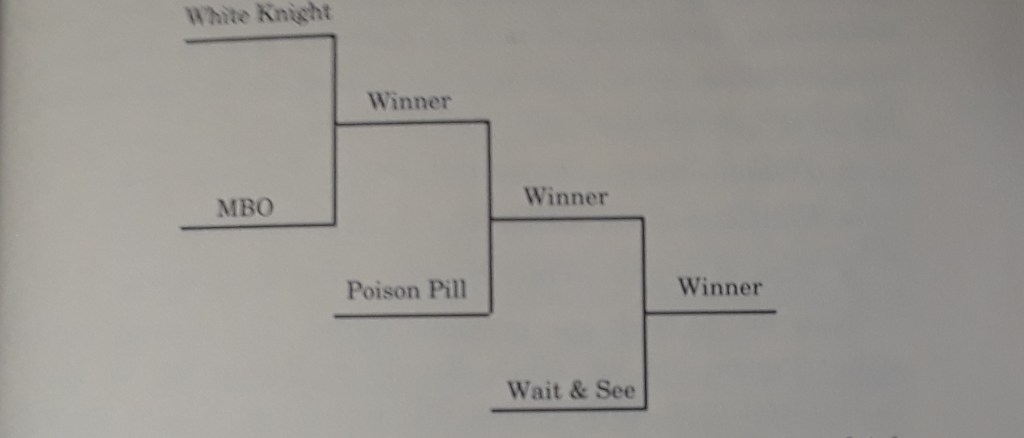
The tree above should remind you of a tennis tournament in which some players are seeded. We are seeding “Wait & See” all the way into the finals, “Poison Pill” into the semifinals, and giving no seed to “MBO” and “White Knight.” Boxing and chess both work this way, too. There is a series of challenges that you must win in order to go against the presiding World champion. The U.S. presidential election process also works this way. When there is an incumbent president, that person is typically a shoo-in for his or her party’s nomination. The opposing party runs a primary to decide who will go against the incumbent in the final elections. The primary process, the ensuing party nomination, and the presidential election can be thought of as a series of elimination elections. However, back to the boardroom. We suppose that the five board members have enough foresight to realize the consequences of their actions in successive rounds, and vote according to their true preferences. Backward reasoning makes this problem easy to solve. You can work out the solution and see that the White Knight option wins (or you can jump to the next paragraph), but that is not the point of this story. We are interested in showing how the founder can improve the outcome from one’s perspective by making a commitment to distorted preferences. How is it that the White Knight option wins under foresighted voting? The last election must be Wait & See versus something. In this final election everyone has an incentive to vote honestly, sense this will determine the actual outcome. Three possibilities are easy to calculate: Wait & See vs. Poison Pill, Poison Pill wins 4-1. Wait & See vs. MBO, Wait & See wins 3-2. Wait & See vs. White Knight, White Knight wins 3-2. #RandolphHarris 18 of 22

Now we go back one previous round. The contest will be either Poison Pill vs. White Knight or Poison Pill vs. MBO. In the first case, both Poison Pill and White Knight are preferred to Wait & See. So whatever wins the second round will be implemented. The board members prefer White Knight to Poison Pill, 3-2. In the second case, a vote for MBO is in reality a vote for Wait & See. Board members can anticipate that if MBO beats Poison Pill for the active course, it will lose out in the next comparison with Wait & See. So when deciding between Poison Pill and MBO, board members will act as if deciding between Poison Pill and Wait & See, with the result that Poison Pill wins 4-1. Thus the first-found comparison is truly between Poison Pill and White Knight. White Knight is chosen by a 3-2 margin and is then selected in each of the subsequent comparisons. Once the founder recognizes what will happen, there is a strategy one can employ to get one’s preferred option, the Poison Pill. Look what happens if the founder “adopts” the preferences of the outside board member. Of course it is essential that this change of preferences is credible and is made know to all the other voters. Supposed the founder simply gives one’s vote to the outside director and leaves the meeting. At first glance this seems nothing short of crazy; the adopted preferences are almost the opposite of one’s true ones. However, look at the effect. The votes will now go as follows: Wait & See vs. Poison Pill, Poison Pill wins 3-2. Wait & See vs. MBO, Wait & See wins 4-1. Wait & See vs. White Knight, Wait & See wins 3-2. #RandolphHarris 19 of 22

The only active option that can beat Wait & See is Poison Pill. Right from the start the board members should predict that is Poison Pill ever loses, the outcome will be Wait & See. Yet both MBO and White Knight supporters prefer Poison Pill to Wait & See. They are forced to vote for Poison Pill as it is their only viable alternative; thus Poison Pill wins. By transferring his support to the opposition, the founder is able to make a credible threat that it is either Poison Pill or Wait & See. As a result, all but the die-hard Wait & See supports dump the White Knight option (which can no longer beat Wait & See) in favor of the Poison Pill. Superficially, this transfer of a vote doubles the strength of the Wait & See supporters. Actually, it leads to an outcome that is worse from their viewpoint—Poison Pill rather than White Knight. In voting, strength can be weakness. Of course, if the outside director sees through the game, one should refuse to accept the founder’s proxy. If you regard this story as farfetched, something quite like it did occur in the 1988 Wisconsin presidential primary. The Republican governor of the state said that of the Democratic candidates, Jesse Jackson was the most interesting. Many commentators though this was a Machiavellian attempt to get Republicans to cross over and vote for Jackson in the Democratic primary, thereby helping produce a more easily beatable opponent for Bush in the November election. Apparently, Michael Dukakis was sufficiently easy for George Bush to beat, even without this help. #RandolphHarris 20 of 22

On June 30, 1988, in Victorville, California, near Los Angeles, the Sheriff’s Department received a complaint. Five Mexican me were blasting loud music, drinking beer, and urinating on the lawn in a party that lasted over twelve hours. When six sheriff’s deputies came to investigate and tried to quiet the men down, fists and night sticks began to fly. For the sheriff’s men, it was hardly a unique event. Except for one thing. Unknown to them, as they struggled to subdue the five, using night sticks and choke holds, a next-door neighbour pointed a videocamera out the window. Public outrage against alleged police brutality erupted instantly after the four-minute tape was shown to the town’s Latino community. Civil rights protests followed, then a lawsuit against the deputies, charging them with the use of excessive force. Said Armando Navarro, executive director of the Institute for Social Justice, a local civil rights organization, “I’ve dealt for twenty-one years in community activism, but I’ve never had something so classic, showing the violence in living color.” Lawyers for the deputies, on the other hand, contended that the tape did not tell the truth because it did not show what happened before the camera was turned on—when, the deputies say, violence was used against them. (That is why I say self-defense is difficult to prove and you may still end up in jail and have to plead your case before a judge, even if you have witnesses. And even if you did use self-defense, you could still end up being charged with a crime based on what the jury determines. It is best to avoid altercations.) #RandolphHarris 21 of 22

Nonetheless, the case took on larger dimension when the people who shot the tape disappeared and when a representative of Mexico’s consulate in Los Angeles began showing up in the courtroom to monitor the trial, evidencing concerns about anti-Mexican discrimination in the United States of America. In the end, a federal court ruled against the sheriff’s men and awarded the Mexicans $1 million. It is unlikely that the revolutionaries who overthrew the communist government in Czechoslovakia in 1989 ever heard of the “Victorville Five.” However, in the streets of Prague, students set up TV monitors on street corners and played video rapes showing the brutality of Czech authorities trying to suppress antigovernment street rallies. The students also played tapes of speeches by dramatist Vaclav Havel, who went from being a political prisoner to the presidency. Elsewhere, in Taiwan, too, the political opposition has used videocameras and monitors to expose what they called government violence. All across the World, new communication media, or new ways of using old ones, are being exploited to challenge—and sometimes overthrown—the power of the state. In the words of Solidarity founder Lech Walesa, describing the political upheavals in Eastern Europe, “These reforms are a result of civilization—of computers, satellite TV [and other innovations] that present alternative solutions. #RandolphHarris 22 of 22


Meet the largest of the single story homes offered at #MagnoliaStation! Residence 3 offers 2,827 square feet of well-appointed space including four bedrooms, two and one half bathrooms, and a three car garage. 🏡

The location of the Owner’s Suite makes it feel like a separate wing from the rest of the home allowing for maximum privacy and retreat. Plus you can even utilize the den as your own private office, or convert it into a fifth bedroom if needed. 🙌

Best of all, each Cresleigh home comes fully equipped with an All Ready connected home! 📲 Visit our website to learn what’s included and get in touch today. Our models are open and we’re now selling at Magnolia Station in Rancho Cordova! https://cresleigh.com/magnolia-station/residence-3/
#CresleighRanch

Makeup on their Faces, Actors Took their Places Next to Me

Our work takes on narcissistic qualities when it does not server well as a reflection of self. When that inherent reflection is lost, we become more concerned instead with how our work reflects on our reputations. We seek to repair our painful narcissism in the glow of achievement, and so we become distracted from the soul of the work for its sake. We are tempted to find satisfaction in secondary rewards, such as much, prestige, and the trappings of success. It is obvious that climbing the ladder of success can easily lead to a loss of a soul and lead people to commit criminal acts to feel powerful and obtain more assets. Burglary and robbery commonly accompany rape. Among our sample, 39 percent of rapists had also been convicted of one or the other of these crimes committed in connection with rape. In some cases, the original intent was rape and robbery was an after-thought. However, a number of the men indicated that the reverse was true in their situation. That is, the decision to rape was made subsequent to their original intent which was burglary or robbery. This was the case with a young offender who stated that he originally intended only to rob the store in which the victim happened to be working. He explained that when he found the victim alone, “I decided to rape her to prove I had guts. She was just there. It would have been anybody.” Similarly, another offender indicated that he initially broke into his victim’s home to burglarize it. When he discovered the victim asleep, he decided to seize the opportunity “to satisfy an urge to go to bed with a white woman, to see if it was different.” #RandolphHarris 1 of 22

Indeed, a number of men indicated that the decision to rape had been made after they realized they were in control of the situation. The attitude of these men toward rape was similar to their attitude toward burglary and robbery. Quite simply, if the situation is right, “why not.” From the perspective of these rapists, rape was just another part of the crime—an added bonus. In an effort to change public attitudes that are damaging to the victims of rape and to reform laws seemingly premised on the assumption that women both ask for and enjoy rape, many writers emphasized the violent and aggressive character in the crime. The data clearly indicate that from the rapists’ point of view rape is in part sexually motivated. Indeed, it is the sexual aspect of rape that distinguishes it from other forms of assault. The psychodynamic function of sex in rape is that rapists’ aggressive needs are expressed through sexuality. In other words, rape is a means to an end. We argue, however, that rapists view the act as an end in itself and that sexual access most obviously demonstrates the link between sex and rape. Rape as a means of sexual access also shows the deliberate nature of this crime. When a woman is unwilling or seems unavailable for sex, the rapist can seize what is not volunteered. In discussing his decision to rape, one man made this clear. “All the guys wanted to f*ck her…a real fox, beautiful shape. She was a beautiful woman and I wanted to see what she had.” #RandolphHarris 2 of 22

The attitude that sex is a male entitlement suggests that when a woman says “no,” rape is suitable method of conquering the “offending” object. If, for example, a woman is picked up at a party or in a bar or whole hitchhiking (behavior which a number of the rapists saw as a signal of sexual availability), and the women later resists sexual advances, rape is presumed to be justified. The same justification operates in what is popularly called “date rape.” The belief that sex was their just compensation compelled a number of rapists to insist they had not raped. Such was the case of an offender who raped and seriously beat his victim when, on their second date, she refused his sexual advances. “I think I was really pissed off at her because it did not go as planned. I could have been with someone else. She led me on but wouldn’t deliver…I have a male ego that must be fed.” The purpose of such rapes was conquest, to seize what was not offered. Despite the cultural belief that young women are the most sexually desirable, several rapes involved the deliberate choice of a victim relatively older than the assailant. Since the rapists were themselves rather young (26 to 30 years of age on the average), they were expressing a preference for sexually experienced, rather than elderly, women. Men who choose victims older than themselves often said they did so because they believed that sexually experienced women were more desirable partners. They raped because they also believed that these women would not be sexually attracted to them. #RandolphHarris 3 of 22

Finally, sexual access emerged as a factor in the accounts of men who consciously chose to rape women of another race. The majority of rapes in the United States of America today are intraracial. However, for the past 50 years, interracial rape has become a trend. Indeed, we may be experiencing a historical anomaly. The current structure of interracial rape, however, reflects contemporary racism and race relations in several ways. Segregation and other factors continue to militate against interracial coupling. Thus, the desire for sexual access to higher status, unavailable women, an important function in interracial rape, does not motivate men to rape women of another race. Equally important, demographic and geographic barriers interact to lower the incidence of interracial rape. Segregation as well as the poverty expected in some neighborhoods undoubtedly discourages many people who are not from those areas from choosing such areas as a target for house-breaking or robbery. Thus, the number of rapes that would occur in conjunction with these crimes is reduced. Reflecting in part the standards of sexual desirability set by the dominant society, a number of rapists indicated they had been curious about women in the dominant society. Blocked by racial barriers from legitimate sexual relations white these women of another race, they raped to gain access to them. They described raping women from the dominant race as “the ultimate experience” and “high status among my friends. It gave me a feeling of status, power, macho.” For another man, raping a woman of the dominate culture has a special appeal to some because it violates a “known taboo,” making it more dangerous and, thus more exciting, to him than raping a woman of his own race. #RandolphHarris 4 of 22

The idea that rape is an impersonal rather than an intimate or mutual experience appealed to a number of rapists, some of whom suggested it was their preferred form of sex. The fact that rape allowed them to control rather than care encouraged some to act on this preference. For example, one man explained, “Rape gave me the power to do what I wanted to do without feeling I had to please a partner or respond to a partner. I felt in control, dominant. Rape was the ability to have sex without caring about the woman’s response. I was totally dominant. Another rapist commented: “Seeing them laying there helpless gave me the confidence that I could do it…With rape, I felt totally in charge. I’m bashful, timid. When a woman wanted to give in normal sex, I was intimidated. In the rapes, I was totally in command, she totally submissive.” Perhaps we should note here that the appeal of impersonal sex is not limited to convicted rapists. The amount of male sexual activity that occurs in homosexual meeting places as well as the widespread use of prostitutes suggests that avoidance of intimacy appeals to a large segment of the male population. Through rape men can experience power and avoid the emotions related to intimacy and tenderness. Further, the popularity of violent pornography suggests that a wide variety of men in this culture have learned to be aroused by sex fused with violence. #RandolphHarris 5 of 22

Consistent with this observation, recent experimental research demonstrates that some men are aroused by images that depict women as orgasmic under conditions of violence and pain. They found that for many female students, arousal was high when the victim experienced an orgasm and no pain, whereas male students were highly aroused where the victim experience an orgasm and pain. On the basis of the results, it is suggested that forcing a woman to climax despite her pain and abhorrence of the assailant makes the rapist feel powerful, he has gained control over the only source of power historically associated with women, their bodies. In the final analysis, dominance was the objective of most rapists. Life leaves many people suffering the inevitable. It is a thing one cannot escape from unless one hides from life. Some wonder that if when others see human sorrow, should that make them want to take the easy road? Many says that they ask nothing better than to be allowed the very high privilege of living with they have passion for, and they only ask that they may suffer for the things that are high and brave and lovely and that they may not be weak when suffering comes. For the end success, failure, ruin or achievement matters to some so little. The stuff of life that matters to many successful people is experience. All that some people ask is that they may be permitted to love much, to serve to the utmost limit of their capacity and to keep faith with that high vision which they call God. Most important to many people is that they never stop caring. #RandolphHarris 6 of 22

Often times, it takes a loved one being on their death bed, dying for others to confess their love for the individual, to embrace that person; and yet, deep inside they have wanted to for so many years but always felt restrained by the mores of our country. It is at this point where people are most freely able to express that all of their experiences together can never be taken away and how their meanings are only between those two individuals. In the end, waiting so long leaves so many people weeping unashamed because that is what they feel. There can be an effect on the conscience of the teachings by evil spirits. How teaching spirits teach, we find described by Paul, for he says they speak lies in hypocrisy, that is, speak lies as if they were truth. And the effect of their working is said to “cauterize” the conscience; id est, if a man accepts the teachings of evil spirits as divine, because they come to one “supernaturally,” and one obeys and follows those teachings, conscience is unused, so that it practically becomes dulled and passive—or seared. And a man will do things under the influence of supernatural “revelation” which an actively awakened conscience would keenly rebuke and condemn. Such people “give heed” to these spirits, by listening to them, and then by obeying them; for they are deceived by accepting wrong thoughts about God’s presence, and about divine love, and unknowingly give themselves up to the power of lying spirits. Working in the line of “teaching,” deceiving spirits will insert their lies spoken in hypocrisy into “holiness” teaching and deceive believers about sin, themselves, and all other truths connected with the spiritual life. #RandolphHarris 7 of 22

Scripture is generally used as the basis of these teachings and is skillfully woven together like a spider’s web, so that the listeners are caught in the snare. Single text are wrenched from their context, and from their place in the perspective of truth; sentences are taken from their correlative sentences, or texts are aptly picked out from over a wide field and so netted together as to appear to give a full revelation of the mind of God—but the intervening passages, giving historical setting, actions and circumstances connected with the speaking of words, and other elements which give light on each separate text, are skillfully dropped out. A wide net is thus made for the unwary or the untaught in the principles of Scripture exegesis, and many a life is sidetracked and troubled by this false use of the Word of God. Because the experience of most professing Christians in regard to the devil is limited to knowing him as a tempter, or as an accuser, they have no concept of the depths of his wickedness and of the wickedness of evil spirits, and are under the impression that they will not quite Scripture, whereas they will quote the whole Book if the can but deceive one soul. Think very seriously before you decide to work on yourself with the idea of changing yourself, id est, to work with the definite aim of becoming conscious and of developing connection with higher centers. This work admits of no compromise and it requires a great amount of self-discipline and readiness to obey all rules and particularly, direct instructions. #RandolphHarris 8 of 22
Think very seriously: are you really ready and willing to obey, and do you fully understand the necessity for it? There is no going back. If you agree and then go back, you will lose everything that you have acquired up to that time, and you will lose more really, because all that you acquired will turn into something wrong in you. There is no remedy against this. Understanding of the necessity for obeying rules and direct instructions must be based on the realization of your mechanicalness and your helplessness. If this realization is not strong enough, you had better wait and occupy yourself with ordinary work; study of the system, work in groups, et cetera. If you do this work sincerely and remember all the rules, it will bring you to the realization of your state and your needs. However, you must not delay too long. If you want to come to real work you must hurry. You must understand that the opportunity that exists today may not come your way again. You may lose all your chances by hesitating and waiting too long. If you decide to work and accept all that comes in the work, you must learn to think quickly. If you are offered a task you must answer at one that you accept it. If you hesitate or take time to answer, the offer of the task will be withdrawn and it will not be repeated. You may be given time before actually doing what you were told to do, but you must accept the task at once. An attempt to talk things over, an ironical, suspicious or negative attitude, fear, or lack of confidence, these will make the task impossible at once. #RandolphHarris 9 of 22

If you feel hesitation about the task offered to you, think about your mechanicalness, think about your negativeness, about your self-will—but think quickly. You can do nothing against your weak sides by yourself. The tasks offered to you have the aim of helping you. If you hesitate or refuse them, you refuse help. This must be quite clear in your mind. The realization of your helplessness and your deep sleep must be permanent in you. You can strengthen it by constantly reminding yourself of your nothingness, of your meanness, of your weakness of all possible sorts. You have absolutely nothing to be proud of. You have nothing to base your judgement on. You can see, if you re sincere with yourself, all the blunders and all the mistakes which you made when you tried to act by yourself. You cannot think rightly. You cannot feel rightly. You need constant help, and you can have it. However, you must pay for it—at least, by not arguing. You have to do gigantic work if you want to become different. How can you ever hope to get anything if you hesitate and argue on the first steps, or do not even realize the necessity for help, or become suspicious and negative? If you want to work seriously you have to conquer many things in yourself. You cannot carry with yourself your prejudices, your fixed opinions, your personal identifications or animosities. #RandolphHarris 10 of 22

However, at the same time try to understand that personal is not always wrong. If it is not cleared by the struggle with identification and by the realization of your mechanicalness and your weakness, personal can even help in the work but personal can be very dangerous too. Trying to understand the necessity for deliberate suffering and conscious effort. These are the only two things that can change you and bring you to your aim. Deliberate suffering does not mean necessary suffering inflicted on you by yourself. It means attitude towards suffering. Suffering may come as a result of your feelings, thoughts, and actions connected with your task; it may come by itself as a result of your own faults or as a result of other people’s actions, attitudes or feelings. However, what is important is your attitude toward it. If you do not rebel against it, if you do not try to avoid it, if you do not accuse anybody, if you accept it as a necessary part of your work at the moment, and as a means for attaining your aim, it becomes deliberate. Conscious effort is the effort based on understanding; understand of its necessity first of all, and understanding of causes which make it necessary. The chief cause for conscious effort is your need for breaking the walls of the mechanicalness, of self-will and of lack of self-remembering which constitute your being at present. In order to understand better the necessity for accepting tasks given to you without hesitation, the necessity for deliberate suffering and conscious effort, think about the ideas which brought you to the work, think about the first realization of your mechanicalness and the first realization that you know nothing. #RandolphHarris 11 of 22

In the beginning you realized this and you came for help, but now you doubt whether you must really do as you are told. And you try to find ways to evade it, to stand on your own judgement and on your own understanding. You understood clearly once, that your judgment and your understanding are false and weak, but now you try to keep them again. You do not want to give them up. Well, you can keep them, but you must understand that with them you will keep all that is false and weak in yourself. There are no half measures. You must decide. Do you want the work or not? At present, the psychiatrist who carries an appreciable load of diagnostic and commitment work in an office or hospital tends to give weight to one’s own spontaneous response to the conduct of the individual to whom one is giving a diagnostic interview, and it is largely in terms of this response that the psychiatrist decides whether the behavior of the subject is appropriate or inappropriate in the situation. If the behavior is inappropriate, one decides whether it is to be placed in one of the nonsymptomatic classes of situational impropriety, or whether it betokens mental illness. Some of the grounds already suggested for nonsymptomatic impropriety are: accidents (defining these as inappropriate behavior which the actor could and would have avoided had one known in advance that one was to act thusly); temporary emotional states involving tiredness, nervousness, inebriation, and the like; understandable preoccupation, as when an expectant father cannot submerge himself properly in a situation; organic but not mental conditions, as when a deaf person cannot orient oneself properly in a situation; or circumstantial conditions, as when an individual is unfamiliar with the ritual idiom of the persons one finds oneself amongst. #RandolphHarris 12 of 22

In this course, of course, one is acting somewhat like a layman, however expert in one’s analysis of the psychodynamic implications of a particular impropriety, because while everyone in the society also makes these distinctions, there is no great consensus, especially in regard to the milder offenses, as to how the distinctions should be applied. It can be argued that the distinctions between symptomatic and nonsymptomatic impropriety is a thoroughly ingrained mode of thinking in our society, leading us to divide up any set of improprieties in this twofold way regardless of the goodness of the fit or even its relevance. This dichotomizing tendency is, of course, heavily reinforced by our institutional arrangements, for, after all, an individual who conducts oneself improperly must either be placed in a mental hospital or not placed in a mental hospital, and in either case an appropriate rationale must be provided, since the differential consequences for the offender and one’s kin are very great. Like everyone else, the psychiatrist is apt to interpret some conduct as improper merely because one is not familiar with the involvement idiom and the involvement rulings of the culture of the group from which the patient comes. It is possible to observe, for example, a male, lower-middle-class, middle-aged, refugee psychiatrist make confident detailed judgments about the symptomatic significance of the affective tone of a female, lower-class, adolescent patient—an interesting achievement, since there are not many engagements in which both of these persons could find the immediate presence or the conduct of the other a natural, easeful thing. #RandolphHarris 13 of 22

Similarly, those who know a mental patient slightly, and see one only during fleeting encounters, are likely to interpret one set of acts as symptomatic of one’s mental disorder, while those who have lived with one are likely to pass by these acts and focus upon others. So, also, acts that appear to be signs of mental disorder to an outsider, such as the sight of a mental patient lying on the floor or taking food from a neighbor’s plate, can become normatively natural when, having become familiar with the behavior setting, one learns that the floor is used because the benches are hard or of insufficient number, and that, since no one owns the food, and there is sometimes enough of it, one might as well pick it from the neighbors’ plates as stand in line for more. And from psychiatrist themselves once learns that most regressive “primitive” kind of act can sometimes eventually be “understood” in which a way that its bizarre “meaningless” quality recedes and its pathetic human quality becomes evident. Strange how, with the quiet peace of being alone so many are always aware of the pain of separation. Even stranger is that with an intimate partner, the aloneness turns to loneliness and one becomes one with the separateness. Of all those one has ever known, an intimate partner can be the only one who hears you crying through the laughter, see your tears as you smile. Only this person can come and touch you by saying: “It is lonely, is it not?”…understanding all you feel within you…and they can give you that gift of flight—the method, not the ability, and with it comes the realization of how very lonely…how heavy deep inside one feels, when one is free. #RandolphHarris 14 of 22

After the White Hose, election to Cooperstown may be the next most coveted national honor. Membership in the Baseball Hall of Fame is determined by an election. There is a group of eligible candidates—for example, a player with ten years of experience becomes eligible five years after retirement. However, if the player has been on the ballot for fifteen years and failed to get elected, then eligibility is lost. For otherwise ineligible players, there is an alternative route to election. An Old Timers’ committee considers special cases and sometimes elects one or two candidates a year. The electors are the members of the Baseball Writers Association. Each voter may vote for up to tend candidates. All candidates capturing votes from more than 75 percent of the total number of ballots returned are elected. One problem with this system is that the electors do not have the right incentives to vote for their true preferences. The rule that limits each voter to tend choices forces the voter to consider electability as well as merit. Some sportswriters may believe a candidate is deserving, but do not want to throw away the vote if the player is unlikely to make the cutoff. This same issue arose from voting in presidential primaries, and it appears in any election in which each voter is given a fixed number of votes to distribute among the candidates. #RandolphHarris 15 of 22

Two experts in game theory propose an alternative way to run elections. Steven Brams and Peter Fishburn, one a political scientist and the other an economist, argue that “approval voting” allows voters to express their true preferences without concern for electability. Under approval voting, each voter may vote for as many candidates as one wishes. Voting for one person does not exclude voting for any number of others. This there is no harm in voting for a candidate who has no hope of winning. Of course, if people can vote for as many candidates as they wish, who gets elected? Like the Cooperstown rule, the electoral rule could specify in advance a percentage of the vote needed to win. Or it could pre-specify the number of winning candidates, and then the positions are filled by those who gather the most votes. Approval voting has begun to catch on, and is used by many professional societies. How would it work for the Baseball Hall of Fame? Would Congress do better if it used approval voting when deciding which expenditure projects should be included in the annual budget? We look at the strategic issues associated with approval voting when a cutoff percentage determines the winners. Imagine that election to the different sports halls of fame was decided by approval voting, in which all candidates capturing above a fixed percentage of the votes are elected. At first glance, the voters have no incentive to misstate their preferences. The candidates are not in competition with one another, but only with an absolute standard of quality implicit in the rule that specifies the required percentage of approval. #RandolphHarris 16 of 22

If I think Ricky Henderson should be in the Baseball Hall of Fame, I can only reduce his chances by withholding my approval, and if I think he does not belong there, I can only make his admission more likely by voting contrary to my view. However, candidates may compete against one another in the voters’ minds, even though nothing in the rules mandates it. This will usually happen because voters have preferences concerning the size or the structure of the membership. Suppose Dan Marino and John Elway come up for election to the Football Hall of Fame. I think Mr. Marion is better quarterback, although I will admit that Mr. Elway also meets the standard for a Hall of Fame berth. However, I think it overridingly important that two quarterbacks not be elected in the same year. My guess is that the rest of the electorate regards Mr. Elway more highly and he would get in no matter how I vote, but that Mr. Marino’s case will be a very close call, and my approval is likely to tip him over. Voting truthfully means naming Mr. Marino, which is likely to lead to the outcome in which both are admitted. Therefore I have the incentive to misstate my preferences and vote for Mr. Elway. Two players may complement each other, rather than compete, in the voters’ minds. I think neither Geoff Boycott nor Sunil Gavaskar belongs in the Cricket Hall of Fame, but it would be a gross injustice to have one and not the other. If in my judgment the rest of the electorate would choose Mr. Boycott even if I do not vote for him, while my vote may be crucial in deciding Mr. Gavaskar’s selection, then I have an incentive to misstate my preference and vote for Mr. Gavaskar. #RandolphHarris 17 of 22

In contrast, a quota rule explicitly places candidates in competition with one another. Supposed the Baseball Hall of Fame limits admission to only two new people each year. Let each voter be given two votes; he can divide them between two candidates or give both to the same candidate. The candidates’ votes are totaled, and the top two are admitted. Now supposed there are three candidates—Joe DiMaggio, Marv Throneberry, and Bob Uecker. (Marv Throneberry played first base for the ’62 Mets, possibly the worst team in the history of baseball. His performance was instrumental to the team’s reputation. Bob Uecker is much better known for his performance in Miller Lite commercials than for his play on the baseball field.) Everyone rates Mr. DiMaggio at the top, but the electors are split equally between the other two. I know that Mr. DiMaggio is sure to get in, so as a Marv Throneberry fan I give my two votes to him to increase his chances over Bob Uecker. Of course everyone else is equally subtle. The result: Mr. Throneberry and Mr. Uecker are elected and Mr. DiMaggio gets no votes. Government expenditure projects naturally compete with one another so long as the total budget is limited, or congressmen and senators have strong preferences over the side of the budget. We will leave you to think which, if any, is the DiMaggio project, and which ones are the Throneberrys and Ueckers of federal spending. #RandolphHarris 18 of 22

Shifts of financial power over the media always spark hot controversy. Today the sheer size of the media empires provokes anxiety. Established networks and other media are threatened. Moreover, the concentration of financial control in the hands of the Murdochs and Berlusconis conjures up memories of the great press lords of the past, such as William Randolph Hearst in the United States of America or Lor Northcliffe in Britain, men whose political influence was enormous and by no means universally admired. The first and most common criticism heard today is that the new global media will homogenize the World. The failure of the “global marketing” theory, however, suggests this fear is overdrawn. The mass media had their strongest homogenizing effects when there were only a few channels, few different media, and hence little audience choice. In the future, the reverse situation will prevail. While the content of each individual program may be good or bad, the most important new “content” of all is the existence of diversity itself. The shift from a low-choice to a high choice media environment holds no only cultural but political implications. High-tech governments face a future in which multiple, conflicting, custom-tailored commercial, cultural, and political messages will bombard their people, rather than a single message repeated in unison by a few giant media outlets. The old “politics of mass mobilization” and the “engineering of consent” both become far more difficult in the new media environment. Expanded media choice is itself inherently democratic. It makes life difficult for politicians who offer their followers a choiceless environment. #RandolphHarris 19 of 22

A second set of complaints about the new media barons relates to their personal political views. Mr. Murdoch is charged with being too conservative. Mr. Maxwell is too close to the British Labour Party. Mr. Turner is an unpredictable maverick. This one has sold his soul to French President Mitterand, while that one is in bed with someone else. If all these charges were true, they would soon cancel one another out. Far more important than their personal political views, and alliances are the interests they hold in common. Of course, all are capitalists operating in a capitalist framework. As such, we can assume that, in general, the bottom line interest them more than any political line. What matters most about these media lords is not whether they favor left-wing or right-policies and politicians. Far more significant is their support, through their actions more than their words, of the ideology of globalism. Globalism, or at least supranationalism, is a natural expression of the new economy, which must operate across national boundaries, and it is in the self-interest of the new media moguls to spread this ideology. This self-interest, however, collides with another. For if their television and radio stations, their newspapers and magazines are to succeed financially, they will have to de-massify—which means they will have to search for niches, carry specialized material, and appeal to very local audiences interest. The familiar slogan “Think global, act local” perfectly describes the new media imperatives. The very existence, however, of powerful media communication capable of spanning continents will shift power as between national political leaders and the global community. Thus, without necessarily intending it, the new media barons are drastically changing the role of “global opinion” in the World. #RandolphHarris 20 of 22

Just as in the past century national leaders were compelled to justify their actions before the court of national “public opinion,” tomorrow’s national leaders will confront a much-enhanced “global opinion.” And just as the work of Benjamin Day or Henry Hetherington of Emile de Girardin brought the poorer classes into the political life of nation, the activities of today’s media lords will bring new millions into the global decision-making process. Today, nations flout global opinion without worrying over much about the consequences. World opinion did not save the victims of Auschwitz, the people of Cambodia, or, more recently, the boat people fleeing hunger and oppression in Asia. Nor did it prevent the homeless crisis in California. Nevertheless, global opinion has sometimes stayed the hand of killer regimes. The history of human rights is filled with cases in which global protests have prevented the torture or murder of domestic political prisoner. It is unlikely that Anatoly Shcharansky would have survived his encounter with Soviet prison camps had the outside World not put pressure on Moscow to release him. Andrei Sakharvo’s chances for survival were improved when he won the Nobel Prize and became a household word because of the constant media attention around the World. The global media system will not make nations behave like Boy Scouts. However, it raises the costs of defying World opinion. In the World being constructed by the media barons, what outsiders say about a nation will carry more weight inside than it ever did before. #RandolphHarris 21 of 22

Governments will no doubt invent more sophisticated lies with which to rationalize their self-serving actions and manipulate the increasingly systemic media. They will also step up propaganda efforts to improve their global image. However, if such efforts fail, they could suffer significant economic penalties for behavior frowned on by the rest of the World. South Africa may deny that sanctions hurt its economy or that its pariah image also damaged the country economically. However, its senior officials know better. Global opinion sets the stage for global action. Even if an outraged World does not impose formal trade sanctions on a rogue regime, international agencies like the World Bank may reject their pleas for multibillion loans. Private banks may shy away, foreign investors and tourists go elsewhere. Worse yet, companies and countries still willing to do business with a pariah nation are in a position to drive a harder bargain than might have been the case otherwise. Power in the negotiations shifts as a result of global imagery. What is more, as the importance of global opinion grows in parallel with the spread of the systemic media, shrewd power-players will wield it as an unconventional weapon. It will be used not only to save some political prisoners, or to direct instant relief to disaster zones, but to spare us from some, at least, of the ecological ravages that might otherwise be inflicted on a bleeding planet. When Armenians are attacked by Azeris in Baku, Armenians in Los Angeles know it instantly and begin mobilizing political actions. When Jesuits are murdered by death squad in El Salvador, the entire World knows it. When a trade unionist is jailed in South Africa, the words get out. The new global media are basically in business to make a profit. However, they are inadvertently raising the level of cross-national political action by a dazzling diversity of activist groups. Without even intending it, Mr. Murdoch and Mr. Maxwell, Mr. Turner and Mr. Mohn, Mr. Berlusconi and other new media magnates are creating a powerful new tool and placing it in the hands of the global community. However, that hardly scratches the surface of what is happening. The new global media system has, in fact, become the prime tool of revolution in today’s fast-changing World, but that does not mean it is keeping the World informed. #RandolphHarris 22 of 22
Cresleigh Homes

We see that glint in your eye…you’re already planning your decor scheme, aren’t you?! 😉 When you’ve got all the spacious layout of Residence 4 at #MillsStation to work with, you’ll have a chance to explore all your wildest dreams! Contact us ASAP – we’ve got homesite #105 ready for new owners!
Plus we’re showing off another move-in ready home this weekend! Stop by our Open House from 10am-6pm this Saturday 4/1 and Sunday 4/2 to experience Homesite 111 – a gorgeous Residence 3 plan that boasts 2,394 square feet and an ideal location across from the community park! It also comes complete with three bedrooms, two and a half bathrooms, and a two car garage plus workshop, for starters… 😉

Come see it for yourself this weekend! Have questions? Get in touch with our sales center at 916-333-1919.
#CresleighRanch
#CresleighHomes


The Psychic Storm that Had Swirled

It was dark, the path to my home was so precipitous that I was forced to brace my knees and steady myself on the overhanging branches so as not to lose my footing. The extravagant roots of ancient trees crisscrossed the path. Stones, uneven Earth, and fallen fossilized branches—everything was familiar, but somehow distorted. For almost two hours, guns were rumbling. The atmosphere grew more claustrophobic as horsemen crossed my route. I felt trapped, as though the forest on my estate was closing in on me. There was something very grotesque about the strength of the enemy as they launched their grand assault on my estate. I summoned a column of horses several hundred yards wife and half-mile deep to ram through the line of cavalry attacking my mansion. They advanced across the fruit orchard, still my body of men endured the artillery fire, the finally the canter and charge. The Spanish army was not quite as large, but travelling directly at my soldiers. I watched as suddenly the two opposing forced collided, the Winchester soldiers knocking the sending the Spanish horsemen somersaulting backward, their riders were being crushed by squirming horseflesh, as they crashed together. I had finally made it to my observation tower, and from this point I saw that the Winchester soldiers do incredible damage to the Spanish column. The few strangling men sabered left and right until they collapsed in defeat. I could feel my nerves starting to get the better of me. Even though the Winchester soldiers were triumphant, increasingly I imagined peculiar shapes, outlines, behind every tree, eyes in the dark of my mansion watching me, an unwelcome and persistent voice in my ear asking if it was more than just invasion. #RandolphHarris 1 of 6

In the deepest corners of my home, the light had all but disappeared. A red mist was slinking through the halls, slipping in and out of hundreds of rooms like an animal hunting its prey. There was an absolute and impenetrable stillness. Then I heard a glass shattering. I stopped dead in my tracks, straining to listen. Another sound…something was moving through the walls. As if I could take on any kind of beast, I looked for an object to defend myself. Should I have the misfortune to encounter a demonic enemy force lurking in my home, my only resort was to stay absolutely still and pray it did not pick up my scent. If it did, there would be nothing to do but run for my life. The caretakers were nowhere to be found. Another breaking glass, something inching closer and closer. I looked around to see if there was anywhere I could hide. There was a secret passageway about 50 feet from my location. If I stayed low to the ground, I could make it. Moments after I started to crawl to the escape, two indistinct figures emerged from the mist on the floor. They had no eyes, no face. Not even a nose was visible. The dim figures moved behind the doors, through the long shadows of the twisting hallways. A bearded man dressed in high boots and blue coat, helped me as we disappeared through the apartment of rooms. We ventured up to the attic where I could hear the sounds of boots dragging across the floor below. As we opened the door, we caught sight of a wispy something retreating to a darkened comer of the storage area. It was an ectoplasmic spirit leaving a trail of cobweb mucus behind. Next, the peripatetic figure who roamed my mansion to save me from the intruders disappeared after helping me to safety. #RandolphHarris 2 of 6

As I walked through my home, occasional objects suddenly became airborne without any apparent physical cause for their levitation. The house seemed lighter to me, and there was just a hit of the faintest red mist, as a twist of smoke wreathing up into the air arose from the floor. Invisible helping hands started setting the rooms in order, right down to the last doyly and rug in place. Windows magically healed themselves from their fractures, the crystal chandeliers came back together and levitated back to their place in the ceiling. There were sounds of furniture being dragged across the floor to their proper location. The spirits were not going to let me be driven from my home. There was great pride in the veteran transmigration of souls I called the Winchester Soldiers. When there was not a war going on, the center of the hauntings seemed to take place in the basement and in one of the 9 kitchens known to the caretakers as the Devil’s Kitchen. In the Devil’s Kitchen, the hauntings primarily consisted of knocking, thumpings, and the sound of footsteps running down the caretaker’s stairs and shuffling across the floor. Many often heard the thin tolling of the church bell, the mournful single note carried on the air. Entering the Devil’s Kitchen in the morning, many of the caretakers were often surprised to find themselves walking out of it at night, but feeling like so little time had passed, as the bell died away. Before leaving the estate to go home, they would hesitate a moment, confused, looking over their shoulder in the direction they had come. There was some kind of cloud, some sadness, hanging over that kitchen. They knew something was not quite right, misaligned, like a picture askew on a wall. #RandolphHarris 3 of 6

Certainly, the most dramatic manifestation of the haunting was the materialization of 13 skeletons in the basement. After appearing in startling blood red color, the skeletal figures would slowly manifest themselves into what appeared to be solid, three-dimensional representations of 7 men, 4 women, and a little boy and little girl. The images appeared to be wealthy and appeared to adorn in vogue fashions. Once the entities had fully materialized, a bizarre ethereal drama would unfold before any witness who might be present to observe the phenomenon. As the ghost of a lovely, raven haired girl with long hair sat playing idly with her dolls, one of the men in the spectral reenactment strangled one of the women while the little boy cried in the corner and the others stood by with pleased expressions of immense satisfaction. We always suspected that the ghastly reenactment was the tragic playing out of the eternal witch trials. The shocked witnesses, who had seen the grimly performance, felt this was a scene from a Salem courtroom. A judge strangling a suspected witch to please the family of the bewitched. Some cursory historical research and an examination of local folklore revealed a scandal regarding a lady of the house who had disappeared without a trace and a husband who had remarried after an extremely brief period of grieving. Local Salem stories had it that the wife of an enslaved man was accused of fortune telling and had been murdered in court by Judge Samuel Sewall. The judge apparently strangled the woman because he believed she was a witch and said that “Black Africans could not live peacefully among White New Englanders.” Nevertheless, he allowed the man to marry a White woman. Why had the controversy of this wedlock been taking stage in my home? #RandolphHarris 4 of 6

I do not believe I ever did such hard thinking as I did that night. It was not so easy, neither. I figured it out. You see, dearie, when I was laying in my bed last night something came to me from the spirit World. I knew at once it was from the enslaved woman who had been strangled in court. I had to wait, she was crying so hard. She asked me to look at the paintings in my hall gallery. There was a particular titled “Examination of a Witch” produced in 1853 by Tompkins Harrison Matteson that William’s mother had given me as a wedding gift. In this picture was Judge Samuel Sewall, and upon observation, it was revealed that Mary Fisher was sized upon by a Black African, and was shamefully stripped for the purpose of ascertaining whether she had the Devil’s mark upon her. The woman being subdued by her hair and the man lying on the floor were Black Africans involved in a vile and bloodthirst cult for breeding babies with White women for ritual purposes. They were abusing children in similar numbers and were putting young men and women through terrifying ordeals of sexual torture and sometimes death. They hysteria is what is depicted in that work of art, which was originally titled, The Making of a Satanic Myth. The judged is asking the simple question: Where is the evidence? As the investigations had produced no bodies, no bones…no bloodstains. Nothing. These tales of satanic slavery had reached incredible proportions and it was believed an occult alliance stretching from the local group level to higher international orders, with its tentacles established far and wide through society, into the judiciary, politics and law enforcement. It was claimed to be basically occult, a largely satanical exchange network where the 27 children produced in these unions were goaled. The accused were carried two days’ journey into the woods, and left to the tender mercies of Indians and wolves. #RandolphHarris 5 of 6

The psychic storm that had swirled throughout the household was finally diminished. “Thus twice before, and just at this dead hour, with marital stalk hath he gone by our watch,” Hamlet, Act I, Scene I was very appropriate for this re-enactment. They were so blinded by the beauty of these exotic babies—so much so that they could not figure out what they were. Tan skin, blonde hair, blue eyes. White, curly hair, dark eyes, full lips. They had to keep them concealed. In my hoe, I saw an occasional shadow move in and out of the slivers of light that slipped out between the partially open curtains, but no one out and about. Often, I still heard footsteps behind me, but when I would look asunder, there would be no one behind me. I was so sorry for the woman in the painting. So I went back my gallery the next evening; as I climbed the stairs I felt one of those sudden warnings that sometime used to take me by the throat. “It is as cold as ice on these stairs,” I thought, “and I will wager there is no one made up the fire in this room since this morning.” But it was not really the cold I was afraid of; I could tell there was worse than that waiting for me. I pushed open the door and went in. “Well,” says I, as cheerful as I could while looking at the painting, “Only lying awake all night and turning thing over, I got so miserable,” Turning away my head away from the painting so she would not see the tears running down my cheeks, and I felt that the cold came from her, and not from the empty fireplace. As I walked out of the gallery, I fell on my knees. “You shall not go without a prayer, you poor dear,” I whispered to her. But though my heart was full of mourning I did not pray for long. #RandolphHarris 6 of 6


Mrs. Winchester was doing battle with entities, some terrible, and some against her. The dark pagan gods were not about to yield this green land without a fight. They converged in the mansions and attempted to thwart Mrs. Winchester in her mission, while other supernarural beins assisted her.
And be sure to check out the Online Gift Store: https://shopwinchestermysteryhouse.com/

Well, I’ve Walked these Streets, a Virtual Stage, it Seemed to Me

The soul is threatened by modern life. And if an emotional problem presents itself, the real issue may not be some single trauma or troubled relationship. Maybe the issue is a life set up in such a way that soul is neglected habitually. Culture is a factor in rape, but the precise nature of the relationship between culture and sexual violence remains a topic of discussion. Ethnographic data from pre-industrial societies show the existence of rape-free cultures, though explanations for the phenomena differ. We can relate sexual violence to contempt for the female qualities and suggest that rape is a part of a culture of violence and an expression of male dominance. However, it has also be argued that in pre-industrial societies women are more likely to lack important life options and to be physically and politically oppressed where they lack economic power relative to men. Furthermore, in pre-industrial societies relative economic power enables women to win some immunity from men’s use of force against them. Among modern societies, the frequency of rape varies dramatically, and the United States of America is among the most rape-prone of all. The rate of reported rape and attempted rape for the United States of America is eighteen times higher than the corresponding rate for England and Wales. Spurred by the Woman’s Movement, feminists have generated an impressive body of theory regarding the cultural etiology of rape in the United States of America. Representative of the feminist view called rape “The All American Crime.” #RandolphHarris 1 of 15

The feminist perspective views rape as an act of violence and social control which functions to “keep women in their place.” Feminists see rape as an extension of normative male behavior, the result of conformity or overconformitty to the values and prerogatives which define the traditional male gender role. That is, traditional socialization encourages males to associate power, dominance, strength, virility, and superiority with masculinity, and submissiveness, passivity, weakness, and inferiority with masculinity, and submissiveness, passivity, weakness, and inferiority with femininity. Furthermore, males are taught to have expectations about their level of sexual needs and expectations for corresponding female accessibility which function to justify forcing sexual access. The justification for forced sexual access is buttressed by legal, social, and religious definitions of women as male property and sex as an exchange of goods. Socialization prepares women to be “legitimate” victims and men to be potential offenders. The United States of America has some form of a rape culture because both genders are socialized to regard male aggression as a natural and normal part of sexual intercourse. However, society is also set up where women suffer greatly if the husband is arrested. Married women will lose more than half, if not all the financial support they have, and unmarried women will no longer receive their alimony checks because a man in jail or prison cannot work. The way to overcome that is to teach women the importance of education and make sure they have careers where they can afford to fully support themselves. A husband should just be a supplement, not your main source of income. #RandolphHarris 2 of 15

Feminists view pornography as an important element in a larger system of sexual violence; they see pornography as an expression of a rape-probe culture where women are seen as objects available for use by men. However, I argue that with the frequency of disease and viruses, pornography may help some people abstain from pleasures of the flesh, as they do not want to catch an illness, nor be exposed to germs or bacteria, nor deal with fracture emotions. And by using pornography as a form of gratification, it could make them hold off on pleasures of the flesh. After awhile pleasures of the flesh will become so boring that one will want true love so they have something special to hold on to and not just a fleeting, meaningless encounter. However, experts disagree with me. They argue that rape is presented as part of normal male/female sexual relations, but the women, despite her terror, is always depicted as sexually aroused to the point of cooperation. In the end, she is ashamed but physically gratified. The message—women desire and enjoy rape—has more potential for damage than the image of the violence per se. Still, I believe that you have to keep in mind that most pornography does not depict rape, and more and more of adult focused films are now produced by the individuals in them and they tend to be solo videos or collaborations where people act out soft core pornographic acts, such as dancing, with friends, suggestively in their underclothes or with skin showing. So, there is a move away from the hardcore stuff that many are used to. Also, the actors are often times on social media, so the viewer can get to know them and interact with them and so there is more of a connection to the actors. #RandolphHarris 3 of 15

I communicate with some of the actors on social media because I like to see them as humans, but I do not really like their adult content. They just seem more willing to talk than others who are marketing something. And I think they like to know that someone actually cares about their brains. It can make a person want to be your friend when you are genuinely interested in their minds and character and not just their body. Nonetheless, the fusion of these themes—sex as an impersonal act, the victim’s uncontrollable orgasm, and the violent infliction of pain—is commonplace in the actual accounts of rapist. Many convicted rapists deny their crime and attempt to justify their rapes by arguing that their victim had enjoyed herself despite the use of a weapon and the inflicting of serious injuries, or even death. In fact, many argued, they had been instrumental in making her fantasy come true. The images projected in pornography contribute to a vocabulary of motive which trivializes and neutralizes rape and which might lessen the internal controls that otherwise would prevent sexually aggressive behavior. Men who rape use this culturally acquired vocabulary to justify their sexual violence. One must examine the goals that some men have learned to achieve through sexually violent means. Thus, one approach to understanding why some men rape is to shift attention from individual psychopathology to the important question of what rapists gain from sexual aggression and violence in a culture seemingly prone to rape. #RandolphHarris 4 of 15

Also, I think it is important to remember that just because a person may accept money for pleasures of the flesh does not mean that you own their body for the time you paid for. It does not mean that you can do whatever you want. And if an individual is intoxicated, even if they seem interested, it is best to stay away from them because they may not remember consenting to pleasures of the flesh and accuse you of rape in the morning. With that being said, I do not know what the law says about two adults who are both drunk and have pleasures of the flesh, but wake up in the morning feeling violated. However, I supposed it is best to learn not to drink to the point of being inebriated so you can know what it going on. Perhaps a class on “knowing your limits” is a course a lot of people would benefit from. And if a person says, “No,” or “Stop,” it is best not to go any further until they are ready or agree to the act. Often times the culturally derived excuses and justifications allow people to view their behavior as either idiosyncratic or situationally appropriate and thus it reduced their sense of moral responsibility for the actions. Having disavowed deviance, these men revealed how they had used rape to achieve a number of objectives. We find that one men used rape for revenge or punishment while, for others, it was an “added bonus”—a last minute decision made while committing another crimes. In still other cases, rape was used to gain sexual access to women who were unwilling or unavailable, and for some it was a source of power and sex without any personal feelings. Rape was also a form of recreation, a diversion or an adventure and, finally, it was something that made these men “feel good.” #RandolphHarris 5 of 15

A rapist might see his act as a legitimized form of revenge or punishment. Additionally, he asserts that the idea of “collective liability” accounts for much seemingly random violence. “Collective liability” suggests that all people in a particular category are held accountable for the conduct of each of their counterparts. Thus, the victim of a violent act may merely represent the category of individual being punished. These factors—revenge, punishment, and the collective liability of women—can be used to explain a number of rapes in our research. Several cases will illustrate the ways in which these factors combined in various types of rape. Revenge-rapes were among the most brutal and often included beatings, serious injuries and, even murder. Typically, revenge-rapes included the element of collective liability. This is, from the rapist’s perspective, the victim was a substitute for the woman they wanted to avenge. As explained elsewhere, an upsetting event, involving a woman, preceded a significant number of rapes. When they raped, these men were angry because of a perceived indiscretion, typically related to a rigid, moralistic standard of sexual conduct, which they required from “their woman” but, in most cases, did not abide by themselves. Over and over these rapists talked about using rape “to get even” with their wives or other significant women. Typically is a young man who, prior to the rape, had a violent argument with his wife over what eventually proved to be her misdiagnosed case of venereal disease (VD). She assumed the disease had been contracted through him, an accusation that infuriated him. #RandolphHarris 6 of 15

After fighting with his wife, he explained that he drove around “thinking about hurting someone.” He encountered his victim, a stranger, on the road where her car had broken down. It appears she accepted his offered ride because her car was out of commission. When she realized that her rape was pending, she called him “a son of a b”tch,” and attempted to resist. He reported flying into a rage and beating her, and he confided. “I have never felt that much anger before. If she had resisted, I would have killed her…The rape was for revenge. I didn’t have an orgasm. She was there to get my hostile feelings off on.” Although not the most common form of revenge, sexual assault continues to be used in retaliation against the victim’s male partner. In one such case, the offender, angry because the victim’s husband owned him money, went to the victim’s home to collect. He confided, “I was going to get it one way or another.” Finding the victim alone, he explained, they stated to argue about the money and, “I grabbed her and started beating the hell out of her. Then I committed the act. I knew what I was doing. I was mad. I could have stopped but I didn’t. I did it to get even with her and her husband.” When women are viewed as commodities, “In raping another man’s woman, a man may aggrandize his own manhood and concurrently reduce that of another man.” #RandolphHarris 7 of 15

Revenge-rapes often contained an element of punishment. In some cases, while the victim was not the initial object of the revenge, the intent was to punish her because of something that transpired after the decision to rape had been made or during the course of the rape itself. This was the case with a young man whose wife had recently left him. Although they were in the process of reconciliation, he remained angry and upset over the separation. The night of the rape, he met the victim and her friend in a bar where he had gone to watch a fight on TV. The two women apparently accepted a ride from him but, after taking her friends home, he drove the victim to his apartment. At his apartment, he found a note from his wife indicating she had stopped by to watch the fight with him. This increased his anger because he preferred his wife’s company. Inside his apartment, the victim allegedly remarked that she was sexually interested in his dog, which he reported, put him in a rage. In the ensuing attack, he raped and pistol-whipped the victim. Then he forced a vacuum cleaner hose, switched on suction, into her female private part, and bit her breast, severing the nipple. He stated: “I hated at the time, but I don’t know if it was her (the victim). (Who could it have been?) My wife? Even though we were getting back together, I still didn’t trust her.” During his interview, it became clear tht this offender, like many of the men, believed men have the right to discipline and punish women. In fact, he argued that most of the men he knew would also have beaten the victim because “that kind of thing (referring to the dog) is not acceptable among my friends.” #RandolphHarris 8 of 15

In some rapes, both revenge and punishment were directed at victims because they represented women who these offenders perceived as collectively responsible and liable for their problems. Rape was used “to put women in their place” and as a method of proving their “manhood” by displaying dominance over a female. For example, one multiple rapist believed his actions were related to the feelings that women though they were better off than he was. “Rape was a feeling of total dominance. Before the raped, I would always get a feeling of power and anger. I would degrade women so I could feel there was a person of less worth than me.” There is a difference between “false” teachers and deceived ones. There are many deceived ones among the most able teachers today because they do not recognize that an army of teaching spirits have come forth to deceive the people of God and that the special peril of the earnest sections of the professing Church lies in the supernatural realm, from whence the deceiving spirits with “teachings” are whispering their lies to all who are “spiritual,” id est, open to spiritual things. These “teaching spirits” with “doctrines” will make a special effort to deceive those who have to transmit doctrine and seek to mingle their teachings with truth so as to get them accepted. Every believer must test all teachers today for him or herself, by the Word of God and by their attitude to the atoning cross of Christ and other fundamental truths of the gospel, and not be misled into testing “teaching” by the character of the teacher. Good men can be deceived, and Satan needs good men to float his lies under the guise of truth. #RandolphHarris 9 of 15
I was the son of an army officer, and I went to West Point and spent seven years in a very numb and lonely existence as an army officer. It was during a time of intense loneliness that I split with my wife after ten years of marriage and I was very deeply into experiencing that tragic loss for the first time. Loneliness had been an emotion which I had always managed to outrun. I had discovered that if I did something important or impressive that people would make a fuss over me and I would not have to experience my own loneliness. Additionally, at age five, I became “man of the house” when my father left for World War II, leaving me in charge of my mother and telling me to take care of her and to “be good,” yet he did not come home for four years. I did not burden my mother and kept my loneliness literally caught up with me after having outrun it for so long, I cried deeply; I went beneath the veneer of my tough shell and found a whole new part of the essence of me—a creativity. I wrote poems and a book and painted. And more important, I discovered a little boy part of me that had grown up early—a tenderness which West Point did not exactly nourish. I find that this tender part of me, rather than the tough part, was a part my friends and I both cherish. I then discovered that rather than my toughness being my strength, as I had misconstrued it in the military, it was really my tenderness that was my strength. #RandolphHarris 10 of 15

The question of using a right attitude as a weapon against negative emotions requires understanding; it refers to our attitude to the emotions themselves, because we may have a right or a wrong attitude to our negativeness. It is different in different cases and there can be no generalization. Now we must consider the attitudes in themselves and realize that a positive attitude is right in some cases, and that a negative attitude is right in other cases. A positive attitude belongs to the part of our intellect which says “Yes” and a negative attitude to the part which says “No.” There can also be different attitudes but these are the two most important. Lack of understanding about some subject or problem may be caused simply by having a wrong attitude towards it. There are people who have a negative attitude towards everything and anything, and there are others who try to cultivate a positive attitude about things towards which they should have a negative attitude. Using the words “positive” and “negative” in the ordinary sense of approval or disapproval, we can say that in order to understand certain things we must have negative attitudes whereas other things can be understood positively. Too much of an indiscriminately positive attitude can spoil things in the same ways as a persistently negative attitude is useful because there are many things in life which can only be understood through having a sufficiently good negative attitude towards them. Certainly, identification with a negative attitude would cause negative emotion, but his can be avoided, and very often identifying is the result of a wrong attitude. #RandolphHarris 11 of 15

Paradoxical as it may seem, we have many negative emotions because we do not have a sufficiently negative attitude towards negative emotions. On the other hand, the moment you have a negative attitude towards any of the things connected with this work of development, you will cease to understand it. We must understand that we have no control, that we are machines, that everything happens to us. Simply to speak about it does not change these facts. To cease to be mechanical something else is needed. A change of attitude is necessary. Attitude can be independent of emotion, and to a certain extent it can be under our control. For instance, we have some control over our attitudes towards knowledge, towards friends, towards this work and towards self-study. Attitude is really a point of view, and if a point of view is right, there is one effect; if it is wrong, another effect. It is necessary to understand that we cannot do things, but we can change our attitudes. A right attitude may be developed gradually through the study of oneself and the study of life, in accordance with the special ways in which we study it. This study does not depend only on knowledge but upon a different way of thinking. Different thinking can only come from different attitudes and from an understanding of the relative values of things. Change of attitude does not bring about change of a man’s being by itself. Valuation is necessary. #RandolphHarris 12 of 15

It need only be noted that improprieties can, of course, occur because the individual is alienated, or wants to appear alienated, from an on-going engagement. Examples can be found during group psychotherapy sessions in mental hospitals, where patients, coerced to participate, may pointedly read magazines or play solitaire. A situational impropriety can convey to its witnesses, justifiably or not, that the actor is alienated not so much from the gathering as from one’s community, or one’s establishment, or one’s intimates, or one’s conversation. However, we must be quite clear that, no matter how distant or broad the target of an offense, the idiom in this case is first of all a means of expressing alienation from or attachment to the gathering that is present. Anything else the individual thus conveys, however much it constitutes the crucial implication of one’s act, must be superimposed upon these original situational meanings. Whatever the social unit to which the individual is concerned to indicate one’s relationship, many of the signs one must rely on will be written entirely in a situational language. Because of this tendency for the situational idiom to be made a convenience of and pressed into service as the language of relationship, it is at once more and less important than we might at first perceive. We can now come to the conclusions and to the point where the sociologist might find cause to nibble at the psychiatric hand that feeds one data. For while psychiatry forcible directs our attention to situational improprieties, there appear to be ways in which psychiatry embodies and rationalizes lay attitudes toward this aspect of conduct, instead of carrying us beyond these conceptions. #RandolphHarris 13 of 15

The problems with majority rule go beyond manipulating the outcome through control of the agenda. Even sophisticated voters who exercise foresight can collectively outsmart themselves. We tell a story that illustrates the point, freely adapting the saga of President Reagan’s nominees for the Supreme Court. Judge Bork was the first nominee. Judges Ginsberg and Kennedy were known to be high on the list, and likely to be nominated should Bork not be confirmed by the Senate. If the Senate turned down all three, the likelihood was that the seat would stay vacant for the next president to fill. Imagine that the decision rests in the hands of three powerful senators. To avoid impugning the reputation of any actual persons, we will call the three A, B, and C. Their rankings of the four possible outcomes are as follows: A’s Ranking: 1st Kennedy, 2nd Vacant, 3rd Bork, 4th Ginsberg. B’s Ranking: 1st Ginsberg, 2nd Kennedy, 3rd Vacant, 4th Bork. C’s Ranking: 1st Vacant, 2nd Bork, 3rd Ginsberg, 4th Kennedy. The first thing to observe is that leaving the seat vacant is unanimously preferred to nominating Judge Bork. Yet if these are the preferences and the senators correctly predict the order of nominations as Bork, Ginsberg, and Kennedy, the result will be that Bork is confirmed. We figure out the voting patterns by working backward up the tree. Vacant, Kennedy, Ginsberg, Bork. If the vote comes down to appointing Kennedy versus leaving the seat vacant, Kennedy will win. By looking ahead and reasoning backward the senators can predict a victory for Kennedy if Ginsberg is defeated. There, if Bork is turned down the contest becomes Ginsberg or Kennedy. In the Ginsberg versus Kennedy contest, Ginsberg wins two to one. #RandolphHarris 14 of 15

Reasoning backward again, right at the start the senators should realize that their choice is Bork or Ginsberg. Here, Bork wins two to one. Everyone is looking ahead and correctly figures out the consequences of their action. Yet they collectively end up with a candidate whose nomination, everyone agrees, is worse than leaving the seat vacant. Now in fact it did not turn out that way, and there are several reasons. No one was quite certain who the next nominee would be. Preferences changes as more information was learned about the nominees. The senators’ preferences may not have been as we represented them. Equally important, we have ignored any possibility for logrolling. This was a perfect opportunity for logrolling to arise. There were three 2.1 votes. Each of the senators was on the winning side twice and on the losing side once. The gain from each win was worth one position in their ranking, but the loss pushed them down three. It does not help to win two small battles and lose the big war. The possibility for mutual gain opens the door for logrolling, and with thee preferences we expect Bork would be defeated. The globalization of the media, necessary for the new economy, is in fact moving rapidly. When Japan’s Sony bought up Columbia Pictures Entertainment for $5 billion, acquiring Hollywood’s largest library of films, including such quality products as On the Waterfront, Lawrence of Arabia, and Kramer vs. Kramer, along with 220 movie houses and 23,000 TV episodes, it shook the entertainment industry. Sometimes shacking things up can generate more publicity and interest in a product and make it more desirable. #RandolphHarris 15 of 15


We see that glint in your eye…you’re already planning your decor scheme, aren’t you?! 😉 When you’ve got all the spacious layout of Residence 4 at #MillsStation to work with, you’ll have a chance to explore all your wildest dreams! Contact us ASAP – we’ve got homesite #105 ready for new owners! (4 Bedrooms – 3.5 Bathrooms – 2,692 sq. ft. – $715,000)
Plus we’re showing off another move-in ready home this weekend! Stop by our Open House from 10am-6pm this Saturday 4/1 and Sunday 4/2 to experience Homesite 111 – a gorgeous Residence 3 plan that boasts 2,394 square feet and an ideal location across from the community park! It also comes complete with three bedrooms, two and a half bathrooms, and a two car garage plus workshop, for starters… 😉( 3 Bedrooms – 2.5 Bathrooms – 2,364 sq. ft. – $683,000)

With accents of elegance, spacious living areas, and convenient workspaces, Cresleigh Ranch offers beautiful features that will surely capture your interest and imagination.

Come see it for yourself this weekend! Have questions? Get in touch with our sales center at 916-333-1919.
#CresleighRanch
#CresleighHomes


Sunny Came Home with a List of Names, She Didn’t Believe in Transcendence

Scholars have repeatedly attempted to dissect the cognitive aspects of rape and sexual assault. The most frequently employed means of accomplishing this goal has been to ask convicted rapists about their past offending patterns. Offender based research reveals that most rapists are driven by a will to degrade or dominate their victims, not by a quest for sexual gratification. It seems that the sex at is characterized as a convenient and especially effective way to assert control or revenge over a particular individual or class of individuals. At the same time, rapists can sometimes be driven by instrumental motives. A violent sex acts can be used as a way of settling a score or satisfying an elusive sexual desire. Clearly, the use of such extreme forms of conflict resolution are not condoned or pursued by most individuals. However, in the mind of a sexually aggressive individual, the wrong set of situational and cognitive variables can make rape take on acceptable or even desirable qualities. Planning does not seem to be a well-defined component of most violent sex crimes. In the case of acquaintance or intimate rape, the violent sex act may spontaneously surface as a form of frustration reaction; perhaps the perpetrator expected more sexual interaction with his date or a husband becomes upset with the way his wife acted while they were out that night. Regardless of the catalysts, most acquaintance rapes spontaneously emerge out of a dangerous combination of cognitive, cultural, and social factors and there exists little time for mindful planning. The serial rapist stands as the noticeable exception to this rule. These predators often exhibit highly routinized predatory habits. They are known to operate in selective environment and/or to target specific types of victims. #RandolphHarris 1 of 23

Normative neutralizations occupy an important role in the rapist’s mental repertoire. Like other criminals, the rapist sees a need to justify or rationalize his or her aberrant behavior. Most scholars agree that the key to this mental mechanism lays in the offender’s view of what constitutes acceptably social or intimate relations. Many rape offenders are exposed to emotional or physical trauma (often sexual in nature) early in their lives. These traumas, when mixed with patriarchal gender norms, provide a convenient cognitive canvas for the male rapist to work with. The perpetrator’s anger thus allows one to distort cultural messages about intimate relationships and women in general in such a way that rape becomes an acceptable means of problem solving. The male rapists that were interviewed offered up a host of excuses ranging from revenge, to adventurous sex, to sexual fetishes to account for their violent sexual acts. In almost every case, these offenders attributed the blame for the act onto the victim or some external forces beyond their control. Scholars acknowledge that societal gender norms play an important role in the rape equation. Cognitive and behavioral aspects of intimate relations are considered a continuum of sexual behavior. At one end the continuum, locates healthy sexual behavior that serves to empower and liberate both men and women. Then one can position acts of sexual violence at the other end of the continuum. Between these two extremes, there exists a whole range of sexual behaviors. The closer one gets to the rape end of the continuum, the more deviant and oppressive the sexual norms and behaviors become. #RandolphHarris 2 of 23

However, there is an important departure point. For most men, exposure to domineering sex scripts has little effect. Given the fact that they are normatively grounded toward the nonrape end of the continuum, they reject these messages as deviant. However, an oppressive or overly patriarchal upbringing can leave an individual firmly entrenched in a location close to the pro-rape end of the continuum. This person becomes receptive to violent sexual messages and is thus more likely to act and think in ways that represent the psychological and behavioral environments with which one is most familiar and comfortable. Most rapists operate as colleagues. Although they commit their crimes without the assistance of other offenders, they maintain frequent contacts with the sexual underworld. They are often habitual consumers of pornographic materials and may exhibit peculiar sexual tastes and fantasies. Routinized contacts with other sexual deviants provide the rapist with vicarious reinforcement (id est, socialization scripts) for the sexually aggressive ideas and behaviors. These contacts do not replace the types of mundane socialization contacts that were previously mentioned. Instead, they represent supplements to the biased gender norms and traumatic life events that are part and parcel of these individuals’ social Worlds. Violent sex crimes generally elicit a harsh response from the criminal justice system. Rape is granted a two-tiered offense categorization in most jurisdictions. #RandolphHarris 3 of 23

Those rapes in which nonconsensual sexual penetration occurs, but the victim incurs minimal physical injuries, are generally graded as a second degree felony. If convicted, the perpetrator faces the prospect of 1 to 10 years in prison; however, the court may choose to upgrade this type of rape to a felony in the first degree if there is evidence that the offender inflicted serious bodily harm to the victim. In these more severe cases, the offender faces a sentence ranging from 1 year to life in prison. Most jurisdictions classify statutory rape as a first-degree felony. Sexual assault or those less serious instances that involve the forceful or coercive unwanted sexual touching of another are generally classified as misdemeanors and carry a sentence of up to 1 year in prison. Some courts have leeway to upgrade sexual assault case to a second- or third-degree felony. Police have a difficult time combatting violent sex crimes. U.S.A. police received 101, 491 forcible rape reports in 2022. Less than 50 percent of those were cleared for arrest. This translated to an arrest rate of 9.6 per 100,000 inhabitants. This clearance rate is significantly less then the 60 to 70 percent levels that were realized that year for the crimes of murder and aggravated assault. Once arrested, violent sex offenders receive heavy-handed treatment from the U.S.A. court system. Rapes cases represent only about 5 percent of all felony cases processed through state courts each year; however, the available amount set in excess of $10,000 (average = $63,500) and 12 percent were denied bail entirely. These high dollar amounts led to nearly half of all rape defendants that year being held in custody from the point of arrests to final disposition. #RandolphHarris 4 of 23

Rape defendants face a 50/50 chance of being convicted and sentenced to some term of imprisonment (jail or prison). When the prosecution is able to secure a guilty verdict or plea, they generally waste no time getting the person off the streets. Eighty two percent of the state-level rape and sexual assault trial convictions in 2022 resulted in a prison term. (The high conviction rate is probably why a significant amount of case never make it to court. Some are hard to prove, so the prosecutor does not want to take the case to trial, and people do file false reports.) The average sentence was nearly 10 years (median length of 6 years), with 2 percent receiving a life term. It is estimated that a convicted rapist will serve 5 years, or roughly half of their prison sentence. At year-end 2022, convicted rapists comprised 3 percent of the total state prison population and 6 percent subpopulation of persons serving time for a violent crime. While we as society are taking a relatively strong formal stance toward rape and sexual assault, our informal social control efforts are lacking. Studies of high school and college students reveal that boys and girls alike feel ill-equipped to deal with aggressive sexual behavior in relationships. These studies suggest that young males often misinterpret the sexual desires of women and that young women tend to do a poor job in communicating their displeasure with progressively intrusive sexual acts. In these cases, there appears to be a breakdown in dating relationships that opens the door for increasingly problematic levels of unwanted sexual contact. #RandolphHarris 5 of 23

Many scholars contend that the long-term social and emotional costs of rape outweigh that of any other form of violent crime. This would suggest that violent sex crimes warrant an especially stringent societal response. Apart from traditional imprisonment options, what other forms of innovative sanctions might we pursue in response to rape and sexual assault? Perhaps they can go to mental hospitals and be forced to watch Law and Order SVU every day for a year, and then write a report about what they learned, what they did wrong, and pay restitution to their victims, as well as apologize. Feminist scholars have focused a great deal of attention on the way that conventional gender norms serve to implicitly reinforce pro-rape messages. At the same time, a sizable portion of American women are content with the sexual politics of the day and oppose significant changes to the way males and females interact in the courtship process. What can and should be done to resolve this structural impediment to gender norm revision? Well, since many rapes happen after 6 p.m., only meet prospects for breakfast or lunch. Lunch is a safe meal. Perhaps do not go to bars or parties and get drunk because some of your friends are not really your friends and want you to get hurt. And if you notice something is off or uncomfortable about a person you meet, stop seeing them. We hear so little about male rape—the forced penetration of a male victim. Why is this such a rarely reported phenomenon and what can be learned from this indisputable reality? A lot of men rarely report because not only is it embarrassing, it is seen as demeaning to admit to. Not only that, but complaints by men are not usually taken seriously, and often times sexual assault to a male is seen as hazing. Just horsing around. And reporting the incident can truly make matter worse. #RandolphHarris 6 of 23

Also, I think with men there comes a different sense of shame. You do not want anyone to know. You feel you are scarred for life, and it also may mean to a heterosexual male that he is homosexual because he was assaulted, and that may not be the case. It is kind of like the lyrics of that Blueface song Thotiana, “You gon’ take these damn strokes Thotiana” (because I said you’re gay). Also, the way that it is talked about. Many people, when talking about male rape say that most men who are raped are homosexual, but one has to realize that is not always the case. I have friends who are heterosexual who were raped and they went on to marry and have families, and the only people who know about are the ones who heard the offender joking about the assault, or their guy friend who set it up. A lot of guys think they are safe around their boys, it is okay to drink, nothing will happen. However, as they become mature adults, the rules change. There are a lot of men who are still in the closet, and they rape other men so no one finds out they are interested in guys. They see a guy they like, have his friend get him drunk, and then insert themselves in the situation. Often times the male victim is just thankful that he was not brutalized nor infected with anything and that he sees his new associates are filthy heathens and is thankful he did not get gang raped. Often times men just chalk it up to something that happened that they wished did not happen and move on. They may feel more shamed about private pictures of them being distributed. It is commonly held that some maladjusted men revert to rape as an extreme manifestation of gender socialization gone awry. In effect, the average rapist is portrayed as suffering from a dangerous mix of psychological trauma and hypermacho cognition. Is there a female equivalent to the male rapist? That is, do you get the same extreme deviant manifestation when you mix a hyperfeminine upbringing with serious psychological trauma? If so, what are the costs? I think that is something Paris Hilton might be better at answering. #RandolphHarris 7 of 23

Six motivational themes among rapists were uncovered. Some of the rapists interviewed claimed that they committed their crimes out of revenge or as an act of punishment. Others committed rape in conjunction with another felony offense—faced with one pending violation they viewed their sex crimes as an “added bonus.” A third manifestation saw individuals using rape as a means of sexual access or a way to fill wild fetishes or fantasies. The fourth motivational category had men using the rape act as an impersonal means of establishing or regaining self-esteem or power over the other gender or individual. Still other rapists emphasized the recreational or adventurous aspects of the rape act, insisting that it provided them with a sense of excitement or challenge. Finally, some men used rape as a simple source of self-gratification, claiming that the act represented an emotional or physical release. The consistent presence of rational, self-gratification-orientation motivations leads to the conclusion that gender norms play a critical role in the impetus and proliferation of male-on-female sexual violence. Over the past several decades, rape has become a “medicalized” social problem. That is to say, the theories used to explain rape are predicated on psychopathological models. They have been generated from clinical experiences with small samples of rapists, often the therapists’ own clients. Although these psychiatric explanations are most appropriately applied to the atypical rapist, they have been generalized to all men who rape and have come to inform the public view on this topic. #RandolphHarris 8 of 23

Two assumptions are at the core of the psychopathological model: that rape is the result of idiosyncratic mental disease and that it often includes an uncontrollable sexual impulse. For example, the presumption of psychopathology is evident in nonsexual nature of rape (power, anger, sadism). Rape is always a symptom of some psychological dysfunction, either temporary and transient or chronic and repetitive. Thus, in the psychopathological view, rapists lack the ability to control their behavior: they are “sick” individuals from the “lunatic fringe” of society. In contradiction to this model, empirical research has repeatedly failed to find a consistent pattern of personality type or character disorder that reliably discriminates rapists from other groups of men and women. Indeed, other research has found that fewer than 5 percent of men were psychotic when they raped. Evidence indicates that rape is not a behavior confined to a few “sick” men but many men have the attitudes and beliefs necessary to commit a sexually aggressive act. In research conducted at a midwestern university, it was discovered that 85 percent of men defined as highly sexually aggressive had victimized women with whom they were romantically involved. More than 20 percent of college women are the victims of rape and attempted rape. These findings mirror research published several decades earlier which also concluded that sexual aggression was commonplace in dating relationships. In their study of 53 college males, it was found that 51 percent indicated a likelihood that they, themselves, would rape if assured of not being punished. Some men even talk about the type of women they would rape and describe acts of rape, where a woman said “No, stop” but they ripped her undergarments off and reported she enjoyed the encounter. #RandolphHarris 9 of 23

In addition, the frequency of rape in the United States of America makes it unlikely that responsibility rests solely with a small lunatic fringe of psychopathic men. When calculating the lifetime risk of rape to girls and women aged twelve and over, it was calculated that, excluding sexual abuse in marriage and assuming equal risk to all women, 20 to 30 percent of girls not 12 years old will suffer a violent sexual attack during the remainder of their lives. Interestingly, the lack of empirical support for the psychopathological model has not resulted in the de-medicalization of rape, nor does it appear to have diminished the belief that rapists are “sick” aberrations in their own culture. This is significant because of the implications and consequences of the model. A central assumption in the psychopathological model is that male sexual aggression is unusual or strange. This assumption removes rape from the realm of everyday or “normal” World and places it in the category of “special” or “sick” behavior. As a consequence, men who rape are cast in the role of outsider and a connection with normative male behavior is avoided. Since, in this view, the source of the behavior is thought to be within the psychology of the individual, attention is diverted away from culture or social structure as contributing factors. Thus, the psychopathological model ignores evidence which links sexual aggression to environmental variables and which suggests that rape, like all behavior, is learned. People who have been raped often feel that they are at night, all alone in the World, standing in pitch darkness, trying to clean all that is dirty. #RandolphHarris 10 of 23

No matter how much you clear, there is always more dirt, and more dirt, and more dark nights, more loneliness, more and more. One feels like a lone figure becoming swallowed up by darkness. If the individual is silent, locked in a shell, if one appears retiring and a bore, if one seems withdrawn, unreachable, shattered, empty; if one seems to be tearful, sad, quiet; if one does not respond with enthusiasm; if one seems dying in one’s ways; if one seems secluded; if one seems bitter; if one seems simple, and at times too gentile; if one seems that way, do not reproach, do not scorn, as this is the one way left in which one can preserve some sense of self-respect, preserver some room for one’s self that will not be shattered, will not be destroyed; that will not give up; that dares not die; that wants still live. If there is only silence, only in this way can one still be oneself; still hang on to a piece, a thread, a slight connection with life, with sanity, before one falls to pieces, before the darkness sets in and envelops one completely before blackness covers one’s World. One wants to remain quiet and burst forth into the vibrant, multivaried colors of a new dawn, sprinkled with the freshness of wet rain, for in silence there is a growing that takes place; in silence there is a birth about to be born; and in the darkness there is a dawn. It takes time to come out of that very numb and lonely existence because an individual is deeply experiencing a sort of tragic loss of self for the first time, and they cannot outrun that loneliness, the betrayal. #RandolphHarris 11 of 23

Why are evil spirits able to get men to receive their teachings? There are three basic reasons: Some people naively believe that anything supernatural has its source in God: occult forces do not exist. Any spiritual revelation or teaching is assumed to be divine because it is supernatural. Any “flash of light” on a text, any “vision of Christ” or of an “angelic being” is considered as sent by the Holy Spirit. The possibility of deception from a demonic source is never given thought. Such persons, obviously, are wide open to arcane doctrines—even if they should be Christians. Most Christians, however, would be greatly surprised to have an explicitly supernatural experience—a vision or some other paranormal revelation. Though they believe that both God and Satan exist, and angels and demons also, a direct encounter with any of them would be considered abnormal and possibly suspect. So with these less gullible persons deceiving spirits will normally take a more subtle approach. They will attempt to mix their “teachings” with the man’s own reasonings, so that he thinks he has come to his own conclusions on the matter under consideration. The teachings of the deceiving spirits in this form are so natural in appearance that they seem to come from the man himself as the fruit of his own mind and reasoning. The spirits counterfeit the working of the human brain, and inject thoughts and suggestions into the human mind; for they can directly communicate with the mind, quite apart from gaining possession (in any degree) of mind or body. #RandolphHarris 12 of 23

Those who are thus deceived believe that they have come to their own conclusions by their own reasonings, ignorant that the deceiving spirits have incited them to “reason” without sufficient data, or on a wrong premise, and thus come to false conclusions. The teaching spirit has achieved his own end by putting a lie in the man’s mind, through the instrumentality of a false reasoning. However, perhaps even more common is the indirect means: by the use of deceived human teachers, supposedly conveying undiluted divine truth—instructors who are implicitly believed because of their godly life and character. The trustful students says, “He is a good man, even a holy man, and I believe him.” The life of the man is taken as a sufficient guarantee for his teaching, instead of judging the teaching by the Scriptures, apart from his personal character. This has its foundations in the prevalent idea that everything that Satan and his evil spirits do is manifestly evil, the truth not being recognized that the work under cover of light (2 Cor. 11.14). If demons can get a “good man” to accept some idea from them, and pass it on as “truth,” he is a better instrument for deceptive purposes than a bad man who would not be believed. In order to have a right attitude about things, we must learn to think differently, and to have longer thoughts. Each of our thoughts is too short. Until one has experience from one’s own observation of the difference between long and short thoughts, this idea will mean nothing to you. #RandolphHarris 13 of 23

As long as we allow our thinking to depend entirely upon habitual association, it will not improve; but by introducing new point of view, we can create new associations. For instance, we are accustomed to think in absolutes—all or nothing—but it is necessary to understand that anything new comes at first in flashes. It comes, then it disappears. Only after a certain time these flashes become longer and then still longer, so that you can see and notice them. Nothing comes at once in a complete form. Everything that can be acquired comes, then disappears, comes again, again disappears. After a long time it comes and stays a little, so that you are able to give a name to it, to notice it. I do not want to give an example because it would lead to imagination. All I want to say is that, for instance, by certain efforts of self-remembering one could see certain things that one cannot see now. Our eyes are not as limited as we think. There are many things that they can see but do not notice. We cannot perceive differently until we think differently. We have control only over thoughts; we have no control over perception. Perception does not depend upon our desire or decision, it depends particularly on our state of consciousness, on our being more awake. If one awakens for a sufficient time, say for one hour, on can see many things that one does not see now. #RandolphHarris 14 of 23

In social establishments, as has already been suggested, a particular member may serve as guardian of situational order, being obliged to see that all present maintain a suitable allocation of involvement. A school teacher, for example, may interpret her pupils’ noise and byplay as forms of impermissible involvement which challenge her dominance in the classroom. She may be called upon to bring to her classroom with a crack of the ruler the kind of order that a judge brings to his court by means of the gavel, and in her own way will be able to hold the unruly in contempt of court. In such cases, certain kinds of involvement that are prohibited in the establishment may be presented as acts of interpersonal defiance and be understood as such. Sometimes such affronts are means of testing the limits, to determine how far the guardians can be pressed; sometimes, apparently, the offender may act in this way to see if the guardian will be true to him whatever he does. The use of situational improprieties as way of doing something about one’s relation to an official in the situation is merely one illustration of the more general fact that situational niceties and offenses are constantly used as a reflection of some kind on one’s relation to specific other individuals who are present. This can be seen in the link in our society between degree of required interpersonal respect, on the one hand, and degree of tightness of conduct on the other. At homes with his family, a lower-middle-class American may lounge in a chair, polish his eyeglasses with his shirt-tail, treat his children as if in many ways they were not really present, blech, and lay on the sofa, perhaps, only if his wife is not present. The same man in the same setting, but with his employer present, might be the very model of tight middle-class decorum. #RandolphHarris 15 of 23

Hence, when an individual wishes to show hostility to someone before whom he would ordinarily conduct himself tightly, extreme expressions of looseness become an available means. If the relationship is already one where informal looseness is appropriate, something implying social distance can be expressed by reasserting tight proprieties. These aggressive devices are especially apt when the offender and the victim cannot leave the scene (for whatever psychological or social reasons), for these devices allow the offender to remain in the situation with the target of his offense. That the offender incidentally offends all others who enter the situation is a price he must pay for his choice of weapon—and is sometimes connected with his eventual commitment to a mental hospital. Correspondingly, if the individual chooses to use situational proprieties as a means of showing regard for a specific person, then, as was suggested earlier in connection with perfume, any case, it is understandable that a standard mechanism in the organization of involvement is found in the “by-your-leave” interchange whereby permission for relaxations is asked of and given by, or proffered by and acknowledged to, the individual present to whom marks of deference are due. In this way the actor can partially disentangle the involvement structure from the deference system. Here, incidentally, is a pertinent type of dominance. The individual in the situation to whom the tightest conduct is owed (as opposed to those whom loose conduct is appropriate) tends to “govern” the gathering regardless of the extent to which he is outnumbered by persons present who are on symmetrically familiar terms with one another and could act loosely were he not present. #RandolphHarris 16 of 23

Thus, for example, the change men manifest in their conduct when women are present is not much influenced by how many women are present; often, one will do. Similarly, at Lindon socials, after the games and presentations of awards had been run through, and the dance had begun, all the adult gentry tended to leave. Apparently they felt that, if even one should remain, his presence might cause the whole occasion to keep time too slow a tune. This kind of dominance seems to be at the base of our understanding about what can be accomplished by the presence of one chaperone. In situations where only two persons are present, situational proprieties are likely to carry a particularly heavy load of relationship information, especially, perhaps, in the handling of side involvements. Thus, men and women of the “evening” have been said to demonstrate disregard for their clients by smoking or doing their nails during the transaction of business, and men have been reported to counter this move by leaving their hats on during the engagement. One man even got married while smoking a cigarette throughout the entire ceremony. The relationship between situational improprieties and the offender’s emotional involvement in particular witnesses is, of course, something about which psychiatrists of the Sullivanian persuasion have given us much information. Some psychiatrists, in fact, would see this as the central problem in a consideration of improprieties. A very important example of that fits this analysis is the domestic behavioral disorganization that often characterizes an individual just before one’s family finds it necessary to commit him. #RandolphHarris 17 of 23

While the difficulty he is having may well be caused by his relation to his spouse or parents, the expressions largely available to him, if he is not to desert the home, involve the rejection of domestic situational duties. It is open to him to become, in the language of case histories, slovenly, lazy, unclean, preoccupied, inattentive, careless, vulgar, sleepless or too sleepy, unconcerned with the tidy care of the children, and so forth. The “recovery” of some of these offenders, when they find themselves in a hospital setting, is sometimes due, of course, not to the security and therapy claimed for these institutions, but to the fact, which psychiatrists themselves often point out, that the special targets for the offense are no longer present. The way the U.S.A. judicial system works, a defendant is first found to be innocent or guilty. The punishment sentence is determined only after a defendant has been found guilty. It might seem that this is a relatively minor procedural issue. Yet, the order of this decision-making can mean the difference between life and death, or even between conviction and acquittal. We use the case of a defendant charged with a capital offense to make our point. There are three alternative procedures to determine the outcome of a criminal court cause. Each has its merits, and you might want to chose among them based on some underlying principles. Status Quo: First determine innocence or guilt, then if guilty consider the appropriate punishment. Roman Tradition: After hearing the evidence, start with the most serious punishment and work down the list. First decide if the death penalty should be imposed for this case. If, after proceeding down the list, no sentence is imposed, then the defendant is acquitted. #RandolphHarris 18 of 23

Mandatory Sentencing: First specify the sentence for the crime. Then determine whether the defendant should be convicted. The difference between these systems is only one of agenda: what gets decided first. To illustrate how important this can be, we consider a case with only three possible outcomes: the death penalty, life imprisonment, and acquittal. This story is based on a true case; it is a modern update of the dilemma faced by Pliny the Younger, a Roman lawyer working under the Emperor Trajan around A.D. 100. The defendant’s fate rests in the hands of three judges. Their decision is determined by a majority vote. This is particularly useful since the three judges are deeply divided. One judge (Judge A) holds that the defendant is guilty and should be given the maximum possible sentence. This judge seeks to impose the death penalty. Life imprisonment is her second choice and acquittal is her worst outcome. The second judge (Judge B) also believes that the defendant is guilty. However, this judge adamantly opposes the death penalty. Her most preferred outcome is life imprisonment. The precedent of imposing a death sentence is sufficiently troublesome that she would prefer to see the defendant acquitted rather than executed by the state. The third judge, Judge C, is alone in holding that the defendant is innocent, and this seeks acquittal. She is on the other side of the fence from the second judge, believing that life in prison is a fate worse than death. (On this the defendant concurs.) Consequently, if acquittal fails, her second-best outcome would be to see the defendant sentenced to death. Life in prison would be the worst outcome. #RandolphHarris 19 of 23

Judge A’s Ranking: Best is death sentence. Middle is life in prison. Worst is acquittal. Judge B’s Ranking: Best is life in prison. Middle is acquittal. Worst is death sentence. Judge C’s Ranking: Best is acquittal. Middle is death sentence. Worst is life. Under the status quo system, the first vote is to determine innocence versus guilt. However, these judges are sophisticated decision-makers. They look ahead and reason backward. They correctly predict, that is the defendant is found guilty, the vote will be two to one in favor of the death penalty. This effectively means that the original vote is between acquittal and the death penalty. Acquittal wins two to one, as Judge B tips the vote. It did not have to turn out that way. The judges might decide to follow the Roman tradition and work their way down the list of charges, starting with the most serious ones. They first decide whether or not to impose a death penalty. If the death penalty is chosen, there are no more decisions to be made. If the death penalty is rejected, the remaining options are life imprisonment or acquittal. By looking forward, the judges recognize that life imprisonment will be the outcome of the second stage. Reasoning backward, the first question reduces to a choice between life and death sentences. The death sentence wins two to one, with only Judge B dissenting. A third reasonable alternative is to first determine the appropriate punishment for the crime at hand. Here we are thinking along the lines of a mandatory sentencing code. Once the sentence had been determined, the judges must then decide whether the defendant in the case at hand is guilty of the crime. #RandolphHarris 20 of 23

In this case, if the predetermined sentence is life imprisonment, then the defendant will be found guilty, as Judges A and B vote for conviction. However, if the death penalty is to be required, then we see that the defendant will be acquitted, as Judges B and C are unwilling to convict. Thus the choice of sentencing penalty comes down to the choice of life imprisonment versus acquittal. The vote is for imprisonment, with Judge C casting the lone dissent. You may find it remarkable and perhaps troubling that any of the three outcomes is possible based solely on the order in which votes are taken. Your choice of a judicial system might then depend on the outcome rather than the underlying principles. When it comes to the global sell—the existence of a global image market has led some companies, including media companies, to a simple, linear conclusion. The time had come to “globalize,” meaning they would now try doing on a global scale what they had successfully done before on a national scale. This straight-line strategy had tuned out to be a loser. Advanced wealth creation presupposed the globalization of a good bit of manufacturing and the parallel development of global means of distribution. Thus, as manufacturing and distribution corporations began forming cross-border alliances, or merging across national frontiers, ad agencies followed suit. Taking advantage of the low dollar, Britain’s WPP, for example, swallowed up both J. Walter Thompson and Ogilvy & Mather, each an American giant in its own right. In its drive to become the World’s biggest agency, Saatchi & Saatchi gulped down Compton Advertising and Dancer Fitzgerald Sample, among other firms. #RandolphHarris 21 of 23

The rationale for the “global sell” strategy was supplied in part by marketing guru Theodore Levitt of Harvard, who preached that “the World’s needs and desires have been irrevocably homogenized,” and who celebrated the coming of “global” products and brands—implying that the same product, back by the same advertising, which once old nationally could now be sold to the whole World. The same industrial-style standardization that earlier took place on the national level would now take place on a global level. What is wrong with the global sell theory is that it makes little distinction among the World’s regions and markets. Some are still in a pre-mass-market condition; others are still at the mass-market stage; and some are already experiencing the de-massification characteristic of an advanced economy. In these last, consumers demand greater individualization and customization of products and positively shun certain homogeneous goods and services. The same marketing or advertising can hardly be expected to work in all of them. The Levitt theory also drastically underestimates the economic impact of cultural preferences and assumptions at a time when culture is growing more, not less, important. As you now know, as far back as 1989, Hill Samuel merchant bank for the Confederation of British Industry suggested that even a unified Europe could not be regarded as uniform. According to its report, French housewives preferred washing machines that load from the top, while the British like front-loaders better. #RandolphHarris 22 of 23

Germans regard low blood pressure as a problem needing heavy medication, while British doctors did not. The French, the Hill Samuel study notes, worry about a “heart/digestive condition known as ‘spasmophilia,’ the existence of which the U.K. doctors do not even recognise.” Are attitudes toward food, beauty, work, love, play—or, for that matter, politics—any less diverse? In practice, the simplistic “global sell” theory proved disastrous for firms that applied it. The agonies of Parker Pen when it tried to follow the formula made them go into the red, sacking the responsible executives, and eventually having to sell off its pen division. When an attempt was made to peddle an Erno Laszlo skin-care brand to fair-skinned Australians and dark-skinned Italians alike, the pitch, not surprisingly, flopped. Even McDonald’s, it turns out, accommodates national differences, selling beer in Germany, wine in France, and even, at one time, mutton pot pie in Australia. In the Philippines it offers McSpaghetti. If diversity is necessary in consumer products, is it likely to be less necessary in culture or political ideology? Will global media really homogenize away the differences among peoples? The fact is that with some exceptions, culture, too—like products—are de-massifying. And the very multiplicity of media accelerates the process. Thus it is high diversity, not uniformity, that the marketers of political candidates or ideas will be forced to confront. If products, with only rare exceptions, fail when they try to sweep the World market, why should politicians or policies succeed? Rather than homogenizing the planet, as the old Second wave media did, the new global media system could deepen diversity instead. Globalization, therefore, is not the same as homogeneity. Instead of a single global village, as forecast by Marshall McLuhan, the late Canadian media theorist, we are likely to see a multiplicity of quite different global villages—all wired into the new media system, but all straining to retain or enhance their cultural, ethnic, national, or political individuality. #RandolphHarris 23 of 23


Angels and Demons, Gargoyles and Ghostly Apparitions
Except for William, the idea of love to me always seemed a question of submission. Of giving in to some powerful emotion, of losing control. Poor souls. However, with my beloved William, love seemed a natural thing, something one did not even need to remark upon, like breathing or raising one’s face to the sun on a summer’s day. It is no matter now, for he passed away years ago, and all I ask is to be left alone in my chair. Money has been an armor, you see; and there are few cracks in it. But William had a loving nature, if only others had show him love. He was a delicate boy when he was little, so his mother could curl him up, and put him into black velvet pants, like that boy in the book—little Lord Something. However, when his legs grew out of the pants, and they sent him to school, she said he was not her own little cuddly baby any more; and it riles a growing boy to hear himself talked about like that. It was like being pushed out of an illuminated ballroom, all flowers and chandeliers, into the winter night and snow. Yet, Mr. Winchester grew up into a fine man and that is why I married him. He used to go over and see his mother now and again; or she would come home for the holidays. And he used to take her out for lunch, or to dance at those cabaret places; and when the headwaiters adore his mother’s beauty and charm, he would talk about it for a week. For a time she used to get some comfort out of telling me about her early triumphs; and I used to listen to her patiently, taking notes on how to be a good wife and mother. You must not think of her as an unkind woman. She was friendly to her husband, and friendly to her children, but she knew she had to raise William to be tough and strong. #RandolphHarris 1 of 7

There were always people prowling about in the background that she did not like the look of; people, you understand, who live on weak people. There is nothing more I can say. Reflecting of these memories was nice. It allowed me to sleep all day and into the evening. Or, rather, I drifted in and out of twilight state. I was aware of the housemaids and the parlor maids coming and going, shapes, blurred faces, the sound of kindlin and a striking match, the maid laying a fire. I work fully only twice. First, when Ersula placed a bowl of soup and bread beside the bed and waited until I had eaten it all. The second time, when she returned to administer a second draft of the bitter white medicine, a sleeping draft or some kind of traditional remedy, I never knew and hardly cared. My skin was alternatively burning and clammy with sweat. I tossed and turned in bed, like a ship on a storm-wracked sea, plagued by dreams and delusions. Angels and demons, gargoyles and ghostly apparitions, long-since deserted friends waltzed in and out of my head. For hours, so Ersula later told me, things hung in the balance as my temperature climbed as high as the nine-story observational tower. Certainly, I oscillated between beauty and horror. A skeletal hand pushing up from beneath freshly turned Earth, blossoms dying on the bough. The back of Annie’s heads, impassive and deaf to my consoling up her upset tummy. William smiling at me, in the orchard and by the stream, but then stepping just out of reach and turning away when I called out to him. Barbed wire and mud and blood, chlorine gas, a World of unimaginable pain. #RandolphHarris 2 of 7

Nearly 175,000 men—jamming the streets and roads and field of my estate, attempting to tear each other apart, and in doing so, leaving anywhere from 44,000 to 51,000 casualties behind, to be cared for immediately after the battle by a handful of doctors, orderlies, and the servants of my estate, and my mansion metamorphosing into one vast charnel-house. To day the least, my tidy rooms, barns, and farmhouses, and Victorian gardens were overflowing with men who were seriously hurt and badly needed shelter from the elements. These horrors seemed to last for weeks. The fever broke at about three o’clock in the morning. My temperature dropped. I stopped shaking and my skin, sticky with fever, returned to normal. For the first time in hours, I was able to get out of bed. In the still and sleeping house, I could hear the whirring and chiming of the grandfather clock in the hall downstairs. A ribbon of moonlight made its way between the shutters and painted a line across the floor. I watched the moonbeams dance, slowly shifting, as the hours passed and the World continued to turn. I walked through the hallway, looking through a couple of doorways and back into the original section of the house when I noticed a fresh-countenanced young man standing and watching the goings-on with a peculiar look on his face. The more I watched him, the more I saw it was a look of wanting to come out of the Grand Ball Room. Catching his eye, I motioned for the young man to come join me for a cup of tea. He just stood there and stared, the expression on his face becoming even more painted. #RandolphHarris 3 of 7

Then it dawned on me that he was a ghost, and he was stuck in the old part of the house and could not leave the Grand Ball Room. With an understanding shrug, he turned away from the door and walked further into the room to join the other apparitions. I stood back with my eyes closed, and a quiet smile on my face. By this time, the sky was a mass of teal and fuchsia. At first it looked like a kite-flying contest, the could over my mansion obstructed by swooping streaks of color that danced on the air currents, trailing multi-hued streamers behind them. Then I heard the chirping cacophonous twittering like an orchestra of xylophones. As I looked further through the skylights, I realized that the kites’ long tails were really feathers, and they were not tethered to the ground by strings. A flock of birds, what seemed like hundreds of them, painted the air with wings the color of the rainbow, dipping and soaring on air currents visible only to them. I could barely take my eyes off the flock. I wished the birds would stay forever: They were like an elaborately painted scene on a China teacup, and their chirping filled me with the kind of inexplicable joy that I had felt as a child, climbing onto my mother’s lap and smelling the faint scent of her jasmine perfume after a long day of play. The birds, as if acting on an invisible signal from above, formed two loose lines and soared higher, heading towards Heaven. I wished I could fly with them, borne along on whatever invisible breeze they had ridden in on. The birds had stirred something powerful in me, mysterious symphony of joy and emotion. #RandolphHarris 4 of 7

It must have been some kind of European sorcery and magic. And, there seemed to be something else in the atmosphere. Around 5.45 a.m., I heard what sounded like for all the World, a small child. It came from further down the hallway, and I walked curiously down towards where the sound seemed to be coming from, the sound moved into the living room. I followed, and it kept moving and cooing at a distance of what I estimated was about six feet in front of me. As I got to the living room, the cooing baby moved on into the next room, the kitchen. I stood in the living room and rationalized for a moment. The lights from outside the mansion were spilling into the room, and it slowly occurred to me that if the baby had been playing, I would surely have seen her cross the room between the hall and the kitchen. I listened to the cute baby sounds in the next room, and a chill went down my spine. I now had no idea what I was dealing with. The cooing faded within the next moment, and I backed down the hall, ducking into the Alice in Wonderland room and, of course, there was no one in the room, but the tiny rocking chair was swaying back and forth. A few nights later, I was up in the middle of the night. I was in complete darkness. No windows in the room, no light, just darkness. Suddenly, from the area to my left, which would have been the bathtub, I heard very clearly—sharp and loud enough to make me jump—a voice shout, “Belly Ache!” The voice was that of a little girl, but there was something sweet and warm about the voice, like the voice of an angel. I pushed the button to turn on the light. Nothing. Not that I found the matter unfathomable. Quite frequently, I saw the figure of a little girl moving up and down the hall past my bedroom door during the night. She has a soft, blue glow. #RandolphHarris 5 of 7

For week, I lie awake at night, thinking this could be my beloved Annie. I waited and waited, night after night to see her again and perhaps talk with her, but she did not return. However, the bathtub faucet leaked and dripped fairly on occasion. I lay in bed, listening to the drip. It had developed a steady rhythm, as drips will. Suddenly, the rhythm changed. The drip sound changed in pitch, and it literally played a tune. It was the Highland Fairy Lullaby. The temperature in the room dropped, and I could clearly hear the sound of a little girl playing with her doll. She was singing a tuneless little song, the kind of melodic chat that was common among young children, especially little girls at play. From time to time, she would interrupt the humming of her sing-song to speak lovingly to her doll, and then she would call rather loudly to her mother that she had a tummy ache. However, there was no response from the mother, and she would return to playing with her doll and singing. I could almost see the little girl dressing her doll, combing its beautiful hair. From that night on, I would awake in the middle of the night or in the morning and hear the little girl calling for her mother. Once I had thoroughly searched the house and determined that it must be the sound of some lost and confused spirit-child, eternally singing and occasionally calling for her mother, or perhaps it was some kind of ethereal phonograph, eternally reproducing the sounds of a little girl. For some, this haunting might be considered a nightmare, but for me, it reminded me of the death of my six-week-old daughter, and it gave me hope that she was still near me, in my house growing and aging, even if she were only a spirit. I took these as signs from the spirit World and had a bird aviary constructed with exotic birds from all over the World, and invited my niece Daisy to live with me. Someone I could be a mother to. #RandolphHarris 6 of 7

I invoke, conjure, and command thee, Spirit Botis, and your 60 Legions of Spirits to bring with you power armed from the Supreme Majesty, I do strongly command thee, by BERALANENSIS, BALDACHINENSIS, PAUMACHIA, and APOLOGIAE SEDES; by the most Powerful Princes, Genii, Liachide, and Ministers of the Tartarean Abode; and by the Chief Prince of the Seat of Apologia in the Ninth Legion, I do invoke thee, and by invocating conjure thee. Magic forces, black and white, reaching out through space and light, be he far or be he near, brings us the demon Balthazar here. Ancient powers, we summon thee, we the power of three and seek your help in finding the demons who are in the Winchester Mansion. Come thou peaceably, visibly, and affably, now, and without delay, manifesting that magic running through this estate, help us see with clarity, power that we have summoned here, protect us and we will have no fear. Throne having eyes before and behind, by the fire which is about the Throne, by Holy Angels of Heaven, by the Mighty Wisdom of God; by the Seal of Basdathea, by this name PRIMEMATUM, which Moses named, and the Earth opened and swallowed Corah, Dathan, and Abiram; do thou make faithful answers unto all our demands and perform all our desires, so far as thine office shall permit. Come therefore peaceably and affably; come visibly and without delay; manifest that which we desire; speak with a clear and intelligible voice, that we may understand. TETRAGRAMMATON IEHOVAH, do I command three, at which being heard the elements are overthrown, the air is shaken, the sea runneth back, the fire is quenched, the Earth trembleth, and all the hosts of the celestials, terrestrials, and infernals do tremble together, and are troubled and confounded. Wherefore come thou, O Spirits Sarah, William, and Annie Winchester, forthwith, and without delay, from any or all parts of the World wherever thou mayest be, and make rational answers unto all things that we shall demand. #RandolphHarris 7 of 7

A thin door indeed it is between life and death: one moment young and full of future, the next lying wounded in some stranger’s house in a small farm-town, the following instant forever lost and wandering in eternity. Could it be the vital spark, the spirit of not only souls killed by the Winchester rifle, but also members of the Winchester family that still search for the youth they lost, roaming the miles of hallways in the Winchester Mansion for all of eternity? https://winchestermysteryhouse.com/

And be sure to check out the Online Gift Store: https://shopwinchestermysteryhouse.com/

God, I Feel Like Hell Tonight, Tears of Rage I Cannot Lie

The overwhelming majority of rape/sexual assault offenses involve a single acquaintance forcing him or herself sexually onto a single unwilling victim. Victims’ reports indicate that almost all (98 percent) rape/sexual assault incidents involve a lone victim. Similarly, 92 percent of the cases involve a single perpetrator. We use the term gang rape to describe rape events with three or more perpetrators present. While multiple offenders are present, the crime tends to take place within some organizational context and often times involves perverse and prolonged forms of sexual deviance. Multiple offenders are often the hallmark of prison rapes, athlete-perpetrated offenses, and fraternity rapes. Gang rape cases account for only about 1 percent of all violent sex crimes reported by victims each year. In addition to being crimes of violence, most rapes/sexual assaults incorporate an element of betrayal. Roughly 70 percent of all single-offender rape/sexual assaults occur in 2022 were committed by an individual who was known to the victim. A full 32 percent of victims described their attackers to be close friends. An additional 28 percent of the attackers were said to be casual acquaintances. Almost one in twenty said that their attacker was a spouse or blood relative. No other form of violent crime involves such high proportions of offenders who were related to or acquainted with the victim. The presence of drugs and/or alcohol seem to play an important part in the violent sexual transaction. Victim reports indicate that nearly one half (45 percent) of all rape/sexual assault victims believed that their attacker was under the influence of drugs or alcohol at the time of the offense. This figure corresponds closely with the percentage that are derived from self-report studies involving convicted rapist. #RandolphHarris 1 of 21

A full 47 percent of the state prison inmates surveyed admit that they were using drugs or alcohol in the hours preceding their violent sex offense. A new trend has emerged whereby rapists enlist the help of potent prescriptions medicines (exempli gratia Rohypnol, GHB), termed “date rape drugs,” to unknowingly intoxicate and incapacitate their victims. Most violent sexual attacks occur at night in private settings. The majority take place after 6 p.m. Furthermore, victim reports indicate that nearly two thirds of the transgressions occur in or near a private residence. No other form of crime posts such high numbers in this regard. The remainder of violent sex crimes occur in commercial establishments or open-air, public environments. Rapes and sexual assault are principally committed by young, men while the victims are disproportionately young, minority women. Gender is the most telling variable in the rape/sexual assault equation. Almost all violent sex crimes are intergendered (id est, male on female) offenses. Nearly 99 percent of the individuals arrested on rape charges in 2022 were men. That same year, victim reports indicated that 90 percent of the rape and sexual assault victims were women and more than 93 percent of the offenders were men. This translate into a female rape/sexual assault victimization rate that is ten times the rare that is observed among males. Age is another noteworthy variable in the rape and sexual assault equation. Better than for in tend (46 percent) individuals arrested for forcible rape in 2022 were under the age of 25. Victim accounts support this claim, as 60 percent of rape victims that year estimated that their attacker(s) were under the age of 30. #RandolphHarris 2 of 21

Young people are clearly at the highest risk of experiencing a violent sexual attack. This makes rape an intra-aged from. The victimization rate for individuals under the age of 25 was five times greater than that experienced among individuals above this age threshold. It is well established that the majority of rape/sexual assault offenders are men. A full 63 percent of the individuals who were arrested on forcible rape charges in 2022 where white (other races may fail to report). Almost identical percentages of whites were observed in that year’s victimization reports. Things are not so cute and dried for the African American population. While African Americans comprised more than one third of all rape arrests in 2022, victim attributed only slightly more than one fifth of the rapes that year to black perpetrator. In 2022, the victimization rate of African Americas was 1.1 per 1,000 persons or households. This was similar to the rates experienced by Hispanics and whites (1.1 and 1.0, respectively). Collectively, the data suggest an intraracial patterning of violence sex crimes. Certain demographic segments of the U.S.A. population can face vastly increased chances of being the target of a violent sex crime. Take, for example, that the average U.S.A. adult faced a rape/sexual assault victimization rate of 1.7 per 1,000 persons of households. However, the victimization rate for black women (4.6) was nearly twice that of white or Hispanic women (2.7 and 2.5, respectively). These figures are significantly higher than the Hispanic male (1.3), white male (0.4) and black male (0.2) victimization rates. Note that these pronounced racial/gender disparities have subsided in recent years. #RandolphHarris 3 of 21

Noticeable fluctuations can be observed when the age/race/gender analysis is further specified. The 2022 rape/sexual assault victimization rate was observed to be 1.1 per 1,000. Noticeable high victimization rates are observed for African Americans between the ages of 12 and 15 (3.4), white ages 16 to 19 (4.0), and African Americans ages 20 to 24 (3.9). Females in the 12 to 15 (3.5) and 20 to 24 (4.2) age groups also face noticeable high victimization rates. Still, no other segment of the American population is more at risk than 16- to 19-year-old-females—this particular group’s victimization rate is 6 times the national average or 6.9 per 1,000 persons or households. The disturbing age/race/gender-based trends have prompted the systematic study of rape victimization among college-aged women. The findings are even more disheartening. Nearly 3 percent of all the 4,000+ college women surveyed had been the victim of an attempted or completed rape during the previous school year. This translates to a victimization rate of 27.7 per 1,000 women attending U.S.A. colleges. Most violent criminal events take on an unmistakably fast and furious quality. Rape and sexual assault offenses are somewhat different. While intense levels of violence are generally a cornerstone of the rape event, the assault and corresponding struggle takes some time to run its course. Interview-based accounts reveal that rape victims are subject to prolonged trauma as the offender uses a forceful and drawn-out sex act as a vehicle for power, degradation, and dominance. #RandolphHarris 4 of 21

The onset of the rape transaction generally leaves little room for misinterpretation on the part of the victim. Faced with the reality that they are about to be forced into a prolonged and nonconsensual sex act, rape victims almost always seek to resist the aggressive advances of the attacker. Recent data shows that seven of ten rape/sexual assault victims take self-protective measures against attackers. Most women try to flee, while some opt to fight back. The majority of victims contend that their countermeasure served to improve the situation. Resistance, especially violent forms of resistance, serves as effective means of (1) preventing rape completion, and (2) reducing the level of injuries sustained by the victim. The criminal career of the rapist is decidedly different than it is for other violent offenders. While other violent predators are known for their propensity to accumulate long, diverse criminal histories, the violent sex offender tends to stay more focused. Compared to other violent offenders, convicted rapists and sexual assaulters tend to amass shorter rape sheets and post lower violent and property recidivism rates. In fact, 42 percent of the rape defendants in the study had a prior felony arrest recorded, 21 percent had been felony arrested five or more times, and 29 percent had a prior felony conviction. Forty two percent of the released rapist that were tracked were rearrested within 3 years. As alarming as that number may be, it is worthy nothing that only murders posted lower overall recidivism rates. The bad news is that, relative to other types of offenders, rapists return to sex crimes at a disproportion rate. #RandolphHarris 5 of 21

A recidivism study estimates that one in ten rapists will be rearrested for a similar charge at some time in the future. Extrapolating further, it has been discovered that a released rapist’s odds of committing a new rape are 3.2 times greater than a non-rapist’s odds of rape. This level of specialized recidivism is unusual among criminals. This observation has prompted many local and state jurisdictions to mandate that convicted serial sex offenders register with local law enforcement agencies upon moving into a neighborhood. In fact, there is in place a national data base that allows for the cross-jurisdictional monitoring of convicted serial sex offenders. Repeat sex offending takes on one of two forms. Some rapists, commonly referred to as serial rapists, target numerous victims over an extended period of time. Other habitual rapists repeatedly assault the same individual. This pattern almost exclusively manifests itself in established intimate relationships. Eight percent of the 8,000 randomly sampled respondents surveyed had been raped by an intimate partner at least once in their lifetime. Repeat victimization was common among these cases. Demonical “doctrines” have been generally calculated as either belonging to the Church of Rome—because of the two specific results of demon teaching mentioned by Paul which characterize that Church—or to later “cults” and skewed “movements” of the twenty-first century, with their omission of the fact of sin and the need of the atoning sacrifice of Christ, the divine Saviour. However, there is a vast realm of doctrinal deception by deceiving spirits penetrating and interpenetrating evangelical Christendom also. #RandolphHarris 6 of 21

Yes, evil spirits, in more or less degree, influence the lives even of Christian men, and bring them under their power. Even spiritual Christians can be thus affected on the plane described by the apostle, where believers united to the risen Christ meet “spiritual wickedness” in “Heavenly places.” For the satanic forces described in Ephesians 6.12 are shown to be divided into (1) “Principalities”—demonic officers dealing with nations and governments; (2) “Powers”—those having authority and power of action in certain special spheres open to them; (3) “World-rulers”—spirits governing the darkness and blindness of the World at large. All of these are wicked spirits operating from celestial realms, directing their forces against the Church of Jesus Christ, using “wiles,” “fiery darts,” sly onslaughts, and every conceivable deception about “doctrines” which they are capable of planning. This peril assails the Church from the supernatural World. It comes from supernatural spirit-beings who are persons (Mark 1.25) having the power of intelligence to plan (Matt. 12.44-45) and devise strategy (Eph. 6.11), resulting in the deception of those who “give heed” to them. What is truth? “Truth is knowledge of things as they are, and as they were, and as they are to come; and whatsoever is more or less than this is the spirit of that wicked one who was a liar from the beginning,” reports Doctrine and Covenants 93.24-25. We must ask the right questions; we must seek the right places and knock on the right doors. That sometimes is very difficult to do. However, we must prepare our hearts and our minds with a sincere desire to know the truth. #RandolphHarris 7 of 21

We must accept our feelings to build ourselves, and as one does that it may become apparent that one is not in contact with one’s own feelings. Many people can lose themselves early in life and may be living dead while alive. This may lead one to lose one’s own feelings and need making nothing seem worthwhile about one’s self, nor accepting praise from others. Often times, the slightest criticism may send an individual into despair for days. As a result, some individuals may hide true value and strengths from themselves because it is too painful to assume any responsibility for one’s self. The whole dependency-hostility depression then permeates one’s life for year and years. This can cause an individual to become stuck in self-hatred and contemplate and long for suicide for many years to come. Depression may deepen and deepen. And some will make themselves more and more miserable by desperately hoping someone will notice and plead with them to change for their sake. However, no matter what a depressed individual may do or say, others will often refuse to accept this responsibility. This often results in an emotional explosion within a person. Some will feel absolutely abandoned and alone because others are not living up to the expectation of being a hero. The grief one feels will be crushing as it will seem there is no one at all who cares for you. The anguish one feels will be hard to covey for there are so many layers of emotions, misunderstandings, and stories. One may even suffer their being as deadened. This paralysis will affect not just the mind, but the arms and legs can become laden, and the mind will feel like scrambled eggs. #RandolphHarris 8 of 21

This type of anguish will lead many to believe that some problems are caused by demonic possession like people in the Victorian ages believed because one is possession by a whirling torment of loneliness. Finally when an individual is able to break free and express one’s self, there will come from the individual an eerie, animalistic moaning. A noise that is the only way some can break through the suffocating horror one feels. One may hear this voice coming from inside of them, but may not feel like it is them expressing it—it is a searing, anguished, guttural growl that seems bigger than all of life and yet at the same time so expressive of all human sadness and loneliness. Those bottled-up emotions and feelings are what make that sound. It is important to realize that there is no one else, but you. If you do not care for yourself, then no one can. Whether or not someone cares for you will never change you. Reluctantly, oh, so reluctantly, one has to admit that one has a self. It is often when an individual reaches their lowest point that lo and behold, there one finds one’s self. Some may fight against self-discovery for too long, but eventually, begrudgingly, fearfully, whole heartedly one must began to accept it, and amazingly enough, one will begin to feel a soaring freedom. At that point is when the painful trek upward starts. All the anger one then directed towards others becomes clear. It is likely that individuals have been projecting all of their lives and that is what causes them to become lost. As one becomes stronger, and less afraid of being alone, if one acts according to the needs of one’s self, one is able to like that self more and more. #RandolphHarris 9 of 21

Every day, one learns to trust this new stable self and like that self more and more, and will become aware of joy. Defenses an individual has in place for a life time can be the same mechanisms that make one lonely. However, also keep in mind that not everyone lives in Mayberry with the Cleaver’s as neighbours, so be rational about your self-evaluation and please trust your instincts. But as along as you are true to yourself, true community and companionship with others will eventually flourish, as you accept the love you inspire in others. A right attitude towards a subject is the result of right thinking about that definite subject. For instance, many people live only on objections; they only think themselves clever when they find an objection to something. When they do not find any objection, they do not feel themselves to be working or thinking or anything. Again, nearly all our personal negative emotion are based upon accusations, and upon the assumptions that somebody else is guilty. If, by persistent thinking, we realize that nobody can be guilty in relation to us and that we are the cause of everything that happens to us, our attitude towards those emotions of accusation will begin to change. Eventually this right thinking, this creation of a right attitude or point of view may become a permanent process, and then negative emotions will only appear occasionally. Exactly by being permanent this process of right thinking has power over negative emotions; it checks them right at the beginning. #RandolphHarris 10 of 21

We can learn to refuse some points of view and to accept other points of view. From one point of view we are so mechanical and we can do nothing, while from another point of view there re in us—perhaps not many but several—things which we can begin to do. We have certain possibilities in us which we do not use. It is true that you cannot do anything, in the sense that you cannot change what you feel at any given moment, but you can make yourself think about a subject at a given moment. This is the beginning. You must know what is possible and begin from that, because the possibility to do something instead of letting something happen will increase quickly. You can make yourself think about a subject in a certain way, and—when it is necessary—you can make yourself not think. You do not realize what enormous power lies in thinking. That is not meant as a philosophical explanation of power. The power lies in the fact that, if you always think rightly about certain things, you can make that thought permanent and it will grow into a permanent attitude. If you find yourself an inclination to a wrong emotional manifestation of some kind, you can do nothing about it just at that moment because you have educated in yourself the capacity for this kind of reaction by wrong thinking; but after some time of right thinking, you may educate in yourself the capacity for a different reaction. Only, this method has to be understood and this understanding must be quite deep. You can apply this method to many different things. This is really the one thing you can do. You can do nothing else. #RandolphHarris 11 of 21

There is no direct way to struggle with negative manifestations because you cannot catch them; and there is no way to prevent them except by being prepared beforehand for them. A passing realization that they are wrong will not help; it must be very deep, otherwise you will again have an equally difficult process to prepare the ground for another manifestation. You have to realize how much you lose by these spontaneous manifestations of a negative character. They make so many desirable things impossible, and you lose exactly what you want to get. Situational improprieties may also be employed as a means of expressing resentment that the offender may feel toward something more circumscribed than a class or a community, for example, the social establishment or institution in which one finds oneself. Here, the “milieu” approach to institutional psychiatry has provided us with much data. It would appear from the utilization of the unconventional incontinent response in the aforementioned situations that this response is a symbolic and obscure gesture on the part of the patients who have difficulty in expressing themselves at all or in expressing themselves clearly and directly. They utilize this response as a form of communication to convey the “unsatisfactory” character of their surrounding social milieu and their participation in it and the fact that certain important requirements are not being fulfilled. However, the more careful examination of the nature and meaning of patients’ acts indicated that much of the grossly distributed and disturbing behaviour was more a manner of participating in an excessively restrictive and depriving hospital environment than an inherent part of psychotic illness. Most emotional outbursts appeared to be temporary, impulsive reactions of fear, anger, or overactivity, and were essentially self-limited when not aggravated by intervention of personnel. #RandolphHarris 12 of 21

In mental hospitals, one of the most dramatic instances of establishment alienation is provided by the patient who is appropriately oriented in the situation in all visible ways whole calmly doing a single thing that sets one quite outside the present reality. If deviant use of the involvement idiom provides a means of symbolizing alienation from the situation, these isolated incongruities seem to provide symbols of symbols—a kind of gesture or proclamation of alienation. Thus, at Central Hospital I have observed an otherwise well-demeaned (albeit mute) youth walking down the ward halls with a reasonably thoughtful look on his face and two pipes in his mouth; another conducted himself with similar nicety while chewing toothpaste; another, with soap on his shaved head; another, while smilingly walking backwards with a neatly folded towel on her head; another, with a ball of paper screwed into his right eye as a monocle; another, with a foot-long strip of woven newspaper dangling from his pocket. One patient would graciously accept tobacco for his pipe and then pop the offering into his mouth with a continued artful gesture of gratefulness for the smoke; another would quietly enter the cafeteria and eat his meals peacefully, departing when told to, and manage all this compliant behaviour with a dinner-roll balanced on his head. Still another patient would act as if he were approaching a member of the staff for purposes of intelligent conversation, and would then mutter something in an affected English accent while showing that he had a cigarette butt stick into his ear. #RandolphHarris 13 of 21

And frequently patients would lie on benches in an ordinary relaxed manner while keeping a few fingers or an arm extended and stiff, showing that they were not giving in to actual relaxation. Sometimes these proclamations were made with a sly look on the patient’s face, so that it appeared that he was more than ordinarily aware of the implications of his act and was performing them with these implications in mind. This self-sabotage often seems to represent one statement in an equation of defense. It seems that the patient sometimes feels that life on the ward is so degrading, so unjust, and so inhuman that the only self-respecting response is to treat ward life as if it were contemptibly beyond reality and beyond seriousness. This is done (it appears) by projecting a self that is correspondingly crazy and, as far as the actor is concerned, patently not his real self. Thereby the patient demonstrates, at least to himself, that his true self is not to be judged by its current setting and has not been subjugated or contaminated by it. On the same grounds, he implies that the conduct that was responsible for getting him into the hospital is equally not a valid representation of his real self. In short, the patient may pointedly act crazy in the hospital to make it clear to all decent people that he is obviously sane. This would account for the very knowing looks that such patients sometimes give sympathetic outsiders, which often seem to imply, “It is a ridiculous hideous World here, is it not?” #RandolphHarris 14 of 21

The aim, then, of some of these bizarre acts is, no doubt, to demonstrate some kind of distance and insulation from the setting, and behind this, alienation from the establishment. And the means consist of communications about the allocation of one’s involvement. There is another type of attack on the establishment that might be mentioned; it is more clear cut, involving less self-destructiveness and more of nose-thumbing. Again Central Hospital provides examples, as seen when a patient pushes back his chair and, one nostril at a time, methodically blows out mucus in a wide arc, or spits in the same parabolic manner, or flicks a lighted butt halfway across the dayroom while keeping a disdainful look on his face. In effect, if not by intent, these “malicious” offenses are all gestures of contempt for the gathering and for the social organizations in which it is housed. While proclamations of alienation and gestures of situational contempt are certainly means by which the individual places some unapproved distance between himself and he establishment in which he finds himself, there is still the paradoxical fact that these acts may be symptomatic of deep concern about the establishment. For these are strategies by which the individual resolves the conflict between his presence in the gathering, and the reasons he has for showing alienation from it. If such solutions to the conflict were not found, the individual might well be forced to do something even more drastically improper. #RandolphHarris 15 of 21

The individual, in other words, is bothering to do something about his situational obligations, even though he is intentionally doing what is felt to be wrong. When an individual displays his alienation from a gathering by leafing through a magazine or pouring a drink when he should be listening to the talkers, the offensive act is at least keeping him from leaving the room entirely. There is a sense, then, in which those who actively dispute the proprieties governing a gathering show the gathering (and hence the encompassing establishment) more respect than do those who give no attention to it at all. It might be added that one underestimated difference between those who actively resist the demands in situations and those who fit in, is that resisters are likely to become consciously aware of social gatherings as an area of life in their own right, whereas conventional persons often maintain the rules consistently enough to remain unaware of the situational obligations their conduct sustains. A further basis for alienation from the gathering is illustrated by those who seem so fearful of what is likely to happen to them, and so anxious about what the situation may bring, that they cannot properly immerse themselves within the situation—they cannot give themselves up to the gathering appropriately. This occurs, of course, in any circle of persons at moments of social embarrassment. Extreme examples have already been cited in regard to mental patients who have difficult in containing themselves in a legitimate main involvement; other instances of this kind can be given. #RandolphHarris 16 of 21

Thus, a paranoid patient may be so distrustful of the setting as to carry on a hallucinatory conversation by whispering behind his hand, not trusting himself to speak openly even to someone not there. One patient observed had apparently felt at ease during the last eight years only when crouched in the deep-walled doorways leading from the sleeping rooms into the dayroom. When the ward was getting its daily mopping, the patient would scuttle from one doorway to the next, staying ahead of the cleaners but not trusting himself to the dayroom situation as such. Another patient would constantly attempt to withdraw from the situation by anxiously hiding her nose and ears behind her hand. These patients gave the impression that something dangerous, like a plague or a small Balkan war, was going on in the dayroom. While the fears of these patients seem unrealistic, their responses nevertheless tell us something about what would happen if their concern were well founded. And this, in turn, tells us something about the kind of trustful relation one must have to those present if one is to sustain ordinary situational proprieties. When it comes to looking at naïve voting, the most commonly used election procedure is simple majority voting. And yet the results of the majority-rule system have paradoxical properties, as was first recognized over two hundred years ago by French Revolution hero the Marquis de Condorcet. In his honour, we will illustrate his fundamental paradox of majority rule using revolutionary France as the setting. #RandolphHarris 17 of 21

After the fall of the Bastille, who would be the new populist leader France? Suppose three candidates, Mr. Robespierre, Mr. Danton, and Madame Lafarge, are competing for the position. The population is divided into three equally sized groups, left, middle, and right, with the following preferences: Left’s Ranking: 1st Danton, 2nd Lafarge, 3rd Robespierre. Middle’s Ranking: 1st Lafarge, 2nd Robespierre, 3rd Danton. Right’s Ranking: 1st Robespierre, 2nd Danton, 3rd Lafarge. In a vote of Robespierre against Danton, Robespierre wins two to one. Then in a vote of Robespierre against Lafarge, Lafarge beats Robespierre two to one. However, then in a vote of Lafarge against Danton, Danton wins two to one. This there is no overall winner. Who ends up on top depends on which vote was the last taken. More generally, this possibility of endless cycles makes it impossible to specify any of the alternatives as representing the will of the people. Things become even more insidious when voting cycles are embedded in a larger problem. The will of the majority can leave everyone worse off. To show this problem, we update and expand the preferences above. Suppose the Seven Dwarfs are candidates in an election. (Any similarity between this story and the early stages of the 1988 Democratic presidential primaries is purely coincidental.) The voters are split into three equal factions—call them Left, Middle, and Right. The rankings of the groups are as follows. Left’s Ranking: 1st Happy, 2nd Sneezy, 3rd Grumpy, 4th Dopey, 5th Doc, 6th Bashful, 7th Sleepy. Middle’s Ranking: 1st Grumpy, 2nd, Dopey, 3rd Happy, 4th Bashful, 5th Sleepy, 6th Sneezy, 7th Doc. Right’s Ranking: 1st Dopey, 2nd Happy, 3rd Sleepy, 4th Sneezy, 5th Grumpy, 6th Doc, 7th Bashful. #RandolphHarris 18 of 21

Note that the cyclic ordering over Happy, Dopey, and Grumpy is equivalent to the cyclic ordering of Robespierre, Danton, and Madame Lafarge above. If we start with Happy versus Dopey, Dopey winds. Then Grumpy beats Dopey. And sneezy beats Grumpy. Next Sleepy beats Sneezy. Then Bashful beats Sleepy, and Doc beats Bashful. This is remarkable. A sequence of majority votes has taken us from Happy, Dopey, and Grumpy all the way to Doc, when every voter agrees that any one of Happy, Dopey, and Grumpy is better than Doc. How did this happen? The elections were all decided by two-thirds majorities. Those on the winning side gained by two-thirds majorities. Those on the winning side gained a position, while those on the losing end went down four slots on average. All voters had four wins and two losses, which on net puts them four places worse than where they started. At this point you would be justified in objecting that these voters were responsible for their own misfortunes; they voted in a shortsighted way. Each pairwise contest was decided as if it were the only one, instead of being a part of a chain of votes. If the voter had only looked ahead and reasoned backward they never would have allowed themselves to end up with Doc. That is true. However, the presence of a voting cycle makes the outcome highly sensitive to the voting procedure. #RandolphHarris 19 of 21

While the de-massification of the media began earliest in the United States of America, Europe is now catching up. In the United States of America broadcasting has been a private industry, while in most European countries radio and, especially, television were for many years either government-run or financed by special taxes paid by listeners and viewers. As a result, Europeans had even less choice of programming than Americans had when the big networks dominated. Today’s changes are remarkable. There are now more than fifty satellite TV services in Europe. Sky Television, which is a British media and telecommunications conglomerate, has three satellites, 23 million subscribers and more than 31,000 employees. And Satellite TV is supported by $1.3 billion in advertising revenues. British viewers, who at one time were limited to two BBC channels and who got their fourth network only in 1982. However, in the United Kingdom, there are available from digital terrestrial, satellite, cable, and IPTV providers, more than 480 channels. France, in a politically explosive move, ended its monopoly control of television in 1986, when La Cinq (Channel 5) went into service with a glitzy grand opening that featured singer-actor Charles Aznavour cutting the ribbon. In a short time France went from a country with three government-run networks to one with six networks, of which four are private. Pay-TV channels like Canal Plus in France are growing in Switzerland and the Low Countries as well. #RandolphHarris 20 of 21

In Italy, RAI, the state radio and television corporation, now faces competition from at least four networks. Rome boasts perhaps of twenty-five channels of television. West Germany has added two new commercial channels and has been busy cabling up since 1985, when its first private cable channel went on the air to the strains of Dvorak’s New World Symphony. Today 6 million West German homes are already cabled. And Spain, not to be outraced, is opening three new private networks to compete with its state networks. The situation is changing so swiftly that these estimates be out of date by the time they see print. And no one knows for sure how many more new channels Europe will add in the years to come, doubling or perhaps tripling its total. And this is without the explosion of television and radio likely to occur in the Eastern European countries freed of their communist governments. There, multiple networks will spring up like dandelions. Japan, meanwhile, which had pioneered high-definition television, has been much slower, so far, to spread cable or to multiply channels. If, however, it remains true to historical precedent, when it finally makes the decision to do so, it will move with blinding speed. Two seemingly contradictory things are happening, therefore. At the financial level: consolidation. At the actual level of what audiences get to see: increasing diversity fed by a dizzying variety of new channels and media. #RandolphHarris 21 of 21

No need to book a weekend at the spa – our airy bedroom and luxurious bathroom space at #Havenwood Model 4 feel like a vacation every day of the week! 👌

At Havenwood, we’re currently offering $60,000 in flex cash + $15,000 in included options for a limited time! Don’t wait to contact us – we offer a low tax rate and Mello Roos, too! 💰

#CresleighHomes
 Randolph Harris II International Institute